
Western Oregon University course catalog
|
|
|
- Rosalyn Phillips
- 10 years ago
- Views:
Transcription
1 Western Oregon University course catalog
2 academic calendar Any changes in the academic calendar will be announced in the schedule of classes Fall term New Student Move in Day Sunday Sept. 20 New Student Week Sunday-Saturday, Sept Classes begin Monday, Sept. 28 Fee payment & add/drop begin Monday, Sept. 28 Last day to pay fees without penalty Friday, Oct. 2 Last day to add courses, change grade options, elect graduate/undergraduate credit or pay fees Friday, Oct. 9 Last day to drop courses Friday, Nov. 6 Registration for winter term Monday, Nov Friday, Nov. 20 Thanksgiving holiday Thursday, Nov Friday, Nov. 27 Final examination week Monday, Dec. 7 - Friday, Dec. 11 Fall term ends Friday, Dec. 11 Winter break Monday, Dec Friday, Jan 1 Winter term New Student Move in Day Sunday Jan. 3 Classes begin Monday, Jan. 4 Fee payment & add/drop begin Monday, Jan. 4 Last day to pay fees without penalty Friday, Jan. 8 Martin Luther King holiday Monday, Jan. 18 Last day to add courses, change grade options, elect graduate/undergraduate credit or pay fees Friday, Jan. 15 Last day to drop courses Friday, Feb. 12 Registration for spring and summer terms Monday, Feb Friday, Feb. 26 Final examination week Monday, Mar Friday, Mar. 18 Winter term ends Friday, March 18 Spring break Monday, Mar Friday, Mar. 25 Spring term New Student Move in Day Sunday March 27 Classes begin Monday, March 28 Fee payment & add/drop begin Monday, March 28 Last day to pay fees without penalty Friday, April 1 Last day to add courses, change grade options, elect graduate/undergraduate credit or pay fees Friday, April 8 Last day to drop courses Friday, May 6 Registration for fall term Monday, May 16 - Friday, May 20 Memorial Day holiday Monday, May 23 Final examination week Monday, June 6 - Friday, June 10 Spring term ends Friday, June 10 Commencement Saturday, June 11 Summer term (Six-week session) Last day to use online system to add or drop courses Sunday, June 19 On-campus registration and fee payment Monday, June 20 Classes begin (unless otherwise stated in the summer bulletin) Monday, June 20 Last day to register, add or drop classes and pay fees without penalty Friday, June 24 Late registration fee and change of program fee effective Monday, June 27 Last day to drop courses Friday, July 1 Independence Day holiday Monday, July 4 Six-week session ends Friday, July September S M T W T F S October S M T W T F S November S M T W T F S December S M T W T F S January S M T W T F S February S M T W T F S March S M T W T F S April S M T W T F S May S M T W T F S June S M T W T F S July S M T W T F S August S M T W T F S Calendar Legend: Holidays First day of term Final exam week

3 Western Oregon University course catalog Table of contents Academic calendar...inside front cover President s message to students... 2 Preamble... 2 Mission statement... 2 Core themes... 2 General information Welcome to WOU... 4 Accreditation... 4 Affirmative action... 4 Campus Security Act and Fire Safety Act notice... 4 Commitment to diversity... 4 Consensual relationships statement... 4 Drug free school policy... 4 Statement on discrimination... 5 Student right to know... 5 University communication policy... 5 Admissions Admissions Office... 5 Freshman requirements... 5 Advanced placement... 6 International Baccalaureate... 6 Transfer requirements... 7 CLEP scoring table... 8 General Certificate of Education Table... 8 Non-admitted students... 8 International students admissions... 9 Tuition and fees... 9 Western Tuition Choice... 9 Western Undergraduate Exchange Scholars Program Financial aid Financial Aid Office Applying for aid Financial aid programs Registration & academic policies Registrar s Office Academic policies for undergraduate students Registration and withdrawal Undergraduate students Undergraduate grades and grading standards Credit by Examination Graduation and Commencement for Undergraduate students Institutional FERPA policies University System Social Security Number disclosure consent statement Veterans Administration standards Veterans Access, Choice and Accountability Act Student life Student activities Campus recreation Arts and entertainment Honor societies Intercollegiate athletics Student government Student leadership and activities Non-traditional student services Student media Student services Student Affairs Office National Student Exchange Bookstore Campus Dining Disability Services Student Conduct Multicultural Student Services Service Learning and Career Development Student Enrichment Program-TRIO Student Health and Counseling Services University Housing Housing policies Werner University Center Academics Academic divisions College of Education College of Liberal Arts and Sciences Center for Academic Innovation Academic resources Academic Advising and Learning Center International Education and Development Study Abroad International Student Academic Support Hamersly Library Print Shop Math Center The Teaching Research Institute University Computing Services Writing Center Academic programs Learning Outcomes Graduation requirements for undergraduates Liberal Arts Core Curriculum (LACC) Alternative Core Curricula for specialized programs Music (B.M.) students Honors LACC Applied Baccalaureate Core Mathematics/computer science requirements Second language requirement First year writing placement requirement Writing intensive requirement Cultural diversity requirement Applied Baccalaureate (A.B.) Honors Program Transfer policies Quantitative literacy courses Writing intensive courses Diversity courses LACC courses Applied Baccalaureate Core courses List of Undergraduate majors, minors & specialty areas Description of majors and minors Graduate programs Admission procedures Graduate assistantships Programs Program objectives Graduate grading systems Final exit evaluation Application to graduate Graduation/Commencement Degrees, licensure and endorsements Course descriptions Course descriptions Faculty and administrators Administrators WOU Board of Trustees Faculty Administrative directors Teaching Research Institute faculty Emeritus faculty and administrators WOU timeline/history Glossary of terms Index Campus map... inside back cover

4 President s message to students A university education is one of the greatest assets for a successful life. A college degree marks your entrance into that part of the population that has historically enjoyed a higher income, greater job security, better health, more involvement in the local community and government, and a higher quality of life overall. This will be the best investment in your future. Your education at Western Oregon University centers around you, the student. Here, our faculty create an environment, sustained by staff, where you will take academic content beyond your expectations. You will also notice that the faculty are, in turn, inspired by you! I believe you will have learning opportunities, in and out of the classroom, that inspire you to develop the knowledge and resiliency to meet life s challenges. Your time at WOU will provide learning experiences, in small classes, that will broaden your ideas about diverse cultures and global perspectives. You will be encouraged to engage in social, community and professional activities. And you will find new methods and media for learning. There are many enjoyable activities that make this campus a great place to be. You can attend or participate in intercollegiate or club athletics throughout the school year. Plays and dance performances, musical concerts, art exhibits, lectures and guest speakers are routinely available to you. And there are many clubs, both social and academic, where you can be with other students interested in the same things you are. In short, you will find everything you expect from your college experience, and much more. WOU faculty and staff deliver exceptional attention and support to all students, and provide you all the tools you need for your future. Join us at WOU to use those tools to build a rich and fulfilling life. Best wishes, Rex Fuller President, Western Oregon University Preamble Western Oregon University offers exemplary undergraduate and graduate programs in a supportive and rigorous learning environment. Oregon s oldest public university, WOU works to ensure the success of students and the advancement of knowledge as a service to Oregon and the region. The university works in partnership with PK-12 schools, community colleges, higher education institutions, government, and local and global communities. Mission statement Western Oregon University is a comprehensive public university, operating for the public good, which: Provides effective learning opportunities that prepare students for a fulfilling life in a global society; Supports an accessible and diverse campus community; and, Improves continuously our educational, financial, and environmental sustainability. Core themes Effective learning Support diversity Sustainable institution

5 General information Western Oregon University is a public, mid-sized university committed to changing lives, strengthening communities and transforming our world. Located in the Monmouth-Independence area, the heart of Oregon s lush Willamette Valley, WOU is about 20 minutes from Salem, the state s capitol and about 75 minutes from Portland, the state s cultural hub.

6 welcome to WOU 4general information Welcome to WOU Western Oregon University's student body of about 5,300 undergraduates and 900 graduates enjoys a vibrant and close-knit intellectual community. As a public-serving institution dedicated to strengthening our region and Oregon, WOU is home to the nationally renowned Teaching Research Institute, the Regional Resource Center on Deafness and the Rainbow Dance Theatre. In addition to teaching excellence, WOU s faculty members are engaged in wide-ranging scholarship as well as community-based projects, including many faculty-student collaborations. Our picturesque, award-winning campus blends welcoming traditional features with 21st century convenience, including many multimedia classrooms, extensive wireless Web access and a modern and well equiped recreation center. Accreditation Western Oregon University is accredited by the Northwest Commission on Colleges and Universities (NWCCU), an institutional accrediting body recognized by the Council for Higher Education Accreditation and the Secretary of the U.S. Department of Education. NWCCU th Avenue NE, Suite 100 Redmond, WA Programs for the training of elementary and secondary teachers at the undergraduate and graduate levels and special education teachers at the graduate level are accredited by the National Council for Accreditation of Teacher Education (NCATE), a specialized accrediting body recognized by the Council for Higher Education and the Secretary of the U.S. Department of Education. Undergraduate programs in teacher education and graduate programs in teacher education, special education and early intervention are also accredited by the State of Oregon s Teacher Standards and Practices Commission (TSPC). The undergraduate program in American Sign Language/English interpreting is one of only seven bachelor s degree programs accredited nationally by the Commission on Collegiate Interpreter Education, a member of the Association of Specialized and Professional Accreditors. The graduate program in rehabilitation counselor education is accredited by the Council on Rehabilitation Education (CORE), an organization recognized by the Council on Higher Education Accreditation and a member of the Association of Specialized and Professional Accreditors. The Department of Music is accredited by the National Association of Schools of Music (NASM), a specialized accrediting body recognized by the Council for Higher Education Accreditation and the Secretary of the U.S. Department of Education. Affirmative action Western Oregon University is an equal opportunity, affirmative action institution. The university prohibits discrimination based on race, color, religion, national origin, age, sex, marital status, sexual orientation, veteran status, or disability in its programs and activities. This policy implements local, state and federal laws (including Title IX) and applies to employment, admission, education, and facilities. Anyone who has questions regarding the nondiscrimination policies or believes that s/he has experienced harassment or discrimination should contact the Affirmative Action Office located in the Office of Human Resources, Administration Building, Room 205; telephone ; [email protected]. The university s policies are available on the human resources website: wou.edu/admin/hr. Campus Security Act and Fire Safety Act notice In accordance with the Jeanne Clery Disclosure of Campus Security Policy and Campus Crime Act of 1990, Western Oregon University issues an annual security report that is published and available online at wou.edu/admin/ safety/#survival. Hard copies of the report are available from the Office of Campus Public Safety, 345 Monmouth Ave.N., Monmouth, OR 97361; telephone The annual report contains information about campus security and topics such as crime prevention, university law enforcement authority and crime reporting procedures. The annual Fire Report is included. Information for the Clery Act can be found on the WOU website at the bottom of every page under the WOU Campus Safety Report. Catalog information This catalog is for purposes of information only. Care is taken to ensure the accuracy of the information at the time copy is prepared for publication, but circumstances constantly change within an institution. New decisions may affect the accuracy of the details appearing here. The information in this catalog is subject to change without notice and does not constitute a contract between Western Oregon University and a student or applicant for admission. Students also are urged to regularly consult with faculty advisors for information and guidance. This publication can be made available in alternative formats to assist persons with disabilities. Please give reasonable notice to: Academic Affairs Office Western Oregon University Monmouth, OR Commitment to diversity Western Oregon University is committed to providing students from all backgrounds a personalized educational experience that successfully prepares them for our diverse and dynamic world. WOU actively seeks to enroll and graduate students from all the world s cultures so that our campus community can effectively teach and grow in its understanding and celebration of the many diverse cultures, beliefs, traditions, histories and heritages in our communities both locally and abroad. We will accomplish the goals and objectives in our strategic plan by proactively: Welcoming and valuing students, staff and faculty from all cultural backgrounds and experiences including ethnicities, socioeconomic classes, religions, disabilities, sexual orientations, and gender identities; Actively embracing and celebrating cultural traditions and histories from across the globe; Sustaining a campus environment that engenders respect for people of all cultures and supports an intellectual discourse and development that values the acquisition and expression of divergent views and perspectives; Requiring that all undergraduate students complete courses that broaden their understanding of their own and other cultures; Acting in a leadership role in the state and region in serving the needs of our communities, students and families; Ensuring that material produced for the Web and print is made available in multiple formats and languages as is appropriate to serve the needs of specific audiences; and Making available and supporting the acquisition and development of new language skills among our students, staff, and faculty. Our commitment and success in creating a supportive environment that serves all students has led to recognition by the National Education Trust. Consensual relationships statement Romantic or sexual relationships between a university employee and student raise serious ethical concerns and can create an unacceptable educational or working environment. The respect and trust accorded a university employee by a student, as well as the power exercised by a university employee in his/her academic or evaluative role, greatly diminish the student s actual freedom of choice should sexual favors be requested. Therefore, university employees are warned against participating in even an apparently consenting relationship. Additional information is available at wou.edu/consensualrelationships. Hard copies of the policy are available in the Office of Human Resources and questions may be directed to Judy Vanderburg at or vanderj@ wou.edu. Drug free school policy WOU has committed itself to the education and development of healthy, productive and responsible individuals. Consistent with this commitment, WOU has established, and will enforce, institutional rules that uphold federal,
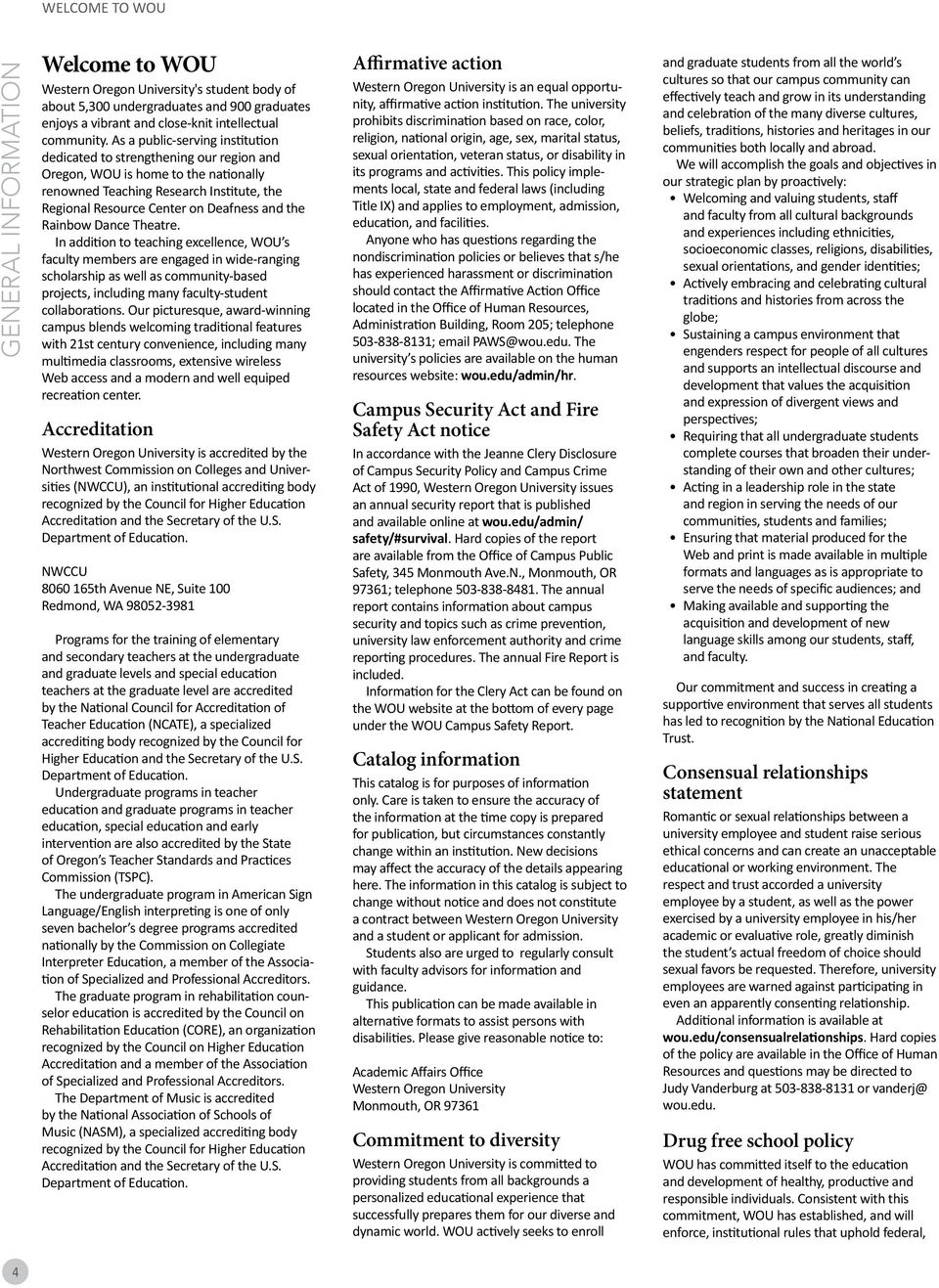
7 general education development state and local laws applicable to alcohol and other drug usage. The university prohibits illegal use of drugs or alcohol by students, faculty or staff. Additional information is available at wou.edu/drugfreeschool. To request a complete hard copy of the drug and alcohol policy, contact Debbie Diehm at or [email protected]. Statement on discrimination, including sexual harassment WOU is committed to cultivating an educational and work environment in which all individuals are treated with respect and dignity. Each individual has the right to learn and work in an atmosphere that promotes equal educational and employment opportunities and prohibits discriminatory practices, including harassment. WOU expects relationships across campus will be free from bias, prejudice and harassment. This policy statement is intended to reaffirm WOU's prohibition against discrimination and harassment, clarify types of prohibited conduct, and provide an effective complaint procedure to individuals who believe they have observed or have been subject to prohibited conduct. Discrimination Discrimination, for the purposes of this policy, is defined as any act or practice, in form or operation, whether intended or unintended, that unreasonably differentiates among persons on the basis of race, color, religion, national origin, age, sex, marital status, sexual orientation, veteran status or disability or any other status protected under the law. Harassment Harassment, for the purposes of this policy, is defined as conduct that creates an intimidating, hostile, or degrading environment that would interfere with the work or academic performance of a reasonable person of the complainant s protected status. Sexual harassment Sexual harassment is a form of discriminatory harassment. Sexual harassment is defined as unwelcome sexual advances, requests for sexual favors, and other verbal or physical behavior of a sexual nature when directed toward an individual because of that individual s sex when: Submission to such conduct is made either explicitly or implicitly a term or condition of the individual s employment, grade, or used as the basis for any employment or academic decision; or Such conduct is unwelcome and has the purpose or effect of unreasonably interfering with an individual s work or academic performance or creates an intimidating, hostile or offensive work or academic environment. Additional information is available at wou.edu/ sexualharassment. To request a complete hard copy of the discrimination and harassment policy and complaint procedure; to discuss a sexual harassment, harassment or discrimination concern; or to file a sexual harassment, harassment or discrimination complaint, contact Judy Vanderburg at or vanderj@ wou.edu. Student right to know Western Oregon University provides the following information regarding our institution s graduation rates. This information is provided in compliance with the Higher Education Act of The graduation rates reflect the graduation status of students who initially enrolled at WOU during the academic year and for whom 150 percent of the normal time to completion has elapsed. During fall 2008, 865 new first-time degree seeking undergraduate students entered the university. As of June 2014, 46.9 percent of these students graduated from WOU. In 2014 WOU was recognized by Educate to Career as being the best college or university in the Pacific Northwest and one of the top in the nation in the added value of our degree. Questions related to this report should be directed to David McDonald, associate provost at , or [email protected]. University communication policy Every student at WOU is assigned a WOU account that can be accessed via the WOU Portal. WOU recognizes this account as the official form of communication between the University and its students. The university will send important and timely information to the students via and it is expected that the student regularly check their WOU account for possible correspondence. It is not recommended that students forward their WOU address to another account as there is a risk of s becoming undeliverable. Any issues with not being delivered to a third party system does not relieve the WOU student of their responsibilities or obligations which may be detailed in the correspondence. Admissions wou.edu/admissions Director Rob Findtner [email protected] (TTY) Toll free: , ext. 1 To attend classes at WOU, students must apply for and receive formal admission. WOU s admission process reflects the institution s strong commitment to providing an excellent studentcentered education. Regular freshmen Admission requirements To be eligible for admission and be admitted to freshman standing, students need to fulfill each of the following requirements: 1. Graduate from an accredited high school. 2. Have at least a 2.75 cumulative high school grade point average. Alternative: Applicants with a cumulative grade point average between 2.50 and 2.74 are eligible for admission if they receive a composite score of 21 on the ACT or a combined score of 1000 on the Critical Reading and Mathematics sections of the SAT Reasoning Exam. 3. Submit ACT or SAT Reasoning scores which include a standardized writing examination. Applicants with a 2.75 cumulative grade point average who graduated prior to 2013 are exempt from the ACT or SAT Reasoning scores requirement. 4. Satisfactorily complete, with a grade of C- or better, 15 subject requirements: (four in English, three in math culminating in algebra II or higher, three in science, three in social science and two in second language (two years of the same second language required). Alternatives: a. Receive a minimum score of 470 on each of two College Board SAT Subject Tests (Math level I or IIC and another test of the student s choice). Students who do not take a SAT Subject Test in a second language must prove language proficiency through another approved process. b. Make up high school course deficiencies by taking high school or college course(s) for specific subject requirements and achieve a grade of C- or better. c. Students who do not meet the second language requirement should refer to the second language requirement section. 5. All students from the Federated States of Micronesia, the Republic of the Marshall Islands and the Republic of Palau, must submit a minimum TOEFL score of 190 (paper score of 520). WOU will also accept Michigan Test scores. A minimum score of 75 is required for undergraduate admission and 80 for graduate admissions. Note: If you do not meet these traditional admission requirements or alternatives, please see the comprehensive admission review section or contact the Admissions Office for a review of your eligibility. Second language requirement WOU requires two years of the same high school-level second language with a grade of C- or above, or acceptable performance on proficiency-assessment options. The second language requirement applies to students graduating from high school or earning their GED in 1997 and thereafter. Graduates of unaccredited high schools or home-schooled students For information, go online to wou.edu/ admissions General Education Development (GED) For information, go online to wou.edu/ admissions general information 5
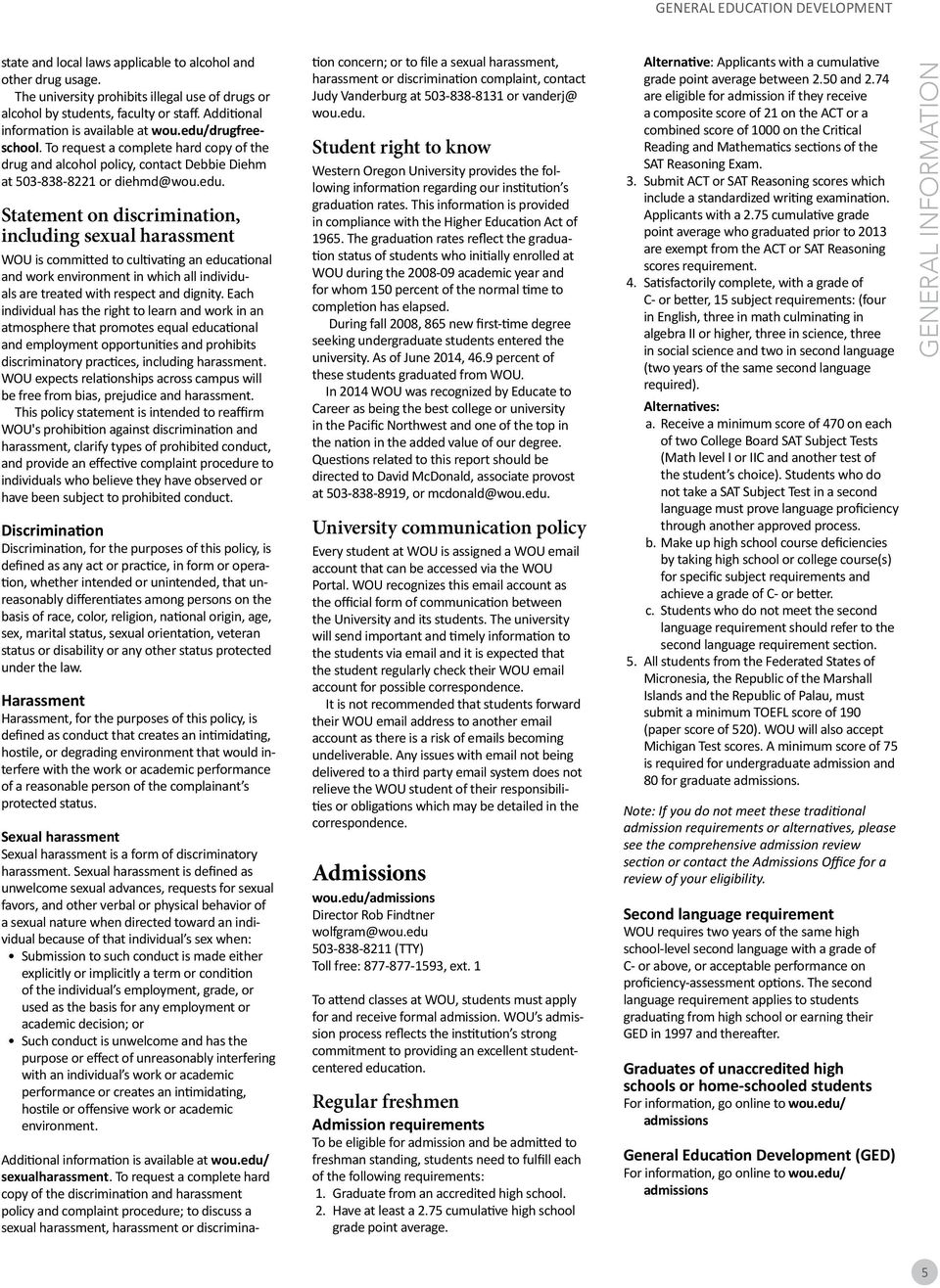
8 when to apply 6general information When to apply High school students can apply for admission after completion of their junior year. Applications will be accepted through the end of the first week of classes. Students who wish to apply for financial aid, scholarships, or university housing are advised to consult the Admissions Office regarding deadlines. Application procedures for incoming freshmen Freshmen are encouraged to apply beginning their senior year to receive priority consideration for scholarships, and financial aid. The application procedure for entering freshmen (students with no preparation beyond high school) consists of the following steps: Course Advanced Placement credit English Language and Composition 3+ 4 WR 135 English Literature and Composition 3+ 4 ENG 104, 105, or 106 Environmental Science 3+ 4 ES 106 French Language FR 103, 201, 202 French Literature 3+ 4 FR 202 German Language GL 103, 201, 202 Latin Vergil ML 299, HUM 406 Latin Literature 3+ 4 ML 299 Spanish Language SPAN 103, 201, 202 Spanish Literature 3+ 4 SPAN 202 Government: U.S. 4 3 PS 201 History: European 3+ 8 HST 1XX, 1XX History: U.S HST 201, 202 Human Geography 3+ 4 GEOG 199 Macro Economics 3+ 4 EC 202 Micro Economics 3+ 4 EC 201 Psychology 3+ 4 PSY 201 Biology BI 211, 212, 213 Calculus AB 3 4+ MTH MTH 251, 252 Calculus BC 3 8+ MTH 251, MTH 251, 252, 253 Chemistry 4 12 CH 104, 105, CH 221, 222, 223 Computer Science A 4+ 4 CS 161 Score Credits awarded WOU equivalent(s) Computer Science AB 3 4 CS CS 161, 162 Physics A 4+ 8 PH 201, 202 Physics B 4+ 4 PH 203 Physics C: Electricity and Magnetism 4+ 4 PH 213 Physics C: Mechanics 4+ 4 PH 211 Statistics 4+ 4 MTH 243 History: World 3+ 8 HST 104, 105 Art: History 4+ 8 A 204, 206 Art: Studio A 115, 116, 130 Music Theory 4+ 8 MUS 211, Complete and return an application for admission and the required $60 non-refundable application fee or WOU Request for Deferral of Application Fee form. Students can apply for admission online at wou.edu/apply. 2. Have an official high school transcript sent to the Admissions Office documenting all coursework completed to date. 3. Students entering as freshmen are required to provide ACT or SAT Reasoning Exam scores, including standardized writing examination scores. Applicants with a 2.75 cumulative grade point average who graduated prior to 2013 are exempt from the ACT or SAT Reasoning Scores requirement. 4. Upon graduation, submit a final official transcript documenting all high school coursework and date of graduation. Freshmen earning college credit are required to submit an official transcript from each college or university attended. First-year students who attend WOU within one year of their high school graduation are required to live on campus (see page 23 for policy). The Admissions Office reserves the right to rescind the admission of any student who fails to meet the conditions of their admission to WOU. Comprehensive admission review WOU conducts comprehensive reviews of applicants who do not meet the minimum admission requirements. Reviews include additional factors such as standardized test results, rigor of courses taken, review of writing sample or personal essays, non-cognitive factors, and other indicators that predict success in college. Academic performance is not the sole criterion for admission to WOU. WOU may evaluate a person s behavior and background to determine their ability to maintain the standards of academic and professional conduct expected at the university. An evaluation may take into consideration current behavior and performance as well as past experiences and actions. For information, go online to wou.edu/admissions. Advanced Placement Students who receive qualifying scores in College Board Advanced Placement (AP) exams may, upon admission to WOU, be granted credit and/or advanced placement in courses counting toward a bachelor s degree. The amount of credit allowed can be determined by viewing the WOU AP table. Copies of test scores taken through the high school should be sent to the Office of the Registrar at WOU. Upon WOU s receipt of the scores and enrollment of the student, the appropriate units will be credited toward the total hours required for graduation. AP credit will be withdrawn if work later is duplicated in a college-level course. No letter grades (A, B, C, D) will be assigned to AP scores. WOU will allow credit and placement of exam scores of 3, 4 and 5. The amount of credit will vary from subject to subject. International Baccalaureate WOU recognizes and awards International Baccalaureate (IB) achievement by awarding credit to students who score 5 or above on higher level IB exams. Students completing the full IB Diploma with a score of 30 or higher receive the following: Guaranteed admission to WOU. Students are required to submit ACT or SAT Reasoning Exam scores which include a standardized writing examination. Provost s Achievement Scholarship. A renewable four-year award of $2,500. The combination of WOU scholarships and need-based campus-based aid may not exceed the total cost of tuition and fees. Sophomore standing. Students with a full IB Diploma and a score of 30 or higher will be granted sophomore standing. Honors Program. The WOU Honors Program will automatically accept students with a full IB Diploma.

9 oregon transfer agreements Transfer student Admission requirements 1. Students with 36 or more transferable, college-level quarter hour credits (24 semester hours) must have a cumulative 2.25 grade point average or higher in all college-level work attempted and be in good standing at all prior institutions attended. Transfer applicants are required to have completed a writing course beginning with Writing 121 (or the equivalent) with a grade of C- or better; and college algebra or above with a grade of C- or better, or the equivalent of Math Students who have earned between 12 and 35 transferable quarter hours must meet both freshman and transfer admission requirements. Students who have earned fewer than 12 transferable quarter hours must meet freshman admission requirements. ACT or SAT Reasoning Exam scores are not required for transfer applicants with less than 36 transferable, college-level quarter hours who graduated prior to 2013 with a cumulative high school grade point average of 2.75 or higher. 3. Transfer applicants who obtain an Oregon Transfer Module (OTM) or an Associate of Arts Oregon Transfer degree (AAOT) from an Oregon community college are admissible with a cumulative grade point average of A transfer student who does not meet the regular admission requirements may be considered for admission by the Comprehensive Admission Review Committee. Refer to section on comprehensive admission review or contact the Admissions Office. Transfer student application procedures 1. Complete and return an application for admissions and the required $60 nonrefundable application fee or Request for Deferral of Application Fee form. 2. Have an official, complete transcript sent from each college or university attended. To WOU International Baccalaureate program credit guidelines IB Certificate Course Standard Level Exam Score 5, 6, or 7 WOU Course High Level Exam Score 5, 6 or 7 Credits WOU Course Credits Anthropology ANTH ANTH Art A A 204, A Biology BI BI 211, BI 212, BI Business BA BA Chemistry CH CH 221, CH 222, CH Computer Science CS CS 122, CS Economics EC EC 201, EC Environmental Systems & ES ES Societies Geography GEOG GEOG 105, GEOG History: Americas HST HST 201, HST 202, HST History: Europe HST 1XX 4 HST 101, HST 102, HST History HST HST 104, HST 105, HST Language A1 (English) WR WR 115, WR 135, ENG French A & B FR FR 101, FR 102, FR German A GL GL 101, GL 102, GL German B GL GL 201, GL 202, GL Spanish A & B SPAN SPAN 101, SPAN 102, SPAN Information & Technology in CS CS 101, CS a Global Society Mathematics MTH MTH 112, MTH 241, MTH Mathematics Studies MTH MTH 105, MTH Music MUS MUS 111, MUS Physics PH PH 201, PH 202, PH Psychology PSY PSY 201, PSY Social Anthropology ANTH ANTH Theatre Arts TA TA Visual Arts A A 100, A 115, A be considered official, transcripts must be sent directly to the Admissions Office from the issuing institution. Unofficial or student copies are not acceptable. Omitting an institutional record from your application may result in disciplinary action. The director of admissions reserves the right to rescind the admission of any student who falsifies information on their application for admission. The Admissions Office reserves the right to rescind the admission of any student who fails to meet the conditions of their admission to WOU. Acceptance of credit from accredited institutions Acceptable records from accredited postsecondary institutions are evaluated by the Admissions Office to determine the student s eligibility for admission to WOU. The amount of credit granted depends on the nature and quality of the applicant s previous work. A student s grade point average will be computed on the transfer credits attempted and will be used as the basis for admission. WOU does not recognize other institutions academic forgiveness policies. Credit from unaccredited institutions No advanced standing is granted at entrance for work at unaccredited institutions. After completing a successful year at WOU, work earned at unaccredited institutions may be reviewed to determine what work, if any, will be allowed for credit by petition through the Registrar s Office. Students with coursework from unaccredited institutions must meet freshman admission requirements if they do not have at least 36 college-level credits from any accredited institutions. Credit from two-year institutions WOU accepts all college-level transfer work completed up to 124 hours. A maximum of 24 quarter hours of vocational-technical coursework applicable in an associate degree or a certificate program at an accredited institution may be accepted as elective credit toward part of the 124 hours. Oregon transfer agreements Transfer students entering WOU who have earned either an Associate of Arts Oregon Transfer degree (AAOT) from an Oregon community college under the May 1988 transfer agreement or an Associate of Science in Business degree (ASOTB) from an Oregon community college under the April 2003 transfer agreement will be considered as having met WOU s Liberal Arts Core Curriculum (LACC). For purposes of course registration only, students holding an AAOT or ASOTB will be considered to have junior standing. Students who have earned the Oregon Transfer Module (OTM) will meet the WOU first-year general education graduation requirements. For purposes of registration only, students holding the Oregon Transfer Module will be considered to have at least sophomore standing. general information 7

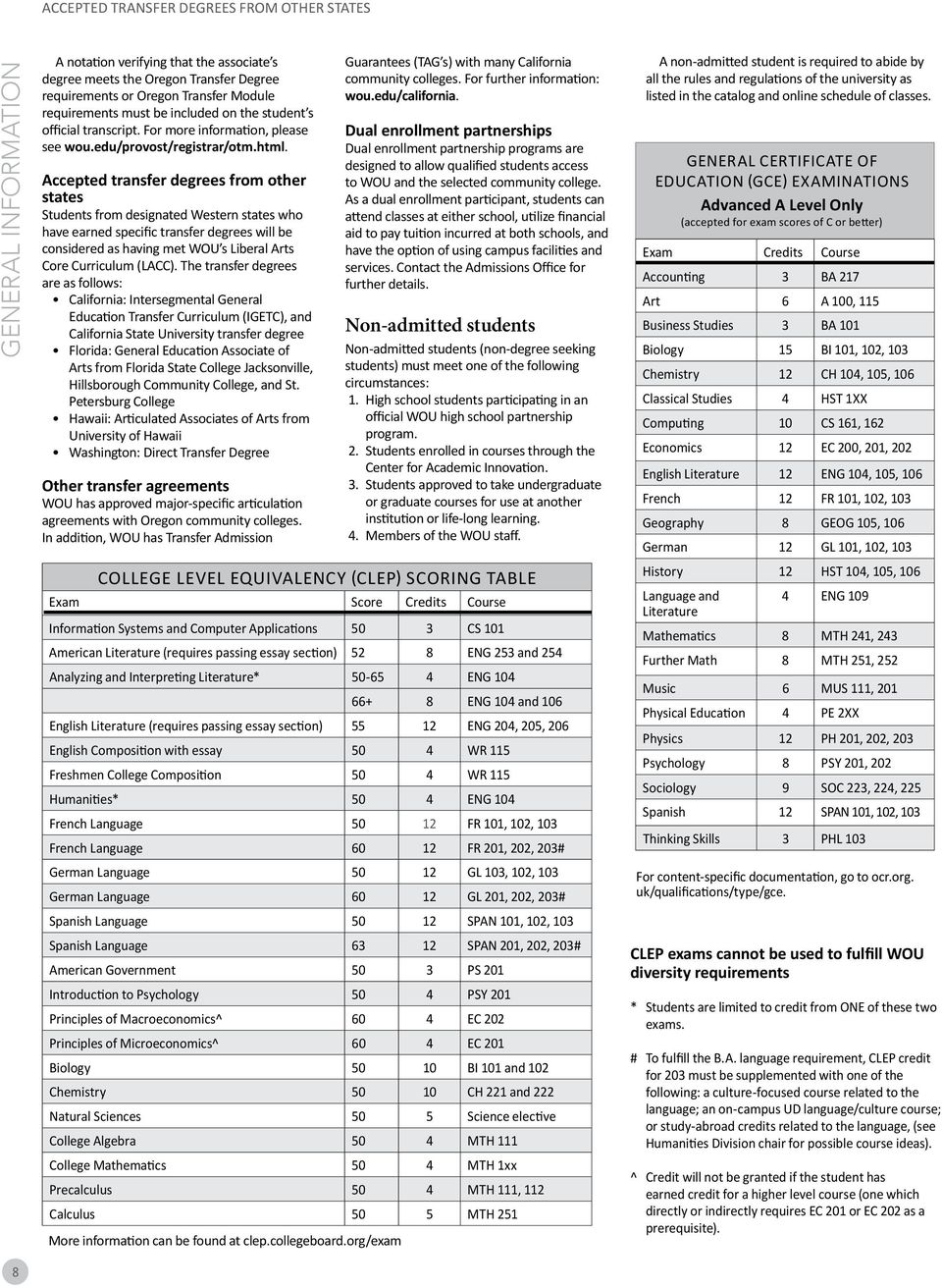
10 accepted transfer degrees from other states 8general information A notation verifying that the associate s degree meets the Oregon Transfer Degree requirements or Oregon Transfer Module requirements must be included on the student s official transcript. For more information, please see wou.edu/provost/registrar/otm.html. Accepted transfer degrees from other states Students from designated Western states who have earned specific transfer degrees will be considered as having met WOU s Liberal Arts Core Curriculum (LACC). The transfer degrees are as follows: California: Intersegmental General Education Transfer Curriculum (IGETC), and California State University transfer degree Florida: General Education Associate of Arts from Florida State College Jacksonville, Hillsborough Community College, and St. Petersburg College Hawaii: Articulated Associates of Arts from University of Hawaii Washington: Direct Transfer Degree Other transfer agreements WOU has approved major-specific articulation agreements with Oregon community colleges. In addition, WOU has Transfer Admission College Level Equivalency (CLEP) scoring table Exam Score Credits Course Information Systems and Computer Applications 50 3 CS 101 American Literature (requires passing essay section) 52 8 ENG 253 and 254 Analyzing and Interpreting Literature* ENG ENG 104 and 106 English Literature (requires passing essay section) ENG 204, 205, 206 English Composition with essay 50 4 WR 115 Freshmen College Composition 50 4 WR 115 Humanities* 50 4 ENG 104 French Language FR 101, 102, 103 French Language FR 201, 202, 203# German Language GL 103, 102, 103 German Language GL 201, 202, 203# Spanish Language SPAN 101, 102, 103 Spanish Language SPAN 201, 202, 203# American Government 50 3 PS 201 Introduction to Psychology 50 4 PSY 201 Principles of Macroeconomics^ 60 4 EC 202 Principles of Microeconomics^ 60 4 EC 201 Biology BI 101 and 102 Chemistry CH 221 and 222 Natural Sciences 50 5 Science elective College Algebra 50 4 MTH 111 College Mathematics 50 4 MTH 1xx Precalculus 50 4 MTH 111, 112 Calculus 50 5 MTH 251 More information can be found at clep.collegeboard.org/exam Guarantees (TAG s) with many California community colleges. For further information: wou.edu/california. Dual enrollment partnerships Dual enrollment partnership programs are designed to allow qualified students access to WOU and the selected community college. As a dual enrollment participant, students can attend classes at either school, utilize financial aid to pay tuition incurred at both schools, and have the option of using campus facilities and services. Contact the Admissions Office for further details. Non-admitted students Non-admitted students (non-degree seeking students) must meet one of the following circumstances: 1. High school students participating in an official WOU high school partnership program. 2. Students enrolled in courses through the Center for Academic Innovation. 3. Students approved to take undergraduate or graduate courses for use at another institution or life-long learning. 4. Members of the WOU staff. A non-admitted student is required to abide by all the rules and regulations of the university as listed in the catalog and online schedule of classes. General Certificate of Education (GCE) Examinations Advanced A Level Only (accepted for exam scores of C or better) Exam Credits Course Accounting 3 BA 217 Art 6 A 100, 115 Business Studies 3 BA 101 Biology 15 BI 101, 102, 103 Chemistry 12 CH 104, 105, 106 Classical Studies 4 HST 1XX Computing 10 CS 161, 162 Economics 12 EC 200, 201, 202 English Literature 12 ENG 104, 105, 106 French 12 FR 101, 102, 103 Geography 8 GEOG 105, 106 German 12 GL 101, 102, 103 History 12 HST 104, 105, 106 Language and 4 ENG 109 Literature Mathematics 8 MTH 241, 243 Further Math 8 MTH 251, 252 Music 6 MUS 111, 201 Physical Education 4 PE 2XX Physics 12 PH 201, 202, 203 Psychology 8 PSY 201, 202 Sociology 9 SOC 223, 224, 225 Spanish 12 SPAN 101, 102, 103 Thinking Skills 3 PHL 103 For content-specific documentation, go to ocr.org. uk/qualifications/type/gce. CLEP exams cannot be used to fulfill WOU diversity requirements * Students are limited to credit from ONE of these two exams. # To fulfill the B.A. language requirement, CLEP credit for 203 must be supplemented with one of the following: a culture-focused course related to the language; an on-campus UD language/culture course; or study-abroad credits related to the language, (see Humanities Division chair for possible course ideas). ^ Credit will not be granted if the student has earned credit for a higher level course (one which directly or indirectly requires EC 201 or EC 202 as a prerequisite).
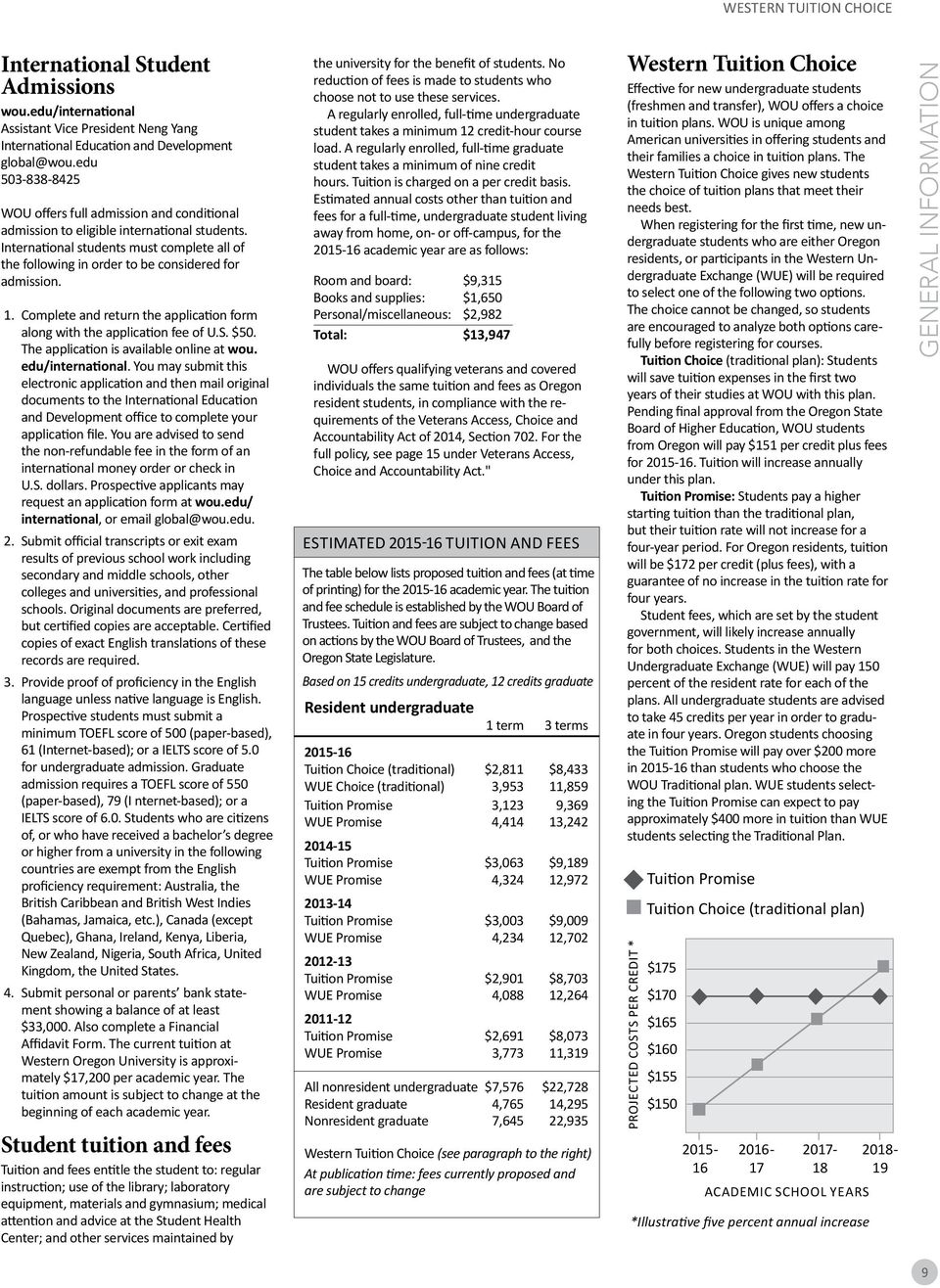
11 western tuition choice International Student Admissions wou.edu/international Assistant Vice President Neng Yang International Education and Development WOU offers full admission and conditional admission to eligible international students. International students must complete all of the following in order to be considered for admission. 1. Complete and return the application form along with the application fee of U.S. $50. The application is available online at wou. edu/international. You may submit this electronic application and then mail original documents to the International Education and Development office to complete your application file. You are advised to send the non-refundable fee in the form of an international money order or check in U.S. dollars. Prospective applicants may request an application form at wou.edu/ international, or 2. Submit official transcripts or exit exam results of previous school work including secondary and middle schools, other colleges and universities, and professional schools. Original documents are preferred, but certified copies are acceptable. Certified copies of exact English translations of these records are required. 3. Provide proof of proficiency in the English language unless native language is English. Prospective students must submit a minimum TOEFL score of 500 (paper-based), 61 (Internet-based); or a IELTS score of 5.0 for undergraduate admission. Graduate admission requires a TOEFL score of 550 (paper-based), 79 (I nternet-based); or a IELTS score of 6.0. Students who are citizens of, or who have received a bachelor s degree or higher from a university in the following countries are exempt from the English proficiency requirement: Australia, the British Caribbean and British West Indies (Bahamas, Jamaica, etc.), Canada (except Quebec), Ghana, Ireland, Kenya, Liberia, New Zealand, Nigeria, South Africa, United Kingdom, the United States. 4. Submit personal or parents bank statement showing a balance of at least $33,000. Also complete a Financial Affidavit Form. The current tuition at Western Oregon University is approximately $17,200 per academic year. The tuition amount is subject to change at the beginning of each academic year. Student tuition and fees Tuition and fees entitle the student to: regular instruction; use of the library; laboratory equipment, materials and gymnasium; medical attention and advice at the Student Health Center; and other services maintained by the university for the benefit of students. No reduction of fees is made to students who choose not to use these services. A regularly enrolled, full-time undergraduate student takes a minimum 12 credit-hour course load. A regularly enrolled, full-time graduate student takes a minimum of nine credit hours. Tuition is charged on a per credit basis. Estimated annual costs other than tuition and fees for a full-time, undergraduate student living away from home, on- or off-campus, for the academic year are as follows: Room and board: $9,315 Books and supplies: $1,650 Personal/miscellaneous: $2,982 Total: $13,947 WOU offers qualifying veterans and covered individuals the same tuition and fees as Oregon resident students, in compliance with the requirements of the Veterans Access, Choice and Accountability Act of 2014, Section 702. For the full policy, see page 15 under Veterans Access, Choice and Accountability Act." Estimated tuition and fees The table below lists proposed tuition and fees (at time of printing) for the academic year. The tuition and fee schedule is established by the WOU Board of Trustees. Tuition and fees are subject to change based on actions by the WOU Board of Trustees, and the Oregon State Legislature. Based on 15 credits undergraduate, 12 credits graduate Resident undergraduate 1 term 3 terms Tuition Choice (traditional) $2,811 $8,433 WUE Choice (traditional) 3,953 11,859 Tuition Promise 3,123 9,369 WUE Promise 4,414 13, Tuition Promise $3,063 $9,189 WUE Promise 4,324 12, Tuition Promise $3,003 $9,009 WUE Promise 4,234 12, Tuition Promise $2,901 $8,703 WUE Promise 4,088 12, Tuition Promise $2,691 $8,073 WUE Promise 3,773 11,319 All nonresident undergraduate $7,576 $22,728 Resident graduate 4,765 14,295 Nonresident graduate 7,645 22,935 Western Tuition Choice (see paragraph to the right) At publication time: fees currently proposed and are subject to change Western Tuition Choice Effective for new undergraduate students (freshmen and transfer), WOU offers a choice in tuition plans. WOU is unique among American universities in offering students and their families a choice in tuition plans. The Western Tuition Choice gives new students the choice of tuition plans that meet their needs best. When registering for the first time, new undergraduate students who are either Oregon residents, or participants in the Western Undergraduate Exchange (WUE) will be required to select one of the following two options. The choice cannot be changed, so students are encouraged to analyze both options carefully before registering for courses. Tuition Choice (traditional plan): Students will save tuition expenses in the first two years of their studies at WOU with this plan. Pending final approval from the Oregon State Board of Higher Education, WOU students from Oregon will pay $151 per credit plus fees for Tuition will increase annually under this plan. Tuition Promise: Students pay a higher starting tuition than the traditional plan, but their tuition rate will not increase for a four-year period. For Oregon residents, tuition will be $172 per credit (plus fees), with a guarantee of no increase in the tuition rate for four years. Student fees, which are set by the student government, will likely increase annually for both choices. Students in the Western Undergraduate Exchange (WUE) will pay 150 percent of the resident rate for each of the plans. All undergraduate students are advised to take 45 credits per year in order to graduate in four years. Oregon students choosing the Tuition Promise will pay over $200 more in than students who choose the WOU Traditional plan. WUE students selecting the Tuition Promise can expect to pay approximately $400 more in tuition than WUE students selecting the Traditional Plan. Tuition Promise Tuition Choice (traditional plan) Projected costs per credit * $175 $170 $165 $160 $155 $ Academic school years *Illustrative five percent annual increase general information
12 western undergraduate exchange scholars program general information Western Undergraduate Exchange Scholars Program The Western Undergraduate Exchange (WUE) Scholars Program offers qualified students from participating Western states the opportunity to enroll at WOU at a special reduced tuition level of 150 percent of resident tuition. Students from Alaska, Arizona, California, Colorado, Hawaii, Idaho, Montana, Nevada, New Mexico, North Dakota, South Dakota, Utah, Washington, Wyoming, and residents of the commonwealth of the Northern Mariana Islands are eligible to apply for the discounted tuition. All undergraduate academic programs at WOU are available under the WUE Scholars Program. If you are a resident of one of the participating states and would like to apply for the WUE Scholars Program, you must submit an application for admission and be admitted to the university under standard admission procedures. Financial Aid wou.edu/financialaid Director Kella Helyer [email protected] Toll free: WOU provides a strong financial aid and scholarship program that annually administers more than $55 million to eligible students. Financial aid is based on the philosophy that the responsibility for financing a student s education rests primarily with the student and student s family. For detailed information about the financial aid application process and aid programs, go to wou.edu/financialaid. Applying for aid To be considered for federal and state financial aid at WOU, students must complete the Free Application for Federal Student Aid (FAFSA). Students are encouraged to submit their FAFSAs annually as soon after January 1 as possible as some funds are limited and are awarded on a first come, first served basis. The FAFSA is completed online at fafsa.gov. Financial aid programs WOU participates in numerous federal, state and institutional programs including: Grants Federal Pell Grant Federal Supplemental Educational Opportunity Grant (FSEOG) Federal TEACH Grant WOU Grant Oregon Opportunity Grant Federal Work-Study Loans Federal Direct Subsidized Stafford Loans Federal Direct Unsubsidized Stafford Loans Federal Perkins Loan Federal Direct PLUS Loans for parents Federal Direct PLUS Loans for graduate students Scholarships WOU Presidential Scholarships WOU Provost Scholarships WOU General/Foundation Scholarships WOU Diversity Commitment Scholarships Veterans educational aid Information can be found on the WOU Registrar s website. Registrar wou.edu/registrar Registrar TBD [email protected] Academic policies for undergraduate students (Graduate Program information: see page 84) The Registrar's Office is responsible for maintaining the integrity and accuracy of academic records including student enrollment, grades, transcripts and degrees; eligibility for veterans' benefits; and maintaining compliance with state and federal laws, particularly the Family Educational Rights and Privacy Act (FERPA). Students use "Degree Works" online evaluation software to track their progress toward their degree. Students should refer to it each term before meeting with their advisor and registering for classes. Contact the Registrar's Office for assistance with undergraduate and institutional academic policies, located in the Lieuallen Administration Building, first floor, or call Forms and information may also be found online at wou.edu/provost/registrar. 1.1 Academic year and catalog The academic year has four terms. Fall, winter, and spring terms have 10 weeks of class plus final examinations; summer term offers varying course schedules. Undergraduate students may enter the university at the beginning of any term. This catalog lists requirements and policies in effect at the beginning of fall term Degree, program and graduation requirements for the catalog are valid only for seven years. Freshmen students admitted and enrolled for the first time this fall must meet requirements in this catalog, or may choose to graduate under the requirements of a later catalog that is no more than seven years old. Transfer students may choose to meet the requirements in the WOU catalog in effect at the time of their first enrollment after admission at either a) the school from which they transferred (if it is regionally accredited), or b) at WOU. In addition, they may also choose to graduate under the requirements of a later catalog that is no more than seven years old. Registration and withdrawal 2.1 Course numbering system Courses numbered: 1-99 Preparatory courses that do not count toward a degree Lower-division courses Upper division courses Graduate courses with undergraduate equivalents Graduate courses for graduate students only 700 In-service courses 800 Professional development courses that do not apply to degrees 10

13 undergraduate students Special notes for 500-level courses: Courses offered in a mixed 400/500 format may be taken for either undergraduate or graduate credit, but students cannot enroll in both formats in the same term, and cannot take both course levels in different terms unless the subject matter is substantially different across the two courses. Seniors who are within 12 credits of completing the bachelor degree requirements may enroll a maximum of 12 graduate credits in 500-level courses for later use toward a graduate program. Contact the WOU Graduate Program Office for assistance. 2.2 Registration Registration for an academic term begins the eighth week of the prior term. For example, registration for fall term starts the eighth week of the prior spring term. Students are notified of their assigned registration period approximately one week prior to the beginning of registration and they may register at, or any time after, the beginning of their assigned registration period. Students' registration time is assigned based on total credits earned and continued enrollment. The Office of Disability Services arranges assistance with registration for students with disabilities; contact that office as early as possible before registration begins. Courses at the 300 and 400-level are typically reserved for juniors and seniors, except by special permission from the faulty. After registration, course schedules may be changed during the course add/drop period at the beginning of the term. See the online Academic Calendar for deadlines and fees, if any, for schedule changes. 2.3 Students responsibilities for registration 2.31 Students are responsible for keeping their address information updated through Wolf Web. WOU s academic offices rely on this student information to contact students to resolve problems with academic records, registration, advising or graduation Students must resolve holds with the designated office prior to registration. Students can verify if any holds exist through Wolf Web Students registered for a class who do not meet the prerequisite or co-requisite requirement may be administratively dropped from the class by the Registrar s Office upon request from the academic department. The student s permission is not required when dropped for this reason. The academic department will notify the student via before dropping him or her Students who do not attend the first two sessions of a class may be administratively dropped from the class by the Registrar s Office upon request from the academic department. The student s permission is not required when dropped for this reason. The academic department will notify the student via before dropping him or her. Students are strongly advised to notify faculty of any situation that may prevent class attendance during the first week Students are financially responsible for all courses in which they are officially registered, regardless of the level of their participation in the course. 2.4 Registration - repeated courses 2.41 Course descriptions provide specific information about courses which may be repeated, and counted multiple times, for credit. If this is not mentioned in the course description, then students are advised not to register for the course again because it will only be counted once. Students may repeat a course to improve their grade; however, only the most recent grade and credits will be computed in the GPA Courses taken on an audit or satisfactoryno credit basis may not be repeated for an A-F or Pass-No Credit grade Students who receive federal financial aid, and retake a course, may find that it reduces their financial aid package. Contact the WOU Financial Aid Office for assistance before registering for a repeat course. 2.5 Re-enrollment 2.51 If a student has not registered for courses for four terms, then WOU will inactivate the student s status. When the student wishes to register for courses again, s/he will need to submit an undergraduate re-enrollment application along with the required fee to the Registrar s Office Students who leave WOU and complete coursework from another institution must have earned a GPA of 2.0 or higher, and be eligible to return to the last institution attended. Official transcripts of all academic work attempted and/ or completed since leaving WOU must be on file in the Registrar's Office before the re-enrollment will be considered Students who leave WOU under academic suspension must submit a re-enrollment application together with a request for reinstatement to the registrar requesting readmission at least one term prior to the desired term of enrollment. 2.6 Withdrawal (from a course or the university) The following deadlines apply to fall, winter, and spring terms. See the Academic Calendar for deadlines for summer term. Week 1 through Week 4 A student may drop a course, without any record on the permanent academic transcript, online through the portal, or by completing an add/drop form and submitting it to the Registrar s Office before the end of the fourth week of class. Week 5 through Week 7 A student may withdraw from a course and receive a W for the course on the permanent academic transcript if a completed add/drop form is submitted to the Registrar s Office in weeks five through seven of the term. (See Special Situations below.) After Week 7 - After the seventh week of the term, students may not drop or withdraw from a class, except in the case of a medical emergency or other extenuating circumstance. For students medical emergencies, contact the Dean of Students & Judicial Affairs for assistance. For all other extenuating circumstances, contact the Vice President of Student Affairs. In situations of emergency, accident, prolonged illness or other catastrophic event, a student may be allowed to withdraw without academic penalty from the university, and all courses, at any time. (Such events will also be considered for exception to the official schedule for refunds.) The university will require the student to submit the appropriate form (found on the Registrar s Office website), submitted with appropriate signatures and verification documentation. 2.7 Refunds Students who drop or withdraw from courses or the university may be entitled to refunds or reductions in fees, depending on the date of the drop or withdrawal. In all cases, the amount of the refund is based on the date the official written notification of withdrawal or cancellations is received by the university. Exceptions may be made when the formal withdrawal is delayed through extraordinary causes beyond the student s control. The refund schedule has been established by WOU and the U.S. Department of Education and may be obtained from the Business Office or found online at wou.edu/student/finaid/ tuition_fees/refunds.php Undergraduate students 3.1 Bachelor degrees Several options exist for students interested in pursuing one of WOU s bachelor degrees Students may pursue one degree. Bachelor degree programs and requirements are described on page 33. Students pursuing teaching licensure should be aware that requirements are established by the Oregon Teaching Standards and Practices Commission and are subject to change Students may pursue two degrees at one time, for example, a Bachelor of Arts and a Bachelor of Music. To do so, the student must fulfill the appropriate core curriculum (see page 33), all degree requirements, and other program requirements for two majors and one minor Students may pursue a second bachelor s degree after completing their first bachelor degree. To do so, the student must complete the following requirements: Fulfill all major requirements for the second degree, including a minimum of 36 additional undergraduate credit hours after earning the first degree (if it was from WOU). If the first degree was from another accredited institution, then the student must earn a minimum of 45 additional undergraduate credit hours after earning the first degree. At least 75 percent of the additional credit hours must be earned at WOU. All course credit earned toward the second degree must be taken with an A-F grade general information 11
14 class standing general information option unless the course is only designated as P/NC grade option only. Students are not eligible to graduate with honors with a second bachelor s degree. 3.2 Class standing Students are classified according to their level of earned credit hours, based on an academic quarter system. Freshman: 0-44 credit hours Sophomore: credit hours Junior: credit hours Senior: 135+ credit hours Post-baccalaureate: A student who is pursuing a second baccalaureate degree or licensure. Post-baccalaureate students are not considered graduate students. Non-admitted student: Either a graduate or undergraduate enrolled for 8 or fewer credits, but not working toward a degree or licensure. A maximum of 15 credits of non-admit graduate coursework can be applied to an endorsement or degree program. 3.3 Academic standing A student s academic standing is considered part of the academic record and is noted on the student transcript for each term President s Honor Roll. To be eligible for this accomplishment for the term, an undergraduate student must take at least 12 hours, graded (A through D-), and earn a grade point average (GPA) of Credits earned at another institution in the same term, and credits graded as either P or S are not included in the GPA calculation. A grade of F or NC precludes President s Honor Roll eligibility during the term in which those grades are received Dean s Honor Roll. To be eligible for this accomplishment for the term, an undergraduate student must take at least 12 hours, graded (A through D-) and earn a grade point average (GPA) of at least Credits earned at another institution in the same term, and credits graded as either P or S are not included in computing the GPA. A grade of F or NC precludes Dean s Honor Roll eligibility during the term in which those grades are received Good Standing. A student is in good standing and doing satisfactory work when a GPA of 2.00 or better is maintained for the term and the student is progressing toward completing graduation requirements Academic warning. When a student s GPA in any term falls below 2.00, the student is put on academic warning and is required to complete an online workshop or meet with an academic advisor in the Academic Advising and Learning Center (AALC). An Academic Standing hold will be placed on the student which prevents the student from registering for courses until the student completes the required steps. If the student s term and cumulative GPA improve to 2.00 or better in the next term, then the academic warning is lifted, and the student is returned to good standing Academic probation. If a student is on academic warning in one term, and earns a GPA below 2.00 in the next term, the student is placed on academic probation and is required to complete an online workshop or meet with an academic advisor in the AALC. An Academic Standing hold will be placed on the student which prevents the student from registering for courses until the student completes the required steps. If the student s term and cumulative GPA improve to 2.00 or better in the next term, then the academic warning is lifted, and the student is returned to good standing Continued probation. If a student s cumulative GPA remains below 2.0 but their term GPA is a 2.0 or higher, the student is placed on continued probation. Students remain on continued probation until their cumulative GPA is a 2.0 or higher. However, if the student s term GPA falls below 2.0, they are placed on Academic Suspension Suspension. If a student is on academic probation or continued probation, and earns a GPA below 2.00 in the next term, then the student will be suspended and required to take the term following suspension off from WOU. Suspended students are denied all privileges of the institution. To be reinstated after one term, the student must complete a Request for Reinstatement with the Registrar s Office. When readmitted, students are required to enroll in, and successfully complete, the university s mandated learning seminar. Students who begin the reinstatement process less than four weeks prior to the start of the term in which reinstatement is desired may delay their return until the following term Second suspension. Students suspended a second time, at any point after the first suspension, are required to take a one year (four terms) leave from the university; or complete a minimum of 24 transferable credits at a community college and earn a GPA of 2.5 or higher; or petition successfully to the WOU review committee for a waiver from either of the above requirements. The committee s decision is final Subsequent suspension. Students suspended for a third time, for any reason, are required to take at least a one year (four terms) leave from the University, or petition to the WOU review committee to determine conditions for returning. The committee s decision is final. Undergraduate grades and grading standards 4.1 Grading standards Grades measure students achievement of competence in theoretical, technical or aesthetic dimensions of coursework, relevant to the course learning outcomes and instructor expectations. Only courses with grades of A through D-, S, or P are counted as credit hours applied to a degree program. A Excellent B Above Average C Average D Below Average F Failure P Pass: Used in courses in which no letter grade is assigned. S Satisfactory: Students have the option to take elective courses on a Satisfactory- No Credit basis; the satisfactory level to pass is defined as equivalent to a grade of D- or better. (Elective courses are those that are not used to fulfill the Liberal Arts Core Curriculum (LACC), the bachelor s degree requirements or the declared major and minor requirements.) The student must choose this option at registration, and cannot reverse that decision. RP Regular Progress: Used only in courses that extend past the regularly scheduled end of term; these courses are identified as such in the course descriptions. When the coursework is completed, the instructor will submit a grade change to the appropriate letter grade. I Incomplete: An essential requirement of the course has not been completed for reasons acceptable to the instructor. NC No credit earned X No basis for grade: Used only if student failed to appear for the course, or there is no basis for grading the student. The instructor must designate the last date of attendance, if any. W Withdrawal from a course after the fourth week of the term. AU Audit 4.2 Policy for incomplete grades for undergraduate students To grant an incomplete, the instructor and student must complete and sign the Incomplete Grade Contract, which designates the default grade and the date when the incomplete grade expires. A copy of this contract should be kept by the instructor, the academic division office, and the student. When the incomplete grade is submitted, the instructor will also submit a default grade. If the student doesn t complete the work within 12 months, then the default grade will automatically be entered for the course. If a student needs additional time, s/he may petition for up to an additional 12 months BEFORE the end of the first 12 months. The maximum length of time to complete the work is 24 months, or before the student s academic record is evaluated for graduation. When the student applies to graduate, his/her academic record is closed, and any incomplete grades will revert to the instructor s default grade. An unresolved incomplete grade may prevent graduation because the default grade lowers a student s GPA, or keeps a needed requirement from being met. Students are strongly encouraged to resolve incomplete grades within the shortest possible time to prevent problems closer to graduation. Special accommodation is made for National Guard, active duty or reserve members of the armed forces who may be deployed within an 12

15 commencement honors and awards academic term. Students are encouraged to contact Veterans Services in the Registrar s Office to assist them with mitigating circumstances. Depending on the circumstances and with documentation (for example, copy of orders or letter from supervisor on letterhead), the student may be granted a 24-month period to resolve an incomplete grade, or allowed to withdraw after the usual deadline without tuition or fee charges. 4.3 Grade Point Average (GPA) The grade point average is a calculation of the sum of points per grade (A- F), per credit hour, received across courses, divided by the total credit hours in which those grades are received. Marks of I, P, NC, W, X, S, RP, and AU are not included in the calculation of points. A = 4.00 points A- = 3.70 points B+ = 3.30 points B = 3.00 points B- = 2.70 points C+ = 2.30 points C = 2.00 points C- = 1.70 points D+ = 1.30 points D = 1.00 points D- = 0.70 points F = 0.00 points 4.4 Grades for repeated courses 4.41 Course descriptions provide specific information about courses which may be repeated, and counted multiple times for credit (and calculation in the student s GPA). If this is not mentioned in the course description, then the course can only be counted once If a student chooses to repeat a course to improve their grade, only the most recent grade and credits will be used to calculate the student s GPA, even if the earlier grade was higher. Credit by examination 5.1 To qualify Students may be able to receive credit by examination in courses for which they can demonstrate proficiency. To qualify, a student must be enrolled at least half-time, not taken the course previously. A maximum of 45 hours of credity by exam credit hours may be applied to undergraduate degree requirements; a maximum of 15 credit hours may be applied to initial licensure programs. 5.2 Required steps Obtain the credit by examination form from the Registrar s Office or website and complete the form indicating qualifications for the relevant course. Take the form to the appropriate division chair who will approve or disapprove the application. If disapproved, the form will be returned to the Registrar's Office for filing purposes. If approved, the chair will designate the examining instructor or instructors and the date and time for the examination. Pay the examination fee of $25 per credit at the Cashier s Office and return the form to the examining instructor. The fee is subject to change without notice. The examination may be verbal, written, or performance variety or any combination. A score equivalent to a grade of A or B shall be interpreted as successful; the instructor shall notify the department chair of the examination score. The department chair shall return the completed form (with appropriate signatures) to the registrar, who will notify the student. If the student has been successful, a grade of P will be entered on the student s record. A student who fails an exam may not reapply for credit by examination for the same course. Graduation and commencement for undergraduate students (Graduate Program Information See page 84) 6.1 Definitions Graduation and commencement are not the same. A student graduates from WOU after applying to graduate and after the Registrar s Office determines that all university academic requirements have been met. Students may graduate at the end of any academic term. Commencement is WOU s annual ceremony in June that recognizes students completion of degrees. Students who are eligible, and wish to participate, must submit all required information by the deadline posted on the Registrar s Office online calendar. 6.2 Planning for graduation 6.21 Degree Works is the official degree evaluation system for students and advisors. Students may use this online system to check their progress toward their degree. For information on how to access and use Degree Works, see the Registrar s Office website All incomplete grades must be completed, AND the grades entered by the instructor, NO LATER than the end of the term graduation is planned or the default grade will be applied. However, an unresolved incomplete grade may prevent graduation because the default grade lowers a students' GPA, or keeps a needed requirement from being met. Students are strongly encouraged to resolve incomplete grades within the shortest possible time to prevent problems closer to graduation Students who have earned course credits from other institutions recently before the intended term of graduation must request an official transcript from that institution be sent to WOU s Registrar Office by the deadline on the online Academic Calendar at the Registrar s Office website. 6.3 Applying for graduation 6.31 Students are required to apply for graduation three terms ahead of the intended term of graduation. For specific deadlines, refer to the Academic Calendar on the Registrar s website To apply for graduation, submit an Application for Undergraduate Degree to the Registrar s Office. After that, any changes in your major, intended graduation term, change in name or address, or other similar details, must be submitted in writing to the Registrar s Office. 6.4 Applying for commencement 6.41 Students are required to apply to participate in commencement according to the deadline specified on the Academic Calendar on the Registrar s Office website Undergraduate students who are within 12 credits of completing degree requirements (to be completed during summer or fall terms only) may participate in the June commencement ceremony. However, education students who are scheduled to complete their teaching practicum in the fall term are not eligible to participate until the next June s commencement Students who are within 12 credits must have documentation for the summer/ fall registration to complete those credits. This documentation and their application to participate in commencement must be submitted to the Registrar's Office no later than Wednesday of the eighth week of spring term. The specific deadline may be found on the Academic Calendar on the Registrar s Office website. 6.5 Commencement honors and awards 6.51 Students who graduate from the Honors Program with at least a 3.25 cumulative WOU grade point average (as of the end of winter term) will have in cursu honorum printed on their diploma. If a student achieves at least a 3.25 after spring term, in cursu honorum Honors Program' will be noted on the transcript The faculty at WOU recognizes undergraduate student scholarship by conferring honors distinction at commencement to students who have earned a cumulative WOU grade point average of 3.50 or better, as of the end of winter term. Grade point averages will be recalculated when all coursework is completed and the degree is conferred and appropriate honors distinctions will be noted on the transcript. To qualify for honors distinction, students must have completed at least 45 credit hours through WOU, with these credit hours graded on an A-F basis. Honors distinctions include cum laude for those students with a cumulative GPA between 3.50 and 3.64, magna cum laude for a cumulative GPA between 3.65 and 3.79, and summa cum laude for a cumulative GPA between 3.80 and All honors distinctions are noted on the student s transcript. general information 13

16 institutional ferpa policies general information Institutional FERPA policies 7.1 Policies for student records WOU s Student Records Policy complies with the Family Educational Rights and Privacy Act (FERPA), which provides guidelines for maintaining the confidentiality of education records and monitoring the release of information from those records. Questions regarding FERPA should be addressed to the WOU Registrar. 7.2 Student access Students have the right to inspect and review their education record within a reasonable time after WOU receives a request for access. To review your record, contact the University office that maintaines the record to make appropriate arrangements. 7.3 Amendment of education records Students have the right to request an amendment of their education record if they believe it is inaccurate or misleading. To do so, the student must submit a written statement to the university office responsible for the record, clearly identifying the part of the record for which change is desired, as well as an explanation as to why it is inaccurate or misleading. That office will notify the student of the institution s decision and advise the student about the appropriate steps if the student does not agree with the decision. 7.4 Disclosure for institutional purposes The university discloses education records without a student s prior written consent consistent under FERPA s exception for disclosure to school officials with the legitimate educational interests. Examples of people who may have access, depending on their official duties, and only within the context of those duties, include: members of the WOU Board of Trustees; university faculty and staff in an administrative, supervisory, academic, research or support position (including law enforcement unit personnel, members of the Crisis Assessment, Response and Education Team, or health center staff); agents of the institution (contracted to provide a service instead of using employees such as attorney, auditor or collection agent); students employed by the institution or who serve on official institutional committees or assist another school official in performing his or her tasks; and representatives of agencies under contract with WOU. 7.5 Disclosure of directory information Student information that is designated as public or directory information may be disclosed by WOU for any reason, at its discretion, and without the student s consent. Directory information includes: student's full name; photograph; dates of enrollment; class level, academic major/minor, enrollment status, earned credit hours (not grades), certificates; honors awarded, and date; most recent educational institution attended; job titles(s) and dates of employment for student employees who have been paid from universityadministered funds; local, permanent and electronic address; telephone number(s); place of birth; participation in officially recognized activities and sports; and weight and height of members of athletic teams. Students have the right to withhold the release of directory information. To do so, a student must complete the request for non-disclosure of directory information form, which is available from the Registrar s Office. Submitting this form will create a restriction that will apply to all directory information elements, not just specific details. The form will prevent WOU from responding to any request for directory information made by a variety of sources outside the institution, including friends, parents, relatives, prospective employers, the news media and honor societies. WOU interprets thta the absence of a request to withold any information by a student constitutes individual approval of disclosure. 7.6 Failure to comply Students have a right to file a complaint with the U.S. Department of Education concerning alleged failures by WOU to comply with the requirements of FERPA. 7.7 Disclosure for letters of reference Students who desire letters of reference or recommendation from WOU faculty or staff members must request them through the online link found under the student s WOU Portal page. University system social security number (SSN) disclosure consent statement To comply with the Tax Payer Relief Act of 1997, Western Oregon University must obtain your correct social security number (SSN) to file returns with the Internal Revenue Service (IRS) and to furnish a statement to you. The returns filed by WOU must contain information about qualified tuition and related expenses. The Privacy Act of 1974, section 6109 of the Internal Revenue Code, requires that you give your correct SSN to agencies that must file information returns with the IRS. The IRS uses your SSN for identification and to verify the accuracy of your tax return For more information, please refer to Internal Revenue Code section 6050S. By signing the application for admission, you give your permission for the use of your SSN to assist WOU in developing, validating, or administering predictive tests and assessments; administering student aid programs; improving instruction; identifying students internally; collecting student debts; or comparing student educational experiences with subsequent workforce experiences. When conducting studies, WOU will disclose your SSN only in a manner that does not permit personal identification of you by individuals other than representatives of WOU and only if the information is destroyed when no longer needed for the purposes for which the study was conducted. By providing your SSN, you are consenting to the uses identified above. This request is made pursuant to the Oregon Revised Statutes and You are not required to consent to the use of your SSN for research; if you choose not to do so, you will not be denied any right, benefit, or privilege provided by law. You may revoke your consent for the use of your SSN at any time by writing to the Office of Admissions. If you do not give consent to use your SSN for research, please attach a note requesting a system-generated number. Veterans Administration (VA) standards In order to retain current pay status for Veterans Administration (VA) educational benefits at WOU, veterans must complete certified courses toward their educational objective (normally a bachelor s or master s degree). Completion of a course means that each term the veteran must finish the minimum credit hours required with passing grades for the stipend rate at which the veteran is certified, as shown on the table below. Veterans who make no progress toward their educational objective for the term by receiving F, NC, I, W, or X grades in every class may have their certification for the next term placed on hold until the end of the term when only courses that contributed to the Veteran s educational objective, confirmed by a passing grade in the course, will be certified. For veterans who receive tuition payments, the amount paid by the Department of Veterans Administration will be based on the amount charged by the school for the exact number of credits the veteran completed. For summer term information, contact the veterans clerk in the Registrar s Office. Yellow Ribbon recipients must maintain satisfactory progress, conduct, and attendance according to the school s regular standards to ensure continued eligibility. Questions regarding Satisfactory Academic Progress (SAP) should be directed toward the Financial Aid Office. Veterans who drop below their minimum required hours will have their change in status reported to the VA within 30 days. Changes in status may result in a demand by the Veterans Administration for repayment of benefits. If there are mitigating circumstances, the veteran should notify the Veterans Office, who can report to the VA at the time of the reduction. Alternatively, the veteran can notify the VA after the reduction has been processed through the VA s appeal process. Changes in status are reported for drops, withdrawals, and non-punitive grades such as X, NC, W, or I grades, and punitive grades without verification of attendance such as F. Specific questions regarding how changes in status will affect you should be directed to the Veterans Office. Veterans should submit verification of attendance for all classes with poor performance directly after the end of the term 14

17 veterans access, choice and accountability act student life to avoid reductions on the first day of the term. Persons collecting VA benefits are responsible for ensuring that the courses they take will be applicable toward graduation in their specific program. Non-applicable courses can result in a demand by the Veterans Administration for repayment of benefits. Summer enrollment is handled differently than fall/winter/spring enrollment periods. The VA adjusts certification status depending on the length of the enrollment period for undergraduate students. For graduate students concurrent enrollment periods are combined because the VA follows the school s enrollment policy so the length of the course is no longer relevant in determining enrollment status. Graduate students should be advised that non-concurrent enrollment periods may result Veterans administration standards Certification Status Undergraduate fall/winter/spring Graduate fall/winter/spring Full time ¾ time ½ time <½ time ¼ time 3 3 in receiving a lower certification status for each period, as a minimum of nine credits will still be required for full time status during each period. As many courses are offered during unique periods, veterans should contact the Veterans Office regarding their specific circumstances. Veterans Access, Choice and Accountability Act Western Oregon University complies with Public Law , the Veterans Access, Choice and Accountability Act of 2014, Section 702. As of July 1, 2015, the following individuals shall be charged the Oregon in-state rate, or otherwise be considered a resident, for tuition and fees purposes: A veteran using educational assistance under either chapter 30 (Montgomery G.I. Bill - Active Duty Program) or chapter 33 (Post-9/11 G.I. Bill), of title 38, United States Code, who lives in the State of Oregon while attending a school located in the State of Oregon (regardless of his/ her formal State of residence) and enrolls in the school within three years of discharge or release from a period of active duty service of 90 days or more. Anyone using transferred Post-9/11 G.I. Bill benefits (38 U.S.C. $ 3319) who lives in the State of Oregon while attending a school located in the State of Oregon (regardless of his/her formal State of residence) and enrolls in the school within three years of the transferor's discharge or release from a period of active duty service of 90 days or more. Anyone using benefits under the Marine Gunnery Sergeant John David Fry Scholarship (38 U.S.C. $ 3311(b)(9)) who lives in the State of Oregon while attending a school located in the State of Oregon (regardless of his/ her formal State of residence) and enrolls in the school within three years of the Service member's death in the line of duty following a period of active duty service of 90 days or more. Anyone described above while he or she remains continuously enrolled (other than during regularly scheduled breaks between courses, semesters, or terms) at the same school. The person so described must have enrolled in the school prior to the expiration of the three year period following discharge, release, or death described above and must be using educational benefits under either chapter 30 or chapter 33, of title 38, United States Code. 15
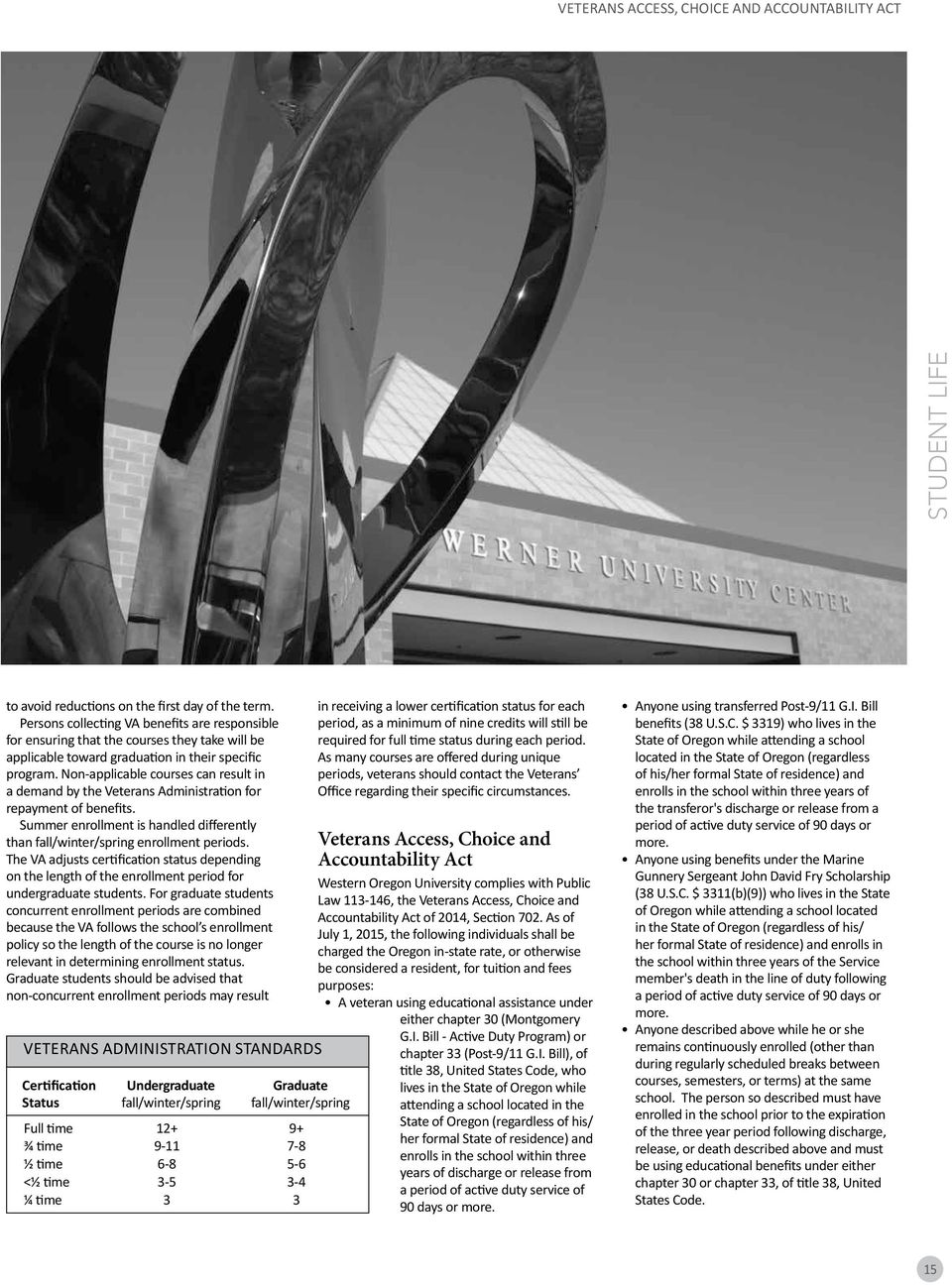
18 Fan Fest The Western Oregon University Athletic Department celebrates its athletes and fans in an annual afternoon of games and activities. Fans can meet Wolfie the mascot, coaches, compete in activities led by student-athletes, and get autographs from some of their favorite WOU student-athletes and coaches.

19 student life
20 campus recreation 18student life Campus Recreation wou.edu/campusrec Director Rip Horsey The Campus Recreation Department recognizes the need for recreational opportunities to augment the academic rigors of student life, providing programs and facilities for active campus involvement. The mission of Campus Recreation is mens sana in corpora sano: healthy mind, healthy body. Health and Wellness Center The Health and Wellness Center is comprised of a two-court gymnasium with an elevated track; two racquetball courts; three multipurpose rooms; cardio, strength and weight training area; a 40-foot-high by 40-foot-wide rock climbing wall; locker rooms; lounge areas with wireless internet capabilities; a five-lane, 25 yard swimming pool and therapy pool. Outdoor programs Outdoor programs are designed to provide beginning to intermediate education and resources for wilderness-based, human powered outdoor and adventure activities for WOU and surrounding communities. We promote teamwork, leadership and growth through environmentally sound experiences and incorporate Leave No Trace principles. Intramural Sports The Intramural Sports program offers opportunities for WOU students, faculty and staff to participate in a variety of sport leagues, tournaments and activities. Intramural Sports accommodate a wide range of interests and skill-levels while focusing on fairness, safety and equal opportunity for all to participate. Club Sports Club Sports offer skill development in a specific sport and provides leadership opportunities for the students that serve as club officers. Club Sports are student focused and student led, with each club establishing an organizational framework that meets the needs of the club and its members. The Campus Recreation Department employs over 100 students throughout the year as facility supervisors, guest service, climbing and aquatic specialists, fitness instructors, Intramural sports officials, and supervisors. Arts and entertainment Throughout the year, WOU offers a wide variety of on-campus entertainment and arts events presented by student and professional groups. The Art Department s Campbell Hall Gallery provides art exhibits by professional artists of the Northwest, in addition to student exhibits. Student exhibits also appear in three other campus galleries. Music organizations are active in performances and concerts throughout the year. They include classical, jazz and American vernacular styles. The WOU theatre stages plays from Shakespeare to Sam Shepard, including a musical every other winter term and every summer in conjunction with the Music Department. Student-directed plays are also presented. The WOU dance program presents an informal concert for student choreography each fall and a main stage Spring Dance Concert every spring, featuring faculty, student and guest artist works. Activities also include faculty collaboration and student performance in the main stage musicals. While campus groups give students a chance to perform and provide a regular source of entertainment, the Edgar H. Smith Fine Arts Series brings top names from the professional arts and entertainment world to campus. Honor societies Phi Alpha Theta The International History Honor Society, Phi Alpha Theta, was founded in 1921 with the purpose of distinguishing outstanding history students. It has more than 700 chapters and over 200,000 members. It publishes a national journal, The Historian. The WOU chapter, Alpha Iota Xi, annually initiates new members and sponsors forums on historical and contemporary topics. Students also present papers at the Northwest regional and national conventions. Phi Kappa Phi The Honor Society of Phi Kappa Phi is a national society devoted to the promotion, recognition and support of outstanding scholarship and learning. Undergraduate and graduate students who have demonstrated superior scholarly and artistic accomplishment are invited to membership. Each year about 10 percent of the senior class, five percent of the junior class and selected faculty are eligible and invited. The WOU chapter was founded in Since 1987 the chapter has annually sponsored Student Academic Excellence Showcase, which recognizes students and their scholarly and artistic accomplishments. Phi Sigma Iota This academic honor society is open to students studying modern languages at WOU. Pi Mu Epsilon The honorary national mathematics society, Pi Mu Epsilon, Inc (PME), was founded on May 25, 1914 and has over 300 chapters at colleges and universities throughout the United States. The purpose of PME is the promotion of scholarly activity in mathematics among the students in academic institutions. The Oregon Delta Chapter at WOU is open by invitation to outstanding mathematics majors. The chapter sends two students a year to a national PME conference to present their research in mathematics. Psi Chi The national honor society in psychology was founded in 1929 for the purpose of encouraging, stimulating and maintaining excellence in scholarship and advancing the science of psychology. Membership is open to undergraduate and graduate students who are making the study of psychology one of their major interests and who meet the minimum qualifications. Minimum qualifications include completion of 12 quarter hours of psychology, rank in the top 35 percent of their class in general scholarship, demonstration of superior scholarship in psychology by earning an average grade of B or better in psychology courses, and high standards of personal behavior. Each year, students meeting minimum qualifications are invited to membership. The WOU chapter sponsors an annual research conference that includes poster and paper presentations to highlight student accomplishments. Sigma Tau Delta The Iota Sigma chapter of the International English Honorary Society, Sigma Tau Delta is open by invitation to outstanding English students. Lambda Pi Eta The Nu Phi chapter, an accredited international honor society of the National Communication Association is open to all communication studies majors and minors who meet the requirements for the honorary distinction.
21 non-traditional student services Intercollegiate athletics wouwolves.com Director of Athletics Barbara Dearing WOU offers a broad-based athletic program that has developed a strong tradition of excellence. WOU offers 13 sports and is a member of the NCAA Division II. Men s sports of cross country, football, basketball, baseball, indoor and outdoor track and field are offered. Women s sports include cross country, soccer, volleyball, basketball, softball, indoor and outdoor track and field. The mission of the WOU Department of Intercollegiate Athletics is to provide each student-athlete with a championship experience through a commitment to academic achievement, athletic excellence, university pride, personal growth and community engagement. Central to this mission is the belief that athletics are an integral part of the total education of the students involved in our programs. WOU coaches provide outstanding coaching and instruction in an environment that fosters high-level athletic performance, dedication to academic achievement, exemplary sportsmanship, a commitment to personal and team excellence, and a healthy competitive desire. WOU and the NCAA Membership in the NCAA Division II provides the opportunity for student athletes to compete at a high level of competition while also balancing academics and campus life. WOU is a member of the Great Northwest Athletic Conference which is made up of the NCAA members from Oregon, Washington, California, Utah, Alaska, and Canada. For more information about particular sports, please contact the Department of Intercollegiate Athletics at Academic eligibility requirements The NCAA has established academic requirements for participation in intercollegiate athletics. Freshman student athletes must be certified by the NCAA Initial Eligibility Center. Information regarding the eligibility center and first-year eligibility is available from high school counselors or online at eligibilitycenter.org. Transfer student athletes are urged to contact the coach of their sport or the director of compliance. The NCAA has also established academic standards related to progress toward degree for continuing student athletes. Contact your coach or the director of compliance for specific details regarding this requirement. Facilities Student athletes have access to a variety of athletic facilities. Two physical education buildings, the football stadium and track, weight room, and fields for baseball, softball and soccer offer abundant opportunities for student athletes. The opportunity for high-level competition, combined with quality coaching in an outstanding academic environment, has attracted the exceptional student athletes that represent Western Oregon University. Student government The Associated Students of Western Oregon University (ASWOU) is the official governing body of the students. All WOU students are members of ASWOU by virtue of having paid tuition and fees. Students can have a major role in decision-making at the university through student government. ASWOU has three branches including a policy-making legislative branch called Student Senate, a policy-implementing executive branch and a policy-interpreting judicial branch called the Judicial Board, which also administers elections. According to its mission statement, student government serves as a voice for students. ASWOU is committed to: providing opportunities, activities and services to students; representing students interests; and advocating for students rights. For more information on how to get involved with your student government, contact the ASWOU office at Student Leadership and Activities wou.edu/studentleadership Director Patrick Moser The Student Leadership and Activities office functions to enhance and complement WOU s academic mission. The staff assists students in assessing their developmental progress through their university careers. Programs offered by Student Leadership and Activities expose students to opportunities for more experiences and participation that aids each student s continuing personal growth. WOU s student leadership and activities program provides services to students in the following major areas: leadership development, non-traditional student services, successful event planning, diversity programs, and special awards programs and major campus programs such as Family Weekend, Focus on Leadership, Holiday Tree Lighting and dozens of other events. The activities provided to students at WOU enhance social, recreational and cultural development by fostering participation in the social, intellectual and aesthetic life of the campus. Leadership development Leadership development at WOU provides both formal and informal opportunities for students to develop and refine leadership skills. Students have the chance to attend programs and workshops, as well as get involved in more extensive and directed participation in leadership development experiences. In the past, students have enjoyed individual, small and large group exposure to skill development opportunities. Leadership experiences gained from participation in self-governing organizations and programs also encourage the development of civic responsibility. Leadership certificate Student Leadership and Activities coordinates Western Oregon University s Leadership Certificate program. This program engages students on campus in six core competencies as they earn points towards fulfillment of the requirements. This is an individualized program meant to work with the involvement on- and off-campus that students already participate in. For more information, call Students with freshmen or sophomore standing are eligible. Greek life Provides students the ability to get involved with evolving fraternity or sorority chapters. Student Leadership and Activities is responsible for helping these groups flourish on campus. For more information, call Chapters Kappa Delta Chi sorority (multicultural) Omega Delta Phi fraternity (multicultural) Kappa Sigma fraternity (leadership, social) Kappa Alpha Psi (African-American) Discover leadership This established program is meant for firstyear students who are new to leadership opportunities. This program lasts approximately 10 weeks and will enable new leaders to gain skills and foundations for future success. You will do this while creating a network across campus and making new friends. This program is limited to a few dozen students who are new to leadership. If this sounds like something you would want to be a part of, contact Megan Habermann at [email protected] and we ll get you involved! Non-traditional student services WOU defines a non-traditional student as a student who is 25 years of age or older, has children, or is returning after a break from school. Non-Traditional Student Services at WOU is designed to serve these students. WOU recognizes that non-traditional students may at times, have different needs and priorities than traditional students. The Student Leadership and Activities Office provides services to accommodate these needs. Amenities include two lounges for nontraditional students. The first lounge is the Werner University Center Non-Trad Lounge where students can study, relax between classes, rent lockers, or have lunch. The Family Lounge in Todd Hall, provides a space for studying, sharing a meal with your family, and a play area for children. An emergency locator service allows staff to quickly locate students on campus in case of an emergency. This is especially useful for student parents. The Non-Trad Student Organization (NTSO) assists with locating child care, study groups, and concerns with classes. Student Leadership and Activities staff members, as well as the Non-Traditional Student Peer Advisor, are available to address concerns of non-traditional students to assist them in making their university experience rewarding student life 19
22 diversity certificate 20student life and successful. Students have enjoyed individual, small and large group exposure to non-traditional student issues and concerns. These services have helped many of WOU s non-traditional students be successful in their transition to the university. In addition, early childhood care and education is available year round for children up to 12 years-old through the Child Development Center within the Teaching Research Institute. Diversity certificate The Diversity Certificate Program promotes acceptance, equality, and respect for individual differences by encouraging students to participate in campus activities, clubs, and organizations that facilitate multicultural awareness, advocate for equal rights and social justice, and/or provide hands-on experience working in diverse settings. The program encourages individuals to move beyond simple tolerance into celebrating the rich dimensions of multiculturalism and diversity which include, but are not limited to: race, ethnicity, gender, age, sexual orientation, and ability. Stonewall Center Located on the first floor of the Werner University Center, Stonewall serves as the lesbian, gay, bisexual, transgender, and queer resource and advocacy center for students, staff, and the WOU community. Stonewall is a resource for helping to create a welcoming environment as well as providing education and advocacy for the LGBTQ community. Those interested have access to a variety of print and other media, educational materials, training, advocacy, as well as a trained support staff. Student Media The Western Oregon Journal is the award winning official student newspaper and is distributed every week on Wednesday. For more information, call , or visit the website at wou.edu/westernjournal. The Northwest Passage is the campus literary and arts magazine and is published twice per school year, once in the fall term and once during spring term. To submit your own short fiction, poetry and other literature or other art, please the magazine at [email protected]. You can also call the magazine s editor at The Northwest Passage website is wou. edu/northwestpassage; Facebook page is: facebook.com/nwpmagazine. KWOU is the Web-based radio station and can be found at wou.edu/kwou. Feel free to call the station at Students are encouraged to participate in student media, regardless of previous experience. For information, call Student services Student Affairs wou.edu/student Vice President Gary Dukes [email protected] The Office of the Vice President for Student Affairs provides general liaison assistance to students. The vice president is responsible for all student-related services which include Campus Recreation, Service Learning and Career Development, Student Conduct, Disability Services, Multicultural Student Services, Student Enrichment Program, Student Health and Counseling Services, University Housing, Campus Dining, Werner University Center, Student Leadership and Activities, Greek Life, Student Media, Upward Bound, National Student Exchange, and the WOLF Ride program. The Office of Student Affairs fosters students academic, personal and professional growth; educates students to respect and appreciate diversity; and prepares students to be responsible and engaged citizens in a global community. The office is located in the Werner University Center. The phone number is ; or [email protected]. National Student Exchange wou.edu/student/nse WOU is a member of the National Student Exchange (NSE) Program which gives academically qualified students the opportunity to study up to one calendar year at another university while paying in-state tuition rates. Credits earned during the exchange become a part of the student s WOU transcript. There are 200 colleges and universities to choose from in the United States, U.S. territories, and Canada. To qualify, students must be enrolled full-time at WOU, have completed at least 45 credits at the time of exchange, have a minimum cumulative GPA of 2.5, and be in good academic, judicial and financial standing at WOU. Call or online at wou.edu/student/nse for more information. Bookstore bookstore.wou.edu Manager Mark Lane [email protected] The WOU Bookstore is located on the upperlevel of the Werner University Center and is open Monday through Friday from 7:30 a.m. to 5 p.m. and Saturday from 10 a.m. to 2 p.m. (and longer for campus events). Students can find textbooks and supplies for classes as well as general interest books and valuable study aids. The bookstore also stocks gift items, greeting cards, personal care items, magazines, snacks, university clothing and merchandise, art and office supplies and much more. Special orders are available at no additional charge. Purchases also can be made online at bookstore.wou.edu. Campus Dining wou.edu/student/housing/dining.php Director Karen Nelles [email protected]. Valsetz Dining Hall, centrally located near the residence halls, is the main location for the resident meal plan. Meals are available from early morning until late at night, enabling residents to have flexible academic and social schedules. The design of the food court, located in Valsetz, offers varied menu choices including: Valsetz Baking Company (fresh baked pastries, desserts and pizza), Centre Stage (display and grill cooking prepared fresh in view of customers), Wok n Waffle (self-cook, stir-fry and Belgian waffles), Home style (traditional and ethnic menu items), Deli Soup and Salad Bar and Carbo Centre (grab and go packaged items and beverages). Valsetz Food Court is open from 7 a.m. to 11 p.m., Monday through Thursday; 7 a.m. to 10 p.m., Friday; 10 a.m. to 10 p.m., Saturday; and 10 a.m. to 11 p.m. Sunday. Werner University Center has several dining locations. Wolf Express is a small convenience store that sells hot and cold beverages and snacks. Its grab n go atmosphere is great for the student on the run. Caffè Allegro offers espresso drinks, baked goods and sandwiches. The Wolf Grill and Western Deli serve hamburgers, fries, grilled and deli sandwiches, salads, vegetarian entrees, and more. All of these restaurants accept the Resident Meal Plan, the Wolf Bonus Account, bank credit/debit cards and cash for purchases. The Wolf Bonus Account is a meal plan available to off-campus students, staff and faculty. Also, Campus Dining gift cards are available for purchase. Disability Services wou.edu/student/disability Director Malissa Larson [email protected] The Office of Disability Services facilitates appropriate accommodations on campus for students and visitors with documented disabilities. ODS offers an array of services and accommodations which include, but are not limited to, note taking, sign language interpreting, Typewell services, alternative testing, and conversion of text into alternative format, including Braille or electronic formats. Accommodation needs of each student with a documented disability are determined on an individual basis. Documentation requirements vary based on the barriers of the disability and the students individual needs. Each student who is seeking accommodations at WOU can apply on-line at wou.edu/student/disability to start the application process for accommodations. Accommodations can be provided for in classroom access as well as WOU sponsored events, including leisure and social activities. Any questions please contact the Office of Disability Services at or [email protected].
23 student employment For educational assessment of learning difficulties, please refer to the Education Evaluation Center located within the Teaching Research Institute. Student Conduct wou.edu/student/judicial Dean of Students Tina Fuchs The Student Conduct program provides the WOU community various ways to resolve conflicts and alleged violations of university regulations by students. The Code of Student Responsibility defines these processes. The underlying assumption guiding the program is that WOU students are preparing to be leaders in society and therefore should be held to a high standard of behavior. Consequences reflect this assumption and support the university s educational mission by helping students learn from their mistakes. The disciplinary and conduct resolution processes which compose the student conduct program are not criminal or civil proceedings. They do, however, provide students with appropriate due process protections. The Code of Student Responsibility specifies rights and responsibilities of students as members of the campus community. Each student is responsible for his or her own conduct. The university community expects each student to abide by all local, state and federal laws as well as university regulations. Copies of the code are available in the Office of the Vice President for Student Affairs, Office of University Housing, Student Conduct, ASWOU, and the Hamersly Library. The code is also available online at wou.edu/student/ services.php. Students are expected to read and become familiar with the code. Multicultural Student Services and Programs wou.edu/student/multicultural Director Anna Hernandez-Hunter [email protected] The Office of Multicultural Student Services and Programs, in collaboration with the campus community, strives to create an environment that is supportive, educational, and celebrates individuals backgrounds and experiences. Events, programs and services assure students will not only find support to achieve their educational goals but will also receive encouragement to share and learn about their own cultural heritage and of those around them. Specific services include: Assist prospective students and their families with the admissions and the university processes Organize and present workshops focused on preparing students to enter higher education Provide personal support and guidance to currently enrolled students Assist with general academic and career advisement Make students aware of scholarship and financial aid opportunities Connect students to educational resources on-campus and off-campus Advise the Multicultural Student Union (MSU) Assist MSU with the organization and implementation of campus-wide cultural events. These could include: Día de los Muertos, MSU Pow-Wow, African American Celebration, Women of Color Celebration, Out & Proud, and Nuestra Fiesta Latina Coordinate the Diversity Commitment Scholars Program Coordinate the On-Track Program designed to promote academic and personal success Service Learning and Career Development wou.edu/student/slcd Director Adry Clark [email protected] The Office of Service Learning and Career Development provides career counseling and skill building for career readiness. The SLCD connects students with career, volunteer, and graduate school-related experiences in the community, the workforce and the world. Services include: Current on-campus, off-campus, full-time, part-time, work-study and non work-study job postings Internship opportunities and information Alternative break trips Short-term and long-term volunteer opportunities Mock interview sessions Job search coaching Career and internship fairs Major or career counseling and assessments Job shadow and informational interviewing resources Résumé critiques Graduate school admissions preparation programs Connections to recruiters Many more experiential learning opportunities Students are encouraged to take advantage of the following services: Career counseling and advising: qualified personnel to help in exploration, decision-making and planning; aids for self-assessment of skills, interests values and personality. Career programming: scheduled events throughout the year designed to raise the awareness and knowledge of career-related issues and occupational opportunities. Job search skills development: seminars on job search topics, mock interview opportunities and a convenient résumé critique service. Career exploration opportunities: centralized location for job shadow, internship and summer job resources and opportunities. Online career resources: Wolflink internship, an on/off campus database; Career Beam exploration tool, and a comprehensive website on career development and service learning topics. Annual job and career fairs: opportunity to learn of full-time, summer and internship career opportunities and interview with employers at the annual First Avenue Career and Graduate School Fair (of which Western Oregon University is a member) and at the Oregon Professional Educator s Fair, both held each spring in Portland, as well as on-campus job fairs. Employer recruiting: centralized location for career-related full-time, part-time, summer and internship openings; interview opportunities with campus recruiters; electronic job listing access through Wolflink: wou.edu/wolflink Service Learning and Career Development is located in the Werner University Center, lowerlevel, room 119. All students are encouraged to come by Monday through Friday, from 8 a.m. to 5 p.m. Appointments can be made by calling or visit wou.edu/slcd for online resources day and night. Alternative break and service trips This program places small groups of Western Oregon University students in communities locally in the northwest and internationally to engage in community service and experiential learning during school breaks. Students from different years and majors, directed by student leaders, work in conjunction with volunteer and community agencies focusing on a wide variety of social issues. Student employment All WOU students interested in employment (on-campus, off-campus, part-time and work study positions) can find openings on the student employment website at wou.edu/ wolflink. Jobs are updated frequently as new postings arrive daily. All student employees need to go to the Payroll Office, Admin 306 to get a current year work sticker on their student ID card. Office hours are Monday through Friday, 8 a.m. to 5 p.m. student life 21
24 student enrichment program 22student life Student Enrichment Program-TRIO wou.edu/sep Director Marshall Guthrie The Student Enrichment Program (SEP) is a TRIO program primarily supported by the U.S. Department of Education. Western Oregon University also provides significant fiscal support for this academic support program. The office is located in the Academic Programs and Support Center, room 201, and is designed to assist students in finding success in their college experience. SEP students benefit from academic, career and personal advising; availability of equipment (laptop/ desktop computers, graphing calculators, digital voice recorders, etc.) for checkout; academic progress monitoring; success seminars; and tickets to campus cultural events. The program also offers tuition-free credit courses: ICS 103 Becoming a Master Student ICS 105 Critical Thinking ICS 106 Career Planning ICS 109 Summer Bridge ICS 111 Financial Literacy The program is designed to help students to develop the writing, math, learning, critical thinking and career planning skills necessary to succeed at WOU, and to maintain a GPA necessary to achieve their individual goals while developing the interpersonal communications skills necessary to excel in college. Students will make a commitment to WOU as they integrate into the campus community and discover ways to achieve autonomy while maintaining a sense of confidence. For more information, visit us at wou.edu/sep. Student Health and Counseling Services wou.edu/student/health Director Jamie Silva [email protected] Health services Medical services for students at Western Oregon University are available at Student Health and Counseling Services located on Church Street across from the southwest entrance to the Werner University Center. Students who are registered for six credit hours or more pay a student health fee each term that entitles them to the use of services offered at Health Services. Additional charges are assessed for medication, laboratory testing, medical supplies, a physical, a women s health care annual exam or a special procedure. Students registered for fewer than six credits may elect to pay the student health fee, which makes them eligible to receive services for that term. Eligible students may call between the hours of 8 a.m. and 5 p.m. Monday through Friday to make an appointment with one of the health care professionals. Health Services is staffed by a physician, licensed mid-level practitioners and medical support staff. A full list of the services and explanation of the Health Service Fee are available online at wou.edu/student/health. Please note: A WOU health history form must be completed by each student, showing current immunization dates. In fall of 1992, the Oregon State Legislature passed a regulation requiring students at four-year institutions to have had a total of two measles immunizations after the age of 12 months. Registration will be withheld for the second term of classes until the requirement is met. The regulation does not apply to those born prior to January 1, Counseling services Professional, confidential counseling for WOU students is available from counseling services. Counseling is designed to assist students in changing behaviors and addressing their individual concerns so they can focus their energy on a successful and rewarding academic experience. Individual counseling, vocational exploration, support groups and workshops are offered as well as referral resources and consultations with medical, psychiatric and other treatment professionals. Students who have paid the Health Services fee for the current term (see Health Services) are eligible to receive counseling services. Wellness education Wellness education is responsible for campus outreach, programming, and educational materials for students and campus community. Throughout the year programs and promotions are provided to students that address a variety of wellness topics. Our goal is to offer students useful information, tools, and techniques that allow them to make personal decisions that support their health and academic achievements. Information about many of our resources can be found on our web page, including Student Health 101, the Campus Wellness Challenge, the WOU Peer Mentor Program, and Green Dot. Annual events offered the campus include blood drives, health and wellness fair, and awareness campaigns. For more information or resources feel free to stop by our office and talk to one of our wellness education employees! Our services and events are free to the WOU community. University Housing wou.edu/student/housing Dean of Students Tina Fuchs [email protected] At WOU, residence hall life adds a dynamic dimension to the college experience. The educational value derived from living with people of varied interests, backgrounds and ages offers a wide range of opportunities for personal growth and lifelong friendships. The varied residential communities are designed for comfort as well as efficiency. Rooms are attractively furnished, with lounges, snack areas,
25 werner university center laundry facilities and recreational areas nearby. The residential communities are grouped on the north end of campus with the farthest point of the campus a walk of no more than 10 minutes. There are three styles of residential communities on campus including: apartment style (four students in a four-bedroom/two-bathroom apartment with a full kitchen), suite style (where rooms are accessed from outside and include a private bathroom), and traditional floor arrangements of smaller rooms with a shared bathroom down the hall. Two halls have areas accessible to students who use wheelchairs. A limited number of two-bedroom apartments and townhouses are available for married students, students in a registered domestic partnership, or students with dependents. Housing policies Research has clearly proven that living oncampus increases the likelihood of student success. Therefore, all WOU students without dependents who enroll within one year of high school graduation must live in universityoperated housing for the entire academic year or remaining portion thereof. Exceptions must be approved through the Office of University Housing. Many upper class students also choose to live in the residence halls because of the convenience and available services. Room and board charges are contracted for the full academic year. Upper class students have a term contract option; they may apply for housing on a term-by-term basis. An additional fee of $150 is assessed at the time of application for this option. If the student withdraws from the university, the contract is terminated as of the date the student officially checks out of campus housing. Applications for fall term housing should be made before May. An application form may be obtained from WOU s Office of University Housing. A $40 non-refundable application fee is required at the time of reservation. Students who are found to be ineligible for admission to the university will receive a refund of the application fee. Room and board fees are payable each term at registration. Payments can be made for the entire year or by the full term. Refunds are made on a pro-rated basis from the day on which the student checks out of campus housing. Rates for a standard room are expected to be $9,385 with meal plan #3. This also includes social activity fees, telephone/voice mail/caller id fees, computer network access fees and cable television. Other meal plans and room designations are offered. Costs may vary. On opening day of fall term, students may check into campus housing from 9 a.m. to 5 p.m. During winter and spring terms, check-in is from noon to 5 p.m. on the Sunday before the first day of classes. The university reserves the right to enter residence hall rooms for inspection, repair or other official business. Correspondence and housing application requests should be directed to: Office of University Housing Western Oregon University 345 N. Monmouth Ave Monmouth, OR (V/TTY) [email protected] wou.edu/student/housing The residential community is designed to maximize the personal growth and development of students within a collegiate living environment, foster academic success and co-curricular activity, and engage students in meaningful opportunities for self-exploration. The residence hall peer group provides a rich and diverse framework within which students may affirm values, learn from different perspectives, assume responsibility for actions and participate in building a community of learners. To this end, University Housing provides experiences where students may practice good decision-making, assume leadership roles, and set and achieve reasonable goals. Support and assistance in identifying resources for residents is available and the staff purposefully involves students in planning and implementing programs and in managing the physical environment to the benefit of all residents. Residence hall students are expected to assume personal responsibility for understanding university policies and for contributing to the community in a positive manner. Residential staff members facilitate this responsibility and intervene when policies or standards are not upheld. Opportunities for involvement include working with the Residence Hall Association or the Residential Conduct Board, planning programs for residents, working with faculty members, serving on institutional committees and boards, participating on hall intramural teams and, in general, taking part in activities to create a dynamic living environment. Off-campus housing The Office of University Housing maintains a list of available off-campus housing. Brochures are available at the office or you may access the list online at wou.edu/student/housing/halls.php. Werner University Center wou.edu/student/wuc Director Patrick Moser Serving as the living room of campus, the Werner University Center (WUC) is a studentfriendly, open, and inviting place to socialize with friends or find ways to get involved. Largely funded by student incidental fees, the WUC is the hub of activity and campus life. The WUC serves as the gathering place for the campus and provides a variety of services and programs to meet the needs of the campus community. Facilities include an art gallery, various retail food outlets, the WOU Bookstore, several student lounges, and numerous student service offices, including, but not limited to, the following: Student Leadership and Activities, Multicultural Student Services and Programs, Service Learning and Career Development, Non-traditional Student Services, Abby s House, ASWOU, Stonewall Center, Veteran s Services Center, etc. Facilities scheduling for non-academic use and conference services are facilitated and coordinated through the WUC. We serve as the campus information center, providing the campus with details about current student activities and special events. We are also the campus location for your student ID card. The WUC is a passionate supporter of sustainability, recycling and green efforts. There are many opportunities for sustainability throughout the building, including reducing energy and water use, improving indoor air quality, providing water bottle refill stations and much more. For more information about any of our services, or if you want to get involved, contact our office at [email protected] or student life 23
26 24
27 Every spring, WOU celebrates student academic excellence. The entire day is dedicated to the presentation of student scholarly activities, including original research papers, projects, artwork, performances, and course projects, presentations, and papers. Over 500 undergraduates participate, making this one of the largest undergraduate research events in the Northwest. student life academics Academic Excellence Showcase The showcase is organized by the Honor Society of Phi Kappa Phi and the Program for Undergraduate Research Experiences (PURE). The primary objectives of the showcase are to provide an opportunity for presenters, giving them experience that will be useful in furthering their education and careers, and to expose the entire student body to the breadth and importance of the scholarship that is conducted across campus. 25
28 ACADEMIC DIVISIONS academics Academic divisions The College of Education wou.edu/education Dean Mark Girod The mission of the College of Education (COE) is to prepare skilled professionals in the fields of education, rehabilitation, American Sign Language/English interpreting, American Sign Language studies, health promotion and exercise science. Our graduates are academically strong, ready to contribute to the continuously evolving state of their chosen professions, and prepared for a variety of diverse and complex roles in schools, service organizations, and businesses. The College of Education includes the Division of Deaf Studies and Professional Studies, the Division of Health and Exercise Science, and the Division of Teacher Education. It is also home to the Regional Resource Center on Deafness and the Office of Clinical Practices and Licensure. All academic programs in the College of Education are aligned to external professional standards and all programs require practica or internship experiences where our students apply learning in the real world. The Rehabilitation and Mental Health Counseling program is accredited by the Council on Rehabilitation Education (CORE). The curricula also meets the educational requirements for the Oregon Board of Licensed Professional Counselors and Therapists (LPC) and certification for both Certified Rehabilitation Counselor (CRC) and National Certified Counselor (NCC). Additionally, the Interpreting programs are accredited by the Commission on Collegiate Interpreter Education. The College of Education teacher preparation programs are accredited by Oregon Teacher Standards and Practices Commission (TSPC) and have been accredited by the National Council for Accreditation of Teacher Education (NCATE) for more than 60 years. The educator preparation programs in the College of Education are guided by the concept of our conceptual framework - Connecting Teaching and Learning. Connecting Teaching and Learning requires a team of professionals working through states of development, resting upon core values and principles. Our goal is to assure our teaching efforts result in deep, meaningful learning on the part of our teacher candidates and that the teaching actions of our candidates result in deep, meaningful learning on the part of P-12 students. Connecting Teaching and Learning rests on foundational values including educational equity, cultural sensitivity, intellectual vitality, and professionalism. Deaf Studies and Professional Studies Division wou.edu/dsps Division Chair Cheryl Davis [email protected] This division houses two undergraduate majors, American Sign Language/English Interpreting and American Sign Language Studies; two undergraduate minors, Special Education/ Rehabilitation Counseling and American Sign Language Studies; and four graduate programs: Rehabilitation Counseling; Rehabilitation Counseling: Deaf; Mental Health Counseling; and Interpreting Studies. Mission To prepare professionals to provide effective communication, rehabilitation, and educational services to individuals with disabilities or special needs. The division promotes respect and sensitivity for others in order to enhance the quality of life for all. Program objectives 1. Prepare educators to work with children and young adults who have disabilities. 2. Prepare rehabilitation counselors and professionals to work with persons who are Deaf or have disabilities. 3. Prepare American Sign Language (ASL) professionals to work with members of the Deaf community, to interpret between ASL and English, and to prepare interpreter educators. Information may be obtained from the Deaf Studies and Professional Studies Division office (ED 220) at , by at [email protected], or at wou.edu/dsps. Health and Exercise Science Division wou.edu/education/healthpe Division Chair Peggy Pedersen [email protected] The division offers majors in Exercise Science and Community Health Education and is responsible for teaching endorsements in health education and physical education. Mission To maximize individual and professional development in health and movement science and to promote healthy lifestyles and communities. Program objectives 1. Academic majors are prepared to plan effective strategies, interventions and programs based on assessment of individual and community needs. 2. Implement and evaluate strategies, interventions and programs. 3. Coordinate, communicate and advocate for research-based practices. Teacher Education Division Division Chair Mary Bucy [email protected] This division houses several degree and endorsement programs. An undergraduate and post baccalaureate initial teacher licensure degree program with options for a variety of subject endorsements and authorization levels from early childhood through high school offered on a full-time basis; An undergraduate Early Childhood Education Studies degree (non-licensure); A Master of Arts Initial Teacher Licensure degree program with options for a variety of subject endorsements and authorization levels for middle and high school levels offered on a full-time and part-time basis through two different delivery models; A Master of Science in Education program for licensed teachers focused on developing teacher leaders with a variety of content areas including; A Master of Science in Special Education; A Master of Science in Education program focused on Information Technology; and Multiple stand alone or degree based add-on endorsement options such as reading, and ESOL. Mission The Teacher Education Division is based upon educational equity, cultural sensitivity, caring and committed professionalism, and an intellectually vital community. Division members are committed to facilitating the learning and development of our candidates who, in turn, can successfully affect the learning and development of P-12 students in schools. Program objectives 1. Prepare effective teachers who demonstrate evidence of appropriate content knowledge, skills, and dispositions necessary for attaining high achievement for all PK-12 students. 2. Prepare caring, competent professionals who create a climate where diversity is valued. 3. Provide clinical experiences in varied partnership school district settings that model best practices. Program information can be obtained by contacting the College of Education at , by at [email protected], or at wou.edu/education. Detailed information on teacher licensure, definitions and Oregon state testing requirements can be found at wou.edu/ education. More detailed program information can be obtained by contacting the division at , or at wou.edu/education/healthpe. 26
29 business and economics division Regional Resource Center on Deafness wou.edu/rrcd Director Cheryl Davis The Regional Resource Center on Deafness (RRCD) boasts a 40-year history of preparing professionals to work with individuals who are deaf or hard of hearing. RRCD currently receives $1.2 million annually in federal grant funding from the U.S. Department of Education supporting two degree programs and three continuing education programs. Students in the two degree programs, focusing on counseling/rehabilitation counseling, and interpreting, receive stipends and/or tuition waivers from these grants. Mission To prepare professionals in the Northwest to serve the unique communication, rehabilitation, and educational needs of Deaf and hard of hearing children and adults. Program objectives 1. Provide graduate and undergraduate degree programs for professionals entering fields that serve people who are Deaf or hard of hearing. 2. Provide continuing education opportunities for currently practicing professionals. 3. Provide consultation and community service activities designed to enhance the quality of life for anyone who is Deaf or hard of hearing. For application materials and information on training opportunities, contact the RRCD main office in ED 220 or at wou.edu/rrcd. The College of Liberal Arts and Sciences wou.edu/las Dean Susanne Monahan [email protected] The College of Liberal Arts and Sciences is the foundation for WOU's broad-based education. It is home to the academic divisions of Behavioral Sciences, Business and Economics, Computer Science, Creative Arts, Humanities, Natural Sciences and Mathematics, and Social Science. The Interdisciplinary Studies Program is also housed within the college. Mission We offer a liberal arts core curriculum and a wide range of specialized degree programs that expand students' horizons; hone skills that make students adaptable and flexible in a rapidly changing world; help students discover new passions and strengths; and prepare them for lifelong learning. Our graduates are poised to be engaged citizens locally and globally as well as productive contributors to a 21st century economy. Vision College faculty and staff will extend the benefits of an advanced education to an increasingly diverse student body by collaborating within and across disciplines to identify and deliver that which is most important for a 21st century college education. Program objectives 1. Provide all students with opportunities to learn via a strong, cohesive, and broad-based education. 2. Develop and maintain current, relevant, and innovative curricula within and across disciplines. 3. Provide traditional college-bound students with high-quality learning opportunities while expanding access to new populations. Behavioral Sciences Division wou.edu/las/psychology Division Chair Chehalis Strapp-Johnson [email protected] The Behavioral Sciences Division is responsible for majors and minors in Gerontology and Psychology. Mission To create lifelong learners utilizing the scientistpractitioner model. Students gain competence in accessing, evaluating, and integrating sources of knowledge within their field. Graduates of our program will understand the scientific foundations of their discipline and the core knowledge/ concepts in the field. Programs in the division provide opportunities for professional development, service to the community, and practicum experiences in preparation for graduate study and/or work in a variety of fields. Graduates will be able to apply such knowledge and skills in a manner consistent with an understanding of professional standards of ethical behavior. They will be prepared to interact effectively with others, and resolve issues that face us as a society, a nation and a world. Program objectives 1. Demonstrate an understanding and ability to integrate knowledge of their field and develop critical thinking/scientific method research skills. 2. Demonstrate an ability to apply knowledge, skills and values to meet the needs of others and self in personal and career development. 3. Demonstrate respect and sensitivity to physiological, psychological, and social aspects of individuals within changing political, cultural, economic, and sociohistorical contexts. More detailed program information, including program admission requirements can be obtained by contacting the division office at , or at wou.edu/las/psychology. academics Business and Economics Division wou.edu/las/business Division Chair Hamid Bahari-Kashani [email protected] The Business and Economics Division is responsible for majors and minors in Business and Economics and minors in Entrepreneurship and Sport Management. Mission To prepare knowledgeable, well-rounded individuals for productive lives and careers in the business and economics professions and the public sector. Graduates are individuals who conduct themselves with intelligence and integrity in domestic and global environments. Programobjectives Students will be able to: 1. Effectively identify, acquire and discriminate among information resources for analysis and evaluation. 27
30 computer science division academics 2. Effectively communicate in written documents and oral presentations and to understand the interpersonal dynamics of team work. 3. Demonstrate understanding of the relationships and interaction of the various business and economics disciplines when solving problems and making decisions. More detailed program information, including program admission requirements can be obtained by contacting the division at , or at wou.edu/las/business. Computer Science Division wou.edu/las/cs Division Chair David Olson The Computer Science Division is responsible for majors and minors in Computer Science and majors in Information Systems. These are softwareoriented programs that stay close to the current needs of industry. The faculty teach the theoretical and practical aspects of computer science, with emphasis on the practical. Mission To give students a comprehensive foundation in the field of computer science within a liberal arts setting. The faculty are committed to preparing graduates who will be productive employees in the information technology (IT) industry or promising graduate students. Program objectives 1. To invest the time and effort to recruit females and other underrepresented populations into the computer science/ information systems disciplines. 2. To provide computing expertise for the betterment of the community. 3. To provide the resources so that the faculty can remain current in the rapidly evolving computing environment. More detailed program information, including program admission requirements can be obtained by contacting the division at , or at wou.edu/las/cs. Creative Arts Division wou.edu/las/creativearts Division Chair Scott Grim [email protected] The Creative Arts Division is responsible for majors and minors in Art, The Arts, Dance, Music and Theatre. Mission Each department emphasizes contemporary practices through a solid foundation of training. Creative work, analytical thinking and global awareness are integrated into performance and production. Throughout their educational experience, students work to achieve high standards no matter which degree offering they choose to pursue. Every program in the division provides individualized instruction with opportunities for professional involvement, service to the community, public exhibition and performance. Program objectives 1. Maintain high standards of quality which are achieved through individual attention to student practice and progress, professional example and expectations of student excellence. 2. Offer professional preparation programs: B.A./B.S. in Dance, B.F.A. in Theatre, B.F.A. in Art, Bachelor of Music, Master of Music, in addition to B.A./B.S. in Art, Music, Theatre and The Arts. More detailed information, including program admission requirements can be obtained by contacting the division at , or at wou. edu/las/creativearts. Humanities Division wou.edu/las/humanities Division Chair Carol Harding [email protected] The Humanities Division is responsible for majors and minors in English, French, German, Humanities, Linguistics, Philosophy, Spanish, Communication Studies, and Writing. Mission Humanities majors and minors explore that unique human creation, language not only for communication but also in culture, literary art, and philosophical and religious thought. Program objectives 1. Provide students focused opportunities to investigate how culture is constructed and manifested in language. 2. Help students develop the creativity, critical thinking, written, and oral skills necessary to maximize their individual and professional development. 3. Encourage students to make connections across disciplines and cultures. More detailed program information, including program admission requirements, can be obtained by contacting the division at , or at wou.edu/las/humanities. Natural Sciences and Mathematics Division wou.edu/las/natsci_math/nsmdiv.html Division Chair Hamid Behmard [email protected] The Natural Sciences and Mathematics Division is responsible for majors and minors in Biology, Chemistry, Earth Science, Integrated Science, Mathematics and Natural Science. Mission To offer quality liberal arts education in biology, chemistry, Earth science, mathematics, physics and pre-professional studies. Our students have the opportunity to acquire and assimilate mathematical and scientific knowledge, that they may broaden and refine their understanding of the ever-changing world around them, both while at Western Oregon University and throughout their lives. Program objectives 1. To help students internalize and apply both the scientific method and major scientific and mathematical concepts and principles. 2. To enhance students reasoning and problem-solving skills. 3. To improve students individual and collaborative skills in preparation for the global scientific and mathematical challenges of the 21st century. More detailed program information, including program admission requirements can be obtained by contacting the division at , or at wou.edu/las/natsci_math. Social Science Division wou.edu/las/socsci Division Chair Mark Henkels [email protected] The Social Science Division is responsible for majors and minors in Anthropology, Criminal Justice, Geography, History, Political Science, Public Policy and Administration, Social Science, Social Science Teacher Education, and Sociology. The following minors are taught either wholly, or partially, by this division: Community Services, Homeland Security and Community Preparedness, Legal Studies, Latino/Chicano Studies, Environmental Studies, Film Studies, Gender Studies, International Studies, Latin American Studies, and Military Science. Mission This community of scholars explores the society s many dimensions by using methods developed by their discipline to understand both the past and the present. Division graduates apply these methods to resolving local, national, and international issues. Program objectives 1. Develop critical thinking, writing, and speaking skills which analyze and communicate social issues. 2. Engage in research, internships, and practicums for service agencies and schools. 3. Encourage leadership in addressing institutional, community, and national issues. For more detailed program information about coursework, faculty, and admission requirements, go to wou.edu/las/socsci or call
31 international education and development Center for Academic Innovation wou.edu/innovation Director Dan Clark The Center for Academic Innovation provides resources and services for faculty that reinforce Western Oregon University's core mission as a teaching institution and bolster its commitment to serve the evolving educational needs of our students and our region. WOU faculty and staff are invited to collaborate with the center to foster a sense of community that stimulates dialogue and reflection about excellence in teaching, nurtures a commitment to student access and success, supports the scholarship of teaching and learning, and promotes policies to support and reward innovative, high quality teaching and learning experiences. Faculty development workshop resources Each month, the Center for Academic Innovation hosts a variety of workshops, seminars, and round-table conversations that explore instructional technology, emerging pedagogues, and the teaching and learning process. No registration is required. For more information and a schedule of upcoming events, visit wou.edu/innovation/events. MOODLE support services and resources The Center for Academic Innovation provides functional end-user support for students, faculty and staff on the campus learning management system. For more information, visit wou.edu/ innovation/moodle. Online courses authorization Western Oregon University is a member of the Western Interstate Commission for Higher Education (WICHE) and participates in the WICHE State Authorization Reciprocity Agreement (W-SARA), an agreement among member states, districts and territories that establishes comparable national standards for interstate offering of postsecondary distance education courses and programs. For more information, visit wiche.edu/sara. Academic resources Academic Advising and Learning Center wou.edu/advising Director Karen Sullivan-Vance [email protected] Academic Advising Center Academic advising at WOU is a developmental process designed to help students define their life and career values and goals in relation to their academic plan. Both the student and advisor have a shared responsibility in the ongoing dialogue that helps students maximize their educational experience at WOU. All undergraduate students are required to meet with their academic advisor at least once each term until a degree plan is filed with the Registrar s Office. Students are encouraged to meet with their advisor when they have questions about their educational goals. Students have access to faculty advisors in their major and minor areas of study. In addition, the Academic Advising and Learning Center s professional advisors advise precriminal justice, pre-nursing, pre-psychology, and exploratory (undeclared) students. The Academic Advising and Learning Center works with: Students to identify their life and career goals in relation to possible academic programs Undeclared majors who are exploring different majors Students transferring into WOU from another institution Students on academic warning, probation or suspension Academic requirements for graduation, including the Liberal Arts Core Curriculum (LACC) For more information, call V/ TTY, [email protected] or go to wou. edu/advising. Learning Center Academic skills are essential for college success. Peer tutors, who have been recommended by WOU faculty, provide the tutoring that is the core of the Learning Center services. The goal of tutoring is to help students improve their knowledge and develop better study skills. Services offered by the Learning Center include: Peer tutoring with a focus on subjects that make up the Liberal Arts Core Curriculum (LACC) and other university requirements such as computer science, and second languages. Students are eligible for two hours of tutoring per week per subject providing there is a tutor available for the subject. Tutoring is free of charge and arranged by appointment. There may also be drop-in hours for certain courses. Peer-assisted study groups can be arranged upon request. Study skills handouts on time management, test taking, note taking, textbook reading, etc. are located both on the Learning Center website or in APSC 401. Student computer lab. In order to receive tutoring, a student must be currently enrolled in the requested class at WOU. For more information, call TTY, [email protected] or go to wou. edu/learning. International Education and Development Assistant Vice President Neng Yang The mission of the International Education and Development Office is to promote the concept of internationalization across the WOU campus and community. The office seeks to improve intercultural communication and understanding among WOU's students, faculty and staff, through study abroad and international exchanges, as well as to support and enhance international students' and scholars' academic, cultural, and social interaction at Western Oregon University. The office serves as the headquarters for all international outreach and activities on WOU's campus. International Student and Scholar Services wou.edu/international [email protected] The International Student and Scholars Services department promotes intercultural learning and international understanding by facilitating the recruitment, admission, transition and support of international students and visiting scholars. The presence of international students on our campus provides opportunities for everyone to learn more about other peoples, cultures and perspectives in our world. Provides services to WOU s international students, scholars and faculty. Advisors are available to assist international students and their dependents with immigration, housing, employment and personal and academic issues. Responsible for maintaining the F-1 Student Program and the J-1 Exchange Visitor s program designated by the U.S. Citizenship and Immigration Service and the U.S. Department of State. International students have many opportunities to share their culture and knowledge with the campus and community through the International Cultural Service Program, international student clubs, internationalized curriculum and a wide variety of campus student activities. For more information, visit wou.edu/ international. academics 29
32 study abroad academics Study Abroad Study Abroad promotes intercultural learning and international understanding by facilitating the movement of students and scholars across international borders for educational purposes. Students who participate in study abroad, international internships, or service learning, increase their global awareness, develop critical thinking and problem solving skills, develop greater self confidence, and gain experience that helps them achieve their personal and career goals. Study abroad, international internships, and service learning are available through this department. With locations in Europe, Asia, Central and South America, Africa, Australia and New Zealand, these programs provide students intense cultural, educational and professional experiences. An international experience is for all students, not just those who are studying foreign languages. WOU offers programs at sites that do not have language requirements, and some programs are offered in English speaking countries. Qualified students may study, participate in an internship abroad, or do service learning for a summer, a quarter, or a year and continue to earn credit toward their major, minor, LACC requirements, or electives. Students earning at least six (6) credits through a WOU study abroad program or international internship will have met the WOU cultural diversity requirement. Most forms of financial aid apply. The study abroad department reviews study abroad and international internship/fellowship applications; reviews and resolves difficulties related to overseas study; manages pre-departure orientation and re-entry sessions; evaluates and assesses programs; and maintains an overseas study database and related informational resources. For more information, visit wou.edu/studyabroad. International Student Academic Support wou.edu/english/tutor Director Robert Troyer [email protected] The Office of International Student Academic Support (ISAS) was created to promote the academic success of international students and the faculty who instruct them. Our mission is to: Ensure effective and coordinated curricular offerings that meet the academic and linguistic needs of our population of international students Organize and promote programs that encourage academic advancement and social integration for international students Provide individualized support and general reference information for international students and their instructors Promote long-term sustainability of international student programs through continual improvement to students academic support and involvement on campus. To these ends, ISAS coordinates the following programs and activities: An English Tutoring Center staffed by advanced undergraduates who are trained in applied linguistics and teaching English as a foreign language The Conversation Partners program which pairs international students with domestic students for weekly informal conversation The creation of materials and organized tutoring sessions for specific courses in any department with high international student enrollment Individual consultations with international students regarding academic questions and challenges Assisting with the registration of students in courses created specifically for international students and tracking of students progress Ongoing research into the challenges that international students and their instructors face and methods for meeting these challenges Hamersly Library wou.edu/library Dean Allen McKiel [email protected] The Hamersly Library provides students, faculty, and staff with academic and personal information resources and services. The resources include 167,000 print book titles in the library with nine million available within 48 hours through interlibrary loan from the Orbis Cascade Alliance, regular interlibrary loan from anywhere, and 116,000 e-books and 106,000 full text e-journal titles available online from any network access. Services include the following: Personal assistance with information resources including 24-hour chat access Tutoring provided in the library by the Math Department and the Writing Center In-class and online instruction in information resources relevant to courses and particular assignments A media production lab and assistance with its use A variety of technology (wireless network access, computer workstations, printers, photocopiers, scanners, and microform readers/scanners) A university archive An ongoing variety of artistic and artifact exhibits Recreational reading with fiction and nonfiction best sellers. The library has 19 full time personnel: eight librarians, two professionals, and nine staff. Print Shop [email protected] Coordinator Leta Howell The Print Shop serves students, faculty and staff at WOU. In addition, we have a large format color printer that can print full color posters. Our bindery department is able to provide a wide variety of options to add that finishing touch to your project. Options include: creasing, perforating, scoring, folding, cutting and padding. Book finishing options include: ProClick, FastBack, GBC Comb, Spiral Books and Perfect Binding. We have a large selection of paper from everyday 20# bond papers to glossy and matte 100# cover stock. Check out our website at wou.edu/printshop for more details on services we offer. The Print Shop is located in ITC 112, open 8 a.m. to 5 p.m., Monday through Friday. You can reach us at or send an to [email protected]. Math Center wou.edu/mathcenter [email protected] The Math Center is a free, drop in math tutoring lab available for WOU students taking MTH 070, 095, 100- and 200-level courses (and other courses which vary term-to-term). The Math Center is a quiet and open room in the library (HL 228) and is a relaxing place to study and work on math homework. Our peer tutors are experienced, knowledgeable, and dedicated to helping students master the skills needed for success in math classes. Students can drop by, at their convenience during our open hours, to work on their math homework, and tutors will be available to help. The Math Center opens at the beginning of the second week of the fall, winter, and spring terms, and closes at the end of dead week. The Math center is closed during university breaks and holidays, and maintains limited service hours during the summer term. To learn more about the Math Center, including a list of all courses tutored each term, please visit: wou.edu/mathcenter. The Research Institute wou.edu/tri Director Ella Taylor [email protected] The Research Institute (TRI) houses eight centers focused on informing and facilitating change in educational, public health and human service systems to improve the quality of life for all individuals. Funded through external grants, the centers conduct programs of research, develop evidence-based interventions that are provided through technical assistance and professional development, and increase system capacity to impact change. In existence for over 50 years, TRI is guided by partnerships with consumers, families, and 30
33 writing center practitioners and we measure the effectiveness of our work by its impact on their lives. TRI manages a yearly grants' expenditures budget of $7.5 to 8.5 million through 30 projects funded through federal, state and other sources. TRI houses 65 staff. Two TRI Centers provide direct service to the WOU campus: Education Evaluation Center offers comprehensive assessment services to individuals aged five years through adult. The EEC specializes in assessing an individual s learning capacities, functional skills, educational strengths and weaknesses. Recommendations for accommodations are made across home, school, college, work and community. Child Development Center provides campusbased quality care and education to young children ages 30 months to 10 years. The CDC is a state licensed facility and has been designated a QRIS five-star program. The CDC partners with Central School District to provide an infant/toddler program located off-campus. The other six centers include: Center on Deaf-Blindness (CDB) Center on Early Learning (CEL) Center on Educator Preparation & Effectiveness (CEPE) Center on Research, Evaluation & Analysis (CREA) Technology Information Management Services (TIMS) Grants Management Office (GMO) University Computing Services wou.edu/ucs Director Bill Kernan [email protected] [email protected] Computer labs and classrooms Academic computer labs and classrooms are located throughout the WOU campus. Our main lab is located in Academic Programs and Support Center (APSC) 101. This lab contains approximately 53 computers, while other main labs can be found in the Werner University Center, Hamersly Library, and the ITC complex. Various computer classrooms located in the ITC complex each contain approximately 20 computers and an instructor s station; these are available for lab use during non-instructional times. Smart classrooms are located throughout campus with more being developed each term. These smart classrooms use the latest technologies to aid in the instructional process. Data network: Faculty, staff and student computers are connected to a 10/100/1000 megabit ethernet wired/wireless network. Storage space for class projects, Web, Wikis, etc. is available for all faculty, staff and students. Desktop support: Campus computers are supported under a maintenance agreement with University Computing Services. Basic hardware and software are maintained to provide a standard-level of support to campusowned computer equipment. This includes hardware troubleshooting, software installation, new equipment distribution, and preventative maintenance against malware and virus threats. Service request desk: Provides a point of contact where IT hardware and network related issues are evaluated and prioritized. Issues requiring assistance are responded to by the next available technician. This service is available by calling or ing ucshelpdesk@ wou.edu. Classroom Support Classroom Support is a division of UCS that provides deliveries for projectors, DVD players, TV s and other audio/visual equipment for seven classes and events. In addition, Classroom Support provides assistance with smart classroom equipment and can be reached at They are open Monday through Friday, 8 a.m. to 5 p.m. Digital Production Services Digital Production Services (DPS) provides a variety of video services. The production studio is located in ITC Room 005. DPS provides video conferencing, satellite down linking, duplication services (VHS, DVD and international format conversion), captioning, video production and WIMPEG services. Captioning can be provided for campus clients who provide advice to help coordinate with third parties. DPS records many campus lectures and events (including some athletic activities). WIMPEG is a partnership with WOU and the cities of Monmouth and Independence and assists in providing technical operation and management of the community channel access. They can be reached at [email protected] or at Telecommunication Services Telecommunication Services provides telephone services and network data connections to the WOU campus. They are located in the ITC Building, Room 009 and are open Monday through Friday, 7:30 a.m. to 4:30 p.m. They install and maintain the hardware for the wireless system on campus. Telecommunication Services maintains a database for tracking cable information for phone moves and changes. They are responsible for adding new telephone lines and network connections, moving lines (both phone and network) and disconnecting services - including any repairs that arise. Also provided are the long distance services, voice mail services and assistance, telephone training, video conferencing to other OUS schools, speakerphones and an online directory service. Telecommunications monitors these systems and is responsible for billing for phone, network, wireless and long distance services. They can be reached at Writing Center wou.edu/writingcenter Director Katherine Schmidt [email protected] The Writing Center is the only academic-support unit on campus specifically designed to promote students development and success as college writers. A team of peer consultants is available to assist students both in person and online with writing projects for any course and at any level of instruction. To accommodate emerging populations at WOU, the Writing Center offers specialized writing support for international students and English Language Learners. The international writing specialist helps international students develop their academic writing skills and supports faculty in their efforts to acclimate this student population to expectations at WOU. The English writing specialist for Spanish speakers offers academic writing support to Spanish-speaking students and raises awareness regarding their unique writing challenges. Undergraduate and graduate students are invited to utilize Writing Center support during any stage of the writing process: Understanding assignment directions Brainstorming ideas Creating maps or outlines Checking to see that a project meets the directions specified by the instructor Exploring practical routes for revision and development Adhering to format and style guides (e.g., AAA, APA, APSA, Chicago, CBE, and MLA) While tutors avoid fixing writing, they do help students become conscious of, and proactive about, particular error patterns that emerge in their written work. Additionally, the Writing Center maintains a library of reference texts and take-home handouts. The Writing Center opens for business the second week of the fall, winter, and spring terms and closes on Wednesday during final exam week. The Writing Center is closed during university breaks and holidays and maintains limited service hours during the summer term. To learn more about the Writing Center and to make an appointment, please visit wou.edu/ writingcenter. English writing specialist for international students: TBD English writing specialist for Spanish speakers: Rosario Peralta, [email protected] academics 31
34 learning outcomes Light your fire. Western Oregon University The mind is not a vessel that needs filling, but wood that needs igniting. Plutarch Learning outcomes: Undergraduate education at WOU Western Oregon University undergraduate students prepare for 21st century challenges by gaining: Knowledge of human cultures and the physical and natural world Through focused study in the sciences and mathematics, social sciences, histories, languages, and the arts, and by engagement with big questions, both contemporary and enduring academics Intellectual and practical skills including: Inquiry and analysis Critical thinking Creative thinking and practice Written and oral/signed communication Quantitative literacy Information literacy Teamwork and problem solving Practiced extensively, across the curriculum using appropriate technology, in the context of progressively more challenging problems, projects, and standards for performance Personal and social responsibility including: Civic knowledge and engagement local and global Intercultural knowledge and competence Ethical reasoning and action Foundations and skills for lifelong learning Anchored through active involvement with diverse communities, real-world challenges, and healthy life course decisions WOU s undergraduate learning outcomes are based on the Liberal Education & America s Promise (LEAP) essential learning outcomes, created by the Association of American Colleges and Universities. Students develop the knowledge, skills, and capacities through breadth and depth of education including majors, minors, general education and elective coursework. To broaden their academic experience, students are encouraged to take advantage of service learning, research opportunities, international study, internships and student-led co-curricular activities. Students are responsible for reading and understanding information in this catalog. All students should regularly seek academic advice. Transfer students, in particular, should consult with an advisor in the Academic Advising and Learning Center before enrolling in WOU courses. Integrative and applied learning Synthesis and advanced accomplishment across general and specialized study Demonstrated through the application of knowledge, skills, and responsibilities to new settings and complex problem 32
35 liberal arts core curriculum Graduation requirements for undergraduates All undergraduates must satisfy these university requirements: 1. Complete a minimum of 180 credits, including at least 62 upper division credits 2. Complete at least 45 of the last 60 credits in Western Oregon University courses 3. Maintain a minimum 2.0 cumulative grade point average (GPA) for all work completed at WOU 4. Students are limited to 16 credit hours for each open-ended course set: (199,399) (403) (406,408) (407) (409) 5. Complete a major including at least 36 upper division credits 6. Complete a minor including at least 12 upper division credits, unless the major does not require a minor 7. Complete the general education requirements appropriate for the degree pursued Bachelor of Arts (B.A.) Bachelor of Fine Arts (B.F.A.) with B.A. requirements Liberal Arts Core Curriculum (54-58 credits) Writing intensive (6 credits) See page 35 Second language See page 34 Mathematics/Computer Science (6 credits) See page 34 Bachelor of Music (B.M.) Skills and distribution core (42 credits) See page 34 Writing intensive (6 credits) See page 35 Cultural diversity (6 credits) See page 35 Major and minor All undergraduates complete a major. Students also complete a minor (unless the major does not require a minor). Requirements for majors and minors are on pages Consult major and minor requirements for recommended general education courses and exceptions. General education requirements by degree All undergraduates complete general education requirements. Requirements vary by the degree pursued. Most students pursue general education requirements for a B.A. or B.S. degree. Students must complete WR 135 and the mathematics portion of their general education requirement by the end of their sophomore year at WOU (90 credits). Bachelor of Science (B.S.) Bachelor of Fine Arts (B.F.A.) with B.S. requirements Liberal Arts Core Curriculum (54-58 credits) Writing intensive (6 credits) See page 35 Cultural diversity (6 credits) See page 35 Mathematics/Computer Science (11-12 credits) See page 34 Applied Baccalaureate (A.B.) Special admissions requirements apply Applied Baccalaureate core (46 credits) See page 34 Writing intensive (6 credits) See page 35 Cultural diversity (6 credits) See page 35 Liberal Arts Core Curriculum (LACC) The "core" is a major component of general education, and depends on the degree pursued. B.A., B.S. and B.F.A. students complete the LACC. Consult major and minor requirements for recommended general education courses and exceptions. B.A. B.S. B.F.A. Credits Communication COM 111 Creative Arts (9) Take at least 1 credit from three of the following program areas: art, dance, music, theater. For qualifying courses, see page 39. Health and Physical Education (4) Take PE 131 plus one additional activity course. For qualifying courses, see page 40. Laboratory Science (12-15) Take three lab science courses with at least two courses from the same sequence. For qualifying courses, see page 40. Literature (8) For qualifying courses, see page 40. Philosophy or Religion For qualifying courses, see page 40. Social Science (11-12) Take one 8 or 9 credit sequence. An additional 3-4 credit social science course can be any 100- or 200- level social science course including psychology or criminal justice. For qualifying courses, see page 40. Writing (4) WR 135 Complete by the end of sophomore year at WOU (90 credits), see placement policy on page 35. academics Courses that satisfy general education requirements may also satisfy major or minor requirements. Courses that satisfy "core" requirements may also satisfy writing intensive and cultural diversity requirements. Courses that satisfy major requirements may not be used to satisfy minor requirements. 33
36 alternative core curricula for specialized programs academics Alternative Core Curricula for specialized programs Skills and Distribution Core Music (B.M.) students only Credits Creative Arts (other than music) (8) For qualifying courses, see page 39. Music (4) MUS 419 Health and Physical Education (2) PE 131 Humanities (8) For qualifying courses, see page 40. Natural Science (8) For qualifying courses, see page 40. Social Science (8) For qualifying courses, see page 40. Writing (4) WR 135 Note: Credits in modern language courses can substitute for credits in the areas of creative arts, humanities, and social science. Applied Baccalaureate Core A.B. students only Credits Computer skills (2) CS 121 or higher Mathematics (4) MTH 105 or above. MTH 211/212/213 must all be completed for any to apply toward this requirement. Scientific/quantitative/ (9) logical thinking At least two categories from math, natural sciences, philosophy, or computer science (CS 122 or higher). For qualifying courses, see page 40. Social/cultural engagement (9) At least two categories from social science, modern languages, religion, or performing arts (dance, music, theater). For qualifying courses, see page 41. Technology/life skills (9) At least two categories from business, entrepreneurship, computer science (CS 121), health/physical education, psychology, or gerontology. For qualifying courses, see page 41. Mathematics/computer science requirement Applies to students pursuing B.A., B.S., B.F.A. with B.A. general education requirements, and B.F.A. with B.S. general education requirements. Students must complete the mathematics portion of their graduation requirements by the end of the sophomore year (90 credits); students who fail to meet this requirement will be put on mathematics notice. Bachelor of Arts (B.A.) students complete a 4 credit mathematics course (MTH 105 or above) and a 2 credit computer science course (CS 101 or above). Bachelor of Science (B.S.) students will complete a combined total of credit hours in mathematics, computer science, and/ or designated quantitative literacy courses. A minimum of one course in mathematics at the level of MTH 111 or above and one course in computer science (CS 121 or above) is required. The remaining required credit hours may be from either discipline, or designated quantitative literacy courses. To enroll in MTH 111, students must complete MTH 095 with a grade of C- or better, receive a satisfactory score on WOU s math placement test or present an adequate SAT or ACT score. Bachelor of Fine Arts (B.F.A.) students will complete the math, computer science, and/or quantitative literacy requirements required by the general education path (B.A., B.S.). If any of MTH 211, 212, 213 are to be applied toward graduation requirements, the entire sequence must be completed. For qualifying quantitative literacy courses, see page 36. Honors LACC Honors students only Credits Creative Arts (9) CA 101H, 102H, 103H Literature (8) ENG 107H, 108H Philosophy (6) PHL 207H, 208H Natural Science (12) GS 201H, 202H, 203H Social Science (11) Social science sequence approved by the Honors Program director, plus non-honors elective. Writing (4) WR 135 Written/visual/communication (9) At least two categories from writing, communication studies, English, linguistics, or art. For qualifying courses, see page 42. Second language requirement Applies only to students pursuing B.A. and B.F.A. with B.A. general education requirements. Proficiency through the third term (second semester) of the second year (usually 24 credit hours) of college work, or the equivalent, in a second language. Proficiency is demonstrated by achieving a C- or better in 203 (the last course in second year language study). Students who do not meet this standard, including transfer students from accredited and unaccredited U.S. institutions, can show proficiency by passing the departmental proficiency exam with 80 percent. Native speakers who have attended high school in their own language may not use that language to fulfill this requirement. International students whose first language is not English must provide high school or college transcripts as evidence of formal training in the native language and a Test of English as a Foreign Language (TOEFL) score of at least 500 (paper based) or a score of at least 61 (internet-based) or a IELTS score of at least 5.0 to the International Education and Development Office. International 34
37 transfer policies students must also meet all special graduation requirements related to writing intensive coursework. First-year writing placement requirement Students scoring below 500 on the SAT Writing Test (20 ACT) who have no other college credits in writing will enroll in WR 115. Students who score below 500/20 and have at least a C for WR 115 or 121 (or its equivalent) may enroll in WR 135. Students scoring 500 and above on the SAT Writing Test (21 ACT) (55 percentile) who do not have WR 122 credits (or its equivalent) will enroll in WR 135. Students scoring above 700 on the SAT Writing Test (31 ACT) (96 percentile) have the option to place out of WR 135 and satisfy this requirement. Students who are admitted to WOU without a test score, known as "Alternately Admitted Students," will enroll in WR 115. Challenge exams are available on the following basis: SAT score of 480 or 490 or an ACT score of 19 is eligible to challenge placement in WR 115. Students must earn two (2) scores of at least "2+" (2.75) on the WOU First Year Writing "Trait-Based Rubric for Academic Essays" in order to place into WR 135. SAT score of 680 or 690 or an ACT score of 30 is eligible to challenge placing out of WR 135. Students must earn two (2) scores of "4" on the WOU First Year Writing "Trait-Based Rubric for Academic Essays" in order to test out of WR 135 and satisfy the requirement. Challenge exams will be offered twice a year at WOU and administered by the English Department during New Student Week before classes start in the fall and during week one of winter term. Writing intensive requirement Applies to all students. Students will satisfy this requirement by completing six credits of "writing intensive" coursework taken from within any portion of the student's major or minor program. Writing intensive courses carry a "W" designation. If the course also meets the cultural diversity requirements, it will carry a "C" designation. Three credits of this requirement may be met by any upper division non-creative writing course (WR prefix) even if the class does not carry the "W" designation. Students must complete WR 135 (or its transfer equivalent) before enrolling in upper division writing intensive courses. Must be passed with a grade of C- or better to meet the LACC requirement. For qualifying writing intensive courses, see page 36. Cultural diversity requirement Applies only to students pursuing B.S., B.M., B.F.A. with B.S. requirements, and A.B degree (without a second language). Students will satisfy this requirement by successfully completing six credits of coursework that emphasizes a topic or subject dealing with cultural diversity from within any portion of the student's degree plan. Cultural diversity courses used to complete this requirement carry a special "D" designation. If the course also meets the writing intensive requirements, it will carry a special "C" designation. Students meeting the second language requirement for a B.A. degree will have satisfied this requirement. Students earning six credits through a WOU study abroad program or international internship will have met the WOU cultural diversity requirement. International students seeking a degree at WOU will have met the cultural diversity requirement. For qualifying cultural diversity courses, see page 37. Applied Baccalaureate (A.B.) A.B. degrees serve the needs of individuals with a terminal or non-transfer associate's degree who wish to pursue a bachelor's degree to advance in their careers, change careers, or who may seek to pursue graduate education. A.B. degrees are presently offered in psychology, gerontology, computer science, information science, and economics. Eligibility for the A.B. Baccalaureate degree program The A.B. degree is not open to traditional students currently enrolled at WOU (e.g., students who started college at WOU or came to WOU with a transfer degree such as the AAOT). A.B. students must meet the following criteria: have completed an A.A.S. degree (or other terminal/ non-transfer associate degree) or have completed a minimum of 60 quarter credits toward an A.A.S. degree (or other terminal/non-transfer associate degree). Students who have pursued and/or completed an Oregon Transfer Module (OTM), Associate of Arts Oregon Transfer (AAOT) degree, Associate of Science Oregon Transfer Business degree, Associate of Science degree or Associate of General Studies degree (AGS) are not eligible for admission into the A.B. track. They will be admitted into our traditional B.A., B.S., B.F.A. and B.M. degrees. Academic advising Placement of transfer credit units into the A.B. curriculum will be determined in consultation with the academic advisor for the specific A.B. program. Honors Program WOU s Honors Program offers an alternative LACC to students who have demonstrated outstanding ability, motivation, and academic achievement. Through the sustained contact the curriculum provides between students and teachers, the Honors Program forges a learning community committed to scholarly inquiry and the life of the mind. Upon completion of the honors curriculum, Honors students are ideally prepared to excel in their academic major and minor courses. Each Honors student integrates his or her learning into a thesis/major project that is publicly presented during senior year. Honors Program courses are open only to students enrolled in the WOU Honors Program. Students interested in exploring the challenge of the Honors Program should contact the honors director as soon as they begin to consider this opportunity. Although acceptance usually occurs before the student attends WOU, a limited number of students can be admitted before the start of their second year. Where appropriate and approved by the Honors Program director, AP, IB, and transfer credits will count towards satisfying Honors requirements. In addition to the Honors Program, LACC courses (see page XX), graduation in the Honors Program requires the following additional courses: Honors colloquia (approved by Honors Program director) (9 credits) H 303 Thesis Orientation (1-2) H 353 Thesis Development (1-2) H 403 Honors Thesis/Senior Project (3-6) Completion of the honors curriculum satisfies WOU's writing intensive and cultural diversity requirements. Transfer policies 1. WOU will accept, as satisfying any one of its LACC requirements, coursework satisfactorily completed at any accredited institution if such course(s) bears the same prefix and number as the required course(s) in WOU's LACC statement. 2. WOU will accept, as satisfying any of its sequence requirements, sequenced coursework which is satisfactorily completed at an accredited institution if it parallels the nature of the WOU sequence. As an example, a 12 credit transfer sequence in astronomy (with lab) will meet the LACC laboratory science sequence requirement, even though WOU does not offer a sequence in this subject. 3. Only courses with a letter prefix and numbered 100-level or above may be used to meet LACC, graduation requirements, major or minor requirements. Grading must be on an A-F basis as opposed to pass/no credit or satisfactory/no credit basis (with the exception of PE activity courses). 4. Students who have earned an Associate of Arts or Associate of Science in Business academics 35
38 transfer policies academics Oregon Transfer degree from an Oregon community college will be considered to have met WOU's LACC requirements. The basic graduation, cultural diversity and writing intensive requirements are separate. The requirements of the Oregon Transfer degree are spelled out in the May 10, 1988, and April 18, 2003, transfer agreements. All students satisfying these requirements will have "Oregon Transfer" marked on their transcripts by the community college awarding the degree. 5. Students who have earned the California Intersegmental General Education Transfer Curriculum, California State University Transfer Degree, Hawaii Articulated Associate of Arts degree, or Washington Direct Transfer Degree will be considered to have met WOU's LACC requirements. 6. The lower-division general education requirements included with the Associate of Arts Oregon Transfer degree are 55 to 63 quarter credit hours. The lower-division general education requirements included with the Associate of Science in Business Oregon Transfer Degree are 62 to 65 quarter credit hours. These credit hours will be directly applied toward satisfying the LACC requirements. The remaining credit hours included within the degrees will be applied toward the satisfaction of basic graduation requirements, lower-division major, minor, or elective requirements as noted in this catalog or in consultation with the appropriate division chair. 7. Advanced Placement (AP), College Level Examination Program (CLEP), and International Baccalaureate (IB) exams with sufficiently high scores do satisfy specific LACC course requirements. Contact the Registrar's Office for more information. 8. These policies do not preclude case-by-case negotiation with appropriate division chairs. For example, although WOU does not offer journalism courses, a journalism course at another institution might count toward a writing (or other) major if the Humanities Division chair is convinced of sufficient overlap in course content and skill level. 9. Students who have completed a baccalaureate degree and are pursuing a second baccalaureate degree from WOU will be considered to have met WOU's LACC requirements. 10. For a transfer course in religious studies to count as broad enough to fulfill the LACC requirement for philosophy and religious studies, that course must be a comparative course, covering multiple religious traditions, comparable to WOU's R 201 or R 204. A course that covered a single religious tradition can count as an elective in religious studies, but will not fulfill the LACC philosophy and religious studies requirement. 11. The social science component of the LACC may be met by having 12 credits in at least two of the following disciplines: anthropology, criminal justice, economics, geography, history, political science, or sociology. Students are encouraged, but not required, to have two courses in one introductory sequence. Approved quantitative literacy courses Although the following courses have been approved for the Quantitative Literacy designation, the courses may be offered by departments without the "Q" designation; therefore, see online schedule of classes for specific courses offered as Q each term. BA 240Q BA 340Q BA 367Q CJ 427Q EC 315Q ES 302Q PSY 467Q PSY 468Q SOC 328Q Approved writing intensive courses Although the following courses have been approved for the Writing Intensive designation, the courses may be offered by departments without the "W" designation; therefore, see online schedule of classes for specific courses offered as W each term. ASL 420W Sociolinguistics of Deaf Communities A 308 W History of Graphic Design A 315W Intermediate Design: 2D A 316W Intermediate Design: 3D A 404W Art History: Non-Western Art A 405W Art History: Gender in Art A 406W Art History: Special Topics ANTH 325W Ethnographic Methods ANTH 326W Ethnographic Writing ANTH 369W Visual Anthropology ANTH 370W Women in Cross-Cultural Perspective ANTH 380W Africa ANTH 384W Modernization ANTH 386W Anthropology of Islam ANTH 388W Transnational Migration ANTH 410W Research Design ANTH 412W Senior Project ANTH 452W U.S.-Mexico Border Field School ANTH 476W Religion and Ritual BA 345W Internet and Electronic Commerce BA 411 Marketing Strategy BA 451W Auditing BA 455W Advertising Writing BA 477W Topics in Marketing BI 331W General Microbiology BI 357W General Ecology BI 454W Plant Ecology CA 496W Creativity CH 313W Instrumental Analysis CH 350W Chemical Literature CH 407W Seminar CH 461W Experimental Chemistry CH 462W Experimental Chemistry COM 312W Public Relations Communication COM 331W Nonverbal Communication COM 351W Foundations in Health Communication COM 426W Language of the Mass Media COM 439W Contemporary U.S. Public Address CJ 310W Professional Writing in Criminal Justice CJ 327W Research Methods in Criminal Justice CJ 407W Seminar: Criminal Justice CJ 423W Management of Law Enforcement Organizations CJ 435W Gender, Crime and Justice CJ 440W Community Crime Prevention Studies CS 340W Ethics and Information Management D 453W Ballet History D 454W Evolution of Modern Dance D 494W Dance Pedagogy D 496W Creativity EC 200W Introduction to Economic Perspectives EC 315W Econometric Analysis and Report Writing EC 444W Labor Economics ED 333W Applied Adolescent Learning and Development ED 342W Applied Children s Learning and Development ED 382W Family and Community Involvement in Early Childhood Education ED 418W Assessment Planning and Instruction ED 427W Professional Development: Early Childhood Studies Capstone ED 449W Observation and Assessment of the Young Child ENG 218W Introduction to Literary Study ENG 341W Period Studies in Continental European Literature after 1700 ENG 380W Bible as Literature ENT 460W Entrepreneurship in Action ES 201W Principles of Geology ES 202W Principles of Geology EXS 310W Motor Learning EXS 483W Biomechanics GEOG 207W Geography and Film GEOG 321W Field Geography GEOG 411W Cultural Geography GEOG 425W Urban Planning and Policy GEOG 433W Political Geography GEOG 495W History and Philosophy of Geography GS 313W Earth Science for Elementary Schools GERO 410W Gerontology Practicum I H 303W Thesis Orientation HE 362W Contemporary Health Issues HE 434W Infectious and Chronic Diseases HE 471W Program Planning HE 485W Bioethics in Public Health 36
39 approved diversity courses HST 401W History and the Internet HST 404W Gender Issues in History Part I HST 405W Gender Issues in History Part II HST 420W Philosophies of History HST 499W Senior Seminar HUM 325W Studies in German Culture and Literature to 1900 INT 360W Current Issues for Interpreters LING 450W Linguistic Analysis of Style & Genre MTH 280W Introduction to Proof MTH 403W Senior Project I MTH 404W Senior Project II MTH 411W Mathematics Education Capstone I MTH 472W History of Mathematics MUS 360W Music History I MUS 361W Music History II MUS 362W Music History III MUS 363W Ethnomusicology I PHL 314W Modern European Philosophy PHL 405W Senior Tutorial in Philosophy PS 202W State and Local Government PS 203W International Relations PS 409W Practicum: Administrative Internship PS 410W Political Science Internship PS 415W Politics and Psychology PS 423W Issues in National Policy PS 430W The Aging Society PS 445W Introduction to Policy Analysis PS 478W Political Fiction and Film PS 479W American Constitutional Law PS 492W Political Ideologies PS 497W U.S. Foreign Policy PSY 301W Introduction to Research Methods PSY 426W History of Psychology PSY 468W Advanced Research Methods SOC 492W Senior Seminar I SOC 493W Senior Seminar II SOC 494W Senior Seminar III SPED 447W Partnerships in Special Education TA 110W Introduction to the Theatre Arts TA 320W Dramaturgy TA 321W Performance Art TA 330W Script Writing TA 444W Theory and Criticism of Theatre Arts TA 453W Capstone Experience WR 223W Research and Composition WR 230W Intro to Writing Studies WR 321W Business Writing WR 322W Technical Writing WR 323W Intermediate Exposition WR 350W News Writing WR 399W News Writing WR 406W Special Individual Studies W R 409W Internship WR 412W Writing Center Internship WR 414W Advanced Composition WR 430W Historical Issues in Composition WR 440W Writing Theory & Pedagogy WR 450W Writing for Publication WR 496W Special Topics in Writing Approved Diversity courses Although the following courses have been approved for the Diversity designation, the courses may be offered by departments without the "D" designation; therefore, see online schedule of classes for specific courses offered as D each term. A 100D Art Topics: various A 404D Art History: Non-Western Art A 405D Art History: Gender in Art ASL 101D American Sign Language I ASL 102D American Sign Language II ASL 103D American Sign Language III ASL 201D American Sign Language IV ASL 202D American Sign Language V ASL 203D American Sign Language VI ASL 301D American Sign Language VII ASL 302D American Sign Language VIII ASL 303D American Sign Language IX ASL 315D American Deaf Culture ASL 325D American Sign Language Literature ASL 330D Special Topics in American Sign Language ASL 413D American Sign Language Phonology/ Cherology ASL 414D American Sign Language Morphology ASL 415D American Sign Language Syntax and Semantics ASL 420D Sociolinguistics of Deaf Communities ASL 425D Introduction to American Sign Language Teaching ASL 430D Methodology and Curriculum: American Sign Language Teaching ASL 435D Mentoring for ASL Specialists and Teachers ANTH 213D Language and Culture ANTH 214D Physical Anthropology ANTH 215D Archaeology ANTH 216D Cultural Anthropology ANTH 310D World Prehistory ANTH 311D Human Evolution ANTH 313D North American Prehistory ANTH 314D The Evolution of Human Societies ANTH 316D Circumpolar Peoples ANTH 324D Anthropological Theory ANTH 325D Ethnographic Methods ANTH 326D Ethnographic Writing ANTH 330D Contemporary Chicano/a/Latino/a Culture ANTH 332D Latin America ANTH 358D Tribal Art of US and Canada ANTH 360D Museum Studies ANTH 369D Visual Anthropology ANTH 370D Women in Cross-Cultural Perspective ANTH 372D Social Constructions of Race ANTH 375D Women Anthropologists ANTH 380D Africa ANTH 381D African Film & Society ANTH 384D Modernization ANTH 386D Anthropology of Islam ANTH 388D Transnational Migration ANTH 390D Pastoral Nomads ANTH 392D Applied Anthropology ANTH 394D Childhood in Cross-Cultural Perspective ANTH 395D Medical Anthropology ANTH 396D Environmental Anthropology ANTH 420D Indigenous Peoples, Human Rights and the Environment ANTH 432D Human Rights ANTH 435D U.S.-Mexico Border ANTH 452D U.S.-Mexico Border Field School ANTH 461D Urban Anthropology ANTH 475D Anthropological Approaches to Law ANTH 476D Religion and Ritual ANTH 478D Political Anthropology ANTH 482D Historical Archaeology ANTH 494D Northwest Indian Cultures ANTH 496D Indian America BA 361D Organizational Behavior BA 370D Business and Society BA 390D Management BA 392D Management of Diversity BA 484D International Management COM 325D Intercultural Communication COM 335D Communication and Gender COM 435D Rhetoric of the Women s Movement CJ 212D History and Development of American Law Enforcement CJ 213D Introduction to Criminal Justice CJ 219D Ethics and Leadership in Criminal Justice CJ 241D Introduction to Community Crime Prevention CJ 331D Police and Community: Policy Perspective CJ 372D Social Constructions of Race CJ 435D Gender, Crime and Justice CJ 436D Minorities, Crime, Social Policy and Social Control CJ 440D Community Crime Prevention Studies CJ 450D Criminology CJ 451D Youth, Crime and Society CJ 454D Parole and Probation CJ 455D Correctional Casework and Counseling CJ 463D Topics on Juvenile Issues D 170D World Dance 1 D 171D World Dance 2 D 172D World Dance 3 D 251D Introduction to Dance D 310D Dance and Gender EC 202D Introduction to Macroeconomics EC 417D Development of Economics EC 440D International Trade ED 320D Typical & Atypical Development (ages 3-4th grade) ED 370D Special Education and Inclusive Communities ED 371D Inclusive Practices in Early Childhood Settings (birth-4th grade) ED 409D Practicum ED 446D Environments for Diverse Learners ED 461D Differentiating Instruction for Diverse Learners ED 479D Fostering Biliteracy in ESOL/Bilingual Classrooms: Latin America academics 37
40 approved dversity courses academics ED 481D Intro to ESOL/Bilingual Education ED 482D Foundations of ESOL/Bilingual Education ED 483D Culture, Community and the ESOL/ Bilingual Classroom ED 484D First and Second Language Acquisition and Educational Linguistics ED 488D Culture and Community in ESOL/ Bilingual Classrooms: Latin America ED 491D Curriculum Models, Instructional Approaches and Assessment Strategies for English Language Learners ED 492D Classroom Strategies for English Language Development in ESOL and Bilingual Settings ENG 385D Folklore ENG 389D U.S. Minority Literature ENG 390D World Literatures ENG 489D Studies in US Minority Literature ENG 490D Studies in World Literatures FR 101D First Year French I FR 102D First Year French II FR 103D First Year French III FR 110D Introduction to French Literature in Translation FR 201D Second Year French I FR 202D Second Year French II FR 203D Second Year French III FR 301D Intermediate French Composition and Phonetics I FR 302D Intermediate French Composition and Phonetics II FR 303D Intermediate French Composition and Phonetics III FR 310D Intro to French Literature FR 340D Topics in French Arts and Culture FR 410D Topics in French Language & Literature FR 440D Topics in French Civilization & Culture GEOG 107D Introductory Cultural Geography GEOG 307D Canadian Identity Through Film GEOG 310D World Regional GEOG 311D Geography of Europe GEOG 313D The Pacific Northwest GEOG 315D The Indian Subcontinent GEOG 321D Field Geography GEOG 371D Mexico and Central America GEOG 372D South America GEOG 410D Global Issues GEOG 411D Cultural Geography GEOG 420D The West and the American Imagination GEOG 421D The Changing American West GEOG 432D Geography of Africa GL 302D Third Year German GL 303D Third Year German GL 310D German Film and Conversation GL 320D Business German GL 340D German Culture and Civilization I: Romans-Enlightenment GL 341D German Culture and Civilization II: Classicism-Reunification GL 342D Studies in German Culture and Literature to 1900 GL 343D Studies in German Culture and Literature to 1945 GL 344D Studies in German Culture and Literature to 1990s GL 401D Fourth Year German GL 402D Fourth Year German GL 403D Fourth Year German GL 411D German Literature I: Medieval-Classical GL 412D German Literature II: Naturalism- Present GL 440D 19th Century German Drama GL 441D 20th Century German Drama GL 442D German Drama-Performance HE 465D International Health HST 104D World History: The Ancient and Classical World HST 105D World History: Expanding Societies HST 106D World History: The Modern World HST 201D History of the United States: Native American Cultures to Early 19th Century HST 202D History of the United States: Reform and Progress HST 203D History of the United States: First World War to the Present HST 404D Gender Issues in History Part I HST 405D Gender Issues in History Part II HST 411D World Problems HST 412D Yugoslavia: From Experiment to Collapse HST 414D British History to 1300 HST 420D Philosophies of History HST 422D Germany: The 19th Century HST 423D Germany 1914 to 1945 HST 424D Postwar German History HST 428D 19th Century Europe HST 430D 20th Century Europe: Postwar Period HST 431D Russia to Peter the Great HST 432D Imperial Russia HST 433D Soviet Russia HST 452D Women & Family in the Middle Ages HST 453D Pre-Columbian and Colonial Latin America HST 454D Mexico and the Caribbean Since Independence HST 455D South America Since Independence HST 457D 20th Century Latin America HST 458D History of Inter-American Relations HST 461D History of East Asia: Traditional China HST 462D History of East Asia: Traditional Japan HST 463D Modern East Asia HST 464D Southeast Asia: Imperialism to Independence HST 465D Southeast Asia: World War II to Cold War HST 466D Southeast Asia: Cold War to the Present HST 467D Modern China I: Fragmentation and Reform Movements HST 468D Modern China II: Republic of China 20 th Century HST 469D Modern China III: Peoples Republic of China HST 470D Women in Indian Society HST 471D Women in Japanese Society HST 472D Women in Chinese Society HST 473D Popular Culture in China HST 474D Popular Culture in Japan HST 475D Colonial America HST 476D Market Democracy in America HST 477D Civil War and Reconstruction HST 479D Challenges of Progressive Era America HST 480D Topics in Multicultural American History HST 481D American Voices: Autobiography, Biography and Memoir in American History HST 482D America and the World Wars HST 483D Cold War America HST 484D Health, Medicine and Gender in Historical Perspective HST 485D Mexican Foundations of Chicano/a/ Latino/a History HST 486D Chicano/a History HST 489D Environmental History HST 490D Wests of Early America HST 491D Western US: 20th Century Issues HST 492D Pacific Northwest History HUM 328D Introduction to Chicano/a Literature HUM 340D Hispanic Culture and Civilization: Mexico GERO 360D Cognitive and Physical Changes in Aging GERO 430D Palliative Care and Chronic Illness GL 101D First Year German GL 102D First Year German GL 103D First Year German GL 110D Introduction to German Literature in Translation GL 201D Second Year German GL 202D Second Year German GL 203D Second Year German GL 301D Third Year German 38
41 approved lacc course selections HUM 342D Introduction to Chicano/Latino Life and Culture HUM 343D Studies in German Culture and Literature to 1945 HUM 344D Studies in German Culture and Literature to 1990s INT 360D Current Issues for Interpreters ASL 429D American Deaf History ML 101D First Year Language Study I ML 102D First Year Language Study II ML 103D First Year Language Study III ML 201D Second Year Language Study I ML 202D Second Year Language Study II ML 203D Second Year Language Study III MUS 204D Music of the World MUS 205D Music of the Black Heritage MUS 310D Women in Music MUS 363D Ethnomusicology I MUS 364D Ethnomusicology II PS 193D Introduction to Model United Nation PS 199D Special Studies PS 203D International Relations PS 204D Governments of the World PS 393D Advanced Model United Nations PS 399D Special Studies PS 432D Global Health Policy PS 440D Causes of War PS 441D Causes of Peace PS 459D Government & Politics of Latin America PS 460D Government and Politics of Asia PS 461D Politics and Government of Post- Communist States PS 462D Politics and Government of Europe PS 463D Government and Politics of Developing Nations PS 478D Political Fiction and Film PS 481D International Law PS 492D Political Ideologies PS 493D International Organizations PS 494D Human Rights PS 497D U.S. Foreign Policy PSY 334D Social Psychology PSY 448D Topics in Organizational Psychology PSY 487D Cross-Cultural Psychology PSY 492D Psychology of Women R 201D Introduction to the World s Religions: Eastern R 204D Introduction to the World s Religions: Western R 315D Interpreting Religious Phenomena R 460D Comparative Religion SOC 223D Introduction to Sociology: Theory SOC 225D Social Problems SOC 312D History and Anthropology of the Little Big Horn SOC 338D Sociology of the Family SOC 360D Sociology of Gender SOC 400D Globalization and Development SOC 409D Practicum: Latino/a Ed Mentor SOC 434D African American Studies: Social Issues, Social Movement SOC 435D Chicano/a/Latino/a Studies: Social Issues, Social Movement SOC 436D Native/Asian American Studies: Social Issues, Social Movement SOC 437D Sociology of Race/Ethnic Relations SOC 440D Women and Development SOC 460D Feminist Theory SPAN 101D First Year Spanish I SPAN 102D First Year Spanish II SPAN 103D First Year Spanish III SPAN 201D Second Year Spanish I SPAN 202D Second Year Spanish II SPAN 203D Second Year Spanish III SPAN 301D Third Year Spanish I SPAN 302D Third Year Spanish II SPAN 303D Third Year Spanish III SPAN 317D Intermediate Spanish for Bilingual/ Heritage Speakers I SPAN 318D Intermediate Spanish for Bilingual/ Heritage Speakers II SPAN 319D Intermediate Spanish for Bilingual/ Heritage Speakers III SPAN 320D Business Spanish SPAN 328D Introduction to Latino/Chicano Literature SPAN 335D Contemporary Hispanic Societies Through Film SPAN 338D Hispanic Culture and Civilization: Spain SPAN 339D Hispanic Culture and Civilization: Latin America SPAN 340D Hispanic Culture and Civilization: Mexico SPAN 342D Introduction to Latino/Chicano Culture SPAN 363D Hispanic Novel SPAN 370D Survey of Peninsular Spanish Literature SPAN 371D Introduction to Latin American Literature SPAN 379D Introduction to Spanish Linguistics SPAN 401D Advanced Spanish Composition SPAN 404D Creative Writing in Spanish SPAN 411D Topics in Medieval Spanish Literature SPAN 412D Topics in Golden Age Spanish Literature SPAN 413D Don Quijote SPAN 414D Topics in Spanish Literature 18th and 19th Century SPAN 415D Topics in Contemporary Spanish Literature SPAN 441D Topics in Latin American Colonial Literature SPAN 442D Topics in 19th Century Latin American Literature SPAN 443D Topics in Contemporary Latin American Literature SPAN 445D Hispanic Women Writers SPAN 485D Introduction to Translation and Interpreting SPAN 490D Studies in Spanish Literature SPAN 491D Studies in Latin American Literature TA 110D Introduction to the Theatre Arts TA 375D Asian Theatre TA 384D European Theatre 1875-Present TA 385D American Theatre TA 386D International Theatre TA 427D Contemporary Theatre Approved LACC course selections Creative arts Art A 100 Art Topics: various (2) A 115 Beginning Design (2D) (4) A 116 Beginning Design (3D) (4) A 120 Foundations of Digital Art & Design (4) A 130 Beginning Drawing (4) A 204 Art History: Prehistoric-Late Antiquity (4) A 205 Art History: Middle Ages-Renaissance (4) A 206 Art History: Baroque-Contemporary (4) Theatre TA 110 Introduction to Theatre TA 111 Introduction to Entertainment Technology (4) TA 112 Introduction to Film TA 115 Introduction to Scenic Arts (4) TA 210 Oral Expression Through Theatre TA 244 Technical Theatre: Scenecraft (2) TA 245 Technical Theatre: Lighting (2) TA 246 Technical Theatre: Costuming (2) TA 247 Technical Theatre: Sound (2) TA 250 Basic Movement and Vocal Development TA 251 Elements of Acting TA 252 Technical Theatre: Makeup TA 253 Production Workshop (1-3) Music MUEN 100 Pep Band (1) MUEN 101 Concert Choir (1) MUEN 102 Chamber Singers (1) MUEN 103 University Band (1) MUEN 111 Western Oregon Symphony (1) MUEN 112 Wind Ensemble (1) MUEN 113 Early Music Consort (1) MUEN 120 Chamber Ensemble (1) MUEN 121 Brass Chamber Ensemble (1) MUEN 122 String Chamber Ensemble (1) MUEN 123 Woodwind Chamber Ensemble (1) MUEN 124 Piano Chamber Ensemble (1) MUEN 141 Percussion Ensemble (1) MUEN 142 New Music Ensemble (1) MUEN 143 Guitar Ensemble (1) MUEN 151 Opera Scenes: Vocal (1-3) MUEN 152 Opera Scenes: Instrumental (1-3) MUEN 153 Musical Theatre: Vocal (1-3) MUEN 154 Musical Theatre: Instrumental (1-3) MUEN 161 Western Hemisphere Voices (1) MUEN 162 Western Hemisphere Orchestra (1) MUEN 163 Orquestra Brasil (1) MUEN 170 Combo (1) MUEN 171 Jazz Repertoire Combo (1) MUEN 172 Hemisphere Combo (1) MUEN 173 Singer/Songwriter Combo (1) MUEN 190 Ensemble (1) MUS 105 The Magic of Mozart MUS 111 Beginning Musicianship MUS 181 Voice Class (2) MUS 182 Voice Class (2) MUS 201 Introduction to Music and Its Literature MUS 202 The Music of Broadway MUS 203 Jazz History MUS 204 Music of the World MUS 205 Music of Black Heritage academics 39
42 approved lacc course selections academics MUS 206 Introduction to Music and MIDI MUS 207 Song Writing MUS 208 Popular Music in America MUS 209 Rock Music: A Social History MUS 210 Music Today Dance D 251 Introduction to Dance The following are dance studio courses to be taken in sequence: D 170, 171, 172 World Dance 1, 2, 3 (1 each) D 177, 178, 179 Hip Hop 1, 2, 3 (1 each) D 180, 181, 182 Modern Dance 1, 2, 3 (1 each) D 185, 186, 187 Ballet 1, 2, 3 (1 each) D 188, 189, 190 Jazz Dance 1, 2, 3 (1 each) D 196, 197, 198 Tap Dance 1, 2, 3 (1 each) D 280, Modern Dance 4, 5, 6 (2 each) D 285, 286, 287 Ballet 4, 5, 6 (2 each) D 277, 278, 279 Hip Hop 4, 5, 6 (2 each) D 380, 381, 382 Modern Dance 7, 8, 9 (2 each) D 385, 386, 387 Ballet 7, 8, 9 (2 each) D 288, 289, 290 Jazz Dance 4, 5, 6 (2 each) D 296, 297, 298 Tap Dance 4, 5, 6 (2 each) Health and physical education PE 111 Beginning Weight Training (1) PE 112 Jogging/Walking (1) PE 113 Intermediate Weight Training (1) PE 114 Aerobic Dance (1) PE 115 Aerobic Kickboxing (1) PE 116 Beginning Pilates (1) PE 117 Body Conditioning (1) PE 118 Military Physical Conditioning (1) PE 119 Zumba (1) PE 120 Intermediate Pilates (1) PE 121 Multicultural Dance (1) PE 122 Social Dance (1) PE 123 Social Dance II (1) PE 131 Individual Health and Fitness (1) PE 132 Badminton (1) PE 133 Bowling (1) PE 134 Golf (1) PE 139 Tennis (1) PE 143 Yoga (1) PE 144 Energy Yoga (1) PE 145 Tai Chi (1) PE 146 Intermediate Tai Chi (1) PE 147 Karate (1) PE 150 Basketball (1) PE 152 Indoor Soccer (1) PE 154 Soccer (1) PE 155 Softball (1) PE 156 Volleyball (1) PE 157 Intermediate Volleyball (1) PE 162 Fitness Swim (1) PE 173 Alpine Skiing and Snowboarding (1) PE 175 Nordic Skiing and Snowshoeing (1) PE 176 Beginning Rock Climbing (1) PE 182 Backpacking (1) PE 183 Advanced Backpacking (1) PE 184 Cycling (1) PE 188 Indoor Cycling (1) Laboratory science Earth science ES 201 Principles of Geology (4) ES 202 Principles of Geology (4) ES 203 Principles of Geology (4) Biology BI 101 General Biology (5) BI 102 General Biology (5) BI 103 General Biology (5) Earth system science ES 104 Earth System Science I (5) ES 105 Earth System Science II (5) ES 106 Earth System Science III (5) Chemistry CH 104 Introduction to Chemistry (4) CH 105 Introduction to Chemistry (4) CH 106 Introduction to Chemistry (4) Physics PH 201 General Physics (4) PH 202 General Physics (4) PH 203 General Physics (4) Intermediate biology BI 211 Principles of Biology (5) BI 212 Principles of Biology (5) BI 213 Principles of Biology (5) Intermediate chemistry CH 221 General Chemistry (5) CH 222 General Chemistry (5) CH 223 General Chemistry (5) Physics with calculus PH 211 General Physics With Calculus (4) PH 212 General Physics With Calculus (4) PH 213 General Physics With Calculus (4) Literature Introduction to literature ENG 104 Introduction to Fiction (4) ENG 105 Introduction to Drama (4) ENG 106 Introduction to Poetry (4) Literature of the Western world ENG 107 Literature of the Western World (4) ENG 108 Literature of the Western World (4) ENG 109 Literature of the Western World (4) Linguistics LING 210 Introduction to Linguistics (4) Literature in translation FR 110 Introduction to French Literature in Translation (4) GL 110 Introduction to German Literature in Translation (4) Philosophy or religion Philosophy PHL 101 Introduction to Philosophy: Knowledge and Reality PHL 102 Introduction to Philosophy: Personal Morality and Social Justice PHL 103 Introduction to Logic PHL 251 Ethics PHL 252 Medical Ethics PHL 255 Environmental Ethics PHL 261 Metaphysics: Theory of Being PHL 262 Epistemology: Theory of Knowledge PHL 263 Philosophy of Mind PHL 282 Philosophy of Art PHL 283 Philosophy of Religion Religion R 201 Introduction to the World s Religions: Eastern R 204 Introduction to the World s Religions: Western Social science Anthropology ANTH 213 Language and Culture (4) ANTH 214 Physical Anthropology (4) ANTH 215 Archaeology (4) ANTH 216 Cultural Anthropology (4) Economics EC 201 Introduction to Microeconomics (4) EC 202 Introduction to Macroeconomics (4) Geography GEOG 105 Introductory Physical Geography (4) GEOG 106 Introductory Economic Geography (4) GEOG 107 Introductory Cultural Geography (4) World history HST 104 World History: The Ancient and Classical World (4) HST 105 World History: Expanding Societies (4) HST 106 World History: The Modern World (4) U.S. history HST 201 History of the United States: Native American Cultures to Early 19th Century (4) HST 202 History of the United States: Reform and Progress (4) HST 203 History of the United States: First World War to the Present (4) Political science PS 201 American National Government PS 202 State and Local Government PS 203 International Relations PS 204 Governments of the World Sociology SOC 223 Introduction to Sociology: Theory SOC 224 Introduction to Sociology: Research SOC 225 Social Problems Approved Applied Baccalaureate Core courses Scientific/quantitative/logical thinking Computer science CS 122 or above Math MTH 105 or above (4-5) Other courses suggested by Math Department Appropriate placement assessed by department Natural sciences BI 101, 102, 103 General Biology (5 each) BI 211, 212, 213 Principles of Biology (5 each) 40
43 approved applied baccalaureate core courses CH 104, 105, 106 Intro to Chemistry (4 each) CH 221, 222, 223 General Chemistry (5 each) ES 104, 105, 106 Earth System Science I, II, III (5 each) ES 201, 202, 203 Principles of Geology (4 each) PH 201, 202, 203 General Physics (4 each) PH 211, 212, 213 General Physics with Calculus (4 each) Philosophy PHL 101 Intro to Philosophy: Knowledge and Reality PHL 102 Intro to Philosophy: Personal Morality and Social Justice PHL 103 Intro to Logic PHL 251 Ethics PHL 252 Medical Ethics PHL 255 Environmental Ethics PHL 261 Metaphysics: Theory of Being PHL 262 Epistemology: Theory of Knowledge PHL 263 Philosophy of Mind PHL 282 Philosophy of Art PHL 283 Philosophy of Religion Societal/cultural engagement Modern languages French, German, Spanish, ASL, or other contemporary language/culture courses (3-4 each) Appropriate placement assessed by department. ASL 101 American Sign Language I ASL 102 American Sign Language II ASL 103 American Sign Language III ASL 201 American Sign Language IV ASL 202 American Sign Language V ASL 203 American Sign Language VI ASL 301 American Sign Language VII ASL 302 American Sign Language VIII ASL 303 American Sign Language IX FR 101 First Year French I FR 102 First Year French II FR 103 First Year French III FR 110 Intro to French Literature in Translation FR 201 Second Year French I FR 202 Second Year French II FR 203 Second Year French III FR 301 Intermediate French Composition and Phonetics I FR 302 Intermediate French Composition and Phonetics II FR 303 Intermediate French Composition and Phonetics III FR 310 Intro to French Literature FR 340 Topics in French Arts and Culture FR 410 Topics in French Language & Literature FR 440 Topics in French Civilization & Culture GL 101 First Year German GL 102 First Year German GL 103 First Year German GL 110 Intro to German Literature in Translation GL 201 Second Year German GL 202 Second Year German GL 203 Second Year German GL 301 Third Year German GL 302 Third Year German GL 303 Third Year German GL 310 German Film and Conversation GL 320 Business German GL 340 German Culture and Civilization I: Romans-Enlightenment GL 341 German Culture and Civilization II: Classicism-Reunification GL 342 Studies in German Culture and Literature to 1900 GL 343 Studies in German Culture and Literature to 1945 GL 344 Studies in German Culture and Literature to 1990s GL 401 Fourth Year German GL 402 Fourth Year German GL 403 Fourth Year German GL 411 German Literature I: Medieval-Classical GL 412 German Literature II: Naturalism-Present GL th Century German Drama GL th Century German Drama GL 442 German Drama-Performance SPAN 101 First Year Spanish I SPAN 102 First Year Spanish II SPAN 103 First Year Spanish III SPAN 201 Second Year Spanish I SPAN 202 Second Year Spanish II SPAN 203 Second Year Spanish III SPAN 301 Third Year Spanish I SPAN 302 Third Year Spanish II SPAN 303 Third Year Spanish III SPAN 317 Intermediate Spanish for Bilingual/ Heritage Speakers I SPAN 318 Intermediate Spanish for Bilingual/ Heritage Speakers II SPAN 319 Intermediate Spanish for Bilingual/ Heritage Speakers III SPAN 320 Business Spanish SPAN 328 Intro to Latino/Chicano Literature SPAN 338 Hispanic Culture and Civilization: Spain SPAN 339 Hispanic Culture and Civilization: Latin America SPAN 340 Hispanic Culture and Civilization: Mexico SPAN 342 Intro to Latino/Chicano Culture SPAN 363 Hispanic Novel SPAN 370 Survey of Peninsular Spanish Literature SPAN 371 Intro to Latin American Literature SPAN 401 Advanced Spanish Composition SPAN 411 Topics in Medieval Spanish Literature SPAN 412 Topics in Golden Age Spanish Literature SPAN 413 Don Quijote SPAN 414 Topics in Spanish Literature 18th and 19th Century SPAN 415 Topics in Contemporary Spanish Literature SPAN 441 Topics in Latin American Colonial Literature SPAN 442 Topics in 19th Century Latin American Literature SPAN 443 Topics in Contemporary Latin American Literature SPAN 445 Hispanic Women Writers SPAN 490 Studies in Spanish Literature SPAN 491 Studies in Latin American Literature Other courses suggested by American Sign Language and modern language programs. Performing arts (dance, music, theatre) D 251 Introduction to Dance D 170, 171, 172 World Dance 1, 2, 3; to be taken in sequence (1 each) MUS 201 Intro to Music and Its Literature MUS 203 Jazz History MUS 204 Music of the World TA 110 Intro to Theatre TA 112 Intro to Film Religion R 201 Intro to the World s Religions: Eastern R 204 Intro to the World s Religions: Western Social sciences ANTH 213 Language and Culture (4) ANTH 214 Physical Anthropology (4) ANTH 215 Archaeology (4) ANTH 216 Cultural Anthropology (4) ANTH 395 Medical Anthropology (4) EC 201 Introduction to Microeconomics (4) EC 202 Introduction to Macroeconomics (4) GEOG 105 Introductory Physical Geography (4) GEOG 106 Introductory Economic Geography (4) GEOG 107 Introductory Cultural Geography (4) HST 104 World History: The Ancient and Classical World (4) HST 105 World History: Expanding Societies (4) HST 106 World History: The Modern World (4) HST 201 History of the United States: Native American Cultures to Early 19th Century (4) HST 202 History of the United States: Reform and Progress (4) HST 203 History of the United States: First World War to the Present (4) HST 484 Health, Medicine and Gender in Historical Perspective (4) PS 201 American National Government PS 202 State and Local Government PS 203 International Relations PS 204 Governments of the World PS 350 Intro to Public Policy PS 430 The Aging Society PS 433 Healthcare Politics and Policy SOC 223 Introduction to Sociology: Theory SOC 224 Introduction to Sociology: Research SOC 225 Social Problems Other courses suggested by departments within the Social Science Division. Technology/life skills Behavioral sciences PSY 201 General Psychology (4) PSY 202 General Psychology (4) PSY 443 Psychology of Teamwork (4) GERO 360 Cognitive and Physical Changes in Aging (4) Other courses suggested by the Behavioral Sciences Division academics 41
44 Approved Applied Baccalaureate Core courses academics Business, entrepreneurship BA 101 Intro to Business BA 211 Financial Accounting (4) BA 213 Managerial Accounting (4) BA 217 Accounting for Non-accountants BA 220 Intro to Financial Management BA 229 Personal Finance ENT 320 Entrepreneurial Finance (1) ENT 330 Panning and Creating New Ventures ENT 350 Small Business Management Other courses suggested by the Business and Economics Division. Computer Science CS 121 Computer Applications (2) Health & physical education HE 211 Techniques of Relaxation HE 227 Community and Public Health (4) HE 325 Nutrition (4) HE 329 Health and Social Services (4) HE 399 Poverty and Public Health (4) HE 375 Epidemiology (4) HE 413 Complementary and Alternative Medicine (4) HE 434 Diseases (4) HE 465 International Health (4) HE 485 Bioethics and Public Health (4) PE 131 Individual health and Fitness (2) PE Activity courses (2) Other courses suggested by the Health and Exercise Science Division. Written/visual/communication Art A 100 Art Topics (2) A 115 Beginning Design: 2D (4) A 116 Beginning Design: 3D (4) A 130 Beginning Drawing (4) Appropriate placement assessed by department Communication studies COM 111 Principles of Public Speaking COM 112 Interpersonal Communication Other courses suggested by Communication Studies Department English ENG 204, 205, 206 Survey of British Literature (4 each) ENG 253, 254 Survey of American Literature (4 each) LING 210 Introduction to Linguistics (4) Other courses suggested by the English Department Writing WR 222 Writing for the Sciences (4) WR 321 Business Writing (4) WR 322 Technical Writing (4) WR 350 News Writing (4) Undergraduate majors, minors & specialty areas Program A.B. B.A. B.S. B.F.A. B. Mus Minor Other Aerospace Studies (Air Force ROTC) American Sign Language/English Interpreting American Sign Language Studies Anthropology Art Art History The Arts Bilingual/ESOL Biology Biology Teacher Education* Business Chemistry Chemistry: Medicinal Chemistry and Pharmacology Chemistry: Environmental Chemistry Chemistry: Forensic Chemistry Chemistry/Physics: Natural Science Latino/Chicano Studies Communication Studies Community Health Education Computer Science Computer Science/Mathematics* Contemporary Music* Contemporary Music/Jazz* Contemporary Music/Popular Music* Contemporary Music/Theatre* Crime Analysis Criminal Justice Dance Earth History/Biosphere Earth Resources Earth Science Earth System Science Economics Education: Early Childhood Teaching Authorization* Education: Early Childhood/Elementary Teaching Authorizations* Education: Elementary/Middle Level Teaching Authorizations* Education: Middle Level/High School Teaching Authorizations* Education: High School Teaching Authorizations* Education: Early Childhood Studies (non-licensure)* English/Literature English/Linguistics English/Writing Entrepreneurship Environmental Studies Exercise Science Film Studies Fire Services Administration* Forensic Anthropology Forensic Psychology minor Forensic Science/Chemistry major Forensic Science/ Non Chemistry majors French Gender Studies 42 * A minor is not required for these majors
45 undergraduate majors, minors & specialty areas Undergraduate majors, minors & specialty areas Program A.B. B.A. B.S. B.F.A. B. Mus Minor Other Geographic Information Science Geography Geology German Studies German Teacher Education* Gerontology Health History Homeland Security & Community Preparedness Honors Program Humanities Human Biology Information Systems Integrated Science Teacher Education* Interdisciplinary Studies* International Studies Language Arts Teacher Education* Latin American Studies Legal Studies Mathematics Mathematics Teacher Education* Medicinal Chemistry and Pharmacology Health and Community Medicinal Chemistry and Pharmacology/Natural Science Military Science (Army ROTC) Music Nursing program Organizational Leadership Philosophy Physical Education Physical Education Teacher Education* Physical Science Physics Planning Political Science Pre-Professional Studies Psychology Public Policy and Administration School Health Education* Social Science Social Science Teacher Education* Sociology Spanish Spanish Teacher Education* Special Education/Rehabilitation Counseling Sport Management Sports Leadership Studio Art Studio/Art History Teaching English as a Foreign Language Theatre Arts Theatre Arts: Musical Theatre Visual Communication Design academics Other indicates specialty areas and programs 43
46 descriptions of majors and minors academics Descriptions of majors and minors Aerospace Studies Air Force ROTC Air Force Reserve Officer Training Corps (AFROTC) is a nationwide program that allows students to pursue commissions (become officers) in the United States Air Force (USAF) while simultaneously attending college. AFROTC classes are held on college campuses throughout the United States and Puerto Rico; students can register through normal course registration processes. AFROTC consists of four years of aerospace studies classes (Foundations of the USAF, Evolution of USAF and Space Power, Air Force Leadership Studies, and National Security Affairs/Preparation for Active Duty), and a corresponding Leadership Laboratory for each year (where students apply leadership skills, demonstrate command and effective communication, develop physical fitness, and practice military customs and courtesies). College students enrolled in the AFROTC program (known as cadets ) who successfully complete both AFROTC training and college degree requirements will graduate and simultaneously commission as Second Lieutenants in the Active Duty Air Force. The AFROTC program is currently offered at Oregon State University, but they have a crosstown agreement that allows our students to enroll in AFROTC and become full-fledged cadet participants. For more information on AFROTC course descriptions, please review catalog.oregonstate. edu/departmentdetail.aspx?code=aero. For more information on the AFROTC program, please review flyingbeavs.com. Mission The ROTC selects and prepares young men and women, through a program of instruction coordinated with the students normal academic curriculum, for commissioning and service as officers in the regular and reserve components of the Air Force. Learning outcomes Students will: 1. Develop leadership skills. 2. Develop character values consistent with commissioning as an officer in the Air Force. 3. Develop a commitment to life-long learning as an attribute of a strong leader. Aerospace studies minor (29 credits) At least 18 of the 29 hours required in the minor must include the following Aerospace Studies courses. AS 311, 312, 313* Air Force Leadership and Management (9) AS 411, 412, 413* National Security Forces in Contemporary American Society (9) Choose one course from each category: (11) History (4) HST 482 America and the World Wars HST 483 Cold War America Political Science PS 423 Issues in National Policy PS 497 U.S. Foreign Policy Writing (4) Any Writing course offered at WOU higher than WR 135 * Courses offered through Oregon State University. For information on Air Force ROTC, contact Oregon State University, Air Force ROTC, 308 McAlexander Field House, Corvallis, OR 97331, American Sign Language/ English Interpreting Professor: Elisa Maroney Associate professor: Amanda Smith Mission To prepare its graduates to enter the profession of interpreting. Learning outcomes 1. Demonstrate the academic foundation and world knowledge essential to effective interpreting. 2. Analyze communication situations and apply appropriate problem solving approaches as needed. 3. Interpret accurately between American Sign Language and English and collaborate effectively in a variety of settings and across a range of subject matter. Acceptance into the interpreting program is required for all INT 300- and INT 400-level courses except ASL 353 and ASL 429. Applications for admission are typically due during winter term for admission the following fall. Third-year ASL language courses, INT 254, INT 260, and ASL 353, are considered prerequisites to admission. All 300-level courses should be successfully completed prior to enrolling in INT 441. Interpreting majors must have a grade of B or better in courses that are used to satisfy the major requirement. ASL/English Interpreting major (67 credits) INT 254 Introduction to the Profession of Interpreting INT 260 Pre-Interpreting Skills Development INT 330 Theory and Process of Interpreting I (4) INT 340 Ethics and Decision Making for Interpreters INT 341 Theory and Process of Interpreting II ** (4) INT 342 Theory and Process of Interpreting III** (4) ASL 353 Linguistics of ASL* INT 360 Current Issues for Interpreters INT 365 Interpreting in Community Settings INT 392 Language and Communication INT 410 Internship *** (12) ASL 429 America Deaf History INT 441 Theory and Process of Interpreting IV ** (4) INT 442 Theory and Process of Interpreting V ** (4) INT 466 Interpreting in Postsecondary Settings INT 467 Interpreting in Educational Settings INT 468 Specialized Interpreting Techniques (2) TPD 456 First and Second Language Acquisition: Deaf and HH Children * Prerequisite: ASL VIII ** Must be taken in numerical order *** All program coursework must be successfully completed prior to internship American Sign Language Studies (B.A. only) Coordinator: Brent Redpath Assistant professor: Patrick Graham Mission Create and transmit knowledge of American Sign Language (ASL) in a climate that promotes respect for Deaf culture, Deaf history and Deaf Community. Learning outcomes 1. Depict language mastery in ASL linguistics including the ability to express and comprehend ASL. 2. Demonstrate sensitivity and understanding of Deaf culture and Deaf history perspectives in a global society. 3. Develop strong background knowledge and skills in ASL suitable for pursuing careers in education, government, social services, graduate work and lifelong learning of ASL. American Sign Language Studies major prerequisites: ASL 101 American Sign Language I* (4) ASL 102 American Sign Language II* (4) ASL 103 American Sign Language III* (4) ASL 201 American Sign Language IV* (4) ASL 202 American Sign Language V* (4) ASL 203 American Sign Language VI* (4) LING 210 Introduction to Linguistics (4) ASL Studies majors must have a grade of C or better in courses that are used to satisfy the major requirement. Students entering ASL 301 must take the WOU ASL Assessment (WASLA) and achieve a rating of Survivor+. Students entering ASL 302 and 303, must take the WASLA. American Sign Language Studies (B.A. only: 60 credits beyond second year ASL) ASL 205 Introduction to ASL Studies ASL 301 American Sign Language VII* (4) ASL 302 American Sign Language VIII* (4) 44
47 anthropology ASL 303 American Sign Language IX* (4) ASL 315 American Deaf Culture ASL 353 Linguistics of ASL ASL 413 American Sign Language Cherology/ Phonology ASL 420 Sociolinguistics of Deaf Communities TPD 456 First and Second Language Acquisition: Deaf and Hard of Hearing Electives: (30) Students will work with an advisor to complete 30 credit hours from the following list of approved courses: ASL 210 Cultural Competencies Needed for Working with Latino Deaf ASL 215 Visual Gestural Communication (2) ASL 310 ASL Fingerspelling (2) ASL 320 Deaf Women: Sociolinguistic, Historical and Contemporary ASL 325 American Sign Language Literature ASL 330 Special Topics in American Sign Language (4) ASL 339 Service Learning ASL 406 Special Individual Studies (1-15) ASL 407 Seminar: ASL Studies (1-3) ASL 408 Workshop (1-15) ASL 409 Practicum (1-12) ASL 414 American Sign Language Morphology ASL 415 American Sign Language Syntax and Semantics ASL 425 Introduction to ASL Teaching ASL 429 Deaf History: Social and Cultural Issues ASL 430 Methodology and Curriculum: ASL Teaching ASL 435 Mentoring of ASL Specialists and Teachers ASL 439 Portfolio ASL 440 Mental Health in Deaf Community INT 409 Practicum: Seabeck INT 470 Deaf Blind Interpreting RC 475 Assistive Listening Devices and Technology (1) * Must be taken in numerical order American Sign Language minor (18 credits) ASL 301, 302, 303 (12) Six additional upper division credits (6) Students who begin coursework at a higher level than 301 may substitute other courses in consultation with their advisor. All courses for minor must be passed with a C or better. Students interested in ASL studies should contact Deaf Studies and Professional Studies at , [email protected] Anthropology Professor: Robin Smith Associate professor: Isidore Lobnibe Mission A community of scholars committed to teaching, learning, research and service toward a scientific understanding of human behavior and cultural diversity. Learning outcomes 1. Describe the four subdisciplines of anthropology and discuss how they interrelate to support holistic understanding of the human condition across cultures and through time. 2. Apply problem-solving anthropological investigative approaches to advance understanding of culture. 3. Critically examine human behavior and cultural diversity in their own and other societies. Anthropology major (64 credits) B.A. thesis option ANTH 213 Language and Culture (4) ANTH 214 Physical Anthropology (4) ANTH 215 Archaeology (4) ANTH 216 Cultural Anthropology (4) ANTH 324 Anthropological Theory (4) ANTH 325 Ethnographic Methods (4) ANTH 410 Research Design (4) ANTH 411 Fieldwork (4) ANTH 412 Senior Project (4) Choose one additional methods course: (4) ANTH 326 Ethnographic Writing ANTH 350 Research Methods in Archaeology ANTH 352 Laboratory Methods in Archaeology ANTH 360 Museum Studies Choose one additional theory course: (4) ANTH 311 Human Evolution ANTH 480 History and Theory of Archaeology Choose five topical or regional courses: (20) ANTH 310 World Prehistory ANTH 313 North American Prehistory ANTH 314 Evolution of Human Societies ANTH 315 South American Prehistory ANTH 316 Circumpolar Peoples ANTH 322 Forensic Anthropology ANTH 326 Ethnographic Writing ANTH 328 Forensic Osteology ANTH 329 Archaeological Resources: Policies and Procedures ANTH 330 Contemporary Chicano/a/Latino/a Culture ANTH 332 Latin America ANTH 333 Forensic DNA Analysis ANTH 358 Tribal Art of the US and Canada ANTH 369 Visual Anthropology ANTH 370 Women in Cross-Cultural Perspective ANTH 372 Social Constructions of Race ANTH 375 Women Anthropologist ANTH 380 Africa ANTH 381 African Film and Society ANTH 384 Modernization ANTH 386 Anthropology of Islam ANTH 388 Transnational Migration ANTH 392 Applied Anthropology ANTH 394 Childhood in Cross-Cultural Perspective ANTH 395 Medical Anthropology ANTH 396 Environmental Anthropology ANTH 455 Evolution of the Human Diet ANTH 461 Urban Anthropology ANTH 476 Religion and Ritual ANTH 478 Political Anthropology (4) ANTH 482 Historical Archaeology ANTH 494 Northwest Indian Cultures ANTH 496 Indian America B.A./B.S. non-thesis option ANTH 213 Language and Culture (4) ANTH 214 Physical Anthropology (4) ANTH 215 Archaeology (4) ANTH 216 Cultural Anthropology (4) ANTH 324 Anthropological Theory (4) ANTH 325 Ethnographic Methods (4) ANTH 413 Field Experience (4) Choose one additional methods course: (4) ANTH 326 Ethnographic Writing ANTH 350 Research Methods in Archaeology ANTH 352 Laboratory Methods in Archaeology ANTH 360 Museum Studies Choose one additional theory course: (4) ANTH 311 Human Evolution ANTH 480 History and Theory of Archaeology Choose seven topical or regional courses: (28) ANTH 310 World Prehistory ANTH 313 North American Prehistory ANTH 314 Evolution of Human Societies ANTH 315 South American Prehistory ANTH 316 Circumpolar Peoples ANTH 322 Forensic Anthropology ANTH 326 Ethnographic Writing ANTH 328 Forensic Osteology ANTH 329 Archaeological Resources: Policies and Procedures ANTH 330 Contemporary Chicano/a/Latino/a Culture ANTH 332 Latin America ANTH 333 Forensic DNA Analysis ANTH 358 Tribal Art of the US and Canada ANTH 369 Visual Anthropology ANTH 370 Women in Cross-Cultural Perspective ANTH 372 Social Constructions of Race ANTH 375 Women Anthropologist ANTH 380 Africa ANTH 381 African Film and Society ANTH 384 Modernization ANTH 386 Anthropology of Islam ANTH 388 Transnational Migration ANTH 392 Applied Anthropology ANTH 394 Childhood in Cross-Cultural Perspective ANTH 395 Medical Anthropology ANTH 396 Environmental Anthropology ANTH 455 Evolution of the Human Diet ANTH 461 Urban Anthropology ANTH 476 Religion and Ritual ANTH 478 Political Anthropology (4) ANTH 482 Historical Archaeology ANTH 494 Northwest Indian Cultures ANTH 496 Indian America Anthropology minor (28 credits) A 28 credit minor program to be planned with the help of an advisor. academics 45
48 art academics Art (B.A./B.S.) Professors: Jodie Garrison, Kim Hoffman, Rebecca McCannell, Diane Tarter Associate professors: Jennifer Bracy, Michael Freeman, Mary Harden, Daniel Tankersley Assistant professor: Garima Thakur Mission Cultivate a unified atmosphere of learning in the undergraduate programs of visual art through aesthetic research activities and artmaking, personalized learning and public service. The program teaches theory, philosophy and aesthetic awareness. Student and professional gallery exhibits contribute to the cultural environment of the campus and region. The process of critical and creative thinking, skill building and visual literacy are emphasized throughout the program. Learning outcomes 1. Apply design elements and principles in the work for self-expression and communication. 2. Develop and engage in written and verbal communication skills to articulate one s own artistic intentions and to evaluate the art of other artists. 3. Develop technical abilities and a disciplined work ethic within the studio media that incorporates exploration and risk-taking into the process of transforming thought to form. Art program prerequisites and studio concentrations: All 200-level studio courses require A 130 and either A 115 or A 116. All 300-level studio courses require A 115, A 130, and one or two 200-level studio courses; most also require A 116 and A 119 or A 120. Most upper division courses are organized into studio concentrations: ceramics, drawing, painting, printmaking, and sculpture. Students majoring in Art typically choose a primary studio concentration and take its 300- and 400-level courses. All 300- and 400-level courses within each studio concentration must be taken in numerical order. Upper division courses in art & technology, digital images & photography, graphic design, interactive media, print design, and video & animation are organized differently from the studio concentrations described above. Students taking these courses as part of the Art major or Art minor must meet with an academic advisor from the department. Art major (84 credits) Art History courses: (12) A 204 Art History: Prehistoric-Late Antiquity A 205 Art History: Middle Ages- Renaissance A 206 Art History: Baroque-Contemporary Foundation courses: (20) A 115 Beginning Design: 2-D A 116 Beginning Design: 3-D A 119 Digital Presentation for Artists A 130 Beginning Drawing A 230 Beginning Life Drawing Contracted art courses: (12) see advisor Minimum of three 200-level studio courses Theory: (8) see advisor Choose one (4): A 315 Intermediate Design: 2-D A 316 Intermediate Design: 3-D A 318 Production: Gallery Exhibition (1-4) A 418 Gallery Exhibition (1-4) A 419 Professional Concerns (2) Upper division studio coursework: (32) See advisor Minimum of eight 300- and/or 400-level courses Art minor: Studio Art (30-32 credits) A 115 Beginning Design: 2-D (4) A 116 Beginning Design: 3-D (4) A 130 Beginning Drawing (4) One 200-level studio course (4) see advisor Upper division courses (14-16) All prerequisites required. Art minor: Art History (28 credits) 200-level art history survey courses: (12) A 204 Art History: Prehistoric-Late Antiquity A 205 Art History: Middle Ages-Renaissance A 206 Art History: Baroque-Contemporary Choose four upper division art history courses (at least two from 300-level): (16) A 304 History of Modern Art, A 305 History of Modern Art, A 306 History of Modern Art, 1966-Present A 404 Non-Western Art* A 405 Gender in Art A 406 Special Topics* *May be repeated with different course topics. The 400-level art history courses are offered on a rotating basis. Art History minor for Art majors and Visual Communication Design majors (20 credits)** Choose five upper division art history courses (with at least two from 300-level) A 304 History of Modern Art, A 305 History of Modern Art, A 306 History of Modern Art, 1966-Present A 404 Non-Western Art* A 405 Gender in Art A 406 Special Topics* * May be repeated with different course topics. ** These course requirements are in addition to the 12 credits of art history required for an art studio major. Visual Communication Design Professors: Jodie Garrison, Kim Hoffman, Rebecca McCannell, Diane Tarter Associate professors: Jennifer Bracy, Michael Freeman, Mary Harden, Daniel Tankersley Assistant professor: Garima Thakur Mission To foster critical and creative thinking, skill building, and visual literacy for application to visual communication. Students engage design processes in a studio atmosphere, bringing together message, meaning, and form to create memorable and effective communications and digital media art projects. The curriculum emphasizes skills for effective learning, collaboration, and technological expertise. Through active participation beyond the university, the program empowers students as designers and artists to address issues that concern their local, global, and online communities. Learning outcomes 1. Apply design elements and principles effectively in communication, art, commerce, and self-expression. 2. Utilize technical abilities and a disciplined work ethic across multiple media, incorporating history, theory, technology, and creativity into communication practices to convey messages and experiences through form. 3. Articulate one s own goals, processes, and solutions through speaking and writing; thoughtfully read and evaluate others work in art and design. Visual communication design major prerequisites: All 200-level studio courses require A 115 and A 130; A 262 also requires A 119 or A 120. Most 300- and 400-level studio courses require A 220 and A 262. Many also have specific upper division prerequisites. In some cases, students may substitute other Art Department coursework into a VCD major or minor. Any substitutions require the approval of a VCD advisor. Visual Communication Design major (84 credits) Foundation courses: (16) A 115 Beginning Design: 2-D A 116 Beginning Design: 3-D A 120 Foundations of Digital Art & Design A 130 Beginning Drawing Introduction courses: (8) A 220 Intro to Typography A 262 Digital Images & Photography 1 Art history courses: (12) A 204 Art History: Prehistoric-Late Antiquity A 205 Art History: Middle Ages- Renaissance A 206 Art History: Baroque-Contemporary Required upper division courses: (16) A 308 History of Graphic Design A 320 Graphic Design: Process & Theory A 321 Graphic Design: Form & Communication A 322 Graphic Design: Contemporary Issues Upper division electives: (28) Choose three to five courses from the following: (12-20) 46
49 the arts A 315 Intermediate Design: 2-D A 316 Intermediate Design: 3-D A 323 Interactive Media: Web Structure & Communication A 324 Interactive Media: Applied A 326 Video & Animation 1 A 327 Video & Animation 2 A 329 Print Design: Systems & Techniques Choose two to four courses from the following: (8-16) A 421 Print Design: Structural and Expressive A 422 Print Design: Presentation & Contemporary Issues A 425 Interactive Media: Contemporary Issues A 462 Digital Images & Photography 2 A 468 Art & Technology Workshop Capstone experience: (4) A 429 Portfolio & Professional Preparation Visual Communication Design minor (36 credits) Foundation courses: (16) A 115 Beginning Design: 2-D A 116 Beginning Design: 3-D A 120 Foundations of Digital Art & Design A 130 Beginning Drawing Introduction courses: (8) A 220 Intro to Typography A 262 Digital Images & Photography 1 Upper division courses: (12) See advisor Minimum of three 300- and/or 400-level courses Art (B.F.A.) Professors: Jodie Garrison, Kim Hoffman, Rebecca McCannell, Diane Tarter Associate professors: Jennifer Bracy, Michael Freeman, Mary Harden, Daniel Tankersley Assistant professor: Garima Thakur Mission Cultivate a unified atmosphere of learning in the undergraduate programs of visual art through aesthetic research activities and artmaking, personalized learning and public service. The program teaches theory, philosophy and aesthetic awareness. Student and professional gallery exhibits contribute to the cultural environment of the campus and region. The process of critical and creative thinking, skill building and visual literacy are emphasized throughout the program. Learning outcomes 1. Apply design elements and principles in the work for self-expression and communication. 2. Develop and engage in written and verbal communication skills to articulate one s own artistic intentions and to evaluate the art of other artists. 3. Develop technical abilities and a disciplined work ethic within the studio media that incorporates exploration and risk-taking into the process of transforming thought to form. Applications for acceptance into the B.F.A. degree program in Art are due the second Friday of April each year. Applications are available in the Art Department office during winter term. Students apply in their senior year when they are within one term (approximately 15 credits) of completing the B.A./B.S. requirements for the art degree. Upon acceptance into the B.F.A. program, students must submit an application for graduation specifying the B.F.A. degree. B.F.A. in Art major (133 credits) A 115 Beginning Design: 2-D (4) A 116 Beginning Design: 3-D (4) A 119 Digital Presentation for Artists (4) A 130 Beginning Drawing (4) A 204 Art History: Prehistoric through Late Antiquity (4) A 205 Art History: Middle Ages-Renaissance (4) A 206 Art History: Baroque through Contemporary (4) Contracted art courses: (12) see advisor Minimum of three 200-level studio courses A 230 Introduction to Life Drawing (4) A 304, 305, 306 History of Modern Art sequence (12) Choose one: (4) A 315 Intermediate Design: 2-D (4) A 316 Intermediate Design: 3-D (4) Upper division studio sequences: (36) 300 and 400-level in ceramics, drawing, painting, printmaking, sculpture, or visual communication design disciplines Twelve additional credits of upper division studio coursework:* (12 A 412 Practicum** and/or A 413 International Studio Art Study *** A 445, A 455, A 475, A 485 or A 495 B.F.A. Thesis Project in primary concentration area* (18) Capstone course(s) for specific major - choose one: (4) Art major A 318 Production: Gallery Exhibition A 418 Gallery Exhibition A 419 Professional Concerns Visual Communication Design major A 429 Portfolio & Professional Preparation * Concentration areas: ceramics, printmaking, painting, sculpture or visual communication design. ** Practicum (service learning) and international studies may be combined to meet the 3 credit requirement. *** A this requirement may be met with studio art courses from another accredited university only if offered outside of the U.S. Completion of the Liberal Arts Core Curriculum, and the B.A./B.S. requirements for language or math/computer science is part of the B.F.A. in Art. A minor is not required for a B.F.A. in Art. The Arts (Art, Dance, Music, Theatre) Mission Provides individualized instruction with opportunities for professional involvement, service to the community, public exhibition and performance. Learning outcomes 1. Learn high standards of quality, achieved through individual attention to student practice and progress, professional example and expectations of student excellence. 2. Have experience with three of the four discipline areas in the Creative Arts Division, and become familiar with professional practices. 3. Demonstrate a broad understanding of the arts and their place in culture. The Arts program allows students to study contemporary practices through a solid foundation of traditional training in three of the four arts areas offered in the division art, music, theatre and dance. Creative work, analytical thinking and global awareness are integrated into performance and production. The Arts major (72 credits) Choose areas of emphasis from art, dance, music and theatre. First emphasis area (39) at least 21 upper division Second emphasis area (15) six or more upper division Third emphasis area (12) three or more upper division The degree plan must include a capstone project, to be documented by the following coursework, depending on the student s first emphasis area: Art: A 318 (1) and A 419 (2) Dance: D 405 Music: MUS 405 and MUS 406 (6) Theatre: TA 453 Students seeking a B.S. in The Arts must complete the following: CS 121; MTH 111 and CS 161 or CS 406 with advance consent of the instructor. The Arts minor (27 credits) All minors must be planned with and approved by a Creative Arts Division advisor. academics 47
50 bilingual/english for speakers of other languages academics Bilingual/English for Speakers of Other Languages (ESOL) Endorsement only Coordinator: Maria Dantas-Whitney Mission Prepares teachers to ensure that students succeed in all aspects of their schooling: academics, socialization, linguistic development, acculturation, and physical and emotional health. Learning outcomes 1. Prepare teachers who understand how first and second languages are acquired and developed, and who apply researchbased teaching and assessment practices that address the needs of English language learners In a variety of school settings; 2. Prepare teachers who foster a classroom climate that is Inclusive of all diversity, and who understand the influence of culture on students learning process and academic achievement; and 3. Prepare teachers who are knowledgeable about policies related to the education of English language learners, and who collaborate with colleagues, administrators and families to meet their learners needs. As the demographics of the state change and the language minority population increases, teachers need to be prepared to educate culturally and linguistically diverse (CLD) students. Teachers with bilingual/esol education credentials are in high demand and are usually first to be hired by school districts with high CLD populations. This program prepares teachers to work effectively with CLD students in mainstream, sheltered bilingual and English Language Development (ELD) classrooms. Endorsement in Bilingual/ESOL or ESOL (21 credits) ED 481 Introduction to ESOL and Bilingual Education ED 482 Foundations of ESOL/Bilingual Education ED 483 Cultural, Community and the ESOL/ Bilingual Classroom Successful completion of ED 481, ED 482 and ED 483 strongly recommended for all other courses. ED 484 First and Second Language Acquisition and Educational Linguistics ED 491 Curriculum Models, Instructional Approaches and Assessment Strategies for English Language Learners ED 492 Classroom Strategies for English Language Development in ESOL and Bilingual Settings ED 491 and ED 492 are not open to Pre-Ed majors. ED 409 Practicum Prerequisites for ED 409 are: 1. Obtain a passing score on the required ESOL test. 2. Complete at least 15 credits of coursework toward the ESOL endorsement. Students must apply to the director of clinical practice and licensure one term preceding the practicum. For ESOL endorsement, no second language is required. For Bilingual/ESOL endorsement, verification of language proficiency is required. Biology Professors: Sarah Boomer, Bryan Dutton Associate professors: Michael Baltzley, Erin Baumgartner, Karen Haberman, Ava Howard, Kristin Latham Mission Prepare students for careers in biology and science education, and admission to graduate and professional schools in the life and health sciences. We also promote the understanding of biology as an essential part of a liberal arts education and of global citizenship. Learning outcomes 1. Demonstrate mastery of key concepts from the many disciplines within the biological sciences. 2. Demonstrate critical thinking by engaging in laboratory experimentation, field research, data analysis and interpretation at multiple course levels. 3. Demonstrate application of course concepts and skills by engaging in advanced studies and research within areas of particular interest. Biology major (78-86 credits) Required biology core courses (58-60) BI 211, 212, 213 Principles of Biology (15) CH 221, 222, 223 General Chemistry (15) BI 314 Introductory Genetics (4) BI 315 Cell Biology (4) BI 316 Evolution (4) BI 331 General Microbiology (4) BI 357 General Ecology (4) Field biology (choose one): (4-5) BI 317 Vertebrate Natural History (4) BI 321 Systematic Field Botany (4) BI 361 Marine Ecology (5) BI 451 Invertebrate Zoology (5) BI 454 Plant Ecology (4) BI 474 Biology of Insects (5) Plant biology (choose one): (4-5) BI 321 Systematic Field Botany (4) BI 330 Plant Physiology (5) BI 340 Plant Nutrition (4) BI 371 Structure of Seed Plants (4) BI 454 Plant Ecology (4) All biology majors must complete MTH 112 (or MTH 251 or MTH 252) and MTH 243. Additional MTH courses are required for some emphases. BI 406 credit may be substituted for one course in the selected emphasis with pre-approval of the student s biology advisor. Each course can fulfill only one specified requirement within the major. Select one of the following six emphases: General biology emphasis (16-20 credits) At least one course selected in the emphasis must be a plant-focused course. Choose two (physiology and below): (8-10) BI 324 Comparative Vertebrate Anatomy (5) BI 326 Developmental Biology (4) BI 330 Plant Physiology (5) BI 340 Plant Nutrition (4) BI 371 Structure of Seed Plants (4) BI 432 Immunology (4) BI 434 Comparative Animal Physiology (4) BI 437 Neurobiology (4) BI 475 Molecular Biology (4) Choose two (organismal and above): (8-10) BI 317 Vertebrate Natural History (4) BI 321 Systematic Field Botany (4) BI 360 Animal Behavior (4) BI 361 Marine Ecology (5) BI 451 Invertebrate Zoology (5) BI 453 Marine Vertebrates (4) BI 454 Plant Ecology (4) BI 461 Conservation Biology (4) BI 474 Biology of Insects (5) Botany emphasis (17-18 credits) BI 330 Plant Physiology (5) BI 340 Plant Nutrition (4) BI 371 Structure of Seed Plants (4) Any upper division biology course approved by student s biology advisor (4-5) BI 321 and BI 454 are required within the biology core. Molecular/cell emphasis (18-19 credits) BI 475 Molecular Biology (4) CH 450 Biochemistry I CH 451 Biochemistry II Any upper division chemistry course approved by student s biology advisor (3-5) Any upper division biology course approved by student s biology advisor (4-5) In addition to other requirements, students in this emphasis must complete the Physical Science minor and complete MTH 251. Natural history/field biology emphasis (16-18 credits) Choose four (at least one must be a plantfocused course): BI 317 Vertebrate Natural History (4) BI 321 Systematic Field Botany (4) BI 361 Marine Ecology (5) BI 451 Invertebrate Zoology (5) BI 453 Marine Vertebrates (4) BI 454 Plant Ecology (4) BI 461 Conservation Biology (4) BI 474 Biology of Insects (5) Pre-professional emphasis (19-21 credits) Any upper division biology course approved by student s biology advisor (4-5) 48
51 business Choose one option: (15-16) Option A: (15) BI 334, 335, 336 Advanced Human Anatomy & Physiology (12) CH 451 Biochemistry Option B: (16) BI 324 Comparative Vertebrate Anatomy (5) BI 434 Comparative Animal Physiology (4) Choose one: (4) BI 326 Developmental Biology BI 432 Immunology BI 437 Neurobiology BI 475 Molecular Biology CH 451 Biochemistry Option C: (16) BI 334, 335, 336 Advanced Human Anatomy & Physiology (12) Choose one (4) BI 326 Developmental Biology BI 432 Immunology BI 437 Neurobiology BI 475 Molecular Biology Selection of an option above requires approval from a biology advisor as each option is designed to address specific professional program prerequisites. Additional math courses may be required for some pre-professional programs. Preprofessional students should consult the appropriate pre-professional biology advisor. Zoology emphasis (16-20 credits) Choose one (Biology of Invertebrates): (4-5) BI 451 Invertebrate Zoology (5) BI 474 Biology of Insects (4) Choose one (Biology of Vertebrates): (4-5) BI 317 Vertebrate Natural History (4) BI 324 Comparative Vertebrate Anatomy (5) BI 453 Marine Vertebrates (4) Choose one (General Zoology) (4) BI 326 Developmental Biology (4) BI 360 Animal Behavior (4) BI 432 Immunology (4) BI 434 Comparative Animal Physiology (4) BI 437 Neurobiology (4) Any upper division biology course approved by student s biology advisor (4-5) Biology program: 1. Biology majors, regardless of the emphasis, are required to maintain a C average in courses that are used to satisfy biology degree requirements. 2. Students graduating in the various emphases of the Biology major are required to take a standardized exit exam in their last year. Biology minor (27 credits) BI 211, 212, and 213 or an equivalent sequence (15) Upper division courses approved by a biology advisor (12) Students are required to maintain a C average in courses that are used to satisfy Biology minor degree requirements. Human Biology minor (26-28 credits) BI 234, 235, 236 Human Anatomy & Physiology (12) Choose two of the following: (8)* BI 318 Microbiology for the Health Sciences BI 370 Humans and the Environment BI 441 Human Heredity 300/400-level health electives (3-4 credits) in consultation with a human biology minor advisor 300/400-level psychology electives (3-4 credits) in consultation with a Human Biology minor advisor *Appropriate upper division biology courses may be substituted in consultation with a Human Biology minor advisor. Students are required to maintain a C average in courses that are used to satisfy Human Biology minor degree requirements. Biology Teacher Education major (70-73 credits) BI 211, 212, 213 Principles of Biology (15) CH 221, 222, 223 General Chemistry (15) BI 314 Introductory Genetics (4) BI 315 Cell Biology (4) BI 316 Evolution (4) BI 321 Systematic Field Botany (4) BI 331 General Microbiology (4) BI 357 General Ecology (4) ES 351 Geology for Educators Cell/development: (4) Choose one: BI 326 Developmental Biology BI 432 Immunology BI 475 Molecular Biology Anatomy and physiology: (8-10) Choose two: BI 324 Comparative Vertebrate Anatomy (5) BI 330 Plant Physiology (5) BI 371 Structure of Seed Plants (4) BI 434 Comparative Animal Physiology (4) Field biology of animals: (4-5) Choose one: BI 317 Vertebrate Natural History (4) BI 361 Marine Ecology (5) BI 451 Invertebrate Zoology (5) BI 474 Biology of Insects (5) All students pursing this degree must complete PH 201, 202, 203 (general physics) or PH 211, 212, 213 (General physics with calculus) as part of the LACC laboratory science requirement and MTH 112 must be completed as the additional degree requirement in mathematics. Furthermore, this program does not lead to a biology degree but may lead to an education degree following the completion of the professional education core in the College of Education. Requirements for admission into education programs can be obtained from the College of Education. Business Professors: Hamid Bahari-Kashani, Kristina Frankenberger, John Leadley Associate professor: Keven Malkewitz Assistant professor: Hanmei Chen, Bojan Ilievski Mission Prepare students for challenging roles and opportunities in business, advanced degree programs and professional certification. Learning outcomes 1. Analysis and evaluation: critically analyze and interpret information to solve problems and make decisions. 2. Communication: effectively communicate in written documents, oral presentations, and interpersonal interactions. 3. Ethics: recognize and evaluate ethical issues at the individual, organizational, and societal levels of analysis. Admission to the business major is required for students seeking a business degree. Typically, application for admission will be made at the end of a student s sophomore year by completing a degree plan with the Division of Business and Economics office. Prior to admission, the student should have completed the designated set of courses below. Business major prerequisites: BA 211 Financial Accounting (4) BA 213 Managerial Accounting (4) BA 240 Quantitative Business Methods or MTH 241 Calculus for Social Science (4) BA 243 Business Statistics (4) or MTH 243 Introduction to Probability and Statistics (4) COM 111 Principles of Public Speaking CS 121 Computer Applications (2) EC 201 Introduction to Microeconomics (4) EC 202 Introduction to Macroeconomics (4) MTH 111 College Algebra (4) WR 135 College Writing (4) Additional information regarding these requirements should be obtained from the division. Limited courses taken at other institutions may be transferred to the program based on the course and grade obtained. Business major (73 credits) BA 211 Financial Accounting (4) BA 213 Managerial Accounting (4) BA 230 Introduction to Business Law BA 243 Business Statistics (4) BA 310 Principles of Marketing BA 315 Financial Management BA 325 Portfolio Management BA 361 Organizational Behavior BA 362 Business Ethics BA 367 Regression Analysis BA 368 Introduction to Operations Research BA 411 Marketing Strategy BA 490 Operations Management BA 491 Strategic Management academics 49
52 business academics Choose one: EC 318 Money and Banking (4) EC 319 Public Finance (4) EC 440 International Trade (4) Upper division focus (24) Business minor (22 credits) BA 211 Financial Accounting (4) BA 310 Principles of Marketing BA 315 Financial Management BA 361 Organizational Behavior BA 370 Business and Society Upper division electives in business, economics or entrepreneurship (6) Chemistry Professors: Arlene Courtney, Pete Poston Associate professors: Patricia Flatt, Rahim Kazerouni Mission Provides preparation for professional work in chemistry or forensic science; graduate work in chemistry or forensic science; or preprofessional training in the health sciences or secondary education. Coupling the program with an appropriate minor prepares students to enter related fields such as biochemistry, oceanography, pharmacy, toxicology and the environmental or atmospheric sciences. Through the study of general, organic, analytical and physical chemistry, students gain an understanding of the world around them. Learning outcomes Students will: 1. Operate effectively and safely in a laboratory environment. 2. Explain historical developments in chemistry and their impact on society. 3. Discuss current applications of chemical synthesis and how they support discovery in other scientific disciplines. Formal admission is required for all students seeking a chemistry or chemistry-forensic chemistry option degree. Typically, application for admission will be made at the end of a student s sophomore year by completing a degree plan with the advisor. Prior to admission, the student should have completed the set of courses below. Chemistry major prerequisites: PH 211, 212, 213 (traditional chemistry major) PH 201, 202, 203 or PH 211, 212, 213 (forensic chemistry major) MTH 251, 252 Additional information regarding these requirements should be obtained from the division. Limited courses taken at other institutions may be transferred to the program based on the course and grade obtained. Chemistry major (73 credits) CH 221, 222, 223 General Chemistry (15) CH 312 Quantitative Analysis (4) CH 313 Instrumental Analysis (4) CH 334, 335, 336 Organic Chemistry (9) CH 337 Organic Chemistry Lab I (1) CH 338 Organic Chemistry Lab II (2) CH 350 Chemical Literature (1) CH 407 Seminar (1) CH 440, 441, 442 Physical Chemistry (9) CH 461, 462, 463 Experimental Chemistry (6) MTH 251, 252 Calculus I, II (10) MTH 254 Multivariate Calculus (5) Upper division chemistry electives (6) Preparation for a prospective chemistry major includes high school chemistry, physics and a minimum of three years of mathematics including a minimum of MTH 111 equivalency. The B.A. requires MTH 252, CS 161 and completion of the third term of the second year of a modern language course. The B.S. requires a combined total of 12 credit hours of coursework in mathematics and computer science including MTH 252 and CS 161. The B.S. and B.A. require completion of the cultural diversity and writing intensive requirements. For this major the six credits of writing intensive coursework should come from CH 350W, CH 407W, CH 461W and CH 462W. The sequence PH 211, 212, 213 is to be completed as the LACC science requirement. Chemistry majors are required to maintain a C average in their major. Forensic chemistry majors are required to maintain a C average in both major and minor. If a chemistry major selects mathematics as a minor, the calculus sequences MTH 251, 252 and 254 are to be replaced by PH 211, 212, 213. Chemistry minor (27-31 credits) CH 221, 222, 223 General Chemistry (15) CH 334, 335, 336 Organic Chemistry (9) CH 337 Organic Chemistry Lab I (1) CH 338 Organic Chemistry Lab II (2) Approved Upper division elective in chemistry (3-4) If a biology major selects chemistry as a minor, the general chemistry sequence is to be replaced by either PH 201, 202, 203 (12) or PH 211, 212, 213 (12) Chemistry major: Forensic Chemistry option (71-73 credits) CH 221, 222, 223 General Chemistry (15) CH 312 Quantitative Analysis (4) CH 313 Instrumental Analysis (4) CH 334, 335, 336 Organic Chemistry (9) CH 337 Organic Chemistry Lab I (1) CH 338 Organic Chemistry Lab II (2) CH 340 Elementary Physical Chemistry (4) CH 345 Introduction to Toxicology CH 350 Chemical Literature (1) CH 407 Seminar (1) CH 409 Practicum (1) CH 450 Biochemistry CH 461, 462 Experimental Chemistry (4) BI 211 Principles of Biology (5) BI 314 Introductory Genetics (4) MTH 243 Introduction to Probability & Statistics (4) ES 341 Geographic Information Systems I (4) Choose one elective: (3-4) BI 475 Molecular Biology (4) CH 452 Biochemistry Laboratory CH 445 Toxicology Laboratory Techniques The B.A. requires MTH 252, CS 121 or 161 and completion of the third term of the second year of a modern language course. The B.S. requires a combined 12 credit hours of coursework in mathematics and computer science including MTH 252 and CS 121 or 161 For this major the six hours of writing intensive coursework should come from CH 350W, CH 407W, CH 461W and CH 462W. The sequence PH 201, 202, 203 or PH 211, 212, 213 is to be completed as the LACC science requirement. PHL 251, PHL 252, or PHL 255 must be completed as the LACC philosophy or religion requirement. For students interested in pursuing a career as a DNA analyst, the BI 475 Molecular Biology option is recommended. Forensic Science minor: Chemistry majors (30 credits) CH 161 Fundamentals of Photography for Forensic Science (2) CH 320 Introduction to Forensic Science CH 420 Forensic Chemistry (4) CH 430, 431, 432 Applications of Forensic Science (6) CJ 321 Principles of Forensic Investigation (4) COM 327 Communication in the Legal Field Choose two: (8) BI 315 Cell Biology BI 331 General Microbiology BI 334 Advanced Human Anatomy and Physiology I BI 335 Advanced Human Anatomy and Physiology II BI 336 Advanced Human Anatomy and Physiology III CH 313 Instrumental Analysis CH 322 Medicinal Chemistry and Pharmacology CJ 213 Introduction to Criminal Justice CJ 322 Forensic Anthropology CJ 323 Introduction to Crime Scene and Crash Diagramming CJ 324 Advanced Crime Scene and Crash Diagramming CJ 328 Forensic Osteology CJ 333 Forensic DNA Analysis CJ 342 Strategic Crime Analysis with GIS This minor may be taken by other scientific disciplines providing they complete CH , CH , and CH 313. (Note: for nonchemistry majors, up to 4 of the elective credits required by the minor may come from the CH 50
53 chemistry series). In addition, majors of disciplines other than chemistry must complete PHL 251, PHL 252, or PHL 255 as the LACC Philosophy or Religion requirement and MTH 243 as part of the mathematics requirements. Forensic Science minor: Non-chemistry majors (28-29 credits) CH 104, 105, 106 Introductory Chemistry (12) CH 320 Introduction to Forensic Science CH 430, 431, 432 Applications of Forensic Science (6) CJ 321 Principles of Forensic Investigation (4) Choose one: (3-4) CH 322 Medicinal Chemistry and Pharmacology (4) CH 345 Introduction to Toxicology CJ 322 Forensic Anthropology (4) CJ 323 Introduction to Crime Scene and Crash Diagramming (4) CJ 328 Forensic Osteology (4) CJ 333 Forensic DNA Analysis (4) CJ 452 Criminal Procedure (4) It is suggested that students pursuing this minor take BI 101 as part of their LACC science requirement. Alternatively CH 104, 105, 106 may be applied to the LACC. In this case, an additional 12 hours of science elective approved by the minor advisor may be substituted. Chemistry major: Medicinal Chemistry and Pharmacology option (75 credits) BI 334, 335 Advanced Human Anatomy and Physiology (8) BI 336 Human Histology and Physiology (4) CH 221, 222, 223 General Chemistry (15) CH 312 Quantitative Analysis (4) CH 313 Instrumental Analysis (4) CH 334, 335, 336 Organic Chemistry (9) CH 337 Organic Chemistry Lab I (1) CH 338 Organic Chemistry Lab II (2) CH 340 Elementary Physical Chemistry (4) CH 350 Chemical Literature (1) CH 407 Seminar (1) CH 450, 451 Biochemistry (6) CH 461, 462 Experimental Chemistry (4) PH 201, 202, 203 General Physics (12) or PH 211, 212, 213 General Physics with Calculus (12) The B.A. requires MTH 251, MTH 252 and CS 121 or 161 and completion of the third term of the second year of a modern language course. The B.S. requires a combined 12 credit hours of coursework in mathematics and computer science including MTH 251, MTH 252 and CS 121 or 161. For this major the six hours of writing intensive coursework should come from CH 350W, CH 407W, CH 461W and CH 462W. The sequence BI 211, 212, 213 is to be completed as the LACC science requirement. Pre-professional students should take EC 201 or EC 202 as part of their LACC requirements. Students selecting this major must complete the Medicinal Chemistry and Pharmacology minor (natural science track) and maintain a C average in their major and minor coursework. Medicinal Chemistry and Pharmacology minor: Natural Science track (29 credits) BI 314 Genetics (4) BI 315 Cell Biology (4) BI 331 General Microbiology (4) CH 322 Medicinal Chemistry & Pharmacology (4) CH 345 Introduction to Toxicology CH 347 Biochemistry of CAM CH 452 Biochemistry Lab MTH 243 Intro to Probability and Statistics (4) This minor may be taken by majors in scientific disciplines other than chemistry providing they complete CH 221, 222, 223. Biology majors selecting this minor option are required to meet with a Medicinal Chemistry and Pharmacology minor advisor to select appropriate course substitutions for any minor-specific coursework that overlaps with Biology major requirements. Medicinal Chemistry and Pharmacology minor: Health and Community track (26 credits) CH 104, 105, 106 Introductory Chemistry (12) CH 322 Medicinal Chemistry & Pharmacology (4) CH 345 Introduction to Toxicology CH 347 Biochemistry of CAM HE 325 Nutrition (4) Chemistry major: Environmental Chemistry option (74 credits) BI 211, 212, 213 Principles of Biology (15) CH 221, 222, 223 General Chemistry (15) CH 312 Quantitative Analysis (4) CH 313 Instrumental Analysis (4) CH 334, 335, 336 Organic Chemistry (9) CH 337 Organic Chemistry Lab I (1) CH 338 Organic Chemistry Lab II (2) CH 340 Elementary Physical Chemistry (4) CH 350 Chemical Literature (1) CH 371 Environmental Chemistry CH 407 Seminar (1) CH 412 Inorganic Chemistry of the Environment (4) CH 461, 462 Experimental Chemistry (4) CH 450 Biochemistry MTH 243 Introduction to Probability and Statistics (4) The B.A. requires MTH 252, CS 121 or 161 and completion of the third term of the second year of a modern language. The B.S. requires a combined 12 credit hours of coursework in mathematics and computer science including MTH 252 and CS 121 or 161. For this major the six hours of writing intensive coursework should come from CH 350, CH 407, CH 461 and CH 462. The sequence PH 201, 202, 203 or PH 211, 212, 213 is to be completed as the LACC science requirement. GEOG 105 is to be taken as part of the Social Science component of the LACC. This major requires completion of the Environmental Science minor. Environmental Chemistry minor (27-29 credits) CH 310 Environmental Geochemistry CH 361 Energy and Resources in Perspective ES 201, 202 Principles of Geology (8) ES 473 Environmental Geology (4) Choose one: (4) ES 341 Geographic Information Systems I ES 492 Advanced GIS Applications in Earth Science GEOG 341 Geographic Information Systems Electives: Choose 6-7 credits BI 357 General Ecology (4) BI 331 General Microbiology (4) BI 361 Marine Ecology (5) CH 161 Fundamentals of Photography for Forensic Science (2) CH 345 Introduction to Toxicology CH 360 Nuclear Chemistry CH 401 Research (1-3) CH 409 Practicum (1) ES 331 Introduction to Oceanography ES 460 Energy and Mineral Resources ES 476 Hydrology ES 492 Advanced GIS Applications in Earth Science (4) GEOG 393 Soils Geography (4) This minor is available to non-chemistry majors. If an Earth Science major selects this minor, ES 201, 202 and 473 will be replaced with CH 223, CH 371 and one additional science course approved by an advisor. If a Biology major chooses this minor, CH 371 will be a required elective. Chemistry major: Chemistry Teacher Education option (73-74 credits) CH 221, 222, 223 General Chemistry (15) CH 312 Quantitative Analysis (4) CH 334, 335, 336 Organic Chemistry (9) CH 337, 338 Organic Chemistry I & II Lab CH 340 Elementary Physical Chemistry (4) CH 350 Chemical Literature (1) CH 409 Practicum: Laboratory Preparation (1) CH 450 Biochemistry I Choose one: CH 371 Environmental Chemistry ES 390 Basic Meteorology MTH 251, 252 Calculus I & II (10) Choose one sequence: (12) PH 201, 202, 203 General Physics PH 211, 212, 213 General Physics with Calculus Upper division electives: (8-10) (others approved by advisor) CH 310 Environmental Geochemistry CH 313 Instrumental Analysis (4) academics 51
54 chemistry academics CH 320 Introduction to Forensic Science CH 345 Introduction to Toxicology CH 354 Computational Chemistry (2) CH 360 Nuclear Chemistry CH 361 Energy, Resources & Environment CH 371 Environmental Chemistry CH 412 Inorganic Chemistry of the Environment CH 451 Biochemistry II CH 452 Biochemistry Lab ES 390 Basic Meteorology ES 331 Oceanography GS 351 Elements of Astronomy MTH 314 Differential Equations (4) PH 311 Introduction to Modern Physics I (4) PH 312 Introduction to Modern Physics II (4) All students completing this degree must complete BI 212, 212, and 213 as part of the LACC laboratory science requirement. MTH 112 is the prerequisite for MTH 251. This major does not lead to a chemistry degree, but may lead to an education degree following the completion of the professional education core in the College of Education. Requirements for admission into education programs can be obtained from the College of Education. Chemistry/Physics option: Natural Science major (72 credits) CH 221, 222, 223 General Chemistry (15) CH 312 Quantitative Analysis (4) CH 313 Instrumental Analysis (4) CH 334, 335, 336 Organic Chemistry (9) CH 337 Organic Chemistry Lab I (1) CH 338 Organic Chemistry Lab II (2) CH 340 Elementary Physical Chemistry (4) MTH 251, 252 Calculus I and II (10) PH 211, 212, 213 General Physics with Calculus (12) PH 311, 312 Introduction to Modern Physics (8) Approved electives in the natural sciences or math (6) The B.A. requires MTH 251, CS 160 and completion of the third term of the second year of a modern language course. The B.S. requires a combined total of 12 credit hours of coursework in mathematics, and computer science including MTH 251 and CS 160. The B.S. and B.A. require completion of the cultural diversity and writing intensive requirements. For this major, writing intensive should include CH 350W. Physical Science minor (27-29 credits) CH 334, 335, 336 Organic Chemistry (9) CH 337 Organic Chemistry Lab I (1) CH 338 Organic Chemistry Lab II (2) Choose one sequence: (12) PH 201, 202, 203 General Physics PH 211, 212, 213 General Physics with Calculus One upper division physical science course (i.e., a course with a CH, ES, GS, or PH prefix) approved by advisor (3-5) All students pursuing the molecular/cell emphasis for the Biology major must complete the PH 211, 212, 213 sequence as requirements for this minor. All students pursuing the preprofessional emphasis for the Biology major must complete CH 450 as a requirement for this minor. Latino/Chicano Studies Professors: Maureen Dolan, Gianna Martella, John Rector Assistant professor: Jamie Marroquin Mission To provide students with a broad knowledge base and the intellectual tools to understand the central questions, applications and languages relevant to this field of inquiry. Courses focus on comparative topic issues, discipline specific approaches and practicum/experiential learning opportunities. Learning outcomes: 1. Explain the cultural dynamics of Mexican and Hispanic origin people in the U.S. 2. Integrate the lenses of history, social sciences and language studies to analyze topics and issues involving the Latino and Chicano communities. 3. Apply academic skills in Oregon s Latino and Latin American communities. Latino/Chicano Studies minor (24-26 credits) Core (12-14) Select four courses, at least one in social science and one in humanities. In the case of the humanities courses, we recommend that you choose one language and one culture/literature course: ED 301 Introduction to Chicano/a Studies HST 454 Mexico and the Caribbean HST 486 Chicano/a History SOC 435 Chicano/a/Latino/a Studies: Social Issues, Social Movements SPAN 317 Intermediate Spanish for Bilingual/ Heritage Speakers I SPAN 318 Intermediate Spanish for Bilingual/ Heritage Speakers II SPAN 319 Intermediate Spanish for Bilingual/ Heritage Speakers III SPAN/HUM 328 Introduction to Chicano/a Literature SPAN/HUM 342 Introduction to Chicano/ Latino Life and Culture In consultation with an advisor, select four additional courses from courses above not already used and/or the following, with no more than two courses from any one department: ANTH 330 Contemporary Chicano/a Culture ED 302 Multicultural Education and the American Experience ENG 389 U.S. Minority Literature (when related to Latino/Chicano Studies) GEOG 370 Human Migration GEOG 371 Mexico and Central America HST 490 Wests of Early America HST 491 Western US: 20th Century Issues SOC 406 Special Individual Studies (when related to Latino/Chicano Studies) SOC 407 Seminar (when related to Latino/ Chicano Studies) SOC 409 Practicum: Latino/a Ed Mentor SPAN 317 Intermediate Spanish for Bilingual/ Heritage Speakers I SPAN 318 Intermediate Spanish for Bilingual/ Heritage Speakers II SPAN 319 Intermediate Spanish for Bilingual/ Heritage Speakers III SPAN/HUM 340 Hispanic Culture and Civilization: Mexico SPAN 345 Migration and Borders in the Hispanic World (when related to Latino/ Chicano Studies) SPAN 407 Seminar (when related to Latino/ Chicano Studies) Communication Studies Professors: Nick Backus, Claire Ferraris, Molly Mayhead, Frank Nevius, Emily Plec Assistant professor: Paula Baldwin, Dana Schowalter Mission Committed to excellence in teaching, research, and service in communication based on sound theory and practice, concentrating on understanding contexts and perspectives, preparing students for life-long effective communication. Learning outcomes 1. Explain the theoretical foundations of communication studies. 2. Design effective messages, grounded in theory and practice. 3. Analyze and evaluate messages utilizing appropriate critical tools. Communication Studies major (66 credits) Interpersonal and organizational communication Choose six: (18) COM 112 Interpersonal Communication COM 312 Public Relations Communication COM 323 Group Discussion and Leadership COM 324 Business and Professional Communication COM 331 Nonverbal Communication COM 340 Conflict Management COM 351 Foundations of Health Communication COM 361 Health Literacy COM 410 Communication and Event Planning COM 420 Communication in Organizations COM 440 Relational Communication COM 450 Crisis Communication Management COM 461 Family Communication Rhetoric and critical thinking Choose six: (18) COM 321 Influencing Through Argument COM 326 Communication & Controversy COM 327 Communication in the Legal Field 52
55 computer science/mathematics COM 370 Communication Ethics COM 405 Human Communication Theory COM 412 Criticism of Public Discourse COM 422 Persuasion COM 432 Rhetoric in the Western Tradition COM 435 Rhetoric of the Women s Movement COM 439 Contemporary U.S. Public Address COM 442 Communication & Social Change Media, culture and society Choose six: (18) COM 211 Intro to Mass Communication COM 236 Contemporary Issues in Media COM 325 Intercultural Communication COM 328 Law and Popular Culture COM 335 Communication and Gender COM 342 Media Literacy COM 343 Communication in the Information Age COM 380 Environmental Communication COM 416 Communication and Politics COM 426 Language of the Mass Media Communication studies electives Choose four: (12) Choose from any COM courses not used to fulfill another requirement in the major. Communication Studies minor (27 credits) In consultation with an advisor, students select at least 12 credit hours of any COM courses 100-level through 400-level, and at least 15 credit hours from 300 and 400-level COM courses. Computer Science Professors: Robert Broeg, Jie Liu, John Marsaglia, Scot Morse, David Olson Associate professors: Becka Morgan, Yanwei Wu Mission Founded in 1980, the WOU Computer Science program blends instruction of theoretical and practical aspects of computing, with an emphasis on the practical. Our graduates demonstrate a solid foundation in core concepts, problem solving and decisionmaking skills, preparing graduates who will be productive employees as software engineers and lifelong learners. As part of the College of Liberal Arts and Sciences, students select from a wide-variety of minors. The major and minor combination provides unique employment opportunities for our graduates. Learning outcomes 1. Develop expertise in software engineering practices. 2. Master software development and project management tools consistent with current industry standards. 3. Exhibit autodidactic qualities through individual studies, group projects and research opportunities. Computer Science major (77 credits) CS 160 Survey of Computer Science CS 161 Computer Science I (5) CS 162 Computer Science II (5) CS 260 Data Structures I CS 262 Programming Language (2) CS 271 Computer Organization (4) CS 272 Low Level Programming CS 311 Data Structures II Choose one: CS 314 Survey of Programming Languages CS 315 Theory of Programming Languages CS 345 Theory of Computation I CS 350 Network Administration CS 372 Operating Systems CS 420 Database Management CS 425 Systems Analysis and Design CS 430 Software Implementation CS 470 Human Machine Interfaces Computer science electives: (15) Choose nine hours from one of the following elective categories and at least six additional hours from any category. Students are encouraged to complete multiple courses in one area based on their career objectives. A. Computational theory CS 440 Analysis of Algorithms CS 445 Theory of Computation II CS 447 Compiler Design CS 449 Topics in Computational Theory B. Distributed computing CS 453 Data Mining & Data Warehousing CS 454 Distributed Systems CS 459 Topics in Systems Management CS 472 Operating Systems: Advanced Topics CS 487 File Forensics (4) C. Software engineering CS 471 Metrics and Testing CS 474 Concurrent Systems CS 475 Applied Computational Intelligence CS 479 Topics in Software Engineering CS 481 Computer Graphics CS 488 Secure Software Lifecycle (4) D. Computing systems engineering CS 450 Network Programming CS 472 Operating Systems: Advanced Topics CS 490 Physical Computing CS 491 Embedded Systems Design Mathematics requirements (10) MTH 231 Elements of Discrete Mathematics I MTH 232 Elements of Discrete Mathematics II MTH 354 Applied Discrete Mathematics (4) Computer science majors must have a grade of C or better in courses that are used to satisfy the major requirements. Students must also have a C or better in all listed prerequisite courses unless waived by the course instructor and the Computer Science Division chair. Computer Science/Mathematics major ( credits) Mathematics courses (53-54) MTH 251 Calculus I (5) MTH 252 Calculus II (5) MTH 253 Calculus III Sequences and Series MTH 254 Multivariate Calculus (5) MTH 280 Introduction to Proof (4) MTH 341 Linear Algebra I (4) MTH 344 Group Theory (4) MTH 354 Applied Discrete Mathematics (4) MTH 365 Mathematical Probability (4) MTH 366 Mathematical Statistics (4) Choose one: (4) MTH 337 Geometry MTH 346 Number Theory MTH 355 Discrete Mathematics MTH 441 Linear Algebra II Choose two approved upper division mathematics electives: (7-8) Computer Science Courses (52) CS 160 Survey of Computer Science CS 161 Computer Science I (5) CS 162 Computer Science II (5) CS 260 Data Structures I CS 262 Programming Languages (2) CS 271 Computer Organization (4) CS 311 Data Structures II Choose one: CS 314 Survey of Programming Languages CS 315 Theory of Programming Languages CS 345 Theory of Computation I CS 372 Operating Systems CS 420 Data Management Systems CS 425 Systems Analysis and Design CS 430 Software Implementation and Testing Computer Science Electives (9) Choose nine credits from one of the following elective categories (9) A. Computational theory CS 440 Analysis of Algorithms CS 445 Theory of Computation II CS 447 Compiler Design CS 449 Topics in Computational Theory B. Distributed computing CS 453 Data Mining & Data Warehousing CS 454 Distributed Systems CS 459 Topics in Systems Management CS 472 Operating Systems: Advanced Topics CS 487 File Forensics C. Software engineering CS 470 Human Machine Interfaces CS 471 Metrics and Testing CS 474 Current Systems CS 475 Applied Computational Intelligence CS 479 Topics in Software Engineering CS 481 Computer Graphics CS 488 Secure Software Lifecycle D. Computing Systems Engineering CS 450 Network Fundamentals CS 472 Operating Systems: Advanced Topics CS 490 Physical Computing CS 491 Embedded Systems Design academics 53
56 criminal justice academics Computer Science/Mathematics majors must have a grade of C or better in computer science courses and a grade of C- or better in the mathematics courses used to satisfy the computer science/mathematics major requirements. Computer Science minor (27 credits) Twelve credits from upper division. The minor program to be planned with the help of an advisor. Criminal Justice Professors: Vivian Djokote, William Brown, Stephen Gibbons, Terry Gingerich, David Murphy Assistant professors: Scott Tighe, Misty Weitzel Mission Provide high quality liberal arts courses and programs in the discipline of criminal justice. The department contributes to the campus and larger academic communities and the region s state, local and federal agencies through service and research. Criminal Justice majors are prepared for beginning professional work in local, state or federal corrections agencies at the juvenile or adult level. Learning outcomes 1. Explain and analyze the role of each component of the criminal justice field and how they relate to each other. 2. Apply basic theories and practices in entry-level positions in criminal justice or related fields. 3. Identify and critically examine issues important to criminal justice at the local, state, and federal levels. Criminal Justice major (72 credits) Core criminal justice courses (48 credits) CJ 213 Introduction to Criminal Justice (4) CJ 219 Ethics & Leadership in Criminal Justice (4) CJ 252 American Court System (4) CJ 327 Research Methods in Criminal Justice (4) CJ 331 Police and Community (4) CJ 352 Criminal Law (4) CJ 427 Quantitative Methods in Criminal Justice (4) CJ 450 Criminology (4) CJ 453 Corrections (4) CJ 407 Seminar (4) CJ 409 Practicum (8) Criminal Justice electives (24 credits) Select six courses from the following criminal justice courses or any combination of social science or writing courses. Students electing to take a minor in homeland security and community preparedness cannot count those courses as electives. CJ 212 History/Development of American Law Enforcement (4) CJ 220 Introduction to Homeland Security (4) CJ 241 Community Crime Prevention (4) CJ 244 Comparative Criminal Justice (4) CJ 310 Professional Writing in Criminal Justice (4) CJ 320 Developing Homeland Security Practices (4) CJ 321 Principles of Forensic Investigations (4) CJ 351 Police Organization & Administration (4) CJ 403 Field Study (1-4) CJ 406 Independent Study (1-4) CJ 408 Workshop (1-12) CJ 420 Implementing Homeland Security Strategies (4) CJ 421 Policy Analysis in Criminal Justice (4) CJ 422 Community Collaboration and Development (4) CJ 423 Management of Law Enforcement Organizations (4) CJ 424 Law Enforcement Planning (4) CJ 425 Program Evaluation/Participation (4) CJ 435 Gender, Crime, and Justice (4) CJ 436 Minorities, Crime, Social Policy and Social Control (4) CJ 440 Community Crime Prevention Studies (4) CJ 449 Youth Gangs in American Society (4) CJ 451 Youth Crime and Society (4) CJ 452 Criminal Procedure (4) CJ 454 Parole and Probation (4) CJ 455 Correctional Casework and Counseling (4) CJ 456 Contemporary Issues in Criminal Justice (4) CJ 458 Integrated Services in Community Crime Prevention (4) CJ 463 Topics on Juvenile Issues (4) CJ 499 Special Studies in Community Crime Prevention (4) Formal admission is required for all students seeking the B.A./B.S. in Criminal justice. JNormally, students will apply for admission to the Criminal Justice major at the end of the freshman year, or in the case of transfer students, upon admission to the university. Prior to application for admission to the Criminal Justice major, applicants must complete CJ 213 and achieve a sophomore standing (45 or more credit hours). Students must earn a grade of B or above in WR 135 prior to admission to the program. All transfer English classes must be 3.00 or higher to substitute for WR 135. Students must also have an overall GPA of 2.67 in order to be admitted into the Criminal Justice major. Forensic Anthropology minor For Criminal Justice majors (28 credits) Core forensic anthropology courses (16) CJ 322/ANTH 322 Forensic Anthropology CJ 328/ANTH 328 Forensic Osteology CJ 441/ANTH 441 Forensic Archaeology & Taphonomy CJ 442/ANTH 442 Readings in Forensic Anthropology Choose three (12) ANTH 216 Cultural Anthropology ANTH 311 Human Evolution ANTH 313 North American Prehistory ANTH 324 Anthropological Theory ANTH 392 Applied Anthropology ANTH 432 Human Rights CJ 321 Principles of Forensic Investigation CJ 245 GIS Maps and Spatial Information CJ 372/ANTH 372 Social Constructions of Race CJ 333/ANTH 333 Forensic DNA Analysis PSY 336 Introduction to Forensic Anthropology Forensic Anthropology minor For Anthropology majors (28 credits) Core forensic anthropology courses (16) CJ 322/ANTH 322 Forensic Anthropology CJ 328/ANTH 328 Forensic Osteology CJ 441/ANTH 441 Forensic Archaeology & Taphonomy CJ 442/ANTH 442 Readings in Forensic Anthropology Choose three: (12) ANTH 311 Human Evolution ANTH 313 North American Prehistory ANTH 392 Applied Anthropology ANTH 432 Human Rights CJ 219 Ethics and Leadership in Criminal Justice CJ 245 GIS Maps and Spatial Information CJ 321 Principles of Forensic Investigation CJ 372/ANTH 372 Social Constructions of Race CJ 333/ANTH 333 Forensic DNA Analysis CJ 427 Quantitative Methods PSY 336 Introduction to Forensic Anthropology Forensic Anthropology minor For disciplines other than criminal justice or anthropology (28 credits) Core forensic anthropology courses: (16) CJ 322/ANTH 322 Forensic Anthropology CJ 328/ANTH 328 Forensic Osteology CJ 441/ANTH 441 Forensic Archaeology & Taphonomy CJ 442/ANTH 442 Readings in Forensic Anthropology Choose three: (12) ANTH 216 Cultural Anthropology ANTH 311 Human Evolution ANTH 313 North American Prehistory ANTH 324 Anthropological Theory ANTH 392 Applied Anthropology ANTH 432 Human Rights CJ 219 Ethics and Leadership in Criminal Justice CJ 245 GIS Maps and Spatial Information CJ 321 Principles of Forensic Investigation CJ 327 Research Methods CJ 372/ANTH 372 Social Constructions of Race CJ 333/ANTH 333 Forensic DNA Analysis CJ 427 Quantitative Methods PSY 336 Introduction to Forensic Anthropology 54
57 dance Homeland Security and Community Preparedness minor (25-28 credits) Core criminal justice courses (12) CJ 220 Introduction to Homeland Security CJ 320 Developing Homeland Security Practices CJ 420 Implementing Homeland Security Strategies Electives Choose two: (6-8) GEOG 310 World Regional Geography (4) GEOG 410 Global Issues (4) GEOG 413 Urban Geography (4) GEOG 425 Urban Planning and Policy (4) GEOG 433 Political Geography (4) HE 227 Community and Public Health (4) HST 411 World Problems (4) PS 202 State and Local Government PS 203 International Relations PS 350 Introduction to Public Policy PS 351 Introduction to Public Administration PS 454 Public Personnel Administration Choose an option: (8) A. Option one CJ 421 Policy Analysis in Criminal Justice CJ 425 Program Evaluation/Participation B. Option two CJ 422 Community Collaboration and Development CJ 425 Program Evaluation/Participation Homeland Security and Community Preparedness certificate (20 credits) Core criminal justice courses (12) CJ 220 Introduction to Homeland Security CJ 320 Developing Homeland Security Practices CJ 420 Implementing Homeland Security Strategies Choose an option: (8) A. Option one CJ 421 Policy Analysis in Criminal Justice CJ 425 Program Evaluation/Participation B. Option two CJ 422 Community Collaboration and Development CJ 425 Program Evaluation/Participation Crime Analysis concentration Track one Leads to a B.S. degree in criminal justice, a minor in computer science, and a certificate in crime analysis (72 credits) Criminal justice core (44) CJ 213 Introduction to Criminal Justice (4) CJ 219 Ethics and Leadership in Criminal Justice (4) CJ 252 American Court Systems (4) CJ 327 Research Methods in Criminal Justice (4) CJ 331 Police and Community (4) CJ 427 Quantitative Methods in Criminal Justice (4) CJ 450 Criminology (4) CJ 453 Corrections (4) CJ 407 Seminar (4) CJ 409 Practicum (8) Crime analysis core (28) CJ 245 GIS Maps and Spatial Info (4) CJ 341 Introduction to GIS (4) CJ 342 Strategic Crime Analysis with GIS (4) CJ 426 Fundamentals of Crime Analysis (4) CJ 428 Crime Problem Analysis(4) CJ 429 Tactical Crime Analysis (4) MTH 243 Introduction to Probability and Statistics* (4) Recommended but not required: CJ 310 Professional Writing in Criminal Justice (4) Based on recommendations of their advisor, track one students must either minor in Homeland Security and Community Preparedness ~or~ Computer Science and complete the following courses (28): CS 122 Introduction to Computer Science for Non-Majors CS 199 Programming Language - Python CS 199 Understanding HTML CS 350 Network Administration CS 362 Database Management Systems (4) CS 399 Current Trends in Information Technology CS 453 Data Mining/Warehousing IS 320 Data Structures Track two Leads to a Certificate in Crime Analysis for individuals currently employed in a criminal justice agency. (28 credits) Crime analysis core CJ 245 GIS Maps and Spatial Info (4) CJ 341 Introduction to GIS (4) CJ 342 Strategic Crime Analysis with GIS (4) CJ 426 Fundamentals of Crime Analysis (4) CJ 428 Crime Problem Analysis(4) CJ 429 Tactical Crime Analysis (4) MTH 243 Introduction to Probability and Statistics* (4) *Must complete with a grade of B or better Dance Professors: Deborah Jones, Sharon Oberst, Darryl Thomas Mission Offers students opportunities to develop knowledge, skills, understanding and appreciation of dance as an art form that can enrich and inform the quality of life. The B.A./B.S. degrees in Dance include academic courses, performance opportunities and choreographic experiences geared entirely for the undergraduate student seeking a career in dance or a dance related field. Learning outcomes 1. Demonstrate strong technical skills in a variety of dance idioms and vocabulary, and apply knowledge of anatomy, conditioning and wellness. 2. Compare and contrast different historical or theoretical trends in the field of dance. 3. Produce scholarly/creative projects, solve professional problems independently, and demonstrate a well-developed intellectual/ aesthetic focus. Dance major (72 credits) D 260 Improvisation (1) D 330 Rhythmic Awareness D 351 Dance Composition I D 352 Dance Composition II D 399 Dance Theatre (2) D 405 Senior Project (2) D 455 Group Choreography Modern dance technique (12) D 180, 181, 182 Modern Dance 1, 2, 3 D 280, 281, 282 Modern Dance 4, 5, 6 D 380, 381, 382 Modern Dance 7, 8, 9 D 380, 381, 382 Modern Dance 10, 11, 12 Ballet technique (6) D 185, 186, 187 Ballet 1, 2, 3 D 285, 286, 287 Ballet 4, 5, 6 D 385, 386, 387 Ballet 7, 8, 9 D 480, 481, 482 Ballet 10, 11, 12 Elective technique courses from modern, ballet, jazz, tap, world dance, hip hop, pointe, conditioning (12) Choose two: (6) D 310 Dance and Gender D 357 Dance in Musical Theatre D 453 Ballet History D 454 Evolution of Modern Dance Choose from: (19) D 199 SS: Group Choreography (1) D 240 Wellness for Dancers D 250 Drumming for Dancers (1-3) D 270 Dance Partnering (1-3) D 300 Human Movement Notation D 390 Kinesiology for Dancers D 406 Independent Studies (1-3) D 407 Seminar (1-15) D 408 Workshop (1-15) D 409 Internship (1-6) D 450 Dance Repertory (1-3) D 451 Dance Production D 451L Dance Production Lab (1) D 460 Dance and Technology D 491 Creative Dance for Children D 494 Dance Pedagogy D 496 Creativity All dance majors are required to take D 251 to meet the LACC requirement in creative arts which is not counted in the 72 hours of the major. Dance minor (33 credits) D 260 Improvisation (1) D 351 Dance Composition I Modern technique: (6) D 180, 181, 182 Modern Dance 1, 2, 3 (1 each) academics 55
58 Earth science academics D 280, 281, 282 Modern Dance 4, 5, 6 (2 each) D 380, 381, 382 Modern Dance 7, 8, 9 (2 each) Choose one: D 453 Ballet History D 454 Evolution of Modern Dance Choose elective technique courses: (11 ) Modern, Ballet, Jazz, Tap, World Dance, Hip Hop, Pointe, Conditioning Electives in dance: (9) D 199 SS: Group Choreography (1) D 240 Wellness for Dancers D 250 Drumming for Dancers (1-3) D 270 Dance Partnering (1-3) D 251 Intro to Dance D 300 Human Movement Notation D 310 Dance and Gender D 330 Rhythmic Awareness D 352 Dance Composition II D 357 Dance in Musical Theatre D 390 Kinesiology for Dancers D 399 Dance Theatre/Musical (1-3) D 406 Independent Studies (1-3) D 407 Seminar (1-15) D 408 Workshop (1-15) D 409 Internship (1-6) D 450 Dance Repertory (1-3) D 451 Dance Production D 451L Dance Production Lab (1) D 455 Group Choreography D 460 Dance and Technology D 491 Creative Dance for Children D 494 Dance Pedagogy D 496 Creativity Earth Science Professors: Jeffrey Myers, Stephen Taylor, Jeffrey Templeton Assistant professor: Melinda Shimizu Mission The Earth Science program provides a liberal arts education in geoscience with an emphasis on scientific methods, problem solving and interdisciplinary science education. A key objective of the program is to prepare undergraduates for careers as professional geoscientists and educators. The program also promotes the development of an informed citizenry for wise decision-making on issues related to natural resources, environmental quality, and sustainability in Oregon and beyond. Learning outcomes 1. Demonstrate knowledge of the physical, chemical and biological processes operating in the Earth system. 2. Apply technology-based methods to solve geologic problems and communicate results. 3. Conduct scientific investigations in laboratory and field settings. Earth Science major (65-70 credits) ES 201, 202, 203 Principles of Geology (12) Choose two (8-10) BI 101, 102, 103 General Biology BI 211, 212, 213 Principles of Biology PH 201, 202, 203 General Physics PH 211, 212, 213 General Physics with Calculus ES 301 Petrographic Microscopy (2) ES 302 Quantitative Methods (2) ES 321 Structural Geology (4) ES 322 Geomorphology and Aerial Photo Interpretation (4) ES 407 Senior Seminar (1) ES 450 Introduction to Petrology (4) ES 453 Geology of the Pacific Northwest (4) ES 473 Environmental Geology (4) ES 493 Sedimentary Geology (4) Choose one course in Earth System Science ES 331 Introduction to Oceanography ES 390 Basic Meteorology GS 351 Elements of Astronomy Choose one course in Sedimentology/ Paleobiology (3-4) ES 304 Survey of the Fossil Record ES 431 Paleobiology ES 491 Stratigraphy and Depositional Systems Choose one course in Tectonics/Volcanology/ Petrology (3-4) ES 354 Geology of Earthquakes ES 454 Volcanology ES 460 Energy and Mineral Resources Choose one course in Environmental Geology/ Surface Processes (3-4) ES 458 River Environments of Oregon ES 476 Hydrology ES 486 Petroleum Geology Choose one course in Geospatial Technology (4) ES 341 Geographic Information Systems I ES 342 Geographic Information Systems II ES 444 Remote Sensing ES 492 Advanced GIS Applications in Earth Science At least two chemistry courses at the 200-level are to be completed as part of the LACC laboratory science requirement. To fulfill the mathematics and computer science general education requirement, the B.S. requires MTH 112, MTH 243, and one computer science course. The B.A. requires MTH 112, one computer science course, and completion of the second language requirement. MTH 251 or MTH 252 may be used to fulfill the MTH 112 requirement for both the B.S. and B.A. degrees. Note: completion of the Earth Science major qualifies graduates to begin the process of professional licensure as registered geologists in the State of Oregon. Students should confer with their advisor for specific coursework that best fits their career objectives. Earth Science Major: Pre-Graduate Studies Option (74 credits) CH 221, 222, 223 General Chemistry (15) ES 201, 202, 203 Principles of Geology (12) MTH 251 Calculus I (5) MTH 252 Calculus II (5) ES 301 Petrographic Microscopy (2) ES 302 Quantitative Methods (2) ES 321 Structural Geology (4) ES 322 Geomorphology and Aerial Photo Interpretation (4) ES 341 Geographic Information Systems I (4) ES 407 Senior Seminar (1) ES 450 Introduction to Petrology (4) ES 473 Environmental Geology (4) ES 491 Stratigraphy and Depositional Systems (4) ES 492 Advanced GIS Applications in Earth Science (4) ES 493 Sedimentary Geology (4) To fulfill the LACC laboratory science requirement for this option, students must complete one of the physics 200-level sequences. The B.S. requires MTH 112, MTH 243, and one computer science course. The B.A. requires MTH 112, one computer science course, and completion of the second language requirement. For this option, 4 hours of Writing Intensive coursework should come from WR 322. To pursue graduate studies in geoscience, students will need to complete a four- to six-week summer field geology course. Earth Resources minor (27-30 credits) ES 201, 202 Principles of Geology (8) ES 473 Environmental Geology (4) ES 491 Stratigraphy and Depositional Systems (4) Choose one: CH 310 Geochemistry CH 371 Environmental Chemistry Choose two: (6-8) ES 321 Structural Geology ES 354 Geology of Earthquakes ES 454 Volcanology ES 460 Energy and Mineral Resources Choose one: (3-4) ES 341 Geographic Information Systems I ES 476 Hydrology ES 492 Advanced GIS Applications in Earth Science (4) Earth System Science minor (25-28 credits) ES 104 Earth System Science (5) ES 105 Earth System Science (5) or ES 106 Earth System Science (5) Choose two: (6) ES 331 Introduction to Oceanography ES 390 Basic Meteorology GS 351 Elements of Astronomy Choose one: (3-4) ES 341 Geographic Information Systems I ES 473 Environmental Geology ES 476 Hydrology ES 492 Advanced GIS Applications in Earth Science (4) Choose one: (3-4) ES 354 Geology of Earthquakes ES 454 Volcanology ES 460 Energy and Mineral Resources Choose one: (3-4) ES 304 Survey of the Fossil Record ES 431 Paleobiology 56
59 education ES 453 Geology of the Pacific Northwest ES 491 Stratigraphy and Depositional Systems Geographic Information Science minor with certificate option (24 credits) Choose one: (4) ES 202 Principles of Geology GEOG 105 Introductory Physical Geography GEOG 240 Map and Air Photo Interpretation (4) ES 340 Principles of Cartography (4) ES 341 Geographic Information Systems I (4) ES 342 Geographic Information Systems II (4) Choose one: (4) ES 444 Remote Sensing ES 492 Advanced GIS Applications in Earth Science In addition to the minor, the Geographic Information Science curriculum may also be completed as a professional development certificate program. Geology minor (28 credits) ES 201, 202, 203 Principles of Geology (12) ES 301 Petrographic Microscopy (2) ES 302 Quantitative Methods (2) ES 322 Geomorphology and Aerial Photo Interpretation (4) ES 450 Introduction to Petrology (4) ES 493 Sedimentary Geology (4) History of the Earth and Biosphere minor (25-26 credits) BI 211 Principles of Biology (5) BI 314 Introductory Genetics (4) BI 316 Evolution (4) Choose one: (4) or other approved introductory geology course ES 201 Principles of Geology (4) ES 202 Principles of Geology (4) ES 351 Geology for Educators ES 203 Principles of Geology (4) ES 431 Paleobiology (4) ES 491 Stratigraphy and Depositional Systems (4) This minor is an interdisciplinary series of courses designed to introduce science, liberal arts and content-specific educators to the history of the earth and its life. Biology majors may substitute approved upper division biology or earth science electives for BI 211, BI 314 and BI 446. Economics Professors: John Leadley, Zenon Zygmont Assistant professors: Hanmei Chen, Bojan Ilievski Mission Trains students in the tools of the discipline and encourages them to apply that knowledge to domestic and international economic and social problems. Introductory and intermediate courses in macroeconomics and microeconomics, a course in econometrics and report writing, as well as additional upper division electives in various economic specialties will prepare students for career goals. Learning outcomes: 1. Apply analytical and decision-making skills to resolve complicated contemporary business, financial and social problems. 2. Identify, collect, evaluate and interpret data from relevant sources. 3. Effectively communicate economic information to the public. Economics major (60 credits) EC 201 Introduction to Microeconomics (4) EC 202 Introduction to Macroeconomics (4) EC 311 Intermediate Microeconomics I (4) EC 312 Intermediate Microeconomics II (4) EC 313 Intermediate Macroeconomics (4) EC 315 Econometric Analysis & Report Writing (4) MTH 111 College Algebra (4) Choose one (4) MTH 243 Introduction to Probability and Statistics BA 243 Business Statistics Upper division economics courses (20) Electives (8)* * Electives may be lower division courses and courses from other departments and divisions, but they must be approved by an Economics Department advisor. Economics minor (28 credits) EC 201 Introduction to Microeconomics (4) EC 202 Introduction to Macroeconomics (4) EC 311 Intermediate Microeconomics I (4) EC 312 Intermediate Microeconomics II (4) EC 313 Intermediate Macroeconomics (4) MTH 111 College Algebra (4) Upper division electives in economics (4) Education Professors: Mary Bucy, Maria Dantas-Whitney, Mark Girod, Chloë Hughes, Adele Schepige, Tracy Smiles, Dana Ulveland Associate professors: Carmen Cáceda, Kenneth Carano, Wangeci Gatimu, Rachel Harrington, Marie LeJeune, Karie Mize, Alicia Wenzel Assistant professors: Xiaopeng Gong, Melanie Landon-Hays, Cindy Ryan, Greg Zobel Mission Principled upon educational equity, cultural sensitivity, professionalism, and an intellectually vital community. Committed to facilitating the learning and development of our candidates who, in turn, can successfully affect the learning and development of PK-12 students in schools. Learning outcomes The program prepares caring, competent professionals who: 1. Demonstrate evidence of appropriate content knowledge, skills, and dispositions necessary for attaining high achievement for all PK-12 students; 2. Create a climate where diversity is valued; and 3. Successfully affect the learning and development of PK-12 students in schools. There are special requirements for admission to the education programs. Contact the Teacher Education Division representatives for more information. The College of Education s Policy Analysis and Review Committee establishes policies and standards that students must meet before being admitted to teacher education courses. Students may explore their interest in teaching during their freshman and sophomore years by enrolling in FS 199, 303, 358, 399 and ED 200, 230, 240, and 270. The university has found it necessary to evaluate a person s background to determine his or her likelihood of maintaining standards of professional conduct necessary in the discipline. An evaluation may take into consideration current performance as well as past experiences and actions that could affect a student s ability to perform in the particular course or program. Complete with Early Childhood, Early Childhood/Elementary, Elementary/Middle Level, Middle Level/High School, or High School Teaching Authorizations. Undergraduate Teacher Preparation Coordinator: Chloë Hughes Initial licensure Professional education core (38-43 credits) Education majors are required to complete all pre-education courses (all 200-, 300-, and 400-level with a grade of B- or better) required for the major (early childhood only, early childhood/elementary, elementary/middle, middle/high, or high only) prior to entry to the education core. Requirements for admission into the professional education core include: (1) a minimum overall (or last 90 hours) GPA of 2.75, (2) a minimum GPA of 3.0 in education coursework, and for middle and high authorizations a minimum of 3.0 in endorsement area content courses. The professional education core includes three quarters of intensive classes and clinical experiences organized in the following fashion, by authorization level and major. Students must maintain a minimum GPA of 3.0 in education coursework, and grades of B- or better in all courses while enrolled in the professional education core. Early childhood only Term I: ED 404 Clinical Experience Seminar I (1) ED 411 Clinical Experience I (birth-3 nonlicensure component of core) ED 443 Supporting Language, Literacy and Culture ED 446 Environments for Diverse Learners academics 57
60 education academics ED 449 Observation and Assessment of the Young Child Term II: ED 405 Clinical Experience Seminar II (1) ED 412 Clinical Experience II (K-4 inclusive settings) ED 448 Early Childhood Curriculum (birth-4th grade) ED 450 Authorization Specialty and Classroom Management ED 463 ECE Numeracy & Mathematics Term III: ED 429 Professional Development Seminar III (2) ED 485 ECE Leadership and Administration ED 498 Clinical Experience III (3-5 inclusive settings) (10) Early childhood/elementary Term I: ED 404 Clinical Experience Seminar I (1) ED 411 Clinical Experience I ED 418 Assessment, Planning, & Instruction ED 443 Supporting Language, Literacy and Culture ED 446 Environments for Diverse Learners Term II: ED 405 Clinical Experience Seminar II (1) ED 412 Clinical Experience II ED 444 Content Literacy ED 450 Authorization Specialty and Classroom Management ED 453 Elementary Mathematics Methods Term III: ED 429 Professional Development Seminar III (2) ED 498 Clinical Experience III (10) Elementary/middle Term I: ED 404 Clinical Experience Seminar I (1) ED 411 Clinical Experience I ED 418 Assessment, Planning, & Instruction ED 434 Content Pedagogy I ED 477 Literacy at the Middle Level ED 446 Environments for Diverse Learners Term II: ED 405 Clinical Experience Seminar II (1) ED 412 Clinical Experience II ED 436 Content Pedagogy II ED 444 Content Literacy ED 450 Authorization Specialty and Classroom Management Term III: ED 429 Professional Development Seminar III (2) ED 498 Clinical Experience III (10) Middle/high and high only Term I: ED 404 Clinical Experience Seminar I (1) ED 411 Clinical Experience I ED 418 Assessment, Planning, & Instruction ED 434 Content Pedagogy I ED 446 Environments for Diverse Learners ED 481 Introduction to ESOL and Bilingual Education Term II: ED 405 Clinical Experience Seminar II (1) ED 412 Clinical Experience II ED 436 Content Pedagogy II ED 444 Content Literacy ED 450 Authorization Specialty and Classroom Management Term III: ED 429 Professional Development Seminar III (2) ED 498 Clinical Experience III (10) Early Childhood Authorization Age 3 through grade four in an elementary school only. (Early Childhood Authorization students will also gain experience with children ages birth-4th grade in inclusive settings.) Professional education core (43 credits) Education majors are required to have successfully completed all required 200-, 300- and 400-level education courses prior to entry into the professional core. Early Childhood Teaching Authorization ( credits) Test requirements: passing score on all required tests. See wou.edu/educationtests. Education (39-41) ED 220 Introduction to Early Childhood Education ED 320 Typical and Atypical Development (birth-4th grade) *** ED 322 Early Childhood Motor Development and Movement Education ED 323 Health and Safety Practices in the Early Childhood Environment (birth-4th grade) ED 324 Creative Arts in Early Childhood Settings ED 326 Technology in Inclusive Early Childhood Settings (birth-4th grade) *** ED 345 Designing Early childhood Environments (birth-4th grade) ED 348 Developmentally appropriate Practices: EC Play, Development & Literacy *** ED 368 Science & Social Studies in Early Childhood Settings *** ED 371 Inclusive Practices in Early Childhood Settings ** ED 374 Teaching Writing in the Elementary Classroom ED 380 Infant and Toddler Development *** ED 382 Early Childhood Education Family and Community Involvement *** ED 481 Introduction to ESOL and Bilingual Education ** If students completed EC programs at other higher education institutes without an emphasis on inclusive practices, they would be required to also complete ED 371. *** Courses include clinical hours (up to 10 hours/class) in inclusive early childhood settings. Humanities/language arts (12) LING 210 Introduction to Linguistics (4)* LING 314 Language Study for Elementary/ Middle Teachers (4) Choose one: (4) ENG 104 Introduction to Fiction* ENG 105 Introduction to Drama* ENG 106 Introduction to Poetry* Mathematics (18) MTH 211 Foundations of Elementary Mathematics I* (4) MTH 212 Foundations of Elementary Mathematics II* (4) MTH 213 Foundations of Elementary Mathematics III* (4) MTH 396 Elementary Problem Solving Choose one: MTH 392 College Algebra for Elementary and Middle School Teachers MTH 393 Probability and Statistics for Elementary and Middle School Teachers MTH 394 Introduction to Geometry for Elementary Teachers MTH 398 Discrete Mathematics for Elementary and Middle School Teachers Science (18) BI 101 General Biology* (5) Choose two (10): ES 104 Earth System Science* ES 105 Earth System Science* ES 106 Earth System Science* GS 325 Science Inquiry and Design for K-8 Teachers Social science (19) Choose one: (4) EC 201 Introduction to Microeconomics EC 202 Introduction to Microeconomics Choose one: (4) GEOG 105 Introductory Geography* GEOG 106 Introductory Geography* GEOG 107 Introductory Geography* Choose two: (8) HST 201 History of the United States: Native American Cultures to Early 19th Century* HST 202 History of the United States: Reform and Progress* HST 203 History of the United States: First World War to the Present* Choose one: PS 201 American National Government PS 202 State and Local Government * Counts for both major and LACC or B.S. requirement. Early Childhood/Elementary Authorizations Age 3 through grade eight in an elementary school only. Professional education core (38 credits) Education majors are required to have successfully completed all required 200-, 300-, and 400-level education courses prior to entry into the professional core. 58
61 education Early Childhood/Elementary Authorizations (114 credits) Test requirements: passing score on all required tests. See wou.edu/educationtests. Creative arts (6) ARE 433 Art Education MUE 318 Music for the Classroom Teacher Education (30) Choose one: ED 200 Foundations of Education ED 220 Introduction to Early Childhood Education ED 230 Children s Literature in Diverse Classrooms Choose one: ED 270 Teaching and Learning with Technology ED 326 Technology in Inclusive Early Childhood Settings (birth-4th grade)*** ED 325 Elementary Science Methods Choose one: ED 320 Typical and Atypical Development (birth-4th grade)*** ED 342 Applied Children s Learning and Development ED 352 Elementary Social Studies Methods ED 370 Special Education ED 373 Introduction to Curriculum and Assess ED 374 Teaching Writing in Elementary Classrooms ED 481 Introduction to ESOL and Bilingual Education ***Courses include clinical hours (up to 10 hours/class) in inclusive early childhood settings. Health (4) HE 351 Elementary School Health Humanities/language arts (12) LING 210 Introduction to Linguistics (4)* LING 314 Language Study for Elementary/ Middle Teachers (4) Choose one: (4) ENG 104 Introduction to Fiction* ENG 105 Introduction to Drama* ENG 106 Introduction to Poetry* Mathematics (18) MTH 211 Foundations of Elementary Mathematics I (4)* MTH 212 Foundations of Elementary Mathematics II (4)* MTH 213 Foundations of Elementary Mathematics III (4)* MTH 396 Elementary Problem Solving Choose one : MTH 392 College Algebra for Elementary and Middle School Teachers MTH 393 Probability and Statistics for Elementary and Middle School Teachers MTH 394 Introduction to Geometry for Elementary Teachers MTH 398 Discrete Mathematics for Elementary and Middle School Teachers Physical education (4) EXS 433 Physical Education in Elementary School (4) Psychology PSY 218 Psychological Foundations of Education Science (18) BI 101 General Biology (5)* Choose two: (10) ES 104 Earth System Science* ES 105 Earth System Science* ES 106 Earth System Science* GS 325 Science Inquiry and Design for K-8 Teachers Social science (19) Choose one: (4) EC 201 Introduction to Microeconomics EC 202 Introduction to Macroeconomics Choose one: (4) GEOG 105 Introductory Geography* GEOG 106 Introductory Geography* GEOG 107 Introductory Geography* Choose two: (8) HST 201 History of the United States: Native American Cultures to Early 19th Century* HST 202 History of the United States: Reform and Progress* HST 203 History of the United States: First World War to the Present* Choose one: PS 201 American National Government PS 202 State and Local Government * Count for both major and LACC or B.S. requirement. Elementary/Middle Level Authorizations Grade three through grade nine in an elementary or middle level school only. Professional education core (41 credits) Education majors are required to have successfully completed all required 200-, 300-, and 400-level education courses prior to entry into the professional core. Elementary/Middle Level Authorizations ( credits) Test requirements: passing score on all required tests. See wou.edu/educationtests. Education (18) ED 200 Foundations of Education ED 230 Children s Literature in Diverse Classrooms ED 270 Teaching and Learning with Technology Choose one: ED 342 Applied Children s Learning and Development ED 333 Applied Adolescent Learning and Development ED 370 Special Education ED 481 Introduction to ESOL and Bilingual Education Note: Additional methods classes must be taken by focus area. Math focus must take ED 374 and either ED 352 or ED 325. Science focus must take ED 374 and ED 453 (in education core). Any of the social science focus areas must take ED 374 and ED 453 (in education core). Language arts focus area must take either ED 352 or ED 325 and ED 453 (in Education Core). Spanish focus area must take ED 374 and ED 453 (in education core). Health (4) HE 415 Child and Adolescent Health (4) Humanities/language arts (12) LING 210 Introduction to Linguistics (4)* LING 314 Language Study for Elementary/ Middle Teachers (4) Choose one: (4) ENG 104 Introduction to Fiction* ENG 105 Introduction to Drama* ENG 106 Introduction to Poetry* Mathematics (21-22) MTH 211 Foundations of Elementary Mathematics I (4)* MTH 212 Foundations of Elementary Mathematics II (4)* MTH 213 Foundations of Elementary Mathematics III (4)* MTH 396 Elementary Problem Solving Choose one: (3-4) MTH 111 College Algebra (4) MTH 392 College Algebra for Elementary and Middle School Teachers Choose one : MTH 393 Probability and Statistics for Elementary and Middle School Teachers MTH 398 Discrete Mathematics for Elementary and Middle School Teachers MTH 492 Abstract Algebra for Middle School Teachers MTH 494 Geometry for Middle School Teachers MTH 495 Calculus Concepts for Middle School Teachers Psychology PSY 218 Psychological Foundations of Education Science (23) BI 101 General Biology (5)* ES 104 Earth System Science* ES 106 Earth System Science* GS 325 Science Inquiry and Design for K-8 Teachers Choose one: (5) BI 102 General Biology ES 105 Earth System Science Note: Students with science focus must take ES 105 and BI 102 but not GS 325. Social science (19) Choose one: (4) EC 201 Introduction to Microeconomics EC 202 Introduction to Macroeconomics Choose one: (4) GEOG 105 Introductory Geography* GEOG 106 Introductory Geography* GEOG 107 Introductory Geography* Choose two: (8) HST 201 History of the United States: Native American Cultures to Early 19th Century* HST 202 History of the United States: Reform and Progress* HST 203 History of the United States: First World War to the Present* academics 59
62 education academics Choose one: PS 201 American National Government PS 202 State and Local Government Focus area (10-12) Choose one focus area from: Spanish, Language Arts, Science, Mathematics, Cultural Geography, Regional Geography, United States History, European History, Latin American History, Asian History, Basic Political Science, or American Government - see below. Spanish (12) SPAN 350 Spanish Pronunciation and Phonetics (4) Choose one: (4) SPAN 338 Hispanic Culture and Civilization: Spain SPAN 339 Hispanic Culture and Civilization: Latin America SPAN 340 Hispanic Culture and Civilization: Mexico One elective beyond SPAN 303 or 319 (4) Language arts (10-12) ENG 218 Introduction to Literary Study (4) Choose two: COM 321 Influencing Through Argument COM 342 Media Literacy COM 422 Persuasion ENG 205 Survey of British Literature (4) ENG 206 Survey of British Literature (4) ENG 253 Survey of American Literature (4) ENG 254 Survey of American Literature (4) ENG 301 Shakespeare (4) ENG 385 Folklore (4) ENG 387 Mythology (4) ENG 389 Minority Literature (4) LING 370 Meaning and Context (4) Science (12) ES 331 Oceanography ES 351 Geology for Educators ES 390 Basic Meteorology GS 351 Elements of Astronomy Mathematics (12) MTH 494 Geometry for Middle School Teachers MTH 495 Calculus for Middle School Teachers Choose two: (6) (cannot be same courses used to meet other requirements) MTH 393 Probability and Statistics for Elementary and Middle School Teachers MTH 398 Discrete Mathematics for Elementary and Middle School Teachers MTH 492 Intro to Abstract Algebra for Middle School Teachers Cultural geography (12) GEOG 411 Cultural Geography GEOG 413 Urban Geography GEOG 433 Political Geography Regional geography (12) Choose three: GEOG 310 World Regional Geography GEOG 313 The Pacific Northwest GEOG 315 The Indian Subcontinent GEOG 371 Mexico and Central America GEOG 420 the West and the American Imagination GEOG 421 The Changing American West GEOG 432 Geography of Africa United States history (12) Three upper division United States history courses European history (12) Three upper division European history courses Latin American history (12) Three upper division Latin American history courses Asian history (12) Three upper division Asian history courses Basic political science (12) PS 201 American National Government Choose one: PS 202 State and Local Government PS 203 International Relations Two upper division political science courses American government (12) PS 201 American National Government PS 426 Federalism and Intergovernmental Relations PS 469 Congress and the Presidency Choose one: PS 414 Political Parties, Pressure Groups and Elections PS 419 American Presidential Elections Middle Level/High School Authorizations Grade five through grade 12 in a middle level or high school only. Professional education core (38-41 credits) Middle level/high school teaching majors are required to have successfully completed each of the following prior to entry into the professional core: ED 200, ED 270, ED 333, ED 370. Middle Level/High School Teaching Authorizations (53-77 credits) Test requirements: passing score on all required tests. See wou.edu/educationtests. For programs in academic specialty areas, see listings under the academic area: Biology teacher education (70-73) German teacher education (53) Integrated science teacher education (64-70) Language arts teacher education (73) Mathematics teacher education (66-67) Physical education teacher education (74) School Health teacher education (77) Social science teacher education (60-61) Spanish teacher education (53) High School Authorizations Grade nine through grade 12 in a high school. Professional education core (38-41 credits) High school teaching majors are required to have successfully completed each of the following prior to entry into the professional core: ED 200, ED 270, ED 333, ED 370. Early Childhood Studies major (non-licensure) Mission Prepares skilled and reflective early childhood teachers who can effectively respond to the unique learning needs of diverse young children and their families. Grounded in the principles of educational equity, cultural sensitivity professionalism, and an intellectually vital learning community, we are committed to facilitating the learning and development of our early childhood practitioners who, in turn, can successfully affect the learning and development of young children from birth-4th grade in inclusive settings. Learning outcomes 1. Develop reflective teacher leaders who are advocates for young children and their families. 2. Create an inclusive climate where diversity is valued. 3. Demonstrate evidence of appropriate content knowledge, skills, and dispositions needed to provide quality care and early education for all young children( birth-4th grade) and their families. This major prepares students to work in inclusive early childhood settings (including Head Start, child care, preschool, and K-4 elementary schools). Early childhood studies majors are required to complete all pre-education courses (all 200, and 300-level) required for the major prior to entry to the education core. Early Childhood Studies major (non-licensure) (83-88 credits) Education (39-41) ED 220 Introduction to Early Childhood Education ED 320 Typical and Atypical Development (birth-4th grade) *** ED 322 Early Childhood Motor Development and Movement Education ED 323 Health and Safety Practices in the Early Childhood Environment (birth-4th grade) ED 324 Creative Arts in Early Childhood Settings ED 326 Technology in Inclusive Early Childhood Settings (birth-4th grade) *** ED 345 Designing Early childhood Environments (birth-4th grade) ED 348 Developmentally appropriate Practices: EC Play, Development & Literacy *** ED 368 Science & Social Studies in Early Childhood Settings *** ED 371 Inclusive Practices in Early Childhood Settings ** ED 380 Infant and Toddler Development *** ED 382 Early Childhood Education Family and Community Involvement *** ED 481 Introduction to ESOL and Bilingual Education ** If students completed EC programs at other higher education institutes without 60
63 english an emphasis on inclusive practices, they would be required to also complete ED 371 *** Courses include clinical hours (up to 10 hours/class) in inclusive early childhood settings Humanities/language arts (8) LING 210 Introduction to Linguistics (4)* Choose one: (4) ENG 104 Introduction to Fiction* ENG 105 Introduction to Drama* ENG 106 Introduction to Poetry* Mathematics (12) MTH 211 Foundations of Elementary Mathematics I* (4) MTH 212 Foundations of Elementary Mathematics II* (4) MTH 213 Foundations of Elementary Mathematics III* (4) Science (15) Choose one: (5) BI 101 General Biology* (5) BI 102 General Biology* (5) Choose two: (10) ES 104 Earth System Science* ES 105 Earth System Science* ES 106 Earth System Science* Social Science (12) Choose one: (4) GEOG 105 Introductory Geography* GEOG 106 Introductory Geography* GEOG 107 Introductory Geography* Choose two: (8) HST 201 History of the United States: Native American Cultures to Early 19th Century* HST 202 History of the United States: Reform and Progress* HST 203 History of the United States: First World War to the Present* Professional education core for Early Childhood Studies major (non-licensure) (33 credits) The professional education core includes three terms of intensive classes and clinical experiences organized in the following fashion: Term I: ED 411 Clinical Experience I (birth-3 nonlicensure component of core) ED 443 Supporting Language, Literacy and Culture ED 446 Environments for Diverse Learners ED 449 Observation and Assessment of the Young Child Term II: ED 409 Practicum (K-4 inclusive settings) ED 448 Early Childhood Curriculum (birth-4th grade) ED 450 Authorization Specialty and Classroom Management ED 463 ECE Numeracy & Mathematics Term III: ED 409 Practicum (3-5 inclusive settings) ED 427 Professional Development: Early Childhood Studies Capstone ED 485 ECE Leadership and Administration English (B.A. only) Professors: Kit Andrews, Carol Harding, David Hargreaves, Henry Hughes, Gavin Keulks, Marjory Lange, Cornelia Paraskevas, Thomas Rand, Katherine Schmidt, Uma Shrestha, Curtis Yehnert Associate professors: Ann Bliss, Robert Troyer Assistant professor: Lars Söderlund Mission Provides personalized learning opportunities leading to advanced studies, or a variety of careers including teaching, writing, editing, linguistics and literature. The various programs help students develop a broad knowledge of literature, language and writing to foster analytical and critical skills. Students encounter new ideas; appreciate aesthetic and practical language; become impassioned readers, writers, and thinkers; and gain perspectives in assimilating and evaluating their new experiences. Common core foundation: (41 credits) Before taking common core literature courses (ENG prefix), students must complete two LACC literature courses. ENG 107 and 108 should be taken as the two LACC literature courses for English majors and language arts secondary education majors. ENG 109 is also recommended. Students who already have taken ENG 104, 105, 106, 109, FR 110, or GL 110 should see their English advisor to substitute for ENG 107 and/or 108 on their Academic Degree Program form. All students should complete ENG 218W as early as possible in the English core. ENG 218 Introduction to Literary Study (4) LING 210 Introduction to Linguistics (4) WR 230 Introduction to Writing Studies (4) ENG 204, 205, 206 Survey of British Literature (12) ENG 253, 254 Survey of American Literature (8) ENG 301 Shakespeare (4) LING 315 Structure of English I (4) ENG 498 Senior Capstone (1) Not required for Language Arts Secondary Education majors English/Literature major (69 credits) Learning outcomes 1. Discuss the relation of literary works to a variety of traditions and genres. 2. Apply theories and research methods to analyze and interpret literature. 3. Analyze relationships between literature and culture, society, and the individual. Common core foundation (41) ENG 318 Contemporary Literary Theory (4) Three 300-level literature courses (12) (no more than one course from ENG ) Three 400-level literature courses (12) English/Linguistics major (68-69 credits) Learning outcomes 1. Analyze issues in language usage, language variation, language acquisition and history of the English language, with special attention to writing, literacy and language arts. 2. Explain and analyze structure and function in the English language system. 3. Analyze the relationship between language and culture, society and the individual. Common core foundation (41) LING 312 Language and Society (4) LING 350 Corpus Linguistics (4) LING 370 Meaning and Context (4) Three 400-level linguistics courses (12) One upper division humanities elective (3-4) English/Writing major (BA: credits) Learning outcomes 1. Demonstrate appropriate aims of discourse, rhetorical strategies and artistic craft. 2. Apply writing theory to practice. 3. Analyze the relationship between writing and culture, society and the individual. Common core foundation (41) Three 300-level writing classes* (11-12) Three different 400-level writing classes for a minimum of (12) One upper division humanities elective (3-4) *may include TA 330 Script Writing English minor (20 credits) ENG 218 Introduction to Literary Study (4) Approved upper division literature courses (16) Linguistics minor (20 credits) LING 210 Introduction to Linguistics (4) LING 315 Structure of English I (4) Approved upper division linguistics courses (12) Teaching English as a Foreign Language (TEFL) Certificate (26 credits) LING 210 Intro to Linguistics (4) LING 315 Structure of English (4) Choose one: (4) LING 312 Language and Society LING 350 Corpus Linguistics LING 370 Meaning and Context LING 410 Theories of Foreign Language Acquisition with Adult/Young Adult Learners (4) LING 415 Strategies in TEFL for Adult/Young Adult Learners (4) LING 416 Practicum (2) LING 492 Pedagogical Grammar in TEFL for Adult/Young Adult Learners (4) academics 61
64 english academics The TEFL Certificate program prepares undergraduate and post-baccalaureate students who are interested in their first international/ cross-cultural English teaching position. The program is designed to meet the needs of students who seek experience teaching English as a foreign language by providing a strong foundation in English linguistics and training in second language acquisition/tefl methodologies. The Teaching English as a Foreign Language (TEFL) Certificate is distinct from the College of Education ESOL/bilingual endorsement. The TEFL Certificate is for undergraduate or post-baccalaureate students. Undergraduate students may also choose to obtain a linguistics minor (20 credits) along with the certificate. Students entering the program with a baccalaureate may obtain the certificate by completing the required courses (26 credits), and fulfilling the residency requirements of a second bachelor s degree. Writing minor (19-20 credits) WR 222 or WR 230 (4) Approved upper division writing courses (may include TA 330 Script Writing) (15-16) Students planning a minor in literature, linguistics or writing need to be aware of prerequisites for upper division courses. Students with a major in one of these areas and a minor in another need to plan with an advisor additional classes in the minor to replace courses taken in the common core. Planning with an advisor is essential. Entrepreneurship Professor: Hamid Bahari-Kashani Mission Provides an opportunity to learn more about starting and managing your own business. The program combines theoretical study and practical experience, creating a challenging program that provides students the skills and knowledge for initiating and operating successful ventures. Learning outcomes 1. Explain the unique characteristics of the entrepreneurial business environment. 2. Convey behaviors and traits of successful entrepreneurs and potential employees. 3. Recognize and evaluate the challenges associated with business start-ups and small business management. Entrepreneurship minor (19 credits) BA 211 Financial Accounting (4)* BA 310 Principles of Marketing * ENT 320 Entrepreneurial Finance (1) ENT 330 Planning and Creating New Ventures ENT 350 Small Business Management Choose one: ENT 360 Small Business Marketing ENT 460 Entrepreneurship in Action Choose two: (2) ENT 380 Entrepreneurs Today (1) ENT 381 Creativity and Entrepreneurs (1) ENT 382 Innovation and Strategy (1) ENT 383 Entrepreneurs and Society (1) ENT 384 Going into Business in Oregon (1) * If business major, choose any business or economics elective. Environmental Studies Professors: Bryan Dutton, Mark Henkels, Mary Pettenger, Emily Plec, Stephen Taylor, Jeffrey Templeton Associate professors: Susan Daniel, Mark Van Steeter Mission Educate students about the physical, biological and social dimensions of the environment. The program teaches specific topics and skills central to understanding environmental issues and promotes pathways to jobs in the environmental field. Learning outcomes 1. Explain the interconnectedness of humans and the environment. 2. Apply problem solving skills to real-world environmental issues. 3. Demonstrate knowledge of current environmental issues in a community context. Environmental Studies minor (27-31 credits) Core courses (8) HST 489 Environmental History (4) Choose one: (4) BI 357 General Ecology BI 370 Humans and the Environment Foundation courses (13-14) CH 371 Environmental Chemistry ES 473 Environmental Geology (4) Choose two: (6-7) (one course from any two disciplines) COM 380 Environmental Communication GEOG 380 Environmental Conservation (4) GEOG 392 Physical Geography (4) GEOG 425 Urban Planning and Policy (4) GEOG 480 Nature and the American West (4) PHL 255 Environmental Ethics PS 447 Environmental Politics and Policy PS 449 Environmental Values and Political Action PS 477 International Environmental Politics Electives (6-9) Select two courses approved by minor advisor: ANTH 311 Human Evolution (4) BI 317 Vertebrate Natural History (4) BI 321 Systematic Field Botany (4) BI 331 General Microbiology (4) BI 361 Marine Ecology (5) BI 451 Invertebrate Zoology (5) BI 453 Marine Vertebrates (4) CH 310 Geochemistry CH 412 Inorganic Chemistry of the Environment (4) EC 436 Environmental Economics and Public Policy (4) ES 322 Geomorphology and Aerial Photography Interpretation (4) ES 331 Introduction to Oceanography ES 390 Basic Meteorology ES 431 Paleobiology (4) ES 453 Geology of Pacific Northwest (4) ES 454 Volcanology (4) ES 460 Energy and Mineral Resources ES 476 Hydrology ES 492 Advanced GIS Applications in Earth Science (4) GEOG 240 Map & Air Photo Interpretation (4) GEOG 340 Cartography (4) GEOG 341 Geographic Information Systems (4) GEOG 385 Quantitative Methods in Geography (4) GEOG 391 Biogeography (4) GEOG 393 Soils (4) GEOG 490 Climatology (4) HST 407 Nuclear Landscapes (4) HST 490 Wests of Early America (4) HST 491 Western US: 20th Century Issues (4) HST 492 Pacific Northwest History (4) PS 409 Administrative Practicum (3-6) PS 446 Land Resource Politics and Policy SOC 290 World Population and Social Structure SOC 328 Social Data Analysis SOC 350 Food and Hunger SOC 400 International Development Exercise Science Professors: Jeffrey Armstrong, Marita Cardinal, Brian Caster, Gay Timken Associate professor: Robert Hautala Assistant professor: Jennifer Taylor Mission To maximize individual and professional development in health and movement science and to promote healthy lifestyles and communities. Learning outcomes Relative to physical activity, physical fitness, and motor skill development programs, candidates will: 1. Plan effective exercise and movement interventions based on assessment of individual, environmental, and task constraints, and on assessment of interactions among constraints. 2. Implement and evaluate strategies, interventions and programs. 3. Demonstrate professional development and advocate for research-based practices within exercise science. Exercise Science major (72-74 credits) Required core courses (32) EXS 230 Foundations of Exercise Science (4) 62
65 french EXS 310 Motor Learning (4) EXS 371 Kinesiology (4) EXS 415 Lifespan Motor Development (4) EXS 444 Lifespan Adapted Physical Activity (4) EXS 470 Sociological and Psychological Aspects of Physical Activity (4) EXS 473 Physiology of Exercise (4) EXS 483 Biomechanics (4) Professional tracks Select one: Applied exercise science (40) HE 325 Nutrition (4) EXS 419 Internship in Exercise Science (4) EXS 485 Exercise Testing and Prescription (4) Choose two: (8) HE 426 Sports and Exercise Nutrition EXS 484 Advanced Topics in Biomechanics EXS 486 Advanced Topics in Motor Behavior EXS 487 Advanced Topics in Physiology of Exercise EXS 488 Exercise Motivation and Adherence Electives (20) Courses must be selected with advisor approval, and may include courses outside the division. Pre-education non-licensure (42) EXS 239 Teaching Movement Education EXS 240 Teaching Dance in Physical Education EXS 241 Teaching Games I EXS 242 Teaching Games II EXS 243 Teaching Outdoor and Adventure Education EXS 244 Teaching Aerobic Fitness EXS 245 Teaching Strength Training and Conditioning EXS 330 Teaching Methods in Physical Education I (4) EXS 335 Field Experience in Physical Education (1) EXS 430 Teaching Methods In Physical Education II (4) EXS 431 Assessment Strategies in Physical Education (4) EXS 445 Curricular Issues in Physical Education (4) Choose two courses from the following areas: (4) Aquatics Eastern Arts Gymnastics Outdoor Recreation Exercise science majors must have a grade of C- or better in courses used to satisfy requirements of the major. It is recommended that students take BI 102 General Biology and BI 234, and BI 235 Human Anatomy and Physiology to fulfill the natural science requirement in the LACC. BI 234, 235 and 236 are prerequisites to several major required and elective courses. See course descriptions for specific prerequisites. Film Studies Professors: Shaun Huston, Gavin Keulks, Gianna Martella, Mark Perlman, Michael Phillips, Emily Plec, Robin Smith Associate professor: Daniel Tankersley Assistant professor: Kate Connolly Mission To engage students in the critical study of moving images, including opportunities for practical experience in film and video making and criticism. Learning outcomes 1. Explain the power of visual media to shape perceptions of the world. 2. Analyze moving image arts and media through a variety of critical theories and/or strategies. 3. Explain the relationships of moving image arts and media to the multiple contexts in which they are embedded. Film Studies minor (29-35 credits) Core courses (11) ANTH 369 Visual Anthropology (4) COM 426 Language of the Mass Media ENG 386 Form and Meaning in Film (4) Theory, tools and methods (6-8) Choose two: A 305 History of Modern Art, (4) A 306 History of Modern Art, 1966-Present (4) A 326 Video & Animation 1 (4) A 327 Video & Animation 2 (4) COM 342 Media Literacy ENG 218 Introduction to Literary Study (4) GEOG 386 Making Digital Video for the Social Sciences (4) MUS 423 Media Music Production III MUS 460 Special Topics in Music History PHL 282 Philosophy of Art SOC 460 Feminist Theory TA 251 Elements of Acting TA 308 History of Fashion (4) TA 330 Script Writing (4) TA 338 History of Architecture and Decor (4) Topical courses (6-8) Choose two: FR 340 Topics in French Arts and Culture GEOG 207 Geography and Film (4) GEOG 307 Canadian Identity Through Film (4) GEOG 420 The West and the American Imagination (4) GEOG 421 The Changing American West (4) GL 310 German Film PS 478 Political Fiction and Film SOC 407 Latin American Social Issues Through Film SPAN 335 Contemporary Hispanic Societies Through Film (4) Electives (6-8) Choose courses in consultation with a film studies advisor. Courses not listed here may be applied towards the minor with advisor approval. Students may also apply credits from FLM 406 Special Individual Studies and FLM 409 Practicum towards completion of the minor. Fire Services Administration *IMPORTANT NOTICE* As of July 1, 2015, the Fire Services Administration program will no longer be admitting new students into the FSA degree program and WOU will not be delivering the upper division coursework from our campus. All current students will still be able to complete their degree requirements by having access to online FSA coursework through our existing cooperative agreement with Eastern Oregon University's Fire Services Administration degree program. For more information, continuing advising and assistance in completing your degree, please contact the Fire Services Administration office in Maaske Hall, Room 209 or call Forensic Anthropology minor See Criminal Justice, page 54. Forensic Chemistry minor See Chemistry, page 50. Forensic Psychology minor See Chemistry, page 78. French Mission Create and transmit knowledge concerning the French language, literature and culture in a climate that promotes ease of communication and mutual understanding. Learning outcomes 1. Speak, aurally comprehend, write and read French at a level suitable for graduate education or careers in business, government, social services, tourism. 2. Explain and apply French cultural and historical perspectives to events and ideas in a globalized society. 3. Analyze and critique original texts and cultural artifacts from French/Francophone sources. French minor (18 credits) FR 301, 302, 303 (12) Upper division hours in French (6) Students who begin coursework at a higher level than 301 can substitute other courses in consultation with their advisor. Students must maintain a 2.0 GPA in their minor courses. academics 63
66 gender studies academics Gender Studies Professors: Maureen Dolan, Kimberly Jensen, Robin Smith Mission Explores scholarship on women and gender. Historical and cross-cultural perspectives, critical theory and interdisciplinary approaches are employed to examine questions of gender difference, inequality and exclusion. In keeping with the philosophy of liberal arts education, the goal of gender studies is to better understand and ultimately to transform our lives and the world in which we live. Learning outcomes 1. Analyze how gender roles and ideologies are differently constructed and expressed in different cultures. 2. Explain the history of patriarchy and analyze the history of efforts to balance its effects. 3. Explain how race, class, gender, and other categories of difference interact in society. Gender Studies minor (26-28 credits) Core: choose at least three (10-12) ANTH 370 Women in Cross-Cultural Perspective (4) HST 404 Gender Issues Part I (4) HST 405 Gender Issues Part II (4) PS 436 Gender and Public Policy SOC 360 Sociology of Gender Electives: choose from at least two divisions (16) Creative arts A 405 Art History: Gender in Art (4) D 310 Dance and Gender Education HE 367 Human Sexuality (4) Humanities COM 335 Communication and Gender COM 435 Rhetoric of the Women s Movement SPAN 445 Hispanic Women Writers (4) Psychology PSY 492 Psychology of Women (4) Social science ANTH 375 Women Anthropologists (4) CJ 435 Gender, Crime and Justice (4) HST 425 Modern France: Revolution and Napoleon (4) HST 426 Modern France: 19th Century (4) HST 427 Modern France: 20th Century (4) HST 439 Colonial Cultures (4) HST 440 Gender and Colonialism (4) HST 445 Postcolonial North Africa (4) HST 452 Women and the Family in the Middle Ages (4) HST 471 Women in Japanese Society (4) HST 472 Women in Chinese Society (4) HST 481 American Voices (4) HST 484 Health, Medicine and Gender in Historical Perspective (4) HST 493 Women in Oregon History (4) SOC 338 Sociology of the Family SOC 437 Sociology of Race/Ethnic Relations SOC 440 Women and Development SOC 460 Feminist Theories SSC 403 Research/Internship (1-9) SSC 403, with a focus on some aspect of gender, is encouraged. Also, minor may include any seminar that focuses on adding content on/ by women to the curriculum, or that substantially and explicitly addresses gender issues and feminist theory in the treatment of its subject area, or a course in which the student has the option of selecting and exploring gender-related topics in the process of developing a special skill, e.g. an advanced writing course. Geography Professors: Shaun Huston, Michael McGlade Associate professors: Sriram Khe, Mark Van Steeter Mission To be recognized for excellence in teaching and scholarship, and graduating students who are critical thinkers with a keen awareness and appreciation of the geographic dimensions of society. Learning outcomes 1. Explain important elements of geographic thought and practice. 2. Interpret the geographic contexts for social relations and cultures. 3. Interpret human-environment relations. Geography major (64 credits) Foundations (12) GEOG 105, 106, 107 Introductory Geography Geographic thought and practice (16) GEOG 341 Geographic Information Systems GEOG 495 History and Philosophy of Geography Choose two: GEOG 240 Map and Air Photo Interpretation GEOG 321 Field Geography GEOG 340 Cartography GEOG 384 Qualitative Methods GEOG 385 Quantitative Methods GEOG 386 Making Digital Video for the Social Sciences Geography and society (8) Choose two: GEOG 370 Human Migration GEOG 391 Biogeography GEOG 410 Global Issues GEOG 411 Cultural Geography Human-environment relations (8) Choose two: GEOG 380 Environmental Conservation GEOG 425 Urban Planning and Policy GEOG 470 Energy, Environment, and Society GEOG 480 Nature and the American West Capstone (4) GEOG 499 Capstone Experience Choose one of the following three concentrations: Culture and politics (16) Choose four: GEOG 207 Geography and Film GEOG 327 Popular Culture in Global Perspective GEOG 380 Environmental Conservation GEOG 411 Cultural Geography GEOG 420 The West and the American Imagination GEOG 421 The Changing American West GEOG 433 Political Geography GEOG 435 U.S. and Canadian Geopolitics GEOG 480 Nature and the American West Urban and international (16) Choose four: GEOG 315 The Indian Subcontinent GEOG 370 Human Migration GEOG 371 Mexico and Central America GEOG 410 Global Issues GEOG 413 Urban Geography GEOG 418 International Trade and Transportation GEOG 425 Urban Planning and Policy GEOG 470 Energy, Environment, and Society Physical environment (16) Choose four: GEOG 321 Field Geography GEOG 380 Environmental Conservation GEOG 391 Biogeography GEOG 392 Physical Geography GEOG 393 Soils Geography GEOG 425 Urban Planning and Policy GEOG 470 Energy, Environment, and Society GEOG 480 Nature and the American West GEOG 490 Climatology Geography minor (28 credits) GEOG 105, 106, 107 Introductory Geography (12) Choose one: (4) ES 341 Geographic Information Systems I GEOG 321 Field Geography GEOG 341 Geographic Information Systems GEOG 495 History and Philosophy of Geography Any three upper division geography courses (12) Planning minor (28 credits) GEOG 105, 106 Introductory Geography (8) GEOG 413 Urban Geography (4) GEOG 425 Urban Planning and Policy (4) Choose one: (4) ES 341 Geographic Information Systems I GEOG 240 Map and Air Photo Interpretation GEOG 341 Geographic Information Systems Choose one: (4) GEOG 370 Human Migration GEOG 380 Environmental Conservation GEOG 411 Cultural Geography Upper division elective in geography (4) German Studies (B.A. only) Associate professor: Gudrun Hoobler Mission Create and transmit knowledge concerning the German language, literature and culture in a 64
67 gerontology climate that promotes ease of communication and mutual understanding. Learning outcomes 1. Speak, aurally comprehend, write and read German at a level suitable for graduate education or careers in business, government, social services or tourism. 2. Explain and apply German cultural and historical perspectives to events and ideas in a globalized society. 3. Analyze and critique original texts and cultural artifacts from German sources. German major (55-58 credits) beyond first year language GL 201, 202, 203 Second Year German (12)* GL 301, 302, 303 Third Year German (12) GL 110 Introduction to German Literature in Translation (4) Choose five: (15-16) At least two 300-level and at least two 400-level GL 310 German Film and Conversation GL 320 Business German GL 331 German Pronunciation and Phonetics GL 340 Culture and Civilization I - from Romans to Enlightenment GL 341 Culture and Civilization II - from Classicism to Reunification GL 350 Methods in Translation GL 399 Special Studies GL 401, 402, 403 Fourth Year German (3 each) GL 406 Special Individual Studies (1-6) GL 411 German Literature I: Medieval to Classical GL 412 German Literature II: Naturalism to Present GL 423 Studies in German Language and Literature GL th Century German Drama GL th Century German Drama GL 442 German Drama-Performance (4) GL 481 History and Structure of German Language Choose two: (instruction in English, readings and compositions in German) (6) GL 342 Studies in German Culture and Literature to 1900 GL 343 Studies in German Culture and Literature to 1945 GL 344 Studies in German Culture and Literature to 1990s Choose two 300 or 400-level courses with German focus: (6-8) May include, but not limited to: A 304, 305, 306 History of Modern Art (4) ENG 340, 341 Period Studies in Continental European Literature (4) ENG 441 Studies in World Literature (4) GEOG 306 Geographies of Development (4) GEOG 410 Global Issues (4) GEOG 418 International Trade and Transportation (4) GEOG 433 Political Geography (4) HST 411 World Problems (4) HST 422 Germany: The 19th Century (4) HST 423 Germany 1914 to 1945 (4) HST 424 Postwar German History (4) HST th Century Europe (4) HST th Century Europe (4) MUS 361 Music History II MUS 362 Music History III PHL 314 Modern European Philosophy PHL 316 Contemporary Philosophy PS 462 Politics and Government of Europe Study abroad, internship or capstone project: The German Studies major requires study abroad or an internship in a German-speaking country. If the student is unable to study or intern abroad, the advisor will help design a capstone project that meets the objectives of study abroad. * Students who begin courses beyond 201 must identify substitute credits with their advisor. German Studies minor (18 credits) GL 301, 302, 303 (12) Upper division hours in German (6) (not GL 342, 343, 344, or other courses which are taught in English) Students who begin coursework at a higher level than 301 can substitute other courses in consultation with their advisor. Students must maintain a 2.0 GPA in their minor courses. German Teacher Education major (53 credits) beyond first year language GL 201, 202, 203 Second Year German (12) GL 301, 302, 303 Third Year German (12) GL 331 Pronunciation and Phonetics GL 340, 341 Culture and Civilization (6) GL 416 Language Teaching Practicum (2) Two 400-level GL courses (6) Four other upper division German courses (12) Gerontology Professors: Joel Alexander, Tamina Toray, Robert Winningham Associate professor: Margaret Manoogian Mission Provide students with a multidisciplinary foundation of core knowledge and skills drawn from the fields of gerontology, psychology, social work, health, political science, communications, and business. Students will gain competence in accessing, evaluating, and integrating sources of knowledge within the field. They will develop and refine essential skills through servicelearning and practicum experiences. Graduates will apply such knowledge and skills in a manner consistent with an understanding of professional standards and practice. Learning outcomes 1. Identify the needs of older adults and assess alternatives to address those needs. 2. Explain the cognitive, physical, and social changes associated with older adulthood. 3. Apply perspectives from two or more disciplines to understand the needs of older adults. Gerontology major (58 credits) Required courses (42) PSY 201 General Psychology PSY 202 General Psychology PSY 301 Introduction to Research Methods Gero 320 Introduction to Gerontology GERO 360 Cognitive and Physical Changes in Aging GERO 410 Gerontology Practicum I GERO 411 Gerontology Practicum II GERO 430 Palliative Care and Chronic Illness GERO 455 Social Ties and Aging GERO 460 Retirement/LTC Housing for Older Adults Electives (16) Select at least two courses: GERO 370 Aging and Mental Health GERO 407 Seminar GERO 480 Alzheimer s Disease and Other Dementias Management Select at least two courses: ANTH 395 Medical Anthropology (4) BA 211 Financial Accounting (4) BA 310 Principles of Marketing BA 391 Human Resource Management HE 227 Community and Public Health (4) HE 325 Nutrition (4) HE 375 Epidemiology (4) HE 411 Health Communication (4) HE 434 Diseases (4) HE 485 Bioethics and Public Health (4) HST 484 Health, Medicine and Gender in Historical Perspective (4) PS 350 Intro to Public Policy PS 430 The Aging Society PS 433 Healthcare Politics and Policy PSY 311 Developmental Psychology (4) PSY 423 Interviewing and Appraisal (4) PSY 439 Positive Psychology (4) PSY 445 Introduction to Industrial/ Organizational Psychology (4) PSY 446 Psychology of Leadership (4) PSY 451 Behavioral Neuroscience (4) PSY 460 Cognitive Neuroscience (4) PSY 483 Adulthood and Aging (4) PSY 484 Death, Dying, and Grief (4) Gerontology minor (27 credits) The Gerontology minor should be planned with a gerontology advisor. The minor consists of 27 hours of focused coursework beyond introductory prerequisite coursework. GERO 320 Introduction to Gerontology Choose three (12): GERO 120 Medical Terminology GERO 360 Cognitive and Physical Changes in Aging GERO 370 Aging and Mental Health GERO 407 Seminar GERO 410 Gerontology Practicum I GERO 430 Palliative Care and Chronic Illness academics 65
68 gerontology academics GERO 455 Social Ties and Aging PSY 311 Developmental Psychology PSY 409 Practicum PSY 446 Psychology of Leadership PSY 460 Cognitive Neuroscience PSY 461 Psychopharmacology PSY 483 Adulthood and Aging PSY 484 Death, Dying, and Grief Choose courses for a total of at least 11 credits: BA 211 Financial Accounting (4) BA 310 Principles of Marketing BA 391 Human Resource Management COM 112 Interpersonal Communication GERO 460 Retirement/LTC Housing for Older Adults (4) GERO 480 Alzheimer s Disease and Other Dementias Management HE 325 Nutrition (4) HE 375 Epidemiology (4) HE 411 Health Communication (4) HE 434 Diseases (4) HE 485 Bioethics and Public Health (4) PS 350 Intro to Public Policy PS 430 The Aging Society PS 433 Healthcare Politics and Policy Health Professors: Peggy Pedersen, Linda Stonecipher Associate professor: Doris Cancel-Tirado, Siobhan Maty Assistant professors: Natalie DeWitt, Emily Vala-Haynes Mission To maximize individual and professional development in health and movement science and to promote healthy lifestyles and communities. Learning outcomes 1. Plan effective strategies, interventions and programs based on assessment of individual and community needs. 2. Implement and evaluate programs. 3. Coordinate, communicate and advocate for research-based practices. Community Health Education major (77 credits) Common core (25) Choose one: (4) B.S.: MTH 111 College Algebra B.A. only: MTH 105 Introduction to Contemporary Mathematics BI 102 General Biology (5) BI 234 Human Anatomy and Physiology (4) BI 235 Human Anatomy and Physiology (4) BI 236 Human Anatomy and Physiology (4) HE 227 Community and Public Health (4) Common core classes are prerequisites to most courses in the community health core. See course descriptions for specific prerequisites. Community health core (52 credits) HE 375 Epidemiology (4) HE 385 Foundations of Health Education (4) HE 419 Community Health Internship (8) HE 471 Program Planning (4) HE 473 Biometrics and Research Methods (4) HE 487 Assessment and Program Evaluation (4) HE Electives (24 credit hours with HE prefix. A minimum of 16 credits must be upper division) Community Health Education majors must have a grade of C- or better in all courses used to satisfy requirements of the major. It is recommended that students take BI 102, 234, and 235 to fulfill the laboratory science requirement in the LACC. School Health Education major (77 credits) This major is intended for students seeking initial teacher licensure in health education. Upon completion of school health education major, students apply for admission to the College of Education professional education core. Common core (25) Choose one: (4) B.S.: MTH 111 College Algebra B.A. only: MTH 105 Introduction to Contemporary Mathematics BI 102 General Biology (5) BI 234 Human Anatomy and Physiology (4) BI 235 Human Anatomy and Physiology (4) BI 236 Human Anatomy and Physiology (4) HE 227 Community and Public Health (4) Students must earn a C- or better in all common core classes. These classes are prerequisites to most courses in the school health education core. See course descriptions for specific prerequisites. School health education core (52 credits) HE 375 Epidemiology (4) HE 385 Foundations of Health Education (4) HE 445 Best Practice in ATOD and Sexuality Education (4) HE 471 Program Planning (4) HE 473 Biometrics and Research Methods (4) HE 487 Assessment and Program Evaluation (4) HE 496 School Health Programs: Methods and Materials (4) Electives: 24 credit hours required (minimum of 20 credits with HE prefix) in consultation with a health advisor It is recommended that students take BI 102, 234, and 235 to fulfill the laboratory science requirement in the LACC. Health minor (27 credits) The Health minor should be planned with a health advisor. The Health minor consists of 27 hours of courses with a HE prefix, of which at least 15 credits must be upper division. History Professors: David Doellinger, Bau Hwa Hsieh, Kimberly Jensen, John Rector Assistant professors: Patricia Goldsworthy- Bishop, Elizabeth Swedo Mission Promote a community of scholars dedicated to excellence in teaching, research, professional and community service. This community connects students with the past through a global and comparative perspective and provides them with the tools for critical thinking and analysis that are the foundation of the liberal arts education. Learning outcomes 1. Critically analyze, synthesize, and evaluate primary and secondary historical sources. 2. Engage multiple historical methodologies and multiple sources to produce wellresearched written work. 3. Explain historical developments across multiple cultures and regions. History major (72 credits) HST 104 World History: The Ancient and Classical World HST 105 World History: Expanding Societies HST 106 World History: The Modern World Choose two: HST 201 History of the United States: Native American Cultures to Early 19th Century HST 202 History of the United States: Reform and Progress HST 203 History of the United States: First World War to the Present HST 420 Philosophies of History HST 499 Senior Seminar Select at least two courses from four of the five areas below (44) Consult a History Department advisor in developing your plan. This may include History 407 seminars on topical/regional areas offered on a periodic basis. With prior approval from their History Department advisor, students may plan a program that includes up to 9 hours of social science electives relevant to their concentration areas in history to complete the 44-hour sequence. Students will use a paper completed for an upper division history course at WOU as a foundation for their Senior Seminar thesis. They will revise and expand this topical paper, with History Department advisors, across the senior year to complete Senior Seminar (HST 499) in the spring term. HST 420 should be taken the term preceding HST 499. In HST 420 the student will explore the theoretical foundations of the research topic that will become the basis for the HST 499 senior thesis paper. 66
69 humanities Europe/Russia HST 412 Yugoslavia: From Experiment to Collapse HST 413 Dissent & Opposition in East Europe HST 414 British History to 1300 HST 415 English History HST 418 The Reformation HST 419 Early Modern Europe HST 422 Germany: The 19th Century HST 423 Germany 1914 to 1945 HST 424 Postwar German History HST 425 Modern France: Revolution and Napoleon HST 426 Modern France: The 19th Century HST 427 Modern France: The 20th Century HST 428 Nineteenth Century Europe HST 429 Twentieth Century Europe: From World Wars to Cold Wars HST 430 Twentieth Century Europe: Postwar Period HST 431 Russia to Peter the Great HST 432 Imperial Russia HST 433 Soviet Russia HST 434, 435 Mediterranean Worlds HST 436 History of Modern Paris HST 437 WW II in Film HST 439 Colonial Cultures HST 447 Early Middle Ages HST 448 High Middle Ages HST 449 Late Middle Ages HST 451 The Crusades HST 452 Women and Family in the Middle Ages HST 496 Empire and Environment North American studies HST 404/405 Gender Issues in History HST 454 Mexico and the Caribbean HST 456 Mexico Since Independence HST 475 Colonial America HST 476 Market Democracy in America HST 477 Civil War and Reconstruction HST 478 Managing and Resisting Incorporation, HST 479 Challenges of Progressive Era America HST 480 Topics in Multicultural American History HST 481 American Voices: Autobiography, Biography and Memoir in American History HST 482 America and the World Wars HST 483 Cold War America HST 484 Health, Medicine and Gender in Historical Perspective HST 487 Canada: to Confederation (1867) HST 488 Canada: Since Confederation HST 489 Environmental History HST 490 Wests of Early America HST 491 Western US: 20th Century Issues HST 492 Pacific Northwest History HST 493 Women in Oregon History HST 494 North American Constitutional History Comparative/methods HST 301 Introduction to Historical Research HST 401 History and the Internet HST 404/405 Gender Issues in History HST 406 Archival Science HST 408 Oral History HST 409 Historical Editing HST 410 Introduction to Public History HST 411 World Problems HST 413 Dissent & Opposition in East Europe HST 437 WW II in Film HST 439 Colonial Cultures HST 440 Gender and Colonialism HST 441 Decolonization and its Aftermaths HST 442 North Africa and the World HST 451 The Crusades HST 452 Women and Family in the Middle Ages HST 458 History of Inter-American Relations HST 479, 480 Challenges of Progressive Era America HST 481 American Voices: Autobiography, Biography and Memoir in American History HST 484 Health, Medicine and Gender in Historical Perspective HST 489 Environmental History HST 492 Pacific Northwest History HST 493 Women in Oregon History HST 494 North American Constitutional History HST 496 Empire and Environment Africa/Latin America HST 434, 435 Mediterranean Worlds HST 438 European Imperialisms HST 441 Decolonization and its Aftermaths HST 442 North Africa and the World HST 443 Jewish North Africa HST 444 Colonial North Africa HST 445 Postcolonial North Africa HST 453 Precolumbian and Colonial Latin America (4) HST 454 Mexico and Caribbean Since Independence (4) HST 455 South America Since Independence HST 456 Mexico Since Independence (4) HST th Century Latin America (4) HST 485 Mexican Foundations of Chicano/a/ Latino/a History (4) HST 486 Chicano/a History (4) HST 497 Islam in Africa (4) East and West Asia HST 438 European Imperialisms HST 441 Decolonization and its Aftermaths HST 461, 462, 463 History of East Asia HST 464 South East Asia: Imperialism to Independence HST 465 South East Asia: Second World War to Cold War HST 466 South East Asia: Cold War to Present HST 467 Modern China I: Fragmentation and Reform Movements in Late Imperial China HST 468 Modern China II HST 469 Modern China III: Peoples Republic of China, Confucianism and Socialism HST 470 Women in Indian Society HST 471 Women in Japanese Society HST 472 Women in Chinese Society HST 473 Popular Culture in China HST 474 Popular Culture in Japan HST 495 Arab World in Transition History minor (28 credits) Choose at least one course from four of the five categories below and three additional electives. A minimum of 16 credits must be upper division. Europe/Russia North American Studies Comparative/Methods Africa/Latin American East and West Asia The History minor should be planned with the help of a History Department advisor. HST 201, 202, and 203 are designated as North American Studies; HST 104, 105 and 106 are designated as comparative/methods. Homeland Security and Community Preparedness See Criminal Justice, page 55. Humanities Mission Humanities majors and minors explore that unique human creation, language not only for communication but also in culture, literary art, and philosophical and religious thought. Learning outcomes 1. Creatively integrate and apply perspectives from multiple humanities disciplines to understand language, culture, literary art, and/or religious and philosophical thought. 2. Critically analyze ideas and language in several humanities disciplines. 3. Effectively communicate concepts studied in Humanities disciplines in writing and/ or speech, adapting to meet the needs of multiple audiences. Humanities major (75 credits) Courses in two or more of the following areas: communication studies, French, German, humanities, linguistics, literature/english, modern languages, philosophy, religious studies, Spanish, or writing. The emphasis in the major is determined with the help of an advisor. Possible emphases include communications, modern languages, and philosophy/religion/mythology At least five (5) courses total in each of two areas; At least four (4) of the five courses must be upper division courses, for a minimum of 12 credits upper division per block/area; Other humanities areas may be included in the plan, in addition to the two blocks of courses; First-year language courses will not count in the major. Required: 36 upper division credits, including HUM 450 Senior Capstone (1) Humanities minor (15 credits) Approved upper division hours in humanities areas; maximum six credits of internship. academics 67
70 Information systems academics Information Systems Professors: Robert Broeg, Jie Liu, John Marsaglia, Scot Morse, David Olson Associate professors: Becka Morgan, Yanwei Wu Mission The Information Systems degree bridges the study of business and information systems and is less theoretical than the computer science major. An academic focus is placed on the practical application of technology in support of business operation, management, and decision making. Graduates receive a solid foundation in enterprise computing. Enterprise computing encompasses various types of enterprise software required to support an organization s operations and goals. We are committed to preparing graduates to become productive employees. Learning outcomes 1. Demonstrate proficiency with the theoretical and practical data management skills necessary to design, build, implement, and maintain information networks. 2. Recognize the fundamental value of growing with technology through education, research, and innovation. 3. Articulate ethical and professional standards as they apply to the use of computer systems and computer based data. Information Systems major (71-73 credits) Choose one: CS 122 Introduction to Computer Science for Non-Majors CS 123 Introduction to Information Systems CS 160 Survey of Computer Science Select one option: (10-12) Option 1 One course numbered CS 13X programming language (4) Two or more courses numbered above CS 123 (6-8) Option 2 CS 161 Computer Science I (5) CS 162 Computer Science II (5) Required courses (36) CS 340 Ethics & Information Management CS 350 Network Administration IS 270 Applied Operating Systems IS 320 Data Structures IS 420 Introduction to Database Systems IS 421 Database Administration IS 425 Introduction to Project Management IS 430 IT Project Implementation IS 482 System Administration UNIX IS 483 Systems Administration IS 485 Introduction to Computer Security IS 486 Network Security Other required courses (22) BA 211 Financial Accounting (4) Choose one BA 310 Principles of Marketing BA 361 Organizational Behavior MTH 231 Elements of Discrete Mathematics I MTH 243 Introduction to Probability and Statistics (4) PSY 443 Psychology of Teamwork (4) WR 322 Technical Writing (4) Information Systems majors must have a grade of C or better in courses that are used to satisfy the major requirements. Students must also have a C or better in all listed prerequisite courses unless waived by the course instructor and the computer science division chair. Information Systems minor (28-30 credits) CS 123 Introduction to Information Systems One course numbered CS 13X programming language (4) Two or more courses above CS 123 (6-8) CS 350 Network Administration IS 420 Introduction to Database Systems IS 482 System Administration UNIX IS 483 Systems Administration IS 485 Introduction to Computer Security Integrated Science Professors: Adele Schepige, Jeffrey Templeton Mission Prepares and trains students to become effective middle and high school teachers in the area of general science, physical science, and Earth and space science. Learning outcomes 1. Develop content knowledge in biology, chemistry, physics, and Earth/space science that is directly applicable to middle and high school level science teaching. 2. Integrate fundamental concepts across a range of science disciplines and recognize the relevance of science to the broader world. 3. Acquire reasoning and problem-solving skills through coursework and participation in authentic scientific investigations that are appropriate for future secondary level educators. Integrated Science Teacher Education major (64-70 credits) CH 221, 222, 223 General Chemistry (15) ES 201, 202, 203 Principles of Geology (12) Choose one sequence: (12) PH 201, 202, 203 General Physics PH 211, 212, 213 General Physics with Calculus ES 331 Introduction to Oceanography ES 390 Basic Meteorology GS 351 Elements of Astronomy Choose one upper division biology course: (4-5) BI 314 Introductory Genetics BI 321 Systematic Field Botany BI 324 Comparative Vertebrate Anatomy BI 330 Plant Physiology BI 357 General Ecology BI 361 Marine Ecology Choose one upper division chemistry course: (3-4) CH 310 Environmental Geochemistry CH 320 Introduction to Forensic Science CH 360 Nuclear Chemistry CH 361 Energy, Resources and the Environment CH 371 Environmental Chemistry CH 412 Inorganic Chemistry of the Environment Choose one upper division Earth science course: (3-4) ES 341 Geographic Information Systems I ES 354 Geology of Earthquakes ES 453 Geology of the Pacific Northwest ES 454 Volcanology ES 473 Environmental Geology ES 491 Stratigraphy and Depositional Systems Upper division electives in science (6-9) Choose two additional upper division courses from one of the content areas listed above (biology, chemistry, or Earth science). Note: the sequence BI 211, 212, 213 must be completed to fulfill the LACC Laboratory Science requirement. The B.S. requires CS 195, MTH 112, and MTH 243. The B.A. requires CS 122, MTH 112, and completion of the second language requirement. Interdisciplinary Studies Coordinator: LaRon Tolley Mission To recognize, develop and utilize the effective linkages between an individual s unique interdisciplinary intellectual pursuits and their own personal value system as they relate to the contemporary challenges facing individuals, communities and societies. Learning outcomes 1. Apply perspectives from two or more disciplines to problem solving. 2. Develop a respect for the differences among people and ideas and clarify and articulate their own values effectively. 3. Discuss the differences and connections among the theories, methods or research findings of two or more disciplines. Interdisciplinary major ( credits) The major must include study from two or more academic areas with a minimum of 27 credits in each with a minimum of 48 upper division credits within the focus areas. A minor is not required. Students interested in the Interdisciplinary Studies program should contact the IDS Office at or
71 international studies International Studies (B.A. only) Professors: Mary Pettenger, Robin Smith Mission To introduce students to important concepts and issues in world affairs. Students will acquire advanced language skills and knowledge of geopolitics, history and culture. Participation in study abroad, a global internship, or field research abroad prepares the student for an international career. This major is also excellent preparation for graduate study in a variety of fields that emphasize language, geopolitics, history and culture. Learning outcomes 1. Apply interdisciplinary approaches to critically analyze issues of global significance. 2. Demonstrate reading, speaking and writing skills of a second language at a general professional proficiency level. 3. Increase cross cultural knowledge through an international experience and regional study. International Studies major (72 credits) International studies core (18) ANTH 216 Cultural Anthropology (4) GEOG 106 Introductory Economic Geography (4) HST 106 World History: The Modern World (4) PS 203 International Relations PS 204 Governments of the World Regional and topical content (30) A. Regional (at least four courses in one region) (12-16) African studies ANTH 380 Africa ANTH 381 African Film and Society HST 442 North Africa and the World HST 443 Jewish North Africa HST 444 Colonial North Africa HST 445 Postcolonial North Africa HST 497 Islam in Africa PS 464 Government and Politics of Africa Asian studies GEOG 315 The Indian subcontinent (4) HST 461 History of East Asia: Traditional China (4) HST 462 History of East Asia: Traditional Japan (4) HST 463 Modern East Asia (4) HST 464 Southeast Asia: Imperialism to Independence (4) HST 465 Southeast Asia: World War II to Cold War (4) HST 466 Southeast Asia: Cold War to the Present (4) HST 467 Modern China I (4) HST 468 Modern China II (4) HST 469 Modern China III (4) HST 472 Women in Chinese Society (4) HST 473 Popular Culture in China (4) HST 474 Popular Culture in Japan (4) PS 460 Government and Politics of Asia R 201 Intro to World Religions: Eastern Canadian studies ANTH 358 Tribal Art of the US and Canada ANTH 494 Northwest Indian Cultures ANTH 496 Indian America GEOG 211 U.S. and Canada GEOG 307 Canadian Identity Through Film GEOG 435 U.S. and Canadian Geopolitics HST 487 Canada to Confederation HST 488 Canada Since Confederation HST 494 North American Constitutional History) European studies (including French and German studies) FR 340 Topics in French Arts and Culture FR 410 Topics in French Language and Literature FR 440 Topics in French Culture and Civilization GL 310 German Film GL 320 Business German GL 342/HUM 325 Studies in German Culture and Literature to 1900 GL 343/HUM 343 Studies in German Culture and Literature to 1945 GL 344/HUM 344 Studies in German Culture and Literature to 1990 s GL 340 Culture and Civilization I: from Romans to Enlightenment GL 341 Culture and Civilization II: from Classicism to Reunification GL 412 German Literature II: Naturalism to Present GL 423 Studies in German Language and Literature GL th Century German Drama HST 422 Germany: The 19th Century (4) HST 423 Germany 1914 to 1945 (4) HST 424 Postwar German History (4) HST 425 Modern France: Revolution and Napoleon (4) HST 426 Modern France: 19th Century (4) HST 427 Modern France: 20th Century (4) HST 431 Russia to Peter the Great (4) HST 432 Imperial Russia (4) HST 433 Soviet Russia (4) HST 436 History of Modern Paris (4) HST 439 Colonial Cultures HST 438 European Imperialisms PHL 314 Modern European Philosophy PHL 316 Contemporary Philosophy PHL 321 Existentialism PHL 323 Continental Philosophy PS 462 Government and Politics of Europe PS 461 Government and Politics of Post- Communist States R 204 Intro to World Religions: Western SPAN 338 Hispanic Civilization and Culture: Spain (4) SPAN 345 Migration and Borders in the Hispanic World (4) SPAN 370 Survey of Peninsular Spanish Literature (4) SPAN 414 Topics in Spanish Literature 18th and 19th Century (4) SPAN 415 Topics in Contemporary Spanish Literature (4) Latin American studies ANTH 332 Latin America (4) GEOG 371 Mexico and Central America (4) HST 453 Pre-Columbian and Colonial Latin America (4) HST 454 Mexico and the Caribbean Since Independence (4) HST 455 South America Since Independence (4) HST th Century Latin America (4) HST 458 History of Inter-American Relations (4) PS 459 Government & Politics of Latin America PS 497 U.S. Foreign Policy SOC 450 Latin American Society SPAN 339 Hispanic Civilization and Culture: Latin America (4) SPAN 340/HUM 340 Hispanic Culture and Civilization: Mexico (4) SPAN 345 Migration and Borders in the Hispanic World (4) SPAN 360 Introduction to Hispanic Literatures (4) SPAN 371 Introduction to Latin American Literature (4) SPAN 441 Topics in Latin American Colonial Literature (4) SPAN 442 Topics in 19th Century Latin American Literature (4) SPAN 443 Topics in Contemporary Latin American Literature (4) SPAN 491 Studies in Latin American Literature (4) B. Topical content (0-22 credits) (Or as needed to complete 30 total credits in content) ANTH 370 Women in Cross-cultural Perspective (4) ANTH 388 Transnational Migration (4) ANTH 392 Applied Anthropology ANTH 463 Social Roots of Health and Disease ANTH 432 Human Rights (4) ANTH 478 Political Anthropology (4) COM 325 Intercultural Communication ENG 341 Period Studies in Continental European Literature after 1700 (4) ENG 441 Studies in Continental European Literature (4) GEOG 370 Human Migration (4) GEOG 410 Global Issues (4) GEOG 418 International Trade and Transport (4) HE 465 International Health (4) HST 411 World Problems (4) LING 312 Language and Society (4) PHL 350 Social & Political Philosophy PS 432 Global Health Policy PS 465 Government & Politics of the Middle East PS 473 Globalization Issues PS 477 International Environmental Politics PS 481 International Law PS 493 International Organizations PS 497 U.S. Foreign Policy academics 69
72 international studies academics SPAN 445 Hispanic Women Writers (when related to Latin American writers) (4) Modern language specialization (24) Study of a second modern language (in the same language) through the third year or above of university level instruction or equivalent. First-year language courses may not be counted toward the major. International students, who speak English as a second-language and have passed an approved English language assessment test (e.g., TOEFL), can substitute additional courses in the regional and topical areas of the major for the 24 language credits (subject to pre-approval by the International Studies advisor). International experience The major requires at least eight weeks of international experience consisting of study abroad, an international internship, and/or field research abroad, selected in consultation with and approved by the student s advisor. International Studies minor (27 credits) Choose 12 credits from the International Studies Core Choose 15 additional upper division credits from the International Studies Regional and Topical content areas. The major and minor may include additional courses (subject to pre-approval of the advisor) that focus on internationally related topics, and/ or substantially and explicitly address international issues. Language Arts (B.A. Only) Mission Drawing on work in linguistics, literature, writing and communication studies, prepares students to teach secondary-level language arts. Learning outcomes 1. Apply linguistic principles, composition theory/practice, and methods of literary analysis. 2. Relate oral and written communication, literature, and linguistics content to secondary-level pedagogical best practices. 3. Analyze the rhetorical power and aesthetic potential of language. Language Arts Teacher Education major (73 credits) Common core foundation: (40 credits) Before taking common core literature courses (ENG prefix), students must complete two LACC literature courses. ENG 107 and 108 should be taken as the two LACC literature courses for English majors and language arts secondary education majors. ENG 109 is also recommended. Students who already have taken ENG 104, 105, 106, 109, FR 110, or GL 110 should see their English advisor to substitute for ENG 107 and/or 108 on their Academic Degree Program form. All students should complete ENG 218W as early as possible in the English core. ENG 218 Introduction to Literary Study (4) LING 210 Introduction to Linguistics (4) WR 230 Introduction to Writing Studies (4) ENG 204, 205, 206 Survey of British Literature (12) ENG 253, 254 Survey of American Literature (8) ENG 301 Shakespeare (4) LING 315 Structure of English I (4) Literature (16) Two 300-level literature courses (8) (no more than one course from ENG ) Two 400-level literature courses (8) Linguistics and writing (8) LING 450 Linguistic Analysis of Style & Genre (4) WR 440 Writing Theory and Pedagogy (4) Communication (9) COM 112 Interpersonal Communication Choose two: (6) At least one must be upper division COM 211 Introduction to Mass Communication COM 321 Influencing through Argument COM 323 Group Discussion and Leadership COM 325 Intercultural Communication COM 340 Conflict Management COM 342 Media Literacy COM 422 Persuasion Latin American Studies Professors: Maureen Dolan, Gianna Martella, John Rector Assistant professor: Jaime Marroquin Mission Provides an interdisciplinary approach to Latin American history, society, culture, environment and language. The program encourages students to view Latin America within the ongoing processes of globalization, immigration and trans-nationalism. Students are encouraged to combine coursework on Latin America with study abroad opportunities that include Mexico, Argentina, Ecuador and Chile offered in cooperation with the NCSA and OUS consortium. Learning outcomes 1. Apply perspectives from two or more disciplines to understanding Latin America. 2. Analyze trends in immigration and globalization. 3. Drawing on direct experience in a Latin American community, explain the interactions between culture, history and society in that locale. Latin American studies minor (27 credits) HST 453 Pre-Columbian and Colonial Latin America (4) SOC 450 Latin American Societies Choose one: (4) HST 454 Mexico and the Caribbean Since Independence HST 455 South America Since Independence Choose one: (4) GEOG 371 Mexico and Central America GEOG 372 South America Electives (12) (Choose courses from at least two departments) ANTH 332 Latin America (4) ANTH 435 U.S.-Mexico Border (4) EC 417 Development Economics (4) GEOG 370 Human Migration (4) GEOG 371 Mexico and Central America (4) GEOG 372 South America (4) HST 407 Topical Courses on Latin America (4) HST 454 Mexico and the Caribbean Since Independence (4) HST 455 South America Since Independence HST 456 Mexico Since Independence (4) HST th Century Latin America (4) HST 458 History of Inter-American Relations (4) PS 463 Government and Politics of Developing Nations SOC 350 Food and Hunger SOC 400 International Development SOC 407 Topical Courses on Latin America SOC 427 Revolutionary Social Movements SOC 440 Women and Development SPAN 339 Hispanic Culture and Civilization: Latin America (4) SPAN 340 Hispanic Culture and Civilization: Mexico (4) SPAN 345 Migration and Borders in the Hispanic World (4) SPAN 360 Introduction to Hispanic Literatures (4) SPAN 371 Introduction to Latin American Literature (4) SPAN 441 Topics in Latin American Colonial Literature (4) SPAN 442 Topics in 19th Century Latin American Literature (4) SPAN 443 Topics in Contemporary Latin American Literature (4) SPAN 445 Hispanic Women Writers (4) SPAN 491 Studies in Latin American Literature (4) Legal Studies Professor: Mark Henkels Mission Prepares students for success in law school and in fields related to the law. The program serves the university by integrating law-related curriculum and promoting awareness of legal processes and issues. 70
73 mathematics Learning outcomes 1. Critically analyze and effectively communicate about the legal system in speech and writing. 2. Explain theoretical and practical aspects of the law, the diversity of law-related fields and their roles in society. 3. Advocate for better understanding of the legal system and issues. Legal Studies minor (27-29 credits) BA 230 Intro to Business Law PS 201 American Government PS 202 State and Local Government PS 479 Constitutional Law PS 480 Administrative Law PS 484 American Jurisprudence PS 485 Legal Reasoning and Writing Choose two: (6-8) ANTH 475 Anthropological Approaches to Law (4) BA 211 Financial Accounting (4) COM 321 Influencing through Argument COM 326 Communication and Controversy COM 327 Communication in the Legal Field CJ 213 Introduction to Criminal Justice (4) CJ 452 Criminal Procedure (4) HST 414 British History to 1300 (4) HST 415 English History (4) HST 493 British Constitutional History (4) PHL 103 Introduction to Logic PHL 350 Social and Political Philosophy PHL 380 Philosophy of Law PS 409 Administrative Internship (3-12) PS 410 Legislative/Political Internship (3-12) PS 481 International Law Mathematics Professors: Cheryl Beaver, Scott Beaver, Hamid Behmard, Laurie Burton, Michael Ward Assistant professors: Matthew Ciancetta, Breeann Flesch, Matthew Nabity Mission Teaching of mathematics and the communication of mathematical ideas. Faculty members believe that both the assimilation of mathematical knowledge and the enhancement of one s capacity for mathematical reasoning are essential outcomes of a liberal arts education. Learning outcomes 1. Demonstrate problem solving, modeling and technological skills. 2. Make rigorous mathematical arguments and work with axiomatic systems. 3. Effectively communicate, both in writing and orally, mathematical and logical arguments and concepts. Mathematics major (74-75 credits) Choose a track: Mathematics track CS 161 Computer Science I (5) MTH 251 Calculus I (5) MTH 252 Calculus II (5) MTH 253 Calculus III Sequences and Series MTH 254 Multivariate Calculus (5) MTH 280 Introduction to Proof (4) MTH 311 Advanced Calculus I (4) MTH 312 Advanced Calculus II (4) MTH 341 Linear Algebra I (4) MTH 344 Group Theory (4) MTH 345 Ring Theory (4) MTH 365 Mathematical Probability (4) MTH 366 Mathematical Statistics (4) MTH 403 Senior Project I (2) MTH 404 Senior Project II (2) Choose at least one: (4) MTH 337 Geometry MTH 346 Number Theory MTH 355 Discrete Mathematics MTH 441 Linear Algebra II Three approved upper division mathematics electives (11-12) Applied mathematics track CS 161 Computer Science I (5) MTH 251 Calculus I (5) MTH 252 Calculus II (5) MTH 253 Calculus III Sequences and Series MTH 254 Multivariate Calculus (5) MTH 280 Introduction to Proof (4) MTH 311 Advanced Calculus I (4) MTH 312 Advanced Calculus II (4) MTH 341 Linear Algebra I (4) MTH 344 Group Theory (4) MTH 365 Mathematical Probability (4) MTH 366 Mathematical Statistics (4) MTH 403 Senior Project I (2) MTH 404 Senior Project II (2) Choose three: (12) MTH 314 Differential Equations MTH 351 Introduction to Numerical Analysis MTH 354 Applied Discrete Mathematics MTH 358 Mathematical Modeling MTH 363 Operations Research Choose one: (4) MTH 337 Geometry MTH 346 Number Theory MTH 355 Discrete Mathematics MTH 441 Linear Algebra II One approved upper division mathematics elective (3-4) Mathematics majors must have a grade of C- or better in courses that are used to satisfy the major requirements. PH 211 is to be completed as one of the LACC science requirements. Computer Science/Mathematics major ( credits) Mathematics Courses (53-54) MTH 251 Calculus I (5) MTH 252 Calculus II (5) MTH 253 Calculus III Sequences and Series MTH 254 Multivariate Calculus (5) MTH 280 Introduction to Proof (4) MTH 341 Linear Algebra I (4) MTH 344 Group Theory (4) MTH 354 Applied Discrete Mathematics (4) MTH 365 Mathematical Probability (4) MTH 366 Mathematical Statistics (4) Choose one: (4) MTH 337 Geometry MTH 346 Number Theory MTH 355 Discrete Mathematics MTH 441 Linear Algebra II Choose two approved upper division mathematics electives: (7-8) Computer Science courses (52) CS 160 Survey of Computer Science CS 161 Computer Science I (5) CS 162 Computer Science II (5) CS 260 Data Structures I CS 262 Programming Languages (2) CS 271 Computer Organization (4) CS 311 Data Structures II Choose one: CS 314 Survey of Programming Languages CS 315 Theory of Programming Languages CS 345 Theory of Computation I CS 372 Operating Systems CS 420 Data Management Systems CS 425 Systems Analysis and Design CS 430 Software Implementation and Testing Computer Science Electives (9) Choose from one of the following elective categories (9) A. Computational theory CS 440 Analysis of Algorithms CS 445 Theory of Computation II CS 447 Compiler Design CS 449 Topics in Computational Theory B. Distributed computing CS 453 Data Mining & Data Warehousing CS 454 Distributed Systems CS 459 Topics in Systems Management CS 472 Operating Systems: Advanced Topics CS 487 File Forensics (4) C. Software engineering CS 470 Human Machine Interfaces CS 471 Metrics and Testing CS 474 Current Systems CS 475 Applied Computational Intelligence CS 479 Topics in Software Engineering CS 481 Computer Graphics CS 488 Secure Software Lifecycle (4) D. Computing Systems Engineering CS 450 Network Fundamentals CS 472 Operating Systems: Advanced Topics CS 490 Physical Computing CS 491 Embedded Systems Design Computer Science/Mathematics majors must have a grade of C or better in the computer science courses and a grade of C- or better in the mathematics courses that are used to satisfy the Computer Science/Mathematics major requirements. academics 71
74 mathematics academics Mathematics Teacher Education major (66-67 credits) CS 161 Computer Science I (5) MTH 251 Calculus I (5) MTH 252 Calculus II (5) MTH 253 Calculus III Sequences and Series MTH 254 Multivariate Calculus (5) MTH 280 Introduction to Proof (4) MTH 311 Advanced Calculus I (4) MTH 337 Geometry (4) MTH 341 Linear Algebra I (4) MTH 344 Group Theory (4) Choose one: (4) MTH 345 Ring Theory MTH 346 Number Theory (4) MTH 355 Discrete Mathematics (4) MTH 365 Mathematical Probability (4) MTH 366 Mathematical Statistics (4) MTH 411 Capstone Experience I (2) MTH 412 Capstone Experience II (2) One approved upper division mathematics elective (3-4) Mathematics Teacher Education majors must have a grade of C- or better in courses that are used to satisfy the major requirements. Mathematics minor (29-31 credits) MTH 251 Calculus I (5) MTH 252 Calculus II (5) MTH 280 Introduction to Proof (4) Choose one: MTH 253 Calculus III MTH 254 Multivariate Calculus (5) Three approved upper division mathematics electives (12) Mathematics minors must have a grade of C- or better in courses that are used to satisfy the minor requirements. Mathematics Education minor: Mathematics majors (27-28 credits) MTH 211, 212, 213 Foundations of Elementary Mathematics (12) MTH 392 College Algebra for Elementary and Middle School Teachers MTH 393 Probability and Statistics for Elementary and Middle School Teachers MTH 394 Introduction to Geometry for Elementary Teachers or MTH 494 Geometry for Middle School Teachers MTH 396 Elementary Problem Solving Choose one: (3-4) MTH 346 Number Theory (4) MTH 355 Discrete Mathematics (4)* or MTH 398 Discrete Mathematics for Elementary and Middle School Teachers * * If MTH 355 is taken to satisfy any part of any Mathematics major requirements, then neither MTH 355 nor MTH 398 may apply toward the Mathematics Education minor Mathematics education minors must have a grade of C- or better in courses that are used to satisfy the minor requirements. Mathematics Education minor: Non-mathematics majors (27-28 credits) MTH 211, 212, 213 Foundations of Elementary Mathematics (12) Choose one: MTH 392 College Algebra for Elementary and Middle School Teachers MTH 111 College Algebra (4) MTH 494 Geometry for Middle School Teachers MTH 495 Calculus for Middle School Teachers MTH 396 Elementary Problem Solving Choose one: MTH 393 Probability and Statistics for Elementary and Middle School Teachers MTH 398 Discrete Mathematics for Elementary and Middle School Teachers MTH 492 Abstract Algebra for Teachers Mathematics Education minors must have a grade of C- or better in courses that are used to satisfy the minor requirements. Military Science (Army ROTC) Military Science minor (28 credits) Mission To teach leadership and military skills in the classroom, lab and field environment to all students and to commission selected cadets as the future officer leadership of the U.S. Army. Learning outcomes 1. All students are prepared with the tools, training and experiences that will help them succeed in any competitive environment. 2. First and second year students understand basic military skills and the fundamentals of leadership which lays the groundwork toward becoming an Army leader. 3. Third and fourth year students understand advanced military tactics and have experience in team organization, planning and decision-making which prepares them to become commissioned officers in the U.S. Army. At least 18 of the 24 hours required in the minor must be military science courses. MS 305 American Military History cannot be used for this requirement. Choose 18 credits: MS 111, 112, 113 Military Science I MS 211, 212, 213 Military Science II (6) MS 311, 312, 313 Military Science III (9) MS 314 Advanced Summer Camp (6) MS 411, 412, 413 Military Science IV (9) MS 305 American Military History Choose one: PS 423 Issues in National Policy PS 440 Causes of War PS 497 U.S. Foreign Policy Writing (4) Any writing course higher than WR 135 Students interested in obtaining an officer s commission may contact the Army ROTC department. Classes may be taught at WOU or OSU in Corvallis. Further information about Army ROTC scholarships and other aspects of the program may be obtained from Western Oregon University, Military Science Department, 345 N. Monmouth Ave., UPCC A-106, Monmouth, OR 97361, ; or contact Oregon State University, Army ROTC, 201 McAlexander Field House, Corvallis, OR 97331, Aerospace studies (Air Force ROTC) For information on Air Force ROTC, contact Oregon State University, Air Force ROTC, 308 McAlexander Field House, Corvallis, OR 97331, Naval science (Naval ROTC) Students interested in Naval ROTC may contact the Oregon State University Naval ROTC unit, Corvallis, OR Music Professors: Diane Baxter, Thomas Bergeron, Keller Coker, Kevin Helppie, Ike Nail, Kevin Walczyk Assistant professor: Dirk Freymuth Mission The Music Department offers comprehensive programs and services to students and the surrounding community, including professional and liberal arts degrees in music and an active schedule of performances. The department supports large and small ensembles in vocal and instrumental music, and up-to-date facilities for electronic music production and recording. Course offerings in Western classical music, jazz, musical theatre, music technology, ethnomusicology, composition, and American Vernacular traditions abound. Learning outcomes 1. Demonstrate artistic proficiency for careers in music as performers, composers, writers, producers and academics. 2. Possess an awareness of the role of music arts in society. 3. Produce scholarly creative projects, solve professional problems independently, and demonstrate a well-developed intellectual/ aesthetic focus. 72
75 music B.A./B.S. Music (72 credits) Theory (18 credits) MUS 211, 212, 213 Theory I, II, III (9) Theory electives: choose one 9-credit sequence MUS 414, MUS 418, MUS 419 Contemporary Composition MUS 414, MUS 415, MUS 416 Jazz Arranging MUS 371, MUS 372, MUS 373 Orchestration MUS 471, MUS 472, MUS 473 Songwriting Aural skills (9) MUS 114, 115, 116, 214, 215, 216, 314, 315, 316 Aural Skills I, II, III, IV, V, VI, VII, VIII, IX (1 each) Musicology (18) MUS 360, 361, 362 Music History (9) MUS 363, 364 Ethnomusicology I and II (6) MUS 366 Music Since 1961 Performance (17) MUEN Ensembles MUP Applied Performance (6) MUS 320 Instrumental Conducting MUS 331 Improvisation I (2) Choose one: MUS 321 Choral Conducting MUS 322 American Vernacular Conducting Professional development (10) MUS 250 Concert Attendance (0) 9 terms MUS 305 Junior Seminar (1) MUS 345 Business of Music MUS 404 Capstone Project (0) MUS 405 Senior Seminar MUS 406 Individual Study 3 terms Bachelor of Music in Contemporary Music (120 credits) Contemporary music core (90) Theory (18) MUS 211, 212, 213 Theory I, II, III (9) Theory electives: choose one 9 credit sequence MUS 414, MUS 418, MUS 419 Contemporary Composition MUS 414, MUS 415, MUS 416 Jazz Arranging MUS 371, MUS 372, MUS 373 Orchestration MUS 471, MUS 472, MUS 473 Songwriting Aural skills (9) MUS 114, 115, 116, 214, 215, 216, 314, 315, 316 Aural Skills I, II, III, IV, V, VI, VII, VIII, IX (1 each) Musicology (18) MUS 360, 361, 362 Music History (9) MUS 363, 364 Ethnomusicology I and II (6) MUS 366 Music Since 1961 Performance (38) MUEN Ensembles (6) MUEN Ensembles (6) MUP , , Applied Performance (18 total) (Three terms of MUP are required at the same number.) MUS 320 Instrumental Conducting MUS 331 Improvisation I (2) Choose one: MUS 321 Choral Conducting MUS 322 American Vernacular Conducting Professional development (7) MUS 250 Concert Attendance (0) 9 terms MUS 305 Junior Seminar (1) MUS 345 Business of Music MUS 404 Capstone Project (0) MUS 405 Senior Seminar Electives (30) MUE 427 Choral Methods MUS 310 Women in Music MUS 330 Rhythmic Awareness MUS 332, 333 Improvisation (4) MUS 341 Piano Pedagogy MUS 342 Vocal Pedagogy MUS 351 Accompanying (2) MUS 365 Jazz Style and Analysis MUS 371 Orchestration I MUS 372 Orchestration II MUS 399 Special Studies (maximum of 6) MUS 414, 415, 416 Jazz Theory/Arranging (9) MUS 417 Counterpoint MUS 418 Contemporary Composition Techniques II MUS 421 Media Music Production I MUS 422 Media Music Production II MUS 423 Media Music Production III MUS 424 Vocal Literature MUS 425 Keyboard Literature (2) MUS 428 Choral Literature MUS 429 Literature for Instrumental Ensembles MUS 430 Advanced Improvisation MUS 455 Lyric Diction MUS 460 Special Topics in Music History (maximum of 12) MUS 465 Special Topics in Music Theory (maximum of 12) MUP Applied Performance in a secondary area (maximum of 6) MUP 400 Advanced Applied Performance (maximum of 12) in primary area MUE 318 Music for the Classroom Teacher MUE 320 Introduction to Orff-Schulwerk MUE 425 Orff-Schulwerk Level I (6) MUE 451 Woodwind Pedagogy MUEN 353 Musical Theatre Production: Vocal (maximum of 4) MUEN 354 Musical Theatre Production: Instrumental (maximum of 2) A minor is not required. Bachelor of Music in Contemporary Music/Jazz Emphasis (120 credits) Theory (18) MUS 211, 212, 213 Theory I, II, III (9) Theory electives: choose one 9 credit sequence MUS 414, MUS 418, MUS 419 Contemporary Composition MUS 414, MUS 415, MUS 416 Jazz Arranging MUS 371, MUS 372, MUS 373 Orchestration MUS 471, MUS 472, MUS 473 Songwriting Aural skills (9) MUS 114, 115, 116, 214, 215, 216, 314, 315, 316 Aural Skills I, II, III, IV, V, VI, VII, VIII, IX (1 each) Musicology (18) MUS 360, 361, 362 Music History (9) MUS 363, 364 Ethnomusicology I and II (6) MUS 366 Music Since 1961 Performance (38) MUEN Ensembles (6) MUEN Ensembles (6) MUP 170 American Vernacular Performance (6) MUP 270 American Vernacular Performance (6) MUP 370 American Vernacular Performance (6) MUS 320 Instrumental Conducting MUS 331 Improvisation I (2) Choose one: MUS 321 Choral Conducting MUS 322 American Vernacular Conducting Professional development (26) MUS 250 Concert Attendance (0) 9 terms MUS 305 Junior Seminar (1) MUS 332, 333 Improvisation (4) MUS 345 Business of Music MUS 404 Capstone Project (0) MUS 405 Senior Seminar MUS 414, 415, 416 Jazz Theory/Arranging (9) MUS 430 Advanced Improvisation MUS 471 Songwriting I Electives (11) MUS 310 Women in Music MUS 330 Rhythmic Awareness MUS 341 Piano Pedagogy MUS 342 Vocal Pedagogy MUS 351 Accompanying (2) MUS 365 Jazz Style and Analysis MUS 371 Orchestration I MUS 372 Orchestration II MUS 399 Special Studies (maximum of 6) MUS 417 Counterpoint MUS 418 Contemporary Composition Techniques II MUS 421 Media Music Production I MUS 422 Media Music Production II MUS 423 Media Music Production III MUS 424 Vocal Literature MUS 425 Keyboard Literature (2) MUS 428 Choral Literature MUS 429 Literature for Instrumental Ensembles MUS 455 Lyric Diction MUS 460 Special Topics in Music History (maximum of 12) MUS 465 Special Topics in Music Theory (maximum of 12) MUP Applied Performance in a secondary area (maximum of 6) MUP 400 Advanced Applied Performance (maximum of 12) in primary area MUE 318 Music for the Classroom Teacher MUE 320 Introduction to Orff-Schulwerk MUE 425 Orff-Schulwerk Level I (6) MUE 427 Choral Methods MUE 451 Woodwind Pedagogy MUEN 353 Musical Theatre Production: Vocal (maximum of 4) MUEN 354 Musical Theatre Production: Instrumental (maximum of 2) A minor is not required. academics 73
76 music academics Bachelor of Music in Contemporary Music/Musical Theatre Emphasis (120 credits) Music block (90) Theory (18) MUS 211, 212, 213 Theory I, II, III (9) Theory electives: choose one 9 credit sequence MUS 414, MUS 418, MUS 419 Contemporary Composition MUS 414, MUS 415, MUS 416 Jazz Arranging MUS 371, MUS 372, MUS 373 Orchestration MUS 471, MUS 472, MUS 473 Songwriting Aural skills (9) MUS 114, 115, 116, 214, 215, 216, 314, 315, 316 Aural Skills I, II, III, IV, V, VI, VII, VIII, IX (1 each) Musicology (18) MUS 360, 361, 362 Music History (9) MUS 363 Ethnomusicology I MUS 364 Ethnomusicology II MUS 366 Music Since 1961 Performance (38) MUEN MUEN 153 Musical Theatre: Vocal MUEN MUEN 353 Musical Theatre: Vocal MUP Performance Studies (6) MUP Performance Studies (6) MUP Performance Studies (6) (Three terms of MUP are required at the same number.) MUS 320 Instrumental Conducting MUS 331 Improvisation I (2) Choose one: MUS 321 Choral Conducting MUS 322 American Vernacular Conducting Professional development (7) MUS 250 Concert Attendance (0) 9 terms MUS 305 Junior Seminar (1) MUS 345 Business of Music MUS 404 Capstone Project (0) MUS 405 Senior Seminar Theatre/dance block (30) Theatre arts (18) TA 252 Makeup TA 255 Movement I TA 265 Acting I TA 271 Acting II TA 353 Advanced Workshop - Musical TA 385 American Theatre Dance (12) D 185, 186, 187 Ballet D 188, 189, 190 Jazz Dance D 196, 197, 198 Tap Dance D 357 Dance in Musical Theatre A minor is not required. Bachelor of Music in Contemporary Music/Popular Music Emphasis (120 credits) Theory (18) MUS 211, 212, 213 Theory I, II, III (9) Theory electives: choose one 9 credit sequence MUS 414, MUS 418, MUS 419 Contemporary Composition MUS 414, MUS 415, MUS 416 Jazz Arranging MUS 371, MUS 372, MUS 373 Orchestration MUS 471, MUS 472, MUS 473 Songwriting Aural skills (9) MUS 114, 115, 116, 214, 215, 216, 314, 315, 316 Aural Skills I, II, III, IV, V, VI, VII, VIII, IX (1 each) Musicology (18) MUS 360, 361, 362 Music History (9) MUS 363, 364 Ethnomusicology I and II (6) MUS 366 Music Since 1961 Performance (38) MUEN Ensembles (6) MUEN Ensembles (6) MUP 170 American Vernacular Performance (6) MUP 270 American Vernacular Performance (6) MUP 370 American Vernacular Performance (6) MUS 320 Instrumental Conducting MUS 331 Improvisation I (2) Choose one: MUS 321 Choral Conducting MUS 322 American Vernacular Conducting Professional development (17) MUS 250 Concert Attendance (0) 9 terms MUS 305 Junior Seminar (1) MUS 332, 333 Improvisation (4) MUS 345 Business of Music MUS 404 Capstone Project (0) MUS 405 Senior Seminar MUS 472 Songwriting II MUS 473 Songwriting III Electives (20) MUS 310 Women in Music MUS 330 Rhythmic Awareness MUS 341 Piano Pedagogy MUS 342 Vocal Pedagogy MUS 351 Accompanying (2) MUS 365 Jazz Style and Analysis MUS 399 Special Studies (maximum of 6) MUS 417 Counterpoint MUS 418 Contemporary Composition Techniques II MUS 421 Media Music Production I MUS 422 Media Music Production II MUS 423 Media Music Production III MUS 424 Vocal Literature MUS 425 Keyboard Literature (2) MUS 428 Choral Literature MUS 429 Literature for Instrumental Ensembles MUS 455 Lyric Diction MUS 460 Special Topics in Music History (maximum of 12) MUS 465 Special Topics in Music Theory (maximum of 12) MUS 471 Songwriting I MUS 472 Songwriting II MUP Applied Performance in a secondary area (maximum of 6) MUP 400 Advanced Applied Performance (maximum of 12) in primary area MUE 318 Music for the Classroom Teacher MUE 320 Introduction to Orff-Schulwerk MUE 425 Orff-Schulwerk Level I (6) MUE 427 Choral Methods MUE 451 Woodwind Pedagogy MUEN 353 Musical Theatre Production: Vocal (maximum of 4) MUEN 354 Musical Theatre Production: Instrumental (maximum of 2) A minor is not required. All coursework in music must be met with a grade of C or better. Music majors must pass a proficiency examination in piano. This proficiency requirement may be met by audition or the completion of MUS 291 with a B or better. Only one ensemble per term may be used to satisfy the MUEN requirement. Music minor (27 credits) MUS 114, 115, 116 Aural Skills (1 each) MUS 211, 212, 213 Theory (3 each) Contracted upper division music electives (15) Nursing Program Mission The Oregon Health & Science University (OHSU) School of Nursing mission is leadership in nursing and health care through thoughtful innovation in healing, teaching and discovery. The OHSU nursing program prepares students with the knowledge, skills, and clinical judgement to respond to dynamic and changing health care environments. The OHSU School of Nursing is a statewide system of higher education whose faculty, staff, and students extend to five campuses with major educational access sites throughout Oregon. We offer undergraduate, master, and doctoral level nursing programs statewide. Admission for all programs is considered competitive and most programs require prerequisite coursework prior to admission. For more information about the available nursing programs that are offered statewide or those that are offered on the Monmouth campus, contact the OHSU Office of Admissions at or at [email protected]. For course descriptions and degree requirements, see the OHSU School of Nursing course catalog at ohsu.edu/son/academic/catalog.shtml. Learning outcomes OHSU School of Nursing participates in the Oregon Consortium for Nursing Education (OCNE) and the OCNE competencies are based on a view of nursing as a theory-guided, evidenced-based discipline. The competencies recognize that effective nursing requires a person with particular values, attitudes, habits, and skills. Accordingly there are two categories of competencies: professional competencies, and nursing care competencies. Professional competencies define the values, attitudes and practices that a competent nurse embodies and may share with members of other professions. Nursing care competencies define relationship capabilities that nurses need to work with clients and colleagues, the knowledge and skills of practicing the discipline and competencies 74
77 philosophy that encompass understand of the broader health care system. In all cases, the client is defined as the recipient of care, considered an active participant in care, and includes the individual, family or community. Nursing care competencies recognize that a competent nurse provides safe care across the lifespan directed toward the goals of helping the client promote health, recover from acute illness and/or manage a chronic illness and support a peaceful and comfortable death. A complete list of these competencies can be located within the OHSU School of Nursing catalog/student handbook at ohsu.edu/son/ academic/catalog.shtml. Accreditation The OHSU School of Nursing undergraduate and master s programs are accredited by the Commission on Collegiate Nursing Education; the accrediting body of the American Association of Colleges of Nursing. The OHSU School of Nursing is accredited through the year Organizational Leadership Professor: David Foster Mission Provide students with a trans-disciplinary foundation of knowledge and skills drawn from the fields of business, communication, philosophy, political science, psychology, sociology, and writing. Students will develop and enhance critical skill sets in areas deemed essential in hiring and advancement within organizations including: critical thinking and analytical reasoning; complex problem solving; communication; teamwork; leadership; ethics; and innovation and creativity. Learning outcomes 1. Use critical thinking and analytical reasoning skills to effectively analyze and solve complex problems with creative solutions. 2. Apply teamwork, leadership, and communication skills to work effectively with people from diverse backgrounds. 3. Explain professional codes of behavior and critically examine ethical questions and issues. Students must complete courses in at least three of the following disciplines: business; communication; philosophy; political science; psychological science; sociology; or writing. Additionally, a minimum of 15 credits must be upper division credit. Organizational Leadership minor (27 credits) Organizational foundations (minimum 3 credits) BA 361 Organizational Behavior BA 495 Organizational Design COM 420 Communication in Organizations PSY 445 Introduction to Industrial/ Organizational Psychology (4) PSY 447 Organizational Consulting (4) Ethics (minimum 3 credits) BA 362 Business Ethics COM 370 Communication Ethics PHL 251 Ethics Critical thinking (minimum 6 credits) COM 321 Influence Through Argument ENT 381 Creativity & Entrepreneurs (1) ENT 382 Innovation & Strategy (1) PHL 103 Introduction to Logic PSY 360 Cognitive Psychology (4) PSY 449 Psychology of Creativity (4) Teamwork & leadership (minimum 3 credits) BA 392 Management of Diversity BA 492 Total Quality Management COM 323 Group Discussion & Leadership COM 340 Conflict Management PSY 443 Psychology of Teamwork (4) PSY 446 Psychology of Leadership (4) Communication skills (minimum 6 credits) Written Communication (minimum 3 credits) BA 305 Business Analysis & Report Writing BA 455 Advertising Writing COM 312 Public Relations COM 450 Crisis Communication Management WR 321 Business Writing (4) WR 322 Technical Writing (4) Oral Communication (minimum 3 credits) COM 324 Business & Professional Communication COM 422 Persuasion PSY 423 Interview and Appraisal (4) Global/cultural knowledge (minimum 3 credits) BA 284 Introduction to International Business BA 370 Business & Society COM 325 Intercultural Communication PHL 350 Social and Political Philosophy PS 203 International Relations PS 493 International Organizations SOC 225 Social Problems SOC 437 Race/Ethnic Relations Philosophy Professor: Mark Perlman Associate professors: Susan Daniel, Ryan Hickerson Mission Provide a conduit to broaden students horizons via new ideas, novel perspectives, and the historical roots and epistemological context of their beliefs; and develop the critical-thinking and problem-solving skills to evaluate and work constructively with new ideas. Students may not feel they have the answers to questions they explore, but they will appreciate intellectual inquiry as a central part of their lives. Hence, the ultimate goal is to nurture independent, wellinformed, skillful thinkers. Learning outcomes 1. Critically analyze the origins of their own beliefs, values, and ideas, and those from different cultural and historical contexts. 2. Develop critical-thinking and problemsolving skills needed to analyze and evaluate ideas. 3. Build on their foundations in the history of philosophy to analyze and develop arguments and think both logically and creatively. Philosophy major (63 credits) PHL 101 and 102 Introduction to Philosophy (6) PHL 103 Introduction to Logic Choose one: PHL 251 Ethics PHL 252 Medical Ethics PHL 255 Environmental Ethics PHL 262 Epistemology: Theory of Knowledge Choose one: PHL 261 Metaphysics: Theory of Being PHL 263 Philosophy of Mind Choose one: PHL 282 Philosophy of Art PHL 283 Philosophy of Religion PHL 311 Ancient Philosophy PHL 313 Medieval and Renaissance Philosophy PHL 314 Modern European Philosophy PHL 316 Contemporary Philosophy Choose one: PHL 321 Existentialism PHL th Century Philosophy PHL 323 Continental Philosophy Choose one: PHL 350 Social and Political Philosophy PHL 380 Philosophy of Law PHL 405 Senior Tutorial in Philosophy Choose one: R 201 Introduction to the World s Religions: Eastern R 204 Introduction to the World s Religions: Western R 460 Comparative Religion Electives in philosophy, religious studies and approved humanities courses (18) Minimum 36 upper division credits. Philosophy minor (27 credits) PHL 101 Introduction to Philosophy PHL 103 Introduction to Logic Choose one: PHL 102 Introduction to Philosophy: Personal Morality and Social Justice PHL 251 Ethics Choose three: (9) PHL 311 Ancient Philosophy PHL 313 Medieval and Renaissance Philosophy PHL 314 Modern European Philosophy PHL 316 Contemporary Philosophy PHL 405 Senior Tutorial in Philosophy Electives in Philosophy and/or Religious Studies (6) Minimum 15 upper division credits. academics 75
78 physical education academics Physical Education Professors: Jeffrey Armstrong, Marita Cardinal, Brian Caster, Gay Timken Associate professor: Robert Hautala Assistant professor: Jennifer Taylor Mission To maximize individual and professional development in health and movement science and to promote healthy lifestyles and communities. Learning outcomes Relative to physical activity, physical fitness, and motor skill development programs, candidates will: 1. Plan effective strategies, interventions and programs based on assessment of individual and community needs. 2. Implement and evaluate strategies, interventions and programs. 3. Coordinate, communicate and advocate for research-based practices. Physical Education Teacher Education major (74 credits) Foundations of human movement core (32) EXS 230 Foundations of Exercise Science (4) EXS 310 Motor Learning (4) EXS 371 Kinesiology (4) EXS 415 Lifespan Motor Development (4) EXS 444 Lifespan Adapted Physical Activity (4) EXS 470 Sociological and Psychological Aspects of Physical Activity (4) EXS 473 Physiology of Exercise (4) EXS 483 Biomechanics (4) Physical education teacher education core (17) EXS 330 Teaching Methods in Physical Education I (4) EXS 335 Field Experience in Physical Education (1) EXS 430 Teaching Methods In Physical Education II (4) EXS 431 Assessment Strategies In Physical Education (4) EXS 445 Curricular Issues in Physical Education (4) Activity core (25) EXS 239 Teaching Movement Education EXS 240 Teaching Dance in Physical Education EXS 241 Teaching Games I EXS 242 Teaching Games II EXS 243 Teaching Outdoor & Adventure Education EXS 244 Teaching Aerobic Fitness EXS 245 Teaching Strength Training and Conditioning Choose two courses from the following areas (4) Aquatics Eastern Arts Gymnastics Outdoor Recreation It is recommended that students take BI 102 General Biology and BI 234, and BI 235 Human Anatomy and Physiology to fulfill the natural science requirement in the LACC. BI 234, 235 and 236 are prerequisites to several major required and elective courses. See course descriptions for specific prerequisites. Physical Education minor (27 credits) EXS 230 Foundations of Exercise Science (4) Electives selected from PE/EXS offerings as approved by advisor (23) Of these 23 credits, a minimum of 15 credits must be upper division courses ( level). Sports Leadership minor (27 credits) Required (14) Choose one: (4) EXS 310 Motor Learning EXS 420 Motor Learning for Coaches EXS 359 Care and Prevention of Athletic Injuries (4) EXS 361 Coaching Youth Sports EXS 375 Athletics: Coaching and Administration Electives (minimum 13 credits) HE 252 First Aid, CPR and Safety HE 325 Nutrition (4) HE 426 Sports Nutrition (4) EXS 245 Teaching Strength Training & Conditioning EXS 409 Practicum (1-4) EXS 410 Sports Ethics (4) EXS 488 Exercise Motivation & Adherence (4) PSY 415 Psychology of Sports (4) Physics Associate professor: William Schoenfeld Mission Foster small group active learning environment in which students explore and discover the laws of physics in a state of the art laboratory. Students develop connections that link fundamental concepts in physics with phenomena covered in their biology, chemistry and Earth science classes. Provide out-ofclassroom experiences in space science and teacher training through WOU s membership in the NASA/Oregon Space Grant Consortium. Learning outcomes 1. Apply reasoning and problem solving skills to scientific investigations. 2. Combine graphical and numeric information to produce mathematical models. 3. Proficiently instruct high school level students in physics theory and applications. Physics minor (27 credits) PH 211, 212, 213 General Physics with Calculus (12) PH 311, 312 Introduction to Modern Physics (8) Upper division chemistry, physics or mathematics electives (7) Political Science Professors: Edwin Dover, Mark Henkels, Mary Pettenger Associate professor: Eliot Dickinson Mission To serve students through teaching and mentoring, serve society through research, public outreach and activities, and serve the university through collegial participation in all aspects of the community. Learning outcomes 1. Explain key concepts in politics and public service. 2. Apply analytical and theoretical approaches to political problems. 3. Demonstrate political and bureaucratic expertise through research, public outreach, advocacy, and leadership. Political Science major (72 credits) PS 201 American National Government PS 202 State and Local Government PS 203 International Relations PS 204 Governments of the World PS 350 Introduction to Public Policy PS 351 Introduction to Public Administration PS 355 Civic Literacy and Engagement PS 375 Scope and Method of Political Science Choose two in international relations and comparative politics: (6) PS 193 Introduction to Model United Nations PS 393 Advanced Model United Nations PS 426 Federalism and Intergovernmental Relations PS 440 Causes of War PS 441 Causes of Peace PS 459 Government and Politics of Latin America PS 460 Government and Politics of Asia PS 461 Politics and Government of Post- Communist States PS 462 Politics and Government of Europe PS 463 Government and Politics of Developing States PS 464 Government and Politics of Africa PS 465 Government and Politics of the Middle East PS 473 Globalization Issues PS 477 International Environmental Politics PS 478 Political Fiction and Film PS 481 International Law PS 492 Political Ideologies PS 493 International Organizations PS 497 U.S. Foreign Policy (depending on content, PS 199, 399, 406, 407, 409, 410) Choose two in administration and political processes: (6) PS 325 Democracy in Theory and Practice PS 414 Political Parties, Pressure Groups and Elections 76
79 pre-professional studies PS 415 Politics and Psychology PS 416 Politics and Communication PS 419 American Presidential Elections PS 425 Native American Politics and Policy PS 426 Federalism and Intergovernmental Relations PS 451 Political Theory: Plato to Marx PS 452 Political Theory: Marx to Habermas PS 454 Public Personnel Administration PS 466 Governmental Budgeting PS 469 Congress and the Presidency PS 490 Community Politics PS 495 Public Sector Labor Relations (depending on content, PS 199, 399, 406, 407, 409, 410) Choose two in public policy and law: (6) PS 423 Issues in National Policy PS 424 Policy Making in the States PS 430 Aging Society PS 432 Global Health Policy PS 435 Women and Politics PS 436 Gender and Politics PS 444 National Security PS 445 Introduction to Policy Analysis PS 446 Land Resource Politics and Policy PS 447 Environmental Politics and Policy PS 449 Environmental Values and Political Action PS 471 Immigration Politics and Policy PS 479 Constitutional Law PS 480 Administrative Law PS 484 American Jurisprudence PS 485 Legal Reasoning and Writing PS 494 Human Rights (depending on content, PS 199, 399, 406, 407, 409, 410) Electives in Political Science (18) Electives in Social Science/Political Science (12) must be chosen with the advice of Political Science major advisor For the B.S. in Political Science, students may take any combination of math/computer science/quantitative literacy courses as long as it includes at least one math course beyond MTH 105 and one computer science course beyond CS 101. Political Science minor (27 credits) Choose three: (9) PS 201 American National Government PS 202 State and Local Government PS 203 International Relations PS 204 Governments of the World Choose three: (9) PS 350 Introduction to Public Policy PS 351 Introduction to Public Administration PS 355 Civic Literacy and Engagement PS 375 Scope and Method of Political Science Upper division electives in political science (9) must be chosen with the advice of Political Science advisor Pre-Professional Studies in the Health Sciences Mission Prepares students for entry into professional programs in many of the health sciences. Students will develop skills, gain knowledge, and complete pre-requisite coursework for admission into a professional program of their choosing. Students may also use these courses toward the requirements for a Bachelors of Art or a Bachelors of Science degree. All pre-professional health science students are assigned to specific advisors. Learning outcomes 1. Develop deductive reasoning, analytical, and problem solving skills related to their professional goals. 2. Learn broad concepts from many different disciplines for entry into their profession of choice. 3. Acquire a liberal arts education while pursuing a professional education. WOU cu rrently offers health sciences pre-professional studies in the following areas: One- to two-year programs Pre-nursing Pre-dental hygiene Admission to nursing and pre-dental hygiene programs is highly competitive. In general, admission depends on grades, a written personal statement, professional experience, and the completion of specific coursework and/or proficiency exams. Although specific admissions requirements vary somewhat from program to program, all minimally require biology (including a year of human anatomy and physiology), psychology, sociology, writing, and math. More information about preparatory material is available from the following program advisors: Pre-nursing Dr. Michael LeMaster, [email protected] Pre-dental hygiene Dr. Sarah Boomer, [email protected] Three- to four-year programs Pre-dentistry Pre-medicine (allopathic, osteopathic, chiropractic, podiatric, optometric) Pre-clinical lab science Pre-occupational therapy Pre-pharmacy Pre-physician assistant Pre-physical therapy Pre-veterinary medicine Admission to the above programs is highly competitive. In general, admission depends on grades, a written personal statement, professional experience, the completion of specific coursework and/or proficiency exams (e.g., DAT, MCAT), and interpersonal/interviewing skills. Although specific admissions requirements vary somewhat from program to program, all require extensive coursework in biology, chemistry, and physics. Consequently, a biology degree with a pre-professional emphasis facilitates well the admission requirements for most programs. Additional coursework is required to complete a bachelor s degree at WOU, all of which are required or strongly recommended for admission to a majority of these programs. More information about preparatory materials is available from the following program advisors: Pre-dentistry Dr. Sarah Boomer, [email protected] Pre-medicine Dr. Michael Baltzley, [email protected] Dr. Bryan Dutton, [email protected] Pre-clinical lab science Dr. Karen Haberman, [email protected] Pre-occupational therapy Dr. Rob Winningham, [email protected] Pre-pharmacy Dr. Kristin Latham, [email protected] Pre-physician assistant Dr. Ava Howard, [email protected] Pre-physical therapy Dr. Brian Caster, [email protected] Pre-veterinary medicine Dr. Karen Haberman, [email protected] Pre-Professional Studies Pre-law: four-year preparation The minimum requirement for admission to a recognized law school is a bachelor s degree. Most law schools value intellectual maturity and a broad educational background, such as is provided by majors in the social sciences, natural sciences or humanities, rather than narrow specialization. Well-developed research, analysis, oral and written communication skills are considered desirable. It is suggested that students take the legal studies minor with additional coursework in the following areas: accounting, economics, history, political science, philosophy, psychology, sociology, communication studies and writing. For more specific information on an appropriate course of study, see the pre-law advisor, who is assigned by the Social Science Division. Admission to law schools is highly competitive. Applicants are usually expected to achieve an undergraduate GPA of at least 3.00 and perform well on the Law School Admission Test (LSAT), although strength in one of these areas may compensate for weakness in the other. The LSAT should be taken early academics 77
80 Psychology academics in the senior year. More information about preparatory materials is available from the prelaw advisor. Contact the Social Science Division for more information. Psychology Professors: Joel Alexander, David Foster, Lauren Roscoe, Chehalis Strapp, Tamina Toray, Robert Winningham Associate professor: Ethan McMahan Assistant professors: Jamie Cloud, Stephanie Hoover Mission Create lifelong learners in psychology utilizing the scientist-practitioner model. Graduates of our program will understand the scientific foundations of the discipline and the core knowledge/concepts in the field. Graduates will also be able to apply psychology to solve human difficulties; at both personal levels with self and others, and at a community level with the issues and problems that face us as a society, a nation, and a world. Learning outcomes 1. Explain and/or apply principles, skills, values, or ethics of psychology. 2. Apply appropriate research methods to critically analyze human behavior. 3. Identify and demonstrate knowledge of sociocultural and international diversity. Psychology major (56 credits) Minimum 40 credits upper division PSY 201, 202 General Psychology (8) PSY 301 Introduction to Research Methods (4) PSY 311 Developmental Psychology (4) PSY 334 Social Psychology (4) PSY 360 Cognitive Psychology (4) PSY 467 Quantitative Methods (4) PSY 468 Advanced Research Methods (4) Choose one: (4) PSY 443 Psychology of Teamwork PSY 445 Introduction to Industrial/ Organizational Psychology PSY 446 Psychology of Leadership PSY 447 Organizational Consulting PSY 448 Topics in Organizational Psychology PSY 449 Psychology of Creativity Electives (20) Chosen with an advisor s assistance. In addition to courses with the PSY prefix, the following gerontology courses can count as electives for the major: GERO 120 Medical Terminology GERO 320 Introduction to Gerontology GERO 360 Cognitive and Physical Changes in Aging GERO 370 Aging and Mental Health GERO 407 Seminar GERO 430 Palliative Care and Chronic Illness GERO 455 Social Ties and Aging GERO 480 Alzheimer s Disease and Other Dementias Management Formal admission is required for all students seeking the B.A./B.S. in Psychology. Prior to application for admission to the Psychology major, applicants must complete the PSY 201, 202, 301 sequence or its equivalent and achieve sophomore standing (45 or more credit hours). Students will be admitted to the psychology major who meet the following criteria: 1. A GPA of 2.67 in all psychology courses completed and 2. A cumulative GPA of 2.50 for all college work. Students earning a B.S. degree in psychology are also required to take at least 12 hours of math/computer science/ quantitative literacy courses according to the following specifications: PSY 467, PSY 468, any math course above MTH 105 with the exception of MTH 243, and any CS course above CS 101. Psychology minor The Psychology minor should be planned with a psychology advisor. The Psychology minor consists of 27 hours of courses with a PSY prefix, of which at least 15 hours must be upper division. A maximum of 12 hours of lowerdivision courses can be applied the Psychology minor. PSY 201 and PSY 202 are required for the psychology minor. Maximum 4 credits of P/ NC coursework including PSY 399, PSY 406, PSY 409, or PSY 411 can count as electives in the Psychology minor. PSY 410 can not be counted as an elective in the Psychology minor. The following gerontology courses can count as electives for the minor. GERO 120 Medical Terminology GERO 320 Introduction to Gerontology GERO 360 Cognitive and Physical Changes in Aging GERO 370 Aging and Mental Health GERO 407 Seminar GERO 430 Palliative Care and Chronic Illness GERO 455 Social Ties and Aging GERO 480 Alzheimer s Disease and Other Dementias Management Forensic Psychology minor The Forensic Psychology minor should be planned with a psychology advisor. The Forensic Psychology minor consists of 27 credits, of which at least 15 credits must be upper division. All students complete a required core, and then choose from the electives listed below. Core courses (24) CJ 213 Introduction to Criminal Justice CJ 252 American Courts CJ 450 Criminology PSY 202 General Psychology PSY 336 Introduction to Forensic Psychology PSY 438 Advanced Forensic Psychology Electives Choose at least 3 credits of electives: ANTH 322 Forensic Anthropology (4) ANTH 328 Forensic Osteology (4) CH 320 Introduction to Forensic Science CJ 225 Substance Abuse (4) CJ 322 Forensic Anthropology (4) CJ 328 Forensic Osteology (4) CJ 352 Criminal Law (4) CJ 453 Corrections (4) CJ 455 Correctional Casework & Counseling (4) CJ 463 Topics on Juvenile Issues (4) COM 327 Communication in the Legal Field COM 328 Law and Popular Culture HE 366 Alcohol, Tobacco and Other Drugs (4) HE 412 Bullying (4) PHL 251 Ethics PHL 380 Philosophy of Law PSY 328 Mental Health (4) PSY 450 Abnormal Psychology (4) PSY 451 Behavioral Neuroscience (4) PSY 461 Psychopharmacology (4) PSY 463 Childhood Psychopathology (4) SOC 225 Social Problems SOC 354 Sociology of Deviant Behavior (4) Public Policy and Administration Professors: Ed Dover, Mark Henkels Mission Prepares students for employment in government, non-profit organizations, and in businesses connected to the public sector. Faculty teaching, service and research promote efficient, effective, and just public service and policies. Learning outcomes 1. Analyze issues in public administration and policy. 2. Analyze the administrative context, politics and practical implications of public choices. 3. Demonstrate skills in research, administration, public outreach, advocacy and leadership. Public Policy and Administration major (71 credits) Core courses COM 324 Business and Professional Communication CS 121 Computer Applications (2) EC 201 Introduction to Microeconomics (4) EC 202 Introduction to Macroeconomics (4) PS 201 American National Government PS 202 State and Local Government PS 350 Introduction to Public Policy PS 351 Introduction to Public Administration PS 375 Scope and Methods of Political Science PS 454 Public Personnel Administration PS 466 Governmental Budgeting PS 480 Administrative Law WR 321 Business Writing (4) Choose one: BA 361 Organizational Behavior BA 390 Management 78
81 social science For the B.S. in Public Policy and Administration, students may take any combination of math/computer science/ quantitative literacy courses as long as it included at least one math course beyond MTH 105. Please note that CS 121 is required for the major and may be used to satisfy the B.S. requirement. Areas of concentration Choose a minimum of 27 hours from one of the following areas of concentration: Corrections/law enforcement concentration CJ 213 Introduction to Criminal Justice (4) CJ 241 Introduction to Community Crime Prevention (4) CJ 451 Youth, Crime and Society (4) CJ 452 Criminal Procedure (4) CJ 453 Penology (4) CJ 454 Parole and Probation (4) COM 327 Communication in the Legal Field PS 424 Policy Making in the States PS 426 Federalism and Intergovernmental Relations PS 458 Veterans in Transition (4) PS 479 Constitutional Law PS 484 American Jurisprudence PS 485 Legal Reasoning and Writing PS 490 Community Politics PS 409/410 Practicum or Internship (3-6) SOC 454 Deviant Behavior Management concentration BA 211 Financial Accounting (4) BA 315 Financial Management BA 316 Advanced Financial Management BA 362 Business Ethics BA 370 Business and Society BA 392 Management and Diversity BA 416 Government Regulation BA 424 Capital Budgeting BA 484 International Management COM 312 Public Relations Communication COM 420 Communication in Organizations PS 423 Issues in National Policy PS 424 Policy Making in the States PS 426 Federalism and Intergovernmental Relations PS 433 Health Care Politics and Policy PS 445 Introduction to Policy Analysis PS 458 Veterans in Transition (4) PS 495 Public Sector Labor Relations BA/PS 409/410 Practicum or Internship (3-6) Human resources concentration BA 361 Organizational Behavior BA 362 Business Ethics COM 323 Group Discussion and Leadership COM 325 Intercultural Communication COM 420 Communication in Organizations EC 444 Labor Economics (4) PSY 423 Interviewing and Appraisal (4) PSY 443 Psychology of Teamwork (4) PSY 445 Organizational Psychology (4) PSY 446 Psychology of Leadership (4) PSY 465 Motivation (4) PSY 472 Psychological Assessment (4) SOC 320 Industrial Society SOC 338 Sociology of the Family SOC 434 African American Studies SOC 435 Chicano/a/Latino/a Studies SOC 436 Native American/Asian American Studies PS 415 Politics and Psychology PS 416 Politics and Communication PS 426 Federalism and Intergovernmental Relations PS 430 The Aging Society: Policy Dimensions PS 432 Global Health Policy PS 433 Health Care Politics and Policy PS 435 Women and Politics PS 458 Veterans in Transition (4) PS 471 Immigration Politics and Policy PS 495 Public Sector Labor Relations PS 409/410 Practicum or Internship (3-6 ) State and federal government concentration COM 326 Communication and Controversy: Freedom of Speech in United States COM 380 Environmental Communication PS 414 Political Parties, Pressure Groups and Elections PS 416 Politics and Communication PS 419 American Presidential Elections PS 423 Issues in National Policy PS 424 Policy Making in the States PS 425 Native American Politics and Policy PS 426 Federalism and Intergovernmental Relations PS 430 Aging Society: Policy Dimensions PS 433 Health Care Politics and Policy PS 445 Introduction to Policy Analysis PS 446 Land Resource Politics and Policies PS 447 Environmental Politics and Policy PS 469 Congress and the Presidency PS 471 Immigration Politics and Policy PS 479 Constitutional Law PS 490 Community Politics PS 495 Public Sector Labor Relations PS 497 American Foreign Policy PS 409/410 Practicum or Internship (3-6) SOC 420 Political Sociology SOC 430 Political Economy as Social Theory City and county government concentration BA 450 State and Local Government Finance CJ 331 Police and Community COM 380 Environmental Communication ES 340 Principles of Cartography (4)* ES 341 Geographic Information Systems I (4)* ES 342 Geographic Information Systems II (4)* *These courses are a three-term sequence which trains students in GIS. Students should take all three GEOG 105 Introductory Physical Geography GEOG 106 Introductory Economic Geography GEOG 321 Field Geography GEOG 413 Urban Geography (4) GEOG 425 Urban Planning and Policy (4) PS 424 Policy Making in the States PS 425 Native American Politics and Policy PS 426 Federalism and Intergovernmental Relations PS 430 The Aging Society: Policy Dimensions PS 433 Health Care Politics and Policy PS 445 Introduction to Policy Analysis PS 447 Environmental Politics and Policy PS 490 Community Politics PS 495 Public Sector Labor Relations SSC 407 Seminar Could be an institute-type course SOC 330 Urban Sociology SOC 415 Community Organizing SOC 416 Community Action PS/GEOG/SSC 409/410 Practicum or Internship (3-6) Health policy and administration concentration ANTH 395 Medical Anthropology (4) COM 312 Public Relations Communication COM 325 Intercultural Communications COM 351 Foundations of Health Communication COM 361 Health Literacy GERO 120 Medical Terminology (4) HE 227 Community and Public Health (4) HE 375 Epidemiology (4) HE 411 Health Communication (4) HE 457 Migrant Health (4) HE 465 International Health (4) HE 485 Bioethics and Public Health (4) PS 430 The Aging Society PS 432 Global Health Policy PS 433 Health Politics and Policy PS 445 Introduction to Policy Analysis PS 495 Public Sector Labor Relations PS/COM 409 Internship/Practicum (3,6) Public Policy and Administration minor (27 credits) PS 201 American National Government PS 202 State and Local Government PS 350 Introduction to Public Policy PS 351 Introduction to Public Administration PS 454 Public Personnel Administration PS 466 Governmental Budgeting PS 480 Administrative Law Choose one: BA 361 Organizational Behavior BA 390 Management Electives in public policy & administration Social Science Professors: Mark Henkels, John L. Rector Mission Combines a general social science perspective with a specific discipline focus. The program prepares graduates for a specialized field as well as giving mobility across fields. Students learn the methods developed by their discipline to understand both the past and the present. Graduates apply these methods to resolving local, national, and international issues. Learning outcomes 1. Critically analyze social issues from two or more disciplinary perspectives. 2. Effectively communicate about social issues in speech and in writing. 3. Identify critical issues at the institutional, community and national levels, and create and implement feasible plans to address them. academics 79
82 social science academics Social Science major (72 credits) The major requires 72 credits which must be from the following disciplines: Anthropology, Criminal Justice, Geography, History, Political Science, or Sociology. A minimum of 36 credits must be upper division courses. Social Science majors must also choose a concentration in anthropology, criminal justice, geography, history, political science, or sociology, and take at least 27 upper division credits in that discipline. The remaining credits in the major should be chosen in consultation with the student s Social Science major advisor. Student must also take at least one theory course and one methods course from the following list: Theory courses ANTH 311 Human Evolution (4) ANTH 324 Anthropological Theory (4) ANTH 480 History and Theory of Anthropology (4) CJ 450 Criminology (4) GEOG 495 History and Philosophy of Geography (4) PS 325 Democracy: Theory and Practice PS 414 Political Parties, Pressure Groups, and Elections PS 419 American Presidential Elections PS 426 Federalism and Intergovernmental Relations PS 440 Causes of War PS 441 Causes of Peace PS 449 Environmental Values and Political Action PS 451 Political Theory: Plato to Marx PS 452 Political Theory: Marx to Habermas PS 469 Congress and the Presidency PS 492 Political Ideologies SOC 420 Political Sociology: Theories of the State SOC 460 Feminist Theory SOC 471 Classical Sociological Theory SOC 472 contemporary Sociological Theory Any course approved by the academic advisor for this purpose Methods courses ANTH 325 Ethnographic Methods (4) ANTH 326 Ethnographic Writing (4) ANTH 350 Research Methods in Archaeology (4) ANTH 352 Laboratory Methods in Archaeology (4) ANTH 360 Museum Studies (4) CJ 327 Research Methods (4) CJ 427 Quantitative Methods in Criminal Justice (4) GEOG 240 Map and Air Photo Interpretation (4) GEOG 321 Field Geography (4) GEOG 340 Cartography (4) GEOG 341 Geographic Information Systems (4) GEOG 384 Qualitative Methods in Geography (4) GEOG 385 Quantitative Methods in Geography (4) GEOG 386 Making Digital Video for the Social Sciences (4) HST 301 Introduction to Historical Research (4) PS 375 Scope and Methods of Political Science SOC 224 Introduction to Sociology: Research SOC 325 Participant Observation and Qualitative Research Methods SOC 327 Introduction to Social Research SOC 328 Introduction to Social Data Analysis Any course approved by the academic advisor for this purpose Social Science minor (27 credits) A minor in Social Science may be designed with the help of a division advisor. Courses in the minor must be from the following disciplines: anthropology, criminal justice, economics, geography, history, political science, sociology. At least 15 credit hours must be upper division. Social Science Teacher Education major (60-61 credits) Mission Prepares students for entry into the undergraduate education program at this university. This pre-major provides students with a broad preparation in the social sciences and with depth in a particular discipline in preparation for teaching social science at the secondary level. Learning outcomes 1. Graduates will have critical thinking, reading, and writing skills, as well as experience in public presentation of their ideas. 2. Research projects will be tailored to develop analytical skills useful for teaching social science methods to secondary-level students. 3. Internships will prepare students for work in secondary schools. Requires a minimum of 30 upper division credit hours. United States history (8) Choose one: (4) GEOG 310 World Regional GEOG 313 The Pacific Northwest Choose one: (4) GEOG 380 Environmental Conservation GEOG 410 Global Issues GEOG 411 Cultural Geography GEOG 413 Urban Geography GEOG 433 Political Geography Choose any two economics courses: (6) Choose one: PS 201 American National Government PS 202 State and Local Government PS 203 International Relations Choose six credits in two of the following areas: (12-14) Anthropology Criminal justice Psychology Sociology Area of concentration (20-21) The student may choose to concentrate in any one of the following disciplines: history, geography, economics, political science, anthropology, criminal justice, psychology or sociology. Sociology Professors: Peter Callero, Maureen Dolan Associate professor: Dean Braa Mission To provide a strong educational foundation for graduate study and various professional careers. This includes training in writing, research, and analysis, all connected to the development of theory and social science. It is also a goal of the department to train and motivate students to be activists in the service of progressive causes. Learning outcomes 1. Investigate social issues and structures of social inequality through critical research and analysis. 2. Explain and analyze the complex interactions among individuals, institutions and society. 3. Effectively communicate and discuss social theories and research findings as they relate to social problems. Sociology major (72 credits) SOC 223 Introduction to Sociology: Theory SOC 224 Introduction to Sociology: Research SOC 225 Social Problems SOC 300 Proseminar SOC 325 Participant Observation and Qualitative Research Methods SOC 327 Social Research Methods SOC 328 Introduction to Social Data Analysis SOC 471 Classical Sociological Theory SOC 472 Contemporary Sociological Theory SOC 492 Senior Seminar I SOC 493 Senior Seminar II SOC 494 Senior Seminar III Electives in sociology (36) The Sociology Department encourages development of interdisciplinary specialties within the sociology major. With permission, Sociology majors may use courses from other disciplines to fulfill electives. See sociology advisor. Sociology minor: option A (27 credits) Theory and Research Emphasis SOC 223 Introduction to Sociology: Theory SOC 327 Social Research Methods SOC 471 Classical Sociological Theory 80
83 special education/rehabilitation counseling Electives in sociology (18) Must be selected in consultation with a sociology advisor. Minimum 15 upper division credits for the minor. Sociology minor: option B (27 credits) Community Services Emphasis SOC 225 Social Problems SOC 310 Service Learning and Community Praxis Choose two: SOC 315 Social Inequality SOC 338 Sociology of the Family SOC 354 Sociology of Deviant Behavior SOC 434 African American Studies: Social Issues, Social Movements SOC 435 Chicano/a/Latino/a Studies: Social Issues, Social Movements SOC 436 Native American/Asian Studies: Social Issues, Social Movements SOC 437 Sociology of Race/Ethnic Relations Electives in sociology: Must be selected in consultation with a sociology advisor to bring the total credits in the minor to at least 27 credits. Minimum 15 upper division credits for the minor. Spanish (B.A. only) Professor: Gianna Martella Associate professor: Patricia Giménez-Eguíbar Assistant professors: Kathleen Connolly, Jaime Marroquin Mission Create and transmit knowledge concerning the Spanish language, literatures and cultures in a climate that promotes ease of communication and mutual understanding. Learning outcomes 1. Speak, aurally comprehend, write and read Spanish at a level suitable for graduate education or careers in business, government, social services, or tourism. 2. Explain and apply Hispanic cultural and historical perspectives to events and ideas in a globalized society. 3. Analyze and critique original texts and cultural artifacts from Peninsular, Latin American, U.S. Latino sources. Spanish major (65 credits) beyond first-year language Students who begin coursework above 201 need to identify substitute credits with their advisor. SPAN 201, 202, 203 Second Year Spanish (12) SPAN 301 or 317 (4) SPAN 302 or 318 (4) SPAN 303 or 319 (4) SPAN 338 Hispanic Culture and Civilization: Spain (4) SPAN 339 Hispanic Culture and Civilization: Latin America (4) SPAN 360 Introduction to Hispanic Literatures (4) SPAN 379 Introduction to Spanish Linguistics (4) SPAN 492 Senior Capstone (1) not required for teacher education majors Electives/Tracks (24) Literature Track (6 upper division Spanish courses, 4 of which must be at the 400-level) SPAN 370 Survey of Peninsular Spanish Literature SPAN 371 Introduction to Latin American Literature (4) Two 400-level courses: Spanish Literature before 1800 (8) Choose from: SPAN 441, SPAN 412, SPAN 413, SPAN 441 Two 400-level Spanish courses (8) Linguistics Track (6 upper division Spanish courses, 3 of which must be at the 400-level) SPAN 350 Spanish Pronunciation and Phonetics (4) SPAN 380 Applied Linguistics: Spanish (4) Three 400-level Spanish linguistics courses (12) Choose from: SPAN 480, SPAN 481, SPAN 482, SPAN 483 One upper division Spanish elective (4) Professional Track (6 upper division Spanish courses, 4 of which must be at the 400-level) Two Spanish linguistics courses (8) Choose from: SPAN 350, SPAN 380, SPAN 480, SPAN 481, SPAN 482, SPAN 483 Two 400-level Spanish courses (8) Choose one: (4) SPAN 320 Business Spanish SPAN 321 Spanish for Health Care Professionals SPAN 485 Introduction to Translation and Interpreting Choose one: (4) SPAN 409 Spanish Practicum SPAN 486 Spanish Translation Practicum Spanish minor (20 credits) Coursework consists of a total of 20 credits: five courses at the 300- or 400-level. Students may opt for the third year language (SPAN 301, 302, 303 sequence, or SPAN 317, 318 and 319 sequence for heritage speakers) and two more courses at the 300- or 400-level. If they have tested out of the language sequences, they may take five courses at the 300- or 400-level. Students must maintain a 2.0 GPA in their minor courses. Spanish Teacher Education major (64 credits) beyond first year language Students who begin coursework above 201 need to identify substitute credits with their advisor. SPAN 201, 202, 203 Second Year Spanish (12) SPAN 301 or 317 (4) SPAN 302 or 318 (4) SPAN 303 or 319 (4) SPAN 338 Hispanic Culture and Civilization: Spain (4) SPAN 339 Hispanic Culture and Civilization: Latin America (4) SPAN 360 Introduction to Hispanic Literatures (4) SPAN 379 Introduction to Spanish Linguistics (4) Two Spanish linguistic courses (8) Choose from: SPAN 350, SPAN 380, SPAN 480, SPAN 481, SPAN 483 Three 400-level Spanish courses (12) SPAN 416 Teaching Practicum (4) Special Education/ Rehabilitation Counseling Professors: Cheryl Davis, Elisa Maroney, Mickey Pardew, Julia Smith Associate professors: Robert Brownbridge, Chung-Fan Ni, Mary Scarlato, Amanda Smith Mission Offers students introductory coursework that provides marketable skills for entry level positions in the community or adult services and prepares students for entry into graduate programs in special education and rehabilitation counseling. Learning outcomes 1. Demonstrate an initial level of familiarity with the fields of special education and rehabilitation. 2. Develop marketable skills for entry level positions in community and adult services for the disabled. 3. Gain valuable preparation for graduate studies in special education and rehabilitation counseling. Students are strongly encouraged to complete their plan of study by the end of their sophomore year or the first term of their junior year, otherwise they may not be able to complete required courses by the end of their senior year. Special Education/Rehabilitation Counseling minor (27 credits) Note: You must meet with the SPED/RC minor advisor in the Division of Special Eduction to complete a program plan. Required core courses (12) ASL 429 America Deaf History SPED 200 Careers in Human Services * SPED 418 Survey of Special Education * RC 432 Psychosocial and Environmental Aspects of Disability Electives (15) One from the following ASL courses (4)*** ASL 101 ASL I ASL 102 ASL II ASL 103 ASL III ASL 201 ASL IV ASL 202 ASL V ASL 203 ASL VI ASL 301 ASL VII ASL 302 ASL VIII ASL 303 ASL IX academics 81
84 special education/rehabilitation counseling academics ASL 353 Linguistics of ASL GERO 360 Cognitive & Physical Changes in Aging (4) INT 254 Introduction to the Profession of Interpreting INT 470 Deaf-Blind Interpreting PSY 311 Developmental Psychology (4) PSY 328 Mental Health (4) PSY 349 Introduction to Behavior Modification (4) PSY 423 Interviewing and Appraisal (4) PSY 435 Theories of Personality (4) PSY 450 Abnormal Psychology (4) PSY 463 Childhood Psychopathology (4) PSY 487 Cross Cultural Development (4) RC 409 Practicum ** RC 422 Medical and Functional Aspects of Disability in Rehabilitation RC 475 Hearing Loss & Assistive Technology (1) SPED 409 Practicum ** SPED 447 Partnerships in Special Education SPED 486 ASD: Foundations and Strategies SPED 487 ASD: Evidence Based Teaching Methods and Strategies SPED 488 ASD: Supporting Students with High Functioning Autism & Asperger Disorder SPED 489 ASD: MS/HS/Transition and Community Based Instruction SPED 490 ASD: Eligibility, Assessment & Effective Consultation TPD 456 First and Second Language Acquisition: Deaf and HH Children * SPED 200 and SPED 418 should be the first courses taken in the special education/ rehabilitation counseling minor. ** Limited to one 1-3 credit hour practicum in either (RC) or (SPED) *** Electives limited to one course from ASL ASL 303 Sport Management Professor: Zenon Zygmont Mission The Sport Management minor prepares students for business opportunities in the professional and collegiate sports industries, in recreational and community sports programs, and for advanced degree programs. Learning outcomes 1. Analyze the structure and performance of the amateur and professional sports industries. 2. Clearly communicate in writing and oral presentations. 3. Use business and economic analysis, including computer applications, to make decisions in the operation of sports-related businesses and organizations. Sport Management minor (26 credits) Choose one: (4) BA 243 Business Statistics MTH 243 Introduction to Probability and Statistics BA 310 Principles of Marketing BA 361 Organizational Behavior EC 315 Econometric Analysis & Report Writing (4) Choose one: (4) EC 333 Economics of Professional Sports EC 334 Economics of Collegiate Sports Electives (8) BA 412 Sport Marketing BA 414 New Product Development EXS 375 Athletics: Coaching and Administration EXS 376 Intro to Sport Management Choose one: PE 377 Sport Management: Issues and Strategies for Collegiate Athletics PE 378 Sport Management: Issues and Strategies for Collegiate Athletics BA/EXS 409 Internship/Practicum (1-3) EXS 410 Sport Ethics (4) EXS 488 Exercise Motivation and Adherence (4) PSY 415 Psychology of Sports (4) Other courses may be considered for inclusion with prior approval from advisor. Substitution form required. Theatre Arts (B.A./B.S.) Professors: Scott Grim, David Janoviak, Kent Neely, Michael Phillips Associate professors: Sandra Hedgepeth, Thaddeus Shannon Mission Provide a solid base in acting, directing, technical theatre and design, performance, history, literature and theory. Students will be prepared for post-graduate opportunities including: graduate programs, teacher licensor programs, internships, professional theatre, and participation in the arts in their communities. Program objectives 1. Create theatre, from script analysis through public performance. 2. Demonstrate competency in production processes. 3. Analyze the historical, literary, theoretical, stylistic and cultural dimensions of theatre, and how theatrical works exist within contexts. Theatre Arts major (72 credits) TA 165 Production Dynamics TA 166 Text Analysis and Scene Study TA 167 Play Reading TA 220 Production Participation (0) 6 terms TA 244 Technical Theatre: Scenecraft (2) TA 245 Technical Theatre: Lighting (2) TA 246 Technical Theatre: Costuming (2) Choose one: TA 251 Elements of Acting TA 265 Acting I Choose one: (4) TA 364 Directing TA 334 Stage Management TA 381 Theatre History I (4) TA 382 Theatre History II (4) TA 383 Theatre History III (4) TA 386 International Theatre TA 453 Capstone Experience Choose elective theatre classes (32) At least 16 upper division For the B.S. in Theatre, students must also complete university requirements as outlined in the WOU course catalog. Theatre Arts minor (27-28 credits) TA 110 Introduction to Theatre TA 220 Production Participation (0) 3 terms TA 251 Elements of Acting Choose one: (2) TA 244 Technical Theatre: Scenecraft TA 245 Technical Theatre: Lighting TA 246 Technical Theatre: Costuming Choose one: (3-4) TA 381 Theatre History I (4) TA 382 Theatre History II (4) TA 383 Theatre History II (4) TA 386 International Theatre Upper division electives in theatre (16) 82
85 visual communication design Theatre Arts: musical theatre emphasis (72 credits) Theatre core: TA 165 Production Dynamics TA 166 Text Analysis and Scene Study TA 167 Play Reading TA 220 Production Participation (0) 6 terms TA 244 Technical Theatre: Scenecraft (2) TA 245 Technical Theatre: Lighting (2) TA 246 Technical Theatre: Costuming (2) Choose one: TA 251 Elements of Acting TA 265 Acting I Choose one: (4) TA 334 Stage Management TA 364 Directing TA 381 Theatre History I (4) TA 382 Theatre History II (4) TA 383 Theatre History II (4) TA 386 International Theatre TA 453 Capstone Experience TA 371 Acting Meisner I (4) TA 394 Acting Meisner II (4) TA 315 Musical Theatre Studio I (4) TA 316 Musical Theatre Studio II (4) TA 415 Musical Theatre Studio III (4) D Ballet (1 each, 3 total) D Jazz (1 each, 3 total) D Tap (1 each, 3 total) D 357 Dance in Musical Theatre For the B.S. in Theatre: A combined total of 12 credit hours in mathematics, computer science or designated statistics courses is required for this degree. A minimum of one course in mathematics and one course in computer science is required; any remaining required credit hours may be from either discipline or statistics. CS 101 may not be used to meet any portion of this 12-credit requirement. Students admitted to the B.A./B.S.: Musical Theatre Emphasis are encouraged to take a minor that fulfills the music portion of the emphasis. Students may either take the minor in music, or a minor in the arts. Theatre (B.F.A.) Professors: Scott Grim, David Janoviak, Kent Neely Associate professors: Sandra Hedgepeth, Michael Phillips, Thaddeus Shannon 3. Understand the historical, literary, theoretical, stylistic and cultural dimensions of theatre, and how theatrical works exist within societal contexts. B.F.A. core curriculum (46 credits) TA 165 Production Dynamics TA 166 Text Analysis and Scene Study TA 167 Play Reading TA 220 Production Participation (0) 9 terms TA 244 Technical Theatre: Scenecraft (2) TA 245 Technical Theatre: Lighting (2) TA 246 Technical Theatre: Costuming (2) Choose one: TA 251 Elements of Acting TA 265 Acting I TA 381 Theatre History I (4) TA 382 Theatre History II (4) TA 383 Theatre History II (4) TA 386 International Theatre TA 364 Play Direction (4) TA 395, 396, 397 Special Studies: Plays in Performance (6) TA 453 Capstone Experience Actor Training (69 credits) D 1XX Beginning Dance Sequence TA 205 Stage Speech I TA 252 Technical Theatre: Makeup TA 255 Movement I TA 261 Movement II TA 271 Acting II TA 290 Voice I TA 305 Stage Speech II TA 351 Voice II TA 357 Production Performance (10) TA 360 Contemporary Audition TA 368 Masks TA 370 Acting for the Camera TA 371 Acting Meisner I (4) TA 394 Acting Meisner II (4) TA 405 Acting Shakespeare TA 420 Acting: Scene Study TA 432 Styles I: Modernism TA 433 Styles II: Restoration/Manners TA 437 Acting Shakespeare II Production Training (73 credits) A 204, 205, 206 Art History Sequence (12) TA 247 Technical Theatre: Sound (2) TA 252 Technical Theatre: Makeup TA 308 History of Fashion (4) TA 334 Stage Management (4) TA 336 Stage Properties (4) TA 338 History of Architecture and Decor (4) TA 343 Costume Design (4) TA 345 Scenic Painting I (4) TA 346 Scenic Design (4) TA 348 Lighting Design (4) TA 412 Portfolio Review (2) Choose two: (6) TA 354 Production Design TA 355 Production Management TA 359 Production Fabrication Approved production electives: (16) A 130 Beginning Drawing (4) A 230 Introduction to Life Drawing (4) TA 344 Costume Crafts (4) TA 347 Drafting for Theatre (4) TA 349 Scenic Design Studio TA 436 Advanced Costume Techniques TA 443 Advanced Costume Design (4) TA 445 Scenic Painting II TA 446 Advanced Scenic Design: CAD (4) TA 447 Digital Imagery for Theatre (4) TA 448 Advanced Lighting Design (4) A combined total of 12 credit hours in mathematics, computer science or quantitative literacy courses is required for this degree. A minimum of one course in mathematics and one course in computer science is required; any remaining required credit hours may be from either discipline or quantitative literacy courses. CS 101 may not be used to meet any portion of this 12-credit requirement. A minor is not required for a B.F.A. in Theatre. Visual Communication Design See art on page 46. academics Mission Provide a solid base in acting, directing, technical theatre and design, performance, history, literature and theory. Students will be prepared for post-graduate opportunities including: graduate programs, teacher licensor programs, internships, professional theatre, and participation in the arts in their communities. Program objectives 1. Understand processes involved in creating theatre, from script analysis through public performance. 2. Demonstrate competency in various production processes. 83
86 graduate programs academics Graduate Programs wou.edu/grad Director Linda Stonecipher Procedures for graduate study Admission procedures All persons wishing to enroll at WOU at the graduate level must be admitted to the university by the Graduate Office. To apply for admission to WOU s graduate study, students must complete the following steps: 1. Submit a completed Application for Graduate Admission form and the nonrefundable and non-transferable $60 application fee to the Graduate Office. 2. Supply to the Graduate Office sealed official transcripts from all non-wou institutions attended. 3. Applicants must provide evidence of completion of a bachelor s degree from a four-year accredited institution as defined by the American Association of Collegiate Registrars and Admissions Officers. Applicants that hold a master's degree will have the 3.0 gpa requirement waived. 4. Miller Analogies Test (MAT) or Graduate Record Exam (GRE) score. If the applicant s GPA is 3.0 or higher, the test requirement is waived. If the GPA is less than 3.0, minimum required score for (a) MAT: 395 or higher; (b) GRE students must achieve passing scores for each of the three sections to meet admissions criteria, minimum Verbal score: 148; minimum Quantitative score: 147; Analytical Writing score: 3.5 or higher. 5. TOEFL scores of 550 (paper) or 79 (internet) are required for international students, or IELTS score of Submit a health history report as required of all new full-time students (Student Health Center). A student seeking a master s degree, a graduate license program, a graduate certificate, or a graduate specialization must apply both to the university and to the program in which they are interested. An application to a specific program is available from that program. The graduate Web page at wou.edu/grad and the catalog have current admission information. Each graduate program has unique program admission standards and processes. The health report form is mailed to students who are accepted for admission and must be completed and returned to WOU s Student Health and Counseling Center. All documents become the property of the university and will not be returned. The university reserves the right to deny credit for coursework completed before a student is officially admitted for graduate study. Admission to a graduate program Most graduate programs have additional admission requirements. These requirements must be met prior to enrollment in the program. Filing a program plan Complete while taking the first nine credits of coursework. All graduate students must file a program plan. This plan will list all courses needed for a particular graduate program. The proposed program plan must be completed with the assistance of the appropriate advisor and submitted to the Graduate Office for final approval. Program verification to financial aid will be sent after a program plan is on file. If admitted as a conditional student, complete requirements for admission as a regular graduate student. Students who have not filed a program plan after completing nine credits of coursework will have a hold placed on registration until the form has been filed with the Graduate Office. The steps listed above must be completed by graduate students seeking additional endorsements, authorizations, licensure, certificates, or specializations. Classification The Graduate Office admits and classifies eligible students on the basis of their undergraduate grade point average and declaration of intent in the application for admission. Qualified students seeking a degree are classified either as fully admitted or conditional graduate students. All students must be classified as fully admitted by the start of the second term in a graduate program. Conditional status will not be extended beyond the first term of conditional admission. A student that does not pass the GRE/MAT or provide a 3.0 GPA will be removed from the program. Conditional admission to the university Completing undergraduate degree: a student who is completing an undergraduate degree will be conditionally admitted to a graduate program with the following caveats: Student must have a minimum GPA of 3.0 on completed coursework or have a passing score on the MAT or GRE. Student must have met requirements of the specific graduate program to which he/she is applying. Student will not be able to receive financial aid until the Graduate and Financial Aid Offices have received proof of completion of the undergraduate degree and a program plan is on file. Student must provide proof of completion of the undergraduate degree during the first term of enrollment as a graduate student. All students who are admitted on a conditional basis will have a registration hold placed on their account and will not be able to register for classes for the second term of graduate level coursework until the Graduate Office has received proof of completion of the undergraduate degree with a minimum of 3.0 on the last 90 quarter credits or 60 semester credits of coursework. GPA requirement: A student who has an undergraduate GPA of 2.50 to 2.99 can be admitted conditionally for one term. At the end of that term, a student must meet university requirements, i.e., take and pass the MAT or GRE. Graduate assistantships Students interested in receiving a graduate assistantship should contact their graduate program for application information. The assistantship covers a maximum of 12 credits of tuition per term and includes a salary (see below). A graduate assistant (GA) must: Complete the Graduate Assistant Approval Request form each term; Have a program plan filed in the Graduate Office; Enroll in a minimum of nine and a maximum of 16 credits per term during the academic year; Pay for tuition that exceeds 12 credits per term; And pay student fees (see WOU fee schedule). The salary rate for a GA is determined by each program. The number of hours that a GA works each week corresponds to the full time equivalent (FTE) level based on the following criteria: CR hrs enrolled Work hrs allowed FTE Graduate students are required to register and remain enrolled in a minimum of nine (9) credits of graduate coursework in order to receive graduate tuition remission. Graduate students in their last term of courses may take less than the required 9 credits in order to finish their degree. Any courses taken beyond 12 credits are the financial responsibility of the student. 1. If a student falls below this course load, they will not be awarded subsequent tuition remission. 2. Students must notify the graduate office, via within 24 hours, documentation of any course substitutions or additions to the original Graduate Assistant Approval Request. a. If within the first week of courses a student adds additional courses, the remission difference will be applied by payroll, providing that student notifies the Graduate Office via . b. If a student drops any combination of courses so that his/her credits are reduced from the amount covered by fee remission for the term (e.g., 12 to 9, 12 to 10, etc.), that amount will be deducted from his/her fee remission the following term. 84
87 incomplete grades 3. If a student withdraws from all courses, the refund will be returned to the fee remission account. 4. Students will not be invited back to their position if they do not honor their signed contract. Matriculation fee A one-time matriculation fee is assessed on all new graduate students when they enroll. Programs M.A. in Criminal Justice M.A. in History (This program not currently accepting new applications at this time.) M.A. in Interpreting Studies M.A. in Teaching: Initial Licensure High School or High School/Middle Level Authorizations M.M. in Contemporary Music M.S. in Education M.S. in Education: Information Technology M.S. in Education: Special Education M.S. in Management and Information Systems M.S. in Rehabilitation and Mental Health Counseling Rehabilitation Counseling Rehabilitation Counseling: Deafness Non-degree, graduate level licensure programs Early Intervention/Special Education Special Educator Autism Spectrum Disorder Specialization Instructional Design Certificate Elementary Mathematics Instructional Leader Specialization Endorsements ESOL or Bilingual/ESOL Education Early Childhood Education Educational Media (This program not currently accepting new applications at this time.) Reading Program objectives Graduate students are screened and admitted into the various programs, each of which has admissions standards and designated graduate faculty. Campus-wide standards for admissions, selection of faculty, curricular revisions, operating policies and final examinations are established in accordance with recommendations of the Graduate Programs Committee. The graduate faculty consists of the president and vice president of academic affairs of WOU, the academic deans, the director of graduate programs, the colleges graduate faculty coordinators and members of the faculty who have been named by their divisions and approved by the director of graduate studies. Each graduate student at WOU is expected to meet these objectives pertinent to her/his specific graduate program: Demonstrate the advanced competence and skill in the mastery of concepts, principles, systems and practices which are in the context of the student s specialty. Demonstrate advanced competence and skill in reading, interpreting and applying the research and literature of the professional studies component of the student s graduate program. Demonstrate awareness and understanding of the ethical, philosophical and cultural issues that apply to the professional component of the student s graduate program. Demonstrate the ability to synthesize and apply program skills and knowledge through their program exit requirements. Off-campus, evening and summer session students Students who are working toward a planned program of graduate study, on or off campus, must file for admission as outlined above if they expect to complete licensure requirements or become candidates for a degree. A maximum of 15 credits of non-admit graduate coursework can be applied to an endorsement or degree program. Graduate course numbering system : courses that are assigned dual numbers at both the 400 and 500-level and have both graduate and undergraduates in attendance : courses are open to master s degree students or non-admitted students who have completed a bachelor s degree from a recognized university or college. At least half of all coursework for master s degree programs must be courses. Graduate grading system The following grading scale is employed at the graduate level: Excellent: A 4.00 A Normal graduate performance: B B 3.00 B Below graduate standards: C C 2.00 C Unsatisfactory performance: D D 1.00 D F 0.00 The following marks are also used. These grades are disregarded in the computation of grade point averages. P Satisfactory completion (B- or better, special conditions apply) NC No Credit, unsatisfactory I Incomplete (see full policy below) RP Regular Progress W Withdrawn X No grade received/no basis for grade Graduate student expectations Although grades of C+, C, and C- are below the graduate standard, up to eight hours may be counted as credit toward a master s degree if the course(s) was/were taken through Western Oregon University. Grades below a B cannot be transferred into a WOU graduate program from another accredited university or college. A maximum of 15 credits of non-admit graduate coursework can be applied to an endorsement or degree program. The graduate student must always maintain a B (3.00 GPA) average on the courses fulfilling the degree requirements (courses listed on the student s graduate plan of study). A department/program can establish more rigorous policies concerning the use of C grades in a degree program and/or overall minimum GPA requirements. Grades of D or F indicate unacceptable work and carry no graduate credit. A graduate student whose overall GPA falls below 3.00 or receives a grade of D or F must submit a petition with a plan of remediation to the Graduate Studies Committee. The petition and plan of remediation must be approved by the student s advisor or program coordinator. A grade of P/NC can be used by only a limited number of degree programs that have received special authorization and which can be counted as credit toward a graduate degree. Petition process Students that receive more than 8 total credits of C's, more than 12 credits of incompletes, or a D/F grade will be removed from their program and required to petition for re-enrollment. This process is conducted at the end of each term and students will be notified immediately of their academic standing via to their student account. Students are required to submit a petition via the General Graduate Student Petition form to the graduate office by the deadline given. Students that fail to meet the deadline can petition afterwards to reinstatement in the following term pending approval by the committee which is comprised of three members of the graduate studies committee. Special regulations concerning incomplete grades The instructor of a course has the final decision regarding the appropriateness and willingness to award a grade of incomplete. A graduate student with more than nine (9) hours of uncleared incomplete coursework (except for student teaching, internship, thesis, field study and/or professional project) will have a hold placed on registration until a petition has been submitted to the director of graduate studies and a remediation plan approved. A student requesting a grade of incomplete and the course instructor issuing a grade of incomplete must both sign a contract that specifies: 1. The course assignments still needing to be submitted to remove the incomplete grade. 2. A timeline for completion of course requirements: A student who has a grade of incomplete in a course that is a prerequisite for a subsequent course academics 85
88 incomplete grades academics may not enroll in the subsequent course until the grade of incomplete is removed or must receive the permission of the instructor to be allowed to enroll into the subsequent course. Any graduate program can decide to not allow a student to register for their final professional field experience (student teaching, internship, etc) on the basis that incomplete grades have not been cleared before the beginning of the final professional field experience. The Graduate Office will not allow students to sit for their final comprehensive examination until past incomplete grades have been cleared. Incomplete grades All courses with marks of I (Incomplete) that are part of the program plan from previous terms must be finished and the grades filed with the Registrar s Office before the end of the term in which program requirements are expected to be completed, or graduation will be delayed until a later term. The diploma for the master s degree will be conferred at the June Commencement subsequent to the completion of all degree requirements. Regulations concerning RP grades This grade is reserved for specific courses which extend past the regularly scheduled term. When coursework is completed, instructors must replace the RP grade with a regular letter grade (A-F) through the standard grade change method. Instructors must designate a course to be eligible for the RP grade in the course description approved through the appropriate curriculum process. Each course description must state what will happen to the RP grade should the student fail to complete the work within a time limit identified in the description. Regulations concerning X grades A student who does not attend class or turn in course assignments will receive a grade of X, which indicates that there is no basis for assigning a grade. Students who receive an X in any course will have to register for the course again to receive credit. A student who has participated in a course but has failed to complete essential work or attend examinations, and who has not communicated with the instructor, will be assigned whatever grade the work has earned. Special limitations on special arrangement "0" courses A maximum of 15 credit hours of workshops, special arrangement and practicum courses may be applied to a master s degree program. These courses must be pre-approved by the appropriate advisor. Fifteen credit hours of 506, 606, 507, 607, 508, 608, 509 and 609 courses may be included in a program. Additionally, there is a limit of nine credit hours of any one number. Regulations concerning withdrawals Withdrawals from a course must be initiated by the graduate student. It is the student s responsibility to withdraw properly by the deadlines as established by the Registrar s Office. There are two types of withdrawal: Withdrawal from a course: The student must complete an add-drop form, obtain the necessary signatures, and return the form to the Registrar s Office before the end of the seventh week of the term. The student may withdraw from any course without responsibility for a grade and no entry will be made on the student s permanent scholastic record. After the seventh week of the term, students can no longer withdraw from a class. A medical emergency or other catastrophic event are the only exceptions permitting withdrawal after the seventh week. Withdrawal from the university: The student must complete an application for withdrawal from the university, obtain the necessary signatures, and return the form to the Registrar s Office before the end of the sixth week of the term. In situations of emergency (accident, prolonged illness, etc.), a student may be permitted by the Registrar to withdraw without penalty from the university at any time. Written verification may be required. Academic load The full time course load for graduate students is nine graduate credits, including coursework portfolio, professional project, field study or thesis. The maximum course load for graduate students is 16 credits with any combination of courses (graduate or undergraduate) during fall, winter or spring term. Nine credit hours is the maximum load for graduate students during the six-week summer term. Residency credit requirement All graduate programs will include at least 30 graduate credits from WOU. Transfer credits Any transfer credit used in a master s degree program must be documented with an official sealed transcript from an accredited university. All transfer coursework must be approved by the student s advisor and should be submitted and approved early in the student s program. Only graduate-level coursework acceptable to the granting institution for master s degree programs with grades of A or B can be transferred. The maximum transfer credit accepted toward a master s degree program is 15. Credits from non-accredited colleges and universities cannot be used in a master s program. Students must use the change of program request: course substitution form. A maximum of 15 credits of non-admit graduate coursework can be applied to an endorsement or degree program with advisor approval. Undergraduate students taking graduate courses Undergraduate students within 12 quarter hours of completing all requirements for the bachelor s degree, but not including student teaching, may petition to enroll in up to 12 credit hours of graduate courses numbered These courses can be reserved for later use in a graduate degree program. Undergraduate students cannot register for any courses. Petition forms to reserve graduate courses are available from the Registrar s Office. Credit by examination Graduate courses cannot be challenged. If a graduate student has extensive background in an academic area, the graduate student s advisor can determine other graduate courses that can be substituted for the course in question on the plan of study. A substitution form must be submitted to the Graduate Office. Continuing registration/student Access Fee WOU does not require a graduate student to be continually registered during each term as he/she progresses through a master s degree. A special fee is required when engaged in any phase of research such as developing or collecting data, preparing for final examinations, or any aspects of a thesis, field study or professional project development in which university facilities or library resources are used and the student is not registered for graduate courses. The non-registered continuing student fee is assessed through the business office. Students who have not enrolled in courses for more than three terms will have their student status inactivated. They will be required to submit a re-enrollment application along with advisor approval and a $15 fee in order to enroll in courses or have their degree, endorsement, or authorization recorded with the graduate office. Time limit to complete master s degrees Coursework and requirements for a master s degree program must be completed within a period of five years. This includes all residence credit, all applicable transfer credit and required final evaluation. The five-year limit also applies to a thesis, field study, professional project or portfolio. Students may petition the director of graduate programs for a one-time two year extension for a maximum of seven years to complete their master's degree. Students can obtain the General Graduate Student Petition via the graduate website. Final exit evaluation All graduate students must complete one or more final exit evaluations. The type of exit evaluation is determined when the graduate program plan is approved. Common exit evaluations consist of written comprehensive examinations, thesis, portfolio, action research projects, field studies, and professional projects or combinations of two exit evaluations. The 86
89 master of arts in criminal justice Graduate Office will determine the type of exit evaluation(s) based on the graduate student s program plan. Graduate students who elect to write a thesis, professional project or field study must follow the procedures outlined in the guidelines which can be found on the web at wou.edu/grad. A final oral examination will be required of all graduate students who write a thesis, professional project or field study. The oral examination is not limited to the thesis, field study, portfolio or professional project, but may cover any aspect of the student s program. Graduate students who prepare a portfolio should contact an advisor for information regarding specific portfolio requirements for that program. Some divisions at WOU require comprehensive written examinations based on coursework in the student s content area in addition to the completion of thesis, field study, professional project or portfolio. Final written comprehensive examination will be based upon areas of study in the approved program. Subject area questions will be based upon the statement of components, objectives and requirements outlined in the statement of program objectives. Graduate students who fail one or more areas of the written comprehensive examination may be given a program of self-study by their advisor(s) and may retake the area(s) failed at another regularly scheduled comprehensive examination. Students may retake the written comprehensive examinations only once. Graduate students who score unsatisfactorily (below C-) on any component of the comprehensive examination will be required to take a final oral examination on the unsatisfactory section. Final oral examinations will not be required of students who score a pass or above on all areas of the written comprehensive examination. A graduate student is eligible to complete final evaluations only after all coursework has been completed or the student is in the final term of enrollment. Per policy, they can also participate in comprehensive exams spring term if they have two or fewer courses to finish during the subsequent summer term. All incomplete grades must be changed to a letter grade before a student will be allowed to take his/her comprehensive examination. An exception is made if the outstanding incomplete grade is for a current student teaching grade, exit project, or special individual study course. Examinations are offered every term, except summer. Application to graduate Final evaluation procedures Apply one term prior to completion of final coursework. 1. Application for completion of master s degree must be submitted to the Graduate Office. 2. Submit $50 fee 3. Final evaluation procedures must be completed, either written examinations or alternative evaluations by Wednesday of finals week in your final term of course study. Conferring of degree Students may participate in commencement if they meet the following requirements: Are within one to two courses of completing degree requirements Have written approval of their graduate advisor Have a plan on file in the Graduate Office to complete degree requirements the following term Each graduate student must file an application for completion of the master s degree with the Graduate Office. This application also serves as the application to complete the final evaluation procedures. This form must be submitted no later than the first day of the term student wishes to complete his/her degree. Additional general information is available on the Web at wou.edu/grad. Graduation/Commencement A graduate student graduates from WOU when the Registrar s Office determines that all university requirements have been met. Graduation occurs at the close of any academic term. Upon graduation, a student s academic record is closed. Commencement exercises at WOU take place once a year in June. Graduate students who are within one to two courses of completing degree requirements at Western Oregon University may participate in the commencement ceremony if they have a plan on file in the Graduate Office indicating that those courses will be completed during the subsequent summer term and have approval of their advisor. Students must also have completed comprehensive exams. Master of Arts in Criminal Justice Coordinator: Terry Gingerich Mission Provide students with an academic foundation for managerial and other advanced professional roles in criminal justice. The program is also designed to prepare individuals to teach at the community college level or to prepare those interested in furthering their education at the doctoral level. Learning outcomes 1. Analyze the organizational structures and management challenges that define the field of criminal justice. 2. Use methods of social science research to investigate problems and questions in the field of criminal justice. 3. Apply theory-to-practice within the criminal justice environment. Admission process Applicants must first complete an application for admission to the university and be accepted. Then they must apply to the MACJ program. Both applications are available on the MACJ website: wou.edu/provost/graduate/macj/ macj_about.php. Course completion Applications are accepted year-round, however, students are encouraged to begin the program in fall term. Exit evaluation Students may choose one of three exit evaluation options: Thesis: requires weekly on-campus advising meetings, an on-campus presentation, and oral defense of findings. Professional research project: requires current employment in, or substantial work experience in, a criminal justice or social service agency, an on-campus presentation, and oral defense of findings. Comprehensive exams: requires a comprehensive exam that focuses on (1) research methods, (2) criminological theory, and student s chosen area of concentration. Progress reports As part of their CJ 603 or CJ 606 coursework, students must submit an academic progress report to the graduate coordinator at the end of each term. Course of study (45 credits) At least 23 credits must be taken at the 600-level. Professional core (17) CJ 608 Graduate Studies Workshop (1) CJ 612 Research in Criminal Justice (4) CJ 617 Criminal Justice Administration and Organizational Behavior (4) CJ 619 Ethics and Leadership in Criminal Justice Organizations (4) CJ 660 Theory and Research in Crime and Delinquency (4) Electives: (24) CJ 616 Community-based Corrections (4) CJ 618 Theory of Criminal Law (4) CJ 620 Offender Treatment (4) CJ 621 Human Resource Management in Criminal Justice (4) CJ 622 Strategic Planning in Criminal Justice (4) CJ 656 Contemporary Issues in Criminal Justice (4-12) Any 500-level criminal justice or other 500-level university course approved by the Graduate Coordinator Thesis, professional project, or comprehensive exam (4) CJ 603 Thesis/Professional Project (4) or CJ 606 Special Individual Study leading to comprehensive exam (4) For more detailed information regarding this program, go to wou.edu/provost/graduate/ macj/macj_about.php. academics 87
90 master of arts in history academics Master of Arts in History Coordinator: Patricia Goldsworth-Bishop This program is not currently accepting new applications. Please check the graduate programs admissions website for updates. Master of Arts in Interpreting Studies Coordinator: Amanda Smith Mission Provide interpreters and interpreter educators who use English and another language, spoken or signed, advanced scholarship that focuses on theoretical, practical, and teaching applications; thus, advancing the standards and leadership of the interpreting profession both signed and spoken, via research, rigorous study, and practice. Learning outcomes 1. Exemplify reflective practice in interpreting and teaching through observation, application, analysis, and supervision. 2. Contribute to a growing body of research on interpreting and interpreter education. 3. Exhibit advanced competence in interpreting effectiveness and quality leadership. Applications for cohorts will be accepted annually. The M.A. in Interpreting Studies degree consists of 51 credits in advanced interpreting theory and practice with an emphasis in Teaching Interpreting. Within the program, individuals who are already seasoned and/or credentialed interpreters, will take courses primarily online to enhance their experience and knowledge. Students pursuing the Interpreting Studies degree will complete an additional 4 credits in internship and portfolio while students pursuing the teaching emphasis will complete an additional 4 credits in student teaching and portfolio. Students entering the M.A. in Interpreting Studies program should already have: Foundational theory and knowledge in translation and interpretation studies; Two years of experience translating and/or interpreting, and/or national certification; and Documented experience with mentoring, teaching, and/or training (e.g., mentoring contract, resume, and letters of recommendation). M.A. in Interpreting Studies (51 credits) INT 523 Technology in Interpreting/Interpreter Education (2) INT 609 Practicum (1-4) INT 612 Proseminar (1) INT 618 Ethics and Professional Practice INT 624 Teaching and Technology (1) INT 625 Becoming a Practice Profession: The History of Interpreting & Interpreter Education INT 630 Communication in a Practice Profession INT 640 Teaching Ethics & Professional Practice (2) INT 645 Research on Translation and Interpretation I INT 650 Teaching Meaning Transfer (2) INT 655 Assessment for Interpreter Educators INT 665 Interpreter Education Curriculum Development INT 670 Leadership Roles in the Field of Interpreting INT 675 Adult Education ED 633 Research and Writing ED 635 Action Research Additional requirements for Interpreting Studies (only) INT 610 Internship and Portfolio (4) Additional requirements for emphasis in teaching interpreting INT 639 Student Teaching and Portfolio (4) Exit requirement INT 646 Research on Translation and Interpretation II (5) Electives (if needed, choose from the options below) INT 606 Special Individual Studies (1-3) INT 607 Seminar (1-3) INT 608 Workshop (1-3) Master of Arts in Teaching: Initial Licensure Coordinator: Kenneth Carano Mission Committed to facilitating the learning and development of our candidates who, in turn, can successfully affect the learning and development of 6-12 students in schools. Learning outcomes 1. Plan instruction that supports student progress in learning and is appropriate for the development level of students. 2. Establish a classroom climate conducive to learning. 3. Engage students in planned learning activities through the Work Sample Methodology. The Master of Arts in Teaching: Initial Licensure degree at WOU is designed for individuals who hold a bachelor s degree in a subject area and wish to pursue licensure in teaching. The program culminates in a master s degree and initial licensure at the middle/high school level only. The objective of the program is to provide indepth preparation in the theory and pedagogy of teaching. WOU s College of Education accepts applicants on a competitive basis for each cohort. Visit the M.A.T. Program website at wou. edu/mat for application materials. M.A.T.: Initial Licensure (56 credits) ED 609 Practicum (1-3) ED 615 Foundations of Education: Critical Theory ED 616 M.A.T. Student Teaching ED 618 Multiple Intelligences and Multicultural Education ED 622 Curriculum, Assessment, and Management I ED 623 Curriculum, Assessment, and Management II ED 624 Special Populations Seminar ED 534 Content Pedagogy I ED 536 Content Pedagogy II ED 581 Intro to ESOL & Bilingual Education ED 643 Learning and Development ED 651 Content Area Literacy ED 656 Professional Seminar I (1) ED 657 Professional Seminar II (1-2) ED 658 Professional Seminar III ED 659 Professional Seminar IV ED 697 Student Teaching (9) Ed tech credits (2) Master of Music in Contemporary Music Coordinator: Kevin Walczyk Mission To incorporate a contemporary music curriculum that extends to music of the European art tradition, jazz, popular music and music of non-western cultures. Encourages connections among diverse musical cultures, between and within the arts and other expressions of human endeavor, and supports creativity, innovation and discovery as students prepare for future professional involvement. Learning outcomes 1. Be knowledgeable and articulate about the practices and works of the music from the 20th and 21st centuries, as well as the core of musical knowledge prior to these centuries. 2. Develop advanced levels of expertise in their concentration areas and apply that knowledge in a broad range of musical environments. 3. Develop self-awareness as artists, educators, and musical leaders. The Master of Music in Contemporary Music is a flexible degree that allows students to study contemporary practice in one or more areas of concentration. In addition to a 12-credit common core, students will take 12 credits of academic electives in music and 30 credits of applied music. The degree incorporates several distinctive features. One is that the scope of music considered in the curriculum extends to music of the European art tradition, jazz, popular musics, and musics of non-western cultures. Thus, the term contemporary music, as it is used at WOU, is meant to convey the broad scope of applied musical practice in the 21st century. A second distinctive feature of this degree is its flexibility with respect to areas of applied practice. Students may focus on a single area, such as keyboard performance; or combine allied areas such as keyboard performance, jazz studies and composition. In the contemporary 88
91 master of science in education music environment, such allied areas are frequently intermixed. A third distinctive feature is the requirement of a compact disc as an exit project. The compact disc requirement puts the art of recording on the same artistic plane as the art of live performance, while recognizing the centrality of the recording arts in contemporary music practice. Applied concentrations are available in the following areas: Audio production Collaborative piano Composition Conducting Instrumental performance Jazz studies (performance and/or arranging) Keyboard performance Vocal performance Dual concentrations may be approved on an individual basis Degree requirements: (54 credits) One recital in area of concentration (0) One compact disc master recording (0) 5 terms of MUS 650 (0) Graduate program evaluation Ensemble (MUEN ) (6) MUP (24) Common core: (12) MUS 675 Introduction to Graduate Research MUS 680 Special Topics in Contemporary Musicology MUS 685 Contemporary Readings in Music MUS 690 Recording and Media Production Approved electives: (12) MUE 525 Orff Schulwerk Level I (6) MUE 551 Woodwind Pedagogy MUE 527 Choral Methods MUS 514, 515, 516 Jazz Theory and Arranging (3-9) MUS 518 Contemporary Composition MUS 520, 521, 522 Electronic Music (3-9) MUS 523 Scoring for Film and TV MUS 524 Vocal Literature MUS 525 Keyboard Literature MUS 527 Choral Literature MUS 528 Literature for Instrumental Ensembles MUS 530 Advanced Improvisation MUS 560 Special Topics in Music History MUS 565 Special Topics in Music Theory (3-6) MUS 640 College Pedagogy in Music (1-6) Master of Music in Contemporary Music/Jazz (54 credits) One recital in area of concentration (0) One compact disc master recording (0) 5 terms of MUS 650 (0) Graduate program evaluation Ensemble (MUEN ) (6) MUP 670 American Vernacular Performance (24) MUS 530 Advanced Improvisation Common core: (12) MUS 675 Introduction to Graduate Research MUS 680 Special Topics in Contemporary Musicology MUS 685 Contemporary Readings in Music MUS 690 Recording and Media Production Approved electives: (9) MUE 525 Orff Schulwerk Level I (6) MUE 551 Woodwind Pedagogy MUE 527 Choral Methods MUS 514, 515, 516 Jazz Theory and Arranging (3-9) MUS 518 Contemporary Composition MUS 520, 521, 522 Electronic Music (3-9) MUS 523 Scoring for Film and TV MUS 524 Vocal Literature MUS 525 Keyboard Literature MUS 527 Choral Literature MUS 528 Literature for Instrumental Ensembles MUS 560 Special Topics in Music History MUS 565 Special Topics in Music Theory (3-6) MUS 640 College Pedagogy in Music (1-6) Master of Music in Contemporary Music/Popular Music (54 credits) One recital in area of concentration (0) One compact disc master recording (0) 5 terms of MUS 650 (0) Graduate program evaluation Ensemble (MUEN ) (6) MUP 670 American Vernacular Performance (24) MUS 530 Advanced Improvisation Common core: (12) MUS 675 Introduction to Graduate Research MUS 680 Special Topics in Contemporary Musicology MUS 685 Contemporary Readings in Music MUS 690 Recording and Media Production Approved electives: (9) MUE 525 Orff Schulwerk Level I (6) MUE 551 Woodwind Pedagogy MUE 527 Choral Methods MUS 514, 515, 516 Jazz Theory and Arranging (3-9) MUS 518 Contemporary Composition MUS 520, 521, 522 Electronic Music (3-9) MUS 523 Scoring for Film and TV MUS 524 Vocal Literature MUS 525 Keyboard Literature MUS 527 Choral Literature MUS 528 Literature for Instrumental Ensembles MUS 560 Special Topics in Music History MUS 565 Special Topics in Music Theory (3-6) MUS 640 College Pedagogy in Music (1-6) Master of Science in Education Coordinator: Adele Schepige Mission Provides a critical, advanced and intellectually rigorous curriculum whereby students are given the opportunity to advance their knowledge of the teaching/learning process, demonstrate an exemplary level of competence in all aspects of teaching, increase their knowledge of content information and materials, and show their commitment to professional excellence and professional leadership. Learning outcomes 1. Advance knowledge of the teaching/learning process and demonstrate an exemplary level of competence in all aspects of teaching. 2. Increase knowledge of content information and materials. 3. Show commitment to professional excellence and professional leadership. The Master of Science in Education degree consists of 45 credit hours of approved graduate-level courses in a combination of education and advanced content/specialty courses. Within the program, individuals who already hold Initial or Basic Licensure in Oregon can choose coursework to meet the requirements for continuing or standard licensure. A non-licensure option is also available. The degree has three areas: 1. Professional education core (21) 2. Advanced Content/Specialty core (18) All MS Ed students holding a current teaching license, are required to complete a 3 credit ED 609 Practicum. Students should contact their advisor about arranging an appropriate practicum. 3. Exit requirements (6): Two options to complete this requirement: A. Electives approved by advisor and completion of comprehensive exams (comps). B. Thesis, professional project or field study (ED 603). Area 1 Professional education core (21) ED 611 Theories of Teaching and Learning ED 632 Cultural, Social, and Philosophical Issues in Education ED 633 Research and Writing ED 635 Action Research ED 636 Leadership and Policy in a Diverse Society ED 637 Advanced Content Pedagogy* Choose one: ** CSE 610 Computers in Education CSE 624 Internet for Educators *ESOL or Bilingual/ESOL students will substitute ED 691 Curriculum Instruction and Assessment Strategies for English Language Learners for ED 637. Reading Education students will substitute ED 668 Assessment and Instruction for ED 637. ** In addition to CSE 610 and CE 624, nonlicensure students may also choose from CSE 615 Designing Information, CSE 616 Designing and Teaching Online Courses, and ED 626 Instructional Design, to meet their CSE requirements. Area 2 Advanced content/specialty core (18) Students in the Masters of Science in Education program will complete 18 credits of coursework in a selected content area. This portion of the academics 89
92 master of science in education academics degree is often planned by faculty in liberal arts and sciences and the faculty in education. Students may continue graduate-level work in their academic areas or additional endorsement courses may be added. Students seeking to complete a new authorization level or endorsement within the 18 credit portion of the program are required to complete a 90-clock-hour practicum in the appropriate authorization level or endorsement. Endorsements are offered in ESOL, bilingual/esol, early childhood, or reading and are described in the endorsement section. Select one content/specialty core ESOL or Bilingual/ESOL Endorsement content core (18) ED 581 Introduction to ESOL and Bilingual Education ED 682 Sociopolitical Foundations of ESOL/ Bilingual Education ED 683 Fostering Cultural and Community Connections in the ESOL/Bilingual (Successful completion of ED 682 and ED 683 strongly recommended for all other courses) ED 684 Language Acquisition and Educational Linguistics in the ESOL/Bilingual Classroom ED 692 English Language Development for ESOL and Bilingual Settings ED 609 Practicum Prerequisites for ED 609 are: 1. Obtain a passing score on the ESOL test. 2. Complete at least 15 credits of coursework toward the ESOL endorsement. Students must apply to the Director of Field Services one term preceding the practicum. For the ESOL endorsement, no second language is required, for the Bilingual/ESOL endorsement, verification of language proficiency is required. If any of the above courses are waived, students can take one or more of the following ESOL electives to fulfill the required number of credits in the content core: ED 630 Culturally and Linguistically Diverse Students in the Schools ED 631 Classroom Strategies for Biliteracy Development ED 694 Assessment of English Language Learners Students in the Masters of Science in Education program in the ESOL content area who are not seeking an endorsement, should meet with an advisor to select 18 credits of ESOL coursework from the options listed above. Reading endorsement content core (24) All programs must be approved by the Coordinator of Reading. All courses must be successfully completed before practicum. ED 655 Foundations of Literacy K-Adult Choose one: ED 667 Language Development and Reading ED 684 Language Acquisition and Educational Linguistics in the ESOL/Bilingual Classroom ED 672 Literacy Leadership Practicum ED 668 Assessment and Instruction in Reading ED 609 Practicum: Reading (6) Approved Electives (6) ED 640 Literacy: Inquiry, Theory and Informed Practice ED 689 Contemporary Children s and Young Adult Literature in the Classroom other courses approved by advisor Read Oregon (READ) courses may be substituted for the above courses with advisor approval. Students wanting to add a reading endorsement should review the requirements in the endorsement section. Curriculum and instruction content core (18) All students will complete the following to earn 18 graduate credit hours in the content core of their MSEd degree. ED 648 Advanced Curriculum and Assessment Planning Choose one: (minimum) CSE 611 Information Literacy CSE 612 Media Literacy ED 640 Literacy Theory, Inquiry, and Practice ED 655 Foundations of Literacy ED 666 Middle Level Literacy ED 668 Assessment and Instruction in Reading ED 691 Curriculum, Instruction & Assessment Strategies for English Language Learners ED 692 English Language Development for ESOL and Bilingual Settings ED 689 Contemporary Issues in Literature for Children and Young Adults ED 690 Reading and Composition in the Secondary School LING 615 Applied Linguistics for Teachers SPED 620 Content Reading and Instructional Planning WR 642 Writing Across the Curriculum Electives (12) Selected from ED, CSE, SPED, HE, PE and Liberal Arts & Sciences offerings, approved by advisor. Program plan of study will be selected with an advisor to focus in one of the following areas: Science education Social studies education Math education ESOL education Language arts education Literacy education Early childhood education Secondary school education Additionally, all students in the M.S. Ed. degree take a required advanced pedagogy course in their professional education core. choose one: ED 619 Contemporary Developments in Early Childhood Education ED 620 Application of Learning and Developmental Theories to Early Childhood Education ED 622 Secondary School Curriculum ED 637 Advanced Content Pedagogy English/language arts: elementary/middle content core (18) Writing content core (3-4) WR 540 Writing Theory and Pedagogy (4) Required unless course on teaching writing/ writing pedagogy is present elsewhere in student s undergraduate or graduate program. Linguistics (3-4) LING 550 Linguistic Analysis of Style and Genre (4) recommended. Literature (3-4) Approved electives to reach a minimum of 18 graduate credits. To reach 18 credits, students can choose 500 or 600-level courses in education, English, other humanities fields, theatre arts or other liberal arts and science content areas as approved by M.S. Ed. advisor. At least 3 credits of the total need to be 600-level courses to meet graduate school requirements. English/language arts: high school content core (18) Writing (3-4) WR 540 Writing Theory and Pedagogy (4) Required unless course on teaching writing/ writing pedagogy is present elsewhere in student s undergraduate or graduate program. Linguistics (3-4) LING 550 Linguistic Analysis of Style and Genre (4) recommended. Literature (6-8) Theory/criticism (3-4) Approved electives to reach a minimum of 18 graduate credits. To reach 18 credits, students can choose 500 or 600-level courses in education, English, other humanities fields, theatre arts or other liberal arts and science content areas as approved by M.S. Ed. advisor. At least 3 credits of the total need to be 600-level courses to meet graduate school requirements. Health content core (16-18) Required health core (8) HE 612 Advanced Topics in Health Promotion (4) must be taken twice (different topics) to meet the required core of 8 credits. May also be repeated for credit (different topics) up to 12 credits Electives in health or related areas (8-10) Interdisciplinary: early childhood/elementary authorization content core (18) Fifteen hours of coursework should be selected to improve content knowledge in two or more of the following areas: creative arts, bilingual/ ESOL, health, mathematics, physical education, reading, science, social science, or special education. In addition, 3 credit hours are to be selected, with advisor approval, from the following: ED 548 Developmentally Appropriate Practices ED 567 Language Development and Reading ED 585 Early Childhood Education ED 649 Observation and Assessment for Young Children 90
93 master of science in education: information technology ED 650 Curriculum and Early Childhood Education HE 515 Child and Adolescent Health Interdisciplinary: elementary/middle authorization content core (18) Eighteen credit hours of coursework should be selected to improve content knowledge in two to four of the following areas: creative arts, bilingual/esol, health, mathematics, physical education, reading, science, social science, psychology or special education. Integrated science: early childhood/ elementary - see science advisor Integrated science or general science: middle/ high school content core (18) Students, with approval from a science advisor, should select 18 credits from the following suggested courses: ES 531 Paleobiology (4) ES 553 Geology of the Pacific Northwest (4) ES 554 Volcanology ES 558 Field Studies in Geology (1-9) ES 560 Energy and Mineral Resources ES 573 Environmental Geology (4) ES 576 Hydrology ES 591 Stratigraphy & Depositional Systems (4) ES 592 GIS Applications in Earth Science ES 655 Glacial Geology ES 656 Geology of North America GS 511 History of Science GS 524 Astronomy GS 592 Geological Oceanography for Teachers GS 612 History of Science GS 625 A Concept Approach to Science GS 691 Physical Oceanography for Teachers Biology or life sciences: middle/high school content core Students, with approval from a science advisor, should select 18 credits from the following suggested courses: BI 541 Human Heredity (3-4) BI 554 Plant Ecology (4) BI 558 Field Biology (3-4) BI 606 Special Individualized Studies (1-12) GS 511 History of Science GS 612 History of Science GS 625 A Concept Approach to Science Mathematics: middle school content core (18) Select 18 credits from the following courses: MTH 589 Algebraic Structures for Middle School Teachers MTH 591 Historical Topics in Mathematics for Middle School Teachers MTH 592 Abstract Algebra for Middle School Teachers MTH 593 Experimental Probability & Statistics for Middle School Teachers MTH 594 Geometry for Middle School Teachers MTH 595 Calculus Concepts for Middle School Teachers MTH 596 Problem Solving for Middle School Teachers MTH 597 Discrete Mathematics for Middle School Teachers MTH 599 Algebraic Problem Solving for Middle School Teachers Physical education - see physical education advisor Social science - see social science advisor Special education - see special education advisor Area 3 Exit Requirements (6) Students have three options for completing their final 6 hours of exit requirements: Choose one option: Six hours of advanced proficiency documentation FS 600 Seminar I: CTL Project Planning (2) FS 601 Seminar II: CTL Project Implementation (2) Advanced proficiency is required only for students seeking a continuing license. This option is designed as a minimum year-long, on-the-job demonstration of competency. The studentcandidate must be employed as a teacher in an early childhood, elementary, middle level, high school or special education setting. This documentation, prepared by the student with the guidance of faculty members and peer teachers, is designed to demonstrate the student s ability to teach and work with others at an advanced level of performance. Activities and requirements specifically address Teacher Standards and Practices Commission requirements for continuing license as well as National Council for Accreditation of Teacher Education, National Board for Professional Teaching standards, and Northwest Commission on Colleges and Universities. Six hours of thesis or professional project ED 603 (or HE 603 or CSE 603, depending on content area) (6) Students who wish to complete a thesis or professional project as their exit requirement may enroll in thesis or professional credit hours as their elective credits. During this time, they work with advisors and individually to complete their projects. Six hours of elective coursework Students choosing to complete comprehensive exams as their exit requirement may choose elective credits to complete their 45 hour program. Students work with their advisors to determine appropriate elective courses. Interested candidates should contact the College of Education, Field Placement Office for current updates. Some divisions may require a comprehensive examination in addition to the College of Education requirements for the degree. Language arts: see advisor for exit requirements. Comprehensive exams are not an option. Master of Science in Education: Information Technology Coordinator: Mary Bucy Mission Provide a solid foundation in computers and information technology for students who desire to specialize in computer applications in education and training; who seek information technology positions in government, industry or public agencies; or who wish to subsequently pursue doctoral studies in fields related to information technology. Learning outcomes 1. Recognize, evaluate, and apply technological tools (software and hardware) to support teaching and learning in diverse environments. 2. Develop critical thinking tools to evaluate information and media accuracy, relevance, and propriety. 3. Build capacity to adapt to and worth with, diverse media types across multiple platforms to create and support authentic learning relevant to the learners and their learning contexts. The program leads to a Master of Science in Education degree with a specialization in information technology. Any student interested in this program must meet with a faculty advisor before any coursework is taken. The Master of Science in Education: Information Technology degree has its own unique core coursework, including a nine-hour professional core, and a nine-hour information technology core. All MS Ed Information Technology students holding a current teaching license at the time of application, are required to complete a 3-credit ED 609 Practicum. Students should contact their advisor about arranging an appropriate practicum. M.S. in Education: Information Technology (45 credits) Professional core (9) ED 611 Theories of Teaching and Learning Choose one: CSE 632 Social and Philosophical Issues in Educational Technology ED 632 Cultural, Social, and Philosophical Issues in Education ED 633 Research and Writing Information technology core (9) ED 626 Instructional Design LIB 680 Communication Theory LIB 686 Emerging Information Technology Electives: educational technology (21) 21 credits Computer Science Education (CSE) courses selected in consultation with advisor. (Note: all MS Ed Information Technology students holding a current teaching license at the time of application must include 3 credits of ED 609 Practicum within this section). academics 91
94 instructional design certificate academics Exit options (6) Thesis/professional project CSE 603 (6) Comprehensive exams Exam + 6 credits of electives Portfolio CSE 604 Portfolio CSE 619 Big Thinkers in Educational Technology Instructional Design Certificate Coordinator: Mary Bucy Mission Provides graduate students from diverse backgrounds, advanced skills in the planning and creation of learning experiences using technology in the classroom, online, and in informal environments. Learning outcomes 1. Ability to design instruction for online and face-to-face learning that addresses the diverse needs of learners. 2. Ability to create effective educational materials in multiple types of media. 3. Ability to provide support for instructional uses of technology through tutorials, instructional presentations, and one-on-one mentoring. This program is appropriate for individuals who work, or plan to work, in adult learning environments, corporate training, informal education, K-12 school systems, or any field where teaching and learning are integral to the mission. The ID certificate can be embedded within the MS Ed: Information Technology degree at WOU. Students with a completed Baccalaureate degree may enter the 24-credit certificate program after meeting university requirements for graduate admission. Instructional Design Certificate (24 credits) Note: ED 626 can be taken one time and applies to both Curriculum Design and elearning Modules Curriculum design module (9) CSE 615 Designing Information ED 626 Instructional Design LIB 680 Communication Theory elearning module (9) CSE 616 Creating/Teaching Online Courses CSE 617 Open Source Tools ED 626 Instructional Design Digital content badge (9) Choose one: CSE 627 Web 2.0 Tools for Teach/Learn CSE 628 Geospatial Technologies CSE 660 Video Production 1 Choose one: CSE 625 Creating an Internet Website CSE 629 Web-based Website Design Choose three: CSE 606 Video Games and Learning CSE 684 Web-based Tutorials CSE 685 Assessment Tools CSE 687 Mobile Technologies CSE 689 Creating Electronic Portfolios CSE 690 Digital Photo/Photo Editing CSE 691 Digital Storytelling CSE 692 Learning Objects CSE 694 Blogs in Education CSE 696 Podcasts/Vdcasts Substitute courses must be approved by advisor. Master of Science in Education: Special Education Coordinators: Mickey Pardew and Robert Brownbridge Mission Prepare special education professionals who are grounded in knowledge about disabilities, issues regarding the provision of special education and related services, and the development and dissemination of innovative and culturally sensitive practices and policies. Learning outcomes 1. Develop a comprehensive understanding of the field of special education and related services that includes knowledge of theories, policies, and instructional practices that influenced the field. 2. Acquire competency in facilitating the education, independent living, school and community integration and personal adjustment of individuals with disabilities taking into account diverse cultural backgrounds. 3. Demonstrate commitment to professional excellence and leadership through the practice of ethical behavior and integrity. The Master of Science in Education: Special Education requires a minimum of 45 graduate credits of which the majority are in special education. Students entering this program may include content from licensure/endorsement programs such as the special educator or the early intervention special education programs. Candidates may have, but are not required to have, prior teaching licensure. In addition to admission to graduate study at WOU, the student must be admitted to a specific special education program of study. For program application requirements, go to: wou. edu/dsps or contact the department at or [email protected]. M.S. in Education: Special Education (45 credits) Professional core (12) Choose one: PSY 620 Learning & Memory for Instruction PSY 621 Developmental Psychology ED 611 Theories of Teaching and Learning Choose one: ED 632 Cultural, Social, and Philosophical Issues in Education ED 646 Philosophy of Education Choose one: ED 633 Research and Writing ED 612 Quantitative Research in Education SPED 616 Evaluation Special Education Research SPED 682 Contemporary Issues in Special Education (2) SPED 607 Seminar: Professional Portfolio (1) Electives (33) Elective courses may be part of the special educator or early intervention/early childhood special education programs. Master of Science in Management and Information Systems Coordinator: Scot Morse Mission An interdisciplinary collaboration between the Divisions of Business & Economics and Computer Science. Designed to provide students with a mature foundation in business concepts and practices together with an understanding of the foundational disciplines, practices and technologies that enable modern information systems. Learning outcomes Students will: 1. Develop a thorough understanding of the core foundational computing principles that underlie modern information systems. 2. Demonstrate the technical communication skills needed to interact with IT industry professionals. 3. Learn fundamental business practices (e.g., accounting, finance, data analysis, management and marketing) which will enhance their ability to understand a business's information needs and to develop better systems to address those needs. The program consists of 48 credit hours of approved graduate courses in Business, Information Systems and Computer Science. This includes a required core component, electives and a professional project exit requirement. Within the core and electives, students must complete a minimum of 16 credit hours of BA courses, with another 16 credits minimum from IS or CS listed courses not including the exit requirement. Electives should be selected with the help of an advisor. M.S. Management and Information Systems (48 credits) Required core (28) BA 610 Marketing Analysis and Strategy (4) BA 640 Organizational Leadership (4) BA 650 Accounting/Finance and Information Systems (4) IS 600 Foundations of Computer and Information Systems (4) IS 520 Introduction to Database Systems (4) IS 525 IT Project Management (4) IS 650 Networks and Communications (4) 92
95 master of science in rehabilitation and mental health counseling Electives (12) BA 615 General Linear Models (4) BA 620 Budgetary Process (4) BA 625 New Product Development (4) BA 630 Report Writing & Economic Analysis (4) BA 645 Operations Management (4) BA 676 Topics in Management and Information Systems (4) BA 675 Topics in Business (1)* BA 606 Individual Studies (special arrangement only; 1-8) IS 675 Topics in Information Systems (1)* IS 585 Introduction to Computer Security (4) IS 586 Network Security (4) IS 589 Security Principles and Practices (4) Required professional project (8) IS 641 Project Planning and Design (4) IS 642 Project Implementation (4) * BA 675 or IS 675 may each be taken up to 4 times for credit but may count at most as 4 credits of elective. For more information, go to wou.edu/las, or contact: Dr. Scot Morse, Computer Science Division [email protected], Master of Science in Rehabilitation and Mental Health Counseling Coordinator: Chungfan Ni Mission Prepare rehabilitation and mental health professionals who are skilled in advocating for and with persons who are Deaf or have disabilities and who are competent counselors knowledgeable about the development and dissemination of innovative and culturally sensitive rehabilitation practices and policies. Learning outcomes 1. Develop a comprehensive understanding of the rehabilitation counseling related theories and policies through scholarly activities. 2. Demonstrate competency in facilitating employment, independent living, community integration and personal adjustment for individuals who are Deaf or have disabilities and come from diverse cultural backgrounds. 3. Show commitment to professional excellence and leadership through the practice of ethical behavior and integrity. The Rehabilitation and Mental Health Counseling (RMHC) program at WOU was established on the belief that individuals who are Deaf and/ or have disabilities have a right to lead fulfilling, independent and productive lives. Trained professionals are an important component to the realization of this right. Rehabilitation and Mental Health Counseling is offered at the graduate level only. Preparation consists of a two-year sequential program that integrates academic knowledge and theory with closely supervised counseling practice. The primary focus of this program is to train rehabilitation counselors to assist people who are Deaf or who have physical, emotional, or mental disabilities to become independent and selfsufficient. Graduates are prepared for positions in a variety of agencies where the counselor is part of a team of specialists providing comprehensive services to persons of disability. Employment opportunities that are within the scope of training include: vocational rehabilitation counselor, case manager with a vendor who serves vocational rehabilitation clients, youth transition specialist, community services coordinator for adults with disabilities, disabled student services, client advocate, and group or supported living coordinator and mental health counselor in community and higher education settings. The program emphasizes five major academic components: Individual and group counseling theory and technique; The influence of career acquisition and personal independence on the daily lives of persons with disabilities; The social and psychological impact of disability on an individual and family; The federal, state, and private service delivery systems for persons with disabilities; and, Self-awareness on the part of the counselors-in-training. Students in the MHC track are required to take 9 additional credits focusing on assessment and treatment of individual who experience mental health disabilities. The program offers three tracks: 1. Rehabilitation counseling (RC) track: graduates of this option provide counseling and consultative services to the general population of persons who have disabilities. 2. Rehabilitation counseling for the Deaf (RCD) track: this is one of the Deaf specialty programs in the United States. Students in this program plan to seek employment as counselors or consultants for culturally Deaf people, deafened individuals, and to persons who are hard-of-hearing. 3. Mental health counseling (MHC) track: graduates of this track are eligible to seek licensure as a licensed professional counselor nationwide in mental health settings. Students in all three tracks share core classes. However, those students specializing in Deafness are assigned to specifically focused practicum and internship experiences working with Deaf or hard of hearing. All RCD students must demonstrate American Sign Language proficiency. The MHC track has an additional 9 graduate credits in the following three courses: PSY 561 Psychopharmacology, PSY 607 Drug and Alcohol Assessment, and PSY 607 Crisis Assessment and Intervention. Program core course requirements for the RC track begins the fall term each year and requires a minimum of seven sequential terms, including one summer term. The RCD and MHC tracks are required to take additional courses in the summer. In addition, the RCD track are required to attend the Rehabilitation Counseling with Deaf and Hard of Hearing Adults (RCDHHA) certificate program the summer prior to the first fall term. Most full-time RC and RCD students complete the program by June of their second year. The program is certified by the Council on Rehabilitation Education (CORE). The RCD track has been selected by the Western Interstate Commission for Higher Education (WICHE) as an exemplary program in the 15 cooperating states that are part of this commission. M.S. in Rehabilitation and Mental Health Counseling (81-90 credits) RC 522 Medical and Functional Aspects of Disability in Rehabilitation RC 590 Professional Issues: Rehabilitation Counseling with Deaf Clients (RCD only) RC 609 Practicum in Rehabilitation Counseling (9) RC 610 Rehabilitation Counseling Internship (18) RC 611 Introduction to the Helping Profession RC 612 Theory & Techniques of Counseling RC 613 Lifestyle and Career Development RC 620 Professional Orientation to Rehabilitation Services and Resources RC 621 Job Development, Placement and Retention RC 625 Rehabilitation Counseling Research RC 630 Group Work (2) RC 630L Group Work Lab (1) RC 631 Family, Disability, and Life Span Development RC 632 Psychosocial and Environmental Aspects of Disability RC 633 Social and Cultural Diversity Issues in Rehabilitation Counseling RC 634 Diagnosis/Treatment of Mental Illness In Rehabilitation RC 650 Ethical Issues in Rehabilitation Counseling RC 660 Caseload Management in Rehabilitation Counseling RC 662 Measurement and Assessment Procedures in Deafness and in Rehabilitation SPED 672 Transition and Self-Determination Electives (RC students) (6) Electives (RCD students) Mental health counseling track (90 credits) In addition to the 81 credits above, MHC students need to take the following courses: PSY 561 Psychopharmacology (4) PSY 607 Drug and Alcohol Assessment (4) PSY 607 Crisis Assessment and Intervention (4) All RHMC students (RC, RCD, MHC) are encouraged to take the one credit elective RC 575 Hearing Loss and Assistive Technology. All RC 609 and RC 610 sections will be P/ NC grading only. A P grade represents work of at least B level. Required courses for academics 93
96 early intervention/special education i and ii program academics Rehabilitation Counseling Deafness (RCD) students in the Deafness rehabilitation emphasis in addition to practicum and internship experiences with clients who are Deaf also take: RC 590 Professional Issues/Deafness TPD 584 Introduction to Deaf and Hard of Hearing Studies All RCD students must demonstrate American Sign Language proficiency. Early Intervention/Special Education I and II Program Mission To train and prepare teachers in the special education needs of children from birth to age eight, and to teach strategies for meeting those needs. Learning outcomes 1. Apply practical knowledge in the education of infants and toddlers, preschoolers and primary aged children. 2. Be thoroughly familiar with children s developmental patterns and open to innovative ways of maximizing these pupils potentials. 3. Have the specialized knowledge, skill and attitudes needed to collaborate with parents and professionals to promote the needs of the child. The EI/SE programs incorporate standards based on developmentally appropriate practices (National Association for the Education of Young Children) and recommended practices (Council for Exceptional Children-Division for Early Childhood). Professional practices guide the WOU EI/SE students in their acquisition of knowledge and skills in following key areas of direct services: Assessment Child-focused practices Family-based practices Interdisciplinary models Technology application Application of recommended practices of program assessment and improvement Students complete the EI/SE programs prepared to serve as specialists and leaders in the field of Early Intervention/Early Childhood Special Education. EI/SE I endorsement (21 credits) The EI/SE I is an add-on endorsement program for people with elementary, special education or K-12 licenses and consists of 21 credit hours of coursework and practica. All candidates complete a 12 credit hour early intervention core and a nine credit hour special education core or a nine credit hour early childhood education core, depending on license and experience at entry. The early intervention core includes two, three-credit hour practica that give students experience across the age range of the endorsement (i.e., birth through primary level). Additional graduate coursework can be taken for standard or continuing licensure requirements and includes advanced coursework in special education and/or early childhood education as determined with an advisor and can also be part of a Masters of Science in Education: Special Education program. Early intervention core (12) SPED 671 Foundations of Early Intervention/ Early Childhood Special Education (Birth-8 yr) SPED 677 Collaborative Services in Early Intervention/Early Childhood Special Education (Birth-8 yr) SPED 609 Practicum: Early Intervention/Early Childhood Special Education or SPED 610 Internship EI/ECSE (6) Students having an Elementary Education Endorsement or Special Education license will complete nine credits from: Special education core (9) or early childhood core (9) Courses selected with consent of advisor. EI/SE II endorsement (45 credits) The EI/SE II is a stand alone licensure program for those without a teaching license. The 45 credit hour initial license/endorsement program includes a 15 credit hour early intervention core (including practica), a nine credit hour special education core, a nine credit hour early childhood education core and a 12 credit hour final supervised field experience (student teaching). The six credit hours of practica in the early intervention core and the 12 credit hour student teaching experience will result in practical application knowledge with infants and toddlers, preschoolers and primary aged children. Additional graduate coursework can be taken for Standard or Continuing Licensure requirements and includes advanced coursework in special education and/or early childhood education as determined with an advisor and can be part of a Masters of Science in Education: Special Education program. Early intervention core (15) SPED 609 Practicum: Early Intervention/Early Childhood Special Education or SPED 610 Internship EI/ECSE (6) SPED 646 Law and Special Education SPED 671 Foundations of Early Intervention/ Early Childhood Special Education (Birth-8 yr) SPED 677 Collaborative Services in Early Intervention/Early Childhood Special Education (Birth-8 yr) Special education core (9) Courses selected with consent of advisor. Early childhood core (9) Courses selected with consent of advisor. Final supervised field experience: EI/ECSE (12) SPED 639 Final Supervised Field Experience or SPED 610 Internship EI/ECSE For more information, call Special Educator I and II Program Mission To prepare teachers to work with students with mild or severe disabilities. Candidates who successfully complete this program fulfill the requirements of the Teacher Standards and Practices Commission (TSPC) and are eligible for initial teacher licensure or the addition of a special education endorsement in Oregon. Learning outcomes 1. Effectively teach students who have a wide range of cognitive, physical, emotional and learning disabilities. 2. Understand current, credible research findings on disability, instruction, assessment and behavior management. 3. Provide enriched learning opportunities for students with disabilities in self-contained classrooms, resource rooms or general education classrooms. The special educator program prepares teachers to work with students with mild, moderate and/or severe disabilities. The Oregon TSPC requires each candidate to be authorized to teach at one of three age-level authorizations: (1) early childhood/elementary (2) middle school/high school, K-12. Four to six quarters of full-time training are required to complete the program. Although some coursework may be completed at the undergraduate level, it requires graduate study for completion. The graduate program content may be incorporated into a master s degree program that requires 9-12 additional credits. Only 50 percent of 500-level coursework can be used in a masters degree. The Special Educator I endorsement program is designed for teachers who hold or are eligible to hold a valid initial teaching license. The Special Educator II license program is designed for students who do not hold a teaching license. Special Educator I endorsement Credit summary: Special Educator I (for those who hold a valid Oregon teaching license) Common core curriculum (30) Authorization for Early Childhood/Elementary (10) or Middle/High School (10) or Early Childhood/Elementary & Middle/High School (pre-k-12) (13) Total endorsement for Special Educator I without Master s Degree (40 or 43) Optional continuation for Master s Degree (12) Total Special Educator I Endorsement with Master s Degree (52 or 55) Common core (30) SPED 518 Survey of Special Education Choose one : SPED 586 Autism: Issues & Strategies SPED 620 Content Reading and Instructional Planning SPED 622 Reading Remediation 94
97 special educator ii license SPED 623 Behavior Support SPED 625 Assessment for Instruction SPED 628 Mathematics Remediation SPED 634 Medical Aspects & Low Incidence Methods SPED 636 Managing Communication Systems SPED 642 Standardized Assessment SPED 646 Law and Special Education Early Childhood/Elementary authorization (10) SPED 607 Seminar: FSFE (1) Choose one: SPED 610 Internship: FSFE SPED 639 FSFE: Student Teaching: EC/ Elementary Special Educator SPED 671 Foundations of Early Intervention/ Early Childhood Special Education (Birth-8 yr) SPED 677 Collaborative Services in Early Intervention/Early Childhood Special Education (Birth-8 yr) Middle School/High School authorization (10) SPED 547 Partnerships in Special Education SPED 607 Seminar: FSFE (1) Choose one: SPED 610 Internship: FSFE SPED 639 FSFE: Middle/High School SPED 672 Transition and Self-Determination Early childhood/elementary & middle/high school (pre K-12) authorization (13) SPED 607 Seminar: FSFE (1) Choose one: SPED 610 Internship: FSFE SPED 639 FSFE: Student Teaching: EC/ Elementary & Middle/High School SPED 671 Foundations of Early Intervention/ Early Childhood Special Education (Birth-8 yr) SPED 672 Transition and Self-Determination Choose one: SPED 547 Partnerships in Special Education SPED 677 Collaborative Services in Early Intervention/Early Childhood Special Education (Birth-8 yr) Special Educator II license Credit summary: Special Educator II (for those who do not hold a valid Oregon teaching license) Common Core Curriculum (33) TSPC required psychology course Authorization for Early Childhood/Elementary (18) or Middle/High School (18) or Early Childhood/Elementary & Middle/High School (Pre-K-12) (21) Total License for Special Educator II without Master s Degree (54 or 57) Optional continuation for Master s Degree (9) Total Endorsement with Master s Degree (63 or 66) TSPC required psychology class ED 611 Theories of Teaching & Learning Common core (33) ED 581 Introduction to ESOL and Bilingual Education SPED 518 Survey of Special Education Choose one : SPED 586 Autism: Issues & Strategies SPED 620 Content Reading and Instructional Planning SPED 622 Reading Remediation SPED 623 Behavior Support SPED 625 Assessment for Instruction SPED 628 Mathematics Remediation SPED 634 Medical Aspects & Low Incidence Methods SPED 636 Managing Communication Systems SPED 642 Standardized Assessment SPED 646 Law and Special Education Early Childhood/Elementary authorization (24) SPED 607 Seminar: Academic (1) Choose one: SPED 609 Practicum SPED 610 Internship: Academic SPED 607 Seminar: Low Incidence (1) Choose one: SPED 609 Practicum SPED 610 Internship: Low Incidence Choose one: (9) SPED 610 Internship: FSFE (9) SPED 639 FSFE: Student Teaching: EC/ Elementary (9) SPED 607 Seminar: FSFE (1) SPED 671 Foundations of Early Intervention/ Early Childhood Special Education (Birth-8 yr) SPED 677 Collaborative Services in Early Intervention/Early Childhood Special Education (Birth-8 yr) Middle School/High School authorization (24) SPED 547 Partnerships in Special Education SPED 607 Seminar: Academic (1) Choose one: SPED 609 Practicum SPED 610 Internship: Academic SPED 607 Seminar: Low Incidence (1) Choose one: SPED 609 Practicum SPED 610 Internship: Low Incidence Choose one: (9) SPED 610 Internship: Middle/High School (9) SPED 639 FSFE (9) SPED 607 Seminar: FSFE (1) SPED 672 Transition and Self-Determination Early Childhood/Elementary & Middle/High School (pre-k-12) authorization (27) SPED 607 Seminar: Academic (1) Choose one: SPED 609 Practicum SPED 610 Internship: Academic SPED 607 Seminar: Low Incidence (1) Choose one: SPED 609 Practicum SPED 610 Internship: Low Incidence Choose one: (9) SPED 610 Internship: FSFE EC/ Elementary & Middle/High School (9) SPED 639 FSFE (9) SPED 607 Seminar: FSFE (1) SPED 671 Foundations of Early Intervention/Early Childhood Special Education (Birth-8 yr) SPED 672 Transition and Self- Determination Choose one: SPED 547 Partnerships in Special Education SPED 677 Collaborative Services in Early Intervention/Early Childhood Special Education (Birth-8 yr) academics 95
98 autism spectrum disorder specialization academics Specializations Autism Spectrum Disorder Specialization Coordinator: Mickey Pardew Mission Prepare special education professionals to meet the requirements for licensed ASD Specialists by advancing their knowledge and skills to train, coach and lead comprehensive educational services for students with Autism Spectrum Disorder (ASD). Learning outcomes 1. Demonstrate knowledge and skills in evidence-based methods to teach students with Autism Spectrum Disorder (ASD), and the knowledge and skills to train, coach and lead other school personnel in meeting the unique needs of students with ASD. 2. Demonstrate mastery in all ASD standards and competencies to meet requirements for the ASD Specialization by Oregon Teacher Standards and Practices Commission. 3. Demonstrate commitment to professional excellence and leadership through establishing goals for ongoing professional development in the field of ASD. This program consists of graduate-level courses designed to meet the requirements for TSPC Specialization: Autism Spectrum Disorder (ASD). To be eligible for recommendation for Specialization: ASD, candidates must hold a teaching license in Special Education and successfully complete all program requirements and coursework (20 credits). Upon completion of this advanced program and recommendation to TSPC, ASD Specialists will be prepared to train, coach and lead comprehensive educational services for students with ASD, from early childhood to adulthood. They will demonstrate knowledge and skills in evidence-based methods to teach students with ASD, and further demonstrate knowledge and skills to train, coach and lead other school personnel in meeting the unique needs of students with ASD. Primary demonstration of their leadership skills will be assessed in the four supervised field experiences. Candidates will complete a professional portfolio and upon exit, exhibit their professional skills and develop a plan for ongoing professional development. Candidates who complete this graduate program will join a pool of ASD Licensed Specialists who are highly trained in nationally recognized evidence-based interventions to train and coach local district personnel and work to assure fidelity of implementation of comprehensive educational services. Autism Spectrum Disorder specialization (20 credits) SPED 501 ASD Practicum: ASD: Evidence-based Teaching Methods and Strategies (1) SPED 502 ASD Practicum: Supporting Students with High Functioning Autism and Asperger Disorder (1) SPED 503 ASD Practicum: MS/HS/Transition and Community-Based Instruction (1) SPED 586 ASD: Foundations and Strategies SPED 587 ASD: Evidence Based Teaching Methods and Strategies SPED 588 ASD: Supporting Students with High Functioning Autism & Asperger Disorder SPED 589 ASD: MS/HS/Transition and Community Based Instruction SPED 590 ASD: Eligibility, Assessment & Effective Consultation SPED 604 ASD Practicum: Assessment, Eligibility and Effective Consultation (2) Elementary Mathematics Instructional Leader Specialization Mission Elementary Mathematics Instructional Leaders will know and deeply understand the mathematics of elementary school, how mathematics concepts and skills develop through middle school, will have a foundation in pedagogical content knowledge and will be prepared to take on collegial non-evaluative leadership roles within their schools and districts. They will have a broad view of many aspects and resources needed to support and facilitate effective instruction and professional growth. Learning outcomes 1. Know and understand deeply the mathematics of elementary school and how it develops through middle school, including knowledge teachers need in order to understand and support student learning of elementary mathematics. 2. Have a foundation in pedagogical content knowledge as specified by the NCATE/NCTM Standards for Elementary Mathematics Specialists. 3. Be prepared to take on collegial nonevaluative leadership roles within their schools and districts. They will have a broad view of many aspects and resources needed to support and facilitate effective instruction and professional growth. This TSPC-approved program consists of graduate-level courses designed to meet the requirements for the TSPC Specialization: Elementary Mathematics Instructional Leader (EMIL). To be eligible for recommendation for Specialization, candidates must complete all required coursework (24 credits) including a practicum that requires work with a range of students and teachers. Upon completion of this program and recommendation to TSPC, EMIL Specialists will be equipped with advanced and specialized content knowledge for the teaching of K-8 mathematics with particular emphasis on the teaching of the Common Core State Standards for Mathematics. They will demonstrate knowledge of a broad set of resources necessary to support mathematical instruction and professional growth. Candidates will have the skills necessary to train, coach and lead other school personnel in effective mathematics instruction. Primary demonstration of leadership skills will be assessed in ED 673 Elementary Mathematics Leadership Practicum I and ED 609 Elementary Mathematics Leadership Practicum II. Candidates will complete a professional portfolio and upon exit, exhibit their professional skills and develop a plan for ongoing professional development. TSPC approval of the EMIL Specialization further requires three complete years of teaching 96
99 reading mathematics and a passing score on the Commission-aproved multiple subjects exam. See wou.edu/math/emil. Elementary Mathematics Instructional Leader specialization (24 credits) MTH 611 Counting and Whole Number Operations: K-8 Learning and Teacher Practices MTH 612 Fractions and Proportions: K-8 Learning and Teacher Practices MTH 613 Geometry and Measurement: K-8 Learning and Teacher Practices MTH 614 Statistics and Probability: K-8 Learning and Teacher Practices Choose one: MTH 615 Patterns and Algebraic Thinking: K-8 Learning and Teacher Practices MTH 616 Algebra and Functions: K-8 Learning and Teacher Practices ED 637 Advanced Content Pedagogy ED 673 Elementary Mathematics Leadership Practicum I ED 609 Elementary Mathematics Leadership Practicum II Endorsements Bilingual/ESOL Education Coordinator: Maria Dantas-Whitney Mission Prepare teachers to ensure that students succeed in all aspects of their schooling: academics, socialization, linguistic development, acculturation, and physical and emotional health. Learning outcomes 1. Prepare teachers to understand how first and second languages are acquired and developed, and apply research-based teaching and assessment practices that address the needs of English language learners In a variety of school settings. 2. Prepare teachers to foster a classroom climate that is inclusive of all diversity, and understand the influence of culture on students learning process and academic achievement. 3. Prepare teachers who are knowledgeable about policies related to the education of English language learners, and who collaborate with colleagues, administrators and families to meet their learners needs. As the demographics of the state change and the language minority population increases, teachers need to be prepared to educate culturally and linguistically diverse (CLD) students. Teachers with bilingual/esol education credentials are in high demand and are usually first to be hired by school districts with high CLD populations. This program prepares teachers to work effectively with CLD students in mainstream, sheltered bilingual and English Language Development (ELD) classrooms. Endorsement in Bilingual/ESOL or ESOL (21 credits) ED 581 Introduction to ESOL and Bilingual Education ED 682 Sociopolitical Foundations of ESOL/ Bilingual Education ED 683 Fostering Cultural and Community Connections in the ESOL/Bilingual Classroom Successful completion of ED 581, ED 682 and 683 strongly recommended for all other courses ED 684 Language Acquisition and Educational Linguistics in the ESOL/Bilingual Classroom ED 691 Curriculum, Instruction, and Assessment Strategies for English Language Learners ED 692 English Language Development for ESOL and Bilingual Settings ED 609 Practicum Prerequisites for ED 609 are: 1. Obtain passing score on the ESOL test. 2. Complete at least 15 credits of coursework toward the ESOL endorsement. Students must apply to the director of clinical practice and licensure one term preceding the practicum. For ESOL endorsement, no second language is required. For bilingual/esol endorsement, verification of language proficiency is required. Educational Media This program is not currently accepting new applications. Please check the graduate programs admissions website for updates. Reading Coordinator: Tracy Smiles Mission Prepare K-12 teachers to be reading specialists or to improve their knowledge and skills in teaching reading. Learning outcomes 1. Demonstrate knowledge, skills, and dispositions necessary for effective educational practice in the specific role of the reading specialist as outlined by the International Reading Association s standards for reading professionals. 2. Understand and embrace a holistic approach to reading instruction and assessment that considers the social, cultural, cognitive, and linguistic aspects of literacy. 3. Able to locate, incorporate and utilize multiple sources of authentic methods and materials for theoretically, culturally, and developmentally appropriate instruction. Students seeking an endorsement in reading must complete or have completed requirements for a teaching license. Reading is regarded as a support area to the teacher s area of original licensure. Courses in this program will enhance and broaden both reading specific knowledge and other responsibilities encountered by the classroom teacher, resource teacher, and reading specialist. All candidates for this endorsement must pass the Praxis exam for Reading Specialist. Endorsement (24) All programs must be approved by the Coordinator of Reading. All courses must be successfully completed before practicum. ED 655 Foundations of Literacy K-Adult Choose one: ED 667 Language Development and Reading ED 684 Language Acquisition and Educational Linguistics in the ESOL/Bilingual Classroom ED 672 Literacy Leadership Practicum ED 668 Assessment and Instruction in Reading ED 609 Practicum: Reading (6) Approved electives (6) ED 640 Literacy: Inquiry, Theory and Informed Practice ED 689 Contemporary Children s and Young Adult Literature in the Classroom courses approved by advisor academics 97
100 The Peter Courtney Health and Wellness Center The center is comprised of a two-court gymnasium with an elevated track, two racquetball courts, three multipurpose rooms, cardio, strength and weight training area, a 40 foot high by 40 foot wide rock climbing wall, spacious locker rooms, lounge areas with wireless internet capabilities, a five lane 25 yard swimming pool and therapy pool. An additional gymnasium for intramural league play and informal rec activities is also included. The Campus Recreation Department provides programs and services in the areas of aquatics, intramural sports, informal rec, fitness, club sports, outdoor programs, equipment checkout, reservation of facilities and instructional programs. It also oversees the turf field, intramural and club sport grass fields and a nine hole disc golf course. 98
101 course descriptions course descriptions Change 99
102 american Change sign language studies course descriptions American Sign Language Studies ASL 101 American Sign Language I (4) The first in a related series of courses that focus on the use and study of American Sign Language (ASL), the language that is widely used by Deaf Americans. This course includes basic ASL vocabulary, grammatical structures and conversational behaviors. Students are introduced to the values and beliefs shared by members of Deaf Culture and the behavioral norms of the Deaf Community. ASL 102 American Sign Language II (4) Second in a related series of courses that focus on the use and study of ASL. This course includes intermediate ASL vocabulary, grammatical structures and conversational behaviors. Special emphasis on developing more awareness of the cultural values and beliefs shared by the Deaf Community. Prerequisite: ASL 101 with a grade of C- or better ASL 103 American Sign Language III (4) Third in a related series of courses that focus on the use and study of ASL. Course includes intermediate ASL vocabulary, grammatical structures and conversational behaviors. Special emphasis on developing more awareness of the cultural values and beliefs shared by the Deaf Community. Prerequisite: ASL 102 with a grade of C- or better ASL 201 American Sign Language IV (4) Fourth in a related series of courses that focus on the use and study of ASL. Course includes intermediate ASL vocabulary, grammatical structures and conversa tional behaviors. Special emphasis on developing more awareness of the cultural values and beliefs shared by the Deaf Community. Prerequisite: ASL 103 with a grade of C- or better ASL 202 American Sign Language V (4) Fifth in a related series of courses that focus on the use and study of ASL. Course includes intermediate ASL vocabulary, grammatical structures and conversational behaviors. Special emphasis on developing more awareness of the cultural values and beliefs shared by the Deaf Community. Prerequisite: ASL 201 with a grade of C- or better ASL 203 American Sign Language VI (4) Sixth in a related series of courses that focus on the use and study of ASL. Course includes intermediate ASL vocabulary, grammatical structures and conversational behaviors. Special emphasis on developing more awareness of the cultural values and beliefs shared by the Deaf Community. Prerequisite: ASL 202 with a grade of C- or better ASL 205 Introduction to ASL Studies Introductory course to careers in ASL Studies. Students will gain a basic understanding of the variety of jobs available with ASL skills as well as the aptitudes and training required for them. ASL 210 Cultural Competencies Needed for Working with Latino Deaf Designed to familiarize students with cultural traits of Latinos both hearing and Deaf. Review strategies that might be useful in helping hearing service providers successfully work with individuals who are part of two language and cultural minorities: Deaf and Latino. Discusses the issues involved in trilingual (Spanish/ English/ASL) interpreting. ASL 215 Visual/Gestural Communication (2) Focus on the study of gestures, mime, and pantomime that accompany nonmanual communication. Facial expressions, body movements, and hand shapes that communicate meaning in ASL will be identified and examined. Prerequisite: ASL 103, or consent of instructor ASL 301 American Sign Language VII (4) Seventh in a related series of courses that focus on the use and study of ASL. Course includes intermediate ASL vocabulary, grammatical structures and conversational behaviors. Special emphasis on developing more awareness of the cultural values and beliefs shared by the Deaf Community. Prerequisite: ASL 203 with a grade of C or better and a rating of Survivor+ on the WASLA, or consent of instructor ASL 302 American Sign Language VIII (4) Eighth in a related series of courses that focus on the use and study of ASL. Course includes intermediate ASL vocabulary, grammatical structures and conversational behaviors. Special emphasis on developing more awareness of the cultural values and beliefs shared by the Deaf Community. Prerequisites: ASL 301 with a grade of C or better and a rating of Survivor+ on the WASLA, or consent of instructor ASL 303 American Sign Language IX (4) Ninth in a related series of courses that focus on the use and study of ASL. Course includes intermediate ASL vocabulary, grammatical structures and conversational behaviors. Special emphasis on developing more awareness of the cultural values and beliefs shared by the Deaf Community. Prerequisites: ASL 302 with a grade of C or better and a rating of Survivor+ on the WASLA, or consent of instructor ASL 310 ASL Fingerspelling (2) Students will develop increased fluency in their expressive and receptive abilities in fingerspelling through in-class practice and viewing of additional materials. Will reinforce their abilities to utilize ASL numbering systems for time, money, measurements, game scores, and other amounts. Prerequisite: ASL 203, or consent of instructor ASL 315 American Deaf Culture Course introduces major aspects of Deaf culture: 1) the history of Deaf people; 2) the community and culture of Deaf people; and 3) the literature and folklore of Deaf people. Prerequisite: ASL 203, or consent of instructor ASL 320 Deaf Women: Sociolinguistic, Historical and Contemporary Issues Introduces aspects of gender studies regarding Deaf women. Topics to be addressed are Deaf women's impact on education, historical movements, ASL linguistics, employment and sports. Other social issues such as discrimination, domestic violence, and multicultural issues will also be studied. Prerequisite: ASL 203, or consent of instructor ASL 325 American Sign Language Literature Introduces aspects of ASL literature, including poetry, narrative, theatre and drama. Original works will be studied, analyzed and compared. Prerequisites: ASL 203, or consent of instructor ASL 330 Special Topics in American Sign Language (4) Introduction to specific topics and content areas in ASL discourse. Topics include mathematics, history, science, art, sports, psychology, health, biology, computer and mental health/ medical. Receptive and expressive skills in ASL will be enhanced. Skills related to research in sign language discourse will be introduced. Prerequisites: ASL 203, or consent of instructor ASL 353 Linguistics of ASL Designed to examine the linguistic structural properties of American Sign Language (ASL), including phonology, morphology, syntax, and semantics, and how signed languages differ and are similar to spoken languages. Students will be introduced to the linguistic and culturally based communication issues that impact the process between Deaf and hearing persons. Prerequisite or co-requisite: ASL 303, LING 210, or consent of instructor ASL 406 Individual Studies (1-3) Terms and hours to be arranged. Designed for individual or special studies in a limited area of interest under the guidance of a designated faculty member. Prerequisite: consent of instructor ASL 407 Seminar (1-12) Terms and hours to be arranged. Prerequisite: consent of instructor ASL 408 Workshop (1-12) Terms and hours to be arranged. Prerequisite: consent of instructor ASL 409 Practicum (1-12) Terms and hours to be arranged. Eligible for the RP grade option. Prerequisite: consent of instructor ASL 413 American Sign Language Cherology/ Phonology Study of the cherological/phonological system in ASL, including methods of classifying and describing cheremes/phonemes in ASL and the relevance of this base to cherological/ phonological analysis. Prerequisites: ASL 303 and ASL 353 with a grade of C or better in both courses, or consent of instructor 100
103 anthropology Change ASL 414 American Sign Language Morphology Focuses on the study of morphological analysis. Data from many languages will be analyzed, but the primary focus will be on ASL morphology. Methods of determining the morphological patterns of language will be examined. Prerequisite: ASL 303 and ASL 353 with a grade of C or better in both classes, or consent of instructor ASL 415 American Sign Language Syntax and Semantics Focuses on the study of syntactic structure and its interaction with meaning. Word order, lexical categories, sentence types, clause structure, topicalization and sentences with transitive, intransitive and agreement verbs will be studied. Prerequisite: ASL 303 and ASL 353 with a grade of C or better in both classes, or consent of instructor ASL 420 Sociolinguistics of Deaf Communities Focuses on the sociolinguistic factors that affect language variation and language change. Sociolinguistic factors that influence communication and strategies for analyzing discourse will be identified and described. Prerequisite: ASL 303, LING 210, Completed LACC writing requirement, or consent of instructor ASL 425 Introduction to American Sign Language Teaching Introduces the major theories of second language acquisition and teaching and applies these approaches to ASL instruction. The course will explore similarities and differences between L1 and L2 acquisition. Prerequisites: ASL 303 and ASL 353 with a B or better in both classes, or consent of instructor ASL 429 American Deaf History Introduces students to a history of the social, cultural, political, educational and social service aspects of the Deaf community. Students examine the norms and values of Deaf culture, the linguistic, educational, social and professional influences on the Deaf community, and the ways in which deaf and hearing people interact in American society. ASL 430 Methodology and Curriculum: American Sign Language Teaching Focuses on theories of second language acquisition and approaches to developing and implementing classroom methods and strategies for second language teaching, primarily teaching ASL. Prerequisite: ASL 425 with a grade of B or better, or consent of instructor ASL 435 Mentoring for ASL Specialists and Teachers This course prepares experienced ASL specialists and teachers with skills and knowledge to become mentors and resource specialists for less experienced or entry-level ASL specialists and teachers. Special focus will be on various assessment and evaluation strategies that can be applied to mentoring. Prerequisite: ASL 430 with a grade of B or better, or consent of instructor ASL 440/540 Mental Health in the Deaf Community Focus on the lives of deaf individuals who have mental health issues and how it affects them culturally and in their communities. Also provides in-depth understanding of how to work effectively with individuals who have mental health issues. Will incorporate readings, discussions, and experimental activities. Anthropology ANTH 199 Special Studies (4) ANTH 213 Language and Culture (4) Introduces students to the anthropological study of language and communicative behavior. Examines the basic concepts underlying linguistic analysis and reviews anthropological studies of conversational practice and social variation in language and speech. Part of introductory sequence (ANTH 213, 214, 215 and 216) which may be taken in any order. ANTH 214 Physical Anthropology (4) Biological aspects of the human experience, especially interactions between biology and culture. A review of the modern synthetic theory of evolution; fossil evidence of early primate and hominid populations; the mechanisms of heredity, human variation and adaptation; and the development of culture in human evolution. Part of introductory sequence (ANTH 213, 214, 215 and 216) which may be taken in any order. ANTH 215 Archaeology (4) Understanding the human past through the study of material remains. A review of the methods used to collect and analyze data and the theories used to construct chronologies, reconstruct ancient life styles and explain the processes of cultural evolution. Part of introductory sequence (ANTH 213, 214, 215 and 216) which may be taken in any order. ANTH 216 Cultural Anthropology (4) Examines the concepts and methodology of cultural anthropology through ethnographic case studies of people around the world. Focuses on culture, or the learned beliefs, behaviors and symbols unique to each society. Part of introductory sequence (ANTH 213, 214, 215 and 216) which may be taken in any order. ANTH 310 World Prehistory (4) A survey of human cultural evolution worldwide over the last four million years up to the beginnings of written records. Examines archaeological evidence for the invention of language and art, the evolution of technology, the peopling of the New World, the invention of agriculture and the origins of cities. ANTH 311 Human Evolution (4) The genetic basis of human evolution, human variation and modern human adaptive differences; the biological basis of human culture and the impact of culture on human biology. Prerequisite: ANTH 214 ANTH 313 North American Prehistory (4) A survey of the prehistory of the North American continent from the first peopling of the Western Hemisphere through the beginnings of regionalization, the origins of agriculture and village life and the development of complex societies. ANTH 314 The Evolution of Human Societies (4) Overview of the evolution of human societies from family-based foragers to chiefdoms, states and the emerging global order; examines the main theoretical lines of argument and the debates among them. ANTH 315 South American Prehistory (4) A survey of the prehistory of the South American continent from the early occupations to the early domestication of plants and animals, the beginning of village life, the development of complex cultures and the coming of Europeans. ANTH 316 Circumpolar Peoples (4) A survey of peoples living in Arctic regions of the world: similarities and differences in environment and technology, social and belief systems; issues of acculturation, native identity and the struggle for cultural survival. ANTH 322 Forensic Anthropology (4) Examines the role of the forensic anthropologist and history of the discipline. Students become familiar with the goals, techniques, and broader applications of forensic anthropology. ANTH 324 Anthropological Theory (4) Examines several core questions that have guided anthropologists in their study of diverse peoples. Outlines key theoretical approaches that characterize anthropology as a distinct social science. Prerequisite: ANTH 216 ANTH 325 Ethnographic Methods (4) Prepares students to conduct anthropological research in both American and non-western settings. Teaches students an array of anthropological research methods. ANTH 326 Ethnographic Writing (4) Examines how anthropologists organize their field data into ethnographic texts. Students read and critique a variety of anthropological works and genres. Prerequisite: ANTH 216 ANTH 328 Forensic Osteology (4) Allows students hands-on experience in identification of complete and fragmentary human skeletal and dental remains. Topics will also include growth and development of osseous and dental structures, variation in osseous tissues, and modification of these tissues through traumatic, pathologic and taphonomic factors. course descriptions 101
104 anthropology Change course descriptions ANTH 329 Archaeological Resources: Policies and Procedures (4) Traces the history of federal and local historic preservation/cultural resource management legislation and regulations. Topics include the merging of archaeology with historic preservation, how laws are made, how archaeological resources are protected on public land, and political issues involving Native American concerns. ANTH 330 Contemporary Chicano/a/Latino/a Culture (4) Provides an overview of the culture and explores issues facing the community. Examines the relationship between Chicano/a/Latino/a culture and contemporary society in the U.S. Topics include history, immigration, language, gender, education and contemporary cultural heroes. ANTH 332 Latin America (4) Provides an introduction to major aspects of Latin American cultures. Concentrates on issues of cultural contact, conflict and accommodation by examining racial, ethnic, national and gender identities, religion, the environment, human rights and globalization. ANTH 333 Forensic DNA Analysis (4) Introduction to DNA analysis methods, historically and in current forensic science testing and forensic anthropology research. Genetics, inheritance, DNA biochemistry are discussed and applied. ANTH 350 Research Methods in Archaeology (4) A survey of techniques and methods used in archaeology, including research design, survey, sampling strategies, excavation methods, laboratory analysis and interpretation. Practical aspects of data recording and reporting, including computer applications. ANTH 352 Laboratory Methods in Archaeology (4) Techniques and their applications in the analysis of materials recovered from archaeological sites. Emphasis will vary according to ongoing research. Prerequisite: ANTH 215 and consent of instructor ANTH 358 Tribal Art of the U.S. and Canada (4) A survey of indigenous art in the Americas north of Mexico. Themes common to both terms include art in anthropological perspective, regional, group and individual variations in style, and processes of acculturation and diffusion. ANTH 360 Museum Studies (4) Covers principles and practices of museum work. Topics include the role of museums in the community, collections management, conservation of objects and artifacts, program development, exhibit development, marketing and fund raising. Laboratory experience will be offered through the Jensen Arctic Museum on campus. ANTH 369 Visual Anthropology (4) Course examines the place of the visual in anthropological analysis. Introduces some of the techniques and theories used to analyze visual images. Students investigate aspects of visual anthropology through readings, discussions, independent research and projects. ANTH 370 Women in Cross-Cultural Perspective (4) Similarities and differences in women s lives in a variety of cultures around the world. Evolutionary and historical precedents for contemporary patterns of gender role construction; economic, social and ideological challenges to women seeking change in existing gender hierarchies. ANTH 372 Social Constructions of Race (4) Course provides a critical perspective on racial/ ethnic categorizations. Through lectures, discussions, readings, and films, students become acquainted with the social, cultural, historical, and evolutionary context of modern human diversity. ANTH 373 Primate Comparative Evolution (4) Introduces primatology through comparative study of the evolution of primate taxa. Special topics will include biogeography, anatomy, primate societies and cultures, the evolution of primate minds and communication systems, and ecology and conservation. Course theory is Darwinism. ANTH 375 Women Anthropologists (4) Examines women as practitioners of anthropology; surveys changing views of women in 19th/20th century Western society; obstacles in women s professional careers; women pioneers in anthropology; contributions to and feminist critiques of the discipline. Prerequisite: ANTH 216 ANTH 380 Africa (4) Survey of African societies that compares classic and contemporary anthropological texts covering similar structures and processes in very different, colonial and postcolonial contexts. The goal is to come to an anthropological understanding of how political, economic, historical and cultural factors shape contemporary African societies. ANTH 381 African Film & Society (4) Introduces students to the nations, cultures, social issues, and artistic achievements of sub-saharan Africa through the medium of feature film. Students watch, discuss and review a series of full length films made in Africa by Africans. Students read book chapters and articles to direct them to cultural issues in Africa, clarify the films, and help in class discussion. ANTH 384 Modernization (4) Examines anthropological case studies of social change in diverse contemporary settings. It asks how individuals and groups confront modernity while maintaining elements of their traditional cultures. Examines insider accounts of global economic and policy changes. ANTH 386 Anthropology of Islam (4) A general introduction to the anthropology of Islam through a series of ethnographic readings. It outlines orthodox, scriptural understandings of Muslim practice. Key themes include Sufi Islam and religious ritual, Muslim families and gender and Islamic fundamentalism and modernity. ANTH 388 Transnational Migration (4) Examines the social and cultural aspects of transnational migration through ethnographic readings of migration in various parts of the world. Covers key theoretical issues pertaining to identity, locality and the economics of migration. ANTH 392 Applied Anthropology (4) Applies insights from cultural anthropology to contemporary social issues. Reviews the history of applied anthropology in U.S. and explores ways to provide a framework for approaching solutions to real-world problems. ANTH 394 Childhood In Cross-Cultural Perspective (4) Survey of cross-cultural diversity in patterns of socialization and child development. The course explores child development, and the role of culture herein, from different theoretical perspectives, including evolutionary and ecocultural theory. ANTH 395 Medical Anthropology (4) Introduction to medical anthropology, which takes up the analysis of health in the context of culture, social behavior, economic systems, and human biology. Designed to expose nursing and health students to cross-cultural understanding of illness and health. ANTH 396 Environmental Anthropology (4) Introduces students to the field of environmental anthropology. Explores relationships between culture, society and the physical aspects of environments across the globe. ANTH 399 Special Studies (1-4) Terms and hours to be arranged. ANTH 406 Special Individual Studies (4) Designed for individual or specialized research and study in a defined area of interest under the guidance of a designated faculty mentor. Prerequisite: consent from instructor ANTH 407 Seminar (1-4) Terms and hours to be arranged. ANTH 408 Workshop (1-16) Terms and hours to be arranged. ANTH 409 Practicum (4-12) ANTH 410 Research Design (4) Students identify and design an internship or 102
105 Change art field experience that will be written up as the Senior Project. In consultation with an advisor, students independently read background materials while they write a theoreticallygrounded research proposal. Prerequisite: Anthropology major, junior standing ANTH 411 Fieldwork (4-12) Individual research, volunteer work, internship, employment or other practical experience designed to use and challenge the student s anthropological knowledge. Consultation with anthropology faculty in advance and during the field experience is required. Planning takes place in ANTH 410 Research Design and a formal paper that analyzes the experience and summarizes outcomes is produced in ANTH 412 Senior Thesis. Enroll by arrangement; eligible for RP grading method. If not completed as agreed on By Arrangement form, RP will be replaced with NC. ANTH 412 Senior Thesis (4) Provides guidance in producing a written account of the anthropology major s field experience in ANTH 411. Enroll by arrangement; eligible for RP grading method. If not completed as agreed on By Arrangement form, RP will be replaced with NC. ANTH 413 Field Experience (4) Working closely with an advisor, the student plans either an internship equivalent to at least 20 hours per week over 10 weeks or a study abroad term of at least eight weeks. Internship must have an applied anthropology focus; study abroad must provide a cross-cultural experience. A mid-term progress report and an end-term final report are required. Prerequisite: Anthropology major, junior standing or above required. ANTH 432 Human Rights (4) Addresses anthropology s engagement with human rights through case studies of slavery, political violence, and public health. Suggests ways in which the work of anthropological research may serve as witness and advocate for human rights. ANTH 435/535 U.S.-Mexico Border (4) Course will examine contemporary political, economic, social, and cultural issues germane to U.S.-Mexico border and border crossings. Will look in particular at questions of migration and immigration in the post-nafta context, including the experience of (primarily) Mexicans in the U.S. ANTH 441 Forensic Archaeology and Taphonomy (4) Introduction to forensic archaeology or the application of archaeological methods to the resolution of medicolegal issues. Students learn and apply search and recovery techniques. Students are introduced to forensic taphonomy or the subfield of forensic anthropology that examines how taphonomic forces have altered evidence subject to medicolegal investigation. Prerequisite: ANTH 322 and CJ 328 ANTH 442 Readings in Forensic Anthropology (4) Individualized course designed to meet the student s special interests in an area of forensic anthropology. Students will be assigned readings but also conduct literary research and present on a variety of special topics within forensic anthropology, ranging from the latest techniques in the analysis and interpretation of bones to role of the forensic anthropologist in the mass fatality incidents. ANTH 450 Field Methods in Archaeology (12) Basic archaeological survey and excavation skills will be developed through participation in field research at an archaeological site. Prerequisite: ANTH 215, or consent of instructor ANTH 452 U.S.-Mexico Border Field School (4) Research practicum examining contemporary political, economic, social, and cultural issues on the U.S.-Mexico border. Students spend four weeks of the course in the city of Agua Prieta, Sonora, Mexico conducting research. ANTH 455 Evolution of the Human Diet (4) Examines food ways across time and space, from a holistic perspective. Will discuss how biology and culture have interacted throughout our evolution forming biocultural interface with our food ways, the meanings and values associated with food structure identity and our relationships with natural and social environments. ANTH 461/561 Urban Anthropology (4) Understanding the origin and evolution of cities. The application of cross-cultural perspectives to the social organization of urban life. Prerequisite: ANTH 216, or consent of instructor ANTH 463/563 The Social Roots of Health and Disease (4) Exploration and analysis of the social and historical contexts of the current infectious disease pandemics (HIV/AIDS, TB, and malaria) and growing rates of chronic diseases. Course makes the critical connections between poverty and health and examines the impact of current international policy on health and health services in low income and least developed countries. Also explores themes of health, illness, and access to healthcare through their complex intersections with culture-specific issues of gender, ethnicity, and class in the developing world. ANTH 476/576 Religion and Ritual (4) Examines the religious rituals of diverse peoples living in various parts of the world. Outlines anthropological approaches to religion, while focusing on particular topics. Examines links between religion, magic, witchcraft and sorcery. ANTH 478/578 Political Anthropology (4) Examines issues of comparative political systems, local political cultures and connections between local and wider political spheres. A wide range of theoretical approaches and ethnographic material is explored. ANTH 480/580 History and Theory of Archaeology (4) The development of modern archaeological science from beginnings in the 18th century through the emergence of contemporary theories of cultural evolution; current issues including ethics, feminist critiques and postprocessual paradigms. ANTH 482/582 Historical Archaeology (4) Survey of the global and interdisciplinary field within archaeology that specializes in the interpretation of the recent past. Methods of archival research and material culture interpretation are reviewed. ANTH 492/592 Oregon Tribal Culture and History (4) Course relating histories and anthropological studies of Oregon tribes juxtaposed with national and international histories of settlement and colonization. Will have invited Tribal speakers. Local information will be intersected with national issues. ANTH 494/594 Northwest Indian Cultures (4) A survey of indigenous peoples of Northwestern North America, including the Northwest Coast, the Columbia-Fraser Plateau and the Great Basin. Emphasis on adaptation to particular environments and interactions with other cultures in both pre- and post-contact periods. ANTH 496/596 Indian America (4) An anthropological perspective on the historical and social processes of contact and acculturation between indigenous peoples of North America and Old World immigrants in the historic period. Art A 100 Art Topics: various (2) An introduction to select themes, processes and concepts in art and visual literacy for non-art majors. Topics will rotate, providing specific focus on theory, experience with art mediums, or influences from the past on current practices and issues. May be repeated twice (up to 4 credits may be applied to LACC) if each section completed covers a different topic. A 115 Beginning Design: Two-dimensional (4) Beginning theory and studio practice using the elements and principles of visual design to articulate visual ideas in the two-dimensional arts. Introduction to theoretical concepts of color and application of color in the principles of design. A 116 Beginning Design: Three-dimensional (4) Beginning theory and studio practice using the elements and principles of visual design to articulate visual ideas in three-dimensional arts combined with an introduction to drawing systems which build skill development in describing three-dimensional space. A 119 Digital Presentation for Artists (4) Course includes fundamentals of documenting course descriptions 103
106 art course descriptions work through digital photography and scanning, basic image editing, building a portfolio website, writing artist statements, and crucial digital presentation techniques for working artists and designers. Prerequisite: A 115 A 120 Foundations of Digital Art & Design (4) Introduction to the use of personal computers in art and visual communications. Emphasis on aesthetics and creative expression in computer generated images and layouts created with industry-standard software and a variety of input devices. Students will use current computer-imaging software to create original art in a variety of final output formats. A 130 Beginning Drawing (4) Introduction to drawing and composition. Practice in the application of medium. Guidance in conveying the illusion of three-dimensions and two-dimensional expression. Student drawings will be based on direct observation as well as linear perspective theory. A 199 Special Studies (1-4) Terms and hours to be arranged. Eligible for the RP grade option. A 204 Art History: Prehistoric through Late Antiquity (4) Historical survey of painting, sculpture and architecture in both the Western and non- Western traditions from the prehistoric era through the period of Late Antiquity. A 205 Art History: Middle Ages through Renaissance (4) Historical survey of painting, sculpture and architecture in both the Western and non- Western traditions from the early Middle Ages through the Renaissance. A 206 Art History: Baroque through Contemporary (4) Historical survey of painting, sculpture, architecture, photography, and new media in both the Western and non-western traditions from the Baroque period through the contemporary era. A 220 Introduction to Typography (4) Project-oriented studio course introducing typographical forms and the role of type in visual design and communication. Learn typographic terminology and techniques for effective use of type. Create design projects in which aesthetic considerations and page structures support content. Introduction to additive color theory, process color, page construction software, and printing processes. Prerequisites: A 115 and A 130 A 230 Introduction to Life Drawing (4) Studio course to strengthen skills in drawing methods and techniques with particular focus on figure drawing. Introduction to a variety of drawing media and subjects. Prerequisite: A 115, and A 130 A 250 Introduction to Ceramics (4) The study of three-dimensional form through hand-building and wheel-throwing techniques. Surface treatments and firing processes will be introduced in the course. Prerequisites: A 116 and A 130 A 262 Digital Images & Photography I (4) Project-based course engages the critical role of digital images and photography in contemporary visual culture. Builds skills in creative process, composition, camera and software technique, conceptual development, and communication. Introduces theory. Prerequisites: A 115, A 119 or A 120, A 130 A 270 Introduction to Printmaking (4) An introductory printmaking course designed to acquaint students with basic relief, intaglio, lithography and screen printing processes, as well as matting and signing practices. Prerequisites: A 115 and A 130 A 280 Introduction to Painting (4) An introduction to the formal and technical aspects of oil painting. Color theory applied to color mixing in oils, paint application, composition and studio practices will be emphasized. A survey of selected painting traditions will build visual vocabulary. Prerequisites: A 115 and A 130 A 290 Introduction to Sculpture (4) Introductory studio course practicing traditional and modern sculptural techniques in the creation of three-dimensional art forms with introduction and practice of hand and power tools used in the sculptor s studio. Composition and safety practices are emphasized. Medium emphasis: wood. Prerequisites: A 116 and A 130 A 304 History of Modern Art, (4) Advanced survey of the history of modern art, covering the major artistic movements and artists in Europe and the United States from the French Revolution to the eve of World War I. From Neoclassicism to Cubism. A 305 History of Modern Art, (4) Advanced survey of the history of modern art, covering the major artistic movements and artists in Europe and the United States from World War I to the mid-nineteen sixties. From Dada to Abstract Expressionism. A 306 History of Modern Art, 1966-Present (4) Advanced survey of the history of modern art, covering the major artistic movements and artists in Europe and the United States from the mid-nineteen sixties to the present day. From Pop Art to Contemporary Art. A 308 History of Graphic Design (4) This survey course will examine the history of graphic design. Upon completion of this course, students will be able to recognize and describe major designers,their work, and specific design trends and movements. Illustration, advertising, and other media will be discussed as they relate to the field of Graphic Design. A 315 Intermediate Design: Two-Dimensional (4) Advanced study of design theory with studio practice. Emphasis on two-dimensional exploration including theories of visual perception and color, content, and formal analysis. Prerequisites: A 115, A 119 or A 120, A 130 and one of the following: A 220, A 230, A 250, A 262, A 270, A 280 or A 290 A 316 Intermediate Design: Three-Dimensional (4) Advanced study of design theory with studio practice. Emphasis on three-dimensional exploration. Self-exploration and an examination of other 3-D artists and their work are investigated through readings, discussion and writing opportunities. Prerequisites: A 115, A 116, A 130 and one of the following: A 220, A 230, A 250, A 262, A 270, A 280, or A 290 A 318 Production: Gallery Exhibition (1-4) Introduction to matting, framing and hanging artwork. Professional ethics, contracts, and gallery exhibition will be covered. Practical work hours contracted for each student in campus exhibit spaces; number of gallery work hours required dependent upon the amount of credit hours taken in a single term. The purpose of the course is to give students practical experience necessary for success in A 418, the capstone gallery exhibition course. One credit required for the art major. Limit of two credits may be applied to the studio art minor. May be repeated for elective credit. Prerequisites: A 115 and upper division standing A 320 Graphic Design: Process & Theory (4) Exploration of visual communication methods and approaches to help students bring together message, meaning, and form. Employ type and layout principles, image-making concepts, and design processes in visual/ verbal communications with multiple media outcomes. Prerequisites: A 220 (A 320 may be taken concurrently with A 220), A 262 A 321 Graphic Design: Form and Communication (4) Continue work with images, symbols, and their operation in applied print design problems. Consider messages and audience to understand how to position visual communications. Design for multiple page communications using typographic structures, rhythm, and visual flow. Prerequisites: A 320 A 322 Graphic Design: Contemporary Issues (4) Exploration of professional design issues, including creating visual and verbal systems for a project with multiple presentation outcomes, executing projects professionally as a team, designing appropriately for audience and client, awareness and presentation of your role in the design process and your contribution to the design solution. Prerequisite: A 321 A 323 Interactive Media: Web Structure and Communication (4) This project-based course examines cultural 104
107 art and aesthetic aspects of the World Wide Web. Students respond to course information by designing websites and hypermedia art. Focuses on visual layout, information architecture, interface design, and graphic artwork for the Internet. Includes software instruction and experience with technology connected to course goals. Prerequisites: A 220, A 262, A 320 (A 320 may be taken concurrently with A 323) A 324 Interactive Media: Applied (4) Students design digital interactive communications and hypermedia art considering an expanding range of concepts, strategies, devices, and media. Includes software instruction and experience with technology connected to course goals. Primarily Internet-related. Prerequisites: A 323 A 326 Video & Animation 1 (4) Students create video and animation projects. Course emphasizes design process, conceptual development, critical thinking, cinematography, editing, sound, motion graphics, and visual effects. Engages communication through narrative storytelling as well as experimental practices. Builds skills with equipment and software. Prerequisites: A 262 A 327 Video & Animation 2 (4) Continues creative work in video and animation. Emphasizes design process, critical thinking, communication, and experimentation. Engages a variety of techniques and genres. Develops skills with technology and strategies for life long learning. Prerequisite: A 326 A 329 Print Design: Systems & Techniques (4) Advanced print design problems with focus on prepress, production methods, packaging, and identity systems. Work with professional design issues including creating visual and verbal systems for a project with multiple presentation outcomes, executing projects professionally, preparing projects to go to press, designing appropriately for audience and client, the designer's role in these relationships. Prerequisite: A 321 A 330 Intermediate Drawing (4) First of three intermediate level drawing courses. Each term focuses on a unique set of techniques and topics from a rotating list: figure drawing, observational drawing, conceptual expression, abstraction, contemporary practices and issues. See department website for upcoming schedule of topics. Research projects and/or presentations. Prerequisites: A 116, A 119, A 230 A 331 Intermediate Drawing (4) Second of three intermediate level drawing courses. Each term focuses on a unique set of techniques and topics from a rotating list: figure drawing, observational drawing, conceptual expression, abstraction, contemporary practices and issues. See department website for upcoming schedule of topics. Research projects and/or presentations. Prerequisite: A 330 A 332 Intermediate Drawing (4) Last of three intermediate level drawing courses. Each term focuses on a unique set of techniques and topics from a rotating list: figure drawing, observational drawing, conceptual expression, abstraction, contemporary practices and issues. See department website for upcoming schedule of topics. Research projects and/or presentations. Prerequisite: A 331 A 350 Intermediate Ceramics (4) First in a series of three intermediate level ceramic studio experiences. Each term focuses on one method from a rotating list of ceramic techniques: relief-carving, large scale ceramics, tile-making, mold-making, the human form in clay, architectural ceramics, and the vessel as sculptural reference. Surface treatment research in low, mid-range and high firing techniques. See department website for upcoming schedule of topics. Prerequisites: A 116 and A 250 A 351 Intermediate Ceramics (4) Second in a series of three intermediate level ceramic studio experiences. Each term focuses on one method from a rotating list of ceramic techniques: relief-carving, large scale ceramics, tile-making, mold-making, the human form in clay, architectural ceramics, and the vessel as sculptural reference. Surface treatment research in low, mid-range and high firing techniques. See department website for upcoming schedule of topics. Prerequisite: A 350 A 352 Intermediate Ceramics (4) Third in a series of three intermediate level ceramic studio experiences. Each term focuses on one method from a rotating list of ceramic techniques: relief-carving, large scale ceramics, tile-making, mold-making, the human form in clay, architectural ceramics, and the vessel as sculptural reference. Surface treatment research in low, mid-range and high firing techniques. See department website for upcoming schedule of topics. Prerequisites: A 351 A 370 Intermediate Printmaking (4) First in a series of three intermediate level printmaking studio experiences. Each term focuses on one method from a rotating list of ceramic techniques: relief, serigraphy, intaglio, monoprints, lithography. See department website for upcoming schedule of topics. Research projects and/or presentations. Prerequisites: A 230 and A 270 A 371 Intermediate Printmaking (4) Second in a series of three intermediate level printmaking studio experiences. Each term focuses on one method from a rotating list of ceramic techniques: relief, serigraphy, intaglio, monoprints, lithography. See department website for upcoming schedule of topics. Research projects and/or presentations. Prerequisite: A 370 A 372 Intermediate Printmaking (4) Third in a series of three intermediate level printmaking studio experiences. Each term focuses on one method from a rotating list of ceramic techniques: relief, serigraphy, intaglio, monoprints, lithography. See department website for upcoming schedule of topics. Research projects and/or presentations. Prerequisites: A 119 and A 371 A 380 Intermediate Painting (4) First in a series of three intermediate level painting courses to strengthen skills in oil painting techniques. Each term focuses on a unique set of techniques and topics from a rotating list: color and composition theory, observational color studies, form and structure of the figure, and contemporary techniques and practices. See department website for upcoming schedule of topics. Prerequisites: 116, A 119, A 230 and A 280 A 381 Intermediate Painting (4) Second in a series of three intermediate level painting courses to strengthen skills in oil painting techniques. Each term focuses on a unique set of techniques and topics from a rotating list: color and composition theory, observational color studies, form and structure of the figure, and contemporary techniques and practices. See department website for upcoming schedule of topics. Prerequisite: A 380 A 382 Intermediate Painting (4) Third in a series of three intermediate level painting courses to strengthen skills in oil painting techniques. Each term focuses on a unique set of techniques and topics from a rotating list: color and composition theory, observational color studies, form and structure of the figure, and contemporary techniques and practices. See department website for upcoming schedule of topics. Prerequisite: A 381 A 390 Intermediate Sculpture (4) First in a series of three intermediate studio courses using traditional and modern techniques in the creation of sculptural art forms. Medium and conceptual concerns vary by term. See department website for upcoming schedule of topics. Prerequisites: A 115 and A 290 A 391 Intermediate Sculpture (4) Second in a series of three intermediate studio courses using traditional and modern techniques in the creation of sculptural art forms. Medium and conceptual concerns vary by term. See department website for upcoming schedule of topics. Prerequisite: A 390 A 392 Intermediate Sculpture (4) Third in a series of three intermediate studio courses using traditional and modern techniques in the creation of sculptural art forms. Medium and conceptual concerns vary by term. See department website for upcoming schedule of topics. Prerequisites: A 119 and A 391 A 399 Special Studies (1-5) May be repeated once for credit. Eligible for the RP grade option. course descriptions 105
108 art course descriptions A 404 Art History: Non-Western Art (4) An introductory study of visual expression in cultural contexts that are representative of non-western traditions. Writing intensive and diversity course. May be repeated for credit with different topics. A 405 Art History: Gender in Art (4) A study of gender as subject, and a study of gender issues for artists in the history of western art from the Renaissance to the present. Aesthetic social discourse as it relates to changing perspectives on the role of gender in art will be examined. Writing intensive and diversity course. A 406 Art History: Special Topics (4) A course in art history offering the student the possibility to develop an in-depth study in a specialized area of art history. Writing intensive. May be repeated for credit with different topics. A 410 Seminar (1-3) A 411 Workshop (1-3) A 412 Practicum (1-6) Practical work experience credit that may be used in the B.A./B.S. degrees in art or visual communication design, or in the B.F.A. as service learning. For B.F.A. service learning, the practicum should take place off-campus in an arts or cultural organization. Examples include (but not limited to) the Oregon Arts Commission, Oregon Cultural Trust and the Salem Art Association. Students will be contracted for 30 hours per credit. The student will perform duties outlined by the workplace mentor or supervisor to complete an assigned task or project. May be repeated for credit. Eligible for the RP grade option. Prerequisite: upper division standing A 413 International Studio Art Study (1-6) Studio art coursework related to B.F.A. thesis project discipline area, taken at an accredited institution of higher education outside the United States. Eligible for the RP grade option. A 418 Gallery Exhibition (1-4) Survey of professional exhibition practice. Capstone art exhibition experience includes preparation for and installation of an exhibition of each student s artwork. Artist statements, artist websites, documentation, marketing, and professional ethics will be covered. One credit is required for the art major. May be repeated for elective credit. Prerequisites: A 119, A 318 and upper division standing A 419 Professional Concerns (2) A survey of professional practice in the visual arts. Study and preparation for going public. Art positions, portfolios, and career preparation. Capstone art experience includes written materials specific to the art profession and an oral presentation of each student s artwork. Prerequisites: A 119, A 318 and upper division standing; must take A 418 concurrently. A 421 Print Design: Structural and Expressive (4) Advanced issues related to typography, grid structures, image, and audience. Emphasis on investigating and interpretation of the expressive possibilities of typography, focusing on processes, personal responses, and emotive results. Prerequisite: A 322 A 422 Print Design: Presentation and Contemporary Issues (4) Students will build awareness of current designers and what it means to be a graphic designer today. Students will analyze, conduct research, and expand upon previously completed work, as well as continue with new design projects. Discussions and projects will explore solutions beyond traditional print and screen applications. May be repeated once for credit. Prerequisite: A 329 A 425 Interactive Media: Contemporary Issues (4) Course examines special topics at the intersection of art, design, and technology. Students create interactive digital communications and art. Includes software instruction and experience with technology connected to course goals. May be repeated for credit with instructor approval. Prerequisites: A 321 and A 324 A 429 Portfolio & Professional Preparation (4) Preparation for professional practice in visual communication design. Career strategies, professional ethics, business practices, and preparation for portfolio presentation. Capstone experience for visual communication design students includes oral presentation of each student s portfolio. Prerequisites: A 322 or A 324 or A 327, and upper division standing A 430 Advanced Drawing (4) First in a series of three advanced level drawing courses. Each term focuses on a unique set of techniques and topics from a rotating list: color media, non-objective drawing; alternative media, serial images, advanced figure drawing, documentation and presentation of works on paper; contemporary practices and issues. See department website for upcoming schedule of topics. Critical writing, gallery visits. Prerequisite: A 332 A 431 Advanced Drawing (4) Second in a series of three advanced level drawing courses. Each term focuses on a unique set of techniques and topics from a rotating list: color media, non-objective drawing; alternative media, serial images, advanced figure drawing, documentation and presentation of works on paper; contemporary practices and issues. See department website for upcoming schedule of topics. Critical writing, gallery visits. Prerequisite: A 430 A 432 Advanced Drawing (4) Third in a series of three advanced level drawing courses. Each term focuses on a unique set of techniques and topics from a rotating list: color media, non-objective drawing; alternative media, serial images, advanced figure drawing, documentation and presentation of works on paper; contemporary practices and issues. See department website for upcoming schedule of topics. Critical writing, gallery visits. Prerequisite: A 431 A 445 B.F.A. Thesis Project: Visual Communication Design (6) Advanced research, concept development and art/design production in visual communication design disciplines. Course requirements are contracted with the B.F.A. thesis advisor. May be repeated three times to fulfill B.F.A. requirements. Prerequisites: A 429 and acceptance to the B.F.A. program A 450 Advanced Ceramics (4) First in a series of three advanced level ceramic studio experiences. Each term focuses on one method from a rotating list of ceramic techniques: clay formulation, glaze calculation, kiln-building and specialized firing. See department website for upcoming schedule of topics. Professional research and/or presentations. Prerequisite: A 352 A 451 Advanced Ceramics (4) Second in a series of three advanced level ceramic studio experiences. Each term focuses on one method from a rotating list of ceramic techniques: clay formulation, glaze calculation, kiln-building and specialized firing. See department website for upcoming schedule of topics. Professional research and/or presentations. Prerequisite: A 450 A 452 Advanced Ceramics (4) Third in a series of three advanced level ceramic studio experiences. Each term focuses on one method from a rotating list of ceramic techniques: clay formulation, glaze calculation, kiln-building and specialized firing. See department website for upcoming schedule of topics. Professional research and/ or presentations. May be repeated twice for credit. Prerequisite: A 451 A 455 B.F.A. Thesis Project: Ceramics (6) Advanced research, concept development and art production in ceramics. Course requirements are contracted with the B.F.A. thesis advisor. May be repeated three times to fulfill B.F.A. requirements. Prerequisites: A 316, A 419 and acceptance to the B.F.A. program A 462 Digital Images & Photography 2 (4) Course relates the symbolic systems of text and pictures through creative practice. Students engage special topics in photographic techniques, digital image creation and manipulation, video, and writing. Emphasizes conceptual practices and the social contexts of images. Prerequisite: A 262 A 468 Art & Technology Workshop (4) Project-based course brings together advanced students of Art and VCD. Explores evolving concepts and techniques for creative work 106
109 art using technology. Develops critical perspectives and contemporary skills in art and design. Topics vary. May be repeated for up to 12 credits. Prerequisite: A 322 or A 327 or A 332 or A 352 or A 372 or A 382 or A 392 or A 425 or A 462, or consent of instructor A 470 Advanced Printmaking I (4) First in a series of three individualized, advanced level printmaking studio experiences. Each term focuses on one method from a rotating list of printmaking techniques: relief, serigraphy, intaglio, monoprints, lithography. See department website for upcoming schedule of topics. Student demonstration and/or presentations. Prerequisite: A 372 A 471 Advanced Printmaking II (4) Second in a series of three individualized, advanced level printmaking studio experiences. Each term focuses on one method from a rotating list of printmaking techniques: relief, serigraphy, intaglio, monoprints, lithography. See department website for upcoming schedule of topics. Student demonstration and/or presentations. Prerequisite: A 470 A 472 Advanced Printmaking III (4) Third in a series of three individualized, advanced level printmaking studio experiences. Each term focuses on one method from a rotating list of printmaking techniques: relief, serigraphy, intaglio, monoprints, lithography. See department website for upcoming schedule of topics. Student demonstration and/or presentations. May be repeated twice for credit. Prerequisite: A 471 A 475 B.F.A. Thesis Project: Printmaking (6) Advanced research, concept development and art production in printmaking. Course requirements are contracted with the B.F.A. thesis advisor. May be repeated three times to fulfill B.F.A. requirements. Prerequisites: A 315, A 419 and acceptance to the B.F.A. program A 480 Advanced Painting (4) First in a series of three advanced level painting courses. Each term focuses on a unique set of critical and conceptual skills from a rotating list: color and composition studies, form and structure of the figure, contemporary methods and concepts, and individual artistic expression and portfolio development. See department website for upcoming schedule of topics. Prerequisite: A 382 A 481 Advanced Painting (4) Second in a series of three advanced level painting courses. Each term focuses on a unique set of critical and conceptual skills from a rotating list: color and composition studies, form and structure of the figure, contemporary methods and concepts, and individual artistic expression and portfolio development. See department website for upcoming schedule of topics. Prerequisite: A 480 A 482 Advanced Painting (4) Third in a series of three advanced level painting courses. Each term focuses on a unique set of critical and conceptual skills from a rotating list: color and composition studies, form and structure of the figure, contemporary methods and concepts, and individual artistic expression and portfolio development. See department website for upcoming schedule of topics. May be repeated twice for credit. Prerequisite: A 481 A 485 B.F.A. Thesis Project: Painting (6) Advanced research, concept development and art production in painting. Course requirements are contracted with the B.F.A. thesis advisor. May be repeated three times to fulfill B.F.A. requirements. Prerequisites: A 315, A 419, and acceptance to the B.F.A. program A 490 Advanced Sculpture (4) First in a series of three advanced level studio courses using traditional and modern techniques in the creation of sculptural art forms. Mediums, concepts and techniques vary by term. See department website for upcoming schedule of topics. Prerequisite: A 392 A 491 Advanced Sculpture (4) Second in a series of three advanced level studio courses using traditional and modern techniques in the creation of sculptural art forms. Mediums, concepts and techniques vary by term. See department website for upcoming schedule of topics. Prerequisite: A 490 A 492 Advanced Sculpture (4) Third in a series of three advanced level studio courses using traditional and modern techniques in the creation of sculptural art forms. Mediums, concepts and techniques vary by term. See department website for upcoming schedule of topics. May be repeated twice for credit. Prerequisite: A 491 A 495 B.F.A. Thesis Project: Sculpture (6) Advanced research, concept development and art production in sculpture. Course requirements are contracted with the B.F.A. thesis advisor. May be repeated three times to fulfill B.F.A. requirements. Prerequisites: A 316, A 419 and acceptance to the B.F.A. program A 499 Special Individual Studies (1-5) May be repeated once for credit. A 603 Thesis or Field Study (6) A culminating experience for the degree candidate consisting of a practical application of his/ her graduate studies to his/her professional needs. This culmination might result in a field study project related to improving the quality of art education in his school, an experimental study, an historical study or other type of indepth study which meets the candidate s specific objectives. Eligible for the RP grade option. A 604 Graduate Art History Graduate level investigation in selected areas of art history. May be repeated for credit. Prerequisites: admitted post-baccalaureate standing and consent of instructor A 610 Graduate Seminar Research exploration of specialized topics. Terms and hours to be arranged. May be repeated for credit. Prerequisites: admitted postbaccalaureate standing and consent of instructor A 611 Graduate Workshop Studio exploration of specialized or interdisciplinary media topics in a group setting. Terms and hours to be arranged. May be repeated for credit. Eligible for the RP grade option. Prerequisites: admitted postbaccalaureate standing and consent of instructor A 615 Graduate Design: Two-Dimensional Advanced study of design theory with studio practice in the two-dimensional art form. May be repeated for credit. Prerequisites: admitted post-baccalaureate standing and consent of instructor A 616 Graduate Design: Three-Dimensional Advanced study of design theory with studio practice in the three-dimensional art form. May be repeated for credit. Prerequisites: admitted post-baccalaureate standing and consent of instructor A 620 Graduate Graphic Design Graduate level study and studio work in typography and visual communications. May be repeated for credit. Prerequisites: admitted postbaccalaureate standing and consent of instructors. A 630 Graduate Drawing Advanced study and studio production of drawing as a visually expressive form. May be repeated for credit. Prerequisites: admitted postbaccalaureate standing and consent of instructor A 635 Graduate Life Drawing Advanced study and studio production of figurative drawing as a visually expressive form. May be repeated for credit. Prerequisites: admitted post-baccalaureate standing and consent of instructor A 655 Graduate Ceramics Graduate study in ceramic art. Individual projects in selected ceramic areas. Graduate research and paper related to projects. May be repeated for credit. Prerequisites: admitted post-baccalaureate standing and consent of instructor A 670 Graduate Printmaking Advanced study and studio production of prints as a personally expressive visual form. May be repeated for credit. Prerequisites: admitted postbaccalaureate standing and consent of instructor A 676 Aesthetic Foundations of Visual Arts A study and analysis of philosophic aspects of the visual arts. A 677 Contemporary Problems in Visual Art A course designed to offer critical examination of art in society, creativity, brain research, the computer and other selected areas. course descriptions 107
110 art education course descriptions A 680 Graduate Painting Advanced study and studio production of painting. May be repeated for credit. Prerequisites: admitted post-baccalaureate standing and consent of instructor A 690 Graduate Sculpture Advanced study of sculpture with studio work in three-dimensional art forms. May be repeated for credit. Prerequisites: admitted postbaccalaureate standing and consent of instructor A 699 Special Individual Studies: Graduate Terms and hours to be arranged. May be repeated for credit. Eligible for the RP grade option. Prerequisite: admitted post-baccalaureate standing Art Education ARE 433 Art Education Introduction to teaching art in the classroom for prospective elementary and middle school teachers. Explores art production, aesthetics, and criticism, with historical and cultural perspectives. Prerequisites: A 115 or A 130, and junior standing ARE 434/534 Historical and Cultural Perspectives in the Visual Arts Developing advanced level lessons in art built upon the lives and works of fine, applied and folk artists, with a multicultural perspective and interdisciplinary approach. Prerequisite: upper division or graduate standing ARE 490/590 Art in the Elementary School Designed to provide additional art experiences in the philosophy, materials and techniques of the visual arts for teachers and administrators. Prerequisite: upper division or graduate standing Biology BI 101 General Biology (5) The major principles and methods of biology designed for students not intending to pursue further study in the biological sciences. Three hours of lecture and one two-hour laboratory period per week. Includes, ecology, the diversity of life, and an introduction to evolution. BI 102 General Biology (5) The major principles and methods of biology designed for students not intending to pursue further study in the biological sciences. Three hours of lecture and one two-hour laboratory period per week. Considers cellular structure and function, energy transformations, genetics, evolution, reproduction and development. BI 103 General Biology (5) The major principles and methods of biology designed for students not intending to pursue further study in the biological sciences. Three hours of lecture and one two-hour laboratory period per week. Emphasizes the anatomy and physiology of plants and animals along with a brief treatment of animal behavior. BI 101X General Biology Peer Led Team Learning (0) Peer-led Team Learning (PLTL) is a separate, 0-credit course that uses a learning model designed for participating students registered in BI 101 to develop a broader and deeper understanding of course concepts. BI 102X General Biology Peer Led Team Learning (0) Peer-led Team Learning (PLTL) is a separate, 0-credit course that uses a learning model designed for participating students registered in BI 102 to develop a broader and deeper understanding of course concepts. BI 103X General Biology Peer Led Team Learning (0) Peer-led Team Learning (PLTL) is a separate, 0-credit course that uses a learning model designed for participating students registered in BI 103 to develop a broader and deeper understanding of course concepts. BI 211 Principles of Biology (5) An introduction to the science of biology, including morphological, physiological and developmental aspects of living organisms; the phylogeny, evolution and ecology of both plants and animals, and fundamental concepts of genetics and molecular biology. Designed for the biology major. Four hours of lecture and one three-hour laboratory period. Prerequisite: BI 102 or CH 104 with a grade of B or better, or satisfactory score on WOU s Biology Placement Test. BI 212 Principles of Biology (5) An introduction to the science of biology designed for students pursuing a biology major. Four hours of lecture and one three hour laboratory period per week. Focus on evolution, biological diversity, and animal development. Prerequisite: passing grade in BI 211 BI 213 Principles of Biology (5) An introduction to the science of biology designed for students pursuing a biology major. Four hours of lecture and one three hour laboratory period per week. Focus on the anatomy and physiology of plants and animals, and ecology. Prerequisite: passing grade in BI 211 BI 234 Human Anatomy and Physiology (4) Study of the anatomy and physiology of the human body. Uses lecture and laboratories utilizing human cadavers to cover the following topics: integumentary system, skeletal system, muscular system, and immune system. Three one-hour lectures and one two-hour laboratory per week. Prerequisite: BI 102 or BI 211 with a grade of C- or better BI 235 Human Anatomy and Physiology (4) Study of the anatomy and physiology of the human body. Uses lecture and laboratories utilizing human cadavers to cover the following topics: nervous system, special senses, endocrine system and cardiovascular system. Three hours of lecture and one two-hour laboratory per week. Prerequisite: BI 234 BI 236 Human Anatomy and Physiology (4) Study of the anatomy and physiology of the human body. Uses lecture and laboratories utilizing human cadavers to cover the following topics: respiratory system, digestive system, urinary system and reproductive system. Three one-hour lectures and one two-hour laboratory per week. Prerequisite: BI 235 BI 314 Introductory Genetics (4) Principles and mechanisms of inheritance, including consideration of patterns of inheritance, the nature of the gene, chromosome structure, gene action, population genetics and mechanisms of mutation. Three hours of lecture plus one hour discussion section per week. Prerequisite: BI 211, or consent of instructor, and MTH 111 or equivalent BI 315 Cell Biology (4) An introduction to cell structure and function required for the biology major. Examines the architecture and basic organelle activity in the intact cell and the major techniques currently employed to study cells. Three hours of lecture and one three-hour lab each week. Prerequisites: BI 213, BI 314, and CH 221 BI 316 Evolution (4) Introduction to the major concepts and principles of evolutionary biology with an emphasis on the sources of variation, mechanisms of evolution, phylogenetics and the evolution of the human lineage. Three hours lecture plus one hour discussion session. Prerequisite: BI 212 and BI 314, or consent of instructor BI 317 Vertebrate Natural History (4) The evolutionary history and classification, life history and ecology of vertebrate animals. Laboratory will emphasize identification and field studies of vertebrates that occur in Oregon. Three one-hour lectures and one three-hour laboratory. Prerequisites: BI 101, 102, 103 or BI 211, 212, 213 BI 318 Microbiology for the Health Sciences (4) An introduction to the biology of microorganisms with an emphasis on infectious human disease agents, immunology and the control of disease through antimicrobial strategies and vaccination. Designed for students interested in pre-nursing, predental hygiene and entry level positions in public health laboratories. Laboratory component emphasizes skills with microscopes, identification testing and includes practical exams. Not open for credit to biology majors or minors. However, credit may be applied to the human biology minor. Three hours of lecture and one two-hour lab per week. Prerequisite: BI 102 or BI 211 with a grade of C- or better BI 321 Systematic Field Botany (4) Designed to give practical experience in the 108
111 biology identification of common plant families and species of the Willamette Valley. Includes the learning of major characteristics of plant families from a phylogenetic perspective and the use of tools for plant identification. Field collections that emphasize careful observation and records of ecological relations as plants are collected and field trips to selected sites are required. Three lectures plus one three-hour laboratory period. Prerequisite: BI 101 or BI 213 recommended BI 324 Comparative Vertebrate Anatomy (5) A comparative analysis of vertebrate morphology, emphasizing the study of organs and organ systems, and an introduction to the taxonomy, evolution and functional morphology of the vertebrates. Anatomy at the level of the cell, the organ system, and the organism will be discussed. Three hours of lecture and four hours of laboratory per week. Prerequisite: BI 211, 212, and 213, or consent of instructor BI 326 Developmental Biology (4) Development of model vertebrates and invertebrates from fertilization through organogenesis; includes analyses of early cell cleavage, morphogenesis, differentiation and growth. Three hours of lecture and one threehour laboratory per week. Prerequisites: BI 315 and one year of chemistry, or consent of instructor BI 330 Plant Physiology (5) An examination of the physiological processes and mechanisms involved in plant nutrition, photosynthesis, assimilation of organic and inorganic materials, energy balance, water requirements, growth factors and organismic control. Three hours lecture and one four-hour laboratory. Prerequisite: BI 213 and CH 223, or consent of instructor BI 331 General Microbiology (4) Selected topics in the science of microbiology with an emphasis on microbial structures and physiology as they impact diversity and ecology, biotechnology, and diseases (bacterial, viral, and protozoal). Involved lab component represents nearly half course grade. Prerequisites: BI 211, 212, 213, 314, CH 221, 222, 223, and completed LACC writing requirement BI 334 Advanced Human Anatomy and Physiology (4) Advanced study of the anatomy and physiology of the human body designed for students intending to pursue future studies in professional health-related fields. Three hours of lecture and three hours of laboratory per week. Laboratory component includes anatomical studies using histological slides, models, and human cadavers. Focuses on integumentary, skeletal, muscular, and nervous systems. Prerequisite: BI 213, or consent of instructor BI 335 Advanced Human Anatomy and Physiology (4) Advanced study of the anatomy and physiology of the human body designed for students intending to pursue future studies in professional health-related fields. Three hours of lecture and three hours of laboratory per week. Laboratory component includes anatomical studies using histological slides, models, and human cadavers. Focuses on endocrine, cardiovascular, and respiratory systems. Prerequisite: passing grade in BI 334 BI 336 Advanced Human Anatomy and Physiology (4) Advanced study of the anatomy and physiology of the human body designed for students intending to pursue future studies in professional health-related fields. Three hours of lecture and three hours of laboratory per week. Laboratory component includes anatomical studies using histological slides, models, and human cadavers. Focuses on digestive, urinary, and reproductive systems. Prerequisite: passing grade in BI 335 BI 340 Plant Nutrition (4) A study of soil fertility, nutrient acquisition, transport and metabolism, crop growth and yield, and farming practices that affect plant nutrition. Laboratory includes field trips and a term-long greenhouse experiment to diagnose nutrient deficiency. Three hours of lecture and two hours of laboratory per week. Prerequisite: BI 213 or CH 223 BI 357 General Ecology (4) Focuses on the patterns of distribution and abundance of organisms in space and through time. Explores the underlying causes, both natural and anthropogenic, of these patterns at the population, community and ecosystem levels for a variety of organisms and ecosystems. In the lab, students will engage in nearly all phases of ecological research. Three hours of lecture and one three-hour laboratory. Prerequisites: BI 211, 212, 213, MTH 111, and completed LACC writing requirement BI 360 Animal Behavior (4) A consideration of the basic problems in animal behavior, including ecological adaptations of behavioral patterns, mechanisms underlying behavior, social behavior, and the nature and organization of animal societies. Three lectures and one three-hour laboratory. Prerequisites: Introductory biology sequence (100 or 200 series), or consent of instructor BI 361 Marine Ecology (5) Explores the ecology and diversity of marine ecosystems worldwide, and focuses on adaptations, life histories and interactions of organisms with each other and their environment. Regions covered include temperate, tropical and polar seas, the open ocean and the deep sea. Laboratory time is divided between field trips to the Oregon coast and observation of living marine organisms. Three one-hour lectures and one four-hour laboratory period. Prerequisites: BI 212 and 213, or consent of instructor BI 370 Humans and the Environment (4) The study of how humans interact with their environment and the effect of the environment on human society. Topics include basic ecological principals, human population growth, environmental health, pollution, toxicology, agriculture, forest management and global climate change. Designed for human biology and environmental studies minors and as an elective for non-science majors. Not open for credit to biology majors or biology minors. Three hours lecture and one three-hour laboratory including field work. Prerequisites: BI 101, or Bi 102, or BI 211, or consent of instructor; MTH 095 with grade of C- or better, or equivalent, highly recommended BI 371 Structure of Seed Plants (4) The morphology, anatomy and reproduction of seed plants from an evolutionary perspective. Two lectures and two three-hour laboratory periods. Prerequisite: BI 213, or consent of instructor BI 406 Individual Study (1-15) Terms and hours to be arranged. Eligible for the RP grade option. BI 407/507 Seminar (1-15) Terms and hours to be arranged. Eligible for the RP grade option. BI 408 Workshop (1-9) Eligible for the RP grade option. BI 409 Practicum (1-9) Eligible for the RP grade option. BI 424 Human Dissection (2) A study of gross anatomy of the human body through the dissection of a cadaver. Prerequisites: BI 334 with a grade of C or better, or consent of instructor BI 432 Immunology (4) A course on immune mechanisms, including the nature of antigens, antibodies and their interactions, the anatomy, cell biology, genetics, regulation, diseases of mammalian immune system and the use of antibodies as tools in the clinical and research laboratory. Three lectures and one two-hour laboratory. Prerequisites: BI 314, 315, and CH 222, or consent of instructor BI 434 Comparative Animal Physiology (4) A comparative analysis of animal physiology, emphasizing how different kinds of animals work and why they have evolved to work the way they do. Animal physiology at the level of the cell, the organ system, and the organism will be discussed. Included in this course will be an examination of various aspects of human physiology. Three one hour lectures and one three hour laboratory per week. Prerequisite: BI 211, 212, and 213, or consent of instructor BI 437 Neurobiology (4) Introduction to fundamental concepts in neurobiology. Content includes the anatomy and physiology of neurons, the molecular course descriptions 109
112 biology course descriptions basis of cell communication, and the emergent properties of nervous systems. Integrated topics include animal behavior, research methods, and drugs used in neurobiology research. Learning will take place using lectures, demonstrations, laboratory exercises, discussions of outside readings and student presentations. Prerequisite: BI 315 and CH 223 BI 441/541 Human Heredity (4) Basic principles of inheritance, including Mendelian patterns of traits, chromosomal aberrations, sex determination, molecular biology, and genetic diagnostics, as it relates to humans. Designed for human biology minors. Not open for credit to biology majors or biology minors. BI 541 is designed for graduate students in education or related fields. Four hours of lecture per week. Prerequisite: BI 102 or BI 211, or consent of instructor; MTH 095 with grade of C- or better, or equivalent, highly recommended BI 451 Invertebrate Zoology (5) A systematic study of invertebrates, with a comparative approach to anatomy, physiology, behavior, life history and evolution. Emphasizes the relatedness of structure and function and focuses on the adaptations of these animals to their environments. Observation of living marine invertebrates is emphasized in the lab. Three one-hour lectures and one four-hour laboratory period. Prerequisite: BI 212, or consent of instructor BI 453/553 Marine Vertebrates (4) Investigates the anatomy, physiology, behavior, and ecology of marine vertebrates, focusing on challenges unique to the marine environment. Students will compare marine fish, reptiles, birds and mammals in exploration of different topics. Current issues such as over fishing and effects of marine pollutants will also be included. Four lecture hours. Prerequisite: introductory biology sequence (100 or 200 series), or consent of instructor BI 454/554 Plant Ecology (4) Focuses on the patterns of distribution and abundance of organisms in space and through time. Explores the underlying causes, both natural and anthropogenic, of these patterns at the population, community and ecosystem levels for a variety of plants and ecosystems. In the lab, students will engage in nearly all phases of ecological research. Emphasis will be placed on learning to effectively communicate ecological concepts in writing to a non-scientific audience. Three hours of lecture and one three-hour laboratory. Prerequisites: BI 211, 212, 213, MTH 111, and completed LACC writing requirement BI 458/558 Field Biology (3-4) Systematics, life histories and field methods in selected areas of biology. Lecture, laboratory and field trips to be scheduled. Eligible for the RP grade option. Prerequisite: introductory sequence in biology, or consent of instructor BI 461/561 Conservation Biology (4) Introduction to the principles and practices of conservation biology. Topics include biodiversity, extinctions, habitat fragmentation, restoration ecology, impacts of invasive species, and sustainability, among others. Particular emphasis will be placed on subjects pertinent to Oregon and temperate regions. Two 80-minute lectures plus three field trips. Prerequisite: introductory biology sequence, or consent of instructor BI 474 Biology of Insects (5) Focuses on the anatomy, physiology, behavior and life history strategies of insects. Also examines the evolutionary relationships and diversity of this most varied group of animals. A significant portion of the lab period is spent in the field. Three one-hour lectures and one four-hour laboratory period. Prerequisite: BI 212, or consent of instructor BI 475 Molecular Biology (4) Study of molecular biology theory and practice. The study of living systems at the molecular level, especially DNA and RNA, and provides background appropriate for further work in biotechnology, cell biology, diagnostics, genetics, genomics, microbiology, pharmaceuticals, and therapeutics. Emphasis is on the study of model systems and the central role of DNA to understand the current approaches and laboratory techniques necessary to answer basic questions in current molecular biology. Two hours of lecture and four hours of laboratory per week. Prerequisites: BI 314, BI 315, and one year of chemistry, or consent of instructor BI 606 Special Individual Studies (1-9) Terms and hours to be arranged. Eligible for the RP grade option. BI 608 Workshop (1-9) Terms and hours to be arranged. Eligible for the RP grade option. BI 609 Practicum (1-9) Terms and hours to be arranged. Eligible for the RP grade option. BI 624 Human Dissection (2-5) Advanced study of the gross anatomy of the human body through the dissection of a cadaver. The exact number of credits will be determined by the background of the student and goals agreed upon by the student and instructor. Prerequisites: graduate standing and consent of instructor Business BA 101 Introduction to Business Business organization, operation and management; intended to orient the student in the field. BA 199 Special Studies (1-6) Terms and hours to be arranged. Eligible for the RP grade option. BA 211 Financial Accounting (4) Students will gain a basic understanding of how accounting is used by investors, managers, government agencies and others. Includes the study of transaction analysis with emphasis on accrual versus cash accounting, and the preparation, interpretation and use of financial statements. BA 213 Managerial Accounting (4) The study of accounting continues from the perspective of management users, with emphasis on planning, performance evaluation and information needed for effective decision making. Prerequisite: BA 211 BA 217 Accounting for Non-accountants Provides a comprehensive non-technical accounting course for the business minor and others interested in a survey of financial and managerial accounting techniques. Assumes no prior knowledge of accounting. Not available for credit in the business major. BA 220 Introduction to Financial Management Basic processes, principles, tools and concepts of finance. Topics include financial analysis, financial forecasting, profit planning, budgeting, working capital management and capital budgeting. Not available for credit in the business major. BA 229 Personal Finance Study of the role of the consumer in American society, consumer decision-making, consumer credit and borrowing, home ownership, life insurance, annuities, estate planning, wills, trusts, expenditures and taxes for government. BA 230 Introduction to Business Law Nature and role of the law in conducting business; tort, formation, performance and discharge of contracts; commercial transactions and law of business organization, sales, bankruptcies; and the general nature of government regulation. BA 240 Quantitative Business Methods (4) The use of functional forms to describe variables commonly encountered in business, such as sales revenue and financial asset value. Development and application of constrained and unconstrained optimization, including differential and integral calculus. Prerequisite: MTH 111 BA 243 Business Statistics (4) Probability, data description and analysis, sampling distribution, confidence intervals and hypothesis testing with emphasis on business applications. Prerequisite: second-year high school algebra or equivalent, or satisfy score on the placement exam BA 284 Introduction to International Business This course will address the organization, marketing and finance of international business. Each section will address the role of culture 110
113 business and the restrictions placed on international business. BA 305 Business Analysis & Report Writing Instruction will concentrate on various forms of written communication, with special emphasis on small business analysis. BA 310 Principles of Marketing Introduces the theories, concepts and terms that marketers use in their daily planning activities. Begins with an overview of strategic marketing planning. Strategic elements of the marketing plan (target definition, product strategy, distribution strategy, promotion strategy and price strategy) are examined in greater detail. BA 311 Personal Selling Application of personal selling theories with a focus on basic steps in the selling process: prospecting, qualifying, presentation, objections, closing and follow-up. Prerequisite: BA 310 BA 315 Financial Management Basic processes, principles, tools, and concepts of finance. Topics include financial analysis, financial forecasting, profit planning, budgeting, working capital management and capital budgeting. Course also covers the basics of financial markets, institutions and sources of supply of different types of funds available to a firm. Prerequisite: BA 211, or consent of instructor BA 316 Advanced Financial Management Extensive use of Excel and Monte Carlo Simulation in the structuring and analysis of financial problems. Major topics include liquidity, pro forma financials, forecasting and capital budgeting. Prerequisite: BA 315 BA 317 Intermediate Accounting I (4) Study of major accounting principles; summary of accounting process; revenue and expense recognition; balance sheet and income statement; concepts in the valuation of all current assets. Prerequisite: BA 213, or consent of instructor BA 318 Intermediate Accounting II (4) Concepts in the valuation of both short-term and long-term liabilities; contingencies; recording and adjusting plant assets; long-term assets and intangible assets; stockholders equity transactions. Prerequisite: BA 317, or consent of instructor BA 319 Intermediate Accounting III (4) Study of revenue recognition, accounting changes, error analysis, taxes, pensions, leases, statement of cash flows and full disclosure. Prerequisite: BA 318, or consent of instructor BA 325 Portfolio Management Develops an understanding of key ingredients in portfolio selection. Examines alternative investments and how to combine them into an efficient portfolio. Prerequisite: BA 315 BA 340 Business Forecasting (4) A survey of forecasting methods, including trend regression, seasonal effects, smoothing and autoregressive moving-average models. Emphasis is on understanding the underlying process and interpreting the results of computer programs. BA 345 Internet and Electronic Commerce (4) The internet as a resource for researchers, investors, employers, and employees. Focus will be on information access and distribution. Topics will include internet basics, search techniques and resource evaluation, marketing, electronic commerce, government regulation, job searching and webpage design. BA 361 Organizational Behavior A survey of current theories about the behavior of individuals and groups within organizations, as well as the operation of the organization as a whole. Topics include individual differences, job attitudes, decision making, motivation, job design, group structure and process, communication, leadership, power and politics, organizational structure and design and organizational change. BA 362 Business Ethics Focuses on recognizing, analyzing, and resolving ethical issues in business. Topics include privacy in the workplace, product safety, corporate social responsibility and international ethics. BA 367 Regression Analysis A second course in statistics. Coursework includes hypothesis testing, simple regression, multiple regression and the study of the validity of the assumptions used in regression models. Prerequisite: BA 243 or MTH 243 BA 368 Introduction to Operations Research Study of quantitative techniques for decision support. Topics include linear programming, integer programming, project management and dynamic programming. Prerequisite: BA 240 or MTH 241 BA 370 Business and Society Explores the complex interrelationships among business, government and society, with an emphasis on the social responsibilities of business. Topics include diversity in the workplace, consumerism, environmental policy and risks, ethical decision making and business involvement in the political process. BA 390 Management An introduction to basic management processes with an emphasis on problem-solving skills. The course examines the four managerial functions of planning, organizing, leading and controlling. Students apply management theory to current topics. BA 391 Human Resource Management An introduction to personnel functions. Topics include personnel planning, recruitment, promotion and personnel development, employee compensation and motivation, job analysis and design, supplemental benefits, labor relations and occupational health and safety. Prerequisites: GERO 320, or BA 361 and BA 362 (or BA 370 or BA 390) BA 392 Management of Diversity Focuses on managing diversity within organizations by addressing topics such as: development and management of multicultural work teams, cross-cultural communication and performance evaluation. Prerequisites: BA 361 and BA 362 (or BA 370 or BA 390) BA 398 Personal Investment Analysis Provides student with an exposure to budgeting, investing, taxes and tax planning, estate planning, financial leverage, and stocks and bonds. Prerequisite: BA 315 BA 399 Special Studies (1-12) Terms and hours to be arranged. Eligible for the RP grade option. BA 406 Special Individual Studies (1-12) Terms and hours to be arranged. A specialized or individualized course of study within the business area, developed in consultation with the instructor. Eligible for the RP grade option. BA 407 Seminar (1-12) Terms and hours to be arranged. Special seminar topic offerings in business. Eligible for the RP grade option. BA 409 Internship/Practicum (1-12) Practical application of business theory and/or collection of data for theoretical interpretation. Eligible for the RP grade option. BA 410 Marketing Research Includes the definition of marketing research, the process of marketing research, classifications of marketing research and the stages in the research process. Prerequisites: BA 310 and BA 243; or MTH 243 BA 411 Marketing Strategy Students learn the process of creating strategic marketing plans using: 1. A situational analysis which is based on research of a company s external and internal environments and 2. Tactical decisions regarding product strategies, pricing, distribution channels and communications for a product, idea, goods or service. Prerequisites: BA 213 and BA 310 BA 412 New Product Development Examines the processes utilized and problems occurring in the development of new products and services. The new product development process is examined in several industries and contexts, and students develop skills and abilities utilized in new product development. Students develop proficiency in assessing and evaluating new product development opportunities and activities. Prerequisite: BA 310 course descriptions 111
114 business course descriptions BA 414 Sports Marketing Course addressing marketing efforts and strategy in the context of industries utilizing sport in their product and service offerings. Prerequisite: BA 310 BA 415 Advertising and Promotion Introduces advertising as one variable in the overall marketing program. Covers advertising management, research, creative development and media planning. Also addresses the economic and social consequences of advertising in society. Prerequisite: BA 310 BA 416 Government Regulation (4) Student will review the philosophy of regulation in the marketplace, evaluate the impact of regulation on business practices and study the cost/benefit ratio of regulation for selected sectors of the American economy. Special emphasis will be placed on the cost of regulation as it impacts small businesses. Prerequisites: EC 201, and EC 202 BA 420 Securities Analysis Develops theory and requisite tools of securities analysis using computer modeling and portfolio applications. Prerequisite: BA 325 BA 421 Cost Accounting (4) The study of cost accounting concepts and procedures as a managerial tool for implementing and monitoring business strategy, including accounting for cost inputs, assigning responsibility, analysis of cost behavior, capital budgeting and actual versus standard cost systems. Prerequisite: BA 213 BA 424 Capital Budgeting Suggests a logical framework for analysis of how much a firm should invest in plant and equipment, how the funds invested should be allocated to specific assets and how these expenditures should be financed. Prerequisite: BA 315 BA 427 Small Business Finance Utilizes the basic processes, principles, tools and concepts of finance within the parameters of a small business. The course centers around a project to develop a complete financial plan that projects the future flow of funds by analyzing and integrating the impact of investment decisions and financing decisions. Prerequisite: BA 315 BA 430 Business Taxation Philosophy of the tax system and required reporting under tax law; emphasis on small business; impact of taxes on investments and capital expenditures; introduction to estate and gift taxes; tax planning techniques. BA 431 Federal Income Tax I (4) Study of individual income tax, gains and losses, dividends, business and personal deductions and tax computations. Prerequisite: BA 213, or consent of instructor BA 432 Federal Income Tax II (4) Philosophy of the tax system and required reporting under federal tax law for corporations, partnerships, estates and trusts, estate and gift taxes; installment sales; cash and accrual basis taxation. Prerequisite: BA 431, or consent of instructor BA 438 Real Estate Investment Comprehensive overview of real estate finance. Factors affecting real estate investment are emphasized. Specific topics covered include: valuation, market analysis, ownership forms, financing, development and portfolio effect. Prerequisite: BA 315 BA 441 Advanced Accounting (4) Study of business combinations and consolidated financial statements and introduction to fund accounting. Prerequisite: BA 319 BA 450 State & Local Government Finance Economics and policy analysis of government expenditures, taxes, and intergovernmental fiscal relations; the role of government in the economy and policy analysis; the division of functions and revenues between state and local governments; revenues, expenditures and indebtedness of these governments; analysis of state and local tax structures; application to study of the Oregon system. Prerequisite: BA 315, or consent of instructor BA 451 Auditing (4) Role of auditor, ethics, legal liability of CPA profession; internal controls, analysis of clients accounting system; evidence statistics sampling techniques; audit work papers. Prerequisite: BA 318, or consent of instructor BA 455 Advertising Writing Involves the formal planning and creation of persuasive communications with an emphasis on advertising. Written plans and advertising copy drafts are translated into finished print advertisements, press releases, broadcast commercials and websites; design issues through the development of Web text and graphics, add layouts, scripts, story boards and rudimentary electronic film production. Prerequisites: BA 310 and must be a Business or Economics major BA 475 Sales Management The management of personal selling through the organization, forecasting, budgeting, recruiting and selection, training, compensation, motivation, evaluation and control concepts, theory and ethics. Prerequisites: BA 310 and BA 361 BA 476 Topics in Management Topics may include at different times: strategic planning and implementation; productivity; computer applications; women in management; and other topics of special interest. May be repeated under different subtitles. Prerequisite: BA 361 BA 477 Topics in Marketing Focus on marketing topics of special interest to students and faculty such as retail marketing, services marketing, consumer behavior or social marketing. May be repeated for different topics. Prerequisite: BA 310 BA 478 Topics in Finance These varied courses in finance would allow the student to investigate topics of special interest such as long term stock market expectations, risk on the equity markets and advanced concepts in financial management. May be repeated under different subtitles. Prerequisite: BA 315 BA 484 International Management A study of the political, social, cultural, economic and legal environment for engaging in trade between countries. Emphasis will be on management strategies for small business as participants in international business operations. Prerequisite: BA 361 BA 485 International Finance A study of international finance and investing. Emphasis will be on currency, working capital management, sources of funds and investigation of investment products. Prerequisite: BA 315 BA 486 International Marketing A study of the influence of foreign markets, competition and government policy in creating and penetrating markets. Emphasis will be on marketing strategies developed in the U.S. for implementation in foreign markets. Prerequisites: BA 213 and BA 310 BA 487 International Law A study of law as it applies to businesses participating in international business operations. Prerequisite: BA 230 BA 490 Operations Management Introductory investigation into managerial processes pertinent to internal operations of task related enterprises. Subjects related to operations planning and control, locations, capacity decisions, systems reliability, facility layout, program scheduling and inventory management are the focus. Prerequisite: BA 243 or MTH 243 BA 491 Strategic Management An integrative, capstone course that explores how firms can build competitive advantage. The focus is the strategic planning process, including analyzing the external environment, assessing internal strengths and weaknesses, establishing objectives and strategies and implementing strategic plans. Prerequisites: Senior standing, BA 310, BA 315, BA 361, and BA 362 (or BA 370 or BA 390) BA 492 Total Quality Management This course will focus on using quality practices within organizations by addressing topics such as: team development, statistical process 112
115 chemistry control, problem solving and organizational design. Prerequisite: BA 361 BA 495 Organization Design Analysis of the structure and behavior of the organization as a whole. Examines the design of different types of organizations, including bureaucracy and nontraditional forms, in both public and private sector. Topics include departmentalizing and coordination, effect of environment and technology on structure and organizational growth, change and decline. Prerequisite: BA 361 BA 606 Special Individual Studies (1-8) Terms and hours to be arranged. A specialized or individualized course of graduate study to be arranged in consultation with a Business or Economics instructor. Eligible for the RP grade option. BA 610 Marketing Analysis and Strategy (4) Overview of situational elements affecting an organization s marketing planning process and the tools and techniques available for implementing a marketing plan. BA 615 General Linear Models (4) Regression analysis, emphasizing application and interpretation of results, validity of the assumptions, model selections. BA 620 Organization Budgetary Process (4) Capital and cash budgeting, specific skills for gathering, analyzing and presenting budgetary information. BA 625 New Product Development (4) Examines the principles and theory of new product development, in the context of marketing and marketing management. Students will gain knowledge and experience in the process of identifying issues relating to the challenges of product planning, strategy and implementation, as well as developing skills and abilities utilized in new product development. A number of new product development contexts are covered (including the development of both product and services), allowing students to develop proficiency in assessing and evaluating new product development opportunities and activities. BA 630 Report Writing and Economic Analysis (4) Steps to form a precise hypothesis, collect and analyze economic data to test the hypothesis, and present the results. BA 635 Professional Project (1-8) Independent enrollment course permits students to complete a professional project of their choosing, approved by their advisor. Eligible for the RP grade option. BA 640 Organization Leadership (4) Examines leadership in theory and practice. Topics include motivation, leadership style, individual and group decision-making, business ethics, and strategic management. BA 645 Operations Management (4) Investigates managerial processes pertinent to internal operations of enterprises. Topics include competitiveness, strategies and productivity, locations and capacity decisions, forecasting, aggregate planning, inventory management, material requirement planning, management of quality and quality control, management of waiting lines, and lean operations. BA 650 Accounting/Finance and Information Systems (4) Addresses the accounting and finance topics relevant to managerial decisions and information systems use and design. Topics include the basic managerial functions required of an accounting/financial system, and the design process including requirements analysis, design and testing, data conversion and support functions. BA 675 Topics in Business (1) Topics vary from term to term and focus on requisite skills for academia and the workplace, particularly for management and information systems. Topics may include quantitative analysis, scientific method, research and reporting, writing for the professions, collaborative efforts, leadership skills and others. May be repeated for up to 8 credits. BA 676 Topics in Management and Information Systems (4) Focus on topics related to management and information systems, including financial, operations, project, and strategic management. May be repeated under different subtitles. Chemistry CH 104 Introduction to General Chemistry (4) Introduction to the fundamental concepts of general chemistry. Focus areas include scientific measurement and analysis, atomic structure, chemical nomenclature, balancing equations, stoichiometry, and energy dynamics. Course is offered in a traditional on site format with three hours of lecture and one two-hour laboratory section per week, or in a hybrid format with online lectures and one on site two-hour laboratory section per week. Prerequisites: high school algebra CH 105 Introduction to Organic Chemistry (4) Introduction to the fundamental concepts of organic chemistry. Focus areas include intermolecular forces and solution dynamics, acid-base chemistry, VESPR and molecular geometry, organic structure, naming, and basic chemical reactions. Course is offered in a traditional on site format with three hours of lecture and one two-hour laboratory section per week, or in a hybrid format with online lectures and one on site two-hour laboratory section per week. Prerequisites: passing grade of C or better in CH Introduction to Biochemistry (4) An introduction to the fundamental concepts of biochemistry. Focus areas include an introduction to macromolecular structure and function, DNA replication and repair, protein synthesis, cellular signaling, metabolic processes, and the fundamentals of disease states. Course is offered in a traditional on site format with three hours of lecture and one two-hour laboratory section per week, or in a hybrid format with online lectures and one on site two-hour laboratory section per week. Prerequisites: a passing grade of C or better in CH 105 CH 150 Preparatory Chemistry For students majoring in science, preprofessional health studies or pre-engineering who need a refresher or who have not completed the year of high school chemistry required for enrollment in CH 221. This fastpaced course will provide background into the language and mathematics necessary for success in the CH sequence. Topics include the use of significant figures, the metric system, problem solving, stoichiometric calculations, solution calculations, nomenclature, electronic structure, and periodic trends. No laboratory component. May not be used for credit in a chemistry major. Prerequisite: MTH 095 or equivalent. Suggested co-requisite MTH 111 CH 161 Fundamentals of Photography for Forensic Science (2) For students interested in the scientific applications of photography. Students will gain experience with 35 mm, Polaroid and digital cameras. Particular attention will be focused on forensic and environmental applications. One lecture and one laboratory period. Prerequisite: consent of instructor CH 221 General Chemistry (5) Rigorous introductory course for students majoring in science. Course covers the Metric System, unit conversions, Quantum Mechanics and the structure of the atom, bonding theories and molecular geometry, intermolecular forces, and calculations involving the mole. Three hours of lecture, one one-hour recitation and one three-hour lab. Prerequisites: MTH 111 equivalency plus one year high school chemistry, or CH 150 with a grade of C or better with a passing diagnostic placement exam score, or consent of instructor CH 222 General Chemistry (5) Course covers empirical and molecular formulas, stoichiometry and limiting reagents, reactions of acids and bases, titrations, precipitation reactions, redox reactions, thermochemistry, enthalpy and calorimetry, and the properties of gases and solutions. Three hours of lecture, one one-hour recitation and one three-hour lab. Prerequisites: CH 221 with a grade of C- or better, or consent of instructor CH 223 General Chemistry (5) Course covers topics in free energy and reaction spontaneity, kinetics and mechanisms, equilibrium and Le Chatelier's Principle, acid-base course descriptions 113
116 chemistry course descriptions theory, buffers, electrochemistry, transition metals and topics in nuclear chemistry. Three hours of lecture, one one-hour recitation and one three-hour lab. Prerequisites: CH 222 with a grade of C- or better, or consent of instructor CH 310 Environmental Geochemistry An application of the principles of geology and chemistry to geological processes such as isotope fractionation, the carbonate cycle, weathering and formation of clays, hydrologic mobility and adsorption of heavy metals to clays and humic substances, groundwater plumes, atmospheric chemistry including the greenhouse effect, global warming and ozone destruction. Three lectures. Prerequisite: one year of college chemistry, ES 201 or ES 202, or consent of instructor CH 312 Quantitative Analysis (4) A study of the fundamental principles of analytical chemistry. Laboratory work consists of standard analysis utilizing titrations, UV-Vis spectroscopy, atomic absorption spectrometry and chromatography. Three lectures and one three-hour lab. Prerequisite: CH 223 CH 313 Instrumental Analysis (4) A study of the use of instrumental methods for quantitative determinations of unknown chemical samples. Three lectures and one three-hour lab. Prerequisites: PH 213 or PH 203, and MTH 251 CH 320 Introduction to Forensic Science An introduction into the theory and practice of physical evidence analysis. Topics include the recognition, identification and evaluation of physical evidence such as hairs, fibers, drugs, blood, semen, glass, soil, fingerprints and documents. Three lectures. Prerequisite: one year of college chemistry CH 322 Medicinal Chemistry and Pharmacology (4) Surveys the general mechanisms underlying the effects of drug compounds on biological organ systems. Topic areas include: the investigation of different drug classes and their biological targets, the behavior of drugs within the body, drug discovery and design, and the principles of cardiovascular, endocrine, and neuropharmacology. Prerequisite: CH 104, CH 105, CH 106; or CH 334 and BI 102; or CH 334 and BI 211; or consent of instructor CH 334 Organic Chemistry Covers the organic chemistry of alkanes and alkyl halides emphasizing their structures, properties, and reactions. Three lectures. Prerequisites: CH 223, or consent of instructor CH 335 Organic Chemistry Course will cover elimination, addition, oxidation-reduction, radical reactions and spectroscopic structure determination. Three lectures. Co-enrollment with CH 337 (1 credit) is mandatory. Prerequisites: passing grade in CH 334 CH 336 Organic Chemistry Course covers the organic chemistry of carbonyl compounds, carboxylic acids, carboxylic acid derivatives and amines emphasizing their structures, properties, reactions, syntheses and spectroscopic properties. Co-enrollment with CH 338 (2 credits) is mandatory. Prerequisites: passing grade in CH 335 CH 337 Organic Chemistry Lab I (1) Students will learn basic laboratory techniques for purifying and identifying organic compounds. The topics covered will be thin layer chromatography, gas chromatography, extraction, recrystallization, simple and fractional distillation, melting points, boiling points, derivatives, spectroscopy and using the chemical literature for obtaining physical property information. Students enrolled in CH 337 must also be co-enrolled in CH 335. CH 338 Organic Chemistry Lab II (2) This laboratory meets twice weekly. Student will study a number of different reactions including nucleophilic substitution, hydration, oxidation-reduction, Diels-Alder, and the use of the Grignard reagent. The significant portion of this term will be spent learning how to identify unknown organic substances. Must also be coenrolled in CH 335. Prerequisites: passing grade in CH 335 and CH 337 CH 340 Elementary Physical Chemistry (4) Fundamental principles of physical chemistry with applications in engineering, biological systems and medicine. This course will count for chemistry major credit only for students in the forensic, medicinal and pharmacology, and environmental options. Prerequisites: CH 223, PH 213 or PH 203, or consent of instructor CH 345 Introduction to Toxicology Surveys general mechanisms underlying the effects of toxic compounds on biological systems. Topics covered include: poisons and toxic agents, biotransformation of xenobiotics, reproductive toxicology and teratology, analytical/forensic toxicology, chemical carcinogenesis, and molecular toxicology. Prerequisites: either CH 104, CH 105, and CH 106, or CH 334 and BI 102 or BI 211, or consent of instructor CH 347 Biochemistry of Complementary and Alternative Medicines Course is designed for upper division undergraduate, medicinal chemistry, and nursing students that are interested in learning about the biochemical aspects of complementary and alternative medicines. Topics will include the study of preventative medicine, diet, nutrition, supplementation using herbal and natural remedies; bioenergetics and principles of Traditional Chinese Medicine; biochemical impact of exercise, including weight bearing, cardiovascular, and meditative exercises such as Tai Chi Chuan, Qigong, and Yoga. Prerequisite: CH 104, CH 105, CH 106; or CH 334 and BI 102; or CH 334 and BI 211; or consent of instructor CH 350 Chemical Literature (1) A study of the methods of searching the chemical literature. One class meeting per week. Prerequisite: CH 335, or consent of instructor CH 354 Computational Chemistry (2) A study of statistical and graphical methods of data analysis, numerical methods of common importance in chemistry, problem solving, information handling and retrieval and simulation techniques. Prerequisite: two years of college chemistry, or consent of instructor CH 360 Nuclear Chemistry Emphasis will be placed on the atomic nucleus, nuclear properties, nuclear models, radioactivity, nuclear reactions, fission, nuclear reactors and applications of radioactivity. Prerequisites: CH 223 and PH 213, or consent of instructor CH 361 Energy, Resources and the Environment A study of the current development and utilization of energy and power, implications of the finite resources, impact on the environment and alternatives. CH 370 Selected Topics in Chemistry (1-3) An introduction to contemporary topics in chemistry. Prerequisite: consent of instructor CH 371 Environmental Chemistry A study of current environmental problems such as stratospheric ozone, greenhouse effect, smog, acid rain, pollution, oil spills and pesticides. Prerequisites: CH 104, CH 105 and CH 106, or consent of instructor CH 401 Research (1-3) Terms and hours to be arranged. May be repeated for credit. CH 407 Seminar (1) Group study and discussions concerning frontiers of chemistry, current research problems and interaction of chemistry with other disciplines. Students will be required to present a seminar. Prerequisite: CH 350 CH 409 Practicum (1-9) Terms and hours to be arranged. CH 411 Advanced Inorganic Chemistry An introduction to quantum mechanics covering atomic theory, periodic table, symmetry, group theory, molecular orbitals, ionic/covalent bondings, solid state and the molecular structure. Not sequential with CH 412. Prerequisites: CH 223, MTH 252 and PH 213, or consent of instructor CH 412 Inorganic Chemistry of the Environment (4) Course uses the periodic variations in fundamental atomic properties to predict and explain the chemical behavior of classes of inorganic compounds with special applications to the environment. Three lectures (3 credits) 114
117 communication studies and one lab (1 credit). Not sequential with CH 411. Prerequisites: CH 223, MTH 252, PH 213, or consent of instructor CH 420 Forensic Laboratory Techniques and Documentation (4) The applications of chemistry and biology to the analysis of physical evidence. Topics included will be serology, analysis of arson debris, drugs, explosive residues, gunshot residues, papers and inks, paint chips and DNA. Laboratory techniques will include gas chromatography, mass spectroscopy, atomic absorption spectroscopy, electrophoresis, infrared spectroscopy, liquid and thin-layer chromatography. Basic and Polarized light Microscopy, PCR-multiplexing and DNA fingerprinting technologies. Technical writing skills pertinent to the presentation of physical evidence in a court of law will be addressed. Two lectures and two laboratory periods per week. Prerequisite: CH 313, or consent of instructor CH 430 Applications of Forensic Science (2) An in-depth hands-on examination of subjects in modern forensic science. Topics may include fingerprinting, tool marks and impressions, hair and fiber analysis, glass comparisons, soil and pollen analysis, bullet and cartridge analysis, serial number restoration, or related subjects. The courses will be taught as topic modules incorporating both lecture and laboratory practice as appropriate. Prerequisite: CH 320, or consent of instructor CH 431 Applications of Forensic Science (2) An in-depth hands-on examination of subjects in modern forensic science. Topics may include drug analysis, forensic botany, toxicology, forensic pathology, crime scene analysis, forensic photography, data collection and storage, forensic microscopy, or related subjects. The courses will be taught as topic modules incorporating both lecture and laboratory practice as appropriate. Prerequisite: CH 320, or consent of instructor CH 432 Applications of Forensic Science (2) An in-depth hands-on examination of subjects in modern forensic science. Topics may include DNA isolation and analysis, forensic psychology, forensic anthropology, polygraphy, voiceprint identification, document examination, forgery, cyber crimes and tracking, use of GIS and computer modeling in forensic science, arson, accelerant, and explosives residue, or related subjects. The courses will be taught as topic modules incorporating both lecture and laboratory practice as appropriate. Prerequisite: CH 320, or consent of instructor CH 440 Physical Chemistry I A study of the laws of thermodynamics with emphasis on their application to chemical systems. Topics considered include: thermochemistry, equation of states, kinetic-molecular theory, free energy and chemical equilibrium. Prerequisites: CH 223, MTH 254 and PH 213 CH 441 Physical Chemistry II A study of solutions, heterogeneous equilibria, electrochemistry, chemical kinetics, elementary quantum and statistical mechanics. Prerequisite: CH 440 CH 442 Physical Chemistry III A study of molecular structure and bonding, electronic structure of atoms and molecules, rotational, vibration and electronic spectra of molecules. Prerequisite: CH 441 CH 445 Toxicology Laboratory Techniques General biochemical and physical techniques used in toxicology are covered with an emphasis on model systems. Course covers laboratory techniques such as environmental analysis of pollutants and other toxicological components, dose response curves, morphological effects, drug testing and metabolism, genetic and epigenetic techniques, and molecular probes for evaluating DNA, RNA, and protein effects following xenobiotic exposure. CH 450/550 Biochemistry I A study of the chemistry of the individual subunits used to construct biological macromolecules and the chemical bonding within the macromolecules. Emphasis will be placed on the structures of carbohydrates, nucleic acids and proteins. Prerequisite: CH 336, or consent of instructor CH 451 Biochemistry II The study of the function of biological macromolecules with emphasis on the mechanisms of protein-ligand binding, metabolic pathways and regulatory enzyme mechanisms. Prerequisite: CH 450 CH 452/552 Biochemistry Lab An introduction to the basic laboratory techniques used in biochemistry. Topics will include electrophoresis, spectrophotometry, chromatography, centrifugation techniques and protein purification. One hour lecture and one four-hour lab. A research project will be required for graduate credit. Prerequisites: CH 336, CH 450, MTH 251 equivalent, or consent of instructor CH 461 Experimental Chemistry (2) An advanced laboratory course. Topics include but are not limited to applications of nanotechnology, environmental analyses, extraction techniques and photolysis. Students write a proposal applying these techniques to an environmental problem and conduct the investigation. Prerequisites or co-requisite: CH 313, CH 338, CH 350 CH 462 Experimental Chemistry (2) An advanced laboratory course that utilizes the skills developed in the general, organic, analytical, instrumental and chemical literature courses in more advanced investigations. There is a significant writing component which requires extensive use of the chemical literature. Prerequisites: CH 313, CH 338, CH 350 CH 463 Experimental Chemistry (2) An advanced laboratory course in physical chemistry involving experimental determination of thermodynamic quantities such as enthalpy, entropy, free energy, equilibrium constant as well as quantum mechanical calculations investigating molecular properties and harmonic potentials. Prerequisites or co-requisite: CH 313, CH 442 CH 471 Chemical Instrumentation (4) Theory and operation of instrumentation, including the applications of computer technology, used in modern chemical laboratories. Three lectures and one laboratory. Prerequisite: CH 313 CH 608 Workshop (1-9) Terms and hours to be arranged. CH 670 Selected Topics in Chemistry (1-3) In-depth coverage of selected current problems in chemistry research: analytical, biological, inorganic, organic or physical chemistry. Prerequisite: consent of instructor Communication Studies COM 111 Principles of Public Speaking Instruction and practice in applying the principles of invention, organization, language, and delivery with a focus on the development of skill and confidence in formal public communication. COM 112 Interpersonal Communication Practical, theoretically-grounded approaches to developing relational communication skills in a variety of contexts ranging from romantic relationships to friendships to on-the-job communication. COM 199 Special Studies (1-15) Terms and hours to be arranged. COM 211 Introduction to Mass Communication Introduction to the study of mass communication through the critical engagement and examination of issues relating to the mass communication industry, media production, content, and effects. COM 236 Contemporary Issues in Media Developing critical awareness of recent issues in the fast-changing world of media creation, organizations and audience use. This course especially focuses on the impact of media on individual decisions, social organizations and government operations. COM 270 Principles of Forensics (1-6) Training and participation in debate, oratory and extemporaneous speaking. Limit of 1 hour credit per term, except with consent of instructor. Prerequisite: COM 111, or consent of instructor COM 271 Communication Studies Projects (1-3) Training and participation in communication course descriptions 115
118 communication studies course descriptions studies activities in the public setting. Terms and hours arranged with consent of instructor. COM 312 Public Relations Communication Instruction and practice in the role of communications in American institutions and writing and editing internal and external communications Discussion of the relationship between public relations, advertising and marketing and the role of law and ethics in public relations communications. COM 321 Influence Through Argument Concepts and processes of argumentation, cogency in oral communication, systems of logic, critical analysis of contemporary efforts to convince, construction and presentation of cases. Prerequisite: COM 111 COM 323 Group Discussion and Leadership Dynamics of discussion; group thinking and decision making; interpersonal relations; types of leadership and the application of discussion techniques in the classroom and society. COM 324 Business and Professional Communication Investigates the role of communication in business and the professions. Areas of study and performance include developing better listening skills, conducting meetings, preparing and presenting reports, improving interpersonal skills in business, and conducting interviews. COM 325 Intercultural Communication Examination of the connections between culture and communication. Exploration of the diversity among U.S. American cultural patterns as well as other cultures from around the world. Development of critical, analytical, verbal, and nonverbal skills necessary for effective intercultural communication. COM 326 Communication and Controversy: Freedom of Speech in United States Study and critical assessment of major First Amendment issues and cases. COM 327 Communication in the Legal Field Examines communication principles in the legal setting. These include cross-exam techniques, strategies in opening and closing arguments, interpersonal factors affecting trial participant credibility, and persuasive factors in judicial opinions. COM 328 Law and Popular Culture Course is designed to deepen students understanding of the intersection between law and popular culture. Through readings, discussion, reflective writing, and a final research project, students will be able to understand and describe how movies about law shape society s understandings of law, society, and social history. COM 330 Advanced Forensics (1-3) Intensive training in competitive speaking. Limit of 1 hour credit per term, except with consent of instructor. Prerequisites: COM 270 and/or consent of instructor COM 331 Nonverbal Communication Examination of human nonverbal behaviors that have communicative potential. We study current knowledge and perspectives on nonverbal communication, using them to complete both formal and informal research projects, applying and testing contemporary theory and research on nonverbal communication. COM 335 Communication and Gender An exploration of the intersection of gender and communication examining documented similarities and differences in communication patterns and styles and investigating gender as a communicative enactment. COM 340 Conflict Management Using conflict simulations and popular media to present conflict management theory, this course gives students the tools to develop effective, ethical conflict management strategies and techniques. COM 342 Media Literacy Encourages the development of media literacy by examining the complexity of media industries in the areas of production, economics, audience development, media effects, and institutional effects. Specific topics include the analysis of media products such as news, entertainment and advertising according to their purposes, message parameters and audience reception. COM 343 Communication in the Information Age Study of the information age in its impacts on personal communication and social institutions. Emphasizing application of principles to personal experience and encouraging critical analysis of information society claims. COM 351 Foundations of Health Communication Explores the foundations of health communication along a spectrum that includes the evaluations of this aspect of the discipline, patient/provider perspectives and interactions, culture, ehealth, and end of life. COM 361 Health Literacy Investigates health literacy from the perspective of individuals, organizations, public policy, health care organizations, and the broader community. Focuses on the health context because of potential impact of lower health literacy on health outcomes, health care costs, mortality, and effective care. Course is relevant to any organization that must communicate complex information to the public. Course also covers analyzing written materials and revising them using plain language guidelines. COM 370 Communication Ethics Explores the theoretical foundations and practice of ethical communication examined in a variety of communication contexts. Specifically, our analysis seeks identification of ethical issues underlying all communication behavior, and application of those issues to contemporary and classical examples of communicative behavior. Students will utilize this information to develop clear and appropriate ethical standards and practices in communication. COM 380 Environmental Communication An overview of the rhetorical, mass mediated, organizational, interpersonal, and political communication dimensions of environmental studies. Critical analysis and practical application of environmental communication concepts and strategies. COM 399 Special Studies (1-3) COM 405 Human Communication Theory Examination of contemporary human communication theories, largely from a social scientific perspective. COM 406 Special Individual Studies (1-3) Terms and hours to be arranged. COM 407 Seminar (1-6) Terms and hours to be arranged. Six hours maximum apply to degree. COM 408 Workshop (1-3) COM 409 Internship (1-6) This is an internship students design and carry out with a supervisor in a job setting. Must be taken pass-no credit (P/NC). Eligible for the RP grade option. COM 410 Communication and Event Planning Working with a school or non-profit community organization liaison, students will develop, plan, coordinate, and carry out a major event for the designated organization. Students will turn in a portfolio at the end of the term that demonstrates tasks they have accomplished. COM 412 The Criticism of Public Discourse Analysis and evaluation of speeches in their social settings; critical studies of invention, arrangement and style. COM 416 Communication and Politics An examination of the relationship between communication and politics and how their interaction affects American society. Emphasis is on the communication of political issues, the ways in which social institutions help create, advance, and reinforce public opinion and the political systems. Topics may include Presidential rhetoric, political debates, local and national campaigns, and media/politics interactions. COM 420 Communication in Organizations The study of communication processes that occur within the context of organizational life. Traditional and contemporary theories of organization are presented and assessed from a communication perspective. Practical, real life examples of daily organizational life are considered. 116
119 computer science COM 422 Persuasion Approaches to changing audience attitudes, beliefs, behaviors and/or values strongly grounded in communication ethics and social scientific research, leading to message preparation and analysis. COM 426 Langua ge of the Mass Media Uses of verbal and visual language in the popular media motion pictures, television, radio, newspapers, and magazines both by direct study and analysis of the various media and by the study of the relevant scholarship and criticism. COM 432 Rhetoric In the Western Tradition Survey of major rhetorical ideas, theories, and figures from the classical period to the present. Emphasis on the ways in which rhetoric was understood and used in western historical contexts. COM 435 Rhetoric of the Women s Movement Examination of the works of the major speakers of the women s movement from the 18th century to the present. COM 439 Contemporary U.S. Public Address Survey of several major U.S. speakers and speeches since the mid-twentieth century in their historical contexts. Analysis and evaluation of the rhetorical features of contemporary oratory grounded in critical and theoretical approaches to speaker, audience, text, and context. COM 440 Relational Communication In-depth examination of everyday relational communication issues as behavioral outcomes of theoretically explained communication behaviors, from relationship initiation to relationship termination, including factors such as attraction, relational development and maintenance, critical relational events, and other topics in relational communication. COM 442 Communication and Social Change Examination of communication in the context of historical or contemporary social issues or movements. Focus on critical thinking, dialogue, and praxis through application of communication theories and methodologies. COM 450 Crisis Communication Management Practical experience to effectively manage and overcome a crisis. Students are introduced to sound research and the best practices in the field of crisis communication. Course is based in using case examples to explore a series of crisis communication management problems and strategies. Cases involve managing victims, reducing litigation, recovering reputation, healing corporate wounds, dealing with organizational opposition, engaging the media, and influencing employee, community, and public attitude. Prerequisite: COM 312 COM 461 Family Communication Examination of communication messaging, strategies and patterns of interaction occurring in family relationships in a variety of different family styles. Topics may include closeness and affection, disclosu re, sibling interaction, adolescence, parenting, marital roles and conflict. Prerequisite: COM 112 and/or consent of instructor Computer Science CS 101 Computers and Society An introduction to the computer s role in society. The student will become familiar with current computer terminology and will use applications software, including a word processor. CS 121 Computer Applications (2) Class covers standard office applications for a personal computer. Currently the class uses the Microsoft Office suite of applications and includes intermediate Microsoft Word, basic and intermediate Microsoft Excel and basic Microsoft Access. As time permits, presentation software (Microsoft Power Point) and Web page editing software (Microsoft FrontPage). CS 122 Introduction to Computer Science for Non-Majors History and overview of fundamental concepts of computer science. Topics include: introduction to computer hardware and the role of an operating system; data communications and networks; the history and future of the internet and the World Wide Web; issues in computer privacy, computer security, computer ethics and computer crime; buying and upgrading a personal computer system; and careers in computing. CS 123 Introduction to Information Systems Designed to introduce students to contemporary information systems and their use throughout global organizations. Focus on the key components of information systems - people, software, hardware, data, and communication technologies - and how components can be integrated and managed to create competitive advantage. Students will gain an understanding of how information is used in organizations and how IT enables improvement in quality, speed, and agility. Introduction to systems and development concepts, technology acquisition, and various types of application software that have become prevalent or are emerging in modern organizations and society. CS 125 Introduction to Computer Game Development (4) Gentle introduction to computing. Students will be exposed to fundamentals of programming by building digital/computer games using a high level game development framework; no prior programming experience required. Students will gain insights into how programs are designed and developed; learn about the software engineering process; and improve problem solving skills by creating a digital/ computer game. Students will design and develop a digital game at a level appropriate for their background and experience. CS 126 Introduction to Smart Phone App Development (4) Gentle introduction to computing. Students will build mobile apps for phones and tablets using the visual language app inventor ; no prior programming experience required. Students will gain insights into how programs are designed and developed; learn about the software engineering process; and improve problem solving skills by creating a smart phone or tablet application. CS 127 Introduction to Multimedia Programming (4) Introduction to sound synthesis using the Pure Data programming language. Students will become familiar with basic digital audio and signal processing techniques in a visual programming environment. Generative sound design and production processes will be explored with examples applicable to game development, music composition and sound effect creation. CS 133 Introduction to Python Programming (4) Introduces students to computer programming using the Python language. Python is a generalpurpose, high-level programming language whose design philosophy emphasizes code readability. Python combines power with clear syntax. Its standard library is large and comprehensive. Phython supports multiple programming paradigms, primarily but not limited to, object-oriented, imperative and, to a lesser extent, functional programming styles. CS 134 Perl Programming (4) Introduces students to the Perl programming language. Through lecture and hands-on lab exercises, students learn how to use simple Perl scripts to tackle contemporary applications of Computer Science and Information Systems. CS 160 Survey of Computer Science Introduction to the study of computer science. Topics will include: binary and hexadecimal number systems; data representation in binary, including signed and unsigned fixed and floating point values; pseudo code and algorithm representation using pseudo code; use of a simple machine simulator to understand basic operation of a machine; and an introduction to data structures and object-oriented design using pseudo code. A term paper or project will be required. CS 161 Computer Science I (5) Formulation of problem specifications, development of algorithms, program design, structured programming concepts, program execution and documentation. Three hours of laboratory required in addition to the lectures. Prerequisite: CS 160 recommended course descriptions 117
120 computer science course descriptions CS 162 Computer Science II (5) Course covers algorithms for external file processing and concepts associated with data abstraction. Examples will include linked lists, stacks, queues and trees. Three hours of laboratory required in addition to the lectures. Prerequisite: CS 161 CS 195 Fundamentals of Web Design Fundamentals of web design using Adobe software. Focuses on the overall production processes surrounding Web design. Emphasizes design elements involving layout, navigation and interactivity. Includes hands-on web design exercises using Dreamweaver, Flash, Fireworks and FreeHand. CS 196 Web Design Using HTML and JavaScript (4) Students learn to use Hyper Text Markup Language (HTML) and JavaScript HTML - the main markup language for web pages. HTML elements are the basic building-blocks of web pages. HTML is a language for structuring and presenting content for the World Wide Web, and is a core technology of the Internet. JavaScript is primarily used in the form of client-side language implemented as part of a Web browser in order to provide enhanced user interfaces and dynamic websites. CS 199 Computer Science Topics (1-6) Course content will vary. Topics are selected relative to new subject areas in computer science appropriate to freshmen level. CS 221 Advanced Computer Application in Business (2) An introduction to integration of software applications, advanced spreadsheets, macros, and relational databases. Course will improve students understanding of DOS commands, introduce disk management techniques and increase students ability to use a microcomputer efficiently. Supplemental topics may include desktop publishing and presentation graphics. Prerequisite: CS 121 CS 222 Computer Systems Management Provides hands-on experience in assembling, installing and maintaining computer hardware and software systems. CS 260 Data Structures I Course studies the merging of abstract data types and the algorithms which manipulate them. Topics could include: the study of the elementary searching and sorting algorithms, the use of abstract data types such as stacks, queues and trees, and an introduction to complexity analysis. Prerequisites: CS 162, MTH 111, MTH 231 (or concurrent), or MTH 251 (or concurrent) CS 262 Programming Languages (2) Computer applications using the language designated. Prerequisite: CS 162 CS 271 Computer Organization (4) Logical organization, computer hardware, introduction to assembly and machine language programming. Prerequisite: CS 162 CS 272 Low Level Programming Programming techniques that require programmer to be aware of the computer s hardware organization. Approximately one-half of the class will be devoted to an introduction to assembly language programming, and the remainder of the class will consider aspects of the C programming language such as: pointers, dynamic memory allocation, the address operators and the bitwise operators. Prerequisite: CS 162 CS 299 Topics in Computer Science (1-6) Course content will vary. Topics are selected relative to new subject areas in computer science appropriate to sophomore level. CS 311 Data Structures II A continuation of CS 260, where topics could include advanced searching and sorting algorithms, a further treatment of the data type trees into AVL trees, B-Trees and B+Trees, the inclusion of external file manipulation algorithms, graph structures and further study of complexity analysis and classes. Prerequisite: CS 260, and either MTH 231 or MTH 251 CS 314 Survey of Programming Languages Comparative study of programming language and paradigms and their application. Paradigms studied include Imperative, Functional, Logic and Object Oriented languages. Covers various modern scripting languages, which are categorized under multiple paradigms. Students learn how to approach problems from the viewpoint of each paradigm. Highlights similarities and differences in syntax, control structures, types, scoping rules, and execution models. Specific languages selected by the instructor my vary from year to year. Prerequisite: CS 260 CS 315 Theory of Programming Languages Programming language paradigms and implementation issues form the major content of this course. Paradigms studied include at least imperative, functional, logic and object oriented languages. Prerequisite: CS 311 CS 340 Ethics and Information Management Acquaints students with the contemporary or possible future moral problem that arises due to computerization. Prerequisites: CS 160 and junior standing CS 344 Discrete Structures Designed for students in computer science. Topics include: mathematical reasoning and methods of proof, sets, relations, functions, partially ordered sets and lattices, groups Boolean algebra, propositional and predicate calculus, recurrence relations and graph theory. Prerequisite: MTH 231 CS 345 Theory of Computation I Introduction to the theoretical models of computing, i.e. finite automata, pushdown automata and Turing machines are covered, along with a basic discussion on the classification of algorithms. Prerequisite: CS 260, and either MTH 231 or MTH 251, and MTH 354 (or concurrent) CS 350 Network Administration Course provides an understanding of local area networks using the OSI model. Topics include network hardware, software and protocols. Students will gain hands-on experience with network administration tasks for popular network environments. Prerequisites: CS 162, MTH 111, MTH 231 (or concurrent) or MTH 251 (or concurrent) CS 355 UNIX Fundamentals Introduction to the UNIX operating system. Emphasis on using a UNIX-based or a Linuxbased computer and some basic system administration tasks. Covers fundamental UNIX commands and utilities, including the use of a text editor and a mail handler, configuring a shell, the UNIX file system organization, managing processes in a multiprocessing system and writing simple shell scripts. This class assumes no previous experience with the UNIX operating system. Prerequisite: CS 162 CS 362 Introduction to Relational Database Systems (4) Basic concepts of relational databases, covering relational model, normalization, and information maintenance and information retrieving through SQL. Other topics include: the history of data processing, database management systems and their vendors, and trends in the area of data processing. Prerequisite: CS 262 CS 372 Operating Systems Introduction to Operating Systems as managers of systems resources. Management of tasks, memory and peripheral devices is explored. Topics include task synchronization, message handling, file management, demand paging, scheduling and dispatching. Prerequisites: CS 260 and CS 271 CS 399 Topics in Computer Science (1-6) Course content will vary. Topics are selected relative to new subject areas in computer science appropriate to junior level. CS 406 Special Topics (1-4) Course offered on an individual student basis. It is designed to support students in investigating the application of programming methods to problems related to their declared major. CS 407 Seminar (1-4) Terms and hours to be arranged. CS 408 Workshop (1-4) Terms and hours to be arranged. CS 409 Practicum (1-9) Offers practical experience working in a computer science department for area 118
121 computer science businesses and industries. Eligible for the RP grade option. CS 420 Database Management Systems Database system architecture; relational, hierarchical and network approaches. Security and integrity of data bases. Prerequisite: CS 260 or IS 320 CS 424 Expert Systems Course provide an introduction to both the construction of knowledge-based systems and the study of the underlying inference mechanisms. Both diagnostic and constructive systems will be studied. Prerequisites: CS 311 and CS 315 CS 425 System Analysis and Design This course requires students to work as a group for the solution of a large scale project. An interactive approach of design and analysis is used while prototyping and other alternative strategies are discussed. Prerequisite: CS 420 CS 430 Software Implementation and Testing A continuation of the CS 425 course where the students, in groups, perform implementation of a designed software product. The emphasis is on unit testing, integration of the system and final testing of the product. Prerequisite: CS 425 CS 440 Analysis of Algorithms A variety of algorithms are examined in terms of their demands on the resources of space and time. The techniques for doing a detailed algorithm analysis are covered. Prerequisite: CS 311 CS 445 Theory of Computation II This course explores the mathematical foundation of computer science. The various levels of automata theory are covered along with their deterministic and non-deterministic counterparts. Prerequisites: CS 311 and CS 345 CS 447 Compiler Design This course includes the theoretical discussion of the complexities of a modern compiler, along with the examination of the algorithms necessary to implement the same. Programming tools such as LEX and YACC may be used. All phases of a compiler are implemented. Prerequisites: CS 311 and CS 345 CS 449 Topics in Computational Theory This course covers topics of special or current interest in the area of computational theory that are not covered in other courses. CS 450 Network Programming Introduction to networking software and protocols. Students will learn about the design and implementation of common network protocols such as TCP/IP and HTTP. Prerequisite: CS 260 CS 451 Management of Information Systems Examines current methods for creating a Web application. Includes programming techniques used on various platforms appropriate for the creation of a Web application. Prerequisite: CS 260 CS 452 Internet Communications Compares different network models. Focus on wide area networks and communication with routers, and switches. Management of Web servers will also be covered. Prerequisite: CS 450 CS 453/553 Data Mining & Data Warehousing (3/4) Course discusses the techniques most commonly used in the analysis of large volumes of data, often referred to as Big Data issues or BI, in the extraction of knowledge from this data, and in making decisions based on the knowledge acquired. Hands-on course to learn how to build a data warehouse and how to conduct data mining. Prerequisite: CS 420 CS 454 Distributed Systems Introduction to the fundamental principles and technologies of distributed computing. Contrasts distributed and centralized models, including computing clusters, peer-to-peer systems, cloud computing, and serviceoriented architectures. Students will gain an understanding of the principles and technologies behind the design of distributed systems, such as locking concurrency, scheduling, and inter-process communication. Practical experience designing, implementing, and debugging real distributed systems. Prerequisites: CS 311 and CS 372, both with a grade of C or better CS 459 Topics in System Management Topics of special or current interest in system management not covered in other courses. CS 460 Introduction to Information Assurance Overview of terminology, concepts, issues, policies and technologies associated with the fields of information and software assurance. Covers the notions of threats, vulnerabilities, risks and safeguards as they pertain to the desired information security properties of confidentiality, integrity, authenticity and availability for all information that is processed, stored or transmitted in/by information systems. Prerequisites: CS 372 or IS 270, and CS 350 or CS 450 CS 469 Topics in Information Assurance Covers topics of special or current interest in the area of computer security that are not covered in other courses. CS 470 Human Machine Interfaces Course focuses on developing understanding of the structure and use of GUI operating system services. Exploration of several key ideas: 1) classical vs. event-driven programming; (2) structures common to all GUI systems; 3) direct system call level programming vs. class library level programming; 4) Internet GUI systems (Active X and Java). Student will gain hands on experience programming GUI s using Visual C++ and the Microsoft Foundation Classes, Win32 api (C code) and Java AWT and Swing class libraries. Prerequisite: CS 311 CS 471 Metrics and Testing Course covers principles of systematic testing of software systems, software verification, symbolic execution, software debugging, quality assurance, measurement and prediction of software reliability, project management, software maintenance, software reuse, reverse engineering. Prerequisite: CS 430 CS 472 Operating Systems - Advanced Topics Project-oriented course for senior computer science majors who wish to explore advanced program development techniques utilizing operating system services. Hands-on experience in advanced development of applications focusing on the development of distributed and client/server applications. Prerequisite: CS 372 CS 474 Concurrent Systems Study of parallel architecture and parallel programming paradigms. A comparison of large grain and fine grain programming methods. Topics also include: process creation and termination, shared and private data, scheduling algorithms and interprocess communication. Prerequisite: CS 311 CS 475 Applied Computational Intelligence Introduction to the field of artificial intelligence, including symbolic reasoning, first order logic, heuristic search, game playing, intelligent agents, planning and machine learning. Students will complete short programming assignments that apply AI concepts. Prerequisite: CS 315 CS 477/577 Open Source Software Development (3/4) Designed to engage students in Open Source Software (OSS) development to promote real world skills in software development. Provides students with resources that enable them to engage in an OSS project that gives them an opportunity to gain experience in software development that may be recognized by potential employers. Prerequisite: CS 260 or IS 320 CS 479 Topics in Software Engineering Course covers topics of special or current interest in the area of software engineering that are not covered in other courses. CS 481 Computer Graphics Basic principles for the design, use and understanding of computer graphics. Algorithms for creating and manipulating graphic displays using a graphics kernel system are examined. Also examines hardware and software components of graphics systems. Prerequisite: CS 260 CS 482 Modeling and Simulation Design and construction of computer models. Use of these models will be used to simulate course descriptions 119
122 computer science course descriptions the behavior of the modeled system: 1. To better understand the system, 2. Predict how it might behave under different circumstances. 3. Find ways to improve the performance of the system. Covers both discrete and continuous system models. Study of the process of translating one s mental models into a computer modeling language in order to perform simulations. Prerequisite: CS 260 CS 483 Systems Administration Prepares student to be a system administrator for an enterprise level server. Operating system and server to be studied will be chosen from among the currently available systems. Prerequisite: CS 450 CS 484 Neural Networks Explores computation in massively interconnected networks of simple, autonomous processing elements. Students will complete individual projects exploring the computational properties of neural networks. Students are expected to be comfortable with calculus and simple matrix operations. Prerequisite: CS 311 CS 487 File Forensics (4) Introduces digital investigation. Covers the analysis of data structures of files, as well as storing and retrieving files in different operating systems, such as DOS, Windows, MacOS, and Unix. Prerequisites: CS 271 and CS 372 CS 488 Secure Software Life Cycle (4) Introduces the security problem in software development. Course will cover topics related to secure software concepts, secure software requirements, how to design secure software, how to write secure code, secure software testing and maintenance. Prerequisite: CS 162 CS 490 Physical Computing Course takes computing out of the box and shows it how it can interact with the physical world. Physical computing systems commonly include a micro controller or single-board computer, interface systems and various sensors and output devices, e.g. motors and switches. Students will learn the operation and programming of such systems for effective use. Previous experience with C and or C++ programming language is recommended. Prerequisite: CS 272 CS 491 Embedded Systems Design Continuation of CS 490. Includes the design of embedded systems. Covers the fundamentals of designing and specifying a custom embedded system. Prototypes will be made to confirm the hardware and firmware designs, followed by the use of professional circuit design and board layout software to create design files necessary for manufacture. Prerequisite: CS 490 CS 600 Fundamentals of Computer and Information Systems (4) Topics include systems theory, computing systems components and systems development. CS 603 Thesis, Professional Project (1-9) Terms and hours to be arranged. CS 606 Special Topics (1-4) Course is to be offered on an individual student basis. It is designed to support students who need to investigate topics not covered in existing courses. Prerequisites: CS 600 and CS 610 CS 607 Special Topics (1-4) Special course offerings. Prerequisites: CS 600 and CS 610 CS 609 Practicum (1-9) Credit for a practical work experience where advanced computer science skills are developed and/or utilized. CS 610 Programming Languages (4) Become familiar with high level programming languages and develop competency in an object-oriented programming language. CS 615 CS Colloquium (1) Students will broaden their knowledge regarding research areas and current trends of Computer Science and IT industry through guest lectures, research, and peer presentations. May be repeated for credit up to 8 credits. CS 620 Database and Information Systems (4) Covers database theory and applications of databases. Focus on data modeling and data design. CS 630 Software Engineering (4) Tools used to measure and track stages of the project life cycle are examined. CS 650 Networks and Communications (4) Current and future role of the networked work place will be explored. Communication protocols will be explained. CS 660 Algorithms & Computational Theory (4) Examines the foundational tools of computer science. CS 670 Computer Architecture and Operating Systems (4) A survey course covering various aspects of operating systems and computer architecture. CS 680 Knowledge Based Systems and Decision Support Systems (4) Theoretical and practical aspects of decision support systems and knowledge based systems. An intro to artificial intelligence is given. CS 690 Computer Security Administration (4) Introduces the basics of computer security and investigates ways to prevent hackers from accessing websites. Will analyze formal criteria and properties of hardware, software, and database security systems. Computer Science Education CSE 406 Special Individual Studies Terms and hours to be arranged. CSE 407/507 Seminar (1-6), variable Terms and hours to be arranged. CSE 408/508 Workshop (1-9) Terms and hours to be arranged. CSE 409 Practicum (3-9) Field placement in a setting where computer education applications may be encountered under guidance and supervision. CSE 430/530 Desktop Publishing and Presentations Application of the computer to create, organize and display text and graphics in print and nonprint media. Training on a graphics program, page layout program and a slide transparency generating program. CSE 440/540 Multimedia Authoring Application of the principles of instructional design to the creation of computer based lessons using Hypermedia. Courseware developed will stress developmental techniques and validation. CSE 450/550 Electronic Portfolio Creation Deals with the aesthetic/technical aspects of selection, evaluation and employment of various authoring tools for designing electronic portfolios. Prerequisite: CSE 440/540 CSE 454/554 Authoring Systems The selection, evaluation and use of authoring systems to develop an instructional unit. CSE 603 Thesis or Professional Project (3-9) This is the culminating project for the MS Ed information technology degree. Students will complete a professional project of their choosing, approved by their advisor, which applies their gained knowledge of information technologies and education. Eligible for the RP grade option. CSE 604 Portfolio The professional portfolio is one option for meeting the exit requirements for the MS Ed information technology degree. This portfolio will be a reflection of students understanding of the literature in the field of educational technology, their mastery of the MS Ed proficiencies and National Educational Technology Standards, and their ability to synthesize and apply their knowledge in the production of high quality educational materials. Eligible for the RP grade option. CSE 606 Special Individualized Study (1-3) Designed for individual or special studies in a limited area of interest, under the guidance of a designated faculty member. CSE 610 Computers in Education Course follows two distinct strands of activity: 120
123 computer science education a theoretical/philosophical analysis of the underpinnings of technology use; and hands-on skill development in the use of hardware and software. CSE 611 Information Literacy Course will include technology and effective information literacy, including developing and presenting materials, assisting in planning and record-keeping, and functioning in an information-rich environment. This course explores strategies and support systems for literacy in information and digital citizenship. CSE 612 Media Literacy Course examines the influence of media in our culture and explores methods for teaching media literary. 21st century media literacy skills include thinking critically about how we consume media messages (access, analysis, evaluation), and becoming skilled in the creation of messages using a variety of media, including, but not limited to, film, websites, photography, and advertising. CSE 615 Designing Information A look at how ideas are organized in a variety of media. Explores how information is encoded in text, graphics, audio and motion media. Effectively choosing and designing appropriate media for the communication of ideas. CSE 616 Designing and Teaching Online Courses Course introduces students to the philosophy and methodology of designing online courses and teaching online. Topics include establishing a community online, fostering meaningful dialogue, facilitating group work, designing effective learning experiences, and assessing student progress. Students will learn skills for course construction in a variety of course formats, and will create a short course that uses tools within a course management system as well as resources available through the Web. CSE 617 Open Source Tools Using and evaluating open source (OS) tools for educational purposes while familiarizing participants with a general history of OS software. Students will actively use open source operating systems, programs, and platforms while learning how to evaluate OS products. Students will leave with practical OS software based classroom activities and strategies. CSE 619 Big Thinkers in Educational Technology This seminar focuses on reading classic texts and ground breaking recent texts in the field of technology. Readings vary by term, focusing on themes such as media and culture, emerging technologies, technology in education, etc. Students should expect to read three to five books each term. May be repeated for credit (different topics) up to 12 credits. perceptions of education may be altered when implementing computer-based technologies. Cultural implications will also be explored. Students will explore a range of computer management applications from simple record keeping to more sophisticated planning and forecasting techniques, utilizing a variety of computer-based management programs. CSE 623 Teaching English Language Learners Through Technology Explores a variety of online tools and looks at proven ways these tools can be used to support language development and content learning for English language learners. Examines how technology tools can be used in meaningful ways, to allow additional collaboration between colleagues, teacher and students, and students themselves. Includes hands-on exploration of blogs, wikis, podcasts, screencasts, social networking, online imaging, online presentation tools, and more. CSE 624 Internet for Educators Course will relate to a number of topics/issues germane to the use of Internet technologies in schools/classrooms/media centers. Students will become knowledgeable about the practical, theoretical and philosophical implications of using the Internet in education. CSE 625 Creating an Internet Website Technical and theoretical aspects of designing and creating a website. Concentrates on development software and protocols associated with site design. Examines educational and cultural issues related to the use of the Internet and issues related to development of websites in educational settings. Students will create their own website. CSE 627 Web 2.0 Tools for Teaching and Learning Explores the many Web 2.0 tools online and looks at proven ways these tools are used in education. Examines how Web 2.0 tools can be used in meaningful ways, when appropriate, to allow additional collaboration between colleagues, teacher and students, and students themselves. Includes hands-on exploration of blogs, sikis, podcasts, screencasts, RSS, social networking, online imaging, online presentation tools, and more. CSE 628 Teaching Across the Curriculum Using Geospatial Technologies Course will focus on accessing, organizing and analyzing spatial information that allows student to make informed decisions. Participants will prepare and present educationrelated projects using spatial technologies that focus on how to guide students in using technology to communicate information and ideas. Issues of ethical use and the powers of spatial technologies to persuade, extend communication, and inform will be addressed. CSE 629 Web-based Website Design Students will create a professional, business, or education related website using free webbased software, widgets, and training. Course emphasizes learning by doing and following best practices for creating user-friendly web sites. This class is designed to train and develop web design skills as well as develop the ability to work with and employ free, online tools. By closely learning one system, students can apply that knowledge and easily integrate with other systems available online. CSE 632 Social and Philosophical issues in Educational Technology Course examines educational technology's use and impact from cultural and philosophical perspectives. Through writing, students connect larger cultural and philosophical issues of educational technology to their own teaching practice. CSE 655 Internship in Information Technology Allows students the opportunity to observe and participate with professionals working with technology in an educational setting. Activities might include designing and developing educational materials, providing technical support to educators, developing technical support materials, or providing technical support to students. Activities will occur under the supervision of, or in collaboration with, a working professional. Eligible for the RP grade option. CSE 660 Video Production I Principles and practices of digital audio and video production and editing for instructional environments. Will develop skills for video production, examine ways to infuse video into educational contexts and evaluate its potential for the improvement of teaching and learning. Project-based course taught through a combination of lecture, discussion, demonstration and hands-on practice. CSE 666 Photoshop for Educators (1) Introduces the basics of Photoshop with a focus on using the program for design. We will learn to select and copy or cut portions of an image to add to a different image, learn to work with text, learn to use filters and special effects, and much more. Lots of time for hands-on-work. CSE 667 Making Video Accessible (1) Focus on making video accessible via captioning and audio description, with particular emphasis on captioning. Students discuss and try out different captioning tools, discuss captioning best practices, review potential classroom applications, and caption videos they have made or would like to use in their classes. CSE 669 Screencast Basics & Best Practices (1) Focus on best practices for planning and creating screencasts. Students will use several different types of software and discuss audio quality, scripting, captioning, etc. course descriptions CSE 620 Computer as a Management Tool Theoretical and practical aspects of computer aided tool-use. Explores ways in which CSE 670 Teaching Content with Technology: Secondary (1) Examines technology tools for teaching specific 121
124 computer science education course descriptions content knowledge at the middle/high school level. Explores effective uses of technologies for presenting content, promoting collaboration, encouraging critical thinking, and developing understanding. Includes skills for evaluating and using technology tools to design educational materials that teach targeted content. Course will focus on a specific content area: math, science, social studies, language arts, health, P.E., ESOL/foreign language. May be taken multiple times if different content. CSE 671 Teaching Content with Technology: Elementary (1) Examines technology tools for teaching specific content knowledge at the elementary school level. Explores effective uses of technologies for presenting content, promoting collaboration, encouraging critical thinking, and developing understanding. Includes skills for evaluating appropriate use of technology with young students. Course will focus on specific content areas each term. May be taken multiple times if different content. CSE 680 Integrating Computers Into the Curriculum Integration of computers into an instructional program. A curriculum guide including goal statements, scope and sequence of objectives, identification of resources and program evaluation is developed. Activities will include identifying, planning, evaluating and implementing a curriculum to both teach with and about computers. Prerequisite: consent of instructor CSE 681 Writing Grants for Technology (1) Course will expose students to the many sources available for funding technology in educational settings. Students will learn to locate grant opportunities, to understand the proposal process, and to develop a well-written grant proposal. CSE 683 Managing Technology in the Classroom (1) Course will explore classroom management issues surrounding the use of technology in the classroom. Students will learn how to set up activities and classroom spaces to maximize productive time with technology. They will learn tips and tricks for managing technology and students in both the classroom and the computer lab. CSE 684 Creating Web-based Tutorials (1) Explores a variety of ways for delivering Webbased instruction using available freeware software and commonly used Microsoft Office products. Students will create and design tutorials using text, audio, images, screen captures, screen casting, animation, wikis, and course authoring products. CSE 685 Assessment Tools (1) Class explores the use of assessment to make informed instructional decisions at the classroom, program, school, and district level. The difference between formative and summative assessment and the appropriate use of each will be examined. Students will apply the concepts learned to make informed instructional decisions based on available online assessment resources. CSE 687 Mobile Technologies in Education (1) Class will explore ways to use mobile devices such as smart phones and the ipod Touch for educational purposes in the classroom. Students will learn how to locate and evaluate educational applications to download on their devices and to use these applications effectively with students in their classes. They will develop educational content such as podcasts and movies that can be played on mobile devices, and will learn to program their own simple applications that will run on iphones. CSE 689 Creating Electronic Portfolios (1) Course will explore methods of showcasing best works in digital format. Focus on processing documents in a variety of formats so that they can be displayed digitally in a standard format appropriate for universal viewing, such as PDF. Attention to design and display of information. CSE 690 Digital Photography and Photo Editing (1) Course is designed to provide background and skills in digital photography for educators and school media specialists. Students will explore all standard functions available on digital cameras, including macro focusing, copy stand work, field photography, and QuickTime movies. The course will also cover digital photo editing, and photo file management and image enhancement, including publishing to the web an importing to documents. CSE 691 Digital Storytelling (1) Course will provide students with hands-on experience writing, shooting, editing, and publishing short videos using simple videoediting tools. Students will learn how to work with video in a classroom setting, and will explore a variety of inexpensive and free online tools. CSE 692 Learning Objects (1) Course will explore the advantages and disadvantages of reusable educational content known as learning objects. Through Web searches and exploration of learning object repositories, students will locate and evaluate free and inexpensive learning objects in a variety of content areas. They will learn to download and insert objects within educational materials such as websites, online courses, or digital tutorials. CSE 693 Making Music with Digital Tools (1) Course explores free and inexpensive tools for creating, editing, and publishing music digitally. Students will create musical pieces and use them in a variety of media such as video, websites, and podcasts. Course includes an exploration of effective ways to incorporate music in the classroom. CSE 694 Blogs in Education (1) Course explores uses of blogs in education, focusing on creating blogs for both teaching and professional development purposes. Students will learn to create blogs using a variety of free blogging tools, add media to blogs, market their blogs, communicate with parents, students, colleagues, and professionals via blogs, teach with blogs, embed blogs in their websites, and more. CSE 695 Collaboration Tools (1) Focuses on uses of Web tools for collaboration. Explores methods for using wikis and other Web tools to teach collaboration skills in the classroom, for promoting collaboration in online classes, and for participating in professional collaborations. Develops skills for creating and maintaining educational wikis and other tools. CSE 696 Podcasts and Vodcasts (1) Focuses on developing skills for creating podcasts and vodcasts using free or inexpensive tools. Students will also locate high-quality educational podcasts available through a variety of online sources and will explore uses of podcasts and vodcasts in education. CSE 697 Creating a Personal Learning Environment (1) Students will learn how to develop their own personal learning environment by creating connections to valuable educational resources and relevant content area experts; utilize tools such as RSS and aggregators to bring these resources directly to their desktops; develop skills for maintaining a constantly updated connection with breaking news within their disciplines; and will learn to become active participants by sharing their own expertise. CSE 698 Special Topics in Educational Technology (1) An in-depth study of a special topic in educational technology, to be identified as the need arises. May be repeated for credit if content is different. CSE 699 Advanced Research Study (international) Course is reserved for international students completing a final thesis, project, or portfolio, or studying for comprehensive exams. All other coursework in master s degree program must be completed. May be repeated up to four times. Creative Arts CA 101H, 102H, 103H A Correlated Study of the Arts (3 each) This sequence addresses the conceptual language used in the visual arts, music and theatre. Emphasis is placed on historical developments in European-American arts. Some terms will include examination of representative examples of the arts from non- Western cultures. Some sections may be writing intensive. 122
125 criminal justice CA 199 Special Studies Terms and hours to be arranged. CA 399 Special Studies (1-3) CA 401/501 Teaching Creatively and Collaboratively in the Arts (9) Integrates art, music, theatre and dance with other subject areas to demonstrate creative and collaborative teaching strategies for classroom teachers. Prerequisite: minimum of nine hours in one creative art area (music, art, theatre or dance), or consent of instructor CA 406 Special Individual Studies (1-3) CA 407 Seminar (1-3) CA 408 Workshop (1-3) CA 409 Practicum (1-3) CA 496 Creativity Investigates why creativity is important to us personally and globally. Experimentation with different ways to develop and enhance our own creativity, with a focus on how creativity can benefit our artistic expression. Criminal Justice CJ 199 Special Studies (1-4) Prerequisite: consent of instructor CJ 212 History and Development of American Law Enforcement (4) Course surveys the historical development of American law enforcement, focusing on the social, political and organizational dynamics that helped to shape this critical institution. Covers the four major models of American policing: colonial, political, reform, professional and service models. Course provides a historical foundation for other courses in the law enforcement major. CJ 213 Introduction to Criminal Justice (4) A multidisciplinary approach to administration, procedures, and policies of agencies of government charged with the enforcement of law, the adjudication of criminal behavior and the correction/punishment of criminal and deviant behavior. CJ 219 Ethics and Leadership in Criminal Justice (4) Major ethical theories relevant to criminal justice and social service institutions are examined. Emphasis is placed on ethical practices and dilemmas that affect practitioners as they endeavor to provide public services. CJ 220 Introduction to Homeland Security (4) First in a series of three (CJ 220, CJ 320, CJ 420). Introduces students to the strategies and skills necessary to help local government and their communities become more effective in creating safe, vigilant, prepared and resilient communities for homeland security. CJ 225 Substance Abuse: Causes, Enforcement, and Prevention (4) Introduction to the causes of substance use and abuse in US society, the enforcement of drug and alcohol abuse, and contemporary modalities of prevention and treatment of substance abuse. Theories of substance abuse will be reviewed, as well as types of legal and illegal substances of abuse. The effectiveness of current enforcement practices will also be discussed. CJ 241 Introduction to Community Crime Prevention (4) Opportunity to explore the history, philosophy, theory and application of community crime prevention programs. Students will examine research and programs in law enforcement, the courts, corrections, higher education and community-based organizations. CJ 244 Comparative Criminal Justice (4) Criminal justice systems from around the world are compared and contrasted. CJ 245 GIS Maps and Spatial Information (4) Introduces the cartographic principles needed to understand geographic information science. Will explore global reference and coordinate systems, maps and generalization, types of maps: reference, thematic, topographic, aerial photography, and GIS. Students will be introduced to ArcMap. Assumes students have no prior knowledge about GIS. Serves as a foundation course in the Criminal Justice GIS sequence. CJ 252 American Courts (4) Examination of various courts within the United States to include a review of criminal courts at both the state and federal level, civil courts, family court, juvenile courts, and the U.S. Supreme Court. This course will focus on case law and the judicial branch of government. Prerequisite: CJ 213 CJ 310 Professional Writing in Criminal Justice (4) An intensive writing course focusing on professional writing in all branches of the criminal justice system. Students will learn to write various types of police, court, and correctional reports and memoranda utilizing the requisite rules of citation, grammar and style. CJ 320 Developing Homeland Security Practices (4) Second in a series of three courses (CJ 220, CJ 320 and CJ 420). Course teaches students the skills needed to develop collaborative community action plans for homeland security (i.e. natural and man-made disasters, crime and social deviance, acts of terrorism, and community enhancement). Prerequisite: CJ 220 CJ 321 Principles of Forensic Investigations (4) Course is designed for students studying forensic science and non-criminal justice majors. A study of the history, philosophy and theory of the use of physical evidence in the US criminal justice system. CJ 322 Forensic Anthropology (4) Introduces students to forensic anthropology, an applied subdiscipline of bioanthropology. Students will examine the role of the forensic anthropologist and the history of the discipline. CJ 323 Introduction to Crime Scene and Crash Diagramming (4) Introduces students to crime scene and crash diagramming using computer aided design (CAD) software. Students will learn to measure and sketch crime scenes and then reduce their notes to digital measurements using a total station laser device. Students will also learn to prepare their work for professional presentations and court. CJ 324 Advanced Crime Scene and Crash Diagramming (4) Introduces students to the advanced techniques of crime scene and crash diagramming using computer aided design (CAD) software. Students will learn to measure and sketch crime scenes and then digitize their measurements using a total laser device and then format their initial product into scaled animation. Students will also learn to prepare their animated work for professional and court presentations. CJ 327 Research Methods in Criminal Justice (4) Opportunity to learn, understand and apply social research methods to issues germane to the discipline of criminal justice. Emphasis on the relationships of theory to research, measurement, research design, hypothesis testing, sampling and implications of research for social polity. Prerequisite: CJ 213 CJ 328 Forensic Osteology (4) Allows students hands-on experience in identification of complete and fragmentary human skeletal and dental remains. Topics will also include growth and development of osseous and dental structures, variation in osseous tissues, and modification of these tissues through traumatic, pathologic and taphonomic factors. CJ 329 Archaeological Resources: Policies and Procedures (4) Traces the history of federal and local historic preservation/cultural resource management legislation and regulations. Topics include the merging of archaeology with historic preservation, how laws are made, how archaeological resources are protected on public land, and political issues involving Native American concerns. CJ 331 Police and Community: Policy Perspective (4) Broad review of contemporary American crime control policies and their relationship to community needs and citizen expectations. Emphasis on the influences that politics (i.e. course descriptions 123
126 criminal justice minority groups, advocacy groups, etc.), culture, economics and bureaucracy have on policy development. Prerequisite: CJ 213, or consent of instructor CJ 333 Forensic DNA Analysis (4) Introduction to DNA analysis methods, historically and in current forensic science testing and forensic anthropology research. Genetics, inheritance, DNA biochemistry are discussed and applied. CJ 403 Field Study (1-4) Terms and hours to be arranged. Prerequisite: consent of instructor CJ 406 Independent Studies (1-4) Terms and hours to be arranged. Prerequisite: consent of instructor CJ 407/507 Seminar (4) Terms and hours to be arranged. Prerequisite: consent of instructor policy formulation and application of sound management practices. Prerequisite: CJ 213, or consent of instructor CJ 424/524 Law Enforcement Planning (4) Planning techniques, development of criminal justice planning, identification of problem areas, causative factors, solutions and alternative strategies, using resources to effect change. Prerequisite: CJ 213, or consent of instructor course descriptions CJ 341 Introduction to GIS (4) Second in a series of geographical information Science courses. Focus is on the development of skills and techniques used to create, analyze and display spatial data in a geographic information system. Students will focus on spatial queries, data joins, data editing, geocoding (address matching), and analysis of raster data. Students will participate in a team project to focus on applying GIS mapping and analysis skills to evaluate existing community hazard evacuation routes and propose alternative scenarios to improve hazard evacuations. Course is cross-listed with ES 341 and GEOG 341. Prerequisite: CJ 245 CJ 342 Strategic Crime Analysis with GIS (4) Third in the GIS sequence. Focus is on specific applications for GIS in data-led policing. Students will use two software applications, ArcGIS and CrimeStat III to analyze and visualize core theories in criminology. The class will use GIS to examine early theories of: social disorganization, broken windows, environmental criminology, and geographic profiling. Also focuses on statistical approaches for crime analysis using GIS, i.e., hot spot analysis, kernel density estimation, distance analysis and spatial distribution. Prerequisite: CJ 341 CJ 351 Police Organization & Administration (4) Organizational and management principles; the administrative process in law enforcement agencies; the relationship of theoretical administrative concepts to the practical police environment. Prerequisite: CJ 213, or consent of instructor CJ 352 Criminal Law (4) Examines the sources and application of substantive criminal law. Students will learn to locate, interpret and apply municipal ordinances, state statutes, common federal law, and how to find and research statutes. CJ 372 Social Constructions of Race (4) Provides an anthropological perspective on how race has been used to examine variation among humans. Topics include the development of the concept of race, the role of science in upholding and abolishing racial categories, human variation through biocultural evolution, and an examination of racism as part of a system of oppression in modern day life and the criminal justice system. CJ 408 Workshop (1-12) Term and hours to be arranged. Prerequisite: consent of instructor CJ 409 Practicum (4-8) Terms and hours to be arranged. Prerequisite: consent of instructor CJ 419 Crisis and Principles of Managing Risk in Community Preparedness (4) Fifth in a series of five (CJ 220, 320, 420, and 437). Introduces students to the strategies and skills necessary to confront community crisis and manage the associated risks that local government and their communities face. Students learn the skills needed to assist communities in becoming more effective in creating a prepared and safe community. CJ 420 Implementing Homeland Security Strategies (4) Third in a series of three courses (CJ 220, CJ 320, and CJ 420). Course teaches students how to successfully implement collaborative strategies and community action plans related to homeland security (i.e. planning for or responding to all hazardous events) from an executive or leadership perspective. Prerequisite: CJ 320 CJ 421 Policy Analysis in Criminal Justice (4) Introduction to the concepts and strategies of policy analysis as they apply to policies and programs within the criminal justice system or related programs of community collaborations. Course is designed to be taken in conjunction with CJ 425. Prerequisite: CJ 213, or consent of instructor CJ 422 Community Collaboration and Development (4) Course offers opportunity to learn the logistics, mechanics, and theoretical foundations behind community collaboration development a systems approach that links community members and organizations with various institutions designated with the responsibility to assist communities. Course is multidisciplinary appropriate for anthropology, criminal justice, education, geography, history, and sociology students who will work or live in communities. CJ 423/523 Management of Law Enforcement Organizations (4) Managerial concepts, administrative principles and supervisory practices for the middle command officer. Law enforcement leadership, CJ 425 Program Evaluation/Participation (4) Building on the skills and knowledge acquired in prior courses, this course offers students the opportunity to either: 1. Conduct an analytical evaluation of a community collaboration program, or 2. Participate as an ethnographer in a community collaboration program, in one of the following areas: community policing, homeland security, crime prevention, victim assistance, sentencing or reentry, disaster preparedness, or community outreach (i.e. homeless, mental illness, or poverty). Prerequisite: CJ 421, CJ 422, or consent of instructor CJ 426/526 Fundamentals of Crime Analysis (4) Introduction to the fundamental theories, techniques, and software used in the analysis of crime. Includes terms and concepts of crime analysis, how it is used in America s police agencies; how to perform basic analytical techniques on raw data; how tactics and strategies for crime reduction are developed and employed; and tools, techniques, and products of crime analysis. Prerequisite: CJ 213 CJ 427 Quantitative Methods in Criminal Justice (4) Course covers the qualitative and qualitative study of crime and crime trends in relation to factors of sociological, demographic and spatial nature. Experience in utilizing public data and attitudinal surveys for the purpose of analyzing, interpreting, and presenting crime reports in a professional manner. CJ 428/528 Crime Problem Analysis (4) Builds on CJ 426/526, introduces students to advanced techniques and software used in the general analysis of crime. Using an actual problem in criminal justice (e.g. drug trafficking, white-collar crime, sexual exploration of children, etc.), students will collect, evaluate, correlate, and describe data related to the problem. Prerequisite: CJ 426/526 CJ 429/529 Tactical Crime Analysis (4) Builds on CJ 428/528, introduces students to tactical crime analysis. Using advanced software and qualitative and/or quantitative models to analyze their data, students will develop a tactical plan to address an immediate crime pattern or series of crimes with the goal of devising quick response tactics (actions that could be employed in a field setting) to deter or apprehend an offender. Prerequisite: CJ 428/
127 dance CJ 430 Capstone in GIS (4) Fourth course in GIS sequence. Focus on student capstone project, a data driven learning project that focuses on applying GIS to the fields of criminal justice, public safety, human services, or resource management. Course is designed as a hybrid lecture and laboratory class. Two hour class time each week, which will include weekly progress to share resources and problem-solve individual issues. Prerequisite: CJ 342 CJ 431/531 Microsoft Office for Crime Analysis (4) Introduces students to Microsoft Office Professional (Access, Excel, Word, and PowerPoint) as an investigative tool in criminal justice applications. Students will learn to manage and analyze crime data using Microsoft Access, analyze data and perform complex calculations using Microsoft Excel, create crime bulletins and reports using Microsoft Word, and prepare effective presentations using Microsoft PowerPoint. CJ 433/533 Criminal Justice and Popular Culture (4) Focuses on evaluating printed and electronically mass-produced works of fiction, non-fiction, and other entertainment & infotainment media as they relate to crime and criminal justice in America. Will explore the mass media s fascination with crime and punishment. Will concentrate on developing a better theoretical understanding of the impact mass-media has on criminal justice discourse and policy. CJ 435/535 Gender, Crime and Justice (4) Course examines the differences in the commission of offenses and victimization by gender and addresses gender specific differences in criminality, societal reactions and criminal justice responses by gender. Course also addresses the relationships of gender, race, social class, crime and social control. CJ 436/536 Minorities, Crime, Social Policy, and Social Control (4) The involvement of minorities, especially African Americans, Hispanics and Native Americans, in crime and the criminal justice system. CJ 437 Comparative International Homeland Security Programs (4) Course will help students gain the knowledge of analytical frameworks and strategic-level homeland security policies practiced by other countries which may be applicable in the United States. Students will learn how other countries have coped with homeland security-related issues that the United States can learn from if properly applied a the local, state, and national levels. CJ 438 Native Americans, Culture, and the Criminal Justice System (4) Improves student understanding of the historical realities that devastate Native Americans and continues in contemporary times due to the discrimination and cultural incompetency Native Americans experience. Students examine the Native American experience in the criminal justice system in contemporary times, and gain a greater understanding of complexities faced by Native Americans in retaining their cultural competencies while facing their inclusion in the criminal justice system. CJ 440/540 Community Crime Prevention Studies (4) Multidisciplinary approach to theoretical foundations of issues related to crimes committed in the community and theoretical orientations of various community crime prevention strategies and the implications associated with social policies. Prerequisite: CJ 213, or consent of instructor CJ 441 Forensic Archaeology and Taphonomy (4) Introduction to forensic archaeology or the application of archaeological methods to the resolution of medicolegal issues. Students learn and apply search and recovery techniques. Also introduced to forensic taphonomy or the subfield of forensic anthropology that examines how taphonomic forces have altered evidence subject to medicolegal investigation. Prerequisite: ANTH 322 and CJ 328 CJ 442 Readings in Forensic Anthropology (4) Designed to meet student s special interests in an area of forensic anthropology. Students will be assigned readings but also conduct literary research and present on a variety of special topics within forensic anthropology, ranging from the latest techniques in the analysis and interpretation of bones to role of the forensic anthropologist in the mass fatality incidents. Prerequisite: ANTH 322 CJ 444 Restorative Justice Compared: Exploring International Systems (4) Course promotes a good understanding of restorative justice and its principles in a cross cultural context by exploring the use of restorative justice as a tool within several international justice systems. CJ 449 Youth Gangs in American Society (4) Examines the emergence and proliferation of youth gangs in American society, with an emphasis on theory, policy analysis, and social, community, and individual impacts. Examines intervention and prevention strategies, employing a systems approach that requires community, agency, and institutional collaboration development. CJ 450/550 Criminology (4) A description and analysis of types of crimes, types of criminals and the major theories of crime causation. An examination of past and present incidence rates of crimes; the socioeconomic, cultural and psychological variables related to criminal behavior; and a review of possible solutions to the crime problem. Prerequisite: CJ 213, or consent of instructor CJ 451/551 Youth, Crime and Society (4) Offers a review of the nature, distribution and explanations of youth crime, with particular attention given to the historical context of youth crime and the topic of youth gangs. Gender, race, political and official responses to youth crime will be emphasized. Prerequisite: CJ 213, or consent of instructor CJ 452/552 Criminal Procedure (4) The concepts of due process and application of the Bill of Rights in criminal law are examined in the light of U.S. Supreme Court decisions. State and federal procedural law is reviewed as well as relevant new legislation. Prerequisites: CJ 213 and CJ 252, or consent of instructor CJ 453/553 Corrections (4) Considers the evolution of punishment, corrections theories, survey of prison development and administration; education, labor and rehabilitation processes; social groups in the prison community. Prerequisite: CJ 213, or consent of instructor CJ 454/554 Parole and Probation (4) History of parole and probation; review of contemporary parole and probation theories, practices, processes and research; the future of parole and probation. Prerequisite: CJ 213, or consent of instructor CJ 455/555 Correctional Casework and Counseling (4) History, development and contemporary practices, theories, and techniques of juvenile and adult correctional casework, counseling and treatment. Prerequisite: CJ 213, or consent of instructor CJ 456 Contemporary Issues in Criminal Justice (4) A study of contemporary issues in criminal justice. Prerequisite: consent of instructor CJ 463/563 Topics on Juvenile Issues (4) Focuses on contemporary juvenile issues (such as child abuse) and other current issues and trends that involve the juvenile, family, school, social agencies and the court. Prerequisite: upper division standing CJ 603 Thesis/Professional Project (1-9) Terms and hours to be arranged. Eligible for the RP grade option. CJ 606 Special Individual Studies (1-9) Term and hours to be arranged. CJ 608 Workshop (1-9) Term and hours to be arranged. CJ 609 Practicum (1-9) Term and hours to be arranged. Students must obtain signature from community service supervisor prior to registration. CJ 612 Research in Criminal Justice (4) Course examines research techniques and methods necessary for a comprehensive course descriptions 125
128 dance course descriptions understanding of crime, criminal justice, and their relationship to policy construction and implementation. CJ 616 Community-Based Corrections (4) Inventory, assessment and impact of community based programs implemented for treatment and care of the juvenile and adult offenders. CJ 617 Criminal Justice Administration and Organizational Behavior (4) Review of theories of organization and administration, the application of these theories to criminal justice system organizations; review of research on criminal justice administration and organization. CJ 618 Theory of Criminal Law (4) Development and application of criminal law in America. Focus on a variety of issues germane to the history and implementation of criminal law. Course will address philosophical, sociological, psychological and biological contributions to criminal law, and the implications of these contributions on social policies will be explored. CJ 619 Ethics and Leadership in Criminal Justice Organizations (4) Course examines major theories of leadership and ethics relevant to criminal justice and social service institutions. Emphasis is placed on leadership and its relationship to ethics. Various models of leadership and research relevant to the criminal justice setting are discussed. CJ 620 Offender Treatment (4) Exploration of various offender treatment programs. Students will examine the theoretical foundation for those programs, as well as the social, economic and political implications associated with adult and juvenile offender treatment programs. CJ 621 Human Resource Management in Criminal Justice (4) Students will explore the recruiting, selection, training, assignment, discipline and promotion of personnel in criminal justice. Emphasis is on the philosophy, theory and practice of human resource management in the contemporary public safety agency. CJ 622 Strategic Planning in Criminal Justice (4) Students will explore the development and design of strategic planning to provide the competence to develop a strategic plan for a criminal justice agency. Strategic planning will be contrasted to tactical planning and intuitive planning. CJ 656 Contemporary Issues in Criminal Justice (4) A study of contemporary issues in criminal justice. Graduate students will have an opportunity to explore advanced applications of theory and social research methodologies. Students will be required to develop and apply critical analysis of a variety of theoretical and methodological applications within the realm of criminal justice and the broader study of crime. Dance D 140 Conditioning for Dancers (1 each) Participation in physical (and mental) conditioning specifically designed for dancers. This course can be repeated once for credit. Students retaking course may be allowed to participate in their own individualized conditioning programs with instructor supervision. This course does not meet the LACC creative arts requirement. D 170 World Dance 1 (1) First course in an introduction to the performance of traditional and popular dance styles from a selection of world dance perspectives. Emphasizing practice and performance, the course examines dance forms in relation to their specific cultural contexts. May be repeated for credit. D 171 World Dance 2 (1) Second course in an introduction to the performance of traditional and popular dance styles from a selection of world dance perspectives. Emphasizing practice and performance, the course examines dance forms in relation to their specific cultural contexts. May be repeated for credit. D 172 World Dance 3 (1) Third course in an introduction to the performance of traditional and popular dance styles from a selection of world dance perspectives. Emphasizing practice and performance, the course examines dance forms in relation to their specific cultural contexts. May be repeated for credit. D 177 Hip Hop 1 (1) First course at the beginning level in the performance of contemporary dance styles from urban-american street dance. Course emphasizes practice and performance. May be repeated for credit. D 178 Hip Hop 2 (1) Second course at the beginning level in the performance of contemporary dance styles from urban-american street dance. Course further develops practice and performance. May be repeated for credit. D 179 Hip Hop 3 (1) Third course at the beginning level in the performance of contemporary dance styles from urban-american street dance. Course consolidates skills in practice and performance. May be repeated for credit. concepts of body alignment and technique in the modern dance style. Course emphasizes practice and performance that develops creative expression through movement. May be repeated for credit. D 181 Modern Dance 2 (1) Second course in an introduction to the basic concepts of body alignment and technique in the modern dance style. Course further develops practice, creative expression through movement, and performance. May be repeated for credit. D 182 Modern Dance 3 (1) Third course in an introduction to the basic concepts of body alignment and technique in the modern dance style. Course focuses on consolidating skills in practice, creative expression, and performance. May be repeated for credit. D 185 Ballet 1 (1) First course in an introduction to the basic concepts of body alignment and technique in traditional ballet. Course emphasizes basic movement sequences, the accompanying French terminology, practice and performance. May be repeated for credit. D 186 Ballet 2 (1) Second course in an introduction to the basic concepts of body alignment and technique in traditional ballet. Course further develops basic movement sequences, French terminology, practice and performance. May be repeated for credit. D 187 Ballet 3 (1) Third course in an introduction to the basic concepts of body alignment and technique in traditional ballet. Course focuses on consolidating skills of basic movement sequences, French terminology, practice and performance. May be repeated for credit. D 188 Jazz Dance 1 (1) First course in an introduction to the basic concepts of body alignment and technique in the jazz dance style. Course emphasizes rhythmic awareness, practice and performance. May be repeated for credit. D 189 Jazz Dance 2 (1) Second course in an introduction to the basic concepts of body alignment and technique in the jazz dance style. Course further develops rhythmic awareness, practice and performance. May be repeated for credit. D 190 Jazz Dance 3 (1) Third course in an introduction to the basic concepts of body alignment and technique in the jazz dance style. Course focuses on consolidating skills in rhythmic awareness, practice and performance. May be repeated for credit. CJ 660 Advanced Theories and Research in Crime and Delinquency (4) D 180 Modern Dance 1 (1) First course in an introduction to the basic D 196 Tap Dance 1 (1) First course in the introduction to the basic 126
129 dance elements of tap dance. Course emphasizes steps and techniques in a variety of styles. May be repeated for credit. D 197 Tap Dance 2 (1) Second course in the introduction to the basic elements of tap dance. Course further develops steps and techniques in a variety of styles. May be repeated for credit. D 198 Tap Dance 3 (1) Third course in the introduction to the basic elements of tap dance. Course focuses on consolidating skill with steps and techniques in a variety of styles. May be repeated for credit. D 199 Special Studies (1-15) Terms and hours to be arranged. May be repeated for credit. Prerequisite: by consent of instructor only D 240 Wellness for Dancers Introduces dance majors to the importance of healthy practices for improved health, well being, and dance performance. A series of individual assessments and health screenings will be conducted for dancers to gain knowledge of their current practices and as a basis for designing programs for optimal wellness and performance. This course does not meet the LACC creative arts requirement. D 250 Drumming for Dancers (1-3) Course utilizes West African rhythms to develop the auditory skills for dancers to translate both oral and written drumming notation into kinesthetic expression. Dancers will develop skills that directly inform and support dance technique, choreography and pedagogy. D 251 Introduction to Dance Introduces the origins of the various forms of dance, such as ballet, modern, musical theatre, jazz, tap, folk and popular dance forms. Also examined will be how and why people dance as well as how and why people watch dance. D 260 Dance Improvisation (1) Explorations to foster movement invention and spontaneity, including structured and open improvisations incorporating other media such as music, text and props. Concurrent registration in a dance technique class is strongly advised. D 270 Dance Partnering (1-3) Provides fundamental skills for beginning and intermediate partnering work with an emphasis on personal safety and creativity. Based on biomechanical principles, students develop skills to facilitate partnering interactions utilizing learned partnering vocabulary and sequences. D 278 Hip Hop 5 (2) Second course at the intermediate level in the performance of selected contemporary dance styles from urban-american street dance. Course further develops practice and performance. May be repeated for credit D 279 Hip Hop 6 (2) Third course at the intermediate level in the performance of selected contemporary dance styles from urban-american street dance. Course consolidates skills in practice and performance. May be repeated for credit D 280 Modern Dance 4 (2) Fourth course in the modern dance sequence, emphasizing technique, body alignment and continued practice with creative expression and performance in the modern dance style. May be repeated for credit D 281 Modern Dance 5 (2) Fifth course in the modern dance sequence, further developing body alignment, technique, creative expression and performance in the modern dance style. May be repeated for credit. D 282 Modern Dance 6 (2) Sixth course in the modern dance sequence, consolidating skills in body alignment, technique, creative expression and performance in the modern dance style. May be repeated for credit. D 285 Ballet 4 (2) Fourth course in the ballet sequence, emphasizing alignment, technique, expanding movement vocabulary and performance skills. May be repeated for credit. D 286 Ballet 5 (2) Fifth course in the ballet sequence, further developing alignment and technique, expanding movement vocabulary and performance skills. May be repeated for credit. D 287 Ballet 6 (2) Sixth course in the ballet sequence, consolidating skills in alignment and technique, expanding movement vocabulary and performance skills. May be repeated for credit. D 288 Jazz Dance 4 (2) Fourth course in the jazz dance sequence, emphasizing body alignment, technique, body isolations, syncopated rhythms and performance. May be repeated for credit. D 289 Jazz Dance 5 (2) Fifth course in the jazz dance sequence, further developing body alignment, technique, body isolations, syncopated rhythms and performance. May be repeated for credit. D 296 Tap Dance 4 (2) Fourth course in the tap dance sequence emphasizing steps, technique and longer, more complex rhythms in a variety of jazz styles. May be repeated for credit. D 297 Tap Dance 5 (2) Fifth course in the tap dance sequence further developing steps, technique and longer, more complex rhythms in a variety of jazz styles. May be repeated for credit. D 298 Tap Dance 6 (2) Sixth course in the tap dance sequence consolidating skills in technique, step vocabulary, and longer, more complex rhythms in a variety of jazz styles. May be repeated for credit. D 300 Human Movement Notation A survey of notation methods used for the recording and analysis of basic movements of the human body. The methods will include: Labanotation, computer generated notation and video notation. These methods are applicable to those fields in which there is a need to record human motion: dance, athletics, anthropology and physiotherapy. D 301 Pointe Technique 1 (1) First course in the introduction to pointe technique, emphasizing classical ballet vocabulary, historical perspectives, anatomy, and prevention of pointe related injuries. May be repeated for credit. D 302 Pointe Technique 2 (1) Second course in the introduction to pointe technique, further developing classical ballet vocabulary, historical perspectives, anatomy, and prevention of pointe related injuries. May be repeated for credit. D 303 Pointe Technique 3 (1) Third course in the introductory to pointe technique, consolidating skills in classical ballet vocabulary, historical perspectives, anatomy, and prevention of pointe related injuries. May be repeated for credit. D 310 Dance and Gender Will analyze dance and choreography through the lens of gender and it s effects on the development of dance as an art form. D 330 Rhythmic Awareness An exploration of the musical components of rhythm in relation to dance. Elements such as beat, meter and form are studied and developed in the context of movement and choreography. Also explored is the potential for collaboration between dancers and musicians and basic elements of rhythmic notation. course descriptions D 277 Hip Hop 4 (2) First course at the intermediate level in performance of selected contemporary dance styles from urban-american street dance. Course emphasizes practice and performance. May be repeated for credit D 290 Jazz Dance 6 (2) Sixth course in the jazz dance sequence, consolidating skills in body alignment, technique, body isolations, syncopated rhythms and performance. May be repeated for credit. D 351 Dance Composition I This course will explore choreographic concepts as they relate to the elements of space, time and force. Emphasis will be placed on solo compositions. Prerequisite: D
130 dance course descriptions D 352 Dance Composition II This course will explore choreographic concepts as they relate to the elements of spatial design, musical form, character study and textural differences. Prerequisite: D 351, or consent of instructor D 357 Dance in Musical Theatre Examines the development of musical theatre dance from the 19th century to present. Includes selected choreographers, their works and the role they played in the development of American musical theatre. D 380 Modern Dance 7 (2) Seventh course in the modern dance sequence, emphasizing body alignment, technique, expanding movement vocabulary, improvisation skills, personal expression and performance. May be repeated for credit. D 381 Modern Dance 8 (2) Eighth course in the modern dance sequence, further developing body alignment, technique, expanding movement vocabulary, improvisation skills, personal expression and performance. May be repeated for credit. D 382 Modern Dance 9 (2) Ninth course in the modern dance sequence, consolidating skills in body alignment, technique, expanding movement vocabulary, improvisation, personal expression and performance. May be repeated for credit. D 385 Ballet 7 (2) Seventh course in the ballet sequence, emphasizing alignment and technique, including more complex adagio, petite and grande allegro combinations, with focus on performance skills. May be repeated for credit. D 386 Ballet 8 (2) Eighth course in the ballet sequence, further developing alignment and technique, including more complex adagio, petite and grande allegro combinations, with focus on performance skills. May be repeated for credit. D 387 Ballet 9 (2) Ninth course in the ballet sequence, consolidating skills in alignment and technique, including more complex adagio, petite and grande allegro combinations, with focus on performance skills. May be repeated for credit. D 390 Kinesiology for Dance Survey of kinesiology principles as related to basic movement. The areas stressed are anatomy, physiology, biomechanics, movement behavior, and various alignment and conditionary techniques. Students become aware of their personal movement behavior and investigate ways of becoming movement efficient. D 399 Special Studies: Dance Concert and/or Musical (1-3) Participation, by performing or crewing, in a dance concert or musical theatre production. By audition only. May be repeated for credit. Eligible for the RP grade option. D 405 Senior Project (2) Each graduating senior with a B.A./B.S. in dance or a B.A./B.S. in the arts with a dance emphasis will complete a final capstone experience on a selected topic in the field of dance. Students are responsible for the creation, rehearsal, research and the project presentation. Eligible for the RP grade option. D 406 Independent Studies in Dance (1-3) For students who wish to study in depth selected topics in dance history, theory, education or criticism. Only 3 credit hours of D 406 and D 408, singly or combined, count as electives in the dance minor. May be repeated for credit. Eligible for the RP grade option. Prerequisites: intermediate level dance study and consent of instructor D 407 Seminar (1-15) Terms and hours to be arranged. May be repeated for credit. D 408 Workshop (1-15) Terms and hours to be arranged. (To allow for various workshops in dance, i.e., Pas de Deux, men s techniques, African dance, etc.) May be repeated for credit. D 409 Internship (1-6) Terms and hours to be arranged. Supervised practical experience in a professional dance field. Such experiences may include performing in a dance company, teaching at a dance studio/school and choreographing for studios or companies or schools. May be repeated for credit. Eligible for the RP grade option. D 450 Dance Repertory (1-3) Intermediate and advanced students have an opportunity to work with regionally and/ or nationally renowned guest artists who set repertory works, historical works or create new work on WOU dance students. The piece will be performed in the annual dance concert at WOU and is often performed and adjudicated at the regional American College Dance Festival. By audition only. May be repeated for credit. Eligible for the RP grade option. D 451 Dance Production Provides the practical and theoretical knowledge of the various areas of dance production. Included will be practical experience in sound production, lighting, costume, makeup, management and publicity. D 451L Dance Production Lab (1) Designed to give students a hands-on experience in the study and practical application of the aesthetic and technical aspects of the production of a dance concert. To be taken concurrently with D 451. D 453 Ballet History Covers development of ballet from its roots in the Renaissance Courts through the Romantic and Classical eras to the present. D 454 Evolution of Modern Dance Covers the development of modern dance and the philosophies of the leading modern dancers of the 20th century from Duncan to the present. D 455 Group Choreography Examines the use of groups of dancers as they relate to design, shape, focus, space and balance. Introduction to and experience with formal dance structure will be included as well as analysis and evaluation of well known choreographic works. Other special considerations of group choreography will also be addressed. Prerequisites: D 260, D 351, D 352, or consent of instructor D 460 Dance and Technology Introduction to the use of desktop multimedia applications and peripherals applied specifically to dance production and the creative process. D 480 Modern Dance 10 (2) Tenth course in the modern dance sequence, emphasizing body alignment, technique, expanding movement vocabulary, improvisation, personal expression and performance at a pre-professional level. May be repeated for credit. D 481 Modern Dance 11 (2) Eleventh course in the modern dance sequence, further developing body alignment, technique, expanding movement vocabulary, improvisation personal expression and performance at a preprofessional level. May be repeated for credit. D 482 Modern Dance 12 (2) Twelfth course in the modern dance sequence, consolidating skills in body alignment, technique, expanding movement vocabulary, improvisation, personal expression and performance at a pre-professional level. May be repeated for credit. D 485 Ballet 10 (2) Tenth course in the ballet sequence, emphasizing alignment and technique, more complex adagio, petite and grande allegro combinations, with focus on performance skills at the pre-professional level. May be repeated for credit. D 486 Ballet 11 (2) Eleventh course in the ballet sequence, further developing technique, more complex adagio, petite and grande allegro combinations, with focus on performance skills at the pre-professional level. May be repeated for credit. D 487 Ballet 12 (2) Twelfth course in the ballet sequence, consolidating skills in technique, more complex adagio, petite and grande allegro combinations,with focus on performance skills at the pre-professional level. May be repeated for credit. 128
131 earth science D 491 Creative Dance for Children Course explores dance concepts and expressive movement. Included will be how creative movement develops creativity, supports learning in other subject areas and fosters understanding of other cultures at an elementary education level. D 493/593 Dance for the Classroom from Around the World Study and experience ethnic dances from various geographical and cultural areas of the world. These dances will be examined in relationship to their cultural context and relevance within the given society. D 494 Dance Pedagogy Study and evaluation of methods and materials for teaching dance in a studio setting. The topics examined include: how to build a dance class, what to teach and methodology involved. Practical application of the methods will be emphasized. D 496 Creativity Explores the mind/body connection as an integral link in the creative process as it relates to the creation of art, health, well-being, and an overall life perspective. Earth Science ES 104, 105, 106 Earth System Science (5 each) This three-term sequence of courses integrates the critical concepts of chemistry, physics and geology in the context of the Earth as a system. ES 104: Focus on the solar system, the processes driven by the interior of Earth, including plate tectonics, earthquakes, volcanism and introduction to study of Earth materials. ES 105: Focus on physical and chemical processes occurring at the surface of Earth with an emphasis on energy in the Earth system. ES 106: Focus on human impacts to the Earth system, including chemical and physical aspects of water pollution, oceanography, air pollution, meteorology and global climate change. Not open to students who have taken more advanced course in the corresponding subject matter. All three courses require three hours of lecture and one two-hour laboratory per week. ES 201, 202, 203 Principles of Geology (4 each) Introductory geology sequence focuses on physical and historical geology. ES 201 emphasizes Earth s internal processes with topics including plate tectonics, minerals, igneous rocks and processes, volcanism, metamorphism and metamorphic rocks, rock deformation, geologic structures and earthquakes. ES 202 emphasizes Earth surface processes with topics including sedimentary rocks, sedimentary processes, rock weathering, mass wasting, river systems, groundwater, glaciers, deserts and coastal processes. ES 203 explores the origin and dynamics of Earth s interior, surface, ocean, atmospheric and biological systems and critically evaluates topics including the age of the earth and the origin of life. Three lectures and one two-hour laboratory. ES 301 Petrographic Microscopy (2) Introduction to the basic techniques for using a petrographic microscope to describe, identify and interpret Earth materials in thin section. Course integrates field observations, microscopic investigations of rocks and minerals and digital image analysis to solve geologic problems. One hour of lecture and two hours of lab per week. Additional field trips outside of scheduled class time may be required. Prerequisite: ES 201, or consent of instructor ES 302 Quantitative Methods (2) Focus on quantitative techniques in geology, applied mathematics, basic statistics, software applications and field technology. One hour of lecture and two hours of lab per week. Additional field trips outside of scheduled class time may be required. Prerequisite: introductory geology course, or consent of instructor. May be taken concurrently with introductory geology course. ES 303 Geologic Field Techniques (1) Introduction to the methods and techniques of geological observation and interpretation, with an emphasis on understanding earth processes in the field and reconstructing the physical history of the earth; the stratigraphic, petrologic and structural relations of rocks; geological illustration and report writing. One three-hour lab; required weekend field trips. Prerequisite: ES 203 (may be taken concurrently), or consent of instructor ES 304 Survey of the Fossil Record Explores the 4 billion year fossil record of life on earth. Begins with a survey of the diversity of fossil forms and the criteria used to distinguish fossils on the basis of hard part morphology. Then examines the evolution of increasingly complex forms of life from the pre-phanerozoic through the recent, from simple prokaryotic cells to complex metazoans. The final week examines the use of fossils as proxies for the measurement of paleotemperature, precipitation, and other climatic variables. The course emphasizes concise and precise writing and critical thinking skills. Two hours of lecture and two hours of lab weekly. ES 321 Structural Geology (4) Introduction to mapping, analysis and interpretation of folds, faults, lineations, foliations and other structures exhibited by rocks. Emphasis is on the basic techniques of analyzing geologic structures associated in space and time and interpreting the structural history of the lithosphere. Four hours of lecture and active learning per week; required field trip. Prerequisite: ES 201, or consent of instructor ES 322 Geomorphology and Aerial Photo Interpretation (4) Study of the physical and chemical processes operating at the earth s surface and their resulting landforms. Topics include weathering processes, soils, mass wasting, river systems, glacial phenomena, tectonic landscapes, volcanic areas and coastal regions. Analytical techniques include interpretation of aerial photographs, map analysis and quantitative approaches to geologic problem solving. Four hours of lecture and active learning per week. Supplemental field trips are incorporated as needed. Prerequisites: ES 201, ES 202, or consent of instructor ES 331 Introduction to Oceanography Introduction to physical oceanography with topics including sea floor tectonics, ocean basin physiography, sediment production and transport, physical properties of sea water, chemistry of sea water, air-sea interaction, ocean circulation, tides, waves and coastal processes. Three hours of lecture and active learning per week. ES 340 Principles of Cartography (4) Introduction to cartography and the principles of map design. Topics include geodesy, scaling, projections, coordinate systems, data collection, computer cartography, map design, color models, symbolization, and map production. Four hours of lecture and active learning per week. Prerequisite: MTH 111 or higher, or consent of instructor ES 341 Geographic Information Systems I (4) Introduction to Geographic Information Systems using the ArcGIS software platform. Topics include cartographic principles, coordinate systems, map projections, vector/ raster data models, geodatabases, attribute data management, data exploration/queries, data display, map production, geoprocessing, attribute/feature editing, and metadata. Four hours of lecture and active learning per week. Prerequisite: ES 340, or consent of instructor ES 342 Geographic Information Systems II (4) Continuation of Geographic Information Systems I, using ArcGIS software platform. Topics include advanced editing, spatial analysis, vector data analysis, raster data analysis, terrain mapping, watershed analysis, spatial interpolation, geocoding, network analysis, GIS Modeling, Python scripting. Four hours of lecture and active learning per week. Prerequisite: ES 341, or consent of instructor ES 351 Geology for Educators Introduces future teachers to approaches for using the earth as a natural laboratory to examine scientific issues of societal concern, including the dynamic processes that shape the earth, its landscapes, and its climate. Emphasizes hands-on learning and modern approaches for using Earth science concepts in the classroom. Two hours of lecture and two hours of lab. Will be taught in alternating winter quarters. ES 354 Geology of Earthquakes (4) Introduction to earthquake phenomena with an course descriptions 129
132 earth science course descriptions emphasis on the impact to people, infrastructure, and natural resources in Oregon and the western United States. Course will focus on using seismology to interpret interior of Earth, mechanisms that cause earthquakes, relation to plate tectronics, and associated hazards. Four hours of lecture and active learning per week; supplemental field trips will be incorporated as needed. Prerequisites: introductory geology course, or consent of instructor ES 390 Basic Meteorology An introductory study of atmospheric processes and meteorologic phenomena. Topics include structure of the atmosphere, heat transfer, air pressure, precipitation, circulation, data collection and weather forecasting. Three hours of lecture and active learning per week. ES 401 Research (1-15) Terms and hours to be arranged. Eligible for the RP grade option. ES 406 Special Individual Studies (1-15) Terms and hours to be arranged. Eligible for the RP grade option. ES 407 Senior Seminar (1) Students will conduct in-depth study and research on a broad-ranging topic in the Earth Sciences. Assessment will be based primarily on a formal presentation, and on student participation in weekly meetings in which the class will discuss the Earth science topic/issue. Two hours of lecture. ES 408/508 Workshop (1-15) Terms and hours to be arranged. Eligible for the RP grade option. ES 431/531 Paleobiology (4) The evolution of terrestrial and marine ecosystems interpreted from the fossil record; the application of paleontological data to resolving problems in earth history. Four hours of lecture and active learning. Offered alternate years. Prerequisite: ES 203, or consent of instructor ES 444/544 Remote Sensing (4) Introduction to Remote Sensing and the acquisition of images at the Earth s surface. Topics include introduction to photogrammetric principles, electromagnetic radiation, spectral properties of Earth materials, cameras and sensors, aerial photography, satellite imagery, data processing, image classification, image interpretation, and scientific applications. Four hours of lecture and active learning per week. Prerequisite: ES 342, or consent of instructor ES 450/550 Introduction to Petrology (4) Focus on the textures, compositions and genetic associations of diverse suites of rock types. Study of the structure, chemistry, physical properties and occurrences of rockforming minerals augment the rock study. Emphasis is on the integration of hand sample study, petrographic microscopy and digital image analysis to solve geologic problems. Four hours of lecture and active learning per week. Prerequisites: ES 201, ES 301, or consent of instructor ES 453/553 Geology of the Pacific Northwest (4) An introduction to geology, geological history, tectonic evolution, geological resources and landscape development of western North America, with an emphasis on the geology of Oregon. Four hours of lecture and active learning per week. Prerequisite: a general geology course, or consent of instructor ES 454/554 Volcanology (4) Study of the processes and products of volcanism. Focus is on rock types, structures, field relations, tectonic settings, conditions of origin and geologic history of volcanism with specific emphasis on the Pacific Northwest. Four hours of lecture and active learning per week; supplemental field trips will be incorporated as needed. Prerequisite: introductory geology course, or consent of instructor ES 458/558 Field Studies in Geology (1-9) Field excursions to study geology at classic localities in the Pacific Northwest and beyond. Terms and hours to be arranged. Eligible for the RP grade option. ES 460/560 Energy and Mineral Resources Focus on the geology of energy and mineral resources in terms of their description, occurrence, origin and distribution. Also considers extraction, treatment, uses, and reserves of mineral and energy resources; the historical, economic and social issues involved with certain resources; and the environmental implications of the use and exploitation of resources. Three hours of lecture and active learning per week. Offered alternate years. Prerequisite: introductory geology course, or consent of instructor ES 473/573 Environmental Geology (4) Study of contemporary environmental issues as related to geologic systems. Topics include geologic hazards, land use, groundwatersurface water-soil contamination, remediation technologies, environmental planning, habitat restoration, applied analytical techniques and consulting practice. Four hours of lecture and active learning per week. Supplemental field trips will be incorporated as needed. Prerequisites: ES 201, ES 202, or consent of instructor ES 476/576 Hydrology Investigation of near-surface hydrologic systems of the Earth. Topics include the hydrologic cycle, water budgets, introductory fluid dynamics, groundwater systems, watershed analysis, water quality and water resource evaluation. Three hours of lecture and active learning per week. Supplemental field trips will be incorporated as needed. Offered alternate years. Prerequisites: ES 201, ES 202, or consent of instructor ES 486 Petroleum Geology (4) Introduction to the principles of petroleum geology and methods use for discovery of oil in the subsurface environment. Topics include historical overview, properties of oil and natural gas, geologic environments, generation and migration, reservoir properties, traps and seals, methods of exploration, drilling techniques and extraction, and case studies of classic petroleum producing regions of the world. Laboratory activities include geologic maps, well log analysis, geophysical logs, seismic stratigraphy and quantitative approaches to geologic problem solving. Four hours of lecture and active learning per week; supplemental field trips are incorporated as needed. Prerequisite: ES 201, 202, or consent of instructor ES 491/591 Stratigraphy and Depositional Systems (4) Course designed for both Earth Science majors and general interest audiences. Course offers an overview of clastic depositional environments and sequences, including continental, marine marginal and deep marine settings. Concepts and applications of facies and stratigraphic modeling will be explored, with an emphasis on natural resource exploration and recovery. Four hours of lecture and active learning. Offered alternate years. Prerequisite: ES 203, or consent of instructor ES 492/592 Advanced GIS Applications in Earth Science (4) Focus on the application of geographic information systems to real-world problems in the Earth sciences. Emphasis is placed on the use of computer technology in analyzing spatial and temporal relationships of geologic systems. Four hours of lecture and active learning per week. Prerequisites: ES 342, or consent of instructor ES 493 Sedimentary Geology (4) Description and interpretation of sedimentary lithology, textures and structures, primarily at the thin section, hand sample, and outcrop scale; the principles of transport/depositional processes; techniques of sedimentary analysis; sedimentary environments; and facies models. Four hours of lecture and active learning. Required field trips. Prerequisites: ES 450 and either ES 431 or ES 491, or consent of instructor. Should be taken during the student s senior year and requires a significant preexisting geological knowledge base. ES 601 Research (1-15) Terms and hours to be arranged. ES 603 Thesis or Field Study (1-15) Terms and hours to be arranged. ES 606 Special Individual Studies (1-9) Terms and hours to be arranged. ES 655 Glacial Geology A study of glacial processes and products including those associated with alpine, continental and periglacial settings. Work with 130
133 economics topographic maps, aerial photographs and examples of glaciation in the Pacific Northwest. Appropriate term paper or project required. ES 656 Geology of North America Study of the geologic structure, evolution and geomorphology of the North American continent. Two lectures and one two-hour laboratory. Prerequisite: consent of instructor offered summers only Economics EC 199 Special Studies (1-6) Terms and hours to be arranged. A means by which students may earn lower-division credit for such learning activities as intern programs and writing research reports on small business firms and international conglomerates. Eligible for the RP grade option. EC 200 Introduction to Economic Perspectives (4) An issues-oriented introduction to economics that covers markets, unemployment, inflation, market power, the environment, crime, discrimination, health care, education, poverty, social security, international trade and economic development. Includes intensive writing. EC 201 Introduction to Microeconomics (4) Introduction to consumer and producer behavior and the market process. Theories of production, cost and perfectly and imperfectly competitive market structures will be covered as well as the role of the public sector, input markets and contemporary economic issues such as health care and the environment. EC 202 Introduction to Macroeconomics (4) Introduction to the macroeconomic behavior of the economy. Includes national income accounting, business cycles, growth, recession, inflation, unemployment and monetaryfiscal policies. Current issues in international trade and international finance are covered. Prerequisite: EC 201 EC 311 Intermediate Microeconomics I (4) Provides the student with a rigorous grounding in the methods and techniques of microeconomics, with a focus on market equilibrium and consumer theory. The model of indifference analysis will be developed and applied to household decisions including labor supply. Other topics include behavioral economics and decision-making under risk and uncertainty. Prerequisites: EC 202, MTH 111 and sophomore standing discrimination, monopolistic competition, oligopoly, monopoly and cartels are also covered. Prerequisites: EC 202, MTH 111 and sophomore standing EC 313 Intermediate Macroeconomics (4) Focuses upon the behavior of the economy as a whole. Emphasizes the forces and interactions that naturally determine the levels of - and changes in the levels of- employment, aggregate output, interest rates and prices in a market economy; policy instruments for manipulating those levels; and policy problems. Prerequisites: EC 201, 202, MTH 111, and sophomore standing EC 315 Econometric Analysis and Report Writing (4) Basic methods of economic analysis; data sources, collection and presentation with a project to develop these skills. Using economic theory to examine current issues. Prerequisites: EC 202; MTH 243 or BA 243; or consent of instructor EC 318 Money and Banking (4) In-depth coverage of money, its forms, how it is created by banks and the Treasury, how its supply is regulated by the Federal Reserve System and its vital role in the functioning of the macroeconomy. Prerequisites: EC 201, 202, or consent of instructor EC 319 Public Finance (4) Economic analysis of revenue collection and expenditure by federal, state and local governments. Deals with the effect of income taxes, corporate taxes, excise taxes, property taxes, fees and other sources of public revenue on personal income, employment and production; incidence and shifting of taxes. Prerequisites: EC 201, 202, or consent of instructor EC 321 Public Choice Theory (4) Overview of the development in public choice theory. Application of economic tools to traditional problems of political science. Positive analysis of collective decision-making and evaluation of outcomes. EC 333 Economics of Professional Sports (4) Applies economic analysis to professional sports. Topics include: public financing of arenas and stadiums; the impact of professional sports on local, regional and national economies; labor issues such as free agency, salary caps, discrimination and superstars ; competitive balance, revenue sharing and market structure. Prerequisites: EC 201, 202 and 315, or equivalent, or consent of instructor athletes, and the impact of Title IX legislation. Prerequisites: EC 201, 202, and 315, or equivalent, or consent of instructor EC 360 Industry Studies (4) An examination of the causes and consequences of market power using a case study approach. The structure-conductperformance model will be used to explain strategic decisions by firms and regulatory decisions by government. Prerequisites: EC 201 and 202 EC 365 Economics of Organized Crime (4) Survey recent scholarly articles and publications concerning the economics of organized crime. Course will be structured around four focus areas: economic methodology used to explain and predict the activities of organized crime; behavior and economic impact of organized crime in Sicily and the United States; behavior and economic impact of organized crime in the former Soviet Union; review of recent research on organized crime around the world. Prerequisite: EC 311, or consent of instructor EC 395 Managerial Economics (4) Applies microeconomic concepts to managerial decision-making. Topics include the analysis of: demand, revenue and cost functions, forecasting models and techniques, market structures, pricing, technology, and government regulation. Prerequisites: EC 201; MTH 241 or MTH 251 or BA 240; and MTH 243 or BA 243 EC 396 Game Theory (4) Introduction to strategic way of thinking and primer on game theory with applications likely to be encountered by business. Topics covered include: the prisoner s dilemma; dominant and mixed strategies; sequential and simultaneous moves; Nash equilibria; bargaining and collective action; uncertainty and information; threats, promises and negotiated games; and evolution of cooperation. Prerequisite: EC 311 EC 399 Special Studies (1-4) Terms and hours to be arranged. Eligible for the RP grade option. EC 406 Special Individual Studies (1-9) Terms and hours to be arranged. A specialized course of study within the economics discipline developed in consultation with the instructor. Eligible for the RP grade option. EC 407 Seminar (1-4) Terms and hours to be arranged. Eligible for the RP grade option. course descriptions EC 312 Intermediate Microeconomics II (4) Provides the student with rigorous grounding in the methods and techniques of microeconomics, with a focus on producer theory. Develops the standard neoclassical theories of exchange and production under the assumption of perfect competition and full information. Situations in which information and markets are imperfect, including price EC 334 Economics of Collegiate Sports (4) Applies economic analysis to collegiate sports. Topics include: history and function of the National Collegiate Athletic Association, compensation for collegiate athletes and coaches, academic standards for athletes, corporate sponsorships and the financing of collegiate sports, collegiate sports and the media, gender equity for coaches and EC 409 Practicum (3-12) Practical application of economic theory and/or collection of data for theoretical interpretation. Eligible for the RP grade option. EC 417 Development Economics (4) Focuses upon the prospects and problems facing more than 100 poverty-stricken countries in Latin America, Africa and Asia that are striving 131
134 education course descriptions to attain standards of living approaching those of countries in Europe and North America. EC 432 Urban Economics (4) Economic analysis of spatially oriented problems, with emphasis on the problems and techniques related to the understanding of economic base and the comparative economic growth of regions. Prerequisites: EC 201, 202, or consent of instructor EC 436 Environmental Economics and Public Policy (4) An economic study of environmental problems with special reference to social welfare and economic efficiency criteria in evaluating the alternative uses of natural resources. Prerequisites: EC 201 and 202, or consent of instructor EC 440 International Trade (4) Analyzes the causes and consequences of international trade. Topics covered include: the theory of comparative advantage, models of international trade under perfect and imperfect competition, strategic trade policy, the impact of trade on welfare, protectionism, trade and the environment, the role of trade in developing countries, the effects of free trade agreements and the role of multinational institutions in facilitating trade. Prerequisites: EC 201 and 202, or consent of instructor EC 441 International Monetary Economics (4) Examines the macroeconomic linkages between countries. Topics include: institutions of flexible and fixed exchange rates, the balance of payments, the choice of an exchange rate regime, international money markets, currency crises, international policy coordination, and international debt and direct investment. Prerequisites: EC 201 and 202, or consent of instructor EC 444 Labor Economics (4) Applies microeconomic theory to understand the behavior of labor market dynamics in the U.S. and other industrialized countries. Topics include: the demand and supply of labor, human capital, compensation and risk differentials, minimum wage/living wage legislation, unemployment, collective bargaining and unions, and discrimination. Prerequisites: EC 201 and 202 EC 445 Industrial Relations (4) Theories of the labor movement plus history, aims, methods and policies of trade unions. The mechanics and functioning of collective bargaining will be explored. Prerequisites: EC 201 and EC 202, or consent of instructor EC 450 Comparative Economic Systems (4) Theory, practice and reform of economic systems other than capitalism. Examines the origins of the socialist economy, how it is supposed to work, how it actually works and how it can and cannot be reformed. Prerequisites: EC 201 and EC 202, or consent of instructor EC 451 Economic Systems in Transition (4) Focuses on economies in transition, primarily the post-socialist economies in East Central Europe, the former Soviet Union and China. Prerequisites: EC 201, EC 202 and EC 450 EC 460 Industrial Organization (4) This course will examine the relationship between market structure, the conduct of individual firms, and industry performance in the presence and absence of government regulation. Prerequisites: EC 201, EC 202 and EC 311 EC 470 History of Economic Thought (4) Traces the development of economic thought from ancient times to the present. Contributions of individual writers and schools of thought are examined in their historical settings and as they influenced economic thought and policy. EC 480 Mathematical Economics (4) A review of relevant mathematical tools currently utilized in the economics profession and the application of these tools to economic issues utilizing problem-solving procedures. Prerequisites: EC 201, EC 202, and MTH 111, or consent of instructor EC 495 Econometrics (4) Use of statistical methods to estimate and test economic models. Theory and application of multiple regression techniques, with an emphasis on the problems arising in the analysis of economic data. Prerequisite: EC 311 Education ED 100 Introduction to Education Introduction to the historical, cultural, and philosophical foundations of our system of American public education. Students will reflect upon and critique their own educational experiences and articulate their own beliefs and values about teaching, learning, and schooling. Students will also examine current and historical roles, expectations, stereotypes, and characterizations that define teaching as a profession. ED 200 Foundations of Education Focuses on historical foundations of education; education policy and practice; the system alternatives to public education; legal rights and responsibilities of teachers and students; professional development of teachers; student pluralism; and current issues and effective schools. Course helps participants evaluate their commitment to becoming a professional educator and reflective practitioner who will be able to make informed decisions to enhance the environment for children and youth. ED 220 Introduction to Early Childhood Education Introductory course in the principles and basic theories of early childhood education. An overview will be presented of the physical, perceptual-motor, social-emotional and cognitive development of the young child. Opportunities will be given to observe and participate in developing experiences for young children. ED 230 Children s Literature in Diverse Classrooms Exploration of various author/illustrators of children s books and resources available concerning children s literature. A foundation for sharing and using children s literature in diverse classrooms is developed. Prerequisites: ED 200 and 3 credits in ENG, or consent of instructor ED 240 Young Adult Literature in Diverse Classrooms Exploration of a wide range of young adult texts and resources available concerning young adult literature. A foundation for sharing and using young adult literature in diverse classrooms is developed. Prerequisites: ED 200 and 3 credits in ENG, or consent of instructor ED 270 Technology in Education Explores current applications and concepts of technology to enhance learning, communicating, and collaborating for personal and professional growth. Particular emphasis on the use of technology in educational contexts. ED 301 Introduction to Chicano/a Studies An introductory course designed to assist students from diverse cultural and experiential backgrounds in addressing and understanding their heritage within the American society. Focus on Chicano/a history in the United States beginning with Spanish colonization and continuing with present day issues of assimilation and acculturation. Attention is paid to the complex nature of language and culture and their roles within the educational and political systems. ED 302 Multicultural Education and the American Experience Designed to assist students from diverse socioeconomic, cultural and experiential backgrounds in addressing the personal, social, academic, financial and campus climate issues within a multicultural context. ED 312 Students, Teachers, Schools, and Society Designed to prepare educators to serve students from diverse socio-economic, cultural and experiential backgrounds in addressing personal, social, academic, financial and campus climate issues within a multicultural context. ED 320 Typical and Atypical Development (ages 3-4th grade) Overview of typical and atypical development in young children from 3 years - 4th grade. Traditional and current theories of development are discussed with an ecological framework, and an emphasis on brain research, risk factors, culture, and the implications of atypical development as it relates to developmental 132
135 education appropriate practices in inclusive early childhood environments. ED 322 Early Childhood Motor Development and Movement Education Integrates both theory and practice of the foundations of human movement for children from birth through grade 4 in inclusive environments. Content includes the importance of physical activity for young children; recommended physical activity guidelines for varying stages of childhood; connections among children s psycho-motor, cognitive, and affective development; dynamic systems and children s motor development and learning; developmentally appropriate movement for children; methods of motor task variation and adaptation for children with varied abilities and disabilities; and contemporary methods for teaching children movement education. ED 323 Health & Safety Practices for the Early Childhood Environment (birth-4th grade) Prepares the early childhood educator to meet the physical needs of young children of all abilities through preparation of a safe environment, planned routines, and positive experiences in the area of health, safety, and nutrition. Focuses on the physical needs of children and explores strategies to meet these needs. Will also focus on child abuse and neglect. ED 324 Creative Arts in Early Childhood Settings (birth-4th grade) Utilizes the creative arts (art, music, and dramatic play) and play as central approaches to teaching and learning with young children from birth-4th grade in inclusive early childhood settings. Focuses on an integrated approach to an arts-based curriculum by examining authentic arts experiences and the role of play in children s growth and development. ED 325 Elementary Science Methods Supports the development of pedagogical content knowledge in science by emphasizing content knowledge application of content, planning for instruction and instructional strategies to improve PreK-9 learning. Includes strategies related to specific scientific content in state and national science standards, STEM, scientific practices as well as children's learning of science. Prerequisites: Grade of C or better in GS 325 ED 326 Technology in Inclusive Early Childhood Environments Designed for teacher candidates and early childhood studies majors to explore trends, issues, and tools related to the use of technology with young children from birth- 4th grade of all abilities in inclusive settings. Students will gain experience identifying, evaluating, and using a variety of technologies that are appropriate in a variety of areas. The evaluation and use of assistive technology to support learners of all abilities is an integral component of this course. ED 333 Applied Adolescent Learning and Development Teacher candidates learn to apply theories of human development and learning to a variety of classroom settings. Major theories of learning are examined as they apply in elementary/middle through high school grades and instructional decision-making. Teacher candidates seeking licensure at the elementary/ middle level can take this class or ED 342. ED 342 Applied Children s Learning and Development Teacher candidates learn to apply theories of human development and learning to a variety of classroom settings. Major theories of learning are examined as they apply in preschool through elementary grades and instructional decision-making. Prerequisite: PSY 218 ED 345 Designing Early Childhood Environments (birth-4th grade) Focus is on investigating learning environments for young children from birth-4th grade in inclusive early childhood settings (Head Start, public and private pre-k, child care, K-4 classrooms, etc) and how to plan for children of all abilities. Students will spend time in the field observing and documenting classroom environments in inclusive early childhood settings. ED 348 Developmentally Appropriate Practices: EC Play, Development and Literature In-depth exploration of play and literacy as integral components of early learning. Emphasis is placed on the roles of the teacher in observing play and literacy, developing and refining teaching strategies that support and extend children s play and literacy, and advocating for play in the early childhood curriculum. Focuses on young children ages birth-4th grade in inclusive early childhood settings. Students will also be spending time in the field in inclusive environments. ED 352 Elementary Social Studies Methods Supports pedagogical content knowledge in social studies by emphasizing content knowledge, application of content, planning for instruction and instructional strategies to improve PreK-9 learning. Includes strategies related to concept attainment, technology and literacy integration, and clinical methods. Prerequisite: HST 201, or 202, or 203; and GEOG 105, or 106, or 107; and EC 201 or 202 ED 368 Science & Social Studies in Early Childhood Settings (birth-4th grade) Focuses on the study and practice of science and social studies education and exploration for young children in inclusive early childhood settings (birth-4th grade) focusing on appropriate content, goals, and methods. Students will have opportunity to design, plan, and implement lesson plans in early childhood settings. ED 370 Special Education and Inclusive Communities Introductory class provides a survey of models, theories, and philosophies that form the basis for special education practices. An overview is provided of legal, social and educational issues in the provision of education and related services for individuals with disabilities from early intervention through transition to adulthood. ED 371 Inclusive Practices in Early Childhood Settings (birth-4th grade) Explores inclusive practices in early childhood settings for diverse children from birth-4th grade of all abilities. Includes an exploration of the following: foundations of early childhood/ early childhood special education theory and practices; characteristics of young children with disabilities and other special needs; impact on the family, accessing research and resources; approaches to screening; types of programs; adaptations and accommodations of the inclusive settings; advocacy, integration, and future trends. Focuses on supporting young children in natural environments through relationship-based practices and embedded instruction. Course intended for students who transfer from community colleges with a background in early childhood, not inclusive practices. Prerequisite: consent of instructor ED 373 Introduction to Curriculum and Assessment Supports the development of instructional strategies and the means to create assessments, analyze data, and evaluate instruction in various classroom settings using the framework of teacher work sampling. The basics of unpacking standards, developing goals and objectives in lesson planning, instructional methods, assessment planning, and differentiation are introduced. Prerequisite: ED 230 ED 374 Teaching Writing in the Elementary Classroom Introduction to teaching writing in the early childhood and elementary school classroom. Particular emphasis will be placed upon developmental writing with young children, authentic and naturalistic approaches to language and writing, the connection between reading and writing and research-based approaches to feedback and assessment on student writing. Course involves authentic experiences at a local elementary school. Students enrolled in this course will need to grant Oregon Department of Education permission to conduct a background check. Prerequisite: ED 230 or ED 240 or ED 348 ED 380 Infant and Toddler Development Designed to teach students to apply theory and research to infants and toddlers (prenatal-3 years) utilizing an ecological systems and culturally responsive practices approach. Participants will learn and gain experience with best practices in service delivery models for infants and toddlers of all abilities. Participants course descriptions 133
136 education course descriptions will gain experience interacting with infants and toddlers within a family system. ED 382 Family and Community Involvement in Early Childhood Education Strategies for developing family and culturally appropriate family-professional partnerships to benefit young children birth-4th grade of all abilities. Theories and research that support family-centered practices are explored. Focus on family and professional rights and responsibilities in the special education process. Family-centered perspective and emphasis on the role of collaborative planning with families and caregivers for inclusive environments. ED 404 Clinical Experience Seminar I (1) First seminar in the three-term Professional Education Core supporting clinical experience. Focus is to begin to explore the concept of professionalism as it relates to teaching and learning. Teacher candidates will be introduced to the Clinical Experience Workbook, and review the expectations for the term. ED 405 Clinical Experience Seminar II (1) Second seminar in the three-term Professional Education Core supporting clinical experience. Focus is to expand on the concept of professionalism, reflective practice, leadership, and collaboration as it relates to teaching and learning. Teacher candidates will refer to the Clinical Experience Workbook, and review expectations for the term. ED 407 Seminar (1-15) Terms and hours to be arranged. ED 408 Workshop (1-15) Terms and hours to be arranged. ED 409 Practicum (1-12) Students must obtain a signature from director of field services one term prior to registering for the following: bilingual education/esl, early childhood education, educational media, elementary, middle level, high school. Eligible for the RP grade option. ED 411 Clinical Experience I Teacher candidates' first experience in a public school setting providing instruction to small groups of students and entire class. Prerequisite: fully admitted to the Professional Education Core ED 412 Clinical Experience II Teacher candidates' second experience in a public school setting providing instruction to small groups of students and entire class. First assessment of teaching and learning will be completed. Prerequisite: successful completion of ED 411, and maintaining a 3.0 GPA in Education coursework ED 417/517 Cooperative Learning Materials from Johnson and Johnson, Dishon and Wilson-O Leary, Samples, Huggins, Schmuck and Schmuck and Stanford and others are presented, modeled and integrated into a personal frame of reference. Cooperative learning strategies are modeled in all elementary curriculum areas. ED 418 Assessment, Planning, and Instruction Course enables teacher candidates to apply assessment and instructional strategies in the planning, designing and implementation of instruction within various classroom settings and in different subject areas utilizing the TWS Framework. ED 421 Technology Integration Explores operations and concepts of basic technology to enhance personal and professional growth and productivity, and integration of technology into classroom planning, instruction and assessment. ED 427 Professional Development: Early Childhood Studies Capstone A culminating course devoted to analyzing and synthesizing knowledge and skills gained through the Early Childhood Studies major as it applies to early childhood education. Students will examine teaching and learning through core studies and preparation for their final portfolio. ED 429 Professional Development Seminar III (2) Final seminar in the three-term Professional Education Core supporting clinical experience. Focus is to support professional development and the transition from teacher candidate to licensed classroom teacher. ED 434/534 Content Pedagogy I Part of a two-course sequence with ED 436/536, this course is designed to emphasize content knowledge, application of content, planning for instruction and instructional strategies to improve 3-12 grade learning, including students of diverse backgrounds and needs. ED 436/536 Content Pedagogy II Part of a two-course sequence with ED 434/534, this course is designed to emphasize content knowledge, application of content, planning for instruction and instructional strategies to improve 3-12 grade learning, including students of diverse backgrounds and needs. ED 438 Foundations of Education (2) Enables the preservice teacher to explore the basic historical, philosophical and societal foundations of education. Current legal, financial and governing aspects as well as future economic and political influences on education are explored. ED 441/541 Video Production Explores the fundamentals of the camera system, illumination, electronic video recording, audio recording and set design. Each student will produce two short video projects outside the studio and will participate in at least one group studio color production. ED 443 Supporting Language, Literacy and Culture Major theories of language and literacy will be examined as they apply to diverse emergent and developing readers in preschool through elementary grades. Teacher candidates learn how to administer a variety of reading assessments to guide instructional decisionmaking and design standards-based rationales and lesson plans that differentiate to meet all students' unique needs. ED 444 Content Literacy Course will focus on content area literacy (reading, writing, speaking, and listening) for students from early childhood through high school. In-depth examination and application of a standards-based approach to instruction and assessment will be a major focus. Digital literacies will also be explored as a means to present, illuminate, and assess content. ED 446 Environments for Diverse Learners Enables teacher candidates to increase awareness of student diversity in P-12 settings. Course explores multiple theories and models to inform and apply pedagogical frames in order to differentiate instruction and enhance learning opportunities. ED 447/547 The Developing Child and the Environment Studies the developing child s behaviors, attitudes and abilities; integrates the contexts in which a child develops. ED 448/548 Early Childhood Curriculum (birth- 4th grade) Course emphasizes planning, organizing, implementing, and evaluating programs for young children with diverse learning needs ages birth-4th grade within the framework of developmentally appropriate practices for young children in inclusive settings. Students will explore, plan, and implement curriculum and environments using individually responsive, developmentally, and culturally appropriate methods and materials. ED 449/549 Observation and Assessment of the Young Child Measurement theory, observation, screening and assessment practices, familiarization with selected instruments, legal and ethical guidelines for assessing young children ages birth through 4th grade in inclusive settings. Assignments will be tied to student teaching experiences. ED 450 Authorization Specialty and Classroom Management Focuses on best practices that address age level educational issues. Topics covered enable early childhood, elementary, middle and high school teacher candidates to better serve the academic, social and emotional needs of their students. ED 453 Elementary Mathematics Methods Designed to emphasize mathematics content 134
137 education knowledge, application of content, planning for instruction and instructional strategies to improve PreK-9 learning, including students of diverse backgrounds and needs. Includes strategies related to mathematics content in state and national standards, STEM, and mathematical practices as well as children's learning of mathematics. ED 457/557 The Parent-Educator Partnership Explores the role of the parent in the educational process, the special needs which may affect the family and models of parenting and parent involvement. Simulation techniques will be used to develop interaction skills. ED 461 Differentiating Instruction for Diverse Learners Focus on identification of students skills, readiness levels, interests, and learning styles and the exploration of teaching techniques and resources that respond to their unique needs. Preservice teachers explore aspects of teaching that promote an inclusive classroom. ED 462/562 Encouraging Discouraged Children An eclectic approach to working with children is presented. Ideas from Dreikurs, Adler, Ellis, Glasser, and other theorists are examined with a goal of applying these ideas in the classroom and/or home. The concept of discouragement and how discouragement influences the teacher, student and parent constitute the primary focus of this class. ED 463/563 Early Childhood Education (ECE) Numeracy and Mathematics Methods and materials in teaching and assessment in early childhood numeracy and mathematics. Methods for facilitating early math learning using developmentally appropriate practices for learners of all abilities (birth-8 years) will be discussed. Interactions with young children in inclusive settings will provide experiential learning and teaching opportunities in student teaching. ED 477 Literacy at the Middle Level Promotes reading/literacy in middle school and upper grades of elementary school. Emphasis will be on the reading/literacy process, content area literacy goals and strategies, importance of recreational reading, assessment of reading growth and new trends and materials for a balanced literacy approach. ED 479/579 Fostering Biliteracy in ESOL/ Bilingual Classrooms: Latin America (3-4) Explores the relationship between first and second language literacy and between oral and written language skills. It also examines ESOL and bilingual literacy teaching strategies for different language proficiency levels, as well as materials, classroom organizational structures, and assessment tools. Approaches for literacy development which bridge experiential and cultural differences are emphasized, including multicultural literature and family involvement in the learning process. ED 481/581 Introduction to ESOL and Bilingual Education Introduction to the field of ESOL and bilingual education. Provides an overview of the principles of second language acquisition, and explores classroom practices that allow English language learners at different proficiency levels to access grade-level content while developing skills in academic and social language. ED 482 Foundations of ESOL/Bilingual Education Surveys the historical development of ESOL/ bilingual education. Provides insight into government policy and legal aspects of ESOL/ bilingual education as well as research, theory and classroom Implications. ED 483 Culture, Community and the ESOL/ Bilingual Classroom Explores the concept of culture and its manifestation in society, the community and the classroom. Examines the research literature and provides a theoretical foundation for understanding how cultural groups and students identities affect the educational process and the classroom climate. ED 484 First and Second Language Acquisition and Educational Linguistics Course explores current theory and research in first and second language acquisition and issues in linguistics applied to ESOL/bilingual education. ED 485/585 Early Childhood Education: Leadership and Administration Knowledge and competencies in the area of educational leadership, including development and administration of inclusive early childhood programs for children birth-4th grade, professionalism, ethics, and social policy. ED 486/586 First and Second Language Approaches to Teaching Subject Matter in Secondary Schools Focuses on planning for instruction bilingually or by language groups. Assessment of student need as well as strategies and approaches for managing bilingual/multicultural instruction will be explored. ED 487/587 Alternative Secondary Curricula and Materials for Second Language Learners Emphasis on the study of alternative curriculum patterns and materials which are conducive to the second language learner s achieving expected learner outcomes needed for course completion and high school graduation. ED 488/588 Culture and Community in ESOL/ Bilingual Classrooms: Latin America (3-4) Explore the concept of culture and its manifestation in society, the community and the classroom. Examines the research literature and provides a theoretical foundation for understanding how cultural groups and students identities affect the educational process and classroom climate. Strategies to maximize learning using cultural and community resources, as well as building partnerships with families are addressed. Students participate in relevant experiences in an international context that enhances the curriculum and provides an intensive cultural component. Practicing teachers, and those preparing to become teachers, develop cultural, linguistic, and historical understanding only possible in an immersion experience. ED 491 Curriculum Models, Instructional Approaches and Assessment Strategies for English Language Learners Examines current curriculum models, materials, teaching approaches and assessment techniques that maximize the academic achievement of English language learners. ED 492 Classroom Strategies for English Language Development in ESOL and Bilingual Settings Theory, methods and strategies for teaching English Language Development (ELD) in ESOL and bilingual settings. Emphasizes techniques for teaching the four language skills, language functions, meaningful grammatical forms, and vocabulary through content-based lessons. ED 493/593 Bilingual/Multicultural Teaching Methods in Content Area Instruction Focuses on teaching of content area in dual language mode. Instructional language grouping and dual language content activities will be presented. ED 494 Diagnosis and Prescription in Native Language Instruction Elementary Assessment, instructional programming and materials in providing native language reading instruction to the non and limited English proficient students will be addressed. ED 495 Diagnosis and Prescription in Basic Skills for LEP Students Assessment, instructional techniques and materials in basic skills in a bilingual classroom setting. ED 496 Cross Disciplinary and Advanced Teaching Strategies Promotes interaction among students, discussions regarding integrated methodology, and exploration of professional opportunities for middle and high school teachers. Focus will be on group processes in the development of integrated multidiscipline approaches, including service learning. ED 498 Clinical Experience III (10) Teacher candidates' final and full-time experience in a public school setting providing instruction to an entire class. Second assessment of teaching and learning will be completed. Prerequisite: successful completion of ED 412, maintaining a 3.0 GPA in Education coursework course descriptions 135
138 education course descriptions ED 603 Thesis, Professional Project, or Field Study (3-9) Terms and hours to be arranged. Eligible for the RP grade option. ED 607 Seminar (1-6) Terms and hours to be arranged. ED 608 Workshop (1-9) Terms and hours to be arranged. ED 609 Practicum (1-9) Need signature from director of field services prior to registration. Terms and hours to be arranged. Eligible for the RP grade option. ED 609 Elementary Mathematics Leadership Practicum Integrates current research and approaches to teaching mathematics by implementing models of teacher-conducted action research. Participants must demonstrate proficiency with the Association of Mathematics Teacher Educators Standards for Elementary Mathematics Specialists. Prerequisite: should be one of the last courses taken in the Elementary Mathematics Instructional Leader program; must be taken concurrently with, or after, ED 673 ED 609 M.A.T.: Preservice Practicum (1-3) A practicum comprised of 90 hours in a public school site. Eligible for the RP grade option. Prerequisite: admission to M.A.T.: Initial Licensure Program ED 609 M.A.T.: Field Based Practicum Allows students the opportunity to observe the workings of a public school by interviewing school personnel, attending faculty meetings and extracurricular activities and participating in the mentor s assigned duties. Prerequisite: admission to M.A.T.: Initial Licensure Program ED 609 Reading Practicum (6) Terms and hours to be arranged. ED 610 Skills and Techniques of Supervision The supervisory process; group and individual processes and techniques; analysis of supervisory problems. ED 611 Theories of Teaching and Learning Applies key concepts, models, and strategies related to different theories of learning, including behaviorist, cognitive and sociocultural perspectives. ED 612 Quantitative Research in Education Methods, techniques and tools of research. Development of a proposal for a study and development of the criteria and methods for reading and evaluating research. ED 613 Evaluation of Classroom Instruction Analysis and evaluation of classroom instruction primarily by means of behavioral and enabling objectives; use of appropriate instruments to collect evaluative data; analysis of research relating to evaluation, supervision, teaching methods and group dynamics. ED 614 Children With Learning Difficulties A course for elementary teachers focusing on the characteristics of children with learning problems, strategies for teaching these children and resources available to the teacher. ED 615 Foundations of Education: Critical Theory A study of the historical, philosophical and societal foundations of education. Current legal, financial and governing aspects as they relate to education are also explored from a historical and philosophical perspective. Prerequisite: admission to M.A.T.: Initial Licensure Program ED 616 M.A.T. Student Teaching Students will continue their field work from the previous term. During this extended student teaching practicum, a work sample will be produced. Prerequisite: admission to M.A.T.: Initial Licensure Program ED 618 Multiple Intelligences and Multicultural Education Howard Gardner s Multiple Intelligences paradigm will be used as a foundation for studying multicultural issues in public schools. Students will study the impact of changing demographics and how that impacts curriculum and the classroom. Prerequisite: admission to M.A.T.: Initial Licensure Program ED 619 Contemporary Developments in Early Childhood Education Examination of recent research and developments in the area of early childhood education and the application of these developments in a variety of programs for young children. ED 620 Application of Learning and Developmental Theories to Early Childhood Education Focuses on the application of developmental theory and learning theory to planning instructional experiences for young children in the areas of motor and perceptual development, language and cognitive development and socialemotional, as well as affective development. ED 621 Teacher as Researcher: Action Research An introduction to the basic philosophy and methods of action research in schools. Students will learn how to conduct action research to help them make effective decisions about their teaching. Prerequisite: admission to M.A.T.: Initial Licensure Program ED 622 Curriculum, Assessment, and Management I Course will help students to develop assessment, instructional, and management strategies in the planning, implementation, and evaluation of instruction in various classroom settings using the framework of teacher work sampling. The basics of lesson planning, instructional methods, assessment planning, differentiation, and classroom management will be covered. ED 623 Curriculum, Assessment, and Management II Course will help students to develop assessment, instructional, and management strategies in the planning, implementation, and evaluation of instruction in various classroom settings using the framework of teacher work sampling. The basics of lesson planning, instructional methods, assessment planning, differentiation, and classroom management will be covered. ED 624 Special Populations Seminar In-depth study of the diverse student body in today s secondary classrooms including students identified as talented and gifted (TAG), students who are yet learning English (ELL), and students who have identified disabilities. ED 625 Classroom Discipline and Management Design, implementation and evaluation of all phases of effective classroom management. Special attention will be devoted to student motivations in a variety of settings and inclusive of all students. Prerequisite: admission to M.A.T.: Initial Licensure Program ED 626 Instructional Design The application of the instructional design approach to the preparation of multimedia instructional products. The student will be guided through the development of instructional materials, including the application of the ID approach to the preparation of computer-based instruction. ED 627 Assessment of Teaching and Learning Development, administration and interpretation of curriculum aligned tests in the work sample methodology. Also, acquired knowledge in test construction, standardized testing and the use of data in formative/ summative assessment design. Prerequisite: admission to M.A.T.: Initial Licensure Program ED 628 Teaching Writing Under the Common Core State Standards Explores best practices for teaching writing (including narrative, information and argumentative texts) under the new Common Core State Standards for elementary, middle and high school teachers. Implementation, analysis, and critical review of the Common Core State Standards and Smarter Balanced Assessment are included. ED 629 The Classroom Teacher-Counselor Focuses on the classroom teacher s obligations and opportunities for guiding and counseling students in academic and personal areas. It acquaints the teacher with the varied needs and characteristics of children and adolescents, basic concepts and techniques of group and individual counseling and guidance, and means of incorporating these factors in a practical, functional classroom program. 136
139 education ED 630 Culturally and Linguistically Diverse Students in the Schools Focus is on the influence of linguistic and cultural diversity on the learning process and classroom dynamics. ED 631 Classroom Strategies for Biliteracy Development Explores the relationship between first and second language literacy and between oral and written language skills. Examines ESOL and biliteracy teaching strategies for differentiated proficiency levels, as well as materials, classroom organizational structures, and assessment tools. Projects encourage participants to become reflective practitioners as they analyze and critique their own beliefs and teaching practices, and plan their professional growth. ED 632 Cultural, Social, and Philosophical Issues in Education Examines issues of learning and culture from a variety of philosophical perspectives, linking practice to theory and ideology. Students will frame their teaching and learning experiences by examining the role of culture in schooling and learning, specifically addressing issues surrounding diversity, and critical perspectives in education. ED 633 Research and Writing Students will examine the traditions and theories of both quantitative and qualitative research and evaluate methods, findings, and implication of research studies. Students will produce and critique scholarly writing. ED 634 Qualitative Research in Education Presents the substance of qualitative research as well as the methods. By examining the traditions and theories of qualitative research, students will explore the principal methods, research techniques and critical issues, applying their knowledge to their own research plans. Prerequisite: ED 612 ED 635 Action Research Introduces students to the principles and processes of action research, a form of selfreflective inquiry by practitioners on their own practice. Students develop skills in data collection, analysis, interpretation, as well as the oral and written presentation of research. Prerequisite: ED 633 ED 636 Leadership and Policy in a Diverse Society Students will analyze current educational policy and potential leadership within multiple contexts. Emphasizing local, national and global trends, this course will help students explore issues of diversity and the socio-political constructs of schooling. ED 637 Advanced Content Pedagogy Students will analyze subject-matter specific assessments and instructional practices, including content area literacy, diversity, and technology as they relate to improving learning. ED 639 Curriculum and Planning: Work Sample Methodology Study of current curriculum and governing practice; instruction in planning, design and delivery of courses; and work sample methodology. Prerequisite: admission to M.A.T.: Initial Licensure Program ED 640 Literacy: Inquiry, Theory and Informed Practice Course focuses on moving theory and research into practice through examining a range of literacy curricula and creating curricular frameworks that fit each participant s distinctive context and beliefs. ED 642 Methods and Research Materials (1-6) Problems and methods in selecting and organizing materials for teaching in any one of the following fields: art, music, social science, science, language arts, mathematics, reading and physical and health education. ED 643 Secondary Learning and Development Graduate course in educational psychology that focuses on learning. The various attributes of society, the classroom and the child that influence the child s learning will be examined. ED 646 Philosophy of Education A study of philosophical assumptions and their implications on the fundamental issues and practices of American education. ED 648 Advanced Curriculum and Assessment Planning Historical and philosophical foundations of curriculum and assessment planning as well as current research and policy in curriculum and instruction. Emphasis will include: curriculum frameworks, interdisciplinary and differentiated instruction that is culturally and developmentally sensitive, attention to content area specific curriculum and learning, and authentic assessments for learners. ED 649 Observation and Assessment of the Young Child Covers developmental screening in physical, perceptual-motor, cognition, speech, language and social-emotional areas; focus on informal observation of children in the pre-primary and primary learning environments. ED 650 Curriculum in Early Childhood Education A detailed examination of developmentally appropriate early childhood curricula and how to develop such curricula. ED 651 Content Area Literacy A research-based course on the use of language for thinking, problem solving and communicating across subject areas. Includes best-practice teaching strategies that will enable all students to become independent learners. Prerequisite: admission to M.A.T.: Initial Licensure Program ED 654 Personalizing Classroom Climate Students will make and justify decisions related to establishing a classroom climate based on effective communication, clearly articulated expectations and equitable treatment of all pupils. ED 655 Foundations of Literacy Examines major theories that form the foundation of literacy K-adult. Course explores psychological, sociological, and linguistic foundations of the reading/writing process, literacy research and the histories of literacy, language development and acquisition and variations related to cultural and linguistic diversity. Also explores the major components of reading such as phonemic awareness, word identification and phonics, vocabulary and background knowledge, fluency, comprehension strategies, and motivation. ED 656 Professional Seminar I (1) Students will begin their engagement in developing a learning community that will span their four terms in the MAT program. ED 657 Professional Seminar II (1-2) Students will work within the learning community or their MAT cohort, engaging at an emerging level in the Action Research process that will lead eventually to a professional project and capstone experience. ED 658 Professional Seminar III Students will design and carry out an Action Research project that will culminate in a professional project and capstone experience. ED 659 Professional Seminar IV Students will design and present the action research project from term III, this presentation making up the capstone experience. Students will prepare to enter the teaching profession by interacting with professionals already in the educational field and by studying special topics such as TSPC requirements. ED 660 Contemporary Foundations of Education A study of how historical, sociological, philosophical events and research have influenced the contemporary role of the teacher in the classroom. ED 666 Middle Level Literacy Study of methods and research appropriate for teaching literacy in middle schools. Emphasis is placed on diagnostic and assessment of literacy development. ED 667 Language Development and Reading Will learn theories of language acquisition, functions of language and the role of culture and power in developing language; recognize the importance of oral language to the development of successful reading and writing; and demonstrate qualities of teacher as language researcher. course descriptions 137
140 education ED 668 Assessment & Reading Instruction Explores current research in best practices in literacy assessment. Content will include formative and summative assessments to determine students literacy strengths and needs, as well as how to plan and carry out effective instruction to address students literacy and language development. Each participant will construct a case study for one reader with analysis and recommendations of instructional focus. Prerequisite: six hours of reading instruction, or consent of instructor ED 669 Content Pedagogy (2) Provides students with a discipline specific methods course taught by subject area specialists. Research-based and best practice within an academic discipline will be the focus. Prerequisite: admission to M.A.T.: Initial Licensure Program ED 670 Middle Level Curriculum and Instruction The philosophical and historical foundations of middle level schools are considered. Students will examine middle level curriculum and instruction. ED 671 Middle Level Learning Graduate seminar focused on teaching and learning in the middle grades (6-8). Content includes common behavioral, psychological, and social perspectives on learning; social and emotional development. ED 680 Psychology of Reading Instruction An advanced course in the teaching of reading. Fundamental nature of the reading process and the causes of difficulty in learning to read. An examination of current issues in teaching children to read. ED 682 Sociopolitical Foundations of ESOL/ Bilingual Education Surveys the historical development of ESOL/ bilingual education. Provides insights into government policy and legal aspects of ESOL/ bilingual education as well as research, theory and classroom implications. ED 683 Fostering Cultural and Community Connections in the ESOL/Bilingual Classroom Explores the concept of culture and its manifestation in society, the community and the classroom. Strategies to maximize learning using cultural and community resources, as well as to build partnerships with families, are addressed. ED 684 Language Acquisition and Educational Linguistics in the ESOL/Bilingual Classroom Explores current theory and research in first and second language acquisition and issues in linguistics applied to ESOL/bilingual education. Topics in language acquisition include historical and current theories, developmental stages, as well as the factors that influence learning an additional language. Projects encourage participants to become reflective practitioners as they analyze and critique their own beliefs and teaching practices, and plan their professional growth. ED 693 Teaching Reading: Integrating the Common Core State Standards Explores best practices for teaching reading (including literature, informational text and reading across the curriculum) under the new Common Core State Standards for elementary, middle and high school teachers. Implementation, analysis, and critical review of the Common Core State Standards and Smarter Balanced Assessment will be included. ED 694 Assessment of English Language Learners Focus on assessing English language learners in K-12 public school programs. Assessment principles are taught in a context of language acquisition theories, pedagogical methods, cultural appropriateness, and the legal framework for English language learners in public education. ED 695 Applied Research Seminar: Leadership Project (2) Three large group sessions will be held during the term to inform students on career placement and interviewing for a job, application for initial licensure, continuing licensure, liability and the teacher and other special topics. Prerequisite: admission to M.A.T.: Initial Licensure Program course descriptions ED 672 Literacy Leadership Practicum Examines the role of the reading specialist and coach as recommended and outlined by research and recommendations from professional organizations. Special focus will include role definitions, program options, training and supervision of support staff, budgeting, and materials needed to meet state requirements in reading instruction. ED 673 Mathematics Leadership in K-8 Schools Examines role of the elementary mathematics instructional leader as recommended and outlined by research and recommendations from professional organizations. Special focus will include role definitions, program options, training and supervision of support staff, budgeting, and materials needed to meet state requirements in mathematics instruction. Prerequisite: should be one of the last courses taken in the Elementary Mathematics Instructional Leader program; must be taken concurrently with, or before, ED 609: Elementary Mathematics Leadership Practicum ED 677 Integrating and Differentiating Instruction Focus is on cross-disciplinary, team teaching strategies. Simulated group processes will enable the participants to develop standardbased curricula. Prerequisite: admission to M.A.T.: Initial Licensure Program ED 689 Contemporary Children s and Young Adult Literature in the Classroom A study of current releases and award winners from children s to young adult literature. Current issues and trends in juvenile literature will be examined. The use of new materials and possibilities for integration in all content areas will be explored. ED 690 Reading and Composition in the Secondary School Course will emphasize the application of reading, writing and learning principles in content areas. Students enrolled in this course should have a basic understanding of reading at the secondary level and have teaching experience. Prerequisite: consent of instructor ED 691 Curriculum, Instruction, and Assessment Strategies for English Language Learners Examines current curriculum models, materials, teaching approaches and assessment techniques that maximize the academic achievement of English language learners. ED 692 English Language Development for ESOL and Bilingual Settings Focuses on theory, methods and strategies for teaching English Language Development (ELD) in ESOL and bilingual settings. Emphasizes techniques for teaching the four language skills as well as language functions, meaningful grammatical forms, and vocabulary through content-based lessons. ED 697 Student Teaching (9) An extended preservice teaching experience within a public school setting in the student s primary level of authorization. Prerequisite: admission to M.A.T.: Initial Licensure Program English ENG 104 Introduction to Fiction (4) One of three introductory courses studying literary genres. Any two fulfill liberal arts core curriculum literature requirement. Not recommended for English majors or Language Arts Secondary Teaching majors. ENG 105 Introduction to Drama (4) One of three introductory courses studying literary genres. Any two fulfill liberal arts core curriculum literature requirement. Not recommended for English majors or Language Arts Secondary Teaching majors. ENG 106 Introduction to Poetry (4) One of three introductory courses studying literary genres. Any two fulfill liberal arts core curriculum literature requirement. Not recommended for English majors or Language Arts Secondary Teaching majors. ENG 107H Survey of Western Literature (4) For students admitted to WOU s Honors Program. The first of two terms examining Western literary masterpieces. Focuses on Greek and Roman literature. Enrollment requires consent of Honors Program director 138
141 english ENG 107 Literature of the Western World (4) First term of a chronological survey of masterpieces of Western literature from ancient times to the present. Focus is on the literature of ancient Greece and Rome. Any two courses in the sequence fulfill liberal arts core curriculum literature requirement. English majors and language arts secondary teaching majors should take ENG 107 and ENG 108; ENG 109 is also highly recommended. ENG 108H Survey of Western Literature (4) For students admitted to WOU s Honors Program. The second of two terms examining Western literary masterpieces. Focuses on European continental literature from the medieval period through the Enlightenment. Enrollment requires consent of Honors Program director ENG 108 Literature of the Western World (4) Second term of a chronological survey of masterpieces of Western literature from ancient times to the present. Focus is on the European continental literature of the Middle Ages, Renaissance, and Enlightenment. Any two courses in the sequence fulfill liberal arts core curriculum literature requirement. English majors and language arts secondary teaching majors should take ENG 107 and ENG 108; ENG 109 is also highly recommended. ENG 109 Literature of the Western World (4) Third term of a chronological survey of masterpieces of Western literature from ancient times to the present. Focus is on the European continental literature of the Romantic period through the present. Any two courses in the sequence fulfill liberal arts core curriculum literature requirement. English majors and language arts secondary teaching majors should take ENG 107 and ENG 108; ENG 109 is also highly recommended. ENG 199 Special Studies Terms and hours to be arranged. ENG 204 Survey of British Literature (4) A survey of British literature from Beowulf to Prerequisites: completed LACC writing requirement (or equivalent) and two LACC literature courses from: ENG , FR 110, GL 110; LING 210 may also be used by early/ elementary/middle level education students ENG 205 Survey of British Literature (4) A survey of British literature from 1660 to Prerequisites: completed LACC writing requirement (or equivalent) and two LACC literature courses from: ENG , FR 110, GL 110; LING 210 may also be used by early/elementary/middle level education students ENG 206 Survey of British Literature (4) A survey of British literature from 1832 to the present. Prerequisites: completed LACC writing requirement (or equivalent) and two LACC literature courses from ENG , FR 110, GL 110; LING 210 may also be used by early/ elementary/middle level education students ENG 218 Introduction to Literary Study (4) Introduction to basic literary concepts, research and documentation, and textual explication. English and language arts majors and minors should take this course before enrolling in upper division literature courses. Prerequisites: completed LACC writing requirement and two LACC literature courses from: ENG , FR 110, GL 110; LING 210; may also be used by early/elementary/middle level education students ENG 253 Survey of American Literature (4) A survey of American literature from the beginnings to Prerequisites: completed LACC writing requirement and two LACC literature courses from: ENG , FR 110, GL 110; LING 210 may also be used by early/elementary/ middle level education students ENG 254 Survey of American Literature (4) A survey of American literature from 1865 to the present. Prerequisites: completed LACC writing requirement and two LACC literature courses from: ENG , FR 110, GL 110; LING 210 may also be used by early/elementary/middle level education students ENG 301 Shakespeare (4) A study of selected major works of Shakespeare. Prerequisite: completed LACC writing requirement and LACC literature/modern language requirement ENG 318 Contemporary Literary Theory (4) Survey of contemporary literary theories, focusing on their practical application for textual explication. Prerequisites: completed LACC writing requirement and ENG 218 ENG 320 Medieval British Literature (4) An in-depth study of selected writers, forms and themes in Medieval British literature. Prerequisites: ENG 204 and ENG 218, or consent of instructor ENG 321 Renaissance British Literature (4) An in-depth study of selected writers, forms and themes in Renaissance British literature. Prerequisites: ENG 204 and ENG 218, or consent of instructor ENG 323 British Literature (4) An in-depth study of selected writers, forms and/or themes in British literature from restoration, Augustan or Romantic British literature. Prerequisites: ENG 205 and ENG 218, or consent of instructor ENG 324 Victorian British Literature (4) An in-depth study of selected writers, forms and themes in British literature during the Victorian era. Prerequisites: ENG 206 and ENG 218, or consent of instructor ENG th Century British Literature (4) In-depth study of selected writers, forms and themes in 20th century British literature. Prerequisites: ENG 206 and ENG 218, or consent of instructor ENG 331 Period Studies in American Literature to 1865 (4) In-depth study of selected writers, forms and/ or themes in American literature from the beginnings through Romanticism. Specific focus will be identified in the online course offerings. May be taken twice if content is not repeated. Prerequisites: ENG 218 and ENG 253, or consent of instructor ENG 332 Period Studies in American Literature since 1865 (4) An in-depth study of selected writers, forms, and/or themes in American literature since Specific focus will be identified in the online course offerings. May be taken twice if content is not repeated. Prerequisites: ENG 218 and ENG 254, or consent of instructor ENG 340 Period Studies in Continental European Literature Before 1700 (4) An in-depth study of selected writers, forms and/or themes specific to the period before 1700 in Europe outside of the British Isles. Specific focus will be identified in the online course offerings. May be taken twice if content is not repeated. Prerequisite: ENG 107 or 108; and ENG 218, or consent of instructor ENG 341 Period Studies in Continental European Literature After 1700 (4) An in-depth study of selected writers, forms and/or themes specific to the period since 1700 in Europe outside the British Isles. Specific focus will be identified in the on-line course offerings. May be taken twice if content is not repeated. Prerequisite: ENG 108 or 109; and ENG 218, or consent of instructor ENG 380 The Bible as Literature (4) A study of the representative literary forms, events and figures of the English Bible, either Old and/or New Testaments, with emphasis on the Bible s importance to the subsequent development of the literary and philosophical traditions of the Western world. Prerequisite: completed LACC writing requirement ENG 385 Folklore (4) An examination of folklore and folklore techniques in a specific context, such as ballad, legend, etc., or of a specific approach, such as children s folklore, folklore of the Pacific NW, etc., emphasizing the role of folklore in the total study of culture. Specific focus will be identified in the online course offerings May be taken twice if content is not repeated. Prerequisite: completed LACC writing requirement ENG 386 Form and Meaning in Film (4) A study of the distinctive aspects of film as an art and communication form, as embodied in the theory and practice of filmmakers and scholars. Prerequisite: completed LACC writing requirement ENG 387 Mythology (4) An examination of myth and myth techniques in a specific context, such as Greco-Roman, Arthurian, etc., or of a recurrent myth in course descriptions 139
142 entrepreneurship course descriptions several mythologies. Specific focus will be identified in the online course offerings. May be taken twice if content is not repeated. Prerequisite: completed LACC writing requirement ENG 389 U.S. Minority Literature (4) A broad examination of the literature of minority or ethnic groups in the U. S., such as African-American, Chicano, etc. Specific focus will be identified in the online course offerings. May be taken twice if content is not repeated. Prerequisite: ENG 218, or consent of instructor ENG 390 World Literatures (4) An introduction to literatures outside the European/US tradition, such as African or Asian. Specific focus will be identified in the online course offerings. Prerequisite: ENG 218, or consent of instructor ENG 399 Special Studies (4) An in-depth study of a special topic in literature as identified in the online course offerings. May be taken twice if content is not repeated. Prerequisite: completed LACC writing requirement ENG 406 Special Individual Studies (1-12) Terms and hours to be arranged. Individual or special studies in a limited area of interest under the guidance of a designated faculty member. Prerequisite: consent of instructor ENG 407/507 Seminar (4) A regularly scheduled special topics course. Specific focus will be identified in the online course offerings. May be taken twice if content is not repeated. Prerequisite: ENG 218, or consent of instructor ENG 409 Internship (1-8) Terms and hours to be arranged. Eligible for the RP grade option. ENG 418/518 Topics in Theory and Criticism (4) Concentrated study of a school or schools of criticism or of a theoretical problem. Readings will include theoretical and practical criticism. Specific focus will be identified in the online course offerings. May be taken twice if content is not repeated. Prerequisites: ENG 218 and one 300-level literature course, or consent of instructor ENG 421/521 Studies in British Literature (4) A study of special issues and topics in British literature. Specific focus will be identified in the online course offerings. May be taken twice if content is not repeated. Prerequisites: ENG 218 and one 300-level literature course, or consent of instructor ENG 432/532 Studies in American Literature (4) A study of special issues and topics in American literature. Specific focus will be identified in the online course offerings. May be taken twice if content is not repeated. Prerequisites: ENG 218 and one 300-level literature course, or consent of instructor ENG 441/541 Studies in Continental European Literature (4) A study of special issues and topics related to literatures of continental Europe. Specific focus will be identified in the online schedule of classes. May be taken twice if content is not repeated. Prerequisites: ENG 218, or consent of instructor ENG 447/547 Major Figures (4) An in-depth study of a major figure in literature or of two closely related figures. Specific focus will be identified in the online course offerings May be taken twice if content is not repeated. Prerequisites: ENG 218 and one 300-level literature course, or consent of instructor ENG 465/565 Teaching Literature (4) Introduction to the theory and practice of teaching literature at the secondary/early college level, including national and Oregon standards, constructing coherent units of literary study and assessments, and professional resources. Prerequisites: ENG 218 and one upper division literature course ENG 489/589 Studies in U.S. Minority Literature (4) In-depth study of the literature of a specific minority or ethnic group in the U.S., such as African-American, Chicano, etc. Specific focus will be identified in the online course offerings. Course may be taken twice if content is not repeated. Prerequisite: ENG 218, or consent of instructor ENG 490/590 Studies in World Literatures (4) In-depth study of literary works outside the European/US tradition, such as African or Asian. Specific focus will be identified in the online course offerings. Prerequisite: ENG 218, or consent of instructor ENG 498 Senior Capstone (1) Provides guidance in producing and assembling the senior capstone portfolio required of all students in the BA in English degree, all tracks. Eligible for the RP grade option. ENG 606 Special Individual Studies (1-9) Terms and hours to be arranged. Provides graduate students the opportunity to study a special or individual area of interest under the guidance of a designated faculty member. Prerequisite: consent of instructor ENG 620 Studies in Literary Eras A study of a significant literary era in European, British and American literature, such as Classical, Medieval, Renaissance, Augustan, Romantic, Realistic, Modern and Contemporary. Specific focus will be identified in the online course offerings. May be taken twice if content is not repeated. ENG 624 British Literature A study of a period, literary movement or theme in British literature. Specific focus will be identified in the online course offerings. May be taken twice if content is not repeated. ENG 626 American Literature A study of a period, literary movement or theme in American literature. Specific focus will be identified in the online course offerings. May be taken twice if content is not repeated. ENG 628 Continental Literature A study of a period, literary movement or theme in European continental literature. Specific focus will be identified in the online course offerings May be taken twice if content is not repeated. ENG 631 Major Theories of Literary Criticism The history, principles and practice of various aspects of literary criticism. Prerequisite: 15 credits of literature, or consent of instructor Entrepreneurship ENT 320 Entrepreneurial Finance (1) Introduction to tools entrepreneurs use to manage scarce resources in a new venture. Covers bootstrapping techniques and funding strategies of both debt and equity. Students will learn applied approaches to current asset and liability management, risk management, and managing cash flow. Prerequisites: BA 211 or equivalent ENT 330 Planning and Creating New Ventures How to start a business, with emphasis on the assessment of business opportunities and the concepts, skills, information and attitudes required to successfully create a new venture. Students will prepare a business plan. ENT 350 Small Business Management Understanding the process of managing one s own business. Includes organizational controls, strategic planning, ethics, the business owner s role in society, and human resource management. ENT 360 Small Business Marketing Focuses on key marketing concepts and methods used by small and growing businesses. Topics may include targeted marketing, distribution alternatives, assessment of market potential, personal selling, networking and referrals, alternatives to high-cost advertising, and low-budget or nobudget market research. Prerequisite: BA 310 ENT 380 Entrepreneurs Today (1) Students will explore the entrepreneurial process for the viewpoint of successful entrepreneurs. Students will have opportunity to evaluate their own interest and readiness for starting a business. ENT 381 Creativity and Entrepreneurs (1) Interactive workshop designed to introduce students to the creative process, how ideas are generated, what blocks creative thinking and how to establish an environment that fosters creativity. 140
143 exercise science ENT 382 Innovation and Strategy (1) Interactive workshop exploring how to take a new idea to fruition, the barriers faced in the implementation stage and how to overcome them. ENT 383 Entrepreneurs and Society (1) Interactive workshop exploring how entrepreneurs face ethical issues and the role of personal values in the development and operation of a small business. ENT 384 Going Into Business In Oregon (1) Interactive seminar which explores the legal and administrative requirements for establishing a business in Oregon. Topics covered will include filing and fees, employee rights and Oregon law, regulations of local jurisdictions, reporting requirements and other state regulations. ENT 460 Entrepreneurship in Action Students will gain practical experience of entrepreneurship by working on a consulting project for a business, performing an internship, writing a business plan for their own business idea, or through other projects approved by the instructor. Prerequisite: ENT 320, or consent of instructor Exercise Science EXS 230 Foundations of Exercise Science (4) Introduction to the field of exercise science and its various professional applications. An overview of the sub-disciplines of exercise science will be provided as well as career tracks and opportunities and related professional organizations. From this study, students are motivated to develop their own philosophies and select a program/career track. EXS 238 Teaching Educational Gymnastics (2) Designed for physical education and elementary education majors and those in related fields who may teach physical activities to students. Students will have the opportunity to learn how to perform, teach and spot beginning and intermediate gymnastics and tumbling skills and activities. EXS 239 Teaching Movement Education Course involves students in learning how to teach movement concepts, fundamental motor skills, and physical activity to children. Emphasis will be placed on learning developmentally appropriate physical activities for children (K-6), motor skill analysis and assessment, methods for task variation, movement progression development, and teaching strategies. Co-requisite: EXS 330 EXS 240 Teaching Dance in Physical Education Course provides students with the pedagogical content knowledge for teaching creative and recreational forms of dance within the K-12 physical education curriculum. EXS 241 Teaching Games I Activity and theory designed to experience, examine and develop a non-traditional curriculum for K-12 physical education following the Teaching Games for Understanding model. Various physical activities included that can be part of the TGfU model in physical education. EXS 242 Teaching Games II Activity and theory designed to experience, examine and develop a non-traditional curriculum for K-12 physical education following the Sport Education model. Various physical activities included that can be part of the Sport Education model in physical education. EXS 243 Teaching Outdoor and Adventure Education Activity and theory designed to experience, examine and develop a non-traditional curriculum for K-12 physical education. Various outdoor and adventure activities included that can be part of an alternative curriculum in physical education. EXS 244 Teaching Aerobic Fitness Course provides students with the pedagogical content knowledge for teaching aerobic fitness and related conditioning activities within the K-12 physical education curriculum and various venues in the fitness industry. EXS 245 Teaching Strength Training and Conditioning Designed to expose students to a variety of training methodologies, philosophies and applications. Emphasis is to prepare students with an adequate knowledge base in the area of resistance exercise and conditioning so they may write prescriptive training regimens for specific performance areas. EXS 301 Basic Exercise Science (4) Designed to acquaint the student with basic principles of exercise physiology, kinesiology/biomechanics, and motor development. Emphasis is on application of these principles to younger populations. The course assumes limited background in anatomy, physiology, and physics. EXS 310 Motor Learning (4) Study of principles of motor learning and their influence on the learning, retention and performance of motor skills. EXS 320 Fitness Programming for General Populations (4) Organization and implementation of fitness activities and programs for general populations in fitness clubs, community centers, clinics, and private corporations. Special emphasis given to job opportunities and professional certifications (ACSM, NSCA). EXS 330 Teaching Methods in Physical Education I (4) Course provides pre-service physical education specialists with an introduction to the theory and practice of teaching physical education to children. Students will be actively involved in a comprehensive, service learning, teaching practicum with local home schooled children throughout the course. Prerequisite: EXS 230, EXS 310, EXS 371. Co-requisite: EXS 239 EXS 335 Field Experience in Physical Education (1) A physical education field-based experience within a K-12 school setting, under the guidance of a cooperating teacher and university supervisor. Prerequisite: EXS 330, 3 classes from the EXS series and instructor approval EXS 359 Care and Prevention of Athletic Injuries (4) Examination in the techniques used in the prevention of athletic injuries, including taping, bandaging and strapping along with how to recognize and evaluate basic signs and symptoms associated with common injuries. Three lectures and one two-hour lab each week. EXS 361 Coaching Youth Sports Examination of the practices and philosophies involved in coaching and administering youth sports with emphasis on developing practical materials and philosophical goals and strategies. EXS 371 Kinesiology (4) Students will study the structure and function of the human musculoskeletal system, and will apply movement analysis techniques to a wide range of fundamental and activity specific movement patterns. Prerequisite: BI 234; MTH 105 or MTH 111 (or higher). All prereqs with a grade of C- or better EXS 375 Athletics: Coaching and Administration An examination of the dynamics of personal interaction in athletics; guidance in practice and game organization and conduct; and knowledge of the scope and function of athletic governing bodies as well as current trends and problems in athletics. EXS 376 Introduction to Sport Management Explores aspects of the changing world of sport management and reviews the latest business trends and career opportunities that may exist for the student both domestically and internationally. EXS 399 Special Studies Terms and hours to be arranged. EXS 406 Special Individual Studies (1-4) Credit for EXS 406, 407 and 408, singly or combined, may not exceed nine credit hours. EXS 407 Seminar (1-4) Credit for EXS 406, 407 and 408, singly or combined, may not exceed nine credit hours. EXS 408 Workshop (1-4) Credit for EXS 406, 407 and 408, singly or combined, may not exceed nine credit hours. EXS 409 Practicum (1-12) Terms and hours to be arranged. Eligible for the RP grade option. course descriptions 141
144 exercise science course descriptions EXS 410/510 Sport Ethics (4) A study of theories of ethical behavior, moral philosophy and education, and their application to issues in sport and athletics. EXS 415 Lifespan Motor Development (4) Provides students of physical education and exercise science with a knowledge base in the study of changes in motor behavior across the lifespan, the processes that underlie these changes and the factors that affect them. Prerequisite: EXS 230, BI 234, 235, 236, each with a grade of C- or better EXS 419 Internship in Exercise Science (4) Supervised field experience, completed in cooperation with a qualified, partnering agency. The experience is designed to allow the Exercise Science major to demonstrate the professional skills and competencies appropriate to their chosen career path. Prerequisite: senior standing, completion of the exercise science major required core courses, and consent of instructor EXS 420/520 Motor Learning for Coaches (4) Study of conditions and factors which influence the learning and performance of motor skills with particular attention to those skills having relevance for the coach as orchestrator of learning and retention. EXS 423/523 Sport in Film (4) Focuses on ways a person can read a movie and apply sport film topics and themes to one s cultural, societal, individual, and professional issues. EXS 430 Teaching Methods in Physical Education II (4) Current best practices in teaching strategies and teacher effectiveness for secondary physical education with the intent to maximize student learning and physical activity. Development and analysis of teaching skills with a focus on NASPE K-12 content and beginning teacher standards. Co-requisite: EXS 431. Prerequisite: EXS 335 and five classes from EXS series EXS 431 Assessment Strategies In Physical Education (4) Examination of assessment and evaluation tools in physical education by which to gauge student learning in all learning domains. Will enable students to align and embed assessment with instruction in the design and delivery of physical education programs. Co-requisite: EXS 430. Prerequisites: EXS 335 and five classes from the EXS series EXS 433 Physical Education in the Elementary School (4) Experiential course provides elementary classroom teachers with an overview of theory and practice for teaching physical education to children in the elementary school (K-6). Methods for integrating physical activity with other disciplines, in the classroom, and as part of a healthy school and community environment will be explored. EXS 440 Legal Issues in PE and Sport Familiarizes the students with legal aspects relating to physical education and sport. Student s constitutional rights in the public school setting, as they relate to physical education and sport, with specific attention given to the First, Fourth and Fourteenth Amendments. Prerequisite: junior, senior or postbaccalaureate standing EXS 444 Lifespan Adapted Physical Activity (4) Study of problems as they relate to philosophy, procedures, and practices in Adapted Physical Education, and the organization and administration of Adapted Physical Education and Recreation programs for people in all age groups who have disabilities. Prerequisite: EXS 230, EXS 310, EXS 371 EXS 445/545 Curricular Issues in Physical Education (4) Constructing a curriculum for K-12 physical education will be examined from two main perspectives; 1) curriculum as content and 2) curriculum as teacher. Various curricular and instructional models will be explored from a theoretical basis, using the NASPE K-12 content standards as a framework. Prerequisite: EXS 430 and 431 and six classes from EXS series EXS 460 Therapeutic Exercise: Foundations and Techniques (2) Advanced study in the development and application of appropriate exercise principles and techniques used in the care and treatment of muscular skeletal injuries. Prerequisite: EXS 359 EXS 470 Sociological and Psychological Aspects of Physical Activity (4) This course will focus on social and psychological factors associated with physical activity and sport experiences across the lifespan. Prerequisite: EXS 230, EXS 310, EXS 371 EXS 473 Physiology of Exercise (4) Human physiological response and adaptation to the effects of physical activity, conditioning, and training programs. Exercise implications for both health and human performance. Prerequisites: BI 234, 235, 236, all with a C- or better; MTH 105 or MTH 111 (or higher level math course) with a grade of C- or better; EXS 230 EXS 483 Biomechanics (4) Principles from physics will be presented with application in understanding the physical constraints on human movement, and in evaluating various aspects of human performance and injury risk assessment. Prerequisites: MTH 105 or MTH 111 (or higher level math course) with a grade of C- or better, EXS 230, EXS 371 EXS 484 Advanced Topics in Biomechanics (4) In depth examination of research and practice in biomechanics. Discussion and research topics will vary by term. Prerequisite: EXS 483, or consent of instructor EXS 485 Exercise Testing and Prescription (4) Methods and protocols for screening, evaluating and prescribing exercise programs for healthy adults. Emphasis is on exercise testing procedures and interpretation of results to promote a healthy physically active lifestyle. Prerequisites: HE 325 and EXS 473 EXS 486/586 Advanced Topics in Motor Behavior (4) In depth examination of research and practice in Motor Behavior/Motor Learning. Discussion and research topics will vary by term. Topics may include areas such as: dynamic systems, motor control in learning or rehabilitation, program planning, etc. Prerequisites: EXS 310, or consent of instructor EXS 487 Advanced Topics in Physiology of Exercise (4) In depth examination of the human physiological response to the acute and chronic effects of exercise. Research and discussion topics will vary by term. Prerequisites: BI 234, 235, 236 EXS 488 Exercise Motivation and Adherence (4) Social/psychological aspects of self-perceptions and cognitions in explaining motivated behavior in exercise and fitness settings. Focus is on theories and application of strategies for facilitating individual behavior change. EXS 606 Special Individual Studies (1-9) Terms and hours to be arranged. EXS 607 Seminar (1-9) Terms and hours to be arranged. EXS 608 Workshop (1-9) Terms and hours to be arranged. EXS 609 Practicum (1-9) Terms and hours to be arranged. Field Services FS 199 Special Individual Studies (1-3) Terms and hours to be arranged. Individual projects, practicum on special studies in a limited area of interest, under the guidance of a designated staff member. Note: All students must attend an orientation meeting prior to registration to set up placement in a school for this practicum. Information on the time and place will be posted in the Education Building and Academic Advising Office approximately two weeks prior to registration. FS 303 September Experience (1-3) One to three week pre-student teaching program required of all education students, who will select or be assigned to a school in the weeks prior to its opening in the fall. A one-day seminar will be held at or near the conclusion of this experience. Note: All students must attend an orientation meeting prior to registration to set up placement in a school for this practicum. Information on the time and place will be posted in the Education Building and Academic Advising Office approximately two weeks prior to registration. 142
145 general science FS 358 Winter Experience (1) A practicum experience providing an opportunity for students to spend a week in a school during the winter holiday. Students participate in the school and community activities. Note: All students must attend an orientation meeting prior to registration to set up placement in a school for this practicum. Information on the time and place will be posted in the Education Building and Academic Advising Office approximately two weeks prior to registration. FS 399 Special Studies (1-3) Designed for an individual or group in a special interest area under the instruction and guidance of a designated staff member. This course may also be used for a field experience placement. Note: All students must attend an orientation meeting prior to registration to set up placement in a school for this practicum. Information on the time and place will be posted in the Education Building and Academic Advising and Learning Center Office approximately two weeks prior to registration. FS 402 Early Student Teaching (2) Orientation to student teaching and an extension of the total experience. FS 406 Special Individual Studies (1-6) Terms and hours to be arranged. Designed for individual or special studies in a limited area of interest. FS 409/509 Practicum (1-3) Terms and hours to be arranged. FS 600 Seminar I: CTL Project Planning (2) First course in a three-course series designed for candidates who plan to advance from an Initial Teaching License to a Continuing Teaching License. Candidates will advance through the process of documenting their advanced proficiencies required by TSPC to move from an Initial to a Continuing Teaching License (CTL). Course will develop and expand students understanding of action research and its place within the K-12 classroom. Emphasis in this course will include how to develop a research question, how to develop and plan data sources, and will culminate in the creation of an Action Plan. FS 601 Seminar II: CTL Project Implementation (2) Second course in a three-part series designed for candidates who plan to advance from an Initial Teaching License to a Continuing Teaching License. Candidates will advance through the process of documenting their advanced proficiencies required by TSPC to move from an Initial to a Continuing Teaching License (CTL). Course will develop and expand students understanding of action research and its place within the K-12 classroom. Emphasis in this course will include developing and carrying out an action research project within a classroom or other educational setting as well as continued study in advanced assessment and action research strategies and techniques. FS 602 Seminar III: CTL Research Results and Reflections (2) Third course in a three-part series designed for candidates who plan to advance from an Initial Teaching License to a Continuing Teaching License. Candidates will advance through the process of documenting their advanced proficiencies required by TSPC to move from an Initial to a Continuing Teaching License (CTL). Course will develop and expand students understanding of action research and its place within the K-12 classroom. Emphasis in this course will include data analysis, constructing a report of research findings, considering implications of action research, and reflection on teaching as a researching profession. FS 606 Special Individual Studies (1-9) Terms and hours to be arranged. Individual surveys, evaluative studies and special studies in a limited area of interest, under the guidance of a designated staff member. Film Studies FLM 406 Special Individual Studies (1-4) Term, hours and topics to be arranged with film studies faculty. FLM 409 Practicum (1-4) Terms and hours to be arranged with film studies faculty. Students will arrange for practical experience in film or video production, or in the application of film theory and criticism. Fire Services Administration As of July 1, ALL of the Fire Services Administration courses will be delivered ONLINE through Eastern Oregon University. Please contact EOU at eou.edu/cobe/fsa/ for advising, course schedules and registration information. French All courses conducted in French except FR 110. FR 101 First Year French I (4) First term of introductory French. Students learn to converse at a basic level, with pronunciation that would be understood by a sympathetic native speaker. Reading diverse examples of French provides models for writing. Contexts include people inside and outside the classroom; family life at home, in town and in the country; and people s daily activities. French is linked to students lives while they learn about Francophone cultures and peoples. FR 102 First Year French II (4) Second term of introductory French builds on the skills learned in FR 101. Students continue to grasp the main ideas when listening to a variety of French accents; reading about topics they have studied; building vocabulary; incorporating grammar, vocabulary, and culture when expressing themselves. Prerequisite: FR 101, or consent of instructor FR 103 First Year French III (4) Third term of introductory French. Students learn to talk in past tenses, and about traditions of Francophone counterparts. Includes real life issues of children and adolescents. Focus on food, including shopping and eating at home and in restaurants. Also incudes geography, weather, and the environment. Students continue to expand vocabulary and knowledge. Prerequisite: FR 102, or consent of instructor FR 110 Introduction to French Literature in Translation (4) A survey of French literary genres involving works in English translations from a variety of periods. FR 200 Basic French Conversation (1) Conversation practice in the French language, designed for students in the earlier stages of learning the language. Focus on everyday use of language, talking about self, family, activities and daily events. May be repeated. Prerequisite: FR 101 or higher, or consent of instructor. P/N only FR 201 Second Year French I (4) Builds fluency with everyday conversation topics (food, shopping, lodging), focusing on vocabulary expansion alongside a thorough review of basic verb forms and sentence structures; both oral/aural and written skills are developed. Further cultural awareness is built through articles, simplified fiction, and multimedia elements. Prerequisite: FR 103, or consent of instructor FR 202 Second Year French II (4) Students expand conversation and writing skills; discussions using new and traditional media and movies and mastering new vocabulary relevant to these themes. Develop skill with more advanced verb tenses and parts of speech, allowing discussion with increasingly complex sentences. Cultural exposure to French/Francophone media. Prerequisite: FR 201, or consent of instructor FR 203 Second Year French III (4) Focus on talking/writing about travel to places where French is spoken. The most advanced structures of the language are studied. Mastery of these forms allows students to discuss hypothesis, subjective points of view, and project into the future in increasingly complex speech. Exposure to Francophone culture from different parts of the world through videos, songs, movies, and articles. Prerequisite: FR 202, or consent of instructor FR 299 Special Studies (1-12) Topics and hours to be arranged. FR 300 French Table (1) Conversation practice in the French language, designed for intermediate-advanced students. Emphasis on fluent conversation, giving one s opinion, and discussing current events. May be repeated; a maximum of three credits can apply to the French minor. Prerequisite: FR 202 or higher, or consent of instructor. P/NC only course descriptions 143
146 general science course descriptions FR 301 Intermediate French Composition and Phonetics I (4) Builds from conversation to formal presentations in French. Students work with authentic and more complex works of fiction, articles, audio interviews, websites, etc. Grammar will be less of a focus but reviewed. Will learn literary tense and read an unabridged literary work. Will assess, with a frequency list of common words, what they do not yet know. Prerequisite: FR 203, or consent of instructor FR 302 Intermediate French Composition and Phonetics II (4) Develops skills with discussion and presentations about increasingly complex themes, linked to in-depth cultural focus via multiple media forms. Grammar review. Introduces French phonetics, studying the phonetic alphabet and transcribing French sentences as well as looking at sentence divisions, syllables, intonation, etc. Students continue to reinforce the vocabulary they already know and add to their vocabulary list. Prerequisite: FR 301, or consent of instructor FR 303 Intermediate French Composition and Phonetics III (4) Students are pushed to develop nuanced expression and detailed, clear speeches in French. Will engage practical skills such as expressing frustration constructively, writing a resume, and job interviews. Phonetics focuses on specific sounds difficult to master. Read more complex literary works and add to personal vocabulary lists. Grammar alternates between difficult concepts and consolidation of basics; help writing complex well-structured texts. Ongoing study of culture through articles music, movies, literary works, websites, etc. Prerequisite: FR 302, or consent of instructor FR 310 Introduction to French Literature Provides grounding in the basic concepts and development of a variety of French literary styles, periods, and genres. Prerequisite: concurrent enrollment in or completion of FR 302 or higher FR 340 Topics in French Arts and Culture Focused study of a topic related to the arts and culture in France; may include study of a particular artist, medium, period, or movement, in a theme that crosses periods or media. Specific focus will be identified in the online course offerings. Can be taken up to three times if content is not repeated. Prerequisite: FR 203 or higher FR 399 Special Studies (1-12) Topics and hours to be arranged. Prerequisite: FR 203 or higher FR 405 Reading and Conference (1-3) Topics and hours to be arranged. Up to three credits can apply to French minor. FR 407/507 Seminar (3-4) Topics and hours to be identified in schedule of classes. Can be taken twice if content is not repeated. Prerequisite: FR 301 or higher FR 410/510 Topics in French Language and Literature In-depth study of an author, period, genre, or movement in French or Francophone literature or language study. May be taken more than once if content is not repeated; focus will be identified in the online course offerings. Prerequisite: FR 302 or higher FR 416/516 French Teaching Practicum (1) Practice in applying language teaching techniques as an assistant in first-year courses; study of language pedagogy. May repeat for 1-3 credits total. FR 440/540 Topics in French Civilization and Culture In-depth study of a particular period, or an issue that crosses historical periods. May be repeated if topic is different; focus will be identified in the online course offerings. Prerequisite: FR 302 or higher FR 499 Special Studies (1-12) Topics and hours to be arranged. Prerequisite: FR 301 or higher General Science GS 107 Seminar (1-3) GS 114, 115, 116 Essentials of Physical Science (4 each) An examination of the basic scientific concepts underlying familiar physical phenomena; topics may include motion, energy, optics, electromagnetism, nature of matter, atomic theory, chemical bonding, and chemical reactions. Three lectures and one laboratory period per week. Prerequisite: MTH 111 GS 201H, 202H, 203H Natural Science: The Search for Order (4 each) A study of major themes from the natural sciences selected to develop understanding of historical perspectives, current interactions and future potentials of earth, physical and biological sciences. GS 311 Biological Science for Elementary Schools Concepts, experiences and materials from the biological sciences adaptable to the elementary school. Lecture and laboratory combined in two 3-hour sessions. Prerequisite: introductory biology course, or consent of instructor GS 312 Physical Science for Elementary Schools Concepts, experiences and materials from the physical sciences adaptable to the elementary school. One lecture, two 2-hour laboratories. GS 313 Earth Science for Elementary Schools Concepts, experiences and materials from the earth sciences adaptable to the elementary school. One lecture, two 2-hour laboratories. GS 314 Classroom and Laboratory Resources in Science (2) Presents techniques for the preparation, handling, storage and disposal of laboratory materials. Topics may include laboratory safety regulations, selection of appropriate student laboratory activities, utilization of online and reference resources for selection of classroom and laboratory materials and basic instrument maintenance. Two 3-hour labs a week. Prerequisites: CH 223, MTH 112, BI 213 GS 321 Musical Acoustics (4) An integrated lecture-demonstrationlaboratory approach to the nature of sound and music with direct student involvement. Topics to include the nature and perception of sound, acoustical characteristics of music instruments, applications of electronics, and architectural acoustics. Three lectures and one two-hour laboratory. Prerequisite: MTH 105 or equivalent GS 325 Science Inquiry and Design for K-8 Teachers Provides students with a framework for development of pedagogical content knowledge for teaching of science. Introduces future teachers to process-oriented learning, the nature of scientific inquiry and the application of science technology in grades K-8. Course will examine relevant scientific content through appropriate instructional methods, materials and curricula for effective teaching of life, Earth and physical sciences. Lecture and laboratory are combined in two 2-hour sessions per week. Prerequisite: introductory lab science course (e.g. BI 101, ES 104, or ES 106), or consent of instructor GS 342 Coastal Oceanography Coastal oceanography of Oregon is studied in detail with emphasis on circulation in estuaries, the tides and coastal erosion and deposition. Students will undertake supervised research projects. Three lectures and weekend field trips. Prerequisite: ES 104 or ES 331 GS 351 Elements of Astronomy A study of the structure and evolution of the universe from an observational perspective. Topics to include the night sky, observational techniques, the solar system, stellar and galactic structure, and cosmology. One three-hour lecture. Prerequisite: MTH 105 or equivalent GS 401 Research (1-15) Terms and hours to be arranged. GS 406 Special Individual Studies (1-15) Terms and hours to be arranged. GS 407/507 Seminar (1-15) Terms and hours to be arranged. GS 408 Workshop (1-15) Terms and hours to be arranged. GS 409 Practicum (1-9) Provides the preprofessional experience desired by such professional schools as medicine and physical therapy. 144
147 geography GS 411/511 History of Science A brief history of the development of the natural sciences up to the 19th century, their social implications, and the growth of scientific philosophy. Three lectures. Prerequisite: two sequences in natural sciences or mathematics, or consent of instructor GS 420 Selected Field Investigations (1-6) Field expeditions to unique geological and/ or biological areas of western North America. In these undertakings, the students will plan and undertake studies of the areas selected for exploration. GS 424/524 Astronomy A study of the solar system, stars, stellar systems, and galaxies including the application of some of the important concepts of physics, chemistry and mathematics to the field of astronomy. Three lectures. Prerequisite: one year each of college physical science and mathematics GS 601 Research (1-15) Terms and hours to be arranged. GS 602 Independent Study (1-9) Terms and hours to be arranged. GS 603 Thesis or Field Study (3-9) GS 606 Special Individual Studies (1-9) Terms and hours to be arranged. GS 607 Seminar (1-9) Terms and hours to be arranged. GS 608 Workshop (1-9) Terms and hours to be arranged. GS 612 History of Science Intensive study of the history of one particular branch of the natural sciences with emphasis on the modern period. Usually offered by arrangement with a staff member in that branch. Prerequisite: GS 411, or consent of instructor GS 625 A Concept Approach to Science This course will identify basic concepts common to all disciplines of science, explain their various applications to individual sciences, and expand their application beyond science to a global, interdisciplinary understanding of the concepts. GS 691 Physical Oceanography for Teachers Physical processes in the oceans; the origin and distribution of water masses and currents; waves, tides, tidal currents. Prerequisite: chemistry or consent of the instructor GS 692 Geological Oceanography for Teachers The topographic, geologic and geophysical nature of the ocean basins; processes of and distribution of sediments and economic deposits, coastal erosion and sedimentation. Geography GEOG 105 Introductory Physical Geography (4) Course addresses spatial and functional relationships among climates, landforms, soils, water, and plants. GEOG 106 Introductory Economic Geography (4) Course addresses the important role of geography in the highly inter-connected global economy, by examining the spatial patterns in population, resources, and the primary, secondary, and tertiary economic sectors. Course will also highlight the relationship between economics and the environment, and explore sustainable development. GEOG 107 Introductory Cultural Geography (4) Course is an introduction to the subfield of cultural geography. Topics may include the importance of place to culture, cultural ecology, language, and immigration. GEOG 199 Special Studies (1-6) Terms and hours to be arranged. A means by which students may earn lower-division credit for research, writing, mapping, discussion, career-related and/or participatory skills. GEOG 207 Geography and Film (4) Considers the use and representation of space, place and landscape in, on and through film. Specific films, filmmakers and topics will vary, and may include particular places or types of landscapes, and the comparison of films created in different cultural and geographical contexts. GEOG 211 U.S. and Canada (4) Understanding of economic and social activities in the major human-use regions of the home continent; description and interpretation of the present occupancy pattern of the major regions of the United States and Canada. GEOG 240 Map & Air Photo Interpretation (4) This course explores the use of topographic maps and aerial photographs to measure and interpret geographic patterns of the natural and social environment. Emphasis is on location, landscape patterns and process identification. GEOG 299 Special Studies (1-4) Terms and hours to be arranged. A means by which students may earn sophomore-level credit for research, writing, mapping, careerrelated and/or participatory skills. GEOG 306 Geographies of Development (4) Inquiry into why some countries are rich while many others are poor, by understanding the geographic aspects of income distribution and poverty; their relationships with locational distribution of economic activities; and how these locations change over time. GEOG 307 Canadian Identity Through Film (4) Explores the construction of Canadian identity and difference as expressed through Canadian films and cinema. GEOG 310 World Regional (4) A thematic examination of the principal characteristics of the major geographical regions of the world. Interpretation of present and past patterns of relationships between humans and the natural environment. GEOG 311 Geography of Europe (4) Individual European societies landscape organization and how each attempts to alleviate cultural problems: international migrations, scarcity of land for agriculture and urban development, economic development and European nationalism. GEOG 313 The Pacific Northwest (4) Physical and human resources of the Pacific Northwest. Interpretation of the present pattern of human use of the Pacific Northwest with special emphasis on Oregon. GEOG 315 The Indian Subcontinent (4) A survey of the physical and human geography of South Asia. While the entire realm of South Asia will be surveyed, the emphasis is on India; major geographical patterns, processes, issues, and problems related with religious, ethnic and linguistic diversity, the modernization process, economic development and interrelationships between South Asian nations. GEOG 321 Field Geography (4) Methods for collecting and analyzing geographic data. Emphasis on physical or human topics and specific methods will depend upon instructor. GEOG 327 Popular Culture in Global Perspective (4) Looks at the development of popular cultures on a global scale and across national boundaries, and critically examines the implicit geographies of pop culture texts and media. GEOG 340 Cartography (4) This course emphasizes the design and creation of maps. The underlying theme is communication of geographic information combining cartographic design with user perception. Prerequisite: CS 160, or consent of instructor GEOG 341 Geographic Information Systems (4) The mapping, monitoring and modeling of geographic data using computer technology. This is the culminating course for the techniques sequence in geography. Class meets twice a week for lab and lecture. GEOG 370 Human Migration (4) International and internal migration since World War II. Factors important in the initiation and continuation of migration. Special focus on Mexico-U.S. migration and settlement. GEOG 371 Mexico and Central America (4) Contemporary physical and human landscapes and their genesis. Areas of focus include human migration, environmental change and social dynamics. course descriptions 145
148 ge0graphy course descriptions GEOG 372 South America (4) Regional patterns of environment, technology, culture and development are examined within the context of geographical diversity and unity. Topics include both historical and contemporary issues. GEOG 380 Environmental Conservation (4) Introduction to environmental conservation, the reasoned use of the natural environment so that its utilization does not impair the environment s capacity for renewal and continued evolution. The course focuses on contemporary global and regional issues such as greenhouse warming and deforestation. GEOG 384 Qualitative Research Methods (4) An advanced survey of qualitative research methods in geography, including field observation, interpretation of texts and visual images, and ethnography. Students will learn methods through both theory and practice. GEOG 385 Quantitative Methods in Geography (4) An introduction to basic quantitative techniques in geography. Topics include descriptive statistics, hypothesis testing, simple correlation and regression, analysis of variance, and non-parametric statistics. GEOG 386 Making Digital Video for the Social Sciences (4) Uses of digital video as a tool for collecting, interpreting, and communicating social scientific data. Covers the basics of shooting and editing digital video. GEOG 391 Biogeography (4) Historical and ecological perspectives in analyzing plant and animal distributions. Topics include: speciation, extinction, dispersal, biodiversity, and human impacts or biotic distributions. GEOG 392 Physical Geography (4) Principal earth surface elements of physical geography including landforms, soils, water, and biotic resources in their genetic, distributional and functional interrelationships. Prerequisite: GEOG 105, or consent of instructor GEOG 393 Soils Geography (4) Soils are examined from both a pedologic (genesis and morphology) and edaphic (growth medium) perspective. Their geographic distribution, classification and use as stratigraphic units are examined in detail. The course includes a two-hour lab that meets once a week. GEOG 399 Special Studies (1-3) Terms and hours to be arranged. GEOG 406/506 Special Individual Studies (1-6) Terms and hours to be arranged. A specialized or individualized course of study within geography developed in consultation with the instructor. GEOG 407/507 Seminar (4) Terms and hours to be arranged. Intended for non-teaching majors. GEOG 409/509 Practicum (3-12) Terms and hours to be arranged. Practical application of geographical theory and/or collection of data for theoretical interpretation, customarily in a public agency. GEOG 410/510 Global Issues (4) A study of selected and current international issues and problems within the geographical context in which they are observed. Issues to be discussed depends on the instructor. GEOG 411/511 Cultural Geography (4) Advanced inquiry into the subfield of cultural geography with a focus on contemporary theoretical debates. GEOG 412/512 Selected Topics (4) Advanced analysis of traditional and contemporary topics in geography. GEOG 413/513 Urban Geography (4) Urban settlements in the United States and the rest of the world, in terms of patterns, forms and functions; systems of urban land classification and geographic dimensions of urban land use. GEOG 418/518 International Trade and Transportation (4) Analysis of the origins, routes, destinations of the flows of major commodities, goods, services, and people across national boundaries. Global perspective will include theories and case studies of contemporary and evolutionary patterns. GEOG 420/520 The West and the American Imagination (4) Looks at the special position of the West in American culture with particular focus on alternate and evolving representations of the Old West. GEOG 421/521 The Changing American West (4) Examines contemporary conflicts over regional identity in the American West. Interpretation of cultural and economic change such as the decline of resource industries and rural areas and the growth of services, cities and suburbs. GEOG 425 Urban Planning and Policy (4) Analysis of the processes related to planning, regulating, and policy making in the contexts of urban land use; will be analyzed with respect to all the levels of government national, state, regional and local. GEOG 432/532 Geography of Africa (4) The African continent, its nations and colonies; the physical and cultural geography of the regions of the continent and their implications. GEOG 433/533 Political Geography (4) An advanced survey of political geography as a field of study, including special attention to geopolitics and the interpretation of contemporary political events from a geographic perspective. GEOG 435/535 U.S. & Canadian Geopolitics (4) Examines U.S. and Canadian relations at multiple scales and in various political contexts from border enforcement to the United Nations. GEOG 470/570 Energy, Environment, and Society (4) Examines how different societies utilize energy, how energy transformations change societies, how diverse environments shape the forms of energy utilization, and the impacts of energy use on the environment. GEOG 480/580 Nature in the American West (4) Examines historical and contemporary importance of nature, as concept and physical reality, to the economies, cultures and politics of the American West. Specific topics and areas of focus will vary each term. GEOG 490/590 Climatology (4) The climate controls and where they operate; climate classification; world regional climate patterns; the characteristics of the world s climates. Prerequisite: GEOG 105 GEOG 495 History and Philosophy of Geography (4) The nature of geographic thought is examined from a historical perspective. The goal of the course is to seek out the origins of contemporary geographic theory and research and to provide insights as to the discipline s future. Prerequisite: GEOG 105, 106, and 107, or consent of instructor GEOG 499 Capstone Experience (4) The Capstone experience is required of all majors in geography and may be based on one or more of the following activities or projects: a research thesis, an internship or practicum, a field exam, a professional portfolio, or comprehensive exam. Typically, the capstone will be completed in a student s final year at WOU. Students majoring in geography should consult with their advisor regarding planning for their Capstone Experience early in the year before they intend to graduate. Specific requirements will be made by arrangement with a student s advisor. Eligible for the RP grade option. Prerequisite: major in geography, GEOG 495 Gerontology GERO 120 Medical Terminology I (4) Covers medical terminology, symbols and abbreviations, and the application of this language in the field of health care. While terms are covered as they relate to body structure and function, the main focus is on medical vocabulary and being able to construct terms using word parts such as roots, suffixes, and prefixes. 146
149 german studies GERO 320 Introduction to Gerontology (4) Explores the relationships between psychological, physiological, behavioral, cognitive, and social aspects of older adults lives. In addition, topics related to living environments, retirement, social support, family relationships, and diseases of older adulthood will be covered. GERO 360 Cognitive and Physical Changes in Aging (4) Survey of normal and pathological cognitive and physical changes occurring from middle age through older age. Emphasis will be on basic age-related changes and their implications for behavior and quality of life in older age. Topics include biological processes, theories of aging, bodily changes associated with aging, and related medical terminology. Also covers lifestyle and environmental factors affecting aging, and ways of promoting health and preventing disease. GERO 370 Aging and Mental Health (4) Mental health needs of older adults will be surveyed. Positive mental health and pathological conditions will be explored as well as risk and protective factors for mental health problems. Also includes a broad survey of common psychological disorders experienced by older adults. Interventions effective with older adults and their families will be explored. GERO 406 Special Individual Studies (1-6) Designed for individual or special studies in a defined area of interest under the guidance of a designated faculty member. Course may be repeated for credit if content is different. GERO 407 Seminar (1-12) Special topic offerings in the area of gerontology. Terms and hours to be arranged. Course may be repeated for credit if content is different. GERO 410 Practicum in Gerontology I(4) Develop personal and professional competencies by participating in a 60-hour field experience. Additional 2-hour weekly seminar class is required covering topics related to integration of gerontological content, workplace issues, professional practices, and career exploration. pain and symptom management, effective communication, grief and bereavement, and needs of caregivers as these topics relate to end-of-life care in older adults. A historical foundation of the hospice movement that has led to the development of current philosophy of palliative care will be discussed. GERO 450 Special Topics in Aging (1-4) Course will focus on advanced topics in the discipline of Gerontology with a focus on aging and health. GERO 455 Social Ties and Aging (4) Focus on older persons in social contexts. Will examine historical perspectives; demographic trends; theoretical frameworks and research methods; intimate relationships; intergenerational relationships; and life course transitions. Students will participate in servicelearning project that complements course content. GERO 460 Retirement/LTC Housing for Older Adults (4) Course will consider long-term care environments as well as the broader retirement living options. Topics will include the different types of living and care environments (e.g. independent, assisted living, skilled nursing, and memory care). Students will also be exposed to basic regulatory structures and how Medicare and Medicaid interface with the long-term care industry. GERO 462 Special Topics in Aging and Health Care Delivery (1-4) Advanced topics in Gerontology with a focus on health care delivery systems. GERO 480 Alzheimer s Disease and Other Dementias Management (4) Instruction on effective approaches for providing care to persons with Alzheimer s disease, other types of dementia and related disorders in residential and home care settings. The major types of dementia and typical behaviors presented by patients are presented along with strategies for successful behavior management. Course also covers risk factors for developing dementia, the neuroscience of dementia, and strategies to reduce the chance of developing dementia. and writing. Topics include the family, asking for and giving directions, and talking about past activities. Prerequisites: GL 101, or consent of instructor GL 103 First Year German (4) Third in a series of three course that focuses on the language needs of daily life. Great importance is placed on pronunciation and the development of listening, speaking, reading, and writing. Topics include personal history, health and fitness, work, travel, and weather. Completion brings students to level A1 of the Common European Framework of Reference (CEFR). Prerequisites: GL 102, or consent of instructor GL 110 Introduction to German Literature in Translation (4) A survey of German literary genres involving works in English translation. The study may include works of medieval through contemporary literature. Specific focus will be identified in each year s schedule of classes. GL 199 Special Studies (1-6) Terms and hours to be arranged. GL 201 Second Year German (4) First in a series of three courses at the postintroductory level. The series is designed for learners who want to integrate quickly into the daily routine of German-speaking countries. Concentrates on topics, situations, and linguistic situations that are important in everyday life. Themes include festivals, friends, family and school. Prerequisites: GL 103, or consent of instructor GL 202 Second Year German (4) Second in a series of three courses at the post-introductory level. Covers housing, transportation, fashion, and leisure. Prerequisites: GL 201, or consent of instructor GL 203 Second Year German (4) Third in a series of three courses at the post-introductory level. Covers housing, transportation, fashion and leisure. Completion brings students to level A2 of the Common European Framework of Reference (CEFR). Prerequisites: GL 202, or consent of instructor course descriptions GERO 411 Practicum in Gerontology II (6) Further develop and refine personal and professional competencies as established in Gero 410. Students will participate in a 120- hour field placement and two-hour weekly online activities related to gerontology and their practicum experiences. Prerequisite: gerontology major, GERO 320, another upper division course in Gerontology, and grade of C- or better in GERO 410 GERO 430 Palliative Care and Chronic Illness (4) Overview of the principles and practices of palliative care for life-limiting illness and application to chronic illness will be presented. Will address psychosocial needs, German Studies GL 101 First Year German (4) Introductory course that focuses on the language needs of daily life. Great importance is placed on pronunciation and the development of listening, speaking, reading, and writing. Topics include greetings, asking for and giving personal information, shopping, and daily routines. GL 102 First Year German (4) Second in a series of three courses that focuses on the language needs of daily life. Great importance is placed on pronunciation and the development of listening, speaking, reading, GL 299 Special Studies (1-6) Terms and hours to be arranged. GL 301 Third Year German (4) First in a series of three courses at the intermediate level. Topics cover personal descriptions, hotel etiquette, food, and historical texts. The series prepares learners for the Deutsch-Test fur Zuwanderer (test for immigrants) and level B1 of the Common European Framework of Reference (CEFR). Prerequisites: GL 203, or consent of instructor GL 302 Third Year German (4) Second in a series of three courses at the intermediate level. Topics cover relationships, 147
150 german studies course descriptions medical situations, exercise, and shopping dilemmas. Prerequisites: GL 301, or consent of instructor GL 303 Third Year German (4) Third in a series of three courses at the intermediate level. Topics related to the environment, work, and life-long learning. Successful completion allows students to test at level B1 of the Common European Framework of Reference (CEFR). Prerequisites: GL 302, or consent of instructor GL 310 German Film and Conversation Class will be watching, discussing and writing about films and filmmakers from former East and West Germany, and the unified Germany. The goal is to familiarize students with German cinema, and to improve written and oral language skills in German while learning more about German culture. GL 320 Business German Description and analysis of business terminology in German. Study of business organization, operation and management. Introduction to the language of accounting, marketing and economic matters in Germanspeaking countries. Prerequisite: GL 203, or equivalent, or consent of instructor GL 331 German Pronunciation and Phonetics A thorough study of the sound system of German, with individual attention to each student s difficulties. Distinguish between German and English sounds and practice with IPA. Prerequisite: GL 201, or equivalent, or consent of instructor GL 340 German Culture and Civilization I: From the Romans to the Enlightenment Historical and cultural study of central Europe from its Roman occupation to the Enlightenment. Prerequisite: GL 203, or equivalent, or consent of instructor GL 341 German Culture and Civilization II: From Classicism to Reunification Historical and cultural study of Germany from the mid 1700s to Prerequisite: GL 203, or equivalent, or consent of instructor GL 342 Studies in German Culture and Literature to 1900 Focus on cultural aspects of modern Germany and Austria, their people, customs and institutions. Prerequisite: GL 203, or equivalent, or consent of instructor GL 343 Studies in German Culture and Literature to 1945 In-depth study of selected writers, forms and/ or themes in German-speaking countries up to 1945 (i.e. Nazi Resistance). Prerequisite: GL 203, or consent of instructor GL 344 Studies in German Culture and Literature to 1990s In-depth study of selected writers, forms and/ or themes in German-speaking countries up to 1990s (i.e. Jewish/Holocaust studies). Prerequisite: GL 203, or consent of instructor GL 350 Methods in Translation Examination of written and oral, structured and free translations. Materials come from a variety of sources. Prerequisite: GL 203, or equivalent, or consent of instructor GL 399 Special Studies (1-6) Terms and hours to be arranged. GL 401 Fourth Year German One of three courses designed for students who have reached proficiency level B1 of the Common European Frame of Reference. Goal is to draw on student s life experiences and create situations that resemble real life in German- speaking countries. Promotes independent study of German language and culture. Topics include social interaction and happiness, living arrangements, health and fitness. Prerequisite: GL 303, or consent of instructor GL 402 Fourth Year German One of three courses designed for students who have reached proficiency level B1 of the Common European Frame of Reference. Goal is to draw on student s life experiences and create situations that resemble real life in German- speaking countries. Promotes independent study of German language and culture. Topics include leisure, life-long learning, relationships, and work/careers. Prerequisite: GL 303, or consent of instructor GL 403 Fourth Year German One of three courses designed for students who have reached proficiency level B1 of the Common European Frame of Reference. Goal is to draw on student s life experiences and create situations that resemble real life in Germanspeaking countries. Promotes independent study of German language and culture. Topics include love, consumerism, travel and nature. Prerequisite: GL 303, or consent of instructor GL 406 Special Individual Studies (1-6) Terms and hours to be arranged. GL 411 German Literature I: Medieval to Classical Readings from representative German authors within major genres and periods. Prerequisites: ENG 218 and GL 203, or equivalent, or consent of instructor GL 412 German Literature II: Naturalism to Present Readings from representative German-speaking authors from Naturalism to the present. Prerequisites: ENG 218 and GL 203, or equivalent, or consent of instructor GL 416 Language Teaching Practicum (1-2) Practice as a teaching assistant particularly for teachers in training. Course may be repeated to a maximum of six hours. Prerequisite: consent of instructor GL 423/523 Studies in German Language and Literature (2-6) In-depth study of a literary figure, genre, or other topic related to the study of German language, literature and culture. Course can be repeated when content is different. Prerequisite: GL 301, or equivalent or consent of instructor GL th Century German Drama In-depth study of drama by 19th century Austrian, German and Swiss authors within its historical, cultural and intellectual context. Prerequisite: GL 203, or equivalent, or consent of instructor GL th Century German Drama In-depth study of drama by 20th century German-speaking authors within its historical, cultural and intellectual context. Prerequisite: GL 203, or equivalent, or consent of instructor GL 442 German Drama - Performance (4) Students read and memorize roles of a selected German play and give two performances to the community at the end of the term. Students analyze the author, text, and roles. Students are involved in all aspects of play production: lighting, set-design, costumes, publicity and choreography. Course is open to students at the 300 and 400-level. GL 481 History and Structure of German Language A study of the historical development and modern structure of the German language. Emphasis on comparing and contrasting the grammars of English and German. Prerequisite: GL 203, or equivalent, or consent of instructor GL 499 Special Studies (1-6) Terms and hours to be arranged. GL 607 Seminar (1-6) An in-depth study of a literary figure, genre or other topic related to German. Prerequisite: GL 203, or equivalent, or consent of instructor GL 624, 625 German Stylistics A study of oral and written German, with special emphasis on syntax, style, structure and elements that characterize the style of a writer, a period or a movement. Prerequisite: GL 303, or equivalent, or consent of instructor Health HE 199 Special Studies (1-15) Terms and hours to be arranged. HE 211 Techniques of Relaxation Instruction and practice of relaxation techniques to include: progressive muscular relaxation, tai chi, yoga and meditation. Examination of the relaxation response relative to health. HE 227 Community and Public Health (4) A foundational overview of public health concepts and practice. Introduction to the core functions of public health, prevention 148
151 health of diseases and injuries, health needs of special populations, functions of voluntary and governmental organizations, and future directions of public health. HE 250 Personal Health Basic scientific knowledge for healthful living; relation of the health of individuals to family and community welfare and to national vitality and progress. HE 252 First Aid, CPR and Safety Emergency treatment of injuries and illness in a variety of situations. Methods of prevention to reduce or eliminate potentially dangerous situations. Passing of proficiency tests leads to First Aid and CPR certification through the National Safety Council. Concurrent enrollment in HE 252L required. Note: Admission to some upper division classes may be limited to students who have been formally admitted to the health degree program. HE 325 Nutrition (4) Overview of components of a healthful diet and determinants of food choices. Focus on interpretation and application of nutrition research. HE 329 Health and Social Services (4) An analysis of assistance and potential solutions to human problems offered through health and social service agencies and programs. HE 351 School Health Programs Elementary (4) Exploration of child health status and the vital role that the elementary teacher may play in helping children acquire healthful lifestyle behaviors as they grow and develop. HE 352 First Aid and CPR Instructor Instructor training in Community CPR and First Aid leading to Instructor Certification through the National Safety Council. Prerequisites: each student must pass standard First Aid and CPR certification requirements at the beginning of the course. HE 362 Contemporary Health Issues (4) Analysis of new and emerging issues in health using an ecological model. Focus on human ecology including political, psychosocial, cultural and economic factors. HE 366 Alcohol, Tobacco and Other Drugs (4) Examination of the historical, cultural, economic, legal, medical, and health factors involved in drug use and abuse in contemporary society. HE 367 Human Sexuality (4) Study of sexuality and sexual expression as essential elements of optimal health and wellbeing. Includes biomedical, psychosocial and cultural factors that influence human sexuality. morbidity and mortality, methods of disease occurrence, study design, association and causation, and how to address public health problems using epidemiological methods Prerequisite: MTH 111 with a grade of C- or better HE 381 Mind/Body Health (4) Examination of evidence supporting the connection of mind, body, and spirit with health status. Focus on Eastern and Western concepts and philosophies of health and wellness. HE 385 Foundations of Health Education (4) History, theory and practice of health education and promotion. Focus on professional competencies, philosophical, ethical, and behavioral foundations, credentialing, and professional development. Prerequisite: MTH 111 with a grade of C- or better, HE 227 with a grade of C- or better HE 391 Stress Management (4) Examination of the stress response and the relationship of stress management to health. Analysis and application of stress management strategies using a holistic paradigm. HE 399 Special Studies (1-15) Terms and hours to be arranged. HE 406 Special Individual Studies (1-15) Terms and hours to be arranged. Credit for HE 406 and 407, singly or combined, may not exceed six credit hours. HE 407 Seminar (1-15) Terms and hours to be arranged. Credit for HE 406 and 407, singly or combined, may not exceed six credit hours. HE 409 Practicum (1-12) Terms and hours to be arranged. HE 411/511 Health Communication (4) Analysis of the process and impact of media messages on health behavior and the development of effective messages in health promotion and education. Focus on social marketing, media advocacy and media literacy. HE 412/512 Bullying (4) Examination of bullying in school and community settings from a public health perspective. Focus on predisposing factors to bullying behavior, primary prevention, and evidence-based interventions. HE 413/513 Complementary and Alternative Medicine (4) Examination of complementary and alternative medicine as it is know today both nationally and internationally. Special focus will be on discerning legitimate medical practices from quackery and fraud. problems on learning and the role of the school in their prevention, discovery and referral for treatment. HE 419 Community Health Internship (8) Provides community health promotion students the opportunity to demonstrate current professional competencies and to enhance professional growth through integration of classroom theory with planned, supervised, and practical work experiences. Prerequisite: community Health Education major, HE 375, HE 385, HE 473, HE 487, and HE 471 HE 420/520 Healthy Relationships (4) Study of the important role that relationships have on one s health. Opportunities to assess, analyze, and enhance personal and professional relationships using communication and conflict resolution models. HE 425/525 Current Issues in Nutrition (4) Critical examination of current issues and controversies in nutrition. Focus on analysis and interpretation of current nutrition research. HE 426/526 Sports and Exercise Nutrition (4) Nutrition as it relates to the demands of exercise and competitive sport. Special emphasis on the differing needs of population groups and the relationship of diet and exercise to optimal health. Prerequisite: HE 325 HE 434/534 Diseases (4) Study of modern concepts of disease, characteristics of common infectious and chronic diseases, and practices and programs to prevent and control specific diseases. HE 445/545 Best Practice in ATOD and Sexuality Education (4) Identification of current best practice in ATOD (alcohol, tobacco, and other drugs) and sexuality education. Evaluation of curricula and present practice. Selection and modeling of effective instructional strategies. Prerequisite: admission to degree program, or consent of instructor HE 457/557 Migrant Health (4) Overview of major health and health care issues related to migrant communities in the United States. Using an ecological perspective, students will gain an understanding of the theories and realities about migration and the migration-health relationship with a focus on migrant and seasonal farm workers in the Pacific Northwest. HE 465/565 International Health (4) Study of international health issues, policies and interventions. Exploration of relationships between political, economic, cultural, educational and demographic conditions of developing countries and the impact on health and health services. course descriptions HE 375 Epidemiology (4) Evaluation of patterns and determinants of health and disease in populations. Focus on the history of epidemiology, major causes of HE 415/515 Child and Adolescent Health (4) A study of the physical, emotional, social and environmental health issues affecting children. Emphasis on the impact of these health HE 471/571 Program Planning (4) Analysis of contemporary program planning models. Instruction and practice in designing and implementing a health promotion program. 149
152 health course descriptions Students will engage with community agencies utilizing a service learning model. Prerequisite: MTH 111, HE 227, BI 102, BI 234, BI 235, BI 236, all with a grade of C- or better, HE 487 HE 473/573 Biometrics and Research Methods (4) Examination of health research including topics of design, methodology, and statistical analysis. Focus on interpretation of health research. Prerequisite: MTH 111, BI 102, BI 234, BI 235, BI 236, HE 227, all with a grade of C- or better, HE 375 HE 484/584 Mindfulness: The Art of Mindful Living (4) Interdisciplinary study of mindfulness utilizing history, psychology, philosophy, Eastern religions, and education with modern application in the fields of health and medicine. HE 485/585 Bioethics and Public Health (4) Review of basic ethical theories. Examination of moral principles and decisions associated with medical treatments, technologies, policies and research. HE 487/587 Assessment and Program Evaluation (4) Examination of assessment and evaluation tools and program evaluation strategies. Focus on evaluation design, methods, and implementation, and the communication and utilization of evaluation findings. Prerequisite: MTH 111, HE 227, BI 102, BI 234, BI 235, BI 236, all with a grade of C- or better, and HE 473 HE 496 School Health Programs: Methods and Materials (4) Development and analysis of teaching skills, resources, and materials. Focus on standardsbased practice and assessment within a coordinated school health program model. Prerequisite: admission to degree program, or consent of instructor HE 499 Capstone (4) Demonstration of professional competencies through the development of an electronic portfolio. Prerequisite: MTH 111, HE 227, BI 102, BI 234, BI 235, BI 236, all with a grade of C- or better, and HE 419 HE 603 Thesis (1-9) HE 606 Special Individual Studies (1-9) Terms and hours to be arranged. HE 607 Seminar (1-9) Terms and hours to be arranged. HE 608 Workshop (1-9) Terms and hours to be arranged. HE 609 Practicum (1-9) Terms and hours to be arranged. HE 612 Advanced Topics in Health Promotion (4) In depth examination of research and practice in an identified area of study in the field of health education and promotion. Research topic varies by term. May be repeated for credit (different topics) up to 12 credits. History HST 104 World History: The Ancient and Classical World (4) First course of the World History sequence explores the emergence of complex societies (civilizations) and the rise and spread of religions, political systems, and economic networks with a focus on Asia, the Mediterranean Basin, and the Middle East. May be taken out of sequence. HST 105 World History: Expanding Societies (4) Second course of the World History sequence examines the emergence of well-organized societies with distinct cultural traditions in the Americas, Asia, Europe and Africa after the ancient/classical period. May be taken out of sequence. HST 106 World History: The Modern World (4) Third course of the World History sequence explores the scientific, intellectual, economic, cultural and political movements that have transformed the world in the modern period in the context of imperial expansion and globalization. May be taken out of sequence. HST 201 History of the United States: Native American Cultures to Early 19th Century (4) Examines the origins of the United States from the early Native American cultures, through the colonial, revolutionary and early Jacksonian era. Students may take the United State history courses out of sequence. HST 202 History of the United States: Reform and Progress (4) Explores most of the nineteenth century and the early part of twentieth century of United States history. Begins with the reform movements of the 1800s and examines Westward expansion, the Civil War and reconstruction, Industrialization, and the Progressive reforms. Students may take the United States history courses out of sequence. HST 203 History of the United States: First World War to the Present (4) Examines the history of the United States from the first World War to the present, including the Roaring Twenties, the Great Depression, World War II, the Cold War, the Civil Rights Movement, and Globalization. Student may take the United States history courses out of sequence. HST 301 Introduction to Historical Research (4) Introduction to the research methods and writing styles of the discipline of history. Students will learn the methods of primary and secondary source analysis, how to conduct research using libraries, archives and the internet, and the process for developing an effective research proposal and research paper. Course prepares students for success in upper division history classes and the Senior Seminar process. Recommended for students who have completed lower division history coursework. HST 401/501 History and the Internet (4) This course will provide students with a critical foundation and research experience in the use of the Internet for the study of history. Students will learn about the history of the Internet and will analyze its use in the academy and for scholarly research, communication, and publication. HST 402/502 Reading and Conference (1-6) HST 403/503 Practicum (1-6) Students will be placed with private and/or governmental agencies where they will work in their capacity as an historian and become familiar with the requirements and the possibilities of applying their skills in the public sector. Eligible for the RP grade option. HST 404/504 Gender Issues in History, I (4) In this first course in the sequence students will consider the history of women, men and gender relations to the 19th century. HST 405/505 Gender Issues in History, II (4) Second course in the sequence. Students will consider the history of women, men and gender relations in the 19th and 20th centuries. HST 406/506 Archival Science (4) An introduction to the methods and philosophy of conserving and collecting archival records and professional standards of organizing, indexing and controlling access to printed materials of historical significance. HST 407/507 Seminar (4) Special seminar topic offerings in the history discipline. HST 408/508 Oral History (4) An introduction to the methods and philosophy of conducting and developing oral interviews with primary actors as a source for historical research and analysis. HST 409/509 Historical Editing (4) An introduction to the methods and philosophy of editing and annotating historical documents and manuscripts with an emphasis on organizing and preparing primary sources to facilitate their later use by the professional and lay public. HST 410/510 Introduction to Public History (4) Review of the special skills of the historian s craft. Then students are introduced to the sectors of public history such as business related opportunities, government service, archival and museum work, and historical editing. HST 411/511 World Problems (4) Selected historical issues which are both contemporary and significant. Attention given 150
153 history to the political, economic and social aspects of these global issues. HST 412/512 Yugoslavia: From Experiment to Collapse (4) Course examines the constructive and destructive components of the Yugoslav experiment. Students will explore the intellectual origins of Yugoslavism and the formation of the first Yugoslav state after the First World War. HST 413 Dissent and Opposition in East Europe (4) Study of the emergence and nature of political opposition and dissent in East-Central Europe from 1945 to the revolutions in Course explores how playwrights, poets, pacifists, novelists and filmmakers challenged the Communist-led governments in the Soviet bloc and formed social movements to promote human rights, environmental protection, and religious and artistic freedom. HST 414/514 British History to 1300 (4) First of a two-course sequence that explores the history of Britain from its dim prehistoric beginning to the 18th century. Course investigates the Celtic, Roman, Christian, Anglo-Saxon, Viking, Norman, and Plantagenet influences that together created complex identities and shaped the religious and political institutions that affected the daily lives of people in the British Isles. Also considers England's relationships with Ireland, Scotland, and Wales, as well as with the wider medieval world. May be taken out of sequence. HST 415/515, 416/516 English History (4 each) From ancient Albion to modern Great Britian, this three-part course charts the evolution of English civilization from the dim beginning of British culture through its maturity into Anglo- Saxon and Anglo-Norman England culminating in Great Britain as the empire-builder in the 19th century and a struggling European nation in the post-cold War and post-industrial world. HST 418/518 The Reformation (4) A close look at the origins and development of the Protestant Reformation in Europe from the 14th through the 15th and 16th centuries and the relationship between the Reformation and the rise of nation states. The religious wars of the 16th and 17th centuries and the Catholic Reformation will also be examined. HST 419/519 Early Modern Europe (4) Movements and events of the 17th and 18th centuries; the Enlightenment; the Old Regime; the classical age in art, architecture and literature; the development of modern science, society and nation states. HST 420/520 Philosophies of History (4) The evolution of the discipline of history as portrayed through the writings of the major historians. Prerequisite: consent of instructor HST 422/522 Germany: The 19th Century (4) A survey of the key issues influencing the construction and early history of a unified German state founded under Prussian dominance in The changing faces of liberalism, nationalism, conservatism and socialism will be analyzed, as they evolved following the aborted revolution of 1848 up to the outbreak of World War I. HST 423/523 Germany 1914 to 1945 (4) A survey of the nature and evolution of German society, culture and politics with an emphasis on World War I, the Revolution of , the Weimar Republic, and the Nazi state. HST 424/524 Postwar German History (4) Beginning with the post-world War II division of Germany, the politics and economics of East Germany, the remarkable economic recovery starting in the 1950s and the impact of new social movements of the 1960s, 1970s, and 1980s in the West are some key developments that will receive prominent attention. HST 425/525 Modern France: Revolution and Napoleon (4) The structure of the Ancient Regime, its demolition by the Revolution, the anatomy and the achievements of the Revolution, and its transformation by Napoleon. HST 426/526 Modern France: 19th Century (4) The political, economic and social development of France in the 19th century, her changing governments and her attempts to achieve the ideals of liberty, equality and fraternity, which had been set forth in her 1789 revolution; her changing international position. HST 427/527 Modern France: 20th Century (4) France in two world wars with an interwar depression and the rise of Nazi Germany; her developments and readjustments since HST 428/528 19th Century Europe (4) Europe from the Congress of Vienna to the Treaty of Versailles, including the rise of liberalism, conservatism, nationalism, socialism, industrialism, imperialism, irrationalism and militarism culminating in World War I. HST 429/529 20th Century Europe: From World Wars to Cold War (4) Crisis in European diplomacy resulting in World War I drifting into totalitarianism to World War II in the first half of the century and subsiding into Cold War between the two super powers during the second half. HST 430/530 20th Century Europe: Postwar Period (4) Problems of reconstruction in postwar Europe; the birth and demise of the Cold War; disintegration of Communist Europe and its aftermath; European intellectual culture in the second half of the 20th Century. HST 431/531 Russia to Peter the Great (4) Examines the history of Russia from the Kievan Rus state to the reforms of Peter the Great. Particular attention is given to the Mongol conquest and the subsequent rise of Moscow and a universal service state. HST 432/532 Imperial Russia (4) An examination of Russian history from the formation of the imperial state in the eighteenth century to the first world war. Focal points of will be the various attempts from above and below to reform and modernize this state. HST 433/533 Soviet Russia (4) Study of the history and culture of Soviet Russia from the Bolshevik revolution to its collapse in HST 434/534 Mediterranean Worlds (4) Examines the history of the Mediterranean in the 18th and 19th centuries with an emphasis on the decline of Ottoman influence and the rise of European power in the region. Course focuses on the relationship between the Northern and Southern Mediterranean, as well as the Western and Eastern Mediterranean, and compares experiences on different sides of the Mediterranean. HST 435/535 Mediterranean Worlds (4) Examines the history of the Mediterranean in the 20th century with an emphasis on the decline of empires and the rise of nation-states in the regions, cultures, and countries of each of these continents. HST 436/536 History of Modern Paris (4) Examines the development of Paris from the beginnings through the present with emphasis on the last three centuries. The city is examined from the political, social, ecological, and architectural points of view as well as through the perspective of urban planning and immigration. HST 437 World War II in Film (4) Course will examine films from and of the Second World War in order to analyze the history, interpretation, and reinterpretation of the war. HST 438/538 European Imperialisms (4) Course covers Modern European imperialisms in the 19th and 20th centuries. We will pay particular attention to the role of European Imperial Era in shaping our world today, and analyze parallels between global conflicts today and in the 19th and 20th centuries. HST 439/539 Colonial Cultures (4) Examines popular spectacles of Empire in film, art, expositions, advertisements, literature, and newspapers in Modern Europe with an emphasis on great Britain and France. Analyzes the connections between European identities and representations of the colonies. HST 440/540 Gender and Colonialism (4) Examines the relationship between gender and colonialism in the modern era. We will analyze the ways in which gendered ideologies shaped colonial interactions and the influence of colonialism on the development of gender norms in colonized and colonizing societies. course descriptions 151
154 history HST 441/541 Decolonization and its Aftermaths (4) Examines decolonization in former European colonies in the modern era and introduces students to post-colonial theories. Will analyze different types of decolonization movements and the lingering effects of colonialism and decolonization on post-colonial societies around the world. HST 442/542 North Africa and the World (4) Examines the history of the North African region and its relationship with the Middle East, sub-saharan Africa, and Europe. Will examine historical events that show the relationship of North Africa with the surrounding areas in order to see the influence of North Africa on these regions and vice versa. HST 443/543 Jewish North Africa (4) Course examines the history and historiography of Jewish North Africa with an emphasis on the modern era. HST 444/544 Colonial North Africa (4) Course analyzes the history of North Africa from the French conquest of Algeria in 1830 to decolonization in the 1960s. HST 453/553 Pre-Columbian and Colonial Latin America (4) A survey of Latin American Indian cultures and civilizations, their discovery and conquest by the Spanish and Portuguese, and the development of Iberian empires in America. Examination of the colonial systems and their cultures. HST 454/554 Mexico and the Caribbean Since Independence (4) A study of nation-building, conservative/liberal rivalries, and foreign intervention. Particular stress in the 20th century on social revolutions and modernization. HST 455/555 South America Since Independence (4) A study of national revolutions, political and economic problems of the new republics and cultural trends. In the 20th century the themes of militarism, industrialization and social revolution are emphasized. HST 456/556 Mexico Since Independence (4) An overview of the Indian and Spanish background of Mexico with emphasis on 19th century liberalism, foreign intervention, the Mexican Revolution and modernization. HST 465/565 Southeast Asia: World War II to Cold War (4) Surveys developments in the region s troubled era of war, rebellion and revolution following independence after World War II. Highlights a comparative analysis of Southeast Asia s contemporary experience from indigenous point of view. HST 466/566 Southeast Asia: Cold War to the Present (4) Surveys Southeast Asia s attempts at political integration and economic recovery in the 1980s through the end of the century- the period generally recognized as the prelude to the 21st or the Pacific Century. HST 467/567 Modern China I: Fragmentation Reform Movements in Late Imperial China (4) Course discusses the clash between China and the West, and the response of China s scholars. HST 468/568 Modern China II: The Republic of China in the 20th Century (4) Course explores the issues of envisioning state and society, the experiments in democracy, war and revolution, as well as political reform and economic miracle in Taiwan. course descriptions HST 445/545 Postcolonial North Africa (4) Examines Postcolonial North Africa from the Battle of Algiers to the Arab Spring. We will analyze the transition from colonial to independent regimes, and will begin with the anticolonial revolutionary movements that led to independence from Europe in the 1950s and 60s. Will conclude by tracing the events that formed the Arab Spring. HST 447/547 The Early Middle Ages (4) A study of the origins and early development of medieval European culture and institutions, AD, focusing particularly on the Greco-Roman cultural heritage, the role of the Christian church and the contribution of the Germanic tribes. HST 448/548 The High Middle Ages (4) A study of Europe, AD, focusing on the economic, political, social, religious, and intellectual revival of the 9th and 12th centuries and culminating in the crusading movement of the 12th century. HST 449/549 The Late Middle Ages (4) Examining the crisis of medieval society in the 14th century and the impact of the Hundred Years War. HST 451/551 The Crusades (4) Focuses on the religious and cultural inspiration for the crusading movement as well as their impact in the Middle East and their legacy both in the medieval and modern worlds. HST 452/552 Women and Family in the Middle Ages (4) Examines the position of women and the family in the Medieval period through the medium of artistic, archaeological and historical sources. HST 457/557 20th-Century Latin America (4) Comparative development patterns in Latin America. Social revolutions and authoritarian reactions. The new Latin American culture. HST 458/558 History of Inter-American Relations (4) A diplomatic history from 1810 to the present with emphasis on relations between the United States and Latin America. HST 461/561 History of East Asia: Traditional China (4) To survey Chinese civilization from the earliest times to the mid-17th century, this course focuses on the aspects of history and culture that define the character of Chinese civilization. HST 462/562 History of East Asia: Traditional Japan (4) A general picture of Japanese history in the hope of furthering students understanding of present-day Japan through the study of her past. HST 463/563 Modern East Asia (4) Focuses on the historical process which witnessed the modernization of the major Asian civilization of China and Japan. Attention will be given to the different paths each of these countries has taken and the different problems each has faced in the attempt to build a modern state. HST 464/564 Southeast Asia: Imperialism to Independence (4) An introduction to the region s period of transition caused by Western colonialism and indigenous responses to it. European colonial history is examined through Southeast Asian ideas and reaction to Western expansion and intrusion. HST 469/569 Modern China III: People Republic of China, Confucianism and Socialism (4) Course examines the birth of the Chinese Communist Party and the people of democratic China, and how Chinese socialism adjusted to live in the world. HST 470/570 Women in Indian Society (4) Course provides insights into Indian women s lives, and how they are influenced by religions and philosophies (Hinduism and Buddhism), caste system, marriage and family systems. HST 471/571 Women in Japanese Society (4) Broad survey of women s positions and status in the institutions of marriage and family; factors which altered women s conditions; and how womanhood has been defined and redefined from traditional to modern Japanese society. HST 472/572 Women in Chinese Society (4) Course explores the lives of various groups of women (wife, concubines, courtesans, singer girls, and maids), including their activities in public and domestic dichotomy. HST 473/573 Popular Culture in China (4) A survey on Chinese culture. Included are social relationships, religions and philosophies, sciences and medicines, geomancy and cosmology, food and health, arts and cinemas from traditional to modern time period. HST 474/574 Popular Culture in Japan (4) A survey on Japanese culture. Included are patterns of behavior, popular morality, philosophies and religions, folk tales, arts, music, theater, also the taste of nature shown in the daily diet, flower arrangement and gardens. 152
155 history HST 475/575 Colonial America (4) Examines the imperial conquest and colonization of North America by European Empires with an emphasis on the experiences of colonized peoples and colonizers in comparative perspective, from early contact through the emergence of revolutionary sentiment and independent republics by the early 19th century. HST 476/576 Market Democracy in America (4) Examines the social and political transformation of the United States in the first half of the 19th century, emphasizing how emerging faith in democracy, markets, westward expansion, individual morality, and gender-defined roles in public and private spheres, related to the simultaneous growth of slave labor, militant nationalism, industrial development, class distinctions, racial conflict, and war with Mexico by the late 1840s. HST 477/577 Civil War and Reconstruction (4) Examines the transformations of thought and industry that challenged nationalist identities in the United States after 1850, the resulting constitutional crisis and war, and efforts to reconstruct the nation and reunite its people. HST 478/578 Managing and Resisting Incorporation, (4) Examines the industrial transformation of American life in the five decades after the Civil War. HST 479/579 Challenges of Progressive Era America (4) Examines the visions, limits, and challenges of reform in American life in the period HST 480/580 Topics in Multicultural American History (4) Special topics in the history of multicultural America. May be taken twice if content not repeated. HST 481/581 American Voices: Autobiography, Biography, and Memoir in American History (4) Provides students with a critical foundation in the analysis of autobiography and biography as sources for the study of the American past. HST 482/582 America and the World Wars (4) Examines the impact of World War I and World War II had on Americans and American society. Students will consider such issues as gender and war, the home front, national and international policy, labor issues, race and ethnicity, and the transformation of American culture through mechanization, bureaucratization and wartime shifts in production. HST 483/583 Cold War America (4) This course will examine the impact of the Cold War on Americans and American society. Students will consider such issues as national and international policy, McCarthyism, the Vietnam conflict and the military-industrial complex. HST 484/584 Health, Medicine and Gender in Historical Perspective (4) This course presents three key areas of analysis for the study of health, medicine and gender in historical perspective. The first concerns gendered ideas about sexuality and gender roles and how these relate to health care in history. The second is a comparative examination of women and men as health care providers in different cultures. The third is a focus on women and men as recipients of health care and as health care activists. HST 485/585 Mexican Foundations of Chicano/a/Latino/a History: From the Olmecs to the Mexican Revolution (4) An overview of Mexican history and culture from the invention of civilization to the creation of the modern Mexican state. Pre-Columbian themes include agriculture, trade, religion, art, architecture, and political expansion. Colonial themes include the conquest and fusion of Spanish and Native American cultures. Nineteenth century themes include independence, foreign invasion, civil war and modernization. HST 486/586 Chicano/a History (4) A history of people of Mexican descent in the United States with emphasis on the origins of their constitutional status as citizens of the United States. HST 487/587 Canada to Confederation (4) Examines the history of Canada from the pre-contact era through confederation in 1867 with attention to nationalist trends at the provincial and regional levels, and with particular emphasis on comparative colonial cultures within the region of North America now included as part of Canada. HST 488/588 Canada Since Confederation (4) Examines the history of modern Canada from confederation (1867) through the present with attention to nationalist trends at the provincial and regional levels and federal efforts to secure a sense of Canadian nationalism, in the context of counter-national movements and interpretive themes of particular relevance in the study of comparative North American cultures, including First Nations movement and immigration trends of the late 19th and 20th centuries. HST 489/589 Environmental History (4) Examines the history of ecological transformations associated with historical patterns of community organization, population movements, agricultural production, scientific inquiry, industrial development, urban growth, and systems of trade and commerce from ancient times to the present. HST 490/590 Wests of Early America (4) An exploration of the origins, traditions, and interactions of people living in the North American West from the pre-contact era through the late 19th century with particular attention to comparative colonial experiences, and the integration of the region into the industrial, political, and social frameworks of the United States and British North America (Canada) as developing imperial systems. HST 491/591 Western US: 20th Century Issues (4) Examines the transformation of the trans- Mississippi West in the 20th century with particular attention to market networks, community traditions, and historical myths that have shaped the ways in which people who lived in the West viewed themselves in relation to their surroundings. HST 492/592 Pacific Northwest History (4) Explores emerging traditions of community and government in the Pacific Northwest. Begins with a survey of pre-contact communities and the ecological and human implications of evolving modes of production as they relate to local community traditions and various incarnations of imperial power, immigration, and industry through the late 20th century. HST 493/593 Women in Oregon History (4) Connects students with primary and secondary sources to analyze the history of women in Oregon. Students will consider gender as a category of analysis in assessing the history of Oregon women from native peoples through the present with attention to differences in race, ethnicity, class, and gender identity and across regions in the state. HST 494/594 North American Constitutional History (4) Comparative study of constitutional history in Canada and the United States, with attention to colonial North America and emerging nationalist movements in the United States and Canada. Explores the evolving concepts of constitutional law and constitutional theory at the state, provincial and national levels. HST 495/595 Arab World in Transition (4) A critical examination of the history of the Middle East from the First World War to the Gulf War, based on a critique of the theory of modernization, emphasizing the political dimensions of human choices in traditional settings. These dimensions are explored through a study of social, cultural and political history of the Arab world. HST 496/596 Empire and Environment (4) Examines the ways in which colonial empires impacted the environment of conquered lands and the influence of the environment on colonial policies. HST 497/597 Islam in Africa (4) Examines the spread of Islam in Africa and the evolution of Islamic societies in Africa from the Seventh Century to the present. Explores the historical, religious, cultural, social, and political aspects of the expansion and development of Islam in Africa. Will address both the Islamization of Africa as well as the Africanization of Islam. course descriptions 153
156 history HST 498/598 Special Studies (1-6) Provides a means by which students may earn upper division credit for research, writing, reporting, discussion and career-related and/or participatory skills. HST 499 Senior Seminar (4) Research and writing of a seminar paper showing the variety of sources, knowledge of the literature and the development of historical style. HST 600 Seminar (4) Topics selected by the instructor. HST 601 Research (1-6) Terms and hours to be arranged. HST 603 Thesis (1-6) Terms and hours to be arranged. HST 605 Reading and Conference (1-6) Terms and hours to be arranged. Students and work are subject to approval by the Honors Committee. H 303 Thesis Orientation (1-2) Orientation to the Honors Thesis/Senior Project, including completion of thesis proposal. Enrollment limited to students in Honors Programs. Eligible for the RP grade option. H 353 Thesis Development (1-2) Introductory, developmental work related to the Honors thesis/senior project, including literature review, timeline, and outline. Enrollment limited to students in the Honors Program. H 401 Senior Honors (2-3) Individual research and original writing in approved areas of work. Enrollment limited to students in Honors Program with approval of Honors director. May be repeated up to a limit of six credit hours. acquire an understanding of experiences and preoccupations pertinent to Chicanos from the 1960s to the contemporary period. Prerequisite: completed LACC writing requirement. When conducted in English with a HUM prefix, will not count for the Spanish major HUM 343 Studies in German Culture and Literature to 1945 In-depth study of selected writers, forms and/ or themes in German-speaking countries up to 1945 (i.e. Nazi Resistance). HUM 344 Studies in German Culture and Literature to 1990s In-depth study of selected writers, forms and/ or themes in German-speaking countries up to 1990s (i.e. Jewish/Holocaust studies). HUM 399 Special Studies (1-6) Topic and hours to be arranged. Course may be repeated if content is different. course descriptions HST 607 Seminar HST 608 Workshop (1-6) Terms and hours to be arranged. HST 609 Practicum (1-9) Terms and hours to be arranged. HST 610 Europe: Topic (4) Reading, discussion and research of the historical literature relevant to Europe. HST 620 Asia/Latin America: Topic (4) Reading, discussion and research of the historical literature relevant to Asia/Latin America. HST 625 Asia: Topic (4) Reading, discussion and research of the historical literature relevant to Asia. HST 626 Africa: Topic (4) Reading, discussion and research of the historical literature relevant to Africa. HST 630 North America: Topic (4) Reading, discussion and research of the historical literature relevant to the United States. HST 698 Methods, Research and Writing (5) Introduction to the methodologies of historical research and writing. Honors H 101 Freshman Honors (1) Supplementary enriching work related to a regular course taken simultaneously is guided by an instructor during weekly meetings. Students and work are subject to approval by the Honors Committee. H 201 Sophomore Honors (1) Supplementary enriching work related to a regular course taken simultaneously is guided by an instructor during weekly meetings. H 403 Honors Senior Project/Thesis (3-6) Individual research and original writing related to the Honors thesis/senior project. Enrollment limited to students in Honors Program. May be repeated up to a limit of six credit hours. Eligible for the RP grade option. H 407 Honors Seminar Humanities HUM 199 Special Studies (1-6) Topics and hours to be arranged. Course may be repeated if content is different. HUM 325 Studies in German Culture and Literature to 1900 Focus on cultural aspects of modern Germany and Austria, their people, customs and institutions. HUM 328 Introduction to Chicano/a Literature Introduction to texts representative of the Chicano/a literary heritage. Sampling of genres, historical and geographical settings and perspectives, characteristic of work written by Chicano/as during the 20th century. Prerequisite: when conducted in English with a HUM prefix, no requirements necessary, but will not count for the Spanish major. HUM 340 Hispanic Culture and Civilization: Mexico (4) A cultural survey of Mexico from the pre- Hispanic times to the present, including history, anthropology, literature, art, geography, politics, economics and religion. Prerequisite: completed LACC writing requirement. When conducted in English with a HUM prefix, will not count for the Spanish major HUM 342 Introduction to Chicano/Latino Life and Culture (4) A cultural survey of the Chicano/a presence in the Southwest, including art, geography, history, folklore, politics and current trends in the contemporary period. Students will HUM 406 Special Individual Studies (1-6) Terms and hours to be arranged. Designed for individual or special studies in a limited area of interest, under the guidance of a designated faculty member. HUM 407/507 Seminar (3-4) Topic and hours to be arranged. Course may be repeated if content is different. HUM 408 Workshop (2-3) HUM 409/509 Internship (1-12) Terms and hours to be arranged. Supervised practical experience in a humanities discipline. A maximum of nine hours of HUM 409 can be counted in a humanities major program; a maximum of six hours can be counted in a humanities minor program. Eligible for the RP grade option. HUM 450 Senior Capstone (1) Provides guidance in producing and assembling the senior capstone portfolio required of all students in the B.A./B.S. in Humanities degrees. Eligible for the RP grade option. HUM 603 Thesis (3-9) HUM 606 Special Individual Studies (1-6) Terms and hours to be arranged. Designed for individual or special studies in a limited area of interest, under the guidance of a designated faculty member. HUM 607 Seminar (3-4) Terms and hours to be arranged. Course may be taken twice if content is not repeated HUM 608 Workshop (2-3) Information Systems IS 199 Information Systems Topics (1-6) Course content will vary. Topics are selected relative to new subject areas in Information Systems appropriate to freshmen level. 154
157 interpreting IS 270 Applied Operating Systems Students will develop an understanding of how operating systems work and develop the necessary skills to interact with current operating systems. Includes laboratory assignments. Prerequisite: CS 162 IS 299 Information Systems Topics (1-6) Course content will vary. Topics are selected relative to new subject areas in information systems appropriate to sophomore level. IS 320 Data Structures Develops the ability to work with the classical abstract data structures. Students will work with the time complexity when applied to sorting and searching various data structures. Students will work with algorithms that apply to graphs. Prerequisite: CS 162 IS 399 Information Systems Topics (1-6) Course content will vary. Topics are selected relative to new subject areas in Information Systems appropriate to junior level. IS 406 Special Topics (1-4) Course is to be offered on an individual student basis. It is designed to support students in investigating the application of programming methods to problems related to their declared major. IS 407 Seminar (1-4) Terms and hours to be arranged. IS 409 Practicum (1-9) Offers practical experience working in a computer science department for area businesses or industries. Eligible for the RP grade option. IS 420/520 Introduction to Database Systems (3/4) Studies the basic concepts of relational database covering, relational model, normalization, and information maintenance and information retrieving through SQL. Other topics discussed include the history of data processing, database management systems and their vendors, and trends in the area of data processing. IS 421 Database Administration Fundamentals of database administration, including installation, configuration, physical storage allocation and management, security, auditing, backup and recovery, and troubleshooting. Upon successful completion of course, students will know how to install and configure SQL servers; create and manage user logins and privileges; establish backup and recovery procedures; manage devices, databases and other disk storage; establish auditing procedures; and solve problems which arise during SQL server operations. Prerequisite: CS 420 IS 425/525 Introduction to Project Management (3/4) The origins of project management and its importance to improving the success of IT projects. Basic topics including scope, cost and time management will be covered. Students will work in groups to plan large scale project management. Students will also learn about software tools that aid in project management. Prerequisite: CS 350, CS 420 IS 430 IT Project Implementation Continuation of IS 425. Student groups implement a planned information technology project. Students will develop more detailed project plans. More advanced topics in project management such as risk and quality management will also be covered. Prerequisite: IS 425 IS 431 Web-Based Application Development An introduction to the implementation of common business applications for electronic commerce using Internet related technologies. The basics of Hyper-Text Markup Language (HTML), Common Gateway Interfaces (CGI), Java and other current technologies will be covered in the context of electronic commerce applications on the Internet. Prerequisites: CS 350, CS 420 and IS 425 IS 452 Internet Course focuses on networking hardware, software, and protocols related to the Internet beyond a LAN. Topics may include routing protocols, HTTP, network security and Web server configuration and operation. Prerequisite: CS 350 IS 482 System Administration: UNIX Introduction to system administration using UNIX or Linux operating systems. Covers the setup, customization, operation and maintenance of production-quality servers in the UNIX environment, suitable for deployment of modern server applications such as web hosting, file sharing and database or network services. Topics include: general UNIX proficiency, user and process management, file-systems, network configuration, standard security practices and various server applications. Prior UNIX or Linux knowledge is required. Prerequisite: IS 270, CS 350, CS 355 IS 483 Systems Administration Students will gain knowledge so they can be well prepared as server administrators. Prerequisite: CS 350 IS 485/585 Introduction to Computer Security (3/4) Introduction to basic computer security. Introduces cryptography, malware and viruses, operating system security, and programming security. Students gain hands-on experiences via labs and projects. Prerequisite: IS 320 or CS 162 IS 486/586 Network Security (3/4) Focuses on fundamental computer networking security concepts, networking attacks and protection, and other security problems in networking applications. Course introduces the attacks on each network layer - including the link layer, network layer, and transport layer. Also addresses security problems related to DNS, Web Services, and s. Prerequisite: IS 350 or CS 650 or IS 650 IS 489/589 Security Principles and Practices (3/4) Focuses on current in cyber security, including the architecture of cloud computing, its evolution, data center, and security issues. Cloud computing will be used as an example to explain cyber attack and defense in real world. Prerequisite: CS 260 or CS 600 IS 600 Foundations of Computer and Information Systems (4) Introduction to concepts fundamental to modern computer and information systems. Provides overview of the field of computing relevant to professionals in a business IT setting. Provides a survey of topics not covered by other domain specific courses. Topics may include: information systems hardware and software components, information representation storage and retrieval, development languages, algorithms and efficiency, operating systems, network communications, database, systems development, security and ethics. IS 641 Project Planning/Design (4) Will guide students through the first phase of completing the professional project. Students work with the course instructor and their graduate advisor to select, develop and plan a suitable project, including the initial concept; several rounds of research; writing, critique and refinement; a detailed proposed project plan to be submitted to the students' graduate committee. IS 642 Project Implementation (4) Student will complete the proposed project that was developed in the IS 641 course. At least one program faculty member supervises project regarding the milestones, deliverables and content that are expected throughout the term. Students deliver a set of milestones, developed in conjunction with their project proposal, to the instructor that will be used to measure progress. Students report to the instructor each week regarding completion of milestones. Prerequisite: IS 641, and approved professional project proposal. IS 650 Networks and Communications (4) Comprehensive examination of how computers and computing infrastructure is linked together to enable effective communication and sharing of resources. Topics include the fundamental protocols and technologies that underlie modern computer networks; conceptual abstract layered model for understanding the functionality of the network; local area networks; and the Internet. Highly recommend IS 600 before taking this course IS 675 Topics in Information Systems (1) Topics may include: detailed study of a course descriptions 155
158 interpreting course descriptions foundational field of Information Systems that is not covered by another course; in-depth study of particular current topics; survey of important technologies, software or systems; review of current research areas or popular trends. May be repeated for credit up to 8 credits. International Students INTL 199 Reading/Writing/Research for International Students (6) English course for non-native English speakers focusing on writing, reading and research paper writing skills for academic purposes. This is a required course for international students in the ESL Bridge Program/Conditional Admission Program. Other non-native speakers are also welcome. INTL 199 Listening/Speaking for International Students English course for non-native English speakers focusing on academic note taking, lectures and interpersonal communication skills. This is a required course for international students in the ESL Bridge Program/Conditional Admission Program. Other non-native speakers are also welcome. INTL 199 International Student Orientation (1) Orientation course to prepare international students for academic success through the use and introduction to campus resources. This is a required course for international students in the ESL Bridge Program/Conditional Admission Program. Other non-native speakers are also welcome. Interpreting INT 254 Introduction to the Profession of Interpreting An introductory overview to the profession of interpreting. Course content includes the history of interpreting, terminology, the responsibilities, skills, aptitudes of interpreters, the process of becoming an interpreter, employment environment and options, and current issues. Prerequisite: ASL 103 INT 260 Pre-Interpreting Skills Development Provides students with foundational skills necessary for effective interpretation. Students will explore ASL and English skill development, cognitive processing skills, as well as skills with technology to become reflective practitioners. Students will apply these aspects by first using pre-interpreting skills in isolation and then progressing to intralingual activities. This course will prepare pre-interpreting students for the rigors of the interpreting program by laying a strong foundation in cognitive and technological skill. Prerequisite: INT 254 and ASL 301 with a B or better. INT 330 Theory & Process of Interpreting I (4) In this series of courses, students will identify and analyze the many demands (environmental, interpersonal, paralinguistic, and intrapersonal) that influence communication and develop controls for responding to communication events using the demand-control schema. Content includes the ways in which various interlocutors construct and receive messages, and the co-construction of meaning and current theories in the process of interpreting. Students apply the theories and practice controls by working with static and spontaneous texts to provide consumer-driven interpretations. Prerequisite: consent of instructor INT 330L Theory and Process of Interpreting I Lab (1) This interpreting lab, to be taken concurrently with INT 330, offers students an opportunity to apply the theories and to practice the techniques introduced in INT 330. In this lab, students will practice interpreting task analysis, pre-interpreting skills and process management skills. INT 340 Ethics and Decision Making for Interpreters Includes a study of the Registry of Interpreters for the Deaf Code of Professional Conduct, ethics-related terminology, values systems and change, the ways in which situational, institutional and legal constraints affect professional decision making, and becoming an ethical professional. Course content includes information on group theory and skills, decision making, problem solving, conflict resolution, stress management and communication skills. Prerequisite: consent of instructor INT 341 Theory and Process of Interpreting II (4) In this series of courses, students will identify and analyze the many demands (environmental, interpersonal, paralinguistic, and intrapersonal) that influence communication and develop controls for responding to communication events using the demand-control schema. Content includes the ways in which various interlocutors construct and receive messages, and the co-construction of meaning and current theories in the process of interpreting. Students apply the theories and practice controls by working with static and spontaneous texts to provide consumer-driven interpretations. Prerequisite: INT 330 with a B or better INT 341L Theory and Process of Interpreting II Lab (1) This interpreting lab, to be taken concurrently with INT 341, offers students an opportunity to apply the theories and to practice the techniques introduced in the Interpreting II class. In this lab, students analyze texts, develop individual and group translations and practice consecutive interpretation. INT 342 Theory & Process of Interpreting III (4) In this series of courses, students will identify and analyze the many demands (environmental, interpersonal, paralinguistic, and intrapersonal) that influence communication and develop controls for responding to communication events using the demand-control schema. Content includes the ways in which various interlocutors construct and receive messages, and the co-construction of meaning and current theories in the process of interpreting. Students apply the theories and practice controls by working with static and spontaneous texts to provide consumer-driven interpretations. Prerequisite: INT 341 with a B or better INT 342L Theory and Process of Interpreting III Lab (1) This interpreting lab, to be taken concurrently with INT 342, offers students an opportunity to apply the theories and to practice the techniques introduced in the Interpreting III class. In this lab, students analyze texts for register, style and affect; practice consecutive interpretations of pre-analyzed monologues and dialogues, and practice consecutive interpretations of unfamiliar material. INT 360 Current Issues for Interpreters Investigates current issues facing the professional interpreter. Students discuss issues of bilingualism/biculturalism, legal statutes and liability, certification and quality assurance, confidentiality, accountability, minority status of American Sign Language and Deaf Culture, oppression and empowerment of the Deaf Community, the interpreter as a cross-cultural mediator and other contemporary issues. Prerequisite: INT 330, INT 340, and TPD 456 with a grade of B or better INT 365 Interpreting in Community Settings Introduces students to a variety of settings in which interpreters work and the vocabulary and discourse patterns used by consumers in these settings. Through contact with interpreters and consumers, students become familiar with the specific vocabulary, professional issues, ethical considerations, knowledge bases and skills related to each community setting. Students will be introduced to several interpreting settings, including social service, government, legal, medical, mental health, business, religious, performing arts and sports activities. Prerequisite: INT 341, INT 360, and INT 392 with a grade of B or better INT 392 Language and Communication Systems: Deaf and Hard of Hearing Students will develop knowledge of the linguistic principles of American Sign Language and English, the different modes of communication used by Deaf and hard of hearing persons, the various language and communication policies and signed systems used in the classroom. Prerequisite: INT 330, INT 340, and TPD 456, all with a grade of B or better INT 406 Individual Studies in Interpreting (1-3) Terms and hours to be arranged. Designed for individual or special studies in a limited area of interest under the guidance of a designated faculty member. Prerequisite: consent of instructor 156
159 international students INT 407 Seminar: Interpreting (1-12) Terms and hours to be arranged. Prerequisite: consent of instructor INT 408 Workshop (1-12) Terms and hours to be arranged. Prerequisite: consent of instructor INT 409 Practicum: Interpreting (1-12) Terms and hours to be arranged. Prerequisite: consent of instructor INT 410 Internship (3-12) Offers students the opportunity to work with a professional interpreter who serves as a mentor. Students observe professional interpreters, provide interpreting services while under supervision and perform independent interpreting assignments. Students apply the theory, knowledge and skills obtained in the classroom to the delivery of interpreting services, acquire new professional knowledge and skills, and develop effective professional work habits and positive working relationships with co-workers and consumers. Prerequisite: INT 442 and INT 468 with a grade of B or better INT 423/523 Technology in Interpreting/ Interpreter Education (2) Students will engage with technology common in the field of interpreting. Instruction in use of various technologies in their work as pre-professional and professional interpreters focusing on skill development, self-reflection, and actual service delivery via technology. INT 441 Theory and Process of Interpreting IV (4) In this series of courses, students will identify and analyze the many demands (environmental, interpersonal, paralinguistic, and intra-personal) that influence communication and develop controls for responding to communication events using the demand-control schema. Content includes the ways in which various interlocutors construct and receive messages, and the co-construction of meaning and current theories in the process of interpreting. Students apply the theories and practice controls by working with static and spontaneous texts to provide consumer-driven interpretations. Prerequisite: INT 342 with a B or better INT 441L Theory and Process of Interpreting IV Lab (1) This interpreting lab, to be taken concurrently with INT 441, offers students an opportunity to apply the theories and to practice the techniques introduced in the Interpreting IV class. In this lab, students practice consecutive interpretations of spontaneous monologues, dialogues, interviews and group discussions. Students also practice team interpreting techniques. INT 442 Theory and Process of Interpreting Practicum (4) Students engage in a practicum with consumers in no risk situations. To complement the practicum experience, students will engage in regular demand-control schema supervision of their interpreting work throughout the term. Prerequisite: completion of INT 441 with a grade of B or better INT 442L Theory and Process of Interpreting V Lab (1) This interpreting lab, to be taken concurrently with INT 442, offers students an opportunity to apply the theories and to practice the techniques introduced in the Interpreting V class. In this lab, students practice simultaneous interpretations of increasingly difficult monologues, dialogues, interviews and group discussions. INT 466 Interpreting in Postsecondary Settings Introduces students to working in postsecondary settings in which interpreters work and the vocabulary and discourse patterns used by consumers in these settings. Students will become familiar with the specific vocabulary, professional issues, ethical considerations, knowledge base and skills related to the postsecondary setting. Prerequisite: INT 342, INT 365, and INT 467 with a grade of B or better INT 467 Interpreting in Educational Settings Designed to apply advanced interpreting, and classroom support skills to educational settings. Strategies for interpreting frozen texts, negotiating situational-based signs and interpreting for presenters from various content areas who have a variety of instructional styles. Prerequisite: INT 341, INT 360, and INT 392 with a grade of B or better INT 468 Specialized Interpreting Techniques (2) Students are introduced to specialized communication and interpreting techniques that are used with a variety of consumers and in specific situations. Students are introduced to oral, deaf-blind and manually-coded English interpreting techniques. Prerequisite: INT 441 and INT 466 with a grade of B or better INT 470/570 Deaf-Blind Interpreting Students will be exploring a variety of communication strategies that can contribute to their skill set as ASL/English interpreters and Support Service providers working with the Deaf-Blind community. Students will incorporate these strategies and personalize them depending on the individuals with whom they are working. Prerequisite: INT 254, or consent of instructor INT 471 Seabeck: Academic Service Learning Project Students will practice using a variety of communication strategies in preparation to work as volunteer interpreters. Support Service Providers and sighted guides with Deaf-Blind people during an annual retreat the last week of August annually. Students are expected to raise funds and travel to Seattle, engaging with their sizable Deaf-Blind community. Prerequisite: INT 470, and consent of instructor INT 603 Thesis or Professional Project (3-6) Individual research or original writing with scheduled seminars in approved areas of research, culminating in a thesis or professional project presentation. INT 606 Special Projects (1-3) Terms and hours to be arranged. Course is offered on individual student basis under guidance of a designated faculty member. INT 607 Seminar (1-3) Terms and hours to be arranged. Course may be repeated if topic is different. INT 608 Workshop (1-3) Terms and hours to be arranged. May be repeated for credit if topic is different. INT 609 Practicum (1-4) Students will engage in practicum experiences. Prerequisites or co-requisite: INT 640 and INT 650 INT 610 Internship & Portfolio (4) Provide advanced interpreting students and interpreter educators the opportunity to demonstrate interpreting, teaching, and other professional competencies acquired during their training. Interns will have supervision by appropriately trained and credentialed professionals. INT 612 Proseminar (1) Provides a foundation for inquiry about interpreting studies issues through critical reading, analytical writing, and thoughtful, collegial discussion. Students will receive general training relevant to graduate work in interpreting studies, such as technical writing, sampling and experimenting with technology used during the program. INT 615 Communication for Interpreters First in a series of two courses where students examine interpersonal communication and the role of an interpreter. Students will practice and apply principles of invention, organization, language, and delivery with focus on the development of skill and confidence in interpersonal communication in English and in ASL. INT 618 Ethics and Professional Practice Students examine current professional and ethical decision-making practices and explore the application of Demand-Control Schema (DC- S) to professional and ethical practices. INT 624 Teaching and Technology (1) Students will explore new and emerging technologies used to enhance student engagement. Both synchronous and asynchronous methods will be discussed. Course will provide students with hands on experience in designing individual and collaborative student learning experiences. INT 625 Becoming a Practice Profession: The History of Interpreting and Interpreter Education Students will explore the history of interpreting course descriptions 157
160 international students course descriptions and interpreter education as developing professions. The culmination will be examining interpreting and interpreter education as practice professions. INT 630 Communication in a Practice Profession Students examine interpersonal communication and discuss the role of an interpreter. Students will practice and apply principles of invention, organization, language, and delivery with focus on the development of skill and confidence in interpersonal communication in English and ASL. Students analyze and evaluate speeches in public settings; critically study invention, arrangement, and style. Students will incorporate observations, supervision sessions and interpreting practice to enhance skills in decision-making around meaning transfer, ethical dilemmas, and interpersonal communication. Prerequisites: acceptance into the MA in Interpreting Studies program, or consent of instructor. INT 639 Student Teaching & Portfolio (4) Students teach in a pre-service or in-service interpreter education setting that fits the students interests and skill sets. During this experience, students will develop a teaching or instructional work sample and complete a portfolio. Prerequisites: successful completion of INT 655 INT 640 Teaching Ethics and Professional Practice (2) Students develop teaching methods that infuse Demand-Control Schema (DC-S). They examine the ways in which DC-S may be infused into theory and practice courses and design curriculum. INT 645 Research on Translation and Interpretation I Students research translation and interpretation theory. They examine and evaluate scholarship, research methods, findings, and implications. Students begin conducting a research project that is qualitative, quantitative, and/or action based. INT 646 Research on Translation and Interpretation II (5) Students examine translation and interpretation scholarship relevant to their own research interests and evaluate methods, findings, and implications. They conduct research that is qualitative, quantitative, and/or action based. Course designed to support research completion efforts in a structured,directive,and supportive environment. Prerequisites and co-requisites: INT 645 with a B- or better; completion of all other degree requirements with an average of B- or better. May be taken concurrent with INT 639 INT 650 Teaching Meaning Transfer (2) Students prepare to teach translation, consecutive interpreting (CI), and simultaneous interpreting (SI). They use self-assessment, self-reflective, and researchbased practices in teaching design and implementation. Pre or co-requisite: INT 609 INT 655 Assessment for Interpreter Educators Students acquire knowledge and theory in assessment construction, methodology, and the use of data in formative and summative assessment design. Students research methods used for curricular and program assessment and evaluation. Will examine, develop, and/ or administer assessments, and interpret assessment results. Students explore and apply theories and approaches of assessment in teaching interpreting, to include the following: authentic assessment, diagnostics, feedback, and self-assessment. INT 665 Interpreter Education Curriculum Development Students will learn specific approaches and methods for classroom management and facilitation, as well as train-the-trainer techniques. Topics include establishing an outline, assessing student performance, instructional technology, platform and presentation skills, and addressing difficult issues. Will introduce a number of strategies for curriculum development ranging from lesson design to program design. An introductory survey course on various tools available to the new instructor to help develop their own individualized means of curriculum development. INT 670 Leadership Roles in the Field of Interpreting Students analyze current leadership potential and practice. Emphasis on local, national, and global trends in leadership practices for translators and interpreters. Students gain skills and knowledge to act as mentors and resources for less experienced and entry-level interpreters. INT 675 Adult Education Explore realities of adults as learners, the value of co-constructing the learning environment with students. Adult learning theories will be discussed and analyzed as well as various models for approaching adults as learners in the college classroom. Library Science LIB 225 Advanced Research for College, Work, and Life (4) Course bridges the gap between the basic-level research and advanced-level research expected in 300 and 400-level courses. Students will learn to use effective methods and techniques of information gathering, evaluation and presentation. They will develop advanced research techniques specific to their disciplines, and build problem-solving and informationseeking skills they will use after college to make decisions regularly encountered in today s information-driven workplace. Prerequisite: completed LACC writing requirement LIB 406 Special Individual Studies (1-9) Terms and hours to be arranged. LIB 407 Seminar (1-6), variable Terms and hours to be arranged. LIB 409 Practicum (3-9) Terms and hours to be arranged. LIB 410/510 Library Management Analysis of library systems such as acquisitions, technical processes, cataloging, and classification, and circulation. An exploration of record keeping, planning and forecasting techniques applied to library management needs. LIB 420/520 Organization of Library Collections Analysis of the organization and management of library collections and operations to accomplish their various functions effectively. A study of the concepts of multiple access, descriptive cataloging, L.C. Dewey and other classification systems, and L.C. Sears and other subject heading lists. Survey of commercial vendors cataloging services and online cataloging systems. LIB 430/530 Literature for Children and Young Adults Literacy theory appropriate to literature for children and young adults. Information about selection processes, authors, illustrators and books for pupils from pre-school through high school is included. LIB 436/536 Information Design and Production Librarians, media specialists, classroom teachers, and trainers can create instructional graphic materials to meet specific local needs. Develop various skills in creation of graphics and lettering by a variety of methods, techniques of preservation and presentation of graphic audio and video materials, and opportunity to demonstrate skills acquired in materials production and use. Prerequisite: ED 435/535, or consent of instructor LIB 440/540 Information Service and Sources Examination of the fundamental concepts of reference service in the school media center and of the use and evaluation of appropriate basic reference materials for school media center users. LIB 450/550 Collection Development Concepts of collection assessment and development. Examination and use of selection tools and criteria for all types of print and nonprint materials and equipment. Development of selection policies for both materials and equipment as well as philosophical viewpoints and current issues in censorship and intellectual freedom. LIB 470/570 Teaching Information Skills Exploration of curriculum developments, 158
161 linguistics currently available materials, programs and techniques used to teach information skills. Examination of state and national standards and guidelines for library media programs. information literacy, collaboration with teachers and other members of the learning community, and knowledge of curriculum at the building, district and state level. dialect variation, cueing systems in reading, vocabulary development, writing conventions and personal voice, bilingual and second language development. Prerequisite: LING 210 LIB 606 Special Individual Studies (1-9) Terms and hours to be arranged. LIB 607 Seminar (1-6), variable Terms and hours to be arranged. LIB 608 Workshop (1-9) Terms and hours to be arranged. LIB 609 Practicum (3-9) Terms and hours to be arranged. LIB 626 Computer in Library Management Performance of needs analysis of library management tasks. Practical experience with spreadsheet, graphing, and database programs provided. LIB 646 Information Transfer A survey of theories of sociology of knowledge and creation, diffusion and utilization of information in society, application of these theories to the creation and use of information services and sources, and the role of libraries in this process. Prerequisite: LIB 540, or consent of instructor LIB 660 Library Automation An examination of planning, forecasting and record keeping techniques leading to a task analysis applied to the management needs of a library. A study of the preparation of a library for large scale automation; vendor selection process; and an overview of major products in automated acquisitions, catalog, and circulation systems. LIB 670 Library Administration and Leadership Course introduces the students to the roles and responsibilities of a library media teacher focusing on all principles of program administration. Students will examine the development of goals, national and state standards, current issues, ethics and laws, and the effective management of resources. LIB 671 Collection Development and Organization Course focuses on the evaluation, planning, selecting, purchasing and organizing of the library media collection, including print, nonprint, electronic resources and equipment. Students will examine current collection issues, including: intellectual freedom, copyright, and the promotion of materials. LIB 672 Learning & Teaching in the 21st Century Library Course introduces students to the roles and responsibilities of a library media teacher focusing on all principles of learning and teaching as outlined in Information Power, Building Partnerships for Learning (1998). Students will examine the principles of teaching LIB 673 Information Access and Delivery Course addresses the principles of information access and delivery. These principles include designing policies and spaces to allow for intellectual, physical and equitable access to information, ideas and resources. LIB 680 Communication Theory Examination of theoretical models of communication and their application to various technologies of communication (e.g., print, video, motion picture film, etc.) to enhance training and instruction. LIB 684 Organizational Theory The study of organizational theory and management principles as applied to library and instructional settings, with emphasis on the impact of instructional technology on organizational environments and the development of leadership skills. LIB 686 Emerging Information Technology A study of current and emerging information systems from a philosophical and practical perspective. The origins, storage, transmission and retrieval of information will be explored, as well as the technologies which assist these activities. Linguistics LING 136 Academic Discourse for International Students (4) Analysis of academic discourse in a variety of disciplines in order to understand the language demands of college-level reading and writing tasks with emphasis on sentence fluency and strategies for reading comprehension and vocabulary development. Prerequisite: WR 115 for international students LING 210 Introduction to Linguistics (4) An examination of similarities and differences in languages of the world (phonetics, phonology, morphology, syntax and semantics), as well as issues in applied linguistics, child language acquisition, literacy and dialect diversity. LING 312 Language and Society (4) A study of the relationship between language and society, including linguistic diversity, bilingualism, multilingualism, ethnography of speaking and social bases for language change. Prerequisites: LING 210 and 315, or consent of instructor LING 314 Language Study for Elementary/ Middle Teachers (4) Detailed study of the linguistic sub-systems of English (phonology, morphology, syntax and semantics/pragmatics) as they directly relate to the background knowledge and skills required for effective elementary teaching. Topics include: language standards and LING 315 Structure of English I (4) Overview of the linguistic structure of English including word structure and the grammar of simple and complex sentences in authentic texts. Prerequisite: LING 210 LING 370 Meaning and Context (4) The study of linguistic meaning and social context, the interaction of semantics and pragmatics, including word and sentence meaning, presupposition, deixis, speech acts and conversational analysis. Prerequisite: LING 210, or consent of instructor LING 406 Special Individual Studies (1-15) Terms and hours to be arranged. Individual or special studies in a limited area of interest under the guidance of a designated faculty member. Prerequisite: consent of instructor LING 407/507 Seminar (4) LING 409 Internship (1-8) Terms and hours to be arranged. Eligible for the RP grade option. LING 410 Theories of Foreign Language Acquisition for Adult/Young Adult Learners (4) Introduction to adult and young adult foreign language learning (EFL). Will study the principles and processes that govern second language learning in adults and young adults, with attention to the processes of child language acquisition that are both similar to, and different from, foreign language acquisition. Prerequisite: LING 210 and 315 (LING 315 may be taken concurrently), or consent of instructor LING 415 Strategies in TEFL for Adult/Young Adult Learners (4) Overview of past and contemporary methods of teaching English to speakers of other languages and the relationship between methodological trends, theories of language learning and the contexts of teaching. Prerequisites: LING 210, 315 and 410, or consent of instructor LING 416 TEFL Certificate Practicum (2) Course gives students a supervised practical teaching experience in which theoretical knowledge is integrated with valuable skills and experience in a structured setting with adult second language learners. Prerequisites: LING 410, 415, 492 (LING 492 may be taken concurrently), or consent of instructor LING 450/550 Linguistic Analysis of Style and Genre (4) Analysis of style and genre from a linguistic perspective. Topics to be covered include the history of style/genre in the context of language instruction and writing assessment; sentence fluency and syntactic development in the context of genre-specific texts; stylistic course descriptions 159
162 linguistics course descriptions punctuation. Prerequisites: LING 210 and 315, or consent of instructor LING 490 History of the English Language (4) A study of the historical origins and development of the English language, including the principles and processes of language change. Prerequisites: LING 210 and 315, or consent of instructor LING 492 Pedagogical Grammar in TEFL for Adult/Young Adult Learners (4) Course, designed for prospective EFL/ESL teachers, examines English syntax in depth, with special emphasis on those aspects of English grammar that present difficulty for EFL/ESL speakers. Topics include, the auxiliary system of English, the tense/aspect system, complementation, reference. Prerequisites: LING 415, or consent of instructor LING 496/596 Special Topics in Linguistics (4) An exploration of selected topics in linguistics. Specific focus will be identified in each year s schedule of classes. Prerequisite: consent of instructor LING 606 Special Individual Studies (1-9) Terms and hours to be arranged. Opportunity to study a special or individual area of interest under the guidance of a designated faculty member. Prerequisite: consent of instructor LING 610 Theories of Grammar A survey of grammatical systems (traditional, structural, phrase structure, transformational, case). LING 615 Applied Linguistics for Teachers Application of principles of the scientific study of language to areas of interest to teachers, including pronunciation, grammar, dialect, spelling, vocabulary development and English as a second language. Mathematics The department offers two calculus sequences to meet students needs. MTH 251, 252 is the standard sequence recommended to most students in the physical sciences and mathematics. MTH 241, 242 is designed to serve the mathematical needs of students in the business, managerial and social sciences. The choice between these two sequences is an important one; the choice of MTH 241, 242 effectively closes the door to most advanced mathematics courses. MTH 067 Math Prep A (2) Computer based self-paced course, offered under the guided instruction of a Mathematics instructor. Students will focus on studying the mathematical topics they need to place into a higher level mathematics course. Offered weeks 1-5. MTH 068 Math Prep B (2) Computer based self-paced course, offered under the guided instruction of a Mathematics instructor. Students will focus on studying the mathematical topics they need to place into a higher level mathematics course. Offered weeks MTH 070 Introductory Algebra (4) Basics of algebra, including arithmetic of signed numbers, order of operations, problem solving; linear equations verbally, numerically, graphically and symbolically; linear modeling, regression, inequalities, and systems; and an introduction to functions. Explores topics using a graphing calculator as well as traditional approaches. Credits earned apply for enrollment (eligibility) but do not apply toward a degree; satisfies no university or college requirement. Additional fee applies. MTH 090 Supplemental Instruction for Math (1) For students taking MTH 070, 095, 105, 111, 112 or 243 who are involved in the Student Enrichment Program. Offered to develop a broader and deeper understanding of course concepts. MTH 095 Intermediate Algebra (4) Arithmetic of polynomials; quadratic equations verbally, numerically, graphically and symbolically; problem solving, factoring techniques, graphing linear, exponential, radical, and quadratic functions; and solving rational, and radical equations. Credits earned apply for enrollment (eligibility) but do not apply toward a degree; satisfies no university or college requirement. Additional fee applies. Prerequisite: Math 070 with a grade of C- or better, or satisfactory score on WOU s math placement test MTH 105 Introduction to Contemporary Mathematics (4) Use of mathematical problem solving activities from real world situations designed to convey the application of mathematics. Extensive use of computer and graphics calculator required. The class is intended only for those students obtaining a B.A. degree. MTH 111 College Algebra (4) Study of linear, polynomial, rational, exponential, logarithmic, and power families of functions; representation of these functions symbolically, numerically, graphically, and verbally; develop regression and modeling for these function families; use of inverse functions symbolically, numerically, graphically, and verbally; and a rudimentary study of complex numbers. Prerequisite: MTH 095 with grade of C- or better, or satisfactory score on WOU s math placement test MTH 112 Elementary Functions (4) Triangle trigonometry, trigonometric equations and identities, circular functions and graphs, complex numbers, polar coordinates. Prerequisite: MTH 111 with grade of C- or better, or satisfactory score on WOU s math placement test MTH 199 Special Studies: Mathematics (1-6) MTH 211 Foundations of Elementary Mathematics I (4) Intended for prospective elementary or middle school teachers. Introduction to problem solving, set theory, whole number operations, number theory, and integer operations. Three hours lecture plus two hours lab. Does not apply toward a math major/minor. Prerequisite: MTH 095 with grade of C- or better, or satisfactory score on WOU s math placement test MTH 212 Foundations of Elementary Mathematics II (4) Intended for prospective elementary or middle school teachers. Operations with fractions and decimals, percents, ratio and proportion, real numbers. Introduction to probability and statistics. Three hours lecture plus two hours lab. Does not apply toward a math major/ minor. Prerequisite: MTH 211 with a grade of C- or better MTH 213 Foundations of Elementary Mathematics III (4) Intended for prospective elementary or middle school teachers. Introduction to geometric figures, congruence and similarity, measurement (area, perimeter, volume and surface area). Three hours lecture plus two hours lab. Does not apply toward a math major/ minor. Prerequisite: MTH 212 with a grade of C- or better MTH 231 Elements of Discrete Mathematics I Topics include sets, set operations, elementary symbolic logic, proof techniques, and study of polynomial, rational, and power functions. Does not apply toward a math major/minor. Prerequisite: MTH 095 or higher with grade of C- or better, or satisfactory score on WOU s math placement test MTH 232 Elements of Discrete Mathematics II Topics include study of exponential, logarithmic, and discrete functions, analysis of algorithms, sequences and strings, enumeration, matrix algebra and systems of linear equations. Does not apply toward a math major/minor. Prerequisite: MTH 231 with grade of C- or better MTH 241 Calculus for Social Science I (4) Differential calculus with emphasis on applications and model building in business and social science. Does not apply toward a math major/minor. Prerequisite: MTH 111 with grade of C- or better MTH 242 Calculus for Social Sciences II (4) Integral and multivariate calculus with emphasis on applications and model building in business and social science. Does not apply toward a math major/minor. Prerequisite: MTH 241 with grade of C- or better 160
163 mathematics MTH 243 Introduction to Probability and Statistics (4) Descriptive statistics, discrete and continuous probability models including binomial and normal distributions, sampling distributions; hypothesis testing, point and interval estimation. Does not apply toward a math major/minor. Prerequisite: MTH 111, or MTH 112, or MTH 251, all with minimum grade of C-, or satisfactory score on WOU s math placement test MTH 251 Calculus I (5) Differential calculus of functions of a single variable, including transcendental functions. Prerequisite: MTH 112 with grade of C- or better, or satisfactory score on WOU s math placement test MTH 252 Calculus II (5) Integral calculus of functions of a single variable. The Fundamental Theorem of Calculus. Prerequisite: MTH 251 with grade of C- or better MTH 253 Calculus III: Sequences and Series Convergence and divergence of sequences, L Hopital s rule, improper integrals, infinite series, convergence tests, Taylor s Theorem with remainder, power series. Prerequisite: MTH 252 with grade of C- or better MTH 254 Multivariate Calculus (5) Elementary vector algebra. Curves in space. Differential and integral calculus of functions of several variables and applications. Line integrals, Green s Theorem. Prerequisite: MTH 252 with grade of C- or better MTH 280 Introduction to Proof (4) An introduction to basic proof strategies and elementary logic. Elementary set and function theory. Prerequisite: MTH 252 with grade of C- or better MTH 311 Advanced Calculus I (4) A rigorous introduction to analysis. The topology of Euclidean spaces. Completeness, compactness. The Bolzano-Weierstrass Theorem. Limits of sequences and functions. Continuity, uniform continuity. Uniform convergence. Prerequisites: MTH 344 with grade of C- or better MTH 312 Advanced Calculus II (4) A rigorous introduction to differential and integral analysis of functions of one variable. The Mean Value Theorem, Taylor s Theorem, the Riemann integral, and the Fundamental Theorem of Calculus. Prerequisite: MTH 311 with grade of C- or better MTH 313 Advanced Calculus III (4) A rigorous treatment of the differential and integral calculus of functions of several variables. The Inverse Function Theorem, the Implicit Function Theorem, Lagrange s method of constrained optimization. Representation of functions by infinite series, power series and integrals. Prerequisite: MTH 312 with grade of C- or better MTH 314 Differential Equations (4) Introduction to methods of solutions of first and second order differential equations. Linear and nonlinear equations, series solutions, applications. Prerequisites: MTH 253 and 254 with grade of C- or better MTH 337 Geometry (4) Rigorous treatment of geometry with topics selected from Euclidean, non-euclidean, spherical, analytic, or transformational geometry. Prerequisite: MTH 280 with grade of C- or better MTH 341 Linear Algebra I (4) Vector algebra and geometry of 3-space, systems of linear equations, Gaussian elimination, real vector spaces, determinants, linear transformations. Prerequisite: MTH 280 with grade of C- or better MTH 344 Group Theory (4) An introduction to the theory of groups. Lagrange s Theorem, normal subgroups, homomorphisms and the isomorphism theorems. Prerequisites: MTH 341 and at least one of the following: MTH 337, MTH 346, MTH 355, or MTH 441 with grade of C- or better MTH 345 Ring Theory (4) An introduction to the theory of rings and fields. Prerequisite: MTH 344 with grade of C- or better MTH 346 Number Theory (4) Properties of integers. The division and Euclidean algorithms, Diophantine equations, prime numbers, congruencies and residues. Prerequisite: MTH 280 with grade of C- or better MTH 351 Introduction to Numerical Analysis (4) Computer representation of numbers, error analysis, root finding, interpolation, approximation of functions, numerical integration and differentiation. Prerequisite: MTH 341 with grade of C- or better MTH 354 Applied Discrete Mathematics (4) Topics include recurrence relations, graph theory, network models, and combinatorial circuits. Prerequisite: MTH 232 or MTH 253 or MTH 254 with a grade of C- or better MTH 355 Discrete Mathematics (4) Sets, relations, functions, enumeration, mathematical induction, graph theory. Prerequisite: MTH 280 with grade of C- or better MTH 358 Mathematical Modeling (4) Construction, analysis, and interpretation of a variety of mathematical models that arise from real-world problems. Prerequisite: MTH 254 and MTH 341 with a grade of C- or better MTH 363 Operations Research (4) Optimization of functions with linear constraints, convex sets, the simplex method and applications, duality; two person matrix games. Prerequisite: MTH 341 with grade of C- or better MTH 365 Mathematical Probability (4) Probability theory developed through moment generating functions. Random variables, classical probability distributions. Prerequisite: MTH 253 or MTH 254 with grade of C- or better MTH 366 Mathematical Statistics (4) Theory of point and interval estimation, hypothesis and significance testing. Prerequisite: MTH 365 with grade of C- or better MTH 391 Manipulatives in Mathematics Using concrete models to teach mathematics. Learning theory from concrete to abstract. Models include Cuisenaire rods, bean sticks, 2 cm. cubes, geoboards, and multi-base blocks. Two hours of lecture plus two hours of lab. Does not apply toward a math major/minor. Prerequisite: MTH 213 with a grade of C- or better in MTH 211, 212 and 213, or consent of instructor MTH 392 College Algebra for Elementary and Middle School Teachers Enhancement of algebraic skills via problem solving and the visual representation and use of algebraic methods. Integer arrays, algebraic patterns, linear equations, quadratic equations, and graphing. Two hours of lecture plus two hours of lab. Does not apply toward a math major/minor. Prerequisite: MTH 213 with grade of C- or better in MTH 211, 212, 213 MTH 393 Probability & Statistics for Elementary and Middle School Teachers Using basic elements of probability and statistics to solve problems involving the organization, description and interpretation of data. Concrete application will be explored. Two hours of lecture plus two hours of lab. Students may not take both MTH 393 and MTH 493 for their undergraduate program. Does not apply toward a math major/minor. Prerequisite: MTH 213 with a grade of C- or better in MTH 211, 212 and 213 MTH 394 Introduction to Geometry for Elementary Teachers Examination of intuitive geometry including construction, basic Euclidean geometry, proof, and measure. Two hours of lecture plus two hours of lab. Students may not take both MTH 394 and MTH 494 for their undergraduate program. Does not apply toward a math major/ minor. Prerequisite: MTH 213 with a grade of C- or better in MTH 211, 212 and 213 MTH 395 Elementary Integrated Mathematics The study of computational skills, geometry, probability and statistics, data collection, and number theory in applied problem solving. Extensive use of group activities, technology, and real-world applications are used to gain an understanding of the underlying mathematics and an appreciation of the utility and value of mathematics. Two hours of lecture plus two hours of lab. Does not apply toward a math major/minor. Prerequisite: MTH 213 with a grade of C- or better in Math 211, 212 and 213 course descriptions 161
164 mathematics course descriptions MTH 396 Elementary Problem Solving Mathematical problem solving, techniques and materials helpful in improving student problem solving abilities, mentoring of elementary and middle school students in problem solving processes. Two hours lecture plus two hours lab. Does not apply toward a math major/ minor. Prerequisite: MTH 213 with a grade of C- or better in MTH 211, 212 and 213 MTH 397 Secondary Problem Solving Techniques for posing and solving mathematical problems. Critical analysis of student solutions. Intended for secondary mathematics teachers. Does not apply toward a math major/minor. Prerequisites: MTH 341, 337 MTH 398 Discrete Mathematics for Elementary and Middle School Teachers Explores topics in discrete mathematics including set theory, enumeration and graph theory. Techniques in enumeration include the multiplication rule, combinations and permutations. Topics in graph theory include coloring, the traveling salesman problem and spanning trees. Two hours of lecture plus two hours lab. Prerequisites: MTH 213 with a grade of C- or better in MTH 211, 212 and 213 MTH 402/502 Independent Study (1-6) Terms and hours to be arranged. May be repeated for credit. MTH 403 Senior Project I (2) Terms to be arranged during final year of study. Eligible for the RP grade option. MTH 404 Senior Project II (2) Continuation of MTH 403. Eligible for the RP grade option. Prerequisite: MTH 403 with a grade of C- or better MTH 407/507 Seminar (1-6) Terms and hours to be arranged. May be repeated for credit. MTH 409/509 Practicum; Work Experience; Internship (1-6) Terms and hours to be arranged. May be repeated for credit. MTH 410/510 Special Topics: Analysis Topics in analysis for advanced undergraduate students. Students enrolled in MTH 510 will be expected to complete a graduate project. Prerequisite: MTH 312 with grade of C- or better MTH 411 Mathematics Education Capstone I (2) Terms to be arranged before entering the Education Program. May be taken concurrently with MTH 412. MTH 412 Mathematics Education Capstone II (2) Terms to be arranged before entering the Education program. May be taken concurrently with MTH 411. MTH 416 Complex Analysis (4) The analysis of functions of a single complex variable. Conformal mappings, Cauchy s Theorem, Cauchy s Integral Formula, power series expansions of analytic functions. Prerequisite: MTH 344 with a grade of C- or better, or consent of instructor MTH 420/520 Special Topics: Applied Mathematics Topics in applied mathematics for undergraduate students. Students enrolled in MTH 520 will be expected to complete a graduate project. Prerequisite: consent of instructor MTH 430/530 Special Topics: Geometry Topics in geometry for advanced undergraduate students. Students enrolled in MTH 530 will be expected to complete a graduate project. Prerequisite: consent of instructor MTH 440 Special Topics: Algebra Topics in modern algebra for advanced undergraduate students. Prerequisite: consent of instructor MTH 441/541 Linear Algebra II (4) Complex vector spaces, linear transformations, canonical forms, the spectral theorem and eigenvalue problems, applications. Students enrolled in MTH 541 will be expected to complete a graduate project. Prerequisite: MTH 280 and MTH 341 with a grade of C- or better MTH 451 Numerical Analysis (4) Introduction to numerical linear algebra, elements of approximation theory including data fitting. Theoretical foundations of numerical analysis. Prerequisites: MTH 311, 351 with a grade of C- or better MTH 460 Special Topics: Probability and Statistics Topics in probability and statistics for advanced undergraduate students. Prerequisite: consent of instructor MTH 472 History of Mathematics (4) The history of mathematics from ancient to modern times. The effect of mathematics on the development of science. The interaction of mathematics with other fields of human endeavor such as philosophy, arts and social values. Prerequisite: consent of instructor MTH 489/589 Algebraic Structures for Middle School Teachers Study of integers and algebraic skills; solving linear and quadratic equations, inequalities, functions, graphing and complex numbers. Connection of visual methods (using Math in the Mind s Eye curriculum) to the NCTM standards with extensive use of group activities and hands-on models. Does not apply toward a math major/minor. Prerequisite: MTH 213 with a grade of C- or better in MTH 211, 212 and 213, or consent of instructor MTH 491/591 Historical Topics In Mathematics for Middle School Teachers Survey of the historical development of topics In mathematics from ancient to modern times, with special emphasis on topics in arithmetic, algebra and informal geometry. Does not apply toward a math major/minor. Prerequisite: MTH 213 with a grade of C- or better in MTH 211, 212 and 213, or consent of instructor MTH 492/592 Abstract Algebra for Middle School Teachers An introduction to abstract mathematics as a structured mathematical systems. This course will explore number sets and properties, and beginning group theory with concrete applications for the elementary and middle school classroom. Two hours of lecture plus two hours of lab. Does not apply toward a math major/minor. Prerequisite: MTH 396 with a grade of C- or better, or consent of instructor MTH 493/593 Experimental Probability and Statistics for Middle School Teachers The study of data collection and hypothesis testing through laboratory experiments, simulations and applications. The use of technology will be an important part of the data collection and analysis. Students may not take both MTH 393 and MTH 493 for their undergraduate program. Does not apply toward a math major/minor. Prerequisite: MTH 213 with a grade of C- or better in MTH 211, 212, and 213, or consent of instructor MTH 494/594 Geometry for Middle School Teachers Selected topics in informal geometry through the use of discovery and technology. The studies in how students learn geometry will be used in the development of geometric ideas. Students may not take both MTH 394 and MTH 494 for their undergraduate program. Does not apply toward a math major/minor. Two hours of lecture plus two hours lab. Prerequisite: MTH 396 with a grade of C- or better, or consent of instructor MTH 495/595 Calculus Concepts for Middle School Teachers An introduction to the theory of functions of one real variable, the derivative and its applications to optimization, integration theory and its applications to areas and volumes, the Fundamental Theorem of Calculus and infinite series. A hands-on approach with applications to the middle school curriculum. Two hours of lecture plus two hours of lab. Does not apply toward a math major/minor. Prerequisite: MTH 111 or MTH 392 with a grade of C- or better, and MTH 213 with a grade of C- or better in MTH 211, 212 and 213, or consent of instructor MTH 496/596 Problem Solving for Middle School Teachers Assists middle school teachers in becoming better mathematical problem solvers. Focuses on general problem solving techniques, introduces techniques and materials helpful in improving student problem solving abilities and suggests ways to organize the curriculum to achieve problem solving goals. Does not apply toward a math major/minor. Prerequisite: MTH 162
165 mathematics 213 with a grade of C- or better in MTH 211, 212 and 213, or consent of instructor MTH 497/597 Discrete Mathematics for Middle School Teachers Explores topics of logical operators and sets, experimental vs theoretical probability, the multiplication rule, permutations and combinations, and an introduction to graph theory. Does not apply toward a math major/ minor. Prerequisite: MTH 213 with a grade of C- or better in MTH 211, 212 and 213, or consent of instructor MTH 499/599 Algebraic Problem Solving for Middle School Teachers Assists middle school teachers in becoming better mathematical problem solvers. Focuses on algebraic problem solving techniques, introduces materials helpful in improving student problem solving abilities, and suggests ways to organize the curriculum to achieve problem solving goals. Does not apply toward a math major/minor. Prerequisite: MTH 213 with a grade of C- or better in MTH 211, 212 and 213, or consent of instructor MTH 601 Research (1-9) Terms and hours to be arranged. MTH 602 Independent Study (1-3) Terms and hours to be arranged. MTH 603 Thesis (1-9) Terms and hours to be arranged. MTH 604 Work Experience Internship (1-9) Terms and hours to be arranged. MTH 605 Reading and Conference (1-6) Terms and hours to be arranged. MTH 606 Special Problems/Projects (1-3) Terms and hours to be arranged. MTH 608 Workshop (1-9) Terms and hours to be arranged. MTH 609 Practicum (1-4) Terms and hours to be arranged. MTH 611 Counting and Whole Number Operations: K-8 Learning and Teacher Practices Deep exploration into the teaching and learning of counting, whole number operations. Investigation of the learning trajectory of number and operations throughout the K-8 curriculum, and instruction and activities based on effective standards for mathematical practice will be emphasized. Also deepening the candidates understanding of the mathematics and specialized content knowledge related to the teaching of number and operations as outlined in the Common Core State Standards for grades K-8. MTH 612 Fractions and Proportions: K-8 Learning and Teacher Practices Deep exploration into the teaching and learning of number and operations with fractions and proportions. Investigation of the learning trajectory of fractions and proportions throughout the K-8 curriculum, and instruction and activities based on effective standards for mathematical practice will be emphasized. Also deepening the candidates understanding of the mathematics and specialized content knowledge related to the teaching of fractions and proportions as outlined in the Common Core State Standards for grades K-8. MTH 613 Geometry and Measurement: K-8 Learning and Teacher Practices Deep exploration into the teaching and learning of geometry and measurement in grades K-8. Investigation of the learning trajectory of geometry and measurement throughout the K-8 curriculum, and instruction and activities based on effective standards for mathematical practice will be emphasized. Also deepening the candidates understanding of the mathematics and specialized content knowledge related to the teaching of geometry and measurement as outlined in the Common Core State Standards for grades K-8. MTH 614 Statistics and Probability: K-8 Learning and Teacher Practices Deep exploration into the teaching and learning of elementary statistics and probability in grades K-8. Investigation of the learning trajectory of elementary statistics and probability throughout the K-8 curriculum, and instruction and activities based on effective standards for mathematical practice will be emphasized. Also deepening the candidates understanding of the mathematics and specialized content knowledge related to the teaching of statistics and probability as outlined in the Common Core State Standards for grades K-8. MTH 615 Patterns and Algebraic Thinking: K-8 Learning and Teacher Practices Deep exploration into the teaching and learning of patterns and algebraic thinking in grades K-8. Investigation of the learning trajectory of patterns and algebraic thinking throughout the K-8 curriculum, and instruction and activities based on effective standards for mathematical practice will be emphasized. Also deepening the candidates understanding of the mathematics and specialized content knowledge related to the teaching of patterns and algebraic thinking as outlined in the Common Core State Standards for grades K-8. MTH 616 Algebra and Functions: K-8 Learning and Teacher Practices Deep exploration into the teaching and learning of algebraic thinking with an emphasis on functions in grades K-8. Investigation of the learning trajectory of algebra and functions throughout the K-8 curriculum, and instruction and activities based on effective standards for mathematical practice will be emphasized. Also deepening the candidates understanding of the mathematics and specialized content knowledge related to the teaching of algebra and functions as outlined in the Common Core State Standards for grades K-8. MTH 617 Complex Analysis The analysis of functions of a single complex variable. Conformal mappings, Cauchy s Theorem, Cauchy s Integral Formula, power series expansion of analytic functions. Prerequisite: consent of instructor MTH 638 Transformational Geometry A study of transformations of the plane. Classification of the plane isometrics. Crystallographic and frieze groups. Prerequisite: consent of instructor MTH 647 Abstract Algebra Advanced group theory or ring and field theory. Prerequisite: consent of instructor MTH 652 Numerical Analysis Introduction to numerical linear algebra, elements of approximation theory including data fitting. Theoretical foundations of numerical analysis. Prerequisite: consent of instructor MTH 673 History of Mathematics The history of mathematics from ancient to modern times. The effect of mathematics on the development of science. The interaction of mathematics with other fields of human endeavor such as philosophy, arts and social values. Prerequisite: consent of instructor MTH 681 Foundations of Mathematics Selected topics from: axiomatic systems, consistency, completeness, set theory, cardinality. Construction of number systems. Prerequisite: consent of instructor MTH 690 Advanced Topics: Mathematics Education A study of selected topics in the teaching of mathematics. Prerequisite: consent of instructor Military Science (ROTC) MS 111 Military Science I: Introduction to ROTC (1) Introduction to ROTC, types of jobs available to Army Officers, time and stress management, drill and ceremony, physical fitness, basic rifle marksmanship (includes a familiarization fire with the M16A2 rifle), the use of a magnetic compass with practical exercises. MS 112 Military Science I: Land Navigation and Squad Fundamentals (1) Introduction to customs and traditions of the U.S. Army, map reading and land navigation I, tactics I and II, field craft, and effective communication with practical exercises. Includes a field training exercise as an integrated member of a squad. MS 113 Military Science I: Adventure Training (1) Introduction to leadership values and attributes, course descriptions 163
166 military science course descriptions U.S. weapons, map reading II, with practical exercises. Includes a field training exercise consisting of negotiating a confidence course, rappelling, urban operations and paintball competition. MS 118 Military Physical Conditioning (1) Designed to prepare Army ROTC students to excel in the Army Physical Fitness Test (APFT). The APFT measures physical endurance in three timed events: two minutes of push ups, two minutes of sit ups, and the two-mile timed run. Other exercises are included to enhance muscular strength, muscular endurance, cardio respiratory endurance, and flexibility. Class is instructed by the Army ROTC Cadre and assisted by the Military Science III Cadets to prepare the MS III s for the Leadership Development and Assessment Course during the summer of their junior year. May be repeated for a total of 12 credit hours. MS 118 for ROTC students. PE 118 for non-rotc students. MS 211 Military Science II: American Military (2) Introduction to Army values, principles of war, problem solving, troop leading procedures, basic map reading and land navigation techniques, basic movement techniques at the individual, team and squad levels, battle drills, warrior ethos, effective briefings and communications, and basic rifle marksmanship. This class includes a familiarization fire with the M16A2 rifle. MS 212 Military Science II: Fundamentals of Military Operations (2) Introduction to patrolling, terrain analysis, map reading, land navigation, route planning, team building, leadership styles and traits, effective army writing, and consideration of others. This class also includes a field training exercise as an integrated member of a squad. MS 213 Military Science II: Military Operations (2) Introduction to operations orders, examination of effective leadership styles, methods, and techniques, and offensive and defensive operations. This class includes a field training exercise consisting of squad tactics, military operations in an urban terrain, rappelling, and paintball competition. MS 214 Basic Summer Camp: Leader s Training Course (6) Six weeks of leadership training at Fort Knox, Kentucky. Substitute for the first two years of the ROTC program. Summer only. MS 305 American Military History Course prepares ROTC students to employ critical thinking through the study of American military history and the development of the profession of arms. The course covers major military engagements from 1865 through the current operating environment. By analyzing these battles the student will gain an understanding of how the principles of war are applied and how leadership decisions affected the outcome of the battle. Prerequisite: consent of instructor MS 311 Military Science III: Adaptive Team Leadership Study, practice, and evaluate tactical operations related to squad tactical operations. Systematic and specific feedback on leadership attributes and actions. Continue to develop leadership and critical thinking abilities. Study of military leadership, management, theory and dynamics of the military team. Lecture/lab. Prerequisite: consent of instructor MS 312 Military Science III: Applied Team Leadership I Team leadership challenges building cadet awareness and skills in leading tactical operations at small unit level. Review aspect of full spectrum operations. Conduct military briefings and develop proficiency in operation orders process. Lecture/lab. Prerequisite: consent of instructor MS 313 Military Science III: Applied Team Leadership II Exploring, evaluating, and developing skills in decision-making, persuading, and motivating team members in contemporary operating environment (COE). Evaluated as leaders, in preparation to attend ROTC summer LDAC. Lecture/lab. Prerequisite: consent of instructor MS 314 Advanced Summer Camp: Leader Development and Assessment Course (6) Practical and theoretical instruction for six weeks at Fort Lewis, Washington. Practical leadership application and experience in a military environment. Prerequisites: MS 311, 312 and 313 MS 405 Special Topics Terms and hours to be arranged. Course may be repeated if title and topic changes. Course may be taken for a maximum of 15 credits. Prerequisite: consent of instructor MS 411 Military Science IV: Adaptive Leadership Train, mentor and evaluate underclass cadets. Learn duties and responsibilities of Army staff office and apply processes. Execute and assess battalion training events. Understand and employ risk management process and use soldier fitness program to reduce and manage stress. Lecture/lab. Prerequisite: consent of instructor MS 412 Military Science IV: Leadership Ethics Learn about special trust proposed by US Constitution, Army values and ethics and how to apply to everyday life and contemporary operating environments. Learn officer's role in Uniform Code of Military Justice, counseling subordinates, administrative discipline and separations, and methods for officer career management. Lecture/lab. Prerequisite: consent of instructor MS 413 Military Science IV: Leadership in Complex World Explore dynamics of leading soldier's in full spectrum of operations in contemporary operating environment. Examine differences in customs and courtesies, principles of war, and rules of engagement in face of terrorism. Develop and present battle analysis. Lecture/ lab. Prerequisite: consent of instructor Modern Languages ML 101 First Year Language Study I (4) Beginning language study for students to acquire listening, speaking, reading, and writing skills in a non-native language. Emphasis is on effective communication and cultural knowledge. May be repeated for different topics. ML 102 First Year Language Study II (4) Second term of beginning language series for students to acquire further listening, speaking, reading, and writing skills and cultural knowledge. May be repeated for different topics. Prerequisite: ML 101 or equivalent ML 103 First Year Language Study III (4) Final term of beginning language series for students to develop greater communication skills and cultural knowledge. May be repeated for different topics. Prerequisite: ML 102 or equivalent ML 199 First Year Foreign Language: Topic (4-12) Offers students studying foreign languages which are not currently offered at the university the opportunity to earn credit for their efforts. ML 201 Second Year Language Study I (4) Emphasis on increasing mastery of the skills taught in first year courses, building vocabulary, and deepening students understanding of the language and culture. May be repeated for different topics. Prerequisite: ML 103 or equivalent ML 202 Second Year Language Study II (4) Consolidating skills taught/reviewed in ML 201, building vocabulary, and deepening students understanding of the language, culture and history. May be repeated for different topics. Prerequisite: ML 201 or equivalent ML 203 Second Year Language Study III (4) Final term of second year sequence focuses on building vocabulary, mastery of grammatical structures, and deepening students understanding of culture and history. Also prepares students for intermediate language study. May be repeated for different topics. Prerequisite: ML 202 or equivalent ML 299 Second Year Foreign Language: Topic (4-12) Offers students studying foreign languages which are not currently offered at the university the opportunity to earn credit for their efforts. 164
167 music ML 496 Strategies in Modern Language Teaching (3-4) Future public and private school teachers of a modern or second language will have an opportunity to learn about the process of language learning and the various methods of language teaching. Music MUS 105 The Magic of Mozart Introduces traditional music elements such as: melody, harmony, rhythm and form, explored through three Mozart operas: Don Gioranni, the Marriage of Figaro and the Magic Flute. These operas will be linked to the 18th Century Enlightenment. MUS 111 Beginning Musicianship Introduction to the elements of musical composition, including chords, scales, rhythm and notation. No previous musical experience required. Recommended for students who wish to take MUE 318 or MUE 320 MUS 114, 115, 116 Aural Skills I, II, III (1 each) Development of abilities to sing notated melodies and execute notated rhythms; to notate melodies, rhythms and harmonies presented aurally; and to recognize basic musical forms based on listening and score analysis. MUS 181 Voice Class I (2) Essentials of singing, including tone production, diction, style and interpretation. MUS 182 Voice Class II (2) Essentials of singing, including tone production, diction, style and interpretation. Prerequisite: MUS 181, or consent of instructor MUS 183 Voice Class III (2) Essentials of singing, including tone production, diction, style and interpretation. Prerequisite: MUS 182, or consent of instructor MUS 189 Piano Proficiency (2) Elementary piano course including rhythm, notation, transposition, harmonization, performance of easy repertoire and sight reading. First term of a six-term sequence. Designed for the music major who is preparing for the piano proficiency examination. Prerequisite: must be declared music major or minor MUS 190 Piano Proficiency (2) Elementary piano course including rhythm, notation, transposition, harmonization, performance of easy repertoire and sight reading. Second term of a six-term sequence. Designed for the music major who is preparing for the piano proficiency examination. Prerequisite: MUS 189 notation, transposition, harmonization, performance of easy repertoire and sight reading. Third term of a six-term sequence. Designed for the music major who is preparing for the piano proficiency examination. Prerequisite: MUS 190 MUS 199 Special Studies (1-15) Terms and hours to be arranged. May be repeated for credit. MUS 201 Introduction to Music and Its Literature An introduction to music literature through the study of elements and organizing principles as they relate to music of all periods. Emphasis is placed on listening to music that is popular in concert halls. MUS 202 Music of Broadway An introduction to the elements and organizing principles of music as they relate to the music of Broadway. Emphasis is placed on developing fundamental listening skills with this music. An historical overview of Broadway music is included. MUS 203 Jazz History An historical and analytical view of America s first indigenous musical art form. Focus on major figures and stylistic periods from Dixieland to post-fusion. MUS 204 Music of the World Investigation of traditional music of Oceania, South Asia, Southeast Asia, East Asia, Africa, South America, North America, the Middle East and Europe. Students will be able to identify musical traditions and musical instruments. MUS 205 Music of the Black Heritage Survey of roots, influences and development of the music of Black composers and performers in America from pre-civil War to the present. MUS 206 Introduction to Music and MIDI Survey of electroacoustic music and the evolution of music technology, including an introduction to MIDI-based instruments, computer-music application, sound design and basic electroacoustic composition techniques. MUS 207 Song Writing Students will study examples of successful popular songs and fundamentals of music theory and notation. Using music writing and playback software, students will compose and record original songs. MUS 208 Popular Music in America Survey of popular music in America from 1840 to the present. MUS 209 Rock Music: A Social History Overview of rock music history ( ) and how the music reflected and influenced societal attitudes and behaviors. and in live performance, to explore influences and traditions. American pop, jazz, classical, country, bluegrass, and music from South America and other regions of the world may be included. MUS 211, 212, 213 Music Theory I, II, III (3 each) The study of elements and principles of musical structure: Functional Tonality from the perspective of mid-20th Century American popular song; 16th century counterpoint; and set theory. Includes concept development, analysis and composition. Students must achieve a grade of C or higher in all terms of the musicianship core in order to advance in the sequence. MUS 214, 215, 216 Aural Skills IV, V, VI (1 each) Development of abilities to sing notated melodies and execute notated rhythms; to notate melodies, rhythms and harmonies presented aurally; and to recognize basic musical forms based on listening and score analysis. MUS 250 Concert Attendance (0) Concert attendance for music majors. Available P/NC only. May be repeated for credit. MUS 289, 290, 291 Piano Proficiency (2 each) The study of solo repertoire and technical studies. Second three terms of a six-term sequence specially designed for the music major who is preparing for the piano proficiency examination. Prerequisite: MUS 191, or consent of instructor MUS 305 Junior Seminar (1) Individual topics selected by participating music faculty that focus on integrating knowledge from the various musical sub-disciplines and/or address career preparation issues. MUS 310 Women in Music Women s contributions to music from 1800 to the present will be presented from a variety of perspectives. Performers, composers, conductors and arts supporters will be central to the material. MUS 311, 312, 313 Music Theory IV, V, VI (3 each) The study of music through performance, listening, analysis and composing. Ear training and keyboard work included. Topical emphases: counterpoint, harmony, arranging and form. Prerequisite: MUS 213 MUS 314, 315, 316 Aural Skills VII, VIII, IX (1 each) Development of abilities to sing notated melodies and execute notated rhythms; to notate melodies, rhythms and harmonies presented aurally; and to recognize basic musical forms based on listening and score analysis. course descriptions MUS 191 Piano Proficiency (2) Elementary piano course including rhythm, MUS 210 Music Today An investigation of the music of our time. Music from recent recordings and films, on the web, MUS 318 Contemporary Composition Techniques I Introduction to contemporary strategies, 165
168 music course descriptions systems, methods, and techniques of composing music for various genre and mediums. Compositions will be performed and critiqued. Prerequisite: MUS 211 MUS 320 Instrumental Conducting Techniques of conducting, including analysis of compositions conducted. The class serves as a laboratory for live conducing experiences. Prerequisite: MUS 213, or consent of instructor MUS 321 Choral Conducting Study of techniques in choral conducting including analysis of compositions conducted. Preparation of repertoire with special emphasis on problems and solutions in contemporary music. Prerequisite: MUS 320 MUS 322 American Vernacular Conducting Teaches conducting and rehearsal technique for ensembles that perform repertoire which includes a rhythm section and may include American Vernacular improvisation. Styles of music covered will include jazz, rhythm and blues, pop, Afro-Cuban, and several Brazilian genres. Prerequisite: MUS 320 MUS 330 Rhythmic Awareness An exploration of the musical components of rhythm in relation to dance. Beat, meter and form are studied and developed in the context of movement and choreography. Potential for collaboration between dancers and musicians, and basic elements of rhythmic notation. Prerequisite: MUS 213, beginning dance sequence, or consent of instructor MUS 331 Improvisation I (2) The study of major and minor keys and chord-scale relationships, and analysis and performance of jazz standards with a strong tonal center. Emphasis on melodic fluency. Prerequisite: MUS 211 MUS 332 Improvisation II (2) The advanced study of functional tonality from a jazz perspective, including tonal gravity, secondary dominants, substitute chords and scales, multi-level analysis, and performance of jazz standards with multiple tonal centers. Emphasis on repertoire from Tin-Pan Alley and the Bebop era. Prerequisite: MUS 331 MUS 333 Improvisation III (2) The study and practice of varied improvisatory idioms and materials, including free and structured improvisation and nonfunctional tonality. Emphasis on performance of original compositions in a small-group setting. MUS 341 Pedagogy Studies Piano (2) Study and evaluation of various methods of piano pedagogy for beginners through advanced students. Practical application of the methods is required. MUS 342 Vocal Pedagogy Introduction of methods and materials for teaching singing in a studio or small class. Attention to all elements of vocal production: respiration, phonation, resonance and articulation. Practical application of the methods is required. Prerequisite: three terms of voice lessons. MUS 343 Voice Culture Techniques and singing skills for students with appropriate musical understanding and who are predominantly instrumentalists so they may function effectively in the professional music field MUS 345 The Business of Music Topics concerning legal aspects of professional musicians in the marketplace, including performance rights, copyright laws, royalties, contracts, and affiliations with publishers, agents and arts organizations. MUS 351 Accompanying (2) Study of skills required for successful accompanying of instrumentalists and vocalists. Practical application of the techniques required. MUS 360 Music History I A historical survey of the musical cultures of Western Europe and North America from Ancient Greece to the present. Emphasis is placed on the historical contexts of musical styles and a broad understanding of musical genres in the Western European art music tradition. MUS 361 Music History II A survey of significant composers, works, and performance practices in the history of Western European art music from Ancient Greece through the end of the Baroque. Prerequisite: MUS 360 MUS 362 Music History III A survey of significant composers, works, and performance practices in the history of Western European and American art music from the Enlightenment to the present. Prerequisite: MUS 361 MUS 363 Ethnomusicology I Introduction to the discipline of ethnomusicology. Focus on the relationship of music and cultures. Will include specific study of selected world cultures. Offered winter term. Prerequisite: MUS 213, or consent of instructor. MUS 364 Ethnomusicology II In depth study of music and lifeway of selected world cultures will be followed by field research in local musical subcultures. Prerequisite: MUS 363. Offered spring term. MUS 365 Jazz Styles and Analysis Historical, analytical and theoretical view of America s first indigenous musical art form, with a focus on major jazz figures and stylistic periods from Dixieland to post-fusion. Designed for music majors. Prerequisite: MUS 213, or consent of instructor MUS 366 Music Since 1961 Historical investigation of the major compositional styles and performance practices prevalent in North and South America, and Europe since MUS 371 Orchestration I Traditional and contemporary orchestration and Instrumentation techniques for brass and woodwind instruments. Emphasis on range, transposition, idiomatic solo writing, idiomatic ensemble writing, and standard practices for various ensembles and genres. Student projects will be performed and critiqued. Prerequisite: MUS 213, or consent of instructor MUS 372 Orchestration II Traditional and contemporary orchestration and instrumentation techniques for string instruments. Emphasis on range, transposition, idiomatic solo writing, idiomatic ensemble writing and standard practices for various ensembles and genres. Student projects will be performed and critiqued. Prerequisite: MUS 213, or consent of instructor MUS 373 Orchestration III Traditional and contemporary orchestration and instrumentation techniques for percussion and voice. Emphasis on range, idiomatic solo writing, idiomatic ensemble writing and standard practices for various ensembles and genres. Student projects will be performed and critiqued. Prerequisite: MUS 213, or consent of instructor MUS 380 Recording Session Preparation for Performing Musicians Course addresses aspects and challenges encountered by musicians performing in the recording studio. Students take part in actual recording sessions and will develop an understanding of how to prepare for recording sessions, as well as the typical protocol of recording their specific instrument. One-hour lecture followed by two hours of recording. Music recorded depends on the type of instrumentalists/singers enrolled in the course. MUS 381 Introduction to Audio Production Overview of various facets of recording sound and music. Topics include the fundamentals of sound and acoustics, types of microphones, recording mediums, analog vs. digital audio, editing, mixing and mastering. Students receive hands-on training in a modern recording facility. MUS 382 Digital Music Production Introduction to Apple s Logic Pro 9 software. Students gain a comprehensive understanding of the software s layout and key features. Students also learn specific recording, editing and mixing techniques common to all DAWs (digital audio workstations). Students receive hands-on training in a modern recording facility. MUS 383 Advanced Music Production Overview of the primary techniques of music production from 1950 to present, as well as an introduction to some of the most influential record producers and record labels of the past fifty years. Each week a particular era of music 166
169 music production will be discussed, followed by a demonstration of key production techniques. Students receive hands-on training in a modern recording facility. MUS 399 Special Studies (1-3) May be repeated for credit. MUS 404 Capstone Project (0) Capstone project designed and completed with faculty approval and supervision. Usually completed during the student s senior year and includes a public presentation. Eligible for the RP grade option. MUS 405 Senior Seminar Selected topics for study and discussion. Eligible for the RP grade option. Prerequisite: senior standing in music MUS 406 Special Individual Studies (1-12) Terms and hours to be arranged. Designed for individual or special studies in a limited area of interest under the guidance of a designated faculty member. May be repeated for credit. MUS 407 Seminar (1-15) Terms and hours to be arranged. May be repeated for credit. MUS 408 Workshops (1-15) Terms and hours to be arranged. May be repeated for credit. MUS 409 Practicum (1-12) Terms and hours to be arranged. Field experience in areas other than public school teaching. Maximum of 12 hours. May be repeated for credit. MUS 414/514 Jazz Theory Introduction to the elements of jazz theory and jazz composition, including harmony, scales, modes, rhythms, instrumentation, melodic fluency, voicings, orchestration, ear training, jazz nomenclature, and manuscript. Compositions and arrangements for jazz combos will be performed and critiqued. Prerequisite: MUS 213, or consent of instructor MUS 415/515 Jazz Arranging I Arranging and composing for jazz combo and large ensemble with emphasis on the big band. Topics include: harmonizing melodic lines, voicings, orchestrating for the instrumental sections, and form. Compositions and arrangements for jazz combos and instrumental sections of the big band will be performed and critiqued. Prerequisite: MUS 414/514, or consent of instructor MUS 416/516 Jazz Arranging II Advanced arranging and composition techniques for the big band with emphasis on counterpoint, five-part voicing, extended forms, Latin jazz styles, and advanced orchestration and instrumentation. Compositions and arrangements for the big band will be performed and critiqued. Prerequisite: MUS 415/515 MUS 417 Counterpoint Study of and experience in writing in various imitative and non-imitative contrapuntal styles, with emphasis on 16th century counterpoint. Prerequisite: MUS 313 MUS 418/518 Contemporary Composition Techniques II Advanced contemporary strategies, systems, methods, and techniques of composing music for various styles, genres and mediums. Compositions will be performed and critiqued. Prerequisite: MUS 313 and MUS 318 MUS 419 Music and Technology (4) An introduction to computers and music technology, emphasizing algorithmic programming, sequencing, digital sound design, and multimedia authoring tools. Includes weekly studio times. Prerequisites: MTH 111, CS 160 and MUS 213 MUS 421/521 Media Music Production I An introduction to media music production techniques with emphasis on midi processing, sound-sample libraries, midi orchestration, digital audio workstations, and preparing music compositions synchronized for various media. This course may be used to satisfy 3 credit hours of the 2nd-year (undergraduate) theory requirement. Prerequisite: MUS 213 (undergraduate only) MUS 422/522 Media Music Production II Composing music for film and media with emphasis on history dramatic conceptualization, orchestration, styles, and genres. Underscoring projects will be performed, recorded, produced and critiqued. Includes weekly midi lab times for scoring productions, composition, and transcriptions. This course may be used to satisfy 3 credit hours of the 2nd-year (undergraduate) theory requirement. Prerequisite: MUS 421 (undergraduate); 521 (graduate), or consent of instructor MUS 423/523 Media Music Production III Composing music for media with emphasis on the film, TV, and video game industry, synchronization and timings, spotting, dramatic conceptualization, orchestration, recording techniques, styles and genres. Underscoring projects will be performed, recorded and critiqued. Includes weekly midi lab times for scoring productions, composition and sound track transcriptions. This course may be used to satisfy 3 credit hours of the 2ndyear (undergraduate) theory requirement. Prerequisite: MUS 422 (undergraduate); MUS 522 (graduate), or consent of instructor MUS 424/524 Vocal Literature An overview of vocal literature from Renaissance lute song through the 20th century viewed in terms of: melody, harmony, rhythm, accompaniment form and poetry, with consideration of style and performance practice. MUS 425/525 Keyboard Literature An overview of keyboard literature from Baroque, Classical, Romantic and 20th century periods. Activities include listening, study of style, performance practices and score identification. MUS 428/528 Choral Literature Study of choral music s place, style, and performance practice in each of the major Western European historical style periods. Includes examination of the choral genre in various world musics. Activities include listening, as well as studying representative scores. MUS 429/529 Literature for Instrumental Ensembles Research, inventory, and selection of effective repertoire for the successful instrumental ensemble performer. Course concentrates on published music from the late 18th century to the present for modern orchestral and chamber ensembles. MUS 430/530 Advanced Improvisation Application of a broad spectrum of theoretical constructs to improvisation in a variety of musical contexts. Prerequisite: MUS 332 and 333 MUS 440/540 Performance Anxiety for Musicians Introduces the causes and effects of performance anxiety among musicians and seeks to provide methods for coping with the stresses of performance. The diverse needs of the participants will be of foremost importance. MUS 455 Lyric Diction Essentials of diction for singers in English, Italian, German and French using I.P.A. symbols. MUS 460/560 Special Topics in Music History (2-3) A cultural study on a historical, artistic, literary, or philosophical movement using the role of music in that movement. The central topic will change with each offering in order to address the diverse interests and needs of the students. May be repeated for credit. MUS 465/565 Special Topics In Music Theory (2-3) Consideration of contemporary, historical, and ethnographic musical practices. Each term will focus on one or more topics such as species counterpoint, orchestration, serial music, minimalism, non-western structures or crosscultural influences. May be repeated for credit. MUS 471/571 Songwriting I Study of modern songwriting styles and techniques through analysis and composition. Focus on developing a voice as a lyricist. Study of the harmonic language and forms common to songwriters such as Bob Dylan, Hank Williams, Harlan Howard, John Lennon, Willie Nelson, and Woody Guthrie. MUS 472/572 Songwriting II Study of modern songwriting styles and techniques through analysis and composition. Focus on the variety of forms, melodic styles, course descriptions 167
170 music course descriptions and harmonic practices found in the music of late 20th-Century songwriters such as Carole King, Elton John, Paul McCartney, Paul Simon, Paulinho Da Viola, and Tracy Chapman. MUS 473/573 Songwriting III Study of modern songwriting styles and techniques through analysis and composition. Developing a distinctive voice as a songwriter. Focus on the dense harmonic language of songwriters such as Richard Rodgers, Cole Porter, Jerome Kern, Harold Arlen, Duke Ellington, and Antonio Carlos Jobim. MUS 606 Special Individual Studies (1-3) This course is designed for graduate advanced individual study under the guidance of a designated faculty member. May be repeated for credit. MUS 607 Seminar (1-9) Terms and hours to be arranged. May be repeated for credit. MUS 608 Workshop (1-9) Terms and hours to be arranged. May be repeated for credit. MUS 640 College Pedagogy in Music (1-6) Curricular development, learning assessment, philosophical perspectives and practical issues studied through observation of and collaboration with WOU faculty in the delivery of undergraduate coursework. Course may be repeated for credit when taken in conjunction with different undergraduate courses. May be repeated for credit. Prerequisite: consent of instructor MUS 650 Concert Attendance (0) Concert attendance for graduate music majors. Available as a P/NC grading option only. May be repeated. MUS 675 Introduction to Graduate Research Introduces students to formal and informal scholarly communication and research in music. Finding resources, reading and interpreting research, and understanding and applying the principles of objective investigation will be the focus. MUS 680 Special Topics in Contemporary Musicology A musicology seminar designed to provide graduate students with an intense one-term examination of a musical style, period, or philosophy from the last 125 years. The topic will change with each offering in order to address the diverse interests and needs of the student body. MUS 685 Contemporary Readings in Music An investigation of contemporary writings in areas such as music criticism, comparative musicology, musical semiology and cognitive science. MUS 690 Recording and Media Production (1) Overview of technical and business concerns involved in professional recording. Course objectives include understanding the roles of recording engineers and producers, understanding basic technical processes to translate aesthetic intent to effective technical language, and understanding expectations in the recording process. Degree candidates must take three consecutive terms of MUS 690. A maximum of three credits can be applied to the degree. Music Education MUE 318 Music for the Classroom Teacher Music activities, materials and curriculum for the early childhood and elementary classroom teacher. No previous musical training is required; however, skills such as those developed in musicianship (MUS 111 or 211), class piano or class voice will enable students to gain greater insight into the processes discussed and practiced in this class. Prerequisite: 2.6 GPA, and declared education major MUE 320 Introduction to Orff-Schulwerk An introduction to teaching music to children using ideas and instruments developed by composer Carl Orff. This comprehensive approach is useful for classroom teachers as well as music specialists, and focuses on experiential learning. Previous music experience is helpful but not required. MUE 399 Special Studies (1-3) MUE 425/525 Orff Schulwerk Level I (6) Intensive two-week course offered summers only, exploring a comprehensive approach to teaching music and movement to children. The first of three levels leading to certification by the American Orff-Schulwerk Association (AOSA). Recommended for elementary education students with an emphasis area in music and for M.S. in Education students with a content area in creative arts or interdisciplinary studies. Prerequisites: MUS 111, 211, or the ability to read music notation MUE 427/527 Choral Methods For those planning a career in choral music education. Addresses rehearsal planning and pacing, age-and-ability-specific repertoire, historically accurate performance practice, authentic performance practice in a variety of ethnic and regional styles, sight-reading, vocal production, all aspects of concert planning, and budget preparation. MUE 451/551 Woodwind Pedagogy Focus on learning how to teach woodwind instruments at the beginning and intermediate levels. Topics include proper embouchure, basic fingerings, published teaching materials and rehearsal techniques. Prerequisite: successful completion of three terms of MUP at 200-level on any instrument, or equivalent skill MUE 452/552 Brass Techniques Learn basic playing and teaching techniques on brass instruments. Provide basic information and skills for students who anticipate pursuing licensure to teach band or orchestra. Students will learn to play trumpet, horn, trombone and tuba with emphasis on correct fundamental concepts embrouchure, tone and hand position. Successful completion of this course and MUE 451/551, MUE 453/553 and MUE 454/554 will constitute approval to enter the MAT program. MUE 453/553 Percussion Techniques Learn basic playing and teaching techniques on percussion instruments. Provide basic information and skills for students who anticipate pursuing licensure to teach band. Students will learn to play snare drum, timpani, marimba and traps with emphasis on correct fundamental concepts, tone and hand position. Successful completion of this course and MUE 451/551, MUE 452/552 and MUE 454/554 will constitute approval to enter the MAT program. MUE 454/554 String Techniques Learn basic playing and teaching techniques on string instruments. Provide basic information and skills for students who anticipate pursuing licensure to teach band or orchestra. Students will learn to play violin, viola, cello and bass with emphasis on correct fundamental concepts, tone and hand position. Successful completion of this course and MUE 451/551, MUE 452/552 and MUE 453/553 will constitute approval to enter the MAT program. Music Ensembles A maximum of 12 hours of music ensemble may be counted toward graduation. MUEN 100/300 Pep Band (1) Plays at home football games and select home basketball games. Freshmen and sophomores register for MUEN 100; juniors and seniors register for MUEN 300. No audition required. May be repeated for credit. Offered fall and winter terms only. MUEN 101/301/501 Concert Choir (1) WOU s largest choir. Studies and performs a wide variety of choral literature from all historic periods and styles. One concert performance with different repertoire each term. Freshmen and sophomores register for MUEN 101; juniors and seniors register for MUEN 301; graduate students register for MUEN 501. Open to singers with previous choral experience. May be repeated for credit. MUEN 102/302/502 Chamber Singers (1) Highly select group of 28 to 32 singers who perform an extensive repertoire of choral chamber works ranging from madrigals to newly composed pieces. Performs in choral concert each term, appears frequently on campus, and travels extensively. Freshmen and sophomores register for MUEN 102; juniors and seniors register for MUEN 302; graduate students register for MUEN 502. Open by audition only to singers with high level of experience. May be repeated for credit. 168
171 philosophy MUEN 103/303 University Band (1) Rehearses and performs music of superior artistic quality but moderate technical demands. Presents a concert near the end of each term. No audition required. Freshmen and sophomores register for MUEN 103. Juniors and seniors register for MUEN 303. May be repeated for credit. MUEN 111/311/511 Western Oregon Symphony (1) Fully instrumented symphony orchestra including strings, woodwinds, brass and percussion. Performance literature is drawn from the standard symphonic repertoire and the best contemporary works, including newly composed and commissioned works. Presents a concert each term. Freshmen and sophomores register for MUEN 111; juniors and seniors register for MUEN 311; graduate students register for MUEN 511. Open by audition only. May be repeated for credit. MUEN 112/312/512 Wind Ensemble (1) Most advanced symphonic woodwind, brass and percussion group. Repertoire includes the best contemporary and traditional literature for symphonic band, wind ensemble and wind symphony, including newly composed and commissioned works. Presents a concert each term. Freshmen and sophomores register for MUEN 112; juniors and seniors register for MUEN 312; graduate students register for MUEN 512. Open by audition only. May be repeated for credit. MUEN 113/313/513 Early Music Consort (1) Made up of vocalists and instrumentalists who perform Western European Art Music from the Middle Ages through the Enlightenment. Freshmen and sophomores register for MUEN 113; juniors and seniors register for MUEN 313; graduate students register for MUEN 513. May be repeated for credit. MUEN 120/320/520 Chamber Ensemble (1) A small ensemble of like or mixed instruments dedicated to a particular repertoire. Freshmen and sophomores register for MUEN 120; juniors and seniors register for MUEN 320; graduate students register for MUEN 520. May be repeated for credit. MUEN 121/321/521 Brass Chamber Ensemble (1) Performs standard repertoire for various brass chamber groups, including brass quintet and octet. Freshmen and sophomores register for MUEN 121; juniors and seniors register for MUEN 321; graduate students register for MUEN 521. Audition and consent of instructor required. May be repeated for credit. MUEN 122/322/522 String Chamber Ensemble (1) A small ensemble of string instruments, such as string quartet, violin trio or string orchestra. Freshmen and sophomores register for MUEN 122; juniors and seniors register for MUEN 322; graduate students register for MUEN 522. May be repeated for credit. MUEN 123/323/523 Woodwind Chamber Ensemble (1) Focuses on music for a standard small woodwind ensemble, such as woodwind quintet, saxophone quartet, clarinet choir or flute choir. Freshmen and sophomores register for MUEN 123; juniors and seniors register for MUEN 323; graduate students register for MUEN 523. May be repeated for credit. MUEN 124/324/524 Piano Chamber Ensemble (1) A small ensemble with piano that may include any combination of instruments and/or vocalists. Freshmen and sophomores register for MUEN 120; juniors and seniors register for MUEN 320; graduate students register for MUEN 520. May be repeated for credit. MUEN 141/341/541 Percussion Ensemble (1) Studies and performs contemporary works written for orchestral percussion instruments. It also addresses vernacular traditions such as Afro-Cuban drumming, Caribbean steel drums and hand drums. Freshmen and sophomores register for MUEN 141; juniors and seniors register for MUEN 341; graduate students register for MUEN 541. May be repeated for credit. MUEN 142/342/542 New Music Ensemble (1) Performs new works by living composers with special emphasis on works by WOU composition students. The ensemble is comprised of acoustic and electronic instruments and incorporates vocal and inter-media elements. Freshmen and sophomores register for MUEN 142; juniors and seniors register for MUEN 342; graduate students register for MUEN 542. May be repeated for credit. MUEN 143/343/543 Guitar Ensemble (1) Performs a variety of musical styles ranging from 21st century improvisational music to Black Sabbath. This ensemble is for advanced players only. Freshmen and sophomores register for MUEN 143; juniors and seniors register for MUEN 343; graduate students register for MUEN 543. May be repeated for credit. MUEN 151/351/551 Opera Scenes: Vocal (1-3) Vocal students may participate in productions of scenes from great operas. Freshmen and sophomores register for MUEN 151; juniors and seniors register for MUEN 351; graduate students register for MUEN 551. May be repeated for credit. MUEN 152/352/552 Opera Scenes: Instrumental (1-3) Instrumental students may participate in productions of scenes from great operas. Freshmen and sophomores register for MUEN 152; juniors and seniors register for MUEN 352; graduate students register for MUEN 552. May be repeated for credit. MUEN 153/353/553 Musical Theatre: Vocal (1-3) Musical theater production. Evening rehearsals during winter term, performances at conclusion of term. Freshmen and sophomores register for MUEN 153; juniors and seniors register for MUEN 353; graduate students register for MUEN 553. May be repeated for credit. MUEN 154/354/554 Musical Theatre: Instrumental (1-3) Selection by professor recommendation to pit orchestra for winter term musical. Freshmen and sophomore register for MUEN 154, juniors and seniors register for MUEN 354; graduate students register for MUEN 554. May be repeated for credit. Audition required. MUEN 161/361/561 Western Hemisphere Voices (1) The Western Hemisphere Voices is a group of vocalists, with the addition of rhythm, horn, and string sections as needed to accommodate each term s featured repertoire. The group performs and records vocal ensemble music from various American Vernacular Music styles including Jazz, Pop, Rock, Rhythm and Blues, Soul, Motown, and American Popular Song. Freshmen and sophomore register for MUEN 161, juniors and seniors register for MUEN 361; graduate students register for MUEN 561. May be repeated for credit. Audition required. MUEN 162/362/562 Western Hemisphere Orchestra (1) Dedicated to performing and recording improvised and written music from the vernacular styles of North and South America. Concerts range from dixieland to fusion, from jump blues to funk and from choro to samba. Freshmen and sophomores register for MUEN 162; juniors and seniors register for MUEN 362; graduate students register for MUEN 562. May be repeated for credit. MUEN 163/363/563 Orquestra Brasil (1) Ensemble dedicated to the performance of Brazilian music. Concerts may focus on a particular artist, such as Pixinguinha, Cartola, Jobim, or Ivan Lins; a single musical genre, such as choro, samba, bossa nova, or MPB; or a historical period. Freshmen and sophomore register for MUEN 163, juniors and seniors register for MUEN 363; graduate students register for MUEN 563. May be repeated for credit. MUEN 170/370/570 Combo (1) A small ensemble that typically includes a rhythm section and one or more singleline instruments or singers. Freshmen and sophomore register for MUEN 170, juniors and seniors register for MUEN 370; graduate students register for MUEN 570. May be repeated for credit. MUEN 171/371/571 Jazz Repertoire Combo (1) Course studies material from the rich repertoire of jazz literature from 1930 to the present, with an emphasis on memorization and live performance. Analysis of performance practice course descriptions 169
172 music ensembles course descriptions and historical context is included. Freshmen and sophomore register for MUEN 171, juniors and seniors register for MUEN 371; graduate students register for MUEN 571. May be repeated for credit. MUEN 172/372/572 Hemisphere Combo (1) Focuses on the performance of original compositions, as well as arrangements that fit the theme of the Western Hemisphere Orchestra concert each term. Freshmen and sophomore register for MUEN 172, juniors and seniors register for MUEN 372; graduate students register for MUEN 572. May be repeated for credit. MUEN 173/373/573 Singer/Songwriter Combo (1) Designed for students who sing, write songs, and/or wish to develop their ability to make music in a small group that includes a singer. Repertoire may include original works, jazz standards, country music selections and/ or songs from other popular music genres. Freshmen and sophomore register for MUEN 173, juniors and seniors register for MUEN 373; graduate students register for MUEN 573. May be repeated for credit. MUEN 190/390/590 Ensemble (1) Ad-hoc ensemble formulated for a particular term and/or a particular project that cannot be obtained through established ensembles. Freshmen and sophomore register for MUEN 190, juniors and seniors register for MUEN 390; graduate students register for MUEN 590. May be repeated for credit. MUEN 191/391/591 Ensemble Recording Engineer (1) Students with advanced engineering skills may gain ensemble credit by serving as a recording engineer for ensembles requiring their services. Appointment is by permission of the ensemble instructor and upon recommendation of student s music technology instructor. Freshmen and sophomore register for MUEN 191, juniors and seniors register for MUEN 391; graduate students register for MUEN 591. May be repeated for credit. MUEN 192/392/592 Staff Composer/Arranger (1) Students with advanced composition skills may gain ensemble credit by serving as staff composer/arranger for ensembles requiring their services. Staff composers/arrangers will coordinate term projects with ensemble director and composition instructor at the beginning of the term. Appointment is by permission of the ensemble instructor and upon recommendation of student s composition instructor. Freshmen and sophomore register for MUEN 192, juniors and seniors register for MUEN 392; graduate students register for MUEN 592. May be repeated for credit. Music Performance Students who register for private lessons will be required to attend a seminar in addition to their regular lessons. See instructor for further details. MUP 100 Performance Studies (2-4) Individual instruction in music performance at the basic level. This course does not satisfy MUP requirements for music students. May be repeated for credit. MUP 170/270/370/470/670 Performance Studies: American Vernacular Music (2-4 each term) Performance studies for students whose interests lie in the fields of popular music, jazz, and related genres. Students perform, compose, transcribe, and arrange music from a broad spectrum of American vernacular genres. MUP Performance Studies (2-4 each term) Individual instruction in voice, keyboard, wind, string and percussion instruments; composition, conducting and recording engineering. First level of lower-division study. For details see MUP May be repeated for credit. Prerequisite: consent of instructor MUP Performance Studies (2-4 each term) Second level of lower-division study. For details see MUP May be repeated for credit. Prerequisites: three terms of MUP , successful audition, and consent of instructor MUP Performance Studies (2-4 each term) Upper division study for students who have not passed the jury audition required for MUP May be repeated for credit. Prerequisite: consent of instructor MUP 341 MUP 342 MUP 343 MUP 344 MUP 345 MUP 346 MUP 347 MUP 348 MUP 349 MUP 350 MUP 351 MUP 352 MUP 353 MUP 354 MUP 355 MUP 356 MUP 357 MUP 358 MUP 359 MUP 360 MUP 361 MUP 362 MUP 363 MUP 364 MUP 366 Piano Harpsichord Organ Voice Violin Viola Cello Bass Jazz Piano Guitar Flute Oboe Clarinet Saxophone Bassoon Trumpet Horn Trombone Euphonium Tuba Percussion Composition Jazz Guitar Jazz Bass Recording Engineering MUP 367 MUP 369 Recording Studio Miscellaneous MUP Performance Studies (2-4 each) Upper division study for students who have passed the jury audition. May be repeated for credit. Prerequisites: three terms of MUP , successful audition, and consent of instructor MUP 371 MUP 372 MUP 373 MUP 374 MUP 375 MUP 376 MUP 377 MUP 378 MUP 379 MUP 380 MUP 381 MUP 382 MUP 383 MUP 384 MUP 385 MUP 386 MUP 387 MUP 388 MUP 389 MUP 390 MUP 391 MUP 392 MUP 393 MUP 394 MUP 395 MUP 396 MUP 397 MUP 399 Piano Harpsichord Organ Voice Violin Viola Cello Bass Jazz Piano Guitar Flute Oboe Clarinet Saxophone Bassoon Trumpet Horn Trombone Euphonium Tuba Percussion Composition Jazz Guitar Jazz Bass Conducting Recording Engineering Recording Studio Miscellaneous MUP Performance Studies (2-4 each) Second level of upper division study. For details, see MUP May be repeated for credit. Prerequisites: three terms of MUP , successful audition, and consent of instructor MUP Performance Studies (2-4 each) Individual instruction in a student s secondary performance area at the graduate level. For specific discipline, see MUP May be repeated for credit. Prerequisite: acceptance to the Master of Music program, and consent of instructor MUP Performance Studies (2-4 each) Individual instruction in a student s primary performance area at the graduate level. For specific discipline, see MUP May be repeated for credit. Prerequisite: acceptance to the Master of Music program, successful audition, and consent of instructor Philosophy PHL 101 Introduction to Philosophy: Knowledge and Reality An introduction to philosophical reflection on the fundamental nature of reality, on our knowledge of it and on the justification of that knowledge. 170
173 physical education PHL 102 Introduction to Philosophy: Personal Morality and Social Justice An introduction to philosophical reflection on the nature of morality and justice and to basic principles of practical moral reasoning in private and public life, business, medicine, etc. PHL 103 Introduction to Logic Introduction to both informal and formal logic. Informal topics include analysis and evaluation of techniques of reasoning, problem solving, and judgment and decision-making. Formal logic will examine techniques of deductive reasoning. PHL 199 Philosophy Discussion (1) Weekly philosophy discussion group meeting: Terms and hours to be arranged. Repeatable for up to 15 credits. P/NC. PHL 202H Introduction to Ethics for Honors Students Introduces honors students to ethical theories and application of ethical theorizing to contemporary moral issues. First half of course presents three main types of ethics: deontic, consequentialist, and aretaic. Second half applies ethical thinking to contemporary topics; which may include: poverty and hunger, euthanasia, terrorism and torture, the moral status of animals, the environment, abortion, human enhancement, affirmative action, etc. Prerequisite: participation in WOU s Honors Program, or consent of instructor PHL 207H Philosophy in the Western World: Ancient to Medieval Examines the most important surviving works of the two principal ancient philosophers, Plato and Aristotle. May include works of Pre-Socratics, Epicureans, the Stoics, Skeptics, or Cynics, medieval philosophers such as Augustine or Aquinas. Topics include both ancient metaphysics and ancient ethics. Prerequisite: participation in WOU s Honors Program, or consent of instructor PHL 208H Philosophy in the Western World: Medieval to Enlightenment History of European philosophy from the dawn of modern science in the 16th Century through the early 19th Century. Will cover some of the major Rationalists: Descartes, Spinoza, or Leibniz, and some of the major Empiricists: Locke, Berkeley, or Hume. May include works by Malebranche, Reid, or Immanuel Kant. Main topics are epistemology and metaphysics. Prerequisite: participation in WOU s Honors Program, or consent of instructor PHL 251 Ethics This course will cover major classical and contemporary theories in normative ethics. It will include a careful study of virtue ethics, natural law, utilitarianism and deontology. It will also compare the justification of moral judgments with that of scientific judgments. PHL 252 Medical Ethics Examines and critically evaluates a number of contemporary issues in medical ethics. Will provide a scholarly overview and discussion of both theoretical and applied issues. Possible issues to be addressed include: patients rights, privacy of personal medical information, problems surrounding death and dying including the issues of physician assisted suicide, and medical research including issues of human cloning and stem cell research. PHL 255 Environmental Ethics Comprises a study of the unique moral relationship and responsibilities that humans have to the non-human environment. It involves both a theoretical and practical component. Topics may include: global warming, endangered species, pollution, food production, and consumption, limited resources and energy. PHL 261 Metaphysics: Theory of Being Survey of representative issues and theories regarding the fundamental principles and structure of reality, including such topics as mind-body relation, mind-brain relation, nature of life, nature of matter, reality as a whole, etc. PHL 262 Epistemology: Theory of Knowledge Survey of representative issues and theories in the philosophical study of human knowledge and its foundations. PHL 263 Philosophy of Mind Exploration of philosophical questions about the mind, mental states and its relation of mind and brain. Main topics are dualism and various forms of materialism, behaviorism, mind-body identity theories, and functionalism; the nature and content of mental states (e.g. belief, desire, meaning). PHL 282 Philosophy of Art Introduction to theories of beauty and art and interpretations of the meaning and value of aesthetic experience. PHL 283 Philosophy of Religion Introduction to theories of religion and basic philosophical issues relating to religion, such as the nature and existence of an ultimate reality, the problem of evil, the interpretation of religious language and symbols, and the nature of mystical experience. Note: three to six hours of lower-division philosophy recommended as background for upper division courses. PHL 311 Ancient Philosophy History of philosophical thought of the ancient Greek and Roman periods. May be taken twice for credit if content is not repeated. PHL 313 Medieval and Renaissance Philosophy History of European philosophy of the Medieval and Renaissance periods. PHL 314 Modern European Philosophy History of European philosophy from the dawn of modern science through the 19th century. Emphasis given to different philosophers on alternate years offered. May be taken twice for credit if content is not repeated. PHL 316 Contemporary Philosophy Principal philosophical figures and movements of 20th century philosophy in America and Europe. May include pragmatism, analytic philosophy, existentialism, phenomenology, structuralism, Marxism. May be taken twice for credit if content is not repeated. PHL 320 Happiness Systematic philosophical analysis of the concept of happiness where careful attention is paid to the historical contexts out of which the concept arises. Questions that will be explored are: What does it mean to be happy? What is the relationship between happiness and morality? Can a deeper and richer conception of happiness, and with it of morality, be restored to our contemporary conceptual scheme? PHL 321 Existentialism Covers major thinkers of philosophical existentialism, which may include French existentialists, German Existentialists, or religious existentialists. May also cover the work of either of the two main progenitors of existentialism: Soren Kierkegaard and Friedrich Nietzsche. The course may also include study of literary works. PHL th Century Philosophy Covers major figures of 19th Century Philosophy. Contact instructor for precise syllabus. The course may be taken twice for credit if content is not repeated. PHL 323 Continental Philosophy Covers major schools, figures, and topics of 20th century European Philosophy. Contact instructor for precise syllabus. Course may be taken twice for credit if content is not repeated. PHL 350 Social and Political Philosophy Philosophical exploration of basic topics and problems of social, political and economic life, theories that indicate how these topics and problems should be understood and handled. Special attention given to principles involved in criticism and justification of institutionalized distributions of power and resources. PHL 370 Philosophy of Science Philosophical investigation of theoretical issues of science and scientific methodology, such as scientific explanation, the structure of theories, nature of scientific laws, revolutions in science, and the distinction between observation and theory. PHL 380 Philosophy of Law Philosophical examination of major issues and concepts in law. Covers theories of jurisprudence such as natural law theory, legal positivism, and critical legal studies, areas of criminal and constitutional law such as selfdefense, insanity defense, civil liberties, etc. PHL 382 Philosophy of Music Application of general theories in aesthetics to the specific artistic genre of music, and examination of philosophical problems raised course descriptions 171
174 philosophy course descriptions by music. Topics include: the nature and definition of music, the nature of aesthetic musical experience, the issue of the objectivity or subjectivity of aesthetic value of musical works and musical performances, metaphysical issues about what a musical work is, and the issue of authenticity in musical performance. PHL 398 Special Studies A (1-6) Course covering areas in ethics, value theory, aesthetics, and related areas. It is offered from time to time as a regular three hour course with a special topic. It may also include study of the work of a specific philosopher or school. Terms and hours to be arranged. Course may be taken up to 12 hours without repeating a topic. PHL 399 Special Studies B (1-6) Covers areas of metaphysics, epistemology, language, science, logic, and related areas. It is offered from time to time as a regular three hour course with a special topic. May include study of the work of a specific philosopher or school. Terms and hours to be arranged. Course may be taken up to 12 hours without repeating a topic. PHL 405 Senior Tutorial in Philosophy Capstone of undergraduate coursework in philosophy: research, senior essay, presentation, critique, and response to critique. For seniors with a major or minor in philosophy, or a major in humanities with a concentration in philosophy. PHL 406 Special Individual Studies (1-15) Terms and hours to be arranged. Individual or special studies in a specific area of interest, under the guidance of a designated faculty member. PHL 407 Seminar (1-15) Terms and hours to be arranged. PHL 607 Seminar One of a variety of topics in philosophy as announced in the schedule of classes. Physical Education PE 111 Beginning Weight Training (2) May be repeated for credit up to six credits. PE 112 Jogging/Walking (2) May be repeated for credit up to six credits. PE 113 Intermediate Weight Training (2) May be repeated for credit up to six credits. PE 114 Aerobic Dance (2) May be repeated for credit up to six credits. PE 115 Aerobic Kickboxing (2) Course involves participation in kickboxing and martial arts-related movements combined with other aerobic movements and performed in sequences and routines to increase cardiorespiratory (aerobic) endurance. Positive lifestyle and behavior changes related to fitness, health, and wellness will be emphasized throughout the course. May be repeated for credit up to six credits. PE 116 Beginning Pilates (2) Introduction to the Pilates method of body conditioning. Pilates principles of breath, concentration, control centering, precision, and flow/rhythm will be practiced while performing a learned series of preparatory and beginning level mat exercises. Exercises focus on postural awareness, proper use of breathing, stabilizing the core, and increasing muscular strength and flexibility. Exercise modifications are provided to work at individualized levels. May be repeated for credit up to six credits. PE 117 Body Conditioning (2) Course involves participation in a non-aerobic, well-rounded, muscular conditioning exercise program consisting of high repetition, low resistance exercises to increase muscular strength and endurance and stretching exercises to increase flexibility for enhanced personal health. The knowledge, skills, and behaviors developed in this course will provide students with the basis for continuing a muscular conditioning program at home for life. May be repeated for credit up to six credits. PE 118 Military Physical Conditioning (1) Designed to prepare Army ROTC students to excel in the Army Physical Fitness Test (APFT). The APFT measures physical endurance in three timed events: two minutes of push ups, two minutes of sit ups, and the two-mile timed run. Class is instructed by the Army ROTC Cadre and assisted by the Military Science III Cadets to prepare the MS III s for the Leadership Development and Assessment Course during the summer of their junior year. May be repeated for a total of 3 credit hours. PE 118 for non-rotc students. MS 118 for ROTC students. May be repeated for credit up to six credits. PE 119 Zumba (2) Contemporary form of aerobic exercise that enhances cardio-respiratory endurance and muscular fitness using dance styles and rhythms from a variety of international countries, including Latin and South America, Africa, the Middle East, and Polynesia. Students will learn multiple dance steps/movements and improve overall body conditioning, coordination, and motor development. May be repeated for credit up to six credits. PE 120 Intermediate Pilates (2) Provides students with prior experience in Pilates the opportunity to extend their knowledge and performance of Pilates mat exercises. Intermediate and advanced level exercises as well as anatomical foundations of exercises will be emphasized. Students will enhance their ability to integrate Pilates principles and concepts into their work and further develop their mind-body awareness, postural alignment, core stability, balance, and overall muscular strength and flexibility. May be repeated for credit up to six credits. Prerequisite: PE 116, or consent of instructor PE 121 Multicultural Dance (2) Basic movements and rhythmic techniques for performing a variety of multicultural dances to enhance health and well-being, learn about other cultures, and experience the joy of dancing in a positive, social atmosphere. May be repeated for credit up to six credits. PE 122 Social Dance I (2) Basic techniques and variations for performing a variety of social dances to enhance health and well-being. Dance styles will include ballroom (smooth, rhythm, and Latin) and countrywestern partner and line dances. May be repeated for credit up to six credits. PE 123 Social Dance II (2) Course allows students to continue their learning and experience in social dance. May be repeated for credit up to 6 credits. Prerequisite: PE 122 PE 131 Individual Health and Fitness (2) Health values of physical fitness, components and measurements of physical fitness, conditioning programs, designing an individual fitness program, weight control and exercise, nutrition and exercise, disease and exercise, adapted fitness activities, community resources. Lab activities will include an exposure to various conditioning programs and completion of an individualized fitness program. Students will be able to assess their own fitness levels and design an appropriate individualized program. One hour of lecture and two hours of lab per week. PE 132 Badminton (2) May be repeated for credit up to six credits. PE 133 Bowling (2) May be repeated for credit up to six credits. PE 134 Golf (2) May be repeated for credit up to six credits. PE 139 Tennis (2) May be repeated for credit up to six credits. PE 143 Yoga (2) Knowledge and practice of various yoga stretches and poses. Yoga consists of the practice of breathing, performing poses and relaxation. This practice of controlled movement and postures has many health benefits. It provides a workout for the mind and body. May be repeated for credit up to six credits. PE 144 Energy Yoga (2) A multi-level (begin/inter/adv) course focused in the energy arts of Eastern Yoga and Asian Qi Gong. Introduces student to basic philosophy, concepts, principles and physical forms associated with the practice of Ashtanga (Hatha) Yoga and Badaunjin Qi Gong. May be repeated for credit up to six credits. PE 145 Tai Chi (2) Beginning level course in the ancient Chinese 172
175 physical education art of Taiji Quan. Introduces participant to the basic physical movements and principles associated with the five major styles of Taiji Quan currently being practiced throughout the world today. The Yang style, twenty-four posture form (also called simplified form), will be promoted here. May be repeated for credit up to six credits. PE 146 Intermediate Tai Chi (2) Course content will build on previous coursework, reinforcing the fundamental principles of Tai Chi practice, along with the basic physical movements and concepts associated with the five major styles of Tai Chi currently being practiced throughout the world today. May be repeated for credit up to six credits. PE 147 Karate (2) Beginning level course in the Korean martial art of Tang Soo Do karate. Introduces student to the basic philosophy, concepts, physical forms, and principles associated with, and common to, all major Asian styles of karate. May be repeated for credit up to six credits. PE 150 Basketball (2) May be repeated for credit up to six credits. PE 152 Indoor Soccer (2) Introduction to the basic skills and strategies of indoor soccer/futsal. Individual skills of kicking, passing, shooting, receiving the ball, advancing the ball, dribbling, heading, and defensive techniques will be covered as well as playing rules, team formation, set plays/restarts, attacking, and defensive concepts. May be repeated for credit up to six credits. PE 154 Soccer (2) May be repeated for credit up to six credits. PE 155 Softball (2) May be repeated for credit up to six credits. PE 156 Volleyball (2) May be repeated for credit up to six credits. PE 157 Intermediate Volleyball (2) May be repeated for credit up to six credits. PE 162 Fitness Swim (2) Students will learn and practice competitive swim strokes and participate in water aerobic workouts. Student will also learn personal water safety skills in order to develop confidence, coordination and relaxation in the water. May be repeated for credit up to six credits. PE 173 Alpine Skiing and Snowboarding (2) Course provides the student with instruction in the proper techniques of alpine skiing and/ or snowboarding with skill development and progression compatible with the ability level of the participant. Various equipment trends and safety concerns will be addressed. The course content rests primarily with extended day trips. May be repeated for credit up to six credits. PE 175 Nordic Skiing and Snowshoeing (2) Course provides the student with instruction in the proper techniques of Nordic skiing and/ or snowshoeing with skill development and progression compatible with the ability level of the participant. The course content rests primarily with extended day trips. May be repeated for credit up to six credits. PE 176 Beginning Rock Climbing (2) Introduction to sport climbing in an indoor climbing facility. Emphasis will be placed on safety, belay systems, climbing movement, training techniques, anchoring, repelling, and taking responsibility for a safe climbing community. Instruction will primarily consist of skill introduction, demonstration, and discussion followed by an hour or more of each class dedicated to practicing new techniques and challenging yourself. May be repeated for credit up to six credits. PE 182 Backpacking (2) Provides student exposure to the fundamental concepts and guidelines of hiking and backpacking. Course will discuss minimizing the impact on the environment, safety and orienteering. Also examines equipment and new trends. Emphasis rests primarily with extended day hikes and overnight excursions. May be repeated for credit up to six credits. PE 183 Advanced Backpacking (2) Trains individuals to plan and lead backpacking expeditions. Trail selection and profiling, orienteering, safety, and trip planning will be discussed and demonstrated in the field. Main focus is on a four to seven day backpacking experience in a wilderness environment. Course presupposes basic knowledge of backpacking issues (leave no trace principles, safety, and equipment). May be repeated for credit up to six credits. PE 184 Cycling (2) Course introduces students to cycling (road) as a method to achieving health and fitness levels relative to personal goals. Students will be introduced to health related physical fitness concepts, develop personal health and fitness goals, and learn the principles behind basic fitness programming, all through the medium of cycling. Students will also be introduced to basic bicycle terminology and maintenance, riding technique and safety. May be repeated for credit up to six credits. PE 188 Indoor Cycling (2) Training using stationary indoor cycling to develop cardio respiratory endurance and muscular fitness. Instructor guidance in warm up, steady up-tempo cadences, sprints, climbs, endurance trials, and cool-down using proper body alignment and movement mechanics. May be repeated for credit up to six credits. PE 199 Special Studies (1-15) Terms and hours to be arranged. May be repeated for credit up to six credits. PE Intercollegiate Athletics (2) PE 337, 338, 339 Officiating Sports (1 each) Rules, techniques and game practice in men s and women s sports. PE 343 Organization and Administration of Physical Education Policies and procedures, facilities, staff, budget, scheduling and equipment. PE 365 Football Coaching (2) Demonstration and discussion of the fundamentals, individual skills, methods of instruction, systems of play, philosophy of coaching, and management of games. PE 366 Basketball Coaching (2) Demonstration and discussion of the fundamentals, individual skills, methods of instruction, systems of play, philosophy of coaching and management of games. Prerequisite: activity course in basketball PE 367 Baseball Coaching (2) Demonstration and discussion of the fundamentals, individual skills, methods of instruction, systems of play, philosophy of coaching, and management of games. PE 368 Track and Field Coaching (2) Demonstration and discussion of the fundamentals, individual skills, methods of instruction, philosophy of coaching and management of meets. Prerequisite: activity course in track and field PE 369 Wrestling Coaching (2) Demonstration and discussion of the fundamentals, individual skills, methods of instruction, philosophy of coaching and management of matches. Prerequisite: activity course in wrestling PE 370 Volleyball Coaching (2) Demonstration and discussion of the fundamentals, individual skills, methods of instruction, philosophy of coaching and management of contests and tournaments. Prerequisite: activity course in volleyball PE 373 Recreational Sport Management Introduces students into sport program development and management in the service oriented professions of community recreation agencies; private or commercial recreation programs; youth agencies; and/or educational settings. PE 377 Sport Management: Issues and Strategies for Collegiate Athletics Identifies many issues facing intercollegiate athletics. Evaluation of current trends in the governing and operations of college athletics departments. Comprehensive overview of the NCAA s constitution, operating bylaws and administrative bylaws. PE 378 Sport Management: Issues and Strategies for Professional Athletics course descriptions 173
176 physical education course descriptions Provides students with an understanding of different professional sport leagues and franchises and issues facing professional sports. Students will be expected to attend a professional sport contest and evaluate the business strategies involved with game-day operations. PE 434 Elementary Physical Education Teaching Practicum Course involves students teaching small groups of local home schooled children (pre-k through 6) a series of elementary physical education content and activities. Prerequisite: EXS 433 PE 459 Recognition and Evaluation of Athletic Injuries (2) Study in the basic principles involved with the prevention, recognition, evaluation, treatment and rehabilitation of athletic injuries. Prerequisite: EXS 359 PE 461 Evaluation and Treatment of Athletic Injuries Advanced study in the recognition of signs, symptoms, interpretation and application of functional stress tests used to evaluate common athletic injuries. Study will also include the application of appropriate exercise principles and techniques as part of the treatment plan of care. Prerequisite: EXS 359 PE 463 Computer Applications in PE and Health Current software applications in physical education and health. Students will select programs relative to their interest areas to investigate and evaluate. Hardware modifications and the use of interactive devices will be demonstrated. Prerequisite: senior standing PE 480/580 Adventure in Education Class is experiential in nature using group discussion, team-building activities, and problem solving initiatives to provide opportunities for personal and professional growth. Class is appropriate for all. PE 499 Capstone (4) Demonstration of professional competencies through the development of an electronic portfolio. Prerequisite: senior standing. PE 650 Musculoskeletal Health (4) Students will examine the impact certain health conditions have on the musculoskeletal system, and the role of movement and exercise in prevention and intervention programs. PE 659 School Sports Medicine (2) Study in the management, treatment and disposition of athletic injuries; includes emergency procedures, sports nutrition, therapeutic exercises and assessment of common athletic injuries that occur to participants of school sponsored athletics. Physics PH 201, 202, 203 General Physics (4 each) The study of mechanics, heat, sound, optics, electricity, magnetism and topics in modern physics. Three lectures and one two-hour laboratory per week. Prerequisite: MTH 112 or above; a grade of C or better in PH 201 for admittance into PH 202; a grade of C or better in PH 202 for admittance into PH 203 PH 211, 212, 213 General Physics with Calculus (4 each) Fundamental principles and applications of classical mechanics, heat, electricity and magnetism, wave motion and optics. For students in pre-engineering and the natural sciences. Three lectures and one three-hour laboratory period. Prerequisite: MTH 251 (can be taken concurrently) PH 311, 312 Introduction to Modern Physics (4 each) Physical theories and research of the 20th century, including theories of relativity and quantum-wave mechanics, electrons and X rays, atomic spectra and structure, solid-state physics, low temperature physics, nuclear physics and fundamental particle physics. Three lectures and one three-hour laboratory period. Prerequisite: PH 213 PH 470 Selected Topics in Physics (1-3) Topics of special interest such as cosmology, relativity, medical and radiation physics, and biophysics. PH 681, 682 Modern Physics (3 each) A survey of the developments in physics since Topics include relativity and quantum mechanics, solid-state and low temperature physics, cosmic rays, and fundamental particles and forces. Three lectures. Prerequisites: one year each of college mathematics and physics; offered during summer session Political Science PS 193 Introduction to Model United Nations An introduction to Model United Nations, international issues, policy making and the activities of the United Nations. Students will also develop public speaking, research and writing, negotiation, interpersonal and leadership skills while role playing United Nations delegates at MUN conferences locally and regionally. PS 199 Special Studies (1-6) Terms and hours to be arranged. Special studies designed to develop research, writing, career-related or participatory skills at a basic level in a variety of political science/public policy and administration areas, such as Model United Nations, Great Decisions in U.S. Foreign Policy, government or campaign experiences. PS 201 American National Government An introduction to the study of political institutions, public policy and public opinion in the United States. PS 202 State and Local Government A survey of government operations, political processes, contemporary issues, problems, and recent reforms relating to the state and local levels, with emphasis on Oregon. PS 203 International Relations An introduction to the analysis of relations among nations, international organizations, global problems and possibilities. PS 204 Governments of the World An introduction to diverse political systems found throughout the world, with special emphasis on political concepts such as formal government institutions, political participation and socialization, ideologies, power, authority and democratization. PS 325 Democracy: Theory and Practice This course integrates political philosophy and modern social science research to examine the nature and relationship between democratic ideals and practices. PS 350 Introduction to Public Policy An investigation of the political processes and substantive content of American public policy, patterns of problem identification, policy creation, approval, implementation, and evaluation. Consideration of selected contemporary national, state and local policies. PS 351 Introduction to Public Administration An investigation of the role of public administration in the political process; administrative organization; basic problems of management; personnel and financial administration. An analysis of the continuing role of bureaucracy in the solution of public problems. PS 355 Civic Literacy and Engagement An examination of the American political system with a focus on interpreting and analyzing political debate and policy formation, and on increasing civic literacy and engagement. Course will present several analytical methods, and students will design and implement a civic engagement project. PS 375 Scope and Methods of Political Science An introduction to the history, nature and methods of political science as a discipline. Examines a variety of conceptual tools used to study politics, including qualitative and quantitative research methods. PS 393 Advanced Model United Nations (1-3) An advanced orientation to Model United Nations, international issues, policy making and the activities of the United Nations. Students will also improve public speaking, research and writing, negotiation, interpersonal and leadership skills while role playing United Nations delegates at MUN conferences locally, nationally and internationally. Course may be repeated up to 12 credits. Prerequisite: PS 193, or consent of instructor PS 399 Special Studies (1-3) Special studies designed to develop research, writing, career-related or participatory skills at an advanced level in a variety of political 174
177 political science science/public policy and administration areas. Prerequisite: PS 199, or consent of instructor PS 406 Special Individual Studies (1-6) Terms and hours to be arranged. A specialized or individualized course of study within political science/public policy and administration developed in consultation with the instructor. Prerequisite: consent of instructor PS 407 Seminar (1-3) Terms and hours to be arranged. Special seminar topic offerings in the political science/ public policy and administration discipline. PS 409 Practicum: Administrative Internship (3-12) Terms and hours to be arranged. Provides opportunities for practical experience in the administrative processes of federal, state and local government agencies and public or nonprofit organizations. Eligible for the RP grade option. Prerequisite: consent of instructor and at least 3.00 GPA PS 410 Political Science Internship (3-12) Provides opportunities for practical experience with the Oregon State Legislature, city councils, legal offices, political campaign or interest group activities. Eligible for the RP grade option. Prerequisite: consent of instructor and at least 3.00 GPA PS 414 Political Parties, Pressure Groups and Elections An analysis of the nature, organization and operation of political parties, pressure groups and elections with special attention to their functions in the American political process. A consideration of current problems and reforms in the area. Prerequisite: PS 201, or consent of instructor PS 415 Politics and Psychology An analysis of the motivations for various forms of political behavior (apathy, voting, revolution) and the creation of political belief systems with emphasis on psychological theories and the socialization process. Prerequisite: PS 201, or consent of instructor PS 416 Politics and Communication An examination of the relationship between politics and communication and how it affects American society. Emphasis is on the politics of communication, the ways in which institutions of mass media, particularly television, help create, advance and reinforce public opinion and political agendas. Prerequisite: PS 201, or consent of instructor PS 419 American Presidential Elections Examination of the processes and outcomes of American presidential elections with emphasis on the period from 1952 to the present. Prerequisite: PS 201, or consent of instructor PS 423 Issues in National Policy A detailed analysis of the functions and policies of American national government with emphasis on selected contemporary problems and issues. Prerequisite: PS 201, or consent of instructor PS 424 Policy-making in the States An examination and analysis of selected key issues and characteristics of contemporary state government. Prerequisite: PS 201, or consent of instructor PS 425 Native American Politics and Policy Course explores the history and current dynamics of Native American politics and public policy. The political and policy elements that all tribes share are considered, as well as the variation among them. The situations and challenges of Oregon tribes receive specific attention. PS 426 Federalism and Intergovernmental Relations An investigation of the constitutional, political, financial, and administrative patterns that operate within the American federal system and a comparison of those patterns with ones from selected non-american federal systems. Prerequisites: PS 201 and 202, or consent of instructor PS 430/530 The Aging Society Analyzes the demographic, economic, social, and political dimensions of our aging population. The unique nature, needs and policy implications of the growing elderly population receive particular attention. PS 432 Global Health Policy Examines a range of transnational health issues, including the global AIDS pandemic, malaria and malnutrition. Students will learn about the major international institutions and programs designed to improve global health, such as the World Health Organization, the World Food Program, UNICEF and the United Nations Millennium Development Goals. PS 433 Health Care Politics and Policy Course examines the fundamentals of health care access in the United States. Specific topics include: the Medicare and Medicaid systems; the evolving nature of private health care insurance systems; the concerns and influence of interest groups and political parties in this field; and the prospects of reform. PS 435 Women and Politics A survey and analysis of the socioeconomic and political status of women, the structures and concerns of the feminist movement, public policy issues relevant to the status of women and roles women play in the political arena. Prerequisites: PS 201 and 202, or consent of instructor PS 436/536 Gender and Public Policy Examines public policy, the policy process and policy-making institutions through a gender lens. It deals with how gender differences affect the identification of public policy problems, their perceived importance and their potential solutions, the differences between male and female policy-makers and the differential gender impact of policies. PS 440 Causes of War A theoretical and empirical overview of the causes of war and conflict. Students will learn the main international relations theories, specific causes of war from the causes of war literature and analysis of case studies including World War II, the Iraqi wars and the Israeli conflicts. Prerequisites: PS 203 PS 441 Causes of Peace A theoretical and empirical overview of the causes of peace, as opposed to the causes of war, in the world. Students will study ways of achieving peace at the individual, community, national and international levels. The lives and writings of prominent pacifists will be examined. PS 444 National Security Introduction to national security with an emphasis on theoretical background, and historical and contextual influences upon national and human security issues. Will include an introduction to the U.S. national security policy making establishment, and examination of traditional and newly emerging issues in national and human security. PS 445 Introduction to Policy Analysis A study of the process and problem of policy analysis with a focus on the limitations and proper use of analytical techniques. Prerequisite: PS 201, or consent of instructor PS 446 Land Resource Politics and Policy A broad examination of the development and present nature of land use policies, particularly the management of national lands. PS 447 Environmental Politics and Policy An analysis of the history, politics and implementation of national environmental policy and the most important environmental laws and organizations. PS 449 Environmental Values and Political Action Surveys the values and philosophies which influence the level and nature of political activism in environmental and natural resource issues. Analysis focuses on classic and contemporary writings ranging from ecocentrism to the wise use and marketoriented perspectives and their practical influence. PS 451 Political Theory: Plato to Marx An examination of the history of political thought from Plato, Aristotle, Cicero and Aquines to Machiavelli, Hobbes, Locke, Rousseau, Wallstonecraft, Mill and Marx. PS 452 Political Theory: Marx to Habermas An examination of Modern political thought from Marx, Nietzsche, Weber and Freud to Arendt, Fanon, Rawls and Habermas. course descriptions 175
178 political science course descriptions PS 454/554 Public Personnel Administration A study of governmental personnel systems. Topics include the underlying values of public personnel administration, classification, pay, and benefits, evaluation, recruitment, training, affirmative action, and collective bargaining. Prerequisites: PS 350 and 351, or consent of instructor PS 458 Veterans in Transition (4) Examines military experiences and their relationship to the movement of veterans into the civilian context, with special focus on veterans who have been deployed in potential areas of hostility or combat. Also explores the impact of war experiences on the significant others of veterans who have been exposed to war. PS 459 Government and Politics of Latin America Explores the history, politics and political economy of Latin America in general and select Latin American countries in particular. PS 460 Government and Politics of Asia A comparative study of political cultures, ideologies, governments and contemporary issues in selected Asian nations. Prerequisites: PS 203 and 204, or consent of instructor PS 461 Politics and Government of Post- Communist States A comparative study of political cultures, ideologies, governments and contemporary issues in selected post-communist nations. Prerequisites: PS 203 and 204, or consent of instructor PS 462 Politics and Government of Europe A comparative study of political cultures, ideologies, governments and contemporary issues in selected European nations. A consideration of the problems and possibilities of regional integration. Prerequisites: PS 204, or consent of instructor PS 463 Government and Politics of Developing Nations A comparative study of political cultures, ideologies, governments and contemporary issues in selected developing nations. Prerequisite: PS 203 and PS 204, or consent of instructor PS 464 Government and Politics of Africa Examines South African politics within a wider sub-saharan and African context. South Africa s most pressing problems and challenges, such as the AIDS pandemic, economic inequality, race relations, land redistribution, health care, environmental degradation and immigration are explored. PS 465 Government and Politics of the Middle East A survey of the major social and political issues in the Middle East, such as the role of Islam, pan-arabism, nationalism, democratization, gender and society, relations with the West, the Israeli-Palestinian conflict, and the Iraq wars. PS 466/566 Governmental Budgeting A study of the political, fiscal, policy and management aspects of budget formation and implementation in American state and national governments. Prerequisites: PS 350 and 351, or consent of instructor PS 469 Congress and the Presidency An investigation of the structures, powers, operations, politics and problems of the American congress and the presidency with emphasis on the functioning of separation of powers. Prerequisite: PS 201, or consent of instructor PS 471 Immigration Politics and Policy An introduction to the politics, policies, concepts, theories and issues surrounding immigration to the United States. Topics include the history of immigration to America, settlement patterns, push and pull forces, assimilation, national identity and national security in the post 9/11 age of globalization. PS 473 Globalization Issues A study of the political, social, economic and cultural forces that are transforming the modern world. Considers the ways in which people and countries are increasingly interconnected by technology, immigration, culture, the environment, international trade and economics. PS 477 International Environmental Politics An introduction to the issues, processes and actors of international environmental politics. Issues to be covered will be the creation and evolution of international environmental actions including domestic and international processes and in-depth examinations of cases. PS 478 Political Fiction and Film A study of political belief systems, behaviors, relationships and concepts (justice, moral choice, liberty) in various cultures and time periods through the medium of the political novel and film. PS 479/579 American Constitutional Law An introduction to the study of American constitutional law that involves a detailed casestudy approach in which the students prepare briefs on case law. Prerequisite: PS 201 PS 480/580 Administrative Law An advanced review of the legal context of public administration. The legal process within the bureaucracy and the duties and responsibilities of the individual administrator receive particular attention. Prerequisites: PS 350 and 351, or consent of instructor PS 481 International Law An introduction to the principles, sources, and basic concepts of international law. Issues to be covered will be the creation and evolution of international law, its nature and sources, and its relation with states, individuals and international organizations. Prerequisite: PS 203, or consent of instructor PS 484 American Jurisprudence Course improves understanding of how the law works and of legal reasoning through reading and discussion of cases and essays. It covers both concrete legal principles and more abstract reflection on the sources and functions of the law. Prerequisites: PS 201, or consent of instructor and at least junior standing PS 485 Legal Reasoning and Writing Course for those considering a career in the law. Training in the use of legal research sources, briefing cases, writing legal briefs and arguing cases in topical areas in both civil and criminal law. Prerequisites: PS 201, or consent of instructor and at least junior standing PS 490 Community Politics An analysis of political processes, institutions, problems, and issues at the local level with emphasis on metropolitan areas, city management and federal/state/urban relations. Prerequisite: PS 202, or consent of instructor PS 492 Political Ideologies Capitalism, liberalism, conservatism, communism, socialism and fascism considered as world views and politico-economic systems in various cultures, with emphasis on comparative values and methods. Prerequisite: PS 203, or consent of instructor PS 493 International Organizations An advanced study of global problems (war, human rights, economic development) and organizations designed to alleviate them. Prerequisite: PS 203, or consent of instructor PS 494 Human Rights Introduction to the historical, substantive and theoretical evolution of human rights, the actors involved in producing, implementing and enforcing human rights, and several human rights cases. PS 495 Public Sector Labor Relations Introduction to labor relations in the public sector. Topics include the historical background and legal environment of public sector unions, the fundamentals of collective bargaining, including processes, politics, and methods of resolving impasses, the implementation of collective bargaining agreements, including grievance procedures and the impact of unions on public personnel policies. PS 497 U.S. Foreign Policy A consideration of the origin, character and consequences of American foreign policy with an emphasis on policy-making and issues since Prerequisites: PS 201, PS 203, or consent of instructor PS 601 Research (1-6) Terms and hours to be arranged. 176
179 psychology PS 603 Thesis or Field Study (1-6) Terms and hours to be arranged. PS 605 Reading and Conference (1-6) Terms and hours to be arranged. PS 607 Seminar PS 608 Workshop (1-6) PS 609 Practicum: Internship (1-9) PS 615 Social Policy Case Studies Course provides opportunities for experience in social problem analysis and solution. Students will consider case studies in teams, devise problem solutions and implementation plans and compare their results with those of others. Students pursuing the M.S. in social policy are especially encouraged to take this course. PS 640 Policy Implementation Examination of the factors that influence the social impacts of policies. The impacts of legislative design, administrative structure and social context of policy are central concerns. PS 675 Policy Issues and the Law A reading and research seminar focused on legal issues associated with social policy. These issues concern free speech, religion, press and privacy, the rights of the criminally accused and issues relating to race and gender based discrimination. Students will write and present a research paper related to social policy legal issues. Psychology PSY 199 Special Studies (1-3) Terms and hours to be arranged. Course may be repeated for credit if content is different. PSY 201 General Psychology (4) A study of the science of human behavior and experience. Areas covered may include: research methods, biological bases of behavior, learning, memory, perception, cognition and development. PSY 202 General Psychology (4) A study of the science of human behavior and experience. Areas covered may include: consciousness, personality, health psychology, motivation, intelligence, abnormal behavior, psychotherapy and social psychology. PSY 218 Psychological Foundations of Education A survey of psychological topics relevant to educational settings. These topics may include child and adolescent development, learning, memory, cognitive processes, motivation, assessment and behavioral management. This course is designed for education majors. Psychology majors should not take this course. PSY 300 Introduction to the Major: Careers and Opportunities (4) Introduces students to the psychology major and explores career opportunities and graduate school. Professional and career development theory will be reviewed. Students are encouraged to apply class material to personal decision making. PSY 301 Introduction to Research Methods (4) An exploration of psychological research including topics of design, methodology, statistical analysis and report writing. Course activities include a significant student research project, and may include meetings with the instructor outside of regularly scheduled class meeting times. Prerequisites: PSY 201 and 202, or equivalent PSY 311 Developmental Psychology (4) The psychological study of human development from conception to death. Stages and issues of development throughout the life-span are identified and examined. Prerequisite: PSY 201 or 218, or equivalent PSY 328 Mental Health (4) A survey of theories of adequate and optimal psychological functioning. A study of processes which may lead to the development of adaptive functioning and its maintenance and how these processes may be brought into play in the individual s environment or community. Prerequisites: PSY 201 and 202, or equivalent PSY 334 Social Psychology (4) Interdisciplinary field that examines the function and mechanisms underlying how people think about, influence, and relate to one another. A central theme is the continual interaction between the person and the situation. Social psychological research has broad applications, extending from law to health and beyond. Topics covered: formation and changing of attitudes; strategies of social influence; intricacies of close relationships; interpersonal conflict and aggression; helping behavior; and group productivity and decisionmaking. Prerequisite: PSY 201 or 218, or equivalent PSY 336 Introduction to Forensic Psychology (4) Explores the relationship between the study of psychology and law. Specifically, how psychological practice and theory can be utilized by law enforcement, courts, and others involved with the justice system to help arrive at appropriate decisions regarding such issues as incarceration, treatment, guilt and innocence. In addition, topics related to expert testimony, psychopathic deviance, child sexual abuse and custody determination, as well as criminal investigation techniques are some of the areas that may be covered. Prerequisites: PSY 202; PSY 201 recommended PSY 349 Introduction to Behavior Modification (4) A survey of behavior modification topics including principles of learning and relevant methodology. An exploration of practical applications. Prerequisite: PSY 201 or 218, or equivalent PSY 350 Evolutionary Psychology (4) Introduction to the study of psychology from an evolutionary perspective. We will apply to humans the same adaptationist lens that evolutionary biologists apply to other species. The evolved function of various psychological mechanisms will be considered. Course will begin with an in-depth introduction to evolution by natural selection, followed by a survey of more specific psychological phenomena studied from an evolutionary perspective. Prerequisite: PSY 201 and PSY 202 or equivalent, or consent of instructor PSY 360 Cognitive Psychology (4) This class provides an overview of basic topics in cognitive psychology including learning, memory, attention, sensation, perception, language/phonology and problem solving. Prerequisites: PSY 201 or equivalent PSY 390 Theories of Learning (4) Survey of fundamental concepts of learning including classical, instrumental, and operant conditioning. Investigates the spectrum of learning and human behavior from reflexes and simple learning to thinking and language. Prerequisite: PSY 201 or 218, or equivalent PSY 398 Graduate Study in Psychology: Exploration and Preparation (4) Graduate school application process will be explored in detail. Various professional opportunities and roles resulting from graduate study in psychology will be explored. Students will complete the required materials for graduate applications. Prerequisite: PSY 201 and 202, or equivalent and consent of instructor PSY 399 Special Studies (1-4) Terms and hours to be arranged. Course may be repeated for credit if content is different. PSY 406 Special Individual Studies (1-6) Designed for individual or special studies in a defined area of interest under the guidance of a designated faculty member. Course may be repeated for credit if content is different. PSY 407 Seminar (1-12) Terms and hours to be arranged. Course may be repeated for credit if content is different. PSY 408 Workshop (1-12) Terms and hours to be arranged. Course may be repeated for credit if content is different. PSY 409 Practicum (1-9) Field experience in applied psychology. Course may be repeated for credit if content is different. Prerequisite: consent of instructor PSY 410 Mentoring I (1-4) Student will serve as a mentor for an at risk middle school or high school student. Mentors help students develop skills for academic course descriptions 177
180 psychology course descriptions success, emotional and social growth, and provide a forum for developing problem solving approaches to concerns and issues. Students receive training on the mentoring process, goal setting and communication. Does not apply toward a psychology major/minor. Prerequisite: consent of instructor PSY 411 Mentoring II (1-4) Students continue to mentor, collect, analyze and present data on mentoring progress towards goals. Prerequisite: PSY 410 PSY 415/515 Psychology of Sports (4) This course will survey the current state of the psychology of sports. Psychological theory and research findings will provide the basis for suggestions about applications to sport situations. A central focus will be on the critical and empirical evaluation of the common knowledge in this area. Prerequisites: PSY 201 and 202, or equivalent PSY 420 Advanced Topics in Geropsychology (4) Each time course is offered a single special topic in geropsychology or gerontology will be studied in-depth. Topics may include diseases of older adulthood, applied applications of gerontology, social aspects of aging, long-term care issues, regulatory issues, brain health, or the effects of positive lifestyles on the aging process. May be repeated if subject matter is not repeated. Prerequisites: PSY 201 and 311, or equivalent PSY 423 Interviewing and Appraisal (4) Exploration of the interview as a method of information gathering and interpersonal influence. Topics include training in specific interviewing skills, multicultural considerations in interviewing, ethical practice of interviewing, and the application of interviewing skills. Examples will be drawn from any areas of human interaction including the helping professions and business. Prerequisite: PSY 201 and 202, or equivalent PSY 425/525 Drug and Alcohol Assessment (4) Provides an overview of the current knowledge related to substances and the psychological assessment of substance use. Objectives include increased knowledge about the cooccurrence of substance use and other mental health concerns or disability statuses; diversity and ecological perspectives about substance abuse; and the ethical assessment, diagnosis, prevention, and treatment of substance abuse concerns. Prerequisites: PSY 201 and 202, or equivalent, or consent of instructor; PSY 423 recommended PSY 426 History of Psychology (4) Historical study of psychologists, basic psychological concepts and theories. Prerequisites: PSY 201 and 202, or equivalent PSY 427/527 Crisis Assessment and Intervention (1) Assesses both individual and community crisis assessment and intervention for people with disabilities. Includes the impact of crisis, disaster, and other trauma causing events for people with disabilities; as well as the role counselors play in the intervention process. Students will understand the operation of an emergency management system within the community. Students will learn how to screen for, as well as the procedures necessary for, assessing dangerous behavior and develop a safety plan. Understanding the importance of diagnosis of disability during crises will be reviewed. Prerequisites: PSY 201 and 202, or equivalent, or consent of instructor. PSY 423 recommended PSY 435/535 Theories of Personality (4) Exploration of major historical and contemporary theories of personality development and functioning and their relation to current issues in psychology. Research resulting from the theories, as well as personal application of the theories, will be emphasized. Prerequisite: PSY 201 and 202, or equivalent PSY 438 Advanced Forensic Psychology (4) Designed to delve deeper into many of the challenging practical, moral, and social dilemmas faced within the complex and often controversial field of forensic psychology. Course builds on material covered in PSY 336 and introduces new material that is central to the effective practice of Forensic Psychology. Students will apply a critical focus to the utility of psychological practices (both research and psychotherapeutic) in the courtroom, as well as gain an understanding of the legal personnel with whom they may interact. Specific topics including: serial murder, and the role of mass media; psychopathy; familicide; treatment within corrections; sex offending, and child welfare (abuse and custody considerations) will be discussed in depth. Students will emerge from this course with a sensitivity and understanding of critical psychological issues that are relevant within the legal field. Prerequisites: PSY 336 PSY 437/537 Advanced Social Psychology (4) An in-depth study of several socialpsychological theories and their application to social issues and interactions. Topics may include small group interaction and functioning, social cognition, attitudes and persuasion, social influence and social relations. Prerequisite: PSY 334 or equivalent PSY 439 Positive Psychology (4) Examines psychological factors and principles that help explain positive outcomes, well-being and personal growth in humans. Areas of focus will include positive emotional experiences and appraisals such as happiness, life satisfaction, well-being, positive personal characteristics, interests and values, and positive institutions as they promote growth and fulfilling experiences. There will be a significant applied component of the class in which students will explore their own reactions and personal qualities. Prerequisites: PSY 201 and 202 or equivalent PSY 443 Psychology of Teamwork (4) Provides students with opportunity to increase self-awareness of their existing teamwork skills, develop stronger teamwork skills, as well as learn and apply social psychological principles aimed at increasing group effectiveness. Topics covered include: group development, social interdependence, group communication and decision making, managing conflict, enhancing group creativity, and leveraging diversity. Course activities may include several large scale group projects and meetings with other students in their groups outside of regularly scheduled class time. Prerequisites: PSY 201 and 202 or equivalent, or consent of instructor. PSY 334 recommended PSY 445 Introduction to Industrial/ Organizational Psychology (4) Students will examine how psychology is applied to workplace in settings such as industry, business, government, and social service. Topics include trends in organizational and job design, personnel selection and placement, training, performance appraisal, work motivation, job satisfaction and leadership. Course activities include weekly quizzes, several projects interviewing members of various organizations, keeping a work journal and in-class participation in the form of analyzing case studies. Prerequisites: PSY 201 and 202 or equivalent, or consent of instructor. PSY 334 recommended PSY 446 Psychology of Leadership (4) Introduction to leadership, focusing on what it means to be a good leader. Emphasizes the practice of leadership. Examines topics such as: the nature of leadership, recognizing leadership traits, developing leadership skills, creating a vision, setting the tone, listening to out-group members, handling conflict, overcoming obstacles, and addressing ethics in leadership. Helping students understand and improve their own leadership performance. Activities may include a service learning component with a community organization, analyzing case studies, and developing individual leadership portfolios. Prerequisites: PSY 201 and 202 or equivalent, or consent of instructor. PSY 334 recommended PSY 447 Organizational Consulting (4) Students will identify and enhance their skills for effective managing and/or consulting within a variety of organizations. Topics include: building process consulting skills, models of organizational change; diagnosis and feedback of organizational challenges; evidence-based intervention strategies at the individual, group, inter-group, and organizational level; and minimizing resistance to change. Course activities may include lectures and discussions; role plays; exercises; and simulations. Prerequisites: PSY 201 and 202 or equivalent, or consent of instructor. PSY 445 recommended PSY 448 Topics in Organizational Psychology (4) Topics may include at different times: strategic planning and implementation; productivity issues; career development with organizations; managerial participative management 178
181 psychology programs, negotiation, mediation and arbitration processes; occupational safety and health. May be repeated with different topics. Prerequisites: PSY 201 and 202 or equivalent, or consent of instructor. PSY 334 recommended PSY 449 Psychology of Creativity (4) Examines and integrates a broad range of creativity research in psychology and related scientific fields including anthropology, sociology, and cognitive neuroscience. Topics include individual creativity as well as the social and cultural contexts of creativity, including the role of collaboration in the creative process. Prerequisites: PSY 201 and 202 or equivalent, or consent of instructor. PSY 450/550 Abnormal Psychology (4) Exploration of the nature, causes and treatment of various forms of mental health concerns and disorders in adults. A range of abnormality will be examined from reactions to stressful events to psychosis. The criteria for the various mental disorders as defined by the Diagnostic and Statistical Manual of the American Psychiatric Association will be reviewed. Course will integrate perspectives generated from the biopsychosocial perspective. Prerequisites: PSY 201 and 202, or equivalent PSY 451/551 Behavioral Neuroscience (4) A study of the ways that the physiology of the brain and body are related to behavior. Subtopics may include sleep and dreaming, learning and memory, pain, sexual behavior, disordered emotional states and psychopharmacologic agents. Prerequisites: PSY 201 and 202, or equivalent PSY 458 Language Development (4) Overview of contemporary theory, research, and issues related to language development. Topics include phonological, semantic, syntactic and morphological development, communicative competence and the underlying physiological and cognitive mechanisms of language acquisition. Prerequisites: PSY 201 and 202, or equivalent. PSY 311 recommended PSY 460 Cognitive Neuroscience Seminar (1-4) This class covers advanced topics in cognitive science including cognitive development, cerebral localization of function, hemispheric interaction/differences, individual differences in cognition, object recognition, face recognition, spatial perception and neuropsychological disorders. Course may be repeated for credit if content is different. Prerequisite: PSY 360 or 451 PSY 461/561 Psychopharmacology (4) Designed to acquaint students with the fundamentals of psychotropic drugs and their action within the nervous system. Basics of pharmacology, adverse effects, indications, and drug interactions will be discussed. PSY 463/563 Childhood Psychopathology (4) Examination of the nature, causes and treatment of emotional and social challenges in children and adolescents. A broad range of issues will be examined from minor problems in living to psychotic breaks with reality and selfdestructiveness. The home, school and cultural environments will be examined as well as possible genetic and biological determinations of the mental health of children and youth. Prerequisites: PSY 201 or 218, and PSY 311; or equivalent PSY 465/565 Motivation (4) Deals primarily with human motivation. Topics such as stress, conflict, learned motives, arousal, and unconscious determinants will be considered. Prerequisite: three or more hours of 300-level psychology PSY 467 Quantitative Methods (4) Methods which psychologists use to describe, summarize and make inferences about measurements made on people, things or events. Course activities include a significant student research project, and may include meetings with the instructor outside of regularly scheduled class meeting times. Prerequisites: PSY 301, and MTH 105 or higher (Students completing a BA or AB take MTH 105 or higher. Students completing a BS take MTH 111 or higher) PSY 468 Advanced Research Methods (4) Experimental, correlational, and survey methods employed in psychological research with an emphasis on statistical analysis. Course activities include a significant student research project and may include meetings with the instructor outside of regularly scheduled class meeting times. Prerequisite: PSY 467 with a grade of C- or better PSY 473 Sensation and Perception (4) Principles and theories relating to sensory stimulation and perceptual processes will be explored. Psychophysical methods will be used to demonstrate human visual and auditory processes. Prerequisites: PSY 201 and PSY 202 or equivalent PSY 480/580 Infancy and Childhood (4) Theory and research related to prenatal, infancy, and early childhood phases. Includes study of the motor, emotional, cognitive, social and linguistic domains with emphasis on applications for professionals offering services to young children and their families. Prerequisites: PSY 201 or 218, and PSY 311 or equivalent PSY 481/581 Middle and Late Childhood Theory and research related to children who are between school age and adolescence. Emphasis on socialization, cognitive development and deviations from typical development. Prerequisites: PSY 201 or 218 and 311; or equivalent PSY 482/582 Adolescence (4) Study of the transitions and issues of adolescence. Includes an overview of theory and research with an emphasis on applications for parents, teachers and professionals offering services to adolescents and youth. Prerequisites: PSY 201 or 218 and 311; or equivalent PSY 483/583 Adulthood and Aging (4) Examination of current models of aging. Includes theory and research relevant to early, middle and late adulthood. Emphasis on applications of information concerning the issues of adulthood. Prerequisites: PSY 201, 202 and 311; or equivalent PSY 484/584 Death, Dying and Grief (4) Focuses on numerous topics related to the developmental processes of death, dying and grief throughout the life-span. Course activities will include significant in-class written and oral projects as well as out of class excursions. Prerequisites: PSY 201, 202 and 311; or equivalent PSY 487/587 Cross-Cultural Psychology (4) Study of the relationship between culture and psychological functioning. Prerequisites: PSY 201 and 202 PSY 488/588 Theories of Development (4) Theories of human development across the lifespan are examined, integrated and compared. Assumptions of major, contemporary theories of development are studied including a review of related research findings and consideration of practical applications. Prerequisites: PSY 201, 202 and 311; or equivalent PSY 489/589 Special Topics in Developmental Psychology (1-9) Single special topic in development will be studied in-depth. Topics may include the development of sex roles, moral development or social skills training. Course may be repeated for credit if content is different. Prerequisites: PSY 201, 202 and 311; or equivalent PSY 492/592 Psychology of Women (4) Application of psychological methods to the study of women s roles and behavior. Subtopics may include development, sexuality, achievement, aptitudes and work. Prerequisites: PSY 201 and 202, or equivalent PSY 606 Special Individual Studies (1-6) Terms and hours to be arranged. Course may be repeated for credit if content is different. PSY 607 Seminar (1-9) Terms and hours to be arranged. Course may be repeated for credit if content is different. PSY 608 Workshop (1-9) Terms and hours to be arranged. Course may be repeated for credit if content is different. PSY 609 Practicum (1-9) Terms and hours to be arranged. Course may be repeated for credit if content is different. PSY 620 Learning & Memory for Instruction A survey of contemporary theories of learning and memory. An emphasis will be placed on research involving cognitive, social, course descriptions 179
182 psychology course descriptions motivational, and biological aspects of learning and memory. Applications will focus on instructional settings. PSY 621 Developmental Psychology: Concepts and Applications An overview of developmental psychology with an emphasis on theories and classroom applications. Assumptions of major contemporary theories of development are studied, including a review of related research findings and consideration of practical applications. PSY 622 Adolescent Development for Educators A course focusing on transitions and issues of normative development from early to late adolescence. Includes an overview of theory and research with an emphasis on applications for middle school and high school teachers. Rehabilitation Counseling RC 209 Practicum I (1-3) First supervised field experience designed for undergraduate students exploring the rehabilitation counseling profession. Prerequisite: consent of program coordinator RC 309 Intermediate Practicum II (1-3) Second supervised field experience designed for undergraduate students exploring the rehabilitation counseling profession. Prerequisite: consent of program coordinator RC 407/507 Seminar (1-9) Terms and hours to be arranged. RC 409 Advanced Practicum III (1-3) Third or advanced supervised field experience designed for undergraduate students exploring the rehabilitation counseling profession. Prerequisite: consent of program coordinator RC 422/522 Medical and Functional Aspects of Disability in Rehabilitation Overview of both medical and functional aspects of disability in rehabilitation. Examines the most common illnesses and disabilities encountered for case management in rehabilitation-related settings. Included is an overview of environmental/attitudinal barriers of various disabling conditions, focusing on young adult through mature adult populations; basic medical terminology, etiology, symptoms, diagnosis and treatment of various diseases and health issues resulting in disability, and medical information needed to facilitate service delivery for persons with disabilities. Students will be introduced to the functional aspects of disability and possible resources for an individual who may need rehabilitation engineering and/or technology services. RC 432 Psychosocial and Environmental Aspects of Disability Analysis of the psychological and social impact of disability from an individual, family, community and environmental perspective. Developmental issues (e.g. childhood to adulthood lifespan) related to disability will be explored. Influence of the family and helping professions will also be presented. RC 475/575 Hearing Loss and Assistive Technology (1) Provides students with an understanding of the impact of hearing loss on access to oral/ aural communication, and exposes students to a wide range of technology that can improve communication access for individuals experiencing hearing loss across a variety of settings (e.g., employment, education, postsecondary, home, and recreation). Samples of assistive listening, speech-to-text, telecommunication, alerting devices will be demonstrated. Use of interpreters will also be discussed RC 476/576 Professional Identity in Rehabilitation Counseling (1) Provides an overall orientation to graduate studies in the rehabilitation counseling education (RCE) program at WOU. Students will have opportunity to learn about both state and national professional organizations as well as counselor licensure and certification programs. RC 490/590 Professional Issues: Rehabilitation Counseling with Deaf Clients Course will assist students in becoming aware of the specialized issues found in doing vocational (and related) counseling with Deaf, Deaf-Blind and Hard of Hearing individuals. Upon completing this course, students will have an understand of the psychological, social and vocational implications of having a hearing loss and will have experienced an extensive review of the rehabilitation service system s response to the unique needs of people who are deaf or hard of hearing. Students will also be familiar with legal, governmental and online resources related to service provision with this population. RC 606 Special Projects (1-9) Terms and hours to be arranged. RC 607 Seminar (1-9) Terms and hours to be arranged. RC 608 Workshop (1-6) Terms and hours to be arranged. RC 609 Practicum Provides an opportunity to apply basic counseling skills in a relatively safe environment. Will meet weekly and includes analysis and feedback regarding students counseling skills development as well as peer review. Prerequisite: admission to RMHC program, or consent of instructor RC 610 Internship (18 minimum) Students perform two full-terms (9 credits per term) of on-site placement with a state or community rehabilitation counseling agency or social service agency charged with meeting the specific rehabilitation needs of clients. Total internship will consist of a minimum of 18 credit hours which includes 600 hours of counselorin-training experience and 240 hours of direct client contact. CRC supervision is a required portion of internship experience. Prerequisites: admission to RMHC program, or consent of instructor RC 611 Introduction to the Helping Profession First in a series of three courses that present theories and techniques for effective counseling in the field of rehabilitation. This course designed to provide an in-depth study of problem-management counseling approach to counseling that can be applied to numerous disciplines in rehabilitation counseling when working with clients who are Deaf or who have disabilities. Formation of general interpersonal skills and basic helping relationships is stressed. Students will begin to develop an understanding of his or her own personality and belief system and how it may affect the provision of professional services to individuals who are Deaf or who have disabilities. Prerequisite: admission to RMHC program, or consent of instructor RC 612 Theory and Techniques of Counseling Overview of a variety of contrasting theoretical counseling models underlying both individual and group practice in counseling. Second of three courses that present theories and techniques used in effective rehabilitation counseling. Emphasis is placed on the appropriateness of selected theories when counseling persons with disabilities. Prerequisite: admission to RMHC program, or consent of instructor RC 613 Lifestyle and Career Development Explores the foundational issues of work, principles of human and career development, and major career counseling theories as applied to different stages in life (early childhood to senior adult). Course will address the significance of lifestyle and career decisionmaking processes. The integration of career development and counseling theories will be considered for a whole person approach to persons with disabilities. Special attention will be given to the impact of developmental, environmental, and attiudinal barriers faced by persons with disabilities in the career development process. Ethnic, racial, social, and gender issues related to career development will be considered. Prerequisite: admission to RMHC program, or consent of instructor RC 620 Professional Orientation to Rehabilitation Services and Resources Introductory overview of the professional field of rehabilitation counseling. A historical context is used as a foundation for the way service is currently delivered. The steps involved in the development of the Vocational Rehabilitation case file and various philosophical and service delivery models are reviewed. Additional, the roles and perspectives of various members in the rehabilitation counseling field are explored. 180
183 rehabilitation counseling Practical tools and resources are taught and developed along with projects aimed at hands on application. Prerequisite: admission to RMHC program, or consent of instructor RC 621 Job Development, Placement and Retention Examines job development and placement techniques that assist individuals with disabilities in achieving and retaining meaningful employment. Relevant factors to be explored include: transferable skills analysis, work site modification, job readiness, job search skills, job coaching, and work hardening. Job placement strategies discussed will include effective employer consultation and networking strategies with community agencies. The placement process presented will include focus on guiding persons with disabilities toward informed choice and personal vocational goal attainment. Prerequisite: admission to RMHC program, or consent of instructor RC 625 Rehabilitation Counseling Research Course will assist the rehabilitation counseling student in developing the required skills in the area of research that are needed for evidencebased practice. Students are expected to gain knowledge and skills in the following areas: literature review; research critique; basic statistics; research methods; and ethical, legal, and cultural issues related to research and evaluation. Prerequisite: admission to RMHC program, or consent of instructor RC 630 Group Work (2) The primary objective in this course is to increase student knowledge of background, theory and processes in groups. In addition, the student concurrently takes RC 630L to experience practical application of group theory and techniques by participating as a member in 10 hours of group sessions. Prerequisite: admission to RMHC program, or consent of instructor RC 630L Group Work Lab (1) Group counseling lab, to be taken concurrently with RC 630, offers students an opportunity to experience group theories, observe techniques, and enter into self-introspection in a group setting. All discussion and personal sharing will be kept strictly confidential within the group. Prerequisite: admission to RMHC program, or consent of instructor RC 631 Family, Disability, and Life Span Development Provides an understanding of the nature and needs of individuals at all developmental levels, from birth to old age. Family systems and families who have members who are Deaf or who have disabilities will be explored. Topics will include: (a) a general overview of the expanded family life cycle; (b) an explanation of Erikson s psychosocial developmental stages; (c) introduction of family counseling theories and clinical application; (d) use of genograms to track family history through the family life cycle; and (e) understanding of how diverse characteristics including gender, spirituality, age, ethnic or cultural background, sexual orientation, and socio-economic status impact the family throughout the life span. Prerequisite: admission to RMHC program, or consent of instructor RC 632 Psychosocial and Environmental Aspects of Disability Analysis of the psychological and social impact of disability from an individual, family, community perspective. Experiential class activities will focus on building understanding and empathy while considering what influence Rehabilitation Counselors have on people who are Deaf and/or have disabilities. It will include analysis of how persons with disabilities are affected by the psychosocial influences, cultural and spiritual beliefs, attitudes, values and environmental factors, as well as the diversity issues of their environment. Prerequisite: admission to RMHC program, or consent of instructor RC 633 Social and Cultural Diversity Issues in Rehabilitation Counseling Intended to increase student s understanding of issues and dynamics when providing rehabilitation counseling across social, cultural and community lines. Students will explore the nature of society and culture and how these impact the rehabilitation counseling process. Emphasis is placed on students examining their own cultural identity, attitudes, and biases. Attention will be given to developing understanding of gender, class, race, ethnicity, disability, family structure, roles and values, and various lifestyles. Prerequisite: admission to RMHC program, or consent of instructor RC 634 Diagnosis and Treatment of Mental Illness in Rehabilitation Designed to help broaden students knowledge and conceptual understanding of diagnosis and treatment of mental illness in a rehabilitation setting. Students will be introduced to how to read a psychological evaluation and make general diagnostic decisions using the current DSM. Course will focus on the diagnosis of prevalent mental illness disorders encountered by rehabilitation counselors including how to compose short and long-term treatment plans. Emphasis will be on culturally competent and gender specific interventions, and special mental health issues for groups who have been subject to oppression such as those with other physical, sensory, or mental disabilities. Prerequisite: admission to REC program, or consent of instructor RC 650 Ethics and Issues in Rehabilitation Counseling Overview of the professional and ethical principals applied to rehabilitation casework, organization policy, and disability law. A counselor s responsibilities and duties will be explored in the context of the CRCC and other codes of ethics specific to the rehabilitation counseling field. Ethical decision making models will be reviewed and applied. Relevant factors to be explore include: managing boundaries, confidentiality, professional training, supervision, advocacy, and multicultural competency. Prerequisite: admission to RMHC program, or consent of instructor RC 660 Caseload Management in Rehabilitation Counseling Examines strategies for providing effective and efficient case management services for persons with disabilities in a rehabilitation agency. Case and caseload management principles and systems within rehabilitation services will be explored. Contemporary issues faced by the rehabilitation counselor managing a caseload of clients who are Deaf and/or have disabilities will be discussed and practiced, e.g. counselor preparedness, client intake, eligibility determination, financial participation, vocational assessment, and individualized plan development; maintaining confidential file information; counselor certification and ethics; and case management with specialized client case loads (e.g. clients with hearing loss or clients who have mental illness). Crisis management tools and conflict resolution strategies as well as time management principles will be examined in promoting the counselors ability to successfully manage a full caseload of clients with severe disabilities. Prerequisite: admission to RMHC program, or consent of instructor RC 662 Measurement and Assessment Procedures in Deafness and in Rehabilitation Examines the selection, administration and interpretation of various psychological, achievement and interest instruments used with persons who have disabilities or who are Deaf or hard of hearing. Students will also become aware of various resources that are available in the rehabilitation community. Prerequisite: admission to RMHC program, or consent of instructor RC 670 Portfolio and Professional Development Designed to assist students with development and initial preparation of their graduate-level exit evaluation that includes successful completion of their professional portfolio. A reflection of three aspects of the Rehabilitation and Mental Health Counseling Program: personal awareness; professional theory; and practical application of skills. Students will receive information on enhancing their professional development in preparation for employment in the rehabilitation counseling field. This information will include a review on the importance of state and national professional organizations, service opportunities, counselor licensure, CRC certification, and counselor self-care. course descriptions 181
184 religious studies course descriptions Religious Studies R 201 Introduction to the World s Religions: Eastern An introduction to the major religions of the Far East: Confucianism, Taoism, Hinduism and the Buddhism of India, Tibet and Japan (Zen). This course is comparative and taught from a broad historical and sociological perspective, and does not endorse any particular faith tradition. R 202 Introduction to World Religion Introduction to major world religious traditions (Hinduism, Buddhism, Taoism, Judaism, Christianity, Islam). Examines both basic beliefs and ritual practices of each tradition. Origins and histories of these traditions are covered, as well as their continued practice in contemporary society. R 204 Introduction to the World s Religions: Western An introduction to the major religions of the West: Judaism, Christianity and Islam, and Zoroastrianism. This course is comparative and taught from a broad historical and sociological perspective, and does not endorse any particular faith tradition. R 315 Interpreting Religious Phenomena Approaches to interpretation of the meaning of diverse religious phenomena, both theoretical and practical. Of use to persons who seek to handle religion in the public classroom as well as those who wish to understand religion for its own sake. Prerequisites: R 201, R 204 or equivalent, required as background R 399 Special Studies (1-15) Terms and hours to be arranged. R 460/560 Comparative Religion A study and comparison of the great religions of the world. R 201 and R 204 or equivalent recommended as background, preferably both. Social Science SSC 199 Special Studies (1-15) Terms and hours to be arranged. SSC 201 Introduction to Gender Studies A survey and critical analysis of the essential issues of feminism. Historical and contemporary texts form the basis for discussion of topics affecting men s and women s lives. SSC 401 Research (3-6) Terms and hours to be arranged. SSC 403 Field Study (1-9) Terms and hours to be arranged. Maximum of nine hours. Not intended as practicum for teaching majors. SSC 406 Special Individual Studies (1-15) Terms and hours to be arranged. SSC 408 Workshop (1-15) Terms and hours to be arranged. SSC 409 Practicum (3-12) Terms and hours to be arranged. SSC 490 Senior Social Science Seminar I Designed to enable the integration of diverse social science and other disciplinary theories and methodologies into the study of contemporary concerns including but not limited to, issues such as urban issues, environmental conflict, and social justice. SSC 491 Senior Social Science Seminar II Integration of diverse social science and other disciplinary theories and methodologies into the study of a contemporary concern, such as urban issues, environmental conflict, social justice, or other areas of social conflict. SSC 601 Research (3-9) Terms and hours to be arranged. SSC 603 Thesis or Field Study (3-9) Terms and hours to be arranged. SSC 606 Special Individual Studies (1-9) Terms and hours to be arranged. SSC 607 Seminar (1-9) Terms and hours to be arranged. SSC 609 Practicum/Service Learning (6-9) Terms and hours to be arranged. This course provides opportunities for practical experience or service learning in conjunction with a federal, state or local government agency or a public or nonprofit corporation. It is specifically intended to assist students enrolled in the graduate program in social policy to develop a thesis or field study, while also contributing valuable work to the community. SSC 611 Contemporary Developments in the Social Sciences A study of contemporary literature in the various social science areas for elementary teachers. SSC 612 Contemporary Developments in the Social Sciences A study of contemporary literature in the various social science areas for junior and senior high school teachers. Acceptable for secondary certification. SSC 613 Social Problems in American Democracy A selected list of problems in the United States such as conservation, health, crime, etc. Designed to give factual and interpretative background for secondary teachers. SSC 615 Political Problems in American Democracy A study of current domestic political problems. Sociology SOC 223 Introduction to Sociology: Theory A broad introduction to the discipline of sociology, synthesizing the contributions of classical authors and applying their insights to core concerns of the discipline. Focus is on the theoretical and historical dimensions of sociology in a multicultural context. SOC 224 Introduction to Sociology: Research An introduction to the empirical practice of sociology, emphasizing research methods, applied perspectives and critical analysis. SOC 225 Social Problems Critical analysis of contemporary U.S. society and selected social problems such as poverty, racism, sexism, environmental degradation and globalization. Causes and consequences of problems are examined. SOC 290 World Population and Social Structure Introduction to the general field of population studies, provided within a sociological framework and analysis of historical, contemporary and anticipated population conditions and trends as these are related to social situations and the organization of society. SOC 300 Proseminar Advanced (required for majors) introduction to sociology as an academic and professional pursuit. Includes preparation for senior thesis. Prerequisites: sociology major, junior standing SOC 309 American Society A critical overview of the development of U.S. society. Major changes in American society and selected contemporary problems are examined in their relation to major institutions. SOC 310 Service Learning and Community Praxis (3-4) Course will develop and examine the use of student volunteer projects in community service activities. Includes class discussions of various concepts of service learning and coordination of a student volunteer project. SOC 312 History and Anthropology of the Little Big Horn Course explores the causes and consequences of Battle of the Little Big Horn. Course also includes short ethnographies of the Lakota and Cheyenne as well as selected biographies of Custer, Crazy Horse and Sitting Bull. SOC 315 Social Stratification and Inequality Introduction to the social bases of stratification and inequality in capitalist societies. Focus on critical examination of the causes and consequences of poverty and the unequal distribution of resources. Concepts of class and status will be given special attention. SSC 407/507 Seminar (1-3) Terms and hours to be arranged. SOC 320 Industrial Sociology Introduction to the history and structure 182
185 sociology of industrial capitalist societies. Focus on: development of the labor process and industrial bureaucracy; corporate form; social and political history of labor; and relevance for contemporary economic development. SOC 321 Labor Studies Introduction to selected topics in labor studies: labor history, unions, labor politics, globalization and working class cultures. Class will include the participation of union leaders from the area. Films and field trips included. SOC 325 Participant Observation and Qualitative Research Methods Survey of qualitative research methods with focus on participant observation. Students will be required to conduct field research as a means of developing the following research tools: surveys, interviews and observation. Skill in basic archival work will also be developed. SOC 327 Social Research Methods The development of social research; the nature of scientific inquiry and basic methods and techniques; examination of representative studies from the standpoint of methodology; the utilization of basic skills. SOC 328 Introduction to Social Data Analysis Introduction to quantitative statistical analysis techniques employed in the social sciences; emphasis on probability theory and the general linear model. Prerequisite: SOC 327 or equivalent SOC 330 Urban Sociology An introduction to urban development. Includes a historical and contemporary analysis of the rise of towns and cities with consideration given to the role of cities in the development of capitalism. Attention given to special topics such as urban redevelopment, urban government, fiscal crisis, housing and gentrification. SOC 334 Self and Society A distinctly sociological approach to the analysis of the individual in the context of larger social structures. SOC 338 Sociology of the Family (4) An analysis of family in both public and private spheres. This course will emphasize how mechanisms of gender/race/class shape the family as an institution. SOC 340 Community Organizing A review and analysis of the history and practice of grass roots community organizing, especially labor unions, tenant groups and neighborhood associations. Particular attention is given to community organizations working toward social change. Tactics and strategies of mobilization, confrontation and resistance are discussed within a practical, contemporary context. SOC 341 Community Action Practical application of community organizing strategies and skills. Requires extensive time outside of classroom working on community project organized for positive social change. Prerequisite: SOC 340 SOC 350 Food and Hunger (4) Analysis of the production and distribution of food on a world scale. Examination of food shortages and famines in the underdeveloped world. Political-economy of agriculture is included. Alternative production and distribution systems are examined. SOC 354 Sociology of Deviant Behavior (4) Examines the historical, cultural, political and economic forces that contribute to the social construction of deviance. Particular attention is given to strategies of social control deployed by those with power. SOC 360 Sociology of Gender Explores the analytic concept of gender from a sociological perspective. Theories and empirical conditions that address gender differences and gender inequalities will be examined within the institutional structures of the economy, the state and the family. An exploration of topics concerning the formation of gender identity, the symbolic representation of gender and the relationship between gender/crime/violence is included. SOC 390 Critique of Education and Critical Pedagogy Sociological analysis and critique of education in the United States. Special attention given to consideration of education as part of a larger, capitalist society. Critical pedagogy and counter-hegemony are key concepts developed as a means of restructuring education and society. SOC 399 Sociology Internship (1-12) Supervised internship with a professional organization that employs sociological knowledge and skills. Placement is determined in consultation with instructor. Possible sites include governmental agencies, labor unions, social service organizations, advocacy groups, educational institutions, and private companies. SOC 400 Globalization and Development Introduction to the problematics of development and underdevelopment in the global political-economy. Social, economic and political dimensions of the core and periphery are examined. SOC 406 Special Individual Studies (1-12) SOC 407 Seminar: Special Topics in Sociology SOC 409 Practicum: Latino/a Ed Mentor (1-6) This class has two goals: 1. Reduce the high school dropout rate for Latino/a students at McKay High School; 2. Increase the college participation rate for Latino/a graduates from McKay High School. This class will implement these goals by providing personal resources and communication to the Latino/a student, the mentee. The WOU student will act as mentor in providing these goals. SOC 410 Historical Sociology: Origins of Capitalism Historical and theoretical analysis of the emergence of capitalism in the West. Consideration of the transition from feudalism to capitalism is included. Historical analysis of the Industrial Revolution is also included. SOC 420 Political Sociology: Theories of the State Critical introduction to theories of power and the state. Versions of elitism, pluralism, Weberianism, Marxism and Neo-Marxism are presented. Attention is also given to the development of the modern welfare state. SOC 427 Revolutionary Social Movements Description and analysis of revolutionary movements around the world. Special attention given to the French, Russian and Chinese Revolutions. Forms, causes and consequences of revolutions are considered as part of an effort to develop a theory of revolution. Course includes the development and critical examination of the concepts of class and class struggle. SOC 430 Political-Economy as Social Theory Survey of classical political-economy as a form of social (sociological) theory. Writings of Marx, Adam Smith, Ricardo, Weber, Keynes, and others are introduced and critically evaluated. SOC 434 African American Studies: Social Issues, Social Movements Introduction to the theoretical perspectives and social science research used to analyze the experience of African Americans in the U.S. Special emphasis will be placed on the emergence and consolidation of the Civil Rights Movement. Also examines the specific organizations that provided leadership during this period. SOC 435 Chicano/a/Latino/a Studies: Social Issues, Social Movements Examines the structural factors that shape socioeconomic conditions for people of Mexican descent living in the U.S. Addresses the grass-roots perspectives in which social movements were constructed. SOC 436 Native American/Asian American Studies: Social Issues, Social Movements Overview of structural conditions that define social reality of Native American and Asian American populations in current U.S. society; confrontations at Wounded Knee; and the formation of the American Indian Movement (AIM). SOC 437/537 Sociology of Race/Ethnic Relations Introduction to the history of problems that racial and ethnic groups have confronted in the U.S., including immigration. Analysis will include an overview of the social movements that have emerged to confront forms of oppression and discrimination. course descriptions 183
186 sociology course descriptions SOC 440 Women and Development Historical and contemporary analysis of women in the development and underdevelopment of the world political economy. SOC 450 Latin American Society Analysis of current social issues in Latin America. Topics include economic restructuring, state transformation, gender and family relations. SOC 460 Feminist Theory Provides an introduction to major themes of feminist thought. A wide range of representative works of theorists from the first and second wave feminist movements will be included. SOC 465 Introduction to LGBTQ Studies Introduction to contemporary lesbian, gay, bisexual and transgender issues. Examines the history, culture, social mobility, as well as institutionalized discrimination and eventual acceptance of civil equality. Readings, media and guest presenters from the national and regional LGBT movement will highlight diverse perspectives on liberty, visibility and acceptance. Covers issues of gender, sexuality, coming out, history religion/faith, queer/ transgender diversity, intersectionality of identity, media, legal cases and rights. SOC 471 Classical Sociological Theory An examination of the concepts and theories of some of the most renowned social thinkers of the 19th and early 20th centuries. Prerequisites: SOC 223 and 224 SOC 472 Contemporary Sociological Theory Study of significant sociological theories and concepts from the early 20th century to the present. Prerequisite: SOC 223, 224 and 471 SOC 492 Senior Seminar I A research-oriented seminar. SOC 493 Senior Seminar II A research-oriented seminar. SOC 494 Senior Seminar III A research-oriented seminar. SOC 507 Seminar in Social Policy A topical seminar on current issues in social policy. Special attention will be given to readings and discussion that focuses on social problems and policy evaluation. SOC 554 Sociology of Deviant Behavior Review of major sociological theories of deviance. Focus on historical patterns of deviance and the relationship between deviance and systems of power and social control. SOC 610 Critical Theory and Public Policy Introduction and review of critical theory. Analysis and critique of public policy from the perspective of critical theory. Particular emphasis on the political nature of public discourse, planning and administration as methods of domination. SOC 625 Social Problems and Policy An advanced introduction to contemporary social problems and related public policies. The causes and consequences of problems are considered. SOC 627 Social Movements & Social Policy A survey of social movements in the United States. An examination of federal and state policies/programs that resulted from selected social movements is also a consideration. Special attention will be given to the labor movement, civil rights and the feminist movement. SOC 628 Social Policy Research Methods Introduction to major social science methods of data collection. Considers both qualitative and quantitative strategies in the context of social policy research. SOC 629 Policy Evaluation Review of research strategies employed to evaluate the effectiveness of social policy interventions. Both study design and techniques of statistical analysis are covered. SOC 640 Urban Development A survey of urban development. Focus on political economy of the city; the role of government in the development of the built environment; urban problems and related government programs; urban planning. SOC 650 Political Economy Theoretical, historical and empirical review of the state in capitalist societies, with focus on the development of the national government in the U.S. Analysis of the New Deal and the rise of the welfare state. Spanish (B.A. only) SPAN 101 First Year Spanish I (4) Fast-paced introduction to the four communication skills: listening, speaking, reading, and writing. Basic Spanish grammar, simple tense conjugations and vocabulary. Proficiency developed through activities within the contexts of the Hispanic cultures of Latin America and Spain. Conducted in Spanish. SPAN 102 First Year Spanish II (4) Accelerated development of the four skills with essential Spanish grammar, simple conjugations and further vocabulary. Develop writing skills through compositions, and learn to apply concepts within a variety of social and cultural contexts. Prerequisite: SPAN 101, or equivalent, or consent of instructor SPAN 103 First Year Spanish III (4) Builds on Span 101/102 skills, with further instruction in grammar, vocabulary, pronunciation and conversation, and deeper study of Hispanic culture. Emphasis on contrast of preterite/imperfect tenses, commands, and overview of the subjunctive mood. Prerequisite: SPAN 102, or equivalent, or consent of instructor SPAN 199 Special Studies (1-15) Terms and hours to be arranged. SPAN 201 Second Year Spanish I (4) Improve ability to speak, listen to, read, and write Spanish, with new material and review of first year. Special attention placed on mastery of Spanish verbal system, and increased vocabulary and fluency through practice. Prerequisite: SPAN 103, or consent of instructor. Recommended SPAN 199 SPAN 202 Second Year Spanish II (4) Reinforce prior material, including vocabulary, verb conjugation and question formation, and new material, allowing students to increase their knowledge and fluency through opportunities to speak, listen to and understand, read and write Spanish. Prerequisite: SPAN 201, or consent of instructor; recommended SPAN 299 SPAN 203 Second Year Spanish III (4) Consolidate and improve abilities to communicate orally and using the written word, continuing study of the language, cultures and literatures of the Spanish-speaking world. Prerequisite: SPAN 202, or consent of instructor; recommended SPAN 299 SPAN 299 Special Studies in Language (1-15) Terms and hours to be arranged. SPAN 301 Third Year Spanish I (4) Emphasis on in-depth review of Spanish skills acquired in the first two years of study, making sure the students master these skills through reading of original texts, oral practice, listening exercises and composition writing. Conducted in Spanish. Prerequisite: SPAN 203, or equivalent, or consent of instructor SPAN 302 Third Year Spanish II (4) Continues the in-depth review, focusing further on intensive practice of the four skills: reading of original texts, oral practice, listening experiences and original writing. Prerequisite: SPAN 301, or equivalent, or consent of instructor SPAN 303 Third Year Spanish III (4) Finishes preparing students so that they master Spanish, and its nuances, to succeed in higher-level academic study and professional communication. Intensive practice of the four skills: reading of original texts, oral/aural exercises, and writing. Prerequisite: SPAN 302, or equivalent, or consent of instructor SPAN 309 Service Learning in Spanish (1-4) Students learn about Hispanic cultures and improve Spanish speaking skills they have acquired in a classroom setting while volunteering in community partner schools and agencies, helping with school activities and academic tutoring. Prerequisite: SPAN 203, or consent of instructor 184
187 spanish SPAN 317 Intermediate Spanish for Bilingual/ Heritage Speakers I (4) Intensive review of grammar and composition for bilingual/heritage Spanish speakers to enable them to engage in communication in an accurate, effective, and informed manner within a variety of sociocultural situations. Prerequisite: SPAN 203, or equivalent, or consent of instructor SPAN 318 Intermediate Spanish for Bilingual/ Heritage Speakers II (4) Focus on improving speaking, listening, reading, and writing skills in Spanish; build vocabulary, learn advanced grammatical rules and terminology of Spanish grammar, and gain a deeper understanding of Hispanic cultures. Prerequisite: SPAN 317, or equivalent, or consent of instructor SPAN 319 Intermediate Spanish for Bilingual/ Heritage Speakers III (4) Hone language skills through reading modern texts, discussion of major ideas, vocabulary expansion, and writing essays. Analytical review of literary genres. Prepares students to communicate within a variety of registers and situations. Prerequisite: SPAN 318, or equivalent, or consent of instructor SPAN 320 Business Spanish (4) Introduction to the Spanish business world, with focus on relevant communication and language skills for the global marketplace using essential business etiquette, vocabulary and communication models. Conducted in Spanish. Prerequisite: SPAN 303 or 319, or equivalent, or consent of instructor SPAN 321 Spanish for Health Care Professionals (4) Develop skills in correct medical terminology and explaining tests, procedures, diagnosis, and prognosis in a culturally appropriate way. Prerequisite: SPAN 203, or consent of instructor SPAN 328 Introduction to Latino/Chicano Literature (4) Survey of Latino literature from the 16th century to the present. Students will read and analyze texts in Spanish and English. SPAN 335 Contemporary Hispanic Societies Through Film (4) Students will analyze issues represented in films produced in Spanish-speaking countries in the last 50 years, along with critical readings about historical events and current issues in those societies. Students will study film representations of dictatorships, war and violence, women's roles and chauvinism ("el machismo"), immigration and racism, and the changing family. Will examine how and why film genre and aesthetics facilitate the representation of those themes. Prerequisite: one 300-level Spanish course, or consent of instructor SPAN 338 Hispanic Culture and Civilization: Spain (4) A cultural survey of Spain, including geography, history, politics, economics, religion and contemporary civilization. Conducted in Spanish. Prerequisite: two years of college Spanish or equivalent; recommended: SPAN 301, 302, 303 SPAN 339 Hispanic Culture and Civilization: Latin America (4) A cultural survey of Latin America, including geography, history, politics, economics, religion and contemporary civilization. Conducted in Spanish. Prerequisite: two years of college Spanish or equivalent; recommended: SPAN 301 or 317, 302 or 318, and 303 or 319 SPAN 340 Hispanic Culture and Civilization: Mexico (4) A cultural survey of Mexico from the pre- Hispanic times to present; including literature, geography, history, politics, economics, sociolinguistics, and religion. Conducted in Spanish. Prerequisite: two years college Spanish or equivalent. Recommended: SPAN 301 or 317, 302 or 318, and 303 or 319 SPAN 342 Introduction to Latino/Chicano Culture A cultural survey of the Chicano/a presence in the Southwest, including art, geography, history, folklore, politics, and current trends in the contemporary period. Students will read and analyze texts in Spanish and English. Prerequisite: SPAN 203, or consent of instructor; recommended: SPAN 303, 319 SPAN 345 Migration and Borders in the Hispanic World (4) Engages students with the experiences of migrants in the Hispanic world. Compares migration and borders in Spain as well as the United States. Topics will include experiences of migrant children, racism, the international drug trade, assimilation (or rejection) of Muslims in Spain, challenges facing women who migrate. Prerequisite: SPAN 203, or consent of instructor SPAN 350 Spanish Pronunciation and Phonetics (4) Study of the sound system of Spanish, with individual attention to each student s difficulties. Prerequisite: SPAN 302 or 317, or equivalent, or consent of instructor SPAN 360 Introduction to Hispanic Literatures (4) Foundation for future literary study. Students will read and analyze short fiction, poetry, essay, and drama, written by authors from diverse regions of the Spanish-speaking world, including Latin America, Spain, and the United States. Conducted in Spanish. Prerequisite: SPAN 203, or consent of instructor SPAN 363 Hispanic Novel Introduction to textual analysis of the novel with attention given to the narrator, point of view, and other recourses. Novels selected may vary but will likely include texts from both Spain and Latin America. Conducted in Spanish. Prerequisite: SPAN 203 or equivalent; highly recommended: SPAN 301, 302, and 303, and ENG 218 SPAN 370 Survey of Peninsular Spanish Literature (4) Survey of the literature of Spain from the Middle Ages to the 20th Century. Study of texts will be organized around broad themes to facilitate understanding and class discussion. Themes include religious and cultural conflict (but also conventional), deceit and selfdeception, revolution and freedom for men as well as women, the supernatural or uncanny, and the impact of the Spanish Civil War. Conducted in Spanish. Prerequisite: SPAN 203, or consent of instructor SPAN 371 Introduction to Latin American Literature (4) Overview of major currents and influential voices of Latin American literature from the pre-columbian period to the present through reading and analysis of representative literary selections. Prerequisite: SPAN 203, or consent of instructor; highly recommended: SPAN 303 or 319, and ENG 218 SPAN 379 Introduction to Spanish Linguistics (4) Introduction to basic concepts and analytical techniques of linguistics, applied specifically to the Spanish language. Will cover phonology, morphology, syntax, and semantics; also issues in applied linguistics, language acquisition, literacy and dialect diversity within the Spanishspeaking world. Prerequisite: SPAN 303 or 319, or consent of instructor; highly recommended: LING 210 SPAN 380 Applied Linguistics: Spanish (4) Application of linguistic science in the foreign language classroom. Emphasis on comparing and contrasting sound systems and the grammars of English and Spanish. Prerequisite: SPAN 303 or 319; recommended: SPAN 350 SPAN 399 Special Studies (1-4) SPAN 401 Advanced Spanish Composition (4) Develops students' professional and academic writing skills, aided by review of advanced grammar constructions and idioms, with a basic cultural and historical understanding of the Spanish-speaking world. Prerequisite: SPAN 303 or 319, or equivalent, or consent of instructor SPAN 404 Creative Writing in Spanish (4) Advanced work in creative writing in Spanish with emphasis on revision and completion of extended pieces. Prerequisite: SPAN 303 or 319, or consent of instructor SPAN 405 Reading and Conference (1-6) Topics and hours to be arranged. SPAN 407 Seminar (1-6) Topics and hours to be arranged. SPAN 409 Spanish Practicum (4) Off-campus writing experience for Spanish course descriptions 185
188 spanish course descriptions majors. Provides students with the opportunity of applying their writing skills in actual business, technical, or professional situations Prerequisite: SPAN 303 or 319 SPAN 411/511 Topics in Medieval Spanish Literature (4) Study of special issues and topics in Medieval Spanish literature and culture. Specific focus will be identified in online course listing. May be taken twice if content is not repeated. Conducted in Spanish. Prerequisite: SPAN 303 or 319, or consent of instructor; highly recommended: SPAN 360 and SPAN 370 or SPAN 371 SPAN 412 Topics in Golden Age Spanish Literature (4) Study of special issues and topics in Spanish literature and culture of the Golden Age. Specific focus will be identified in online course listing. May be taken twice if content is not repeated. Conducted in Spanish. Prerequisite: SPAN 303 or 319, or consent of instructor; highly recommended: SPAN 360 and SPAN 370 or SPAN 371 SPAN 413 Don Quijote (4) Close reading of Miguel de Cervantes' undisputed literary masterpiece of Hispanic literature: Don Quijote. Emphasis on the novel's historical and literary contexts and major readings and interpretations it has elicited. Prerequisite: SPAN 303 or 319, or consent of instructor SPAN 414 Topics in Spanish Literature 18th and 19th Century (4) Study of special issues and topics in Spanish literature and culture of the 18th and 19th centuries. Specific focus will be identified in online course listing. May be taken twice if content is not repeated. Conducted in Spanish. Prerequisite: SPAN 303 or 319, or consent of instructor; highly recommended: SPAN 360 and SPAN 370 or SPAN 371 SPAN 415 Topics in Contemporary Spanish Literature (4) Features a selection of texts from contemporary Spain (20th and 21st Century) taught in a cultural and historical context. Conducted in Spanish. Prerequisite: SPAN 303 or 319, or consent of instructor; highly recommended: SPAN 360 and one 300-level Spanish literature course (SPAN 370 or 371) SPAN 416/516 Language Teaching Practicum (4) Provides students with a supervised classroom experience, either as assistants in a language classroom on campus or in an educational setting in the community. Students will read journal articles and discuss pedagogy regularly with the instructor and other practicum students. Prerequisite: SPAN 303 or 319, or equivalent, or consent of instructor SPAN 417 Hispanic Poetry (4) Introduction to poetry written in Spanish. Will study some of the most representative poetic works written in the Spanish language from the Middle Ages to the beginning of the 21st century. Text analysis is based on close reading of the tests, a short biographical study of their authors as well as a careful contextualization of the time and space where they were produced. Prerequisite: SPAN 303 or 319, or consent of instructor SPAN 441/541 Topics in Latin American Colonial Literature (4) In-depth study of selected texts, writings and themes written in or about colonial Latin America starting from Columbus' arrival to the Antilles in 1492 to the beginnings of Spanish American independence movements at the dawn of the 19th century. Prerequisite: SPAN 303 or 319, or consent of instructor SPAN 442/542 Topics in 19th Century Latin American Literature (4) In-depth study of literary works written in Latin America during the 19th Century. Special attention will be given to texts written during the wars of independence, and during the formation of the new republics, as well as to literary movements including Romanticism, Realism and Naturalism. Prerequisite: SPAN 303 or 319, or consent of instructor; highly recommended: SPAN 371 SPAN 443 Topics in Contemporary Latin American Literature (4) In-depth analysis of selections of texts from contemporary Latin America (20th and 21st century), taught in a cultural and historical context. Conducted in Spanish. Prerequisite: SPAN 303 or 319, or equivalent, or consent of instructor; highly recommended: SPAN 360 and SPAN 370 or SPAN 371 SPAN 445 Hispanic Women Writers (4) An in-depth study of literary works of various genres written by Spanish and Latin American women. Specific focus on the artistic response of each writer toward cultural and social challenges facing Hispanic women. May be taken twice if subject content is not repeated. Conducted in Spanish. Prerequisite: SPAN 303 or 319, or consent of instructor; highly recommended: SPAN 360 and SPAN 370 or SPAN 371 SPAN 480 History of the Spanish Language A survey of the linguistic development of the Spanish language from Latin to Old Spanish to Modern Spanish. Conducted in Spanish. Prerequisite: SPAN 303 and 350 SPAN 481/581 Spanish Sociolinguistics (4) Explores the interrelationship of language and society, with reference to the Spanishspeaking world. Studies how socio-economic, political, and anthropological factors like race, social class, gender, age, and identity influence linguistic forms. Prerequisite: SPAN 350, or consent of instructor SPAN 482/582 Topics in Spanish Linguistics (4) Alternates different topics in Spanish linguistics, such as Modern peninsular Spanish dialectology, modern Spanish-American dialectology, bilingualism, applied linguistics, or sociolinguistics. May be repeated for credit when topic changes. Prerequisite: SPAN 350, or consent of instructor SPAN 483/583 Spanish in the United States (4) Develops critical and linguistic awareness about the relationship between language, individual, and society, in the context of the use of Spanish in the United States, with special emphasis on historical migration patterns and settlements, characteristics of Spanish in contact with English, and language use and language attitudes patterns.. Prerequisite: SPAN 350, or consent of instructor SPAN 485/585 Introduction to Translation and Interpreting (4) Course combines an introduction to theories in translation and interpreting with exercises and hands-on activities that will teach the student the basic skills necessary to effectively translate and interpret. Students taking the course must be proficient in both English and Spanish. Prerequisite: SPAN 401, or consent of instructor SPAN 486/586 Spanish Translation Practicum (4) Practice in applying language translation techniques. Development of the basic techniques needed for translation and interpretation. Considerable practice given to both translating into and from the native language (English/Spanish). Emphasis will be placed on command of appropriate professional lexicon and awareness of the relationship between language and culture. Prerequisite: SPAN 485, or consent of instructor SPAN 490 Studies in Spanish Literature (4) An in-depth study of a significant Spanish literary figure or topic, as identified in each year s on-line course schedule. May be taken twice if subject content is not repeated. Conducted in Spanish. Prerequisite: SPAN 303 or 319, or consent of instructor; highly recommended: SPAN 360 and SPAN 370 or SPAN 371 SPAN 491 Studies in Latin American Literature (4) An in-depth study of a significant Latin American literary figure or topic, as identified in each year s online course schedule. May be taken twice if subject content is not repeated. Conducted in Spanish. Prerequisite: SPAN 303 or 319, or consent of instructor; highly recommended: SPAN 360 and SPAN 370 or SPAN 371 SPAN 492 Senior Capstone Project (1) Culminating experience in which students reflect upon and integrate aspects of their entire undergraduate study. Through a writing project, an oral presentation, and an exit interview, students demonstrate their achievement of the program's learning outcomes. 186
189 special education SPAN 499 Special Studies in Language, Culture and Literature (1-12) Terms and hours to be arranged. SPAN 606 Special Individual Studies (1-9) Terms and hours to be arranged. Provides graduate students with the opportunity to study a special or individual area of interest under the guidance of a designated faculty member. Prerequisite: consent of instructor Special Education SPED 104 ASL Enhancement for Experienced Signers Intensive ASL course for working interpreters focusing on receptive and expressive development in the use of ASL, including sentence types, advanced vocabulary, grammatical structures, non-manual grammatical markers, conversational behaviors and cultural appropriateness. Prerequisite: by application only SPED 105 ASL Enhancement for Fluent Signers Intensive ASL course for working interpreters focusing on development of advanced ASL communication skills, including complex sentence types, inflection and registers. Emphasis on grammatical sophistication and production fluency. Includes cultural values and beliefs that impact communication and appropriate bilingual/bicultural interaction. Prerequisite: by application only SPED 200 Careers in Human Services Survey of career opportunities in special education and rehabilitation. Content will include examination of educational programs and rehabilitation services which support individuals having disabilities. A special focus will be the various roles of persons employed in special education and rehabilitation. SPED 206 Introduction to the Process of Interpreting Introduces students to the profession and process of interpreting. Includes historical and contemporary perspectives of interpreting and bilingual/ bicultural interpreting and strategies to accurately receive, analyze, understand, compose and produce interpreted messages. Prerequisite: by application only SPED 207 Introduction to the Professional Aspects of Interpreting Introduces students to ethics and professional practices of interpreting, group theory, legal aspects, problem solving, conflict resolution, and educational theory, child placement procedure, and a collaborative approach to service delivery in educational settings. Prerequisite: by application only SPED 221 Interpreting Practice I Introduction to production aspects of interpretation. Introduces pre-interpreting exercises, group translations of ASL and English texts and consecutively-interpreted dialogues and monologues. Students are introduced to team interpreting. Prerequisite: by application only SPED 222 Interpreting Practice II Production aspects of spontaneous interpreting/transliterating. Students incorporate linguistic and functional analyses into consecutive and simultaneous interpretations/transliterations. Students are introduced to relay and oral interpreting. Prerequisite: by application only SPED 250 Introduction to Comparative Linguistics Comparative/contrastive approach to the study of English and ASL. Focus on grammaticallyacceptable ASL productions. Students will be introduced to the linguistic and culturally-based communication issues that influence the interpreting process. Prerequisite: by application only SPED 257 Introduction to Discourse Analysis Specialized discourse and vocabulary of specific content areas appearing in educational settings, including mathematics, science and computers. Prerequisite: by application only SPED 261 Preparation for Mentorship (2) Skills and knowledge to become mentors and resources for less experienced or entry-level interpreters. Focuses on theoretical models of mentorship and interpretation; materials available for skill and knowledge upgrading, and the tasks of interpretation. Prerequisite: by application only SPED 262 Preparation for Mentorship II (2) Second course of three, prepares experienced interpreters with skills and knowledge to become mentors and resources for less experienced or entry-level interpreters. Prerequisite: by application only SPED 263 Preparation for Mentorship III (2) Prepares experienced interpreters with skills and knowledge to become mentors and resources for less experienced or entrylevel interpreters. Third course in a series of three, traces history of ASL and English use in educational settings. Prerequisite: by application only SPED 270 Educational Interpreting: Classroom Theory and Techniques I Prepares instructional aides to serve hearing impaired students in both mainstreamed and residential settings. First of a two-term sequence covering adaptation of environmental conditions and classroom activities for students experiencing communication and language related challenges due to a hearing loss. Prerequisite: admission to Educational Interpreting program, or consent of instructor SPED 271 Educational Interpreting Skills I Introduces specialized techniques of application to interpreting within the educational setting. Prerequisite: admission to Educational Interpreting program, or consent of instructor SPED 275 Educational Interpreting: Classroom Theory and Techniques II Prepares instructional aides to serve hearing impaired students in both mainstreamed and residential settings. Second of a two-term sequence covering adaptation of contentrelated classroom activities and materials and basic tutoring and classroom management techniques. Prerequisite: SPED 270 SPED 281 Teaching American Sign Language (2) Introduction to linguistic features of ASL as a base for second language instruction. Students study ASL on the levels of phonology, morphology, syntax, semantics, and discourse. Includes a comparison of visual-gestural and vocal-auditory languages and the implications for teaching ASL to hearing students. Prerequisite: by application only SPED 282 Teaching American Sign Language II (2) Second in a series of three, focuses on theories of second language acquisition, the relationship of language to culture, strategies for second language instruction and current approaches to ASL teaching. Prerequisite: by application only SPED 283 Teaching American Sign Language III (2) Third in a series of three, focuses on the functions of assessment and evaluation principles in language learning. Students will investigate use and factors involved in designing assessment instruments, current approaches to language assessment, available instruments for the assessment of ASL skills, and diagnostic strategies to guide students toward more effective language learning. Prerequisite: by application only SPED 401/501 ASD Practicum: Evidence-based Teaching Methods and Strategies (1) Field experience designed to follow completion of SPED 487/587. Students will demonstrate ability to apply teaching strategies. Students receive training in the prescribed teaching methods, and demonstrate basic competency in the application of methods. Eligible for the RP grade option. Prerequisite: SPED 487/587 and consent of instructor SPED 402/502 ASD Practicum: Supporting Students with High Functioning Autism and Asperger Disorder (1) Implementation of strategies learned in SPED 488/588. Strategies will be implemented with a student or with a small group of students with high functioning autism and/or Asperger Disorder. Students will complete a minimum of 30 total hours in an educational setting with students. Eligible for the RP grade option. Prerequisite: SPED 488/588 and consent of instructor SPED 403/503 ASD Practicum: Middle School/ High School/Transition and Community-Based Instruction (1) Students will demonstrate a) the ability to apply visual behavior support strategies and course descriptions 187
190 special education course descriptions approaches, b) to assess and support secondary and transition age students in vocational settings, c) to use the FACTER Secondary Level curriculum with secondary and transition age students. Students will complete a minimum of 30 hours in an educational setting for students with Autism Spectrum Disorders (ASD). Eligible for the RP grade option. Prerequisite: SPED 489/589 and consent of instructor SPED 406 Special Individual Studies (1-15) Terms and hours to be arranged. Designed for individual or special studies in a limited area of interest under the guidance of a designated faculty member. Eligible for the RP grade option. Prerequisite: consent of instructor SPED 407/507 Seminar: Special Education (1-3) Terms and hours to be arranged. SPED 408 Workshop (1-15) Terms and hours to be arranged. SPED 409 Practicum (1-12) Training. Eligible for the RP grade option. Prerequisite: consent of instructor SPED 412 Laboratory Experience (1-6) Practicum to acquaint pre-service and in service teachers with programs for children and youth in various societal and educational agencies; summer practicums in preschool and elementary education; practicums in addition to student teaching in subject matter areas to meet certification requirements. Limited to six hours. SPED 417/517 Inclusive Practices in Education For students who are completing a minor in special education and/or those who may plan to enter a special education program at the graduate level. Includes the history of general and special education in North America. SPED 418/518 Survey of Special Education Survey of models, theories and philosophies that form the basis for special education practice. An overview of the aspects of disabilities including legal, social and educational issues in the provision of education and related services from early intervention through transition to adulthood. SPED 447/547 Partnerships in Special Education Examines family systems and the unique challenges and concerns faced by parents of children having disabilities. Family rights and effective advocacy are presented. Strategies for communicating and collaborating with parents, family members and other professionals are presented. Prerequisite: SPED 418/518, or consent of instructor SPED 486/586 ASD: Foundations and Strategies Current knowledge and practices in the education of children and youth with Autism Spectrum Disorders (ASD) will be presented. Systems of identifying and prioritizing educational goals, curriculum design, instructional strategies, and communication techniques will be reviewed. Social inte-gration and family involvement will also be addressed. SPED 487/587 ASD: Evidence Based Teaching Methods and Strategies Research based teaching methods for students with Autism Spectrum Disorders (ASD) will be presented. Teaching methods to be covered include Discrete Trial, Pivotal Response Training, Structured Teaching and Picture Exchange Communication System (PECS). Practical application of these methods in the context of behavior management, cognitive development, and daily living skills will also be discussed. Prerequisite: SPED 486/586 or concurrent enrollment, or consent of instructor SPED 488/588 ASD: Supporting Students with High Functioning Autism & Asperger Disorder Identifying and supporting the needs of students with High Functioning Autism/Asperger Disorder in young children through high school. Assessment of individual strengths and challenges, instructional strategies and supports used for teaching students with High Functioning Autism or Asperger Disorder. Students will use functional behavioral assessments and develop positive behavioral approaches; will learn about the social impact, review curriculum and research regarding evidence based practices for teaching social cognition and strategies for teaching social skills. Prerequisite: SPED 487/587 SPED 489/589 ASD: MS/HS/Transition and Community Based Instruction Provides students with information transitionrelated activities, curriculum, and teaching strategies for students who experience Autism Spectrum Disorder in middle/high/post-high programs. Participants will be able to identify, describe, and implement educational strategies aimed at helping students to achieve success in community-based settings and a variety of daily routines. Prerequisite: SPED 488/588 SPED 490/590 ASD: Eligibility, Assessment & Effective Consultation Prepares the participant to better understand the educational evaluation and eligibility process for identifying children and students with Autism Spectrum Disorders (ASD). Participants will review a variety of assess-ments and evaluation tools used for identification of Autism Spectrum Disorders used in the evaluation process. Will learn about differential diagnosis and team considerations; will learn components of effective consultation including communication, working with and teaching adult learners, time management and organizational systems. Prerequisite: SPED 489/589 SPED 603 Thesis or Field Study (3-9) Eligible for the RP grade option. Prerequisite: consent of instructor SPED 604 ASD Practicum: Assessment, Eligibility and Effective Consultation (2) Follows completion of SPED 590, and is designed to meet selected TSPC Specialization Autism Spectrum Disorder (ASD) standards and competencies. Candidates demonstrate competency in the application of instructional strategies learned in class, including understanding of the evaluation process by assisting in the completion of the required components for the assessment for the identification of an individual with ASD; providing feedback to adults serving individuals with ASD; training and coaching skills. Candidates will complete a minimum of 60 total hours in an educational setting with student/ adult learners. Eligible for the RP grade option. Prerequisite: SPED 590 and consent of instructor SPED 607 Seminar (1-3) SPED 608 Workshop (1-9) Terms and hours to be arranged. SPED 609 Practicum: Field Experience (1-9) Eligible for the RP grade option. Prerequisite: consent of instructor/advisor/chair SPED 610 Internship (2-12) Supervised work experience with professional level responsibilities in public school, community college, or higher education. On-site supervision by appropriately trained and certified professionals. Supplementary conferences, reading and reports. Eligible for the RP grade option. Prerequisites: consent of instructor/advisor/chair SPED 616 Evaluating Special Education Research Designed to prepare special educators for graduate coursework, portfolio, thesis/project, comprehensive exams, Praxis exams, and for practicing evidence-based practice as a teacher. Prepares students to be informed consumers of research rather than actually conducting research themselves and prepares teachers to apply research principles to their practice as teachers. SPED 620 Content Reading and Instructional Planning Designed for students who are preparing to teach students with learning problems. Content will include instructional planning theory and application, and best practices theory and strategies for teaching written expression, spelling and content reading. Prerequisite: SPED 418/518, or concurrent enrollment, or consent of instructor SPED 622 Reading Remediation Remedial techniques and strategies in the language arts, particularly reading (decoding skills, word recognition, fluency, comprehension) and written expression (planning, organizing, outlining, sentence and paragraph writing, spelling, and proofing skills), monitoring student progress and making decisions about instruction and curriculum in 188
191 teacher preparation: deaf education the language arts for students with learning problems. Prerequisite: SPED 418/518, or concurrent enrollment, or consent of instructor SPED 623 Behavior Support Examines literature and practice in planning and implementing school-wide systems of positive support for K-12 students. Emphasis on effective behavior management strategies for assisting students with special educational needs. Prerequisite: SPED 418/518, or concurrent enrollment, or consent of instructor SPED 625 Assessment for Instruction Basic assessment theory, assessment planning, criterion-referenced testing, curriculumbased assessment, formative and summative assessment, data collection and display, and use of assessment data for instructional decision making. Prerequisite: SPED 622, or concurrent enrollment, or consent of instructor SPED 628 Mathematics Remediation Techniques and strategies to remediate deficits in mathematics and content areas, study skills, accommodating students with special educational needs in the general education classroom. Prerequisites: SPED 625, or concurrent enrollment, passing grade on program mathematics proficiency test, or consent of instructor SPED 634 Medical Aspects & Low Incidence Methods Physical and medical aspects of major disabilities will be presented. Course prepares students to use a variety of assessment and instructional strategies with students who have moderate to severe disabilities. Includes design and implementation of individualized curricula for students having severe disabilities, identification of instructional priorities, task analysis, instructional strategies, and data systems. Prerequisites: SPED 418/518, or consent of instructor SPED 636 Managing Communication Systems Design and implementation of communication systems for individuals with severe disabilities: oral and non-oral techniques. Focusing on design and implementation, and technical skills necessary for assessment, program design, intervention strategies and data systems. Prerequisites: SPED 671, or concurrent enrollment, or consent of instructor SPED 639 Final Supervised Field Experience (3-9) Full-time placement for one term in either an early intervention, elementary, middle or high school setting. Under the direction of a mentor teacher and a WOU supervisor, the student assumes responsibility for the learning activities of children with disabilities. Eligible for the RP grade option. Prerequisites: consent of instructor/ advisor/chair. SPED 642 Standardized Assessment Provides instruction in the selection, administration and scoring of appropriate standardized assessment tools for children with learning problems. Course addresses the use of standardized assessment for determining special education eligibility and for developing IEPs. Prerequisite: SPED 625, or consent of instructor SPED 646 Law and Special Education Examines the complex Web of federal and state laws governing special education. Students learn to apply relevant legal principles to hypothetical situations typical of those that occur in schools. Prerequisite: completion of at least 30 credit hours in M.S. program, or consent of instructor SPED 671 Foundations of Early Intervention/ Early Childhood Special Education (Birth-8 yr) Introduction to services for infants, toddlers and young children (birth-8 years) with disabilities or at risk, and their families. Historical, philosophical and legal foundations of services in early childhood. Emphasis on family systems theory, Individualized Family Service Plans, family-focused intervention, multicultural environments and poverty. Prerequisite: SPED 418/518, or concurrent enrollment, or consent of instructor SPED 672 Transition and Self-Determination Focuses on the transition of students with disabilities from high school to adult life. Emphases on best practices related to transition planning and self-determination. Prerequisites: SPED 418/518 or RC 620, or consent of instructor SPED 677 Collaborative Services in Early Intervention/Early Childhood Special Education (Birth-8 yr) Strategies for infant and child assessment to determine eligibility for EI/ECSE; plan, implement and monitor services, including development of Individual Family Service Plans, Individual Education Plans and Transition plans. Strategies for designing instruction in early childhood settings (3-8 years), program evaluation and collaborative partnerships are discussed and practiced. Prerequisites: SPED 418/518 and SPED 671, or consent of instructor SPED 682 Contemporary Issues in Special Education (2) Introduction to policy analysis in special education. Students explore, analyze and synthesize available knowledge and research on a wide range of perplexing or controversial issues relating to disability. Prerequisites: completion of all SPED courses and ED 632, ED 611 or PSY 620/621, or consent of instructor SPED 684 Emotional and Behavioral Disabilities Theory and application of techniques for managing the classroom environment and behavior problems of students with disabilities, particularly students with more severe emotional and behavioral disabilities (E/BD). Prerequisite: SPED 623, or consent of instructor SPED 690 Intelligence Testing and Reporting Training for administering and scoring individual intelligence scales and initial aspects of test interpretation and reporting. Social, cultural socioeconomic, and affective factors that can influence test results will be discussed along with the decision-making process regarding appropriateness of testing and test use. Prerequisite: SPED 642, or consent of instructor Teacher Preparation: Deaf Education Announcement: The Teacher Preparation: Deaf Education Program will reopen in fall 2015 as the Deaf and Hard of Hearing Educator program. Inquiries regarding the new program should be directed to the chair of the Division of Deaf Studies and Professional Studies, Cheryl Davis ([email protected]). TPD 407/507 Seminar (1-3) TPD 456/556 First and Second Language Acquisition: Deaf and Hard of Hearing Students will be taught the differences in first and second language acquisition of the Deaf or Hard of Hearing student and the relationship to learning in the first language while the second language is acquired. Prerequisite: ASL 303 and ASL 353 with a B or better, or consent of instructor TPD 481/581 Contrastive Linguistic Analysis: ASL/English Introduction to basic similarities and differences in the linguistic structures and uses of American Sign Language (ASL) and English. Student will examine basic phonological, morphological, syntactic, and semantic features of ASL. TPD 484/584 Introduction to Deaf and Hard-of- Hearing Studies Introduction to the cultural, medical, educational and vocational issues of deafness. TPD 584 emphasizes current research on service delivery models. TPD 492 Language and Communication Systems: Deaf and Hard of Hearing Provides knowledge about entry signing in the various signed systems for the classroom with emphasis on developing the ability to move along the sign language continuum and understand the total communication philosophy for educational purposes. TPD 603 Thesis or Professional Project (3-9) Terms and hours to be arranged. Prerequisite: consent of instructor TPD 607 Seminar (1-3) TPD 609 Practicum: Field Experience Deaf and Hard of Hearing Studies (1-3) TPD 639 Student Teaching: Deaf and Hard of Hearing (3-15) Terms and hours to be arranged. course descriptions 189
192 teacher preparation: deaf education course descriptions TPD 640 Educational Research and Scholarly Writing Methods, techniques and tools for both qualitative and quantitative research, particularly relating to topics of interest to teachers and counselors of deaf and hard of hearing individuals. Students will write a research proposal according to APA specifications. TPD 641 Diagnostic and Prescriptive Teaching for Deaf and Hard of Hearing Students Language, reading and vocational assessment, instructional techniques, and materials in basic skills in a classroom setting of the Deaf and Hard of Hearing will be addressed. TPD 642 Curriculum Development and Instructional Methods for Deaf and Hard of Hearing Students Overview of assessment, programming, curriculum and materials for use with students who are deaf or hard of hearing. Considered are reading, mathematics, science, social studies and health. The adaptation and development of curriculum and materials is stressed. TPD 657 American Sign Language and English Teaching Methods: Deaf and Hard of Hearing Focuses on teaching of content area in dual language mode. Students will develop lesson plans, and adapt and implement the teaching methodologies and materials used in ASL/ English learning to the needs of the individual Deaf/Hard of Hearing child. TPD 658 Bilingual/Multicultural Theory and Application: Deaf and Hard of Hearing Compares and adapts the major theories of Bilingual/Multicultural Education to Deaf Education, which also involves Dual Language (ASL/English) methodology and a variety of cultural perspectives, both Deaf and hearing. Prerequisites: TPD 456/556 and TPD 657 TPD 662 Assessment Procedures: Deaf and Hard of Hearing K-12 Course examines the selection, administration and interpretation of various psychological instruments used with children/students who are Deaf or hard of hearing. Issues and controversies related to the complexities of evaluating Deaf and Hard of Hearing children will be discussed. TPD 676 Past and Present Issues in Deaf Education In-depth examination of past and current issues surrounding education of Deaf and Hard of Hearing students. Course content will vary. TPD 678 Speech Development in Deaf and Hard of Hearing Students Specialized systems and differentiating characteristics of vowel and consonant sounds; techniques for developing these sounds; goals and materials for speech development and speech correction for use with students who are hearing impaired. Student will tutor two or more Deaf or Hard of Hearing students in speech. TPD 679 Methods of Teaching Math and Science: Deaf and Hard of Hearing Students will develop and design materials for teaching math and science using the Teacher Work Sample Methodology components. TPD 680 Language and Literacy: Deaf and Hard of Hearing Students will examine language arts as well as instructional strategies for first language and second language development. Students will learn how to adapt commercially available materials and develop supplementary reading/ language activities. TPD 693 Audiological Measurements and Technology Methods and techniques involved in identification, audiometry, administration of basic purse tone and speech audiological tests and interpretation of results. A study of physics of sound, types and causes of hearing loss and audiological tests and their interpretation. TPD 694 Working with Hard of Hearing Pupils and Cochlear Implant Users (2) Provides candidates with practical knowledge and skills needed to maximally facilitate effective listening and spoken communication skills for hard of hearing students and cochlear implant users who will be enrolled in their future classrooms. Prerequisites: TPD 678 and TPD 693 Theatre Arts TA 110 Introduction to the Theatre Arts An introductory study of the theatre arts including theatre history, play analysis, and production. TA 111 Introduction to Entertainment Technology (4) Explores the field of Entertainment Technology. Students will become familiar with traditional 190
193 theatre arts and contemporary technologies used for the production of live entertainment events. Both design and production processes will be examined across a variety of entertainment industry segments. TA 112 Introduction to Film Introductory study of the history and process by which films are made, including general history, production planning, process, and a basic understanding of the components that are synthesized to produce films. TA 115 Introduction to Scenic Arts (4) Lecture, reading, discussion an projects in the basic principles of scenecraft- the process of creating environments in which theatrical performances occur. TA 165 Production Dynamics Introduces all the elements involved in modern theatre production. Concerned with acquainting majors with the opportunities, expectations and requirements within the theatre program. Required for all freshman theatre majors. TA 166 Text Analysis Concentration in the process of reading, understanding, analyzing and interpreting play texts for production. Required for all freshman theatre majors. TA 167 Play Reading Students apply critical and analytical methods learned in TA 165 and TA 166 to analyze classic and modern dramatic literature. Required for all freshman theatre majors. TA 199 Special Studies Terms and hours to be arranged. May be repeated for credit. TA 205 Stage Speech I Exploration of the essential components of voice and speech. Detailed concentration on the types of sounds in spoken English, the International Phonetic Alphabet and mastering standard American stage speech. TA 210 Oral Expression Through Theatre Experience in stage diction. Concentrated study of speaking skills for use on the stage. TA 220 Production Participation (0) Production participation for theatre majors and minors. Available P/NC only. May be repeated for credit. TA 240 Creative Drama for Teachers Creative dramatics leadership principles that apply to the classroom. Techniques of employing the child s native aptitude. TA 244 Technical Theatre: Scenecraft (2) Lecture, demonstration and studio practice in the basic principles and process of theatrical scenecraft. TA 245 Technical Theatre: Lighting (2) Lecture, reading and discussion in the basic principles and process of theatrical lighting, with suitable opportunity for practical application. TA 246 Technical Theatre: Costuming (2) Lecture, reading and discussion in the basic principles and process of theatrical costuming and design with suitable opportunity for practical application. TA 247 Technical Theatre: Sound (2) Lecture, reading and discussion in the basic principles and process of theatrical sound, with suitable opportunity for practical applications. TA 250 Basic Movement and Vocal Development for the Theatre Basic movement and voice training for the actor. Theory and practical application through body and vocal exercise. TA 251 Elements of Acting For non-majors and non-performance theatre majors. Exploration of the modern acting technique with a concentration of the basic elements of acting. TA 252 Technical Theatre: Makeup Basic principles and processes of theatrical makeup, including demonstrations and daily practice. TA 253 Production Workshop (1-3) Provides students with lower division credit for participating in acting or technical work for the theatre program. May be repeated for credit. Prerequisite: consent of instructor TA 255 Movement I Introduction to the principles of movement for the stage with a focus on developing dexterity, strength and coordination. TA 261 Movement II In depth, practical study of advanced movement techniques for actors. Actors will explore character development from a physical level and apply all of the above in performance. TA 265 Acting I A rigorous study of modern acting technique that explores the basic tools of the actor and introduces the fundamentals of the Stanislavsky system. TA 271 Acting II An in-depth application of theories learned in TA 265 and explored through rigorous scene and monologue work. Prerequisite: TA 265 TA 290 Voice I Introduction to the principles of Fitzmaurice Voicework with an emphasis on destructuring the breathing process. TA 305 Stage Speech II: Dialects Students apply theories learned in TA 205 to mastering European and American stage dialects. Prerequisite: TA 205 TA 308 History of Fashion (4) A course in the development of fashion from earliest times to the present with an emphasis on western world culture. TA 310 Elements of Acting II A continuation of TA 251, with a more advanced concentration and exploration of modern acting technique. This course will deal with advance theory and practical application. TA 315 Musical Theatre Studio I (4) An introduction to musical theatre performance with emphasis on musical theatre acting techniques, score reading, and text analysis. TA 316 Musical Theatre Studio II (4) Continuation of study in musical theatre performance with emphasis on lyric study, characterization, storytelling and song mapping. TA 320 Dramaturgy An exploration of the role of the production dramaturgy, including research skills, the dramaturgy s relationship with other members of the creative team, and special emphasis on theatre-specific dramaturgical writing. TA 321 Performance Art Introduction to the field of performance art, through an examination of the history and practitioners of performance art, and the practical creation and development of a performance art piece. TA 328 Stage Combat Studio (2) Course covers the history and practical application of Stage Combat as regulated by the Society of American Fight Directors (SAFD). The focus of this course is threefold: foremost is safety, followed by technical proficiency, and emotional investment in the acting of stage violence. Each term course will focus on one of the weapon styles recognized by the SAFD. Course may be repeated for credit. TA 330 Script Writing (4) Concentrates on the basic skills of writing scripts for the theatre: plotting, character development, form and structure. TA 334 Stage Management (4) Basic principles and procedures of stage management. This course is strongly suggested for all students desiring to stage manage departmental productions. TA 336 Stage Properties (4) Principles and techniques of stage properties design and production. Includes script analysis, construction techniques and organizational strategies. course descriptions 191
194 theatre arts general information TA 338 History of Architecture and Decor (4) A study of architecture, furniture and decorative arts from early Greek to modern, focusing on those eras that most commonly influence theatrical production styles. TA 343 Costume Design (4) Basic principles and studio practice in costume design. TA 344 Costume Crafts (4) Concentrates on special materials and techniques used in the costume shop, including mold-making/casting, thermoplastics, dyes, paints and printing. TA 345 Scenic Painting I (4) Basic principles and studio practice in scene painting. TA 346 Scenic Design (4) Basic principles and studio practice in scene design. Prerequisite: TA 244, or consent of instructor TA 347 Drafting for Theatre (4) A studio course dealing with basic drafting techniques and practices used for theatrical design. TA 348 Lighting Design (4) Basic principles and studio practice in lighting design. Prerequisite: TA 245, or consent of instructor. TA 349 Scenic Design Studio Advanced studio course dealing with design analysis, composition and drawing/rendering techniques. Prerequisite: TA 346, or consent of instructor. TA 350 Advanced Creative Dramatics: Puppetry A study of special dramatic techniques and literature for a practical approach to producing puppet plays with children in grades 3-8. TA 351 Voice II Continues the exploration of Fitzmaurice Voicework with an emphasis on restructuring the breathing process and connecting the voicework to the text. TA 353 Advanced Production Workshop (1-3) Provides students with upper division credit for participating in acting or technical work for the theatre program. May be repeated for credit. Prerequisite: consent of instructor TA 354/454 Production Design (1-3) Scenic, lighting, costume or sound design for main stage or studio theatre productions. May be repeated for credit. Eligible for the RP grade option. Prerequisite: consent of instructor TA 355/455 Production Management (1-3) Stage management, shop supervision or other leadership roles in theatre production. May be repeated for credit. Eligible for the RP grade option. Prerequisite: consent of instructor TA 356 Theory of Acting Principles and techniques of acting; problems in analysis and interpretation of dramatic literature of various historical periods. An exploration of the various historical styles and theories of acting and how they were affected by the manners of the time. Prerequisites: TA 250 and 251, or consent of instructor TA 357 Production Performance (1-4) Performance in main stage or studio theatre productions. May be repeated for credit. Eligible for the RP grade option. Prerequisite: consent of instructor TA 358 Production Direction (1-4) Students work as director, assistant director, choreographer or dramaturgy for main stage or studio theatre productions. May be repeated for credit. Eligible for the RP grade option. Prerequisite: consent of instructor TA 359 Production Fabrication (1-4) Scenery, costume or properties construction and scenic painting for main stage or studio theatre productions. May be repeated for credit. Eligible for the RP grade option. Prerequisite: consent of instructor TA 360 Contemporary Audition Involves the practical study and application of developing modern audition techniques and career development for the stage. Prerequisite: TA 251 or TA 265, or consent of instructor TA 364 Play Direction (4) Introduction to dramatic theories and techniques and their application to play direction. TA 365 Theatrical Comedy A course in the concept of comedy as a theatrical form from classical Greece to contemporary theatre. Selected comedies will be read. TA 366 Theatrical Tragedy A course in the concept of tragedy as a theatrical form from classical Greece to contemporary theatre. Selected tragedies will be read. TA 368 Masks Intermediate movement dynamics are explored through intensive character mask work in a conservatory/lab setting. TA 370 Acting For The Camera By performing and viewing work on camera everyday, students will learn how to temper their acting from the broadness required for the theatre to the intimacy of the camera. Audition techniques, acting in commercials, acting in film and acting in television will be covered. TA 371 Acting Meisner I (4) Intermediate exploration of modern acting with a focus on the theories of The Sanford Meisner Technique. TA 375 Asian Theatre A survey of the history and literature of Asiatic Theatre with particular attention to India, Southeast Asia, China, Korea and Japan. TA 381 Theatre History I (4) An integrated examination of the history, literature, theory, and criticism of the theatre from the Greeks through the Renaissance. TA 382 Theatre History II (4) An integrated examination of the history, literature, theory, and criticism from the Restoration to the beginning of the 20th century. TA 383 Theatre History II (4) An integrated examination of the history, literature, theory, and criticism of the theatre from the beginning of the 20th century to the present. TA 384 European Theatre 1875-Present An integrated examination of the history, literature, theory, and criticism of the theatre in Europe from 1875 to the present. TA 385 American Theatre An integrated examination of the history, literature, theory, and criticism of the theatre in America from the Revolutionary War to the present. TA 386 International Theatre An integrated examination of the history, literature, theory, and criticism of the theatre around the world. The focus will include theatre from Asian, Latin American, African and others. TA 390 Performance Studies in Acting Individual study of a character in the context of performing a character in a play before an audience. Prerequisites: TA 250, TA 251, TA 356 TA 394 Acting Meisner II (4) A continuation of Sanford Meisner s work with a focus on achieving emotional freedom on stage. Prerequisites: TA 371 TA 395, 396, 397 Special Studies: Plays in Performance (2 each) B.F.A. students only. The study of plays through performance; viewing, analyzing, critically assessing. Students attend six professional performances per year and complete associated written work assigned by faculty advisor. TA 399 Special Studies (1-3) Terms and hours to be arranged. May be repeated for credit. TA 405 Acting Shakespeare Concentration in the process of acting Shakespeare for the stage. Verse speaking, text analysis, antithesis, and a view to the ever-changing world of the Elizabethan acting style. Prerequisite: TA 251 or TA 265, or consent of instructor TA 406 Independent Study (1-15) Terms and hours to be arranged. May be repeated for credit. 192
195 writing TA 406 Independent Study: Capstone Thesis Involves preparation and presentation of a theatrical production or appropriate theatre project. B.F.A. candidates only. TA 407 Seminar (1-15) Terms and hours to be arranged. May be repeated for credit. TA 408 Workshop (1-15) Terms and hours to be arranged. May be repeated for credit. TA 409 Practicum (1-15) Terms and hours to be arranged. May be repeated for credit. TA 412 Portfolio Review (2) Portfolio and resume refinement, interview skills for technical theatre, and a survey of the job market. Prerequisite: consent of instructor TA 414 Children s Theatre The study of aesthetic and technical problems in producing theatre for youth, including the history, philosophy and psychology and literature of children s theatre. TA 415 Musical Theatre Studio III (4) Continuation of study in Musical Theatre performance with emphasis on relationships, staging, and live performance. TA 420 Acting: Scene Study Intermediate acting technique with emphasis on Sanford Meisner s approach to the text/ script. Prerequisites: TA 251 or TA 265, or consent of instructor TA 427 Contemporary Theatre A study of significant developments in contemporary theatre with emphasis on the influence of film and television. Selected plays and playwrights, chosen from the late 20th and early 21st centuries, will be studied in relationship to societal trends and popular media. TA 432 Acting Styles I: Modernism Intensive study of the skills required when acting various modern acting styles and traditions. Explores world views of the plays and performance traditions. Prerequisite: TA 251 or TA 265, or consent of instructor TA 433 Acting Styles II: Restoration/Manners Intensive study of the skills required when acting various classical acting styles tradition. Explores world views of the plays and performance traditions. Prerequisite: TA 251 or TA 265, or consent of instructor TA 434/534 Advanced Scenecraft Advanced work in scenic techniques and processes. Prerequisites: TA 244, or consent of instructor TA 436/536 Advanced Costume Techniques Advanced work in the area of costuming. Prerequisite: TA 246, or consent of instructor TA 437 Acting Shakespeare II Advanced techniques of acting Shakespeare and approaching heightened language and verse. Prerequisite: TA 405 TA 440 Theatre Management A study of the problems and procedures involved in running the business affairs of a theatre: The box office, house, publicity, ticket sales, supporting funds, budgeting. TA 442/542 Using Creative Dramatics to Teach Across the Curriculum Study of and experience in the basic techniques of creative dramatics as these apply to the teaching of most disciplines in the curriculum from Early Childhood/Elementary to High School levels. (K-12). Prerequisite: upper division or graduate standing TA 443 Advanced Costume Design (4) Advanced principles and studio practices in costume design. TA 445 Scenic Painting II Advanced principles and studio practice in scenic painting. Prerequisite: TA 345, or consent of instructor TA 446 Advanced Scene Design: CAD (4) Advanced principles and studio practice in scenic design, using computers for drafting and painting. Prerequisite: TA 346, or consent of instructor TA 447 Digital Imagery for Theatre (4) Advanced studio class dealing with the creation, manipulation and use of digital images in theatre production. TA 448 Advanced Lighting Design (4) Continued study and practice of lighting design. Prerequisite: TA 348, or consent of instructor. TA 453 Capstone Experience (1-3) Capstone independent study to be determined for all majors by faculty advisor. Eligible for the RP grade option. TA 457/557 Advanced Directing Study of the practical processes of directing by which plays are produced in the theatre. Prerequisite: TA 364, or consent of instructor TA 606 Special Individual Studies (1-3) Designed for graduate advanced individual study in some aspects of the theatre arts. Prerequisite: consent of instructor TA 607 Seminar (1-9) Terms and hours to be arranged. Designed for graduate students as a supplemental enrichment course of study in the theatrical literature and history, or production techniques, of a specific nation, culture or the work of a particular theatrical artist of contemporary or historical significance. Prerequisite: consent of instructor TA 608 Workshop (1-3) Terms and hours to be arranged. TA 609 Practicum (1-9) Terms and hours to be arranged. Writing WR 115 College Writing I (4) A writing course introducing a variety of writing strategies and emphasizing critical reading and thinking. This course helps students prepare for LACC writing requirement, WR 135. WR 135 College Writing II (4) An intensive writing course focusing on critical analysis, argumentation and documentation. This course meets the LACC writing requirement if passed with a grade of C- or better. Students must complete WR 135 (or its transfer equivalent) before enrolling in upper division writing intensive courses. Prerequisite: WR 115 with a grade of C or better, or any of the following scores: ACT 21 or higher, SAT Writing 500 or higher WR 222 Writing for the Sciences (4) Combines instruction in writing on issues in the sciences with strategies for researching scientific material. Focus is placed on finding, evaluating, and utilizing library and electronic resources along with developing strategies for understanding, analyzing, and making scientific arguments. Students will also become familiar with documentation styles used in science writing. Prerequisite: completed LACC writing requirement WR 223 Research and Composition (4) Combines instruction in research skills with the production of essays utilizing research, including traditional library research, documentation styles, and forms of researched writing. Prerequisite: completed LACC writing requirement WR 230 Introduction to Writing Studies (4) Introduction to composition theory and upper division writing concentrations: composition and rhetoric, creative writing, and professional writing. Includes the development of a digital portfolio for archiving written artifacts. Prerequisites: completed LACC writing requirement WR 321 Business Writing (4) Instruction and practice in writing business reports, memos, and letters. Particularly appropriate for students in business and related areas. Prerequisite: completed LACC writing requirement WR 322 Technical Writing (4) Instruction and practice in writing technical reports, proposals, and other technical writing forms. Particularly appropriate for students in health, science, and technical fields. Prerequisite: completed LACC writing requirement WR 323 Intermediate Exposition (4) Intermediate expository writing. Prerequisite: completed LACC writing requirement general information 193
196 writing general information WR 350 News Writing (4) Course introduces students to the basics of news reporting; developing, researching, and writing news stories. The course will also cover interviewing skills, research techniques, and different news writing styles, as well as a discussion on libel law and journalistic ethics. Prerequisite: completed LACC writing requirement WR 360 Fiction Workshop (4) First course in fiction writing, emphasizing technique and critical appreciation of fiction writing. Workshop. Prerequisite: completed LACC writing requirement WR 361 Poetry Workshop (4) First course in poetry writing, emphasizing technique and critical appreciation of poetry writing. Workshop. Prerequisite: completed LACC writing requirement WR 362 Topics in Creative Writing (4) First course in techniques of creative writing in areas other than fiction or poetry. Specific focus will be identified each time course is offered. Workshop. Prerequisite: completed LACC writing requirement WR 399 Special Studies (4) WR 406 Special Individual Studies (1-15) Terms and hours to be arranged. Individual or special studies in a limited area of interest under the guidance of a designated faculty member. Prerequisite: consent of instructor WR 409 Internship (1-8) Terms and hours to be arranged. Eligible for the RP grade option. WR 412/512 Writing Center Internship (1-6) Professional development in writing center theory and practice. WR 414 Advanced Composition (4) Advanced instruction and practice in the principles of writing. May be taken twice. Prerequisite: 300-level writing course, or consent of instructor WR 430 Historical Issues in Composition (4) A historical survey of rhetoric and composition theories, focusing on the development of instructional styles relevant to different periods. May be taken twice if content is not repeated. Prerequisite: completed LACC writing requirement, or consent of instructor WR 440/540 Writing Theory and Pedagogy (4) Study of current theories and practices in teaching writing for grades 5-12 and college. Provides an introduction to writing process, assignment design, and assessment. Recommended for students planning to attend graduate school (English or MAT). Prerequisite: completed LACC writing requirement and LING 315, or consent of instructor WR 450 Writing for Publication (4) A survey of methods of publication and of markets for various kinds of writing. Theory and practice in manuscript preparation, manuscript form, proofreading, and copyright application. Submission of actual manuscript for publication. WR 460 Advanced Fiction Workshop (4) Advanced study of fiction-writing techniques. May be repeated once for credit. Workshop. Prerequisite: WR 360, or consent of instructor WR 461 Advanced Poetry Workshop (4) Advanced study of poetry writing technique. May be repeated once for credit. Workshop. Prerequisite: WR 361, or consent of instructor WR 496/596 Special Topics in Writing (4) An exploration of selected writing topics, as identified in each year s schedule of classes. May be taken twice if content is not repeated. Prerequisite: one upper division writing course, or consent of instructor WR 606 Special Individual Studies (1-6) Individual or special writing instruction in a specific form of writing under the guidance of a designated faculty member. WR 610 Forms of Expository Prose Intensive study and practice in analyzing and writing expository prose. Recommended for secondary teachers. WR 642 Writing Across the Curriculum Introduces students to the theories and techniques in teaching writing, and teaching via writing, relevant to content knowledge courses. Student Success courses ICS 107 Academic Success (2) Designed for students who are on academic warning and probation. Students will learn strategies that will help them be successful as a student. Course concentrates on time management skills, study skill, procrastination, test taking skills, and managing test anxiety. Also look at how decisions impact their educational, career, and life goals. ICS 107 Learning Seminar (2) A mandatory course for students that have been academically suspended from the university. Designed to help students in academic difficulty to identify reasons for that difficulty, learn appropriate study techniques and become successful students. Focuses on academic skill building, including goal setting, time management and wise academic choices. Also covers critical reading, writing and thinking. Students on academic suspension are required to enroll in and pass the course. ICS 110 International First Year Experience (2) Helps international students who are new to their WOU degree program, learn to manage their educational experience as well as help them in identifying resources on campus. Addresses the challenges of assimilation into American university life, including declaring majors, understanding major requirements, choosing appropriate courses, being aware of campus resources, understanding general skill requirements needed for comprehending lectures and assignments, identifying their language strengths to inform their choices, acquiring study skills, understanding the student code of responsibility, and using and citing sources correctly. ICS 112 Finding and Planning a Career (2) Students learn how personality, interests, strengths and values relate to career options, and gain skills for a proactive approach to career development that includes interacting with professionals and participating in career events. Students learn to build pathways to help them reach their career goals, including obtaining skills and work experience, and researching graduate schools. ICS 113 Finding and Preparing for Internship (2) Students gain the fundamental tools to find and obtain an internship, including a better understanding of their interests, values, and goals. Topics include internship search strategies, resumes, cover letters, and interviewing. Guest speakers provide the perspective of employers and students with prior internship experience. ICS 120 On-Track Academic Success (0) Designed for first year On-Track students to enhance academic success and retention in college. Topics will include study skills, time management, note taking, stress management, active reading, and more. Students will engage in hands on activities. Prerequisite: Must be a part of the On-Track program to register for the class. The On-Track program is coordinated through the MSSP Office. 194
197 Each April, Holocaust Remembrance Day honors the six million Jews and others murdered in concentration camps before and during World War II. This powerful display of flags covers the main street of campus. More than 27,000 flags are displayed, each flag representing 500 lives lost. The flags are color coded to accompany a specific group of Holocaust victims, and serve as a reminder of all the victims lost during this tragedy. faculty & administrators Holocaust Remembrance Day
198 administrative staff WOU Board of Trustees Jamie Arredondo, Salem, June 30, 2018 James Baumgartner, Portland, June 30, 2018 Dr. Rex Fuller, university president Marshall Guthrie, WOU staff, June 30, 2016 Major General Daniel Hokanson, Clackamas, June 30, 2018 Ivan Hurtado, Hillsboro, June 30, 2018 Gloria Ingle, Lincoln City, June 30, 2018 Cecelia 'Cec' Koontz, Monmouth, June 30, 2018 Governor Theodore 'Ted' Kulongoski, Portland, June 30, 2018 Sofia Llamas, WOU student, June 30, 2016 Dr. John Minahan, Portland, June 30, 2018 Dr. Jeanette Mladenovic, Portland, June 30, 2018 Dr. Cornelia Paraskevas, WOU faculty, June 30, 2016 Lane Shetterly, Dallas, June 30, 2018 Louis Taylor, West Linn, June 30, 2018 President Rex D. Fuller (2015), president. B.A. 1975, California State University, Chico; Ph.D. 1982, University of Utah faculty and administrators President s staff Barbara Dearing (2013), executive director, athletics. B.S. 1973, Bob Jones University; M.Ed. 1977, Temple University; M.B.A. 1996, Franklin University Gary L. Dukes (2004), vice president for student affairs. B.S. 1985, Oregon State University; M. Ed. 1987, University of Vermont; Ph.D. 1994, University of Washington Ryan Hagemann (2015), vice president and general counsel. B.A. 1994, Whitman College; J.D. 2001, University of Oregon Tommy Love (2010), executive director of the Western Oregon University Foundation. B.A. 1998, St. Andrews University Stephen H. Scheck (2006), provost and vice president for academic affairs; professor of biology. B.S. 1975, M.S. 1977, Fort Hays State University; Ph.D. 1980, Iowa State University Eric Yahnke (2010), vice president of finance & administration. B.A. 1994, Oregon State University; M.P.A. 2006, Portland State University; C.P.A. Oregon; CGFM Deans Tina M. Fuchs (1989), dean of students; instructor. B.A. 1985, Pacific University; M.Ed. 1989, Western Washington University Mark Girod (2001), dean of college of education, professor of education. B.S. 1993, Western Oregon State College; M.S. 1996, Western Oregon University; Ph.D. 2001, Michigan State University David McDonald (2005), associate provost. Double B.S. 1988, University of Oregon; M.P.A. 1990, University of Washington Allen McKiel (2008), dean, library. B.A. 1975, Purdue University; M.L.S. 1978, Indiana University; Ph.D. 2001, Indiana State University Susanne C. Monahan (2013), dean of college of liberal arts and sciences. B.A. 1987, Swarthmore College; A.M. 1988, Ph.D. 1993, Stanford University 196
199 faculty Faculty A Joel E. Alexander (1994), professor of psychology. B.A. 1986, Wartburg College; M.A. 1989, University of Northern Colorado; Ph.D. 1992, Iowa State University Kit J. Andrews (1993), professor of english. B.A. 1977, University of California at Santa Cruz; M.A. 1987, Ph.D. 1992, University of Oregon Jeffrey Armstrong (2008), professor of exercise science. B.S. 1985, M.S. 1986, West Virginia University; Ph.D. 1998, The University of Toledo B Nick Backus (2002), professor of communication studies. B.A. 1981, M.A. 1983, University of Georgia; Ph.D. 1999, University of Kansas Hamid Bahari-Kashani (1988), professor of production and operations management; chair, Business and Economics Division. Licentiate In Economics 1974, National University of Iran; M.B.A. 1977, Western Illinois University; Ph.D. 1983, Washington State University Stewart Baker (2014), institutional repository & systems librarian. B.A. 2006, MLIS 2007, University of South Carolina; M.A. 2012, California State University Paula Baldwin (2014), assistant professor of communication studies. B.A. 2007, University of Texas; M.A. 2009, Texas State University; Ph.D. 2012, George Mason University Michael Baltzley (2011), associate professor of biology. B.S. 1997, Pennsylvania State University; Ph.D. 2006, University of North Carolina at Chapel Hill Erin Baumgartner (2008), associate professor of biology. B.A. 1996, University of Kansas; Ph.D. 2002, University of Hawaii-Manoa Diane R. Baxter (1988), professor of music. B.A. 1972, Fort Wright College; M.M. 1974, Boston University; D.M.A. 1985, University of Oregon Cheryl Beaver (2005), professor of mathematics. B.S. 1991, Pacific Lutheran University; M.S. 1994, Ph.D. 1997, University of Arizona, Tucson Scott Beaver (2005), professor of mathematics. B.S. 1990, Lehigh University; B.S Auburn University; M.S. 1997, University of Arizona, Tucson; Ph.D. 2004, University of California, Davis Hamid Behmard (1999), professor of mathematics; chair, natural sciences and mathematics. B.A. 1993, Berea College; M.S. 1996, Ph.D. 1999, Oregon State University Thomas Bergeron (1990), professor of music. B.A., B.M. 1974, University of New Hampshire; M.M. 1978, University of Michigan; D.M.A 1989, University of Oregon Ann E. Bliss (1993), associate professor of English. B.A. 1986, Luther College. M.A. 1988, Ph.D. 1993, University of North Carolina at Chapel Hill Sarah Boomer (1997), professor of biology. B.A. 1989, B.S. 1989, University of Puget Sound; Ph.D. 1996, University of Washington Dean M. Braa (1990), associate professor of sociology. B.A. 1976, University of Northern Colorado; M.A. 1980, Ph.D. 1991, University of Kansas Jen Bracy (2011), associate professor of art. B.A. 1991, Virginia Polytechnic Institute & State University; M.F.A. 1997, Virginia Commonwealth University Robert R. Broeg (1996), professor of computer science. B.A. 1973, Dominican College; M.S. 1975, Marquette University; M.T.S. 1979, The Franciscan School of Theology; M.S. 1989, California State University; Ph.D. 1995, Oregon State University Elizabeth Brookbank (2014), instruction librarian. B.A. 2004, Middlebury College; M.L.I.S. 2013, University of Washington William B. Brown (2002), professor of criminal justice. B.A. 1985, M.A. 1988, Ph.D. 1992, University of Nevada, Las Vegas Robert Brownbridge (1998), associate professor of special education. B.A. 1971, B.Ed. 1975, M.Ed. 1984, University of Saskatchewan; Ph.D. 1995, University of Oregon Mary Bucy (2003), professor of teacher education; chair, teacher education division. B.S. 1977, Oregon State University; M.S. 1997, Western Oregon University; Ph.D. 2003, Oregon State University Laurie Burton (2000), professor of mathematics. B.S. 1989, California State University, Chico; M.S. 1991, Ph.D. 1995, University of Oregon C Carmen Cáceda (2009), associate professor of teacher education. B.Ed. 1989, Instituto Pedagico Nacional de Monterrico; B.Ed. 1992, Universidad Nacional de Educacion; M.A. 1991, Moray House College of Education; M.A Villanova University; Ph.D. 2009, University of Texas Peter L. Callero (1985), professor of sociology. B.A. 1977, Seattle University; M.A. 1979, Western Washington University; Ph.D. 1983, University of Wisconsin Doris Cancel-Tirado (2011), associate professor of community health. B.A. 1997, University of Puerto Rico; M.A. 2002, Interamerican University of Puerto Rico; M.P.H. 2011, Oregon State University; Ph.D. 2011, Oregon State University Kenneth Carano (2011), associate professor of teacher education. B.A. 1991, Indiana University; M.S. 2002, Florida State University; Ph.D. 2010, The University of South Florida Marita Cardinal (1998), professor of exercise science. B.A. 1982, M.A Eastern Washington University; Ed.D. 1993, Temple University Brian L. Caster (1994), professor of health and exercise science. B.A. 1986, Linfield College; M.S. 1989, Ph.D. 1996, University of Oregon Hanmei Chen (2014), associate professor of business and economics. B.S. 2000, M.S. 2002, Tsinghua University, China; Ph.D. 2008, Arizona State University Matthew Ciancetta (2011), assistant professor of mathematics. B.S. 1991, State University of New York at Plattsburgh; M.S. 1999, Portland State University; Ph.D. 2007, Portland State University Jamie Cloud (2013), assistant professor of psychology. B.A. 2005, Bloomsburg University of Pennsylvania; Ph.D. 2012, University of Texas at Austin Keller Coker (1999), professor of music. B.M. 1988, M.M. 1990, Ph.D. 1996, University of Southern California Kathleen Connolly (2013), assistant professor of spanish. B.M. 2003, Lawrence University; M.A. 2006, Ph.D. 2013, Unviersity of Wisconsin- Madison Arlene R. Courtney (1988), professor of chemistry. B.S. 1975, Grove City College; Ph.D. 1980, Texas A&M University D Susan Daniel (1995), associate professor of philosophy. B.A. 1979, Lambuth College. M.A. 1982, Memphis State University. Ph.D. 1994, University of Kansas Maria Dantas-Whitney (2004), professor of teacher education. B.A. 1984, Universidade Santa Ursula, Brazil; M.A. 1987, Northern Arizona University; Ph.D. 2003, Oregon State University Cheryl Davis (1997), professor of special education; director, Regional Resource Center on Deafness; chair, deaf studies and professional studies division. B.A. 1981, University of Arkansas at Little Rock; M.Ed. 1986, University of Arkansas at Fayetteville; Ph.D. 1992, University of Oregon Natalie DeWitt (2013), assistant professor of community health education. B.S. 2006, M.S. 2007, Ph.D. 2013, Indiana University Eliot Dickinson (2008), associate professor of politics, policy and administration. B.A. 1994, Washington State University; M.A. 1999, Bowling Green State University; Ph.D. 2004, Purdue University Vivian Djokote (2004), professor of criminal justice. B.S. 1998, Western Oregon University; M.A. 2000, Ph.D. 2004, Oregon State University David Doellinger (2003), professor of history. B.A. 1992, Valparaiso University; M.A. 1997, Ph.D. 2002, University of Pittsburgh J. Maureen Dolan (1993), professor of sociology. B.A. 1983, M.A. 1987, Ph.D. 1993, University of Wisconsin Edwin D. Dover (1987), professor of politics, policy and administration. B.A. 1970, M.P.A. 1974, M.A. 1976, University of Wyoming; Ph.D. 1985, University of Colorado Bryan Dutton (1998), professor of biology. B.S. 1982, Oregon College of Education; M.S. 1985, Northeast Louisiana University; Ph.D. 1995, University of Maryland faculty and administrators 197
200 faculty faculty and administrators F Amber Feist (2013), assistant professor of deaf studies and professional studies. B.S. 2000, North Dakota State University; M.S. 2004, Ph.D. 2013, The University of Texas-Pan American Claire L. Ferraris (1999), professor of communication studies. B.S. 1972, University of Connecticut; M.A. 1990, University of Hartford; Ph.D. 1998, University of Utah Patricia M. Flatt (2008), associate professor of chemistry. B.S. 1992, M.S. 1994, University of Denver; Ph.D. 2000, Vanderbilt University Breeann Flesch (2011), assistant professor of mathematics. B.S. 2001, Rocky Mountain College; M.Ed. 2003, Montana State University, Billings; M.S. 2010, Ph.D. 2011, University of Colorado, Denver David A. Foster (1999), professor of psychology. B.S. 1986, Florida State University; B.S. 1988, University of South Alabama; Ph.D. 1999, George Washington University Kristina Frankenberger (1996), professor of marketing. B.S. 1983, M.S. 1984, University of Illinois-Urbana; Ph.D. 1990, University of Oregon Michael Freeman (2009), associate professor of art history. B.A. 1990, University of Oregon; M.A. 1995, Indiana University; PhD. 2000, Indiana University Dirk Freymuth (2011), assistant professor of music. B.M. 1987, M.A. 1990, D.M.A. 2005, University of Southern California G Jodie Garrison (2004), professor of art. B.F.A. 1996, University of Oregon; M.F.A. 2001, Louisiana State University M. Wangeci Gatimu (1998), associate professor of teacher education. B.A. 1975, Makerere University, Kampala, Uganda; M.A. 1991, Lewis and Clark College; Ed.D. 1996, Portland State University Stephen G. Gibbons (1986), professor of criminal justice. B.A. 1973, Idaho State University; M.A. 1977, Ph.D. 1981, Washington State University Patricia Giménez-Eguíbar (2011), associate professor of spanish. B.A. 1997, Universidad de Salamanca; M.A. 2002, Ph.D. 2011, University of Wisconsin, Madison Terry E. Gingerich (2002), professor of criminal justice. B.S. 1981, University of San Francisco; M.S. 1988, Ph.D. 2002, Washington State University Patricia Goldsworthy-Bishop (2011), assistant professor of history. B.A. 2002, University of California, San Diego; M.A. 2005, Ph.D. 2009, University of California, Irvine Xiaopeng Gong (2014), assistant professor of teacher education. B.A. 2000, Bohai University; M.A. 2009, Ph.D. 2013, Ball State University Patrick Graham (2014), assistant professor of deaf studies and professional studies; B.S. 2003, M.S. 2005, Rochester Institute of Technology; Ph.D. 2014, University of Georgia Scott Grim (1998), professor of theatre; chair, creative arts division. B.S. 1988, Western Oregon State College; M.F.A. 1990, University of Georgia H Karen Haberman (1998), associate professor of biology. M.S. 1983, Stanford University; Ph.D. 1998, University of California, Santa Barbara Mary Harden (2004), associate professor of art. B.F.A. 1993, Kansas City Art Institute; M.F.A. 1996, University of Washington Carol E. Harding (1995), professor of english; chair, humanities division. B.A. 1974, M.A. 1976, University of Oregon; Ph.D. 1985, Indiana University David Hargreaves (1998), professor of english. B.A. 1977, Michigan State University; M.A. 1983, Ph.D. 1991, University of Oregon Rachel Harrington (2008), associate professor of mathematics education. B.A. Ed. 1997, Western Washington University; M.S. 2007, Ph.D. 2008, Oregon State University Robert Hautala (2004), associate professor of exercise science. B.S. 1969, Springfield College; M.A. 1974, University of Denver; Ed.D. 1984, University of Northern Colorado Sandra Hedgepeth (2005), associate professor of theatre/dance. B.A. 1986, Furman University; M.F.A. 1992, Florida State University Kevin Helppie (1998), professor of music. B.A. 1979, Western Washington University; M.M. 1982, Indiana University; D.M.A. 1995, University of Washington Mark Henkels (1988), professor of politics, policy and administration; chair, Social Science Division. B.A. 1980, Whitman College; M.A. 1984, University of Virginia; Ph.D. 1988, University of Utah Ryan Hickerson (2005), associate professor of philosophy. B.A. 1995, Carleton College; Ph.D. 2003, University of California, San Diego Kim D. Hoffman (1988), professor of art. B.S Oregon State University, M.F.A. 1975, University of Washington Gudrun Hoobler (1994), associate professor of german. B.A. 1967, University of California; M.A. 1971, Ph.D. 1995, University of Oregon Stephanie Hoover (2013), assistant professor of psychology. B.A. 2008, Denison University; M.S. 2010, Ph.D. 2013, University of Utah Ava Howard (2009), associate professor of biology. B.S. 2002, Skidmore College; Ph.D. 2009, University of Georgia Bau Hwa Hsieh (1999), professor of history. B.A. 1976, The National Taiwan University, Taiwan; M.A Fu-jen Catholic University, Taiwan; Ph.D. 1992, University of Illinois at Urbana- Champaign Chloë Hughes (2005), professor of teacher education. B.A. 1985, University of Sussex, P.G.C.E University of Sussex: M.A. 1995, University of Brighton; Ph.D. 2002, University of Brighton In Collaboration With Oregon Health Sciences University Henry J. Hughes (2002), professor of english. B.A. 1987, Dakota Wesleyan University; M.A. 1990, Ph.D. 2002, Purdue University Shaun Huston (2002), professor of geography. B.A. 1991, Lewis and Clark College; M.A. 1994, Ph.D. 1996, Syracuse University I Bojan Ilievski (2013), assistant professor of business and economics. B.A. 2006, Ph.D. 2012, Southern Illinois University, Carbondale J David Janoviak (1998), professor of theatre. B.A. 1989, Lakeland College; M.F.A. 1992, University of Wisconsin-Milwaukee Kimberly S. Jensen (1993), professor of history. B.A. 1979, M.A. 1981, Brigham Young University. Ph.D. 1992, University of Iowa Deborah L. Jones (1996), professor of dance. B.A. 1975, University of California, Berkeley; M.F.A. 1986, Mills College K M. Rahim Kazerouni (1986), associate professor of chemistry. B.S. 1972, Pahlavi University, Iran; M.S. 1979, Eastern Michigan University; Ph.D. 1987, Oregon State University Gavin W. Keulks (1999), professor of english. B.A. 1989, University of Wisconsin-Madison; M.A. 1992, Ph.D. 1999, University of Kentucky Sriram Khe (2002), associate professor of geography. B.E. 1985, University of Madras; M.Pl. 1990, Ph.D. 1993, University of Southern California Susan Kunda (2015), assistant professor of scholarly communications librarian. B.S. 1980, Ed Endorsement in L.S. 1982, Montana State University; MS 2007, Emporia State University L Marjory Lange (1997), professor of english. B.Mus. 1977; M.A. 1986; Ph.D. 1993, University of Arizona Kristin L. Latham (2008), associate professor of biology. B.S. 1998, Pacific Lutheran University; Ph.D. 2005, Oregon State University John C. Leadley (1991), professor of business and economics. B.S. 1978, Carleton College; M.S. 1981, Ph.D. 1985, University of Wisconsin Marie LeJeune (2007), associate professor of teacher education. B.A. 1994, Gonzaga University; M.A.T. 1995, Whitworth College; Ph.D. 2007, University of Nevada, Las Vegas Michael P. LeMaster (2001), professor of biology. B.S. 1994, Pacific Lutheran University; Ph.D. 2002, Oregon State University Jie Liu (1993), professor of computer science. B.S. 1983, Nju, Beijing, China; M.A. 1989, Ph.D. 1993, Oregon State University 198
201 faculty Isidore Lobnibe (2007), associate professor of anthropology. B.A. 1995, University of Cape Coast, Ghana; M.A. 2002, University of Illinois at Urbana-Champaign; Ph.D. 2007, University of Edinburgh M Keven Malkewitz (2011), associate professor of business. B.A. 1981, Hope College; Ph.D. 2000, University of Oregon Margaret Manoogian (2012), associate professor of gerontology. B.A. 1981, Unviersity of California; M. Ed. 1984, University of Vermont, Burlington; Ph.D. 2001, Oregon State University Elisa M. Maroney (2003), professor of deaf studies and professional studies. B.S. 1987, University of D.C.; M.A. 1991, Gallaudet University; Ph.D. 2004, University of New Mexico Jaime Marroquin (2014), assistant professor of spanish. B.A. 1997, Universidad de las Americas-Puebla, Mexico; M.A. 2001, Ph.D. 2007, University of Texas, Austin John C. W. Marsaglia (1988), professor of computer science. B.S. 1979, M.S. 1980, Ph.D. 1988, Washington State University Gianna Martella (2001), professor of spanish. B.A. 1986, Mount Holyoke College; M.A. 1989, University of Minnesota; Ph.D. 1998, University of Texas at Austin Siobhan C. Maty (2012), associate professor of community health. B.S. 1991, University of Maryland; M.P.H. 1996, Johns Hopkins University; Ph.D. 2002, University of Michigan Molly A. Mayhead (1988), professor of communication studies. B.A. 1983, Western Oregon State College; M.A. 1985, Indiana University; Ph.D. 1988, Pennsylvania State University Rebecca McCannell (1995), professor of art. B.F.A. 1990, Aquinas College; M.F.A. 1995, Northern Illinois University Michael S. McGlade (1994), professor of geography. B.A. 1988, Eastern Washington State University; M.A. 1991, Ph.D. 1994, Arizona State University Ethan McMahan (2011), associate professor of psychology. B.A. 2005, University of Colorado; M.S. 2007, Ph.D. 2010, University of Wyoming Mary (Karie) Mize (2005), associate professor of teacher education. B.A. 1991, University of Colorado, Boulder; M. Ed. 1994, University of California; M. Ed. 1998, Lesley College; Ed. D. 2004, University of San Francisco Robert Monge (2008), associate professor of library and information science. B.A. 1995, M.A. 1998, Colorado State University; M.A. 2006, University of Denver Becka Morgan (2013), associate professor of computer science. B.S. 2008, M.S 2009, Western Oregon University; Ph.D. 2012, Oregon State University Scot Morse (2000), professor of computer science. B.A. 1992, Whitman College; M.S. 1994, Ph.D. 1998, Washington State University David Murphy (2006), professor of criminal justice. B.S. 1996, Truman State University; M.A. 1997, Ph.D. 2003, Washington State University Jeffrey Myers (1999), professor of geology. B.A. 1982, University of California, Santa Barbara; M.S. 1990, San Diego State University; Ph.D. 1998, University of California, Santa Barbara N Matthew Nabity (2013), assistant professor of mathematics. B.S. 2000, University of Nebraska, Lincoln. M.S. 2003, University of Colorado-Boulder; Ph.D. 2011, University of Colorado-Denver Ike Nail (2005), professor of music. B.Mus. Ed. 1966, M.A. 1970, West Texas University; D.M.A University of Texas at Austin Kent Neely (2008), professor of theatre. B.A. 1971, Oklahoma City University; M.A. 1973, Ph.D. 1975, Wayne State University Frank D. Nevius (1990), professor of communication studies. B.S. 1979, Bowling Green State University; M.S. 1984, University of Oregon; Ph.D. 1990, Ohio State University Chung-Fan Ni (2008), associate professor of deaf studies and professional studies. B.S. 1994, National Cheng-Kung University; M.S. 1998, Hofstra University, Hempstead; Ph.D. 2008, University of Connecticut O Sharon S. Oberst (1987), professor of dance. B.S. 1984, Lamar University; M.S. 1987, University of Oregon David M. Olson (1984), professor of computer science; chair, Computer Science Division. B.S. 1978, M.S. 1982, Western Oregon State College; M.S. 1984, Ph.D. 1986, University of Oregon P Cornelia C. Paraskevas (1989), professor of english. B.A. 1980, University of Athens; M.A. 1982, Ph.D. 1987, University of Kansas E. Michelle Pardew (1991), professor of special education. B.A. 1969, Elmira College; M.A. 1972, University of North Dakota; Ph.D. 1996, Oregon State University Erin Passehl (2011), assistant professor, digital collection and metadata librarian. B.A. 2003, University of Wisconsin-Madison; M.S.I. 2007, University of Michigan Peggy Pedersen (2004), professor of community health; chair, health and exercise science division. B.S. 1980, Valley City State University; M.S. 1982, Montana State University; Ph.D. 1995, Oregon State University Mark Perlman (1998), professor of philosophy. B.A. 1987, M.A. 1989, Ohio State University; Ph.D. 1994, University of Arizona Mary E. Pettenger (2003), professor of politics, policy and administration. B.A. 1988, Whitman College; M.A. 1993, Ph.D. 2000, University of Denver Michael Phillips (2004), professor of theatre. B.S.E. 1983, Arkansas State University; M. Div. 1986, Golden Gate Baptist Theological Seminary; M.A. 1993, Western Washington University; Ph.D. 1996, University of Oregon Emily Plec (2002), professor of communication studies. B.A. 1995, M.A. 1997, University of New Mexico; Ph.D. 2002, University of Utah Pete E. Poston (1990), professor of chemistry. B.S. 1984, Fort Lewis College; Ph.D. 1989, University of Utah R Thomas W. Rand (1989), professor of english. B.A. 1979, Seattle Pacific University; M.A. 1981, Ph.D. 1986, Washington State University John L. Rector (1987), professor of history. B.A. 1965, Whitman College; M.A. 1970, Ph.D. 1976, Indiana University Janeanne Rockwell-Kincanon (1998), associate professor, user education librarian. B.A. 1991, M.A. 1993, Wayne State College; M.S. 1998, University of Illinois at Urbana-Champaign Lauren Roscoe (2004), professor of psychology. B.B.A. 1999, University of Notre Dame; M.A. 2001, Ph.D. 2004, Southern Illinois University Cindy Ryan (2011), assistant professor of teacher education. B.S. 1987, Moorhead State University; M.S.E. 2006, University of Minnesota Duluth; ABD 2011, University of Minnesota S Mary C. Scarlato (2003), associate professor of special education. B.A. 1977, Cardinal Stritch College; M.S. 1984, University of Wisconsin; Ph.D. 1988, University of Oregon Adele Schepige (1999), professor of teacher education. B.S. 1983, M.S. 1986, Western Oregon State College; Ed.D. 1998, Portland State University Katherine M. Schmidt (2003), professor of english; director, writing center. B.A. 1994, California State University; M.A. 1996, California State Polytechnic University; Ph.D. 2003, University of Nevada William G. Schoenfeld (2002), associate professor of physics. B.A. 1981, State University of New York at Potsdam; M.S. 1987, Ph.D. 1994, University of Massachusetts Dana Schowalter (2015), assistant professor of communication studies. B.S. 2004, University of Wisconsin; M.A. 2009, University of South Florida; Ph.D. 2014, University of Minnesota Thaddeus Shannon, III (2008), associate professor of theatre, lighting design; events coordinator. B.A. 1986, Reed College; M.S. 2001, Ph.D. 2007, Portland State University Melinda Shimizu (2014), assistant professor of earth and physical science. B.S. 2006, Central Washington University; GIS certificate, 2008, M.S. 2008, Ph.D. 2014, Arizona State University faculty and administrators 199
202 Change faculty faculty and administrators Uma Shrestha (1993), professor of english. M.A. 1980, Tribhuvan University; M.A. 1986, Ph.D. 1990, Ball State University Tracy L. Smiles (2005) professor of teacher education. B.A. 1989, University of Texas at Arlington; M.S. 1992, Texas Wesleyan University; Ph.D. 2005, University of Arizona Amanda Smith (2008), associate professor of deaf studies and professional studies. B.S. 2003, Friends University; M.S Northeastern University Julia Smith (1993), professor of deaf studies and professional studies. B.A. 1976, University of California; M.S. 1979, Oregon College of Education; Ph.D. 2004, Oregon State University Robin L. Smith (1988), professor of anthropology. B.A. 1973, M.A. 1976, Ph.D. 1982, University of Florida Lars Söderlund (2015), assistant professor of english. Honors B.A. 2003, Xavier University; M.A. 2006, University of South Carolina; Ph.D. 2011, Purdue University Chehalis Strapp (1998), professor of psychology. B.S. 1989, Virginia Polytechnic Institute and State University; M.A. 1993, Ph.D. 1996, University of Nevada, Reno Elisabeth Swedo (2013), assistant professor of history. B.A. 2003, Marquette University; M.A. 2006, Ph.D. 2012, University of Minnesota-Twin Cities T Daniel Tankersley (2011), associate professor of art. B.A. 2002, Pomona College; M.F.A. 2010, University of Florida Jennifer Taylor (2014), assistant professor of exercise science; B.A. 2001, M.A. 2005, California State University, Chico; Ph.D. 2013, Oregon State University Stephen B. Taylor (1999), professor of geology. B.S. 1982, Slippery Rock University; M.S. 1985, Washington State University; Ph.D. 1999, West Virginia University Jeffrey Templeton (1998), professor of geology. B.S. 1989, Ohio State University; M.S. 1991, Texas Christian University; Ph.D. 1998, Oregon State University Garima Thakur (2015), assistant professor of visual communication design. B.A.A. 2005, Apeejay Institute of Design, India; M.F.A. 2011, University of Florida Darryl S. Thomas (1997), professor of dance. B.A. 1989, University of Maryland; M.F.A. 1992, University of Hawaii Scott Tighe (2012), assistant professor of criminal justice. B.G.S. 1973, M.A. 1974, Ohio University; Ph.D Miami University Gay L. Timken (2003), professor of exercise science. B.S. 1987, M.S. 1989, Fort Hays State University; Ph.D. 2000, Oregon State University Tamina Toray (1992), professor of psychology. B.S. 1980, Colorado State University; M.A. 1982, Northeast Missouri State University; Ph.D. 1992, Oregon State University Robert Troyer (2013), associate professor of english; director, Office of International Student Academic Support. B.S. 1994, M.A.T. 1999, Western Oregon University; Ph.D. 2007, Chulalongkorn University U Randall (Dana) Ulveland (1998), professor of teacher education. B.A. 1983, University of Alberta; M.S. 1991, University of Oregon; Ph.D. 1996, Simon Fraser University V Mark M. Van Steeter (1999), associate professor of geography. B.S. 1987, University of Utah; M.E.S. 1990, Yale; Ph.D. 1996, University of Colorado Emily Vala-Haynes (2014), assistant professor of community health. B.A. 2004, University of California, San Diego; M.P.H. 2007, Emory University; M.A. 2010, Ph.D. 2014, University of Pennsylvania W Kevin Walczyk (1995), professor of music. B.A.E. 1987, Pacific Lutheran University. M.M. 1991, D.M.A. 1994, University of North Texas Michael B. Ward (1997), professor of mathematics. B.S. 1974, Utah State University; Ph.D. 1979, University of Utah Misty Weitzel (2012), assistant professor of criminal justice. B.A. 1992, M.A.I.S. 1998, Oregon State University; Ph.D. 2005, University of Alberta Alicia Wenzel (2011), associate professor of curriculum and instruction. B.S. 1994, Pennsylvania State University; M.S. Ed. 1999, University of Illinois, Urbana- Champaign; Ph.D. 2009, Indiana University Bloomington Camila Gabaldon-Winningham (2002), associate professor, collection development librarian. B.A. 1997, Willamette University; M.L.S. 2001, Emporia State University Robert Winningham (2000), professor of psychology; chair, behavorial sciences division. B.A. 1994, M.S. 1996, Western Washington University; Ph.D. 2000, Baylor University Yanwei Wu (2011), associate professor of computer science. B.C.E. 1998, M.C.E 2003, Tianjin University; Ph.D. 2009, Illinois Institute of Technology Y Curtis A. Yehnert (1997), professor of english. B.A. 1981, M.A. 1983, Ohio University; Ph.D. 1993, Ohio State University Z Gregory B. Zobel (2012), assistant professor of educational technology. B.A. 1995, University of Oregon; M.A. 2006, Humboldt State University; Ph.D. 2011, Texas Tech University Zenon X. Zygmont (1998), professor of economics. B.A. 1981, University of California, Santa Barbara; M.A. 1989, Ph.D. 1994, George Mason University 200
203 administrative directors Change Administrative directors Athletic directors/coaches C N A Rebecca Chiles (2014), director, campus public safety. A.A. 1992, Bossier Parish College; B.A. 1995, University of Arkansas Adry Clark (2012), director, service learning and career development. B.S. 1990, California State Polytechnic University, Pomona; M.S. 2002, California State University, Long Beach; Ph.D. 2014, Oregon State University Dan Clark (2013), director, center for academic innovation. M.S. 2004, Syracuse University; Ph.D. 2015, North Dakota State F Robert A. Findtner (1998), director, admissions. B.S. 1995, Western Oregon State College; M.E. 1997, Oregon State University G Marshall Guthrie (2010), director, student enrichment program (Trio-SSS). B.A. 2001, University of Iowa; M.S. 2004, University of Central Missouri H Kella Helyer (2015), director, financial aid. B.S. 1990, Oregon State University Anna D. Hernandez-Hunter (1996), director, multicultural student services and programs. B.A. 1996, Western Oregon State College Rip Horsey (2010), director, campus recreation. B.S. 1990, University of Missouri; M.A. 2009, Gonzaga University K William Kernan (2000), director, university computing services. B.A. 1980, Walla Walla College; B.S. 1987, Western Oregon State College L Malissa Larson (2008), director, disability services. B.S. 1997, M.S. 2005, Western Oregon University M Erin McDonough (2013), director, strategic partnerships. B.S. 1998, Bentley University Cat McGrew (2008), director of academic affairs and operations. B.A. 1989, University of Oregon; M.A. 2001, Antioch University; Ph.D. 2008, The Ohio State University Patrick Moser (1996), director, werner university center and student leadership & activities. M.Ed. 2010, Oregon State University Thomas W. Neal (2005), director, physical plant and facilities operations. B.S. 1972, U.S. Air Force Academy; M.B.A. 2001, Willamette University Karen Nelles (1980), director, food service. B.S. 1978, Oregon State University R Shondra Russell (1999), director, upward bound. B.S. 1998, University of Utah; M.Ed. 2003, Oregon State University S Darin E. Silbernagel (1989), director, business services. B.S. 1983, Oregon State University Jamie M. Silva (2013), director, student health and counseling center. B.S. 2003, Corbin College; M.S. 2005, Western Oregon University Linda J. Stonecipher (1994), director, graduate programs; professor of health and physical education. B.S. 1978, Indiana State University; M.A. 1984, University of Iowa; Ph.D. 1990, Purdue University Karen Sullivan-Vance (2005), director, academic advising and learning center. B.A. 1985, University of Puget Sound; Ed.M. 2002, Oregon State University T Steve Tillery (2014), director, clinical practice & licensure. B.A. 1983; M.Ed. 1996, Linfield College V Judith J. Vanderburg (1989), director, human resources, affirmative action. B.S. 1991, Western Oregon State College; M.S. 1999, Western Oregon University LouAnn Vickers (2006), executive assistant to the president Denise Visuaño (1999), director, publications and creative services. B.A. 1999, Western Oregon University Y Neng Yang (2005), assistant vice president, international education and development. B.A. 1982, China Academy of Fine Arts; M.A. 1993, Morehead State University; M.F.A. 1997, Indiana State University Steve Ancheta (2010), head women's soccer coach. B.S. 1991, Oregon State University B John Bartlett (1993), director, athletic facilities & event management. B.S. 1982, Linfield College D Barbara Dearing (2013), executive director, athletics. B.S. 1973, Bob Jones University; M.Ed. 1977, Temple University; M.B.A. 1996, Franklin University F Arne Ferguson (1993), head football coach. B.A. 1991, Western Oregon University Michael Feuling (2010), director, leadership giving for athletics. B.A. 2007, Western Oregon University H Glen Harris (2014), director, athletic business operations. MEd. 2013, Idaho State University Holli Howard-Carpenter (2013), head women's basketball coach. M.A. 2008, California State Unviersity, Chico Michael Johnson (2002), head men's & women's track & field/cross country coach. K Kurtis Kidd (1988), head certified athletic trainer/director sport medicine. M.A. 1984, Brigham Young University L Randi Lydum (2012), director, athletics compliance/swa. M.S. Ed. 1993, Western Oregon University/Oregon State University M Cori Metzgar-Deacon (2011), director, athletics sports performance. M.A. 2000, Western Michigan University S Brad Saindon (2008), head women's volleyball coach. M.S. 1987, University of Oklahoma Lonny Sargent (2012), head women's softball coach. B.S. 2001, Warner Pacific College W Kellen Walker (2010), head men's baseball coach. B.S. 2010, Western Oregon University faculty and administrators 201
204 Change the research institute faculty The Research Institute faculty A G P faculty and administrators Serra Acar (2014), evaluation specialist, Ph.D. 2013, University of Oregon Patrick Aldrich (2013), lead statistician, M.S. 2006, University of Hawaii Ingrid Amerson (2004), center director: child development center Aimee Anderson (2007), child development center teacher Hanna Anonson (2015), project specialist, B.A. 2010, Western Oregon University Lyn Ayer (2006), project director, Ph.D. 1992, Ohio State University Robert Ayres (1975), center director: education evaluation center, Ph.D. 1985, University of Oregon B Patricia Blasco (2008), project director, Ph.D University of Virginia Dana Bleakney-Huebsch (2013), lead early learning specialist, M.A. 2012, California State University, San Bernadino Dawn Brown (2014), financial specialist, B.S University of Wyoming Cori Brownell (2013), early learning specialist, B.S. 2005, Oregon State University Julia Bulen (1990), project specialist, M.A. 1987, Western Oregon State College Robbin Bull (2009), project specialist, B.S. 1991, Western Oregon State College C Mary Campbell (2015), child development center teacher Amanda Cole (2015), child development center teacher D Lacey Davis (2014), early childhood project assistant, B.S Western Oregon University Mary Ellen Dello Stritto (2011), project director, Ph.D. 2001, Claremont Graduate University Carol Dennis (2013), video specialist Jeffrey Denton (2005), web specialist E Aaron East (2013), project director, B.S. 1987, Western Oregon State College Eric Enright (2013), graphic/web design specialist, B.S. 2013, Western Oregon University F Andrea Fewx (1999), data specialist, B.A. 1970, Ottawa University, Kansas Nancy Ganson (1998), assistant to the director, B.F.A. 1981, Southwest Missouri State University Gary Glasenapp (1984), early learning specialist, M.S. 1975, University of Oregon Melissa Gritz (2012), project specialist, B.A. 2010, Washington State University Sybille Guy (2013),center director: center on research, evaluation & analysis, Ph.D. 1997, University of California, Los Angeles H Andrea Doyle Hugmeyer (2013), assistant director: abby's house, M.A. 2011, Oregon State University J Brian Johnson (1987), project director, M.S. 1974, Pacific University Pattie Johnson (1988), center director: technology information management services, B.S. 1976, University of Alaska, Fairbanks K Debbie Kenyon (1996), project specialist, B.S. 1988, Western Oregon State College Pat Ketcham (2014), evaluation specialist, Ph.D Oregon State Unviersity Kenneth Kosko (1974), project specialist, M.S. 1974, Oregon College of Education Cassandra Kroeker (2010), child development center teacher, B.A. 1987, Western Oregon State College L Gail Leslie (1992), project coordinator, M.L.S. 1982, San Jose State University Carol Leitschuh (2015), project specialist, Ph.D. 1996, Oregon State University Robyn Lopez Melton (2012), project coordinator, B.A. 2007, Oregon State University M Linda McDowell (2015), center director: center on deaf-blindness. Ph.D. 1995, University of Southern Mississippi Cindi Mafit (1998), business manager, B.S. 1981, University of California, Davis Margaret Malloy (1997), proect coordinator, M.L.S. 1992, University of Washington Roxanna Marvin (1994), project specialist, M.S. 1993, Western Oregon State College Kate Maxwell (2015), child development center teacher Shelby Morgan (2014), project specialist, B.S. 2014, Western Oregon University Bonnie Morihara (2004), project coordinator, Ph.D. 1999, Oregon State University Amy Parker (2012), project coordinator, Ed.D. 2009, Texas Tech University Lauren Peterson (2015), project specialist, M.S. 2013, Southern Oregon University Q Jim Quest (2015), child development center teacher R Christina Reagle (2008), center director: center on educator preparation & effectiveness, Ed.D 2007, Fielding Graduate University Marlene Richards (1994), speech/language pathologist, M.S. 1978, Oregon College of Education Amy Rizo (2014), project specialist, B.A. 2014, Western Oregon University Dianna Rogers (2015), child development center teacher Amber Ryerson (2013), early learning spcialist, M.Ed. 2006, University of Nevada S Mark Schalock (1982), project coordinator, B.S. 1982, Oregon State University Candi Scott (2013), project director, M.S. 1996, Oregon State University Jennie Smith (2015), financial specialist Kjerstin Stanavige (2013), centers coordinator, B.S. 2011, Brigham Young University Mandy Stanley (2013), project coordinator, M.S. 2008, Western Oregon University Michael Stewart (1968), financial specialist, associate specialist, B.S. 1967, University of Oregon T Ella Taylor (2003) executive director TRI, Ph.D. 2001, University of South Florida Cathy Thomas (2013),data manager, B.S. 1979, University of Rochester U Tom Udell (1987), center director: center on early learning, B.S. 1984, Western Oregon State College V Martha Villegas-Gutierrez (2003), license psychologist, Ph.D. 2003, University of Iowa W Nathan Winegardner (2015), early learning project specialist, B.A. 2006, University of Oregon 202
205 emeritus faculty and administrators Change Emeritus faculty and administrators A Charles A. Alva ( ), Ed.D., professor emeritus, humanities B Frank Balke ( ), Ph.D., professor emeritus, modern languages Louis E. Balmer ( ), Ph.D., professor emeritus, education James A. Barnard ( ), Ph.D., professor emeritus, mathematics James H. Beaird ( ), Ed.D., professor emeritus, psychology Hermas J. Bergman ( ), Ph.D., professor emeritus, history Myra J. Brand ( ), D.M.A., professor emeritus, music Joann C. Brandhorst ( , ), M.P.E., assistant professor emeritus, health and physical education Jerry Braza ( ), Ph.D., professor emeritus, health and physical education R. John Brinegar ( ), M.S., registrar emeritus Ray Brodersen ( ), Ph.D., professor emeritus, geology Meredith Brodsky ( ), Ph.D., professor emeritus, education William E. Burke ( ), Ph.D., professor emeritus, physical education C Joseph R. Caligure ( ), M.S., assistant professor emeritus, health and physical education Dale Cannon ( ), Ph.D., professor emeritus, philosophy Jon Carey ( ), Ed.M., associate professor emeritus, health and physical education; athletic director James Chadney ( ), Ph.D., dean emeritus, college of liberal arts and sciences Ronald L. Chatham ( , ), Ph.D., professor emeritus, social science Michael Cihak ( ), Ed.D., professor emeritus; vice president, student affairs and enrollment management Gordon W. Clarke ( ), Ph.D., professor emeritus, humanities Eric Cooley ( ), Ph.D., professor emeritus, psychology Ross R. Cotroneo ( ), Ph.D., professor emeritus, history. Peter C. Courtney ( ), J.D., assistant professor emeritus, communication studies; assistant to president Bill Cowart ( ), Ph.D., professor emeritus, president D Merlin D. Darby ( ), Ed.D., professor emeritus, counseling and guidance; director, counseling center Susan Dauer ( ), Ph.D., professor emeritus, teacher education Richard Davis ( ), Ph.D., professor emeritus, theatre arts Erhard K. Dortmund ( , ), M.A., associate professor emeritus, history Steven A. Douglass ( ), Ph.D., associate professor emeritus, mathematics Donald H. Duncan ( , ), Ed.D., professor emeritus, special education E Dennis Eddings ( ), Ph.D., professor emeritus, english Leta Edwards ( ), M.P.A., professor emeritus, vice president for university advancement Jay Evett ( ), Ph.D., professor emeritus, physics F Christine Ferris ( ), adjunct instructor emeritus, french Jean M. Ferguson ( , ), Ed.D., professor emeritus, education Ronald D. Finster ( ), Ph.D., professor emeritus, economics Richard Forcier ( ), Ph.D., professor emeritus, secondary education Anne Fox ( ), Ph.D., associate professor emeritus, public services librarian John Freeburg ( ), M.S., associate professor emeritus, special education, regional resource center on deafness Beverly J. Freer ( ), Ph.D., professor emeritus, humanities G Patricia Gallagher ( ), Ed.D., professor emeritus, education Irja Galvan ( ), Ph.D., associate professor emeritus, biology Max G. Geier ( ), Ph.D., professor emeritus, history Gerald R. Girod ( ), Ed.D., professor emeritus; dean of education Eduardo Gonzalez-Viana ( ), Ph.D., professor emeritus, spanish Beryl M. Green ( , ), Ph.D., professor emeritus, mathematics H Beverly Herzog ( ), Ph.D., professor emeritus, special education Vern D. Hiebert ( , ), M.S., associate professor emeritus, mathematics Betty P. Holdt ( ), Ed.D., professor emeritus, special education Solveig Holmquist ( ), D.M.A., professor emeritus, music Don Y. Hoskisson ( ), M.F.A., professor emeritus, art Elizabeth E. Hoyser ( , ), Ph.D., professor emeritus, education Gary L. Huxford ( , , ), Ph.D., professor emeritus, history J Majduddin Mohammed Jaffer ( ), M.S.Ch.E., associate professor emeritus, chemistry Elaina Jamieson ( ), M.F.A., associate professor emeritus, art Gary D. Jensen ( ), Ph.D., dean emeritus, library and media services Kenneth Jensen ( ), Ph.D., professor emeritus, anthropology Richard I. Jensen ( , ), Ed.D., associate professor emeritus, education J. Morris Johnson ( ), Ph.D., professor emeritus, biology K James Keesey (1970), Ph.D., associate professor emeritus, psychology Linda Keller ( ), Ph.D., professor emeritus, special education Merle A. Kelley ( ), Ph.D., professor emeritus, psychology Bert Y. Kersh ( ), Ph.D., professor emeritus, psychology Alice Trower Kirk ( ), M.A.T., adjunct instructor emeritus, French L. James Kirk ( ), M.A., professor emeritus, art John W. Knight ( ) M.Ed., assistant professor emeritus, health and physical education; track and cross country coach Norman Koch ( ), Ed.D., professor emeritus, education Laura Groves Kramer ( ), M.l.S., M.M., associate professor emeritus, collection development librarian L Marcelene Ling ( ), Ed.D., professor emeritus, education Judy M. Lovre ( ), M.Ed., assistant professor emeritus, health and physical education M Robert Main ( ), Ph.D., professor emeritus, mathematics Robert Martin ( ), Ph.D., professor emeritus, speech Harold (Skip) Mason ( ), M.S., associate professor emeritus, education; director of field services David McCorkle ( ), Ph.D., professor emeritus, biology Gail McCowen ( ), M.A., adjunct instructor emeritus, history faculty and administrators 203
206 emeritus Change faculty and administrators Gloria J. Kianu McFadden ( , ), Ed.D., professor emeritus, education Lotte Larson Meyer ( ), associate professor emeritus, reference and serials librarian Richard E. Meyer ( ), M.A., professor emeritus, humanities John P. Minahan ( ), Ph.D., professor emeritus; president Ronald R. Morgali ( ), Ph.D., professor emeritus, mathematics Jack D. Morton ( ), M.A., assistant professor emeritus, dean of students Kenneth H. Myers ( ), Ed.D., professor emeritus; dean, school of education O Ernest M. Ogard, Jr. ( ), Ed.D., professor emeritus, social science P Addyse Palagyi ( ), Ph.D., adjunct associate professor emeritus, theatre Anna M. Penk ( ), Ph.D., professor emeritus, mathematics Lewis A. Pennock ( ), Ph.D., professor emeritus, biology Sherry Perry ( ), B.S., assistant professor emeritus; budget director R Helen M. Redbird-Smith ( , ), Ed.D., professor emeritus, social science Albert Redsun ( ), M.A.T., associate professor emeritus, education Gwenda Rice ( ), Ph.D. professor emeritus, teacher education Jacqueline L. Rice ( ), Ed.D., professor emeritus, health and physical education Leon Roland ( ), Ph.D., professor emeritus, mathematics Marion O. Rossi ( ), M.A., associate professor emeritus, humanities Jack C. Rye ( ), Ph.D., professor emeritus, administration S Victor E. Savicki ( ), Ph.D., professor emeritus, psychology Marion Schrock ( ), D. M.A., professor emeritus, music Joseph W. Sendelbaugh ( ), Ed.D., professor emeritus, special education Roshani Shay ( ), Ph.D., professor emeritus, political science Richard G. Shollenberger ( ), M.Ed., assistant professor emeritus, physical education Narasingha Ram Sil ( ), Ph.D., professor emeritus, history Ajmer Singh ( ), Ph.D., professor emeritus, economics Joseph A. Soldati ( ), Ph.D., professor emeritus, English Richard Sorenson ( ), Ph.D., professor emeritus, music Lowell W. Spring ( ), Ph.D., professor emeritus, biology Cheryl Strand ( ), Ph.D., professor emeritus, spanish Carl W. Stevenson ( ), Ph.D., associate professor emeritus, criminal justice Peter Stone ( ), M.A.T., professor emeritus, art T Kathryn Thompson ( ), Ph.D. professor emeritus, psychology Robert Tompkins ( ), Ph.D., professor emeritus, humanities Robert Turner ( ), Ph.D., associate professor emeritus, biology W Kenneth M. Walker ( ), Ph.D., professor emeritus, biology David E. Wallace ( ), Ph.D., professor emeritus, music Maxine Warnath ( ), Ed.D., professor emeritus, psychology Mark Weiss ( ), M.B.A., administrator emeritus, president+ Helen E. Woods ( ), Ph.D., professor emeritus, teacher education David Wright ( ), Ph.D., professor emeritus, teacher education faculty and administrators 1856 Monmouth University 1859 Oregon Statehood 1865 Christian College 1882 Oregon State Normal School In the early 1850s, hardy pioneers crossed the Oregon Trail to found a church and school in the Willamette Valley. In 1856, Monmouth University opened with a handful of students. This was the beginning of what is now Western Oregon University, which has grown from a private institution through an era as a prominent teacher preparation school to today s diverse liberal arts university. Through the years, WOU has undergone seven name changes and with each assumed new responsibilities. In 1865, it merged with another private institution and became Christian College. In 1882, the Oregon Legislature approved the college s bid to become a state-supported Western Oregon University timeline 1910 Oregon Normal School 1939 Oregon College of Education teacher training (or normal ) school. Oregon State Normal School, later Oregon Normal School, ushered in the school s long tradition of excellence in teacher education, which it enjoys to the present day. The university underwent a spurt of growth in the 1920s and more than tripled its enrollment to nearly 1,000 students. The legislature again changed the name in 1939 to Oregon College of Education and the school, except for a period during World War II when college enrollments dropped nationwide, entered an extended period of growth. Teacher education programs brought the school national recognition for excellence, and new 1981 Western Oregon State College 1997 Western Oregon University programs were added in the fields of liberal arts and sciences. By 1981, the institution had broadened its academic programs in the liberal arts fields so much that it was renamed Western Oregon State College. In 1997, the school s name was changed to Western Oregon University, recognizing the institution s broader role as a comprehensive public liberal arts institution. At the beginning of the 21st century, WOU with an enrollment of about 5,000, continues to thrive as a dynamic institution that meets the needs of students in high quality programs in the liberal arts as well as teacher preparation. 204
207 glossary of Change terms A Associate of Arts transfer degree (AAOT) A non-designated block transfer degree, usually consisting of 90 credits and designed for the student who intends to transfer to a four-year college or university. Academic advising Academic advising is a developmental process which assists students in the clarification of their life/career goals and in the development of educational plans for the realization of these goals. It is a decision-making process by which students realize their maximum educational potential through communication and information exchanges with an advisor; it is ongoing, multifaceted, and the responsibility of both student and advisor. The advisor serves as a facilitator of communication, a coordinator of learning experiences through course and career planning and academic progress review, and an agent of referral to other campus agencies as necessary. (ACT, American College Testing) Academic advisor An assigned WOU faculty or staff member trained to assist the student in developing and managing the completion of the student s program of study based on the documented assessments and declared educational goals within the student s individual strategic action plan. Academic calendar Start and end dates of the academic year and of each quarter. The calendar reflects deadlines and other information related to payment schedules, add/drop options, graduation applications, and related policies. Academic programs Undergraduate and graduate programs offered at WOU. Academic records The official listing of courses attempted and completed by a student at WOU, including the credits accepted as a result of the WOU registrar s evaluation of official transcripts from other institutions. This information is accessible to students by logging onto the Wolf Web. Academic support services Services that are in place to help students succeed academically during their college career. Services such as the Academic Advising and Learning Center, the Honors Program, or the Writing Center. Academic year The four-quarter sequence beginning in summer and ending the following spring. Academic notification of warning, probation, and suspension An official process by which degree-seeking students who do not achieve satisfactory academic progress receive a specific level of notice whenever their term grade point average (G.P.A.) falls below 2.00 or their cumulative G.P.A. falls below Letter grades of F, W, NC, I, X and AU do not apply toward the satisfactory completion of the credit hour minimums. Please refer to the Academic Progress Requirements. Accommodations of disabilities The Office of Disability Services provides reasonable accommodations to students and community members with documented disabilities so they may access WOU and its programs. Accreditation Gaining accreditation is a process in which an institution is granted approval by an official board after the institution has met specific requirements. WOU is accredited by the Northwest Commission on Colleges and Universities (NWCCU), National Council for Accreditation of Teacher Education (NCATE), American Association of Colleges for Teacher Education (AACTE), National Association of Schools of Music (NASM), Council on Rehabilitation Education (CORE), and Oregon State Teacher Standards and Practices Commission (TSPC). Students may review accreditation documents online; go to the Office of Academic Affairs web page and click on Accreditation. Additional educational expenses Expenses that are not typically a part of a students cost of attendance. These expenses can be commuting, child care, medical/dental, computer, additional tuition costs, etc. Army ROTC The Army Reserve Officers Training Corps (ROTC) is a nationally standardized program of pre-commissioned officer education and training offered at hundreds of colleges and universities throughout the United States. ASWOU (Associated Students of Western Oregon University) ASWOU is an organization designed to encompass all of the students at WOU. The student government is tasked with advocating for students rights to the WOU administration, as well as the state of Oregon. Audit Taking a credit class without being required to participate fully in class activities (taking tests or doing homework). Classes taken under audit status do not count as credits attempted in financial aid calculations and the AU status does not count in calculating grade point average. Award letter Includes the student s budget, source and types of financial aid awarded, and resources and financial aid need for the academic year. B B.A. Bachelor of Arts degree B.F.A. Bachelor of Fine Arts degree B.Mus. Bachelor of Music in Contemporary Music degree B.S. Bachelor of Science degree Book Exchange The Book Exchange acts as an alternative to the WOU Bookstore and offers students the opportunity to sell their books directly to and buy from other students. Bookstore Students can find textbooks and supplies for classes as well as general interest books and valuable study aids. The bookstore also stocks gift items, greeting cards, personal care items, magazines, snacks, university clothing and merchandise, art and office supplies and much more. Bookstore rental program A textbook rental program that provides WOU students with a truly green way to get the textbook and course materials needed for their classes. Building fee Building fees are used to repay building fee debt service. C Campus Dining WOU offers a wide variety of dining options in a variety of locations on campus. Campus Public Safety Provides a safe and secure environment for the campus community. Campus Recreation Provides activities that promote healthy and active lifestyles and foster growth and development. Campus wellness challenge The on-campus program promotes and educates individuals about wellness and health. The program is designed to help individuals set and achieve personal goals regarding wellness, while educating the campus as a whole about wellness topics and issues. Catalog The catalog lists important student information, information about general education, degree, and program requirements, and course descriptions offered at WOU. glossary of terms 205
208 glossary Change of terms glossary of terms Center for Academic Innovation Provides lifelong learning opportunities that are responsive, flexible, and creative for meeting the educational needs of all learners. Class schedule A class schedule can be a list of WOU s classes available for students to take for a selected term and/or a list of classes that a student is taking that displays CRN, course prefix, class title, day(s) and time(s) class meets, location(s), and professor/instructor name. Cohort A group, regardless of size, of individuals that can be identified by at least one identifiable characteristic. Commencement The ceremony for the current graduating class. Composting Composting is the purposeful biodegradation of organic matter, such as yard and food waste. WOU has implemented a program where compostable items are collected daily and hauled away to a compost facility. Computing services help desk The University Computing Services representatives are available to assist in any technological needs faculty, staff and students may experience. Students who live in residence halls have residential computing services available to assist them with their technological needs. Cost of attendance The estimated cost to attend college, including tuition and fees, meals and housing, books and supplies, and miscellaneous personal expenses. Course/class An organized unit of instruction within an academic discipline or subject of study, or one of the instructional subdivisions of a discipline or subject area. Course description The paragraph in the course catalog that describes a course s emphasis and content; the description may also specify prerequisites, co-requisite, recommended preparation, and credit hours. Course evaluations An electronic questionnaire which requires a written or selected response answer to a series of questions in order to evaluate the instruction of a given course. Course level The level of a course is part of the course numbering system, ranging from 100 to 800-levels. Levels are lower division courses (freshman and sophomore), levels are upper division courses (junior and senior), are considered graduate level courses, and 800-level courses are considered professional development. Course numbers See course level definition. Credit A measurement of coursework and time spent in an academic endeavor. One credit generally equates to fifty minutes (a clock hour) of instruction and two hours of preparatory work outside the instructional classroom each week, or the equivalent thereof. Credits and clock hours may vary depending upon the type of course. Credit load The total number of credits taken in a given term. Cumulative Grade point average An average of all grade points for courses taken. D Dead week The week before finals. During this week no new course materials should be presented to students, nor should final exams be given during this week. Dean s Honor Roll Undergraduate student is eligible for Dean s Honor Roll in any term in which at least 12 graded hours are completed with a grade-point average of 3.50 to Degree evaluation The evaluation is designed to track students progress toward the completion of their degree requirements. Degree plan Each undergraduate student must develop a degree plan, in consultation with a designated faculty advisor, and file the plan with the Registrar s Office at least three terms prior to graduation. Disability services Provides reasonable accommodations to students and community members with documented disabilities in order to access WOU's programs. Diversity course Students seeking a B.S., B.Mus. or B.F.A. (without a foreign language) degree will satisfy this requirement by successfully completing 6 credits of coursework which emphasizes a topic or subject dealing with cultural diversity. Cultural diversity courses used to complete this requirement carry a special D designation. see a list of approved Diversity courses in the catalog Drop The process of removing one s name from the class roster within the 100 % refund period for a course or courses. This procedure results in a full refund. There is no record of the student s having ever registered for the class, and no grade is reflected on the transcript. Dual enrollment The program is an opportunity for students to complete one application process for enrollment at either Chemeketa Community College or Clatsop Community College and Western Oregon University. Eligible students can receive financial aid at one institution for the combined credits at each school. The program is open to all U.S. citizens, permanent residents and eligible non-citizens pursuing their initial bachelor s degree. E Electives Courses that students may choose to take, as contrasted with courses that are required for an academic program. Emphasis A concentration or specialization within a program or academic option that provides additional curricular focus. Enrollment The placement of a student within a credit or non-credit course. Enrollment and registration are interchangeable terms from a student standpoint. From an institutional standpoint, registration is the process of enrollment and enrollment is a status. Expected Family Contribution (EFC) The EFC is based on the prior year s income and assets as listed on the FAFSA. The EFC is reported on the Student Aid Report (SAR) which is a summary of the FAFSA information and is sent to the student in a hard copy or electronic format. Schools receive an electronic version of the same information. F Faculty The group of employees whose primary assignment is instructional support of the academic mission. FAFSA The federal form entitled Free Application for Federal Student Aid. A completed FAFSA is required for students to be considered for federal financial aid. You can apply online at: fafsa.ed.gov Family housing Originally set up to provide accommodations for WOU s students with families and married students, the Family Housing complex has expanded its community to include domestic partners, graduate and non-traditional students as well as offering interim housing to WOU s incoming faculty and staff as space allows. Family Weekend Family Weekend is the perfect opportunity for families to reconnect with their student, explore the historic landmarks, view the expansion of WOU, and partake in a campus-wide celebration 206
209 glossary of Change terms in honor of families, alumni, and extended families. Fee payment schedule The fee payment schedule is an allotted time, during the first week of the term, for students to pick up any financial aid balance that my be remaining after payment of fees. Family Educational Rights and Privacy Act (FERPA) The Family Educational Rights and Privacy Act provides guidelines for maintaining the confidentiality of education records and monitoring the release of information from those records. Financial aid package A combination of financial student-support mechanisms (such as a scholarships, grants, loans, and work-study) determined by the WOU Office of Financial Aid. Final exam A final examination is a test given to students at the end of a course. Final exams schedule During finals week there is a different final schedule than the normal class schedule for the term. Students can find their final exam schedules and locations online or on their class syllabus. Finals week The last week of classes for the term. No classes meet during regular schedule. Classes only meet once during the week to take the final exam for the class. First generation college student A student whose parents have not earned an associate s degree or higher. Focus on Leadership A free annual leadership conference on campus for students. Foreign language requirement Students graduating from high school in 1997 or later are required to have completed two years of the same foreign language at the high school level. A student may also meet this requirement by taking two quarters or semesters of the same foreign language at the community college or university level. Freshman A student with 0-44 quarter credit hours. Freshman live-in requirement First year students who enroll at WOU within one year of high school graduation, regardless of class standing, must live on campus for the full academic year (fall, winter and spring terms). Full time (undergraduate) When an undergraduate student is enrolled in 12 or more credits in any one term as of the FTE (full-time equivalent). Full time (graduate) When a graduate student is enrolled in 9 or more credits in any term. G G.P.A. A students' grade point average. G.P.A. calculator A calculator that calculates your G.P.A. The G.P.A. calculator can be found on online on WOU s website. Grade A mark indicating a degree of academic accomplishment. Graduate exit requirement All graduate students must complete a final exit requirement. Common exit evaluations include comprehensive examinations, thesis, portfolio, and professional project. Graduate student (admitted) A student who holds a bachelor s degree and has been admitted to a master s program (degree, endorsement, authorization, CTL). Graduate student (non admit) A student who holds a bachelor s degree and is enrolled in courses for credit, but who is not recognized by the institution as seeking a degree or formal award. Grant An award of student financial support that does not require repayment and is based on financial need. H Half time When an undergraduate student is enrolled in 6-8 credits in any one term. Hall Host The primary role of the Hall Host and their residence hall room, is to provide an opportunity for prospective students and their families to view a typical first year living space, and the opportunity to meet and talk with a current residential student. In addition, these students will participate in various recruitment programs coordinated by the Admissions office. Health and Wellness Center The home of Campus Recreation that houses a two basketball court gymnasium with a suspended jogging track, a rock climbing wall, two racquetball courts, three multipurpose rooms, and an equipment check out area, as well as 2,400 sq ft for strength and weight training, and 3,600 sq ft for cardiovascular exercise. Students pay a mandatory fee each term that allows them access to the center. Health and Wellness Center Building fee The health and wellness center building fees are used to repay health and wellness center building debt service. Health service fee The health service fee gives students access to the Student Health and Counseling Center s services. Holds A block placed on a students account to prevent them from registering for classes, viewing their transcript, etc. Students can view who has placed a hold on their account by logging onto the Wolf Web. Holiday tree lighting The ceremony is an annual event where students, faculty, staff and the community gather together for a parade and tree lighting count down. Held in early December. Honors Program The Honors Program at WOU is designed to nourish intellectual abilities and cultivate interest in new subjects and activities. Housing University Residences provide housing for students that wish to live on campus. I Incidental Fee The incidental fee supports student union activities, athletic activities, and educational, cultural and student government activities. Institutional G.P.A. An average of all grade points for courses taken within the institution. International students A student who is from another country other than the U.S. Internship Internships are structured work experiences that directly expose students to jobs and careers in the field of business. They can be paid or unpaid. In either case, college credit is granted to interns who successfully meet the requirements. College credit is only a part of the reason for getting involved in an internship. Intramural fees Fee to participate in an intramural program. Judicial Affairs The Judicial Affairs program provides the WOU community various ways to resolve conflicts and alleged violations of university regulations by students. J Junior A student who has completed quarter credit hours. glossary of terms 207
210 glossary Change of terms glossary of terms L Liberal Arts Core Curriculum (LACC) The LACC is the foundation for all undergraduate bachelor degree programs. See a complete list of LACC cources in the catalog. Leadership Certificate Program This program engages students on campus in six core competencies as they earn points towards fulfillment of the requirements. Leadership recognition night An event held each spring to honor students outstanding leadership endeavors and contributions. Live-learn residence hall A residence hall that has both living spaces as well as classrooms for students. Loans An amount of money borrowed to help pay the cost of attending college. These funds will need to be paid back. Student loans are available to both undergraduate and graduate students. Loan counseling If you decide to accept a loan, you are making a commitment to repay it. Loan counseling helps outline the terms of agreement for the student. Students are able to complete the loan counseling online. Loan counseling is required by WOU s Financial Aid Office to help students understand their loan obligations. Lower-division 100- and 200-level courses. M Major An extensive program of study in a designated subject area for a bachelor s degree. M.A. in Criminal Justice Master of Arts in Criminal Justice degree. M.A. in History Master of Arts in History degree. M.A. in Interpreting Studies Master of Arts in Interpreting Studies degree. M.A.T. (Initial Licenseure) Master of Arts in Teaching degree (Initial License). M.M. in Contemporary Music Master of Music in Contemporary Music degree. M.S. in Education Master of Science in Education degree. M.S. in Education: IT Master of Science in Education: Information Technology degree. M.S. in Education: SE Master of Science in Education: Special Education degree. M.S. in Management and Information Systems Master of Science in Management and Information Systems degree. M.S. in Rehabilitation & Mental Health Counseling Master of Science in Rehabilitation Counseling degree. M.S. in Rehabilitation Counseling: Deafness Master of Science in Rehabilitation Counseling: Deafness degree. Matriculation fee (undergraduate) A one time fee that all admitted students must pay to attend the university. Matriculation fee (graduate) A one-time fee used to fund graduate student orientation and other activities that support graduate students. It is assessed the first term a student is admitted and enrolled as a graduate student. Minor A field of specialized study secondary to a major. Moodle A course management system. Faculty use this tool not only for fully online classes, but also as a supplement to face-to-face classes. Instructors may use Moodle in a variety of ways, including sharing resources (like Power Points, PDFs, and links), fostering online discussions, and posting grades. Multicultural Student Services and Programs (MSSP) Provide educational opportunities and programs to enhance the retention of ethnic and culturally diverse students. N National Student Exchange (NSE) NSE offers students the ability to study-away at another university in the United States, Puerto Rico, Guam, U.S. Virgin Islands, and Canada, each taking advantage of the enormous savings in cost, while still having access to personalized assistance from experienced NSE campus coordinators. New Student Week The week before classes start in the fall. The week is designed for freshman and transfer students to transition as new students on campus. Non-admitted student A student taking courses for credit but is not admitted into a program of study. Non-degree-seeking student A student enrolled in courses for credit who is not recognized by the institution as seeking a degree or formal award. Non-credit enrollment Course offerings in which no credit is awarded for completion; non-credit courses often serve to upgrade skills, maintain licensure, or gain personal enrichment. Non-resident A term used for tuition purposes to define a person who is not a citizen or a national of the United States, who is in this country on a temporary basis, and does not have the right to remain indefinitely. The tuition rate for a nonresident is different from the resident tuition rate. A non resident-student pays the same amount as a resident for fees and books. Non-traditional student A student who is over the age of 25, is returning to school after an extended break and/or has children. Note taker A student in a class who takes notes and provides them for students approved to receive note taking accommodations. The student providing notes is compensated by the Office of Disability Services at the end of the term. Students needing note taking services can apply at wou.edu/student/disability. O Oregon Opportunity Grant The grant provides financial support to low and middle-income families who want the dream of a college education to become a reality. This grant is money that will not need to be paid back because the State of Oregon is committed to making college more affordable to more families. Oregon Transfer Module A one-year program of study through which a student can complete most, but not all, general education requirements before transferring to a public four-year institution in Oregon. Out-of-state resident A term used to assess tuition for a student who is a U.S. citizen or national whose primary residence lies outside Oregon. Overall G.P.A. An average of all grade points for all courses taken. P Parking permit A variety of permits are available for various parking needs of faculty, staff, students and guests. Parking permits are required in order to park on campus. They can be obtained at the cashier window in the Administration building. Peer Mentors Peer Mentors are volunteer students that work in the residence halls, providing support for healthy living options and referrals for students undergoing transition to independence and college life. 208
211 glossary of Change terms Personal Identification Number (PIN) A number generated for students use to submit and check the status of a FAFSA application. Petition for reinstatement The petition should be completed if your financial aid is being (or will be) withheld due to failure to comply with the WOU standards of satisfactory academic progress. It will be reviewed by the financial aid office. PLUS Team WOU s orientation group that works with new students during SOAR and is responsible for planning New Student Week. Post-baccalaureate student A student with a bachelor s degree who is enrolled in graduate-level or initial license courses. Prerequisite A course or instructional program that students are expected to complete successfully as a necessary requirement before they are permitted to enroll in another course or instructional program that is more advanced. President s Honor Roll Undergraduate student is eligible for President s Honor Roll in any term in which at least 12 graded hours are completed with a grade-point average of 4.0. Print credits At the beginning of each term, students are allotted a certain amount of print credits so they may print at any on-campus printer. If all print credits are used before the end of the term, students are able to log onto the Wolf Web and purchase additional credits. Program G.P.A. An average of all grade points for courses taken within the declared major. Program plan A list of the program requirements that must be successfully completed before a graduate student will be awarded a degree. Students seeking an endorsement or authorization or any other teaching license, must also successfully complete requirements listed on the appropriate program plan. All program plans must be filed in the Graduate Office no later than the student s second term of study. Public relations The Office of Public Relations offers and coordinates services to enhance the visibility and accurately project the key messages and image of WOU. Their mediums include news and feature releases, publication design, the website, coordinated outreach activities, advertising and prompt response to media queries. Public university A university that is predominantly funded by public means. Q Quarter Synonymous with the academic period often called a term at WOU. There are four quarters in an academic year, beginning with the summer quarter and ending with the following spring quarter. R Real Time A computer system that updates information at the same rate they receive information. For example the Real Time class schedules will show remaining seats available in the class or if it is closed because it is full. Re-contracting The process students use to sign up for the room or apartment of their choice with the roommate(s) of their choice. Registrar The Office of the Registrar assists with registration, academic records including grades and G.P.A. as well as providing services and documents which assist students, faculty and staff at WOU. Registration The placement of a student within a credit or non-credit course. Enrollment and registration are interchangeable from a student standpoint. From an institutional standpoint, registration is the process of enrollment and enrollment is a status. Residence halls WOU offers a variety of living spaces for students. There are four residence halls specifically designed for freshman living experience. Residence hall linen program Provides students and families with a convenient, affordable way to ensure students have sheets that will fit all of the beds on campus. The residence hall linens program has all campus living needs, from extra long twin sheets and comforters, to matching towels and storage items. All items are conveniently shipped to the student s home in the summer. Resident For tuition purposes, a student whose primary residence is in Oregon; residents are charged in-state tuition. Resident assistant (RA) Members of the University Housing staff. RA s are expected to strive to accomplish the primary objectives of the University Housing program and live in the residence halls. Resident Hall Association (RHA) The Residence Hall Association provides programming, activities, leadership, and advocacy for over 1,000 students living in the WOU residence halls. A variety of leadership positions are available for those who live in the residence halls for the academic year. Rolling admission A policy that WOU accepts applications for the undergraduate program all year long without an application deadline. S Safe Zone A network of students, faculty and staff committed and trained to provide safe, nonjudgmental and supportive contacts for all WOU community members regarding gay, lesbian, bisexual, trans and queer (GLBTQ) issues. Satisfactory Academic Progress Policy As a federal and/or state financial aid recipient, a student is expected to maintain satisfactory academic progress and complete degree requirements or educational objectives in a timely manner according to institutional and office policies. Scheduling grid A tool for students to help organize their schedule. Scholarships Financial support mechanisms awarded to students based on merit or merit plus need. Scholarships do not have to be repaid. Senior A student who has completed 135 quarter credit hours or more. Student Enrichment-TRIO Program (SEP) The program is designed to assist students in finding success in their college experience. SEP students benefit from academic, career and personal advising; availability of equipment (laptop/desktop computers, graphing calculators, voice recorders, etc.) for checkout; academic progress monitoring; success seminars; developmental math instruction; and tickets to campus cultural events. Students must apply to the program. Service Learning and Career Development The Center for Service Learning & Career Development provides a comprehensive approach to career preparation, professional development, and service to the community through relevant experiential education opportunities. They offer so many valuable services, students are encouraged to stop by their office or check out their webpage online. Summer Orientation Advising and Registration (SOAR) Summer Orientation Advising and Registration program. Freshmen admitted for fall term are required to attend one of the SOAR programs. There are typically four different dates that students can register for and attend. Sophomore A student who has completed quarter credit hours. glossary of terms 209
212 glossary Change of terms glossary of terms Special admissions A limited number of students who do not meet admission requirements, but can demonstrate a level of college preparation that will enable successful transition to college, may be admitted through action of the Admissions Appeals Committee. Staff The category of employees whose primary assignment is administrative support of the academic mission. Student Activities Board Student Activities Board is part of ASWOU responsible for campus-wide programming and activities. Dances, comedians and more are presented on a regular basis. Student Aid Report (SAR) The SAR summarizes the information you reported on your FAFSA, FAFSA renewal, or FAFSA on the Web. The SAR will also indicate the Expected Family Contribution (EFC). You will receive a SAR from the central processor after you have submitted your FAFSA. Student employment Jobs for students on campus are available through work study and student employment. Student employment is limited to 20 hours a week per WOU policy. Student Health and Counseling Center The center provides students at WOU with quality primary health care, information, referral services, counseling and educational services. Student Inquiry Web Module A system that allows access to student financial data. Student Media A campus department that publishes the Western Oregon Journal, the campus newspaper, as well as The Northwest Passage, the campus literary magazine. Student record Also known as an educational record. Education records are those records directly related to a student maintained by the university or by a party acting for the university. Student Records Policy The Student Records Policy outlines the policies established by the university to maintain the confidentiality of students education records. Study Abroad The program provides diverse international programs and opportunities to WOU s students, faculty, and staff, and supports the university s goal of increasing participation in and advancing programs that facilitate understanding and the exchange of people and ideas in international, multicultural, and cross-cultural arenas. WOU strongly encourages all students to participate in a study abroad or international internship. Summer session The summer session is not part of the regular academic year, although credits earned in summer session may count toward degree requirements. Students may enter at the beginning of any term, including summer session. Sustainability Sustainability is a part of WOU s efforts towards becoming a more green campus. It means meeting the economic, social, and environmental needs of the present without compromising the ability of future generations to meet their own needs. Syllabus An outline of a particular course offering that communicates the course s content, learning objectives, and expected performance criteria for student grades. T Technology fee The technology fee is a resource fee in support of the maintenance and enhancement of technology. Technology Resource Center TRC supports the mission of the university, providing technology training and services in support of instruction and learning. Assistance is available with a variety of services that include: scanning documents, creating digital videos, help with programs (MS Office, Moodle, etc.), transferring material to another format, and short term equipment (camcorders, digital cameras) check out. TRC is located in the Hamersly Library. Term An academic quarter. Term G.P.A. An average of all grade points for courses taken during a term. The Learning Center The Learning Center helps students assess their current academic skills and develop new skills to help them become successful. There are multiple services available to students free of charge, which include peer tutoring, tutor assisted study groups, individual assessments, and a computer lab. Three quarter time When an undergraduate student is enrolled in 9-11 credits at any given term. Transfer Student Registration Transfer Student Registration is the first opportunity for admitted transfer students to register for fall term courses. In addition to registering for courses, students will attend academic advising with faculty, learn about valuable campus resources, receive ID cards and tour the residence halls. Transfer transcript The official record of courses and grades attempted or completed by a student. Official transcripts must be ordered by the student from an academic institution s Registrar s Office. Transfer transcripts are records from another school that WOU uses for admission purposes or for evaluating a student s earned credits that may be accepted toward a program of study at WOU. Students requesting transfer transcripts from another institution must arrange to have those transcripts sent directly to WOU s registrar s office in order for those transcripts to be considered official and to be used in assessing credits already earned. Unofficial transcripts from WOU are available online through the student s account. Tuition and fees The total mandatory charges that students are assessed for enrolling at the institution each term. U Undergraduate student An enrolled, degree-seeking student in a postsecondary institution. University policies Policies that the university has developed for WOU faculty, staff, and students to follow. Upper division 300- and 400-level courses. V V-Number WOU student identification number. W Web drop A term used to describe when a student drops a class using the Wolf Web. Web mail Every new student is assigned an that will be used for their college career while at WOU. To look up user name, visit: wou.edu/wouportal and choose Account lookup. Web registration Students are able to register for classes via the Wolf Web. Traditional registration of classes can be done in the Registrar s Office. WOU Ambassadors WOU Ambassadors are current WOU students that work with the Admissions Office on campus, providing campus tours, working during WOU Preview Days, and other WOU admission activities. Western Multicultural Recruiters (MCRs) Multicultural Recruiters are current WOU students that work directly with MSSP activities throughout the year. 210
213 glossary of Change terms Western Tuition Choice WOU s commitment to help students and families more effectively plan for and afford the cost of attending and graduating from WOU. We guarantee that undergraduate students will have the same tuition rate for four years. WOLF Ride (Safe ride program) Provides a free and reliable shuttle service to students of WOU who would otherwise walk alone at night and possibly risk their safety. Wolf Web The Wolf Web, which can be found on the WOU Web page under Quick Links, is an online system that allows students to perform an array of services that includes: registering for classes, checking account balances, purchasing a parking permit, making a payment, and cheking WOU student . Wolfie WOU s mascot is a Wolf. Wolfie is a fixture of WOU campus events and has been our mascot since November Work Study Program The Federal Work Study Program is available to eligible undergraduate and graduate students. This program provides funding for student employees, who qualify, for part-time jobs either on-campus, or off-campus in community service positions. The amount that you earn is limited to the amount that appears on your award letter. WOU Alert for emergencies The WOU Alert emergency notification system (provided by 3n - National Notification Network) enables the university to contact the campus community via the following methods: cellular telephone, office telephone, home telephone, work , home , text messages, instant message, and fax. WOU cumulative G.P.A. An average of all grade points for courses taken at WOU. WOU Mania WOU Mania is Western Oregon University s most popular series of free events. WOU Mania has a theme each year to accommodate the diverse needs of students and university community members. WOU Portal The WOU Portal is available to anyone with a WOU address. Like other portals, it is customizable so the user can choose links and information they find most useful. The WOU portal allows a single sign-on for all of WOU s systems including Wolf Web, Moodle, Web mail, and other programs. Writing Center The writing center is the only academic support unit on campus specifically designed to promote student s development and success as a college writer. The consultant team is available to assist students both in person and online with writing projects for any course and any level of instruction. Writing Intensive course Students will satisfy this requirement by completing six credits of writing intensive course-work. Writing intensive courses carry a W designation. If the course also meets the cultural diversity requirement, it will carry a C designation. A complete list of "W" and "C" courses can be found in the catalog. The Werner University Center (WUC) The WUC is the hub of campus where all students come together to circulate, eat, meet, and get the full flavor of campus life! Western Undergraduate Exchange (WUE) program This program offers students, from participating states, the chance to enroll in designated four year institutions in other participating states at a special reduced tuition level, 150 percent of resident tuition. The following states are participating states: Alaska, Arizona, California, Colorado, Hawaii, Idaho, Montana, New México, Nevada, North Dakota, South Dakota, Utah, Washington, and Wyoming. glossary of terms 211
214 Change index index A Academic advising, 29 Academic Advising and Learning Center, 29 Academic calendar, inside front cover Academic load, graduate, 86 Academic policies for undergraduate students, 10 Academic resources, 29 Academic standing (3.3), 12 Probation (3.35), 12 Suspension (3.37), 12 Warning (3.34), 12 Academic year and catalog, 10 Accreditation, 4, 75 Actor training, 83 Administrative directors, 201 Admission, 5 for freshmen, 5 for graduate students, 84 for international baccalaureate, 6 for international students, 9 for transfer students, 7 Comprehensive admission review, 6 Advanced Placement (AP), 6 Advising, academic, 29 Aerospace Studies, 44 Affirmative action, 4 Alternative Break, 21 Amendment to education records (7.3), 12 American Sign Language/English Interpreting, 44 American Sign Language Studies, 44, 100 Anthropology, 45, 101 Application for degree Undergraduate (6.3), 13 Graduate, 87 Application procedures, 6, 84 Applied Baccalaureate, 35 Core Curriculum, 34 Degrees, 33 Courses, 40 Army ROTC (see Military Science) Art, 46, 103 Art History minor, 46 Studio Art minor, 46 Art, BFA, 47 Art Education, 108 Arts and entertainment, 18 Arts, The, 47 Associated Students of WOU (ASWOU), 19 Athletics, intercollegiate, 18 Athletic facilities, 18 Automatic admission policy, 6 Awards (6.5), 13 B Bachelor degrees (3.1), 11, 33 Bachelor of Arts, 33 Bachelor of Fine Arts, 33 Bachelor of Music, 33 Bachelor of Science, 33 Applied Baccalaureate, 33 Behavorial Sciences Division, 27 Bilingual/English for Speakers of Other Languages (ESOL), 48, 97 Biology, 48, 108 Biology Teacher Education, 49 Human biology minor, 49 Bookstore, 20 Business, 49, 110 Business/Economics Division, 27 C Campus dining, 20 Campus map, inside back cover Campus recreation, 18 Campus Security Act Notice, 4 Career development and service learning, 21 Catalog information, 4 Catalog term, 10 Center for Academic Innovation, 29 Challenging a course, 12, 85 Chemistry, 50, 113 major: Forensic Chemistry option, 50 Forensic Science minor: chemistry majors, 50 Forensic Science minor: non-chemistry majors, 51 major: Medicinal Chemistry and Pharmacology option, 51 minor: Medicinal Chemistry and Pharmacology, natural science track, 51 minor: Medicinal Chemistry and Pharmacology, health and community track, 51 major: Environmental Chemistry option, 51 Environmental Chemistry minor, 51 major: Chemistry/Physics option, Natural Science, 52 Chemistry Teacher Education option, 51 Physical Science minor, 52 Chicano/Latino Studies minor, 52 Class standing (3.2), 12 Classification, graduate, 84 CLEP examination scoring table, 8 Clinical Lab Science, Pre-, 77 Club Sports, 18 College of Education, 26 College of Liberal Arts and Sciences, 27 Commencement (6.1), 13 Commencement honors & awards (6.5), 13 Communication Policy, University, 5 Communication Studies, 52, 115 Community Preparedness minor, Homeland Security and, 55 Community Preparedness Certificate, Homeland Security and, 55 Community Services (Sociology) minor, 81 Comprehensive admission review, 6 Computer labs and classrooms, 31 Computer Science, 53, 117 Computer Science/Mathematics major, 53, 71 Computer Science Education, 120 Computer Science Division, 28 Computer Science and Math requirements, 34 Computing Services, University, 31 Conduct, Student, 21 Conferring of degrees, graduate, 87 Consensual relationships statement, 4 Contemporary Music Bachelor of Music in, 73 Master of Music in, 88 Continuing registration, graduate, 86 Core Curriculum (see Liberal Arts Core Curriculum) Core themes, 2 Counseling services, 22 Course descriptions American Sign Language Studies, 100 Anthropology, 101 Art, 103 Art education, 108 Biology, 108 Business, 110 Chemistry, 113 Communication Studies, 115 Computer Science, 117 Computer Science Education, 120 Creative Arts, 122 Criminal Justice, 123 Dance, 126 Earth Science, 129 Economics, 131 Education, 132 English, 138 Entrepreneurship, 140 Exercise Science, 141 Field Services, 143 Film Studies, 143 Fire Services Administration, 143 French, 143 General Science, 144 Geography, 145 Gerontology, 146 German Studies, 147 Health, 148 History, 150 Honors, 154 Humanities, 154 Information Systems, 154 International Students, 156 Interpreting, 156 Library Science, 158 Linguistics, 159 Mathematics, 160 Military Science (ROTC), 163 Modern Languages, 164 Music, 165 Music Education, 168 Music Ensembles, 168 Music Performance, 170 Philosophy, 170 Physical Education, 172 Physics, 174 Political Science, 174 Psychology, 177 Rehabilitation Counseling, 179 Religious Studies, 180 Social Science, 182 Sociology, 182 Spanish, 184 Special Education, 187 Teacher Preparation: Deaf Education, 189 Theatre Arts, 190 Writing, 193 Student Success, 194 Course numbering system (2.1), 10 Creative Arts, 122 Creative Arts Division, 28 Credit by examination (5.1), 13 Credit overlay, 29 Criminal Justice, 54, 123 Forensic Anthropology minor, Criminal Justice majors, 54 Forensic Anthropology minor, Anthropology majors, 54 Forensic Anthropology minor, any other majors, 54 Homeland Security and Community Preparedness minor, 55 Homeland Security and Community Preparedness Certificate,
215 Change index Crime Analysis concentration, 55 Master of Arts in, 87 Cultural diversity requirement, 35 D Dance, 55, 126 Data network, 31 Deans, 196 Deaf Studies and Professional Studies Division, 26 Deans Honor Roll (3.32), 12 Degree, application for, 13 Degree plan, filing of, 84 Degree requirements, 11, 33 Degrees Applied Baccalaureate, 33 Bachelor 11, 33 Bachelor of Art, 33 Bachelor of Fine Arts, 33 Bachelor of Music, 33 Bachelor of Science, 33 Master, 84 Dental Hygiene, Pre-, 77 Dentistry, Pre-, 77 Desktop support, 31 Digital Production Services, 31 Dining, Campus, 20 Directory information (7.5), 14 Disability Services, 20 Discrimination, statement on, 5 Discover Leadership program, 19 Diversity Certificate program, 20 Diversity commitment, 4 requirement, 35 Diversity courses, 37 Divisions, College: Behavorial Sciences, 27 Business/Economics, 27 Computer Sciences, 28 Creative Arts, 28 Health and Exercise Science, 26 Humanities, 28 Natural Science and Mathematics, 28 Social Science, 28 Deaf Studies and Professional Studies, 26 Teacher Education, 26 Drug Free School Policy, 4 Dual enrollment, 8 E Early Childhood Authorization, 58 Early Childhood/Elementary Authorizations, 58 Early Intervention/Special Education I and II, 94 Earth Science, 56, 128 Earth Science major, 56 Earth Resources minor, 56 Earth System Science minor, 56 Geographic Information Science minor, 57 Geology minor, 57 History of the Earth and Biosphere minor, 57 Economics, 57, 132 Economics, Division of Business and, 27 Education, 57, 132 Undergraduate Teacher Preparation, 57 Early Childhood Authorization, 58 Early Childhood/Elementary Authorizations, 58 Elementary/Middle Level Authorizations, 59 Middle Level/High School Authorizations, 60 High School Authorization, 60 Early Childhood Studies major, non-licensure, 60 Education, College of, 26 Education records amendment (7.3), 13 Educational Media endorsement, 97 Elementary/Middle Level Authorizations, 59 Eligibility, NCAA, 19 Emeritus faculty and Administrators, 203 Employment, Student, 21 Endorsements, 96 English, 61, 138 English/Literature major, 61 English/Linguistics major, 61 English/Writing major, 61 Linguistics minor, 61 Teaching English as a Foreign Language (TEFL) certificate, 61 Writing minor, 62 Entertainment and the arts, 18 Entrepreneurship minor, 62, 140 Environmental Studies minor, 62 Exercise Science, 62, 140 Exit evaluation, graduate, 86 Expenses (see Tuition and Fees) F Facilities, athletics, 19 Faculty, 197 Faculty Development workshops, 29 Faculty, emeritus, 203 Federal Work-Study, 10 Fees, tuition and, 9 Field Services, 142 Filing degree plan, Graduate, 84 Film Studies minor, 63, 143 Financial Aid, 10 Fire Safety Act notice, 4 Fire Services, 63 Forensic Anthropology minor, 54 Forensic Chemistry, 50 Forensic Psychology, 78 Forensic Science minor, 50 Fraternity and sorority life, 19 French, 63, 143 Freshmen admission requirements, 5 G Gender Studies minor, 64 General Certificate of Education (GCE) examinations table, 8 General education by degree, 33 General Education Development (GED), 5 General Science, 144 Geography, 64, 145 Planning minor, 64 Geology - see Earth Science German Studies, 64, 147 German Teacher Education major, 65 Gerontology, 65, 146 Glossary of terms, 205 Government, student, 19 Grade Point Average (GPA) (4.3), 12 Grades for repeated courses (4.4), 13 Grading standards (4.1), 12 Grading system, graduate, 85 Graduate Programs, 84 Academic load, 86 Admission procedures, 84 Application to graduate, 87 Credit by examnation, 86 Classification, 84 Conditional admission, 84 Conferring of degrees, 87 Continuing registration, 86 Course numbering system, 85 Endorsements, 97 Bilingual/ESOL Education, 97 Educational Media, 97 Reading, 97 Exit evaluation, 87 Grading system, 85 Graduate assistantships, 84 Graduation/commencement, 87 Incomplete grades, 85 Instructional Design Certificate, 92 Master of Arts in Criminal Justice, 87 Master of Arts in History, 88 Master of Arts in Interpreting Studies, 88 Master of Arts in Teaching: Initial Licensure, 88 Master of Music in Contemporary Music/ Jazz, 88 Master of Music in Contemporary Music Popular Music, 89 Master of Science in Education, 89 Master of Science in Education: Information Technology, 91 Master of Science in Education: Special Education, 92 Master of Science in Management and Information Systems, 92 Master of Science in Rehabilitation and Mental Counseling, 93 Matriculation fee, 85 Off-campus, evening and summer session students, 85 Procedures for graduate study, 84 Program objectives, 85 Program plans, 84 Programs, 85 Residency credit requirement, 86 RP Grades, 86 Special arrangement courses, 86 Specializations, 96 Autism Spectrum Disorder specialization, 96 Elementary Mathematics Instructional Leader Specialization, 96 Early Intervention/Special Education I and II program, 94 Special Educator I and II Program, 94 Time limit, 86 Transfer credits, 86 Withdrawals, 86 X Grades, 86 Graduation Undergraduate (6.1), 13 Graduate, 84 Graduation requirements, undergraduate, 33 Grants, 10 Greek Life, 19 H Hamersly Library, 30 Harassment, statement on, 5 Health, 66, 148 Community Health Education major, 66 School Health Education major, 66 index 213
216 Change index index Health/Exercise Science, Division of, 26 Health Services, 22 Health and Wellness center, 18 History, 66, 150 History of the Earth and Biosphere minor, 57 History, Master of Arts in, 88 History of WOU, 204 Homeland Security and Community Preparedness minor, 55 Homeland Security, Certificate, 55 Honors and awards (6.5), 13 Honor societies, 18 Honors courses, 154 Honors Program, 38 Housing, University, 22 Housing, Off-campus, 23 Housing policies, 23 Human Biology minor, 49 Humanities, 67, 154 Humanities Division, 28 I Incomplete grades Undergraduate (4.2), 12 Graduate, 86 Information Systems, 68, 154 Institutional FERPA policies, 14 Integrated Science Teacher Education major, 68 Intercollegiate athletics, 19 Interdisciplinary studies, 68 International Baccalaureate (IB), 6 International Baccalaureate (IB) chart, 7 International students, 9 Admissions, 9 International Student Academic Support, 29 Services, 29 International student courses, 155 International Education and Development, 29 International studies, 69 International study programs (see Study Abroad) Interpreting, 156 Intramural sports, 19 J Journal, The, 20 K KWOU, 20 L Labs, Computer, 31 LACC (see Liberal Arts Core Curriculum) Lambda Pi Eta, 18 Language Arts Teacher Education major, 70 Language requirement, second, 5, 34 Latin American Studies minor, 70 Latino/Chicano Studies, 52 Law, Pre-, 77 Leadership certificate 19 Leadership development, 19 Learning Center, 29 Legal Studies minor, 70 Letters of reference (7.7), 14 Liberal Arts and Science, College of, 27 Liberal Arts Core Curriculum (LACC), 33 A.B. Core, 34 Courses, 39 Honors, 34 Music (B.M.), 34 Transfer, 35 Library, Hamersly, 30 Library Science, 157 Linguistics minor, 61, 159 Literary journal, 20 Literature minor, 61 Loans, 10 M Majors, list of, 42 Descriptions, 44 Map, campus, inside back cover Master of Arts in Criminal Justice, 87 Master of Arts in History, 88 Master of Arts in Interpreting Studies, 88 Master of Arts in Teaching: Initial Licensure, 88 Master of Music in Contemporary Music, 89 Master of Science in Education, 89 Information technology, 91 Special education, 92 Master of Science in Rehabilitation and Mental Health Counseling, 93 Mathematics, 71, 159 Computer Science/Mathematics major, 71 Mathematics Teacher Education major, 72 Mathematics Education minor, 72 Division of Natural Science and, 28 Mathematics and computer science requirements, 34 Math Center, 30 Media, student, 20 Medicine, Pre-, 77 Middle Level/High School Authorizations, 60 Military Science, 72, 163 Minors, list of, 42 Descriptions, 44 Mission statement, 2 Modern languages, 164 Multicultural Student Services and Programs, 21 Music, 72, 164 Bachelor of, 73 Bachelor of Music in Contemporary Music, 73 Bachelor of Music in Contemporary Music/ Jazz, emphasis 73 Bachelor of Music in Contemporary Music/ Musical Theatre Emphasis, 74 Bachelor of Music in Contemporary Music/ Popular Music emphasis, 74 Education, 168 Ensembles, 168 Performance, 170 N National Student Exchange, 20 Natural Sciences and Mathematics Division, 28 Naval Science (Naval ROTC), 72 NCAA, 19 Academic eligibility requirements, 19 Networks, data, 31 Non-admitted students, 8 Non-Traditional Student Services, 19 Northwest Passage, 20 Numbering system, course (2.1), 10 Nursing, Pre-, 77 Nursing Program, 74 O Occupational therapy, pre-, 77 Off-campus housing, 23 Online courses, 29 Oregon Transfer Agreements, 7 Oregon Transfer Module (OTM), 7 Organizational Leadership minor, 75 Outdoor programs, 18 Overlay, Credit, 29 P Pass-no credit grading option, 12 Pharmacy, pre-, 77 Phi Alpha Theta, 18 Phi Kappa Phi, 18 Phi Sigma Iota, 18 Philosophy, 75, 170 Physical education, 76, 171 Physical Education Teacher Education major, 76 Physical Education minor, 76 Sports Leadership minor, 76 Physical therapy, Pre-, 77 Physician assistant, Pre-, 77 Physics, 76, 173 Pi Mu Epsilon, 18 Planning minor, 64 Policies, academic for undergraduate students, 11 Political science, 76, 173 Pre-professional Studies in the Health Sciences, 77 Pre-clinical lab science, 77 Pre-dental hygiene, 77 Pre-dentistry, 77 Pre-medicine, 77 Pre-nursing, 77 Pre-occupational therapy, 77 Pre-pharmacy, 77 Pre-physical therapy, 77 Pre-physician assistant, 77 Pre-veterinary medicine, 77 Pre-professional studies, 77 Pre-law, 77 President s Honor Roll (3.31), 11 President s message to students, 2 President s staff, 196 Print Shop, 30 Probation, academic (3.35), 12 Programs Undergraduate, 44 Graduate, 84 Psi Chi, 18 Psychology, 78, 176 Psychology Division - See Behavorial Sciences Public Notice Designating Directory Information (7.5), 14 Public Policy and Administration, 78 Building Codes minor, 80 Q Quantitative literacy courses, 36 R Radio station, 20 Reading endorsement, 97 Recommendation letters (7.7), 14 Records policy, student (7.1), 14 Recreation, Campus,
217 Change index Re-enrollment (2.5), 11 Reference letters (7.7), 14 Refunds (2.7), 11 Regional Resource Center on Deafness, 27 Registrar, office of, 10 Registration (2.2), 10 Registration, students' responsibilities for (2.3), 11 Rehabilitation Counseling, 81, 180 Rehabilitation and Mental Health Counseling, 93 Religious studies, 182 Religious studies transfer, 36 Repeated courses (2.4), 11 Repeated course grades (4.4), 12 Requirements for degrees, 11 Requirements for graduation, 33 Research Institute, The, 30 Faculty, 202 Residency credit requirement, Graduate 86 Right to Know, Student, 5 ROTC Army, 72 Air Force, 72 Naval Science, 72 RP Grades Undergraduate, 12 Graduate, 86 S SAT, 5 Scholarships, 10 School health education, 66 Science, general, 144 Second bachelor s degree, 11 Second language requirement, 5, 34 SEP (see Student Enrichment Program) Service Learning and Career Development, 21 Service request desk, 31 Sexual Harassment, statement on, 5 Sigma Tau Delta, 18 Sign Language, American, 44 Social Science, 80, 182 Social Science Teacher Education major, 80 Social Science Division, 28 Social Security Number disclosure and consent, 14 Sociology, 80, 181 Sorority and Fraternity life, 19 Spanish, 81, 183 Spanish Teacher Education major, 81 Special admissions (see Comprehensive admission review) Special arrangement, graduate, 86 Special education, 187 Special education/rehabilitation counseling, minor, 81 Special Educator, 94 Specializations, graduate, 96 Sport management minor, 82 Sports clubs, 18 Sports leadership minor, 76 Standing, academic, class (3.2), 11 Statement on discrimination, 5 Stonewall Center, 20 Student access (7.2), 13 Student activities, 19 Student Affairs, 20 Student Conduct, 21 Student employment, 21 Student Enrichment Program-TRIO (SEP), 22 Student Government (ASWOU), 19 Student Health and Counseling Services, 22 Student Leadership and Activities, 19 Student Media, 20 Student newspaper, 20 Student records policy (7.1), 13 Access to (7.2), 13 Social Security Number Disclosure and Consent, 14 Public Notice Designating Directory Information (7.5), 14 Letters of recommendation (7.7), 14 Student Right to Know, 5 Student services, 20 International, 29 Multicultural, 21 Non-traditional, 19 Student success courses, 194 Study Abroad, 30 Suspension, academic (3.37), 12 T Table of contents, 1 Teacher Education Division, 26 Teacher Preparation, undergraduate, 57 Teacher Preparation: Deaf Education, 189 Teaching, Master of Arts in, 88 Telecommunication Services, 31 TEFL (Teaching English as a Foreign Language, 61 Theatre, B.F.A., 83 Theatre Arts, 82, 189 Theatre Arts Musical Theatre emphasis, 83 Theater B.F.A. actor training, 83 Theater B.F.A. production training, 83 Time Limit to Complete Master s Degree, 86 Transfer agreements, 7, 8 Transfer credits, graduate, 86 Transfer policies regarding the LACC, 35 Transfer students Admission requirements, 7 Application, 7 Education, 35 Oregon Transfer Agreements, 7 Western Undergraduate Exchange (WUE) Scholars Program, 10 TRIO, Student Enrichment program, 22 Tuition and fees, 9 Tuition Choice, 9 Tuition Promise, 9 U Unaccredited high school graduates, 5 Undergraduate degrees, minors and specialty areas, 42 Undergraduate studies, 44 University Center, Werner, 23 University communication policy, 5 University Computing Services, 31 University Housing, 22 V Veterans Access, Choice and Accountability Act notice, 15 Veterans Administration standards, 14 Veterans education aid, 10 Veterinary assistant, Pre-, 77 Video Production Services, 31 Visual Communication Design, 46 W Warning, Academic (3.34), 12 Welcome to WOU, 4 Wellness education, 22 Werner University Center, 23 Western Tuition Choice, 9 Western Tuition Promise, 9 Western Undergraduate Exchange (WUE) Scholars Program, 10 Withdrawal from a course or university (2.6), 11 Graduate, 86 Work-Study, Federal, 10 WOU, History of, 204 WOU, Welcome to, 4 Writing courses, 193 Writing Center, 31 Writing Intensive courses, 36 Writing Intensive requirements, 35 Writing placement policy, 35 X X grades, 12, 86 index 215
218 A B C D E F 1 disc golf course Free guest parking passes: If you re visiting us for the day or even a couple of hours be sure to pick up a free guest pass from the building you re visiting. You can also contact parking services at , [email protected], or visit: wou.edu/safety for more information. gentle house 2 Alder View Townhouses Arbor Park apartments university park conference ctr campus public safety terry house 3 intramural fields SOFTBALL field ARTIFICIAL TURF FIELD barnum hall gentle hall landers hall valsetz dining hall butler hall heritage hall PHYSICAL PLANT oregon military academy richard woodcock education center (fall 2016) 4 BASEBALL field New P.E. building ackerman hall student health & counseling center winters (math/nursing) maaske hall werner university center todd hall hamersly library education instructional Tech. center MODULAR CLASSROOMS 5 mcarthur field maple hall devolder family science center campbell hall bellamy hall computing services lieuallen administration rice auditorium 6 health & wellness center aquatic center natural sciences smith music hall academic programs & support center west house Academic Programs & Support Center (APS) E-7 Ackerman Residence Hall (ACKER) C-4 Alder View Townhouses B-2/C-2 Aquatic Center D-6 Arbor Park Apartments C-2/D-2 Barnum Hall (BAR) D-3 Bellamy Hall (HSS) E-5 Butler Hall (BUT) D-4 Campbell Hall (CH) E-5 Computing Services E-5 The Cottage E-5 DeVolder Family Science Center (DFSC) D-5 Education Building (ED) E-4 Gentle Hall (GEN) C-3 Gentle House E-1 Hamersly Library E-4 Health and Wellness Center (HWC) D-6 Heritage Hall (HER) E-3 Instructional Technology Center (ITC) E-5 Landers Hall (LAN) D-3 Lieuallen Administration (AD) E-5 Maple Hall (MAPLE) D-5 Marc Ted Winters Building (MNB) E-4 Maaske Hall E-4 McArthur Field (STDIUM) C-5 Modular Classrooms (MOD) F-5 Natural Sciences (NS) E-6 New Physical Education (NPE) C-4 Old Physical Education (OPE) D-6 Oregon Military Academy (OMA) E-3 Physical Plant D-3 Public Safety D-2 Rice Auditorium (RA) F-5 Richard Woodcock Education Center E-4 Smith Music Hall (SH) E-6 Student Health & Counseling Center D-5 Todd Hall (TODD) E-5 Terry House E-2 University Park Conference Center (UPCC) D-2 Valsetz Dining Hall D-3 Werner University Center (WUC) E-4 West House E-6
219 admissions office provost s office [email protected] college of education [email protected] college of liberal arts and sciences [email protected] Center for academic innovation [email protected] financial aid office [email protected] graduate studies office [email protected] international student admissions [email protected] 345 Monmouth Ave. N. Monmouth, OR wou.edu/catalog
2015-2016 Articulation Manual
 2015-2016 Articulation Manual Ringling College of Art and Design For more information please visit: www.ringling.edu Mission Ringling College of Art and Design recognizes that artists and designers play
Admissions. Office of Admissions. Admission. When to Apply. How to Apply. Undergraduate Admission Directly from High School
 Iowa State University 2015-2016 1 Admissions Office of Admissions Director Katharine Johnson Suski Admission When to Apply Applicants for the fall semester are encouraged to apply during the fall of the
An academic adviser is a member of the college who helps and advises a student solely on academic matters.
 Accredited: Accredited refers to the recognition of an education institution by an official agency or professional associate as maintaining certain quality standards. Academic Adviser: An academic adviser
POLICY FOR APPLICANTS FOR UNDERGRADUATE ADMISSION: Degree and Non-Degree 11/16/2015. Policy Statement
 OFFICIAL POLICY 12.1.6 POLICY FOR APPLICANTS FOR UNDERGRADUATE ADMISSION: Degree and Non-Degree 11/16/2015 Policy Statement Undergraduate Admissions Policy Statement: In support of the statement of institutional
Chapter 3 Admissions. Application Deadlines. Admission Standards. Standards for Freshmen. Table 3.1 Idaho College Admission Core
 The Admissions Office responds to prospective and newly admitted students. The primary functions are: To provide information about Boise State To host campus tours and other on-campus events To conduct
Undergraduate Admissions Policy
 Undergraduate Admissions Policy STATEMENT OF POLICY: Winston-Salem State University (WSSU) is committed to equality of educational opportunity. Admission to the university is based on merit and there is
Glossary of College Terms
 Glossary of College Terms Academic Advisor: Member of student services who helps and advises students on what classes to take, what major to pursue, etc. He or she also assists students during the registration
Admission Information and Requirements
 Admission Information and Requirements Admission Contacting the Office of Admission Office of Admission Butler University 4600 Sunset Ave. Indianapolis, IN 46208-3485 Local: (317) 940-8100 Fax: (317) 940-8150
Admissions ADMISSION REQUIREMENTS
 Admissions Admission to Northwest University is granted to applicants meeting the University admissions requirements without regard to sex, race, color, age, national or ethnic origin, or physical disability.
Admissions. Campus Visits and Admission Application
 Admissions Campus Visits and Admission Application Several opportunities are available for prospective students to gain a personal view of life on the Hannibal-LaGrange University campus. Tours, entertainment,
Transfer. Sacramento State Admission
 Transfer Sacramento State Admission Transfer Student Preparation Prospective transfer students may obtain general information on Sacramento State educational opportunities and matriculation procedures
The Office of Admissions Sheeler Lawson, Director
 The Office of Admissions Sheeler Lawson, Director Programs of Study The UNCSA college division is accredited by the Commission on Colleges of the Southern Association of Colleges and Schools to award the
Coastal Carolina University Catalog 2004/2005 ADMISSIONS
 ADMISSIONS 25 ADMISSION INFORMATION The Office of Admissions is committed to marketing the University and attracting students who seek to attend a comprehensive liberal arts institution. As a team, we
b. Course requirements and minimal academic performance
 Policy Number: 2004-02 Last Revised: 09/29/2014 ADMISSION TO THE UNIVERSITY Undergraduate Admission A. Freshmen a. Required documents i. The Common Application, including personal statement and SU Writing
UNDERGRADUATE PROGRAM UNDERGRADUATE PROGRAM. Undergraduate Admission Traditional Programs
 UNDERGRADUATE PROGRAM Undergraduate Admission Traditional Programs 800.422.4101 Institutional Codes 574.807.7600 ACT 1178 574.807.7650 (fax) SAT 1079 [email protected] TOEFL 1079 Bethel College
Laralee Davenport. Students who do not meet one or more of the above requirements may be admitted as non-degree seeking.
 Dixie State University 1 Admissions Assistant Director: Office: Laralee Davenport Phone: (435) 652-7777 FAX: (435) 879-4060 Email: Website: Hours: Level 1, Holland Centennial Commons [email protected]
UNDERGRADUATE APPLICATION AND REQUIREMENTS
 www.nku.edu E-Mail: [email protected] Office of Admissions, Lucas Administrative Center 400 Nunn Drive, Highland Heights, KY 41099 UNDERGRADUATE APPLICATION AND REQUIREMENTS Northern Kentucky University
College of Liberal Arts. Dr. Christina Murphy, Dean Dr. Samuel L. Dameron, Associate Dean www.marshall.edu/cola [email protected]
 College of Liberal Arts Dr. Christina Murphy, Dean Dr. Samuel L. Dameron, Associate Dean www.marshall.edu/cola [email protected] MISSION OF THE COLLEGE The College of Liberal Arts is committed to excellence
PRE-PHARMACY College of Liberal Arts & Sciences Advising Center 387 Cramer Hall, (503) 725-3822, [email protected] PORTLAND STATE UNIVERSITY
 PRE-PHARMACY College of Liberal Arts & s Advising Center 387 Cramer Hall, (503) 725-3822, [email protected] PORTLAND STATE UNIVERSITY Besides being highly educated about drug actions and interactions, today
SCHOLARSHIPS AND FINANCIAL AID
 SCHOLARSHIPS AND FINANCIAL AID CLASS OF 2015 YOU KNOW A COLLEGE EDUCATION IS A GREAT INVESTMENT We know families often endure financial hardships, especially when it comes to the cost of tuition. At Oakland
Financial Aid and Scholarship Guide
 Financial Aid and Scholarship Guide University of Northern Colorado 2016-17 unco.edu/ofa unco.edu/ofa 1 2 University of Northern Colorado CONTENTS 4 How Eligibility is Determined 7 Applying for Financial
Undergraduate Admission
 Undergraduate Admission ADMISSION PHILOSOPHY The Office of Undergraduate Admission and University Registrar supports the mission of the University of Kentucky. Consistent with the University s mission
Admission to the College
 Admission to the College Admission of Curriculum Students College of The Albemarle follows the open door admissions policy of the State Board of Community Colleges. This policy provides for the admission
How To Get Into Lancaster College
 P r i o r i t y A d m i s s i o n s A P P l i c A t i o n Lynchburg College UNDERGRADUATE ADMISSION PROCEDURES Application Instructions Freshman Early Decision Applicants The Early Decision option is strongly
Admission to the University
 Admission to the University General Admission Policies and Procedures NHU selects candidates on the basis of educational preparation, intellectual capacity, and motivation. Candidates should show evidence
How To Pass The Cnnu Test
 Policy for CLEP and Procedures for Course Challenges Updated by the Provost -Fall 2015 General Policy for the College-Level Examination Program (CLEP) Through College-Level Examination Program (CLEP),
Transfer Dictionary Academic Advisor Academic Affairs Academic Program Admissions Advanced Placement Courses (AP) Application Applied Degree
 Transfer Dictionary Academic Advisor Academic advisors assist students in defining and reaching their academic and career goals. All degree-seeking, undergraduate students are assigned to an academic advisor.
Admissions. Admissions Application Procedures. Visiting Campus. English Language Competency Requirement for All Applicants
 University of Illinois at Chicago 1 Admissions Mailing Address: Office of Undergraduate Admissions (MC 018) University of Illinois at Chicago Suite 1100 Student Services Building 1200 West Harrison Street
50 / ADMISSION: TRANSFER STUDENTS CALIFORNIA STATE UNIVERSITY, SACRAMENTO
 ADMISSION TO THE UNIVERSITY: TRANSFER STUDENTS Pre-Enrollment Assistance CAN Numbering System Admission Requirements International Students TOEFL Requirement Special Admission Catalog Rights Auditors Transfer
Glossary for ASPIRE Advisors, Students and Families
 Glossary for ASPIRE Advisors, Students and Families Academic Records Academic information kept on file by the school. This record includes a transcript of grades, test scores, and related academic materials.
Tuition and Fees 2014-2015. Academic and Registration Info
 Tuition and Fees 2014-2015 Academic and Registration Info North Idaho College 31 2014-2015 REGISTRATION Registration is the official process of enrolling in classes. NIC is on a 16-week Fall/Spring Semester,
ADMISSION REQUIREMENTS AND PROCEDURES
 ADMISSION REQUIREMENTS AND PROCEDURES Changes to some admission requirements have occurred, edits are indicated below in red. Santa Fe University of Art and Design is an academically challenging institution
Requirements for Admission
 Requirements for Admission 25 Requirements for Admission Admissions Office Cope Administration Building 208 Application Filing Deadlines The deadline for Fall Semester applications is July 1. The deadline
NONTRADITIONAL CREDIT East Tennessee State University Office of Admissions
 NONTRADITIONAL CREDIT East Tennessee State University Office of Admissions Undergraduate, degree-seeking students enrolled at East Tennessee State University may establish advanced standing credit through
Quick Guide to Getting Started. Admission. Students Not Seeking Degrees or Certificates. Transfer Students. Credit for Prior Learning
 Getting Started 14 getting started Quick Guide to Getting Started www.clackamas.edu (click on Admissions & Aid) www.clackamas.edu/como_inscribirse.aspx Apply to CCC Apply for financial aid (if applicable)
K-12 Teacher Licensure Program: UOTeach College of Education, Department of Education Studies 5277 University of Oregon, Eugene, OR 97403-5277
 K-12 Teacher Licensure Program: UOTeach College of Education, Department of Education Studies 5277 University of Oregon, Eugene, OR 97403-5277 Informational Meetings For Prospective Students A Program
onlyone GORILL AN ATION Pittsburg State University A GUIDE FOR TRANSFER STUDENTS
 onlyone GORILL AN ATION Pittsburg State University A GUIDE FOR TRANSFER STUDENTS ADMISSION REQUIREMENTS Are You a Transfer Student? For admission purposes, you are considered a transfer student if you
Nursing Admission Information
 Nursing Admission Information www.worwic.edu Table of Contents Introduction 3 Accreditation 3 Costs 3 CPN Program 4 Description 4 Admission Requirements 4-5 Drug Testing and Background Checks 5 GPA Admission
Examination Credit and Transfer Credit
 Examination Credit and Transfer Credit In order to earn a degree from the College of the University of Chicago, a student must obtain credit for at least forty-two quarter courses, distributed among general
Accredited A college or program that has been certified as fulfilling certain standards by a national and/or regional professional association.
 PAGE 1 OF 6 Academic Renewal A process by which a student petitions to have college grades of a D or F excluded from GPA calculation; however, the courses and grades will still appear on a student s transcript.
DUAL ENROLLMENT ARTICULATION AGREEMENT BETWEEN. NORTH FLORIDA COMMUNITY COLLEGE and HOME EDUCATION STUDENTS
 DUAL ENROLLMENT ARTICULATION AGREEMENT BETWEEN NORTH FLORIDA COMMUNITY COLLEGE and HOME EDUCATION STUDENTS Pursuant to s.1007.271 (13), F.S., the dual enrollment program is available for an eligible home
BALL STATE UNIVERSITY GRADUATE CATALOG
 BALL STATE UNIVERSITY GRADUATE CATALOG 2005 2007 BALL STATE UNIVERSITY BULLETIN (USPS 040-660) Volume LXXX, Number 2 Spring 2005 Ball State University Bulletin published four times a year by Ball State
ADMISSION POLICIES ENROLLMENT MANAGEMENT
 ADMISSION POLICIES ENROLLMENT MANAGEMENT The Division of Enrollment Management exists to identify, enroll, and retain motivated and qualified students who are committed to leadership, the liberal arts,
GIRNE AMERICAN UNIVERSITY TEACHING AND EXAMINATION BY LAW FOR ASSOCIATE AND BACHELOR S DEGREES
 GIRNE AMERICAN UNIVERSITY TEACHING AND EXAMINATION BY LAW FOR ASSOCIATE AND BACHELOR S DEGREES Name 1. This by law is referred to as the Girne American University Teaching and Examination By law for Associate
Credit Programs and Awards
 Credit Programs and Awards The college offers programs of instruction designed to meet a variety of educational and vocational needs of students. Students who wish to earn a baccalaureate degree may complete
Emory College and Oxford College
 CO M M O N A P P L I C AT I O N G U I D E L I N E S Emory College and Oxford College At Emory University you ll find two distinct choices for your first two years of undergraduate education. You can choose
ASSOCIATE IN ARTS DEGREE GENERAL EDUCATION 2010-2011
 ASSOCIATE IN ARTS DEGREE GENERAL EDUCATION 2010-2011 Revised 2.23.11 Graduation from Santa Monica College with the Associate in Arts degree is granted upon successful completion of a program of study of
University of Minnesota 2011 13 Catalog. Degree Completion
 University of Minnesota 2011 13 Catalog Degree Completion Bachelor of Arts Degree... 60 Degree Requirements... 60 Specific Provisions... 61 General Education Requirements... 61 Major or Area of Concentration...
La Roche College ASSOCIATE OF SCIENCE IN NURSING / BACHELOR OF SCIENCE IN NURSING PROGRAM GUIDE
 La Roche College ASSOCIATE OF SCIENCE IN NURSING / BACHELOR OF SCIENCE IN NURSING PROGRAM GUIDE Student Name First-Year Student Transfer I.D. Number Change of Major Readmit This is the (check one) official
Credit for Advanced Placement, International Baccalaureate, A-Levels, and Other Pre-Matriculation Examinations
 54 Requirements for Degrees Credit for Advanced Placement, International Baccalaureate, A-Levels, and Other Pre-Matriculation Examinations College Board Advanced Placement (AP): Entering students interested
GULF COAST UNIVERSITY AGREEMENT AND ARTICULATED ACCELERATION PLAN FOR COLLEGE-LEVEL INSTRUCTION FOR HIGH SCHOOL STUDENTS
 DISTRICT SCHOOL BOARD OF LEE COUNTY, FLORIDA and FLORIDA GULF COAST UNIVERSITY AGREEMENT AND ARTICULATED ACCELERATION PLAN FOR COLLEGE-LEVEL INSTRUCTION FOR HIGH SCHOOL STUDENTS SECTION I - INTRODUCTION
Admission to Keystone College
 Admission to Keystone College Keystone College accepts applicants on a rolling admissions basis; however, priority is given to applications received by May 1 for fall semester applications and December
International Student Application Instructions for Undergraduate and Graduate Admission
 International Student Application Instructions for Undergraduate and Graduate Admission 1. Completed and signed application form and financial affidavit form. Use your full legal name. List any former
2014-2015 MSSU FINANCIAL AID HANDBOOK
 2014-2015 MSSU FINANCIAL AID HANDBOOK INTRODUCTION Thank you for your interest in the financial aid programs at Missouri Southern State University. This handbook describes various sources of federal Title
Doctor of Architecture and Master of Architecture
 Michael Speaks, Ph.D., is Dean of the. David Biagi, M.Arch., is Director of the School of Architecture. Ann Whiteside-Dickson, M.S., is Director of the. The strives to be a leading force in the world of
Scholarships and Grants
 Scholarships and Grants More than 5,000 scholarships and grants are awarded annually to Drake University students. These scholarships include awards based on demonstrated financial need, academic achievement,
Student Responsibility for Catalog Information Changes in Rules and Policies Nondiscrimination Policy Privacy Rights of Students
 Student Responsibility for Catalog Information Students are held individually responsible for the information contained in this catalog. The requirements listed in the Graduation Requirements section of
Still Scholars & Early Decision programs
 Still Scholars & Early Decision programs Osteopathic Medicine (DO degree) A.T. Still University Kirksville College of Osteopathic Medicine Location: Kirksville, Mo. Still Scholars - DO Get admitted early
Building Blocks to a Baccalaureate Degree
 Building Blocks to a Baccalaureate Degree Smart Start The University of Delaware s Associate in Arts Program offers Delawareans all the strengths of a traditional Liberal Arts education and the prestige
R470, General Education, Common Course Numbering, Lower-Division Pre- Major Requirements, Transfer of Credits, and Credit by Examination
 R470, General Education, Common Course Numbering, Lower-Division Pre- Major Requirements, Transfer of Credits, and Credit by Examination R470-1. Purpose: To assure reciprocity and consistency in the structure
Ready. Set. Go. Applying to Princeton
 Ready. Set. Go. Applying to Princeton Ready This guide is designed to help you understand how to apply to Princeton, including the courses you might take to prepare for undergraduate study, the tests and
Admission of Freshmen or First-Time University Students
 Saint Peter's University 1 Admissions Saint Peter s University admits qualified students regardless of race, color, religion, sex, marital status, national origin, age, physical handicap, sexual orientation,
III ADMISSION TUITION AND FEES FINANCIAL AID
 III ADMISSION TUITION AND FEES FINANCIAL AID Admission AMHERST COLLEGE looks, above all, for men and women of intellectual promise who have demonstrated qualities of mind and character that will enable
OUTDATED. 1. A completed University of Utah admission application and processing fee.
 Policy 9-6 Rev 12 Date October 14, 2002 Subject: FACULTY REGULATIONS - Chapter VI UNDERGRADUATE ADMISSION SECTION 1. APPLICATION FOR ADMISSION All prospective undergraduate students must apply through
TRANSFER CREDIT SERVICES GUIDE
 TRANSFER CREDIT SERVICES GUIDE Produced by the Office of the Registrar The policies and procedures outlined in this guide are subject to change at any time at the discretion of the College. To best understand
Karns High School College/Career Planning Guide 2013-2014
 Karns High School College/Career Planning Guide 2013-2014 Table of Contents -Senior Year Planning Calendar- -Graduation Requirements & GPA- -Advanced Placement/Dual Enrollment- -College Admissions Tests-
Examination Credit. Placement Tests. Chemistry Placement Test. Economics Placement Test. Language Placement Tests
 2016-2017 University of Chicago 1 Examination Credit In order to earn a degree from the College of the University of Chicago, a student must obtain for at least forty-two quarter courses (4200 units),
Campuses shall follow the current NCA Higher Learning Commission guidelines in awarding prior learning credit.
 Student Policy - Credit for Military Training State Board Policy: Institutions may allow students to earn course credits without enrolling in the course offering by evaluating their competency with locally
ADMISSION APPLICATION 2016 2017
 Philadelphia College of Pharmacy Misher College of Arts and Sciences Samson College of Health Sciences Mayes College of Healthcare Business and Policy ADMISSION APPLICATION 2016 2017 Where healthcare and
III ADMISSION TUITION AND FEES FINANCIAL AID
 III ADMISSION TUITION AND FEES FINANCIAL AID Admission AMHERST COLLEGE looks, above all, for men and women of intellectual promise who have demonstrated qualities of mind and character that will enable
Graduate Programs Manual Shawnee State University
 Graduate Programs Manual Shawnee State University INTRODUCTION The following is a guide to graduate programs at Shawnee State University (SSU). SSU retains the right to change its course offerings, academic
University of Pikeville Elizabeth Akers Elliott Nursing Program
 Elizabeth Akers Elliott Nursing Program Application The Elizabeth Akers Elliott nursing program is a twoyear (four semester program) leading to an Associate of Science Degree, with a major in nursing.
UTAH VALLEY UNIVERSITY Policies and Procedures
 Page 1 of 14 Proposed Policy Number and Title: 522 Undergraduate Credit and Degrees Existing Policy Number and Title: 522 Undergraduate Credit and Transcripts Approval Process* X Regular Temporary Emergency
CREDIT NURSING PROGRAMS
 COLLEGE of SOUTHERN MARYLAND CREDIT NURSING PROGRAMS ADMISSIONS BOOKLET TABLE OF CONTENTS General Information 3 Accreditation 4 Required Courses 5 Admission Requirements for 8 PN and ADN Clinical Programs
FRESHMAN APPLICATION FOR ADMISSION
 FRESHMAN APPLICATION FOR ADMISSION Inside this Booklet What You Need to Know...i Application for Admission...1 High School Official Recommendation...7 Teacher Recommendation...9 Early Decision Plan...
Fees and Financial Aid
 Fees and Financial Aid Student Costs and Student Fees All fees and all policies governing the refund of fees are subject to change by the Board of Regents, State of Iowa. Current information on tuition,
How To Get Into Northern Azona University
 The small class sizes, the manageable campus, and the beautiful natural landscape all contribute to my college experience. Coming to NAU has helped me grow creatively and intellectually." Steven Toya Scottsdale,
TITLE TERM GRADE COMMENT CREDIT
 Associate of Arts General Education 60/61 credit hours required 2013-2014 35 Hours of General Education Core Courses 8/9 Hours of Institutional Requirements 17 Hours of Directed Electives Name Anticipated
Benedict College Columbia, SC
 C O L L E G E P R O F I L E - O V E R V I E W Benedict College Columbia, SC Benedict, founded in 1870, is a private, liberal arts college. Its 100-acre campus is located in Columbia. Web Site www.benedict.edu/
MA/MS in Education: Educational Leadership & Policy PACE. Postsecondary, Adult & Continuing Education
 MA/MS in Education: Educational Leadership & Policy PACE Postsecondary, Adult & Continuing Education A specialty for those interested in the facilitation of adult learning in college and workplace settings.
College of Education. Introduction. Degree Requirements. Semester Hour Requirement. Course Requirements. General Education Core
 University of Illinois at Chicago 1 College of Education Contact Information: Campus Location: 3004 Education, Theatre, Music, and Social Work (ETMSW) (312) 996-5641 www.education.uic.edu Administration:
COLLEGE OF ARTS AND SCIENCES
 COLLEGE OF ARTS AND SCIENCES 77 COLLEGE OF ARTS AND SCIENCES 217 VARNER HALL (248) 370-2140 Fax: (248) 370-4280 Dean: David J. Downing Office of the Dean: William A. Macauley, associate dean; Mary A. Papazian,
Lewis College of Business LEWIS COLLEGE OF BUSINESS VISION STATEMENT LEWIS COLLEGE OF BUSINESS MISSION STATEMENT
 Lewis College of Business LEWIS COLLEGE OF BUSINESS VISION STATEMENT The Marshall University Elizabeth McDowell Lewis College of Business (LCOB) will be recognized as an exceptional educational value and
Admission Appeals Residency Requirements Change of Initial Admission Semester Admission Status Check Admission Checklist Admission Forms Download
 1 of 5 4/13/2007 6:10 PM Home Freshmen Transfer International Graduate Apply Now Meet Counselor Request Info Schedule Visit AskShasta Status Check APPLICATION PROCESS QUICK LINKS: How to Apply Admission
Transfer Degree Options. WVC Degree Requirements
 26 www.wvc.edu The Wenatchee Valley College Abilities Outcomes: Through the course of pursuing degrees and certificates from WVC, successful students will be able to: Think critically (analyze, synthesize,
Undergraduate Transfer Credit Policy
 Undergraduate Transfer Credit Policy I. GENERAL POLICY STATEMENT Mount Aloysius College will consider credits in transfer into associate and bachelor degree programs from coursework taken at regionally-accredited
Chapter 3: Graduation/Transfer/General Education. Graduation. www.evc.edu 20. 2014-2015 EVC Catalog INSTITUTIONAL LEARNING OUTCOMES
 Evergreen Valley College is authorized by the Board of Governors of the California Community Colleges to grant the Associate in Arts (A.A.), Associate in Science (A.S.), Associate in Arts for Transfer
Financial Aid Award Information 2016 17
 Financial Aid Award Information 2016 17 We are pleased to provide this brochure, along with your financial aid Award for the 2016 17 academic year. This booklet contains important information about your
Graduate Application for Admission
 THE CATHOLIC UNIVERSITY of AMERICA G R A D U A T E S T U D I E S R E A S O N. F A I T H. S E R V I C E. Graduate Application for Admission Graduate TABLE OF CONTENTS, DEADLINES, AND CHECKLIST Thank you
College Vocabulary Handbook
 College Vocabulary Handbook academic concentration See major. academic year Usually this refers to the September-June school year. In some cases it refers to the entire year. accreditation Certification
EVALUATING STUDENT TRANSCRIPTS
 EVALUATING STUDENT TRANSCRIPTS SYMBOL ON TRANSCRIPT EXAMPLE MEANING % SPAN 1001% a grade followed by a % means the course was used to complete a high school course deficiency (College Preparatory Curriculum