
LOWEST FLOOR GUIDE I. LOWEST FLOOR DETERMINATION
|
|
|
- Loraine Curtis
- 10 years ago
- Views:
Transcription
1 LOWEST FLOOR GUIDE This section is to be used as a guide for identifying the lowest floor for rating buildings being considered for coverage under the National Flood Insurance Program (NFIP). I. LOWEST FLOOR DETERMINATION The following guidance is to be used to identify the lowest floor for rating purposes. A. Non-Elevated Buildings For a non-elevated building, the lowest floor used for rating purposes is the building s lowest floor including a basement or subgrade crawlspace, if any. Attached Garage If a non-elevated building described and rated as a single-family dwelling (including a condominium unit within a multi-unit residential building that qualifies as a single building) located in any A Zone (any flood zone beginning with the letter A) has an attached garage floor elevation at or above the Base Flood Elevation (BFE), the garage floor may be excluded from rating. An attached garage floor elevation below the BFE can be excluded as the lowest floor for rating if the garage has no machinery or equipment below the BFE. For rating purposes, if the garage has machinery or equipment below the BFE, the floor of the attached garage can be excluded from rating if all of the following conditions exist: The building is described and rated as a singlefamily dwelling; The building is located in any A Zone; The garage floor elevation is below the elevation of the top of the bottom floor; and The garage has proper openings (refer to Proper Openings Requirements subsection in this section of the manual). If a building not described and rated as a single-family dwelling located in any A Zone has an attached garage, and the floor level of the garage is below the level of the building, use the garage floor as the lowest floor for rating. B. Elevated Buildings in A Zones An elevated building is a building that has no basement and that has its lowest elevated floor raised above ground level by foundation walls, shear walls, posts, piers, pilings, or columns. Foundation walls are masonry walls, poured concrete walls, or precast concrete walls, regardless of height, that extend above grade and support the weight of a building. Buildings with knee foundation walls below the elevated floor (e.g., foundation walls not constructed the full height of the area between the lowest elevated floor and the grade, with wood-frame or studs attached above the foundation wall), are considered elevated buildings for rating purposes. However, if the foundation walls are supported on a slab foundation, the building is non-elevated. Enclosure An enclosure is the portion of an elevated building below the lowest elevated floor that is either partially or fully shut in by rigid walls. In determining whether an enclosure is finished, drywall that is mudded, taped, and painted is considered a finished wall. Drywall that is only painted is not considered to be finished. Drywall that is mudded and taped but not painted or textured is also not considered to be finished. Block walls are not considered to be finished even if they are painted. Typically a block (or concrete) wall is part of the foundation system. Painted plywood is considered to be finished. NOTE: A crawlspace below the lowest elevated floor, and a garage below or attached to an elevated building are both considered enclosures. Elevated No Enclosure For an elevated building located in any A Zone (any flood zone beginning with the letter A), with no enclosure below the lowest elevated floor, the floor used for rating purposes is the lowest elevated floor. Elevated with Enclosure For an elevated building located in any A Zone that has an enclosure below the elevated floor, including a crawlspace or an attached garage, the enclosure or garage floor becomes the lowest floor for rating if any of the following conditions exists: The enclosed space is finished (having more than 20 linear feet of interior finished wall [paneling, etc.]); or The unfinished enclosed space is used for other than building access (stairwells, elevators, etc.), parking, or storage; or There is an elevator below the BFE; or The unfinished enclosed space (either the enclosure or garage) has no proper openings. NOTE: A garage attached to an elevated building is considered an enclosure. LFG 1 JUNE 1, 2014

2 For an elevated building located in any A Zone that has an enclosure below the elevated floor constructed with flood-damage resistant materials (as outlined in FEMA Technical Bulletin 2), the enclosure floor becomes the lowest floor for rating if any of the following conditions exists: The enclosed space is used for other than building access (stairwells, elevators, etc.), parking, or storage, or There is an elevator below the BFE; or The enclosed space has no proper openings. 1. Proper Opening Requirements An elevated building with an enclosure or crawlspace below the elevated floor with proper flood openings (flood vents) in the enclosure or crawlspace can be rated using the elevated floor as the lowest floor. (For elevated buildings with proper flood openings in an unfinished enclosure or crawlspace, the Application should indicate None for enclosure.) This rule applies to buildings in zones A, A1 A30, AE, AO, AH, AR, and AR Dual. For buildings in any A Zone all enclosures (including an elevator shaft, a garage, or a crawlspace) below the lowest elevated floor must be designed to automatically equalize hydrostatic flood forces on exterior walls by allowing for the entry and exit of floodwaters. One of the following criteria must be met to satisfy this proper openings requirement for rating purposes: a. A minimum of 2 openings must be present, with positioning on at least 2 exterior walls, having a total net area of not less than 1 square inch for every square foot of enclosed area. The bottom of all openings must be no higher than 1 foot above the higher of the exterior or interior grade (adjacent) or floor immediately below the openings. b. If the enclosure floor is partially subgrade, a minimum of 2 openings must be present, with positioning on a single exterior wall adjacent to the lowest grade next to the building, having a total net area of not less than 1 square inch for every square foot of enclosed area. The bottom of all openings must be no higher than 1 foot above the higher of the exterior or interior grade (adjacent) or floor immediately below the openings. 2. Alternative to the Openings Requirement Above For architectural or other reasons, a designer or builder may use an alternative to satisfy the requirement for a building to have openings that provide 1 square inch per square foot of enclosed area. These alternatives, which may be referred to as engineered openings, must be certified as having been designed to provide automatic equalization of hydrostatic flood forces by allowing for the entry and exit of floodwaters. Design requirements and specifications for certification statements are outlined in FEMA Technical Bulletin 1-08, Openings in Foundation Walls and Walls of Enclosures Below Elevated Buildings in Special Flood Hazard Areas, at library/viewrecord.do?id=1579. If engineered openings are used as an alternative, the Write Your Own (WYO) Company or NFIP Servicing Agent must obtain a copy of the following documentation for its underwriting files: a. For engineered openings designed for installation in a specific building, a copy of the certification is required. This certification will verify to community officials that the openings are designed in accordance with the requirements of the NFIP, applicable building codes, and accepted standards of practice. The original certification statement must include the design professional s name, title, address, type of license, license number, the state in which the license was issued, and the signature and applied seal of the certifying registered design professional. In addition, this certification shall identify the building in which the engineered openings will be installed and it shall address the following: (1) a statement certifying that the openings are designed to automatically equalize hydrostatic flood loads on exterior walls by allowing for the automatic entry and exit of floodwaters; (2) description of the range of flood characteristics tested or computed for which the certification is valid, such as rates of rise and fall of floodwaters; and (3) description of the installation requirements or limitations that, if not followed, will void the certification; or b. For engineered openings for which the International Code Council Evaluation Service, Inc., has issued an Evaluation Report, a copy of the Evaluation Report is required. This report is required to assure community officials that the openings are designed in accordance with the requirements of the NFIP, applicable building codes, and accepted standards of practice. The Evaluation Report identifies the model numbers of the engineered openings addressed in the report, specifies the number of engineered openings that are required for a specified square footage of enclosed area below the BFE, LFG 2 JUNE 1, 2014

3 and lists installation requirements. Acceptable documentation must include the model numbers of the engineered openings, which must match the model numbers provided in the International Code Council Evaluation Report. 3. Elevated Building with Garage a. Elevated on Crawlspace with Attached Garage If a building elevated on a crawlspace is located in an A Zone and has an attached garage, and the main building and garage are separated by foundation walls, the garage and the crawlspace are considered separate enclosures. Each must have its own flood openings meeting the NFIP proper openings requirement in order to exclude either garage or crawlspace floor as the lowest floor for rating. If the garage and the crawlspace share two exterior walls and are not separated by a foundation wall, the garage and crawlspace form a single enclosure. Use the following guidelines to determine the lowest floor for rating: Use the top of the crawlspace (under-floor space) floor or the garage floor, whichever is lower, if neither the crawlspace nor the garage has proper openings; or Use the top of the crawlspace floor, if the only area that has proper openings is the garage; or Use the top of the garage floor, if the only area that has proper openings is the crawlspace; or Use the top of the finished floor (habitable floor), if both the crawlspace and the garage have proper openings. b. Elevated with Enclosure Garage Under the Elevated Floor If a building is elevated with an enclosure, and the garage is located in an enclosure beneath the elevated floor, the garage area is considered to be a part of the enclosure area. It is not necessary for the garage area to have its own flood openings, as long as the openings in the enclosure as a whole meet the NFIP proper openings requirements. When a garage shares exterior walls with other enclosed areas, and there is no foundation wall between them, then the garage area is considered to be a part of the enclosed area. When the garage is separated from other enclosed areas by a foundation wall, the garage must meet the proper openings requirement separately in order to be excluded from rating. C. Elevated Buildings in V Zones In zones V, VE, and V1 V30, the floor of an enclosed area below the lowest elevated floor is the building s lowest floor if any of the following conditions exists: The enclosed space is finished (having more than 20 linear feet of interior finished wall [paneling, etc.]); or The unfinished enclosed space is used for other than building access (stairwells, elevators, etc.), parking, or storage; or The enclosed space is of any size, and there is machinery or equipment below the BFE located inside or outside the enclosed space. (Machinery or equipment is defined as building items permanently affixed to the building and that provide utility services for the building i.e., furnaces, water heaters, heat pumps, air conditioners. Washers, dryers, and food freezers are contents items and are not considered machinery or equipment.); or There is elevator equipment below the BFE; or The enclosed space is constructed with nonbreakaway walls. (A non-breakaway wall is defined as a wall that is attached to the structural support of the building and is not designed or constructed to collapse under specific lateral loading forces. This type of construction endangers the foundation system of the building.); or The enclosed space is 300 square feet or more and has breakaway walls; or The enclosed space has load-bearing (supporting) walls. NOTE: If the enclosed space (enclosure) is at or above the BFE, use the Free of Obstruction rate table in the Rating or Condominiums section as appropriate. Also use these rates if an enclosure has solid load-bearing walls that provide less than 25% of the building s structural support. The elevation of the bottom enclosure floor is the lowest floor for rating (LFE) Post-FIRM V Zone With Obstruction For Post-FIRM 1981 buildings elevated in V zones with an enclosure, the bottom of the lowest horizontal structural member is the building s lowest floor if ALL of the following conditions exist: The enclosure is unfinished; and The enclosure is used solely for building access, parking, or storage; and The enclosure is constructed with breakaway walls; and The enclosure is less than 300 square feet; and LFG 3 JUNE 1, 2014

4 There is no machinery and equipment below the BFE; and There is no elevator below the BFE. The Post-FIRM Elevated Buildings with Obstruction rate table must be used. NOTE: Pre-1981 construction (both Pre-FIRM and Post-FIRM 75-81) meeting the above building conditions may use the Post-1981 V zone rate tables if the FIRM used for rating is effective on or after October 1, Post-FIRM V Zone No Obstruction For Post-FIRM 1981 buildings elevated in V zones with no enclosure, the bottom of the lowest horizontal structural member is the building s lowest floor using the 1981 Post-FIRM Elevated Building without Obstruction rate table. NOTE: Pre-1981 construction (both Pre-FIRM and Post-FIRM 75-81) meeting the above building conditions may use the Post-1981 V zone rate tables if the FIRM used for rating is effective on or after October 1, D. Hanging Floors (A Zones and V Zones) A hanging floor is a walled-in floor area beneath an elevated building which does not extend to the ground. A hanging floor includes foyers or mid-level entries that are walled-in and beneath an elevated building, and has a floor which does not extend to the ground. In A Zones, the top of the hanging floor is considered the lowest floor for rating. In V Zones, the bottom of the hanging floor s lowest horizontal structure member is considered the lowest floor for rating. A building that includes a hanging floor must be described as an elevated building. Buildings with hanging floors can be submitted for Special Rates consideration. II. USE OF ELEVATION CERTIFICATE The Elevation Certificate (EC) is used to establish the rates for buildings located in Special Flood Hazard Areas (SFHA) with full-risk rates. Use the criteria below in determining whether use of the EC is mandatory or optional. (See the Special Certifications section for more information on using the EC.) A. Mandatory Use of Elevation Certificate An EC is required to determine the full-risk premium rate for all Post-FIRM buildings rated in zones Unnumbered A, AE, A1 A30, VE, and V1 V30. An EC is also required for Post-FIRM buildings located in Unnumbered A Zones (With or Without BFE) and Zones AH and AO. In Zone AO, a Letter of Compliance is acceptable in lieu of an EC. In unnumbered A zones, when there is no BFE, the property owner or the property owner s representative may complete the EC without providing data in Section C or D. If the building is located in an unnumbered A Zone, and the community has established a BFE, an EC completed by a licensed land surveyor, architect, or engineer that certifies the lowest floor elevation in Section C and D must be submitted. B. Optional Rating Using the Elevation Certificate Buildings located in AR and AR Dual Zones, or constructed prior to publication of the initial Flood Insurance Rate Map (Pre-FIRM), can, at the option of the insured, be elevation-rated with an EC. The insured may select the more advantageous rate. C. Guidelines for Determining the Conversion from NGVD 1929 to NAVD 1988 NAVD 1988 is replacing NGVD 1929 as the national standard reference datum for elevations. To determine the conversion from NGVD to NAVD, contact the community official. The surveyor may have applied the conversion factor to the elevations entered on the EC. Unless the surveyor s comments specifically state that the conversion was not performed, assume that line items C2.a h have already been converted to the same elevation datum as the BFE reported in box B9. Following this guidance will ensure consistent application at the policy processing level. If the surveyor has not applied the conversion factor, the National Geodetic Survey (NGS) has developed a tool that will help you convert the LFE and BFE measurements to like form. This tool is available through the NGS website at gov/cgi-bin/vertcon/vert_con.prl. Enter the north latitude and west longitude of the structure. Enter ft in the orthometric height field. The conversion factor will then be provided for calculations. For example, to convert a property with a latitude of and longitude of from NGVD 29 to NAVD 88, enter the latitude and longitude in the degrees, minutes, seconds format (just replace the,, symbols with a space). Enter the elevation to be converted in NGVD 29 (e.g., top of bottom floor, top of next-higher floor, bottom of lowest horizontal structural member, or lowest adjacent grade next to the building). If the elevation is measured in feet (most places other than Puerto Rico), be sure to include ft after the elevation so that the results will be in feet. LFG 4 OCTOBER 1, 2014

5 As an example, enter a building elevation of 54.2 ft. Select Vertical Datum NGVD 29 and click on Submit. The result produced by VERTCON for this latitude and longitude will display a conversion factor of feet and a building elevation of feet NAVD 88. n in tenths of a foot, the building elevation is 56.9 feet NAVD 88. Datum NAVD 88, then click on Submit. The result produced by VERTCON shows a conversion factor of feet. Use the building elevation of 54.2 ft. The building elevation in NGVD 29 is feet. n in tenths of a foot, the building elevation is 51.4 feet NGVD 29. To convert a property from NAVD 88 to NGVD 29, enter data as above. Be sure to select Vertical LFG 5 OCTOBER 1, 2014

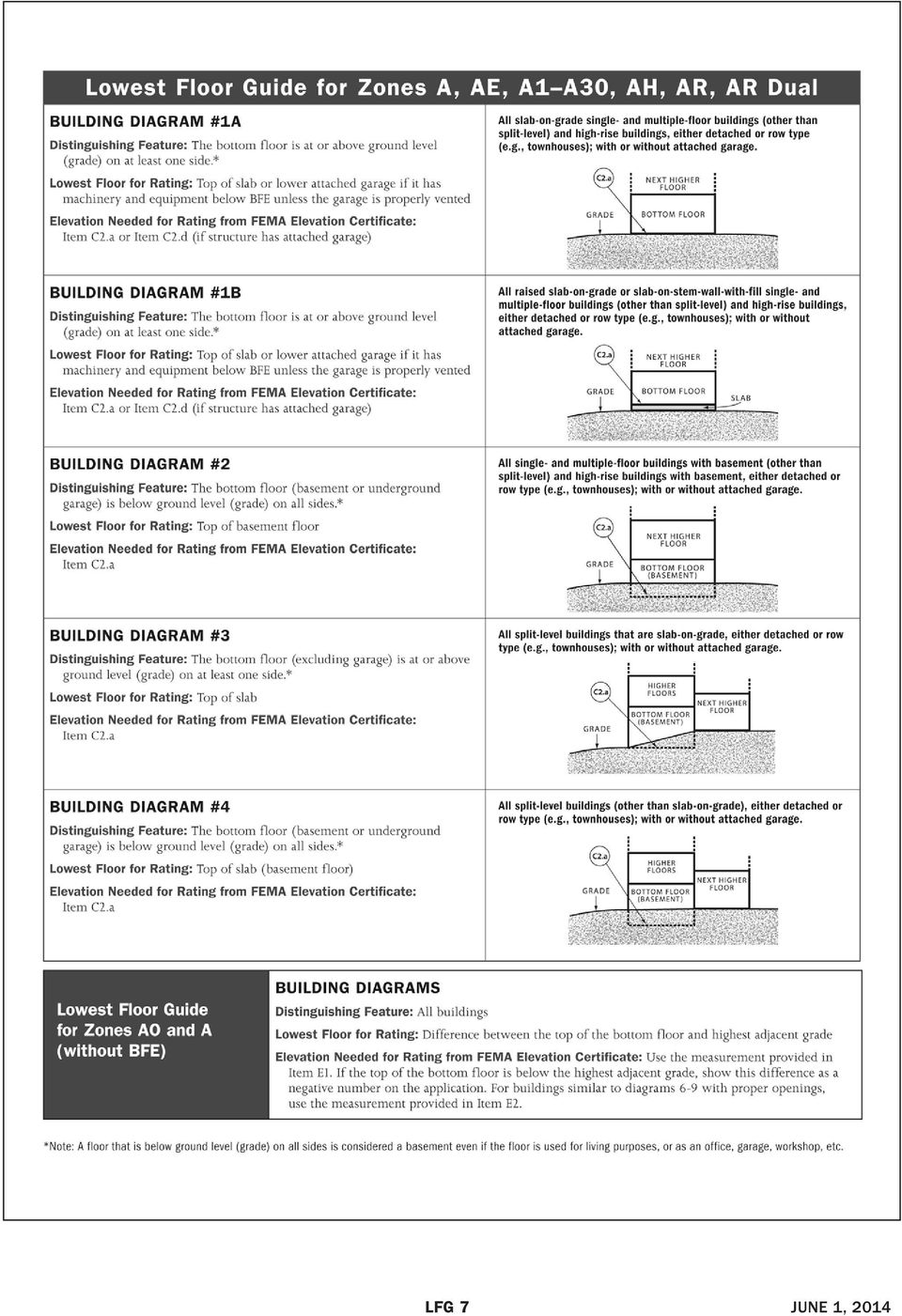
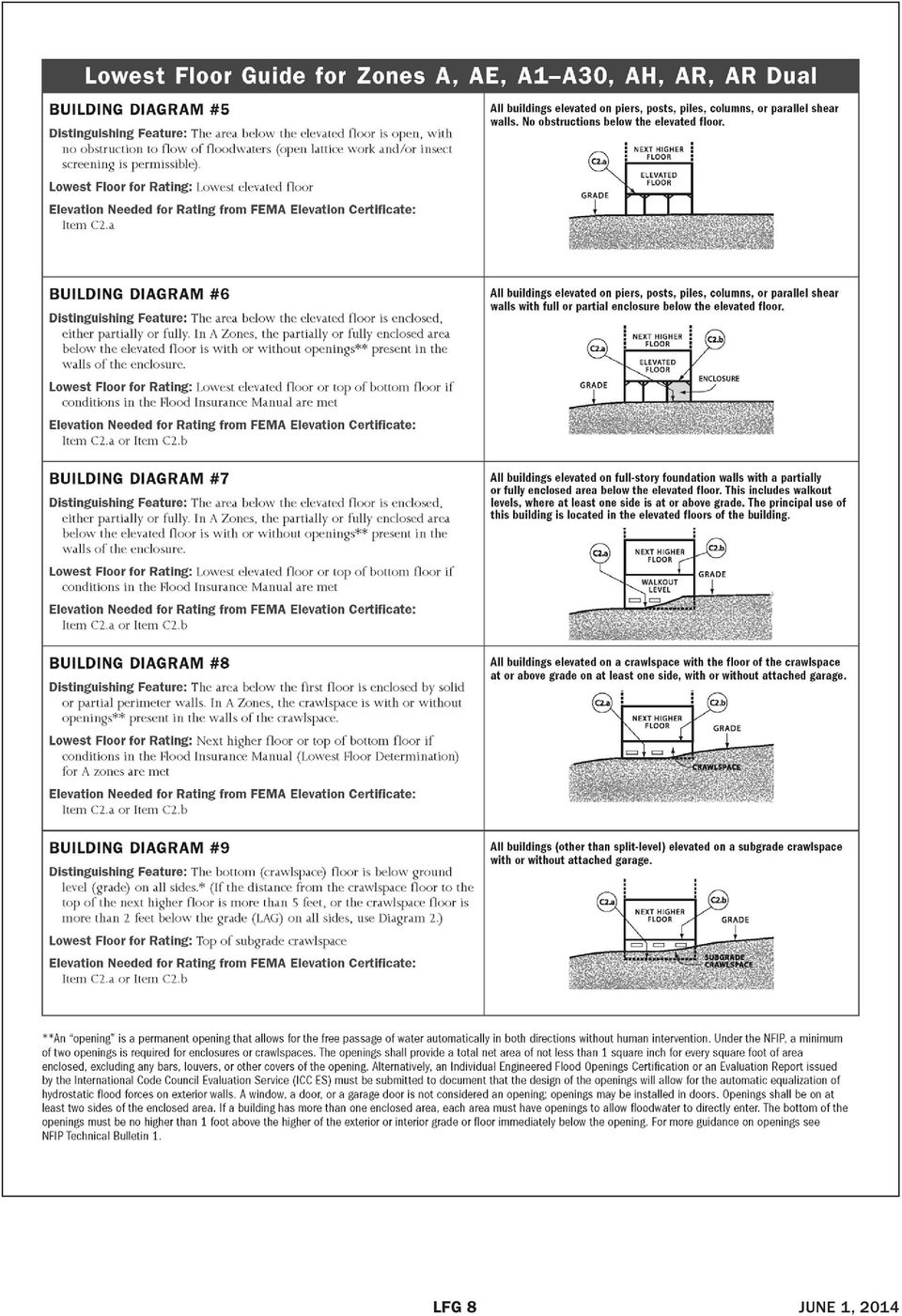
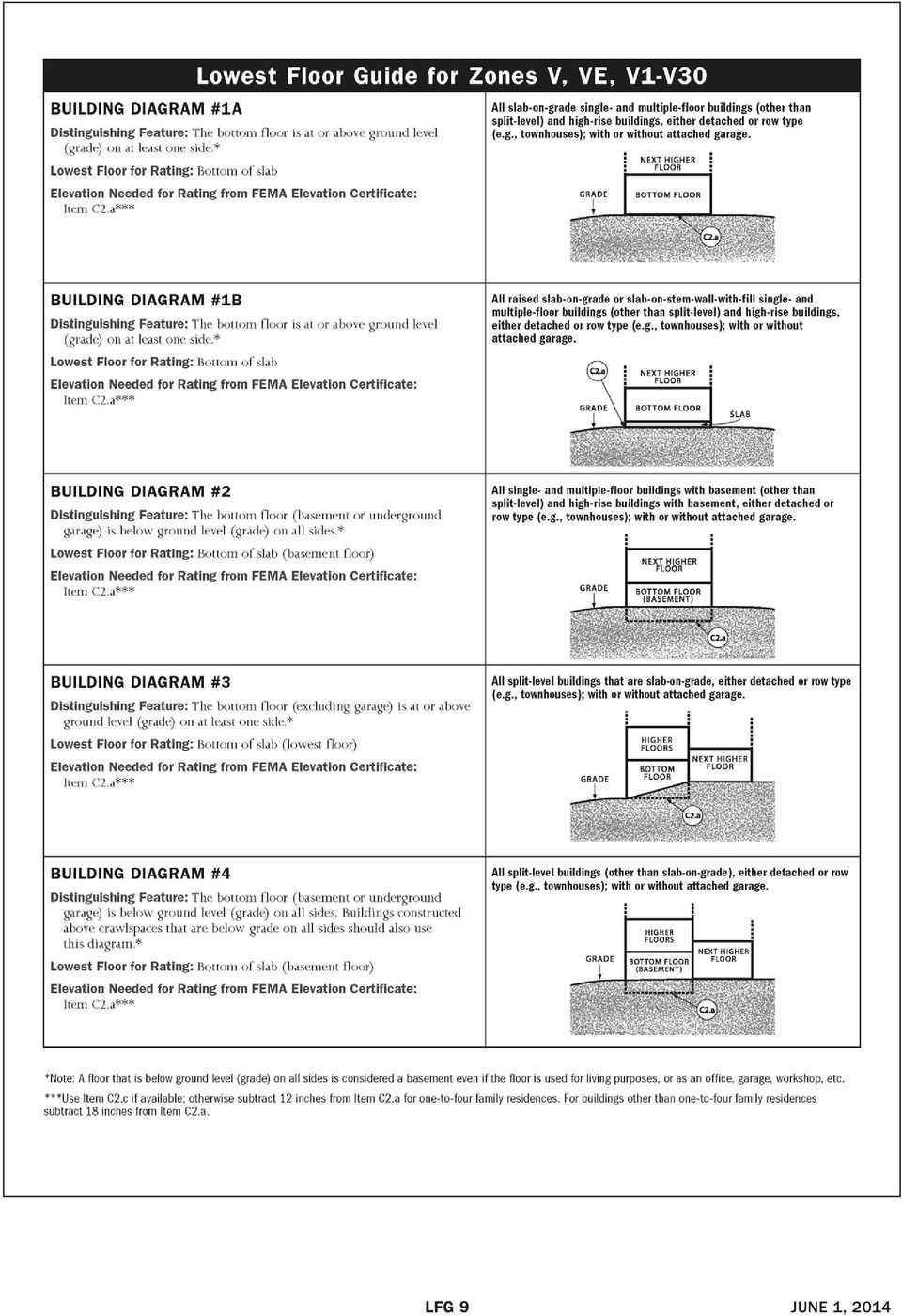
6 PUTTING IT INTO PERSPECTIVE. Section A and C of the 2012 Elevation Certificate provide fields for entering numerous measurements that the surveyor must record in completing an elevation survey. This data will be used to not only help insurance agents accurately rate a flood insurance policy, but also assist FEMA and the local communities with their floodplain management compliance issues. This 2012 Elevation Certificate does not specifically identify for the insurance agent the Lower Floor Elevation that must be used for rating purposes. Based upon your knowledge of the rules and regulations of the National Flood Insurance Program, you must make the final determination regarding which elevation should be used to accurately rate the policy and calculate the premium. This guide must be used in conjunction with information provided on the Flood Insurance Application form. This guide will provide you with some helpful information and hints. LFG 6 JUNE 1, 2014

7 LFG 7 JUNE 1, 2014
8 LFG 8 JUNE 1, 2014
9 LFG 9 JUNE 1, 2014
10 LFG 10 JUNE 1, 2014

11 III. SPECIFIC BUILDING DRAWINGS TABLE OF CONTENTS SECTION PAGE Elevated Buildings for Pre- and Post-FIRM Risks in Flood Zones B, C, X, A99, and D...LFG 12 LFG 15 Non-Elevated Buildings for Pre- and Post-FIRM Risks in Flood Zones B, C, X, A99, and D...LFG 16 LFG 19 Elevated Buildings for Pre- and Post-FIRM Risks in Flood Zones A, AO, and AH...LFG 20 LFG 26 Non-Elevated Buildings for Pre- and Post-FIRM Risks in Flood Zones A, AO, and AH...LFG 27 LFG 31 Non-Elevated Buildings for Pre- and Post-FIRM Risks in Flood Zones AE and A1 A30...LFG 32 LFG 40 Elevated Buildings for Pre- and Post-FIRM Risks in Flood Zones AE and A1 A30...LFG 41 LFG 55 Non-Elevated Buildings for Pre- and Post-FIRM Risks with Construction Dates of 1975 to September 30, 1981, in Flood Zones VE and V1 V30...LFG 56 LFG 61 Elevated Buildings for Pre- and Post-FIRM Risks with Construction Dates of 1975 to September 30, 1981, in Flood Zones VE and V1 V30...LFG 62 LFG 74 Elevated Buildings for Post-FIRM Risks in Flood Zones VE and V1 V30, Construction Date October 1, 1981, and After...LFG 75 LFG 86 Non-Elevated Buildings for Post-FIRM Risks in Flood Zones VE and V1 V30, Construction Date October 1, 1981, and After... LFG 87 LFG 11 OCTOBER 1, 2014

12 PRE- AND POST-FIRM RISKS IN FLOOD ZONES B, C, X, A99, AND D Building Description Elevating Foundation of Building Pre-FIRM Rating Post-FIRM Rating 1 floor with unfinished enclosed area Piers, posts, piles, or columns Unfinished enclosure With proper openings 3 With or without machinery or equipment below the lowest elevated floor No Elevation Certificate required Building type 1 floor Is area below the elevated floor enclosed? No Use Pre-FIRM rate table No Basement/Enclosure category. Use Post-FIRM rate table No Basement/Enclosure category. LFG 12 OCTOBER 1, 2014

13 PRE- AND POST-FIRM RISKS IN FLOOD ZONES B, C, X, A99, AND D Building Description Elevating Foundation of Building Pre-FIRM Rating Post-FIRM Rating 2 floors with unfinished enclosed area Piers, posts, piles, or columns Unfinished enclosure With proper openings 3 With or without machinery or equipment below the lowest elevated floor No Elevation Certificate required Building type 2 floors Is area below the elevated floor enclosed? No Use Pre-FIRM rate table No Basement/Enclosure category. Use Post-FIRM rate table No Basement/Enclosure category. LFG 13 OCTOBER 1, 2014

14 PRE- AND POST-FIRM RISKS IN FLOOD ZONES B, C, X, A99, AND D Building Description Elevating Foundation of Building Pre-FIRM Rating Post-FIRM Rating 2 floors with unfinished enclosed area Solid foundation walls Unfinished enclosure (garage) and crawlspace No proper openings 3 With or without machinery or equipment below the lowest elevated floor No Elevation Certificate required Building type 3 or more floors Is area below the elevated floor enclosed? Yes Use Pre-FIRM rate table With Enclosure category. Use Post-FIRM rate table With Enclosure category. LFG 14 OCTOBER 1, 2014

15 PRE- AND POST-FIRM RISKS IN FLOOD ZONES B, C, X, A99, AND D Building Description Elevating Foundation of Building Pre-FIRM Rating Post-FIRM Rating 1 floor with finished or unfinished enclosed area Piers, posts, piles, or columns Non-load-bearing walls No proper openings 3 With or without machinery or equipment below the lowest elevated floor No Elevation Certificate required Building type 2 floors Is area below the elevated floor enclosed? Yes Use Pre-FIRM rate table With Enclosure category. Use Post-FIRM rate table With Enclosure category. LFG 15 OCTOBER 1, 2014

16 NON-ELEVATED BUILDINGS PRE- AND POST-FIRM RISKS IN FLOOD ZONES B, C, X, A99, AND D Building Description Pre-FIRM Rating Post-FIRM Rating 1 floor on slab N/A No Elevation Certificate required Building type 1 floor Basement None Is building elevated? No Use Pre-FIRM rate table No Basement/Enclosure category. Use Post-FIRM rate table No Basement/Enclosure category. LFG 16 OCTOBER 1, 2014

17 NON-ELEVATED BUILDINGS PRE- AND POST-FIRM RISKS IN FLOOD ZONES B, C, X, A99, AND D Building Description Pre-FIRM Rating Post-FIRM Rating 3 or more floors on slab N/A No Elevation Certificate required Building type 3 or more floors Basement None Is building elevated? No Use Pre-FIRM rate table No Basement/Enclosure category. Use Post-FIRM rate table No Basement/Enclosure category. LFG 17 OCTOBER 1, 2014

18 NON-ELEVATED BUILDINGS PRE- AND POST-FIRM RISKS IN FLOOD ZONES B, C, X, A99, AND D Building Description Pre-FIRM Rating Post-FIRM Rating 2 floors on raised-slab-on-grade or slab-on-stem-wall-with-fill N/A No Elevation Certificate required Building type 2 floors Basement None Is building elevated? No Use Pre-FIRM rate table No Basement/Enclosure category. Use Post-FIRM rate table No Basement/Enclosure category. LFG 18 OCTOBER 1, 2014

19 NON-ELEVATED BUILDINGS PRE- AND POST-FIRM RISKS IN FLOOD ZONES B, C, X, A99, AND D Building Description Pre-FIRM Rating Post-FIRM Rating 1 floor with finished or unfinished basement With or without machinery or equipment in basement No Elevation Certificate required Building type 2 floors Basement Finished or unfinished Is building elevated? No Use Pre-FIRM rate table With Basement category. Use Post-FIRM rate table With Basement category. LFG 19 OCTOBER 1, 2014

20 PRE- AND POST-FIRM RISKS IN FLOOD ZONES A, AO, AND AH Building Description 1 floor without enclosed area (see Elevation Certificate, Diagram 5) Elevating Foundation of Building Post-FIRM Rating Piers, posts, piles, or columns No enclosure None Top of lowest elevated floor Building type 1 floor Is area below the elevated floor enclosed? No AO Zone: Use Pre-FIRM rate table No Basement/Enclosure category. AH Zone: Use Pre-FIRM rate table No Basement/Enclosure category. A Zone with BFE 2 : Use Pre-FIRM rate table No Basement/Enclosure category. A Zone without BFE 2 : Use Pre-FIRM rate table No Basement/Enclosure category. AO Zone: If difference between LF 1 and HAG 4 is equal to or greater than Base Flood Depth, use With Certification of Compliance or Elevation Certificate rate. If not, use Without Certification of Compliance or Elevation Certificate rate. AH Zone: If LF 1 elevation is greater than or equal to the BFE 2, use With Certification of Compliance or Elevation Certificate rate. If not, use Without Certification of Compliance or Elevation Certificate rate. A Zone with BFE 2 : Use Post-FIRM rate table With Base Flood Elevation category. If LF 1 elevation is 2 or more feet below the BFE 2, submit the Application to the insurer for a rate. A Zone without BFE 2 : If difference between the LF 1 and HAG 4 is 1 foot or more, use Post- FIRM rate table No Base Flood Elevation category. If difference is 0 feet or less, submit the Application to the insurer for a rate. AO Zone: If difference between LF 1 and HAG 4 is equal to or greater than Base Flood Depth, use With Certification of Compliance or Elevation Certificate rate. If not, use Without Certification of Compliance or Elevation Certificate rate. AH Zone: If LF 1 elevation is greater than or equal to the BFE 2, use With Certification of Compliance or Elevation Certificate rate. If not, use Without Certification of Compliance or Elevation Certificate rate. A Zone with BFE 2 : Use Post-FIRM rate table With Base Flood Elevation category. If LF 1 elevation is 2 or more feet below the BFE 2, submit the Application to the insurer for a rate. A Zone without BFE 2 : If difference between the LF 1 and HAG 4 is 1 foot or more, use Post- FIRM rate table No Base Flood Elevation category. If difference is 0 feet or less, submit the Application to the insurer for a rate. LFG 20 OCTOBER 1, 2014

21 PRE- AND POST-FIRM RISKS IN FLOOD ZONES A, AO, AND AH Building Description 2 floors, including hanging floor (see Elevation Certificate, Diagram 5) Elevating Foundation of Building Post-FIRM Rating Piers, posts, piles, or columns No enclosure With or without machinery or equipment below the lowest elevated floor Top of lowest elevated floor Building type 2 floors Is area below the elevated floor enclosed? No AO Zone: Use Pre-FIRM rate table No Basement/Enclosure category. AH Zone: Use Pre-FIRM rate table No Basement/Enclosure category. A Zone with BFE 2 : Use Pre-FIRM rate table No Basement/Enclosure category. A Zone without BFE 2 : Use Pre-FIRM rate table No Basement/Enclosure category. AO Zone: If difference between LF 1 and HAG 4 is equal to or greater than Base Flood Depth, use With Certification of Compliance or Elevation Certificate rate. If not, use Without Certification of Compliance or Elevation Certificate rate. AH Zone: If LF 1 elevation is greater than or equal to the BFE 2, use With Certification of Compliance or Elevation Certificate rate. If not, use Without Certification of Compliance or Elevation Certificate rate. A Zone with BFE 2 : Use Post-FIRM rate table With Base Flood Elevation category. If LF 1 elevation is 2 or more feet below the BFE 2, submit the Application to the insurer for a rate. A Zone without BFE 2 : If difference between the LF 1 and HAG 4 is 1 foot or more, use Post- FIRM rate table No Base Flood Elevation category. If difference is 0 feet or less, submit the Application to the insurer for a rate. AO Zone: If difference between LF 1 and HAG 4 is equal to or greater than Base Flood Depth, use With Certification of Compliance or Elevation Certificate rate. If not, use Without Certification of Compliance or Elevation Certificate rate. AH Zone: If LF 1 elevation is greater than or equal to the BFE 2, use With Certification of Compliance or Elevation Certificate rate. If not, use Without Certification of Compliance or Elevation Certificate rate. A Zone with BFE 2 : Use Post-FIRM rate table With Base Flood Elevation category. If LF 1 elevation is 2 or more feet below the BFE 2, submit the Application to the insurer for a rate. A Zone without BFE 2 : If difference between the LF 1 and HAG 4 is 1 foot or more, use Post- FIRM rate table No Base Flood Elevation category. If difference is 0 feet or less, submit the Application to the insurer for a rate. LFG 21 OCTOBER 1, 2014
22 PRE- AND POST-FIRM RISKS IN FLOOD ZONES A, AO, AND AH Building Description 1 floor with unfinished enclosed area (see Elevation Certificate, Diagram 6) Elevating Foundation of Building Post-FIRM Rating Piers, posts, piles, or columns Unfinished enclosure With proper openings 3 With or without machinery or equipment below the lowest elevated floor Top of next-higher floor (elevated floor) Building type 1 floor Is area below the elevated floor enclosed? No AO Zone: Use Pre-FIRM rate table No Basement/Enclosure category. AH Zone: Use Pre-FIRM rate table No Basement/Enclosure category. A Zone with BFE 2 : Use Pre-FIRM rate table No Basement/Enclosure category. A Zone without BFE 2 : Use Pre-FIRM rate table No Basement/Enclosure category. AO Zone: If difference between LF 1 and HAG 4 is equal to or greater than Base Flood Depth, use With Certification of Compliance or Elevation Certificate rate. If not, use Without Certification of Compliance or Elevation Certificate rate. AH Zone: If LF 1 elevation is greater than or equal to the BFE 2, use With Certification of Compliance or Elevation Certificate rate. If not, use Without Certification of Compliance or Elevation Certificate rate. A Zone with BFE 2 : Use Post-FIRM rate table With Base Flood Elevation category. If LF 1 elevation is 2 or more feet below the BFE 2, submit the Application to the insurer for a rate. A Zone without BFE 2 : If difference between the LF 1 and HAG 4 is 1 foot or more, use Post- FIRM rate table No Base Flood Elevation category. If difference is 0 feet or less, submit the Application to the insurer for a rate. AO Zone: If difference between LF 1 and HAG 4 is equal to or greater than Base Flood Depth, use With Certification of Compliance or Elevation Certificate rate. If not, use Without Certification of Compliance or Elevation Certificate rate. AH Zone: If LF 1 elevation is greater than or equal to the BFE 2, use With Certification of Compliance or Elevation Certificate rate. If not, use Without Certification of Compliance or Elevation Certificate rate. A Zone with BFE 2 : Use Post-FIRM rate table With Base Flood Elevation category. If LF 1 elevation is 2 or more feet below the BFE 2, submit the Application to the insurer for a rate. A Zone without BFE 2 : If difference between the LF 1 and HAG 4 is 1 foot or more, use Post-FIRM rate table No Base Flood Elevation category. If the difference is 0 feet or less, submit the Application to the insurer for a rate.. LFG 22 OCTOBER 1, 2014
23 PRE- AND POST-FIRM RISKS IN FLOOD ZONES A, AO, AND AH Building Description 2 floors with unfinished enclosed area (see Elevation Certificate, Diagram 6) Elevating Foundation of Building Post-FIRM Rating Piers, posts, piles, or columns Unfinished enclosure With proper openings 3 With or without machinery or equipment below the lowest elevated floor Lowest elevated floor Building type 2 floors Is area below the elevated floor enclosed? No AO Zone: Use Pre-FIRM rate table No Basement/Enclosure category. AH Zone: Use Pre-FIRM rate table No Basement/Enclosure category. A Zone with BFE 2 : Use Pre-FIRM rate table No Basement/Enclosure category. A Zone without BFE 2 : Use Post-FIRM rate table No Basement/Enclosure category. AO Zone: If difference between LF 1 and HAG 4 is equal to or greater than Base Flood Depth, use With Certification of Compliance or Elevation Certificate rate. If not, use Without Certification of Compliance or Elevation Certificate rate. AH Zone: If LF 1 elevation is greater than or equal to the BFE 2, use With Certification of Compliance or Elevation Certificate rate. If not, use Without Certification of Compliance or Elevation Certificate rate. A Zone with BFE 2 : Use Post-FIRM rate table With Base Flood Elevation category. If LF 1 elevation is 2 or more feet below the BFE 2, submit the Application to the insurer for a rate. A Zone without BFE 2 : If difference between the LF 1 and HAG 4 is 1 foot or more, use Post- FIRM rate table No Base Flood Elevation category. If difference is 0 feet or less, submit the Application to the insurer for a rate. AO Zone: If difference between LF 1 and HAG 4 is equal to or greater than Base Flood Depth, use With Certification of Compliance or Elevation Certificate rate. If not, use Without Certification of Compliance or Elevation Certificate rate. AH Zone: If LF 1 elevation is greater than or equal to the BFE 2, use With Certification of Compliance or Elevation Certificate rate. If not, use Without Certification of Compliance or Elevation Certificate rate. A Zone with BFE 2 : Use Post-FIRM rate table With Base Flood Elevation category. If LF 1 elevation is 2 or more feet below the BFE 2, submit the Application to the insurer for a rate. A Zone without BFE 2 : If difference between the LF 1 and HAG 4 is 1 foot or more, use Post-FIRM rate table No Base Flood Elevation category. If the difference is 0 feet or less, submit the Application to the insurer for a rate. LFG 23 OCTOBER 1, 2014
24 PRE- AND POST-FIRM RISKS IN FLOOD ZONES A, AO, AND AH Building Description 2 floors with unfinished enclosed area (see Elevation Certificate, Diagram 8) Elevating Foundation of Building Post-FIRM Rating Solid foundation walls Unfinished enclosure (garage) and crawlspace No openings With or without machinery or equipment below the lowest elevated floor Top of bottom floor (lower of crawlspace or garage) Building type 3 or more floors Is area below the elevated floor enclosed? Yes AO Zone: Use Pre-FIRM rate table With Enclosure category. AH Zone: Use Pre-FIRM rate table With Enclosure category. A Zone: Use Pre-FIRM rate table With Enclosure category. Submit the Application to the insurer for a rate. Submit the Application to the insurer for a rate. LFG 24 OCTOBER 1, 2014
25 PRE- AND POST-FIRM RISKS IN FLOOD ZONES A, AO, AND AH Building Description 1 floor with finished or unfinished enclosed area (see Elevation Certificate, Diagram 6) Elevating Foundation of Building Post-FIRM Rating Piers, posts, piles, or columns Unfinished enclosure Non-load-bearing walls No openings With or without machinery or equipment below the lowest elevated floor Top of bottom floor (including basement or enclosure) Building type 2 floors Is area below the elevated floor enclosed? Yes AO Zone: Use Pre-FIRM rate table With Enclosure category. AH Zone: Use Pre FIRM rate table With Enclosure category. A Zone: Use Pre-FIRM rate table With Enclosure category. Submit the Application to the insurer for a rate. Submit the Application to the insurer for a rate. LFG 25 OCTOBER 1, 2014
26 PRE- AND POST-FIRM RISKS IN FLOOD ZONES A, AO, AND AH Building Description Mobile home without enclosed area (see Elevation Certificate, Diagram 5) Elevating Foundation of Building Post-FIRM Rating Piers, posts, piles, or columns Vinyl or aluminum skirting With or without machinery or equipment below the lowest elevated floor Top of lowest elevated floor Building type Mobile home Is area below the elevated floor enclosed? No AO Zone: Use Pre-FIRM rate table Manufactured (Mobile) Home category. AH Zone: Use Pre-FIRM rate table Manufactured (Mobile) Home category. A Zone with BFE 2 : Use Pre-FIRM rate table No Basement/Enclosure category. A Zone without BFE 2 : Use Pre-FIRM rate table No Basement/Enclosure category. AO Zone: If difference between LF 1 and HAG 4 is equal to or greater than Base Flood Depth, use With Certification of Compliance or Elevation Certificate rate. If not, use Without Certification of Compliance or Elevation Certificate rate. AH Zone: If LF 1 elevation is greater than or equal to the BFE 2, use With Certification of Compliance or Elevation Certificate rate. If not, use Without Certification of Compliance or Elevation Certificate rate. A Zone with BFE 2 : Use Post-FIRM rate table With Base Flood Elevation category. If LF 1 elevation is 2 or more feet below the BFE 2, submit the Application to the insurer for a rate. A Zone without BFE 2 : If difference between the LF 1 and HAG 4 is 1 foot or more, use Post- FIRM rate table No Base Flood Elevation category. If difference is 0 feet or less, submit the Application to the insurer for a rate. AO Zone: If difference between LF 1 and HAG 4 is equal to or greater than Base Flood Depth, use With Certification of Compliance or Elevation Certificate rate. If not, use Without Certification of Compliance or Elevation Certificate rate. AH Zone: If LF 1 elevation is greater than or equal to the BFE 2, use With Certification of Compliance or Elevation Certificate rate. If not, use Without Certification of Compliance or Elevation Certificate rate. A Zone with BFE 2 : Use Post-FIRM rate table With Base Flood Elevation category. If LF 1 elevation is 2 or more feet below the BFE 2, submit the Application to the insurer for a rate. A Zone without BFE 2 : If difference between the LF 1 and HAG 4 is 1 foot or more, use Post- FIRM rate table No Base Flood Elevation category. If difference is 0 feet or less, submit the Application to the insurer for a rate. LFG 26 OCTOBER 1, 2014
27 NON-ELEVATED BUILDINGS PRE- AND POST-FIRM RISKS IN FLOOD ZONES A, AO, AND AH Building Description 1 floor with finished or unfinished basement (see Elevation Certificate, Diagram 2) Post-FIRM Rating With or without machinery or equipment in the basement Top of bottom floor (including basement) Building type 2 floors Basement Finished or unfinished Is building elevated? No AO Zone: Use Pre-FIRM rate table With Basement category. AH Zone: Use Pre-FIRM rate table With Basement category. A Zone: Use Pre-FIRM rate table With Basement category. Submit the Application to the insurer for a rate. Submit the Application to the insurer for a rate. LFG 27 OCTOBER 1, 2014
28 NON-ELEVATED BUILDINGS PRE- AND POST-FIRM RISKS IN FLOOD ZONES A, AO, AND AH Building Description 1 floor on slab (see Elevation Certificate, Diagram 1A) N/A Top of bottom floor Building type 1 floor Basement None Is building elevated? No AO Zone: Use Pre-FIRM rate table No Basement/Enclosure category. AH Zone: Use Pre-FIRM rate table No Basement/Enclosure category. A Zone with BFE 2 : Use Pre-FIRM rate table No Basement/Enclosure category. A Zone without BFE 2 : Use Pre-FIRM rate table No Basement/Enclosure category. Post-FIRM Rating AO Zone: If difference between LF 1 and HAG 4 is equal to or greater than Base Flood Depth, use With Certification of Compliance or Elevation Certificate rate. If not, use Without Certification of Compliance or Elevation Certificate rate. AH Zone: If LF 1 elevation is greater than or equal to the BFE 2, use With Certification of Compliance or Elevation Certificate rate. If not, use Without Certification of Compliance or Elevation Certificate rate. A Zone with BFE 2 : Use Post-FIRM rate table With Base Flood Elevation category. If LF 1 elevation is 2 or more feet below the BFE 2, submit the Application to the insurer for a rate. A Zone without BFE 2 : If difference between the LF 1 and HAG 4 is 1 foot or more, use Post- FIRM rate table No Base Flood Elevation category. If difference is 0 feet or less, submit the Application to the insurer for a rate. AO Zone: If difference between LF 1 and HAG 4 is equal to or greater than Base Flood Depth, use With Certification of Compliance or Elevation Certificate rate. If not, use Without Certification of Compliance or Elevation Certificate rate. AH Zone: If LF 1 elevation is greater than or equal to the BFE 2, use With Certification of Compliance or Elevation Certificate rate. If not, use Without Certification of Compliance or Elevation Certificate rate. A Zone with BFE 2 : Use Post-FIRM rate table With Base Flood Elevation category. If LF 1 elevation is 2 or more feet below the BFE 2, submit the Application to the insurer for a rate. A Zone without BFE 2 : If difference between the LF 1 and HAG 4 is 1 foot or more, use Post- FIRM rate table No Base Flood Elevation category. If difference is 0 feet or less, submit the Application to the insurer for a rate. LFG 28 OCTOBER 1, 2014
29 NON-ELEVATED BUILDINGS PRE- AND POST-FIRM RISKS IN FLOOD ZONES A, AO, AND AH Building Description 3 or more floors on slab (see Elevation Certificate, Diagram 1A) Post-FIRM Rating N/A Top of bottom floor Building type 3 or more floors Basement None Is building elevated? No AO Zone: Use Pre-FIRM rate table No Basement/Enclosure category. AH Zone: Use Pre-FIRM rate table No Basement/Enclosure category. A Zone with BFE 2 : Use Pre-FIRM rate table No Basement/Enclosure category. A Zone without BFE 2 : Use Pre-FIRM rate table No Basement/Enclosure category. AO Zone: If difference between LF 1 and HAG 4 is equal to or greater than Base Flood Depth, use With Certification of Compliance or Elevation Certificate rate. If not, use Without Certification of Compliance or Elevation Certificate rate. AH Zone: If LF 1 elevation is greater than or equal to the BFE 2, use With Certification of Compliance or Elevation Certificate rate. If not, use Without Certification of Compliance or Elevation Certificate rate. A Zone with BFE 2 : Use Post-FIRM rate table No Base Flood Elevation category. If LF 1 elevation is 2 or more feet below the BFE 2, submit the Application to the insurer for a rate. A Zone without BFE 2 : If difference between the LF 1 and HAG 4 is 1 foot or more, use Post- FIRM rate table With Base Flood Elevation category. If difference is 0 feet or less, submit the Application to the insurer for a rate. AO Zone: If difference between LF 1 and HAG 4 is equal to or greater than Base Flood Depth, use With Certification of Compliance or Elevation Certificate rate. If not, use Without Certification of Compliance or Elevation Certificate rate. AH Zone: If LF 1 elevation is greater than or equal to the BFE 2, use With Certification of Compliance or Elevation Certificate rate. If not, use Without Certification of Compliance or Elevation Certificate rate. A Zone with BFE 2 : Use Post-FIRM rate table No Base Flood Elevation category. If LF 1 elevation is 2 or more feet below the BFE 2, submit the Application to the insurer for a rate. A Zone without BFE 2 : If difference between the LF 1 and HAG 4 is 1 foot or more, use Post- FIRM rate table With Base Flood Elevation category. If difference is 0 feet or less, submit the Application to the insurer for a rate. LFG 29 OCTOBER 1, 2014
30 NON-ELEVATED BUILDINGS PRE- AND POST-FIRM RISKS IN FLOOD ZONES A, AO, AND AH Building Description Post-FIRM Rating 2 floors on raised-slab-on-grade or slab-on-stem-wall-with-fill (see Elevation Certificate, Diagram 1B) N/A Top of bottom floor Building type 2 floors Basement None Is building elevated? No AO Zone: Use Pre-FIRM rate table No Basement/Enclosure category. AH Zone: Use Pre-FIRM rate table No Basement/Enclosure category. A Zone with BFE 2 : Use Pre-FIRM rate table No Basement/Enclosure category. A Zone without BFE 2 : Use Pre-FIRM rate table No Basement/Enclosure category. AO Zone: If difference between LF 1 and HAG 4 is equal to or greater than Base Flood Depth, use With Certification of Compliance or Elevation Certificate rate. If not, use Without Certification of Compliance or Elevation Certificate rate. AH Zone: If LF 1 elevation is greater than or equal to the BFE 2, use With Certification of Compliance or Elevation Certificate rate. If not, use Without Certification of Compliance or Elevation Certificate rate. A Zone with BFE 2 : Use Post-FIRM rate table No Base Flood Elevation category. If LF 1 elevation is 2 or more feet below the BFE 2, submit the Application to the insurer for a rate. A Zone without BFE 2 : If difference between the LF 1 and HAG 4 is 1 foot or more, use Post- FIRM rate table With Base Flood Elevation category. If difference is 0 feet or less, submit the Application to the insurer for a rate. AO Zone: If difference between LF 1 and HAG 4 is equal to or greater than Base Flood Depth, use With Certification of Compliance or Elevation Certificate rate. If not, use Without Certification of Compliance or Elevation Certificate rate. AH Zone: If LF 1 elevation is greater than or equal to the BFE 2, use With Certification of Compliance or Elevation Certificate rate. If not, use Without Certification of Compliance or Elevation Certificate rate. A Zone with BFE 2 : Use Post-FIRM rate table No Base Flood Elevation category. If LF 1 elevation is 2 or more feet below the BFE 2, submit the Application to the insurer for a rate. A Zone without BFE 2 : If difference between the LF 1 and HAG 4 is 1 foot or more, use Post- FIRM rate table With Base Flood Elevation category. If difference is 0 feet or less, submit the Application to the insurer for a rate. LFG 30 OCTOBER 1, 2014
31 NON-ELEVATED BUILDINGS PRE- AND POST-FIRM RISKS IN FLOOD ZONES A, AO, AND AH Building Description 2 floors on slab with attached garage (see Elevation Certificate, Diagram 1A) Machinery or equipment in garage If attached garage has no proper openings 3, and has machinery or equipment below the BFE 2, use the garage floor for rating. Otherwise, use the top of the finished floor for rating. Building type 2 floors Basement None Is building elevated? No AO Zone: Use Pre-FIRM rate table No Basement/Enclosure category. AH Zone: Use Pre-FIRM rate table No Basement/Enclosure category. A Zone with BFE 2 : Use Pre-FIRM rate table No Basement/Enclosure category. A Zone without BFE 2 : Use Pre-FIRM rate table No Basement/Enclosure category. Post-FIRM Rating AO Zone: If difference between LF 1 and HAG 4 is equal to or greater than Base Flood Depth, use With Certification of Compliance or Elevation Certificate rate. If not, use Without Certification of Compliance or Elevation Certificate rate. AH Zone: If LF 1 elevation is greater than or equal to the BFE 2, use With Certification of Compliance or Elevation Certificate rate. If not, use Without Certification of Compliance or Elevation Certificate rate. A Zone with BFE 2 : Use Post-FIRM rate table With Base Flood Elevation category. If LF 1 elevation is 2 or more feet below the BFE 2, submit the Application to the insurer for a rate. A Zone without BFE 2 : If difference between the LF 1 and HAG 4 is 1 foot or more, use Post- FIRM rate table No Base Flood Elevation category. If difference is 0 feet or less, submit the Application to the insurer for a rate. AO Zone: If difference between LF 1 and HAG 4 is equal to or greater than Base Flood Depth, use With Certification of Compliance or Elevation Certificate rate. If not, use Without Certification of Compliance or Elevation Certificate rate. AH Zone: If LF 1 elevation is greater than or equal to the BFE 2, use With Certification of Compliance or Elevation Certificate rate. If not, use Without Certification of Compliance or Elevation Certificate rate. A Zone with BFE 2 : Use Post-FIRM rate table With Base Flood Elevation category. If LF 1 elevation is 2 or more feet below the BFE 2, submit the Application to the insurer for a rate. A Zone without BFE 2 : If difference between the LF 1 and HAG 4 is 1 foot or more, use Post- FIRM rate table No Base Flood Elevation category. If difference is 0 feet or less, submit the Application to the insurer for a rate. LFG 31 OCTOBER 1, 2014
32 NON-ELEVATED BUILDINGS PRE- AND POST-FIRM RISKS IN FLOOD ZONES AE AND A1 A30 Building Description 1 floor on slab (see Elevation Certificate, Diagram 1A) N/A Top of bottom floor Building type 1 floor Basement None Is building elevated? No Use Pre-FIRM rate table No Basement/Enclosure category. Use Post-FIRM rate table 1 Floor No Basement/Enclosure/Crawlspace category. If LF 1 elevation is 2 or more feet below the BFE 2, submit the Application to the insurer for a rate. Post-FIRM Rating Use Post-FIRM rate table 1 Floor No Basement/Enclosure/Crawlspace category. If LF 1 elevation is 2 or more feet below the BFE 2, submit the Application to the insurer for a rate. LFG 32 OCTOBER 1, 2014
33 NON-ELEVATED BUILDINGS PRE- AND POST-FIRM RISKS IN FLOOD ZONES AE AND A1 A30 Building Description 3 or more floors on slab (see Elevation Certificate, Diagram 1A) Post-FIRM Rating N/A Top of bottom floor Building type 3 or more floors Basement None Is building elevated? No Use Pre-FIRM rate table No Basement/Enclosure category. Use Post-FIRM rate table More Than 1 Floor No Basement/Enclosure/Crawlspace category. If LF 1 elevation is 2 or more feet below the BFE 2, submit the Application to the insurer for a rate. Use Post-FIRM rate table More Than 1 Floor No Basement/Enclosure/Crawlspace category. If LF 1 elevation is 2 or more feet below the BFE 2, submit the Application to the insurer for a rate. LFG 33 OCTOBER 1, 2014
34 NON-ELEVATED BUILDINGS PRE- AND POST-FIRM RISKS IN FLOOD ZONES AE AND A1 A30 Building Description Post-FIRM Rating 2 floors on raised-slab-on-grade or slab-on-stem-wall-with-fill (see Elevation Certificate, Diagram 1B) N/A Top of bottom floor Building type 2 floors Basement None Is building elevated? No Use Pre-FIRM rate table No Basement/Enclosure category. Use Post-FIRM rate table More Than 1 Floor No Basement/Enclosure/Crawlspace category. If LF 1 elevation is 2 or more feet below the BFE 2, submit the Application to the insurer for a rate. Use Post-FIRM rate table More Than 1 Floor No Basement/Enclosure/Crawlspace category. If LF 1 elevation is 2 or more feet below the BFE 2, submit the Application to the insurer for a rate. LFG 34 OCTOBER 1, 2014
35 NON-ELEVATED BUILDINGS PRE- AND POST-FIRM RISKS IN FLOOD ZONES AE AND A1 A30 Building Description 2 floors on slab with attached garage (see Elevation Certificate, Diagram 1A) Machinery or equipment in garage If attached garage has no proper openings 3, and has machinery or equipment below the BFE 2, use the garage floor for rating. Otherwise, use the top of the finished floor for rating. Post-FIRM Rating Building type 2 floors Basement None Is building elevated? No Use Pre-FIRM rate table No Basement/Enclosure category. Use Post-FIRM rate table More Than 1 Floor No Basement/Enclosure/Crawlspace category. If LF 1 elevation is 2 or more feet below the BFE 2, submit the Application to the insurer for a rate. Use Post-FIRM rate table More Than 1 Floor No Basement/Enclosure/Crawlspace category. If LF 1 elevation is 2 or more feet below the BFE 2, submit the Application to the insurer for a rate. LFG 35 OCTOBER 1, 2014
36 NON-ELEVATED BUILDINGS PRE- AND POST-FIRM RISKS IN FLOOD ZONES AE AND A1 A30 Building Description Post-FIRM Rating 2 floors with subgrade crawlspace with or without openings (see Elevation Certificate, Diagram 9) Subgrade crawlspace floor is no more than 2 feet below grade, and the distance between the subgrade crawlspace floor and the top of the next-higher floor is no more than 5 feet. With or without machinery or equipment Top of bottom floor (including subgrade crawlspace) Building type 3 or more floors Is building elevated? No Subgrade crawlspace Use Pre-FIRM rate table Non-Elevated With Subgrade Crawlspace category. Use Post-FIRM rate table More Than 1 Floor With Basement/Enclosure/Crawlspace category. If LF 1 elevation is 1 or more feet below the BFE 2, submit the Application to the insurer for a rate. See the Special Rating Situations subsection in the Rating section. Use Post-FIRM rate table More Than 1 Floor With Basement/Enclosure/Crawlspace category. If LF 1 elevation is 1 or more feet below the BFE 2, submit the Application to the insurer for a rate. See the Special Rating Situations subsection in the Rating section. LFG 36 OCTOBER 1, 2014
37 NON-ELEVATED BUILDINGS PRE- AND POST-FIRM RISKS IN FLOOD ZONES AE AND A1 A30 Building Description Post-FIRM Rating 2 floors with subgrade crawlspace with or without proper openings in crawlspace and attached enclosure (garage). (see Elevation Certificate, Diagram 9) Subgrade crawlspace floor is no more than 2 feet below grade, and the distance between the subgrade crawlspace floor and the top of the next higher floor is no more than 5 feet. With or without machinery or equipment Top of bottom floor (including subgrade crawlspace) Building type 3 or more floors Is building elevated? No Subgrade crawlspace Use Pre-FIRM rate table Non-Elevated With Subgrade Crawlspace category. Use Post-FIRM rate table More Than 1 Floor With Basement/Enclosure/Crawlspace category. If LF 1 elevation is 1 or more feet below the BFE 2, submit the Application to the insurer for a rate. See the Special Rating Situations subsection in the Rating section. Use Post-FIRM rate table More Than 1 Floor With Basement/Enclosure/Crawlspace category. If LF 1 elevation is 1 or more feet below the BFE 2, submit the Application to the insurer for a rate. See the Special Rating Situations subsection in the Rating section. LFG 37 OCTOBER 1, 2014
38 NON-ELEVATED BUILDINGS PRE- AND POST-FIRM RISKS IN FLOOD ZONES AE AND A1 A30 Building Description 2 floors with unfinished basement (see Elevation Certificate, Diagram 2) Basement floor is subgrade more than 2 feet, or subgrade no more than 2 feet and the distance between the basement floor and the top of the next-higher floor is more than 5 feet. Post-FIRM Rating With or without machinery or equipment Top of bottom floor (including basement) Building type 3 or more floors Is building elevated? No Basement Finished or unfinished Use Pre-FIRM rate table With Basement category. Use Post-FIRM rate table More Than 1 Floor With Basement/Enclosure/Crawlspace category. If LF 1 elevation is 2 or more feet below the BFE 2, submit the Application to the insurer for a rate. Use Post-FIRM rate table More Than 1 Floor With Basement/Enclosure/Crawlspace category. If LF 1 elevation is 2 or more feet below the BFE 2, submit the Application to the insurer for a rate. LFG 38 OCTOBER 1, 2014
39 NON-ELEVATED BUILDINGS PRE- AND POST-FIRM RISKS IN FLOOD ZONES AE AND A1 A30 Building Description 1 floor with attached garage Garage is at lower elevation than principal building area (see Elevation Certificate, Diagram 1A) Machinery or equipment in garage If attached garage has no proper openings 3, and has machinery or equipment below the BFE 2, use the garage floor for rating. Otherwise, use the top of the finished floor for rating. Building type 1 floor Basement None Is building elevated? No Use Pre-FIRM rate table No Basement/Enclosure category. Use Post-FIRM rate table 1 Floor No Basement/Enclosure/Crawlspace category. If LF 1 elevation is 2 or more feet below the BFE 2, submit the Application to the insurer for a rate. Post-FIRM Rating Use Post-FIRM rate table 1 Floor No Basement/Enclosure/Crawlspace category. If LF 1 elevation is 2 or more feet below the BFE 2, submit the Application to the insurer for a rate. LFG 39 OCTOBER 1, 2014
40 NON-ELEVATED BUILDINGS PRE- AND POST-FIRM RISKS IN FLOOD ZONES AE AND A1 A30 Building Description Split level with unfinished or finished basement (see Elevation Certificate, Diagram 4) Post-FIRM Rating With or without machinery or equipment in basement Top of bottom floor (including basement) Building type Split level Basement Finished or unfinished Is building elevated? No Use Pre-FIRM rate table With Basement category. Use Post-FIRM rate table More Than 1 Floor With Basement/Enclosure/Crawlspace category. If LF 1 elevation is 2 or more feet below the BFE 2, submit the Application to the insurer for a rate. Use Post-FIRM rate table More Than 1 Floor With Basement/Enclosure/Crawlspace category. If LF 1 elevation is 2 or more feet below the BFE 2, submit the Application to the insurer for a rate. LFG 40 OCTOBER 1, 2014
41 PRE- AND POST-FIRM RISKS IN FLOOD ZONES AE AND A1 A30 Building Description Elevating Foundation of Building Post-FIRM Rating 2 floors with walkout at ground level Lower floor is not below grade on all sides Principal use of the building is on the elevated floor (see Elevation Certificate, Diagram 7) Solid foundation walls Finished or unfinished lower level No openings With or without machinery or equipment at ground level Top of bottom floor (enclosure) Building type 2 floors Is area below the elevated floor enclosed? Yes Use Pre-FIRM rate table With Enclosure category. Use Post-FIRM rate table More Than 1 Floor No Basement/Enclosure/Crawlspace category. If LF 1 elevation is 2 or more feet below the BFE 2, submit the Application to the insurer for a rate. Use Post-FIRM rate table More Than 1 Floor With Basement/Enclosure/Crawlspace category. If LF 1 elevation is 1 or more feet below the BFE 2, submit the Application to the insurer for a rate. LFG 41 OCTOBER 1, 2014
42 PRE- AND POST-FIRM RISKS IN FLOOD ZONES AE AND A1 A30 Building Description 1 floor without enclosed area (see Elevation Certificate, Diagram 5) Elevating Foundation of Building Piers, posts, piles, or columns No enclosure With or without machinery or equipment below the lowest elevated floor Top of lowest elevated floor Building type 1 floor Is area below the elevated floor enclosed? No Use Pre-FIRM rate table No Basement/Enclosure category. Use Post-FIRM rate table 1 Floor No Basement/Enclosure/Crawlspace category. If LF 1 elevation is 2 or more feet below the BFE 2, submit the Application to the insurer for a rate. Post-FIRM Rating Use Post-FIRM rate table 1 Floor No Basement/Enclosure/Crawlspace category. If LF 1 elevation is 2 or more feet below the BFE 2, submit the Application to the insurer for a rate. LFG 42 OCTOBER 1, 2014
43 PRE- AND POST-FIRM RISKS IN FLOOD ZONES AE AND A1 A30 Building Description Elevating Foundation of Building Post-FIRM Rating Elevated on piers, posts, piles, or columns with hanging floor 2 floors, including hanging floor (see Elevation Certificate, Diagram 5) Piers, posts, piles, or columns No enclosure With or without machinery or equipment below the lowest elevated floor Top of lowest elevated floor Building type 2 floors Is area below the elevated floor enclosed? No Use Pre-FIRM rate table No Basement/Enclosure category. Elevated buildings on posts, piers, pilings, or columns and the lowest elevated floor below the BFE 2 is unfinished and used for storage or building access only, use More Than 1 Floor No Basement/Enclosure/Crawlspace category. If LF 1 elevation is 2 or more feet below the BFE 2, submit the Application to the insurer for a rate. Elevated buildings on posts, piers, pilings, or columns and the lowest elevated floor below the BFE 2 is unfinished and used for storage or building access only, use More Than 1 Floor No Basement/Enclosure/Crawlspace category. If LF 1 elevation is 2 or more feet below the BFE 2, submit the Application to the insurer for a rate. LFG 43 OCTOBER 1, 2014
44 PRE- AND POST-FIRM RISKS IN FLOOD ZONES AE AND A1 A30 Building Description 1 floor with unfinished enclosed area (see Elevation Certificate, Diagram 6) Elevating Foundation of Building Piers, posts, piles, or columns Unfinished enclosure With proper openings 3 With or without machinery or equipment below the lowest elevated floor Top of next-higher floor (elevated floor) Building type 1 floor Is area below the elevated floor enclosed? No Use Pre-FIRM rate table No Basement/Enclosure category. Use Post-FIRM rate table 1 Floor No Basement/Enclosure/Crawlspace category. If LF 1 elevation is 2 or more feet below the BFE 2, submit the Application to the insurer for a rate. Post-FIRM Rating Use Post-FIRM rate table 1 Floor No Basement/Enclosure/Crawlspace category. If LF 1 elevation is 2 or more feet below the BFE 2, submit the Application to the insurer for a rate. LFG 44 OCTOBER 1, 2014
45 PRE- AND POST-FIRM RISKS IN FLOOD ZONES AE AND A1 A30 Building Description 2 floors with unfinished enclosed area (see Elevation Certificate, Diagram 6) Elevating Foundation of Building Post-FIRM Rating Piers, posts, piles, or columns Unfinished enclosure With proper openings 3 With or without machinery or equipment below the lowest elevated floor Top of next-higher floor (elevated floor) Building type 2 floors Is area below the elevated floor enclosed? No Use Pre-FIRM rate table No Basement/Enclosure category. Use Post-FIRM rate table More Than 1 Floor No Basement/Enclosure/Crawlspace category. If LF 1 elevation is 2 or more feet below the BFE 2, submit the Application to the insurer for a rate. Use Post-FIRM rate table More Than 1 Floor No Basement/Enclosure/Crawlspace category. If LF 1 elevation is 2 or more feet below the BFE 2, submit the Application to the insurer for a rate. LFG 45 OCTOBER 1, 2014
46 PRE- AND POST-FIRM RISKS IN FLOOD ZONES AE AND A1 A30 Building Description 2 floors with unfinished enclosure/crawlspace (see Elevation Certificate, Diagram 8) Elevating Foundation of Building Post-FIRM Rating Solid foundation walls Unfinished enclosure (garage) and crawlspace No proper openings 3 With or without machinery or equipment below the lowest elevated floor Top of bottom floor (garage) Building type 3 or more floors Is area below the elevated floor enclosed? Yes Use Pre-FIRM rate table With Enclosure category. Use Post-FIRM rate table More Than 1 Floor No Basement/Enclosure/Crawlspace category. If LF 1 elevation is 2 or more feet below the BFE 2, submit the Application to the insurer for a rate. Use Post-FIRM rate table More Than 1 Floor With Basement/Enclosure/Crawlspace category. If LF 1 elevation is 1 or more feet below the BFE 2, submit the Application to the insurer for a rate. LFG 46 OCTOBER 1, 2014
47 PRE- AND POST-FIRM RISKS IN FLOOD ZONES AE AND A1 A30 Building Description 1 floor with finished or unfinished enclosed area (see Elevation Certificate, Diagram 6) Elevating Foundation of Building Post-FIRM Rating Piers, posts, piles, or columns Non-load-bearing walls No openings With or without machinery or equipment below the lowest elevated floor Top of bottom floor (including basement or enclosure) Building type 2 floors Is area below the elevated floor enclosed? Yes Use Pre-FIRM rate table With Enclosure category. Use Post-FIRM rate table More Than 1 Floor No Basement/Enclosure/Crawlspace category. If LF 1 elevation is 2 or more feet below the BFE 2, submit the Application to the insurer for a rate. Use Post-FIRM rate table More Than 1 Floor With Basement/Enclosure/Crawlspace category. If LF 1 elevation is 1 or more feet below the BFE 2, submit the Application to the insurer for a rate. LFG 47 OCTOBER 1, 2014
48 PRE- AND POST-FIRM RISKS IN FLOOD ZONES AE AND A1 A30 Building Description 1-floor Mid-Level Entry with unfinished enclosure (see Elevation Certificate, Diagram 7) Elevating Foundation of Building Post-FIRM Rating Solid foundation walls Enclosure garage and storage area Proper openings in garage and enclosure With or without machinery or equipment below the lowest elevated floor Top of next-higher floor (elevated floor) Mid-Level Entry elevation Building type 2 floors Is area below the elevated floor enclosed? No Use Pre-FIRM rate table No Enclosure category. Use Post-FIRM rate table More Than 1 Floor No Basement/Enclosure/Crawlspace category. If LF 1 elevation is 2 or more feet below the BFE 2, submit the Application to the insurer for a rate. Use Post-FIRM rate table More Than 1 Floor No Basement/Enclosure/Crawlspace category. If LF 1 elevation is 2 or more feet below the BFE 2, submit the Application to the insurer for a rate. LFG 48 OCTOBER 1, 2014
49 PRE- AND POST-FIRM RISKS IN FLOOD ZONES AE AND A1 A30 Building Description 2-floor Mid-Level Entry with unfinished enclosure (see Elevation Certificate, Diagram 7) Elevating Foundation of Building Post-FIRM Rating Solid foundation walls Enclosure garage and storage area No proper openings 3 With or without machinery or equipment below the lowest elevated floor Floor of garage and storage area Building type 2 floors Is area below the elevated floor enclosed? Yes Use Pre-FIRM rate table With Enclosure category. Use Post-FIRM rate table More Than 1 Floor No Basement/Enclosure/Crawlspace category. If LF 1 elevation is 2 or more feet below the BFE 2, submit the Application to the insurer for a rate. Use Post-FIRM rate table More Than 1 Floor With Basement/Enclosure/Crawlspace category. If LF 1 elevation is 1 or more feet below the BFE 2, submit the Application to the insurer for a rate. LFG 49 OCTOBER 1, 2014
50 PRE- AND POST-FIRM RISKS IN FLOOD ZONES AE AND A1 A30 Building Description 1 floor with unfinished enclosed area (see Elevation Certificate, Diagram 7) Elevating Foundation of Building Post-FIRM Rating Solid foundation walls Unfinished enclosure No proper openings 3 With or without machinery or equipment below the lowest elevated floor Top of bottom floor (including basement or enclosure) Building type 2 floors Is area below the elevated floor enclosed? Yes Use Pre-FIRM rate table With Enclosure category. Use Post-FIRM rate table More Than 1 Floor No Basement/Enclosure/Crawlspace category. If LF 1 elevation is 2 or more feet below the BFE 2, submit the Application to the insurer for a rate. Use Post-FIRM rate table More Than 1 Floor With Basement/Enclosure/Crawlspace category. If LF 1 elevation is 1 or more feet below the BFE 2, submit the Application to the insurer for a rate. LFG 50 OCTOBER 1, 2014
51 PRE- AND POST-FIRM RISKS IN FLOOD ZONES AE AND A1 A30 Building Description 2 floors with unfinished enclosure/crawlspace (see Elevation Certificate, Diagram 8) Elevating Foundation of Building Post-FIRM Rating Solid foundation walls Enclosed garage at same level as crawlspace Unfinished enclosure/crawlspace No proper openings 3 in crawlspace or garage Floor of crawlspace/garage is at or above lowest adjacent grade With or without machinery or equipment below the lowest elevated floor Floor of crawlspace and garage Building type 3 or more floors Is area below the elevated floor enclosed? Yes Use Pre-FIRM rate table With Enclosure category. Use Post-FIRM rate table More Than 1 Floor No Basement/Enclosure/Crawlspace category. If LF 1 elevation is 2 or more feet below the BFE 2, submit the Application to the insurer for a rate. Use Post-FIRM rate table More Than 1 Floor With Basement/Enclosure/Crawlspace category. If LF 1 elevation is 1 or more feet below the BFE 2, submit the Application to the insurer for a rate. LFG 51 OCTOBER 1, 2014
52 PRE- AND POST-FIRM RISKS IN FLOOD ZONES AE AND A1 A30 Building Description 2 floors with crawlspace (see Elevation Certificate, Diagram 8) Elevating Foundation of Building Post-FIRM Rating Solid foundation walls Unfinished crawlspace Proper openings 3 in crawlspace and garage Floor of crawlspace/garage is at or above lowest adjacent grade Without machinery or equipment in crawlspace or garage Top of next-higher floor (elevated floor) Building type 2 floors Is area below the elevated floor enclosed? No Use Pre-FIRM rate table No Basement/Enclosure category. Use Post-FIRM rate table More Than 1 Floor No Basement/Enclosure/Crawlspace category. If LF 1 elevation is 2 or more feet below the BFE 2, submit the Application to the insurer for a rate. Use Post-FIRM rate table More Than 1 Floor No Basement/Enclosure/Crawlspace category. If LF 1 elevation is 2 or more feet below the BFE 2, submit the Application to the insurer for a rate. LFG 52 OCTOBER 1, 2014
53 PRE- AND POST-FIRM RISKS IN FLOOD ZONES AE AND A1 A30 Building Description 2 floors with crawlspace (see Elevation Certificate, Diagram 8) Elevating Foundation of Building Post-FIRM Rating Solid foundation walls Unfinished crawlspace With proper openings 3 Floor of crawlspace is at or above lowest adjacent grade With or without machinery or equipment in crawlspace Top of next-higher floor (elevated floor) Building type 2 floors Is area below the elevated floor enclosed? No Use Pre-FIRM rate table No Basement/Enclosure category. Use Post-FIRM rate table More Than 1 Floor No Basement/Enclosure/Crawlspace category. If LF 1 elevation is 2 or more feet below the BFE 2, submit the Application to the insurer for a rate. Use Post-FIRM rate table More Than 1 Floor No Basement/Enclosure/Crawlspace category. If LF 1 elevation is 2 or more feet below the BFE 2, submit the Application to the insurer for a rate. LFG 53 OCTOBER 1, 2014
54 PRE- AND POST-FIRM RISKS IN FLOOD ZONES AE AND A1 A30 Building Description 2 floors with crawlspace (see Elevation Certificate, Diagram 8) Elevating Foundation of Building Post-FIRM Rating Solid foundation walls Unfinished crawlspace No proper openings 3 Floor of crawlspace is at or above lowest adjacent grade With or without machinery or equipment in crawlspace Top of bottom floor (crawlspace) Building type 3 or more floors Is area below the elevated floor enclosed? Yes Use Pre-FIRM rate table Elevated on Crawlspace category. Use Post-FIRM rate table More Than 1 Floor No Basement/Enclosure/Crawlspace category. If LF 1 elevation is 1 or more feet below the BFE 2, submit the Application to the insurer for a rate. Use Post-FIRM rate table More Than 1 Floor With Basement/Enclosure/Crawlspace category. If LF 1 elevation is 1 or more feet below the BFE 2, submit the Application to the insurer for a rate. LFG 54 OCTOBER 1, 2014
55 PRE- AND POST-FIRM RISKS IN FLOOD ZONES AE AND A1 A30 Building Description Mobile home without enclosed area (see Elevation Certificate, Diagram 5) Elevating Foundation of Building Post-FIRM Rating Piers, posts, piles, or columns Vinyl or aluminum skirting With or without machinery or equipment below the lowest elevated floor Top of lowest elevated floor Building type Mobile home Is area below the elevated floor enclosed? No Use Pre-FIRM rate table Manufactured (Mobile) Home category. Use Post-FIRM Manufactured (Mobile) Home rates. If LF 1 elevation is 1 or more feet below the BFE 2, submit the Application to the insurer for a rate. Use Post-FIRM Manufactured (Mobile) Home rates. If LF 1 elevation is 1 or more feet below the BFE 2, submit the Application to the insurer for a rate. LFG 55 OCTOBER 1, 2014
56 NON-ELEVATED BUILDINGS PRE- AND POST-FIRM RISKS WITH CONSTRUCTION DATES OF 1975 TO SEPTEMBER 30, 1981, IN FLOOD ZONES VE AND V1 V30 6 Building Description Post-FIRM Rating 1975 to September 30, 1981, Construction Date 1 floor No basement (see Elevation Certificate, Diagram 1A) Bottom of slab In V Zones, the lowest floor for rating should reflect the bottom of the lowest horizontal structural member. If the surveyor used item C2.a in lieu of C2.c of the Elevation Certificate, and the top of the bottom floor is at or above grade, deduct (for 1 4 family residences) 12 inches from the elevation figure found in item C2.a. For buildings other than 1 4 family, deduct 18 inches from the elevation figure found in item C2.a. Building type 1 floor Basement None Is building elevated? No Use Pre-FIRM rate table No Basement/Enclosure category. Use Post-FIRM VE, V1 V30 Zone 1 Floor No Basement/Enclosure/Crawlspace rates. If LF 1 elevation is 2 or more feet below the BFE 2, submit the Application to the insurer for a rate. Use Post-FIRM VE, V1 V30 Zone 1 Floor No Basement/Enclosure/Crawlspace rates. If LF 1 elevation is 2 or more feet below the BFE 2, submit the Application to the insurer for a rate. LFG 56 OCTOBER 1, 2014
57 NON-ELEVATED BUILDINGS PRE- AND POST-FIRM RISKS WITH CONSTRUCTION DATES OF 1975 TO SEPTEMBER 30, 1981, IN FLOOD ZONES VE AND V1 V30 6 Building Description Post-FIRM Rating 1975 to September 30, 1981, Construction Date 3 or more floors No basement (see Elevation Certificate, Diagram 1A) Bottom of slab In V Zones, the lowest floor for rating should reflect the bottom of the lowest horizontal structural member. If the surveyor used item C2.a in lieu of C2.c of the Elevation Certificate, and the top of the bottom floor is at or above grade, deduct (for 1 4 family residences) 12 inches from the elevation figure found in item C2.a. For buildings other than 1 4 family, deduct 18 inches from the elevation figure found in item C2.a. Building type 3 or more floors Basement None Is building elevated? No Use Pre-FIRM rate table No Basement/Enclosure category. Use Post-FIRM VE, V1 V30 Zone More Than 1 Floor No Basement/Enclosure/ Crawlspace rates. If LF 1 elevation is 2 or more feet below the BFE 2, submit the Application to the insurer for a rate. Use Post-FIRM VE, V1 V30 Zone More Than 1 Floor No Basement/Enclosure/ Crawlspace rates. If LF 1 elevation is 2 or more feet below the BFE 2, submit the Application to the insurer for a rate. LFG 57 OCTOBER 1, 2014
58 NON-ELEVATED BUILDINGS PRE- AND POST-FIRM RISKS WITH CONSTRUCTION DATES OF 1975 TO SEPTEMBER 30, 1981, IN FLOOD ZONES VE AND V1 V30 6 Building Description Post-FIRM Rating 1975 to September 30, 1981, Construction Date 2 floors on raised-slab-on-grade or slab-on-stem-wall-with-fill (see Elevation Certificate, Diagram 1B) Bottom of lowest horizontal structural member (C2.c) Building type 2 floors Basement None Is building elevated? No Use Pre-FIRM rate table No Basement/Enclosure category. Use Post-FIRM VE, V1 V30 Zone More Than 1 Floor No Basement/Enclosure/ Crawlspace rates. If LF 1 elevation is 2 or more feet below the BFE 2, submit the Application to the insurer for a rate. Use Post-FIRM VE, V1 V30 Zone More Than 1 Floor No Basement/Enclosure/ Crawlspace rates. If LF 1 elevation is 2 or more feet below the BFE 2, submit the Application to the insurer for a rate. LFG 58 OCTOBER 1, 2014
59 NON-ELEVATED BUILDINGS PRE- AND POST-FIRM RISKS WITH CONSTRUCTION DATES OF 1975 TO SEPTEMBER 30, 1981, IN FLOOD ZONES VE AND V1 V30 6 Building Description Post-FIRM Rating 1975 to September 30, 1981, Construction Date 1 floor with attached garage Garage is at lower elevation than principal building area (see Elevation Certificate, Diagram 1) In V Zones, the lowest floor for rating should reflect the bottom of the slab. If the surveyor used item C2. a or d (attached garage/top of slab) in lieu of C2.c of the Elevation Certificate, and the top of the bottom floor is at or above the lowest adjacent grade (C2.f), deduct (for 1 4 family residences) 12 inches from the elevation figure found in item C2. a or d, whichever is lower. For buildings other than 1 4 family, deduct 18 inches from the elevation figure found in item C2. a or d, whichever is lower. Building type 1 floor Basement None Is building elevated? No Use Pre-FIRM rate table No Basement/Enclosure category. Use Post-FIRM VE, V1 V30 Zone 1 Floor No Basement/Enclosure rates. If LF 1 elevation is 2 or more feet below the BFE 2, submit the Application to the insurer for a rate. Use Post-FIRM VE, V1 V30 Zone 1 Floor No Basement/Enclosure rates. If LF 1 elevation is 2 or more feet below the BFE 2, submit the Application to the insurer for a rate. LFG 59 OCTOBER 1, 2014
60 NON-ELEVATED BUILDINGS PRE- AND POST-FIRM RISKS WITH CONSTRUCTION DATES OF 1975 TO SEPTEMBER 30, 1981, IN FLOOD ZONES VE AND V1 V30 6 Building Description Post-FIRM Rating 1975 to September 30, 1981, Construction Date 3 floors Finished basement (see Elevation Certificate, Diagram 2) Bottom of slab (basement) In V Zones, the lowest floor for rating should reflect the bottom of the lowest horizontal structural member. If the surveyor used item C2.a in lieu of C2.c of the Elevation Certificate, and the top of the bottom floor is indicated in the Elevation Certificate, deduct (for 1 4 family residences) 12 inches from the elevation figure found in item C2.a. For buildings other than 1 4 family, deduct 18 inches from the elevation figure found in item C2.a. Building type 3 or more floors Basement Finished Is building elevated? No Use Pre-FIRM rate table With Basement category. Use Post-FIRM VE, V1 V30 Zone More Than 1 Floor With Basement/Enclosure/ Crawlspace rates. If LF 1 elevation is 2 or more feet below the BFE 2, submit the Application to the insurer for a rate. Use Post-FIRM VE, V1 V30 Zone More Than 1 Floor With Basement/Enclosure/ Crawlspace rates. If LF 1 elevation is 2 or more feet below the BFE 2, submit the Application to the insurer for a rate. LFG 60 OCTOBER 1, 2014
61 NON-ELEVATED BUILDINGS PRE- AND POST-FIRM RISKS WITH CONSTRUCTION DATES OF 1975 TO SEPTEMBER 30, 1981, IN FLOOD ZONES VE AND V1 V30 6 Building Description Post-FIRM Rating 1975 to September 30, 1981, Construction Date Split level Unfinished basement (see Elevation Certificate, Diagram 4) Bottom of slab (basement) In V Zones, the lowest floor for rating should reflect the bottom of the lowest horizontal structural member. If the surveyor used item C2.a in lieu of C2.c of the Elevation Certificate, and the top of the bottom floor is indicated in the Elevation Certificate, deduct (for 1 4 family residences) 12 inches from the elevation figure found in item C2.a. For buildings other than 1 4 family, deduct 18 inches from the elevation figure found in item C2.a. Building type Split level Basement Unfinished Is building elevated? No Use Pre-FIRM rate table With Basement category. Use Post-FIRM VE, V1 V30 Zone More Than 1 Floor With Basement/Enclosure/ Crawlspace rates. If LF 1 elevation is 2 or more feet below the BFE 2, submit the Application to the insurer for a rate. Use Post-FIRM VE, V1 V30 Zone More Than 1 Floor With Basement/Enclosure/ Crawlspace rates. If LF 1 elevation is 2 or more feet below the BFE 2, submit the Application to the insurer for a rate. LFG 61 OCTOBER 1, 2014
62 PRE- AND POST-FIRM RISKS WITH CONSTRUCTION DATES OF 1975 TO SEPTEMBER 30, 1981, IN FLOOD ZONES VE AND V1 V30 Building Description Elevating Foundation of Building Post-FIRM Rating 1975 to September 30, 1981, Construction Date 2 floors with walkout at ground level Lower floor is not below grade on all sides Principal use of the building is on the elevated floor (see Elevation Certificate, Diagram 7) Solid foundation walls Finished or unfinished lower level With or without machinery or equipment below the lowest elevated floor Bottom of slab In V Zones, the lowest floor for rating should reflect the bottom of the lowest horizontal structural member. If the surveyor used item C2.a in lieu of C2.c of the Elevation Certificate, and the top of the bottom floor is at or above the lowest adjacent grade (C2.f), deduct (for 1 4 family residences) 12 inches from the elevation figure found in item C2.a. For buildings other than 1 4 family, deduct 18 inches from the elevation figure found in item C2.a. Building type 2 floors Is area below the elevated floor enclosed? Yes Use Pre-FIRM rate table With Enclosure category. Use Post-FIRM VE, V1 V30 Zone More Than 1 Floor No Basement/Enclosure/ Crawlspace rates. If LF 1 elevation is 2 or more feet below the BFE 2, submit the Application to the insurer for a rate. Use Post-FIRM VE, V1 V30 Zone More Than 1 Floor With Basement/Enclosure/ Crawlspace rates. If LF 1 elevation is 1 or more feet below the BFE 2, submit the Application to the insurer for a rate. LFG 62 OCTOBER 1, 2014
63 PRE- AND POST-FIRM RISKS WITH CONSTRUCTION DATES OF 1975 TO SEPTEMBER 30, 1981, IN FLOOD ZONES VE AND V1 V30 Building Description 1 floor without enclosed area (see Elevation Certificate, Diagram 5) Elevating Foundation of Building Post-FIRM Rating 1975 to September 30, 1981, Construction Date Piers, posts, piles, or columns The space below the lowest elevated floor either has no enclosure or has: (1) Insect screening, provided that no additional supports are required for the screening; or (2) Wooden or plastic lattice with at least 40% of its area open and made of material no thicker than ½ inch; or (3) Wooden or plastic slats or shutters with at least 40% of their area open and made of material no thicker than 1 inch; or (4) The area below the lowest elevated floor is enclosed by a combination of 1 solid breakaway wall or garage door, and the other sides of the enclosure are insect screening, or wooden or plastic lattice, slats, or shutters. Any of these systems must be designed and installed to collapse under stress without jeopardizing the structural support of the building, so that the impact on the building of abnormally high tides or wind-driven water is minimized. Any machinery or equipment below elevated floor is at or above the BFE 2 Bottom of lowest horizontal structural member Building type 1 floor Is area below the elevated floor enclosed? No Use Pre-FIRM rate table No Basement/Enclosure category. Use Post-FIRM VE, V1 V30 Zone 1 Floor No Basement/Enclosure/Crawlspace rates. If LF 1 elevation is 2 or more feet below the BFE 2, submit the Application to the insurer for a rate. Use Post-FIRM VE, V1 V30 Zone 1 Floor No Basement/Enclosure/Crawlspace rates. If LF 1 elevation is 2 or more feet below the BFE 2, submit the Application to the insurer for a rate. LFG 63 OCTOBER 1, 2014
64 PRE- AND POST-FIRM RISKS WITH CONSTRUCTION DATES OF 1975 TO SEPTEMBER 30, 1981, IN FLOOD ZONES VE AND V1 V30 Building Description 2 floors, including hanging floor (see Elevation Certificate, Diagram 5) Elevating Foundation of Building Post-FIRM Rating 1975 to September 30, 1981, Construction Date Piers, posts, piles, or columns No enclosure With or without machinery or equipment below the lowest elevated floor Bottom of lowest horizontal structural member Building type 2 floors Is area below the elevated floor enclosed? No Use Pre-FIRM rate table No Basement/Enclosure category. Use Post-FIRM VE, V1 V30 Zone More Than 1 Floor No Basement/Enclosure/ Crawlspace rates. If LF 1 elevation is 2 or more feet below the BFE 2, submit the Application to the insurer for a rate. Use Post-FIRM VE, V1 V30 Zone More Than 1 Floor No Basement/Enclosure/ Crawlspace rates. If LF 1 elevation is 2 or more feet below the BFE 2, submit the Application to the insurer for a rate. LFG 64 OCTOBER 1, 2014
65 PRE- AND POST-FIRM RISKS WITH CONSTRUCTION DATES OF 1975 TO SEPTEMBER 30, 1981, IN FLOOD ZONES VE AND V1 V30 Building Description Mobile home without enclosed area (see Elevation Certificate, Diagram 5) Elevating Foundation of Building Post-FIRM Rating 1975 to September 30, 1981, Construction Date Piers, posts, piles, or columns Vinyl or aluminum skirting With or without machinery or equipment below the lowest elevated floor Bottom of lowest horizontal structural member Building type Mobile home Is area below the elevated floor enclosed? No Use Pre-FIRM rate table No Basement/Enclosure category. Use Post-FIRM VE, V1 V30 Zone Manufactured (Mobile) Home rates. If LF 1 elevation is 1 or more feet below the BFE 2, submit the Application to the insurer for a rate. Use Post-FIRM VE, V1 V30 Zone Manufactured (Mobile) Home rates. If LF 1 elevation is 1 or more feet below the BFE 2, submit the Application to the insurer for a rate. LFG 65 OCTOBER 1, 2014
66 PRE- AND POST-FIRM RISKS WITH CONSTRUCTION DATES OF 1975 TO SEPTEMBER 30, 1981, IN FLOOD ZONES VE AND V1 V30 Building Description 2 floors with unfinished enclosed area (see Elevation Certificate, Diagram 6) Elevating Foundation of Building Post-FIRM Rating 1975 to September 30, 1981, Construction Date Piers, posts, piles, or columns Enclosure (total area less than 300 sq. ft.) with breakaway walls No machinery or equipment below elevated floor Bottom of lowest horizontal structural member Pre-FIRM Post-FIRM Building type 2 floors 2 floors Is building elevated? Yes Yes Is area below the elevated floor enclosed? Yes No Use Pre-FIRM rate table With Enclosure category and describe the building as an elevated building with enclosure. Use Post-FIRM VE, V1 V30 Zone More Than 1 Floor No Basement/Enclosure/ Crawlspace rate category. If LF 1 elevation is 2 or more feet below the BFE 2, submit the Application to the insurer for a rate. Use Post-FIRM VE, V1 V30 Zone More Than 1 Floor No Basement/Enclosure/ Crawlspace rate category. If LF 1 elevation is 2 or more feet below the BFE 2, submit the Application to the insurer for a rate. LFG 66 OCTOBER 1, 2014
67 PRE- AND POST-FIRM RISKS WITH CONSTRUCTION DATES OF 1975 TO SEPTEMBER 30, 1981, IN FLOOD ZONES VE AND V1 V30 Building Description 1 floor with unfinished enclosed area (see Elevation Certificate, Diagram 6) Elevating Foundation of Building Post-FIRM Rating 1975 to September 30, 1981, Construction Date Piers, posts, piles, or columns Enclosure (total area less than 300 sq. ft.) with breakaway walls No machinery or equipment below elevated floor Bottom of lowest horizontal structural member Pre-FIRM Post-FIRM Building type 2 floors 1 floor Is building elevated? Yes Yes Is area below the elevated floor enclosed? Yes No Use Pre-FIRM rate table With Enclosure category and describe the building as an elevated building with enclosure. Use Post-FIRM VE, V1 V30 Zone More Than 1 Floor No Basement rate category. If LF 1 elevation is 1 or more feet below the BFE 2, submit the Application to the insurer for a rate. Use Post-FIRM VE, V1 V30 Zone 1 Floor No Basement/Enclosure/Crawlspace rate category. If LF 1 elevation is 2 or more feet below the BFE 2, submit the Application to the insurer for a rate. LFG 67 OCTOBER 1, 2014
68 PRE- AND POST-FIRM RISKS WITH CONSTRUCTION DATES OF 1975 TO SEPTEMBER 30, 1981, IN FLOOD ZONES VE AND V1 V30 Building Description 1 floor with unfinished enclosed area (see Elevation Certificate, Diagram 6) Elevating Foundation of Building Post-FIRM Rating 1975 to September 30, 1981, Construction Date Piers, posts, piles, or columns Enclosure (total area less than 300 sq. ft.) with breakaway walls With machinery or equipment below elevated floor Bottom of slab In V Zones, the lowest floor for rating should reflect the bottom of the lowest horizontal structural member. If the surveyor used item C2.a in lieu of C2.c of the Elevation Certificate, and the top of the bottom floor is at or above the lowest adjacent grade (C2.f), deduct (for 1 4 family residences) 12 inches from the elevation figure found in item C2.a. For buildings other than 1 4 family, deduct 18 inches from the elevation figure found in item C2.a. Building Type 2 floors Is area below the elevated floor enclosed? Yes Use Pre-FIRM rate table With Enclosure category. Use Post-FIRM VE, V1 V30 Zone More Than 1 Floor No Basement/Enclosure/ Crawlspace rate category. If LF 1 elevation is 1 or more feet below the BFE 2, submit the Application to the insurer for a rate. Use Post-FIRM VE, V1 V30 Zone More Than 1 Floor With Basement/Enclosure/ Crawlspace rate category. If LF 1 elevation is 1 or more feet below the BFE 2, submit the Application to the insurer for a rate. LFG 68 OCTOBER 1, 2014
69 PRE- AND POST-FIRM RISKS WITH CONSTRUCTION DATES OF 1975 TO SEPTEMBER 30, 1981, IN FLOOD ZONES VE AND V1 V30 Building Description 1 floor with finished enclosed area (see Elevation Certificate, Diagram 6) Elevating Foundation of Building Post-FIRM Rating 1975 to September 30, 1981, Construction Date Piers, posts, piles, or columns Enclosure (total area 300 sq. ft. or more) with non-breakaway walls or with breakaway walls With or without machinery or equipment below the lowest elevated floor Bottom of slab In V Zones, the lowest floor for rating should reflect the bottom of the lowest horizontal structural member. If the surveyor used item C2.a in lieu of C2.c of the Elevation Certificate, and the top of the bottom floor is at or above the lowest adjacent grade (C2.f), deduct (for 1 4 family residences) 12 inches from the elevation figure found in item C2.a. For buildings other than 1 4 family, deduct 18 inches from the elevation figure found in item C2.a. Building type 2 floors Is area below the elevated floor enclosed? Yes Use Pre-FIRM rate table With Enclosure category. Use Post-FIRM VE, V1 V30 Zone More Than 1 Floor No Basement/Enclosure/ Crawlspace rate category. If LF 1 elevation is 2 or more feet below the BFE 2, submit the Application to the insurer for a rate. Use Post-FIRM VE, V1 V30 Zone More Than 1 Floor With Basement/Enclosure/ Crawlspace rate category. If LF 1 elevation is 1 or more feet below the BFE 2, submit the Application to the insurer for a rate. LFG 69 OCTOBER 1, 2014
70 PRE- AND POST-FIRM RISKS WITH CONSTRUCTION DATES OF 1975 TO SEPTEMBER 30, 1981, IN FLOOD ZONES VE AND V1 V30 Building Description 2 floors with unfinished enclosed area (see Elevation Certificate, Diagram 6) Elevating Foundation of Building Post-FIRM Rating 1975 to September 30, 1981, Construction Date Piers, posts, piles, or columns Enclosure (total area less than 300 sq. ft.) with non-breakaway walls With or without machinery or equipment below the lowest elevated floor Bottom of slab In V Zones, the lowest floor for rating should reflect the bottom of the lowest horizontal structural member. If the surveyor used item C2.a in lieu of C2.c of the Elevation Certificate, and the top of the bottom floor is at or above the lowest adjacent grade (C2.f), deduct (for 1 4 family residences) 12 inches from the elevation figure found in item C2.a. For buildings other than 1 4 family, deduct 18 inches from the elevation figure found in item C2.a. Building Type 3 floors Is area below the elevated floor enclosed? Yes Use Pre-FIRM rate table With Enclosure category. Use Post-FIRM VE, V1 V30 Zone More Than 1 Floor No Basement/Enclosure/ Crawlspace rate category. If LF 1 elevation is 1 or more feet below the BFE 2, submit the Application to the insurer for a rate. Use Post-FIRM VE, V1 V30 Zone More Than 1 Floor With Basement/Enclosure/ Crawlspace rate category. If LF 1 elevation is 1 or more feet below the BFE 2, submit the Application to the insurer for a rate. LFG 70 OCTOBER 1, 2014
71 PRE- AND POST-FIRM RISKS WITH CONSTRUCTION DATES OF 1975 TO SEPTEMBER 30, 1981, IN FLOOD ZONES VE AND V1 V30 Building Description 3 or more floors with unfinished enclosed area (see Elevation Certificate, Diagram 6) Elevating Foundation of Building Post-FIRM Rating 1975 to September 30, 1981, Construction Date Piers, posts, piles, or columns Enclosure (total area 300 sq. ft. or more) with non-breakaway walls or with breakaway walls With or without machinery or equipment below the lowest elevated floor Bottom of slab In V Zones, the lowest floor for rating should reflect the bottom of the lowest horizontal structural member. If the surveyor used item C2.a in lieu of C2.c of the Elevation Certificate, and the top of the bottom floor is at or above the lowest adjacent grade (C2.f), deduct (for 1 4 family residences) 12 inches from the elevation figure found in item C2.a. For buildings other than 1 4 family, deduct 18 inches from the elevation figure found in item C2.a. Building type 3 or more floors Is area below the elevated floor enclosed? Yes Use Pre-FIRM rate table With Enclosure category. Use Post-FIRM VE, V1 V30 Zone More Than 1 Floor No Basement/Enclosure/ Crawlspace rate category. If LF 1 elevation is 1 or more feet below the BFE 2, submit the Application to the insurer for a rate. Use Post-FIRM VE, V1 V30 Zone More Than 1 Floor With Basement/Enclosure/ Crawlspace rate category. If LF 1 elevation is 1 or more feet below the BFE 2, submit the Application to the insurer for a rate. LFG 71 OCTOBER 1, 2014
72 PRE- AND POST-FIRM RISKS WITH CONSTRUCTION DATES OF 1975 TO SEPTEMBER 30, 1981, IN FLOOD ZONES VE AND V1 V30 Building Description 1 floor with finished or unfinished enclosed area (see Elevation Certificate, Diagram 6) Elevating Foundation of Building Post-FIRM Rating 1975 to September 30, 1981, Construction Date Shear walls parallel to the expected flow of floodwaters Both ends enclosed with nonbreakaway walls or breakaway walls (total enclosed area 300 sq. ft. or more) With or without machinery or equipment below the lowest elevated floor Bottom of slab In V Zones, the lowest floor for rating should reflect the bottom of the lowest horizontal structural member. If the surveyor used item C2.a in lieu of C2.c of the Elevation Certificate, and the top of the bottom floor is at above the lowest adjacent grade (C2.f), deduct (for 1 4 family residences) 12 inches from the elevation figure found in item C2.a. For buildings other than 1 4 family, deduct 18 inches from the elevation figure found in item C2.a. Building type 2 floors Is area below the elevated floor enclosed? Yes Use Pre-FIRM rate table With Enclosure category. Use Post-FIRM VE, V1 V30 Zone More Than 1 Floor No Basement/Enclosure/ Crawlspace rate category. If LF 1 elevation is 2 or more feet below the BFE 2, submit the Application to the insurer for a rate. Use Post-FIRM VE, V1 V30 Zone More Than 1 Floor With Basement/Enclosure/ Crawlspace rate category. If LF 1 elevation is 1 or more feet below the BFE 2, submit the Application to the insurer for a rate. LFG 72 OCTOBER 1, 2014
73 PRE- AND POST-FIRM RISKS WITH CONSTRUCTION DATES OF 1975 TO SEPTEMBER 30, 1981, IN FLOOD ZONES VE AND V1 V30 Building Description 1 floor with finished or unfinished enclosed area (see Elevation Certificate, Diagram 7) Elevating Foundation of Building Post-FIRM Rating 1975 to September 30, 1981, Construction Date Solid foundation walls Finished or unfinished enclosure With or without machinery or equipment below the lowest elevated floor Bottom of slab In V Zones, the lowest floor for rating should reflect the bottom of the lowest horizontal structural member. If the surveyor used item C2.a in lieu of C2.c of the Elevation Certificate, and the top of the bottom floor is at or above the lowest adjacent grade (C2.f), deduct (for 1 4 family residences) 12 inches from the elevation figure found in item C2.a. For buildings other than 1 4 family, deduct 18 inches from the elevation figure found in item C2.a. Building type 2 floors Is area below the elevated floor enclosed? Yes Use Pre-FIRM rate table With Enclosure category. Use Post-FIRM VE, V1 V30 Zone More Than 1 Floor No Basement/Enclosure/ Crawlspace rate category. If LF 1 elevation is 2 or more feet below the BFE 2, submit the Application to the insurer for a rate. Use Post-FIRM VE, V1 V30 Zone More Than 1 Floor With Basement/Enclosure/ Crawlspace rate category. If LF 1 elevation is 1 or more feet below the BFE 2, submit the Application to the insurer for a rate. LFG 73 OCTOBER 1, 2014
74 PRE- AND POST-FIRM RISKS WITH CONSTRUCTION DATES OF 1975 TO SEPTEMBER 30, 1981, IN FLOOD ZONES VE AND V1 V30 Building Description 2 floors with crawlspace (see Elevation Certificate, Diagram 8) Elevating Foundation of Building Post-FIRM Rating 1975 to September 30, 1981, Construction Date Solid foundation walls Unfinished crawlspace With or without machinery or equipment below the lowest elevated floor Bottom of foundation wall Building type 3 or more floors Is area below the elevated floor enclosed? Yes Use Pre-FIRM rate table Elevated On Crawlspace category. Use Post-FIRM VE, V1 V30 Zone More Than 1 Floor No Basement/Enclosure/ Crawlspace rate category. If LF 1 elevation is 2 or more feet below the BFE 2, submit the Application to the insurer for a rate. Use Post-FIRM VE, V1 V30 Zone More Than 1 Floor With Basement/Enclosure/ Crawlspace rate category. If LF 1 elevation is 1 or more feet below the BFE 2, submit the Application to the insurer for a rate. LFG 74 OCTOBER 1, 2014
75 POST-FIRM RISKS IN FLOOD ZONES VE AND V1 V30 CONSTRUCTION DATE OCTOBER 1, 1981, AND AFTER Building Description 1 floor without enclosed area (see Elevation Certificate, Diagram 5) Elevating Foundation of Building V-Zone Rating; Construction Date October 1, 1981, and After Piers, posts, piles, or columns The space below the lowest elevated floor either has no enclosure or has: (1) Insect screening, provided that no additional supports are required for the screening; or (2) Wooden or plastic lattice with at least 40% of its area open and made of material no thicker than ½ inch; or (3) Wooden or plastic slats or shutters with at least 40% of their area open and made of material no thicker than 1 inch; or (4) The area below the lowest elevated floor is enclosed by a combination of 1 solid breakaway wall or garage door, and the other sides of the enclosure are insect screening, or wooden or plastic lattice, slats, or shutters. Any of these systems must be designed and installed to collapse under stress without jeopardizing the structural support of the building, so that the impact on the building of abnormally high tides or wind-driven water is minimized. No machinery or equipment below elevated floor Bottom of lowest horizontal structural member Building type 1 floor Is area below the elevated floor enclosed? No Use 1981 Post-FIRM V1 V30, VE Zone Free of Obstruction rates. If LF 1 elevation is 4 or more feet below the BFE 2, submit the Application to the insurer for a rate. LFG 75 OCTOBER 1, 2014
76 POST-FIRM RISKS IN FLOOD ZONES VE AND V1 V30 CONSTRUCTION DATE OCTOBER 1, 1981, AND AFTER Building Description 1 floor without enclosed area (see Elevation Certificate, Diagram 5) Elevating Foundation of Building V-Zone Rating; Construction Date October 1, 1981, and After Piers, posts, piles, or columns No enclosure or open-wood latticework or insect screening With machinery or equipment at or above the BFE Bottom of lowest horizontal structural member Building type 1 floor Is area below the elevated floor enclosed? No Use 1981 Post-FIRM V1 V30, VE Zone Free of Obstruction rates. If LF 1 elevation is 4 or more feet below the BFE 2, submit the Application to the insurer for a rate. LFG 76 OCTOBER 1, 2014
77 POST-FIRM RISKS IN FLOOD ZONES VE AND V1 V30 CONSTRUCTION DATE OCTOBER 1, 1981, AND AFTER Building Description 2 floors, including hanging floor (see Elevation Certificate, Diagram 5) Elevating Foundation of Building V-Zone Rating; Construction Date October 1, 1981, and After Piers, posts, piles, or columns No enclosure Without machinery or equipment below the lowest elevated floor Bottom of lowest horizontal structural member Building type 2 floors Is area below the elevated floor enclosed? No Use 1981 Post-FIRM V1 V30, VE Zone Free of Obstruction rates. If LF 1 elevation is 4 or more feet below the BFE 2, submit the Application to the insurer for a rate. LFG 77 OCTOBER 1, 2014
78 POST-FIRM RISKS IN FLOOD ZONES VE AND V1 V30 CONSTRUCTION DATE OCTOBER 1, 1981, AND AFTER Building Description 1 floor with unfinished enclosed area (see Elevation Certificate, Diagram 6) Elevating Foundation of Building V-Zone Rating; Construction Date October 1, 1981, and After Piers, posts, piles, or columns Enclosure (total area less than 300 sq. ft.) with breakaway walls Without machinery or equipment below elevated floor Bottom of lowest horizontal structural member Building type 2 floors Is area below the elevated floor enclosed? Yes Use 1981 Post-FIRM V1 V30, VE Zone With Obstruction rates. If LF 1 elevation is 4 or more feet below the BFE 2, submit the Application to the insurer for a rate. LFG 78 OCTOBER 1, 2014
79 POST-FIRM RISKS IN FLOOD ZONES VE AND V1 V30 CONSTRUCTION DATE OCTOBER 1, 1981, AND AFTER Building Description 1 floor with unfinished enclosed area (see Elevation Certificate, Diagram 6) Elevating Foundation of Building V-Zone Rating; Construction Date October 1, 1981, and After Piers, posts, piles, or columns Enclosure (total area less than 300 sq. ft.) with breakaway walls With machinery or equipment below the BFE Bottom of slab In V Zones, the lowest floor for rating should reflect the bottom of the lowest horizontal structural member. If the surveyor used item C2.a in lieu of C2.c of the Elevation Certificate, and the top of the bottom floor is at or above the lowest adjacent grade, deduct (for 1 4 family residences) 12 inches from the elevation figure found in item C2.a. For buildings other than 1 4 family, deduct 18 inches from the elevation figure found in item C2.a. Building type 2 floors Is area below the elevated floor enclosed? Yes Submit the Application to the insurer for a rate. LFG 79 OCTOBER 1, 2014
80 POST-FIRM RISKS IN FLOOD ZONES VE AND V1 V30 CONSTRUCTION DATE OCTOBER 1, 1981, AND AFTER Building Description 2 floors with finished or unfinished enclosed area (see Elevation Certificate, Diagram 6) Elevating Foundation of Building V-Zone Rating; Construction Date October 1, 1981, and After Piers, posts, piles, or columns Enclosure (total area less than 300 sq. ft.) with breakaway walls With machinery or equipment below the BFE Bottom of slab In V Zones, the lowest floor for rating should reflect the bottom of the lowest horizontal structural member. If the surveyor used item C2.a in lieu of C2.c of the Elevation Certificate, and the top of the bottom floor is at or above the lowest adjacent grade, deduct (for 1 4 family residences) 12 inches from the elevation figure found in item C2.a. For buildings other than 1 4 family, deduct 18 inches from the elevation figure found in item C2.a. Building type 3 floors Is area below the elevated floor enclosed? Yes Submit the Application to the insurer for a rate. LFG 80 OCTOBER 1, 2014
81 POST-FIRM RISKS IN FLOOD ZONES VE AND V1 V30 CONSTRUCTION DATE OCTOBER 1, 1981, AND AFTER Building Description 1 floor with finished or unfinished enclosed area (see Elevation Certificate, Diagram 6) Elevating Foundation of Building V-Zone Rating; Construction Date October 1, 1981, and After Piers, posts, piles, or columns Enclosure (total area 300 sq. ft. or more) with nonbreakaway walls or breakaway walls With or without machinery or equipment below the lowest elevated floor Bottom of slab In V Zones, the lowest floor for rating should reflect the bottom of the lowest horizontal structural member. If the surveyor used item C2.a in lieu of C2.c of the Elevation Certificate, and the top of the bottom floor is at or above the lowest adjacent grade (C2.f), deduct (for 1 4 family residences) 12 inches from the elevation figure found in item C2.a. For buildings other than 1 4 family, deduct 18 inches from the elevation figure found in item C2.a. Building type 2 floors Is area below the elevated floor enclosed? Yes Submit the Application to the insurer for a rate. LFG 81 OCTOBER 1, 2014
82 POST-FIRM RISKS IN FLOOD ZONES VE AND V1 V30 CONSTRUCTION DATE OCTOBER 1, 1981, AND AFTER Building Description Elevating Foundation of Building V-Zone Rating; Construction Date October 1, 1981, and After 3 or more floors with finished or unfinished enclosed area (see Elevation Certificate, Diagram 6) Piers, posts, piles, or columns Enclosure (total area 300 sq. ft. or more) with nonbreakaway walls or breakaway walls With or without machinery or equipment below the lowest elevated floor Bottom of slab In V Zones, the lowest floor for rating should reflect the bottom of the lowest horizontal structural member. If the surveyor used item C2.a in lieu of C2.c of the Elevation Certificate, and the top of the bottom floor is at or above the lowest adjacent grade (C2.f), deduct (for 1 4 family residences) 12 inches from the elevation figure found in item C2.a. For buildings other than 1 4 family, deduct 18 inches from the elevation figure found in item C2.a. Building type 3 or more floors Is area below the elevated floor enclosed? Yes Submit the Application to the insurer for a rate. LFG 82 OCTOBER 1, 2014
83 POST-FIRM RISKS IN FLOOD ZONES VE AND V1 V30 CONSTRUCTION DATE OCTOBER 1, 1981, AND AFTER Building Description 1 floor with finished or unfinished enclosed area (see Elevation Certificate, Diagram 6) Elevating Foundation of Building V-Zone Rating; Construction Date October 1, 1981, and After Shear walls parallel to the expected flow of floodwaters Both ends enclosed with breakaway walls (total enclosed area 300 sq. ft. or more) With or without machinery or equipment below the lowest elevated floor Bottom of slab In V Zones, the lowest floor for rating should reflect the bottom of the lowest horizontal structural member. If the surveyor used item C2.a in lieu of C2.c of the Elevation Certificate, and the top of the bottom floor is at or above the lowest adjacent grade (C2.f), deduct (for 1 4 family residences) 12 inches from the elevation figure found in item C2.a. For buildings other than 1 4 family, deduct 18 inches from the elevation figure found in item C2.a. Building type 2 floors Is area below the elevated floor enclosed? Yes Submit the Application to the insurer for a rate. LFG 83 OCTOBER 1, 2014
84 POST-FIRM RISKS IN FLOOD ZONES VE AND V1 V30 CONSTRUCTION DATE OCTOBER 1, 1981, AND AFTER Building Description 1 floor with finished or unfinished enclosed area (see Elevation Certificate, Diagram 7) Elevating Foundation of Building V-Zone Rating; Construction Date October 1, 1981, and After Solid foundation walls Finished or unfinished enclosure With or without machinery or equipment below the lowest elevated floor Bottom of slab In V Zones, the lowest floor for rating should reflect the bottom of the lowest horizontal structural member. If the surveyor used item C2.a in lieu of C2.c of the Elevation Certificate, and the top of the bottom floor is at or above the lowest adjacent grade (C2.f), deduct (for 1 4 family residences) 12 inches from the elevation figure found in item C2.a. For buildings other than 1 4 family, deduct 18 inches from the elevation figure found in item C2.a Building type 2 floors Is area below the elevated floor enclosed? Yes Submit the Application to the insurer for a rate. LFG 84 OCTOBER 1, 2014
85 POST-FIRM RISKS IN FLOOD ZONES VE AND V1 V30 CONSTRUCTION DATE OCTOBER 1, 1981, AND AFTER Building Description 2 floors with crawlspace (see Elevation Certificate, Diagram 8) Elevating Foundation of Building V-Zone Rating; Construction Date October 1, 1981, and After Solid foundation walls Unfinished crawlspace With or without machinery or equipment below the lowest elevated floor Bottom of foundation wall Building type 3 or more floors Is area below the elevated floor enclosed? Yes Submit the Application to the insurer for a rate. LFG 85 OCTOBER 1, 2014
86 POST-FIRM RISKS IN FLOOD ZONES VE AND V1 V30 CONSTRUCTION DATE OCTOBER 1, 1981, AND AFTER Building Description 1 floor Mid-Level Entry with unfinished enclosure (see Elevation Certificate, Diagram 6) Elevating Foundation of Building V-Zone Rating; Construction Date October 1, 1981, and After Piers, posts, piles, or columns Enclosure garage Enclosure (total area 300 sq. ft. or more) with nonbreakaway walls or breakaway walls With or without machinery or equipment below the lowest elevated floor Bottom of slab In V Zones, the lowest floor for rating should reflect the bottom of the lowest horizontal structural member. If the surveyor used item C2.a in lieu of C2.c of the Elevation Certificate, and the top of the bottom floor is at or above the lowest adjacent grade (C2.f), deduct (for 1 4 family residences) 12 inches from the elevation figure found in item C2.a. For buildings other than 1 4 family, deduct 18 inches from the elevation figure found in item C2.a Building type 2 floors Is area below the elevated floor enclosed? Yes Submit the Application to the insurer for a rate. LFG 86 OCTOBER 1, 2014
87 NON-ELEVATED BUILDINGS POST-FIRM RISKS IN FLOOD ZONES VE AND V1 V30 CONSTRUCTION DATE OCTOBER 1, 1981, AND AFTER Building Description V-Zone Rating; Construction Date October 1, 1981, and After 2 floors on raised-slab-on-grade or slab-on-stem-wall-with-fill (see Elevation Certificate, Diagram 1B) Lowest adjacent grade (C2.f) Building type 2 floors Basement None Is building elevated? No Submit the Application to the insurer for a rate. LFG 87 OCTOBER 1, 2014
88
LOWEST FLOOR GUIDE I. LOWEST FLOOR DETERMINATION
 Previous Section Main Menu Table of Contents Next Section This section is to be used as a guide for identifying the lowest floor for rating buildings being considered for coverage under the National Flood
LOWEST FLOOR GUIDE I. LOWEST FLOOR DETERMINATION. Previous Section Table of Contents
 Previous Section Table of Contents Next Section This section is to be used as a guide for identifying the lowest floor for rating buildings being considered for coverage under the National Flood Insurance
LOWEST FLOOR GUIDE I. LOWEST FLOOR DETERMINATION
 This section is to be used as a guide for identifying the lowest floor for rating buildings being considered for coverage under the National Flood Insurance Program. I. LOWEST FLOOR DETERMINATION The following
SPECIFIC RATING GUIDELINES
 NATIONAL FLOOD INSURANCE PROGRAM SPECIFIC RATING GUIDELINES April 2015 FEDERAL EMERGENCY MANAGEMENT AGENCY FEDERAL INSURANCE AND MITIGATION ADMINISTRATION RISK INSURANCE DIVISION UNDERWRITING BRANCH This
NFIP LOWEST FLOOR GUIDE ABRIDGED
 NFIP LOWEST FLOOR GUIDE ABRIDGED National Flood Insurance Program SCROLL DOWN 1 NFIP LOWEST FLOOR GUIDE QUICK REFERENCE This is an abridged version of the 2013 Flood Insurance Manual Lowest Floor Guide.
National Flood Insurance Program Insurance Agent s Lowest Floor Guide
 National Flood Insurance Program Insurance Agent s Lowest Floor Guide Insurance Agent s Lowest Floor Guide PUTTING IT INTO PERSPECTIVE Sections A and C of the 2009 Elevation Certificate provide fields
Elevation Certificate Completion Guide
 Elevation Certificate Completion Guide General Comment: The latest FEMA Elevation Certificate form must be used. The form can be downloaded directly from the FEMA website (FEMA.gov). All information requested
April 2, 2009. Write Your Own (WYO) Company Principal Coordinators and NFIP Servicing Agent
 U.S. Department of Homeland Security 500 C Street SW Washington, DC 20472 W-09020 April 2, 2009 MEMORANDUM TO: Write Your Own (WYO) Company Principal Coordinators and NFIP Servicing Agent FROM: SUBJECT:
Elevations Certificates: Update 2009 Presented by Wendy Lathrop, PLS, CFM
 Elevations Certificates: Update 2009 Presented by Wendy Lathrop, PLS, CFM The objectives of the National Flood Insurance Program (NFIP): Reduce the exposure to flood damages through the use of minimum
Agenda. Presenter. The Current Form. Adobe Fillable Form. Elevation Certificates FEMA Form 81-31. Elevation Certificates Training 11/14/2013
 NORFMA Floodplain Conference November 14, 2013 Boise, Idaho Agenda Introductions & Housekeeping Overview Basics of FEMA Form 81-31 Building Diagrams Exercise Common Errors Using ECs in Floodplain Development
Ignoring Flood Insurance Equals an E & O Exposure
 Ignoring Flood Insurance Equals an E & O Exposure Picture Courtesy of FEMA Photo Library Quick Reference - National Flood Insurance Program This is intended for overview purposes only. For complete underwriting
Elevation Certificates. Brad Loar FEMA Region IV
 Elevation Certificates Brad Loar FEMA Region IV What is the purpose of the Elevation Certificate? The Elevation Certificate is an important administrative tool of the National Flood Insurance Program (NFIP).
FEMA Elevation Certificate
 FEMA Elevation Certificate 2013 MARLS Conference Larry Schock, CFM DNRC Missoula Regional Office (406) 542-5885 [email protected] FEMA Elevation Certificate Presentation Overview National Flood Insurance
CONDOMINIUMS I. METHODS OF INSURING CONDOMINIUMS. Important Notice to Agents/Producers:
 Important Notice to Agents/Producers: CONDOMINIUMS Boards of directors of condominium associations typically are responsible under their by-laws for maintaining all forms of property insurance necessary
CONDOMINIUMS I. METHODS OF INSURING CONDOMINIUMS. Previous Section Table of Contents. Important Notice to Agents/Producers:
 Previous Section Table of Contents Next Section Important Notice to Agents/Producers: CONDOMINIUMS Boards of directors of condominium associations typically are responsible under their by-laws for maintaining
Table of Contents. Comments on the Technical Bulletins should be directed to:
 Openings in Foundation Walls and Walls of Enclosures Below Elevated Buildings in Special Flood Hazard Areas in accordance with the National Flood Insurance Program Technical Bulletin 1 / August 2008 Table
PIMA COUNTY REGIONAL FLOOD CONTROL DISTRICT TECHNICAL PROCEDURE
 PIMA COUNTY REGIONAL FLOOD CONTROL DISTRICT TECHNICAL PROCEDURE TECHNICAL PROCEDURE TECH-113 EFFECTIVE DATE: 5/23/2007 REVISED DATE(S): 1/16/2008, 11/30/2009, 2/2/2012, 7/17/2014 PROCEDURE TITLE: Elevation
3/23/2015 FEMA NFIP. Session Overview
 FEMA NFIP A g e n t Tr a i n i n g P r o g r a m 1 Session Overview 2 1 Introduction to the Session Session 2 Module 5: Loss Settlement Module 6: Building an NFIP Policy Module 7: Base Flood Elevation
Openings in Foundation Walls for Buildings Located in Special Flood Hazard Areas
 Openings in Foundation Walls for Buildings Located in Special Flood Hazard Areas in accordance with the National Flood Insurance Program FEDERAL EMERGENCY MANAGEMENT AGENCY FEDERAL INSURANCE ADMINISTRATION
DEPARTMENT OF PLANNING AND DEVELOPMENT
 DEPARTMENT OF PLANNING AND DEVELOPMENT FLOODPLAIN DEVELOPMENT PERMIT APPLICATION FOR NON-RESIDENTIAL DEVELOPMENT Property Owner Telephone Street/P.O. Box City State ZIP Agent (if any) Relationship to Property
Producer Name. Producer Street Address. Producer City/State/Zipcode. Producer Phone Number. Producer Number. Insured s Name: Mailing Address:
 Excess Flood Insurance Policy Application Policy Form House Condominium Cooperative Other permanent structure Policy Type New Endorsement Underlying Flood Policy #: Requested Policy Effective Date: 12:01
SECTION 19 RESIDENTIAL CONSTRUCTION IN FLOODZONES
 SECTION 19 RESIDENTIAL CONSTRUCTION IN FLOODZONES The purpose of the following information and documents are to clarify procedures used by the Sonoma County Permit & Resource Management Department to enforce
CITY OF PITTSBURGH Department of City Planning 200 Ross Street, Pittsburgh, PA 15219 412-255-2241 412-255-2561(fax)
 CITY OF PITTSBURGH Department of City Planning 200 Ross Street, Pittsburgh, PA 15219 412-255-2241 412-255-2561(fax) APPLICATION Construction and Development In the Flood Plain Overlay District This is
Flood Insurance Rating: Facts and Factors. Jana Green, CFM 2013 NJAFM Annual Conference October 17, 2013 Concurrent Session #3
 Flood Insurance Rating: Facts and Factors Jana Green, CFM 2013 NJAFM Annual Conference October 17, 2013 Concurrent Session #3 Purpose of Presentation THIS PRESENTATION IS INTENDED TO PROVIDE: A clear and
EXISTING STRUCTURES 1) FAIR MARKET VALUE OF STRUCTURE(s) BEFORE IMPROVEMENT: 2) COST OF IMPROVEMENTS:
 Date Received: Received By: Project/Permit Number: Fee: (To be Completed by MOA) FLOOD HAZARD PERMIT APPLICATION (Please fill out application completely; Indicate NA if necessary. Property information
OKANOGAN COUNTY OFFICE OF PLANNING AND DEVELOPMENT FLOODPLAIN DEVELOPMENT PERMIT APPLICATION
 OKANOGAN COUNTY OFFICE OF PLANNING AND DEVELOPMENT FLOODPLAIN DEVELOPMENT PERMIT APPLICATION Okanogan County Code, OCC 15.08, Floodplain Management The State of Washington has authorized county governments
Local Administrator s Handbook for Floodplain Management
 APPENDIX E Excerpts from unpublished Local Administrator s Handbook for Floodplain Management North Carolina Division of Emergency Management Introduction...2 Agreement between Communities and the NFIP...3
Elevating Your House. Introduction CHAPTER 5
 CHAPTER 5 Elevating Your House Introduction One of the most common retrofitting methods is elevating a house to a required or desired Flood Protection Elevation (FPE). When a house is properly elevated,
Permit Application No. Development Address. Legal Description. A. Flood Plain and Floodway Information and Sources: (To be completed with Staff)
 FLOOD PLAIN DEVELOPMENT PERMIT APPLICATION of Olathe, Department of Public Works 1385 S. Robinson Drive P.O. Box 768 Olathe, Kansas 66051-0768 (913) 971-9045 FAX (913) 971-9099 Olathe, Kansas, Community
Introduction to the National Flood Insurance Program: A Guide for Coastal Property Owners
 Introduction to the National Flood Insurance Program: A Guide for Coastal Property Owners Maine Beaches Conference 2015 Sue Baker, CFM State NFIP Coordinator [email protected] 207-287-8063 NFIP Goal:
Understanding the National Flood Insurance Program (NFIP)in Georgia Jeff Brady September 10, 2015 2:45 PM 4:15 PM
 Education Session H Understanding the National Flood Insurance Program (NFIP)in Georgia Jeff Brady September 10, 2015 2:45 PM 4:15 PM GREC Course Code # 66076 / 66077 / 66078 You must attend two 1½-hour
FLOOD DAMAGE PREVENTION ORDINANCE
 FLOOD DAMAGE PREVENTION ORDINANCE SECTION 1.0 STATUTORY AUTHORIZATION, FINDINGS FO FACT, PURPOSE, AND OBJECTIVES 1.1 STATUTORY AUTHORIZATION The Legislature of the State of Washington has in RCW delegated
ARTICLE 12 FLOOD DAMAGE PREVENTION
 ARTICLE 12 FLOOD DAMAGE PREVENTION SECTION 12.1 AUTHORIZATION 12.1.1 General The Legislature of the State of North Carolina has in Part 6, Article 21 of Chapter 143; Parts 3 and 4 of Article 18 of Chapter
Elevator Installation for Buildings Located in Special Flood Hazard Areas in accordance with the National Flood Insurance Program
 Elevator Installation for Buildings Located in Special Flood Hazard Areas in accordance with the National Flood Insurance Program FEDERAL EMERGENCY MANAGEMENT AGENCY FEDERAL INSURANCE ADMINISTRATION FIA-TB-4
Summary of Coastal Construction Requirements and Recommendations
 Summary of Coastal Construction Requirements and Recommendations HOME BUILDER S GUIDE TO COASTAL CONSTRUCTION FEMA 499/August 2005 Technical Fact Sheet No. 2 Purpose: To summarize National Flood Insurance
SECTION 15 FLOODPLAIN MANAGEMENT
 SECTION 15 15.1 Purpose Certain areas of the City of Gardiner, Maine, are subject to periodic flooding, causing serious damages to properties within these areas. Relief is available in the form of flood
Flood Insurance for Risk Managers
 Flood Insurance for Risk Managers Basics of the National Flood Insurance Program August 20, 2012 Susan W. Wilson DHS/FEMA Region IV NFIP Created by National Flood Insurance Act of 1968 THIS Adopt a local
Floodproof Construction Requirements
 Floodproof Construction Requirements CITY OF FARGO BUILDING INSPECTION DIVISION Updated April 2015 The State of North Dakota requires that you call 1-800-795-0555 at least two business days before you
Reducing Flood Risk to Residential Buildings That Cannot Be Elevated
 Reducing Flood Risk to Residential Buildings That Cannot Be Elevated FEMA P-1037 / September 2015 Elevated utility readable from standing height ~6.5' above grade Basement infill with gravel Approximate
FLOODPLAIN MANAGEMENT IN ILLINOIS
 FLOODPLAIN MANAGEMENT IN ILLINOIS 2001 Illinois Department of Natural Resources Office of Water Resources 524 South Second Street Springfield, IL 62702 (217) 782-3863 http://dnr.state.il.us/waterresources
How To Build A Floodproofed Basement
 General Basement Exception Guidelines National Flood Insurance Program (NFIP) floodplain management criteria at 44 CFR 60.6 (c) provide for the granting of exceptions to permit construction of floodproofed
Flood Insurance Premium Increases And Increased Cost of Compliance Eligibility
 Flood Insurance Premium Increases And Increased Cost of Compliance Eligibility January 11, 2015 (This document is updated frequently, so please consult the most recent edition) Margaret Becker Director
PREFERRED RISK POLICY
 Previous Section Table of Contents Next Section PREFERRED RISK POLICY I. GENERAL DESCRIPTION The Preferred Risk Policy (PRP) is a Standard Fld Insurance Policy (SFIP), written using the Dwelling Form or
ORDINANCE NO. 2003-09
 ORDINANCE NO. 2003-09 AN ORDINANCE AMENDING THE HERNANDO COUNTY CODE OF ORDINANCES CHAPTER 13. FLOOD DAMAGE PREVENTION AND PROTECTION; BY PROVIDING FOR AUTHORITY; BY AMENDING ARTICLE I, SECTION 13-5, DEFINITIONS,
Changing Flood Maps: A Guide for Homeowners and Consumers
 Changing Flood Maps: A Guide for Homeowners and Consumers The flood maps in your community are being changed. What does this mean to you? Flood maps, also known as Flood Insurance Rate Maps or FIRMs, are
Sample Flood Damage Prevention Ordinance
 Sample Flood Damage Prevention Ordinance COUNTY OF RABUN STATE OF GEORGIA ORDINANCE AN ORDINANCE ADOPTING FLOOD DAMAGE PREVENTION REGULATIONS OF THE CITY OF CLAYTON, GEORGIA WHEREAS; The Mayor and City
Teller County, Colorado Floodplain Development Permit Application
 Teller County, Colorado Floodplain Development Permit Application This is an application packet for a Floodplain Development Permit (FDP). Certain sections are to be completed by the Applicant, and certain
CHAPTER 3 page 69 LOCAL FLOODPLAIN REGULATIONS AND NFIP STANDARDS
 CHAPTER 3 page 69 LOCAL FLOODPLAIN REGULATIONS AND NFIP STANDARDS LOCAL FLOODPLAIN REGULATIONS AND NFIP STANDARDS, page 69 THE PARTICIPATION OF A COMMUNITY IN THE NFIP IS MADE POSSIBLE BY ITS ADOPTION
Control filling, grading, dredging, and other development which may increase erosion or flood damage; and
 ARTICLE 16. FLOOD DAMAGE PREVENTION Section 16-1: Findings of Fact The flood hazard areas of the Town of Lillington are subject to periodic inundation which results in loss of life and property, health
Updated Federal Emergency Management Agency Flood Insurance Rate Maps and Zoning Ordinance Update. July 16, 2015 Policy Committee
 Updated Federal Emergency Management Agency Flood Insurance Rate Maps and Zoning Ordinance Update July 16, 2015 Policy Committee FEMA Map Update Costal Analysis and mapping study by FEMA in 2009 Changes
National Flood Insurance Program Summary of Coverage
 National Flood Insurance Program Summary of Coverage FEMA F-679 / November 2012 This document was prepared by the National Flood Insurance Program (NFIP) to help you understand your flood insurance policy.
FEMA s FLOOD INSURANCE RATE MAPS
 My Lender is requiring me to purchase Flood Insurance Options for San Diego County Residents in Unincorporated Areas This document is intended to help San Diego County residents who have been contacted
ORDINANCE NO. 2013 -
 ORDINANCE NO. 2013 - AN ORDINANCE OF BREVARD COUNTY, FLORIDA AMENDING CHAPTER 62, LAND DEVELOPMENT REGULATIONS SECTION 62-2891, LOT DRAINAGE, AND CHAPTER 22 BUILDINGS AND BUILDING REGULATIONS, SECTION
4.3.5 - Breakaway Walls
 4.3.5 - Breakaway Walls Elevation of a structure on a properly designed foundation reduces the potential for water damage from flooding. When the space below the lowest elevated floor is maintained free
UNIT 9: FLOOD INSURANCE AND FLOOD MANAGEMENT
 UNIT 9: FLOOD INSURANCE AND FLOOD MANAGEMENT In this unit While you are probably not an insurance agent, you should be aware of the close relationship between floodplain management and flood insurance.
Free-of-Obstruction Requirements
 Free-of-Obstruction Requirements for Buildings Located in Coastal High Hazard Areas in accordance with the National Flood Insurance Program Technical Bulletin 5 /August 2008 Table of Contents Introduction...1
Flood Insurance. NFIP Flood Insurance
 Flood Insurance 11 Flood insurance is essential in helping people repair, recover, rebuild, and even install some retrofitting measures. Flood insurance has many advantages, especially for people in areas
17.19. Chapter 17.19 FLOOD DAMAGE PREVENTION
 17.19 Chapter 17.19 FLOOD DAMAGE PREVENTION Sections: 17.19.010: Authorization, Findings of Fact, Purpose, and Objectives 17.19.020: Definitions 17.19.030: General Provisions 17.19.040: Administration
Quick RefeRence Guide comparison of Select nfip and Building code Requirements for Special flood Hazard Areas
 Quick RefeRence Guide comparison of Select nfip and Building code Requirements for Special flood Hazard Areas This guide illustrates the similarities and highlights the differences between the National
Flood Risk Considerations
 CHECKLIST FOR MITIGATING OR AVOIDING FLOOD DAMAGE It may not seem the case, but individuals are not powerless in influencing their potential exposure to catastrophes, such as floods. Property owners have
Chapter 1350 FLOOD DAMAGE REDUCTION ORDINANCE
 Chapter 1350 FLOOD DAMAGE REDUCTION ORDINANCE Section 1350.1.0 Flood Damage Reduction Ordinance 1 Section 1350.1.1 Statutory Authorization 1 Section 1350.1.2 Purpose.1 Section 1350.1.3 Applicability...1
BALDWIN COUNTY FLOOD DAMAGE PREVENTION ORDINANCE
 BALDWIN COUNTY FLOOD DAMAGE PREVENTION ORDINANCE BALDWIN COUNTY COMMISSION 1 P a g e FLOOD DAMAGE PREVENTION ORDINANCE OF BALDWIN COUNTY, ALABAMA Adopted by the Baldwin County Commission: January 3, 1978
Flood Insurance Secrets That Most Agents Won t Tell You and Most People Don t Find Out Until It s Too Late!
 Flood Insurance Secrets That Most Agents Won t Tell You and Most People Don t Find Out Until It s Too Late! By Scott Kirby, Licensed Insurance Agent and Consumer Advocate In this report, you will discover
Single Family Residential Basement Finish
 How to Use This Guide Building Guide Pottawattamie County Planning & Development Department Building & Safety Division Single Family Residential Basement Finish Provide two (2) sets of plans and complete
SUBSTANTIAL IMPROVEMENT OR SUBSTANTIAL DAMAGE APPLICATION REVIEW
 CITY OF EDGEWATER BUILDING DEPARTMENT 104 North Riverside Drive Edgewater, Florida 32132 Phone: (386) 424-2400 X 1514 FAX: (386) 424-2423 SUBSTANTIAL IMPROVEMENT OR SUBSTANTIAL DAMAGE APPLICATION SUBSTANTIAL