
A Texas Framework for Languages Other Than English
|
|
|
- Kelly Lawrence
- 10 years ago
- Views:
Transcription
1 A Texas Framework for Languages Other Than English Project ExCELL Excellence and Challenge: Expectations for Language Learners Southwest Educational Development Laboratory Austin, Texas Texas Education Agency 1997

2

3 Table of Contents Preface Acknowledgements v vii Chapter 1 Introduction 1 Program Goals 2 Background 2 What is a Framework? 3 The Changing Paradigm of PreK-12 LOTE Education 4 Framework Components 6 Chapter 2 Guiding Principles 7 1. Inclusion of All Students 7 2. Student Variables Advanced Proficiency Benefits of Extended Sequences Native Speakers Offering a Variety of Languages Interdisciplinary Nature of Language Increased Cultural Understanding 20 Chapter 3 Language Proficiency 23 Language Proficiency 23 Progress Checkpoints 24 Accuracy and Proficiency Levels 25 Inverted Triangle of Language Development 26 Sample Grade Level Activities 29 Chapter 4 Texas Essential Knowledge and Skills 33 for Languages Other Than English Introduction 33 Five Program Goals 34 Communication 36 Cultures 46 Connections 52 Comparisons 58 Communities 66 A Texas Framework for Languages Other Than English iii

4 Table of Contents Chapter 5 Implementation 73 Length of Program 73 Less Commonly Taught Languages 74 Selected Proficiency-based, Sequential Language Programs 75 Nonsequential Language Programs 84 Student Placement 85 Block Scheduling 87 Class Size 89 Language Learning Strategies 90 Instructional Strategies 91 Classroom Assessment Strategies 97 Uses of Technology and LOTE 102 Program Evaluation 104 Frequently Asked Questions 111 Abbreviations & Acronyms 117 References 119 Index 122 Appendices Appendix A Appendix B Appendix C Appendix D Appendix E Appendix F Appendix G Appendix H Appendix I Appendix J Appendix K Generic Course Outline for Communication Program Goal Sample Course Outlines Multiple Intelligences and Instructional Strategies Language Specific Progress Checkpoints: Classical Languages Sample Lesson Plan: 90-Minute Block Suggested Materials for the LOTE Classroom Note to Parents TEKS for LOTE ACTFL Proficiency Guidelines Credit by Examination, Texas Education Agency Selected Resources iv A Texas Framework for Languages Other Than English

5 Preface In January of 1995, the Texas Education Agency (TEA) applied for and received funds from the United States Department of EducationÕs Office for Educational Research and Improvement (OERI). The funds, part of the Fund for the Improvement of Education Program (FIE), were for the development of the Texas Essential Knowledge and Skills for Languages Other Than English (TEKS for LOTE) and related products, including A Texas Framework for Languages Other Than English. TEA contracted with the Southwest Educational Development Laboratory (SEDL) to implement the project known as Project ExCELL (Excellence and Challenge: Expectations for Language Learners). The TEKS for LOTE were adopted by the Texas State Board of Education in April In creating the Framework, Project ExCELL employed writing teams, consultants, field reviewers, and advisory committees that included Texas classroom teachers of languages other than English (LOTE), district supervisors of LOTE, college or university foreign language professionals, business people, and representatives from the community. In addition to drawing on their own expertise, the writers used the national standards for foreign language learning, curriculum frameworks from other states, data collected from field review and field testing, and current research in the field of language learning; they consulted experts in the areas of framework writing, foreign language learning, and language testing; and they met to debate, review and revise their product until they were able to reach consensus on what the Framework should look like. The publications Standards for Foreign Language Learning: Preparing for the 21st Century and Articulation and Achievement: Connecting Standards, and Performance and Assessment in Foreign Language both proved to be particularly important resources for Project ExCELL in the development of the Framework. The Framework reflects high expectations for all students, supports extended sequences of language learning from grades PreK-12 (PreKindergarten-Grade 12), applies to all languages, takes into account the state and national standards for the LOTE discipline, and is tailored specifically to the needs of Texas teachers and students. The Framework emphasizes five program goals upon which current LOTE programs are based, the five ÒCÕsÓ of language education: A Texas Framework for Languages Other Than English v
6 Preface Communication, Cultures, Connections, Comparisons, and Communities. The five CÕs paradigm was produced by the National Standards Project in Foreign Language Education; the national standards for foreign language learning, as well as many other national and state standards projects, have used the five CÕs as a basis for their work. Although all five program goals are important, Texas sees Communication as being of primary importance. The other four program goals supply the content and context within which communication skills can be attained. A Texas Framework for Languages Other than English serves as an intermediate step between the TEKS for LOTE and local curriculum development efforts. The framework facilitates the task of developing curricular materials that are based on the TEKS for LOTE, but are at the same time tailored to the particular needs and characteristics of local school districts and campuses. For Project ExCELL, the TEKS for LOTE and the Framework represent steps in a systemic change process. The project has also addressed teacher education and teacher professional development. Project ExCELLÕs teacher education document, Preparing Language Teachers to Implement the Texas Essential Knowledge and Skills for Languages Other Than English, is a useful tool for institutions of higher education that prepare LOTE teachers. Not only will prospective teachers become familiar with the TEKS for LOTE, but they also will be prepared to teach in ways that make it possible for students to reach the standards. The professional development document, Professional Development for Language Teachers: Implementing the Texas Essential Knowledge and Skills for Languages Other Than English, makes it easier for teachers of LOTE to become familiar with the standards and to revise and adapt their teaching approaches to help all students to reach the high standards which the TEKS for LOTE outline. Project ExCELL hopes to increase the likelihood that efforts to establish and meet high and challenging standards for all Texas students will become a reality in LOTE classrooms across the state. vi A Texas Framework for Languages Other Than English

7 Acknowledgements Project ExCELL would like to express its gratitude and appreciation to those whose hard work and dedication made A Texas Framework for Languages Other Than English a reality. Curriculum Framework Writing Team This team, with the guidance and support of consultant Mary Atkinson, wrote much of the Framework and persevered through the revision process. The team reviewed and discussed the needs of Texas language students and teachers, contemplated and debated current research and application in language education, and considered and incorporated data gathered from the field review of the Framework. Linda Calk Victoria Contreras Mary de L pez Mar a Fierro-Trevi o MayDell Jenks Doris Kays David Kleinbeck Madeleine Lively Annette Lowry Luz Elena Nieto Barbara Gonz lez Pino Phyllis B. Thompson Ysleta ISD The University of Texas, Pan American The University of Texas, El Paso Northside ISD Katy ISD North East ISD Midland ISD Tarrant County Junior College, NE Fort Worth ISD El Paso ISD The University of Texas, San Antonio Houston Baptist University Framework Consultants Mary Atkinson Paul Sandrock Reading, MA Wisconsin State Department of Public Instruction Framework Field Review Sites Sites Northside ISD Katy ISD Fort Worth ISD Site Directors Mar a Fierro-Trevi o MayDell Jenks Annette Lowry A Texas Framework for Languages Other Than English vii

8 Acknowledgements Writing Team for the Clarification of the Essential Elements Although this teamõs primary responsibility was to write and revise the Texas Essential Knowledge and Skills for Languages Other Than English, members laid the groundwork for the beginnings of the Framework. Art Anderson Nathan Bond Dulce-Mar a Caba-Caraway Linda Calk* Victoria Contreras Mar a Fierro-Trevi o* Cristela Garza Yvette Heno Billie Hulke Marla Jones Doris Kays David Kleinbeck Annette Lowry Luciano Mart nez Linda Nance Luz Elena Nieto Barbara Gonz lez Pino Cindy Pope Rose Potter Mar a del Rosario Ramos Kevin Roberson El as Rodr guez Karin Sloan Phyllis B. Thompson* Brazoswood High School (Clute) Bowie High School (Austin) Pasadena High School (Pasadena) Ysleta ISD (El Paso) The University of Texas, Pan American (Edinburg) Northside ISD (San Antonio) Carroll High School (Corpus Christi) Lamar High School (Houston) Midway High School (Hewitt) Denton High School (Denton) North East ISD (San Antonio) Midland ISD (Midland) Fort Worth ISD (Fort Worth) McAllen, TX Stewart Elementary (San Antonio) El Paso ISD (El Paso) The University of Texas, San Antonio (San Antonio) Region 20 Education Service Center (San Antonio) Programs Abroad - Travel Alternatives, Inc. (Austin) Clarke Middle School (El Paso) Texas Tech University (Lubbock) Washington Arts High School (Dallas) Carroll High School (Corpus Christi) Houston Baptist University (Houston) *indicates team co-chair viii A Texas Framework for Languages Other Than English
9 Acknowledgements Texas Essential Knowledge and Skills for Languages Other Than English Field Test Sites The school districts listed below participated in a field test of the TEKS for LOTE. As they tested the quality and utility of the TEKS for LOTE, teachers at the sites generated the material upon which the Òlearning snapshotsó found in the Framework are based. Sites Site Directors Site Consultants El Paso ISD Luz Elena Nieto Mary de L pez Socorro ISD Mar a Arias Fort Worth ISD Annette Lowry Madeleine Lively Richardson ISD Mary Frances Maples Katy ISD MayDell Jenks Phyllis B. Thompson North East ISD Doris Kays Barbara Gonz lez Pino Northside ISD Mar a Fierro-Trevi o Field Advisory Committee Martha Abbott Cathy Angell George Blanco Dale Koike Anne Le Comte-Hilmy Judith Liskin-Gasparro Cynthia Manley Myriam Met Timothy Moore Elaine Phillips* June Phillips Kathleen Riordan Paul Sandrock Elizabeth Smith Fairfax County Public Schools Austin Community College The University of Texas, Austin The University of Texas, Austin Texas A & M, Corpus Christi University of Iowa Austin College Montgomery County Public Schools The University of Texas, Austin Mary Hardin Baylor Weber State University Springfield Public Schools Wisconsin Department of Public Instruction Plano Independent School District *indicates committee chair A Texas Framework for Languages Other Than English ix

10 Acknowledgements Project ExCELL Staff InŽs Garc a, Project Director Carl Johnson, Assistant Project Director Robert LaBouve, Coordinator Lillian King, Editor & Assistant Coordinator Mar a Lissi, Evaluation Specialist Genia Owens, Administrative Secretary Glenn Mack, Layout & Design Texas Education Agency Texas Education Agency Southwest Educational Development Laboratory Southwest Educational Development Laboratory Southwest Educational Development Laboratory Southwest Educational Development Laboratory Austin, TX A Texas Framework for Languages Other Than English is a product of Project ExCELL and was developed through a contract with the Texas Education Agency with funding provided by the U.S. Department of EducationÕs Fund for the Improvement of Education. x A Texas Framework for Languages Other Than English
11 1 Introduction Language and communication are at the heart of the human experience. Language enables us to connect with other people by sharing experiences and ideas, expressing concerns and opinions, and obtaining information and knowledge. The ability to communicate in more than one language increases opportunities to understand other cultures and to interact with other people within our borders and beyond. The study of language and culture also helps us reach back in time in order to understand more fully the thoughts and ideas of other civilizations that have helped form our own. As the world becomes increasingly interdependent, it is important for every person to acquire the skills necessary for effective communication and cross-cultural understanding (Brecht & Walton, 1995). Language study provides a means to learn such skills and should be an integral part of every studentõs educational experience. All students should have the opportunity to prepare themselves for an informed and productive role in the world community. A Texas Framework for Languages Other Than English 1

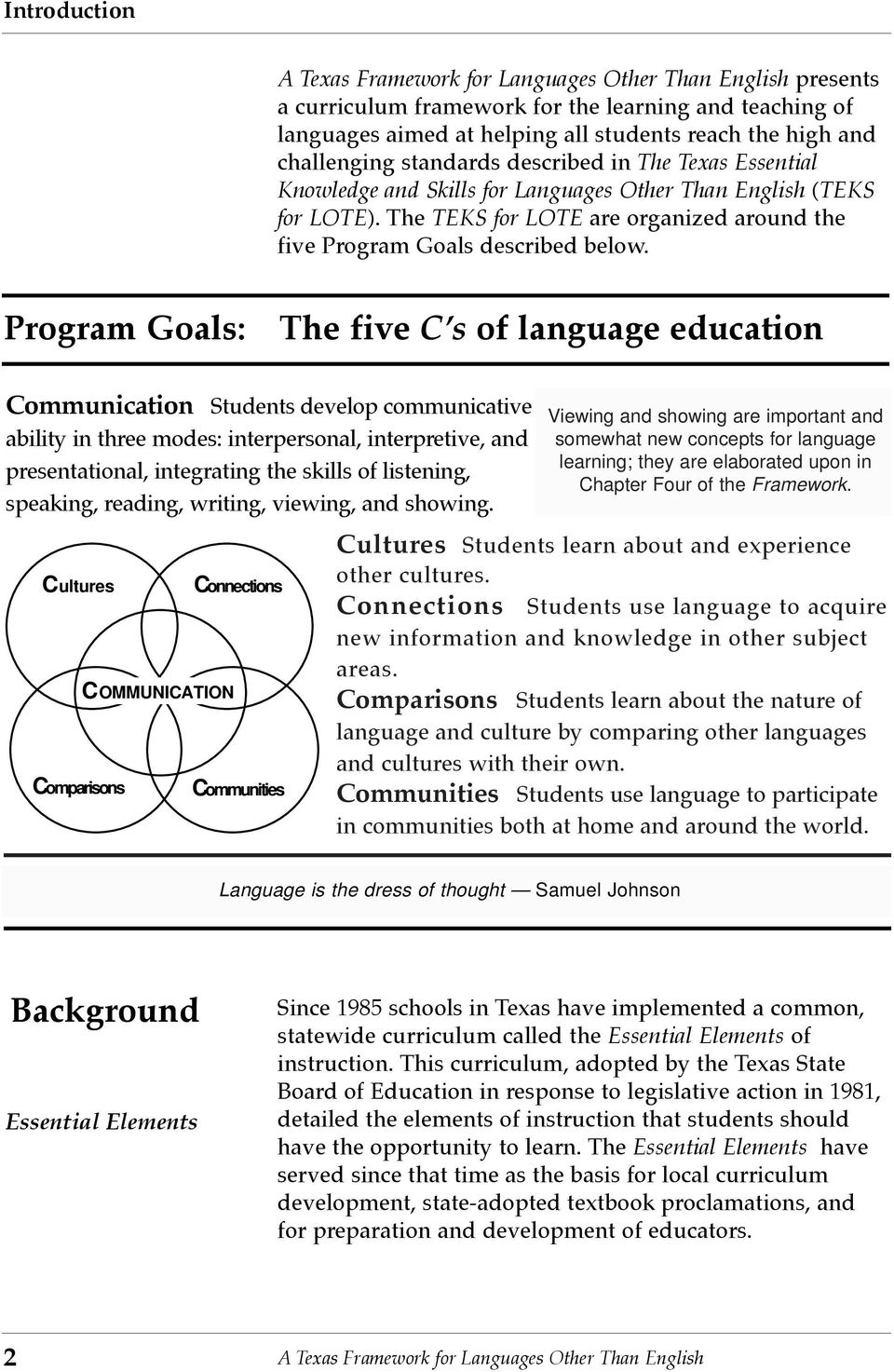
12 Introduction A Texas Framework for Languages Other Than English presents a curriculum framework for the learning and teaching of languages aimed at helping all students reach the high and challenging standards described in The Texas Essential Knowledge and Skills for Languages Other Than English (TEKS for LOTE). The TEKS for LOTE are organized around the five Program Goals described below. Program Goals: The five CÕs of language education Communication Students develop communicative ability in three modes: interpersonal, interpretive, and presentational, integrating the skills of listening, speaking, reading, writing, viewing, and showing. Viewing and showing are important and somewhat new concepts for language learning; they are elaborated upon in Chapter Four of the Framework. Cultures Connections COMMUNICATION Comparisons Communities Cultures Students learn about and experience other cultures. Connections Students use language to acquire new information and knowledge in other subject areas. Comparisons Students learn about the nature of language and culture by comparing other languages and cultures with their own. Communities Students use language to participate in communities both at home and around the world. Language is the dress of thought Samuel Johnson Background Essential Elements Since 1985 schools in Texas have implemented a common, statewide curriculum called the Essential Elements of instruction. This curriculum, adopted by the Texas State Board of Education in response to legislative action in 1981, detailed the elements of instruction that students should have the opportunity to learn. The Essential Elements have served since that time as the basis for local curriculum development, state-adopted textbook proclamations, and for preparation and development of educators. 2 A Texas Framework for Languages Other Than English
13 Introduction Texas Essential Knowledge and Skills Ten years after the first implementation of the Essential Elements, the Texas Legislature directed the Texas State Board of Education in 1995 to adopt the Texas Essential Knowledge and Skills for the required curriculum of the state's public schools, including Languages Other Than English (LOTE). The resulting TEKS for LOTE are to be used by school districts as guidelines for instruction. Languages other than English are now included in the requirements of two of the three graduation plans approved by the Texas State Board of Education: two years of a language are a required part of the Recommended High School Program, and three years of a language are required for the Distinguished Achievement Program. In recent years, the learning and teaching of languages in Texas and the nation clearly focused on the goal of communicative proficiency and cultural awareness through the development of linguistic skills. In addition, there are widely-accepted provisions for using LOTE to connect to other disciplines, to gain knowledge of English by making comparisons with the second language, and to participate more actively in the global community and marketplace. The TEKS for LOTE and the Framework exist for the purpose of improving the quality of learning and teaching languages. The TEKS for LOTE reflect high standards and high expectations for all students and present a positive challenge for teachers and school districts to deliver quality language instruction. What is a Framework? A curriculum framework is a guide to assist members of the educational community at the local school district level in the design and implementation of a well-articulated districtwide curriculum. A curriculum framework is also a guide for developing curriculum and assessments at the classroom level. Those directly involved in the process may include teachers, administrators, coordinators, and curriculum developers. In addition, a framework can be used as a tool to align the district curriculum with state standards, plan for preservice and inservice professional development, aid in the process A Texas Framework for Languages Other Than English 3
14 Introduction of selecting instructional materials, and educate the community about curriculum areas. A framework does not present detailed lesson plans, nor does it contain a list of items on which students should be tested. Curriculum frameworks are usually developed at the state level and may: reflect the policy and educational environment of the state and facilitate policy and curriculum decisionmaking in local districts and schools provide direction to local districts and schools while allowing for local flexibility provide a bridge between state standards and classroom practice reflect the thinking of state and national leaders and organizations in a discipline provide a common point of reference for state, district, and local educators to coordinate the components of the instructional system emphasize themes and concepts be implemented on a voluntary basis The Framework has been developed to provide guidelines and facilitate decisions at the local level about effective ways to deliver language instruction and design programs in the schools. The substance of the document addresses the tenets of the LOTE discipline, student performance expectations at various checkpoints, how students learn the discipline in varying ways as well as different ways to teach it, and strategies for translating the TEKS for LOTE into curriculum at the district level and devising activities and lessons at the classroom level. It is important to note that the Framework does not represent a set of prescriptive rules; it is meant to be expanded upon and interpreted for specific district and classroom needs. The Changing Paradigm of PreK- 12 LOTE Education In the past ten years, research in language instruction has changed the focus of the learning and teaching of LOTE. The teaching of LOTE is evolving to include programs that provide instruction from PreK-12 (PreKindergarten-Grade 12) and allow all students to develop language proficiency and skills they can use in the real world. This chart summarizes the general trends in the growth of the learning and teaching of languages other than English. 4 A Texas Framework for Languages Other Than English
15 Introduction Building on... an emphasis on offering traditional languages (such as Spanish, French, German, and Latin) Moving to... course offerings that include traditional languages and less commonly taught languages (such as Chinese, Japanese, Russian, and Arabic) programs starting in grades programs starting in elementary school and continuing 7 or 8 uninterrupted through high school LOTE courses for college- LOTE courses for all students bound students and students (as explained in guiding principle 1 on page 7) perceived as Òabove averageó language learning that enhances future career opportuni- ties and fulfills studentsõ personal interests and the needs of all sectors of society (government, community, busi- ness, and education) academic language learning which focuses on preparing students to study LOTE literature curriculum based on memorization grammar- and literaturebased curriculum language learning as a separate subject area placing native speakers in regular LOTE programs placing bilingual, ESL, and LOTE students in separate programs curriculum that emphasizes facts about the LOTE culture(s) textbook-driven instruction curriculum based on acquiring the language through meaningful communication proficiency-based curriculum that focuses on speaking, listening, reading, writing, viewing, and showing but also includes the study of grammar and literature language-across-the-curriculum, language as part of an interdisciplinary curriculum course offerings and/or assignment options specifically designed to maintain and expand language proficiency of native speakers programs that combine students with LOTE background and other students (e.g., dual-language and immersion programs) curriculum that provides ways to experience culture through language and that explores the student's own culture in the context of exploring other cultures a wide variety of instructional approaches and materials (including the Internet, CD-ROMs, and authentic materials such as newspapers in the language) Table 1.1: The Changing Paradigm of PreK-12 LOTE Education A Texas Framework for Languages Other Than English 5

16 Introduction Components of A Texas Framework for Languages Other Than English Introduction summarizes the importance of languages as part of all studentsõ PreK-12 educational program provides background information on statewide standards and curriculum development efforts in Texas defines and gives the purposes of a framework presents The Changing Paradigm of PreK-12 LOTE Education Guiding Principles presents eight key statements about the learning and teaching of languages other than English that provide the foundation for the Texas Essential Knowledge and Skills for Languages Other Than English Language Proficiency defines language proficiency and proficiency levels; addresses the relationship between accuracy and proficiency; describes novice, intermediate, and advanced proficiency levels TEKS for LOTE describes what all students should know and be able to do in LOTE according to the five Program Goals of Communication, Cultures, Connections, Comparisons, and Communities; provides Òlearning snapshotsó from selected classrooms Implementation provides helpful information about implementing LOTE programs at the district and classroom levels Frequently Asked Questions, Abbreviations & Acronyms, References, Index Appendices includes sample course outlines, selected resources, and other helpful supplementary material 6 A Texas Framework for Languages Other Than English

17 2 Guiding Principles ATexas Framework for Languages Other Than English is based upon a set of guiding principles, or key statements about the learning and teaching of languages other than English. These guiding principles are supported by language education research and experience as well as by a strong commitment to the importance of languages as part of all studentsõ educational program in our schools. Inclusion of all students 1 Acquiring languages other than English is essential for all students. Language learning benefits everyone Language learning is for everyone and its applications are countless. Throughout the United States the importance of knowing languages other than English is recognized not only for the benefits it brings students in an academic setting, but also for the benefits it brings to individuals and communities as we interact with others locally and around the world in business and in social situations. The people of Texas speak numerous languages and represent many A Texas Framework for Languages Other Than English 7
18 Guiding Principles different cultures; they have long valued the richness that TexasÕ heritage and culture bring to their state. All students can learn languages Students communicate and interact with people from other cultures Students develop thinking skills In the past, courses in languages other than English were geared primarily toward college-bound students. However, this trend is changing. Given the opportunity, all students are capable of and can benefit from learning other languages. Data from standardized tests of reading and math in Cincinnati, the state of Louisiana, and Milwaukee show that traditionally disadvantaged groups gain an educational advantage through instruction in languages other than English. Students with strong LOTE instruction in the early elementary grades scored consistently higher than those with no LOTE instruction (MŸller, 1989; Wisconsin Department of Public Instruction, 1996). The advantage that proficiency in LOTE provides in today's world has made learning languages increasingly important for all students. When students acquire another language, they gain the skills that allow them to communicate effectively in that language. They can engage in conversations for business and social purposes. By reading and writing the language, they can come to understand the thoughts, feelings, and ideas of others. Through LOTE, students learn to use language to interact with people from other places and cultures. The skills and knowledge acquired through the study of languages other than English are transferable to other areas of the curriculum and strengthen studentsõ intellect while enhancing their lives. Acquiring a new language helps students gain important thinking and reasoning skills, for example, as students ask and answer questions; express opinions; and summarize, synthesize, and evaluate material. Language learning is a building process; students progress by applying what they have learned to new situations. As they learn languages, students develop memorization skills using stored information to create and communicate in meaningful ways. Learning the structural differences between new languages and oneõs native language requires abstract reasoning, mental flexibility, and creative problem solving. 8 A Texas Framework for Languages Other Than English

19 Guiding Principles Students strengthen first language skills Students learn about other cultures Students learn about themselves Students enhance their first language skills as they learn their second language. They develop better listening skills by paying careful attention to the sounds and rhythms of the new language. They improve their speaking skills as they practice new sounds, paying attention to diction and pronunciation. Students in the LOTE classroom are constantly engaged in using language, gaining practice working with partners and speaking in front of large groups. These are valuable skills they can apply with increased confidence in their first language. Learning to decode and decipher another writing system helps students increase reading, writing, and problem-solving skills, equally applicable in the native language. In addition, language learners gain metalinguistic skills, that is, skills that enable them to think about languages and how they work, thus facilitating acquisition of additional languages and deepening their appreciation and understanding of their first language. By learning a language, students gain access to the culture(s) associated with that language. Using the necessary tools and communication strategies, they are able to identify cultural concepts and traits. In addition, students learn about everyday life and social institutions, contemporary and historical issues, works of literature and art, and scientific innovations. Having access to new and different types of information expands and enhances the knowledge students gain in other disciplines, allowing language students to bring new insights to the content of other subject areas. Language students learn to see the perspectives beneath the surface of the culture. The experience of learning a second language also increases awareness of self and others. As students get into the habit of looking beyond their customary cultural and linguistic Òborders,Ó they develop insight into their own language and culture and learn to treat others with respect. This promotes cross-cultural communication and understanding, and expands studentsõ sense of community. Students who graduate from high school knowing more than one language are better prepared to participate in the international community and marketplace of the twentyfirst century. Through learning languages, students become better prepared to interact with others and to extend their influence and participation in the world. In addition to the A Texas Framework for Languages Other Than English 9

20 Guiding Principles practical advantages that knowing languages brings, studying LOTE is enjoyable and brings personal fulfillment for many students. Student Variables 2 Multiple student variables affect how students acquire languages. First language acquisition and further language acquisition follow similar patterns Age and developmental stage Multiple intelligences and individual learning styles When children learn their native language, they construct that language in the real world. They use the language to convey particular meaning and for specific purposes. Similarly, acquiring a new language involves using previously acquired language skills within a context of meaningful and purposeful communication (Omaggio, 1993). Whether a preschooler, teen, or adult, students of all ages must internalize a languageõs components (such as its sound system, basic lexicon, and grammatical structures). In addition, language learners must have many opportunities to practice the language so as to develop effective communication strategies and culturally appropriate ways of interacting in the new language. All students can learn languages; the process of acquiring oneõs first language is very similar to how one acquires other languages. Still, it is critical that the instructional process match the studentsõ particular learning variables. The age and developmental stage of the learner is one variable that affects language acquisition. Elementary students can acquire language by actively listening and participating in real and meaningful contexts, such as storytelling, hands-on presentations using science or mathematics or social studies content, interactive songs, and childrenõs games. Young learners should use their new language in conversations about topics that interest them. Reading and writing should support and reinforce what was learned in listening and speaking activities. To develop language skills, early elementary students rarely need explicit instruction in syntax (Krashen & Terrell, 1983). Multiple intelligences and individual learning styles play a role in how students acquire language. As students mature, their individual language acquisition styles emerge. Auditory learners acquire language best by listening to oral presentations, 10 A Texas Framework for Languages Other Than English
21 Guiding Principles music, and tapes. Visual learners benefit from pictures, diagrams, models, maps, and the written word. Those who See Appendix C for multiple intelligences chart. learn kinesthetically like to move aroundñfor example through dancing and role-playingñthus connecting language to movement. Most students, however, learn and retain knowledge best through a combination of learning styles and intelligences (Gardner, 1993). Prior knowledge and experience with language Emotional and affective factors Learning disabilities Prior knowledge and experience with language and content also influence how students learn in language classrooms. The language studied may be the native language for some students while, for others, it could be their first experience with a language other than English. All students bring some type of language experience to the language learning classroom. Some students enter LOTE programs with well-developed listening and speaking skills in the target language that can become the foundation for literacy in that language. They will build upon the native language skills they bring and benefit from opportunities for further development in the skill areas of reading and writing. Finally, there are emotional and affective factors that influence language acquisition. StudentsÕ motivation, self-confidence, and level of anxiety can have an impact on how they learn languages. Students are motivated when the content is meaningful and purposeful. They are more apt to practice language when they feel comfortable, are free to make the For more information on affective factors that influence language learning, see Krashen's Affective Filter hypothesis (Krashen, 1995). mistakes necessary for gaining language skills, and are encouraged to take the risks necessary to create meaning in another language (Krashen, 1995; Larsen-Freeman & Long, 1991). Students who are identified as learning disabled because of difficulties in areas such as storing, processing, or producing linguistic information often experience challenges in learning languages. Reading and writing will present difficulties for students with certain types of learning disabilities, such as dyslexia or language-based learning disabilities (LLD). Teachers need to be alert to adaptations needed so that students with these difficulties can show what they do know and can do. Different forms of assessment may be necessary. A Texas Framework for Languages Other Than English 11
22 Guiding Principles For these students especially, immersion programs and/or instructional approaches that place particular emphasis on hearing, seeing, writing, manipulating, physically acting out, and connecting visuals with the language are recommended. Teachers respond to the different variables affecting how students acquire languages by using a variety of instructional strategies. These strategies help students learn more effectively and develop communicative proficiency or the ability to use language for purposeful communication. The chart below (Table 2.1) suggests strategies teachers can use in response to the variables affecting language acquisition described in this guiding principle. Variables Affecting Language Acquisition age and developmental stage diverse learning styles prior general knowledge prior linguistic knowledge emotional and affective factors learning disabilities Instructional Strategies choose age-appropriate experiences, topics, contexts, materials employ various instructional strategies including auditory, visual, and kinesthetic techniques build on knowledge and experiences acquired outside of the classroom provide multiple points of entry into language programs; choose activities where students can demonstrate various levels of proficiency create classroom environments where students are motivated and feel comfortable taking risks and making mistakes necessary for acquiring language use approaches that allow these students to be successfully included in the language learning experience, e.g., approaches that use and have students employ a combination of skills Table 2.1: Teacher Strategies for Student Variables 12 A Texas Framework for Languages Other Than English
23 Guiding Principles Advanced Proficiency 3 Knowing languages other than English at advanced proficiency levels upon graduation benefits students and society. Real-world applications for advanced language proficiency Lifelong learning Language as an important job skill When students graduate from high school knowing a language in addition to English at an advanced proficiency level, they are able to use that language for real-world applications in the community, on the job, and in their personal lives. Real-world applications of LOTE include reading and writing letters or reports, giving presentations, conducting business over the telephone See Chapter Three for a definition of advanced proficiency. for work or educational purposes, reading newspapers from around the world to stay up on current events, and using mail or the Internet for making lasting friendships. In school, students of LOTE develop the skills to become lifelong learners. Outside of school, students use these skills and the language to stay current about world events via newspapers, magazines, television, and the Internet. They enrich their personal lives by reading books and enjoying programs and presentations in other languages. They use LOTE to communicate with other people with personal messages via locally and internationally. Knowing more than one language is an increasingly desirable job skill. It is not enough for students to graduate simply being able to use a language to say their names, talk about the weather, and ask where they can find the post office. TomorrowÕs graduates need to reach advanced levels of proficiency; such proficiency allows them to use technology, work, travel, interact with people across cultures, and participate in a world of selling products and ideas. It is the goal of the TEKS for LOTE that students will be able to achieve advanced proficiency in a language other than English. This is possible only when programs begin early, preferably in elementary school; however, different learners and different programs will lead to different levels of achievement in regard to this goal. Proficiency is closely related to the length of time a student studies and practices the second language. A Texas Framework for Languages Other Than English 13
24 Guiding Principles Students of classical languages obtain linguistic skills and historical perspective Knowing languages strengthens our society Classical language learners benefit from advantages including and in addition to those mentioned above. Students of classical languages enrich their English vocabulary and develop a basis for better understanding modern languages. Also, by learning about the ancient world, they gain a sense of where we have been and how we have changed throughout history and an appreciation for western cultures of past times. On a national level, a multilingual populace strengthens our society by expanding its membersõ sense of community. When individuals are able to use language to cross linguistic and cultural boundaries, they gain an understanding of each otherõs similarities and differences and learn to treat each other with respect. Benefits of Extended Sequences 4 LOTE programs that start in elementary school and continue uninterrupted through high school allow students to reach advanced levels of proficiency and benefit students in other academic and social arenas. Studies show that developing advanced language proficiency requires an extended period of time so that students have ample opportunities to experience and practice the language in meaningful communication. Students who begin their course of study early, i.e., in elementary school, have a better chance of developing an advanced level of proficiency and of being able to use LOTE effectively (Curtain, 1990; Omaggio, 1993). Developing proficiency takes time The simple truth is that learning to communicate in another language takes time. The goals set out in the TEKS for LOTE for advanced proficiency simply cannot be reached in two or three years of language study. Given enough class time and a good instructional program, students can start the study of a language in middle or high school and do well; however, it is unlikely that they will reach a level of proficiency required for most real-world applications. Data from the testing of Texas students in their third year of high school language study show that some students do reach the 14 A Texas Framework for Languages Other Than English
25 Guiding Principles intermediate level of language proficiency in speaking and listening, but even students from homes where the language studied is spoken rarely move into the advanced level without strong language instruction in the early grades (Texas Education Agency, 1995). Even though native language learners also need literacy instruction in the elementary grades in order to reach an advanced level of proficiency in high school, their advantage is that the total number of years of instruction needed to reach this proficiency is less than non-native language learners require. The opportunity to achieve advanced proficiency is not the only reason to start learning languages in elementary school; language study is beneficial to elementary-age students for other reasons as well. Research studies (as cited by Lipton, 11-12, 1995) attest to the following: Learning languages in childhood has benefits beyond communicative proficiency Children have the ability to learn and excel in the pronunciation of a foreign language. Children who have studied a foreign language in elementary school achieve expected gains and some have even higher scores on standardized tests in reading, language arts, and mathematics than those who have not. Children who have studied a foreign language show greater cognitive development in such areas as mental flexibility, creativity, divergent thinking, and higher-order thinking skills. Children who have studied a foreign language develop a sense of cultural pluralism (openness to and appreciation of other cultures). Children studying a foreign language have an improved self-concept and sense of achievement in school. Elementary school foreign language study has a favorable effect on foreign language study later on in high school and college, whether it is the same language or another. According to some theories of cognitive development, it is preferable that children start learning other languages before they reach the age of ten. Popular media such as Newsweek and Time featured articles summarizing this A Texas Framework for Languages Other Than English 15
26 Guiding Principles Starting language learning before age ten provides numerous advantages Long-term students of LOTE perform well on standardized tests Learning a second language at an early age enhances native language development research. The reasons to start early are diverse. Some research shows that there is a "critical period" in childhood when language learning, and pronunciation acquisition in particular, occur with relative ease (Lenneberg, as cited in Larsen-Freeman & Long, 1991; Oyama, as cited in Ellis, 1986). Others have found that age ten is a crucial time Òin the development of attitudes towards nations and groups perceived as other,ó before children begin to restrict their thinking to a more stereotyped view of people they see as different from themselves (Curtain & Pesola, 1994). Students enrolled in LOTE programs score statistically higher on standardized tests conducted in English. A study by the Admission Testing Program of the College Board showed that students who have studied a second language earn higher Scholastic Aptitude Test (SAT) scores than those who have not, particularly on the verbal section of the test. In fact, the longer the students had studied LOTE, the better the SAT scores (Eddy, as cited in Weatherford, 1986). Learning another language enhances a child's linguistic abilities in his or her native language. Children can learn much about their native language by learning the structure of other languages. Similar vocabulary between languages also helps children reinforce the meaning of new words in their native language and the new language. Experimental studies that compared children participating in second language immersion classes and children educated exclusively in the native language showed no long-term delay in native language development for those children in immersion classrooms. Another study showed that by the fifth year of an For more information see Your Child s Brain, Newsweek (Begley, 1996) and Fertile Minds, Time (Nash, 1997) See Chapter Five for more information on types of immersion programs. immersion program, students academically outperform all comparison groups and remain high academic achievers throughout their schooling (Holobow et al., Swain & Lapkin, as cited in Met, 1993). Learning a second language strengthens rather than hinders a childõs first language. 16 A Texas Framework for Languages Other Than English
27 Guiding Principles Native Speakers 5 Maintaining and expanding the language of native speakers benefits the individual and society. In many schools in Texas there is a large group of students who have a background in the LOTE being taught. While Spanish speakers represent the vast majority of speakers of LOTE in Texas, growing numbers of students come to school every year speaking a variety of other languages as well. These students are called ÒheritageÓ speakers by some experts in language education. All of these students possess some knowledge of and functional ability in the language. These students are valuable linguistic and cultural resources and their language skills should be expanded and strengthened. Students should know that the language they bring from home has value at school. They should be made to feel comfortable enough in a classroom setting to use the language in an uninhibited fashion. Since students with home backgrounds in languages other than English have varying abilities and proficiencies and varying amounts of motivation to learn the language, instruction in the language should take into account the previous knowledge and language experience that these students possess. It is important for school districts to recognize that these students have instructional needs that are different from those of the traditional foreign language student and may require a curriculum specially developed for them. For example, many districts offer Spanish for Spanish Speakers (SSS) courses For more information look for a forthcoming revision of the Texas Education Agency publication Español para el hispanohablante: función y noción. that offer students with home background in Spanish, i.e., those who hear Spanish at home, an important opportunity to further develop and strengthen their Spanish skills, while simultaneously benefiting their use of English. For more information on students with home background in LOTE and SSS programs, please see pages A Texas Framework for Languages Other Than English 17
28 Guiding Principles Offering a Variety of Languages 6 Students should have opportunities to develop proficiency in a variety of languages. In addition to English, there are currently dozens of languages used by the people of Texas. These languages include, but are certainly not limited to, Arabic, Chinese, Czech, Danish, French, German, Greek, Hungarian, Indic, Italian, Japanese, Khmer, Korean, Laotian, Native American languages, Norwegian, Polish, Portuguese, Russian, Spanish, Swedish, Tagalog, Vietnamese, and Yiddish. Moreover, the ten most frequently-spoken languages other than English in the United States include languages such as Spanish, Chinese, Tagalog, Italian, and Vietnamese (U.S. Bureau of the Census, 1990). In states like Texas where Spanish is a commonly spoken language, limited resources may cause communities to choose Spanish as the only language offered in a PreK-12 sequence. Nevertheless, considering the vast array of languages used in Texas and in the United States and considering the relative and emerging world importance of some of the less commonly taught languages, school districts, as often as possible, should find ways to offer students the opportunity to learn a variety of languages. Knowledge of languages such as Chinese, Japanese, and Russian is becoming more and more important as countries and states that use these languages come to the forefront of international relations and the world economy. For optimum learning, school districts should provide students with opportunities to study at least one language other than English in an extended sequence starting in elementary school and continuing through high school. Shorter sequential programs should, of course, remain available. Ideally, districts should offer PreK-12 programs in some of the less commonly taught languages; however, if such programs are not feasible, districts should begin by offering high school programs in these languages and progress from there. Opportunities to study third and fourth languages also should be provided in high school; then students can pursue higher levels of proficiency in these languages at post-secondary institutions. 18 A Texas Framework for Languages Other Than English
29 Guiding Principles Interdisciplinary Nature of Language 7 Learning languages other than English is interdisciplinary. Learning languages other than English enlarges the base of knowledge available to a student. All students can add to their educational experience by using another language for interdisciplinary connections within the school curriculum. Students who have skills and knowledge in LOTE have expanded access to information that is not always available to those who only speak English, such as materials from Germany about acid rain that a student might use for a science report. In the LOTE classroom, students are able to access sources in the language being studied that add insight to the rest of the curriculum, such as a French perspective on World War II, or a Japanese perspective on cooperative management in a company. Students of LOTE have the advantage over their monolingual peers of expanded resources and knowledge. Content from other disciplines is incorporated into the LOTE curriculum as a vehicle for communicating in the language. In addition, students gain insights into other subject areas by studying original works in LOTE, such as a newspaper for social studies or poetry for English language arts. Using the language, students might: study world history, historical figures, cultural variation, and geography, which reinforce social studies skills study mathematical terms and concepts and compare weights and measures, which reinforce mathematical skills learn computer and software terminology by producing a variety of documents and use other technological equipment for worldwide communications, which reinforce a variety of technology skills use reading, writing, and speaking processes, which reinforce English language arts and reading skills study business terminology and sociolinguistics, which support social and business communication skills A Texas Framework for Languages Other Than English 19

30 Guiding Principles learn about climate, weather, and environmental factors, which reinforce scientific skills expand their vocabulary in content areas Students will use language in these activities at a level appropriate to their age, grade, and language ability. Increased Cultural Understanding 8 Languages other than English enable students to better understand other cultures. Learning about and experiencing other cultures is an integral part of studying languages other than English. In addition to the traditional ways of studying culture, i.e., studying the facts, events, famous people, and monuments of the culture, culture in language instruction is now generally Perspectives Products Practices understood to include the perspectives (how people perceive things), the practices (what people do), and the products (what people create, both tangible and intangible) of a society. In other words, the LOTE discipline has grown to value and encompass a fuller, more comprehensive understanding of culture. One resulting goal for the language classroom is using traditional aspects of cultures to better understand their products, practices, and perspectives. The diagram above illustrates how the products, practices, and perspectives 20 A Texas Framework for Languages Other Than English
31 Guiding Principles of a culture are interrelated. The components, or ÒgearsÓ, of culture (products, practices, and perspectives) are mechanisms that perform specific functions within the complete ÒmachineÓ that is culture. The gears are interlinked and dependent upon one another to make culture ÒfunctionÓ, and therefore exist, as we know it. Using products, practices, and perspectives to frame the study of culture represents a relatively new way of thinking about culture for most language teachers. Perspectives, in particular, may be a difficult concept to grasp. In fact, not all teachers of LOTE will know all of the perspectives of a given culture, e.g., their values and attitudes. The goal is to teach about observing and analyzing cultural information in order to determine what the perspectives of individuals and groups in the culture are. Studying the cultural perspectives behind the behavioral patterns of people in that culture (practices) and behind the tangible and intangible creations of art; literature; dance; music; and social, economic, and political institutions (products) creates a balanced approach to understanding a culture. A great deal of information about other cultures can be gained through the study of disciplines such as the social sciences and the arts. Language study is unique, however, as it empowers learners to engage in meaningful, direct interaction, both orally and in writing, with members of other cultures and to experience culture through language. The perspectives, practices, and products of culture, whether historical or contemporary, can be discussed and shared with members of the actual culture from which they originate. The ÒinsiderÕs viewó that is cultivated by interacting with a culture is a true catalyst for cross-cultural understanding. As students observe and analyze the interdependence of perspectives, practices, and products of a culture, they become more aware of similarities and differences among cultures. Students explore their own cultures in the context of exploring others, thus becoming reflective learners adept at using their newly-acquired, cross-cultural vision. A Texas Framework for Languages Other Than English 21
32 22 A Texas Framework for Languages Other Than English
33 3 Language Proficiency Language Proficiency Language proficiency is the ability to use language for purposeful communication. Proficiency describes what students are able to do with language using the skills of listening, speaking, reading, writing, viewing, and showing. Participating in class discussions, reading literature, playing educational games, giving oral presentations, or watching a video of a news report are examples of purposeful communication in an educational setting. Language proficiency should not be confused with achievement. Achievement, which is also important for students, looks only for students to develop mastery of the content of instruction such as grammar and vocabulary in a particular course. An emphasis on developing proficiency in LOTE classrooms, however, prepares students to use language in practical and meaningful ways in addition to mastering the content necessary for such communication to take place. Achievement is a part of gaining proficiency. Teachers continuously need to move students beyond just learning the elements of language to using them proficiently for purposeful communication. A Texas Framework for Languages Other Than English 23
34 Language Proficiency Progress Checkpoints Language proficiency is not developed in a strict linear progression, a progression of equal-sized blocks of material learned and tested. Rather, language proficiency develops when practice is guided repeatedly over time to help students gain confidence and fluency in different language functions. Teachers plan classroom activities to help students get closer and closer to authentic use of language structures and vocabulary, knowing that students' experimentation with language will falter as structured support (such as written sheets to guide pair work) is removed, but will then progress again as students stretch to creatively apply their language tools. In this section, key Progress Checkpoints along the path of proficiency are described. These checkpoints cannot be precisely equated with year-long courses, since experience makes clear that students do not neatly reach a new checkpoint at the end of each school year. The pathway is constant, but the time it takes each student to reach each checkpoint is not. These Progress Checkpoints help guide the teacher and students to know first the goals for designing developmental activities and second the signs showing that students are reaching a given checkpoint. In this way, the Progress Checkpoints will guide curriculum, instruction, and assessment. The specified Progress Checkpoints in the TEKS for LOTE represent different learning stages also known as proficiency levels (novice, intermediate and advanced). An inverted triangle is often used to show that as students advance from See page 26 for an illustration of language development. Progress Checkpoint to Progress Checkpoint, the amount of time and practice needed to reach the next stage increases. A student can move relatively quickly through the early stage of mimicking memorized words and phrases, a stage that is limited, controlled, and comfortable. To move into later stages, characterized by flexible, challenging, and creative use of language, requires longer periods of practice and an increasingly meaningful volume of experiences. 24 A Texas Framework for Languages Other Than English
35 Language Proficiency Gaining proficiency is a process that requires repeated exposure and opportunities to practice new language functions, vocabulary, and structures; to receive feedback; and to use skills in increasingly sophisticated contexts. A topic introduced at one level might reappear in the next as a challenge in a new context; learners reach for the next level as they begin to control the tasks of the present level. ÒMasteryÓ does not come two or three weeks after material is introduced, but rather after the student has had many opportunities to practice the material in meaningful ways. In addition, students do not "wake up" one day having changed Progress Checkpoints; instead, they move through stages within the Progress Checkpoint (e.g., novice-low, novice-mid, novice-high) as they progress toward the next Progress Checkpoint by showing increasing control over and consistency in the use of the language proficiency characteristics at the next checkpoint. Accuracy and Proficiency Levels Accuracy is the degree to which communication is structurally correct and culturally appropriate (The College Board, 1996). In real-life situations, communication occurs without complete structural precision, that is, grammar mistakes do not necessarily equate to lack of communication. However, a high degree of accuracy, including communicating in a socially and culturally appropriate manner, is very important to achieving high levels of proficiency. At different levels of proficiency, students exhibit different degrees of accuracy. Novices, for example, may repeat memorized phrases with nearly perfect grammar and pronunciation. As they begin to combine these learned phrases in an effort to build more creative ones, accuracy initially declines. Temporary fluctuations in accuracy normally accompany increases in skill development. As students grow more secure in their understanding of another culture, their ability to behave in culturally appropriate ways increases. The overall goal is to gradually use and mesh cultural and linguistic skills with increasing accuracy in order to obtain a high level of language proficiency. A Texas Framework for Languages Other Than English 25
36 Language Proficiency The Inverted Triangle of Language Development: Progress Checkpoints and Proficiency Levels Advanced learners satisfy the requirements of school and work situations and narrate and describe in paragraph-length discourse. amount of language increases Intermediate learners create sentences to ask and answer questions, communicate about personal history or leisure activities, and meet basic survival needs. Novice learners use single words, phrases, and common expressions they have learned on basic, everyday topics. complexity of language increases Illustration 3.1 Students of classical languages can reach an advanced level of proficiency in reading and use the skills of listening, speaking, and writing to enhance the reading skills. 26 A Texas Framework for Languages Other Than English
37 Language Proficiency Progress Checkpoints: Modern and Classical Languages Progress Checkpoints describe what students should know and be able to do at the end of each level of proficiency. The following descriptions help students, teachers, and parents know how well students should be able to perform the Texas Essential Knowledge and Skills for Languages Other Than English. These Progress Checkpoints provide an overall view of the expectations for student performance at critical points along the language learning continuum. As students progress, they may experiment with and show some ability in language characteristics normally beyond their proficiency level; however, for most students their consistent and independent use of the language follows the progression from novice, through intermediate, to advanced. Progress Checkpoints will influence the design of class activities and assessment by providing a broad focus for the evaluation of student work. Novice Levels I-II Using age-appropriate activities, students develop the ability to perform the tasks of the novice language learner. The novice language learner, when dealing with familiar topics, should: Novice understand short utterances when listening and respond orally with learned material; produce learned words, phrases, and sentences when speaking and writing; detect main ideas in familiar material when listening and reading; make lists, copy accurately, and write from dictation; recognize the importance of communicating in a culturally appropriate manner; and recognize the importance of acquiring accuracy of expression by knowing the components of language, including grammar. Students of classical languages use the skills of listening, speaking, and writing to reinforce the skill of reading. For an adaptation of these Progress Checkpoints for classical languages, see Appendix D. A Texas Framework for Languages Other Than English 27
38 Language Proficiency Intermediate Levels III-IV Using age-appropriate activities, students expand their ability to perform novice tasks and develop their ability to perform the tasks of the intermediate language learner. The intermediate language learner, when dealing with everyday topics, should: Intermediate participate in simple face-to-face communication; create statements and questions to communicate independently when speaking and writing; understand main ideas and some details of material on familiar topics when listening and reading; understand simple statements and questions when listening and reading; meet limited practical and social writing needs; use knowledge of the culture in the development of communication skills; use knowledge of the components of language, including grammar, to increase accuracy of expression; and cope successfully in straightforward social and survival situations. In survival situations, students can satisfy basic needs within another culture. In classical languages, the skills of listening, speaking, and writing are used in Level III to reinforce the skill of reading. Students of classical languages should reach intermediate proficiency in reading by the end of Level III. Students of classical languages use the skills of listening, speaking, and writing to reinforce the skill of reading. See Appendix D for an adaptation of these Progress Checkpoints for classical languages. Advanced Levels V-VII Using age-appropriate activities, students master novice tasks, expand their ability to perform intermediate tasks, and develop their ability to perform the tasks of the advanced language learner. 28 A Texas Framework for Languages Other Than English
39 Language Proficiency The advanced language learner of modern languages, when dealing with events of the concrete world, should: Advanced Advanced Levels V-VII Classical Languages participate fully in casual conversations in culturally appropriate ways; explain, narrate, and describe in past, present, and future time when speaking and writing; understand main ideas and most details of material on a variety of topics when listening and reading; write coherent paragraphs; cope successfully in problematic social and survival situations; achieve an acceptable level of accuracy of expression by using knowledge of language components, including grammar; and apply knowledge of culture when communicating. The advanced language learner of classical languages reads and comprehends authentic texts of prose and poetry of selected authors. The skills of listening, speaking, and writing are used to reinforce the skill of reading. Students of classical languages may reach advanced proficiency in reading during Level IV. (A student who completes a College Board Advanced Placement course or the International Baccalaureate in Latin should reach advanced proficiency in reading during Level IV.) For an adaptation of these Progress Checkpoints for classical languages, see Appendix D. Sample Grade Level Activities for Progress Checkpoints These sample grade level activities provide a glimpse of what an observer might see happening in LOTE classrooms. As beginning language students try to achieve the knowledge and skills described in the Progress Checkpoints, they will show their achievement in different ways that are ageappropriate and matched to their own cognitive development. The following sample activities provide examples of teaching strategies that are focused on the TEKS for LOTE. These activities could be applied to different Program Goals of the TEKS for LOTE, blending the practice of communication skills with the context of learning culture, seeking interdisciplinary connections, making comparisons, and applying these skills in community settings. A Texas Framework for Languages Other Than English 29
40 Language Proficiency Sample Novice Activities Novice learners use words, phrases, and expressions they have learned on basic, everyday topics. Elementary Here are some examples of how novice learners in elementary school use the language. These learners may: Novice introduce themselves and answer questions about their age, where they live, and the people in their families talk about favorite toys, pets, and activities listen to and comprehend simple story books play games on the playground put on puppet shows use learned words and phrases to list and write short sentences label articles in the classroom, colors on the spectrum, and places on maps where the language is used sing songs and perform dances from the culture Middle School and High School Here are some examples of how novice learners in middle school and high school use the language. These learners may: Novice communicate about topics appropriate to their age, such as school schedules communicate while engaging in an organized sport conduct a survey on studentsõ favorite entertainers exchange information about self, family, and school life with students from the culture via simple notes, , or audio and video tapes dramatize a typical shopping experience using culturally appropriate behavior read (or scan) the employment section of a newspaper in the language being studied and then list job opportunities where knowledge of more than one language is useful collect and display newspaper clippings concerning political, economic, and/or cultural topics and give the main idea 30 A Texas Framework for Languages Other Than English
41 Language Proficiency Sample Intermediate Activities Intermediate learners create sentences to ask and answer questions, to communicate about personal history or leisure activities, and to meet basic survival needs. Middle School and High School Here are some examples of how intermediate learners in middle school and high school use the language. These learners may: Intermediate demonstrate and narrate a simple scientific experiment, such as the use of magnets use mathematical skills to indicate the cost of preparing a dinner in the culture or cultures being studied write and present a skit about a shopping expedition in the culture being studied read descriptions of several jobs and then create mock ržsumžs to include with applications for a job write a summary putting narrative events in sequence after viewing a familiar video or film develop and present a plan for a real or imaginary trip to a place where the language studied is used, including an itinerary, hotel accommodations, and tours research opportunities in higher education in countries outside the U.S. where the language is used Sample Advanced Activities Advanced learners satisfy the requirements of school and work situations and narrate and describe in paragraphlength discourse. Middle School and High School Here are some examples of how advanced learners in middle school and high school use the language. These learners may: Advanced initiate, sustain, and close conversations read a novel, summarize its plot, and analyze charactersõ motivations and conflicts view or listen to a news report from a country about an event of international importance and compare and contrast coverage of the same event in the local media research and give a presentation about leading environmental concerns in a country where the language is spoken A Texas Framework for Languages Other Than English 31
42 32 A Texas Framework for Languages Other Than English
43 4 Texas Essential Knowledge and Skills for Languages Other Than English Introduction ATexas Framework for Languages Other Than English is inextricably tied to the Texas state student content and performance standards, the Texas Essential Knowledge and Skills for Languages Other Than English (TEKS for LOTE). The standards describe what all students should know and be able to do in the LOTE discipline. The TEKS for LOTE are organized around five Òknowledge and skillsó, or Program Goals: Communication, Cultures, Connections, Comparisons, and Communities. SEDL s Project ExCELL, the organization responsible for coordinating the development of TEKS for LOTE for State Board of Education consideration, owes a debt of gratitude to the National Standards Project in Foreign Language Education for the development of Standards for Foreign Language Learning: Preparing for the 21st Century. The five C s paradigm and many of the guiding principles found in the TEKS for LOTE have much in common with the national document, which is grounded in research on how students acquire a second language and represents a consensus across the foreign language profession about what students should know and do in a language. A Texas Framework for Languages Other Than English 33
44 Texas Essential Knowledge and Skills for Languages Other Than English Interrelationship of the Five Program Goals The five Program Goals form the foundation of current LOTE programs. The first goal, Communication, is the vehicle by which students reach the other four goals, Cultures, Connections, Comparisons, and Communities. In language classrooms, students are always communicating. Communication is the vehicle students use to become linguistically proficient. What students communicate about (topics, themes, literature, etc.) and in what contexts their communication takes place (in person, in writing, via the Internet, etc.) can be viewed as the content of the LOTE subject area. Cultures Connections gain knowledge and understanding of other cultures make connections with other subject areas and acquire information develop insight into the nature of language and culture by comparing the student s own language and culture to another Comparisons COMMUNICATION use the skills of listening, speaking, reading, writing, viewing and showing participate in communities at home and around the world by using languages other than English Communities Illustration 4.1: Interrelationship of the Five Program Goals 34 A Texas Framework for Languages Other Than English
45 Texas Essential Knowledge and Skills for Languages Other Than English Program Goals: The content of the five CÕs Each of the five CÕs is made up of specific content areas. For each content area, there are Knowledge and Skills, Performance Expectations, Example Progress Indicators, Learning Snapshots, and Progress Checkpoints. These are discussed below. Communication Interpersonal mode Interpretive mode Presentational mode Cultures Practices and Perspectives Products and Perspectives Connections Access to Information Other Subject Areas Comparisons Nature of Language Concept of Culture Influence Communities Within and Beyond the School Personal Enrichment and Career Development TEKS for LOTE : Components in the Framework Knowledge and Skills Performance Expectations Example Progress Indicators Learning Snapshots Progress Checkpoints A general statement describing what students should know and be able to do. These statements appear in the official TEKS for LOTE (included as Appendix H). Statements describing what students are expected to know and be able to do at a Progress Checkpoint. These statements appear in the official TEKS for LOTE (Appendix H). Illustrations of what students might do to show their progress in meeting the Performance Expectations outlined in the TEKS for LOTE. They provide sample descriptions of what a student should know and be able to do at the Progress Checkpoints. The Example Progress Indicators are just that, examples; they are by no means limited to the few listed on the following pages. Example Progress Indicators were created for use in the Framework. These example progress indicators may not always apply to classical languages. For examples of progress indicators for classical languages at the three progress checkpoints, see Appendix D. Brief examples of real classroom activities that show what Program Goals, Knowledge and Skills, or Performance Expectations can look like when implemented. Teachers wrote the learning snapshots which were adapted for use in the Framework. Many of the learning snapshots can be adapted to all languages, proficiency levels, and grade levels. Usually more than one knowledge and skill and performance expectation are reflected in the learning snapshots. The proficiency students should be able to demonstrate at novice, intermediate, and advanced language levels. Descriptions of the Progress Checkpoints appear in the official TEKS for LOTE, Appendix H. A Texas Framework for Languages Other Than English 35
46 Texas Essential Knowledge and Skills for Languages Other Than English Communication Communication skills are the primary focus of language study. These skills include the usual skills of listening, speaking, reading, and writing, as well as viewing and showing skills. Students develop communication skills by using knowledge of language and culture, communication strategies, learning strategies, and content from other subject areas. Through the Communication goal, students develop the skills necessary to manipulate the content of the other four Program Goals. Viewing means understanding and interpreting non-linguistic communication like gestures, seeing a presentation of a play (and not just reading it), observing cultural practices and manifestations (e.g., noticing that French windows are different from American windows), looking at cultural products, such as works of art, and gaining visual information in addition to linguistic information from advertisements and television programs. Interpretation is the communication mode used primarily for viewing. Showing includes expressing understanding of non-linguistic elements such as gestures, demonstrations of cultural practices, (e.g., dances), using graphics and illustrations with presentations, and role-playing. Presentation is the communication mode used primarily for showing. The national English language arts standards link skills with their medium: reading and writing use written language, listening and speaking use spoken communication, and viewing and showing involve visual language: Being literate in contemporary society means being active, critical, and creative users not only of print and spoken languages but also of the visual language of film and television, commercial and political advertising, photography, and more. Teaching students how to interpret and create visual texts such as illustrations, charts, graphs, electronic displays, photographs, film, and video is another essential component of the English language arts curricula. Visual communication is part of the fabric of contemporary life.... We must therefore challenge students to analyze critically the texts they view and to integrate their visual knowledge with their knowledge of other forms of language. By studying how visual texts work, students learn to employ visual media as another powerful means of communication. (National Council of Teachers of English, 1996). The Texas Essential Knowledge and Skills for English Language Arts and Reading also provides content standards for viewing and representing in grades PreK A Texas Framework for Languages Other Than English
47 Texas Essential Knowledge and Skills for Languages Other Than English Communicative proficiency derives from control of three modes of communication: interpersonal, interpretive, and presentational. Students need practice in all three types of communication throughout a program in order to satisfy their most commonly expressed reason for taking a language class: to learn to communicate. Interpersonal mode Interpretive mode Presentational mode In the interpersonal mode, there is direct exchange of communication between individuals, either listeners and speakers, or readers and writers. This mode calls for active negotiation of meaning among the individuals and requires a natural pattern of adjustment and clarification in order to achieve successful communication. Both receptive skills (listening and reading, sometimes enhanced by viewing) and productive skills (speaking and writing, sometimes enhanced by showing) are required in the interpersonal mode. The interpretive mode includes the receptive skills of listening and reading. The communicative source (e.g., the author, speaker, or actor) is not present or accessible; therefore, negotiation of meaning is not possible. The listener or reader must determine the meaning by using prior knowledge of the language and culture, personal knowledge about the subject, learning strategies, and, perhaps, reference materials. Interpretation of any medium is enhanced by viewing, whether of pictures, staging, setting, or body language. The presentational mode calls for the creation of formal messages, public speaking or an editorial, for example, to be interpreted by listeners or readers where there is no opportunity for active negotiation of meaning between listeners and speakers or readers and writers. The productive skills (speaking and writing) are used in this mode. The presentational mode is enhanced by the showing of non-linguistic elements such as photographs, gestures, demonstrations of cultural practices (e.g., dances, sports), the use of graphics or illustrations, and role-playing. A Texas Framework for Languages Other Than English 37
48 Texas Essential Knowledge and Skills for Languages Other Than English LOTE teachers make effective communication and learning strategies explicit in classroom instruction to help students become self-motivated, independent learners. Communication Strategies Language Learning Strategies Students need to learn strategies for communication, such as how to begin, sustain, and end conversations, how to stall for thinking time, how to use circumlocution to get around a communicative impasse, or how to avoid mistakes in grammatical structures not yet mastered. These skills go beyond learning vocabulary words and rules for pronunciation, grammar, spelling, and punctuation. Learning about and using communication strategies is part of the Communication Program Goal in the TEKS for LOTE. Another part of communication is becoming aware of and using effective language learning strategies. For example, students learn to be persistent and creative in testing hypotheses when faced with oral or written communication they do not fully understand. They look for cognates to see if a word might be in the same family as a word they already know, keep reading or listening for further information to complete their understanding, and guess at meaning from context. Students learn to activate prior knowledge and apply it to the current task. They keep trying different ways to understand the oral or written communication until they succeed, instead of simply trying the same ineffective techniques such as reading a passage over and over, thinking it will eventually make sense. Effective learners know how they learn best. They visualize new words and how they are related to each other, using mnemonic devices such as a formula or rhyme as an aid to remembering. They take risks in order to communicate their ideas, monitor their own language production for errors, and seek corrective feedback. The content and context of Communication are derived from the other four Program Goals: Cultures, Connections, Comparisons, and Communities, and should always be ageappropriate. 38 A Texas Framework for Languages Other Than English
49 Texas Essential Knowledge and Skills for Languages Other Than English Learning Snapshot ENTREVISTAS DE NUESTRA COMUNIDAD DE HISPANOHABLANTES (INTERVIEWS OF OUR SPANISH-SPEAKING COMMUNITY MEMBERS) Students prepare for, conduct, and compile interviews with Spanish-speaking members of their community including parents, teachers, students, and other members of the local community. The interviews are recorded on cassette and the students take notes during the interview. Students present their interviews to the class and also write summaries for a booklet or newsletter. Students also write formal thank-you letters to their interviewees. María D. González, Northside ISD, Clark High School Grades 10-12, Spanish, Course Level IV, Intermediate A Texas Framework for Languages Other Than English 39
50 Texas Essential Knowledge and Skills for Languages Other Than English Knowledge and Skills Communication: Interpersonal mode The student communicates in a language other than English using the skills of listening, speaking, reading, and writing. Performance Expectations Novice Intermediate Advanced The student is expected to engage in oral and written exchanges of learned material to socialize and to provide and obtain information. The student is expected to engage in oral and written exchanges to socialize, to provide and obtain information, to express preferences and feelings, and to satisfy basic needs. The student is expected to engage in oral and written exchanges, including providing and obtaining information, expressing feelings and preferences, and exchanging ideas and opinions. Example Progress Indicators Novice Intermediate Advanced By the end of the novice level students are able to: introduce themselves and respond to biographical questions express likes and dislikes about the immediate environment use authentic menus to order food By the end of the intermediate level students are able to: create and respond to questions in a simple conversation survey others about their opinions on ageappropriate topics plan a party menu which includes a variety of foods By the end of the advanced level students are able to: initiate, sustain, and close a conversation compare and contrast their own school rules with those from other cultures discuss what constitutes a healthy diet and its impact on health 40 A Texas Framework for Languages Other Than English
51 Texas Essential Knowledge and Skills for Languages Other Than English Communication: Interpersonal mode Learning Snapshots WHO HAS THE ODD PICTURE? A class is divided into small groups of four students. Each student has a folder with a picture or illustration inside. Three of the students have exactly the same picture; the fourth student s picture is similar, but different. The students do not show each other their pictures but take turns describing the picture to the whole group. The text type of their description depends on their proficiency level. Students may also ask and answer questions about the pictures. When everyone has had a turn talking about the picture, each student then decides who has the dissimilar picture. After the activity is completed, students may write five things about the picture for a written exercise. Chris Morrison, Katy ISD, Mayde Creek High School, Grades 9-12, Spanish, Course Level I, Novice MI NIÑEZ (MY CHILDHOOD) In this activity students write descriptions of their childhood and present the written descriptions (without the author s name) along with a childhood photograph to their classmates. The students then have to guess whose childhood narrative they are reading. Since students go through one or two drafts before displaying their final product, they gain writing skills in the language. Debbie Claxton, Richardson ISD, Apollo Junior High School Grades 7-9, Spanish, Course Level II, Novice A Texas Framework for Languages Other Than English 41
52 Texas Essential Knowledge and Skills for Languages Other Than English Knowledge and Skills Communication: Interpretive mode The student communicates in a language other than English using the skills of listening, speaking, reading, and writing. Performance Expectations Novice Intermediate Advanced The student is expected to demonstrate understanding of simple, clearly spoken, and written language such as simple stories, high-frequency commands, and brief instructions when dealing with familiar topics. The student is expected to interpret and demonstrate understanding of simple, straightforward, spoken and written language such as instructions, directions, announcements, reports, conversations, brief descriptions, and narrations. The student is expected to interpret and demonstrate understanding of spoken and written language, including literature, on a variety of topics. Example Progress Indicators Novice By the end of the novice level students are able to: create a visual to illustrate some aspect of the language such as a folktale, song, or video read authentic or teacher-produced passports and complete a class roster with basic biographical information list the descriptors of the main characters after viewing a familiar video Intermediate By the end of the intermediate level students are able to: read a sample of the language such as a letter, poem, or interview and rewrite it as a journal entry from the author, journalist, or interviewee read descriptions of several jobs and create a mock resume to include with an application for one of those jobs sequence important events after viewing a familiar film or video Advanced By the end of the advanced level students are able to: listen to interviews of two people and write a comparison of their beliefs, opinions, and/or feelings read a course description for study abroad and compose an argument supporting participation in an exchange program view a film or video and summarize the plot and/or analyze the conflict(s) 42 A Texas Framework for Languages Other Than English
53 Carolyn Frost, North East ISD, Churchill High School, Grades 9-12 Spanish, Course Level IV, Intermediate Texas Essential Knowledge and Skills for Languages Other Than English Communication: Interpretive mode Learning Snapshots EL CHIVO EN LA HUERTA (THE GOAT IN THE GARDEN) Students listen as the teacher reads the story El Chivo en la Huerta (by Lada Josefa Katky). The class discusses the story, identifies the characters and the setting, and students take turns acting out the parts of the various animals in the story. The students then illustrate their favorite character. Later, each child is given a copy of the story and listens to the story again on cassette. After this second reading, the students review the sequence and characters of the story, then headbands with illustrations and sentences from the story are given to selected students who act out the story as the rest of the class views and helps to narrate. Martha Cardona, Fort Worth ISD, T.A. Sims Elementary School, Kindergarten, Spanish immersion, Course Level I, Novice BOLSA DE PREGUNTAS (BAG OF QUES- TIONS) The teacher creates questions that can be answered in one, two, or three sentences based upon recent readings or class discussions. The list is cut into strips with one question on each strip of paper. These strips are then put into a bag. Individual students draw a question from the bag, read it to the class, and then answer it. A Texas Framework for Languages Other Than English 43
54 Texas Essential Knowledge and Skills for Languages Other Than English Communication: Presentational mode Knowledge and Skills The student communicates in a language other than English using the skills of listening, speaking, reading, and writing. Performance Expectations Novice The student is expected to present information using familiar words, phrases, and sentences to listeners and readers. Intermediate The student is expected to present information and convey short messages on everyday topics to listeners and readers. Advanced The student is expected to present information, concepts, and ideas on a variety of topics to listeners and readers. Example Progress Indicators Novice By the end of the novice level students are able to: list the physical characteristics of a favorite person present the location of points of interest on a map Intermediate By the end of the intermediate level students are able to: describe an everyday activity give directions from a given point to a destination Advanced By the end of the advanced level students are able to: describe an incident that occurred in the past, such as an accident, surprise, or problem research a chosen locale and present the advantages and disadvantages of a trip to that site 44 A Texas Framework for Languages Other Than English
55 Texas Essential Knowledge and Skills for Languages Other Than English Communication: Presentational mode Learning Snapshots LATIN ORATORY Teacher selects (or students select for themselves) passages from Latin literature to memorize. As they memorize the passages, students may work in teams to help one another with pronunciation. Students recite the passages before the whole class. The class, which has copies of the passage being read, judges the oratories and selects the best three speakers based on criteria such as pronunciation, poise, and clarity. The teacher awards the best speakers and encourages them to enter local, state, and national competitions. WACKY ANIMALS Students learn about animals and how to discuss them in French including their names, physical traits, habitat, and eating habits. Small groups present information about a chosen animal to the rest of the class using visual, written, and oral communication. Individual students then invent their own wacky animal (for example, a bird with four legs, a gargoyle with wings, a purple alligator). They draw the animal s picture and write its description. M. Gaston C. Cyr, Socorro ISD, Socorro High School, Grades 9-12, French, Course Level II, Novice Clyde Lehman, Alan Abbe, and Stacy Nix; Northside ISD; Health Careers High School, Holmes High School, and Taft High School; Grades 9-12; Latin; Course Level III-IV; Intermediate-Advanced FRUTAS Y VERDURAS (FRUITS AND VEGETABLES) Students learn the names of several fruits and vegetables in Spanish. Using plastic models or the real thing, students categorize the fruits and vegetables by color, beginning letter, and fruit or vegetable. They draw the fruits and vegetables and, with the teacher s help, label them with the correct word in Spanish. Leigh Ann Kies, Midland ISD, Bush Elementary School, Grades K-5, Spanish FLES Program, Course Level I, Novice A Texas Framework for Languages Other Than English 45
56 Texas Essential Knowledge and Skills for Languages Other Than English Cultures Students learn about and experience other cultures as an integral part of studying languages other than English. This includes studying and experiencing the following three cultural components of a society: the perspectives (the way people perceive things: their attitudes and values) the practices (what people do: their patterns of behavior) the products (what people create, both tangible and intangible: their literature, art, music, tools, food, laws, games, etc.) Products include both the great accomplishments of a culture and the institutions that characterize how the society functions. This element has been referred to as ÒBig CÓ culture and includes art, music, dance, drama, poetry, and literature, as well as social, economic, and political systems. Cultural behavior is a vital component of communication. Inappropriate body language can convey an unintended meaning even when the words are correct (e.g., a gesture intended to be a Ògood-bye waveó could be confused with the Òcome hereó gesture in Italian.) Unexpected behavior can cause one to misinterpret someone elseõs meaning (e.g., arriving ÒlateÓ to an appointment may mean only that the person has a different understanding of time). Learning about and understanding cultures increases student motivation to learn the language, fosters divergent thinking, and connects language learning to other subject areas. In addition, the program goal of Cultures provides knowledge to enhance any future contacts with native speakers of the language studied, either informal (through friends or travel experiences) or formal (in business or professional contexts). Because novice level students may not have sufficient knowledge of the language to use it exclusively to discuss culture, teachers may choose to use English to help students understand and discuss the perspectives behind cultural practices and products. Students can then use this knowledge to apply in tasks matched to their ability to use the second language, such as listing practices that are common among speakers of English, speakers of the 46 A Texas Framework for Languages Other Than English
57 Texas Essential Knowledge and Skills for Languages Other Than English language being studied, or speakers in both cultures. Intermediate and advanced level students, however, would use the language to learn about culture through the interpretation and discussion of authentic materials. For example, while novice-level students might speak in English about why D a de los Muertos (Day of the Dead) is an important ritual in Mexico before applying that knowledge by matching contrasting phrases as descriptive of Mexico or of the United States, intermediate and advanced level students would interpret the unique cartoons and other D a de los Muertos features in Mexican newspapers through discussion in Spanish. Resources that provide cultural information include videos, literature, periodicals, and guest speakers. Students should be made aware of the cultural context of language segments and taught to look for cultural information. As they role play, write stories, or conduct interviews, they should do so in a culturally appropriate manner. For more information on materials, see Appendix F, Suggested Materials for the LOTE Classroom. Learning Snapshots LA QUINCEAÑERA Students learn about this Hispanic "comingof-age" celebration for young women. They read about the celebration's meaning and discuss quinceañeras and other similar celebrations from different cultures. The class then divides into groups and plans a quinceañera in class. They discuss and engage in activities centered around such topics as appropriate dress, food, appropriate gifts, and invitation design. In the end, the class has a collection of visual aids pertaining to a quinceañera celebration. Students come to understand the meaning behind this celebration as they compare and contrast the significance of the ritual to the young woman and to her family with how such a rite of passage would occur in other cultures. Barbara V. Méndez/Juanita G. Seiger, El Paso ISD, Andress High School, Grades 9-12, Spanish, Course Level III-IV, Intermediate A Texas Framework for Languages Other Than English 47
58 Texas Essential Knowledge and Skills for Languages Other Than English Cultures: Practices and Perspectives Knowledge and Skills The student gains knowledge and understanding of other cultures. Performance Expectations Novice The student is expected to demonstrate an understanding of the practices (what people do) and how they are related to the perspectives (how people perceive things) of the cultures studied. Intermediate The student is expected to use the language at the intermediate proficiency level to demonstrate an understanding of the practices (what people do) and how they are related to the perspectives (how people perceive things) of the cultures studied. Advanced The student is expected to use the language at the advanced proficiency level to demonstrate an understanding of the practices (what people do) and how they are related to the perspectives (how people perceive things) of the cultures studied. Example Progress Indicators Novice By the end of the novice level students are able to: identify and illustrate a traditional custom or celebration view a role play situation and recognize culturally appropriate verbal and/or non-verbal expressions Intermediate By the end of the intermediate level students are able to: view a video depicting a cultural celebration and write a short letter in the language describing it and explaining its origin produce a skit using culturally appropriate verbal and/or non-verbal expressions such as gestures, greetings, and idiomatic expressions Advanced By the end of the advanced level students are able to: read a short passage about the origins of a custom or cultural celebration in the language and do a presentation on it using the language discuss inappropriately used verbal and nonverbal expressions and analyze the cultural implications 48 A Texas Framework for Languages Other Than English
59 Texas Essential Knowledge and Skills for Languages Other Than English Cultures: Practices and Perspectives Learning Snapshots JAPANESE BUSINESS CARDS Students make their own business cards using Hiragana, Katakana, and Kanji and use their business cards to practice formal business introduction in role plays. Students learn the perspective behind the practice by observing the similarities with business introductions in the United States, discussing these in English, and then summarizing them through a list in Japanese. Hiroko Takebe Scharon, Katy ISD, Taylor High School Grades 9-12, Japanese, Course Level II, Novice NOSOTROS LOS HISPANOHABLANTES (WE THE NATIVE SPEAKERS) In pairs, students choose a Spanishspeaking country. They write a formal letter to the embassy of that country requesting information about food, dress, music, dance, art, or any particular custom about courting, weddings, housing, etc. The students share information they receive, and bring to class a product from that culture. For example, students might prepare a dish from that country, display pictures, play music, or show videos. Students display their depth of knowledge of the perspective behind these practices as they explain the historical, geographical, and/or social influences that shaped them. Pablo Soto, El Paso ISD, Irvin High School Grades 9-12, Spanish for Spanish Speakers, Course Level III, Intermediate A Texas Framework for Languages Other Than English 49
60 Texas Essential Knowledge and Skills for Languages Other Than English Knowledge and Skills Cultures: Products and Perspectives The student gains knowledge and understanding of other cultures. Performance Expectations Novice The student is expected to use the language to demonstrate an understanding of the products (what people create) and how they are related to the perspectives (how people perceive things) of the cultures studied. Intermediate The student is expected to use the language at the intermediate proficiency level to demonstrate an understanding of the products (what people create) and how they are related to the perspectives (how people perceive things) of the cultures studied. Advanced The student is expected to use the language at the advanced proficiency level to demonstrate an understanding of the products (what people create) and how they are related to the perspectives (how people perceive things) of the cultures studied. Example Progress Indicators Novice By the end of the novice level students are able to: Intermediate By the end of the intermediate level students are able to: Advanced By the end of the advanced level students are able to: use a visual to identify the major resources, products, and contributions and their cultural importance collect and display newspaper clippings concerning political, economic, and/or cultural topics 50 locate products of the region studied and, using the language, explain their cultural significance use the language to list, describe, and prioritize political, economic, and/or cultural concerns A Texas Framework for Languages Other Than English research the relationship between the use of natural resources and their impact on the environment, then use the language to debate the pros and cons of resource allocation use the language to interview an informed person (e.g., university professor, consulate, employee, etc.) on political, economic, and cultural issues and report findings
61 Texas Essential Knowledge and Skills for Languages Other Than English Cultures: Products and Perspectives Learning Snapshots EL MUNDO ESPAÑOL (THE SPANISH- SPEAKING WORLD) Students collect newspaper articles pertaining to Spanish-speaking countries. They mount their articles on plain paper, then summarize the article and indicate what they learned from it. All articles are filed by country in a large binder for the class to use as topics of discussion about the Spanish-speaking world. At the novice level, students may read and summarize articles written in English. At intermediate and advanced levels, students read authentic newspaper articles and summarize them in Spanish, showing their understanding of the perspective influencing the choice and emphasis of information by comparing how the same stories are presented in their hometown newspaper and how this would influence a culture s view of the same event. Pat Spaulding, Katy ISD, Memorial Parkway Junior High School Grades 7-8, Spanish, Course Level I, Novice through Advanced IMPRESSIONIST PAINTING PROJECT Students conduct research on impressionism, identifying its characteristics and major artists. They watch slides and look at reproductions and identify the artists and titles of various pieces of artwork. Students use oil pastels, colored pencils, chalk, or another medium to create an original piece of artwork or a copy of the work of a famous artist. Finally, students make oral presentations of their creations; they explain how their work does or does not reflect the impressionist style and tell the story behind the artwork, incorporating a specific cultural reference (this may include allusions to, for example, geography, history, politics, climate, or architectural styles). Robert Swope, Katy ISD, Taylor High School, Grades 11-12, French, Course Level IV, Intermediate A Texas Framework for Languages Other Than English 51
62 Texas Essential Knowledge and Skills for Languages Other Than English Connections Knowledge of other languages and cultures provides the tools and context for connecting with other subject areas including the arts, health, social studies, sciences, mathematics, and English, for example. In Connections, students use the language to acquire information and reinforce other areas of study. Acquiring languages other than English becomes more relevant and engaging to students when it serves as a vehicle for the development of ideas and acquisition of information on topics from other disciplines and the studentsõ personal interests. Using another language to connect with other disciplines provides learners with the skills and interests to look beyond the limits of their immediate circle of experience and to see how language skills apply to education and other real-world concerns. Language skills also provide students increased access to the whole range of information available internationally through print, the Internet, satellite technology, and video. Students make connections in different ways at different grade levels. Because linguistic development (native language and other languages) and other cognitive development take place simultaneously in the early elementary grades, examples of connections appropriate for younger learners could include learning the basic concepts of the solar system, the parts of a plant, or the life cycle of a butterfly completely in the second language. In middle school, students might experiment with Connections through a historical role-play using the second language. For example, German students could set up an Ellis Island-type immigration station with a twistñnon-language students play the role of the immigrants in the late 1800Õs while German students operate the station in German. At the high school level, intermediate and advanced students often create their own personal connections, with the language teacher serving as a coach. Students may apply their second language skills to acquire information about food exports in international agribusiness, original French research on AIDS, or contemporary Chinese musical opera. In immersion and content-based language programs, students develop language skills by using the language as a medium for learning other school subjects. In LOTE programs, 52 A Texas Framework for Languages Other Than English
63 Texas Essential Knowledge and Skills for Languages Other Than English students not only connect to other subject areas, but use their new language to gain access to information available only in the language and to hear and read artistic works in their original, untranslated forms. Learning Snapshots PIÑATAS ACROSS THE CURRICULUM First grade students in a dual language program work on a week long study of the piñata to learn its history and origin. Each daily study period takes about three hours. Students begin the unit by listening to a story by Alma Flor Ada called La Piñata read in English and Spanish. They respond to the story through discussion, vocabulary practice, and map work on Mexico. Later, when they learn that the piñata s origin is Chinese, they locate China on a map as well. During the week, they listen to music about piñatas while drawing them, and then make piñatas in small groups. The children count, add, and graph candies to put in their piñatas; make Venn diagrams comparing piñatas made with pots to those made of papier mâché; compare different kinds of glue; and participate in a directed writing experience to explain how to make a piñata. Students bring in pictures from home representing their personal experiences with piñatas to use as the basis for personal writing on the topic in their first language. Their pictures and stories are exhibited in a class scrapbook for all to enjoy. The week s study ends with a celebration in physical education class as students sing a song and break their piñatas. Ms. Anderson and Ms. Quiett, Socorro ISD, Benito Martínez Elementary School Spanish English Dual Language Program, Grade 1, Course Level I, Novice A Texas Framework for Languages Other Than English 53
64 Texas Essential Knowledge and Skills for Languages Other Than English Connections: Access to Information Knowledge and Skills The student uses the language to make connections with other subject areas and to acquire information. Performance Expectations Novice Intermediate Advanced The student is expected to use resources (that may include technology) in the language and cultures being studied to gain access to information. The student is expected to use resources (that may include technology) in the language and cultures being studied at the intermediate proficiency level to gain access to information. The student is expected to use resources (that may include technology) in the language and cultures being studied at the advanced proficiency level to gain access to information. Example Progress Indicators Novice By the end of the novice level students are able to: watch a travel video and make a list of places they would like to visit read a variety of food advertisements in the language to extract basic information in connection with diet (calorie content/ fat content) Intermediate By the end of the intermediate level students are able to: watch a travel video and prepare an oral report in the language about a chosen place of interest using the language, develop a daily meal plan for each meal requiring low-calorie and low-fat intake Advanced By the end of the advanced level students are able to: watch a travel video and use the language to design a brochure and/or make a multimedia presentation about a chosen place of interest use the language to compare information regarding diet from two pamphlets produced by different health associations 54 A Texas Framework for Languages Other Than English
65 Texas Essential Knowledge and Skills for Languages Other Than English Connections: Access to Information Learning Snapshots JULIO CORTAZAR LITERATURE/ART PROJECT After reading three or four short stories by Julio Cortázar, all of which show fusion of reality and fantasy, or the conscious and subconscious, each student makes a visual representation of one of the stories, showing the fusion of the two worlds. The student also explores the content of the story by researching related topics through materials in Spanish. The student gives a brief oral presentation of his/her visual and discusses the research leading to the visual. The following short stories lend themselves well to this activity: Axoloti, La Noche Boca Arriba, Casa Tomada, and Continuidad de los Parques. Marsha McFarland, Richardson ISD, J.J. Pearce High School Grades 11-12, Spanish, Course Levels IV and V, Advanced IT S RAINING WEATHER! Using authentic newspapers or websites in French, students read weather forecasts for cities in French-speaking countries. They work individually to respond to questions about the forecast, finding the correct French vocabulary for meteorological terms, converting Celsius temperatures to Fahrenheit and identifying cities by their French abbreviations. In addition, they prepare, in writing, a fictional weather report for a chosen city. Students present their original forecasts orally for the class. This activity allows students to make cultural inferences about topics such as climate, cities, geography, and the metric system. Robert Swope, Katy ISD, Taylor High School, French, Course Level III-IV, Intermediate A Texas Framework for Languages Other Than English 55
66 Texas Essential Knowledge and Skills for Languages Other Than English Knowledge and Skills Connections: Other Subject Areas The student uses the language to make connections with other subject areas and acquire information. Performance Expectations Novice Intermediate Advanced The student is expected to use the language to obtain, reinforce, or expand knowledge of other subject areas. The student is expected to use the language at the intermediate proficiency level to obtain, reinforce, or expand knowledge of other subject areas. The student is expected to use the language at the advanced proficiency level to obtain, reinforce, or expand knowledge of other subject areas. Example Progress Indicators Novice By the end of the novice level students are able to: illustrate and label a timeline of an historical period previously studied name or illustrate animals and plants that exist in a particular region or country previously studied or reviewed make a list of the prices of foods in dollars and match it against the currency of the culture(s) being studied Intermediate By the end of the intermediate level students are able to: present a skit in the language about an historical event previously studied use the language to describe, in a simple paragraph, an animal or plant that is indigenous to a particular region or country previously studied or reviewed and explain its importance to the region use mathematical concepts to indicate the cost of preparing a dinner to celebrate a holiday in the culture or cultures being studied Advanced By the end of the advanced level students are able to: use the language to make an oral history or videotape an interview conducted showing the impact of an historical event on the lives of the people who witnessed it use the language to investigate and report on the endangered species of a particular country or region previously reviewed or studied use the language to create, compare and contrast, and discuss graphs demonstrating the types of food and cost of food in different regions of a country or countries where the language studied is spoken 56 A Texas Framework for Languages Other Than English
67 Texas Essential Knowledge and Skills for Languages Other Than English Connections: Other Subject Areas Learning Snapshots NUESTRO MUNDO (OUR WORLD) In this activity, the Spanish curriculum is integrated with that of 6th grade social studies. Students are provided with a world map to color and with the lyrics to the song Nuestro Mundo (written by Lou Wilkin for Richardson ISD Division of Instructional Services). By listening to and singing the song, Spanish vocabulary for geographic terms such as the directions (N,S,E,W), the poles, the Prime Meridian, and the equator are learned, as well as proper nouns for places such as the seven continents and the four oceans. Students expand upon the vocabulary learned by using it to ask and answer questions. The medium used for learning, i.e., music, is particularly effective; the song Nuestro Mundo appeals to the age group and holds their attention. Lou Wilkin, Richardson ISD, Canyon Creek Elementary, Grade 6, Spanish distance learning, Novice EL HUMO SECUNDARIO (SECOND- HAND SMOKE) This project connects Spanish to the subject area of health. Students respond anonymously to a questionnaire in Spanish concerning smoking. Then students watch a video in Spanish on the dangers of smoking and second-hand smoke. After viewing the video, students write one-page reflections on what they learned from the video. Students discuss whether they experienced any change of attitude or opinion as a result of viewing the video. Brochures and posters on smoking are available in Spanish. Jonathan Welch, Richardson ISD, Lake Highlands High School Spanish, Grades 10-11, Course Level III, Intermediate A Texas Framework for Languages Other Than English 57
68 Texas Essential Knowledge and Skills for Languages Other Than English Comparisons Learning another language enhances oneõs understanding of the nature of language and culture. Students use this knowledge to compare languages and cultures, and to expand insight into their own language and culture. A natural result of learning another language is the comparison of the language being learned with the native language. As a result of these comparisons, students focus, often for the first time, on how their own language functions (e.g., gender or the placement of adjectives). They gain a deeper understanding of vocabulary through the study of cognates and derivatives. Such comparisons also highlight the differences between languages and help students to understand that there are many different ways to communicate the same idea. The insights gained from language comparisons enable students to be better language learners. The same type of comparisons occur when it comes to cultures. Students learn about different traditions, customs, and practices, as well as discover that they share many things in common with people of another culture. Students realize how one culture can have an impact upon another culture. Exploring cultural concepts with limited language skill requires activities that ask students to interpret materials for their main ideas and to present information in formats that match their language ability, such as listing. Activities can be designed that help students express complex cultural comparisons with simple language. For example, students can be asked to check their comprehension or insight on a cultural topic by responding to statements with a check in the appropriate column: this is common in the United States, this is common in the foreign country, or this is common in both cultures. As students progress through a LOTE program, their growing sophistication in cultural insights will be matched by their growing sophistication in using the LOTE. 58 A Texas Framework for Languages Other Than English
69 Texas Essential Knowledge and Skills for Languages Other Than English Learning Snapshots VISITING A JAPANESE HOME The purpose of this activity is for students to understand appropriate cultural practices for visiting a Japanese home and compare these practices with those of their own homes. First, students list what they already know about the topic and then they discuss their lists in small groups. The teacher shows and discusses authentic Japanese items such as the zabuton (mats to sit on) and furoshiki (gift-wrapping cloth). They watch a video that compares and contrasts Japanese and American visiting customs. After class discussion about the video, students prepare and perform skits about visiting a Japanese home, using authentic cultural items as props. Yoshiko Elmer, El Paso ISD Burges High School Grades 9-12, Japanese, Course Level II, Novice A Texas Framework for Languages Other Than English 59
70 Texas Essential Knowledge and Skills for Languages Other Than English Knowledge and Skills Comparisons: Nature of Language The student develops insight into the nature of language and culture by comparing the studentõs own language and culture to another. Performance Expectations Novice The student is expected to demonstrate an understanding of the nature of language through comparisons of the studentõs own language and the language studied. Intermediate The student is expected to use the language at the intermediate proficiency level to demonstrate an understanding of the nature of language through comparisons of the studentõs own language and the language studied. Advanced The student is expected to use the language at the advanced proficiency level to demonstrate an understanding of the nature of language through comparisons of the studentõs own language and the language studied. Example Progress Indicators Novice By the end of the novice level students are able to: identify shared and/or different writing conventions such as alphabets, capitalization and punctuation, and word order of the two languages recognize phrases and idioms unique to the language being learned Intermediate By the end of the intermediate level students are able to: examine a short passage to identify language conventions which are different from those of English cite examples of phrases and idioms that do not translate directly from one language to the other Advanced By the end of the advanced level students are able to: identify and apply in writing appropriate language conventions that communicate ideas which would be expressed differently in English generate and use appropriate phrases or idioms to communicate an idea, then compare and contrast them to similar structures in English 60 A Texas Framework for Languages Other Than English
71 Texas Essential Knowledge and Skills for Languages Other Than English Comparisons: Nature of Language Learning Snapshots KATAKANA During a unit on the Japanese writing system, students are introduced to the Japanese phonetic alphabet, the katakana. Katakana characters are used primarily to write words of foreign origin, such as words borrowed from English. When English words are written or pronounced in Japanese they can sound very different. To illustrate this, students are given a paper that has two columns: one column has a list of words in katakana, the other has a list in English. The teacher holds up the cards with the katakana words from the list, pronounces them, and distributes the cards to various students. As the words are read, the students find the words on their own list and connect them with lines to their English equivalents. To correct the papers, one student reads off the list in English and the students holding the correct katakana card holds it up for the class to see. As a followup, students are given a sheet of katakana words and a chart that shows the system used to translate foreign words into katakana. Using the chart, students determine the romanization of the characters in each of the words on the sheet and try to determine what the katakana words are in English. Students learn about the writing and phonological systems of Japanese and compare them to the same systems in English. Adapted from a learning activity in the Connecticut World Languages Curriculum Guide Draft. Grades K-4, Japanese, Novice COGNATES Students translate lists of German words (selected by the teacher because they are cognates ) into English. Then they make two sets of flashcards, one with the German words and the other with the English word. They may then use these cards for matching, memory, and go fish games. Beginning students enjoy the activity because it gives them confidence in the language, making them feel they know some German right off the bat. Mary El-Beheri, North East ISD MacArthur High School, German, Grades 9-12, Course Level I, Novice A Texas Framework for Languages Other Than English 61
72 Texas Essential Knowledge and Skills for Languages Other Than English Comparisons: Concept of Culture Knowledge and Skills The student develops insight into the nature of language and culture by comparing the studentõs own language and culture to another. Performance Expectations Novice Intermediate Advanced The student is expected to demonstrate an understanding of the concept of culture through comparisons of the studentõs own culture and the cultures studied. The student is expected to use the language at the intermediate proficiency level to demonstrate an understanding of the concept of culture through comparisons of the studentõs own culture and the cultures studied. The student is expected to use the language at the advanced proficiency level to demonstrate an understanding of the concept of culture through comparisons of the studentõs own culture and the cultures studied. Example Progress Indicators Novice Intermediate Advanced By the end of the novice level students are able to: By the end of the intermediate level students are able to: By the end of the advanced level students are able to: view pictures, e.g., from a magazine, and make a list of the perceived differences between the culture being studied and the home culture dramatize a shopping experience exemplifying culturally appropriate behavior 62 watch a video and compare cultural patterns of their own culture to the culture studied watch a video about shopping in the culture being studied and explain the similarities and differences with studentõs own culture A Texas Framework for Languages Other Than English read scenarios illustrating patterns of a culture being studied and explain why misunderstandings can occur role play a shopping excursion which involves a cultural complication
73 Texas Essential Knowledge and Skills for Languages Other Than English Comparisons: Concept of Culture Learning Snapshots UNIVERSAL THEMES IN FRENCH MOVIES Students view two films, La Gloire de Mon Père, and Le Château de Ma Mère, that depict family life in France in the first half of the twentieth century. They keep a daily viewing journal of reactions to the films that assist them in later writing three essays in French about good family memories, the loss of innocence and disappointment, and their description of family life. This activity elicits thoughtful, insightful work from students and allows them to analyze their own lives by contrasting it with those of the people in the films. It underscores universal human values of love and family across cultures. Beth Llewellyn, Fort Worth ISD, Southwest High School, French, Grades 10-11, Course Level III, Intermediate/Advanced WEDDINGS: ANCIENT AND MODERN Students, either in small groups or as a whole class, discuss modern dating, engagement, and wedding customs and practices. They read about Roman wedding customs in Latin and view a video clip of a wedding from a movie like A.D. The students compare and contrast ancient and modern practices. Later, in groups, students plan a mock production of one of the three types of Roman weddings complete with costumes to present to the class. Mary Ledford, North East ISD, Roosevelt High School Latin, Grades 9-11, Course Levels I - III (depending on passage), Novice, Intermediate A Texas Framework for Languages Other Than English 63
74 Texas Essential Knowledge and Skills for Languages Other Than English Comparisons: Influence Knowledge and Skills The student develops insight into the nature of language and culture by comparing the studentõs own language and culture to another. Performance Expectations Novice The student is expected to demonstrate understanding of the influence of one language and culture on another. Intermediate The student is expected to use the language at the intermediate proficiency level to demonstrate understanding of the influence of one language and culture on another. Advanced The student is expected to use the language at the advanced proficiency level to demonstrate understanding of the influence of one language and culture on another. Example Progress Indicators Novice Intermediate Advanced By the end of the novice level students are able to: list foods from the culture which are popular in their own read a short passage and recognize the cognates of another language to deduce meaning in context By the end of the intermediate level students are able to: use regular mail or e- mail to ask and answer questions with a native speaker pen pal to compare foods from the pen pal's culture with similar ethnic foods in the students culture read an adapted or authentic text and create a derivative word tree for selected verbs By the end of the advanced level students are able to: create a cookbook of American foods which originated from another culture read several short stories and/or poems relating to one topic and create a derivative dictionary based upon selected vocabulary 64 A Texas Framework for Languages Other Than English
75 Texas Essential Knowledge and Skills for Languages Other Than English Comparisons: Influence Learning Snapshots LA PRENSA - UN ANUNCIO COMERCIAL (THE PRESS - AN ADVERTISEMENT) In small groups or pairs, students look at two magazine ads for the same product (e.g., car, food item, clothing). One ad is from an American magazine and the other from a Spanish language magazine. Students also note any words from one language that are used in the other, observing the way that vocabulary migrates from one language to another. The students compare the techniques used in each to sell the product. They then design and create their own ads for the same product using the language. Greg Foulds and Mary Martínez, North East ISD, Churchill High School Spanish, Grades 9-12, Course Level III, Intermediate PREAMBLE DERIVATIVES Students have copies of the Preamble of the United States Constitution. Using a dictionary, they identify and highlight all the words in the Preamble which are derived from Latin. Next, students try to rewrite the Preamble without any words in English that are derived from Latin. Randy Thompson, North East ISD, Churchill High School Latin, Grades 9-12, Course Level I, Novice A Texas Framework for Languages Other Than English 65
76 Texas Essential Knowledge and Skills for Languages Other Than English Communities Learning languages other than English increases opportunities for participation in communities in Texas, in other states, and around the world. Students use languages to enhance their personal and public lives and to meet the career demands of the 21st century. Students may participate in Texas communities by attending cultural events or concerts, or visiting museums or exhibitions. As part of their language study, they may participate in or plan their own celebrations of the traditions of cultural and linguistic communities that are the same or different from their own. They may also use the language to converse with speakers of that language outside of class (e.g., helping a Spanish-speaking parent in the school office, or using Vietnamese to serve a patron at a restaurant, for example). Students may also participate in communities in other states and around the world by traveling or by using technology to inform themselves about other places, peoples, and cultures. In studying Communities, students learn how knowing more than one language is an asset for future career and business opportunities, and thus how it can expand their possibilities for employment. High school students may apply their language skills by tutoring elementary grade native speakers or by doing an internship during part of the school day in a business setting where the language being studied is used, such as in the international marketing section of a manufacturing company or in the international exchange center of a bank. In addition, knowing more than one language provides a means of future learning and personal enrichment. Regardless of the language studied, students of LOTE learn how to use languages to communicate across cultural borders, a skill that is applicable throughout oneõs life. 66 A Texas Framework for Languages Other Than English
77 Texas Essential Knowledge and Skills for Languages Other Than English Learning Snapshots COMMUNITY NEWS Students publish a community newsletter as part of their Spanish class every six weeks. The newspaper includes a front page with logo, and various sections such as sports, school, social events, local news, entertainment, book, and movie reviews. Students distribute the newsletter to parents, libraries, and selected community organizations. Rosanna Pérez, Rogelio Senties, Terri Wroten, Northside ISD, Communication Arts High School Spanish, Grades 9-10, Course Level III, Intermediate A Texas Framework for Languages Other Than English 67
78 Texas Essential Knowledge and Skills for Languages Other Than English Communities: Within and Beyond the School Knowledge and Skills The student participates in communities at home and around the world by using languages other than English. Performance Expectations Novice Intermediate Advanced The student is expected to use the language both within and beyond the school setting through activities such as participating in cultural events and using technology to communicate. The student is expected to use the language at the intermediate proficiency level both within and beyond the school setting through activities such as participating in cultural events and using technology to communicate. The student is expected to use the language at the advanced proficiency level both within and beyond the school setting through activities such as participating in cultural events and using technology to communicate. Example Progress Indicators Novice Intermediate Advanced At the end of the novice level students are able to: exchange information about self, family, and/or school integrate commonly used phrases in conversations beyond the classroom At the end of the intermediate level students are able to: write a letter and/or have a short conversation about topics such as school or leisure activities with speakers of the language prepare and/or perform for a school, community, or special cultural event At the end of the advanced level students are able to: communicate with members of other cultures regarding topics of personal interest, community or world concerns via letters, , audio and video tapes, or other media analyze the impact of language and culture on the community 68 A Texas Framework for Languages Other Than English
79 Texas Essential Knowledge and Skills for Languages Other Than English Communities: Within and Beyond the School Learning Snapshots COMMUNITY SERVICE PROJECT Spanish honor society students organize monthly sports and/or arts and crafts days for first graders at a largely Hispanic school. Activities include soccer, relay races, jewelry making, puppet making, and face painting. By using a mixture of Spanish, English, and gestures, both the high school students and first graders are able to overcome obstacles to communication. After each activity, there is a brief follow-up in class to discuss cultural differences that students observed and new vocabulary learned. Students reflect on future applications and similar opportunities to serve. Marsha McFarland, Richardson ISD, J.J. Pearce High School Spanish, Grades 11-12, Course Levels III and IV, Intermediate EL RIO BRAVO (THE RIO GRANDE) Students conduct research on, analyze, and debate the role of the Rio Grande (Río Bravo) as a natural resource for both the United States and Mexico. (The river serves as a border separating the two countries, its boundaries determined by man-made concrete structures and its waters polluted by factories of both nations.) The students consider the impact of the river on the environment and livelihood of inhabitants from Mexico and the United States. From their discussions, they generate a series of questions which they use to interview a representative of the International Boundary and Water Commission. Barbara V. Méndez and Juanita G. Seiger, El Paso ISD, Andress High School Spanish for Spanish Speakers, Course Level V, Advanced A Texas Framework for Languages Other Than English 69
80 Texas Essential Knowledge and Skills for Languages Other Than English Communities: Personal Enrichment and Career Development Knowledge and Skills The student participates in communities at home and around the world by using languages other than English. Performance Expectations Novice The student is expected to show evidence of becoming a lifelong learner by using the language for personal enrichment and career development. Intermediate The student is expected to show evidence of becoming a lifelong learner by using the language at the intermediate proficiency level for personal enrichment and career development. Advanced The student is expected to show evidence of becoming a lifelong learner by using the language at the advanced proficiency level for personal enrichment and career development. Example Progress Indicators Novice Intermediate Advanced At the end of the novice level students are able to: list words, phrases, or expressions used while playing sports or games from a culture list careers in which proficiency in more than one language and culture are important At the end of the intermediate level students are able to: investigate and produce a skit on historical, geographical, and/or biographical information about the sport or athletes from a specific culture interview members of the community who demonstrate language proficiency and knowledge of cultural practices in another language in their career At the end of the advanced level students are able to: instruct others in the rules or strategies of a game or sport participate in a career exploration, school, and/or work-related project that requires language proficiency and knowledge of cultural practices 70 A Texas Framework for Languages Other Than English
81 Texas Essential Knowledge and Skills for Languages Other Than English Communities: Personal Enrichment and Career Development Learning Snapshots JOB APPLICATIONS As a class, students brainstorm and generate a list of jobs that interest them, qualifications required for such jobs, and the advantages and drawbacks of these jobs. From the list, students select two jobs that most interest them and complete job applications for them in Spanish. Each application must be accompanied by a cover letter and a recommendation letter, both in Spanish. The recommendation letters are actually written by the students themselves, they write them under the guise of a famous Spanish speaker who is somehow connected to the job for which they are applying. Students practice using important, career-related, real-world vocabulary and structures. Marsha McFarland, Richardson ISD, J.J. Pearce High School, Grades 11-12, Spanish, Course Levels IV-V, Intermediate-Advanced PARIS METRO SYSTEM The purpose of this activity is to teach students how to use the metro system in Paris. Students are given guidelines on public speaking and use of the overhead projector, a map of Paris, and the address of a hotel. The map shows metro lines and famous monuments. Using the map on an overhead projector, the teacher demonstrates how the metro system works by showing the students how to get to the Arc de Triomphe from the hotel. Students then break out in to small groups and are asked to find their way from the Arc de Triomphe to various assigned monuments. Each group makes a map for use on the overhead projector that shows the metro lines to take in order to get to the monuments and presents their findings (in French) to the class. Students practice public speaking skills and learn how to use public transportation. Gaston Cyr, Socorro ISD, Socorro High School, French, Course Level III, Intermediate-Low A Texas Framework for Languages Other Than English 71
82 72 A Texas Framework for Languages Other Than English
83 5 Implementation Length of Program The combination of an early start and an extended sequence in LOTE programs may allow students to reach the advanced Progress Checkpoint, as the chart on the following page indicates. Not all students who begin learning a LOTE in elementary school will reach the advanced proficiency level; however, the earlier students start learning another language and the longer they stay in sequential LOTE programs, the higher the proficiency level they will attain. Conversely, it is very difficult to reach a proficiency level above novice-high/intermediate-low if the language program does not begin until high school. The level of proficiency achieved is also dependent upon the relative difficulty of the language being learned. Data from federal government language training See ACTFL Proficiency of English-speaking adults categorize Guidelines in Appendix I languages by the amount of intensive for ACTFL s definition of training needed to reach an ACTFL Advanced proficiency. Advanced level of proficiency. Students of ÒLevel 2Ó languages, such as German, take one and a half times as long to reach Advanced level proficiency as students of ÒLevel 1Ó languages such as Spanish and A Texas Framework for Languages Other Than English 73
84 Implementation French. A ÒLevel 4Ó language, such as Japanese, requires three times as much time as a ÒLevel 1Ó language does to reach Advanced proficiency (Liskin-Gasparro, 1982). Additional factors include the type of program, the instructional strategies used, and the motivation of the student (Larsen-Freeman & Long, 1991). Districts that wish for their students to achieve advanced proficiency must design an extended sequence of learning that begins in the early grades. Advanced High Advanced Intermediate-High Intermediate-Mid Intermediate-Low Novice-High Novice-Mid Novice-Low PreK K Entry Points Proficiency Illustration 5.1: Sample Entry Points and Proficiency Levels Attained for Speaking, as Expected in Extended, Uninterrupted Learning Sequences The Less Commonly Taught Languages Traditionally, students in Texas have studied French, German, Latin, and Spanish. To meet the needs of the 21st century, it is apparent that students should consider studying less commonly taught (LCT) languages. These languages include, but are not limited to, some of the most commonly spoken languages in the world, such as Arabic, Chinese, Japanese, and Russian. Leaders in the areas of business, 74 A Texas Framework for Languages Other Than English
85 Implementation industry, and government stress that the United States has vital interests all over the globe, not just in Western Europe. There are many career opportunities for students who are proficient in an LCT language. The implementation of an LCT language program includes some challenges for the school and the students. When compared with English, many LCT languages use very different alphabets and/or writing systems, have very different syntax and phonology, have few, if any, cognates, and sometimes have a very different cultural context and perspective. Consequently, some of these languages are more difficult to acquire and require a longer sequence of study. The chart on page 74 that shows the impact of early start and length of study on proficiency attained would need to be adapted to consider the unique nature of languages. The lack of familiarity most students in the United States have with LCT languages coupled with the dissimilarity that these languages have with English make evident the need for an early start if students are to reach a useful level of LCT language proficiency. Additionally, it may require more persistence and effort to find authentic materials and native speakers. School administrators will need to consider that sometimes there are shortages of qualified teachers as well as fewer instructional resources for LCT languages. Nevertheless, there are a number of districts in Texas that have received grants to implement LCT language programs and these districts can serve as a resource to other districts. Selected Proficiency- Based, Sequential Language Programs The following section provides a look at some of the different types of elementary and secondary sequential language programs offered in Texas schools. Bilingualism and biculturalism that students bring to school are valuable assets upon which to build long sequences of instruction that produce truly bilingual, biliterate, and bicultural graduates. To attain this goal, programs in grades PreK-12 must be linked to post-secondary program options, for language learning is never done. Long sequences of instruction benefit not only the native speakers of languages other than English, but also the native speakers of English. The growing popularity of language immersion and two-way bilingual education programs has opened new doors which present opportunities for cooperation among LOTE, ESL, and bilingual educators. A Texas Framework for Languages Other Than English 75
86 Implementation Elementary School Program Descriptions Immersion Immersion programs teach language by using the language itself as a medium of instruction for other subjects. The usual curriculum activities from other subject areas (mathematics, science, social studies, arts, health, for example) are presented in the language. The amount of time spent in the language varies across programs from ÒpartialÓ (e.g., 50%) to ÒtotalÓ immersion (100%). Students are exposed to the language every day. Two-Way Immersion or Dual Language Two-way immersion or dual language programs are similar to regular immersion programs except that the student body includes both English-only speakers and native speakers of the language. All students learn subject matter through both their ÒfirstÓ and ÒsecondÓ languages, benefiting from interactions with peers who are native speakers of the language new to them. The amount of instructional time devoted to each language varies by such factors as student needs, program design, and grade level. Decisions regarding instructional design should be made carefully in order to support program goals. Percentage of instructional time spent in LOTE Percentage of instructional time spent in English 100% 90% 50% 10% 0 100% 90% 50% 10% 0 K Grade Level Illustration 5.2: Two-Way Immersion: One Successful Model 76 A Texas Framework for Languages Other Than English
87 Implementation The table on the preceding page illustrates one successful model for two-way immersion where students begin in kindergarten with 90% of instructional time delivered in the LOTE and 10% delivered in English; the amount of time devoted to English then increases by grade level until, at sixth grade, 50% of instructional time is delivered in English and 50% in the other language. Another frequently used model divides instructional time equally (50%-50%) between English and the LOTE at all grade levels. FLES (Foreign Languages in the Elementary School) In general, students in FLES programs meet three to five times a week (no fewer than three times per week) for periods ranging from 20 minutes to an hour or more (at least 75 minutes per week). Sometimes FLES programs are Òcontentenriched,Ó which means that some content from other subject areas is taught in the target language and the LOTE teacher is partially responsible for areas of the core curriculum. (See Table 5.1 for a description of some different FLES programs.) Middle School and High School Program Descriptions Continuation Continuation programs build upon the proficiency a student has acquired in elementary and/or middle school, or as a result of being a native speaker. Beginning Sequential Students may begin study of a second or third language (with no previous experience in that language) in middle or high school. Content-Enriched Students develop proficiency in the language while supplementing their study of other subject areas. When a program is content-enriched, students use the language to reinforce and expand subject matter from other disciplines. They A Texas Framework for Languages Other Than English 77
88 Implementation Elementary School Programs Percent of Time Spent in LOTE Per Week Goals of the Program Total Immersion Grades K - 6 approximately 100% (Time is spent learning subject matter taught in LOTE; language learning per se is incorporated as necessary throughout curriculum.) become functionally proficient in LOTE master subject content taught in LOTE acquire an understanding of other cultures Two-Way Immersion Grades K - 6 Student population is made up of both native speakers of LOTE and English. at least 50% (Time is spent learning subject matter taught in LOTE; language learning per se is incorporated as necessary throughout curriculum.) become functionally proficient in LOTE master subject content taught in LOTE acquire an understanding of other cultures demonstrate grade level mastery of English Partial Immersion Grades K - 6 approximately 50% (Time is spent learning subject matter taught in LOTE; language learning per se is incorporated as necessary throughout curriculum.) become functionally proficient in LOTE (although to a lesser extent than is possible in total immersion) master subject content taught in LOTE acquire an understanding of other cultures Content-based FLES (Foreign Languages in the Elementary School) Grades K % (Time is spent learning subject matter taught in LOTE; language learning per se is incorporated as necessary throughout curriculum.) acquire proficiency in listening, speaking, reading, and writing LOTE use subject content as a vehicle for acquiring language skills acquire an understanding of other cultures FLES (Foreign Languages in the Elementary School) Grades K % (Minimum of 75 minutes per week, at least every other day; time is spent learning the language per se.) Rhodes, as adapted in Curtain & Pesola, 1994 acquire proficiency in listening and speaking (degree of proficiency varies with the program) acquire an understanding of other cultures acquire some proficiency in reading and writing (emphasis varies with the program) Table 5.1 Types of Sequential Elementary LOTE Programs 78 A Texas Framework for Languages Other Than English
89 Implementation already have some prior knowledge and experience with the content in English; in content-enriched instruction they further that knowledge in the language. Content-Based Students study one or more subject areas using only the language. When instruction is content-based, the language is the medium of instruction. Students use the language to acquire new information and knowledge from other subject areas. Immersion programs are content-based programs. Pacesetter Spanish This Level III course was designed by The College Board to provide challenging language tasks for all students. Its goals are to enable students to use their Spanish skills to acquire new information, to understand the cultures of Spanish-speaking peoples, and to participate in effective communication. The Spanish language is the vehicle of learning, not the focus. Students learn about the contributions of Spanish-speaking peoples in art, literature, music, science, math, economics, trade, and politics. Each of the six units is based on a central theme that requires students to think, listen, read, speak, and write in Spanish. Students work in pairs or small groups, as well as individually, to gain information and insights from authentic print and non-print materials. They use Spanish to investigate and analyze cultural information, to reach informed conclusions, and to synthesize and present their own views through discussion or in writing. The overt practice of language learning strategies empowers students to become autonomous, self-directed language learners. They monitor their own learning and engage in self-assessment through learning logs as well as through participation in peer evaluation. Formal assessment is done through portfolios. Advanced Placement Sequence The Advanced Placement (AP) Program for Languages Other Than English offers students the opportunity to pursue college-level studies while still in secondary school and to receive advanced placement, credit, or both in college. The specific courses available for students of LOTE are A Texas Framework for Languages Other Than English 79
90 Implementation French Language; French Literature; German Language; Latin: Vergil; Latin Literature; Spanish Language, and Spanish Literature. The AP Program is open to any secondary school that is willing to organize the courses, foster teacher development, and administer the AP examinations. The AP courses typically begin at Level IV and continue through Level V. AP examinations qualify as advanced measures for the purposes of the Distinguished Achievement Program (DAP) in Texas. The DAP requires students to complete some combination of external college or professional level measures. A score of three or higher on the AP exam is necessary to qualify as an advanced measure. Subsidies are currently authorized at the state level to districts, teachers, and students who have an AP program: a subsidy to districts for teacher training for AP courses a partial reimbursement subsidy for the AP testing fee, based upon student need International Baccalaureate Sequence The International Baccalaureate (IB) Program is an internationally recognized curriculum for students in the 11th and 12th grades. Students have the opportunity to earn an IB diploma by completing and testing in six IB subjects, writing an extended research-based essay; performing 150 hours of organized service activities, and completing a critical thinking course called Theory of Knowledge. Among the six IB subject areas that must be completed are Language A (English or the student's native language) and Language B (a modern language which is spoken today). Students seeking the diploma must test in three of the six subjects at the higher, more challenging level, and three at the subsidiary level. Students who take IB courses without completing the entire diploma program may earn IB certificates by testing in selected IB subjects. For languages other than English, the most common languages included in IB programs are French, German, and Spanish. There also are two classical language programs, Latin and Greek, which are offered as part of the "Group 6 Electives." A portion of the IB examination 80 A Texas Framework for Languages Other Than English
91 Implementation is based on performance demonstrated by the students through audio tape recordings. The IB Program is open to any secondary school that is willing to organize the courses, foster teacher development, and administer the IB examinations and that receives approval from the International Baccalaureate North America. Schools must apply to become an IB member school and meet rigorous qualification criteria and undergo evaluation of progress during the administration of the program as well. The IB courses begin at Level IV and continue through Level VII for LOTE. To be successful in these courses, students must have had a long sequence of language instruction. IB examinations qualify as advanced measures for the purposes of the Distinguished Achievement Program (DAP) in Texas, which has as one of its requirements for students the completion of some combination of external college or professional level external measures to qualify for the DAP. A score of four or higher on the IB exam is necessary to qualify as an advanced measure. Subsidies are currently authorized at the state level to districts, teachers, and students who have an IB program, including: a subsidy for districts for teacher training for IB courses a partial reimbursement subsidy for the IB testing fee, based upon student need Programs for Students with Home Background in Languages Other Than English Home Background (HB) LOTE programs expand the abilities of students with home background in a language other than English. Although the students, who are also known as ÒheritageÓ speakers, may not have studied their home language formally, they may possess a wide range of communicative abilities in the language, including knowledge about and experience in another culture. The range extends from those who are minimally functional in the language, often referred to as Òpassive bilinguals,ó to those who are completely fluent and literate. Spanish for Spanish Speakers programs (SSS), described below, provide an example of one popular program in Texas for students with HB in Spanish. A Texas Framework for Languages Other Than English 81
92 Implementation Examples of students with Home Background in LOTE Students able to understand oral language, but unable to speak the language beyond singleword answers. Students able to understand the language and communicate at a minimal level. These students may be able to read some items, but because of their limited vocabulary, they may not comprehend much information. They may write what they are able to sound out, but errors are evident. Students who can speak the language fluently but who have little to no experience with the language in its written form. Students who have come to the United States from non-english-speaking countries. They can understand and speak the language fluently; however, their reading and writing skills may be limited due to lack of a formal education in their countries of origin. Fluent bilingual students who can understand, speak, read, and write another language very well and have possibly received formal instruction in that language in the United States or another country. Since these students are usually more advanced in understanding and speaking the language than their Englishspeaking counterparts, the curriculum for beginning non-native speakers is inappropriate for these native speakers of the language. Home Background (HB) LOTE Program Goals Students become cognizant of the linguistic strengths they possess. Students develop a sense of pride in their heritage by studying their language and culture. Students expand their language skills in listening, speaking, reading, and writing and proceed to add additional skills, using their language in new applications. 82 A Texas Framework for Languages Other Than English
93 Implementation Students determine the social situations in which standard and non-standard language should be employed and comfortably adjust their language accordingly. Students receive opportunities to become bilingual, biliterate, and bicultural. Home Background LOTE Program Levels Programs for students with HB in LOTE can include several levels of instruction, based upon the individual needs of each district. For example, an HB in LOTE I class would be for students who understand the language, but have minimal or no oral language ability. An HB in LOTE II class might include students who understand and speak some of the language. Students who understand, speak, read and write the language might be in an HB in LOTE III class, with students showing more advanced literacy skills moving to an HB in LOTE IV class. Another option is compacting LOTE I and LOTE II into one course and LOTE III and LOTE IV into another so that students study only the parts of each course they need. Spanish for Spanish Speakers Program It is important to recognize that Spanish speakers in Texas represent a valuable academic, intellectual, and economic resource. This resource can be developed through specialized programs of instruction that capitalize on the linguistic, cultural, and intellectual strengths of Spanish-speaking students; these programs are known as Spanish for Spanish Speakers programs. What Native Speakers are Saying (L.E. Nieto, personal communication, May, 1997) "I could not believe that I was the only one who could explain to the lady that the accident was not her fault! She could only speak Spanish and nobody but me understood her!" (Level I student) "I thought I knew Spanish because we speak Spanish at home. After studying Spanish for a year, my mind is full of wonder and admiration for my language and culture." (Level II student) "I know that I am a valuable asset to my community. I am biliterate and bicultural. What is more important, I am proud of who I am because I speak the language of Cervantes' Quijote as well as that of Shakespeare's Romeo." (Level III student) A Texas Framework for Languages Other Than English 83
94 Implementation Since these students are usually more advanced in comprehending and speaking Spanish than their English-speaking counterparts, the curriculum for beginning non-native speakers of Spanish is inappropriate for native speakers of the language. This Spanish for Spanish Speakers program of instruction will meet the needs of this portion of the student population and ensure their motivation and retention in Spanish classes. The TEKS for LOTE can be consulted in developing curriculum for the Spanish speakers. Although it may not always be feasible, the best arrangement for teaching Spanish to Spanish speakers is in specialized classes consisting exclusively of native speakers of the language. This allows the See Appendix B, Sample Course Outlines: Spanish for Spanish Speakers. teacher to maintain instruction primarily in the target language and to structure activities and materials commensurate with the language proficiency of the students. The Home Background goals on pages are broad enough to allow districts to develop the curriculum to meet their students' needs. Since native speakers usually function at a higher level, the overall focus of the SSS program should be to provide the students with a well-structured curriculum designed to promote and further develop their existing functional proficiency in the language. Nonsequential Language Programs Course offerings under the rubric of nonsequential LOTE courses may be taught by districts outside the standard Levels I-VII sequential program. Two categories of courses are approved for districts to offer: Cultural and Linguistic Topics and Exploratory Languages. Cultural and Linguistic Topics Cultural and Linguistic Topics may be offered at the elementary, middle, or high school level for one-half to one credit with no prerequisites. These courses address the history, geography, cultural aspects, and/or linguistic aspects of selected regions or countries. 84 A Texas Framework for Languages Other Than English
95 Implementation Exploratory Languages Exploratory Languages courses may be offered at the elementary, middle, or high school level for one-half to one credit with no prerequisites. They are most typically offered early in the middle grades, usually at Grade 6 or Grade 7. These courses provide students with the opportunity to investigate, compare, contrast, and come to appreciate a variety of languages and cultures or to value the study of another language. This type of experience is especially valuable as it allows students to decide which language(s) they may wish to study later in greater depth. Although nonsequential courses are not geared toward the development of language proficiency, they do offer a good opportunity for the enrichment of students who may not be able to fit language courses into their schedule or who are uninterested in pursuing a sequential program in language. Student Placement When placing students in middle school and high school courses, the LOTE teacher, in cooperation with the guidance counselor, should consider the entry level of each individual student. Students entering established programs with home language ability and/or previous instruction in the language should be tested, receive credit, and be placed according to their demonstrated proficiency level. The chart below illustrates the approximate correlation between course levels and proficiency levels; the chart is just a guideline, so not all students fit strictly into this scheme. High School Course Levels Levels I and II Levels III and IV Levels V, VI, and VII Proficiency Levels (as defined by ACTFL) Novice Intermediate Advanced A Texas Framework for Languages Other Than English 85
96 Implementation In order to reach Levels V and above students will need to begin their study of a language in middle school or elementary school. Middle school programs that include only some exploration of languages will not provide sufficient instruction for students to go beyond Level IV in high school. Middle school programs that focus on the same Level I functions in at least grades seven and eight will make it possible for students to enter Level II in ninth grade. The only way for students to attain Advanced level proficiency by the end of high school (Level V and above) is to begin language study in elementary grades. Proficiency levels in classical languages will reflect studentsõ reading ability, the interpretive skill. Speaking, listening, and writing, the interpersonal skills, reinforce the reading skill. Therefore, for classical languages, students reach intermediate proficiency in reading by the end of Level III and advanced proficiency in reading by the end of Level IV. Credit by Examination In the state of Texas, credit by examination must be offered free of charge to students at district-designated times and dates for acceleration purposes and to earn credit for a particular course or grade without having prior formal instruction. If the examination score is 90% or higher, the score must then be entered on the academic achievement record. Credit by examination may be offered if the district adopts such a policy to address students who have prior instruction in a course. This could apply, for example, to students coming in with experience in earlier bilingual education classes or from summer programs or educational experiences abroad, as well as to students who have failed courses or have had excessive absences (refer to specific district policy). When students are given course credit based on a criterionreferenced examination selected by the district, the score is recorded on the students academic achievement record. In the case of LOTE, such assessment should address the Essential Elements of the course for which the student wishes to receive credit. During the school year, the TEKS for LOTE will replace the Essential Elements. See Appendix J for the state's formal credit by examination policy. 86 A Texas Framework for Languages Other Than English
97 Implementation Students entering a district from an unaccredited school, from another state, or from another country may have their records examined to determine appropriate placement and/or credit. Although districts are not required to use examinations to verify credit from these student records, they may use a variety of methods to verify the content of the courses for which the transfer student has received credit. Districts may opt, for example, to have a policy to test foreign exchange students with a criterion-referenced test in areas where some prior instruction has taken place and grant credit based on the examination score. Districts may opt, in cases of prior formal instruction, to make the decision to grant credit based purely on professional judgment about the content of the prior instruction. Block Scheduling Some school districts schedule courses in different configurations of ÒblocksÓ rather than in traditional, daily minute periods. Popular models of block scheduling include (but are not limited to): a four-block schedule where courses run for a semester with students taking four 90-minute classes, five days a week a rotating block schedule where courses run all year, with students taking one set of four, 90- minute classes on Monday, Wednesday, and Friday (A) and another set of four, 90-minute classes Tuesday and Thursday one week (B), then rotating the schedule so that students take (B) classes on Monday, Wednesday, and Friday and (A) classes Tuesday and Thursday the next week a combination block where, for example, students have two, 100-minute blocks in the morning and continue with minute class periods in the afternoon A Sample lesson plan for a 90-minute block is included as Appendix E. A Texas Framework for Languages Other Than English 87
98 Implementation Questions to Consider Regarding Block Scheduling and LOTE When high school faculties are involved in the process of deciding which, if any, form of block scheduling to adopt, it is important for all teachers to be involved in the planning process. Teachers of LOTE should be proactive by involving themselves positively in faculty discussions and decision making on the block scheduling issue. In so doing, teachers of LOTE may wish to consider the following questions in regard to their discipline: Are language courses offered sequentially? Students should have the option to continue language study without long lapses of time in between. Extended time lapses may have an adverse affect on the level of proficiency students are able to attain. Are language courses available to all students at all proficiency levels? Courses should be available to all students, novice through advanced (including AP students), in a variety of languages. This will help ensure that the needs of both those students with prior experience in the language (such as students continuing in a long sequential language program, transfer students, or native speakers) and students new to a LOTE (such as those wishing to begin a new language later in their high school career) are met. Does the schedule promote development of language proficiency? Some LOTE teachers are concerned about the possible impact of scheduling on the development of language proficiency. Language proficiency most often develops during long, uninterrupted sequences of language instruction. Because language instruction in longer blocks of time is relatively new in U.S. public education, national data addressing this concern are largely anecdotal rather than research-based. However, many European countries have taught languages in block schedules, with positive results, for decades. 88 A Texas Framework for Languages Other Than English
99 Implementation Is there adequate planning time for teachers? Moving from traditional 45-minute class periods to longer periods requires a different kind of class preparation, including working with the team of LOTE teachers to determine articulation (i.e., smooth transition from one level to another in a progressive fashion), course content, and academic pacing among courses. In addition, longer blocks of class time create more opportunities for teachers to make connections with other subject areas. LOTE teachers, therefore, must have sufficient individual, departmental, and cross-curricular planning time. Will teachers receive adequate professional development on how to teach for longer blocks of time? Daily lesson plans for traditional minute class periods vary greatly from those for longer blocks of instruction. Teachers should receive adequate professional development in the content, pacing, and instructional strategies and materials that are most effective for use in longer blocks of time. Class Size Based on research showing the impact of reduced class size on student achievement, some states, such as California, Texas, and Wisconsin, have funded a reduction in class size in some elementary grades. Strong evidence comes from TennesseeÕs Project STAR (Student/Teacher Achievement Ratio), that while the addition of a teacherõs aide in classes of 25:1 resulted in modest student improvement, gains were far greater when class size was reduced to 15:1. The followup Lasting Benefits Study found that those who had spent time in small classes were still ahead of their peers (Viadero, 1995). While class size limits are not currently mandated for LOTE classes, the evidence clearly shows the value of smaller class size in order to deliver the high level of interactive instruction needed to learn a language. An ideal class in any subject area should have no more than 25 students (and even fewer in elementary school). This number should represent the number of students per class A Texas Framework for Languages Other Than English 89
100 Implementation and not a departmental average. Counselors involved in assigning students to classes should take class size into consideration. With respect to language classes, multi-level classes should be avoided whenever possible and scheduled judiciously when it is not. If multi-level classes prove necessary, they should be limited to upper levels where students can work independently. It is not advisable to combine students with widely differing proficiency levels in the language, such as placing a Spanish I student with Spanish IV students. When class size is 25 or below, teachers are better able to facilitate and guide the kinds of activities (e.g., cooperative learning group, small group, and pair activities) that benefit language learners and provide opportunities for practicing language. Teachers are also better able to respond to the needs of all students and their diverse learning styles. In addition, on-going, authentic performance assessments, especially for oral proficiency, cannot take place effectively in classes with more than 25 students. Language Learning Strategies Students acquire language more quickly and effectively when they use a variety of learning strategies. As students acquire language, they should also become aware of which strategies are most effective for them. Students need to try out different approaches and then reflect on what works best for them individually. The goal is to develop metacognition, i.e., for students to become more conscious of how they best learn a language. Teachers can assist their studentsõ language acquisition process by making different learning strategies an explicit part of the LOTE program. How teachers can teach about learning strategies: use and name a variety of learning strategies for students, allow students to decide which ones work best for them encourage students to switch strategies if one isnõt working develop metacognition by asking students to explain how they learned something remind students to use different strategies, perhaps display a poster of learning strategies give individual feedback on how strategies are working 90 A Texas Framework for Languages Other Than English
101 Implementation reward students for trying different strategies teach students to monitor their own language production, for example, by comparing their speech or writing patterns to those used by the teacher or found in authentic materials, and then incorporating what they heard, read, or viewed in future written or oral expression teach students to monitor their own listening for amount of comprehension possible, first trying to understand the gist of what they are hearing and then listening for key points build student confidence by encouraging students to take risks with language production; have them try to express themselves in spite of limited vocabulary and grammatical structures Instructional Strategies Language learning is enhanced when teachers use a variety of instructional strategies. Below is a list of some instructional strategies, activities, and supporting materials that enable teachers to reach the diverse learning styles of all their students. The information is organized around four categories: Priming, Class Organization, Application, and Practice/Evaluation Activities and Strategies. Priming These strategies help students focus on a new topic, unit, or activity. Otherwise students perceive that new information or topics are presented in a purely random order or for an unknown purpose. Priming prepares students for what is to follow, engaging their thinking. Brainstorming what it looks like Students use brainstorming techniques to generate information such as a list of articles they would need to pack for a trip to the target country. Brainstorming may be used to have students generate their own collaborative vocabulary/expressions list as a review for a unit. The teacher presents the class with the situation that they are lost in a large city abroad. Students as a whole class or in smaller groups suggest useful expressions or questions in order to get back to their host school. Other groups suggest what the person being asked might respond. To follow up on the brainstorming, students group the vocabulary and expressions into categories, e.g., useful, information-seeking, negative responses, etc. A Texas Framework for Languages Other Than English 91
102 Implementation Graphic Organizers what it looks like Students use graphic organizers to help organize their thoughts and get them in the habit of framing questions to clarify meaning in a sequential progression. The Òweb chartó example below prepares a student of French to write a paragraph about a good friend: caractère (sympa, studieuse) description physique (yeux marron; cheveux roux) âge & profession (16 ans; lycéenne) Giselle activités préférées (tennis; guitare) CONCLUSION (jeune fille intéressante et active) what it looks like The following ÒT-chartÓ* example helps students to organize their thoughts so that they may compare and contrast Japanese and American culture in the context of visiting someone's home: Japan bow take off shoes sit on floor guests bring gifts United States shake hands, hug leave shoes on sit on chair/sofa guests don't necessarily bring gifts *adapted from classroom activity: Yoshiko Elmer, El Paso ISD, Burges High School, grades 9-12, Japanese, Level II (Novice) KWL what it looks like Students brainstorm a list of items they Know and Want to know when beginning a new topic or theme. At the end of the unit students list what they Learned. This can be done silently by having charts on three walls in the room, one titled ÒWhat I Know about the topic,ó one titled ÒWhat I Want to Know about the topic,ó and one titled ÒWhat I 92 A Texas Framework for Languages Other Than English
103 Implementation Learned about the topic.ó In the week before beginning a new unit, to prime studentsõ interest, the students are told to write on the first two charts. This information will help the teacher to plan the unit, giving students real input into the content of their learning. Then as students identify key concepts learned, they start writing on the ÒWhat I LearnedÓ chart. SQ3R what it looks like Students use the five step reading strategy called ÒSQ3R:Ó they (1) Survey the reading to find out what it is about, (2) formulate Questions about the reading based on their survey, (3) Read the piece carefully using the questions they formulated in the last step, (4) Recite the main idea and primary details of what they read, and(5) Review the passage (more than once, if necessary), reexamining it to find answers to their questions. This practice is useful to give students a tool for dealing with longer reading segments. Many textbooks now provide similar pre-reading activities to begin each chapter and similar processes for review. Class Organization These strategies deal with how students will work in the classroom, either alone or in groups. They are alternatives to a teacher-directed or lecture-only approach. Cooperative Learning what it looks like Inner/Outer Circle Students work in groups of two to five in order to solve problems, produce language, or research a topic. In ÒNumbered Heads Together,Ó students in a small group are given a task to complete. The charge to the group is to make sure that everyone in the group can perform the task. To check the successful completion of the group task, students number off in each group. The teacher calls out a number and students with that number raise their hand to be called on to give an answer or perform a part of the group task. Students form two groups and get in two concentric circles, one facing the other. Members of one circle ask members of the other circle function questions to which they respond. Then, one of the circles rotates a certain number of spaces and the process is repeated with a new partner. A Texas Framework for Languages Other Than English 93
104 Implementation what it looks like Sustained Silent Reading (SSR) what it looks like Use Inner/Outer Circles to help students hear a variety of ideas on a given topic, in preparation for an oral or written activity based on the topic, such as before doing a journal entry or before a two-minute spontaneous ÒchatÓ to be recorded in the language lab. Rather than forcing students to jump into spontaneous situations with no ideas ready, Inner/Outer Circles provide the necessary priming. Students select reading materials in the language for their enjoyment and read uninterrupted during a regularly scheduled period of at least fifteen minutes. Dictionaries should be available for their use during SSR times. The teacher spends this time reading for enjoyment in the language as well. As an alternative, students can be given different materials on the same topic in order to prompt discussion. After the sustained silent reading, students will all have at least one idea to contribute to a small group discussion on the topic. The groupõs ideas can be presented to the other groups, providing a rich variety of information and commentary on a topic in a relatively short period of time. Application These strategies suggest ways that the teacher can begin to organize instruction to teach skills applicable beyond the language classroom, linking to many other curriculum areas. Field Experience what it looks like ÒHOTSÓ what it looks like Students use the language in the community. Students participate in activities such as teaching the language to younger children, giving a concert with songs in the language at a Senior Citizen Center, or using the language in a job internship situation. Students use Higher Order Thinking Skills when they go beyond reading a short story solely for comprehension to analyzing character motivation, synthesizing a scene and presenting it in dialogue format, and evaluating the theme of the story. An application of Higher Order Thinking Skills might occur after reading a one-minute mystery. Students discuss possible solutions, pulling evidence from their interpretation of the story. 94 A Texas Framework for Languages Other Than English
105 Implementation Problem Solving what it looks like Students use the language to solve a problem from another subject area. For example, students figure out what elements conduct electricity by using and practicing the language while conducting scientific experiments. In an elementary classroom, students discover the principles of water displacement by molding clay into a shape that will allow Columbus to carry more crew and supplies across the ocean. A childõs wading pool in the middle of the classroom provides reality for this experiment. The teacher sets the context of ColumbusÕ voyage and shows a pile of figurines representing the crew and supplies. Pairs of students create a ÒboatÓ and bring it to the ÒoceanÓ to be loaded up. Students count how much the ÒboatÓ can hold. If all the items cannot be placed in the ÒboatÓ before it sinks, the students all observe the shape and change the shape of their ÒboatÓ in order to be more successful.* *adapted from classroom activity: Rita Gullickson, Whitnall Middle School, Greenfield, WI, grade 5, Spanish, Level I (Novice). ÒThink AloudsÓ what it looks like Writing Process what it looks like Students explain to their partner their thinking process as they try to make meaning of a passage heard or read. For example, both students in a pair look at a reading passage. One student talks aloud, explaining how he or she is figuring out the meaning of the passage, while the other student listens. The student may predict meaning from the title or illustrations of the passage, guess the meaning of the words from context, make inferences, validate predictions, etc. The listener reacts to and reinforces the strategies used. This strategy could be used to give students feedback on their own writing. By having a partner explain the meaning that can be derived from a description or an essay, the author will quickly identify the sections that are not written clearly enough. This feedback provides a focus and motivation for the author to self-correct the writing. Students use the same steps taught in English Language Arts (creating a first draft, peer editing, rewriting, etc.) to create a piece of writing in their LOTE class. Since in real life people use numerous tools to perfect their writing, it is reasonable to offer the same tools to our students when the purpose is to create a refined piece of writing rather A Texas Framework for Languages Other Than English 95
106 Implementation than a simple message, a postcard, or a shopping list. To assist in the editing and rewriting process, students could have access to computerized spell checks, to bilingual dictionaries, and to similar writings such as a business letter from a culture where the LOTE is used in order to observe and imitate the format. Practice/Evaluation Activities and Strategies With these strategies, the line between practice and assessment begins to disappear. Students are practicing their language skills in numerous ways, providing the teacher with various opportunities to assess student progress. Here are several ways to broaden the way that classroom assessment occurs. Cloze what it looks like Dictation what it looks like Interview what it looks like Journals what it looks like Students fill in blanks where words or simple grammatical structures are omitted. This can be turned into a listening activity for students to listen to a pop song while they fill in the blanks. Students are then using listening clues as well as grammar and meaning to figure out what word or expression goes in each blank. Students listen to and write down an oral communication. This can be used as a pre-writing activity, providing students with vocabulary prompts, spelling help, and priming them with ideas on a topic. As a follow-up, students can offer their opinion on the topic of the dictation, can write a different ending to the brief description of an event, or can add in descriptive phrases throughout the dictation. Students formulate questions, interview, and probe for deeper understanding and clarification. Students may interview each other about favorite after-school activities, elder family members about childhood experiences, or community members about opinions on current world issues. Students practice writing skills by keeping journals. Students write daily, informal entries on school activities, current events, or other topics of personal interest. 96 A Texas Framework for Languages Other Than English
107 Implementation Read and Retell what it looks like Role Playing what it looks like Total Physical Response what it looks like Students read a story and retell it in their own words. Students take turns retelling an assigned story to the class. Students use the language to take on various roles in given situations. Role playing gives students an engaging way to enjoy and practice new vocabulary and language functions. The teacher gives groups of 2-3 students a situation to play out, such as a visit to the doctor or asking for directions. Students work in their groups to determine appropriate vocabulary and phrasing, then present their role-play to the class. Students follow oral commands to complete tasks. They are then able to internalize language before producing it themselves. Students participate in activities such as identifying classroom articles by touching them or following directions to complete an art project. Classroom Assessment Strategies The instructional goals and performance expectations of a program provide the basis for assessment. LOTE teachers, therefore, should base their decisions as to which assessment strategies and content to use on the five Program Goals described in the TEKS: Communication, Cultures, Connections, Comparisons, and Communities. Since assessment reflects instruction, it is not surprising to find that many similarities exist between the instructional and assessment strategies and activities recommended in the Framework. The purpose of assessment in LOTE is to chart student progress in developing language proficiency, identify strengths and weaknesses, and provide students with opportunities to demonstrate what they know and are able to do in the language and culture. Traditionally, assessment has meant the use of formal tests and quizzes; today much more evidence is both available and necessary to evaluate student achievement of course objectives. A Texas Framework for Languages Other Than English 97
108 Implementation At the classroom level, assessment takes place in many formats to capture the full picture of what a student knows and can do: Informal assessment occurs when teachers observe student conversations or glance at samples of their written expression and note strengths, areas of difficulty, and/or inaccurate language use. Formal assessment includes mastery of content on quizzes that focus on contextualized grammar and/or vocabulary groups (e.g., names of clothing items, verbs expressing animal activities, direct object pronouns), but also performance on oral and written assignments that oblige students to apply certain functions (greeting a friend, making a purchase, describing major features of a country). Unit assessment occurs throughout a unit of study when teachersñand the students themselvesñ evaluate progress toward meeting the unit's goals. This is no longer done solely through an end-ofunit test; numerous assessable components help chart student progress during the unit. Summative assessment is marked by student demonstrations of their global ability to communicate about particular topics using specific functions through extended evaluation activities that assess listening, speaking, reading and writing skills. Such holistic evaluation focuses on the student's global communication skills, emphasizing the ability to communicate effectively. Holistic Assessment Activities That Focus on Communication Students request and need to know how they are going to be graded, regardless of the assessment strategy used. Teachers need to share the criteria on which the student performance will be evaluated. This may be done in a ÒholisticÓ way where broad descriptors are given for a limited rating scale, usually of three to six points or benchmarks. Commonly, the descriptors are organized into three groupings or rubrics: exemplary, satisfactory, or Ònot there yetó (i.e., needs more work). An extension of a rubric could look like a checklist showing the range for each criteria in the holistic description. This gives more specific feedback to students, showing how they are doing in each identified category for that performance. Criteria such as vocabulary, 98 A Texas Framework for Languages Other Than English
109 Implementation organization, ease of speaking or writing, and accuracy could be shown on such a checklist so that students can identify their specific strengths and weaknesses, helping them to focus on areas to work on in the future. Create a personal portfolio include selected examples of students' best work including exams, written and revised compositions, spontaneous writings and conversations, recorded audio and video materials, journal entries, diskettes, photos of projects, or art work to create a collection of evidence of achievement of course objectives a developmental portfolio would include examples of a range of a studentõs work, including early and later examples in order to better show progress made and if the work is becoming more consistent; this is often extended throughout a program, showing key assessments or performances from each course and/or to gauge the language proficiency level attained Keep a personal journal write letters to pen pals in the language write about favorite literature, musicians, or other personal interests Engage in non-prepared speaking activities speak extemporaneously on a topic of study participate in a debate on a current event participate in an improvisational role-play Present illustrated oral reports to the class develop a presentation based on a poster illustrating personal information (e.g., hobbies, vacation activities, travel, part-time job, family) develop and present an illustrated thematic notebook (e.g., on a city, a sport) Participate in extended pair/small group projects present research to the class on a country where the language is spoken A Texas Framework for Languages Other Than English 99
110 Implementation dramatize a story; write, perform and videotape original student plays videotape debates and role-play situations write, perform, and record a song Create a poster advertise a product or service provide information on a research topic or current event write and illustrate a poem Participate in a whole-class project create a display of cultural objects or art works that includes a commentary write and illustrate a cookbook create a display for the window or lobby of a local business Holistic Assessment Activities That Focus on Cultures, Connections, Comparisons, and Communities Cultures conduct and report research on a cultural feature develop a culture scrapbook/journal that includes a commentary interview a native speaker about a cultural feature dramatize a cultural practice Connections read and report on a current event or topic using printed material or Internet information in the language conduct research on a famous historic figure from a culture that uses the language for another class (history, math, science, literature, music, art) read a poem in the language by a writer being studied in language arts 100 A Texas Framework for Languages Other Than English
111 Implementation Comparisons read a short story; identify practices/perspectives on children, school, etc., and compare with U.S. perspectives/practices compare perspectives reflected in foreign and U.S. newspaper accounts of the same event compare statistics on a cultural practice (e.g., family size, budget percentages) list cognates/word families encountered in a reading and compare meanings implied in English and the LOTE identify English equivalents of LOTE proverbs Communities interview a community member who speaks a language other than English interview an individual who has lived in a culture where the language is spoken identify local businesses where knowledge of a LOTE is useful interview local business people who use a LOTE in their profession correspond with a peer from a community where the language is spoken (by mail or ) attend a school or community event where the language and culture(s) are featured list examples of LOTE use in the community (names of streets, shops, etc.) conduct research on immigration of members of a culture that uses the language, their presence in and impact on the student's community, state, and region collect newspaper articles on current cultural/political events in a culture that uses the language A Texas Framework for Languages Other Than English 101
112 Implementation Uses of Technology and LOTE Technology involves more than simply utilizing computers. In addition to computer software and the Internet, technology includes media such as audio tapes and compact discs, telecommunication equipment, video tapes, laser disks, CD- ROMs, slides, film, transparencies, presentation software, and videoconferencing (which allows for distance learning in areas where LOTE teachers may previously have been unavailable). When integrated into instruction, all of these innovations can enhance the learning and teaching of languages by bringing real language use into the classroom. With language and culture changing so rapidly, students need to hear, read, and view samples of current usage in contemporary society. Technology can open the door to the world for the teacher and student of languages other than English, bringing authentic language and culture into the classroom in a way that truly impacts the learner. Using technology enables students and teachers to: ÒvisitÓ a place where the language and culture differ from their own get real-world practice using the language by communicating through and bulletin board services use the language to research topics on the World Wide Web (WWW) access daily news from places where the language is spoken Technology lends itself to skill development in the areas of viewing and showing by providing audio, visual, graphic, and textual resources for teachers and students of languages. Both teachers and students can use word processing, graphics, and multi-media programs to produce materials and enhance presentations. Technology allows individual practice for all students including those who need enrichment and/or remediation. Listening stations increase auditory recognition and comprehension skills. Books on CD-ROM permit students to click on a word that is unfamiliar and then find the meaning in one or more languages. Computer software programs allow students to practice verb forms, compare their 102 A Texas Framework for Languages Other Than English
113 Implementation pronunciation with native speakers, and extend language skills in countless ways. Computer games that allow practice in geography and language offer fun ways for students and teachers to enrich the learning experience. Interactive programs on CD-ROM permit students to move along at their own pace, receive immediate feedback, and record progress. Technological advances make language learning more student-driven, i.e., students can direct their own learning. In addition, technology provides new means of reaching students with different learning styles or with learning disabilities, since strong support for comprehension comes from graphics and sound. Access to technology is essential for an effective LOTE program. Usage no longer means an hour spent in a Òlisten and repeató language lab. Various types of technology in a classroom allow the teacher to incorporate video, audio, and interactive CD-ROM input into various modes for student output. New language labs make it possible to electronically group students in pairs to simulate telephone conversations or in small groups to discuss a topic. Simultaneously, other students might be listening to a radio broadcast to pick out the main points; a group might be watching a video to prepare a summary to supplement the weekõs focus topic; and, an individual might be using a CD-ROM for practice on a particular element of language. Teachers will be encouraged to do more authentic types of assessment when technology is in place. Supplied only with a tape recorder, teachers will avoid doing oral assessment because they are overwhelmed by the logistics of setting up students in the hallway to record while the other students are doing something else to keep busy in the classroom. Multiple recording stations make it possible for students to be assessed on their own ÒportfolioÓ tape or CD-ROM while others are engaged in meaningful communicative practice, all with a simple touch of the screen on the teacherõs master control computer. Technology is a strong supporting partner in implementing the Framework. The machinery (for example, computers, language labs, audio and video recording equipment, document cameras and a big screen monitor) linked with the authentic materials (radio broadcasts, TV and film clips, A Texas Framework for Languages Other Than English 103
114 Implementation music videos, websites, pal connections) will open up new possibilities for teachers to put in place the instruction and assessment envisioned in the Framework. Teachers need to share how they are using technology to implement the TEKS for LOTE in their classroom, via electronic user groups, or listservs or a website available to teachers for posting their classroom ideas. Program Evaluation Exemplary schools incorporate effective planning and evaluation into their curricula. They ensure proper program articulation between grade levels and among schools in the district. They indicate that teachers and administrators have a solid understanding of the direction in which they intend to channel programs. All those involved in decisions affecting the LOTE program need to be a part of the program evaluation, including students, parents, teachers, administrators, and school board members. Each language experience needs to be linked to those before and after it. Even students in programs with clear goals written down for each course will not experience a seamless transition from year to year unless all decision-makers share a common vision for instruction and assessment. Without agreement on how to implement the TEKS for LOTE, programs will not improve and students will not be able to achieve the Program Goals. Program evaluation should focus on: Curriculum Alignment To increase language proficiency, the curriculum should be aligned both vertically and horizontally, i.e., between levels within a school and across levels from school to school. For this to occur effectively, there needs to be articulation. Articulation refers to the smooth transition from one level to another in a progressive fashion. 104 A Texas Framework for Languages Other Than English
115 Implementation Physical Facilities There should be a well-maintained equipment or classroom system that allows students to hear the language spoken by persons other than the teacher. A formal language laboratory is not mandatory; however, students should have access to native speakers and opportunities to experience the language through technology such as CDs, computers, video, laser disc, and cassettes. Instructional Staff Instructional staff members should use the language in the classroom and have control over both oral and written language. In any classroom observation, a listener should hear a great deal of the language spoken by both teacher and students. Classroom activity should revolve around students using the language; this is extremely important at even the early levels of language acquisition. Instructional Activities Communicative activities should be the primary focus in order to develop language proficiency. Teachers should not use English in the classroom when the LOTE is understood. Teachers should provide organized opportunities for students to communicate such as paired activities, small group instruction, and role-plays. Communicative activities should take into account affective factors that influence language use. Instructional Materials A variety of classroom realia is a valuable asset to enhance language learning and helps the teacher to motivate the students to learn. An effective teacher will create a positive language learning atmosphere by using posters, charts, A Texas Framework for Languages Other Than English 105
116 Implementation authentic materials, and innovative technologies (when possible). District Resources At the district level, teachers should have access to professional development, including peer coaching and substitute hours in order to attend programs related to implementing the TEKS for LOTE. Teachers also need support through budget for instructional materials and technology. Methods of Assessment Students should be assessed for proficiency as well as achievement. Some tests, e.g., prochievement, have aspects of both proficiency and achievement testing. A prochievement test measures a studentõs knowledge and performance in terms of specific course content, e.g., Russian Level I, through a proficiency style assessment. While teachers may use traditional types of assessment, they should also include alternative or more authentic forms of assessment that simulate real applications for language usage. Students should show achievement of course objectives in more ways than just paper and pencil tests, such as videos, portfolios, formal and informal oral presentations, pair and small group activities, and whole class projects. Community Involvement The community should be informed about the schoolõs language program. Many language educators have had considerable success by developing brochures detailing topics such as class offerings, scholastic benefits of language study, opportunities for travel and study abroad, and foreign exchange student opportunities. They share these with the students, counselors, and parents in the communities. 106 A Texas Framework for Languages Other Than English
117 Implementation Such public relations efforts can have significant impact on enrollments and the effectiveness of a language program. Quality Indicator Inventory The Quality Indicator Inventory provides guiding questions that teachers, administrators, parents, and other members of the school community may use to determine the effectiveness of instructional programs in LOTE. Responses to this inventory's questions provide evidence that may assist districts in evaluating specific factors of their programs that contribute to their degree of success in meeting the TEKS for LOTE. It is not meant to be a formal checklist. Organization Is there effective articulation among teachers, between levels, and between schools? Is there a person designated for coordinating the language program? Are the language teachers involved in the development of the language curriculum? Are counselors informed and knowledgeable about effective language programs and secondary and post-secondary language requirements? Does the department sponsor fairs, assemblies, public speakers, and festivals and prepare promotional brochures? Does class size facilitate oral communication? Is there effective coordination among teachers, counselors, and administrators? Nature of Offerings Is there at least a three-level sequence available in one language? Is the program emphasis on communicative proficiency in the language? A Texas Framework for Languages Other Than English 107
118 Implementation Do the materials used reflect studentsõ interests and proficiency levels? Are advanced courses available? Are as many languages as possible offered? Physical Facilities Is there well-maintained equipment or a classroom system that allows students to hear and use the language spoken by persons other than the teacher? Are technological resources readily available to teachers and students? Do the physical facilities accommodate largeand small-group instruction? Are materials reflecting the culture of the countries where the language is spoken displayed in the room? Instructional Staff Do instructional staff members use the language in the classroom and control the language well? Is their professional preparation adequate? Do teachers join professional language organizations and attend their conferences? Have they studied or traveled abroad? Are they aware of services available from the Texas Education Agency language specialists? Education Service Centers (ESCs)? Institutions of Higher Education (IHEs)? Do teachers have opportunities for continued study and development? Instructional Activities Is the focus of instruction on activities that develop communicative competence based on the three modes of communication (interpersonal, interpretive, and presentational, see page 37)? 108 A Texas Framework for Languages Other Than English
119 Implementation How extensively is the language used by the teacher and students as a means of communication? Does the language curriculum provide students with opportunities to understand the cultural connections among perspectives, practices, and products? Does the planning and preparation for instruction lead to a high level of involvement of students in meaningful activities? How well is instruction adapted to the needs of individual students? Do the instructional objectives and practices match? Instructional Material Are there maps, posters, and other authentic materials? Are supplementary materials used? Are dictionaries and other resource materials available? Are periodicals, newspapers, and ageappropriate magazines available? Is the variety, quality, and use of materials adequate? Methods of Evaluation Does the assessment plan include the three modes of communicative competence (interpersonal, interpretive, and presentational)? Does student evaluation include alternative and authentic forms of assessment such as portfolios, videos, paired and small group activities, role plays, and oral reports? Are all TEKS for LOTE being assessed? Community Involvement Is there a plan for informing the community about the schoolõs language program? Is there support for the language program as evidenced by volunteers and visiting speakers from the community? A Texas Framework for Languages Other Than English 109
120 Implementation Is there evidence that students use the language beyond the school setting through activities such as participating in cultural events and using technology to communicate? 110 A Texas Framework for Languages Other Than English
121 Frequently Asked Questions The Framework 1. What is the purpose of the Framework? The Framework is a guide to assist members of the educational community at the local school district level in the design and implementation of a well-articulated, districtwide curriculum. It is also a guide to assist teachers with student instruction and assessment at the classroom level. 2. What is the role of the TEKS for LOTE? The TEKS for LOTE give an overall picture of where students should be headed within the various program goals. They describe what all students should know and be able to do at certain checkpoints in the PreK-12 sequence. The TEKS for LOTE do not constitute a curriculum; they are content and performance standards that provide districts with guidelines to meet the needs of their students. The TEKS for LOTE set clear performance expectations for novice, intermediate, and advanced language learners. These are further illustrated by example progress indicators that provide ideas for classroom instructional activities. The goal is to develop advanced level proficiency that can be obtained when students successfully complete all the performance expectations in the TEKS for LOTE. A Texas Framework for Languages Other Than English 111
122 Frequently Asked Questions 3. How can a state framework be a valuable document in developing curriculum in the local school districts? A state framework can be the starting point for developing curriculum at the local level. Through conversations about the frameworkõs guiding principles, implementation strategies, course descriptions, instructional strategies, and the TEKS for LOTE, members of the educational community can use the framework to design programs, develop assessments, articulate course levels, select materials, choose instructional strategies to use in the classroom, and plan for preservice and inservice professional development. Curriculum and Instruction 4. Why are the TEKS for LOTE not described in terms of grade levels? Since levels of entry into the LOTE classrooms are so varied and student progress is not lock-step, the TEKS for LOTE were not based on and should not be viewed as grade level equivalents. The TEKS for LOTE are designed to mirror the ACTFL guidelines of proficiency. In the LOTE acquisition process, students can and will reach different levels of proficiency (novice, intermediate, and advanced) in different time frames at different grade levels. The TEKS for LOTE describe what all students need to do to achieve an advanced level of proficiency and also the factors that will affect progress toward that goal. 5. What is the role of grammar in proficiencybased instruction? Knowledge of grammar was once viewed as a primary or isolated goal of language study. Now, the study of grammar is understood as a tool to support the broader goal of learning to communicate by listening, speaking, reading and writing. 112 A Texas Framework for Languages Other Than English
123 Frequently Asked Questions Decisions regarding the teaching of grammar should be made after careful consideration of various factors affecting language instruction, such as: are the students beginning or advanced? what ages are the students? do students have prior knowledge of grammar in other languages? is the language studied a modern or a classical language? are students able to access their grammar knowledge to support communicative skills? do the students themselves perceive that grammar study will be useful to them? If grammar is to be taught explicitly, the instructional methodology chosen to present grammar should be compatible with communicative language instruction. For some language educators, an appropriate methodology is to present a brief explanation of grammar to students in order to focus their attention on a linguistic structure when it appears in subsequent oral or written material. Some educators recommend taking students through a series of contextualized drills which move from skill-acquiring activities to skill-using activities. For other educators, students are first introduced holistically to an oral or written narrative, then they discuss a grammar point occurring frequently in the narrative. In whatever methodology (or combination of methodologies) teachers choose regarding grammar, grammar instruction is an integral part of total language instruction, not a separate Òadd-onÓ piece nor an end in itself. Decisions regarding the inclusion of grammar in the language curriculum, such as how much grammar, which grammar points, and the approach selected to teach grammar, should be based on the usefulness of grammar in meeting communicative goals at different levels of instruction. As more research is done on the supporting role of grammar in communicative language classrooms, language educators will have additional information to help make these decisions. A Texas Framework for Languages Other Than English 113
124 Frequently Asked Questions 6. What is the place of English in the LOTE classroom? From the earliest levels of modern language instruction, the LOTE class should use English as a survival tool only. When the overall goal of instruction is development of language proficiency, the LOTE teacher should strive to use only the language in the classroom. With each level of instruction, as students move up the proficiency ladder, the projects and tasks students are involved in should reflect the language functions being taught. If the functions and tasks match the studentsõ level of proficiency or are beginning to push students into the next level, the students should not feel the need to present projects in English. Sometimes, however, in novice level classes only, teachers and students might use English when learning about cultures or comparing languages and cultures. For the teaching of classical languages, English plays a different role, as students focus more on the interpretative use of language, rather than interpersonal production of it. 7. Given that Communication is the primary Program Goal of LOTE education, how can teachers make sure there is a balance as they teach to the other four Program Goals (Cultures, Connections, Comparisons, Communities)? When teachers and program developers keep all the five Program Goals in mind, they are able to create a balanced program of instruction. While all five Programs Goals may not be evident in every single lesson, over the course of a week, a unit, or a quarter, students work on all five areas. When teachers design teaching units, they should determine what segments fit best with what goal(s). If they find a unit that has an overemphasis on one Program Goal, they should adjust the unit and work on items that will bring in one or more of the other Program Goals. It is also important to keep in mind that the goals are not taught or practiced in isolation, rather content or activities may come from cultures, connections, comparisons, and/or communities, with communication being a constant part of the LOTE instruction. 114 A Texas Framework for Languages Other Than English
125 Frequently Asked Questions 8. How can I add Connections and Communities to what I am already doing? Connections and Communities should not be considered an Òadd-onÓ to the current instructional program. Connections should be in the language learning process already. For example, when students are studying numbers, art, geography, and culture, these are true connections to the existing curriculum. As the LOTE teacher is teaching reading, the reading process and the material being read can be the connection. Newspaper articles, magazine articles, and realia collected by the students and teacher can bring the community into the school when the classroom is far from places where the language is used. , the Internet, pen pals, and local celebrations can make the community an integral part of the classroom. Program Development 9. When can I find time in the elementary school for LOTE? The question should not focus on what needs to be taken out of the elementary curriculum in order to fit in LOTE instruction, rather it should focus on what content is already in the grade-level curriculum that could appropriately be taught through the LOTE. Elementary schools find time to include LOTE in their instructional program when they adopt content-based, content-enriched, or total and partial immersion programs. LOTE instruction in elementary grades should fit over existing topics and concepts, rather than dealing with unrelated content. 10. How can my school offer a variety of languages and levels when we donõt have the teachers? Distance learning, language-learning technology, and dual enrollment at colleges and universities all provide a means of offering more LOTE instruction than a school might normally be able to provide. A Texas Framework for Languages Other Than English 115
126 116 A Texas Framework for Languages Other Than English
127 Abbreviations & Acronyms AATF AATG AATI AATSP ACL ACTFL ACTR APA AP PROGRAM ATJ CLASS CAMWS American Association of Teachers of French American Association of Teachers of German American Association of Teachers of Italian American Association of Teachers of Spanish and Portuguese American Classical League American Council on the Teaching of Foreign Languages American Association of Teachers of Russian American Philological Association Advanced Placement Program Association of Teachers of Japanese Chinese Language Association of Secondary-Elementary Schools Classical Association of the Middle West and South A Texas Framework for Languages Other Than English 117
128 Abbreviations & Acronyms DAP ESL FLES HB HOTS IB PROGRAM KWL LCT LANGUAGES SBOE SEDL SQ3R SSS PROGRAM SSR SWCOLT TCA TEA TEKS for LOTE TFLA WWW Distinguished Achievement Program English as a Second Language Foreign Language in the Elementary School Home Background Higher Order Thinking Skills International Baccalaureate Program Know, Want, Learn (A pre-reading strategy) Less Commonly Taught Languages State Board of Education Southwest Educational Development Laboratory Survey, Questions, Read, Recite, Review Spanish for Spanish Speakers Program Sustained Silent Reading Southwest Conference on Language Teaching Texas Classical Association Texas Education Agency Texas Essential Knowledge and Skills for Languages Other Than English Texas Foreign Language Association World Wide Web 118 A Texas Framework for Languages Other Than English
129 References Armstrong, J., Davis A., Odden, A., & Gallagher, J. (1989). Designing state curriculum frameworks and assessment programs to improve instruction. Denver, CO: Education Commission of the States. Begley, S. (1996, February 19). Your childõs brain. Newsweek, Blanco, G., Cresp n, O., D az de Le n, I, & Watkins, M. (1987). Espa ol para el hispanohablante: Funci n y noci n. Austin, TX: Texas Education Agency. Brecht, R. D., & Walton, A. R. (1995). The future shape of language learning in the new world of global communication: Consequences for higher education and beyond. In R. Donato & R. M. Terry (Eds.), Foreign language learning: The journey of a lifetime. The ACTFL Foreign Language Education Series. (pp ). Lincolnwood, IL: National Textbook Company. Curry, B. & Temple, T. (1992). Using curriculum frameworks for systemic reform. Alexandria, VA: Association for Supervision and Curriculum Development. Curtain, H. (1990). Foreign language learning: An early start. Washington, DC: ERIC Clearinghouse on Languages and Linguistics, US Department of Education. Curtain, H. & Pesola, C.A. (1994). Languages and children: Making the match. White Plains, NY: Longman Publishing Group. Ellis, R. (1986). Understanding second language acquisition. Oxford: Oxford University Press. A Texas Framework for Languages Other Than English 119
130 References Gardner, H. (1993). Multiple intelligences: The theory in practice. New York, NY: BasicBooks. Krashen, S.D. (1995). Principles and practice in second language acquisition. Hertfordshire, England: Phoenix ELT. Krashen, S.D. & Terrell, T. D. (1983). The natural approach. Language acquisition in the classroom. Englewood Cliffs, NJ: Alemany Press, Regents/Prentice Hall. Larsen-Freeman, D. & Long, M.H. (1991). An introduction to second language acquisition research. Essex, England: Longman Group UK Limited. Lipton, G.C. (1995). Practical handbook to elementary foreign language programs. Lincolnwood, IL: National Textbook Company. Liskin-Gasparro, J. (1982). ETS oral proficiency testing manual. Princeton, NJ: Educational Testing Service. Massachusetts Department of Education. (1995). Making connections through world languages. Malden, MA: Author. Met, M. (1993). Foreign language immersion programs. Washington, DC: ERIC Clearinghouse on Languages and Linguistics, US Department of Education. MŸller, K.E. (1989). Policy and curricular implications of expanding language education in elementary schools. In K.E. MŸller (Ed.), Languages in elementary schools (pp ). New York: The American Forum for Global Education. Nash, M. (1997, February 3). Fertile minds. Time, 149, National Council of Teachers of English. (1996). Standards for the English language arts. Urbana, IL: Author. National Standards in Foreign Language Education Project. (1996). Standards for foreign language learning: Preparing for the 21st century. Lawrence, KS: Allen Press. 120 A Texas Framework for Languages Other Than English
131 References North Carolina Department of Public Instruction. (1996). Foreign language on the block. Raleigh, NC: Author. Omaggio Hadley, A. (1993). Teaching language in context. Boston, MA: Heinle & Heinle Publishers. Pecham, E. & Laguarda, K. (1993). Status of new state curriculum frameworks, standards, assessments, and monitoring systems. Washington, D.C.: Policy Studies Associates. Sutton, J., Hoover, W., Larson, R., & Marble S. (1993). Curriculum framework analysis tool. Aurora, CO: Mid-continent Regional Educational Laboratory. Texas Education Agency. (1995). Spring 1995 field test of Spanish III end-of-course examination in listening and speaking. Austin, TX: Author. The College Board. (1996). Articulation & achievement: Connecting standards, performance, and assessment in foreign language. New York, NY: College Entrance Examination Board. The University of the State of New York & The New York State Education Department. (1995). Curriculum, instruction, and assessment: Preliminary draft framework. Albany, NY: Authors. U.S. Bureau of the Census. (1990). Languages spoken at home by persons 5 years and over, by state Census of population [on-line], US Census Bureau Website. Viadero, D. (1995, July 12). Less is more. Education Week, Weatherford, H.J. (1986). Personal benefits of foreign language study. Washington, DC: ERIC Clearinghouse on Languages and Linguistics, US Department of Education. Wisconsin Department of Public Instruction. (1996). Wisconsin performance report and summary of student participation. Madison, WI: Author. A Texas Framework for Languages Other Than English 121
132 Index Accuracy, 25 ACTFL, 117 proficiency levels, 73-74, 112 Advanced, language learner, 28-29, 31 in middle school and high school, 31 placement examinations, 80 proficiency, 13-15, A Texas Framework for Languages Other Than English, 2-4 components of, 6 connection to the TEKS for LOTE, 33 guiding principles, 6, 7-21 Assessment, authentic types of, 90, 103, 106 formal, 98 holistic activities, informal, 98 methods of, 106 purpose of, 97 strategies for the classroom, summative, 98 unit, 98 Bilingual students, 75, Block scheduling, popular models of, 87 questions to consider, Class size, Classical language learners, 14, Communication, 2, 34-45, cross-cultural, 9 interpersonal mode, 37 interpretive mode, 37 presentational mode, 37 strategies, 38 Communities, 2, 66-71, 101 participation in, 66, 68 Community involvement, 106, Comparisons, 2, 58-65, 101 of languages, 58, 60 of cultures, 58, 62 Connections, 2, 19-20, Credit by examination, Cultures, 2, 9, components of, perspectives, 20-21, 46 practices, 20-21, 46 products, 20-21, 46 cultural and linguistic topics, 84 cultural behavior, 46 cultural information, resources for, 47 cultural pluralism, 15 cultural understanding, 9, Curriculum framework, v, 2-4 consultants, vii field review sites, vii purpose and usage, 3-4, writing team, vii Curriculum alignment, 104 Distinguished Achievement Program (DAP), English, in the LOTE classroom, 114 Essential Elements, 2-3, 86 Evaluation methods (see also Program evaluation), 109 Example progress indicators, 35, 40, 42, 44, 48, 50, 54, 56, 60, 62, 64, 68, 70 Exploratory languages courses, 85 Field advisory committee, ix Grammar, Home background in LOTE, examples of students with, 82 Implementation issues, Inclusion, 7-8 Information, acquisition of, 52, 54 Intermediate language learner, 26, 28, 31 in middle school and high school, 31 International Baccalaureate (IB) examinations, Instruction, instructional activities, 105, instructional staff, 105, 108 instructional strategies, 12, A Texas Framework for Languages Other Than English
133 Index Knowledge and skills, 35, 40, 42, 44, 48, 50, 54, 56, 60, 62, 64, 68, 70 Language, 1 Languages Other Than English (see LOTE), 3-5 education, 4-5 real-world applications, 13 languages used in Texas, 18 learning, 7-12 benefits, 8-9, 13-16, 20 critical period, 16 extended sequence of, benefits, 14-16, strategies, 38, teaching of, less commonly taught languages, implementation of programs, 75 offering a variety of languages, 18, 115 proficiency, relationship to achievement, 23 variables affecting acquisition, Learning disabled students, 11-12, 103 Learning snapshots, definition of, 35 under communication, 39, 41, 43, 45 interpersonal mode, 39, 41 interpretive mode, 43 presentational mode, 39, 45 under communities, 67, 69, 71 personal enrichment and career development, 71 within and beyond the school, 67, 69 under comparisons, 59, 61, 63, 65 concepts of culture, 59, 63 influence, 65 nature of language, 61 under connections, 53, 55, 57 access to information, 55 other subject areas, 53, 57 under cultures, 47, 49, 51 practices and perspectives, 47, 49 products and perspectives, 51 Learning styles, 10-11, 103 Length of program, Linguistic development, 52 LOTE, 3 Materials, authentic, 104, 105 instructional, 105 Metacognition, 90 Motivation, 11 Multiple intelligences, National standards project, vi, 33 Native, language, 10, 16 speakers, 17, Novice language learner, 25-27, 30 in elementary school, 30 in middle school and high school, 30 Performance expectations, 35, 40, 42, 44, 48, 50, 54, 56, 60, 62, 64, 68, 70 Physical facilities, 105, 108 Portfolio, 99 Prior knowledge, 11 Project ExCELL, v-vi, x, 33 Proficiency (see also Language proficiency), 13-15, 25 Program goals, 2, balance of, 114 interrelationship, 34 Program evaluation, focus of, Programs, sequential, for students with home background in LOTE, in elementary school, 76-77, 115 FLES, 77, 78, 117 content-based, 78 immersion, 76, 78 partial immersion, 78 two-way immersion or dual language, 76-77, 78 in middle school and high school, 77, Advanced Placement (AP), beginning sequential, 77 content-based, 79 content-enriched, 77 continuation, 77 International Baccalaureate (IB), Pacesetter Spanish, 79 nonsequential, A Texas Framework for Languages Other Than English 123
134 Index Progress checkpoints, 24-31, 35 sample grade level activities, Quality indicator inventory, Resources, at the district level, 106 Skills, thinking, 8 reasoning, 8 memorization, 8 listening, 8, 11 speaking, 8, 11 metalinguistic, 9 reading and writing, 36 receptive, 37 productive, 37 Showing, 2, 36 Spanish for Spanish Speakers (SSS), 17, 81, Student placement, Technology and LOTE, TEKS for LOTE, v, 2-3, 6, 33, 118 components, 35 field test sites, ix role, 111 Viewing, 2, 36 Writing team for the clarification of the Essential Elements, viii 124 A Texas Framework for Languages Other Than English
135
COMMUNICATION COMMUNITIES CULTURES COMPARISONS CONNECTIONS. STANDARDS FOR FOREIGN LANGUAGE LEARNING Preparing for the 21st Century
 COMMUNICATION COMMUNITIES CULTURES COMPARISONS CONNECTIONS STANDARDS FOR FOREIGN LANGUAGE LEARNING Preparing for the 21st Century Language and communication are at the heart of the human experience. The
LOTE TEACHER COMPETENCIES FOR PROFESSIONAL DEVELOPMENT
 LOTE TEACHER COMPETENCIES FOR PROFESSIONAL DEVELOPMENT Background In April of 1997, the Texas State Board of Education adopted content and performance standards that describe what students should know
English Language Learners
 English Language Learners English as a Second Language 2012-2013 Objectives: To identify LEP students and provide appropriate ESL services to students enrolled in ESL program Activities Person(s) Responsible
Standards for Certification in Early Childhood Education [26.110-26.270]
![Standards for Certification in Early Childhood Education [26.110-26.270]](/thumbs/24/3436110.jpg "Standards for Certification in Early Childhood Education [26.110-26.270]") I.B. SPECIFIC TEACHING FIELDS Standards for Certification in Early Childhood Education [26.110-26.270] STANDARD 1 Curriculum The competent early childhood teacher understands and demonstrates the central
I.B. SPECIFIC TEACHING FIELDS Standards for Certification in Early Childhood Education [26.110-26.270] STANDARD 1 Curriculum The competent early childhood teacher understands and demonstrates the central
Advanced Placement Vertical Teams Curriculum Manual: World Languages
 Austin Independent School District Advanced Placement Vertical Teams Curriculum Manual: World Languages Advanced Academic Services and World Languages Who can take Pre-AP and AP Courses? All students in
WESTWOOD PUBLIC SCHOOLS. Foreign Language Curriculum Review June, 2012
 WESTWOOD PUBLIC SCHOOLS Foreign Language Curriculum Review June, 2012 TABLE OF CONTENTS I. Introduction II. Review Process III. Mission Statement IV. Description of the Current Foreign Language Program
Study Plan. Bachelor s in. Faculty of Foreign Languages University of Jordan
 Study Plan Bachelor s in Spanish and English Faculty of Foreign Languages University of Jordan 2009/2010 Department of European Languages Faculty of Foreign Languages University of Jordan Degree: B.A.
Albert Einstein Academies Charter Elementary School. Language Policy 2015 2016. Teaching our children today to advance our shared humanity tomorrow
 Albert Einstein Academies Charter Elementary School Language Policy 2015 2016 Teaching our children today to advance our shared humanity tomorrow What is the Purpose of the Language Policy? Achieve a common
CALIFORNIA S TEACHING PERFORMANCE EXPECTATIONS (TPE)
 CALIFORNIA S TEACHING PERFORMANCE EXPECTATIONS (TPE) The Teaching Performance Expectations describe the set of knowledge, skills, and abilities that California expects of each candidate for a Multiple
Fulfilling World Language Requirements through Alternate Means
 Fulfilling World Language Requirements through Alternate Means OUSD Board Policy 6146.1 allows students to meet graduation requirements through demonstration of proficiency. Both University of California
EXECUTIVE SUMMARY. Nancy C. Rhodes and Ingrid Pufahl. Amount of Language Instruction
 Nancy C. Rhodes and Ingrid Pufahl EXECUTIVE SUMMARY In 2008, in collaboration with Westat, a statistical survey research organization, and with funding from the U.S. Department of Education s International
Key Points about the Benefits of Foreign Language Learning To Include in Letters to Legislators
 Key Points about the Benefits of Foreign Language Learning To Include in Letters to Legislators Contacting state senators and representatives is a simple and effective way to support world language education,
PERFORMANCE DESCRIPTORS FOR LANGUAGE LEARNERS
 ACTFL PERFORMANCE DESCRIPTORS FOR LANGUAGE LEARNERS 2012 Edition 1001 N. FAIRFAX ST., SUITE 200 ALEXANDRIA, VA 22314 PH 703-894-2900 FAX 703-894-2905 www.actfl.org ACTFL Performance Descriptors for Language
Nefertari International Schools IBDP Candidate School Whole School Language Policy
 Nefertari International Schools IBDP Candidate School Whole School Language Policy Release Date: September 2014 To be Reviewed: September 2019 Introduction Before framing the language policy for the International
La Joya ISD Office of Bilingual/ESL Education
 La Joya ISD Office of Bilingual/ESL Education Secondary-Content-Based ESL Program for Middle Schools 1 Frameworks for Successful English Language learning at La Joya ISD The Bilingual/ESL programs outline
Recommended Course Sequence MAJOR LEADING TO PK-4. First Semester. Second Semester. Third Semester. Fourth Semester. 124 Credits
 ELEMENTARY AND EARLY CHILDHOOD EDUCATION MAJOR LEADING TO PK-4 Recommended Course Sequence 124 Credits Elementary and Early Childhood Education majors will also complete a Reading Education minor within
Modern foreign languages
 Modern foreign languages Programme of study for key stage 3 and attainment targets (This is an extract from The National Curriculum 2007) Crown copyright 2007 Qualifications and Curriculum Authority 2007
PRE AND POST TEST TO SEE THE DIFFERENCE BETWEEN YEARS OF ANIMATED LITERACY AND KNOWLEDGE OF LETTERS STEPHANIE, BUCK. Submitted to
 Animated Literacy 1 RUNNING HEAD: Years of Animated Literacy Letters PRE AND POST TEST TO SEE THE DIFFERENCE BETWEEN YEARS OF ANIMATED LITERACY AND KNOWLEDGE OF LETTERS By STEPHANIE, BUCK Submitted to
New Hampshire Department of Education Special Education Program Approval and Improvement Process
 New Hampshire Department of Education Special Education Program Approval and Improvement Process The mission of NHDOE Special Education Program Approval is to improve education results for all learners.
Section Two: Ohio Standards for the Teaching Profession
 12 Section Two: Ohio Standards for the Teaching Profession 1 Teachers understand student learning and development and respect the diversity of the students they teach. Teachers display knowledge of how
MULTICULTURAL EDUCATION DEPARTMENT
 MULTICULTURAL EDUCATION DEPARTMENT MULTICULTURAL EDUCATION DEPARTMENT Dr. Mihri Napoliello Chairperson [email protected] Dr. John Klosek Graduate Advisor [email protected] Dr. Donna Farina Graduate Advisor
Foreign Language (FL)
 Johnson County Community College 2016-2017 1 Foreign Language (FL) Courses FL 110 Elementary Ancient Greek (5 Hours) In this course, students will learn the basic vocabulary, grammar, and syntax of Classical
LANG 557 Capstone Paper . Purpose: Format: Content: introduction view of language
 Masters of Science in Curriculum & Instruction Special Education Emphasis Alignment of Summative Assessments to InTASC Standards The Courses in the TESL Emphasis are aligned to MN Board of Teaching Standards
CRITICAL AND CREATIVE THINKING RUBRIC GRADUATE PROGRAMS
 CRITICAL AND CREATIVE THINKING RUBRIC GRADUATE PROGRAMS Adapted from the AACU LEAP rubrics, the Bases of Competence skills, Ontario Council of Academic Vice-Presidents Graduate Degree Level Expectations,
PAGE(S) WHERE TAUGHT (If submission is not a book, cite appropriate location(s))
 Prentice Hall: Sendas Literarias 1, Español Completo Para Hispanohablantes with Guía del maestro 2001 Students will exhibit these skills at the end of a K 12 sequence. Communication: Communicate in Languages
OKLAHOMA PRIORITY ACADEMIC STUDENT SKILLS FOR LANGUAGES, INTERMEDIATE LEVEL RANGE
 Prentice Hall: Encuentros Maravillosos Gramática A Través De La Literatura 1998 (Foreign, Native American, and/or American Sign Language) Intermediate Level Range Students will exhibit these skills at
INTERNATIONAL LANGUAGE STUDIES Spanish Option University Transfer Degree
 INTERNATIONAL LANGUAGE STUDIES Spanish Option University Transfer Degree Degree Awarded: Associate in Arts General Education Requirements Credit Hours: 37 See the General Education Requirements for the
Howard Community College Fall Courses for Educators
 Howard Community College Fall Courses for Educators Fall courses begin August 22, 2015 and end December 14, 2015. For additional information, contact Fran Kroll at 443-518-4854. Fall Semester Tuition &
CHARACTERISTICS FOR STUDENTS WITH: LIMITED ENGLISH PROFICIENCY (LEP)
 CHARACTERISTICS FOR STUDENTS WITH: LIMITED ENGLISH PROFICIENCY (LEP) Research has shown that students acquire a second language in the same way that they acquire the first language. It is an exploratory
The General Education Program at Sweet Briar College
 The General Education Program at Sweet Briar College Introduction The purpose of the General Education Program at Sweet Briar College is to provide all students with a common pattern of skills, experiences
Colorado Professional Teaching Standards
 Colorado Professional Teaching Standards Standard I: Teachers demonstrate knowledge of the content they teach a. Teachers provide instruction that is aligned with the Colorado Academic Standards and their
French Language and Culture. Curriculum Framework 2011 2012
 AP French Language and Culture Curriculum Framework 2011 2012 Contents (click on a topic to jump to that page) Introduction... 3 Structure of the Curriculum Framework...4 Learning Objectives and Achievement
Paterson Public Schools Bilingual /ESL Department 133 Ellison Street Paterson, NJ 07505
 ELEMENTARY BILINGUAL INSTRUCTIONAL SETTING English Language Learners (ELLs) participate in the following programs depending on school population and staffing. These programs, inclusive of the 90 minute
TOOL KIT for RESIDENT EDUCATOR and MENT OR MOVES
 Get to Know My RE Observe Collect Evidence Mentor Moments Reflect Review Respond Tailor Support Provide Provide specific feedback specific Feedback What does my RE need? Practice Habits Of Mind Share Data
Teaching Math to English Language Learners
 Teaching Math to English Language Learners 1 If you are a classroom teacher, it is likely that you have students in your class for whom English is a second language. It is also likely that, while language
Standards of Quality and Effectiveness for Professional Teacher Preparation Programs APPENDIX A
 APPENDIX A Teaching Performance Expectations A. MAKING SUBJECT MATTER COMPREHENSIBLE TO STUDENTS TPE 1: Specific Pedagogical Skills for Subject Matter Instruction Background Information: TPE 1. TPE 1 is
Course Description \ Bachelor of Primary Education Education Core
 Course Description \ Bachelor of Primary Education Education Core EDUC 310 :Foundations of Education in Qatar and School Reform : This course has been designed to acquaint the learners with the progress
APEC Online Consumer Checklist for English Language Programs
 APEC Online Consumer Checklist for English Language Programs The APEC Online Consumer Checklist For English Language Programs will serve the training needs of government officials, businesspeople, students,
NW COLORADO BOCES ALTERNATIVE LICENSURE PROGRAM
 NW COLORADO BOCES ALTERNATIVE LICENSURE PROGRAM 1 *For specific online course requirements, please refer to the attached course handout entitled Comprehensive Online Teacher Induction Program and Alternative
READING SPECIALIST STANDARDS
 READING SPECIALIST STANDARDS Standard I. Standard II. Standard III. Standard IV. Components of Reading: The Reading Specialist applies knowledge of the interrelated components of reading across all developmental
Master Degree of Arts in Education: Teaching English to Speakers of Other Language (TESOL) In Cooperation with
 Master Degree of Arts in Education: Teaching English to Speakers of Other Language (TESOL) In Cooperation with The School of Education at The University of Leeds, UK 2007/2008 Introduction The importance
FOREIGN LANGUAGE AND AREA STUDIES (FLAS) FELLOWSHIP For Graduate Students Academic Year 2016 2017
 FOREIGN LANGUAGE AND AREA STUDIES (FLAS) FELLOWSHIP For Graduate Students Academic Year 2016 2017 Program: Foreign Language and Area Studies (FLAS) Fellowships provide funding to students to encourage
North Carolina Professional Teaching Standards
 North Carolina Professional Teaching Standards For every student in North Carolina, a knowledgeable, skilled compassionate teacher...a star in every classroom. As Approved by the State Board of Education
Medina Valley ISD Program for English Language Learners. Bilingual/ESL Program Procedures Guide
 Medina Valley ISD Program for English Language Learners Bilingual/ESL Program Procedures Guide i Table of Contents Annual Critical Events Calendar Page iii Rationale.. Page 1 Philosophy... Page 1 Mission
Mandan Public Schools
 Mandan Public School District Career & Technical Education 2010 1 Table of Contents Table of Contents...2 Preface...4 Writing Committee Members...5 Vision, Mission, Slogan and Philosophy...5 Philosophy
Faculty of Social and Behavioral Sciences
 Faculty of Social and Behavioral Sciences Chair: Basma Faour, Ed.D. Mission The Faculty of Social and Behavioral Sciences (SBS) provides culturally and contextually relevant educational curricula that
The Effect of Second Language Learning on Test Scores, Intelligence and Achievement An Annotated Bibliography
 The Effect of Second Language Learning on Test Scores, Intelligence and Achievement An Annotated Bibliography Prepared By Elizabeth L. Webb Program Specialist for Foreign Languages and International Education
Aligning the World Language Content Standards for California Public Schools with the Common Core Standards. Table of Contents
 Aligning the World Language Standards for California Public Schools with the Common Core Standards Table of s Page Introduction to World Language Standards for California Public Schools (WLCS) 2 World
Position Statement on English Language Arts Education Connecticut State Board of Education December 3, 2008
 Position Statement on English Language Arts Education Connecticut State Board of Education December 3, 2008 The Connecticut State Board of Education believes a high-quality, comprehensive prekindergarten-12
Endorsement Competencies for Designated World Language
 K=Knowledge; S=Skills Endorsement Competencies for Designated World Language 2002 Standards Course Alignment Evidence of Mastery Put course numbers in each cell that correspond with the knowledge and/or
Effective Programs for English Language Learners with Interrupted Formal Education
 Effective Programs for English Language Learners with Interrupted Formal Education By Olga Tuchman Reproduced with permission of Indiana Department of Education Office of English Language Learning & Migrant
CURRICULUM MAP. Elementary and Early Childhood Program: Alignment of Student Learning Outcomes, Standards, and Assessments
 CURRICULUM MAP Elementary and Early Childhood Program: Alignment of Student Learning Outcomes, Standards, and Assessments ACEI = Association for Childhood Education International Standards (see below for
Department of Modern Languages
 373 Department of Modern Languages Phone: (512) 245-2360 Office: Centennial Hall 214 Fax: (512) 245-8298 Web: http://www.modlang.txstate.edu/ Degree Programs Offered BA, major in French BA, major in French
Supporting English Language Learners
 Supporting English Language Learners English language learners are a richly heterogeneous group. The paths they take to acquire a new language and to adjust to their new environment are also varied and
ENGLISH LANGUAGE LEARNERS * * Adapted from March 2004 NJ DOE presentation by Peggy Freedson-Gonzalez
 ENGLISH LANGUAGE LEARNERS * * Adapted from March 2004 NJ DOE presentation by Peggy Freedson-Gonzalez NJ DEMOGRAPHICS As of 2001, NJ ranked 7 th in % of limited- English-speaking residents 42% increase
Alignment of State Standards and Teacher Preparation Program Standards
 Alignment of State Standards and Teacher Preparation Program Standards Hilda Medrano Jaime Curts The University of Texas Pan American (UTPA), at the most southern tip of South Texas is located about 20
Information and Technology Literacy Framework. PreK-12
 Information and Technology Literacy Framework PreK-12 Approved January 2006 Introduction to the Information and Technology Literacy Framework Background Information In 1998, the State Department of Education
Two steps are necessary to implement this process. 1. Administer the Home Language survey to all students enrolled in the school corporation.
 INDIANA DEPARTMENT OF EDUCATION Office of English Language Learning & Migrant Education Guidelines to Satisfy Legal Requirements of Title VI of the Civil Rights Act of 1964 (42 USCS, 2000d) Lau v. Nichols
B.A. in Education Specialization: Early Childhood Education (P-3) Student Handbook
 B.A. in Education Specialization: Early Childhood Education (P-3) Student Handbook Rowan University College of Education Teacher Education Department 1 Table of Contents Program Description 3 ECED Program
Five 3-credit courses will be taught by faculty across campus:
 TO: Cindy Falk, Chair of the Graduate Committee FROM: Cindy Lassonde and Carol Dean DATE: March 27, 2015 RE: certification program for bilingual education extension The Elementary Education and Reading
SECTION II. The Texas Comprehensive, Developmental Guidance and Counseling Program Model
 SECTION II The Texas Comprehensive, Developmental Guidance and Counseling Program Model Figure 2 Four Components of a Comprehensive, Developmental School Guidance and Counseling Program Guidance Curriculum
YOUNG FIVES PROGRAM 2009-2012 THREE-YEAR SINGLE PLAN FOR STUDENT ACHIEVEMENT. Palo Alto Unified School District
 YOUNG FIVES PROGRAM THREE-YEAR SINGLE PLAN FOR STUDENT ACHIEVEMENT 2009-2012 Palo Alto Unified School District DISTRICT GOAL: Create an exceptional learning environment that engages, challenges, and supports
Arkansas Teaching Standards
 Arkansas Teaching Standards The Arkansas Department of Education has adopted the 2011 Model Core Teaching Standards developed by Interstate Teacher Assessment and Support Consortium (InTASC) to replace
Making Reading Content Comprehensible for Intermediate Language Learners. Colin Dalton. University of Houston-Downtown, United States
 Making Reading Content Comprehensible for Intermediate Language Learners Colin Dalton University of Houston-Downtown, United States 0135 The European Conference on Language Learning 2013 Official Conference
FOREIGN LANGUAGE, BACHELOR OF ARTS (B.A.) WITH A CONCENTRATION IN SPANISH
 VCU 1 FOREIGN LANGUAGE, BACHELOR OF ARTS (B.A.) WITH A CONCENTRATION IN SPANISH Mar Góngora Associate professor and program coordinator, Spanish worldstudies.vcu.edu/spanish (http://worldstudies.vcu.edu/spanish)
Chapter 117. Texas Essential Knowledge and Skills for Fine Arts. Subchapter C. High School, Adopted 2013
 High School, Adopted 2013 117.C. Chapter 117. Texas Essential Knowledge and Skills for Fine Arts Subchapter C. High School, Adopted 2013 Statutory Authority: The provisions of this Subchapter C issued
Standard Two: Knowledge of Mathematics: The teacher shall be knowledgeable about mathematics and mathematics instruction.
 Performance-Based Standards for Colorado Teachers The following shall serve as standards for the licensing of all teacher education candidates in Colorado and reflect the knowledge and skills required
1. Department of Curriculum and Instruction ELE 499 Course Title: Supervised Student Teaching in Primary Through Fifth Grade Credit Hours: 12
 1. Department of Curriculum and Instruction ELE 499 Course Title: Supervised Student Teaching in Primary Through Fifth Grade Credit Hours: 12 2. Course Description: Prerequisites: Admission to student
Liberal Arts with an Emphasis in Arts and Humanities Associate in Arts Degree
 Liberal Arts with an Emphasis in Arts and Humanities Associate in Arts Degree The A.A. in Liberal Arts with an emphasis in Arts and Humanities provides students with a broad perspective on culture and
CREATING LEARNING OUTCOMES
 CREATING LEARNING OUTCOMES What Are Student Learning Outcomes? Learning outcomes are statements of the knowledge, skills and abilities individual students should possess and can demonstrate upon completion
Dumas ISD 12/03/2012 BILINGUAL/ESL RESOURCE HANDBOOK
 BILINGUAL/ESL RESOURCE HANDBOOK EHBE-R Policy A. It is the policy of the district that every student in the district who has a home language other than English and who is identified as Limited English
University of Kentucky 2004-2005 Undergraduate Bulletin 1
 317 INTRODUCTION TO INSTRUCTIONAL MEDIA. (1) An introductory instructional media experience including basic production and utilization techniques for media materials and operation of commonly used educational
Information by Assessment
 Information by Assessment Prepared by Pearson for submission under contract with the National Board for Professional Teaching Standards CTRC_elec_01 Contents This document is a reference guide for candidates
NORTH CAROLINA WORLD LANGUAGE ESSENTIAL STANDARDS: CLASSICAL LANGUAGES, DUAL & HERITAGE LANGUAGES, MODERN LANGUAGES
 NORTH CAROLINA WORLD LANGUAGE ESSENTIAL STANDARDS: CLASSICAL LANGUAGES, DUAL & HERITAGE LANGUAGES, MODERN LANGUAGES Philosophy The ability to communicate with others is central to human nature. Throughout
Modern Languages and Literatures Page 187
 Modern Languages and Literatures Department Office Stevenson Hall 3016 (707) 664-2351 Department Chair Christine B. Renaudin Administrative Coordinator Kate Sims Faculty Michaela Grobbel / German, Literature
POLICY BOARD OF EDUCATION OF MONTGOMERY COUNTY. Early Childhood Education
 POLICY Related Entries: BOARD OF EDUCATION OF MONTGOMERY COUNTY ABC, IEA, IFB, IFB-RA, JEB, JEB-RA, JEB-RB, IKA, IKA-RA, IKB, IKB- RA, KGC, KGC-RA Early Childhood Education A. PURPOSE To establish early
Why major in linguistics (and what does a linguist do)?
 Why major in linguistics (and what does a linguist do)? Written by Monica Macaulay and Kristen Syrett What is linguistics? If you are considering a linguistics major, you probably already know at least
Educational Practices REFERENCE GUIDE. Aligned to the AdvancED Standards for Quality Schools
 Educational Practices REFERENCE GUIDE Aligned to the AdvancED Standards for Quality Schools Table of Contents Introduction... 3 Purpose and Direction... 4 Governance and Leadership... 5 Duties of the Governing
Master of Science in Early Childhood Education Singapore, 2004 2005
 Master of Science in Early Childhood Education Singapore, 2004 2005 Sponsored by Wheelock College s Center for International Education, Leadership, and Innovation and RTRC Asia in Singapore Background
TExES English as a Second Language Supplemental (154) Test at a Glance
 TExES English as a Second Language Supplemental (154) Test at a Glance See the test preparation manual for complete information about the test along with sample questions, study tips and preparation resources.
Every chance to learn
 Every chance to learn Curriculum framework for ACT schools Preschool to year 10 Contents Message from the Minister...4 Message from the Chair, Curriculum Renewal Taskforce...5 Introduction...6 Definition
SECTION 4: MASTER OF EDUCATION DEGREE
 SECTION 4: MASTER OF EDUCATION DEGREE Beginning with the summer session in 1954, a fifthyear program of teacher education leading to the degree Master of Teaching was instituted at Northwestern Oklahoma
Teacher Evaluation. Missouri s Educator Evaluation System
 Teacher Evaluation Missouri s Educator Evaluation System Teacher Evaluation Protocol Introduction Missouri s Educator Evaluation System was created and refined by hundreds of educators across the state.
WV e-learning 2013-2014. Early Childhood Classroom Assistant Teacher. Requirements for Authorization
 WV e-learning 2013-2014 Early Childhood Classroom Assistant Teacher Requirements for Authorization Early Childhood Classroom Assistant Teacher - Permanent Authorization 2 Early Childhood Classroom Assistant
Course Title: Spanish III Course Number: NM 112545101 RISD 08311 Open to grades: 9-12
 Course Title: Spanish III Course Number: NM 112545101 RISD 08311 Open to grades: 9-12 Credit: One unit Prerequisite: Successful completion of Spanish I and II with a grade of 80% or above or a significant
Redesigning Curriculum to Meet Society Needs on Both Sides of the Border
 VOLUME 12, NUMBER 1, 2010 Redesigning Curriculum to Meet Society Needs on Both Sides of the Border Bobbette M. Morgan, Ed.D. Professor Department of Teaching, Learning, and Innovation College of Education
School of Education MASTER OF SCIENCE IN EARLY CHILDHOOD EDUCATION. MSED: Early Childhood Education
 School of Education MASTER OF SCIENCE IN EARLY CHILDHOOD EDUCATION : Early Childhood Education 2012-2014 Master of Science in Education () (Early Childhood Education) Purpose The Master of Science in Education
NC TEACHER EVALUATION PROCESS SAMPLE EVIDENCES AND ARTIFACTS
 STANDARD I: ELEMENT A: Teachers demonstrate leadership Teachers lead in their classroom Developing Has assessment data available and refers to it to understand the skills and abilities of students Accesses
Gullo, D. F. (Ed.). (2006). K Today: Teaching and learning in the kindergarten year. Washington, D. C.: NAEYC.
 Appalachian State University Department of Family and Consumer Sciences FCS 4680 Curriculum & Instruction for Kindergarten Children Hickory Cohort-- Fall 2012 Instructor: Rhonda Russell M.A. Days/Time:
Instruction: Design, Delivery, Assessment Worksheet
 Reading Specialist Instruction: Design, Delivery, Assessment Worksheet Sponsoring Organization University of Massachusetts Amherst Program/Group of Programs Reading Specialist Required Documents Program
DRAFT Proposed Revisions Texas Essential Knowledge and Skills (TEKS) Fine Arts, High School Art
 Proposed Revisions Texas Essential Knowledge and Skills (TEKS) Fine Arts, High School Art Prepared by the State Board of Education (SBOE) TEKS Review Committees First Draft, These draft proposed revisions
Bachelor of Science Degree Requirements for Students Fulfilling the REVISED General Education Curriculum
 General College Requirements Bachelor of Science Degree Requirements for Students Fulfilling the REVISED General Education Curriculum Note: see the Middle Childhood Education (MCE) curriculum sheet for
Bachelor of Bachelor of Education (Honours)
 Bachelor of Bachelor of Education (Honours) Detailed Course Requirements The 2016 Monash University Handbook will be available from October 2015. This document contains interim 2016 course requirements
A Continuous Improvement Document for School Counseling Programs Sponsored by the Texas School Counselor Association
 A Continuous Improvement Document for School Counseling Programs Sponsored by the Texas School Counselor Association Recognition of outstanding school counseling programs in Texas Sponsored by Texas School
GRANDVIEW INDEPENDENT SCHOOL DISTRICT ENGLISH AS A SECOND LANGUAGE POLICY AND PROCEDURES
 GRANDVIEW INDEPENDENT SCHOOL DISTRICT ENGLISH AS A SECOND LANGUAGE POLICY AND PROCEDURES ESL PROGRAM GOAL and MISSION The goal of the English as a Second Language (ESL) program in Grandview ISD is to enable