
PACKAGE COOLING, PACKAGE HEAT PUMP & PACKAGE GAS UNITS
|
|
|
- Dustin King
- 10 years ago
- Views:
Transcription
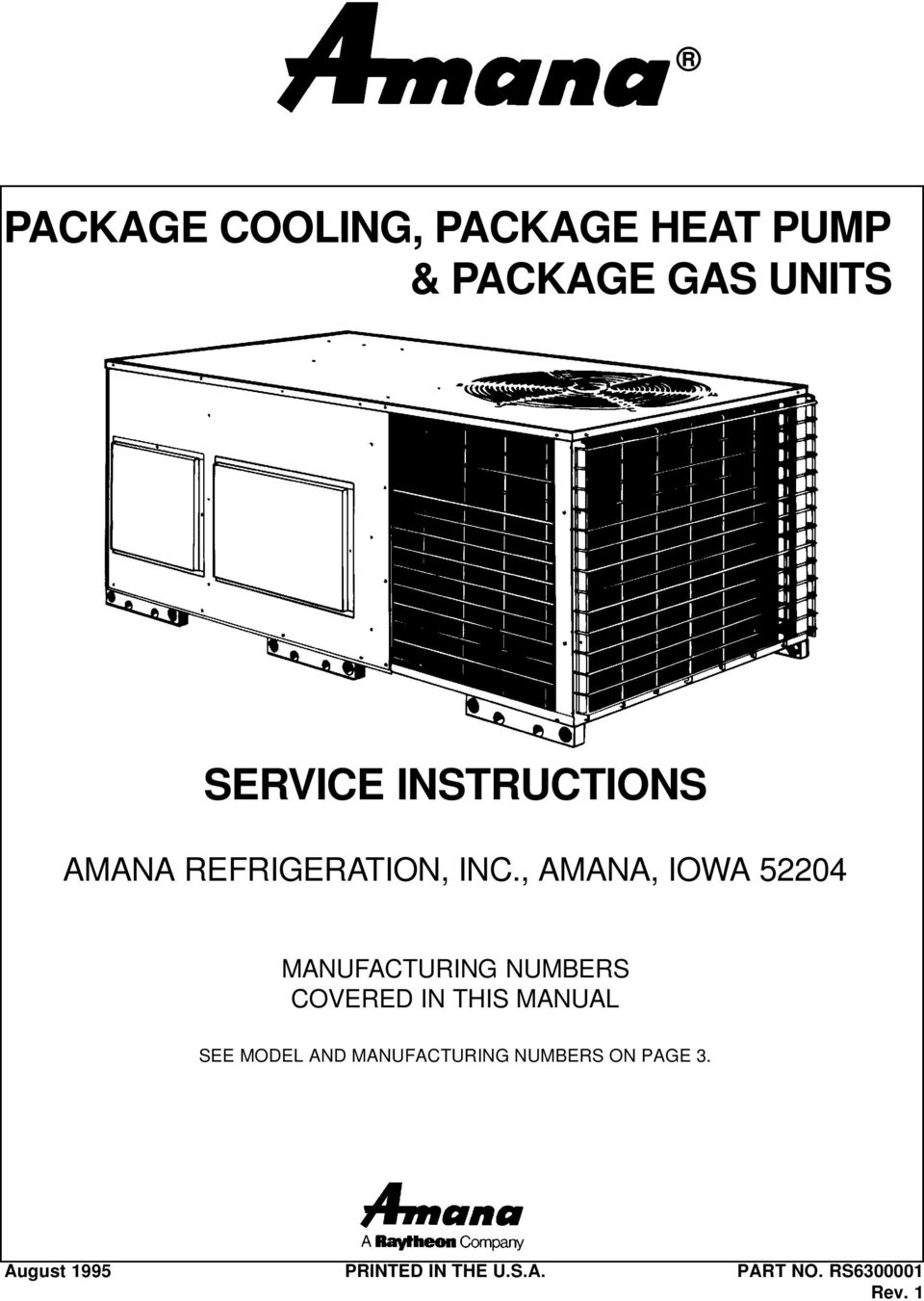
1 PACKAGE COOLING, PACKAGE HEAT PUMP & PACKAGE GAS UNITS SERVICE INSTRUCTIONS AMANA REFRIGERATION, INC., AMANA, IOWA MANUFACTURING NUMBERS COVERED IN THIS MANUAL SEE MODEL AND MANUFACTURING NUMBERS ON PAGE 3. August 1995 PRINTED IN THE U.S.A. PART NO. RS Rev. 1
2 INDEX PRODUCT IDENTIFICATION SPECIFICATIONS Accessories Package Cooling Package Heat Pumps Package Gas PRODUCT DESIGN Electrical Wiring Gas Piping SYSTEM OPERATION Refrigeration Cycle Sequence of Operation Electric Heaters BLOWER PERFORMANCE DATA COOLING PERFORMANCE DATA Package Cooling and Package Gas units Package Cooling Scroll Compressor Models Package Heat Pumps HEATING PERFORMANCE DATA SCHEDULED MAINTENANCE SERVICING WIRING DIAGRAMS Package Cooling Package Heat Pump Package Gas PHK Electric Heater Kits Economizer Schematic This manual replaces R Please discard and replace with this manual. 2 Rev. 1

3 IMPORTANT INFORMATION Pride and workmanship go into every product to provide our customers with quality products. It is possible, however, that during its lifetime a product may require service. Products should be serviced only by a qualified service technician who is familiar with the safety procedures required in the repair and who is equipped with the proper tools, parts, testing instruments and the appropriate service manual. REVIEW ALL SERVICE INFORMA- TION IN THE APPROPRIATE SERVICE MANUAL BEFORE BEGINNING REPAIRS. IMPORTANT NOTICES! IF REPAIRS ARE ATTEMPTED BY UNQUALIFIED PERSONS, DANGEROUS CONDITIONS (SUCH AS EXPOSURE TO ELECTRICAL SHOCK) MAY RE- SULT. THIS MAY CAUSE SERIOUS INJURY OR DEATH.! CAUTION AMANA WILL NOT BE RESPONSIBLE FOR ANY INJURY OR PROPERTY DAMAGE ARISING FROM IMPROPER SERVICE OR SERVICE PROCEDURES. IF YOU PERFORM SERVICE ON YOUR OWN PRODUCT, YOU ASSUME RESPONSIBILITY FOR ANY PERSONAL INJURY OR PROPERTY DAMAGE WHICH MAY RESULT. To locate an authorized servicer, please consult your telephone book or the dealer from whom you purchased this product. For further assistance, please contact: CONSUMER AFFAIRS DEPT. OR AMANA REFRIGERATION, INC. CALL and ask for AMANA, IOWA Consumer Affairs If outside the United States contact: AMANA REFRIGERATION, INC. ATTN: INTERNATIONAL DIVISION AMANA, IOWA 52204, USA Telephone: (319) Facsimile: (319) RECOGNIZE SAFETY SYMBOLS, WORDS AND LABELS! DANGER DANGER - Immediate hazards which WILL result in severe personal injury or death.! - Hazards or unsafe practices which COULD result in severe personal injury or death.! CAUTION CAUTION - Hazards or unsafe practices which COULD result in minor personal injury or product or property damage. 3 Rev. 1

4 IMPORTANT INFORMATION SYSTEM CONTAMINANTS, IMPROPER SERVICE PROCEDURE AND/OR PHYSICAL ABUSE AFFECTING HERMETIC COMPRESSOR ELECTRICAL TERMINALS MAY CAUSE DANGEROUS SYSTEM VENTING. System contaminants, improper Service Procedure and/or physical abuse affecting hermetic compressor electrical terminals may cause dangerous system venting. The successful development of hermetically sealed refrigeration compressors has completely sealed the compressor's moving parts and electric motor inside a common housing, minimizing refrigerant leaks and the hazards sometimes associated with moving belts, pulleys, or couplings. Fundamental to the design of hermetic compressors is a method whereby electrical current is transmitted to the compressor motor through terminal conductors which pass through the compressor housing wall. These terminals are sealed in a dielectric material which insulates them from the housing and maintains the pressure tight integrity of the hermetic compressor. The terminals and their dielectric embedment are strongly constructed, but are vulnerable to careless compressor installation or maintenance procedures and equally vulnerable to internal electrical short circuits caused by excessive system contaminants. In either of these instances, an electrical short between the terminal and the compressor housing may result in the loss of integrity between the terminal and its dielectric embedment. This loss may cause the terminals to be expelled, thereby venting the vaporous and liquid contents of the compressor housing and system. A venting compressor terminal normally presents no danger to anyone providing the terminal protective cover is properly in place. If, however, the terminal protective cover is not properly in place, a venting terminal may discharge a combination of (a) (b) hot lubricating oil and refrigerant flammable mixture (if system is contaminated with air) in a stream of spray which may be dangerous to anyone in the vicinity. Death or serious bodily injury could occur. Under no circumstances is a hermetic compressor to be electrically energized and/or operated without having the terminal protective cover properly in place. See Service Section S-17 for proper servicing. 4 Rev. 1

5 PRODUCT IDENTIFICATION The model and manuacturing number are used for positive identification of component parts used in manufacturing. At which time engineering and manufacturing changes take place where interchangeability of components are affected, the manufacturing number will change. It is very important to use the model and manufacturing numbers at all times when requesting service or parts information. MODEL M/N MODEL M/N MODEL M/N SPCO24001A SPCO30001A SPCO36001A SPCO36003A P C P C P C P C SPCO42001A SPCO42003A SPCO48001A SPCO48003A P C P C P C P C SPCO60001A SPCO60003A P C P C PCA24B0002A PCA24B0002C PCA30B0002A PCA30B0002C PCA36B0002A PCA36B0002B PCA36B0002C PCA36B0003A PCA36B0003C PCA36B0004A PCA36B0004C P C P C P C P C P C P C P C P C P C P C P C PCA42B0002A PCA42B0002C PCA42B0003A PCA42B0003C PCA48B0002A PCA48B0002B PCA48B0002C PCA48B0003A PCA48B0003B PCA48B0003C P C P C P C P C P C P C P C P C P C P C PCA48B0004A PCA48B0004C PCA60B0002A PCA60B0002C PCA60B0003A PCA60B0003C PCA60B0004A PCA60B0004C P C P C P C P C P C P C P C P C PCB24A0002A PCB24B0002A PCB24B0002C PCB30A0002A PCB30B0002A PCB30B0002C P C P C P C P C P C P C PCB36A0002A PCB36B0002A PCB36B0002C PCB42A0002A PCB42B0002A PCB42B0002C P C P C P C P C P C P C PCB48B0002A PCB48B0002C PCB60B0002A PCB60B0002C P C P C P C P C SPHO24001A SPHO30001A SPHO36001A SPHO36003A SPHO42001A SPHO42003A SPHO48001A SPHO48003A SPHO60001A SPHO60003A P C P C P C P C P C P C P C P C P C P C PHA24B0002A PHA24B0002C PHA30B0002A PHA30B0002C PHA36B0002A PHA36B0002C PHA36B0003A PHA36B0003C PHA42B0002A PHA42B0002C PHA42B0003A P C P C P C P C P C P C P C P C P C P C P C PHA42B0003C PHA48B0002A PHA48B0002C PHA48B0003A PHA48B0003C PHA60B0002A PHA60B0002B PHA60B0002C PHA60B0003A PHA60B0003B PHA60B0003C P C P C P C P C P C P C P C P C P C P C P C FADM3A FADM5A FADS3A FADS5A P C P C P C P C LOK501A PECE3A PECE3B PECE5A P C P C P C P C PRC3A PRC5A P C P C PHK05A1 PHK05C1 PHK10A1 PHK10A3 P C P C P C P C PHK15A1 PHK15A3 PHK15A4 PHK20A1 PHK20A3 P C P C P C P C P C PHK25A1 PHK25A3 PHK30A1 PHK30A3 PHK30A4 P C P C P C P C P C 5 Rev. 1

6 PRODUCT IDENTIFICATION MODEL M/N M/N MODEL M/N M/N SPCG240451A P C P C SPCG240701A P C P C SPCG240901A P C P C SPCG300451A P C P C SPCG300701A P C P C SPCG300901A P C P C SPCG360451A P C P C SPCG360453A P C P C SPCG360701A P C P C SPCG360703A P C P C SPCG360901A P C P C SPCG360903A P C P C SPCG420901A P C P C SPCG420903A P C P C SPCG421151A P C P C SPCG421153A P C P C SPCG480901A P C P C SPCG480903A P C P C SPCG481151A P C P C SPCG481153A P C P C SPCG481351A P C P C SPCG481353A P C P C SPCG600901A P C P C SPCG600903A P C P C SPCG601151A P C P C SPCG601153A P C P C SPCG601351A P C P C SPCG601353A P C P C PGA24B0452A P C P C PGA24B0452C P C PGA24B0702A P C P C PGA24B0702C P C PGA24B0902A P C P C PGA24B0902C P C PGA30B0452A P C P C PGA30B0452C P C PGA30B0702A P C P C PGA30B0702C P C PGA30B0902A P C P C PGA30B0902C P C PGA36B0452A P C P C PGA36B0452B P C PGA36B0452C P C PGA36B0453A P C P C PGA36B0453C P C PGA36B0702A P C P C PGA36B0702B P C PGA36B0702C P C PGA36B0703A P C P C PGA36B0703C P C PGA36B0704A P C PGA36B0704C P C PGA36B0902A P C P C PGA36B0902B P C PGA36B0902C P C PGA36B0903A P C P C PGA36B0903C P C PGA36B0904A P C PGA36B0904C P C PGA42B0902A P C PGA42B0902C P C PGA42B0903A P C PGA42B0903C P C PGA42B1152A P C PGA42B1152C P C PGA42B1153A P C PGA42B1153C P C PGA48B0902A PGA48B0902B PGA48B0902C PGA48B0903A PGA48B0903B PGA48B0903C PGA48B0904A PGA48B0904C PGA48B1152A PGA48B1152B PGA48B1152C PGA48B1153A PGA48B1153B PGA48B1153C PGA48B1352A PGA48B1352B PGA48B1352C PGA48B1353A PGA48B1353B PGA48B1353C PGA48B1354A PGA48B1354C PGA60B0902A PGA60B0902C PGA60B0903A PGA60B0903C PGA60B1152A PGA60B1152C PGA60B1153A PGA60B1153C PGA60B1154A PGA60B1154C PGA60B1352A PGA60B1352C PGA60B1353A PGA60B1353C PGA60B1354A PGA60B1354C P C P C P C P C P C P C P C P C P C P C P C P C P C P C P C P C P C P C P C P C P C P C P C P C P C P C P C P C P C P C P C P C P C P C P C P C P C P C 6 Rev. 1

7 PRODUCT IDENTIFICATION 7 Rev. 1 MODEL M/N MODEL M/N PGB24A0452A P C PGB24A0702A P C PGB24A0902A P C PGB24B0452A P C PGB24B0452A P C PGB24B0452C P C PGB24B0702A P C PGB24B0702A P C PGB24B0702C P C PGB24B0902A P C PGB24B0902A P C PGB24B0902C P C PGB30A0452A P C PGB30A0702A P C PGB30A0902A P C PGB30B0452A P C PGB30B0452A P C PGB30B0452C P C PGB30B0702A P C PGB30B0702A P C PGB30B0702C P C PGB30B0902A P C PGB30B0902A P C PGB30B0902C P C PGB36A0452A P C PGB36A0702A P C PGB36A0902A P C PGB36B0452A P C PGB36B0452A P C PGB36B0452C P C PGB36B0702A P C PGB36B0702A P C PGB36B0702C P C PGB36B0902A P C PGB36B0902A P C PGB36B0902C P C PGB42A0902A P C PGB42A1152A P C PGB42B0902A P C PGB42B0902C P C PGB42B1152A P C PGB42B1152C P C PGB48B0902A P C PGB48B0902C P C PGB48B1152A P C PGB48B1152C P C PGB48B1352A P C PGB48B1352C P C PGB60B0902A P C PGB60B0902C P C PGB60B1152A P C PGB60B1152C P C PGB60B1352A P C PGB60B1352C P C PGC24B0452A P C PGC24B0702A P C PGC30B0702A P C PGC36B0702A P C PGC36B0902A P C PGC42B0902A P C PGC42B1152A P C PGC48B0902A P C PGC48B1152A P C PGC60B0902A P C

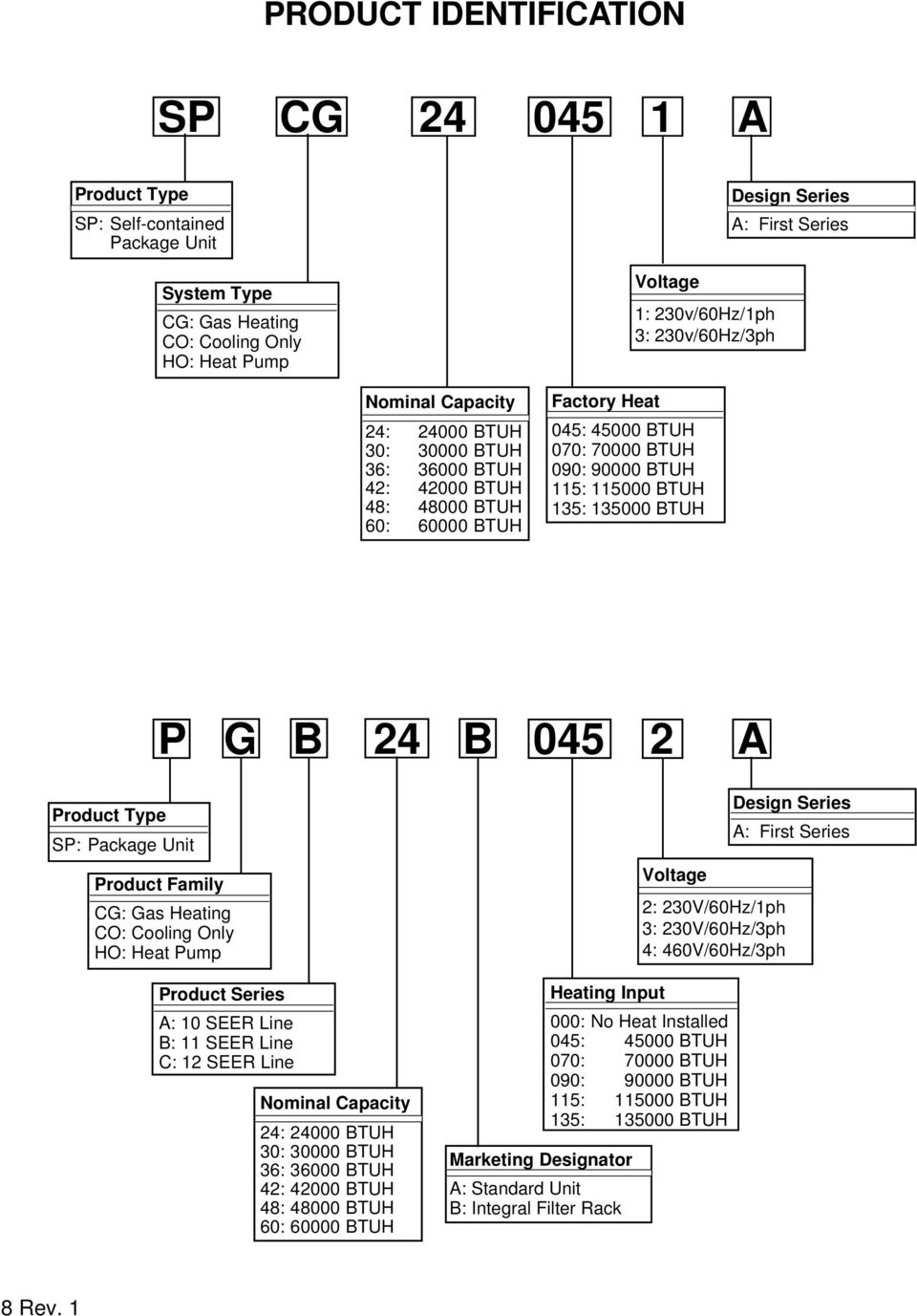
8 PRODUCT IDENTIFICATION SP CG A Product Type SP: Self-contained Package Unit System Type CG: Gas Heating CO: Cooling Only HO: Heat Pump Voltage 1: 230v/60Hz/1ph 3: 230v/60Hz/3ph Design Series A: First Series Nominal Capacity 24: BTUH 30: BTUH 36: BTUH 42: BTUH 48: BTUH 60: BTUH Factory Heat 045: BTUH 070: BTUH 090: BTUH 115: BTUH 135: BTUH P G B 24 B A Product Type SP: Package Unit Product Family CG: Gas Heating CO: Cooling Only HO: Heat Pump Product Series A: 10 SEER Line B: 11 SEER Line C: 12 SEER Line Nominal Capacity 24: BTUH 30: BTUH 36: BTUH 42: BTUH 48: BTUH 60: BTUH Marketing Designator A: Standard Unit B: Integral Filter Rack Heating Input 000: No Heat Installed 045: BTUH 070: BTUH 090: BTUH 115: BTUH 135: BTUH Design Series A: First Series Voltage 2: 230V/60Hz/1ph 3: 230V/60Hz/3ph 4: 460V/60Hz/3ph 8 Rev. 1
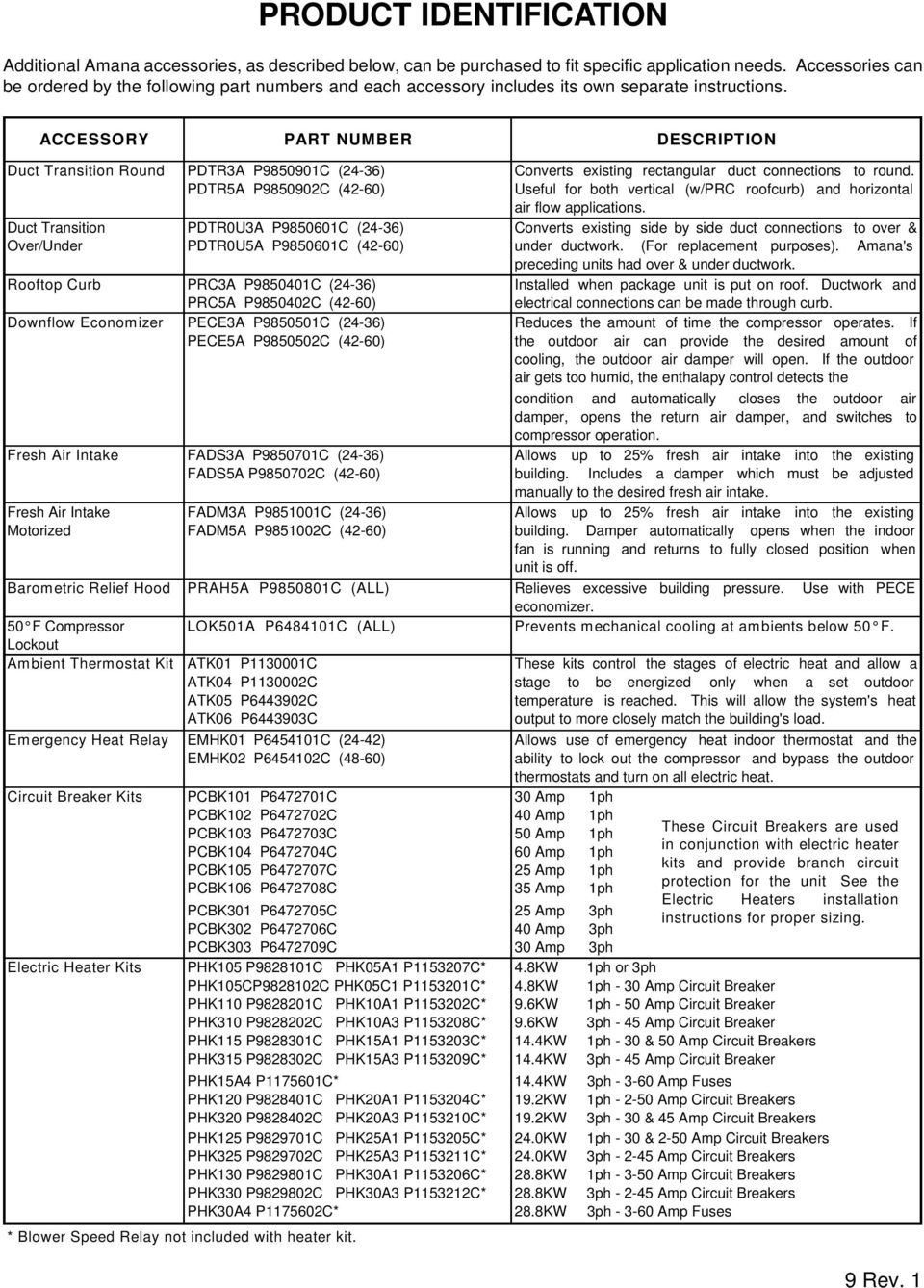
9 PRODUCT IDENTIFICATION Additional Amana accessories, as described below, can be purchased to fit specific application needs. Accessories can be ordered by the following part numbers and each accessory includes its own separate instructions. ACCESSORY PART NUMBER DESCRIPTION Duct Transition Round PDTR3A P C (24-36) Converts existing rectangular duct connections to round. PDTR5A P C (42-60) Useful for both vertical (w/prc roofcurb) and horizontal air flow applications. Duct Transition PDTR0U3A P C (24-36) Converts existing side by side duct connections to over & Over/Under PDTR0U5A P C (42-60) under ductwork. (For replacement purposes). Amana's preceding units had over & under ductwork. Rooftop Curb PRC3A P C (24-36) Installed when package unit is put on roof. Ductwork and PRC5A P C (42-60) electrical connections can be made through curb. Downflow Economizer PECE3A P C (24-36) Reduces the amount of time the compressor operates. If PECE5A P C (42-60) the outdoor air can provide the desired amount of cooling, the outdoor air damper will open. If the outdoor air gets too humid, the enthalapy control detects the condition and automatically closes the outdoor air damper, opens the return air damper, and switches to compressor operation. Fresh Air Intake FADS3A P C (24-36) Allows up to 25% fresh air intake into the existing FADS5A P C (42-60) building. Includes a damper which must be adjusted manually to the desired fresh air intake. Fresh Air Intake FADM3A P C (24-36) Allows up to 25% fresh air intake into the existing Motorized FADM5A P C (42-60) building. Damper automatically opens when the indoor fan is running and returns to fully closed position when unit is off. Barometric Relief Hood PRAH5A P C (ALL) Relieves excessive building pressure. Use with PECE economizer. 50 F Compressor Lockout LOK501A P C (ALL) Prevents mechanical cooling at ambients below 50 F. Ambient Thermostat Kit ATK01 P C ATK04 P C ATK05 P C ATK06 P C Emergency Heat Relay EMHK01 P C (24-42) EMHK02 P C (48-60) Circuit Breaker Kits PCBK101 P C PCBK102 P C PCBK103 P C PCBK104 P C PCBK105 P C PCBK106 P C PCBK301 P C PCBK302 P C PCBK303 P C Electric Heater Kits PHK105 P C PHK05A1 P C* PHK105CP C PHK05C1 P C* PHK110 P C PHK10A1 P C* PHK310 P C PHK10A3 P C* PHK115 P C PHK15A1 P C* PHK315 P C PHK15A3 P C* PHK15A4 P C* PHK120 P C PHK20A1 P C* PHK320 P C PHK20A3 P C* PHK125 P C PHK25A1 P C* PHK325 P C PHK25A3 P C* PHK130 P C PHK30A1 P C* PHK330 P C PHK30A3 P C* PHK30A4 P C* * Blower Speed Relay not included with heater kit. These kits control the stages of electric heat and allow a stage to be energized only when a set outdoor temperature is reached. This will allow the system's heat output to more closely match the building's load. Allows use of emergency heat indoor thermostat and the ability to lock out the compressor and bypass the outdoor thermostats and turn on all electric heat. 30 Amp 1ph 40 Amp 1ph 50 Amp 1ph 60 Amp 1ph 25 Amp 1ph 35 Amp 1ph 25 Amp 3ph 40 Amp 3ph 30 Amp 3ph 4.8KW 4.8KW 9.6KW 9.6KW 14.4KW 14.4KW 14.4KW 19.2KW 19.2KW 24.0KW 24.0KW 28.8KW 28.8KW 28.8KW These Circuit Breakers are used in conjunction with electric heater kits and provide branch circuit protection for the unit See the Electric Heaters installation instructions for proper sizing. 1ph or 3ph 1ph - 30 Amp Circuit Breaker 1ph - 50 Amp Circuit Breaker 3ph - 45 Amp Circuit Breaker 1ph - 30 & 50 Amp Circuit Breakers 3ph - 45 Amp Circuit Breaker 3ph Amp Fuses 1ph Amp Circuit Breakers 3ph - 30 & 45 Amp Circuit Breakers 1ph - 30 & 2-50 Amp Circuit Breakers 3ph Amp Circuit Breakers 1ph Amp Circuit Breakers 3ph Amp Circuit Breakers 3ph Amp Fuses 9 Rev. 1
10 10 Rev. 1 PRODUCT IDENTIFICATION

11 PRODUCT IDENTIFICATION NOTE: Bottom duct openings have rounded rather than square openings. If using bottom discharge, ductwork should be attached to the curb prior to installing the unit. Ductwork dimensions are shown in Amana roof curb installation instructions. 11 Rev. 1

12 PRODUCT IDENTIFICATION 12" Clearance For Servicing Recommended Platform for service person with rails or guards in accordance with local codes or ordiances or in their absence with the latest edition of the National Fuel Gas Code ANSIZ NOTE: Unit can also use roofcurb (and platform for leveling, where necessary) to utilize bottom discharge. TO PREVENT POSSIBLE PROPERTY DAMAGE, THE UNIT SHOULD REMAIN IN AN UPRIGHT POSITION DUR- ING ALL RIGGING AND MOVING OPERATIONS. TO FACILITATE LIFTING AND MOVING IF A CRANE IS USED, PLACE THE UNIT IN AN ADEQUATE CABLE SLIDE. IMPORTANT: If using bottom discharge with roofcurb, ductwork should be attached to the curb prior to installing the unit. Ductwork dimensions are shown in Amana roofcurb installation instructions. Refer to Amana Roofcurb Installation Instructions for proper curb installation. Curbing must be installed in compliance with the National Roofing Contractors Association Manual. Lower unit carefully onto roof mounting curb. While rigging unit, center of gravity will cause condenser end to be lower than supply air end. If using a fork lift, see Figure -- for location of fork prongs. Make certain prongs support unit's weight. *Flue outlet hood and air inlet hood are packaged separately inside the unit and must be installed prior to operation. See Page -- for installation procedures. 12 Rev. 1

13 SPECIFICATIONS AMANA MODEL "A" DIM "B" DIM "C" DIM "D" DIM "E" DIM PRC3A P C 60" 41 1/2" 15" 15" 24" PRC5A P C 73 1/4" 45 1/4" 18 3/4" 19 1/4" 23" Rooftop Curb PRC3A (24-36) PRC5A (42-60) Installed when package unit is installed on roof. Ductwork and electrical connections can be made through curb. 13 Rev. 1

14 SPECIFICATIONS AMANA MODEL "A" DIM "B" DIM "C" DIM "D" DIM "E" DIM "F" DIM "G" DIM "H" DIM "J" DIM PDTROU3A 39 1/2" 26 7/16" 12" 26 1/4" 15 1/4" 6 7/8" 20 11/16" 9/16" 9/16" PDTROU5A 46" 32" 12" 39 3/4" 15 3/4" 10 1/4" 24 1/4" 1" 1" Duct Transition Over/Under PDTROU3A (24-36) PDTROU5A (42-60) Converts existing side by side duct connections to over/under ductwork. (For replacement purposes. Amana's preceding units had over/under ducts.) PDTROU3A TOTAL CFM PRESSURE DROP WC" " " " PDTROU5A TOTAL CFM PRESSURE DROP WC" " " " 14 Rev. 1

15 SPECIFICATIONS AMANA MODEL "A" DIM "B" DIM "C" DIM "D" DIM "E" DIM "F" DIM PECE3A (24-36) 20 3/4" 17 9/16" 23 1/2" 6 1/16" 18 1/4" 6 7/16" PECE5A (42-60) 24" 24 7/16" 28 7/8" 10" 21 3/8" 6 3/4" Downflow Economizer PECE3A (24-36) PECE5A (42-60) Reduces the amount of time the compressor operates. If the outdoor air can provide the desired amount of cooling, the outdoor air damper will open. If the outdoor air gets too humid, the enthalapy control detects the condition and automatically closes the outdoor air damper, opens the return air damper, and switches to compressor operation. Barometric Relief Hood PRAH5A (All) Relieves excessive building pressure. Use with PECE economizer. 15 Rev. 1

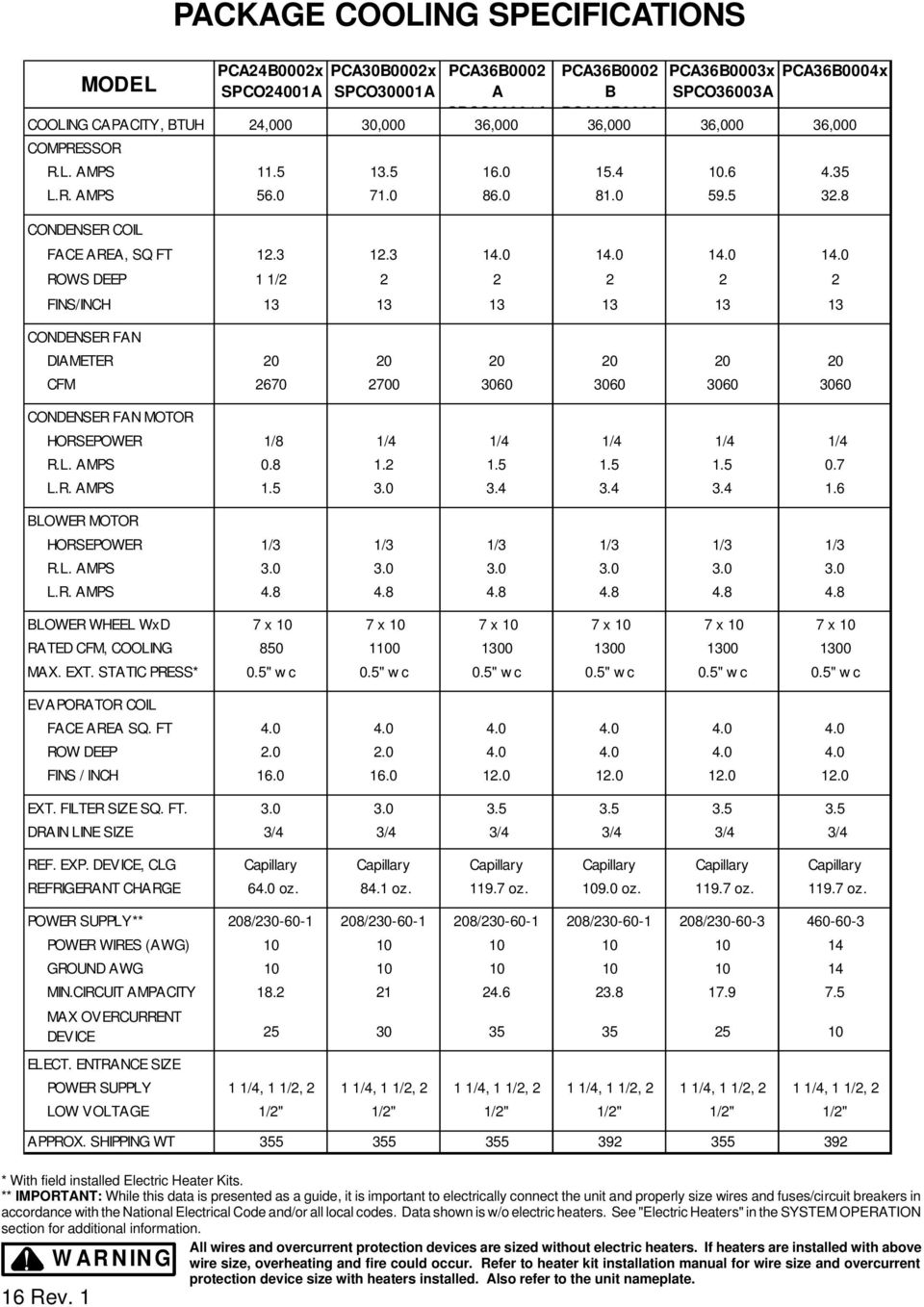
16 PACKAGE COOLING SPECIFICATIONS * With field installed Electric Heater Kits. ** IMPORTANT: While this data is presented as a guide, it is important to electrically connect the unit and properly size wires and fuses/circuit breakers in accordance with the National Electrical Code and/or all local codes. Data shown is w/o electric heaters. See "Electric Heaters" in the SYSTEM OPERATION section for additional information. All wires and overcurrent protection devices are sized without electric heaters. If heaters are installed with above! wire size, overheating and fire could occur. Refer to heater kit installation manual for wire size and overcurrent protection device size with heaters installed. Also refer to the unit nameplate. 16 Rev. 1 MODEL PCA24B0002x SPCO24001A PCA30B0002x SPCO30001A PCA36B0002 A SPCO36001A PCA36B0002 B PCA36B0002 PCA36B0003x SPCO36003A PCA36B0004x COOLING CAPACITY, BTUH 24,000 30,000 36,000 36,000 36,000 36,000 COMPRESSOR R.L. AMPS L.R. AMPS CONDENSER COIL FACE AREA, SQ FT ROWS DEEP 1 1/ FINS/INCH CONDENSER FAN DIAMETER CFM CONDENSER FAN MOTOR HORSEPOWER 1/8 1/4 1/4 1/4 1/4 1/4 R.L. AMPS L.R. AMPS BLOWER MOTOR HORSEPOWER 1/3 1/3 1/3 1/3 1/3 1/3 R.L. AMPS L.R. AMPS BLOWER WHEEL WxD 7 x 10 7 x 10 7 x 10 7 x 10 7 x 10 7 x 10 RATED CFM, COOLING MAX. EXT. STATIC PRESS* 0.5" w c 0.5" w c 0.5" w c 0.5" w c 0.5" w c 0.5" w c EVAPORATOR COIL FACE AREA SQ. FT ROW DEEP FINS / INCH EXT. FILTER SIZE SQ. FT DRAIN LINE SIZE 3/4 3/4 3/4 3/4 3/4 3/4 REF. EXP. DEVICE, CLG Capillary Capillary Capillary Capillary Capillary Capillary REFRIGERANT CHARGE 64.0 oz oz oz oz oz oz. POWER SUPPLY** 208/ / / / / POWER WIRES (AWG) GROUND AWG MIN.CIRCUIT AMPACITY MAX OVERCURRENT DEVICE ELECT. ENTRANCE SIZE POWER SUPPLY 1 1/4, 1 1/2, 2 1 1/4, 1 1/2, 2 1 1/4, 1 1/2, 2 1 1/4, 1 1/2, 2 1 1/4, 1 1/2, 2 1 1/4, 1 1/2, 2 LOW VOLTAGE 1/2" 1/2" 1/2" 1/2" 1/2" 1/2" APPROX. SHIPPING WT
17 PACKAGE COOLING SPECIFICATIONS MODEL PCA42B0002A/C SPCO42001A PCA42B0003A/C SPCO42003A PCA48B0002A/B/ C SPCO48001A PCA48B0003A/B/ C SPCO48003A PCA48B0004A/C SPCO48004A COOLING CAPACITY, BTUH 42,000 42,000 48,000 48,000 48,000 COMPRESSOR R.L. AMPS L.R. AMPS CONDENSER COIL FACE AREA, SQ FT ROWS DEEP FINS/INCH CONDENSER FAN DIAMETER CFM CONDENSER FAN MOTOR HORSEPOWER 1/4 1/4 1/4 1/4 1/4 R.L. AMPS L.R. AMPS BLOWER MOTOR HORSEPOWER 1/3 1/3 3/4 3/4 3/4 R.L. AMPS L.R. AMPS BLOWER WHEEL WxD 7 x 10 7 x 10 8 x 11 8 x 11 8 X 11 RATED CFM, COOLING MAX. EXT. STATIC PRESS* 0.5" w c 0.5" w c 0.5" w c 0.5" w c 0.5" w c EVAPORATOR COIL FACE AREA SQ. FT ROW DEEP FINS / INCH EXT. FILTER SIZE SQ. FT DRAIN LINE SIZE 3/4 3/4 3/4 3/4 3/4 REF. EXP. DEVICE, CLG Capillary Capillary Capillary Capillary Capillary REFRIGERANT CHARGE oz oz oz. POWER SUPPLY** 208/ / / / POWER WIRES (AWG) GROUND AWG MIN.CIRCUIT AMPACITY MAX OVERCURRENT DEVICE ELECT. ENTRANCE SIZE POWER SUPPLY 1 1/4, 1 1/2, 2 1 1/4, 1 1/2, 2 1 1/4, 1 1/2, 2 1 1/4, 1 1/2, 2 1 1/4, 1 1/2, 2 LOW VOLTAGE 1/2" 1/2" 1/2" 1/2" 1/2" APPROX. SHIPPING WT * With field installed Electric Heater Kits. ** IMPORTANT: While this data is presented as a guide, it is important to electrically connect the unit and properly size wires and fuses/circuit breakers in accordance with the National Electrical Code and/or all local codes. Data shown is w/o electric heaters. See "Electric Heaters" in the SYSTEM OPERATION section for additional information. All wires and overcurrent protection devices are sized without electric heaters. If heaters are installed with above! wire size, overheating and fire could occur. Refer to heater kit installation manual for wire size and overcurrent protection device size with heaters installed. Also refer to the unit nameplate. 17 Rev. 1

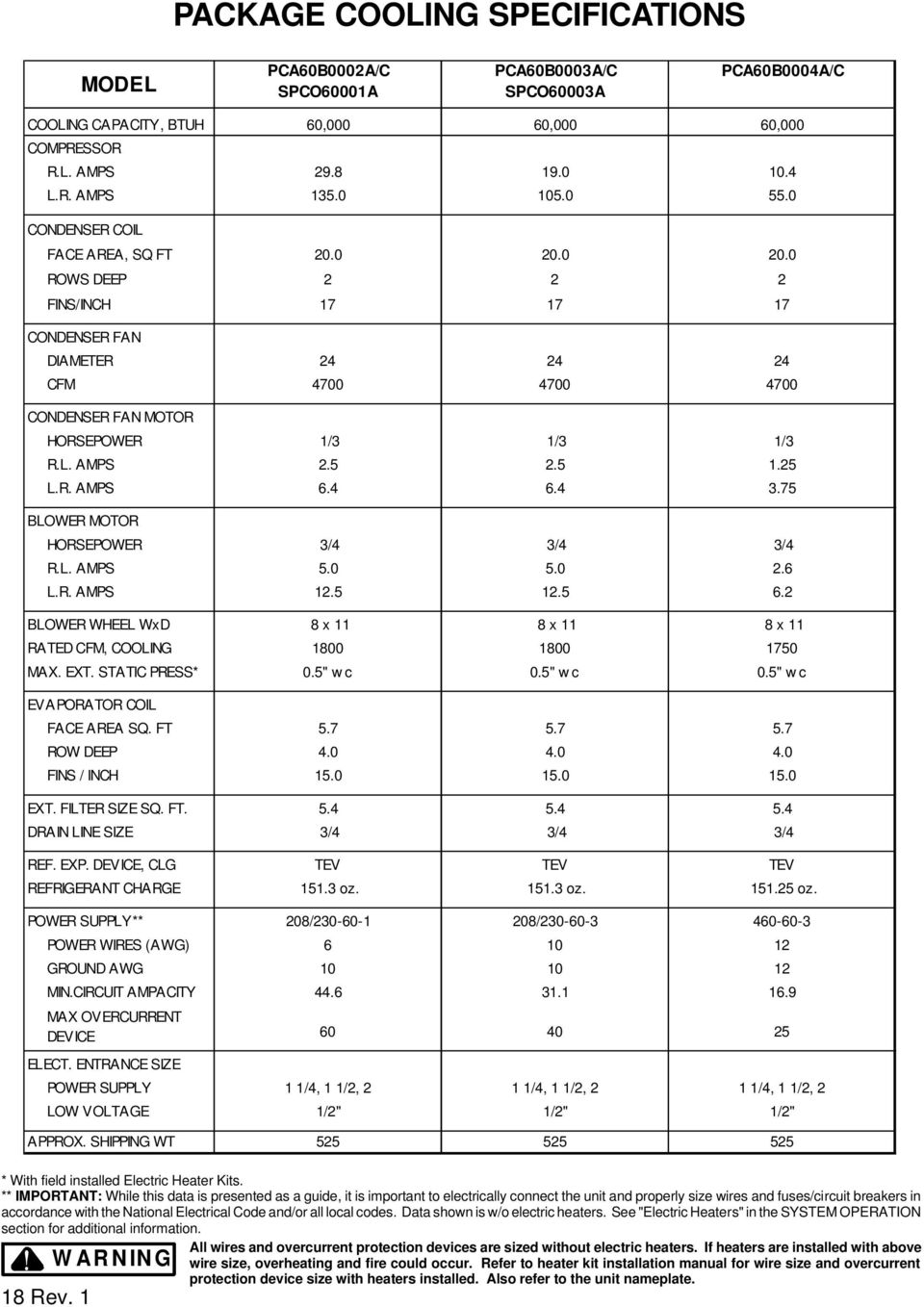
18 PACKAGE COOLING SPECIFICATIONS MODEL PCA60B0002A/C SPCO60001A PCA60B0003A/C SPCO60003A PCA60B0004A/C COOLING CAPACITY, BTUH 60,000 60,000 60,000 COMPRESSOR R.L. AMPS L.R. AMPS CONDENSER COIL FACE AREA, SQ FT ROWS DEEP FINS/INCH CONDENSER FAN DIAMETER CFM CONDENSER FAN MOTOR HORSEPOWER 1/3 1/3 1/3 R.L. AMPS L.R. AMPS BLOWER MOTOR HORSEPOWER 3/4 3/4 3/4 R.L. AMPS L.R. AMPS BLOWER WHEEL WxD 8 x 11 8 x 11 8 x 11 RATED CFM, COOLING MAX. EXT. STATIC PRESS* 0.5" w c 0.5" w c 0.5" w c EVAPORATOR COIL FACE AREA SQ. FT ROW DEEP FINS / INCH EXT. FILTER SIZE SQ. FT DRAIN LINE SIZE 3/4 3/4 3/4 REF. EXP. DEVICE, CLG TEV TEV TEV REFRIGERANT CHARGE oz oz oz. POWER SUPPLY** 208/ / POWER WIRES (AWG) GROUND AWG MIN.CIRCUIT AMPACITY MAX OVERCURRENT DEVICE ELECT. ENTRANCE SIZE POWER SUPPLY 1 1/4, 1 1/2, 2 1 1/4, 1 1/2, 2 1 1/4, 1 1/2, 2 LOW VOLTAGE 1/2" 1/2" 1/2" APPROX. SHIPPING WT * With field installed Electric Heater Kits. ** IMPORTANT: While this data is presented as a guide, it is important to electrically connect the unit and properly size wires and fuses/circuit breakers in accordance with the National Electrical Code and/or all local codes. Data shown is w/o electric heaters. See "Electric Heaters" in the SYSTEM OPERATION section for additional information. All wires and overcurrent protection devices are sized without electric heaters. If heaters are installed with above! wire size, overheating and fire could occur. Refer to heater kit installation manual for wire size and overcurrent protection device size with heaters installed. Also refer to the unit nameplate. 18 Rev. 1
19 PACKAGE COOLING SPECIFICATIONS MODEL PCB24B0002x PCB24A0002 A PCB30B0002x PCB30A0002 A PCB36B0002x PCB36A0002 A PCB42B0002x PCB42A0002 A PCB48B0002x PCB48A0002 A PCB60B0002x PCB60A0002 A COOLING CAPACITY, BTUH 24,000 30,000 36,000 42,000 48,000 60,000 COMPRESSOR R.L. AMPS L.R. AMPS CONDENSER COIL FACE AREA, SQ FT ROWS DEEP 1 1/ FINS/INCH CONDENSER FAN DIAMETER CFM CONDENSER FAN MOTOR HORSEPOWER 1/8 1/4 1/4 1/4 1/4 1/3 R.L. AMPS L.R. AMPS BLOWER MOTOR HORSEPOWER 1/3 1/3 1/3 1/3 3/4 3/4 R.L. AMPS L.R. AMPS BLOWER WHEEL WxD 7 x 10 7 x 10 7 x 10 7 x 10 8 x 11 8 x 11 RATED CFM, COOLING MAX. EXT. STATIC PRESS* 0.5" w c 0.5" w c 0.5" w c 0.5" w c 0.5" w c 0.5" w c EVAPORATOR COIL FACE AREA SQ. FT ROW DEEP FINS / INCH EXT. FILTER SIZE SQ. FT DRAIN LINE SIZE 3/4 3/4 3/4 3/4 3/4 3/4 REF. EXP. DEVICE, CLG Capillary Capillary Capillary Capillary TEV TEV REFRIGERANT CHARGE 63.7 oz oz oz oz oz oz. POWER SUPPLY** 208/ / / / / / POWER WIRES (AWG) GROUND AWG MIN.CIRCUIT AMPACITY MAX OVERCURRENT DEVICE ELECT. ENTRANCE SIZE POWER SUPPLY 1 1/4, 1 1/2, 2 1 1/4, 1 1/2, 2 1 1/4, 1 1/2, 2 1 1/4, 1 1/2, 2 1 1/4, 1 1/2, 2 1 1/4, 1 1/2, 2 LOW VOLTAGE 1/2" 1/2" 1/2" 1/2" 1/2" 1/2" APPROX. SHIPPING WT * With field installed Electric Heater Kits. ** IMPORTANT: While this data is presented as a guide, it is important to electrically connect the unit and properly size wires and fuses/circuit breakers in accordance with the National Electrical Code and/or all local codes. Data shown is w/o electric heaters. See "Electric Heaters" in the SYSTEM OPERATION section for additional information. All wires and overcurrent protection devices are sized without electric heaters. If heaters are installed with above! wire size, overheating and fire could occur. Refer to heater kit installation manual for wire size and overcurrent protection device size with heaters installed. Also refer to the unit nameplate. 19 Rev. 1

20 20 Rev. 1 MODEL PACKAGE HEAT PUMP SPECIFICATIONS PHA24B0002x SPHO24001A PHA30B0002x SPHO30001A PHA36B0002x SPHO36001A PHA36B0003x SPHO36003A PHA42B0002x SPHO42001A PHA42B0003x SPHO42003A COOLING CAPACITY, BTUH 24,000 3,000 36,000 36,000 42,000 42,000 COMPRESSOR R.L. AMPS L.R. AMPS CONDENSER COIL FACE AREA, SQ FT ROWS DEEP FINS/INCH CONDENSER FAN DIAMETER CFM CONDENSER FAN MOTOR HORSEPOWER 1/4 1/4 1/4 1/4 1/4 1/4 R.L. AMPS L.R. AMPS BLOWER MOTOR HORSEPOWER 1/3 1/3 1/3 1/3 1/3 1/3 R.L. AMPS L.R. AMPS BLOWER WHEEL WxD 7 x 10 7 x 10 7 x 10 7 x 10 7 x 10 7 x 10 RATED CFM, COOLING MAX. EXT. STATIC PRESS* 0.5" w c 0.5" w c 0.5" w c 0.5" w c 0.5" w c 0.5" w c EVAPORATOR COIL FACE AREA SQ. FT ROW DEEP FINS / INCH EXT. FILTER SIZE SQ. FT DRAIN LINE SIZE 3/4 3/4 3/4 3/4 3/4 3/4 REF. EXP. DEVICE, CLG Orif ice Orif ice Orif ice Orif ice Orif ice Orif ice REF. EXP. DEVICE, HTG TEV Orif ice TEV TEV Orif ice Orif ice REFRIGERANT CHARGE oz oz oz oz oz oz. POWER SUPPLY** 208/ / / / / / NUMBER WIRES (AWG) 2 (10) 2 (10) 2 (10) 3 (10) 2 (10) 3 (10) GROUND AWG MIN.CIRCUIT AMPACITY MAX OVERCURRENT DEVICE ELECT. ENTRANCE SIZE POWER SUPPLY 1 1/4, 1 1/2, 2 1 1/4, 1 1/2, 2 1 1/4, 1 1/2, 2 1 1/4, 1 1/2, 2 1 1/4, 1 1/2, 2 1 1/4, 1 1/2, 2 LOW VOLTAGE 1/2" 1/2" 1/2" 1/2" 1/2" 1/2" APPROX. SHIPPING WT * With field installed Electric Heater Kits. ** IMPORTANT: While this data is presented as a guide, it is important to electrically connect the unit and properly size wires and fuses/circuit breakers in accordance with the National Electrical Code and/or all local codes. Data shown is w/o electric heaters. See "Electric Heaters" in the SYSTEM OPERATION section for additional information. All wires and overcurrent protection devices are sized without electric heaters. If heaters are installed with above! wire size, overheating and fire could occur. Refer to heater kit installation manual for wire size and overcurrent protection device size with heaters installed. Also refer to the unit nameplate.

21 MODEL PACKAGE HEAT PUMP SPECIFICATIONS PHA48B0002x SPCO48001A PHA48B0003x SPCO48003A PHA60B0002 A SPCO60001A PHA60B0002 B PHA60B0002 PHA60B0003 A SPCO60003A PHA60B0003 B PHA60B0003 COOLING CAPACITY, BTUH 48,000 48,000 60,000 60,000 60,000 60,000 COMPRESSOR R.L. AMPS L.R. AMPS CONDENSER COIL FACE AREA, SQ FT ROWS DEEP FINS/INCH CONDENSER FAN DIAMETER CFM CONDENSER FAN MOTOR HORSEPOWER 1/3 1/3 1/3 1/3 1/3 1/3 R.L. AMPS L.R. AMPS BLOWER MOTOR HORSEPOWER 3/4 3/4 3/ / R.L. AMPS L.R. AMPS BLOWER WHEEL WxD 8x11 8x11 8x11 8x11 8x11 8x11 RATED CFM, COOLING MAX. EXT. STATIC PRESS* 0.5" w c 0.5" w c 0.5" w c 0.5" w c 0.5" w c 0.5" w c EVAPORATOR COIL FACE AREA SQ. FT ROW DEEP FINS / INCH EXT. FILTER SIZE SQ. FT DRAIN LINE SIZE 3/4 3/4 3/4 3/4 3/4 3/4 REF. EXP. DEVICE, CLG TEV TEV TEV TEV TEV TEV REF. EXP. DEVICE, HTG Orif ice Orif ice Orif ice Orif ice Orif ice Orif ice REFRIGERANT CHARGE oz oz oz oz oz oz. POWER SUPPLY** 208/ / / / / / NUMBER WIRES (AWG) 2 (8) 3 (10) 2 (6) 6 3 (8) 10 GROUND AWG MIN.CIRCUIT AMPACITY MAX OVERCURRENT DEVICE ELECT. ENTRANCE SIZE POWER SUPPLY 1 1/4, 1 1/2, 2 1 1/4, 1 1/2, 2 1 1/4, 1 1/2, 2 1 1/4, 1 1/2, 2 1 1/4, 1 1/2, 2 1 1/4, 1 1/2, 2 LOW VOLTAGE 1/2" 1/2" 1/2" 1/2" 1/2" 1/2" APPROX. SHIPPING WT * With field installed Electric Heater Kits. ** IMPORTANT: While this data is presented as a guide, it is important to electrically connect the unit and properly size wires and fuses/circuit breakers in accordance with the National Electrical Code and/or all local codes. Data shown is w/o electric heaters. See "Electric Heaters" in the SYSTEM OPERATION section for additional information. All wires and overcurrent protection devices are sized without electric heaters. If heaters are installed with above! wire size, overheating and fire could occur. Refer to heater kit installation manual for wire size and overcurrent protection device size with heaters installed. Also refer to the unit nameplate. 21 Rev. 1
22 22 Rev. 1 MODEL PACKAGE GAS SPECIFICATIONS PGA24B0452x SPCG A PGA24B0702x SPCG A PGA24B0902x SPCG A PGA30B0452x SPCG A PGA30B0702x SPCG A PGA30B0902x SPCG A COOLING CAPACITY, BTUH 24,000 24,000 24,000 30,000 30,000 30,000 HEATING INPUT BTUH US 45,000 70,000 90,000 45,000 70,000 90,000 CANADIAN ( FT) 45,000 70,000 90,000 45,000 70,000 90,000 CANADIAN ( FT) 40,500 63,000 81,000 40,500 63,000 81,000 OUTPUT BTUH US 36,000 56,000 72,000 36,000 56,000 72,000 CANADIAN ( FT) 36,450 56,700 72,900 36,450 56,700 72,900 CANADIAN ( FT) 32,400 51,030 65,610 32,400 51,030 65,610 TEMPERATURE RISE F NUMBER OF BURNERS COMPRESSOR R.L. AMPS L.R. AMPS CONDENSER COIL FACE AREA, SQ FT ROWS DEEP FINS/INCH CONDENSER FAN DIAMETER CFM CONDENSER FAN MOTOR HORSEPOWER 1/8 1/8 1/8 1/4 1/4 1/4 R.L. AMPS L.R. AMPS BLOWER MOTOR HORSEPOWER 1/3 1/3 1/3 1/3 1/3 1/3 R.L. AMPS L.R. AMPS BLOWER WHEEL WxD 7 x 10 7 x 10 7 x 10 7 x 10 7 x 10 7 x 10 RATED CFM, COOLING MAX. EXT. STATIC PRESS 0.5" w c 0.5" w c 0.5" w c 0.5" w c 0.5" w c 0.5" w c EVAPORATOR COIL FACE AREA SQ. FT ROW DEEP FINS / INCH EXT. FILTER SIZE SQ. FT DRAIN LINE SIZE 3/4 3/4 3/4 3/4 3/4 3/4 REF. EXP. DEVICE, CLG Capillary Capillary Capillary Capillary Capillary Capillary REFRIGERANT CHARGE 64.0 oz oz oz oz oz oz. POWER SUPPLY** 208/ / / / / / POWER WIRES (AWG) GROUND AWG MIN.CIRCUIT AMPACITY MAX OVERCURRENT DEVICE ELECT. ENTRANCE SIZE POWER SUPPLY 1 1/4, 1 1/2, 2 1 1/4, 1 1/2, 2 1 1/4, 1 1/2, 2 1 1/4, 1 1/2, 2 1 1/4, 1 1/2, 2 1 1/4, 1 1/2, 2 LOW VOLTAGE 1/2" 1/2" 1/2" 1/2" 1/2" 1/2" APPROX. SHIPPING WT ** IMPORANT: While this data is presented as a guide, it is important to electrically connect the unit and properly size wires and fuses/circuit breakers in accordance with the National Electrical Code and/or all local codes.
23 MODEL PACKAGE GAS SPECIFICATIONS PGA36B0452x SPCG A PGA36B0453x SPCG A PGA36B0702x SPCG A PGA36B0703x SPCG A PGA36B0704 A PGA36B0704 PGA36B0902x SPCG A COOLING CAPACITY, BTUH 36,000 36,000 36,000 36,000 36,000 36,000 HEATING INPUT BTUH US 45,000 45,000 70,000 70,000 70,000 90,000 CANADIAN ( FT) 45,000 45,000 70,000 70,000 90,000 CANADIAN ( FT) 40,500 40,500 63,000 63,000 81,000 OUTPUT BTUH US 36,000 36,000 56,000 56,000 55,000 72,000 CANADIAN ( FT) CANADIAN ( FT) TEMPERATURE RISE F NUMBER OF BURNERS COMPRESSOR R.L. AMPS L.R. AMPS A 86.0 B/C A 86.0 B/C A 86.0 B/C 81.0 CONDENSER COIL FACE AREA, SQ FT ROWS DEEP FINS/INCH CONDENSER FAN DIAMETER CFM CONDENSER FAN MOTOR HORSEPOWER 1/4 1/4 1/4 1/4 1/4 1/4 R.L. AMPS L.R. AMPS BLOWER MOTOR HORSEPOWER 1/3 1/3 1/3 1/3 1/3 1/3 R.L. AMPS L.R. AMPS BLOWER WHEEL WxD 7 x 10 7 x 10 7 x 10 7 x 10 7 x 10 7 x 10 RATED CFM, COOLING MAX. EXT. STATIC PRESS 0.5" w c 0.5" w c 0.5" w c 0.5" w c 0.5" w c 0.5" w c EVAPORATOR COIL FACE AREA SQ. FT ROW DEEP FINS / INCH EXT. FILTER SIZE SQ. FT DRAIN LINE SIZE 3/4 3/4 3/4 3/4 3/4 3/4 REF. EXP. DEVICE, CLG Capillary Capillary Capillary Capillary Capillary Capillary REFRIGERANT CHARGE oz oz oz oz oz oz. POWER SUPPLY** 208/ / / / / POWER WIRES (AWG) GROUND AWG MIN.CIRCUIT AMPACITY MAX OVERCURRENT DEVICE ELECT. ENTRANCE SIZE POWER SUPPLY 1 1/4, 1 1/2, 2 1 1/4, 1 1/2, 2 1 1/4, 1 1/2, 2 1 1/4, 1 1/2, 2 1 1/4, 1 1/2, 2 1 1/4, 1 1/2, 2 LOW VOLTAGE 1/2" 1/2" 1/2" 1/2" 1/2" 1/2" APPROX. SHIPPING WT ** IMPORANT: While this data is presented as a guide, it is important to electrically connect the unit and properly size wires and fuses/circuit breakers in accordance with the National Electrical Code and/or all local codes. 23 Rev. 1
24 24 Rev. 1 MODEL PACKAGE GAS SPECIFICATIONS PGA36B0903x SPCG A PGA36B0904 A PGA36B0904 PGA42B0902x SPCG A PGA42B0903x SPCG A PGA42B1152x SPCG A PGA42B1153x SPCG A COOLING CAPACITY, BTUH HEATING INPUT BTUH US CANADIAN ( FT) CANADIAN ( FT) OUTPUT BTUH US CANADIAN ( FT) CANADIAN ( FT) TEMPERATURE RISE F NUMBER OF BURNERS COMPRESSOR R.L. AMPS L.R. AMPS CONDENSER COIL FACE AREA, SQ FT ROWS DEEP FINS/INCH CONDENSER FAN DIAMETER CFM CONDENSER FAN MOTOR HORSEPOWER 1/4 1/4 1/4 1/4 1/4 1/4 R.L. AMPS L.R. AMPS BLOWER MOTOR HORSEPOWER 1/3 1/3 3/4 3/4 3/4 3/4 R.L. AMPS L.R. AMPS BLOWER WHEEL WxD 7 x 10 7 x x x x x 10 RATED CFM, COOLING MAX. EXT. STATIC PRESS 0.5" w c 0.5" w c 0.5" w c 0.5" w c 0.5" w c 0.5" w c EVAPORATOR COIL FACE AREA SQ. FT ROW DEEP FINS / INCH EXT. FILTER SIZE SQ. FT DRAIN LINE SIZE 3/4 3/4 3/4 3/4 3/4 3/4 REF. EXP. DEVICE, CLG Capillary Capillary Capillary Capillary Capillary Capillary REFRIGERANT CHARGE oz oz oz oz oz oz. POWER SUPPLY** 208/ / / / / POWER WIRES (AWG) GROUND AWG MIN.CIRCUIT AMPACITY MAX OVERCURRENT DEVICE ELECT. ENTRANCE SIZE POWER SUPPLY 1 1/4, 1 1/2, 2 1 1/4, 1 1/2, 2 1 1/4, 1 1/2, 2 1 1/4, 1 1/2, 2 1 1/4, 1 1/2, 2 1 1/4, 1 1/2, 2 LOW VOLTAGE 1/2" 1/2" 1/2" 1/2" 1/2" 1/2" APPROX. SHIPPING WT ** IMPORANT: While this data is presented as a guide, it is important to electrically connect the unit and properly size wires and fuses/circuit breakers in accordance with the National Electrical Code and/or all local codes.
25 MODEL PACKAGE GAS SPECIFICATIONS PGA48B0902x SPCG A PGA48B0903x SPCG A PGA48B0904 A PGA48B0904 PGA48B1152x SPCG A PGA48B1153x SPCG A PGA48B1352x SPCG A COOLING CAPACITY, BTUH HEATING INPUT BTUH US CANADIAN ( FT) CANADIAN ( FT) OUTPUT BTUH US CANADIAN ( FT) CANADIAN ( FT) TEMPERATURE RISE F NUMBER OF BURNERS COMPRESSOR R.L. AMPS L.R. AMPS CONDENSER COIL FACE AREA, SQ FT ROWS DEEP FINS/INCH A-13 B/C-17 A-13 B/C-17 A-13 B/C CONDENSER FAN DIAMETER CFM CONDENSER FAN MOTOR HORSEPOWER 1/4 1/4 1/4 1/4 1/4 1/4 R.L. AMPS L.R. AMPS BLOWER MOTOR HORSEPOWER 3/4 3/4 3/4 3/4 3/4 3/4 R.L. AMPS L.R. AMPS BLOWER WHEEL WxD 10 x x x x x 10 8 x 11 RATED CFM, COOLING MAX. EXT. STATIC PRESS 0.5" w c 0.5" w c 0.5" w c 0.5" w c 0.5" w c 0.4" w c EVAPORATOR COIL FACE AREA SQ. FT ROW DEEP FINS / INCH EXT. FILTER SIZE SQ. FT DRAIN LINE SIZE 3/4 3/4 3/4 3/4 3/4 3/4 REF. EXP. DEVICE, CLG Capillary Capillary Capillary Capillary Capillary Capillary REFRIGERANT CHARGE oz oz oz oz oz. 128 POWER SUPPLY** 208/ / / / / POWER WIRES (AWG) GROUND AWG MIN.CIRCUIT AMPACITY MAX OVERCURRENT DEVICE ELECT. ENTRANCE SIZE POWER SUPPLY 1 1/4, 1 1/2, 2 1 1/4, 1 1/2, 2 1 1/4, 1 1/2, 2 1 1/4, 1 1/2, 2 1 1/4, 1 1/2, 2 1 1/4, 1 1/2, 2 LOW VOLTAGE 1/2" 1/2" 1/2" 1/2" 1/2" 1/2" APPROX. SHIPPING WT ** IMPORANT: While this data is presented as a guide, it is important to electrically connect the unit and properly size wires and fuses/circuit breakers in accordance with the National Electrical Code and/or all local codes. 25 Rev. 1
26 26 Rev. 1 MODEL PACKAGE GAS SPECIFICATIONS PGA48B1353x SPCG A PGA48B1354 A PGA48B1354 PGA60B0902x SPCG A PGA60B0903x SPCG A PGA60B1152x SPCG A PGA60B1153x SPCG A COOLING CAPACITY, BTUH HEATING INPUT BTUH US CANADIAN ( FT) CANADIAN ( FT) OUTPUT BTUH US CANADIAN ( FT) CANADIAN ( FT) TEMPERATURE RISE F NUMBER OF BURNERS COMPRESSOR R.L. AMPS L.R. AMPS CONDENSER COIL FACE AREA, SQ FT ROWS DEEP FINS/INCH CONDENSER FAN DIAMETER CFM CONDENSER FAN MOTOR HORSEPOWER 1/4 1/4 1/2 1/2 1/2 1/2 R.L. AMPS L.R. AMPS BLOWER MOTOR HORSEPOWER 3/4 3/4 3/4 3/4 3/4 3/4 R.L. AMPS L.R. AMPS BLOWER WHEEL WxD 8 x 11 8 x 11 8 x 11 8 x 11 8 x 11 8 x 11 RATED CFM, COOLING MAX. EXT. STATIC PRESS 0.4" w c 0.5" w c 0.5" w c 0.5" w c 0.5" w c 0.5" w c EVAPORATOR COIL FACE AREA SQ. FT ROW DEEP FINS / INCH EXT. FILTER SIZE SQ. FT DRAIN LINE SIZE 3/4 3/4 3/4 3/4 3/4 3/4 REF. EXP. DEVICE, CLG Capillary Capillary TEV TEV TEV TEV REFRIGERANT CHARGE oz oz oz oz oz oz. POWER SUPPLY** 208/ / / / / POWER WIRES (AWG) GROUND AWG MIN.CIRCUIT AMPACITY MAX OVERCURRENT DEVICE ELECT. ENTRANCE SIZE POWER SUPPLY 1 1/4, 1 1/2, 2 1 1/4, 1 1/2, 2 1 1/4, 1 1/2, 2 1 1/4, 1 1/2, 2 1 1/4, 1 1/2, 2 1 1/4, 1 1/2, 2 LOW VOLTAGE 1/2" 1/2" 1/2" 1/2" 1/2" 1/2" APPROX. SHIPPING WT ** IMPORANT: While this data is presented as a guide, it is important to electrically connect the unit and properly size wires and fuses/circuit breakers in accordance with the National Electrical Code and/or all local codes.
27 PACKAGE GAS SPECIFICATIONS MODEL PGA60B1154A PGA60B1154C PGA60B1352A/C SPCG601351A PGA60B1353A/C SPCG601353A PGA60B1354A PGA60B1354C COOLING CAPACITY, BTUH HEATING INPUT BTUH US CANADIAN ( FT) CANADIAN ( FT) OUTPUT BTUH US CANADIAN ( FT) CANADIAN ( FT) TEMPERATURE RISE F NUMBER OF BURNERS COMPRESSOR R.L. AMPS L.R. AMPS CONDENSER COIL FACE AREA, SQ FT ROWS DEEP FINS/INCH CONDENSER FAN DIAMETER CFM CONDENSER FAN MOTOR HORSEPOWER 1/3 1/2 1/2 1/3 R.L. AMPS L.R. AMPS BLOWER MOTOR HORSEPOWER 3/4 3/4 3/4 3/4 R.L. AMPS L.R. AMPS BLOWER WHEEL WxD 8 x 11 8 x 11 8 x 11 8 x 11 RATED CFM, COOLING MAX. EXT. STATIC PRESS 0.5" w c 0.4" w c 0.4" w c 0.5" w c EVAPORATOR COIL FACE AREA SQ. FT ROW DEEP FINS / INCH EXT. FILTER SIZE SQ. FT DRAIN LINE SIZE 3/4 3/4 3/4 3/4 REF. EXP. DEVICE, CLG Capillary TEV TEV Capillary REFRIGERANT CHARGE oz oz oz oz. POWER SUPPLY** / / POWER WIRES (AWG) GROUND AWG MIN.CIRCUIT AMPACITY MAX OV ERCURRENT DEVICE ELECT. ENTRANCE SIZE POWER SUPPLY 1 1/4, 1 1/2, 2 1 1/4, 1 1/2, 2 1 1/4, 1 1/2, 2 1 1/4, 1 1/2, 2 LOW VOLTAGE 1/2" 1/2" 1/2" 1/2" APPROX. SHIPPING WT ** IMPORANT: While this data is presented as a guide, it is important to electrically connect the unit and properly size wires and fuses/circuit breakers in accordance with the National Electrical Code and/or all local codes. 27 Rev. 1
28 28 Rev. 1 MODEL PACKAGE GAS SPECIFICATIONS PGB24A0452x PGB24B0452 A PGB24A0702x PGB24B0702 A PGB24A0902x PGB24B0902 A PGB30A0452x PGB30B0452 A PGB30A0702x PGB30B0702 A PGB30A0902x PGB30B0902 A COOLING CAPACITY, BTUH 24,000 24,000 24,000 30,000 30,000 30,000 HEATING INPUT BTUH US 45,000 70,000 90,000 45,000 70,000 90,000 CANADIAN ( FT) 45,000 70,000 90,000 45,000 70,000 90,000 CANADIAN ( FT) 40,500 63,000 81,000 40,500 63,000 81,000 OUTPUT BTUH US 36,000 56,000 72,000 36,000 56,000 70,000 CANADIAN ( FT) 36,450 56,700 72,900 36,450 56,700 72,900 CANADIAN ( FT) 32,400 51,030 65,610 32,400 51,030 65,610 TEMPERATURE RISE F NUMBER OF BURNERS COMPRESSOR R.L. AMPS L.R. AMPS CONDENSER COIL FACE AREA, SQ FT ROWS DEEP FINS/INCH CONDENSER FAN DIAMETER CFM CONDENSER FAN MOTOR HORSEPOWER 1/8 1/8 1/8 1/4 1/4 1/4 R.L. AMPS L.R. AMPS BLOWER MOTOR HORSEPOWER 1/3 1/3 1/3 1/3 1/3 1/3 R.L. AMPS L.R. AMPS BLOWER WHEEL WxD 7 x 10 7 x 10 7 x 10 7 x 10 7 x 10 7 x 10 RATED CFM, COOLING MAX. EXT. STATIC PRESS 0.5" w c 0.5" w c 0.5" w c 0.5" w c 0.5" w c 0.5" w c EVAPORATOR COIL FACE AREA SQ. FT ROW DEEP FINS / INCH EXT. FILTER SIZE SQ. FT DRAIN LINE SIZE 3/4 3/4 3/4 3/4 3/4 3/4 REF. EXP. DEVICE, CLG Capillary Capillary Capillary Capillary Capillary Capillary REFRIGERANT CHARGE 63.7 oz oz oz oz oz oz. POWER SUPPLY** 208/ / / / / / POWER WIRES (AWG) GROUND AWG MIN.CIRCUIT AMPACITY MAX OVERCURRENT DEVICE ELECT. ENTRANCE SIZE POWER SUPPLY 1 1/4, 1 1/2, 2 1 1/4, 1 1/2, 2 1 1/4, 1 1/2, 2 1 1/4, 1 1/2, 2 1 1/4, 1 1/2, 2 1 1/4, 1 1/2, 2 LOW VOLTAGE 1/2" 1/2" 1/2" 1/2" 1/2" 1/2" APPROX. SHIPPING WT ** IMPORANT: While this data is presented as a guide, it is important to electrically connect the unit and properly size wires and fuses/circuit breakers in accordance with the National Electrical Code and/or all local codes.
29 PACKAGE GAS SPECIFICATIONS MODEL PGB36A0452x PGB36B0452A PGB36A0702x PGB36B0702A PGB36A0902x PGB36B0902A PGB42A0902x PGB42B0902A PGB42A1152x PGB42B1152A COOLING CAPACITY, BTUH 36,000 36,000 36,000 36,000 42,000 HEATING INPUT BTUH US CANADIAN ( FT) CANADIAN ( FT) OUTPUT BTUH US CANADIAN ( FT) CANADIAN ( FT) TEMPERATURE RISE F NUMBER OF BURNERS COMPRESSOR R.L. AMPS L.R. AMPS CONDENSER COIL FACE AREA, SQ FT ROWS DEEP FINS/INCH CONDENSER FAN DIAMETER CFM CONDENSER FAN MOTOR HORSEPOWER 1/4 1/4 1/4 1/4 1/4 R.L. AMPS L.R. AMPS BLOWER MOTOR HORSEPOWER 1/3 1/3 1/3 3/4 3/4 R.L. AMPS L.R. AMPS BLOWER WHEEL WxD 7 x 10 7 x 10 7 x x x 10 RATED CFM, COOLING MAX. EXT. STATIC PRESS 0.5" w c 0.5" w c 0.5" w c 0.5" w c 0.5" w c EVAPORATOR COIL FACE AREA SQ. FT ROW DEEP FINS / INCH EXT. FILTER SIZE SQ. FT DRAIN LINE SIZE 3/4 3/4 3/4 3/4 3/4 REF. EXP. DEVICE, CLG Capillary Capillary Capillary Capillary Capillary REFRIGERANT CHARGE oz oz oz oz oz. POWER SUPPLY** 208/ / / / / POWER WIRES (AWG) GROUND AWG MIN.CIRCUIT AMPACITY MAX OV ERCURRENT DEVICE ELECT. ENTRANCE SIZE POWER SUPPLY 1 1/4, 1 1/2, 2 1 1/4, 1 1/2, 2 1 1/4, 1 1/2, 2 1 1/4, 1 1/2, 2 1 1/4, 1 1/2, 2 LOW VOLTAGE 1/2" 1/2" 1/2" 1/2" 1/2" APPROX. SHIPPING WT ** IMPORANT: While this data is presented as a guide, it is important to electrically connect the unit and properly size wires and fuses/circuit breakers in accordance with the National Electrical Code and/or all local codes. 29 Rev. 1
30 30 Rev. 1 MODEL PACKAGE GAS SPECIFICATIONS PGB48A0902x PGB48B0902 A PGB48A1152x PGB48B1152 A PGB48A1352x PGB48B1352 A PGB60A0902x PGB60B0902 A PGB60A1152x PGB60B1152 A PGB60A1352x PGB60B1352 A COOLING CAPACITY, BTUH 48,000 48,000 48,000 60,000 60,000 60,000 HEATING INPUT BTUH US 90, , ,000 90, , ,000 CANADIAN ( FT) 90, , ,000 90, , ,000 CANADIAN ( FT) 81, , ,500 81, , ,500 OUTPUT BTUH US 72,000 92, ,000 72,000 92, ,000 CANADIAN ( FT) 72,900 93, ,350 72,900 93, ,350 CANADIAN ( FT) 65,610 83,835 98,415 65,610 83,835 98,415 TEMPERATURE RISE F NUMBER OF BURNERS COMPRESSOR R.L. AMPS L.R. AMPS CONDENSER COIL FACE AREA, SQ FT ROWS DEEP FINS/INCH CONDENSER FAN DIAMETER CFM CONDENSER FAN MOTOR HORSEPOWER 1/4 1/4 1/4 1/3 1/3 1/3 R.L. AMPS L.R. AMPS BLOWER MOTOR HORSEPOWER 3/4 3/4 3/4 3/4 3/4 3/4 R.L. AMPS L.R. AMPS BLOWER WHEEL WxD RATED CFM, COOLING MAX. EXT. STATIC PRESS 0.5" w c 0.5" w c 0.5" w c 0.5" w c 0.5" w c 0.5" w c EVAPORATOR COIL FACE AREA SQ. FT ROW DEEP FINS / INCH EXT. FILTER SIZE SQ. FT. DRAIN LINE SIZE 3/4 3/4 3/4 3/4 3/4 3/4 REF. EXP. DEVICE, CLG TEV TEV TEV TEV TEV TEV REFRIGERANT CHARGE oz oz oz oz oz oz. POWER SUPPLY** 208/ / / / / / POWER WIRES (AWG) GROUND AWG MIN.CIRCUIT AMPACITY MAX OVERCURRENT DEVICE ELECT. ENTRANCE SIZE POWER SUPPLY 1 1/4, 1 1/2, 2 1 1/4, 1 1/2, 2 1 1/4, 1 1/2, 2 1 1/4, 1 1/2, 2 1 1/4, 1 1/2, 2 1 1/4, 1 1/2, 2 LOW VOLTAGE 1/2" 1/2" 1/2" 1/2" 1/2" 1/2" APPROX. SHIPPING WT ** IMPORANT: While this data is presented as a guide, it is important to electrically connect the unit and properly size wires and fuses/circuit breakers in accordance with the National Electrical Code and/or all local codes.
31 PACKAGE GAS SPECIFICATIONS MODEL PGC24B0452A PGC24B0702A PGC30B0702A PGC36B0702A PGC36B0902A COOLING CAPACITY, BTUH 24,000 24,000 30,000 36,000 36,000 SEER HEATING INPUT BTUH US 45,000 70,000 70,000 70,000 90,000 OUTPUT BTUH US 35,000 55,000 55,000 55,000 70,000 AFUE TEMPERATURE RISE F NUMBER OF BURNERS BURNER ORIFICE SIZE NAT/LP COMPRESSOR R.L. AMPS L.R. AMPS CONDENSER COIL FACE AREA, SQ FT ROWS DEEP 1 1/2 1 1/ FINS/INCH CONDENSER FAN DIAMETER CFM CONDENSER FAN MOTOR HORSEPOWER 1/8 1/8 1/4 1/4 1/4 R.L. AMPS L.R. AMPS BLOWER MOTOR HORSEPOWER R.L. AMPS L.R. AMPS Protected by redundant electronic control circuits BLOWER WHEEL WxD 10x7 10x7 10x7 10x7 10x7 RATED CFM, COOLING MAX. EXT. STATIC PRESS 0.8" w c 0.8" w c 0.8" w c 0.8" w c 0.5" w c EVAPORATOR COIL FACE AREA SQ. FT ROW DEEP FINS / INCH EXT. FILTER SIZE SQ. FT DRAIN LINE SIZE 3/4 3/4 3/4 3/4 3/4 REF. EXP. DEVICE, CLG Capillary Capillary Capillary Capillary Capillary REFRIGERANT CHARGE 63.7 oz oz oz oz oz. POWER SUPPLY** 208/ / / / / MIN.CIRCUIT AMPACITY MAX OVERCURRENT DEVICE ELECT. ENTRANCE SIZE POWER SUPPLY 1 1/4, 1 1/2, 2 1 1/4, 1 1/2, 2 1 1/4, 1 1/2, 2 1 1/4, 1 1/2, 2 1 1/4, 1 1/2, 2 LOW VOLTAGE 7/8" 7/8" 7/8" 7/8" 7/8" APPROX. SHIPPING WT ** IMPORANT: While this data is presented as a guide, it is important to electrically connect the unit and properly size wires and fuses/circuit breakers in accordance with the National Electrical Code and/or all local codes. 31 Rev. 1
32 PACKAGE GAS SPECIFICATIONS MODEL PGC42B0902A PGC42B1152A PGC48B0902A PGC48B1152A COOLING CAPACITY, BTUH 42,000 42,000 48,000 48,000 SEER HEATING INPUT BTUH US 90, ,000 90, ,000 OUTPUT BTUH US 72,000 89,000 72,000 89,000 AFUE TEMPERATURE RISE F NUMBER OF BURNERS BURNER ORIFICE SIZE NAT/LP COMPRESSOR R.L. AMPS L.R. AMPS CONDENSER COIL FACE AREA, SQ FT ROWS DEEP FINS/INCH CONDENSER FAN DIAMETER CFM CONDENSER FAN MOTOR HORSEPOWER 1/4 1/4 1/2 1/2 R.L. AMPS L.R. AMPS BLOWER MOTOR HORSEPOWER 3/4 3/4 3/4 3/4 R.L. AMPS L.R. AMPS Protected by redundant electronic control circuits BLOWER WHEEL WxD 10x10 10x10 10x10 10x10 RATED CFM, COOLING MAX. EXT. STATIC PRESS 0.8" wc 0.8" wc 0.8" wc 0.8" wc EVAPORATOR COIL FACE AREA SQ. FT ROW DEEP FINS / INCH EXT. FILTER SIZE SQ. FT DRAIN LINE SIZE 3/4 3/4 3/4 3/4 REF. EXP. DEVICE, CLG Capillary Capillary TEV TEV REFRIGERANT CHARGE oz oz oz oz. POWER SUPPLY** 208/ / / / MIN.CIRCUIT AMPACITY MAX OVERCURRENT DEVICE ELECT. ENTRANCE SIZE POWER SUPPLY 1 1/4, 1 1/2, 2 1 1/4, 1 1/2, 2 1 1/4, 1 1/2, 2 1 1/4, 1 1/2, 2 LOW VOLTAGE 7/8" 7/8" 7/8" 7/8" APPROX. SHIPPING WT ** IMPORANT: While this data is presented as a guide, it is important to electrically connect the unit and properly size wires and fuses/circuit breakers in accordance with the National Electrical Code and/or all local codes. 32 Rev. 1
33 PRODUCT DESIGN Amana Package Units are designed for outdoor installations only in either residential or light commercial applications. The connecting ductwork (Supply and Return) can be connected for either horizontal or vertical airflow. In the vertical application a matching Roof Curb is recommended and this is the only position that the optional Economizer may be used. A return air filter must be installed behind the return air grille(s) or provision must be made for a filter in an accessible location within the return air duct. Later production models have provisions for an internal field installed filter. Refer to the model nomenclature section to identify these models. The minimum filter area should not be less than those sizes listed in the Specification Section. Under no circumstances should the unit be operated without return air filters. A 3/4" FPT fitting is provided on the front of the basepan for removal of condensate water from the indoor coil. In order to provide proper condensate flow, a drain must be connected and properly trapped. (Do not reduce the drain line size). Refrigerant flow control is achieved by use of capillary tubes on the Package Cooling (PCA /SPCO) and Package Gas (PGA/PGB/PGC/SPCG) Units in the 24 through 42 MBTUH sizes. The 48 and 60 MBTUH models use a thermostatic expansion valve (TXV) to control refrigerant flow. Package Heat Pump models use a combination of restrictor orifices and thermostatic expansion valves for refrigerant flow control. The 30 and 42 MBTUH models use a restrictor orifice for both cooling and heating. The 24 and 36 MBTUH models use a restrictor for cooling and a TXV for heating. And the 48 and 60 MBTUH models use a TXV for cooling and a restrictor orifice for heating. Heat pump models also have a suction line accumulator installed between the reversing valve and the compressor. The object of the accumulator is to: 1. Provide a liquid refrigerant storage vessel during prolonged system off cycles. 2. Store excess liquid refrigerant not needed by the system while running. 3. Return to the compressor at a controlled rate oil and saturated vapor. 4. Retain stored excess refrigerant during a sudden system pressure fluctuation such as seen in defrost cycles. The single phase units use permanent split capacitors (PSC) design compressors. Starting components are therefore not required except on the 4 and 5 ton models which use and TXV on the indoor coil. A low MFD run capacitor assists the compressor to start and remain in the circuit during operation. The outdoor fan and indoor blower motors are single phase capacitor type motors on all but the 460 volt 3 phase, and PGC models. PGC models use a BPM (Brushless Permanent Magnet) or ECM motor on the indoor side. Air for condensing (cooling cycle) or evaporation (heating cycle) is drawn through the outdoor coil by a propeller fan, and is discharged vertically out the top of the unit. The outdoor coil is designed for.0 static. No additional restriction (ductwork) shall be applied. Conditioned air is drawn through the filter(s), field installed, across the coil and back into the conditioned space by the indoor blower. An internal crankcase heater is installed in the compressor and must be energized at least four (4) hours prior to operating the compressor. Package Cooling and Heat Pump indoor sections are designed to accept optional components such as auxiliary electric heaters and circuit breakers (460V heater kits are shipped with fuses). Provisions for these components have been made at time of manufacture. PCB, and PGB models use the Compliant Scroll compressor, there are a number of design characteristics which are different from the traditional reciprocating compressor. - Phase 1 Scroll compressors include a discharge thermostat located beneath the compressor top cap. - Phase 2 Scroll compressors will not have a discharge thermostat. - Due to their design Scroll compressors are inherently more tolerant of liquid refrigerant. NOTE: Even though the compressor section of a Scroll compressor is more tolerant of liquid refrigerant, continued floodback or flooded start conditions may wash oil from the bearing surfaces causing premature bearing failure. - These Scroll compressors use white oil which is compatible with 3GS. 3GS oil may be used if additional oil is required. - The compressor may run backwards (noisy operation) for 1 or 2 seconds at shutdown. This is normal and does not harm the compressor. - Operating pressures and amp draws may differ from standard reciprocating compressors. This information may be found in the "Cooling Performance Data" section. - The 3 phase Scroll Compressors are direction of rotation sensitive. It will rotate in either direction depending on the phasing of the power. Verification of proper rotation is made as follows. 1. Install gauges and verify that the suction pressure drops while the discharge pressure increases. 2. Listen for normal compressor sound levels. Reverse rotation results in elevated or unusual sound levels. 33 Rev. 1
34 PRODUCT DESIGN 3. Reverse rotation will result in substantially reduced amp draw from tabulated values. To correct improper rotation, switch any two power supply leads at the outdoor unit contactor. There is no negative impact on durability caused by operating 3 phase compressors in reversed rotation. The compressors internal protector will trip de-energizing the compressor. The scroll is a simple compression concept first patented in A scroll is an involute spiral which, when matched with a mating scroll form as shown below, generates a series of crescent shaped gas pockets between the two members. During compression, one scroll remains stationary (fixed scroll) while the other form (orbiting scroll) is allowed to orbit (but not rotate) around the first form. As this motion occurs, the pockets between the two forms are slowly pushed to the center of the two scrolls while simultaneously being reduced in volume. When the pocket reaches the center of the scroll form, the gas, which is now at a high pressure, is discharged out of a port located at the center. During compression, several pockets are being compressed simultaneously, resulting in a very smooth process. Both the suction process (outer portion of the scroll members) and the discharge process (inner portion) are continuous. The units are designed for operation on 60 hertz current and at voltages as shown on the rating plate. All internal wiring in the unit is complete. It is necessary to bring in the power supply to the pigtails or power block, which is located in the junction box or circuit breaker box assembly (or compressor contactor on package gas units),as shown on the unit wiring diagram which is supplied with the unit. The 24V wiring must be connected between the unit control panel and the room thermostat. LINE VOLTAGE WIRING Power supply to the furnace must be N.E.C. Class 1, and must comply with all applicable codes. The furnace must be electrically grounded in accordance with the local codes or, in their absence, with the latest edition of the National Electrical Code, ANSI/NFPA No. 70, or in Canada, Canadian Electrical Code, C22.1, Part 1. A fused disconnected must be provided and sized in accordance with the unit minimum circuit ampacity. The best protection for the wiring is the smallest fuse or breaker which will hold the equipment on line during normal operation without nuisance trips. Such a device will provide maximum circuit protection. DO NOT EXCEED THE MAXI- MUM OVERCURRENT DEVICE SIZE SHOWN ON THE UNIT DATA PLATE. All line voltage connections must be made through weather proof fittings. All exterior power supply and ground wiring must be in approved weather proof conduit. Low voltage wiring from the unit control panel to the thermostat requires coded cable. Unit knock out sizes are shown in the specification tables. The unit transformer is connected for 230V operation. If the unit is to operate on 208V, reconnect the transformer primary lead and the induced draft blower leads as shown on the unit wiring diagram. ELECTRICAL WIRING TO AVOID THE RISK OF ELECTRICAL SHOCK, WIRING TO THE UNIT MUST BE PROPERLY POLARIZED AND GROUNDED. TO AVOID THE RISK OF FIRE, PROPERTY DAMAGE OR PERSONAL INJURY, USE ONLY COPPER CONDUC- TORS. If it is necessary for the installer to supply additional line voltage wiring to the inside of the furnace, the wiring must comply with all local codes. This wiring must have a minimum temperature rating of 105 C. and must be routed away from the burner compartment. All line voltage splices must be made inside the furnace junction box. TO AVOID ELECTRICAL SHOCK, INJURY OR DEATH, DISCONNECT ELECTRICAL POWER BEFORE CHANG- ING ANY ELECTRICAL WIRING. 34 Rev. 1
35 PRODUCT DESIGN GAS SUPPLY AND PIPING Package Gas Units CAUTION THIS FURNACE IS FACTORY SET TO OPERATE ON NATURAL GAS AT THE ALTITUDES SHOWN ON THE RATING PLATE. IF OPERATION AT HIGHER ALTI- TUDES AND OR ON PROPANE IS REQUIRED, OBTAIN AND INSTALL THE PROPER CONVERSION KIT(S) BE- FORE OPERATING THIS FURNACE. FAILURE TO DO SO MAY RESULT IN UNSATISFACTORY OPERATION AND OR EQUIPMENT DAMAGE. (HIGH ALTITUDE KITS ARE FOR U.S. INSTALLATIONS ONLY.) The rating plate is stamped with the model number, type of gas, and gas input rating. Make sure the furnace is equipped to operate on the type of gas available. INLET GAS PRESSURE NATURAL MIN. 5.0", MAX. 10.0" PROPANE MIN. 11.0", MAX. 14.0" Inlet Gas Pressure Must Not Exceed the Maximum Value Shown in Table Above. The minimum supply pressure must not be varied downward because this could lead to unreliable ignition. In addition, gas input to the burners must not exceed the rated input shown on the rating plate. Overfiring of the furnace could result in premature heat exchanger failure. HIGH ALTITUDE DERATE (United States Installations Only) When this furnace is installed at altitudes above 2,000 feet the furnace input must be derated 4% for each 1,000 feet above sea level because the density of the air is reduced. In some areas the gas supplier will derate the gas at a rate of 4% for each 1,000 feet above sea level. If he does not do so, smaller orifices will be required at altitudes above 3,500 feet (non-derated natural gas) or 4,500 feet (non-derated propane). A different pressure switch is required at altitudes more than 4,000 feet above sea level. This is required regardless of the heat content of the fuel used. High altitude kits can be purchased depending upon the altitude and type of fuel used. Refer to the High Altitude Instruction Manual included with this furnace to determine which High Altitude Components to use and also for Detailed Installation Instructions. Adjustment of the manifold pressure to a lower pressure reading than what is specified on the furnace nameplate is not a proper derate procedure. With a lower density of air and a lower manifold pressure at the burner orifice, the orifice will not aspirate the proper amount of air into the burner. This can cause incomplete combustion of the gas, flash back, and possible yellow tipping. GAS PIPING CAUTION TO AVOID POSSIBLE UNSATISFACTORY OPERATION OR EQUIPMENT DAMAGE DUE TO UNDERFIRING OF EQUIPMENT, DO NOT UNDERSIZE THE NATURAL GAS /PROPANE PIPING FROM THE METER/TANK TO THE FURNACE. WHEN SIZING A TRUNK LINE PER THE TABLES, INCLUDE ALL APPLIANCES ON THAT LINE THAT COULD BE OPERATED SIMULTANEOUSLY. The gas pipe supplying the furnace must be properly sized based on the cubic feet per hour of gas flow required, specific gravity of the gas and length of the run. The gas line installation must comply with local codes, or in the absence of local codes, with the latest edition of the National Fuel Gas Code ANSI Z NATURAL GAS CAPACITY OF PIPE IN CUBIC FEET OF GAS PER HOUR (CFH) LENGTH OF PIPE IN FEET NOMINAL BLACK PIPE SIZE 1/2" 3/4" 1" 1 1/4" 1 1/2" BTUH FURNACE INPUT CFH = CALORIFIC VALUE OF GAS CONNECTING THE GAS PIPING - NATURAL GAS Refer to the figure below for the general layout of the furnace. The following rules apply: 1. Use black iron or steel pipe and fittings for the building piping. 2. Use pipe joint compound on male threads only. Pipe joint compound must be resistant to the action of the fuel used. 35 Rev. 1
36 PRODUCT DESIGN 3. Use ground joint unions. 4. Install a drip leg to trap dirt and moisture before it can enter the gas valve. The drip leg must be a minimum of three inches long. 5. Use two pipe wrenches when making connection to the gas valve to keep it from turning. 6. Install a manual shut off valve. This shut off valve should be conveniently located within six (6) feet of the unit, and between the meter and unit. 7. Tighten all joints securely. 8. The furnace shall be connected to the building piping by one of the following. a. Rigid metallic pipe and fittings. b. Semirigid metallic tubing and metallic fittings. Aluminum alloy tubing shall not be used in exterior locations. c. Listed gas appliance connectors used in accordance with the terms of their listing that are completely in the same room as the equipment. d. In "b" and "c" above, the connector or tubing shall be installed so as to be protected against physical and thermal damage. Aluminum-alloy tubing and connectors shall be coated to protect against external corrosion where they are in contact with masonry, plaster, or insulation or are subject to repeated wettings by such liquids as water (except rain water), detergents, or sewage. The unit and its gas connections must be leak tested before placing in operation. Because of the danger of explosion or fire, never use a match or open flame to test for leaks. Never exceed specified pressure for testing. Higher pressure may damage the gas valve and cause overfiring which may result in heat exchanger failure. This unit and its individual shutoff valve must be disconnected from the gas supply piping system during any pressure testing of that system at test pressures in excess of 1/2 psig (3.48 kpa). This unit must be isolated from the gas supply system by closing its individual manual shutoff valve during any pressure testing of the gas supply piping system at test pressures equal to or less than 1/2 psig (3.48 kpa). TANKS AND PIPING - PROPANE UNITS PERSONAL INJURY HAZARD IRON OXIDE (RUST) CAN REDUCE THE LEVEL OF ODORANT IN PROPANE GAS. A GAS DETECTING DEVICE IS THE ONLY RELIABLE METHOD TO DETECT A PROPANE GAS LEAK. CONTACT YOUR LOCAL PROPANE SUPPLIER ABOUT INSTALLING A GAS DE- TECTING DEVICE TO ALERT YOU IN THE EVENT THAT A GAS LEAK SHOULD DEVELOP. FAILURE TO DETECT A PROPANE GAS LEAK COULD RESULT IN AN EXPLOSION OR FIRE WHICH COULD CAUSE SERIOUS PERSONAL INJURY OR DEATH. CHECKING THE GAS PIPING CAUTION TO AVOID THE POSSIBILITY OF PROPERTY DAMAGE, PERSONAL INJURY OR FIRE, THE FOLLOWING IN- STRUCTIONS MUST BE PERFORMED REGARDING GAS CONNECTIONS AND PRESSURE TESTING. All propane gas equipment must conform to the safety standards of the National Board of Fire Underwriters (See NBFU Manual 58) or Natural Standards of Canada B149.2, Installation Code for Propane Gas Burning Appliances and Equipment. For satisfactory operation, propane gas pressure must be 10 inch W.C. at the furnace manifold with all gas appliances in operation. Maintaining proper gas pressure depends on three main factors. 1. Vaporization rate, which depends on (a) temperature of the liquid, and (b) "wetted surface" area of the container or containers. 2. Proper pressure regulation. (Two-stage regulation is recommended from the standpoint of both cost and efficiency.) 3. Pressure drop in lines between regulators, and between second stage regulator and the appliance. Pipe size required will depend on length of pipe run and total load of all appliances. 36 Rev. 1
37 PRODUCT DESIGN Complete information regarding tank sizing for vaporization, recommended regulator settings, and pipe sizing is available from most regulator manufacturers and propane gas suppliers. Propane is an excellent solvent, and special pipe dope must be used when assembling piping for this gas as it will quickly dissolve white lead or most standard commercial compounds. Shellac base compounds resistant to the actions of liquefied petroleum gases such as Gasolac, Stalactic, Clyde's or John Crane are satisfactory. Refer to Figure 13 for typical propane gas installations. TYPICAL PROPANE PIPING PROPANE PIPING CHARTS Sizing Between First and Second Stage Regulator Maximum Propane Capacities listed are based on 2 PSIG Pressure Drop at 10 PSIG Setting. Capacities in 1000 BTU/HR PIPE OR TUBING TUBING SIZE, O.D., TYPE L NOMINAL PIPE SIZE, SCH 40 LENGTH, FEET 3/8" 1/2" 5/8" 3/4" 7/8" 1/2" 3/4" To Convert to Capacities at 15 PSIG Settings -- Multiply by To Convert to Capacities at 5 PSIG Settings -- Multiply by Sizing Between Single or Second Stage Regulator and Appliance Figure 13 IF YOUR PROPANE GAS FURNACE IS INSTALLED IN A BASEMENT, AN EXCAVATED AREA OR A CONFINED SPACE, WE STRONGLY RECOMMEND THAT YOU CON- TACT YOUR PROPANE SUPPLIER ABOUT INSTALL- ING A DEVICE THAT WOULD ALERT YOU TO A GAS LEAK.... Propane gas is heavier than air and any leaking gas can settle in any low areas or confined spaces.... Propane gas odorant may fade, making the gas undetectable except with a warning device. An undetected gas leak would create a danger of explosion or fire. If you suspect the presence of gas, follow the instructions on Page 6. Failure to do so could result in SERIOUS PERSONAL INJURY OR DEATH. Maximum Propane Capacities listed are based on 1/2" W.C. Pressure Drop at 11" W.C. Setting. Capacities in 1000 BTU/HR PIPE OR TUBING TUBING SIZE, O.D., TYPE L NOMINAL PIPE SIZE, SCH 40 LENGTH FEET 3/8" 1/2" 5/8" 3/4" 7/8" 1 7/8" 1/2" 3/4" 1" 1 1/4" 1 1/2" *DATA IN ACCORDANCE WITH NFPA PAMPHLET NO. 54 PROPANE TANK SIZING (MINIMUM) TANK SIZE REQUIRED IF LOWEST OUTDOOR MAXIMUM GAS TEMPERATURE (AVG. FOR 24 HOURS) REACHES NEEDED TO VAPORIZE* 32 F 20 F 10 F 0 F -10 F -20 F -30 F 125K BTU/HR (50 CFH) 115 GAL 115 GAL 115 GAL 250 GAL 250 GAL 400 GAL 600 GAL 250K BTU/HR (100 CFH) 375K BTU/HR (150 CFH) 500K BTU/HR (200 CFH) 750K BTU/HR (300 CFH) 250 GAL 300 GAL 400 GAL 750 GAL 250 GAL 400 GAL 500 GAL 1000 GAL 250 GAL 500 GAL 750 GAL 1500 GAL 400 GAL 500 GAL 1000 GAL 2000 GAL 500 GAL 1000 GAL 1500 GAL 2500 GAL * AVERAGE RATE/HOUR WITHDRAWL IN 8 HOUR PERIOD 1000 GAL 1500 GAL 2000 GAL 4000 GAL 1500 GAL 2500 GAL 3500 GAL 5000 GAL 37 Rev. 1
38 SYSTEM OPERATION COOLING The refrigerant used in the system is R-22. It is clear, colorless, non-toxic, non-irritating, and non-explosive liquid. The chemical formula is CHCLF 2. The boiling point, at atmospheric pressure is F. A few of the important principles that make the refrigeration cycle possible are: heat always flows from a warmer to a cooler body, under lower pressure a refrigerant will absorb heat and vaporize at a low temperature, the vapors may be drawn off and condensed at a higher pressure and temperature to be used again. The indoor evaporator coil functions to cool and dehumidify the air conditioned spaces through the evaporative process taking place within the coil tubes. NOTE: The pressures and temperatures shown are for demonstration purposes only. Actual temperatures and pressures are to be obtained from the "Cooling Performance Chart." High temperature, high pressure vapor leaves the compressor through the discharge line, through the reversing valve on heat pump models, and enters the condenser coil. Air drawn through the condenser coil by the condenser fan causes the refrigerant to condense into a liquid by removing heat from the refrigerant. As the refrigerant is cooled below its condensing temperature it becomes subcooled. The subcooled high pressure liquid refrigerant now leaves the condenser coil via the liquid line until it reaches the indoor expansion device. (Heat pump models will also have an outdoor expansion valve/check valve assembly or a restrictor orifice installed in the liquid line). As the refrigerant passes through the expansion device and into the evaporator coil a pressure drop is experienced causing the refrigerant to become a low pressure vapor. Low pressure saturated refrigerant enters the evaporator coil where heat is absorbed from the warm air drawn across the coil by the evaporator blower. As the refrigerant passes through the last tubes of the evaporator coil it becomes superheated, that is, it absorbs more heat than is necessary for the refrigerant to vaporize. Maintaining proper superheat assures that liquid refrigerant is not returning to the compressor which can lead to early compressor failure. Low pressure superheated vapor leaves the evaporator coil and returns through the suction line to the compressor where the cycle begins again. On heat pump models the refrigerant must travel through the reversing valve and accumulator before returning to the compressor. For those installations using vertical indoor air discharge, an optional Economizer is available for First Stage Cooling. HEATING - Heat Pump Models The heating portion of the refrigeration cycle is similar to the cooling cycle. By energizing the reversing valve solenoid coil, the flow of the refrigerant is reversed. The indoor coil now becomes the condenser coil and the outdoor coil becomes the evaporator coil. The restrictor orifice or check valve at the indoor coil will open by the flow of refrigerant letting the now condensed liquid refrigerant bypass the indoor expansion device. The orifice or check valve at the outdoor coil will be forced closed by the refrigerant flow, thereby utilizing the outdoor expansion device. COOLING CYCLE All Models When the contacts of the room thermostat close making terminals R to Y to G, the low voltage circuit of the transformer is completed. A current now flows through the magnetic holding coils of the compressor contactor (CC) and the indoor blower time delay relay (BD1). This draws in the normally open compressor contactor (CC) and the indoor blower relay (BD1) which is wired in series with the motors in the line voltage circuit, starting the compressor and condenser fan motors. At the same time contacts BD1 close starting the indoor fan motor. When the thermostat is satisfied, it opens its contacts, breaking the low voltage circuit, causing the compressor contactor and indoor fan relay to open, stopping the system. If the room thermostat fan selector switch should be set on the "on" position then the indoor blower would run continuous rather than cycling with the compressor. HEATING CYCLE Package Heat Pumps When the thermostat calls for heat, making terminals R to W, the low voltage circuit of the transformer is completed. Current now flows through the magnetic holding coil of the reversing relay (RR). This draws in the normally open contacts of the relay, RR1 and RR2. The closing of the RR2 contacts completes the control circuit through the compressor contactor (CC), starting the compressor and outdoor fan motor. This also energizes the indoor blower relay (BD1) back through the room thermostat, starting the indoor blower motor. The closing of contacts RR1 energizes the reversing valve solenoid, causing it to switch to the heating position, diverting hot gas to the coil of the indoor unit. When auxiliary electric heaters are used, a two stage heating single stage cooling thermostat would be installed. 38 Rev. 1
39 SYSTEM OPERATION 39 Rev. 1
40 SYSTEM OPERATION Should the second stage heating contacts in the room thermostat close, which would be wired to W1 at the unit control panel, this would energize the holding coil of the time delay relay (TD1). After the delay period, contacts within the relay will close, bringing on the resistance heaters. Depending on the unit involved and the number of heaters installed, the relay fan heater holding coil (RF1) will also be energized to change the indoor motor speed if required. If additional electric heaters should be used, they would be controlled by outdoor thermostats. NOTE: Refer to the supplications section for the maximum heaters that may be installed for a specific unit. DEFROST CYCLE Package Heat Pumps The defrosting of the outdoor coil is jointly controlled by the defrost timer board, defrost (30/60) control and compressor run time. Solid State Timer The defrost timer board can be connected for one of three (3) time intervals. Post T1 = 30 minutes, Post T2 = 60 minutes, and Post T3 = 90 minutes (Factory connected). The timing interval can not begin until the outdoor coil temperature reaches approximately 30 F. (initiation temperature) at the defrost (30/60) control point of contact. As long as this point of contact does not reach 60 F. (termination temperature) the defrost timer board will count the number of minutes that the compressor runs. The compressor may run continuous or cycle depending on its installation design. At the end of this (one of three) time interval, the defrost timer board will call for defrost and energize the defrost (DFR) relay. This relay has two sets of contacts of which one is in the line voltage circuit (normally closed) in series with the outdoor fan motor and reversing valve solenoid coil. When this contact opens, the outdoor fan motor stops and the reversing valve changes to the cooling position sending hot refrigerant gas to the outdoor coil, which will start to melt any frost accumulation. The other set of contacts (normally open) are in the low voltage circuit and could (depending on how wired) energize electric resistance strip heaters. The defrost timer board will keep the defrost (DFR) relay energized until the outdoor coil temperature reaches approximately 60 F. at the point of contact with the defrost (30/ 60 control or a maximum of 10 minutes compressor run time. If the defrost cycle is terminated by temperature, then a new time interval count can not begin until the defrost (30/60) control again reaches approximately 30 F. at the point of contact. If the defrost cycle was terminated by time, then a new time interval could would begin immediately. HEATING CYCLE Package Gas Units The heating cycle is accomplished by using a unique tubular design heat exchanger which provides efficient gas heating on either natural gas or propane fuels. The heat exchangers compact tubular construction provides excellent heat transfer for maximum operating efficiency. Inshot type gas burners with integral cross lighters are used eliminating the need for adjustable air shutters. The same burner is designed for use on either natural or propane fuels. The Induced Draft blower draws fuel and combustion air into the burners and heat exchanger for proper combustion. A pressure switch is used in conjunction with the I. D. blower to detect a blocked flue condition. Blower operation is controlled by a helical type combination Fan and Limit control mounted on the furnace firewall. Ignition is provided by an electronic ignition control and ceramic glow bar ignitor which heats to approximately 2500 F. A flame sensor then monitors for the presence of flame and closes the gas valve if flame is lost. The system may be controlled by most good heating and cooling thermostats with an adjustable heat anticipator. Some night setback thermostats that do not have a common terminal, use a power robbing circuit in the off cycle to maintain the batteries. This type of thermostat will interfere with the operation of the ignition control and should not be used. NORMAL SEQUENCE OF OPERATION 1. Thermostat calls for heat. The combustion blower is immediately energized. 2. The pressure switch contacts transfer. 3. The ignitor is energized and is allowed to preheat for 38 seconds. 4. The gas valve is energized, delivering gas to the burners and starting combustion. 5. Four seconds after the gas valve is energized the ignitor is de-energized. Seven seconds after the gas valve is energized, the control checks the signal from the flame sensor. Gas flow will continue only if a proper signal is present. 40 Rev. 1
41 SYSTEM OPERATION 6. The unit will continue to fire while the helical fan control heats up. The fan control will start the main circulating air blower approximately 75 seconds after the gas valve opens (this time may vary depending upon the control setting). 7. The furnace will deliver heat to the conditioned space until the thermostat is satisfied. 8. The gas valve and combustion blower will be de-energized when the thermostat opens. 9. There is a 90 second delay (approximate) before the main air circulation blower will stop. This allows any additional heat in the heat exchanger to be transferred to the conditioned space and to purge combustion products for the heat exchanger and vent system. In the event combustion was not proven as in step 5, the gas valve is de-energized and the ignition control will attempt a "retry" after a 38 second wait period. If this ignition attempt is unsuccessful, one more retry will be made before lockout. If flame is established for more than ten (10) seconds after ignition, the control will clear the ignition attempt (or retry) counter. If flame is lost after ten (10) seconds, the gas valve will de-energize within.8 seconds and the control will restart the ignition sequence. The ignition control will repeat the ignition sequence for a total of three (3) retries if flame is lost within the first 10 seconds. The total number of ignition retries plus the number of recycles cannot exceed eight (8). RESET AFTER CONTROL LOCK-OUT If ignition has not been achieved for any reason after three ignition cycles, the electronic control module will lock-out the furnace. A lock-out causes the air circulation blower to run continuously, and ignition is no longer attempted. When this occurs, it may be necessary to reset the control by turning the thermostat setting below room temperature for several seconds and then returning the setting to the desired temperature. The control may also be reset after a lock-out by turning off the electrical disconnect switch to the furnace for several seconds. IMPORTANT: If the furnace frequently has to be reset, it means that a problem exists that should be corrected. TIMING CHART FOR NORMAL ROBERTSHAW HS780 OPERATION 41 Rev. 1
42 HEATING CYCLE In order to illustrate the heating sequence using an induced draft blower motor, the following has been simplified to give a better understanding of the pressure switch operation. SYSTEM OPERATION With the furnace in the off position the induced draft blower motor will not be running. Atmospheric pressure will therefore be on both sides of the diaphragm and the electrical switch will be made between (C) common and (NC) normally closed terminals. NOTE: J-tube must protrude 1/8" for proper negative reading to be obtained. The first illustration is an end view of the collector box with J-tube. This box is mounted on the front of the Heat Exchanger with its flue passages terminating into the collector box. The J-tube has a predetermined orifice size for reading static pressures. The induced draft blower motor assembly is mounted to the collector box so the blower orifice inlet is the inlet to the blower wheel. When the motor is in operation, a negative pressure will be created on the J-tube, collector box and heat exchanger flue passages. A pressure control using a single pole, double throw electrical switch is used as a safety requirement in case of a blocked flue. The following illustrates the pressure control in an off and on position. When the induced draft blower motor is in operation, the J- tube hose will create a negative pressure on one side of the diaphragm and atmospheric pressure will be on the other side causing the diaphragm to move toward the negative pressure. This in turn will open the (NC) normally closed switch and make the (C) common to the (NO) normally open terminals. In the event of partially restricted or blocked flue the induced draft blower will create less negative pressure and at approximately -.65" +.06 W.C. negative pressure would open the contacts (C) to (NO). 42 Rev. 1
43 SYSTEM OPERATION OPERATING INSTRUCTIONS 1. Close the manual gas valve external to the furnace. 2. Turn off the electrical power supply to the furnace. 3. Set room thermostat to lowest possible setting. 4. Remove the door on the front of the furnace. 5. This furnace is equipped with an ignition device which automatically lights the burner. Do not try to light burner by hand. 6. Turn the gas control valve clockwise to the "Off" position for either the White Rodgers 36-E gas valve (Figure 11B) or the Honeywell VR-8205 gas valve (Figure 11A). For the Robertshaw 7200 gas valve, push in and slide the lever to the "Off" position (Figure 11C). Do not force. 7. Wait five (5) minutes to clear out any gas, then smell for gas, including near the floor. 8. If you smell gas following the five (5) minute waiting period in Step 7, follow the instructions on Page 5. If you do not smell gas, then turn the gas control knob counterclockwise to the "On" position for either the White Rodgers 36-E gas valve (Figure 11B) or the Honeywell VR-8205 gas valve (Figure 11A). For the Robertshaw 7200 gas valve, push in and slide the lever to the "On" position (Figure 11C). Do not force. NOTE: There is approximate 20 second delay between thermostat energizing and burner firing. 43 Rev. 1
44 SYSTEM OPERATION ELECTRIC HEATERS Optional electric heaters may be added, in the quantities shown in the specifications section to provide electric resistance heating. Under no condition shall more heaters than the quantity shown be installed. The low voltage circuit in the air handler is factory wired and terminates at the location provided for the electric heater(s). A minimum of field wiring is required to complete the installation. Other components such as a Heating/Cooling Thermostat, Outdoor Thermostat, and Emergency Heat Relays are available to complete the installation. The system CFM can be determined by measuring the static pressure external to the unit. The installation manual supplied with the blower coil shows the CFM for the static measured. Alternately, the system CFM can be determined by operating the electric heaters and indoor blower WITHOUT having the compressor in operation. Measure the temperature rise as close to the blower inlet and outlet as possible. If other than a 240V power supply is used, refer to the BTUH CAPACITY CORRECTION FACTOR chart below. EXAMPLE: Five (5) heaters provide 24.0 KW at the rated 240V. Our actual measured voltage is 220V, and our measured temperature rise is 42 F. Find the actual CFM: Answer: 24.0KW, 42 F Rise, 240 V = 1800 CFM from the TEMPERATURE RISE chart below. Heating output at 220 V = 24.0 x x MBh. Actual CFM = 1800 x.84 = 1400 CFM. NOTE: The temperature rise tables is for sea level installations. The temperature rise at a particular KW and CFM will be greater at high altitudes, while the external static pressure at a particular CFM will be less. FORMULAS: Heating Output = KW x 3413 x Corr. Factor Actual CFM = CFM (from table) x Corr. Factor BTUH = KW x 3413 BTUH = CFM x 1.08 x Temperature Rise (DT) CFM = KW x x DT DT = BTUH CFM x 1.08 CFM 4.8 KW TEMPERATURE RISE (F 240V 7.2 KW 9.6 KW 14.4 KW 19.2 KW 24.0 KW 28.8 KW BTUH CAPACITY CORRECTION FACTOR SUPPLY VOLTAGE MULTIPLICATION FACTOR HTR KW 4.8 KW ELECTRIC HEATER CAPACITY BTUH 7.2 KW 9.6 KW 14.4 KW 19.2 KW 24.0 KW 28.8 KW BTUH Rev. 1
45 SYSTEM OPERATION HEATER KW IN UNIT SPCO(24, 30, 36)001A PCA24, 30, 36B0002x SPCO36003A PCA36B0003x TOTAL MIN CIR AMPACITY MAX FUSE OR CKT BKR SUPPLY GROUND (AWG) (AWG) , 30, , 30, HEATER KW IN UNIT TOTAL MIN CIR AMPACITY MAX FUSE OR CKT BKR SUPPLY (AWG) GROUND (AWG) HEATER KW IN UNIT SPCO42001A TOTAL MIN CIR AMPACITY MAX FUSE OR CKT BKR PCA42B0002x SUPPLY (AWG) GROUND (AWG) HEATER KW IN UNIT SPCO42003A TOTAL MIN CIR AMPACITY MAX FUSE OR CKT BKR PCA42B0003x SUPPLY (AWG) GROUND (AWG) HEATER KW IN UNIT SPCO48001A TOTAL MIN CIR AMPACITY MAX FUSE OR CKT BKR PCA48B0002x SUPPLY (AWG) GROUND (AWG) / /0 6 HEATER KW IN UNIT SPCO48003A TOTAL MIN CIR AMPACITY MAX FUSE OR CKT BKR PCA48B0003x SUPPLY (AWG) GROUND (AWG) HEATER KW IN UNIT SPCO60001A TOTAL MIN CIR AMPACITY MAX FUSE OR CKT BKR PCA60B0002x SUPPLY (AWG) GROUND (AWG) / /0 6 HEATER KW IN UNIT SPCO60003A TOTAL MIN CIR AMPACITY MAX FUSE OR CKT BKR PCA60B0003x SUPPLY (AWG) GROUND (AWG) Rev. 1
46 SYSTEM OPERATION HEATER KW IN UNIT PCB24, 30, 36x0002x TOTAL MIN CIR AMPACITY MAX FUSE OR CKT BKR SUPPLY GROUND (AWG) (AWG) , 30, , 30, HEATER KW IN UNIT TOTAL MIN CIR AMPACITY PCB42x0002x MAX FUSE OR CKT BKR SUPPLY (AWG) GROUND (AWG) HEATER KW IN UNIT TOTAL MIN CIR AMPACITY PCB48x0002x MAX FUSE OR CKT BKR SUPPLY (AWG) GROUND (AWG) / /0 6 HEATER KW IN UNIT TOTAL MIN CIR AMPACITY PCB60x0002x MAX FUSE OR CKT BKR SUPPLY (AWG) GROUND (AWG) / /0 6 HEATER KW IN UNIT TOTAL MIN CIR AMPACITY PCA36B0004A MAX FUSE OR CKT BKR SUPPLY (AWG) GROUND (AWG) HEATER KW IN UNIT TOTAL MIN CIR AMPACITY PCA48B0004A MAX FUSE OR CKT BKR SUPPLY (AWG) GROUND (AWG) HEATER KW IN UNIT TOTAL MIN CIR AMPACITY PCA60B0004A MAX FUSE OR CKT BKR SUPPLY (AWG) GROUND (AWG) Rev. 1
47 SYSTEM OPERATION SPHO(24, 30, 36)001A PHA(24, 30, 36)0002x HEATER KW IN UNIT TOTAL MIN CIR AMPACITY MAX FUSE OR CKT BKR SUPPLY (AWG) GROUND (AWG) HEATER KW IN UNIT SPHO36003A TOTAL MIN CIR AMPACITY MAX FUSE OR CKT BKR PHA36B0003x SUPPLY (AWG) GROUND (AWG) HEATER KW IN UNIT SPHO42001A TOTAL MIN CIR AMPACITY MAX FUSE OR CKT BKR PHA42B0002x SUPPLY (AWG) GROUND (AWG) /0 6 HEATER KW IN UNIT SPHO42003A TOTAL MIN CIR AMPACITY MAX FUSE OR CKT BKR PHA42B0003x SUPPLY (AWG) GROUND (AWG) HEATER KW IN UNIT SPHO48001A TOTAL MIN CIR AMPACITY MAX FUSE OR CKT BKR PHA48B0002x SUPPLY (AWG) GROUND (AWG) / / / /0 6 HEATER KW IN UNIT SPHO48003A TOTAL MIN CIR AMPACITY MAX FUSE OR CKT BKR PHA48B0003x SUPPLY (AWG) GROUND (AWG) / /0 6 HEATER KW IN UNIT SPHO60001A TOTAL MIN CIR AMPACITY MAX FUSE OR CKT BKR PHA60B0002x SUPPLY (AWG) GROUND (AWG) / / / /0 6 HEATER KW IN UNIT SPHO60003A TOTAL MIN CIR AMPACITY MAX FUSE OR CKT BKR PHA60B0003x SUPPLY (AWG) GROUND (AWG) / / Rev. 1
48 BLOWER PERFORMANCE DATA TOTAL EXTERNAL STATIC "W.C. SPCO/PCA/PCB24 SPCO/PCA/PCB30 SPCO/PCA/PCB36 LOW SPEED MED SPEED HIGH SPEED WET DRY WET DRY WET DRY SPCO/PCA /PCB24&30 SPCO/PCA /PCB36 HIGH HIGH SPEED SPEED DRY w/ DRY w/ PHK20A1 PHK20A1 PCA36B0004A HIGH SPEED WET DRY HIGH SPEED DRY w/ PHK15A TOTAL EXTERNAL STATIC "W.C. SPCO/PCA/PCB42 SPCO/PCA/PCB48 SPCO/PCA/PCB60 PCA48B0004A PCA60B0004A LOW SPEED WET DRY HIGH SPEED MED SPEED HIGH SPEED HIGH SPEED HIGH SPEED LOW SPEED HIGH SPEED HIGH SPEED HIGH SPEED DRY w/ DRY w/ DRY w/ DRY w/ DRY w/ WET DRY WET DRY WET DRY WET DRY PHK20 PHK20 PHK20 PHK30 PHK TOTAL EXTERNAL STATIC "W.C. SPHO/PHA24 SPHO/PHA30 SPHO/PHA36 SPHO/PHA 24, 30, 36 LOW SPEED MED SPEED HIGH SPEED HIGH SPEED WET DRY WET DRY WET DRY DRY w/ PHK20A TOTAL EXTERNAL STATIC "W.C. WET SPHO/PHA42 SPHO/PHA48 SPHO/PHA60 HIGH SPEED HIGH SPEED MED SPEED HIGH SPEED HIGH SPEED HIGH SPEED DRY DRY w/ PHK20 WET DRY DRY w/ PHK30 WET DRY DRY w/ PHK Rev. 1
49 BLOWER PERFORMANCE DATA Model Nominal Cooling Capacity (MBh) Nominal Cooling CFM Nominal Heating Capacity (Input) Nominal Heating CFM Nominal Fan Only Temp. Rise ( F) Speed Taps (Y+G) (W1) (G) Cool Heat PGC24B0452A A A PGC24B0702A A B PGC30B0702A B B PGC36BO702A C B PGC36B0902A C C PGC42B0902A A A PGC42B1152A A B PGC48B0902A B A PGC48B1152A B B 1) Installation is to be adjusted to obtain temperature rise within the range specified on the rating plate. 2) The temperature rise is for units installed at feet. At higher altitudes, a properly derated unit will have approximately the same temperature rise and CFM. 3) The chart is applicable for both vertical and horizontal airflow. 4) All speed tap settings are factory selected according to unit size. 5) Data shown without filters. Consult filter manufacturer for pressure drops to be added. 6) Motor is constant CFM for external pressures 0.1" W.C. to 0.8" W.C. 7) Maximum external static pressure limits: 0.8" W.C. 49 Rev. 1
50 50 Rev. 1 CFM & Temperature Rise vs. External Static Pressure External Static Pressure, Inches Water Column MODEL MOTOR SPEED CFM Rise CFM Rise CFM Rise CFM Rise CFM Rise CFM Rise CFM SPCG/PGA/PGB HI MED LO SPCG/PGA/PGB HI * MED * LO SPCG/PGA/PGB HI * MED * LO SPCG/PGA/PGB HI LO SPCG/PGA/PGB HI LO HI * SPCG/PGA/PGB MED * LO HI SPCG/PGA/PGB MED LO HI * SPCG/PGA/PGB MED * LO HI * SPCG/PGA/PGB MED * LO BLOWER PERFORMANCE DATA NOTE: 1. * Indicates blower speeds available on 460 Volt 3 phase models. 2. All airflow is dry coil. 3. INSTALLATION IS TO BE ADJUSTED TO OBTAIN TEMPERATURE RISE WITHIN THE RISE RANGE SPECIFIED ON THE RATING PLATE. 4. The above chart is for information only. For satisfactory operation, external static pressure should not exceed value shown on rating plate. The shaded area indicates ranges in excess of maximum external static pressure allowable when heating. 5. The above chart is for units installed at feet. At higher altitudes, a properly derated unit will have approximately the same temperature rise at a particular CFM, while the ESP at that CFM will be lower. 6. Cooling operation may require a different blower speed than heating operation.
51 BLOWER PERFORMANCE DATA TEMPERATURE RISE 51 Rev. 1
52 COOLING PERFORMANCE DATA SPCO / SPCG24 or PCA / PGA CFM INDOOR 80 F D.B. and LISTED W.B 2670 CFM OUTDOOR AIR OUTDOOR AMBIENT TEMP INDOOR WET BULB TEMP INDOOR AIR TEMP DROP UNIT CAPACITY BTUH PRESSURES OUTDOOR UNIT POWER (DB) (WB) ( Τ) TOTAL SENSIBLE LATENT HEAD SUCTION AMPS WATTS Rev. 1
53 COOLING PERFORMANCE DATA SPCO / SPCG30 or PCA / PGA CFM INDOOR 80 F D.B. and LISTED W.B 2700 CFM OUTDOOR AIR OUTDOOR AMBIENT TEMP INDOOR WET BULB TEMP INDOOR AIR TEMP DROP UNIT CAPACITY BTUH PRESSURES OUTDOOR UNIT POWER (DB) (WB) ( Τ) TOTAL SENSIBLE LATENT HEAD SUCTION AMPS WATTS Rev. 1
54 COOLING PERFORMANCE DATA SPCO / SPCG36 or PCA / PGA36Bxxx(2 or 3A) or (3B or C) 1300 CFM INDOOR 80 F D.B. and LISTED W.B 3060 CFM OUTDOOR AIR OUTDOOR AMBIENT TEMP INDOOR WET BULB TEMP INDOOR AIR TEMP DROP UNIT CAPACITY BTUH PRESSURES OUTDOOR UNIT POWER (DB) (WB) ( Τ) TOTAL SENSIBLE LATENT HEAD SUCTION 1 PH 3 PH 1 PH 3 PH AMPS AMPS WATTS WATTS Rev. 1
55 COOLING PERFORMANCE DATA PCA /PGA36Bxxx2(B or C) 1300 CFM INDOOR 80 F D.B. and LISTED W.B 3060 CFM OUTDOOR AIR OUTDOOR AMBIENT TEMP INDOOR WET BULB TEMP INDOOR AIR TEMP DROP UNIT CAPACITY BTUH PRESSURES OUTDOOR UNIT POWER (DB) (WB) ( Τ) TOTAL SENSIBLE LATENT HEAD SUCTION AMPS WATTS Rev. 1
56 COOLING PERFORMANCE DATA PCA36B0004A 1300 CFM INDOOR 80 F D.B. and LISTED W.B 3000 CFM OUTDOOR AIR OUTDOOR AMBIENT TEMP INDOOR WET BULB TEMP INDOOR AIR TEMP DROP UNIT CAPACITY BTUH PRESSURES OUTDOOR UNIT POWER (DB) (WB) ( Τ) TOTAL SENSIBLE LATENT HEAD SUCTION AMPS WATTS Rev. 1
57 COOLING PERFORMANCE DATA SPCO / SPCG42 or PCA / PGA CFM INDOOR 80 F D.B. and LISTED W.B 3500 CFM OUTDOOR AIR OUTDOOR AMBIENT TEMP INDOOR WET BULB TEMP INDOOR AIR TEMP DROP UNIT CAPACITY BTUH PRESSURES OUTDOOR UNIT POWER (DB) (WB) ( Τ) TOTAL SENSIBLE LATENT HEAD SUCTION 1 PH 3 PH 1 PH 3 PH AMPS AMPS WATTS WATTS Rev. 1
58 COOLING PERFORMANCE DATA SPCO / SPCG48 or PCA / PGA48Bxxx(2 or 3A) 1700 CFM INDOOR 80 F D.B. and LISTED W.B 3700 CFM OUTDOOR AIR OUTDOOR AMBIENT TEMP INDOOR WET BULB TEMP INDOOR AIR TEMP DROP UNIT CAPACITY BTUH PRESSURES OUTDOOR UNIT POWER (DB) (WB) ( Τ) TOTAL SENSIBLE LATENT HEAD SUCTION 1 PH 3 PH 1 PH 3 PH AMPS AMPS WATTS WATTS Rev. 1
59 COOLING PERFORMANCE DATA PCA48B0002B 1700 CFM INDOOR 80 F D.B. and LISTED W.B 3700 CFM OUTDOOR AIR OUTDOOR AMBIENT TEMP INDOOR WET BULB TEMP INDOOR AIR TEMP DROP UNIT CAPACITY BTUH PRESSURES OUTDOOR UNIT POWER (DB) (WB) ( Τ) TOTAL SENSIBLE LATENT HEAD SUCTION AMPS WATTS Rev. 1
60 COOLING PERFORMANCE DATA PCA48B0003B 1700 CFM INDOOR 80 F D.B. and LISTED W.B 3700 CFM OUTDOOR AIR OUTDOOR AMBIENT TEMP INDOOR WET BULB TEMP INDOOR AIR TEMP DROP UNIT CAPACITY BTUH PRESSURES OUTDOOR UNIT POWER (DB) (WB) ( Τ) TOTAL SENSIBLE LATENT HEAD SUCTION AMPS WATTS Rev. 1
61 COOLING PERFORMANCE DATA PCA48B0004A 1700 CFM INDOOR 80 F D.B. and LISTED W.B 3700 CFM OUTDOOR AIR OUTDOOR AMBIENT TEMP INDOOR WET BULB TEMP INDOOR AIR TEMP DROP UNIT CAPACITY BTUH PRESSURES OUTDOOR UNIT POWER (DB) (WB) ( Τ) TOTAL SENSIBLE LATENT HEAD SUCTION AMPS WATTS Rev. 1
62 COOLING PERFORMANCE DATA SPCO / SPCG60 or PCA / PGA CFM INDOOR 80 F D.B. and LISTED W.B 4700 CFM OUTDOOR AIR OUTDOOR AMBIENT TEMP INDOOR WET BULB TEMP INDOOR AIR TEMP DROP UNIT CAPACITY BTUH PRESSURES OUTDOOR UNIT POWER (DB) (WB) ( Τ) TOTAL SENSIBLE LATENT HEAD SUCTION 1 PH 3 PH 1 PH 3 PH AMPS AMPS WATTS WATTS Rev. 1
63 COOLING PERFORMANCE DATA PCA60B0004A 1750 CFM INDOOR 80 F D.B. and LISTED W.B 4670 CFM OUTDOOR AIR OUTDOOR AMBIENT TEMP INDOOR WET BULB TEMP INDOOR AIR TEMP DROP UNIT CAPACITY BTUH PRESSURES OUTDOOR UNIT POWER (DB) (WB) ( Τ) TOTAL SENSIBLE LATENT HEAD SUCTION AMPS WATTS Rev. 1
64 COOLING PERFORMANCE DATA PCB / PGB CFM INDOOR 80 F D.B. and LISTED W.B 2670 CFM OUTDOOR AIR OUTDOOR AMBIENT TEMP INDOOR WET BULB TEMP INDOOR AIR TEMP DROP UNIT CAPACITY BTUH PRESSURES OUTDOOR UNIT POWER (DB) (WB) ( Τ) TOTAL SENSIBLE LATENT HEAD SUCTION AMPS WATTS Rev. 1
65 COOLING PERFORMANCE DATA PCB / PGB CFM INDOOR 80 F D.B. and LISTED W.B 2700 CFM OUTDOOR AIR OUTDOOR AMBIENT TEMP INDOOR WET BULB TEMP INDOOR AIR TEMP DROP UNIT CAPACITY BTUH PRESSURES OUTDOOR UNIT POWER (DB) (WB) ( Τ) TOTAL SENSIBLE LATENT HEAD SUCTION AMPS WATTS Rev. 1
66 COOLING PERFORMANCE DATA PCB / PGB CFM INDOOR 80 F D.B. and LISTED W.B 3060 CFM OUTDOOR AIR OUTDOOR AMBIENT TEMP INDOOR WET BULB TEMP INDOOR AIR TEMP DROP UNIT CAPACITY BTUH PRESSURES OUTDOOR UNIT POWER (DB) (WB) ( Τ) TOTAL SENSIBLE LATENT HEAD SUCTION AMPS WATTS Rev. 1
67 COOLING PERFORMANCE DATA PCB / PGB CFM INDOOR 80 F D.B. and LISTED W.B 3500 CFM OUTDOOR AIR OUTDOOR AMBIENT TEMP INDOOR WET BULB TEMP INDOOR AIR TEMP DROP UNIT CAPACITY BTUH PRESSURES OUTDOOR UNIT POWER (DB) (WB) ( Τ) TOTAL SENSIBLE LATENT HEAD SUCTION AMPS WATTS Rev. 1
68 COOLING PERFORMANCE DATA PCB / PGB CFM INDOOR 80 F D.B. and LISTED W.B 3700 CFM OUTDOOR AIR OUTDOOR AMBIENT TEMP INDOOR WET BULB TEMP INDOOR AIR TEMP DROP UNIT CAPACITY BTUH PRESSURES OUTDOOR UNIT POWER (DB) (WB) ( Τ) TOTAL SENSIBLE LATENT HEAD SUCTION AMPS WATTS Rev. 1
69 COOLING PERFORMANCE DATA PCB / PGB CFM INDOOR 80 F D.B. and LISTED W.B 4700 CFM OUTDOOR AIR OUTDOOR AMBIENT TEMP INDOOR WET BULB TEMP INDOOR AIR TEMP DROP UNIT CAPACITY BTUH PRESSURES OUTDOOR UNIT POWER (DB) (WB) ( Τ) TOTAL SENSIBLE LATENT HEAD SUCTION AMPS WATTS Rev. 1
70 COOLING PERFORMANCE DATA PGC24B 850 CFM INDOOR 80 F D.B. and LISTED W.B 2670 CFM OUTDOOR AIR OUTDOOR AMBIENT TEMP INDOOR WET BULB TEMP INDOOR AIR TEMP DROP UNIT CAPACITY BTUH PRESSURES OUTDOOR UNIT POWER (DB) (WB) ( Τ) TOTAL SENSIBLE LATENT HEAD SUCTION AMPS WATTS Rev. 1
71 COOLING PERFORMANCE DATA PGC30B 1100 CFM INDOOR 80 F D.B. and LISTED W.B 2700 CFM OUTDOOR AIR OUTDOOR AMBIENT TEMP INDOOR WET BULB TEMP INDOOR AIR TEMP DROP UNIT CAPACITY BTUH PRESSURES OUTDOOR UNIT POWER (DB) (WB) ( Τ) TOTAL SENSIBLE LATENT HEAD SUCTION AMPS WATTS Rev. 1
72 COOLING PERFORMANCE DATA PGC36B 1300 CFM INDOOR 80 F D.B. and LISTED W.B 3060 CFM OUTDOOR AIR OUTDOOR AMBIENT TEMP INDOOR WET BULB TEMP INDOOR AIR TEMP DROP UNIT CAPACITY BTUH PRESSURES OUTDOOR UNIT POWER (DB) (WB) ( Τ) TOTAL SENSIBLE LATENT HEAD SUCTION AMPS WATTS Rev. 1
73 COOLING PERFORMANCE DATA PGC42B 1400 CFM INDOOR 80 F D.B. and LISTED W.B 3500 CFM OUTDOOR AIR OUTDOOR AMBIENT TEMP INDOOR WET BULB TEMP INDOOR AIR TEMP DROP UNIT CAPACITY BTUH PRESSURES OUTDOOR UNIT POWER (DB) (WB) ( Τ) TOTAL SENSIBLE LATENT HEAD SUCTION AMPS WATTS Rev. 1
74 COOLING PERFORMANCE DATA PGC48B 1700 CFM INDOOR 80 F D.B. and LISTED W.B 3700 CFM OUTDOOR AIR OUTDOOR AMBIENT TEMP INDOOR WET BULB TEMP INDOOR AIR TEMP DROP UNIT CAPACITY BTUH PRESSURES OUTDOOR UNIT POWER (DB) (WB) ( Τ) TOTAL SENSIBLE LATENT HEAD SUCTION AMPS WATTS Rev. 1
75 COOLING PERFORMANCE DATA SPHO / PHA CFM INDOOR 80 F D.B. and LISTED W.B 2900 CFM OUTDOOR AIR OUTDOOR AMBIENT TEMP INDOOR WET BULB TEMP INDOOR AIR TEMP DROP UNIT CAPACITY BTUH PRESSURES OUTDOOR UNIT POWER (DB) (WB) ( Τ) TOTAL SENSIBLE LATENT HEAD SUCTION AMPS WATTS Rev. 1
76 COOLING PERFORMANCE DATA SPHO / PHA CFM INDOOR 80 F D.B. and LISTED W.B 2900 CFM OUTDOOR AIR OUTDOOR AMBIENT TEMP INDOOR WET BULB TEMP INDOOR AIR TEMP DROP UNIT CAPACITY BTUH PRESSURES OUTDOOR UNIT POWER (DB) (WB) ( Τ) TOTAL SENSIBLE LATENT HEAD SUCTION AMPS WATTS Rev. 1
77 COOLING PERFORMANCE DATA SPHO / PHA CFM INDOOR 80 F D.B. and LISTED W.B 3060 CFM OUTDOOR AIR OUTDOOR AMBIENT TEMP INDOOR WET BULB TEMP INDOOR AIR TEMP DROP UNIT CAPACITY BTUH PRESSURES OUTDOOR UNIT POWER (DB) (WB) ( Τ) TOTAL SENSIBLE LATENT HEAD SUCTION 1 PH 3 PH 1 PH 3 PH AMPS AMPS WATTS WATTS Rev. 1
78 COOLING PERFORMANCE DATA SPHO / PHA CFM INDOOR 80 F D.B. and LISTED W.B 3875 CFM OUTDOOR AIR OUTDOOR AMBIENT TEMP INDOOR WET BULB TEMP INDOOR AIR TEMP DROP UNIT CAPACITY BTUH PRESSURES OUTDOOR UNIT POWER (DB) (WB) ( Τ) TOTAL SENSIBLE LATENT HEAD SUCTION 1 PH 3 PH 1 PH 3 PH AMPS AMPS WATTS WATTS Rev. 1
79 COOLING PERFORMANCE DATA SPHO / PHA CFM INDOOR 80 F D.B. and LISTED W.B 4500 CFM OUTDOOR AIR OUTDOOR AMBIENT TEMP INDOOR WET BULB TEMP INDOOR AIR TEMP DROP UNIT CAPACITY BTUH PRESSURES OUTDOOR UNIT POWER (DB) (WB) ( Τ) TOTAL SENSIBLE LATENT HEAD SUCTION 1 PH 3 PH 1 PH 3 PH AMPS AMPS WATTS WATTS Rev. 1
80 COOLING PERFORMANCE DATA SPHO / PHA CFM INDOOR 80 F D.B. and LISTED W.B 4500 CFM OUTDOOR AIR OUTDOOR AMBIENT TEMP INDOOR WET BULB TEMP INDOOR AIR TEMP DROP UNIT CAPACITY BTUH PRESSURES OUTDOOR UNIT POWER (DB) (WB) ( Τ) TOTAL SENSIBLE LATENT HEAD SUCTION 1 PH 3 PH 1 PH 3 PH AMPS AMPS WATTS WATTS Rev. 1
81 COOLING PERFORMANCE DATA PHA60B000(2 or 3)(B or C) 1800 CFM INDOOR 80 F D.B. and LISTED W.B 4500 CFM OUTDOOR AIR OUTDOOR AMBIENT TEMP INDOOR WET BULB TEMP INDOOR AIR TEMP DROP UNIT CAPACITY BTUH PRESSURES OUTDOOR UNIT POWER (DB) (WB) ( Τ) TOTAL SENSIBLE LATENT HEAD SUCTION 1 PH 3 PH 1 PH 3 PH AMPS AMPS WATTS WATTS Rev. 1
82 SPHO / PHA CFM INDOOR 70 F 2900 CFM OUTDOOR AIR HEATING PERFORMANCE DATA OUTDOOR INDOOR AIR UNIT AMBIENT TEMP RISE CAPACITY C.O.P. PRESSURES COND UNIT POWER F ( Τ) BTUH HEAD SUCTION AMPS WATTS SPHO / PHA CFM INDOOR 70 F 2900 CFM OUTDOOR AIR OUTDOOR AMBIENT INDOOR AIR TEMP RISE UNIT CAPACITY C.O.P. PRESSURES COND UNIT POWER F ( Τ) BTUH HEAD SUCTION AMPS WATTS Rev. 1
83 HEATING PERFORMANCE DATA SPHO / PHA CFM INDOOR 70 F 3060 CFM OUTDOOR AIR OUTDOOR AMBIENT INDOOR AIR TEMP RISE UNIT CAPACITY C.O.P. PRESSURES COND UNIT POWER F ( Τ) BTUH AMPS AMPS WATTS WATTS HEAD SUCTION 1PH 3PH 1PH 3PH SPHO / PHA CFM INDOOR 70 F 3875 CFM OUTDOOR AIR OUTDOOR AMBIENT INDOOR AIR TEMP RISE UNIT CAPACITY C.O.P. PRESSURES COND UNIT POWER F ( Τ) BTUH AMPS AMPS WATTS WATTS HEAD SUCTION 1PH 3PH 1PH 3PH Rev. 1
84 HEATING PERFORMANCE DATA SPHO / PHA CFM INDOOR 70 F 4500 CFM OUTDOOR AIR OUTDOOR AMBIENT INDOOR AIR TEMP RISE UNIT CAPACITY C.O.P. PRESSURES COND UNIT POWER F ( Τ) BTUH AMPS AMPS WATTS WATTS HEAD SUCTION 1PH 3PH 1PH 3PH Rev. 1
85 HEATING PERFORMANCE DATA SPHO60 / PHA60B000xA 1800 CFM INDOOR 70 F 4500 CFM OUTDOOR AIR OUTDOOR AMBIENT INDOOR AIR TEMP RISE UNIT CAPACITY C.O.P. PRESSURES COND UNIT POWER F ( Τ) BTUH AMPS AMPS WATTS WATTS HEAD SUCTION 1PH 3PH 1PH 3PH PHA60B000xC 1800 CFM INDOOR 70 F 4500 CFM OUTDOOR AIR OUTDOOR AMBIENT INDOOR AIR TEMP RISE UNIT CAPACITY C.O.P. PRESSURES COND UNIT POWER F ( Τ) BTUH AMPS AMPS WATTS WATTS HEAD SUCTION 1PH 3PH 1PH 3PH Rev. 1
86 HEATING PERFORMANCE DATA PERFORMANCE TEST All data based upon listed indoor dry bulb temperature..00 inches external static pressure on coil of outdoor section. Indoor air cubic feet per minute (CFM) as listed in the Performance Data Sheets: If conditions vary from this, results will change as follows: 1. As indoor dry bulb temperatures increase, a slight increase will occur in indoor air temperature drop (DT). Low and high side pressures and power will not change. 2. As indoor CFM decreases, a slight increase will occur in indoor temperature drop (DT). A slight decrease will occur in low and high side pressures and power. A properly operating unit should be within plus or minus 3 degrees of the typical (DT) value shown. A properly operating unit should be within plus or minus 7 PSIG of the head pressure shown. A properly operating unit should be within plus or minus 3 PSIG of the suction pressure shown. A properly operating unit should be within plus or minus 3 Amps of the typical value shown. 86 Rev. 1
87 SCHEDULED MAINTENANCE The owner should be made aware of the fact, that, as with any mechanical equipment the remote air conditioner requires regularly scheduled maintenance to preserve high performance standards, prolong the service life of the equipment, and lessen the chances of costly failure. In many instances the owner may be able to perform some of the maintenance, however, the advantage of a service contract, which places all maintenance in the hands of a trained serviceman, should be pointed out to the owner. DISCONNECT POWER SUPPLY BEFORE SERVICING ONCE A MONTH 1. Inspect the return filters of the evaporator unit and clean or change if necessary. NOTE: Depending on operation conditions, it may be necessary to clean the filters more often. If permanent type filters are used, they should be washed with warm water, dried and sprayed with an adhesive according to manufacturers recommendations. 2. When operating on the cooling cycle, inspect the condensate line piping from the evaporator coil. Make sure the piping is clear for proper condensate flow. ONCE A YEAR Qualified Service Personnel Only 1. Clean the indoor and outdoor coils. 2. Clean the casing of the outdoor unit inside and out. 3. Motors are permanently lubricated and under normal conditions do not require oiling. If oil ports are available, you may lightly lubricate (approx. 4 drops) both bearings of the outdoor fan motor and indoor blower motor no more than once per year with SAE 20 or 30 motor oil. TO AVOID PREMATURE MOTOR FAILURE, DO NOT OVER OIL. 3a. Motors are permanently lubricated and under normal conditions do not require oiling. If oiling is required lightly lubricate both bearings of the induced draft blower (Package Gas Units) with three (3) drops to each motor bearing using Anderol 465. TO AVOID PREMATURE MOTOR FAILURE, DO NOT OVER OIL. 4. Manually rotate the outdoor fan and indoor blower to be sure they run freely. 5. Inspect the control panel wiring, compressor connections, and all other component wiring to be sure all connections are tight. Inspect wire insulation to be certain that it is good. 6. Check the contacts of the compressor contactor. If they are burned or pitted, replace the contactor. 7. Using a halide or electronic leak detector, check all piping and etc. for refrigerant leaks. 8. Check the combustion chamber (Heat Exchanger) for soot, scale, etc. Inspect all burners for lint and proper positioning. 9. Start the system, using the proper instrumentation check gas inlet and manifold pressures, burner flame and microamp signal. Adjust if necessary. 10. Start the system and run both a Cooling & Heating Performance Test. If the results of the test are not satisfactory, see the "Service Problem Analysis" Chart of the possible cause. 87 Rev. 1
88 SERVICING TEST EQUIPMENT Proper test equipment for accurate diagnosis is as essential as regular hand tools. The following is a must for every service technician and service shop: 1. Thermocouple type temperature meter - measure dry bulb temperature. 2. Sling psychrometer- measure relative humidity and wet bulb temperature. 3. Amprobe - measure amperage and voltage. 4. Refrigeration Test Cord - check compressors, motors, and continuity testing. 5 Volt-Ohm Meter - testing continuity, capacitors, and motor windings. 6. Accurate Leak Detector - testing for refrigerant leaks. 7. High Vacuum Pump - evacuation. 8. Electric Vacuum Gauge, Manifold Gauges and high vacuum hoses - to measure and obtain proper vacuum. 9. Accurate Charging Cylinder or Electronic Scale - measure proper refrigerant charge. 10. Inclined Manometer - measure static pressure and pressure drop across coils. Other recording type instruments can be essential in solving abnormal problems, however, in many instances they may be rented from local sources. Proper equipment promotes faster, more efficient service, and accurate repairs with less call backs. COOLING & HEATING PERFORMANCE TEST Package Cooling and Package Heat Pumps Before attempting to diagnose an operating fault, run a Cooling and/or Heating Performance Test and apply the results to the Service Problem Analysis Guide. Package Gas Units Before attempting to diagnose an operating fault, run a heating performance test and apply the results to the Service Problem Analysis Guide. To conduct a heating performance test, the BTU input to the furnace must be calculated. After the heating cycle has been in operation for at least fifteen minutes and with all other gas appliances turned off, the gas meter should be clocked. To find the BTU input, multiply the number of cubic feet of gas consumed per hour by the heating value of the gas being used. (The calorific value of the gas being used is found by contacting your local utility.) Example: It is found by the gas meter, that it takes forty (40) seconds for the hand on the cubic foot dial to make one complete revolution, with all appliances off, except the furnace. Take this information and locate it on the gas rate chart. Observe the forty (40) seconds, locate and read across to the one (1) cubic foot dial column. There we find the number 90, which shows that ninety (90) cubic feet of gas will be consumed in one (1) hour. Let's assume the local gas utility has stated that the calorific value of the gas is 1025 BTU. Multiplying the ninety (90) cubic feet by 1025 BTU gives us an input of 92,250 BTUH. Checking the BTU input on the rating plate of the furnace being tested. EXAMPLE: PGA30B0902C INPUT: 90,000 BTU/HR OUTPUT CAP: 72,000 Should the figure you calculated not fall within five (5) percent of the nameplate rating of the unit, adjust the gas valve pressure regulator or resize orifices. In no case should the input exceed that shown on the rating plate. CAUTION ALWAYS CONNECT A MANOMETER TO THE 1/8" PIPE TAP AT THE GAS VALVE BEFORE ADJUSTING THE PRESSURE REGULATOR. IN NO CASE SHOULD THE FINAL MANIFOLD PRESSURE VARY MORE THAN PLUS OR MINUS.3 INCHES WATER COLUMN FROM 3.5 INCHES WATER COLUMN FOR NATURAL GAS OR 10 INCHES WATER COLUMN FOR PROPANE GAS. To adjust the pressure regulator on the gas valve, turn down (clockwise) to increase pressure and input, and out (counterclockwise) to decrease pressure and input. Since normally propane gas is not installed with a gas meter, clocking will be virtually impossible. The gas orifices used with propane are calculated for 2500 BTU gas and with proper inlet pressures and correct piping size, full capacity will be obtained. With propane gas, no unit gas valve regulator is used; however, the second stage supply line pressure regulator should be adjusted to give 11" water column with all other gas consuming appliances running. The dissipation of the heat transferred to the heat exchanger is now controlled by the amount of air circulated over its surface. The amount (CFM) of air circulated is governed by the external static pressure in inches of water column of duct work, cooling coil, registers and etc., applied externally to the unit versus the motor speed tap. 88 Rev. 1
89 A properly operating unit must have the BTU input and CFM of air, within the limits shown to prevent short cycling of the equipment. As the external static pressure goes up, the temperature rise will also increase. Consult the proper tables for temperature rise limitation. SERVICING Seconds for One Revolution 1/4 cu/ft 1/2 cu/ft GAS RATE -- CUBIC FEET PER HOUR Size of Test Dial 1 cu/ft 2 cu/ft 5 cu/ft Seconds for One Revolution 1/4 cu/ft 1/2 cu/ft Size of Test Dial 1 cu/ft cu/ft 5 cu/ft 89 Rev. 1
90 SERVICING COOLING OR HEAT PUMP - SERVICE ANALYSIS GUIDE Complaint No Cooling / Heating Unsatisfactory Clg / Htg System Operating Pressures POSSIBLE CAUSE DOTS IN ANALYSIS GUIDE INDICATE "POSSIBLE CAUSE" SYMPTOM System will not start Compressor will not start - fan runs Comp. and Cond. Fan will not start Evaporator fan will not start Condenser fan will not start Compressor runs - goes off on overload Compressor cycles on overload System runs continuously - little clg / htg Too cool and then too warm Not cool enough on warm days Certain areas to cool others to warm Compressor is noisy System run blows cold air (Heating) Unit will not terminate defrost Unit will not defrost Low suction pressure Low head pressure High suction pressure High head pressure Test Method Remedy Power Failure Test Voltage S-1 Blown Fuse Imspect Fuse Size & Type S-4 Loose Connection Inspect Connection - Tighten S-2 Shorted or Broken W ires Test Circuits W ith Ohmmeter S-3 Open Overload Test Continuity of Overload S-17A Faulty Thermostat Test continuity of Thermostat & W iring S-3 Faulty Transformer Check control circuit with voltmeter S-4 Shorted or Open Capacitor Test Capacitor S-15 Shorted or Grounded Compressor Test Motor W indings S-17B Compressor Stuck Use Test Cord S-17C Faulty Compressor Contactor Test continuity of Coil & Contacts S-7, S-8 Faulty Fan Relay Test continuity of Coil And Contacts S-7 Open Control Circuit Test Control Circuit with Voltmeter S-4 Low Voltage Test Voltage S-1 Faulty Evap. Fan Motor Repair or Replace S-16 Shorted or Grounded Fan Motor Test Motor W indings S-16 Improper Cooling Anticipator Check resistance of Anticipator S-3 Shortage or Refrigerant Test For Leaks, Add Refrigerant S-103 Restricted Liquid Line Replace Restricted Part S-112 Dirty Air Filter Inspect Filter-Clean or Replace Dirty Indoor Coil Inspect Coil - Clean Not enough air across Indoor Coil Speed Blower, Check Duct Static Press S-200 Too much air across Indoor Coil Reduce Blower Speed S-200 Overcharge of Refrigerant Release Part of Charge S-113 Dirty Outdoor Coil Inspect Coil - Clean Noncondensibles Remove Charge, Evacuate, Recharge S-114 Remove Obstruction to Air Flow Recirculation of Condensing Air Infiltration of Outdoor Air Check W indows, Doors, Vent Fans, Etc. Improperly Located Thermostat Relocate Thermostat Air Flow Unbalanced Readjust Air Volume Dampers System Undersized Refigure Cooling Load Broken Internal Parts Replace Compressor Inefficient Compressor Test Compressor Efficiency S-104 High Pressure Control Open Reset And Test Control S-12 Unbalanced Power, 3PH Test Voltage W rong Type Expansion Valve Replace Valve Expansion Device Restricted Replace Valve Expansion Valve Bulb Loose Tighten Bulb Bracket Inoperative Expansion Valve Check Valve Operation S-110 Loose Hold-down Bolts Tighten Bolts Faulty Reversing Relay Test continuity of Coil And Contacts S-7 Faulty Defrost Relay Test continuity of Coil And Contacts S-7 Faulty Reversing Valve Test Valve Operation S-21 Leaking Check Valve/Orifice Replace Check Valve Faulty Defrost Timer Test Timer Operation S-23/24 Faulty 30/60 Control Test Control S-25 Additional Opt Elect. Heat Req. Run Load Calculation, Add Heaters Open fuse or limit in Elect. Htr Inspect Fuses and Limits S-50 O.D. Thermostat setting to Low Raise Setting Clg or Htg Cycle Heat Pump Cycle only See Service Procedure Ref. 90 Rev. 1
91 SERVICING GAS HEATING - SERVICE ANALYSIS GUIDE Complaint No Heat Unsatisfactory Heat POSSIBLE CAUSE DOTS IN ANALYSIS GUIDE INDICATE "POSSIBLE CAUSE" SYMPTOM System Will Not Start Burner Won't Ignite Burner Ignites-Locks Out Burner Shuts Off prior to T'Stat being Satasfied Short Cycles Long Cycles Soot and /or Fumes To Much Heat Not Enough Heat Test Method Remedy Power Failure Test Voltage S-1 Blown Fuse Test Voltage S-4 Loose Connection Check Wiring S-2 Shorted or Broken Wires Check Wiring S-3 No Low Voltage Check Transformer S-4 Faulty Thermostat Check Thermostat S-3 Faulty Transformer Check Transformer S-4 Poor or High Resistance Ground Measure Ground Resistance S-313 Improper Heat Anticipator Setting Adjust Heat Anticipator Setting S-3 Improper Thermostat Location Relocate Thermostat Faulty Limit or Roll Out Switch Test Control S Faulty Flame Sensor Test Flame Sensor S-314 Faulty Ignition Control Test Control S-313 Gas Valve or Gas Supply Shut Off Turn Valves to On Position S-304 Faulty Induced Draft Blower Test Blower S-309 Broken or Shorted Ignitor Test Ignitor S-312 Faulty Combustion Relay Test Relay S-20 Dirty Flame Sensor, Low ua Clean Flame Sensor S-314 Flame Sensor not in Flame, Low ua Test/Adjust Position of Flame Sensor S-314 Faulty Gas Valve Replace Gas Valve S-304 Open Auxillary Limit Reset Control S-301 Improper Air Flow or Distribution Check Duct Static Cycling on Limit Check Controls & Temperature Rise S-300 Delayed Ignition Test for Delayed Ignition S-308 Flashback Test for Flashback S-309 Orifice Size Gas Pressure See Service Procedure Reference Check Orifices S-306 Check Gas Pressure S-307 Cracked Heat Exchanger Check Burner Flames S-302 Stuck Gas Valve Replace Gas Valve S-304 Furnace Undersized Replace with Proper Size Furnce Faulty Pressure Switch Test Pressure Switch S-310 Blocked or Restricted Flue Check Flue/Drawdown Pressure S-310 Open Roll Out Switch Test Control S-302 Collector Box "J" Tube Position Test Negative Pressure S-310 Bouncing On Pressure Switch Test Negative Pressure S Rev. 1
92 SERVICING S-1 CHECKING VOLTAGE Disconnect Electrical Power Supply: 1. Remove doors, control panel cover, etc. from unit being tested. With power ON: LINE VOLTAGE NOW PRESENT 2. Using a voltmeter, measure the voltage across terminals L1 and L2 of the contactor for single phase units, and L3, for 3 phase units. 3. No reading - indicates open wiring, open fuse(s) no power or etc. from unit to fused disconnect service. Repair as needed. 4. With ample voltage at line voltage connectors, energize the unit. 5. Measure the voltage with the unit starting and operating, and determine the unit Locked Rotor Voltage. NOTE: If checking heaters, be sure all heating elements are energized. Locked Rotor Voltage is the actual voltage available at the compressor during starting, locked rotor, or a stalled condition. Measured voltage should be above minimum listed in chart below. To measure Locked Rotor Voltage attach a voltmeter to the run "R" and common "C" terminals of the compressor, or to the T 1 and T 2 terminals of the contactor. Start the unit and allow the compressor to run for several seconds, then shut down the unit. Immediately attempt to restart the unit while measuring the Locked Rotor Voltage. 6. Should read within the voltage tabulation as shown. If the voltage falls below the minimum voltage, check the line wire size. Long runs of undersized wire can cause low voltage. If wire size is adequate, notify the local power company in regards to either low or high voltage. UNIT SUPPLY VOLTAGE VOLTAGE MIN. MAX / NOTE: When operating electric heaters on voltages other than 240 volts refer to the System Operation section on electric heaters to calculate temperature rise and air flow. Low voltage may cause insufficient heating. Three phase units require a balanced 3 phase power supply to operate. If the percentage of voltage imbalance exceeds 3% the unit must not be operated until the voltage condition is corrected. Max. Voltage Deviation % Voltage = From Average Voltage X 100 Imbalance Average Voltage To find the percentage of imbalance, measure the incoming power supply. L1 - L2 = 240V L1 - L3 = 232V Avg. V = 710 = L2 - L3 = 238V 3 Total 710V To find Max. deviation: = = = +1.3 Max deviation was 4.7V % Voltage Imbalance = 4.7 = 1.99% If the percentage of imbalance had exceeded 3%, it must be determined if the imbalance is in the incoming power supply or the equipment. To do this rotate the legs of the incoming power and retest voltage as shown below. L1 L2 L3 L1 L2 L3 L1 - L2 = 240V L1 - L3 = 227V L2 - L3 = 238V Rotate all 3 incoming legs as shown. L1 - L2 = 227V L1 - L3 = 238V L2 - L3 = 240V By the voltage readings we see that the imbalance rotated or traveled with the switching of the incoming legs. Therefore the power lies within the incoming power supply. If the imbalance had not changed then the problem would lie within the equipment. Check for current leakage, shorted motors, etc. 92 Rev. 1
93 SERVICING S-2 CHECKING WIRING Disconnect Electrical Power Supply: 1. Check wiring visually for signs of overheating, damaged insulation and loose connections. 2. Use an ohmmeter to check continuity of any suspected open wires. 3. If any wires must be replaced, replace with comparable gauge and insulation thickness. S-3 CHECKING THERMOSTAT, WIRING, AND AN- TICIPATOR S-3A Thermostat and Wiring LINE VOLTAGE NOW PRESENT With power ON, thermostat calling for cooling 1. Use a voltmeter to check for 24 volts at thermostat wires C and Y in the condensing unit control panel. 2. No voltage indicates trouble in the thermostat, wiring or external transformer source. 3. Check the continuity of the thermostat and wiring. Repair or replace as necessary. NOTE: Consideration must be given as to how the heaters are wired (O.D.T. and etc.). Also safety devices must be checked for continuity. S-3B Cooling Anticipator The cooling anticipator is a small heater (resistor) in the thermostat. During the "off" cycle it heats the bi-metal element helping the thermostat call for the next cooling cycle. This prevents the room temperature from rising too high before the system is restarted. A properly sized anticipator should maintain room temperature within 1 1/2 to 2 degree range. The anticipator is supplied in the thermostat and is not to be replaced. If the anticipator should fail for any reason, the thermostat must be changed. S-3C Heating Anticipator The heating anticipator is a wire-wound adjustable heater, which is energized during the "ON" cycle to help prevent overheating of the conditioned space. The anticipator is a part of the thermostat and if it should fail for any reason, the thermostat must be replaced. See the following tables for recommended heater anticipator setting in accordance to the number of electric heaters installed. The first stage heat anticipator setting for heat pump models is.40. The heat anticipator setting for the package gas models is.80. Indoor Blower Motor With power ON: LINE VOLTAGE NOW PRESENT 1. Set fan selector switch at thermostat to "ON" position. 2. With voltmeter, check for 24 volts at wires C and G. 3. No voltage, indicates the trouble is in the thermostat or wiring. 4. Check the continuity of the thermostat and wiring. Repair or replace as necessary. Resistance Heaters 1. Set room thermostat to a higher setting than room temperature so both stages call for heat. 2. With voltmeter, check for 24 volts at each heater relay. 3. No voltage, indicates the trouble is in the thermostat or wiring. 4. Check the continuity of the thermostat and wiring. Repair or replace as necessary. PHK HEATER KITS NO. OF HEATERS HEATER KW FIRST STAGE SECOND STAGE S-4 CHECKING TRANSFORMER AND CONTROL CIRCUIT A step-down transformer (208/240 volt primary to 24 volt secondary) is provided with each indoor unit. This allows ample capacity for use with resistance heaters. The outdoor sections do not contain a transformer. Disconnect Electrical Power Supply: 1. Remove control panel cover or etc. to gain access to transformer. 93 Rev. 1
94 SERVICING With power ON: LINE VOLTAGE NOW PRESENT 2. Using a voltmeter, check voltage across secondary voltage side of transformer (R to C). 3. No voltage indicates faulty transformer, bad wiring, or bad splices. 4. Check transformer primary voltage at incoming line voltage connections and/or splices. 5 If line voltage available at primary voltage side of transformer and wiring and splices good, transformer is inoperative. Replace. S-5 CHECKING CYCLE PROTECTOR Some models feature a solid state, delay on make after break time delay relay installed in the low voltage circuit. This control is used to prevent short cycling of the compressor under certain operating conditions. 2. Should read 24 VAC at terminals Y 1 and Y Remove 24 VAC at terminals R 1 and R Should read 0 VAC at Y 1 and Y Reapply 24 VAC to R1 and R2 - within approximately three (3) to four (4) minutes should read 24 VAC at Y 1 and Y 2. If not as above - replace relay. S-6 CHECKING TIME DELAY RELAY Time delay relays are used in Amana Package Units to improve efficiency by delaying the blower off time. Time delays are also used in electric heaters to sequence in multiple electric heaters. Disconnect Electrical Power Supply: 1. Tag and disconnect all wires from male spade connections of relay. 2. Using an ohmmeter, measure the resistance across terminals H1 and H2. Should read approximately 150 ohms. 3. Using an ohmmeter, check for continuity across terminals 3 and 1, and 4 and Apply 24 volts to terminals H1 and H2. Check for continuity across other terminals - should test continuous. If not as above - replace. OHMMETER The component is normally closed (R 1 to Y 1 ). A power interruption will break circuit (R 1 to Y 1 ) for approximately three minutes before resetting. Disconnect Electrical Power Supply: 1. Remove wire from Y 1 terminal. 2. Wait for approximately four (4) minutes if machine was running. With power ON: LINE VOLTAGE NOW PRESENT 1. Apply 24 VAC to terminals R 1 and R 2. TESTING COIL CIRCUIT NOTE: The time delay for the contacts to make will be approximately 20 to 50 seconds and to open after the coil is de-energized is approximately 40 to 90 seconds. S-7 CHECKING CONTACTOR AND/OR RELAYS The compressor contactor and other relay holding coils are wired into the low or line voltage circuits. When the control circuit is energized the coil pulls in the normally open contacts or opens the normally closed contacts. When the coil is de-energized, springs return the contacts to their normal position. 94 Rev. 1
95 SERVICING Disconnect Electrical Power Supply: 1. Remove the leads from the holding coil. 2. Using an ohmmeter, test across the coil terminals. If the coil does not test continuous, replace the relay or contactor. 3. With power ON, energize the relay. LINE VOLTAGE NOW PRESENT. 4. Using an ohmmeter, test between 2 and 4 - should read continuous. Test between 5 and 4 - should read open. 5. If not as above, replace the relay. S-8 CHECKING CONTACTOR CONTACTS Disconnect Electrical Power Supply: 1. Disconnect the wire leads from the terminal (T) side of the contactor. 2. With power ON, energize the contactor. LINE VOLTAGE NOW PRESENT VOLT/OHM METER T2 L2 CC T1 L1 OHMMETER 2 4 TESTING FAN RELAY S-12 CHECKING HIGH PRESSURE CONTROL (PCB and PGB models) An automatic reset high pressure control senses the pressure in the compressor discharge line. If abnormally high condensing pressures develop, the contacts of the control open, breaking the control circuit before the compressor motor overloads. This control is manually reset Ohmmeter for testing holding coil Voltmeter for testing contacts TESTING COMPRESSOR CONTACTOR 3. Using a voltmeter, test across terminals. A. L2 - T1 - No voltage indicates CC1 contacts open. If a no voltage reading is obtained - replace the contactor. S-9 CHECKING FAN RELAY CONTACTS Disconnect Electrical Power Supply: NOTE: Some variation over time has occured in the fan relays used. Refer to the unit wiring diagram for terminal identification. 1. Disconnect wires leads from terminals 2, and 4, & 5 of the Fan Relay. 2. Using an ohmmeter, test between 2 and 4 - should read open. Test between 5 and 4 - should read continuous. Disconnect Electrical Power Supply: 1. Using an ohmmeter, check across terminals of high pressure control, with wire removed. If not continuous, the contacts are open. 2. Reset high pressure control. 3. Attach a gauge to the dill valve port on the base valve. With power ON: 95 Rev. 1
96 SERVICING LINE VOLTAGE NOW PRESENT. 4. Start the system and place a piece of cardboard in front of the condenser coil, raising the condensing pressure. 5. Check pressure at which the high pressure control cutsout. Þ blower speed to low Þ indoor blower or capacitor failure Þ loss of refrigerant charge Þ low ambient cooling operation NOTE: Amana Package Units are not designed to provide mechanical cooling at outdoor temperatures below 50 F. If cooling is required an economizer may be used with vertical ductwork. S-14 CHECKING SCROLL COMPRESSOR DIS- CHARGE THERMOSTAT Phase 1 scroll compressors are equipped with an internal thermostat located beneath the top cap on the compressor. Phase 1 Scroll Discharge Thermostat If it cuts-out at 400 PSIG ± 10 PSIG, it is operating normally (See causes for high head pressure in Service Problem Analysis Guide). If it cuts out below this pressure range, replace the control. Cut-in is approx. 300 PSIG. High pressure can result from: Þ inoperative condenser fan motor Þ restricted or dirty condenser coil Þ recirculation of hot condenser air Þ refrigerant system restriction Þ overcharge of refrigerant S-13 CHECKING LOW PRESSURE CONTROL (Early PCB and PGB models) The low pressure control senses the pressure in the suction line and will open its contacts on a drop in pressure. The low pressure control will automatically reset itself with a rise in pressure. The package unit low pressure control is designed to cut-out (open) at approximately 30 PSIG. It will automatically cut-in (close) at approximately 80 PSIG. Test for continuity using a VOM and if not as above, replace the control. Low pressure can result from: Þ dirty filters Þ undersized ductwork (excessive ext. static pressure) This thermostat is designed to sense dangerous discharge temperatures reached under some extreme operating conditions (such as loss of charge or extremely high compression ratio). Is maximum safe operating temperatures are exceeded the thermostat will open removing power to the compressor. Once the discharge temperature has cooled the thermostat will close and normal operation will resume. Disconnect Electrical Power Supply: 1. Check for continuity across the terminals of the compressor thermostat. If continuity is not read the thermostat contacts are open. 2. If the contacts read open, allow the thermostat to cool to 140 F. and retest. If the thermostat continues to read open it should be replaced. NOTE: This protective device should never be by-passed for any purpose. The approximate thermostat cut-out/cut-in temperatures are 290/140 F. 96 Rev. 1
97 SERVICING S-15 CHECKING CAPACITOR CAPACITOR, RUN A run capacitor is wired across the auxiliary and main windings of a single phase permanent split capacitor motor. The capacitors primary function is to reduce the line current while greatly improving the torque characteristics of a motor. This is accomplished by using the 90 phase relationship between the capacitor current and voltage in conjunction with the motor windings so that the motor will give two phase operation when connected to a single phase circuit. The capacitor also reduces the line current to the motor by improving the power factor. The line side of this capacitor is marked with a red dot and is wired to the line side of the circuit. CAPACITOR, START SCROLL COMPRESSOR MODELS Hard start components are not required on Scroll compressor equipped units due to a non-replaceable check valve located in the discharge line of the compressor. However hard start kits are available and may improve low voltage starting charteristics. This check valve closes off high side pressure to the compressor after shut down allowing equalization through the scroll flanks. Equalization requires only about one or two seconds during which time the compressor may turn backwards. To prevent the compressor from starting and running backwards a Time Delay Relay (Cycle Protector) has been added to the low voltage circuit. ALL OTHER MODELS A start capacitor is wired in parallel with the run capacitor to increase the starting torque. The start capacitor is of the electrolytic type, rather than metallized polypropylene as used in the run capacitor. A switching device must be wired in series with the capacitor to remove it from the electrical circuit after the compressor starts to run. Not removing the start capacitor will overheat the capacitor and burn out the compressor windings. These capacitors have a 15,000 ohm, 2 watt resistor wired across its terminals. The object of the resistor is to discharge the capacitor under certain operating conditions, rather than having it discharge across the closing of the contacts within the switching device such as the Start Relay, and to reduce the chance of shock to the servicer. See the Servicing Section for specific information concerning capacitors. RELAY, START A potential or voltage type relay is used to take the start capacitor out of the circuit once the motor comes up to speed. This type of relay is position sensitive. The normally closed contacts are wired in series with the start capacitor and the relay holding coil is wired parallel with the start winding. As the motor starts and comes up to speed, the increase in voltage across the start winding will energize the start relay holding coil and open the contacts to the start capacitor. Two quick ways to test a capacitor are a resistance and a capacitance check. S-15A Resistance Check Disconnect Electrical Power Supply: 1. Discharge capacitor and remove wire leads. DISCHARGE CAPACITOR THROUGH A 20 TO 30 OHM RESISTER BEFORE HANDLING. OHMMETER CAPACITOR TESTING CAPACITOR RESISTANCE 2. Set an ohmmeter on its highest ohm scale and connect the leads to the capacitor - A. Good Condition - indicator swings to zero and slowly returns to infinity. (Start capacitor will bleed resistor will not return to infinity. It will still read the resistance of the resistor). B. Shorted - indicator swings to zero and stops there - replace. C. Open - no reading - replace. (Start capacitor would read resistor resistance). S-15B Capacitance Check Using a hook-up as shown below, take the amperage and voltage readings and use them in the formula: 97 Rev. 1
98 SERVICING DISCHARGE CAPACITOR THROUGH A 20 TO 30 OHM RESISTOR BEFORE HANDLING. Capacitance (MFD) = 2650 X Amperage Voltage VOLTMETER AMMETER 15 AMP FUSE S-16A ECM MOTOR TAP BOARD PGC model package units use an ECM blower motor. These motors use an electronic control module attached to the motors end bell to control motor operation. Some unique features of the ECM motor are: 1. Constant Airflow. These motors will maintain constant airflow in excess of.80 static. In other words, as the static increases so does the motors RPM so that a constant CFM is maintained. NOTE: The motor in these units will move more air under higher static conditions than a simlar sized unit using a PSC motor. Because this motor does not load up and reduce airflow like a PSC motor, in some undersized duct installations this may cause noise or high airflow complants. 2. Ramp-up/Ramp-down feature. These motors ramp up and down at the beginning or end of a cycle to reduce air rush noise. 3. High voltage is present at these motors all the time. Motor operation is controlled through the low voltage tap board. A tap board, mounted on the blower housing as shown below is used to control blower operation in 3 modes of operation. Fan only, cooling speed, and heating speed. Refer to the airflow table in the Blower Performance section for details. CAPACITOR TESTING CAPACITANCE S-16 CHECKING FAN AND BLOWER MOTOR An auto reset fan motor overload is designed to protect the motor against high temperature and high amperage conditions similar to the compressor internal overload. It also breaks the common circuit within the motor shell; however, heat generated within the motor is faster to dissipate than the compressor, allow at least 45 minutes for the overload to rest, then retest. Disconnect Electrical Power Supply: 1. Remove the motor leads from its respective connection points and capacitor (if applicable). 2. Check the continuity between each of the motor leads. 3. Touch one probe of the ohmmeter to the motor frame (ground) and the other probe in turn to each lead. If the windings do not test continuous or a reading is obtained from lead to ground, replace the motor. The cooling and heating speeds are adjusted by relocating the jumper blocks on the tap board. The illustration below shows the label, afixed to the blower housing, for selecting blower speeds. 98 Rev. 1
99 SERVICING To reduce the possibility of external ignition, all open flame, electrical power, and other heat sources should be extinguished or turned off prior to servicing a system. If the following test indicates shorted, grounded or open windings, see procedures S-19 for the next steps to be taken. Two ECM motors are used on the PGC line. One motor is used with the PGC24, 30, and 36, and a second motor is used with the PGC42 and 48 models. S-17 CHECKING COMPRESSOR WINDINGS HERMETIC COMPRESSOR ELECTRICAL TERMINAL VENTING CAN BE DANGEROUS. WHEN INSULATING MATERIAL WHICH SUPPORTS A HERMETIC COMPRES- SOR ELECTRICAL TERMINAL SUDDENLY DISINTE- GRATES DUE TO PHYSICAL ABUSE OR AS A RESULT OF AN ELECTRICAL SHORT BETWEEN THE TERMINAL AND THE COMPRESSOR HOUSING, THE TERMINAL MAY BE EXPELLED, VENTING THE VAPOROUS AND LIQUID CONTENTS OF THE COMPRESSOR HOUSING AND SYSTEM. If the compressor terminal PROTECTIVE COVER and gasket (if required) is not properly in place and secured, there is a remote possibility if a terminal vents, that the vaporous and liquid discharge can be ignited, spouting flames several feet, causing potentially severe or fatal injury to anyone in its path. This discharge can be ignited external to the compressor if the terminal cover is not properly in place and if the discharge impinges on a sufficient heat source. Ignition of the discharge can also occur at the venting terminal or inside the compressor, if there is sufficient contaminant air present in the system and an electrical arc occurs as the terminal vents. Ignition cannot occur at the venting terminal without the presence of contaminant air, and cannot occur externally from the venting terminal without the presence of an external ignition source. Therefore, proper evacuation of a hermetic system is essential at the time of manufacture and during servicing. S-17A Resistance Test Each compressor is equipped with an internal overload. The line break internal overload senses both motor amperage and winding temperature. High motor temperature or amperage heats the disc causing it to open, breaking the common circuit within the compressor on single phase units. The three phase internal overload will open all three legs. Heat generated within the compressor shell, usually due to recycling of the motor, high amperage or insufficient gas to cool the motor, is slow to dissipate, allow at least three to four hours for it to cool and reset, then retest. Fuse, circuit breaker, ground fault protective device, etc. has not tripped - Disconnect Electrical Power Supply: 1. Remove the leads from the compressor terminals. SEE S-17 PAGE 90 BEFORE REMOVING COMPRESSOR TERMINAL COVER. 2. Using an ohmmeter, test continuity between terminals S- R, C-R, and C-S, on single phase units or terminals T2, T2 and T3, on 3 phase units. If either winding does not test continuous, replace the compressor. NOTE: If an open compressor is indicated allow ample time for the internal overload to reset before replacing compressor. S-17B Ground Test If fuse, circuit breaker, ground fault protective device, etc., has tripped, this is a strong indication that an electrical problem exists and must be found and corrected. The circuit protective device rating must be checked and its maximum rating should coincide with that marked on the equipment nameplate. With the terminal protective cover in place, it is acceptable to replace the fuse or reset the circuit breaker ONE TIME ONLY to see if it was just a nuisance opening. If it opens again, DO NOT continue to reset. 99 Rev. 1
100 SERVICING Disconnect all power to unit, making sure that all power legs are open. 1. DO NOT remove protective terminal cover. Disconnect the three leads going to the compressor terminals at the nearest point to the compressor. 2. Identify the leads and using a Megger, Hi-Potential Ground Tester, or other suitable instrument which puts out a voltage between 300 and 1500 volts, check for a ground separately between each of the three leads and ground (such as an unpainted tube on the compressor). Do not use a low voltage output instrument such as a voltohmmeter. 3. If a ground is indicated, then carefully remove the compressor terminal protective cover and inspect for loose leads or insulation breaks in the lead wires. 4. If no visual problems indicated, carefully remove the leads at the compressor terminals. Carefully retest for ground, directly between compressor terminals and ground. 5. If ground is indicated, replace the compressor. S-17C Operation Test If the voltage, capacitor, overload and motor winding test fail to show the cause for failure: Disconnect Electrical Power Supply: 1. Remove unit wiring from disconnect switch and wire a test cord to the disconnect switch. NOTE: The wire size of the test cord must equal the line wire size and the fuse must be of the proper size and type. DAMAGE CAN OCCUR TO THE GLASS EMBEDDED TERMINALS AS AT THIS POINT IF THE LEADS ARE NOT PROPERLY REMOVED, WHICH CAN RESULT IN THE TERMINAL VENTING AND HOT OIL DISCHARGING. HI-POT COMPRESSOR GROUND TEST 3. Connect good capacitors of the right MFD and voltage rating into the circuit as shown. 4. With power ON, close the switch. LINE VOLTAGE NOW PRESENT A. If the compressor starts and continues to run, the cause for failure is somewhere else in the system. B. If the compressor fails to start - replace. Compressor Serial Number Identification COPELAND COMPRESSOR E 93 J C Motor Shift Year Month Serial No OHMMETER S COMP R TECUMSEH COMPRESSOR T: G 22 93C TESTING COMPRESSOR WINDINGS Month Day Year Serial No 2. With the protective terminal cover in place, use the three leads to the compressor terminals that were disconnected at the nearest point to the compressor and connect the common, start and run clips to the respective leads. BRISTOL COMPRESSOR Day of Year Year Serial No 100 Rev. 1
101 SERVICING S-18 TESTING CRANKCASE HEATER The crankcase heater must be energized a minimum of four (4) hours before the condensing unit is operated. Crankcase heaters are used to prevent migration or accumulation of refrigerant in the compressor crankcase during the off cycles and prevents liquid slugging or oil pumping on start up. A crankcase heater will not prevent compressor damage due to a floodback or over charge condition. Disconnect Electrical Power Supply: 1. Disconnect the heater lead in wires. 2. Using an ohmmeter, check heater continuity - should test continuous, if not, replace. NOTE: The positive temperature coefficient crankcase heater is a 40 watt 265 voltage heater. The cool resistance of the heater will be approximately 1800 ohms. The resistance will become greater as the temperature of the compressor shell increases. S-20 CHECKING DEFROST RELAY CONTACTS Disconnect Electrical Power Supply: 1. Remove the wire leads from terminals 2 & 6 and from terminals 3 and Using an ohmmeter, test continuity between terminals 2 & 6, and 3 & 5. Contacts 3 & 5, and terminals 4 & 6 are normally open - should not test continuous. Contacts 2 & 6, and terminals 1 & 5 are normally closed - should test continuous. If not as above, replace relay. 3. Energize the relay by installing a jumper wire across the terminals of the defrost control (30 /70 ) and placing another jumper wire from "COM" to "OUT" on the defrost control. LINE VOLTAGE NOW PRESENT. 4. Turn on the power. S-19 CHECKING REVERSING RELAY CONTACTS Disconnect Electrical Power Supply: 1. Disconnect the wire leads from terminals 3, 5, 4, and Using an ohmmeter, test continuity between terminals 3 and 5 then 4 and 6 - should have no reading. LINE VOLTAGE NOW PRESENT. 3. With power on, energize relay coil and retest with ohmmeter - should read continuous. 4. If not as above, replace. TESTING REVERSING RELAY CONTACTS TESTING DEFROST RELAY 5. Using an ohmmeter test continuity between terminals 2 & 6 - these should not test continuous. Test the continuity between terminals 3 & 5 - should test continuous. If not as above replace the relay. S-21 CHECKING REVERSING VALVE AND SOLE- NOID Occasionally the reversing valve may stick in the heating or cooling position or in the mid-position. When stuck in the mid-position, part of the discharge gas from the compressor is directed back to the suction side, resulting in excessively high suction pressure. An increase in the suction line temperature through the reversing valve can also be measured. Check operation of the valve by starting the system and switching the operation from COOL- ING to HEATING cycle. If the valve fails to change its position, test the voltage (240V) at the valve coil terminals, while the system is on the HEATING cycle Rev. 1
102 SERVICING If no voltage is registered at the coil terminals, check the operation of the reversing relay and the continuity of the connecting wires. If voltage is registered at the coil, tap the valve body lightly while switching the system from HEATING to COOLING, etc. If this fails to cause the valve to switch positions, remove the coil connector cap and test the continuity of the reversing valve solenoid coil. If the coil does not test continuous - replace it. If the valve is inoperative - replace it. 3. At end of the programmed time, common circuit (C) is made to the (OUT) terminal. The defrost (DFR) relay becomes energized and will stay energized until defrost (30/60) control opens by coil temperature, or after 10 minutes of run time (Step 2). Maximum defrost time limited to 10 minutes compressor run time. S-22 REVERSING VALVE REPLACEMENT Remove the refrigerant charge from the system. When brazing a reversing valve into the system, it is of extreme importance that the temperature of the valve does not exceed 250 F. at any time. Wrap the reversing valve with a large rag saturated with water. "Rewet" the rag and thoroughly cool the valve after each brazing operation of the four joints involved. The wet rag around the reversing valve will eliminate conduction of heat to the valve body when brazing the line connection. The use of a wet rag sometimes can be a nuisance. There are commercial grades of heat absorbing paste that may be substituted. After the valve has been installed, leak test, evacuate and recharge. S-23 CHECK FOR DEFROST TIMER BOARD The Defrost Timer Board is an electronic device which is not field repairable. If a malfunction should occur the complete board must be replaced. The following has been simplified in order to illustrate the Electronic functions: 1. When the defrost (30/60) control closes (coil temperature at approximately 30 F.), the solid state board becomes programmed. 2. Whenever the (CC) compressor contactor is energized, the solid state timer counts the compressor run time. If (CC) cycles those accumulated minutes are retained as long as the Defrost (30/60) control stays closed. With the wire connected to T 3 terminal, the count time is for 90 minutes (factory wired). Terminal T 2 = 60 minutes, terminal T 1 = 30 minutes (field changeable) - Timer count time may be accelerated for testing only, by shorting TST Terminals. (Example: 90 minutes = approximately 21 seconds). 1 PROGRAM STARTS 2 TIMER COUNTS 3 END OF COUNT: TIMER CLOSES S-24 CHECKING DEFROST TIME BOARD SE- QUENCE To check the defrost timer board for proper sequencing, proceed as follows: With power ON; unit not running. 1. Jumper defrost (30/60 control by placing jumper wire from (R) wire of low voltage to (24 V.) terminal of defrost timer board. 2. Using a VOM, measure voltage between (24 V.) terminal and (COM) terminal of defrost timer board - should read 24 VAC. 3. Connect VOM between (24 V.) terminal and (OUT) terminal - should read 0 VAC. If reads 24 VAC - Board may be in defrost mode. 4. With VOM still connected, place the unit in operation, short or jumper two TST terminals on board (Test Terminals Jumpered - Count time speeds up - 90 minutes = approximately 21 seconds). 5. Watch VOM - should read 24 VAC at end of compressor count time, - then read 0 VAC end of defrost compressor run count time (about 2 to 3 seconds after first reading). 102 Rev. 1
103 SERVICING NOTE: Below is the alternate Defrost Timer Board. The functions are the same, however the alternate board has one longer count time (110 Minutes) and the Test Terminal TP1 and TP2 are in a different location. S-51 CHECKING HEATER FUSE LINK (OPTIONAL ELECTRIC HEATERS) Each individual heater element is protected with a one time fuse link which is connected in series with the element. The fuse link will open at approximately 333 temperature. Disconnect Electrical Power Supply: 1. Remove heater element assembly so as to expose fuse link. 2. Using an ohmmeter, test across the fuse link for continuity - no reading indicates the link is open. Replace as necessary. NOTE: The link is designed to open at approximately 333 F. DO NOT WIRE AROUND - determine reason for failure. S-52 CHECKING HEATER ELEMENTS S-25 TESTING DEFROST CONTROL (30 /60 ) 1. Install a thermocouple type temperature test lead on the tube adjacent to the defrost control. Insulate the lead point of contact. 2. Check the temperature at which the control closes its contacts (30 F. ± 5 F.) 3. Raise the temperature of the control until opens (60 F. ± 5 F.) 4. If not as above, replace control. S-50 CHECKING HEATER LIMIT CONTROL(S) (OPTIONAL ELECTRIC HEATERS) Each individual heater element is protected with an automatic rest limit control connected in series with each element to prevent overheating of components in case of low airflow. This limit control will open its circuit at approximately 150 F. and close at 110 F, Disconnect Electrical Power Supply: 1. Remove the wiring from the control terminals. 2. Using an ohmmeter test for continuity across the normally closed contacts. No reading indicates the control is open - replace if necessary. IF FOUND OPEN - REPLACE - DO NOT WIRE AROUND. Disconnect Electrical Power Supply: 1. Dissemble and remove the heating element. 2. Visually inspect the heater assembly for any breaks in the wire or broken insulators. 3. Using an ohmmeter, test the element for continuity - no reading indicates the element is open. Replace as necessary. S-53 OUTDOOR TEMPERATURE CONTROL (OPTIONAL ITEM) ATK01or ODTK01 This kit includes an ambient thermostat mounted in a weatherproof box for installation exterior to the unit. This kit is used for ambient control on all Amana package models and remote cooling models. ATK04 or ODTK04 This kit is the same as the ATK01 except that the thermostat has a 25 limit. This kit is required when installing 24.0 or 28.8 KW electric heat in the SPHO or PHA48 or 60 models. ATK05 or ODTK02 This kit includes an ambient thermostat and mounting bracket. It can be installed on the control boxes of all Amana remote heat pumps. This kit is also used to control additional heaters for all applications, add to the control box of Amana remote heat pumps; add to the weatherproof box (ATK01, ATK04) of Amana package and remote cooling models. ATK06 This kit is the same as the ATK05 except that the thermostat has a 25 limit. This kit is required when installing 24.0 or 28.8 KW electric heat with the SRHF42-60 or ERHF42-60 models. 103 Rev. 1
104 SERVICING Disconnect Electrical Power Supply: 1. Remove field connected low voltage wires from control terminals. 2. In ambient temperature below 60 F., set the knob to correspond with the actual temperature of the control. 3. Using an ohmmeter, test for continuity between the control terminals. It should not test continuous. The control is designed to open at this point with a manual differential of approximately 4 F. 4. In ambient temperature above 60 F., it will be necessary to chill the control EMHK01 EMERGENCY HEAT RELAY MBTU MODELS C1 C OUTDOOR TEMPERATURE CONTROL S-54 CHECKING EMERGENCY HEAT RELAY Emergency Heat relays are used in conjunction with emergency heat room thermostats to lockout the compressor, bypass the outdoor thermostat(s), and turn on all available accessory electric heat. The Emergency Heat relay(s) plug into sockets provided in the unit control compartment. No additional internal wiring is required to install the relay(s). The EMHK01 Emergency Heat Kit is used on SPHO/PHA24, 30, 36, & 42 models. The EMHK02 is used on the SPHO/ PHA48 and 60. To check the relay(s): 1. Disconnect power to unit and remove relay(s). 2. With an ohmmeter check across relay holding coil terminals C1 and C2 on the EMHK01, or terminals 7 and 8 for EMHK02. Should test continous. EMHK02 EMERGENCY HEAT RELAY MBTU MODELS 3. Using an ohmmeter test for continuity across terminals 1and 2, 4 and 5, and 7 and 8, of the EMHK01. Or terminals 1 and 5, and 2 and 6 of the EMHK Terminals 1 and 3, 4 and 6, and 7 and 9, of the EMHK01 should read open. Terminals 3 and 5, and 4 and 6 of the EMHK02 should read open. 5. Using a seperate transformer, energize the relays holding coil. Using an ohmmeter again test for continuity as was done above. Those contacts previously open should be closed, those previously closed should now be open. If not as above, replace control. S-55 CHECKING OPTIONAL ECONOMIZER To check the enthalpy sensor, economizer logic module and damper actuator (motor) as an assembly (logic module mounted on actuator), proceed as follows. 1. With power supply disconnected, remove all wiring from economizer logic module. 2. Check that the factory installed 620 ohm resistor is installed across terminals SR and +. Reinstall the enthalapy sensor on terminals SD and Place a jumper from terminals TR to 1. Place a jumper from terminals T to T Rev. 1
105 SERVICING 4. Reconnect the two wires to terminals TR1 and TR (common from transformer on TR1, G from low voltage terminal strip on TR. This will supply 24 VAC to terminals TR1 and TR when the indoor blower is operating). Set indoor thermostat to continous blower. 5. With a screwdriver, set the enthalapy change-over set point to position "A". 6. Cool the upper left hand corner of the enthalapy sensor at the vent opening, to simulate low enthalapy conditions. 7. Reconnect power supply. With indoor blower operating, should have 24 VAC at terminals TR1 and TR. a. LED on face of logic module should be on. b. Motor should drive fresh air damper full open (return air damper closed). 8. Remove jumper from T and T1. a. Motor drives fresh air damper full closed (return air open). 9. Connect jumper across P and P1. Using a screwdriver turn minimum position screw - a. Clockwise, motor drives fresh air damper full open. b. Counterclockwise, motor drives fresh air damper full closed (return air open). 10. Disconnect power to TR1 and TR. a. Motor spring returns fresh air damper to full closed. When finished with test and/or repair, be sure to reset enthalapy change-over set point back to its original position. S-57 CHECKING DISCHARGE SENSOR (Mixed Air) Using a thermometer to measure the temperature and an ohmmeter to measure resistance. 1. Disconnect the discharge sensor lead wires. 2. Attach an ohmmeter to the sensor leads and allow temperature to stabilize around sensor. 3. Nominal resistance measurements should be accordance with the following graph. S-56 CHECKING DAMPER ACTUATOR ONLY With economizer logic module removed from actuator (motor) proceed as follows. 1. Apply 24 VAC to TR and TR1. 2. Jumper T to T1, motor will drive fresh air damper open (return air closed). 3. Remove jumper from T to T1, motor will drive fresh air damper closed. 4. Jumper T to T1, motor will drive fresh air damper open. Disconnect power at TR and TR1, spring should drive motor closed. 6 7 IS 8 Relays 1K and 2K actuator when the enthalapy sensor is lower than the enthalpy set point A through D which was set on the economizer logic module. "IS" is an electronic relay who's contacts, IS close when powered by a 24 VAC input Factory installed 620 ohm, 1 watt, 5% resistor should be removed only if a C7400 enthalapy sensor is added to SR and + for differential enthalpy. 105 Rev. 1
106 SERVICING S-100 REFRIGERATION REPAIR PRACTICE DANGER ALWAYS REMOVE THE REFRIGERANT CHARGE IN A PROPER MANNER BEFORE APPLYING HEAT TO THE SYSTEM. When repairing the refrigeration system: 1. Never open a system that is under vacuum. Air and moisture will be drawn in. 2. Plug or cap all openings. 3. Remove all burrs and clean the brazing surfaces of the tubing with sand cloth or paper. Brazing materials do not flow well on oxidized or oily surfaces. 4. Clean the inside of all new tubing to remove oils and pipe chips. 5. When brazing, sweep the tubing with dry nitrogen to prevent the formation of oxides on the inside surfaces. 6. Complete any repair by replacing the liquid line drier in the system, evacuate and charge. At any time the system has been open for repair, a liquid line filter dryer must be installed. The dryer should be installed between the partition panel and the expansion device. Heat pump models will require a bi-flow dryer. BRAZING MATERIALS Copper to Copper Joints - Sil-Fos used without flux (alloy of 15% silver, 80% copper, and 5% phosphorous). Recommended heat 1400 F. Copper to Steel Joints - Silver Solder used without a flux (alloy of 30% silver, 38% copper, 32% zinc). Recommended heat F. S-101 LEAK TESTING Refrigerant leaks are best detected with a halide or electronic leak detector. However, on outdoor installed systems, provisions must be made to shield the copper element of an halide torch from the sun and wind conditions in order to be able to see the element properly. NOTE: The flame of the halide detector will glow green in the presence of R-22 refrigerant. For a system that contains a refrigerant charge and is suspected of having a leak, stop the operation and hold the exploring tube of the detector as close to the tube as possible, check all piping and fittings. If a leak is detected, do not attempt to apply more brazing to the joint. Remove and capture the charge, unbraze the joint, clean and rebraze. For a system that has been newly repaired and does not contain a charge, connect a cylinder of refrigerant, through a gauge manifold, to the liquid and suction line dill valves and/or liquid line dill valve and compressor process tube. NOTE: Refrigerant hoses must be equipped with dill valve depressors or special adaptor used. Open the valve on the cylinder and manifold and allow the pressure to build up within the system. Check for and handle leaks, as described above. After the test has been completed, remove and capture the leak test refrigerant. S-102 EVACUATION This is the most important part of the entire service procedure. The life and efficiency of the equipment is dependent upon the thoroughness exercised by the serviceman when evacuating air (non-condensables) and moisture from the system. Air in a system causes high condensing temperature and pressure, resulting in increased power input and reduced performance. Moisture chemically reacts with the refrigerant and oil to form corrosive hydrofluoric and hydrochloric acids. These attack motor windings and parts, causing breakdown. The equipment required to thoroughly evacuate the system is a high vacuum pump, capable of producing a vacuum equivalent to 25 microns absolute and a thermocouple vacuum gauge to give a true reading of the vacuum in the system NOTE: Never use the system compressor as a vacuum pump or run when under a high vacuum. Motor damage could occur. SCROLL COMPRESSORS DO NOT FRONT SEAT THE SERVICE VALVE(S) WITH THE COMPRESSOR OPERATING IN AN ATTEMPT TO SAVE REFRIGERANT. WITH THE SUCTION LINE OF THE COMPRESSOR CLOSED OR SERVERLY RE- STRICTED, THE SCROLL COMPRESSOR CAN AND WILL DRAW A DEEP VACUUM VERY QUICKLY. THIS VACUUM CAN CAUSE INTERNAL ARCING OF THE FUSITE RE- SULTING IN A DAMAGED OR FAILED COMPRESSOR. 1. Connect the vacuum pump, vacuum tight manifold set with high vacuum hoses, thermocouple vacuum gauge and charging cylinder as shown. 2. If the service dill valves are to be used for evacuation, it is recommended that a core remover be used to lift the core for greater efficiency. 3. Start the vacuum pump and open the shut off valve to the high vacuum gauge manifold only. After the compound gauge (low side) has dropped to approximately 29 inches of vacuum, open the valve to the vacuum thermocouple 106 Rev. 1
107 SERVICING Temp. F TEMPERATURE - PRESSURE (R-22) Gauge Pressure (PSIG) Freon Temp. F Gauge Pressure (PSIG) Freon gauge. See that the vacuum pump will blank-off to a maximum of 25 microns. A high vacuum pump can only produce a good vacuum if its oil is non-contaminated. 4. If the vacuum pump is working properly, close the valve to the vacuum thermocouple gauge and open the high and low side valves to the high vacuum manifold set. With the valve on the charging cylinder closed, open the manifold valve to the cylinder. 5. Evacuate the system to at least 29 inches gauge before opening valve to thermocouple vacuum gauge. 6. Continue to evacuate to a maximum of 250 microns. Close valve to vacuum pump and watch rate of rise. If vacuum does not rise above 1500 microns in three to five minutes, system can be considered properly evacuated. 7. If thermocouple vacuum gauge continues to rise and levels off at about 5000 microns, moisture and noncondensables are still present. If gauge continues to rise a leak is present. Repair and re-evacuate. 8. Close valve to thermocouple vacuum gauge and vacuum pump. Shut off pump and prepare to charge. EVACUATION S-103 CHARGING Charge the system with the exact amount of refrigerant. Refer to the specification section or check the unit nameplates for the correct refrigerant charge. An inaccurately charged system will cause future problems. 1. When using an ambient compensated calibrated charging cylinder, allow liquid refrigerant only to enter the high side. 2. After the system will take all it will take, close the valve on the high side of the charging manifold. 3. Start the system and charge the balance of the refrigerant through the low side. DO NOT charge in a liquid form. 4. With the system still running, close the valve on the charging cylinder. At this time, you may still have some 107 Rev. 1
108 SERVICING liquid refrigerant in the charging cylinder hose and will definitely have liquid in the liquid hose. Reseat the liquid line core. Slowly open the high side manifold valve and transfer the liquid refrigerant from the liquid line hose and charging cylinder hose into the suction service valve port. CAREFUL: Watch so that liquid refrigerant does not enter the compressor. 5. With the system still running, reseat the suction valve core, remove hose and re-install both valve core caps. 6. Check system for leaks. NOTE: THIS CHARGING PROCEDURE CAN ONLY BE DONE IN THE COOLING MODE OF OPERATION. ALL MODELS WITH COMPRESSOR PROCESS TUBE AC- CESS VALVE CAN BE PROCESSED IN HEATING CYCLE IF THIS VALVE IS USED. Units having capillary tubes or flow control restrictors can be checked against the Desired Superheat vs. Outdoor Temperature Chart in this section. Coils with thermostatic expansion valves (TEV's) must be checked by subcooling. See "Checking Subcooling and Superheat" sections in this manual. If a restriction is located, replace the restricted part, replace drier, evacuate and recharge. S-104 CHECKING COMPRESSOR EFFICIENCY The reason for compressor inefficiency is broken or damaged suction and/or discharge valves, or scroll flanks on Scroll compressors, reducing the ability of the compressor to pump refrigerant vapor. The condition of the valves or scroll flanks is checked in the following manner. 1. Attach gauges to the high and low side of the system. 2. Start the system and run a "Cooling Performance Test. If the test shows- Þ Below normal high side pressure. Þ Above normal low side pressure. Þ Low temperature difference across coil. Þ Low amp draw at compressor. -and the charge is correct. The compressor is faulty - replace the compressor. NOTE: THIS TEST CANNOT BE DONE IN THE HEATING MODE S-105 THERMOSTATIC EXPANSION VALVE The expansion valve is designed to control the rate of liquid refrigerant flow into an evaporator coil in exact proportion to the rate of evaporation of the refrigerant in the coil. The 108 Rev. 1
109 SERVICING amount of refrigerant entering the coil is regulated since the valve responds to temperature of the refrigerant gas leaving the coil (feeler bulb contact) and the pressure of the refrigerant in the coil. This regulation of the flow prevents the return of liquid refrigerant to the compressor. The three forces which govern the operation of the valve are: (1) the pressure created in the power assembly by the feeler bulb, (2) evaporator pressure, and (3) the equivalent pressure of the super-heat spring in the valve. 0% bleed type expansion valves are used on the indoor coils. The 0% valve will not allow the system pressures (High and Low side) to equalize during the shut down period. The valve will shut off completely at approximately 100 PSIG Pressure. Good thermal contact between the feeler bulb and the suction line is essential to satisfactory valve control and performance. The bulb must be securely fastened with two straps to a clean straight section of the suction line. Application of the bulb to a horizontal run of line is preferred. If a vertical installation cannot be avoided the bulb should be mounted so that the capillary tubing comes out at the top. THE VALVES PROVIDED BY AMANA ARE DESIGNED TO MEET THE SPECIFICATION REQUIREMENTS FOR OP- TIMUM PRODUCT OPERATION. DO NOT USE SUBSTI- TUTES. S-106 OVERFEEDING Overfeeding by the expansion valve results in high suction pressure, cold suction line, and possible liquid slugging of the compressor. If these symptoms are observed: 1. Check for an overcharged unit by referring to the cooling performance charts in the servicing section. 2. Check the operation of the power element in the valve as explained in S-26 Checking Expansion Valve Operation. 3. Check for restricted or plugged equalizer tube. S-107 UNDERFEEDING Underfeeding by the expansion valve results in low system capacity and low suction pressures. If these symptoms are observed: 1. Check for a restricted liquid line or drier. A restriction will be indicated by a temperature drop across the drier. 2. Check the operation of the power element of the valve as described in S-26 Checking Expansion Valve Operation. S-108 SUPERHEAT The expansion valves are factory adjusted to maintain 12 to 18 degrees superheat of the suction gas. Before checking the superheat or replacing the valve, perform all the procedures outlined under Air Flow, Refrigerant Charge, Expansion Valve - Overfeeding, Underfeeding. These are the most common causes for evaporator malfunction. CHECKING SUPERHEAT Refrigerant gas is considered superheated whenever its temperature is higher than the saturation temperature corresponding to its pressure. The degree of superheat equals the degrees of temperature increase above the saturation temperature at existing pressure. See Temperature - Pressure Chart. 1. Attach an accurate thermometer or preferably a thermocouple type temperature tester to the suction line at a point at least 6" from the compressor. 2. Install a low side pressure gauge on the suction line service valve at the outdoor unit. 3. Record the gauge pressure and the temperature of the line. 4. Convert the suction pressure gauge reading to temperature by finding the gauge reading in Temperature - Pressure Chart and reading to the left, find the temperature in the F. Column. 5. The difference between the thermometer reading and pressure to temperature conversion is the amount of superheat. EXAMPLE: a. Suction Pressure = 84 b. Corresponding Temp. F. = 50 c. Thermometer on Suction Line = 63 F. To obtain the degrees temperature of superheat subtract 50.0 from 63.0 F. The difference is 13 Superheat. The 13 Superheat would fall in the ± range of allowable superheat. SUPERHEAT ADJUSTMENT The expansion valves used on Amana coils are factory set and are not field adjustable. If the superheat setting becomes disturbed, replace the valve. S-109 CHECKING SUBCOOLING Refrigerant liquid is considered subcooled whenever its temperature is lower than the saturation temperature corresponding to its pressure. The degree of subcooling equals the degrees of temperature decrease below the saturation temperature at the existing pressure. 1. Attach an accurate thermometer or preferably a thermocouple type temperature tester to the liquid line as it leaves the condensing unit. 2. Install a high side pressure gauge on the high side service valve at the front of the unit. 109 Rev. 1
110 SERVICING 3. Record the gauge pressure and the temperature of the line. 4. Convert the discharge pressure gauge reading to temperature by finding the gauge reading in Temperature - Pressure Chart and reading to the left, find the temperature in the F. Column. 5. The difference between the thermometer reading and pressure to temperature conversion is the amount of subcooling. EXAMPLE: a. Discharge Pressure = 260 b. Corresponding Temp. F. = 120 c. Thermometer on Liquid line = 109 F. To obtain the amount of subcooling subtract 109 F from 120 F. The difference is 11 subcooling. The normal subcooling range is 9-13 subcooling for heat pumps units, for cooling units and gas packs. S-110 CHECKING EXPANSION VALVE OPERATION 1. Remove the remote bulb of the expansion valve from the suction line. 2. Start the system and cool the bulb in a container of ice water, closing the valve. As you cool the bulb the suction pressure should fall and the suction temperature will rise. 3. Next warm the bulb in your hand. As you warm the bulb the suction pressure should rise and the suction temperature will fall. 4. If a temperature or pressure change is notices, the expansion valve is operating. If no change is noticed, the valve is restricted, the power element is faulty, or the equalizer tube is plugged. 5. Release or remove the charge, replace the valve and drier, evacuate and recharge. S-111 CAPILLARY TUBES The capillary tubes used in conjunction with the indoor and outdoor coils are a predetermined length and bore (I.D.). It is designed to control the rate of liquid refrigerant flow into an evaporator coil. The amount of refrigerant that flows through the capillary tubes is regulated by the pressure difference between the high and low sides of the system. In the cooling cycle when the outdoor air temperature rises, the high side condensing pressure rises. At the same time, the cooling load on the indoor coil increases, causing the low side pressure to rise, but at a slower rate. Since the high side pressure rises faster when the temperature increases, more refrigerant flows to the evaporator, increasing the cooling capacity of the system. When the outdoor temperature falls, the reverse takes place. The condensing pressure falls, and the cooling loads on the indoor coil decreases, causing less refrigerant flow. A strainer is placed on the entering side of the tubes to prevent any foreign material from becoming lodged inside the capillary tubes. If a restriction should become evident, proceed as follows: 1. Release or remove refrigerant charge. 2. Remove the capillary tubes or tube strainer assembly and replace. 3. Replace liquid line drier, evacuate and recharge. CHECKING EQUALIZATION TIME During the "OFF" cycle, the high side pressure bleeds to the low side through the capillary tubes. Check equalization time as follows: 1. Attach a gauge manifold to the suction and liquid line dill valves. 2. Start the system and allow the pressures to stabilize. 3. Stop the system and check the time it takes for the high and low pressure gauge readings to equalize. If it takes more than seven (7) minutes the capillary tubes are inoperative. Replace, install a liquid line drier, evacuate and recharge. S-112 CHECKING RESTRICTED LIQUID LINE When the system is operating, the liquid line is warm to the touch. If the liquid line is restricted, a definite temperature drop will be noticed at the point of restriction. In severe cases, frost will form at the restriction and extend down the line in the direction of the flow. Discharge and suction pressures will be low, giving the appearance of an undercharged unit. However, the unit will have normal to high subcooling. If a restriction is located, replace the restricted part, replace drier, evacuate and recharge. S-113 OVERCHARGE OF REFRIGERANT An overcharge of refrigerant is normally indicated by an excessively high head pressure. An evaporator coil, using an expansion valve metering device, will basically modulate and control a flooded evaporator and prevent liquid return to the compressor. An evaporator coil, using a capillary tube metering device, could allow refrigerant to return to the compressor under extreme overcharge conditions. Also with a capillary tube metering device, extreme cases of insufficient indoor air can cause icing of the indoor coil and liquid return to the compressor, but the head pressure would be lower. 110 Rev. 1
111 SERVICING There are other causes for high head pressure which may be found in the "Service Problem Analysis Guide." If other causes check out normal, an overcharge or a system containing non-condensables would be indicated. If this system is observed: 1. Start the system. 2. Remove small quantities of gas from the suction line dill valve until the head pressure is reduced to normal. 3. Observe the system while running a cooling performance test, if a shortage of refrigerant is indicated, then the system contains non-condensables. S-114 NON-CONDENSABLES If non-condensables are suspected shut down the system and allow the pressures to equalize, wait at least 15 minutes. Compare the pressure, to the temperature of the coldest coil since this is where most of the refrigerant will be. If the pressure indicates a higher temperature than that of the coil temperature, non-condensables are present. Non-condensables are removed from the system by first removing the refrigerant charge, replacing and/or installing liquid line drier, evacuate and recharging. S-115 COMPRESSOR BURNOUT When a compressor burns out, high temperature develops causing the refrigerant, oil and motor insulation to decompose forming acids and sludge. If a compressor is suspected of being burned-out, attach a refrigerant hose to the liquid line dill valve and properly remove and dispose of the refrigerant. Now determine if a burn out has actually occurred. Confirm by analyzing an oil sample using a Sporlan Acid Test Kit, AK- 3 or its equivalent. Remove the compressor and obtain an oil sample from the suction stub. If the oil is not acidic, either a burn-out has not occurred or the burn-out is so mild that a complete clean-up is not necessary. If acid level is unacceptable the system must be cleaned by using the clean-up drier method. CAUTION DO NOT ALLOW THE SLUDGE OR OIL TO CONTACT THE SKIN, SEVERE BURNS MAY RESULT. NOTE: The Flushing Method using R-11 refrigerant is no longer approved by Amana Refrigeration, Inc. Suction Line Drier Clean-Up Method Use AMANA part number R Suction Line Drier Clean-Up Kit (41 cubic inches). This drier should be installed as close to the compressor as possible, either in a vertical or horizontal position. It may be necessary to use new tubing and form as required. In all applications, the drier inlet must be above the drier outlet to provide proper oil return to the compressor. NOTE: At least twelve (12) inches of the suction line immediately out of the compressor stub must be discarded due to burned residue and contaminates. 1. Remove compressor discharge line strainer, liquid line strainer and/or dryer and capillary tubes from indoor and outdoor coils. 2. On an expansion valve coil, remove the liquid line drier and expansion valve. 3. Purge all remaining components with dry nitrogen or carbon dioxide until clean. 4. Install new components including liquid liner drier. 5. Install suction line drier. 6. Braze all joints, leak test, evacuate, and recharge system. 7. Start up the unit and record the pressure drop across the clean-up drier. 8. Continue to run the system for a minimum of twelve (12) hours and recheck the pressure drop across the drier. Pressure drop should not exceed 6-8 PSIG. 9. Continue to run the system for several days repeatedly checking pressure drop across the suction line drier. If the pressure drop never exceeds the 6-8 PSIG, the drier must be adequate and is trapping the contaminants and it is permissible to leave it in the system. 10. If the pressure drop becomes greater, then it must be replaced and steps 5 through 9 repeated until it does not exceed 6-8 PSIG. NOTICE: Regardless, the cause for burnout must be determined and corrected before the new compressor is started. S-200 DUCT STATIC PRESSURES AND/OR STATIC PRESSURE DROP ACROSS COIL This minimum and maximum allowable duct static pressure for the indoor sections are found in the specifications section. Tables are also provided for each coil, listing quantity of air (CFM) versus static pressure drop across the coil. Too great of an external static pressure will result in insufficient air that can cause icing of the coil, whereas too much air can cause poor humidity control and condensate to be pulled off the evaporator coil causing condensate leakage. Too much air can also cause motor overloading and in many cases this constitutes a poorly designed system. To determine proper air movement, proceed as follows: 111 Rev. 1
112 SERVICING S-201 CHECKING EXTERNAL STATIC PRESSURE The minimun and maximum allowable duct static pressure is found in the specification section. Too great of an external static pressure will result in insufficient air that can cause icing of the coil, whereas too much air can cause poor humidity control, and condensate to be pulled off the evaporator coil causing condensate leakage. Too much air can cause motor overloading and in many cases this constitutes a poorly designed system. 1. Using a draft gauge (inclined manometer) measure the static pressure of the return duct at the inlet of the unit, (Negative Pressure). 2. Measure the static pressure of the supply duct, (Positive Pressure). 3. Add the two readings together. S-300 CHECKING COMBINATION FAN AND LIMIT CONTROL A combination fan and limit switch is used on Amana Package Gas Units. The limit setting is fixed and must not be readjusted in the field. LOAD CAUTION DO NOT ROTATE 80 FAN LIMIT LOAD LINE LINE HONEYWELL FAN AND LIMIT CONTROL TOTAL EXTERNAL STATIC NOTE: Both readings may be taken simultaneously and read directly on the manometer if so desired. 4. Consult proper table for quantity of air. If the external static pressure exceeds the minimum or maximum allowable statics, check for closed dampers, dirty filters, undersized or poorly laid out ductwork. Refer to the specification section to determine the proper limit cut-out temperature for the model being serviced. In all instances the limit control is wired in series with the ignition control. If the temperature within the furnace should exceed this setting, the control will open, de-energizing the ignition control which in turn will open the electrical circuit to the gas valve. The control will automatically reset when the temperature within the combustion chamber is sufficiently lowered. Disconnect Electrical Power Supply: 1. Remove load and line voltage wires at fan portion terminals. 2. Set fan "OFF" and fan "ON" indicators above the heat exchanger temperature. 3. With an ohmmeter, test between these two terminals, should have no reading. 4. Set fan "OFF" and fan "ON" indicators below the heat exchanger temperature. 5. With an ohmmeter, test between these two terminals, should read continuous. If not as above, replace the complete control. 6. Remove load and line voltage wires at limit position terminals. 112 Rev. 1
113 SERVICING 7. With an ohmmeter, test between these two terminals, should read continuous unless heat exchanger temperature is above limit control setting. 8. A fan control set too low may not let the furnace recycle until the discharge air is uncomfortable. If not as above, replace the complete control. NOTICE: Reset the fan "OFF" and "ON" settings back to their original positions. These settings may be found in the specification section.. OHMMETER S-301 CHECKING AUXILIARY LIMIT CONTROL An additional manual reset limit control is required for safety control of high temperature within the furnace or duct work. This control is preset non-adjustable control mounted in the blower compartment area. It is connected in series with the limit control wiring to the ignition control. If its temperature should be exceeded, it will open, interrupting the voltage to the gas valve causing it to close. LIMIT OR AUXILIARY LIMIT CONTROL The Auxiliary Limit Control setting are as follows: PGA/PGB/SPCG MODELS LIMIT F 24045, 30045, , 30070, 36070, 42090, , 30090, , 48115, 60090, , NOTE: Units built prior to December 1990 (9012 serial numbers) will have a 160 F control installed. If nuisance limit trips occur, change the control as shown in the chart above. S-302 CHECKING FLAME ROLLOUT SWITCH Package Gas Units with serial numbers beginning 9001 and later use a temperature activated manual reset control mounted to the manifold assembly. Disconnect Electrical Power Supply: 1. Remove the wires from the auxiliary limit control terminals. 2. Using an ohmmeter, test for continuity across the two terminals. No reading indicates the control is open. Push the red reset button, test again - if still open, replace the control. This control is wired is series with the gas valve. The control is designed to open should a flame roll out occur. An over firing condition or flame impingment on the heat shield may also cause the control to open. 113 Rev. 1
114 SERVICING To aid in identifying these controls, color coded labels are attached back of these controls. See chart below for temperature settings and color codes. The controls are designed to open as follows: SPCG/PGA/PGB24, 30, YELLOW SPCG/PGA/PGB42, 48, & YELLOW SPCG/PGA/PGB24, 30, & GREEN If the rollout control has opened the circuit between the ignition control and gas valve will be interrupted. the ignition will cycle and try to light 3 times but will not sense flame and go into lockout. The servicer should reset the ignition control by opening and closing the thermostat circuit. The servicer should look for the ignitor glowing which indicates there is power to the ignition control. The servicer should measure the voltage between each side of the rollout control and ground while the ignition control is try to power the gas valve. a. If no voltage is measured on either side of control it indicates ignition control or wiring to control problem. b. If voltage is measured on one side of the control and not the other, it indicates the control is open. c. If voltage is measured on both sides of the control the wiring to gas valve or valve is a fault. Servicing proceedure with furnace not firing. 1. Confirm that the heat shield that sit on top of the manifold is present and correctly installed. 2. Confirm that the outer door was in place and all screws tightened. (No leaks under the door.) 3. Check to see if any damage was done to the furnace especially the wiring. 4. Confirm that heat exchanger is not obstructed by feeling for discharge air from the flue hood when the combustion blower is running but the unit is not firing. If the above steps do not suggest the reason the control has tripped the furnace should be fired. 1. Remove the heating compartment door. 2. Turn of the power or open the thermostat circuit. 3. Reset the roll-out control. 4. Turn power on and put the unit into a call for cooling. CAUTION Assume flame roll-out could occur. Keep face and hands a safe distance from burner area. 5. Look under the heat shield as the unit is running. Flames should be drawn into firing tubes. A. If only one burners flame is not drawn into the tube, that tube is restricted. B. If with out the air circulation blower running, all flames are not drawn into the tubes either the collector box, combustion blower, or flue outlet is obstructed. If the combustion blower or flue outlet is obstructed, the pressure switch should have opened preventing the unit from firing, also inspect the unit pressure switch and wiring. C. If the burner flame is not drawn into the tube only when the air circulation blower is running, then a cracked heat exchanger tube is present. S-303 CHECKING FUSIBLE LINK (Thermal Cut-out) Early production SPCG Package Units with manufacturing numbers beginning with P9999 C, and serial numbers beginning with 8912 and prior, had a one time fusible link mounted to the evaporator divider panel in the burner compartment area. This device is wired in series with the gas valve and is designed to open at a temperature of 219 F (104 C). If found open the fusible link must be replaced and the reason for the high temperature (blocked flue, insufficient air over the heat exchanger, flame rollout, etc.) must be corrected. NOTE: SPCG products with serial numbers beginning with 9001 and later, and all PGA and PGB models use a manual reset Flame Rollout Switch in place of the fusible link. See S-XX " Checking Flame Rollout Switch". S-304 CHECKING GAS VALVE (Redundant) A combination redundant operator type gas valve which provides all manual and automatic control functions required for gas fired heating equipment is used. The valve provides control of main burner gas flow, pressure regulation, and 100 percent safety shut-off. Disconnect Electrical Power Supply: 1. Remove wire connections from gas valve terminals. 114 Rev. 1
115 SERVICING 2. Using an ohmmeter, test across the gas valve coil terminals, both the redundant and the main valve. 3. Should read approximately 130 Ohms for the Robertshaw main valve operator coils. The redundant coil will vary somewhat as well. 4. Reverse leads. Some redundant coils have (dividers) diodes. If not as above, replace the entire valve. S-305 CHECKING MAIN BURNERS The main burners are used to provide complete combustion of various fuels in a limited space, and transfer this heat of the burning process to the heat exchanger. Proper ignition, combustion, and extinction are primarily due to burner design, orifice sizing, gas pressure, primary and secondary air, vent and proper seating of burners. The only time resizing is required is when a reduction in firing rate is required for an increase in altitude. Orifices should be treated with care in order to prevent damage. They should be removed and installed with a boxend wrench in order to prevent distortion. In no instance should an orifice be peened over and redrilled. This will change the angle or deflection of the vacuum effect or entraining of primary air, which will make it difficult to adjust the flame properly. This same problem can occur if an orifice spud of a different length is substituted. Disconnect Gas and Electrical Power Supply: 1. Check orifice visually for distortion and/or burrs. 2. Check orifice size with orifice sizing drills. 3. If resizing is required, a new orifice of the same physical size and angle with proper drill size opening should be installed. STANDARD BURNER "P" STYLE BURNER Disconnect Gas and Electrical Power Supply: In checking main burners, look for signs of rust, oversized and undersized carryover ports restricted with foreign material, etc. S-306 CHECKING ORIFICES A predetermined fixed gas orifice is used in all of these furnaces. That is an orifice which has a fixed bore and position. No resizing should be attempted until all factors are taken into consideration such as inlet an manifold gas pressure, alignment, and positioning, specific gravity and BTU content of the gas being consumed. The length of Dimension "A" determines included angle of Spray "B". A dent of burr will cause severe deflection of gas stream. S-307 CHECKING GAS PRESSURE Gas inlet and manifold pressures should be checked and adjusted in accordance to the type of fuel being consumed. Disconnect Gas and Electrical Power Supply: 1. Connect a water manometer or adequate gauge upstream of the gas valve. (If no provisions are provided, we suggest removing cap from dripleg and install a predrilled cap with hose fitting as shown below.) 115 Rev. 1
116 SERVICING MEASURING INLET GAS PRESSURE S-308 CHECKING FOR DELAYED IGNITION Delayed ignition is a delay in lighting a combustible mixture of gas and air which has accumulated in the combustion chamber. When the mixture does ignite, it may explode and/or rollout causing burning in the burner venturi. If delayed ignition should occur, the following should be checked: 1. Improper gas pressure - adjust to proper pressure. (See S-307) 2. Improper burner positioning - burners should be in locating slots, level front to rear and left to right. 3. Carry over (lighter tube or cross lighter) obstructed - clean. 4. Main burner orifice(s) deformed, or out of alignment to burner - replace. 2. Remove the pressure tap fitting at the manifold if provided or from the gas valve and install fitting to connect another manometer or gauge. MEASURING MANIFOLD GAS PRESSURE With Power ON: 116 Rev. 1 LINE VOLTAGE NOW PRESENT. 3. Put furnace into heating cycle and turn on all other gas consuming appliances. For NATURAL GAS: a. Inlet pressure should be a nominal 7" w.c. b. Manifold pressure should be 3.5 ±.3"w.c. (Canadian - Sea Level 4.2" ±.3" w.c.) For PROPANE GAS: a. Inlet pressure should be a nominal 11" w.c. b. Manifold pressure should be a nominal 10" w.c. If operating pressures differ from above, make necessary pressure regulator adjustments, check piping size, etc., and/ or consult with local utility. S-309 CHECKING FOR FLASH-BACK Flash-back will also cause burning in the burner venturi, but is caused by the burning speed being greater than the gasair flow velocity coming from a burner port. Flash-back may occur at the moment of ignition, after a burner heats up or when the burner turns off. The latter is known as extinction pop. Since the end results of flash-back and delayed ignition can be the same (burning in the burner venturi) a definite attempt should be made to determine which has occurred. If flash-back should occur, check for the following: 1. Improper gas pressure - adjust to proper pressure. See S Check burner for proper alignment and/or replace burner. 3. Improper orifice size - check orifice for obstruction. S-310 CHECKING PRESSURE CONTROL A pressure control device is used to measure negative pressure at the induced draft blower motor inlet to detect a partial or blocked flue. Disconnect Electrical Power Supply: 1. Remove wires from the three electrical terminals. 2. Using a VOM check from common terminal to NC (Normally Closed) - should read closed. Check from Common to NO (Normally Open) - should read open. If switch reads as above proceed to Step 3, otherwise replace control. 3. Remove the pressure control hose from the control and interconnect with an inclined manometer as shown:
117 SERVICING 0 to 3500 ft. Nat #43 Original Equipment Factory Installed Reconnect wires OR-16 to Common and BL-10 to NC terminals. With Power ON: LINE VOLTAGE NOW PRESENT. 4. Energize furnace for heating cycle. The combustion relay should be energized and the induced draft blower motor will begin to run. The inclined manometer should read approximately negative 1.35" to 1.60" W.C. with no combustion. Refer to the Product Design section for proper "J" Tube positioning. 5. Remove and check the two electrical wires and using the VOM check from Common to NC (Normally Closed) - should read open. Check from Common to NO (Normally Open) - should read closed. If not as above, replace control. 6. Reconnect all three wires to the control and place in a heating cycle. 7. As the unit fires, the inclined manometer negitive pressure will drop to -.75 to -.85" W.C. for the small cabinets and -.80 to -.90" W.C. for the large cabinets. 8. Begin to restrict the flue outlet until the pressure control trips - cycling OFF the burner. The control will trip at a -.65" +.06"W.C. 8. If not as listed, replace control. S-311 HIGH ALTITUDE APPLICATION (USA) For those altitudes starting at 3500 feet and above, it may be necessary to replace either the pressure switch or orifices. In some instances both must be changed. These changes are required to compensate for the reduction in atmospheric pressure (less available air for combustion) as the altitude increases. The following charts give the orifice drill size and high altitude kit required for different elevations to 6000 ft to 7500 ft to 8500 ft to ft to ft. 0 to 4500 ft to 7500 ft to ft. 0 to 4000 ft to 7000 ft to ft. Nat #44 Nat #45 Nat #46 Nat #47 Nat #48 Propane #54 Propane #55 Propane # " W.C. -.54" W.C. -.30" W.C. HANG01 or NG01A High Altitude Orifice Kit (uses C orifices) HANG02 or NG02A High Altitude Orifice Kit (uses C orifices) HANG03 or NG03A High Altitude Orifice Kit (uses C orifices) HANG04 or NG04A High Altitude Orifice Kit (uses C orifices) HANG05 or NG05A High Altitude Orifice Kit (uses C orifices) LPTK06 Propane Conversion Kit (uses C orifices) HALP01 or LP01A Propane Conversion Kit (uses C orifices) HALP02 or LP02A Propane Conversion Kit (uses C orifices) Original Equipment Factory Installed HAPS04 or PS804A High Altitude Pressure Switch Kit (C Pressure Switch) HAPS02 or PS809A High Altitude Pressure Switch Kit (C Pressure Switch) S-312 CHECKING HOT SURFACE IGNITOR A silicone carbide restrictive element ignitor is used for ignition. The normal operating temperature is approximately 2550 F. Disconnect Electrical Power Supply: 1. Ignitor cool - approximately F. 2. Disconnect the ignitor from the Ignition Control Module and line voltage terminal board. 117 Rev. 1
118 SERVICING 3. Using an ohmmeter measure the resistance of the ignitor - should read between 50 to 400 ohms for Norton 201ignitors (white leads), or 40 to 75 ohms for Norton 271 ignitors (red leads). 4. Reconnect ignitor. With Power ON: LINE VOLTAGE NOW PRESENT. 5. Place unit in heating cycle, measure current draw of ignitor during pre-heat cycle. Should read approximately 4 to 5 amps. S-313 CHECKING RS HS780B IGNITION CONTROL MODULE NOTE: Failure to earth ground the furnace, reversing the neutral and hot wire connection to the line (polarity), or a high resistance connection in the ground or neutral lines may cause the control to lockout due to failure to flame sense. To avoid the risk of electrical shock, wiring to the unit must be properly polarized and grounded. Disconnect power before performing service listed below. The ground wire must run from the furnace all the way back to the electrical panel. Proper grounding can be confirmed by disconnecting the electrical power and measuring resistance between the neutral (white) connection and the burner closest to the flame sensor. Resistance should be less than 10 ohms. The ignition control module is a combination electronic and electro-mechanical device an is not field repairable. Complete unit must be replaced. Disconnect Electrical Power Supply: 1. Disconnect wires from TR and TH. Using an ohmmeter, should measure approximately 12 ohms. If no reading, replace module. Additional testing must be completed within a given time element due to retry and lockout nature of control. With Power ON: Furnace thermostat calling for heat (45 second preheat time). 1. Check for 230 volts from L1 terminal of control module to L2. No voltage - check wire connections, continuity, etc. 2. Voltage Present - check for voltage from IGN terminal to IGN terminal. No voltage - replace Ignition Control Module. Note: Voltage to ignitor should read minimum of 50 volts, maximum 120 volts. For this control to provide 120 volts to the ignitor from a 230 volt power supply, the control must chop line cycles. This is accomplished by passing 1 line cycle and blocking 3 line cycles. This change in the waveform causes different voltmeters to read this voltage differently. Note: If the ignitor is disconnected from the control, 230 volts may be read across the ignitor terminals. The above tests should be done with the ignitor connected to the control. 3. After 38 seconds preheat time, check for 24 volts at terminals VALVE to GND of control module (7 seconds only) no voltage - bad ignition control module, replace. 4. If above tests are not completed within the prescribed time limit, the control will retry two more times. However, you will have a 38 second delay before the next try. After the second retry, if no ignition, the control will go into lockout. To reset, must de-energize control for approximately five (5) seconds. S-314 CHECKING FLAME SENSOR A flame sensing device is used in conjunction with the ignition control module to prove combustion. If a micro-amp signal is not present the control will de-energize the gas valve and "retry" for ignition or lockout. The following drawing illustrates from a bottom view, the approximate distances for the ignitor and flame sensor to the gas inshot burner. You will note they are not in the main burner stream, but along the carry over ports. LINE VOLTAGE NOW PRESENT. 118 Rev. 1
119 Disconnect Electrical Power Supply: 1. Disconnect the flame sensor wire from terminal FP of the ignition control module. 2. Connect a micro-amp meter in series with this wire and terminal RS. 3. Be sure the negative side of the meter is to the wire and the positive of the meter is to terminal RS. With Power ON: LINE VOLTAGE NOW PRESENT. 4. Place the unit into a heating cycle. 5. As soon as flame is established a micro-amp reading should be evident once proof of flame (micro-amp reading) is established, the hot surface ignitor will be deenergized. 6. The micro-amp reading should be approximately 1 to 5 micro-amps. If the micro-amp reading is less than the minimum specified, check for high resistance wiring connections, the distance between the sensor and burner, flame sensor connections or poor grounding. 7. If absolutely no reading, check for continuity on all components and if good - replace ignition control module. NOTE: Contaminated fuel or combustion air can create a nearly invisible coating on the flame sensor. This coating works as an insulator causing a loss in the flame sense signal. If this situation occurs the flame sensor must be cleaned with emery cloth or steel wool. SERVICING 119 Rev. 1
120 120 Rev. 1 WIRING DIAGRAMS SPCO A! TO AVOID POSSIBLE ELECTRICAL SHOCK, PERSONAL INJURY, OR DEATH, DISCONNECT THE POWER BEFORE SERVICING.
121 WIRING DIAGRAMS SPCO A 121 Rev. 1! TO AVOID POSSIBLE ELECTRICAL SHOCK, PERSONAL INJURY, OR DEATH, DISCONNECT THE POWER BEFORE SERVICING.
122 122 Rev. 1 WIRING DIAGRAMS PCA24-60B0002x! TO AVOID POSSIBLE ELECTRICAL SHOCK, PERSONAL INJURY, OR DEATH, DISCONNECT THE POWER BEFORE SERVICING.
123 WIRING DIAGRAMS PCA36-60B0003x 123 Rev. 1! TO AVOID POSSIBLE ELECTRICAL SHOCK, PERSONAL INJURY, OR DEATH, DISCONNECT THE POWER BEFORE SERVICING.
124 124 Rev. 1 WIRING DIAGRAMS PCA36, 48, 60B0004x! TO AVOID POSSIBLE ELECTRICAL SHOCK, PERSONAL INJURY, OR DEATH, DISCONNECT THE POWER BEFORE SERVICING.
125 WIRING DIAGRAMS PCB24-42x0002x 125 Rev. 1! TO AVOID POSSIBLE ELECTRICAL SHOCK, PERSONAL INJURY, OR DEATH, DISCONNECT THE POWER BEFORE SERVICING.
126 126 Rev. 1 WIRING DIAGRAMS PCB48B0002x! TO AVOID POSSIBLE ELECTRICAL SHOCK, PERSONAL INJURY, OR DEATH, DISCONNECT THE POWER BEFORE SERVICING.
127 WIRING DIAGRAMS PCB60B0002x 127 Rev. 1! TO AVOID POSSIBLE ELECTRICAL SHOCK, PERSONAL INJURY, OR DEATH, DISCONNECT THE POWER BEFORE SERVICING.
128 128 Rev. 1 WIRING DIAGRAMS SPHO A! TO AVOID POSSIBLE ELECTRICAL SHOCK, PERSONAL INJURY, OR DEATH, DISCONNECT THE POWER BEFORE SERVICING.
129 WIRING DIAGRAMS SPHO A 129 Rev. 1! TO AVOID POSSIBLE ELECTRICAL SHOCK, PERSONAL INJURY, OR DEATH, DISCONNECT THE POWER BEFORE SERVICING.
130 130 Rev. 1 WIRING DIAGRAMS PHA24-42B0002x! TO AVOID POSSIBLE ELECTRICAL SHOCK, PERSONAL INJURY, OR DEATH, DISCONNECT THE POWER BEFORE SERVICING.
131 WIRING DIAGRAMS PHA48-60B0002x 131 Rev. 1! TO AVOID POSSIBLE ELECTRICAL SHOCK, PERSONAL INJURY, OR DEATH, DISCONNECT THE POWER BEFORE SERVICING.
132 132 Rev. 1 WIRING DIAGRAMS PHA36-42B0003x! TO AVOID POSSIBLE ELECTRICAL SHOCK, PERSONAL INJURY, OR DEATH, DISCONNECT THE POWER BEFORE SERVICING.
133 WIRING DIAGRAMS PHA48-60B0003x 133 Rev. 1! TO AVOID POSSIBLE ELECTRICAL SHOCK, PERSONAL INJURY, OR DEATH, DISCONNECT THE POWER BEFORE SERVICING.
134 134 Rev. 1 WIRING DIAGRAMS SPCG24-36xxx1A! TO AVOID POSSIBLE ELECTRICAL SHOCK, PERSONAL INJURY, OR DEATH, DISCONNECT THE POWER BEFORE SERVICING.
135 WIRING DIAGRAMS SPCG42-48xxx1A 135 Rev. 1! TO AVOID POSSIBLE ELECTRICAL SHOCK, PERSONAL INJURY, OR DEATH, DISCONNECT THE POWER BEFORE SERVICING.
136 136 Rev. 1 WIRING DIAGRAMS SPCG60xxx1A! TO AVOID POSSIBLE ELECTRICAL SHOCK, PERSONAL INJURY, OR DEATH, DISCONNECT THE POWER BEFORE SERVICING.
137 WIRING DIAGRAMS SPCG36xxx3A 137 Rev. 1! TO AVOID POSSIBLE ELECTRICAL SHOCK, PERSONAL INJURY, OR DEATH, DISCONNECT THE POWER BEFORE SERVICING.
138 138 Rev. 1 WIRING DIAGRAMS SPCG42-60xxx3A! TO AVOID POSSIBLE ELECTRICAL SHOCK, PERSONAL INJURY, OR DEATH, DISCONNECT THE POWER BEFORE SERVICING.
139 WIRING DIAGRAMS PGA24-36Bxxx2x 139 Rev. 1! TO AVOID POSSIBLE ELECTRICAL SHOCK, PERSONAL INJURY, OR DEATH, DISCONNECT THE POWER BEFORE SERVICING.
140 140 Rev. 1 WIRING DIAGRAMS PGA42-48Bxxx2x! TO AVOID POSSIBLE ELECTRICAL SHOCK, PERSONAL INJURY, OR DEATH, DISCONNECT THE POWER BEFORE SERVICING.
141 WIRING DIAGRAMS PGA60Bxxx2x 141 Rev. 1! TO AVOID POSSIBLE ELECTRICAL SHOCK, PERSONAL INJURY, OR DEATH, DISCONNECT THE POWER BEFORE SERVICING.
142 142 Rev. 1 WIRING DIAGRAMS PGA36Bxxx3x! TO AVOID POSSIBLE ELECTRICAL SHOCK, PERSONAL INJURY, OR DEATH, DISCONNECT THE POWER BEFORE SERVICING.
143 WIRING DIAGRAMS PGA42-60Bxxx3x 143 Rev. 1! TO AVOID POSSIBLE ELECTRICAL SHOCK, PERSONAL INJURY, OR DEATH, DISCONNECT THE POWER BEFORE SERVICING.
144 144 Rev. 1 WIRING DIAGRAMS PGA36, 48, 60Bxxx4x! TO AVOID POSSIBLE ELECTRICAL SHOCK, PERSONAL INJURY, OR DEATH, DISCONNECT THE POWER BEFORE SERVICING.
145 WIRING DIAGRAMS PGB24-36Bxxx2x 145 Rev. 1! TO AVOID POSSIBLE ELECTRICAL SHOCK, PERSONAL INJURY, OR DEATH, DISCONNECT THE POWER BEFORE SERVICING.
146 146 Rev. 1 WIRING DIAGRAMS PGB42Bxxx2x! TO AVOID POSSIBLE ELECTRICAL SHOCK, PERSONAL INJURY, OR DEATH, DISCONNECT THE POWER BEFORE SERVICING.
147 147 Rev. 1 PGB48Bxxx2x IGNITION CONTROL (TERMINAL ORDER REARRANGED) L 1! I G N IGNITOR W G Y R R G FLAME SENSOR 3 5 CR HIGH PRESS FD 1 3 X'FM 4 6 CR FR 4 T1 L1 I GN ** 2 5 CC 230V 208V FAN COM CAP HERM FC START CAP FL N D PS NC NO C 24 V SEC LIMIT V A L V E 7 CR 8 3 FR 1 H FD GAS VALVE T R (208 V) COMB (230 V) BLOWER HI MED * LO GND Y2 R1 SCP OD FAN R2 Y1 COM H ACB : DISCONNECT POWER BEFORE SERVICING. R S COMP RL C START RELAY INTL CRKC HEATER CC G N D C CAP T2 L2 L VOLT INSTALLATION FOR PROPER OPERATION ON 208 VOLT THE FOLLOWING CHANGES MUST BE MADE: MOVE BK23 AND BK33 WIRES FROM TRANSFORMER 240 TERMINAL TO 208 TERMINAL. UNPLUG RED COMBUSTION BLOWER LEAD FROM COMBUSTION RELAY NUMBER 6 TERMINAL. ATTACH BLACK BLOWER LEAD TO TERMINAL. TAPE UNUSED RED LEAD. OR-19 YL-11 CAPACITOR BR-25 VT-14 FACTORY WIRED MOTOR CONNECTIONS MODEL NO. PGB48B090 PGB48B115 IGNITION CONTROL (FC) (FL) VT-27 MOTOR SPEEDS 2 2 TH VALVE GND SECONDARY LIMIT RS L1 IGN IGN L2 FAN LIMIT CONTROL RD-18 O.D. FAN MOTOR OR-49 BR-21 GY-30 GY-40 FLAME SENSOR BK-33 RD-23 RD-22 VT-14 AIR RD-24 LO CIRCULATION BU-23 MED BLOWER (ACB) BK-26 HI BK-27 BR-11 VT-20 IGNITOR * HEATING BLOWER SPEED ** COOLING BLOWER SPEED SPEED RD-18 TO MOTOR WIRE SPEED BL-2 TO MOTOR WIRE HI BLACK 26 HI BLACK 26 HI BLACK 26 HI BLACK 26 TO AVOID POSSIBLE ELECTRICAL SHOCK, PERSONAL INJURY, OR DEATH, DISCONNECT THE POWER BEFORE SERVICING. * ** BU -2 LOAD C A P A C I T O R VT-37 BK-27 COM FAN GY-25 TRANSFORMER COM LINE VT -47 BK -23 HERM 3 FAN RELAY (FR) 4 BK-23 YL -12 INTERNAL CRANKCASE BK-15 HEATER START RELAY 1 (SR) 2 BK-14 PGB48B135 3 HI BLACK 26 MED BLUE 23 YL -11 RD RD-10 5 BU-51 GY-35 GY -45 C S R COMPRESSOR 1Ø WIRING OR-5 VT-12 BU YL-11 RD NO NC COM COMBUSTIONOR RELAY (CR) -15 RD-50 START CAP VT-20 VT-20 OR-16 PRESSURE SWITCH (PS) BK (208V) RD (230V) BK-14 BU-29 GY-70 HIGH PRESS IMPORTANT: READ BEFORE OPERATING OR SERVICING THIS UNIT. : DISCONNECT POWER BEFORE SERVICING. 1. SET HEAT ANTICIPATOR ON ROOM THERMOSTAT AT 0.8 AMPS. 2. AMANA APPROVED REPLACEMENT PARTS MUST BE USED WHEN SERVICING. 3. IF ANY ORIGINAL WIRE IS REPLACED, 105ø C WIRE MUST BE USED.USE COPPER CONDUCTORS ONLY. 4. WIRE NUT AND TAPE UNUSED MOTOR LEADS. 5. EQUIPPED FOR 230 VOLT, FOR 208 VOLT SEE INSTRUCTIONS AT TOP OF THIS DIAGRAM. BU GY-80 COMB BLOWER T2 T1 BU-10 GY-20 BR-21 C W Y G R L1 CONTACTOR (CC) VT (COM) BK-13 BK -1 YL-3 BU -51 L2 GND BU P 3 OR -8 VT-37 VT REV. 0 YL YELLOW OR ORANGE VT VIOLET GN GREEN BK BLACK C M 2 1 RD BK -14 Y1 SHORT CYCLE Y2 PROTECTOR (SCP) R1 R2 BR-22 H H GY -45 RD-1 COLOR CODE GAS VALVE ROLLOUT LIMIT (RL) TERMINAL BOARD FAN TIME DELAY (FD) GND L2 L1 FIELD CONNECTION 208/240 VAC 1Ø DISCONNECT POWER BEFORE SERVICING BR BROWN WH WHITE BU BLUE GY GRAY RD RED LOW VOLTAGE LOW VOLTAGE FIELD HI VOLTAGE HI VOLTAGE FIELD WIRING DIAGRAMS
148 148 Rev. 1 PGB60Bxxx2x IGNITION CONTROL (TERMINAL ORDER REARRANGED) L 1 I G N I G N IGNITOR W G Y R R S HIGH PRESS FD 1 3 T H V A L V E 3 FR 1 T R 230V COM 208V (208 V) COMB 4 6 (230 V) BLOWER CR FR 4 T1 L1 FLAME SENSOR 3 5 CR X'FM ** 2 5 CC FAN COM CAP HERM FC FL PS NC NO C 24 V HI MED * LO GND Y2 R1 SEC LIMIT 7 CR 8 H FD H SCP OD FAN R2 Y1 R S GAS VALVE ACB RL COMP C CC :RRC DISCONNECT POWER BEFORE SERVICING. G N D C4 VR CAP T2 L2 L VOLT INSTALLATION FOR PROPER OPERATION ON 208 VOLT THE FOLLOWING CHANGES MUST BE MADE: MOVE BK23 AND BK33 WIRES FROM TRANSFORMER 240 TERMINAL TO 208 TERMINAL. UNPLUG RED COMBUSTION BLOWER LEAD FROM COMBUSTION RELAY NUMBER 6 TERMINAL. ATTACH BLACK BLOWER LEAD TO TERMINAL. TAPE UNUSED RED LEAD. OR-19 YL-11 CAPACITOR BR-25 VT-14 FACTORY WIRED MOTOR CONNECTIONS MODEL NO. PGB60B090 PGB60B115 IGNITION CONTROL (FC) (FL) MOTOR SPEEDS 3 3 TH VALVE GND SECONDARY LIMIT RS L1 IGN IGN L2 FAN LIMIT CONTROL AIR CIRCULATION BLOWER (ACB) VT-27 OR-49 BR-21 GY-30 GY-40 FLAME SENSOR BK-33 RD-23 RD-22 RD-18 O.D. FAN MOTOR VT-14 RD-24 LO BU-23 MED BK-26 HI BK-27 BR-11 VT-20 * ** BU -2 IGNITOR LOAD * HEATING BLOWER SPEED ** COOLING BLOWER SPEED SPEED RD-18 TO MOTOR WIRE SPEED BL-2 TO MOTOR WIRE LOW RED 24 HI BLACK 26 MED BLUE 23 HI BLACK 26 C A P A C I T O R VT-37 BK-27 COM FAN GY-25 TRANSFORMER COM LINE VT -47 BK -23 HERM PGB60B135 3 HI BLACK 26 HI BLACK 26 3 FAN RELAY (FR) 4 BK-23 YL -12 RD RD-10 BU-51 GY-35 GY -45 C S R COMPRESSOR 1Ø WIRING BU YL-11 RD NO NC COM COMBUSTION RELAY (CR) VT-20 VT-20 OR-16 OR -15 PRESSURE SWITCH (PS) BK (208V) RD (230V) BU-29 GY-70 BK-14 HIGH PRESS IMPORTANT: READ BEFORE OPERATING OR SERVICING THIS UNIT. : DISCONNECT POWER BEFORE SERVICING. 1. SET HEAT ANTICIPATOR ON ROOM THERMOSTAT AT 0.8 AMPS. 2. AMANA APPROVED REPLACEMENT PARTS MUST BE USED WHEN SERVICING. 3. IF ANY ORIGINAL WIRE IS REPLACED, 105ø C WIRE MUST BE USED.USE COPPER CONDUCTORS ONLY. 4. WIRE NUT AND TAPE UNUSED MOTOR LEADS. 5. EQUIPPED FOR 230 VOLT, FOR 208 VOLT SEE INSTRUCTIONS AT TOP OF THIS DIAGRAM. BU GY-80 COMB BLOWER T2 T1 VT (COM) BU-10 GY-20 BR-21 C W Y G R BK-13 L1 CONTACTORTC 1 (CC)ACTO BK -1 YL-3 BU -51 L2 GND Y1 Y2 R1 R2 BU P 3 OR -8 VT-37 VT REV. 0 YL YELLOW OR ORANGE VT VIOLET GN GREEN BK BLACK C M 2 1 RD SHORT CYCLE PROTECTOR (SCP) BR-22 H H GY -45 RD-1 COLOR CODE GAS VALVE ROLLOUT LIMIT (RL) TERMINAL BOARD FAN TIME DELAY (FD) GND L2 L1 FIELD CONNECTION 208/240 VAC 1Ø : DISCONNECT POWER BEFORE SERVICING BR BROWN WH WHITE BU BLUE GY GRAY RD RED LOW VOLTAGE LOW VOLTAGE FIELD HI VOLTAGE HI VOLTAGE FIELD WIRING DIAGRAMS! TO AVOID POSSIBLE ELECTRICAL SHOCK, PERSONAL INJURY, OR DEATH, DISCONNECT THE POWER BEFORE SERVICING.
149 149 Rev. 1 PGC24-36Bxxx2x IGNITION CONTROL (TERMINAL ORDER REARRANGED) L 1! I G N I G N IGNITOR W G Y R 230 R S FLAME SENSOR 3 5 CR X'FMR 4 6 CR T1 L1 CC FAN COM CAP HERM T H PS NC NO 208 FL C 24 V SEC LIMIT V A L V E 7 CR 8 GAS VALVE G W R TAP BOARD Y FC T R (208 V) COMB (230 V) BLOWER GND Y2 R1 SCP HIGH PRESS ICM OD FAN R2 Y1 DOME TEMP COM R S COMP RL : DISCONNECT POWER BEFORE SERVICING. C C CC G N D C T2 L2 L VOLT INSTALLATION FOR PROPER OPERATION ON 208 VOLT THE FOLLOWING CHANGES MUST BE MADE: MOVE BK23 AND BK33 WIRES FROM TRANSFORMER 240 TERMINAL TO 208 TERMINAL. UNPLUG RED COMBUSTION BLOWER LEAD FROM COMBUSTION RELAY NUMBER 6 TERMINAL. ATTACH BLACK BLOWER LEAD TO TERMINAL. TAPE UNUSED RED LEAD. OR-19 YL-11 GN-1 BK-1 RD-1 FACTORY WIRED MOTOR CONNECTIONS MODEL NO. PGC24B045 PGC24B070 PGC30B070 PGC36B070 PGC36B090 IGNITION CONTROL (FC) (FL) SEE HARNESS AIR CIRCULATION BLOWER (ACB) DETAIL C Y G * W R ** TAP BOARD * HEAT TAP A B B B C TH VALVE GND SECONDARY LIMIT RS L1 IGN IGN L2 FAN LIMIT CONTROL ** COOL TAP O.D. FAN MOTOR A A B C C OR-49 BR-21 GY-30 BK-33 RD-23 RD-22 VT-37 BK-27 BR-11 VT-20 (ACB) (1) (2) (3) (4) (5) (6) (7) (8) (9) (10) (11) (12) (13) (14) (15) (16) FLAME SENSOR IGNITOR TO AVOID POSSIBLE ELECTRICAL SHOCK, PERSONAL INJURY, OR DEATH, DISCONNECT THE POWER BEFORE SERVICING. BU-2 RD-18 LOAD GY-40 OR-8 YL -4 HARNESS DETAIL GY-1 BU-2 GY-3 YL-5 YL-6 YL-7 YL-8 YL-9 YL-11 RD-12 OR-15 YL-16 GY-25 TRANSFORMER COM LINE VT -47 RD-19 BK-27 COM HERM FAN TAP BOARD (1) (2) (3) (4) (5) (6) (7) (8) (9) (10) (11) (12) (13) (14) (15) (16) YL -12 RD-1 BK-23 BU RD-10 GY-35 C S R YL-11 COMPRESSOR 1 WIRING BU 8 7 COMBUSTION RELAY (CR) BK NO NC COM OR-16 OR -15 BU-29 RD-10 VT-20 GY-40 VT-20 PRESSURE SWITCH (PS) GY-80 BK (208V) RD (230V) YL-4 HIGH PRESS DOME TEMP IMPORTANT: READ BEFORE OPERATING OR SERVICING THIS UNIT. : DISCONNECT POWER BEFORE SERVICING. 1. SET HEAT ANTICIPATOR ON ROOM THERMOSTAT AT 0.8 AMPS. 2. AMANA APPROVED REPLACEMENT PARTS MUST BE USED WHEN SERVICING. 3. IF ANY ORIGINAL WIRE IS REPLACED, 105ø C WIRE MUST BE USED.USE COPPER CONDUCTORS ONLY. 4. WIRE NUT AND TAPE UNUSED MOTOR LEADS. 5. EQUIPPED FOR 230 VOLT, FOR 208 VOLT SEE INSTRUCTIONS AT TOP OF THIS DIAGRAM. BK GY-70 COMB BLOWER T2 BK-14 T1 VT(COM) BU-10 C W Y G R BK-13 L1 CONTACTOR (CC) GY-20 L2 BR-21 GND OR -8 BU RD -1 P 3 RD -18 RD -19 VT-37 BK REV. 0 YL YELLOW OR ORANGE VT VIOLET GN GREEN BK BLACK C M 2 1 BR-22 RD-1 COLOR CODE GAS VALVE ROLLOUT LIMIT (RL) TERMINAL BOARD SHORT CYCLE PROTECTOR (SCP) Y1 Y2 R1 R2 YL -3 BK -14 BK -1 GND L2 L1 FIELD CONNECTION 208/240 VAC 1 :C 1% DISCONNECT POWER BEFORE SERVICING BR BROWN WH WHITE BU BLUE GY GRAY RD RED LOW VOLTAGE LOW VOLTAGE FIELD HI VOLTAGE HI VOLTAGE FIELD WIRING DIAGRAMS
150 150 Rev. 1 PGC42Bxxx2x IGNITION CONTROL (TERMINAL ORDER REARRANGED) L 1 I G N I G N IGNITOR W G Y R 230 R S FLAME SENSOR 3 5 CR X'FMR 4 6 CR T1 L1 CC FAN COM CAP HERM T H PS NC NO 208 FL C 24 V SEC LIMIT V A L V E 7 CR 8 GAS VALVE G W R TAP BOARD Y FC T R (208 V) COMB (230 V) BLOWER GND Y2 R1 SCP HIGH PRESS ICM OD FAN R2 Y1 DOME TEMP COM R S COMP RL : DISCONNECT POWER BEFORE SERVICING. C C CC G N D C T2 L2 L VOLT INSTALLATION FOR PROPER OPERATION ON 208 VOLT THE FOLLOWING CHANGES MUST BE MADE: MOVE BK23 AND BK33 WIRES FROM TRANSFORMER 240 TERMINAL TO 208 TERMINAL. UNPLUG RED COMBUSTION BLOWER LEAD FROM COMBUSTION RELAY NUMBER 6 TERMINAL. ATTACH BLACK BLOWER LEAD TO TERMINAL. TAPE UNUSED RED LEAD. OR-19 YL-11 GN-1 BK-1 RD-1 FACTORY WIRED MOTOR CONNECTIONS MODEL NO. PGC42B0902A PGC42B1152A IGNITION CONTROL (FC) (FL) SEE HARNESS AIR CIRCULATION BLOWER (ACB) DETAIL C Y G * W R ** TAP BOARD * HEAT TAP A B TH VALVE GND SECONDARY LIMIT RS L1 IGN IGN L2 FAN LIMIT CONTROL ** COOL TAP O.D. FAN MOTOR A A OR-49 BR-21 GY-30 BK-33 RD-23 RD-22 VT-37 BK-27 BR-11 VT-20 (ACB) (1) (2) (3) (4) (5) (6) (7) (8) (9) (10) (11) (12) (13) (14) (15) (16) FLAME SENSOR BU-2 RD-18 IGNITOR LOAD GY-40 OR-8 YL -4 HARNESS DETAIL GY-1 BU-2 GY-3 YL-5 YL-6 YL-7 YL-8 YL-9 YL-11 RD-12 OR-15 YL-16 GY-25 TRANSFORMER COM LINE VT -47 RD-19 BK-27 COM HERM FAN TAP BOARD (1) (2) (3) (4) (5) (6) (7) (8) (9) (10) (11) (12) (13) (14) (15) (16) YL -12 RD-1 BK-23 BU RD-10 GY-35 C S R YL-11 COMPRESSOR 1 WIRING BU NO NC COM OR-16 COMBUSTION RELAY (CR) OR BK BU-29 RD-10 VT-20 GY-40 VT-20 PRESSURE SWITCH (PS) GY-80 BK (208V) RD (230V) YL-4 HIGH PRESS DOME TEMP IMPORTANT: READ BEFORE OPERATING OR SERVICING THIS UNIT. : DISCONNECT POWER BEFORE SERVICING. 1. SET HEAT ANTICIPATOR ON ROOM THERMOSTAT AT 0.8 AMPS. 2. AMANA APPROVED REPLACEMENT PARTS MUST BE USED WHEN SERVICING. 3. IF ANY ORIGINAL WIRE IS REPLACED, 105ø C WIRE MUST BE USED.USE COPPER CONDUCTORS ONLY. 4. EQUIPPED FOR 230 VOLT, FOR 208 VOLT SEE INSTRUCTIONS AT TOP OF THIS DIAGRAM. BK GY-70 COMB BLOWER T2 BK-14 T1 VT(COM) BU-10 C W Y G R BK-13 L1 CONTACTOR (CC) GY-20 L2 BR-21 GND OR -8 BU RD -1 P 3 RD -18 RD -19 VT-37 BK REV. 1 YL YELLOW OR ORANGE VT VIOLET GN GREEN BK BLACK C M 2 1 BR-22 RD-1 COLOR CODE GAS VALVE ROLLOUT LIMIT (RL) TERMINAL BOARD SHORT CYCLE PROTECTOR (SCP) Y1 Y2 R1 R2 YL -3 BK -14 BK -1 GND L2 L1 FIELD CONNECTION 208/240 VAC 1 :C 1% DISCONNECT POWER BEFORE SERVICING BR BROWN WH WHITE BU BLUE GY GRAY RD RED LOW VOLTAGE LOW VOLTAGE FIELD HI VOLTAGE HI VOLTAGE FIELD WIRING DIAGRAMS! TO AVOID POSSIBLE ELECTRICAL SHOCK, PERSONAL INJURY, OR DEATH, DISCONNECT THE POWER BEFORE SERVICING.
151 151 Rev. 1 PGC48Bxxx2x IGNITION CONTROL (TERMINAL ORDER REARRANGED) L 1! I G N I G N IGNITOR W G Y R 230 R S FLAME SENSOR 3 5 CR X'FMR 4 6 CR T1 L1 T H PS NC NO 208 FL C 24 V SEC LIMIT V A L V E 7 CR 8 COM RL GAS VALVE G W R TAP BOARD Y FC CC FAN COM CAP HERM GND START CAP Y2 R1 SCP HIGH PRESS T R (208 V) COMB (230 V) BLOWER ICM OD FAN R2 Y1 R S COMP C START RELAY C CC : DISCONNECT POWER BEFORE SERVICING. G N D C T2 L2 L VOLT INSTALLATION FOR PROPER OPERATION ON 208 VOLT THE FOLLOWING CHANGES MUST BE MADE: MOVE BK23 AND BK33 WIRES FROM TRANSFORMER 240 TERMINAL TO 208 TERMINAL. UNPLUG RED COMBUSTION BLOWER LEAD FROM COMBUSTION RELAY NUMBER 6 TERMINAL. ATTACH BLACK BLOWER LEAD TO TERMINAL. TAPE UNUSED RED LEAD. OR-19 YL-11 GN-1 BK-1 RD-1 FACTORY WIRED MOTOR CONNECTIONS MODEL NO. PGC48B0902A IGNITION CONTROL (FC) (FL) BK -15 INTERNAL CRANKCASE HEATER SEE HARNESS AIR CIRCULATION BLOWER (ACB) DETAIL C Y G * W R ** TAP BOARD BK -15 * HEAT TAP A TH VALVE GND SECONDARY LIMIT RS L1 IGN IGN L2 FAN LIMIT CONTROL ** COOL TAP O.D. FAN MOTOR B OR-49 BR-21 GY-30 BK-33 RD-23 RD-22 VT-37 BK-27 BR-11 VT-20 (ACB) (1) (2) (3) (4) (5) (6) (7) (8) (9) (10) (11) (12) (13) (14) (15) (16) FLAME SENSOR IGNITOR BK-27 C A COM P A C HERM I T O FAN R TO AVOID POSSIBLE ELECTRICAL SHOCK, PERSONAL INJURY, OR DEATH, DISCONNECT THE POWER BEFORE SERVICING. BU-2 RD-18 LOAD GY-40 OR-8 YL -4 HARNESS DETAIL GY-1 BU-2 GY-3 YL-5 YL-6 YL-7 YL-8 YL-9 YL-11 RD-12 OR-15 YL-16 GY-25 TRANSFORMER COM LINE VT -47 RD-19 TAP BOARD (1) (2) (3) (4) (5) (6) (7) (8) (9) (10) (11) (12) (13) (14) (15) (16) YL -12 YL -11 RD-1 BK-23 RD-10 START RELAY (SR) GY-35 C S R IMPORTANT: YL RD-10 NO NC COM OR-16 COMBUSTION RELAY (CR) OR BU BU-29 VT-20 COMPRESSOR GY-40 1 WIRING VT-12 VT-20 YL OR-5 RD-50 START CAP HIGH PRESS PRESSURE SWITCH (PS) GY-80 BK (208V) RD (230V) BU READ BEFORE OPERATING OR SERVICING THIS UNIT. : DISCONNECT POWER BEFORE SERVICING. 1. SET HEAT ANTICIPATOR ON ROOM THERMOSTAT AT 0.8 AMPS. 2. AMANA APPROVED REPLACEMENT PARTS MUST BE USED WHEN SERVICING. 3. IF ANY ORIGINAL WIRE IS REPLACED, 105ø C WIRE MUST BE USED.USE COPPER CONDUCTORS ONLY. 4. EQUIPPED FOR 230 VOLT, FOR 208 VOLT SEE INSTRUCTIONS AT TOP OF THIS DIAGRAM. GY-70 COMB BLOWER T2 T1 VT(COM) BU-10 C W Y G R BK-13 L1 CONTACTOR (CC) BK-14 GY-20 L2 BR-21 GND BU OR -8 RD -1 P 3 RD -18 RD -19 VT-37 BK REV. 0 YL YELLOW OR ORANGE VT VIOLET GN GREEN BK BLACK C M 2 1 BR-22 RD-1 COLOR CODE GAS VALVE ROLLOUT LIMIT (RL) TERMINAL BOARD SHORT CYCLE PROTECTOR (SCP) Y1 Y2 R1 R2 YL -3 BK -14 BK -1 GND L2 L1 FIELD CONNECTION 208/240 VAC 1 :C 1% DISCONNECT POWER BEFORE SERVICING BR BROWN WH WHITE BU BLUE GY GRAY RD RED LOW VOLTAGE LOW VOLTAGE FIELD HI VOLTAGE HI VOLTAGE FIELD WIRING DIAGRAMS
152 WIRING DIAGRAMS 4.8 KW Single or Three Phase (PHK05A1) or (PHK105 similar) TO AVOID POSSIBLE ELECTRICAL SHOCK, PERSONAL INJURY, OR DEATH, DISCONNECT THE POWER BEFORE SERVICING.! 4.8 KW Single Phase (PHK05C1) or (PHK105C similar) 152 Rev. 1
153 WIRING DIAGRAMS 9.6 KW Single Phase (PHK10A1) or (PHK110 similar)! TO AVOID POSSIBLE ELECTRICAL SHOCK, PERSONAL INJURY, OR DEATH, DISCONNECT THE POWER BEFORE SERVICING. 9.6 KW Single Phase (PHK05C1) or (PHK105C similar) 153 Rev. 1
154 WIRING DIAGRAMS 14.4 KW Single Phase (PHK15A1) or (PHK115 similar)! TO AVOID POSSIBLE ELECTRICAL SHOCK, PERSONAL INJURY, OR DEATH, DISCONNECT THE POWER BEFORE SERVICING. 154 Rev KW Three Phase (PHK15A3) or (PHK315 similar)
155 WIRING DIAGRAMS 19.2 KW Single Phase (PHK20A1) or (PHK120 similar)! TO AVOID POSSIBLE ELECTRICAL SHOCK, PERSONAL INJURY, OR DEATH, DISCONNECT THE POWER BEFORE SERVICING KW Three Phase (PHK20A3) or (PHK320 similar) 155 Rev. 1
156 WIRING DIAGRAMS 24.0 KW Single Phase (PHK25A1) or (PHK125 similar)! TO AVOID POSSIBLE ELECTRICAL SHOCK, PERSONAL INJURY, OR DEATH, DISCONNECT THE POWER BEFORE SERVICING. 156 Rev KW Three Phase (PHK25A3) or (PHK325 similar)
157 WIRING DIAGRAMS 28.8 KW Single Phase (PHK30A1) or (PHK130 similar)! TO AVOID POSSIBLE ELECTRICAL SHOCK, PERSONAL INJURY, OR DEATH, DISCONNECT THE POWER BEFORE SERVICING KW Three Phase (PHK30A3) or (PHK330 similar) 157 Rev. 1
158 WIRING DIAGRAMS 14.4 KW Three Phase (PHK15A4)! TO AVOID POSSIBLE ELECTRICAL SHOCK, PERSONAL INJURY, OR DEATH, DISCONNECT THE POWER BEFORE SERVICING. 158 Rev KW Three Phase (PHK30A4)
159 WIRING DIAGRAMS! TO AVOID POSSIBLE ELECTRICAL SHOCK, PERSONAL INJURY, OR DEATH, DISCONNECT THE POWER BEFORE SERVICING. TYPICAL SCHEMATIC - SPCG / PGA PACKAGE UNIT with ECONOMIZER 159 Rev. 1
SECTION 23 81 03 - PACKAGED ROOFTOP AIR CONDITIONING UNITS NON-CUSTOM
 SECTION 23 81 03 - PACKAGED ROOFTOP AIR CONDITIONING UNITS NON-CUSTOM PART 1 - GENERAL 1.1 SUMMARY A. Section Includes: 1. Packaged rooftop air conditioning unit (5 tons and smaller). 2. Roof curb. 1.2
TECHNICAL MANUAL GDS8 & GHS8
 TECHNICAL MANUAL AL GDS8 & GHS8 33-3/8" 80% Gas Furnace Units Refer to Service Manual RS6610004 for installation, operation, and troubleshooting information. All safety information must be followed as
SECTION 15750 PACKAGED ROOFTOP AIR CONDITIONING UNITS
 SECTION 15750 PART 1 - GENERAL 1.01 DESCRIPTION A. Section includes requirements for roof mounted, self-contained units, with electric cooling, and electric or reverse refrigeration cycle (heat pump) heating
GCS16 GCS20 WARNING CAUTION
 Service Literature Corp. 0110 L6 Revised 12 2004 GCS16/GCS20 SERIES UNITS GCS16 GCS20 2 to 5 Ton GCS16/20 series units in the 2 to 5 ton (7.0 to 17.0 kw) cooling size are packaged combination gas heat
BC & BCH SERIES INDOOR / OUTDOOR INSTALLATION
 Air Conditioning Central Heating & Cooling BC & BCH SERIES INDOOR / OUTDOOR INSTALLATION INSTALLATION AND SERVICE MANUAL 2 PROJECT: ADDRESS: MODEL: SERIAL NUMBER: INSTALLER: ADDRESS: PHONE NUMBER: INSTALLATION
INDOOR COILS. RCFN- featuring Industry Standard R-410A Refrigerant CASED/UNCASED COILS FOR GAS AND OIL FURNACES
 FORM NO. C11-213 REV. 4 Supersedes Form No. C11-213 Rev. 3 INDOOR COILS RCFN- featuring Industry Standard R-410A Refrigerant CASED/UNCASED COILS FOR GAS AND OIL FURNACES AIRFLOW CAPACITIES 600-1,900 CFM
Cooling Capacity CFM range @.5 in. w.c. (125 Pa)
 N8MXL Product Specifications 80% ECM Single Stage Heating Furnace EASIER TO SELL 80% AFUE Flame roll out sensors standard Category I venting Blocked vent switch 24 VAC humidifier terminal Electronic air
LOBOY 16 AIR CONDITIONERS
 INSTRUCTION MANUAL FOR: LOBOY 16 AIR CONDITIONERS McLean Midwest Corp. dba: McLean Cooling Technology 11611 Business Park Blvd. N Champlin, MN 55316 Tel: 763-323-8200 Fax: 763-576-3200 www.mcleancoolingtech.com
INDOOR COILS. RCFM- featuring Earth-Friendly R-410A Refrigerant CASED/UNCASED COILS FOR GAS AND OIL FURNACES
 FORM NO. C11-212 REV. 1 Supersedes Form No. C11-212 INDOOR COILS RCFM- featuring Earth-Friendly R-410A Refrigerant earth friendly refrigerant CASED/UNCASED COILS FOR GAS AND OIL FURNACES AIRFLOW CAPACITIES
USER S, MAINTENANCE and SERVICE INFORMATION MANUAL
 CONTENTS SAFETY INFORMATION................ 2 FOR YOUR SAFETY....................... 2 SYSTEM OPERATION.................. 2 THERMOSTATS........................... 2 INTERMITTENT IGNITION DEVICE...........
Installation Manual. Rental Services. Air Handling Units CHS-SVN01A-EN. July 2008
 Installation Manual Rental Services Air Handling Units July 2008 CHS-SVN01A-EN Copyright 2008 Trane All rights reserved This document and the information in it are the property of Trane and may not be
Installation Instructions
 05,06 Single Package, Displacement Ventilation or Single Zone Variable Airflow Rooftop Units Electric Cooling with PURONr (R---410A) Refrigerant and COMFORTLinkt Controls Installation Instructions IMPORTANT:
Cooling Capacity CFM range @.5 in. w.c. (125 Pa)
 96% AFUE, Two Stage ECM Gas Furnace EASIER TO SELL 96% AFUE, all models, all positions Two stage heating operation Xtra SEER ECM blower motor Supports two stage cooling units Dehumidification feature in
F9MXE. Product Specifications
 96% AFUE, Single Stage, ECM Gas Furnace EASIER TO SELL 96% AFUE, all models all positions Select models earn the ENERGY STAR (See below, indicated with check mark.) Xtra SEER ECM blower motor Supports
INDOOR COILS. RCFA- featuring R-22 Refrigerant RCFL- featuring Earth-Friendly R-410A Refrigerant CASED/UNCASED COILS FOR GAS AND OIL FURNACES
 FORM NO. C11-211 REV. 3 Supersedes Form No. C11-211 Rev. 2 INDOOR COILS RCFA- featuring R-22 Refrigerant RCFL- featuring Earth-Friendly R-410A Refrigerant earth friendly refrigerant CASED/UNCASED COILS
INDOOR COILS. RCFL- featuring Industry Standard R-410A Refrigerant CASED/UNCASED COILS FOR GAS AND OIL FURNACES
 FORM NO. C11-211 REV. 7 Supersedes Form No. C11-211 Rev. 6 INDOOR COILS RCFL- featuring Industry Standard R-410A Refrigerant CASED/UNCASED COILS FOR GAS AND OIL FURNACES AIRFLOW CAPACITIES 600-1,900 CFM
ARMSTRONG AIR HEAT PUMPS www.armstrongair.com
 INDEX ELECTRIC FURNACE MODULAR AIR SYSTEM EFC/EFV... 5-10 electric Heat Kits... 5-11 evaporator coils EC1P / EM1P UPFLOW / COUNTERFLOW APPLICATIONS and upflow / horizontal applications (CASED)... 5-6 5-7
Cooling Capacity CFM range @.5 in. w.c. (125 Pa)
 96% AFUE, Single Stage, ECM Gas Furnace EASIER TO SELL 96% AFUE, all models all positions Xtra SEER ECM blower motor Supports two stage cooling units Dehumidification feature in cooling California NOx
Circuit breaker panel. Power supply for condensing unit. Power supply for furnace. Air handler (Furnace)
 UNIT OBJECTIVES Describe the concept of year-round air conditioning List three typical year-round air conditioning system types List the five ways to condition the air Determine airflow for a cooling system
INSTALLATION INSTRUCTIONS Fan Coil Replacement Coil Kit EBX & EBXX
 Fan Coil Replacement Coil Kit EBX & EBXX These instructions must be read and understood completely before attempting installation. These instructions covers the installation of replacement coil kit into
G9MXE. Product Specifications
 Up to 96% AFUE, Single Stage, ECM Gas Furnace EASIER TO SELL Up to 96% AFUE, all models all positions California NOx approved Select models earn the ENERGY STAR (See below, indicated with check mark.)
ROOFTOP - HEAT PUMP UNIT. This document applies when installing into an air handler or as part of an air handling system.
 ROOFTOP - HEAT PUMP UNIT Technical data Applies to Model YNRA R410A This document applies when installing into an air handler or as part of an air handling system. CONTENTS 1. General description... 2
Glossary of Heating, Ventilation and Air Conditioning Terms
 Glossary of Heating, Ventilation and Air Conditioning Terms Air Change: Unlike re-circulated air, this is the total air required to completely replace the air in a room or building. Air Conditioner: Equipment
E2 Series Electric Furnaces
 E2 Series Electric Furnaces Service Manual Table of Contents Electrical Requirements... 10 Codes, Specifications Requirements... 10 Connection Supply Service Wires... 10 Furnace Sequence of Operation...
RHF High Efficiency Remote Heat Pumps and Matching Blower Coils
 Heating&Air Conditioning RHF High Efficiency Remote Heat Pumps and Matching Blower Coils Amana RHF heat pumps and matching blower coils offer economy, superior heating and cooling comfort, plus installation
Cased/Uncased Coils For Gas And Oil Furnaces
 Indoor Coils Cased/Uncased Coils For Gas And Oil Furnaces RCFL- Series featuring Industry Standard R-410A Refrigerant Airflow Capacity 600-1,900 CFM [283-897 L/s] Rheem Indoor Coils are designed for use
CEILING CASSETTE FAN COIL UNIT
 CEILING CASSETTE FAN COIL UNIT Operation and Installation Manual MHCFC4W-04, 08, 12, 16 Four way ceiling cassette fan coil unit Please read this manual before using the fan coil unit. Installation and
Ceiling Mount Air Handler Manual
 www.surna.com 303.993.5271 Ceiling Mount Air Handler Manual Models: CMAH12, CMAH18, CMAH24, CMAH30, CMAH36, CMAH48, CMAH60 Revised: September 2014 Table of Contents Warranty Information 4 Limited Warranty
Oil and Coolant Circulating Heating System. Model - OCSM
 Oil and Coolant Circulating Heating System Model - OCSM Installation & Operation Manual 216280-000 REV 2 Identifying Your System The HOTSTART heating system is designed to heat fluids for use in marine
SWIMMING POOL HEAT PUMP
 SWIMMING POOL HEAT PUMP Installation & User Manual Model HP40B HP50B HP65B Hayward Pool Products Canada, Inc. T: 1-888-238-7665 www.haywardpool.ca CONTENT I. Application 4 II. Features 4 III. Technical
SERVICE MANUAL FOR 6535 SERIES TWO TON HIGH EFFICIENCY PACKAGED HEAT PUMPS
 SERVICE MANUAL FOR 6535 SERIES TWO TON HIGH EFFICIENCY PACKAGED HEAT PUMPS TABLE OF CONTENTS 1. Warnings...2 2. Accessibility Of Appliance...3 3. Unit Dimensions And Specifications...3 4. Unit Specifications
Commercial Gas Furnace Upflow
 Commercial Gas Furnace Upflow Model G24-200 80% A.F.U.E. 200,000 Btuh Input Heating Cap. 7.5 or 10 Tons Nominal Add-On Cooling GUK FEATURES Certified by A.G.A./C.G.A. Laboratories. Heavy gauge painted
ModPac II 1 to 5-Ton Vertical Wall Mount Air Conditioners Models AVPA12-20-24-30-36-42-48-60
 ModPac II 1 to 5-Ton Vertical Wall Mount Air Conditioners Models AVPA12-20-24-30-36-42-48-60 General Description The Marvair ModPac II air conditioner is a vertical, wall mounted, cost effective air conditioner
Evaluate, Clean, and Tune Guidance
 Evaluate, Clean, and Tune Guidance The Evaluate, Clean and Tune (ECT) process serves three essential purposes in the Weatherization Assistance Program (WAP). The first is to evaluate the existing system
WMSLW / WMBLWH Series Hydronic Upflow/Horizontal Left or Right, Heating and Cooling Air Handler
 WMSLW / WMBLWH Series Hydronic Upflow/Horizontal Left or Right, Heating and Cooling Air Handler Installation Operation Maintenance The WMSLW/WMBLW series is designed for installation in a closet, utility
M7RL Series TECHNICAL SPECIFICATIONS. FEATURES and BENEFITS. High Efficiency / Direct Vent Condensing Downflow Gas Furnace
 TECHNICAL SPECIFICATIONS M7RL Series High Efficiency / Direct Vent Condensing Downflow Gas Furnace Induced Draft - 9%+ AFUE Input 4,000 thru 7,000 Btuh The high efficiency downflow gas furnace is especially
SECTION 23 81 43 HEAT PUMPS
 SECTION 23 81 43 HEAT PUMPS PART 1 GENERAL 1.1 SUMMARY A. Section Includes: 1. Packaged rooftop heat pumps. 1.2 REFERENCES A. American Society of Heating, Refrigerating and Air-Conditioning Engineers:
Cooling/Heat Pump Convertible Air Handlers
 Cooling/Heat Pump Convertible Air Handlers 2/4TEC3F18-60A1000A 1½ 5 Ton PUB. NO. 22-1774-01-0905 (EN) Features and Benefits 13.0 SEER Ships horizontal converts to vertical by standing unit on end. Six-way
INSTALLATION INSTRUCTIONS COMMERCIAL ROOM VENTILATORS WITH EXHAUST
 INSTALLATION INSTRUCTIONS COMMERCIAL ROOM VENTILATORS WITH EXHAUST MODEL CHCRV-5 For Use with Bard CH Series 3, 4 & 5 Ton 2-Stage Wall Mount Heat Pumps AND W38H, W43H, W49H and W61H Single Stage Wall Mount
Heating, Ventilation, Air Conditioning and Refrigeration (HVACR)
 Heating, Ventilation, Air Conditioning and Refrigeration (HVACR) I. Demonstrate safety skills in typical HVACR work situations to NATE Core Installer Knowledge Areas for Technician Excellence for Safety
GCS16-024-030-036-048-060
 Packaged Unit & Gas Heat 2-5 Ton Capacity 50,000-120,000 Btuh Input Heating Capacity GCS16-024-030-036-048-060 FEATURES Designed for outdoor rooftop or ground level installations Down-flow or horizontal
VertiCool Space Saver 2 to 15 tons Water-Cooled and Chilled Water
 2 to 15 tons Water-Cooled and Chilled Water Unique Solutions for Challenging HVAC Projects Your Choice for Limited Space Applications Water-Cooled Chilled Water The VertiCool Space Saver allows installation
USER S MANUAL HSC-24A
 AIRREX AIR CONDITIONER USER S MANUAL HSC-24A Thank you for purchasing an AIRREX AIR CONDITIONER. BEFORE operation please read this user s manual carefully. Keep this manual readily available. It is ESSENTIAL
Service Facts. WARNING: HAZARDOUS VOLTAGE - DISCONNECT POWER and DISCHARGE 4TTM3-SF-1. Split System Cooling 4TTM3018-4TTM3060
 4TTM3-SF-1 Service Facts Split System Cooling 4TTM3018-4TTM3060! CAUTION UNIT CONTAINS R-410A REFRIGERANT! R-410A OPERATING PRESSURE EXCEEDS THE LIMIT OF R-22. PROPER SERVICE EQUIPMENT IS REQUIRED. FAILURE
www.inspection-for-industry.com
 Quality Control Form (TEST RUNNING RECORD FOR AIR HANDLING UNIT) SUB POWER SUPPLY: MAIN POWER V, Hz, CONTROL V, Blower 1 kw, Blower 2 kw, Compressor: (1) kw (2) kw (3) kw (4) kw Heating Element: kw 1.
Installation Instructions
 H5HK Series Installation Instructions 3 Phase Electric Heater Kits 7.5 and 0 TON Package A/C Systems Description Installation of 08/40V and 480V H5HK 3 Phase Heater Kits in 7.5 and 0 TON Packaged Air Conditioners.
TECHNICAL GUIDE 95.5% SINGLE STAGE GAS-FIRED RESIDENTIAL MULTI-POSITION GAS FURNACES MODELS: TG9S DESCRIPTION FEATURES
 TECHNICAL GUIDE 95.5% SINGLE STAGE GAS-FIRED RESIDENTIAL MULTI-POSITION GAS FURNACES MODELS: TG9S NATURAL GAS 40-130 MBH INPUT Due to continuous product improvement, specifications are subject to change
Air Conditioning Sign-Off Sheet
 Air Conditioning Sign-Off Sheet Printed Technician Name Address Social Security Number Telephone Number City State Zip Code Install Or Verify The Accuracy Of An Air Conditioner s Installation The candidate
543-0032-00, 943-0032-00. User s Manual
 543-0032-00, 943-0032-00 User s Manual 1 Comfort Alert Diagnostics Faster Service And Improved Accuracy The Comfort Alert diagnostics module is a breakthrough innovation for troubleshooting heat pump and
XV 95. Upflow/ Horizontal Left, Downflow/ Horizontal Right Variable Speed Two Stage Condensing Gas-Fired Furnace PUB. NO.
 Upflow/ Horizontal Left, Downflow/ Horizontal Right Speed Two Stage Condensing Gas-Fired Furnace XV 95 TUH2B060A9V3VB TUH2B080A9V3VB TUH2B080A9V4VB TUH2C100A9V4VB TUH2C100A9V5VB TUH2D120A9V5VB Direct Vent
Split System Cooling Product Data
 Split System Cooling Product XL16i 1½ 5 Tons PUB. NO. 22-1890-01 Features and Benefits Climatuff compressor Efficiency up to 16.0 SEER and 9.0 HSPF All aluminum Spine Fin coil WeatherGuard fasteners Quick-Sess
technical data air conditioning systems RXS20-25-35E (single phase) FBQ-B8V1-B8V3B Split Heat Pump Condensing Units Split Sky Air
 technical data RXS20-25-35E FBQ-B8V-B8V3B (single phase) Split Heat Pump Condensing Units air conditioning systems Split Sky Air Outdoor Units R-40A RXS-E2VB Split Sky Air Outdoor Units Features O u t
48/50EJ,EK,EW,EY038, 044, 048 SINGLE-PACKAGE COOLING UNITS VARIABLE VOLUME CONSTANT VOLUME FACTORY-INSTALLED OPTIONAL HEAT
 48/50E-4SB 48/50EJ,EK,EW,EY038, 044, 048 SINGLE-PACKAGE COOLING UNITS VARIABLE VOLUME CONSTANT VOLUME FACTORY-INSTALLED OPTIONAL HEAT GAS HEAT ELECTRIC HEAT PERFORMANCE DATA CERTIFIED DIMENSION PRINT CERTIFIED
Use & Care Manual. Electric Tankless Water Heaters. With Installation Instructions for the Installer AP15447 (10/10)
 Use & Care Manual With Installation Instructions for the Installer Electric Tankless Water Heaters The purpose of this manual is twofold: one, to provide the installer with the basic directions and recommendations
Operating Instructions Split System Air Conditioner
 Operating Instructions Split System Air Conditioner Model No. Indoor Unit Type Indoor Unit Type Nominal Capacity 26 36 F2 Low Silhouette Ducted S-26PF2U6 S-36PF2U6 Connectable outdoor unit lineup This
TECHNICAL DATA & SERVICE MANUAL SPLIT SYSTEM AIR CONDITIONER INDOOR UNIT: AW52AL AW64AL AW52AL 387030095 AW64AL 0.8180.463.0 07/05
 TECHNICAL DATA & SERVICE MANUAL INDOOR UNIT: AW52AL AW64AL SPLIT SYSTEM AIR CONDITIONER Model No. Product Code No. AW52AL 387030095 AW64AL 387030096 0.8180.463.0 07/05 IMPORTANT! Please read before installation
HIGH EFFICIENCY RTU. www.reznorhvac.com HIGH EFFICIENCY, PACKAGED SPACE CONDITIONING. DX System IEER> 13.2 Gas Heat Efficiency > 92% Capacities Tons
 Capacities 10-25 Tons 100-400 MBH HIGH EFFICIENCY, PACKAGED SPACE CONDITIONING DX System IEER> 13.2 Gas Heat Efficiency > 92% HIGH EFFICIENCY RTU 30-120 kw 3,000-11,550 CFM Comfort Comfort is determined
catalog Single Package Vertical Air Conditioners and Heat Pumps
 catalog Single Package Vertical Air Conditioners and Heat Pumps Catalog: SK145.00-EG1 (1008) TABLE OF CONTENTS Single Package Vertical Units Introduction...............................................................................
Split System Heat Pump Product Data
 Split System Heat Pump Product Silver 14 4A6H4 1 1 /2-5 Tons PUB. NO. 12-1175-07 Contents Features and Benefits 2 Model Nomenclature 3 General 4 Product Specifications 4 A-weighted Sound Power Level [db(a)]
Roof Top Air Conditioner INSTALLATION AND OPERATING INSTRUCTIONS
 Roof Top Air Conditioner INSTALLATION AND OPERATING INSTRUCTIONS Ducted System RECORD THIS UNIT INFORMATION FOR FUTURE REFERENCE: Model Number: Serial Number: Date Purchased: This manual must be read and
ECOCIAT. Domestic hot water heat recovery unit
 Heat recovery unit Domestic hot water High energy efficiency with R410A Compact and quiet Scroll compressors Brazed-plate heat exchangers Heating Heat recovery ENVIRONMENTALLY HFC R410A PROTECTION DE FRIENDLY
T-SERIES Air Conditioners. T70, 3 Ton and 5 Ton Models INSTRUCTION MANUAL. Rev. H 2013 Pentair Equipment Protection P/N 10-1008-177
 T-SERIES Air Conditioners T70, 3 Ton and 5 Ton Models INSTRUCTION MANUAL Rev. H 2013 Pentair Equipment Protection P/N 10-1008-177 88043249 TABLE OF CONTENTS RECEIVING THE AIR CONDITIONER...3 HANDLING AND
AIR-CONDITIONER SPLIT TYPE
 FILE NO. A08-016 SERVICE MANUAL AIR-CONDITIONER SPLIT TYPE RAS-M10PKVP-E, RAS-M13PKVP-E, RAS-M16PKVP-E, RAS-M18PKVP-E / RAS-M10PKVP-ND, RAS-M13PKVP-ND, RAS-M16PKVP-ND, RAS-M18PKVP-ND / RAS-3M26GAV-E1,
MAC-120HE-01 Air-Cooled Chiller
 MAC-120HE-01 Air-Cooled Chiller 10 Ton / 120,000 BTUH Air-Cooled Chiller 208/230-1-50/60 1 HVAC Guide Specifications Air-Cooled Liquid Chiller Nominal Size: 10 Tons Multiaqua Model Number: MAC-120HE-01
AIR CONDITIONER & HEAT PUMP DIGITAL CONTROL FOR DUCTED SYSTEM INSTALLATION AND OPERATING INSTRUCTIONS
 AIR CONDITIONER & HEAT PUMP DIGITAL CONTROL FOR DUCTED SYSTEM INSTALLATION AND OPERATING INSTRUCTIONS FOR AC135, AC150, AC135HP, AC150HP, ACRG12, ACTH12 RECORD THIS UNIT INFORMATION FOR FUTURE REFERENCE:
Installation Instructions
 VentilAire IV Whole-House Fresh Air Supply System Installation Instructions 914228 Flat Roof Kit 914229 Sloped Roof Kit 5" x 11' Class I Insulated Flexible Duct Plastic Clamps (2) Metal Clamps (2) Ceiling
PORTABLE AIR CONDITIONER
 PORTABLE AIR CONDITIONER MAC 7500 Owner s Manual Air Conditioner Dehumidifier Oscillating Fan Please read this owner s manual carefully before operating the unit. POWERED BY 66126113.p65 17 INTRODUCTION
Air Conditioner 457915 B57915 459516 B59516 540315 540316 640312 640315
 RECORD THIS INFORMATION FOR FUTURE REFERENCE: Number Serial Number ADB Number ADB Serial Number Date Purchased USA SERVICE OFFICE Dometic Corporation 2320 Industrial Parkway Elkhart, IN 46516 CANADA Dometic
Air Conditioner Water Heater - A Product of HotSpot Energy LLC
 Air Conditioner Water Heater - A Product of HotSpot Energy LLC PLEASE READ THIS BEFORE YOU INSTALL THE UNIT 1. This air conditioner must be installed and/or repaired by a qualified technician. If you perform
SL280UHV SERIES GAS FURNACE WARNING
 2010 Lennox Industries Inc. Dallas, Texas, USA 506677 01 11/2010 Supersedes 506409 01 SL280UHV SERIES GAS FURNACE Litho U.S.A. FIRE OR EXPLOSION HAZARD. Failure to follow safety warnings exactly could
Element D Services Heating, Ventilating, and Air Conditioning
 PART 1 - GENERAL 1.01 OVERVIEW A. This section supplements Design Guideline Element D3041 on air handling distribution with specific criteria for projects involving design of a Data Center spaces B. Refer
AIR HANDLERS AIR HANDLERS AIR HANDLERS. RHLA- High Efficiency. featuring R-22 Refrigerant. RHLL- High Efficiency
 FORM NO. H11-52 REV. 3 Supersedes Form H11-52 Rev. 2 AIR HANDLERS AIR HANDLERS RHLA- Efficiency featuring R-22 Refrigerant RHLL- Efficiency featuring Earth-Friendly R-10A Refrigerant earth friendly refrigerant
TECHNICAL SUPPORT MANUAL 3 Phase Air Conditioner Component R2A3**GHR
 3 Phase Air Conditioner Component R2A3**GHR DANGER, WARNING, CAUTION, and NOTE The signal words DANGER, WARNING, CAU- TION, and NOTE are used to identify levels of hazard seriousness. The signal word DANGER
PROAIR Water-Cooled Air Conditioner. CR43WC Model INSTRUCTION MANUAL. Rev. E 2013 Pentair Technical Products P/N 10-1008-167
 PROAIR Water-Cooled Air Conditioner CR43WC Model INSTRUCTION MANUAL Rev. E 2013 Pentair Technical Products P/N 10-1008-167 87976466 TABLE OF CONTENTS HANDLING & TESTING THE AIR CONDITIONER...3 INSTALLATION
123 street Salt Lake City, Utah 84092
 Salt Lake City, Utah 84092 Prepared for: Sample AC inspection Prepared by: Page 1 of 8 Table of Contents Definitions 2 General Information 2 Air Conditioning 3 Heating System 6 Summary 8 Page 2 of 8 Definitions
WON0502-B INSTALLATION INSTRUCTIONS FOR ELECTRIC FURNACES. Bulletin 30-34 / March 2013
 Bulletin 30-34 / March 2013 INSTALLATION INSTRUCTIONS FOR ELECTRIC FURNACES General The information on the following pages is to provide the installer the necessary information to properly install the
PREFACE. Your comments or suggestions are welcome and appreciated. They should be sent to:
 PREFACE Because of changes in installation codes, the increasing complexity of the equipment involved, and other factors, more and more markings are being used on electrical heating and cooling equipment.
Auxiliary HVAC RAM ProMaster. Standard Tie-in Extreme Climate System
 Auxiliary HVAC RAM ProMaster Standard Tie-in Extreme Climate System Auxiliary HVAC High performance aftermarket heating and cooling systems engineered for vehicle specific platforms that minimize install
ICE AIR. Console Water Source Heat Pump (WSHP) OPERATING & MAINTENANCE MANUAL. Wo r l d C l a s s C o m f o r t. www.ice-air.com
 80 Hartford Avenue Mount Vernon New York 10553 Tel: 914-668-4700 EXT. 203 Fax: 914-668-5643 www.ice-air.com Wo r l d C l a s s C o m f o r t Console Water Source Heat Pump (WSHP) OPERATING & MAINTENANCE
SWIMMING POOL HEAT PUMP Owners Manual
 SWIMMING POOL HEAT PUMP Owners Manual This manual refers to the 17.0kw and 21.0kw models only. The heat pump unit is sold with a 1 year warranty. In addition there is a 2 year parts warranty on the compressor
Name of Equipment Silver King Model SKMCD1P/C1. This equipment chapter is to be inserted in the appropriate section of the Equipment Manual.
 Name of Equipment Silver King Model SKMCD1P/C1 This equipment chapter is to be inserted in the appropriate section of the Equipment Manual. Manufactured exclusively for McDonald s By Silver King Refrigeration,
york air-conditioning products Residential & VRF News 2015
 york air-conditioning products Residential & VRF News 2015 york air-conditioning products Catalogue Content Split Systems Pag. High wall High Efficiency Inverter YWHJZH 09 to 24 K 6 High wall Inverter
Split System Cooling Product Data
 Split System Cooling Product Data 4TTB3018-060 1½ 5 Tons PUB. NO. 22-1843-14 Features and Benefits Efficiency up to 13.25 SEER All aluminum Spine Fin coil WeatherGuard fasteners Quick-Sess cabinet, easy
INSTALLATION INSTRUCTIONS WALL MOUNTED PACKAGE AIR CONDITIONERS
 INSTALLATION INSTRUCTIONS WALL MOUNTED PACKAGE AIR CONDITIONERS MODEL: WA121 Bard Manufacturing Company Bryan, Ohio 43506 Since 1914...Moving ahead, just as planned. Manual : 2100-234 E Supersedes: 2100-234
Packaged Cooling with Electric Heat Rooftop Units
 Packaged Cooling with Electric Heat Rooftop Units Voyager 12½ - 25 Tons - 60 Hz December 2003 RT-PRC002-EN Introduction Voyager TM... a proven performer built to provide ultimate indoor comfort. Voyager
T15 AIR CONDITIONER INSTRUCTION MANUAL FOR: McLean Thermal 11611 Business Park Blvd. N Champlin, MN 55316 Tel: 763-323-8200 Fax: 763-576-3200
 INSTRUCTION MANUAL FOR: T15 AIR CONDITIONER McLean Thermal 11611 Business Park Blvd. N Champlin, MN 55316 Tel: 763-323-8200 Fax: 763-576-3200 www.mcleanthermal.com INSTRUCTION MANUAL TABLE OF CONTENTS
Subpart 1. Installation. All plumbing systems must be. installed and tested according to this chapter and chapter 4715,
 4658.4500 PLUMBING SYSTEMS; NEW CONSTRUCTION. Subpart 1. Installation. All plumbing systems must be installed and tested according to this chapter and chapter 4715, the Minnesota Plumbing Code. Subp. 2.
INSTALLATION, OPERATION & MAINTENANCE INSTRUCTIONS ELECTRIC HEATING UNITS MODEL: ETA / EKI
 INSTALLATION, OPERATION & MAINTENANCE INSTRUCTIONS ELECTRIC HEATING UNITS MODEL: ETA / EKI Page 2 / 16 CONTENTS 1 GENERAL... 3 2 SAFETY... 3 2.1 Safety instructions... 3 2.2 Correct use... 3 3 DESCRIPTION
T-Series Air Conditioner T62 Model
 INSTRUCTION MANUAL T-Series Air Conditioner T62 Model Protecting Electronics. Exceeding Expectations. McLean Cooling Technology 11611 Business Park Blvd N Champlin, MN 55316 USA Tel 763-323-8200 Fax 763-576-3200
ESPD8-301R MODEL ESP-D FAN COIL UNIT TROUBLESHOOTING GUIDE
 ESPD8-301R MODEL ESP-D FAN COIL UNIT TROUBLESHOOTING GUIDE Protected by one or more of the following U.S. Patents (3,507,354; 3,575,234; 3,596,936; 3,605,797; 3,685,329; 4,045,977; 4,698,982; 926,673 and
A/C refrigerant system, overview
 Page 1 of 19 87-18 A/C refrigerant system, overview A/C refrigerant system, identification Typical A/C refrigerant system with expansion valve and receiver drier 1 - Evaporator 2 - Expansion valve 3 -
DUCTLESS MINI-SPLITS SINGLE & MULTI-ZONE HORIZONTAL AIR CONDITIONERS PORTABLE UNITS FREE MATCH COMPONENTS
 DUCTLESS MINI-SPLITS SINGLE & MULTI-ZONE HORIZONTAL AIR CONDITIONERS PORTABLE UNITS FREE MATCH COMPONENTS AN EXCELLENT CHOICE IN COOLING, COMFORT AND CONVENIENCE Why choose a Mini-Split system? Installing
hore PRODUCT CATALOGUE nd Offsh arine an ms for Ma & Refrig AUTONOMOUS AIR CONDITIONERS HV VAC &
 hore nd Offsh arine an ms for Ma geration System & Refrig HV VAC & PRODUCT CATALOGUE AUTONOMOUS AIR CONDITIONERS O ! "# $ % & " ' (! ) * +,+( -../01..2 PRODUCT CATALOGUE 72-17 AUTONOMOUS AIR CONDITIONERS
Greensource iseries HY Model Unitary Air Handler/Fan Coil
 Engineering Submittal Sheet Overview Model Nomenclature HY 035 00-1 HY - HYDRONIC AIR HANDLER NOMINAL CAPACITY IN THOUSANDS OF BTUH VOLTAGE DESIGNATION 1 = 208-230/1/60 ELECTRIC HEAT KW 00 - NO ELECTRIC
TWE+TTA TWE+TWA 6.25-20 T.R.
 TWE+TTA TWE+TWA 6.25-20 T.R. Main features : TWE indoor unit : Convertible cabinet, vertical or horizontal. Adjustable speed pulley-belt drive centrifugal fan motor. Aluminium fin coil with copper-tubes.
Cooktop Low-Profile Ventilation Hoods
 INSTALLATION GUIDE Cooktop Low-Profile Ventilation Hoods Contents Wolf Cooktop Low-Profile Ventilation Hoods........ 3 Cooktop Low-Profile Hood Specifications.......... 4 Cooktop Low-Profile Hood Installation............
LH and GH/GL Series UNIT COOLERS. Technical Bulletin: LHGH_001_071015. Products that provide lasting solutions.
 LH and GH/GL Series UNIT COOLERS Technical Bulletin: LHGH_001_07101 Products that provide lasting solutions. LH Series Unit Coolers Dual Discharge Low Hite Series At 9 1/ maximum height, the LH Series
OIL FURNACES CLASSIC PREMIUM CLASS UPFLOW OIL FURNACES. ROBD- SERIES Heating Capacities 56,000 to 151,200 BTU/HR [16.41 to 44.
 FORM NO. O11-608 REV. 2 Supersedes Form No. O11-608 Rev. 1 OIL FURNACES CLASSIC PREMIUM CLASS UPF OIL FURNACES ROBD- SERIES Heating Capacities 56,000 to 151,200 BTU/HR [16.41 to 44.30 kw] The Rheem Classic
Current valve. for AC 24 V pulse/pause control of electrical loads up to 30 kw
 4 937 DESIO Current valve for AC 24 V pulse/pause control of electrical loads up to 30 kw SEA45.1 Use The current valve is used for the control of electric heating elements in heating, ventilation and
INSTALLATION & OPERATION MANUAL MODULAR AIR COOLED CHILLER
 INSTALLATION & OPERATION MANUAL MODULAR AIR COOLED CHILLER Model: MAC160/210A CONTENTS MAC00912-A4 Part No.: M08019301021 1. Features page2 2. Nomenclature page3 3. Specifications page5 4. Performance