
January 2012 FEMA Incident Action Planning Guide i
|
|
|
- Laurel Beatrix Howard
- 10 years ago
- Views:
Transcription
1

2

3 Contents Chapter 1: Introduction... 1 Purpose... 3 Applicability and Scope... 3 Authorities and Foundational Documents... 3 Chapter 2: The Incident Action Planning Process... 5 Incident Action Planning... 5 The Planning P and the Operations O... 6 What is the IAP?... 7 Phase 1: Understand The Situation... 8 Gaining Initial Situational Awareness... 8 Establishing Initial Incident Priorities... 9 Developing the Action Planning Team Initiating Incident Action Planning Conducting Incident Action Planning Meetings and Briefings Phase 2: Establish Incident Objectives Responsibilities Priorities Incident Objectives Table 2. Priorities Objectives Strategies Tactics, Tasks, Work Assignments UCG Develops and Update Objectives The C&GS Meeting Phase 3: Develop the Plan Responsibilities for Operations Planning Strategies Using the Operational Planning Worksheet (FEMA-ICS Form 215) The Operations Tactics Meeting Phase 4: Prepare and Disseminate the Plan Planning Section Responsibilities January 2012 FEMA Incident Action Planning Guide i

4 General Staff Additional Items to the IAP The Planning Meeting Printing and Distributing the IAP Phase 5: Execute, Evaluate, and Revise the Plan Operations Briefing Assess Progress and Effectiveness Ending Incident Action Planning Appendix A: How to Develop Incident Objectives Appendix B: Incident Command System Map Symbols Appendix C: Job Aids for Staff Preparing FEMA ICS Forms for the IAP Appendix D: Final Quality Assurance Checklist Appendix E: Maintaining Situational Awareness Throughout the Life Cycle of The Incident.. 57 Information Collection Plan Situational Awareness Products Situation Update Briefing Responsibilities Summary Annex 1: Acronyms Annex 2: Glossary January 2012 FEMA Incident Action Planning Guide ii

5 CHAPTER 1: INTRODUCTION The Federal Emergency Management Agency s (FEMA) primary mission is to reduce the loss of life and property and protect the Nation from all hazards. When FEMA becomes involved in an incident, it is because the scope and scale of the incident necessitates Federal assistance. When FEMA is engaged, officials from the State and local government are also involved along with nongovernmental organizations (NG0s), elements of the private sector, and more than likely other Federal departments and agencies. Ensuring that the efforts of all players are coordinated and synchronized to achieve the best results is the job of incident management. It is also the reason that the National Incident Management System and the Incident Command System (ICS) exist. Incident The National Incident Management System Glossary defines incident as an occurrence, natural or manmade, that requires a response to protect life or property. For the purposes of this guide, the term, incident, is used to refer to incidents in which FEMA is involved, generally in support of and in partnership with State, territorial, tribal, and local governments. The incident action planning process provides a tool to synchronize operations at the incident level and ensures that incident operations are conducted in support of incident objectives. The iterative incident action planning process provides FEMA and all interagency partners involved in incident management operations the primary tool for managing incidents. A disciplined system of planning phases and collaboration sessions fosters partnerships and clearly focuses incident operations. Over many years of managing all types and sizes of incidents, ICS practitioners have developed and refined the incident action planning process as a way to plan and execute operations on any incident. This means that incident action planning is more than producing an incident action plan (IAP). It is a set of activities, repeated each operational period, that provides a consistent rhythm and structure to incident management. The organizations that originated ICS and use the system have, after many years of trial and error, developed a set of forms that assist incident personnel in completing this integrated process. Incident leaders must ensure that the plan being developed meets the needs of the incident. Such leaders must also ensure that the forms while valuable for moving along the path do not become the primary focus of the planning process. The completion of these forms assists the integrated and rational planning process. FEMA has slightly modified these standard ICS forms to address the implementation of assistance programs and the requirements for assigning resources. Incident action planning is an operational activity and must either direct or support operations. January 2012 FEMA Incident Action Planning Guide 1

6 Because ICS is the basis for managing incident activities, all incidents to which FEMA responds require the use of the ICS incident action planning process. All members of the Unified Coordination Group and the command and general staff play specific and essential parts in the process. This includes not just FEMA staff, but also our State and Federal interagency partners who are engaged in incident management. When each member plays his/her part correctly, the process is a tool that can bring order to the often chaotic world of managing complex incidents and enables incident management personnel to address problems that seem insurmountable. Because incidents in which FEMA is engaged are complex and intergovernmental and interagency, applying the incident action planning process accurately, consistently, and completely is essential to the success of incident operations. Disciplined application of the incident action planning process produces positive effects on incidents of all size and scope and maintains the otherwise perishable planning skills of FEMA personnel. While the process described in this guide outlines how FEMA as a part of the whole community executes incident action planning, those involved in a FEMA response and recovery must recognize that it will, in all probability, not be the only incident action planning process being executed (as illustrated in Figure 1 below). For example, local and municipal organizations may develop IAPs to guide the actions of first responders. For a catastrophic incident there may be hundreds of concurrent incident action planning efforts taking place simultaneously. The joint IAP that State and Federal incident management personnel develop must support all local IAPs and synchronize those at the State and Federal level. County Law Enforcement IAP Joint State and Local Fire IAP Joint Search and Rescue IAP Joint Emergency Route Clearance IAP City Fire IAP City Police IAP County IAP County IAP County IAP City IAP Joint Federal and State IAP Figure 1: IAPs Developed Across All Echelons of an Incident January 2012 FEMA Incident Action Planning Guide 2

7 PURPOSE This guide is intended to promote the effectiveness of FEMA incident operations by standardizing the incident action planning process. The guide explains the ICS incident action planning process, describes how FEMA applies it on all FEMA incidents, defines the specific roles and responsibilities of the various players, and establishes standards for incident action planning on FEMA incidents. This guide also communicates to FEMA s partners the details of how the agency conducts the incident action planning process. This guide is also intended to serve as a reference for incident personnel and to provide the basis for FEMA incident action planning staffing and exercising. Finally, this guide informs the required training, position task books, and development of courses for the positions of the FEMA Qualification System. APPLICABILITY AND SCOPE The guidance contained in this Incident Action Planning Guide applies to all FEMA incidents, including those involving Presidential declarations under the Stafford Act, as well as incidents requiring a coordinated Federal response where the Stafford Act does not apply. Compliance with this guidance is mandatory for all FEMA personnel. This guide is also intended to promote cooperation and interoperability among all levels of government, NGOs, and the private sector by communicating FEMA s commitment to incident action planning to our partners and sharing the details of how FEMA implements the process. AUTHORITIES AND FOUNDATIONAL DOCUMENTS A number of foundational documents provide statutory, regulatory, and executive guidance for FEMA disaster response. Some key foundational documents are as follows: Robert T. Stafford Disaster Relief and Emergency Assistance Act (Public Law , as amended, 42 U.S.C ) Title 44 of the Code of Federal Regulations, Emergency Management and Assistance Homeland Security Act (Public Law , as amended, 6 U.S.C. 101 et seq.) Homeland Security Presidential Directive 5, 2003 Post-Katrina Emergency Management Reform Act of 2006 (Public Law ), October 4, 2006 National Response Framework, January 2008 National Disaster Recovery Framework, September 2011 National Incident Management System, December 2008 The Federal Emergency Management Agency Publication 1, November 2010 Incident Management and Support Keystone, January 2011 Comprehensive Preparedness Guide 101--Developing and Maintaining State, Territorial, Tribal, and Local Government Emergency Plans, January 2009 January 2012 FEMA Incident Action Planning Guide 3

8 Presidential Policy Directive 8: National Preparedness, March National Preparedness Goal, September 2011 FEMA Incident Management Handbook (FEMA B-761/Interim Change 1), expires January 1, 2013 January 2012 FEMA Incident Action Planning Guide 4

9 CHAPTER 2: THE INCIDENT ACTION PLANNING PROCESS INCIDENT ACTION PLANNING Incident management personnel involved in an operation that the Federal Emergency Management Agency (FEMA) is coordinating use the Incident Command System s (ICS) incident action planning process to develop incident action plans (IAPs). All partners involved in the incident (Emergency Support Functions [ESFs], nongovernmental organizations [NGOs], and State) achieve unity of effort through its disciplined process. Additionally, the IAP is the vehicle by which the senior leaders of an incident; the governor of an affected state, through the State Coordinating Officer (SCO); and the President, through the Federal Coordinating Officer (FCO), communicate their expectations and provide clear guidance to those managing an incident. The incident action planning process requires collaboration and participation among all incident management leaders and their staffs from across the whole community. The incident action planning process is built on the following phases: 1. Understand the situation 2. Establish incident objectives 3. Develop the plan 4. Prepare and disseminate the plan 5. Execute, evaluate, and revise the plan The product of this process, a well-conceived, complete IAP facilitates successful incident operations and provides a basis for evaluating performance in achieving incident objectives. The IAP identifies incident objectives and provides essential information regarding incident organization, resource allocation, work assignments, safety, and weather. January 2012 FEMA Incident Action Planning Guide 5
![All partners involved in the incident (Emergency Support Functions [ESFs], nongovernmental organizations [NGOs], and State) achieve unity of effort through its disciplined process.](/docs-images/40/1197130/images/page_9.jpg "Additionally, the IAP is the vehicle by which the senior leaders of an incident; the governor of an affected state, through the State Coordinating Officer (SCO); and the President, through the")
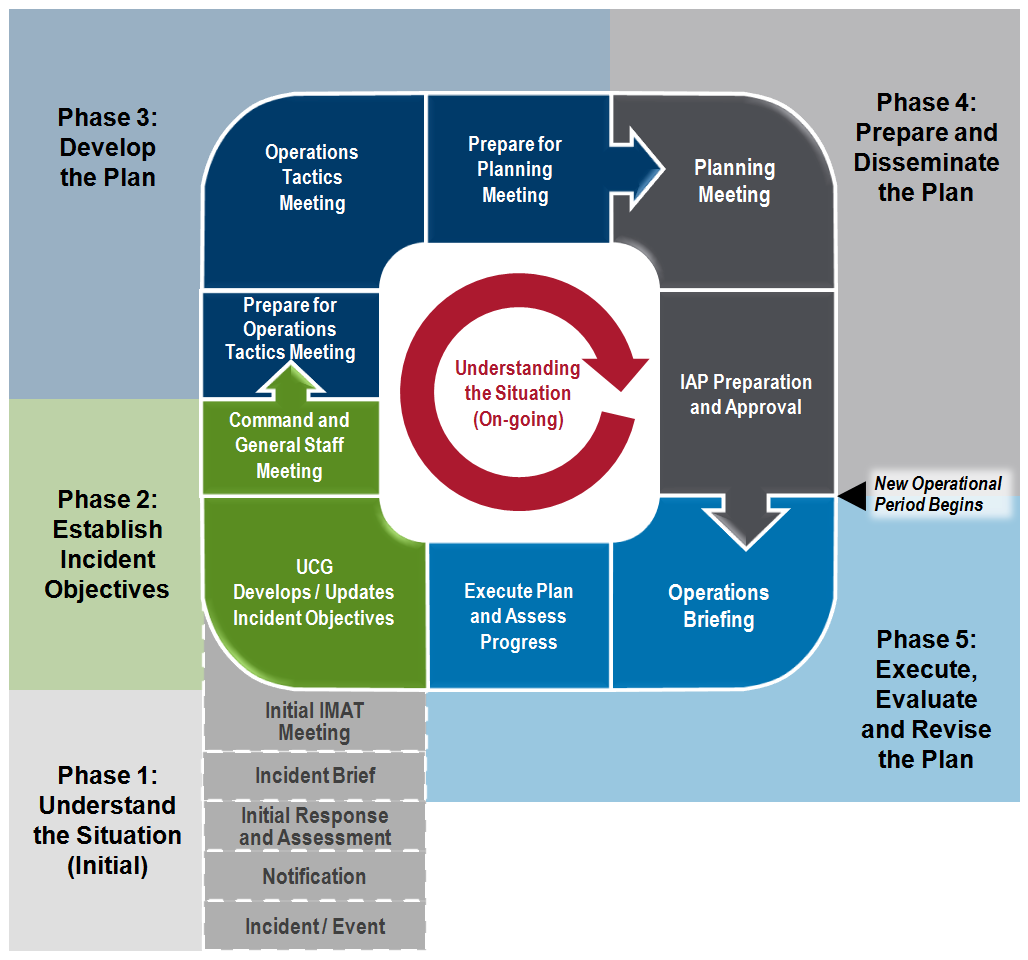
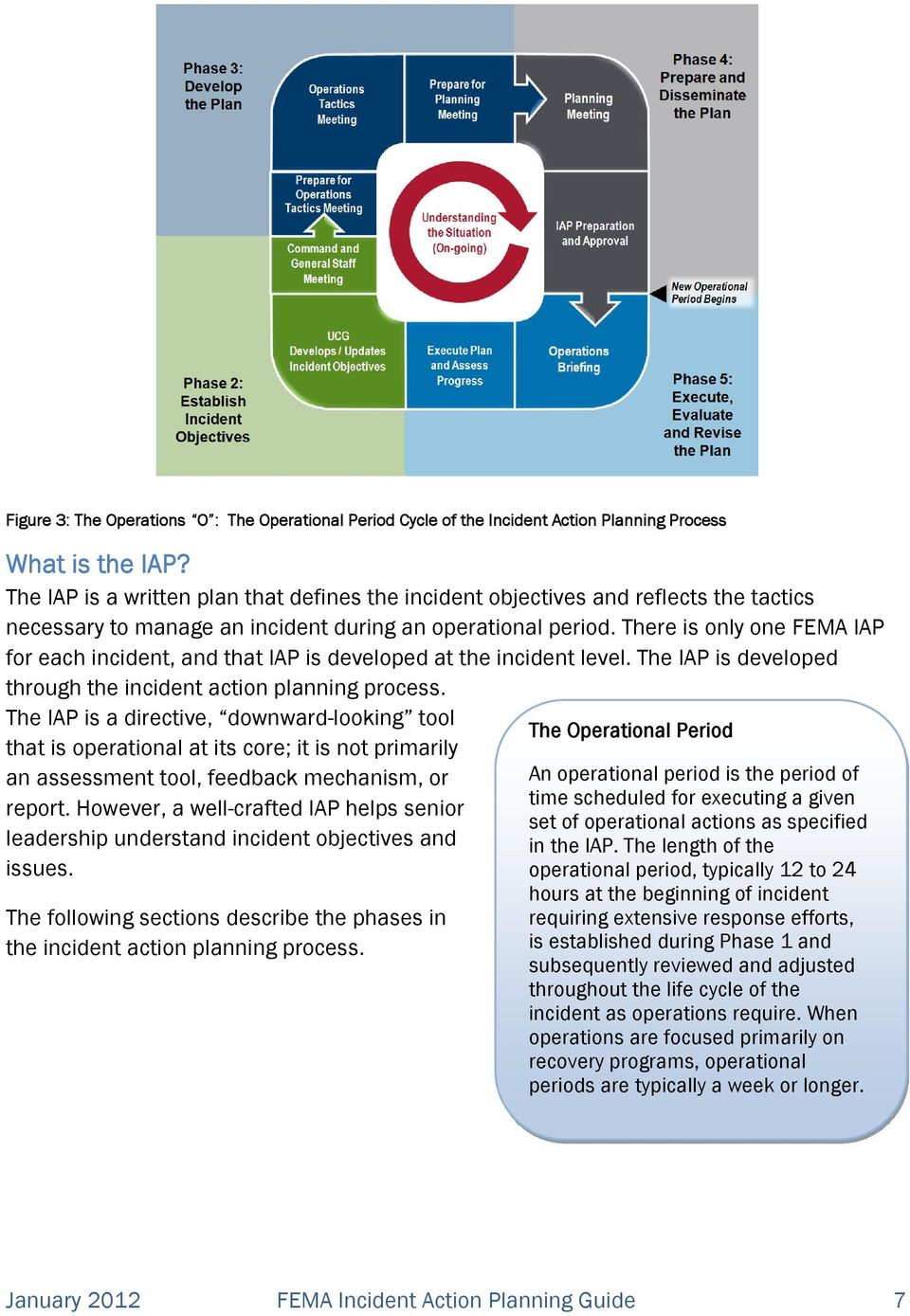
10 Figure 2: The Planning P : The Incident Action Planning Process ICS and the incident action planning process are used on all incidents in which FEMA is engaged both Stafford Act and non-stafford Act incidents. For Stafford Act incidents, an FCO is appointed by the President based on the recommendation of the Regional Administrator (RA) to manage Federal resources and support activities. For non-stafford Act incidents, the Department of Homeland Security designates a Federal Resource Coordinator (FRC) to perform essentially the same functions that the FCO performs, but without the specific Stafford Act authorities. Both the FCO and the FRC lead an Incident Management Assistance Team (IMAT). In this guide, the term, FCO refers to both FCO and FRC, and all IAP guidance applies equally to Stafford Act and non-stafford Act incidents. The Planning P and the Operations O The Planning P (Figure 2) depicts the stages in the incident action planning process. The leg of the P includes the initial steps to gain awareness of the situation and establish the organization for incident management. Although maintaining situational awareness is essential throughout the life cycle of the incident, the steps in Phase 1 are done only one time. Once they are accomplished, incident management shifts into a cycle that of planning and operations, informed by ongoing situational awareness, that continues and is repeated each operational period. This cycle, which is depicted in the barrel of the P, becomes the Operations O, (Figure 3). January 2012 FEMA Incident Action Planning Guide 6

11 Figure 3: The Operations O : The Operational Period Cycle of the Incident Action Planning Process What is the IAP? The IAP is a written plan that defines the incident objectives and reflects the tactics necessary to manage an incident during an operational period. There is only one FEMA IAP for each incident, and that IAP is developed at the incident level. The IAP is developed through the incident action planning process. The IAP is a directive, downward-looking tool that is operational at its core; it is not primarily an assessment tool, feedback mechanism, or report. However, a well-crafted IAP helps senior leadership understand incident objectives and issues. The following sections describe the phases in the incident action planning process. The Operational Period An operational period is the period of time scheduled for executing a given set of operational actions as specified in the IAP. The length of the operational period, typically 12 to 24 hours at the beginning of incident requiring extensive response efforts, is established during Phase 1 and subsequently reviewed and adjusted throughout the life cycle of the incident as operations require. When operations are focused primarily on recovery programs, operational periods are typically a week or longer. January 2012 FEMA Incident Action Planning Guide 7
12 PHASE 1: UNDERSTAND THE SITUATION Effective actions during Phase 1 may mean the difference between a successfully managed incident and one in which effective incident management is achieved slowly or not at all. Phase 1 focuses on actions that take place prior to the first operational period. While many important things are accomplished during this initial period, efforts focus on gaining an understanding of the situation and establishing initial incident priorities. Gaining an understanding of the situation includes gathering, recording, analyzing, and displaying information regarding the scale, scope, complexity, and potential incident impacts. Comprehensive situational awareness is essential to developing and implementing an effective IAP. Initial incident priorities are generally established by higher level authorities such as the Governor of the affected State and the FEMA Regional Administrator (RA). SAVER2 FEMA s geospatial viewer is called the Situational Awareness Viewer for Emergency Response & Recovery (SAVER2). This viewer displays data from emergency management partners to provide an integrated operational approach during response to disasters. SAVER2 is a two-way information sharing system that collects, processes, and displays real-time data from governmental and nongovernmental partners. Gaining Initial Situational Awareness Obtaining accurate, reliable situational awareness during the initial hours of an incident is often challenging. Situational awareness is further complicated by the urgency of collecting, analyzing, and disseminating situational information. Initial situational awareness involves the gathering of information from as many sources as possible, as quickly as possible, to ensure that decision makers have the knowledge they need to make the best possible decisions. Collection Information collection is based on established essential elements of information (EEIs) and critical information requirements (CIRs). EEIs are important and standard information items that incident managers need in order to make timely and informed decisions. EEIs also provide context and contribute to analysis. EEIs are included in situation reports. CIRs are particular elements of information specifically requested by incident leaders. These items are of such importance that leaders are notified immediately when the Planning Section receives updates on a CIR item. Analysis Analysis breaks down problems and issues into manageable smaller elements. In this way, complex problems that appear to be daunting may have achievable fixes. Analysis also January 2012 FEMA Incident Action Planning Guide 8

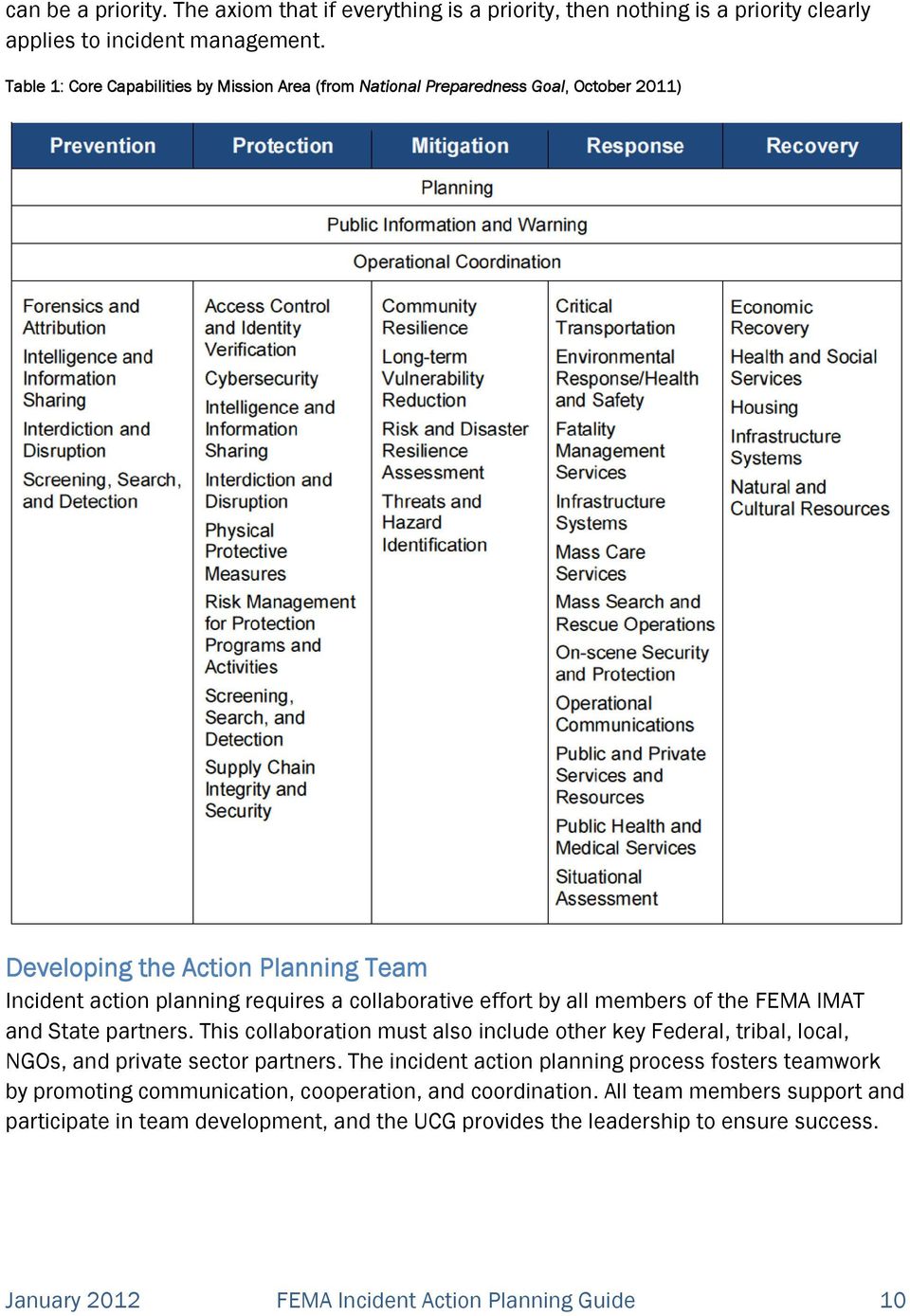
13 allows for the identification of sub-issues and problem areas that can be solved through effective decision making and planning. Information analysis during Phase 1 consists of correlating, comparing, and filtering the available information to determine the critical issues and the potential for changes in the situation. This analysis allows leaders not just to understand what is going on, but what the effects of those impacts are. Using a Deliberate Plan Dissemination Information should be disseminated in a timely manner and provided in a readable format that the audience can easily understand. Doing this effectively Pertinent deliberate plans may serve as a guide to form incident objectives and tactics. during Phase 1, and throughout the incident, minimizes confusion, reduces duplication of effort, and facilitates effective and efficient management of incident resources. If dissemination is not effective, all efforts to gain situational awareness will fail. On-going Assessment / Situational Awareness Accurate situational awareness is essential throughout the life cycle of an incident. After the initial efforts to gain situational awareness, the iterative information collection process continues to inform all aspects of incident action planning. This process includes the collection, analysis, and dissemination of information to assist operations and support functions in planning for providing support and resources to disaster survivors during each operational period. Appendix E Maintaining Situational Awareness Throughout the Life Cycle of the Incident provides details on this continuous assessment process. Establishing Initial Incident Priorities When senior officials establish priorities for the incident, a recommended approach is to articulate priorities based on the core capabilities described in the National Preparedness Goal (see Table 1). The core capabilities provide a standard list of the essential activities for preventing, protecting, mitigating, responding, and recovering. Framing incident priorities in terms of the core capabilities improves understanding through consistent titles, ensures that all the mission areas are considered, and helps to keep priorities focused strategically on desired outcomes. Federal, State, tribal, and local deliberate plans may identify or suggest incident response priorities. Clear initial priorities are important to establishing unity of effort early in the incident response process. When the members of the team clearly understand the intent behind instructions, they are equipped to act decisively and make better decisions. While many things vie for attention, especially in the immediate aftermath of a disaster, not everything January 2012 FEMA Incident Action Planning Guide 9


14 can be a priority. The axiom that if everything is a priority, then nothing is a priority clearly applies to incident management. Table 1: Core Capabilities by Mission Area (from National Preparedness Goal, October 2011) Developing the Action Planning Team Incident action planning requires a collaborative effort by all members of the FEMA IMAT and State partners. This collaboration must also include other key Federal, tribal, local, NGOs, and private sector partners. The incident action planning process fosters teamwork by promoting communication, cooperation, and coordination. All team members support and participate in team development, and the UCG provides the leadership to ensure success. January 2012 FEMA Incident Action Planning Guide 10
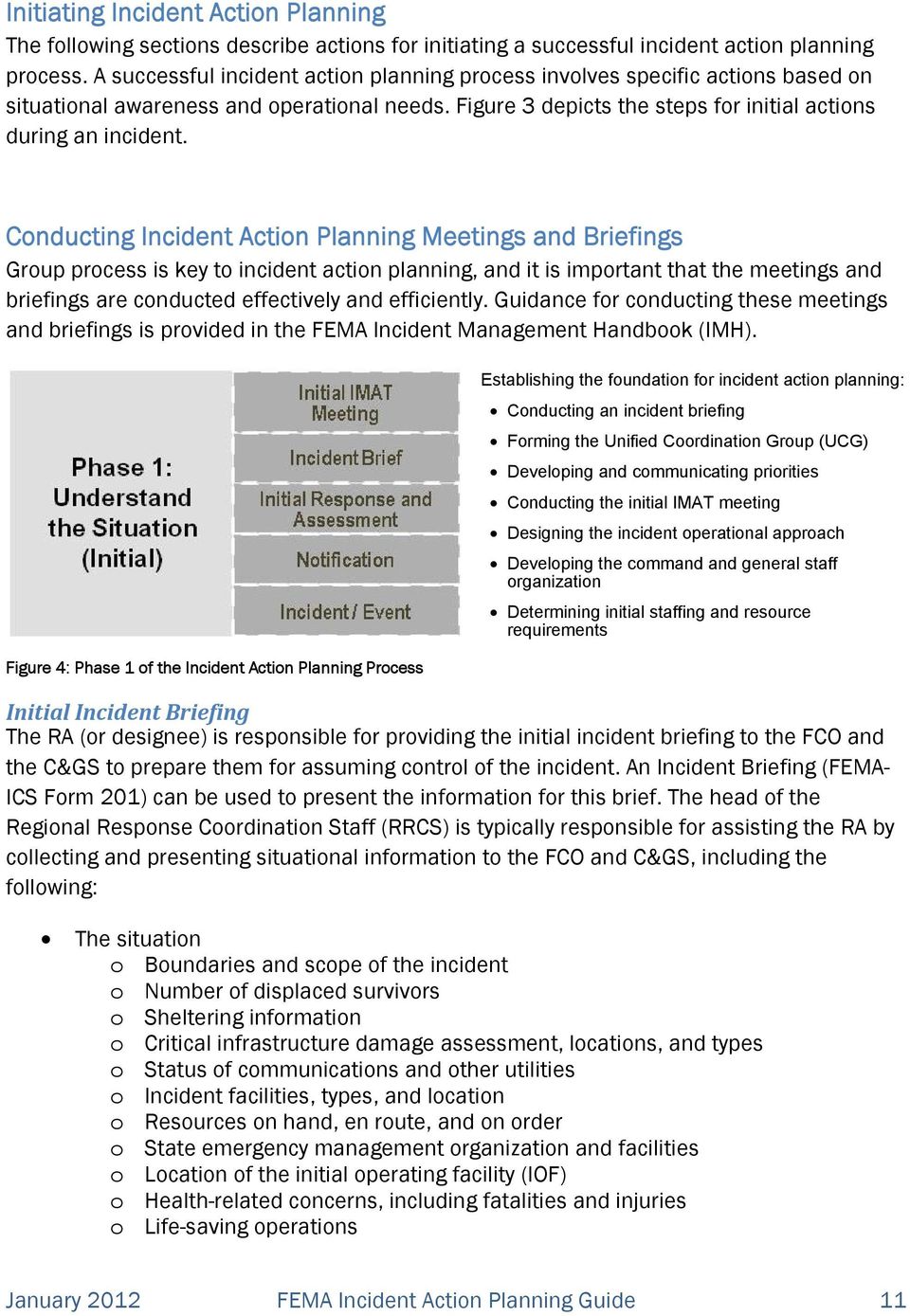
15 Initiating Incident Action Planning The following sections describe actions for initiating a successful incident action planning process. A successful incident action planning process involves specific actions based on situational awareness and operational needs. Figure 3 depicts the steps for initial actions during an incident. Conducting Incident Action Planning Meetings and Briefings Group process is key to incident action planning, and it is important that the meetings and briefings are conducted effectively and efficiently. Guidance for conducting these meetings and briefings is provided in the FEMA Incident Management Handbook (IMH). Figure 4: Phase 1 of the Incident Action Planning Process Establishing the foundation for incident action planning: Conducting an incident briefing Forming the Unified Coordination Group (UCG) Developing and communicating priorities Conducting the initial IMAT meeting Designing the incident operational approach Developing the command and general staff organization Determining initial staffing and resource requirements Initial Incident Briefing The RA (or designee) is responsible for providing the initial incident briefing to the FCO and the C&GS to prepare them for assuming control of the incident. An Incident Briefing (FEMA- ICS Form 201) can be used to present the information for this brief. The head of the Regional Response Coordination Staff (RRCS) is typically responsible for assisting the RA by collecting and presenting situational information to the FCO and C&GS, including the following: The situation o Boundaries and scope of the incident o Number of displaced survivors o Sheltering information o Critical infrastructure damage assessment, locations, and types o Status of communications and other utilities o Incident facilities, types, and location o Resources on hand, en route, and on order o State emergency management organization and facilities o Location of the initial operating facility (IOF) o Health-related concerns, including fatalities and injuries o Life-saving operations January 2012 FEMA Incident Action Planning Guide 11
16 o Arrangements for use of military resources (i.e., joint force command, etc.) The documentation o Stafford Act declaration (indicates counties/jurisdictions declared, categories of assistance authorized, and cost share), or interagency memorandum of understanding for non-stafford Act incidents o Pertinent deliberate plans o Maps of the incident area o Preliminary damage assessment o Geospatial information systems (GIS) products and satellite imagery o Telephone numbers and addresses for RRCS, State officials, and State emergency operations center and other incident facilities The work product from this briefing is the RA delegating the authority for incident management and the control of assigned Federal resources to the FCO in writing. The delegation of authority document includes detailed instructions (leader s intent) for the conduct of the incident management and the RA s priorities. The initial incident briefing also results in the FCO and C&GS having the requisite situational information to make informed decisions, including information regarding constraints and limitations. Forming the UCG Following the initial incident briefing, the FCO typically begins efforts to establish the UCG, including contacting the SCO and jointly determining other UCG members. Once the UCG is formed, members discuss: Issues and concerns The integration of Federal, state other stakeholders in a single incident organization Joint incident action planning Logistical processes and resource ordering Joint information center requirements Roles and authorities NOTE: see Chapter 3 of the IMH for guidance on this meeting. Developing and Communicating Priorities In forming the UCG, members jointly establish initial incident priorities based on priorities of the Governor, the RA, and other authorities as appropriate. Incident priorities inform the C&GS s actions and serve as focus items in the initial IMAT meeting. When communicating incident priorities to the staff, the UCG must give the necessary guidance to ensure that the staff understands the intent and context of the priorities. As indicated above, incident priorities are developed based on the National Preparedness Goal core capabilities. These priorities help to establish the order of importance for incident objectives developed during Phase 2 of the incident action planning process. January 2012 FEMA Incident Action Planning Guide 12

17 Initial IMAT meeting The purpose of the initial IMAT meeting is to ensure that incident management personnel understand UCG expectations. In this meeting, the C&GS leaders represent the rest of the IMAT. The Planning Section Chief (PSC) facilitates the initial IMAT meeting; however, as the leader of Federal response efforts, the FCO is the primary presenter, explaining the UCG s intent and articulating expectations regarding team interaction, information sharing, and team processes for planning, decision making, coordination, and communication. The FCO describes the composition of the UCG and his/her plans for integrating other UCG members into the IMAT. The FCO outlines assumptions that the team will use if actual information is not available, as well as direction regarding the development of the organizational structure for the incident. The FCO also reiterates FEMA s commitment to use the ICS (per the National Incident Management System and the Incident Management Handbook). Furthermore, the FCO reiterates the expectation for communication and collaboration with Federal, State, tribal, and local government partners as well as NGOs and the private sector. Next, the FCO, Operations Section Chief (OSC), or PSC describes the initial strategies proposed to address the initial priorities and how the initial strategies are to be accomplished. The PSC or FCO then announces the start time, duration of, and incident action planning meeting schedule for the first operational period. The results from the initial IMAT meeting are as follows: (1) all IMAT members understand UCG expectations, guidance, and direction (leader s intent) for the incident and initial strategies; (2) C&GS has a clear understanding of direction and guidance to begin developing the organization; and (3) agreement is reached regarding the time and duration of the initial operational period and the incident action planning meeting schedule. The work products from the initial IMAT meeting are as follows: A list of UCG priorities and strategies (for distribution to the C&GS and to be displayed in the IMAT meeting room). The incident planning cycle schedule (to be displayed in the IOF/Joint Field Office [JFO]). The Meeting Schedule (FEMA-ICS Form 230) for the first operational period or initial incident action planning cycle (typically published and displayed in the IOF or the JFO). Establishing the Organization Before an organization can be implemented, the incident area must be considered and a decision made as to whether to establish a functional or geographic organization for FEMA/State incident activities. That decision dictates the operational approach to the incident and the FEMA and State OSCs work together to decide on it. January 2012 FEMA Incident Action Planning Guide 13

18 The OSCs goal is to design an ICS-compliant organization that meets leader s intent, the agency s mission, and the incident s needs. This decision has a significant effect on operational outcomes and the achievability of IAPs. It also impacts the Logistics Section, Planning Section, Finance/Administration Section, External Affairs Community Relations, and Safety. The OSCs design the incident carefully, because once the organization is established it is difficult to change. Organization Guidance Level I and II incidents should be organized geographically, because the scale and complexity of a Level I or II incident would be difficult to encompass functionally. Level III incidents are typically organized functionally; however, they could be organized geographically if it occurs across a large enough geographic area. Level III incidents do not have branch director positions in the Operations Section unless required to maintain an appropriate span of control. Geographic Organization Overview On large, complex incidents that include many counties and jurisdictions, a geographic organization is most appropriate. This provides Federal, State, tribal, and local officials with a single point of contact for all incident operations in defined and manageable geographic areas (divisions). This permits the assignment of incident resources to these divisions so they can be coordinated with local officials and managed by a single division supervisor. A geographic organization may also provide a greater span of flexibility in control of an incident than a functional organization can provide. Geographic organizations actually include a combination of geographic branches/divisions, functional branches/groups, and operational branches/groups. Geographic branches/divisions include Operations branch directors and division supervisors. Functional branches/groups may include Individual Assistance (IA), Infrastructure/Public Assistance (PA), Long-Term Community Recovery (LTCR), and Hazard Mitigation (HM), and. Operational branches/groups may include emergency services, air operations, staging areas, and disaster emergency communications. OSCs use a map of the State emergency management organization (showing the State s regions, districts, etc.) to determine branch and division boundaries. Geographic branches and divisions are most effective when they align with existing state and local jurisdictions and boundaries. This allows emergency managers at all levels of the incident to properly align their activities with one another. January 2012 FEMA Incident Action Planning Guide 14
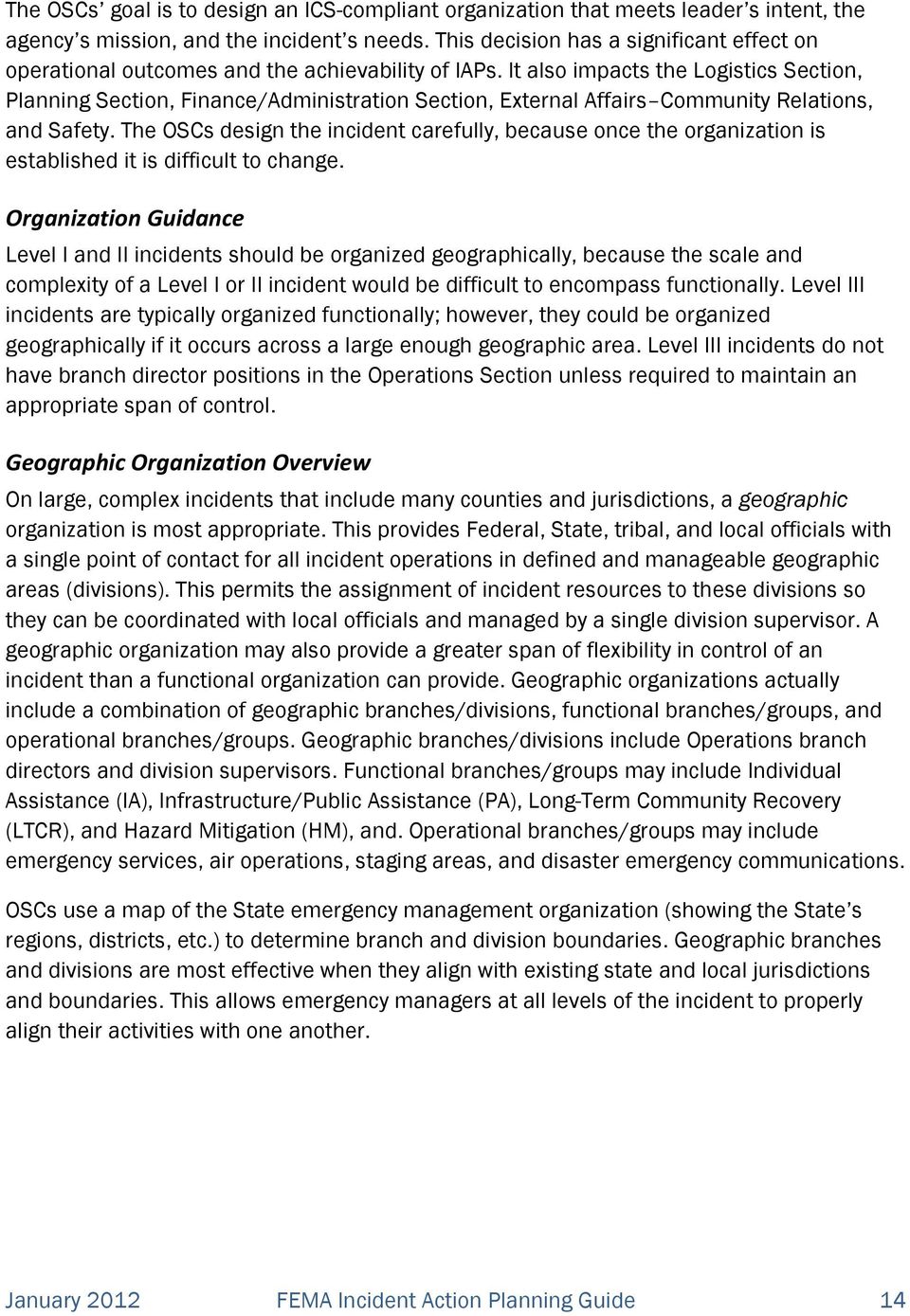
19 Geographic and Functional Organizations In a geographic organization, responsibility for managing the incident is divided into geographic units called divisions and, depending on the number of divisions, geographic branches. Geographic organizations are headed by division supervisors and geographic branch directors. Geographically organized incidents also include functional groups (XXGS) and/or branches (XXBD) for functions such as IA, PA, LTCR, and HM. These functional groups are essential for planning and managing programs and assigning resources to specific divisions and/or branches and operational branches/groups such as Air Operations and Staging Areas. Geographic elements plan and manage operational activities in their area but do not perform all incident management functions, do not replicated the ICS C&GS structure, and do not function as mini- or sub-jfos. Because a geographic organizational configuration also includes functional groups, it is actually a hybrid, geographic-functional organization, but is referred to as a geographic organization for simplicity. In a functional organization, responsibility for incident management organized strictly by function without the establishment of geographical units. For FEMA, function generally refers to FEMA programs, e.g., IA, PA, LTCR, and HM. A geographic organization structure refers to how resources are assigned to accomplish work assignments. Functional branches and/or groups are essential for planning and managing their programs and assigning resources to specific divisions and/or branches. The primary difference is that when resources are assigned to divisions or branches, they report to the division supervisor or branch director to whom they are assigned. Divisions are determined first. Then branches are established based on the number required to maintain the recommended span of control of five branches per division. In determining the size of divisions, OSCs consider damage, complexity, transportation and communication issues, and the assistance requirements of a particular jurisdiction. This helps to frame whether a dedicated division supervisor is necessary for each jurisdiction or whether one division supervisor can coordinate multiple jurisdictions. The OSC presents his findings and recommendations to the FCO and SCO for approval. Functional Organization Overview Functional organizations are generally the most appropriate structure for Level III incidents. Incident functional resources are assigned to appropriate groups that are coordinated with January 2012 FEMA Incident Action Planning Guide 15

20 State and local officials and managed by a single group supervisor. Groups are typically organized by functional area, such as PA, IA, LTCR, and HM. Develop C&GS Organizations The C&GS and their State counterparts jointly develop their organizations based on leader s intent, the situation, and the needs of the incident. To do this, they validate current situational information and analyze it regarding current conditions, damage assessment, scale of the incident, and resource status (i.e., availability of personnel, equipment supplies, and facilities). They also review any pertinent deliberate plans. The C&GS and their State counterparts then coordinate closely with the OSCs to determine whether the proposed geographic or functional incident design will affect how other organizational elements are structured. Ultimately, the OSC determines what facilities (disaster recovery centers, staging areas, operations field offices, aviation facilities, camps, fueling stations, etc.) are required to meet incident needs. The OSC then discusses findings and recommendations with the FCO and SCO, or designee, for approval. Once approved, information regarding C&GS organizations is provided to the Planning Section for the GIS Unit to build the initial incident map and to the Resource Unit to develop the initial Incident Organization Chart (FEMA-ICS Form 207). Develop Staffing and Resources Requirements After developing incident design and organizational structures, the C&GS identify the resources needed to staff and support their organization and meet UCG priorities. To determine resource requirements the C&GS and State counterparts consult with the Planning Section Resources Unit to identify resources currently assigned. The consultation also yields such details as the kind and type of each resource, current location and status, identifier if assigned, and supervisor s contact information. If a required resource is not currently available, the C&GS/State counterpart contacts the Logistics Section Ordering Unit to determine what resources have been ordered. Finally, if a required resource is neither currently available nor on order, the appropriate C&GS/State Importance of Providing Clear Guidance Providing clear operational guidance is an essential element of command at all levels within the incident organization. It provides subordinates with information that defines, refines and/or places into context assignments or directives. It addresses constraints and limitations, establishes parameters, and assists in better identifying an expected outcome. counterpart orders them through the established ordering processes. More detailed information on the resource ordering process can be found in Phase 3. January 2012 FEMA Incident Action Planning Guide 16
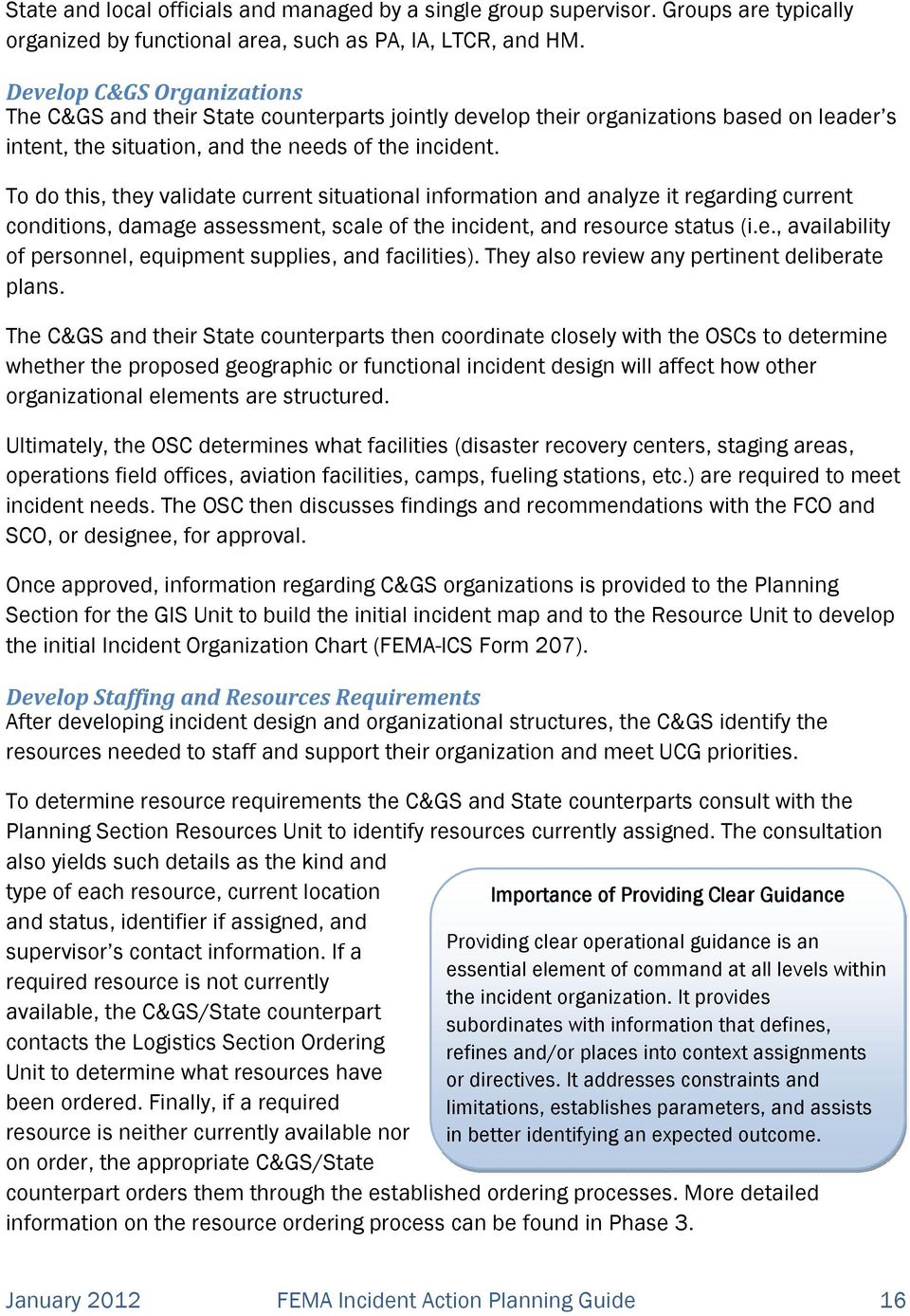
21 PHASE 2: ESTABLISH INCIDENT OBJECTIVES During Phase 2 the UCG establishes incident objectives and provides the guidance necessary to achieve these objectives. Incident objectives drive the incident organization as it conducts response, recovery, and mitigation activities. The UCG establishes these objectives based on incident priorities, informed by situational awareness, leader s intent, and delegations of authority. Figure 5: Phase 2 of the Incident Action Planning Process Responsibilities The UCG develops incident objectives and provides the guidance necessary for developing, resourcing, implementing, and evaluating the results of incident objectives. As the leader of Federal response efforts, the FCO is personally responsible for the development of incident objectives for FEMA. The C&GS often provide input to the UCG/FCO regarding incident status and operational requirements to support the development of incident objectives and the guidance to achieve them. Planning Section staff document the incident objectives on IAP Incident Objectives form (FEMA-ICS Form 202). Priorities Incident priorities initially established by leadership during Phase 1 are reviewed and modified as required during each operational period and help to clarify the order of importance of incident objectives. While incident objectives are based on requirements, priorities guide the allocation of resources to objectives. Although priorities help determine incident objectives, they are not listed on the IAP Incident Objectives (FEMA-ICS Form 202). January 2012 FEMA Incident Action Planning Guide 17
22 Senior leaders sometimes include non-operational priorities in their guidance. When this happens, these non-operational priorities are generally not addressed in the incident action planning process. Incident Objectives Management by objective is a key characteristic of NIMS and one which FEMA follows. Incident objectives, per NIMS are statements of guidance and direction necessary for the selection of appropriate strategies and the tactical direction of resources. Incident objectives are based on realistic expectations of what can be accomplished when all allocated resources have been effectively deployed. Good Incident Objectives: Are concise and stated in the form of a command Begin with an action verb (but not continue or maintain ) Provide actionable guidance for the Operations Section Address incident operations not administrative and internal support activities Incident objectives must be flexible enough to allow for strategic and tactical alternatives. Incident objectives set guidance and strategic direction, but do not specify tactics. Incident objectives drive response and recovery activities. Simply stated, incident objectives answer the question of what must be accomplished. For example, Install 200 temporary housing units in Wallace Borough by April 22, In the initial stages of an incident response, objectives will often be quite general. For example, Restore electrical service in Baldwin County. is an acceptable incident objective in the immediate aftermath of a storm. As response work progresses, situational awareness improves, and resources status becomes clearer, objectives can become more specific, e.g., Clear emergency ingress and egress routes to Wright Beach 1 by October 1, Incident objectives can be distinguished from tasks or work assignments by the fact that objectives do not answer the question who. Tasks/work assignments identify specific resources, specific locations, and must be accomplished within the operational period. Incident objectives, on the other hand, do not specify who will accomplish the action and are not necessarily to be achieved in the current operational period. 1 Incident objectives often also answer the question of where the desired activity must be accomplished. January 2012 FEMA Incident Action Planning Guide 18
23 The UCG formulates incident objectives based on several factors: incident priorities and other direction from a higher authority, the situation, and members professional judgment and experience. Incident objectives should be clear, measurable, achievable, and flexible. They include sufficient detail to ensure understanding, but are not be so prescriptive as to preclude innovation. TABLE 2. PRIORITIES OBJECTIVES STRATEGIES TACTICS, TASKS, WORK ASSIGNMENTS Guidance Element Description Developer Examples Priorities Objectives Strategies Tactics/ Tasks Define the intent of leaders, in general terms, with regard to the most important things that must be accomplished. They are generally expressed in terms of the core capabilities defined in the National Preparedness Goal. Define what must be accomplished to achieve the priorities and based on best knowledge of the current situation and the resources available Carefully devised plans of action to achieve one or more objectives. Strategies describe what actions and resources are required in working to achieve the specific objective. Define how specific actions will be performed to achieve a planned outcome. Tactics specify who, what, where, and when in describing the deployment and direction of resources for implementing strategies to achieve incident objectives. Tactics/tasks/ work assignments are initially recorded on Operational Planning Worksheet (FEMA-ICSForm 215) and subsequently reflected on the Assignment Lists (FEMA-ICS Form 204) and included in the IAP for the given operational period. Initially established by the competent authorities, e.g., Governor, FEMA Administrator, FEMA Regional Administrator; subsequently reviewed and adjusted throughout the life cycle of an incident by the Unified Coordination Group Unified Coordination Group Operations Section Chief Operations Section Chief Mass Search and Rescue Locate any remaining trapped survivors in affected areas in Memphis by October 1. Deploy FEMA USAR teams, EMAC search and rescue assets from Kentucky and Indiana, and Canadian search and rescue teams to work in a unified operation under the tactical control of Memphis Fire Services. California Task Force-3 will report to Memphis Fire Station 19 at the corner of Chelsea and Boxwood Street at 0600 [of the operational period} with all equipment and support personnel to deploy and operate under the direction of Memphis Fire Services until Specific direction for the team will be provided by Memphis Fire Service officials. The following guidelines have been established ensure that incident objectives are handled consistently: Incident objectives are displayed on the Incident Objectives (FEMA-ICS Form 202). They are numbered sequentially from the beginning of the incident to its conclusion and are not renumbered for each operational period. January 2012 FEMA Incident Action Planning Guide 19
24 o Once achieved, incident objectives are not included on the Incident Objectives (FEMA-ICS Form 202) for subsequent IAPs. o Incident objectives can be modified and maintain the same tracking number as long as the intent of the objective does not change. o If an objective is modified, it is assigned a new sub-letter under the same objective number, and the old objective is retired. For example, if objective 2 is modified, it becomes 2a, and objective 2 is retired. If this objective is modified again, it becomes 2b, and 2a is retired. Incident objectives are prioritized by the UCG as operational period requirements dictate. Incident objectives are listed on the Incident Objectives (FEMA-ICS 202) in order of priority, regardless of their tracking number. The first listed objective is therefore the highest priority. The last listed objective is the lowest priority. UCG Develops and Update Objectives The UCG may meet before the C&GS meeting to review and, if necessary, revise incident priorities and determine the incident objectives for the next operational period. This meeting is often conducted informally and frequently includes the OSC and PSC. The expected results of this meeting are: A common understanding among the UCG of the incident s issues and the key requirements of the response and recovery, Agreement regarding incident priorities and objectives for the next operational period, Recognition of constraints and limitations affecting accomplishment of incident objectives, and Operational guidance (for accomplishing incident objectives) that accounts for and mitigates identified limitations. The work product from this meeting is a documented list of incident objectives. The C&GS Meeting The C&GS meeting is the opportunity for the UCG to meet with the staff to gather input or to provide immediate direction. It is also the opportunity for the UCG to articulate and approve incident objectives for the next operational period and to share important information regarding incident management. The PSC facilitates this meeting. See Table 3 below for the meeting agenda. The UCG presents the priorities and incident objectives and articulates guidance on how incident operations should proceed. The participants review the incident objectives and discuss strategies for accomplishing the objectives. January 2012 FEMA Incident Action Planning Guide 20
25 Table 3: Agenda for the C&GS meeting Agenda Topic Roll call and introduction of new participants and guests Opening remarks Present incident objectives for the upcoming operational period Describe/update current situation Open discussion, including the following: Current status and issues Constraints, limitations, and shortfalls Input needed to finalize the incident objectives and strategies Establish precedence of incident objectives based on incident priorities Outline of guidance to achieve objectives Open discussion (optional) Closing remarks Briefed By PSC UCG PSC Situation Unit Leader (SITL) OSC Others as needed PSC UCG PSC UCG January 2012 FEMA Incident Action Planning Guide 21
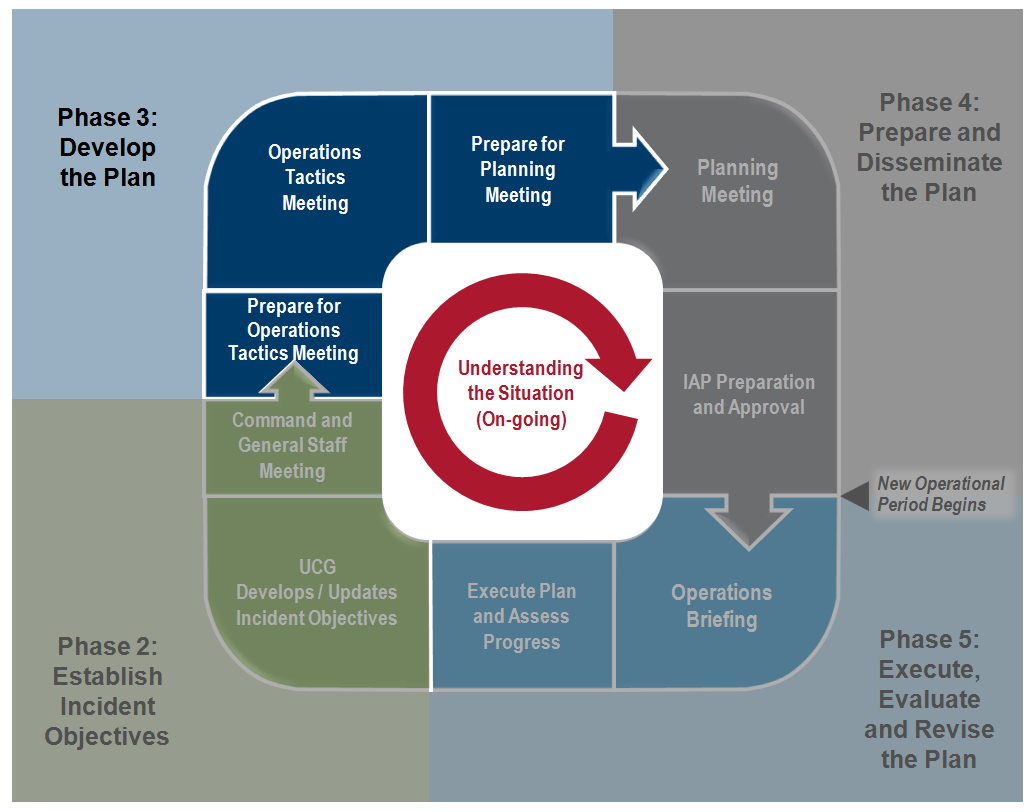
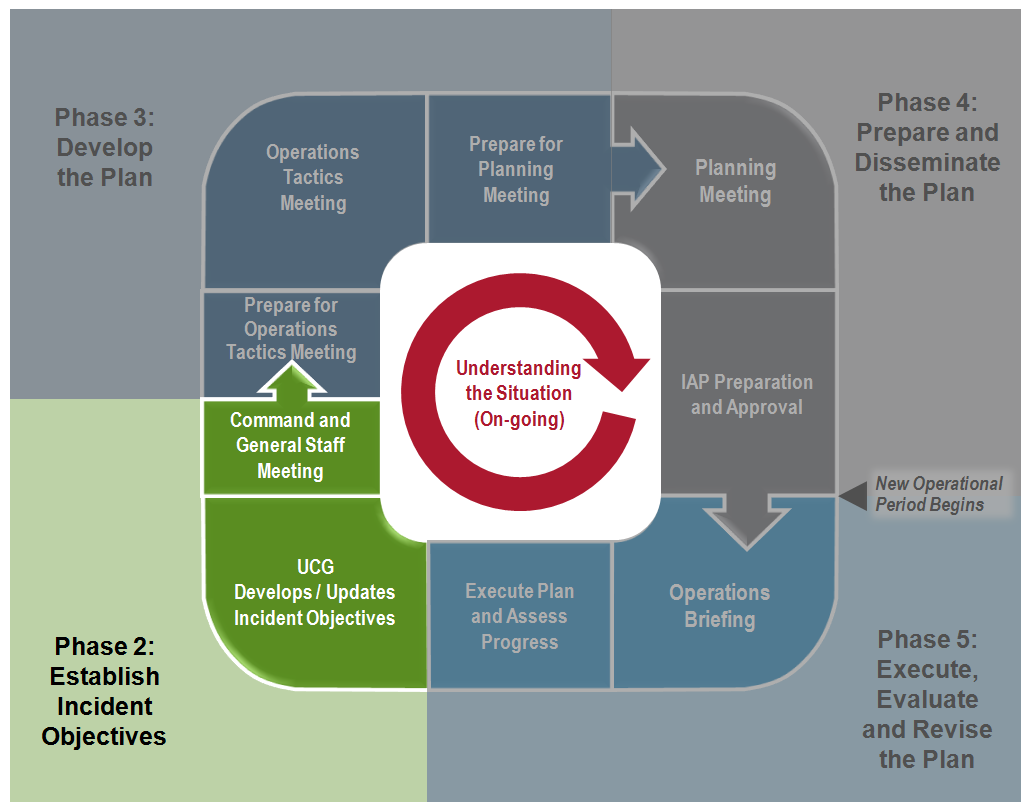
26 PHASE 3: DEVELOP THE PLAN Operational planning is a continuous process, but time-specific operational planning begins immediately following the C&GS meeting. The Operations Section develops strategies to meet incident objectives and tactics to accomplish the strategies. Operations Section staff match the work required to execute the tactics to resources to create work assignments which are documented on the Operational Planning Worksheets (FEMA-ICS 215). As work assignments are developed, the Safety Officer, Logistics Section Chief, Security Manager and others review the work assignments and provide input. Figure 6: Phase 3 of the Incident Action Planning Process Responsibilities for Operations Planning The OSC has overall responsibility for operations planning. The OSC frequently delegates planning responsibilities to his/her primary staff based on the size, scope, complexity of the incident, and the particular FEMA programmatic expertise required. Responsibility for operations planning, however, should not be delegated to junior staff members who lack the standing or experience to make the required decisions or answer the questions that frequently arise. Primary responsibility for operations planning in FEMA incidents is not delegated to staff below the level of the following: January 2012 FEMA Incident Action Planning Guide 22
27 Table 4: Responsibilities for Operations Planning Responsibilities for Operations Planning Incident Level I II III Deputy OSC with planning responsibilities X X X Assistant OSC with planning responsibilities X X X Deputy Branch Directors or Assistant Branch Director-Planning X X Functional Group Supervisors X Deputy External Affairs Officer-Community Relations Deputy with X X X planning responsibilities Assistant External Affairs Officer-Community Relations, Planning X X X Strategies Strategies are ways to achieve incident objectives. Strategies may be developed during all phases of an operation and by all elements involved in the operation and are not restricted to specific, short or long-term operational periods. Strategies describe what actions and resources are required to achieve specific objectives and are distinct from tactics, which address the conduct of specific operations. A strategy describes how things work; tactics describe what must be done. For example: Strategy: Establish a mix of fixed and mobile disaster recovery centers (DRC) to provide easy access to FEMA programs for survivors at the following locations: [list of locations follow] Tactics: Identify when, where, and the type of DRC to be established. Determining Strategies The process of developing strategies does not occur during a formal meeting. It is accomplished in the period between the C&GS meeting and the operations tactics meeting. The Operations Section staff begins the process of developing strategies immediately when they receive the incident objectives for an operational period. The OSC develops strategies collaboratively with section staff and in consultation with others such as Logistics, Safety and Security personnel to ensure that the strategies are fully supportable. All strategies must be weighed against available resources, time and the probability of achieving the desired outcomes. Strategy Development Tips OSCs often hold an informal meeting with Operations Section staff members, who have operations planning responsibilities, to develop the operations strategies and to: o Solicit broad input o Ensure that staff understand and agree on the strategies developed o Adjust strategies in consultation with branch directors and group supervisors Good strategies: Are feasible, practical, suitable, and likely to achieve the desired outcome Meet acceptable safety norms Are cost effective Reflect sound environmental practices Consider political implications Address core capabilities January 2012 FEMA Incident Action Planning Guide 23
28 Strategies Inform the Development of Sound Tactics Strategies are developed to accomplish the UCG s incident objectives and frame the development of tactics. Strategies must be complementary and able to be integrated into a single coordinated course of action. Effective strategies restrict the pool of possible tactics and help to ensure that tactical decisions do not conflict. Sound strategic planning takes into account dynamic situations, as well as constraints and limitations, in incidents. Determining Tactics Tactics define specific actions to be performed to achieve a planned outcome. Tactics specify who, what, where, and when for implementing strategies to achieve incident objectives. Tactics describe the deployment and direction of resources, based on the strategy to accomplish the incident objectives. Once the strategies have been developed, the operational planners identified in Table 4 are generally responsible for developing the tactics to implement the strategies taking into account constraints, limitations, and other considerations. Examples of considerations for determining resource requirements include what resources are available for the next operational period and whether any road closures or hazardous conditions may affect tactical implementation. Once the kind, type, and qualification of available resources are known and any constraints or limitations are identified, the tactical plan can be developed. The following activities are used to develop the tactical plan: 1. Determine what has to be done to implement a strategy and what method(s) are likely to achieve success. 2. Develop a list of resources (personnel, teams, equipment, supplies, facilities) that are required. 3. Provide a list of resources available (this is done by the Resource Unit). 4. Compare the resources required with resources available and discuss the findings with the OSC prior to the operations tactics meeting. 5. Draft the tactical plan based on this analysis. Additional personnel, supplies, services, and equipment required to implement the tactical plan are requested. This is done with the understanding that resources will usually not arrive in time to be applied in the next operational period. Once that tactical plan has been developed and the requisite resources identified, Operations Section personnel select specific resources to perform specific work assignments. They then write work assignments for each resource and identify reporting locations. Assigning Resources and Describing Work Assignments Work assignments for resources that are not engaged in actual field operations are not included in the tactical plan unless the OSC determines that there is a compelling reason to do so. Operations Section personnel assigned to the incident, whose primary responsibility is January 2012 FEMA Incident Action Planning Guide 24
29 support rather than operations, are not included. Planning, administration, data entry, and report writing are examples of such resources and activities not included in the IAP. Work assignments for the following operations leaders are not typically included: OSCs, geographic and functional branch directors, division and group supervisors. Assign Resources to Operations Organizations According to Geographic Area or Functional Group On FEMA incidents, functional operations resources and ESFs are initially assigned to a specific functional branch/group (IA, PA, LTCR, HM, ESF). Operations Section personnel consider requirements for each task and select the best resource. Representatives from the functional branches/groups and the primary agencies of the ESFs control their assigned resources when the incident is organized functionally. On Level I and II incidents that are organized geographically, functional branches/groups assign their resources to geographical branches/divisions where the resources will be employed during the operational period. While assigned to a geographical branch/division these resources are under the supervision of the geographic branch director/division supervisor. Resources that are not so assigned remain under the supervision of the appropriate functional branch/group. Those resources assigned to a geographic branch/division are under the supervision of the assigned branch director/division supervisor. That supervisor ensures that the work assignments prepared by the functional branches, groups, and ESFs are carried out as prescribed in the work assignment. Functional branches, groups, and ESFs may modify work assignments in coordination with the appropriate geographic branch director/division supervisor. Conversely, if changes are needed to meet State and local officials concerns that affect functional resources assigned and their work assignments, the division supervisor consults with the geographic branch director, the appropriate functional branch director, the group supervisor, and the ESF lead. If a resource will be assigned to more than one branch or division during a single operational period, a work assignment is prepared for each. If a particular resource will be doing multiple tasks in a single division, Operations Section personnel combine the work assignments on a single line on the Operational Planning Worksheet (FEMA ICS Form 215) and the appropriate Assignment List (FEMA ICS Form 204). Also, when determining a reporting location, Operations Section personnel in a geographical organization refer to the incident map to determine to which branch and division the resource will be assigned. The incident map depicts the geographical boundaries of branches and divisions boundaries that remain in effect throughout the life cycle of the incident. Branches and divisions can be combined when appropriate as work load diminishes. Combining branches and divisions means that multiple branches may be January 2012 FEMA Incident Action Planning Guide 25
30 assigned under a single branch director or multiple divisions are assigned under a single division supervisor. The branch/division boundaries and designators remain the same. For example, combining divisions A, B, and C under a single division supervisor would look the same on the map, but would identify the division as Division A, B, and C on the assignment list (FEMA ICS Form 204). Write a Specific Work Assignment for Each Assigned Resource The supervisor or person responsible for the implementation and completion of the work assignment should receive a sufficient amount of information for the implementation and completion of the assignment. This information should be clear and concise and include the following: Task to be accomplished Reporting time and location Level of effort required to accomplish the task Any special equipment required Logistical support needs Any contact information Any constraints or limitations Identify the Reporting Location The reporting location is where the assigned resource reports at the beginning of the operational period. This is not the branch, division, group, or ESF but the physical location to which the resource must report. Examples of reporting locations are: Address of the disaster recovery center Address or number of points of distribution for the delivery of commodities Location within a geographic and/or jurisdictional area for community relations (CR) activities Address and time for the PA applicants briefing Street address by the National Grid Reference System Rallying point Sometimes a specific time for arrival may also be necessary as part of the work location. This could be a direction to not arrive before or after a certain time or a time frame in which the work assignment needs to be initiated. This information should be included with the reporting location when relevant. January 2012 FEMA Incident Action Planning Guide 26
31 Determine Logistical Support Needs to Complete the Assignment Work assignments often require specific logistical support requirements that the functional branches and groups are responsible for identifying. The Logistics Section receives these requirements and acts to meet them. Examples of such requirements are as follows: Needs for Individual Assistance mobile disaster recovery center #3: o Shade tent approximately 10x10 feet o Water for 200 people o 25 folding chairs Needs for Hazard Mitigation Community, Education, and Outreach Crew #1: o 1 folding table, 6 feet long o 5 folding chairs Needs for points of distribution #15: o 5 truckloads of water o 1 truckload of tarps o 2 truckloads of meals-ready-to-eat Using the Operational Planning Worksheet (FEMA-ICS Form 215) Developing the Operational Planning Worksheets (FEMA-ICS Form 215) is an essential part of the incident action planning process. The worksheets are particularly important to the success of response and recovery operations on larger incidents. The Operational Planning Worksheet (FEMA-ICS Form 215) aids Operations personnel in capturing their tactics and in identifying resource assignments prior to the operations tactics meeting. Reviewing these worksheets during the operations tactics meeting facilitates discussion and focuses on the review of tactics and resource assignments. Functional operations branches/groups, ESFs, External Affairs (EA) CR and geographic branches/divisions use the Operational Planning Worksheets (FEMA-ICS Form 215) to document the assignment of resources and supporting information as determined above. The worksheet is designed to capture work assignment information and to aid in both the operations review process and preparation of the IAP s Assignment Lists (FEMA-ICS Form 204). The figure below shows an Operational Planning Worksheet (FEMA-ICS Form 215). Instructions for completing the form follow. January 2012 FEMA Incident Action Planning Guide 27
32 Figure 7: Example of Operational Planning Worksheet (FEMA-ICS Form 215) For each assigned resource, the following information is entered on the Operational Planning Worksheet (FEMA-ICS Form 215): 1. Include only resources that are either on-hand or that the Ordering Unit verifies have been ordered and will be on-hand for the assignment. 2. Enter the incident name in block Enter the date and time the form was prepared in block Enter the date and time for the operational period in block Enter the branch number in block 4. If the resource is being assigned to a functional group, leave blank. 6. Enter division or group in block 5. For a division, this will be a letter. For a group, this will be an abbreviation or term such as IA, PA, HM, CR, Staging, or specific ESF. 7. Indicate a geographic or functional operations organization assignment in block 6, citing the following according to the level of the incident: For Level I and II incidents involving a geographic branch, show the branch number (I, II, III, etc.) and division letter (A, B, C, etc.). For Level I and II incidents involving a functional branch, cite the branch (IA, PA, HM, LTCR, etc.) and any operational branches/groups such as air operations, staging, and disaster emergency communications. For Level III incidents, cite the functional group (IA, PA, LTCR, HM, etc.) and any operational groups such as air operations, staging, and disaster emergency communications. 8. Enter the resource identifier for the assigned resource in block 7. Consult with the Planning Section s Resource Unit for resource identification information. January 2012 FEMA Incident Action Planning Guide 28
33 When there are multiple resources of the same kind and type, ensure each resource has an individual resource identifier assigned (i.e. MDRC #3, CR Crew #3, etc.) 9. Enter the contact name and phone number for the resource in block 8. Consult with the Planning Section s Resource Unit to identify the resource contact name and number. 10. Enter the number of people or the quantity of the resource in block 9. The number of people assigned to the resource (i.e. Crews, Task Force, etc.) or The quantity of the resource (liters of water, number of meals ready to eat, number of tarps, etc.). 11. Enter the work assignment in block Enter the reporting location, time (as needed), and logistical needs in block 11. For operational periods longer than one day, the date should be added if needed. Once the draft worksheet is completed, it is transmitted electronically to the Resources Unit prior to the operations tactics meeting. The PSC and OSC negotiate the actual deadline, and the OSC is responsible for ensuring that the deadline is met. The Resource Unit captures all Operational Planning Worksheets (FEMA-ICS Form 215) and prepares them for display, review, and editing at the operations tactics meeting. The Operations Tactics Meeting The purpose of this meeting is to review and finalize the draft Operational Planning Worksheets (FEMA-ICS Form 215). To accomplish this, the OSC leads participants in reviewing the work assignment drafts to determine whether they are complete and whether they support the incident objectives and strategies. Participants also identify gaps and duplication in work assignments and resolve any conflicts or coordination issues. Participants should also ensure that resources are identified correctly (resource identifier) and when there are multiple resources of the same kind and type, there is an individual identifier assigned. Participants also consider resource and logistical issues; and identify shortfalls, excesses, safety issues, and the accuracy of the incident map. Participants in the operations tactics meeting include functional branch directors (or designee for branch planning); functional group supervisors (when no branch director is assigned); ESF leads; the CR lead or designee for CR Operations Planning; the geographic branch director (operations branch directors) and division supervisors (if requested by the OSC); the Resource Unit Leader (RESL); the Logistics Section Chief (LSC); and the Safety Officer (SOFR) and Liaison Officer (LOFR). The following may also attend: the Security Manager, the Finance/Administration Section Chief; the EA Officer; the PSC; and the Situation Unit Leader. Informational items available at the operations tactics meeting, supplied by the Planning Section, include the list of current incident objectives, a large incident map, a list of January 2012 FEMA Incident Action Planning Guide 29
34 operational resources (including the unassigned resources available for assignment), and displays of any other information pertinent to the meeting. Table 5: Agenda for the Operations Tactics Meeting Agenda Topic Review established incident objectives Review, discuss, and concur on draft work assignments (Operational Planning Worksheets (FEMA-ICS 215)) Ensure Resources Identifiers are correctly assigned Identify resource shortfalls and excesses Identify the logistical needs of the work assignments Discuss and address the safety issues of the work assignments Consider the limitations and needs of ESF support Approve the Operational Planning Worksheets (FEMA ICS-215) Update the incident map Discuss other topics as needed Briefed By OSC OSC OSC Resources Unit Leader Logistics Section Chief Safety Officer Liaison Officer OSC OSC & Logistics Section Chief OSC At the conclusion of the meeting, the Resources Unit collects copies of the approved Operational Planning Worksheets (FEMA-ICS 215). Copies of the approved FEMA-ICS Form 215s are submitted to the Planning Section Documentation Unit. PHASE 4: PREPARE AND DISSEMINATE THE PLAN Phase 4 begins when the Planning Section receives the approved Operational Planning Worksheets (FEMA-ICS Form 215) from the Operations Section at the conclusion of the operations tactics meeting. It ends with the IAP being approved at the planning meeting and signed by the UCG. The Planning Section (Planning Support Unit Leader) is responsible for completing the appropriate IAP forms and assembling the IAP. Other sections contribute key information and supporting documents. January 2012 FEMA Incident Action Planning Guide 30
35 Figure 8: Phase 4 of the Incident Action Planning Process At the end of this phase, a draft IAP has been approved by the UCG. The items that comprise the IAP are listed in Table 6, below, along with pertinent information on each item. Table 6: IAP Components and Sequence of Assembly Order Form Title Required Prepared by (FEMA-ICS Form) Cover Sheet Always Planning Support Unit Leader Incident Objectives Always SITL Incident Radio Communications Plan As the incident requires Radio Use Communications Unit Leader 4 205A Incident Telephone Communications Plan Always Resource Unit Leader Incident Organization Chart Always Resource Unit Leader 6 Incident Map Always SITL/GIS Unit Leader Assignment List Always Resource Unit Leader Air Operations Summary As the incident requires - Air Ops OSC/Air Operations Branch Medical Plan Always Safety Officer Meeting Schedule Always SITL General Message Optional Any Message Originator 12 Other components as needed Optional Planning Support January 2012 FEMA Incident Action Planning Guide 31
36 Planning Section Responsibilities This section is responsible for collecting the various components of the IAP and compiling them during the time between the operations tactics meeting and the planning meeting. Planning Section Chief The PSC is responsible for producing the draft IAP. He/she will also track any changes made to the draft IAP during the final review and approval process. Overseeing the IAP s Preparation - The PSC oversees the preparation and assembling of the draft IAP to ensure that it is completed in time to be presented at the planning meeting. The PSC ensures the quality and completeness of the IAP which includes coordinating with other sections and functions. The PSC adjudicates requests to add items to the IAP. Reviewing the Assembled Draft - The PSC schedules time with the OSC to review the IAP prior to the planning meeting. Facilitating the Planning Meeting - The PSC is responsible for scheduling, managing, and facilitating the planning meeting. (See the planning meeting section below.) Ensuring the IAP is Approved - While all players in the incident action planning process contribute to the success of the plan, the PSC is responsible for obtaining the UCG s approval for the IAP. Resources Unit The Resources Unit is responsible for preparing a number of forms that are key to the IAP. Those forms include the following: Assignment List (FEMA-ICS Form 204) The Planning Section prepares the Assignment Lists (FEMA-ICS 204) using data the Operations Section provided on the Operational Planning Worksheets (FEMA-ICS Form 215). It is the heart of the IAP and must be organized in a way that enables staff to clearly understand their work assignments. The Assignment List is prepared in accordance with the following guidance: January 2012 FEMA Incident Action Planning Guide 32
37 TABLE 7 ASSIGNMENT LISTS DOS AND DON'TS DO s Sequence the Assignment Lists (FEMA-ICS Form 204) according to the organization chart for the Operations Section (e.g., Branch I and Divisions A through G, followed by Branch II and Divisions H through N, followed by IA Branch and Groups, PA Branch and Groups, HM Branch and Groups, etc.) If the incident is organized geographically, organize the Assignment Lists (FEMA-ICS 204) geographically; if the incident is organized functionally, organize the Assignment Lists (FEMA-ICS 204) functionally. List all resources working in a particular division on that division s Assignment List (FEMA-ICS Form 204). Specify exactly which resource (individual, task force, team, crew, or squad with a designation number or other specific nomenclature) is responsible for each work assignment. Ensure that names, contact numbers, and resource identifiers are correct. Don ts Do not modify the form or use a modified form. Do not include work assignments for positions that are not engaged in field operations. Do not include work assignments for OSCs, geographic and functional program branch directors, division supervisors, and managers assigned in the JFO on the Assignment List (FEMA-ICS Form 204). Do not include objective numbers on the work assignment. Do not include more than one work assignment line for an individual, task force, team or crew on the Assignment List (FEMA-ICS Form 204) for any particular division. A particular individual, task force, team, or crew may, however, be assigned to more than one division Assignment List (FEMA- ICS Form 204) when assigned to work locations in other divisions. Combine multiple work assignments and display them on one assignment line. Do not leave blocks blank. Where information for a block is not available, use placeholders ( TBD, N/A, or UNK ) to indicate that the topic of the block has been addressed. Incident Telephone Communications Plan (FEMA-ICS Form 205A) The Incident Telephone Communications Plan (FEMA-ICS 205a) is a telephone contact list of key staff and staff agencies (FEMA, State, other Federal agencies, etc.). The Resource Unit prepares and maintains this plan. Important considerations when preparing the Incident Telephone Communications Plan (FEMA-ICS Form 205A) are as follows: For Level I and II incidents, include only positions at (i.e., personnel assigned to) the division/group supervisor and unit leaders levels and above. Ensure that the information on the plan is consistent with the information on the Incident Organization Chart (FEMA-ICS Form 207). Ensure that contact numbers listed for FCO, SCO, and other key staff are desk phone numbers for their administrative assistants. Do not list personal cell phone numbers for any staff members. January 2012 FEMA Incident Action Planning Guide 33
38 Incident Organization Chart (FEMA-ICS Form 207) Organization charts are important to inform staff not only how the staff is organized, but also what positions are filled, and who is assigned to key positions. On Level I and II incidents, the Incident Organization Charts (FEMA-ICS Form 207) include positions/personnel assigned as unit leaders, group/division supervisors, managers (where appropriate), and above. The Incident Management Handbook (IMH) provides guidance for displaying appropriate incident organizations. The Incident Organization Chart (FEMA-ICS Form 207) should accurately reflect the organization. The Planning Section prepares and maintains the Incident Organization Chart (FEMA-ICS Form 207), using the following important considerations: Include geographic branch director(s) and divisions on incidents that are organized geographically. Use program branches (IA, PA, LTCR, and HM), Air Operations Branch, Long Term Community Recovery Branch, etc. when applicable. (See IMH, Chapter 5, Operations Section). Include the major components of the C&GS organization on the organization chart. Also include FEMA program areas when they are assigned, which are typically organized and displayed as branches but may be displayed as groups on smaller incidents. Display the organization on the organization chart according to the general incident organization structure in the IMH. Show deputy positions box in the same box as the primary position. Deputies do not have separate organizations under them. If there is a need for additional positions to accommodate span of control, assign assistants. Ensure that position titles and names on the organization chart are consistent with the position titles and names on the Incident Telephone Communications Plan (FEMA-ICS Form 205a) and throughout the IAP. On Level I and II incidents, include only division/group supervisor and unit leader positions and above on general staff organization charts. Include only managers/advisors and above on command staff organization charts. For Level I and II incidents, include no more than two organization charts in the IAP (typically one for C&GS organization and one for the Operations Section). For Level III incidents, include all the positions/names of the whole organization on the organization chart. Situation Unit The Situation Unit is responsible for the preparing the Incident Objectives (FEMA-ICS Form 202), Meeting Schedule (FEMA-ICS Form 230), and coordinating the development of the Incident Map with the GIS Unit. The Situation Unit Leader (SITL) also delivers the situation briefings at the C&GS meeting, the planning meeting and may brief at the operations briefing. The SITL also develops and maintains other key information items, including maps and situational displays that are typically posted in the planning meeting room. January 2012 FEMA Incident Action Planning Guide 34
39 Incident Objectives (FEMA-ICS Form 202) The first page of the IAP (after the cover sheet) is the Incident Objectives (FEMA-ICS Form 202). In addition to the objectives, this page also provides weather and safety information. Important considerations when preparing the Incident Objectives (FEMA-ICS Form 202) form include the following: Include only incident objectives in Block 5. Number objectives sequentially from the beginning of the incident; do not renumber objectives for each operational period. List the incident objectives in order of priority regardless of their tracking number. Cross out or remove incident objectives that have been achieved. Do not include items of guidance labeled goals, priorities or incident priorities. Focus the weather message on weather predicted for the operational period that may affect operations. Focus the safety message on information that is relevant and actionable for field personnel. Meeting Schedule (FEMA-ICS Form 230) The Meeting Schedule (FEMA-ICS Form 230) describes the important incident meetings that will take place during the operational period and indicates where and when they will be held. The schedule also describes the purpose of the meetings. There is some discretion with regard to what meeting are listed on the schedule, incident action planning meetings and briefings are always included. The meeting schedule helps to ensure that other meetings do not conflict with incident action planning meetings. Important considerations when preparing the Meeting Schedule (FEMA-ICS Form 230) include the following: List and conduct the following for each operational period: C&GS meeting, operations tactics meeting, planning meeting, and operations briefing. Use common terminology, as identified in the Incident Management Handbook, to describe all meetings and briefings. (Refer to IMH Chapter 9 for further guidance.) Do not include items on the schedule that are not meetings or briefings. Incident Map The incident map is an essential IAP component that identifies key incident facilities and operational boundaries. The Situation Unit provides information and coordinates with the GIS Unit to produce the map. The OSC is responsible for ensuring that map content is current and appropriate. January 2012 FEMA Incident Action Planning Guide 35
40 Important considerations when preparing the incident map include the following: Include the following on the incident map: o Scale o True north o Date and time o Legend o Incident organization boundaries (branches and/or divisions, etc.) o Key facilities o Camps Use naming conventions and map symbols as shown in Appendix B. Produce the map in black and white to facilitate reproduction. Additional, special purpose maps may also be attached to the IAP (e.g., DRC map) IAP Cover Sheet The IAP cover sheet provides specific information about the IAP and the incident IAP cover sheets must be consistent with and reflect FEMA standards. Logos may be used on cover sheets for FEMA, the State, and other UCG member organizations, and must be produced in black and white. IAP cover sheets must contain the following information: Title (e.g., Joint Incident Action Plan) Plan number (the first IAP completed is 01; subsequent IAPs are numbered sequentially.) Incident name that identifies the nature of the disaster (e.g., severe storms) Declaration numbers for Stafford Act incidents and for any State or other UCG organization declarations JFO/IOF address with U.S. National Grid coordinates Operational period (date and time) Signature blocks for the SCO, FCO, and any other UCG members Safety Officer Responsibilities The Safety Officer is responsible for developing the general safety message on FEMA-ICS 202, Safety Analysis (FEMA-ICS Form 215A), and the Medical Plan (FEMA-ICS Form 206). General Safety Message on FEMA-ICS Form 202 The Safety Officer prepares the general safety message to be included on the Incident Objectives page (FEMA-ICS Form 202) for each IAP. The message focuses on information that is relevant and actionable to field personnel for operations during the operational period. The message may be changed for each operational period based on conditions. Medical Plan (FEMA-ICS Form 206) The Medical Plan (FEMA-ICS Form 206) is key to the welfare of incident personnel and is included in all IAPs. The Medical Plan (FEMA-ICS Form 206) provides important information January 2012 FEMA Incident Action Planning Guide 36
41 on medical emergency procedures and the locations and phone numbers of medical aid facilities, emergency medical transportation, and hospitals in the incident area. Important considerations when preparing the Medical Plan (FEMA-ICS Form 206) are as follows: List urgent care and hospital emergency rooms as well as incident aid stations established at the JFO and incident camps in block 5, Incident Medical Aid Stations. Indicate the emergency phone number in block 6, Transportation. If an ambulance is assigned to the incident, include the location and phone number in block 6. List in block 7, Hospitals, not only the facility that normally services the main JFO but also the hospitals located throughout the incident area. (Typically those selected have emergency room capability.) Include sufficient information in block 8, Emergency Medical Procedures, to enable incident employees to know what to do and whom to notify in the case of a medical emergency. Safety Analysis (FEMA-ICS Form 215a) The Safety Officer reviews the Operational Planning Worksheets (FEMA-ICS 215) and develops the Safety Analysis (FEMA-ICS 215a) in coordination with Operations Section staff as they develop the worksheets. The Safety Analysis (FEMA-ICS 215a) contains the results of a systematic analysis of risks associated with each work assignment. This analysis assists Operations Section personnel in altering tactics, if necessary, to promote the safety of the field personnel. If this alters the work assignments or the resources required, the Safety Officer confers with the OSC and the PSC so that the Assignment List (FEMA-ICS 204) can be adjusted. Planning Support Unit The Planning Support Unit compiles the completed ICS forms for the IAP, prepares the IAP cover sheet, and performs a quality control check on the IAP. General Staff The Logistics Section and the Operations Section s Air Operation Branch are responsible for preparing and maintaining certain components of the IAP. Logistics Section On incidents where radio communications are used, this section is responsible for preparing the Incident Radio Communications Plan (FEMA-ICS 205) and the traffic plan. Incident Radio Communications Plan (FEMA-ICS Form 205) The Communications Unit in the Logistics Section prepares the Incident Radio Communications Plan (FEMA-ICS Form 205) when radios are a significant part of operational January 2012 FEMA Incident Action Planning Guide 37
42 communications to provide specific incident radio frequency assignments for the operational period. The Plan should identify all assigned radio frequencies, trunked radio systems, and talk group assignments for the operation elements identified on the Incident Organization Chart (FEMA-ICS Form 207) and the Incident Organization Assignment List (FEMA-ICS 203). Traffic Plan The traffic plan is included in the IAP, when required, but does not have an ICS Form number. The Ground Support Unit prepares the traffic plan when incident personnel must be informed of special traffic requirements, including required routes of travel, missing directional signage on incident transportation routes, and special driving conditions. Air Operations Branch (Operations Section) Air Operations Summary (FEMA-ICS Form 220) When the Air Operations Branch is activated, it prepares the Air Operations Summary (FEMA- ICS Form 220) to be included in the IAP. Additional Items to the IAP Additional items may be attached to the IAP on a case-by-case basis with the concurrence of the OSC and PSC. The Planning Meeting The Planning Meeting is facilitated by the PSC. The purpose of the meeting is to approve the IAP for the next operational period. The meeting provides the opportunity for the C&GS, as well as other incident management personnel, agency officials, and cooperating/assisting agencies and organizations to discuss and resolve any outstanding issues before assembling the IAP. After the review has been completed and updates have been made, C&GS affirm their commitment to support the plan. Table 8: Agenda Items for the Planning Meeting Agenda Topic Review agenda Provide opening remarks Provide briefing on current situation and national implications Review incident objectives Present and review the draft Assignment Lists (FEMA-ICS Form 204) Ensure that the draft operational plan meets incident objectives Review any open actions/tasks Solicit feedback from the C&GS Obtain commitment from the C&GS to support the plan Obtain the UCG s approval of the IAP Final comments and direction Briefed By PSC UCG SITL PSC OSC PSC PSC PSC PSC PSC UCG January 2012 FEMA Incident Action Planning Guide 38
43 In the planning meeting, the OSC elaborates, as necessary, on the strategy and tactics to be employed during the operational period. Situational Briefing at the Planning Meeting The Situation Unit Leader (SITL) is responsible for preparing and presenting the situational briefing at the planning meeting. The situational briefing is a concise presentation that updates the UCG and C&GS on the current situation. The PSC and the SITL consult with the OSC in preparing this briefing. After the Planning Meeting The PSC is responsible for making changes to the IAP that were agreed upon during the planning meeting. The PSC does this by directing the Planning Support Unit to make all necessary changes. The PSC also ensures that the final IAP is signed by the appropriate members of the UCG. Printing and Distributing the IAP Once the IAP has been approved by the UCG, it is ready to be printed and distributed. This is the responsibility of the PSC. The Planning Support Unit reproduces the IAP and distributes it in several ways. The unit typically provides the IAP in hard copy to the UCG and members of the C&GS. The Documentation Unit also distributes the IAP electronically by attaching it to e- mails and posting it to portals such as the Homeland Security Information Network, the JFO common drive, and the FEMA (Electronic) Bulletin Board. The target audience for the IAP is branch directors, division and group supervisors, task force leaders, team leaders, crew bosses, squad leaders, and incident support staff. Field supervisors are responsible for distributing the IAP to their staff. January 2012 FEMA Incident Action Planning Guide 39
44 PHASE 5: EXECUTE, EVALUATE, AND REVISE THE PLAN Phase 5 begins with the operations briefing and continues as the the IAP is executed, evaluated in preparation for it to be revised during the next operational period. Figure 9: Phase 5 in the Incident Action Planning Process Operations Briefing The OSC conducts the operations briefing before each operational period begins, ensuring that those who need the information have access. The purpose is to roll out the IAP for the upcoming operational period. The OSC may adjust work assignments or resource allocations during the briefing. Table 8: Template Agenda for Operations Briefing Agenda Topic Review incident objectives Review weather conditions and forecast Present the current situation Brief operations field personnel Communications Logistics Safety Finance Other items Briefed By OSC SITL OSC/SITL OSC Communications Unit Leader Logistics Section Chief Safety Officer Finance Section Chief Technical Specialists January 2012 FEMA Incident Action Planning Guide 40
45 C&GS members receive the briefing if they are supporting field personnel identified in the IAP. Attendees also include branch directors, division/group supervisors, and others as needed. Once the IAP has been distributed and the operations briefing has been held, the IAP is executed. As field personnel perform their work assignments, supervisors assess the progress and the effectiveness of the work. This assessment often requires field visits to observe progress. Individuals, crews, and task forces inform their supervisors of the status of assignments. The Operations Section personnel, in turn, keep the Planning Situation Unit apprised. Changes are often required to reassign resources or modify work assignments during the operational period. These changes must be communicated to the OSC through the branch directors, division supervisors, and group supervisors, The OSC, in turn, communicates the changes to the Planning Section. Why is an IAP useful to incident personnel? It gives staff the clear objectives of State and Federal leaders. Staff validate that their actions are in support of those objectives and tailor their efforts to support them. It shows how individual fit in the organization. It provides an roadmap of all operations during an operational period to help individuals understand how their efforts affect the success of the operation. It clearly identifies work assignments to be accomplished. It provides a tool to communicate what your organization is doing to ensure that it is properly supported It provides a tool for staff so they can best synchronize and deconflict their efforts by showing what the entire operation is doing It provides a schedule of the key events during operational periods. It provides key information about safety, provides phone numbers of key staff, and graphically represents the incident area. January 2012 FEMA Incident Action Planning Guide 41
46 Assess Progress and Effectiveness During supervisory visits, field personnel also provide their own assessments of their effectiveness during the operational period. Such personnel provide these assessments through their supervisors to Operations, who pass updated information to the Planning Section Situation Unit. If field personnel do not do this during each operational period and the Situation Unit does not provide a method to gather field input then the effectiveness of the next IAP may be compromised. Accurate assessment of what was accomplished during the operational period is required to inform situation reporting and planning for the next operational period. ENDING INCIDENT ACTION PLANNING As an incident progresses and a steady operational tempo is achieved, the UCG should consider ending incident action planning. No set rules exist on when to stop developing IAPs. This decision lies with the FCO and the UCG. The following criteria may be helpful. Consider halting incident action planning when: Response activities have ended There is no remaining threat to life or property The work occurring in the JFO is primarily programmatic. The preponderance of effort in the Planning Section is focused on reporting rather than planning. All ESF resources except staff have been demobilized. Operations are being conducted under a Recovery Support Function (RSF) organization. The operational period is longer than six days. Most Planning Section efforts are focused on reporting rather than planning A Recovery Support Strategy is in place and being executed. The transition from a JFO and a standard ICS structure to a National Disaster Recovery Framework structure is underway or complete. January 2012 FEMA Incident Action Planning Guide 42
47 APPENDIX A: HOW TO DEVELOP INCIDENT OBJECTIVES Incident objectives are the focal point for conducting all response and recovery activities. They represent the Unified Coordination Group s (UCG) intent for the conduct of the incident. Writing good incident objectives can be as challenging as it is important. The following basic rules may be helpful. Good incident objectives are formulated based on the following: I. Incident priorities a. What are the most important things that need to be done? b. What core capabilities are involved? II. Direction from a higher authority (leaders intent): a. Memo, letter, or verbal direction from a competent State or Federal authority i. Governor s guidance for Stafford Act incidents ii. Delegation of authority (from the Regional Administrator to the FCO, for example) 1. Limitations and restrictions 2. Political considerations 3. Specific instructions or requirements iii. Agency administrator briefing III. An understanding of the situation, including the following: a. Incident level, location, complexity and scope b. Incident requirements c. Kind, type, number of available resources d. Constraints and limitations e. Environmental conditions f. Complexity analysis g. Disaster declaration h. Preparedness (deliberate) plans i. Existing agency agreements IV. Professional judgment and experience of the participants Incident Objectives should be developed and written with the following characteristics: I. They should reflect the consensus of the UCG. II. They should provide actionable guidance for operations and operational support activities. III. They should give enough detail clear, measureable, achievable, and flexible to ensure understanding, but do not micromanage. January 2012 FEMA Incident Action Planning Guide 43
48 a. Clear The wording is precise and unambiguous and ensures that the objective is distinct from the other objectives and complete in its description. b. Measurable The design and statement make it possible to conduct a final accounting as to whether the objective has been achieved. c. Achievable An objective must be able to be completed. If an objective cannot be completed within a reasonable time frame with resources available, then it is not a viable objective. Also, objectives must be achievable with available resources. d. Flexible The objective must be broad enough to allow for field improvisation as required by actual conditions. IV. Incident objectives will often be quite general in the initial stages of an incident response, and will increase in specificity as situational awareness and resource status knowledge increases. V. Objectives are consistent in how they are identified, displayed and numbered. a. Display only incident objectives no priorities or strategies on the Incident Objectives (FEMA-ICS Form 202). b. Number objectives sequentially from the beginning of the incident to its conclusion. c. Do not renumber objectives. The objective will retain that specific number until the objective is accomplished, when that number and objective is retired and archived. d. Either cross out or remove from the Incident Objectives (FEMA-ICS Form 202) numbered incident objectives that have been achieved for the current IAP. e. Modify incident objectives slightly, if need be, if they can maintain the same intent. A slightly modified objective will retain its original tracking number. If an objective is heavily modified, it is assigned a new sub-letter under the same objective number, and the old objective is retired. For example, if objective 2 is modified, it becomes 2a, and objective 2 is retired. If it is modified again, the objective becomes 2b, and 2a is retired. VI. They should be prioritized by urgency, operational period requirements and specific direction from the UCG. a. List the incident objectives in order of priority, regardless of their tracking number on the Incident Objectives (FEMA-ICS Form 202). The first listed objective is the highest priority. The last listed objective is the lowest priority. b. Let priorities guide the address of objectives. While objectives must be based on requirements, the Incident Management and Support Keystone states, the status in which they must be addressed is guided by priorities. VII. They are not so tightly written that they become tasks/work assignments. a. Objectives should clearly identify what needs to be done and generally where it needs to be done. b. Objectives should not describe methods or resources for achieving the required result (strategies), nor the specifics of how each strategy should be accomplished (tactics). January 2012 FEMA Incident Action Planning Guide 44
49 The first step in developing good incident objectives is to understand incident priorities I. Priorities define overarching requirements; what to accomplish in order of importance. II. Objectives must be based on incident priorities. III. The priorities guide the precedence by which objectives are addressed. IV. Initial priorities may be driven in part by the delegations of authority. V. Every incident always has its priorities. Priorities should be built based on the whole community core capabilities. The next step is to develop the incident objectives I. Frame the problem; what are the essential elements of the issue to be addressed. II. Use the objective to describe what is to be accomplished. a. What and where, if possible; but not how or by whom III. Provide enough detail to make the objective meaningful. IV. Allow the necessary flexibility a. Do not go tactical b. Ensure that the objective and its results can be used as a metric. V. Ask, Is the objective attainable? a. Determine whether the objective can be met with available resources VI. Ask, finally, What is the objective s priority when compared to other identified issues? a. Order the objectives based on the order of priority/urgency What are some good verbs to use when writing incident objectives? Augment Determine Finalize Carry out Develop Implement Complete Devise Pre-stage Conduct Dispose of Provide Deliver Execute What verbs should be avoided? Assess Monitor Continue Work with Coordinate with What functional areas should incident objectives focus on? Communications Fuel resupply Mortuary affairs Public messaging Search and rescue Decontamination Law enforcement Planning support Public safety and health Emergency medical services Mass Care January 2012 FEMA Incident Action Planning Guide 45
50 Power Registration assistance Temporary housing Evacuation and re-entry Mitigation support Public assistance support Route clearance Transportation Infrastructure Debris removal Incident priorities should reflect a core capability as defined in the National Preparedness Goal. Incident objectives should contribute to accomplishment of the incident priorities. Well-crafted incident objectives provide the basis for operational guidance, strategies, tactics, and work assignments. Below are sample priorities and incident objectives. Example Priorities: Mass search and rescue operations Public health and medical services On-scene security and protection Mass care services Access control and identity verification Economic recovery Example Objectives: Establish two fixed site disaster recovery centers in McKean County by 31 October. Evacuate the two area hospitals, three convalescent homes and four nursing facilities located within the potential flood zone in Lee and Charlotte counties to alternate care facilities NLT 9 September. Determine sites for installation of 500 temporary housing units in or near Springfield by 15 May. Re-open the Port of Tampa and the Tampa International Airport by 4 March. Remove 10,000 cubic yards of debris from Warsaw County by 25 September. Distribute rations to provide 10,000 people with 2,000 calories of food and 3 liters of water each. Provide shelter, food, and hydration for approximately 30,00 survivors in the impacted area. Clear all emergency routes to ensure access to medical treatment facilities and open all critical transportation corridors throughout the impacted area. Conduct agriculture, food, and water testing in the impacted area. January 2012 FEMA Incident Action Planning Guide 46
51 APPENDIX B: INCIDENT COMMAND SYSTEM MAP SYMBOLS Area being Identified Joint Field Office Area Field Office (identify by name) Camp (identify by name) Helispot (identifier) Helibase (include name if more than one) Fixed Wing Base (include name if more than one) Branches (use Roman numerals) Divisions (use upper case alphabetical characters) Incident Support Base (identify by name) Staging Areas (identify by name) Disaster Recovery Center (use identifier) Symbol C H FW [I] [II] (A) (B) ISB S January 2012 FEMA Incident Action Planning Guide 47
52 APPENDIX C: JOB AIDS FOR STAFF PREPARING FEMA ICS FORMS FOR THE IAP Using these job aid checklists will enhance the consistency of and provide standardization among all Incident Action Plans (IAPs), with the goal of improving the execution of incidentlevel operations. Standardized IAPs are necessary for FEMA employees and all interagency, State, tribal, local, and private sector partners to have a common expectation about how IAPs will be developed, formatted, and compiled. IAPs are critical to incident field personnel in facilitating their situational awareness and understanding of work assignments. The individual checklists below can be provided to the staff members responsible for assembling each piece of the IAP. Cover Sheet Information displayed on IAP cover sheets should be consistent. IAPs are not strictly FEMA documents, and their cover sheets will typically reflect Unified Coordination Group (UCG) members participation. IAPs are also national-level documents that must have a professional appearance fitting for audiences at the FEMA Headquarters, Department of Homeland Security, and the White House levels. The cover sheet will include the following: Title: Joint Incident Action Plan Plan number (the first IAP developed is #1: subsequent IAPs are numbered sequentially) Incident name that describes the nature of the disaster (severe storms, tornadoes, flooding, etc.) FEMA Declaration Number (e.g. FEMA-XXXX-XX (EM/DR)-XX(State)) State and other participating UCG members declaration numbers Joint Field Office (or initial operating facility) address and USNGS Operational period date and time IAP approval signature blocks for the SCO, FCO, and any other UCG member(s). Logos (black and white only) may be used for FEMA, the State, and any other UCG member organizations IAP approval signature blocks for the SCO, FCO and any other UCG member Planning Support Unit Leader January 2012 FEMA Incident Action Planning Guide 48
53 Incident Objectives (FEMA-ICS Form 202) The Incident Objectives (FEMA-ICS Form 202) is the first page of the IAP. This form not only describes the UCG s incident objectives but also provides weather and safety considerations for use during the next operational period. Situation Incident Objectives (FEMA-ICS 202) will include the following: Unit Leader In Block 5 only incident objectives will be displayed. Number the incident objectives: Sequentially from the beginning of the incident to its conclusion. Do not renumber them for each operational period. List the incident objectives in order of priority, regardless of their tracking number. The objective listed first is the highest priority. The objective listed last is the lowest priority. Remove numbered incident objectives that have been achieved. Note: Archive completed Incident Objectives (FEMA-ICS Form 202) for future reference. Modify an incident objective if necessary and maintain the same tracking number as long as the original intent of the objective does not change. Write out the incident objectives so that they provide actionable guidance for Operations. Do not focus incident objectives so tightly that they become essentially similar to work assignments. Do not list priorities or incident priorities on the Incident Objectives (FEMA-ICS Form 202). In Block 6, focus the weather message on weather that incident personnel can expect for the operational period. In Block 7, focus the safety message on information that is relevant and actionable to field personnel. January 2012 FEMA Incident Action Planning Guide 49
54 Incident Telephone Communication Plans (FEMA-ICS 205a) The purpose of this form is to inform incident personnel regarding which radio communications channels are in use and which specific purpose each has been assigned. It is acceptable for Planning Sections to replace the Incident Radio Communications Plan (FEMA-ICS Form 205) in the IAP, where appropriate, with a modified version, entitled the Incident Telephone Communications Plan (FEMA-ICS Form 205A). The plan is a combined Organization Assignment List (FEMA-ICS Form 203) and Incident Radio Communications Plan (FEMA-ICS Form 205) that includes contact telephone or cell phone numbers for each person listed. It also identifies if they are FEMA, State, or from other federal agencies. The inclusion of both the Organization Assignment List (FEMA-ICS Form 203) and Incident Telephone Communications Plan (FEMA-ICS Form 205A) in the IAP is unnecessarily duplicative and therefore confusing adding to the length of the IAP without providing additional needed information. The Incident Telephone Communication Plan (FEMA-ICS Form 205A) will include the following: Only those positions and personnel assigned to division/group supervisors, unit leaders and above. Note: The exception to this is a Level III, event and the Incident Telephone Communications Plan (FEMA-ICS Form 205A) is no longer than one page in the IAP. Ensure that this plan does not become the incident phone directory. Ensure that this plan corresponds with the incident organization chart with correct names assigned to specific positions. Contact numbers listed for FCO/SCO and other key staff are the desk numbers for their administrative assistants. Do not show personal cell phones numbers for any incident staff. Do not include addresses. Resource Unit Leader January 2012 FEMA Incident Action Planning Guide 50
55 Incident Organization Chart (FEMA-ICS Form 207) Incident Organization Charts (FEMA-ICS 207) are important for incident personnel to understand how the incident is organized, what positions are filled, what the reporting structures are, and who is filling these positions. On Level I and II incidents, the organization charts include unit leaders, group/division supervisors positions, and above. Organizations will be configured according to incident needs and current accepted program structure. These charts should accurately reflect the organization. Resource Incident Organization Chart (FEMA-ICS Form 207) will include the following: Unit Leader Chart displayed in way that is consistent with examples provided in the Incident Management Handbook. Position naming conventions which conform to the position names in the IMH. Deputy positions shown in the same box as the primary position. Deputies will not be shown with separate organization structures. If there is a need for another position to manage the span of control then the use of assistants is appropriate. The names on the chart are consistent with the names on the Incident Telephone Communications Plan (FEMA-ICS Form 205a). Ensure that on Level I and II incidents, the following occurs: Command staff includes only managers/advisors and above. The organization charts include unit leaders/group and division supervisors positions and above only The organizations are configured according to incident needs. The Operations Section organization is organized geographically, unless there is a compelling reason to organize functionally. For a Level III incident, the following occurs: The organization is arranged functionally. (In rare situations it can also be organized geographically.) Include, as necessary, all the positions/names of the whole organization on the chart. On incidents that are organized geographically, the organization chart will include the following: Geographic branch director(s) and division supervisors Program branch directors, group supervisors, task force leaders, managers, and crew leaders (Individual Assistance, Public Assistance, and Hazard Mitigation) Air Operations Branch Long-Term Community Recovery Branch January 2012 FEMA Incident Action Planning Guide 51
56 Incident Map The incident map is an important IAP component for incident field personnel, which enables them to locate critical incident facilities and operational geographic boundaries, and other critical information such as declared counties. On Level I and II incidents, the incident map is extremely important for those doing incident action planning. FEMA program branches in Operations and others (e.g., ESFs) need to know where the geographic branches and divisions boundaries are located within the incident area so they can assign their resources to the correct branch and division on the Operational Planning Worksheet (FEMA-ICS Form 215). The incident map is the responsibility of the Planning Section s Situation Unit, however, the updating and viability is the responsibility of the Operations Section Chief. Incident maps should be produced in black and white using standardized fill patterns (i.e., vertical horizontal, and diagonal) to indicate IA, PA, and IA/PA. Situation The incident map will include the following: Unit Leader Incident geographic branches and division boundaries Critical operational facilities such as the following: Staging Areas, both Federal and State Operations field offices Helibases, fixed wing bases Disaster Recovery Centers Incident camps or other support facilities Designated counties Ensure that the naming and identification map symbols, are all in accordance with IMH Chapters 9 through 30 and appendix C of this document. Ensure that incident map legends use black and white patterns, not color. January 2012 FEMA Incident Action Planning Guide 52
57 Assignment List (FEMA-ICS 204) Assignment Lists (FEMA-ICS Form 204) are critical for informing field staff about their assignments, duties, responsibilities, and key personnel contact information for an operational period. As a result, Assignment Lists (FEMA-ICS Form 204) should be complete, accurate, and organized in a manner that facilitates staff s understanding of operational work assignment details. Using the Operational Planning Worksheets (FEMA-ICS Form 215), the Operations Section develops the Assignment Lists (FEMA-ICS Form 204). Once Operations approves them, the Operational Planning Worksheets (FEMA- ICS Form 215) are given to the Planning Section to prepare the Assignment Lists (FEMA-ICS Form 204). Once the UCG s members affirm that the general staff can support the plan at the Planning Meeting, and the UCG then approves the operational plan, the Assignment Lists (FEMA-ICS Form 204) are included in the IAP for duplication and distribution. The Assignment List (FEMA-ICS Form 204) will include the following: Resource Unit Leader Do not use a modified Assignment List (FEMA-ICS Form 204). Do not include work assignments for positions that are not engaged in field operations. Do not include for work assignments OSCs, geographic and program branch directors, division supervisors, and managers assigned in the JFO. Sequence the list according to the Incident Organization Chart (FEMA-ICS Form 207) for Operations. Example: Branch I and Divisions A through G, Branch II and Divisions H through N, IA Branch and Groups, PA Branch and Groups, HM Branch and Groups etc. Complete the list in a way that is clear, provides information for field staff to understand their task, reporting location, reporting time, and key personnel contact information. Do not include objective numbers on the work assignment. Note: It is the responsibility of the Operations Section Chief to ensure work assignments are consistent with the Incident Objectives (FEMA-ICS Form 202) during the Objectives Strategies Meeting. Ensure that all resources are listed on the appropriate FEMA-ICS Form 204. Ensure that division or functional forms include no more than one work assignment line for an individual, crew, or task force. A particular individual, crew, or task force may be assigned to more than one division form when assigned to work locations in other divisions. Multiple work assignments are combined and displayed on one assignment line. No blank blocks on the list. Note: Where information for a block is not available, use placeholders whenever possible to indicate that the topic of the block has been addressed (TBD, N/A, UNK, etc.). The following are detailed appropriately: Logistical needs Safety considerations Coordination requirements Critical support information In Block 11, any special communication requirements if different than those identified in the Incident Telephone Communications Plan (FEMA-ICS Form 205A), are fully described January 2012 FEMA Incident Action Planning Guide 53
58 Medical Plan (FEMA-ICS 206) The Medical Plan (FEMA-ICS Form 206) is critical for the safety of incident personnel when a medical emergency occurs. Medical Plans (FEMA-ICS Form 206) provide important information to incident personnel such as the following: medical emergency procedures, the locations of medical aid facilities within the incident area, emergency medical transportation locations with contact numbers including those of hospitals located in or near the incident area. The responsibility for the development of the Medical Plan (FEMA-ICS Form 206) is the Safety Officer. Medical Plan (FEMA-ICS 206) will include the following: The form being used is the official Medical Plan (FEMA-ICS Form 206) and has not been modified. Include in Block 3 (incident medical aid stations), both urgent care and hospital emergency rooms located within the incident area, and incident aid stations that may be established at the JFO and incident camps. Include in Block 4, whether 911 is the contact number for all emergency transportation needs in all affected areas of the incident. If 911 is not the contact for all emergency transportation needs, then the IAP must reflect the information for each municipality. If an ambulance is assigned to the incident then the correct location and contact numbers must be included. Include in Block 7, (hospitals) not only the hospital that would service the JFO, but also selected hospitals with emergency room capability located throughout the incident area. Fill Block 6, correctly and with enough information so an incident employee will know what to do and who to notify in the case of an accident or other medical emergency. Safety Officer January 2012 FEMA Incident Action Planning Guide 54
59 Daily Meeting Schedule (FEMA-ICS Form 230) The Daily Meeting Schedule (FEMA-ICS Form 230) provides incident staff with the information regarding what, where and when critical incident meetings will take place during the operational cycle. The schedule also lays out the purpose of the meetings. Incident action planning meetings and briefings will always be included in this schedule. The meeting schedule also ensures that other meetings do not conflict with incident action planning meetings (i.e., Command and General Staff Meeting, Objectives Strategies Meeting, Planning Meeting, and the Operations Briefing). The meeting schedule should reflect the incident action planning cycle for the operational period, and include other critical incident meetings as needed. The Daily Meeting Schedule (FEMA-ICS Form 230) will include the following: A C&GS meeting consisting of the UCG (FCO/SCO and any other UCG Coordinator) and staff will be conducted and listed on the meeting schedule for each operational period. The Objective Strategies Meeting will be conducted and listed on the meeting schedule for each operational period. The Operations Briefing will be held every operational period and listed on the meetings schedule for each operational period. Planning Meeting will be conducted and listed on the meeting schedule for each operational period. All incident action planning meetings and briefings will have IMH compliant names Items that are not meetings are not included. SITL January 2012 FEMA Incident Action Planning Guide 55
60 APPENDIX D: FINAL QUALITY ASSURANCE CHECKLIST The checklist below is intended to serve as a tool that the Planning Section Chief uses before granting final approval to the IAP. Do the tasks listed on the Assignment List(s) (FEMA-ICS Form 204) support the Incident Objectives (FEMA-ICS Form 202)? Does the incident map reflect the operation elements identified on the Incident Organization Chart (FEMA-ICS Form 207) or the Assignment List (FEMA-ICS Form 204)? Does the Incident Telephone Communications Plan (FEMA-ICS Form 205A) provide information on the operation elements identified on the Incident Organization Chart (FEMA-ICS Form 207) or the Assignment List (FEMA-ICS Form 204)? Are all assigned radio frequencies, trunked radio systems and talk group assignments identified on the Incident Radio Communications Plan (FEMA-ICS Form 205) and does the information reflect the operation elements identified on the Incident Organization Chart (FEMA-ICS Form 207) or the Assignment List (FEMA-ICS Form 204)? Does information on the Medical Plan (FEMA-ICS Form 206) identify the closest medical facility to each operation element identified on the incident map, the Incident Organization Chart (FEMA-ICS Form 207) or the Assignment List (FEMA-ICS Form 204)? Does it identify what should be done if someone is inured or is seriously ill? Does the IAP use common Incident Command System terminology throughout the document? Does the Meeting Schedule (FEMA-ICS Form 230) contain at a minimum, the following? o Appropriate incident action planning meetings o Strategy meetings o Team meetings o Public meetings January 2012 FEMA Incident Action Planning Guide 56
61 APPENDIX E: MAINTAINING SITUATIONAL AWARENESS THROUGHOUT THE LIFE CYCLE OF THE INCIDENT After the initial efforts to gain situational awareness (Phase 1), the iterative information collection process begins during Phase 2 and continues to inform all aspects of incident action planning throughout the life cycle of the incident. This process includes the collection, analysis, and dissemination of information to assist operations and support functions in planning for providing support and resources to disaster survivors during each operational period. Good situational awareness must be available to incident management personnel throughout the life cycle of an incident to support timely and effective decision making. The quality of decisions is directly related to the accuracy and completeness of the information on which decisions are based, Situational awareness is gained from many sources. Site inspections, official reports, media broadcasts, maps, and formal and informal assessments all contribute to the base of knowledge about the incident. Developing situational awareness requires continual monitoring, verifying, integrating, and analyzing relevant elements of information and developing hazards. At its best, situational awareness provides up-to-date information on the status of people, critical facilities, infrastructure, resources, and the environment. Information Collection Plan A well-designed information collection plan (ICP) is an important tool for incident management. The ICP is a matrix of information requirements that is keyed to the incident. This plan also lists sources, units of measure, and schedules for collecting various items. Information gathered based on an ICP can aid in the development of incident objectives. Situational Awareness Products There are many products and reports that provide situational awareness to incident personnel. Several are key to assessing the progress of incident operations and the effectiveness of the incident action planning process. Below are some examples of products that, while not part of the IAP, inform staff on environment and effectiveness of operations. January 2012 FEMA Incident Action Planning Guide 57
62 Situation Reports The Planning Section produces situation reports which are the primary summary of information during an incident at a given time. Situation reports address EEIs as well as other pertinent information for the last reporting period. Situation reports are not tied directly to IAPs, but the reports generally reflect the results of IAP work assignments. Spot Reports Information for spot reports may be generated by any element at the incident level. These reports provide information on occurrences and/or conditions that may have an immediate and significant effect on current operations. Spot reports can provide information that is important to incident objectives and tactics (e.g., severe weather or hazmat spills). Spot reports often add value to incident action planning efforts by providing timely information on significant aspects of the incident. Situation Update Briefing This briefing based on the content of the situation report updates leadership on the current situation. The Situation Unit provides situation updates during the C&GS, tactics, and planning meetings. Gathering Information Gathering and reporting situational awareness is accomplished using a wide variety of methods, including: Providing information specialist(s) to the State Planning Section to monitor state reporting systems (WebEOC, etc.) and to create/disseminate spot reports from that information Reading State and local situation reports Developing or using a good information collection plan Maintaining direct communications with the Planning Sections of the RRCS and the National Response Coordination Staff Deploying or using technical specialists such as National Weather Service representatives Deploying and receiving reports from field observers Embedding information specialist (liaisons) in the Operations, Logistics, and Finance/Administration Sections Deploying information specialists to other facilities and operation field offices Analyzing and disseminating relevant geospatial products Responsibilities The Command Staff and the Operations, Logistics, and Finance and Administration Sections are responsible for regularly providing the Planning Section with clear, timely, and accurate information. The Planning Section is responsible for providing the Operations Section with information products needed for effective decision making. Two units within the Planning Section are January 2012 FEMA Incident Action Planning Guide 58
63 principally responsible for providing these information products: the Situation and Resource units. The Situation Unit processes requests for information; develops reports, briefings, and presentations; collects and analyzes information; and integrates geospatial and technical information for situational awareness. This unit is the primary organization responsible for maintaining situational awareness within the incident organization. The unit works with the GIS Unit to prepare and maintain incident maps. The Resources Unit develops and maintains the Incident Organization Chart (FEMA-ICS Form 207) depicting the C&GS, as well as an organizational chart depicting only the Operations Section. The unit also develops the Incident Telephone Communications Plan (FEMA-ICS Form 205A) for each operational period detailing key staff and their contact information. Summary Applying accurate and timely situational awareness in each operational period includes: Reviewing and analyzing information that may affect incident-level operations; Reexamining the actual or potential effects of the incident; Providing important real-time information to the Operations Section that could modify one or more incident objectives; Assessing the effectiveness of efforts undertaken during the previous operational period; and Assessing measures of effectiveness (i.e., performance metrics). Managing More Than One Incident An IMAT will sometimes begin managing one incident and be required to take on another disaster in the same geographic area which will likely increase the size and complexity of the incident management organization. The PSC will include all incidents assigned to the IMAT in a single IAP. The Planning Cycle and operational periods for all of the disasters will be the same, allowing for efficient and effective use of the IMAT s time. The UCG will be developing priorities for each disaster as they develop the incident objectives in coordination with the OSC. Effective situational awareness is supported by situation reports, spot reports, and briefings, which in turn, support the development of incident objectives, tactics, and work assignments. January 2012 FEMA Incident Action Planning Guide 59
64 ANNEX 1: ACRONYMS C&GS Command and General Staff CIR CR DRC EA EEI ESF FCO FEMA FRC GIS HM IA IAP ICP ICS IMAT IMH IOF JFO NGO OSC PA PSC Critical Information Requirement Community Relations Disaster Recovery Center External Affairs Essential Element of Information Emergency Support Function Federal Coordinating Officer Federal Emergency Management Agency Federal Resource Coordinator Geospatial Information Systems Hazard Mitigation Individual Assistance Incident Action Plan Information Collection Plan Incident Command System Incident Management Assistance Team Incident Management Handbook Initial Operating Facility Joint Field Office Nongovernmental Organization Operations Section Chief Public Assistance Planning Section Chief January 2012 FEMA Incident Action Planning Guide 60
65 RA RRCS SCO SITL UCG Regional Administrator Regional Response Coordination Staff State Coordinating Officer Situation Unit Leader Unified Coordination Group January 2012 FEMA Incident Action Planning Guide 61
66 ANNEX 2: GLOSSARY Assistant The title indicates a level of technical capability, qualifications, and responsibility subordinate to the primary positions. Assistants except for subordinates of principal Command Staff positions (External Affairs, Safety, Chief of Staff, and Liaison Officers) are not FEMA Qualification System positions and will not have position task books. Assistants must be qualified at the next lower level to the principal position. Assistants may be used to alleviate span of control issues or assigned technical responsibilities. Branch The organizational level having functional or geographical responsibility for major aspects of incident operations. A branch is organizationally situated between the section chief and the division or group in the Operations Section, and between the section and units in the Logistics Section. Branches are identified either by the use of Roman numerals or by functional area. Chain of Command The orderly line of authority within the ranks of the incident management organization. Critical Information Requirement (CIR) Particular elements of information specifically requested by incident leaders. These items are of such importance that leaders are notified immediately when the Planning Section receives updates on a CIR item. Constraint Requirement that dictates or prohibits an action, thus restricting freedom of action. Deliberate Planning Planning accomplished under nonemergency conditions and that involves developing general procedures for responding to future threats or scenarios. Deputy A fully-qualified individual who, in the absence of a superior, can be delegated the authority to manage a functional operation or to perform a specific task. In some cases a deputy can act as relief for a superior, and therefore must be fully qualified in the position. Deputies must be fully qualified in the position for which they are assigned. Deputies are used to share position responsibilities and serve as acting during the absence of the primary superior. Deputies are not used to alleviate span of control issues. An FCO can assign a deputy to perform specific tasks. Division The organizational level responsible for operations within a defined geographic area. Divisions are established when the number of resources exceeds the manageable span of control of the Section Chief. See Group. Essential Element of Information (EEI) Important and standard information items that incident managers need in order to make timely and informed decisions. EEIs also provide context and contribute to analysis. EEIs are also included in situation reports. January 2012 FEMA Incident Action Planning Guide 62
67 Functional Planning Planning conducted, as required, to address particular operational issues, such as interim housing, power restoration, demobilization, and continuity of operations. Group An organizational subdivision established to divide the incident management structure into functional areas of operation. Groups are composed of resources assembled to perform a special function not necessarily within a single geographic division. See Division. Incident Objective Statement of guidance and direction needed to select the appropriate strategy (or strategies) and the tactical direction of resources. Incident objectives are based on realistic expectations of what can be accomplished when all allocated resources have been effectively deployed. Incident objectives must be clear, achievable and measurable, yet flexible enough to allow strategic and tactical alternatives. Incident Planning Planning associated with an actual or potential incident, likely under emergency conditions, that involves developing procedures for responding to actual or projected effects. Joint Field Office (JFO) A temporary Federal facility established to provide a central point for Federal, State, tribal, and local governments and private sector and nongovernmental organizations with responsibility for incident oversight, direction, and/or assistance to effectively coordinate and direct prevention, preparedness, response, and recovery actions. Typically, the JFO is located at or near the incident area of operations. The JFO may be colocated with the State emergency operations center. Limitation A factor or condition that, either temporarily or permanently, impedes mission accomplishment. Operational Period An operational period is the time scheduled for executing a given set of operation actions as specified in the IAP. Operational periods can be of various lengths although usually they last 12 to 24 hours. Priority Priorities facilitate the development of incident objectives and establish their order of importance. Developed by the UCG, priorities also guide the employment and allocation of resources. Span of Control The number of resources for which a supervisor is responsible, usually expressed as the ratio of supervisors to individuals. (Under the National Incident Management System, an appropriate span of control is between 1:3 and 1:7, with optimal being 1:5, or between 1:8 and 1:10 for many large-scale law enforcement operations.) Strategy As they relate to the incident action planning process, strategies are concepts ideas on how to accomplish incident objectives. They are the bridge between incident January 2012 FEMA Incident Action Planning Guide 63
68 objectives and work assignments, providing direction and guidance on what should be done and how it should be done. Tactic The deployment and directing of resources on an incident to accomplish the objectives designated by a strategy. Task Force Any combination (number and mixture) of resources assembled to support a specific mission or operational need. All resource elements within a task force must have common communications and a designated leader. A task force may be pre-established and sent to an incident, or formed at an incident. Unified Coordination Group (UCG) - The structure that executes unified command and leads incident activities at the field level in order to achieve unity of effort. Its purpose is to establish and achieve shared objectives. The UCG is comprised of senior leaders representing State and Federal interests and in certain circumstances tribal governments, local jurisdictions, or the private sector. The FCO is responsible for establishing the UCG. Work Assignments An assignment to be accomplished which leads to meeting an incident objective(s). A tactical action supporting an incident objective(s) assigned to a specific resource (individual, team, task force, crew etc.) and identified on Assignment List (FEMA- ICS Form 204) in the IAP. January 2012 FEMA Incident Action Planning Guide 64
FEMA National Incident. Support Manual
 FEMA National Incident Support Manual February 2011 National Manual (Working Draft)ITAU December 1, 2010 U.S. Department of Homeland Security Federal Emergency Management Agency i Contents Chapter 1: Introduction...
FEDERAL EMERGENCY MANAGEMENT AGENCY (FEMA) INDEPENDENT STUDY COURSE INTRO TO INCIDENT COMMAND SYSTEM FOR FEDERAL WORKERS (IS-100.
 This Study Guide has been created to provide an overview of the course content presented in the Federal Emergency Management Agency (FEMA) Independent Study Course titled IS-100.FWA Intro to Incident Command
This page intentionally left blank.
 This page intentionally left blank. This page intentionally left blank. CONTENTS List of Tables...vii List of Figures...vii What Is the National Incident Management System?...1 PREFACE... 3 INTRODUCTION
LONG-TERM COMMUNITY RECOVERY
 LONG-TERM COMMUNITY RECOVERY EMERGENCY SUPPORT FUNCTION #14 STANDARD OPERATING PROCEDURES (INTERIM) MARCH 2007 ESF #14 SOP (Interim) 1 EMERGENCY SUPPORT FUNCTION (ESF) #14: LONG-TERM COMMUNITY RECOVERY
NIMS ICS 100.HCb. Instructions
 NIMS ICS 100.HCb Instructions This packet contains the NIMS 100 Study Guide and the Test Questions for the NIMS 100 final exam. Please review the Study Guide. Next, take the paper test - record your answers
The Role of Elected Officials During Disasters. The Florida Division of Emergency Management
 The Role of Elected Officials During Disasters The Florida Division of Emergency Management Bryan W. Koon Director Florida Division of Emergency Management Introduction Florida s elected officials play
NIMS Study Guide. Lesson One: What Is the National Incident Management System (NIMS)? What is NIMS?
 NIMS Study Guide Lesson One: What Is the National Incident Management System (NIMS)? What is NIMS? NIMS is a comprehensive, national approach to incident management that is applicable at all jurisdictional
Search & Rescue Merit Badge
 FEMA Course IS-100b Introduction to the Incident Command System for Search & Rescue Merit Badge Visual 1.1 Search & Rescue Merit Badge (requirement #5) Complete the training for ICS-100, Introduction to
ON-SITE INCIDENT MANAGEMENT
 ON-SITE INCIDENT MANAGEMENT Capability Definition Onsite Incident is the capability to effectively direct and control incident activities by using the Incident Command System (ICS) consistent with the
Georgia Emergency Operations Plan. Emergency Support Function # 12 Annex Energy
 Emergency Support Function # 12 Annex Energy 2015 E S F C o o r d i nator and Support Ag e n c i e s ESF C oordi na t or Georgia Environmental Finance Authority P rima ry Agenc y Georgia Department of
Incident Command System Operational Description
 Incident Command System Operational Description February 21, 2012 Table of Contents Introduction 1 Section A - Operating Characteristics 3 1) ICS Principles and Features 3 2) ICS Structure 7 3) Incident
Final Exam for: IS-700.a: National Incident Management System (NIMS) An Introduction
 Final Exam for: IS-700.a: National Incident Management System (NIMS) An Introduction Each time that this test is taken online, questions and answers are scrambled to protect the integrity of the exam Completion
Geographic Area Command
 Geographic Area Command Appendix to: Georgia Emergency Operations Plan- ( Georgia Hurricane Plan ) 2013 Purpose INTRODUCTION Geographic Area Command shall be established to oversee the management of an
Georgia Emergency Operations Plan. Emergency Support Function # 14 Annex Long Term Recovery & Mitigation
 Emergency Support Function # 14 Annex Long Term Recovery & Mitigation 2015 E S F C o o r d i nator and Support Ag e n c i e s ESF C oordi na t or Georgia Emergency Management Agency P rima ry Agenc y Georgia
Lesson 1: What Is the National Incident Management System (NIMS)? Summary of Lesson Content
 Lesson 1: What Is the National Incident Management System (NIMS)? Lesson Overview On February 28, 2003, President Bush issued Homeland Security Presidential Directive 5. HSPD 5 directed the Secretary of
Georgia Emergency Operations Plan. Emergency Support Function # 5 Annex Emergency Management
 Emergency Support Function # 5 Annex Emergency Management 2015 Emergency Support Function #5 E S F C o o r d i nator and Support Ag e n c i e s ESF C oordi na t or Georgia Emergency Management Agency/Homeland
Part III. Supporting Documents. Standardized Emergency Management System (SEMS) Glossary of Terms
 Standardized Emergency Management System (SEMS) Glossary of Terms INTRODUCTION The Glossary contains definitions of terms commonly used in the Standardized Emergency Management System (SEMS). The Glossary
ICS for LAUSD EOC and DOC Operation
 ICS for LAUSD EOC and DOC Operation Below is some background information on the Incident Command System (used at our schools and in other field operations) and how it applies in an EOC environment. From
MONTGOMERY COUNTY, KANSAS EMERGENCY OPERATIONS PLAN. ESF14-Long Term Community Recovery
 MONTGOMERY COUNTY, KANSAS EMERGENCY OPERATIONS PLAN ESF14-Long Term Community Recovery Planning Team Support Agency Coffeyville Public Works Independence Public Works Montgomery County Public Works 1/15/2009
Emergency Support Function 14 Long-Term Community Recovery and Mitigation
 ESF Coordinator: Grant County Emergency Management Primary Agencies: Grant County Emergency Management Grant County Assessor s Office Grant County Public Works Grant County Building Department Support
The following NIMS FAQ was prepared by NIMS on-line, which has additional information at www.nimsonline.com.
 The National Incident Management System is a structure for management large-scale or multi-jurisdictional incidents. It is being phased in at the federal, state and local levels. Eventually, any jurisdiction
December 18, 2008. Dear NIMS Stakeholders:
 December 18, 2008 Dear NIMS Stakeholders: Homeland Security Presidential Directive (HSPD)-5, Management of Domestic Incidents, directed the development and administration of the National Incident Management
Type 3 All-Hazard Incident Management System Credentialing Guide
 Florida Division of Emergency Management Type 3 All-Hazard Incident Management System Credentialing Guide DSOC Approved March 7, 2013 Florida Division of Emergency Management Type 3 All-Hazard Incident
SEMS/NIMS MANAGEMENT SYSTEM REVISED SEPTEMBER 2007
 SEMS/NIMS MANAGEMENT SYSTEM REVISED SEPTEMBER 2007 SEMS/NIMS - SYSTEM (ICS) is the model tool for command, control, and coordination of a response and provides a means to coordinate the efforts of individual
NATIONAL INCIDENT MANAGEMENT SYSTEM
 NATIONAL INCIDENT MANAGEMENT SYSTEM INCIDENT COMMAND SYSTEM EMERGENCY RESPONDER FIELD OPERATIONS GUIDE October 2010 TABLE OF CONTENTS CHAPTER 1: INTRODUCTION...1-1 CHAPTER 2: INCIDENT COMMAND SYSTEM (ICS)
Emergency Support Function #14 Long Term Community Recovery and Mitigation
 Emergency Support Function #14 Long Term Community Recovery and Mitigation Primary Agency FEMA Board of Visitors Radford University Cabinet Secondary/Support Agencies Radford University Office of Emergency
United States Department of the Interior
 United States Department of the Interior NATIONAL PARK SERVICE 1849 C Street, N.W. Washington D.C. 20240 IN REPLY REFER TO: DIRECTOR'S ORDER #55: INCIDENT MANAGEMENT PROGRAM Effective Date: Sunset Date:
University of California Santa Cruz EMERGENCY RESPONSE PLAN
 University of California Santa Cruz EMERGENCY RESPONSE PLAN September 2007 University of California, Santa Cruz Page 2 of 11 I. INTRODUCTION... 3 A. Purpose... 3 B. Scope... 3 C. Authority... 3 D. Mission...
Larimer County Comprehensive Emergency Management Plan 2015
 Larimer County Comprehensive Emergency Management Plan 2015 EMERGENCY SUPPORT FUNCTIONS Emergency Support Functions (ESFs) provide the structure for coordinating county activities in support of incident
ESF 14. Long-Term Community Recovery
 1. Purpose This annex provides an overview of the general process to be followed in recovering from the economic results of a natural disaster or other major emergency that may impact Coos County. It outlines
Final Exam for: IS-700.a National Incident Management System (NIMS), I-700
 Final Exam for: IS-700.a National Incident Management System (NIMS), I-700 Privacy Act Statement (Public Law 93 579) Please note that you will be required to enter your Social Security number at the completion
Table of Contents ESF-3-1 034-00-13
 Table of Contents Primary Coordinating Agency... 2 Local Supporting Agencies... 2 State, Regional, and Federal Agencies and Organizations... 3 Purpose... 3 Situations and Assumptions... 4 Direction and
Emergency Support Function 14. Recovery
 Emergency Support Function 14 Recovery ESF COORDINATOR: PRIMARY AGENCY: SUPPORT AGENCIES: Iowa County Emergency Management Agency Iowa County Emergency Management Agency Chief Elected Officials County
ICS-400: Advanced ICS for Command and General Staff, Complex Incidents and MACS for Operational First Responders (H-467)
 ICS-400: Advanced ICS for Command and General Staff, Complex Incidents and MACS for Operational First Responders (H-467) Student Manual August 2006 National Fire Academy U.S. Fire Administration Directorate
FY 2006 NIMS Training Requirements
 FY 2006 NIMS Training Requirements Overview National Incident Management System-related training is one of the important elements that state, territorial, tribal and local entities must complete during
LAW ENFORCEMENT ESF 16
 ESF 16 ESF 16: Law Enforcement Page 1 of 13 ESF 16 Primary Agency: Baca County Sheriffs Office Support Agencies: Springfield Police Department Walsh Police Department Campo Police Department Colorado State
CAPABILITY 3: Emergency Operations Coordination
 Emergency operations coordination is the ability to direct and support an event 38 or incident 39 with public health or medical implications by establishing a standardized, scalable system of oversight,
ICS 100 Intro to Incident Command System. Crawford County Volunteer Unit Training Session
 ICS 100 Intro to Incident Command System Crawford County Volunteer Unit Training Session Course Objective Demonstrate basic knowledge of the Incident Command System (ICS) What is ICS? A standardized, on
South Puget Sound Community College Emergency Operations Plan Annex H RECOVERY
 I. PURPOSE South Puget Sound Community College Emergency Operations Plan Annex H RECOVERY The purpose of this annex is to provide a process to facilitate the College s transition from a disaster situation
NATIONAL INCIDENT MANAGEMENT SYSTEM. March 1, 2004
 NATIONAL INCIDENT MANAGEMENT SYSTEM March 1, 2004 (This Page Intentionally Left Blank) NATIONAL INCIDENT MANAGEMENT SYSTEM March 1, 2004 (This Page Intentionally Left Blank) (This Page Intentionally Left
OPERATIONAL AREA FINANCE/ADMINISTRATION SECTION Function Specific Handbook
 STANDARDIZED EMERGENCY MANAGEMENT SYSTEM APPROVED COURSE OF INSTRUCTION EMERGENCY OPERATIONS CENTER COURSE G611 OPERATIONAL AREA FINANCE/ADMINISTRATION SECTION Function Specific Handbook CHAPTER THREE
ANNEX 1 (ESF-1) TRANSPORTATION SERVICES. Department of Transportation
 ANNEX 1 (ESF-1) TRANSPORTATION SERVICES PRIMARY: SUPPORT: Department of Transportation Department of Commerce, Division of Public Railways; Department of Corrections; Department of Education, Office of
ANNEX P HAZARD MITIGATION
 ANNEX P HAZARD MITIGATION CITY OF HOUSTON TABLE OF CONTENTS ANNEX P MITIGATION COVER... i AUTHORITY & IMPLEMENTATION... ii TABLE OF CONTENTS... iii 1. AUTHORITY...1 2 PURPOSE...1 3. EXPLANATION OF TERMS...1
ESCAMBIA COUNTY FIRE-RESCUE 3105.005
 Patrick T Grace, Fire Chief Page 1 of 13 PURPOSE: Escambia County Fire-Rescue responds to a wide range of emergency incidents. In order to effectively manage personnel and resources and to provide for
Chapter 01 Federal Wildland Fire Management Policy and Guidance Overview
 FEDERAL FIRE PROGRAM POLICY AND GUIDANCE OVERVIEW CHAPTER 0 0 0 Chapter 0 Federal Wildland Fire Management Policy and Guidance Overview Scope The Interagency Standards for Fire and Fire Aviation Operations
LAWRENCE COUNTY, KENTUCKY EMERGENCY OPERATIONS PLAN ESF-13
 LAWRENCE COUNTY, KENTUCKY EMERGENCY OPERATIONS PLAN LAW ENFORCEMENT AND SECURITY ESF-13 Coordinates and organizes law enforcement and security resources in preparing for, responding to and recovering from
National Incident Management System (NIMS) Update. Matthew P Bernard NIMS Coordinator FEMA Region X April 2012
 National Incident Management System (NIMS) Update 1 Matthew P Bernard NIMS Coordinator FEMA Region X April 2012 Presentation Agenda Overview of PPD 8 National Preparedness NIMS Overview NIMS Update 2012
ICS ORIENTATION Saskatchewan
 INCIDENT COMMAND SYSTEM Canadian Version CANADIAN NATIONAL TRAINING CURRICULUM ICS ORIENTATION Saskatchewan Module 1 I - 100 INCIDENT COMMAND SYSTEM Canadian Version CANADIAN TRAINING CURRICULUM MODULE
Table of Contents ESF-12-1 034-00-13
 Table of Contents Primary Coordinating Agency... 2 Local Supporting Agencies... 2 State, Regional, and Federal Agencies and Organizations... 2 Purpose... 3 Situations and Assumptions... 4 Direction and
STATE SUPPORT FUNCTION ANNEX 2 COMMUNICATIONS
 STATE SUPPORT FUNCTION ANNEX 2 COMMUNICATIONS PRIMARY AGENCIES: Department of Information and Innovation Department of Public Safety, Radio Technology Services SUPPORT AGENCIES: Agency of Transportation
Cornell University EMERGENCY MANAGEMENT PROGRAM
 Cornell University EMERGENCY MANAGEMENT PROGRAM Table of Contents Table of Contents Section 1 INTRODUCTION... 2 Section 2 EMERGENCY MANAGEMENT COMPONENTS... 3 Prevention-Mitigation Plan... 3 Preparedness
PART 2 LOCAL, STATE, AND FEDERAL EMERGENCY RESPONSE SYSTEMS, LAWS, AND AUTHORITIES. Table of Contents
 PART 2 LOCAL, STATE, AND FEDERAL EMERGENCY RESPONSE SYSTEMS, LAWS, AND AUTHORITIES (Updates in Yellow Highlight) Table of Contents Authorities: Federal, State, Local... 2-1 UCSF s Emergency ManagemenT
Emergency Operations Plan ANNEX K - UTILITIES RESTORATION ESF #3, #12 I. MNWALK REQUIREMENTS. Item #: 1, 4, 46, 53, 54
 ANNEX K - UTILITIES RESTORATION ESF #3, #12 I. MNWALK REQUIREMENTS Item #: 1, 4, 46, 53, 54 II. PURPOSE The purpose of this annex is to describe the organization, operational concepts and responsibilities
All. The President may direct any Federal agency pursuant to the authorities in sections 402, 403, and 502 of the Stafford Act.
 Coordinating Agency: Department of Homeland Security/Federal Emergency Management Agency (Stafford Act declarations) Cooperating Agencies: All Federal agency requesting Federal-to- Federal support (non-stafford
Council of State Community Development Agencies 1825 K Street NW Suite 515 Washington, DC 20006. Tel: (202) 293-5820 Fax: (202) 293-2820
 Council of State Community Development Agencies 1825 K Street NW Suite 515 Washington, DC 20006 Tel: (202) 293-5820 Fax: (202) 293-2820 http://www.coscda.org TABLE OF CONTENTS MODULE 1: OVERVIEW... 1 TARGET
Is a standardized management tool for meeting the demands of small or large emergency or nonemergency situations.
 Incident Command System (ICS) ICS was developed in the 1970s following a series of catastrophic fires in California's urban interface. Property damage ran into the millions, and many people died or were
HSEM Emergency Management Director s Qualification Curriculum, Emergency Management Certification and Elected/Appointed Officials Certificate Programs
 HSEM Emergency Management Director s Qualification Curriculum, Emergency Management Certification and Elected/Appointed Officials Certificate Programs 1-16-2014 1 A Note from the Director Effective emergency
Emergency Support Function (ESF) #5 Emergency Management. ESF Coordinator: St. Louis County Police Department, Office of Emergency Management (OEM)
 Emergency Support Function (ESF) #5 Emergency Management ESF Coordinator: St. Louis County Police Department, Office of Emergency Management (OEM) Primary Department: St. Louis County Police Department,
NATIONAL INCIDENT MANAGEMENT SYSTEM. Training Program
 NATIONAL INCIDENT MANAGEMENT SYSTEM Training Program September 2011 ENT MANAGEMENT SYSTEM Training Program September 2011 This page intentionally left blank. September 2011 ii CONTENTS PREFACE...vi INTRODUCTION
ESF 02 - Communications Annex, 2015
 ESF 02 - Communications Annex, 2015 Table of contents I. Introduction... 3 A. Purpose... 3 B. Scope of Operations... 3 C. Specific Authorities and References... 4 II. Situation and Assumptions... 4 A.
EMERGENCY SUPPORT FUNCTION (ESF) 14 LONG TERM RECOVERY AND MITIGATION
 EMERGENCY SUPPORT FUNCTION (ESF) 14 LONG TERM RECOVERY AND MITIGATION Primary Agency: Chatham Emergency Management Agency Support Agencies: American Red Cross Chatham County Building Safety & Regulatory
MASSACHUSETTS EMERGENCY MANAGEMENT AGENCY
 MASSACHUSETTS EMERGENCY MANAGEMENT AGENCY COMPREHENSIVE EMERGENCY MANAGEMENT PLAN REVISION #6 SEPTEMBER 2007 Commonwealth of Massachusetts Comprehensive Emergency Management Plan Reviewed by: Approved
Emergency Management Certification and Training (EMC & T) Refresher Terry Hastings, DHSES Senior Policy Advisor
 Emergency Management Certification and Training (EMC & T) Refresher Terry Hastings, DHSES Senior Policy Advisor 2015 NYSEMA Conference 2 Please sign in to ensure that you receive credit for the refresher
Office of Emergency Management: Rebuilding the Organization to Strengthen Oregon s Emergency Management
 Secretary of State Audit Report Kate Brown, Secretary of State Gary Blackmer, Director, Audits Division Office of Emergency Management: Rebuilding the Organization to Strengthen Oregon s Emergency Management
Emergency Operations Plan Executive Summary
 The City of Palmdale Emergency Operations Plan (EOP) was written in compliance with California s Standardized Emergency Management System (SEMS) and the National Incident Management System (NIMS) guidelines,
EMERGENCY SUPPORT FUNCTION ANNEXES: INTRODUCTION
 EMERGENCY SUPPORT FUNCTION ANNEXES: INTRODUCTION Purpose This section provides an overview of the Emergency Support Function (ESF) structure, common elements of each of the ESFs, and the basic content
TABLE OF CONTENTS 10. ANNEX D... 10-2
 TABLE OF CONTENTS 10. ANNEX D... 10-2 10.1 PURPOSE...10-2 10.2 SITUATION AND ASSUMPTIONS...10-2 10.2.1 SITUATION...10-2 10.2.2 ASSUMPTIONS...10-2 10.3 GENERAL PROCEDURES AND RESPONSIBILITIES... 10-3 10.3.1
ANNEX 3 ESF-3 - PUBLIC WORKS AND ENGINEERING. SC Budget and Control Board, Division of Procurement Services, Materials Management Office
 ANNEX 3 ESF-3 - PUBLIC WORKS AND ENGINEERING PRIMARY: SUPPORT: SC Budget and Control Board, Division of Procurement Services, Materials Management Office Clemson University Regulatory and Public Service
E Functional Annex Damage Assessment
 E Functional Annex Damage Assessment Approved (September 14, 2004) This page left blank intentionally Table of Contents 1 Purpose... 3 2 Situation and Assumptions... 3 2.1 Situation... 3 2.2 Assumptions...
Broward County Emergency Management BROWARD COUNTYWIDE RECOVERY PROCESS (CRP)
 Broward County Emergency Management BROWARD COUNTYWIDE RECOVERY PROCESS (CRP) August 5, 2011 Table of Contents Chapter 1 Introduction... 5 Overview... 5 Broward Countywide Recovery Process Phases... 6
WORKING DRAFT NATIONAL INCIDENT MANAGEMENT SYSTEM REFRESH REVIEW PACKAGE
 WORKING DRAFT NATIONAL INCIDENT MANAGEMENT SYSTEM REFRESH REVIEW PACKAGE Attached for your review is the working draft of the National Incident Management System (NIMS) refresh. This refresh retains key
Mississippi Emergency Support Function #1 Transportation Response Annex
 Mississippi Emergency Support Function #1 Transportation Response Annex ESF #1 Coordinator of Transportation Primary Agencies of Transportation Support Agencies Federal ESF Coordinator Department of Transportation
Introduction. Catastrophic Incident Annex. Cooperating Agencies: Coordinating Agency: Department of Homeland Security
 Catastrophic Incident Annex Coordinating Agency: Department of Homeland Security Cooperating Agencies: All Federal departments and agencies (and other organizations) with assigned primary or supporting
Emergency Support Function #14 RECOVERY & MITIGATION
 Emergency Support Function #14 RECOVERY & MITIGATION Lead Agencies Virginia Department of Emergency Management (VDEM) Department of Housing and Community Development (DHCD) Support Agencies and Organizations
THE WHITE HOUSE. Office of the Press Secretary. For Immediate Release February 12, 2013. February 12, 2013
 THE WHITE HOUSE Office of the Press Secretary For Immediate Release February 12, 2013 February 12, 2013 PRESIDENTIAL POLICY DIRECTIVE/PPD-21 SUBJECT: Critical Infrastructure Security and Resilience The
Technology Infrastructure Services
 LOB #303: DISASTER RECOVERY Technology Infrastructure Services Purpose Disaster Recovery (DR) for IT is a capability to restore enterprise-wide technology infrastructure, applications and data that are
University of San Francisco EMERGENCY OPERATIONS PLAN
 University of San Francisco EMERGENCY OPERATIONS PLAN University of San Francisco Emergency Operations Plan Plan Contact Eric Giardini Director of Campus Resilience 415-422-4222 This plan complies with
ESF 12: Energy & Utilities
 Table of Contents 1.0 Introduction... 1 1.1 Purpose... 1 1.2 Scope... 1 1.3 ESF Activation & Plan Maintenance... 2 1.4 Policies... 2 2.0 Situation & Assumptions... 2 2.1 Situation... 2 2.2 Assumptions...
Emergency Support Function (ESF) #5. Emergency Management
 Emergency Support Function (ESF) #5 Emergency Management Lead Agency: Support Agencies: Cleburne County Emergency Management Agency Cleburne County Commission I. Introduction A. Purpose B. Scope ESF #5
Emergency and Incident Management
 I. Emergency Transportation Operations II. III. Emergency Restrictions Global Detours IV. Incident Management Manual (Pub 911) V. MPO Traffic Incident Management I. Emergency Transportation Operations
DAMAGE ASSESSMENT ANNEX E
 DAMAGE ASSESSMENT ANNEX E E1. Purpose, Situation, and Assumptions E1.1 Purpose The purpose of this Damage Assessment Functional Annex is to guide and coordinate agencies and organizations in conducting
Emergency Support Function (ESF) #14 Long-Term Community Recovery
 Emergency Support Function (ESF) #14 Long-Term Community Recovery Primary Department(s): St. Louis County Police Department, Office of Emergency Management Support Department(s): St. Louis County Housing
Comprehensive Emergency Management Plan
 Washington State Comprehensive Emergency Management Plan - Basic Plan - June 2011 Washington State Military Department Emergency Management Division INTENTIONALLY LEFT BLANK Page ii Basic Plan June 2011
CITY OF KENT, WASHINGTON COMPREHENSIVE EMERGENCY MANAGEMENT PLAN APPENDIX 3 REFERENCES
 CITY OF KENT, WASHINGTON COMPREHENSIVE EMERGENCY MANAGEMENT PLAN APPENDIX 3 REFERENCES The City of Kent Comprehensive Emergency Management Plan was developed and is maintained pursuant to, but not limited
State Mitigation Plan Review Guide. Released March 2015 Effective March 2016 FP 302-094-2
 State Mitigation Plan Review Guide Released March 2015 Effective March 2016 FP 302-094-2 This page is intentionally blank. Table of Contents List of Acronyms and Abbreviations... iii SECTION 1: INTRODUCTION...
January 2008 National Response Framework: Overview Page i
 January 2008 National Response Framework: Overview Page i This document was developed expressly for emergency management practitioners as an overview of the process, roles, and responsibilities for requesting
Emergency Support Function #9 Search and Rescue Annex INTRODUCTION. Purpose. Scope. ESF Coordinator: Support Agencies: Primary Agencies:
 ESF Coordinator: Homeland Security/ Federal Emergency Management Agency Primary Agencies: Homeland Security/ Federal Emergency Management Agency Homeland Security/ U.S. Coast Guard the Interior/National
The Future of Response, Recovery and Reconstitution Capability
 The Future of Response, Recovery and Reconstitution Capability Sheraton Society Hill Hotel, Philadelphia, PA William L. Carwile, III Associate Administrator for Response and Recovery August 25, 2011 Federal
ICS-100.A: Introduction to ICS EMI Course Number: IS100
 ICS-100.A: Introduction to ICS EMI Course Number: IS100 Student Manual Version 2.0 April 2008 ICS-100: Introduction to ICS EMI Course Number: IS100 Student Manual Version 2.0 April 2008 Course Background
Plan Development and Review Guidance for local Emergency Operations Plans
 Nancy J. Dragani, Executive Director Ohio Emergency Management Agency 2855 West Dublin-Granville Road Columbus, Ohio 43235-2206 www.ema.ohio.gov Plan Development and Review Guidance for local Emergency
SUPPORT ANNEX 16 TRAINING AND EXERCISES
 I. PURPOSE SUPPORT ANNEX 16 TRAINING AND EXERCISES Training is provided to prepare local and State emergency response personnel and partners to accomplish their emergency or disaster assignments. It is
Emergency Support Function #7 Logistics Management and Resource Support Annex
 E tesf Coordinators: General Services Administration Department of Homeland Security/ Federal Emergency Management Agency Primary Agencies: General Services Administration Department of Homeland Security/
CHATHAM COUNTY DISASTER RECOVERY PLAN
 CHATHAM COUNTY DISASTER RECOVERY PLAN AUGUST 2013 MONTH YEAR THIS PAGE INTENTIONALLY BLANK MONTH YEAR FOREWORD This Chatham County Disaster Recovery Plan is developed for use by County and local governments
EMERGENCY MANAGEMENT PROGRAM GUIDE FOR COLORADO
 EMERGENCY MANAGEMENT PROGRAM GUIDE FOR COLORADO January 2013 Colorado Office of Emergency Management Department of Public Safety Division of Homeland Security and Emergency Management Office of Emergency
PROCUREMENT UNIT LEADER
 Mission: Responsible for the purchase or lease of approved equipment, supplies, medications and other materials needed for the hospital s incident response, recovery, and restoration. Position Reports
State of Colorado Incident Management System. Incident Management Program Qualifications System Guide
 State of Colorado Incident Management System Incident Management Program Qualifications System Guide In Cooperation With: Colorado Association of Chiefs of Police Colorado Department of Local Affairs,