
Improved Multi-lane Roundabout Designs for Cyclists
|
|
|
- Robyn Nash
- 10 years ago
- Views:
Transcription
1 Improved Multi-lane Roundabout Designs for Cyclists D. Campbell, I. Jurisich GHD Ltd R. Dunn University of Auckland Land Transport New Zealand Research Report 287
2 ISBN ISSN , Land Transport New Zealand P O Box 2840, Waterloo Quay, Wellington, New Zealand Telephone ; Facsimile [email protected] Website: Campbell, D. 1, Jurisich, I. 1, Dunn, R Improved multi-lane roundabout designs for cyclists. Land Transport New Zealand Research Report pp. 1 GDH Ltd, P O Box 6543, Wellesley Street, Auckland 2 University of Auckland, Private Bag 92019, Auckland Keywords: C-roundabout, confined geometry, cyclist, crash statistics, design, curvature, intersections, maximum path radius, multi-lane roundabout, New Zealand, road marking, roads, roundabout, safety, tracking curves, traffic

3 An important note for the reader Land Transport New Zealand is a Crown entity established under the Land Transport New Zealand Amendment Act The objective of Land Transport New Zealand is to allocate resources in a way that contributes to an integrated, safe, responsive and sustainable land transport system. Each year, Land Transport New Zealand invests a portion of its funds on research that contributes to this objective. This report is the final stage of a project commissioned by Transfund New Zealand before 2004, and is published by Land Transport New Zealand. While this report is believed to be correct at the time of its preparation, Land Transport New Zealand, and its employees and agents involved in its preparation and publication, cannot accept any liability for its contents or for any consequences arising from its use. People using the contents of the document, whether directly or indirectly, should apply and rely on their own skill and judgement. They should not rely on its contents in isolation from other sources of advice and information. If necessary, they should seek appropriate legal or other expert advice in relation to their own circumstances, and to the use of this report. The material contained in this report is the output of research and should not be construed in any way as policy adopted by Land Transport New Zealand but may be used in the formulation of future policy.
4 Acknowledgments Significant assistance in undertaking the research was provided by the following people: Rachel Algar and Bruce Conaghan (Manukau City Council) enthusiastically and financially supported this path of research; Shane Turner at Beca Carter Hollings and Ferner Ltd who generously shared information from his own research; Adrian Croucher of the Cycling Advocates Network assisted with the distribution of the cyclist survey. The project peer review was completed by Tim Hughes, Pedestrian and Cyclist Guidelines Co-ordinator, Land Transport New Zealand. Abbreviations and Acronyms ADS: Advance Direction Signage CROW: CROW is the Dutch abbreviation of the Information and Technology Centre for Transport and Infrastructure. This abbreviation is only used in official documents. Its more common title is the Information and Technology Platform for Infrastructure, Traffic, Transport and Public IDS: Space. Intersection Direction Signage

5 Contents Executive Summary... 9 Abstract Introduction Background Perceived on-road solution Literature review Introduction Cyclist crashes at roundabouts Vehicle speed and crash statistics Vehicle speed and recognition of cyclists Cyclist numbers and crash statistics Capacity implications of low speed roundabout designs Sideswipe crashes On-road designs used overseas Cycle lanes on the roundabout The turbo-roundabout Traffic signal control of roundabouts Summary of the literature review Crash statistics at multi-lane roundabouts in Auckland Crash data Prevalent crash types Cyclist survey Introduction Survey preparation, distribution and collation Questions 1-7: respondent information Questions 8-11: overall impressions of multi-lane roundabouts Questions 12 and 13: perceived danger spots and incidents experienced Question 14: cyclists turning right at roundabouts Question 15: cyclist bypass Questions 16 and 17: confirmation of research objective and suggestions for design improvements Summary of cyclist survey Comparison between reported cyclist crashes and cyclist survey Synopsis of literature review, crash analysis and cyclist survey Design parameters for low speed multi-lane roundabouts Introduction Negotiation speed and geometric design Introduction Driver speeds during the day Unimpeded driver speeds Maximum path radius Introduction Literature review of path radius v. speed Field research Waitakere and Auckland City roundabouts Summary

6 7. Low speed design options Introduction Identified options Options considered Options chosen Safety implications of low speed roundabout designs Frost Road/Carr Road intersection Introduction Design aim Observed operation Crash history Conclusions Implications for C-roundabout design Appropriateness of the Carr Road approach Safety and operation Effect on capacity during peak hours The C-roundabout design Introduction Design philosophy General principles Roundabout entry width Roundabout circulating carriageway and exit width Vehicle deflection through the roundabout Mountable areas for heavy traffic Road marking and signage Introduction Roundabout approaches Continuity lines on the circulating carriageway and exit Lane arrows Cyclist markings (optional) Painted kerbs Signage Other design issues Cyclist access to head of queues during congested periods Roundabout carriageway crossfall Service covers Lighting Pedestrian crossing points Over-dimension vehicles Sight distance Roundabout approaches with two upstream traffic lanes Scheme designs in Manukau City Robertson Road/Bader Drive/Buckland Road intersection Introduction Site conditions Redesign option Redesign option Cavendish Drive/Lambie Drive intersection Introduction Site conditions Redesign option Redesign option 2 with left-hand turn slip-lanes

7 11. Roundabout capacity study Summary Brief literature review of factors affecting gap acceptance behaviour Comparison of gap acceptance behaviour Field surveys of roundabouts speeds Large vehicles Large diameter roundabouts Conclusions Conclusions Literature review Cyclist crashes in Auckland Cyclist survey Low speed design options The Frost Road/Carr Road roundabout in Mt Roskill Scheme design at two sites Capacity study The C-roundabout design Recommendations and further research suggestions Main research recommendations Further research suggestions References Appendices List of Appendices A. Cyclist survey B. Cyclist survey summary of responses C. Roundabout speed trial data and photos D. Frost Road/Carr Road intersection E. C-roundabout kerbline configuration F. C-roundabout deflection paths G. C-roundabout tracking curves H. C-roundabout roadmarking and signage I. C-roundabout visibility diagram J. C-roundabout layout for a dual-lane approach K. Preliminary design guide for the C-roundabout L. AUSTROADS Part 14 Bicycles Section M. Bader Drive/Robertson Road option N. Bader Drive/Robertson Road option O. Cavendish Ave/Lambie Drive option P. Cavendish Ave/Lambie Drive option

8 IMPROVED MULTI-LANE ROUNDABOUT DESIGNS FOR CYCLISTS 8

9 Executive summary Executive summary Introduction Multi-lane roundabouts are typically viewed by cyclists as one of the most hazardous types of intersections to negotiate and police crash statistics bear this out. For the purposes of this research, the definition of a multi-lane roundabout is that of a roundabout that accommodates more than one lane of traffic on the circulating carriageway. In 2003, scheme investigators in Auckland, New Zealand discovered that there is no adequate on-road design available enabling cyclists to ride through roundabouts, and this seems to be a deficiency in design standards. The purpose of this research was to come up with an on-road design that is both safe as well as attractive to cyclists. Ideally, this design will have benefits to other roundabout users as well. It was perceived that an improved design would reduce vehicle speeds and might not adversely affect junction capacity. The aim of this project was to review overseas literature and to develop a preliminary design guide. The result of this work is the cyclist roundabout, or C-roundabout, a new concept in roundabout design. Literature review A literature review was undertaken that included sources from New Zealand, Australia, the UK, the USA, and several other European countries including the Netherlands and Finland. Multi-lane roundabouts are considered to be relatively hazardous for cyclists compared to traffic signals, and are of sufficient concern to cyclists to justify improvements. There appears to be no satisfactory design solution that is available overseas. There are indicators that a roundabout design which reduces the speed differential between cyclists and car traffic will improve cyclist safety. Lower vehicle speeds will improve driver recognition of cyclists, and will also assist cyclists to undertake their manoeuvres by enabling them to establish their road presence better. Crash analysis The crash type most reported to police is entering vehicle versus circulating cyclist, which comprises 68% of total crashes and 69% of all injury crashes at multi-lane roundabouts in Auckland. The only other common type of crash that features with respect to injuries are the exiting vehicle versus circulating cyclist and sideswipe: circulating vehicle versus circulating cyclist. Cyclists are concerned about night-time accidents that may be caused by poor visibility. The statistics bear this out: 25% of cyclist crashes at Auckland multi-lane roundabouts occurred in dark conditions. This highlights the importance of good streetlighting at these locations, and of cyclists using correct night-time equipment. 9

10 IMPROVED MULTI-LANE ROUNDABOUT DESIGNS FOR CYCLISTS Cyclist survey Predominantly, experienced cyclists responded to the widely distributed survey. Generally, they view multi-lane roundabouts as a reasonably significant obstacle to be avoided if possible. The most important conflicts of concern are entering vehicle versus circulating cyclist, exiting motorist versus circulating cyclist, and cyclist entering the roundabout. The overwhelming majority of respondents prefer an on-road solution that will reduce traffic speed through the roundabout. We expect that reducing speed will assist righthand turn manoeuvres, which are an issue of concern. Low speed design options Identified design options to achieve a reduction in roundabout traffic speed include: The application of confined roundabout geometry and thermoplastic roadmarking. The research undertaken in this report indicates that maximum vehicle path radii in the order of m are required for the desired 30 kph environment. Vertical deflection devices on roundabout approaches. Although an economic alternative to roundabout redesign, these are potentially contentious to install on bus routes and there are some issues with emergency and heavy vehicles. The turbo-roundabout as used in the Netherlands. The layout assumes two opposing single-lane exits, and it includes mountable lane dividers that are an uncertain element with respect to the safety of two-wheeled road users. As the second and third options had limitations of some sort, the focus of this research was directed towards the first approach. In practice it was difficult to achieve confined geometry and still allow for larger vehicles to enter alongside other traffic. This led to the C-roundabout concept. Frost Road/Carr Road intersection The single-lane Frost Road/Carr Road roundabout in Mt Roskill was redesigned in 1999 to improve its capacity. One of its approaches was amended to provide for two entry lanes of reduced width, which large trucks straddle rather than travel alongside other vehicles. Observations, as well as a review of the site s crash history, have shown it to be a practical concept and it is the basis for the C-roundabout design. Although some non-injury sideswipe crashes have been reported at the site, it is expected that new roadmarking on the confined circulating carriageway will address this. It is proposed to confirm this with a before-and-after study before the C-roundabout is implemented. The C-roundabout and scheme designs for Manukau City A generic design has been prepared for roundabout design at a typical four-way cross intersection in an urban area: the C-roundabout. In order to achieve the 30 kph speed environment, the roundabout entry width is narrowed to 5.4 m so that larger vehicles do not attempt to enter alongside other 10
11 Executive summary vehicles. In turn, the circulating carriageway width can be reduced, which helps to facilitate an overall speed reduction on the roundabout. The C-roundabout now needs to be trialled and proven in practice. Scheme plans have been prepared for two sites in Manukau City that include two options for each site. Roundabout capacity study Field studies were undertaken to compare circulating traffic speeds at two roundabouts in Auckland (one a higher speed and the other a lower speed design). These showed that a C-roundabout will only have more than a minor effect on capacity compared to standard configurations if truck volumes during peak hour are substantial. Recommendations The main recommendations of this research are that: the C-roundabout be installed and trialled at the two sites in Manukau City; further research be undertaken on the following topics: - the use of vertical deflection devices at roundabout entries, - visibility guidelines at roundabouts, - cyclist priority laws in the Netherlands, - the capacity of large diameter roundabouts, - the use of signals on roundabout approaches and - the turbo-roundabout from The Netherlands. 11
12 IMPROVED MULTI-LANE ROUNDABOUT DESIGNS FOR CYCLISTS Abstract Multi-lane roundabouts are generally viewed by experienced cyclists as a reasonably hazardous element of the road network to be avoided if convenient. Reviewing literature, analysing crash statistics in Auckland and surveying cyclists all confirmed the original focus of this research instigated in 2003, which was to design a low speed multi-lane roundabout for on-road cyclists. This should substantially reduce the critical entering vehicle versus circulating cyclist crash type, and we expect it will also address roundabout exits, which is the other main safety issue concern for cyclists. The design of a roundabout that reduces unimpeded car speeds to 30 kph requires a confined geometry. The outcome of the research project is the C-roundabout, which requires an unconventionally narrow roundabout entry that requires larger vehicles to straddle both entry lanes. A preliminary design guide for its application is included in the report. Another identified alternative is the use of vertical deflection devices on roundabout approaches. 12

13 1. Introduction 1. Introduction 1.1 Background In 2003, City Design Ltd (now GHD Ltd) undertook scheme investigations for two new cycle routes in Manukau City, Auckland. These routes were 8 km and 11 km long respectively and together included eight multi-lane roundabouts. The need arose to cater for cyclists at these types of intersections, improving conditions for current cyclists as well as encouraging more people to take up this healthy activity. Current Austroads design guides (Austroads 1993b and 1999) were found to be unsatisfactory, which led to the research presented here. To achieve the above, we perceived that improved design would include reduction of vehicle speeds that would also not adversely affect junction capacity. The aim of this project is to review overseas literature, and to develop a preliminary design guide that can eventually be included in Austroads and adopted for use in New Zealand (see Appendix K for this preliminary design guide). For the purposes of this research, the definition of a multi-lane roundabout is: a roundabout that accommodates more than one stream of traffic on the circulating carriageway. For cyclists, it is mainly this factor that differentiates multi-lane roundabouts from singlelane types (as highlighted in the cyclist survey in Chapter 4.4). Some roundabouts that have more than one entry lane on some approaches do not fall within this category, but it is acknowledged that the above is not a precise method of defining between single-lane and multi-lane types. Multi-lane roundabouts have been identified as posing a significant crash risk to cyclists in New Zealand (Harper & Dunn 2003), and are also likely to be a deterrent to cycling on routes that they are located on. There is no adequate on-road design available for cyclists to ride through roundabouts, and this seems to be a deficiency in design standards. The purpose of this research was to come up with a design that is both safe as well as attractive to cyclists, which ideally will have benefits to other roundabout users as well. Off-road bypasses for roundabouts are already well documented in various guidelines including Austroads (1999) Part 14 Bicycles, and have been shown by some studies to reduce cyclist crash numbers (Swedish National Road and Research Institute 2000). However unless they are grade separated from the circulating carriageway (a personal security issue in itself and often very expensive), additional delays and inconvenience to cyclists are inevitable, and are a deterrent to their use. Generally speaking, only low numbers of cyclists are likely to use off-road facilities provided at roundabouts (Sharples 1999). Mainly, they are more appropriate for younger cyclists and novices. 13
14 IMPROVED MULTI-LANE ROUNDABOUT DESIGNS FOR CYCLISTS The amount of published literature available which discusses the provision for on-road cyclists at multi-lane roundabouts is limited. This may have been coloured by the fact that the main users of such roundabouts, the British, have a very wide variety of designs with high numbers of circulatory lanes and often very heavy traffic flows relative to New Zealand conditions. They are faced with many situations where it is obviously quite difficult to cater for cyclists. Elsewhere in the world, multi-lane roundabouts are a more recent trend, and designs friendly to on-road cyclists (especially in continental Europe) favour lower vehicle-speed alignments with a single circulatory lane (Davies et al. 1997). However, these face obvious capacity limitations. 1.2 Perceived on-road solution In New Zealand, roundabouts rarely have more than two circulating lanes. There are only two with three lanes in the Auckland region, and (to the knowledge of the authors) there are none elsewhere in the country. At the initial stages of the project, it appeared feasible to achieve multi-lane roundabout designs that would: achieve a low speed environment of around 30 kph or less that is amenable to onroad cyclists mixing with circulating traffic (particularly vehicle entering speeds); improve visibility of circulating cyclists by way of radial approaches and lower vehicle approach speeds that will improve driver perception of cyclists; potentially reduce number and severity of crashes by all roundabout users by way of this reduced speed environment; and potentially have little or no effect on capacity of these junctions. Lower speeds may enable drivers to accept gaps more easily, which means that capacity of the junction could increase. This research project intended to investigate this further. 14
15 2. Literature Review 2. Literature review 2.1 Introduction Literature that included sources from New Zealand, Australia, the United States of America (USA), the United Kingdom (UK), and several other European countries including the Netherlands and Finland was reviewed. Generally speaking, there was relatively little material available relating to on-road treatments for cyclists at multi-lane roundabouts. Major topics investigated during this review were: cyclist crashes at roundabouts, vehicle speed and crash statistics, vehicle speed and recognition of cyclists, cyclist numbers and crash statistics, capacity implications of low-speed roundabout designs, sideswipe crashes, and design solutions used overseas. 2.2 Cyclist crashes at roundabouts Roundabouts are safer for all road users including cyclists than a comparable priority junction, but larger multi-lane types are more hazardous and have higher cyclist crash rates than traffic signals. Roundabouts have been proven to have a high casualty rate for cyclists relative to motorists, both in New Zealand as well as overseas. New Zealand studies have shown cyclists account for 6% of accidents at roundabouts (compared to just 1% at traffic signals, and 4% at priority junctions) (Transfund NZ 2000). Cyclists also comprise 24% of all injury crashes at roundabouts in New Zealand, and multi-lane roundabouts have generally been found to be significantly more dangerous for all users than single-lane roundabouts (Harper & Dunn 2003). In New Zealand, cyclists are 20 times more likely to be injured than other road users at a roundabout (Wood 1999). In the UK, cycle accident rates at roundabouts are 15 times higher than those of cars, and 2 to 3 times greater than cycle accident rates at signalled intersections (Allott and Lomax Ltd 1991). A comparison with traffic signals in Auckland City also indicated that multi-lane roundabouts have higher cyclist crash rates (Campbell 2005). A study from the Netherlands (Schoon & Minnen 1994) found that when 181 priority junctions were changed to a single-lane roundabout configuration, they experienced a reduction in cyclist injury crashes of around 30%, along with a 95% reduction for all road users. In New Zealand as well as overseas, the predominant crash pattern for cyclists at roundabouts involves entering vehicles hitting circulating cyclists already on the roundabout. 15

16 IMPROVED MULTI-LANE ROUNDABOUT DESIGNS FOR CYCLISTS Generally, figures of 50% to 60% of all cyclist crashes at roundabouts have been attributed to this one crash type. In New Zealand, the figure is around 50% (Harper & Dunn 2003). Multi-lane roundabouts in the UK are still a major deterrent to cycling because they are dangerous and perceived as being so by cyclists (Allott and Lomax 1991). A survey of 8754 Cyclists Touring Club members in Britain (who might be assumed to be more experienced cyclists than average) found that 28% of cyclists avoided roundabouts on their regular journey if possible (Watkins 1984). Large roundabouts were reported to be the hazard most often avoided by cyclists on their regular journey. However, it is acknowledged that roundabouts can be considerably larger and busier in the UK than in New Zealand. 2.3 Vehicle speed and crash statistics Principles for roundabout design in continental Europe (the Netherlands, Germany, and most Scandinavian countries) have generally focused on reducing the speed of motor vehicles on entering and negotiating the roundabout, and improving the visibility of cyclists. In the UK, this was acknowledged as possibly being effective in reducing accidents and perceived danger for cyclists (Department for Transport UK 2004), and a number of British roundabouts have been redesigned on this basis (Lawton et al. 2003). However, the efforts to date have focused on treatment of (or conversion to) single circulating lane configurations. Low speed designs for roundabouts have the potential to reduce numbers and severity of both cyclist and vehicle crashes. Roundabout designs in continental Europe are generally lower speed, achieved by radially aligned approaches and departures with greater deflection. Various studies there have confirmed this concept in terms of safety benefits, as the following excerpts demonstrate: Where a design results in reduced speed, a reduction in the severity of accidents may be expected In Dutch studies, accident numbers remained the same but the severity of accidents was reduced (Department for Transport UK 2004). One important result of the Dutch altering roundabouts to continental geometric design was that the speed of motorised traffic fell from 50 kph to between 30 kph and 40 kph. The number of conflicts was similar after the introduction of the new roundabout design, but they tended to be less serious (Davies et al. 1997). The number of accidents at roundabouts is directly proportional to speed, while the number of injured has an even greater and more quadratic relationship with speed (Swedish National Road and Transport Research Institute 2000). The square of the relative speed between entering and circulating vehicles at roundabouts is a function of the entering/circulating vehicle accident rate (Arndt & Troutbeck 1998). As a result of relatively tight dimensioning, the speed of motorised traffic on and in the vicinity of roundabouts is reduced to 30 to 35 kph. Hereby not only the total number of accidents but also the number of injury-related accidents is substantially lower than at junctions (CROW 1993). 16

17 2. Literature Review Maycock & Hall (1984) also found that the number of accidents at roundabouts involving an entering vehicle colliding with a circulating vehicle were dependent on entry path curvature and entry width. In conclusion, a low speed roundabout design should significantly address the main crash factor for cyclists at roundabouts, which is entering vehicle versus circulating cyclist. 2.4 Vehicle speed and recognition of cyclists A link has been demonstrated between vehicle approach speed and driver perception of cyclists. In short, lower approaching traffic speeds improve recognition of cyclists. When approaching a roundabout at higher speed, drivers pay attention to the traffic environment more selectively, and that such highly selective attention in a minority of drivers may be critical in terms of bicycle accidents (Rasanen & Summala 2000). Drivers trade between speed and safety, and they may optimise scanning behaviour given a certain speed: to keep sufficient speed, they simply have to be selective in attention allocation to the degree that they ignore some minor threats (taken from an article by Summala et al. published on the Internet in 1996 and no longer available). Although this research was primarily directed at driver yielding behaviour at bicycle crossings near roundabouts, this finding is considered to be just as relevant for drivers yielding to on-road cyclists. In New Zealand as well as overseas, it has been postulated that drivers entering the roundabout can be prone to not seeing circulating cyclists when driver entry visibility is excessive (Hughes 2002, Singleton 1991, Allott and Lomax 1991). Presumably, they are looking for higher-speed vehicles some distance away rather than small slow-moving objects such as cyclists. The reduction of vehicle speed is expected to negate this effect to a significant extent. A UK design guide has also indicated that excessive visibility can result in higher approach and entry speeds than desirable for junction geometry (The Highways Agency 2005), and recommends limiting visibility on approach roads. However, this is contrary to Austroads (1993b), which recommends a desirable visibility from 40 m back (this is equivalent to the stopping sight distance for a car travelling at 50 kph). This discrepancy justifies further research. 2.5 Cyclist numbers and crash statistics Safety in numbers at roundabouts is a proven concept, both in New Zealand as well as overseas. To a large extent, this appears to be related to drivers expecting that they will encounter a cyclist at the junction, and this influences them to be duly mindful (Turner et al. 2006, Davies et al. 1997, Department For Transport UK 2004). Any measures that encourage more people to cycle also provide an overall improvement to the safety of cycling. 17

18 IMPROVED MULTI-LANE ROUNDABOUT DESIGNS FOR CYCLISTS The most common accident type for cyclists at roundabouts involves a motor vehicle entering the roundabout and colliding with a cyclist on the circulatory carriageway. This often appears to be because the driver does not see, or does not register the presence of, the cyclist. Drivers tend to concentrate on detecting the more frequent and major dangers, at the expense of smaller, less common dangers such as those involving cyclists. This may explain why cycle accident rates tend to decrease with increased cycle flows at roundabouts, and also suggests that a modified geometry which increases the prominence of cyclists may be of value (Department for Transport UK 2004). The imperative is, therefore, to present cyclists with a roundabout design solution that is perceived as acceptably safe to negotiate, as well as being actually safe in terms of numbers of bicycle crashes experienced. This will encourage more cyclists to use the intersection and result in even lower cyclist crash rates. 2.6 Capacity implications of low speed roundabout designs The capacity implications of continental European designs that reduce the number of circulating lanes are quite apparent. However, the implications of reduced design speed for multi-lane roundabouts do not appear to have been investigated in any detail in continental Europe or elsewhere. 2.7 Sideswipe crashes Some overseas literature has suggested that the number of vehicle sideswipe crashes may be increased with slower-speed geometry designs on multi-lane roundabouts (Fortuijn 2003, Baranowski & Waddell 2003). This is generally because of drivers reducing their workload by using larger radii than the geometric radii given by roadmarkings, i.e. by cutting across adjacent lanes. However, sideswipe crashes on roundabouts in New Zealand are a minor accident type comprising only around 5% of total injury crashes (Harper & Dunn 2003). The following should reduce the potential for these types of accidents to an extent: Arndt & Troutbeck (1998) found that lane cutting can be reduced by limiting the ratio between the speed attainable if the driver completely cuts into the adjacent lane, and the speed attainable if the driver stays within his/her own lane. Davis (2003) showed that drivers maintain lane position significantly better when the roundabouts had lane demarcation than when the roundabouts had no lane demarcation. One of the authors (Jurisich 1986) demonstrated considerable improvement following lane marking improvements on the circulating carriageway of a multi-lane roundabout in Auckland. Consideration of likely vehicle tracking by drivers is therefore required with any roundabout redesign, along with appropriate lane markings. 18
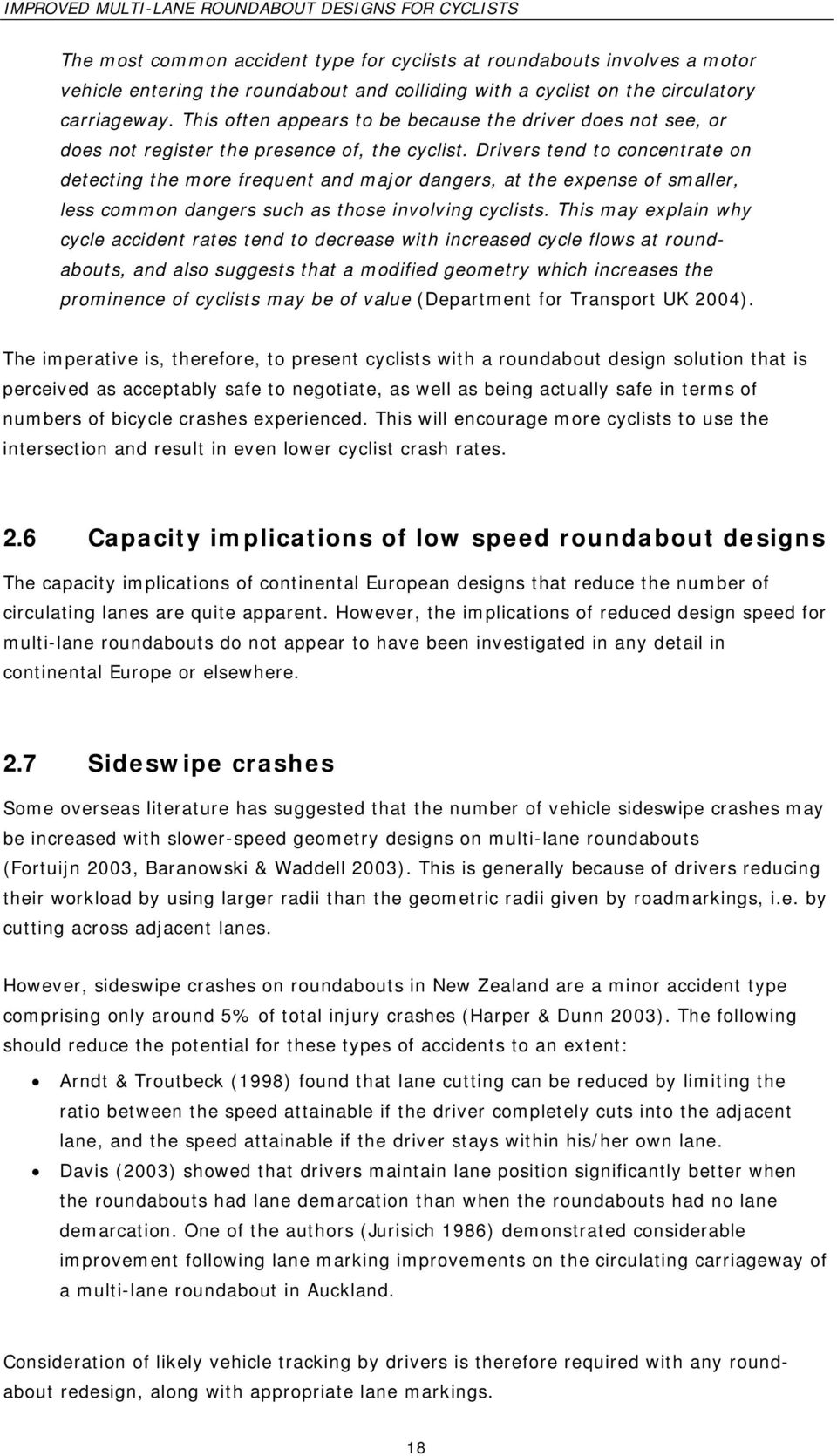
19 2. Literature Review 2.8 On-road design solutions used overseas Cycle lanes on the roundabout Circulatory cycle lane markings (as shown in Figure 2.1) have been used successfully in the UK at a single-lane roundabout in York (Cyclists Touring Club 2003). However such markings on multi-lane roundabouts are generally not conducive to cyclist safety. One design solution that was trialled in the UK had cycle lanes on the outside of the roundabout. Perhaps it was not surprising that these reportedly led to an increase in cyclist accidents and led to their removal (Galway Cycling Campaign 2001). Their location on the outside of the carriageway does not lend to good visibility of the cyclist at entry points, and the potential for conflict at exit points is quite apparent. Figure 2.1 Roundabout with coloured cycle lanes on the carriageway in the City of York, United Kingdom (photo courtesy of City of York Council). An interesting example was successfully installed in 2000 in the city of York in the UK, which is a continental type design that includes coloured cycle lanes on the circulating carriageway in a spiral-type arrangement. However, the circulating carriageway is only single-lane, and the cycle lane element of the scheme has received mixed reviews by cyclists (Cyclists Touring Club 2003). To some extent the safety of the cycle lane element appears to rely on the fact that there are over 800 cyclists per day at this junction, so drivers are very likely to come across them. This frequent presence in the traffic environment has been shown to improve driver awareness of cyclists (Turner et al. 2006, Davies et al. 1997, Department For Transport UK 2004). Cycle lanes are feasible in the context of a single-circulatory laned roundabout such as at York, which was built along continental European lines (i.e. lower speed geometry) at an intersection frequented by cyclists. Capacity is reportedly about vehicles per day, which is considerably less than the capacity most multi-lane roundabouts would be expected to cater for. 19
20 IMPROVED MULTI-LANE ROUNDABOUT DESIGNS FOR CYCLISTS However, a trial of coloured cycle strips adjacent to limit lines at a single-lane roundabout was deemed to deter vehicles from overshooting onto the roundabout (Lawton et al. 2003), so this does appear to be an appropriate item to consider (refer to Figure 2.2). Wilke & Koorey (2001) also recommend this as a way of reminding drivers to look out for cyclists. Cyclists are kept away from the kerbside, and these markings should not be able to be mistaken for a cycle lane in most circumstances. Figure 2.2 Coloured cyclist strips adjacent to limit lines in Gloucester, UK (Lawton et al. 2003) The turbo-roundabout This is an interesting treatment (shown in Figures 2.3 and 2.4) that has been apparently implemented on at least 15 sites in the Netherlands (Fortuijn 2003), but further research is required if the turbo-roundabout is to be considered for application in New Zealand. Its intention is to provide conditions for: a low circulating speed to promote pedestrian and cyclist safety, and minimisation of the risk of sideswipe collisions. Its main feature is the use of traversable lane dividers, the main purpose of which is to physically restrain motorists and avoid sideswipe collisions that apparently can result from the tighter geometry. This said, designating entering and circulating lanes does have the potential to reduce roundabout capacity. The turbo-roundabout has been developed only for intersections between regional roads (with heavy volumes of traffic) and intersecting roads with lower traffic volumes only. The layout is effectively a spiral-type arrangement with two opposing single-lane exits. The design appears to be an effective traffic-calming device that benefits pedestrian users in particular by way of a reduced speed environment. The issue of sideswipe crashes on the roundabout also appears to have been addressed. 20

21 2. Literature Review This design assumes a circulatory off-road path for cyclists, and no specific provision is made for on-road cyclists. In urban areas of the Netherlands, cyclists can have right-ofway over vehicles, which is currently not legally possible in New Zealand. In addition, Dutch law was changed in 1998 to give fault wholly to motorists if a collision involved a cyclist or pedestrian (taken from an article by A. P. Parker published on the Internet in 2004 and no longer available). This concept of priority reversal deserves further research. Figure 2.3 Plan view of the turbo-roundabout from the Netherlands with traversable lane dividers (left-hand drive) (Fortuijn 2003). Note: The off-road cycle path is located on the left of the plan and is not marked with arrows. 21
22 IMPROVED MULTI-LANE ROUNDABOUT DESIGNS FOR CYCLISTS Figure 2.4 The turbo-roundabout in the Netherlands with traversable lane dividers and the off-road cyclepath visible in the foreground (Fortuijn 2003). Justification for the design appears to rely heavily on the prevalence of sideswipe crashes that are currently only a minor crash type in New Zealand (Harper & Dunn 2003). Presumably, roundabouts would also need to be large enough to cater for larger vehicles tracking clear of the traversable lane dividers. These dividers are also a potential safety problem in respect to two-wheeled vehicles hitting them. If this type of design is to be considered for New Zealand, then a comprehensive review of the on-going consequences should be undertaken. This information is not readily available at present Traffic signal control of roundabouts Traffic signal control (either part-time or full-time) is reasonably common in the UK but there is no actual experience of their use in New Zealand. Full-time signals (on all or some arms) in the UK have displayed considerable reductions in cyclist crashes at roundabout entries (Lines 1995). As signals would generally be installed for capacity reasons, they are deemed to be outside the scope of this study. However, their use in New Zealand should be more seriously considered. 22
23 2. Literature Review 2.9 Summary of the literature review Based on this review, the following conclusions have been made: Standards from New Zealand, Australia, the USA, the UK and several other European countries including Holland and Finland were reviewed with regard to on-road treatments for cyclists at multi-lane roundabouts. We found that there are no satisfactory guidelines available. Reducing the speed of vehicles travelling through a multi-lane roundabout is desirable for cyclist safety and amenity. This reinforces the proposed design concept of this research. Roundabouts are safer than priority junctions for all road users. This is true even for cyclists although they are over-represented in injury crash statistics. However, multi-lane roundabouts are more hazardous for cyclists, especially compared with traffic signalised intersections. The predominant cyclist crash pattern at roundabouts is entering vehicle versus circulating cyclist. At sites with higher numbers of cyclists, drivers are more likely to be careful and cyclist crash rates have been shown to be lower. The continental European tendency has been to design roundabouts with radial approaches, large deflection and a single circulating lane. This low speed environment reduces both number and severity of all crashes at these locations. It also improves recognition of cyclists already on the roundabout, as drivers are less likely to selectively identify hazards as they are prone to do at higher approach speeds. However, such designs have obvious capacity limitations because of this single lane arrangement. Visibility guidelines at roundabouts deserve further research. UK guidelines conflict with Austroads (1993b) recommendations and this should be addressed. The potential for vehicles cutting across lanes and causing sideswipe crashes should be considered in slower geometry designs. Careful use of suitable lane marking is required at roundabout entry and exits. Circulatory cycle lanes on multi-lane roundabouts are generally not recommended for safety reasons. However properly designed coloured cycle strip markings across roundabout approaches appear to be a measure worth considering, both to deter vehicle overshooting as well as to remind drivers to look out for cyclists. The turbo-roundabout from the Netherlands is a potential alternative treatment for multi-lane roundabouts at main road junctions with lower-volume roads, but further research is required before application in New Zealand. The use of signal controlled approaches at roundabouts should be more seriously considered in New Zealand. They can have benefits for cyclist safety as well as roundabout capacity. 23
24 IMPROVED MULTI-LANE ROUNDABOUT DESIGNS FOR CYCLISTS 3. Crash statistics at multi-lane roundabouts in Auckland 3.1 Crash data Bicycle crashes at multi-lane roundabouts in the Auckland region were reviewed in Auckland City, Waitakere City, Manukau City and North Shore City. As indicated in Chapter 1 of this report, the definition of a multi-lane roundabout is a roundabout that accommodates more than one lane of traffic on the circulating carriageway. A total of 58 multi-lane roundabouts from four Auckland councils were selected for a cyclist crash study on this general basis. Table 3.1 and Figure 3.1 show the summary of the crash types experienced. A total of 59 police crash reports for the ten-year period 1995 to 2004 at these sites were reviewed (note for 2004: partial records only). Of these, 39 involved injury to the cyclist. Table 3.1 Summary of crash data reported for cyclists at 50 multi-lane roundabouts in four Auckland cities 1995 to Crash Type Total number of all crashes* Total % of all crashes Noninjury All injury (minor and serious) Serious injury Fatal Entering vehicle v. circulating cyclist Exiting vehicle v. circulating cyclists Sideswipe: circulating vehicle v. circulating cyclist Cyclist struck by vehicle while crossing as pedestrian Miscellaneous types** Totals Notes: *These crashes occurred at 50 sites in Auckland City, Waitakere City, Manukau City & North Shore City. ** including at entry. 24
25 3. Crash statistics at multi-lane roundabouts in Auckland Other types 5% Sideswipe on roundabout 10 % Entering vehicle v. circulating cyclist 68% Exiting vehicle v. circulating cyclist 9 % Cyclist crossing as pedestrian 8% Figure 3.1 Summary diagram of crash data for cyclists at multi-lane roundabouts in the four Auckland cities (non-injury and injury) 1995 to The total of 39 injury crashes over ten years at the 58 sites indicates an average of 0.7 cyclist injury crashes per 10 years per site. As cycle crashes are dependent upon traffic volumes (Turner et al. 2006), and as a number of these multi-lane roundabouts have been installed within this ten-year period (especially on the North Shore), this would be an underestimate for future trends. 3.2 Prevalent crash types As can be seen from Figure 3.1, the crash type most reported to police is entering vehicle versus circulating cyclist. They comprise 68% of total crashes and 69% of all injury crashes. This affirms the findings of the literature review in Chapter 2.2 that indicated this type is the most significant factor in cyclist crashes at all types of roundabouts both in New Zealand and overseas. Multi-roundabouts in Auckland are no exception. If this crash type can be minimised, roundabouts can potentially be one of the safest types of intersection for cyclists in terms of injuries. The only other common types of crash that feature with respect to injuries are exiting vehicle v. circulating cyclist and sideswipe: circulating vehicles v. circulating cyclist. About quarter of the cyclist crashes occurred in dark conditions (15 out of 59 reported incidents). Although this is not usually indicated in the police reports, several did report that the cyclist was not using lights or wearing reflective clothing. This highlights the importance of good streetlighting at these locations, and for cyclists to use correct nighttime equipment. 25
26 IMPROVED MULTI-LANE ROUNDABOUT DESIGNS FOR CYCLISTS 4. Cyclist survey 4.1 Introduction A survey was undertaken to assess the level of concern that cyclists have with multi-lane roundabouts, to identify their main perceived safety issues, and to get some preliminary feedback on the concept of low speed designs. Overwhelming support was received for the latter. 4.2 Survey preparation, distribution and collation The survey questionnaire was prepared with the aim of identifying suitable engineering measures in mind. A copy is shown in Appendix A. Questions 1 to 7 are of a general nature to determine age and experience level of respondents, and are useful for comparing responses to questions later in the survey. Questions 8 to 11 are to gather overall impressions of multi-lane roundabouts. Questions 12 and 13 are for identifying the main perceived danger spots as well as recording any incidents experienced. Question 14 was a test question to improve understanding of cyclists riding techniques for undertaking right-hand turns. Question 15 was to test cyclists preference for an on-road solution. Question 16 was intended to confirm (or otherwise) the original aim of this research for a lower speed roundabout solution, and Question 17 was open for respondents to make suggestions themselves. The survey form was drafted in Excel format and distributed to cyclist organisations and retail outlets in the Auckland Region via as well as a downloadable website link. A total of 195 responses were received. The detailed breakdown of results is shown in Appendix B. 4.3 Questions 1 to 7: respondent information The aim of these questions was to determine the age and experience level of respondents. As the surveys were distributed through cyclist organisations, the responses were predominantly from those describing themselves as experienced cyclists (see Appendix B4). Therefore the survey results are indicative of the opinions of just this proportion of the population, not that of the general public (which would include novice and potential cyclists). Some 85% describe themselves as experienced cyclists. Eighty-eight percent of cyclists make three or more bicycle trips per week, with 63% of the trips ridden being 10 km or greater. Of the respondents, 57% ride through multi-lane roundabouts on their regular cycle route. 26
27 4. Cyclist survey 4.4 Questions 8 to 11: overall impressions of multi-lane roundabouts The majority of experienced cyclists generally view multi-lane roundabouts as a reasonably significant obstacle that is to be avoided if conveniently possible. Clearly, this has implications for novice cyclists. A total of 93% of respondents indicated that multi-lane roundabouts pose a hazard and/or act as a deterrent to cycling, and 96% of respondents indicated that they thought multi-lane roundabouts were more dangerous than single-lane. Out of all respondents, 16% indicated that they would absolutely avoid multi-lane roundabouts if at all possible, nearly half (48%) would take a reasonably convenient alternative to avoid them, and 36% do not change their route. If only respondents describing themselves as experienced are considered, this trend is repeated: 13% absolutely avoid multi-lane roundabouts, 47% would take an alternative if convenient, and the remaining 40% would not change their route. Reasons that respondents cite multi-lanes as more dangerous than single-lane roundabouts include (in approximate order of priority): potential for being cut off by vehicles exiting from the inside lane when the cyclist is on the outside lane, difficulty getting into the correct lane for turning manoeuvres (especially right-hand turns), unpredictable lane-changing behaviour of circulating vehicles (unclear lane marking on the roundabout exacerbates this), higher vehicle speeds, drivers concentrating on heavy traffic conditions and being less likely to look out for cyclists, and occasional driver intolerance of cyclists, and this includes those riding in the centre of traffic lanes. 4.5 Questions 12 and 13: perceived danger spots and incidents experienced The purpose of these questions is to determine from cyclists themselves where their main safety concerns are at multi-lane roundabouts were, both perceived and personally experienced. The locations perceived as most hazardous were cycling past entry and exit points (34% and 42% respectively). Figure 4.1 shows the breakdown of the 110 accident/nearaccidents reported by cyclists in the survey. 27
28 IMPROVED MULTI-LANE ROUNDABOUT DESIGNS FOR CYCLISTS e) Other 3 % a) Entering 28% d) Exiting 9 % b) Riding past entries 31% c) Riding past exits 29 % Figure 4.1 Diagram of crash incidents as reported by cyclists in the survey. Cyclists also reported a considerable proportion of incidents that occurred while entering the roundabout (28% entering, compared with 31% cycling past entries and 29% cycling past exits). On closer examination these incidents were a mix of entering cyclists being cut off by circulating vehicles, entering cyclists being forced into the kerb by adjacent entering vehicles, and cyclists having difficulty attempting to access inside lanes for right-hand turns. Of the cyclists who regularly ride through multi-lane roundabouts, 63% reported having experienced an accident or near-accident. Just two of the 13 incidents involving injury to a cyclist were reported to police (these were the only ones that appeared to involve more than just superficial abrasions or bruising). Night-time or wet weather did not feature as a significant factor for the reported incidents. 4.6 Question 14: cyclists turning right at roundabouts The purpose of this question was to determine whether cyclists are aware of how best to negotiate a right-hand turn at a roundabout. The question involved a set multi-lane roundabout layout, and people had to respond as to the riding line they would choose to take. The results indicated that improved education of cyclists is necessary. A total of 55% of cyclists would still choose to ride on the outside lane of the roundabout if they are riding past exits (Option a from Appendix B14), even given the Alberta-style markings which guide right-turning roundabout users to the inside lane. Cyclists staying in the outside lane in this circumstance face an obvious potential conflict with exiting vehicles from the inside lane, as these drivers might not perceive their presence. The most appropriate lane for cyclists to use on approaching the roundabout is the righthand lane (Franklin, 1997) i.e. Option d or e, and 36% of all respondents indicated they would do this. A slightly higher number of experienced cyclists who regularly ride through multi-lane roundabouts (43%) indicated Options d or e. 28
29 4. Cyclist survey It is surmised that the majority of cyclists either do not fully appreciate the meaning of Alberta-style roadmarkings on roundabouts or are wary of circulating traffic speeds and therefore do not feel confident enough to ride as a car driver would. Given that 42% of respondents indicate exit points as their main safety concern in Question 12, this is of particular interest. Educating cyclists about how they should properly undertake right-hand turns is recommended. The survey showed that accessing right-hand traffic lanes is a concern to cyclists. A low speed roundabout design is considered to be more conducive to cyclists attempting this manoeuvre. 4.7 Question 15: cyclist bypass This was a test question to get an indication of cyclists acceptance of at-grade by-pass points which are a common cyclist treatment suggested by standards for multi-lane roundabouts. Even though no formal off-road facility for cyclists was indicated, the presence of zebra crossings implied that they would have a higher chance of being yielded to by vehicular traffic. In summary, cyclists prefer to stay on the road. Some 81% indicated that they would still prefer to ride on the road, which supports the precept of a low speed design. The 19% who chose to use the zebra crossing comprised 67% of all novices (2 of 3), 38% of all intermediate (10 of 26) and 15% of all experienced riders (24 of 165). Although this is not a perfect test to compare an exclusive off-road facility to on-road provision for cyclists, the result does appear to indicate a general bias for route continuity over perceived safety for more experienced cyclists. For less confident cyclists it highlights the need to either provide a safer road environment or at least suitable off-road facilities. Note that this question is not expected to assess people s preference for an off-road facility such as used in the Netherlands (Fortuijn 2003), which can give priority to cyclists over vehicular traffic at road crossing points. 4.8 Questions 16 and 17: confirmation of research objective and suggestions for design improvements A total of 87% of respondents agreed that a roundabout design that reduced maximum vehicle speeds to around 30 kph is the most desirable on-road outcome for cyclists. This confirms that cyclists will support our proposal and that it is an appropriate direction to develop improvements. Other suggestions by respondents for improvements at multi-lane roundabouts included: 29
30 IMPROVED MULTI-LANE ROUNDABOUT DESIGNS FOR CYCLISTS cycle lanes on perimeter of roundabout, underpasses or bridges, advanced stop boxes at roundabout entries, improved roadmarking to indicate clearly the lanes car drivers should be in, wider kerbside lanes so cyclists can fit beside circulating vehicles, traffic signals on roundabout approaches, road surface kept smooth and regularly swept of debris, eliminating planting and obstructions to improve visibility, wider entry/exit lanes to avoid squeeze points, speed humps to slow entering traffic, steep grades on roundabout approaches avoided, law changes to make motorists liable for accidents, alternative routes for cyclists advertised, and improved driver education about looking out for cyclists. 4.9 Summary of the cyclist survey Based on the survey, the following conclusions have been made: Experienced cyclists predominantly responded to the survey, and they generally view multi-lane roundabouts as a reasonably significant obstacle that is to be avoided if conveniently possible. The most important safety issues, as perceived and experienced by cyclists, relate to entering motorist versus circulating cyclist, exiting motorist versus circulating cyclist, and cyclists entering the roundabout. Education for cyclists about how to make right-hand turns at multi-lane roundabouts is recommended. Currently a significant number of cyclists do not appear to know how best to attempt this manoeuvre, or are wary of doing so. Roundabout designs that reduce traffic speeds would be more conducive to this aim. The overwhelming majority of experienced cyclists (85%) prefer to use the road rather than use at-grade bypasses (with zebra crossings) if provided. About 87% of respondents agreed that a multi-lane roundabout design that reduces maximum vehicle speeds to around 30 kph is the most desirable on-road outcome for cyclists. This affirms the aim of this research Comparison between reported cyclist crashes and cyclist survey The purpose of this section is to compare the safety issues at multi-lane roundabouts reported by cyclists answering the survey (see Chapter 4.5) to crash histories reported to the police as discussed in Chapter 3. There is considerable discrepancy between the two. The crash histories reported to the police identify the crashes which involve more severe injury to cyclists. These serious injuries are the more important to target with respect to engineering design and education. However, if cycling is an activity being encouraged, then safety issues perceived by cyclists are also important to target. 30
31 4. Cyclist survey Other incidents reported by cyclists in survey: 3% other type Other crashes as reported to police: 8% Cyclist hit while crossing as pedestrian 10% circulating cyclist sideswiped a) entering the rbt: 28% (5% of reported crashes) d) exiting the rbt: 9% (0 % of reported crashes) b) riding past rbt entries: 31% (68% of reported crashes) c) riding past rbt exits: 29% (9% of reported crashes) Figure 4.2 Diagram of crash incidents as reported by cyclists in the survey as compared to police crash statistics (in brackets). As Figure 4.2 shows, the survey response is in quite distinct contrast to Auckland crash statistics. Of all reported incidents to the police, 68% involve circulating cyclists being hit by cars entering the roundabout, compared to just 31% as indicated by survey respondents. It is surmised that the chances of injury are greater with this type of collision, which increases the chance of the incident being reported. Arndt & Troutbeck (1998) found that multiple-vehicle accident rates were higher in areas with high relative speeds between vehicles; this would also appear to support such an argument with respect to cyclists in this context. Some education of cyclists about this particular safety issue may be desirable. The conclusion reached from this comparison is that although entering motorist versus circulating cyclist is the most important crash type to address, exiting motorist versus circulating cyclist and entering cyclist types are also important to consider. Although less significant in terms of injury severity and in absolute crash numbers reported to police, they are still a real and perceived safety issue for cyclists using the roundabout. 31
32 IMPROVED MULTI-LANE ROUNDABOUT DESIGNS FOR CYCLISTS 5. Synopsis of literature review, crash analysis and cyclist survey The purpose of the literature review, crash analysis and cyclist survey was fourfold. Firstly, it was to confirm that cyclists are concerned enough to justify action. Secondly, it was to identify crash patterns. Thirdly, it was intended to confirm the original direction of this research the design of a roundabout that reduces traffic speeds. Finally, it was to identify any measures used at multi-lane roundabouts overseas. The main conclusions were: Multi-lane roundabouts are generally seen by experienced cyclists as a reasonably hazardous element of the road network to be avoided if conveniently possible. These investigations have confirmed the original focus of this research, i.e. to design a low speed multi-lane roundabout for on-road cyclists. This will treat the critical entering vehicle versus circulating cyclist crash type, and we expect it will significantly address the other lesser safety issues of concern namely exiting vehicle versus circulating cyclist and entering cyclist types. The roundabout design needs to properly consider the above three key conflicts of concern to cyclists. In addition, it needs to take into account the potential for additional vehicle sideswipe crashes on the roundabout arising from more confined geometry. Good streetlighting is also important for visibility of cyclists in the hours of darkness, as night-time crashes comprise a significant proportion of Auckland cyclist crashes at mulit-lane roundabouts. Education for cyclists on how to make right-hand turns safely at multi-lane roundabouts is desirable, and a low speed roundabout design is conducive to this and other manoeuvres. In addition, it would be desirable to inform cyclists of the important entering vehicle versus circulating cyclist crash trend. Following this synopsis, the focus of this work then shifted to research for the design phase as discussed in the next chapter. 32
33 6. Design parameters for low speed multi-lane roundabouts 6. Design parameters for low speed multi-lane roundabouts 6.1 Introduction This research was primarily directed towards multi-lane roundabouts in urban areas. The sites selected for design were four-way cross-type intersections, but the principles of speed reduction still apply for other layouts. A brief review of overseas literature was undertaken along with some field surveys of roundabouts in Waitakere and Auckland City. These indicated that, for roundabout design, a maximum vehicle path radius in the order of 30 to 40 metres would achieve the desired lower speed environment for cyclists. 6.2 Negotiation speed and geometric design Introduction The aim of this project was to design a roundabout configuration that reduces the speed differential between cyclists and cars. This will enable cyclists to take up full lanes and safely mix with vehicle traffic without holding up traffic. This requires that these users travel at similar speeds. This reduction of vehicle speed at roundabout entries is also expected to improve driver recognition of cyclists (refer to Chapter 2.4), which is particularly important given the prevalence of entering vehicle versus circulating cyclist injury crashes (refer to Chapter 3.2). For an assumed average cyclist speed of around 20 kph (from the authors own riding experience), vehicle speeds of around 30 kph are estimated to be acceptable for them to competently mix with traffic. In addition, at this speed any injuries incurred from a collision are expected to be reduced Driver speeds during the day The speed reduction effect that is intended to result from this research project is expected to be most effective outside congested periods. User speeds on roundabouts depend primarily upon roundabout design geometry and traffic conditions for particular times of the day. In general, peak hour traffic speeds are lower than those occurring during off-peak times Unimpeded driver speeds As indicated above, the desired car speed is 30 kph for cyclist safety and amenity reasons. Quantifying a desired negotiation speed for roundabout users depends upon the target vehicles. For individual vehicles, this speed will depend not only upon the geometric and traffic conditions mentioned above, but also on the driver and vehicle characteristics. The 33
34 IMPROVED MULTI-LANE ROUNDABOUT DESIGNS FOR CYCLISTS target of this study is the 85 th percentile speed of unimpeded car drivers entering the roundabout (i.e. those not having to give way to circulating vehicles already on the roundabout, or those held up for any other reason such as queued or turning vehicles). Predominantly, this group of drivers is supposed to be more likely to collide with circulating cyclists on the roundabout. This lower entry speed will assist in recognition of cyclists on the roundabout (refer to Chapter 2.4), which in turn reduces the chance of a conflict. 6.3 Maximum path radius Introduction Maximum path radius is a critical factor for geometric design of roundabouts. This is the maximum radius a car can track between kerbs, and relates to expected vehicle speed. If radii are reduced it can have significant consequences on the roundabout configuration and tracking for larger vehicles. Therefore, deciding upon an acceptable range of maximum path radii is important so as to retain the 30 kph speed concept without making inappropriate compromises. Identifying an appropriate radius that would achieve the 30 kph 85 th percentile speed as described in Chapter required further investigation. Some overseas literature was reviewed, and though this was helpful, it did not decisively answer this question. Some observations of existing roundabouts in Auckland were undertaken in order to give a more definitive recommendation Literature review of path radius v speed Primarily the design path radius depends upon driver behaviour. Tests show that most cars can develop instability when the coefficient of side friction (or f) exceeds 0.6 g, and driver comfort deteriorates somewhat from about 0.3 g (Austroads 1993a; refer to Figure 6.1). Very conservative drivers will drive well short of this, whereas more aggressive drivers will push towards this limit. For roundabouts, Austroads (1993b) assumes values of f from 0.2 g at 50 kph to about 0.3 g at 25 kph, but the definition of which vehicles these apply to is not stated. Akcelik (2004) prepared a model for negotiation speed versus path radius (refer to Figure 6.2), but again the vehicles these apply to are not adequately defined for the purpose of this project. 34
35 6. Design parameters for low speed multi-lane roundabouts Figure 6.1 Relationships between traverse acceleration and speed, including effects on vehicle occupants (Austroads 1993a). Figure 6.2 Negotiation speed as a function of the path radius (Akcelik 2004). Hosseen & Barker (1988) found that, for Australian roundabouts, the 100 m maximum path radius was adequate for keeping 85 th percentile through vehicle speeds below 50 kph (unimpeded by either platooning, circulating or turning vehicles; refer to Figure 6.3). For multi-lane roundabouts they found this radius could be somewhat relaxed to around 120 m 35
36 IMPROVED MULTI-LANE ROUNDABOUT DESIGNS FOR CYCLISTS with similar results, as they observed that vehicles are less inclined to cut across lane markings on the approaches. Figure 6.3 Relationship between maximum negotiation radius and 85% speed. Notes to Figure 6.3: a. y = Ln(x) R 2 = b) The chart above assumes an 85% speed of 50 kph for a 120 m radius based on Australian research carried out by Hosseen &Barker (1988). A logarithmic relationship is assumed and shown above. Also from Australia, Arndt & Troutbeck (1998) prepared charts of 85 th percentile car speed versus horizontal curve radius. However, a high coefficient of side friction value of 0.5 g was assumed which was extrapolated from previous work undertaken on two-lane highways (McLean 1983). On closer examination (and the authors driving experiences) this was considered to be somewhat excessive for most drivers. It appears that although this assumption of 0.5 g may have been adequate for the purposes of the research by Arndt & Troutbeck (1998) which related crashes to roundabout geometry, it is not necessarily applicable to this project (O. K. Arndt, pers. comm.). In summary, the estimation of negotiation speed based on path radius was not decisively proven to the degree desired for this research. The recommended path radii for vehicle speed of 30 kph range from about 15 m (Arndt & Troutbeck 1998) to 30 m (Akcelik 2004). These figures are based on assumed f values of 0.5 g and 0.27 g respectively. This range is unacceptably wide for design purposes Field research Waitakere and Auckland City roundabouts Additional research was undertaken at several multi-lane roundabouts in Waitakere and Auckland City. These roundabouts had individual approaches with maximum path radii between 30 to 50 m, and were used as simulators for the proposed final design. Note that these maximum radii are effectively the largest that a car could feasibly travel between kerbs and are generally not the actual radius taken by surveyed vehicles. 36
37 6. Design parameters for low speed multi-lane roundabouts Approximately 100 through-vehicles travelling through the roundabout were taken at each site as a sample. A summary of results (including aerial photos of the roundabouts) is shown in Appendix C. Speeds were assessed by timing vehicles between the limit line and a point approximately 20 m downstream. A graph showing the results is shown in Figure 6.4. Negotiation Radius v. Speed Graph Waitakere and Auckland City 50 Speed m radius (EBD Edmonton/Alderman left turn) 30 m radius (WBD Edmonton/Te Atatu RH lane only) 30 m radius (NBD Edmonton/Te Atatu) 40 m radius (EBD Edmonton/Alderman) 40 m radius (SBD Te Atatu/Great North) 50 m radius (SBD Swanson/Universal) 50 m radius (SBD Alderman/Sel Peacock left turn) 50 m radius (SBD Rosebank/Patiki daytime only) 50 m radius (SBD Rosebank/Patiki night-time only) 20 Average Speed (kph) 85% speed (kph) Max Speed (kph) Speed Category Figure 6.4 Roundabout speeds surveyed in Waitakere and Auckland City. Note to Figure 6.4: EBD eastbound NBD northbound WBD westbound SBD southbound After viewing the survey results and reviewing literature we considered that an acceptable maximum path radius could be estimated for use in the new roundabout design. Though such a small-scale trial is not expected to be applicable to all urban multi-lane roundabouts in New Zealand, the observations were useful and are summarised as follows: A maximum path radius of 30 m achieves an 85 th percentile unimpeded through vehicle speed of around 30 kph or less. The Edmonton Road/Te Atatu Road westbound approach (which experienced a slightly higher 33 kph 85 th percentile speed) appeared to be mostly caused by the fact that the 30 m radius was based on the left-hand edge of a right-hand turn only lane (rather than a kerbline as at other sites). In this case the maximum path radius was negotiated by a significant proportion of drivers, rather than only a few (see Figure C2 in Appendix C). S-shaped alignments that require drivers to subsequently turn in the reverse direction may have the effect of further reducing driver speed. The Edmonton Road/Te Atatu Road northbound approach is the most significant example of this, which perhaps explains its slightly lower 28 kph 85 th percentile speed compared with the other 30 m radius sites. This tendency is best understood when considering drivers comfort: undertaking two opposing turns of the wheel in quick succession is more demanding (and uncomfortable) than simply negotiating a single radius curve. 37
38 IMPROVED MULTI-LANE ROUNDABOUT DESIGNS FOR CYCLISTS Maximum path radii of 40 m achieved 85 th percentile speeds of between 31 to 34 kph. Though not significantly higher than the 30 kph target speed, it is surmised that the above S-shaped effect may reduce this closer to 30 kph if applicable. For vehicles turning left, a 30 m maximum path radius is desirable, especially as these usually have positive superelevation (i.e. sloping down towards the centre of the turn radius) and are effectively a single negotiation radius. Maximum path radii of 50 m achieved 85 th percentile speeds of between 34 to 40 kph. It is considered that this radius does not achieve the intended 30 kph environment for cyclists and is less than desirable. In periods when there is insignificant activity, such as in the middle of the night, traffic speeds through the roundabout can be expected to be higher. The Rosebank Road/Patiki Road location was a good example of this. It is located in an industrial area, which was almost as quiet as a residential street during the late evening survey taken around 10 p.m. The 85 th percentile speed was 40 kph compared to the observed weekday mid-morning speed of 34 kph. The reason for this was that a significant proportion of the night-time vehicles (almost all of the top 15%) ignored lane markings for the most part and took a racing line through the intersection. At other sites (including at Rosebank Road/Patiki Road during the day), this lane cutting was far less prevalent even during quieter periods. Some entering drivers appear to hesitate if they are unsure of circulating driver intentions. This appears to be more prevalent when the upstream roundabout leg is in close proximity. 6.4 Summary The objective of this research was to develop a roundabout design that reduced the 85 th percentile speed of unimpeded vehicles entering the roundabout to around 30 kph. We expect this will provide a speed environment that is amenable to cyclists mixing with car traffic, and also reduce the severity of any injuries incurred from collisions between users. From a review of overseas literature and field surveys undertaken at a number of roundabouts in Auckland, we concluded that: Provision of a maximum path radius of approximately 30 m achieves the desired 30 kph speed environment. A 40 m maximum path radius achieves a marginally higher speed environment than desirable. However, it is surmised that if drivers have to undertake S-shaped manoeuvres then vehicle speeds may be acceptable. Larger maximum path radii than the above do not achieve the low speed environment that is desirable for cyclists. 38
39 7. Low speed design options 7. Low speed design options 7.1 Introduction It is not straightforward to achieve a 30 kph speed environment for a multi-lane roundabout that accommodates all vehicle movements without compromise. The provision of 30 to 40 m path radii as recommended in Chapter 6.4 is geometrically difficult to attain in multi-lane situations. Desirably the number of entry, circulating and exit lanes should be no more than necessary, as these wider carriageway widths generally mean that higher vehicle speeds will result. Thus for the purpose of achieving a real speed reduction, it is simpler to design a single-lane rather than a multi-lane roundabout. 7.2 Identified options Options considered Several potential speed reduction measures were considered Vertical deflection devices Installing vertical deflection devices in close proximity to roundabout approaches (e.g. speed humps, tables or cushions) was considered as the first option. These are potentially the cheapest way of reducing roundabout entry speed, and in areas with a large amount of pedestrian traffic areas might be quite appropriate in terms of urban design and amenity. Although it is understood that there is at least one exceptional installation in Christchurch, many local authorities try not to install these on bus routes for reasons of passenger comfort (Auckland City in particular). In addition, there are potential issues regarding emergency vehicles, and noise from heavy vehicles, especially if adjacent to residential properties (Department of Transport UK 1996, Road Access for Disabled Americans 2005, Department for Transport UK article downloaded from internet June 2005 (no longer accessible)). Speed cushions can achieve superior ride quality for wide wheelbase vehicles such as buses, provided drivers mount them centrally. However, they do not reduce car speeds as much as speed humps or tables. In addition, they would not be ideal if located too close to the roundabout, as lining up to ride the devices square-on is a potential distraction when these drivers should be concentrating on circulating traffic. As they do substantially address the main cyclist crash type entering vehicle versus circulating cyclist by slowing down entering vehicle speeds, vertical deflection devices are still an option to be considered at an early stage as they may be considerably cheaper than roundabout re-design Mountable lane dividers The second option was to consider using mountable lane dividers on roundabout entries, as found in the turbo-roundabout in the Netherlands. The turbo-roundabout has been developed for dual-lane roads intersecting single-lane roads only, and is effectively a spiral type arrangement. This option has been previously discussed in Chapter and 39
40 IMPROVED MULTI-LANE ROUNDABOUT DESIGNS FOR CYCLISTS deserves further attention. This option does not specifically cater for on-road cyclists, and there are some safety concerns Mountable sections of roadway Using mountable sections of roadway for heavy traffic, both on the central island as well as on entry and exit kerblines, is another option. Though less desirable for passenger comfort if buses have to ride them, these can assist in speed reduction by providing a reduced carriageway width Swept paths Another alternative is to provide swept paths for heavy traffic, which take acceptable encroachment of adjacent lanes for entering and circulating truck traffic into account. Though it is desirable to allow trucks to enter and circulate alongside other vehicles, it is feasible to reduce roundabout approaches and circulating carriageway so that this is not possible. Refer to Chapter 8 for a review of the Frost Road/Carr Road intersection where this has actually been done Curvature Curvature on roundabout approaches could be employed, as this can help to achieve more confined geometry on roundabout entries. Although this increases the likelihood of lane encroachment in these areas of roadway, it should achieve the desired reduced speed environment, especially during off-peak periods Roadmarking Speed can also be reduced by the use of thermoplastic roadmarkings for increased definition of lane lines in all conditions, especially at night-time and when the road is wet. Lane lines can reduce lane-cutting by vehicles (refer to Chapter 2.7) Options chosen Though Option 1 (Chapter ) can still be considered as a design option, many local authorities will be reluctant to accept vertical deflection devices, especially on bus routes. Option 2 (Chapter ) is not specifically intended for on-road cyclists and requires further investigation with regard to safety. Considering these limitations, the research primarily adopted the concepts of Optionss 3 to Safety implications of low speed roundabout designs Research has been undertaken in the UK that related injury crash frequency to entry curvature at roundabouts, which suggests that as entry curvature radii decrease, enteringcirculating accidents will reduce at the expense of an increase in single-vehicle crashes (Maycock & Hall 1984). Entry curvature is the maximum vehicle path curvature occurring in the region of the roundabout entry. Figures 7.1 and 7.2 demonstrate this relationship for parallel and flared entries at four-armed roundabouts (the C-roundabout is a parallel entry type). Note the marginal difference in overall crash rates for entry curvature between 30 m and 100 m radii. 40
41 7. Low speed design options 100m 30m Figure 7.1 Predicted effect of entry curvature on roundabout injury accidents at four arm roundabouts with parallel entry. 30 m 100 m Figure 7.1 Predicted effect of entry curvature on roundabout injury accidents at four-arm roundabouts with flared entry. Notes to Figures 7.1 and 7.2: (a) Maximum entry path radii of 100 m and 30 m are indicated. (b) Taken from Maycock & Hall (1984). 41
42 IMPROVED MULTI-LANE ROUNDABOUT DESIGNS FOR CYCLISTS 8. Frost Road/Carr Road intersection 8.1 Introduction The single-lane Frost Road/Carr Road intersection in Mt Roskill, Auckland, was redesigned in 1999 to improve its capacity. As the plan in Appendix H shows, the westbound Carr Road approach was amended to provide for two entry lanes of reduced width. Carr Road is in an industrial area, and trucks comprise approximately 5% of all traffic at this location (Auckland City Council pneumatic tube surveys). The Carr Road approach at this intersection is the basis for the C-roundabout concept. 8.2 Design aim The narrow width of the Carr Road approach was designed for two large cars. Heavy vehicles were required to straddle both lanes. The narrowest kerb-to-kerb width at the entry is 5.3 m, or just 2.65 m for each traffic stream. As the aerial photo in Appendix D shows, these two lanes were marked for some 105 m upstream soon after the initial scheme was implemented. 8.3 Observed operation Video surveys were taken during off-peak and morning peak-hour traffic times. On observation, the roundabout operated successfully, and has an obvious improvement in capacity compared to a single-lane entry type. Observation revealed a number of methods of negotiating entry lanes. Larger trucks such as semi-trailers take up both traffic lanes (refer to Figures 8.1, 8.2 and 8.3), and no cars tried to negotiate past these types of vehicles. Car traffic generally travels in two lanes (refer to Figure 8.4). Occasionally, smaller cars got past smaller heavy vehicles such as single-unit trucks or buses. At least once a left-turning truck over-ran the left-hand kerb when negotiating past a stationary car in the right-hand lane. Some damage to the kerbs on this side shows this was not an isolated event. 42
43 8. Frost Road/Carr Road intersection Figure 8.1 Semi-trailer straddling both entry lanes while entering the Frost Road/Carr Road roundabout from the Carr Road approach. Figure 8.2 Two streams of car traffic following a large truck through the roundabout. Notice that the truck is straddling both lanes. 43
44 IMPROVED MULTI-LANE ROUNDABOUT DESIGNS FOR CYCLISTS Figure 8.3 Light truck straddling both lanes at the Frost Road/Carr Road intersection. Figure 8.4 Views of smaller vehicles approaching the roundabout from Carr Road. 44
45 8. Frost Road/Carr Road intersection 8.4 Crash history Since the two-lane entry was installed in 1999, some accidents have been attributed to it. In the five-year period since the installation, eight crashes have been reported involving minor sideswipe collisions between left and right turning vehicles at the entry. All caused minor vehicle damage only, with seven involving collisions between cars only and one between a car and a truck. Before this scheme was implemented, no such crashes were reported. From a review of police crash reports, five of these eight incidents appeared to involve the vehicle in the right-hand lane acting as the encroaching vehicle upon entering the circulating carriageway. Given the tight turn involved for these vehicles to make a rightturn manoeuvre, apparently these drivers might tend to swing out to the left. The introduction of prominent roadmarking on the circulating carriageway (as shown in red in Figure D2) might address this problem. As mentioned in Chapter 2.7, a considerable improvement in lane discipline is expected following lane demarcation on the circulating carriageway of multi-lane roundabouts. 8.5 Conclusions The six-year operation of this similar type of roundabout entry shows this narrow-entry design concept is feasible even in an area with considerable truck traffic. By itself, the narrow 5.3 m gap between kerbs does not appear to pose an issue with regard to reported sideswipe incidents. Rather, the predominant factor appears to be vehicles in the right-hand lane swinging wide on the roundabout, which has no roadmarking for guidance. The issue of sideswipe crashes at the entry point is expected to be addressed by additional thermoplastic roadmarking on the circulating carriageway. Strengthened kerbs are recommended to cater for occasional heavy traffic overrunning them. 8.6 Implications for C-roundabout design Appropriateness of the Carr Road approach The Carr Road approach is very similar to what is proposed for the C-roundabout design. From observations as well as a review of the site s crash history, it has shown itself to be a practical design concept Safety and operation It is considered there are no significant issues that cannot be addressed. As discussed above, additional roadmarking is recommended to address the potential for sideswipe crashes. We suggest that the new roadmarking as shown in Appendix D be implemented 45
46 IMPROVED MULTI-LANE ROUNDABOUT DESIGNS FOR CYCLISTS and vehicle tracking behaviour observed before and after for comparison to assist confirmation of this. Strengthened kerbs are recommended to allow for trucks occasionally over-running them. If for some reason (such as proximity to a well-used footpath) this is deemed unacceptable, bollards could be installed to prevent this practice. The narrow entry lanes are expected to significantly address the issue of cyclists being pushed into the kerb by adjacent vehicles when entering the roundabout (refer to Chapter 4.5). The narrow lane widths which ensure a cyclist will not be marginalised will reduce this crash factor, as well as improving access to right-hand lanes for right-hand turns Effect on capacity during peak periods As larger vehicles will take up both approach lanes, roundabout entry capacity will be less than a conventional arrangement with wide lanes. This impact will depend upon larger truck volumes during peak hour, and this needs to be taken into account. Auckland City pneumatic tube surveys on Carr Road (an industrial street) shows that heavy traffic volumes are lower during peak hours around 4% compared to 8% at other times of the day. This demonstrates that (in Auckland, at least) truck drivers tend to avoid driving in heavy traffic if possible. 46
47 9. The C-roundabout design 9. The C-roundabout design 9.1 Introduction A generic design has been prepared for roundabout design at a typical four-way cross intersection in an urban area the Cyclist Roundabout or C-roundabout. Design drawings are shown in Appendices E to J as follows: Appendix E C-roundabout kerbline configuration Appendix F C-roundabout deflection paths Appendix G C-roundabout tracking curves Appendix H C-roundabout road marking and signage Appendix I C-roundabout driver visibility diagram Appendix J C-roundabout layout for a dual-lane approach The design process was an iterative one involving differing combinations of central island diameters and approach angles for side roads. The 20 m central island diameter as shown in Appendix E was chosen because, for a four-way junction, it provides an optimum configuration for the desired maximum path radii as recommended in Chapter 6.4. These maximum path radii are around 30 m for left-hand turn movements and 40 m for straightthrough movements with an S-shaped alignment (see Appendix F for deflection paths). Scheme designs for two sites have also been prepared and these are described in Chapter 10. A preliminary design guide for application of the C-roundabout is shown in Appendix K. 9.2 Design philosophy The principle of the C-roundabout is for through car speeds (unimpeded) to be reduced to around 30 kph, a speed considered to be amenable to cyclists mixing with vehicle traffic. The geometric layout of kerblines is critical to this aim, and appropriate roadmarking and signage will assist in the roundabout s operation. In order to achieve this, it is feasible to narrow the roundabout entry width so that larger vehicles do not attempt to enter alongside other vehicles. In turn, the circulating carriageway width can be reduced which helps to facilitate an overall speed reduction on the roundabout. The C-roundabout needs to be trialled and proven in practice. The research here finds the design concept sound enough, but only its implementation will prove it to be appropriate. Scheme plans have been prepared for two sites that can be implemented and trialled (Appendices M P). 47
48 IMPROVED MULTI-LANE ROUNDABOUT DESIGNS FOR CYCLISTS 9.3 General principles The C-roundabout design concept is for a confined geometry for all movements, but still with some acceptable allowance for driver manoeuvring within lanes. More generous widths on the roundabout circulating carriageway and exits are proposed to achieve this. Entries should be wide enough to accommodate two large cars with adequate clearance, but sufficiently narrow to dissuade cars from attempting to pass heavy vehicles. Narrow lanes also encourage cyclists to travel in the centre of the lane, which is desirable for cyclist safety and amenity. The circulating carriageway should accommodate two large cars with comfortable clearances. It also should be wide enough for a single bus (or, preferably, a B-train) with adequate clearances from all kerbs. Some car drivers may circulate alongside heavy vehicles smaller than these, and the roundabout exits should be wide enough so as not to create a relative narrowing in these circumstances. 9.4 Roundabout entry width Entry width between kerbs should be 5.4 m. This is to prevent cars attempting to enter adjacent to heavy vehicles, but also to give minimum acceptable clearance between larger cars that enter side by side (allowing for 0.5 m clearance all round for two 99% sized cars). This is because heavy vehicles from the right-hand lane, in particular, are likely to track over the adjacent lane in the roundabout entry area. Vehicle tracking curves are shown in Appendix G. Single-unit trucks and buses are potentially more problematic than semi-trailers, as they do not have the same road presence as these larger vehicles, and adjacent cars may attempt to negotiate past them in queued conditions. Using a 5.4 m radius is expected to avoid this as much as possible. 9.5 Roundabout circulating carriageway and exit width The roundabout circulating carriageway and exits should be wider than the entry, with comfortable clearances between the two streams of car traffic. For two 99% sized cars entering side by side (a 0.01% chance of occurrence), there should be a minimum of 0.5 m clearance between vehicles and kerbs, and between 0.5 to 1.0 m clearance between vehicles. Vehicle tracking curves are shown in Appendix G. As an additional safety feature to avoid incidents on roundabout exits, a slightly larger area at the mouth of the exit is recommended as shown in Appendix E. This somewhat alleviates the relative narrowing effect here and does give some additional leeway for cars attempting to exit alongside larger vehicles, which may occur from time to time. 48
49 9. The C-roundabout design 9.6 Vehicle deflection through the roundabout A maximum path radius of 30 m is desirable to achieve for all movements including lefthand and right-hand turns as well as through-vehicles. The research from Chapter 6.4 has shown that radii up to 40 m may be acceptable, but beyond this, the speed differential between cyclists and unimpeded car traffic is undesirably higher. This maximum path radius is of particular importance at the roundabout entry, as the significant proportion of cyclist crashes occur here. There are two identified ways of achieving this for a four-leg roundabout, and both assume entries with reduced width as described in the previous chapter: Use a layout similar to that shown in Appendix E with a central island in the order of 20 m diameter and a 7.0 m wide carriageway. As shown in Appendix F, this achieves a 40 m path radius for through movements and a 33.5 m radius for left-hand turns. It also accommodates a B-train with 0.5 m clearances from kerbs. Use a significantly larger central island diameter and use a 30 to 40 m entry curve that acts as a maximum path radius for all movements. An example of this configuration is shown in Appendix N. Such a roundabout will require substantially more land area than the first option. 9.7 Mountable areas for heavy traffic For reasons of passenger comfort, it is desirable that buses have room to negotiate the roundabout comfortably without having to mount any raised kerb areas. However, for larger vehicles such as B-trains this may be acceptable. Invariably, kerb mounting affects only the rear end of such vehicles in any case. The C-roundabout design as shown in Appendices E to J provides 0.5 m clearance for B-trains, but this could be constrained further to accommodate buses only. Appropriately wide mountable sections on the central island would then need to be provided for B-train tracking. The central island should still have a strengthened kerb around 0.5 m wide that allows for some margin of error by heavy vehicle drivers. If it is wider than this, larger trucks could attempt to remain within the inner lane and let car traffic pass on the outside. This is not to be encouraged, as roundabout exits are not wide enough to accommodate these movements and sideswipe crashes may result there. A mountable kerb height of 150 mm is recommended. A height lower than this may not adequately deter car drivers from overrunning. This effect could be aggravated following resealing of the carriageway. It is recommended that all kerbs on the roundabout approaches including throat islands, be constructed to allow for the occasional heavy vehicle infringement. If desired, bollards can be installed to prevent this practice. 49
50 IMPROVED MULTI-LANE ROUNDABOUT DESIGNS FOR CYCLISTS 9.8 Road marking and signage Introduction Although the geometric layout of the kerbs is critical in ensuring the low traffic speed environment, appropriate roadmarking and signage is important for roundabout operation and driver lane discipline. Road marking and signage for the C-roundabout are shown in Appendix H. Thermoplastic roadmarking is recommended for improved conspicuity at night and during wet conditions. It is crucial to ensure that, when implemented, it is 3.0 mm high or less, as it can be detrimental to a minority of cyclists if installed thicker than this (Munster et al. 2000) Roundabout approaches A short 20 m section of unbroken centreline is recommended on approaches, which is expected to reduce the likelihood of cars attempting to drive alongside larger vehicles. If, in practice, roundabout entry lanes are under-utilised because of this, the centreline could be lengthened Continuity lines on the circulating carriageway and exits Continuity lines are recommended through the roundabout in an Alberta-style arrangement, generally 1 m long thermoplastic stripes ( mm wide) with 2 m gaps in between. A short section of 1 m stripe, with 1 m gap is recommended in the immediate proximity of the entry point. This is important to reduce the potential for sideswipe crashes here caused by the radial approach angles of the C-roundabout. Roundabout exits are marked with the centreline for a short distance before the merge area, unless the carriageway is double-laned in that direction. Note that spiral markings are feasible if there are single-lane exit points on the roundabout Lane arrows The recently released Land Transport Rule: Traffic Control Devices 2004 requires direction arrows if there is more than one approach lane to a roundabout. Subclause 10.4(4) states: If more than one lane for motor vehicles enters a roundabout from any approach, a road controlling authority must mark arrows on each approach lane to direct drivers into the correct lane. (Land Transport New Zealand 2004) Guidelines for their application are currently under review, but draft versions did recommend that lane arrows be located 50 m in advance of roundabout limit lines. A 50
51 9. The C-roundabout design potential disadvantage for the C-roundabout is that arrows might discourage truck drivers from straddling both lanes Cyclist markings (optional) The recent law requiring lane arrows on roundabout approaches means that it is even more important for cyclists to get into the right-hand lane if turning right. The C- roundabout should achieve the low speed environment that is more amenable for cyclists to undertake this manoeuvre. It may be desirable to install markings in advance of both roundabout approach lanes to encourage this behaviour. A new type of cyclist symbol designed for this purpose is shown in Appendix H. These symbols are intended to encourage bike riders to use the right-hand lane as well as to alert drivers to cyclists undertaking these manoeuvres. Cyclist symbols on the circulating carriageway may be desirable to reiterate to cyclists that they should use the entire lane. The logos are deliberately put in front of roundabout entries as this is the most hazardous location for cyclists and the signs should alert drivers to the possible presence of cyclists. Such markings on circulating carriageways need to be especially durable as they receive significant wear from tyres. Thermoplastic cyclist logos are recommended, the green surfacing being desirable if a suitable material is available Painted kerbs For improved conspicuity of the reduced radius roundabout configuration at night, it is recommended that all kerbs within 30 m of the roundabout be painted reflective white Signage Advance Direction Signage (ADS) should be placed on approaches, and prominent Intersection Direction Signage (IDS) placed at the roundabout. These should reduce driver distraction (Transfund NZ 2000) and therefore improve recognition of cyclists. Standard signs include RG-17 Keep Left, chevron boards on the central island, PW-8 Rotary Junction and the new RG-6R Roundabout Give Way sign. A supplementary PW sign should be attached to the PW-8 Rotary Junction Ahead sign. This would give advance warning of the lower speeds expected at a C-roundabout. However, attaching PW-25 to PW-8 signs is not currently permitted under the Manual of Traffic Signs and Markings (Transit New Zealand 1998) and this would have to be addressed. Given the narrow width of the roundabout approaches, a sign for trucks may be desirable. The sign (shown in Figure 9.1) is intended to encourage truck drivers to traverse the centreline, and also informs other road users of this expectation. Experience from the Frost Road/Carr Road site (refer to Chapter 8) appears to indicate that these are unnecessary, but are not inappropriate as a precautionary measure. 51
52 IMPROVED MULTI-LANE ROUNDABOUT DESIGNS FOR CYCLISTS Figure 9.1 Optional sign to encourage larger vehicles to straddle both lanes. 9.9 Other design issues Cyclist access to head of queues during congested periods In congested conditions, cyclists will often not have room to negotiate past queued traffic with the narrow C-roundabout entry design. This will either result in undesirable delays to cyclists who have to wait in long traffic queues or in cyclists using adjacent footpaths as an informal shortcut, which is more likely. It is therefore recommended that bypass paths for cyclists be considered, taking into account expected traffic conditions, adjacent development and pedestrian activity. Exit and entry ramps for these are discussed in detail in Austroads (1999) (reproduced in Appendix L). High-speed road exit-ramps may be appropriate if there is minimal pedestrian activity or few driveways. Low speed ramps are recommended for re-entry to the traffic stream near the head of queues, as cyclists would have to wait for gaps in slowmoving traffic. A separate path for pedestrians may be desirable. Cyclists should be aware that use of the by-pass is only necessary in queued conditions when traffic is slow or stopped Roundabout carriageway crossfall A crossfall of around 2% sloping towards the outside of the roundabout is recommended. This contributes to slower straight-through car speeds by providing adverse superelevation for these vehicles Service covers Service covers on the circulating carriageway are to be avoided where two-wheeled users are expected to track over them. If they are absolutely necessary, then they should have treated surfaces for improved friction in wet conditions. Kerbside stormwater catchpits should be cyclist-friendly. 52
53 9. The C-roundabout design Lighting Given the low relative visibility of cyclists, a satisfactory level of lighting is important. At sites of particular importance, the use of lighting levels in excess of regular Australian/New Zealand Standard 1158 requirements may be warranted. Although metal halide lanterns have a lower light output than comparable high pressure sodium lanterns, they give improved colour contrast and, according to research, may improve driver reaction time (Beca 2003) Pedestrian crossing points These are likely to be required in busier urban situations. Their proximity to the roundabout requires careful consideration for pedestrian safety and operational reasons. We suggest that perhaps further research of this topic is warranted. If pedestrian traffic is more than minor, then traffic queues may block the circulating carriageway and this needs to be taken into account Over-dimension vehicles If the roundabout is located on a route likely to be used by over-sized vehicles, then tracking for these has to be taken into account. One possible measure is to track these vehicles over the central island, constructing it as low to the ground as possible while still maintaining adequate vehicle deflection through the roundabout. The central island would need to be free of permanent obstructions such as streetlight poles or planted areas Sight distance It is important that visibility of circulating traffic is not blocked for entering drivers. There has been some suggestion that excessive visibility on approaches may result in higher driver entry speeds and therefore reduced recognition of cyclist users already on the roundabout. Additional research is recommended before implementing a strategy of providing reduced sightlines (refer to Chapter 2.4). At this stage, it is recommended that sight distance still be provided as per Austroads (1993b) requirements, taking into account the lower speed environment of the C-roundabout. It is desirable that stopped vehicles on the right-hand traffic lane do not block visibility of circulating traffic to drivers entering on the kerbside lane. Vans and high wheelbase fourwheel drive vehicles especially can have this effect, as their bonnets are often higher than car driver eye height. Appendix I shows that the C-roundabout approximately achieves the necessary sight lines, although it is acknowledged that drivers often do not stop behind limit lines. For optimum visibility, circulating cyclists should avoid riding on the left-hand edge of the kerbside lane (Franklin 1997). 53
54 IMPROVED MULTI-LANE ROUNDABOUT DESIGNS FOR CYCLISTS 9.10 Roundabout approaches with two upstream traffic lanes For entries with two approach lanes upstream, a merge area prior to the roundabout entry is required. This is to avoid larger vehicles entering the C-roundabout alongside other vehicles. A recommended layout is shown in Appendix J. Kerbside flush markings may be desirable to encourage traffic to merge, but might not be critical in practice. Ribbed roadmarking (e.g. vibraline) or self-righting plastic posts (e.g. hockey sticks) could be used. Note that this merge area should be well illuminated at night. For roundabout exits, we recommend commencing a cycle lane or wide kerbside lane immediately downstream of the roundabout. This is because traffic will quickly accelerate and the sooner cyclists are out of this faster traffic stream the better. 54
55 10. Scheme designs in Manukau City 10. Scheme designs in Manukau City 10.1 Robertson Road/Bader Drive/Buckland Road intersection Introduction Two design options were prepared for the Bader Drive/Robertson Road intersection, which experienced relatively low volumes of heavy traffic. Available traffic volume data indicated that 3000 vehicles per hour travelled through the intersection during peak hours. For the purposes of this research, we assumed that it is still desirable to retain the existing duallane entries and exits. This location experiences a relatively low proportion of heavy vehicles around 2%, according to Manukau City pneumatic tube surveys which were recently made available Site conditions The roundabout was observed during morning and evening peak times as well as off-peak periods. Generally, it operated quite well with queue lengths rarely extending beyond six or seven vehicles during peak periods, and observed delays being reasonably minor. Even during peak periods, a substantial proportion of entering vehicles were unimpeded. A number of bus routes run between Robertson Road (north approach) and Bader Drive and some bus traffic was observed on all approaches. Only minor pedestrian traffic was observed on all four legs. Vehicles turning left here have less deflection than through or right-hand turn movements, so unimpeded vehicle speeds could be expected to be higher for these movements (though speeds were not measured). It has a central island approximately 45 m in diameter, which is one of the larger ones in the Auckland region. Unusually, there are pram crossings on the outskirts, which appear to facilitate pedestrian access to the central island; grass tracks show that pedestrians actually use them. This island has a substantial planted area including two large pine trees (refer to Figure 10.1), and it is possible that Manukau City Council may wish to retain this large area if any redesign work is undertaken. It was noted that the existing left-hand turn only designation of the kerbside lanes on three of the four approaches did aggravate delays somewhat. If these lanes were changed to shared through-lanes then a reduction in delays is likely. Some minor cyclist traffic was also observed, in the order of 20 per hour or less. Thiswere mostly adult cyclists on the road, though some children were observed using the surrounding footpaths and roundabout crossing points. 55
56 IMPROVED MULTI-LANE ROUNDABOUT DESIGNS FOR CYCLISTS Redesign option 1 Option 1, using a C-roundabout, is shown in Appendix M. Apart from the longer traffic island on the Buckland Road approach that extends to the zebra crossing, this is a standard C-roundabout configuration Redesign option 2 Given the extensive reconstruction work required in Option 1, another option has been prepared (shown in Appendix N). It is effectively a confined entry configuration that provides for a 37 m path radius for all movements, while still retaining the existing central island configuration. This scheme has not been developed to the same extent as Option 1, so carriageway widths are indicative only. The narrow roundabout approach width is still retained because of larger truck tracking issues. The principle is the same as for the C-roundabout, but uses curvature on the approach to achieve the lower-speed environment. This is an alternative design that should be significantly more economic to construct than a C-roundabout by retaining the existing large central island. It is considered to be viable for existing large diameter roundabouts that require retrofitting. Figure 10.1 Robertson Road/Bader Drive intersection viewed from the Robertson Road south approach. Note: The large pine tree on the centre island is clearly visible in the middle of the photo. 56
57 10. Scheme designs in Manukau City 10.2 Cavendish Drive/Lambie Drive intersection Introduction Two design options were prepared for the Cavendish Drive/Lambie Drive intersection, which receives moderately heavy truck volumes (in the order of 6% to 7% of all traffic). Available traffic volume data indicate 3,700 vehicles per hour during peak-hours (data taken from recent Manukau City Council pneumatic tube surveys) Site conditions The roundabout was observed only during the p.m. peak period. One very long queue was observed on the Lambie Drive north approach that lasted for approximately five minutes, but apart from this, queue lengths were not more than around 12 vehicles for any approach lane. Compared to the Robertson Road/Bader Drive location, this is a busy intersection at which drivers can expect to experience some reasonable delays. It was noted that the proportion of truck volumes during peak hour traffic here were noticeably less than the overall daily traffic data suggest. As noted earlier in Chapter 8.6.3, truck drivers in Auckland generally try to avoid driving during peak hours. Three of the four approach legs have very wide planted medians with large trees on them. Cavendish Drive east approach and Lambie Drive south approach are currently dual lanes in both directions, and the Lambie Drive north approach is scheduled for two lanes in the near future (refer to Figure 10.2). Figure 10.2 Dual-lane approach at Cavendish Drive/Lambie Drive intersection, viewed from Cavendish Drive east approach Redesign option 1 The C-roundabout option is shown in Appendix O. It is considered that, even though this site experiences reasonably significant truck volumes, the apparently lower number of these vehicles during peak hour means that roundabout capacity might not be significantly affected. This would have to be further assessed. The dual-lane merge areas are discussed in Chapter 9.10 with a typical detail shown in Appendix J. 57
58 IMPROVED MULTI-LANE ROUNDABOUT DESIGNS FOR CYCLISTS Redesign option 2 with left-hand turn slip-lanes Option 2 was considered for this site as some significant queue lengths were observed. This option, shown in Appendix P, has left-hand turn slip-lanes on each approach, which will improve the capacity of the roundabout by separating these movements. A similar configuration currently operates at the Blockhouse Bay roundabout in Auckland City as shown in Figure Figure 10.3 Left-hand turn slip-lane at the Blockhouse Bay roundabout in Auckland. Note: photo courtesy of Auckland City Council. 58
59 11. Roundabout capacity study 11. Roundabout capacity study 11.1 Summary To assess impact on roundabout capacity, we proposed to compare gap acceptance behaviour at two roundabouts of differing geometries, one similar to the C-roundabout and the other with conventional configuration. Capacity for the roundabout would increase or decrease depending on gap size. Two roundabouts were chosen for comparison. The first (the higher speed design) has a standard configuration with maximum path radii of 100 m. The second (the lower speed design) has maximum path radii similar to the C-roundabout, i.e. around 30 to 40 m. The expectation was that operating speeds at the lower speed roundabout during capacity conditions would be less than the higher speed design, and that this might relate to differing gap acceptance behaviours by drivers entering the roundabout. However, field surveys showed that peak hour operating speeds are very similar for the two roundabouts, and gap acceptance behaviour should not be affected. A C-roundabout will have only a minor effect on capacity, compared to a standard configuration, unless truck volumes during peak-hour are substantial Brief literature review of factors affecting gap acceptance behaviour Overseas research by Tian et al. (2005) supported the following statements relating to driver gap acceptance behaviour at priority junctions including roundabouts: With the increase of major stream volume or minor stream delay, drivers tend to seek smaller gaps (some of this behaviour during higher circulating flows at a roundabout relates to an increased number of smaller-headway merges at lower speeds (R. Troutbeck, pers. comm.)). With a small turn angle (i.e. the higher speed design), the movement manoeuvre is easier compared to a perpendicular angle or large angle, and the critical gap tends to decrease. Critical gap and follow-up time for heavy vehicles are consistently higher than for passenger cars. With the increase of the approach grade, the critical gap tends to increase (Tian et al. 2005). Assuming that lower circulating speeds would occur, the first statement suggests that entry capacity will be improved at a C-roundabout. However, the second statement might be expected to mitigate this owing to the smaller radius entry manoeuvres required. 59
60 IMPROVED MULTI-LANE ROUNDABOUT DESIGNS FOR CYCLISTS 11.3 Comparison of gap acceptance behaviour An accurate comparison of gap acceptance behaviours at two roundabout approaches (or lanes, or movements from lanes) relies upon each having similar: circulating volumes, delays, approach grades and proportion of vehicles turning (vehicles travelling straight through may potentially accept smaller gaps than vehicles turning right). In Auckland, it proved difficult to identify suitable roundabout approaches which are similar in respect to all these variables Field surveys of roundabout speeds Field surveys were undertaken at two roundabouts in Auckland to compare operating speeds during morning peak hour operation. The first (the higher speed design) was the Shore Road/Orakei Road intersection in Remuera, which is a four-leg roundabout with maximum path radii of around 100 m past each approach (refer to Figure 11.1). Figure 11.1 Shore Road/Orakei Road roundabout in Remuera (the higher speed design). Photo courtesy of Auckland City Council. Notes to Figure 11.1: (a) Maximum vehicle path radii for the straight-through movements are in the order of 100 m. (b) Average circulating vehicle speeds recorded during the morning peak period are shown. The second (the lower speed design) was the Edmonton Road/Alderman Drive roundabout in Henderson, which is a three-leg roundabout with maximum path radii between 20 to 40 m past each approach (refer to Fig 11.2). 60
61 11. Roundabout capacity study Figure 11.2 Edmonton Road/Alderman Drive roundabout in Henderson (the lower speed design). Photo courtesy of Auckland City Council. Notes to Figure 11.2: (a) Maximum vehicle path radii for the circulating traffic past approaches range between m. (b) Average circulating vehicle speeds recorded during the morning peak period are shown. These two roundabouts were selected as they had comparable separation between approach legs (approximately 20 m), which could forseeably affect vehicle speeds because of acceleration from the limit line. The C-roundabout also has approximately 20 m separation. Straight-through and right-turning vehicles from each approach were timed between the limit line and a point 20 m downstream, and the average speed between these two points was recorded. This is approximately the region that entering vehicles from the adjacent clockwise leg make their gap acceptance decisions on. Approximately 100 speed samples were taken from each approach. For the four-leg Shore Road/Orakei Road location, speeds of passing vehicles from only the adjacent anti-clockwise leg were surveyed. During busy traffic conditions, average circulating speeds at both locations were comparable, ranging between 19 to 24 kph (the lowest recorded, 19 kph, was for the approach with the 20 m maximum path radius at the Edmonton Road/ Alderman Drive site). This is primarily because during congested periods, the significant proportion of drivers stop or slow at the limit line. Even unimpeded drivers often behave more cautiously in busier traffic conditions. Roundabout geometry is of little consequence in this low speed environment. The only exception of note was from the Orakei Road (east approach) during the morning peak period, where quite heavy traffic volumes were opposed by relatively minor volumes of circulating vehicles. Here the proportion of unimpeded vehicles was greater, and average speeds past the adjacent Upland Road approach were measured at the highest recorded average of 24 kph. Circulating speeds would have been higher still, had a greater proportion of traffic from the Orakei Road south approach been travelling straight through 61
62 IMPROVED MULTI-LANE ROUNDABOUT DESIGNS FOR CYCLISTS rather than turning right. Even so, this speed is still very similar to the 19 to 22 kph measured at the Edmonton Road/Alderman Drive site in Henderson. In summary, the average vehicle circulating speeds during peak hour operation were very similar at both sites. The only perceivable difference was caused by the unbalanced flow pattern at the Shore Road/Orakei Road roundabout. In similar cases, this will still depend upon how much of this unimpeded traffic is travelling straight through rather than turning Large vehicles The C-roundabout requires larger vehicles to travel single-file. It is expected that this will marginally reduce the capacity of the intersection, depending upon the number of heavy vehicles in peak hour. Volumes of trucks during peak hour are often lower than during the day (in Auckland, at least; refer to Chapter 8.6.3) so the effect is likely to be minimal. Roundabout capacity will be an issue only if the proportion of trucks is reasonably substantial Large diameter roundabouts When separation between adjacent legs of the roundabout is greater (such as when the central island is very large), circulating traffic speeds during congested conditions can be higher, because vehicles have more opportunity to accelerate between roundabout legs. Observations at the Robertson Road/Bader Drive roundabout in Manukau City confirmed this. The question whether or not these higher speeds affect capacity is worthy of further research. The answer may justify (or otherwise) the use of roundabouts with large central island diameters that require extensive land area Conclusions As a result of these field investigations, the following conclusions have been made: The results of speed surveys at two sites with differing geometries (one a higher speed and the other a lower speed design) showed that average circulating vehicle speeds are similarly low at roundabouts with reasonably balanced flow patterns. Gap acceptance behaviour is not expected to be affected by the more constrained C- roundabout configuration. A C-roundabout will have only a minor effect on capacity, compared to a standard configuration, unless truck volumes during peak-hour are substantial. Circulating vehicle speeds during peak hours will be higher at roundabouts with large diameters. Further research is recommended to assess whether this affects capacity at these types of junctions. 62
63 12. Conclusions 12. Conclusions 12.1 Literature review A literature review has shown that multi-lane roundabouts are considered to be relatively hazardous for cyclists compared to traffic signals, and are of sufficient concern to cyclists to justify improvements. There appears to be no satisfactory design solution that is available overseas. There are indications that a roundabout design which reduces the speed differential between cyclists and car traffic will improve cyclist safety. Lower vehicle speeds will improve driver recognition of cyclists, and will also assist cyclists to undertake their manoeuvres by enabling them to establish their road presence better Cyclist crashes in Auckland Reported cyclist crashes at multi-lane roundabouts between 1995 and 2004 in four Auckland cities were reviewed. The predominant crash type to address is entering vehicle versus circulating cyclist, which comprised 68% of reported cyclist crashes. Good streetlighting is also important to provide, as a significant proportion (25%) of the cyclist crashes at multi-lane roundabouts in Auckland occur at night Cyclist survey Predominantly, experienced cyclists responded to the widely distributed survey. Generally, they view multi-lane roundabouts as a reasonably significant obstacle to be avoided if conveniently possible. The most important conflicts of concern are entering vehicle versus circulating cyclist, exiting motorist versus circulating cyclist, and cyclist entering the roundabout. The overwhelming majority of respondents prefer an on-road solution that will reduce traffic speed through the roundabout. Especially, this is expected to assist right-turning manoeuvres which are an issue of concern Low speed design options Identified design options to achieve a reduction in roundabout traffic speed include: The application of confined roundabout geometry and thermoplastic roadmarking. Maximum vehicle path radii in the order of 30 to 40 m are required for the desired 30 kph environment. Vertical deflection devices on roundabout approaches. Although these are an economic alternative to roundabout redesign, they are potentially contentious to install on bus routes and there are some issues with emergency and heavy vehicles. 63
64 IMPROVED MULTI-LANE ROUNDABOUT DESIGNS FOR CYCLISTS The turbo-roundabout as used in the Netherlands, which uses mountable lane dividers. The layout assumes two opposing single-lane exits, and the lane dividers are an uncertain element issue with respect to the safety of two-wheeled road users. As the second two options had limitations of some sort, the focus of this research was directed towards the first approach. In practice, it was difficult to achieve confined geometry and still allow for larger vehicles to enter alongside other traffic, and this led to the C-roundabout concept The Frost Road/Carr Road roundabout in Mt Roskill The single-lane Frost Road/Carr Road intersection in Mt Roskill was improved in 1999 for capacity reasons. The Carr Road approach was reconfigured to provide two narrow lanes that cater for only two large cars, with heavy vehicles required to straddle both lanes (kerb to kerb width is 5.3 m). Capacity was significantly increased in peak periods. This concept helps to constrain roundabout geometry, and is the basis for the C-roundabout concept. Although there have been some non-injury sideswipe crashes reported at the site, it is expected that new roadmarking on the confined circulating carriageway will address this. We proposed to confirm this with a before-and-after study of driver behaviour before the C-roundabout is implemented Scheme design at two sites in Manukau City Specific scheme designs for C-roundabouts have been prepared at two sites in Manukau City as follows: The first option for the Robertson Road/Bader Drive/Buckland Road location is a standard C-roundabout configuration with approach roads all having a single lane in each direction. A second option retains the very large central island, and uses curvature on approaches to attain a confined entry geometry. The Cavendish Drive/Lambie Drive intersection includes some dual-lane approaches that require merging before the narrow entry width of the C-roundabout. A second option has been prepared which includes left-hand turn slip-lanes for improved capacity Capacity study Capacity implications of the C-roundabout were investigated. Its confined geometry and lower operating speeds were expected to potentially affect driver gap acceptance behaviour. However, it was found that average circulating vehicle speeds are unlikely to be affected and as a result should not significantly affect capacity. It was concluded that only if truck volumes during peak-hour are substantial, will the C- roundabout have a more than minor effect on capacity compared to a standard configuration. 64
65 12. Conclusions 12.8 The C-roundabout design The C-roundabout (as prepared in this report) is applicable for four-way intersections in urban areas, but the concept is viable for other configurations. It achieves a confined geometry configuration by using a narrow entry width of 5.4 m, and the idea is for larger vehicles to travel through single file. A preliminary design guide has been prepared that includes roadmarking and signage, and this is shown in Appendix K. The design in this report uses a 20 m diameter central island which achieves a 40 m maximum path radius for through movements and 33.5 m radius for left-hand turns. It also accommodates a B-train with 0.5 m clearances from kerbs. The layout is also feasible for dual-lane approaches, but would require a merge area prior to the roundabout entry. The next stage is for the C-roundabout to be trialled and proven in practice. 65
66 IMPROVED MULTI-LANE ROUNDABOUT DESIGNS FOR CYCLISTS 13. Recommendations and further research suggestions 13.1 Main research recommendations The main recommendations of this research are: The C-roundabout should be installed and trialled. For existing roundabouts, the use of vertical speed reduction devices on roundabout approaches should still be considered. Although there are potential issues with bus passenger comfort and heavy vehicle noise, they are an economic method of reducing vehicle speed at roundabout entries. Some local authorities may find them acceptable to install Further research suggestions The following are suggestions for further research: Visibility guidelines at roundabouts deserve further research. UK guidelines conflict with Austroads (1993b) recommendations and this should be addressed. The use of vertical deflection devices on roundabout approaches should be more thoroughly assessed, as they are an economic form of speed reduction. The issues of bus passenger comfort, emergency and heavy vehicles need to be considered, as well as optimum separation distance from the roundabout. The Dutch turbo-roundabout should be further investigated, as it might be feasible to use in New Zealand. Its operational performance and safety records should be reviewed thoroughly. The safety and capacity of roundabouts with large central diameters should be further researched. This may justify (or otherwise) their use instead of smaller configurations. The use of signal control at roundabouts deserves more full attention in New Zealand. They would primarily be installed for capacity reasons but they also have improved safety implications for cyclists. Although much UK material appears to be available regarding their implementation, some research from a New Zealand perspective appears to be required to encourage their use here. The traffic law in the Netherlands (which can give priority to cyclists over vehicles at designated crossing points) should be reviewed as to its success or otherwise. This may be feasible to use in New Zealand in some situations. 66
67 14. References 14. References Akcelik., R aasidra Output Guide September 2004 CD-Rom. Allott and Lomax Ltd Cyclists and roundabouts: a review of literature. Cyclists Touring Club Technical Report. Godalming: Cyclists Touring Club. 32pp. Arndt, O.K., Troutbeck R.J Relationship between roundabout geometry and accident rates. Transportation Research Circular E-C0002. Transportation Research Board. 16pp. Australian/New Zealand Standard Road Lighting Part 1.1: Vehicular traffic (Category V) lighting performance and installation design requirements. Standards Australia. 36pp. Austroads. 1993a. Guide to the Geometric Design of Rural Roads Rural Road Design. Sydney, NSW: Austroads. 62pp. Austroads. 1993b. Guide to Traffic Engineering Practice, Part 6 Roundabouts. Sydney, NSW: Austroads. 86pp. Austroads Guide to Traffic Engineering Practice, Part 14 Bicycles. Sydney, NSW: Austroads. 154pp. Baranowski, B., Waddell, E Alternate design methods for pedestrian safety at roundabout entries and exits: crash studies and design practices in Australia, France, Great Britain and the USA. Beca Carter Hollings and Ferner Ltd White light policy report for Auckland City, rrevision A. Auckland City Lighting Study. 54pp. Campbell, D.R Improved multi-lane roundabout designs for cyclists. Thesis for partial completion of Masters of Engineering degree. University of Auckland. 85pp. Cambell, D.R., Jurisich, I., Dunn, R Improved multi-lane roundabout designs for cyclists. Land Transport New Zealand Research Report pp. CROW Sign up for the Bike: Design Manual for a Cycle Friendly Infrastructure. Record 10. Ede, the Netherlands: Centre for Research and Contract Standardisation. 325pp. Cyclists Touring Club A cycling revolution? York s magic. Cycle Digest Magazine Issue No. 37:
68 IMPROVED MULTI-LANE ROUNDABOUT DESIGNS FOR CYCLISTS Davies, D.G., Taylor, M.C., Ryley, T.J., Halliday, M.E Cyclists at roundabouts the effects of continental design on predicted safety and capacity. TRL Report 285. England: Transport Research Laboratory. 31pp. Davis, G.W., A simulaton study of path and speed through double-lane roundabouts. Pp in Proceedings of the Second International Driving Symposium on Human Factors in Driver Assessment, Training and Vehicle Design. Department of Transport, United Kingdom Traffic calming: traffic and vehicle noise. Traffic Advisory Leaflet 6/96. United Kingdom: Traffic Advisory Unit. Department for Transport United Kingdom Cyclists at roundabouts: continental design geometry. Fortuijn, L.G.H Pedestrian and Bicycle-friendly Roundabouts: Dilemma of Comfort and Safety. The Netherlands: University of Technology. 20pp. Franklin, J Cyclecraft Skilled Cycling Techniques for Adults. United Kingdom: The Stationery Office. 200pp. Galway Cycling Campaign Multilane Roundabouts an Information Sheet. Harper, N.J., Dunn, R.C.M Accident prediction at urban roundabouts in New Zealand some initial results. Proceedings 26th Australasian Transport Research Forum October 2003, Wellington. CD-ROM. Hosseen, C., Barker, D The control of through speeds at roundabouts. Proceedings 14 th Australian Road Research Board Conference Part 4: Hughes, T Safety at roundabouts. Transafe Issue 8. Jurisich, I Notes on Merton/Apirana Multi-lane Roundabout. Auckland City Council. Land Transport New Zealand Land Transport Rule: Traffic Control Devices Rule Lawton, B.J., Webb, P.J., Wall, G.T., Davies, D.G Cyclists at continental style roundabouts: report on four trial sites TRL Report pp. Lines, C.J Cycle accidents at signalised roundabouts. Traffic Engineering and Control February 1995: Maycock, G., Hall, R.D Accidents at 4-arm roundabouts. TRRL Research Report LR1120. Crowthorne, UK: Transport and Road Research Laboratory. 61pp. 68
69 14. References McLean, J.R Speeds on curves: side friction factor considerations. ARRB Research Report ARR No Australia: Australian Road Research Report. 16pp. Munster, D., Dravitzki, V., Mitchell, J Performance of thermoplastic markings and cyclist s safety Stage 3 further line thickness studies. Transit New Zealand. 15pp. Rasanen, M., Summala, H Car drivers adjustments to cyclists at roundabouts. Traffic Research Unit, Department of Psychology, University of Helsinki. Road Access for Disabled Americans Slowdown to emergency response. Schoon, C., Van Minnen, J The safety of roundabouts in the Netherlands. Traffic Engineering and Control, March 1994: Sharples, R The use of main roads by utility cyclists in urban areas. Traffic Engineering and Control, January 1999: Singleton, D Adjusting driver's focus of attention to reduce vulnerable road user categories. Paper given to International Conference on Traffic Safety, New Delhi, Swedish National Road and Research Institute What roundabout design provides the highest possible safety? Nordic Road and Transport Research No. 2. 9pp. The Highways Agency Design Manual for Roads and Bridges: Volume 6. Tian, Z.Z., Troutbeck, R., Kyte, M., Brilon, W., Vandehey, M., Kittelson, W., Robinson, B A further investigation on critical gap and follow-up time. Transfund New Zealand The Ins and Outs of Roundabouts Safety Auditors Perspective. Wellington: Transfund New Zealand. 22pp. Transit New Zealand Traffic signs. Manual of Traffic Signs and Markings Part 1, Section Wellington: Transit New Zealand. Turner, S., Durdin, P., Roozenburg, A Predicting accident rates for cyclists and pedestrians. Land Transport New Zealand Research Report (in preparation). 141pp. Watkins, S.M Cycling Accidents Final Report of a Survey of Cycling and Accidents. United Kingdom: Cyclists Touring Club. Wilke, A., Koorey, G How safe are roundabouts for cyclists? Transafe Issue 5:
70 IMPROVED MULTI-LANE ROUNDABOUT DESIGNS FOR CYCLISTS Wood, K Bicycle Crashes in New Zealand. Masters Thesis, Lincoln University. 84pp. 70
71 Appendix A List of appendices Appendix A Cyclist survey Appendix B Cyclist survey summary of responses Appendix C Roundabout speed trial data and photos Appendix D Frost Rd/Carr Rd intersection Appendix E C-roundabout kerbline configuration Appendix F C-roundabout deflection paths Appendix G C-roundabout tracking curves Appendix H C-roundabout roadmarking and signage Appendix I C-roundabout driver visibility diagram Appendix J C-roundabout layout for a dual-lane approach Appendix K Preliminary design guide for the C-roundabout Appendix L AUSTROADS Part 14 Bicycles Section Appendix M Bader Drive/Roberston Rd: Option Appendix N Bader Drive/Roberston Rd: Option Appendix O Cavendish Ave/Lambie Drive: Option Appendix P Cavendish Ave/Lambie Drive: Option
72 IMPROVED MULTI-LANE ROUNDABOUT DESIGNS FOR CYCLISTS 72
73 Appendix A Appendix A Cyclist survey This appendix contains a facsimile of the survey as it was published on the Internet, complete with original diagrams and errors. 73
74 IMPROVED MULTI-LANE ROUNDABOUT DESIGNS FOR CYCLISTS 74
75 Appendix A 75
76 IMPROVED MULTI-LANE ROUNDABOUT DESIGNS FOR CYCLISTS 76
77 Appendix B Appendix B Cyclist survey summary of responses B1 Q1: How old are you? Table B1 Age range of cyclists responding to the survey (raw data). Variables Responses (a) (b) (c) (d) (e) (f) (g) (h) 66 or older 14 cell left blank (unanswered) Total number of responses [0] 195 Figure B1 Percentage breakdown of respondents ages. 77
78 IMPROVED MULTI-LANE ROUNDABOUT DESIGNS FOR CYCLISTS B2 Q2: Male or female? Table B2 Gender breakdown of cyclists responding to the survey. Variables Responses (a) male 142 (b) female 53 cell left blank [0] Total number of responses 195 Figure B2 Proportion of male to female respondents, given in percent. B3 Q3: What is the main purpose of your cycling? Table B3 Reasons why respondents cycle (raw data). Variables Responses (a) commuting 94 (b) recreation 65 (c) competition 19 (d) other 4 cell left blank [4] Total number of responses
79 Appendix B Figure B3 Reasons why respondents cycle, shown in percent. B4 Q4: What level of competence do you consider your on-road riding skills to be at? Table B4 Perceived competence levels of survey respondents (raw data). Variables Responses (a) novice 3 (b) intermediate 26 (c) experienced 165 cell left blank [1] Total number of responses 194 Figure B4 Perceived competence levels of respondents (percentages). 79
80 IMPROVED MULTI-LANE ROUNDABOUT DESIGNS FOR CYCLISTS B5 Q5: How many on-road cycle trips would you make each week? For the purposes of this question, to and from work counted as two trips. Table B5 Number of cycling trips made per week by respondents (raw data). Variables Responses (a) (b) (c) (d) more than cell left blank [0] Total number of responses 195 Figure B5 On-road cycle trips per week (percentages). 80
81 Appendix B B6 Q6: On average, what distance would you travel on each on-road trip? Table B6 Respondents average cycling trip distances (raw data). Variables Responses (a) 0 1 km 0 (b) 1 3 km 10 (c) (d) (e) >20 75 cell left blank [0] Total number of responses 195 Figure B6 Average distances cycled by respondents (percent). 81
82 IMPROVED MULTI-LANE ROUNDABOUT DESIGNS FOR CYCLISTS B7 Q7: Does your regular cycle route include any roundabouts? Table B7 Roundabouts encountered on cycling trips by respondents (raw data). Variables Responses (a) single-lane roundabouts 43 (b) multi-lane roundabouts 22 (c) both of the above 89 (d) no roundabouts 41 cell left blank [0] Total number of responses 195 Figure B7 Types of roundabouts encountered by respondents when cycling (percent). B8 Q8: In general, do you think that multi-lane roundabouts pose a hazard and/or act as a deterrent to cyclists? See Chapter 4.4 for details on how respondents answered this question. 82
83 Appendix B B9 Q9: Which type of roundabout do you consider to be more dangerous for cyclists? Table B8 data). Roundabout type considered to be the most dangerous by respondents (raw Variables Responses (a) multi-lane roundabouts 186 (b) single lane roundabouts 7 cell left blank [2] Total number of responses 193. Figure B8 (percent). Roundabout type perceived to be the most dangerous by respondents B10 Q10: Do multi-lane roundabouts influence your decision on what route to take? Table B9 Influence of multi-lane roundabouts on route choice. Variables Responses (a) Yes, I absolutely avoid riding through them if at all possible 30 (b) Yes, but only if a reasonably convenient alternative exists 93 (c) No, not at all 70 cell left blank [2] Total number of responses
84 IMPROVED MULTI-LANE ROUNDABOUT DESIGNS FOR CYCLISTS Figure B9 Percentage of respondents affected by multi-lane roundabouts when choosing a route. B11 Q11: Which multi-lane roundabouts do you negotiate on a regular basis? The full question in the survey read Which multi-lane roundabouts do you negotiate on a regular basis? Please describe the location and the route you take through them, e.g. straight through, right turn. How safe do you perceive them to be? The responses to this section were varied and are not suitable for presentation in table or pie chart form. B12 Q12: What part of a multi-lane roundabout in particular do you consider to be the most hazardous? Table B10 (raw data). Dangerous parts of multi-lane roundabouts as perceived by respondents Variables Responses (a) entering the roundabout 32 (b) riding past roundabout entries 73 (c) riding past roundabout exits 89 (d) exiting the roundabout 15 (e) other 5 cell left blank [8] Total number of responses (Multiple answers were permitted)
85 Appendix B Figure B10 Parts of multi-lane roundabouts perceived as dangerous (percent). B13 Q13: Have you ever had an accident or near accident on a multi-lane roundabout? B13.1 Main question In full, question thirteen read If, as a cyclist, you have ever had an accident or nearaccident on a multi-lane roundabout, what part of the roundabout did it occur [on]?. Table B11 Location of accidents and near accidents experienced by cyclists at multilane roundabouts (raw data). Variables Responses (a) entering the roundabout 34 (b) riding past roundabout entries 37 (c) riding past roundabout exits 35 (d) exiting the roundabout 11 (d) other 3 cell left blank [93] Total number of responses 120 Figure B11 Location of accidents and near-accident locations experienced by respondents within a multi-lane roundabout (percent). 85
86 IMPROVED MULTI-LANE ROUNDABOUT DESIGNS FOR CYCLISTS B13.2 Additional details of incidents B Table B12 data). Daytime or night-time? Time of accidents experienced by cyclists at multi-lane roundabouts (raw Variables Responses (a) daytime 93 (b) night-time 1 cell left blank [14] Total number of responses 94 Figure B12 Proportion of daytime to night-time accidents experienced by survey respondents at multi-lane roundabouts. B Table B13 data). Was the incident reported to the police? Incidents occurring at multi-lane roundabouts reported to the police (raw Variables Responses yes 6 no 86 cell left blank [103] Total number of responses 92 Figure B13 Proportion of incidents reported to the police. 86
87 Appendix B B incident? If at night, did your bike have working lights at the time of the Table B14 Working lights used by cyclist experiencing night-time accidents at multilane roundabouts (raw data). Variables Responses yes 6 no 0 cell left blank [189] Total number of responses 6 Figure B14 Percentage of cycles with working lights at the time of an accident. B14 Q14: How would you turn right at a multi-lane roundabout? The full text of this question was: How would you usually try to negotiate the following multi-lane roundabout arrangement when turning right, assuming you can reasonably do so in normal traffic conditions? The variables for answering this question are shown in Figure B15. Figure B15 Possible answers about roundabout negotiation methods for Question 14 of the survey. 87
88 IMPROVED MULTI-LANE ROUNDABOUT DESIGNS FOR CYCLISTS Table B15 Preferred methods of turning right at a multi-lane roundabout (raw data). Variables Responses (a) 104 (b) 12 (c) 1 (d) 52 (e) 15 other 4 cell left blank [7] Total number of responses 188 Figure B16 Preferred methods of turning right at multi-lane roundabouts by percent. B15 Q15: Would you prefer to use zebra crossings? In full, this question read If zebra crossings were provided on each leg of a reasonably busy multi-lane roundabout, would you as a cyclist prefer to use these even if traffic speeds were 30 kph or less? Table B16 Respondents preferring zebra crossings at multi-lane roundabouts (raw data). Variables Responses (a) yes, I would use the zebra crossings in most cases 36 (b) no, I would still ride on the road in most cases 155 cell left blank [4] Total number of responses
89 Appendix B Figure B17 Proportion of respondents preferring zebra crossings at multi-lane roundabouts. B16 Q 16: do you agree with reduced speeds at roundabouts? In full this question read: Our research is directed primarily at achieving multi-lane roundabout designs that reduce maximum vehicle speeds to 30 kph or less on the roundabout. The idea is that[,] at these speeds, cyclists will be able to mix more easily with circulating traffic. Do you agree that this is the most desirable on-road outcome for cyclists at this type of intersection? Table B17 data). Respondents preferring reduced speeds at multi-lane roundabouts (raw Variables Responses yes 163 no 24 cell left blank [8] Total number of responses 187 Figure B18 Percentage of respondents preferring reduced speeds at roundabouts. 89
90 IMPROVED MULTI-LANE ROUNDABOUT DESIGNS FOR CYCLISTS 90
91 Appendix C Appendix C photos Roundabout speed trial data and C1 Speed trial data Table C1 city. Speeds recorded at nine multi-lane roundabouts in Waitakere and Auckland location and negotiation radius 30 m radius (EBD Edmonton/Alderman left turn) average speed (kph) 85% speed (kph) max speed (kph) photo Figure C1 30 m radius (WBD Edmonton/Te Atatu (r.h. lane only)) Figure C2 30 m radius (NBD Edmonton/Te Atatu) Figure C2 40 m radius (EBD Edmonton/Alderman) Figure C1 40 m radius (SBD Te Atatu/Great North) Figure C3 50 m radius (SBD Swanson/Universal) Figure C4 50 m radius (SBD Alderman/Sel Peacock left turn) Figure C5 50 m radius (SBD Rosebank/Patiki daytime only) Figure C6 50 m radius (SBD Rosebank/Patiki nighttime only) Figure C6 Note to table: EBD: eastbound SBD: southbound NBD: northbound WBD: westbound 91
92 IMPROVED MULTI-LANE ROUNDABOUT DESIGNS FOR CYCLISTS C2 Aerial photos All photos in this section are reproduced courtesy of Waitakere City Council. None are shown to standard scales. Figure C1 Edmonton Road/Alderman Drive intersection. 92
93 Appendix C Figure C2 Intersection of Te Atatu Road, Lyndhurst Road, Flanshaw Road and Edmonton Road. 93
94 IMPROVED MULTI-LANE ROUNDABOUT DESIGNS FOR CYCLISTS Figure C3 Intersection of Great North Road, Te Atatu Road and Norcross Avenue. 94
95 Appendix C Figure C4 Intersection of Swanson Road, Don Buck Road and Universal Drive. 95
96 IMPROVED MULTI-LANE ROUNDABOUT DESIGNS FOR CYCLISTS Figure C5 Intersection of Alderman Drive and Sel Peacock Drive. 96
97 Appendix C Figure C6 Intersection of Rosebank Road and Patiki Road. 97
98 IMPROVED MULTI-LANE ROUNDABOUT DESIGNS FOR CYCLISTS 98
99 Appendix D Appendix D intersection Frost Road/Carr Road Figure D1 approach. Frost Road/Carr Road intersection showing effective length of the two-lane Note: Aerial photo courtesy of Auckland City Council. 99
100 IMPROVED MULTI-LANE ROUNDABOUT DESIGNS FOR CYCLISTS Figure D2 Carr Road/Frost Road intersection improvement. 100
101 Appendix E Appendix E C-roundabout kerbline configuration Figure E1 Roundabout configuration diagram. Note: all units are given in metres. 101
102 IMPROVED MULTI-LANE ROUNDABOUT DESIGNS FOR CYCLISTS 102
103 Appendix F Appendix F C-roundabout deflection paths Figure F1 Deflection curves (2 m wide); not to scale. 103
104 IMPROVED MULTI-LANE ROUNDABOUT DESIGNS FOR CYCLISTS 104
105 Appendix G Appendix G C-roundabout tracking curves Figure G1 Tracking curve: B-train (right turn); not to scale. 105
106 IMPROVED MULTI-LANE ROUNDABOUT DESIGNS FOR CYCLISTS Figure G2 Tracking curve: B-train (straight through); not to scale. 106
107 Appendix G Figure G3 Tracking curve: B-train (left turn); not to scale. 107
108 IMPROVED MULTI-LANE ROUNDABOUT DESIGNS FOR CYCLISTS Figure G4 Tracking curve: tour coach (straight through); not to scale. 108
109 Appendix G Figure G5 Tracking curve: tour coach (right turn); not to scale. 109
110 IMPROVED MULTI-LANE ROUNDABOUT DESIGNS FOR CYCLISTS Figure G6 Tracking curve: tour coach (left turn); not to scale. 110
111 Appendix G Figure G7 Tracking curve: two 99% cars (straight through); not to scale. 111
112 IMPROVED MULTI-LANE ROUNDABOUT DESIGNS FOR CYCLISTS 112
113 Appendix H Appendix H signage C-roundabout roadmarking and Figure H1 Recommended roadmarking and signage for the C-roundabout. Notes: (a) All kerbs within 30 m of the roundabout are to be painted reflective white. (b) ADS and prominent IDS are recommended on all approaches. 113
114 IMPROVED MULTI-LANE ROUNDABOUT DESIGNS FOR CYCLISTS Figure H2 logo. Roadmarking and signs drawing for the C-roundabout with optional cyclist 114
115 Appendix I Appendix I diagram C-roundabout driver visibility Figure I1 Driver visibility drawing for the C-roundabout. 115
116 IMPROVED MULTI-LANE ROUNDABOUT DESIGNS FOR CYCLISTS 116
117 Appendix J Appendix J approach C-roundabout layout for a dual-lane Figure J1 Dual carriageway option; not to scale. 117
118 IMPROVED MULTI-LANE ROUNDABOUT DESIGNS FOR CYCLISTS 118
119 Appendix K Appendix K Preliminary design guide for the C-roundabout This appendix contains the introductory material used by the authors as notes to support conference presentations. It gives the material covered in Chapter 9 of the report but in a more concise form that is able to be used on its own. 119
120 IMPROVED MULTI-LANE ROUNDABOUT DESIGNS FOR CYCLISTS Preliminary design guide for the C-roundabout K1 Design philosophy The principle of the C-roundabout is for unimpeded through-car speeds to be reduced to around 30 kph, a speed amenable to cyclists mixing with vehicle traffic. The geo-metric layout of kerblines is critical to this aim, and appropriate roadmarking and signage will assist in the operation of the C-roundabout. K2 General principles The C-roundabout design concept is for a confined geometry for all movements, but still allowing for driver manoeuvring within lanes. Generous widths on the roundabout circulating carriageway and exits will achieve this. Entries should be wide enough to accommodate two large cars with adequate clearance, but sufficiently narrow to dissuade cars from attempting to pass heavy vehicles. Narrow lanes also encourage cyclists to travel in the centre of the lane, which is desirable. The circulating carriageway should accommodate two large cars with comfortable clearances. It also should be wide enough for a single bus (or, preferably, a B-train) with adequate clearances from all kerbs. K3 Roundabout entry width Entry width between kerbs should be 5.4 m. This is to prevent cars attempting to enter adjacent to heavy vehicles, but should also give minimum acceptable clearance between larger cars that enter side by side. K4 Vehicle deflection through the roundabout A maximum path radius of 30 m to 40 m is desirable in order to achieve all movements including left and right turns, and vehicles travelling straight through. This maximum path radius is of particular importance at the roundabout entry, as the majority of cyclist crashes occur here. A typical layout (shown in Figure K1) with a 20 m diameter central island and a 7 m wide circulating carriageway achieves a 40 m path radius for through movements and a 33.5 m path radius for left-hand turns. It also accommodates a B-train with 0.5 m clearances from kerbs. 120
121 Appendix K K5 Mountable areas for heavy traffic The central island should have a strengthened kerb of up to around 0.5 m width that allows for some margin of error by heavy vehicle drivers. A kerb height of 150 mm is recommended. The kerbs on the roundabout approaches, including median islands, should be constructed to allow for the occasional heavy vehicle infringement. If desired, bollards can be installed to prevent this practice. K6 Road marking and signage Roadmarking and signage for the C-roundabout are shown in Figure K2. They include a supplementary PW sign attached to the PW-8 Rotary Junction Ahead sign. However, attaching PW-25 to PW-8 signs is not currently permitted under the Manual of Traffic Signs and Markings (Transit NZ 1998). Advance Direction Signage (ADS) on approaches and prominent Intersection Direction Signage (IDS) at the roundabout are also recommended to avoid driver distraction. Modified Alberta-style markings with additional markings on entries are recommended on roundabout entries to avoid sideswipe crashes relating to the confined geometry. Note that lane arrows are now required under Land Transport Rule: Traffic Control Devices It is recommended that all kerbs within 30 m of the roundabout be painted reflective white for improved conspicuity at night. K7 Other design issues K7.1 Cyclist access to head of queues during congested periods It is recommended that bypass paths for cyclists be considered to assist them get to the head of traffic queues in congested conditions. This path should take into account adjacent development and pedestrian activity. Exit and entry ramps for these are discussed in detail in Austroads (1999) Guide to Traffic Engineering Practice, Part 14 Bicycles Section If there is reasonable pedestrian activity, then a separated path facility for cyclists may be desirable. K7.2 Roundabout carriageway crossfall A crossfall of around 2% sloping down towards the outside of the roundabout is recommended. K7.3 Service covers Service covers on the circulating carriageway are to be avoided where two-wheeled users are expected to track over them. If absolutely necessary, they should have 121
122 IMPROVED MULTI-LANE ROUNDABOUT DESIGNS FOR CYCLISTS treated surfaces for improved friction in wet conditions. Kerbside stormwater catchpits should be cyclist-friendly. K7.4 Lighting Given the relative low visibility of cyclists, a satisfactory level of lighting at the roundabout is important. Illumination should at least comply with Australian/ New Zealand Standard (1997), and use of metal halide fittings is recommended for increased conspicuity of cyclists and pedestrians. K7.5 Sight distance Sight distance requirements as per Austroads (1993b) Guide to Traffic Engineering Practice, Part 6 Roundabouts Section should be provided. K7.6 Roundabout approaches with two upstream traffic lanes For entries with two approach lanes upstream, a merge area prior to the roundabout entry is required. This is to avoid larger vehicles entering the C-roundabout adjacent to other vehicles. This is described in more detail in the main report of this Land Transport New Zealand report Improved Multi-lane Roundabout Design for Cyclists (Campbell et al. 2006) K8 Other material used in the introductory design guide The material used by the authors as notes at conferences referred readers to the main body of this report. It also contained references for the following: Australian/New Zealand Standard Austroads 1993b Austroads 1999 Transit New Zealand
123 Appendix K K9 Diagrams Figure K1 C-roundabout: typical configuration. Note: all units are given in metres. 123
124 IMPROVED MULTI-LANE ROUNDABOUT DESIGNS FOR CYCLISTS Figure K2 C-roundabout roadmarking and configuration Notes: (a) All kerbs within 30 m of the roundabout are to be painted reflective white. (b) ADS and prominent IDS are recommended on all approaches. 124
125 Appendix L Appendix L Section AUSTROADS Part 14 Bicycles This appendix contains a reprint of the relevant Austroads report in facsimile form. 125
126 IMPROVED MULTI-LANE ROUNDABOUT DESIGNS FOR CYCLISTS 126
127 Appendix M Appendix M Option 1 Bader Drive/Robertson Road: Figure M1 Bader Drive/Robertson Road Option 1; not to scale. 127
128 IMPROVED MULTI-LANE ROUNDABOUT DESIGNS FOR CYCLISTS Figure M2 scale. Aerial photo* of Bader Drive/Robertson Road intersection: Option 1; not to *courtesy of Manukau City Council 128
129 Appendix M Figure M3. Bader Drive/Robertson Road: Option 1 (not to scale) photo courtesy of Manukau City Council. 129
130 IMPROVED MULTI-LANE ROUNDABOUT DESIGNS FOR CYCLISTS 130
131 Appendix N Appendix N Option 2 Bader Drive/Robertson Road: Figure N1 Bader Drive/Roberson Road: Option 2 (not to scale). 131
132 IMPROVED MULTI-LANE ROUNDABOUT DESIGNS FOR CYCLISTS Figure N2 scale). Aerial view* of Bader Drive/Robertson Road intersection: Option 2 (not to *photo courtesy of Manukau City Council 132
133 Appendix N Figure N3 to scale). B-train tracking (right turn) on Bader Drive/Robertson Road Option 2 (not 133
134 IMPROVED MULTI-LANE ROUNDABOUT DESIGNS FOR CYCLISTS Figure N4 Tracking paths of two 99% cars going straight through Bader Drive/Robertson Road: Option 2 (not to scale). 134
135 Appendix O Appendix O Option 1 Cavendish Ave/Lambie Drive: Figure O1 Lambie Drive/Cavendish Drive: Option 1 (not to scale). 135
136 IMPROVED MULTI-LANE ROUNDABOUT DESIGNS FOR CYCLISTS Figure O2 Lambie Drive/Cavendish Drive: Option 1 showing cycle lanes*; not to scale (aerial photo courtesy of Manukau City Council). *shown in green 136
137 Appendix O Figure O3 Lambie Drive/Cavendish Drive: Option 1. Notes: (a) (b) (c) Not to scale Photo courtesy of Manukau City Council Cycle lanes shown in green on roundabout approaches 137
138 IMPROVED MULTI-LANE ROUNDABOUT DESIGNS FOR CYCLISTS 138
139 Appendix P Appendix P Option 2 Cavendish Ave/Lambie Drive: Figure P1 Lambie Drive/Cavendish Drive: Option 2 (not to scale). 139
140 IMPROVED MULTI-LANE ROUNDABOUT DESIGNS FOR CYCLISTS Figure P2 Lambie Drive/Cavendish Drive: Option 2 Notes: (a) (b) (c) Not to scale Aerial photo courtesy of ManukauCity Council Cycle lanes shown in green 140
141 Improved Multi-lane Roundabout Designs for Cyclists Land Transport New Zealand Research Report 287
Accommodating Commercial Vehicles in Roundabouts: Discussion Paper
 Accommodating Commercial : Discussion Paper 235 Martindale Road, Suite 1 St. Catharines, ON L2W 1A5 Tel: (905) 688-7770 Fax: (905) 882-1557 www.hdrinc.com www.itransconsulting.com Project # 5998 Project
Delineation. Section 4 Longitudinal markings
 Delineation Section 4 Longitudinal markings The delineation guidelines have been developed to assist in designing and maintaining a quality delineation system. The guidelines are to comprise 19 sections
What roundabout design provides the highest possible safety?
 What roundabout design provides the highest possible safety? In Sweden, as in several other countries, the number of roundabouts is on the increase. According to a study recently carried out by the VTI,
Safety Evidence for Bicycling
 Photo: Boegh (Flickr) Cycling in Cities Research Program School of Population & Public Health The University of British Columbia Faculty of Health Sciences Simon Fraser University Driving near bicyclists
THE WANGANUI CYCLING STRATEGY
 THE WANGANUI CYCLING STRATEGY For Review by May 2008 1. INTRODUCTION Cycling is a practical, healthy and fun form of transport and recreation. The formation of the Wanganui Cycling Strategy is aimed at
ROAD SAFETY GUIDELINES FOR TAH ROAD INFRASTRUCTURE SAFETY MANAGEMENT
 I. GENERAL ROAD SAFETY GUIDELINES FOR TAH ROAD INFRASTRUCTURE SAFETY MANAGEMENT ANNEX III B i. The setting up and implementing of appropriate management procedures is an essential tool for improving the
Legislative Council Panel on Transport. Cycling Safety and Use of Safety Equipment for Cyclists
 LC Paper No. CB(1)1130/10-11(05) For Discussion 28 January 2011 Legislative Council Panel on Transport Cycling Safety and Use of Safety Equipment for Cyclists Purpose This paper briefs members on Government
CONTENTS. References 12
 RESPONSE TO TRANSPORT COMMITTEE INQUIRY INTO CYCLING SAFETY 1 CONTENTS Why Britain has a cycling safety problem 3 Subjective safety 5 Safety by design 6 Separation of cycling and motorised traffic 7 Sustainable
DEPARTMENT OF TRANSPORT CYCLING STRATEGY 29 February 2008
 DEPARTMENT OF TRANSPORT CYCLING STRATEGY 29 February 2008 INTRODUCTION The Department of Transport s Business Plan for the 2007/08 financial year stated the following: Government Aim: Quality Environment
Cycle safety. Monograph 17. Cycle safety: a national perspective. Cycle helmets
 Monograph 17 Cycle safety ISSN: 1444-3503 ISBN: 1 877071 85 4 Cycle safety: a national perspective Cycling is an important form of transport and recreation for many Australians. It is accessible to a wide
CAPACITY AND LEVEL-OF-SERVICE CONCEPTS
 CHAPTER 2 CAPACITY AND LEVEL-OF-SERVICE CONCEPTS CONTENTS I. INTRODUCTION...2-1 II. CAPACITY...2-2 III. DEMAND...2-2 IV. QUALITY AND LEVELS OF SERVICE...2-2 Service Flow Rates...2-3 Performance Measures...2-3
Segregation of Shared Use Routes
 Segregation of Shared Use Routes Technical Information Note No. 19 April 2014 About Sustrans Sustrans makes smarter travel choices possible, desirable and inevitable. We re a leading UK charity enabling
SAFETY PROCESS. Martin Small
 SAFETY PROCESS Martin Small With a broad transport policy background including extensive work in the maritime sector, Martin Small has been working in road safety for five years, in a variety of roles
Deaths/injuries in motor vehicle crashes per million hours spent travelling, July 2008 June 2012 (All ages) Mode of travel
 Cyclists CRASH STATISTICS FOR THE YEAR ENDED 31 DECEMBER 212 Prepared by the Ministry of Transport CRASH FACTSHEET November 213 Cyclists have a number of risk factors that do not affect car drivers. The
Trends and issues Lake Te Koutu walkway, Cambridge
 27 Trends and issues Lake Te Koutu walkway, Cambridge 3 Trends 3.1 Journey to work Over the past two to three decades there has been a significant increase in private vehicle ownership and usage and a
the Ministry of Transport is attributed as the source of the material
 Disclaimer All reasonable endeavours are made to ensure the accuracy of the information in this report. However, the information is provided without warranties of any kind including accuracy, completeness,
Accidents with Pedestrians and Cyclists in Germany Findings and Measures
 Accidents with Pedestrians and Cyclists in Germany Findings and Measures Siegfried Brockmann Unfallforschung der Versicherer (UDV) May 7th, Geneva 2 Content 2 Accident situation in Germany based on National
Bicycle Safety Enforcement Action Guidelines
 Introduction Bicycle Safety Enforcement Action Guidelines People ride bicycles for many different reasons: fitness, recreation, or for transportation. Regardless of the reason for riding, bicyclists young
Cycle Safety. Some tips on safer cycling. Údarás Um Shábháilteacht Ar Bhóithre Road Safety Authority
 Cycle Safety Some tips on safer cycling Údarás Um Shábháilteacht Ar Bhóithre Road Safety Authority Be safe For further information on safe cycling, please look at the Rules of the Road website at www.rulesoftheroad.ie
Bicycle riding is a great way to get into shape
 Bicycle riding is a great way to get into shape and have fun. To remain safe on Illinois roads, it is important to follow the same traffic safety laws that govern vehicle drivers. No amount of bicycle
Regional Road Safety Strategy September 2004
 Regional Road Safety Strategy September 2004 Regional Road Safety Strategy September 2004 Cover photo courtesy of St Mark s Church School Executive Summary The vision of the Regional Road Safety Strategy
Road safety and perceived risk of cycle facilities in Copenhagen
 Road safety and perceived risk of cycle facilities in Copenhagen By Søren Underlien Jensen, Trafitec, [email protected] Claus Rosenkilde, Road & Park, City of Copenhagen, [email protected] Niels Jensen, Road
Cycling Promotion and Cycling Safety: Is there a conflict? C.Woolsgrove *
 Proceedings, International Cycling Safety Conference 2012 7-8 November 2012, Helmond, The Netherlands Cycling Promotion and Cycling Safety: Is there a conflict? C.Woolsgrove * * European Cyclists Federation
YOUR GUIDE TO INTRA-TOWN CYCLING
 YOUR GUIDE TO INTRA-TOWN CYCLING Content 04 Introduction 05 Attire Before you set off 06 Safety Checklist for Bicycle 07 Maintenance 08 Preventing Bicycle Theft What to look out for on the way 10 Signs
Accident configurations and injuries for bicyclists based on the German In-Depth Accident Study. Chiara Orsi
 Accident configurations and injuries for bicyclists based on the German In-Depth Accident Study Chiara Orsi Centre of Study and Research on Road Safety University of Pavia State of the art Vulnerable road
road safety issues 2001 road toll for the WBOP/Tauranga Police area JULY 2002 Regional crash causes 1997 2001 Major road safety issues:
 WESTERN BAY OF PLENTY/TAURANGA POLICE AREA road safety issues JULY 22 The Land Transport Safety Authority (LTSA) has prepared this Road Safety Issues Report. It is based on reported crash data and trends
chapter 3 basic driving skills
 chapter 3 basic driving skills When curving to the left, keep the front wheels close to the right edge of the lane to keep your driver s side rear wheels out of the next lane of traffic. Curve ahead slow
THE SAFETY OF URBAN CYCLE TRACKS: A REVIEW OF THE LITERATURE
 THE SAFETY OF URBAN CYCLE TRACKS: A REVIEW OF THE LITERATURE Beth Thomas Pedestrian & Bicycle Coordinator California Department of Transportation, District 4 Note: This presentation is for academic informational
HIGHWAY DESIGN REPORT. Appendix 4. Proposed Design Principles for City Passings
 HIGHWAY DESIGN REPORT Appendix 4 Proposed Design Principles for City Passings June 2000 Contents Page 1 Introduction 2 1.1 Purpose 2 1.2 Definition of city passing 2 1.3 Safety Problems 2 1.4 Planning
Traffic Management Issue 1.0 Revision: v2 October 2014
 Disclaimer IMPORTANT: The information in this guide is of a general nature, and should not be relied upon as individual professional advice. If necessary, legal advice should be obtained from a legal practitioner
Bicycle Safety Quiz Answers Parental Responsibilities
 Bicycle riding is a great way to get into shape and enjoy the outdoors. To remain safe on Illinois roads, it is important to follow the same traffic safety laws that govern vehicle drivers. No amount of
Contributory factors to road accidents
 Contributory factors to road accidents Jonathan Mosedale, Andrew Purdy and Eddie Clarkson, Transport Statistics: Road Safety, Department for Transport Introduction The STATS19 national system of collection
SAN DIEGO - A BICYCLE FRIENDLY CITY
 SAN DIEGO - A BICYCLE FRIENDLY CITY MANY OPPORTUNITIES FOR IMPROVEMENT SUMMARY The designated bicycle paths and lanes in the City of San Diego (City) are often substandard because of their location and
EXTENDED JOURNAL ABSTRACT
 EXTENDED JOURNAL ABSTRACT Targeted Journal: Accident Analysis and Prevention An Evaluation of Bicycle Awareness Zones Nicole Smart ABSTRACT A project was undertaken to review Bicycle Awareness Zones (BAZ).
Joined-Up Cycling. Cycle Links for Horsham Town Centre
 Joined-Up Cycling Cycle Links for Horsham Town Centre 1 4 3 6 2 5 Proposals to improve cycle access to the town at the Albion Way/Bishopric junction and join up some of the fragmented cycle routes in the
Review of Best Practice in Road Crash Database and Analysis System Design Blair Turner ARRB Group Ltd email: [email protected].
 Blair ARRB Group Ltd email: [email protected] Abstract Crash databases are an essential tool in analysing crash risk. Databases allow analysis of trends as well as the identification of high crash
Christchurch Cycle Design Guidelines
 Christchurch Cycle Design Guidelines 2013 Acknowledgements We would like to thank the contributions from ViaStrada and other contributors including Glen Koorey, Spokes, NZTA, Canterbury Public Health,
PART 3 TD 50/04 THE GEOMETRIC LAYOUT OF SIGNAL- CONTROLLED JUNCTIONS AND SIGNALISED ROUNDABOUTS SUMMARY
 DESIGN MANUAL FOR ROADS AND BRIDGES VOLUME 6 SECTION 2 ROAD GEOMETRY JUNCTIONS PART 3 TD 50/04 THE GEOMETRIC LAYOUT OF SIGNAL- CONTROLLED JUNCTIONS AND SIGNALISED ROUNDABOUTS SUMMARY This document sets
The State Government recognises. areas, and regulates bicycle
 cycling & THE LAW rules introduction for roads The State Government recognises The cycling South Australian as a legitimate Road Traffic form of Act including transport the Australian and an increasingly
Department of Transport. Cycling Rules
 Department of Transport Cycling Rules 2 Contents Definition of a bicycle Standard requirements Power-assisted pedal cycles Carrying or towing loads The rider, passenger and helmets Rules affecting cycling
ROAD SAFETY ASSESSMENTS AND ROAD SAFETY AUDITS ON THE EXISTING ABU DHABI INTERNAL ROAD NETWORK
 ROAD SAFETY ASSESSMENTS AND ROAD SAFETY AUDITS ON THE EXISTING ABU DHABI INTERNAL ROAD NETWORK Siegfried GROSSKOPF, Tawab KAZEMI*, John HUGHES* & Sami ALMUSAWI Bani Hashim # Parsons International Limited,
RoSPA Scotland. A Survey of Adult Cyclist Training in Scotland
 RoSPA Scotland April 2001 Contents 1. Background 2. Introduction 3. Method 4. Local Road Safety Units Current Demand and Supply 5. Individual Group Results a. Questionnaires distributed via road safety
INTERIM ADVICE NOTE 65/05 DESIGN OF VEHICLE RECOVERY OPERATIONS AT ROAD WORKS
 INTERIM ADVICE NOTE 65/05 DESIGN OF VEHICLE RECOVERY OPERATIONS AT ROAD WORKS The Purpose of this document is to provide the Project Sponsor / Designer with comprehensive guidance on the range of issues
Development Layout Design
 Development Layout Design General Design Considerations for Adoptable Highways Version 1 June 2012 Transportation, Waste and Environment Service Issue and Revisions Record Revision Date Originator Purpose
IS CYCLING A SAFE MODE? COMPARING APPLES WITH APPLES
 IS CYCLING A SAFE MODE? COMPARING APPLES WITH APPLES Dr Glen Koorey Senior Lecturer in Transportation, Dept of Civil and Natural Resources Engineering, University of Canterbury, Private Bag 4800, Christchurch
Chapter Forty-seven. RURAL TWO-LANE/MULTILANE STATE HIGHWAYS (New Construction/Reconstruction) BUREAU OF DESIGN AND ENVIRONMENT MANUAL
 Chapter Forty-seven RURAL TWO-LANE/MULTILANE STATE HIGHWAYS (New Construction/Reconstruction) BUREAU OF DESIGN AND ENVIRONMENT MANUAL Illinois RURAL TWO-LANE/MULTILANE STATE HIGHWAYS December 2009 2 Illinois
Pedestrian Safety in Strip Shopping Centres
 Pedestrian Safety in Strip Shopping Centres Author BE MTraffic MTransport MITE MIEAust CPEng Manager Transportation, Tasmania GHD Pty Ltd 2 Salamanca Square Hobart TAS 7000 [email protected] +61
Predicting Accident Rates for Cyclists and Pedestrians
 Predicting Accident Rates for Cyclists and Pedestrians S. A. Turner, A. P. Roozenburg Beca Infrastructure Ltd, Christchurch, New Zealand T. Francis Francis and Cambridge Ltd, Christchurch, New Zealand
Pass Plus evaluation 06224 April 2009
 Pass Plus evaluation 06224 April 2009 CONFIDENTIALITY Please note that the copyright in the attached report is owned by TfL and the provision of information under Freedom of Information Act does not give
SIDEWALK BICYCLING SAFETY ISSUES
 SIDEWALK BICYCLING SAFETY ISSUES Lisa Aultman-Hall and Michael F. Adams Jr. Department of Civil Engineering University of Kentucky Lexington, KY 40506-0281 Email: [email protected] Transportation Research
These "rules of the road" are based on Texas Transportation Code statutes. Find the complete bicycle code at the bottom of the page
 Texas Bicycle Laws These "rules of the road" are based on Texas Transportation Code statutes. Find the complete bicycle code at the bottom of the page Bicyclists have the rights and duties of other vehicle
1. The consultation seeks views on the vision, targets and measures for improving road safety in Great Britain for the period beyond 2010.
 Executive Summary 1. The consultation seeks views on the vision, targets and measures for improving road safety in Great Britain for the period beyond 2010. 2. We have made good progress in reducing road
Rockhampton Office Brisbane Office Tarong Site. Barron Gorge Hydro PS Kareeya Hydro PS Mica Creek PS
 Business Procedure Traffic Management Document Number OHS-PROC-130 This document applies to the following sites: All Sites Rockhampton Office Brisbane Office Tarong Site Barron Gorge Hydro PS Kareeya Hydro
Engineering Standard
 Public Transport Services Engineering Standard Stations - Bicycle Facilities PART 129013 AR-PW-PM-SPE-00129013 (D073) Document Control Document Status Document Amendment Record Revision Change Description
Reported Road Casualties Great Britain: 2013 Annual Report
 Reported Road Casualties Great Britain: 2013 Annual Report Focus on pedal cyclists Key findings The key findings from this article include: Pedal cyclist deaths have seen a long-term fall, but have fluctuated
How To Improve Safety
 Collision Diagrams Collision diagrams are used to display and identify similar accident patterns. They provide information on the type and number of accidents; including conditions such as time of day,
Goals & Objectives. Chapter 9. Transportation
 Goals & Objectives Chapter 9 Transportation Transportation MISSION STATEMENT: TO PROVIDE A TRANSPORTATION NETWORK CAPABLE OF MOVING PEOPLE AND GOODS EFFICIENTLY AND SAFELY. T he transportation system
GENERAL GUIDE FOR WORKPLACE TRAFFIC MANAGEMENT
 1 This General Guide provides information on how to manage traffic risks at a workplace. It is supported by specific guidance material on traffic management for shopping centres, construction workplaces,
New Zealand on-road tracking curves for heavy motor vehicles
 Road and traffic guidelines RTS 18 New Zealand on-road tracking curves for heavy motor vehicles August 2007 2007, Land Transport New Zealand, www.landtransport.govt.nz ISSN 1170-5337 ISBN 978-0-478-30910-2
Seagull Intersection Layout. Island Point Road - A Case Study. Authors: John Harper, Wal Smart, Michael de Roos
 Seagull Intersection Layout. Island Point Road - A Case Study Authors: John Harper, Wal Smart, Michael de Roos Presented by Mr John Harper, Road Safety and Traffic Services Manager Phone: 4221 2456 Mobile:
SUMMARY OF CORRECTION TA 85/01 Volume 6, Section 1, Part 3 GUIDANCE ON MINOR IMPROVEMENT TO EXISTING ROADS
 DESIGN MANUAL FOR ROADS AND BRIDGES SUMMARY OF CORRECTION TA 85/01 Volume 6, Section 1, Part 3 GUIDANCE ON MINOR IMPROVEMENT TO EXISTING ROADS In May 2002, you received instructions to replace pages 5/1
A Bicycle Accident Study Using GIS Mapping and Analysis
 A Bicycle Accident Study Using GIS Mapping and Analysis Petra Staats, Graduate Assistant, Transportation Policy Institute, Rutgers University, New Brunswick, NJ, USA [email protected] Summary Surveys
A Guide to Safe Bicycling in Hawai i
 A Guide to Safe Bicycling in Hawai i Sharing the Road: A Guide to Safe Bicycling in Hawai i What Motorists & Bicyclists Should Know Everyone has the right to be safe on Hawai i s roads. Law of the Splintered
How to implement cycling solutions in a post-communist street system (and mentality) Marcin Hyła, VeloForum, 16 Oct.
 How to implement cycling solutions in a post-communist street system (and mentality) Marcin Hyła, www.miastadlarowerow.pl VeloForum, 16 Oct. 2010 th What has communism to do with cycling? No free flow
The partnership has selected three intersections where enforcement, education, and engineering initiatives are being implemented to improve safety:
 Hamilton-Finn Suite 310 Tel. (403) 207-6000 Road Safety 3016 5th Avenue N.E. Fax. (403) 273-3440 Consultants Ltd. Calgary, Alberta dawatt.dawatt.com www.hamiltonfinn.ca January 19, 2005 Mr. Don Szarko,
How To Increase Vehicle Height Of A Tunnel In Daugherd Port
 Height of Dublin Port Tunnel Background Note The Dublin Port Tunnel 1. The Dublin Port Tunnel will run from the existing M1 Motorway at Santry to link with Dublin Port and the local road network. Construction
Back to School Car Safety. Direct Buy Warranty Staff September 19, 2014
 Back to School Car Safety Direct Buy Warranty Staff September 19, 2014 It s back to school season, and that means kids are picking out new clothes, putting on their backpacks, and hitting the road to get
SAFE Streets for CHICAGO
 Overview Each day, hundreds of thousands of Chicagoans walk or drive in the city. Ensuring their safety is the City s top priority. Over the past several years, Chicago has developed many successful strategies
How To Design A Crash Investigation Site
 CHAPTER 7 CRASH INVESTIGATION SITES December, 2000 7. Crash Investigation Sites (CIS) 7.1. Introduction and Usage The idea of "crash investigation sites" or areas outside of the freeway mainline where
Chapter 4 DEFENSIVE DRIVING
 Chapter 4 DEFENSIVE DRIVING Chapter 4 Table of Contents Chapter 4 DEFENSIVE DRIVING... 4-1 DEFENSIVE DRIVING... 4-3 Positioning The Bus... 4-3 When Making a Turn at an Intersection... 4-3 Making the perfect
Associati. The Annex Residents Association. The Annex Residents Association Cycling Policy Adopted by the Board, January 13, 2011.
 Associati The Annex Residents Association The Annex Residents Association Cycling Policy Adopted by the Board, January 13, 2011 The objective of these recommendations is to establish a set of guiding principles
6: LANE POSITIONS, TURNING, & PASSING
 6: LANE POSITIONS, TURNING, & PASSING BASIC LANE POSITIONS Traffic law says that slower vehicles should stay to the right. But where exactly should bicycles ride? Here are some basics. Never Ride Against
Traffic accidents in Hanoi: data collection and analysis
 Traffic accidents in Hanoi: data collection and analysis Nguyen Hoang Hai Vietnam, Hanoi Department of Transport, [email protected] 1. Introduction Hanoi, the capital and administrative center of Vietnam,
TABLE OF CONTENTS TABLES FIGURES
 TABLE OF CONTENTS Introduction...1 1. On-Site Stacking...2 2. Number of School Driveways...2 3. School Driveway Standards...3 3A. Driveway Spacing...3 3B. Driveway Location...4 3C. Driveway Lane Widths
ITARDAInstitute for Traffic Accident
 ITARDAInstitute for Traffic Accident Research and Data Analysis ( 財 ) 交 通 事 故 総 合 分 析 センター ITARDA INFORMATION No. 2011 88APRIL Fatality rate (%) 0 2 4 6 Head-on 0.70% Rear-end 4.7% Rear-end 0.70% Crossing
Review of 20 mph zones in London Boroughs. by D C Webster and R E Layfield. Published Project Report PPR243
 Review of 20 mph zones in London Boroughs by D C Webster and R E Layfield Published Project Report PPR243 Review of 20 mph zones in London Boroughs by D C Webster and R E Layfield PUBLISHED PROJECT REPORT
0.0 Curb Radii Guidelines Version 1.0.2
 Background In early 2014, Transportation Services initiated a review of the Division's design guidelines and standards to move our organization in a direction consistent with the transportation departments
A Scientific Study "ETAC" European Truck Accident Causation
 A Scientific Study "ETAC" European Truck Accident Causation Executive Summary and Recommendations 1 Introduction 1.1 The project and its objectives Currently, only limited statistics are available regarding
Why Do We Bike? And where, how, who, when, and with what
 Why Do We Bike? And where, how, who, when, and with what What will I learn today? Knowledge of laws for bikes in traffic: your rights and responsibilities as a bicyclist and motorist Examples of safe and
Road Traffic Management Strategy STRATEGIES OF THE FINNISH TRANSPORT AGENCY
 Road Traffic Management Strategy 03 2010 STRATEGIES OF THE FINNISH TRANSPORT AGENCY Road Traffic Management Strategy Strategies of the Finnish Transport Agency 3/2010 Finnish Transport Agency Helsinki
Serious injury to Akshay Fenn and another during Police pursuit
 Serious injury to Akshay Fenn and another during Police pursuit I N T R O D U C T I O N 1. At 5.18pm on Saturday 28 July 2012, a motorcycle ridden by Akshay Fenn collided with another vehicle during a
school transport: survey of good practice
 school transport: survey of good practice IMPROVING SERVICES SAFE WORKING TOGETHER SUSTAINABLE SCHOOL TRANSPORT: SURVEY OF GOOD PRACTICE 1 MVA Consultancy was commissioned to undertake a survey of good
LANE SHARING: A GLOBAL SOLUTION FOR MOTORCYCLE SAFETY
 LANE SHARING: A GLOBAL SOLUTION FOR MOTORCYCLE SAFETY By Steve Guderian INTRODUCTION Motorcycle safety has proven to be a difficult traffic safety issue to address. Figure 1 1 provides an insight into
Accident Prediction Modelling Down-under: A Literature Review
 Accident Prediction Modelling Down-under: A Literature Review Presented by: Shane Turner Beca Infrastructure Ltd, 119 Armagh Street, Christchurch, New Zealand, Phone 643-374-3188; Fax 643-366-3188 E-mail:
Construction Traffic Management Plan
 Introduction This (CTMP) has been prepared in order to discharge Condition 20 of planning permission ref 07/02879/EFUL for the enabling site works associated with the wider Bath Western Riverside development.
ENGINEERING SOLUTIONS FOR DESIGNING YOUR SAFE ROUTES
 How to Get Started ENGINEERING SOLUTIONS FOR DESIGNING YOUR SAFE ROUTES Design Elements Selecting appropriate design treatments for school neighborhoods creates environments that address the needs of all
Why aren't Portsmouth s Roads Safe for Cyclists?
 Why aren't Portsmouth s Roads Safe for Cyclists? An Analysis of Portsmouth City Council s Worst 21 Cycling Casualty Hotspots Tom Hart Joe McGannan Portsmouth Cycle Forum PCC Cyclist Casualty Hotspots Period
Oxfordshire Local Transport Plan 2011-2030 Revised April 2012. Objective 3 Reduce casualties and the dangers associated with travel
 6. Road Safety Objective 3 Reduce casualties and the dangers associated with travel Road safety continues to be a core priority both nationally and locally reflecting the very high human and other costs
Level 2 Award in Safe Driving at Work
 Level 2 Award in Safe Driving at Work Student notes (sample) www.britsafe.org Membership Training Qualifications Audit and Consultancy Audit and Policy Consultancy and Opinion Policy Awards and Opinion
Smart Cycling IN SANTA MONICA SANTA MONICA POLICE DEPARTMENT BE SMART. BE VISIBLE. BE ATTENTIVE. HAVE FUN!
 Smart Cycling IN SANTA MONICA BE SMART. BE VISIBLE. BE ATTENTIVE. HAVE FUN! Safety Tips and Rules of the Road for Cyclists SANTA MONICA POLICE DEPARTMENT Rules of the Road Drivers, bicyclists, and pedestrians
CYCLE AND MOTORCYCLE CRASH TRENDS ON AUCKLAND CITY BUS LANE ROUTES
 Cycle & motorcycle crash trends on Auckland City bus lane routes Newcombe & Wilson Page0 CYCLE AND MOTORCYCLE CRASH TRENDS ON AUCKLAND CITY BUS LANE ROUTES Author/Presenter: Daniel Newcombe, MEngSt (Transportation),
Safe cycling: How do risk perceptions compare with actual risk?
 Velo City Global, 2012 Vancouver, BC Safe cycling: How do risk perceptions compare with actual risk? Meghan Winters, Shelina Babul, Jack Becker, Jeff Brubacher, Peter Cripton, Steve Friedman, Anne Harris,
Tennessee Traffic Laws Relating to Bicycles A HANDBOOK FOR MOTORISTS & BICYCLISTS
 Tennessee Traffic Laws Relating to Bicycles A HANDBOOK FOR MOTORISTS & BICYCLISTS About the Knoxville Regional Bicycle Program The Knoxville Regional Transportation Planning Organization (TPO) coordinates
CAMPAIGN ASSETS THINK CYCLIST STAKEHOLDER TOOLKIT
 STAKEHOLDER TOOLKIT INTRODUCTION The Department for Transport s campaign provides road safety information for road users. Our aim is to encourage safer behaviour to reduce the number of people killed and
East Ayrshire Council Road Safety Plan
 East Ayrshire Council Road Safety Plan Foreword Road crashes are not inevitable - the deaths and injuries which occur each year need not happen. However, in order to reduce these incidents a major effort
cornering C O R N E R I N G Have you ever over-cooked a corner? Did your confidence take a knock as a result? Did you work out why it happened?
 This THINK is a pdf Norfolk is FREE Partnership to download - 011 for personal use - all content remains the property of the THINK Norfolk Partnership - 011 Page 1 Have you ever over-cooked a corner? Did
TRAFFIC POLICY NOTE DTP 34/05 LOCAL SPEED LIMITS. Policy. Preamble. Devon Local Transport Plan Objectives. Revisions
 TRAFFIC POLICY NOTE LOCAL SPEED LIMITS DTP 34/05 Policy To work in partnership with local communities and in consultation with the police to: Provide 30 mph speed limits in communities Provide 20mph speed