
Road Accident Data - GB. Variables and Values and Export Record Layouts
|
|
|
- Calvin O’Neal’
- 10 years ago
- Views:
Transcription
1 Data Guide The Department of the Environment, Transport and the Regions (DETR) Road Accident Data - GB Variables and Values and Export Record Layouts January 2001

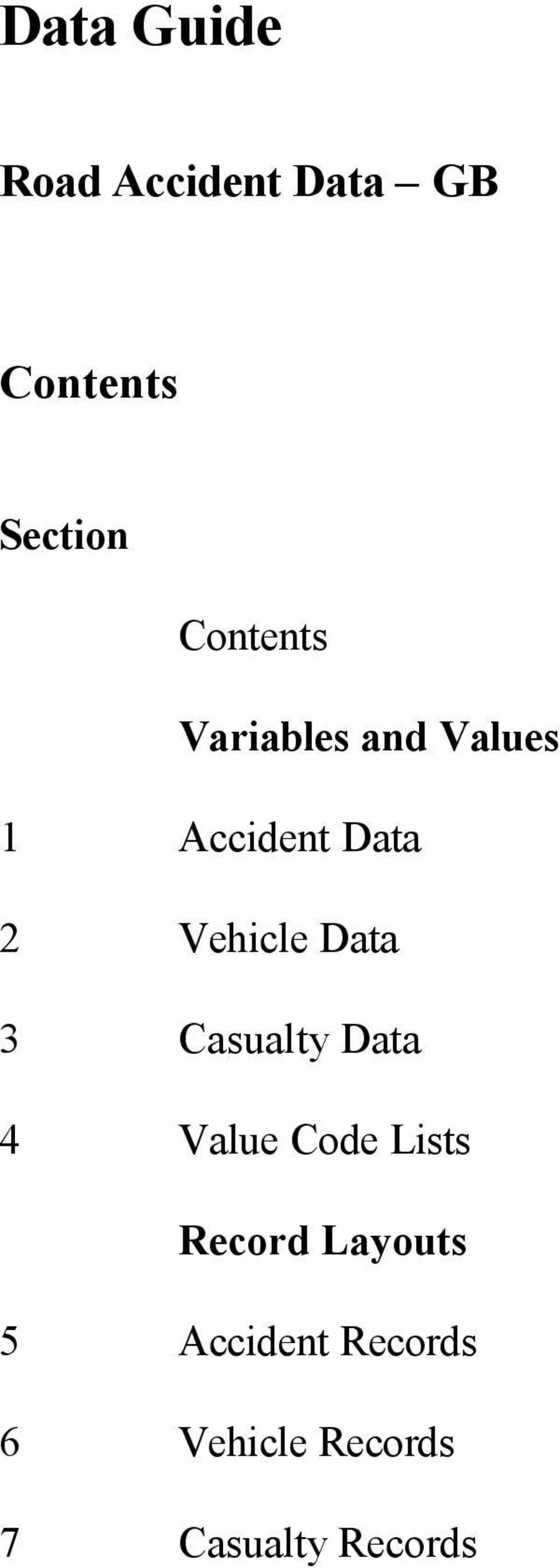
2 Data Guide Road Accident Data GB Contents Section Contents Variables and Values 1 Accident Data 2 Vehicle Data 3 Casualty Data 4 Value Code Lists Record Layouts 5 Accident Records 6 Vehicle Records 7 Casualty Records
3 Variables and Values Accident Data ACCYR ACCREF Index Variables Year of Accident (YYYY) Accident Reference 1.2 Police Force Code See Value Code Lists A3 Accident Severity 1 Fatal 2 Serious 3 Slight 1.5 Number of Vehicles 1.6 Number of Casualties ACCDAY Accident Day ACCMTH Month 1 January 2 February 3 March 4 April 5 May 6 June 7 July 8 August 9 September 10 October 11 November 12 December A7 Day of Week 1 Sunday 2 Monday 3 Tuesday 4 Wednesday 5 Thursday 6 Friday 7 Saturday 1.9 Time of Day A8H Hour of Accident (24 hour) A8M Minute of Accident 1.10 Local Authority See Value Code Lists 1.11 Location (10 metre OSGR) A10 Easting (5 chars) A11 Northing (5 chars) st Road Class 1 Motorway 2 A(M) 3 A 4 B 5 C 6 Unclassified st Road Number 1.14 Road Type 1 Roundabout 2 One way street 3 Dual carriageway - 2 lanes 4 Dual carriageway - 3+ lanes 5 Single carriageway - single track 6 Single carriageway - 2 lanes 7 Single carriageway - 3 lanes 8 Single carriageway - 4+ lanes 9 Unknown 1.15 Speed Limit (mph) 1.16 Junction Detail 0 Not at junction or within 20 metres 1 Roundabout 2 Mini-roundabout 3 T, Y or staggered junction 5 Slip road 6 Crossroads 7 Multiple junction 8 Private drive or entrance 9 Other junction 1.17 Junction Control 1 Authorised person 2 Auto traffic signal 3 Stop sign 4 Give way sign/marks 5 Uncontrolled nd Road Class 1 Motorway 2 A(M) 3 A 4 B 5 C 6 Unclassified nd Road Number 1.20A Pedestrian Crossing - Human Control 0 No crossing in 50 metres or physical crossing not controlled by authorised person 1 Control by school crossing patrol 2 Control by other authorised person 1.20B Pedestrian Crossing - Physical Facilities 0 No crossing facility within 50 metres 1 Zebra 4 Pelican, puffin, toucan or similar non-junct pedestrian light crossing 5 Pedestrian phase at traffic signal junction 8 Central refuge 9 Footbridge or subway 1.21 Light Conditions 1 Daylight - lights present 2 Daylight - no lighting 3 Daylight - lightng unknown 4 Darkness - lights lit 5 Darkness - lights unlit 6 Darkness - no lighting 7 Darkness - lightng unknown

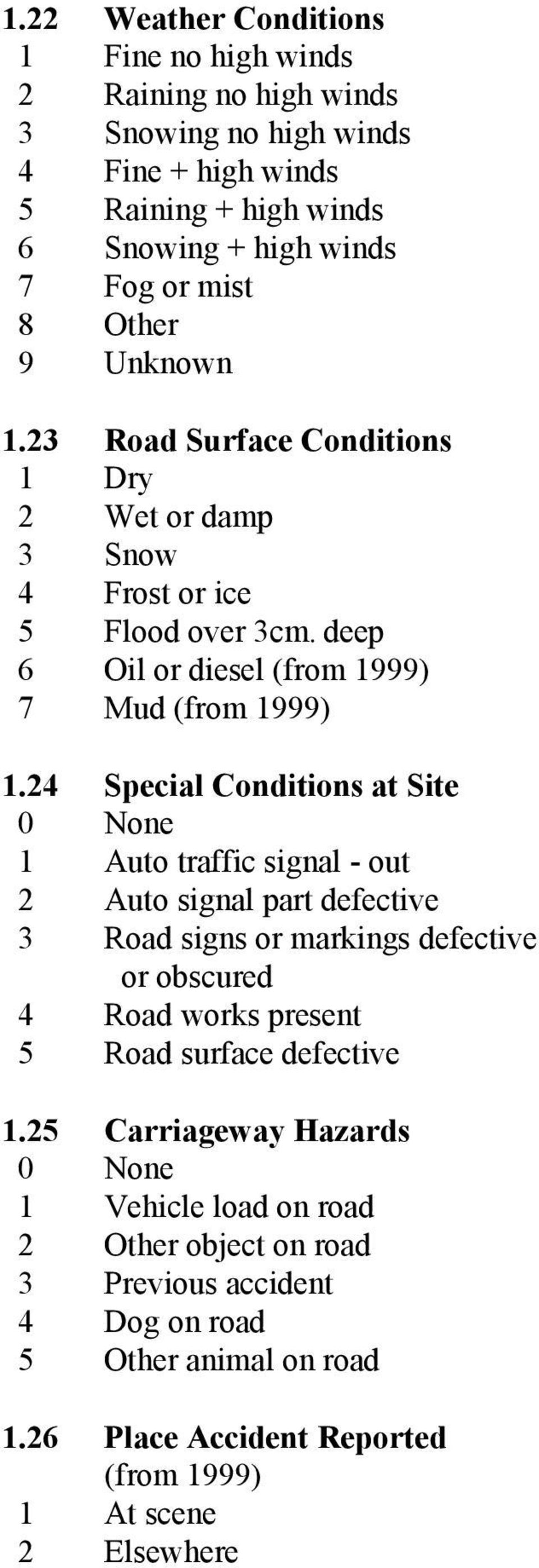
4 1.22 Weather Conditions 1 Fine no high winds 2 Raining no high winds 3 Snowing no high winds 4 Fine + high winds 5 Raining + high winds 6 Snowing + high winds 7 Fog or mist 8 Other 9 Unknown 1.23 Road Surface Conditions 1 Dry 2 Wet or damp 3 Snow 4 Frost or ice 5 Flood over 3cm. deep 6 Oil or diesel (from 1999) 7 Mud (from 1999) 1.24 Special Conditions at Site 0 None 1 Auto traffic signal - out 2 Auto signal part defective 3 Road signs or markings defective or obscured 4 Road works present 5 Road surface defective 1.25 Carriageway Hazards 0 None 1 Vehicle load on road 2 Other object on road 3 Previous accident 4 Dog on road 5 Other animal on road 1.26 Place Accident Reported (from 1999) 1 At scene 2 Elsewhere
5 Vehicle Data ACCYR Index Variables Year of Accident (YYYY) ACCREF Accident Reference 2.4 Vehicle Reference Number 2.5 Vehicle Type 1 Pedal cycle 2 Moped 3 Motor cycle 125cc and under 4 Motor cycle over 125cc 8 Taxi 9 Car 10 Minibus (8-16 passenger seats) 11 Bus or coach (17 or more pass seats) 14 Other motor vehicle 15 Other non-motor vehicle 16 Ridden horse 17 Agricultural vehicle (includes diggers etc.) 18 Tram 19 Goods 3.5 tonnes mgw or under 20 Goods over 3.5t. and under 7.5t. 21 Goods 7.5 tonnes mgw and over 103 Scooter (pre 1999) 104 Motor cycle (pre 1999) 105 Combination (pre 1999) 110 Minibus/Motor caravan (pre 1999) 113 Goods over 3.5 tonnes (pre 1999) Note: For 3, 4, 10, 16, 17, 18, 20 and 21 - data from 1999 only 2.6 Towing and Articulation 0 No tow/articulation 1 Articulated vehicle 2 Double or multiple trailer 3 Caravan 4 Single trailer 5 Other tow 2.7 Vehicle Manoeuvre 1 Reversing 2 Parked 3 Waiting to go - held up 4 Stopping 5 Starting 6 U-turn 7 Turning left 8 Waiting to turn left 9 Turning right 10 Waiting to turn right 11 Changing lane to left 12 Changing lane to right 13 Overtaking moving veh. - offside 14 Overtaking static veh. - offside 15 Overtaking - nearside 16 Going ahead left-hand bend 17 Going ahead right-hand bend 18 Going ahead other 2.8 Vehicle Movement Compass Point V7 Direction - From V8 Direction - To 1 N 2 NE 3 E 4 SE 5 S 6 SW 7 W 8 NW 00 Parked - not at kerb *0 Parked at kerb (*= code 1-8) 2.9A Vehicle Location - Road 1 Leaving main road 2 Entering main road 3 On the main road 4 On minor road 2.9B Vehicle Location - Restricted Lane/Away from Main Carriageway 0 On main c way - not in restricted lane 1 Tram/Light rail track 2 Bus lane 3 Busway (including guided busway) 4 Cycle lane (on main carriageway) 5 Cycleway (separated from main c way) 6 On lay-by or hard shoulder 7 Entering lay-by or hard shoulder 8 Leaving lay-by or hard shoulder 9 Footway (pavement) 10 Not on carriageway (pre 1999) Note: For 0, 1, 2, 3, 4, and 9 - data from 1999 only 2.10 Junction Location at Impact 0 Not at junction 1 Approaching junction 2 In middle of junction 3 Cleared junction 4 Did not impact 2.11 Skidding / Overturning 0 None 1 Skidded 2 Skidded and overturned 3 Jackknifed 4 Jackknifed and overturned 5 Overturned 2.12 Hit Object In Carriageway 0 None 1 Previous accident 2 Road works 3 Parked vehicle - lit 4 Parked vehicle - unlit 5 Bridge (roof) 6 Bridge (side) 7 Bollard or refuge 8 Open door of vehicle 9 Central island of roundabout 10 Kerb 11 Other object

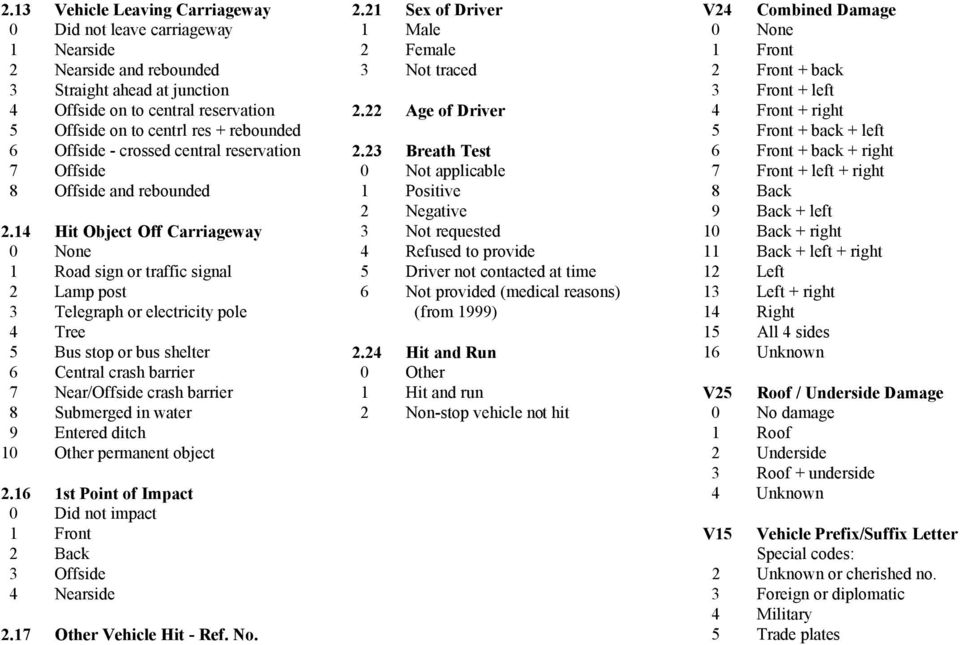
6 2.13 Vehicle Leaving Carriageway 0 Did not leave carriageway 1 Nearside 2 Nearside and rebounded 3 Straight ahead at junction 4 Offside on to central reservation 5 Offside on to centrl res + rebounded 6 Offside - crossed central reservation 7 Offside 8 Offside and rebounded 2.14 Hit Object Off Carriageway 0 None 1 Road sign or traffic signal 2 Lamp post 3 Telegraph or electricity pole 4 Tree 5 Bus stop or bus shelter 6 Central crash barrier 7 Near/Offside crash barrier 8 Submerged in water 9 Entered ditch 10 Other permanent object st Point of Impact 0 Did not impact 1 Front 2 Back 3 Offside 4 Nearside 2.17 Other Vehicle Hit - Ref. No Sex of Driver 1 Male 2 Female 3 Not traced 2.22 Age of Driver 2.23 Breath Test 0 Not applicable 1 Positive 2 Negative 3 Not requested 4 Refused to provide 5 Driver not contacted at time 6 Not provided (medical reasons) (from 1999) 2.24 Hit and Run 0 Other 1 Hit and run 2 Non-stop vehicle not hit V24 Combined Damage 0 None 1 Front 2 Front + back 3 Front + left 4 Front + right 5 Front + back + left 6 Front + back + right 7 Front + left + right 8 Back 9 Back + left 10 Back + right 11 Back + left + right 12 Left 13 Left + right 14 Right 15 All 4 sides 16 Unknown V25 Roof / Underside Damage 0 No damage 1 Roof 2 Underside 3 Roof + underside 4 Unknown V15 Vehicle Prefix/Suffix Letter Special codes: 2 Unknown or cherished no. 3 Foreign or diplomatic 4 Military 5 Trade plates
7 Casualty Data ACCYR Index Variables Year of Accident (YYYY) ACCREF Accident Reference 3.4 Vehicle Reference Number 3.5 Casualty Reference Number 3.6 Casualty Class 1 Driver or rider 2 Passenger 3 Pedestrian 3.7 Sex of Casualty 1 Male 2 Female 3.8 Age of Casualty 3.9 Severity of Casualty 1 Fatal 2 Serious 3 Slight 3.10 Pedestrian Location 0 Not pedestrian 1 Crossing on pedestrian crossing facility 2 Crossing in zig-zag approach lines 3 Crossing in zig-zag exit lines 4 Crossing elsewhere within 50m. of pedestrian crossing 5 In carriageway, crossing elsewhere 6 On footway or verge 7 On refuge, central island or central reservation 8 In centre of carriageway - not on refuge, island or central reservation 9 In carriageway, not crossing 10 Unknown or other 3.11 Pedestrian Movement 0 Not pedestrian 1 Crossing from driver s nearside 2 Crossing from nearside - masked by parked or stationary vehicle 3 Crossing from driver s offside 4 Crossing from offside - masked by parked or stationary vehicle 5 In carriageway, stationary - not crossing (standing or playing) 6 In carriageway, stationary - not crossing (standing or playing) - masked by parked or stationary veh. 7 Walking along in carriageway, facing traffic 8 Walking along in carriageway, back to traffic 9 Unknown or other 3.12 Pedestrian Direction 0 Standing still 1 Heading north 2 Heading north east 3 Heading east 4 Heading south east 5 Heading south 6 Heading south west 7 Heading west 8 Heading north west 9 Unknown (from 1999) 3.13 School Pupil 1 On way to or from school 0 Other (from 1994) 0 Not a school pupil ( ) 2 Not on way to or from school (In code 0 from 1994) 3.15 Car Passenger 0 Not car passenger 1 Front seat passenger 2 Rear seat passenger 3.16 Bus or Coach Passenger 0 Not a bus or coach passenger 1 Boarding 2 Alighting 3 Standing passenger 4 Seated passenger C16 Casualty Type 0 Pedestrian 1 Cyclist 2 Moped rider or passenger 3 Motor cycle (up to 125cc) rider or pass 4 Motor cycle (over 125 cc) rider or pass 8 Taxi occupant 9 Car occupant 10 Minibus occupant 11 Bus or coach occupant 14 Other motor vehicle occupant 15 Other non - motor veh occupant 16 Horse rider 17 Agricultural vehicle occupant 18 Tram occupant 19 Goods veh (up to 3.5t. mgw) occupant 20 Goods veh (over 3.5t. and under 7.5t.) occupant 21 Goods veh (7.5t. and over) occupant 26 Unknown 103 Scooter rider or passenger (pre 1999) 104 Motor cycle rider or pass (pre 1999) 105 Combination rider or pass (pre 1999) 110 Minibus/Motor caravan occ (pre 1999) 113 HGV occupant (pre 1999) Note: For 3, 4, 10, 16, 17, 18, 20 and 21 - data from 1999 only C13 Seat Belt Usage ( only) 0 Not car or van 1 Safety belt in use 2 Seat belt fitted - not in use 3 Seat belt not fitted 4 Child belt - in use 5 Child belt fitted - not in use 6 Child belt not fitted 7 Unknown

8 Value Code Lists Accident Data 1.2 Police Force Code 1 Metropolitan Police 3 Cumbria 4 Lancashire 5 Merseyside 6 Greater Manchester 7 Cheshire 10 Northumbria 11 Durham 12 North Yorkshire 13 West Yorkshire 14 South Yorkshire 16 Humberside 17 Cleveland 20 West Midlands 21 Staffordshire 22 West Mercia 23 Warwickshire 30 Derbyshire 31 Nottinghamshire 32 Lincolnshire 33 Leicestershire 34 Northamptonshire 35 Cambridgeshire 36 Norfolk 37 Suffolk 40 Bedfordshire 41 Hertfordshire 42 Essex 43 Thames Valley 44 Hampshire 45 Surrey 46 Kent 47 Sussex 48 City of London 50 Devon and Cornwall 52 Avon and Somerset 53 Gloucestershire 54 Wiltshire 55 Dorset 60 North Wales 61 Gwent 62 South Wales 63 Dyfed-Powys 91 Northern 92 Grampian 93 Tayside 94 Fife 95 Lothian and Borders 96 Central 97 Strathclyde 98 Dumfries and Galloway 1.10 Local Authority Code Metropolitan Police London Boroughs and City of London 001 Westminster 002 Camden 003 Islington 004 Hackney 005 Tower Hamlets 006 Greenwich 007 Lewisham 008 Southwark 009 Lambeth 010 Wandsworth 011 Hammersmith 012 Kensington and Chelsea 013 Waltham Forest 014 Redbridge 015 Havering 016 Barking 017 Newham 018 Bexley 019 Bromley 020 Croydon 021 Sutton 022 Merton 023 Kingston-upon-Thames 024 Richmond-upon-Thames 025 Hounslow 026 Hillingdon 027 Ealing 028 Brent 029 Harrow 030 Barnet 031 Haringey 032 Enfield 057 London Airport 570 City of London Hertfordshire (Met Police District) 033 Hertsmere 034 Welwyn Hatfield - MPD area 035 Broxbourne - MPD area Metropolitan Police Essex (Met Police District) 036 Epping Forest - MPD area Surrey (Met Police District) 037 Reigate and Banstead - MPD area 038 Epsom and Ewell 039 Elmbridge - MPD area 040 Spelthorne Cumbria 060 Allerdale 061 Barrow-in-Furness 062 Carlisle 063 Copeland 064 Eden 065 South Lakeland Lancashire 072 Burnley 073 Chorley 074 Fylde 075 Hyndburn 076 Lancaster 077 Pendle 079 Preston 080 Ribble Valley 082 Rossendale 083 South Ribble 084 West Lancashire 085 Wyre Unitary authorities from Apr Blackburn with Darwen 071 Blackpool

9 Merseyside 090 Knowsley 091 Liverpool 092 St Helens 093 Sefton 095 Wirral Greater Manchester 100 Bolton 101 Bury 102 Manchester 104 Oldham 106 Rochdale 107 Salford 109 Stockport 110 Tameside 112 Trafford 114 Wigan Cheshire 120 Chester 121 Congleton 122 Crewe and Nantwich 123 Ellesmere Port 126 Macclesfield 127 Vale Royal Unitary authorities from Apr Halton 128 Warrington Northumbria Northumberland 140 Alnwick 141 Berwick-upon-Tweed 142 Blyth Valley 143 Castle Morpeth 144 Tynedale 145 Wansbeck Tyne and Wear Durham 160 Chester-le-Street 162 Derwentside 163 Durham 164 Easington 165 Sedgefield 166 Teesdale 168 Wear Valley Unitary authority from Apr Darlington North Yorkshire 180 Craven 181 Hambleton 182 Harrogate 184 Richmondshire 185 Ryedale 186 Scarborough 187 Selby Unitary authority from Apr York West Yorkshire 200 Bradford 202 Calderdale 203 Kirklees 204 Leeds 206 Wakefield South Yorkshire 210 Barnsley 211 Doncaster 213 Rotherham 215 Sheffield Humberside Unitary authorities from Apr Kingston-upon-Hull 231 East Riding of Yorkshire (data from Jan 1996) 232 North Lincolnshire (data from Jan 1996) 233 North East Lincolnshire (data from Jan 1996) Authorities not used from Jan Beverley (to 231) 221 Boothferry (to 231/232) 224 Cleethorpes (to 233) 225 Glanford (to 232) 226 Grimsby (to 233) 227 Holderness (to 231) 229 East Yorkshire (to 231) 230 Scunthorpe (to 232) Cleveland Unitary authorities from Apr Hartlepool 241 Redcar and Cleveland 243 Middlesbrough 245 Stockton-on-Tees Staffordshire 250 Cannock Chase 251 East Staffordshire 252 Lichfield 253 Newcastle-under-Lyme 254 South Staffordshire 255 Stafford 256 Staffordshire Moorlands 258 Tamworth Unitary authority from Apr Stoke-on-Trent 146 Gateshead 147 Newcastle-upon-Tyne 148 North Tyneside 149 South Tyneside 150 Sunderland

10 West Mercia Worcestershire 270 Bromsgrove 273 Malvern Hills 274 Redditch 276 Worcester 277 Wychavon 278 Wyre Forest Shropshire 279 Bridgnorth 280 North Shropshire 281 Oswestry 282 Shrewsbury and Atcham 283 South Shropshire Unitary authorities from Apr Telford & Wrekin 285 Herefordshire (data from Apr 1998) Authorities not used from Apr Hereford (to 285) 272 Leominster (to 285) 275 South Herefordshire (to 285) Warwickshire 290 North Warwickshire 291 Nuneaton 292 Rugby 293 Stratford-upon-Avon 294 Warwick West Midlands 300 Birmingham 302 Coventry 303 Dudley 305 Sandwell 306 Solihull 307 Walsall 309 Wolverhampton Derbyshire 320 Amber Valley 321 Bolsover 322 Chesterfield 324 Erewash 325 High Peak 327 North East Derbyshire 328 South Derbyshire 329 Derbyshire Dales Unitary authority from Apr City of Derby Nottinghamshire 340 Ashfield 341 Bassetlaw 342 Broxtowe 343 Gedling 344 Mansfield 345 Newark 347 Rushcliffe Unitary authority from Apr City of Nottingham Lincolnshire 350 Boston 351 East Lindsey 352 Lincoln 353 North Kesteven 354 South Holland 355 South Kesteven 356 West Lindsey Leicestershire 360 Blaby 361 Hinkley and Bosworth 362 Charnwood 363 Harborough 365 Melton 366 North West Leicestershire 367 Oadby and Wigston Unitary authorities from Apr City of Leicester 368 Rutland Northamptonshire 380 Corby 381 Daventry 382 East Northamptonshire 383 Kettering 384 Northampton 385 South Northamptonshire 386 Wellingborough Cambridgeshire 390 Cambridge 391 East Cambridgeshire 392 Fenland 393 Huntingdon 395 South Cambridgeshire Unitary authority from Apr Peterborough Norfolk 400 Breckland 401 Broadland 402 Great Yarmouth 404 Norwich 405 North Norfolk 406 South Norfolk 407 Kings Lynn and West Norfolk Suffolk 410 Babergh 411 Forest Heath 412 Ipswich 413 Mid-Suffolk 414 St Edmondsbury 415 Suffolk Coastal 416 Waveney Bedfordshire 420 North Bedfordshire 422 Mid-Bedfordshire 423 South Bedfordshire Unitary authority from Apr Luton

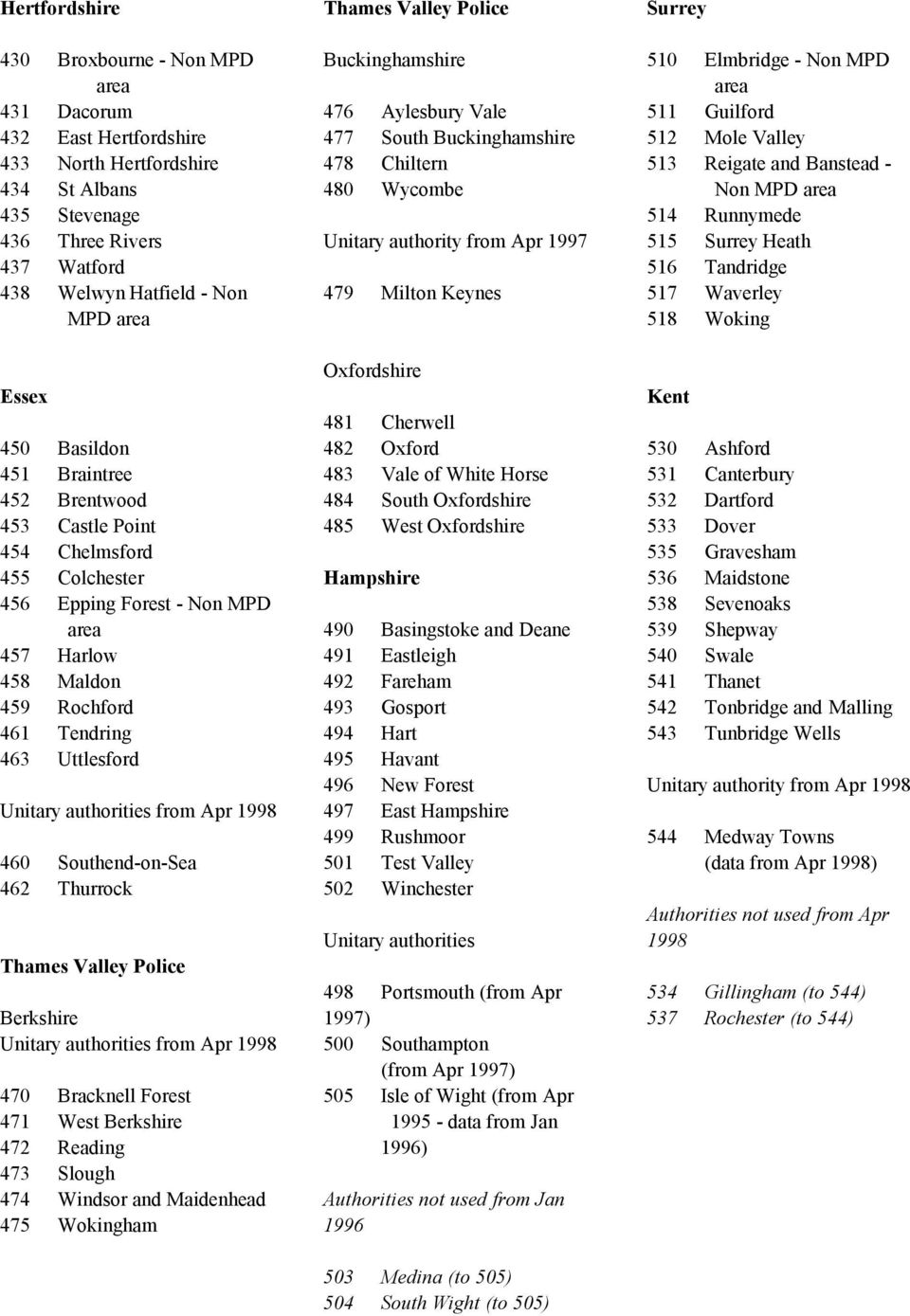
11 Hertfordshire 430 Broxbourne - Non MPD area 431 Dacorum 432 East Hertfordshire 433 North Hertfordshire 434 St Albans 435 Stevenage 436 Three Rivers 437 Watford 438 Welwyn Hatfield - Non MPD area Essex 450 Basildon 451 Braintree 452 Brentwood 453 Castle Point 454 Chelmsford 455 Colchester 456 Epping Forest - Non MPD area 457 Harlow 458 Maldon 459 Rochford 461 Tendring 463 Uttlesford Unitary authorities from Apr Southend-on-Sea 462 Thurrock Thames Valley Police Berkshire Unitary authorities from Apr Bracknell Forest 471 West Berkshire 472 Reading 473 Slough 474 Windsor and Maidenhead 475 Wokingham Thames Valley Police Buckinghamshire 476 Aylesbury Vale 477 South Buckinghamshire 478 Chiltern 480 Wycombe Unitary authority from Apr Milton Keynes Oxfordshire 481 Cherwell 482 Oxford 483 Vale of White Horse 484 South Oxfordshire 485 West Oxfordshire Hampshire 490 Basingstoke and Deane 491 Eastleigh 492 Fareham 493 Gosport 494 Hart 495 Havant 496 New Forest 497 East Hampshire 499 Rushmoor 501 Test Valley 502 Winchester Unitary authorities 498 Portsmouth (from Apr 1997) 500 Southampton (from Apr 1997) 505 Isle of Wight (from Apr data from Jan 1996) Authorities not used from Jan Medina (to 505) 504 South Wight (to 505) Surrey 510 Elmbridge - Non MPD area 511 Guilford 512 Mole Valley 513 Reigate and Banstead - Non MPD area 514 Runnymede 515 Surrey Heath 516 Tandridge 517 Waverley 518 Woking Kent 530 Ashford 531 Canterbury 532 Dartford 533 Dover 535 Gravesham 536 Maidstone 538 Sevenoaks 539 Shepway 540 Swale 541 Thanet 542 Tonbridge and Malling 543 Tunbridge Wells Unitary authority from Apr Medway Towns (data from Apr 1998) Authorities not used from Apr Gillingham (to 544) 537 Rochester (to 544)
12 Sussex East Sussex 551 Eastbourne 552 Hastings 554 Lewes 555 Rother 556 Wealden Unitary authority from Apr Brighton and Hove (data from Jan 1997) Authorities not used from Jan Brighton (to 565) 553 Hove (to 565) West Sussex 557 Adur 558 Arun 559 Chichester 560 Crawley 562 Horsham 563 Mid-Sussex 564 Worthing Devon and Cornwall Devon 580 East Devon 581 Exeter 582 North Devon 584 South Hams 585 Teignbridge 586 Mid-Devon 588 Torridge 589 West Devon Unitary authorities from Apr Plymouth 587 Torbay Devon and Cornwall Cornwall 590 Caradon 591 Carrick 592 Kerrier 593 North Cornwall 594 Penwith 595 Restormel Avon and Somerset Avon Unitary authorities from Apr City of Bristol 605 North Somerset 611 Bath and NE Somerset (data from Jan 1996) 612 South Gloucestershire (data from Jan 1996) Authorities not used from Jan Bath (to 611) 602 Kingswood (to 612) 603 Northavon (to 612) 604 Wansdyke (to 611) Somerset 606 Mendip 607 Sedgemoor 608 Taunton Deane 609 West Somerset 610 South Somerset Gloucestershire 620 Cheltenham 621 Cotswold 622 Forest of Dean 623 Gloucester 624 Stroud 625 Tewkesbury Wiltshire 630 Kennet 631 North Wiltshire 632 Salisbury 634 West Wiltshire Unitary authority 633 Swindon Dorset 641 Christchurch 642 North Dorset 644 Purbeck 645 West Dorset 646 Weymouth and Portland 647 East Dorset Unitary authorities from Apr Bournemouth 643 Poole
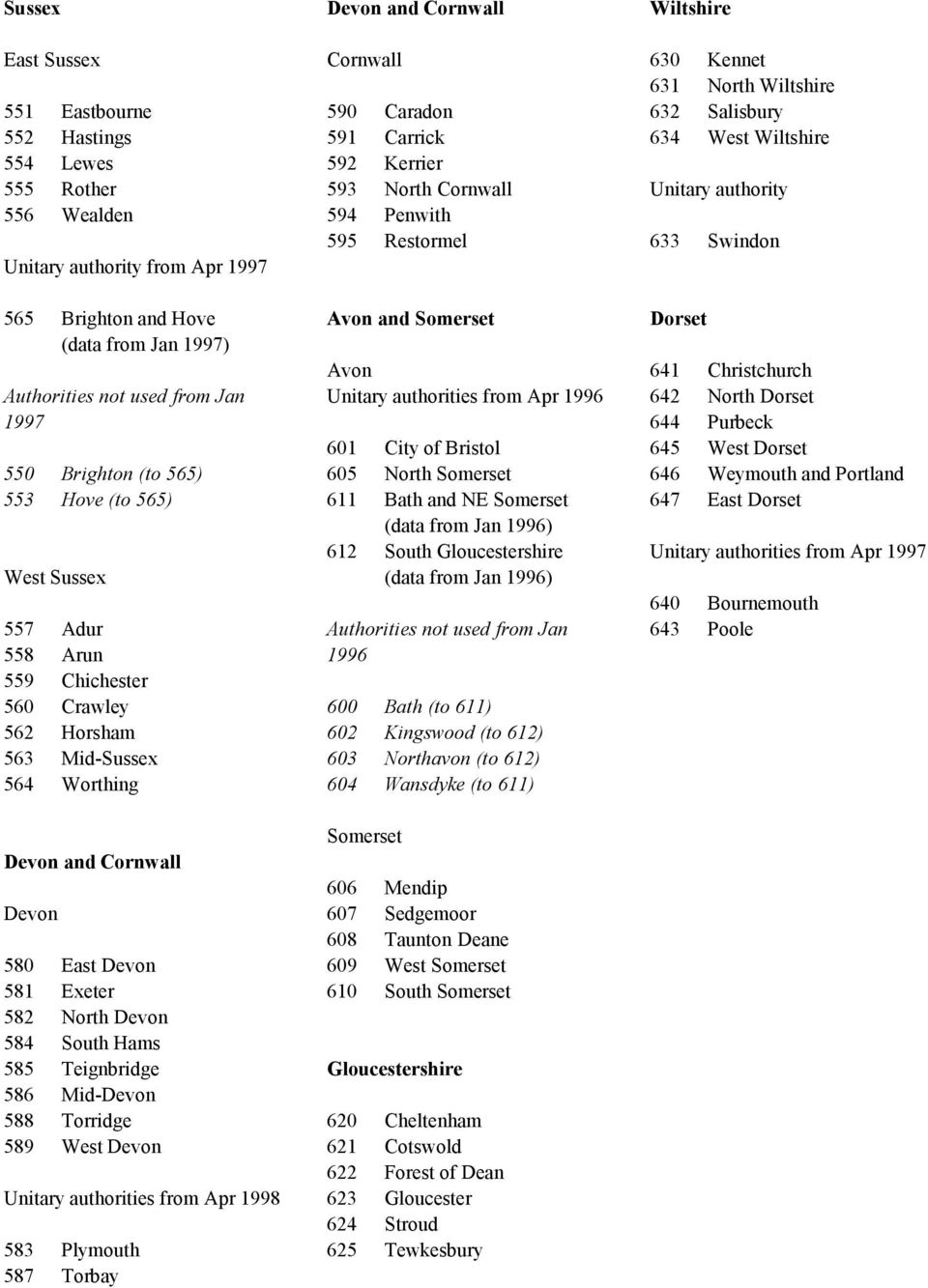
13 WALES Unitary authorities from Apr 1996 (data from Jan 1996) North Wales 720 Isle of Anglesey 721 Conwy 722 Gwynedd 723 Denbighshire 724 Flintshire 725 Wrexham Gwent 730 Blaenau Gwent 731 Caerphilly 732 Monmouthshire 733 Newport 734 Torfaen South Wales 740 Bridgend 741 Cardiff 742 Merthyr Tydfil 743 Neath & Port Talbot 744 Rhondda Cynon Taff 745 Swansea 746 The Vale of Glamorgan Dyfed-Powys 750 Ceredigion 751 Carmarthenshire 752 Pembrokeshire 753 Powys SCOTLAND Unitary authorities from Apr 1996 (some data from Jan 1996) Northern 927 Highland 933 Orkney Islands 936 Shetland Islands 941 Western Isles Grampian 910 Aberdeen City 911 Aberdeenshire 930 Moray Tayside 912 Angus 918 Dundee City 934 Perth & Kinross Fife 925 Fife Lothian and Borders 914 Scottish Borders 921 East Lothian 923 City of Edinburgh 929 Midlothian 940 West Lothian Central 915 Clackmannanshire 924 Falkirk 939 Stirling Strathclyde 913 Argyll & Bute 916 West Dunbartonshire 919 East Ayrshire 920 East Dunbartonshire 922 East Renfrewshire 926 Glasgow City 928 Inverclyde 931 North Ayrshire 932 North Lanarkshire 935 Renfrewshire 937 South Ayrshire 938 South Lanarkshire Dumfries and Galloway 917 Dumfries & Galloway

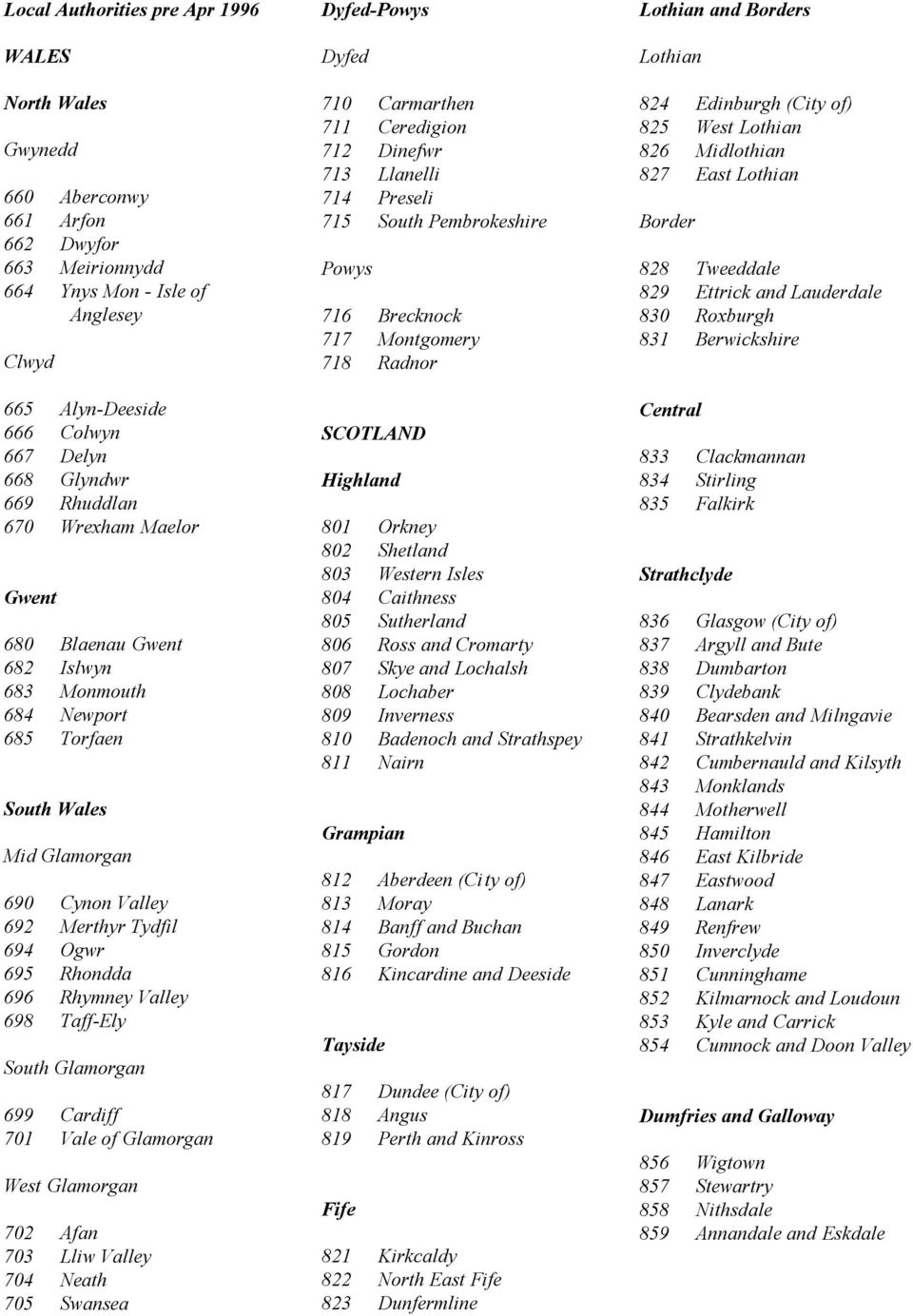
14 Local Authorities pre Apr 1996 WALES North Wales Gwynedd 660 Aberconwy 661 Arfon 662 Dwyfor 663 Meirionnydd 664 Ynys Mon - Isle of Anglesey Clwyd 665 Alyn-Deeside 666 Colwyn 667 Delyn 668 Glyndwr 669 Rhuddlan 670 Wrexham Maelor Gwent 680 Blaenau Gwent 682 Islwyn 683 Monmouth 684 Newport 685 Torfaen South Wales Mid Glamorgan 690 Cynon Valley 692 Merthyr Tydfil 694 Ogwr 695 Rhondda 696 Rhymney Valley 698 Taff-Ely South Glamorgan 699 Cardiff 701 Vale of Glamorgan West Glamorgan 702 Afan 703 Lliw Valley 704 Neath 705 Swansea Dyfed-Powys Dyfed 710 Carmarthen 711 Ceredigion 712 Dinefwr 713 Llanelli 714 Preseli 715 South Pembrokeshire Powys 716 Brecknock 717 Montgomery 718 Radnor SCOTLAND Highland 801 Orkney 802 Shetland 803 Western Isles 804 Caithness 805 Sutherland 806 Ross and Cromarty 807 Skye and Lochalsh 808 Lochaber 809 Inverness 810 Badenoch and Strathspey 811 Nairn Grampian 812 Aberdeen (City of) 813 Moray 814 Banff and Buchan 815 Gordon 816 Kincardine and Deeside Tayside 817 Dundee (City of) 818 Angus 819 Perth and Kinross Fife 821 Kirkcaldy 822 North East Fife 823 Dunfermline Lothian and Borders Lothian 824 Edinburgh (City of) 825 West Lothian 826 Midlothian 827 East Lothian Border 828 Tweeddale 829 Ettrick and Lauderdale 830 Roxburgh 831 Berwickshire Central 833 Clackmannan 834 Stirling 835 Falkirk Strathclyde 836 Glasgow (City of) 837 Argyll and Bute 838 Dumbarton 839 Clydebank 840 Bearsden and Milngavie 841 Strathkelvin 842 Cumbernauld and Kilsyth 843 Monklands 844 Motherwell 845 Hamilton 846 East Kilbride 847 Eastwood 848 Lanark 849 Renfrew 850 Inverclyde 851 Cunninghame 852 Kilmarnock and Loudoun 853 Kyle and Carrick 854 Cumnock and Doon Valley Dumfries and Galloway 856 Wigtown 857 Stewartry 858 Nithsdale 859 Annandale and Eskdale
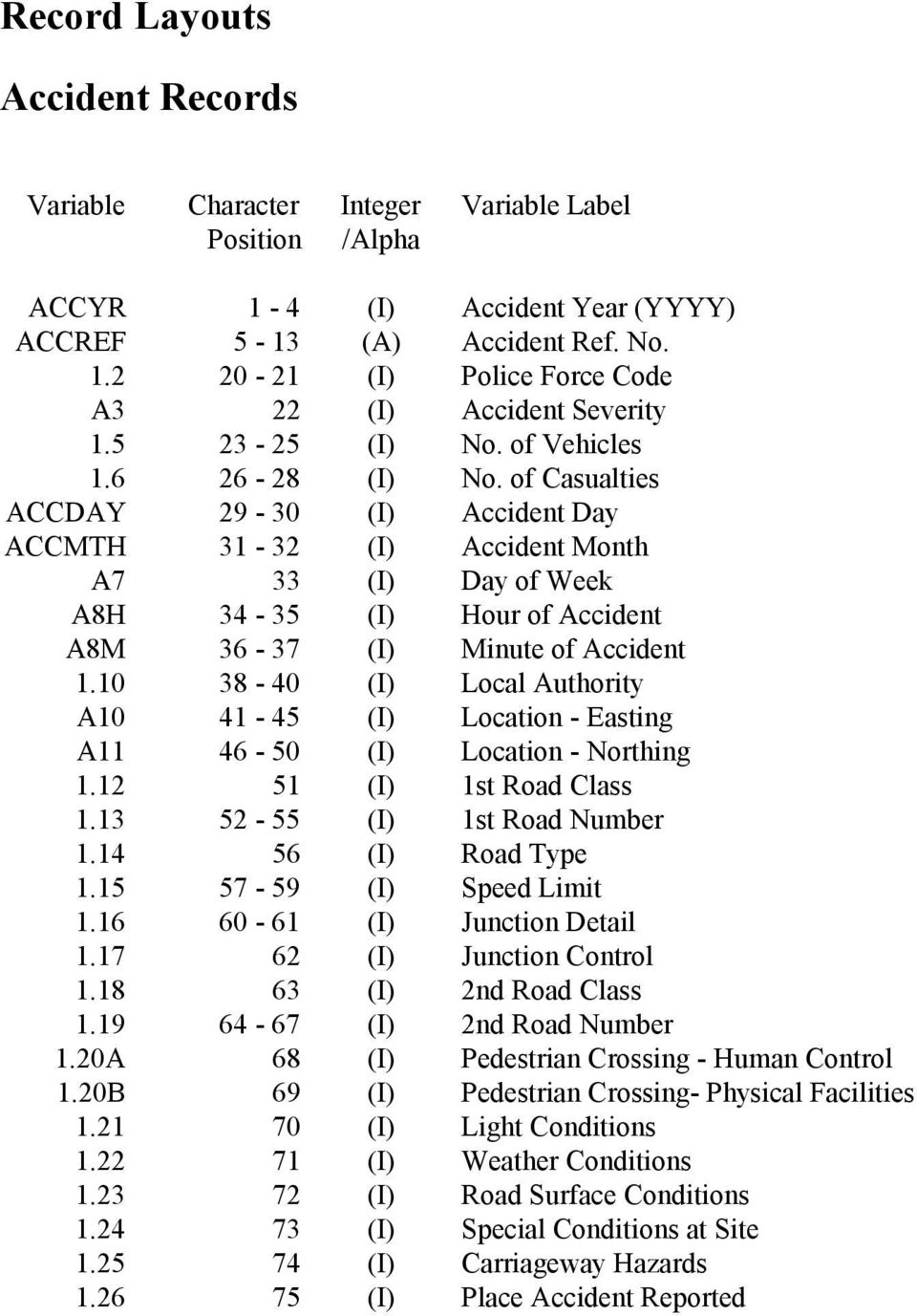
15 Record Layouts Accident Records Variable Character Integer Variable Label Position /Alpha ACCYR 1-4 (I) Accident Year (YYYY) ACCREF 5-13 (A) Accident Ref. No (I) Police Force Code A3 22 (I) Accident Severity (I) No. of Vehicles (I) No. of Casualties ACCDAY (I) Accident Day ACCMTH (I) Accident Month A7 33 (I) Day of Week A8H (I) Hour of Accident A8M (I) Minute of Accident (I) Local Authority A (I) Location - Easting A (I) Location - Northing (I) 1st Road Class (I) 1st Road Number (I) Road Type (I) Speed Limit (I) Junction Detail (I) Junction Control (I) 2nd Road Class (I) 2nd Road Number 1.20A 68 (I) Pedestrian Crossing - Human Control 1.20B 69 (I) Pedestrian Crossing- Physical Facilities (I) Light Conditions (I) Weather Conditions (I) Road Surface Conditions (I) Special Conditions at Site (I) Carriageway Hazards (I) Place Accident Reported
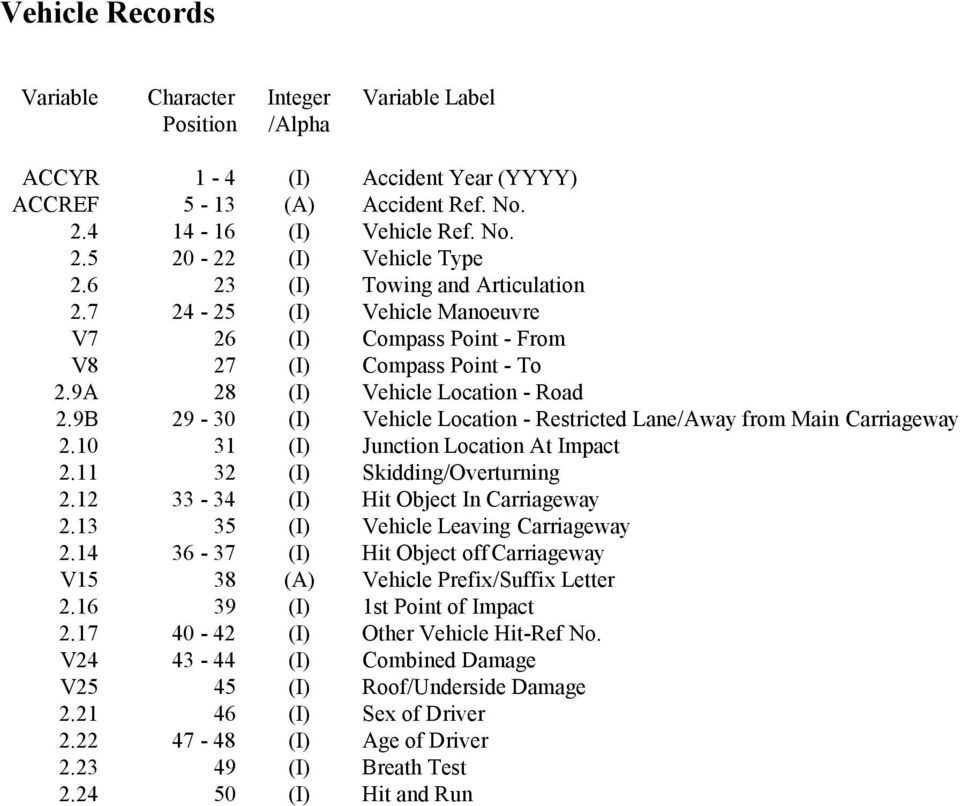
16 Vehicle Records Variable Character Integer Variable Label Position /Alpha ACCYR 1-4 (I) Accident Year (YYYY) ACCREF 5-13 (A) Accident Ref. No (I) Vehicle Ref. No (I) Vehicle Type (I) Towing and Articulation (I) Vehicle Manoeuvre V7 26 (I) Compass Point - From V8 27 (I) Compass Point - To 2.9A 28 (I) Vehicle Location - Road 2.9B (I) Vehicle Location - Restricted Lane/Away from Main Carriageway (I) Junction Location At Impact (I) Skidding/Overturning (I) Hit Object In Carriageway (I) Vehicle Leaving Carriageway (I) Hit Object off Carriageway V15 38 (A) Vehicle Prefix/Suffix Letter (I) 1st Point of Impact (I) Other Vehicle Hit-Ref No. V (I) Combined Damage V25 45 (I) Roof/Underside Damage (I) Sex of Driver (I) Age of Driver (I) Breath Test (I) Hit and Run
17 Casualty Records Variable Character Integer Variable Label Position /Alpha ACCYR 1-4 (I) Accident Year (YYYY) ACCREF 5-13 (A) Accident Ref. No (I) Vehicle Ref. No (I) Casualty Ref. No (I) Casualty Class (I) Sex of Casualty (I) Age of Casualty (I) Severity of Casualty (I) Pedestrian Location (I) Pedestrian Movement (I) Pedestrian Direction (I) School Pupil C13 30 (I) Seat Belt Usage ( ) (I) Car Passenger (I) Bus or Coach Passenger C (I) Casualty Type

18 STATS20 Instructions for the Completion of Road Accident Report Form STATS19 Contents Section Page 1 Introduction 3 2 Accidents to be Reported 4 3 Vehicles to be Reported 6 4 Casualties to be Reported 7 Annex 1 Attendant Circumstances Variables 9 2 Vehicle Variables 38 3 Casualty Variables 66 4 Discontinued STATS19 Variables 84 5 Police Force Codes 85 6 Local Authority Codes 86 7 Central Government Contacts 95 STATS19 Form

19 1. INTRODUCTION 1.1 This is the 1999 edition of STATS20 and incorporates amendments arising from the 1997 Quinquennial Review of Road Accident Data, as approved by the Standing Committee on Road Accident Statistics (SCRAS). SCRAS comprises representatives from the Department of the Environment, Transport and the Regions (DETR), police forces, local authority associations and other Government departments with an interest in the collation of road accident data. 1.2 The STATS19 reports are analysed nationally by reference to a great variety of characteristics and attendant circumstances and the results are used extensively for research work and for guidance in the improvement of road safety in relation to roads, road users, vehicles and traffic movement. The data also form the basis for annual statistics on road accidents and casualties published by DETR, the Scottish Office (SO) and the Welsh Office (WO) and, in due course, the devolved administrations. 1.3 Local authorities also make extensive use of road accidentdata. Engineers use it extensively for establishing priority sites for remedial measures and previous experience has shown that even low cost measures can be extremely effective in reducing or eliminating accidents at particular sites. 1.4 Road safety officers also gain much of their evidence on which to base national and local educational programmes and training from the data which accrue from road accident statistics. 1.5 The police, who collect these data, also use them as a guide to the operational actical t deployment of their patrols in order to fulfil one of their primary roles, the prevention of accidents. 1.6 The accumulated data is also used by a range of establishments for research into road safety measures. 1.7 It is because of the many various uses to which this data is put that the need for accuracy and prompt return is paramount. The speedy return of accurate data will not only be of value to those bodies noted above but will also do much to enhance the early publication of Departmental accident and casualty statistics, which are of great use to those working in the field of accident prevention and road safety education. 1.8 A separate document, STATS21, describes: (a) (b) (c) (d) The validity checks and error procedures to be carried out locally on STATS19 data; The procedures for writing and submitting data to DETR/SO/WO; The specification of magnetic media formats; The procedures for dealing with rejections or queries of data received by DETR/SO/WO. 3
20 2. ACCIDENTS TO BE REPORTED 2.1 All road accidents involving human death or personal injury occurring on the Highway ( road in Scotland) and notified to the police within 30 days of occurrence, and in which one or more vehicles are involved, are to be reported. This is a wider definition of road accidents than that used in Road Traffic Acts. 2.2 Examples of accidents to be reported include: (a) (b) (c) (d) accidents which commence on the highway but which involve casualties off the highway (e.g. where a vehicle runs out of control while on the highway and causes casualties elsewhere); accidents involving the boarding and alighting of buses or coaches and accidents in which passengers already aboard a bus/coach are injured, whether or not another vehicle or a pedestrian is involved; accidents to pedal cyclists, including where the pedal cyclists injure themselves or a pedestrian; accidents resulting from deliberate acts of violence, but excluding casualties who are subsequently identified as confirmed suicides. 2.3 Examples of accidents which should not be reported include: (a) (b) (c) (d) accidents which do not involve personal injury; accidents on private roads (except Royal Parks) or in car parks; accidents reported to the police 30 or more days after they occurred; accidents involving confirmed suicides only. A. The Road Traffic Act 1988 (section 170), as amended by Section 72 of the 1991 Act, stipulates that all fatal or injury accidents on public roads involving at least one mechanically propelled vehicle should be reported by the public to the police unless insurance documents, name and address, and evidence of vehicle ownership and registration are exchanged between drivers. This legislation defines the duty of the public to report a personal injury road accident. The interpretation of mechanically propelled vehicle varies widely between local police forces, particularly about whether pedal cycle accidents, not involving a motor vehicle, should be reported. The STATS19 requirement is clear that all accidents involving non-motor vehicles such as pedal cycles and ridden horses on public roads (see 2.4) should be reported, regardless of motor vehicle or pedestrian involvement. B. Just prior to the 1997 Quinquennial review the legal meaning of public road in the 1988 and 1991 Road Traffic Acts changed, following two legal cases, to include car parks and their access roads. The location at which road accidents should be reported to DETR/SO/WO is unchanged, however, and accidents occurring in car parks and on their access roads remain outside the STATS19 system. 4
21 2.4 The following table gives examples of locations at which accidents should or should not be reported: Location Highway Motorway (including A(M) road) A, B or C road Unclassified road Toll road or bridge where Secretary of State or local authority is the highway authority Highway - limited access road or lane Pedestrianised road with limited access for motor vehicles Bus lane, busway or guided busway Tram or light rail track Cycle lane, cycleway or shared access footway Footway or pavement Included in STATS19? Yes Yes Yes Yes Yes Yes Yes (if part of Highway) Yes (if part of Highway) Yes (if part of Highway) Public right of way with limited access Country track, byway open to all traffic, cycle path or cycle Yes track with lawful access for motor vehicles Footpath or bridleway with no lawful access for motor vehicles No Cycle path/track with no lawful access for motor vehicles No Roads in private areas Airports Harbours Hospital areas Private residential estates Private retail shopping parks Private industrial estates Military areas Municipal or private parks Royal parks Service areas Other areas to which motor vehicles may have access Car parks (municipal and private) and access roads Bus stations Railway stations Railway level crossings - train not involved in accident Railway level crossings - accident involving train Petrol stations Picnic areas Pedestrian malls No (unless Highway) No (unless Highway) No (unless Highway) No (unless Highway) No (unless Highway) No (unless Highway) No No (unless Highway) Yes No No No (unless Highway) No Yes No No No No NOTE Highway ( road in Scotland) is a road with unrestricted right of access for all or some classes of motor vehicles. 5
22 3. VEHICLES TO BE REPORTED 3.1 Complete vehicle details, regardless or whether the vehicle was damaged or not, are required for each vehicle which was involved in, or contributed to, an injury accident. This includes pedal cycles, ridden horses and horse-drawn vehicles. Including: (a) (b) (c) (d) (e) vehicles in which driver/rider/passenger was injured; vehicles which suffered damage in the accident; vehicles which caused injury to a pedestrian (including parked vehicles on or off the carriageway into which a pedestrian walked); vehicles which were in collision with another vehicle in the accident; vehicles which did not suffer damage, nor caused nor contained casualties, but which in the opinion of the reporting officer contributed to the accident (includes parked, stationary, temporarily held-up or moving vehicles); Excluding: (f) where a person has safely alighted from a vehicle but is subsequently injured when moving away from the vehicle, the vehicle from which the person alighted is to be excluded. 6
23 4. CASUALTIES TO BE REPORTED 4.1 Any persons killed or injured in a road accident (as defined in 2.1) Including: (a) (b) (c) (d) (e) (f) (g) a person who moves quickly to avoid being involved in an accident, is successful in that, but in doing so incurs an injury (e.g. twists an ankle). Also includes occupant of vehicle which manoeuvres or brakes suddenly to avoid an impact, but in so doing sustains an injury; a pedestrian who injures himself on a parked vehicle; a person who is injured after falling from a vehicle; a person who is injured boarding or alighting a bus or coach; a person injured whilst aboard a bus or coach, whether or not another vehicle is involved; a person who is injured away from the carriageway as a result of an accident which commenced on the public highway; all casualties in accidents arising from deliberate acts of violence; Excluding: (h) (i) (j) (k) (l) death/injury to babies unborn up to the time of the accident; person injured in a road accident as a result of illness (e.g. fit) immediately prior to the accident, where injury is deemed to be a result of the illness rather than the road accident. All other casualties involved in the accident should be included ; person who dies in a road accident from natural causes (e.g. heart attack) and whose death is not ascribed by the Coroner s Court (Procurator Fiscal in Scotland) to have been a result of the accident. Other casualties in these accidents should be reported; confirmed suicides. Other casualties in these accidents should be reported. Injured persons suspected of having attempted suicide should be reported; any person who witnesses an accident and suffers shock but who is not directly involved. A. Cases (j) and (k) may be reported to DETR/SO/WO in the first instance, pending the decision of the Coroner s Court or (Procurator Fiscal). It may, therefore, be necessary for the police/local processing centre to notify DETR/SO/WO if, at a later stage, such cases are to be deleted from their computer records (see STATS21). B. Definitions of casualty severity can be found in Section 3.9 of Annex 3, on page 74. 7
24 8
25 ANNEX 1 - ATTENDANT CIRCUMSTANCES VARIABLES 1.1 RECORD TYPE 1 CODES 11. New accident record 15. Amended accident record A. First box always coded 1 to enable accident records to be easily identified during computer processing and analysis at local and national levels. B. In second box, code 5 only to be used when an accident record already sent to DETR/SO/WO is to be replaced by an amended record. 9
26 1.2 POLICE FORCE A. Enter the code number of the police force in whose area the accident occurred. The relevant codes are listed in Annex 5 on page 85. B. Note that leading zeros are incorporated in some of these codes and must be entered (e.g. the code for Cumbria is entered as 03). 10
27 1.3 ACCIDENT REFERENCE NUMBER A. The accident reference number allocated by the police must be unique within that police force for the accident and for the calendar year in which it took place. It must also be sufficient for the police to identify the accident in the event of a query. B. The reference number may contain a total of 7, or fewer, numbers and/or alphabetic characters in any sequence convenient to Police Force requirements. C. Unused spaces to the left of accident reference numbers containing less than 7 characters are to be coded zero (e.g. ABC123 would be coded 0ABC123). 11
28 1.5 NUMBER OF VEHICLE RECORDS A. Enter the number of vehicle records submitted for the accident. B. Unused boxes to the left of the number of vehicles should be coded zero (e.g. if 2 vehicles were involved, this item would be coded 002). 12
29 1.6 NUMBER OF CASUALTY RECORDS A. Enter the number of casualty records submitted for the accident. B. Unused boxes to the left of the number of casualty records should be coded zero (e.g. if there were 3 casualty records, this item would be coded 003). 13
30 1.7 DATE Day Month Year A. The first two boxes are to be used for the day, the second two for the month and the remaining two for the last two digits of the year. B. Accident year will be converted to four characters by DETR/SO/WO. C. Unused boxes to the left of the day or month are to be entered as zeros (e.g. 9 May 1999 would be coded as , and 27 June 2001 would be coded as ). 14
31 1.9 TIME Hours Minutes A. The hours, on a 24 hour system, are to be entered in the first two boxes. B. The number of minutes past any of these hours should be recorded in the two right hand boxes, to the nearest minute. C. Zeros should be entered where necessary, i.e. 8 minutes past 9am. is entered as D. The coding 0000 is not permitted. Midnight should be coded
32 1.10 LOCAL AUTHORITY A. Enter the code number of the local authority in whose area the accident occurred. B. The codes are listed in Annex 6 on page 86. C. Note that leading zeros are incorporated in some of these codes and must be entered (e.g. the code for Westminster is entered as 001). 16
33 1.11 LOCATION Easting Northing 10 DIGIT ORDNANCE SURVEY GRID REFERENCE NUMBER A. The standard numeric 10 digit grid reference should be used wherever possible. B. The first digit of both easting and northing define the national 100 kilometre square. The second digit of both easting and northing define the national 10 kilometre square. The third digit of both easting and northing define the national 1 kilometre square. The fourth digit of both easting and northing define the national 100 metre square. The fifth digit of both easting and northing define the national 10 metre square. Example: Further details are available on Ordnance Survey Maps. C. Local authorities/police using link/node systems are expected to code their accidents on the above basis but a local authority can have an additional variable for link/node reference on its local variant of STATS19 for local use if it so chooses. D. Alpha map reference nodes are not acceptable. E. This variable is used by most local authorities, by DETR headquarters and by regional offices. In the past many errors have been found, such as displaced figures, faulty translation of the 100 kilometre square letters to digits and transposition of the easting and northing. Data should, therefore, be validated locally before transmission to DETR/SO/WO. 17
34 1.12 1st ROAD CLASS CODES 1. Motorway 2. A(M) 3. A 4. B 5. C 6. Unclassified A. Enter the code number for the class of the road on which the accident actually occurred. B. For an accident at a junction, where the accident cannot clearly be allocated toa particular road, the class of the main road, should be the one which is entered here. The main road is defined as the road which has priority. For roundabouts where neither road has priority, and for signal controlled junctions, the main road is the one with the highest class. If roads are of equal class then the road with the lowest number should be taken as the main road. C. It is for individual local authorities to decide whether or not to separately identify C roads. Where this is not done, such roads should be coded 6 Unclassified. D. Where a slip road connects two major roads, it should be coded with the class and number of the road with the highest class, or the nearer to the accident location if the roads are of equal status. E. The Road Class for an accident occurring on a Service Road running alongside a major road should be coded according to the class of the Service Road itself (usually Unclassified ), not the major road. F. Codes 1-4 must be accompanied by a valid road number in 1.13 (1st Road Number). 18
35 1.13 1st ROAD NUMBER A. Enter the road number of the road whose class was entered at 1.12 (1st Road Class). B. If the road number contains less than four digits, leading zeros should be inserted to the left of the number (e.g. A46 is coded 0046). C. If 1.12 is coded 5 or 6, the local processing centre will decide whether a road number is used. D. If 1.12 is coded 1-4, 1.13 must contain a valid road number. 19
36 1.14 ROAD TYPE CODES 1. Roundabout 2. One way street 3. Dual carriageway - 2 lanes 4. Dual carriageway - 3 or more lanes 5. Single carriageway - single track road 6. Single carriageway - 2 lanes (one in each direction) 7. Single carriageway - 3 lanes (two way capacity) 8. Single carriageway - 4 or more lanes (two way capacity) 9. Unknown A. Enter the appropriate code for the road on which the accident occurred. B. On roads where there are no lane markings, the number of lanes should be estimated by the road space available (e.g. a two way road which has no lane markings but which can accommodate two lanes of moving traffic in each direction should be coded 8). C. The road type for an accident which occurs off the main carriageway (e.g. footway or cycleway) should be coded as appropriate for the main carriageway. E.g. the road type for an accident occurring on a cycleway running alongside a 2 lane dual carriageway should be coded 3. D. Restricted lanes for certain categories of motor vehicle should be included in total number of lanes for two way road (e.g. a road with one bus lane and one unrestricted lane in one direction and one unrestricted lane in the other direction should be coded 7). Cycle lanes should not be counted as separate lanes. E. For junction accidents where the roadmarkings at the scene of the incident are different from the general road type, the code appropriate to the general road type should be used. E.g. an accident which occurs on the approach to a junction, where the road has three lanes in one direction and two in the other, but where the general road type is Single Carriageway with one lane in each direction, should have Road Type coded 6. F. Roundabout includes mini-roundabouts and large gyratory systems. G. One way street with contraflow bus or cycle lane should be coded 2, One way street. H. Slip roads should be given the appropriate code for the road type, which will usually be 2, One Way Street, (but occasionally single or dual carriageway for part of its length). Slip roads must not be given the code for the major roads which they join. I. A dual carriageway is a road in which the opposing carriageways are physically separated (e.g. by a central reservation or barrier). Carriageways separated only by line markings (or no markings at all) are single. J. On dual carriageways the lane descriptions should refer to the carriageway on which the accident occurred. 20
37 K. Dual carriageway with single lane carriageway(s) should be included in code 3 together with dual carriageways - 2 lanes in each direction. L. If a contraflow is on a motorway due to roadworks, code as normal 2/3 lane dual carriageway but enter code 4, Road works present in 1.24 (Special Conditions). M. Code 5, Single Track Road should only be used for two way roads of one vehicle width. Single carriageway roads which can accommodate one vehicle in each direction should be coded 6. N. Code 9 Unknown should only be used in exceptional circumstances where no information on road type is available, or where codes 1-8 are inappropriate. O. If 1.15 (Speed Limit) is coded 70, 1.14 must not be coded
38 1.15 SPEED LIMIT 0 MPH A. This applies to the general speed limit applicable to the road on which the accident occurred, not to that governing a specified class of vehicle (e.g. articulated vehicle or tram), even when such a vehicle is involved. B. The actual limit in mph is to be entered in every case, (three boxes have been provided to allow for eventual metrication). C. Where a lower variable or temporary speed limit is in force (mandatory or otherwise) the normal speed limit applicable to the road, not the temporary one, should be entered. Possible locations include sections of roads outside schools at certain times of day, roadworks sites and sections of the M25. D. Speeds of under 20mph should only be used in very exceptional circumstances and the reporting officer should confirm that the accident is on a Highway ( road in Scotland). See Section 2, pages 4 & 5. E. The reporting officer should query any speed limit coded other than 20, 30, 40, 50, 60 or 70mph. 22
39 1.16 JUNCTION DETAIL 0 CODES 00. Not at or within 20 metres of junction 01. Roundabout 02. Mini roundabout 03. T or staggered junction 05. Slip road 06. Crossroads 07. Multiple junction 08. Using private drive or entrance 09. Other junction A. Junction is defined as a place where two or more roads meet (excluding where one of the roads crosses the other by a bridge or flyover) whatever the angle of the axes of the roads. The meeting point of a public highway and private drive (in use at time of accident) is a junction for this purpose. B. If there are two or more junctions within 20 metres of the accident, code the junction which is closest to the accident. C. A gap in the central reservation of a road is not a junction and should be coded 00 unless other roads join the dual carriageway at that point. D. Code 00 is to be used when the accident occurs more than 20 metres from a junction. Codes must be used for points at or within 20 metres of a junction. E. Roundabout includes the whole of the circular highway and sections of the roads leading into it (within 20 metres of the circular highway). Roundabout also includes sections of large gyratory systems which are within 20 metres of entrance/exit points. Where an accident occurs more than 20 metres from entrance/exit point, code 00 should be used. F. A mini-roundabout is a roundabout having a flush or slightly raised circular marking less than 4 metres in diameter. G. Code 03, T or staggered junction includes 3 arm junctions at which 2 roads join at an acute angle (previously known as Y junction). H. Use code 05 Slip road only for accidents occurring within 20 metres of the point where a slip road merges or diverges from the nearside of a major road, motorway or dual carriageway. A slip road is defined as a road joining grade separated roads (i.e. roads at different levels); minor similar roads (e.g. filter lanes) are not to be coded as slip roads. I. Crossroads: four arm junction where the alignments of both roads are uninterrupted whatever the angle of the crossing, and the arms are not staggered. J. Multiple Junction: a junction with more than 4 arms (except roundabouts). 23
40 K. Using Private Drive or entrance: not to be used merely to record the presence of a private drive or entrance. Only for use where the private drive or entrance is being used by a vehicle involved in the accident. L. Other Junction: only to be used in exceptional circumstances where the unction j is not defined above. M. If 1.16 is coded or 05-09, items 1.17 (Junction Control), 1.18 (2nd Road Class) and, if applicable, 1.19 (2nd Road Number) must be completed. On each vehicle record, 2.10 (Junction Location of Vehicle at First Impact) must be coded 1-4. N. If 1.16 is coded 00, items 1.17, 1.18 and 1.19 must not contain any coded entries and 2.10 must be coded 0 for each vehicle. 24
41 1.17 JUNCTION CONTROL CODES 1. Authorised person 2. Automatic traffic signal 3. Stop sign 4. Give way sign or markings 5. Uncontrolled A. To be completed for junction accidents only. If item 1.16 (Junction Detail) is coded 00, leave 1.17 blank. B. An authorised person at a junction means a police officer or traffic warden in uniform who is controlling the traffic. C. If an authorised person is controlling the junction, even if there are traffic signals or other junction controls, code 1 authorised person should be entered. D. Only mandatory give way signs or markings, including the following, are to be coded 4: i. a sign, hollow triangle and double broken line ii. iii. a hollow triangle and double broken line a double broken line on its own E. On a junction where the traffic signals are out of action and where there is no authorised person in control, this variable should be coded 2, and an appropriate code to indicate the state of the traffic signals will also normally be necessary under item 1.24 (Special Conditions at Site). 25
42 1.18 2nd ROAD CLASS CODES 1. Motorway 2. A(M) 3. A 4. B 5. C 6. Unclassified A. To be completed for junction accidents only. B. Enter the class, as coded above, of the road at the junction which has not already been coded as 1st Road Class. C. Where, at a junction, there is more than one road to choose from for this variable (i.e. as the second road), then the road with the highest class should be chosen. D. It is for individual local processing authorities to decide whether or not to separately identify C roads. Where this is not done, such a road should be coded 6 Unclassified. 26
43 1.19 2nd ROAD NUMBER A. Enter the road number of the road whose class was entered at 1.18 (2nd Road Class). B. If the road number contains less than four digits, leading zeros should be inserted to the left of the number (e.g. A46 is coded 0046). C. If 1.18 is coded 5 or 6, the local processing centre will decide whether a road number is used. D. If 1.18 is coded 1-4, 1.19 must contain a valid road number. 27
44 1.20a PEDESTRIAN CROSSING - HUMAN CONTROL CODES 0. No crossing facility within 50 metres, or physical crossing facility not controlled by authorised person 1. Control by school crossing patrol 2. Control by other authorised person A. This section should be coded for every personal injury accident, even if a pedestrian was not involved. Only record the presence of a Pedestrian crossing with human control if it is within 50 metres along any route travelled or intended to be travelled by a vehicle involved in the accident. Codes 1 and 2 should be used regardless of whether the human control site had a physical pedestrian crossing facility. B. If, at the time of the accident, there is no Pedestrian crossing with human control within 50 metres, enter code 0. C. School crossing patrol means lollipop men and women who are lawfully appointed. D. An Other authorised person means a police officer or a traffic warden in uniform. E. 1.20a and 1.20b should always refer to the same site. In the unlikely event of a pedestrian crossing with human control and a physical pedestrian crossing facility being available at different sites within 50 metres of an accident, the codes in 1.20a and 1.20b should refer to the site nearest the accident. EXAMPLES Accident Circumstance 1.20a 1.20b Accident on road with no crossing facility, human or physical within 50m 0 0 Accident at school crossing patrol site without physical crossing facility 1 0 Accident on zebra crossing with school crossing patrol 1 1 Accident at pelican crossing - no crossing patrol or control by other auth. person 0 4 Accident within 50m of pedestrian subway, no human control 0 9 Accident at crossroads controlled by traffic lights, no green man or human control 0 0 Accident at junction normally controlled by traffic lights, including green man phase for pedestrians. Lights out of action - traffic controlled by police officer
45 1.20b PEDESTRIAN CROSSING - PHYSICAL FACILITIES CODES 0. No physical crossing facility within 50 metres 1. Zebra crossing 4. Pelican, puffin, toucan or similar non-junction pedestrian light crossing 5. Pedestrian phase at traffic signal junction 8. Central refuge - no other controls 9. Footbridge or subway A. This section should be coded for every personal injury accident, even if a pedestrian was not involved. If there was no Physical pedestrian crossing facility within 50 metres of the accident, enter code 0. Only record the presence of a pedestrian crossing if it is within 50 metres along any route travelled or intended to be travelled by a vehicle involved in the accident. B. A zebra crossing should be coded as such even if the beacons or stripes are defective C. Code 4 includes any pedestrian crossing which is not at a junction, and has traffic lights controlling the traffic, and lights controlling pedestrians (or pedestrians and cyclists) crossing. D. Pedestrian phase at traffic signal junction is any pedestrian crossing at a junction controlled by traffic lights which has an indicator light for pedestrians (or pedestrians and cyclists) only. This does not include normal traffic signals with pedestrian stud crossing points but no special indicator lights for pedestrians. E. Where a junction controlled by traffic lights has pedestrian crossings with indicator lights for pedestrians on one or more arms (or filter lanes), but no similar facilities on the other arms, allocate code 5 or 0 as appropriate to the junction arm at which (or nearest to which) the accident occurred. F. Where light controls are defective on a light controlled pedestrian crossing, code 4 or 5 should still be used. G. Code 8 Central refuge - no other controls should only be used when the refuge is not part of any other pedestrian crossing facility (this code is not applicable to median strips on dual carriageways). H. When more than one physical pedestrian crossing facility is present within 50 metres, the nearest one to the accident should be coded. I. 1.20a and 1.20b should always refer to the same site. In the unlikely event of a pedestrian crossing with human control and a physical pedestrian crossing facility being available at different sites within 50 metres of an accident, the codes in 1.20a and 1.20b should refer to the site nearest the accident. J. If 1.20b is coded 1, 4, 5 or 8 and 1.16 (Junction Detail) is coded 00, then 1.12 (1st Road Class) must not be coded 1 or 2. 29
46 1.21 LIGHT CONDITIONS CODES 1. Daylight: street lights present 2. Daylight: no street lighting 3. Daylight: street lighting unknown 4. Darkness: street lights present and lit 5. Darkness: street lights present but unlit 6. Darkness: no street lighting 7. Darkness: street lighting unknown A. This section should be coded for all personal injury accidents, whether in daylight or darkness. B. Darkness means half an hour after sunset to half an hour before sunrise. Daylight means all other times. C. Street lights lit includes instances where alternatelamps are lit. Scattered or isolated lamps which are lit should be treated as street lights unlit (code 5). D. The distinction between street lights unlit and no street lights is made because it is important in assessing factors affecting accident rates. E. The use of codes 3 and 7 should be avoided if at all possible. 30
47 1.22 WEATHER CODES 1. Fine without high winds 2. Raining without high winds 3. Snowing without high winds 4. Fine with high winds 5. Raining with high winds 6. Snowing with high winds 7. Fog or mist - if hazard 8. Other 9. Unknown A. This refers to weather conditions at the time and location of the accident. B. Fine means any weather condition which does not have an adverse effect on driving (i.e. cannot be coded 2-8). C. Raining includes drizzle, hail and sleet not tending to build up a deposit. D. Snowing includes sleet building up a deposit. E. Fog does not include light mists which did not constitute a driving hazard on the road where the accident occurred. F. The combinations of certain conditions with high winds (codes 4-6) should only be coded if the winds are deemed to have adversely affected driving conditions for one or more of the vehicles in the accident. The use of these codes does not imply that the high winds were a cause of the accident. G. If two or more codes are appropriate, enter the code of the condition which is deemed to have most adversely affected driving conditions. H. Other should be used to indicate any other adverse weather condition which is not separately specified by the codes above. This code should be avoided if at all possible. 31
48 1.23 ROAD SURFACE CONDITION CODES 1. Dry 2. Wet/Damp 3. Snow 4. Frost/Ice 5. Flood (surface water over 3cm deep) 6. Oil or diesel 7. Mud NOTE This refers to the road surface condition at the time of the accident. 32
49 1.24 SPECIAL CONDITIONS AT SITE CODES 0. None 1. Automatic traffic signal out 2. Automatic traffic signal partially defective 3. Permanent road signing or marking defective or obscured 4. Road works present 5. Road surface defective A. This section should be completed for every personal injury accident whether or not such conditions were considered to be contributory to the accident. Use code 0 only if there were no special conditions at the accident site. B. An automatic traffic signal (including a pelican/puffin/toucan crossing) is out (code 1) if it is totally inoperative at the time of the accident (i.e. no light(s) whatsoever in operation). C. An automatic traffic signal (including a pelican/puffin/toucan crossing) is partially defective when any defect not covered by Code 1 exists. D. If road works are present and any of the other conditions are also present, code 4 is preferred if the roadworks were hit by at least one vehicle. E. A defective road surface (code 5) includes any obvious road surface defect, such as pot holes, cracks (but not lack of skid resistance) and surface melting, but not the presence of ice, snow or flood. 33
50 1.25 CARRIAGEWAY HAZARDS CODES 0. None 1. Dislodged vehicle load in carriageway 2. Other object in carriageway 3. Involvement with previous accident 4. Dog in carriageway 5. Other animal or pedestrian in carriageway A. To be completed for all personal injury accidents. Use Code 0 only when none of the other codes apply. B. Codes 1-5 are to be used only to indicate an object not expected to be found in the carriageway. They should not be used to record impact with a bollard, refuge, kerb etc., which are permanent features. C. Code 1 should not be used where a vehicle load has been dislodged as a result of the accident currently being coded. D. If a dislodged vehicle load is in the carriageway as a result of a previous acident then use code 3. E. If code 3 and another code apply, enter code 3. F. Only live animals should be coded under 4 and 5. Dead animals should be coded as other objects (code 2). G. Code 5 should be used in the event of a pedestrian in the carriageway who was not hit, but who constituted a hazard. 34
51 1.26 PLACE ACCIDENT REPORTED CODES 1. At scene 2. Elsewhere A. Code 1 should be used where the reporting police officer attended the scene of the accident. It is not necessary for the reporting officer to have witnessed the actual accident for code 1 to be used. B. Code 2 should be used in all other cases. 35
52 1.27 DETR SPECIAL PROJECTS A. Use of this variable will be explained by DETR as and when mutually agreed. B. When no special project is under way, the box should be left blank, since irrelevant entries are confusing when a DETR special project is in progress in selected areas. 36
53 37
54 ANNEX 2 - VEHICLE VARIABLES 2.1 RECORD TYPE 2 CODES 21. New vehicle record 25. Amended vehicle record A. First box always coded 2 to enable vehicle records to be easily identified during computer processing and analysis at local and national levels. B. In second box, code 5 only to be used when a vehicle record already sent to DETR/SO/WO is to be replaced by an amended record. 38
55 2.2 POLICE FORCE NOTE Repeat of Police Force code entered on the attendant circumstances record at item
56 2.3 ACCIDENT REFERENCE NUMBER NOTE Repeat of Accident Reference Number on the attendant circumstances record at item
57 2.4 VEHICLE REFERENCE NUMBER A. The first vehicle coded should be numbered 001 and any subsequent vehicles should be numbered in sequence. B. No two vehicles in an accident should have the same vehicle reference number. 41
58 2.5 TYPE OF VEHICLE CODES 01. Pedal cycle 02. Moped 03. Motor cycle 125cc and under 04. Motor cycle over 125cc 08. Taxi 09. Car 10. Minibus (8-16 passenger seats) 11. Bus or coach (17 or more passenger seats) 14. Other motor vehicle 15. Other non-motor vehicle 16. Ridden horse 17. Agricultural vehicle (includes diggers etc.) 18. Tram/Light rail 19. Goods vehicle 3.5 tonnes maximum gross weight (mgw) and under 20. Goods vehicle over 3.5 tonnes and under 7.5 tonnes mgw 21. Goods vehicle 7.5 tonnes mgw and over A. Vehicles should be coded according to their construction and not according to their use at the time of the accident. For example, a van which is being used for the carriage of passengers should nevertheless be coded as a goods vehicle. Vehicles of the armed forces should be recorded under the heading appropriate to a civilian vehicle of the same type if there is one, otherwise they should be coded as Other motor vehicle or Other non-motor vehicle. B. Pedal cycles: this code applies to pedal cycles being ridden in the carriageway or on a cycleway or pavement and also applies to toy cars and toy tricycles in the carriageway. Toy cars and toy tricycles on the footpath should be ignored and their riders classified as pedestrians. Includes electrically assisted pedal cycles defined in the Electrically Assisted Pedal Cycles Regulations 1983 No C. Moped: a moped registered after 1977 carries a plate identifying it as such. For Registration suffix letters A to R and registrations without a suffix letter, a moped is defined as a motor cycle of which the cylinder capacity of the engine does not exceed 50cc, being equipped with pedals by means of which it is capable of being propelled. For registration suffix letter S or later, a moped is defined as a motor cycle of which the cylinder capacity of the engine does not exceed 50cc and which has a maximum design speed of 30 mph and a kerbside weight not exceeding 250 kg. D. Motor cycle: includes motor scooters and motor cycle combinations (which should be coded 3 or 4 depending on engine capacity). 42
59 E. Taxi: any vehicle operating as a hackney carriage, regardless of construction, and bearing the appropriate district council or local authority hackney carriage plates. Vehicles operating as private hire cars (i.e. minicabs ) are licensed at the discretion of the district council. Such vehicles may or may not bear private hire plates, but are to be coded09 in either case. Different arrangements apply in Scotland, because the licensing arrangements differ from England and Wales. The definition of the coverage of code 08 in Scotland is : Taxis (purposebuilt or saloon cars) and private hire cars. Normally private hire cars in Scotland will carry a local authority licence plate, but where taxis or private hire cars are unlicensed they should still be coded as taxi where this usage is known. Therefore, in Scotland, code 08 (not code 09) should be used for private hire cars. F. Car: includes three wheeled cars, estate cars, family vans/multi-people carriers, Land Rovers and similar four-wheel drive vehicles, and private hire cars (except in Scotland: see Note E). G. Minibus: includes minibus, micro-bus, post buses and Dial-a-Bus. Minibuses equipped to carry less than 17 seated passengers should be coded 10, even if used as buses. Minibuses equipped to carry 17 or more seated passengers should be coded 11. H. Bus or coach: This category is to be determined by the construction of the vehicle rather than its use. All buses or coaches equipped to carry 17 or more seated passengers should be coded 11, regardless of whether or not being used in stage operation. I. Agricultural vehicles (includes diggers etc.): This category will mainly include agricultural tractors (whether or not towing), mobile excavators and front dumpers. Goods vehicles used to transport agricultural produce or livestock should be coded 19, 20 or 21 as appropriate. Heavy plant such as large mobile cranes should be coded 14 Other motor vehicle. J. Goods vehicles (codes 19, 20 and 21) include three-wheeled goods vehicles (provided they are not controlled by a pedestrian), tankers, HGV tractors travelling without their semi-trailers, trailers, and articulated vehicles as defined in item 2.6, but excluding caravans and other tows which are not goods vehicles. Code 19 applies to vans (including car based vans) or small goods vehicles (including pick-up trucks) which are licensed for Private and Light Goods use (PLG). Code 19 should be used for vehicles up to 3.5 tonnes maximum gross weight. Codes 20 and 21 apply to larger vehicles licensed as over 3.5 tonnes maximum gross weight. This information can normally be determined from the taxable weight on the heavy goods vehicle tax disk. If not on the tax disk the gross vehicle weight will normally be shown on a DETR plate. This is situated in the cab of a rigid or an articulated vehicle and on the nearside of the chassis of a drawbar trailer. Use the maximum gross weight or train weight to determine this code. Do not use towing unit gross weight or manufacturer s design weight. Note that certain classes of large vehicles do not require plating tests and may not display weight on the tax disk. K. Other motor vehicles are types of motor vehicle not falling into any of the main categories. Examples are ambulances, fire engines, motor caravans, electric or petrol driven invalid vehicles and motorised wheel chairs, pedestrian controlled vehicles with a motor, refuse vehicles, road rollers, mobile cranes, tower wagons and army tanks. 43
60 L. Other non-motor vehicles are miscellaneous types of vehicles without a motor, other than pedal cycles. Examples are vehicles drawn by an animal, invalid carriages that are self propelled without a motor, and pedestrian controlled vehicles without a motor which are normally used on the road (e.g. street barrows). Vehicles which are normally on the pavement, such as prams, should not be recorded as vehicles nor should led horses. Toy cars and toy tricycles on the pavement should be ignored, their riders being classified as pedestrians. Unattached, stationary caravans are not vehicles and they should be coded under Section 1.25 (Carriageway Hazards). Some further guidance is contained in the notes of item 3.6 (Casualty Class). M. Codes should be prefixed with a zero (e.g. Car should be coded 09). N. The reporting officer should query any vehicle type coded 1, 2, 15, 16, 17 or 18 if 1.12 (1st Road Class) is coded 1 or 2 44
61 2.6 TOWING AND ARTICULATION CODES 0. No tow or articulation 1. Articulated vehicle 2. Double or multiple trailer 3. Caravan 4. Single trailer 5. Other tow A. An articulated vehicle is a tractor with a semi-trailer so constructed that a significant part of the weight of the semi-trailer is borne by the tractor. It does not include a tractor without its semi-trailer, which should be coded 0, nor a combination made up of a rigid vehicle and a drawbar trailer, which should be coded 4. A drawbar trailer has at least 2 axles, the front axle of which is steered by the drawbar connecting it to the drawing vehicle. B. A double/multiple trailer should be taken to mean two or more trailers. C. A caravan means a two-wheeled or four-wheeled trailer designed for accommodation, or as a mobile office etc. D. Single trailer is any rigid vehicle towing a drawbar trailer or trailer with fixed axle(s), other than a caravan, via a rigid bar. E. Mobile compressors, other heavy plant and equipment, fairground and circus equipment are each to be regarded as single trailers - coded 2 or 4 if applicable. F. Other tow is any other towing arrangement not defined in codes 0-4 and includes vehicles towing by rope, and breakdown trucks towing another vehicle by crane-mounted tow or a towing bar but it specifically excludes any drawbar trailer. G. If 2.6 is coded 1 or 2, then 2.5 (Type of Vehicle) should be coded 11, 14, 18, 20 or
62 2.7 MANOEUVRES CODES 01. Reversing 02. Parked 03. Waiting to go ahead but held up 04. Stopping 05. Starting 06. U turn 07. Turning left 08. Waiting to turn left 09. Turning right 10. Waiting to turn right 11. Changing lane to left 12. Changing lane to right 13. Overtaking moving vehicleon its offside 14. Overtaking stationary vehicle on its offside 15. Overtaking on nearside 16. Going ahead left hand bend 17. Going ahead right hand bend 18. Going ahead other A. This refers to actions immediately before the accident. B. A vehicle in the process of parking should be coded 01 or 04 as appropriate, not 02. C. A bus/coach stationary at a bus stop should be coded as Parked, code 02. D. A vehicle moving across the road to park on the offside should be coded 12, even if lanes are not marked. E. Code 14 should include where: i. the vehicle being overtaken on the offside is temporarily held up; ii. a parked vehicle is being overtaken on the offside and a vehicle record has been produced for that parked vehicle (i.e. the parked vehicle is deemed to have been contributory to the accident). F. Code 15 should be used where the vehicle being overtaken is parked (see Note E(ii) above), broken down, temporarily held up or moving. G. Codes should be prefixed with a zero (e.g. Starting should be coded 05). 46
63 2.8 VEHICLE MOVEMENT COMPASS POINT From To CODES 1. North 2. North east 3. East 4. South east 5. South 6. South west 7. West 8. North west 00. Parked - not at kerb *0. Parked - at kerb * Code A. These codes should reflect true compass directions. B. The from box gives the direction from which the vehicle had come prior to the accident. C. The to box gives the intended direction of the vehicle had there not been an accident. D. For a vehicle parked at the kerb, enter in the From box, the direction from which it would have come in order to park with its nearside to the kerb. The same rule should be used for a vehicle parked in a one way street. The direction of the traffic flow should be ignored. Code the To box 0 in all these cases. For example, a car parked with its nearside to the kerb - facing east - should be coded 70 (i.e. the car would have come from the west). A car parked with its offside to the kerb - facing east - should be coded 30 (i.e. the car should be deemed to be facing the opposite direction). Vehicles parked, but not at the kerb, should be coded 00. E. U turns: these are coded with the same code from and to (e.g. a vehicle travelling from north and making a U turn will be coded 11. F. Stationary vehicles waiting to turn, or to go ahead, should be coded as if they were moving vehicles. G. Roundabouts: code both directions as if no roundabout were present (i.e. as if going straight ahead or turning, or intending to turn, left or right). 47
64 2.9a VEHICLE LOCATION AT TIME OF ACCIDENT - ROAD CODES 1. Leaving the main road 2. Entering the main road 3. On the main road 4. On the minor road A. Road (main or minor) relates to all parts of the Highway ( road in Scotland), and includes all restricted lanes or sections of the road away from the main carriageway, listed in 2.9b. B. For junction accidents the main road is the road which has priority. For roundabouts where neither road has priority, and for signal controlled junctions, the main road is the one with the highest class. If roads are of equal class then the road with the lowest number should be taken as the main road. C. The codes should be used to indicate the location of vehicles at the time of impact, or loss of control, even if one of the vehicles being coded was only contributory to the accident and did not itself impact. Use 2.13 (and 2.14) to record a vehicle subsequently leaving the carriageway as a result of the impact or loss of control. D. A turning vehicle should always be coded as entering or leaving the main road (except U turns). E. A vehicle waiting to turn left or right should be coded 3 or 4, as appropriate. F. The location of all vehicles involved in accidents occurring more than 20 metres from a junction should be coded 3 regardless of the road class. This includes Service roads (previously code 5). G. If code 1 or 2 is used (Leaving or Entering the main road) then 2.7 (Manoeuvres) for this vehicle should not be coded 08 or 10 ( Waiting to turn left or right ). H. For Coding Examples see Page
65 2.9b VEHICLE LOCATION AT TIME OF ACCIDENT - RESTRICTED LANE / AWAY FROM MAIN CARRIAGEWAY CODES 0. On main carriageway - not in restricted lane 1. Tram/Light rail track 2. Bus lane 3. Busway (including guided busway) 4. Cycle lane (on main carriageway) 5. Cycleway (separated from main carriageway) 6. On lay-by or hard shoulder 7. Entering lay-by or hard shoulder 8. Leaving lay-by or hard shoulder 9. Footway (pavement) A. Tram/Light rail track: Accidents occurring on tram/light rail track, where track forms part of the highway. This includes sections where the track forms part of the highway, but is segregated from the main carriageway for tram use only. Accident does not necessarily have to involve tram or light rail vehicle. B. Bus lane: Lane marked off within main carriageway for use by buses (and possibly other permitted vehicles such as taxis and pedal cycles). Code 2 should be used even if lane restriction was not in force at the time of the accident. C. Busway: Section of highway segregated from main carriageway, for use by buses (including guided buses), and possibly other permitted vehicles such as taxis and pedal cycles. D. Cycle lane: Lane (advisory or mandatory) marked off within main carriageway for use by pedal cycles only. E. Cycleway: Cycleway which forms part of the highway but which is separated from the main carriageway. Includes shared access on footway (pavement). F. Footway (pavement): Footway, for use by pedestrians only, which forms part of the highway but is separated from the main carriageway. Includes grass verges. G. Other restricted lanes within the main carriageway, not listed above, (e.g. for high occupancy vehicles or goods vehicles) should be coded 2. H. If code 7 or 8 is used (Leaving or Entering lay-by or hard shoulder) then 2.7 (Manoeuvres) for this vehicle should not be coded 08 or 10 ( Waiting to turn left or right ). I. If 1.12 (1st Road Type) is coded 1 or 2 then 2.9b must be coded 0 or 5-9. J. For Coding Examples see Page
66 2.9a VEHICLE LOCATION AT TIME OF ACCIDENT - ROAD and 2.9b VEHICLE LOCATION AT TIME OF ACCIDENT - RESTRICTED LANE / AWAY FROM MAIN CARRIAGEWAY EXAMPLES Location of Vehicle at Time of Accident 2.9a 2.9b On unclassified, single track road, no junction within 20m. 3 0 Vehicle colliding immediately after successful right turn onto main road 2 0 Vehicle entering roundabout from main road 3 0 Vehicle entering roundabout from minor road 2 0 Vehicle behind give way lines on minor road, waiting to enter main road 4 0 Vehicle on service road running alongside dual carriageway 3 0 Accident on tram tracks separated by kerb from main carriageway 3 1 Pedal cyclist falling after skidding on light rail track 3 1 Pedal cycle on cycleway running alongside dual carriageway 3 5 Bus colliding with taxi in bus lane 3 2 Vehicle entering bus lane on main road, from minor road at T junction 2 2 Bicycle in cycle lane on minor road, waiting to enter main road 4 4 Vehicle leaving motorway hard shoulder 3 8 Vehicle loses control negotiating bend, collides with pedestrian on footway
67 2.10 JUNCTION LOCATION OF VEHICLE AT FIRST IMPACT CODES 0. Not at junction (or within 20 metres) 1. Vehicle approaching junction or parked at junction approach 2. Vehicle in middle of junction 3. Vehicle cleared junction or parked at junction exit 4. Did not impact A. The middle of a junction is the area contained by extending kerb lines across the mouth of the entry or exit road, or side road. B. If code 0 Not at junction and code 4 Did not impact both apply, enter code 0. C. If 1.16 (Junction Detail) is coded 01-09, then 2.10 must be coded 1-4. If 1.16 is coded 00, 2.10 must be coded 0. 51
68 2.11 SKIDDING AND OVERTURNING CODES 0. No skidding, jack-knifing or overturning 1. Skidded 2. Skidded and overturned 3. Jack-knifed 4. Jack-knifed and overturned 5. Overturned A. Jack-knifed should be entered in preference to skidded when both apply. B. Skidded or Jack-knifed should be entered, where appropriate, irrespective of whether it is considered to have been a cause or a result of the accident. C. A vehicle which, as a result of the accident, was at any time on its roof, side, front or rear should be recorded as having overturned, even though it may have come to rest on its wheels. Two-wheeled motor vehicles and pedal cycles should only be coded 0 or 1. Such a vehicle is not regarded as overturned when lying on its side. D. If 2.11 is coded 3 or 4, variable 2.6 (Towing and Articulation) must be coded 1-5 for that vehicle. 52
69 2.12 HIT OBJECT IN CARRIAGEWAY CODES 00. None 01. Previous accident 02. Roadworks 03. Parked vehicle - lit 04. Parked vehicle - unlit 05. Bridge - roof 06. Bridge - side 07. Bollard/Refuge 08. Open door of vehicle 09. Central island of roundabout 10. Kerb 11. Other object A. If more than one of the items above are hit, the code selected should be the one which the vehicle hit first. B. Code 11 excludes pedestrians or anything recorded elsewhere as either a vehicle or a casualty. C. If 2.12 is coded 11, item 1.25 (Carriageway Hazards) must not be coded 0. D. If any vehicle runs into vehicle(s) which were involved in a previous accident, use code 01. If a vehicle runs into debris associated with a previous accident or takes avoiding action and hits another object in the carriageway, code02-11 as appropriate, and use code 3 for variable If 2.12 is coded 01, 1.25 must be coded 3. E. If any vehicle is involved with roadworks (Code 02) then 1.24 (Special Conditions at Site) should be coded 4. F. Codes 1-9 should be prefixed with a zero (e.g. Roadworks Code 02). 53
70 2.13 VEHICLE LEAVING CARRIAGEWAY CODES 0. Did not leave carriageway 1. Left carriageway nearside 2. Left carriageway nearside and rebounded 3. Left carriageway straight ahead at junction 4. Left carriageway offside onto central reservation 5. Left carriageway offside onto central reservation and rebounded 6. Left carriageway offside and crossed central reservation 7. Left carriageway offside 8. Left carriageway offside and rebounded A. Enter Code 0 if any vehicle hit the kerb and rebounded. B. Code 3 applies to T or staggered junctions where a vehicle on the minor road crossed the main road and left the carriageway opposite its approach road. C. Codes 7 and 8 should not be used for dual carriageways. D. A vehicle is Leaving the carriageway when the vehicle reaches (temporarily or permanently) a position such that one or more of its wheels are on (or beyond) the limit of the carriageway in which it was originally travelling. E. The hard shoulder should be treated as part of the carriageway. F. Footways are not part of the carriageway (e.g. a vehicle leaving the carriageway nearside on to the footway should be coded 1). G. Hitting the centre of a roundabout constitutes having leftcarriageway offside and should be coded 7 or 8 as appropriate. H. If a vehicle hits a central reservation (code 4, 5 or 6), then 1.14 (Road Type) must be coded 3 or 4 Dual carriageway. I. Rebounded (Codes 2, 5 and 8) means returned after hitting something (e.g. the central reservation, road furniture, parked vehicles etc). If this item is coded 2, 5 or 8 then 2.14 must refer to what the vehicle hit initially and cannot, therefore, be coded 00, 08 or
71 2.14 HIT OBJECT OFF CARRIAGEWAY CODES 00. None 01. Road sign/traffic signal 02. Lamp post 03. Telegraph pole/electricity pole 04. Tree 05. Bus stop/bus shelter 06. Central crash barrier 07. Nearside or offside crash barrier 08. Submerged in water (completely) 09. Entered ditch 10. Other permanent object A. If more than one of the items above are hit, the code selected should be the one the vehicle hit first. B. If pedestrian railings or grass or other bank are hit, then Code 10 should be used. C. If any vehicle is involved with a bus stop (Code 05), item 1.12 (1st Road Class) cannot be Motorway (code 1 or 2). D. If any vehicle is involved with a central crash barrier (Code 06) then 1.14 (Road Type) should be coded 3 or 4 Dual carriageway. E. Codes 0-9 should be prefixed with a zero (e.g. Lamp post Code 02). 55
72 2.16 FIRST POINT OF IMPACT CODES 0. Did not impact 1. Front 2. Back 3. Offside 4. Nearside A. This should be the first point to come into contact with another vehicle, pedestrian or other object. Damage to the vehicle need not have occurred. B. If a vehicle stops suddenly to avoid another vehicle/pedestrian/object in road, but there is no impact, then enter code 0. C. If 2.16 is coded 0 Did not impact, then item 2.10 (Junction Location of Vehicle at First Impact) must be coded 0 or 4. 56
73 2.17 OTHER VEHICLE HIT A. Enter the Vehicle Reference Number (Item 2.4) of the first vehicle with which the vehicle being coded collided, even if some other object had been hit first. For example, where vehicle 001 hits lamp post and rebounds on to vehicle 002, then vehicle 001 should have 002 coded in 2.17, and vehicle 002 should have vehicle 001 coded in 2.17 (assuming no other vehicle was involved). B. If no other vehicle is hit, code 000. C. If pedestrian is hit, code 000. D. Hit should be interpreted as hit or hit by. E. Do not include vehicles hit by moving unattached trailers. 57
74 2.18 PART(S) DAMAGED CODES 0. None 1. Front 2. Back 3. Offside 4. Nearside 5. Roof 6. Underside 7. All four sides A. This refers to damage to a vehicle resulting from impact with another vehicle, pedestrian or solid obstruction. Provision is made for up to three codes to be entered. B. If damage is at the corner of a vehicle, it should be given the codes of the two sides (e.g. front (1) and offside (3)) adjacent to the corner. C. If a vehicle suffers no damage at all, code the first box 0. D. Any unused boxes should be left blank. E. Include under code 6, such cases as the sump or exhaust being torn off by an object in the roadway. 58
75 2.21 SEX OF DRIVER CODES 1. Male 2. Female 3. Not traced A. Code 3 Not traced should be used in the case of a hit and run driver, or where the police are unable to trace the driver of the vehicle. However, where this information becomes available later (e.g. where a hit and run driver is pursued and caught), it should be entered. B. If a driver is injured, then the sex entered here must be repeated in item 3.7 (Sex of Casualty) for the driver casualty record for this vehicle. 59
76 2.22 AGE OF DRIVER A. Where an exact age at last birthday is not known, enter an estimate. B. Enter age in years, ignoring additional months. Unused spaces to the left of the age should be coded 0 (e.g. for child cyclist aged 9 years 11 months, enter 09). C. Leave blank if it is not possible to make a reasonable estimate. Do not enter 00 or 99 to indicate not known. D. A driver aged 100+ should be coded 99. E. This data should be entered even if the driver is not injured. F. A blank is acceptable if the driver was hit and run, or if the vehicle was parked and unattended. However, where this information becomes available later (e.g. where a hit and run driver is pursued and caught), it should be entered. G. If a driver is injured, then the age entered here must be repeated in item 3.8 (Age of Casualty) for the driver casualty record for this vehicle. H. If 2.5 (Vehicle Type) is coded 02-04, 08-11, 14, 17-21, then the reporting officer should query the driver age if this is under
77 2.23 BREATH TEST CODES 0. Not applicable 1. Positive 2. Negative 3. Not requested 4. Refused to provide 5. Driver not contacted at time of accident 6. Not provided (medical reasons) A. This item refers to breath tests required under sections 6(1) or 6(2) of the Road Traffic Act 1988, but not to those required under section 7 of the Act, from persons arrested under sections 6(5) or section 4(6) of the Act. If the breath test required under sections 6(1) or 6(2) is positive, it should be so reported irrespective of whether a possible second breath test under section 7 or a blood or urine test confirms or contradicts the results of the first breath test. B. Not applicable should only be used to cover pedal cyclists and other non-motor vehicle drivers to whom the legislation does not apply (i.e. any conditions not referred to in Sections 6(1) or 6(2) of the Road Traffic Act 1988). C. Not requested should be used where it was decided not to require a breath test. D. Refused to provide should be used where a driver refuses a breath test, irrespective of whether prosecution follows or not. E. Not contacted should be used when a driver, from whom a test may be required, absents himself from the scene of the accident, or where the police do not attend the accident scene. F. Not provided (medical reasons) includes cases in which a hospital doctor or paramedic objected to the breath test and cases in which injury or circumstances rendered a breath test impracticable. G. If 2.5 (Vehicle Type) is coded 02-04, 08-11, 14, 17 or 19-21, then 2.23 must not be coded 0. 61
78 2.24 HIT AND RUN CODES 0. Other 1. Hit and run 2. Non-stop vehicle, not hit A. Other is to be coded when a vehicle, whether in, or contributing to the accident, stops at the scene of the accident and vehicle/driver data is obtainable. B. Where Hit and run is used, it is likely that most information about the vehicle and its driver will be unknown. However, where this information becomes available later (e.g. where a hit and run driver is pursued and caught), it should be entered in the appropriate boxes elsewhere on STATS19. C. Non-stop vehicle, not hit includes those cases where a vehicle was involved in, or contributory to, an accident, but did not or was not hit, and then left the scene of the accident so that little information is known for either the vehicle or its driver. Such a vehicle cannot be described as a hit and run and the driver may be unaware of the accident. The use of this code is voluntary and it may be introduced as and when locally convenient. 62
79 2.25 DETR SPECIAL PROJECTS A. Use of this variable will be explained by DETR as and when mutually agreed. B. When no special project is under way, the box should be left blank, since irrelevant entries are confusing when a DETR special project is in progress in selected areas. 63
80 2.26 VEHICLE REGISTRATION MARK VEHICLE REGISTRATION MARK or one of the following CODES 2. Foreign/Diplomatic 3. Military 4. Trade plates 9. Unknown A. The Vehicle Registration Mark (VRM) of all motor vehicles involved in a personal injury accident should be reported with the following exceptions: i. foreign or diplomatic vehicles; ii. iii. military vehicles; vehicles displaying trade plates. B. The code for the vehicles listed in Note A above should be entered in the leftmost box, with the remainder of the boxes left blank. C. Blank spaces in the middle of a VRM containing less than seven characters, should be removed. D. Where the VRM is less than seven characters long, it should be left justified, and the remaining boxes left blank. EXAMPLE: A 1 2 B C D E. If the VRM for a vehicle is unknown or not applicable, code 9 should be entered in the leftmost box, with the remainder of the boxes left blank. 64
81 2.27 DRIVER POSTCODE DRIVER POSTCODE or one of the following CODES 1. Unknown 2. Non-UK resident 3. Parked and unattended A. Complete as far as possible if full postcode not known. EXAMPLE: A B 1 B. Left justify first four boxes. EXAMPLE: A 1 2 C D C. Special codes to be inserted in left hand box. EXAMPLE: 3 D. If the postcode is not immediately available, leave blank. E. Students living away from home should give the postcode for their temporary address during term time and for their permanent address at all other times. 65
82 ANNEX 3 - CASUALTY VARIABLES 3.1 RECORD TYPE 3 CODES 31. New casualty record 35. Amended casualty record A. First box always coded 3 to enable casualty records to be easily identified during computer processing and analysis at local and national levels. B. In second box, code 5 only to be used when a casualty record already sent to DETR/SO/WO is to be replaced by an amended record. 66
83 3.2 POLICE FORCE NOTE Repeat of Police Force code entered on the attendant circumstances record at item
84 3.3 ACCIDENT REFERENCE NUMBER NOTE Repeat of Accident Reference Number on the attendant circumstances record at item
85 3.4 VEHICLE REFERENCE NUMBER A. Repeat of vehicle reference number on the associated vehicle record at item 2.4. B. A casualty record for a vehicle occupant should quote the vehicle reference number of the vehicle which the casualty occupied. C. A pedestrian casualty record should quote the vehicle reference number of the vehicle by which the pedestrian was first hit. 69
86 3.5 CASUALTY REFERENCE NUMBER A. The first casualty coded should be numbered 001 and the subsequent casualties should be numbered in sequence. B. No two casualties in an accident should have the same vehicle and casualty reference numbers. 70
87 3.6 CASUALTY CLASS CODES 1. Driver or rider 2. Vehicle or pillion passenger 3. Pedestrian A. Code 1 includes a person riding a toy cycle, tricycle or pedal car on the carriageway, and the rider of a tandem bicycle who is controlling the machine. A person who, having been in control of a vehicle, falls from it (or is injured in the course of dismounting from it), should be recorded as Driver or rider of that vehicle. B. Code 2 includes any occupant of a tandem bicycle who is not controlling the machine, and passengers on combination machines whether occupying sidecar or pillion. Persons riding on the roof or bonnet of a vehicle should also be coded 2. Any person, not having been in control of a vehicle, who falls from it (or was injured in the course of alighting or dismounting from it), should be coded 2. C. Code 3 includes: i. person on a toy scooter, roller skates or skateboard; ii. iii. iv. person riding a toy cycle, tricycle or pedal car on the footpath; person wheeling or holding a bicycle; person pushing or pulling a vehicle or operating a pedestrian controlled vehicle; v. person leading or herding animals; vi. vii. viii. ix. occupant of a pram or pushchair; a driver or passenger who has alighted safely from a vehicle and then sustains injury in an accident, whether injured by his own or some other vehicle; person other than a cyclist holding on to the back of a vehicle; a person involved in an accident after safely alighting from a bus/coach and who is injured by some other vehicle (which would then be recorded as the vehicle involved). x. a person injured away from the highway (e.g. in house or garden) by a vehicle which has lost control on the highway. D. A pedal cyclist riding across a pedestrian crossing should be coded 1. E. If 3.6 is coded 3, then 3.10 (Pedestrian Location) must be coded 01-10, 3.11 (Pedestrian Movement) must be coded 1-9, and 3.12 (Pedestrian Direction) must be coded
88 3.7 SEX OF CASUALTY CODES 1. Male 2. Female NOTE If the casualty is a driver, then the sex entered here must be the same as that in item 2.21 (Sex of Driver) for the driver. 72
89 3.8 AGE OF CASUALTY A. Where an exact age at last birthday is not known, enter a reasonable estimate. If no estimate is made it will not be possible to classify the casualty as even child or adult. Thus every effort should be made to estimate an age. B. Enter age in years, ignoring additional months (e.g. an 11 month old baby is 00 years). C. Unused spaces to the left of the ageshould be coded 0 (e.g. for a child casualty aged 9 years, enter 09). D. Leave blank if it is not possible to make a reasonable estimate. Do not enter 00 or 99 to indicate not known. E. A casualty aged 100+ should be coded 99. F. If the casualty is a driver, then the age entered here must be the same as that in item 2.22 (Age of Driver) for the driver. 73
90 3.9 SEVERITY OF CASUALTY CODES 1. Fatal 2. Serious 3. Slight A. Fatal injury includes only those cases where death occurs in less than 30 days as a result of the accident. Fatal does not include death from natural causes or suicide (see Section 4.1 on Page 7). B. Examples of Serious injury are: Fracture Internal injury Severe cuts Crushing Burns (excluding friction burns) Concussion Severe general shock requiring hospital treatment Detention in hospital as an in-patient, either immediately or later Injuries to casualties who die 30 or more days after the accident from injuries sustained in that accident. C. Examples of Slight injury are: Sprains, including neck whiplash injury, not necessarily requiring medical treatment Bruises Slight cuts Slight shock requiring roadside attention. (Persons who are merely shaken and who have no other injury should not be included unless they receive or appear to need medical treatment). D. The procedure for notifying changes in the severity of a casualty is described in STATS21. 74
91 3.10 PEDESTRIAN LOCATION CODES 00. Not a pedestrian 01. In carriageway, crossing on pedestrian crossing facility 02. In carriageway, crossing within zig-zag lines at crossing approach 03. In carriageway, crossing within zig-zag lines at crossing exit 04. In carriageway, crossing elsewhere within 50 metres of pedestrian crossing 05. In carriageway, crossing elsewhere 06. On footway or verge 07. On refuge, central island or central reservation 08. In centre of carriageway, not on refuge, central island or central reservation 09. In carriageway, not crossing 10. Unknown or other A. Codes 02 and 03 are only applicable to zebra and pelican/puffin/toucan crossings. B. A pedestrian crossing the road is defined as one wholly or partly on the carriageway who has the intention to cross from one footway to another, or to a central reservation or refuge. C. If there is conflict between codes 05 and 08, enter code 05. D. If 3.10 is coded 01 or 04, then either 1.20a (Pedestrian Crossing - Human Control) must be coded 1 or 2, or 1.20b (Pedestrian Crossing - Physical Facilities) must be coded 1, 4, 5, 8 or 9. If 3.10 is coded 02 or 03 then 1.20b must be coded 1 or 4. E. If 3.10 is coded 00, then 3.6 (Casualty Class) must be coded 1 or 2. F. Codes 0-9 should be prefixed with zero (e.g. In carriageway, crossing elsewhere code 05). 75
92 3.11 PEDESTRIAN MOVEMENT CODES 0. Not a pedestrian 1. Crossing from driver s nearside 2. Crossing from driver s nearside - masked by parked or stationary vehicle 3. Crossing from driver s offside 4. Crossing from driver s offside - masked by parked or stationary vehicle 5. In carriageway, stationary - not crossing (standing or playing) 6. In carriageway, stationary - not crossing (standing or playing), masked by parked or stationary vehicle 7. Walking along in carriageway - facing traffic 8. Walking along in carriageway - back to traffic 9. Unknown or other A. In codes 1-4 driver means driver of vehicle which injured the pedestrian. B. In codes 5 and 6, include person lying in the carriageway, (e.g. drunk) and people who were not moving in any clearly defined manner immediately prior to the accident. C. Where 3.10 (Pedestrian Location) is coded 06 On footway or verge, or where the pedestrian is not in the carriageway, 3.11 should be coded 9 Unknown or other. D. If 3.11 is coded 0, then 3.6 (Casualty Class) must be coded 1 or 2. E. If 3.11 is coded 1-4, then 3.10 (Pedestrian Location) should not be coded 06 or 09. F. If 3.11 is coded 5-8, then 3.10 should not be coded
93 3.12 PEDESTRIAN DIRECTION COMPASS POINT BOUND CODES 0. Standing still 1. North 2. North east 3. East 4. South east 5. South 6. South west 7. West 8. North west 9. Unknown A. If the casualty was not a pedestrian, leave this box blank. B. The actual, or intended, direction of travel of the pedestrian should be coded using one of the above codes, or the nearest approximation, where the direction of travel did not fall exactly on one of the given directions. C. A rough sketch plan of the accident scene is recommended, followed by checking on a suitable map to verify directions. Using the general direction of a road will not be appropriate in most cases. D. Code 9 should be avoided if at all possible. E. If 3.12 is left blank, then 3.6 (Casualty Class) must be coded 1 or 2. 77
94 3.13 SCHOOL PUPIL CASUALTY CODES 1. School pupil on a journey to or from school 0. Other A. Include under Code 1 only school pupils up to and including 16 years of age. Enter code 0 in all other cases. B. Pre-school playgroups should be classified as schools for this purpose. C. Children up to 16 years of age, not on a journey to or from school should be coded 0. 78
95 3.15 CAR PASSENGER CODES 0. Not a car passenger 1. Front seat passenger 2. Rear seat passenger A. This is intended to be used only in respect of car and taxi passenger casualties to show whether they were in a front or rear seat. The code to be entered is to be related to the seat which the casualty occupied immediately prior to the accident. B. Car, includes all vehicles within codes 08 and 09 of 2.5 (Type of Vehicle). C. Casualties who were riding on the outside of the vehicle should be coded as front seat passengers. D. Casualties in the middle row of family vans/multi-people carriers should be coded 2. E. If variable 2.5 (Type of Vehicle) is coded 08 or 09 and 3.6 (Casualty Class) is coded 2, then 3.15 must be coded 1 or 2. 79
96 3.16 BUS OR COACH PASSENGER CODES 0. Not a bus or coach passenger 1. Boarding 2. Alighting 3. Standing passenger 4. Seated passenger A. Bus or Coach includes all vehicles within 2.5 (Type of Vehicle) codes 11 or 18 (i.e. buses, coaches, minibuses equipped to carry 17 or more seated passengers, and trams or light rail vehicles). B. A person involved in an accident after safely alighting from a bus, coach or tram should be classed as a pedestrian (i.e. code 0), and the bus, coach or tram should only be recorded if it was subsequently involved in the accident. C. A person who falls from a bus, coach or tram, or is alighting and is struck by another vehicle should be recorded as a passenger (code 2), and the bus/coach/tram should then be recorded as a vehicle involved. Similarly, a person boarding a bus/coach/tram (code 1) would apply in these circumstances. Codes 1 and 2 should only be used to indicate that the casualty was actually engaged in boarding or alighting from a bus/coach/tram. They should not be used if the injured person was inside the vehicle passenger compartment either moving to alight or moving to a seat after boarding. Code 3 should be used in these circumstances (the injury will normally occur when the casualty is in the vicinity of the platform or doors). D. Codes 3 and 4 are to be used for passengers of a bus/coach/tram, injured other than when they were boarding or alighting. 80
97 3.17 DETR SPECIAL PROJECTS A. Use of this variable will be explained by DETR as and when mutually agreed. B. When no special project is under way, the box should be left blank, since irrelevant entries are confusing when a DETR special project is in progress in selected areas. 81
98 3.18 CASUALTY POSTCODE CASUALTY POSTCODE or one of the following CODES 1. Unknown 2. Non-UK resident A. Complete as far as possible if full postcode not known. EXAMPLE : A B 1 B. Left justify first four boxes. EXAMPLE : A 1 2 C D C. Special codes to be inserted in left hand box. EXAMPLE : 1 D. If postcode not immediately available, leave blank. E. Students living away from home should give the postcode for their temporary address during term time and for their permanent address at all other times. 82
99 83
100 ANNEX 4 - DISCONTINUED STATS19 VARIABLES The following variables are no longer required: STATS19 CODE VARIABLE NAME DATE REMOVED 1.4 Severity of Accident 1 Jan Day of Week 1 Jan Overtaking Manoeuvre Patterns Early 1980s Code 1.26 now Place Accident Reported 2.15 Vehicle Prefix/Suffix Letter 1 Jan 1994 Special codes now included in Number of Axles 1 Jan Max. Permissible Gross Weight 1 Jan Seat Belt Usage 1 Jan
101 ANNEX 5 - POLICE FORCE CODE NUMBERS ENGLAND 01 Metropolitan Police 03 Cumbria 04 Lancashire 05 Merseyside 06 Greater Manchester 07 Cheshire 10 Northumbria 11 Durham 12 North Yorkshire 13 West Yorkshire 14 South Yorkshire 16 Humberside 17 Cleveland 20 West Midlands 21 Staffordshire 22 West Mercia 23 Warwickshire 30 Derbyshire 31 Nottinghamshire 32 Lincolnshire 33 Leicestershire 34 Northamptonshire 35 Cambridgeshire 36 Norfolk 37 Suffolk 40 Bedfordshire 41 Hertfordshire 42 Essex 43 Thames Valley 44 Hampshire 45 Surrey 46 Kent 47 Sussex 50 Devon and Cornwall 52 Avon and Somerset 53 Gloucestershire 54 Wiltshire 55 Dorset WALES 60 North Wales 61 Gwent 62 South Wales 63 Dyfed-Powys SCOTLAND 91 Northern 92 Grampian 93 Tayside 94 Fife 95 Lothian and Borders 96 Central 97 Strathclyde 98 Dumfries and Galloway 85
102 ANNEX 6 - LOCAL AUTHORITY CODE NUMBERS ENGLAND Metropolitan Police London Boroughs and City of London 001 Westminster 002 Camden 003 Islington 004 Hackney 005 Tower Hamlets 006 Greenwich 007 Lewisham 008 Southwark 009 Lambeth 010 Wandsworth 011 Hammersmith 012 Kensington and Chelsea 013 Waltham Forest 014 Redbridge 015 Havering 016 Barking 017 Newham 018 Bexley 019 Bromley 020 Croydon 021 Sutton 022 Merton 023 Kingston-upon-Thames 024 Richmond-upon-Thames 025 Hounslow 026 Hillingdon 027 Ealing 028 Brent 029 Harrow 030 Barnet 031 Haringey 032 Enfield 057 London Airport 570 City of London Metropolitan Police Hertfordshire (Met Police District) 033 Hertsmere 034 Welwyn Hatfield - MPD Area 035 Broxbourne - MPD Area Essex (Met Police District) 036 Epping Forest - MPD Area Surrey (Met Police District) 037 Reigate and Banstead - MPD Area 038 Epsom and Ewell 039 Elmbridge - MPD Area 040 Spelthorne Cumbria 060 Allerdale 061 Barrow-in-Furness 062 Carlisle 063 Copeland 064 Eden 065 South Lakeland 86
103 Lancashire 072 Burnley 073 Chorley 074 Fylde 075 Hyndburn 076 Lancaster 077 Pendle 079 Preston 080 Ribble Valley 082 Rossendale 083 South Ribble 084 West Lancashire 085 Wyre Unitary authorities 070 Blackburn with Darwen 071 Blackpool Merseyside 090 Knowsley 091 Liverpool 092 St Helens 093 Sefton 095 Wirral Greater Manchester 100 Bolton 101 Bury 102 Manchester 104 Oldham 106 Rochdale 107 Salford 109 Stockport 110 Tameside 112 Trafford 114 Wigan Cheshire 120 Chester 121 Congleton 122 Crewe and Nantwich 123 Ellesmere Port 126 Macclesfield 127 Vale Royal Unitary authorities 124 Halton 128 Warrington Northumbria Northumberland 140 Alnwick 141 Berwick-upon-Tweed 142 Blyth Valley 143 Castle Morpeth 144 Tynedale 145 Wansbeck Tyne and Wear 146 Gateshead 147 Newcastle-upon-Tyne 148 North Tyneside 149 South Tyneside 150 Sunderland Durham 160 Chester-le-Street 162 Derwentside 163 Durham 164 Easington 165 Sedgefield 166 Teesdale 168 Wear Valley Unitary authority 161 Darlington 87
104 North Yorkshire 180 Craven 181 Hambleton 182 Harrogate 184 Richmondshire 185 Ryedale 186 Scarborough 187 Selby Unitary authority 189 York West Yorkshire 200 Bradford 202 Calderdale 203 Kirklees 204 Leeds 206 Wakefield South Yorkshire 210 Barnsley 211 Doncaster 213 Rotherham 215 Sheffield Humberside Unitary authorities 228 Kingston-upon-Hull 231 East Riding of Yorkshire 232 North Lincolnshire 233 North East Lincolnshire Cleveland Unitary authorities 240 Hartlepool 241 Redcar and Cleveland 243 Middlesbrough 245 Stockton-on-Tees Staffordshire 250 Cannock Chase 251 East Staffordshire 252 Lichfield 253 Newcastle-under-Lyme 254 South Staffordshire 255 Stafford 256 Staffordshire Moorlands 258 Tamworth Unitary authority 257 Stoke-on-Trent West Mercia Worcestershire 270 Bromsgrove 273 Malvern Hills 274 Redditch 276 Worcester 277 Wychavon 278 Wyre Forest Shropshire 279 Bridgnorth 280 North Shropshire 281 Oswestry 282 Shrewsbury and Atcham 283 South Shropshire Unitary authorities 284 Wrekin 285 Herefordshire Warwickshire 290 North Warwickshire 291 Nuneaton 292 Rugby 293 Stratford-upon-Avon 294 Warwick 88
105 West Midlands 300 Birmingham 302 Coventry 303 Dudley 305 Sandwell 306 Solihull 307 Walsall 309 Wolverhampton Derbyshire 320 Amber Valley 321 Bolsover 322 Chesterfield 324 Erewash 325 High Peak 327 North East Derbyshire 328 South Derbyshire 329 Derbyshire Dales Unitary authority 323 City of Derby Leicestershire 360 Blaby 361 Hinkley and Bosworth 362 Charnwood 363 Harborough 365 Melton 366 North West Leicestershire 367 Oadby and Wigston Unitary authorities 364 City of Leicester 368 Rutland Northamptonshire 380 Corby 381 Daventry 382 East Northamptonshire 383 Kettering 384 Northampton 385 South Northamptonshire 386 Wellingborough Nottinghamshire 340 Ashfield 341 Bassetlaw 342 Broxtowe 343 Gedling 344 Mansfield 345 Newark 347 Rushcliffe Unitary authority 346 City of Nottingham Lincolnshire 350 Boston 351 East Lindsey 352 Lincoln 353 North Kesteven 354 South Holland 355 South Kesteven 356 West Lindsey Cambridgeshire 390 Cambridge 391 East Cambridgeshire 392 Fenland 393 Huntingdon 395 South Cambridgeshire Unitary authority 394 Peterborough Norfolk 400 Breckland 401 Broadland 402 Great Yarmouth 404 Norwich 405 North Norfolk 406 South Norfolk 407 Kings Lynn and West Norfolk 89
106 Suffolk 410 Babergh 411 Forest Heath 412 Ipswich 413 Mid-Suffolk 414 St Edmondsbury 415 Suffolk Coastal 416 Waveney Bedfordshire 420 North Bedfordshire 422 Mid-Bedfordshire 423 South Bedfordshire Unitary authority 421 Luton Hertfordshire 430 Broxbourne - Non MPD Area 431 Dacorum 432 East Hertfordshire 433 North Hertfordshire 434 St Albans 435 Stevenage 436 Three Rivers 437 Watford 438 Welwyn Hatfield - Non MPD Area Essex 450 Basildon 451 Braintree 452 Brentwood 453 Castle Point 454 Chelmsford 455 Colchester 456 Epping Forest - Non MPD Area 457 Harlow 458 Maldon 459 Rochford 461 Tendring 463 Uttlesford Essex Unitary authorities 460 Southend-on-Sea 462 Thurrock Thames Valley Police Unitary authorities (ex Berkshire) 470 Bracknell Forest 471 West Berkshire 472 Reading 473 Slough 474 Windsor and Maidenhead 475 Wokingham Buckinghamshire 476 Aylesbury Vale 477 South Buckinghamshire 478 Chiltern 480 Wycombe Unitary authority 479 Milton Keynes Oxfordshire 481 Cherwell 482 Oxford 483 Vale of White Horse 484 South Oxfordshire 485 West Oxfordshire 90
107 Hampshire 490 Basingstoke and Deane 491 Eastleigh 492 Fareham 493 Gosport 494 Hart 495 Havant 496 New Forest 497 East Hampshire 499 Rushmoor 501 Test Valley 502 Winchester Unitary authorities 498 Portsmouth 500 Southampton 505 Isle of Wight Surrey 510 Elmbridge - Non MPD Area 511 Guilford 512 Mole Valley 513 Reigate and Banstead - Non MPD Area 514 Runnymede 515 Surrey Heath 516 Tandridge 517 Waverley 518 Woking Kent 530 Ashford 531 Canterbury 532 Dartford 533 Dover 535 Gravesham 536 Maidstone 538 Sevenoaks 539 Shepway 540 Swale 541 Thanet 542 Tonbridge and Malling 543 Tunbridge Wells Kent Unitary authority 544 Medway Towns Sussex East Sussex 551 Eastbourne 552 Hastings 554 Lewes 555 Rother 556 Wealden Unitary authority 565 Brighton and Hove West Sussex 557 Adur 558 Arun 559 Chichester 560 Crawley 562 Horsham 563 Mid-Sussex 564 Worthing Devon and Cornwall Devon 580 East Devon 581 Exeter 582 North Devon 584 South Hams 585 Teignbridge 586 Mid-Devon 588 Torridge 589 West Devon Unitary authorities 583 Plymouth 587 Torbay 91
108 Devon and Cornwall Cornwall 590 Caradon 591 Carrick 592 Kerrier 593 North Cornwall 594 Penwith 595 Restormel Avon and Somerset Dorset 641 Christchurch 642 North Dorset 644 Purbeck 645 West Dorset 646 Weymouth and Portland 647 East Dorset Unitary authorities 640 Bournemouth 643 Poole Unitary authorities (ex Avon) 601 City of Bristol 605 North Somerset 611 Bath and North East Somerset 612 South Gloucestershire Somerset 606 Mendip 607 Sedgemoor 608 Taunton Deane 609 West Somerset 610 South Somerset Gloucestershire 620 Cheltenham 621 Cotswold 622 Forest of Dean 623 Gloucester 624 Stroud 625 Tewkesbury Wiltshire 630 Kennet 631 North Wiltshire 632 Salisbury 634 West Wiltshire Unitary authority 633 Swindon 92
109 WALES Unitary authorities North Wales 720 Isle of Anglesey 721 Conwy 722 Gwynedd 723 Denbighshire 724 Flintshire 725 Wrexham Gwent 730 Blaenau Gwent 731 Caerphilly 732 Monmouthshire 733 Newport 734 Torfaen South Wales 740 Bridgend 741 Cardiff 742 Merthyr Tydfil 743 Neath & Port Talbot 744 Rhondda Cynon Taff 745 Swansea 746 The Vale of Glamorgan Dyfed-Powys 750 Ceredigion 751 Carmarthenshire 752 Pembrokeshire 753 Powys 93
110 SCOTLAND Unitary authorities Northern 270 Highland 330 Orkney Islands 360 Shetland Islands 235 [Comhairle nan] Eilean Siar (formerly Western Isles) Grampian 100 Aberdeen City 110 Aberdeenshire 300 Moray Strathclyde 130 Argyll & Bute 395 West Dunbartonshire 190 East Ayrshire 200 East Dunbartonshire 220 East Renfrewshire 260 Glasgow City 280 Inverclyde 310 North Ayrshire 320 North Lanarkshire 350 Renfrewshire 370 South Ayrshire 380 South Lanarkshire Tayside 120 Angus 180 Dundee City 340 Perth & Kinross Dumfries and Galloway 170 Dumfries & Galloway Fife 250 Fife Lothian and Borders 355 Scottish Borders 210 East Lothian 230 City of Edinburgh 290 Midlothian 400 West Lothian Central 150 Clackmannanshire 240 Falkirk 390 Stirling 94
111 ANNEX 7 - CENTRAL GOVERNMENT ENQUIRY POINTS ENGLAND Department of Environment, Transport and the Regions TSR5 Zone 1/28 Great Minster House 76, Marsham Street London SW1P 4DR Tel: FAX: E_Mail: [email protected] WALES SD1 Room Statistics Directorate The National Assembly for Wales New Crown Buildings Cathays Park Cardiff CF1 3NQ Tel: FAX: E_Mail: [email protected] SCOTLAND Transport Statistics Scottish Executive Room 3-F82 Victoria Quay Edinburgh EH6 6QQ Tel: or 7256 FAX: E_Mail: [email protected] 95
112
113
114
Schools. Applying for a sch.uk. Fees. Where to apply
 Schools Schools in the UK are eligible to register a.sch.uk domain name of their choice. These domains follow the format school name.area.sch.uk. For example a.sch.uk domain name could look like st-marys.oxon.sch.uk
Healthwatch Factsheet
 Healthwatch Factsheet Independent Complaints Advocacy Service What is the funding available to local authorities for the provision of NHS complaints advocacy? Clause 185 of the Health & Social Care Bill
Referrals to Local Authority Adoption Agencies from First4Adoption by region. Q4 January-March 2015
 Referrals to Local Authority Adoption Agencies from FirstAdoption by region Q January-March 0 Yorkshire & The Humber LA Adoption Agencies North East LA Adoption Agencies Leeds City Council Barnsley Adoption
People Registered Deaf or Hard of Hearing Year ending 31 March 2007, in England
 People Registered Deaf or Hard of Hearing Year ending 31 March 2007, in England Adult Social Services Statistics Price: Free Published by The Information Centre Part of the Government Statistical Service
Gazetteer of the old and new geographies of the United Kingdom
 Gazetteer of the old and new geographies of the United Kingdom London: Office for National Statistics About the Office for National Statistics The Office for National Statistics (ONS) is the Government
The Director of Social Services Chief Executive - Care Trusts Chief Executive - Strategic Health Authorities
 Local Authority Circular LAC(DH)(2012)03 To: The Chief Executive County Councils } Metropolitan District Councils } England Shire Unitary Councils } London Borough Councils Common Council of the City of
BOARD PAPER - NHS ENGLAND. To present the 2013/2014 financial plans for CCGs and NHS England.
 Paper NHSE130911 BOARD PAPER - NHS ENGLAND Title: NHS England and CCG financial plans 2013/2014 Clearance: Paul Baumann, Chief Financial Officer Purpose of paper: To present the 2013/2014 financial plans
Title. Pedal cyclist casualties, 2013
 Title SB 57/2014 2 July 2014 Pedal cyclist casualties, 2013 This Statistical Bulletin looks at pedal cyclist road traffic casualties in Wales. It looks both at all pedal cyclist casualties and at child
WHO S KNOCKING AT YOUR DOOR?
 WHO S KNOCKING AT YOUR DOOR? Local councils and their use of bailiffs and debt recovery agencies A Big Brother Watch report April 2011 1 Contents Executive Summary... 2 Introduction... 3 Bailiffs and the
Land value estimates for policy appraisal
 Land value estimates for policy appraisal February 2015 Department for Communities and Local Government Crown copyright, 2015 Copyright in the typographical arrangement rests with the Crown. You may re-use
Road Accident Data - GB. Variables and Values and Export Record Layouts
 UK Data Archive Study Number 6254 - Road Accident Data, 2008 Data Guide Department for Transport (DfT) Road Accident Data - GB Variables and Values and Export Record Layouts June 2006 Data Guide Road Accident
Improving services for substance misuse Diversity, and inpatient and residential rehabilitation services
 Improving services for substance misuse Diversity, and inpatient and residential rehabilitation services Joint service review January 2009 Commission for Healthcare Audit and Inspection. This document
Construction Tender Price Indices (TPIs) Notes and Definitions
 Construction Tender Price Indices (TPIs) Notes and Definitions Tender Price Index of Public Sector Building Non- Housing (PUBSEC) Introduction The Tender Price Index of Public Sector Building Non Housing
Educational Requirements for an Engineering Technician
 al Requirements for an Engineering Technician Higher National Certificate (HNC), Higher National Diploma (HND), Foundation Degrees, National Certificate and National Diploma Courses The courses listed
Child Obesity Statistics for PCT Clusters
 Child Obesity Statistics for PCT Clusters September 2011 Delivered by NOO on behalf of the Public Health Observatories in England Obesity prevalence Introduction and methods Introduction The (NCMP) measures
Local government geography and history
 ANNEX A Local government geography and history This annex contains the following geographical and historical information: Maps of local authority areas in England English local authority structure Parish
Definitions Markets, Submarkets & Submarket Clusters
 Definitions Markets, Submarkets & Submarket Clusters Each property on the CoStar database is linked to a market, a submarket and a cluster (or group of submarkets), as well as more common forms of addressing
Pedal cyclist collisions and casualties in Greater London
 Transport for London Surface Transport Factsheet Better Routes and Places Directorate Topic Factsheet 211-1 September 211 Pedal cyclist collisions and casualties in Greater London This factsheet looks
Valuing Carers 2015. The rising value of carers support. Lisa Buckner, University of Leeds Sue Yeandle, University of Sheffield. carersuk.
 uk.org Valuing Carers 2015 Lisa Buckner, University of Leeds Sue Yeandle, University of Sheffield Photo: Chris Steele-Perkins / Magnum Valuing Carers 2015 the rising value of support is the third in a
5th-6th September 2015 28th-29th November 2015 5th-6th March 2016
 PREMIER DIVISION FIXTURES (amended 19/07/2015) Hampshire v Essex Cambridgeshire v Cornwall Cornwall v Lincolnshire Devon v Cornwall Cheshire v Devon Essex v Cambridgeshire Lancashire v Cheshire Lancashire
5th-6th September 2015 28th-29th November 2015 5th-6th March 2016
 PREMIER DIVISION FIXTURES (amended 07/02/2016) 5th-6th September 2015 28th-29th November 2015 Hampshire v Essex Cambridgeshire v Cornwall Cornwall v Lincolnshire Devon v Cornwall Cheshire v Devon Essex
Part 7 Land Registry. Land Registry. Land Registry Offices. Land Registry 221
 Land Registry 221 Part Land Registry Registration of title to land is compulsory on sale throughout the whole of England and Wales. The table following indicates the land registry office serving each authority
List of approved programmes social workers in England
 Education and Training Committee 12 June 2012 List of approved programmes social workers in England Executive summary and recommendations This paper provides Committee with an update on the legislation
Prevention and early Diagnosis of Type 2 DiaBetes LET S GET IT RIGHT
 Prevention and early Diagnosis of Type 2 DiaBetes THE NHS HEALTH CHECK PROGRAMME LET S GET IT RIGHT CONTENTS Foreward 3 summary 4 nhs health check programme 6 APPENDIX: National and regional statistics
Statistics on company winding up and bankruptcy petitions issued in the High Court and county courts of England and Wales fourth quarter 2010
 Statistics on company winding up and bankruptcy petitions issued in the High Court and county courts of England and Wales fourth quarter 2010 Ministry of Justice Statistics bulletin Published: 10 February
Community Learning Mental Health Pilot: specification
 Community Learning Mental Health Pilot: specification January 2015 Of interest to eligible community learning providers, mental health organisations, NHS funded recovery colleges and other relevant partners.
Hospital admissions for alcohol-related harm: Understanding the dataset
 Hospital admissions for alcohol-related harm: Understanding the dataset Hospital admissions for alcohol-related harm: Understanding the dataset DH INFORMATION READER BOX Policy HR/Workforce Management
National COPD Audit Programme: National Pulmonary Rehabilitation Audits 2015
 List of Mapped Pulmonary Rehabilitation Providers and Programmes in England and Wales - as at 16 July 2015 Programmes are arranged by: Region Local Area Team Trust/Provider Programme London North East
Educational Requirements for an Engineering Technician
 al Requirements for an Engineering Technician Higher National Certificate (HNC), Higher National Diploma (HND), Foundation Degrees, National Certificate and National Diploma Courses The courses listed
Tables showing the number of reported physical assaults on NHS staff in 2014/15 National Summary by Sector Type
 Tables showing the number of reported physical assaults on NHS staff in 2014/15 National Summary by Sector Type Sources (1) NHS Protect Physical Assault Statistics 2014/15 (2) Physical assaults at (1)
What is the difference between a divorce and a dissolution?
 About divorce/dissolution D183 What is the difference between a divorce and a dissolution? A divorce is a way to end the marriage of an opposite sex couple. A dissolution is a way to end the civil partnership
PUBLIC HEALTH RING-FENCED GRANT CONDITIONS - 2015/16
 Local Authority Circular LAC(DH)(2014)2 To: The Chief Executive County Councils District Councils (excluding District Councils with a County Council) London Borough Councils Council of the Isles of Scilly
Improving the Quality of Interpretation and Translation Services for Primary Care. Demographics
 Improving the Quality of Interpretation and Translation Services for Primary Care Demographics Demand Analysis sign language interpreting services Methodology There was a need to estimate the potential
Educational Requirements for an Engineering Technician
 Educational Requirements for an Engineering Technician Higher National Certificate (HNC), Higher National Diploma (HND), Foundation Degrees, National Certificate and National Diploma Courses The courses
Primary School Absence in Barnet
 Primary School Absence in Barnet Page 1 of 19 DfE's statistics on Pupil Absence (collated from the School Census). 2014/15 data: SFR39/2015. 2013/14 data: SFR38/2014. 2012/13 data: SFR39/2013. 2011/12
Transformation Challenge Award 2015-16 - Succesful Bids
 Transformation Challenge Award 2015-16 - Succesful Bids Authority Title Summary TCA Funding Awarded Ashfield District The Nottinghamshire Prevent Strategy and the New Cross Support team Three pilot areas
Minority Ethnic Groups in Britain
 CENTRE FOR ANALYSIS OF SOCIAL EXCLUSION An ESRC Research Centre Minority Ethnic Groups in Britain Ruth Lupton and Anne Power November 24 CASE-BROOKINGS CENSUS BRIEFS No.2 SUMMARY The increase in the people
Inequalities in Dental Health
 BRITISH FLUORIDATION SOCIETY BRIEFING Inequalities in Dental Health How Fluoridated Water Overrides the Normal Link between Social Deprivation and Poor Dental Health Many diseases affect the most socially
Casualties in Greater London during 2013 June 2014
 Transport for London Surface Transport z Fact sheet Surface Planning Casualties in Greater London during 2013 June 2014 This fact sheet provides a summary and initial analysis of personal injury road traffic
19 th Century British Library Newspapers Database
 19 th Century British Library Newspapers Database List of organisations subscribed to the service March 2010 Not on this list? All UK higher and further education institutions are eligible for a licence.
Qualifying Award Mode of study Validating body (if different from
 Social work applicants must have the following to be able to Register Name of education provider of Name of programme (including different historical programme award levels e.g. MSc and Pg Dip) Anglia
Professional Training in Complaints Handling and Investigations
 Professional Training in Complaints Handling and Investigations A range of one-day courses and a nationally recognised qualification equipping staff with the essential skills and knowledge to undertake
M-commerce and 4G mobile broadband services
 M-commerce and 4G mobile broadband services Response to the Ofcom consultation on the assessment of future mobile competition and proposals for the award of 800 MHz and 2.6 GHz spectrum and related issues
Presentation Guidance for Administrative Geographies
 Presentation Guidance for Administrative Geographies December 2012 Edition No.: 1 ONS Geography Office for National Statistics 1 1 A National Statistics publication National Statistics are produced to
Complaints about acute trusts 2013-14 and Q1, Q2 2014-15
 Complaints about acute trusts 2013-14 and Q1, Q2 2014-15 Contents Foreword 2 Introduction 3 Complaints about the NHS 4 Overview of about acute trusts 6 Reasons for 7 Complaint volumes for each acute trust
Yell.com Rates. April 2007. www.yelldirect.com. Published by Yell.com Marketing Yell Limited, Queens Walk, Oxford Road Reading, Berkshire RG1 7PT
 Yell.com Rates April 2007 www.yelldirect.com Published by Yell.com Marketing Yell Limited, Queens Walk, Oxford Road Reading, Berkshire RG1 7PT Trade mark of Yell Limited NM 024 04/07 Designed by Works
Assessment and management of Cirrhosis Stakeholders
 Assessment and management of Cirrhosis Stakeholders 5 Boroughs Partnership NHS Foundation Trust AbbVie Advisory Group on Hepatitis Allocate Software PLC Association for Clinical Biochemistry and Laboratory
Child Poverty Map of the UK Part 1: England
 Child Poverty Map of the UK Part 1: England March 2011 2 Contents Introduction........................................................ 5 How child poverty is measured.........................................
Rotor Aircraft Landing Facilities Light / Medium Aircraft Report
 Light / Medium Aircraft Report Dec 2014 Operational Subcommittee Air Ambulance Helicopters form an essential part of the UK s Pre-hospital response to patients suffering life threatening injuries or illness.
HOW MUCH IS COMPENSATION COSTING YOU & YOUR COUNCIL?
 HOW MUCH IS COMPENSATION COSTING YOU & YOUR COUNCIL? Researchers at BBC Inside Out Midlands have been collecting compensation figures from all 48 councils in our television region since May 2008. The following
2015/16 Sky Bet Football League Fixtures
 2015/16 Sky Bet Football League Fixtures Saturday, August 8th, 2015 Birmingham City v. Reading Blackburn Rovers v. Wolverhampton Wanderers Bolton Wanderers v. Derby County Brentford v. Ipswich Town Brighton
Social and Public Service Impacts of International Migration at the Local Level
 Social and Public Service Impacts of International Migration at the Local Level Research Report 72 Sarah Poppleton, Kate Hitchcock, Kitty Lymperopoulou, Jon Simmons, Rebecca Gillespie July 2013 Forward
NHS adult hearing services in England: exploring how choice is working for patients. Annexes
 NHS adult hearing services in England: exploring how choice is working for patients Annexes 1 Contents Annex 1: Commissioning areas in England that have introduced patient choice and those that have not...
Police Force Address Phone Fax Email Mouchel Business Services [email protected] 01642 727333 01642 727989 Middlesbrough TS1 9EE
 Police Force Address Phone Fax Email National Crime Agency Avon and Somerset Devon County Council, Peninsula Pensions, Great Moor House, Bittern Road, Sowton Industrial Estate, Exeter EX2 7NL 01392 383000
THE NEWCASTLE UPON TYNE HOSPITALS NHS FOUNDATION TRUST BEST PLACES TO WORK IN THE NHS 2015
 THE NEWCASTLE UPON TYNE HOSPITALS NHS FOUNDATION TRUST BEST PLACES TO WORK IN THE NHS 2015 Agenda item A7(ii) 1. INTRODUCTION On 7 th July 2015, the Health Service Journal and its sister title Nursing
ADULTS SERVICES KNOWLEDGE REVIEW 20. Commissioning person-centred, cost-effective, local support for people with learning disabilities
 ADULTS SERVICES KNOWLEDGE REVIEW 20 Commissioning person-centred, cost-effective, local support for people with learning disabilities Commissioning person-centred, cost-effective, local support for people
Employment in Local Government etc.
 Employment in Local Government etc. (Modification) (Amendment) Order 2010 The Payments (Continuity of Employment in Local Government, etc.) (Modification) Order 1999 modifies certain provisions of the
List of approved programmes approved mental health professionals
 Education and Training Committee 12 June 2012 List of approved programmes approved mental health professionals Executive summary and recommendations This paper provides Committee with an update on the
Injury indicators: A validation tool. Road safety indicator specifications
 Injury indicators: A validation tool. Road safety indicator specifications Colin Cryer CHSS, University of Kent March 2002. The following gives the specifications of the indicators used in the project:
The Price of Privacy:
 The Price of Privacy: How local authorities spent 515m on CCTV in four years A Big Brother Watch report February 2012 2 Table of Contents Key findings... 3 Key policy recommendations... 4 Introduction...
Centres Licensed by the HFEA as at 31 March 2013
 s Licensed by the HFEA as at 31 March 2013 No Name Type Town Country /Region 0004 Ninewells Dundee Scotland 0005 Peninsular for Exeter 0006 The Lister Fertility Clinic London London 0007 Hewitt Fertility
Britain Calling - List of Participating hotels Brand Hotel Name City Mercure Aberdeen Ardoe House Hotel and Spa Aberdeen ibis Aberdeen Centre
 Britain Calling - List of Participating hotels Brand Hotel Name City Mercure Aberdeen Ardoe House Hotel and Spa Aberdeen ibis Aberdeen Centre Aberdeen Mercure Altrincham Bowdon Hotel Altrincham Mercure
THE COMPLETE FA CUP RECORD
 THE COMPLETE FA CUP RECORD 1886/87 23 Oct 0-1 v Swindon Town (h) 1st Round 1887/88 15 Oct 2-4 v Chesham (a) 1st Round (replay ordered by Football Association) 22 Oct 3-1 v Chesham (h) 1st Round replay
Picklists. Local Authority Areas Wales
 Picklists Blaenau Gwent Bridgend Caerphilly Cardiff City of Carmarthenshire Ceredigion Conwy Denbighshire Flintshire Gwynedd Isle of Anglesey Merthyr Tydfil Monmouthshire Neath Port Talbot Newport Pembrokeshire
The Hardship Fund An applicant s guide
 The Hardship Fund An applicant s guide Criminal Injuries Compensation Authority November 26, 2012 Crown Copyright 2012 You may re-use this information (excluding logos) free of charge in any format or
cars and buses/coaches had much lower casualty rates of 241 and 151 per billion passenger kilometres, respectively,
 Provisional 1 monthly topic of interest: admitted patient care emergency admissions 2 and unplanned accident and emergency attendances 3 caused by road traffic accidents This report focuses on hospital
Regional Specialty Advisor to the British Cardiovascular Society & Royal Colleges of Physicians. Role description
 Regional Specialty Advisor to the British Cardiovascular Society & Royal Colleges of Physicians Role description Page 1 of 9 Introduction The British Cardiovascular Society (BCS) and Royal College of Physicians
PATIENT SAFETY ALERTS: IMPLEMENTATION; MONITORING; AND REGULATION IN ENGLAND
 PATIENT SAFETY ALERTS: IMPLEMENTATION; MONITORING; AND REGULATION IN ENGLAND FEBRUARY 2014 Background Patient Safety Alerts are instructions on how to limit the risk of known repeated problems which cause
Local Government Finance Settlement 2014/15
 Local Government Finance Settlement 2014/15 Standard Note: SN/SG/6816 Last updated: 10 February 2014 Authors: Matthew Keep Section Social and General Statistics The 2014/15 Local Government Finance Settlement
Indebted lives: the complexities of life in debt
 Indebted lives: the complexities of life in debt November 2013 Contents About this report 1 Foreword 2 Executive summary 3 Key findings 5 Introducing the segments 6 Getting people to advice services 10
The team has met all Type 1 standards, met at least 95% of Type 2 standards and met at least 80% Type 3 standards.
 Glossary of terms Accredited as excellent to [date] The team has met all Type 1 standards, met at least 95% of Type 2 standards and met at least 80% Type 3 standards. Accredited to [date] The team has
Best Practices to. Maximize Discovery and Circulation of Your ebook Collection. OverDrive: Proven Value for Libraries. Contact us for more information
 OverDrive: Proven Value for Libraries Contact us for more information Web: www.overdrive.com Email: [email protected] Phone: 216-573-6886 x4 Connect with us! Best Practices to it's time to pick the winner!
School Business Management (SBM) National Scholarship Fund
 School Business Management (SBM) National Scholarship Fund Applicant Guidance Round Three: Autumn 2015 1 Contents 1. Summary 2. Introduction 3. The third round 4. Scholarship funding 5. Eligibility 6.
IMPLEMENTATION OF PATIENT SAFETY ALERTS
 IMPLEMENTATION OF PATIENT SAFETY ALERTS August 2011 CONTENTS Introduction Page 3 Summary of Main Findings Page 3 Background Page 4 How the current system works Page 5 Real People, Real Lives Page 6 Findings
Paved with gold? BRIEFING. Low pay and the National Living Wage in Britain s cities. Adam Corlett. January 2016
 BRIEFING Paved with gold? Low pay and the National Living Wage in Britain s cities Adam Corlett January 2016 resolutionfoundation.org [email protected] +44 (0)203 372 2960 Acknowledgements
How To Find Out What People Think About The Health Care System
 SPVS SALARIES SURVEY In all 861 responses were received, slightly fewer than last year. Of these, 5 were directors in a corporate practice, although only 3 said that they received a dividend. 28 (3.3%)
HITTING THE POOREST PLACES HARDEST
 HITTING THE POOREST PLACES HARDEST The local and regional impact of welfare reform Christina Beatty and Steve Fothergill Centre for Regional Economic and Social Research Sheffield Hallam University April
COMMISSIONING INDEPENDENT NHS COMPLAINTS ADVOCACY SERVICES BRIEFING PACK
 COMMISSIONING INDEPENDENT NHS COMPLAINTS ADVOCACY SERVICES BRIEFING PACK CONTENTS 1. Introduction 2. Current Service Provision 3. NHS Complaints Procedures 4. The Current NHS Complaints Process 5. The
BRITISH THORACIC SOCIETY BRITISH LUNG FOUNDATION PULMONARY REHABILITATION SURVEY
 BRITISH THORACIC SOCIETY BRITISH LUNG FOUNDATION PULMONARY REHABILITATION SURVEY 1. INTRODUCTION In October 2002 the British Lung Foundation (BLF) and the British Thoracic Society (BTS) surveyed respiratory
Turning the tide of inactivity
 Turning the tide of inactivity #turnthetide Acknowledgments We would like to thank all of the public health and active lifestyles staff from local authorities across the UK and the wide range of stakeholders
2014 Mid-Year Population Estimates: Total population of Kent authorities
 Business Intelligence Statistical Bulletin July 2015 2014 Mid-Year Population Estimates: Total population of Kent authorities Related information The Population and Census web page contains more information
How To Work For The Dwp
 The Work Programme Invitation to Tender Specification and Supporting Information Version 5.0 WP Specification - 1 CONTENTS 1. Overview 2. The Service Requirement 3. The Payment Model, Performance and Market
2010 No. 2618 EDUCATION, ENGLAND. The Education (Recognised Bodies) (England) Order 2010
 STATUTORY INSTRUMENTS 2010 No. 2618 EDUCATION, ENGLAND The Education (Recognised Bodies) (England) Order 2010 Made - - - - 26th October 2010 Coming into force - - 30th November 2010 The Secretary of State