
Learning. Georgetown Law
|
|
|
- Dominick Hampton
- 10 years ago
- Views:
Transcription
1 Experiential Learning at Georgetown Law Georgetown Law

2

3 2 Experiential Learning 6 Externships 16 Practicum Courses 30 Clinics 32 Appellate Litigation Clinic 33 Center for Applied Legal Studies 34 The Community Justice Project 35 Criminal Defense & Prisoner Advocacy Clinic 39 Criminal Justice Clinic 40 Domestic Violence Clinic 41 Federal Legislation & Administrative Clinic 42 Harrison Institute for Housing & Community Development 46 Institute for Public Representation: Communications, Environmental & Civil Rights 47 International Women s Human Rights Clinic 50 Juvenile Justice Clinic 51 Law Students in Court 52 Social Enterprise & Nonprofit Law Clinic 55 Street Law Clinic 56 Clinical Teaching Fellowships 43 Harrison Institute for Public Law 58 Clinical Faculty

4 EXPERIENTIAL LEARNING 2

5 The best way for students to learn what it means to be a lawyer is to do what lawyers do. And Georgetown Law is uniquely situated to provide experiential opportunities for our students. Our faculty is deeply engaged with the major issues of the day. Our Institutes provide a bridge between the legal academy and practicing professionals. Our location just steps from the U.S. Capitol, Supreme Court, and numerous other governmental and non-governmental agencies allow our students unparalleled access to those places where the law is made and enforced. Here at Georgetown Law, we offer three different types of experiential learning courses, all of which are designed to help students apply the theories and skills that they have learned in the classroom to a real lawyering context. In externships, students work at external placements such as government agencies, nonprofit organizations, and courts and, under the direction of attorney supervisors, engage in work commensurate with that of a first-year lawyer. Students also attend individual class sessions that are directly relevant to their work. In practicum courses, students work on projects or cases on behalf of a supervising attorney, while studying law in action in an associated seminar. In clinics, students work as lead attorneys; they learn to practice law by representing real clients facing real problems and, with extensive support and guidance, are responsible for all facets of their case or project. Students in all of these experiential courses take initiative, make decisions, and are accountable for the results. They reflect on, and learn from, their experiences. They develop an appreciation for the character of the legal profession, and their place in it. Simply put, experiential courses allow students to experience the law in three dimensions to move outside the classroom and engage in the world. In the pages that follow, you will read about our rich and varied experiential offerings. These courses cover both civil and criminal issues. They include litigation as well as transactional, legislative, and policy matters. They give students the opportunity to practice in local, national, and international contexts. This commitment to providing students with rich opportunities to act as lawyers has made Georgetown Law a national leader in experiential education. 3
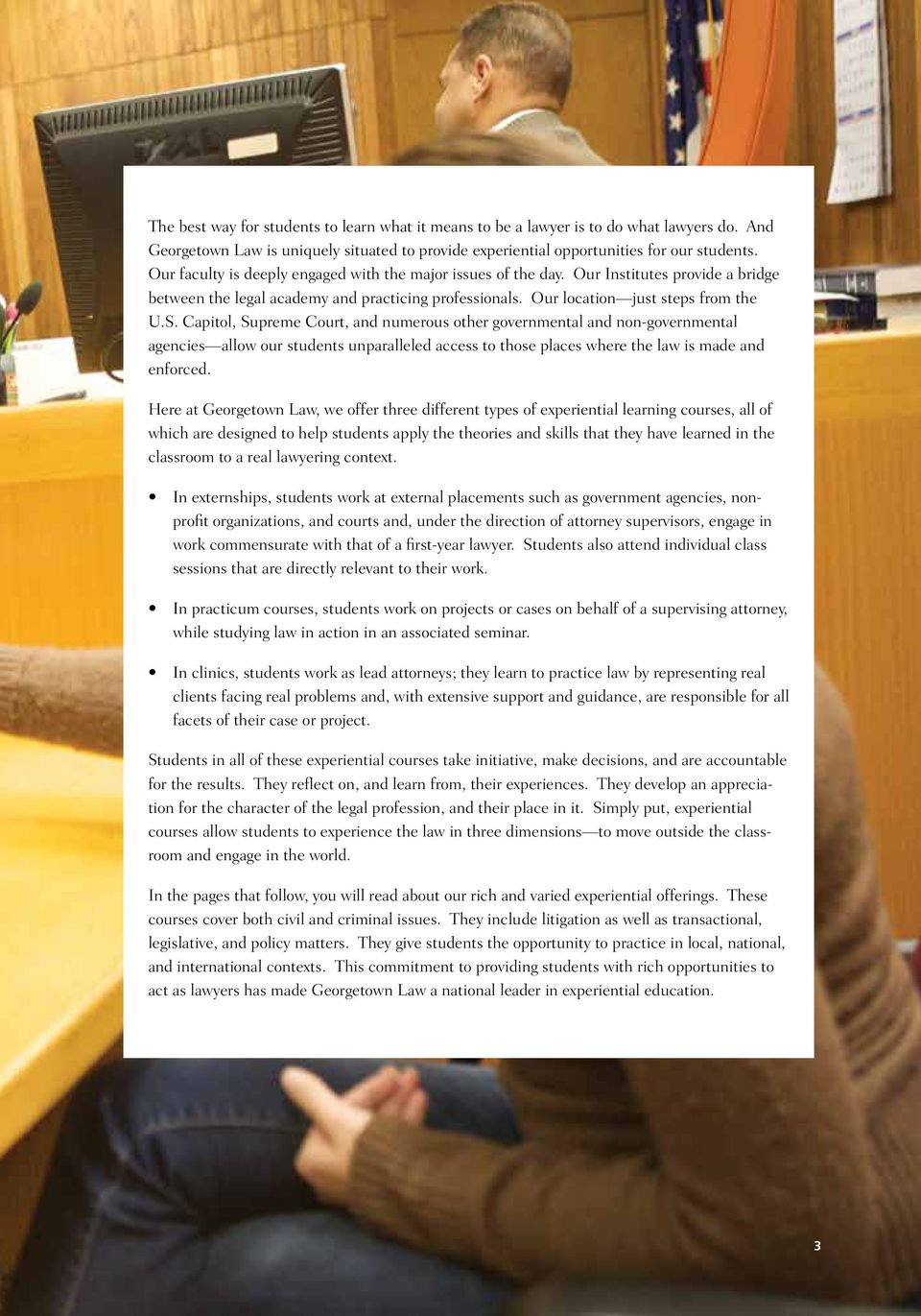
6 sharmi Das, J.D., 2014 While books, outlines, exams, and briefs are critically important to academic success, my externship experiences have ensured that I never forget why I came to law school: to become an excellent advocate But in order to be truly excellent, you need those extra somethings that come with practical, hands-on experience in a real-world work environment [those] experiences have enhanced my academic journey at Georgetown in a truly unique way. While Georgetown s incomparable academic experience is indispensable to my success in the legal field, its commitment to preparing its students through experiential learning reflects the critical understanding that we will be better lawyers if our classroom experiences are coupled with the world outside. There is simply no replacement for the experiential learning program here at Georgetown and I am grateful for having benefited from it so immensely! 4
7 Sharmi Das 5

8 6 externships

9 Externships offer Georgetown law students the opportunity to earn credit for unpaid work in the public sector. Under the direct supervision of an attorney, students are able to engage in work that is commensurate with projects that would be given to an entry-level attorney. Students become a part of the fabric of an organization and gain exposure to practice and application of laws and concepts that they have studied in the classroom. Facilitated by our unique location in the heart of Washington DC, most students choose to work for the federal government, though a substantial number choose to work on Capitol Hill, in judicial chambers, or in local or national non-profit agencies. Our students might attend Congressional hearings, draft motions for trial, or witness the development of policies that will impact our entire nation. They might assist individuals seeking asylum, brief businesses about dealing with climate change, or work on international trade disputes. Because students develop their own placements, they can tailor their work experience to their own personal interests. In addition to selecting their field work, each student also participates in an orientation to set their learning goals, and chooses the class sessions that will best support their experience. The classes cover a range of issues, and students pick and choose among them to develop a customized program of study that is relevant to their field experience. Classes include: Making Mentors, Managing Up, Non-Traditional Legal Speaking, Communicating with Clients, and many more. In short, Georgetown s externship program allows students to meld work experience with classroom learning in a way that supports their personal needs and goals. Students pursue externships for many different reasons. Some students do an externship in an attempt to discover whether they like a particular area of legal practice, and whether that area is a good fit for their career and lifestyle goals. Others do an externship to enhance their resume and demonstrate their commitment to a type of law. Some students see externships as an opportunity to refine a particular set of legal skills. And yet others pursue an externship out of intellectual curiosity and a desire to gain specialized experience in a particular area. Whatever their motivation for enrolling, students in Georgetown Law s externship program frequently develop professional connections that make them more competitive, and better prepared, for their summer and post-graduate jobs. 7
10 8 Keigan Mull

11 Externships Keigan Mull, J.D., 2013 My first externship was at small non-profit, First Star, devoted to fighting for the legal rights of children, and I had an amazing experience. I truly enjoyed my placement at First Star and was rejuvenated for the rest of my time in law school. At the same time as this externship, I was able to explore my interest in international law. I took a class on international trade law and found my passion. I hoped that I could find a placement in the field the next semester and was lucky enough to get another externship at the U.S. International Trade Commission. This externship confirmed the passion that I felt in the classroom. It allowed me to attend current events and network in the field that I would not have been able to do otherwise. My externships have been incredibly beneficial experiences, so much so that I plan on interning during my third year of law school even without receiving academic credit. This summer I will be working at the International Centre for Trade and Sustainable Development in Geneva, Switzerland, and feel extremely confident that my externship experiences have prepared me for this opportunity. 9

12 CLASS offerings Through guided reflection, our externship classes help students negotiate the wide range of professional skills necessary for success in the workplace. Georgetown Law students work in over 300 placements during the school year. The placements range from human rights NGOs to states attorney s offices, from federal agencies to judicial chambers to public defender services and more. Students choose from an array of classes that best support the work they are doing each week. Some of these classes (drawn from a longer list that varies by semester) include: Professionalism Managing Up Making Mentors/Networking Ethical Decision-Making Electronic Professionalism Diversity and Conflict in the Workplace Communicating with Clients Collaboration Non-litigation Skills Working Effectively on the Hill Strategic Planning Communicating Legal Concepts to Non-Lawyers Interest Analysis Emotional Intelligence & Leadership Civil Access to Justice Legislative and Policy Drafting Non-traditional Legal Writing Writing an Editorial Writing a One-Pager Legislative Drafting Drafting a Blog Post Legal Impossibilities: Advocating for Clients Facing Unjust Laws Reflection on Practice Work-Life Balance Appellate Lawyering Self-Assesment Direct Legal Services Group Dynamics Women s Rights Secondary Trauma Environmental Practice Judicial Placements Legislative/Policy Placements Indigent Criminal Defense Federal Criminal Prosecution Human Rights Lawyering 10

13 Externships 11

14 12 Mara Apostol
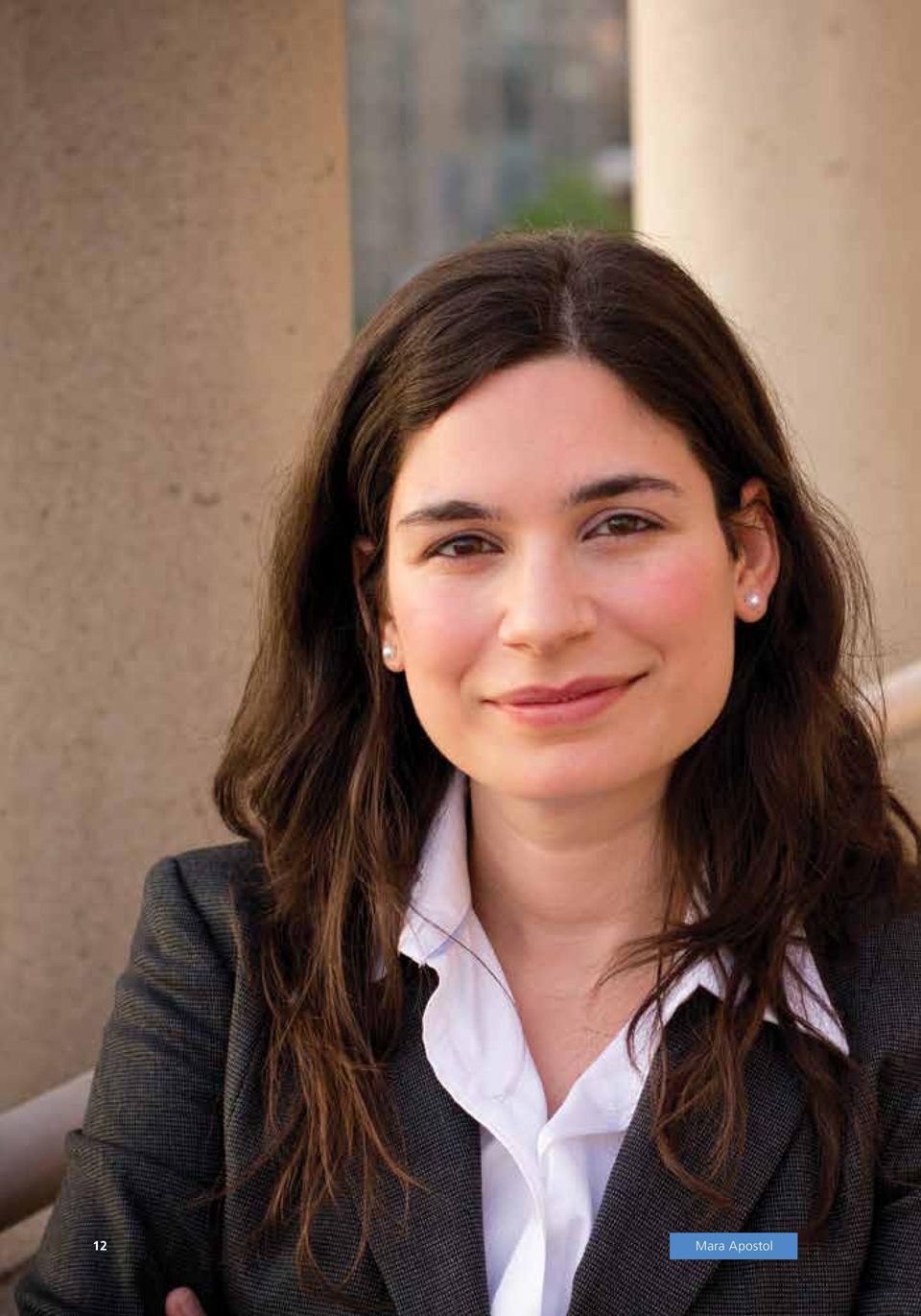
15 Externships Profile Mara Apostol, J.D., 2014 Externship Placement The Public Defender Service for the District of Columbia Externship Classes attended Managing Up Communicating with Clients Criminal Defense Reflection Creating a Foundation for a Targeted Pathway When the stakes are so high - when you really want to be a public defender, as I do, and when you have the privilege of working at PDS - the pressure to make a good impression can be overwhelming I m learning how to better understand and serve my supervisor s needs, and she sees that. This whole experience has been enlightening not only in terms of the substantive law and procedure I ve had the opportunity to grapple with, but also because it s underscored how important it is to take control of my experience and to do everything I can not only to deliver, but to make damn sure people know I m delivering. Mara Apostol, J.D., 2014 Externship Semester: The Public Defender Service for the District of Columbia Summer: Montgomery County Public Defender s Office Clinic: Criminal Defense and Prisoner Advocacy Clinic 13

16 Said Saba, J.D., 2013 I externed at the U.S. District Court for the District of Columbia. This was my first real-world exposure to the legal profession. There s still a lot I need to learn, but the externship has made me feel confident that what I ve been learning in law school so far has real-world application. I also got a chance to work closely with a federal judge who took the educational experience of his interns seriously, and he assigned work to us accordingly. 14

17 Externships Said Saba 15

18 16 PRACTICUM COURSES

19 Practicum courses offer students an opportunity to work on projects or cases under the direction of a supervising attorney, while studying law in action in an associated seminar. These courses provide a wonderful opportunity for students to become substantive experts on a particular topic, cultivate a range of skills, and begin to develop a professional identity. They allow students to build networks that can be tapped for future internships and jobs. And they foster in students the confidence they need to work as lawyers upon graduation. In these ways, practicum courses serve as a bridge between the law school classroom and the legal profession. Practicum courses take one of two forms: students are placed in fieldwork consistent with the subject matter of the course or students work on a project with their teacher, a practicing lawyer in the field. The practicum includes a seminar that uses the students experience as text and prepares students for their work experiences by familiarizing them with the relevant substantive frameworks (both legal and non-legal), as well as the skills they will employ (again, both legal and non-legal). Students reflect on their work experiences in a supportive classroom environment with professors and classmates who are engaged in similar professional undertakings. The practicum program benefits tremendously from Georgetown Law s location in Washington D.C. and its connection to experts who are willing to bring students into their work. We offer a practicum on mediation, for example, in which students are trained, supervised and act as mediators on cases filed with the U.S. Office of Special Counsel. Other practicum students conduct research for a member of the U.N. Convention on the Elimination of Racial Discrimination. Students use specialized technology to develop legal apps to assist various governmental and non-governmental organizations in their work. And students are placed within a number of different congressional offices on Capitol Hill and study how law is made in the companion seminar. 17
20 Public International Law Practicum Courses Gender, Sexual and Reproductive Health and International Human Rights Law This practicum explores the interaction between international human rights law and sexual and reproductive health. Students work with civil society organizations on legal and policy projects related to this topic. Human Rights at the Intersection of Trade and Corporate Responsibility This practicum introduces students to the challenges businesses face in integrating international norms on corporate accountability. Students work with a multi-stakeholder entity to provide analysis of regulatory gaps and to identify implications for human rights, labor rights, and environmental protection. Human Rights Fact-Finding Seminar: The Toll of Statelessness This practicum trains students as human rights investigators and advocates. As a group, students identify a human rights issue that will benefit from documentation, research that problem in depth, conduct interviews on the subject, draft a report on their findings, and engage in related advocacy. Modern Abolition: The Practice of Ending Child Labor and Human Trafficking This practicum exposes students to the methods practitioners use in their efforts to combat human trafficking. Students are placed at the non-profit organization Free the Slaves or with another anti-trafficking NGO. O Neill Institute Practicum: Global Health Law and Policy Students in this practicum work with Georgetown Law s O Neill Institute for National and Global Health Law and its external partners on projects that respond to global health challenges. Projects typically engage intersecting legal regimes, including trade law, public international law and human rights law. Racial Discrimination in International Law This practicum focuses on the work of the U.N. Committee on the Elimination of Racial Discrimination (CERD), of which the professor is a member. Students investigate the situation of minority groups in the countries being scrutinized by CERD in its upcoming session and document their findings in their own shadow reports. Suing Sudan: Constructing International Human Rights Cases This practicum introduces students to international human rights litigation using Sudan as a case study. Students use evidence gathered by the Enough Project and Satellite Sentinel Project to examine avenues through which various actors may be held responsible for human rights abuses committed in Sudan. Women and Immigration: Government Protection for Women Fleeing Gender-Based Persecution and Abuse In this practicum, students learn about the forced migration of women and how U.S. laws and policies address these women s immigration status. Students conduct intakes of women fleeing their countries because of gender-based violence, draft memos for a nonprofit organization that may represent these clients, and work with attorneys representing survivors of gender-based harm seeking legal status in the U.S. 18

21 Practicum Courses In the spring of 2013, students in the practicum Suing Sudan: Constructing International Human Rights Cases discussed their work with the former Chief Prosecutor of the International Criminal Court and presented their work at one of Georgetown Law s major public conferences. 19
22 DOMESTIC PUBLIC INTEREST PRACTICUM COURSES Advanced Environmental Law: Climate Change This practicum focuses on the evolving legal and policy developments concerning global climate change, and provides students the opportunity to engage in hands-on work with policymakers in addressing the issue. Advocating with and on Behalf of People with Developmental Disabilities: Contemporary Issues, Challenges, and Legal Advocacy Opportunities This practicum focuses on the laws that govern the rights and restrictions of people living with intellectual and developmental disabilities. Students work with and for people with developmental disabilities at organizations like the Quality Trust for Individuals with Disabilities. Animal Protection Litigation Seminar This practicum explores the process of animal protection litigation. Students work at the Humane Society of the United States. Child Welfare Law and Practice in the District of Columbia This practicum focuses on the workings of the child welfare system in the District of Columbia and students participate in field work with child welfare-related organizations. Law and Entrepreneurship Students in this practicum explore the role of the lawyer as counsel to social and business entrepreneurs engaged in early-stage ventures. They advise student entrepreneurs and various community empowerment and economic development initiatives. Low-Wage and Excluded Workers: Their Rights and the Challenges This practicum examines labor and employment law from the point of view of marginalized workers. Students work at local workers rights organizations, labor unions and government agencies. Poverty Law and Policy Seminar Students in this practicum learn about issues related to American poverty, and work at publicinterest law organizations that focus on issues connected to poverty. Public Interest Lawyering: Access to Health Care This practicum focuses on public interest lawyering and the role that safety net benefits play in assisting low-income people access health care in the United States. In their field work, students focus on the Medicare Part D prescription drug benefit. Public Interest Advocacy: Tobacco/Personal Health Care Products In this practicum, students focus on regulation of tobacco and personal-care products by the Food and Drug Administration while working with the Campaign for Tobacco-Free Kids and the Environmental Working Group. Technology, Innovation & Law Practice: Access to Justice and the Consumer Law Revolution This practicum exposes students to the uses of computer technologies in the practice of law, with an emphasis on technologies that enhance access to justice and make legal services more affordable for individuals of limited means. Students work for a legal service organization to develop a platform, application, or automated system that increases access to justice and/or improves the effectiveness of legal representation.
23 Practicum Courses Georgetown students benefit greatly from exposure to practitioners involved with our many centers and institutes. In 2013, students in the practicum Advanced Environmental Law: Climate Change worked closely with the Georgetown Climate Center on projects that reduce emissions that contribute to climate change and that respond to its inevitable consequences. 21
24 GOVERNMENTAL AND REGULATORY PRACTICUM COURSES Election Law This practicum introduces students to case law in the areas of campaign finance regulation and voting rights, and provides them with opportunities to draft legal papers and briefs in pending cases. Federal Fraud Prosecution: Theory and Practice This practicum immerses students in the law, theory, and practice of federal fraud prosecutions. For their field work, students are placed within the Fraud Section of the Criminal Division of the U.S. Department of Justice. Mediation Students in this practicum learn about best practices for the mediation of legal disputes and have the opportunity to work on progressively more difficult cases that have been filed with the U.S. Office of Special Counsel. Monopolies, Competition and the Regulation of Public Utilities This practicum focuses on the substantive and procedural ingredients for effective regulatory lawyering and places students within state or federal regulatory agencies. Regulatory Advocacy: Women and the Affordable Care Act This practicum course provides an introduction to regulatory advocacy as it pertains to the implementation of the Affordable Care Act and women s health. Students work with the National Women s Law Center to develop projects that will assist in the organization s regulatory advocacy efforts. Regulatory Agency Litigation: Roles, Skills and Strategies This practicum teaches students how to be effective participants in regulatory litigation, both as advocates for parties and as advisors to decision-makers. Each student is assigned to a utility regulatory agency that has described some feature of its administrative litigation procedures that it wishes to improve. Supreme Court Institute Judicial Clerkship Practicum This practicum focuses on the role of law clerks, the mechanics of writing a useful bench memo and draft opinion, and the ethical dimensions of judicial clerkships. Students function as law clerks who help prepare Justices to serve on the Supreme Court Institute s moot court panels. Technology, Innovation and Law Practice: Regulatory Agencies and Compliance In this practicum, students learn how regulatory agencies solve problems and how their actions affect the subjects of regulation (here NGOs). Students collaborate with regulatory agencies to develop apps that streamline regulatory practice or increase the public s access to laws and regulation. The Law of Open Government: Litigation under the Freedom of Information Act Students in this practicum learn about federal open government law and, through their field work, draft, submit, and pursue Freedom of Information Act requests. 22
25 Practicum Courses Students in the Supreme Court Institute Judicial Clerkship Practicum work on behalf of Georgetown Law s Supreme Court Institute, which moots virtually every case the U.S. Supreme Court hears each term. 23
26 CRIMINAL LAW PRACTICUM COURSES Fighting Organized Crime in the 21st Century This practicum introduces students to the challenges involved in fighting organized crime in a transnational setting using both traditional and non-traditional methods. Students work in various Sections and Offices of the Justice Department s Criminal Division, where they participate in complex prosecutions, assist in the exchange of information between cooperating law enforcement agencies of the U.S. and other countries, or work on policy issues relating to international justice affairs. Prison Litigation and Advocacy This practicum focuses on the prison reform field. Student placements are at various nonprofits and agencies that deal with prison reform issues; depending on the agency and its needs, work includes litigation, individual advocacy, policy development, or legislative advocacy. Problem Solving Justice: Developments in Treatment, Diversion and Community Courts Students in this practicum learn about the legal concepts, administrative and ethical challenges, and public debates concerning this country s exponential growth of problem-solving courts. Each student is placed as a law intern for one of five judges within the DC Superior Court. Technology, Innovation and Law Practice: Police Procedural This practicum exposes students to the promise and limits of emerging evidence-based approaches to police investigations and explores the extent to which systems and technological platforms that guide police discretion produce improved policing practices. Student teams collaborate with law enforcement agencies and police research organizations to develop apps and systems to regularize police work. The Right to Counsel: Entitlements, Limits and the Client Experience This practicum explores the evolution and current parameters of the right to counsel, including: when counsel must be provided; what quality guarantee, if any, the right includes; impediments to the full functioning of the right; and efforts to expand the scope of the right. Students conduct research on the right to counsel and formulate policy recommendations. Wrongful Convictions This practicum provides students with an understanding of the various ways innocent people are convicted and discusses remedies for exoneration. Students work as intake investigators with the Mid-Atlantic Innocence Project, a non-profit organization dedicated to correcting and preventing wrongful convictions, to determine whether representation of a prisoner s claim of innocence should be undertaken. 24
27 Practicum Courses Three practicum courses Technology, Innovation and Law Practice: Police Procedural; Technology, Innovation and Law Practice: Regulatory Agencies and Compliance; and Technology, Innovation and Law Practice: Access to Justice and the Consumer Law Revolution provide students the opportunity to develop innovative legal apps and to show off their products at Georgetown Law s Iron Tech competition. 25
28 Learning from Practitioners in the field I really liked the practicum course because the small class size enabled us to build relationships with real experts in the field. Our professors were very engaged and eager to make sure we learned and enjoyed our experiences. The professors, who had significant litigation experience in their field, could talk about the challenges you don t read in court opinions, like recruiting or managing clients, interacting with judges, how a government s internal review processes in the litigation office affects the progress of litigation, how a particular administrative agency s review process works. Occasionally, we d read opinions in which the professors were the attorneys in the case. The professors were able to give us a Behind the Music -type view of how the case played out. With the field placement, we got to see how the whole nonprofit functions -- everything from intra-office chains to participating in multi-organization coalition meetings. 26
29 Practicum Courses 27
30 PRACTICUM FACULTY Sarah Altschuler Associate, Foley Hoag LLP Shawn Armbrust Director, Mid-Atlantic Innocence Project Victoria Arroyo Assistant Dean, Centers and Institutes; Executive Director, Georgetown Climate Center; Director, Environmental Law Program, Georgetown Law James Bair Attorney, Brown Rudnick LLP Tanya Baytor Program Director, Global Health Law LL.M., O Neill Institute for National & Global Health Law, Georgetown Law Dori Bernstein Director, Supreme Court Institute, Georgetown Law Eric Biel Bureau of International Labor Affairs, Department of Labor Malia Brink Director of Institutional Development and Policy Counsel, National Association of Criminal Defense Lawyers Lisl Brunner Facilitator, Telecommunications Industry Dialogue, Global Network Initiative Oscar Cabrera Executive Director, O Neill Institute for National & Global Health Law, Georgetown Law Rosa Celorio Attorney and Specialist, Inter-American Commission on Human Rights Thomas Cluderay General Counsel, Environmental Working Group Judith Conti Federal Advocacy Coordinator, National Employment Law Project Anthony Cook Professor of Law, Georgetown Law Marisa Demeo Associate Judge, Superior Court of the District of Columbia Peter Edelman Professor of Law; Co-Director, Joint Degree in Law and Public Policy; Faculty Director, Center on Poverty, Inequality, and Public Policy, Georgetown Law Deirdre McCarthy Gallagher Alternative Dispute Resolution Unit, United States Office of Special Counsel Kelli Garcia Senior Counsel, National Women s Law Center Deborah Golden Staff Attorney, DC Prisoners Project, Washington Lawyers Committee for Civil Rights and Urban Affairs Mark Greenwold Attorney-at-Law; Senior Consultant, Campaign for Tobacco-Free Kids Kayleen Hartman Policy Counsel, Shared Hope International Gerald Hebert Executive Director and Director of Litigation, Campaign Legal Center Scott Hempling Scott Hempling, Attorney at Law LLC Julia Horowitz Open Government Counsel and Coordinator of Open Government Project, Electronic Privacy Information Center Samuel Jackson Private Practice Fred Jacob Deputy Assistant General Counsel, National Labor Relations Board s Appellate, Supreme Court Litigation Branch 28
31 Practicum Courses Lisa Johnson-Firth Founder and Managing Member, Immigrants First, PLLC Jane Juliano Chief, Alternative Dispute Resolution Unit, U.S. Office of Special Counsel Erin Leveton Legislative and Policy Analyst, State Office of Disability Administration, District of Columbia Department on Disability Services Erin Loubier Director of Public Benefits and Senior Managing Attorney, Whitman-Walker Health Jonathan Lovvorn Senior Vice President & Chief Counsel, Animal Protection Litigation, The Humane Society of the United States Fanny Gomez-Lugo Human Rights Specialist, Inter-American Commission on Human Rights Benn McGrady Project Director, Initiative on Trade, Investment and Health, O Neill Institute for National & Global Health Law, Georgetown Law Juliet McKenna Associate Judge, Superior Court of the District of Columbia Wallace Mlyniec Director, Juvenile Justice Clinic and Lupo-Ricci Professor of Clinical Legal Studies, Georgetown Law Kevin Mulcahy Director of Customer Support & Training, Neota Logic Victoria Nourse Professor of Law, Georgetown Law Bruce Ohr Counselor for Transnational Organized Crime and International Affairs, Criminal Division, Department of Justice Gabriel Pacyniak Institute Associate, Georgetown Climate Center Joseph Page Professor of Law; Director, Center for the Advancement of the Rule of Law in the Americas, Georgetown Law Marc Quarterman Research Director, Center for American Progress Meg Roggensack Senior Advisor, Business and Human Rights, Human Rights First Gretchen Rohr Magistrate Judge, D.C. Superior Court Tanina Rostain Professor of Law; Research Director, Center for the Study of the Legal Profession, Georgetown Law Marc Rotenberg Executive Director, Electronic Privacy Information Center Roger Skalbeck Associate Law Librarian for Electronic Resources, Georgetown Law Paul Smith Partner, Jenner & Block Carlos Vasquez Professor of Law, Georgetown Law Silas Wasserstrom Professor of Law, Georgetown Law Mark O Brien Co-founder and Executive Director, Pro Bono Net Paul O Brien Deputy Assistant Attorney General, Criminal Division, U.S. Department of Justice 29
32 30 Clinics
33 For almost 50 years, Georgetown Law has operated the largest and most highly regarded inhouse clinical program in the nation. Through this program, students learn the practical art of lawyering while providing quality legal representation to under-represented individuals and organizations. In a clinical course, students represent real clients facing real legal challenges. They are responsible for all facets of their case and project work, collaborating closely with clinic faculty to ensure proper and complete representation. The students experiences then become the subject of critical review and reflection. This review teaches students how to better evaluate their own legal work as well as the legal work performed by others. Every clinic student will have the opportunity to acquire valuable legal skills not accessible in a traditional classroom setting, and to gain firsthand insight into the strategic and ethical dimensions of the legal profession. It is in the clinic that students receive the most intensive and individualized teaching provided at Georgetown. Students benefit from an average ratio of 1 faculty member to 5 students, facilitating a level of learning possible only through intensive supervision that is tailored to the students needs and learning goals. In clinic, students transform from students to attorneys. More information about our fifteen clinics can be found on the pages that follow. 31
34 Appellate Litigation Clinic Students in the Appellate Litigation Clinic handle both civil and criminal appellate cases involving issues such as immigration, habeas corpus, and a variety of civil rights issues. The clinic exposes students to litigation in several different courts including federal circuits, the Board of Immigration Appeals, and the D.C. local courts. The clinic also has had four cases reach the United States Supreme Court on grants of writs of certiorari. Over twenty students working on those cases had the opportunity to participate in litigation before the highest court in the United States before they even graduated from law school. Regardless of the case, the clinic strives to provide the best representation possible, comparable to that provided by the best appellate firms in the country. Students learn not only how to litigate on appeal but how to litigate well, adopting professional and ethical standards that will guide them throughout their legal careers. Students enrolled in the program receive intense training in the art of oral and written advocacy as it is practiced in some of the highest courts in the nation, at a level appropriate to those courts and the issues presented. This training includes appellate practice, procedure, research, issue formation, and writing. Each clinic student produces two major briefs and some students will have the opportunity to argue their cases in the appellate courts. 32
35 Clinics Center for Applied Legal Studies ( CALS ) Students in the Center for Applied Legal Studies (CALS) provide high-quality pro bono representation for non-u.s.-citizen refugees seeking political asylum because of persecution, torture, and other human rights violations in the country from which they have fled. CALS students are responsible for representing their clients, with intensive faculty supervision. Working in pairs, CALS students represent one or more refugees whose asylum applications already have been denied by the government at the administrative level. Students interview clients, become experts on the human rights record of the client s country of origin, develop documentary and testimonial evidence, locate and prepare witnesses, write a brief, affidavits and other legal documents, and present testimony and legal arguments at a hearing before an Immigration Judge. 33
36 The Community Justice Project The Community Justice Project teaches students about the commitment that will sustain them as advocates, the tactics that produce success, and the strategies that lead to justice. CJP students represent individual clients in litigation matters and non-profit and governmental organizations in policy, legislative, transactional or strategic matters. CJP students are lead attorneys for their clients and receive intensive faculty supervision in trial skills, investigation, interviewing and counseling clients, legislative lawyering, legal and policy writing, media relations, strategic planning for nonprofit organizations, and collaboration. Each semester, CJP students work on matters in subject matter areas that have included poverty law, housing, court reform, community organizing, transactional law for nonprofits, health and disability law, environmental law, criminal justice and prisoner issues, juvenile justice, and international women s rights. CJP students are litigators, counselors, advisors, capacity-builders, strategic planners, policy analysts, legislative advisors, and community organizers who represent individual clients in hearings and help organizational clients with complex, high priority projects. The supervisors at CJP provide each student with an individualized learning experience and ensure each client receives the highest quality representation from our students. Students leave CJP with a better understanding of their future career and with skills they can use in a variety of careers. 34
37 Clinics Criminal Defense & Prisoner Advocacy Clinic Students in the Criminal Defense & Prisoner Advocacy Clinic represent indigent criminal defendants in misdemeanor cases in the D.C. Superior Court, D.C. parolees facing revocation before the U.S. Parole Commission, and long-serving prisoners from several states seeking clemency or parole. Our clients in the D.C. Superior Court are charged with offenses such as assault, threats, destruction of property, possession (and occasionally distribution) of drugs, theft, unlawful entry, and possession of weapons. Parolees and prisoners have been generally convicted of serious felonies. In addition to taking on the role of practicing criminal defense lawyer, students are given an opportunity to reflect on that role in the broader context of law and society. Working closely with supervising attorneys, clinic students accept full responsibility for their cases. Students learn to interview and counsel clients, investigate cases, conduct discovery, draft and argue pretrial motions, examine witnesses and make arguments at trial, and engage in sentencing advocacy. The clinic s advocacy on behalf of prisoners gives students an opportunity to collaborate creatively on a range of projects. 35
38 Solving Problems Through Law, Creativity, and Hope My time with The Community Justice Project has been one of professional and personal growth. The clinic broadened my concept of lawyering and deepened my commitment to working for justice. Through my work at CJP on unemployment insurance hearings, I received an exceptional opportunity to immerse myself in lawyering s traditional tools. From the initial interview to the hearing room, I directed strategy, research, and client preparation. All the while, I received excellent, focused feedback from my supervisors, challenging my assumptions about the case, pushing me to strengthen my advocacy. [And] as I worked collaboratively on a clemency petition, my education expanded into the fields of organizing, news media, and social media. Through the guidance of my supervisors, I recognize this diverse education not as an intellectual exercise but rather as fundamental to a 21st century lawyer s arsenal. 36 Professor Colleen Shanahan
39 Clinics 37
40 38
41 Clinics Criminal Justice Clinic Students in the Criminal Justice Clinic represent defendants in misdemeanor cases in the D.C. Superior Court. Our clients are typically charged with offenses such as assault, threats, drug possession and distribution, destruction of property, unlawful entry, prostitution, and weapons offenses. Students also represent prisoners in parole revocation hearings before the United States Parole Commission. In addition to engaging in the practice of criminal law, students are given the opportunity and space to reflect on that experience in the broader context of law and society. Working closely with supervising attorneys, clinic students accept full responsibility for their cases. Students learn to interview and counsel clients, investigate cases, conduct discovery, draft and argue pretrial motions, examine witnesses and make arguments at trial, and engage in sentencing advocacy. The experienced lawyers and teachers in the clinic strive to ensure both that the students benefit from an extraordinary educational experience and that their clients benefit from extraordinary representation from our students. 39
42 Domestic Violence Clinic Students in the Domestic Violence Clinic represent victims of intimate abuse in civil protection order (CPO) cases. Protection orders typically include a broad spectrum of relief designed to effectively end the violence in a family or dating relationship. A CPO may direct a batterer to cease assaulting and threatening the victim, to stay away from the victim s home, person and workplace, and not to contact the victim in any manner. The order also may include an award of temporary custody of the parties minor children, with visitation rights for the non-custodial parent, an award of child and/or spousal support so that a victim is not forced to return to a batterer due to economic necessity. Clinic students have full responsibility for their cases and receive a challenging education in the art of trial advocacy under the intensive supervision of clinic faculty. Through course work and client representation, students are exposed to every phase of expedited civil litigation, including family, civil and criminal law, evidence, civil procedure, and legal ethics. Students also learn to navigate the criminal justice system by working closely with the U.S. Attorney s Office in prosecutions against batterers of clinic clients. 40 Professor Deborah Epstein
43 Clinics Federal Legislation & Administrative Clinic In the Federal Legislation and Administrative Clinic, students become legislative lawyers. A legislative lawyer is a person who recognizes the legal, policy, process, political, and personality elements of a legislative, regulatory, or policy problem; performs the research necessary to support or oppose legislative, regulatory, or policy change; develops creative solutions to problems at the intersection of law and policy; presents those solutions in clear, persuasive, concise, and precise oral and written forms; and works with advocacy coalitions and with Congress and the Executive Branch to advance particular policy solutions. The clinic s students learn how to be legislative lawyers by working closely with, and on behalf of, non-profit social justice organizations in their efforts to further their policy agendas before Congress and the Executive Branch. The students also learn through seminar sessions, written and oral exercises, field trips, and engagement with distinguished guests from Congress, the executive branch, and the non-profit advocacy community in Washington. 41
44 Harrison Institute for Housing & Community Development Students in the Harrison Institute for Housing & Community Development empower lowincome individual and community clients through transactional projects that seek to give those clients ownership and control of housing, businesses, and social services in their communities. These projects include multifamily housing projects where students assist clients in the purchase or conversion of housing into cooperatives or other forms of resident ownership and economic development projects such as contract negotiation, drafting, corporate structuring, and community lending. Clinic students gain a broad vision of what lawyers can do in low-income communities. Students gain valuable organization and transactional skills negotiating with city officials, lenders, vendors, and property owners; helping to develop financial packages; drafting legal documents; and counseling clients about real estate, corporate affairs, and development. In addition, they learn audience-appropriate presentation and communication strategies and skills, all under the close supervision of clinic faculty. 42
45 Clinics Harrison Institute for Public Law The Harrison Institute for Public Law supports actors who shape and make public policy. Some of our clients are nonprofit coalitions that promote policy change at all levels, from local to global. Others are decision-makers, primarily at the state level legislators, attorneys general, regulatory agencies, and their national associations. The Institute s educational goal is to train policy lawyers who can work in diverse settings to analyze law-making authority, identify options for changing policy, help clients plan their strategy, and draft policy documents based on client choices. The Institute works on health, climate, trade, and worker strategies. The health team works to improve access to healthy food and implement reform of federal health policy. The climate team supports the Georgetown Climate Center, which helps states respond to extreme weather events; adapt to sea level rise, urban heat, and drought; and reduce greenhouse gas emissions. The trade team provides analytic capacity that governments need to cope with globalization, protect public health from tobacco trade, and preserve authority to regulate essential services such as energy and health care. The Institute also supports the Kalmanovitz Initiative for Labor and the Working Poor and helps governments avoid procurement from sweatshops and strengthen the ability of workers to organize, particularly in non-union settings. 43
46 44
47 Clinics Saving Homes: A Client s Perspective I want to make a personal appeal to the students who are out there considering what they want to do in their second and third year: you will never know the gratification you will feel helping someone retain their home. We are so appreciative of the work that the students did for us by helping us retain our home and become homeowners in a tenant housing project. You can see the happy faces of the children; you can see the happy faces of the seniors; people are happy to see you coming; and you know you ve left your mark somewhere and you ve helped someone have a better life. The work of the Harrison students gave us power. If it had not been for the Harrison Institute and the law students in their seeing and researching how we could attack this giant as little David, I don t know how far we would have gotten. Elsie C. Fleming President, 1330 Tenants Association Senior Budget Analyst, District of Columbia Financial Analyst Certification, USDA Graduate School 45
48 Institute for Public Representation: Communications, Environmental & Civil Rights The Institute for Public Representation (IPR) operates as a public interest law firm that focuses on communications, environmental, civil rights, and general public interest law. In recent years, students have worked on cutting-edge mass media issues from media ownership to children s advertising; high-profile environmental cases, including cases seeking to limit pollution emission and exposure to toxic substances; and a wide range of civil rights and government accountability cases, including cases concerning citizen access to government-held information, combatting workplace discrimination, and class action jurisprudence. Under the supervision of the IPR faculty and fellows, students are exposed to high-level professional training and advocacy opportunities such as preparing comments and petitions for rulemaking to be filed with administrative agencies, drafting briefs and pleadings for court or administrative proceedings, drafting testimony and comments on proposed legislation, and presenting oral testimony before a variety of governmental bodies. The IPR faculty especially emphasizes improving student legal writing, research, and analytical thinking. 46
49 Clinics International Women s Human Rights Clinic Students in the International Women s Human Rights Clinic focus on using international, regional, comparative, and national human rights law to prevent and redress violations of women s human rights in other countries. The clinic and its partners have been successful in drafting and passing new domestic laws in areas such as female genital mutilation, trafficking, and domestic violence, and in litigating for equal rights against discriminatory employment, divorce, criminal, and inheritance laws. Working as cause lawyers, students collaborate with partner organizations in several African countries. They also have worked with NGOs in the Philippines, Poland, and Guyana. The students function as a close-knit team, working with local human rights lawyers to develop policy, strategy, proposed legislation, or court challenges and human rights reports to advance women s human rights issues. Under close faculty supervision, students work on a number of skills, from setting agendas, interviewing, and making oral arguments to developing persuasive briefs, bills, legislative memoranda, and human rights reports. 47
50 Changing Women s Global Status: A collaborator s perspective As a lawyer working in Uganda for a long time on issues of women and human rights and trying to address issues of gender equality, for me the clinic has been very helpful. Through the clinic s students efforts, we were able to win the first sex-based challenge on discrimination against women in Uganda, challenging a law where men could divorce women on the basis of adultery only but women had to prove two or more grounds, adultery being one of them. With HIV/AIDS hitting many African countries, including Uganda, for women to be able to protect themselves from the virus by getting divorced from their husbands speaks for itself. We were able to take this to the Constitutional Court, and quite often we found ourselves using the IWHRC students work because as an activist and a lawyer you find that you won t have enough time to be able to do all the research. That s why I believe the students work is very important; they re working on a project that could eventually impact the lives of millions of women in Uganda and other countries in Africa. Esther Kisaakye Justice of the Supreme Court, Uganda LL.B., Makerere University, 1981 LL.M., Georgetown University, 1994 S.J.D., American University,
51 Clinics 49
52 Juvenile Justice Clinic Students in the Juvenile Justice Clinic represent children charged with misdemeanor and felony crimes in the District of Columbia. Charges typically involve robbery, assault, burglary, weapons possession, and car theft. Clinic students also occasionally represent clients in special education and school disciplinary hearings. Clinic students are responsible for all aspects of their clients cases. Clinic faculty teach students to exercise good judgment and to plan litigation and settlement strategies that attain the client s goals. Through their case work and classroom assignments, clinic students learn to think independently, synthesize facts and legal principles, and develop interviewing, counseling, negotiation, and trial skills. Clinic students, faculty, and fellows provide highly effective representation to their clients by protecting the adolescent s rights in the juvenile justice system and working to improve the adolescent s chances of becoming a productive citizen. 50 Professor Kris Henning
53 Clinics Law Students in Court The D.C. Law Students in Court Program (LSIC) is the District s oldest clinical program, with roots stretching back to the late 1960s. Clinic students assist people living in poverty in cases relating to eviction from their homes and in a variety of small claims, contract, and tort actions. Students advocate for their clients before judges of the D.C. Superior Court and administrative law judges. LSIC students learn trial skills, develop a practice-based understanding of an attorney s professional obligations, and provide legal services for many of D.C. s most vulnerable residents. Through an intense week-long orientation, direct client representation, and weekly seminars, LSIC offers students an opportunity to learn how to prepare a case for trial (including fact investigation that requires field work throughout the District), how to create and nurture strong, trust-based attorney-client relationships, and how to advocate zealously in court hearings, mediation sessions, and administrative tribunals. At LSIC, Georgetown students work alongside students from other District law schools to address and fight the consequences of poverty, prevent homelessness, and fight inequalities in our justice system. 51
54 Social Enterprise & Nonprofit Law Clinic Through the Social Enterprise & Nonprofit Law Clinic, students learn the theory, skills, and practice methods of transactional lawyering. Consistent with Georgetown Law s long tradition of public service and social justice, students also learn how such transactional law and skills can be used in the public interest by representing social enterprises and nonprofit organizations that are using innovative strategies and technologies to pursue charitable missions. For example, our clients empower women in developing countries by providing access to no-interest educational loans, raise funds to fight childhood hunger and food insecurity in D.C. through the sale of homemade ice cream, and use social networking and online platforms to connect disparate workforces to improve workplace conditions. Clinic students represent these social enterprises and nonprofit organizations on transactional, corporate governance, and strategic legal matters as a means of facilitating their clients charitable missions. Working in teams, students represent two or three organizational clients during the semester and interact with senior-level executives and entrepreneurs. Through coursework and client representation, students learn valuable transactional practice skills including negotiation, client interviewing, client counseling, effective client communication, audienceappropriate oral and visual presentation, contract drafting, legal research, legal analysis, and client-specific application of substantive corporate laws. 52
55 Clinics Professor Alicia Plerhoples 53
56 54
57 Clinics Street Law: High Schools Law students in the Street Law Clinic teach practical law, constitutional law and public policy in year-long classes to public high school students and in summer classes to adult learners in corrections and rehabilitation settings in the District of Columbia. In the fall semester, topics include an introduction to legal thinking and process, small claims court, negotiations, criminal law and procedure, and individual rights. Participating high school students develop and apply their emerging knowledge as investigators in a hypothetical Innocence Project case, and learn about and create multimedia projects in human rights both globally and in D.C. in cooperation with the D.C. Human Rights Commission. The highlight of the spring semester is the annual mock trial tournament, where law students coach their high school students as lawyers and witnesses in a complex mock trial problem which they present in several rounds of advocacy at the D.C. Superior Court. Participating high school students and adults learn not only how to prevent, avoid or in some cases resolve basic legal problems but also about the positive and protective dimensions of the law and the legal process. Clinic law students use the inherent interest and dialectical quality of the law to teach basic academic and civic skills such as reading, writing, listening, oral expression, problem solving and analytic thinking. By conducting classes using learner-centered teaching methodology according to a democratic, due process model corresponding with cutting edge educational practices, Street Law instructors not only teach about justice but also in a manner consistent with justice. Law students engage in substantial research and develop written lesson plans in preparation for teaching their classes. Partner organizations such as the Washington Lawyers Committee on Civil and Human Rights, the Labor and Employment Section of the D.C. Bar, the Council for Court Excellence, and many Washington area law firms collaborate in many of these projects. 55
58 Clinical Teaching Fellowships In addition to the full-time faculty who teach in the clinics, each clinic also has graduate teaching fellows who directly supervise J.D. students enrolled in the clinics, assist in teaching clinic seminars, and perform work on their own cases or other legal matters. Each year, Georgetown Clinical Graduate Teaching Fellowships offer 10 to 14 new and experienced attorneys the opportunity to combine study with practice in the fields of clinical legal education and public interest advocacy. While each clinic s program varies in purpose, requirements, and duties, all of the clinical fellowships share a common goal: to provide highly motivated lawyers the chance to develop skills as teachers and legal advocates within an exciting and supportive educational environment. Graduates of Georgetown s clinical fellowship program have gone on to prestigious positions in law teaching and public interest law settings. More than 100 Georgetown fellows are now teaching at law schools across the country, including five deans of law schools and several more associate deans or directors of clinical programs. Many others are leaders in public interest law across a wide variety of subject areas. For more information about this program, please visit clinical-fellowships.cfm. 56
59 Clinics Professor Rachel Camp 57
60 Clinical Faculty 58 Professor Bob Stumberg
61 JANE AIKEN Associate Dean (Clinical Education and Public Service); Professor of Law; Director, The Community Justice Project B.A., Hollins College; J.D., New York University; LL.M., Georgetown Dean Aiken joined the Georgetown faculty in Fall 2007, is co-director of The Community Justice Project and serves as Associate Dean of the Clinical Education and Public Interest and Community Service Programs. She spent ten years at Washington University School of Law where she was the William M. Van Cleve Professor of Law. She was a Root-Tilden Scholar and graduated from New York University School of Law. She received her LLM from Georgetown Law as a fellow in the Center for Applied Legal Studies. She is well-known for her work in clinical legal education and evidence. Over her career, her clinic work has involved a wide array of legal issues focusing on abuse of power including domestic violence against women and children, clemency and parole, police brutality, municipal violations involving resisting arrest and habeas and Section 1983 complex litigation. Dean Aiken has taught evidence for 20 years. She is an American Bar Foundation Fellow and a member of the American Law Institute. She is a member of the ABA Council on Legal Education and Admissions to the Bar. She was a Fulbright Senior Scholar at Tribhuvan Law Campus in Kathmandu, Nepal during the Fall of 2001 and continues her work there, particularly in the area of women s rights. In 2000 and 2001, Dean Aiken was a Carnegie Scholar in the Carnegie Academy for the Scholarship of Teaching and Learning. Her research and writing include many articles about character evidence, domestic violence, and clinical pedagogy. JUDITH APPELBAUM Visiting Professor of Law; Interim Director, Federal Legislation & Administrative Clinic B.A., University of Pennsylvania; J.D. Stanford Professor Appelbaum has worked in Washington at the intersection of law and policy for over 30 years, serving in the Executive Branch, on Senate staff, in private practice, and in leading non-profit organizations. Most recently, she served at the U.S. Department of Justice in the positions of Acting Assistant Attorney General and Principal Deputy Assistant Attorney General for Legislative Affairs, where she was responsible for overseeing the Department s dealings with Congress. She is the recipient of the John Marshall Award for Outstanding Legal Achievement, the Department s highest award for attorneys, for her work in connection with advancing federal hate crimes legislation to enactment. Before joining DOJ, she served as Director of Programs for the American Constitution Society, and before that, she was Vice President and Legal Director at the National Women s Law Center (NWLC), where she participated in litigation, advocacy and public education activities in many areas of NWLC s work, with a particular focus on sex discrimination in education and employment as well as judicial nominations. Earlier, she served as Counsel to Senator Edward Kennedy on his Senate Judiciary Committee staff and his chief advisor on women s rights issues. Professor Appelbaum also practiced law in Washington, D.C. for several years, representing clients before Congress and the executive branch and in trial and appellate courts around the country. She received her B.A. summa cum laude from the University of Pennsylvania and her law degree from Stanford Law School. 59
62 HOPE M. BABCOCK Professor of Law; Co-Director, Institute for Public Representation B.A., Smith College; LL.B., Yale Professor Babcock joined the faculty in Before that she served as general counsel to the National Audubon Society from and as deputy general counsel and Director of Audubon s Public Lands and Water Program from Previously, she was a partner with Blum, Nash & Railsback, where she focused on energy and environmental issues, and an associate at LeBoeuf, Lamb, Leiby & MacRae, where she represented utilities in the nuclear licensing process. From , she served as a Deputy Assistant Secretary of Energy and Minerals in the U.S. Department of the Interior. Professor Babcock teaches environmental and natural resources law at Georgetown and has taught environmental law as a visiting professor at Pace University Law School, and as an adjunct at the University of Pennsylvania, Yale, Catholic University, and Antioch law schools. While at Pace, she co-directed Pace s environmental clinic. Professor Babcock was a member of the Standing Committee on Environmental Law of the American Bar Association, served on the Clinton-Gore Transition Team, and is former Chair of the Natural Resources Law section of the American Association of Law Schools. Professor Babcock s scholarly writings include articles on natural resources and environmental law, environmental justice, environmental norms, takings, Indian law, and clinics. RACHEL CAMP Visiting Associate Professor of Law; Co-Director, Domestic Violence Clinic B.A., Miami University (Ohio); J.D., University of Pittsburgh Professor Camp joined the Georgetown faculty as a visiting associate professor in She currently co-directs the Domestic Violence Clinic. From , Professor Camp was on faculty at the University of Baltimore School of Law s Family Law Clinic as a Clinical Teaching Fellow. While at UB, Professor Camp supervised law students representing clients in family law cases and domestic violence civil protection order hearings, and co-taught a weekly seminar on lawyering and litigation skills. Additionally, Professor Camp worked to integrate into the Family Law Clinic curriculum a community legal education component, and has supervised law students on a variety of community legal education and systemic legal reform projects. Professor Camp s co-authored article on integrating community legal education into clinical programs was published in the 2012 Clinical Law Review. From , Professor Camp served as an Assistant Attorney General with the Oregon Department of Justice. While there, she served as counsel for a variety of state agencies, including the Department of Human Services in matters involving child abuse and neglect. Prior to her employment at the Oregon Department of Justice, Professor Camp was an attorney at the Maryland Disability Law Center representing patients at a maximum-security state psychiatric hospital in civil and administrative matters. Professor Camp s scholarship focuses on the child welfare system and the intersection of domestic violence and pregnancy. ANGELA J. CAMPBELL Professor of Law; Co-Director, Institute for Public Representation B.A., Hampshire College; J.D., UCLA; LL.M., Georgetown Professor Campbell joined the faculty in 1988 and is Co-Director of the Institute for Public Representation where she is in charge of the First Amendment and Media Law project. She represents nonprofit organizations seeking the adoption and enforcement of media policies in the public interest at the Federal Communications Commission (FCC), the Federal Trade Commission (FTC), and in federal courts. Her areas of advocacy include protecting children from unfair or deceptive advertising practices, increasing ownership opportunities for minorities and women, and ensuring access to communications services for persons with disabilities. Prior to joining the Institute, she was an attorney with the Communications and Finance Section of the U.S. Department of Justice Antitrust Division and in private practice as an associate with the law firm Fisher, Wayland, Cooper & Leader. From she was a Graduate Fellow at the Institute. Professor Campbell s recent law review articles include Pacifica Reconsidered: Implications for the Current Controversy Over Broadcast Indecency, 63 Fed. Comm. L. J. 195 (2010), The Legacy of Red Lion, 60 Admin. L. Rev. 783 (2008), A Historical Perspective on the Public s Right of Access to the Media (2007), A Public Interest Perspective on the Impact of the Broadcasting Provisions of the 1996 Act (2006), and Restricting the Marketing of Junk Food to Children by Product Placement and Character Selling (2006). 60
63 Clinical Faculty JOHN M. COPACINO Professor of Law; Director, Criminal Justice Clinic; Co-Director, E. Barrett Prettyman Fellowship Program B.A., M.A.T., Duke; J.D., University of Virginia; LL.M., Georgetown Professor Copacino is the Director of the Criminal Justice Clinic and the Co-Director of the E. Barrett Prettyman graduate program in criminal trial advocacy. Professor Copacino has been a member of the faculty since He was previously the director of the Criminal Law and the Juvenile Law clinics at Antioch School of Law and served as the director of the Suffolk Defenders criminal defense clinic at Suffolk Law School while a Visiting Professor at that school. Professor Copacino was the third recipient of Georgetown Law s Frank Flegal Teaching Award, given annually for outstanding contributions by full-time faculty to teaching at the Law Center. He has tried criminal cases in the Superior Court since 1979, serving as lead trial counsel in hundreds of felony cases. He continues to represent clients in serious felonies and post-conviction litigation. He is actively involved in efforts to improve the practice of criminal law in the District of Columbia. He is a former chair of the Steering Committee of the D.C. Bar s Criminal Law and Individual Rights Section and serves on numerous Superior Court Criminal Division committees. He regularly participates in local and national training programs for criminal defense lawyers. MICHAEL DIAMOND Professor of Law; Director, Harrison Institute for Housing and Community Development B.A., Syracuse; J.D., Fordham; LL.M., N.Y.U. Professor Diamond is the Director of Georgetown s Harrison Institute for Housing and Community Development and its Housing and Community Development Clinic. Prior to his arrival at the Law Center, Professor Diamond taught at American University s Washington College of Law and at Antioch University School of Law. He has also been a Visiting Professor at the University of Puerto Rico and at Gonzaga Law School. He has taught Contracts, Business Associations, Property, Housing and Economic Development and has written extensively in these fields. He has served as a consultant to the American Bar Association, the Central and Eastern European Law Initiative on proposed housing laws in Russia and Bosnia, and as a legal education specialist on a team conducting a mid-term evaluation of the U.S. Agency for International Development s Economic Law and Improved Procurement System project in Indonesia. He has also been of counsel to the law firm of O Toole, Rothwell, Nassau, and Steinbach. He has authored books on corporations and real estate law and has written several articles on poverty, community, corporations and property. DEBORAH EPSTEIN Professor of Law; Director, Domestic Violence Clinic B.A., Brown; J.D., New York University Professor Epstein joined the faculty in 1993, and serves as Director of the Domestic Violence Clinic and was Associate Dean of the Clinical Education and Public Interest and Community Service Programs from 2005 to Prior to joining the law faculty, Professor Epstein practiced at the civil rights firm of Bernabei & Katz, representing plaintiffs in sex discrimination suits, and clerked for Eastern District of Pennsylvania Judge Marvin Katz. From , Professor Epstein co-chaired a multi-disciplinary effort to create a new Domestic Violence Unit within the D.C. Superior Court that fundamentally restructured the way that the local justice system handles civil and criminal family abuse matters. Until 2001, she co-directed the D.C. Superior Court s Domestic Violence Intake Center and directed the Emergency Domestic Relations Project, a public interest organization providing legal and educational services to indigent victims of intimate abuse. She has served as Chair of the D.C. Domestic Violence Fatality Review Team, a member of the Mayor s Commission on Violence Against Women, the D.C. Domestic Violence Coordinating Council, and the Board of Directors of the D.C. Coalition Against Domestic Violence. She is the author of numerous publications in the area of domestic violence law; her most recent book is Listening to Battered Women: A Survivor-Centered Approach to Advocacy, Mental Health and Justice (Washington, D.C.: American Psychological Association 2008). 61
64 CHAI FELDBLUM Professor of Law; Director, Federal Legislation and Administrative Clinic (On Leave) B.A., Barnard College; J.D., Harvard Since 2010, Professor Feldblum has been a Commissioner at the Equal Employment Opportunity Commission. Professor Feldblum first joined the Georgetown Law faculty as a visiting professor for the academic years. In 1993, she established a new law school clinic, the Federal Legislation and Administrative Clinic, and has served as the Clinic s Director ever since. Prior to joining the law faculty, Professor Feldblum worked as a legislative counsel at the AIDS Action Council, and at the ACLU AIDS Project, focusing on federal legislation concerning AIDS. She clerked for First Circuit Court of Appeals Judge Frank M. Coffin in 1985, and for Supreme Court Justice Harry A. Blackmun in From , Professor Feldblum played a leading role in the drafting and negotiating of the Americans with Disabilities Act, a law that prohibits discrimination based on disability. She has also worked extensively in advancing gay and lesbian rights, particularly in the drafting of the Employment Nondiscrimination Act. Professor Feldblum engages in scholarly work and practical advocacy in the areas of disability rights, lesbian and gay rights, and health and social welfare legislation. STEVEN H. GOLDBLATT Professor of Law; Director, Appellate Litigation Program; Faculty Director, Supreme Court Institute B.A., Franklin & Marshall; J.D., Georgetown After graduating from Georgetown Law in 1970, Professor Goldblatt was an Assistant District Attorney and then a Deputy District Attorney of Philadelphia. In 1981 he returned to Georgetown Law to run the Appellate Litigation Program with Professor Samuel Dash. He regularly files briefs and appears in federal courts of appeals and has argued five cases in the Supreme Court of the United States including four on behalf of Appellate Litigation Program clients. He is the faculty director of Georgetown s Supreme Court Institute and also serves as the Chair of the Rules Advisory Committee of the U.S. Court of Appeals for the Armed Forces. He has previously served on the ABA Criminal Justice Standards Committee and been the chair of the ABA Criminal Justice Section Amicus Curiae Briefs Committee ( ). In 1985, he was a member of the ABA committee that issued the report, Appellate Litigation Skills Training: The Role of the Law Schools. He served as reporter to the ABA Criminal Justice Section s Special Committee on Criminal Justice in a Free Society. That committee s report, Criminal Justice in Crisis, was published in In 1992, he was the reporter to the ABA Task Force on Minorities in the Justice System. Its July 1992 report was adopted by the ABA. 62 KRISTIN N. HENNING Professor of Law; Co-Director, Juvenile Justice Clinic B.A., Duke; J.D., Yale; LL.M., Georgetown Professor Henning came to Georgetown in 1995 as a Stewart-Stiller Fellow in the Criminal and Juvenile Justice Clinics. As a Fellow she represented adults and children in the D.C. Superior Court, while supervising law students in the Juvenile Justice Clinic. In 1997, Professor Henning joined the staff of the Public Defender Service for the District of Columbia, where she served as the Lead Attorney for the Juvenile Unit designed to meet the multi-disciplinary needs of children in juvenile court. Professor Henning returned to the Georgetown faculty in Professor Henning has been active in local, regional and national juvenile justice reform, serving on the Board of the Mid-Atlantic Juvenile Defender Center, the Board of Directors for the Center for Children s Law and Policy, and the D.C. Department of Youth Rehabilitation Services Advisory Board and Oversight Committee. She has served as a consultant to organizations such as the New York Department of Corrections and the National Prison Rape Elimination Commission, and was appointed as a reporter for the ABA Task Force on Juvenile Justice Standards. Professor Henning has published a number of law review articles on the role of child s counsel, the role of parents in delinquency cases, confidentiality and victims rights in juvenile courts, and criminalizing normal adoescent behavior in communities of color. Professor Henning also traveled to Liberia in 2006 and 2007 to aid the country in juvenile justice reform and was awarded the 2008 Shanara Gilbert Award by the Clinical Section of the Association of American Law Schools for her commitment to social justice on behalf of children.
65 Clinical Faculty Vida Johnson Visiting Associate Professor of Law; Criminal Justice Clinic and Criminal Defense and Prisoner Advocacy Clinic B.A., University of California, Berkeley; J.D., New York University Professor Johnson, prior to joining Georgetown Law, was a supervising attorney in the Trial Division at the Public Defender Service for the District of Columbia (PDS), where she worked for eight years. At PDS Professor Johnson was assigned to the most serious cases at the Felony One level, and her experience included numerous trials in D.C. Superior Court representing indigent clients facing charges including homicide, sexual assault, and armed offenses. Professor Johnson s responsibilities at PDS also included supervising other trial attorneys and serving as one of the agency s two representatives to the D.C. Superior Court Sentencing Guidelines Commission. In 2009, Professor Johnson was a Visiting Associate Professor in the Juvenile Justice Clinic at Georgetown Law. Before joining PDS, Professor Johnson was an E. Barrett Prettyman fellow at Georgetown Law. As a fellow she represented indigent adults in the D.C. Superior Court and supervised students in the Criminal Justice Clinic. Professor Johnson received her B.A. from the University of California, Berkeley and her J.D. from New York University. WALLACE J. MLYNIEC Lupo-Ricci Professor of Clinical Legal Studies; Director, Juvenile Justice Clinic B.S., Northwestern; J.D., Georgetown Professor Mlyniec is the Director of the Juvenile Justice Clinic and is the former Associate Dean for clinical programs and public interest activities. In addition to his work with the Juvenile Justice Clinic, he teaches the Wrongful Convictions Practicum and the Clinical Pedagogy course to the clinical fellows. He was the director of the Judicial Conference Study on ABA Criminal Justice Standards, the administrator of the Emergency Bail Fund, and served as a consultant to the San Jose State University and University of Maryland Schools of Social Work, the ABA s National Resource Center on Child Abuse and Neglect, several law schools, and the California Bar Examiners. Professor Mlyniec has been a member of the ABA Juvenile Justice Committee since 1995 and was its chair from 1998 to He is currently a chair of the Board of Directors for the National Juvenile Defender Center. He was on the AALS Standing Committee on Clinical Education for several years and served as chair in Professor Mlyniec was a recipient of a Bicentennial Fellowship from the Swedish government to study their child welfare system and was a Distinguished Visiting Scholar in Pediatric Law at Loyola University Law School s ChildLaw Program. He is also the recipient of the William Pincus award for his contributions to clinical legal education and the Stuart Stiller Award, the AALS Robert Drinan Award, and the Law Students in Court Lever Award for legal service in the public interest. Alicia Plerhoples Associate Professor of Law; Director, Social Enterprise & Nonprofit Law Clinic A.B., Harvard; J.D., Yale; M.P.A., Princeton Professor Plerhoples is Associate Professor of Law and Director of the Social Enterprise & Nonprofit Law Clinic. She joined the Georgetown faculty in 2012 after completing two post-graduate fellowships, the first at Stanford Law School as the Orrick, Herrington & Sutcliffe Clinical Teaching Fellow, and the second at the University of California Hastings College of the Law as a Visiting Assistant Professor. Professor Plerhoples has been active in the social enterprise legal sector, writing and presenting about laws that facilitate the work of social entrepreneurs. Her recent article Can an Old Dog Learn New Tricks?, 13 Transactions: Tenn. J. Bus. L. 221 (2012) examines traditional corporate law principles and how they might be adapted and applied to the flexible purpose corporation, a new corporate form that allows businesses to pursue social and environmental objectives along with profits. Her article Representing Social Enterprises, Teaching (Sustainable) Corporate Governance, 20 Clinical L. Rev. [_] (forthcoming 2013), advocates a clinical method of teaching law students about social enterprise. Her article Is Chick-fil-A a Social Enterprise?: The Place of Conservative Values in Social Enterprise Legislation, examines the normative values incorporated into social reporting methods. Prior to teaching, Professor Plerhoples practiced at Cooley LLP in Silicon Valley where she advised asset-based lenders and 63
66 emerging biomedical and technology companies on credit finance arrangements. She also practiced in the corporate finance and real estate finance departments of DLA Piper LLP in New York City and Silicon Valley. Professor Plerhoples received her law degree from Yale Law School where she served as senior editor of The Yale Law Journal, and a Masters in Public Administration from Princeton University s Woodrow Wilson School of International and Public Policy. She received her bachelor s degree from Harvard College. RICHARD L. ROE Professor of Law; Director, D.C. Street Law Clinic B.A., Yale; J.D., University of Maine Professor Roe directs Georgetown Law s D.C. Street Law Clinic and specializes in educating the public about the law. Prior to joining the Georgetown Law faculty in 1983, he served as Program Director of the National Institute for Citizen Education in the Law and Executive Director of the Coalition for Law Related Education in Washington, D.C. He conducts numerous workshops throughout the country and world, most recently in Chile, the Czech Republic, Russia and Ireland, and hosts many international visitors. He is the co-author of the high school textbook, Great Trials in American History. He has reviewed upcoming arguments in Preview of Supreme Court Cases, written several articles for Update on Law Related Education, edited the ABA publication Putting on Mock Trials and is the author of Valuing Student Speech in the California Law Review. Professor Roe was the founder and Director of the D.C. Family Literacy Project, which taught prisoners and homeless families how to read with their children and other developmentally appropriate practices. He originated and co-teaches the seminar, Literacy and Law. He is a founder and trustee of the Thurgood Marshall Academy Public Charter High School. His present research focuses on learning theory and its implications for law and law teaching. SUSAN DELLER ROSS Professor of Law; Director, International Women s Human Rights Clinic B.A., Knox; J.D., New York University Professor Ross has taught courses at Georgetown on International and Comparative Law on Women s Human Rights, Family Law, Equal Employment Opportunity, and Gender and the Law. In January 1999 she founded and directed a new clinical program at Georgetown the International Women s Human Rights Clinic. From 1983 until then, she served as Director of Georgetown s Sex Discrimination Clinic and taught clinical courses focused on women s rights issues such as employment discrimination and domestic violence. Her publications include law school casebooks, Women s Human Rights: The International and Comparative Law Casebook (2008), Sex Discrimination and the Law (co-author) (1996, 2d ed., and 1975), a book for lay audiences on The Rights of Women (4 eds.), and numerous articles on subjects such as polygamy, fact-finding, pregnancy discrimination, sexual harassment, and parental leave. She has also lectured and served as a consultant on international and comparative perspectives on women s human rights in India, Mongolia, Lithuania, Guatemala, and Madagascar. In the clinic, Georgetown faculty and students work collaboratively with women s human rights advocates in African, Eastern European, Latin American, and Middle Eastern countries, on issues ranging from honor killings of women and female genital mutilation to sex discrimination in employment, marital property, and intestate succession. Before joining the Georgetown faculty in 1983, Professor Ross served as Special Litigation Counsel for Sex Discrimination in the Civil Rights Division at the US Justice Department and Clinical Director of the ACLU Women s Rights Project. She also worked in the General Counsel s Office of the Equal Employment Opportunity Commission and taught as an adjunct or visiting law professor at George Washington, Columbia, NYU, and Rutgers (Newark). She served in the Peace Corps from in Ivory Coast, West Africa. 64
67 Clinical Faculty ANDREW I. SCHOENHOLTZ Visiting Professor of Law; Co-Director, Center for Applied Legal Studies B.A., Hamilton; J.D., Harvard; Ph.D., Brown Professor Schoenholtz directs the Center for Applied Legal Studies at Georgetown Law, where students represent non-citizens claiming asylum from persecution in immigration removal proceedings. He also directs the Human Rights Institute, oversees the Certificate in Refugees and Humanitarian Emergencies, and is the Deputy Director of Georgetown University s Institute for the Study of International Migration. He teaches courses on Refugee Law and Policy, Refugees and Humanitarian Emergencies, Immigration Law and Policy, and the Rights of Detained Immigrants. Prior to teaching at Georgetown Law, Professor Schoenholtz served as Deputy Director of the U.S. Commission on Immigration Reform and practiced immigration, asylum and international law with the Washington, D.C. law firm of Covington & Burling. Professor Schoenholtz has conducted fact-finding missions in Haiti, Cuba, Ecuador, Germany, Croatia, Bosnia, Malawi, and Zambia to study root causes of forced migration, refugee protection, long-term solutions to mass migration emergencies, and humanitarian relief operations. He researches and writes regularly on refugee law and policy. His publications include: Rejecting Refugees: Homeland Security s Administration of the One-Year Bar to Asylum (co-author); Refugee Roulette: Disparities in Asylum Adjudication (co-author); Refugee Protection in the United States Post-September 11th; The Uprooted: Improving Humanitarian Responses to Forced Migration (chapter on Improving Legal Frameworks ); and Aiding and Abetting Persecutors: The Seizure and Return of Haitian Refugees in Violation of the U.N. Refugee Convention and Protocol. PHILIP G. SCHRAG Delaney Family Professor of Public Interest Law; Co-Director, Center for Applied Legal Studies A.B., Harvard; LL.B., Yale Professor Schrag teaches Civil Procedure and Professional Responsibility, and he directs the Center for Applied Legal Studies, in which students represent refugees who are seeking political asylum in the United States. Before joining the Georgetown Law faculty in 1981, he was assistant counsel to the NAACP Legal Defense Educational Fund, Consumer Advocate of the City of New York, a professor at Columbia University Law School, and Deputy General Counsel of the U.S. Arms Control and Disarmament Agency, from which he received a Meritorious Honor Award in Professor Schrag has also had a distinguished and varied career in civic service, which has included positions as a delegate to the District of Columbia Statehood Constitutional Convention in 1982, an editor and consultant on consumer protection during the Carter-Mondale transition, a consultant to the New York State Consumer Protection Board, a consultant to the Governor s Advisory Council of Puerto Rico, and an Academic Specialist for the United States Information Agency in the Czech Republic and Hungary. In addition, he drafted New York City s Consumer Protection Act of He is also a prolific author, having written dozens of articles on consumer law, nuclear arms control, political asylum, and various other topics for both law journals and popular publications. He is the author of fifteen books, including A Well-founded Fear: The Congressional Battle to Save Political Asylum in America (Routledge, 2000); Asylum Denied: A Refugee s Struggle for Safety in America (with Kenney, Univ. of Calif. Press 2008); and Refugee Roulette: Disparities in Asylum Adjudication and Proposals for Reform (with Ramji-Nogales and Schoenholtz, N.Y.U. Press, 2009). In 2008, he was honored with the Deborah C. Rhode award for public service; the Daniel Levy Memorial Award for outstanding achievement in immigration law; the Equal Justice Works Outstanding Law Faculty Award; and the Myers Outstanding Book Award for Asylum Denied. In 2013, he was honored with the William Pincus Award for Outstanding Contributions to Clinical Legal Education. 65
68 COLLEEN SHANAHAN Visiting Associate Professor of Law; Co-Director, The Community Justice Project A.B., Princeton; J.D., Columbia Professor Shanahan is Director of The Community Justice Project and a Visiting Associate Professor of Law. She has published a number of law review articles in the areas of clinical education, the intersection of civil and criminal law, and access to justice. She was named a Bellow Scholar for her current research into access to justice and clinical legal representation. Prior to her arrival at Georgetown Law, Professor Shanahan was in private practice where she litigated a wide variety of civil and criminal matters at the trial and appellate levels, and had an active pro bono practice that included post-conviction capital representation, criminal defense, asylum representation, landlord-tenant matters, and assistance to non-profit organizations. She is a graduate of Princeton University and Columbia Law School, and was previously a clinical teaching fellow in The Community Justice Project. Professor Shanahan serves as a hearing officer in police misconduct cases for the District of Columbia Office of Police Complaints and on the board of the Equal Rights Center. ABBE SMITH Professor of Law; Director, Criminal Defense and Prisoner Advocacy Clinic; Co-Director, E. Barrett Prettyman Fellowship Program B.A., Yale; J.D.; New York University Professor Smith joined the Georgetown Law faculty in Prior to Georgetown, Professor Smith was Deputy Director of the Criminal Justice Institute, Clinical Instructor, and Lecturer on Law at Harvard Law School. Professor Smith has also taught at City University New York Law School, Temple University School of Law, American University Washington College of Law, and the University of Melbourne (Australia) Law School, where she was a Senior Fulbright Scholar. Professor Smith teaches and writes in the areas of criminal defense, legal ethics, juvenile justice, and clinical legal education. In addition to law journal articles, she is the author of Case of a Lifetime: A Criminal Defense Lawyer s Story (Palgrave MacMillan 2008), co-editor of How Can You Represent Those People? (Palgrave MacMillan 2013), and co author of Understanding Lawyers Ethics (4th ed., Lexis-Nexis 2010). Professor Smith began her legal career at the Defender Association of Philadelphia, where she was a trial attorney from 1982 to She continues to be actively engaged in indigent defense and frequently presents at public defender and legal aid training programs in the US and abroad. Professor Smith is on the Board of Directors of the National Juvenile Defender Center and the Bronx Defenders, is a longtime member of the National Lawyers Guild and American Civil Liberties Union, and was elected to the American Board of Criminal Lawyers in Professor Smith is also a published cartoonist. ROBERT K. STUMBERG Professor of Law; Director, Harrison Institute for Public Law B.A., Macalester; J.D., LL.M., Georgetown Professor Stumberg is director of the Harrison Institute for Public Law, which provides legal and policy services to public officials and nonprofit organizations. He has worked on how to protect governing authority from being undermined by trade agreements that are negotiated outside of the democratic law-making process. His most recent article is Safeguards for Tobacco Control (2013); previous work includes NAFTA Services and Climate Change; The WTO, Environment & Services; GATS & Electricity; Federalism & Political Accountability under Global Trade Rules (with Matthew Porterfield); Preemption & Human Rights; and Sovereignty by Subtraction: The Multilateral Agreement on Investment. He has also written policy reports on trade rules on prescription drugs, procurement without sweatshops, community lending and housing policy. After receiving his J.D. from Georgetown, he was a Georgetown teaching fellow, and he later served as a legislative counsel for Montgomery County, MD; Policy Director for the Center for Policy Alternatives; and counsel to the Forum on Democracy and Trade. He serves on the board of the Center for the Study of Services, publisher of Consumer Checkbook Magazine. 66
69 Clinical Faculty DAVID VLADECK Professor of Law; Co-Director, Institute for Public Representation (On Leave) B.A., New York University; J.D., Columbia; LL.M., Georgetown Professor Vladeck teaches federal courts, civil procedure, administrative law, and seminars in First Amendment litigation, and co-directs the Institute for Public Representation, a clinical law program. Professor Vladeck recently returned to Georgetown Law after serving for nearly four years as the Director of the Federal Trade Commission s Bureau of Consumer Protection. At the FTC, he supervised the Bureau s more than 430 lawyers, investigators, paralegals and support staff in carrying out the Bureau s work to protect consumers from unfair, deceptive or fraudulent practices. Before joining the Georgetown Law faculty full-time in 2002, Professor Vladeck spent over 25 years with Public Citizen Litigation Group, a nationally-prominent public interest law firm, handling and supervising complex litigation. He has briefed and argued a number of cases before the U.S. Supreme Court and more than sixty cases before federal courts of appeal and state courts of law resort. He is a Senior Fellow of the Administrative Conference of the United States, an elected member of the American Law Institute, and a scholar with the Center for Progressive Reform. Professor Vladeck frequently testifies before Congress and writes on administrative law, preemption, First Amendment, and access to justice issues. BRIAN WOLFMAN Visiting Professor of Law; Co-Director, Institute for Public Representation B.A., University of Pennsylvania; J.D., Harvard Professor Wolfman joined the faculty in 2009 after spending nearly 20 years at the national public interest law firm Public Citizen Litigation Group, serving the last five years as the Litigation Group s Director. Before that, for five years, he conducted trial and appellate litigation as a staff lawyer at a rural poverty law program in Arkansas. Professor Wolfman has handled a broad range of litigation, including cases involving health and safety regulation, class action governance, court access issues, federal preemption, consumer law, public benefits law, and government transparency. He has argued five cases before the Supreme Court (winning four) and dozens of other cases before federal and state appellate courts and trial courts around the country. He directed Public Citizen s Supreme Court Assistance Project, which helps underdog public interest clients litigate before the U.S. Supreme Court. He has testified before Congress and federal rules committees, and he is an Advisor to the American Law Institute s project on the Principles of the Law of Aggregate Litigation. Before joining the Georgetown faculty, he regularly taught a course on appellate courts at Harvard Law School and previously taught a variety of courses at Georgetown, Stanford, Vanderbilt, and American. 67
70 Experiential Learning Staff CARMIA CAESAR Director, Externship Program and Public Interest Law Scholars Program; Adjunct Professor B.A., Pomona, J.D., Harvard Prior to joining Georgetown Law, Professor Caesar was the senior attorney in the TeamChild Juvenile Justice Project at the Center for Children s Advocacy (CCA) in Hartford, CT. Professor Caesar worked in partnership with juvenile public defenders in Hartford to fill gaps in services that were often the underlying cause of illegal conduct. In addition to representing individual clients at CCA, Professor Caesar was engaged in systemic advocacy on behalf of Hartford public school students, and students incarcerated at the Manson Youth Institute, the CT prison that houses children charged or convicted of adult and Serious Juvenile Offenses. In partnership with the Education Unit at New Haven Legal Aid, she helped correct a system wide policy of unlawful withdrawal of children over 17 from the New Haven Public Schools. From , she served as the co-director of the Berkeley Village Educational Project, a community based, non-profit youth organization that provided mentoring, teaching and tutoring to at-risk, minority middle school students. Immediately following law school, she accepted a graduate fellowship in public affairs with the San Francisco Office of the Coro Foundation. Leslie de Leon Program Coordinator, Experiential Education B.A., Wellesley College Ms. De Leon joined Georgetown Law in 2011 as the Program Coordinator of Experiential Education. In this role, she provides administrative support to all clinical and practicum faculty, clinical teaching fellows, and to the externship program. Prior to joining the Georgetown Law community, Leslie was a museum educator at the Metropolitan Museum of Art in New York City and at the Skirball Cultural Center in Los Angeles. Leslie received her B.A. from Wellesley College and is currently an evening student at Georgetown s McDonough School of Business. RACHEL Taylor Assistant Dean, Experiential Education B.A., Colgate; J.D., Georgetown Dean Taylor is responsible for the academic administration of Georgetown Law s experiential education programs. In this capacity, she works with faculty, fellows, and students taking part in the Law Center s 15 clinics and 33 practicum courses. Previously, Dean Taylor directed Georgetown Law s Human Rights Institute, where she developed and taught a year-long practicum course on human rights fact-finding and supported students interested in human rights. Before joining Georgetown Law in 2006, she worked for the human rights NGO Global Rights. Dean Taylor has written about human rights and public international law for a variety of academic and non-academic publications. 68
71 For More Information Clinical and Practicum Programs Rachel Taylor Assistant Dean, Experiential Education (202) McDonough 352 Externships Carmia Caesar Director, Externship Program and Public Interest Law Scholars Program Adjunct Professor of Law (202) McDonough 352 Georgetown University Law Center 600 New Jersey Avenue, N.W. Washington, D.C Produced by Rachel Taylor, Assistant Dean, Experiential Education Design Brent Futrell, Georgetown Law Communications Photography Sam Hollenshead; Also Brent Futrell, Bill Petros, Spencer Sloan, Moshe Broder, Rhoda Baer Georgetown Law
72 Georgetown University Law Center 600 New Jersey Avenue NW Washington, DC Georgetown Law
APPENDIX: OVERVIEW OF PUBLIC INTEREST WORK
 APPENDIX: OVERVIEW OF PUBLIC INTEREST WORK Public interest work is done in a wide variety of practice settings. Lawyers also use different advocacy approaches. Finally, different organizations focus on
Memorandum from the Public Interest Law Faculty
 Memorandum from the Public Interest Law Faculty TO: FROM: RE: All Students The Public Interest Committee Course Selection for Civil Public Interest Law I INTRODUCTION The practice of civil public interest
Banking and Financial Institutions and Instruments
 Courses and Seminars by Subject Matter* *Please note that courses and seminars can change from year to year, and not all courses and seminars may be offered each year. Please consult the most recent course
Course Requirements, Faculty, and Forms
 SANTA CLARA UNIVERSITY SCHOOL OF LAW Public Interest and Social Justice Law Certificate with an Emphasis in Criminal Justice 2014-15 Academic Year Course Requirements, Faculty, and Forms G. PUBLIC INTEREST
WASHINGTON AND LEE UNIVERSITY SCHOOL OF LAW Sydney Lewis Hall Lexington, VA 24450
 WASHINGTON AND LEE UNIVERSITY SCHOOL OF LAW Sydney Lewis Hall Lexington, VA 24450 POST-GRADUATE FELLOWSHIPS WITH WASHINGTON AND LEE UNIVERSITY SCHOOL OF LAW - TRANSNATIONAL LAW INSTITUTE The Washington
MODEL CRIMINAL DEFENSE MENTORING PROGRAM Utah State Bar New Lawyer Training Program
 MODEL CRIMINAL DEFENSE MENTORING PROGRAM Utah State Bar New Lawyer Training Program The following is submitted as a Model Mentoring Plan for the criminal defense practice field. It was prepared by an experienced
Chicago-Kent College of Law: Career Services Office Public Interest Career Plan
 Chicago-Kent College of Law: Career Services Office Public Interest Career Plan When you have completed this survey, please schedule an appointment with Michelle Mohr Vodenik in the Career Services Office,
CLAIRE DONOHUE CURRICULUM VITAE
 CLAIRE DONOHUE CURRICULUM VITAE Practitioner in Residence Director, Domestic Violence Clinic The Washington College of Law at American University [email protected] EDUCATION THE GEORGE WASHINGTON
Clinical legal studies program
 Clinical legal studies program Course description A MESSAGE FROM THE DIRECTOR Since the early 1950s, Thurgood Marshall School of Law has provided clinical education to students and services to the community
Lawyers Committee for Civil Rights of the San Francisco Bay Area 131 Steuart Street, Suite 400 San Francisco, CA 94105
 Name of Organization Organization s Mailing Address Note: if you have multiple offices for which you are requesting Fellows, please include all addresses. Organization s Website Fellowship Contact Person
Public Interest and Public Service Legal Practice
 Public Interest and Public Service Legal Practice Public interest and public service legal work often is values-driven, interest-driven, and passion-driven; do what you love, and you will do well at it.
MAIN STREET LEGAL SERVICES DEFENDER LAWYERING SEMINAR AND CLINIC APPLICATION
 Allie Robbins Assistant Dean for Academic Affairs (718) 340-4579 Tel 2 Court Square [email protected] (718) 340-4394 Fax Long Island City, NY 11101-4356 MAIN STREET LEGAL SERVICES DEFENDER LAWYERING
LLB (Hons) International Law Module Information
 LLB (Hons) International Law Module Information Year 1 Law of Contract and Problem Solving This module develops students knowledge and understanding of the law of contract. You will study the underlying
The NH Court System excerpts taken from http://www.courts.state.nh.us/press/030608guide.pdf
 The NH Court System excerpts taken from http://www.courts.state.nh.us/press/030608guide.pdf NH court system: The modern trial and appellate court system in New Hampshire took shape in 1901, when the legislature
LLB (Hons) Law with Criminology Module Information
 LLB (Hons) Law with Criminology Module Information Year 1 Law of Contract and Problem Solving This module develops students knowledge and understanding of the law of contract. You will study the underlying
Public Interest/Government Resume and Cover Letter Tips
 Public Interest/Government Resume and Cover Letter Tips All of the general rules that apply to resumes and cover letters to prospective employers apply equally to public interest and government employers.
Syracuse University College of Law Pro Bono Program Guidebook
 Syracuse University College of Law Pro Bono Program Guidebook Pro Bono Defined: The origin of word Pro Bono comes from the Latin phrase pro bono publico, which means for the public good. Pro Bono services
Prosecuting Attorneys Council of Georgia Transition Into Prosecution Program
 Prosecuting Attorneys Council of Georgia Transition Into Prosecution Program Office: Name of Beginning Lawyer: Bar No. Name of Mentor: Bar No. MODEL MENTORING PLAN OF ACTIVITIES AND EXPERIENCES FOR STATE
Registration Manual Clinical Education
 Registration Manual Clinical Education http://www.stetson.edu/law/academics/advocacy/clinics/ Professor Cynthia Batt Director of Clinical Education Trista Mustaine Associate Director of Clinical Education
Robert A. Bauerschmidt graduated cum laude from The University of Illinois College of Law in May, 1990 and received his Bachelor of Arts Degree from
 Robert A. Bauerschmidt graduated cum laude from The University of Illinois College of Law in May, 1990 and received his Bachelor of Arts Degree from The University of Michigan in May, 1987. In 1990, he
2015-16 Request for Proposals Humphrey Fellowship Program Enhancement Workshops
 HUBERT H. HUMPHREY FELLOWSHIP PROGRAM 2015-16 Request for Proposals Humphrey Fellowship Program Enhancement Workshops 1. Introduction and Background The Hubert H. Humphrey Fellowship Program is sponsored
SUMMER 2014 LEGAL INTERNSHIP OPPORTUNITY NOTICE TO LAW STUDENTS American Civil Liberties Union Foundation Reproductive Freedom Project, NY
 STUDENT OPPORTUNITIES SUMMER 2014 LEGAL INTERNSHIP OPPORTUNITY NOTICE TO LAW STUDENTS American Civil Liberties Union Foundation Reproductive Freedom Project, NY the country s largest team of public interest
Guidelines for Guardians ad Litem for Children in Family Court
 Guidelines for Guardians ad Litem for Children in Family Court Preamble The following are guidelines for attorneys and non-lawyer volunteers appointed as guardians ad litem for children in most family
EXTERNSHIP PROGRAM SUPERVISOR S HANDBOOK. Office of Pro Bono Outreach and Externships
 EXTERNSHIP PROGRAM SUPERVISOR S HANDBOOK Office of Pro Bono Outreach and Externships 1422 West Peachtree Street, N.W. Atlanta, Georgia 30309 (404) 872-3593 (404) 873-3802 (FAX) Prof. Renata D. Turner,
2016 SUMMER EXTERNSHIPS THE LOS ANGELES SUPERIOR COURT
 2016 SUMMER EXTERNSHIPS THE LOS ANGELES SUPERIOR COURT The Los Angeles Superior Court is now accepting applications for 2016 summer externships. The Court offers full-time externships in the following
Planning your course of study. Wake Forest School of Law March 2012
 Planning your course of study Wake Forest School of Law March 2012 The Basics (http://academics.law.wfu.edu/degree/jd/) 90 hours 1 st year required courses: all first year courses (29 hours) 2d year required
A Victim s Guide to the Capital Case Process
 A Victim s Guide to the Capital Case Process Office of Victims Services California Attorney General s Office A Victim s Guide to the Capital Case Process Office of Victims Services California Attorney
principles of course selection
 principles of course selection 2015-2016 Curriculum and Course Selection While much of the BC Law School curriculum is organized by subject area, this is not always helpful for academic planning, in which
Table of Contents 2014-15 Revised Budget - Public Defense Board
 Table of Contents 2014-15 Revised Budget - Public Defense Board Agency Profile - Board of Public Defense... 1 Current, Base and Governor's Recommended Expenditures - Rev... 3 Sources and Uses... 4 Governor's
Kevin S. Burke Judge Hennepin County District Court
 PROFESSIONAL ADDRESS: 404 Family Justice Center 110 S. 4 th Street Minneapolis, Minnesota 55487 Kevin S. Burke Judge Hennepin County District Court PROFESSIONAL EXPERIENCES JUDICIAL Judge, Hennepin County
Domestic Violence Case Management Plan
 Domestic Violence Case Management Plan From the commencement of litigation to its resolution, whether by trial or settlement, it is the goal of this Court to reduce delay and enable just and efficient
The Supreme Court of South Carolina
 The Supreme Court of South Carolina LAWYER MENTORING PROGRAM UNIFORM MENTORING PLAN INTRODUCTION Under the terms of Rule 425, SCACR, establishing the Lawyer Mentoring Program, the Court has set out nine
Master of Laws in Health Law Programs for Attorneys
 b e a z l e y i n s t i t u t e f o r h e a lt h l aw a n d p o l i c y Master of Laws in Health Law Programs for Attorneys OFFERED ON CAMPUS AND ONLINE E d u c a t i n g t h e H e a l t h L a w L e a
Pro Bono Scholars Program
 Pro Bono Scholars Program A Legal Education Initiative Program Guide Hon. Jonathan Lippman Chief Judge of the State of New York PRO BONO SCHOLARS PROGRAM INFORMATIONAL GUIDE Are you interested in gaining
Uzoamaka Emeka Nzelibe (312) 503-0750 [email protected]
 Uzoamaka Emeka Nzelibe (312) 503-0750 [email protected] PROFESSIONAL EXPERIENCE Northwestern University School of Law, Chicago, IL Clinical Assistant Professor of Law (June 2004-Present):
Summary. Natalie Marshall. Graduation Date: 2014. MArCH Honor Society Career Profile for: Lawyer. Type: Professional Area: Legal Subarea: Lawyer
 Natalie Marshall Graduation Date: 2014 MArCH Honor Society Career Profile for: Lawyer Type: Professional Area: Legal Subarea: Lawyer From the U.S. Bureau of Labor Statistics Occupational Outlook Handbook
TAX APPEALS ASSISTANCE PROGRAM
 TAX APPEALS ASSISTANCE PROGRAM OFFICE OF THE TAXPAYERS RIGHTS ADVOCATE Publication 150.3 November 2014 Chapman University Dale E. Fowler School of Law Professor Carolyn Young Larmore Faculty Director
CRIMINAL LAW INTERNSHIP PROGRAM
 CRIMINAL LAW INTERNSHIP PROGRAM INFORMATIONAL BULLETIN 2016-2017 Dear Prospective Interns: Thank you for your interest in the Criminal Law Internship Program (CLIP) at the Public Defender Service for the
Taking classes that provide you with a range of skills
 Choosing Your Curriculum at Notre Dame Law School The curriculum at Notre Dame Law School is sufficiently rich and diverse that you will face many choices about what to take during your time here. Moreover,
Lawyer: Alternative Careers. A guide for newcomers to British Columbia
 A guide for newcomers to British Columbia Lawyer: Alternative Careers In BC, lawyers advise clients on legal matters, draft legal documents and represent clients before courts, tribunals and administrative
STUDENT STUDY GUIDE CHAPTER FIVE
 Multiple Choice Questions STUDENT STUDY GUIDE CHAPTER FIVE 1. Orators were able to win cases for their clients as a result of their a. knowledge of the law b. skill in speaking and debating c. familiarity
CITY OF EDMONDS REQUEST FOR QUALIFICATIONS FOR PUBLIC DEFENSE ATTORNEYS. The City of Edmonds ( City ), Washington, is requesting proposals from well
 CITY OF EDMONDS REQUEST FOR QUALIFICATIONS FOR PUBLIC DEFENSE ATTORNEYS The City of Edmonds ( City ), Washington, is requesting proposals from well qualified attorneys interested in providing legal representation
What you don t know can hurt you.
 What you don t know can hurt you. Why you need a defense lawyer if you are charged with a misdemeanor. A misdemeanor conviction is SERIOUS A misdemeanor is not a minor crime. If you are convicted of a
CRIMINAL LAW AND VICTIMS RIGHTS
 Chapter Five CRIMINAL LAW AND VICTIMS RIGHTS In a criminal case, a prosecuting attorney (working for the city, state, or federal government) decides if charges should be brought against the perpetrator.
Master of Arts in Criminal Justice
 Mission The mission of the Curry College Master of Arts in (MACJ) program is to provide students with the intellectual and pragmatic skills needed to become effective leaders, reflective practitioners,
OVERVIEW OF THE MULTNOMAH COUNTY DISTRICT ATTORNEY'S OFFICE
 OVERVIEW OF THE MULTNOMAH COUNTY DISTRICT ATTORNEY'S OFFICE INTRODUCTION This outline was prepared for Deputy District Attorney Applicants. It provides an overview of the internal workings of the Multnomah
BRIDGING THE GAP Presented by KCBA Young Lawyers Division. Faculty Bios
 BRIDGING THE GAP Presented by KCBA Young Lawyers Division Faculty Bios JASON AMALA Pfau Cochran Vertetis Amala 911 Pacific Ave, Ste 200 Tacoma, WA 98402 (206)462-4339 [email protected] JASON AMALA has
LAW. What can I do with this graduate degree?
 LAW What can I do with this graduate degree? PRIVATE PRACTICE Attorney (See following pages for practice areas): Partnership Track Non-partnership Track Contract Document Review Administration Large multi-office
K. DURKIN P.O. BOX 103 CONROE TX 77305 TEL 936.242.0908 FAX 936.755.1870 [email protected]
 Turek DeVore, PC 1201 Lake Woodlands Dr Ste 4026 The Woodlands, TX 77380-5015 January 15, 2014 Dear Mr. Turek: I am writing in regards to the Associate Attorney position (Job Posting 8257744) which you
HOFSTRA UNIVERSITY SCHOOL OF LAW, CRIMINAL JUSTICE CLINIC, Hempstead, N.Y.
 TEACHING EXPERIENCE HOFSTRA UNIVERSITY SCHOOL OF LAW, CRIMINAL JUSTICE CLINIC, Hempstead, N.Y. June 2000 through Present Clinical Instructor. Directly supervise law students in all phases of representation
The Legal System in the United States
 The Legal System in the United States At the conclusion of this chapter, students will be able to: 1. Understand how the legal system works; 2. Explain why laws are necessary; 3. Discuss how cases proceed
MARYLAND STANDARDS OF PRACTICE FOR COURT-APPOINTED LAWYERS REPRESENTING CHILDREN IN CUSTODY CASES
 MARYAND JUDICIAL CONFERENCE COMMITTEE ON FAMILY LAW CUSTODY SUBCOMMITTEE HON. MARCELLA HOLLAND, CHAIR MARYLAND STANDARDS OF PRACTICE FOR COURT-APPOINTED LAWYERS REPRESENTING CHILDREN IN CUSTODY CASES TEXT
ATTORNEY SPECIALIST MICHIGAN CIVIL SERVICE COMMISSION JOB SPECIFICATION
 MICHIGAN CIVIL SERVICE COMMISSION JOB SPECIFICATION ATTORNEY SPECIALIST JOB DESCRIPTION Employees in this job function as attorneys in a specialized area of legal practice. The attorneys routinely and
Illinois Family Violence Coordinating Councils
 Illinois Family Violence Coordinating Councils Domestic Violence Court System Self-Assessment July 2006 The purpose of the self-assessment is to empower local domestic violence court systems by providing
Courts & Our Legal System
 Courts & Our Legal System 2012 (Version 1.0) This booklet has been prepared, published and distributed by the Public Legal Education Association of Saskatchewan (PLEA). The purpose of PLEA and this booklet
PRE-GRADUATION JUDICIAL INTERNSHIPS
 PRE-GRADUATION JUDICIAL INTERNSHIPS and Internships at the United States Attorney s Office, the Federal Public Defender s Office, and the Bexar County District Attorney s Office PROFESSOR VINCENT R. JOHNSON
Cynthia E. Jones. David A. Clark School of Law, University of the District of Columbia Summer 1996 Adjunct Instructor (Appellate Advocacy)
 Cynthia E. Jones Teaching Experience Assistant Professor of Law Fall 2004-present Visiting Professor 2002-2004 Courses: Evidence, Criminal Law, Criminal Procedure and Race, Crime and Politics seminar George
At Mitchell Hamline, we re creating a new model of 21 st century legal education, one student at a time. legacy + innovation
 A PROBLEM-SOLVING, PRACTICAL APPROACH More enrollment options than any law school in the country. A rigorous curriculum that prepares you to practice. More than 19,000 alumni to help guide your path to
MARQUETTE UNIVERSITY LAW SCHOOL REGISTRATION - SUMMER SESSION 2016
 MARQUETTE UNIVERSITY LAW SCHOOL REGISTRATION - SUMMER SESSION 2016 Registration for the 2016 Law School Summer Session will take place on CheckMarq, beginning on April 4, 2016. Please register on CheckMarq
LOYOLA UNIVERSITY CHICAGO SCHOOL OF LAW OFFICE OF CAREER SERVICES
 LOYOLA UNIVERSITY CHICAGO SCHOOL OF LAW OFFICE OF CAREER SERVICES SAMPLE COVER LETTERS These materials are intended for use by the students of Loyola University Chicago School of Law ONLY. No permission
PRE-GRADUATION JUDICIAL INTERNSHIPS
 PRE-GRADUATION JUDICIAL INTERNSHIPS and Internships at the United States Attorney s Office, the Federal Public Defender s Office, and the Bexar County District Attorney s Office PROFESSOR VINCENT R. JOHNSON
A Federal Criminal Case Timeline
 A Federal Criminal Case Timeline The following timeline is a very broad overview of the progress of a federal felony case. Many variables can change the speed or course of the case, including settlement
Comments from former law clerks
 Criminal Justice Internship Program Description Law Clerk Internship Program Description Summer And Mid-Term Law Clerk Internships General Internship Program Description High School Internship Program
Pro Bono Practices and Opportunities in Georgia 1
 Pro Bono Practices and Opportunities in Georgia 1 INTRODUCTION Georgia s legal system has been transforming since it gained independence at the end of the twentieth century. Prior to that, pro bono culture
HABERN, O'NEIL & BUCKLEY Attorneys at Law (Not a Partnership) William T. Habern David P. O'Neil Sean R. Buckley
 HABERN, O'NEIL & BUCKLEY Attorneys at Law (Not a Partnership) William T. Habern David P. O'Neil Sean R. Buckley Huntsville Area Office: Toll Free: (888) 942-2376 Houston Area Office: P.O. Box 627 4300
GUIDELINES FOR ATTORNEYS FOR CHILDREN IN THE FOURTH DEPARTMENT
 NEW YORK STATE SUPREME COURT APPELLATE DIVISION, FOURTH DEPARTMENT HONORABLE HENRY J. SCUDDER PRESIDING JUSTICE GUIDELINES FOR ATTORNEYS FOR CHILDREN IN THE FOURTH DEPARTMENT PREFACE The Departmental Advisory
MIAMI-DADE STATE ATTORNEY'S OFF CE MIAMI, FLORIDA
 MIAMI-DADE STATE ATTORNEY'S OFF CE MIAMI, FLORIDA KATHERI NE FERNAN DEZ RU N DLE, STATE ATTORNEY w\ry\ry.miamisao.com VOLUNTEER INTERNSHIP POSITIONS The Miami-Dade State Attorney's Offîce has volunteer
2015-2016 PRO BONO PROGRAM GUIDE
 2015-2016 PRO BONO PROGRAM GUIDE Dineen Hall, Suite 214 Syracuse, NY 13244-1310 315.443.1941 [email protected] 2015 What is Pro Bono? The origin of word Pro Bono comes from the Latin phrase pro bono publico,
Oregon State Bar Judicial Voters Guide 2014
 Oregon State Bar Judicial Voters Guide 2014 1) Full name: Michael A Greenlick 2) Office Address and Phone Number: Multnomah County Courthouse 1021 SW 4 th Ave, Portland, OR 97204 503-988-3214 3) Web site
How To Become A Criminal Justice Professional
 Mission The mission of the Curry College Master of Arts in (MACJ) program is to provide students with the intellectual and pragmatic skills needed to become effective leaders, reflective practitioners,
Judicial Election Questionnaire - Judge version
 Judicial Election Questionnaire - Judge version 1) Your full name: Youlee Yim You 2) Office Address and Phone Number: 1021 SW Fourth Ave., Portland, Oregon 97204 503-988-3404 3) Web site (if applicable):
MAYWOOD, IL JANUARY 30, 2007
 TESTIMONY OF THE NATIONAL ASSOCIATION OF CRIMINAL DEFENSE LAWYERS BEFORE THE COOK COUNTY BOARD OF COMMISSIONERS AGAINST BUDGET CUTS FOR THE OFFICE OF PUBLIC DEFENDER MAYWOOD, IL JANUARY 30, 2007 Martin
How To Become A Lawyer In Illinois
 LAURA M. URBIK KERN- Principal Law Offices of Laura M. Urbik Kern, LLC FAMILY LAW & MEDIATION 386 N. York Road, Suite 204 Elmhurst, IL 60126 (630) 993-1230 (630) 993-1231 FAX [email protected] PROFESSIONAL
BRYCE A. FETTER ORLANDO JUVENILE CHARGES ATTORNEY
 BRYCE A. FETTER ORLANDO JUVENILE CHARGES ATTORNEY People make mistakes, especially young people. Juvenile lawyer Bryce Fetter believes children should get a second chance through rehabilitation rather
DO NOT COPY. United Nations 57 th Commission on the Status of Women Sessions Reflection Paper. April 4, 2012. Yolanda Fair WomenNC CSW 2013 Fellowship
 United Nations 57 th Commission on the Status of Women Sessions Reflection Paper April 4, 2012 Yolanda Fair WomenNC CSW 2013 Fellowship Fair 1 Attending the 57 th United Nations Commission on the Status
Attorney General Balderas Criminal Affairs Update to Courts, Corrections & Justice Interim Committee
 FOR IMMEDIATE RELEASE: Contact: James Hallinan September 24, 2015 (505) 660-2216 Attorney General Balderas Criminal Affairs Update to Courts, Corrections & Justice Interim Committee Albuquerque, NM Today,
Ford Foundation Law School Public Interest Fellowship Grantee Organization Data Sheet - Summer 2014. Dr. Sarasu Esther Thomas Associate Professor
 Ford Foundation Law School Public Interest Fellowship Grantee Organization Data Sheet - Summer 2014 Name of Organization Organization s Mailing Address Note: if you have multiple offices for which you
EDUCATION EMPLOYMENT. 1 P a g e
 EDUCATION Georgetown University Law Center, Juris Doctor, May 2005 Journal: The American Criminal Law Review, Articles Editor Honors: Book Award in Constitutional Law Duke University, Bachelor of Science
FAIR, TIMELY, ECONOMICAL JUSTICE ACHIEVING JUSTICE THROUGH EFFECTIVE CASEFLOW MANAGEMENT
 FAIR, TIMELY, ECONOMICAL JUSTICE ACHIEVING JUSTICE THROUGH EFFECTIVE CASEFLOW MANAGEMENT ACKNOWLEDGEMENT This project was supported by Grant No. 2007-DG-BX-K007 awarded by the Bureau of Justice Assistance.
KATHRYN RENÉE WEBER LEGAL EXPERIENCE
 Scott D. Pollock & Associates, P.C. 105 W. Madison Street, Suite 2200 Chicago, Illinois 60602 312-444-1940 (ext. 227) [email protected] LEGAL EXPERIENCE KATHRYN RENÉE WEBER Scott D. Pollock & Associates,
Purpose of the Victim/Witness Unit
 Purpose of the Victim/Witness Unit The Victim/Witness Assistance Division of the Lake County State s Attorney s Office was formed to serve the needs of people like you. The division is meant to ensure
Victim Services Programs. Core Service Definitions
 Victim Services Programs Core Service Definitions EFFECTIVE MAY 2012 1 P a g e Core Services Overview The Criminal Justice Coordinating Council (CJCC) strives to be a responsible and exemplary steward
Section Council Scope Notes Revised September 2006
 Section Council Scope Notes Revised September 2006 Administrative Law To inform and advise the members of the bar who practice in the field on current developments in administrative law. To provide a forum
UNDERSTANDING THE CRIMINAL JUSTICE SYSTEM Anne Benson
 UNDERSTANDING THE CRIMINAL JUSTICE SYSTEM Anne Benson What is the Criminal Justice System? The criminal justice system is the system we have in the United States for addressing situations where it is believed
CERTIFICATE PROGRAMS
 Revised 31 July 2015 CERTIFICATE PROGRAMS Oklahoma City University School of Law offers a number of certificate programs for students pursuing the JD degree. If you would like to pursue a certificate program
Department of Public Administration
 The University of Texas at San Antonio 1 Department of Public Administration The Department of Public Administration offers the Master of Public Administration, as well as the Graduate Certificate in Nonprofit
Maryland Courts, Criminal Justice, and Civil Matters
 Maryland Courts, Criminal Justice, and Civil Matters Presentation to the New Members of the Maryland General Assembly Department of Legislative Services Office of Policy Analysis Annapolis, Maryland December
General District Courts
 General District Courts To Understand Your Visit to Court You Should Know: It is the courts wish that you know your rights and duties. We want every person who comes here to receive fair treatment in accordance
Vickie S. Carlton-Sadler 2404 Caneridge Pointe, SW Marietta, GA 30064 (404) 642-1211 Email: [email protected]
 Vickie S. Carlton-Sadler 2404 Caneridge Pointe, SW Marietta, GA 30064 (404) 642-1211 Email: [email protected] Professional Experience Savannah Law School, August 2014 to Present Visiting Associate
Criminal Justice System Commonly Used Terms & Definitions
 Criminal Justice System Commonly Used Terms & Definitions A B C D E F G H I J K L M N O P Q R S T U V W X Y Z Accused: Acquittal: Adjudication: Admissible Evidence: Affidavit: Alford Doctrine: Appeal:
TAMALPAIS UNION HIGH SCHOOL DISTRICT Larkspur, California COURSE OF STUDY STREET LAW: AN INTRODUCTION TO THE U.S. LEGAL SYSTEM
 TAMALPAIS UNION HIGH SCHOOL DISTRICT Larkspur, California COURSE OF STUDY STREET LAW: AN INTRODUCTION TO THE U.S. LEGAL SYSTEM 1. INTRODUCTION Street Law is a course designed to provide knowledge and problem-solving