
Wimba Pronto. Version 3.1. User Guide
|
|
|
- Hector Pierce
- 10 years ago
- Views:
Transcription
1 Wimba Pronto Version 3.1 User Guide

2 Wimba Pronto 3.1 User Guide Welcome to Wimba Pronto 1 Top Wimba Pronto Features 1 What's New in Wimba Pronto? 3 Getting Started 4 Wimba Pronto System Requirements 4 Creating a New Wimba Pronto Account 5 Locating a Wimba Pronto Link in Your CMS 7 Linking Accounts 9 Downloading and Installing Wimba Pronto 10 Logging In 12 Interface Overview 13 About the Wimba Pronto Interface 13 The Contacts Tab 14 The Classmates Tab 15 The School Tab 16 The Status Bar 17 The Menu Bar 17 Managing Your Accounts and Contacts 18 About Wimba Pronto Accounts and Contacts 18 Adding a New Contact to Your Contacts Tab 19 Adding a New Group to Your Contacts Tab 20 Adding a Contact to a Group 21 Removing a User from Your Contacts Tab or a Group 22

3 Changing Your Status 23 Creating a New Custom Status 25 Modifying Your Profile 26 Changing Your Display Settings 28 Blocking and Unblocking Users 30 Viewing a User's Profile 32 Accessing the Wimba Pronto Settings Page 33 Modifying Your Account Settings 35 Modifying Your Course Settings 37 Inviting Others to Wimba Pronto 39 Text Chat 40 About Text Chat 40 The Text Chat Window 41 Starting a New Text Chat 43 Emoticons 44 Audio Calling 45 About Audio Calling 45 The Audio Call Window 46 Starting a New Audio Call 48 Video Calling 49 About Video Calling 49 The Video Call Window 50 Starting a New Video Call 52 Video Snapshot 53

4 Application Sharing 54 About Application Sharing 54 The Application Sharing Control Window 55 The Application Sharing Viewer Window 57 Starting Application Sharing 59 Changing Application Sharing Cursor and Keyboard Control 60 Changing Application Sharing Host Control 61 Whiteboard 62 About Whiteboard 62 The Whiteboard Window 63 Starting a Whiteboard Session 65 Adding Objects to a Whiteboard 66 Modifying Objects on a Whiteboard 68 Importing Content to a Whiteboard 70 Saving Whiteboards 71 Whiteboard Action Tracking 72 The Whiteboard Actions Bar 73 Whiteboard Tools 74 Whiteboard Tool Color and Stylize 76 Whiteboard Tool Options 77 Whiteboard Permissions 78 The Whiteboard Gallery Ribbon 79 Whiteboard Canvas Navigation 81 Whiteboard Video Snapshot 82

5 Group Chat 83 About Group Chat 83 The Group Chat Window 84 Starting a New Group Chat 87 Inviting New Users to a Current Group Chat 89 Office Hours 90 About Office Hours 90 The Office Hours Views 91 The Office Hours Owner Window 94 The Waiting Room Window 97 The Main Room Participant Window 99 Starting a New Default Office Hours Session 101 Starting a New Custom Office Hours Session 102 Joining an Office Hours Session 104 Promoting a Participant to the Main Room 106 Demoting a Participant to the Waiting Room 107 Removing a Participant from an Office Hours Session 108 Viewing Waiting Room Chat 109 Sending a Message to the Waiting Room 110 Ending an Office Hours Session 112 Help Desks 113 About Help Desks 113 The School Tab 114 Joining a Help Desk 115 Assuming the Staff Role for a Help Desk 117

6 Creating and Managing Help Desks 118 Preferences 119 Accessing the Preferences Window 119 General Preferences 120 Appearance Preferences 122 Status Preferences 124 Alerts Preferences 125 Calls Preferences 126 Privacy Preferences 127 Profile Preferences 128 Message Logs 130 Saving a Single Chat 130 Enabling Automatic Message Log Saving 131 Viewing Message Logs 132 Broadcast Notifications 133 Language Settings 134 Keyboard Shortcuts 135 Software Updates 136 Additional Resources 137 Product Feedback 138 Disclaimer 139
7 Welcome to Wimba Pronto Wimba Pronto is an academic-centric instant collaboration solution designed to promote learning through group work and academic and administrative help. One of the main differences between Wimba Pronto and other collaboration solutions is that Wimba Pronto synchronizes with your institution's enrollment records. This means that students and teachers are automatically connected with other Wimba Pronto users enrolled in the same courses. The full version of Wimba Pronto also includes advanced features such as video chat, application sharing, and a robust whiteboard, which allow everyone at your institution to collaborate and communicate quickly and easily. This guide will take you through all of the features of Wimba Pronto. If you don't already have Wimba Pronto, follow the instructions here to get it right now. Top Wimba Pronto Features These are some of the most helpful features of Wimba Pronto (included in Wimba Pronto Basic): Text Chat for communicating quickly and efficiently with your classmates Audio Calling for simple, hands-free voice chat Group Chat for collaborating with your friends, partners, or classmates 1

8 In addition, the full version of Wimba Pronto has the following powerful features: Video Calling for face-to-face contact and more natural communication within either one-onone conversations or group collaborations Application Sharing for real-time display of any document or application on your computer Whiteboard for interaction with integrated learning objects and background templates to harness the power of visual instruction Office Hours to create a focused setting where classmates and contacts can queue up for individual attention Help Desks for virtual assistance from the administrative services at your institution 2

9 What's New in Wimba Pronto? If you've used Wimba Pronto in the past, but are curious about what's new, the list below includes the most recent changes so that you can get up and running quickly with all of the latest features. Wimba Pronto 3.1 If your computer supports your camera, so does Wimba Pronto. Support for any video device that your computer supports. Proxy Support so you can use Wimba Pronto through a proxy network. Invitations to make activating a Wimba Pronto account easier and faster than ever. Wimba Pronto 3.0 Whiteboard for advanced, next-generation collaboration Queued Chat is now called Office Hours See Also: About Invitations About Whiteboard About Office Hours 3

10 Getting Started Wimba Pronto System Requirements The minimum system requirements for Wimba Pronto are as follows: Windows XP+ or Mac OS MB RAM (256 MB recommended) An Internet connection at 56 kbps or higher Sound Card (for Audio Calling) Speakers and Microphone for Audio Calling (USB headset with integrated microphone recommended) 4

11 Creating a New Wimba Pronto Account Use one of these three methods to create a Wimba Pronto account. 1. Through a Course Management System: Navigate to a Wimba Pronto link in your institution's Course Management System (CMS) (for complete instructions, refer to Locating a Wimba Pronto Link in Your CMS) 2. By Invitation: Follow the instructions and click the link in an invitation from Wimba, your institution, or another Wimba Pronto user (such as an instructor or classmate). 3. With a Registration Code: Go to the Wimba Pronto Registration page here and enter a unique registration code from your institution along with your last name (surname) as it appears in your institution's systems. Each of these methods will open the Wimba Pronto registration form. Follow the steps below to fill out the form. 5

12 To Create a Wimba Pronto Account 1. Create your Pronto ID: In Wimba Pronto, you are identified by your full name, as it appears in your institution's systems. Your Pronto ID is used for logging in, managing your account, and allowing users who are not in your classes to contact you. This ID is unique and does not need to match your institution's systems. If you are associated with two or more institutions that use Wimba Pronto, you can use the same Pronto ID for both (refer to Linking Accounts for instructions) Each Pronto ID must be associated with a unique address. If you cannot or do not wish to link your accounts from two different institutions, you will need to use a different address for each account. 3. Password: Enter a password that is memorable but difficult to guess. 4. Security Question: Choose a security question from the list. In the event that you cannot remember your password, this question will be used for password recovery. 5. Once you have created your Pronto ID, you can install Wimba Pronto on your computer. For complete details refer to Downloading and Installing Wimba Pronto. 6

13 Locating a Wimba Pronto Link in Your CMS Wimba Pronto synchronizes with course enrollments at your institution, so you can access the Wimba Pronto registration page via a Pronto link in your CMS. To Locate a Wimba Pronto Link in Your CMS 1. Log in to your Course Management System. 2. Navigate to any Wimba Pronto link. This step varies slightly between CMS systems. If you are using Blackboard Enterprise or Learn, the Pronto link may be located in the Communication Area, the Tools Area, or on the My Institution page. 7

14 If you are using Blackboard Vista/Campus Edition, the Pronto link may be located in the External Courses area of the My Blackboard (or My WebCT) page, or within a Section. If you are using Moodle, the Wimba Pronto link can either be an activity within a course, or an image within a Block. 3. The Wimba Pronto registration form opens. If you have already created a Pronto ID account, the Wimba Pronto Settings page appears. For more information on registering for Wimba Pronto, refer to Creating a New Wimba Pronto Account and follow the instructions there. 8

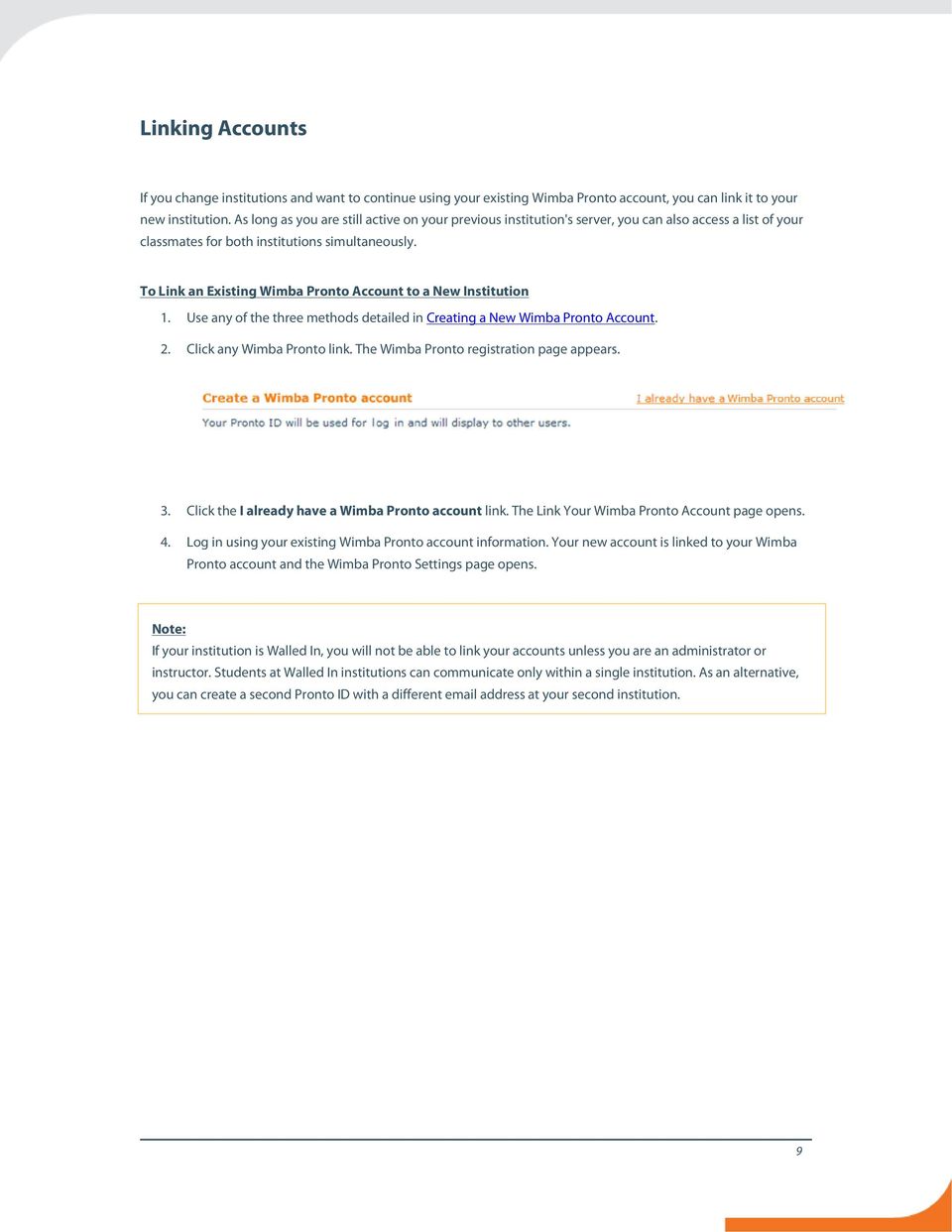
15 Linking Accounts If you change institutions and want to continue using your existing Wimba Pronto account, you can link it to your new institution. As long as you are still active on your previous institution's server, you can also access a list of your classmates for both institutions simultaneously. To Link an Existing Wimba Pronto Account to a New Institution 1. Use any of the three methods detailed in Creating a New Wimba Pronto Account. 2. Click any Wimba Pronto link. The Wimba Pronto registration page appears. 3. Click the I already have a Wimba Pronto account link. The Link Your Wimba Pronto Account page opens. 4. Log in using your existing Wimba Pronto account information. Your new account is linked to your Wimba Pronto account and the Wimba Pronto Settings page opens. Note: If your institution is Walled In, you will not be able to link your accounts unless you are an administrator or instructor. Students at Walled In institutions can communicate only within a single institution. As an alternative, you can create a second Pronto ID with a different address at your second institution. 9
16 Downloading and Installing Wimba Pronto You can download and install the Wimba Pronto client after creating your Wimba Pronto account. You can perform this step either immediately after activating your account, or at a later time. To Download and Install Wimba Pronto for Windows 1. Log in to the Wimba Pronto Settings page using your Pronto ID and password. If you just created your account, you may already be logged in to the Wimba Pronto Settings page. If you did not just create your account, or you need to download and install Wimba Pronto again, go to and sign in using your Pronto ID and password. 2. Click the Download Wimba Pronto for Windows graphic. The Wimba Pronto installer downloads to your hard drive. 3. Double-click the ProntoSetup icon on your desktop. The Pronto Setup launches. 4. Select a default language for the Wimba Pronto client. 5. Click OK. 6. Click Next >. 7. Review the license agreement and click I Agree. 8. Select whether you wish to install Desktop and QuickLaunch Shortcuts. 9. Click Next >. 10. Select where you wish to install Wimba Pronto. 11. Click Install. Wimba Pronto installs and a confirmation screen opens. 12. Select whether you wish to run the program right away. 13. Click Finish. Note: Regardless of which language you select during installation, Wimba Pronto is installed in both English and Spanish. You can change your language setting at any time from the Preferences window. 10
17 To Download and Install Wimba Pronto for Mac 1. Log in to the Wimba Pronto Settings page using your Pronto ID and password. If you just created your account, you may already be logged in to the Wimba Pronto Settings page. If you did not just create your account, or you need to download and install Wimba Pronto again, go to and sign in using your Pronto ID and password. 2. Click the Download Wimba Pronto for Mac OS X graphic. The Wimba Pronto installer is downloaded to your hard drive and the Pronto End User License Agreement opens. 3. Review the license agreement and click Agree. The Pronto disk image opens. 4. Drag the Pronto icon to your Applications folder. Tip: You can install Wimba Pronto on as many computers as you wish, making it easy to keep in touch with friends and classmates, even if you are not at your primary computer. See Also: Language Settings Creating a New Wimba Pronto Account Accessing the Wimba Pronto Settings Page 11
18 Logging In You log in to the Wimba Pronto client using the Pronto ID and password that you chose when creating your account. Whenever you launch Wimba Pronto, the login window appears. To Log in to Wimba Pronto 1. Enter your Pronto ID. 2. Enter your password. 3. Click the sign in button. Tips: a) You can set Wimba Pronto to remember your Pronto ID and password by checking the remember me box. If you do this, anyone with access to your computer can access your Wimba Pronto account. b) You can also set Wimba Pronto to automatically sign you in when you launch the program by checking the sign in automatically box. This setting can be changed in the Preferences window. See Also: Creating a New Wimba Pronto Account 12

19 Interface Overview About the Wimba Pronto Interface Wimba Pronto is based around the Wimba Pronto window, from which you manage communication with other users and access the program's more advanced features. The five main elements of the Wimba Pronto window are: the Contacts tab, the Classmates tab, the School tab, the Status Bar, and the Menu Bar. Note: On Mac OS X, the Menu Bar is located at the top of the screen, rather than within the Wimba Pronto window. See Also: Adding a New Contact to Your Contacts Tab Changing Your Status 13

20 The Contacts Tab The Contacts tab is where you keep track of your friends, study groups, and anyone else that you contact often. This tab is initially empty, but you can add any Wimba Pronto user, as long as you know his or her Pronto ID; the user does not need to be in one of your classes, or even at your institution. The Find field allows you to search for a specific user in the list. You can also add groups to keep your contacts organized. 14

21 The Classmates Tab The Classmates tab lists all of the Wimba Pronto users who are in your classes. If the instructor of a course has a Wimba Pronto account, the label (Instructor) appears next to his or her name. You do not need to add users to your Classmates tab; it is automatically populated based on course enrollments within your institution's system. You also cannot manually add or delete classmates. The Find field allows you to search for users in the list. Tip: Classmates appear only while you are enrolled in a class. However, users remain in your Contacts tab indefinitely, so make sure you add classmates with whom you want to keep in touch as contacts before the semester ends. 15
22 The School Tab The School tab lists the Help Desks that your institution has set up. These may include campus offices, library services, academic counseling, or any other resource that your institution wants to make easily available. A number appears in the tab label when Help Desks are available. Open Help Desks display the Office Hours icon next to their name, while closed Help Desks display the offline icon. Help Desks can only be added, deleted, or modified by your institution's Wimba Pronto Administrator. The Find field allows you to search the list for a specific Help Desk. Note: The School tab only appears if your institution has set up at least one Help Desk. 16
23 The Status Bar The Status Bar shows your current availability. Since other Wimba Pronto users see this status, you can use it to tell other people what you are doing and if it is a good time to contact you. Status messages are fully customizable and can be saved for future use. The Menu Bar The Menu Bar provides access to nearly every feature in Wimba Pronto. While many of the commands can be accessed from other places in the program, the Menu Bar provides quick, convenient access to commonly used features. The Menu Bar is also where you can access the Preferences window, modify display options, and exit the program. 17
24 Managing Your Accounts and Contacts About Wimba Pronto Accounts and Contacts One of the unique features of Wimba Pronto is that it automatically populates your Classmates tab, allowing you to communicate with other Wimba Pronto users in your classes without having to know their Pronto IDs. You can quickly see how many people from each of your classes use Wimba Pronto, and who is currently online. You can still keep a personalized list of users by using the Contacts tab, which allows you to add Wimba Pronto users, regardless of whether or not they are in your classes. 18
25 Adding a New Contact to Your Contacts Tab The Contacts tab is where you keep track of your friends, classmates, instructors, and anyone else that you want to be able to easily contact. You can add any Wimba Pronto user to your contacts, even if they are not in one of your classes or enrolled at your institution. To add a classmate to your Contacts tab, click the plus icon next to the user's name in the Classmates tab. The smiley icon indicates that the user has been added to your Contacts tab. To Add a User to Your Contacts Tab by Pronto ID 1. Click the Actions menu. 2. Select Add Contact... The Add Contact window opens. 3. Type the Pronto ID of the user you wish to add. 4. Select the group within your Contacts tab to which you wish to add the person. 5. Click Add. The user is added to your Contacts tab. Note: You can use the Pronto ID method to add any Wimba Pronto user to your Contacts tab, even if they are in your Classmates tab. However, clicking the plus icon is the faster way to add classmates. Tip: If a user who is not in your Contacts or Classmates tab contacts you, a notification appears above the message giving you the option to add the user to your Contacts tab or to block the user. See Also: Adding a New Group to Your Contacts Tab Adding a Contact To a Group Removing a User From Your Contacts Tab or From a Group 19
26 Adding a New Group to Your Contacts Tab You can organize users in your Contacts tab by groups. For example, you could create a group for your study partners, or for your friends from high school. When you start Wimba Pronto for the first time, the Contacts tab is empty. When you add a new contact, unless you specify otherwise in the Add Contact window, the user is automatically added to a default group called Recently Added. You can create as many groups as you wish to keep your contacts organized. To Create a New Group 1. Click the Actions menu. 2. Select Add Group... The Add Group window opens. 3. Type the name of the group you wish to create. 4. Click Add. The group is created and added to your Contacts tab. See Also: Adding a New Contact to Your Contacts Tab Adding a Contact To a Group 20
27 Adding a Contact to a Group Once you have created groups in your Contacts tab, the next step is to add contacts to these groups. There are a couple of different ways to add a contact to a group, depending on whether or not you have already added the user to your Contacts tab. To add a user that is already in your Contacts tab to a group, simply drag and drop his or her name to the name of the group. To Add a User Not Already in Your Contacts Tab to a Group 1. Click the Actions menu. 2. Select Add Contact. The Add Contact window opens. 3. Type the Pronto ID of the person you wish to add. 4. Select the group to which you wish to add the person. 5. Click Add. The user is added to the selected group within your Contacts tab. See Also: Adding a New Contact to Your Contacts Tab Adding a New Group to Your Contacts Tab Removing a User From Your Contacts Tab or From a Group 21
28 Removing a User from Your Contacts Tab or a Group The process for removing a user from your Contacts tab is the same as removing a user from a group; if you remove a user from a group, he or she is also removed from the Contacts tab (unless the person is in more than one group). There two different ways to accomplish this. To Remove a Contact Using the Contacts Tab 1. Click the Contacts tab, if it is not already selected. 2. Right-click (Ctrl-click on Mac) the name of the contact that you wish to remove. 3. Select Remove <User Name>. The Remove <User Name> window opens. 4. Click OK. The user is removed from both the Contacts tab and the group. To Remove a Contact Using the Actions Menu 1. Click the Contacts tab, if it is not already selected. 2. Click the name of the contact that you wish to remove. 3. Click the Actions Menu. 4. Select Remove <User Name>. The Remove <User Name> window opens. 5. Click OK. The user is removed from both the Contacts tab and the group. Note: If you remove a contact that is in one of your courses, he or she will still be listed in your Classmates tab. Since the Classmates tab is automatically populated from your institution's enrollments, you cannot manually add or remove classmates. See Also: Adding a New Contact to Your Contacts Tab Adding a Contact To a Group 22
29 Changing Your Status The Status Bar displays your current availability. Other Wimba Pronto users see this status, so you can use it to tell other people what you are doing, and if it is a good time to contact you. You can change your status to one of the default options, or create a new custom status. The default status options are: Available The Available status lets other users know that you are free and that it's a good time to contact you. Away The Away status lets other users know that you are busy and that it may not be a good time to contact you. You may wish to create a custom away status to let other people know what you're doing or when you'll be back. Office Hours The Office Hours status is unique because selecting accesses a Wimba Pronto feature, instead of just displaying a status message. When you set your status to Office Hours, a new Office Hours session is started with you as the host. Invisible The Invisible status is a way of hiding yourself from other users while still remaining online. When you set your status to invisible, you appear to others users as if you were offline, but you can still communicate with other users normally. If your status is set to Invisible and another user tries to send you message, you will receive the message. Offline The Offline status is the same as logging out of your Wimba Pronto Account; when you are offline, you cannot contact other users and other users cannot contact you. If you are offline, and another user tries to send you a message, you will not receive the message. 23
30 To Change Your Status 1. Click the Status Bar. 2. Select the desired status. Your new status is set. See Also: Creating a New Custom Status About Office Hours 24
31 Creating a New Custom Status If you do not want to use the default status messages, or you prefer to display a more specific message, you can create a custom status. While the most common use of custom statuses is creating custom away messages, you can also create a custom available status. Custom statuses can be saved for future use. To Create a New Custom Status 1. Click the Status Bar. 2. Select Custom... under Available, Away, or Office Hours. The Edit Custom Status window opens. 3. Type a name for the status in the Title field. This title is for your own reference only and is not seen by other users. 4. Type the status in the Message field. This is the text that is displayed to other users. 5. If you wish to be able to reuse this status in the future, check the Save for future use box. 6. If you want other users to automatically receive a reply message with your status when enabled, check the Auto-reply box. 7. Click OK. The custom status is created and is set as your current status. Tip: If you want the Title and the Message of the Status to be the same, you can simply type the text in the Message field; the Title field is filled in automatically. See Also: Changing Your Status 25
32 Modifying Your Profile You can create a personalized profile with a picture to share information about yourself with other Wimba Pronto users. Adding a picture, or other information, is optional. You can add or modify profile information from the Profile section of the Preferences window. To access the Profile editor, click your profile picture box to the left of the Status Bar in the Wimba Pronto window. Profile Picture You can add a profile picture that is visible to other Wimba Pronto users to add a personal touch to your profile. Your picture is visible any time you contact another Wimba Pronto user, anytime another user contacts you, when a user views your profile, or when a user hovers his or her cursor over your name in the Contacts or Classmates tab. To add a profile picture, either drag an image file from your hard drive to the Drag Image Here box, or click the Choose Picture... button and browse your hard drive for the desired picture. The profile picture box is optimized for square images, but accepts images of any proportions. You can add an address to make it easier for other users to contact you when you're not on signed in to Wimba Pronto. This address does not need to be your school address or the address associated with your Wimba Pronto account. 26
33 About Me The About Me box allows you to type a brief description to introduce yourself to other users. You may wish to include your interests, your major, where you're from, or the type of people with whom you would like to communicate using Wimba Pronto. My Webpages The My Webpages box allows you to include links in your profile to the websites of your choice. You may wish to add personal, course, or department webpages. See Also: Profile Preferences 27
34 Changing Your Display Settings You can control the way in which users are displayed in the Wimba Pronto window by using the View menu. These display settings apply to both the Contacts and the Classmates tabs. Show Offline Contacts Toggles the display of users that are not currently logged in to Wimba Pronto Show Blocked Contacts Toggles the display of users that you have blocked Show Classmates Without Pronto Toggles the display of classmates that are not currently registered for Wimba Pronto; this option only appears if Invitations are enabled at your institution 28
35 Sort Contacts by First Name Displays users organized alphabetically by first name Sort Contacts by Last Name Displays users organized alphabetically by last name Sort Contacts by Availability Displays users that are available first, followed by users that are away, users that are idle, and users that are offline Show Group Counts Toggles the display of user counts for each group or course Collapse All Groups Hides the user list for all groups, showing only the group name. You can collapse or expand individual groups by clicking the arrow next to the group name. Expand All Groups Reveals the user list for all groups. You can collapse or expand individual groups by clicking the arrow next to the group name. Show Status Messages Toggles the display of users' custom status messages under their names in the Wimba Pronto window. If this option is disabled, you can view a user's status by hovering your mouse over his or her name. See Also: Blocking and Unblocking Users 29
36 Blocking and Unblocking Users By default, all Wimba Pronto users can freely communicate with each other, regardless of whether or not they are in same classes, or even at the same institution. However, if there are users that you do not want to be able to contact you, you can block them. Blocked users cannot contact you, and you cannot contact them. If the user is in either your Contacts or Classmates tab, you can still see his or her status, but you always appear as offline to the blocked user. Users never know that they have been blocked, and you can unblock users at any time. You can block or unblock a user from either the Wimba Pronto window or the Preferences window. Also, if someone not in your Contacts or Classmates tab contacts you, you are given the option of blocking the user. To Block a User from the Wimba Pronto Window 1. Right-click (Ctrl-click on Mac) the name of the user that you wish to block in either the Classmates or Contacts tab. 2. Select Block <User Name> from the pop-up menu. The Block Contact window opens. 3. Click Yes. The name appears with a strikethrough to indicate that the user has been blocked. Note: If the user is already blocked, the Block <User Name> option changes to Unblock <User Name>; you can use this option to unblock the selected user. Tip: If you do not want blocked users to appear in your Contacts and Classmates tabs, disable Show Blocked Contacts in the View menu. 30
37 To Manage Blocked Users from The Preferences Menu 1. Click the Pronto menu. 2. Select Preferences... The Preferences window opens. 3. Select Privacy. 4. Add or remove users from your Block List as desired: To add a user to your Block List, click the plus button, type the user's Pronto ID, and click Add. To remove a user from you Block List, select the user from the list and click the minus button. 5. When you have finished modifying the Block List, click OK. Tip: Since the Block List allows you to block users by their Pronto IDs, you can use this method to block any Wimba Pronto user even if he or she is not in any of your classes. See Also: Privacy Preferences Changing Your Display Settings 31
38 Viewing a User's Profile Any Wimba Pronto user can create a Profile to share with friends, classmates, and instructors. You can use Profiles to find out more information about a user, or to find a user's contact information (if he or she has shared it). You can see a partial profile by hovering your cursor over a user's name in your Contacts or Classmates tab. This view shows you the user's picture, current status, and About Me description; it does not show addresses or webpages. To View a User's Profile 1. Click the name of the desired user in either your Contacts or Classmates tab. 2. Click the Actions menu. 3. Select Show Profile Info. A new Text Chat window opens with the user's profile displayed. See Also: Modifying Your Profile 32
39 Accessing the Wimba Pronto Settings Page The Wimba Pronto Settings page is a web portal that allows you to view and manage your account settings and login information, as well as determine which of your courses appear in Wimba Pronto. You can access the Wimba Pronto Settings page either from a link within Wimba Pronto, or directly using your web browser. To Access the Wimba Pronto Settings Page from Wimba Pronto 1. Click the Pronto menu. 2. Select Account Settings. The Wimba Pronto Settings login page opens in your web browser. 3. Type your Pronto ID. 4. Type your Pronto Password. 5. Click the Sign In button. 33
40 To Access the Wimba Pronto Settings Page from a Web Browser 1. Go to the URL: 2. Type your Pronto ID. 3. Type your Pronto password. 4. Click the Sign In button. Tip: You can also access the Wimba Pronto Settings page, without logging in again, from your CMS. If you forget your password and security question, this is the best way to access your Wimba Pronto account. See Also: Modifying Your Account Settings Modifying Your Course Settings 34
41 Modifying Your Account Settings From the Wimba Pronto Settings page, you can view and modify your account settings including your password, the address associated with your account, and your security question. To Change Your Password 1. On the Wimba Pronto Settings page, click the change password... link. The Change Password window opens. 2. Type your current password in the Current password field. 3. Type your desired password in the New password field. 4. Re-type your desire password in the Confirm new password field. 5. Click the Save button. The Password changed confirmation page opens, indicating that your new password has been successfully updated. To Change the Address Associated with Your Wimba Pronto Account 1. On the Wimba Pronto Settings page, click the change ... link. The Change window opens. 2. Type your Pronto password in the Current password field. 3. Type the address that you would like associated with your Wimba Pronto account in the New field. 4. Re-type the desired address in the Confirm New field. 5. Click the Save button. The changed confirmation page opens, indicating that your new address has been set successfully. Note: The address associated with your Wimba Pronto account does not have to be a school address or the address associated with your CMS account. 35
42 To Change Your Security Question 1. On the Wimba Pronto Settings page, click the change security question... link. The Change Security Question window opens. 2. Select a Security Question from the drop-down menu. 3. Type your response in the Answer field. 4. Click the Save button. The Security Question changed page opens, indicating that your security question has been successfully updated. To Change the Language Setting for Your Wimba Pronto Account 1. On the Wimba Pronto Settings Page, click the Language drop-down menu. 2. Select the desired language. To Delete Your Wimba Pronto Account 1. On the Wimba Pronto Settings page, click the Support link. The Wimba Pronto Support page opens. 2. Click the Delete Your Account link. The Delete Your Account page opens. 3. Select a reason for deleting your Pronto Account from the drop-down menu. 4. Add any additional comments in the Comments box. 5. Click the Continue button. The Confirm Delete page opens. 6. Type your Pronto password in the Password field. 7. Click the Delete this account button. Your account is deleted. Note: Reasons for deleting your Wimba Pronto account include if you are unhappy with your Pronto ID or if you accidentally created more than one account. See Also: Accessing the Wimba Pronto Settings Page Modifying Your Course Settings Language Settings 36
43 Modifying Your Course Settings The Wimba Pronto Settings page allows you to individually enable or disable Wimba Pronto for each of your courses. This can be accomplished in the Course Settings area of the page. General Checking the box under the General heading allows you to select whether Wimba Pronto is automatically enabled for new courses in which you enroll. Keep in mind that this setting will remain in effect for future semesters. Course Participant The Course Participant section contains a list of all of the courses for which you can enable Wimba Pronto. Check the box next to a course name to enable Wimba Pronto or uncheck the box to disable it. Note: If Wimba Pronto is disabled for a course, classmates will still be able to contact you. However, your name does not appear under the course name in their Classmates tab, and neither the course nor any classmates will appear in your Classmates tab. Effectively, it appears as if you are not enrolled in the course. Course Instructor (Displays for Instructors Only) This section is visible only if you are the instructor of a course. You have the option of enabling or disabling Wimba Pronto for an entire course. This setting will override the participant setting above. If a course is disabled, it will not appear in the participants' Classmates tab. However, Wimba Pronto will still function, and participants will still be able to contact each other if they know each other's Pronto ID or have each other saved in their Contacts tab. 37
44 Invitations Instructors can invite members of their courses who have yet to register for Wimba Pronto by following these steps: 1. Click the Invite link next to the desired course. The invitations page appears. 2. Click the box to the left of a user's name to include or exclude them from the invitation. You can click the All or None link below the Select Users box to select/deselect all users. 3. You can type an optional custom message in the Your Message field, and then see how this message will appear in the by clicking the Preview link. Your message will be incorporated into a template selected by your Wimba Pronto administrators. Note: The address linked to your Pronto account will appear in the "from" field of the invitation. See Also: Accessing the Wimba Pronto Settings Page Modifying Your Account Settings 38
45 Inviting Others to Wimba Pronto If your institution has the invitation feature enabled, you can send invites to fellow classmates to create a Wimba Pronto account. To Invite Users to Wimba Pronto 1. In the Classmates tab, locate your classmate's name under any course. Classmates who do not currently have Pronto appear under the Without Pronto sub-heading. 2. Double-click the user s name. (Alternately, let the cursor hover over the name until an empty user profile appears, then click the Invite to Pronto link.) 3. The Invite User to Wimba Pronto window opens. You can type an optional personalized message in the Your Message text field. 4. Click Invite. Your classmate is sent an from your address with a link to the Wimba Pronto registration page. Instructors Instructors can easily invite a course through one of the following methods: Click the envelope icon to the right of any Without Pronto sub-heading. Click the gear icon to the right of any course name and select Invite Course to Pronto. Only users who have yet to register for Wimba Pronto receive an invitation. 39
46 Text Chat About Text Chat Text Chat is the simplest form of communication in Wimba Pronto and, in many cases, it is also the most effective. Also known as instant messaging, Text Chat allows you to send a message, which is received immediately, to any user currently logged in to Wimba Pronto. The user can then reply to your message and you can have a conversation via a series of instant messages. Text Chat can also be used as a starting point for accessing Wimba Pronto's more advanced features. For example, before starting a Video Call with someone, you may wish to send the user an instant message to make sure that they have a camera connected. 40
47 The Text Chat Window The Text Chat window is where instant messaging conversations take place. When you start a new Text Chat, this window opens, showing you all of the messages that have been sent and allowing you to type new messages. The Audio Call Button The Audio Call button allows you to start an Audio Call with the person with whom you are currently instant messaging. When you click the Audio Call button, the other user receives a notification of an incoming call, and can then accept or reject the call. It is possible to simultaneously use Audio Calling and Text Chat with the same user; if you start an Audio Call from the Text Chat window, your existing Text Chat remains open. The Video Call Button The Video Call button allows you to start a Video Call with the person with whom you are currently instant messaging. When click the Video Call button, the other user receives a notification of an incoming call, and can then accept or reject the call. It is possible to simultaneously use Video Calling and Text Chat with the same user; if you start a Video Call from the Text Chat window, your existing Text Chat remains open. The AppShare Button The AppShare button allows you to share a view of your desktop with the person with whom you are currently instant messaging. When you click the AppShare button, the other user receives an invitation to an AppShare session, which he or she can then accept or reject. It is possible to simultaneously use AppShare, Text Chat, and Audio or Video Calling with the same user; if you start an AppShare session from the Text Chat window, your existing Text Chat remains open. 41
48 The Whiteboard Button The Whiteboard button allows you to start a Whiteboard session with the person with whom you are currently instant messaging. When click the Whiteboard button, the other user receives an invitation to a Whiteboard session, which he or she can then accept or reject. It is possible to simultaneously use the Whiteboard and Text Chat with the same user; if you start a Whiteboard session from the Text Chat window, your existing Text Chat remains open. The Profile Drawer Button Clicking the Profile button reveals a drawer showing the user's profile information and current status. Clicking the button again hides the drawer. The Message Area The Message area displays all of the messages that have been sent between you and the other user. The user's name appears every time the sender of the message changes; the time that each message was sent is displayed along the right side of the window. You can use the scrollbars to see older messages not currently visible in the window. The Text Input Area The Text Input Area is where you type new messages. Messages are not visible to the other user until you press the Enter key on your keyboard to send them. Sent messages then appear in the Message Area. You can use the dropdown menu on the right side of the area to add emoticons to your message. Chat Tabs Below the Text Input Area are the Chat tabs. These tabs show the name and status of the users with whom you are currently messaging. They also display the pencil icon when the other user is typing. This indication can be useful for helping you to avoid typing at the same time as another user. If you have multiple text chats open, each session is represented by a separate tab; clicking a tab brings the conversation into focus. Tabbed chat is enabled by default, but can be disabled in the Preferences window. See Also: Starting a New Text Chat About Audio Calling About Video Calling About Application Sharing Emoticons 42
49 Starting a New Text Chat Before you can start a new Text Chat with someone, the user must first be in either your Contacts or Classmates tab. There are several ways to start a new Text Chat with a contact or classmate. To Start a New Text Chat 1. Do one of the following: Double-click the name of the user you wish to contact in either the Contacts or Classmates tab. Click the name of the user you wish to contact and press the Enter key on your keyboard. Click the name of the user you wish to contact and select Send Instant Message from the Actions menu. A new Text Chat window opens. 2. Type your first message in the Text Input Area. 3. Press the Enter key on your keyboard. The Text Chat session starts and your message is sent. See Also: The Text Chat Window 43
50 Emoticons Emoticons are special graphical icons that you can insert into any text-based chat to make your conversations more expressive and fun. The emoticons drop-down menu is located on the right side of the Text Input Area in all Text Chat windows. To insert an emoticon into your message, you can either click the image in the drop-down menu, or type its key combination (which is displayed in the lower left-hand corner of the drop down). Note: You can disable emoticon display in the Preferences window. 44
51 Audio Calling About Audio Calling Audio Calling can be used to make online communication more fluid and natural. Also known as Voice over IP (VoIP), Audio Calling allows you to have a real-time audio conversation with any user currently logged in to Wimba Pronto. Audio Calling differs from Text Chat in that you must call a user and wait for him or her to accept your invitation before your call can begin. You can also use Audio Calling in combination with other Wimba Pronto features such as Text Chat, Video Calling, Whiteboard, Application Sharing, Office Hours, and Group Chat. You can use Audio Calling with your computer's built-in microphone and standard headphones; but for best call quality, it is recommended that you have a USB headset with an integrated microphone. 45
52 The Audio Call Window The Audio Call window opens when you accept a new incoming call, or when a call you start is accepted by another user. The window contains all of the controls and settings for managing your Audio Calling session. The User Display Area The User Display Area shows the first name and profile picture of the user with whom you are speaking. The Call Status Bar The Call Status bar shows your network signal strength, the level of your outgoing audio signal, and the level of the incoming audio signal. The Talk/Lock Talk Button The Talk/Lock Talk button allows you to control your outgoing audio. To talk, either click and hold the Talk button, or press and hold either F8 or the Space Bar on your keyboard. If you would like to speak hands-free, either click the padlock section of the button, or press Ctrl+T (Windows) or Command+T (Mac) on your keyboard. Note: Unlike talking on a telephone, on an Audio Call the other user cannot automatically hear you speak. You must use the Talk/Lock Talk button or keyboard shortcuts to enable your outgoing audio. 46
53 The Options Menu The Options menu contains Audio Calling settings, as well as shortcuts for launching other Wimba Pronto features directly from your current call. Lock Talk has the same effect as clicking the padlock section of the Talk/Lock Talk button; select this option to lock on your outgoing audio. Hide Call Status allows you to toggle the display of the Call Status bar in the Audio Call window. Preferences... opens the Preferences window to the Calls area, allowing you to manage your audio devices and system audio settings. Chat opens a new Text Chat window between you and the user with whom you are currently speaking. Video Call changes the current Audio Call into a Video Call. The other user must accept your Video Call invitation. AppShare allows you to display a view your desktop to the user with whom you are currently speaking. The other user must accept your AppShare invitation before he or she can see your desktop. End Call ends the current Audio Call. See Also: Starting a New Audio Call About Video Calling About Application Sharing 47
54 Starting a New Audio Call Before you can start a new Audio Call with someone, the user must first be in either your Contacts tab or your Classmates tab. Once someone is either a contact or a classmate, you can start an Audio Call through the Text Chat window. To Start a New Audio Call 1. Do one of the following: Double-click the name of the user you wish to call in either the Contacts or Classmates tab. Select the name of the user you wish to contact and press the Enter key on your keyboard. The Text Chat window opens. 2. Click the Audio Call button. A new Audio Call window opens, displaying the status Calling. When the user accepts the call, the Calling status is replaced by the Call Status bar, Options menu, and the Talk/Lock Talk button. See Also: The Audio Call Window The Text Chat Window 48
55 Video Calling About Video Calling Video Calling allows you to have a real-time, face-to-face conversation with any user currently logged in to Wimba Pronto. Like Audio Calling (and unlike Text Chat), a user must accept your call before the Video Calling session begins. Video Calling in Wimba Pronto is unique because both participants do not need have video capability in order to participate; using blended media, it is possible for one user to participate using video, while another user participates using only audio. You can also use Video Calling in combination with other Wimba Pronto features such as Text Chat, Audio Calling, Whiteboard, Application Sharing, Office Hours, and Group Chat. You must have a supported video device (such as a webcam) either built-in or connected to your computer to broadcast video during a Video Call. You can use your computer's built-in microphone and standard headphones; but for best audio quality, it is recommended that you have a USB headset with an integrated microphone. 49
56 The Video Call Window The Video Call window opens when you accept a new incoming Video Call, or when a call you start is accepted by another user. The window contains all of the controls and settings for managing your Video Calling session. The User Display Area shows the first name and video of the user with whom you are speaking, as well as your own video preview in the bottom right-hand corner. You can click and drag the video preview to move it to any of the four corners of the display area, as well as to resize it. During a 1-on-1 Video Call, you always see the other user s video (if they are broadcasting), even while you are speaking. The Call Status Bar The Call Status bar shows your network signal strength, the level of your outgoing audio signal, and the level of the incoming audio signal. The Talk/Lock Talk Button The Talk/Lock Talk button allows you to control your outgoing audio. To talk, either click and hold the Talk button, press and hold F8 or the Space Bar on your keyboard. If you would like to speak hands-free, either click the padlock section of the button, or press Ctrl+T (Windows) or Command+T (Mac) on your keyboard. Note: Unlike talking on a telephone, on a Video Call the other user cannot automatically hear you speak. You must use the Talk/Lock Talk button or keyboard shortcuts to enable your outgoing audio. 50
57 The Broadcast Video Button The Broadcast Video button allows you to display your video. When the eye is closed transmitted and clicking the button broadcasts your video. When the eye is open transmitted and clicking the icon ends your video broadcast., your video is not being, your video is being The Show/Hide Video Preview Button The Show/Hide Video Preview toggles the display of your own video preview in the User Display area. The Options Menu The Options menu contains Video Calling settings, as well as shortcuts for launching other Wimba Pronto features directly from your current call. Broadcast Video/Stop Video Broadcast has the same function as the Broadcast Video button below the Call Status bar; select this option to either start or end the broadcast of your video to other participants. Lock Talk has the same effect as clicking the padlock section of the Talk/Lock Talk button; select this option to lock on your outgoing audio. Show Preview/Hide Preview has the same function as the Show/Hide Video Preview button below the Call Status bar; select this option to toggle the display of your own video preview in the User Display area. Show Call Status/Hide Call Status allows you to toggle the display of the Call Status bar in the Video Call window. Full Screen enlarges the Video Call window to display in your entire screen. Press F11 on your keyboard to exit full screen mode. Hide Name Caption allows you to toggle the display of the other participant's first name in the User Display area. Video Snapshot allows you to capture a still image from a Video call and either save it to your hard drive, or send it to an open Whiteboard session. Preferences... opens the Preferences window to the Calls area, allowing you to manage your audio and video devices, as well as your system audio settings. Chat opens a new Text Chat window between you and the user with whom you are currently speaking. Audio Only changes your participation in the current call from video to audio-only. This selection applies only to you; the other user can still participate using video. You can switch back to video participation at any time by selecting Video Call from the Options menu. AppShare allows you to display a view of your desktop to the user with whom you are currently speaking. The other user must accept your AppShare invitation before he or she can see your desktop. End Call ends the current Video Call. See Also: Starting a New Video Call About Audio Calling About Application Sharing 51
58 Starting a New Video Call Before you can start a new Video Call with someone, the user must first be in either your Contacts or Classmates tab. Once someone is either a contact or a classmate, you can start a Video Call with the user through the Text Chat window. To Start a New Video Call 1. Do one of the following: Double-click the name of the user you wish to call in either the Classmates or the Contacts tab. Select the name of the user you wish to contact and press the Enter key on your keyboard. The Text Chat window opens. 2. Click the Video Call button. A new Video Call window opens, displaying the status Calling. When the user accepts the call, the Calling status is replaced by the user's video and the Call Status bar appears. See Also: The Video Call Window 52
59 Video Snapshot Video Snapshot allows you to capture a still image from a Video call and either save it to your hard drive, or send it to an open Whiteboard session. To capture an image, select Video Snapshot from the Options drop-down menu. You can also simply drag and drop the video from the Video Call window to the Whiteboard window. From the Video Capture window, you can select whether you wish to capture Broadcast video only, Preview video only, or both. Then click the Save button to save the image to your hard drive or the Send to Whiteboard button to send the image to a Whiteboard session. Note: The Send to Whiteboard button is only available if there is a Whiteboard session currently open. See Also: Whiteboard Video Snapshot 53
60 Application Sharing About Application Sharing Application Sharing allows you to share a live view of your desktop or any application on your computer with any other Wimba Pronto user. When you host an Application Sharing session, other users can see your screen just as if they were physically sitting at your computer. Because you can share virtually any application on your computer, the possibilities for collaboration are endless. You can choose exactly how much and which part of your screen you want to display. You can also give another user cursor and keyboard control of your desktop, allowing them to control and modify anything displayed on your screen. You can use Application Sharing in combination with Wimba Pronto's other features. For example, you could share your desktop while using Video Calling, all from within Office Hours. 54
61 The Application Sharing Control Window The Application Sharing Control window is used by the host of an Application Sharing session to manage what is displayed to other users in the Application Sharing Viewer window, as well as whether or not other users can control the shared content. The Application Sharing Control window is used in conjunction with the Application Sharing Screen Area Frame, which controls how much of your screen is displayed to other users. 55
62 The Application Sharing Screen Area Frame This resizable frame controls how much of your screen is displayed to other users; only the area contained within the box is shared. You can move the frame around by dragging any of the dashed edges and resize it by grabbing one of the eight control points located at the corners and on each side of the box. Cursor & Keyboard The Cursor & Keyboard drop down lets you grant cursor and keyboard control of the shared area to anyone currently in your Application Sharing session. The drop-down list contains the names of all of the current participants. AppShare Host The AppShare Host drop down lets you control which user's screen is being shared by choosing who is hosting the Application Sharing session. The drop-down list contains the names of all the current participants: The Options Menu The Options menu gives you access to shortcuts for launching other Wimba Pronto features from within an Application Sharing session, as well as for ending the current session. Chat opens the Text Chat window with the participant(s) of the current Application Sharing session. Call starts an Audio Call with the participant(s) of the current Application Sharing session. Video starts a Video Call with the participant(s) of the current Application Sharing session. End AppShare ends the current Application Sharing session. See Also: The Application Sharing Viewer Window Starting Application Sharing Changing Application Sharing Cursor and Keyboard Control Changing Application Sharing Host Control 56
63 The Application Sharing Viewer Window The Application Sharing Viewer window is the interface seen by participants of an Application Sharing session. The window contains the actual display of the host's screen, as well as an Options menu for managing the control of the session. The Application Sharing Display Area This area shows the screen that the host of the session is sharing. The view updates in real time and appears just as it would if you were sitting in front of the host's computer. 57
64 The Options Menu The Options menu gives you access to commands for managing the control of an Application Sharing session, as well as shortcuts for launching other Wimba Pronto features and ending the current session: Request Cursor & Keyboard allows you to request control of the content being displayed by the host. Request Presenter Control allows you to request to host the session and share your own screen. Fit to Display adjusts the resolution of the shared content so that it fits in the current Application Sharing Display Area without scrollbars. This can be helpful if you have a smaller monitor or are using a laptop. Chat opens the Text Chat window with the participant(s) of the current Application Sharing session. Call starts an Audio Call with the participant(s) of the current Application Sharing session. Video starts a Video Call with the participant(s) of the current Application Sharing session. End AppShare ends the current Application Sharing session. See Also: The Application Sharing Control Window Starting Application Sharing Changing Application Sharing Cursor and Keyboard Control Changing Application Sharing Host Control 58
65 Starting Application Sharing Before you can start a new Application Sharing session with someone, the user must first be in either your Contacts or Classmates tab. Once someone is either a contact or a classmate, you can start an Application Sharing session with the user through the Text Chat window. To Start a New Application Sharing Session 1. Do one of the following: Double-click the name of the user you wish to call in either the Contacts or the Classmates tab. Select the name of the user you wish to contact and press the Enter key on your keyboard. The Text Chat window opens. 2. Click the AppShare button. The Application Sharing Host window opens, displaying the status Inviting. When the user accepts the invitation, the Inviting status is replaced by two drop-down menus in the Application Sharing Control window and the Application Sharing Screen Area Frame appears on your screen. See Also: The Application Sharing Control Window 59
66 Changing Application Sharing Cursor and Keyboard Control By default, Application Sharing displays a live view of the desired area to participants of the session, but only the host can control the content being displayed. The host can change this by granting Cursor and Keyboard control to another user. When a user has Cursor and Keyboard privileges, he or she has full control of host's desktop, just as if they were physically sitting in front of the host's computer. This feature can be extremely useful for collaboration. There are two ways to change Cursor and Keyboard control: the host can grant control to another user, or another user can request control from the host. To Grant Cursor and Keyboard Control to Another User (as the Host) 1. In the Application Sharing Control window, click the Cursor & Keyboard drop-down menu. 2. Select the name of the user to whom you wish to grant cursor and keyboard control. The user receives cursor and keyboard control. The user is notified that they have received cursor and keyboard control by a pop-up message in the Application Sharing Viewer window. To Remove Cursor and Keyboard Control from Another User (as the Host) 1. In the Application Sharing Control window, click the Cursor & Keyboard drop-down menu. 2. Select your name. Cursor and keyboard control is removed for all users other than the host. Users are notified by a pop-up message that cursor and keyboard control has been removed. To Request Cursor and Keyboard Control from the Host 1. In the Application Sharing Viewer window, click the Options menu. 2. Select Request Cursor & Keyboard. The host is notified of your request. When the host grants you cursor and keyboard control, you are notified by a pop-up message in the Application Sharing Viewer window. Note: Because granting Cursor and Keyboard privileges gives a user full control of your computer, be sure to not leave an Application Sharing session unattended when someone else has control. See Also: Changing Application Sharing Host Control The Application Sharing Control Window The Application Sharing Viewer Window 60
67 Changing Application Sharing Host Control You can change whose screen is being shared, without having to start a new session or re-invite users to participate. There are two ways to change Application Sharing Host Control: the host can request that another user share his or her screen, or another user can request host control. In both cases, the other user must accept the request to change the host of the session. To Request That Another User Take Host Control (as the Host) 1. In the Application Sharing Control window, click the AppShare Host drop-down menu. 2. Select the name of the user to whom you wish to grant host control. The user receives a request to host the session. When the user accepts your invitation to host the session, the Application Sharing Viewer window opens and a view of the user's display is shown. To Request Host Control from the Host 1. In the Application Sharing Viewer window, click the Options menu. 2. Select Request Presenter Control. The host is notified of your request. When the host grants control, the Application Sharing Host window opens. See Also: Changing Application Sharing Cursor and Keyboard Control The Application Sharing Control Window The Application Sharing Viewer Window 61
68 Whiteboard About Whiteboard The Wimba Pronto Whiteboard is a collaboration tool that allows two or more users to synchronously view and modify objects and text on shared canvases. Whiteboards are object-oriented, meaning that you can add and modify content independently of other objects on the canvas. This allows for virtually unlimited flexibility, control, and collaboration. You can use Whiteboards in conjunction with other Wimba Pronto features, such as Audio Calling, Video Calling, Group Chat, Office Hours, and Help Desks. Whiteboard features include: Tool Color, Stylize, and Stroke Options Multiple Canvases with Independent Navigation Wimba Instructional Gallery content Whiteboard Permissions Control Content Import:.wwb,.ppt,.pptx,.png,.jpg,.bmp,.gif Whiteboard Saving:.wwb,.pdf,.png,.jpg,.bmp Video snapshot import from Video Calls 62
69 The Whiteboard Window The Whiteboard window is where all of the actions of a Whiteboard session take place. Actions Bar The Actions Bar contains buttons that allow you to save and import content, create new canvases, clear the current canvas, and undo the last action. Permissions Button The Permissions button provides access to the Whiteboard Permissions window. Permissions are only available when a Whiteboard session is initiated from a Group Chat, Office Hours, or a Help Desk. Actions Menu The Actions menu provides access to the same commands as the Actions Bar, as well as Object Action commands. 63
70 Canvas Area The Canvas area is where you can draw, add text, and add objects in your Whiteboard session. Canvas Navigation The Canvas Navigation controls allow you to navigate through multiple slides in your Whiteboard session. These controls may not be available to all users if the session host has limited navigation permissions. Tools The Whiteboard Tools allow you to draw, highlight, add text, and add shapes to a canvas. In addition, the Select tool allows you to select and modify objects already on your canvas; the Laser Pointer tool allows you to reference an area of a canvas without modifying it. Tool Color and Stylize The Tool Color and Stylize options allow you to change the appearance of the selected Whiteboard tool. Tool Options The Tool Options allow you to change the stroke and opacity of the selected Whiteboard tool, as well as the font, size, and style of Whiteboard text. Canvas Ribbon The Canvas Ribbon allows you to view and navigate through multiple canvases in a Whiteboard session. The Canvas Ribbon may be disabled if the session host has limited navigation permissions. Gallery Ribbon The Gallery Ribbon provides access to the Wimba Instructional Gallery, which contains useful graphics and backgrounds to add to your Whiteboard session. 64
71 Starting a Whiteboard Session Before you can start a new Whiteboard Session with someone, the user must first be in either your Contacts or Classmates tab. Once someone is either a contact or a classmate, you can start a Whiteboard session with the user through the Text Chat window. To Start a New Whiteboard Session 1. Do one of the following: Double-click the name of the user with whom you wish to start the Whiteboard session in either the Classmates or the Contacts tab. Select the name of the user with whom you wish to start the Whiteboard session and press the Enter key on your keyboard. The Text Chat window opens. 2. Click the Whiteboard button. A new Whiteboard window opens, first displaying the status Connecting to the Whiteboard and then Inviting <User Name> to a Whiteboard. When the user accepts the Whiteboard invitation, the Whiteboard session begins. Tips: a) You can also start a Whiteboard session from a Group Chat, Office Hours, or Help Desk. b) You can start a Whiteboard session without another participant by changing your status to Office Hours and then clicking the Whiteboard button in the Office Hours window. 65
72 Adding Objects to a Whiteboard Whiteboards are object-oriented, meaning that any content you add to a canvas remains independently modifiable, even after you add additional objects. There are a number of different types of content that you can add to canvases, and the process for doing so varies slightly by type. To Draw on or Highlight a Canvas 1. Click the Pencil or Highlighter tool. 2. Select the desired tool options. 3. Draw on the canvas. To Add Text to a Canvas 1. Click the Text tool. 2. Select the desired tool options. 3. Click on the canvas where you wish to add the text. 4. Type the desired text. To Add Lines or Shapes to a Canvas 1. Click the desired line or shape tool. 2. Select the desired tool options. 3. Click and hold on the canvas where you want the object to appear. 4. Drag your cursor to set the size of the object. 5. Release your cursor. 66
73 To Add Objects from the Wimba Instructional Gallery to a Canvas 1. Click the Gallery ribbon. The Wimba Instructional Gallery opens. 2. Select the desired object category. 3. Select the desired object. 4. Click on the canvas where you want the object to appear. Tip: If you wish to add the same Gallery object to a canvas more than once, click the object twice until the plus symbol (+) appears. You can then use the stamp tool and click on the canvas wherever you want to add the object. See Also: Modifying Objects on a Canvas Whiteboard Tools The Whiteboard Gallery Ribbon 67
74 Modifying Objects on a Whiteboard You can modify objects on a Whiteboard canvas at any time. There are several different ways to modify an object. To Move an Object 1. Click the Select tool. 2. Click the desired object on the canvas. 3. Click and drag the center of the object to the desired location. 4. Release your cursor. To Modify the Size, Shape, or Rotation of an Object 1. Click the Select tool. 2. Click the desired object on the canvas. 3. Click and drag one of the handles to modify the size, shape, or rotation of the object. 4. Release your cursor. To Modify the Appearance of an Object 1. Click the Select tool. 2. Click the desired object on the canvas. 3. Make the desired changes to color, stylize, and tool options. 68
75 To Change the Arrangement of an Object 1. Click the Select tool. 2. Right-click (Windows) or Ctrl-click (Mac) the desired object on the canvas. The contextual menu appears. 3. Select one of the following: Send to Back to arrange the object behind all other objects on the canvas. Bring to Front to arrange the object in front of all other objects on the canvas. To Change the Grouping of an Object 1. Click the Select tool. 2. Select more than one object on the canvas by either Shift-clicking and dragging your cursor around multiple objects to select them. 3. Right-click (Windows) or Ctrl-click (Mac) one of the selected objects. 4. Select one of the following: Group to group all of the selected objects together so that they can be modified together. Ungroup to ungroup the selected objects so that they can be modified independently. To Delete an Object 1. Click the Select tool. 2. Press the Delete key on your keyboard. Note: Any user with annotation permissions can modify and delete objects, not only the user that created them. See Also: Adding Objects to a Whiteboard 69
76 Importing Content to a Whiteboard You can import content from your computer to a Whiteboard session or import previously saved Wimba Whiteboard session archives. The supported import file types are:.wwb (Wimba Whiteboard).ppt.pptx.png.jpg.bmp.gif When you import.wwb,.ppt, or.pptx files, they are added to the Whiteboard as separate canvases. When you import.png,.jpg,.bmp, or.gif files, they are added to the current canvas as objects. To Import Content to a Whiteboard 1. Click the Import button in the Actions bar. The Import file window opens. 2. Select the desired content from your hard drive. 3. Click the Open button. The content is imported to the Whiteboard. See Also: Saving Whiteboards 70
77 Saving Whiteboards You can save Whiteboard content for offline viewing or archiving purposes. Both single canvases and entire Whiteboards (containing all of the canvases in the session) can be saved in a variety of formats. If you save an entire Whiteboard in.wwb (Wimba Whiteboard archive) format, you can import it to another Whiteboard to continue the session at a later time. Single canvases and entire Whiteboards can be saved in the following formats:.pdf.png.jpg.bmp Entire Whiteboards can also be saved in.wwb format. To Save an Entire Whiteboard 1. Click the Save button in the Actions bar. The Save to file window opens. 2. Select the location on your hard drive where you wish to save the Whiteboard. 3. Select the desired file type from the drop-down menu. 4. Click the Save button. To Save a Single Whiteboard Canvas 1. Navigate to the canvas you wish to save. 2. Click the Save Canvas button in the Actions bar. The Save Canvas to file window opens. 3. Select the location on your hard drive where you wish to save the canvas. 4. Select the desired file type from the drop-down menu. 5. Click the Save button. See Also: Importing Content to a Whiteboard 71
78 Whiteboard Action Tracking All users that have annotation permissions enabled can modify any object on a Whiteboard. If you want to find out which user created or last modified an object, right-click (Windows) or Ctrl-click (Mac) the object to show the contextual menu. The 'Created By' and 'Last Modified By' fields are located at the bottom of the menu. See Also: Whiteboard Permissions Modifying Objects on a Whiteboard Adding Objects to a Whiteboard 72
79 The Whiteboard Actions Bar The Whiteboard Actions bar contains buttons that allow you to save and import content, create new canvases, clear the current canvas, and undo the last action. Save Allows you to save the entire Whiteboard session in a variety of formats. Save Canvas Allows you to save the current Whiteboard canvas in a variety of formats. Import Allows you to import Power Point files, images, and saved Whiteboard archives into the Whiteboard session. New Canvas Adds a new canvas to the Whiteboard session. Clear Canvas Clears all objects from the current canvas. Undo Reverses the last action preformed on the current canvas. See Also: Saving Whiteboards Importing Content to a Whiteboard 73
80 Whiteboard Tools The Whiteboard Tools allow you to draw, highlight, add text, and add shapes to a canvas. In addition, the Select tool allows you to select and modify objects already on your canvas, and the Laser Pointer tool allows you to reference an area of a canvas without modifying it. Select The Select tool allows you to select and modify objects on a canvas. You can select more than one object at a time by holding down the shift key while clicking on multiple objects. Laser Pointer The Laser Pointer tool allows you to point out an area on a canvas to other participants in the Whiteboard session. When you click on a canvas with the Laser Pointer, a red dot appears in the same location on the canvases of the other Whiteboard participants. To change the position of the dot, click in another area of the canvas. The dot only appears where you click on the canvas; it does not continuously follow the movement of the laser pointer. Highlighter The Highlighter tool allows you to emphasize content on a canvas by drawing a semi-transparent line. This can be especially useful for text, but can be used to highlight any object on a canvas. Holding down the Shift key while drawing constrains the path of the Highlighter to 90-degree angles. Pencil The Pencil tool allows you to draw freeform objects on a canvas. Once you stop drawing with the Pencil, the line becomes an object that can be moved, scaled, and modified just like any other object in a Whiteboard, though the path of the line itself cannot be modified. Holding down the Shift key while drawing constrains the path of the Pencil to 90-degree angles. 74
81 Text The Text tool allows you to add text to a canvas. Once you stop typing with the Text tool, the text becomes an independent object that can be moved, scaled, and modified just like any other object in a Whiteboard, though the text itself cannot be changed. You can change the font, font size, and style of the text using the Whiteboard Tool Options. Line The Line tool allows you to draw straight lines on a canvas by clicking and holding to set the line's starting point, dragging your mouse and then releasing your mouse button to set the line's end point. Holding down the Shift key while drawing constrains the path of the Line tool to 45-degree angles. Filled Rectangle The Filled Rectangle tool allows you to draw filled rectangles on a canvas by clicking and holding to set the rectangle's origin, dragging your mouse and then releasing your mouse button to define its shape. Holding down the Shift key while dragging constrains the shape a square. Unfilled Rectangle The Unfilled Rectangle tool allows you to draw unfilled rectangles on a canvas by clicking and holding to set the rectangle's origin, dragging your mouse and then releasing your mouse button to define its shape. Holding down the Shift key while dragging constrains the shape a square. Filled Ellipse The Filled Ellipse tool allows you to draw filled ellipses on a canvas by clicking and holding to set the ellipse's origin, dragging your mouse and then releasing your mouse button to define its shape. Holding down the Shift key while dragging constrains the shape a circle. Unfilled Ellipse The Unfilled Ellipse tool allows you to draw unfilled ellipses on a canvas by clicking and holding to set the ellipse's origin, dragging your mouse and then releasing your mouse button to define its shape. Holding down the Shift key while dragging constrains the shape a circle. See Also: Adding Objects to a Whiteboard Modifying Objects on a Whiteboard Whiteboard Tool Color and Stylize Whiteboard Tool Options 75
82 Whiteboard Tool Color and Stylize The Tool Color and Stylize options allow you to change the appearance the selected Whiteboard Tool. Color You can change the color of objects created with the Highlighter, Pencil, Text, Line, Filled Rectangle, Unfilled Rectangle, Filled Ellipse, and Unfilled Ellipse tools. Stylize You can enable Stylize for the Pencil, Text, Line, Filled Rectangle, Unfilled Rectangle, Filled Ellipse, and Unfilled Ellipse tools by clicking the star button below the color selector. Stylize adds a drop-shadow effect to the Pencil, Text, Line, Unfilled Rectangle, and Unfilled Ellipse tools and a gradient fill effect to the Filled Rectangle and Filled Ellipse tools. Stylize is enabled by default. See Also: Adding Object to a Whiteboard Modifying Objects on a Whiteboard Whiteboard Tools Whiteboard Tool Options 76
83 Whiteboard Tool Options The Tool Options allow you to change the stroke and opacity of the selected Whiteboard tool, as well as the font, size, and style of Whiteboard text. Stroke Stroke allows you to modify the line thickness of objects created with the Highlighter, Pencil, Line, Unfilled Rectangle, and Unfilled Ellipse tools. Opacity Opacity allows you to modify the opacity of objects created with the Highlighter, Pencil, Text, Line, Filled Rectangle, Unfilled Rectangle, Filled Ellipse, and Unfilled Ellipse tools. Text Tool Options The Text Tool options allow you to modify the font, font size, and font style of selected text on a canvas. See Also: Adding Object to a Whiteboard Modifying Objects on a Whiteboard Whiteboard Tools Whiteboard Tool Color and Stylize 77
84 Whiteboard Permissions If a Whiteboard session is started from a Group Chat, Office Hours, or a Help Desk, the session's host can control the Whiteboard permissions for other participants. The session host is whoever initiates the Whiteboard session, not necessarily the host of the Office Hours or Help Desk, or the person who started the Group Chat. The Permissions button on the Actions bar is enabled for the session's host and provides access to the Whiteboard Permissions window. All Whiteboard permissions are enabled by default. Allow participants to annotate on the whiteboard Disabling this option prevents participants from using the Whiteboard tools (including the Select and Laser Pointer tools) as well as from importing images to the Whiteboard. Allow participants to navigate canvases Disabling this option prevents participants from accessing the Canvas ribbon or changing canvases using the navigation controls at the bottom of the Whiteboard window. If you disable this option, the option below it, 'Allow participants to import PowerPoint, create canvases, and save content,' is automatically disabled as well. Allow participants to import PowerPoint, create canvases, and save content Disabling this option prevents participants from importing PowerPoint files, creating new canvases, or saving Whiteboard content. Participants can still import.jpg,.png,.bmp, and.gif files. See Also: Whiteboard Canvas Navigation Importing Content to a Whiteboard Saving Whiteboards 78
85 The Whiteboard Gallery Ribbon The Whiteboard Gallery Ribbon provides access to the Wimba Instructional Gallery, which contains useful graphics and backgrounds to add to your Whiteboard session. Backgrounds You can select a new background for a canvas by clicking it in the Gallery ribbon. Backgrounds always remain behind all other objects on a canvas and cannot be modified. To clear the background of a canvas, click the Blank Canvas background. Gallery Objects The Gallery objects categories contain useful graphics that you can add to a canvas. You can move, scale, and rotate Gallery objects in the same way as objects created with the Whiteboard tools. The Gallery object categories are: Common Clip Art Shapes Flowchart Math Operators Math Relations Logic Greek Upper Case Greek Lower Case Statistics Music Astronomy 79
86 The Stamp Tool If you wish to add the same Gallery object to a canvas more than once, click the object twice until the plus symbol (+) appears. You can then use the stamp tool and click on the canvas wherever you want to add the object. See Also: Adding Objects to a Whiteboard Modifying Objects on a Whiteboard 80
87 Whiteboard Canvas Navigation There are several different ways to navigate through Whiteboards that contain multiple canvases. In sessions in which all participants have canvas navigation privileges (enabled by default), anyone can change the canvas that is seen by all other participants, or navigate through canvases independently, without changing the view for other participants. There are two ways to navigate though Whiteboard canvases: using the navigation tools at the bottom of the Whiteboard window, or by selecting canvases directly from the Canvas ribbon. In both cases, the Explore button determines whether or not the navigation applies to all participants in the session, or only to a single participants. If you navigate through canvases with Explore disabled (which is the default setting), you affect the canvas view for all participants in the session; everyone sees the same canvas as you. If you enable Explore, you can navigate through canvases without affecting the view for other participants. This can be useful if you wish to preview a canvas before showing it to other participants. Note: The host of a Whiteboard session can disable canvas navigation for all participants in the Participant window. See Also: Whiteboard Permissions 81
88 Whiteboard Video Snapshot The Video Snapshot feature allows you to capture a still image from a Video Call. You can send an image to a Whiteboard session by simply dragging and dropping the video from a Video Call window to a Whiteboard window. Additionally, you can save a snapshot to a Whiteboard by clicking the Send to Whiteboard button in the Video Capture window. See Also: Video Snapshot 82
89 Group Chat About Group Chat Similar to an online chat room, Group Chat allows you to communicate with multiple users simultaneously. Group Chat starts in text-only mode, but you can access any of Wimba Pronto's other features such as Audio Calling, Video Calling, Application Sharing, and Whiteboard from a Group Chat session. For example, if you are in a textonly Group Chat session, you can add Audio Calling to create group Audio Call, similar to a telephone conference call. You can also use blended audio and video to start a multimedia conference call. You can invite new participants to a Group Chat either while creating it, or after the session has already been created. Any participant, including the creator of the Group Chat, can leave a session at any time and the other participants are still able to continue the session. 83
90 The Group Chat Window The Group Chat window is similar to the Text Chat window, but with one major difference: the Group Chat window has a Participant List to the right of the Message Area that displays the names and statuses of all of the users currently in (or invited to) the Group Chat session. Like with the Text Chat window, you can use the Group Chat window as a jumping-off point for accessing other Wimba Pronto features, but in a group setting. The Audio Call Button The Audio Call button allows you to start an Audio Call with the participants of the current Group Chat. When you click the Audio Call button, all of the current Group Chat participants receive a notification, which they can then individually accept or reject. It is possible to simultaneously use Audio Calling and Text Chat; if you start an Audio Call from a Group Chat session, your existing Group Chat window remains open. All participants do not have to join the Audio Call invitation for it to function, but only those who do are able to hear the audio of the call. 84
91 The Video Call Button The Video Call button allows you to start a group video conference with the participants of the current Group Chat. When you click the Video Call button, all of the current Group Chat participants receive a notification, which they can then individually accept or reject. It is possible to simultaneously use Video Calling and Text Chat; if you start a Video Call from a Group Chat session, your existing Group Chat window remains open. All participants do not have to accept the Video Call invitation for it to function, but only those who do are able to view the call video. Users can also participate in the Video Call using audio-only. The AppShare Button The AppShare button allows you to share your desktop with the participants in the current Group Chat. When you click the AppShare button, all of the current Group Chat participants receive a notification for the AppShare session, which they can then individually accept or reject. If you start AppShare from a Group Chat session, the existing Group Chat window remains open. All participants do not need to accept the invitation for it to function. The Whiteboard Button The Whiteboard button allows you to start a Whiteboard session with the participants in the current Group Chat. When click the Whiteboard button, all of the current Group chat participants receive a notification for the Whiteboard session, which they can then individually accept or reject. If you start a Whiteboard session from a Group Chat session, the existing Group Chat window remains open. All participants do not need to accept the invitation for it to function. The Profile Drawer Button The Profile button shows the profile picture of the last user to type a message or speak (if you are using Audio or Video Calling). Selecting a user from the Participant List shows the user's profile picture for 15 seconds. Clicking the Profile button reveals a drawer showing the user's profile information and current status. Clicking the button again hides the drawer. The Message Area The Message Area displays all of the messages that have been sent between the participants of the Group Chat. The user's name appears every time the sender of the message changes; the time that each message was sent is displayed to the right of the message. You can use the scrollbars to see older messages (sent since you entered the Group Chat) not currently visible in the window. The Participant List The Participant List displays the names, Pronto IDs, and current statuses of all of the users in the Group Chat session. You can right-click (Ctrl-click on Mac) the name of a participant to access the user's profile, webpages, and link. The pencil icon is displayed next to the names of users that are currently typing a message. This indication can be useful for helping you to avoid typing at the same time as another user. The pending icon next to a user's name indicates that the user has received an invitation to join the session, but has not yet accepted it. An invitation can be canceled at any time before a user accepts it by hovering over the pending icon and clicking the x that appears. Only the person that invited a user can cancel his or her invitation. 85
92 The Text Input Area The Text Input Area is where you can type new messages. Messages are not visible to other users until you press the Enter key on your keyboard to send them. Sent messages then appear in the Message area. You can also use the drop-down menu on the right side of the area to add emoticons to your message. See Also: Starting a New Group Chat Inviting New Users to a Current Group Chat About Audio Calling About Video Calling About Application Sharing Emoticons 86
93 Starting a New Group Chat Before you can start a new Group Chat, the users that you wish to invite to the session must first be in either your Contacts or Classmates tab. Once the desired users are either contacts or classmates, there are several ways to start a new Group Chat. To Start a New Group Chat 1. Select at least one of the users that you wish to invite in either the Contacts or Classmates tab. You can invite multiple users at the same time (you can always invite additional participants later). To select multiple users, Ctrl-click (Windows) or Command-click (Mac) their names. 2. Do one of the following: Right-click (Ctrl-click on Mac) the name of one of the selected users and select Invite to Group Chat > New Group Chat. Press Ctrl+G (Windows) or Command+G (Mac) on your keyboard. Click on the View menu and select the option Invite to Group Chat > New Group Chat. Tips: a) You can invite an entire course or Contacts group by right-clicking on the course or group title, or by clicking the gear icon b) You can create an empty Invite to Group Chat window by selecting Invite to Group Chat > New Group Chat from the View menu with no users highlighted. The Invite to Group Chat window opens. 87
94 3. Type a name for the session in the Group Chat Name field. 4. If you wish to invite additional participants, type their names in the Invite field. The names that you type are automatically completed based on the names in your Contacts and Classmates tabs. Alternatively, you can drag and drop additional users from your Contacts or Classmates tab into the Invite box. Press Enter on your keyboard to add the user to the Invited list. 5. If you wish to remove a user from the Invited list, click the x icon next to the user's name. 6. Click Invite. The new session is created, a Group Chat window opens, and invitations are sent to all of the users in the Invited list. Tips: a) You can return to a Group Chat by selecting Recent Group Chats > from the Pronto menu (Windows) or the File menu (Mac). This can be especially useful if you leave a Group Chat unintentionally. b) You can start a new Group Chat based on a previously created session by selecting the name of the session (instead of New Group Chat) from the Invite to Group Chat > menu, or from the drop-down menu in the Invite to Group Chat window. This preserves only the name of the session and does not allow you to see previously sent messages. It also does not automatically invite the users from prior sessions. See Also: The Group Chat Window Inviting New Users to a Current Group Chat 88
95 Inviting New Users to a Current Group Chat At any time during a Group Chat, you can invite new users to join the session. You can invite a single user at a time or multiple users. Any current participant can invite new users, not just the creator of the session. To invite a new user, drag and drop the name of the user anywhere in the Group Chat window. The user's name appears with the pending icon in the Participant List. This indicates that the user has received an invitation to join the session, but has not yet accepted it. Tip: An invitation can be canceled at any time before a user accepts it by hovering your cursor over the pending icon and clicking the x icon that appears. Only the person that invited a user can cancel his or her invitation. See Also: The Group Chat Window Starting a New Group Chat 89
96 Office Hours About Office Hours Office Hours takes the concept of Group Chat one step further by creating a waiting room in which users line up to speak to the owner in the order that they enter the chat. It is especially useful for situations in which an instructor needs to communicate with multiple users in a structured setting. Unlike other types of chat in Wimba Pronto, Office Hours has multiple chat areas the Main Room and the Waiting Room and a new owner (or moderator) role to regulate the participation of the other users. When you start Office Hours, you automatically become the owner of the session. Your status is then displayed to other users as Office Hours and they can join your session. Depending on the settings defined when you create the session, you can either choose to have the first person in line automatically promoted to the Main Room, or choose to promote and demote participants manually. You can also access other Wimba Pronto features, such as Audio Calling, Video Calling, Whiteboard, and Application Sharing, directly from the Office Hours window. 90
97 The Office Hours Views Since there are different roles in Office Hours host and participants there are different windows for the different views that users see, depending on these roles and their current status. The three Office Hours windows are: the Office Hours Owner window, the Waiting Room window, and the Main Room Participant window. The Office Hours Owner Window This is the view that the host of an Office Hours session always sees. In addition to the Message Area, it contains lists of all of the participants both in the Main Room and in the Waiting Room. If Waiting Room chat is enabled, you can also choose to display those messages in this window. 91
98 The Waiting Room Window This is the view that participants see when they are in the Waiting Room when they have joined an Office Hours session, but have not yet been promoted to the Main Room. In this window, users may or may not be able to send messages to each other, depending on whether Waiting Room chat is enabled. 92
99 The Main Room Participant Window This is the view that participants see once they have been promoted to the Main Room. It is similar to the Office Hours Owner window, but does not contain options for promoting and demoting users and does not show the Waiting Room list or Waiting Room chat. This window is also similar to the Group Chat window. See Also: The Office Hours Owner Window The Waiting Room Window The Main Room Participant Window About Office Hours 93
100 The Office Hours Owner Window The Office Hours Owner window is the view that the owner of an Office Hours session always sees. In addition to the Message Area, it contains lists of all of the participants both in the Main Room and in the Waiting Room and controls for managing the promotion and demotion of users. The Audio Call Button The Audio Call button allows you to start an Audio Call with the participants currently in the Main Room. When you click the Audio Call button, all participants in the Main Room receive a notification, which they can then individually accept or reject. It is possible to simultaneously use Audio Calling and Text Chat; if you start an Audio Call from an Office Hours session, the Main Room window remains open. All participants do not have to accept the Audio Call invitation for it to function, but only those who do are able to hear the audio of the call. The Video Call Button The Video Call button allows you to start a group Video Call with participants currently in the Main Room. When you click the Video Call button, all participants in the Main Room receive a notification, which they can then individually accept or reject. It is possible to simultaneously use Video Calling and Text Chat; if you start a Video Call from an Office Hours session, the Main Room window remains open. All participants do not have to accept the Video Call invitation for it to function, but only those who do are able to view the call video. Users can also participate in the Video Call using audio-only. The AppShare Button The AppShare button allows you to share your desktop with the participants currently in the Main Room. When you click the AppShare button, all participants in the Main Room receive a notification for an AppShare session, which 94
101 they can then individually accept or reject. All of the participants do not need to accept the invitation for AppShare to function. The Whiteboard Button The Whiteboard button allows you to start a Whiteboard session with the participants currently in the Main Room. When you click the Whiteboard button, all participants in the Main Room receive a notification for the Whiteboard session, which they can then individually accept or reject. All participants do not need to accept the invitation for it to function. The Show Waiting Room Chat Button The Show Waiting Room Chat Button allows you to toggle the display of chat between the users in the Waiting Room. Clicking this button reveals the Waiting Room Chat Display below the Text Input area. The Profile Drawer Button The Profile button shows the profile picture of the last user in the Main Room to type a message or speak (if you are using Audio or Video Calling). Selecting a user from one of the Participant Lists shows the user's profile picture for 15 seconds. Clicking the Profile button reveals a drawer showing the user's profile information and current status. Clicking the button again hides the drawer. The Message Area The Message Area displays all of the messages that have been sent between the participants in the Main Room. The user's name appears every time the sender of the message changes; the time that each message was sent is displayed to the right of the message. You can use the scrollbars to see older messages not currently visible in the window. The Main Room Participant List The Main Room Participant List displays the names, Pronto IDs, and statuses of all of the users currently in the Main Room. The list also shows whether a user is currently using Audio Calling, Video Calling, Application Sharing, or Whiteboard. You can right-click (Ctrl-click on Mac) the name of a participant to access the user's profile, webpages, and link, or to remove the user from the Office Hours Session. The pencil icon is displayed next to the names of users that are currently typing a message. This indication can be useful for helping you to avoid typing at the same time as another user. The Promote/Demote Button The Promote/Demote button is used for promoting users from the Waiting Room to the Main Room, or demoting users from the Main Room to the Waiting Room. By default, the button displays the text Promote. If you select a user in the Main Room Participant List, the button changes to Demote. 95
102 The Waiting Room Participant List The Waiting Room Participant List displays the names, Pronto IDs, statuses, and time waiting of all users currently in the Waiting Room. The text below the user's name also displays his or her reason for entry. The pencil icon is displayed next to the names of users that are currently typing a message. You can right-click (Ctrl-click on Mac) the name of a participant to access the user's profile, webpages, and link, as well as to promote the user to the Main Room or remove the user from the Office Hours session. Above the Participant List is the Automatic Promotion check box, which allows you to enable or disable the automatic promotion to the Main Room of the first user in line when the Main Room is empty. The Send Button The Send button lets you send a message to all users in the Waiting Room. Users in the Main Room cannot see messages that you send to the Waiting Room. The Text Input Area The Text Input area is where you can type new messages to all users in the Main Room. Messages are not visible to other users until you press the Enter key on your keyboard to send them. Sent messages then appear in the Message Area. Users in the Waiting Room cannot see messages that you send to the Main Room. The Waiting Room Chat Display If you have enabled the Waiting Room Chat display, this area shows all of the messages sent between users in the Waiting Room. See Also: The Office Hours Views The Main Room Participant Window The Waiting Room Window About Office Hours 96
103 The Waiting Room Window The Waiting Room window is what users see when they have joined an Office Hours session, but have not yet been promoted to the Main Room. There are two different views for Waiting Room window, depending on whether or not it is anonymous. The image on the left shows a Waiting Room in which chat is allowed; the image on the right shows an anonymous Waiting Room in which chat is not allowed. 97
104 The Waiting Room Welcome Message This area displays the name of the Office Hours session and your current position in line. The Profile Drawer Button Unless the Waiting Room is anonymous, the Profile Drawer button shows the profile picture of the last user to type a message, or any user that is selected in the Participant List. Clicking this button reveals a drawer showing the user's profile information and current status. Clicking the button again hides the drawer. The Message Area If Waiting Room Chat is enabled, the Message Area displays all of the messages that have been sent between the participants of in the Waiting Room. The user's name appears every time the sender of the message changes; the time that each message was sent is displayed to the right of the message. You can use the scrollbars to see older messages (sent since you entered) not currently visible in the window. If Waiting Room Chat is disabled, the Message Area only displays a greeting and any other messages sent by the owner. The Waiting Room Participant List Unless the room is anonymous, the Waiting Room Participant List displays the names, Pronto IDs, statuses, and reasons for joining the session (if required) for all users currently in the Waiting Room. The list also shows your current place in line. You can right-click (Ctrl-click on Mac) the name of a participant to access the user's profile, webpages, and link. The pencil icon is displayed next to the names of users that are currently typing a message. If the Waiting Room is anonymous, the names of the other users waiting are displayed as Participant <#>. You can still see how many participants are currently waiting, as well as how long they have been waiting, but there is no way to know their identities or to communicate with them. The Text Input Area If Waiting Room chat is enabled, the Text Input area is where you can type new messages. Messages are not visible to other users until you press the Enter key on your keyboard to send them. Sent messages then appear in the Message Area. You can also use the drop-down menu on the right side of the Text Input area to add emoticons to your message. If Waiting Room chat is disabled, the Text Input area displays a message informing you that chat is not allowed in anonymous rooms. See Also: The Office Hours Views The Office Hours Owner Window The Main Room Participant Window About Office Hours 98
105 The Main Room Participant Window The Main Room Participant window is the view that participants see once they have been promoted to the Main Room. Although similar to the Office Hours Owner window, the Main Room Participant window does not contain options for promoting and demoting users, and does not show the Waiting Room list or chat. The Main Room Participant window is similar to the Group Chat window. The Audio Call Button The Audio Call button allows you to start an Audio Call with the participants currently in the Main Room. When you click the Audio Call button, all participants in the Main Room receive a notification, which they can then individually accept or reject. It is possible to simultaneously use Audio Calling and Text Chat; if you start an Audio Call from an Office Hours session, the Main Room window remains open. All participants do not have to accept the Audio Call invitation for it to function, but only those who do are able to hear the audio of the call. The Video Call Button The Video Call button allows you to start a group Video Call with participants currently in the Main Room. When you click the Video Call button, all participants in the Main Room receive a notification, which they can then individually accept or reject. It is possible to simultaneously use Video Calling and Text Chat; if you start a Video Call from an Office Hours session, the Main Room window remains open. All participants do not have to accept the Video Call invitation for it to function, but only those who do are able to view the call video. Users can also participate in the Video Call using audio-only. 99
106 The AppShare Button The AppShare button allows you to share a view of your desktop with the participants currently in the Main Room. When you click the AppShare button, all participants in the Main Room receive a notification for the AppShare session, which they can then individually accept or reject. The Whiteboard Button The Whiteboard button allows you to start a Whiteboard session with participants currently in the Main Room. When click the Whiteboard button, all participants in the Main Room receive a notification for the Whiteboard session, which they can then individually accept or reject. The Profile Drawer Button The Profile button shows the profile picture of the last user in the Main Room to type a message or speak (if you are using Audio or Video Calling). Selecting a user from the Participant List shows the user's profile picture for 15 seconds. Clicking the Profile button reveals a drawer showing the user's profile information and current status. Clicking the button again hides the drawer. The Message Area The Message Area displays all of the messages that have been sent between the participants of in the Main Room. The user's name appears every time the sender of the message changes; the time that each message was sent is displayed to the right of the message. You can use the scrollbars to see older messages (sent since you entered) not currently visible in the window. The Main Room Participant List The Main Room Participant List displays the names, Pronto IDs, and statuses of all of the users currently in the Main Room. The list also shows whether a user is currently using Audio Calling, Video Calling, Application Sharing, or Whiteboard. You can right-click (Ctrl-click on Mac) the name of a participant to access the user's profile, webpages, and link. The pencil icon is displayed next to the names of users that are currently typing a message. This indication can be useful for helping you to avoid typing at the same time as another user. The Text Input Area The Text Input area is where you can type new messages. Messages are not visible to other users until you press the Enter key on your keyboard to send them. Sent messages then appear in the Message Area. See Also: The Office Hours Views The Office Hours Owner Window The Waiting Room Window About Office Hours 100
107 Starting a New Default Office Hours Session The process for starting a new Office Hours session is different than for other types of chat in Wimba Pronto because you don't have to invite other users. Instead, you set your status to Office Hours and other users can contact you by joining your session. To Start a New Default Office Hours Session 1. Click the Status Bar. 2. Select Office Hours. Your status changes to Office Hours and a new Office Hours window opens. Default Settings for Office Hours When you select Office Hours from the Status Bar, you are not asked to define settings for the session; instead, your session begins using the default settings. The default Office Hours settings are as follows: Title: <User's First Name>'s Office Hours Waiting Room Chat: Enabled Automatic Promotion: Enabled Allow Office Hours messaging only: Disabled Require reason for entering: Enabled Prompt for reason for entering: Please provide a topic for discussion. Greeting for the waiting room: None See Also: Starting a New Custom Office Hours Session Joining an Office Hours Session About Office Hours 101
108 Starting a New Custom Office Hours Session Starting a custom Office Hours session is similar to starting a default Office Hours session, except that you are given the option to define custom settings for the session. To Start a New Custom Office Hours Session 1. Click the Status Bar. 2. Select Custom below Office Hours. The Edit Custom Status window opens. 3. Select the desired settings for your Office Hours session: Title allows you to set a custom name for the session (and your status). Enable waiting room chatting allows you to set whether the Waiting Room is anonymous; if unchecked, Waiting Room participants cannot communicate or see each other's identities. 102
109 Automatic promotion allows you to set whether or not the next user in line is automatically promoted when the Main Room is empty. Allow Office Hours messaging only allows you to set whether or not users can send you instant messages outside of your Office Hours while you are hosting a session. Require reason for entering allows you to set whether users entering the Office Hours session must give a reason for joining. You can also modify the message that prompts users to enter their reason. Greeting for the waiting room allows you to create an optional greeting that is displayed to users upon entering the Waiting Room. Save for future use allows you to save the current settings for the custom Office Hours session so that you can easily access it in the future. 4. Click OK. Your status changes to the title you chose in Step 3 and a new Office Hours window opens. Note: If you check the Office Hours messaging only box, you cannot receive instant messages from other users while hosting an Office Hours session. When a user attempts to contact you, a notification is displayed saying that you are currently hosting Office Hours and may not have received the message. However, there is no way for other users to know whether or not you are accepting interruptions and, therefore, no way for them to know whether or not you received their message. See Also: Starting a New Default Office Hours Session Joining an Office Hours Session About Office Hours 103
110 Joining an Office Hours Session Anytime a user starts an Office Hours session, his or her status displays as Office Hours. You can join an Office Hours session similarly to how you would send the user an instant message, but instead of starting a new Text Chat, you enter the user's Office Hours session. To Join an Office Hours Session 1. Do one of the following: Double-click the name of the user whose Office Hours you wish to join. Click the name of the user whose Office Hours you wish to join and press the Enter key on your keyboard. A new Text Chat window opens, displaying a notification that the user is currently holding Office Hours. 2. Click the Join button. If the owner of the session has not requested that you provide a reason for joining, a new Office Hours window opens and you are added to the waiting room. If the owner of the session has requested that you provide a reason for joining, a new window opens, prompting you for this information: 104
111 3. Type your reason for joining in the box. 4. Click OK. A new Office Hours window opens and you are added to the waiting room. Note: If the host of the Office Hours session has enabled automatic promotion, and you are the next person in line, you automatically join the Main Room. See Also: The Main Room Participant Window The Waiting Room Window About Office Hours 105
112 Promoting a Participant to the Main Room Promoting is the method used by the owner of an Office Hours session to move users from the Waiting Room to the Main Room. Although you can use Automatic Promotion to manage this process, you also have the option of manually promoting a user at any time. To Promote a Participant to the Main Room 1. Click the name of the user that you wish to promote in the Waiting Room Participant List. 2. Click the Promote button. The user is promoted to the Main Room. Tip: You can promote as many users as you wish to the Main Room. This can be useful if you see that multiple users in the waiting room wish to discuss the same topic. See Also: Demoting a Participant to the Waiting Room The Office Hours Owner Window About Office Hours 106
113 Demoting a Participant to the Waiting Room The owner of an Office Hours session has complete control over which users have access to the Main Room and can choose to demote a user to the Waiting Room at any time. This feature is especially useful if Automatic Promotion is enabled and a user was promoted earlier than the owner wished. To Demote a Participant to the Waiting Room 1. Click the name of the user that you wish to demote in the Main Room Participant List. 2. Click the Demote button. The user is demoted to the Waiting Room. Note: If you demote a participant to an empty Waiting Room, you must have Automatic Promotion disabled to prevent the user from automatically returning to the Main Room. You can also remove the user from the Office Hours session. See Also: Promoting a Participant to the Waiting Room The Office Hours Owner Window About Office Hours 107
114 Removing a Participant from an Office Hours Session In addition to promoting and demoting users, the owner of an Office Hours session can also remove a user from the session altogether. This feature can be useful if a user is idle as a result of having left his or her computer. You can remove users from both the Main Room and the Waiting Room. To Remove a Participant from an Office Hours Session 1. Right-click (Ctrl-click on Mac) the name of the user in either the Main Room or Waiting Room Participant List. 2. Select Remove <User Name>. The user is removed from the Office Hours session. Note: You do not need to give a reason for removing a participant from an Office Hours session. When removed, the user receives a message that says: You have been removed from <Title of Office Hours Session>. See Also: Promoting a Participant to the Main Room Demoting a Participant to the Waiting Room The Office Hours Owner Window About Office Hours 108
115 Viewing Waiting Room Chat If Waiting Room chat is enabled, participants waiting to enter the Main Room can send messages back and forth amongst themselves. The owner of the Office Hours session may wish to view the messages being sent in the Waiting Room, which can be done by enabling the Waiting Room Chat Display in the Office Hours Owner window. To toggle the display of the Waiting Room Chat Display, click the Show/Hide Waiting Room Chat button in the Office Hours Owner window. Note: Only the owner of a Office Hours session can view Waiting Room Chat; other participants in the Main Room never see messages being sent in the Waiting Room. See Also: The Office Hours Owner Window Broadcasting a Message to the Waiting Room About Office Hours 109
116 Sending a Message to the Waiting Room While the owner of an Office Hours session cannot enter the Waiting Room and participate directly in chat between participants, the owner can send messages to the Waiting Room. These messages are visible to all waiting users, but cannot be seen by Main Room participants. The owner can send a message to the Waiting Room even if Waiting Room chat is disabled. This feature is especially useful for telling waiting users that you will be ending the Office Hours session. 110
117 To Send a Message to the Waiting Room 1. Click the Send... button below the Waiting Room Participant List in the Office Hours Owner window. The Message window opens. 2. Type your message in the text box. 3. Click Send. Your message is sent to the Waiting Room. See Also: Viewing Waiting Room Chat 111
118 Ending an Office Hours Session Unlike Group Chat, Office Hours is dependent on a single user (the owner) and cannot continue indefinitely if the owner leaves the session. This is just like when a professor ends office hours and leaves his or her office. When the owner leaves an Office Hours session, a five-minute countdown begins. During this time, any participants remaining in the Main Room or in the Waiting Room can continue to communicate and use features such as Audio Calling, Video Calling, and Application Sharing. Just as if the owner was present, however, users in the Main Room cannot communicate with users in the Waiting Room (and vice versa). Within five minutes of leaving the Office Hours session, the owner can return (by selecting the title of the chat from the Status Bar) and the Office Hours session continues. If the owner does not return within five minutes, the session ends, all users are removed from the Office Hours session and the window closes. To End an Office Hours Session Do one of the following: Close the Office Hours Owner Window. Change your status in the Status Bar to a non-office Hours status. a. If there are participants in the Waiting Room, the Close Office Hours window opens and gives you the option to send a message to the Waiting Room. Do one of the following: Type a message in the text box and click Send. Click Don't Send to end the Office Hours session without sending a message. b. If there are no participants in the Waiting Room, a dialog appears asking you if you are sure that you want to close Office Hours. Click Close. 112
119 Help Desks About Help Desks Help Desks are a special kind of Office Hours that can be set up by your institution to provide online access to offices and services. You can think of them as permanent Office Hours sessions managed by a particular department or office. Only users that are designated as its staff members can be owners of a particular Help Desk. While any Wimba Pronto user can be assigned as Help Desk staff (regardless of whether they are a student or an instructor), the Help Desks themselves can only be created and modified by a Wimba Pronto Administrator. If your institution has enabled Help Desks, they are listed under the School tab in the Wimba Pronto window. You can join and participate in a Help Desk session in the same way that you would for any other Office Hours. One key difference between Help Desks and Office Hours is that Help Desks can be staffed (or owned) by more than one user at a time. For example, if a school's library has three research assistants on duty at a time, all three of them can staff the same Help Desk simultaneously. When a Help Desk has more than one staff member, the session has one, shared list of waiting users, but a separate Main Room for each staff member. Promotion and demotion of participants between the Waiting Room and the Main Rooms is handled just like in Office Hours. For more information on creating, modifying, and managing Help Desks, refer to the Wimba Pronto Administrator Guide. 113
120 The School Tab The School tab is visible next to the Contacts and Classmates tabs in the Wimba Pronto window if your institution has activated at least one Help Desk. This tab shows all of the published Help Desks and their current status (available, offline, or full). Depending on your institution's setup, Help Desks may or may not be separated into categories. There is no way to move Help Desks between categories, or create new categories like groups in the Contacts tab. The Help Desk List The Help Desk List shows you all of the Help Desks that your institution has activated. You can join any open Help Desk from this list. Open Help Desks display the available icon next to their names; closed Help Desks display the offline icon. You can also hover your cursor over the name of a Help Desk in the list to show a more detailed description. My Staff Positions If you have been designated as a staff member for a Help Desk by your institution's Wimba Pronto Administrator, the Help Desk is listed in the My Staff Positions section of the School tab. You can assume the staff role for any Help Desk from this list. Like with the main Help Desk List, the My Staff Positions section shows the status of all listed Help Desks. Help Desks that are already staffed by another user display the available icon ; Help Desks that are not currently staffed, and are therefore closed, display the offline icon. See Also: Joining a Help Desk Assuming the Staff Role for a Help Desk About Office Hours 114
121 Joining a Help Desk Joining a Help Desk is just like joining Office Hours, except that you can only access Help Desks from the School tab. You can join any Help Desk that is currently open. Open Help Desks display the available icon ; closed Help Desks display the offline icon. To Join a Help Desk 1. Do one of the following: Double-click the name of the Help Desk you wish to join. Click the name of the Help Desk you wish to join and press the Enter key on your keyboard. If the Help Desk does not require that you provide a reason for entering, a new Help Desk window opens and you are added to the Waiting Room. If the Help Desk requires that you provide a reason for entering, a new window opens, prompting you for this information. 115
122 2. Type your reason for joining the Help Desk in the text box. 3. Click OK. A new Help Desk window opens and you are added to the Waiting Room. Note: If the Help Desk has automatic promotion enabled and you are the next person in line, you will be automatically promoted to the Main Room as soon as you enter the Waiting Room. If there are other users ahead of you, or if automatic promotion is disabled, you first enter the Waiting Room. Tip: If a Help Desk is hosted by more than one staff member, you cannot choose to which staff member's room you are promoted. However, since staff members can see the reason you give for joining a Help Desk, the more detailed you make your description, the more likely it is that you will be promoted by the staff member that can best assist you. See Also: Assuming the Staff Role for a Help Desk The School Tab 116
123 Assuming the Staff Role for a Help Desk Only users that have been designated as staff members for a Help Desk can assume the staff role and serve as a session's host. The Help Desks for which you are a staff member are listed in the My Staff Positions section of the School tab. To Assume the Staff Role for a Help Desk 1. Double-click the name of the Help Desk that you wish to staff in the My Staff Positions list. The Help Desk Staff window opens. 2. Select how you wish to be identified; you can either be identified by your real name or as an anonymous representative (in which case your name appears as Representative # _). 3. Click OK. You assume the staff role for the Help Desk and a new Help Desk window opens. Note: Unlike with Office Hours, when you are staff of a Help Desk, your status does not change; other users do not know that you are staffing a Help Desk and can still contact you privately. Tip: It is possible to assume the staff role for multiple Help Desks simultaneously. See Also: Joining a Help Desk The School Tab 117
124 Creating and Managing Help Desks Creating, modifying, and managing Help Desks is performed from the Wimba Pronto Administration interface and is only accessible to an institution's Wimba Pronto Administrator. For more information, refer to the Wimba Pronto Administrator Guide. 118
125 Preferences Accessing the Preferences Window The Preferences window gives you access to wide range of options and settings for using Wimba Pronto. To Access the Preferences Window 1. Click the Pronto menu. 2. Select Preferences... The Preferences window opens. The Preferences window is separated into different sections: General, Appearance, Status, Alerts, Calls, Privacy, and Profile. 119
126 General Preferences Sign In Start Pronto when my computer starts automatically launches Wimba Pronto every time you turn on your computer. Sign me in when Pronto starts automatically signs you on to Wimba Pronto using the current Wimba Pronto account every time you launch the program. 120
127 Messages Use tabbed chats opens new text chats as tabs within one window, rather than separate windows. New message window is always blank opens new Text Chat windows without showing previous messages sent between you and the other user. Enter key sends messages (Shift-Enter for line break) allows you to use the Enter key on your keyboard to send messages in Text Chat. Warn me before closing a chat with multiple participants displays a warning dialog when you try to close a chat window with more than one participant. Give keyboard focus to new messages brings incoming messages to the front or, if tabs are enabled, automatically displays the tab of the new messages. Disable emoticons disables the display of emoticon images. Updates Automatically check for Pronto updates allows you to set whether Wimba Pronto automatically checks for new software updates. If selected, the When Pronto updates are found: options can be modified. o Ask me what I want to do prompts you before downloading an update. o Automatically download the update downloads updates without notifying you. Chat Logs Save chat logs allows you to set whether or not chat logs of all of your Text Chat conversations are automatically saved on your hard drive. Language The Language drop-down menu allows you to set the language for the Wimba Pronto interface. By default this is set to match the language setting for your computer's operating system (if possible). 121
128 Appearance Preferences Messages The Messages area displays of preview of the current appearance settings for the Text Chat window; any changes you make in the sections below are reflected in this preview. Header You can change the text color for your name and the names of other users in the text chat window by clicking the respective color boxes. You can change the font for the names by clicking the Choose Font... button. 122
129 Message Body You can change the color of the message text in the text chat window by clicking the color box labeled text. You can change the background color of the text chat window by clicking the color box labeled bg. You can change the font for the message text by clicking the Choose Font... button. Contact List You can change the font that is used to display the names of users, groups, courses, and Help Desks by clicking the Choose Font... button in the Contact List area. Reset Appearance Defaults If you want to undo all changes you have made and return to the original appearance defaults, click the Reset Appearance Defaults button. 123
130 Status Preferences The Status section allows you to add, delete, and modify your custom status messages. Statuses that you have already created are shown in the list. You can add a new status by clicking the plus button or remove a selected status by clicking the minus button. Select a status and click Edit to modify it. The Auto-Idle check box allows you to set a time after which your status is automatically set to idle. 124
131 Alerts Preferences The Alerts section allows you to set a custom alert profile for a number of different actions in Wimba Pronto. When this happens: lists all of the actions for which you can set alerts. Once you select an action from the list, you can set which type of alert you want to associate with it in the Do this: area. The Use alerts for my contacts only checkbox is a global setting that allows you to apply the alerts that you have defined only to people in your Contacts tab. Alert sound output: allows you to choose the sound device used for playing alert sounds. 125
132 Calls Preferences Audio Input allows you to select the device that Wimba Pronto uses for incoming audio. Audio Output allows you to select the device that Wimba Pronto uses for outgoing audio. Auto Gain Control can help normalize the volume of incoming and outgoing audio by automatically boosting low-level audio and lowering high-level audio. Microphone Boost raises the level of your audio input if your microphone level is too weak. Noise Reduction can help reduce the level of background noise picked up by your microphone. Silence Detection allows you to transmit audio only when you are speaking, preventing static or background noise. Video Device allows you to select the device that Wimba Pronto uses for video input. Video Connection allows you to adjust the video quality in Wimba Pronto to match your connection speed. Automatically select new devices when inserted allows you to set whether or not Wimba Pronto automatically uses audio and video devices that are connected while the program is running. 126
133 Privacy Preferences Block List displays users that you have blocked from contacting you. The plus button allows you to add new users to your Block List. The minus button allows you to remove selected users from your Block List. Sign in as invisible automatically sets your status to invisible when you log in to your Wimba Pronto account. Don't show when I am typing disables the pencil icon that informs other users that you are typing. Make me invisible to anyone not in my classes or contacts always displays your status as invisible to any user not in your Contacts or Classmates tab. 127
134 Profile Preferences Profile Picture You can add a picture that is visible to other Wimba Pronto users to add a personal touch to your profile. Your picture is visible any time you contact another Wimba Pronto user, anytime another user contacts you, when a user views your profile, or when a user hovers his or her cursor over your name in the Contacts or Classmates tab. To add a profile picture, either drag and drop an image file from your hard drive to the Drag Image Here box, or click the Choose Picture... button and browse your hard drive for the desired picture. The profile picture box is optimized for square images, but accepts images of any proportions. 128
135 You can add an address to make it easier for other users to contact you even if you are not online. This address does not need to be your school address, or the address associated with your Wimba Pronto account. About Me The About Me box allows you to enter a brief description to introduce yourself to other users. This could include your interests, your major, where you're from, or the type of people with whom you would like to communicate using Wimba Pronto. My Webpages The My Webpages box allows you to include links in your profile to the webpages of your choice. 129
136 Message Logs Saving a Single Chat While it is possible to enable Wimba Pronto to automatically save message logs of all of your Text Chats, you can also save a single chat as an.html file. This feature can be useful if there is information in a chat session that you want to be able to refer to later, but you don't want to have to search through all of your message logs to find it. You can save a single chat from any form of text-based chat, including Text Chat, Group Chat, Office Hours, and Help Desks. To Save a Single Chat 1. Click the File menu in the window of the chat that you wish to save. 2. Select Save As... The Save Chat Log window opens. 3. Choose the location where you wish to save the log. 4. Type a name for the log in the File name box. 5. Click Save. See Also: Viewing Message Logs Enabling Automatic Message Log Saving 130
137 Enabling Automatic Message Log Saving By default, automatic message log saving is disabled in Wimba Pronto. If you wish to automatically store messages logs of all of your Text Chats, you can enable this feature in the Preferences window. To Enable Automatic Message Log Saving 1. Click the Pronto menu. 2. Select Preferences... The Preferences window opens. 3. Select General (if it is not already selected). 4. Check the Save chat logs box. 5. Click OK. Note: If you upgraded to Wimba Pronto from an earlier version, message log saving may already be enabled by default. Uncheck the Save chat logs box to disable it. See Also: Viewing Message Logs Saving a Single Chat 131
138 Viewing Message Logs You can set Wimba Pronto to automatically store messages logs of all of your text chats. If enabled, logs are saved to your hard drive as plain text files that contain the text, time, and date sent for each message. Messages logs are never stored on the Wimba Pronto server. There are two ways to access message logs: you can either browse through all of the available logs, or you can view the message log between you and a particular user. To View the Message Log Between You and a Particular User 1. Click the name of the desired user in either the Contacts or the Classmates tab. 2. Click the Actions menu. 3. Select Show Message Log. The message log opens. To View Browse All Message Logs 1. Click the Actions menu. 2. Select Browse Message Logs. The directory containing all of your message logs opens. See Also: Enabling Automatic Message Log Saving Saving a Single Chat 132
139 Broadcast Notifications Broadcast Notifications let administrators send institution-wide notifications to all of their Wimba Pronto users. Notifications can only be sent by an institution's Wimba Pronto Administrator; neither students nor instructors can create or modify notifications. When an institution sends a notification, it is visible to all of its Wimba Pronto users for the amount of time specified when it was created. If you are either online when the notification is sent, or you log in to your account during the time in which it is active, the notification appears as a pop-up message. The notification stays visible until you acknowledge it. Broadcast Notifications display the name of the sender, the message text, the time sent and, optionally, a link for more information. For further details on creating and sending Broadcast Notifications, refer to the Wimba Pronto Administrator Guide. 133
140 Language Settings Wimba Pronto is available in both English and Spanish. The client contains both languages; there is no need to download additional language packs. You can change your personal language preference at any time. If you do not set a language preference, Wimba Pronto uses the language preference from your computer's operating system (if possible). If your computer's operating system is set to a language other than English or Spanish, Wimba Pronto defaults to English. The Wimba Pronto Settings page is also available in English and Spanish. The default language for the page is set by your institution's Wimba Pronto Administrator and can be modified individually by each user. To Change the Language Setting for the Wimba Pronto Client 1. Click the Pronto menu. 2. Select Preferences... The Preferences window opens. 3. Select General (if it is not already selected). 4. Select the desired language from the Language drop-down menu. 5. Click OK. Your language preference for the Wimba Pronto client is set. Note: The language setting that you select in the Preferences window is maintained even if you log out and log back in to the Wimba Pronto client. To Change the Language Setting for the Wimba Pronto Settings Page 1. Access the Wimba Pronto Settings page. 2. Click the Language drop-down menu. 3. Select the desired language. Your language setting for the Wimba Pronto Settings page is set. Note: Changing the language setting for the Wimba Pronto Settings page does not affect the language display setting for the Wimba Pronto client. See Also: General Preferences Accessing the Wimba Pronto Settings Page Modifying Your Account Settings 134
141 Keyboard Shortcuts The following keyboard shortcuts can make it easier to access certain features in Wimba Pronto: General Keyboard Shortcuts Start a New Group Chat : Ctrl+G (Windows), Command+G (Mac) Access the Preferences window: Ctrl+, (Windows), Command+, (Mac) Add a Group to the Contacts tab: Ctrl+Shift+G (Windows), Command+Shift+G (Mac) Add a Selected Classmate to the Contacts tab: Ctrl+Shift+A (Windows), Command+Shift+A (Mac) Start an Audio Call with the Selected User: Ctrl+K (Windows), Command+K (Mac) Start a Video Call with the Selected User: Ctrl+Shift+V (Windows), Command+Shift+V (Mac) Start an Application Sharing Session with the Selected User: Ctrl+Shift+S (Windows), Command+Shift+S (Mac) During an Audio or Video Call Talk: F8 or Space Bar (F8 works when any part of the Wimba Pronto application has focus; Space Bar works only when the Audio Call window has focus) Toggle Lock Talk: Ctrl+T (Windows), Command+T (Mac) (Works when any part of the Wimba Pronto application has focus.) Toggle Full-Screen Video: F11 End Call: Ctrl+F4 (Windows), Command+F4 (Mac) During an Application Sharing Session Request Keyboard and Cursor Control: Ctrl+R (Windows), Command+R (Mac) 135
142 Software Updates From time to time, Wimba releases new software updates for Wimba Pronto. By default, the program automatically checks for updates periodically and, when an update is found, asks you whether or not you want to download it. You can change these settings in the Preferences window. You can also manually check for updates at any time. To Change Your Software Update Settings 1. Click the Pronto menu. 2. Select Preferences... The Preferences window opens. 3. Select General (if it is not already selected). 4. In the Updates area, adjust the settings as desired: Automatically check for Pronto updates allows you to enable or disable automatic update detection. If selected, the When Pronto updates are found: options can be modified: o Ask me what I want to do asks you whether or not you want to download updates when they are detected. o Automatically download the update downloads updates when they are detected without asking you first. 5. Click OK. To Manually Check for Software Updates 1. Click the Help menu in the Wimba Pronto window. 2. Select Check For Updates... A dialog box appears, telling you whether or not new updates are available. 136
143 Additional Resources To access all of Wimba's support resources, visit: Technical Support If you experience technical difficulties while using Wimba Pronto, please contact Wimba at: Additional Documentation For more information on Wimba Pronto's more advanced features see the following guides: Wimba Pronto Administrator Guide Wimba Pronto Computer Lab Installation Guide Wimba Pronto Help Desk Guide Community We encourage Wimba users of all levels to join our Wimba Connect User Group, a new community in which users can share their experiences, ideas, research, and best practices with their peers via forums and user-generated blogs. In addition to bringing our users closer together, the group acts as a 365-day-a-year extension of our annual Wimba Connect Global Users Conferences. For more information, or to register for the Wimba Connect User Group, visit 137
144 Product Feedback Wimba welcomes your comments and suggestions. If you have an idea for a new feature or enhancement, or would like to send other feedback, please click the link below: Wimba Product Feedback Form You may also your suggestions to [email protected] Your suggestion will be sent directly to Wimba's Product Management Team. 138
145 Disclaimer This Guide, as well as the software described in it, furnished under license may only be used or copied in accordance with the terms of such license. The information in this Guide is furnished for information purposes only, is subject to change without notice, and should not be construed as a commitment by Wimba, Inc. Wimba, Inc. assumes no responsibility or liability for any errors or inaccuracies that may appear in this Guide. Except as permitted by such license, no part of this Guide publication may be reproduced, stored in a retrieval system or transmitted in any form by any means, electronic, mechanical, recording or otherwise without the prior written permission of Wimba, Inc. Any references to company names in examples or illustrations are for demonstration purposes only and are not intended to refer to any actual organizations. Wimba Pronto and the Wimba logos and trademarks are property of Wimba, Inc., 10 East 40th St, Floor 11, New York, NY (c) 2010 Wimba, Inc. All Rights Reserved. 139
Blackboard IM for Virtual Office Hours and Collaborative Group Work
 Blackboard IM for Virtual Office Hours and Collaborative Group Work Blackboard IM is an instant collaboration solution designed to promote learning through group work and academic and administrative help.
Wimba Pronto. Version 3.1. Administrator Guide
 Wimba Pronto Version 3.1 Administrator Guide Wimba Pronto 3.1 Administrator Guide Overview 1 Accessing the Wimba Pronto Administration Interface 2 Managing Multiple Institutions 3 General Features 4 Configuring
Using Chat and Group Chat Quick Reference Guide
 Using Chat and Group Chat Quick Reference Guide Chat is the simplest form of communication in Blackboard IM and, in many cases; it is also the most effective. Also known as instant messaging, Chat allows
Polycom Converged Management Application (CMA ) Desktop for Mac OS X. Help Book. Version 5.1.0
 Polycom Converged Management Application (CMA ) Desktop for Mac OS X Help Book Version 5.1.0 Copyright 2010 Polycom, Inc. Polycom and the Polycom logo are registered trademarks and Polycom CMA Desktop
Skype for Business User Guide
 Skype for Business User Guide Contents Accessing Skype for Business... 2 Starting Skype for Business for the first time... 2 Subsequent access to Skype for Business... 3 Customising Skype for Business
Blackboard Collaborate Classroom in Desire2Learn. Presenters
 Blackboard Collaborate Classroom in Desire2Learn Presenters Copyright 2014 Information Technology Services Kennesaw State University This document may be downloaded, printed, or copied, for educational
Getting Started with Microsoft Office Live Meeting. Published October 2007 Last Update: August 2009
 Getting Started with Microsoft Office Live Meeting Published October 2007 Last Update: August 2009 Information in this document, including URL and other Internet Web site references, is subject to change
Unified Communications Using Microsoft Office Live Meeting 2007
 Unified Communications Using Microsoft Office Live Meeting 2007 Text version of online course. Contents Unified Communications... 1 About Microsoft Office Live Meeting 2007... 3 Copyright Information...
Getting Started with Microsoft Office Live Meeting. Published October 2007
 Getting Started with Microsoft Office Live Meeting Published October 2007 Information in this document, including URL and other Internet Web site references, is subject to change without notice. Unless
LYNC 2010 USER GUIDE
 LYNC 2010 USER GUIDE D O C U M E N T R E V I S O N H I S T O R Y DOCUMENT REVISION HISTORY Version Date Description 1.0 6/25/2013 Introduction of the Lync 2010 to product line. 2 Lync 2010 User Guide 401
Skype for Business User Guide
 Skype for Business User Guide Contents Accessing Skype for Business... 2 Starting Skype for Business for the first time... 2 Subsequent access to Skype for Business... 3 Customising Skype for Business
Skype for Business. User Guide. Contents
 Skype for Business User Guide Contents What is Skype for Business... 2 Accessing Skype for Business... 2 Starting Skype for Business for the first time... 2 Subsequent access to Skype for Business... 3
Harrisburg University Skype for Business User Guide
 Harrisburg University Skype for Business User Guide Contents 2 Accessing Skype for Business... 2 Starting Skype for Business on your desktop... 3 Subsequent access to Skype for Business... 3 Changing Skype
Leading Adobe Connect meetings
 Leading Adobe Connect meetings You have created a meeting room, scheduled an online class or meeting, invited participants, and prepared the room for the day of class by testing your computer system and
Lync 2013 Quick Reference Lync Meetings. Join a Lync Meeting. Schedule a Lync Meeting. Do I need a PIN, work number or extension? Set meeting options
 Join a Lync Meeting 1. In the meeting request, click Join Lync Meeting or click Join Online in the meeting reminder. 2. On the Join Meeting Audio window, select one of the options: Use Lync (full audio
Mastering Lync Meetings
 Mastering Lync Meetings cd_mastering_lync_meetings_v2 1 8/25/2014 Course Title Contents Overview of scheduled Online Lync meetings... 3 General Best Practices... 3 Scheduling the meeting... 4 Recurring
For Windows. 2012 Microsoft Corporation. All rights reserved.
 For Windows 1 About Microsoft Lync... 4 Lync Window... 5 Audio... 6 Set up your audio device... 6 Make a call... 6 Answer a call... 7 Use audio call controls... 7 Check voicemail... 7 Invite more people
Lumos Networks Business Communicator for PC
 Lumos Networks Business Communicator for PC User Guide Release 9.3.0 www.lumosnetworks.com Table of Contents 1 Introduction...1 2 Sign In...3 3 Set Up Client...4 4 Call Settings...5 4.1 Service Management...
Unified Communications
 Unified Communications Microsoft Office Communicator 2007 R2 About this Guide This course is split into 4 modules which take around 10 minutes to complete. The modules and a brief description are listed
Use Yahoo Messenger for a Video or Audio Conference
 Use Yahoo Messenger for a Video or Audio Conference About These Instructions: These instructions are intended primarily for those who are new to instant messaging. If you already use Yahoo Messenger and
Module One: Getting Started... 6. Opening Outlook... 6. Setting Up Outlook for the First Time... 7. Understanding the Interface...
 2 CONTENTS Module One: Getting Started... 6 Opening Outlook... 6 Setting Up Outlook for the First Time... 7 Understanding the Interface...12 Using Backstage View...14 Viewing Your Inbox...15 Closing Outlook...17
Blackboard Collaborate Introduction & Handbook
 CSU Stanislaus Office of Information Technology Blackboard Collaborate Introduction & Handbook What is Collaborate? Blackboard Collaborate is the university s online meeting and conferencing service. Users
Skype for Business: Get Started... 3. Set-up Audio... 3. Set-up Video... 3. Conversation Window... 4. Shut Your Virtual Office Door...
 Desktop/Laptop Contents : Get Started... 3 Set-up Audio... 3 Set-up Video... 3 Conversation Window... 4 Shut Your Virtual Office Door... 4 Personalise... 5 Customise What s Happening Today... 5 Profile
Lync 2010. Basics. CITES Training Services University of Illinois. Microsoft
 Microsoft Lync 2010 Basics CITES Training Services University of Illinois 2 Table of Contents Getting Started... 5 Starting Lync 2010... 6 Understanding the Lync 2010 Program Screen... 7 Using Help...
Dianne Harrison Ferro Mesarch
 Instructions for Fuze Web Conferencing Recommended Hardware, Software and Settings...2 Hardware... 2 Software... 2 Video Settings... 2 Audio Settings... 2 Content Settings... 2 Creating a Fuze Account...3
Lync 2011. Basics. CITES Training Services University of Illinois. Microsoft
 Microsoft Lync 2011 Basics CITES Training Services University of Illinois 2 Table of Contents Getting Started... 2 Starting Lync 2011... 3 Understanding the Lync 2011 Program Screen... 4 Using Help...
ORGANIZER QUICK START GUIDE
 NOTES ON USING GoToWebinar GoToWebinar organizers may hold webinars for up to 1,000 attendees. The Webinar process can be broken into 3 stages: Webinar Planning, Webinar Presentation and Webinar Follow-up.
Outlook 2010. Mail, Calendar, Contacts, Notes & Tasks. User Guide
 User Guide Outlook 2010 Mail, Calendar, Contacts, Notes & Tasks IT Training (818) 677-1700 [email protected] www.csun.edu/it/training CSUN IT Training YouTube Channel http://www.youtube.com/user/csuninfotech
Unified Meeting 5 User guide for Windows
 Unified Meeting 5 User guide for Windows Unified Meeting 5, a meeting and collaboration application enhances the way you communicate by making meetings convenient and easy to manage. It improves your meeting
University Systems Client Technologies. Skype User Guide for Windows XP and Windows Vista
 University Systems Client Technologies Skype User Guide for Windows XP and Windows Vista Created By: Scott Thorpe Created On: April 2nd, 2008 Last Modified By: Scott Thorpe Last Modified On: August 7th,
Microsoft Lync 2013 TRAINING GUIDE. University Of Central Florida Computer Services & Telecommunications
 Microsoft Lync 2013 TRAINING GUIDE University Of Central Florida Computer Services & Telecommunications Table of Contents Microsoft Lync 2013... 1 Lync 2013 Main Screen... 1 Lync Options... 2 General Options...2
Lync 2013 - Online Meeting & Conference Call Guide
 Lync 2013 - Online Meeting & Conference Call Guide Alteva Hosted Lync Version:00 QUICK LINKS Schedule an Online Meeting Change Meeting Access and Presenter Options Join from a Computer with Lync Installed
ORGANIZER QUICK START GUIDE
 NOTES ON USING GOTOWEBINAR GoToWebinar organizers may hold Webinars for up to 1,000 attendees. The Webinar process can be broken into three stages: Webinar Planning, Webinar Presentation and Webinar Follow-up.
In order to take advantage of the free GVSU business plan, you must download oovoo from GVSU s oovoo website:
 How to oovoo Download oovoo In order to take advantage of the free GVSU business plan, you must download oovoo from GVSU s oovoo website: www.gvsu.edu/oovoo If you already have an oovoo account, you will
Microsoft Lync for MAC The Essentials
 Microsoft Lync for MAC The Essentials Training User Guide Sue Pejic Training Coordinator Information Technology Services Email : [email protected] Mobile : 0419 891 113 Table of Contents What is Lync
RingCentral Office@Hand from AT&T Desktop App for Windows & Mac. User Guide
 RingCentral Office@Hand from AT&T Desktop App for Windows & Mac User Guide RingCentral Office@Hand from AT&T User Guide Table of Contents 2 Table of Contents 3 Welcome 4 Download and install the app 5
Adobe Connect Quick Guide
 Leicester Learning Institute Adobe Connect Quick Guide Request an account If you want to publish materials to Adobe Connect or run online meetings or teaching sessions, contact the IT Service Desk on 0116
MS Live Communication Server managed by TELUS. Getting Started Guide. v. 1.0
 MS Live Communication Server managed by TELUS Getting Started Guide v. 1.0 Table of Contents Getting Connected...1 Managing Contacts...2 Searching for a Contact...2 Adding a Contact to Your Contacts List...2
Introduction to Adobe Connect Video Conferencing System
 Introduction to Adobe Connect Video Conferencing System Adobe Connect is the Australian National University's web conferencing solution for staff and students. It has been integrated with the University's
WebEx Remote Access User s Guide
 About This Guide This guide introduces you to WebEx Remote Access and its features. This guide assumes that you have a user account for your Remote Access service. Note To obtain a user account, contact
Lync Quick Start Guide for MAC OS
 Microsoft Lync is a unified communications platform that works ideally in a Windows Operating System, but is also feature- rich using a MAC OS. The purpose of this guide is to cover highlights of Lync
Outlook Email. User Guide IS TRAINING CENTER. 833 Chestnut St, Suite 600. Philadelphia, PA 19107 215-503-7500
 Outlook Email User Guide IS TRAINING CENTER 833 Chestnut St, Suite 600 Philadelphia, PA 19107 215-503-7500 This page intentionally left blank. TABLE OF CONTENTS Getting Started... 3 Opening Outlook...
OCS Client Installation - Quick Start Guide. Web Conferencing & Secure Instant Messaging via Microsoft Office Communications Server 2007
 OCS Client Installation - Quick Start Guide Web Conferencing & Secure Instant Messaging via Microsoft Office Communications Server 2007 MailStreet Live Support: 866-461-0851 Document Revision: March, 2010
Unified Communicator Advanced Training Handout
 Unified Communicator Advanced Training Handout About Unified Communicator Advanced (UCA) Video Summary (must have access to the internet for this to launch) http://www.mitel.tv/videos/mitel_unified_communicator_advanced_na
UniCom with Office Communicator and Live Meeting. Quick Start Guide
 UniCom with Office Communicator and Live Meeting Quick Start Guide Table of Contents Understanding UniCom and Office Communicator... 1 What is UniCom?... 1 What Is Office Communicator?... 1 Who Can Use
WebEx Meeting Center User's Guide
 WebEx Meeting Center User's Guide Table of Contents Accessing WebEx... 3 Choosing the scheduler that works for you... 6 About the Quick Scheduler Page... 6 About the Advanced Scheduler... 8 Editing a scheduled
User Guide. Live Meeting. MailStreet Live Support: 866-461-0851
 User Guide Live Meeting Information in this document, including URL and other Internet Web site references, is subject to change without notice. Unless otherwise noted, the example companies, organizations,
Welcome to Bridgit @ CSU The Software Used To Data Conference.
 Welcome to Bridgit @ CSU The Software Used To Data Conference. Overview SMART Bridgit software is a client/server application that lets you share programs and information with anyone, anywhere in the world.
Bb Collaborate Online Rooms Faculty Support Guide
 Bb Collaborate Online Rooms Faculty Support Guide D2L Services West Chester University of Pennsylvania www.wcupa.edu/d2l 610-436-3350, option 2 Anderson Hall [email protected] D2L v10.5 BB Collaborate 12.6.4
Communicating with Skype for Business
 Communicating with Skype for Business Information Services Communicating with Skype for Business This guide is for people who are new to Skype for Business, and provides information on how to begin using
Skype Cheat Sheet. Downloading and Installing Skype
 Skype Cheat Sheet Downloading and Installing Skype Windows: 1. Go to www.skype.com and choose "Get Skype" from the menu. 2. Click the button "Get Skype for Windows". On the next page, select the "Download
Quick Reference Guide 1 Skype For Business Using the Application
 Quick Reference Guide 1 Skype For Business Using the Application Skype For Business is the latest instant messaging (IM) client from Microsoft and is the upgrade to Microsoft Lync 2013. Skype For Business
Quick Reference Guide 1 Lync for Mac 2011 Using Lync 2011 Client
 Quick Reference Guide 1 Lync for Mac 2011 Using Lync 2011 Client r Lync for Mac 2011 is the latest instant messaging (IM) client from Microsoft for the Macintosh platform and is the upgrade to Microsoft
WebEx Meeting Center User Guide
 WebEx Meeting Center User Guide For Hosts, Presenters, and Attendees 8.17 Copyright 1997 2010 Cisco and/or its affiliates. All rights reserved. WEBEX, CISCO, Cisco WebEx, the CISCO logo, and the Cisco
Module 1. 4 Login-Send Message to Teacher
 Module 1. 4 Login-Send Message to Teacher Students, in this lesson you will 1. Learn to login to your InterAct account. 2. Learn how to send an email message. Logging on to Students Online 1. Launch the
L E A R N L I N C Student Quick Start Booklet
 L E A R N L I N C Student Quick Start Booklet v e r s i o n 7 Welcome to LearnLinc 7! The LearnLinc 7 Student Quick Start booklet will quickly prepare you to participate in a live LearnLinc class. You
OmniTouch 8400 Instant Communications Suite. My Instant Communicator Desktop User guide. Release 6.7
 OmniTouch 8400 Instant Communications Suite My Instant Communicator Desktop User guide Release 6.7 8AL 90219 USAE ed01 Sept 2012 Table of content MY INSTANT COMMUNICATOR FOR THE PERSONAL COMPUTER... 3
Outlook 2010 Essentials
 Outlook 2010 Essentials Training Manual SD35 Langley Page 1 TABLE OF CONTENTS Module One: Opening and Logging in to Outlook...1 Opening Outlook... 1 Understanding the Interface... 2 Using Backstage View...
What is Skype? Skype is a free program that uses the latest technology to bring affordable and high-quality voice communications to people.
 What is Skype? Part 1 Skype lets you make free calls over the internet to anyone else who also has the service. It's free and easy to download and use, and it works with most computers. Skype is a free
Skype for Business User Guide
 Skype for Business User Guide Contents Accessing Skype for Business... 2 Starting Skype for Business on your desktop... 2 Subsequent access to Skype for Business... 3 Changing Skype for Business startup
Lync Guide for Faculty and Staff
 Lync Guide for Faculty and Staff Prepared for the faculty and staff of the School of Engineering, University of Connecticut, by: Engineering Computing Services School of Engineering University of Connecticut
An Informational User Guide for: Web Conferencing
 Allows You to: Manage your audio conference online using easy point and click conference commands Show slide presentations and graphics to meeting participants Show your desktop to meeting participants
ORGANIZER QUICK REFERENCE GUIDE. Install GoToMeeting. Schedule a Meeting. Start a Scheduled Meeting. Start an Instant Meeting.
 GoToMeeting organizers on both personal and corporate plans can hold meetings with up to 25 attendees. Organizers must first create a GoToMeeting account and then download the GoToMeeting desktop application
GLOBAL CROSSING READY-ACCESS WEB MEETING. User Guide GETTING STARTED FEATURES INSTALLING THE JAVA PLUG-IN 9 SYSTEM REQUIREMENTS 9
 GLOBAL CROSSING READY-ACCESS WEB MEETING User Guide GETTING STARTED > SETTING UP A CONFERENCE 2 > LOGIN TO READY-ACCESS WEB MEETING 2 FEATURES > CHAIRPERSON CONFERENCE CONTROL SCREEN 3 > WEB CONTROLS Start
Communicator for Mac Help
 Communicator for Mac Help About the ShoreTel Communicator Introduction to the ShoreTel Communicator for Mac ShoreTel Communicator elements Learn about the window layout, panels, icons, buttons and notifications
What is My Teamwork? What s new in this release? MY TEAMWORK 5.0 QUICK START GUIDE
 MY TEAMWORK 5.0 QUICK START GUIDE What is My Teamwork? My Teamwork is a converged communications solution that combines presence-aware instant messaging with the ability to make phone calls, conference
The instructions in this user guide will help make meetings easier to manage, more effective and more productive.
 User Guide for Windows ZONE Conference - Unified Meeting 5 is a web based tool that puts you in complete control of all aspects of your meeting including scheduling, managing and securing your meetings.
Cisco Jabber for Mac (Cisco WebEx Connect)
 Frequently Asked Questions Cisco Jabber for Mac (Cisco WebEx Connect) FAQs 2 Basics 2 Setup 4 Presence Status 7 Contacts 9 Chat 12 Calls 15 Voicemail 22 Meetings and Desktop Share 23 Troubleshooting 24
UniCom & Skype for Business Windows User Guide
 UniCom & Skype for Business Windows User Guide Downloading Skype Required equipment and how to test it Initiating a call Answering a call Disconnecting a call Placing and removing a call from Hold Transfer
Quick Start Guide. Web Conferencing & Secure Instant Messaging via Microsoft Office Communications Server 2007. Apptix Live Support: 866-428-0128
 Quick Start Guide Web Conferencing & Secure Instant Messaging via Microsoft Office Communications Server 2007 Apptix Live Support: 866-428-0128 Quick Start Guide / Introduction Page 2 of 6 Quick Start
Quick Reference Guide 1 Lync 2013 for Windows Using Lync 2013 Client
 Quick Reference Guide 1 Lync 2013 for Windows Using Lync 2013 Client Lync 2013 is the latest instant messaging (IM) client from Microsoft and is the upgrade to Microsoft Office Communicator. Web conferencing
IT Help Desk Location: Siebert 101 Phone: (208) 769-3280 Email: [email protected]
 IT Help Desk Location: Siebert 101 Phone: (208) 769-3280 Email: [email protected] Skype for Business (formerly Lync 2013) is collaboration software that can be used to communicate with NIC employees via
VoIPOffice Communicator User Guide Version 3.1.5, January 2013
 VoIPOffice Communicator User Guide Version 3.1.5, January 2013 Introduction VoIPOffice Communicator is a computer application that turns your PC into a powerful unified communications tool. It provides
Google Apps Migration
 Academic Technology Services Google Apps Migration Getting Started 1 Table of Contents How to Use This Guide... 4 How to Get Help... 4 Login to Google Apps:... 5 Import Data from Microsoft Outlook:...
Presence & IM. Quick Reference Guide. Build your Contacts list. Getting started. What does your Presence status mean?
 Getting started Status Area: Update presence status, location, or add a message View Tabs: View your contacts, activity feed, conversation or phone Lync Options: View or edit Lync options Quick Reference
Make Voice Calls and Share Documents using Skype*
 Make Voice Calls and Share Documents using Skype* Intel Easy Steps 1 2012 Intel Corporation Using Skype for making Voice Calls and Sharing Documents In the previous activity Using Skype to Communicate
WebEx. Remote Support. User s Guide
 WebEx Remote Support User s Guide Version 6.5 Copyright WebEx Communications, Inc. reserves the right to make changes in the information contained in this publication without prior notice. The reader should
TeamViewer 7 Manual Remote Control
 TeamViewer 7 Manual Remote Control TeamViewer GmbH Kuhnbergstraße 16 D-73037 Göppingen teamviewer.com Table of Contents 1 About TeamViewer... 5 1.1 About the software... 5 1.2 About the manual... 5 2 Basics...
Mikogo User Guide Mac Version
 Mikogo User Guide Mac Version Table of Contents Registration... 3 Download & Installation... 4 Start a Session... 5 Join a Session... 5 Features... 6 Participant List... 6 Switch Presenter... 7 Remote
Moderator Guide. o m N o v i a T e c h n o l o g i e s 8 5 8 8 K a t y F r e e w a y H o u s t o n, T X 7 7 0 2 4 + 1 2 8 1-5 0 0-4 0 6 5
 Moderator Guide o m N o v i a T e c h n o l o g i e s 8 5 8 8 K a t y F r e e w a y H o u s t o n, T X 7 7 0 2 4 + 1 2 8 1-5 0 0-4 0 6 5 TABLE OF CONTENTS Room Access -------------------------------------------------------------------------------------------------------------
Chapter 14: Links. Types of Links. 1 Chapter 14: Links
 1 Unlike a word processor, the pages that you create for a website do not really have any order. You can create as many pages as you like, in any order that you like. The way your website is arranged and
Web Conferencing with Microsoft Lync TM. Quick Start Guide
 Web Conferencing with Microsoft Lync TM Quick Start Guide Web Conferencing with Microsoft Lync i Contents Participate in Online Meetings with Lync Web App... 1 Check Your Meeting Readiness... 1 Join the
VISUAL QUICK START GUIDE ADOBE CONNECT PRO 8
 VISUAL QUICK START GUIDE ADOBE CONNECT PRO 8 Getting started with Adobe Connect meetings Create and Access Your Meetings 1. Navigate to : https://brookdalecc.adobeconnect.com in your web browser. 2. Log
USING SKYPE FOR BUSINESS USER S GUIDE
 U N I V E R S I T Y O F S O U T H E R N C A L I F O R N I A USING SKYPE FOR BUSINESS USER S GUIDE OCTOBER 2015 U N I V E R S I T Y O F S O U T H E R N C A L I F O R N I A 2015 UNIVERSITY OF SOUTHERN CALIFORNIA.
BeamYourScreen User Guide Mac Version
 BeamYourScreen User Guide Mac Version Table of Contents Registration 3 Download & Installation 4 Start a Session 5 Join a Session 6 Features 7 Participant List 7 Switch Presenter 8 Remote Control 8 Whiteboard
TeamViewer 7 Manual Remote Control
 TeamViewer 7 Manual Remote Control TeamViewer GmbH Kuhnbergstraße 16 D-73037 Göppingen www.teamviewer.com Table of Contents 1 About TeamViewer... 5 1.1 About the software... 5 1.2 About the manual... 5
Mikogo User Guide Linux Version
 Mikogo User Guide Linux Version Table of Contents Registration 3 Downloading & Running the Application 4 Start a Session 5 Join a Session 6 Features 7 Participant List 7 Switch Presenter 8 Remote Control
For Organizers (Hosts) at OSU
 Adobe Connect Pro 9.1 Overview For Organizers (Hosts) at OSU Getting Started 1. Access Adobe Connect Pro Central via this URL: http://oregonstate.adobeconnect.com 2. Login using your email address and
DigiDelivery Client Quick Start
 DigiDelivery Client Quick Start Installing the DigiDelivery Client To download and install the DigiDelivery client software: 1 Launch your Web browser and navigate to www.digidesign.com/digidelivery/clients.
Getting Started. Sign in and get started. If you re already logged on to your organization s network, sign in by starting Lync.
 Getting Started Sign in and get started If you re already logged on to your organization s network, sign in by starting Lync. 1. On the Windows taskbar, click Start, click All Programs, click Microsoft
EMAIL QUICK START GUIDE
 IT Services Microsoft Outlook 2010 EMAIL QUICK START GUIDE Contents What is Outlook?...2 Quick Guide to Email...2 Create a new e-mail message...2 Forward or reply to an e-mail message...2 Creating new
Using WebEx. Support. Accessing WebEx. WebEx Main Screen
 Using WebEx WebEx provides a real-time, video-conferencing classroom environment. It has one application window with voice chat, text chat, an interactive whiteboard for displaying files or webpages, video,
Using Big Blue Button for Video Conferencing in Blackboard
 Using Big Blue Button for Video Conferencing in Blackboard AIC is currently piloting Big Blue Button as a video conferencing tool in Blackboard. You and your students can hold virtual class meetings and
Your Assistant Collaboration Module
 MITEL Your Assistant Collaboration Module User Guide Notice This guide is released by Mitel Networks Corporation and provides information necessary to use the Mitel Your Assistant Collaboration Module.
TeamViewer 7 Manual Meeting
 TeamViewer 7 Manual Meeting TeamViewer GmbH Kuhnbergstraße 16 D-73037 Göppingen www.teamviewer.com Table of contents 1 About TeamViewer... 5 1.1 About the software... 5 1.2 About the manual... 5 2 Basics...
MOBILE APP TRAINING MANUAL
 MOBILE APP TRAINING MANUAL TABLE OF CONTENTS DOWNLOAD THE JIGSAW MOBILE APP... 3 LOGIN... 4 VIRTUAL CLASSROOM MOBILE APP... 6 PARTICIPANT WINDOW... 7 CHAT OPTIONS... 9 RESIZE OPTIONS... 10 MAXIMIZE PANE
Lync 2013 User Instructions
 Lync 2013 User Instructions 4/2/2014 What is Microsoft Lync? Microsoft Lync 2013 is an instant messenger that can be used for sending instant messages, having a voice or video chat and for conducting corporate