
The Business Process Model
|
|
|
- Della Richard
- 10 years ago
- Views:
Transcription
1 An Introduction to UML The Business Process Model by Geoffrey Sparks All material (c) Geoffrey Sparks Geoffrey Sparks 2000 Page:1
2 Table of Contents THE BUSINESS PROCESS MODEL...3 INTRODUCTION TO UML...3 MODELLING THE BUSINESS PROCESS...3 PROCESS MODELLING NOTATION...4 The Business Process...4 Inputs, Resources and Information...4 Events...5 Outputs...5 Goals...6 PUTTING IT TOGETHER...6 TRACEABILITY...7 AN EXAMPLE...7 Recommended Reading...9 Geoffrey Sparks 2000 Page:2

3 This paper describes how to model business processes in the UML using a custom extension to UML defined by Hans-Erik Eriksson and Magnus Penker. It explains both the notation and the process of using that notation to capture and refine business process models. Introduction to UML The Unified Modelling Language (UML) is, as its name implies, a modelling language and not a method or process. UML is made up of a very specific notation and the related grammatical rules for constructing software models. UML in itself does not proscribe or advise on how to use that notation in a software development process or as part of an object-oriented design methodology. UML supports a rich set of graphical notation elements. It describes the notation for classes, components, nodes, activities, work flow, use cases, objects, states and how to model relationships between these elements. UML also supports the notion of custom extensions through stereotyped elements. The UML provides significant benefits to software engineers and organisations by helping to build rigorous, traceable and maintainable models, which support the full software development lifecycle. This paper focuses on custom extensions to the UML, which support the modelling of business processes. The purpose of these extensions, their graphical representation and where process modelling can be used in the software development lifecycle is discussed. Some examples are given. You can find out more about UML from the books mentioned in the suggested reading section and from the UML specification documents to be found at the Object Management Groups UML resource pages: and at Modelling the Business Process Modelling the business process is an essential part of any software development process. It allows the analyst to capture the broad outline and procedures that govern what it is a business does. This model provides an overview of where the proposed software system being considered will fit into the organisational structure and daily activities. It may also provide the justification for building the system by capturing the current manual and automated procedures that will be rolled up into a new system, and the associated cost benefit. As an early model of business activity, it allows the analyst to capture the significant events, inputs, resources and outputs associated with business process. By connecting later design elements (such as Use Cases) back to the business process model through implementation links, it is possible to build up a fully traceable model from the broad process outlines to the functional requirements and eventually to the software artefacts actually being constructed. As the Business Process Model typically has a broader and more inclusive range than just the software system being considered, it also allows the analyst to clearly map what is in the scope of the proposed system and what will be implemented in other ways (eg. a manual process) Geoffrey Sparks 2000 Page:3

4 Process Modelling Notation A business process model typically defines the following elements:! The Goal or reason for the process;! Specific inputs;! Specific outputs;! Resources consumed;! Activities that are performed in some order; and! Events that drive the process. The business process:! May affect more than one organisational unit.! Have a horizontal organisational impact;! Creates value of some kind for the customer. Customers may be internal or external The Business Process A business process is a collection of activities designed to produce a specific output for a particular customer or market. It implies a strong emphasis on how the work is done within an organisation, in contrast to a product's focus on what. A process is thus a specific ordering of work activities across time and place, with a beginning, an end, and clearly defined inputs and outputs: a structure for action. The notation used to depict a business process is illustrated below. The process notation implies a flow of activities from left to right. Typically an event element is placed to the left of the process and the output to the right. To specifically notate the internal activities, UML activity elements may be placed inside the process element. Inputs, Resources and Information Business processes use information to tailor or complete their activities. Information, unlike resources, is not consumed in the process - rather it is used as part of the transformation process. In formation may come from external sources, from customers, from internal organisational units and may even be the product of other processes. A resource is an input to a business process, and, unlike information, is typically consumed during the processing. For example, as each daily train service is run and actuals recorded, the service resource is 'used up' as far as the process of recording actual train times is concerned. The notation to illustrate information and resources is shown below. Geoffrey Sparks 2000 Page:4

5 Information Resource <<supply>> A supply link indicates that the information or object linked to the process is not used up in the processing phase. For example, order templates may be used over and over to provide new orders of a certain style - the templates are not altered or exhausted as part of this activity. An input link indicates that the attached object or resource is consumed in the processing procedure. As an example, as customer orders are processed they are completed and signed off, and typically are used only once per unique resource (order). Events An event is the receipt of some object, a time or date reached, a notification or some other trigger that initiates the business process. The event may be consumed and transformed (for example a customer order) or simply act as a catalyst (e.g. nightly batch job). Actor Event Business Process Outputs A business process will typically produce one or more outputs of value to the business, either for internal use of to satisfy external requirements. An output may be a physical object (such as a report or invoice), a transformation of raw resources into a new arrangement (a daily schedule or roster) or an overall business result such as completing a customer order. An output of one business process may feed into another process, either as a requested item or a trigger to initiate new activities. Geoffrey Sparks 2000 Page:5

6 <<output>> Output An output link indicates that the business process produces some object (either physical or logical) that is of value to the organisation, either as an externally visible item or as an internal product (possibly feeding another process). Goals A business process has some well defined goal. This is the reason the organization does this work, and should be defined in terms of the benefits this process has for the organization as a whole and in satisfying the business needs. Goal <<goal>> A goal link indicates the attached object to the business process describes the goal of the process. A goal is the business justification for performing the activity. Putting it together The diagram below illustrates how the various model elements may be grouped together to produce a coherent picture of a named business process. Included are the inputs, outputs, events, goals and other resources which are of significance. Information Resource Goal <<supply>> <<goal>> Event <<output>> Output Geoffrey Sparks 2000 Page:6

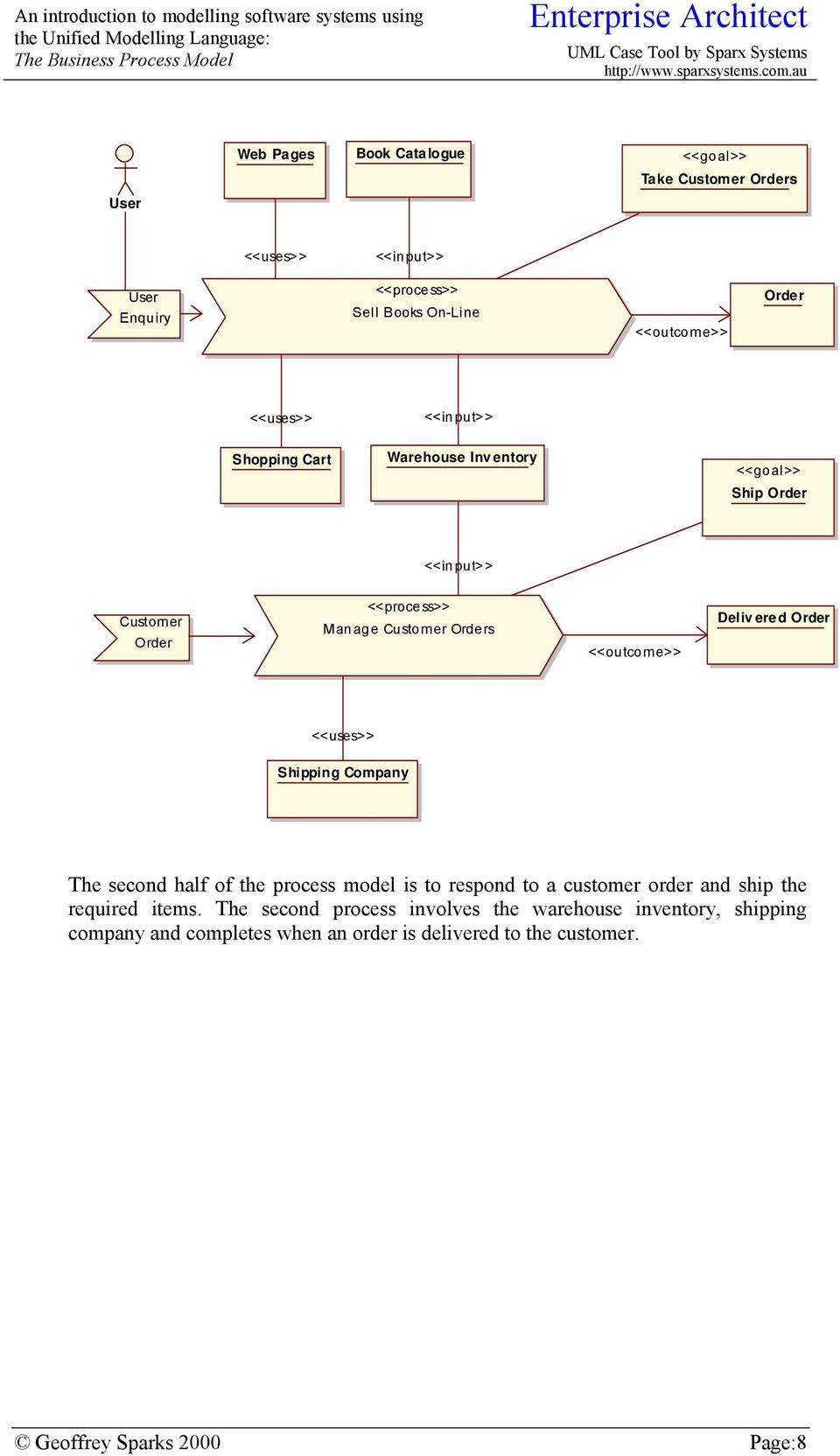
7 Traceability Traceability defines the way a given business process will be implemented in the proposed system. In an implementation diagram, use cases, packages and other model artefacts may be linked back to the business process with <<implementation>> links to signify the dependent relationship. The example below illustrates how a Business Process is implemented by a Use Case and a package. As the model develops and functional software components are built and linked to Use Cases, the business justification for each element can be derived from this model. Note that this model also implies what is NOT being delivered. The Business Process will typically include a wide range of manual and automated procedures. This model illustrates exactly what functionality (Use Cases) will be built to service a particular business process: any missing functionality must come from other (manual or automated) systems and procedures. An Example The example below is an example of the kind of model that may be built up to represent a business process. In this model, the goal of the business process is to take customer orders and to ship those orders out. A user starts the process with an inquiry, which leads to the involvement of the Book Catalogue, Shopping Cart, On-line pages and warehouse inventory. The output of significance to the business is a customer order. Geoffrey Sparks 2000 Page:7
8 Web Pages Book Catalogue <<goal>> Take Customer Orders User <<uses>> User Enquiry Sell Books On-Line <<outcome>> Order <<uses>> Shopping Cart Warehouse Inv entory <<goal>> Ship Order Customer Order Manage Customer Orders <<outcome>> Deliv ered Order <<uses>> Shipping Company The second half of the process model is to respond to a customer order and ship the required items. The second process involves the warehouse inventory, shipping company and completes when an order is delivered to the customer. Geoffrey Sparks 2000 Page:8
9 Recommended Reading Sinan Si Alhir, UML in a NutShel. ISBN: Publisher: O'Reilly & Associates, Inc Doug Rosenberg with Kendall Scott,Use Case Driven Object Modeling with UML. ISBN: Publisher: Addison-Wesley Geri Scheider, Jason P. Winters, Applying Use Cases ISBN: Publisher: Addison-Wesley Ivar Jacobson, Martin Griss, Patrik Jonsson, Software Reuse ISBN: Publisher: Addison-Wesley Hans-Erik Eriksson, Magnus Penker, Business Modeling with UML ISBN: Publisher: John Wiley & Son, Inc Peter Herzum, Oliver Sims, Business Component Factory ISBN: Publisher: John Wiley & Son, Inc Geoffrey Sparks 2000 Page:9
The Business Process Model
 The Business Process Model by Sparx Systems All material Sparx Systems 2007 Sparx Systems 2007 Page: 1 Table of Contents INTRODUCTION...3 BUSINESS PROCESS MODELING NOTATION (BPMN)...4 FLOW ELEMENTS...4
Business Modeling with UML
 Business Modeling with UML Hans-Erik Eriksson and Magnus Penker, Open Training Hans-Erik In order to keep up and be competitive, all companies Ericsson is and enterprises must assess the quality of their
Business Process Redesign and Modelling
 Business Process Redesign and Modelling The Business Process Redesign the Process Handbook the key idea of the Process Handbook approach is that a richly structured online repository about business processes
UML TUTORIALS THE USE CASE MODEL
 UML TUTORIALS THE USE CASE MODEL www.sparxsystems.com.au Sparx Systems 2004 Page 1/5 describes the proposed functionality of the new system. A Use Case represents a discrete unit of interaction between
A Unified Modeling Language for Describing Supply Chain Management in Retail Sector
 A Unified Modeling Language for Describing Supply Chain Management in Retail Sector ZHU Haibo Harbin University of Commerce, Harbin, P.R. China, 150028 [email protected] Abstract: With the market competition
Object Oriented System Analyze and Design of Revenue Information System using UML
 Object Oriented System Analyze and Design of Revenue Information System using UML Sany Ang Department of Accounting Petra Christian University, Surabaya, Indonesia [email protected] and Prof. Dr. Chaiyong
A UML 2 Profile for Business Process Modelling *
 A UML 2 Profile for Business Process Modelling * Beate List and Birgit Korherr Women s Postgraduate College for Internet Technologies Institute of Software Technology and Interactive Systems Vienna University
DEVELOPING REQUIREMENTS FOR DATA WAREHOUSE SYSTEMS WITH USE CASES
 DEVELOPING REQUIREMENTS FOR DATA WAREHOUSE SYSTEMS WITH USE CASES Robert M. Bruckner Vienna University of Technology [email protected] Beate List Vienna University of Technology [email protected]
Web Based e-commerce Shopping System Problem Statement
 Web Based e-commerce Shopping System Problem Statement DesignFest OOPSLA 2002 Yun Feng Kurt Weiss Mohamed Fayad, PhD Abstract Doe s Electronics was founded in the rural town of Burwell, NE and currently
Component Based Development Methods - comparison
 Component Based Development Methods - comparison Dan Laurenţiu Jişa Abstract: This paper realizes a comparison among three of the best known component based development methods, emphazing on the earlier
The BPM to UML activity diagram transformation using XSLT
 The BPM to UML activity diagram transformation using XSLT Ondřej Macek 1 and Karel Richta 1,2 1 Department of Computer Science and Engineering, Faculty of Electrical Engineering, Czech Technical University,
Systematization of Requirements Definition for Software Development Processes with a Business Modeling Architecture
 Systematization of Requirements Definition for Software Development Processes with a Business Modeling Architecture Delmir de Azevedo Junior 1 and Renato de Campos 2 1 Petrobras University, Republican
Towards an Integration of Business Process Modeling and Object-Oriented Software Development
 Towards an Integration of Business Process Modeling and Object-Oriented Software Development Peter Loos, Peter Fettke Chemnitz Univeristy of Technology, Chemnitz, Germany {loos peter.fettke}@isym.tu-chemnitz.de
Requirements engineering
 Learning Unit 2 Requirements engineering Contents Introduction............................................... 21 2.1 Important concepts........................................ 21 2.1.1 Stakeholders and
The Unified Software Development Process
 The Unified Software Development Process Technieche Universal Darmstadt FACHBEREICH IN-FORMAHK BLIOTHEK Ivar Jacobson Grady Booch James Rumbaugh Rational Software Corporation tnventar-nsr.: Sachgebiete:
Menouer Boubekeur, Gregory Provan
 Software Requirements Menouer Boubekeur, Gregory Provan Lectures Introduction to UML Introduction to Requirements Analysis Advanced techniques for Requirement Analysis M. Boubekeur, CSL, University College
Using Use Cases for requirements capture. Pete McBreen. 1998 McBreen.Consulting
 Using Use Cases for requirements capture Pete McBreen 1998 McBreen.Consulting [email protected] All rights reserved. You have permission to copy and distribute the document as long as you make no changes
Modellistica Medica. Maria Grazia Pia, INFN Genova. Scuola di Specializzazione in Fisica Sanitaria Genova Anno Accademico 2002-2003
 Modellistica Medica Maria Grazia Pia INFN Genova Scuola di Specializzazione in Fisica Sanitaria Genova Anno Accademico 2002-2003 Lezione 18-19 The Unified Process Static dimension Glossary UP (Unified
Masters of Science in Software & Information Systems
 Masters of Science in Software & Information Systems To be developed and delivered in conjunction with Regis University, School for Professional Studies Object Oriented Design Table of Contents January
Tool Support for Software Variability Management and Product Derivation in Software Product Lines
 Tool Support for Software Variability Management and Product Derivation in Software s Hassan Gomaa 1, Michael E. Shin 2 1 Dept. of Information and Software Engineering, George Mason University, Fairfax,
CHAPTER_3 SOFTWARE ENGINEERING (PROCESS MODELS)
 CHAPTER_3 SOFTWARE ENGINEERING (PROCESS MODELS) Prescriptive Process Model Defines a distinct set of activities, actions, tasks, milestones, and work products that are required to engineer high quality
Process for Sales Projection Process Documentation Template: Description Sales Projection (Sales Forecasting) Process
 Sales Projection Process Sui Generis Team Process for Sales Projection Process Documentation Template: Item Description Process Title Sales Projection (Sales Forecasting) Process Process # CMPE202-5-Sui1
PROJECT MANAGEMENT METHODOLOGY OF OBJECT- ORIENTED SOFTWARE DEVELOPMENT
 PROJECT MANAGEMENT METHODOLOGY OF OBJECT- ORIENTED SOFTWARE DEVELOPMENT Ing. David BEDNÁŘ, Doctoral Degree Programme (2) Dept. of Information Systems, FIT, BUT E-mail: [email protected] Supervised by:
The Dynamics of Project Management
 The PROJECT PERFECT White Paper Collection Abstract The Dynamics of Project Management Eric Tse This white paper suggests project management methods and practices can move from a static, unidirectional
Designing Real-Time and Embedded Systems with the COMET/UML method
 By Hassan Gomaa, Department of Information and Software Engineering, George Mason University. Designing Real-Time and Embedded Systems with the COMET/UML method Most object-oriented analysis and design
Business Analyst Interview Questions And Answers
 Business Analyst Interview Questions And Answers What Does A Business Analyst Do 2013 All Rights Reserved http://www.whatdoesabusinessanalystdo.com (1) Question: Tell me the importance of a flow chart?
Background: Business Value of Enterprise Architecture TOGAF Architectures and the Business Services Architecture
 Business Business Services Services and Enterprise and Enterprise This Workshop Two parts Background: Business Value of Enterprise TOGAF s and the Business Services We will use the key steps, methods and
Object Modeling with UML
 Object Modeling with UML Steve Tockey Construx Software Builders 14715 Bel-Red Rd #100 Bellevue, WA 98007 [email protected] www.construx.com Intro (14-Jan-01) Page 1-2 Section Outline Goals of This Tutorial
IRA 423/08. Designing the SRT control software: Notes to the UML schemes. Andrea Orlati 1 Simona Righini 2
 Designing the SRT control software: Notes to the UML schemes Andrea Orlati 1 Simona Righini 2 1 - I.N.A.F. Istituto di Radioastronomia. 2 Dip. Astronomia - Università degli Studi di Bologna. Dicembre 2008
Functional Requirements Document -Use Cases-
 EUROPEAN COMMISSION DIRECTORATE GENERAL JRC JOINT RESEARCH CENTRE Cyber-security & New Technologies for Combating Fraud (CSCF) Institute for the Protection and Security of the Citizen (IPSC) EYE IN THE
3C05: Unified Software Development Process
 3C05: Unified Software Development Process 1 Unit 5: Unified Software Development Process Objectives: Introduce the main concepts of iterative and incremental development Discuss the main USDP phases 2
Business-Driven Software Engineering Lecture 3 Foundations of Processes
 Business-Driven Software Engineering Lecture 3 Foundations of Processes Jochen Küster [email protected] Agenda Introduction and Background Process Modeling Foundations Activities and Process Models Summary
Keywords Online food system, Short Massage Service, E-business, notification
 Volume 5, Issue 12, December 2015 ISSN: 2277 128X International Journal of Advanced Research in Computer Science and Software Engineering Research Paper Available online at: www.ijarcsse.com Online Food
In this Lecture you will Learn: Systems Development Methodologies. Why Methodology? Why Methodology?
 In this Lecture you will Learn: Systems Development Methodologies What a systems development methodology is Why methodologies are used The need for different methodologies The main features of one methodology
HERE S HOW APLICOR 3C HELPS GROWING COMPANIES CASE FOR ROI
 Aplicor assumes no liability with respect to the use of the information contained herein which is provided as is and there are no warranties of any kind provided by Aplicor with respect to this document.
Université du Québec à Montréal. Financial Services Logical Data Model for Social Economy based on Universal Data Models. Project
 Université du Québec à Montréal Financial Services Logical Data Model for Social Economy based on Universal Data Models Project In partial fulfillment of the requirements for the degree of Master in Software
Model Simulation in Rational Software Architect: Business Process Simulation
 Model Simulation in Rational Software Architect: Business Process Simulation Mattias Mohlin Senior Software Architect IBM The BPMN (Business Process Model and Notation) is the industry standard notation
How To Create A Diagram On Rational Software Development Platform
 Homework 7: Use Cases, Sequence Diagram, Activity Diagram, State Diagram Name : Student Number : Laboratory Time : Objectives Create a Use Case Diagram in Rational Software Development Platform Create
Aspect Oriented Strategy to model the Examination Management Systems
 Aspect Oriented Strategy to model the Examination Management Systems P.Durga 1, S.Jeevitha 2, A.Poomalai 3, Prof.M.Sowmiya 4 and Prof.S.Balamurugan 5 Department of IT, Kalaignar Karunanidhi Institute of
Meta-Model specification V2 D602.012
 PROPRIETARY RIGHTS STATEMENT THIS DOCUMENT CONTAINS INFORMATION, WHICH IS PROPRIETARY TO THE CRYSTAL CONSORTIUM. NEITHER THIS DOCUMENT NOR THE INFORMATION CONTAINED HEREIN SHALL BE USED, DUPLICATED OR
A UML Introduction Tutorial
 A UML Introduction Tutorial 1/27/08 9:55 PM A UML Introduction Tutorial In this tutorial you will learn about the fundamentals of object oriented modelling, the Unified Modelling Language and the software
Functional Requirements and Use Cases
 A R C H IT E C T U R E R For Enterprise Advantage http://www.bredemeyer.com E S O U R C E S B REDEMEYER CONSULTING, Tel: (812) 335-1653 Architecture Architects Architecting Functional Requirements and
BPMN by example. Bizagi Suite. Copyright 2014 Bizagi
 BPMN by example Bizagi Suite Recruitment and Selection 1 Table of Contents Scope... 2 BPMN 2.0 Business Process Modeling Notation... 2 Why Is It Important To Model With Bpmn?... 2 Introduction to BPMN...
Information Systems Analysis and Design CSC340. 2004 John Mylopoulos. Software Architectures -- 1. Information Systems Analysis and Design CSC340
 XIX. Software Architectures Software Architectures UML Packages Client- vs Peer-to-Peer Horizontal Layers and Vertical Partitions 3-Tier and 4-Tier Architectures The Model-View-Controller Architecture
Software Requirements Specification of A University Class Scheduler
 Software Requirements Specification of A University Class Scheduler Deanna M. Needell Jeff A. Stuart Tamara C. Thiel Sergiu M. Dascalu Frederick C. Harris, Jr. Department of Computer Science University
Evaluation of a Use-Case-Driven Requirements Analysis Tool Employing Web UI Prototype Generation
 Evaluation of a Use-Case-Driven Requirements Analysis Tool Employing Web UI Prototype Generation SHINPEI OGATA Course of Functional Control Systems, Graduate School of Engineering Shibaura Institute of
INFORMATION SYSTEMS SUPPORT FOR MANUFACTURING PROCESSES The standard S95 perspective
 INFORMATION SYSTEMS SUPPORT FOR MANUFACTURING PROCESSES The standard S95 perspective Keywords: Abstract: Manufacturing Enterprises, Enterprise Resource Planning, Manufacturing Execution Systems, Discrete
Software Engineering. System Models. Based on Software Engineering, 7 th Edition by Ian Sommerville
 Software Engineering System Models Based on Software Engineering, 7 th Edition by Ian Sommerville Objectives To explain why the context of a system should be modeled as part of the RE process To describe
Semantic Object Language Whitepaper Jason Wells Semantic Research Inc.
 Semantic Object Language Whitepaper Jason Wells Semantic Research Inc. Abstract While UML is the accepted visual language for object-oriented system modeling, it lacks a common semantic foundation with
Business Process Management Tampereen Teknillinen Yliopisto
 Business Process Management Tampereen Teknillinen Yliopisto 31.10.2007 Kimmo Kaskikallio IT Architect IBM Software Group IBM SOA 25.10.2007 Kimmo Kaskikallio IT Architect IBM Software Group Service Oriented
FHIM Model Content Overview
 FHIM Model Content Overview Federal Health Information Model (FHIM) and Associated Terminology Models Goal Produce a logical, health information model that supports semantic interoperability and that is
How To Develop A Multi Agent System (Mma)
 S-Tropos: An Iterative SPEM-Centric Software Project Management Process Yves Wautelet, Manuel Kolp, Youssef Achbany IAG Institut d Administration et de Gestion, ISYS Unité de Systèmes d Information, Université
An MDA Approach for the Development of Web applications
 An MDA Approach for the Development of Web applications Santiago Meliá Beigbeder and Cristina Cachero Castro {santi,ccachero}@dlsi.ua.es Univesidad de Alicante, España Abstract. The continuous advances
ISSUES OF STRUCTURED VS. OBJECT-ORIENTED METHODOLOGY OF SYSTEMS ANALYSIS AND DESIGN
 ISSUES OF STRUCTURED VS. OBJECT-ORIENTED METHODOLOGY OF SYSTEMS ANALYSIS AND DESIGN Mohammad A. Rob, University of Houston-Clear Lake, [email protected] ABSTRACT In recent years, there has been a surge of
Architecture Design & Sequence Diagram. Week 7
 Architecture Design & Sequence Diagram Week 7 Announcement Reminder Midterm I: 1:00 1:50 pm Wednesday 23 rd March Ch. 1, 2, 3 and 26.5 Hour 1, 6, 7 and 19 (pp.331 335) Multiple choice Agenda (Lecture)
Business Processes Attempts to Find a Definition. Ann Lindsay, Ken Lunn School of Computing and Engineering, University of Huddersfield, UK
 Business Processes Attempts to Find a Definition Ann Lindsay, Ken Lunn School of Computing and Engineering, University of Huddersfield, UK Abstract This paper proposes that definitions of business process
Process-oriented information system requirements engineering: A case study
 ABSTRACT Process-oriented information system requirements engineering: A case study Qingxiong Ma University of Central Missouri Yueyang Jiang University of Maryland, Baltimore County This case provides
Software Design Models, Tools & Processes *
 Software Design Models, Tools & Processes * Lecture 1: Software Design and Software Development Process Cecilia Mascolo * Thanks to Alan Blackwell and Jim Arlow for le7ng me use some of their slides. About
What CMMI Cannot Give You: Good Software
 What CMMI Cannot Give You: Good Software Ivar Jacobson [email protected] [email protected] Objective To understand what CMM/CMMI is and what it is not To demonstrate how the unified process helps you
Basic Unified Process: A Process for Small and Agile Projects
 Basic Unified Process: A Process for Small and Agile Projects Ricardo Balduino - Rational Unified Process Content Developer, IBM Introduction Small projects have different process needs than larger projects.
In this Lecture you will Learn: Development Process. Unified Software Development Process. Best Practice
 In this Lecture you will Learn: Development Chapter 5C About the Unified Software Development How phases relate to workflows in an iterative life cycle An approach to system development Major activities
Modeling the User Interface of Web Applications with UML
 Modeling the User Interface of Web Applications with UML Rolf Hennicker,Nora Koch,2 Institute of Computer Science Ludwig-Maximilians-University Munich Oettingenstr. 67 80538 München, Germany {kochn,hennicke}@informatik.uni-muenchen.de
Software Development in the Large!
 Software Development in the Large! Peter Eeles Executive IT Architect, IBM [email protected] IBM Rational Software Development Conference 2007 2007 IBM Corporation Agenda IBM Rational Software Development
CDC UNIFIED PROCESS PRACTICES GUIDE
 Purpose The purpose of this document is to provide guidance on the practice of Modeling and to describe the practice overview, requirements, best practices, activities, and key terms related to these requirements.
Objectives After completion of study of this unit you should be able to:
 Data Flow Diagram Tutorial Objectives After completion of study of this unit you should be able to: Describe the use of data flow diagrams Produce a data flow diagram from a given case study including
SysML Modelling Language explained
 Date: 7 th October 2010 Author: Guillaume FINANCE, Objet Direct Analyst & Consultant UML, the standard modelling language used in the field of software engineering, has been tailored to define a modelling
Software Development Methodologies
 Software Development Methodologies Lecturer: Raman Ramsin Lecture 7 Integrated Object-Oriented Methodologies: OPEN and FOOM 1 Object-oriented Process, Environment and Notation (OPEN) First introduced in
A Process for ATLAS Software Development
 Atlas Software Quality Control Group A Process for ATLAS Software Development Authors : Atlas Quality Control Group M. Asai, D. Barberis (chairman), M. Bosman, R. Jones, J.-F. Laporte, M. Stavrianakou
Use Case-Based Software Development
 Peter Haumer IBM Rational Software [email protected] http://haumer.net Biography & Photograph: Dr. Peter Haumer is a Content Developer for the IBM Rational Unified Process product platform. Currently, he
TDDC88 Lab 2 Unified Modeling Language (UML)
 TDDC88 Lab 2 Unified Modeling Language (UML) Introduction What is UML? Unified Modeling Language (UML) is a collection of graphical notations, which are defined using a single meta-model. UML can be used
A process-driven methodological approach for the design of telecommunications management systems
 A process-driven methodological approach for the design of telecommunications management systems Thierry FRAIZE, Julio VILLENA, Jean-Daniel GUEDJ TELECOM ARGENTINA Av Dorrego 2520 (1425) Buenos Aires Argentina
UML FOR OBJECTIVE-C. Excel Software www.excelsoftware.com
 UML FOR OBJECTIVE-C Excel Software www.excelsoftware.com Objective-C is a popular programming language for Mac OS X computers. The Unified Modeling Language (UML) is the industry standard notation for
Evaluating OO-CASE tools: OO research meets practice
 Evaluating OO-CASE tools: OO research meets practice Danny Greefhorst, Matthijs Maat, Rob Maijers {greefhorst, maat, maijers}@serc.nl Software Engineering Research Centre - SERC PO Box 424 3500 AK Utrecht
UML SUPPORTED SOFTWARE DESIGN
 UML SUPPORTED SOFTWARE DESIGN Darko Gvozdanović, Saša Dešić, Darko Huljenić Ericsson Nikola Tesla d.d., Krapinska 45, HR-0000 Zagreb, Croatia, tel.: +385 365 3889, faks: +385 365 3548, e-mail: [email protected]
Applying Use Cases to Microcontroller Code Development. Chris Gilbert Cypress Semiconductor
 Applying Use Cases to Microcontroller Code Development Chris Gilbert Cypress Semiconductor Agenda Why Use Cases Microcontroller Project Development Use Cases Defined Use Cases Composition General Example
Business Process Modeling with Structured Scenarios
 Business Process Modeling with Structured Scenarios Doug Rosenberg ICONIX Software Engineering, Inc. In 2008, based on our experience with a number of business process engineering projects over the last
Software Architecture Document
 COMPREHENSIVE WATERSHED MANAGEMENT WATER USE TRACKING PROJECT Southwest Florida Water Management District 2379 Broad Street Brooksville, FL 34604-6899 Date Revision Description Author Table of Contents
Using MDA in Web Software Architectures
 Using MDA in Web Software Architectures SANTIAGO MELIA, CRISTINA CACHERO AND JAIME GOMEZ 1 Universidad de Alicante, Spain The new challenges posed by the Internet market have increased the need for Web
For more information about UC4 products please visit www.uc4.com. Automation Within, Around, and Beyond Oracle E-Business Suite
 For more information about UC4 products please visit www.uc4.com Automation Within, Around, and Beyond Oracle E-Business Suite Content Executive Summary...3 Opportunities for Enhancement: Automation Within,
SYSTEMS ANALYSIS DESIGN
 SYSTEMS ANALYSIS DESIGN Third Edition ALAN DENNIS Indiana University BARBARA HALEY WIXOM University of Virginia ROBERTA M. ROTH University of Northern Iowa WILEY John Wiley & Sons, Inc. http://www.wiley.com/college/dennis
II. Conceptual Modeling
 II. Conceptual Modeling Engineering Software Models in Software Engineering What is Conceptual Modeling? Origins 2003 John Mylopoulos and Steve Easterbrook Conceptual Modeling -- 1 Engineering Software
2. An E-commerce Value Chain and Data Requirements
 IEEE Data Engineering Bulletin, March 2000, Vol. 23, No., pp. 23-28. Database Design for Real-World E-Commerce Systems Il-Yeol Song College of Information Science Technology Drexel University Philadelphia,
Agile Business Process Modelling Framework and Enterprise Architecture.
 Agile Business Process Modelling Framework and Enterprise Architecture. INTRODUCTION Agile Modelling (AM) approach to developing software-based systems aims to improve system modelling process by combining
Applying 4+1 View Architecture with UML 2. White Paper
 Applying 4+1 View Architecture with UML 2 White Paper Copyright 2007 FCGSS, all rights reserved. www.fcgss.com Introduction Unified Modeling Language (UML) has been available since 1997, and UML 2 was
Luncheon Webinar Series July 29, 2010
 Luncheon Webinar Series July 29, 2010 Business Glossary & Business Glossary Anywhere Sponsored By: 1 Business Glossary & Business Glossary Anywhere Questions and suggestions regarding presentation topics?
TOGAF usage in outsourcing of software development
 Acta Informatica Pragensia 2(2), 2013, 68 76, DOI: 10.18267/j.aip.25 Section: Online: aip.vse.cz Peer-reviewed papers TOGAF usage in outsourcing of software development Aziz Ahmad Rais 1, Rudolf Pecinovsky
Specialised software For the Apparel & Footwear Industry
 Specialised software For the Apparel & Footwear Industry SAP Business One Apparel and Footwear is an end-to-end, single, integrated and affordable ERP software solution for businesses whose core focus
An Aspect-Oriented Product Line Framework to Support the Development of Software Product Lines of Web Applications
 An Aspect-Oriented Product Line Framework to Support the Development of Software Product Lines of Web Applications Germán Harvey Alférez Salinas Department of Computer Information Systems, Mission College,
Business Process Modeling Information Systems in Industry (372-1-4207 )
 Business Process Modeling Information Systems in Industry (372-1-4207 ) Arnon Sturm The material of this presentation is adopted from various people including:, Pnina Soffer, Iris Reinhartz-Berger 1 Outline
The power to transform your business
 The power to transform your business Optimus 2020 continues to be the number one choice for litho and packaging printers worldwide. What is the secret of our longevity? Constant research and forward thinking
From Business World to Software World: Deriving Class Diagrams from Business Process Models
 From Business World to Software World: Deriving Class Diagrams from Business Process Models WARARAT RUNGWORAWUT 1 AND TWITTIE SENIVONGSE 2 Department of Computer Engineering, Chulalongkorn University 254
BUSINESS RULES AS PART OF INFORMATION SYSTEMS LIFE CYCLE: POSSIBLE SCENARIOS Kestutis Kapocius 1,2,3, Gintautas Garsva 1,2,4
 International Conference 20th EURO Mini Conference Continuous Optimization and Knowledge-Based Technologies (EurOPT-2008) May 20 23, 2008, Neringa, LITHUANIA ISBN 978-9955-28-283-9 L. Sakalauskas, G.W.
Excerpts from Chapter 4, Architectural Modeling -- UML for Mere Mortals by Eric J. Naiburg and Robert A. Maksimchuk
 Excerpts from Chapter 4, Architectural Modeling -- UML for Mere Mortals by Eric J. Naiburg and Robert A. Maksimchuk Physical Architecture As stated earlier, architecture can be defined at both a logical
Internal Control Deliverables. For. System Development Projects
 DIVISION OF AUDIT SERVICES Internal Control Deliverables For System Development Projects Table of Contents Introduction... 3 Process Flow... 3 Controls Objectives... 4 Environmental and General IT Controls...
ORACLE ASSET TRACKING
 ORACLE ASSET TRACKING KEY FEATURES Self Service User Interface with powerful search capability, comprehensive asset information, mass updates and multiple-asset deployment Single repository of physical,