
ADMISSIONS and CONTINUED OCCUPANCY POLICY (ACOP)
|
|
|
- Gerard Owens
- 10 years ago
- Views:
Transcription
1 ADMISSIONS and CONTINUED OCCUPANCY POLICY (ACOP) For Public Housing Housing Authority of the Lee County, Florida Warner Circle North Fort Myers, Florida 33903
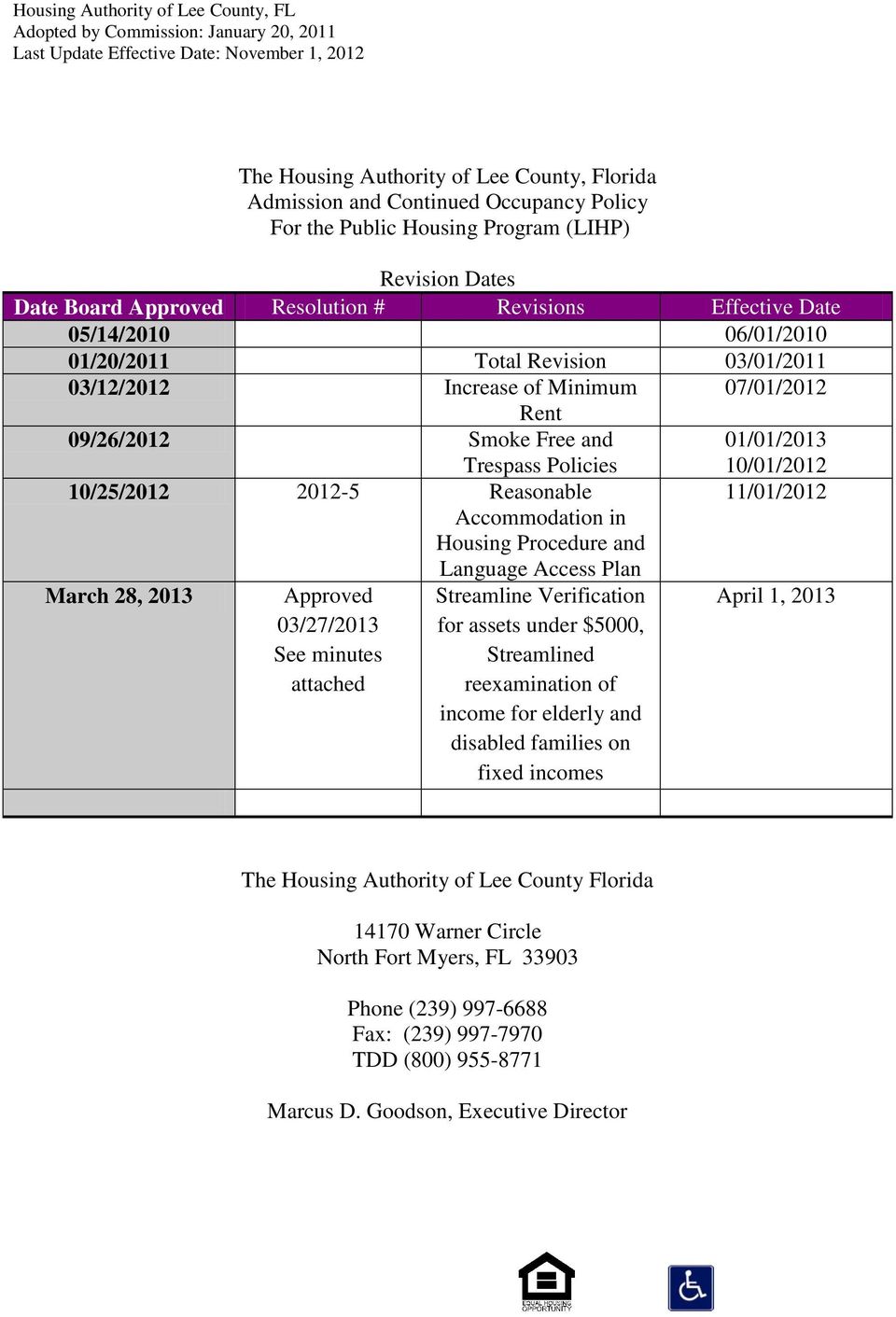
2 The Housing Authority of Lee County, Florida Admission and Continued Occupancy Policy For the Public Housing Program (LIHP) Revision Dates Date Board Approved Resolution # Revisions Effective Date 05/14/ /01/ /20/2011 Total Revision 03/01/ /12/2012 Increase of Minimum 07/01/2012 Rent 09/26/2012 Smoke Free and 01/01/2013 Trespass Policies 10/25/ Reasonable Accommodation in Housing Procedure and Language Access Plan March 28, 2013 Approved 03/27/2013 See minutes attached Streamline Verification for assets under $5000, Streamlined reexamination of income for elderly and disabled families on fixed incomes 10/01/ /01/2012 April 1, 2013 The Housing Authority of Lee County Florida Warner Circle North Fort Myers, FL Phone (239) Fax: (239) TDD (800) Marcus D. Goodson, Executive Director
3 Table of Contents Chapter 1 STATEMENT OF POLICIES AND OBJECTIVES A. HOUSING AUTHORITY MISSION STATEMENT B. LOCAL OBJECTIVES C. ORGANIZATION AND STRUCTURE OF THE PHA D. FAIR HOUSING POLICY E. SERVICE AND ACCOMMODATIONS POLICY F. TRANSLATION OF DOCUMENTS G. PHAS OBJECTIVES H. FAMILY OUTREACH I. QUALITY HOUSING AND WORK RESPONSIBILITY ACT (QHWRA) J. FEDERAL PRIVACY ACT K. POSTING OF REQUIRED INFORMATION L. REASONABLE ACCOMMODATION in HOUSING PROCEDURE LANGUAGE ACCESS PLAN M. APPLICABLE REGULATIONS Chapter 2 ELIGIBILITY FOR ADMISSION A. QUALIFICATION FOR ADMISSION B. FAMILY COMPOSITION C. MANDATORY SOCIAL SECURITY NUMBERS D. CITIZENSHIPIELIGIBLE IMMIGRATION STATUS E. OTHER ELIGIBILITY CRITERIA F. NON-ECONOMIC ELIGIBIBLITY CRITERIA, ZERO TOLERANCE POLICY G. SCREENING FOR SUITABILITY H. HEARINGS I. HOPE VI RE-ADMISSION POLICY Chapter 3 APPLYING FOR ADMISSION A. HOW TO APPLY B. APPLICATI ON PROCEDURES C. PREFEREN CE DEFINED D. COMPLETION OF A FULL APPLICATION E. PROCESSING APPLICATIONS F. FINAL DETERMINATION AND NOTIFICATION OF ELIGIBILITY TOC-l

4 Table of Contents Chapter 4 TENANT SELECTION AND ASSIGNMENT PLAN A. MANAGEMENT OF THE WAITING LIST B. SITE BASED WAITING LIS TS C. WAITING LIST PREFERENCES D. DENIAL OF PREFERENCE E. INCOME TARGETING F. MIXED POPULATION UNITS G. GENERAL OCCUP AN CY UNITS H. DECONCENTRATION OF POVERTY AND INCOME-MIXING I. PROMOTION OF INTEGRATION J. OFFER OF PLACEMENT ON THE SECTION 8 WAITING LIST K. REMOVAL FROM WAITING LIST AND PURGING L. OFFER OF ACCESSIBLE UNITS M. PLAN FOR UNIT OFFERS N. CHANGES PRIOR TO UNIT OFFER O. APPLICANT STATUS AFTER FINAL UNIT OFFER P. TIME-LIMIT FOR ACCEPTANCE OF UNIT Q. REFUSAL OF OFFER Chapter 5 OCCUPANCY GUIDELINES A. DE TERMININ G UNIT SIZE B. EXCEPTIONS TO OCCUPANCY STANDARDS C. ACCESSIBLE UNITS D. FAMILY MOVES Chapter 6 DETERMINATION OF TOTAL TENANT PAYMENT A. MINIMUM RENT B. INCOME AND ALLOWANCES C. DISALLOWANCE OF EARNED INCOME FROM RENT DETERMINATIONS D. INDIVIDUAL SAVINGS ACCOUNTS E. TRAINING PROGRAMS FUNDED BY HUD F. AVERAGING INCOME G. MINIMUM INCOME H. INCOME OF PERSON PERMANENTLY CONFINED TO NURSING HOME TOC-2

5 Table of Contents I. REGULAR CONTRIBUTIONS AND GIFTS J. ALIMONY AND CHILD SUPPORT K. LUMP -SUM RECEIPTS L. CONTRIBUTIONS TO RETIREMENT FUNDS- ASSETS M. ASSETS DISPOSED OF FOR LESS THAN FAIR MARKET VALUE N. CHILD CARE EXPENSES O. MEDICAL EXPENSES P. PRORATION OF ASSISTANCE FOR "MIXED" FAMILIES Q. INCOME CHANGES RESULTING FROM WELFARE CHANGES R. UTILITY ALLOWANCE AND UTILITY REIMBURSEMENT PAYMENTS S. EXCESS UTILITY PAYMENTS T. FAMILY CHOICE IN RENTS U. LCHA'S FLAT RENT METHODOLOGY V. LCHA'S CEILING RENT Chapter 7 VERIFICATION PROCEDURES A. INTRODUCTION B SYSTEMS OF VERIFICATION C RELEASE OF INFORMATION D COMPUTER MATCHING E ACCEPTABLE METHODS OF VERIFICATION F TYPES OF VERIFICATION G VERIFICATION OF ASSETS H VERIFICATION OF ALLOWABLE DEDUCTIONS I VERIFYING OF NON-FINANCIAL FACTORS J. VERIFICATION OF CITIZENSHIP OR ELIGIBLE NONCITIZEN STATUS L. VERIFICATION OF SOCIAL SECURITY NUMBER M TIMING OF VERIFICATION N FREQUENCY OF OBTAINING VERIFICATION Chapter 8 TRANSFER POLICY A. TYPES OF TRANSFERS B. TRANSFER WAITING LIST MANAGEMENT C. TRANSFER REQUEST AND APPROVAL PROCEDURE D. GOOD RECORD REQUIREMENT FOR TRANSFERS E. WAITING LIST MAINTENANCE AND OFFER PROCESS F. PROCESSING IN AND OUT OF DEVELOPMENTS G. GRIEVANCE RIGHTS TOC-3

6 Table of Contents H. EXTRAORDINARY CIRCUMSTANCES I. COST OF TRANSFERS Chapter 9 LEASING GENERAL LEASING POLICY A. LEASE ORIENTATION B. LEASE REQUIREMENTS C. EXECUTION OF LEASE D. ADDITIONS TO THE LEASE E. LEASING UNITS WITH ACCESSIBLE OR ADAPTABLE FEATURES F. UTILITY SERVICES AND RESIDENT OWNED APPLIANCES G. SECURITY D EPO SITS H. RENT PAYMENTS I. FEES AND NONPAYMENT PENAL TIES J. SCHEDULES OF SPECIAL CHARGES K. MODIFICATIONS TO THE LEASE L. CANCELLATION OF THE LEASE M. INSPECTIONS OF PUBLIC HOUSING UNITS Chapter 10 PET POLICY INTRODUCTION A. EXCLUSION OF ANIMALS THAT ASSIST DISABILITIES B. MANDITORY RULES FOR RESIDENTS WITH PETS C. CONTRO L OF ANIMALS D. UNATTENDED ANIMALS E. PROHIBITED PETS F. PET POLICY VIOLATION PROCEDURES G. SCHEDULE OF PET FEES AND INITIAL DEPOSIT Chapter 11 REEXAMINATIONS TOC-4

7 Table of Contents A. ELIGIBILITY FOR CONTINUED OCCUPANCY B. ANNUAL REEXAMINATIONS C. NOTICE OF CHANGES AND REPORTING INTERIM CHANGES D. OTHER INTERIM REPORTING ISSUES E. REPORTING OF CHANGES IN FAMILY COMPOSITION F. REMAINING MEMBER OF TENANT FAMILY - RETENTION OF UNIT G. CONTINUANCE OF ASSISTANCE FOR "MIXED" FAMILIES Chapter 12 LEASE TERMINATIONS A. TERMINATION BY TENANT B. TERMINATION BY LCHA C. NOTIFICATION REQUIREMENTS D. TERMINATIONS DUE TO INELIGIBLE IMMIGRATION STATUS Chapter 13 COMPLAINTS, GRIEVANCES AND APPEALS A. COMPLAINTS B. APPEALS BY APPLICANTS C. TENANT GRIEVANCE POLICY AND PROCEDURES D. DEFINITIONS Chapter 14 FAMILY DEBTS TO THE PHA A. PAYMENT AGREEMENT FOR FAMILIES B. DEBTS DUE TO FRAUD/NON-REPORTING OF INFORMATION C. WRITING OFF DEBTS Chapter 15 COMMUNITY SERVICE INTRODUCTION A. DEFINITIONS B. REQUIREMENTS OF THE PROGRAM C. LCHA OBLIGATIONS Chapter 16 TOC-5

8 Table of Contents PROGRAM INTEGRITY A. CRITERIA FOR INVESTIGATION OF SUSPECTED FRAUD AND ABUSE B. STEPS LCHA WILL TAKE TO PREVENT PROGRAM ABUSE AND FRAUD C. STEPS LCHA WILL TAKE TO DETECT PROGRAM ABUSE AND FRAUD D. LCHA'S HANDLING OF ALLEGATIONS ABUSE AND FRAUD E. HOW LCHA WILL INVESTIGATE ALLEGATIONS OF ABUSE AND FRAUD F. PLACEMENT OF DOCUMENTS, EVIDENCE AND STATEMENTS G. CONCLUSION OF LCHAS INVESTIGATIVE REVIEW H. EVALUATION OF THE FINDINGS I. ACTION PROCEDURES FOR VIOLATIONS WHICH HAVE BEEN DOCUMENTED 16-5 Chapter 17 CRIMINAL RECORDS MANAGEMENT A. INTRODUCTION B. ACQUISITION C. MAINTENANCE D. DISPOSITION Chapter 18 SECURITY DEPOSITS A. INTRODUCTION B. SECURITY DEPOSIT AMOUNT C. PAYMENT AGREEMENT D. ADDITIONAL SECURITY DEPOSIT COLLECTION PROCEDURES E. TRANSFER OF SECURITY DEPOSIT Chapter 19 EVICTION POLICIES AND PROCEDURES A. OVERVIEW B. CAUSES FOR EVICTION C. DOCUMENTATION AND PROCESSING THE REQUEST TOC-6

9 Table of Contents D. TYPES OF EVICTION NOTICES AND FILING PROCEDURES E. ACCEPTANCE OF PAYMENTS DUE UNDER EVICTIONS F. DECISIONS OF THE COURTS CHAPTER 20 ENTERPRISES INCOME VERIFICATION SYSTEM A. EIV Privacy Policy 20-1 B. EIV Use Policy CHAPTER 21 Additional Policies Smoke Free Policy 21-1 Trespass Policy GLOSSARY GLOSSARY OF TERMS
10 Statement of Policies and Objectives Chapter 1 OVERVIEW OF THE PROGRAM AND PLAN INTRODUCTION The Housing Authority of Lee County, Florida is referred to as "PHA" or "Housing Authority" or "LCHA" throughout this document. The Public Housing Program was created by the U.S. Housing Act of The United States Housing Act of 1937 (the "Act") is responsible for the birth of federal housing program initiatives, known as public housing. The Act was intended to provide financial assistance to states and cities for public works projects, slum clearance and the development of affordable housing for low-income residents. There have been many changes to the program since its inception in The Housing Act of 1965 established the availability of federal assistance, administered through local public agencies, to provide rehabilitation grants for home repairs and rehabilitation. This act also created the federal Department of Housing and Urban Development (HUD). The Housing Act of 1969 created an operating subsidy for the public housing program for the first time. Until that time, public housing was a self-sustaining program. In 1998, the Quality Housing and Work Responsibility Act (QHWRA) - also known as the Public Housing Reform Act or Housing Act of was signed into law. Its purpose was to provide more private sector management guidelines to the public housing program and provide residents with greater choices. It also allowed PHAs more remedies to replace or revitalize severely distressed public housing developments. Highlights of the Reform Act include: the establishment of flat rents; the requirement for PHAs to develop five-year and annual plans; income targeting, a requirement that 40% of all new admissions in public housing during any given fiscal year be reserved for extremely low-income families; and resident self-sufficiency incentives. Administration of the Public Housing Program and the functions and responsibilities of the Public Housing Authority (PHA) staff shall be in compliance with the Housing Authority of Lee County of Florida (LCHA) Personnel Policy and this Admissions and Continued Occupancy Policy (ACOP). The administration of the LCHA's housing program will also meet the requirements of the Department of Housing and Urban Development (HUD). Such requirements include any Public Housing Regulations, Handbooks, and applicable Notices. All applicable Federal, State and Local Laws or Regulations shall supersede provisions in conflict with this policy. Federal regulations shall include those found in 24 CFR, Parts V, VII and IX. (Code of Federal Regulations). The PHA receives its operating subsidy for the public housing program from the Department of Housing and Urban Development. The PHA is not a federal department or agency. A public housing agency (PHA) is a governmental or public body, created and authorized by state law to Copyright 2005 Nan McKay & Associates Unlimited copies may be made for internal use Page 1-1 ACOP 02/01/12009

11 Statement of Policies and Objectives develop and operate housing and housing programs for low-income families. The PHA enters into an Annual Contributions Contract with HUD to administer the public housing program. The PHA must ensure compliance with federal laws, regulations and notices and must establish policy and procedures to clarify federal requirements and to ensure consistency in program operation. This chapter contains information about the PHA and its programs with emphasis on the public housing program. It also contains information about the purpose, intent and use of the plan and guide. A. HOUSING AUTHORITY OF LEE COUNTY FLORIDA, MISSION STATEMENT The Housing Authority of Lee County Florida (LCHA) mission is to provide opportunities for changing lives for the better. It is the intent of the authority to ensure decent, safe and sanitary housing in good repair for families of limited income in all public housing units owned or operated by the Authority under the United States Act of LCHA is committed to operating in as efficient, ethical and professional matter, and will create and maintain partnership with its clients and appropriate community agencies in order to accomplish its mission. B. LOCAL OBJECTIVES This Admissions and Continued Occupancy Plan for the Public Housing Program is designed to demonstrate that LCHA is managing its program in a manner that reflects its commitment to improving the quality of housing available to its public, and its capacity to manage that housing in a manner that demonstrates its responsibility to the public trust. In addition, this Admissions and Continued Occupancy Policy is designed to achieve the following objectives: To provide improved living conditions for very low and low income families while maintaining their rent payments at an affordable level. To operate a socially and financially sound public housing agency that provides decent, safe, and sanitary housing within a drug free, suitable living environment for tenants and their families. To avoid concentrations of economically and socially deprived families in anyone or all of the LCHA's public housing developments. To lawfully deny the admission of applicants, or the continued occupancy of residents, whose habits and practices reasonably may be expected to adversely affect the health, safety, comfort or welfare of other residents or the physical environment of the neighborhood, or create a danger to LCHA's employees. Copyright 2005 Nan McKay & Associates Unlimited copies may be made for internal use Page 1-2 ACOP 2/01/2009

12 Statement of Policies and Objectives To attempt to house a tenant body in each development that is composed of families with a broad range of incomes and rent-paying abilities that are representative of the range of incomes of low-income families in LCHA's jurisdiction. To provide opportunities for upward mobility or families who desire to achieve selfsufficiency. To facilitate the judicious management of LCHA's housing inventory, and the efficient management of LCHA staff. To ensure compliance with Title VI of the Civil Rights Act of 1964 and all other applicable Federal laws and regulations so that the admissions and continued occupancy are conducted without regard to race, color, religion, creed, sex, national origin, disability or familial status. C. ORGANIZATION AND STRUCTURE OF THE PHA Public housing is funded by the federal government and administered by the Housing Authority of Lee County, Florida for the jurisdiction of Lee County, Florida. A board of officials that are generally called "commissioners" governs PHA s. Although some PHAs may use a different title for their officials, this document will hitherto refer to the "Board of Commissioners" or the "Board" when discussing the board of governing officials. Commissioners are appointed in accordance with state housing law and generally serve in the same capacity as the directors of a corporation. The board of commissioners establishes policies under which the PHA conducts business, and ensures that those policies are followed by PHA staff. The board is responsible for preserving and expanding the agency's resources and assuring the agency's continued viability and success. Formal actions of the PHA are taken through written resolutions, adopted by the board and entered into the official records of the PHA. The principal staff member of the PHA is the executive director (ED), who is selected and hired by the board. The ED oversees the day-to-day operations of the PHA and is directly responsible for carrying out the policies established by the commissioners. The ED's duties include hiring, training, and supervising the PHA's staff, as well as budgeting and financial planning for the agency. Additionally, the ED is charged with ensuring compliance with federal and state laws, and program mandates. In some PHAs, the ED is known by another title, such as chief executive officer or president. Purpose of this Admissions and Continued Occupancy Policy (ACOP) is to establish guidelines for LCHA staff to follow in determining eligibility for admission and continued occupancy. These guidelines are governed by the requirements of the Department of Housing and Urban Development (HUD) with latitude for local policies and procedures. These policies and procedures for admissions and continued occupancy are binding upon applicants, residents, and LCHA. Copyright 2005 Nan McKay & Associates Unlimited copies may be made for internal use Page 1-3 ACOP 03/01/2011

13 Statement of Policies and Objectives D. FAIR HOUSING POLICY Nondiscrimination It is the policy of LCHA to fully comply with Title VI of the Civil Rights of Title VIII and Section 3 of the Civil Rights Act of 1968 (as amended), Executive Order 11063, Section 504 of the Rehabilitation Act of 1973, and the Age Discrimination Act of 1975, state and local Fair Housing laws, and any legislation protecting the individual rights of residents, applicants or staff which may be subsequently enacted. LCHA shall not discriminate because of race, color, sex, religion, familial status (in nonelderly designated housing), disability, or national origin in the leasing, rental, or other disposition of housing or related facilities, including land, included in any development or developments under its jurisdiction. LCHA shall not take any of the following actions on account of race, color, sex, religion, familial status, disability or national origin: Deny to any family the opportunity to apply for housing, nor deny to any eligible applicant the opportunity to lease housing suitable to its needs. Provide housing that is different than that provided to others. Subject a person to segregation or disparate treatment. Restrict a person's access to any benefit enjoyed by others in connection with any program operated by the Housing Authority. Treat a person differently in determining eligibility or other requirements for admission. Deny a person access to the same level of services. Deny a person the opportunity to participate in a planning or advisory group that is an integral part of the public housing program. LCHA shall not automatically deny admission to a particular group or category of otherwise eligible applicants (e.g. families with children born to unmarried parents or elderly pet owners). Each applicant in a particular group or category will be treated on an individual basis in the normal processing routine. LCHA will seek to identify and eliminate situations or procedures that create a barrier to equal housing opportunity for all. In accordance with Section 504 of the Rehabilitation Act if 1973, LCHA will make such physical or procedural changes as will reasonably accommodate people with disabilities. Copyright 2005 Nan McKay & Associates Unlimited copies may be made for internal use Page 1-4 ACOP 03/01/2011

14 Statement of Policies and Objectives LCHA records with respect to applicants for admission shall indicate for each application the date or receipt, the determination of eligibility or non-eligibility, the preference rating if any, and the date, location, identification, and circumstances of each vacancy offered and whether that vacancy was accepted or rejected. Affirmative Marketing As conditions may require, LCHA will post notices of housing availability in particular neighborhoods or developments to encourage fuller participation. LCHA may issue public announcements of availability to encourage applicants for assistance. Among the marketing efforts LCHA may engage in depending on the situation are the following: Send informational spots to local media outlets such as newspapers, other periodicals for broadcast or publication, radio stations, and or cable TV. Special outreaches to minorities, persons with disabilities and very low-income families. Distribute pamphlets and brochures Post notices in place of employment, unemployment offices, welfare offices, post offices, grocery stores, churches, community halls, public transportation centers, and with other agency community service providers. Conduct outreach to organizations that assist people with disabilities, the elderly, students, immigrants, homeless people and victims of domestic violence. If language is a problem, brochures may be printed in Spanish or other languages as required. Operations In order to further the objectives of nondiscrimination, LCHA shall: Include in the admissions briefings for all LCHA programs a section on compliance with Civil Rights laws. The briefings shall explain to all participants what should be done if they believe they have been discriminated against. Prominently display Fair Housing posters in every development office owned by LCHA and in the LCHA administrative offices. Such poster shall be posted in such a manner as to be easily readable from a wheelchair. Use the Equal Housing Opportunity logo and or statement in all advertising and in all marketing publications of LCHA. LCHA shall be particularly conscious of human models used it its publications so as to avoid signaling any sense of discrimination. LCHA shall maintain a TDD/TTY machine or access to a TDD/TTY for the use of the hearing impaired. As many publications as feasible shall be printed both in English and Spanish or any other languages as may be commonly spoken within Lee County. LCHA will employ Copyright 2005 Nan McKay & Associates Unlimited copies may be made for internal use Page 1-5 ACOP 03/01/2011
15 Statement of Policies and Objectives number of staff with bi -lingual language capabilities in English and Spanish or any other language as may be commonly spoken within Lee County. E. SERVICE AND ACCOMMODATIONS POLICY This policy is applicable to all situations described in this Admissions and Continued Occupancy Policy when a family initiates contact with LCHA, when LCHA initiates contact with a family including when a family applies, and when LCHA schedules or reschedules appointments of any kind. It is the policy of LCHA to be service-directed in the administration of our housing programs, and to exercise and demonstrate a high level of professionalism while providing housing services to the families within our jurisdiction. LCHA's policies and practices will be designed to provide assurances that all persons with disabilities will be provided reasonable accommodation so that they may fully access and utilize the housing program and related services. The availability of specific accommodations will be made known by including notices on LCHA forms and letters to all families, and all requests will be verified so that the LCHA can properly accommodate the need presented by the disability. Federal Americans with Disabilities Act of 1990 With respect to an individual, the term "disability", as defined by the 1990 Act means: A person with a physical or mental impairment that substantially limits one or more of the major life activities of an individual. Has a record of such impairment; or is regarded as having such impairment. (The disability may not be apparent to others, i.e., hard condition). Undue Hardship Requests for reasonable accommodations from persons with disabilities will be granted upon verification that they meet the need presented by the disability and they do not create an "undue financial and administrative burden" for LCHA, meaning an action requiring "significant difficulty or expense." In determining whether accommodation would create an undue hardship, the following guidelines will apply: 1. The nature and cost of the accommodation needed; 2. The overall financial resources of the facility or facilities involved in the provisions of the reasonable accommodation. Copyright 2005 Nan McKay & Associates Unlimited copies may be made for internal use Page 1-6 ACOP 03/01/2011

16 Statement of Policies and Objectives If more than one accommodation is equally effective in providing access to the LCHA's programs and services, the LCHA retains the right to select the most efficient or economical choice. Any request for an accommodation that would enable a tenant to materially violate essential lease terms will not be approved, i.e. allowing nonpayment of rent, destruction of property, disturbing the peaceful enjoyment of others, etc. Interpretation for Visual or Audible Impairments Documents intended for use by applicants and resident will be made available in formats accessible for those with vision or hearing impairments in compliance with Fair Housing Act, 24 CFR 8.6, including communications by way of TDD/TTY for those applicants or program participants who are speech or hearing impaired. Other Accommodations Qualified families will be offered an accessible unit, upon request by the family, when an accessible unit is available. Due to the limited number of accessible units, LCHA will offer vacant accessible units with features for persons with disabilities as follows: 1. First to a current resident of the same development, or of another development under common control, who requires a unit with accessible features. If no such resident exists, then; 2. Second, to an eligible qualified applicant on the Waiting List having a disability and requiring the features of an accessible unit. If no such applicant exists, then; 3. Third, to an otherwise eligible applicant without a disability requiring an accessible unit. This applicant shall be required to move to a non-accessible unit when the accessible unit is needed as an accommodation for a qualified family and non-accessible unit is available. Proper notice will be given. F. IMPROVING ACCESS TO SERVICES FOR PERSONS WITH LIMITED ENGLISH PROFICIENCY (LEP) Overview Language for Limited English Proficiency Persons (LEP) can be a barrier to accessing important benefits or services, understanding and exercising important rights, complying with applicable responsibilities, or understanding other information provided by the public housing program. In certain circumstances, failure to ensure that LEP persons can effectively participate in or benefit from federally-assisted programs and activities may violate the prohibition under Title VI against discrimination on the basis of national origin. This part incorporates the Notice of guidance to Copyright 2005 Nan McKay & Associates Unlimited copies may be made for internal use Page 1-7 ACOP 03/01/2011

17 Statement of Policies and Objectives Federal Assistance Recipients regarding title VI Prohibition Affecting Limited English Proficient Persons, published December 19, 2003 in the Federal Register. The LCHA will take affirmative steps to communicate with people who need services or information in a language other than English. These persons will be referred to as Persons with Limited English Proficiency (LEP). LEP persons are defined as persons who do not speak English as their primary language and who have a limited ability to read, write, speak or understand English. For the purposes of this Admissions and Continued Occupancy Policy (ACOP), LEP persons are public housing applicants and resident families, and parents and family member of applicants and resident families. In order to determine the level of access needed by LEP person's the PHA will balance the following four factors: 1. the number or proportion of LEP persons eligible to be served or likely to be encountered by the public housing program; 2. the frequency with which LEP persons come into contact with the program; 3. the nature and importance of the program, activity, or service provided by the program to people's lives; 4. the resources available to the PHA and costs. Balancing these four factors will ensure meaningful access by LEP persons to critical services while not imposing undue burdens on the PHA. Oral Interpretation In a courtroom, a hearing, or situations in which health, safety, or access to important benefits and services are at stake, the PHA will generally offer, or ensure that the family is offered through other sources, competent interpretation services free of charge to the LEP person. LCHA Policy In order to comply with written-translation obligation, the HA will take the following steps. 1. The PHA will provide written translations of vital documents for each eligible LEP language group that constitutes 5 percent (5%) or 1,000 persons, whichever is less, of the population of person eligible to be served or likely to be affected or encountered. Translation of other documents, if needed, can be provided orally; or 2. If there are fewer than 50 persons in a language group that reaches the 5 percent (5%) trigger, the PHA may not translate vital written material, but will provide Copyright 2005 Nan McKay & Associates Unlimited copies may be made for internal use Page 1-8 ACOP 02/0/12009
18 Statement of Policies and Objectives Implementation Plan written notice in the primary language of the LEP language group of the right to receive competent or all interpretation of those written materials, free of cost. After completing the four-factor analysis and deciding what language assistance services are appropriate, the PHA shall determine whether it is necessary to develop a written implementation plan to address the identified needs of the LEP populations it serves. If the PHA determines that it is not necessary to develop a written implementation plan, the absence of a written plan does not obviate the underlying obligation to ensure meaningful access by LEP persons to the PHA's public housing program services. LCHA Policy If it is determined that the PHA serves few LEP persons, and the PHA have very limited resources, the PHA will not develop a written LEP plan, but will consider alternative ways to articulate in a reasonable manner a plan for providing meaningful access. Entities having significant contact with LEP persons, such as schools, grassroots and faith-based organizations, community groups and groups working with new immigrants will be contacted for input into the process. If the HA determines it is appropriate to develop a written LEP plan, the following five (5) steps will be taken: (1) Identifying LEP individuals who need language assistance; (2) Identifying language assistance measures; (3) Training staff; (4) Providing notice to LEP persons; and (5) Monitoring and updating the LEP plan. G. PUBLIC HOUSING MANAGEMENT ASSESSMENT SYSTEM (PHAS) OBJECTIVES [24 CFR 901 & 902] LCHA operates its public housing program with efficiency and can demonstrate to HUD or independent auditors that LCHA is using its resources in a manner that reflects its commitment to quality and service. LCHA policies and practices are consistent with the new Public Housing Assessment System (PHAS) outlined in the 24 CFR Parts 901 and 902 final published regulations. LCHA is continuously assessing its program and consistently strives to make improvements. The LCHA acknowledges that its performance rating is important to sustaining its capacity of maintaining flexibility and authority. HADFM intends to diligently manage its current program operations and continuously make efforts to be in full compliance with PHAS. The policies and procedures of this program are established so that the standards set forth by PHAS are demonstrated and can be objectively reviewed by an auditor whose purpose is to evaluate performance. Copyright 2005 Nan McKay & Associates Unlimited copies may be made for internal use Page 1-9 ACOP 02/0/12009

19 Statement of Policies and Objectives H. FAMILY OUTREACH LCHA will publicize and disseminate information to make known the availability of housing units and housing-related services for low-income families on a regular basis. LCHA will communicate the status of housing availability to other service providers in the community. LCHA will advise them of housing eligibility factors and guidelines in order that they can make proper referrals for those who seek housing. I. QUALITY HOUSING AND WORK RESPONSIBILITY ACT (QHWRA) LCHA shall comply with the Quality Housing and Work Responsibility Act of 1998 (QHWRA). QHWRA amends the Housing Act of 1937 to include the following operational practices of the Public Housing program: Deregulation and decontrol of public housing agencies, enabling agencies to perform as property and asset managers; Flexibility in use of Federal assistance to enable the agency to leverage and combine assistance amounts with amounts obtained from other sources; The facilitation of mixed income communities and the de-concentration of poverty; An increased accountability to HUD with rewards for effective management of the Public Housing programs; and Ability to create incentives and economic opportunities for residents of Public Housing to work, become self-sufficient. J. FEDERAL PRIVACY ACT LCHA'S practices and procedures are designed to safeguard the privacy of applicants and residents. Applicants and residents, including all adults in their households, are required to sign the form HUD-9886, "Authorization for Release of Information and Privacy Act Notice". This document incorporates the Federal Privacy Act Statement and describes the conditions under which HUD will release family information. LCHA's policy regarding release of information is in accordance with State and Local laws that may restrict the release of family information. Copyright 2005 Nan McKay & Associates Unlimited copies may be made for internal use Page 1-10 ACOP 03/01/2011

20 Statement of Policies and Objectives Files will never be left unattended or placed in common area. Criminal Background check information will be kept in the file with access only by authorized personnel of LCHA. Upon making a determination of eligibility, the criminal background check information will be destroyed 30 days after move in. Any and all information which would lead one to determine the nature and/or severity of a person's disability will not be placed in applicant or tenant files. The authorized LCHA representative will review the personal information, review of documents will be noted in the file and the originals will be returned to the applicant/tenant. If there is a need to maintain this information, it must be kept in a separate folder and marked "confidential". The personal information must not be released except on an "as needed" basis in cases where an accommodation is under consideration. LCHA staff will not discuss or access family information contained in files unless there is a business reason to do so. Staff will be required to disclose whether she/he has relatives living in Public Housing. Inappropriate discussion of family information or improper disclosure of family information by staff will result in disciplinary action. K. POSTING OF REQUIRED INFORMATION LCHA will maintain bulletin boards in conspicuous areas of the Administrative Office and the individual site development offices. The bulletin boards will contain the following information: Statement of policies and procedures governing Admission and Continued Occupancy Policy (ACOP) Information on application taking Directory of LCHA housing sites including names, address of offices and office hours at each facility/development Income limits for admission (current) Current schedule of routine maintenance charges A copy of the lease LCHA's grievance procedures A Fair Housing Poster An Equal Opportunity Employment poster Current Resident Notices Required Public Notices Security Deposit Charges Schedule of Utility Allowances Flat Rent Schedule Copyright 2005 Nan McKay & Associates Unlimited copies may be made for internal use Page 1-11 ACOP 03/01/2011
21 Statement of Policies and Objectives Public Housing Flow Chart Congress Appropriates Funding HUD Provides Funding To PHA PHA Administers Program Family (Tenant) Copyright 2005 Nan McKay & Associates Unlimited copies may be made for internal use Page 1-12 ACOP 03/01/2011
22 Statement of Policies and Objectives L: Reasonable Accommodation in Housing Procedure It is the Housing Authority of Lee County (LCHA) policy to provide reasonable accommodation in housing for applicants and residents with disabilities 1 where reasonable accommodation is necessary to provide them with an equal opportunity to use and enjoy LCHA housing. This policy is in furtherance of the LCHA s goal of providing affordable housing to low income persons regardless of disability and in compliance with applicable federal, state, and local law. A reasonable accommodation is a modification or change the LCHA can make to its procedures and rules or to the person s apartment or to a common area which would assist an otherwise eligible person with a disability to benefit from LCHA housing, provided that the change does not pose an undue financial and administrative burden to the LCHA or result in a fundamental alteration of its program. The Reasonable Accommodation in Housing Procedures (RAHP) outlined here applies to LCHA applicants and residents who are qualified individuals with a disability as set forth below. The LCHA may require reliable documentation or verification of the disability, that the individual needs the accommodation, and that the accommodation is likely to be effective. The LCHA will thoroughly and promptly consider any request for a reasonable accommodation, and will explain the basis for any denial to the requester. In the course of evaluating and responding to a reasonable accommodation request, the LCHA will seek to engage in a process of dialogue and joint problem solving with LCHA applicants and residents. These procedures are designed to inform and assist LCHA employees in identifying, determining and implementing reasonable accommodations for applicants and residents with disabilities where appropriate. They are available for information and review by LCHA residents and applicants upon request. Language Access Plan Purpose The purpose of this plan is to establish and provide greater access and participation in the services, programs and activities of Lee County Housing Authority (LCHA) for the participants with limited or no English proficiency. Pursuant to Title VI of the Civil Rights Act of 1964, and the U. SL Department of Housing and Urban Development s Notice of Guidance to Federal Assistance Recipients Regarding Title VI Prohibition Against National Origin Discrimination Affecting Limited English Proficient Persons (HUD Guidance), LCHA policy is to provide Limited English Proficiency (LEP) customer with meaning access to housing services. This plan promotes greater access to LCHA services, programs and activities with the goal of attaining meaningful and understandable access at a level equal to English proficient individuals. LCHA recognizes that removing language barriers is critical to achieving access to needed services. Both the Reasonable Accommodation in Housing Procedure (RAHP) and the Language Access Plan (LAP)can be found 1 For purposes of these Reasonable Accommodation in Housing Procedures and the policy guidelines, the preferred term "disability" includes with its scope the term "handicap". 1-13
23 in LCHA Housing Operations Policy and Procedure Manual.
24 Statement of Policies and Objectives M. APPLICABLE REGULATIONS Applicable regulations include: 24 CFR Part 5: General Program Requirements 24 CFR Part 8: Nondiscrimination 24 CFR Part 902: Public Housing Assessment System 24 CFR Part 903: Public Housing Agency Plans 24 CFR Part 945: Designated Housing 24 CFR Part 960: Admission and Occupancy Policies 24 CFR Part 965: PHA-Owned or Leased Projects - General Provisions 24 CFR Part 966: Lease and Grievance Procedures Copyright 2005 Nan McKay & Associates Unlimited copies may be made for internal use Page 1-14 ACOP 03/01/2011
25 Eligibility for Admissions Chapter 2 ELIGIBILITY FOR ADMISSION [24 CFR Part 960, Subpart B] INTRODUCTION This Chapter defines both HUD's and LCHA's criteria for admission and denial of admission to the program. The policy of LCHA is to strive for objectivity and consistency in applying these criteria to evaluate the qualifications of families who apply. LCHA staff will review all information provided by the family carefully and without regard to factors other than those provided with the regulation and LCHA policies. Families will be provided the opportunity to explain their circumstances, to furnish additional information, if needed, and to receive an explanation of the basis for any decision made by LCHA pertaining to their eligibility. Exemption from Eligibility Requirements for Police Officers and Other Security Personnel The Authority shall be permitted to admit to Public Housing, police officers and other security personnel who are not otherwise eligible for such housing under any other admission requirements or procedures (i.e. police officers would not be required to be income eligible to qualify for admission to the Public Housing program.) HUD's objective in granting this exemption is to permit long-term residency in public housing developments of police officers and security personnel whose visible presence is expected to serve as a deterrent to criminal activity in and around housing. Before LCHA would be permitted to house police officers or other security personnel under this provision, LCHA would submit to HUD the Housing Authority's standards and criteria for approval/waiver of admission criteria in accordance with 24 CFR A. QUALIFICATION FOR ADMISSION It is LCHA's policy to admit qualified applicants only. An applicant is qualified if he or she meets the following criteria: Is a family as defined by regulation? Heads a household where at least one member of the household is either a U.S. citizen or is an eligible non-citizen. (24 CFR Part 5, Subpart E). Has an Annual Income at the time of admission that does not exceed the low-income limits for occupancy established by HUD and posted separately in the PHA offices. Provide for each household member a Birth Certificate or current Passport.
26 The Quality Housing and Work Responsibility Act of 1998 authorizes PHAs to admit families whose income does not exceed the low-income limit (80% of median area income) and the PHA is required to meet the annual 40% targeted income requirement of extremely lowincome families (families whose income does not exceed 30% of median area income). 2-1
27 Eligibility for Admissions It is the policy of LCHA to meet the income-targeting requirement. Provides a Social Security number (SSN) for all family members that have a SSN or will provide written certification that they do not have Social Security numbers; Meets or exceeds the tenant Selection and Suitability Criteria as set forth in this policy. Timing for the Verification of Qualifying Factors The qualifying factors of eligibility will not be verified until the family is in a position on the waiting list to be offered a housing unit. B. FAMILY COMPOSITION Definition of Family The applicant must qualify as a Family. A family may be a single person or a group of persons. Discrimination on the basis of familial status is prohibited, and a group of persons may not be denied solely on the basis that they are not related by blood, marriage or operation of law. For occupancy standards purposes, the applicant may claim a spousal relationship. (See Chapter 5, Occupancy Guidelines.) A group of persons is defined by LCHA as two or more persons who intend to share residency, and whose income and resources are available to meet the family's needs, and will live together in LCHA housing. The term "Family" includes, but is not limited to: A family with or without children; An elderly family; A disabled family; A displaced family; The remaining member of a tenant family; A single person who is not elderly, displaced, or a person with disabilities, or the remaining member of a tenant family; Two or more elderly or disabled persons living together or one or more elderly or disabled persons living with one or more live-in aides is a family; 2-2
28 Eligibility for Admissions Two or more near-elderly persons living together or one or more near-elderly persons living with one or more live-in aides. The temporary absence of a child from the home due to placement in foster care shall not be considered in determining the family composition and family size. F or the purposes of the definition of a qualified family and admission of a single higher education student, the restrictions on assistance to students enrolled in an institution of higher education do not apply to public housing. (24 CFR 5.612) Head of Household The head of household is the adult member of the household who is designated by the family as head, is wholly or partly responsible for paying the rent, and has the legal capacity to enter into a lease under State/local law. Emancipated minors who qualify under State law will be recognized as head of household if there is a court order recognizing them as an emancipated minor. Spouse of Head Spouse means the husband or wife of the head. The spouse is equally responsible for the lease with the Head of Household. For proper application of the Noncitizens Rule, the definition of spouse is: the marriage partner who, in order to dissolve the relationship, would have to be divorced. It includes the partner in a common law marriage. The term "spouse" does not apply to boyfriends, girlfriends, significant others, or co-heads. Co-head An individual in the household who is equally responsible for the lease with the Head of Household. A household may have either a spouse or co-head, but not both. A co-head never qualifies as a dependent. Live- In Aide A Family may include a live-in aide provided that such live-in aide: Is determined by LCHA to be essential to the care and well being of an elderly person, a nearelderly person, or a person with disabilities, Is not obligated for the support of the person(s), and Would not be living in the unit except to provide care for the person(s). A live-in aide is not considered to be an assisted family member and has no rights or benefits under the program: 2-3
29 Eligibility for Admissions Income of the live-in aide will not be counted for purposes of determining eligibility or level of benefits. Live-in aides are not subject to Non-Citizen Rule requirements. Live-in aides may not be considered as a remaining member of the tenant family. Relatives are not automatically excluded from being live-in aides, but they must meet all of the elements in the live-in aide definition described above. Family members of a live-in aide may also reside in the unit, providing doing so does not increase the subsidy by the cost of an additional bedroom and that the presence of the family member( s) does not overcrowd the unit. A Live-in Aide may only reside in the unit with the approval of LCHA. Written verification will be required from a reliable, knowledgeable professional, such as a doctor, social worker, or caseworker. The verification provider must certify that a live-in aide is needed for the care of the family member who is elderly, near elderly (50-61) or disabled. LCHA will screen and qualify the live-in aide and the live-in aide must be eligible under noncriminal background requirements and must also have the necessary skills to meet the needs of the individual requesting the reasonable accommodation. LCHA has the right to disapprove a request for a live-in aide based on the "Other Eligibility Criteria" described in this Chapter. C. MANDATORY SOCIAL SECURITY NUMBERS [24 CFR 5.216] Families are required to provide verification of Social Security Numbers for all family members if they have been issued a number by the Social Security Administration. This requirement also applies to persons joining the family after admission to the program. Failure to furnish verification of social security numbers is grounds for denial of admission or termination of tenancy. Clients will be given up to 90 days to furnish a valid Social Security card. If a member does not have a Social Security Number they must sign a certification stating that they do not have one. The certification shall: State the individual's name, state that the individual has not been issued a Social Security Number; State that the individual will disclose the Social Security Number, if they obtain one at a later date; Be signed and dated. 2-4
30 Eligibility for Admissions D. CITIZENSHIP/ELIGIBLE IMMIGRATION STATUS In order to receive assistance, a family member must be a U.S. citizen or eligible immigrant. Individuals who are neither may elect not to contend their status. Eligible immigrants are persons who are in one of the six immigrant categories as specified by HUD. Those six categories are: 1. A noncitizen who has been lawfully admitted to the U. S. for permanent residence, as defined by Section 101(a)(20) of the Immigration and Nationality Act (INA) as an immigrant, as defined by Section 101(a)(15) of the INA (8 U.S.C. 1101(a)(20) and 2101(a)(15), respectively (immigrants). This category includes a noncitizen who has been admitted under Section 210 or 210A of the INA (8 U.S.C or 1161), (special agricultural worker), and who has been granted lawful temporary resident status; 2. A noncitizen who entered the U. S. before January 1, 1972, or such later date as enacted by law, and who has continuously maintained residence in the U. S. since then, and who is not ineligible for citizenship, but who is deemed to be lawfully admitted for permanent residence as a result of an exercise of discretion by the Attorney General under Section 249 of the INA (8 U.S.C. 1259); 3. A noncitizen who is lawfully present in the U. S. pursuant to an admission under Section 207 of the INA (8 U.S.C. 1157) (refugee status); pursuant to the granting of asylum (which has not been terminated) under Section 208 of the INA (8 U.S.C. 1158) (asylum status); or as a result of being granted conditional entry under Section 203(a)(7) of the INA (U.S.C. 1153(a)(7) before April 1, 1980, because of persecution or fear of persecution on account of race, religion, or political opinion or because of being uprooted by catastrophic national calamity; 4. A noncitizen who is lawfully present in the U.S. as a result of an exercise of discretion by the Attorney General for emergent reasons or for reasons deemed strictly in the public interest under Section 212(d)(5) of the INA (8 U.S.C. 1182(d)(5» (parole status); 5. A noncitizen who is lawfully present in the U. S. as a result of the Attorney Generals' withholding deportation under Section 243(h) of the INA (8 U.S.C. 1253(h» (threat to life or freedom); or 6. A noncitizen lawfully admitted for temporary or permanent residence under Section 245A of the INA (8 U.S.C. 1225a) (amnesty granted under INA 245A). F or the Citizenship/Eligible Immigration requirement, the status of each member of the family is considered individually before the family's status is defined. 2-5
31 Eligibility for Admissions Mixed Families. A family is eligible for assistance as long as at least one member is a citizen or eligible immigrant. Families that include eligible and ineligible individuals are called "mixed". Such applicant families will be given notice that their assistance will be pro-rated and that they may request a hearing if they contest this determination. No eligible members. Applicant families that include no eligible members will be ineligible for assistance. Such families will be denied admission and offered an opportunity for a hearing. Non-citizen students defined by HUD in the noncitizen regulations are not eligible for assistance. No individual or family applying for financial assistance may receive such financial assistance prior to the affirmative establishment and verification of eligibility of at least one individual or family member. E. OTHER ELIGIBILITY CRITERIA All applicants will be processed in accordance with HUD's regulations (24 CFR Part 960) and sound management practices. Applicants will be required to demonstrate the ability to comply with essential provisions of the lease as summarized below. All applicants must demonstrate through an assessment of current and past behavior the ability: to pay rent and other charges as required by the lease in a timely manner; to care for and avoid damaging the unit and common areas; to use facilities, appliances and equipment in a reasonable way; to create no health or safety hazards, and to report maintenance needs in a timely manner; not to interfere with the rights and peaceful enjoyment of others and to avoid damaging the property of others; not to engage in criminal activity or alcohol abuse that threatens the health, safety or right to peaceful enjoyment of other residents or staff and not to engage in drug-related criminal activity on or off LCHA premises; not to have ever been convicted of manufacturing or producing methamphetamine, also known as "speed," on the premises of assisted housing; not to be subject to lifetime sex offender registration requirement; 2-6
32 Eligibility for Admissions to comply with necessary and reasonable rules and program requirements of HUD and LCHA; and, to comply with local health and safety codes. Denial of Admission for Previous Debts to This or Any Other PHA Previous outstanding debts to LCHA or any Public Housing Authority (PHA) resulting from a previous tenancy in the public housing, Section 8, or assisted housing program must be paid in full prior to unit offer. No Payment Agreement will be accepted at move-in. Applicants with previous PHA debts must pay 100% of the debt prior to offer of a unit. Either spouse and/or co-head are responsible for the entire debt incurred as a previous LCHA tenant. Children of the head or spouse who had incurred a debt to LCHA will not be held responsible for the parent's previous debt. In no case will the debt be forgiven. F. NON-ECONOMIC ELIGIBILITY CRITERIA (Including Criminal/Drug) In developing its admission policies, the aim of LCHA is to attain a resident body composed of families with a broad range of incomes and to avoid concentrations of the most economically deprived families and families with serious social problems. Therefore, it is the policy of LCHA to deny admission to applicants whose habits and practices may reasonably be expected to have a detrimental effect on the operations of the development or neighborhood or on the quality of life for its residents. As part of eligibility determination, the Authority will screen each applicant household to assess its suitability as renters. Factors not related to economics to be considered are housekeeping habits, prior history as a tenant, criminal records, and the ability of the applicant to maintain the responsibilities of tenancy. In determining qualifications for tenancy, LCHA shall consider the following items: Whether the conduct of the applicant in present or prior housing has been such that admission to the program would adversely affect the health, safety, or welfare of other residents, or the physical, environmental, or financial stability of the development. LCHA shall rely upon sources of information which may include, but not limited to, LCHA records, the records of other housing authorities, personal interviews with the applicant or tenant, home visits, interviews with previous landlords, employers, family 2-7
33 Eligibility for Admissions social workers, parole officers, criminal and court records, clinics, physicians, or the police department. This will be done in order to determine whether the individual attributes, prior conduct, and behavior of a particular applicant or tenant is likely to interfere with other tenants in such a manner as to diminish their enjoyment of the premises by adversely affecting their health, safety, or welfare. An authorized representative of LCHA shall document any pertinent information relative to the following: Criminal Activity - including the activities further defined herein as of a criminal nature. Pattern of Violent Behavior - includes evidence of repeated acts of violence on the part of an individual, or a pattern of conduct constituting a danger to neighbors' peaceful enjoyment of their premises. HUD defines violent criminal activity as any criminal activity that has as one of its elements the use, attempted use, or threatened use of physical force against a person or property, and the activity as well as being engaged in by any family member. Pattern of Drug Use - includes a determination by LCHA that the applicant has exhibited a pattern of illegal use of a controlled substance that might interfere with the health, safety, or right to peaceful enjoyment of the premises by other residents. Drug Related Criminal Activity - includes a determination by LCHA that the applicant has been involved in the illegal manufacture, sale, distribution, use or possession of a controlled substance as defined in section 102 of the Controlled Substances Act (21 U.S.C. 802). Pattern of Alcohol Abuse - includes a determination by LCHA that the applicant's pattern of alcohol abuse might interfere with the health, safety or right to peaceful enjoyment of the premises by other residents. Initiation of Threats - or behaving in a manner indicating an intent to assault employees or other residents. Abandonment of a Public Housing Unit or Other Assisted Housing Unit ("skipped") - any abandonment of a unit assisted by HUD without advising the administering housing authority's personnel of intent to vacate so that the unit may be properly secured and protected from any vandalism. Non-payment of Rightful Obligations - including rent and/or utilities and other charges owed to LCHA or another Housing Authority. Intentionally Falsifying an Application for Leasing - including providing false 2-8
34 Eligibility for Admissions information about family income and family composition, using an alias on the application for housing, or making any other material false statement or omission intended to mislead. Record of Serious Disturbances of Neighbors, Destruction of Property or Other Disruptive or Dangerous Behavior - consists of patterns of behavior which endanger the life, safety, or welfare of other persons by physical violence, gross negligence or irresponsibility, which damage the equipment or premises in which the applicant resides, or which are seriously disturbing to neighbors or disrupt sound family and community life, indicating the applicant's inability to adapt to living in a multi - family setting. Includes judicial termination of tenancy in previous housing on grounds of nuisance or objectionable conduct, or frequent loud parties, which have resulted in serious disturbances of neighbors. Grossly Unsanitary Housekeeping - includes the creation of a fire hazard through acts such as hoarding rags, papers, or other materials; severe damages to premises and equipment caused by the family or persons under control of the family; seriously affecting neighbors by causing infestations, foul odors, depositing garbage outside of normal trash receptacles, or serious neglect of the premises. This category does not include families whose housekeeping is found to be superficially unclean or due to lack of orderliness, where such conditions do not create a problem for neighbors or a threat to health and safety. Destruction of Property - damage to any previous rentals or property that the family has resided in. Whether Applicant or Tenant is Capable of Maintaining the Responsibilities of Tenancy - In the case of applicants for admission, the person's present living arrangements and a statement obtained from the applicant's physician or social worker will be among factors considered in making this determination. The availability of a Live-In Aide will be considered also in making this determination. In the event of the receipt of unfavorable information with respect to an applicant, consideration shall be given to the time, nature, and extent of the applicant's conduct, and to factors that might indicate a reasonable probability of favorable future conduct. The LCHA shall not admit persons evicted from public housing, Indian housing, Section 23, or any Section 8 program because of drug related criminal activity within the past three (3) years preceding date of interview. (See also Item 6 below re methamphetamine.) The LCHA may waive this requirement if the person demonstrates that he/she: 2-9
35 Eligibility for Admissions Has successfully completed a supervised drug or alcohol rehabilitation program approved by LCHA; Has otherwise been rehabilitated successfully; Is participating in a supervised drug or alcohol rehabilitation program; or, The circumstances leading to the eviction no longer exists (i.e. the individual involved in drugs is no longer in the household because the person is incarcerated). In no event shall a person convicted of manufacturing or producing methamphetamine (also called "speed") be determined eligible for public housing. Such individuals are permanently denied admission to all federally assisted housing programs. If the person is convicted for murder, rape, and/or other sex-related crimes, kidnapping, arson, production or manufacturing of methamphetamine, or lifetime sex offender, the person will be permanently denied admission. The LCHA shall not admit persons whose pattern of illegal use of a controlled substance or pattern of abuse of alcohol may interfere with the health, safety, or right to peaceful enjoyment of the premises by other residents within the past three (3) years preceding the date of interview. The LCHA shall not admit persons who have engaged in violent criminal activity within the three (3) years preceding the date of interview. The LCHA shall not admit any person classified as a "habitual criminal" or any person subject to a lifetime sex offender registration requirement under a State sex offender registration program. If on probation or parole for any conviction, assistance will be denied until discharged from probation or parole. The LCHA shall not admit persons whose conduct in present or prior housing has been such that admission to the program would adversely affect the health, safety, or welfare of other residents, or the physical environment, or the financial stability of the development. If in the past the LCHA initiated a lease termination, which may or may not have resulted in eviction for any reason cited under the One Strike Notice (PIH 96-27) or amended changes, for a family, as a prior resident of public housing, the family shall be ineligible for admission to Public Housing for a three (3) year period beginning on the date of such eviction. The LCHA will not waive this requirement, even in the event of rehabilitation efforts on part of the family or family member. 2-10
36 Eligibility for Admissions Administration All screening procedures shall be administered fairly and in such a way as not to discriminate on the basis of race, color, nationality, religion, sex, familial status, disability or against other legally protected groups, and not to violate right to privacy. To the maximum extent possible, LCHA will involve other community and governmental entities in the promotion and enforcement of this policy. In evaluating evidence of negative past behavior, LCHA will give fair consideration to the seriousness of the activity with respect to how it would affect other residents, and/or likelihood of favorable conduct in the future which could be supported by evidence of rehabilitation. In order to obtain access to the records the PHA must require every applicant family to submit a consent form signed by each adult household member [24 CFR 5.903]. LCHA will perform criminal background checks through local law enforcement for all adult household members. LCHA is required to perform criminal background checks necessary to determine whether any household member is subject to a lifetime registration requirement under a state sex offender program in the state where the housing is located, as well as in any other state where a household member is known to have resided [24 CFR (a)(4)]. The PHA may not pass along to the applicant the costs of a criminal records check [24 CFR (d)]. If the results of the criminal background check indicate there may have been past criminal activity, but the results are inconclusive, the PHA will request the applicant to be fingerprinted and will request the information from the National Crime Information center (NCIC). If LCHA proposes to deny admission based on a criminal record or on lifetime sex offender registration information, the HA must notify the household of the proposed action and must provide the subject of the record and the applicant a copy of the record and an opportunity to dispute the accuracy and relevance of the information prior to a denial of admission [24 CFR 5.903(f) and 5.905(d)]. LCHA will ensure that any criminal record received is maintained confidentially, not misused, or improperly disseminated, and destroyed once the purpose for which it was requested is accomplished. Hearings If information is revealed that would cause the LCHA to deny admission to the household and the person disputes the information, he/she shall be given the opportunity for an informal hearing according to LCHA's hearing procedures in the Chapter on Complaints, Grievances 2-11
37 Eligibility for Admissions and Appeals. G. SCREENING FOR SUITABILITY [24 CFR , ] It is the policy of LCHA to deny admission to applicants whose habits and practices may reasonably be expected to have a detrimental effect on the operations of the development or neighborhood, or on the quality of life for its residents. LCHA will conduct a detailed interview of all applicants. The interview form will contain questions designed to evaluate the qualifications of applicants to meet the essential requirements of tenancy. All information will be subject to third party verification. An applicant's intentional misrepresentation of any information related to eligibility, award of preference for admission, housing history, allowances, family composition or rent will result in denial of admission. Applicants must be able to demonstrate the ability and willingness to comply with the terms of the lease, either all or with assistance which they can demonstrate that they have or will have at the time of admission. (24 CFR 8.2 Definition: Qualified Individual with Handicaps) The availability of assistance is subject to verification by LCHA. The PHA's minimum age for admission as head of household is 18. This requirement is to avoid entering into leases that would not be valid or enforceable under applicable law. Exception to the age requirement may be granted to those with emancipation status as granted by a court of law. LCHA will not allow under any circumstances a parent or legal guardian to co-sign a lease on behalf of an applicant in order to bypass the age requirement. As a part of the final eligibility determination, LCHA will screen each applicant household to assess their suitability as renters. LCHA will complete a credit check of each applicant so as to determine past rental history, including any possibility of bad debts to any federally assisted housing programs. LCHA shall rely upon sources of information which may include, but not be limited to, LCHA records, personal interviews with the applicant or tenant, interviews with previous landlords, employers, family social workers, parole officers, criminal and court records, clinics, physicians or the police department. This will be done in order to determine whether the individual attributes, prior conduct, and behavior of a particular applicant is likely to interfere with other tenants in such a manner as to diminish their enjoyment of the premises by adversely affecting their health, safety or welfare. Factors to be considered in the screening are housekeeping habits, rent paying habits, prior history as a tenant, criminal records, the ability of the applicant to maintain the responsibilities of 2-12
38 Eligibility for Admissions tenancy, and whether the conduct of the applicant in present or prior housing has been such that admission to the program would adversely affect the health, safety or welfare of other residents, or the physical environment, or the financial stability of the project. LCHA's examination of relevant information pertaining to past and current habits or practices will include, but is not limited to, an assessment of: The applicant's past performance in meeting financial obligations, especially rent. Eviction or a record of disturbance of neighbors sufficient to warrant a police call, destruction of property, or living or housekeeping habits at present or prior residences which may adversely affect the health, safety, or welfare of other tenants or neighbors. Any history of criminal activity on the part of any applicant family member involving criminal acts, including drug-related criminal activity. Any history or evidence of repeated acts of violence on the part of an individual, or a pattern of conduct constituting a danger to peaceful occupancy by neighbors. Any history of initiating threats or behaving in a manner indicating an intent to assault employees or other tenants. Any history of alcohol or substance abuse that would threaten the health, welfare, or right to peaceful enjoyment of the premises by other residents. The ability and willingness of an applicant to comply with the essential lease requirements will be verified and documented by LCHA. The information to be considered in the screening process shall be reasonably related to assessing the conduct of the applicant and other family members listed on the application in present and prior housing. The history of applicant conduct and behavior must demonstrate that the applicant family can reasonably be expected not to: Interfere with other residents in such a manner as to diminish their peaceful enjoyment of the premises by adversely affecting their health, safety, or welfare. [24CFR (b)] Adversely affect the physical environment or financial stability of the project. [24CFR (b)] Violate the terms and conditions of the lease. [24CFR 8.3]. 2-13
39 Eligibility for Admissions Require services from PHA staff that would alter the fundamental nature of the PHA's program. [24 CFR 8.3] Rent Paying Habits LCHA will examine any Housing Authority records from a prior tenancy, and will request written references from the applicant's current landlord and may request written references from former landlords (for up to the past 5 years). Based upon these verifications, LCHA will determine if the applicant was chronically late with rent payments, was evicted at any time (during the past 5 years) for nonpayment of rent, or had other legal action initiated against him/her for debts owed. Any of these circumstances could be grounds for an ineligibility determination, depending on the amount of control the applicant had over the situation. Applicants will not be considered to have a poor credit history if they were late paying rent because they were withholding rent due to substandard housing conditions in a manner consistent with a local ordinance; or had a poor rent paying history clearly related to an excessive rent relative to their income (using 50% of their gross income as a guide,) and responsible efforts were made by the family to resolve the nonpayment problem. The lack of credit history will not disqualify a family, but a poor credit history will, with the exceptions noted above. Screening Applicants Who Claim Mitigating Circumstances Mitigating circumstances are facts relating to the applicant's record of unsuitable rental history or behavior, which, when verified would indicate both: (1) the reason for the unsuitable rental history and/or behavior; and (2) that the reason for the unsuitable rental history and behavior is no longer in effect or is under control, and the applicant's prospect for lease compliance is an acceptable one, justifying admission. If unfavorable information is received about an applicant, consideration shall be given to the time, nature, and extent of the applicant's conduct and to factors that might indicate a reasonable probability of favorable future conduct. In order to be factored into the PHA's screening assessment of the applicant, mitigating circumstances must be verifiable. If the mitigating circumstances claimed by the applicant relate to a change in disability, medical condition or course of treatment, LCHA shall have the right to refer such information to persons who are qualified and knowledgeable to evaluate the evidence and to verify the mitigating circumstance. LCHA shall also have the right to request further information reasonably needed to verify the mitigating circumstance, even if such information is of a medically confidential nature. Such inquiries will be limited to the information necessary to verify the mitigating circumstances or, in the case of a person with disabilities, to verify a 2-14
40 Eligibility for Admissions reasonable accommodation. Examples of Mitigating Circumstances Examples of mitigating circumstances include: Evidence of successful rehabilitation; Evidence of the applicant family's participation in and completion of social service or other appropriate counseling service approved by LCHA; and/or Evidence of the applicant family's successful and sustained modifications of previous disqualifying behavior. Consideration of mitigating circumstances does not guarantee that the applicant will qualify for admission. LCHA will consider such circumstances in light of: The applicant's ability to substantiate through verification the claim of mitigating circumstances and his/her prospects for improved future behavior; and The applicant's overall performance with respect to all the screening requirements. Qualified and Unqualified Applicants Information that has been verified by LCHA will be analyzed and a determination will be made with respect to: The eligibility of the applicant as a family; The eligibility of the applicant with respect to income limits for admission; The eligibility of the applicant with respect to citizenship or eligible immigration status; The eligibility of the family for suitability, non-criminal requirements, etc.; Preference category to which the family is entitled. Assistance to a family may not be delayed, denied or terminated on the basis of the family's ineligible immigration status unless and until the family completes all the verification and appeals processes to which they are entitled under both INS and PHA procedures, except for a pending PHA hearing. Applicants who are determined to be unqualified for admission will be promptly notified with a Notice of Denial of Admission stating the reason for the denial. LCHA shall provide 2-15
41 Eligibility for Admissions Applicants an opportunity for an informal hearing (see Chapter titled "Complaints, Grievances, and Appeals.") Applicants who have requested a reasonable accommodation as a person with a disability and who have been determined eligible, but fail to meet the Applicant Selection Criteria, will be offered an opportunity for a second meeting to have their cases examined to determine whether mitigating circumstances or reasonable accommodations will make it possible for them to be housed in accordance with the screening procedures. LCHA will make every effort to accurately estimate an approximate date of occupancy. However, the date given by LCHA does not mean that applicants should expect to be housed by that date. The availability of a suitable unit to offer a family is contingent upon factors not directly controlled by LCHA, such as turnover rates, and market demands as they affect bedroom sizes and project location. Documenting Findings An authorized representative of LCHA shall document any pertinent information received relative to the admission and eligibility requirements. In the event of the receipt of unfavorable information with respect to an applicant, consideration shall be given to the time, nature, and extent of the applicant's conduct and to factors that might indicate a reasonable probability of favorable future conduct or financial prospects. Prohibited Criteria for Denial of Admission Applicants will NOT be rejected because they: Have no income; Are not employed; Do not participate in a job-training program; Will not apply for various welfare or benefit programs; Have children; Have children born out of wedlock; Are on welfare; Are eligible students. H. HEARINGS If information is revealed that would cause LCHA to deny admission to the household and the 2-16
42 Eligibility for Admissions person disputes the information, s/he shall be given an opportunity for an informal hearing according to LCHA's hearing procedures outlined in Chapter 13, Complaints, Grievances and Appeals. J. HOPE VI READMISSION POLICY HOPE VI Site: Re-entry Criteria for Prior Michigan Court Residents: LCHA will: LCHA will send a letter to resident's last known address stating that they will be provided 90 days to submit their name for a waiting list of the new HOPE VI units. If no response is given to LCHA within 90 days, prior residents will adhere to Good Neighbor policy requirements. After 90 days of opening the waiting list, all new and prior residents will adhere to Good Neighbor Policy requirements. * Only residents on finalized relocation list will be eligible for this condition. All prior residents must remain in good standing with the LCHA, must be eligible for public housing assistance and meet the minimum standards of the LCHA ACOP. A new background screening process (including a criminal records check) will be conducted on all residents prior to returning. As per current ACOP, a priority will be given to prior residents for 90 days and those prior families that participate in the LCHA FSSP or CSSP, elderly or disabled head of household. The finalized relocation list will be complied and forwarded to the Housing Department for future reference. Prior Michigan Court residents are required to maintain contact with LCHA to provide any changes of address. Residents that have address changes should report this to the Relocation Coordinator or CSS Coordinator of LCHA. All current residents of Michigan court will be eligible for readmission to the new HOPE VI Community and will be given a priority for readmission over other households in accordance with the Good Neighborhood Policy. LCHA will: 1. LCHA will send a letter to resident's last known address stating that they will be provided 90 days to submit their name for a waiting list of the new HOPE VI units. If not response is given to LCHA within 90 days, prior resident will adhere to Good Neighbor Policy requirements. After 90 days of opening the waiting list, all new and prior residents will adhere to Good Neighbor Policy requirements. *Only residents on finalized relocation list will be eligible for this condition. 2-17
43 Eligibility for Admissions 2. All prior residents must remain in good standing with the LCHA, must be eligible for public housing assistance and meet the minimum standards of the LCHA ACOP. 3. A new background screening process (including a criminal records check) will be conducted on all residents prior to returning. AS per current ACOP, a priority will be given to prior residents for 90 days and those prior families that participate in the LCHA FSSP or CSSP, elderly or disabled heard of household. 4. The finalized relocation list will be complied and forwarded to the Housing Department for future reference. S. Prior Michigan Court residents are required to maintain contact with LCHA to provide any changes of address. Residents that have address changes should report this to the Relocation Coordinator or CSS Coordinator of LCHA. Good Neighbor Policy and Community Standards For Residents Desirous of Returning to a HOPE Program/ Neighborhood Choice Initiative (NCI) Community. All current residents of a demolished community will be eligible for readmission to the new HOPE VI Community and will be given a priority for readmission over other households in accordance with the Good Neighbor Policy described below. This Good Neighbor Policy illustrates the community standards that all residents of the demolished community believe are necessary for the health, safety and peaceful enjoyment of every citizen as well as the stability of the neighborhood. By the signature of Head of Household and all members of the Household aged 18 and over, and by the signature of the Executive Director, the Household states its acceptance of this priority and of the Good Neighbor Policy. Residents of the demolished community understand and are committed to: A. A local preference for the "Working Family," defined as a family where the Head of Household is: Working (gainfully employed) in a full-time or long-term, (40 hours a week), part-time capacity, (32 hours a week) for a consistent period of time or in an approved job-training program; or, Actively involved in a Family Self-Sufficiency program; or, a Community 2-18
44 Eligibility for Admissions Support Services program Age 62 or older; or Receiving social security disability, supplemental security income disability benefits, or any other payment based on an individual's inability to work. B. Volunteerism or community service shall be required of eligible residents as stated in the Housing Authority of Lee County, Florida Housing addendum and part of the lease agreement. C. Household members 18 and older must be enrolled in school, working or actively involved with a Family Self-Sufficiency Program. Members not enrolled in school shall participate in an educational or job preparedness program. D. Maintaining cleanliness of home, including lawn maintenance (pick up trash from lawn, etc.) and common areas. Prior to re-occupancy, a Case Manager from LCHA will make a home visit of each residents current placement as well as follow up with their current landlords for a status as to how well the home was maintained during the resident's length of occupancy. E. Upholding Florida's compulsory school attendance requirements for school-aged children. This entails that the parents shall be responsible to follow up with their children's schools and/or the school board to verify their school attendance. F. Providing acceptable Landlord References to include: timely rent payment history, good household maintenance records, and no past lease infractions/violations within the 12 months preceding re-occupancy to the new HOPE VI site. H. Head of Household certifying that all family members under the age of 18 years have not been involved or convicted of a crime. (See "J" below.) 1. Refraining from public nuisances such as drug trafficking, public drunkenness, fighting, open domestic quarrels, loitering, loud music, etc. 1. Possible exclusion from occupancy if Head or any other family member has a history of criminal activity*, related to drugs or crimes of violence within the following timeframes: Misdemeanor Three (3) years Felony Felony (Violent/Drug/Alcohol) Five (5) years Eight (8) years or permanent * Any possible exclusion from occupancy also includes anything that would make you ineligible for Public Housing. A new criminal check will be assessed on each resident prior to re-entry. 1. Finally, that the Household will maintain these Home and Community Standards 2-19
45 Eligibility for Admissions designed to promote: 1. The health, safety, and welfare of all residents; 2. The physical environmental, and fiscal stability of the community; and, 3. The peaceful enjoyment for all residents. K. Residents will have the right to file complaints by following Grievance procedures as they deem necessary and are entitled to as stated in their lease agreement with LCHA. 2-20
46 Applying for Admissions Chapter 3 APPLYING FOR ADMISSION INTRODUCTION The policy of LCHA is to ensure that all families who express an interest in housing assistance are given an equal opportunity to apply, and are treated in a fair and consistent manner. This Chapter describes the policies and procedures for completing an initial application for assistance, placement and denial of placement on the waiting list, and limitations on who may apply. The primary purpose of the intake function is to gather information about the family, but LCHA will also utilize this process to provide information to the family so that an accurate and timely decision of eligibility can be made. Applicants will be placed on the waiting list in accordance with this Policy. A. HOW TO APPLY Families who wish to apply for any of LCHA's programs must complete a written application form when application taking is open. Applications will be made available in an accessible format upon request from a person with a disability. Applications are taken at the individual Rental/Management Office's for all developments. The application form is also available on LCHA's website at The application process will involve two phases. 1. The first step is the application for admission. The application is dated and time stamped and is keyed to the computerized Waiting List management system to secure a place on the Waiting List in accordance with the date and time order, and preference if claimed. 2.The second phase is the final determination of eligibility referred to as the "update the full application." When the family approaches the top of the Waitlist they will be notified for an interview. At this time, LCHA ensures that verification of all HUD, State, local, and LCHA eligibility factors as pursuant to the program are current in order to determine the family's eligibility for an offer of a suitable unit. B. APPLICATION PROCEDURES LCHA will utilize a full application form for the initial application. The application may be taken in person, whenever the Waiting List is open. Applications may be mailed to Out of State applicants or, for purposes of reasonable accommodations. Application may also be retrieved through accessing LCHA's website address 3-1
47 Applying for Admissions Spanish translation of the application is available for non-english speaking applicants upon request. At a minimum, the application will contain questions designed to obtain the following information: Names of head of household, spouse/co-head Names of all members and age of all members Number of family members (used to estimate bedroom size needed) Street address and phone numbers Mailing address (If PO Box or other permanent address) Annual income Source(s) of income received by household members Information regarding request for reasonable accommodation or for accessible unit Social Security Numbers Race/ethnicity Arrests/Convictions for Drug Related or Violent Criminal Activity Questions regarding previous participation in HUD programs Duplicate applications, including applications from a segment of an applicant household, will not be accepted. The initial application will not require interviews. Information on the application will not be verified until the applicant has been selected for final eligibility determination. Final eligibility will be determined when the full application process is completed and all information is verified. Applicants are required to inform in writing of changes in family composition, income, and address to the developments for which they have applied. Applicants are also required to respond to requests from LCHA to update information on their application, or to determine their continued interest in assistance. Corrections, updates, or changes on applications will be documented. Obsolete information on 3-2
48 Applying for Admissions paper forms of applications shall be lined through and documented as to its obsolescence, initialized and dated by the employee making such changes, or by the applicant, if such change is made by the applicant him/herself. Failure to provide information or to respond to mailings will result in the applicant being removed from the waiting list. C. PREFERENCE DEFINED The preferences recognized by LCHA are that of Emergency /Federally Displaced preference, Displaced Persons by Government Action or HOPE VI Demolition and Victims of Domestic Violence. All preferences will be verified. 1. Emergency/Federally Displaced Preference - #1 (40 Points) The LCHA shall grant preferences to families of federally declared disasters who are public housing residents from another jurisdiction and other eligible disaster-affected families who are income eligible. These persons will receive preferences over other waiting list placeholders. This preference will remain in place until the emergency no longer exists. 2. Displaced Person by Government Action/HOPE VI Demolition- #2 (30 Points) Individuals or families displaced by government action or whose dwelling has been extensively damaged or destroyed as a result of a disaster declared or otherwise formally recognized pursuant to Federal Relief Laws. 3: Veterans Status - #3 (20 Points) Preference shall be given to veterans or servicemen as defined by Florida Statues (FL295.01): A "veteran" or a "serviceman" means a person who has served in the Armed Forces of the United States at anytime and, in the case of a veteran, has been discharged or released there from under conditions other than dishonorable, or in the case of a serviceman, is presently in the Armed Forces of the United States. The Preference granted to veterans or servicemen as defined by FLS , shall be extended to include families of veterans and servicemen. A family of a veteran or serviceman is therefore further defined as follows: The veteran or serviceman is (a) either the Head of Household or is related to the Head of Household; or (b) deceased and was related to the Head of Household, and was a family member at the time of death, or The veteran or serviceman, unless deceased, is living with the family or is only temporary absent unless he/she was (a) formerly the Head of Household and is permanently absent because of hospitalization, separation, or desertion, or is divorced; provided, the family contains one or more persons whose support he/she is legally responsible for and the spouse has not remarried; or (b) not the Head of Household but is permanently hospitalized; provided that he/she was a family member at the time of hospitalization and there remain in the family at least two (2) related persons. 3-3
49 Applying for Admissions 4. Victims of Domestic Violence - #4 (10 Points) I LCHA will offer a local preference to families/persons that have been subjected to or victimized by a member of the family or household within the past six (6) months. LCHA will require evidence that the family has been displaced as a result of fleeing violence in the home. Families are also eligible for this preference if there is proof that the family is currently living in a situation where they are being subjected to or victimized by violence in the home. The following criteria are used to establish a family's eligibility for this preference: 1: Actual or threatened physical violence directed against the applicant or the applicant's family spouse or other household member who lives in the unit with the family. The actual violence must have occurred within the past size (6) months or be of a continuing nature. 2: An applicant who lives in a violent neighborhood or is fearful of other violence outside the household is NOT considered involuntarily displaced. 3: To qualify for this preference, the abuser must still reside in the unit from which the victim was displaced. The applicant must certify that the abuser WILL NOT reside with the applicant unless LCHA gives prior written approval. If the abuser returns to live with the family without approval, LCHA will deny and or terminate assistance for breach of the certification. 5: All Other Applicants - #5 (0 points) The qualification for a preference must exist at the time the preference is verified regardless of the length of time an applicant has been on the Wait List. The preference is based on current status of the family at the time of determination of eligibility. D. COMPLETION OF AN APPLICATION All preferences claimed on the application or while the family is on the waiting list will be verified - After the family is selected from the waiting list. Applicants on the Wait List who will be selected in the next 120 days will be sent a letter to complete and update the application. The letter will notify the applicant of an application interview and request the applicant to bring all documents which verify all factors to be verified. Factors to be will be listed in the letter. Documents presented at the time of the application are not in lieu of third party verification. Applicants are required at the update application interview to (1) Complete and update the application prior to the application interview; (2) Sign Release of Information forms including authorization form for criminal background checks of all adult household members, and consent for verification of Immigration status; and (3) Participate in an application interview with an LCHA representative during which the applicant will be required to furnish complete and accurate information as requested by the interviewer. The applicant will sign and certify that all information is complete and accurate. 3-4
50 Applying for Admissions Requirement to Attend Interview LCHA utilizes the full application interview to discuss the family's circumstances in greater detail, to clarify information that has been provided by the family, and to ensure that the information is complete. The interview is also used as a vehicle to meet the informational needs of the family by providing information about the application and verification process, as well as to advise the family of other LCHA services or programs that may be available. The head, spouse, co-head and all adult family members are required to attend the interview and sign the housing application. Exceptions may be made for adult students attending school out of state or for members for whom attendance would be a hardship. It is the applicant's responsibility to reschedule the interview if she/he misses the appointment. If the applicant does not reschedule or misses two scheduled meeting(s), LCHA will reject the applicant unless the missed appointment is due to extreme emergency, such as hospitalization, death in immediate family, etc. Reasonable accommodation will be made for persons with a disability who requires an advocate or accessible offices. A designee will be allowed to provide some information, but only with permission of the person with a disability. If an application is denied due to failure to attend the full application interview, the applicant will be notified in writing and offered an opportunity to request an informal review. (See Chapter on Complaints, Grievances and Appeals.) All adult members must sign form HUD-9886, "Release of Information"; the declarations and consents related to citizenship/immigration status; and any other documents required by Information provided by the applicant will be verified, including information related to family composition, income, allowances and deductions, assets, eligible immigration status, full time student status and other factors related to preferences, eligibility and rent calculation. If LCHA determines at or after the interview that additional information or document( s) are needed, LCHA will request the document(s) or information in writing. The family will be given ten (10) working days to supply the information; however extensions may be given for extenuating circumstances such as information that must be obtained from out of state. If the information is not supplied in this time period, LCHA will provide the family a notification of denial for assistance. (See Chapter on Complaints, Grievances and Appeals.) 3-5
51 Applying for Admissions E. PROCESSING APPLICATIONS As families approach the top of the Wait List, the following items will be verified to determine qualification for admission: Preference verification Family composition and type (elderly/non elderly), inclusive of family status, familial/marital status when needed for Head or spouse definition, or for inclusion in the household of a minor who is not yet born to or adopted by the assisted family, or legal guardianship, or right to custody, including temporary right to custody. Annual Income* inclusive of tips and meals, including income that is expressly excluded by regulation where the LCHA is required verify. Assets and Asset Income* Deductions from Annual Income including but not limited to full-time student status, including students who are 18 or over, childcare expenses for children under 13 where such expenses allow an adult family member to be employed or to further his/her education or seek employment, total medical expenses of all family members in households whose Head or spouse is elderly or disabled, disability assistance expenses to include only those costs associated with attendant care or auxiliary apparatus which allow an adult family member to be employed, disability for determination of allowance or deductions. LCHA. Applicants will be required to sign specific verification forms for information that are not covered by the HUD Failure to do so will be cause for denial of the application for failure to provide necessary certifications and release as required by LCHA. Social Security Numbers (SSN) of all family members when they have a SSN 3-6
52 Applying for Admissions Certification of non-issuance for any family members who do not have Social Security Numbers. Non-economic selection criteria used in applicant screening, inclusive of criminal history report, past landlord reports, credit reports, rent payment history. Citizenship or eligible immigration status, including date and place of birth. *In the event that the family appears to be eligible for income that is not reported to be received (i.e. TANF, unemployment compensation, child support, etc.), the absence of such income will be verified. Timeliness of Verifications All verifications will be obtained prior to determination of eligibility to ensure that current and accurate data is being used in calculating rents and eligibility. Certification by the appropriate staff member will be made when verification of all necessary items for each application is completed. Verifications for the public housing program must be dated within 60 days from the date of the interview and not exceed 120 days in age, prior to admission to the unit. The family will be questioned prior to admission in regard to any change in status. If changes are reported, they will be verified to determine their effect on eligibility, preference rating (if any), rent, and unit size required. The applicant file shall contain documentation of all verifications. Systems of Verification To assure that the data upon which determinations of eligibility, preference status (if any), rent to be paid, and size of dwelling unit required are based on full, true, and complete information to the best of staff's ability, the data on each applicant shall be verified and consist of the following types and systems of verification. (See Chapter 7 for further details). The LCHA will verify information through the five methods of verification acceptable to HUD in the following order: [PIH Notice ] 1. Upfront Income Verification (UIV): The verification of income at admission or before or during a family reexamination, through an independent source that systematically and uniformly maintains income information in computerized form for a large number of individuals. HUD's Enterprise Income Verification System (EIV) is considered to be this method. 2. Third-Party Written: This method used to verify information directly with the source to substantiate claims made by the family. Third Party includes having 4-6 current pay stubs and 3 months of current bank statements. 3-7
53 Applying for Admissions 3. Third-Party Oral: Oral third-party verification will be used when written third - party verification is delayed or not possible. The most common method will be by telephone. 4. Review of Documents: The LCHA will review documents, when relevant, to substantiate the claim of an applicant or resident. 5. Self-Certification/Declaration: When verification cannot be made by the first four methods, families will be required to submit self-certification. This is to be a notarized statement; or a statement written and signed by the family member in the presence and witnessed by an authorized LCHA, representative. If third party verification is not received directly from the source, LCHA staff will document the file as to why third party verification was impossible to obtain and another method was used (such as reviewing documents families provide.) The LCHA will not delay the processing of an application beyond 10 (ten) working days because a third party information provider does not return the verification in a timely manner. Regardless of these timeframes, Criminal History Reports will be useable as a valid verification for no longer than six (6) months. F. FINAL DETERMINATION AND NOTIFICATION OF ELIGIBILITY After the verification process is completed, LCHA will make a final determination of eligibility. This decision is based upon information provided by the family, the verification completed by LCHA, and the tenant suitability determination (see Chapter on Eligibility for Admission). Because HUD can make changes in rules or regulations and family circumstances may have changed during the review process that affect an applicant's eligibility, it is necessary to make final eligibility determination. The household is not actually eligible for a unit offer until this final determination has been made, even though they may have been listed on the waiting list. 3-8
54 Tenant Selection and Assignment Chapter 4 TENANT SELECTION AND ASSIGNMENT PLAN (Includes Preferences and Managing the Waiting List) [24 CFR ] INTRODUCTION It is LCHA's policy that each applicant shall be assigned an appropriate place on the site-based Wait list they applied for. Applicants will be listed in sequence based upon size and type of unit required, Preference(s), date and time the application is received. In filling actual or expected vacancies, LCHA will offer the dwelling unit to an applicant in the appropriate sequence, with the goal of filling units timely, and accomplishing de-concentration of poverty and income- mixing objectives. LCHA will offer the unit in the proper applicant sequence until it is accepted. This chapter describes LCHA's policies with regard to the number of unit offers that will be made to applicants selected from the Waitlist. LCHA's Objectives LCHA policies will be followed consistently and will affirmatively further HUD's fair housing goals. It is LCHA's objective to ensure that families are placed in the proper order on the waiting list so that the offer of a unit is not delayed to any family unnecessarily or made to any family prematurely. This chapter explains the policies for the management of the waitlist. Applicants are permitted to apply for all LCHA properties. When appropriate units are available, families will be selected from the wait list in their preference-determined and date and time sequence. By maintaining an accurate waiting list, LCHA will be able to perform the activities that ensure that an adequate pool of qualified applicants will be available to fill unit vacancies in a timely manner. Based on the LCHA's turnover and the availability of appropriate sized units, groups of families will be selected from the waiting list to form a final eligibility "pool." A. MANAGEMENT OF THE WAITING LIST LCHA will administer its wait list as required by 24 CFR Part 5, Subparts E and F, Part 945 and through The waitlist will be maintained in accordance with the following guidelines: The full applications will be a permanent part of the file. Applications equal in preference will be maintained by date and time sequence. All applicants must meet applicable income and other eligibility requirements as 4-1
55 Tenant Selection and Assignment Established by HUD and LCHA. All applicants in the pool (eligible and verified families) will be maintained in order of preference and in order of date and time of application receipt. Opening and Closing the Wait Lists LCHA developments, at their discretion, may restrict application intake, suspend application intake, and close waitlists in whole or in part. The decision to close the waiting list will be based on the number of applications available for a particular size and type of unit, and the ability of each development to house an applicant in an appropriate unit within a reasonable period of time. When LCHA development opens the wait list, LCHA will advertise through public notice in the following newspapers, minority publications and media entities. Location(s), and program(s) for which applications are being accepted in the local paper of record, "minority" newspapers, and other media, but not limited to: New-Press Community Voice El Mundo Echos Nuevos New Star/Lehigh Acres To reach persons with disabilities, LCHA will provide notice to local organizations representing the interests and needs of the disabled. Local organizations serving the disabled population include, but are not limited to, the following: Salvation Army Fort Myers Center for Independent Living Florida Rural Legal Services Florida Association for the Handicapped 4-2
56 Tenant Selection and Assignment The Notice at a minimum will contain: The dates, times, and the locations where families may apply. Any system of site-based waitlist offered by LCHA. The programs for which applications will be taken. A brief description of the program. Limitations, if any, on who may apply. The notices will be made in an accessible format if requested. They will provide potential applicants with information that includes the LCHA addresses and telephone numbers, how to submit an application, and information on eligibility requirements. Upon request from a person with a disability, additional time, not to exceed 30 days, will be given as an accommodation for submission of an application after the closing deadline. This accommodation is to allow persons with disabilities the opportunity to submit an application in cases when a social service organization provides inaccurate or untimely information about the closing date. When Application Taking is Suspended LCHA sites may suspend the acceptance of applications if there are enough applicants to fill anticipated openings for the next twelve (12) months. The waitlist may not be closed if it would have a discriminatory effect inconsistent with applicable civil rights laws. During the period when the waitlist is closed, LCHA sites will not maintain a list of individuals who wish to be notified when the waitlist is open. Suspension of application taking is announced in the same way as opening the waitlist. The open period shall be long enough to achieve a waiting list adequate to cover projected turnover over the next twelve (12) months. LCHA will give at least five (5) days' notice prior to opening or closing the list. LCHA sites will add the new applicants to the list by: Preference - Date and Time Date and Time Unit Size LCHA sites will update the wait list at least annually by removing the names of those families who are no longer interested, no longer qualify for housing, or cannot be reached by mail. At the time of initial intake, LCHA sites will advise families of their responsibility and requirement to 4-3
57 Tenant Selection and Assignment notify LCHA when mailing address or telephone numbers change. Reopening the List If the waitlist is closed and LCHA site decides to open the waitlist, LCHA will publicly announce the opening. Any reopening of the list is done in accordance with the HUD requirements. Limits on Who May Apply When the waitlist is open, Any family asking to be placed on the waiting list for Public Housing rental assistance will be given the opportunity to complete an application. When the application is received by an LCHA site: It establishes the family's date and time of application for placement order on the waitlist. Multiple Families in Same Household When families apply that consist of two families living together, (such as a mother and father, and a daughter with her own husband or children), if they apply as a family unit, they will be treated as a family unit. B. SITE BASED WAIT LISTS Per the Quality Housing and Work Responsibility Act of 1998, LCHA is now allowed to implement site-based waitlists upon approval of the Annual Plan or upon HUD s approval to the PHA's request before the submission of the Annual Plan. LCHA has received approval and uses site-based waitlists in accordance with LCHA's Annual Plan and any updates submitted in compliance with the Quality Housing and Work Responsibility Act of LCHA offers a system of site-based waitlists. Applicants may choose on which site-based waitlist they wish to be placed. Every reasonable action will be taken by LCHA to assure that applicants can make informed choices regarding the development( s) in which they wish to reside. LCHA will disclose information to applicants regarding the location of available sites. Monitoring Site-Based Waiting Lists The system of site-based waiting lists will be carefully monitored to assure that civil rights and fair housing are affirmatively met. 4-4
58 Tenant Selection and Assignment LCHA will monitor its system of site-based waiting lists to assure that racial steering does not occur. If LCHA's analysis of its site-based waiting list indicates that a pattern of racial steering is or may be occurring, LCHA will take corrective action. C. WAITLIST PREFERENCES A preference does not guarantee admission to the program. Preferences are used to establish the order of placement on the Waitlist. The Waitlist will depict families with preference ahead of other families without preference, regardless of date and time of application. If the preference verification indicates that an applicant does not qualify for the preference, the applicant will be returned to the waiting list and ranked without the Local Preference and given an opportunity for an informal review. Emergency Preference The LCHA shall grant preferences to families of federally declared disasters who are public housing residents from another jurisdiction and other eligible disaster-affected families who are income eligible. These persons will receive preferences over other waiting list placeholders. This preference will remain in place until the emergency no longer exists. Disaster-affected families qualifying for this preference will receive a point value of forty (40) points, and governmental displacement will receive a point score of thirty (30) points. VAWA Domestic Violence victims that meet the criteria set forth in the regulations will be given a preference score of ten (10) points Veterans Preference LCHA gives preference to veterans and servicemen and families of veterans and servicemen. Veterans and servicemen and families of veterans and servicemen have a weighted preference equal to twenty (20) points. Domestic Violence victims that meet the criteria set forth in this book will receive preference score of twenty (20) points. Broad Range of Income/De-concentration of Poverty LCHA's preference system will work in combination with requirements to match the characteristics of the family to the type/size of unit available. Order of preference of applications on the Waiting List will be applied to selection as follows, except those persons requiring units with accessibility features for person with disabilities. (See Chapter 1, E, Other Accommodations.) LCHA shall assure a mixed range of incomes and de-concentration of its public housing units. 4-5
59 Tenant Selection and Assignment by selecting from the List of qualified applicants, households whose incomes would promote de-concentration of poverty. As such, LCHA shall select from the List of qualified applicants, those applicants whose income reflect a Broad Range of Income as defined by LCHA's most current Broad Range of Income/Rent Range policy promoting de-concentration and income targeting requirements. LCHA shall admit to public housing in each fiscal year, at least forty percent (40%) of households whose income does not exceed 30% of the area median income, except as may be documented through "fungibility credits," further defined in the Quality Housing and Work Responsibilities Act of 1998, which permits LCHA to lower the number of households admitted at the 30% threshold by the lowest of one of the following amounts: If admissions to LCHA's HCV Program during the fiscal year exceeds the 75% minimum targeting requirement for the HCV Program, LCHA's public housing program may reduce the minimum targeting requirement for this program. The fiscal year credit shall not exceed: Ten percent of the public housing waiting list admissions during the LCHA's fiscal year; Ten percent of the waiting list admissions to the LCHA's tenant-based assistance program during the fiscal year; The number of qualifying low income families who commence occupancy during the fiscal year of LCHA's units that (a) are located in housing developments located in census tracts Having a poverty rate of 30% or more, and (b) are made available for occupancy by and actually occupied in that year by very low income families. This fungibility provision discretion is also reflected in LCHA's Administrative Plan for the Section 8 Voucher Program. Fungibility shall only be utilized if LCHA anticipates a shortfall of its 40% goal for new admissions to public housing. Gross annual income is used for income limits at admission, income targeting, and for income mixing purposes. Skipping a family on the Waitlist specifically to reach another family with a lower or higher income is not to be considered an adverse action to the family. Such skipping will be uniformly applied until the target threshold is met and in order to comply with LCHA's Broad Range of Income Policy. Admission policies related to the de-concentration efforts do not impose specific quotas since 4-6
60 Tenant Selection and Assignment Broad Range of Income imposes specific quotas aimed at maintaining a mix of incomes within each development in order to achieve budgetary viability. Singles Preference and Designated Senior Units Although no longer mandated by statute, LCHA will continue to select applicants from the Waitlist in the following order in regard to single person households preference for available units shall be given to: A family whose Head or spouse or single member is an elderly or disabled person over a single person who is not elderly or disabled. Furthermore, LCHA shall not admit single person households consisting of non-elderly, nondisabled persons before other single person households in designated senior units within family public housing developments. In accordance with a local preference, elderly families whose Head, spouse or sole member is at least 62 years of age, and disabled families whose Head, cohead, spouse, or sole member is a person with disabilities, will receive preference to such units. LCHA has the following properties that have been designated elderly only properties: Pine Echo I Designated senior public housing developments and units are subject to HUD's definition of "senior" and may include (1) age-qualified elderly, and (2) disability qualified "elderly". In the designated elderly only developments, new admission priority shall be given to Elderly Families that qualify for the unit over non-elderly families. If no Elderly Families are on the waiting list, then the LCHA will prioritize the "near elderly" (55-61 years of age) for the development in accordance with the elderly only designation plan. D. DENIAL OF PREFERENCE If LCHA denies a preference, LCHA will notify the applicant in writing of the reasons why the preference was denied and offer the applicant an opportunity for an informal review. The applicant will have ten (10) working days to request the meeting in writing. If the preference denial is upheld as a result of the meeting, or the applicant does not request a meeting, the applicant will be placed on the Waiting List without benefit of the preference. Applicants may exercise other rights if they believe they have been discriminated against. If an applicant falsifies documents or makes false statements in order to qualify for a preference, they will be denied housing and withdrawn from the Waitlist with notification to the family. E. INCOME TARGETING 4-7
61 Tenant Selection and Assignment LCHA will monitor its admissions to ensure that at least 40 percent of families admitted to public housing in each fiscal year shall have incomes that do not exceed 30% of area median income of LCHA' s jurisdiction. Hereafter families whose incomes do not exceed 30% of area median income will be referred to as "extremely low income families." LCHA shall have the discretion, at least annually, to exercise the "fungibility" provision of the QHWRA by admitting less than 40 percent of "extremely low income families" to public housing in a fiscal year, to the extent that LCHA has provided more than 75 percent of newly available vouchers to "extremely low income families." This fungibility provision discretion by LCHA is also reflected in LCHA's Administrative Plan. If admissions to LCHA's HCV Program during the fiscal year exceeds the 75% minimum targeting requirement for the HCV Program, LCHA's public housing program may reduce the minimum targeting requirement for this program. The fiscal year credit shall not exceed: Ten percent of the public housing waiting list admissions during the LCHA's fiscal year; Ten percent of the waiting list admissions to the LCHA's tenant-based assistance program during the fiscal year; The number of qualifying low income families who commence occupancy during the fiscal year of LCHA's units that (a) are located in housing developments located in census tracts having a poverty rate of 30% or more, and (b) are made available for occupancy by and actually occupied in that year by very low income families. The Fungibility Floor: Regardless of the above amounts, in a fiscal year, at least 30% of LCHA's admissions to public housing will be to extremely low-income families. The fungibility floor is the number of units that cause LCHA's overall requirement for housing extremely lowincome families to drop to 30% of its newly available units. Fungibility shall only be utilized if LCHA is anticipated to fall short of its 40% goal for new admissions to public housing. Very Low-Income Family Admissions As long as LCHA has met the 40% targeted income requirement for new admissions of extremely low-income families, LCHA will fill the remainder of its new admission units with families whose incomes do not exceed 80% of the HUD approved area median income. F. MIXED POPULATION UNITS A mixed population development is a public housing development, or portion of a development that was reserved for elderly families and disabled families at its inception (and has retained that 4-8
62 Tenant Selection and Assignment character). In accordance with local preferences, elderly families whose head spouse or sole member is at least 62 years of age, and disabled families whose head, co-head or spouse or sole member is a person with disabilities, will receive equal preference to such units. No limit will be established on the number of elderly or disabled families that may occupy a mixed population property. LCHA maintains no mixed population development: G. GENERAL OCCUPANCY UNITS General occupancy units are designed to house all populations of eligible families. In accordance with LCHA's occupancy standards, eligible families not needing units designed with special features or units designed for special populations will be admitted to LCHA's general occupancy units. H. DECONCENTRATION OF POVERTY AND INCOME-MIXING LCHA's admission policy is designed to provide for de-concentration of poverty and income mixing. De-concentration and Income-Mixing Goals LCHA's de-concentration and income-mixing goal, in conjunction with the requirement to target at least 40 percent of new admissions to public housing in each fiscal year to "extremely low-income families", will be to admit higher income families to lower income developments, and lower income families to higher income developments. Project Designation Methodology LCHA will determine and compare tenant incomes at all general occupancy developments. Skipping of families for de-concentration purposes will be applied uniformly to all families. I. PROMOTION OF INTEGRATION Beyond the basic requirement of nondiscrimination, LCHA shall affirmatively further fair housing to reduce racial and national origin concentrations. LCHA shall not require any specific income or racial quotas for any development or developments. LCHA shall not assign persons to a particular section of a community or to a development or building based on race, color, religion, sex, disability, familial status or national origin for 4-9
63 Tenant Selection and Assignment purposes of segregating populations. J. OFFER OF PLACEMENT ON THE SECTION 8 WAITING LIST LCHA does not maintain a merged Waiting List for the public housing and Section 8 program. Per 24 CFR , if the Section 8 Waiting List is open when the applicant is placed on the public housing list, LCHA will offer to place the family on both Lists. If the public housing Waiting List is open at the time an applicant applies for Section 8, LCHA will offer to place the family on the public housing Waiting List so long as units of appropriate size are managed by LCHA. All programs owned, operated, managed by LCHA maintain separate Waiting Lists. K. REMOVAL FROM WAITING LIST AND PURGING The waiting list will be purged at least once a year by a mailing to all applicants to ensure that the waiting list is current and accurate. The mailing will ask for current information and confirmation of continued interest. If an applicant fails to respond to the request for confirmation and continued interest, she/he will be removed from the waiting list. If a letter is returned by the Post Office without a forwarding address, the applicant will be removed without further notice, and the envelope and letter will be maintained in the file. If a letter is returned with a forwarding address, it will be r ed to the address indicated. Applicants can apply for more than one LCHA developments at anytime. However, once housed all other applications will be changed to an inactive status. If the applicant wishes to remain on another development s wait list he/she must apply again and began the application process anew. If an applicant is removed from the waiting list for failure to respond, they will not be entitled to reinstatement unless a person with a disability requests a reasonable accommodation for being unable to reply with the prescribed period and verification of such is received by LCHA. Notices will be made available in accessible format upon the request of a person with a disability. An extension to reply to the purge notification will be considered as an accommodation if requested by a person with a disability. L. OFFER OF ACCESSIBLE UNITS LCHA has a limited number of units designed for persons with mobility, sight and hearing impairments, referred to as accessible units. No non-mobility impaired families will be offered these units until all eligible mobility-impaired applicants have been considered. Before offering a vacant accessible unit to a non-disabled applicant, LCHA will offer such 4-10
64 Tenant Selection and Assignment units: First, to a current occupant of another unit of the same development. Second, to an eligible qualified applicant on the waiting list having a disability that requires the special features of the vacant unit. When offering an accessible/adaptable unit to a non-disabled applicant, LCHA will require the applicant/tenant to agree to move to an available non-accessible unit within thirty (30) days when either a current resident or an applicant needs the features of the unit and there is another unit available for the applicant/tenant. This requirement will be a provision of the lease agreement. See "Leasing" chapter. M. PLAN FOR UNIT OFFERS LCHA plan for selection of applicants and assignment of dwelling units to assure equal opportunity and non-discrimination on grounds of race, color, sex, religion, or national origin is: LCHA shall select, assign and offer the first qualified applicant from the "pool" of verified files based on sequence of the waiting list and a unit of the appropriate size. Offers will be made as follows: Site Based Wait Lists - One Offer: The applicant will be offered the first unit that is ready for occupancy. If the unit is rejected, they will not be given another offer unless a "good cause" reason is given (see Section P). When offering units, the LCHA will provide the applicant with a brief property description and other information to help orient the applicant to the neighborhood and location of the property. LCHA will maintain a record of units offered, including location, date and circumstances of each offer, each acceptance or rejection, including the reason for the rejection. N. CHANGES PRIOR TO UNIT OFFER 4-11
65 Tenant Selection and Assignment Changes that occur during the period between certification of eligibility and an offer of a suitable unit may affect the family's eligibility or Total Tenant Payment and must be re-verified prior to making the offer. The family will be notified in writing of changes in their eligibility or level of benefits and offered their right to an informal review when applicable (See Chapter on Complaints, Grievances, and Appeals) O. APPLICANT STATUS AFTER FINAL UNIT OFFER When an applicant rejects the unit offer LCHA will: Remove the applicants name from the waiting list. Removal from the waiting list means: The applicant must reapply. P. TIME-LIMIT FOR ACCEPTANCE OF UNIT Applicant must accept a unit offer within two working (2) working days of the date the unit is shown and move-in scheduled within seven (7) working days from the date the unit is shown. If additional time is needed an extension must be approved by the Director of Operations. Applicants Unable to Take Occupancy If an applicant is willing to accept the unit offered, but is unable to take occupancy at the time of the offer for "good cause," the applicant will not be removed from the waiting list. Examples of "good cause" reasons for the refusal to take occupancy of a housing unit include, but are not limited to: An elderly or disabled family makes the decision not to occupy or accept occupancy in designated housing. [24 CFR (d)] Inaccessibility to source of employment or children's day care such that an adult household member must quit a job, drop out of an educational institution or a job training program; The family demonstrates to LCHA's satisfaction that accepting the offer will result in a situation where a family member's life, health or safety will be placed in jeopardy. The family must offer specific and compelling documentation such as restraining orders, other court orders, or risk assessments related to witness protection from a law enforcement agency. The reasons offered must be specific to the family. Refusals due to the location of the unit alone are not considered to be good cause. A qualified, knowledgeable, health professional verifies the temporary hospitalization or recovery from illness of the principal household member, other household members, or a live-in aide necessary to care for the principal household member. 4-12
66 Tenant Selection and Assignment The unit is inappropriate for the applicant's disabilities. Applicants With a Change in Family Size or Status Changes in family composition, status, or income between the time of the interview and the offer of a unit will be processed. LCHA shall not lease a unit to a family whose occupancy will overcrowd or underutilize the unit. The family will take the appropriate place on the waiting list according to the date they first applied. Q. REFUSAL OF OFFER If the unit offered is inappropriate for the applicant's disabilities, the family will retain their position on the waiting list. If the unit offered is refused for other reasons, LCHA will follow the applicable policy as listed in the "Plan for Unit Offers" section and the "Applicant Status After Final Offer" section. 4-13
67 Occupancy Guidelines Chapter 5 OCCUPANCY GUIDELINES INTRODUCTION The Occupancy Guidelines are established by LCHA to ensure that units are occupied by families of the appropriate size. This policy maintains the maximum usefulness of the units, while preserving them from excessive wear and tear or underutilization. This Chapter explains the Occupancy Guidelines used to determine minimum and maximum unit sizes for various sized families when they are selected from the waiting list, or when a family's size changes, or when a family requests an exception to the occupancy guidelines. A. DETERMINING UNIT SIZE LCHA does not determine who shares a bedroom/sleeping room, but there must be at least one person per bedroom. LCHA's Occupancy Guideline standards for determining unit size shall be applied in a manner consistent with Fair Housing guidelines. For occupancy standards, an adult is a person 18 years or older, or an emancipated minor. All guidelines in this section relate to the number of bedrooms in the unit. Dwelling units will be assigned using the following guidelines: Generally LCHA will assign one bedroom to two people within the following guidelines: Adults of different generations (Grandparent, Adult Child and Grandchild), persons of the opposite sex (other than spouses), and unrelated adults will not be required to share a bedroom. Separate bedrooms should be allocated for persons of the opposite sex (other than adults who have a spousal relationship and children under 5). Foster children will be included in determining unit size only if they will be in the unit for more than 6 months. Live-in attendants will generally be provided a separate bedroom. No additional bedrooms are provided for the attendant's family. Space will not be provided for a family member who will be absent most of the time, such as a member who is away in the military. The living room will not be used as a bedroom except at the determination of the family and so long as it does not constitute an overcrowded unit. 5-1
68 Occupancy Guidelines GUIDELINES FOR DETERMINING BEDROOM SIZE Bedroom Size o Bedroom 1 Bedroom 2 Bedrooms 3 Bedrooms 4 Bedrooms 5 Bedrooms Persons in Household: Minimum # Persons in Household: Maximum # B. EXCEPTIONS TO OCCUPANCY STANDARDS LCHA will grant exceptions from the guidelines in cases where it is the family's request or LCHA determines the exceptions are justified by the relationship, age, sex, health or disability of family members, or other individual circumstances, and there is a vacant unit available. If an applicant requests to be listed on a smaller or larger bedroom size waiting list, the following guidelines will apply: In all cases, where the family requests an exception to the general occupancy standards, LCHA will evaluate the relationship and ages of all family members and the overall size of the unit. The family may request to be placed on a larger bedroom size waiting list than indicated by LCHA's occupancy guidelines. The request must explain the need or justification for a larger bedroom size, and must be verified by LCHA before the family is placed on the larger bedroom size list. LCHA will consider these requests: Person with Disability LCHA will grant an exception upon request as a reasonable accommodation for persons with disabilities if the need is appropriately verified. Other Circumstances Circumstances may dictate a larger size than the occupancy standards permit when: Persons cannot share a bedroom because of a need for medical equipment due to its size and/or function. Requests for a larger bedroom due to medical equipment must be verified by a doctor and will be processed similar to a reasonable accommodation. Requests based on health related reasons must be verified by a doctor, medical 5-2
69 Occupancy Guidelines professional, or social service professional. All members of the family residing in the unit must be approved by LCHA. The family must obtain approval of any additional family member before the person occupies the unit except for additions by birth, adoption, or court-awarded custody, in which case the family must inform LCHA within 10 calendar days. C. ACCESSIBLE UNITS LCHA has a limited number of units designated for persons with mobility impairments. These units meet the needs of persons requiring the use of wheelchairs and persons requiring other modifications. Preference for occupancy of these units will be given to families with disabled family members who require the modifications or facilities provided in the units. No non-mobility-impaired families will be offered these units until all eligible mobility-impaired tenants and then applicants have been considered. Accessible units will be offered and accepted by non-mobility impaired applicants only with the understanding that such applicants/tenants must accept a transfer to a non-accessible unit at a later date if a person with a mobility impairment requiring the unit applies for the accessible unit and is determined eligible. D. FAMILY MOVES When a change in the circumstances of a tenant family requires another unit size, the family's move depends upon the availability of a suitable size and type of unit. If the unit is not available at the time it is requested, the family will be placed on the Transfer List. The unit considerations in this section should be used as a guide to determine whether and when the bedroom size should be changed. If an unusual situation occurs, which is not currently covered in this policy, the case should be reviewed by the supervisor who will make determination after review of the situation, the individual circumstances, and the verification provided. Transfers will be considered first, before referral of applicants from the Waiting List. However, due consideration shall be given to the number of vacant units prior to any transfer. If for any reason, the number of vacancies is significant to the extent that transfers would place LCHA in a position of operational instability, restrictions such as a three to one (3: 1) ratio of new move ins from the Wait List to the number of transfers from within will be imposed in order to maintain the financial stability of the program and operations. The 3: 1 ratio shall be maintained at the site level. 5-3
70 Occupancy Guidelines The nature of transfers will also be considered even under these restrictions, as it is recognized that certain life-endangering conditions as may be cause for transfer cannot be restricted by operational objectives. See chapter on Reexaminations for changes in unit size for existing residents. 5-4
71 Determination of TTP Chapter 6 DETERMINATION OF TOTAL TENANT PAYMENT [24 CFR 5.609, 5.611, 5.613, 5.615] INTRODUCTION The accurate calculation of Annual Income and Adjusted Income will ensure that families are not paying more or less money for rent than their obligation under the regulations. This Chapter defines the allowable deductions from Annual Income and how the presence or absence of household members may affect the Total Tenant Payment (TTP). Income and TTP are calculated in accordance with 24 CFR Part 5, Subpart F and further instructions set forth in HUD Notices, Memoranda and Addenda. However, the Quality Housing and Work Responsibility Act now gives PHA's broader flexibility. LCHA's policies in this Chapter address those areas that allow the PHA discretion to define terms and to develop standards in order to assure consistent application of the various factors that relate to the determination of TTP. A. MINIMUM RENT The minimum rent for LCHA is $50. The minimum rent refers to a minimum total tenant payment and not a minimum tenant rent. The Total Tenant Payment is the greater of: 30% of the adjusted monthly income 10% of the monthly income The Minimum rent as established by LCHA The Total Tenant Payment does not include other charges. LCHA recognizes that in some instances even the minimum rent may create a financial hardship for families. LCHA will review all relevant circumstances brought to the LCHA's attention regarding financial hardship as it applies to minimum rent. The following section states the LCHA's procedures and policies in regard to minimum rent financial hardship as set forth by the QHWRA. LCHA Procedures for Notification to Families of Hardship Exceptions LCHA will notify all participant families subject to a minimum rent of their right to request a minimum rent hardship exception under the law. LCHA notification will advise the family that hardship exception determinations are subject to 6-1
72 Determination of TTP LCHA grievance procedures. LCHA will review all tenant requests for exception from the minimum rent due to financial hardships. All requests for minimum rent exception are required to be in writing. Requests for minimum rent exception must state the family circumstances that qualify the family for an exception. Exceptions to Minimum Rent LCHA will immediately grant the minimum rent exception to all families who request it. The Minimum Rent will be suspended until LCHA determines whether the hardship is: Covered by statute Temporary or long term If LCHA determines that the minimum rent is not covered by statute, LCHA will impose a minimum rent including payment for minimum rent from the time of suspension. LCHA will use its standard verification procedures to verify circumstances that have resulted in financial hardship, such as loss of employment, death in the family, etc. HUD Criteria for Hardship Exception In order for a family to qualify for a hardship exception the family's circumstances must fall into one of the following criteria: The family has lost eligibility or is awaiting an eligibility determination for Federal, State, or local assistance; The family would be evicted as a result of the imposition of the minimum rent requirement; The income of the family has decreased because of changed circumstances, including: Loss of employment Death in the family Other circumstances as determined by LCHA or HUD 6-2
73 Determination of TTP Temporary Hardship If LCHA determines that the hardship is temporary, a minimum rent will be imposed, including back payment from time of suspension, but the family will not be evicted for nonpayment of rent during the 90-day period commencing on the date of the family's request for exemption. LCHA defines temporary as less than 90 days. Repayment Agreements for Temporary Hardship LCHA will offer a repayment agreement to the family for any such rent not paid during the temporary hardship period. If the family owes LCHA money for rent arrears incurred during the minimum rent period, LCHA will calculate the total amount owed and divide it by 3 to arrive at a reasonable payment increment that will be added to the family's regular monthly rent payment. The family will be required to pay the increased amount until the arrears are paid in full. Minimum rent arrears that are less than $25 will be required to be paid in full the first month following the end of the minimum rent period. If the family goes into default on the repayment agreement for back rent incurred during a minimum rent period, LCHA will reevaluate the family's ability to pay the increased rent amount and: Determine whether the family has the means to meet the obligation and, if so determined, initiate eviction proceedings for nonpayment of rent; or Determine that the repayment agreement is a financial hardship to the family and if so, restructure the existing repayment agreement. LCHA's policies regarding repayment agreements are further discussed in the chapter entitled "Family Debts to the PHA." B. INCOME AND ALLOWANCES (24 CFR 5.609) Income: Includes all monetary and non-monetary income or benefit amounts that are received on behalf of the family. For purposes of calculating the Total Tenant Payment, HUD defines what is to be calculated and what is to be excluded in the federal regulations. In accordance with this definition, all income that is not specifically excluded in the regulations is counted. Annual Income is defined as the gross amount of income anticipated to be received by the family during the 12 months after certification or recertification. Gross income is the amount of income prior to any HUD allowable expenses or deductions, and does not include income that has been 6-3
74 Determination of TTP excluded by HUD. Annual Income is used to determine whether or not applicants are within the applicable income limits. Adjusted Income is defined as the Annual Income minus any HUD allowable expenses and deductions. HUD has six allowable deductions from Annual Income: A. $480 for each dependent; B. $400 for any elderly family or disabled family; C. For any family that is a disabled family, or has a member (other than the head or spouse) who is a person with a disability. A disability assistance expenses for unreimbursed amounts paid for attendant care, or auxiliary apparatus expenses for family members with disabilities, including the disabled member, where such expenses are necessary to permit an adult family member to be employed. The allowable expenses must be in excess of3% of annual income. This allowance may not exceed the employment income received by the family members that is freed to go to work, who is at least 18 years of age. D. For any elderly or disabled family: 1. That has no disability assistance expenses, an allowance for medical expenses equal to the amount by which the medical expenses exceed 3 % of annual income; 2. That has disability expenses greater than or equal to 3% of annual income, an allowance for disability assistance expenses computed in accordance with paragraph C, plus an allowance for medical expenses that equal the family's medical expenses; 3. That has disability assistance expenses that are less than 3 % of annual income, an allowance for combined disability assistance expenses and medical expenses that is equal to the total of these expenses less 3 % of annual income. E. Childcare expenses. Amounts anticipated to be paid by the family for the care of children under 13 years of age during the period for which Annual Income is computed, but only where such care is necessary to enable a family member to actively seek employment, be gainfully employed, or to further his or her education and only to the extent such amounts are not reimbursed. The amount deducted shall reflect reasonable charges for childcare. In the case of childcare necessary to permit employment, the amount deducted shall not exceed the amount of employment income that is included in annual income. (24 CFR 5.603(d)). 6-4
75 Determination of TTP F. The LCHA does not provide for any optional deductions or allowances in the public housing program. C. DISALLOWANCE OF EARNED INCOME FROM RENT DETERMINATIONS (24 CFR 5.617) The annual income for qualified families may not be increased as a result of increases in earned income of a family member beginning on the date on which the increase in earned income begins and continuing for a cumulative 12-month period. For calculation purposes, the disallowance shall begin the first of the month after the employment begins. After the family receives 12 cumulative months of the full exclusion, annual income will include a phase-in of half the allowable earned income exclusion from annual income. A family qualified for the earned income exclusion is a family that is receiving assistance under the public housing program; and Whose annual income increases as a result of employment of an adult family member and who was previously unemployed for one or more years prior to employment; Whose annual income increases as a result of increased earnings by an adult family member during participation in any economic self-sufficiency or other job training program; or Whose annual income increases, as a result of new employment or increased earnings of an adult family member during or within six months after receiving assistance, benefits or services under any State program for TANF provided that the total amount over a sixmonth period is at least $500. The qualifying TANF assistance may consist of any amount of monthly income maintenance, and/or at least $500 in such TANF benefits and services as one-time payments, wage subsidies and transportation assistance. The HUD definition of "previously unemployed" includes a person who has earned in the previous 12 months no more than the equivalent earnings for working 10 hours per week for 50 weeks at the minimum wage ($2,575 per year). Minimum wage is the prevailing minimum wage in the State or locality if it is higher than the federal minimum wage. The HUD definition of economic self-sufficiency program is any program designed to encourage, assist, train or facilitate economic independence of assisted families or to provide work for such families. Such programs may include job training, employment counseling, work placement, basic skills training, education, English proficiency, workfare, financial or household management, apprenticeship, or any other program necessary to ready a participant to work (such as substance abuse or mental health treatment). Qualifying increases are any earned income increases of a family member during participation in an economic self-sufficiency or job training program and may include increases that occur after 6-5
76 Determination of TTP participation provided the training provides assistance, placement, training or mentoring after the training that leads to employment. The amount that is subject to the disallowance is the amount of incremental increase in income of a family member. The incremental increase in income is calculated by comparing the amount of the family member's income before the beginning of qualifying employment (baseline) to the amount of such income after the employment. Initial Twelve-Month Exclusion During the cumulative 12-month period beginning on the date a member of a qualified family is first employed or the family first experiences an increase in annual income attributable to employment, the LCHA will exclude from annual income of a qualified family member any increase in income of the family member as a result of employment over the prior income of that family member (baseline). Second Twelve-Month Exclusion and Phase-in During the second cumulative 12-month period after the expiration of the initial cumulative 12- month period referred to above, the LCHA must exclude from Annual Income of a qualified family member, 50 percent of any increase in income of a family member who is a person with disabilities as a result of employment over the income of that family member prior to the beginning of such employment. Maximum Four-Year Disallowance The earned income disallowance is limited to a lifetime 48-month period for each family member. For each family member, the disallowance only applies for a maximum of 12 months of full exclusion of incremental increase, and a maximum of 12 months of phase-in exclusion during the 48- month period starting from the date of the initial exclusion. If the period of increased income does not last for 12 consecutive months, the disallowance period may be resumed at any time within the 48-month period, and continued until the disallowance has been applied for a total of 12 months of each disallowance (the initial 12- month full exclusion and the second 12-month phase-in exclusion). No earned income disallowance will be applied after the 48-month period following the initial date the exclusion was applied. Applicability to Child Care Expense Deductions The amount deducted for childcare necessary to permit employment shall not exceed the amount of employment income that is included in annual income. Therefore, for families entitled to the earned income disallowance, the amounts of the earned income that is included in the Annual Income after the application of the earned income disallowance will be used in determining the cap for childcare deduction in the case of the deduction that is allowed due to employment. 6-6
77 Determination of TTP Applicability to Disability Expense Deductions The amount deducted for disability expense deduction that is necessary to permit employment shall not exceed the amount of employment income that is included in Annual Income. Therefore, for families entitled to the earned income disallowance, the amounts of the earned income that is included in the Annual Income after the application of the earned income disallowance will be used in determining the cap for the disability expense deduction. Applicability to Families that Receive both Child Care Expense and Disability Deductions The amount deducted for both childcare and disability expense deductions necessary to permit employment shall not exceed the amount of employment income that is included in Annual Income. Therefore, for families entitled to the earned income disallowance, the amounts of the earned income that is included in the Annual Income after the application of the earned income disallowance will be used in determining the cap for childcare deduction and disability expenses combined in the case of the deduction that is allowed due to employment. Tracking the Earned Income Exclusion The earned income exclusion will be reported on the HUD form. Documentation will be included in the family's file to show the reason for the reduced increase in rent. *Such documentation will include: Date the increase in earned income was reported by the family Name of the family member whose earned income increased Reason (new employment, participation in job training program, within 6 months after receiving T ANF) for the increase in earned income Amount of the increase in earned income (amount to be excluded) Date the increase in income is first excluded from annual income Date(s) earned income ended and resumed during the initial cumulative 12-month * period of exclusion (if any) Date the family member has received a total of 12 months of the initial exclusion Date the 12-month phase-in period began Date(s) earned income ended and resumed during the second cumulative 12-month period (phase-in) of exclusion (if any) Date the family member has received a total of 12 months of the phase-in exclusion Ending date of the maximum 48-month (four year) disallowance period (48 months from the date of the initial earned income disallowance) The LCHA will maintain a tracking system to ensure correct application of the earned income disallowance. It is a LCHA policy decision to conduct an interim reexamination for income increases for the 6-7
78 Determination of TTP purpose of calculating the earned income disallowance. Inapplicability to Admission The earned income disallowance is only applied to determine the Annual Income of families who are participants in the public housing program, and therefore does not apply for purposes of admission to the program (including the determination of income eligibility or any income targeting that may be applicable). D. INDIVIDUAL SAVINGS ACCOUNTS LCHA chooses not to establish a system of individual savings accounts for families who qualify for the disallowance of earned income. E. TRAINING PROGRAMS FUNDED BY HUD All training income from a HUD sponsored or HUD funded training program, whether incremental or not, is excluded from the resident's Annual Income while the resident is in training. Income from a Resident Services training program, which is funded by HUD, is excluded. Upon employment with LCHA, the full amount of employment income received by the person is counted, but subject to the earned income disallowance provisions. F. AVERAGING INCOME When Annual Income cannot be anticipated for a full twelve months, LCHA will: Annualize current income and conduct an interim reexamination if income changes. If there are bonuses or overtime that the employer cannot anticipate for the next twelve months, then LCHA will anticipate the income which will include the bonuses and overtime received the previous year. If by averaging, an estimate can be made for those families whose income fluctuates from month to month, this estimate will be used so that the housing payment will not change from month to month. LCHA may opt to conduct a streamlined reexamination of income for elderly families and disabled families when 100% of the family's income consists of fixed income. In a streamlined reexamination, LCHA will recalculate family incomes by applying any published cost of living adjustment to the previously verified income amount. The method used depends on the regularity, source, type of income and verification. G. MINIMUM INCOME There is no minimum income requirement. Families who report zero income or extremely low income are required to complete a written certification every 30 days and undergo an interim recertification every 90 days. Families that report zero or extremely low income will be required to provide information regarding their means of basic subsistence, such as food, utilities, transportation, etc. 6-8
79 Determination of TTP Income Earned Under Certain Federal Programs is specifically excluded from consideration as income (24 CFR 5.609( c )(17), including: Payments to volunteers under the Domestic Volunteer5 Services Act of 1973 (U.S.C. 5044(g), 5058) Payments received under programs funded in whole or in part under the Job Training Partnership Act (29 U.S.C. 1552(b)) Awards under the federal work-study program (20 U.S.C uu) Payments received from programs funded under Title V of the Older Americans Act of 1985 Resident Service Stipends not to exceed $200 per individual month. LCHA will request credit checks for all adult members of families that report zero or extremely low income. Where credit reports show credit accounts open and payments current, LCHA will take action to investigate the possibility of unreported or underreported income, fraud or program abuse. H. INCOME OF PERSON PERMANENTLY/TEMPORARILY CONFINED TO NURSING HOME If a family member is permanently confined to a hospital or nursing home and there is a family member left in the household, LCHA will calculate the Total Tenant Payment by: Excluding the income of the person permanently confined to the nursing home and not giving the family deductions for medical expenses of the confined family member. If the family member is temporarily confined in a hospital or nursing home, LCHA will calculate the TTP by: Including the income of the person temporarily confined to the nursing home and giving the family the medical deductions allowable on behalf of the person in the nursing home. I. REGULAR CONTRIBUTIONS AND GIFTS [24 CFR 5.609(a)(7)] Regular contributions and gifts received from persons outside the household are counted as income for calculation of the Total Tenant Payment. Any contribution or gift received every two months or more frequently will be considered a "regular" contribution or gift, unless the amount is less than $100 per year. This includes rent and utility payments made on behalf of the family and other cash or non-cash contributions provided on a regular basis. It does not include casual contributions or sporadic gifts. (See Chapter on "Verification Procedures," for further definition.) If the family's expenses exceed their known income, LCHA will make inquiry of the family about regular contributions and gifts. J. ALIMONY AND CHILDSUPPORT [24 CFR 5.609(a)(7)] Regular alimony and child support payments are counted as income for calculation of Total 6-9
80 Determination of TTP Tenant Payment. If the amount of child support or alimony received is less than the amount awarded by the court, LCHA will use the amount that is determined to be received by the family. LCHA will accept as verification that the family is receiving an amount less than the award if: LCHA receives verification from the agency responsible for enforcement or collection. The family furnishes documentation of child support or alimony collection action filed through a child support enforcement/collection agency, or has filed an enforcement or collection action through an attorney. It is the family's responsibility to supply documentation and a copy of the divorce decree. K. LUMP-SUM RECEIPTS [24 CFR 5.609(b)(5), (c)] Lump-sum additions to Family assets, such as inheritances, insurance payments (including payments under health and accident insurance and worker's compensation), capital gains, and settlement for personal or property losses, are not included in income, but may be included in assets, if the amount has been invested in an allowable asset. Lump-sum payments caused by delays in processing periodic payments (unemployment or welfare assistance) are counted as income. Lump sum payments from Social Security or SSI are excluded from income, but any amount remaining that is invested will be considered an asset. Deferred periodic payments that have accumulated due to a dispute will be treated the same as periodic payments which are deferred due to delays in processing. In order to determine amount of retroactive tenant rent that the family owes as a result of the lump sum receipt: LCHA uses a calculation method that calculates retroactively or prospectively depending on the circumstances. LCHA will calculate prospectively if the family reported the payment within 10 days and retroactively to date of receipt if the receipt was not reported within that time frame. Prospective Calculation Methodology If the payment is reported on a timely basis, the calculation will be done prospectively and will result in an interim adjustment calculated as follows: The entire lump-sum payment will be added to the annual income at the time of the interim. 6-10
81 Determination of TTP LCHA will determine the percent of the year remaining until the next annual recertification as of the date of the interim (three months would be 25% of the year). At the next annual recertification, LCHA will apply the percentage balance (75% in this example) to the lump sum and add it to the rest of the annual income. The lump sum will be added in the same way for any interims that occur prior to the next annual recertification. Retroactive Calculation Methodology LCHA will go back to the date the lump-sum payment was received, or to the date of admission, whichever is closer. LCHA will determine the amount of income for each certification period, including the lump sum, and recalculate the tenant rent for each certification period to determine the amount due LCHA. At LCHA's option, LCHA may enter into a Repayment Agreement with the family. The amount owed by the family is a collectible debt even if the family becomes unassisted. Attorney Fees The family's attorney fees may be deducted from lump-sum payments when computing Annual Income if the attorney's efforts have recovered a lump-sum compensation, and the recovery paid to the family does not include an additional amount in full satisfaction of the attorney fees. L. CONTRIBUTIONS TO RETIREMENT FUNDS - ASSETS Contributions to company retirement/pension funds are handled as follows: While an individual is employed, count as assets only amounts the family can withdraw without retiring or terminating employment. After retirement or termination of employment, count any amount the employee elects to receive as a lump sum less the amount the employee contributed to the retirement. M. ASSETS DISPOSED OF FOR LESS THAN FAIR MARKET VALUE LCHA must count assets disposed of for less than fair market value during the two years preceding the date of divestiture. LCHA will count the difference between the market value and the actual payment received for less than market value in calculating total assets. Assets disposed of as a result of foreclosure or bankruptcy are not considered to be assets 6-11
82 Determination of TTP disposed of for less than fair market value. Assets disposed of as a result of a divorce or separation are not considered to be assets disposed of for less than fair market value. LCHA's minimum threshold for counting assets disposed of for less than Fair Market value is $5,000. If the total value of assets disposed of within the two-year period is less than $5,000, they will not be considered an asset. N. CHILD CARE EXPENSES Child-care expenses for children under 13 may be deducted from annual income, to determine adjusted income, if they enable an adult to work or attend school, or to actively seek employment. In the case of a child attending private school, only after-hours care can be counted as childcare expenses. Allow ability of deductions for child-care expenses is based on the following guidelines: Child-care to work: The maximum child-care expense allowed cannot exceed the amount of earned income by the person enabled to work which is included in the family's annual income. The "person enabled to work" will be the adult member of the household that is now released to perform work. Child-care for school: The number of hours claimed for child-care may not exceed the number of hours the family member is attending school and study time, including reasonable travel time to and from school. For determining reasonable child-care expenses for education, training or seeking employment: The LCHA will determine reasonable limits to be the amount determined by the state welfare agency. If the rate per child verified by the family exceeds the guideline, the LCHA may use the state welfare agency's determination for the area to be the cap in order to calculate the allowance. Family's seeking employment shall be limited to 60 days of child-care each year, and must provide additional documentation (verification) of where the family member has sought employment. O. MEDICAL EXPENSES [24 CFR 5.603] When it is unclear in the HUD rules as to whether or not to allow an item as a medical expense, or the amount that will be allowed, the current IRS Publication 502 will be used as a guide. Nonprescription medicines must be doctor-recommended in order to be considered a medical expense. Nonprescription medicines will be counted toward medical expenses for families who qualify if 6-12
83 Determination of TTP the family furnishes legible receipts with identification of the type of purchase. Chiropractic services are included under IRS Publication 502 and will be considered allowable medical expenses. P. PRORATION OF ASSISTANCE FOR "MIXED" FAMILIES [24 CFR 5.520] Applicability Proration of assistance must be offered to any "mixed" applicant or participant family. A "mixed" family is one that includes at least one U.S. citizen or eligible immigrant and any number of ineligible members. Applicant mixed families are entitled to prorated assistance. Tenant families that become mixed families by the addition of an ineligible member are entitled to prorated assistance. Prorated Assistance Calculation Prorated assistance will be calculated by subtracting the Total Tenant Payment from the applicable Maximum Rent for the unit the family occupies to determine the Family Maximum Subsidy. The specific method of prorating assistance for Public Housing covered programs is as follows: 1. Step 1. Determine total tenant payment in accordance with applicable public housing regulations, 24 CFR 960. (Annual Income includes income of all family members, including any family member who has not established eligible immigration status). 2. Step 2. Subtract the total tenant payment from a HUD-supplied "public housing maximum rent" applicable to the unit or the PHA. (This "maximum rent" preqhwra was the ceiling rent; which, is determined by HUD using the 95th percentile rent for the PHA. The result is the maximum subsidy for which the family could qualify if all members were eligible ("family maximum subsidy"). 3. Step 3. Divide the family's maximum subsidy by the number of persons in the family, all persons, to determine the maximum subsidy per each family member who has citizenship or eligible immigration status ("eligible family member"). The subsidy, per eligible family member, is the "member maximum subsidy". 4. Step 4. Multiply the "member maximum subsidy" by the number of family members who have citizenship or eligible immigration status ("eligible family members"). 5. Step 5. The product of steps 1 through 4, as set forth is the amount of subsidy for which the family is eligible ("eligible subsidy"). The family's rent is the "public housing maximum rent" minus the amount of the eligible subsidy. 6-13
84 Determination of TTP Mixed families paying the flat rent shall not receive a prorated rent calculation. An adult member that is ineligible for assistance in a mixed family is also ineligible for an earned income disallowance. Q. INCOME CHANGES RESULTING FROM WELFARE PROGRAM REQUIREMENTS QHWRA revised the situations in which a PHA is required to reduce rent for special cases. In order to comply with the requirement, LCHA will make income revisions for changes resulting from Welfare program requirements as follows: The LCHA will not reduce the rental contribution for families whose welfare assistance is reduced specifically because of: fraud by a family member in connection with the welfare program; or failure to participate in an economic self-sufficiency program; or noncompliance with a work activities requirement However, the LCHA will reduce the rental contribution if the welfare assistance reduction is a result of: The expiration of a lifetime time limit on receiving benefits; or A situation where a family member has not complied with a general welfare agency requirements; or A situation where a family member has complied with welfare agency economic selfsufficiency or work activities requirements but cannot or has not obtained employment, such as the family member has complied with welfare program requirements, but the durational time limit, such as a cap on the length of time a family can receive benefits, causes the family to lose their welfare benefits; or A situation of an inadvertent overpayment. Imputed welfare income is the amount of annual income not actually received by a family as a result of a specified welfare benefit reduction that is included in the family's income for rental contribution. Imputed welfare income is not included in annual income if the family was not an assisted resident at the time of sanction. The amount of imputed welfare income is offset by the amount of additional income (new income) a family receives that begins after the sanction was imposed. When additional income is at least equal to the imputed welfare income, the imputed welfare income is reduced to zero. Verification Before Denying a Request to Reduce Rent LCHA will obtain written verification from the welfare agency stating that the family's benefits 6-14
85 Determination of TTP have been reduced for fraud or noncompliance before denying the family's request for rent reduction. Cooperation Agreements LCHA has an unwritten cooperation agreement in place with the local welfare agency that assists the PHA in obtaining the necessary information regarding welfare sanctions. R. UTILITY ALLOWANCE AND UTILITY REIMBURSEMENT PAYMENTS If the cost of utilities (excluding telephone) is not included in the Tenant Rent, a utility allowance will be deducted from the total tenant payment. The Utility allowance is intended to help defray the cost of utilities not included in the rent. The allowances are based on the monthly cost of reasonable consumption utilities in an energy conservative household, not on a family's actual consumption. When the Utility Allowance exceeds the family's Total Tenant Payment, LCHA will provide a Utility Reimbursement Payment for the family each month. The check will be made out directly to the tenant. Resident-Paid Utilities The following requirements apply to residents living in developments with resident-paid utilities or applicants being admitted to such developments: If a resident or applicant is unable to get utilities connected because of a previous balance owed to the utility company, the resident/applicant will not be permitted to move into a unit with resident paid utilities. Paying the utility bill is the resident's obligation under the lease. Failure to pay utilities is grounds for eviction. Reasonable Accommodations in Adjusting the Utility Allowances It is the policy of the LCHA to adjust the amount of tenant-paid utilities or PHA consumption levels for tenant allowances in documented situations when a qualified family is entitled to the adjustments. Such adjustments shall be made based on the qualification of the disabled individual's special need, and shall be no more than the difference of the usage of the reasonable cost of a reasonable increased consumption level for the additional required apparatus used to address the need. S. EXCESS UTILITY PAYMENTS Residents in units where LCHA pays the utilities will be charged for excess utilities if additional appliances or equipment are used in the unit. This charge shall be applied as specified 6-15
86 Determination of TTP in the lease. [24CFR 966.4(b )(2)] Residents that are paying flat rent and in units that are individually metered will be charged for the excess utilities used above the allowable level. T. FAMILY CHOICE IN RENTS Authority for Family to Select LCHA shall provide for each family residing in a public housing unit to elect annually whether the rent paid by such family shall be 1) determined based on family income or 2) the flat rent. LCHA may not at any time fail to provide both such rent options for any public housing unit owned, assisted or operated by LCHA. Annual choice: LCHA shall provide for families residing in public housing units to elect annually whether to pay income-based or flat rent at the time of the annual recertification. Allowable Rent Structures Flat Rents LCHA has established, for each dwelling unit in public housing, a flat rental amount for the dwelling unit, which: Is based on the rental value of the unit, as determined by LCHA; and Is designed so that the rent structures do not create a disincentive for continued residency in public housing by families who are attempting to become economically self-sufficient through employment or who have attained a level of self-sufficiency through their own efforts. LCHA shall review the income of families paying flat rent not less than once every three years. Income-Based Rents The monthly Total Tenant Payment amount for a family shall be an amount, as verified by the PHA, that does not exceed the greatest of the following amounts: 30 percent of the family's monthly-adjusted income; 10 percent of the family's monthly income; or LCHA's Minimum TTP of $25 Switching Rent Determination Methods Because of Hardship Circumstances In the case of a family that has elected to pay LCHA's flat rent, LCHA shall immediately provide for the family to pay rent in the amount determined under income-based rent, during the period for which such choice was made, upon a determination that the family is unable to the flat rent because of financial hardship, including: Situations in which the income of the family has decreased because of changed 6-16
87 Determination of TTP circumstances, loss of or reduction of employment, death in the family, and reduction in or loss of income or other assistance; or An increase, because of changed circumstances, in the family's expenses for medical costs, child care, transportation, education, or similar items; or Such other situations as may be determined by LCHA. All hardship situations will be verified. Annual Reexamination 120 days in advance of annual reexamination, the family will be notified of their annual reexamination. During this reexamination period, the family will be given the option to choose flat rent or income-based rent. LCHA will provide a form that states what the flat rent would be and what the family's income-based rent would be. The family will be required to make a choice and sign the form prior to the effective date of their reexamination. The form will be retained in the tenant's file. (See Chapter 11 for further details). U. LCHA'S FLAT RENT METHODOLOGY LCHA has set a flat rent for each public housing unit, based on an assessment of the unit and what the rent charge would be for a comparable unit in the unassisted market. The factors include location, size, amenities, utilities, services, age, building type, etc. The LCHA shall review the flat rent schedule annually and make any adjustments to the schedule in the future. Flat rents for public housing units are based on the market rent charged for comparable units in the private unassisted rental market. In other words, flat rent is the unsubsidized amount any landlord could charge and lease the unit promptly after preparation for occupancy. Setting Flat Rents Properly (24 CFR (b» To calculate a flat rent, LCHA is required to take into consideration the following for each property: Location (this will include the value and quality of neighboring housing); Quality (need for rehabilitation); Unit size (both number of bedrooms and square footage); Unit type (Generally single-family units are valued the highest, with semi-detached and town-home next, then walk-up or garden-type apartments. Elevator buildings are usually considered the least popular for family housing, although that is not necessarily the case in mixed population housing.); Age of property; Amenities at the property and in immediate neighborhood (e.g. laundry facilities, child care, recreation room, play areas, open space, parking, public transportation, schools, 6-17
88 Determination of TTP shopping, etc.); Housing services provided; Maintenance provided by the LCHA; and Utilities provided by the LCHA. In determining Flat Rent, LCHA will use the following methods: LCHA will use rent reasonableness data to establish fiat rents for their units if they have Section 8 units located in the same neighborhoods as their public housing properties and they adjust for differences between the units LCHA will have the rents established through other forms of market analysis using census data, surveys, and the expertise of market analysts or appraisers. Documentation on the method used to determine flat rents will be retained by the LCHA There is no utility allowance or reimbursement with flat rents. Instead, LCHA takes the utility payment into consideration in setting the flat rents. In two otherwise identical properties, the flat rent would be higher for the property with LCHA supplied utilities and lower for the property with tenant-paid utilities. Annual Review of Flat Rents (24 CFR ) At least once each year the PHA is required to review flat rent levels and make adjustments as needed to ensure that flat rents continue to mirror market rent values. In some PHA neighborhoods, where private investments are occurring, this could result in a reduction of flat rents. Conversely, if public and private investments are causing an increase in rental values near a public housing property, flat rents will rise. Residents paying flat rents would not have their flat rents adjusted (up or down) until their annual reexamination, even if the re-determination of the flat rent amount is completed mid-year. The Schedule of Flat Rents is posted at the public housing developments and designated posting areas within the LCHA. 6-18
89 Determination of TTP Admission and Continued Occupancy Policy 6-19
90 Verification Chapter 7 VERIFICATION INTRODUCTION [24 CFR, PART 5, SUBPART B; 24 CFR , PIH , PIH ] The LCHA will verify information related to waiting list preferences, eligibility, admission, income, assets, deductions, and level of benefits prior to admission. Periodically during occupancy, items related to eligibility and rent determination shall also be reviewed and verified. Income, assets, and expenses will be verified, as well as disability status, need for a live-in aide and other reasonable accommodations; full time student status of family members 18 years of age and older; Social Security numbers; and citizenship/eligible noncitizen status. Age and relationship will also be verified in those instances when needed to make a determination of level of assistance. HUD regulations and supplemental notices require that the factors of eligibility, income, assets, deductions, and Total Tenant Payment be verified by the LCHA to ensure program integrity. Applicants and program tenants must furnish proof of their statements whenever required by the LCHA, and the information they provide must be true and complete. The LCHA's verification procedures are designed to meet HUD's requirements and to maintain program integrity. This section explains the LCHA's procedures and standards for verification of preferences, Social Security numbers, citizenship status, income, assets, allowable deductions, family status, disability, criminal status on all adults, and when there are changes in family members. The LCHA will ensure that proper authorization for release of information is always obtained from the family before making verification inquiries. This section also includes the process on management of the records and processing of the document after its intended purpose has been fulfilled. A. SYSTEMS OF VERIFICATION The LCHA will verify information through the five methods of verification acceptable to HUD in the following order: 1. Upfront Income Verification (UIV): The verification of income at admission or before or during a family reexamination, through an independent source that systematically and uniformly maintains income information in computerized form for a large number of individuals. HUD's Enterprise Income Verification System (EIV) is considered to be this method. 2. Third-Party Written: This method used to verify information directly with the source to substantiate claims made by the family. 3. Third- Party Oral: Oral third-party verification will be used when written third party verification is delayed or not possible. The most common method will be by telephone. 7-1
91 Verification 4. Review of Documents: The LCHA will review documents, when relevant, to substantiate the claim of an applicant or resident. 5. Self-Certification/Declaration: When verification cannot be made by the first four methods, families will be required to submit self-certification. This is to be a notarized statement; or a statement written and signed by the family member in the presence and witnessed by an authorized LCHA representative. If third party verification is not received directly from the source, LCHA staff will document the file as to why third party verification was impossible to obtain and another method was used (such as reviewing documents families provide.) The LCHA will not delay the processing of an application beyond (10) ten working days because a third party information provider does not return the verification in a timely manner. 1. Upfront Income Verification (UIV) / Enterprise Income Verification (EIV) To prevent fraud and abuse in HUD programs, LCHA will attempt to gather as much information as possible through the EIV System. The EIV is information that will be obtained through computer matching. The laws allow HUD to require applicants and participants to sign a consent form that allows HUD to request the following: a. Current or previous wages and salaries from employers b. Nationwide data that includes new hires, employment/wage information and unemployment compensation from the National repository of state and federal data administered by the Department of Health and Human Services (HHS). c. Income information from the Commissioner of Social Security and Secretary of the Treasury Types of information that may be verified using EIV includes: a. Gross Wages and Salaries b. Unemployment Compensation c. Welfare Benefits d. Social Security Benefits e. Social Security 7-2
92 Verification f. SSI g. Black Lung h. Dual benefits LCHA may obtain UIV /EIV through the following methods: a. Computer matching agreements with a federal, state, or local government agency, or private agency; b. Use of HUD's Enterprise Income Verification (EIV) or the Tenant Assessment Subsystem (TASS); c. Submit direct requests for information verifications to a federal, state, or local government agencies or a private agency. The LCHA must have a valid HUD Form 9886 signed by all household members who are 18 years of age or older in the tenant file. 2. Third-Party Written Verification Third-party verification is used to verify information directly with the source. Third party verification means documentation received from a source other than the family members. Third-party written verification forms will be mailed by the authorized LCHA representative directly to the third party source (employer, landlord, welfare agency, etc.) and returned via first class mail. Faxes directly from the source will also be accepted. The family will be required to sign an authorization for the information source to release the specified information. Verifications received electronically directly from the source are considered third party written verifications. The LCHA will not accept verifications hand-carried or mailed by the family as third party documents unless the information cannot be obtained through EIV and then only with the exception of computerized printouts from the following agencies: a. Social Security Administration b. Veterans Administration c. Welfare Assistance d. Unemployment Compensation Board 7-3
93 Verification e. City or County Courts f. Pharmacies for prescription drugs g. Child Support 3. Third- Party Oral Verification Oral third-party verification will be used when written third-party verification is delayed or not possible. When third-party oral verification is used, staff will be required to complete a Certification of Document Viewed or Person Contacted form, noting with whom they spoke, the date of the conversation, and the facts provided. If provided by telephone, the LCHA must originate the call. 4. Review of Documents In the event that UIV/EIV, third-party, written or oral verification is unavailable, or the information has not been verified by the third party within ten (10) working days, the LCHA will utilize documents provided by the family as the primary source if the documents provide complete and accurate information. All such documents, excluding government checks, will be photocopied and retained in the applicant file. In cases where documents are viewed which cannot be photocopied, staff viewing the document(s) will complete a Certification of Document Viewed or Person Contacted form. The LCHA prefers to review original documents whenever possible, however, will accept photocopies, if not available. If third-party verification is received after documents have been accepted as provisional verification, and there is a discrepancy, the LCHA will still try and utilize the EIV or third party verification instead of the provisional documents. The LCHA will also use any other guidelines published by HUD to resolve any discrepancies between EIV and other verification methods. As additional documentation of earned income, the family may be required to submit a copy of the most recent year's tax return and copies of all W-2 forms for the previous tax year for each family member who had income. 5. Self-certification/Self-declaration: When verification cannot be made by third party verification or review of documents, families will be required to submit selfcertification. This is to be a notarized statement; or a statement written and signed by the family member in the presence and witnessed by an authorized LCHA representative. 7-4
94 Verification B. RELEASE OF INFORMATION The family will be required to sign specific authorization forms when information is needed that is not covered by the HUD form 9886, Authorization for Release of Information. Each member requested to consent to the release of information will be provided with a copy of the appropriate forms for their review and signature. Family refusal to cooperate with the HUD prescribed verification system will result in denial of admission or termination of tenancy because it is a family obligation under tenancy to supply any information requested by the LCHA or HUD. C. COMPUTER MATCHING For some time, HUD has conducted a computer matching initiative to independently verify resident income. HUD can access income information and compare it to information submitted by LCHA on the form. HUD can disclose wage, unemployment, welfare, Social Security and other information to LCHA, but is precluded by law from disclosing Federal tax return data to LCHA. If HUD receives information from Federal tax return data indicating a discrepancy in the income reported by the family, HUD may notify the family of the discrepancy. The family is required to disclose this information to the LCHA (24 CFR 5.240). HUD's letter to the family will also notify the family that HUD has notified the LCHA in writing that the family has been advised to contact the LCHA. HUD will send the LCHA a list of families who have received "income discrepancy" letters. When the LCHA receives notice from HUD that a family has been sent an "income discrepancy" letter, the LCHA will send a written notice to the family, advising the family to contact the LCHA in person within 10 working days to bring in the letter from HUD and to disclose the contents of the family's notice from HUD. When the family furnishes the copy of the HUD notice to the LCHA, the LCHA will verify the information contained in the notice using the verification procedures contained in this section of the Admissions and Continued Occupancy Policy. Based on the verified information, the total tenant payment and tenant rent will be adjusted and the LCHA will take other actions, as appropriate. Other actions may include any or all of the following: The family may be required to repay retroactive rent in a lump sum. The family maybe allowed entering into a repayment agreement to repay retroactive rent. 7-5
95 Verification The lease may be terminated and the family may be evicted. The family may be prosecuted. D. ACCEPTABLE METHODS OF VERIFICATION Age, relationship, U.S. citizenship, and Social Security numbers will generally be verified with documentation provided by the family. For citizenship, the family supplied certification and documentation will be accepted. (Or for citizenship documentation such as listed below will be required.) Verification of these items will include photocopies of the Social Security cards and other documents presented by the family, the INS SAVE approval code, and forms signed by the family. Other information will be verified by independent third-party written and oral verification. This type of verification includes written documentation with forms sent directly to and received directly by a source, not passed through the hands of the family. This verification may also be direct contact with the source, in person or by telephone. It may also be a report generated by a request from LCHA or automatically generated by another government agency, i.e. the Social Security Administration, TASS, EIV, etc. Verification forms and reports received will be contained in the applicant/tenant file. Oral third party documentation will include the same information as if the documentation had been written, i.e. name date of contact, amount received, etc. When third party verification cannot be obtained, the LCHA will accept documentation received from the applicant/tenant. Hand-carried documentation will be accepted if the LCHA has been unable to obtain EIV or third party verification in a 4-week period of time. Photocopies of the documents provided by the family will be maintained in the file. When neither third party verification nor hand-carried verification can be obtained, the LCHA will accept a certification or notarized statement signed by the head, spouse or cohead. Such documents will be maintained in the file. E. TYPES OF VERIFICATION The chart below outlines some of the factors that may be verified and gives common examples of the verification that will be sought. To obtain EIV or written third party verification, the LCHA will send a request form or do a computer match to the source along obtaining a release form signed by the applicant/tenant. 7-6
96 Verification
97 General Eligibility Items Verification Requirements for Individual Items Item to Be Verified 3 rd party verification or UIV/EIV Hand-carried verification Social Security Number Letter from Social Security, Social Security card electronic reports Citizenship N/A Signed certification, voter's Eligible immigration status INS SA VE confirmation # INS card registration card, birth certificate, etc. Disability Letter from medical professional, Proof of SSI or Social Security SSI, etc disability payments Full time student status Letter from school For students, any document (if 18 or older) Need for a live-in aide Letter from doctor or other N/A professional knowledgeable of condition evidencing enrollment and completion of the course Childcare costs Letter from care provider Bills and receipts Disability assistance Letters from suppliers, care givers, Bills and records of payment expenses etc. Medical expenses EIV or Letters from providers, Bills, receipts, records of prescription record from pharmacy, payment, dates of trips, medical professional's letter stating mileage log, receipts for fares assistance or a companion animal is and tolls needed Value of and Income from Assets Savings, checking Letter from institution Passbook, most current accounts statements CD's, bonds, etc Letter from institution Tax return, information brochure from institution, the CD, the bond Stocks Letter from broker or holding Stock or most current 7-7
98 Verification
99 Verification Requirements for Individual Items Item to Be Verified 3 rd party verification or DIV/EIV Hand-carried verification company statement, price in newspaper or through Internet Real property Letter from tax office, assessment, Property tax statement (for etc. current value), assessment, records or income and expenses, tax return Personal property Assessment, bluebook, etc Receipt for purchase, other evidence of worth Cash value of life Letter from insurance company Current statement insurance policies Assets disposed of for less N/A Original receipt and receipt at than fair market value Income disposition, other evidence of worth Earned income EIV or Letter from employer Multiple current pay stubs including year to date earnings, income tax returns, W-2 Forms Self-employed IRS 1040 Statement, audited Tax return from prior year, financial statement, books of accounts Regular gifts and Letter from source, letter from Bank deposits, other similar contributions organization receiving gift (i.e., if evidence, receipts grandmother pays day care provider, the day care provider could so state) Alimony/child support EIV or court order, letter from Record of deposits, divorce source, letter from Human Services decree, cancelled checks, computer printout Periodic payments (i.e., EIV or Letter or electronic reports Award letter, letter announcing social security, welfare, from the source change in amount of future pensions, workers compensation, payments, computer printout unemployment) Training program Letter from program provider N/A participation indicating 7-8
100
101 Verification Verification Requirements for Individual Items Item to Be Verified 3 rd party verification or UIV/EIV Hand-carried verification - whether enrolled or completed - whether training is HUD- funded - whether Federal, State, local govt., or local program - whether it is employment training - whether it has clearly defined goals and objectives - whether program has supportive services - whether payments are for out-ofpocket expenses incurred in order to participate in a program - date of first job after program completion Evidence of job start F. VERIFICATION OF ASSETS The LCHA will require the necessary information to determine the current net cash value, (the net amount the family would receive if the asset were converted to cash). Verification forms, letters, or documents from a financial institution or broker. Passbooks, checking account statements, certificates of deposit, bonds, or financial statements completed by a financial institution or broker. Quotes from a stockbroker or realty agent as to net amount family would receive if they liquidated securities or real estate. Real estate tax statements if the approximate current market value can be deduced from assessment. Financial statements for business assets. Copies of closing documents showing the selling price and the distribution of the sales proceeds. Appraisals of personal property held as an investment. Family's Notarized Statement describing assets or cash held at the family's home or in safe deposit boxes. 7-9
102 Verification Assets disposed of for less than Fair Market Value (FMV) during two years preceding effective date of certification or recertification. For all Certifications and Recertification's, the LCHA will obtain the Family's certification as to whether any member has disposed of assets for less than fair market value during the two years preceding the effective date of the certification or recertification. If the family certifies that they have disposed of assets for less than fair market value, verification[or certification] is required that shows: (a) all assets disposed of for less than FMV, (b) the date they were disposed of, (c) the amount the family received, and (d) the market value of the assets at the time of disposition. Third party verification will be obtained wherever possible. LCHA's minimum threshold for counting assets disposed of for less than Fair Market value is $5,000. If the total value of assets disposed of within the two-year period is less than $5,000, they will not be considered an asset. LCHA will accept a family's declaration of the amount of assets of less than $5000, and the amount of income expected to be received from those assets. LCHA's application and reexamination documentation, which shall be signed by all adult family members can serve as the declaration. LCHA will not request supporting documents from the family to confirm the assets of the amount of income expected to be received from those assets. G. VERIFICATION OF ALLOWABLE DEDUCTIONS Child Care Expenses Written verification from the person who receives the payments is required. If the childcare provider is an individual, he/she must provide a statement of the amount they are charging the family for their services. Child Care Verifications must specify: child care provider's name; child care provider's address; child care provider's telephone number; names of the children cared for; number of hours per day the child care occurs; rate of payment; typical yearly amount paid, including school and vacation periods; and, the family's certification as to whether any of those payments have been or will be paid or reimbursed by outside sources 7-10
103 Verification Medical and Handicapped Assistance Expenses: Families who claim medical expenses or expenses to assist a person(s) with disability will be required to submit a certification as to whether or not any expense payments have been, or will be, reimbursed by an outside source. All expense claims will be verified by one or more of the methods listed below: Written verification by a doctor, hospital or clinic personnel, dentist, or pharmacist of (a) the anticipated medical costs to be incurred by the family and regular payments due on medical bills; and (b) extent to which those expenses will be reimbursed by insurance or a government agency. Written confirmation by the insurance company or employer of health msurance premiums to be paid by the family. EIV is an acceptable form of verification for Medicare Deductions. For the Medicare Discount Drug Card expense and savings, verification of the payment for the drug prior to receipt of the discount card is acceptable. Written confirmation from the Social Security Administration's of Medicare premiums to be paid by the family over the next 12 months. An EIV or other third party computer printout will be accepted. For attendant care: A reliable, knowledgeable professional's certification that the assistance of an attendant is necessary as a medical expense and a projection of the number of hours the care is needed for calculation purposes. Attendant's written confirmation of hours of care provided and amount and frequency of payments received from the family or agency (or copies of canceled checks the family used to make those payments) or stubs from the agency providing the services. Receipts, canceled checks, or pay stubs that verify medical costs and insurance expenses likely to be incurred in the next 12 months. Copies of payment agreements or most recent invoice that verify payments made on outstanding medical bills that will continue over all or part of the next 12 months. Receipts or other record of medical expenses incurred during the past 12 months that can be used to anticipate future medical expenses. LCHA may use this approach for "general medical expenses" such as non-prescription drugs and regular visits to doctors or dentists, but not for one-time, nonrecurring expenses from the previous year. 7-11
104 Verification The LCHA will use mileage at the IRS's rate, or cab, bus fare, or other public transportation cost for verification of the cost of transportation directly related to medical treatment. Assistance to Persons with Disabilities In All Cases: Written certification from a reliable, knowledgeable professional that the person with disabilities requires the services of an attendant and/or the use of auxiliary apparatus to permit him/her to be employed or to function sufficiently independently to enable another family member to be employed. Family's certification as to whether they receive reimbursement for any of the expenses of disability assistance and the amount of any reimbursement received. Attendant Care: Attendant's written certification of amount received from the family, frequency of receipt, and hours of care provided. Certification of family and attendant and/or copies of canceled checks family used to make payments. Auxiliary Apparatus: Receipts for purchases or proof of monthly payments and maintenance expenses for auxiliary apparatus. In the case where the person with disabilities is employed, a statement from the employer or qualified party that the auxiliary apparatus is necessary for employment. H. VERIFICATION OF NON-FINANCIAL FACTORS Verification of Legal Identity In order to prevent program abuse, the LCHA will require applicants to furnish verification of legal identity for all family members. The documents listed below will be considered acceptable verification of legal identity for adults. Illegible documents or documents that appear to have been altered will not be accepted. If a document submitted by a family is questionable, more than one of these documents may be required. Certificate of Birth, birth card, or naturalization papers 7-12
105 Verification Church issued baptismal certificate Current, valid Driver's license (unexpired) U.S. military discharge (DD 214) U.S. Military I. D. Valid U.S. passport (unexpired) Department of Motor Vehic1es Identification Card Documents considered acceptable for the verification of legal identity for minors may be one or more of the following: Certificate of Birth or birth card Adoption papers Custody agreement School records Verification of Marital Status Verification of divorce status will be a certified copy of the divorce decree, signed by a Court Officer. Verification of a separation may be a copy of court-ordered maintenance or other records. Familial Relationships Verification of marriage status is a marriage certificate. Certification will normally be considered sufficient verification of family relationships. In cases where reasonable doubt exists, the family may be asked to provide verification. The following verifications will be required if certification is insufficient: Verification of relationship: Official identification showing name Birth Certificates Baptismal certificates 7-13
106 Verification Verification of guardianship is: Court-ordered assignment Affidavit of parent Verification from social services agency School records Split Households: Domestic Violence Verification of domestic violence when assessing applicant split households includes: Shelter for battered persons Police reports District Attorney's office Verification of Permanent Absence of Adult Member If an adult member who was formerly a member of the household is reported permanently absent by the family, the LCHA will consider any of the following as verification: Husband or wife institutes divorce action. Husband or wife institutes legal separation. Order of protection/restraining order obtained by one family member against another. Proof of another home address, such as utility bills, canceled checks for rent, drivers license, or lease or rental agreement. At least three (3) different forms of documentation must be submitted. A written statement from another agency such as social services that the adult family member is no longer living at that location may be used as one form of documentation. If the adult family member is incarcerated, a document from the Court or prison should be obtained stating how long they will be incarcerated. Verification of Change in Family Composition The LCHA may verify changes in family composition (either reported or unreported) through letters, telephone calls, utility records, inspections, landlords, neighbors, credit data, school or DMV records, and other sources. Verification of Disability Verification of disability must be receipt of SSI or SSA disability payments under Section 223 of the Social Security Act, or 102(7) of the Developmental 7-14
107 Verification Disabilities Assistance and Bill of Rights Act (42 U.S.C. 6001(7), or verified by appropriate diagnostician such as physician, psychiatrist, psychologist, therapist, rehabilitation specialist, or licensed social worker, using the HUD language as the verification format. I. VERIFICATION OF CITIZENSHIP OR ELIGIBLE NONCITIZEN STATUS [PIH Notice ] The citizenship/eligible noncitizen status of each family member regardless of age must be determined. Prior to being admitted, or at the next reexamination, all citizens and nationals will be required to sign a declaration under penalty of perjury. They will be required to show proof of their status by such means as a birth certificate, military ID, or military DD 214 Form, passport, etc. Prior to being admitted or at the first reexamination, all eligible non-citizens must sign a declaration of their status and a verification consent form and provide their original INS documentation. The Housing Authority of the City of Fort Myers will make a copy of the individual's INS documentation and place the copy in the file. The LCHA will also verify their status through the INS SAVE system. If the INS SAVE system cannot confirm eligibility, the LCHA will mail information to the INS in order that a manual investigation can be made ofins records. Family members who do not claim to be citizens, nationals, or eligible non-citizens must be listed on a statement of non-eligible members and the list must be signed by the head of the household. Noncitizen students on student visas, though in the country legally, are not eligible to be admitted to public housing. Any family member who does not choose to declare their status must be listed on the statement of non-eligible members. If no family member is determined to be eligible under this section, the family's eligibility will be denied. The family's assistance will not be denied, delayed, reduced, or terminated because of a delay in the process of determining eligible status under this section, except to the extent that the delay is caused by the family. If the Housing Authority of the City of Fort Myers determines that a family member has knowingly permitted an ineligible noncitizen (other than any ineligible non-citizens listed on the lease) to permanently reside in their public housing unit, the family will be evicted. Such family will not be eligible to be readmitted to public housing for a period of 7-15
108 Verification 24 months from the date of eviction or termination. J. VERIFICATION OF SOCIAL SECURITY NUMBERS Prior to admission, each family member who has a Social Security number must provide verification of their Social Security number. New family members of all ages must provide this verification prior to being added to the lease. If the family member, regardless of age, has been assigned a Social Security Number, and the tenant or member is in assisted housing, the tenant must disclose the information and it will be verified. The best verification of the Social Security number is the original Social Security card. If the card is not available, LCHA will accept letters from the Social Security Agency that establishes and states the number. Documentation from other governmental agencies will also be accepted that establishes and states the number. Driver's licenses, military IDs, passports, or other official documents that establish and state the number are also acceptable. If an individual states that they do not have a Social Security number, they will be required to sign a statement to this effect. LCHA will not require any individual who does not have a Social Security number to obtain a Social Security number. If a member of an applicant family indicates they have a Social Security number, but cannot readily verify it, the family cannot be housed until verification is provided. If a member of a tenant family indicates they have a Social Security number, but cannot readily verify it, they shall be asked to certify to this fact and shall have up to sixty- (60) days to provide the verification. If the individual is at least 62 years of age, they will be given one hundred and twenty (120) days to provide the verification. If the individual fails to provide the verification within the time allowed, the family will be evicted. K. TIMING OF VERIFICATION Verification information must be dated within 60 days of from the date of the interview. Verifications are valid for 120 days. When an interim reexamination is conducted, the Housing Authority will only verify and update those elements reported to have changed. 7-16
109 Verification L. FREQUENCY OF OBTAINING VERIFICATION For each family member, citizenship/eligible noncitizen status and the Social Security Number will be verified annually. This verification will be obtained prior to admission. If the status of any family member was not determined prior to admission, verification of their status will be re-verified ninety (90) after in EIV and at the next regular reexamination. Prior to a new member joining the family, their citizenship/eligible noncitizen status will be verified. For all family members, verification of Social Security number will be obtained annually. This verification will be accomplished prior to admission and at each annual re-certification. When a family member who did not have a Social Security number at admission will have 90 days to provide LCHA with a valid Social Security document. M SSN Disclosure: In accordance with 24 CFR 5.216, applicants and participants (including each member of the household) are required to disclose his/her assigned SSN, with the exception of the following individuals: a. Those individuals who do not contend to have eligible immigration status (individuals who may be unlawfully present in the United States). These individuals in most instances would not be eligible for a SSN. 1. A family that consists of a single household member (including a pregnant individual) who does not have eligible immigration status is not eligible for housing assistance and cannot be housed. 2.A family that consists of two or more household members and at least one household member that has eligible immigration status, is classified as a mixed family, and is eligible for prorated assistance in accordance with 24 CFR The PHA may not deny assistance to mixed families due to nondisclosure of an SSN by an individual who does not contend to have eligible immigration status. b. Existing program participants as of January 31, 2010, who have previously disclosed their SSN and HUD has determined the SSN to be valid. PHAs may confirm HUD s validation of the participant s SSN by viewing the household s Summary Report or the Identity Verification Report in the EIV system. c.existing program participants as of January 31, 2010, who are 62 years of age or older, and had not previously disclosed a valid SSN. This exemption continues even if the individual moves to a new assisted unit.
110 Disclosure of SSNs is considered information subject to the Federal Privacy Act (5 USC 552a, as amended). In accordance with 24 CFR 5.212, the collection, maintenance, use, and dissemination of SSNs, any information derived from SSNs and income information must be conducted, to the extent applicable, in compliance with that Act and all other provisions of Federal, State, and local law. Note: There is no provision under HUD regulations which prohibit an individual (head of household with other eligible household members) with ineligible immigration status from executing a lease or other legally binding contract. However, some state laws prohibit an individual with ineligible immigration status from executing a contract (i.e. lease or other legal binding documents). If this is the case in your state, the family must not be admitted into the program. N SSN Documentation: LCHA must request the applicant and participant (including each member of the household), who are not exempt under Section M, to provide documentation of each disclosed SSN. Acceptable evidence of the SSN consists of: a. An original SSN card issued by SSA; b. An original SSA-issued document, which contains the name and SSN of the individual; or c. An original document issued by a federal, state, or local government agency, which contains the name and SSN of the individual It should be noted that most (if not all) individuals who are lawfully present in the U.S. have been assigned a SSN. Many existing laws require the disclosure of the SSN for various purposes. All applicants and participants, including each member of the household (with the exception of those individuals noted in Section 5 of this Notice) are required to disclose his/her assigned SSN. The SSA issues three types of Social Security cards depending on an individual's citizen or noncitizen status and whether or not a noncitizen is authorized by the Department of Homeland Security (DHS) to work in the United States. They include: 1. The first type of card shows the individual's name and SSN only. This is the card most people have and reflects the fact that the holder can work in the U.S. without restriction. SSA issues this card to: U.S. citizens; or Noncitizens lawfully admitted to the United States for permanent residence and noncitizens with DHS permission to work permanently in the United States (i.e. refugees and asylees). 2. The second type of card bears, in addition to the individual's name and SSN, the legend: "NOT VALID FOR EMPLOYMENT". SSA issues this card to lawful noncitizens who do not have DHS permission to work, but are required by law to provide a SSN to obtain general assistance benefits that they already have qualified for. 3. The third type of card bears, in addition to the individual's name and SSN, the legend "VALID FOR WORK ONLY WITH DHS AUTHORIZATION". SSA
111 issues this card to people with DHS permission to work temporarily in the United States. SSA verifies all noncitizens documents with DHS before a SSN card is issued to a noncitizen. O Rejection of Documentation: The PHA may reject documentation of the SSN provided by the applicant or participant for only the following reasons: 1. The document is not an original document; or 2. The original document has been altered, mutilated, or not legible; or 3. The document appears to be a forged document (i.e. does not appear to be authentic). The PHA should explain to the applicant or participant, the reason(s) the document is not acceptable and request the individual to obtain acceptable documentation of the SSN and submit it to the PHA within a specified time frame. O Verification of the SSN: The PHA shall verify each disclosed SSN by: a. Obtaining the documentation listed under Section 6 of this Notice from applicants and participants (including each member of the household); b. Making a copy of the original documentation submitted, returning it to the individual, and retaining the copy in the file folder; and c. Recording the SSN on line 3n of the form HUD-50058, and transmitting the form HUD to HUD within a timely manner. PHAs are encouraged to transmit the form HUD within 30 calendar days of completing the form, to enable HUD to initiate its computer matching efforts. Note: not applicable to applicants. HUD, via its computer matching program with the SSA, will validate the SSN (along with the individual s name and date of birth) against the SSA s database. EIV will report the status of the identity verification process as Verified, Failed, Not Verified, or Deceased on the household Summary Report. Below is a summary of the action the PHA should take for each identity verification status. a. Verified. If the information matches the SSA database, the individual s identity verification status will be verified. No action is required by LCHA. b. Failed. If the information does not match the SSA database, the identity verification status will be failed. c. Not Verified. If an individual s identity verification status is Not Verified, this means that HUD has not yet sent the tenant s personal identifiers to SSA for validation. No action is required by LCHA.
112 d. Deceased. If an individual s identity verification status is deceased, this means that SSA s records indicate the person is deceased. The LCHA will confirm the death with the family s head of household or listed emergency contact person. If the individual is deceased and the only household member (single member household), LCHA should complete an End of Participation (EOP) action on form HUD-50058, and discontinue assistance and/or tenancy. If there are remaining household members, update the family composition accordingly, complete an Interim Reexamination action on form HUD , and take any other action in accordance with HUD guidance and LCHAestablished policies. The New HUD Regulation: 24 CFR Effective January 31, 2010, all PHAs are required to use the EIV system in its entirety. This means that PHAs must use all features of the EIV system to: a. Verify tenant employment and income information during mandatory reexaminations of family composition and income in accordance with 24 CFR 5.236, and HUD administrative guidance; and b. Reduce administrative and subsidy payment errors in accordance with HUD administrative guidance. The EIV System is a web-based application, which provides PHAs with employment, wage, unemployment compensation and social security benefit information of tenants who participate in the Public Housing and various Section 8 programs under the jurisdiction of the Office of Public and Indian Housing (PIH). This system is available to all PHAs nationwide. Information in EIV is derived from computer matching programs initiated by HUD with the Social Security Administration (SSA) and the U.S. Department of Health and Human Services (HHS), for all program participants with valid personal identifying information (name, date of birth (DOB), and social security number (SSN)) reported on the form HUD All PHAs are required to review the EIV Income Report of each family before or during mandatory annual and interim reexaminations of family income and/or composition to reduce tenant under reporting of income and improper subsidy payments. EIV is classified as an UIV technique (or automated written third party verification), which helps to identify income sources and/or amounts that the tenant may not have disclosed. This UIV technique in many instances will reduce the need to mail or fax third party verification request forms to an income source. EIV also provides various reports to assist PHAs with the following: a. Identifying tenants whose reported personal identifiers do not match the SSA database; b. Identifying tenants who need to disclose a SSN; c. Identifying tenants whose alternate identification number (Alt ID) needs to be replaced with a SSN; d. Identifying tenants who may not have reported complete and accurate income information; e. Identifying tenants who have started a new job;
113 f. Identifying tenants who may be receiving duplicate rental assistance; g. Identifying tenants who are deceased and possibly continuing to receive rental assistance; h. Identifying former tenants of PIH rental assistance programs who voluntarily or involuntarily left the program and have a reportable adverse status and/or owe money to a PHA or Section 8 landlord. EIV FILE DOCUMENTATION LCHA staff is responsible for performing annuals/ interims/new admissions/transfers and initial certification. Staff will access the EIV system and obtain an Income Report for each household, and staff is required to maintain this report in the tenant/client file that as an accompaniment to the (Family Report) and or (Tenant Certification). The Required File Documentation: New Admissions: Housing Staff must run an EIV Income Report on all new admissions ninety (90) days from move in / admission to any HUD Assisted program to confirm and or validate family reported income. Any discrepancies must be resolved with 30 days of the date the EIV Income Report date and an interim must be preformed if income changes the TTP or Tenant rent and retroactive back to the move in date (increases only). If the tenant does not appear in EIV, staff must notify the PIC Coordinator as soon as possible to verify if the have been accepted by PIC (Public and Indian Housing Information Center). Project based Section 8 programs must review TRACS. If it has been accepted and tenant/client income information is pending, staff will re-run the EIV Income Report again in ten (10) days. If the was not accepted the resubmission on the must be sent on the same date and follow up on until accepted. The EIV Income Report must be run again in thirty (30) days after resubmission to meet HUD s requirement of 90 days and tenant/client file and Data / Application Note Screen must be documented. Annual Rexam: Housing staff should start the recertification process 120 days before the tenant s/client s anniversary month. EIV Income Reports will be run within days before the start of the anniversary month.
114 EIV Income Report must be matched to tenant/client supplied income documentation. Documents cannot be older than 60 days old, current and consecutive. If the Income Report does not contain any employment or income information for the family, LCHA staff should attempt the next level verification technique, as noted in the below chart. Level Verification Technique Ranking 6 Upfront Income Verification (UIV) using HUD s Enterprise Income Verification (EIV) system (not available for income verifications of applicants) 5 Upfront Income Verification (UIV) using non-hud system Highest (Mandatory) Highest (Optional) 4 Written third Party Verification High (Mandatory to supplement EIV-reported income sources and when EIV has no data; Mandatory for non-eiv reported income sources; Mandatory when tenant disputes EIVreported employment and income information and is unable to provide acceptable documentation to support dispute) 3 Written Third Party Verification Form Medium-Low (Mandatory if written third party verification documents are not available or rejected by the PHA; and when the applicant or tenant is unable to provide acceptable documentation) 2 Oral Third Party Verification Low (Mandatory if written third party verification is not available) 1 Tenant Declaration Low (Use as a last resort when unable to obtain any type of third party verification) If a discrepancy exists, and the tenant disputes the EIV Income Report. The tenant and staff must resolve within 10 days of review and lease signing. Note: ultimately it is the tenant s responsible to disprove the EIV Income Report, however staff should be prepared do written third party verification.
115 Tenant/client review and lease signing should take place at least 45 days before the start of the anniversary month. If staff find a income discrepancy exceeding $ from what was projected from last year s income from the actual income the family reported, a third party verification must be done and all information must be reported to the Director of Housing Management for the possibly of family being reported to the Office of HUD s OIG. The tenant/client file will contain the Summary Page with the ICN number, Income Report, Certification Page sign by tenant and the Income Discrepancy page. These forms will be placed right after the s and before the tenant supplied income documentation and or verifications. 30 days before anniversary month the tenant file should be quick audited by staff as a final review as well as SACS before the is transmitted to PIC. Interim Rexam: If the tenant is reporting a decrease in income, a Client Update form must be completed along with written third party verification from the source of which the tenant is claiming the lost and the EIV reports. If the tenant is reporting an increase in income, along with the Client Update form tenant my supply income documentation (award letter, pay stubs and or employer notice/ letter of hire etc.). Staff will run the EIV Reports and attach to the interim process. If during the interim/annual process you find that a tenant is not in the EIV system, staff will be directed to get with staff s PIC coordinator to do a historical adjustment by sending the last action as a code 14. Once the50058 has been accepted, within 60 days staff will confirm/validate family reported income. If any discrepancies exist, tenant and staff must resolve with 30 days. Admission and Continued Occupancy Policy 7-22
116 Transfer Policy Chapter 8 TRANSFER POLICY INTRODUCTION/GENERAL TRANSFER POLICY 1. Transfers will be made without regard to race, color, national origin, sex, religion, or familial status. Residents can be transferred to accommodate a disability. 2. Residents will not be transferred to a dwelling unit of equal size except to alleviate hardship of the resident or other undesirable conditions as determined by the Executive Director or designee. 3. Residents will receive one offer of a transfer. Refusal of that offer without good cause will result in lease termination for mandatory transfers or the removal of the household from the transfer list for voluntary transfers. 4. LCHA will maintain separate Site Based Waitlists. It is the policy of LCHA to permit a resident to transfer under certain conditions and to fulfill operational or regulatory requirements. LCHA will always consider a request to transfer as a reasonable accommodation for a person with a disability. Except in emergency situations, property management may deny transfers when the family is not in good standing with LCHA due to serious or repeated lease violations. This may include non-payment of rent, housekeeping, history of disturbances, or destruction property. It is the policy of the LCHA not to grant a unit transfer simply to accommodate neighbors who "cannot get along." Activities of the neighbors that impede the rights of others to the peaceful enjoyment of their unit will be treated as a lease violation and cause for termination of tenancy. For purposes of this transfer policy the "sending development" refers to the unit the family is leaving and the "receiving development" refers to the unit to which the family is transferring. Security Deposits 1. LCHA will charge the families for any damages to the previous unit. 2. Security deposits will be transferred from the old unit to the new unit. 3. Move-out charges will be posted to the new unit. 8-1
117 Transfer Policy A. TYPES OF TRANSFERS The order in which families are transferred shall be subject to the hierarchy by category set forth below. Category 1: Emergency Transfers are mandatory when LCHA determines that conditions pose an immediate threat to resident life, health or safety. Emergency transfers may be made to: permit repair of unit defects hazardous to life, health, or safety; alleviate verified disability problems of a life threatening nature; or protect members of the household from attack by the criminal element in a particular property or neighborhood. LCHA will authorize an emergency transfer for a participant family when the resident's unit has been damaged by fire, flood, or other cause to such degree that the unit is not habitable, provided that the damage was not the result of an intentional act on part of the resident, resident's family, or guests of the resident. These transfers shall take priority over new admissions. Category 2 Administrative transfers include mandatory transfers to: alleviate verified medical problems of a serious (but not life-threatening) nature; permit a family that requires a unit with accessible features to occupy such a unit. remove residents who are witnesses to crimes and may face reprisals; provide housing options to residents who are victims of hate crimes or extreme harassment; or permit modernization or demolition of units; Requests for these transfers will be made to LCHA with necessary documentation to substantiate the need for such transfers. Transfers may also be initiated by LCHA (e.g. moving a person with mobility problems to a unit with accessible features). Category 3 Administrative transfers include mandatory transfers to: correct serious occupancy standards problems. Category 3 transfers will only be made if the family size is so small that it includes fewer persons than the number of bedrooms, or so large that the household members over age 5 would equal more than two persons per bedroom. If a family's size is between the smallest and largest size permissible for the unit, the family may request a transfer, but it shall be considered a Category 4 transfer. 8-2
118 Transfer Policy Category 3 or 4 transfers to correct occupancy standards may be recommended at time of annual re-examination or an interim redetermination. When a head of a household, originally housed in a bedroom by him/herself, has or adopts a child, the family will not be approved for a Category 3 transfer until the child is five (5) years of age. Exceptions: spouse or partner returns to the unit, marriage takes place, or family decides to remain in the unit and the unit is large enough (using the smallest-unit standard) to accommodate the number of persons now in the household. Split-family transfers will be processed as Category 3 administrative transfers. Families that split into 2 "new" households may be transferred to two different units or A portion of the "old" household may be transferred to a single unit depending on family circumstances and unit availability. Such transfers will be made in a manner that minimizes the impact on vacant units. Category 4 Administrative transfers may be made to: avoid concentration of the most economically and socially deprived families; correct occupancy standards; or address situations that interfere with peaceful enjoyment of the premises. These transfers will not take priority over new admissions. They will be processed at the rate of not to impose an administrative or maintenance burden on LCHA. Category 5, Incentive Transfers: Incentive Transfers: Incentive Transfers will be offered to residents without regard to their race, color, religion, sex, disability, or familial status. Incentive transfer to NEWLY MODERNIZED UNITS: a. Depending on LCHA's vacant unit status, modernized units will be filled with incentive transfers, new applicants, or a combination of both. LCHA reserves the right to fill modernization units in a manner that has the least impact on vacant units. b. Prior to newly modernized units be completed, residents may be notified of the opportunity to request a transfer to the specified units. Property Managers may also recommend a resident for this incentive transfer. c. In order to be considered for an incentive transfer to a modernized unit the following conditions must be met for the past two years: i. Residency in a LCHA development. ii. Do not owe back rent or other charges, or evidence a pattern of late payment; 8-3
119 Transfer Policy 111. No delinquent repayment agreement or delinquent charges. IV. No history of disturbances that resulted in lease violations or violence toward staff or neighbors as indicated by notices of lease violations in the applicant's file. This includes criminal activity that threatens the health and safety of residents and staff; v. Good housekeeping record, including no housekeeping lease violations. VI. Can get utilities turned on in the name of the head of household (applicable only to those select properties with tenant-paid utilities). d. There will be no exceptions granted to these conditions. B. TRANSFER WAIT LIST MANAGEMENT Each LCHA property will maintain its own site based transfer waitlist. Each Property Manager will be responsible for maintaining the Transfer Wait List, communicating with Maintenance, initiating the offer process and assuring all of the necessary documentation is completed. 1. In certain circumstances, transfers will be considered first before referral for the waiting list. However, due consideration shall be given to the number of vacant units prior to any transfer. 2. If for any reason the number of vacancies is significant to the extent that the transfers would place the Authority in a position of operational instability, restrictions such as a three to one (3: 1 ) ratio of new move-ins from the waiting list to transfer from within will be imposed to maintain financial stability of the program and operations (97-98% leaseup to be used as a guideline). 3. The nature of transfers will also be considered even under these restrictions, as it is recognized that certain life endangering conditions, as may be cause for transfer cannot be restricted by operational objectives. 4. Property Managers are responsible for maintaining, inputting and updating the Transfer List. Transfers will be sorted into their appropriate categories by LCHA staff. Admissions will be made in the following order: Category I-Emergency Transfers (immediate threat to resident life, health or safety), then Category 2-Administrative Transfers, (i.e.: medical, reasonable accommodations, crime related or modernization), then Category 3-Administrative Transfers, (i.e.: serious occupancy std. problems), then Category 4-Administrative Transfers (i.e.: de-concentration, occupancy standards or peaceful enjoyment), then Category 5 - Incentive Transfers 8-4
120 Transfer Policy 5. Within each category, transfer applications will be sorted by the date the completed file (including any verification needed) is received by LCHA. C. TRANSFER REQUEST AND APPROVAL PROCEDURE 1. Residents applying for a transfer will submit a Transfer Request Form to their Property Manager stating the reason a transfer is being requested. Forms are not to be submitted for possible future events such as birth of a child or may get a live-in aide. The Transfer Request Form will also be used to document requests initiated by the LCHA (i.e.: to correct occupancy standard problem at re-exams/interims). 2. The property manager will evaluate the request and obtain the proper verification to determine if a transfer is justified. The property manager will also verify all of the criteria under the "good record requirement". If the interview/verification process reveals that there is a problem at the family's present site, the manager will address the problem and once solved to the manager's satisfaction, the request for transfer may be approved. If the request is denied, the property manager will send the family a Transfer List Notification stating the reason for denial, and offering the family an opportunity for an informal conference if they disagree with the decision. 3. All preliminary approved transfer requests will be maintained by the Property Manager This will assure proper placement on the wait list. 4. If the request is approved, the Property Manager will send the family a Transfer List Notification stating that their name has been placed on the transfer list for the reason and/or bedroom size needed. 5. If the request is denied, the Property Manager will send the family a Transfer List Notification stating the reason for denial, and offering the family an opportunity for an informal conference if they disagree with the decision. 6. The Property Manager will maintain copies of all transfer correspondence sent to the family. 7. The approved transfer request form/file will be kept in a file arranged by bedroom size, category, and date the file/verifications were completed. D. GOODD RECORD REQUIREMENT FOR TRANSFERS 1. In general, and in all cases of all resident-requested transfers, residents will be considered 8-5
121 Transfer Policy for transfers only if the head of household and any other family members for the past two years; have not engaged in criminal activity that threatens the health and safety of residents and staff; do not owe back rent or other charges, or evidence a pattern of late payment; no delinquent repayment agreement or delinquent charges. meet reasonable housekeeping standards and have no housekeeping lease violations; and can get utilities turned on in the name of the head of household (applicable only to those select properties with tenant-paid utilities). 2. Due to a possible long time period between the date of the transfer request and actual unit offer, the good record requirement will be reviewed both from the date of the transfer request and again at the time of the unit offer. 3. Exceptions to the good record requirements may be made for emergency transfers or when it is to LCHA's advantage to make the transfer. The Director of Housing Operations taking into account the recommendation of the Property Manager will make the exception to the good record requirement. Absent a determination of exception, the following policy also applies to transfers: If back rent is owed, the resident will not be transferred until a payment plan is established or, if prior payment plans have failed, back rent is paid in full. A resident with housekeeping standards violations will not be transferred until he/she passes a follow-up housekeeping inspection. E. WAIT LIST MAINTENANCE AND OFFER PROCESS Prior to an offer being made, an inspection of the tenant's current unit will be conducted to assure no lease violations exist, especially damage to the unit or poor housekeeping. The transfer may be denied based upon this inspection if serious violations exist, except in the cases of an emergency transfer, the need for a reasonable accommodation or LCHA mandated. The Director of Housing Operations must approve exceptions. ACCEPTING AN OFFER A. The Property Manager will contact resident and schedule an appointment for showing the unit. The appointment should be scheduled within two (2) working days. B. The Resident will be given 24 hours to accept the unit after the appointment. C. The time frame between the "appointment to show the unit" and "lease-up" should be as 8-6
122 Transfer Policy short as possible, and keys for the former unit should be returned within 72 hours of signing the new lease. D. Efforts will be made to schedule the transfer over a weekend when possible, or to show the resident the unit when it becomes vacant (will allow more time to prepare for the move). Example: Wednesday/Thursday - Appointment - Resident accepts the unit. Friday - Resident signs lease for new unit and is given keys. Monday - Keys for former unit returned and inspection completed. 1. If over 72 hours, the situation must be discussed with the Director of Housing Operations for an extension. If approved, the extension and reason must be documented. 2. If not approved, the appropriate information must be documented and the proper action on the Transfer Wait List will be taken (see Refusing an Offer). E. All personal belongings must be removed from the unit, the unit must be "broom swept", cleaned and keys returned at the end the of 72 hour period, otherwise, charges will be assessed. REFUSING AN OFFER If a family is on the transfer list and refuses an offered unit, they will be removed from the transfer list unless LCHA determines that the refusal was made for good cause. If so, the family will be allowed to remain in their unit and will remain on the transfer list until another unit is offered. All offers will be documented and reason for refusal will be documented. If the family refuses a second offer, their name will be removed from the Transfer Wait List. The inconvenience or undesirability of changing schools for any minor child will not be considered good cause. F. PROCESSING IN AND OUT OF A UNIT A transfer will require good coordination and communication between the Property Manager and the resident. Both the Property Manager and the Resident must have a definite agreement as to when the "transfer" will take place and what the residents responsibilities are. A transfer from one unit to another unit will not be considered a move-out. There will be no lapsed time between move-out and move-in. Effective dates must not overlap nor will both developments carry the resident on their books at the same time. The resident's records will show a continuous residence in public housing in one development or the other, but not in both developments at the same time. 8-7
123 Transfer Policy Rent Adjustments LCHA will notify the resident of the rent and/or security deposit change by use of a new Lease. The rent will be pro-rated as outlined in the Lease Agreement. Reexamination Date The date of the transfer does not change the reexamination date. The Propety Manager should be certain that the annual review is properly scheduled and verify that the reexamination date did not change. G. GRIEVANCE RIGHTS Families disagreeing with the determination may grieve the decision. See Chapter 13, Complaints, Grievances and Appeals. H. EXTRAORDINARY CIRCUMSTANCES Placement on Section 8 Waiting List: Current residents of Public Housing who must be relocated from a unit, due to documented health and safety issues, as well as modernization activities, or other special circumstances as approved by the Executive Director, where no suitable unit is available within the next thirty (30) days within the LCHA inventory. Preference is given regardless of the status of the waiting list (open or closed). All applicants qualifying for this preference must be placed on the waiting list and their eligibility properly documented. I. COST OF TRANSFERS The resident will pay all moving costs related to the transfer, except when the transfer is due to inhabitability, through no fault of the resident, or the need of LCHA. 8-8
124 Leasing Chapter 9 LEASING [24 CFR 966.4] INTRODUCTION It is LCHA's policy that all units must be occupied pursuant to a dwelling lease agreement that complies with HUD's regulations [24 CFR Part 966]. This Chapter describes pre-leasing activities and the LCHA's policies pertaining to lease execution, security deposits, other charges, and additions to the lease. GENERAL LEASING POLICY 1. All units must be occupied pursuant to a lease that complies with HUD's regulations. 2. No lease will have an effective date before the unit is ready for occupancy The lease shall be signed by the head, spouse, and all other adult members of the household and by the authorized representative of LCHA, prior to actual admission If a resident transfers from one LCHA unit to another, a new lease will be executed for the dwelling into which the family moves. 5. If at any time during the life of the lease agreement, a change in the resident's status results in the need for changing or amending any provision of the lease, either: (a) A new lease agreement will be executed, or (b) A Notice of Rent Adjustment will be executed, or (c) An appropriate rider will be prepared and made a part of the existing lease. All copies of such riders or insertions are to be dated and signed by the Resident and by the authorized representative of LCHA. A. LEASE ORIENTATION All adult household members are required to attend a New Resident Orientation session within the first 90 days of residency. Failure to attend the Orientation may be grounds for termination of the lease. The purpose of the Orientation will be to familiarize all new residents with rules, regulations, policies, and procedures pertinent to successful occupancy in LCHA's public housing program. The Lease, House Rules, maintenance policies, housekeeping, Community Service requirement and Earned Income Disallowance (public housing only) will be among the topics reviewed at Orientation. 9-1
125 Leasing At the time of lease signing, the family will be provided with copies of the: Lease Grievance Policy and Procedure House Rules Community Service Requirements and Policy Pet Policy Other LCHA Lease Addendums Topics to be discussed will include, but are not limited to: Applicable deposits and other charges Provisions of the Lease Unit maintenance and work orders Terms of occupancy B. LEASE REQUIREMENTS The initial term of the lease will be for 12 months. The lease will renew automatically for 12- month terms with the following exception: LCHA will not renew the lease if the family has violated the community service requirement (24 CFR 966.4). Because the community service requirements and other provisions that change in the regulations, the lease does not automatically renews for terms of 12 months, and an annual signing process is required. The lease further provides for termination and eviction at the end of any 12-month lease term for non-compliance with the community service requirements at 24 CFR Part 960, Subpart F and Chapter 15 of this Admissions and Continued Occupancy Policy. 9-2
126 Leasing C. EXECUTION OF LEASE The lease shall be executed by the head of household, spouse, co-head and by an authorized representative of LCHA, prior to admission. The head of household is the person who assumes legal and financial responsibility for the household and is listed on the application as head. An appointment will be scheduled for the parties to execute the lease. One executed copy of the lease will be given to the tenant, and LCHA will retain the original in the tenant's file. The lease is incorporated into this policy by reference. The lease document will reflect current LCHA policies as well as applicable Federal, State and Local law. The following provisions govern lease execution and amendments: A lease is executed at the time of admission for all new tenants. A new lease is executed at the time of the transfer of a tenant from one LCHA unit to another (with no change in reexamination date). If, for any reason, any signer of the lease ceases to be a member of the household, the lease will terminated and a new lease may be executed with the remaining members, so long as they meet the program requirements. Lease signers must be persons legally eligible to execute contracts. The names and date of birth of all household members are listed on the lease at initial occupancy and on the Personal Declaration each subsequent year. Only those persons listed on the most recent certification shall be permitted to occupy a dwelling unit. Changes to tenant rents are made upon the preparation and execution of a "Notice of Rent Adjustment" by LCHA, which becomes an attachment to the lease. Documentation will be included in the tenant file to support proper notice. Households that include a Live-In Attendant will contain file documentation that the Live-In Attendant is not a party to the lease and is not entitled to LCHA assistance, with the exception of occupancy while serving as the attendant for the disabled or qualified family member. LCHA may modify its form of lease from time to time, giving tenants an opportunity to comment on proposed changes and advance notice of the implementation of any changes. A tenant's refusal to accept permissible and reasonable lease modifications, or those modifications 9-3
127 Leasing required by HUD, is grounds for termination of tenancy. D. ADDITIONS TO THE LEASE Only those persons listed on the most recent certification form and lease shall be permitted to occupy a dwelling unit 3. All persons listed on the most recent certification form and the lease must use the dwelling unit as their sole residence. Except for natural births to or adoptions by family members, or court awarded custody, any family seeking to add a new member must request approval in writing before the new member moves m. When a resident requests approval to add a new person to the lease, LCHA will conduct preadmission screening of any proposed new adult member to determine whether the LCHA will grant such approval. New household members must be approved by LCHA, prior to the actual move-in by the proposed new member. Also included in requested approval would be situations in which a person (often a relative) comes to the unit as a visitor but stayed on in the unit because the tenant needed support, for example, after a medical procedure 4. Following receipt of a family's request for approval, LCHA will conduct a pre-admission screening, including the Criminal History Report, of the proposed new member. Only new members approved by LCHA will be added to the household. Factors determining household additions: 1. Household additions subject to screening: Resident plans to marry and requests to add the new spouse to the lease; Resident is awarded custody of a child over the age for which juvenile justice records are available; Resident desires to add a new family member to the lease, employ a live-in aide, or take in a foster child(ren). A unit is occupied by a remaining family member(s) under age 18 (not an emancipated minor) and an adult who was not a member of the original household requests permission to take over as the head of household. 2. Factors determining household additions which are not subject to screening: 9-4
128 Leasing Children born to a family member or whom a family member legally adopts are exempt from the pre-screening process. Children under the age below which Juvenile Justice records are made available, or added through a formal custody award of kinship care arrangement are still required to comply with the pre-admission screening process. 3. Residents who fail to notify LCHA of additions to the household or who permit persons to join the household without undergoing screening are violating the lease. Persons added without LCHA approval will be considered unauthorized occupants and the entire household will be subject to eviction 5 [24 CFR 966.4(f)(3)]. 4. Family members over 17 years of age who move from the dwelling unit to establish new households shall be removed from the lease. The tenant must notify LCHA of the moveout within 10 days of its occurrence. These individuals may not be readmitted to the unit and must apply as a new applicant for placement on the waiting list. LCHA in making determinations under this paragraph will consider medical hardship or other extenuating circumstances. Visitors and Absence from the unit 1. Visitors may be permitted in a dwelling unit so long as they have no previous history of behavior on LCHA premises that would be a lease violation. Refer to Chapter 11 for details. Visitors remaining beyond the periods in this policy shall be considered unauthorized occupants and the head of the household shall be guilty of a breach of the lease. 2. Roomers and lodgers shall not be permitted to move in with any family. Violation of this provision is ground for termination of the lease Residents will not be given permission to allow a former resident of LCHA who has been evicted to occupy the unit for any period of time. Violation of this requirement is ground for termination of the lease. 4. Medical hardship, or other extenuating circumstances shall be considered by LCHA in making determinations under this area. 5. Residents must advise LCHA if they will be absent from the unit for more than 7 days. Residents shall notify the manager, secure the unit and provide a means for LCHA to contact the resident in an emergency. Failure to advise LCHA of an extended absence is grounds for termination of the lease. E. LEASING UNITS WITH ACCESSIBLE OR ADAPTABLE FEATURES [24 CFR 8.27(a)(1)(2) and (b)] 9-5
129 Leasing Accessible units will be offered and accepted by non-mobility impaired applicants only with the understanding that such applicants must accept a transfer to a non-accessible unit at a later date if a person with a mobility impairment requiring the unit applies for housing and is determined eligible. Before offering a vacant accessible unit to a non-disabled applicant, LCHA will offer such units: First, to a current occupant of another unit of the same development, or other public housing developments under the LCHA's control, who has a disability that requires the special features of the vacant unit. Second, to an eligible qualified applicant on the waiting list having a disability that requires the special features of the vacant unit. LCHA will require a non-disabled applicant to agree to move to an available non-accessible unit within 30 days when either a current resident or an applicant needs the features of the unit and there is another unit available for the applicant. This requirement is a provision of the lease agreement. F. UTILITY SERVICES and RESIDENT OWNED APPLIANCES Tenants responsible for direct payment of utilities must abide by any and all regulations of the specific utility company, including regulations pertaining to advance payments of deposits. Failure to maintain utility services during tenancy is a lease violation and grounds for eviction. The lease will designate the appliances provided by LCHA (i.e.: stove and refrigerator). The tenant is responsible for proper hook-up, safety and maintenance of any appliances they may provide (i.e.: dryers). G. SECURITY DEPOSITS (Refer to Chapter on Security Deposits) Security Deposit New tenants must pay a security deposit to LCHA at the time of admission. The amount of the security and/or pet deposit required is specified in the lease and the corresponding chapters of this policy. LCHA will hold the security deposit for the period the tenant occupies the unit. LCHA will refund to the Tenant the amount of the security deposit, less any amount needed to pay the cost of: Cancellation of the tenant's lease is to be in accordance with the provisions contained in the lease agreement, HUD regulations, state law, and as stated in this policy. 9-6
130 Leasing Public Housing Admission and Continued Occupancy Policy 9-7
131 Leasing If the tenant fails to make payment by the close of business on the 5 th day of the month, and LCHA has not agreed to accept payment at a later date, a Notice to Vacate will be issued to the tenant with a 14-day notice period for failure to pay rent, demanding payment in full or the surrender of the premises. If the tenant fails to make payment by the close of business on the 5 th day of the month, a $25.00 late fee will be charged. A charge of $25.00 will be assessed against the tenant for checks that are returned for nonsufficient funds (NSF), or checks written on a closed account. If the check is not redeemed and the rent satisfied by the close of business on the 5 th of the month, the rent will be considered unpaid. LCHA will always consider the rent unpaid when a check is returned as NSF or a check is written on a closed account. No payment by check will be accepted in the future after one NSF or other cashing problems occurs with a resident. If LCHA has not agreed to accept payment at a later date, a Notice to Vacate will be issued for failure to pay rent. H. SCHEDULES OF SPECIAL CHARGES Schedules of special charges for services, repairs, utilities and rules and regulations which are required to be incorporated into the lease by reference shall be publicly posted in a conspicuous manner in the project office, and they will be provided to applicants and tenants upon request. I. MODIFICATIONS TO THE LEASE Schedules of special charges and rules and regulations are subject to modification or revision. Tenants will be provided at least thirty days written notice of the reason(s) for any proposed modifications or revisions, and they will be given an opportunity to present written comments. Comments will be taken into consideration before any proposed modifications or revisions become effective. A copy of such notice shall be posted in the central office, and: Posted in at least two conspicuous places within each structure or building in which tenants affected by the modifications or revisions are located. Any modifications of the lease must be accomplished by a written addendum to the lease and signed by both parties. J. CANCELLATION OF THE LEASE 9-8
132 Leasing Cancellation of the tenant's lease is to be in accordance with the provisions contained in the lease agreement, HUD regulations, state law, and as stated in this policy. K. INSPECTIONS OF PUBLIC HOUSING UNITS Initial Inspections LCHA and the family will inspect the premises prior to occupancy of the unit in order to determine the condition of the unit and equipment in the unit. A copy of the initial inspection, signed by LCHA staff and the tenant, will be kept in the tenant file. Vacate Inspections Housing management staff will perform a move-out inspection when the family vacates the unit, and will encourage the family to participate in the move-out inspection. The purpose of this inspection is to determine necessary maintenance and whether there are damages that exceed normal wear and tear. LCHA will determine if there are tenant caused damages to the unit. Tenant caused damages may affect part or all of the family's security deposit. The move-out inspection also assists LCHA in determining the time and extent of the preparation and repairs necessary to make the unit ready for the next tenant. Annual Inspections LCHA will inspect all units annually using HUD's Uniform Physical Conditions Standards (UPCS). Residents who "fail" the inspection due to housekeeping or tenant-caused damages will be given 10 calendar days to correct noted items. Another inspection will be conducted. Residents may be assessed an additional security deposit to potentially cover the cost of damages at the time of vacating the unit (see Chapter 18 for details). Residents will be issued a copy of the inspection report with required corrections. If necessary to bring the unit into UPCS compliance, needed repairs will be completed by LCHA. All inspections will include a check of all smoke alarms to ensure proper working order. Inspection report will indicate whether required corrections are to be charged to the resident or covered by LCHA. Required corrections will be repaired by LCHA within 25 days of the inspection date. Damages beyond "normal wear and tear" will be billed to the tenant. 9-9
133 Leasing Residents who repeatedly "fail" the inspection or cause excessive damage to the unit will be considered in violation of their lease. Quality Control Inspections The housing management staff will conduct periodic quality control inspections to determine the condition of the unit and to identify problems or issues in which LCHA can be of service to the family. LCHA staff will conduct quality control inspections on at least 5% of units or the mandatory minimum per the HUD protocol. The purpose of these quality control inspections is to assure that the inspections were performed properly and repairs were completed at an acceptable level of craftsmanship and within an acceptable time frame. Special Inspections Housing management staff may conduct a special inspection for emergency conditions, housekeeping condition, unit condition, or suspected lease violation. HUD representatives or local government officials may review LCHA operations periodically and as a part of their monitoring may inspect a sampling of the LCHA's inventory. Other Inspections The PHA inspector will periodically conduct windshield and/or walk-through inspections to determine whether there may be lease violations, adverse conditions or local code violations. Emergency Inspections Housing management staff may initiate an emergency inspection if they believe that an emergency exists in the unit or on a Public Housing site. (See Entry of Premises Notice in this chapter.) Repairs are to be completed within 24 hours from the time the work order is issued. Emergency Repairs to be Completed in Less than 24 Hours The following items are to be considered emergency in nature and require immediate (less than 24 hour) response: 1. Fires - Call the Fire Department at 911 before contacting Maintenance. 2. Air conditioning and cooling problems in the summer based on the current temperature if a medical condition exists and is on file. 3. Heating problems in winter based on the current temperature and or if a medical condition exists and is on file. 4. Electrical failures (affecting more than just a lighting or outlet circuit) 5. Gas leaks. 9-10
134 Leasing 6. Plumbing stoppages affecting ALL toilets. 7. Breaks in main water lines and major water leaks. 8. Lock-outs - Subject to the resident paying the cost for responding. NOTE: REQUESTS FOR DUPLICATE KEYS AFTER WORKING HOURS MUST BE APPROVED AND ISSUED BY THE ON CALL DIRECTOR OF OPERATIONS Residents who disengage smoke detectors for convenience purposes will be cited. (See "Housekeeping Citations" below) Entry of Premises Notices LCHA will give prior written notice for non-emergency inspections. Non-emergency entries to the unit will be made during reasonable hours of the day.for emergencies repairs, refer to page LCHA will provide the family with 48-hour notice prior to entering the unit for nonemergency reasons other than the annual inspection. If LCHA enters a unit, they will leave notice that they were in the unit and the reason. Reasons LCHA will enter the unit are: Inspections, pest control and maintenance To make improvements and repairs To show the premises for leasing In cases of emergency or if LCHA or another city, state or local authority feels an emergency feels an emergency may exist inside the unit An adult family member may be present in the unit during the Annual inspection. The family must call the LCHA at least 24 hours prior to the scheduled date of inspection to reschedule the inspection, if necessary for good cause. LCHA will reschedule the inspection no more than once unless the resident has a verifiable medical reason that has hindered the inspection. LCHA may request verification. Repairs requested by the family will not require prior notice to the family. Residents are notified in the lease that resident-requested repairs presume permission for the PHA to enter. Non-Inspection Emergency Entry LCHA staff will allow access to the unit to proper authorities when issues of health or safety of the tenant are concerned. 9-11
135 Leasing Family Responsibility to Allow Inspection LCHA must be allowed to inspect the unit at reasonable times with reasonable notice. 48 hour written notice will be considered reasonable in all cases, except emergencies. LCHA will reschedule the inspection no more than twice unless the resident has a verifiable medical reason which has hindered the inspection. LCHA may request verification. If the resident refuses to allow the inspection, the resident will be in violation of the lease and LCHA will notify the family of its intended action. Housekeeping Citations Residents who "fail" an inspection due to housekeeping will be issued a Housekeeping Citation, and a re-inspection will be conducted within 10 calendar days by housing management staff. If the family fails to comply with the re-inspection, it can result in lease termination. If the family is issued another Housekeeping Citation within 30 days of the re-inspection, the family will be summoned for a lease violation conference. Citations will be issued to residents who purposely disengage the unit's smoke detector. Repeated citations will be considered a violation of the lease. Tenant Damages Repeated failed inspections or damages to the unit beyond normal wear and tear may constitute serious or repeated lease violations. "Beyond normal wear and tear" is defined as items which could be charged against the tenant's security deposit under state law or court practice. 124 CFR (i) 224 CFR (p) 324 CFR (b) and 966.4(a)(1 )(v) 424 CFR (f)(3) & (c)(2) 524 CFR (f)(3) 624 CFR (f)(2) 9-12
136 Pet Policy Chapter 10 PET POLICY [24 CFR 5.309] INTRODUCTION PHA's have discretion in the development of policies pertaining to the keeping of pets in public housing units. This Chapter explains LCHA's policies on the keeping of pets and any criteria or standards pertaining to the policy. The rules adopted are reasonably related to the legitimate interest of LCHA to provide a decent, safe and sanitary living environment for all tenants, to protecting and preserving the physical condition of the property, and to preserve the financial interest of LCHA. The purpose of this policy is to establish LCHA's policy and procedures for ownership of pets in elderly and disabled units as well as in family units, and to ensure that no applicant or resident is discriminated against regarding admission or continued occupancy because of ownership of pets. LCHA also establishes reasonable rules governing the keeping of common household pets. Nothing in this policy or the dwelling lease limits or impairs the right of persons with disabilities to own animals that are considered a disability service animal. In accordance with Section 526 of the Quality Housing and Work Responsibility Act of 1998 (QHWRA), Housing Authority of the City of Fort Myers, Florida (LCHA) hereby sets forth rules and regulations concerning pet ownership in its public housing units. Only "common household pets" as defined herein will be permitted in LCHA owned properties. A common household pet, for the purposes of LCHA's conventional housing program: A domesticated animal, such as a dog, cat, bird, or fish that is traditionally kept in the home for pleasure rather than for commercial or breeding purposes. Common household pet does not include reptiles. This definition shall not include animals that are used to assist persons with disabilities. Residents may own up to two pets as defined in this policy. If one of the pets is a dog or cat, the second pet must be contained in a cage or an aquarium for fish. Each bird or other animal, other than fish, shall be counted as one pet. A. EXCLUSION FOR ANIMALS THAT ASSIST PERSONS WITH DISABILITIES LCHA's Pet Policy shall neither apply to animals that are used to assist persons with disabilities and their assistance animals, who visit LCHA's developments and dwelling units. 24 CFR 5; 24 CFR LCHA must grant this exclusion if the following is provided: The resident or prospective resident verifies that they are persons with disabilities by completing LCHA's reasonable accommodation process. 10-1
137 Pet Policy The animal has been trained to assist persons with the specific disability (example, guide dog); and The animal actually assists the person with a disability. Companion Service Animal Distinction is hereby given to "companion animals" and "service animals." If the animal does not have specific disability related training but is necessary in coping with the disability (for instance, if the animal provides emotional support to a person with a panic disorder), the animal is a "companion animal" not a "service animal." A "service animal" means any guide dog, signal dog, or other animal individually trained to provide assistance to an individual with a disability. Service animals are equivalent to other "auxiliary aids" such as wheelchairs and eyeglasses, and as such must be permitted. 24 CFR 5.303; 28 CFR When an applicant or resident with a disability asserts and can verify that an animal is a companion or service animal for his/her disability, the applicant should make a request for a reasonable accommodation; specifically, to be allowed to keep the animal by completing LCHA's reasonable accommodation process. LCHA will require verification that the applicant is a "qualified individual with handicaps" as defined by 24 CFR 8.3, and that the animal is necessary in coping or assisting with the disability. Upon receipt of verifications, LCHA will approve the animal. Residents requiring more than one pet as either a "companion animal" or "service animal" must request the animal by completing LCHA's reasonable accommodation process. B. MANDATORY RULES FOR RESIDENTS WITH PETS In accordance with 24 CFR , LCHA hereby sets forth the following rules for pet ownership in its conventional housing units: Registration 1. The Resident must request and receive written formal approval from the LCHA prior to bringing the common household pet, (hereinafter referred to as "pet") on the premises. The pet request shall be made on the standard form "Pet Occupancy Request/Registration Form." 2. Registration of the pet shall include a photograph being taken by the LCHA and retained on file. The photograph will be utilized to confirm identity of the pet in case of emergency and to ensure that the same pet registered is the pet occupying the resident's dwelling unit. 10-2
138 Pet Policy 3. Residents registering pets that are not fully-grown at the execution of the initial Pet Addendum will be required to report back to the development office at the first year anniversary of the agreement in order that the pet may be re-photographed for identification purposes. 4. At the time of registration, Resident must provide information sufficient to identify the pet and to demonstrate that it is a common household pet. 5. The name, address, and phone number of one or more responsible parties who will care for the pet if the pet owner dies, is incapacitated, or is otherwise unable to care for the pet must be provided at the time of registration. 6. A Pet Policy Addendum must be completed and signed prior to the pet being allowed in the unit. Dogs If the pet is a dog, it shall not weigh more than 30 pounds (fully grown) and stand no more than 20 inches in height from the front shoulder of the animal. Must adhere to the breed restrictions in this policy Must be spayed or neutered, must be housebroken, must have all inoculations and must be licensed as specified now or in the future by State law or local ordinance. Doghouses located outside any dwelling unit are prohibited. Cats 1. The weight of a cat cannot exceed ten (10) pounds (fully-grown). Cats must also be dec1awed at the front paws by three (3) months of age. Evidence of dec1awing must be provided to LCHA from a licensed veterinarian and/or staff of the Humane Society. 2. The resident must provide waterproof and leak proof litter boxes for cat waste, which must be kept inside the dwelling unit. Litter boxes must be changed twice per week at a minimum. Cardboard boxes are not acceptable and will not be approved. The resident shall not permit refuse from litter boxes to accumulate, become odorous, to become unsightly, or unsanitary. 3. Must be spayed or neutered, must be housebroken, must have all inoculations and must be licensed as specified now or in the future by State law or local ordinance. Dog/Cat-Spading and Neutering If the pet is a dog or cat, it must be spayed/neutered by six months of age. Evidence of 10-3
139 Pet Policy spaying/neutering can be proved by a statement/bill from a licensed veterinarian and/or staff of the Humane Society or by means of the veterinarian certification provided for on the Pet Registration Form. 1. Maximum number: 1 2. Must be enclosed in a cage at all times. Fish If the pet is fish, the aquarium must be twenty (20) gallons or less, and the container must be placed in a safe location in the unit. The resident is limited to one container for fish; however, there is no limit on the number of fish that can be maintained in the container as long as the container is maintained in a safe and non-hazardous manner. Residents shall be responsible for any damage caused by leakage or spillage from the aquarium or fish bowl. The aquariums must be on a provable stand that is stable and cannot be easily pushed over. Rodents (Guinea pig, hamster, or gerbil ONLY; mice are not allowed) 1. Maximum number 1 2. Must be enclosed in an acceptable cage at all times. Must have any or all inoculations as specified now or in the future by State law or local ordinance. Inoculations Vaccinations The pet(s) must have received rabies and distemper inoculations or boosters, as applicable. The resident shall provide the LCHA with evidence of inoculations certified by a licensed veterinarian or a State or local authority empowered to inoculate animals (or designated agent of such an authority) stating that the pet has received all inoculations required by applicable State and local law. Said certification may be provided on the veterinarian's statement/bill or on the Pet Registration form. Licensing 1. Licensing of all dogs and cats hall be required in accordance with applicable State and local law on an annual basis. The dog must always wear a license with owner's name, address and telephone number. 10-4
140 Pet Policy 2. In the event that applicable State or local law changes with reference to licensing of any and all pets, LCHA will require its residents to comply upon appropriate notice. Sanitary Conditions The pet rules shall prescribe sanitary standards to govern the disposal of pet waste. These rules are as follows: Resident shall be responsible for immediately disposing of all animal waste excreted inside the development building or on the development grounds. Pet waste may be disposed in designated areas for the development (pet waste stations or dumpsters). Waste must be placed in a plastic bag, tightly secured and deposited in a dumpster. Poorly disposed waste will not be tolerated and will be subject to a $25.00 charge per incident. Each time a pet owner fails to remove pet waste in accordance with this rule, a $25.00 charge will be levied to the resident's account. General Provisions Conditions outlined in Cats #2, above, pertaining to cat waste shall also prevail. 1. All pets must be housed within the unit and no facilities can be constructed outside of the unit for any pet. 2. Costs incurred by LCHA for extermination of fleas, ticks, and other animal related pests, will be deducted from the pet security deposit after either the pet is removed or the resident vacates. Residents are encouraged to use flea bombs to get rid of fleas and other animal-related pests on an "as needed" basis. 3. Pet(s) shall not disturb, interfere or diminish the peaceful enjoyment of other residents. The terms, "disturb, interfere or diminish" shall include but is not limited to: barking, meowing, crying, howling, chirping, biting, scratching and other like activities. This includes any pets that make noise continuously and/or incessantly for a period of 10 minutes or intermittently for one-half hour or more and therefore disturbs any person at any time of the day or night. The LCHA will terminate this authorization if a pet disturbs other residents under this section of the lease addendum. The resident will be given one week to make other arrangements for the care of the pet or the dwelling lease will be terminated. 10-5
141 Pet Policy 4. Each pet must be maintained responsibly and in accordance with this pet ownership lease addendum and in accordance with all applicable ordinances, state and local public health, animal control, and animal anti-cruelty laws and regulations governing pet ownership. 5. The weight of all four-legged animals, other than dogs, cannot exceed 10 pounds with height not to exceed 15 inches from the front shoulder of the animal. 6. Pets may not be bred or used for any commercial purposes on LCHA property. C. CONTROL OF THE ANIMAL 1. No animal shall be permitted to be loose and if the pet is taken outside it must be taken outside on a chain leash no longer than five (5') feet and kept off lawns designated to other residents. Retractable leashes are prohibited. 2. All authorized pet(s) must be under the control of an adult leaseholder. An unleashed pet, or one tied to a fixed object, is not under the control of an adult. LCHA staff will contact the local Humane Society or dog warden in the event pets are found to be unleashed, or leashed and unattended, on LCHA property. It shall be the responsibility of the resident to reclaim the pet and at the expense of the resident. 3. The resident pet owner shall have canine pets restrained so that maintenance can be performed in the dwelling unit. The resident shall whenever an inspection or maintenance is scheduled, either be at home or shall have all animals restrained or caged. If a maintenance person enters an apartment where an animal is not restrained, maintenance shall not be performed, and the resident pet owner shall be charged a fee of $ If the situation again occurs, the pet shall be removed from the premises. Pets that are not caged or properly restrained will be impounded and reported to the local Humane Society for removal. It shall be the responsibility of the resident pet owner to reclaim the pet at the expense of the resident. The Housing Authority shall not be responsible if any animal escapes from the residence due to its maintenance, inspections, or other activities. D. UNATTENDED ANIMALS Pet(s) may not be left unattended for more than ten (10) consecutive hours. If it is reported to LCHA staff that a pet has been left unattended for more than a ten- (10) hour period, LCHA staff may enter the unit and remove the pet and transfer the pet to the humane society. Any expense to remove and reclaim the pet from any facility will be the responsibility of the resident. E. PROHIBITED PETS 1. LCHA will forbid the following kinds of animals from being kept as pets on any 10-6
142 Pet Policy of its properties: Pit bull, Rottweiler, German Shepherd, Chow, Doberman Pinscher or any species considered vicious, intimidating, or kept for the purpose of training for fighting or wagering of bets (i.e. roosters for "cockfighting", etc.). LCHA forbids the keeping of animals that have had their vocal cords cut, by a process commonly known as "debarking." 2. Exotic pets or barnyard animals are prohibited. (Snakes, Lizards and other reptiles are considered exotic pets.) 3. Animals who would be allowed to produce offspring. 4. Wild animals, feral animals, and any other animals that are un-amenable to routine human handling. 5. Animals of species commonly used on farms. (chickens, roosters, sheep etc.) 6. Non-human primates. 7. Animals whose climatologically needs cannot be met in the unaltered environment of the individual dwelling unit. 8. Pot-bellied pigs. 9. Spiders, and Ant Farms. 10. The following restrictions apply to pets, based on weight, size and inherent dangerousness, including prohibitions against the keeping of: Any animals whose weight could exceed 30 pounds by adulthood. Ferrets or other animals whose natural protective mechanisms pose a risk to small children of serious bites and lacerations. Hedgehogs or other animals whose protective instincts and natural body armor produce a risk to children of serious puncture injuries. Chicks or other animals that pose a significant risk of salmonella infection to those who handle them. Pigeons, doves, mynah birds, psittacoses birds, and birds of other species that are hosts to the organisms causing psittacosis in humans. Tenants must adhere to the restrictions on numbers and types of pets. F. PET POLICY VIOLATION PROCEDURES LCHA reserves the right to require residents to remove any pet from the premises whose conduct (noise, biting, breeding, etc.) or condition is duly determined to constitute a nuisance or a threat to the health or safety of the other occupants or pets of the development, neighbors, staff, or visitors. LCHA reserves the right to remove such a 10-7
143 Pet Policy pet in the event that the pet owner does not or cannot remove the pet. Notice of Pet Policy Violation If LCHA determines on the basis of objective facts, supported by written statements, that a pet owner has violated a rule governing the owning or keeping of pets: LCHA may serve a written notice of Pet Policy violation on the pet owner in accordance with the dwelling lease. The notice of pet rule violation must: 1. Contain a brief statement of the factual basis for the determination and the pet rule or rules alleged to be violated; 2. State that the pet owner has five (5) calendar days from the effective date of service of the notice to correct the violation (including, in appropriate circumstances, removal of the pet) or to make a written request for a meeting to discuss the violation; 3. State that the pet owner is entitled to be accompanied by another person of his or her choice at the meeting; and 4. State that the pet owner's failure to correct the violation, to request a meeting, or to appear at a requested meeting may result in initiation of procedures to terminate the pet owner's tenancy. Pet Policy Violation Private Conference If the pet owner makes a timely request for a private conference to discuss an alleged Pet Policy violation, LCHA shall establish a mutually agreeable time and place for the private conference but no later than three (3) business days from the effective date of service of the notice of Pet Policy violation. At the pet rule violation private conference, the pet owner and LCHA representative shall discuss any alleged Pet Policy violation and attempt to correct it. LCHA may, as a result of the meeting, give the pet owner additional time to correct the violation. Notice for Pet Removal If the pet owner and LCHA are unable to resolve the Pet Policy violation at the pet rule violation private conference, or if a representative of LCHA staff determines that the pet owner has failed to correct the Pet Policy violation within any additional time provided herein, the LCHA may serve a written notice on the pet owner in accordance with Section of the Dwelling Lease or at the private conference, if appropriate, requiring the pet owner to remove the pet. The notice must: 1. Contain a brief statement of the factual basis for the determination and the Pet Policy or rules that have been violated; 10-8
144 Pet Policy 2. State that the pet owner must remove the pet within five (5) calendar days of the effective date of service of the notice of pet removal (or the private conference, if notice is served at the private conference); and 3. State that failure to remove the pet may result in initiation of procedures to terminate the pet owner's tenancy. Initiation of Procedures to Remove a Pet or Terminate the Pet Owner's Tenancy LCHA may not initiate procedures to terminate a pet owner's tenancy based on a Pet Policy violation, unless: 1. The pet owner has failed to remove the pet or correct a pet rule violation within the applicable time period specified in this section (including any additional time permitted by the owner); and 2. The Pet Policy violation is sufficient to begin procedures to terminate the pet owner's tenancy under the terms of the lease and applicable regulations. LCHA may initiate procedures to remove a pet under 24 CFR (threat to health and safety) at any time, in accordance with the provisions of applicable State or local law. G. SCHEDULE OF PET DEPOSITS DEPOSIT SCHEDULE (One Time Deposit is required for each pet at the time of registration) Type of Pet Deposit Dog $250 Cat $250 Fish Aquarium $0 Fish Bowl (Requires no power and no larger than two gallons) $0 Caged Pets (Birds, Gerbils, Hamsters, Guinea Pig, & Turtles) $0 Note: The above schedule is applicable for each pet; therefore, if a resident pet owner has more than one pet he or she must pay the applicable deposit for each pet. ALL PET AGREEMENTS SIGNED WITH RESIDENTS OF LCHA PRIOR TO THE ADOPTION OF THIS POLICY (8/1/2006) ARE NOT SUBJECT TO PAYING ADDITIONAL DEPOSIT AMOUNTS. 10-9
145 Pet Policy RESIDENTS SIGNING PET POLICY ADDENDUM'S FOLLOWING THE ADOPTION OF THIS POLICY WILL BE SUBJECT TO PAYING DEPOSITS FOR ANY NEW OR ADDITIONAL PETS. No pet shall be allowed in the unit prior to the completion of the terms of this Pet Policy. The pet deposit made shall be utilized to offset damages caused by the pet and/or tenant. Any balance, if any, from the deposit will be refunded to the tenant. Pet Deposits LCHA will allow gradual payment of the deposit in accordance with the following: An initial payment of $50 on or prior to the date the pet is properly registered and brought into the apartment, and; Monthly payments in an amount no less than $50 until the specified deposit has been paid. Senior Residents age 62 or older may make monthly payments in an amount of $10 until the specific deposit has been paid. LCHA reserves the right to change or increase the required deposit by amendment to these rules. LCHA will refund the Pet Deposit to the tenant, less any damage caused by the pet to the dwelling unit, upon removal of the pet or the owner from the unit. LCHA will return the Pet Deposit to the former tenant or to the person designated by the former tenant in the event of the former tenant's incapacitation or death less any damage caused by the pet to the dwelling unit. LCHA will provide the tenant or designee identified above with a written list of any charges against the pet deposit. If the tenant disagrees with the amount charged to the pet deposit, LCHA will provide a meeting to discuss the charges. All reasonable expenses incurred by LCHA as a result of damages directly attributable to the presence of the pet in the project will be the responsibility of the resident, including: o The cost of repairs and replacements to the resident's dwelling unit; o Fumigation of the dwelling unit; o Common areas of the project
146 Pet Policy Pet Deposits are not a part of rent payable by the resident. Any damage to the apartment, building, grounds, flooring, walls, trim, finishes, tiles, carpeting, or stains thereon, will be the full responsibility of the resident and the resident agrees to pay any costs involved in restoring the apartment to its original condition. If LCHA finds a residual odor problem left in the apartment, the resident agrees to pay for the cost of any and all materials or chemicals needed to repair to remove the odor. If odor removal fails, the resident agrees to pay for replacement of carpeting, padding, wallboard, baseboard, etc., as is deemed necessary. The resident also agrees to abide by management's decision as to what is necessary. It shall be a serious violation of the lease for any resident to have a pet without proper approval and without having complied with the terms of this policy. Such violation shall be considered to be a violation of the lease (a serious violation) and the LCHA will issue a termination notice in accordance with of the dwelling lease. The resident pet owner will be entitled to a grievance hearing in accordance with the provisions of the dwelling lease
147 Reexaminations Chapter 11 REEXAMINATIONS [24 CFR 5.613, 24 CFR CFR Part 960 Subpart C] INTRODUCTION HUD requires that PHA's offer all families the choice of paying income-based rent or flat rent at least annually. Families who choose to pay flat rent are required to complete a reexamination of income, deductions and allowances at least once every three years. Flat rent families must still report family composition and community service requirements on an annual basis. To determine the amount of income-based rent, it is necessary for LCHA to perform a reexamination of the family's income annually. At the annual reexamination, families who choose to pay income based rent must report their current household composition, income, deductions and allowances. Between regular annual reexaminations, HUD requires that families report all changes in household composition, but LCHA decides what other changes must be reported and the procedures for reporting them. This chapter defines LCHA's policy for conducting annual reexaminations. It also explains the interim reporting requirements for families, and the standards for timely reporting. A. ELIGIBILITY FOR CONTINUED OCCUPANCY Residents who meet the following criteria will be eligible for continued occupancy: 1. Qualify as a family as defined in this policy. 2. Are in full compliance with the resident obligations and responsibilities as described in the dwelling lease. 3. Have provided Social Security numbers on all family members or have certifications on file indicating they have no Social Security number. 4. Who meet HUD standards on citizenship or immigration status or are paying a pro-rated rent (24 CFR Part 5.5) Are in compliance with the LCHA's community service requirements. Remaining Family Members and Prior Debt 1. Remaining family members age 18 years or older will be held responsible for arrearages incurred by the former head or spouse. LCHA will not hold remaining family members (other than the head or spouse) responsible for any portion of the arrearage incurred before the remaining member attained age Remaining family members under age 18 shall not be held responsible for the rent arrearages incurred by the former head of household. B. ANNUAL REEXAMINATION 11-1
148 Reexaminations 1. Regular reexaminations: LCHA shall, at least once a year, re-examine the family composition, incomes, and community service requirements of all resident families, except for families that are paying flat rent and elect to pay flat rent. Flat rent families shall have their incomes reexamined every three (3) years (24 CFR Part ) 2. Flat rent families will have the family composition and community service requirements reexamined annually. All LCHA annual recertifications are processed to be in compliance with a twelve- month effective period. 2. Special Reexaminations: When it is not possible to estimate family income accurately, a temporary determination will be made with respect to income and a special reexamination will be scheduled every 90 days until a reasonably accurate estimate of income can be made. 3. Special reexaminations shall be conducted when there is a change in the head of household that requires a remaining family member to take on the responsibilities of a leaseholder. 4. Special Reexamination Following Income Disallowance: When a family qualifies for an earned income disallowance, a special reexamination will occur at the end of the initial 12 month disallowance period and at the end of the phase-in period. 5. Zero/Extremely Low Income Families: Unless the family has income that is excluded from rent computation, families reporting zero/extremely low income are required to complete a written certification every 30 days and undergo an interim recertification every 90 days, until they have a stable income. Monetary or non-monetary contributions from persons not residing in the dwelling unit for any purpose other than the payment or reimbursement of medical expenses shall be considered income. 6. Reexamination Procedures (a) At the time of reexamination, all adult members of the household will be required to sign an personal declaration and other forms required by HUD. (b) Income, allowances, Social Security numbers, and such other data as is deemed necessary will be verified, and all documentation will be filed in the resident's folder. ( c) A EIV report and/or a credit check will be requested on each family at recertification to help detect unreported income, provide third-party verification, identify family members not reported on the lease, etc. (24 CFR Park Subpart C)
149 Reexaminations (d) Verified information will be analyzed and a determination made with respect to: (i) (ii) (iii) (iv) Eligibility of the resident as a family or as the remaining member of a family; Unit size required for the family (using the Occupancy Guidelines) ; Rent the family should pay; and Community Service requirements. ( e) Residents with a history of employment whose reexamination occurs when they are not employed will have income anticipated based on past and anticipated employment. Residents with seasonal or part-time employment of a cyclical nature will be asked for third party documentation of their employment including start and ending dates. (f) (g) Income shall be computed in accordance with the definitions and procedures set forth in Federal regulations and this policy (24 CFR Part 5) 4. Families failing to respond to the initial reexamination appointment will be issued a final appointment within the same month. Failure to respond to the final request will result in the family being sent a notice of lease violation and for termination of the lease [24 CFR Part (c)(2)]5. 7. Action Following Reexamination ( a) If there is any change in rent, the lease will be amended, a new lease will be executed, or a Notice of Rent Adjustment will be issued [24 CFR Part (c) & (0)] 6. (b) If any change in the unit size is required, the resident will be placed on a transfer list in accordance with the transfer criteria described within the policy and moved to an appropriate unit when one becomes available [24 CFR Part (c) (3)f. The terms annual recertification and annual reexamination are synonymous.
150 For families who move in on the first of the month, the annual re-certifications will be completed within 12 months of the anniversary of the move-in date. (Example: If family moves in August 1, the annual recertification will be conducted to be effective on August 1, the following year.) For families who move in during the month, the annual re-certifications will be completed no later than the first of the month in which the family moved in, the following year. (Example: If family moves in August 15, the effective date of the next annual recertification is August 1.) 11-3
151 Reexaminations When families move to another dwelling unit: The annual recertification date will not change. Reexamination Notice to the Family All families will be notified of their obligation to recertify by first class mail. The written notification shall be sent at least 120 days in advance of the anniversary date specifying the date and time of the appointment and the required documents that the tenant will need to supply. During this reexamination period, the family will be given the option to choose flat rent or incomebased rent. LCHA will provide a form that states what the flat rent would be and what the family's income-based rent would be. The family will be required to make a choice and sign the form prior to the effective date of their reexamination. The form will be retained in the tenant's file. If the family chooses flat rent, an annual recertification is required to verify community service requirements and family composition. Recertification of income is only required every three years. Persons with Disabilities If requested as an accommodation by a person with a disability, LCHA will provide the notice in an accessible format. LCHA will also mail the notice to a third party, if requested as reasonable accommodation for a person with disabilities. These accommodations will be granted upon verification that they met the need presented by the disability. Persons with disabilities, who are unable to come to the Property Management site office will be granted an accommodation of conducting the interview at the person's home, upon verification that the accommodation requested meets the need presented by the disability. Collection of Information The family is required to complete a Personal Declaration form prior to all annual and interim recertification interviews (Client Update Form may be used for interims). Requirements to Attend The following family members will be required to attend the recertification interview and sign the personal declaration along with other required forms: The head of household, spouse, co-head, and All adult household members, age 18 and older. 11-4
152 Reexaminations If the head of household is unable to attend the interview: The spouse/co-head may recertify for the family, provided that the head of household comes in within 30 days to recertify. Failure to Respond to Notification to Recertify The written notification will explain which family members are required to attend the recertification interview. The family may call to request another appointment date up to 2 working days prior to the interview. If the family does not appear for the recertification interview, and has not rescheduled or made prior arrangements with LCHA, LCHA will reschedule a second appointment. If the family fails to appear for the second appointment, and has not rescheduled or made prior arrangements, LCHA will: Terminate tenancy for the family. The Property Manager may make exceptions to these policies if the family is able to document an emergency situation that prevented them from canceling or attending the appointment. Documents Required From the Family In the notification letter to the family, LCHA will include instructions for the family to bring the following: o Documentation of income for all family members o Documentation of assets o Documentation to substantiate any deductions or allowances o Documentation of family composition o Personal Declaration Form completed by head of household o Documentation of community service requirements Other required documents on new family members, such as SSN or citizenship requirements Verification of Information 11-5
153 Reexaminations All information which affects the family's continued eligibility for the program, and the family's Total Tenant Payment (TTP) will be verified in accordance with the verification procedures and guidelines described in this Policy. When the information has been verified, it will be analyzed to determine: the continued eligibility of the resident as a family or as the remaining member of a family; o the unit size required by the family; o the amount of rent the family should pay. Changes In The Tenant Rent Residents will be notified in writing of any rent adjustment including the effective date of the adjustment. 1. Rent decreases go into effect the first of the month following the date reported. 2. Rent increases (except those due to misrepresentation) require 30 days notice and become effective the first of the second month. If there is any change in rent, including change in family's choice in rent, the lease will be amended, or a new lease will be executed, or a Notice of Rent Adjustment will be issued [24 CFR 966 A( c )]. Tenant Rent Increases If tenant rent changes, a thirty-day notice will be mailed to the family prior to the anniversary date. If less than thirty days are remaining before the anniversary date, the tenant rent increase will be effective on the first of the second month following the thirty-day notice. If there has been a misrepresentation or a material omission by the family, or if the family causes a delay in the reexamination processing, there will be a retroactive increase in rent to the anniversary date. Tenant Rent Decreases Rent decreases go into effect the first of the month following the date reported. 11-6
154 Reexaminations If the family causes a delay so that the processing of the reexamination is not complete by the anniversary date, rent change will be effective on the first day of the month following completion of the reexamination processing by LCHA. If tenant rent decreases and the change occurred within a month prior to the recertification appointment, but the family did not report the change as an interim adjustment, the decrease will be effective on the recertification anniversary date. C. NOTICE OF CHANGES AND REPORTING INTERIM CHANGES Families must report all changes in household composition to LCHA between annual reexaminations. This includes additions due to birth, adoption and court-awarded custody. The family must obtain LCHA approval prior to all other additions to the household. When there is a change in head of household or a new adult family member is added, LCHA will complete an personal declaration or update form and re-verify, using the same procedures LCHA staff would use for an annual reexamination, except for effective dates of changes. In such case, the Interim Reexamination Policy would be used. The U.S. citizenship/eligible immigrant status of additional family members must be declared and verified prior to the approval by the PHA of the family member being added to the lease. Increases in Income to be Reported Families paying flat rent are not required to report any increases in income or assets between the recertification periods. Families paying an income-based rent must report all increases in income/assets of all household members to LCHA in writing within 10 calendar days of the occurrence. Families are required to report the following increases in income: Increases in income because a person with income joins the household; Increases in household income which come as a result of a new income source. Increases in household income that was not anticipated at the annual recertification period. Increases In Income and Rent Adjustments LCHA will process rent adjustments for all increases in income, which are reported between regularly scheduled re-certifications. All increases must be reported within 10 days of the increase. Rent increases (except those due to misrepresentation) require 30 days notice. 11-7
155 Reexaminations Decreases in Income and Rent Adjustments Residents may report a decrease in income and other changes, such as an increase in allowances or deductions which would reduce the amount of the total tenant payment. Rent decreases go into effect the first of the month following the date reported and return of the verification. LCHA will process the rent adjustment unless LCHA confirms that the decrease in income will last less than 30 calendar days. D. OTHER INTERIM REPORTING ISSUES Residents are required to report all changes in family composition or status to LCHA within 10 calendar days of the occurrence. Failure to report within the 10 calendar days may result in a retroactive rent increase, but not a retroactive credit or rent reduction. In order to qualify for rent reductions, residents must report and verify income decreases promptly. LCHA will process interim adjustments in rent as follows: 1. When a decrease in income is reported, and the Authority receives confirmation that the decrease will last less than 30 days, an interim adjustment will not be processed. 2. Residents reporting decreases in income that are expected to last more than 30 days will have an interim adjustment processed. PHA Errors If LCHA makes a calculation error at admission to the program or at an annual reexamination, an interim reexamination will be conducted to correct the error, but the family will not be charged retroactively. E. REPORTING OF CHANGES IN FAMILY COMPOSITION The members of the family residing in the unit must be approved by LCHA. The family must inform LCHA and request approval of additional family members other than additions due to birth, adoption, marriage, court-awarded custody before the new member occupies the unit. All changes in family composition must be reported within 10 working days of the occurrence in writing. 11-8
156 Reexaminations If an adult family member is declared permanently absent by the head of household, the notice must contain a certification by the head of household that the member (who may be the head of household) removed is permanently absent. Increase in Family Size LCHA will consider a unit transfer (if needed under the Occupancy Guidelines) for additions to the family in the following cases: o Addition by marriage/or marital-type relation. o Addition of a minor who is a member of the nuclear family who had been living elsewhere. o Addition of a PHA-approved live-in attendant. o Addition due to birth, adoption or court-awarded custody. Definition of Temporarily/Permanently Absent LCHA must compute all applicable income of every family member who is on the lease, including those who are temporarily absent. Income of persons permanently absent will not be counted. If the spouse is temporarily absent and in the military, all military pay and allowances (except hazardous duty pay when exposed to hostile fire and any other exceptions to military pay HUD may define) is counted as income. It is the responsibility of the head of household to report changes in family composition. LCHA will evaluate absences from the unit in accordance with this policy. Absence of Entire Family These policy guidelines address situations when the family is absent from the unit, but has not moved out of the unit. In cases where the family has moved out of the unit, LCHA will terminate tenancy in accordance with the appropriate lease termination procedures contained in this Policy. Families are required to notify LCHA before they move out of a unit in accordance with the lease and to give LCHA information about any family absence from the unit. Families must notify LCHA if they are going to be absent from the unit for more than seven (7) consecutive days. A person with a disability may request an extension of time as a reasonable accommodation. "Absence" means that no family member is residing in the unit. Absence of Any Member 11-9
157 Reexaminations Any member of the household will be considered permanently absent if s/he is away from the unit for 30 consecutive days in a 12 month period except as otherwise provided in this Chapter. Absence due to Medical Reasons If any family member leaves the household to enter a facility such as hospital, nursing home, or rehabilitation center, LCHA will seek advice from a reliable qualified source as to the likelihood and timing of their return. If the verification indicates that the family member will be permanently confined to a nursing home, the family member will be considered permanently absent and removed from the lease. If the verification indicates that the family member will return in less than 180 consecutive days, the family member will not be considered permanently absent, as long as rent and other charges remains current. Absence due to Incarceration If the sole member is incarcerated for more than 30 consecutive days, she/he will be considered permanently absent. Any member of the household, other than the sole member, will be considered permanently absent if she/he is incarcerated for more than 30 consecutive days. The rent and other charges must remain current during this period. LCHA will determine if the reason for incarceration is for drug-related or criminal activity that would threaten the health, safety and right to peaceful enjoyment of the dwelling unit by other residents. If the offense is drug related or criminal activity that violates the lease and policy, the lease will be terminated. Foster Care and Absences of Children If the family includes a child or children temporarily absent from the home due to placement in foster care, LCHA will determine from the appropriate agency when the child/children will be returned to the home. If the time period is to be greater than 180 days from the date of removal of the child(ren), the family will be required to move to a smaller size unit. If all children are removed from the home permanently, the unit size will be reduced in accordance with the PHA's occupancy guidelines. Absence of Adult If neither parents remains in the household and the LCHA and appropriate agency has determined that another adult is to be brought into the assisted unit to care for the children for an indefinite period, LCHA will treat that adult as a visitor for the first 30 calendar days. If by the end of that period, court-awarded custody or legal guardianship has been awarded to the guardian, and the guardian qualifies under Tenant Suitability criteria, the lease will be transferred to the guardian
158 Reexaminations If the court has not awarded custody or legal guardianship, but the action is in process, LCHA will secure verification from social services staff or the attorney as to the status. The guardian will be allowed to remain in the unit, as a visitor, until a determination of custody is made. LCHA will transfer the lease to the guardian, in the absence of a court order, if the guardian qualifies under the Tenant Suitability criteria and has been in the unit for more than 30 days and it is reasonable to expect that custody will be granted. When the LCHA approves a person to reside in the unit as guardian for the child(ren), the income of the guardian should be counted pending a final disposition. LCHA will work with the appropriate service agencies to provide a smooth transition in these cases. If an adult child goes into the military and vacates the unit, they will be considered permanently absent. Full time students who attend school away from the home will be treated in the following manner: A student (other than head of household or spouse) who attends school away from home but lives with the family during school recesses is considered temporarily absent and the income is included for rent purposes. If the person will not return to the unit, that member is permanently absent and the income of that member will not be included in total household income, the member will not be included on the lease, and the member will not be included for determination of unit size. Visitors (See Chapter on Leasing) A visitor/guest is defined as a person temporarily staying in the unit with the consent of a tenant or other member of the household who has express or implied authority to so consent on behalf of the tenant. The lease must provide the tenant has the right to exclusive use and occupancy of the leased unit by the members of the household authorized to reside in the unit in accordance with the lease, including reasonable accommodation of their guests [24 CFR 966.4(d)]. The head of household is responsible for the conduct of visitors and guests, inside the unit as well as anywhere on or near PHA premises [24 CFR 966.4(f)]. A resident family must notify the LCHA in writing when overnight guests will be staying in the unit for more than 3 days
159 Reexaminations A guest can remain in the unit no longer than 5 consecutive days or a total of 30 cumulative calendar days during any 12-month period. A family may request an exception to this policy for valid reasons (e.g., care of a relative recovering from a medical procedure expected to last 20 consecutive days). An exception will not be made unless the family can identify and provide documentation of the residence to which the guest will return. Children who are subject to a joint custody arrangement or for whom a family has visitation privileges, that are not included as a family member because they live outside of the public housing unit more than 50 percent of the time, are not subject to the time limitations of guests as described above. Former residents who have been evicted are not permitted as overnight guests. Guests who represent the unit address as their residence address for receipt of benefits or other purposes will be considered unauthorized occupants. In addition, guests who remain in the unit beyond the allowable time limit will be considered unauthorized occupants, and their presence constitutes violation of the lease. Absence of evidence of any other address will be considered verification that the visitor is an unauthorized household member. Statements from neighbors and/or LCHA staff will be considered in making the determination. LCHA will consider: Statements from neighbors and/or LCHA staff Vehicle license plate verification Post Office records Drivers license verification Law enforcement reports Credit reports Other reliable documentation Use of the unit address as the visitor's current residence for any purpose that is not explicitly temporary shall be construed as permanent residence
160 Reexaminations The burden of proof that the individual is a visitor rests on the family. In the absence of such proof, the individual will be considered an unauthorized member of the family and LCHA will terminate the family's lease since prior approval was not requested for the addition. Minors and college students who were part of the family but who now live away from home during the school year and are not considered members of the household may visit for up to 45 days per year without being considered a member of the household. In a joint custody arrangement, if the minor is in the household less than 183 days per year, the minor will be considered to be an eligible visitor and not a family member. The family will not receive a $480 dependent deduction for this minor. If both parents reside in Public Housing, only one parent would be able to claim the child for deductions and for determination for the occupancy standards. F. REMAINING MEMBER OF TENANT FAMILY - RETENTION OF UNIT To be considered the remaining member of the tenant family, the person must have been previously approved by LCHA to be living in the unit. In order for a minor child to continue to receive assistance as a remaining family member: The court has to have awarded emancipated minor status to the minor or is legally married; or LCHA has verified that social services and/or the Juvenile Court has arranged for another adult to be brought into the unit to care for the child(ren) for an indefinite period. A reduction in family size may require a transfer to an appropriate unit size per the Occupancy Standards. G. CONTINUANCE OF ASSISTANCE FOR "MIXED" FAMILIES Under the Noncitizens Rule, "Mixed" families are families that include at least one citizen or eligible immigrant and any number of ineligible members. Mixed families are eligible for prorated assistance in accordance with the mixed-family portion of the policy. 124 CFR CFR CFR (c) 424 CFR CFR (c)(2) 624 CFR 966.4( c) & (0) 724 CFR (c)(3) 11-13
161 Lease Terminations Chapter 12 LEASE TERMINATIONS [24 CFR 966.4] INTRODUCTION LCHA may terminate tenancy for a family because of the family's action or failure to act in accordance with HUD regulations [24 CFR (1)(2)], and the terms of the lease. This Chapter describes LCHA's policies for notification of lease termination and provisions of the lease. A. TERMINATION BY TENANT The tenant may terminate the lease by providing LCHA with a written 30-day advance notice as defined in the lease agreement. B. TERMINATIONBYLCHA Termination of tenancy will be in accordance with LCHA's lease. The public housing lease is automatically renewable, EXCEPT the public housing lease shall have a 12-month term for community service and will not be renewed in the case of noncompliance with the community service requirements. See Chapter 15 for Community Service. The lease may be terminated by LCHA at any time by giving written notice for serious or repeated violation of material terms of the lease, such as, but not limited to the following: Nonpayment of rent or other charges due under the Lease, or repeated chronic late payment of rent; Failure to provide timely and accurate statements of income, assets, expenses and family composition at Admission, Interim, Special or Annual Rent Recertifications; Assignment or subleasing of the premises or providing accommodation for boarders or lodgers; Use of the premises for purposes other than solely as a dwelling unit for the Tenant and Tenant's household as identified in this Lease, or permitting its use for any other purposes; 12-1
162 Lease Terminations Failure to pass annual inspections with adequate notices to correct; Failure to abide by necessary and reasonable rules made by the Landlord for the benefit and well being of the housing project and the Tenants; Failure to abide by applicable building and housing codes materially affecting health or safety; Failure to dispose of garbage waste and rubbish in a safe and sanitary manner; Failure to use electrical, plumbing, sanitary, heating, ventilating, air conditioning and other equipment, including elevators, in a safe manner; Acts of destruction, defacement or removal of any part of the premises, or failure to cause guests to refrain from such acts; Failure to pay reasonable charges (other than for normal wear and tear) for the repair of damages to the premises, project buildings, facilities, equipment, or common areas; or The Tenant, any member of the Tenant's household, or a guest or other person on the premises due to tenants residency shall not engage in criminal activity, including drug related criminal activity, on or off public housing premises (as defined in the lease), while the Tenant is a Tenant in public housing, and such criminal activity shall be cause for termination of tenancy Alcohol abuse that LCHA determines interferes with the health, safety, or right to peaceful enjoyment of the premises by other residents. Non-compliance with Non-Citizen Rule requirements. Other good cause. C. NOTIFICATION REQUIREMENTS LCHA's written Notice of Lease Termination will state the reason for the proposed termination, the date that the termination will take place, and it will offer the resident all of the rights and protections afforded by the regulations and this policy. (See Chapter on Complaints, Grievances and Hearings.) Notices of lease termination shall be in writing and delivered to tenant or adult member of the household or sent by first class mail properly addressed to tenant. 12-2
163 Lease Terminations Timing of the Notice If LCHA terminates the lease, written notice will be given as follows: At least 14 calendar days prior to termination in the case of failure to pay rent; A reasonable time, defined in the lease as 7 calendar days, considering the seriousness of the situation when the health or safety of other residents, household members or LCHA employees is threatened; At least thirty days prior to termination in all other cases. LCHA shall notify the Post Office that mail should no longer be delivered to the person who was evicted for criminal activity, including drug-related criminal activity. Criminal Activity LCHA will immediately and permanently terminate tenancy of persons convicted of manufacturing or producing methamphetamine on the premises of the assisted housing project in violation of any Federal or State law. "Premises" is defined as the building or complex in which the dwelling unit is located, including common areas and grounds. LCHA will terminate assistance of participants in cases where LCHA determines there is reasonable cause to believe that the person is illegally using a controlled substance or engages in drug-related or other criminal activity. The same will apply if it is determined that the person abuses alcohol in a way that interferes with the health, safety or right to peaceful enjoyment of the premises by other residents. This includes cases where LCHA determines that there is a pattern of illegal use of controlled substances or a pattern of alcohol abuse. LCHA will consider the use of a controlled substance or alcohol to be a pattern if there is more than one incident during the previous 6 months. "Engaged in or engaging in a recent history of" drug related criminal activity means any act within the past 3 years by applicants or participants, household members, or guests which involved drugrelated criminal activity including, without limitation, drug-related criminal activity, possession and/or use of narcotic paraphernalia, which did or did not result in the arrest and/or conviction of the applicant or participant, household members, or guests. "Engaged in or engaging in a recent history of" criminal activity means any act within the past 3 years by applicants or participants, household members, or guests which involved criminal activity that would threaten the health, safety or right to peaceful enjoyment of the public housing premises by other residents or employees of LCHA, which did or did not result in the 12-3
164 Lease Terminations arrest and/or conviction of the applicant or participant, household members, or guests. In evaluating evidence of negative behavior, LCHA will give fair consideration to the seriousness of the activity with respect to how it would affect other residents, and/or likelihood of favorable conduct in the future, which could be supported by evidence of rehabilitation. LCHA will waive the requirement regarding drug-related criminal activity if: The person demonstrates successful completion of a credible rehabilitation program approved by LCHA, or The individual involved in drug-related criminal activity is no longer in the household because the person is incarcerated. D. TERMINATIONS DUE TO INELIGIBLE IMMIGRATION STATUS [24 CFR 5.514] If LCHA determines that a family member has knowingly permitted an ineligible individual to reside in the family's unit on a permanent basis, the family's assistance will be terminated for 24 months. This provision does not apply to a family if the eligibility of the ineligible individual was considered in calculating any proration of assistance provided for the family. 12-4
165 Grievance Procedures Chapter 13 COMPLAINTS, GRIEVANCES AND APPEALS [24 CFR ] INTRODUCTION This document describes the policies to be used when families disagree with a decision by the Housing Authority of the City of Fort Myers (LCHA) based on any action, decision, or inaction by LCHA. It is the policy of LCHA to ensure that all families have the benefit of all protections due to them under the law. If a Complainant does not follow the procedures set forth in this policy and/or does not request a hearing, then the Authority's action, inaction, or decision shall be considered final on part of LCHA. Failure of a Complainant to request a hearing does not constitute a waiver of his/her right to contest the Authority in an appropriate judicial proceeding. For all aspects of the grievance and appeals process, a disabled person shall be provided reasonable accommodation to the extent necessary to provide the disabled person with an opportunity to use the grievance procedures equal to a non-disabled person. According to 24 CFR, (b) Selection of Hearing Officer or Hearing Panel. (1) A grievance hearing shall be conducted by an impartial person or persons appointed by the PHA, other than a person who made or approved the PHA action under review or a subordinate of such person. (2) The method or methods for PHA appointment of a hearing officer or hearing panel shall be stated in the PHA grievance procedure. The PHA may use either of the following methods to appoint a hearing officer or panel: a. A method approved by the majority of tenants (in any building, group of buildings or project, or group of projects to which the method is applicable) voting in an election or meeting of tenants held for the purpose. b. Appointment of a person or persons (who may be an officer or employee of the PHA) selected in the manner required under the PHA grievance procedure. (3) The PHA shall consult the resident organizations before PHA appointment of each hearing or panel member. Any comments or recommendations submitted by the tenant organizations shall be considered by the PHA before the appointment. This document is divided into four (4) main sections: A. Complaints: This section covers how to report a complaint of a general nature and the appropriate staff member or Department to whom the complaint should be referred. 13-1
166 Grievance Procedures B. Applicants: This section covers how an applicant would file a grievance, such as to appeal withdrawal from a Wait List. This section also covers the process for appealing determinations of ineligibility based on HUD's Restrictions to Non-Citizens. C. Tenants: This section covers how a resident of LCHA property would appeal a decision, action, or inaction. Such appeals may include, but are not limited to, appealing the action to evict or appeal of how the resident's portion of the rent was calculated. D. Definitions: This section covers definitions used in the document "Complaints, Grievances and Appeals." A. COMPLAINTS LCHA will respond promptly to all complaints. Complaints from Resident Families. If a resident family disagrees with an action or inaction of LCHA, complaints will be referred to the Property Manager or the Director of Housing Operations, as appropriate. Complaints regarding the physical condition of the units may be reported to the Property Manager, Director of Housing Operations or Director of Maintenance. If the complaint cannot be resolved to the satisfaction of the resident, the resident shall have the right to appeal by following the grievance procedures outlined in Section C of this document. Complaints from Staff. If a staff person reports a family is violating or has violated a lease provision or is not complying with program rules, the complaints will be referred to the Property Manager or the Director of Housing Operations. Complaints from the General Public. Complaints or referrals from persons in the community in regard to LCHA or a family will be referred to the Property Manager, Director of Housing Operations, or the Director of Maintenance, Modernization and Development, as appropriate. B. APPEALS BY APPLICANTS Applicants who are determined ineligible, who do not meet LCHA's admission standards, or where LCHA does not have an appropriate size and type of unit in its inventory will be given written notification promptly, including the reason for the determination. The written notification will state that the applicant may seek an Informal Hearing. Applicants must submit their request for an Informal Hearing in writing to LCHA within 10 working days from the date of the notification of their ineligibility. LCHA will then provide an Informal Hearing within 10 working days of receiving the applicant's request. LCHA will notify the applicant of the place, date, and time of the hearing. 13-2
167 Grievance Procedures Informal Hearings will be conducted by an impartial Hearing Officer. The person who is designated as the Hearing Officer cannot be the person who made the determination of ineligibility or a subordinate of that person. The applicant may bring to the hearing any documentation or evidence s/he wishes. The applicant's information, along with data compiled by LCHA, will be considered by the Hearing Officer. A determination will be made based upon the merits of the evidence presented by both sides. Within 10 working days of the date of the Informal Hearing, the Hearing Officer will mail a written decision to the applicant and place a copy of the decision in the applicant's file. SPECIAL HEARING AND APPEAL PROVISIONS FOR APPLICANTS NOTIFIED OF INELIGIBILITY BASED ON "RESTRICTIONS ON ASSISTANCE TO NONCITIZENS" Assistance to a family may not be delayed, denied or terminated on the basis of immigration status at any time prior to the receipt of the decision on an Immigration and Naturalization Service (INS) appeal. INS Determination of Ineligibility [24 CFR 912.9(e)] If a family member claims to be an eligible immigrant and the INS SAVE system and manual search do not verify the claim, LCHA notifies the applicant within 10 working days of their right to appeal to the INS. The family will have 30 days from the date of LCHA's notification to request an appeal of the INS results. The request for appeal shall be made by the family communicating in writing directly to the INS. The family must provide LCHA a copy of the written request for appeal, and proof of mailing. For good cause shown, LCHA shall grant the family an extension of the time within which to request an appeal. Documentation to be submitted to the INS as a part of an appeal to the INS: 1. Copy of original Form 0-845S received from INS annotated at the top center in bold print: HUD APPEAL. 2. Include two stamped envelopes, one addressed to the applicant and one addressed to LCHA. 3. Attach any and all documentation available to support the reason or basis for the appeal. This should include legible copies of both sides of the Form 0-845S. The INS will issue the results of the appeal to the family, with a copy to LCHA, within 30 days of its receipt. If, for any reason, the INS is unable to issue a response within the 30-day time period, the INS will inform the family and LCHA of the reason for delay. 13-3
168 Grievance Procedures When LCHA receives a copy of the INS response, LCHA will notify the family of its right to request an Informal Hearing on LCHA's ineligibility determination in accordance with the procedures outlined in "Section B. Appeals by Applicants." If the Hearing Officer decides that the individual is not eligible, and there are no other eligible family members LCHA will: 1. Deny the applicant family, or 2. Defer termination if the family is a participant and qualifies for deferral, or 3. Terminate the participant if the family does not qualify for deferral. If there are eligible members in the family, LCHA will offer to prorate assistance or give the family the option to remove the ineligible members. A decision against an applicant under the INS appeal process or LCHA's Informal Hearing does not preclude the applicant from exercising the right to seek redress directly through judicial procedures [24 CFR 912.9(g)]. All other complaints related to eligible citizen/immigrant status: If any family member fails to provide documentation or certification as required by the regulation, that member is treated as ineligible. If all family members fail to provide, the family will be denied or terminated for failure to provide documentation and/or certification. Participants whose assistance is pro-rated (either based on their statement that some members are ineligible or due to failure to verify eligible immigration status for some members after exercising their appeal and hearing rights described above) are entitled to a hearing based on the right to a hearing regarding determinations of Tenant Rent and Total Tenant Payment. Families denied or terminated for fraud in connection with the non-citizens rule are entitled to a review or hearing in the same way as terminations for any other type of fraud. C. TENANT GRIEVANCE POLICY AND PROCEDURES LCHA's Grievance Policy and Procedures, for 30-Day Notices (Two-Part Process) and for 7 Day Notices (Expedited Process), shall be applicable to all individual grievances between the Resident and LCHA, except that it shall not apply to an order of eviction following a hearing in a court containing the elements of due process *. Denial of the hearing process does not preclude the resident from exercising the right to seek redress directly through judicial procedures. 13-4
169 Grievance Procedures * "Elements of Due Process" shall mean an eviction action or termination of tenancy in a state or local court in which the following procedural safeguards are required: 1. Adequate notice to the Resident of grounds for terminating the tenancy and for eviction. 2. Opportunity for the Resident to examine all relevant documents, records, and regulations of the Authority prior to the trial for the purpose of preparing a defense. 3. Right of the Resident to be represented by counsel. 4. Opportunity for the Resident to refute the evidence presented by LCHA, including the right to confront and cross-examine witnesses and to present any affirmative legal or equitable defense which the tenant may have. 5. A decision on the merits. Furthermore, the grievance policy is not applicable to disputes between Residents not involving LCHA, nor of class action grievances. The policy and procedures are not intended as a forum for initiating or negotiating policy changes between individual Residents or a group of residents and LCHA's Board of Commissioners. The Grievance Process for a 30-DAY NOTICE to a resident is a two-part process: 1. Informal Hearing: The resident first requests an Informal Hearing (an informal discussion of the problem) with the Property Manager and attempts to resolve the matter with the Property Manager. The request may be presented orally or in writing to the Property Manager. The request must be made within five (5) working days of the time the Resident was notified of an Authority action, or became aware of the condition, situation, or circumstance alleged in the grievance, in order that the grievance may be discussed informally and settled without a hearing if possible. A summary of the discussion between the resident and Property Manager will be prepared within a reasonable time following the Informal Settlement, not to exceed five (5) working days, and one copy will be given to the Resident and one retained in LCHA's Resident lease file. The summary will specify the following: 1. The names of the participants. 2. The date of the meeting or meetings held between the participants. 3. The nature of the disposition thereof and the reason therefore. 4. The procedures by which a hearing under provisions of LCHA's policy may be 13-5
170 Grievance Procedures obtained if the resident is not satisfied. 2. Hearing: If the resident is not satisfied with the decision of the Property Manager, the resident may then file a written request for a Hearing with LCHA's Hearing Officer within five (5) working days of receipt of the Property Manager's written decision. The written request shall be hand delivered or mailed to the attention of LCHA's Hearing Officer, at LCHA's Administrative Office14170 Warner Circle, N. Fort Myers, FL The Hearing Officer will have five (5) working days from receipt of the request in which to schedule the time, place, and date of the Hearing. The Hearing Officer will prepare of summary of the Informal Hearing within five (5) working days of the Hearing, inclusive of the following: The names of the participants.; The date of the meeting held between the participants; The nature of the disposition thereof and the reason therefore. The Expedited Grievance Process for a 7-DAY NOTICE to a resident is a one-part process: An expedited hearing may be requested and/or conducted for an order of eviction due to: Criminal activity that threatens the health, safety or right to peaceful enjoyment of the premises of other residents or employees of the Housing Authority; or Any violent or drug-related criminal activity on or off the public housing premises [24 CFR ]. The expedited hearing process shall be listed on all 7-Day Notices and the procedure is as follows: 1. An informal settlement of grievance is not applicable under this provision. When the resident receives a 7-Day Notice and they are subject to the Expedited Grievance Process, the resident may file a written request for a Hearing with their Property Manager within two (2) working days of receipt of the 7-Day Notice. 2. The Expedited Hearing will be conducted by the Hearing Officer and shall take place within five (5) working days from the date the request was received. 3. The Property Manager will schedule the hearing within two (2) working days from receipt of the request for the expedited hearing. The Property Manager will promptly notify the appropriate parties of the time, place and date of the Hearing. The notice shall state that no postponements will be permitted and that failure to appear waives the right to the hearing. 13-6
171 Grievance Procedures 4. A written decision shall be provided to all parties within two (2) working days from the date of the hearing. DECISIONS The decision of the Hearing Officer shall be binding on LCHA, which shall take all actions, or refrain from any actions, necessary to carry out the decision unless LCHA's Executive Director determines within a reasonable time, and promptly notifies the resident of its determination, that (a) the grievance does not concern LCHA action or failure to act in accordance with or involving the resident's lease on LCHA regulations, which adversely affect the resident's rights, duties, welfare or status; (b) the decision of the Hearing Officer is contrary to applicable Federal, State or local law, HUD regulations or requirements of the annual contributions contract between HUD and LCHA. A decision by the Hearing Officer or Executive Director in favor of LCHA or which denies the relief requested by the resident in whole or in part shall not constitute a waiver of, nor affect in any manner whatever, any rights the resident may have to a trial de novo or judicial review in any judicial proceedings, which may thereafter be brought in the matter. [24 CFR ] Miscellaneous matters related to the Tenant Grievance Policy and Procedures: 1. Before a hearing is scheduled in any grievance involving the amount of rent which LCHA claims is due, the resident shall pay to LCHA an amount equal to the amount of rent due and payable as of the first of the month preceding the month in which the act took place. The resident shall thereafter deposit the same amount of rent monthly in an escrow account established and maintained by LCHA, to be disbursed at the direction of the Hearing Officer at such time as the grievance is resolved by decision of the Hearing Officer. If the resident fails to deposit the amount required, he or she shall have waived his or her right to a Hearing. However, LCHA in extenuating circumstances may waive these requirements. Unless so waived, the failure to make such payment shall result in a termination of the grievance procedure, provided however, that failure to make payment shall not constitute a waiver of any right the resident may have to contest the Authority's disposition of his or her grievance in any appropriate judicial proceeding. 2. The Hearing Officer may render a decision without proceeding with the Hearing if the Hearing Officer determines that the issue has been previously decided in another proceeding. 3. If the resident or LCHA fails to appear at a scheduled Hearing, the Hearing Officer, for good cause and in the interest of justice, may make a determination to postpone the 13-7
172 Grievance Procedures Hearing for a period of time not to exceed five (5) working days (except for an expedited hearing), or may make a determination that the party has waived its right to a Hearing. Both the resident and LCHA shall be notified of any such determination by the Hearing Officer, provided that determination that the resident has waived his or her right to a Hearing shall not constitute a waiver of any right the resident may have to contest the Authority's disposition of the grievance in an appropriate judicial proceeding. D. DEFINITIONS "Authority" shall mean the Housing Authority of the City of Fort Myers, Florida, abbreviated also as LCHA. "Grievance" shall mean any dispute that a Resident may have with respect to any LCHA action, or failure to act, in accordance with the Resident's lease or LCHA regulations, policies, or procedures that adversely affect the Resident's rights, duties, welfare, or status with LCHA "Request for Hearing" shall mean a written request filed in accordance with the provisions of the LCHA's Grievance Policy and Procedures. The Request for Hearing should state the reason for the grievance, and the action or relief sought. 13-8
173 Family Debts to the PHA Chapter 14 FAMILY DEBTS TO THE PHA INTRODUCTION This Chapter describes LCHA's policies for the recovery of monies which have been underpaid by families. It describes the methods that will be utilized for collection of monies and the guidelines for different types of debts. It is LCHA's policy to meet the informational needs of families, and to communicate the program rules in order to avoid family debts. Before a debt is assessed against a family, the file must contain documentation to support LCHA's claim that the debt is owed. The file must further contain written documentation of the method of calculation, in a clear format for review by the family or other interested parties. When families owe money to the PHA, LCHA will make every effort to collect it. LCHA will use a variety of collection tools to recover debts including, but not limited to: Requests for lump sum payments Payment agreements Collection agencies Credit bureaus A. PAYMENT AGREEMENT FOR FAMILIES For payment of the charges, LCHA may: Request the family to attempt to pay in full by seeking a loan for the full amount. Request the family to pay one-half (1/2) of the full amount and enter into a repayment agreement for the balance, or If the family is unable to comply with payment under ( a) or (b), a repayment agreement may be considered as follows: If the full amount is under $300, a repayment agreement for payments of not less than $25 per month, but, must be paid in full the end of the fiscal year. If the full amount is over $300, a repayment agreement for payment in the amount of one-twelfth (1/12) of the full amount per month, or 14-1
174 Family Debts to the PHA Repayment agreements for large retroactive charges shall be at the discretion of the Director of Housing Operations or authorized designee. With exception of extreme circumstances, all repayment agreements must be paid within a maximum of twelve (12) months. Late Payments A payment will be considered to be in arrears if: The payment has not been received by the close of the business day on which the payment was due. If the due date is on a weekend or holiday, the due date will be at the close of the next business day. If the family's payment agreement is in arrears, LCHA will: Terminate payment agreement and demand payment in full and or; Terminate tenancy If the family requests a transfer to another unit and has a payment agreement in place and the payment agreement is not in arrears: The family will be required to pay the balance in full prior to the unit transfer. Payment Schedule for Monies Owed to the PHA There are some circumstances in which the PHA will not enter into a payment agreement. They are: If the family already has a payment agreement in place. If LCHA determines that the family has committed program fraud. Guidelines for Payment Agreements Payment agreements will be executed between LCHA and the head of household only. Monthly payments may be decreased in cases of hardship with the prior notice of the family, verification of the hardship, and the approval of the Director of Housing Operations. 14-2
175 Family Debts to the PHA No transfer will be approved until the debt is paid in full unless the transfer is the result of the following causes, and the payment agreement is current: Family size exceeds the maximum occupancy guidelines A natural disaster Housing Authority mandated Additional Monies Owed If the family has a payment agreement in place and incurs an additional debt to LCHA: LCHA will not enter into more than one payment agreement at a time with the same family. B. DEBTS DUE TO FRAUD/NON-REPORTING OF INFORMATION HUD's definition of program fraud and abuse is a single act or pattern of actions that constitutes false statement, omission, or concealment of a substantive fact, made with intent to deceive or mislead. Family Error/Late Reporting Families who owe money to LCHA due to the family's failure to report increases in income will be required to repay in accordance with the guidelines in the Payment Section of this Chapter. Families who owe money to LCHA due to the family's failure to report increases in income will be required to repay in accordance with the payment procedures for program fraud, below. Program Fraud Families who owe money to the PHA due to program fraud will be required to repay it in accordance with the payment procedures for program fraud, below. Families who owe money to LCHA due to program fraud will be required to repay the amount in full within 30 days. If the full amount is paid within this time period, and the family is still eligible, LCHA will continue assistance to the family. If a family owes an amount which equals or exceeds $10,000 as a result of program fraud, the case will be referred to the Inspector General. Where appropriate, LCHA will refer the case for criminal prosecution. 14-3
176 Family Debts to the PHA Payment Procedures for Program Fraud Families who commit program fraud or untimely reporting of increases in income will be subject to the following procedures: The family will be required to pre-pay 1;2 of the amount owed prior to or upon execution of the payment agreement. The amount of the monthly payment will be determined in accordance with the family's current income. C. WRITING OFF DEBTS Debts will be written off if: A determination is made that the debtor is judgment proof or if the debtor is deceased. The U.S. Department of Housing and Urban Development maintains a national repository of debts owed to Public Housing Agencies (PHAs) or Section 8 landlords and adverse information of former participants who have voluntarily or involuntarily terminated participation in one of the above-listed HUD rental assistance programs. This information is maintained within HUD s Enterprise Income Verification (EIV) system, which is used by Public Housing Agencies (PHAs) and their management agents to verify employment and income information of program participants, as well as, to reduce administrative and rental assistance payment errors. The EIV system is designed to assist PHAs and HUD in ensuring that families are eligible to participate in HUD rental assistance programs and determining the correct amount of rental assistance a family is eligible for. All PHAs are required to use this system in accordance with HUD regulations at 24 CFR HUD requires PHAs, which administers the above-listed rental housing programs, to report certain information at the conclusion of your participation in a HUD rental assistance program. This notice provides you with information on what information the PHA is required to provide HUD, who will have access to this information, how this information is used and your rights. PHAs are required to provide this notice to all applicants and program participants and you are required to acknowledge receipt of this notice by signing a HUD form. Each adult household member must sign this form. The following information is collected about each member of your household (family composition): full name, date of birth, and Social Security Number. The following adverse information is collected once your participation in the housing program has ended, whether you voluntarily or involuntarily move out of an assisted unit:
177 1. Amount of any balance you owe the PHA or Section 8 landlord (up to $500,000) and explanation for balance owed (i.e. unpaid rent, retroactive rent (due to unreported income and/ or change in family composition) or other charges such as damages, utility charges, etc.); and 2. Whether or not you have entered into a repayment agreement for the amount that you owe the PHA; and 3. Whether or not you have defaulted on a repayment agreement; and 4. Whether or not the PHA has obtained a judgment against you; and 5. Whether or not you have filed for bankruptcy; and 6. The negative reason(s) for your end of participation or any negative status (i.e. abandoned unit, fraud, lease violations, criminal activity, etc.) as of the end of participation date. How will this information be used? PHAs will have access to this information during the time of application for rental assistance and reexamination of family income and composition for existing participants. PHAs will be able to access this information to determine a family s suitability for initial or continued rental assistance, and avoid providing limited Federal housing assistance to families who have previously been unable to comply with HUD program requirements. If the reported information is accurate, your current rental assistance may be terminated and your future request for HUD rental assistance may be denied for a period of up to ten years from the date you moved out of an assisted unit or were terminated from a HUD rental assistance program. How long is the debt owed and termination information maintained in EIV? Debt owed and termination information will be maintained in EIV for a period of up to ten (10) years from the end of participation date. What are the tenant s rights? In accordance with the Federal Privacy Act of 1974, as amended (5 USC 552a) and HUD regulations pertaining to its implementation of the Federal Privacy Act of 1974 (24 CFR Part 16), you have the following rights: 1. To have access to your records maintained by HUD. 2. To have an administrative review of HUD s initial denial of your request to have access to your records maintained by HUD. 3. To have incorrect information in your record corrected upon written request. 4. To file an appeal request of an initial adverse determination on correction or amendment of record request within 30 calendar days after the issuance of the written denial. 5. To have your record disclosed to a third party upon receipt of your written and signed request. What should the tenant do if they dispute the debt or termination information reported about me?
178 They should contact LCHA or the reporting PHA, in writing, if they disagree with the reported information. The PHA s name, address, and telephone numbers are listed on the Debts Owed and Termination Report. Tenants have a right to request and obtain a copy of this report from the PHA. Inform the PHA why they dispute the information and provide any documentation that supports their dispute. Disputes must be made within three years from the end of participation date. Otherwise the debt and termination information is presumed correct. Only the PHA who reported the adverse information about you can delete or correct your record. Your filing of bankruptcy will not result in the removal of debt owed or termination information from HUD s EIV system. However, if tenants have included this debt in your bankruptcy filing and/or this debt has been discharged by the bankruptcy court, their record will be updated to include the bankruptcy indicator, when they provide the PHA with documentation of their bankruptcy status. The PHA will notify the former tenant in writing of its action regarding your dispute within 30 days of receiving the written dispute. If the PHA determines that the disputed information is incorrect, the PHA will update or delete the record. If the PHA determines that the disputed information is correct, the PHA will provide an explanation as to why the information is correct. 14-4
179 Community Service INTRODUCTION Chapter 15 COMMUNITY SERVICE POLICY/SELF SUFFICIENCY The Quality Housing and Work Responsibility Act of 1998 requires that all non-exempt (see definitions) public housing adult residents (18 or older) contribute eight (8) hours per month of community service (volunteer work) or participate in eight (8) hours of training, counseling, classes and other activities which help an individual toward self-sufficiency and economic independence. This is a requirement of the dwelling lease signed with all residents of Clark County Housing Authority (LCHA). LCHA requires residents to verify compliance annually, at least 30 days before the expiration of the lease term. Self-certification by residents is not acceptable; third party certification must be provided by the entity where the resident is performing the service. A. DEFINITIONS Community Service - volunteer service that includes, but is not limited to: Service at a local school, church, hospital, recreation center, senior center, service organization, or child care center Service with youth or senior organizations, including Police Athletic League (PAL) events and functions Service at LCHA to help with children's programs or youth sporting events Service at LCHA to help with senior programs Helping neighborhood groups with special projects Working through the Resident Councilor individual development Resident Council's or Senior Club to help other residents with problems Caring for the children of other residents so they may volunteer Service on the Resident Advisory Board Other volunteer service with non-profits, for example, 501(C)(3) organizations, providing community service programs. NOTE: Political activity is excluded. This would include but is not limited to: voter registration; campaign worker; and poll worker assignments. 15-1
180 Community Service Self-Sufficiency Activities - activities that include, but are not limited to: Employment and Training programs Job training programs GED classes Substance abuse or mental health counseling English proficiency or literacy (reading) classes Budgeting and credit counseling Homeownership educational programs or seminars (offered by LCHA and other community organizations) Any kind of class that helps a person move toward economic independence Exempt Adult - an adult member of the family who Is 62 years of age or older Has a disability that prevents him/her from being gainfully employed Is the caretaker of a disabled person Is working at least 30 hours per week (PIH Notice ) Is participating in a welfare to work program Is receiving assistance from TANF and is in compliance with job training and work activities requirements of the program Each adult member of the household must sign a Community Service Exemption Certification at each annual recertification or if they become an "exempt adult" at any time between recertifications that the status should change. B. REQUIREMENTS OF THE PROGRAM 1. The eight- (8) hours per month may be either volunteer service or self-sufficiency program activity or a combination of the two. 2. At least eight (8) hours of activity must be performed each month. An individual may not skip a month and then double up the following month, unless special circumstances warrant consideration. The Director of Housing Operations or their designee will make the determination of whether to allow or disallow a deviation from the schedule. 3. Activities must be performed within the community and not outside the jurisdictional area of LCHA, which includes Lee County, Florida. 4. Family Obligations At lease execution or re-examination after October 1, 2003, all adult members (18 or older) of a public housing resident family must : 15-2
181 Community Service 1) Provide documentation that they are exempt from Community Service requirement if they qualify for an exemption, and; 2) Sign a certification that they have received and read this policy and understand that if they are not exempt, failure to comply with the Community Service requirement will result in non-renewal of their lease. At each annual re-examination, non-exempt family members must present a completed documentation form of activities performed over the previous twelve (12) months. This form will include places for signatures of supervisors, instructors, or counselors certifying to the number of hours contributed. This information may be also submitted monthly to the Property Manger. If a family member is found to be noncompliant at re-examination, he/she and the Head of Household will sign an agreement with LCHA to make up the deficient hours over the next twelve- (12) month period, or certify that the non-compliant family member is no longer in the household. 5. Change in exempt status: If, during the twelve- (12) month period, a non-exempt person becomes exempt, it is his/her responsibility to report this to the management office and provide documentation of such. If, during the twelve- (12) month period, an exempt person becomes non-exempt, it is his/her responsibility to report this to the management office. LCHA will provide the person with the Recording/Certification documentation form and a list of agencies in the community that provide volunteer and/or training opportunities. C. LCHA OBLIGATIONS 1. To the greatest extent possible and practicable, LCHA will: Provide names and contacts at agencies that can provide opportunities for residents, including disabled, to fulfill their Community Service obligations. (According to the Quality Housing and Work Responsibility Act, a disabled person who is otherwise able to perform community service is not necessarily exempt from the Community Service requirement). Provide in-house opportunities for volunteer service or self-sufficiency programs. 15-3
182 Community Service 2. LCHA offices will provide the family with a copy of this policy and appropriate forms at move-in and annual reexamination. The policy and forms will also be provided at an interim if applicable. 3. The Property Manager will make the final determination as to whether or not a family member is exempt from the Community Service requirement. Residents may use the Grievance Procedure if they disagree with LCHA's determination. 4. Non-compliance of family member. The responsibility for enforcement will be with the LCHA. At least thirty (30) days prior to annual re-examination and/or lease expiration, LCHA will begin reviewing the exempt or non-exempt status and compliance of family members. If LCHA finds a family member to be non-compliant, the LCHA will enter into an written agreement with the non-compliant member and the head of household to make up the deficient hours over the next twelve-(12) month period, or the family will certify that the non-compliant family member no longer resides in the unit (proper lease addendum). If, at the next annual re-examination, the family member still is not compliant, the lease will not be renewed and the entire family would be issued a 3D-day notice to vacate by the LCHA, unless the non-compliant member agrees to move out of the unit and a lease addendum is signed with the family amending its composition accordingly. The family may use the Grievance Procedure to appeal the lease termination, after attending a private conference with the LCHA representative. 15-4
183 Program Integrity Chapter 16 PROGRAM INTEGRITY INTRODUCTION LCHA is committed to assure that the proper level of benefits is paid to all tenants, and that housing resources reach only income-eligible families so that program integrity can be maintained. LCHA will take all steps necessary to prevent fraud, waste, and mismanagement so that program resources are utilized judiciously. This Chapter outlines the LCHA's policies for the prevention, detection and investigation of program abuse and tenant fraud. A. CRITERIA FOR INVESTIGATION OF SUSPECTED ABUSE AND FRAUD Under no circumstances will LCHA undertake an inquiry or an audit of a tenant family arbitrarily or retaliatory. LCHA's expectation is that tenant families will comply with HUD requirements, provisions of the lease, and other program rules. LCHA staff will make every effort (formally and informally) to orient and educate all families in order to avoid unintentional violations. However, LCHA has a responsibility to HUD, to the Community, and to eligible families in need of housing assistance, to monitor tenants' lease obligations for compliance and, when indicators of possible abuse come to LCHA's attention, to investigate such claims. LCHA will initiate an investigation of a tenant family only in the event of one or more of the following circumstances: Referrals, Complaints, or Tips: LCHA will follow up on referrals from other agencies, companies or persons that are received by mail, , or in person, which allege that a tenant family is in non-compliance with, or otherwise violating the lease or the program rules. Such follow-up will be made providing that the referral contains at least one item of information that is independently verifiable. A copy of the allegation will be retained in the tenant file. Internal File Review: A follow-up will be made if LCHA staff discovers (as a function of a [re]certification, an interim redetermination, or a quality control review), information or facts which conflict with previous file data, LCHA's knowledge of the family, or is discrepant with statements made by the family. Verification or Documentation: A follow-up will be made if LCHA receives independent verification or documentation, which conflicts with representations in the tenant file (such as public record information or credit bureau reports, reports from other agencies). 16-1
184 Program Integrity B. STEPS LCHA WILL TAKE TO PREVENT PROGRAM ABUSE AND FRAUD The management and occupancy staff will utilize various methods and practices (listed below) to prevent program abuse, non-compliance, and willful violations of program rules by applicants and tenant families. This policy objective is to establish confidence and trust in the management by emphasizing education as the primary means to obtain compliance by tenant families. Things You Should Know: The program integrity bulletin (created by HUD's Inspector General) will be furnished and explained to all applicants to promote understanding of program rules, and to clarify the PHA's expectations for cooperation and compliance. Program Orientation Session: Mandatory orientation sessions will be conducted by Housing Management for all new residents within a tenant's the time of initial occupancy, not to exceed 90 days. At the conclusion of all Program Orientation Sessions, the family representative will be required to sign a "Program Briefing Certificate" to confirm that all rules and pertinent regulations were explained to them. Resident Counseling. LCHA will routinely provide tenant counseling as a part of every recertification interview in order to clarify any confusion pertaining to program rules and requirements. Review and explanation of Forms: LCHA will explain all required forms and review the contents of all (re )certification documents prior to signature. Use of Instructive Signs and Warnings: Instructive signs will be conspicuously posted in common areas and interview areas to reinforce compliance with program rules and to warn about penalties for fraud and abuse. Third-Party Verifications. LCHA will use third party verification whenever possible, and if using tenant supplied or other documents for verification purposes, LCHA will document the attempts to obtain third party verification. C. STEPS LCHA WILL TAKE TO DETECT PROGRAM ABUSE AND FRAUD LCHA Staff will maintain a high level of awareness to indicators of possible abuse and fraud by assisted families. Quality Control File Reviews: Prior to initial certification, and at the completion of all subsequent re-certifications, each tenant file will be reviewed. Such reviews shall include, but are not limited to: o Changes in reported Social Security Numbers or dates of birth. 16-2
185 Program Integrity o Authenticity of file Documents. o Third party and other verifications o Differences between reported income and expenditures. o Review of signatures for consistency with previously signed file documents. Observation: LCHA Management and Occupancy Staff (to include maintenance personnel) will maintain high awareness of circumstances which may indicate program abuse or fraud, such as unauthorized persons residing in the household and unreported income. Public Record Bulletins may be reviewed by Management and Staff. State Wage Data Record Keepers: Inquiries to State Wage and Employment record keeping agencies as authorized under Public Law , the Stewart B. McKinley Homeless Assistance Amendments Act of 1988, may be made annually in order to detect unreported wages or unemployment compensation benefits. Use of UIV/EIV and Third-Party Computer Matching Verification: LCHA shall use the Enterprise Income Verification (EIV) and other computer matching systems for the determination of income, and other information that is available through computer matching. Credit Bureau Inquires: Credit Bureau inquiries may be made (with proper authorization by the tenant) in the following circumstances: At the time of final eligibility determination When a tenant's expenditures exceed his/her reported income, and no plausible explanation is given. D. LCHA'S HANDLING OF ALLEGATIONS OF POSSIBLE ABUSE AND FRAUD LCHA staff will encourage all tenant families to report suspected abuse. All such referrals, as well as referrals from community members and other agencies, will be thoroughly documented and placed in the tenant file. All allegations, complaints and tips will be carefully evaluated in order to determine if they warrant follow-up. The Property Manager or other LCHA staff will not follow up on allegations that are vague or otherwise non-specific. They will only review allegations, which contain one or more independently verifiable facts. 16-3
186 Program Integrity File Review. An internal file review will be conducted to determine: If the subject of the allegation is a tenant of LCHA and, if so, to determine whether or not the information reported has been previously disclosed by the family. It will then be determined if LCHA is the most appropriate authority to do a follow-up (more so than police or social services). Any file documentation of past behavior as well as corroborating complaints will be evaluated. Conclusion of Preliminary Review: If at the conclusion of the preliminary file review there is/are fact(s) contained in the allegation which conflict with file data, and the fact(s) are independently verifiable, the Property Manager, Eligibility Specialist, or other appropriate personnel will initiate an investigation to determine if the allegation is true or false. E. HOW LCHA WILL INVESTIGATE ALLEGATIONS OF ABUSE AND FRAUD If LCHA determines that an allegation or referral warrants follow-up, the staff person who is responsible for the file will conduct the investigation. The steps taken will depend upon the nature of the allegation and may include, but are not limited to, the items listed below. In all cases, LCHA will secure the written authorization from the program participant for the release of information. Credit Bureau Inquiries: In cases involving previously unreported income sources, a CBI inquiry may be made to determine if there is financial activity which conflicts with the reported income of the family. Verification of Credit: In cases where the financial activity conflicts with file data, a Verification of Credit form may be mailed to the creditor in order to determine the unreported income source. Employers and Ex-Employers: Employers or ex-employers may be contacted to verify wages which may have been previously undisclosed or misreported. Neighbors/Witnesses: Neighbors and/or other witnesses may be interviewed who are believed to have direct or indirect knowledge of facts pertaining to LCHA's review. Other Agencies: Investigators, caseworkers or representatives of other benefit agencies may be contacted. Public Records: If relevant, LCHA will review public records kept in any jurisdictional courthouse. Examples of public records which may be checked are: real estate, marriage, divorce, uniform commercial code financing statements, voter registration, judgments, court or police records, state wage records, utility records and postal records. 16-4
187 Program Integrity Interviews with Head of Household or Family Members. LCHA will discuss the allegation (or details thereof) with the Head of Household or family member by scheduling an appointment at the appropriate PHA office. The LCHA Staff Person (s) who conducts such interviews will maintain a high standard of courtesy and professionalism. Under no circumstances will the management tolerate inflammatory language, accusation, or any unprofessional conduct or language. If possible, an additional staff person will attend such interviews. F. PLACEMENT OF DOCUMENTS, EVIDENCE AND STATEMENTS OBTAINED BY LCHA Documents and other evidence obtained by LCHA during the course of an investigation will be considered "work product" and will either be kept in the tenant file, or in a separate "work file." In either case, the tenant file or work file shall be kept in a locked file cabinet. Such cases under review will not be discussed among LCHA Staff unless they are involved in the process, or have information that may assist in the investigation. G. CONCLUSION OF LCHA'S INVESTIGATIVE REVIEW At the conclusion of the investigative review, the reviewer will report the findings to his/her supervisor or designee. It will then be determined whether a violation has occurred, a violation has not occurred, or if the facts are inconclusive. H. EVALUATION OF THE FINDINGS If it is determined that a program violation has occurred, LCHA will review the facts to determine: The type of violation (Procedural, non-compliance, fraud); Whether the violation was intentional or unintentional; What amount of money (if any) is owed by the tenant; Is the family eligible for continued occupancy. I. ACTION PROCEDURES FOR VIOLATIONS WHICH HAVE BEEN DOCUMENTED Once a program violation has been documented, LCHA will propose the most appropriate remedy based upon the type and severity of the violation. Procedural Non-compliance 16-5
188 Program Integrity This category applies when the tenant "fails to" observe a procedure or requirement of LCHA, but does not misrepresent a material fact, and there is no retroactive rent owed by the family. Examples of non-compliance violations are: Failure to appear at a pre-scheduled appointment; Failure to return verification in time period specified by LCHA. Warning Notice to the Family: In such cases a notice will be sent to the family, which contains the following: A description of the non-compliance and the procedure, policy or obligation, which was violated; The date by which the violation must be corrected, or the procedure complied with.; The action, which will be taken by LCHA if the procedure or obligation is not complied with by the date specified by LCHA; The consequences of repeated (similar) violations. Procedural Non-compliance - Retroactive Rent When the tenant owes money to LCHA for failure to report changes in income or assets, LCHA will issue a Notification of Underpaid Rent. This Notice will contain the following: A description of the violation and the date(s). Any amounts owed to the PHA. The right to disagree and to request an informal hearing with instructions for the request of such hearing. Tenant Fails to Comply with LCHA's Notice. If the Tenant fails to comply with LCHA's notice, and a material provision of the lease has been violated, LCHA will initiate termination of tenancy. Tenant Complies with LCHA's Notice. When a tenant complies with LCHA's notice, the staff person responsible will meet with him/her to discuss and explain the obligation or lease provision which was violated. The staff person will document to the tenant file that the tenant has complied. Intentional Misrepresentations 16-6
189 Program Integrity When a tenant falsifies, misstates, omits or otherwise misrepresents a material fact, which results (or would have resulted) in an underpayment of rent by the tenant, LCHA will evaluate whether or not: - the tenant had knowledge that his/her actions were wrong, and - that the tenant willfully violated the lease or the law. Knowledge that the action or inaction was wrong: This will be evaluated by determining if the tenant was made aware of program requirements and prohibitions. The tenant's signature on various certifications, briefing certificate, Personal Declaration and the HUD 1141 form (Fraud) are adequate to establish knowledge of wrongdoing. The tenant willfully violated the law: Any of the following circumstances will be considered adequate to demonstrate willful intent: An admission by the tenant of the misrepresentation. That the act was done repeatedly. If a false name or Social Security Number was used. If there were admissions to others of the illegal action or omission. That the tenant omitted material facts, which were known to them (e.g., employment of self or other household member). That the tenant falsified, forged or altered documents. That the tenant uttered and certified to statements at a rent (re)determination which were later independently verified to be false. The Tenant Conference for Serious Violations and Misrepresentations When LCHA has established that material misrepresentation(s) have occurred, a Tenant Conference will be scheduled with the family representative and the LCHA staff person who is most knowledgeable about the circumstances of the case. This conference will take place prior to any proposed action by LCHA. The purpose of such conference is to review the information and evidence obtained by LCHA with the tenant, and to provide the tenant an opportunity to explain any document findings which conflict with representations in the tenant file. Any documents or mitigating circumstances presented by the tenant will be taken into consideration by LCHA. The tenant will be given 5 working days to furnish any mitigating evidence. 16-7
190 Program Integrity A secondary purpose of the Tenant Conference is to assist LCHA in determining the course of action most appropriate for the case. Prior to the final determination of the proposed action, LCHA will consider: The duration of the violation and number of false statements. The tenant's ability to understand the rules. The tenant's willingness to cooperate, and to accept responsibility for his/her actions. The amount of money involved. The tenant's past history. Whether or not criminal intent has been established. The number of false statements. Dispositions of Cases Involving Misrepresentations In all cases of misrepresentations involving efforts to recover monies owed, LCHA may pursue, depending upon its evaluation of the criteria stated above, one or more of the following actions: Criminal Prosecution: If LCHA has established criminal intent, and the case meets the criteria for prosecution, LCHA may: Refer the case to HUD's OIG, and terminate rental assistance. Administrative Remedies: LCHA may: Terminate tenancy and demand payment of restitution in full. Terminate tenancy and execute an administrative repayment agreement in accordance with the LCHA's Repayment Policy. Permit continued occupancy at the correct rent and execute an administrative repayment agreement in accordance with LCHA's Repayment Policy. Notification to Tenant of Proposed Action LCHA will notify the tenant of the proposed action no later than 10 working days after the tenant conference by mail. 16-8
191 Criminal Records Management A. INTRODUCTION Chapter 17 CRIMINAL RECORDS MANAGEMENT POLICY In the course of its regular operations, LCHA comes into possession of criminal records, as well as other documents related to criminal offenses of applicants (i.e. drug and alcohol abuse treatment documentation). While necessary to accomplish Housing Authority business, these records must be maintained securely and kept from improper use. The Housing Authority may also be called upon to perform criminal record checks regarding applicants or tenants for housing that receives federal assistance from LCHA. LCHA shall maintain the records received for these residents or applicants in the manner prescribed in this policy. B. ACQUISITION All adult applicants shall complete the required forms authorizing the release of criminal record history to the Authority upon applying for housing, or at any time an existing resident household wishes to add an adult member to the lease. All requests for criminal records and records relating to criminal history shall be run by property managers. Only property manager and or designated Housing staff will have access to request criminal background checks through National Credit Reporting (NCR), the Director of Housing Operations will receive all results via and disburse to the requesting manager. In the event of a hearing the Hearings Officer shall view these records (the Human Resources Manager has access to criminal records only for the purpose of screening employees/potential employees of the Housing Authority, and does not have access to criminal background checks conducted for the purpose of applicant screening). C. MAINTENANCE The Authority will keep all criminal records or records relating to criminal history that are received confidential. These records will be used only to screen applicants for housing or to pursue evictions. The records will not be disclosed to any person or entity except for official use in the application process, Hearing process, in accordance with the regulations, and/or in court proceedings. No copies will be made of the records except as required for official or court proceedings. 17-1
192 Criminal Records Management Criminal records or records relating to criminal history status are maintained in a separate file from other application or eviction information. These files are maintained in locked cabinetry in a secured office with limited access. Property Manager s and designated staff members are the only employees having access to the cabinet or to the office. D. DISPOSITION The records shall be destroyed immediately upon determination of applicant eligibility. If contested, the records shall be retained until all issues are resolved. In the event eligibility is denied, the records shall be destroyed at the conclusion of 60 calendar days, such time affording the applicant or resident the opportunity for a Hearing. The 60 calendar days may be extended in order to complete an action underway (i.e. Hearing, court proceeding), but the record shall be destroyed upon finalization of the action. 17-2
193 Security Deposits Chapter 18 SECURITY DEPOSITS A. INTRODUCTION Tenant security deposits are required to minimize collection losses and to encourage tenants to leave their apartments clean and in good condition when they vacate. B. SECURITY DEPOSIT AMOUNT The security deposit for Public Housing defined below: Family Developments: $ Senior Developments: $ Security deposits will be updated for current residents and any additional amounts will be collected upon execution of a new lease after the effective date of this policy. Payment agreements may be made for the difference of their current deposit and the new amount. LCHA will not use the security deposit for payment of rent or other charges while the tenant is living in the unit. C. PAYMENT AGREEMENT Arrangements may be made to pay the security deposit in more than one payment. The resident must sign a payment agreement if the entire amount is not paid at the time of move-in. Families are expected to obtain the funds to pay security deposits from their own resources and/or other private or public sources. The deposit may be paid in up to three monthly installments, with the minimum payment being one-third of the amount and the first installment due at time of movein. D. ADDITIONAL SECURITY DEPOSIT COLLECTION PROCEDURES Security Deposits are governed by the terms of the lease, 24CFR's and Florida's Statutes. The LCHA reserves the right to bill a resident's account additional charges if any of the situations below exist or take place within a resident's apartment. This money will be added to the resident's current security deposit. Such deposits may be collected for the following: 1) Unauthorized wallpapering. 2) Painting walls any color other than the original color upon move-in. 3) If the resident fails a housing inspection due to unsanitary housekeeping or excessive damage to the unit that is beyond normal wear and tear. If any of the above items are found within a household the resident will be immediately billed thirty dollars ($30) per room. The LCHA has enacted this change to protect the interest of our housing stock and to reduce the billable charges due by the resident once they have moved out of LCHA housing. 18-1
194 Security Deposits The security deposit amount will be held by LCHA until the termination of the resident's lease and vacate of the unit by the resident. After vacate and inspection, the security deposit may be returned to the resident if: 1) There is no unpaid rent or other charges. 2) The unit, exterior surroundings, and all equipment therein is left clean. 3) There is no breakage or damage that is not due to normal wear and tear. 4) There is no equipment missing. 5) The security deposit for cases of unauthorized wallpapering or painting will be fully refundable should the resident restore the unit back to original condition with normal wear and tear accepted. 6) A thirty-day (30) written notice is provided to LCHA and the keys to the dwelling are surrendered to the management office. Refund of Security Deposit LCHA will refund to the Tenant the amount of the security deposit, less any amount needed to pay the cost of: Unpaid Rent; Damages listed on the Move-Out Inspection Report that exceeds normal wear and tear; Other charges under the Lease. LCHA will provide the tenant or designee identified above with a written list of any charges against the security deposit. If the tenant disagrees with the amount charged to the security deposit, LCHA will provide a meeting to discuss the charges. LCHA will refund the Security Deposit less any amounts owed, within 30 days after move out and tenant's notification of new address. E. TRANSFER OF SECURITY DEPOSIT If a resident transfers, the original security deposit transfers also. The resident will be responsible for payment of any additional security deposit as outlined in the policy. If the security deposit for the new unit is less than the original security deposit, the tenant will be refunded the proper amount, less any charges that have assessed for damages to the unit they moved from. The tenant will also be further billed for any maintenance or other charges beyond the security deposit. 18-2
195 Eviction Policies Chapter 19 EVICTION POLICY AND PROCEDURES A. OVERVIEW The eviction of a resident from Public Housing, Non-Federally Aided, and other federally aided, state aided, or affordable housing program as operated by the Housing Authority of the City of Fort Myers (LCHA) is a serious matter. Eviction is not the preferred method of resolving agency or resident problems. However, when all other reasonable efforts have failed, resident eviction becomes necessary to enforce reasonable rules and regulations of the agency and to ensure that the individual rights of the resident population as a whole are protected. This eviction policy and procedure IS IN ADDITION TO AND INTENDED TO SUPPLEMENT AND CLARIFY THE ALLOWED GROUNDS FOR EVICTION UNDER THE LEASE(S) and the Admission and Occupancy Policies. B. CAUSES FOR EVICTION Tenancy may be terminated for serious and/or repeated violation of material terms of the lease agreement. The most common causes of lease termination are as follows: 1. Failure to pay rent 2. Failure to pay charges other than rent (maintenance repair costs, late fees, repayment agreements, or other charges as applicable) 3. Drug-related criminal activity on or off LCHA premises 4. Disruptive, violent, or criminal behavior that threatens the health, safety or right to peaceful enjoyment of the premises 5. Unit damage/destruction 6. Failure to maintain the unit in a decent, safe and sanitary condition 7. Assignment of lease, subletting of premises, or providing accommodations for persons not on the lease 8. Failure to appear for scheduled appointments or failure to provide information to management for continued occupancy re-certifications ("family obligations") Note: The above listing is not all inclusive of evictable violations. Violation of ill1:j!.. material term of the lease agreement may be grounds for lease termination/eviction. Evictions are to be based solely upon documented facts. 19-1
196 Eviction Policies C. DOCUMENTATION AND PROCESSING THE REQUEST FOR EVICTION Documentation Sources The Property Manager prior to filing any action with the Courts shall present all documentation regarding the tenant(s) failure to uphold the material terms of the lease to his/her Supervisor. Documentation must clearly support the need for eviction. Documentation must show that all other reasonable efforts to resolve the problem and to enforce the rules and regulations have been made by the Property Manager, and/or other LCHA staff as applicable (i.e. Inspectors, Hearing Officers, Resident Services), or that the seriousness of such offense requires immediate action. Documentation may consist of one or more of the following items: Proof of arrest or a preponderance of evidence (Note: Conviction of crime is not necessary for eviction) Incident Report or other written statement from law enforcement Written statements from credible neighbors and/or residents Written statements from LCHA staff acting as eye-witnesses Photographic evidence UPCS Inspection Report, maintenance inspection, maintenance work order Prior written warnings from Property Manager (Written warnings must quote the applicable lease provision violated). CAUTION: Attention should be given to the Witness's/Complainant's credibility, motivation, and source(s) of documentation provided. Note: In the event that the eviction is for violation of health/safety (commonly referred to as "housekeeping") or for tenant damages, tenants must have been afforded the opportunity to pay the costs for repairs and failed to do so or other follow-up procedures (re-inspections, referral of tenant to outside service agencies for assistance) have failed to remedy the deficiency. Presentation of Documentation In "packaging" the documentation for presentation to the Supervisor, the Property Manager shall prepare a statement requesting review of documents for eviction and summarizing the documentation available supporting his/her request to evict setting forth the reason for the proposed eviction, outlining relevant supporting documentation including dates/times as applicable. The statement shall be attached to the supporting documentation (photographs, Incident Reports, etc.). 19-2
197 Eviction Policies The complete tenant file shall be delivered for presentation to the Supervisor with the packaged documents securely placed as the top item on the right-hand side of the tenant file. The Supervisor will review the documentation and the file and will return the file to the Property Manager with authorization to proceed to evict or will disapprove the file and provide rational (based on regulation, policy, or current LCHA procedure) for the disapproval and provide to the Property Manager any recommendation for follow-up or for additional documentation as may be needed. In no event shall a supervisor approve a request to evict without the packaged documentation (proof of need) or without the complete tenant file (in order to provide opportunity to review past tenant history and past management action). If approved to proceed with action, the supervisor will document to the monthly log all items as called for in the log and notify the Property Manager of the approval to proceed. The Property Manager will then be authorized to serve the initial notice and to proceed in the action, up to and including filing the legal documents with the Courts as dictated by the appropriate jurisdiction: Lee County Clerk of Courts. D. TYPES OF EVICTION NOTICES AND FILING PROCEDURES Non-Payment of Rent Notice (Notice of Charges Due) shall be served for delinquency of rent. Notice may be served by (a) Personal Service (with Notice delivered personally to Head of Household and witnessed by other LCHA personnel), (b) Substitute Service (with Notice delivered personally to family member over the age of 18 years), or ( c) Conspicuous Service (with Notice adhered to premise door). Although not required by State law in the event of Personal Service, copies of the Notice will be mailed to the Head of Household regardless of type of service. 14- Day Notice All Conventional Public Housing Pine Echo I - Senior Development Pine Echo II - Family Development Barrett Park - Family Development 19-3
198 Eviction Policies 30-Day Notice for Lease Violation For general lease non compliances not inclusive of drug or criminal activity or activity posing an extreme threat to health/safety, a 30-Day Notice is served to the resident household (30-Day Notice of Violation of Lease and Intent to Terminate) citing the provision( s) of the Lease violated. The 30-Day Notice must be served with the applicable programmatic Grievance Procedure securely attached to the Notice. The Notice and Grievance Procedure may be served by ( a) Personal Service, (b) Substitute Service, or (c) Conspicuous Service. A copy of the Notice and Grievance Procedure shall be mailed to the Head of Household regardless of how the Notice is served. The Certificate of Mailing shall be retained as proof of service. In the event the resident grieves the action (in compliance with the Grievance Procedure or Court), the Eviction is stayed until such time as a decision is rendered. In the event the resident does not grieve the action and the Notice period elapses, or, in the event the resident grieves the action and the Hearing or Court results in a recommendation to proceed with the Eviction and the Notice period has elapsed, the Property Manager shall file action with the Court requesting removal of the family and release of the unit. In the event the resident does not vacate once the five (5) days have elapsed, the Property Manager shall file for lockout with the appropriate jurisdictional Court. 7-Day Expedited Notice 7-Day Expedited Notice (Notice of Violation of Lease with Intent to Terminate) is served in cases of drug-related criminal activity, criminal activity, or any activity of an extreme nature that pose a threat to the health/safety of others including but not limited to a threat to the safety of staff. The 7-Day Expedited Notice must be served with the applicable programmatic Grievance Procedure securely attached to the Notice. The Grievance Procedure states that for lease violations involving drug related criminal activity, criminal activity, or any activity of an extreme nature, there is no LCHA grievance granted by the Property Manager or the Hearing Officer, except for the Public Housing program which has an Expedited Hearing 19-4
199 Eviction Policies Process. Any response the resident shall make in regard to such Notice shall be made to the court of law in the jurisdiction in which the Notice was issued. The Notice and Grievance Procedure may be served by (a) Personal Service, (b) Substitute Service, or (c) Conspicuous Service. Regardless of type of service, a copy of the 7-Day Notice of Violation of Lease with Intent to terminate shall be mailed to the Head of Household. The Certificate of Mailing shall be retained as proof of service. In the event the resident does not vacate the unit within the 7-Day Notice period, the Property Manager shall file action with the Court requesting removal of the family and release of the unit. In the event the resident does not vacate the premises once the seven (7) days have elapsed, the Property Manager shall file for lockout with the appropriate jurisdictional Court. E. ACCEPTANCE OF PAYMENTS DUE WHILE UNDER EVICTION Evictions for Non-Payment: No payments may be accepted by LCHA, its agents or employees, for charges due under the lease agreement (including rent, late fees, maintenance charges, etc.) except when payment is for charges in full.* Acceptance of funds, whether payment in full or partial payment, negates the eviction and halts all eviction actions and process. *LCHA will not accept personal or private third party checks in matters of eviction for nonpayment. If the resident desires to cease the eviction action through payment of all charges, payment must be made by cash or money order. (Third party checks are acceptable only from known social service agencies.) Evictions for Other than Non-Payment: No payments may be accepted by LCHA, its agents or employees, for charges due under the lease agreement (including rent, late fees, maintenance charges, etc.) including when payment is for full charges. However, such payment may be requested to be paid to the Court by either the Court or the lessee, and held in escrow pending the outcome of the Court's decision, as specified in FL F. DECISIONS OF THE COURT In matters of Eviction, all Evictions pursued by LCHA are subject to civil law including evictions for drug-related or criminal activity. The decisions of the presiding Court shall be considered final in all matters of eviction unless through Administrative Review it is found that staff has erred or other similar mitigating circumstances prevail. In cases where in the decision of the Court is subject to reversal, the complete file (hardcopy of tenant file, all Eviction documentation) shall be presented to the Executive Director for review and decision. Only the Executive Director may reverse a decision of the Court and reinstate an Evicted household. 19-5
200 EIV Policies CHAPTER 20 Enterprise Income Verification (EIV) LCHA is dedicated to protecting the privacy of personal information that was used to determine eligibility for rental assistance based on HUD regulations, including Social Security, other governmental identification numbers and any other required information. We have adopted a privacy policy to help ensure that information is kept secure. Technical safeguards: Only HUD or HUD s agents and authorized staff have access rights to information based on their role at LCHA. These roles are monitored on a regular basis through inspections and reviews. The Federal Privacy Act (5 USC 552a, as amended) prohibits the disclosure of an individual s information to another person without the written consent of such individual. The EIV data of an adult household member may not be shared (or a copy provide or displayed) with another adult household member or to a person assisting the tenant with the recertification process, unless the individual has provided written consent to disclose such information. Authorization procedures for staff will: 1. Reduce the risk of a security violation related to the EIV system's software, network, or applications. 2. Identify and authenticate all users seeking to use the EIV system data 3. Deter and detect attempts to access the system without authorization 4. Monitor the user activity on the EIV system Administrative Safeguards: Staff is trained based on federal and state laws regarding privacy. Written policies and procedures include but are not limited to making sure that the HUD required 9886 and consents are updated and in place. File audits completed internally as well as HUD reviews help to ensure compliance with these policies. These administrative procedures will: 1. Ensure that access rights, roles, and responsibilities are appropriately and adequately assigned 2. Protect copies of sensitive data and destroy system-related records to prevent reconstruction of the contents 3. Ensure authorized of tenant information consent form is included in all family files, before accessing and using data 4. Maintain, communicate, and enforce policies related to securing EIV data 5. Train staff on security measures and awareness, preventing the unauthorized accessibility and use of data Physical Safeguards: LCHA will document all persons who have access to applicant s data or who have permission to enter areas where applicant data is stored. Such persons are required to review and acknowledge the Privacy Act Requirements and must agree to comply with these requirements. 20-1
201 EIV Policies Staff is required to notify In House PIC/EIV Coordinators/Security Administrators of system breaches and penetration by unauthorized users. There are written policies which include all personal information to be kept in a locked file cabinet and or secured file area, certain printer/fax/electronic equipment designated to receive confidential information and system security to prevent security breaches. These physical safeguards will: 1. Establish barriers between unauthorized persons and documents or computer media containing private data. 2. Clearly identify restricted areas by use of prominently posted signs or other indicators. 3. Develop a list of authorized users who can access restricted areas-e.g., contractors, maintenance, and janitorial/cleaning staff. 4. Prevent undetected entry into protected areas and/or documents with posted signage that reads "authorized personnel only". Disposal of Information: In accordance with the FTC Disposal of Consumer Report Information and Record, any applicant files that are destroyed based on the Records and Retention Policy will be disposed properly. A "proper" disposal of this information is one that is reasonable and appropriate to prevent any unauthorized access to personal information such as the items listed above. Approved disposal methods include: Burn, pulverize, or shred papers containing consumer report information so that the information cannot be read or reconstructed; Destroy or erase electronic files or media containing consumer report information so that the information cannot be read or reconstructed; Conduct due diligence and hire a document destruction contractor to dispose of material specifically identified as consumer report information consistent with the Rule. Keeping applicant information confidential is one of our most important responsibilities. We maintain physical, electronic and procedural safeguards to protect information. We are bound by a code of ethics that requires confidential treatment of eligibility information and are subject to disciplinary action if this code is not followed. EIV Use Policy: Use of EIV Reports reduces the overall burden of verification of income claimed by HCV clients. EIV Income Reports can be used as 3 rd -party electronic verification as prescribed by HUD. These reports are to be used for applicable HUD programs only as described in this policy and the EIV Security Policy. Under no circumstances will EIV be used as a tool to verify or monitor compliance for other programs such as Tax Credits (Section 42) or Rural Development (515). Use of EIV for Income and Discrepancy Reporting is part of the RHIIP Initiative to reduce errors in assistance calculations and payments. Introduction of this new tool compels HACFM to develop policies to ensure consistent action when discrepancies are reported. The following 20-2
202 EIV Policies written policies and procedures will ensure that HCV clients are treated in a fair and consistent manner. New documents have been created to facilitate use of EIV consistent with HUD requirements. 20-3
203 Additional Policies CHAPTER 21 Effective Developments: SMOKE-FREE POLICY PIH (HA) H (MF) 24 CFR (b) (3) 24 CFR (e) (1) Pine Echo I & II FL Barrett Park FL Effective immediately for new residents and January 1, 2012 for all residents housed on or before August 23, Public Housing Units units LCHA has adopted a Smoke Free Policy for its housing Stock in accordance with the provision of HUD s PIH Notice (May 29, 2012). It has been well established that smoking cessation has determined health benefits and that second hand smoke represent a serious health risk to non smokers. Smoking is NOT permitted inside the premises by Tenant(s), Guests or Invitees. Tenant(s) understand that smoking inside the premises shall be considered a material default under the lease agreement and may be cause for termination of lease agreement. Smoking is also not permitted in the common areas otherwise known as: Breezeways Laundry Rooms Community Rooms Management Offices Children's Playgrounds Tobacco products are to be extinguished in safe manner (in fire safe ash trays) at all times. Tobacco products are NOT to be thrown over the balconies or extinguished on the wooden balconies and or structures. For the purpose of this policy, "smoking" includes tobacco that is lit and inhaled in any number of forms including, but not limited to cigarettes, cigars, and pipes. Smoking is permitted on residential balconies; however, Tenant(s) will be responsible for any and all damage caused by smoking on their respective residential balconies. LCHA reserves its rights including but not limited to, termination of tenancy through eviction of the imposition of a reasonable charge for cleaning the unit in instances where a household has been found to be in violation of the "smoke-free housing" rule. 21-1
204 Additional Policies TRESPASS POLICY Pine Echo I & II Barrett Park The Lee County Housing Authority (LCHA) has provided adequate Trespass Warnings signs throughout its developments which are owned and operated by LCHA. In an effort to combat criminal activities, LCHA has authorized the Lee County Sheriff's Officers (LCSO) to enforce Florida Statues, Chapter and LCHA has authorized LCSO to warn and direct persons who have no legitimate business with LCHA or its residents to leave the above mentioned properties. This Trespass Policy will be enforced for, but not limited to the following: Any person who is not a tenant who has a felony that involves any drug related criminal activity which include but is not limited to illegal use of, manufacture of, sale of, possession of or distribution of a controlled substance. Any person who has a conviction for the manufacture of, production of, or distribution of methamphetamine; Any person who has a conviction for a sexual criminal offense that is subject to the Florida Sex Offender Registration Program; Any person who has a felony that involves violent or disruptive criminal activity. This is activity that involves any conduct that threatens or could threaten the safety and welfare of the public housing community of any resident, guest, LCHA employee or LCHA property. Disruptive activity also means but is not limited to any conduct that unreasonably threatens the peaceful enjoyment of the development, the community or its residents, visitors or neighbors; Residents who willingly allow persons who have been trespassed onto Housing Authority property or in their rented units will be held accountable for that action which can and may lead to the termination of the lease agreement. The Lee County Housing Authority will press charges against any person(s) who violate the trespass issued. 21-2
205 Glossary GLOSSARY Form: The HUD form that housing authorities are required to complete for each assisted household in public housing to record information used in the certification and recertification process and, at the option of the housing authority, for interim reexaminations Form: 1937 Housing Act: The United States Housing Act of 1937 (42 U.S.C et seq.) (24 CFR 5.100) Adjusted Annual Income: The amount of household income, after deductions for specified allowances, on which tenant rent is based. (24 CFR 5.611) Adult: A household member who is 18 years or older or who is the head of the household, or spouse, or co-head. Allowances: Amounts deducted from the household's annual income in determining adjusted annual income (the income amount used in the rent calculation). Allowances are given for elderly families, dependents, and medical expenses for elderly families, disability expenses, and childcare expenses for children under 13 years of age. Other allowance can be given at the discretion of the housing authority. Annual Contributions Contract (ACC): The written contract between HUD and a housing authority under which HUD agrees to provide funding for a program under the 1937 Act, and the housing authority agrees to comply with HUD requirements for the program. (24 CFR 5.403) Annual Income: All amounts, monetary or not, that: A. Go to (or on behalf of) the family head or spouse (even if temporarily absent) or to any other family member; or B. Are anticipated to be received from a source outside the family during the 12- month period following admission or annual reexamination effective date; and C. Are not specifically excluded from annual income. Annual Income also includes amounts derived (during the 12-month period) from assets to which any member of the family has access. (1937 Housing Act; 24 CFR 5.609) 1
206 Glossary Applicant (applicant family): A person or family that has applied for admission to a program but is not yet a participant in the program. (24 CFR 5.403) As-Paid States: States where the welfare agency adjusts the shelter and utility component of the welfare grant in accordance with actual housing costs. Currently, the four as-paid States are New Hampshire, New York, Oregon, and Vermont. Assets: The value of equity in savings, checking, IRA and Keogh accounts, real property, stocks, bonds, and other forms of capital investment. The value of necessary items of personal property such as furniture and automobiles are not counted as assets. (Also see "net family assets.") Asset Income: Income received from assets held by family members. If assets total more than $5,000, income from the assets is "imputed" and the greater of actual asset income and imputed asset income is counted in annual income. (See "imputed asset income" below.) Ceiling Rent: Maximum rent allowed for some units in public housing projects. Certification: The examination of a household's income, expenses, and family composition to determine the family's eligibility for program participation and to calculate the family's share of rent. Child: For purposes of citizenship regulations, a member of the family other than the family head or spouse who is under 18 years of age. (24 CFR 5.504(b)) Child Care Expenses: Amounts anticipated to be paid by the family for the care of children under 13 years of age during the period for which annual income is computed, but only where such care is necessary to enable a family member to actively seek employment, be gainfully employed, or to further his or her education and only to the extent such amounts are not reimbursed. The amount deducted shall reflect reasonable charges for childcare. In the case of childcare necessary to permit employment, the amount deducted shall not exceed the amount of employment income that is included in annual income. (24 CFR 5.603(d)) Citizen: A citizen or national of the United States. (24 CFR 5.504(b) Consent Form: Any consent form approved by HUD to be signed by assistance applicants and participants for the purpose of obtaining income information from employers and SWICAs, return information from the Social Security Administration, and return information for unearned income from the Internal Revenue Service. The consent forms may authorize the collection of other information from assistance applicants or participant to determine eligibility or level of benefits. (24 CFR 5.214) 2
207 Glossary Decent, Safe, and Sanitary: Housing is decent, safe, and sanitary if it satisfies the applicable housing quality standards. Department: The Department of Housing and Urban Development. (24 CFR 5.100) Dependent: A member of the family (except foster children and foster adults), other than the family head or spouse, who is under 18 years of age or is a person with a disability or is a fulltime student. (24 CFR 5.603(d» Dependent Allowance: An amount, equal to $480 multiplied by the number of dependents, that is deducted from the household's annual income in determining adjusted annual income. Disability Assistance Expenses: Reasonable expenses that are anticipated, during the period for which annual income is computed, for attendant care and auxiliary apparatus for a disabled family member and that are necessary to enable a family member (including the disabled member) to be employed, provided that the expenses are neither paid to a member of the family nor reimbursed by an outside source. (24 CFR 5.603(d» Disability Assistance Expense Allowance: In determining adjusted annual income, the amount of disability assistance expenses deducted from annual income for families with a disabled household member. Disabled Family: A family whose head, spouse, or sole member is a person with disabilities; two or more persons with disabilities living together; or one or more persons with disabilities living with one or more live-in aides. (24 CFR 5.403(b» (Also see "person with disabilities. ") Disabled Person: See "person with disabilities." Displaced Family: A family in which each member, or whose sole member, is a person displaced by governmental action (such as urban renewal), or a person whose dwelling has been extensively damaged or destroyed as a result of a disaster declared or otherwise formally recognized pursuant to Federal disaster relief laws. (24 CFR 5.403(b)) Displaced Person: A person displaced by governmental action or a person whose dwelling has been extensively damaged or destroyed as a result of a disaster declared or otherwise formally recognized pursuant to Federal disaster relief laws. [1937 Act] Drug-Related Criminal Activity: Drug trafficking or the illegal use, or possession for personal use, of a controlled substance as defined in Section 1 02 of the Controlled Substances Act (21 U.S.C
208 Glossary EIV: Enterprise Income Verification system is HUD support for up front verification by providing income information to be used by PHA s Elderly Family Allowance: For elderly families, an allowance of $400 is deducted from the household's annual income in determining adjusted annual income. Elderly Person: A person who is at least 62 years of age. (1937 Housing Act) Extremely low-income families: Those families whose incomes do not exceed 30% of the median income for the area, as determined by the Secretary with adjustments for smaller and larger families. Fair Housing Act: Title VIII of the Civil Rights Act of 1968, as amended by the Fair Housing Amendments Act of 1988 (42 U.S.C et seq.). (24 CFR 5.100) Family includes but is not limited to: A. A family with or without children; B. An elderly family; C. A near-elderly family; D. A disabled family; E. A displaced family; F. The remaining member of a tenant family; and G. A single person who is not an elderly or displaced person, a person with disabilities, or the remaining member of a tenant family. (24 CFR 5.403) Elderly Family: A family whose head, spouse, or sole member is a person who is at least 62 years of age; two or more persons who are at least 62 years of age living together; or one or more persons who are at least 62 years of age living with one or more live-in aides. (24 CFR 5.403) Family Members: All members of the household other than live-in aides, foster children, and foster adults. All family members permanently reside in the unit, though they may be temporarily absent. All family members are listed on the lease. Family Self-Sufficiency Program (FSS Program): The program established by a housing authority to promote self-sufficiency among participating families, including the coordination
209 of supportive services. (24 CFR (b)) Flat Rent: A rent amount the family may choose to pay in lieu of having their rent determined under the formula method. The flat rent is established by the housing authority and set at the lesser of the market value for the unit or the cost to operate the unit. Families selecting the flat rent option have their income evaluated once every three years, rather than annually. 4
210 Glossary Formula Method: A means of calculating a family's rent based on 10% of their monthly income, 30% of their adjusted monthly income, the welfare rent, or the minimum rent. Under the formula method, rents may be capped by a ceiling rent. Under this method, the family's income is evaluated at least annually. Full- Time Student: A person who is carrying a subject load that is considered full-time for day students under the standards and practices of the educational institution attended. An educational institution includes a vocational school with a diploma or certificate program, as well as an institution offering a college degree. (24 CFR 5.603(d)) Head of Household: The adult member of the family who is the head of the household for purposes of determining income eligibility and rent. (24 CFR 5.504(b) ) Household Members: All members of the household including members of the family, livein aides, foster children, and foster adults. All household members are listed on the lease, and no one other than household members are listed on the lease. Housing Assistance Plan: A housing plan that is submitted by a unit of general local government and approved by HUD as being acceptable under the standards of 24 CFR 570. Imputed Income: For households with net family assets of more than $5,000, the amount calculated by multiplying net family assets by a HUD-specified percentage. If imputed income is more than actual income from assets, the imputed amount is used as income from assets in determining annual income. In-Kind Payments: Contributions other than cash made to the family or to a family member in exchange for services provided or for the general support of the family (e.g., groceries provided on a weekly basis, baby sitting provided on a regular basis). Interim (examination): A reexamination of a family income, expenses, and household composition conducted between the regular annual recertification when a change in a household's circumstances warrants such a reexamination. Live-In Aide: A person who resides with one or more elderly persons, near-elderly persons, or persons with disabilities and who: A. Is determined to be essential to the care and well-being of the persons; B. Is not obligated for the support of the persons; and C. Would not be living in the unit except to provide the necessary supportive services. (24 CFR 5.403(b)) 5
211 Glossary Low-Income Families: Those families whose incomes do not exceed 80% of the median income for the area, as determined by the Secretary with adjustments for smaller and larger families, except that the Secretary may establish income ceilings higher or lower than 80% of the median for the area on the basis of the Secretary's findings that such variations are necessary because of prevailing levels of construction costs or unusually high or low family incomes. (1937Act) Medical Expenses: Medical expenses (of all family members of an elderly or disabled family), including medical insurance premiums, that are anticipated during the period for which annual income is computed and that, are not covered by insurance. (24 CFR 5.603(6)). These expenses include, but are not limited to, prescription and nonprescription drugs, costs for doctors, dentists, therapists, medical facilities, care for a service animals, transportation for medical purposes. Mixed Family: A family whose members include those with citizenship or eligible immigration status and those without citizenship or eligible immigration status. (24 CFR 5.504(b)) Monthly Adjusted Income: One twelfth of adjusted income. (24 CFR 5.603( d) Monthly Income: One twelfth of annual income. (24 CFR 5.603(d) National: A person who owes permanent allegiance to the United States, for example, as a result of birth in a United States territory or possession. (24 CFR 5.504(b) Near-Elderly Family: A family whose head, spouse, or sole member is a person who is at least 50 years of age but below the age of 62; two or more persons, who are at least 50 years of age but below the age of 62, living together; or one or more persons who are at least 50 years of age but below the age of 62 living with one or more live-in aides. (24 CFR 5.403(b) Net Family Assets: A. Net cash value after deducting reasonable costs that would be incurred in disposing of real property, savings, stocks, bonds, and other forms of capital investment, excluding interests in Indian trust land and excluding equity accounts in HUD homeownership programs. The value of necessary items of personal property such as furniture and automobiles shall be excluded. B. In cases where a trust fund has been established and the trust is not revocable by, or under the control of, any member of the family or household, the value of the trust fund will not be considered an asset so long as the fund continues to be held in trust. Any income distributed from the trust fund shall be counted when determining annual income. 6
212 Glossary C. In determining net family assets, housing authorities or owners, as applicable, shall include the value of any business or family assets disposed of by an applicant or tenant for less than fair market value (including a disposition in trust, but not in a foreclosure or bankruptcy sale) during the two years preceding the date of application for the program or reexamination, as applicable, in excess of the consideration received therefore. In the case of a disposition as part of a separation or divorce settlement, the disposition will not be considered to be for less than fair market value if the applicant or tenant receives important consideration not measurable in dollar terms. (24 CFR 5.603(d) Non-Citizen: A person who is neither a citizen nor national of the United States. (24 CFR 5.504(b) Occupancy Standards: The standards that a housing authority establishes for determining the appropriate number of bedrooms needed to house families of different sizes or composition. Person with Disabilities: A person who: A. Has a disability as defined in Section 223 of the Social Security Act, which states: "Inability to engage in any substantial, gainful activity by reason of any medically determinable physical or mental impairment that can be expected to result in death or that has lasted or can be expected to last for a continuous period of not less than 12 months, or In the case of an individual who attained the age of 55 and is blind and unable by reason of such blindness to engage in substantial, gainful activity requiring skills or ability comparable to those of any gainful activity in which he has previously engaged with some regularity and over a substantial period of time." B. Is determined, pursuant to regulations issued by the Secretary, to have a physical, mental, or emotional impairment that: 1. Is expected to be of long-continued and indefinite duration; 2. Substantially impedes his or her ability to live independently; and 3. Is of such a nature that such ability could be improved by more suitable housing conditions, or 7
213 Glossary C. Has a developmental disability as defined in Section 102(7) of the Developmental Disabilities Assistance and Bill of Rights Act, which states: "Severe chronic disability that: 1. Is attributable to a mental or physical impairment or combination of mental and physical impairments; 2. Is manifested before the person attains age 22; 3. Is likely to continue indefinitely; 4. Results in substantial functional limitation in three or more of the following areas of major life activity: (1) self care, (2) receptive and responsive language, (3) learning, (4) mobility, (e) self-direction, (6) capacity for independent living, and (7) economic self-sufficiency; and 5. Reflects the person's need for a combination and sequence of special, interdisciplinary, or generic care, treatment, or other services that are of lifelong or extended duration and are individually planned and coordinated." This definition does not exclude persons who have the disease of acquired immunodeficiency syndrome or any conditions arising from the etiologic agent for acquired immunodeficiency syndrome. (1937 Act) No individual shall be considered to be a person with disabilities for purposes of eligibility solely based on any drug or alcohol dependence. Proration of Assistance: The reduction in a family's housing assistance payment to reflect the proportion of family members in a mixed family who are eligible for assistance. (24 CFR5.520) Public Housing Agency (PHA): Any State, county, municipality, or other governmental entity or public body (or agency or instrumentality thereof), which is authorized to engage in or assist in the development or operation of low-income housing under the 1937 Housing Act. (24 CFR 5.100) Recertification: The annual reexamination of a family's income, expenses, and composition to determine the family's rent. Remaining Member of a Tenant Family: A member of the family listed on the lease who continues to live in the public housing dwelling after all other family members have left. (Handbook REV-2, 3-5b.) 8
214 Glossary Self-Declaration: A type of verification statement by the tenant as to the amount and source of income, expenses, or family composition. Self-declaration is acceptable verification only when third-party verification or documentation cannot be obtained. Shelter Allowance: That portion of a welfare benefit (e.g., TANF) that the welfare agency designates to be used for rent and utilities. Single Person: Someone living alone or intending to live alone who does not qualify as an elderly family, a person with disabilities, a displaced person, or the remaining member of a tenant family. (Public Housing: Handbook REV-2, 3-5) State Wage Information Collection Agency (SWICA): The State agency receiving quarterly wage reports from employers in the State or an alternative system that has been determined by the Secretary of Labor to be as effective and timely in providing employmentrelated income and eligibility information. (24 CFR 5.214) Temporary Assistance to Needy Families (TANF): The program that replaced the Assistance to Families with Dependent Children (AFDC) that provides financial assistance to needy families who meet program eligibility criteria. Benefits are limited to a specified time period. Tenant: The person or family renting or occupying an assisted dwelling unit. (24 CFR 5.504(b» Tenant Rent: The amount payable monthly by the family as rent to the housing authority. Where all utilities (except telephone) and other essential housing services are supplied by the housing authority or owner, tenant rent equals total tenant payment. Where some or all utilities (except telephone) and other essential housing services are supplied by the housing authority and the cost thereof is not included in the amount paid as rent, tenant rent equals total tenant payment less the utility allowance. (24 CFR 5.603(d» Third-Party (verification): Written or oral confirmation of a family's income, expenses, or household composition provided by a source outside the household. Total Tenant Payment (TTP): A. Total tenant payment for families whose initial lease is effective on or after August 1, 1982: 1. Total tenant payment is the amount calculated under Section 3(a)(1) of the 1937 Act which is the higher of: a. 30% of the family's monthly-adjusted income; 9
215 Glossary b. 10% of the family's monthly income; or c. If the family is receiving payments for welfare assistance from a public agency and a part of such payments, adjusted in accordance with the family's actual housing costs, is specifically designated by such agency to meet the family's housing costs, the portion of such payments which is so designated. If the family's welfare assistance is ratably reduced from the standard of need by applying a percentage, the amount calculated under section 3(a)(I) shall be the amount resulting from one application of the percentage. 2. Total tenant payment for families residing in public housing does not include charges for excess utility consumption or other miscellaneous charges. B. Total tenant payment for families residing in public housing whose initial lease was effective before August 1, 1982: Paragraphs (b) and (c) of 24 CFR , as it existed immediately before November 18, 1996), will continue to govern the total tenant payment of families, under a public housing program, whose initial lease was effective before August 1, Utility Allowance: If the cost of utilities (except telephone) and other housing services for an assisted unit is not included in the tenant rent but is the responsibility of the family occupying the unit, an amount equal to the estimate made by a housing authority of the monthly cost of a reasonable consumption of such utilities and other services for the unit by an energyconservative household of modest circumstances consistent with the requirements of a safe, sanitary, and healthful living environment. (24 CFR 5.603) Utility Reimbursement: The amount, if any, by which the utility allowance for the unit, if applicable, exceeds the total tenant payment for the family occupying the unit. (24 CFR 5.603) UIV: Upfront Income Verification is a computer matching system (i.e. EIV, Work Number) Very Low-Income Families: Low-income families whose incomes do not exceed 50% of the median family income for the area, as determined by the Secretary with adjustments for smaller and larger families, except that the Secretary may establish income ceilings higher or lower than 50% of the median for the areas on the basis of the Secretary's findings that such variations are necessary because of unusually high or low family incomes. Such ceilings shall be established in consultation with the Secretary of Agriculture for any rural area, as defined in Section 520 of the Housing Act of 1949, taking into account the subsidy characteristics and types of programs to which such ceilings apply. (1937 Act) 10
216 Glossary Welfare Assistance: Welfare or other payments to families or individuals, based on need, that are made under programs funded by Federal, State or local governments. (24 CFR 5.603(d» Welfare Rent: In "as-paid" welfare programs, the amount of the welfare benefit designated for shelter and utilities. 11
217 Glossary ACRONYMS ACC Annual Contributions Contract ACOP Admission and Continued Occupancy Policy EIV CFR FSS Enterprise Income Verification Code of Federal Regulations Family Self Sufficiency (program) HCDA Housing and Community Development Act HQS HUD INS Housing Quality Standards Department of Housing and Urban Development (U.S.) Immigration and Naturalization Service NAHA (Cranston-Gonzalez) National Affordable Housing Act NOFA Notice of Funding Availability OMB PHA (U.S.) Office of Management and Budget Public Housing Agency QHWR Quality Housing and Work Responsibility Act of 1998 SSA TTP UA Social Security Administration Total Tenant Payment Utility Allowance UPCS Uniform Physical Condition Standards 12
218
BRENTWOOD PLACE APARTMENTS 32 BRENTWOOD PLACE FORSYTH, GA 31029 TENANT SELECTION PLAN MANAGED BY:
 BRENTWOOD PLACE APARTMENTS 32 BRENTWOOD PLACE FORSYTH, GA 31029 TENANT SELECTION PLAN MANAGED BY: TOWER MANAGEMENT COMPANY, INC. P.O. BOX 509 CASSVILLE, GA 30123 770-386-2921 Effective: April 1, 2016 A
SECTION 8 MODERATE REHABILITATION ADMINISTRATIVE PLAN
 COLORADO HOUSING AND FINANCE AUTHORITY SECTION 8 MODERATE REHABILITATION ADMINISTRATIVE PLAN APRIL 15, 2008 Colorado Housing and Finance Authority Section 8 Moderate Rehabilitation Program Administrative
HOUSING AUTHORITY OF THE CITY OF SAN BUENAVENTURA
 HOUSING AUTHORITY OF THE CITY OF SAN BUENAVENTURA PUBLIC HOUSING PROGRAM 2013 Proposed changes to the Admissions and Continued Occupancy Policy *New policy and clarifications are highlighted in yellow
HUD HANDBOOK 4350.3: OCCUPANCY REQUIREMENTS OF SUBSIDIZED MULTIFAMILY HOUSING PROGRAMS SUMMARY FOR PROPERTY OWNER
 HUD HANDBOOK 4350.3: OCCUPANCY REQUIREMENTS OF SUBSIDIZED MULTIFAMILY HOUSING PROGRAMS SUMMARY FOR PROPERTY OWNER TABLE OF CONTENTS Purpose of the Handbook and This Summary... 1 I. Introduction... 1 II.
CHAPTER 4. WAITING LIST AND TENANT SELECTION
 4350.3 REV-1 CHAPTER 4. WAITING LIST AND TENANT SELECTION 4-1 Introduction A. This chapter describes requirements and makes suggestions regarding activities that occur during the marketing, application,
Row House Community Development Corporation Resident Selection and Screening Plan
 P.O. Box 1011 Houston, Texas 77251-1011 713/526-7662 Fax: 713/526-1623 www.projectrowhouses.org Row House Community Development Corporation Resident Selection and Screening Plan I. OVERVIEW Row House Community
Housing Choice Voucher (HCV) and Moderate Rehabilitation Programs
 City of Miami Department of Community and Economic Development Housing Choice Voucher (HCV) and Moderate Rehabilitation Programs Administrative Plan Effective April 1 st, 2015 Table of Contents Chapter
Swiss American Hotel 534 Broadway Street, San Francisco, CA 94133 Phone (415) 397-4338 Fax (415) 397-4334
 Swiss American Hotel 534 Broadway Street, San Francisco, CA 94133 Phone (415) 397-4338 Fax (415) 397-4334 An Affordable Housing Community Professionally Managed by Chinatown Community Development Center
Chapter 3 ELIGIBILITY
 INTRODUCTION Chapter 3 ELIGIBILITY The HAKC is responsible for ensuring that every individual and family admitted to the HCV program meets all program eligibility requirements. This includes any individual
CHESAPEAKE REDEVELOPMENT AND HOUSING AGENCY CHESAPEAKE, VIRGINIA ADMISSIONS AND CONTINUED OCCUPANCY POLICY
 CHESAPEAKE REDEVELOPMENT AND HOUSING AGENCY CHESAPEAKE, VIRGINIA ADMISSIONS AND CONTINUED OCCUPANCY POLICY Adopted by PHA Board of Commissioners Resolution No.: 1290 Date of Adoption: February 25, 2009
IHCDA Tenants Guide to Section 42
 INTRODUCTION This document is a reference guide for tenants living in rental housing under the Section 42 low-income housing tax credit program. It is designed to provide a basic program overview and to
CITY OF MIAMI DEPARTMENT OF COMMUNITY DEVELOPMENT HOUSING CHOICE VOUCHER PROGRAM ADMINISTRATIVE PLAN
 CITY OF MIAMI DEPARTMENT OF COMMUNITY DEVELOPMENT HOUSING CHOICE VOUCHER PROGRAM ADMINISTRATIVE PLAN Approved by City Commission on July 8, 2004 HOUSING CHOICE VOUCHER ADMINISTRATIVE PLAN TABLE OF CONTENTS
TABLE OF CONTENTS INTRODUCTION AND STATEMENT OF LOCAL OBJECTIVES... 1
 TABLE OF CONTENTS Admission and Continued Occupancy Policy PAGE INTRODUCTION AND STATEMENT OF LOCAL OBJECTIVES... 1 Section 1. Nondiscrimination and Privacy Requirements... 2 A. General Policy B. Specific
SECTION 8 HOUSING CHOICE VOUCHER AND MODERATE REHABILITATION ADMINISTRATIVE PLAN
 SECTION 8 HOUSING CHOICE VOUCHER AND MODERATE REHABILITATION REVISED AUGUST 2011 TABLE OF CONTENTS I. OBJECTIVE II. ELIGIBILITY PRE APPLICATIONS ORGANIZATION & SELECTION FROM WAITING LISTS ISSUING & DENYING
Public Housing Occupancy Guidebook
 Public Housing Occupancy Guidebook U.S. Department of Housing and Urban Development Office of Public and Indian Housing Office of Public Housing and Voucher Programs Public Housing Management and Occupancy
LOW INCOME PUBLIC HOUSING COMMUNITY SELECTION FORM. Applicant s Full Name. Applicant s Social Security Number - - Applicant s Current Address
 LOW INCOME PUBLIC HOUSING COMMUNITY SELECTION FORM Applicant s Full Name Applicant s Social Security Number - - Applicant s Current Address City State Zip Code Please check up to three (3) box(s) for the
CHAPTER 12 TRANSFER POLICY
 INTRODUCTION CHAPTER 12 TRANSFER POLICY This chapter explains the Housing Authority of Danville s transfer policy, based on HUD regulations, HUD guidance, and Housing Authority of Danville policy decisions.
Plaza Roberto Maestas Beloved Community Tenant Selection and Occupancy Policy
 Tenant Screening Policy Plaza Roberto Maestas Beloved Community Tenant Selection and Occupancy Policy No person shall be denied the right to submit a written application for admission. Management shall
Accessing Affordable Housing: The Rights of Previously Incarcerated Individuals
 Accessing Affordable Housing: The Rights of Previously Incarcerated Individuals 1 NATIONAL HOUSING LAW PROJECT JANUARY 29, 2009 www.nhlp.org GoToWebinar Interface 2 1. Viewer Window 2. Control Panel Outline
MODEL LEASE FOR SUBSIDIZED PROGRAMS. 1. Parties and The parties to this Agreement are, referred to as the Landlord, and
 MODEL LEASE FOR SUBSIDIZED PROGRAMS (A) 1. Parties and The parties to this Agreement are Dwelling, referred to as the Unit: Landlord, and (B), referred to as the Tenant. The Landlord leases (C) to the
*125* Last First MI Maiden. Street Address or P.O. Box City State Zip Code. Home Work Message. Disabled or Handicapped. Full Time
 SEATTLE HOUSING AUTHORITY MOD REHAB SRO HOUSING APPLICATION *125* Head of Household Social Security Number Building Name: - - Approval for housing is subject to meeting all eligibility and suitability
ADMISSIONS AND CONTINUED OCCUPANCY POLICY FOR THE CHARLOTTE HOUSING AUTHORITY PUBLIC HOUSING PROGRAM
 ADMISSIONS AND CONTINUED OCCUPANCY POLICY FOR THE CHARLOTTE HOUSING AUTHORITY PUBLIC HOUSING PROGRAM June 2013 Revision Date Approved by the PHA Board of Commissioners: Submitted to HUD: 1 Copyright 2012
A Guide for Immigrants, Limited English Proficient Persons and Their Advocates on Federally Subsidized Housing
 A Guide for Immigrants, Limited English Proficient Persons and Their Advocates on Federally Subsidized Housing Some Important Points to Remember Immigrants and immigrant families have rights to some rental
South Carolina State Housing Finance and Development Authority Tax Credit Assistance Program Implementation Plan
 South Carolina State Housing Finance and Development Authority Tax Credit Assistance Program Implementation Plan I. Introduction and Purpose On February 17, 2009, President Obama signed into law the American
HOUSING AUTHORITY OF THE CITY AND COUNTY OF DENVER VIOLENCE AGAINST WOMEN ACT PROCEDURE
 HOUSING AUTHORITY OF THE CITY AND COUNTY OF DENVER VIOLENCE AGAINST WOMEN ACT PROCEDURE I. Purpose and Applicability The purpose of this policy (herein called Policy ) is to implement the applicable provisions
CHAPTER 7. RECERTIFICATION, UNIT TRANSFERS, AND GROSS RENT CHANGES
 CHAPTER 7. RECERTIFICATION, UNIT TRANSFERS, AND GROSS RENT CHANGES 7-1 Introduction A. As discussed in Chapter 5, a family s eligibility for assistance is based on its income, as determined in accordance
Department: Finance Effective Date: 04-01-1999 Dates Reviewed: 6-18-2015 Dates Revised: 6/18/2015
 Financial Assistance Policy Manual Policy Title: Charity Care Department: Finance Effective Date: 04-01-1999 Dates Reviewed: 6-18-2015 Dates Revised: 6/18/2015 CHARITY CARE POLICY: Buchanan County Health
THE STANDARD RESIDENT SELECTION PLAN - FAMILY
 THE STANDARD RESIDENT SELECTION PLAN - FAMILY This property is an apartment community for families. This property subscribes to the following procedures for qualifying applicants for occupancy in this
The Northern Lakes CMH Recipient Rights Officer is designated as the Substance Abuse Program Recipient Rights Advisor.
 Page 1 of 5 Title Northern Lakes CMH Policies Part 106 Supports and Services NLCMH Provided and Contract Subpart I Substance Abuse Services Policy No. 106.901 Subject Rights of Substance Abuse Applicability
INDIVIDUALS WITH DISABILITIES EDUCATION ACT NOTICE OF PROCEDURAL SAFEGUARDS
 INDIVIDUALS WITH DISABILITIES EDUCATION ACT NOTICE OF PROCEDURAL SAFEGUARDS Tennessee Department of Education Division of Special Education Department of Education February 11, 2008; Publication Authorization
CITY OF WICHITA HOUSING AUTHORITY PUBLIC HOUSING ADMISSIONS AND CONTINUED OCCUPANCY PLAN (ACOP)
 CITY OF WICHITA HOUSING AUTHORITY PUBLIC HOUSING ADMISSIONS AND CONTINUED OCCUPANCY PLAN (ACOP) Revisions approved by the Wichita Housing Authority Board on March 15, 2016 TABLE OF CONTENTS I Nondiscrimination
MEDICAID. For SSI-related persons. Iowa Department of Human Services. Comm. 28 (Rev.7/10) PRINTED ON RECYCLED PAPER
 MEDICAID For SSI-related persons Comm. 28 (Rev.7/10) PRINTED ON RECYCLED PAPER Iowa Department of Human Services DHS POLICY ON NONDISCRIMINATION No person shall be discriminated against because of race,
AITKIN COUNTY GUIDELINES AND PROCEDURES FOR MINNESOTA GOVERNMENT DATA PRACTICES ACT. Aitkin County
 AITKIN COUNTY GUIDELINES AND PROCEDURES FOR MINNESOTA GOVERNMENT DATA PRACTICES ACT Aitkin County Adopted by the Aitkin County Board of Commissioners July 28, 2015 To the extent that the Minnesota Government
Arlington Housing Authority
 Arlington Housing Authority Section 8 Program Administrative Plan Revised 8/16/2011 TABLE OF CONTENTS I INTRODUCTION... 4 II. MANDATORY POLICIES... 4 1 A. HOW FAMILIES ARE SELECTED FROM THE WAITING LIST
This brochure provides general guidance on the legal rights of individuals with alcohol and drug problems. It is not intended to serve as legal
 This brochure provides general guidance on the legal rights of individuals with alcohol and drug problems. It is not intended to serve as legal advice for any particular case involving or potentially involving
2009 NURSING HOME TRANSITION AND DIVERSION PROGRAM GUIDE TABLE OF CONTENTS Page Intro-1
 2009 NURSING HOME TRANSITION AND DIVERSION PROGRAM GUIDE TABLE OF CONTENTS Page Intro-1 INTRODUCTION... Section 1.0 RECORDS AND COMPLIANCE... 1.01 Administration.... 2 Section 2.0 ADMISSION POLICIES 2.01
Chapter 9 Immigrants and Housing
 Chapter 9 Immigrants and Housing Legal Tactics: Finding Public and Subsidized Housing Third Edition, 2009 Words in italics appear in the Glossary in the back of this book Chapter 9: Immigrants and Housing
NEW YORK CITY HOUSING AUTHORITY
 NEW YORK CITY HOUSING AUTHORITY TENANT SELECTION AND ASSIGNMENT PLAN ( TSAP ) 9/10/2015 Table of Contents I. INTRODUCTION... 1 II. THE APPLICATION... 1 III. PRIORITIES FOR APPLICANTS... 2 A. Preferences...
Your Family s Special Education Rights
 VIRGINIA DEPARTMENT OF EDUCATION DIVISION OF SPECIAL EDUCATION AND STUDENT SERVICES Your Family s Special Education Rights VIRGINIA PROCEDURAL SAFEGUARDS NOTICE SPECIAL EDUCATION PROCEDURAL SAFEGUARDS
Public Information Program
 Public Information Program Public Records Policy Purpose This policy is adopted pursuant to the Government Records Access and Management Act Utah Code Ann. 63G-2-701 ( GRAMA ) and applies to District records
THE ALEXANDRIA REDEVELOPMENT AND HOUSING AUTHORITY
 THE ALEXANDRIA REDEVELOPMENT AND HOUSING AUTHORITY FREQUENTLY ASKED QUESTIONS (FAQ) Q: Which program(s) does ARHA administer? A: ARHA administers the Public Housing, Housing Choice Voucher and Moderate
We Do Business in Accordance to the Federal Fair Housing Law
 PLEASE COMPLETE IN FULL Housing Authority of the City of Fort Myers Public Housing Application SOUTHWARD VILLAGE APTS. 3040 Franklin Street, Fort Myers, FL 33916 Telephone (239) 332-6635 Fax (239) 344-3273
Dear Tenant: City of West Allis Rental Rehabilitation/Energy Program
 Dear Tenant: Re: City of West Allis Rental Rehabilitation/Energy Program Your landlord is considering making some improvements to the building you live in. Normally when such improvements are done, the
Resident Management Corporations; Resident Councils Cross References: PIH Notice 2009-48
 U.S. Department of Housing and Urban Development Office of Public and Indian Housing Special Attention of: Notice PIH-2015-12 (HA) Public Housing Agency Directors; Public Housing Hub Office Directors;
CHAPTER 2. OCCUPANCY AUDIT PROCEDURES. Section 1. Scope of the Audit
 CHAPTER 2. OCCUPANCY AUDIT PROCEDURES Section 1. Scope of the Audit 2-1. OVERVIEW. The occupancy audit includes a review of PHA admission and occupancy policies, tenant selection, leasing practices, rent
South Dakota Parental Rights and Procedural Safeguards
 South Dakota Parental Rights and Procedural Safeguards Special Education Programs Revised July 2011 Prior Written Notice... 1 Definition of Parental Consent... 3 Definition of a Parent... 3 Parental Consent...
Terraces at Lawson Creek Resident Selection Criteria
 Property Name: Terraces at Lawson Creek Resident Screening and Selection Process Terraces at Lawson Creek Thank you for applying to live within our community. Quantum Management Services, Inc. is an Equal
SOMERVILLE HOUSING AUTHORITY SECTION 8 ADMINISTRATIVE PLAN ADOPTED: DECEMBER 13, 2006
 SOMERVILLE HOUSING AUTHORITY SECTION 8 ADMINISTRATIVE PLAN ADOPTED: DECEMBER 13, 2006 Somerville Housing Authority 1 ADOPTED 12/13/2006 TABLE OF CONTENTS Chapter 1 OBJECTIVES A. APPROACH AND OBJECTIVES......1-8
Notice of Special Education Procedural Safeguards for Students and Their Families
 Special Education A service, not a place. Notice of Special Education Procedural Safeguards for Students and Their Families Requirements under Part B of the Individuals with Disabilities Education Act,
4. AN ORIGINAL OF YOUR I.D., SOCIAL SECURITY CARD, AND BIRTH CERTIFICATE WILL BE REQUIRED WHEN SUBMITTING THIS APPLICATION!!
 UNITED MANAGEMENT II Dear Prospective Applicant: The following items listed below are the required documentation that must be verified before your application can be accepted for processing: 1. Fully completed
AFFORDABLE HOUSING APPLICATION
 AFFORDABLE HOUSING APPLICATION PLEASE FILL OUT THIS APPLICATION COMPLETELY. ALL BLANKS MUST BE FILLED IN BEFORE THE APPLICATION W I L L B E C O N S I D E R E D C O M P L E T E A N D C A N B E PROCESSED
OUTREACH AND COMPLIANCE COORDINATION PROGRAM
 OUTREACH AND COMPLIANCE COORDINATION PROGRAM Administered by The Office of Small Business and Civil Rights Corenthis B. Kelley Director OUTREACH AND COMPLIANCE COORDINATION PROGRAM TABLE OF CONTENTS I.
Housing Discrimination and Federal Law
 People with epilepsy may face discrimination in many aspects of life, including housing. The federal Fair Housing Act (FHA) and Section 504 of the Rehabilitation Act of 1973 (Section 504) prohibit discrimination
Special Education Procedural Safeguards
 Special Education Procedural Safeguards Rights for Parents and Children School District of For more information or questions regarding your child s special education services contact: Director of Special
Tacoma Housing Authority. Property Management Policies
 Tacoma Housing Authority Property Management Policies Updated December 5, 2015 Tacoma Housing Authority 902 South L Street Tacoma, WA 98405 (253) 207-4400 www.tacomahousig.org TABLE OF CONTENTS 1. INTRODUCTION...
AFFORDABLE HOUSING APPLICATION
 For Office-Use-Check all that apply TAX CREDIT *BOND *HUD *OTHER *Requires Addendum Property: Marketing Source: Apartment # Unit Type: Move-in Date App Fee Lease Term Rental Rate Security Deposit Telephone#
Residential Rehabilitation Loan Program Guidelines
 Residential Rehabilitation Loan Program Guidelines City of Middletown Department of Planning, Conservation and Development Community Development Division February 1999 Table of Contents Purpose 1 General
Part B PROCEDURAL SAFEGUARDS NOTICE
 Part B PROCEDURAL SAFEGUARDS NOTICE New York State Education Department PROCEDURAL SAFEGUARDS NOTICE Rights for Parents of Children with Disabilities, Ages 3-21 As a parent, you are a vital member of the
Understanding SRO. January 2001
 Understanding SRO January 2001 The Single Room Occupancy (SRO) program is authorized by Section 441 of the McKinney- Vento Homeless Assistance Act. Under the program, HUD enters into Annual Contributions
B. SECURITY DEPOSITS
 MDOC Policies For Owners. 24 CFR 882 Moderate Rehabilitation (Mod Rehab) & 24 CFR 982 Housing Choice Voucher Program Similar Terms (synonyms) in this document: Tenant, Family, Lessee and Participant have
Sub. H.B. 9 * 126th General Assembly (As Reported by H. Civil and Commercial Law)
 Aida S. Montano Bill Analysis Legislative Service Commission Sub. H.B. 9 * 126th General Assembly (As Reported by H. Civil and Commercial Law) Reps. Oelslager, Flowers, Buehrer, White, Trakas BILL SUMMARY
Chapter 8 TOTAL TENANT PAYMENT AND FAMILY SHARE. [24 CFR Part 5, Subparts E and F; 982.153, 982.551]
![Chapter 8 TOTAL TENANT PAYMENT AND FAMILY SHARE. [24 CFR Part 5, Subparts E and F; 982.153, 982.551]](/thumbs/27/10358405.jpg "Chapter 8 TOTAL TENANT PAYMENT AND FAMILY SHARE. [24 CFR Part 5, Subparts E and F; 982.153, 982.551]") Chapter 8 TOTAL TENANT PAYMENT AND FAMILY SHARE [24 CFR Part 5, Subparts E and F; 982.153, 982.551] SHA will use the methods set forth in this Administrative Plan to determine and verify family income
Chapter 8 TOTAL TENANT PAYMENT AND FAMILY SHARE [24 CFR Part 5, Subparts E and F; 982.153, 982.551] SHA will use the methods set forth in this Administrative Plan to determine and verify family income
COMMONWEALTH of VIRGINIA
 COMMONWEALTH of VIRGINIA Department of Medical Assistance Services HCBCS - Consumer Directed Service Coordination VIRGINIA MEDICAID PROVIDER ENROLLMENT PACKAGE Thank you for your interest in becoming a
Chapter 8 VOUCHER ISSUANCE AND BRIEFINGS [24 CFR 982.301, 982.302] A. ISSUANCE OF VOUCHERS [24 CFR 982.204(d), 982.54(d)(2)]
![Chapter 8 VOUCHER ISSUANCE AND BRIEFINGS [24 CFR 982.301, 982.302] A. ISSUANCE OF VOUCHERS [24 CFR 982.204(d), 982.54(d)(2)]](/thumbs/40/20959006.jpg "Chapter 8 VOUCHER ISSUANCE AND BRIEFINGS [24 CFR 982.301, 982.302] A. ISSUANCE OF VOUCHERS [24 CFR 982.204(d), 982.54(d)(2)]") Chapter 8 VOUCHER ISSUANCE AND BRIEFINGS [24 CFR 982.301, 982.302] INTRODUCTION The PHA's goals and objectives are designed to assure that families selected to participate are equipped with the tools necessary
Chapter 8 VOUCHER ISSUANCE AND BRIEFINGS [24 CFR 982.301, 982.302] INTRODUCTION The PHA's goals and objectives are designed to assure that families selected to participate are equipped with the tools necessary
Housing Choice Voucher Program (Section 8) Landlord Information Packet
 Housing Choice Voucher Program (Section 8) Landlord Information Packet This packet has been prepared for landlords/owners in appreciation of your interest in participating in the Housing Choice Voucher
CHAPTER 5 ELIGIBILITY AND DENIAL OF ASSISTANCE
 Table of Contents CHAPTER 5... 5-1 ELIGIBILITY AND DENIAL OF ASSISTANCE... 5-1 5.1 Chapter Overview... 5-1 5.2 Eligibility Requirements... 5-1 Definition of Family... 5-1 Income Limits... 5-2 Applying
NEW HAMPSHIRE. Downloaded January 2011 HE P 803.08 NURSING HOME REQUIREMENTS FOR ORGANIZATIONAL CHANGES.
 NEW HAMPSHIRE Downloaded January 2011 HE P 803.08 NURSING HOME REQUIREMENTS FOR ORGANIZATIONAL CHANGES. (a) The nursing home shall provide the department with written notice at least 30 days prior to changes
Fair Housing Act. Reference Guide to Regulatory Compliance. 42 USC Ch 45 3601 through 3619
 Reference Guide to Regulatory Compliance Fair Housing Act 42 USC Ch 45 3601 through 3619 Topics Coverage Requirements Enforcement Practical Application Self-Study Questions The Fair Housing Act was enacted
The National Conference of State Legislatures (NCSL) recognizes the challenges facing our
 Immigration Official Policy The National Conference of State Legislatures (NCSL) recognizes the challenges facing our country in matters related to immigration. Federal immigration policy must strike a
NEW YORK RESIDENTIAL LEASE AGREEMENT
 Date of Agreement: November 14, 2012 NEW YORK RESIDENTIAL LEASE AGREEMENT 1. PARTIES. This Agreement is between John Smith (collectively, the Tenant ) and JLB Properties, a/an New York Limited Liability
Economic Development and Housing Challenge Program
 Economic Development and Housing Challenge Program 8/6/2015 Minnesota Housing does not discriminate on the basis of race, color, creed, national origin, sex, religion, marital status, status with regard
NEW YORK STATE BAR ASSOCIATION. Rights of Residential Owners and Tenants
 NEW YORK STATE BAR ASSOCIATION Rights of Residential Owners and Tenants Caution: The information in this pamphlet is intended as a general guide for informational purposes only, not as legal advice. Special,
Please note that this Act can also be viewed online on the Illinois General Assembly website at www.ilga.gov.
 Please note that this Act can also be viewed online on the Illinois General Assembly website at www.ilga.gov. SCHOOLS (105 ILCS 10/) Illinois School Student Records Act. (105 ILCS 10/1) (from Ch. 122,
This information is available in alternate forms upon request.
 HAZLETON AREA SCHOOL DISTRICT NONDISCRIMINATION POLICY It is the policy of the Hazleton Area School District not to discriminate on the basis of race, sex, color, age, religion, ancestry, marital status,
Public Housing Agency (PHA) Plan
 Public Housing Agency (PHA) Plan Desk Guide U.S. Department of Housing and Urban Development Office of Public and Indian Housing Office of Policy, Program and Legislative Initiatives Please Note: This
How To Be Evicted From Your Home
 Chapter 8: Introduction to the Eviction Process A. What do I do if I am facing eviction? You should take the following steps: Get legal help as soon as possible. If you have a lease agreement, a document
Part B PROCEDURAL SAFEGUARDS NOTICE
 Part B PROCEDURAL SAFEGUARDS NOTICE New York State Education Department PROCEDURAL SAFEGUARDS NOTICE Rights for Parents of Children with Disabilities, Ages 3-21 As a parent, you are a vital member of the
RELOCATION ASSISTANCE TO TENANTS DISPLACED FROM THEIR HOMES
 U.S. Department of Housing and Urban Development Office of Community Planning and Development RELOCATION ASSISTANCE TO TENANTS DISPLACED FROM THEIR HOMES Introduction This booklet describes the relocation
United States Housing Act of 1937 as Amended by the Quality Housing and Work Responsibility Act of 1998 as of 3/2/1999 1. Key
 United States Housing Act of 1937 as Amended by the Quality Housing and Work Responsibility Act of 1998 as of 3/2/1999 1 Key Text in this style... represents: Example Regular Original text of the United
PHA 5-Year and Annual Plan
 PHA 5-Year and Annual Plan U.S. Department of Housing and Urban Development Office of Public and Indian Housing OMB No. 2577-0226 Expires 4/30/2011 1.0 PHA Information PHA Name: Olmsted County Housing
Civil Relief Options for Domestic Violence Victims. By: Abigail A. Lindekugel
 Civil Relief Options for Domestic Violence Victims By: Abigail A. Lindekugel While Orders for Protection ( OFPs ) and Harassment Restraining Orders ( HROs ) provide critically needed relief for domestic
HOME RENTAL REHABILITATION PROGRAM
 HOME RENTAL REHABILITATION PROGRAM The Rental Rehabilitation Program The City of Amsterdam is operating a housing rehabilitation program for rental properties located anywhere within the City limits. Program
SHIP LOCAL HOUSING ASSISTANCE PLAN (LHAP)
 CITY OF OCALA SHIP LOCAL HOUSING ASSISTANCE PLAN (LHAP) FISCAL YEARS COVERED 2013/2014, 2014/2015 AND 2015/2016-1 - Table of Contents Title Page #. Section I. Program Description: 3 Section II. Strategies:
Reasonable Accommodations in Tenant Selection Processes
 Reasonable Accommodations in Tenant Selection Processes Guidelines for the Tenant Selection Process The housing interview (location, process) must be accessible to all applicants. The housing provider
RECRUITMENT, SELECTION and EMPLOYMENT PROCESS
 RECRUITMENT, SELECTION and EMPLOYMENT PROCESS PURPOSE: POLICY: To facilitate and enable the University to recruit for and select the most qualified candidate for positions within the University. To ensure
SECTION V COMPLIANCE MONITORING PROCEDURES
 SECTION V COMPLIANCE MONITORING PROCEDURES This section of the manual outlines CTCAC s procedures for monitoring all projects receiving credit. Monitoring is designed to determine if the owner is in compliance
LANGUAGE ACCESS POLICY
 LANGUAGE ACCESS POLICY I. GENERAL POLICY A. Policy. CLS delivers quality legal services to clients in their preferred language. CLS shall provide language services as needed to ensure that limited English
DEPARTMENT OF HUMAN RESOURCE MANAGEMENT POLICY NO.: 1.05 POLICIES AND PROCEDURES MANUAL EFFT. DATE: 9-16-93 UPDATED: 3-2004 ALCOHOL AND OTHER DRUGS
 OBJECTIVE It is the Commonwealth's objective to establish and maintain a work environment free from the adverse effects of alcohol and other drugs. The effects of alcohol and other drugs in the workplace
CDBG HOMEOWNERSHIP ASSISTANCE PROGRAM INFORMATION AND APPLICATION INSTRUCTIONS
 PROGRAM DESCRIPTION CDBG HOMEOWNERSHIP ASSISTANCE PROGRAM INFORMATION AND APPLICATION INSTRUCTIONS The Homeownership Assistance Program ( Program ) is funded through the City of Boca Raton s Community
Pre-Application for Waiting List Section 8 Housing Choice Voucher (HCV) Program
 Pre-Application for Waiting List Section 8 Housing Choice Voucher (HCV) Program Please designate which county you are applying for (can change county when pulled from the waiting list): Clatsop County
Seniors and Senior Housing What Every Elder Law Attorney Needs to Know
 Seniors and Senior Housing What Every Elder Law Attorney Needs to Know 2013 ELDER LAW INSTITUTE October 30, 2013 Barb Blumer Barb Blumer Law, P.A. 651-454-7838 [email protected] Overview Types and
Note: Authority cited: Sections 100502 and 100504, Government Code. Reference: Sections 100502 and 100503, Government Code; and 45 C.F.R. 155.225.
 California Code of Regulations Title 10. Investment Chapter 12. California Health Benefit Exchange ( 6850 et seq.) Article 11. Certified Application Counselor Program. 6850. Definitions... 2 6852. Certified
Department of Housing and Urban Development
 Tuesday, December 29, 2009 Part III Department of Housing and Urban Development 24 CFR Parts 5 and 908 Refinement of Income and Rent Determination Requirements in Public and Assisted Housing Programs:
(1) Sex offenders who have been convicted of: * * * an attempt to commit any offense listed in this subdivision. (a)(1). * * *
 House Proposal of Amendment S. 292 An act relating to term probation, the right to bail, medical care of inmates, and a reduction in the number of nonviolent prisoners, probationers, and detainees. The
Annual Public Notice of Special Education Services and Programs
 Annual Public Notice of Special Education Services and Programs It is the responsibility of the Pennsylvania Department of Education to ensure that all children with disabilities residing in the Commonwealth,