
MERIDIAN COMMUNITY COLLEGE
|
|
|
- Alvin Daniel
- 10 years ago
- Views:
Transcription
1 ACADEMIC CATALOG
2 MERIDIAN COMMUNITy COLLEGE CATALOG TABLE OF CONTENTS Academic Calendar Section 1: Introduction and Information Section 2: Admission and Registration Section 3: Academic Information Section 4: Student Services and Activities Section 5: Rights, Responsibilities and Policies Section 6: Financial Information Section 7: Programs of Study Section 8: Community and Business Development Section 9: Course Descriptions Section 10: Faculty and Staff Directory Index Board of Trustees Tommy Dulaney John Johnson Ronnye Purvis, MD Alex Weddington Ralph Young Administrative Officers President, Dr. Scott Elliott Vice President for Operations, Barbara Jones Associate Vice President for Finance, Amy Brand Associate Vice President for Workforce Education, Dr. Richie McAlister Dean of Academic Affairs, Michael Thompson Dean of Student Services, Soraya Welden Associate Dean of Student Services /Athletic Director, Sander Atkinson Dean of Learning Resources, Billy Beal Associate Dean of Learning Resources, Dr. Ray Denton Dean of Community and Business Development, Janet Heggie Dean of Nursing, Dr. Betty Davis Associate Vice President for Development and Executive Director of MCC Foundation, Kathy Brookshire Director of Institutional Effectiveness and Accountability, Cathy Parker Disclaimer Meridian Community College does not discriminate on the basis of race, color, national origin, sex, disability, religion or age in admission or access to, or treatment or employment in its programs and activities. Compliance with Section 504 and Title IX is coordinated by Soraya Welden, dean of student services, 910 Highway 19 North, Meridian, Mississippi Fax: [email protected]. The provisions of this catalog are not to be regarded as an irrevocable contact between the students and MCC. This catalog attempts to present information regarding admission requirements, courses, degrees, tuition, fees, etc., in as accurate and up-to-date fashion as possible. This does not, however, preclude the possibility of changes taking place during the time period of this catalog. When such changes happen, they will be publicized through normal channels. Prospective and current student should consult an advisor for any changes in the information in this catalog. 1
3 Academic Calendar FALL 2014 Faculty on 195 Day Contract Report Mon., July 28 Faculty on 185 Day Contract Report Mon., Aug. 4 Faculty on 175 Day Contract Report Mon., Aug. 11 Faculty Workshop Mon.-Fri., Aug Classes begin on campus Mon., Aug. 18 Last Day to Register for Classes Fri., Aug. 22 Labor Day Holiday Mon., Sept. 1 Late Start Classes Begin Mon.-Tues., Sept Last Day to Receive "W" in Term I Mon., Sept. 29 Fall Holiday Mon.-Tues., Oct. 6-7 Term II Classes Begin Mon., Oct. 13 Mid Semester Grades Due Wed., Oct. 15 December Graduation Application Deadline Fri., Oct. 24 Last Day to Receive W Tues., Nov. 18 Last Day to Receive W in Late Start Classes Mon., Nov. 24 Thanksgiving Holidays Wed.-Sat., Nov Classes Resume Mon., Dec. 1 Last Day to Receive W in Term II Classes Mon., Dec. 1 Final Examinations Mon.-Thurs., Dec Faculty Work Day (Final Grades Due 10 a.m.) Fri., Dec. 12 Graduation Fri., Dec. 12 SPRING 2015 Faculty Workshop Mon.-Fri., Jan. 5-9 Classes Begin on Campus Mon., Jan. 12 Last Day to Register Fri., Jan. 16 Martin Luther King Holiday Mon., Jan. 19 Late Start Classes Begin Mon., Feb. 16 Last Day to Receive W in Term I Classes Mon., Feb. 23 Mid Semester Break (Spring Break) Mon. Sat., March 9-14 Term II Classes Begin Mon., March 16 Mid Semester Grades Due Mon., March 16 May Graduation Application Deadline Fri., April 2 Easter Holiday Fri.-Mon., April 3-6 Last Day to Receive W Thurs., April 23 Last Day to Receive W in Late Start Classes Mon., April 27 Last Day to Receive W in Term II Classes Mon., April 27 Final Examinations Mon.-Thurs, May Final Grades Due (10 a.m.) Fri., May 15 Graduation Fri., May 15 Faculty on 175 Day Contract Completed Thurs., May 21 Faculty on 185 Day Contract Completed Thurs., May 28 Faculty on 195 Day Contract Completed Thurs., June 4 SUMMER 2015 DAY TERM I Classes Begin Tues., May 26 Last Day to Register Wed., May 27 Last Day to Receive W Fri., June 19 Final Examinations Thurs., June 25 Last Day to Apply for Summer Graduation Fri., June 26 Grades Due (10 a.m.) Fri., June 26 DAY TERM II Classes Begin Mon., June 29 Last Day to Register Tues., June 30 Independence Day Holiday Fri., July 3 Last Day to Receive W Fri., July 24 Final Examinations Thurs., July 30 Grades Due (10 a.m.) Fri., July 31 Graduation Fri., July 31 Full Day Term Classes meet entire summer Classes begin Tues., May 26 Last Day to Register Wed., May 27 Last Day to Apply for Summer Graduation Fri., June 26 Independence Day Holiday Fri., July 3 Last Day to Receive W Wed., July 15 Final Examinations Thurs., July 30 Grades Due (10 a.m.) Fri., July 31 Graduation Fri., July 31 Evening Term Classes meet 2 nights/week for 3 hours/night for 8 weeks Classes Begin Tues., May 26 Last Day to Register Fri., May 29 Last Day to Apply for Summer Graduation Fri., June 26 Independence Day Holiday Fri., July 3 Last Day to Receive W Wed., July 15 Final Examinations Tues.-Wed., July Grades Due (10 a.m.) Fri., July 24 Graduation Fri., July 31 Important dates for Mississippi Virtual Community College (online) classes may be viewed at: Meridian Community College Catalog

4 MERIDIAN COMMUNITy COLLEGE CATALOG SECTION 1 INTRODUCTION AND INFORMATION 1Welcome to MCC from the President 4 Need More Information? 5 History of Meridian Community College 5 Mission and Accreditation 5 Campus Map 6 3
5 Welcome from the President Your interest in Meridian Community College shows me that you have taken a major step toward insuring your future success. If you are looking for a college with a proven record of successful graduates, taught by a superlative faculty and supported by a caring, helpful staff, then you ve definitely come to the right place! Whether your ultimate goal is to transfer to a senior college or university or to get on the fast track in securing a solid entry-level job, you can be assured that MCC s faculty and staff will do all they can to assist you. At MCC, we endeavor to offer a curriculum that enables each student to pursue a field befitting his/ her particular talents and aspirations. Besides the traditional academic (university parallel) program, MCC has some 52 career and technical program options for students, ranging from nursing to commercial truck driving. And for those who can t necessarily take advantage of traditional classroom opportunities, MCC offers a wide variety of on-line (E-learning ) courses that virtually enable students to pursue degrees on their home computer. I hope you will visit our campus soon. MCC is a college that s just the right size. We re big enough to offer you a complete college experience, both curricular and extracurricular. Yet, we re small enough to insure that our students don t get lost in the crowd. At MCC, we don t think of our students as numbers in a computer. We strive to treat them as members of our family. This catalog is an important tool for prospective students and for those who are already enrolled. I encourage you to read it carefully so that you ll be familiar with guidelines that will help you be successful in your college experience. But remember, if you can t find the answer you re seeking in this catalog, then our faculty and staff are here to help you. We were all students once and remember what it was like to have many questions about college. So don t be afraid to ask questions. That s what we are here for to help you! If there is anything that I can do as your President to personally assist you in reaching your goals, please don t hesitate to seek me out. The only reason I have a job is to serve students like you, and I try very hard never to forget that. Best of luck and welcome to MCC! Scott D. Elliott President, Meridian Community College 4 Meridian Community College Catalog

6 Need More Information? Meridian Community College seeks to serve this community in the best way possible. The people listed below can assist prospective students in accessing information. Inquiries may be sent to : Meridian Community College, 910 Highway 19 North, Meridian, MS The telephone number is or toll free MCC-THE-1. The fax number is (Hardin Hall) or (Ivy Hall). Academic Programs Michael Thompson Dean of Academic Affairs Admissions/Recruitment Angela Payne Admissions Director Adult Basic Education/GED Jennifer Whitlock Adult Education Director Advising/Registration Deanna Wilson Smith Advising and Retention Director Athletic Programs Sander Atkinson Athletic Director Business Office Amy Brand Associate Vice President for Finance Campus Life Position Vacant Campus Life Director Career and Technical Programs..... Dr. Richie McAlister Associate Vice President for Workforce Education Career Development Center Darlene Mayatt Career Center Director Community and Business Development.... Janet Heggie Dean of Community & Business Development Disabled Student Services Kim NcNeel Career Technical Support Services Coordinator E-Learning Dr. Krista LeBrun Director of E-Learning Evening Program Ginger Crawford Evening Services Coordinator Financial Aid Nedra Bradley Financial Aid Director Fitness Center Wade Heggie Fitness Center Director Lifetime Quest /Arts and Letters Series Leia Hill Coordinator MCC Foundation Kathy Brookshire Associate Vice President for Development and Executive Director of MCC Foundation Publications, Public Relations Kay Thomas Promotions Coordinator Residence Life Calvin Bennett Housing Director Scholarships LaDonna Rowe State Grants/Scholarships Coordinator Single Parent/Homemaker Services.... Brenda Fortson Career Technical Support Services Coordinator Student Success Center Jade Parkes Success Center Director Transcripts Ashley Hunter Meridian Community College Catalog Registrar General Information History of Meridian Community College Founded in 1937 as the 13th and 14th grades at Meridian High School, Meridian Community College is the only one of Mississippi s 15 public community colleges to originate through the initiative of a local school system. MCC began as the vision of Dr. H.M. Ivy ( ), superintendent of the Meridian Separate School District in the 1930s. The College, then known as Meridian Junior College, operated at Meridian High School until 1965 when the College moved to its present location. In 1970, the College merged with the historically African-American T.J. Harris Junior College as a result of a federal court order to the Meridian Municipal Separate School System. More than 400 students and faculty joined the MJC campus from Harris that year. Meridian Junior College made its final break with Meridian Public Schools by establishing its own district and Board of Trustees in As part of its 50th anniversary celebration, the College changed its name to Meridian Community College to more accurately reflect its mission and the diversity of opportunities it provides for a growing community area. Dr. William F. Bill Scaggs became MCC s first official president in 1968 and served in that capacity until the fall of Under Dr. Scaggs leadership, the College engaged in an impressive capital improvements program, adding several buildings to its physical plant and continuously expanding its Career and Technical Education and academic programs. He guided the establishment of The MCC Foundation, and became one of the state s leaders in educational technology. Upon Dr. Scaggs retirement, MCC s baseball facility was named William F. Scaggs Field in recognition of not only his considerable contributions to the College but also his abiding love for the national pastime. Mission of Meridian Community College Meridian Community College is a public institution of higher learning dedicated to improving the quality of life in Lauderdale County, Mississippi, and surrounding areas. Through campus-based and distance education programming, MCC serves a diverse student population and accomplishes its mission by providing equal access to: Courses leading to the Associate in Arts Degree and/or transfer to senior colleges and universities; Associate of Applied Science Degree and occupational certificate programs and customized workforce training, leading to entry-level and/or enhanced employment opportunities; Continuing education courses designed for personal and/or professional enrichment, student support services, cultural enrichment events, and adult basic and developmental education programs designed to equip students for expanded opportunities. Accreditation Meridian Community College is accredited by the Southern Association of Colleges and Schools Commission on Colleges to award the Associate in Arts and the Associate of Applied Science Degrees. Contact the Commission on Colleges at 1866 Southern Lane, Decatur, Georgia or call for questions about the accreditation of Meridian Community College. MCC holds membership in the American Association of Community Colleges, the Mississippi Community and Junior College Association, the Mississippi Association of Colleges and the Southern Association of Community and Junior Colleges. Additionally, MCC is officially recognized by various occupational accrediting agencies. The Nursing Division of Meridian Community College is accredited to offer the Associate Degree in Nursing and Practical Nursing Certificate by the Accreditation Commission for Education in Nursing, 3343 Peachtree Road NE, Suite 850, Atlanta, Georgia 30326,
7 To 8th St. DULANY CENTER To 8th St. To 8th St. MULTI-PURPOSE BUILDING MULTI-PURPOSE BUILDING 39th Ave. 39th Ave. To 8th St. DAVIDSON FINE ARTS 39th Ave. To 8th St. To 8th St. DAVIDSON FINE ARTS DAVIDSON FINE ARTS HWY 19N BSU CAMPUS MAP E-LEARNING CENTER BSU E-LE To Main Campus WORKFORCE TRAINING CENTER To Workforce Training Center MSU MERIDIAN To Workforce Training Center WORKFORCE TRAINING CENTER MSU MERIDIAN To Workforce Training Center HARDIN HARDIN MSU MERIDIAN CHAPEL SMITH MONTGOMERY CHAPEL SMITH MONTGOMERY TODD IVY HARDIN TODD RILEY RILEY GRAHAM GYMNASIUM SMITH-WILLIAMS FIELD HOUSE SMITH-WILLIAMS FIELD HOUSE WEBB WEBB FITNESS CENTER BSU CHAPEL SCAGGS ANNEX A-E FIELD MONTGOMERY TRACK RILEY SOCCER PITCH GREENHOUSE EVANS IVY FIELD HOUSE THORNTON E-LEARNING TRACK CENTER EVANS SCAGGS FIELD HOUSE FITNESS FIELD CENTER TODD THORNTON SMITH ANNEX A-E SOCCER PITCH CLUB EAGLE CLUB EAGLE SMITH SOCCER COMPLEX WEBB PHYSICAL PLANT COLLEGE CROSSING GRAHAM GYMNASIUM SMITH-WILLIAMS FIELD HOUSE SMITH SOCCER COMPLEX FITNESS CENTER SCAGGS FIELD COLLEGE CROSSING ANNEX A-E GREENHOUSE TRACK SOCCER PITCH EVANS FIELD HOUSE THORNTON PH PL Highland Park Dr. 45th Ave. Highland Park Dr. MAGNOLIA HALL EMS 45th Ave. MAGNOLIA HALL HWY 19N HIGHLAND PARK HWY 19N Highland Park Dr. HIGHLAND PARK IVY GRAHAM GYMNASIUM HWY 19N RALPH E. YOUNG, JR. CENTER FOR ADULTRUSH SCHOOL OF BASIC EDUCATION PRACTICAL NURSING 45th Ave. MAGNOLIA HALL RUSH SCHOOL OF PRACTICAL NURSING HIGHLAND PARK RUSH RUSH TRUCK DRIVING TRAINING TRUCK DRIVING TRAINING GREENHOUSE YOUNG SCHOOL OF COSMETOLOGY RUSH SCHOOL OF EAGLE MATTY HALL HERSEE PRACTICAL NURSING BUILDING MATTY HERSEE BUILDING H St. EAGLE HALL H St. I-20 PHYSICAL YOUNG PLANT SCHOOL OF COSMETOLOGY I-20 HWY 11S COLLEGE PARK SHOPPING CENTER HOTEL & RESTAURANT MANAGEMENT TECHNOLOGY PROGRAM AND CULINARY ARTS PROGRAM CENTER RUSH COLLEGE PARK SHOPPING CENTER HWY 11S TRUCK DRIVING TRAINING EAGLE HALL MATTY HERSEE BUILDING H St. YOUNG SCHOO COSME I-20 McDONALD SOFTBALL McDONALD SOFTBALL FIELD FIELD McDONALD SOFTBALL FIELD I St. I St. N W E S MERIDIAN COMMUNITY COLLEGE MERIDIAN COMMUNITY COLLEGE MERIDIAN COMM I St. 910 HWY 19 N MERIDIAN, MS HWY 19 N MCC.THE1 MERIDIAN, MS MCC.THE1 W N S E W 6 Meridian Community College Catalog

8 MERIDIAN COMMUNITy COLLEGE CATALOG SECTION 2 ADMISSIONS AND REGISTRATION Admission Requirements Transfer and Non-Degree Admission International Student Admission Dual Credit/Enrollment Admission/Placement Testing Residence Status Advanced Placement Credit E-Learning Withdrawing from MCC
9 Admissions Meridian Community College is committed to providing excellent post-secondary educational opportunities. MCC does not exclude from participation in, deny the benefits of, or otherwise discriminate against any person in any program or activity of the College on the basis of race, religion, color, national origin, sex, age, or disability. This is in compliance with Title VI of the Civil Rights Act of 1964; Title IX, Education Amendments of 1972 of the Higher Education Act; the Age Discrimination Act of 1975; Section 504 of the Rehabilitation Act of 1973, as amended, and the Americans with Disabilities Act of 1990 (ADA). For information regarding Title IX, Section 504, or the ADA, contact the Dean of Student Services. General Admission Requirements MCC ascribes to an open admissions policy consistent with all appertaining laws. Students seeking admission to MCC must submit the following: A completed Application for Admission. An official high school transcript from a high school accredited by a state or regional accrediting agency. The high school transcript must show the date of graduation and the high-school principal s signature. A student may present a General Educational Development (GED) transcript in lieu of a high school transcript. A copy of the student s scores from a national American College Test (ACT) or the ACCUPLACER test. ACCUPLACER is a computer-based test which is administered in the Holladay Center for e-learning. Although a minimum score is not required for admission to MCC, test scores are required as they are used to determine course and/or program placement. Home-schooled students must present an official transcript with a graduation date and a listing of specific courses completed from a recognized home school agency. If no such document is available, the parent of the home-schooled student may present an official transcript with the date of graduation and with a notarized sworn affidavit stating that the student s record is accurate and complete. Any correspondence or online courses used to meet high-school graduation requirements must come from an institution accredited by the Distance Education Training Council (DETC) or a state or regional accrediting agency. Students who are 21 years of age or older and who do not have a high school diploma or GED may enroll in Meridian Community College by completing the Application for Admission and by making a satisfactory score on an Ability to Benefit test as designated by the U.S. Department of Education. Admission to the College does not insure admission into a particular program of study. Some of the programs of study are competitive and require additional screening prior to program admission. Academic advisors provide students with admission criteria for each program of study. The Admissions Office will inform each student in writing of his/her acceptance to MCC. Readmission MCC students who did not attend during the prior semester (not including summer terms) are considered readmission students and must submit a new Application for Admission upon their return to MCC. Students who attended another college since attending MCC must submit an official transcript from that college to the MCC Admissions Office. Academic standing of readmission students will be based upon their academic performance during the last enrollment at MCC and/or another college. Readmission applicants are admitted in good standing or on academic probation. In order to be admitted in good standing, a student must have completed the last semester of enrollment with a 2.0 grade point average (GPA) on a 4.0 scale. Declaration of Academic Fresh Start Policy Some students, who have not attended MCC for at least four semesters (not including summer terms), may be faced with a deficit in quality points and a low GPA because of their prior academic record. Sometimes the deficit in earlier grades is such that it prevents these students from graduating. The Declaration of Academic Fresh Start Policy addresses this situation. Upon written request via the Declaration of Academic Fresh Start form and subsequent approval, a student s previous grades at MCC may be eliminated from consideration in calculating the local GPA for graduation purposes. The guidelines are: 1. Academic Fresh Start is defined as the elimination from consideration of all instructional (academic/career and technical) work completed at MCC prior to the point of re-enrollment for the purpose of calculating local GPA and assessing graduation status except for designated saved credits up to a maximum of 15 semester hours. Once Academic Fresh Start has been declared, discounted work will not be considered toward calculating local GPA from that date forward except for approved saved credits. No grades will be removed from the student s academic record. 2. A student who is granted Academic Fresh Start will be allowed to save or bring forward a maximum of 15 semester hours to be used toward graduation requirements. The decision as to which classes will be saved and carried forward must be made at the time Academic Fresh Start is declared. Credit will be awarded for the saved courses and the actual grades earned will be included in GPA calculations. 3. A minimum of four semesters (not including summer terms) must have lapsed from the end of the most recent semester of enrollment at MCC prior to the Academic Fresh Start declaration. 4. The student must complete a Declaration of Academic Fresh Start form with an advisor and the advisor will then submit the completed form to the Registrar s Office. 8 Meridian Community College Catalog
10 5. Academic Fresh Start can be declared only once at MCC. 6. Students will be advised that other colleges/ universities to which they may transfer may or may not honor the change in GPA resulting from a Declaration of Academic Fresh Start. 7. Students who have had more than one foursemester lapse between periods of enrollment may elect to declare Academic Fresh Start for one or more of those periods, provided that once the Academic Fresh Start is established, it will apply to all enrollments prior to that time. 8. Students who are approved for Academic Fresh Start will be eligible for academic honors and membership in Phi Theta Kappa provided their subsequent GPA qualifies them for such honors. Transfer Admissions Students transferring to MCC from another college or university will be required to submit the following: A completed Application for Admission. An official high school transcript from a high school accredited by a state or regional accrediting agency. The high school transcript must show the date of graduation and the high-school principal s signature. A student may present a General Educational Development (GED) transcript in lieu of a high school transcript. A copy of the student s scores from a national American College Test (ACT) or the ACCUPLACER test. ACCUPLACER is a computer-based test which is administered in the Holladay Center for e-learning. Official transcripts from each post-secondary institution attended. Having met general admission requirements, students who have earned a college-degree or who have completed 15 transferrable credit hours of college course work are not required to submit a high school or GED transcript. Transfer applicants who earned a C average during the last semester of enrollment at their previous institution are admitted in good standing, while applicants who earned less than a C semester average are admitted on academic probation. In order to attain good standing, students admitted on academic probation must earn a 2.00 semester grade point average on a 4.00 scale, while taking at least six semester hours during the probationary semester. Failure to attain a 2.00 semester GPA for the probationary semester at MCC will result in suspension for one semester. Students seeking to transfer admission into a Career and Technical program must be in good standing in the program from which they are transferring. Students who are not eligible for immediate readmission to the school from which they are transferring may appeal for admission to MCC. The appeal should be made in writing to the Dean of Student Services. Transient Students Transfer students who wish to attend MCC for a single semester and then return to their former institution are classified as transient students. Transient students must complete the following: A completed Application for Admission. An official high school transcript from a high school accredited by a state or regional accrediting agency. The high school transcript must show the date of graduation and the high-school principal s signature. A student may present a General Educational Development (GED) transcript in lieu of a high school transcript. Official transcripts from each post-secondary institution attended or a letter of good standing from their previous college. Having met general admission requirements, students who have earned a college-degree or who have completed fifteen transferrable credit hours of college course work are not required to submit a high school or GED transcript A copy of the student s scores from a national American College Test (ACT) or the ACCUPLACER test. ACCUPLACER is a computer-based test which is administered in the Holladay Center for e-learning. Although a minimum score is not required for admission to MCC, test scores are required as they are used to determine course and/or program placement. Admissions and Registration Non-degree Admission A student who takes courses for credit, but who is not currently seeking a degree from MCC will be classified as a non-degree student. Courses for non-degree students will be transcripted as they are for a degree-seeking student, and regular tuition will be charged. These students must submit the same admission documents as degree-seeking students: A completed Application for Admission. An official high school transcript from a high school accredited by a state or regional accrediting agency. This transcript must show the date of graduation and the high-school principal s signature. A student may present a GED transcript in lieu of a high school transcript. Placement scores may be necessary for course or program placement. Official transcripts from each post-secondary institution attended. Having met general admission requirements, students who have earned a college-degree or who have completed 15 transferrable credit hours of college course work are not required to submit a high school or GED transcript. Audit Registration Although MCC admits students as degree or non-degree status, a student may register for a college, credit-bearing course for personal enrichment or enjoyment without earning college credit. In these cases, the student is classified as a credit (CR) to audit (AU) registered student. If a student is only registered for audit course work and is not concurrently registered for any other college courses for credit, the student need only to submit: A completed Application for Admission. A completed Credit to Audit Change Form for each course. Students should note that financial aid is not available for credit courses taken for audit (AU). For more information on audit coursework, see the audit coursework policy within the academic section of this catalog. Meridian Community College Catalog 9

11 Admissions and Registration International Student Admission MCC considers for admission international students as freshmen and transfer students. All international student admission requirements must be completed by the application deadline of the beginning of the semester of interest. These admission requirements include completed forms required by MCC and the Immigration and Naturalization Service of the United States Department of Justice. All forms and correspondence with the college must be submitted in English. The international student seeking admission to MCC must submit these documents: An International Student Application for Admission. A copy of student's valid passport. A certified, translated and official transcript of the secondary scholastic record which includes a graduation or completion date. Officially certified, translated, and evaluated college transcripts from all non-u.s. colleges attended, if applicable. Official college transcripts from all US colleges attended if the student is transferring from within the United States to MCC. Students applying for transfer from institutions within the United States must submit an International Student Transfer Form completed by their current international student advisor before they may be considered for transfer, and they must be eligible for immediate re-admission to that institution. Evidence of proficiency in the English language. Proficiency may be demonstrated by an American College Test (ACT) composite score of 18, a minimum score of 500 on the Test of English as a Foreign Language (TOEFL), or a minimum score of 173 on the computer-based TOEFL or a minimum score of 61 on the Internet-based TOEFL. Official test scores should be sent directly to Meridian Community College from the ACT or TOEFL testing center. A completed Affidavit of Support form reflecting evidence of sufficient financial means to cover college and personal expenditures while in attendance. The affidavit must be certified and translated by a financial institution official or financial sponsor and must be accompanied by supporting bank documents, including a financial statement printed on the stationary of the financial institution. MCC provides limited health insurance upon student enrollment. Additional health coverage is recommended. International students must submit these documents to the MCC Admissions Office prior to the issuance of an I-20 document. International students are required to enroll in, and maintain enrollment in, a minimum of 12 credit hours during each semester of study. Dual Credit/Enrollment and Early Enrollment Students who are currently attending high school may earn dual credit or be dually enrolled in academic courses at MCC provided they have: Earned fourteen core high school units and/or high school junior status as documented by an official high school transcript, Maintained a 3.00 grade point average (GPA) or better on a 4.00 grading scale on all high school courses as documented by an official high school transcript, and Received an unconditional written recommendation from their high school principal and/or high school counselor and signed parental consent. Under MCC s Early Admission program, a student who is classified as a junior or senior by their school, as documented by their official high school transcript, and has earned an ACT composite of 26, may enroll as a full-time student provided a principal or guidance counselor recommends that it is in the best educational interest of the student, and the student provides signed parental consent. Students who are not classified as a junior or who have not earned fourteen core high school units may enroll at MCC as dual credit or dually-enrolled students if they have a 30 or higher on the ACT, in addition to the 3.0 GPA, the unconditional high-school principal and/or counselor recommendation, and signed parental consent. NOTE: Home-schooled students must present an official transcript with a listing of specific courses completed from a recognized home school agency. If no such document is available, the parent of the home-schooled student may present an official transcript with a notarized sworn affidavit stating that the student s record is accurate in order to meet the requirements stated above. Students who are currently attending high school may earn dual credit or be dually enrolled in career and technical education (CTE) courses at MCC provided they have: Been classified as a sophomore, junior or senior by their high school, as documented by an official high school transcript. Received an unconditional written recommendation from their high school principal and/or high school counselor with signed parental consent. Been granted acceptance into a CTE course from an MCC CTE instructor based on a student interview. All Dual Credit/Enrollment and Early Enrollment students must: Submit a completed MCC Application for Admission. Submit a completed Dual Credit/Enrollment/ Early Admission Application and Recommendation Form. Submit an official high school transcript each academic year of enrollment. Provide ACT or Accuplacer scores. Placement scores may be necessary for course or program placement. All students must meet MCC individual course placement requirements and prerequisites prior to enrollment. For courses to be counted for secondary credit, a B average must be maintained during the first two (2) courses and all thereafter. Students should be aware that they must maintain a 2.0 GPA or higher in dual credit classes to be eligible for financial aid at MCC. Remedial college coursework is ineligible for dual credit consideration for academic courses at MCC Meridian Community College Catalog

12 Admissions and Registration Special Admissions MCC enters into contractual agreements for educational services with an agency or organization where special admission may be granted to individuals participating in courses or activities covered by the contractual agreement. The Director of Admissions must approve requests for this type of special admission. Admission/Placement Testing Students will be provided the opportunities for learning experiences, e.g. developmental courses, counseling, tutorial assistance, etc., that will help them to succeed in achieving their educational goals. To best position students to reach their goals, MCC uses relevant diagnostic instruments to determine the strengths and needs of students in order to assist in the selection of the most appropriate program and/or course options. MCC uses the American College Test (ACT), enhanced version, and the ACCUPLACER assessment for course placement purposes. The enhanced ACT was used beginning in October ACT scores posted prior to October 1989 may be used, but students are also urged to take ACCUPLACER on campus for a more current assessment of their skills. ACCUPLACER is a computer-based assessment given in the Holladay Center for e-learning. Prospective or enrolled students may take ACCUPLACER multiple times at 90-day intervals. All students seeking admission to the Associate Degree Nursing (ADN) or the Physical Therapist Assistant (PTA) programs must submit a national ACT score. The ACCUPLACER test score cannot be used as consideration for admission into the ADN or PTA programs. Residence Status MCC adheres to the following definitions in regard to a prospective student s residency: Residence of a minor student (one less than 21 years of age) will be defined to be that of either parent. If both parents are deceased, the residence will be that of the last surviving parent. If the minor lives with a court-appointed guardian, the residence of the minor will be the Meridian Community College Catalog same as that of the guardian. Residence of an adult 21 years or older will be that place where he/she is actually living with the intention of remaining there indefinitely. Residence of a married student will be that of the student s spouse or may be claimed to be independent of the spouse. Students must provide at least two documents as proof of legal residency when seeking Mississippi tuition costs. Admissions staff can provide a listing of documents that qualify as acceptable documentation of proof of residency. These residency definitions are consistent with laws enacted by the Legislature of the State of Mississippi. Residency Status of Military Personnel and Dependents Members of the United States Armed Forces on extended active duty and stationed within the State of Mississippi and members of the Mississippi National Guard may be classified as residents for the purpose of attendance of state-supported institutions of higher learning and community and/or junior colleges of the State of Mississippi. Resident status of such military personnel who are not legal residents of Mississippi (as defined above) shall terminate upon their reassignment for duty in the continental United States outside the State of Mississippi. Resident status of a spouse or child of the Armed Forces of the United States on extended active duty shall be that of the military spouse or parent for the purpose of attending state-supported institutions of higher learning and community/ junior colleges of the State of Mississippi during the time that the military spouse or parent is stationed within the State of Mississippi and shall be continued through the time that military spouse or parent is stationed in an overseas area with last duty assignment within the State of Mississippi, excepting temporary training assignments enroute from Mississippi. Resident status of a minor child terminates upon reassignment under Permanent Change of Station ders of their military parent for duty in the continental United States outside the State Admissions and Registration of Mississippi, excepting temporary training assignments en route from Mississippi, and except that children of members of the Armed Forces who attain Mississippi residency in accordance with the above provision, who begin and complete their senior year of high school in Mississippi, and who enroll full time in a Mississippi institution of higher learning or community/junior college to begin studies in the fall after their graduation from high school, maintain their residency status so long as they remain enrolled as a student in good standing at a Mississippi institution of higher learning or community/junior college. Enrollment during summer school is required to maintain such resident status. Students must provide at least two documents as proof of legal residency when seeking Mississippi tuition costs. Admissions staff can provide a listing of documents that qualify as acceptable documentation of proof of residency. Admission Appeals An admission/placement decision by the Director of Admissions may be appealed to the Dean of Student Services. An appeal of an Admissions Committee decision regarding placement in a specific education program or a ruling by the Dean of Student Services may be appealed to a Faculty Committee approved by the Vice President for Operations. A ruling of the Faculty Committee may be appealed to the President of MCC. The President s ruling is final. Transfer Credit A student may apply forty-six (46) transfer credits toward the completion of an MCC Associate degree program provided the credits correspond to those of the MCC curriculum. Once a college transcript is received by the Registrar s office, the transcript is evaluated and credits which are officially accepted are posted to the student s MCC transcript. Questions regarding the transferability of courses should be directed to the Registrar s office. To be officially accepted, transfer work must meet the following guidelines: 1) Credits must be earned at a state or regionally accredited institution. 2) The course must be equivalent to the course 11
13 Admissions and Registration offered at MCC as determined by the appropriate division chair or program coordinator. 3) A grade of D or better must have been earned in the course. When a D is used to meet a degree requirement, the student s degree GPA (calculated on all courses used to earn an MCC degree or certificate) must be 2.00 or higher. Although a course with a grade of D may be officially accepted by MCC, a grade of C or higher may be required for admission to a particular program, 4) Technical courses are accepted if: a. In the judgment of the program faculty, the course content is consistent with the content of the course(s) offered at MCC. A written and skills test may be required to validate transfer course(s) competencies. b. A student has completed the course(s) with a grade of C or better at a regionally accredited institution within the past five years. c. For Dental Hygiene courses, the courses have been completed within the past two years. d. The credit is not awarded in the final semester of a program. College-Level Examination Program (CLEP) Meridian Community College welcomes students from a wide variety of backgrounds and learning experiences. Some students come to MCC with a firm grounding in a number of disciplines. MCC recognizes and honors their prior learning by accepting College-Level Examination Program (CLEP) tests, which measure a student s mastery of college-level, introductory course content in a wide range of subjects. Students meeting the credit-granting score in any of the tests listed below will be granted course credit and a grade of P will be entered on their transcript. Examination Credit-granting Credit Equivalent score Granted Course American Literature 50 6 hours ENG 2223, 2233 College Composition 50 3 hours ENG 1113 College Composition Modular with Essay 50 3 hours ENG 1123 English Literature 50 6 hours ENG 2323, 2333 Humanities 50 3 hours HUM 1113 College Mathematics 50 3 hours MAT 1313 Biology 50 6 hours BIO 1133, 1143 Chemistry 50 6 hours CHE 1213, 1223 Calculus with Elementary Functions 50 3 hours MAT 1613 Natural Sciences 50 6 hours Nonlab Science Elective French, Level I 50 6 hours MFL 1113, hours MFL 1113, 1123, 2113, 2123 Spanish, Level I 50 6 hours MFL 1213, hours MFL 1213, 1223, 2213, 2223 American Government 50 3 hours PSC 1113 US History I 50 3 hours HIS 2213 US History II 50 3 hours HIS 2223 Human Grwth/Devlp 50 3 hours EPY 2533 Economics I (Macro) 50 3 hours ECO 2113 Economics II (Micro) 50 3 hours ECO 2123 Psychology 50 3 hours PSY 1513 Social Sci/History 50 6 hours Soc Science Electives Sociology 50 3 hours SOC 2113 Western Civ I 50 3 hours HIS 1163 Western Civ II 50 3 hours HIS 1173 Business Law 50 3 hours BAD 2413 Info Sys/Comp Apps 50 3 hours CSC 1113 Students may earn CLEP credit at MCC only in courses taught at MCC. The maximum number of CLEP credits that may be earned is 45 semester hours per student. To receive CLEP credit through MCC, a student must be enrolled in MCC courses. Students who transfer to MCC after earning CLEP credit through another institution will have that credit posted to the student s MCC transcript if the transferring institution s score requirement for credit is equivalent to MCC s. If such a determination cannot be made without an official CLEP score report, then it will be the responsibility of the student to have an official copy of their scores sent to MCC. Advanced Placement Credit MCC students may be granted credit for their scores on the Advanced Placement (AP) Examination of the College Entrance Examination Board. A grade of P will appear on the transcript for courses in which advanced placement credit is earned. These grades will not affect the MCC grade point 12 Meridian Community College Catalog

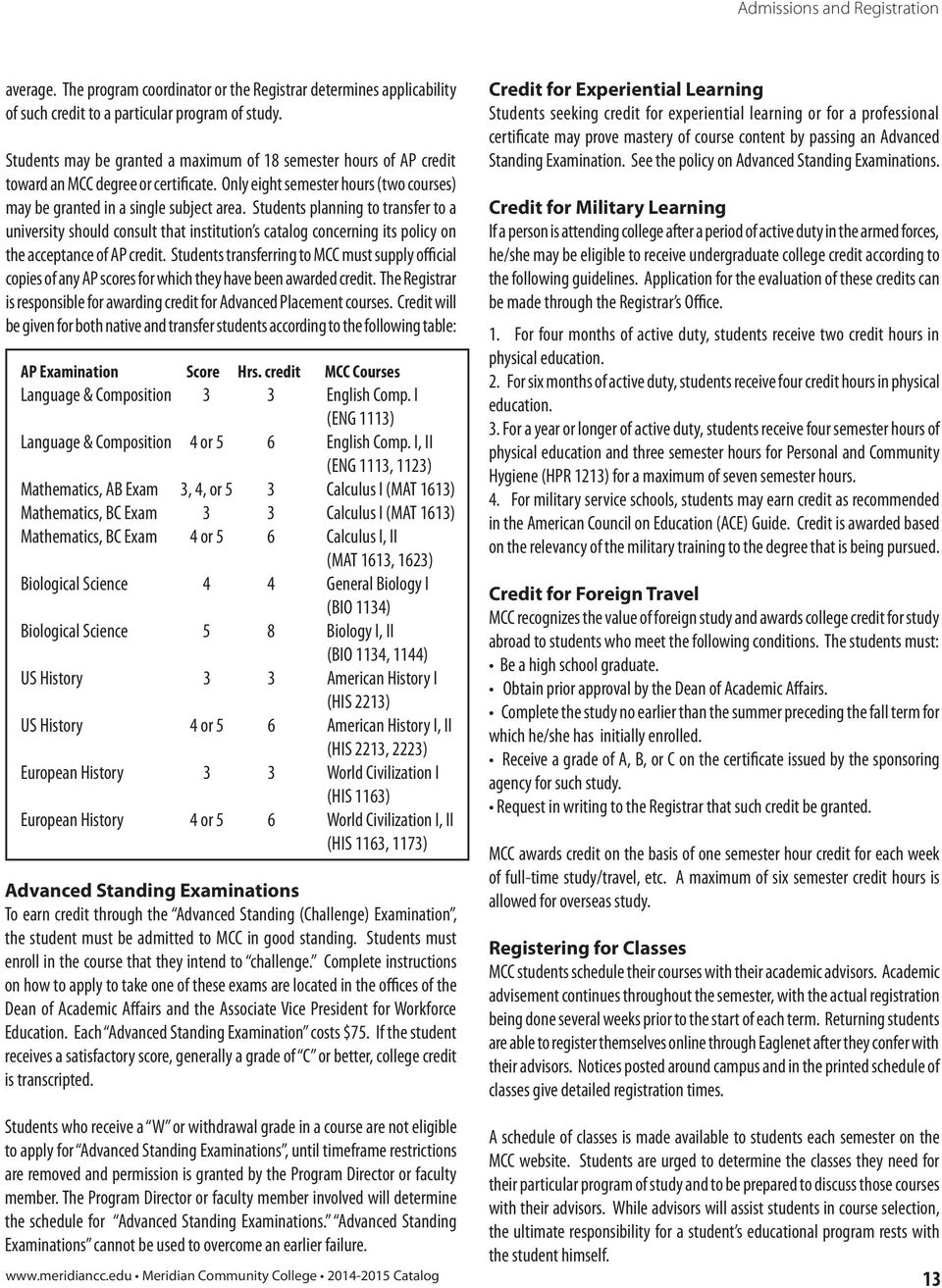
14 Admissions and Registration average. The program coordinator or the Registrar determines applicability of such credit to a particular program of study. Students may be granted a maximum of 18 semester hours of AP credit toward an MCC degree or certificate. Only eight semester hours (two courses) may be granted in a single subject area. Students planning to transfer to a university should consult that institution s catalog concerning its policy on the acceptance of AP credit. Students transferring to MCC must supply official copies of any AP scores for which they have been awarded credit. The Registrar is responsible for awarding credit for Advanced Placement courses. Credit will be given for both native and transfer students according to the following table: AP Examination Score Hrs. credit MCC Courses Language & Composition 3 3 English Comp. I (ENG 1113) Language & Composition 4 or 5 6 English Comp. I, II (ENG 1113, 1123) Mathematics, AB Exam 3, 4, or 5 3 Calculus I (MAT 1613) Mathematics, BC Exam 3 3 Calculus I (MAT 1613) Mathematics, BC Exam 4 or 5 6 Calculus I, II (MAT 1613, 1623) Biological Science 4 4 General Biology I (BIO 1134) Biological Science 5 8 Biology I, II (BIO 1134, 1144) US History 3 3 American History I (HIS 2213) US History 4 or 5 6 American History I, II (HIS 2213, 2223) European History 3 3 World Civilization I (HIS 1163) European History 4 or 5 6 World Civilization I, II (HIS 1163, 1173) Advanced Standing Examinations To earn credit through the Advanced Standing (Challenge) Examination, the student must be admitted to MCC in good standing. Students must enroll in the course that they intend to challenge. Complete instructions on how to apply to take one of these exams are located in the offices of the Dean of Academic Affairs and the Associate Vice President for Workforce Education. Each Advanced Standing Examination costs $75. If the student receives a satisfactory score, generally a grade of C or better, college credit is transcripted. Students who receive a W or withdrawal grade in a course are not eligible to apply for Advanced Standing Examinations, until timeframe restrictions are removed and permission is granted by the Program Director or faculty member. The Program Director or faculty member involved will determine the schedule for Advanced Standing Examinations. Advanced Standing Examinations cannot be used to overcome an earlier failure. Meridian Community College Catalog Admissions and Registration Credit for Experiential Learning Students seeking credit for experiential learning or for a professional certificate may prove mastery of course content by passing an Advanced Standing Examination. See the policy on Advanced Standing Examinations. Credit for Military Learning If a person is attending college after a period of active duty in the armed forces, he/she may be eligible to receive undergraduate college credit according to the following guidelines. Application for the evaluation of these credits can be made through the Registrar s Office. 1. For four months of active duty, students receive two credit hours in physical education. 2. For six months of active duty, students receive four credit hours in physical education. 3. For a year or longer of active duty, students receive four semester hours of physical education and three semester hours for Personal and Community Hygiene (HPR 1213) for a maximum of seven semester hours. 4. For military service schools, students may earn credit as recommended in the American Council on Education (ACE) Guide. Credit is awarded based on the relevancy of the military training to the degree that is being pursued. Credit for Foreign Travel MCC recognizes the value of foreign study and awards college credit for study abroad to students who meet the following conditions. The students must: Be a high school graduate. Obtain prior approval by the Dean of Academic Affairs. Complete the study no earlier than the summer preceding the fall term for which he/she has initially enrolled. Receive a grade of A, B, or C on the certificate issued by the sponsoring agency for such study. Request in writing to the Registrar that such credit be granted. MCC awards credit on the basis of one semester hour credit for each week of full-time study/travel, etc. A maximum of six semester credit hours is allowed for overseas study. Registering for Classes MCC students schedule their courses with their academic advisors. Academic advisement continues throughout the semester, with the actual registration being done several weeks prior to the start of each term. Returning students are able to register themselves online through Eaglenet after they confer with their advisors. Notices posted around campus and in the printed schedule of classes give detailed registration times. A schedule of classes is made available to students each semester on the MCC website. Students are urged to determine the classes they need for their particular program of study and to be prepared to discuss those courses with their advisors. While advisors will assist students in course selection, the ultimate responsibility for a student s educational program rests with the student himself. 13
15 Admissions and Registration To be classified as a full-time student, a person must register for at least 12 semester credit hours. Students with fewer than 28 semester hours of earned credit are referred to as freshmen, while those with 28 or more semester hours are classified as sophomores. The maximum load for a first-term freshman is 18 hours. The average load for a typical student is semester hours. This course load enables the student to complete a two-year educational program in two years. E-Learning MCC recognizes the needs of students who, because of various time or space barriers, cannot attend courses in the traditional classroom setting. Through the use of the Internet, broadcast television (ETV) and local cable programming, MCC students have the opportunity to receive classes at their home or office. MCC provides a growing number of credit and non-credit courses through e-learning deliveries. MCC is an active participant in the Mississippi Virtual Community College (MSVCC), an online effort of the public Mississippi community colleges, further increasing the number of Internet-based courses that are available. Faculty and students participating in e-learning courses interact through phone, , discussion boards, chat rooms, and face-to-face meetings. These courses meet the same educational requirements as the traditional classroom, just in a more flexible format. Admission/registration procedures for e-learning courses are the same as outlined for the traditional classes. Cost for e- learning courses is maintained at the same rate as the traditional courses with the exception of a $15 per course registration fee. Textbooks for e-learning students are available for MCC-originated courses in the MCC Bookstore located in Ivy Hall. MCC Bookstore staff will assist students in obtaining books for courses originating from other schools. Schedule Changes Prior to the end of the first week of classes for any semester, students may add or drop classes online through Eaglenet. After the first week of classes, students may request to add a class through the instructor. However, students are not normally permitted to add a course after the second week of a semester. If a student drops a course prior tothe start first week of the class, no record of the course appears on the student s transcript. Schedule changes are not ordinarily allowed from the third through the seventh week of the semester. Any courses dropped after the second week through the 14th week of the semester will result in a W being recorded on the student s transcript. No student-initiated schedule changes will be allowed after the 14th week of the semester. In rare cases of dropping after the 14th week, the student will receive the grade earned in accordance with the grading policy as published in the First Day Handout for the course. Specific dates for dropping and adding courses are listed on the academic calendars in the catalog. Withdrawing from MCC It is the student s responsibility to officially withdraw from any and all courses. The student should contact the instructor (in person, by phone or via ) to discuss the decision to withdraw. To withdraw from any or all courses (including online courses) at MCC, students should complete the Request to be Dropped from a Class form found on Eaglenet. The request must be submitted by the withdrawal deadline. Refer to the Academic Calendar in the online catalog at for withdrawal deadlines. The student should review the attendance policy for each course; each class attendance policy still applies. Prior to registering for an e-learning course, MCC strongly recommends that students visit the e-learning web-site at edu/elearning and consult with an advisor to determine if e-learning is a viable alternative Meridian Community College Catalog

16 MERIDIAN COMMUNITy COLLEGE CATALOG SECTION 3 ACADEMIC INFORMATION Academic Grades 16 Graduating from MCC 17 President's and Dean's Lists 17 Policy on Privacy 18 Release of Educational Records
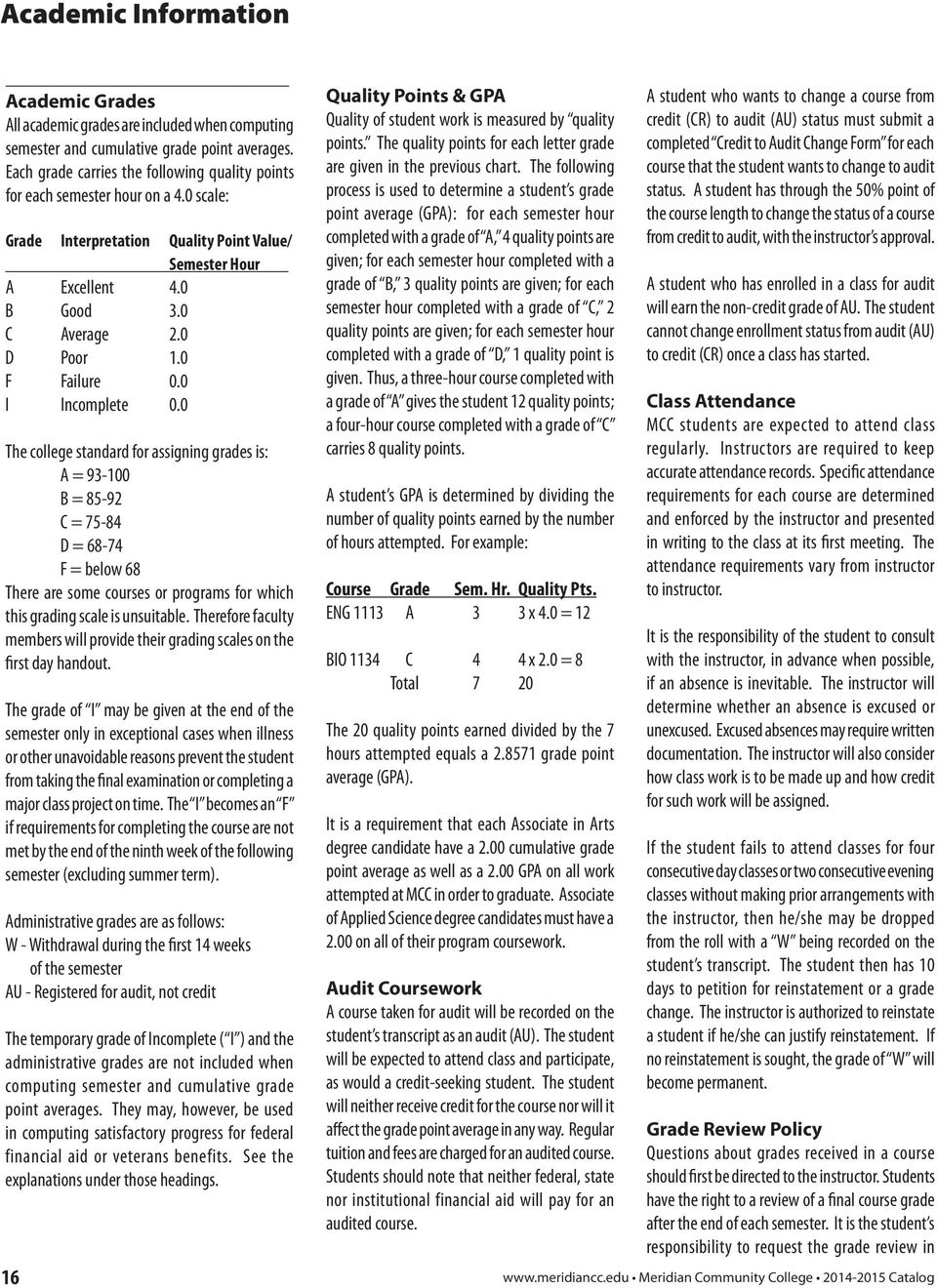
17 Academic Information Academic Grades All academic grades are included when computing semester and cumulative grade point averages. Each grade carries the following quality points for each semester hour on a 4.0 scale: Grade Interpretation Quality Point Value/ Semester Hour A Excellent 4.0 B Good 3.0 C Average 2.0 D Poor 1.0 F Failure 0.0 I Incomplete 0.0 The college standard for assigning grades is: A = B = C = D = F = below 68 There are some courses or programs for which this grading scale is unsuitable. Therefore faculty members will provide their grading scales on the first day handout. The grade of I may be given at the end of the semester only in exceptional cases when illness or other unavoidable reasons prevent the student from taking the final examination or completing a major class project on time. The I becomes an F if requirements for completing the course are not met by the end of the ninth week of the following semester (excluding summer term). Administrative grades are as follows: W - Withdrawal during the first 14 weeks of the semester AU - Registered for audit, not credit The temporary grade of Incomplete ( I ) and the administrative grades are not included when computing semester and cumulative grade point averages. They may, however, be used in computing satisfactory progress for federal financial aid or veterans benefits. See the explanations under those headings. Quality Points & GPA Quality of student work is measured by quality points. The quality points for each letter grade are given in the previous chart. The following process is used to determine a student s grade point average (GPA): for each semester hour completed with a grade of A, 4 quality points are given; for each semester hour completed with a grade of B, 3 quality points are given; for each semester hour completed with a grade of C, 2 quality points are given; for each semester hour completed with a grade of D, 1 quality point is given. Thus, a three-hour course completed with a grade of A gives the student 12 quality points; a four-hour course completed with a grade of C carries 8 quality points. A student s GPA is determined by dividing the number of quality points earned by the number of hours attempted. For example: Course Grade Sem. Hr. Quality Pts. ENG 1113 A 3 3 x 4.0 = 12 BIO 1134 C 4 4 x 2.0 = 8 Total 7 20 The 20 quality points earned divided by the 7 hours attempted equals a grade point average (GPA). It is a requirement that each Associate in Arts degree candidate have a 2.00 cumulative grade point average as well as a 2.00 GPA on all work attempted at MCC in order to graduate. Associate of Applied Science degree candidates must have a 2.00 on all of their program coursework. Audit Coursework A course taken for audit will be recorded on the student s transcript as an audit (AU). The student will be expected to attend class and participate, as would a credit-seeking student. The student will neither receive credit for the course nor will it affect the grade point average in any way. Regular tuition and fees are charged for an audited course. Students should note that neither federal, state nor institutional financial aid will pay for an audited course. A student who wants to change a course from credit (CR) to audit (AU) status must submit a completed Credit to Audit Change Form for each course that the student wants to change to audit status. A student has through the 50% point of the course length to change the status of a course from credit to audit, with the instructor s approval. A student who has enrolled in a class for audit will earn the non-credit grade of AU. The student cannot change enrollment status from audit (AU) to credit (CR) once a class has started. Class Attendance MCC students are expected to attend class regularly. Instructors are required to keep accurate attendance records. Specific attendance requirements for each course are determined and enforced by the instructor and presented in writing to the class at its first meeting. The attendance requirements vary from instructor to instructor. It is the responsibility of the student to consult with the instructor, in advance when possible, if an absence is inevitable. The instructor will determine whether an absence is excused or unexcused. Excused absences may require written documentation. The instructor will also consider how class work is to be made up and how credit for such work will be assigned. If the student fails to attend classes for four consecutive day classes or two consecutive evening classes without making prior arrangements with the instructor, then he/she may be dropped from the roll with a W being recorded on the student s transcript. The student then has 10 days to petition for reinstatement or a grade change. The instructor is authorized to reinstate a student if he/she can justify reinstatement. If no reinstatement is sought, the grade of W will become permanent. Grade Review Policy Questions about grades received in a course should first be directed to the instructor. Students have the right to a review of a final course grade after the end of each semester. It is the student s responsibility to request the grade review in 16 Meridian Community College Catalog
18 Academic Information writing to the instructor of record in the relevant course. The written request of the grade review must be presented to the instructor within 30 calendar days after the close of the final exam period for the fall semester, within 120 calendar days after the close of the final exam period of the spring semester, and within 30 calendar days after all summer, interim, and short term courses. The instructor of record in the relevant course will provide a written response explaining the rationale for the instructor s decision on the final grade to the student requesting the review within 10 calendar days. The instructor will provide a copy of the written request and the written response to the appropriate division chair. Any further action, if needed, will be decided upon by the division chair and/or the appropriate dean(s). Honors College The Honors College at Meridian Community College offers academically-gifted students the opportunity to enhance their educational experience. The Honors College is designed to complement the University Transfer program through enriched courses, development of leadership skills, and more individualized academic support. Students enjoy a community of classmates who are interested in making the most of their college learning experience. The Honors College provides students with the opportunity for growth as students, leaders, and stewards of the community. Students also have the opportunity to broaden their horizons through educational travel. Students who complete graduation requirements for the Honors College will be awarded an Honors College diploma and will be eligible to transfer into the Honors College at participating Mississippi universities. To be considered for enrollment in the Honors College, prospective students must meet the following admission requirements: Entering freshmen must Have a composite ACT score of 23 with no sub-score less than 18. Have a high school GPA of 3.5. Submit an Honors Application. Submit two letters of recommendation with at least one from a teacher or administrator. Conduct an interview with the admissions Meridian Community College Catalog committee. Returning students must Have completed at least 12 transferrable hours at MCC with a GPA of 3.5. Submit an Honors Application. Submit two letters of recommendation completed by MCC faculty or staff. Conduct an interview with the admissions committee. Students admitted to the Honors College are expected to set high standards for themselves, both academically and behaviorally. Students are required to remain enrolled full-time and maintain a 3.25 GPA. If a student s enrollment falls below full-time (12 hours), the student may be immediately dismissed from the Honors College. If a student s GPA drops below 3.25, he or she will be placed on probation for one semester. If at the end of the probation period the student s GPA is still below 3.25, he or she will be dismissed from the Honors College. Students who receive disciplinary sanctions from the institution are subject to be dismissed from the Honors College. To graduate with a diploma from the Honors College, at least 15% of the hours for the degree must be made up of honors classes. earned in the honors forums and the honors leadership course will count towards this requirement. In addition, students must meet the following requirements: Complete at least one honors class per semester. Complete one honors forum per semester, unless otherwise approved by the academic dean. Complete required leadership course. Complete a cumulative total of 20 hours of documented community service. For more information, contact the Office of Academic Affairs at Graduating from MCC MCC confers degrees during commencement exercises at the end of spring semester (May), at the end of summer term (August), and at the end of fall semester (December). A student must complete a prescribed program of study to receive the Associate in Arts Degree, Associate of Applied Science, or one- or two-year certificate from MCC. Each student is responsible for acquainting himself with the requirements for graduation. A minimum of 62 semester hours is required to graduate with an Associate Degree, although some programs require more than 62 hours. Specific course requirements are contained in the Programs of Study section of this catalog. Academic advisors will assist in every way possible, but the final responsibility for meeting all requirements for a degree in a program of study rests with the student. Students who plan to graduate and then transfer to a university must maintain a 2.00 cumulative GPA (cgpa) as well as a 2.00 GPA on all work attempted at MCC to graduate. Students planning to graduate in a Workforce or Career and Technical Education program must maintain an overall 2.00 cgpa in all their program coursework and pass all career specific coursework with a grade of C or better. If transfer credit is used to meet the requirements for graduation, the transfer credit added to the MCC credit must yield at least a 2.00 GPA. Students must complete 25% of their degree program at MCC to be considered for graduation. Students applying for an Associate of Applied Science (AAS) or a Certificate must apply within three calendar years following the last semester of attendance; this requirement is waived for active duty Service Members and their family members. Students in the Associate Degree Nursing or a Health Education program must complete the final semester of technical courses in residency. Applying for Graduation Each student who plans to graduate from MCC must meet with his/her academic advisor to complete an application for graduation at the beginning of the final semester of study. For those students who wish to participate in the graduation ceremony, there is a commencement fee that must be paid to the Business Office at the time of registration for the semester in which the degree is to be conferred. Cap and gown arrangements will be made at this time. A late commencement fee will be assessed for applications received after the published deadline. Those who do not wish to participate 17

19 Academic Information in the ceremony will not be required to pay a fee, however, application deadlines still apply. Students must also pay all fees and discharge all other financial obligations to the College before a diploma or official transcript will be issued to the student. Every student who is to receive an Associate in Arts, Associate of Applied Science, or a Certificate from MCC should complete a graduation application. The student should meet with his/her advisor (in the advising area) to determine whether all requirements have been met. Students are encouraged to participate in the graduation (commencement) ceremony. The student may participate in the commencement ceremony and pay the commencement fee or choose not to participate and have the diploma mailed to him/her at no cost. Reverse Transfer Policy Former students may transfer work back to Meridian Community College to complete degree requirements subject to the following requirements: 1. The reverse transfer policy applies to the Associate in Arts degree only. 2. The maximum amount of credits that may be transferred back shall be 8 credit hours. 3. Coursework is subject to the guidelines set forth in the transfer credit policy, located in Section 2 of the MCC Catalog. 4. The student must complete the degree requirements and apply for graduation. President s and Dean s Lists MCC recognizes scholastic achievements by publishing the President s and Dean s List at the end of the fall and spring semesters. The President s List includes students carrying 12 or more semester hours who have a grade point average of The Dean s List includes students carrying 12 or more semester hours who have a grade point average of 3.25 to Honors for Graduation Students who attain a GPA on all work attempted at Meridian Community College are eligible to graduate with honors. Students who earn a MCC GPA are eligible to graduate with high honors. If a student attains an MCC GPA of , he/she is eligible to graduate with highest honors. Academic Standings Students are classified by the following policy: Students are in good standing if they achieve at least a C average. Students are on academic probation if, at the end of a semester, they have not earned at least a 2.00 GPA. Students placed on academic probation are advised by letter and asked to meet with their advisor several times during the next semester. Full-time students who were on academic probation the previous semester must earn a C average on at least 12 hours or be placed on academic suspension for a semester, excluding the summer term. (Summer terms are treated independently of the fall or spring semester for academic probation or suspension purposes.) If a student wishes to request permission to continue college when facing academic suspension, he/she must petition the Dean of Student Services in writing. This written appeal should address any reason why the student has not been successful, including any extenuating circumstances. If the suspension appeal is approved, the Dean of Student Services will clear the student to register. A student on academic appeal must earn a 2.00 GPA for the semester of the appeal or be placed on academic suspension for one academic year without appeal. The decision to reinstate a student facing academic suspension is made by the Dean of Student Services. Students in health education programs who fall below the published minimum academic requirements will be notified in writing by a faculty member. Transcript of Record A student may obtain an official copy of his/ her transcript (to be mailed or for personal use) by submitting a written request to the Records Office in Ivy Hall or by submitting an online request though the MCC website. A student may obtain an unofficial transcript through Eaglenet. No transcript will be furnished until the student has resolved any hold placed on his/her account or made satisfactory arrangements for its settlement. Enrollment Verification A student may obtain proof of college enrollment by logging into Eaglenet and choosing the Enrollment Verification link. Once the student enters and submits his/her identifying information, the student can then print or the enrollment verification document. Policy on Privacy MCC is in compliance with the policies on privacy of student records as described in the Family Educational Rights and Privacy Act of 1974 (FERPA). Under FERPA, students enrolled in any post-secondary educational institution receiving federal funds are given certain rights concerning review of their education records. The following rights are accorded under this act: Students are entitled to have access to their educational records upon proper request. Students are not entitled to have access to instructional, supervisory and administrative personnel records, campus security records, employment records, or alumni/advancement office records. Students are entitled to inspect and review their educational records and to challenge the contents if they feel those contents are inaccurate, misleading, in violation of privacy or other rights, or if they contain inappropriate data. The College may require that a college official be present when a student inspects and reviews his/her educational records. Any questions concerning a student s access to records should be directed to the Records Office. The College must have written consent before any educational records are released to third parties (colleges, potential employers, etc.) that have requested copies of a student s educational records. Upon receipt of a subpoena or judicial order requiring the President of MCC to relinquish control of a student s records, the student will be notified insofar as possible of the subpoena or judicial order before the President relinquishes control of the records Meridian Community College Catalog

20 Academic Information The law allows directory information about students to be made public without specific permission from the student. Students are entitled to request that certain information be deleted from college publications. Directory information released includes student s name and address, telephone number, date and place of birth, number of semester hours accumulated and/or currently taking, dates of attendance, awards and degree received. Information of participation in officially recognized activities and sports (including height and weight of members of athletic teams) is also included. If a student does not wish directory information made public, a written request must be on file with the Records Office. A student must make this declaration every semester that he/she desires the information withheld. The College maintains a list containing the signature, the date and the reason for all individuals receiving access to a student s records. The student is entitled to have access to this list. The law, however, allows college officials, including instructors, to have access to a student s educational records without signature. Release of Educational Records The College will release a student s educational record(s) upon the student s written request. The student must: 1. Specify the records to be disclosed. 2. State the purpose or purposes of the disclosure. 3. State the party or parties and the address to which the disclosed information is to be sent. State the party or parties and the address to which the disclosed information is to be sent. The student shall, upon request, receive a copy of the record that is to be disclosed. It is College policy to furnish single copies of a student s record at no charge. The College may release a student s educational records to the following without prior written consent: 1. To College officials who have a legitimate interest in the records. College officials are defined as teachers, administrative personnel and other employees, such as campus security officers. 2. To officials of another school in which the student intends to enroll upon request of the transfer school. 3. To government representatives of the Comptroller General of the United States, the Secretary of Education, the U. S. Commissioner of Education, the Director of the National Institute of Education, the Assistant Secretary of Education, State educational authorities, and State officials to whom such information is specifically required to be reported or disclosed by State law adopted prior to November 19, To appropriate authorities in connection with financial aid with the understanding that only the necessary records will be released. 5. To organizations conducting studies for, or on behalf of, the College, for the purpose of developing, validating, or administering predictive tests, administering student financial aid programs, and improving instruction and student life, provided that the studies will not permit the personal identification of students and their parents by individuals other than representatives of the organization and provided that the personally identifiable information furnished will be destroyed when no longer needed for the purposes for which the study was conducted. 6. To accrediting organizations to carry out accrediting functions. 7. To parents of a dependent student as defined in section 152 of the Internal Revenue code of College officials may release educational records to parents on the basis of written certification from the parent that the student is a dependent as defined under the Code. 8. To officials of the courts in compliance with a judicial order or lawfully issued subpoena with the understanding that the student will be notified in advance insofar as possible. 9. To appropriate parties to protect the health and safety of the student or other individuals in emergencies, with the understanding that only information essential to the emergency situation will be released, that information will only be released to a party who would be in a position to deal with the emergency, and that the student will be notified insofar as possible of the information released, the purpose for the release, and to whom the information was released. No personal information on a student will be released without a statement from the College to the party receiving the information that no third party is to have access to such information without written consent of the student. This policy is adopted pursuant to the Family Educational Rights and Privacy Act of 1974, as amended (20 U.S.C. # g), and is not intended to impose any restrictions or grant any rights not specifically required by this act. Meridian Community College Catalog 19

21 20 Meridian Community College Catalog
22 MERIDIAN COMMUNITy COLLEGE CATALOG SECTION 4 STUDENT SERVICES & ACTIVITIES 4 Academic Advising and Counseling Veteran's Affairs and Benefits Campus EagleNet ientation Support Services Housing Mail Service Campus Life & Student ganizations Special Interest Groups Student Leadership Training Club Eagle Wilhemine Damon Fitness Center Intercollegiate Athletics Intramural Sports Awards Learning Resources Student Success Center The Holladay Center for E-Learning Ronald R. Miller Art Gallery
23 Student Services and Activities Purpose of Student Services The purpose of MCC s Student Services is to encourage the growth and development of each student s potential by providing educational programs which enhance his/her ability to learn, to become self-directed, to function more efficiently in society and to become a proficient decision-maker. Student Services, in collaboration with instruction, can assist students in achieving their educational objective. Student involvement in leadership roles in campus organizations and committees is designed to enhance personal leadership development and provide opportunities to participate in institutional decision making. Programs offered in Student Services include Academic Advisement, Testing, Tutorial Services, Career Development Services, Student Activities and Athletics. In addition, Admissions, Financial Aid, Campus Housing, ientation, Records, Recruitment, Security, Fitness Center, Veteran Services, and Special Populations Services are also part of Student Services. Academic Advising Academic advisement plays an important role in the total educational program at MCC. The purpose of academic advisement is to help students develop their potential through selfdirection and effective decision making relative to their program of study. Advisors are assigned to all students based upon planned programs of study. However, students who are undecided, who are taking basic courses to enhance skills, or who are taking courses for personal enrichment or skill development are also assigned an advisor. Faculty advisors are available to students during their regular office hours, which are posted on office doors. Advisors are also available in Ivy Hall from 8 a.m. to 8 p.m. and in the Health Building from 8 a.m. until 4:30 p.m., Mondays through Thursdays, and from 8 a.m. to 3:30 p.m. in both locations on Fridays. Students are welcome to see their advisor on a walk-in basis. It is recommended, however, during peak registration times (summer orientation and the two weeks prior to fall and spring semesters) to make an appointment with an advisor, so waiting will be kept to a minimum. If a prospective student would like a campus tour or to learn more about MCC programs, admissions staff members are available by calling Counseling Information regarding referral for free mental health services for crisis situations (alcohol or drug abuse, family or marriage concerns, suicide, child or spouse abuse, etc.) may be obtained from MCC advisors, the Associate Dean for Student Services, the Dean for Student Services or other MCC Student Services staff. Veterans Affairs and Benefits MCC welcomes veterans and military personnel. The Veterans Certifying Official, located in the Admissions Office in Ivy Hall, assists veterans in the application, registration, and financial aid process. MCC is a Servicemen s Opportunity College (SOC). Veterans who plan to attend MCC under any type Veterans Administration Educational Assistance Program, such as Chapter 30/1606 and 1607 (Montgomery G.I. Bill), Chapter 31 (Vocational Rehabilitation), Chapter 32 (post-vietnam), Chapter 33 (Post 911), or Chapter 35 (Survivors and Dependents Educational Assistance), should file a claim with MCC s Veterans Certifying Official. Students must supply the Veterans Certifying Official with certified or original copies of DD-214 (separation papers), marriage license, dependent children s birth certificate(s), and divorce documents (all previous divorce documents of veteran and veteran s spouse, if presently married). Students must provide the Veterans Certifying Official proof of completion of high school or the equivalent (a high school transcript or a transcript from the General Educational Development (GED) Test) to be certified for benefits. Students must also provide the Veterans Certifying Official with official college transcripts of all previous college work to be certified. (Students will not receive veteran s benefits for equivalent courses taken at other institutions.) It is the student s responsibility to notify the Veterans Certifying Official of any change in dependents, educational objective or number of hours being taken. If there is a decrease in the number of hours being taken at MCC, VA regulations require the student to repay benefits for hours dropped unless the VA determines extenuating circumstances exist. Students must take courses leading toward their educational objective as approved by a counselor/ advisor to receive VA benefits. To be considered full time, students must be taking at least 12 semester hours. Nine semester hours is 3/4 time; six semester hours is 1/2 time; and three semester hours is 1/4 time. Students who are veterans cannot be certified for educational assistance benefits when more than 85 percent of the class enrollment is made up of veterans or other individuals receiving veterans assistance. In order to continue to be eligible to receive benefits under Chapters 30, 31, 32, 33, 35 and 1606/1607, Title 38, U.S. Code, veterans must achieve satisfactory progress toward educational goals by meeting the following standards: Students who are veterans must achieve a C average (2.00 grade point average) each semester on six semester hours or more to be considered to be making satisfactory progress. All courses pursued after the deadline set each semester for dropping a course are assigned an academic grade for computing grade point average. If MCC has determined a student is not progressing satisfactorily, he/she is placed on academic probation for one semester. Students are eligible for VA benefits during the probationary semester. If a veteran is a full-time student and was placed on academic probation the previous semester, he/she must earn a C average on at least 12 semester hours or be placed on academic suspension for a semester, excluding the summer. If a student is suspended, he/ she must remain out of college for one regular semester. When re-admitted, he/she is on probation and must enroll in and complete six semester hours or more with a C average Meridian Community College Catalog
24 Student Services and Activities Students facing academic suspension may appeal in writing to the Associate Dean for Student Services for permission to continue college. If approval is given to continue in school, the student must enroll in and complete six semester hours or more with a C average. If the student does not make a C average, he/ she will be suspended for one academic year without appeal. The Veterans Administration restricts benefits for television and independent study courses. Student Health Service Although MCC does not employ full-time health personnel, first aid treatment is available from each residence hall supervisor, Campus Police and at designated first aid stations in each building. Students should report sickness or injury of a more serious nature to Campus Police on the first floor of Ivy Hall or call extension 620. The Campus Police Officer will call for emergency medical services and/or transportation to a local health care facility if necessary. In case of injury or illness, Campus Police will also notify a student s family. (Note: When assisting an injured or ill person on campus, faculty and staff should follow the Universal Precautions in Handling Body Fluids including the wearing of gloves and the disposing of supplies properly as recommended by the Centers for Disease Control.) Students are encouraged to avail themselves of local health services whenever necessary. The Lauderdale County Health Department and doctors offices are located near the campus. Students will be responsible for any medical bills. Campus EagleNet All MCC students have online access to view their grades and their financial aid status, in addition to any balances on accounts or holds on their records, through Campus EagleNet, MCC s local Internet portal. Each student also has an address which can be used even after the student leaves MCC. EagleNet has a calendar function as well as course chat rooms and message boards. After students have been officially admitted to MCC, they will receive a letter informing them of their EagleNet user name and password. Meridian Community College Catalog ientation MCC offers orientation sessions during the summer for in-coming freshmen. These sessions serve to acquaint new students with the campus and to answer the questions and concerns of freshmen and their parents. ientation participants meet faculty members, administrators and other students. They also learn about opportunities available to them, including student activities. Freshman students are allowed to register for fall classes only after they have attended one of the summer orientation sessions. Support Services Career and Technical Education (CTE) Support Services provides members of special populations equal access to recruitment, enrollment and placement activities, and to the full range of educational programs available. These programs include Career and Technical Education specific programs of study, and comprehensive career guidance and counseling services. No one shall be discriminated against on the basis of his/her status as a member of a special population. The CTE Support Services Office strives to encourage independence, to assist students in realizing their academic potential, and to facilitate the elimination of physical, programmatic, and attitudinal barriers. Students are considered part of a special population If they are economically disadvantaged If they are educationally disadvantaged If they have a disability If they are a displaced homemaker If they are a single parent If they are preparing for non-traditional training and employment Students with disabilities must self-identify to receive accommodations and special services. Identification involves a student registering with the CTE Support Services Office and presenting appropriate documentation verifying the disability. Self-identification is voluntary. However, the CTE Support Services Office can be of service to students only to the extent that their individual needs are made known. Students and prospective students are encouraged to make an early contact with the CTE Support Services Office. Services for single parents and displaced homemakers include counseling, guidance in achieving career goals, advocacy support, community referrals and networking with agencies. Support groups are available to help build self-confidence and to offer solutions for time and stress management. The CTE Support Services Offices are located in the Advising Office in Ivy Hall. Interpreting Services for the Deaf/ Hard of Hearing MCC Provides interpreting services for students with the proper documentation. Interpreting services are provided for all academic courses. The College is responsible for the cost of the interpreter; however, the college will not pay for interpreting services for courses the student has previously satisfactorily passed. Vocational Rehabilitaion may reimburse the college for the cost of the interpreter if the student qualifies for services through that agency. The Special Population s offices and the Interpreter s office are both located in the Advising Office of Ivy Hall. Housing MCC has two residence halls and a 72-unit apartment complex. Eagle Residence Hall, located across Highway 19 from the campus, houses 126 male students. Thornton Hall, located on the main campus, houses 44 female students. The College Crossing Apartments, also located on the MCC campus, has both one- and two-bedroom units. A residence hall director lives in each of the halls and in the apartment complex. Every student living in MCC housing must be enrolled as a full-time student and maintain full-time enrollment throughout the semester. A required meal plan is included in the cost of housing. Admission to MCC does not guarantee a student a room reservation on campus. Students wishing to live in college housing should contact the Housing Director for complete details. The Housing 23
25 Student Services and Activities Director s office is located in Ivy Hall, room 131. Residence hall rules and regulations are published in the Residence Life Handbook. However, the policies stated in the MCC Catalog are the primary rules of the institution; the Resident Life Handbook is a supplement to the MCC Catalog. Mail Service Mail service is provided by the College in Ivy Hall. Students living in residence halls receive a mail drawer (included with housing) each semester. The address is as follows: Student s Name, Drawer #, Meridian Community College, 910 Highway 19 N, Meridian, MS Those students living in College Crossing Apartments receive their mail at the apartment mailboxes. Mail service hours are 9 a.m.-12 Noon and 1 p.m.- 3 p.m., Monday-Friday. Mail is not distributed on weekends and holidays. Campus Solicitation Policy The intent of the MCC solicitation policy is to ensure noninterference with the educational activities and business operations of the College. Solicitation is prohibited whereas the following definition and policy applies to activities by any off-campus individual or group and applies to all MCC property, locations and events. Solicitation is defined as any active attempt to raise funds through direct sale of merchandise, services, or donations, with or without products or services rendered. Also, any method of communication intended to induce support of a service, organization, business activity, issue, cause, etc. will be considered solicitation. This includes the distribution of literature, leaflets and/ or materials, posters, handouts, etc. Any individual who violates this policy may be subject to sanctions or penalties including, but not limited to, charges of trespassing. Campus Life and Student ganizations Meridian Community College provides a variety of campus organizations, special interest groups and social activities for students. The Campus Life Program provides activities designed to complement and supplement classroom education by providing another kind of learning experience. Campus Life involves students in the College and the community, gives them input into college decision-making, provides leadership-training opportunities and creates professional and personal growth opportunities through student organizations. Art Students League (ASL) encourages the interest of art through student involvement, education, college and community activities. ASL helps to enlighten and increase student and community awareness of art. Baptist Student Union (BSU) provides Christian fellowship and serves as a Christian witness to the campus and community. Business Student ganization (BSO) works with university transfer students majoring in a business or related discipline to network and foster camaraderie with other students on the MCC campus and community business leaders. College Activities Board (CAB) consists of a diverse population of the student body, faculty and staff who meet to plan, promote, and supervise a variety of social and educational activities for MCC students. Collegiate Distributive Education Clubs of America (DECA) strives to develop future leaders in the hospitality area by helping students grow and develop as professional managers. Programs and activities are planned to focus on the hospitality/tourism industry. Fellowship of Christian Athletes (FCA) is open to all students and athletes to have a time of Christian fellowship and fun. Future Educators of America (FEA) promotes all aspects of teaching and provides moral support and fellowship. Graphic Artist Association (GAA) is open to students enrolled in the Graphic Design Technology program. The GAA gives students an opportunity to develop professionally by working on projects with the community as well as other campus organizations. Health Occupation Students of America (HOSA) serves the needs of the Health Education students. The group helps to promote and strengthen the HOE (Health Occupations Educators) -HOSA partnership. MCC College Republicans play a vital role in recruiting, educating, and involving students in the Republican Party. Within College Republicans, diverse individuals find a place to share their ideas, their commitment to country, and their common passion for core conservative values. Involvement with the MCC chapter of College Republicans provides tremendous opportunities to gain valuable leadership training and political experience, network with political and community leaders, and make a significant impact in the electoral process. The MCC chapter of College Republicans organizes events and special projects, and participates as valued campaign foot soldiers in local, state, federal, and presidential races. MCC Gospel Choir gives students an opportunity to share their talents through the expression of gospel music and to fellowship with others while serving as musical ambassadors for the college on and off campus. ganization of Student Nurses (OSN) is open to all student nurses in the Associate Degree Nursing Program at MCC. Phi Beta Lambda (PBL- BOT) is the postsecondary division that provides opportunities for students to develop business-related career competencies. It is an integral part of the instructional program and in addition promotes a sense of civic and personal responsibility. Phi Beta Lambda (PBL-Comptech) is the postsecondary division of Future Business Leaders of America. PBL s purpose is to encourage a positive working relationship between business and education through leadership development programs. Proven results of PBL membership are leadership, self-confidence, competitive abilities, fundraising experience, good citizenship and business proficiencies. Phi Theta Kappa (PTK) is the national honor society for community and junior colleges. The organization promotes leadership, scholarship, 24 Meridian Community College Catalog
26 Student Services and Activities service and fellowship. MCC is the Nu Upsilon Chapter. Membership is open to any student who has earned 12 semester hours and has a grade point average of 3.5 or better on a 4.0 scale. Skills USA Industrial Club of America (VICA) partners with both students/teachers and industry to ensure a skilled workforce. This state and national organization helps students prepare for careers in trade, technical and skilled service occupations. This organization was formerly known as VICA (Vocational Industrial Clubs of America). Student Association of Broadcasters (SAB) is open to Broadcasting students and provides a hands-on approach to learning broadcasting skills at MCC and in our community. Student Association of Cosmetology is open to Cosmetology students and provides a hands-on approach to learning cosmetology skills at MCC and in our community. Student Association of Dental Hygiene Association (SADHA)), affiliated with the American Dental Hygiene Association, promotes and sustains the practice of dental hygiene by increasing awareness of prevention of oral diseases in an effort to improve the public s total health. The organization actively participates in off-campus presentations educating the public in preventive measures and stays abreast of current events in the dental hygiene profession to promote the highest standards in the field. Student Association of Early Childhood is an educational organization concerned about the care and education of young children. The organization helps each person grow as a professional worker with young children. Student Association of Medical Lab Technicians (SAMLT) promotes interest and knowledge about the Medical Lab Technology career. Student Association Radiologic Technology (Rad Tech) promotes interest and knowledge about the radiological field and gives the students opportunity to develop professionally. Meridian Community College Catalog Student Association of Respiratory Care (SARC) seeks to educate the public about respiratory therapy, and to further the development of each member s leadership qualities. Student Practical Nursing ganization (PN) assists in the growth and development of the nursing profession, leadership and individual responsibility of the Practical Nursing student. Wesley Campus Ministries provides social and service opportunities for Christian students. Special Interest Groups A special interest group is an organization that is designed to support specific college functions and is financially supported through the MCC Budget. These groups often perform a specific service for the College and are not required to submit all paperwork and do not qualify for incentive funds or awards. Chorus Dimensions The Ivy League Student Recruiters Jazz Band Honors College Student Leadership Training MCC s Student Leadership Effectiveness and Development (LEAD) Program provides leadership training for campus organizations. The LEAD Program is open to all students. Training sessions are presented throughout the fall and spring semesters. Topics include goal setting, assertiveness training, parliamentary procedures, time management, motivation, listening skills, college study skills, job search skills, managing conflict, stress management, relaxation and creative thinking. LEAD participants are invited to attend student leadership sessions. Programs feature guest speakers on motivational topics and current issues, ranging from the power of positive thinking to minority leadership. Students meet MCC s administrators, the Board of Trustees and other leaders in the community and state. Each spring certificates are awarded to students based on their participation in the year s training sessions at a LEAD reception. Publications Literary Review is an MCC literary magazine devoted to publishing winning contest entries and other student and community creative writing. Included in the Literary Review are poetry, short stories, informal essays, and graphic design artwork. Club Eagle Club Eagle is located at the east end of the campus, adjacent to Thornton Hall and College Crossing Apartments. This is a popular location on campus where students gather in their free moments for socializing and relaxation. Here they may listen to music, watch television, play video games, participate in table tennis, foosball, play card games, and enjoy a large deck for studying, eating, and/or talking. Wilhelmine Tew Damon Fitness Center The Wilhelmine Tew Damon Fitness Center, opened in January 1990, offers a variety of activities to students as well as to the community. Located near the MCC Baseball Complex, the Fitness Center has the following facilities available to students, faculty, staff, and community use: Natatorium with a six lane 25 meter pool Weight room and fitness area featuring Nautilus and Universal equipment, Schwinn Airdyne exercise bicycles, Stairmaster, Quinton and Precor Treadmills, Precor elliptical trainers, Precor AMT, and free weights. Dance studio with a cushion floor Tennis courts, track, outdoor basketball court, putting green and sand volleyball court For course information, times, schedules, fees, and policies for use, contact the Damon Fitness Center at Intercollegiate Athletics MCC is proud of its varsity athletics program. Many of its athletic teams and individual athletes are nationally recognized. The College boasts teams in men s and women s basketball, men s and women s tennis, baseball, softball, golf, men s 25
27 Student Services and Activities and women s soccer. Attendance at home games is free for full-time students, faculty and staff with a valid MCC I.D. Intramural Sports MCC offers a limited intramural program. The program provides activities for participants at different skill levels. Not limited to team sports, the intramural program sponsors competition in basketball, flag football, bowling, and table games. The Campus Life Coordinator coordinates this program. Awards Each spring, MCC sponsors an Awards Night presentation to recognize and honor outstanding students from different career programs and subject areas for leadership, scholarship and academic performance. The B.G. Raden Awards recognize outstanding student organizations. Students selected for Who s Who Among Students in American Junior and Community Colleges are also honored. The H.M. Ivy Award recognizes outstanding sophomores. Outstanding service to the college and the community by a faculty member is honored through the T.J. Harris Award. Two John A. Johnson Awards, which come with a $500 award, recognize the outstanding staff members. Three $500 Clarence Roberts Outstanding Teacher Awards are also presented by The MCC Foundation. At each graduation ceremony, a group of outstanding MCC graduates is recognized with Circle of Excellence awards sponsored by The MCC Foundation. During the spring graduation program three $3,000 H.M. Ivy Scholarships are announced to help top graduates with their junior and senior years of study. Art awards and literary awards sponsored by The MCC Foundation are presented during the year and carry monetary prizes. Full-time employees of the College are eligible for the MCCer of the Month recognition, which includes a $250 award from The MCC Foundation. Learning Resources The L.O. Todd Library houses the Library, the Production Center, Web Services and Promotions Department. These four service areas comprise the Learning Resources Center. These services are basically provided for faculty and student use. Since MCC accepts responsibility for the educational development and cultural enrichment of the community, some services, especially access to the book collections, may also be extended to citizens of Lauderdale County and the City of Meridian. The L.O. Todd Library contains the collections for MCC, Mississippi State University-Meridian and University of Southern Mississippi-Nursing. It houses 61,403 volumes. Additionally, the collections include 4,781 electronic books. The Library subscribes to 226 periodicals including scholarly journals, popular magazines, local and national newspapers. Several thousand other journals and magazines are available in full-text format via electronic databases and can be accessed from the Library s homepage on the Internet. The audio-visual (AV) collection of 4,000 items is held in formats ranging from sound recordings to DVD s. The library is a member of the National Network of Libraries of Medicine. The Library is open six days a week during the spring and fall terms: Monday - Thursday, 7:30 a.m. - 9 p.m.; Friday, 7:30 a.m. - 3:30 p.m.; Saturday, 9 a.m. - 1 p.m. will vary in the summer and during holiday periods. The Production Center, the audio-visual arm of Learning Resources, is located on the lower level of the Todd Library. The Production Center manages audio/visual services and equipment for the College. The Center houses a television production and distribution facility as well as an FM commercial radio station, WEXR FM, and graphic services. The College also hosts a community cable channel and in-house informational channel for students, faculty and staff, which are disseminated from the Production Center. Additionally, viewing rooms and instructional programs in Graphics Communications Technology and Broadcast Communications Technology are located in the Production Center area. The Casteel Gallery of Art, which is located in the foyer of the L.O. Todd Library, maintains more than 300 works of art in its permanent collection, and is named for the late Homer Casteel, a former MCC art instructor. Student Success Center The Student Success Center, located on the second floor of G.V. Sonny Montgomery Student Center, provides both one-on-one and computer-based tutorial services for MCC students. The Center contains 83 up-to-date computers for student use in word processing and Internet research. The computers also contain course-related software. In addition, the Student Success Center houses the PLATO LEARNING SYSTEM, an individualized, self-paced, computer-managed instructional system that provides a wide range of instruction through specific course selection. The Center employs a highly qualified instructional staff as well as student tutors. The Center is open from 8 a.m. to 8p.m. Monday through Thursday; 8 a.m. to 2 p.m. on Friday; 8 a.m. to noon on Saturday (fall and spring semesters only). The Holladay Center for E-Learning The Holladay Center for E-Learning serves as the hub of distance education and instructional technology. Established in 2011, the Center includes 98 up-to-date computers in the main lab which serves as the central location at MCC for proctored examinations for distance education courses offered through the MSVCC in addition to the administration of campus based courses, nursing, HESI, ATI, and Accuplacer examinations. In compliance with ADA regulations, the Center provides 10 individual testing rooms for students who meet specific criteria. In addition to overseeing 22,000 appointments a semester, the Center administers, trains and supports the College s learning management system (LMS), Canvas by Instructure, which is utilized by online and campus based courses. The Center also administers, trains, and supports the incorporation of ebooks, a campus wide initiative to introduce affordable electronic textbooks through the use of the LMS in online and campus based courses. Faculty and staff seeking to increase their technologic skills and usage can attend one of the many Professional Development sessions on current and emerging 26 Meridian Community College Catalog
28 technologies hosted by E-Learning staff. Located on 14th street, adjacent to the Annex trailers and Soccer complex, the Center is open Fall and Spring Monday-Thursday 7:00am to 7:00pm, Friday 8:00am to 4:00pm, and Saturday 8:00am to 12:00 (noon). During the Summer the Center is open Monday-Friday 8:00am to 7:00pm and closed on weekends. For more information, please visit the elearning website at elearning or by at edu or by phone at Ronald R. Miller Art Gallery The Ronald R. Miller Art Gallery at Meridian Community College is an extension of the MCC Art Dept. serving the students and community by hosting six art exhibits per year. The Miller Art Gallery is named in honor of theatre instructor Ronnie Miller who was an art activist at MCC and in the community from 1966 through The Gallery is located in the Davidson Fine Arts Center (Ivy Hall) and is free and open to the public Monday Thursday from 10:00 am to 4:00 pm. For more information contact John Marshall (MCC Art Dept. Coordinator) at or Meridian Community College Catalog 27
29 28 Meridian Community College Catalog
30 MERIDIAN COMMUNITy COLLEGE CATALOG SECTION 5 RIGHTS, RESPONSIBILITIES & POLICIES Student Behavior Disciplinary Process for Students Student Appeals Procedure Student Grievance Procedure Drug-Free Policy Campus Security Lost and Found Student Identification Card Exposure Control Policy Sexual Harassment Network Policies and Procedures
31 Rights, Responsibilities & Policies The following overview of student s rights and responsibilities, including behavior code, drug compliance regulations, due process procedures, and policies on dealing with sexual harassment is provided to assist students in adapting to campus life. Student Behavior Meridian Community College expects appropriate conduct and behavior of its students and staff at all times. MCC strives to preserve a learning environment on the campus which is free from disturbances and disruptions. We believe that people are worthwhile individuals accountable for their own behavior and capable of achieving their full potential. To that end, the college has adopted rules and regulations which are considered to be reasonable and necessary for the orderly operation of MCC. MCC expects all students to conform to the ordinary rules of a polite society, to be truthful, to respect the rights of others and to have regard for preservation of state and college property as well as the private property of others. Student Behavior Code Students are expected to exhibit self-reliant, acceptable and desirable behavior. The guiding principles to meet these expectations include respecting the rights of others, being truthful, not participating in unacceptable behavior, or violating federal, state and local laws and ordinances. The student behavior code is applicable to behavior on any MCC property as well as off-campus MCC related activities or events. Major offenses, for which suspension or expulsion is appropriate, are those offenses that interfere with the mission of the College or interfere with others in the free exercise of their rights and duties or which involve a danger or threat of danger to individuals or property. Therefore, those individuals determined to be in violation of the following regulations will be dismissed from MCC for one calendar year from the date of the suspension: 1. Possession, use, distribution and/or sale of illegal drugs. 2. Possession or use of any item(s) appearing to be or which could be used as a weapon(s), including, but not limited to, handguns, firearms, ammunition, fireworks, pellet guns, paintball guns, BB guns, knives, or explosive or noxious materials or other dangerous chemicals on college property. 3. Assault. Any intentional behavior that causes or may cause physical harm to another individual. This includes sexual, simple and aggravated assault, or fighting, except in lawful defense of one s self or another. 4. Setting or aiding to set unauthorized fires on college property. 5. Theft or forgery. 6. Possession of stolen property and/or attempt to sell this property. Unacceptable acts of misconduct will subject a student to being placed on, at a minimum, disciplinary probation with additional penalties as determined by the Dean of Student Services or the Associate Dean of Student Services. This course of disciplinary action applies to those individuals determined to be in violation of the following regulations: 1. Possession, use, distribution and/or sale of alcohol. See alcohol policy. 2. Cheating on any test, examination or academic assignment of any kind. See the first-day handout for additional policies applicable for each course. 3. Any documented copying of words, ideas, or designs from books, articles, Internet sources, speeches or another person s unpublished works and presenting it as one s own work (plagiarism). See the first-day handout for additional policies applicable for each course. 4. Shoving, pushing, hitting or aggressively touching a member of the college community in a threatening manner so that the individual who is the recipient of this action perceives that he/she is in imminent danger of bodily harm. 5. Engaging in a riot or other activity which results in the disruption of the educational mission of the College, or hinders the free exercise by others of their lawful rights or discharge of their duties on and about the campus or in connection with an off-campus college-related activity. 6. Violations of municipal, state or federal law. 7. Refusal to appear and testify as a witness before a disciplinary committee. 8. Any conduct of such a nature as to be likely to interfere with the educational mission of the college, or interfere with the rights or duties of others, damage or endanger public or private property and in which the student persists after being requested to desist by a college official or member of the faculty. 9. Entering locked or unoccupied MCC buildings, offices, classrooms, or laboratories without proper authority. 10. Offenses involving the threat of violence toward a member(s) of the campus community. This offense may result in the temporary removal of the accused person(s) from the college campus pending investigation of all charges and the scheduling of a hearing. 11. Participation in any act of harassment, physical or mental, perpetrated for the purpose of subjecting a student, faculty member, or other person to pain, discomfort, indignity or humiliation at any time or any place. 12. Destroying, damaging or defacing college, state, federal, public or private property is strictly forbidden. 13. Gross indecency on campus or at college related activities. 14. Use of cellular phones in the classroom. All cellular phones and beepers should be silenced or turned off while in the classroom. See the first-day handout for additional policies applicable for each course. 15. Providing false statements or representations about official matters. A student on disciplinary probation who is found in violation of any further act of misconduct, during the probationary period, will be suspended/ dismissed from MCC for one calendar year from the date of the suspension. Other unacceptable acts of misconduct which are prohibited and may result in disciplinary action as determined by the Dean of Student Services 30 Meridian Community College Catalog
32 Rights, Responsibilities & Policies or the Associate Dean of Student Services are listed below: 1. Participation in or the promotion of any activity designed to disrupt the regular and essential operation of MCC, including the learning process within the classroom, library, laboratory or anywhere else on the campus. 2. Unauthorized use of any college property, i.e., vehicles, machines, telephones, computers, and FAX machines. 3. Failure, refusal or inability to present current MCC ID card upon the request of any official of the College. 4. Smoking inside any campus building. Outdoor smoking is permitted only in designated areas where outdoor ashtrays are provided. 5. Playing loud music anywhere on campus. 6. Using smokeless tobacco. The use of smokeless tobacco is strictly forbidden in campus buildings. 7. Gambling in any form. 8. The unsafe use of an automobile or the reckless driving of any motorized vehicle on campus. 9. Parking violations, speed-limit violations, and failure to register vehicle or violation of other campus traffic regulations. 10. Loitering, loafing or congregating on the grounds or in college buildings is forbidden. 11. Loud and/or obscene language. 12. Throwing paper, articles of food or drink, tobacco products or any article on the grounds or in any MCC building. Conduct on Campus MCC strives to preserve a learning environment on the campus which is free from disturbances and disruptions. Students are expected to exhibit self-reliant, acceptable and desirable behavior. The guiding principles to meet these expectations include respecting the rights of others, being truthful, not participating in unacceptable behavior, or violating federal, state and local laws and ordinances. The following code is applicable to any facility owned or operated by MCC. Fine Imposed Unacceptable Behavior The purpose of this section is to outline different situations and types of unacceptable behavior where a fine will be imposed. The following will be subject to a fine of $25 for the first offense, $50 for the second offense, $100 for the third offense and disciplinary action including, but not limited to, probation or suspension. 1. Public profanity, cursing or vulgarity 2. Smoking near any building entrance or smoking outside of designated smoking areas 3. Failure, refusal or inability to present a current MCC ID card upon request (must wear on visible location of one s person at all times when on College property) 4. Unauthorized entry to or use of College facilities 5. Unusually loud noise which creates a public disturbance including, but not limited to, shouting, use of portable radios, use of automobile radios, use of laptops or musical instruments Disciplinary Process for Students The Board of Trustees of MCC charges the President of MCC with the responsibility for maintaining appropriate standards of acceptable behavior and further authorized him to terminate, suspend and/or place limitations on continued attendance for violations of the Student Behavior Code. The aim of disciplinary action is the redirection of a student s behavior toward self-directed, responsible behavior and the achievement of academic goals. The President has delegated this responsibility to the Dean or Associate Dean of Student Services. When a student is believed to have violated the Student Behavior Code, the Dean or Associate Dean will gather information and hold a meeting with the student(s) involved. If deemed necessary, disciplinary actions shall be taken after the meeting is held. A student may appeal the decision of the Dean or Associate Dean to the Meridian Community College Student Appeals Council. The request must be submitted in writing within two working days to the Dean or Associate Dean of Student Services. The Administrator will then notify the Chairperson of the Meridian Community College Student Appeals Council of the student s desire to appeal. The Council s decision will be the final level of institutional appeal. See Student Appeals Procedure. Students adjudicated guilty of violation(s) of the conduct code will be subject to one or more of the following: A. Counseling - Confidential psychological service to help students deal more effectively with conduct. B. Reprimand - Formal written notice and official recognition taken of the violation. C. Community Service - Performance of a specified service for a prescribed number of hours to the college community. D. Grade Reduction - Reductions of grade(s) for test(s), assignment(s), or course(s). E. Restrictions - The withdrawal of specified privilege(s) for a definite period of time. Restrictions may include requirements such as vacating campus housing or not operating motor vehicles on campus. F. Restitution - A payment for financial injury in cases involving theft, destruction of property, or deception. G. Probation - An official written warning that the student conduct constitutes an offense, but is not sufficiently serious to warrant probation with restrictions, suspension, or expulsion. Students are restricted from holding office in any student organization and cannot represent the college in any official capacity during the term of probation. Continued enrollment depends on maintenance of satisfactory conduct during the period of probation. H. Suspension - The termination of the student s attendance at the college for an indefinite or specified period of time. A grade of W will be recorded on the student s permanent record for each course on the student s schedule at the time of the suspension. Disciplinary Suspension and the effective date will also be recorded on the permanent record. If the Dean of Student Services approves the request, the words Disciplinary Suspension will be replaced by the word Withdrew. Meridian Community College Catalog 31
33 Rights, Responsibilities & Policies I. Expulsion The involuntary and permanent separation of the student from the college. A grade of W: will be recorded on the permanent record of each course on the student s schedule at the time of the expulsion. Permanent Expulsion and the effective date will be placed on the permanent record. This will remain on the permanent record indefinitely or until an appeal is held by the Dean of Student Services and the expulsion is approved for removal. In a case of appeal and approval by the Dean of Student Services to remove the expulsion, the words Permanent Expulsion will be replaced by the word Withdrew. Student Appeals Procedure Students who are subject to institutional discipline as related to academic or campus conduct issues have the right to appeal decisions rendered by the appropriate administrator* to the Meridian Community College Student Appeals Council. The Council Chairperson and members will be appointed annually by the President. Once a decision on any case of student discipline has been rendered by the appropriate administrator supervising the institutional component related to the case, the student has two working days to notify that administrator in writing of his/ her desire to appeal the decision. Students are encouraged to base their appeals on facts which they think may not have been considered in the original decision. The appropriate administrator will then notify the Chairperson of the Student Appeals Council of the subject s desire to appeal. The Chairperson will convene the Council within five working days of notification of the appeal and notify the student of the time and place of the hearing. A minimum of three days notice is required for the committee members to review the files before the committee meets, with most meetings to be scheduled on Fridays. A quorum of five faculty and/or staff members is required for an official hearing before the Committee. Two alternate faculty or staff members in addition to the 8 regular committee members should be appointed to accommodate unforeseen circumstances where Committee members are excused or rescued with a quorum being otherwise unobtainable. The student s failure to appear at the hearing, within 10 minutes of the designated time will constitute his/her acceptance of the administration s original decision on the case. At the hearing, the Council will consider the administration s findings on the case as well as the student s rebuttal. Each side has the right to call witnesses in support of his/her case, and each side has the responsibility to notify those witnesses of the time and place of the Council meeting. Witnesses will participate in the hearing only during the time that they are called to testify. Hearings will be recorded. Having heard all testimony, the Council will retire to decide the case. The Council has the authority to (1) uphold the administration s initial decision on the case; (2) reverse the decision; or (3) modify the administration s decision. The Chairperson will have the responsibility to notify the VP of Operations and the MCC President of the Council s findings. The VP of Operations will have the responsibility of notifying the student(s) of the Council s decision in writing (to be either handdelivered or sent via certified mail). The Council s decision will be the final level of institutional appeal. The intent of this policy is to adjudicate such matters in a timely manner so that the student will be fully aware of his/her standing with the college. * Appropriate administrator will likely mean the Vice President for Operations or the VP s designee in the case of general education classes; the Dean of Career & Technical Education or his/her designee in the case of career and technical education programs; and the Dean of Student Services in the case of campus conduct issues unrelated to classroom activities. Student Grievance Procedure Meridian Community College provides procedures for students to resolve grievances with the college. Specified appeal procedures are established to assure the timely and appropriate consideration of each grievance. Student grievances usually start at the department or division level and the resolution is sought at that level. Should further arbitration prove necessary, the student should request a meeting with the Dean of Student Services or the Associate Dean of Student Services. It is the desire of the College to settle grievances as expeditiously as possible. If the Dean of Student Services or the Associate Dean of Student Services cannot handle the grievance and a mutually acceptable solution be reached, the grievance may be referred to the Meridian Community College Student Appeals Council by the Vice President for Operations. It is the responsibility of the College to provide students with written notification regarding the result of the grievance hearing. Drug-Free Policy Meridian Community College prohibits the unlawful possession, use, or distribution of illicit drugs and alcohol on college property or as any part it its activities. Therefore the College informs all students and employees regarding illicit drugs and alcohol abuse and use. If a student is found to be engaged in the unlawful manufacture, distribution, dispensing, possession or use of a controlled substance, the College will initiate legal action or begin dismissal proceedings, or both, against the violator(s). MCC shall continue to inform and educate all students of the dangers of drug abuse. Should a student need counseling, referral or other assistance, the College will provide this assistance. This statement is prepared to comply with the Drug-Free Workplace Act of 1989, 34 CFR Part 85, Subpart F, and the Drug-Free Schools and Communities Act Amendments of 1989 (PL ). To comply with this act, any student convicted of a drug statute violation is required to notify MCC within five days of such conviction. Students found guilty of substance abuse may be suspended from campus housing and/or suspended from MCC for one or more semesters as determined by the Dean of Student Services or the Associate Dean of Student Services. For additional information related to the MCC substance abuse policy, contact the Dean of Student Services Office in Ivy Hall Meridian Community College Catalog
34 Rights, Responsibilities & Policies Alcohol Policy Under MCC s drug-free compliance policy, alcohol possession and/or use on any MCC property as well as off-campus MCC related activities or events are strictly prohibited. Those individuals determined to be in violation of the alcohol policy will be placed on disciplinary probation. In addition, the following actions will apply: 1. For the first offense, possession of alcohol on MCC property or an MCC related activity or event carries a $100 fine; viewing of an alcohol violations video; and mandatory, confidential, alcohol counseling provided through a contracted mental health service provider. 2. For the second offense, possession of alcohol on MCC property or an MCC related activity or event carries a $200 fine and disciplinary suspension/dismissal from MCC. 3. If any fine is not paid by the end of the semester, a hold will be placed on the student s record. Tobacco Policy Meridian Community College has specific guidelines for the use of tobacco products on campus. MCC prohibits tobacco use inside any facility owned or operated by MCC. The use of tobacco products is limited to designated areas. See the online campus map for the location of all designated tobacco usage areas. Smoking near any building entrance is prohibited. This policy applies to all students, faculty, staff and visitors. Violators will face a fine and could face further disciplinary action. CAMPUS SECURITY Vehicle Registration All motor vehicles driven on campus must be registered and have a parking decal. The first decal is free of charge; additional decals are $10 each. A vehicle is defined as a car, truck, motorcycle, or any other type of moveable transportation. Safety and security decals are available in the Security office in Ivy Hall. Parking decals must be displayed in the lower left corner of the rear window. Decals are issued for one motor vehicle and must not be transferred or affixed to another vehicle. A new decal will be issued each academic year. Students who live in campus Meridian Community College Catalog housing will be issued a special decal that must be displayed in order to park in the residential parking lot. A student who changes his/her place of residence or whose decal becomes illegible is responsible for immediate re-registration of his/her car in order to secure the proper decal. Also, when the owner trades his/her car, he/she is responsible for removing the old decal. Any violations noted against the old number will be charged to the person to whom it was issued. Driving Regulations Meridian Community College students are expected to comply with the following automobile regulations: Each student who operates a motor vehicle on campus must register for and display a parking decal. The decal authorizes the student to park on campus in designated parking areas. No motor vehicle shall display more than one MCC decal at any one time. Vehicle operators must obey campus regulations and operate vehicles in a safe and courteous manner. MCC is not responsible for contents in vehicles parked on campus. Speed limit on the MCC campus is 15 mph unless posted differently. All state traffic laws apply on campus. Registered operators must observe and obey all traffic and parking signs on campus. Registered students are responsible for their vehicles on campus. Vehicle operators must not repair vehicles on campus grounds or parking lots. Vehicles are not to be left on campus for more than 48 hours without notifying Campus Police. Vehicles are not to be parked on grass, sidewalks, entrances, or exits. All accidents should be reported immediately to the Campus Police. Vehicle operators must be aware of the colored curb markings and their meaning: Blue curb* Handicap Parking Yellow curb* No Parking Red curb* Visitor Parking *Signage overrides curb markings All vehicles are to be driven into parking spaces front-end first. Any vehicle operated by a person whose driving privileges have been suspended may be towed away at the owner s expense. Any vehicle parked in a reserved area may be towed away if deemed necessary by the Campus Police. Penalties for violations shall be as follows: No Parking Zone $25 Parking on Grass $25 Improperly Parked $25 Parking in Wrong Zone $25 Parking in Handicapped Zone $100 No Decal $25 Decal Improperly Displayed $25 Speeding $25 Failure to Stop at Sign or Signal $25 Reckless Driving $25 Other $25 Once a person has received five tickets from the Campus Police office, the sixth one and each one thereafter will cost $50 other than for a handicapped-parking violation. Additional parking is available on the Mississippi State, Meridian Campus for all MCC faculty, staff and students. Lost and Found Any items that are found on or near campus should be turned in immediately to the Campus Police office in Ivy Hall. Inquiries concerning lost books, articles of clothing, identification cards, etc. should be directed to Campus Police personnel. Student Identification Card All students who enroll at Meridian Community College must have a valid MCC identification card. Students must display a current MCC ID card on his/her person at all times while on campus. ID cards are provided and validated by the Campus Police office, located on the first floor of Ivy Hall. The student must provide a form of photo identification and a current class schedule to obtain an ID card. The ID card must be worn on the person above the waist, which means it can 33
35 Rights, Responsibilities & Policies not be on a purse, book bag, etc. Individuals without an ID card in plain view will be stopped to verify their status as a student, staff, or authorized visitor. Displaying of the ID is also required for use of the MCC library and most other services and activities. Individuals who fail to display the identification card may be subject to sanctions and penalties including charges of trespassing and/or suspension from school. The first ID made for any student is free. There is a $10.00 replacement fee. Search and/or Questioning of Students Meridian Community College reserves the right to search any dormitory room or vehicle or question any person on campus subject to probable cause. 1. Normal inspection of students rooms for health, safety, and standards of maintenance will be made by college officials and can be made if necessary in the absence of the student. 2. College officials will not delegate to other law enforcement officers their reasonable right to searches for purposes of maintaining order and discipline of the campus. 3. College officials will cooperate with law enforcement officers when a search warrant(s) is presented. 4. Whenever there is reasonable cause, the Dean or Associate Dean of Student Services, Housing Director or a Campus Police officer will search rooms and vehicles. The student will be present when possible; however, in all cases a witness will be present. The rights of students regarding search and questioning will be in accordance with the United States Constitution. The Board of Trustees recognizes that the law must be upheld, and when circumstances require, school officials may search or question students, particularly in cases involving the welfare and safety of people, the protection of property, and the possible violation of law and college rules. The Dean or Associate Dean of Student Services, with the assistance of campus police, may search and a question student when in his/her judgment the welfare and safety of the college is in jeopardy. Exposure Control Policy In order to protect individuals against exposure and unforeseen risks from bloodborne pathogens, MCC has adopted a campus-wide Exposure Control Policy which is compatible with the Occupational Safety and Health Administration s (OSHA) Latest Rule on Career and Technical Education Exposure to Bloodborne Pathogens, published in March The policy addresses environments and programs on campus where there is a possibility of exposure to blood and bodily fluids. The college has identified tasks and procedures that are hazardous or potentially hazardous for students, faculty and staff. Students in nursing and health programs are taught Standard Precautions when their studies begin and are reviewed annually thereafter. These standards include the minimizing or eliminating of risks of exposure through responsible work habits and controls and recognizing the seriousness of possible exposure to bloodborne pathogens. Students are informed through handouts and orientation sessions in other appropriate programs, laboratories and classes if hazards or potential hazards exist. Personal protective equipment currently in use in specified health programs includes disposable gloves, masks, protective glasses/goggles, disposable gowns and pipetting devices. The handling and disposal of sharps is taught in all health programs and science classes using needles and sharps. A detailed exposure control protocol for faculty, staff and students is published in the Meridian Community College Faculty/Staff Handbook, the first day handouts for laboratory classes, and the orientation materials for all MCC programs in which there is some risk of exposure to hazardous substances. Sexual Harassment It is the policy of MCC, in keeping with efforts to establish an environment in which the dignity and worth of all members of the institutional community are respected, that sexual harassment of students and employees at MCC is unacceptable conduct and will not be tolerated. Sexual harassment may involve the behavior of a person of either sex against a person of the opposite or same sex, when that behavior falls within the following definition. Sexual harassment of employees and students at MCC is defined as any unwelcome sexual advances, requests for sexual favors, or other verbal or physical conduct of a sexual or genderbased nature, when: Submission to such conduct is made either explicitly or implicitly a term or condition of an individual s employment. Submission to or reflection of such conduct is used as the basis for employment decisions affecting that individual. Such conduct has the purpose or effect of unreasonably interfering with an individual s work performance or educational experience, or creates an intimidating, hostile or offensive work or educational environment. Students who feel that they have been sexually harassed under the above definition and wish further information or assistance in filing a complaint, should contact the Dean of Student Services with a written report of the complaint setting forth the facts involved. Network Policies and Procedures I. INTRODUCTION AND PURPOSE The purpose of the MCC Information Network is to support the overall educational mission of the College, in accordance with School policies. Access to the network and its resources is a privilege. Network users must at all times respect the rights of others and the integrity of the network. This policy governs the use of all computers, laptops, tablets, cellular devices, computer-based networks, wireless devices whether owned by the College or the individual, and related hardware and software at Meridian Community College. Under federal statutes and the sections of the Mississippi Code that regulates the use of these resources, the College is required to ensure that this equipment and software are used properly and for the purpose for which state funds were expended. The intent of this policy is to allow maximum freedom of use while still complying with state and federal law, College policy and a productive work environment Meridian Community College Catalog
36 Rights, Responsibilities & Policies II. SCOPE This policy applies to all College faculty, staff, administrators, students, and visitors who utilize the resources of the College network. It covers all computing hardware, network infrastructure, routers, switches, hubs, servers, wireless devices (including tablets and cellular devices, and laptops), and all types of software identified as supported by the College. Also included are the following categories of data systems: the administrative and student information system and data which have been collected or generated by the College. Not covered is data which is generated, stored, and used by students or employees for their own purposes nor software or data which the College does not support, even though such may be stored on College hardware and/or used by individual departments. USER RESPONSIBILITIES A. Network Security Network access is controlled by passwords, and the level of access granted is determined by a user s job-related requirements. Passwords must not be logically identifiable with the user, must be changed periodically as required by the system, and must not be shared with anyone else. B. Ethical Use The network, including the Internet and , is for official College use only and must not be used for personal business, profit-making ventures, political activities, or to harass or offend anyone. This includes the use of , messaging services and social networking sites (such as Facebook and Twitter). Users will not access, view, or alter any data unless authorized to do so by a supervisor or instructor. C. Security The College makes every effort to protect the network from intrusion from within and without. All attempts to hack into the network constitute a serious offense and will be dealt with appropriately. All suspected attempts to violate network security must be reported to the Director of Telecommunications. Meridian Community College will comply with all legal requests made by federal, state, and local authorities in pursuit of criminal violators. If necessary, MCC will monitor any correspondence, Internet activity, telephone records, or data stored Meridian Community College Catalog on or created by the College s resources. Users of this network cannot attempt to bypass security by using someone else s login credentials. In addition, instructors will not allow students access to their workstations. Users with access to sensitive and secure information such as financial data, social security numbers, and other personal information must take all precautions necessary to protect this data. Terminals should never be left unattended or information displayed where others can observe. If such sensitive data is taken off-campus (on a laptop, other mobile device, or portable drive) it is the user s responsibility to ensure the confidentiality of the information. D. Copyrighted and Intellectual Property- Users may use only legally obtained and licensed software on the College s computers. In addition users are strictly prohibited from downloading, storing, or making available to others materials that are governed by copyright laws or would be considered the intellectual property of someone else e.g. music, videos, and books. E. Access to the Internet The College provides Internet access through the College network to all employees having a network account, as well as, to students through computer labs and in certain situations, the public at large. Note that, on-line gaming is not allowed due to its disproportionate use of network resources. Excessive use of the telephone or the Internet, unless specifically job-related, hurts productivity and job-performance. Supervisors have the right to investigate any such activity they deem as excessive. The College does not allow access to sites which are considered objectionable (for example, pornographic or adult sites), and it is a violation of College policy to use the Internet for political purposes, for illegal activity, for profit-making ventures, or for the harassment of individuals or organizations. This includes the use of , messaging services and social networking sites (such as Facebook and Twitter). Users should be aware that all Internet activity is logged and that this information is monitored on a regular basis. Any effort to bypass the School s web filter or conceal the user s identity (through the use of spoofing, anonymizers, proxy servers, etc) is a violation of School policy and subject to sanctions. F. An account is provided for each employee who has a network account and to students through Eaglenet. As with Internet access, is intended only for official College business and not for illegal activity, for personal profit making ventures, for political purposes, or to harass any person or organization. This includes the use of , messaging services and social networking sites (such as Facebook and Twitter). Spamming or phishing is specifically forbidden. is, by definition, public and is subject to review by college officials without prior notification. Users are responsible for maintaining their accounts and removing old messages. G. Unauthorized Software and Equipment Users will not download or install any unauthorized software on a computer nor will they connect any electronic device to the network without the approval of the Director of Telecommunications. H. Compliance Every user of the network is required to read and comply with the MCC NETWORK POLICIES AND PROCEDURES document. I. Sanctions. 1. Employees An employee found guilty of violating the terms of the MCC NETWORK POLICIES AND PROCEDURES document is subject to sanctions. If misuse of the network by an employee threatens the stability of the network, the Director of Telecommunications will suspend network privileges immediately. Additional sanctions could include reprimand by the appropriate supervisor, dismissal, criminal prosecution or any other sanction as outlined in the MCC Policy Manual. 2. Students a student found guilty of misuse of the network is subject to loss of network privileges, criminal prosecution, or any other disciplinary action described in the MCC Catalog. 3. Public A member of the public found guilty of misuse of the network is subject to loss of network privileges and/or criminal prosecution. 35
37 36 Meridian Community College Catalog
38 MERIDIAN COMMUNITy COLLEGE CATALOG SECTION 6 FINANCIAL INFORMATION & SCHOLARSHIPS Tuition 38 Registration Fees 38 Refunds 44 Paying for Classes 44 Applying for Financial Aid 45 Scholarships 50 President's & Dean's List Scholarships MCC Foundation Scholarships
39 Financial Information & Scholarships Tuition Tuition at MCC is determined by a student s residential and academic status (full time or part time). One-half of all tuition and fees are due and payable at the Business Office in Hardin Hall before a student attends the first class of the semester for fall and spring semesters. The balance must be paid by Friday of the eighth week of school. For summer semesters all tuition and fees are due and payable at the Business Office before their classes begin. Room and board charges must be paid prior to moving into housing for all semesters. See the section entitled Deferments for information concerning Financial Aid deferment. It is the student s responsibility to pay tuition and fees on time. The tuition and fees listed in this catalog are subject to change. Tuition for Mississippi Residents Full time (12 semester hours or more) $1050 per semester Part time (less than 12 semester hours) $100 per credit hour Tuition for Out-of-State Residents Full time (12 semester hours or more) $1690 per semester Part time (less than 12 semester hours) $157 per credit hour Tuition for International students Full time (12 semester hours or more) $1890 per semester Part time (less than 12 semester hours) $177 per credit hour Registration Fees Full time students (12 sem. hrs. or more) $25 per term Part time students (less than 12 sem. hrs.) $15 per term Technology Fee $6 per credit hour per semester Safety and Security $10 per semester Online Course $15 per course per semester (Note: Career and Technical Education program fees may be re-assigned to new course numbers as curriculum changes occur within these programs.) Course Fees Art Class (Studio) Fee ART Drawing I $20 per course ART Drawing II $20 per course ART Design I $20 per course ART Design II $20 per course ART Three Dimensional Design $25 per course ART Exhibition Class I $20 per course ART Exhibition Class II $20 per course ART Painting I $25 per course ART Painting II $25 per course ART Ceramics I $50 per course ART Ceramics II $50 per course Photography Class Fee (includes student s basic film) ART Beginning Photography Material Fee $50 per course Biology BIO General Biology I Lecture Electronic Book Fee $100 per course BIO General Biology I Lecture/Lab Electronic Book Fee $100 per course BIO General Biology II Lecture Electronic Book Fee $100 per course BIO General Biology II Lecture/Lab Electronic Book Fee $100 per course BIO Nutrition Electronic Book Fee $100 per course BIO Anatomy and Physiology I Lecture Electronic Book Fee $100 per course BIO Anatomy and Physiology I Lecture/Lab Electronic Book Fee $100 per course BIO Anatomy and Physiology II Lecture Electronic Book Fee $100 per course BIO Anatomy and Physiology II Lecture/Lab Electronic Book Fee $100 per course BIO Microbiology Lecture Electronic Book Fee $100 per course BIO Microbiology Lecture Electronic Book Fee $100 per course Broadcast BCT Broadcast Assistantship I High Cost Program Fee $75 per course BCT Broadcast Assistantship II High Cost Program Fee $75 per course BCT Broadcast Assistantship III High Cost Program Fee $75 per course BCT Broadcast Assistantship IV High Cost Program Fee $75 per course Business Administration BAD Legal Environment of Business Electronic Book Fee $100 per course Business and Office Technology - 1 year certificate and AAS and Health-care Data Technology BOT Seminar I High Cost Program Fee $75 per course BOT Seminar II BOT Medical Office Terminology I Criminal Background Check $55 per course High Cost Program Fee $75 per course BOT Seminar III High Cost Program Fee $75 per course BOT Seminar IV High Cost Program Fee $75 per course Chemistry CHE General Chemistry I Lecture Electronic Book Fee $100 per course CHE General Chemistry I Lecture/Lab Electronic Book Fee $100 per course CHE General Chemistry II Lecture Electronic Book Fee $100 per course CHE General Chemistry II Lecture/Lab Electronic Book Fee $100 per course Child Care Course Fee: CDT Early Childhood Profession Criminal Background CK $55 per course CDT Creative Arts for Young Child Child Technology Fee $15 per course CDT Child Health & Safety CPR Training Fee $29 per course CDT Methods and Materials Child Technology Fee $15 per course CDT Soc Studies, Math & Sci Preschool Child Technology Fee $15 per course CDT Student Teaching I Child Technology Fee $15 per course High Cost Program Fee $75 per course CDT Student Teaching II Child Technology Fee $15 per course High Cost Program Fee $75 per course CDT Child Development I High Cost Program Fee $75 per course CDT Child Development II 38 Meridian Community College Catalog
40 Financial Information & Scholarships High Cost Program Fee $75 per course Commercial Truck Driving Fee DTV Commercial Truck Driving I Accident Insurance $3.50 per course Fees $1,000 per course High Cost Program Fee $75 per course Computer Science CSC Computer Applications 1 Electronic Book Fee $100 per course Construction Trades CAV Floor and Wall Framing Tetanus Shot $10 per course CAV Seminar I for Construction Trades Accident Insurance $7 per course High Cost Program Fee $75 per course CAV Seminar II for Construction Trades High Cost Program Fee $75 per course Cosmetology Class Fees COV Cosmetology ientation Liability Insurance $16 per course Locker Fee $5 per course State Board Fee $160 per course COV Cosmetology Teacher Training I Student Instructor Board Fee $80 per course Accident Insurance $10.50 per course Liability Insurance $16 per course Locker Fee $5 per course High Cost Program Fee $75 per course COV Cosmetology Sciences I High Cost Program Fee $75 per course Accident Insurance $3.50 per course COV Cosmetology Sciences II High Cost Program Fee $75 per course Accident Insurance $3.50 per course COV Cosmetology Sciences III High Cost Program Fee $75 per course Accident Insurance $3.50 per course COV Cosmetology Teacher Training II Student Instructor Board Fee $80 per course Criminal Justice CRJ 1313 Introduction to Criminal Justice Electronic Book Fee $100 per course Dental Assisting DAT Dental ientation Accident Insurance $7 per course Meridian Community College Catalog Liability Insurance $16 per course Criminal Background Ck $55 per course Drug Testing $27 per course HOSA Dues $13 per course High Cost Program Fee $150 per course DAT Chairside Assisting I Dental Assisting Course Fee $175 per course DAT Chairside Assisting II Dental Assisting Course Fee $175 per course DAT Chairside Assisting III Accident Insurance $3.50 per course DAT Clinical Experience II High Cost Program Fee $150 per course DAT Dental Seminar II High Cost Program Fee $150 per course Dental Hygiene DHT Dental Hygiene Seminar I Accident Insurance $7 per course Liability Insurance $16 per course Criminal Background Ck $55 per course Drug Testing $27 per course HOSA Dues $13 per course High Cost Program Fee $150 per course DHT Dental Hygiene Seminar II High Cost Program Fee $150 per course DHT Dental Hygiene Seminar III Accident Insurance $7 per course Liability Insurance $16 per course Drug Testing $27 per course HOSA Dues $13 per course High Cost Program Fee $150 per course DHT Dental Hygiene Seminar IV High Cost Program Fee $150 per course Drafting and Design DDT Drafting & Design Seminar I High Cost Program Fee $75 per course DDT Drafting & Design Seminar II High Cost Program Fee $75 per course DDT Drafting & Design Seminar III High Cost Program Fee $75 per course DDT Drafting & Design Seminar IV High Cost Program Fee $75 per course Electronics EET Electronics Seminar I High Cost Program Fee $75 per course EET Electronics Seminar II High Cost Program Fee $75 per course EET Electronics Seminar III High Cost Program Fee $75 per course EET Electronics Seminar IV High Cost Program Fee $75 per course Emergency Medical Technician EMS EMT Basic Accident Insurance $3.50 per course Criminal Background Ck $55 per course Drug Testing $27 per course Liability Insurance $16 per course High Cost Program Fee $75 per course Emergency Medical Science - Paramedic EMS EMS Practicum I Accident Insurance $10.50 per course Criminal Background Ck $55 per course Drug Testing $27 per course HOSA Dues $13 per course EMSA Lab Fee $10 per course Liability Insurance $16 per course High Cost Program Fee $75 per course EMS EMS Practicum II EMSA Lab Fee $10 per course High Cost Program Fee $75 per course EMS EMS Practicum III EMSA Lab Fee $10 per course High Cost Program Fee $75 per course English ENG 1113 English Composition I Electronic Book Fee $100 per course Graphic Design CAT Graphic Design & Production I High Cost Program Fee $75 per course Lab Fee $180 per course CAT Graphic Design & Production II High Cost Program Fee $75 per course Lab Fee $180 per course CAT Basic Advertising Design High Cost Program Fee $75 per course Lab Fee $180 per course CAT Advanced Advertising Design High Cost Program Fee $75 per course Lab Fee $180 per course Health Care Assistant HCA Basic Health-Care Assisting Accident Insurance $3.50 per course 39
41 Financial Information & Scholarships Criminal Background Ck $55 per course Drug Testing $27 per course HCA Lab $20 per course Liability Insurance $16 per course Certification Test Fee $101 per course High Cost Program Fee $75 per course Health Information Technology HIT 1114 Health Record System High Cost Program Fee $75 per course AHIMA Member Fee $35 per course HIT 1323 Health Care Law and Ethics High Cost Program Fee $75 per course HIT HIT Seminar I Criminal Background Ck $55 per course Drug Testing $27 per course HOSA Dues $13 per course Liability Insurance $16 per course HIT 2423 Pathophysiology II AHIMA Member Fee $35 per course HIT Reimbursement Methidologies High Cost Program Fee $75 per course HIT HIT Seminar III Drug Testing $27 per course HOSA Dues $13 per course Liability Insurance $16 per course High Cost Program Fee $75 per course History HIS 1163 World Civilization I Electronic Book Fee $100 per course HIS 1173 World Civilization II Electronic Book Fee $100 per course Honors HON 1912 Leadership Honors Forum Course Materials Fee $50 per course Hotel/Restaurant Management Technology HRT Seminar I Accident Insurance $3.50 per course High Cost Program Fee $100 per course HRT Seminar II Accident Insurance $3.50 per course High Cost Program Fee $100 per course HRT Seminar III Accident Insurance $3.50 per course High Cost Program Fee $100 per course HRT Seminar IV Accident Insurance $3.50 per course High Cost Program Fee $100 per course Industrial Maintenance Trades - 1 Year Certificate IMM Safety Accident Insurance $7 per course Tetanus Shot $10 per course IMM Industrial Maintenance Seminar High Cost Program Fee $100 per course IMM Industrial Mainenance Seminar II High Cost Program Fee $100 per course Industrial Maintenance Trades - 2 Year Certificate IMM Safety Accident Insurance $7 per course Tetanus Shot $10 per course IMM Blueprint Reading High Cost Course Fee $25 per course ELT Fundamentals of Electricity High Cost Course Fee $25 per course NCCER ANR Fee $50 per course IMM Power Tool Applications Lab Fee $20 per course High Cost Course Fee $25 per course PPV Rigging and Signaling Lab Fee $15 per course High Cost Course Fee $25 per course IMM Principles of Piping Lab Fee $115 per course High Cost Course Fee $34 per course ROT Mechanical Systems High Cost Course Fee $34 per course ROT Industrial Hydraulics High Cost Course Fee $34 per course Lab Fee $250 per course ROT Industrial Pneumatics Accident Insurance $7 per course High Cost Course Fee $25 per course ELT AC/DC Circuits High Cost Course Fee $25 per course ELT Motor Control Systems Lab Fee $100 per course High Cost Course Fee $25 per course IMM Precision Machining Operations Lab Fee $350 per course High Cost Course Fee $25 per course IMM Equip Maint/Troubleshooting High Cost Course Fee $25 per course ELT Programmable Logic Control High Cost Course Fee $25 per course ROT Fundamentals of Robotics High Cost Course Fee $25 per course Lab Fee $100 per course INT Fundamentals of Instrumentation High Cost Course Fee $25 per course Lab Fee $100 per course Information Systems Technology (Computer Networking and Computer Programming) IST Information Technology Seminar I High Cost Program Fee $75 per course IST Information Technology Seminar II High Cost Program Fee $75 per course IST Information Technology Seminar III High Cost Program Fee $75 per course IST Information Technology Seminar IV High Cost Program Fee $75 per course Machine Tool and Millwright MST Seminar I Accident Insurance $7 per course High Cost Program Fee $75 per course MST Seminar II High Cost Program Fee $75 per course MST Seminar III Accident Insurance $7 per course High Cost Program Fee $75 per course MST Seminar IV High Cost Program Fee $75 per course Math Mat College Algebra Electronic Book Fee $100 per course MAT Trigonometry Electronic Book Fee $100 per course MAT Business Calculus I Electronic Book Fee $100 per course MAT Business Calculus II Electronic Book Fee $100 per course MAT Statistics Electronic Book Fee $100 per course Marketing Management MMT Seminar I High Cost Program Fee $75 per course MMT Seminar II High Cost Program Fee $75 per course MMT Seminar III 40 Meridian Community College Catalog
42 Financial Information & Scholarships High Cost Program Fee $75 per course MMT Seminar IV High Cost Program Fee $75 per course Medical Assistant Technology MET Clinical Procedures I Accident Insurance $3.50 per course Criminal Background Ck $55 per course Drug Testing $27 per course Liability Insurance $16 per course HOSA Dues $13 per course High Cost Program Fee $75 per course MET Clinical Procedures II Accident Insurance $3.50 per course High Cost Program Fee $75 per course MET 2613 Clinical Review Accident Insurance $3.50 per course High Cost Program Fee $75 per course Medical Laboratory Technology MLT Hematology I High Cost Program Fee $75 per course MLT Med Lab Tech Seminar I Accident Insurance $10.50 per course Criminal Background Ck $55 per course Drug Testing $27 per course HOSA Dues $13 per course Med. Lab Materials $10 per course High Cost Program Fee $75 per course MLT Med Lab Tech Seminar II High Cost Program Fee $75 per course MLT Med Lab Tech Seminar III Accident Insurance $10.50 per course HOSA Dues $13 per course Liability Insurance $16 per course Drug Testing $27 per course High Cost Program Fee $75 per course MLT Med Lab Tech Seminar IV ASCP Board Fee $92.50 per course High Cost Program Fee $75 per course MLT Clinical Practice III ASCP Board Fee $92.50 per course High Cost Program Fee $75 per course Music Classes MUA 1172, 1182, 2172, 2182 Instruments (Brass) $40 per credit hour MUA 1472, 1482, 2472, 2482 Instruments (Percussion) $40 per credit hour MUA 1511, 1521, 2511, 2521 Class Piano I, II, III, IV $40 per credit hour MUA 1542, 1552, 2542, 2552 Piano I, II, III, IV Music Majors $40 per credit hour MUA 1672, 1682, 2672, 2682 Instruments (Strings) $40 per credit hour MUA 1872, 1882, 2872, 2882 Instruments (Woodwinds) $40 per credit hour MUA 1572, 1582, 2572, 2582 Piano I, II, III, IV Music Ed. Majors $40 per credit hour MUA 1772, 1782, 2772, 2782 Voice I, II, III, IV Music Majors $40 per credit hour MUA 1272, 1282, 2272, 2282 Guitar - Music Majors $40 per credit hour MUA Class Guitar $20 per credit hour Nail Technician COV Cosmetology ientation Liability Insurance $16 per course Locker Fee $5 per course State Board Fee $160 per course COV Cosmetology Sciences I High Cost Program Fee $75 per course Accident Insurance $3.50 per course Nursing - ADN NUR Nursing I Seminar Accident Insurance $7 per course Assessment Testing $147 per course Criminal Background Ck $55 per course Drug Testing $27 per course Handbook $6 per course ADN Lab Fee $18 per course Liability Insurance $16 per course Review Package $109 per course OSN Dues $15 per course Syllabus $5 per course High Cost Program Fee $200 per course Uniform Fee $25 per course NUR Nursing II Seminar ADN Lab Fee $18 per course Assessment Testing $117 per course Syllabus $5 per course OSN Dues $15 per course High Cost Program Fee $200 per course NUR Seminar for Accelerated Accident Insurance $3.50 per course Assessment Testing $247 per course Criminal Background Ck $55 per course Drug Testing $27 per course Liability Insurance $16 per course ADN Lab Fee $18 per course Handbook $6 per course Review Package $109 per course OSN Dues $15 per course Syllabus $10 per course High Cost Program Fee $200 per course Uniform Fee $25 per course NUR Nursing III Seminar ADN Lab Fee $18 per course Accident Insurance $7 per course Assessment Testing $117 per course Drug Testing $27 per course Liability Insurance $16 per course OSN Dues $15 per course Syllabus $5 per course High Cost Program Fee $200 per course NUR Nursing IV Seminar ADN Lab Fee $18 per course Assessment Testing $117 per course Syllabus $5 per course NCSBN Review $142 per course OSN Dues $15 per course High Cost Program Fee $200 per course Nursing - LPN PNV 1426 Nursing Fundamentals Accident Insurance $10.50 per course Assessment Testing $142 per course Criminal Background Ck $55 per course Drug Testing $27 per course HOSA Dues $13 per course LPN Lab Fee $25 per course Liability Insurance $16 per course Syllabus $8 per course High Cost Program Fee $75 per course PNV Nursing Fundamentals-Dual Credit High Cost Program Fee $75 per course PNV Nursing Fundamentals and Clinical Accident Insurance $10.50 per course Assessment Testing $142 per course 41 Meridian Community College Catalog 41
43 Financial Information & Scholarships Criminal Background Ck $55 per course Drug Testing $27 per course HOSA Dues $13 per course LPN Lab Fee $25 per course Liability Insurance $16 per course Syllabus $8 per course High Cost Program Fee $75 per course PNV 1524 IV - Therapy Concepts High Cost Program Fee $75 per course PNV Medical Surgical Nursing Theory Assessment Testing $112 per course PNV Medical/Surgical Nursing Concepts and Clinical Assessment Testing $112 per course PNV Maternal Child Nursing Assessment Testing $112 per course PNV 1914 Nursing Transition High Cost Program Fee $75 per course Pool Courses HPR First Aid & CPR Material/Test Fee $17 per course HPR Lifeguard Training Pool Material Fee $50 per course HPR Water Safety Instructor Pool Fee $15 per course HPR Lifeguard Training Instructor Pool Material Fee $50 per course Physical Therapist Assistant PTA 1224 Therapeutic Modalities High Cost Program Fee $150 per course PTA Seminar Accident Insurance $10.50 per course Criminal Background Ck $55 per course Drug Testing $27 per course HOSA Dues $13 per course Liability Insurance $16 per course High Cost Program Fee $150 per course PTA Seminar High Cost Program Fee $150 per course PTA 2523 PTA Seminar High Cost Program Fee $150 per course PTA Seminar Accident Insurance $7 per course Drug Testing $27 per course HOSA Dues $13 per course Liability Insurance $16 per course High Cost Program Fee $150 per course Political Science PSC 1113 American Federal Government Electronic Book Fee $100 per course Psychology PSY 1513 General Psychology Electronic Book Fee $100 per course Radiological Technology RGT Radiological Seminar I Accident Insurance $10.50 per course Drug Testing $27 per course HOSA Dues $13 per course Radiological Lab Fee $10 per course Liability Insurance $16 per course High Cost Program Fee $75 per course RGT Radiological Seminar II High Cost Program Fee $75 per course RGT Clinical Education III High Cost Program Fee $75 per course RGT Fundamentals of Radiograph High Cost Program Fee $75 per course Criminal Background Ck $55 per course RGT Radiological Seminar III Accident Insurance $10.50 per course Drug Testing $27 per course HOSA Dues $13 per course Radiological Lab Fee $10 per course Liability Insurance $16 per course High Cost Program Fee $75 per course RGT Radiological Seminar IV High Cost Program Fee $75 per course Respiratory Care Technology RCT Seminar Accident Insurance $10.50 per course Criminal Background Ck $55 per course Drug Testing $27 per course HOSA Dues $13 per course Respiratory Lab Fee $10 per course Liability Insurance $16 per course Student Physical $15 per course High Cost Program Fee $100 per course RCT Seminar II High Cost Program Fee $100 per course RCT Clinical Practice II High Cost Program Fee $100 per course RCT Seminar III Accident Insurance $7 per course Drug Testing $27 per course HOSA Dues $13 per course Respiratory Lab Fee $10 per course Liability Insurance $16 per course Assessment Testing $100 per course SAE Exam $40 Per course High Cost Program Fee $100 per course RCT Seminar High Cost Program Fee $100 per course Sociology SOC 2113 Introduction to Sociology Electronic Book Fee $100 per course Speech and Theater SPT 1113 Public Speaking Electronic Book Fee $100 per course Surgical Technology SUT Advanced Surgical Procedures Nat. Certification Testing Fee $116 per course High Cost Program Fee $100 per course SUT Seminar Accident Insurance $10.50 per course Criminal Background Ck $55 per course Drug Testing $27 per course HOSA Dues $13 per course Surgical Lab Fee $10 per course Liability Insurance $16 per course High Cost Program Fee $100 per course SUT Seminar (Second Semester) Nat. Certification Testing Fee $116 per course High Cost Program Fee $100 per course Telecommunications TCT Seminar I High Cost Program Fee $75 per course TCT Seminar II High Cost Program Fee $75 per course TCT Seminar III High Cost Program Fee $75 per course TCT Seminar IV High Cost Program Fee $75 per course Varsity Sports HPR Varsity Sports I Drug Testing $27 per course HPR Varsity Sports III Drug Testing $27 per course 42 Meridian Community College Catalog
44 Welding and Cutting Technology WLV SMAW1 Lab Fee $350 per course Accident Insurance $7 per course Tetanus Shot $10 per course High Cost Program Fee $15 per course WLV GMAW Lab Fee $350 per course High Cost Program Fee $15 per course WLV GTAW Lab Fee $350 per course High Cost Program Fee $18.75 per course WLV FCAW Lab Fee $250 per course High Cost Program Fee $18.75 per course WLV Welding Safety, Inspection & Test Lab Fee $25 per course High Cost Program Fee $15 per course WLV SMAW 2 Lab Fee $250 per course High Cost Program Fee $18.75 per course WLV Drawing & Welding Symbols Lab Fee $25 per course High Cost Program Fee $15 per course WLV Cutting Process Lab Fee $250 per course High Cost Program Fee $15 per course WLV Special Problems Lab Fee $150 per course AWS SENSE - Completion Fee $15 per course High Cost Program Fee $18.75 per course NCCER ANR Fee $50 per course Other Fees Accuplacer, Retest Fee (1st test free) $10 Bus Driving Test $75 per test Advanced Standing Examination (previously Challenge Exam) $75 per test CLEP Exam $15 per test Commercial Truck Driving Skill Test $100 per test Dual Enrollment Class $25 per course Golf Class $120 per course Commencement Fee $40 Commencement - Late Fee $10 HESI Admission Assessment Test $25 Meridian Community College Catalog Home School Course Fee $50 per course Identification Card, Additional $10 Independent Study $50 addition + tuition per course Lost Library Book Book Cost + $25 restocking Fee Motor Vehicle & Criminal Background for Com. Truck Driving Applicants $25 per application Physical & Drug Test for Commercial Truck Driving Applicants $75 per application Music Courses $40 per course On-line Course Fee $15 per course Returned Check Fee $40 per return R.O.P.E.S. Class $40 per course Science Lab Fee $20 per course Swimming/Water Aerobic Classes (Pool Fee) $15 per course Parking/Driving Violations, including: No Parking zones, Parking on the Grass, Improperly Parked, Parking in wrong zone, No decal, Decal Improperly Displayed, Speeding, Failure to stop at sign or signal, Reckless Driving, other $25 Per occurrence Non-handicapped student parked in a Handicapped Zone $100 Per occurrence Additional Parking Decal $10 Room & Board Charges Room and Board - Per Semester Cost Dorms & Dorm-style Apartment Shared $100 Deposit Private $100 Deposit Eagle Hall (includes 7-day, 19 meal plan and use of laundry) Shared $1,625 Deposit Private $2,300 Deposit Thornton Hall (includes 7-day, 19 meal plan and use of laundry) Shared $1,725 Deposit Private $2,500 Deposit College Crossing Apt., dorm-style (includes 7-day, 19 meal plan, and use of laundry) Shared $2,025 Deposit Private $2,950 Deposit Summer Room & Board Charges Summer housing fees must be paid in advance. Summer term room and board fees are nonrefundable. If the cafeteria is available, a debit plan of $150 is required for each 5-week term. All meals are $6. Therefore, this will provide the student with 25 meals during the 5-week period. The summer housing rates are nonrefundable and are as follows: College Crossing Apartment 5-week term...$300 for double occupancy 5-week term...$600 for private room when available 10-week term...$600 for double occupancy 10-week term...$1,200 for private room Eagle Dormitory 5-week term...$200 for double occupancy 5-week term...$400 for private room when available 10-week term...$400 for double occupancy 10-week term...$800 for private room In addition, a fee of $ will be assessed for each 5-week term for the debit plan, if the cafeteria is open. Monthly Apartment Leases Deposit $200 Application Fee $20 One-Bedroom $500 9 month lease per month One-Bedroom $ month lease Two-Bedroom $650 9 month lease per month Two-Bedroom $ month lease Non-credit classes Fees for non-credit classes are established at the time of registration and are based on the cost of the course. MCC reserves the right to change tuition and fees. 43
45 Refunds Tuition / Fee Refund Policy - Prior to the first class day, a 100% refund will be given. Class length 4 weeks or less no refund 5 to 10 weeks 100% refund during the 1st wk 50% refund during the 2nd week 11 to 17 weeks 100% refund during the 1st wk 75% refund during the 2nd week 50% refund during the 3rd week It is the student's responsibility to officially withdraw from any and all courses. Refunds of fees are computed according to the date the student personally contacts the instructor, advisor, or records department to initiate the withdrawal process, not the last date of class attendance. Any claims disputing actual class attendance and requests for exceptions because of extenuating circumstances must be submitted in writing to Business Office within 90 days after the end of the semester of withdrawal. Any exception to this policy must be approved by an administrative committee. The college will not refund fees originally paid by check until the check has successfully cleared the student's bank. No refund will be granted to any student dismissed from a course for cause, i.e., disciplinary reasons, failure to comply with the College s attendance policy or failure to make satisfactory progress in a course as outlined by the standards. Withdrawal/Refund Policy for Students Who Are Called to Active Duty Any student who has enrolled at Meridian Community College who is a member of the Mississippi National Guard, or one or more units of the Mississippi State Guard, or who is a member of any of the reserve components of the armed forces of the United States, or who has been drafted into any component of the armed forces of the United States, or is an immediate family member or legal dependent of any such service member, may be allowed to withdraw as a student of the institution, with a full refund of tuition, out of state fees (if applicable), student fees and any special fees, with room and board fees prorated with the approval of the President. Any student who withdraws from Meridian Community College under this policy will not receive any grades. The student record will show evidence of the withdrawal with documentation on file. Any student called to active duty, or the dependent of a service member who is called to active duty, who has completed at least ¾ of the semester and is in good standing with the college, and who needs to only take the final examination to complete the semester, has the option to leave the college pursuant to this policy, without his/ her class standing effected, and without refund of any of the above fees or tuition. However, within ninety (90) days after release from active duty, the student may make arrangements to take the final examination. The score of the final exam plus the unfinished semester s work will constitute the student s final grade. Alternatively, any student called to active duty, or the dependent of a service member who is called to active duty, who has completed at least ¾ of the semester and is in good standing with the institution, has the option to leave the college pursuant to this policy, without his/her class standing effected, and without refund of any of the above fees or tuition and shall have the option of receiving full credit for each enrolled course of study with the grade earned at the date he or she was called into active duty. Fall and Spring Room and Board During the first four weeks of the semester, refunds for room and board will be calculated on a weekly pro-rated basis. After the first four weeks of the semester, the remaining cost is considered incurred and no refund is issued. Refunds for the meal plan will be pro-rated on a weekly basis. In the case of a natural disaster, exceptions may be made to the above policy. Students should make this type of request in writing to the Dean of Students Office. They will be notified of any refund that is granted. Summer Room and Board Summer housing fees must be paid in advance. Summer term room and board fees are nonrefundable. Dorm Deposit A refund of the housing deposit will be made when the resident checks out properly, and all rules have been followed. A deposit is refunded only when the room key is returned, proper paperwork has been filled out, there are no damages, the room is clean, and the resident s account has been paid in full. If damages occur, the resident loses the deposit and will be charged for repairs, missing items, etc. Deferments A student may defer payment of fees in fall or spring semester only on the following deferment schedule: Tuition: Students must pay one-half of all charges prior to classes starting. The balance must be paid by Friday of the eighth week of school. Students may defer all of their tuition, if they have applied for financial aid, the Financial Aid Office has determined that they are eligible for financial aid, and the student will qualify for enough financial aid to cover their current charges. If a student fails to pay, they may be removed from classes and be required to re-register. Residence Hall and Meals: Students must pay the full amount of the cost of room and board prior to moving into housing. If they fail to pay by the deadline, they will not be allowed to move into the residence hall. Students may defer their room and board, if they have applied for financial aid, the Financial Aid Office has determined that they are eligible for financial aid, and the student will qualify for more aid than the amount of their charges for room and board and half of their tuition and fees. Paying for Classes Students can pay their tuition in the Business Office in Hardin Hall or on-line through EagleNet. Payments by check, cash, credit card, or money orders are accepted. Even though an advisor has met with a student and provided a copy of his/ her schedule, classes are not reserved until the student has registered in the computer and paid his/her tuition. The deadline for paying tuition is printed on the student s schedule. Students who are using financial aid or 44 Meridian Community College Catalog
46 Financial Information & Scholarships scholarships to assit in paying for classes must go to the Financial Aid Office in Ivy Hall to make sure that the aid for which they qualify is credited to their account in the Business Office. Purchasing Books Textbooks and supplies for MCC courses may be purchased at the MCC Bookstore located in Ivy Hall. Bookstore hours are 8 a.m. 4:30 p.m., Monday through Thursday, and 8 a.m. 3:30 p.m. on Friday. During the first week of classes, the bookstore has extended hours to accommodate evening students. Students receiving financial aid (Pell Grants, scholarships, etc.) should direct financial aid questions to the Financial Aid Office. Your financial aid will become active in the bookstore approximately three days before your classes begin in the Fall and Spring Terms. Dates for late start; short terms and Summer Terms will be posted. You will need to present your Student I.D. and a copy of your schedule to use your financial aid and to receive textbooks in the bookstore. The Bookstore also carries a variety of sportswear, supplies, snacks, specialty gifts, balloons and novelty items. Unpaid Balances from Previous Semesters Any outstanding and past due amounts owed to the college must be paid in full before a student may register for additional courses. All payments received on student accounts will be applied in the same order in which the charges were incurred. A student who has a hold on his/her record because of any overdue account may not receive a transcript or a diploma, or view mid-term grades on Eaglenet until the account is cleared. The administrative authorities of the college will withhold transcripts and diplomas, degree certification, letters of good standing, and other certification of enrollment and deny readmission of any student who incurs an overdue financial obligation to the college. The student s records may be cleared and a diploma or transcript released when the debt is paid in full. The respective college department or agency will notify the college registrar when the debt has been paid. MCC reserves the right Meridian Community College Catalog when payment is made by check for releases not to be made until 10 business days after check has been deposited. Applying for Financial Aid To be considered for any type of financial aid, students must submit an admissions application and transcripts from all colleges previously attended to the Office of Admissions. To be considered for any type of scholarship, students must submit a scholarship application to the Scholarship Coordinator. Scholarships have different deadlines. Please see the financial aid office for specific scholarship deadlines. Students must submit the following to the Financial Aid Office to be considered for grants, loans, or the work-study program: An Institutional Student Information Record (ISIR), and All supporting documentation, such as tax returns. An Institutional Student Information Record (ISIR), may be obtained by completing the Free Application for Federal Student Aid (FAFSA) form. This form is available online at In order to be considered for part-time employment, students must submit a Federal Work Study application to the Financial Aid Office. To apply for a student loan, students must request a student loan packet from the Financial Aid Office. Students should access EagleNet to view any outstanding documents needed to complete the student s financial aid file. Priority Deadlines In order to qualify for some scholarships, students must submit applications to the Financial Aid Office and the Office of Admissions by May 1 for fall semester and December 1 for spring semester. After these dates, eligibility may be limited to federal grants and loans. Note: Non-degree students are not eligible for financial aid. Academic Year For purposes of awarding Federal Pell Grant and Federal Direct Loans, MCC defines the academic year as 34 weeks of instructional time and 28 semester credit hours of earned coursework. Federal Direct Loan progression limits are based on the student s progression within the student s program of study. Students should contact the MCC Student Loan Officer with questions regarding his/her current program progression and loan limit eligibility. Award Notification Once all of the required information is submitted to the Financial Aid Office and grant eligibility is determined, a student will receive an award letter in an to the student s Eaglenet account. The student should notify the financial aid office in writing if he/she wishes to decline any or all of their financial aid awards. This may be done through or in person. s are sent to notify students of any changes to their financial aid account. The FSEOG funds are limited and will be awarded to students based on the availability of funds, after the deadline dates. In August, supervisors of the Federal Work-Study Program notify students of interview opportunities. Student loan notification is made to the student/ parent after eligibility is determined. Recipients of scholarship awards are notified by mail as selections are made. Students should access Eaglenet to view the types and amounts of aid he/she has been awarded. Satisfactory Academic Progress Policy for Recipients of Title IV Federal Financial Aid In order to remain eligible to receive Title IV financial assistance at Meridian Community College, students must progress satisfactorily towards completion of an academic or vocationaltechnical program. Title IV Federal Financial Aid consists of the following: Federal Pell Grant Federal College Work Study (FWS) Federal Supplemental Educational Opportunity Grant (FSEOG) Federal Direct Stafford Loan Program (FDSL) Federal Direct Parent Loan Program (PLUS) 45
47 Financial Information & Scholarships In order to maintain Satisfactory Academic Progress, all students attempting one credit hour or more must have a semester GPA of a In addition to the 2.0 GPA each semester, each student must complete 67% of all course-work attempted at MCC and applicable transfer work and maintain a certain cumulative GPA based on the cumulative hours attempted. An example of this pace is provided below. Financial aid standing is computed at the end of the Fall, Spring, and Summer semesters. Students are notified in writing by the Financial Aid Office at the end of each semester if they are placed on warning, suspension, or become ineligible due to attempted hours. The financial aid office will update their financial aid standing in BANNER and adjust financial aid accordingly. Students should note this standing is separate from the academic standing. Students may access Eaglenet to view their current financial aid standing. The following defines financial aid standings and other criteria for financial aid: Financial Aid Warning: A student who fails to meet the minimum standards for satisfactory progress will be placed on warning for the following semester. During the warning semester, the student will continue to be eligible to receive Title IV aid. Financial Aid Suspension: After a semester of warning, a student who does meet the minimum standards will be placed on financial aid suspension. A student will not be eligible for Title IV financial aid until minimum standards are met. Maximum time: A student will not be eligible for any federal financial aid at MCC after attempting 93 semester hours (this includes accepted transfer hours) regardless of grade point average, cumulative hours earned, or change of program. attempted for which the student did not receive financial aid will be included for purposes of meeting satisfactory academic progress requirements. Withdrawals: All withdrawals ("W") will be counted as hours attempted and will be considered when evaluating satisfactory academic progress for financial aid. Withdrawals will not be included in the calculation of the grade point average. Incomplete Grades: Incomplete ("I") grades must be removed by the end of the 9th week of the succeeding semester or the "I" becomes an "F". The grade of "I" is not included when computing semester and cumulative grade point averages. Therefore, the grade earned by 9th week of the succeeding semester would be used in computing satisfactory progress for the end of that semester. Repeated Courses: Repeated courses are not counted in the determination of the number of semester hours attempted and do not affect overall grade point average. Students cannot receive financial aid for more than one repetition of a previously passed course. Students cannot receive financial aid for any repetition of a previously passed course due to the student failing other coursework. (Ex. Student fails Nursing I and has to repeat the entire semester. Financial aid will cover the failed class but not the other classes such as seminar). Transfer Courses: Transfer students will enter MCC with the same status as a new student who has never attended college. The transfer courses which are applicable toward the student's degree at MCC will be included in the cumulative grade point average and will not affect the student's financial aid standing until the end of the semester in which the student transferred. Remedial and Noncredit Courses: Remedial courses will be treated in the same manner as other college courses attempted. Noncredit courses will not be counted in hours attempted or used in computing grade point average; therefore, a student will not receive financial aid for these courses. Cumulative Sem. Hrs. Attempted: Must have earned this many credits: With at least this cumulative grade point average: From To Cumulative Semester Attempted (including Ws): Minimum Cumulative Grade Point Average: Meridian Community College Catalog
48 Financial Information & Scholarships Audit Courses: A student is not eligible for financial aid for audit courses. Audit courses are not counted as hours attempted and are not used in computing grade point average. Reinstatement of Eligibility: A student on financial aid suspension may attend Meridian Community College at his/her own expense unless also on academic suspension. The student must attain a 2.00 for the semester and attain the minimum cumulative grade point average indicated by the satisfactory academic progress policy for federal financial aid recipients in order to be reinstated. Appeal Process: A student who has at least a 1.50 cumulative grade point average may appeal the suspension of financial aid. A completed appeal form must be submitted to the financial aid office. The form may be obtained in the Financial Aid Office or printed from the MCC web page. The appeal will be reviewed and determined whether the suspension is justified. Only exceptional circumstances or an improved academic record will be considered. The student will be notified in writing through their Eaglenet account of the decision made within 15 business days. Students whose appeals are approved will be placed on financial aid probation and may be given an academic plan which they must follow. This plan will assure that they will be able to complete their degree with the timeframe to meet SAP. These students may only apply for a student loan after mid-term. At this time the student must provide a copy of his/her mid-term grades to the student loan officer for review. If the student has a C average at mid-term, he/she will be allowed to apply for a student loan after attending in person entrance counseling and submitting a budget worksheet to the loan officer. This does not replace the steps that have to be completed online for a student loan. Note: Financial aid suspension does not prevent students from attending MCC if they are not on academic suspension. Meridian Community College Catalog Student Consumer Information In compliance with Section 493A of the Higher Education Act of 1965 as amended, certain consumer information will be made available to any student or prospective student at Meridian Community College. This information will include a description of all financial aid programs, application procedures, eligibility requirements, criteria for recipient selection, a statement of the rights and responsibilities of students, means of payments and any other financial aid information. Information will also be made available concerning cost of attendance, academic programs, refund policy, student retention, the number and percentage of students completing programs if available, assistance for the disabled, and other general information pertaining to MCC. The financial aid office will provide this information to students requesting it or help students obtain the information. Refund Policy for Recipients of Title IV Federal Financial Aid Who Completely Withdraw from Meridian Community College Recipients of Federal Title IV Financial Aid who completely withdraw from classes are required to have their award recalculated. Federal Title IV Financial Aid includes: Federal Pell Grant, Federal Supplemental Educational Opportunity Grant (FSEOG), and Federal Direct Stafford Student Loans. The Higher Education Amendments of 1998 define withdrawal as failure to complete the period of attendance on which federal aid eligibility was based. Therefore, this policy affects not only those individuals who complete the formal withdrawal notification process, but also those students who simply stop attending classes. In either case, when a recipient of Title IV funds ceases attendance during a term, MCC must calculate how much federal aid was earned and how much was unearned. The amount of aid a student has earned for the term is based on the length of time the student remains enrolled for that term. The unearned amount must be returned to the Title IV programs. MCC will begin by determining the percentage of the term completed. This percentage is determined by dividing the number of calendar days completed as of the date of withdrawal by the total number of calendar days in the term. If the student withdraws on or before the 60 percent of the term has elapsed, the percentage of federal aid earned is equal to the percentage of the term completed. If the student withdraws after 60 percent of the term has elapsed, the percentage of federal aid earned is equal to 100 percent. The amount of federal aid earned is equal to the percentage of funds earned multiplied by the total amount of funds that was disbursed (or could have been disbursed) as of the day the student withdrew. Repayment of the unearned amount MCC will return the lesser of: Total amount of unearned aid or Institutional charges multiplied by unearned percent The student will return: The amount of unearned federal aid after MCC has returned its share Unearned funds are first applied (paid back) to any Title IV loans borrowed during the term. Unearned funds are required to be returned to Title IV loans in the following order: Federal Unsubsidized Stafford Loan Federal Subsidized Stafford Loan Federal PLUS Loan When the school must return loan funds to the lender on the student s behalf (or parent s in the case of a PLUS loan), the student s account will be charged for this amount. When the federal calculation determines, instead, that it is the student s (or parent s) responsibility to return funds directly to the lender, the unearned funds are repaid in accordance with the terms of the loan. If unearned funds remain after all loans have been repaid, the remaining unearned funds must be credited to the Title IV programs in the following order: Federal Pell Grant Federal SEOG When MCC must return grant funds on the student s behalf, the student s account will be 47
49 Financial Information & Scholarships charged for this amount. When the responsibility for repaying funds to the Title IV grant programs falls to the student, the student is required to return only 50 percent of the grant overpayment as calculated using the federal formula. Grant overpayments may be collected according to arrangements satisfactory to the school, or by overpayment collection procedures prescribed by the Department of Education. Federal Pell Grant Program The Federal Pell Grant Program provides grants to undergraduate students who have financial need and meet the other general eligibility requirements for student financial assistance. Credit balances are paid at the end of the first nine weeks each semester (fall, spring). Pell Grants are awarded during the summer to students who meet the above requirements. For details about summer Pell Grants, contact the Financial Aid Office. To Apply for a Pell Grant Complete the Free Application for Federal Student Aid (FAFSA) on the internet at ed.gov. The paper forms are only available from the Department of Education. Students may obtain up to 3 paper copies by calling Financial aid personnel will gladly help with any questions about completing the application. The student should list all schools that he wants to receive the information. Within two weeks after completing the FAFSA online, or four weeks if completed by paper, the school will receive the results electronically and the student will receive a Student Aid Report Information Acknowledgment (SAR). If the student did not list MCC on the original application, the student should add MCC s school code online to their FAFSA as soon as possible. If a student qualifies to receive a Pell Grant and has submitted all necessary documentation, an account is established so that he/she may charge tuition and fees in the Business Office. Your financial aid will become active in the Bookstore approximately three days prior to class start date. Students receiving financial aid should direct questions or problems to the Financial Aid Office. You will need your student ID and a copy of your class schedule to use your financial aid and to purchase textbooks in the bookstore. Federal Supplemental Education Opportunity Grant (FSEOG) The FSEOG is a need based grant awarded to undergraduate students. Priority is given to students who receive Federal Pell Grants. These awards are made on the availability of funds and are up to $400 per semester. Lifetime Pell Eligibility Used (LPEU) The amount of Federal Pell Grant funds a student may receive over his or her lifetime is limited by a new federal law to be the equivalent of six years of Pell Grant funding. Since the maximum amount of Pell Grant funding a student can receive each year is equal to 100%, the six-year equivalent is 600%. This cannot be appealed. Unusual Enrollment History Unusual Enrollment History (UEH) indicates whether the student has an unusual enrollment history with regard to the receipt of Federal Pell Grant (Pell Grant) funds and is intended to address possible fraud and abuse in the title IV student aid programs. The specific enrollment pattern that warrants concern is one where the student attends an institution long enough to receive title IV credit balance funds, leaves without completing the enrollment period, enrolls at another institution, and repeats the pattern of remaining just long enough to collect another title IV credit balance without having earned any academic credit. All students who receive an UEH Flag will be reviewed by the school. The school will then determine if the student is eligible for continued eligibility of financial aid or will be denied financial aid. Approval of Continued Eligibility If the institution approves the student s continued eligibility, the financial aid administrator may choose to require the student to establish an academic plan, similar to the type of plan used to resolve satisfactory academic progress (SAP) appeals. The financial aid administrator may also wish to counsel the student about the Pell Grant duration of eligibility provisions and the impact of the student s attendance pattern on future Pell Grant eligibility. Denial of Continued Eligibility If a student did not earn academic credit at one or more of the relevant institutions and does not provide, to the financial aid administrator s satisfaction, an acceptable explanation and documentation for each of those failures, the institution must deny the student any additional title IV program assistance. The student will have an opportunity to question and appeal the decision. Regaining Aid Eligibility Students who have lost eligibility of financial id due to UEH may subsequently regain eligibility if they otherwise meet all other standards of MCC s SAP policy. Students may be given an academic plan which they will need to follow in order to regain eligibility. If the student does regain eligibility, this would become effective the semester after the period of ineligibility. It would not be retroactive. Appeal Process Students who are denied eligibility for financial aid due to unusual school history, can appeal this decision with the financial aid office. Please see an financial aid officer to discuss your options. Mississippi Student Financial Aid Programs The Mississippi Office of Student Financial Aid (MOSFA) provides aid to Mississippi students in the form of scholarships, grants, and loans. To apply for any State aid or to obtain a listing of all programs available, log on to or contact the MOSFA at Mississippi Tuition Assistance Grant (MTAG) MTAG is a grant supported by the state of Mississippi to help students with the costs of going to school. Any student who is a Mississippi resident is eligible to apply for this grant. All students who apply must be able to prove that they have been a MS resident for the past year. Any student applying for and receiving MTAG must meet the standard requirements established by the Mississippi Post Secondary Education Financial Assistance Board (Board) and the financial aid office at Meridian Community College. This grant is 48 Meridian Community College Catalog
50 Financial Information & Scholarships subject to proration based on funding availability. Eligibility Requirements For high school seniors and students with less than 12 college credit hours: 15 or higher on the ACT 2.5 or higher GPA Enrolled as a full-time student Not receiving the maximum Federal Pell Grant award For college students with 12 or more credit hours: 2.5 or higher GPA on all college work attempted Enrolled as a full-time student Not receiving the maximum Federal Pell Grant award Not in default on a federal student loan or owe a refund on any federal or state funds Mississippi Eminent Scholars Grant (MESG) MESG is a grant supported by the state of Mississippi to help students with the costs of going to school. This grant is for students with exceptional ACT scores and high school GPA. Any student applying for and receiving MTAG/MESG must meet the requirements established by the Mississippi Post Secondary Education Financial Assistance Board (Board) and the financial aid office at Meridian Community College. This grant will pay the cost of full tuition and fees (up to $1500/sem) for students who qualify. Students who receive this grant must be able to prove they have been MS residents for the past year. Eligibility Requirements 29 or higher on the ACT 3.5 or higher GPA First-time freshman out of high school Enrolled as a full-time student Workforce Investment Act Funds (WIA) Financial Assistance is available for dislocated workers through the Workforce Investment Act of A dislocated worker is defined in three ways: A person who has been laid-off from his/her job for no fault of his/her own, usually through downsizing or plant closure; A person who is a displaced homemaker; A person who was financially supported by a dislocated worker. To be considered for WIA funds, a student must be admitted to an approved program, must have applied for a Pell Grant and must have registered with the Mississippi State Employment Service. Eligibility is determined through the local WIN Center. William D. Ford Federal Direct Loan Program The College participates in the William D. Ford Federal Direct Loan Program. This program offers three types of student loans: Subsidized Loan Unsubsidized Loan PLUS (parent) loan To be eligible for a Direct loan, the student must: Complete the Free Application for Federal Student Aid (FAFSA), Enroll in at least six (6) semester credit hours (half-time) at MCC, Meet requirements of MCC s Satisfactory Academic Progress Policy (SAPP)*, and Have a need as determined by the FAFSA and the Cost of Attendance minus other aid. Other criteria may also apply. *Students who do not meet MCC s SAPP Policy or who are in need of additional financial assistance may contact the student loan officer. Subsidized Federal Loan Summary Students must have unmet need, as determined by the FAFSA to qualify for a Subsidized Student Loan. The federal government will pay the interest owed on a subsidized loan while the student is enrolled in at least six credit hours and making satisfactory academic progress as determined by the school. Unsubsidized Federal Loan Summary Before MCC can certify an Unsubsidized Loan, eligibility for a Subsidized Loan will be determined. The Unsubsidized Loan is not a need-based loan. The borrower is responsible for paying the interest on this loan while in school as well as through the life of the loan. Federal PLUS Loan Program This is also a loan authorized by the federal government for parent borrowers to help pay for a dependent student s education beyond high school. The government does not pay the interest on this loan. To Apply for a William D. Ford Federal Direct Loan Once a student s eligibility criteria have been met, the student must call or come by MCC s Financial Aid Office and request a Student Loan Application packet. The packet outlines in detail the requirements that a student must complete in order to apply for the loan. When the requirements are completed and the information returned to MCC, the loan will be processed and awarded to the student, if eligible. The student will receive an award letter notifying him/her of the amount of the student loan. If the student does not receive an award letter, the student should check MCC s Eaglenet for award information or documents requested. Once a student s loan has been processed, the amount will not be increased except in extenuating circumstances. Detailed documentation as to why the loan needs to be increased must be presented to the loan officer. Once the information is reviewed, the student will receive the approval or denial of the increase in writing. Disbursement of Loan Money The lender will disburse the student loan funds to MCC in two separate and equal disbursements within the loan period. All charges owed to MCC will be taken out of the student s first loan disbursement, so the student may not receive a refund from the first disbursement. Student loan refunds will not be available to any student until at least eight (8) weeks after the first day of the semester. If, when the student loan funds are disbursed or the student comes to pick up his/her loan refund check, the student is not attending at least six (6) credit hours, the loan funds will be returned to the Department of Education. Meridian Community College Catalog 49
51 Loan Repayment Repayment of the loan begins six (6) months after the student ceases to be enrolled at least half time. Federal Work-Study Program The Federal Work-Study Program provides on and off-campus employment opportunities for eligible students. To be considered for a Federal Work-Study job, the student must have applied for a Pell Grant, submitted a College Work-Study Job Application and have unmet financial need as determined by the Federal Needs Analysis Methodology. Scholarship Classifications MCC Foundation Tuition Guarantee Program MCC Gold President s Scholarship The MCC Foundation underwrites the cost of tuition for four semesters of study at MCC for any graduate of a Meridian or Lauderdale County High School or any home school graduate who resides in Lauderdale County and graduates from either the Meridian Home School Association or Meridian Christian Home Educators Group. By enrolling in the fall following their spring graduation, students retain the Tuition Guarantee for four consecutive semesters provided they earn a 2.00 GPA and maintain at least 12 hours each semester. Students must apply for Federal and State Financial Aid. Other requirements may change yearly. These funds are coordinated with other aid programs. Based on the student s ACT score and must meet all requirements of the Tuition Guarantee program. To maintain Tuition Guarantee Plus funds, students must earn a C average or above (2.0 on a 4.00 scale) each semester and maintain full-time status. Failure to remain enrolled full time will result in the forfeiture of underwritten tuition and the TG Plus funds for the current and subsequent semesters. Students must apply for MCC Foundation Scholarships for their Sophomore year. ACT Score 21 or above awarded $600 semester Full tuition scholarship. First-time, full-time freshmen who are residents of Mississippi are eligible if they meet all MCC admissions requirements and score 25 or above on the ACT. Students must remain full time and maintain a 2.5 GPA to receive the scholarship for four consecutive semesters. Applicants should apply for this scholarship as soon as they receive their ACT score since awards are made on a first-come basis. No award will be made after the first day of class. The number of hours a student may work during the academic year is determined by the job to which he/she is assigned. Most jobs on campus average ten hours per week. All students are paid the federal minimum wage per hour and are paid on a monthly basis. Students are employed to work in the library, residence halls, Production Center, Admissions Office, Records Office, Student Services, as assistants to instructors, and other positions. President Plus Dean s Scholarship MCC Foundation Scholarships Eagle Scholarship Scholarships Many students receive scholarships at MCC totaling almost $500,000 each year which are provided through several sources. See the following section for detailed information about MCC scholarships. Applications for first-time freshman scholarships should be filed at the same time admission applications are filed. Sophomore students and transfer students may begin applying for scholarships after February 1. To receive priority consideration for scholarships, applications should reach the Scholarship Coordinator s Office by May 1. Other applications are considered individually if funds are available. This scholarship is for books/educational needs. First-time, full-time freshmen who are residents of Mississippi are eligible if they meet all MCC admissions requirements and score 25 or above on the ACT. Students must remain full time and maintain a 2.5 GPA to receive the scholarship for four consecutive semesters. Applicants should apply for this scholarship as soon as they receive their ACT score since awards are made on a first-come basis. No award will be made after the first day of class. One-half tuition scholarship. First-time, full-time freshmen who are residents of Mississippi are eligible if they meet all MCC admissions requirements and score on the ACT. Students must remain full time and maintain a 2.0 GPA to receive the scholarship for four consecutive semesters. Applicant should apply for the scholarship as soon as they receive their ACT score as awards are made on a first-come basis. No award will be made after the first day of class. Awards vary. Award is based on academic excellence, program of study, extracurricular activities, financial need, and desire to achieve. Students must normally maintain full-time status, but some of these scholarships are designated for part-time students. These scholarships are made possible through the generosity of contributors to The Meridian Community College Foundation. This scholarship is for Mississippi residents outside of Lauderdale County. Students must enroll full-time the fall semester following high school graduation and maintain full-time enrollment each semester. Students must have a high school GPA of 3.0 or higher. The award is for $150/semester for 4 semesters and is stackable. Students must maintain a 2.5 GPA each semester. The scholarship cannot be regained if lost Meridian Community College Catalog
52 Financial Information & Scholarships MCC Achievement Scholarship Rising Eagle Scholarship Fine Arts Scholarship Athletic Scholarship Valedictorian Salutatorian Star Scholarship Awards vary. Awards are based on academic excellence, program of study, extracurricular activities, financial need, and the desire to achieve. Recipients must be full-time students and have completed at least one academic year of college. Recipients must maintain a 2.0 grade point average each semester. Students must reapply each year for the MCC Achievement Scholarship. This scholarship is for the top GED graduate (highest composite GED test score earned) from each graduating class. Students must be a Mississippi resident and must enroll full-time the fall or spring semester immediately following their GED graduation and maintain full-time enrollment each semester. The award is for half-tuition for 4 semesters. Students must maintain a 2.0 GPA each semester and is stackable. The scholarship cannot be regained if lost. Awards vary. Faculty may recognize students with talent in music, drama, or art by awarding scholarships based on auditions or portfolios. Recipients must be full-time students. Awards vary. Recipients must meet eligibility rules of MCC. Selections are made by the coaching staff based on scouting observations and/or tryouts. Recipients must be full-time students. Full tuition scholarship. First-time, full-time freshmen who are residents of Mississippi are eligible if they meet all MCC admissions requirements and served as valedictorian of their graduating class. Students must remain full time and maintain a 2.5 GPA to receive the scholarship for four consecutive semesters. One-half tuition scholarship. First-time, full-time freshmen who are residents of Mississippi are eligible if they meet all MCC admissions requirements and served as salutatorian of their graduating class. Students must remain full time and maintain a 2.5 GPA to receive the scholarship for four consecutive semesters. This scholarship is for the STAR student from a high school in Mississippi. Students must enroll full-time the fall semester following high school graduation and maintain full-time enrollment each semester. Students must have a high school GPA of 3.0 or higher. The award is for $300/semester for 4 semesters and is stackable. Students must maintain a 2.5 GPA each semester. The scholarship cannot be regained if lost. (STAR students are determined by each high school as part of the Mississippi Economic Council s recognition program.) Eagle Scout/ Girl Scout Leadership Scholarship Nontraditional Scholarships Part-time Scholarship One-half tuition scholarship. First-time, full-time freshmen who are residents of Mississippi are eligible if they meet all MCC admissions requirements and provide documentation verifying their Eagle Scout/ Gold Award. Lauderdale County graduates will receive this money in addition to their Tuition Guarantee funds. Students must remain full time and maintain a 2.0 GPA to receive the scholarship for four consecutive semesters. No award will be made after the first day of class. This scholarship is for a Mississippi resident who is in a leadership position in a school, community, or church organization. Students must enroll full-time the fall semester following high school graduation and maintain full-time enrollment each semester. The award is for $200/semester for 4 semesters and is stackable. Students must maintain a 2.0 GPA each semester. The scholarship cannot be regained if lost. Student must be a Mississippi resident and 23 years of age or older. If student has prior course history, he/ she must have at least a 2.0 MCC GPA. Student must enroll full-time and maintain full-time enrollment each semester and must not have attended MCC within the past academic year. Student must apply for federal and state financial aid. This award is for up to the cost of full-tuition for one year and will be coordinated with all other financial aid. Students must maintain a 2.0 GPA each semester. All awards are based on availability of funds and are made on a first-come, first served basis. Student must be a Mississippi resident and enrolled in less than 12 credit hours. If student has prior course history, he/she must have at least a 2.00 MCC GPA. Student must apply for federal financial aid. The award is for up to the cost of half-tuition for one semester and will be coordinated with other financial aid. Student must maintain a 2.0 GPA each semester. All awards are based on availability of funds and are made on a first-come, first served basis. Student must reapply each semester for this scholarship. Meridian Community College Catalog 51
53 Financial Information & Scholarships Scholarship Policies The following policies and regulations are used in administering the scholarships for MCC: All scholarship recipients must maintain fulltime status (12 or more semester hours). Any recipient who falls below full time will not be eligible for an academic scholarship in future semesters and possibly the current semester. All scholarship recipients must maintain the grade point average as specified in their award letter. There is no probationary period. Any scholarship recipient dismissed from school for disciplinary reasons forfeits his/ her scholarship and is not eligible for another scholarship. A scholarship recipient who fails to attend school in consecutive fall/spring semester forfeits his/her award. Scholarships do not cover fees, such as registration, technology, safety and security, or summer school tuition and fees. Any scholarship recipient who officially or unofficially withdraws forfeits his/her scholarship. The student will then be ineligible for a scholarship for the following semester of attendance. Any scholarship recipient who withdraws from school is encouraged, but not required to pay back any of his/her scholarship. The student will not receive any refund of scholarship money. Scholarships are awarded for a maximum of four semesters. Any student in default on any type of financial aid is not eligible to receive any scholarship. Additional Policies for President s and Dean s Scholarships President's and Dean's scholarships are only awarded to first-time, full-time freshmen from the State of Mississippi. To qualify, students must attend MCC the fall semester immediately following their high school graduation. Students who attend MCC during the summer following their high school graduation are eligible for a President's or Dean's scholarship in the fall. Students must apply before the first day of fall semester classes. President's and Dean's scholarships are awarded on the basis of the date a completed file is received in the Financial Aid Office, not on the individual s ACT score. A completed file for a President's or Dean's scholarship includes a scholarship application and a copy of the student s high school transcript, including the ACT scores. Scholarship awards cannot be raised after the first day of classes for the first semester of enrollment. President's and Dean's scholarships are given for four semesters (excluding summers) provided the student maintains full-time status (12 or more semester hours) and the required grade point average. The MCC Foundation Scholarships Listed below are some of the scholarships that are funded through The MCC Foundation. Recipients must maintain at least a C average and most require that a student be enrolled full time. Casteel Memorial Scholarships William D. Mobley Memorial Scholarships Emily Louise McDonald Memorial Scholarships Maude Smith Memorial Scholarship A. C. Johnson/Civitan Club Scholarship Structural Steel Services Scholarships Awarded to students who are majoring in or interested in art or a related field. Students must be taking an art class. Awarded to second-year Dental Hygiene students. Given to outstanding first-year nursing students for continuing study during their second year. Given to a sophomore Tuition Guarantee student who has an exceptional record in freshman English courses. Financial need and career plans are also considered. Given to an MCC student who is either a relative of a Civitan Club member or who is a special education or elementary education major. Designated for books. Given to deserving MCC students whose parents or spouses work at Structural Steel Services. Key Brothers Scholarship Glen Deweese Math Scholarship Susie Burton Short Memorial Scholarship Nicholas Gianakos Memorial Scholarship Ralph E. Young Memorial Scholarship Ruth Van Dyke Nelson Memorial Scholarship Barnett All America City Scholarships Awarded to a Meridian or Lauderdale County graduate with a 3.00 or higher GPA. Given to a sophomore student over 25 years of age who is interested in math or a related field. Awarded to a student in the LPN Program with a B or better in all nursing classes; good clinical performance; leadership potential; and exemplary work ethic. Awarded to MCC students in the university transfer program. Awarded to sophomore business majors. Based on merit and need. Awarded to students who plan to transfer to a university. Based on merit and need. Given to employees of the City of Meridian. Awarded on a first-come, first-served basis, this scholarship pays for one course per semester Meridian Community College Catalog
54 Financial Information & Scholarships C. B. Bailey Memorial Scholarship George and Etta Mac Bounds Memorial Scholarship Austin and Alice James Scholarship Stennis Judge Little Memorial Scholarship Mabel and S. Carl Merritt Scholarship Madeline Scott Callahan Memorial Scholarship Jack Shank History Scholarship Rea, Shaw, Giffin & Stuart Scholarship D. P. and Ruby Self Scholarship Reva Breckenridge Memorial Science Scholarship A. D. Burdette Memorial Scholarship Winnie P. Crampton Memorial Nursing Scholarship Linda and Marty Davidson Scholarship W. H. Entrekin Family Music Scholarship Sara and Sam Niemetz Scholarship Given to outstanding students. Based on merit and need. Given to students with a good academic record and financial need. Given to university transfer students who are taking or have taken accounting. Student must have made an A in accounting and have a 3.5 GPA. Given to students who have completed at least 6 hours with a B average. Parttime students are eligible. Given to outstanding students. Based on need. Awarded to a student in a health program who has shown a quest for knowledge and a willingness to help others. Given to an education major who plans to specialize in history or social studies. Based on merit and need. Given to an accounting or computer science major. Based on merit and need. Preference given to a Tuition Guarantee student. Awarded on the basis of academic excellence and financial need. Given to a student who plans to be a teacher, preferably in the sciences. Awarded to a student majoring in mathematics. Given to a deserving nursing student. Awarded based on scholastic achievement, leadership ability, leadership potential, and financial need; B average required. Awarded to a student who is interested in music. Awarded to math majors who have completed 6 hours of transferable math courses with a 3.5 average in those classes. Meridian Community College Catalog Eva Mae Gilbert Edwards Memorial Scholarship Jack Malone Memorial Scholarship Robert Cochran Memorial Scholarship Bill and Gay Whitworth Scholarship Joyce Morrison Memorial Scholarship Bo Russell/Meridian Exchange Club Scholarship Miriam Roberson Memorial Nursing Scholarship Charles Armstrong Scholarship William and Dorothy Lerner Memorial Scholarship William and Dorothy Lerner Memorial Business Scholarship Elizabeth Welsh Riley Memorial Scholarship Big and Ham Sanders Memorial Scholarship Dorothy McCauley Bates Memorial Scholarship C. B. Dough and Alice Rawlings Memorial Scholarship Mae Carroll Thornton Scholarship Awarded to a deserving full-time student. Awarded to a student in the construction trades program. Awarded to a graduating sophomore who plans to attend Mississippi State University or Millsaps College; has to have been a contender for the Ivy Scholarships; academic performance is the principal criteria. Awarded to a sophomore student. Based on merit and need. Given to nursing students with prior experience in health field upgrading their career. Must have B average. Given to an incoming freshman from Meridian or Lauderdale County. Based on need and high school record. Given to outstanding nursing students for continuation of their studies in their second year. Given to outstanding Meridian High seniors who will be attending MCC. Given to an MCC student who demonstrates financial need. Given to a deserving business or marketing student. Awarded to sophomore nursing students who are active in the community and who have shown an exceptional caring attitude in clinical settings. Awarded to sophomore university transfer students. Based on merit and need. Given to sophomore math or physical science majors. Awarded to students who participate in sports as a manager, trainer, batgirl or cheerleader. Based on merit and need. Given to a student who is a mother and is studying in a health care program. 53
55 Financial Information & Scholarships Cecil and Doris Seale Scholarship MCC Alumni & Friends Scholarship Reuben S. Johnson Memorial Scholarship Northwood Men s Golf Association Scholarship Kiwanis Club Scholarships Dr. Jeff Hollingsworth Memorial Scholarship Dr. William J. Anderson, Jr. Memorial Scholarship Catherine Hovious Nursing Scholarship Rodney Walker Technology Scholarship Beverly Barham Memorial Scholarship Sallie Mae Bell Memorial Scholarship Dr. Dan Thornton Memorial Nursing Scholarship Mary Ann Bonney Riley Elementary Education Scholarship Harry and Vivian Boureau Scholarship Given to a deserving student who is in a two-year degree program. Awarded to a sophomore student based on merit/need. Awarded to a student in the final year of the Associate Degree Nursing Program who has an outstanding academic record, who has financial need, and who has been active in student and community organizations. Given to a student who enjoys playing golf. Does not have to be on golf team. Awarded to students who show promise in academics and citizenship. Designated for books. Awarded to a student in the final year of the Associate Degree Nursing Program who has an outstanding academic record, who has financial need, and who has been active in student and community organizations. Awarded to a student in the final year of the Associate Degree Nursing Program who has an outstanding academic record, who has financial need, and who has been active in student and community organizations. Awarded to an outstanding Associate Degree Nursing student. Given to an engineering or drafting major who has financial need. Given to a deserving student who demonstrates need. Prefer recipient be member of Dusty Social Service Club. Given to a student who is a graduate of a Lauderdale County high school who is studying elementary education and has a financial need. Given to a deserving nursing student. Given to an elementary education major. Given to a sophomore music major. Emma Ruth Corban Scholarship Marshall and Miriam Deonier Memorial Scholarship John and Ann Johnson Scholarship Jacob Chester Frist Memorial Scholarship Walter and Cora Thompson Johnson Scholarship Thomas Y. Minniece Memorial Scholarship Gloria Nuckolls Memorial Scholarship Dr. O. D. Polk, Sr. Memorial Scholarship Dan Self/Robbie Jones Pre-Law Scholarship Tommy Webb Memorial Business Scholarship Radio People Scholarship Dixie Highway High School Scholarship Mitchell Companies Scholarships H. M. Ivy Scholarships Eli Pacetti Memorial Scholarship Maude Reid History Scholarship Awarded to a student majoring in social science. Awarded to students majoring in religious studies. Awarded to a business or education major who is a graduate of a Lauderdale County school. Must have a C average. Given to a nursing student with financial need. Given to a graduate of West Lauderdale High School who exhibits citizenship, academic excellence, and versatility. Given to a student from Latin America. Awarded to a student in a health education program who has financial need. Awarded to an African-American or international student in the Associate Degree Nursing Program. Preference is given to single mothers. Must have B average. Given to a student who plans to pursue a career in law. Awarded to an outstanding business student. Given to an outstanding student in the Broadcast Communication Technology Program. Awarded to an outstanding student; preference given to a descendant of a Dixie Highway School graduate. Designated for books. One awarded to a sophomore in the Graphic Design Technology Program; one awarded to a business major. Awarded to outstanding May graduates of MCC. Awarded to an instrumental music student. Awarded to a student majoring in history education Meridian Community College Catalog
56 Financial Information & Scholarships Jacob Toney Memorial Scholarship Upward Bound Scholarships Hotel Restaurant Supply/ Jerry Greene Scholarship Marguerite Jenkins English Scholarship Ed Lewis Memorial Scholarship WTOK Scholarship Margaret Reed Dulaney Memorial Scholarship George J. Blackwell Scholarship Margaret and Bill Smylie Scholarship Charles and Jean Winright Scholarship Dr. George Howell Memorial Scholarship Lee Anne Smith Memorial Scholarship Dr. Lemann H. and Wilma S. Bounds Scholarship Bill Herndon/Downtown Optimist Club Scholarship S. A Rosenbaum/BankPlus Scholarship Dr. Jeff Anderson Memorial Scholarship Kathleen Newby McDaniel Memorial Scholarship Eddie Holladay Scholarship Awarded to a Clarke County resident in a health program. Recipients selected through Boys and Girls Club. Awarded to a local student majoring in Hotel/Restaurant Management Technology. Awarded to a student majoring in English education. Awarded to a deserving student. Awarded to a deserving student in Broadcast Communication Technology Program. Awarded to a deserving student. Awarded to a deserving student. Awarded to a single parent with definite need in the nursing program. Awarded to a Tuition Guarantee student based on merit. Awarded to a student in the nursing program with an excellent academic record. Preference to Tuition Guarantee students. Awarded to a deserving student in the University Transfer Program. Awarded to a student in the health field. Awarded to a Lauderdale County student who graduates from the GED Program at MCC. Awarded to students in the Construction Trades program. Awarded to a student in their final year of the Associate Degree Nursing Program who has an outstanding academic record, who has financial need, and who has been active in student and community organizations. Awarded to a deserving Tuition Guarantee student; covers full tuition, fees and books. Awarded to a deserving student based on merit or need. Meridian Community College Catalog Garnett and James Cox Wilbourn Memorial Scholarship William J. Gunn Memorial Scholarship Dr. William J. Anderson, III Memorial Scholarship Mattie D. Hart-Emma Donald Music Scholarship Linda and Billy Howard Computer Technology Scholarship Chuck Nicholson Community Bank Veteran Scholarship Royalty Education Scholarship Marilyn Hampton Memorial Scholarship Clare Reynolds Memorial Nursing Scholarship L.J. Davis Memorial Scholarship Richard F. Riley, M.D., Nursing Scholarship Awarded to a deserving Tuition Guarantee student based on merit and need. Selection made by the Foundation Office. Awarded to a student in the final year of the Associate Degree Nursing Program who has an outstanding academic record, who has financial need, and who has been active in student and community organizations. Awarded to a student in the final year of the Associate Degree Nursing Program who has an outstanding academic record, who has financial need, and who has been active in student and community organizations. Awarded to a music major to be used for music supplies. Awarded to a student studying computer technology. Awarded to a veteran who has served in a combat area. Awarded to an outstanding graduating sophomore who plans to continue his/ her education in a field dedicated to work with young people. Awarded to a deserving student. Awarded to an outstanding student entering the third semester of the Associate Degree Nursing Program. Awarded to a graduate of Enterprise High School entering the University Transfer Program or a Career and Technical Education Program at MCC. Criteria include potential for leadership, academic, excellence, and high moral standards. Awarded to an outstanding student entering the third semester of the Associate Degree Nursing Program. Preference is given to a male student. 55
57 Financial Information & Scholarships Evans Phi Theta Kappa Award Karen Bounds Hamilton Memorial Nursing Scholarship Laurie M. Autry Memorial Scholarship Gerald Price Memorial Scholarship Lucile Reisman Rosenbaum Memorial Scholarship Katherine Stanford Foster Memorial Scholarship Clifton M. Buddy Davis Memorial Scholarship Norma Rawlings Webb Scholarship Thomas and Norma Bourdeaux Scholarship State Farm Companies Scholarship G. V. Sonny Montgomery Tuition Guarantee Scholarship T. H. and Allie Hobgood Scholarship Alexander Ott/The Crossings Scholarship Awarded to the chapter president of Phi Theta Kappa. Awarded to an outstanding student entering the third semester of the Associate Degree Nursing Program. Awarded to an outstanding student in the Physical Therapist Assistant Program. Awarded to an outstanding student in the Medical Laboratory Technology Program. Awarded to a graduating MCC student who is transferring to a senior university. Scholastic performance, exceptional leadership, and financial need are the criteria. The funds are to be paid directly to the institution of the recipient s choice. Awarded to a student who is a member of Central Baptist Church, 2nd preference to a choral student. This is designated for books. Awarded to a Clarke County (MS) student who plays golf: if one is not available, it may go to a Lauderdale County student. Awarded to a non-traditional female single parent student. Awarded to a student with a B average who is studying pre-law, history, or political science. Second priority is given to an art student. Awarded to a non-traditional student based on financial need and merit. Awarded to a Tuition Guarantee student who displays academic excellence and leadership skills. Awarded to a Tuition Guarantee student who displays academic excellence and leadership skills. Awarded to (1) a sibling of Alexander Ott; (2) employees or children of employees of The Crossings; (3) a student who has been in foster care; (4) a deserving student who has a financial need. Sarah Cox Moore and Nannie Moore Hudson Memorial Scholarship Richard and Charlotte Armstrong Scholarship Keli Breanne Brown Memorial Scholarship Gerry Wayne Purvis Scholarship Edward T. Lafferty Scholarship Marcella and Hubert Langford Scholarship HMP Nursing Services Nursing Scholarship Meridian Rotary Club Scholarship Internal Medicine Nursing Scholarship George and Jo Rea Memorial Scholarship King s Daughters and Sons Earnest Workers Scholarship Edwin Arlo Joiner Scholarship Awarded to a student pursuing a degree with an emphasis in music. First preference should go to a student who plans to serve in church music. Awarded to a student who shows promise in academics and citizenship. Awarded to a graduate of West Lauderdale High School who plans to pursue a degree in physical therapy or physical therapist assistant. Preference may also be given to members of HOSA or students who played high school tennis. First priority in awarding given to a student who is a child of an employee of Purvis Business Machines; second priority based on merit and need. Awarded to an Associate Degree Nursing student who resides outside of Lauderdale County. Recipient must have maintained a B average in high school and be in need of financial aid. Awarded to a deserving student; designated for books. Awarded to a nursing student chosen by the MCC nursing faculty and HMP Nursing Services. Recipient must be willing to work for HMP Nursing Services for two years after graduation. Awarded to a local student in the University Transfer Program who is majoring in education. Awarded to a student in the Associate Degree Nursing Program. Awarded to a student in the University Transfer Program studying accounting. Selection is based on merit and need. Awarded to a Licensed Practical Nurse who is advancing his/her training in the Associate Degree Nursing Program. West Lauderdale High School graduate or graduate who attends Midway Baptist Church; priority given to construction trades and health care career students Meridian Community College Catalog
58 Financial Information & Scholarships Ann and Ken Joyner Book Scholarships James Joseph (J J) Hawkins Memorial Nursing Scholarship Kelley Humphreys Memorial Nursing Scholarship Eddie Smith Memorial Scholarship Recycled and Renewed Allied Health Scholarship Sonny Ruff Excellence in Nursing Scholarship Anderson Support and Development Foundation Allied Health Scholarship Awarded to deserving students who need financial assistance. Awarded on the basis of academic excellence and financial need. Awarded to a student who has completed the first semester of the Associate Degree Nursing or LPN Program; C grade point average; Mississippi resident; must submit letter indicating basis and reasons for financial need. Awarded on the basis of academic excellence and financial need. 1st priority given to a nursing student who is a organ transplant recipient; 2nd priority given to a nursing or allied health student that is an organ donor or immediate family member of an organ donor; 3rd priority living organ donor or immediate family member that has been a living organ donor. Awarded to a male Associate Degree Nursing student with financial hardship that demonstrates excellence in nursing and maintains a B average. Awarded each spring semester to two Allied Health students. L. C. Barrell Family Scholarship CEFCO Scholarship Charles E. Young, Sr. Scholarship Carney-Nelson Scholarship Erika s Hope Memorial Scholarship Awarded to a Meridian High School graduate who plans to work in a field that will advance the growth and preservation of our natural landscape. Scholastic performance, leadership ability, and financial need are considered in the selection. Awarded to a full-time student maintaining a 3 point grade average. First preference should be given to an employee of CEFCO or its affiliates. Second preference should be a child or grandchild of an employee. Third preference should be a student studying in a business related field. Awarded to a student in the MCC Cosmetology Program. Awarded to a student studying veterinary medicine, science, or nursing; designated for books, fees, and tuition, if student is eligible for Tuition Guarantee. First preference should be an employee of Animal Medical Supply and/or Poplar Springs Animal Hospital. Second preference should be a child of an employee of above. Awarded to a student who has utilized assistance through Care Lodge or Wesley House. Student should be a U.S citizen. B average must be maintained. Anderson Board of Directors Scholarship Kelley Elizabeth Humphreys Awarded to a student in the final year of the Associate Degree Nursing Program who has an outstanding academic record, financial need, and who has been active in student and community organizations. Awarded to a full-time student in the Associate Degree Nursing Program who has completed at least one semester, has a C average, is a U.S citizen, and is a Mississippi resident. Student must submit a letter verifying financial need. Margaret F. Butler Memorial Scholarship Lloyd Wilton Marsalis Memorial Scholarship William G. Riley, M.D. Memorial Scholarship Awarded to a student in the University Transfer Program. First preference is a student majoring in accounting. Scholarship performance, leadership ability and financial need are considered in selection. Awarded to a deserving West Lauderdale High School graduate in the University Transfer Program. Selection is based on merit and need. Awarded to a student in a health program who has shown a quest for knowledge and a willingness to help others. Selection is based on merit and need. Meridian Community College Catalog 57
59 W. C. Winstead Scholarship A T & T Scholarship T. K. Dobbins Memorial Scholarship I. A. Rosenbaum Memorial Scholarship Bill Johnson Memorial Scholarship Phil Hardin Foundation Richard Harper Howarth, Jr. Memorial Scholarship Howard Barnett Memorial Scholarship Construction Services/A. C. Terry Scholarship Erika s Hope Scholarship Awarded to a student in the Construction Trades Program. Must maintain a B average. Scholastic ability, leadership ability, and potential financial need are considered in selection. Awarded to a Tuition Guarantee student majoring in Business. Selection is based on merit and need. Awarded to a student that is majoring in Marketing/Sales. B average must be maintained. Awarded to a Lauderdale County or Meridian High School graduate in the University Transfer Program. Selection is based on scholastic leadership, leadership potential and financial need. Must maintain a C average. Awarded to a graduating sophomore who plans to attend the University of Mississippi and major in Business. Selection is based on scholastic ability and financial need. Awarded to a male and female student based on financial need. Awarded to a student based on scholastic ability and financial need. Awarded to a Tuition Guarantee student. Awarded to a student in the Construction Trades Program. Awarded to a United States citizen, someone who has utilized assistance through Care Lodge, Wesley House or Wesley 1John 3:17. Student must demonstrate scholastic ability and financial need. Student must maintain a 3.0 GPA on 4.0 scale. Other External and MCC Scholarships Lauderdale County/ Meridian Junior Miss Future Teachers of America (FTA) Winston County Health Care Scholarship Lanier Walker Navy League Scholarship Mississippi Band of Choctaw Indian Scholarships MCC Band and Chorus Scholarships Awarded to the winners of the Junior Miss Competition. Given to a deserving education major. Given to a student in a health related field who agrees to work after graduation in Winston County. Given to a deserving MCC student. The Choctaw Indian Tribe offers numerous scholarships to its constituents to attend MCC. Awarded to MCC band members or chorus members Meridian Community College Catalog
60 MERIDIAN COMMUNITy COLLEGE CATALOG SECTION 7 PROGRAMS OF STUDY General Education/Academic Affairs 61 Workforce Education 71 Division of Business 71 Division of Emergency Services 81 Division of Health Education 86 Division of Industrial Technology 99 Division of Nursing
61 Programs of Study Meridian Community College offers the degrees of Associate in Arts, Associate of Applied Science and certificates in the divisions of Business, Health Education, Nursing, Industrial Technology, Emergency Services, and University Transfer. To receive the Associate in Arts Degree (AA), Associate of Applied Science Degree (AAS) or one- or two-year Certificate from Meridian Community College, the student must complete the prescribed program of study as outlined in the current catalog. The AA Degree is awarded to students in the University Transfer Program who complete the 38 semester hour Core Curriculum for University Transfer and also complete an additional 24 semester hours in approved transferable courses. Each University Transfer student, when admitted to MCC, is required to select an area of concentration, which parallels a university major. The student s advisor uses that area of concentration and the catalog of the college or university to which the student plans to transfer as tools for advising the student regarding the appropriate courses which should be taken in addition to the University Transfer Core. The AAS Degree is awarded to students in the divisions of Business, Health Education, Nursing, Industrial Technology and Emergency Services who complete the programs of study specified in the catalog. The 15-semester hour Core Curriculum for Career Programs is embedded in the curriculum for each of these programs. For complete information on graduation requirements, see each program of study. Rationale for Required Core Courses In order for an educated person to function in today s world, we believe that a student who receives the A.A. degree or the A.A.S. degree should be able to read at the college level, write correctly, utilize basic computer functions, communicate orally effectively, and solve higher algebraic problems. We believe that these skills are interconnected and delineate the minimum level of attainment for an educated person. This belief is embodied in the 38 semester hour core curriculum for the A.A. degree and in the 15 semester hour core curriculum for the A.A.S. degree, both of which parallel the first two years of state universities core curricula. The college ensures that its graduates demonstrate these skills by successfully completing the core curriculum of their degree choices into which some combination of these skills has been embedded. In particular, the college focuses on each of the skills as follows: Reading MCC defines college reading skills as a student s ability to read and comprehend books, periodicals, and other materials at a level commensurate with freshman and sophomore level college students. MCC ensures its graduates are competent in reading by its faculty s selecting college level textbooks and other reading materials for most courses and making reading assignments within those books and other materials. Very few MCC courses (such as some physical education activity courses) do not require a text. For any student to achieve a passing grade in most MCC courses, he/ she must score at a passing level on examinations that are based in some part on information covered in the required text. Therefore, by virtue of achieving passing grades in MCC courses, all graduates demonstrate reading proficiency. Writing and Computer Skills MCC defines college writing skills as a student s ability to construct effective sentences and paragraphs, apply rules of grammar and punctuation, spell correctly, select appropriate words, and to develop in written form clear, concise thoughts and ideas. These elements are addressed in English Composition I (ENG 1113), a core curriculum graduation requirement for the A.A. and A.A.S. degrees at MCC. Correct writing is stressed throughout the General Education/University Transfer courses. It is evaluated in tests, assignments, and research papers. MCC defines college computer skills as the ability of a student to type, word process, save files, edit, print, navigate the Internet, conduct electronic research, and demonstrate workplace writing skills (varied format procedures). MCC uses Blackboard, an online learning system which allows faculty to develop supplemental sites for extra course materials, tests, assignments depository, research, and group work in General Education/ University Transfer courses. Therefore, by virtue of successfully taking the core curricula, students gain computer skills. al Communication MCC defines oral communication skills as a student s ability to effectively communicate both informatively and persuasively through conversation, group discussion, and public presentations. These skills are addressed in Public Speaking (SPT 1113), a core curriculum requirement for the A.A. and A.A.S. degrees at MCC. Therefore, MCC graduates demonstrate oral communication competency by virtue of passing SPT Higher Algebra For the purposes of the A.A. degree, MCC defines higher algebra skills as analyzing and solving inequalities; functions; linear and quadratic equations, circles, and their graphs; applications; polynomial and rational functions; logarithmic and exponential functions; and systems of equations. These skills are taught in College Algebra (MAT 1313). All A.A. graduates of the college must pass College Algebra (MAT 1313) or a higher mathematics course as a core curriculum requirement. This requirement ensures that all A.A. graduates have the desired higher algebra skills. For the A.A.S. degree, MCC promotes mathematical skills that are pertinent to the career for which the student is preparing. Business and Office Technology, Hotel/Restaurant Technology, Horticulture Technology, Broadcast Communication Technology, and Graphics Communication Technology require Business Math (BOT 1313). Health Information Technology requires Health Statistics (HIT 2133), and Marketing Management Technology requires Merchandising Math (MMM 1413). Other programs, such as Computer Programming Technology, Computer Network Technology, Medical Lab Technology, Physical Therapist Assistant, Radiological Technology, Drafting and Design Technology, Electronics Technology, Applied Electronics Technology, Machine Tool Technology, Fire Protection Technology (at the university transfer level), and Telecommunications Service Technology require a mathematics course at the Intermediate Algebra (MAT 1233) level or above as a component of the curriculum. The Associate Degree Nursing program features mathematics components in Nursing 1110, 1210, 1320, 2110, and Mathematics elements are part of the Respiratory Care Practitioner curriculum in RCT 1214, RCT 1313, RCT 1414, RCT 1424, RCT 1323, RCT 2434, and RCT For Fire Protection Technology, all students must pass Fire Service Hydraulics (FFT 2313), which features elements of mathematics particular to that discipline. Likewise the Emergency Management and Communications Technology program provides assurance of math skills through two 60 Meridian Community College Catalog
62 Programs of Study courses: ECT 2313, Hazardous Materials, and ECT 2513, Financial Management. Dental Hygiene Technology requires Introduction to Chemistry (CHE 1113) as part of the curriculum. CHE 1113 requires students to demonstrate skills in algebraic computations, including problems involving fractions and decimals, balancing chemical equations, and solving for unknown quantities. General Education/ Academic Affairs University Transfer Programs Michael Thompson, Dean General Education includes those courses traditionally labeled arts and sciences plus other experiences which give students a wide background of interrelated knowledge. The purpose of these courses and experiences is to enable students to think logically, to solve problems, and to clearly communicate their thoughts, choices, and solutions. General education provides the stimulus to encourage students to investigate more deeply those unfamiliar areas that will enrich their lives and enable them to cope with the stresses and changes of life in years to come. General Education Goals 1. Clearly communicate in oral form. 2. Clearly communicate in written form. 3. Think logically. 4. Solve problems. University Transfer -Associate in Arts MCC offers the University Transfer Program for students who plan to transfer to a four-year institution. The University Transfer Program is parallel to the courses taken by freshmen and sophomores at universities and senior colleges. Students who plan to continue their studies at a university should secure a catalog from that school so that their schedules can be formatted to parallel the senior institution s curriculum. The University Transfer Associate in Arts degree consists of a series of core courses and a selection Meridian Community College Catalog of transferable courses based on the student s desired major. Generally, one-half of the hours required for a bachelor s degree may be transferred from a community college to apply to a degree at a senior institution. While there are no programs designed for transfer to senior institutions that require a minimum ACT scale for admission, the following is a guide for placement in most general education courses at MCC: Attain a 17 composite score on the ACT. (Some courses require higher for placement purposes.) Score a 70 or higher on the ACCUPLACER Reading Section. Earn a C or above in Intermediate English (ENG 0123). Complete 15 semester hours with a C average or above at an accredited college or university. Developmental courses do not satisfy this requirement. Core Curriculum for University Transfer: The Associate in Arts (AA) Degree is awarded to students who complete the 38 semester hour Core Curriculum for University Transfer and also complete additional 24 semester hours in approved transferable courses. Note: CTE courses will not count towards the AA degree. English Composition I & II hours College mathematics hours Approved choices: MAT 1313, MAT 1323 MAT 1613 Science with lab hours Approved choices: BIO 1113/1111, BIO 1123/1121, BIO 1133/1131, BIO 1143/1141, BIO 1313/1311, BIO 1533/1531, BIO 2413/2411, BIO 2423/2421, BIO 2513/2511, BIO 2523/2521, BIO 2923/2921, CHE 1113/1111, CHE 1213/1211, CHE 1223/1221, PHY 2243/2241, PHY 2253/2251, PHY 2413/2411, PHY 2423/2411, PHY 2515, PHY 2525 Mathematics/Science elective..3-4 hours Approved choices: Any math course numbered higher than College Algebra (MAT 1313), any science w/lab course listed above. Public Speaking hours Humanities hours Approved choices: ENG 2223, ENG 2233, ENG 2323, ENG 2333, ENG 2423, ENG 2433, HIS 1613, HIS 1163, HIS 1173, HIS 2213, HIS 2223, HUM 1113, MFL (Elementary or Intermediate French or Spanish), PHI (any Philosophy course). Fine Arts hours Approved choices: ART 1113, ART 2713, ART 2723, MUS 1113, MUS 2313, MUS 2323, SPT 2233 Social/Behavioral Sciences hours Approved choices: CRJ 1313, ECO 2113, ECO 2123, EPY 2533, GEO 1123, PSC 1113, PSY 1513, SOC 2113, SOC 2143, SOC 2213 Total hours There is a direct correlation between the quality of one s health and his/her capacity to learn and function well in society. Meridian Community College s physical education courses promote personal wellness, which transcends curricular considerations, and is rather a lifelong goal for every human being. Thus, the college strongly encourages students to enroll in a physical education course as a degree plan elective. 61
63 Programs of Study The following charts detail some of the most common University Transfer options pursued by MCC students. These course frameworks are only SAMPLES. Students MUST consult the current catalog of the institution to which they intend to transfer for specific requirements. No baccalaureate degrees are awarded at Meridian Community College. Pre-Architecture Mississippi State University Required Courses/Electives Course Symbol/Number Credit English Composition I & II ENG 1113, Public Speaking SPT Humanities ENG, HIS, MFL 3 Humanities HIS 3 Social/Behavioral Science SOC, PSY, PSC,ECO 6 Fine Arts MUS 1113 or SPT College Algebra MAT Trigonometry MAT Business Calculus I or Calculus I MAT 1513 or MAT General Physics I & II PHY 2414, Drawing I & II ART 1313, General Electives Courses may be used toward a minor 15 Total 62 Art Required Courses/Electives Course Symbol/Number Credit English Composition I & II ENG 1113, Public Speaking SPT Humanities ENG--(USM prefers ENG 2423) 6 Humanities HIS 1163, Fine Arts MUS 1113 or SPT Social/Behavioral Science SOC, PSY, PSC,ECO 6 Lab Sciences BIO, CHE, PHY 8 College Algebra MAT 1313 or higher 3 Drawing I & II ART 1313, Design I & II ART 1433, Three-Dimensional Design ART Elective 6 Total 62 NOTE: *Students MUST refer to the catalog of the university to which they plan to transfer for specific requirements Meridian Community College Catalog
64 Programs of Study Athletic Training/Exercise Science Required Courses/Electives Course Symbol/Number Credit English Composition I & II ENG 1113, Public Speaking SPT Humanities ENG (any literature) 6 Humanities HIS (any history) 6 General Psychology PSY Introduction to Sociology SOC Social/Behavioral Science GEO 1123, PSC 1113 or SOC Fine Arts ART 1113, MUS 1113 or SPT Anatomy & Physiology I & II BIO 2514, General Physics I w/lab PHY 2413/2411 or PHY 2414 (required at USM) 4 College Algebra MAT Trigonometry MAT 1323 (required at USM) 3 Nutrition BIO Personal and Community Health HPR Prevention and Care of Athletic Injuries HPR Computer Science Elective CSC 1123 or higher 3 Total 63 NOTE: Students MUST refer to the catalog of the university to which they plan to transfer for specific requirements. Business/Accounting Required Courses/Electives Course Symbol/Number Credit English Composition I & II ENG 1113, Public Speaking SPT Humanities ENG (any literature) 3 Humanities HIS (any history) 6 General Psychology PSY Social/Behavioral Science PSC Fine Arts ART 1113 or MUS 1113 or SPT Laboratory Sciences BIO, PHY, CHE 8 College Algebra MAT Business Calculus I MAT Business Statistics BAD Principles of Accounting I & II ACC 1213, Principles of Economics I & II ECO 2113, Legal Environment of Business BAD Computer Science Elective CSC Total 62 NOTE: *Students MUST refer to the catalog of the university to which they plan to transfer for specific requirements. Meridian Community College Catalog 63
65 Programs of Study Biology Required Courses/Electives Course Symbol/Number Credit English Composition I & II ENG 1113, Public Speaking SPT Humanities ENG (any literature) 3 Humanities HIS (any history) 6 Social/Behavioral Science Elective PSY1513 or SOC Fine Arts ART 1113, MUS 1113, or SPT General Biology I & II BIO 1134, BIO General Chemistry I & II CHE 1214, General Physics I & II PHY 2414, ganic Chemistry I & II CHE 2424, College Algebra and Trigonometry or Calculus I and II MAT 1313 and MAT 1323 or MAT 1613 and MAT Total 62 Chemistry Required Courses/Electives Course Symbol/Number Credit English Composition I & II ENG 1113, Public Speaking SPT Humanities ENG (any literature) 3 Humanities - History I & II HIS 1163, Social /Behavioral Sciences ECO, GEO, PSC, PSY, SOC 6 Fine Arts ART 1113 or MUS General Chemistry I & II CHE 1214, ganic Chemistry I & II CHE 2424, General Physics I, II or General Physics I-A, II-A PHY 2414, 2424, 2515, Calculus I, II MAT 1613, Modern & Foreign Language MFL 6 Total Computer Science Required Courses/Electives Course Symbol/Number Credit English Composition I & II ENG 1113, Public Speaking SPT Humanities ENG (any literature) 3 Humanities HIS 1163, HIS 2213, HIS Fine Arts ART 1113, MUS 1113, SPT Social/Behavioral Science ECO, GEO, PSC, PSY, SOC 6 General Biology I w/lab BIO General Physics I-A & II-A PHY 2515 & General Chemistry I CHE Calculus I, II, III MAT 1613, 1623, Computer Science Object-iented Programming CSC 6 Electives 5 Total 62 NOTE: *Students MUST refer to the catalog of the university to which they plan to transfer for specific requirements Meridian Community College Catalog
66 Criminal Justice/Administration of Justice Required Courses/Electives Course Symbol/Number Credit English Composition I & II ENG 1113, Public Speaking SPT Humanities ENG (any literature) 3 Humanities HIS 6 Fine Arts Elective ART 1113, MUS 1113, SPT Social/Behavioral Science Electives GEO 1113, PSC 1113, PSY 1513, SOC 2113, ECO 2113, ECO Humanities Elective PHI Lab Science BIO, CHE, PHY 4 Lab Science BIO, CHE, PHY 4 College Algebra MAT Major Criminal Justice CRJ 1313, 1323, 1363, Electives 9 Total 62 Elementary Education Required Courses/Electives Course Symbol/Number Credit English Composition I & II ENG 1113, Public Speaking SPT Humanities ENG 6 Humanities HIS (World Civ. USM) 6 Fine Arts ART 1113 or MUS Social/Behavioral Science PSC 1113 or SOC Principles of Geography GEO Biological Science BIO 4 Physical Science PHY 4 Another Science w/lab BIO or PHY 4 College Algebra MAT Real Number System MAT Geometry, Measurement and Probability MAT Electives from Areas of Concentration *(See university catalog for specific electives) 12 Total 63 Pre-Engineering Required Courses/Electives Course Symbol/Number Credit English Composition I & II ENG 1113, Public Speaking SPT Humanities Electives HIS, MFL, ENG, PHI (no Bible courses) 6 Social Science Electives ECO, GEO, PSC, PSY, SOC 6 Fine Arts ART 1113 or MUS Calculus I, II, III, IV MAT 1613, 1623, 2613, Differential Equations MAT Intoduction to Linear Algebra** MAT General Chemistry I & II CHE 1214, 1224** 8 Physics I-A, II-A (calculus-based) PHY 2515, Engineering Mechanics (Statics) EGR Total 63 Meridian Community College Catalog NOTE: *Students MUST refer to the catalog of the university to which they plan to transfer for specific requirements. NOTE: **Required for Computer, Electrical, Industrial, Mechanical Engineering majors. 65
67 Forensics/Forensic Chemistry Programs of Study Required Courses/Electives Course Symbol/Number Credit English Composition I & II ENG 1113, Public Speaking SPT Humanities ENG 6 Humanities HIS 6 Fine Arts ART 1113, MUS 1113, SPT Social Sciences SOC 2113, PSC Calculus I MAT General Chemistry I & II CHE 1214, ganic Chemistry I & II CHE 2424, General Physics I & II PHY 2414, General Biology I & II BIO 1134, Total 65 NOTE: *Students MUST refer to the catalog of the university to which they plan to transfer for specific requirements. Health, Physical Education, and Recreation Required Courses/Electives Course Symbol/Number Credit English Composition I & II ENG 1113, Public Speaking SPT Humanities ENG (any literature) 3 Humanities HIS (any history) 3 General Psychology PSY Sociology SOC Fine Arts ART 1113, MUS General Biology I BIO Anatomy & Physiology I BIO College Algebra MAT Math/Science Elective 3/4 Personal and Community Health HPR First Aid and CPR HPR Introduction to HPR HPR Electives Courses should apply to an endorsement area 15 Total 62/63 Liberal Arts (English, History, Languages, etc.) Required Courses/Electives Course Symbol/Number Credit English Composition I & II ENG 1113, Public Speaking SPT Humanities ENG (continuous sequence) 6 Humanities HIS 1163, HIS Fine Arts ART 1113, MUS 1113, or SPT Social/Behavioral Sciences PHI Humanities elective- (Introduction to Philosophy) PHI 2113 (not religion) 3 Lab Sciences BIO, CHE, PHY 8 Natural Science Any natural science 4 College Algebra MAT Modern & Foreign Language MFL (one language) 9 Electives 5 Total Meridian Community College Catalog
68 Mathematics Programs of Study Required Courses/Electives Course Symbol/Number Credit English Composition I & II ENG 1113, Public Speaking SPT Humanities ENG 2423, ENG Humanities HIS 1163, Modern & Foreign Language MFL 6 Social Science Elective PSC 1113, ECO 2133, ECO Behavioral Science Elective PSY 1513 or SOC Fine Arts ART 1113, MUS 1113, SPT Lab Science sequence BIO 1134, 1144, CHE 1214, 1224, PHY 2515, /10 Calculus I, II, III, IV MAT 1613, 1623, 2613, Electives 6 Total 62/64 Music Required Courses/Electives Course Symbol/Number Credit English Composition I & II ENG 1113, Public Speaking SPT Humanities ENG 2423 or ENG Humanities HIS 1163, General Psychology PSY Lab Sciences BIO, CHE, PHY 8 College Algebra MAT Math/Science Elective 3/4 Music Theory I, II (Lecture and Lab) MUS 1214, Music Survey MUS Piano MUA 1511, 1521, 2511, Applied Major 8 Ensemble 4 Total Pre-Medical/Pre-Dental Required Courses/Electives Course Symbol/Number Credit English Composition I & II ENG 1113, Public Speaking SPT Humanities elective HIS, PHI, MFL, ENG 6 Fine Arts ART 1113, MUS 1113, SPT General Biology I & II BIO 1134, General Chemistry I & II CHE 1214, ganic Chemistry I & II CHE 2424, General Physics I & II PHY 2414, General Psychology PSY (required for dental school) College Algebra MAT Trigonometry MAT Statistics MAT 2323 UMMC) 3 Total 62 NOTE: *Students MUST refer to the catalog of the university to which they plan to transfer for specific requirements. Meridian Community College Catalog 67
69 Programs of Study Pre-Pharmacy University of Mississippi Required Courses/Electives Course Symbol/Number Credit English Composition I & II ENG 1113, Public Speaking SPT Humanities Electives ENG, HIS, PHI, MFL 6 Social Science Electives Any social science courses 6 Fine Arts ART 1113, MUS 1113, or SPT Calculus I MAT General Biology I & II BIO 1134, General Chemistry I & II CHE 1214, ganic Chemistry I & II CHE 2424, General Physics I & II PHY 2414, Economics II (Microeconomics) ECO Statistics MAT Total 65 Pre-Physical Therapy Required Courses/Electives Course Symbol/Number Credit English Composition I & II ENG 1113, Public Speaking SPT Humanities HIS, PHI, MFL, ENG 6 General Psychology PSY Social Science ECO 2113 or PSC Fine Arts ART 1113, MUS 1113, or SPT General Biology I & II BIO 1134, Anatomy and Physiology I, II BIO 2514, General Chemistry I & II CHE 1214, General Physics I & II PHY 2414, College Algebra MAT Trigonometry MAT Total 62 Secondary Education Required Courses/Electives Course Symbol/Number Credit English Composition I & II ENG 1113, Public Speaking SPT Humanities ENG 3 Humanities HIS 6 Fine Arts ART 1113, MUS 1113, or SPT General Psychology PSY Social/Behavioral Sciences Any social/behavioral science course 6 Biological Science w/lab BIO 4 Physical Science w/lab PHY 4 College Algebra MAT Math Any math course higher than MAT 1313 excludes Math for Teachers 3 Math/Science Elective If a science is chosen, a lab must be included 3 Academic Teaching Area *Courses should be selected according to concentration area 15 Total 62 NOTE: *Students MUST refer to the catalog of the university to which they plan to transfer for specific requirements Meridian Community College Catalog
70 Programs of Study Social Work Required Courses/Electives Course Symbol/Number Credit English Composition I & II ENG 1113, Public Speaking SPT Humanities ENG (any literature) 3 Humanities HIS (any history) 3 Humanities elective ENG, HIS, PHI 3 Introduction to Philosophy PHI General Psychology PSY Political Science American National Government PSC Principles of Economics I (Macroeconomics) ECO Modern & Foreign Language Spanish I and II MFL 1213, MFL Introduction to Sociology SOC Fine Arts ART 1113, MUS 1113, SPT Anatomy & Physiology I w/ lab BIO Physical Science w/lab PHY 2244 or PHY Biological Science w/lab Any BIO w/lab 4 College Algebra MAT Statistics MAT Computer Science Elective CSC 1113 or Total 63 Theatre Required Courses/Electives Course Symbol/Number Credit English Composition I & II ENG 1113, Public Speaking SPT Humanities electives HIS 1163, Social/Behavioral Science electives ECO, PSC, PSY, SOC 6 Fine Arts ART 1113, MUS 1113, SPT College Algebra MAT Math elective (higher than MAT 1313) MAT Lab Sciences BIO, CHE, PHY 8 Math/Science elective 3/4 Fundamentals of Theatre Production SPT Voice, Diction, and Phonetics SPT Theatrical Make-up SPT Stagecraft SPT Theatre electives 9 NOTE: Theatre Major Core Classes (SPT) Admissions into classes requiring equivalent courses as prerequisites will be by interview, audition, and/or portfolio review. However, this excludes SPT Total 62 NOTES: *Students MUST refer to the catalog of the university to which they plan to transfer for specific requirements. Meridian Community College Catalog 69
71 Programs of Study Pre-Veterinary Required Courses/Electives Course Symbol/Number Credit English Composition I & II ENG 1113, Public Speaking SPT Humanities electives ENG, HIS, MFL, PHI 6 Social/Behavioral Science electives ECO, GEO, PSC, PSY, SOC 6 Fine Arts ART 1113, MUS 1113, SPT College Algebra MAT Math elective (higher than MAT 1313) MAT General Biology I & II BIO 1134, General Chemistry I & II CHE 1214, ganic Chemistry I w/lab CHE General Physics I w/lab PHY Microbiology w/lab BIO Electives 4 Total 62 NOTES: *Students MUST refer to the catalog of the university to which they plan to transfer for specific requirements. The GRE general exam is required for consideration of admission to the veterinary school. In addition, applicants must have a minimum GPA of 3.0 in both cumulative and in the required sciences and mathematics courses Meridian Community College Catalog
72 Workforce Education Dr. Richie McAlister, Associate Vice President for Workforce Education The Associate of Applied Science Degree is awarded to students in the divisions of Business, Health Education, Nursing, Industrial Technology and Emergency Services who complete the program of study specified in the catalog. The 15/16-semester hour Core Curriculum for Workforce Programs, listed below, is imbedded in the curriculum for each associate degree program. English Composition I hours College Mathematics/ Higher Math/Science with lab.... 3/4 hours Approved choices: MAT 1313, MAT 1323, MAT 1613, BIO 1113/1111, BIO 1123/1121, BIO 1133/1131, BIO 1143/1141, BIO 2413/2411, BIO 2423/2421, BIO 2513/2511, BIO 2523/2521, BIO 2923/2921, CHE 1113/1111, CHE 1213/1211, CHE 1223/1221, PHY 2243/2241, PHY 2253/2251, PHY 2413/2411, PHY 2423/2411, PHY 2515, PHY 2525 Public Speaking hours Humanities/Fine Arts hours Approved choices: ENG 2223, ENG 2233, ENG 2323, ENG 2333, ENG 2423, ENG 2433, HIS 1163, HIS 1173, HIS 2213, HIS 2223, HIS 1613, HUM 1113, ART 1113, MUS 1113, MUS 2423, SPT 2233, ART 2713, ART 2723, MUS 2313, MUS 2323, PHI (any Philosophy course). Social/Behavioral Science hours Approved choices: CRJ 1313, ECO 2113, ECO 2123, EPY 2533, GEO 1123, PSY 1513, PSC 1113, SOC 1113, SOC 2113, SOC 2143, SOC 2213 Total /16 hours The college holds true that there is a direct correlation between the quality of one s health and his/her capacity to learn and function well in society. MCC s physical education courses promote personal wellness, which transcends curricular considerations, and is rather a lifelong goal for everyone. Thus, the college strongly encourages students to enroll in a physical education course as a degree plan elective. Meridian Community College Catalog Division of Business Broadcast Communication Technology-Associate of Applied Science Josh Taylor, Program Coordinator/Instructor The Broadcast Communication Technology Program offers hands-on training in the field of broadcasting. Students learn audio and video production, writing styles, and announcing for radio and television. The program offers students practical experience in producing, writing, editing, announcing, directing, reporting, and field and studio production. Students participate in the production of campus-based television and radio programs and are also involved with live telecasting of MCC sporting and campus events. Admission to the Broadcast Communication Technology Program is competitive. Progression: To meet graduation requirements for this program, students must successfully complete the specified courses listed below with a "C" average (grade point average of 2.00) or better. A grade of "C" or higher is required in each BCT and MDT course to progress in the program. Minimum admission requirements (in addition to general admission requirements): Attain a 17 composite score on the ACT; Score a 70 or higher on the ACCUPLACER Reading Section and an 89 or above on the Sentence Skills Section; Earn a C or above in Intermediate English (ENG 0123) and Basic Speaking (SPT 0113); Complete 15 semester hours of program general education coursework with an average of C or above at an accredited college or university. Developmental coursework does not satisfy this requirement; And Attend an orientation session with the program coordinator when all other requirements are met. Students entering the program for the first time must contact the program coordinator prior to enrolling in any BCT/MDT course. Students enrolled in the Broadcast Communications Technology Program must attend MCC fulltime (12 or more semester credit hours). Course of Study: FIRST YEAR First Semester MDT 1244/ COM 2483 Principles of Mass Communications 4 MDT 1413 Principles of Audio Production 3 BCT 1813/COM 1511 Broadcast Assistantship I 3 ENG 1113 English Composition I 3 CSC 1123 Computer Applications 3 Humanities/Fine Arts Elective 3 Semester 19 Second Semester MDT 1314 Fundamentals of TV Production 4 MDT 1423/ COM 1443 Advanced Audio Production 3 MDT 1214/ COM 2463 Broadcast Writing 4 BCT 1823/ COM 1521 Broadcast Assistantship II 3 SPT 1113 Public Speaking 3 Semester 17 SECOND YEAR First Semester MDT 2314 Intermediate TV Production 4 MDT 2114/ COM 1433 Broadcast Announcing 4 MDT 2414 Basic Editing 4 BCT 2813/ COM 2511 Broadcast Assistantship III 3 Math/Science with Lab Elective 3/4 Semester 18/19 Second Semester MDT 2324/ COM 1463 Advanced TV Production 4 71
73 Programs of Study MDT 2424 Advanced Editing 4 BCT 2823/ COM 2521 Broadcast Assistantship IV 3 Social/Behavioral Science Elective 3 Semester 14 Total Semester 68/69 Business and Office Technology - Associate of Applied Science Ginny McCarty, Program Coordinator/Instructor The two-year program of study in Business and Office Technology is designed for students who desire full-time employment immediately after graduation from MCC. This program provides students with a background of knowledge and skills needed to meet the changing technology of today s business and professional offices. Courses should be taken in sequence as outlined. Any deviation from this program must have prior approval of the program coordinator. To graduate from this program, students must type a minimum of 50 words per minute for five minutes with no more than five errors on three different timed writings. Progression: To meet graduation requirements for this program, students must successfully complete the specified courses listed below with a "C" average (grade point average of 2.00) or better. A grade of "C" or higher is required in each BOT and ENG course to progress in the program. Minimum admission requirements (in addition to general admission requirements): Attain a 17 composite score on the ACT; Score a 70 or higher on the ACCUPLACER Reading Section and a 60 or higher on the Arithmetic Section; Earn a C or above in Intermediate English (ENG 0123); Complete 15 semester hours with a C average or above at an accredited college or university. Developmental coursework does not satisfy this requirement. Students in the Business and Office Technology Program must attend MCC full-time (12 or more semester credit hours). Course of study: FIRST YEAR First Semester BOT 1113** Document Formatting and Production 3 BOT 1133 Microcomputer Applications 3 BOT 1213 Personal and Professional Development 3 BOT 1313 Applied Business Math 3 BOT 1413 Records Management 3 BOT 1713 Mechanics of Communication 3 BOT 1111 Seminar I 1 Semester 19 Second Semester BOT 1123* Keyboard Skillbuilding 3 BOT 1143* Word Processing 3 BOT 1433* Business Accounting 3 (or ACC 1213, Principles of Accounting I) BOT 2813* Business Communication 3 BOT 1813* Electronic Spreadsheet 3 BOT 1221 Seminar II 1 ENG 1113 English Composition I 3 Semester 19 SECOND YEAR First Semester Humanities/Fine Arts Elective 3 Math/Science with Lab Elective 3/4 BOT 2413* Computerized Accounting 3 BOT 2323* Database Management 3 BOT 2133* Desktop Publishing 3 BOT 2111 Seminar III 1 SPT 1113 Public Speaking 3 Semester 19/20 Second Semester BOT 2823* Communication Technology 3 BOT 2913 Supervised Work Experience 3 WBL 2923 Work Based Learning BOT 1513* Machine Transcription 3 Social/Behavioral Science Elective 3 BOT 2833* Integrated Computer Applications 3 BOT 2121 Seminar IV 1 Semester 16 Total Semester 73/74 *Prerequisite required for this course. **Prerequisite: One unit of high school typewriting/keyboarding or BOT 1013 (Introduction to Keyboarding) with a speed of 35 words per minute for five minutes with less than five errors on three different timed writings. A student who has earned a degree in Health-care Data Technology (HDT) who also plans to receive a degree in Business and Office Technology must complete all required courses within five years of receiving their HDT-AAS. Business and Office Technology - Certificate Program Ginny McCarty, Program Coordinator/Instructor This program is designed to prepare students for entry-level positions in professional and business offices. All courses can be transferred into the twoyear Business and Office Technology Associate of Applied Science Degree Program. A certificate will be awarded upon completion of the program. Courses should be taken in sequence as outlined. Any deviation from this program must have prior approval of the program coordinator. To graduate from this program, students must type a minimum of 50 words per minute for five minutes with no more than five errors. Progression: To meet graduation requirements for this program, students must successfully complete the specified courses listed below with a "C" average (grade point average of 2.00) or better. A grade of "C" or higher is required in each BOT and ENG course to progress in the program. Students in the Business and Office Technology Program must attend MCC full-time (12 or more semester credit hours) Meridian Community College Catalog
74 Programs of Study Minimum admission requirements (in addition to general admission requirements): Attain a 17 composite score on the ACT; Score a 70 or higher on the ACCUPLACER Reading Section and a 60 or higher on the Arithmetic Section; Earn a C or above in Intermediate English (ENG 0123); Complete 15 semester hours with a C average or above at an accredited college or university. Developmental coursework does not satisfy this requirement. Students in the Business and Office Technology Program must attend MCC full-time (12 or more semester credit hours). Course of study: First Semester BOT 1113** Document Formatting and Production 3 BOT 1133 Microcomputer Applications 3 BOT 1413 Records Management 3 BOT 1213 Personal and Professional Development 3 BOT 1313 Applied Business Math 3 BOT 1713 Mechanics of Communication 3 BOT 1111 Seminar I 1 Semester 19 Second Semester BOT 1123* Keyboard Skillbuilding 3 BOT 1143* Word Processing 3 BOT 1433* Business Accounting 3 (or ACC 1213, Principles of Accounting I) BOT 2813* Business Communication 3 BOT 1813* Electronic Spreadsheet 3 BOT 1221 Seminar II 1 ENG 1113 English Composition I 3 Semester 19 Total Semester 38 *Prerequisite required for this course. **Prerequisite: One unit of high school typewriting/keyboarding or BOT 1013 (Introduction to Keyboarding) with a speed of 35 words per minute Meridian Community College Catalog for five minutes with less than five errors on three different timed writings. Computer Network Technology- Associate of Applied Science Curtis Beckman, Program Coordinator/Instructor Computer Network Technology is a two-year program that offers training in data communications, network administration, and client/server systems. An Associate of Applied Science degree is earned upon successful completion of the Computer Network Technology program. The following courses should be taken in sequence. The program coordinator must approve any change. Progression: To meet graduation requirements for this program, students must successfully complete the specified courses listed below with a "C" average (grade point average of 2.00) or better. A grade of "C" or higher is required in each IST and MAT course to progress in the program. Candidates for graduation must also obtain an A+ Certification. Minimum admission requirements (in addition to general requirements): Attain a 17 composite score on the ACT; Score a 70 or higher on the ACCUPLACER Reading Section and a 63 or above on the Algebra Section; Earn a B or above in Intermediate English (ENG 0123) and a B or above in Beginning Algebra (MAT 0123); Complete 15 semester hours with a C average or above at an accredited college or university. Developmental coursework does not satisfy this requirement. Students in the Computer Network Technology Program must attend MCC full-time (12 or more semester credit hours). Course of study: FIRST YEAR First Semester ENG 1113 English Composition I 3 IST 1124 IT Foundations 4 IST 1314 Visual Basic Programming 4 IST 1133 Fundamentals of Data Communications 3 IST 1153 Web & Programming Development Concepts 3 IST 1111 Information Technology Seminar I 1 Semester 18 Second Semester IST 1223 Network Components 3 IST 1213 Client Installation & Configuration 3 IST 1163 Concepts of Database Design 3 IST 1143 Security Principles, Policies 3 & Ethics IST 1244 Network Administration Using Windows Server 4 IST 1121 Information Technology Seminar II 1 Semester 17 SECOND YEAR First Semester MAT 1313 College Algebra 3 IST 2254 Advanced Network Administration Using Windows Server 4 IST 2223 Network Planning and Design 3 Social/Behavioral Science Elective 3 IST 2534 IT Project Management 4 IST 2111 Information Technology Seminar III 1 Semester 18 Second Semester SPT 1113 Public Speaking 3 IST 2234 Network Implementation 4 Humanities/Fine Arts Elective 3 IST 2213 Network Security 3 IST 1254 Network Administration Using Linux 4 IST 2121 Information Technology Seminar IV 1 73
75 Programs of Study Semester 18 Total Semester 73 Computer Programming Technology-Associate of Applied Science Curtis Beckman, Program Coordiantor/Instructor Computer Programming Technology is a two-year program that offers training in both traditional and web-based programming. An Associate of Applied Science degree is earned upon successful completion of the Computer Programming Technology program. The following courses should be taken in sequence. The program coordinator must approve any change. Progression: To meet graduation requirements for this program, students must successfully complete the specified courses listed below with a "C" average (grade point average of 2.00) or better. A grade of "C" or higher is required in each IST and MAT course to progress in the program. Minimum admission requirements (in addition to general requirements): Attain a 17 composite score on the ACT; Score a 70 or higher on the ACCUPLACER Reading Section and a 63 or above on the Algebra Section; Earn a B or above in Intermediate English (ENG 0123) and a B or above in Beginning Algebra (MAT 0123); Complete 15 semester hours with a C average or above at an accredited college or university. Developmental coursework does not satisfy this requirement. Students in the Computer Programming Technology Program must attend MCC full-time (12 or more semester credit hours). Course of study: FIRST YEAR First Semester ENG 1113 English Composition I 3 IST 1124 IT Foundations 4 IST 1314 Visual Basic Programming 4 IST 1133 Fundamentals of Data Communications 3 IST 1153 Web & Programming Development Concepts 3 IST 1111 Information Technology Seminar I 1 Semester 18 Second Semester IST 1423 Web Design Applications 3 IST 2334 Advanced Visual Basic Programming 4 IST 1163 Concepts of Database Design 3 IST 1143 Security Principles, Policies 3 & Ethics IST 1414 Client Side Programming 4 IST 1121 Information Technology Seminar II 1 Semester 19 SECOND YEAR First Semester MAT 1313 College Algebra 3 IST 2434 Server Side Programming I 4 IST 2374 C Programming Language 4 IST 2534 IT Project Management 4 Social/Behavioral Science Elective 3 IST 2111 Information Technology Seminar III 1 Semester 19 Second Semester SPT 1113 Public Speaking 3 IST 2444 Server Side Programming II 4 Humanities/Fine Arts Elective 3 IST 2384 Advanced C Programming 4 IST 2314 Systems Analysis & Design 4 IST 2121 Information Technology Seminar IV 1 Semester 19 Total Semester 74 Cosmetology Tanya Wright, Program Coordinator/Instructor The Cosmetology program is a 12-month course of study designed to prepare students to care for the hair, complexion, hands, and feet. The curriculum is designed to comply with the standards of the Mississippi State Board of Cosmetology. Students are required to complete a total of 1500 clock hours in classroom theory and supervised work training. Upon successful completion of the program, the student will receive a certificate and is eligible to take the State Board of Cosmetology certification exam. Minimum admission requirements (in addition to general admission requirements): Attain an ACT composite score of 14 and a math subscore of 14; Score a 51 or higher on the ACCUPLACER Reading Section and a 35 or above on the Arithmetic Section; Earn a grade of "C" in Intermediate English (ENG 0123) and in Beginning Algebra (MAT 0123); Complete 15 semester hours of general education courses with a "C" average (CGPA of 2.0) or above at an accredited college or university. Developmental coursework does not satisfy this requirement. And Students must have either a high school diploma or GED; And Attend a Cosmetology ientation Session. Students will receive notice from the Admissions Office about scheduling their ientation Session. Students in MCC's Cosmetology Program must attend MCC full-time (12 or more semester credit hours). Ability to benefit does not apply to the Cosmetology program; the student must 74 Meridian Community College Catalog
76 Programs of Study have either a high school diploma or GED upon enrollment. NOTE: In order for a student to progress in MCC s Cosmetology program, the student must earn a grade of "C" or better on each COV course. A minimum passing grade of 85 percent is required in each Cosmetology program course. Course of Study: First Semester COV 1122 Cosmetology ientation 2 COV 1245 Cosmetology Sciences I 5 COV 1426 Hair Care I 6 COV 1622 Skin Care I 2 COV 1522 Nail Care I 2 Semester 17 Second Semester COV 1255 Cosmetology Sciences II 5 COV 1436 Hair Care II 6 COV 1632 Skin Care II 2 COV 1532 Nail Care II 2 COV 1722 Salon Business I 2 Semester 17 Summer Term COV 1263 Cosmetology Sciences III 3 COV 1443 Hair Care III 3 COV 1642 Skin Care III 2 COV 1542 Nail Care III 2 COV 1732 Salon Business II 2 Semester 12 Total Semester 46 Cosmetology Teacher Training Tanya Wright, Program Coordinator/Instructor The Cosmetology Student Instructor program is a course of study designed to develop appropriate communication skills, effective use of visual aids, identification of various teaching styles, and practical application of cosmetology instruction. The curriculum is designed to comply with the standards of the Mississippi State Board of Cosmetology. Students are required to complete either 750 clock hours (if the student has worked in the cosmetology field for two or more years with a valid cosmetology Meridian Community College Catalog license) or 2000 clock hours (if the student has worked in the cosmetology field for less than two years with a valid cosmetology license) in the classroom theory, observation, and supervised work training. Upon successful completion of the program, the student will receive a certificate and is eligible to take the State Board of Cosmetology for Student Instructor certification exam. Minimum admission requirements (in addition to general admission requirements): Attain an ACT composite score or 14 and math subscore of 14; Score a 51 or higher on the ACCUPLACER Reading Section and 35 or above on the Arithmetic Section; Earn a grade of C in Intermediate English (ENG 0123) and in Beginning Algebra (MAT 0123); Complete 12 semester hours of general education courses with a C average (CGPA of 2.0) or above at an accredited college or university. Developmental coursework does not satisfy this requirement; And Students must have either a high school diploma or GED; And A current Cosmetology license; And The student must be at least 21 years old; And Attend a Cosmetology ientation Session with the MCC Cosmetology Program Director. Ability to benefit does not apply to the Cosmetology Student Instructor program; the student must have either a high school diploma or GED. NOTE: In order for a student to progress in MCC s Cosmetology Student Instructor program, the student must earn a grade of C or better on each COV course. A minimum passing grade of 85 percent is required in each Cosmetology program course. Course of Study: COV 2816 Cosmetology Teacher Training I 6 COV 2826 Cosmetology Teacher Training II 6 COV 2836 Cosmetology Teacher Training III 6 COV 2846 Cosmetology Teacher Training IV 6 Early Childhood Education Technology-Associate of Applied Science Win Maxey-Shumate, Program Coordinator/Instructor Semester 24 The Early Childhood Education Technology Program provides preparation for a professional career in the discipline of Early Childhood Education. This program includes classroom instruction and supervised child care center/educational experiences. Students develop competencies that enable them to provide services, teach, and guide young children, ages birth to eight. Practice with age and developmentally appropriate lessons and curriculum prepares the students for employment in the field of early childhood education. Early Childhood Education Technology is a two-year program that requires a minimum of 70 semester hours of course work. These minimum course requirements include 52 hours in Early Childhood Education (CDT) courses and at least 18 hours in general education courses. Successful completion of the Early Childhood Education Technology curriculum results in the students receiving an Associate of Applied Science degree. Students who receive an AAS program degree meet the Mississippi Department of Health qualifications for a child care director. This curriculum meets the National Association for the Education of Young Children (NAEYC) Standards for Early Childhood Professional Preparation and incorporates the Mississippi Department of Education Early Learning Standards pre-kindergarten (3- and 4- year olds). Employment for graduates of the Early Childhood Education Technology Program may include public, private, or parochial early child care/education settings at assistant teaching, teaching, and management levels. Work sites may include commercial, 75
77 Programs of Study industrial, institutional, recreational and hospital childcare settings. Courses may be offered in the evenings and during the summer; however, in order to enroll, the student must be employed in a child care center or approved field. Transfer students from other Early Childhood Education Technology programs must have a letter of recommendation from the Program Coordinator at their previous school and take at least twelve (12) hours or three (3) Early Childhood Education classes at Meridian Community College prior to enrolling in Student Teaching I and/or Student Teaching II. Minimum admission requirements (in addition to general college admissions requirements): Attain a 17 composite score on the ACT and a math subtest score of 16; Score 70 or higher on the ACCUPLACER Reading Section and a 43 or higher on the Algebra Section; Earn a C or above in Intermediate English (ENG 0123) and a C or above in Beginning Algebra (MAT 0123); Complete 15 semester hours of program general education courses with an average of C or above at an accredited college or university. Developmental coursework does not satisfy this requirement; And Attend an orientation session with the program coordinator after all other requirements are met. Students entering the program for the first time must contact the program coordinator prior to enrolling in any early childhood education courses. All students admitted into the program will be required to pay for fingerprinting and background checks, which will be done after admission and prior to laboratory classes. These fees will be attached as registration fees. There are certain convictions that will prevent an individual from being eligible to participate in this program. If a student is unable to participate in laboratory classes, he/she will be dismissed from the program. For additional information, contact the Career and Technical Education Advisor or program coordinator. All students must have their Health 121 Form and Fingerprint clearance letter on file with the program coordinator. Progression: To meet graduation requirements for this program, students must successfully complete the specified courses listed below with a "C" average (grade point average of 2.00) or better. A grade of "C" or higher is required in each CDT course to progress in the program. Students in the Early Childhood Education Technology Program must attend MCC full-time (12 or more semester credit hours). Course of Study: FIRST YEAR First Semester CDT 1113 Early Childhood Profession 3 CDT 1314 Creative Arts for Young Children 4 CDT 1214 Child Development I 4 CDT 1343 Child Health & Safety 3 BOT 1713 Mechanics of Communication 3 ENG 1113 English Composition I Semester 17 Second Semester CDT 1224 Child Development II 4 CDT 1713 Language & Literacy Development for Young Children 3 CDT 2714 Social Studies, Math & Science for Young Children 4 ENG 1113 English Composition I 3 ENG 1123* English Composition II Humanities/Fine Arts Elective 3 Semester 17 SECOND YEAR First Semester CDT 2233 Guiding Social and Emotional Behavior 3 CDT 1513 Nutrition for Young Children 3 CDT 2613 Methods and Materials 3 CDT 2916 Student Teaching I 6 Math/Science with Lab Elective 3/4 Semester 18/19 Second Semester CDT 2926 Student Teaching II 6 CDT 2413 Atypical Child Development 3 CDT 2813 Administration of Programs for Young Children 3 SPT 1113 Public Speaking 3 Social/Behavioral Science 3 Semester 18 Total Semester 70/71 *Prerequisite required for this course. Child Development Associate (CDA) Credential The Child Development Associate (CDA) is a nationally recognized credential awarded to individuals who have demonstrated competency through both work experience and education while working with young children ages birth to five years of age. A caregiver s competence is evaluated by the Council for Professional Recognition. Meridian Community College (MCC) will offer the educational coursework required for the CDA. Courses offered will support the Mississippi Child Care Quality Step System and will funnel directly into MCC s Early Childhood Education (AAS) Program. The course of study for the CDA Credential meets the minimum standards of 120 clock hours that covers the six (6) competency standards for education for the CDA and can be taken in two (2) semesters. The CDA at Meridian Community College includes four (4) CDT courses and one (1) written communication course Meridian Community College Catalog
78 Programs of Study Course of Study: Course CDT 1214 Child Development I 4 OR CDT 1224 Child Development II 4 CDT 1343 Child Health and Safety 3 CDT 2233 Guiding Social and Emotional Behavior 3 CDT 1123 Competencies in Early Childhood 3 ENG 1113 English Composition I 3 OR BOT 1713 Mechanics of Communication 3 Total Semester 16 All Students must have a current Health 121 Form and Fingerprint Clearance Letter on file with the program coordinator. Culinary Arts Technology An Howard Hill, Program Coordinator/Instructor The Culinary Arts Technology concentration provides a solid foundation in the methods and science of cooking through exposure to classical, American, and international cuisine as well as the art of baking and pastries. Special emphasis is placed on culinary tools, equipment, techniques, and specialty ingredients. The heart of the Culinary Arts Technology program is hands-on lab instruction by a chef instructor in a commercial kitchen. All students must wear appropriate chef s uniforms for all lab classes. A one-year certificate in Culinary Arts: Food Preparation option may be awarded after successful completion of the courses listed in the certificate sequence. Successful completion of the two-year program leads to an Associate of Applied Science degree in Culinary Arts.»» The Culinary Arts Technology program provides a solid foundation in the methods and science of cooking through exposure to classical, American, and international cuisine as well as the art of baking and pastries.»» Special emphasis is placed on culinary tools, equipment, techniques, and specialty ingredients.»» The heart of the Culinary Arts Technology Meridian Community College Catalog Progression: To meet graduation requirements for this program, students must successfully com- 77 program is hands-on lab instruction by a chef instructor in a commercial kitchen.»» All students must wear appropriate chef s uniforms for all lab classes.»» Students in the Culinary Arts Technology program must attend MCC full-time (enrollment in 12 or more credit hours per semester).»» An Associate of Applied Science degree is earned upon successful completion of the Culinary Arts Technology two-year program curriculum. Minimum program admission requirements (in addition to general admission requirements): Attain an ACT composite score of 17; Score a 70 or higher on the ACCUPLACER Reading Section and a 60 or above on Arithmetic Section; Earn a C or above in Intermediate English (ENG 0123) Complete 15 semester hours of general education coursework with an average of C average (CGPA OF 2.0) or above at an accredited college or university. Developmental coursework does not satisfy this requirement. Meeting minimum admission requirements does not guarantee acceptance into the program. Admission is contingent on the number of available spots in the program at the time the prospective student meets all requirements. Course of Study: FIRST YEAR First Semester HRT 1123 Introduction to Hospitality and Tourism Industry 3 CUT 1114 Culinary Principles I 4 HRT 1213 Sanitation and Safety 3 CUT 2243 Dining Room Management 3 CUT 2223 Menu Planning and Facilities Design 3 Semester 16 Second Semester CCUT 1513 Garde Manger 3 CUT 1124 Culinary Principles II 4 CUT 1134 Principles of Baking 4 HRT 1223 Restaurant & Catering Operations 3 Semester 14 SECOND YEAR First Semester CUT 2313 American Regional Cuisine 3 CUT 2423 International Cuisine 3 CUT 2923 Supervised Work Experience In Culinary Arts Technology 3 HRT 2613 Hospitality Supervision 3 HRT 2623 Hospitality Human Resource Management 3 Semester 15 Technical Certificate Exit Point Second Semester ENG 1113 English Composition I 3 Math/Science 3 SPT 1113 Public Speaking 3 Humanities/Fine Arts 3 Social/Behavioral Sciences 3 Semester 15 Total Semester 60 Graphic Design Technology- Associate of Applied Science Daniel Ethridge, Program Coordinator/Instructor The Graphic Design Technology curriculum is a two-year program of study designed to prepare the student for entry-level employment and advancement in the field of graphic design. Students receive instruction in the design and execution of illustrations, typography, layouts, color theory, industry specific production, rendering, digital imaging, logo design, and creative principles necessary for publication design, mass distribution, and other forms of visual communications. The Associate of Applied Science degree is earned upon the successful completion of the Graphic Design Technology curriculum.
79 Programs of Study plete the specified courses listed below with a "C" average (grade point average of 2.00) or better. A grade of "C" or higher is required in each CAT and ENG course to progress in the program. The following courses are listed in sequence. Any change must be approved by the program coordinator. Minimum admission requirements (in addition to general admission requirements): Attain a 17 composite score on the ACT; Score a 70 or higher on the ACCUPLACER Reading Section and a 89 or above on the Sentence Skills Section; Earn a C or above in Intermediate English (ENG 0123); Complete 15 semester hours with a C average or above from an accredited college or university. Developmental coursework does not satisfy this requirement; Secure the recommendation of the program coordinator; And Attend a program orientation session after all other program requirements are met. Students entering the program for the first time must contact the program coordinator prior to enrolling in any Graphic Design courses. Students enrolled in the Graphic Design Technology Program must attend MCC full-time (12 or more semester credit hours). Course of study: FIRST YEAR First Semester ART 1313 Drawing I 3 ART 1433 Design I 3 CAT 1113 Graphic Design & Production I 3 CAT 1213 Fundamentals of Graphic Computers 3 ENG 1113 English Composition I 3 Semester 15 Second Semester ART 1323 Drawing II 3 ART 1443 Design II 3 CAT 1123 Graphic Design & Production II 3 CAT 1143 Typography 3 Math/Science with Lab Elective 3/4 MMT1323 Advertising 3 Semester 18/19 SECOND YEAR First Semester CAT 2926 Supervised Work Experience In Graphic Design Technology 6 Behavioral/Social Science Elective 3 CAT 2313 Basic Advertising Design Elective** (Marketing I-MMT 1113, Introduction to Keyboarding - BOT 1013, Professional Development - BOT 1213) 3 CAT 2923 Special Project in Graphic Design Technology 3 *Fine Arts Elective (Art Appreciation-ART 1113, Three Dimensional Design-ART 1453, Painting I- ART 2513, Ceramics I-ART 2613) 3 SPT 1113 Public Speaking 3 Semester 18 Second Semester CAT 2323 Advanced Advertising Design 3 CAT 2334 Practical Advertising Techniques 4 CAT 2133 Graphic Design Studio 3 *Humanities/Fine Arts Elective 3 ART 1383 Beginning Photography 3 Semester 16 Total Semester 70/71 Program coursework may be revised. Students are encouraged to consult their advisor when planning a schedule. Health-care Data Technology Associate of Applied Science Ginny McCarty, Program Coordinator/Instructor The two-year program of study in Health-care Data Technology is designed to prepare students to work in office positions in hospitals, doctors offices, health clinics, insurance companies, and other health-related organizations. The student will develop skills using medical terminology, accounting, transcription, coding, and computer software applications. The Associate of Applied Science degree is earned upon the successful completion of the program. Courses should be taken in sequence as outlined. Any deviation from this program must have prior approval of the program coordinator. Progression: To meet graduation requirements for this program, students must successfully complete the specified courses listed below with a "C" average (grade point average of 2.00) or better. A grade of "C" or higher is required in each BOT; ENG; A & P and A & P Lab course to progress in the program. Minimum admission requirements (in addition to general admission requirements): Attain a 17 composite score on the ACT; Score a 70 or higher on the ACCUPLACER Reading Section and a 60 or higher on the Arithmetic Section; 78 Meridian Community College Catalog Earn a C or above in Intermediate English (ENG 0123); Complete 15 semester hours with a C average or above at an accredited college or university. Developmental coursework does not satisfy this requirement. Students in the Health-care Data Technology Program must attend MCC full-time (12 or more semester credit hours). Course of study: FIRST YEAR First Semester BOT 1113** Document Formatting & Production 3 BOT 1613 Medical Office Terminology I 3 BIO 2513 Anatomy & Physiology I 3 BIO 2511 Anatomy & Physiology Lab 1 BOT 1133 Microcomputer Applications 3 BOT 1313 Applied Business Math 3
80 Programs of Study BOT 1713 Mechanics of Communication 3 BOT 1111 Seminar I 1 Semester 20 Second Semester BOT 1623 Medical Office Terminology II 3 BOT 1143* Word Processing 3 BOT 1413 Records Management 3 BOT 2813* Business Communication 3 BOT 2743 Medical Office Concepts 3 BOT 1433* Business Accounting 3 ACC 1213 Principles of Accounting I BOT 1221 Seminar II 1 Semester 19 SECOND YEAR First Semester SPT 1113 Public Speaking I 3 ENG 1113 English Composition I 3 BOT 2413* Computerized Accounting 3 BOT 2523* Medical Machine Transcription I 3 BOT 2643* CPT Coding 3 BOT 2653* ICD Coding 3 BOT 2111 Seminar III 1 Semester 19 Second Semester BOT 2753* Medical Information Management 3 BOT 2533* Medical Machine Transcription II 3 Social/Behavioral Science Elective 3 Humanities/Fine Arts Elective 3 BOT 2913* Supervised Work Experience 3 WBL 2923 Work Based Learning BOT 2673* Medical Insurance Billing 3 BOT 2121 Seminar IV 1 Semester 19 Total Semester 77 * Prerequisite required for this course. **Prerequisite: One unit of high school typewriting/keyboarding or BOT 1013 (Introduction to Keyboarding) with a speed of 35 words per minute for five minutes with less than five errors on three different time writings. A student who has earned a degree in Business and Office Technology who also plans to receive a degree in Health-care Data Technology must complete all required courses within five years of receiving their BOT-AAS. Hotel/Restaurant Management Technology- Associate of Applied Science Mark Chandler, Program Coordinator/Instructor The two-year Hotel and Restaurant Management Technology Program is designed to provide students with specialized career and technical instruction in all phases of restaurant, hotel and institutional hospitality operations. This program meets the needs of entering students who want to develop the skills required for entry jobs at the mid-management level in the hospitality industry and individuals already employed in the industry who need additional competence for possible advancement. This practical program integrates classroom theory through applied learning practice. Phases of food preparation and handling are covered, as well as aspects of the common practices and management principles of the hospitality industry. Progression: To meet graduation requirements for this program, students must successfully complete the specified courses listed below with a C average (grade point average of 2.00) or better. A grade of C or higher is required in each HRT course to progress in the program. The program coordinator must approve any change in the sequence of courses to be taken. Minimum admission requirements (in addition to general admission requirements): Attain a 17 composite score on the ACT; Score a 70 or higher on the ACCUPLACER Reading section and a 60 or higher on the Arithmetic section; Earn a C or above in Intermediate English (ENG 0123); Complete 15 semester hours with a C average or above at an accredited college or university. Developmental coursework does not satisfy this requirement. Students in the Hotel/Restaurant Management Technology Program must attend MCC full-time (12 or more semester credit hours). Course of study: FIRST YEAR First Semester ENG 1113 English Composition I 3 BOT 1313 Applied Business Mathematics 3 HRT 1123 Hospitality and Tourism 3 HRT 1213 Sanitation and Safety 3 HRT 1413 Rooms Division Management 3 HRT 1511 Seminar I 1 Semester 16 Second Semester CPT 1113 Computer Related Elective *Elective Instructor Approval 3 HRT 2233 Food and Beverage Control 3 Accounting Elective 3 HRT 1114 Culinary Principles I 4 HRT 1521 Seminar II 1 Semester 17 SECOND YEAR First Semester Humanities/Fine Arts Elective 3 Math/Science with Lab Elective 3/4 HRT 1224 Restaurant and Catering Operations 4 Social/Behavioral Science 3 HRT 1114 Culinary Principles I 4 HRT 1531 Seminar III 1 Semester 18 Second Semester HRT 2916 Supervised Work Experience 6 HRT 2613 Hospitality Supervision 3 HRT 2623 Hospitality Human Resources Management 3 SPT 1113 Public Speaking 3 Meridian Community College Catalog 79
81 Programs of Study HRT 1541 Seminar IV 1 *Elective: Principles of Marketing MMT 1113, Hospitality Security Management & Law, HRT 2423, Nutrition HEC 1253, Convention & Meeting Planning HRT Semester 19 Total Semester 70 Business and Marketing Management Technology - Associate of Applied Science Sandy Clark, Program Coordinator/Instructor Between one-fourth and one-third of the civilian workforce in the United States performs marketing activities. Marketing offers career opportunities in areas such as e-commerce, professional selling, advertising, retail buying, management, and wholesaling. Marketing career opportunities also exist in non-business organizations such as hospitals, parks and recreation, armed forces and government agencies. Marketing Technology - Management Emphasis is a field of study for students who aspire to attain a management position. This program allows the student to apply theories of management to decision-making experiences. Progression: To meet graduation requirements for this program, students must successfully complete the specified courses listed below with a "C" average (grade point average of 2.00) or better. A grade of "C" or higher is required in each MMT, FMT, and BAD course to progress in the program. The courses should be taken in sequence. Any change must be approved by the program coordinator. Minimum admission requirements (in additional to general requirements): Attain a 17 composite score on the ACT; Score a 70 or higher on the ACCUPLACER Reading Section and a 60 or higher on the Arithmetic Section; Earn a C or above in Intermediate English (ENG 0123); Complete 15 semester hours with a C average or above at an accredited college or university. Developmental coursework does not satisfy this requirement. Students in the Marketing Management Technology Program must attend MCC full-time (12 or more semester credit hours). Course of study: FIRST YEAR First Semester ENG 1113 English Composition I 3 MMT 1113 Principles of Marketing 3 MMT 2423 Retail Management 3 Computer Related Elective 3 MMT 1711 Marketing Seminar I 1 MMT 1000 Marketing Lab 0 MMT 1413 Merchandising Math 3 Semester 16 Second Semester MMT 1123 Marketing Management 3 MMT 1313 Personal Selling 3 Accounting Elective (BOT 1433 or ACC 1213) 3 MMT 1323 Advertising 3 MMT 1000 Marketing Lab 0 MMT 1721 Marketing Seminar II 1 SPT 1113 Public Speaking 3 Semester 16 SECOND YEAR First Semester MMT 2213 Principles of Management 3 MMT 2313 E-Commerce 3 FMT 1213 Fashion Marketing or WBL 2913 Work Based Learning ECO 2113 Principles of Economics 3 MMT 1731 Marketing Seminar III 1 Math/Natural Science Elective (Science Elective must have a lab for 4 hours total) 3/4 Social/Behavioral Science Elective 3 MMT 1000 Marketing Lab 0 Semester 16/17 Second Semester MMT 2233 Human Resource Management 3 BAD 2413 Legal Environment of Business 3 FMT 1233 Buying 3 MMT 2243 Marketing Case Studies 3 Humanities / Fine Arts Elective 3 MMT 1741 Marketing Seminar IV 1 WBL 2913 Work Based Learning 3 or WBL 2923 Work Based Learning MMT 1000 Marketing Lab 0 Semester 19 Total Semester 67/68 Nail Technician - Certificate program This instructional program prepares students to care for nails with emphasis on hygiene, sanitation, customer relations, and salon management. The curriculum is designed to comply with the standards on the Mississippi State Board of Cosmetology. Students are required to complete a total of 350 clock hours in classroom theory and supervised skill preparation and clinic work. Upon successful completion of the program, the student will receive a certificate and is eligible to take the State Board of Cosmetology Manicure/ Nail Technician certification exam. Minimum admission requirements (in addition to general admission requirements): Attain an ACT composite score of 14 and a math subscore of 14; Score a 51 or higher on the ACCUPLACER Reading Section and a 35 or above on the Arithmetic Section; Earn a grade of "C" in Intermediate English (ENG 0123) and a C or above in Beginning Algebra (MAT 0123); 80 Meridian Community College Catalog
82 Programs of Study Complete 15 semester hours of general education courses with a "C" average (GPA of 2.0) or above at an accredited college or university. Developmental coursework does not satisfy this requirement; And Students must have either a high school diploma or GED; And Attend a Cosmetology ientation Session. Students will receive notice from the Admissions Office about scheduling their ientation Session. Final selection into the Nail Technician Program is determined by the Program Director after all program admission requirements are met. Also, the ability to benefit does not apply to the Nail Technician program; the student must have either a high school diploma or GED upon enrollment. Course of study COV 1122 Cosmetology ientation 2 COV 1245 Cosmetology Sciences I 5 COV 1622 Skin Care I 2 COV 1522 Nail Care I 2 COV 1722 Salon Business 2 Total Semester 13 Note: The ratio of lab hours to lecture hours for the Nail Technician program is 3 to 1. Division of Emergency Services Meridian Community College is recognized as a leader in higher education programs for public safety personnel. Through the Division of Emergency Service Technology, MCC administers the Mississippi Emergency Service Degree Program. This unit oversees the delivery of certificate and degree programs in Fire Protection Technology and Emergency Management and Communications Technology. These programs are commonly distributed through a unique method of distance learning. Our faculty recognizes the difficulty most fire and emergency service professional encounter when working towards a degree through traditional on-campus meetings. However, ESDP course are available through web-based resources that allow greater flexibility when completing a degree during on or off duty hours. The Fire Protection and Emergency Management programs are geared primarily for part-time students (career or volunteer) who are active in the fire service, emergency management, or public safety communication fields. Courses are offered in a format that allows public safety personnel the opportunity to apply their knowledge and skills to realistic problems related to the delivery Meridian Community College Catalog 81
83 Programs of Study of emergency services. Depending on the degree and option sought, students typically complete the necessary requirements for graduation within two to four years. The Division also includes the state s first Emergency Medical Science Academy. This section is responsible for the delivery of all Emergency Medical Technician (EMT) and Paramedic courses, clinical experiences, and testing at MCC. The Emergency Medical Science Academy is a comprehensive learning environment designed specifically for EMS students of all levels. The Academy includes two primary classrooms, a high-fidelity skills laboratory, simulated hospital treatment room, skills evaluation area and fully functional ambulance simulators. Students studying both basic and advanced life saving skills will have access to numerous patient simulators for practice. The program also relies on a system of collaborative learning by integrating EMS students with nursing and other health education students in the same medical environment. Throughout the year, the EMSA also schedules several opportunities for professional development and continuing education. The following requirements apply to certificate and degree options within the Fire Protection or Emergency Management Programs. EMT and paramedic program courses are addressed in a separate section of the catalog. Other required general education courses such as English, math, and Public Speaking are available on-line through the Mississippi Virtual Community College. Students register for MSVCC courses through Meridian Community College or their local community college. Progression: To meet graduation requirements for these programs, students must successfully complete the specified courses listed below with a "C" average (grade point average of 2.00) or better. A grade of "C" or higher is required in each program specific course to progress in the program. Minimum Admission Requirements (In addition to general admission requirements) Attain a 17 composite score on the ACT; Score a 70 or higher on the ACCUPLACER reading section and a 63 or higher on the algebra section; Earn a "C" or above in Intermediate English (ENG 0123) and a "C" or above in Beginning Algebra (MAT 0123); Complete 15 semester hours with an average of "C" or above at an accredited college or university and earn a "C" or above in Beginning Algebra (MAT 0123). Aside from Beginning Algebra, developmental coursework does not satisfy this requirement; Complete a minimum of 100 hours of related certification training through a recognized fire academy or emergency service training institution. Note: Meeting this requirement allows a student to enter the ESD program on a provisional basis. Other admission requirements must be met in order to enroll in general education courses. And Complete a student interview with the program coordinator after all other requirements have been met. Students must contact the program coordinator for enrollment in any Fire Protection Technology or Emergency Management and Communications Technology course. Public Safety R.O.P.E.S. (Recognition of Prior Education and Service) Advanced Standing Examination Process Public safety professionals enrolled in the Fire Protection Technology or Emergency Management and Communications Technology degree programs can receive college credit for specific courses completed through other emergency service training institutions. Non-academic courses that are recognized by ROPES must meet the following criteria: Require a minimum of 45 hours of student contact time; Require testing by an appropriate method of student evaluation; Meet or exceed the competencies established for the equivalent academic course. Verification of a student's credentials will include validation of any documentation provided and the successful completion of a challenge examination. A nominal administrative fee will be assessed to each course completed through the ROPES program. Note: This system of earning college credit does not apply to any ESDP course administered through the Emergency Medical Science Academy. Fire Protection Technology - Associate of Applied Science Ben Warren, Program Coordinator/Instructor The Associate of Applied Science (AAS) degrees include both specialized and non-specialized degree options. The specialist option allows students to concentrate their elective course work in the areas of fire service administration or community fire risk management. Likewise, a non-specialty degree option is available for students whose future educational goals may require additional general education course credit. Fire Protection Technology (FFT) courses are offered through an open-learning program delivered via digital media. Students progress through the program by completing regular reading assignments and special research projects. Courses are developed using a concept known as Problem Based Learning or PBL. This method creates a learning environment through situations that require research, critical decision-making, information analysis, and problem solving skills. Most general education courses (English, math, Public Speaking) are available on-line through the Mississippi Virtual Community College. Students register for MSVCC courses through Meridian Community College or their local community college Meridian Community College Catalog
84 Programs of Study Fire Protection Technology - Non-Specialty Program Course of Study General Education ENG 1113 English Composition I 3 ENG 1123 English Composition II 3 SPT 1113 Public Speaking 3 HIS 1163 World Civilization I 3 HIS 1173 World Civilization II 3 Humanities/Fine Arts 6 Social Science 6 Laboratory Science 8 MAT 1313 College Algebra 3 Computer Science 3 Semester 41 Fire Protection Core Courses FFT 1113 Introduction to Fire Science 3 FFT 1123 Introduction to Fire Prevention 3 FFT 1213 Fire Fighting Prin. & Practices 3 FFT 1223 Fire Apparatus and Hydraulics 3 FFT 2313 Disaster Management 3 FFT 2323 Building Construction 3 FFT 2333 Fire Fighter Safety 3 FFT 2413 Strategy and Tactics 3 FFT 2423 Incident Management Systems 3 FFT 2433 Special Prob. in Fire Protection 3 EMS 1118 Emergency Medical Technician 8 Semester 30/35 Total Semester 71/77 Fire Protection Technology - Technical Specialty Program Course of Study General Education ENG 1113 English Composition I 3 SPT 1113 Public Speaking 3 CSC 1113 Computer Concepts 3 Humanities/Fine Arts 3 Social Science 3 Math or Laboratory Science 3/4 General Education Electives 6 Semester 24/25 Meridian Community College Catalog Fire Protection Core Courses FFT 1113 Introduction to Fire Science 3 FFT 1123 Introduction to Fire Prevention 3 FFT 1213 Fire Fighting Prin. & Practices 3 FFT 1223 Fire Apparatus and Hydraulics 3 FFT 2313 Disaster Management 3 FFT 2323 Building Construction 3 FFT 2333 Fire Fighter Safety 3 FFT 2413 Strategy and Tactics 3 FFT 2423 Incident Management Systems 3 FFT 2433 Special Prob. in Fire Protection 3 EMS 1118 Emergency Medical Technician 8 Semester 30/35 Fire Protection Technical Specialty Courses Fire Protection Technical Specialty Courses Students in the technical specialty program must select one area of technical concentration from the following: Fire Administration or Community Risk Management. Each technical specialty contains four elective fire protection courses. Fire Administration Specialty Elective Courses FFT 1813 Fire Law 3 FFT 2813 Fire Department Management 3 FFT 2823 Fire Service Supervision 3 FFT 2833 Financial Management 3 Community Risk Management Elective Courses FFT 1913 Planning for Fire & Emergency Services 3 FFT 2913 Delivering Fire & Emergency Services 3 FFT 2923 Community Risk Management I 3 FFT 2933 Community Risk Management II 3 Semester 12 Total Semester 66/72 Emergency Management and Communications Technology - Associate of Applied Science Benjamin Warren, Program Coordinator/Instructor The Emergency Management and Communications Technology Program prepares students for current and advanced employment in emergency management and public safety communications. Graduates typically serve as an integral part of a community's emergency contingency plan by managing response operations, providing effective communication services, and preparing for future incidents. This degree is designed for emergency management personnel, emergency service supervisors, emergency operations center staff, 911 system supervisors, emergency service telecommunicators, and other personnel with broad responsibility towards public safety. A more concentrated degree option is offered for students seeking to specialize in the area of homeland security. Program students can also obtain a technical certificate in emergency management by completing the core curriculum courses. Emergency Management and Communications Technology (ECT) courses are offered through an open-learning program delivered via digital media. Students progress through the program by completing regular reading assignments and special research projects. Courses are developed using a concept known as Problem Based Learning or PBL. This method creates a learning environment through situations that require research, critical decision-making, information analysis, and problem solving skills. Most general education courses (English, math, Public Speaking) are available on-line through the Mississippi Virtual Community College. Students register for MSVCC courses through Meridian Community College or their local community college. 83
85 Programs of Study Emergency Management and Communications Technology Course of Study General Education ENG 1113 English Composition I 3 SPT 1113 Public Speaking 3 CSC 1113 Computer Concepts 3 Humanities/Fine Arts 3 Social Science 3 Math or Laboratory Science 3 (4) General Education Electives 6 Semester 24 /25 Emergency Management Core Courses ECT 1113 Prin. of Emergency Mgt. 3 ECT 1123 Fire Service Operations 3 ECT 1213 Law Enforcement Operations 3 ECT 1223 Principles of Public Safety Communications 3 ECT 2313 Hazardous Materials 3 ECT 2323 Incident Management Systems 3 ECT 2333 Emergency Planning 3 ECT 2413 Emerg. Personnel Supervision 3 ECT 2423 Disaster Response & Recovery 3 ECT 2433 Public Info. & Awareness 3 Semester 30 Emergency Management Elective Courses Select twelve hours from the courses listed below. Students seeking to specialize in Homeland Security must complete the three designated homeland security electives plus one additional elective course. ECT 1613 Mass Casualty Incident Mgt. 3 ECT 2513 Financial Management 3 ECT 2613 Hazardous Weather Operations 3 ECT 2623 Special Problems in EM 3 ECT 2713 Emergency Management Technical Practicum 3 EMS 1118 Emergency Medical Technician 8 Homeland Security Specialty Courses ECT 1813 Dynamics of Homeland Security 3 ECT 2813 Response to Incidents of Terrorism 3 ECT 2823 Principles of Transportation Security 3 Semester 15/17 Total Semester 69/71 Emergency Medical Science Technology - Associate of Applied Science Chris Lafferty, Program Coordinator/Instructor Emergency Medical Technicians and Paramedics are two distinct levels of responders that provide emergency medical services in an externalhospital environment. Often, these medical professionals utilize ambulance-based resources and operate under the direction of a medical control physician within well-established parameters of medical care. The Emergency Medical Science Academy at MCC offers entrylevel students the opportunity to achieve their Emergency Medical Technician (EMT) certification. MCC also offers a Paramedic program for students that already possess a valid EMT state certification and have completed Human Anatomy and Physiology I with a grade of "C" or better. All students must be 18 years or older and possess a high school diploma or GED certificate for consideration into the Emergency Medical Science Academy. Meridian Community College is approved by Mississippi State Board of Health through the Bureau of Emergency Medical Services to administer both EMT and paramedic education programs. The curriculum used by MCC exceeds the National EMS Educational Standards developed by the National Highway Traffic Safety Administration. A major portion of classroom instruction is devoted to understanding the anatomy, physiology, and pathophysiological processes related to emergency medical care. Laboratory experiences are used to build on a competency-based instruction model to include patient assessment and management skills required for the treatment of life-threatening problems in patients of varying ages. The paramedic program requires a substantial clinical practicum that involves caring for patients in a hospital emergency department and one that provides medical control to emergency medical responders. Additional clinical experiences may be found in specialized cardiac care units, intensive care units, obstetrical suites, operating theaters, psychiatric clinics, and other specialized care wards. Multiple practicum experiences are required while working with an approved ambulance service that provides advanced life support services. Upon successful completion of all required courses, students may participate in the National Registry's examination process for EMT or paramedic certification. Paramedic students may continue their education beyond the certification level and complete the general education courses required for the Associate of Applied Science degree. Note: MCC s Emergency Medical Science- Paramedic (EMS-P) program is undergoing initial accreditation evaluation. The program, therefore, is not currently accredited. For additional information, contact the Commission on Accreditation of Allied Health Education Programs at or the Committee on Accreditation of Educational Programs for the Emergency Medical Services Professions at www. coaemsp.org. Minimum Admission Requirements (In addition to general admission requirements) Attain a 17 composite score on the ACT; Score 70 or above on the ACCUPLACER Reading Section and a 60 or above on the Arithmetic Section; Complete 15 semester hours with a C average or above at an accredited college or university and meet requirements for Intermediate Algebra (MAT 1233). Developmental coursework does not meet this requirement. And Have a cumulative grade point average (CGPA) of 2.00 ( C average) on all previous college coursework; 84 Meridian Community College Catalog
86 Programs of Study And Pass an EMT-Basic written examination and practical evaluation administrated by program faculty. All applicants must attend an EMS-Paramedic Information Session. Applicants will receive notice from the Records Office about scheduling their information session. All applicants must apply for college admission and meet all program requirements. The EMS Admissions Committee will select a class of 20 from the pool of applicants. Any application with incomplete records will not be considered for admission. Admission is competitive and specific admission requirements must be met. Priority consideration for admission will be given as follows: 1) In-district students who complete academic core courses and/or general education coursework at MCC; 2) Out-of-district students who complete academic core courses and/or general education coursework at MCC; 3) Mississippi residents who complete academic core courses and/or general education coursework elsewhere; 4) Out-of-state students. Check with the EMS advisor for selection details. Mississippi Law requires healthcare professionals or Workforce Education students enrolled in programs whose primary purpose is to prepare professionals to render patient care services, submit to criminal background checks, and fingerprinting prior to beginning any clinical rotation in a licensed healthcare entity. If such fingerprinting or criminal background checks of the student discloses a felony conviction, guilty plea or plea of nolo contendere to a felony of possession or sale of drugs, murder, manslaughter, armed robbery, rape, sexual battery, sex offense listed in Section (g), child abuse, arson, grand larceny, burglary, gratification of lust, aggravated assault or felonious abuse and/or battery of a vulnerable adult which has not been reversed on appeal or for which a pardon has not been granted, the student shall not be eligible to be admitted to such health program of study or will not be eligible to participate in clinical training in a licensed entity. In addition to the disqualifying events listed in Meridian Community College Catalog Section of the Mississippi Code of 1972 annotated, clinical affiliates may, at their discretion, refuse to provide clinical experiences to any student whom the clinical affiliate feels are not suitable for employment or for the clinical experience setting. Any drug conviction; bodily harm, neglect or abuse, or felony DUI conviction within a year of starting date of class is cause for denial of the clinical experience setting. Any convictions more than a year beyond the starting date of class will be examined by the Review Standards Committee with a decision rendered if the student is allowed to participate in the clinical experience setting. Any charges pending a resolution will require documentation of disposition from the student. Prior to enrollment, students are required to receive the Hepatitis-B vaccination (or present physician s statement stating that this vaccination is not advisable). Students are also required to obtain a CPR Healthcare Provider (two year) certification, proof of immunization for MMR and varicella. A Mantoux Two-Step TB Skin Test and drug screening will be scheduled after enrollment. All these conditions must be met prior to the start of clinical training. All students admitted into the Program will be required to pay for fingerprinting and background checks, which will be performed after admission and prior to the clinical practicum. These fees will be attached as registration fees. For additional information, please contact the EMS advisor. To meet graduation requirements for this program, students must successfully complete the specified courses listed below with a "C" average (grade point average of 2.00) or better. A grade of "C" or higher is required in each EMS course to progress in the program. All coursework must be passed. Students in the EMS-Paramedic Program must attend MCC full-time (12 or more semester credit hours). Emergency Medical Technician Certificate Program MCC offers a one-semester course to meet the educational needs of those seeking certification as an Emergency Medical Technician (EMT). This course provides an overview of the skills necessary to work as an EMT including patient assessment, transport, and treatment. Successful completion of EMS 1118 qualifies a student for additional testing and recognition by the National Registry of Emergency Medical Technicians. Student must earn a grade of C or better and pass the final exam with a grade of 75 or better to qualify for the National Registry. EMS 1118 Emergency Medical Technician 8 Semester 8 Total Semester 8 Paramedic Certificate Program MCC offers both certificate and associate degree options for students enrolled in the paramedic program. All courses meet or exceed the National EMS Educational Standards developed by the National Highway Traffic Safety Administration. Paramedic student are required to complete a substantial quantity of laboratory and clinical experiences. Successful completion of the paramedic program qualifies a student for additional testing and recognition as a Paramedic by the National Registry of Emergency Medical Technicians. Program Prerequisites BIO 2513/2511 Anatomy and Physiology I with Lab 4 EMS 1118 EMT Basic 8 Semester 12 Paramedic Core Courses (First Semester) EMS 1122 Introduction to EMS Systems 2 EMS 1314 Airway: Management, Respiration, and Oxygenation 4 EMS 1414 Patient Assessment 4 EMS 1513 EMS Practicum I 3 EMS 1614 Pharmacology 4 Semester 17 Paramedic Core Courses (Second Semester) EEMS 1825 Cardiology 5 EMS 1525 EMS Practicum II 5 EMS 2855 Medical 5 EMS 2714 Trauma 4 *BIO 2523 Anatomy and Physiology II 85
87 Programs of Study and BIO 2521 Lab 4 Semester 23 Paramedic Core Courses (Third Semester) EMS 1422 Special Patient Populations 2 EMS 2414 Maternal/Child Emergencies 4 EMS 2565 EMS Practicum III 5 EMS 2912 EMS Operations 2 Semester 12 Total Semester 65 Associate of Applied Science Paramedic Degree Option Graduates of the EMS-P Certificate program can also receive the AAS degree by completing the following academic courses: ENG 1113 English Composition I 3 SPT 1113 Public Speaking 3 Social/Behavioral Sciences 3 Fine Arts/Humanities Elective 3 College Mathematics/Science 3 (Note: A & P I & II fulfill this requirement) Semester 15 Total Semester 80 Division of Health Education Dental Assisting Certificate Robin Johnson, Program Coordinator/Instructor The Dental Assisting Technology Program is a one-year certificate program designed to prepare the student for employment and advancement in dental assisting. Upon successful completion of this program, the student will have performed a variety of patient care, office and laboratory duties. The program includes lecture hours, lab hours, and supervised clinical experiences. In the clinical experiences, the student will assist the dentist at chairside both in private offices, clinics, and state facilities as applicable. Mississippi Law requires healthcare professionals or Career Technical Education students enrolled in programs whose primary purpose is to prepare professionals to render patient care services, submit to criminal background checks, and fingerprinting prior to beginning any clinical rotation in a licensed healthcare entity. If such fingerprinting or criminal background checks of the student discloses a felony conviction, guilty plea or plea of nolo contendere to a felony of possession or sale of drugs, murder, manslaughter, armed robbery, rape, sexual battery, sex offense listed in Section (g), child abuse, arson, grand larceny, burglary, gratification of lust, aggravated assault or felonious abuse and/or battery of a vulnerable adult which has not been reversed on appeal or for which a pardon has not been granted, the student shall not be eligible to be admitted to such health program of study or will not be eligible to participate in clinical training in a licensed entity. In addition to the disqualifying events listed in Section of the Mississippi Code of 1972 annotated, clinical affiliates may, at their discretion, refuse to provide clinical experiences to any student whom the clinical affiliate feels are not suitable for employment or for the clinical experience setting. Any drug conviction; bodily harm, neglect or abuse, or felony DUI conviction within a year of starting date of class is cause for denial of the clinical experience setting. Any convictions more than a year beyond the starting date of class will be examined by the Review Standards Committee with a decision rendered if the student is allowed to participate in the clinical experience setting. Any charges pending a resolution will require documentation of disposition from the student. Upon graduation from the program, the student will be able to apply for a Mississippi radiography permit which is necessary for taking Dental Radiographs in the state of Mississippi. The student will have taken two of the three parts (Infection Control and Radiation Health Safety) of the Dental Assisting National Boards (DANB). The student will be given the application form for the third portion (General Chairside). If taken and passed within five years of completion of the Dental Assisting program, the dental assistant will be able to secure their Certified Dental Assistant (CDA) credential. Graduates of the 12-month program will be awarded a certificate of completion. Progression: To meet graduation requirements for this program, students must successfully complete the specified courses listed below with a C average (grade point average of 2.00) or better. A grade of C or higher is required in each DAT course to progress in the program. All coursework must be passed. Minimum admission requirements (in addition to general admission requirements): Attain a 17 or better composite score on the ACT; Score a 70 or above on the ACCUPLACER Reading Section and a 60 or above on the Arithmetic Section; Complete 15 semester hours with a C average or above at an accredited college or university with six (6) of the hours being awarded in English Composition I (ENG 1113) and Public Speaking (SPT 1113); And Have a cumulative GPA of 2.00 ( C average) on all previous college coursework; And Attend a DAT Information Session offered in late spring. Students will receive notice from the Registrar s Office about scheduling their Information Session. The DAT Admissions Committee will select each year s class from the pool of applicants who meet minimum admission requirements. Any application with incomplete records will not be considered for admission. The admission process is competitive and completion of minimum requirements is not a guarantee of admission. Priority consideration for admission will be given as follows: (1) In-district students who complete program prerequisites and/or general education coursework at MCC; (2) Out-of-district students who complete program prerequisites and/or general education coursework at MCC; (3) Mississippi residents who complete program prerequisites and/or general education coursework elsewhere; (4) Out-of-state students. Check with the Health Education Advisor for selection details and deadlines. After program admission and prior to beginning of class, students must begin a three-part Hepatitis Meridian Community College Catalog
88 Programs of Study B vaccination (or present physician s statement stating that this vaccination is not advisable) and have a current CPR card not expiring while student is in the program. Students must provide proof of immunization for MMR. A Mantoux Two-Step TB Skin Test and a Drug Screening Test will be scheduled after classes begin. Students in the Dental Assisting Program must attend MCC full-time (12 or more semester credit hours). Students in the Dental Assisting Program must attend MCC full-time (12 or more semester credit hours). Course of study: First Semester SPT 1113 Public Speaking 3 DAT 1111 Dental ientation 1 DAT 1214 Dental Assisting Materials 4 DAT 1313 Dental Science I 3 DAT 1415 Chairside Assisting I 5 DAT 1514 Dental Radiology I 4 DAT 1911 Dental Seminar I 1 Semester 21 Second Semester DAT 1323 Dental Science II 3 DAT 1423 Chairside Assisting II 3 DAT 1522 Dental Radiology II 2 DAT 1612 Dental Health Education 2 DAT 1714 Practice Management 4 DAT 1815 Clinical Experience I 5 DAT 1921 Dental Seminar II 1 Semester 20 Third Semester ENG 1113 English Composition I 3 DAT 1822 Clinical Experience II 2 DAT 1433 Chairside Assisting III 3 Semester 8 Total Semester 49 Dental Hygiene Technology - Associate of Applied Science Dr. Bill Lindsay, Director of Dental Programs TThe Dental Hygiene Program provides students Meridian Community College Catalog with a general education and clinical dental hygiene experience to prepare them for a career in the dental hygiene profession. A dental hygienist is a licensed, preventive health professional who provides educational, clinical and therapeutic services and promotes total health through the maintenance of optimal oral health. All phases of dental health education are covered and sustained through community dental health activities and clinical experience by treating patients in all categories including children, the aged, and patients with oral and general systemic conditions. MCC s Dental Hygiene Program is accredited by the Commission on Dental Accreditation of the American Dental Association, a specialized accrediting body recognized by the Council on Postsecondary Accreditation and by the United States Department of Education. Graduates of the program are awarded an Associate of Applied Science Degree in Dental Hygiene and are eligible to write the National Board of Dental Examiners as well as individual state board examinations for dental hygiene. Mississippi Law requires healthcare professionals or Career Technical Education students enrolled in programs whose primary purpose is to prepare professionals to render patient care services, submit to criminal background checks, and fingerprinting prior to beginning any clinical rotation in a licensed healthcare entity. If such fingerprinting or criminal background checks of the student discloses a felony conviction, guilty plea or plea of nolo contendere to a felony of possession or sale of drugs, murder, manslaughter, armed robbery, rape, sexual battery, sex offense listed in Section (g), child abuse, arson, grand larceny, burglary, gratification of lust, aggravated assault or felonious abuse and/or battery of a vulnerable adult which has not been reversed on appeal or for which a pardon has not been granted, the student shall not be eligible to be admitted to such health program of study or will not be eligible to participate in clinical training in a licensed entity. In addition to the disqualifying events listed in Section of the Mississippi Code of 1972 annotated, clinical affiliates may, at their discretion, refuse to provide clinical experiences to any student whom the clinical affiliate feels are not suitable for employment or for the clinical experience setting. Any drug conviction; bodily harm, neglect or abuse, or felony DUI conviction within a year of starting date of class is cause for denial of the clinical experience setting. Any convictions more than a year beyond the starting date of class will be examined by the Review Standards Committee with a decision rendered if the student is allowed to participate in the clinical experience setting. Any charges pending a resolution will require documentation of disposition from the student. Progression: To meet graduation requirements for this program, students must successfully complete the specified courses listed below with a "C" average (grade point average of 2.00) or better. A grade of "C" or higher is required in each DHT course to progress in the program. All coursework must be passed. Minimum admission requirements (in addition to general admission requirements): Attain an 18 composite score on the ACT; Complete 18 semester hours with a C average or above at an accredited college or university. These 18 hours of coursework must be selected from the following: General Chemistry Survey, Anatomy and Physiology I and II with labs, Microbiology with lab, Nutrition, General Psychology, English Composition 1. Anatomy and Physiology must have been completed within five years prior to admission into the DHT program; And Have a cumulative grade point average (CGPA) of 2.00 ( C average) on all previous college coursework; And Complete General Chemistry Survey (CHE 1113) and Lab (CHE 1111) or higher level. And All transcripts, high school and college, and ACT scores, autobiographical data sheet and proof of eight (8) hours observation in a dental clinic must be received along with the application by the April 30 deadline. All applicants must attend a DHT Information Session. Applicants will receive no- 87
89 Programs of Study tice from the Registrar s Office about scheduling their Information Session. Final college transcripts must be received by May 21. The DHT Admissions Committee will select each year s class from the pool of applicants who meet minimum requirements. Any application with incomplete records will not be considered for admission. The admission process is competitive and completion of minimum requirements is not a guarantee of admission. Priority consideration for admission will be given as follows: 1) In-district students who complete program prerequisites and/or general education coursework at MCC; 2) Out-of-district students who complete program prerequisites and/or general education coursework at MCC; 3) Mississippi residents who complete program prerequisites and/or general education coursework elsewhere; 4) Out-of-state students. Check with the Health Education advisor for selection details and deadlines. Prior to classes beginning, students are required to receive the Hepatitis-B vaccination (or present physician s statement stating that this vaccination is not advisable). Students are also required to obtain a CPR Healthcare Provider (two year) certification, proof of immunization for MMR, and varicella. A Mantoux Two-Step TB Skin Test and drug screening will be scheduled after enrollment. All these conditions must be met prior to the start of clinical training. All students admitted into the Program will be required to pay for fingerprinting and background checks, which will be performed after admission and prior to clinical laboratories. These fees will be attached as registration fees. For additional information, please contact the Health Education Advisor. Students in the Dental Hygiene Technology Program must attend MCC full-time (12 or more semester credit hours). The admission process is competitive. Performance in the following Dental Hygiene academic core courses is used in computing an applicant s admission ranking: *Prerequisite required for this program: CHE 1113 General Chemistry Survey 3 CHE 1111 Gen. Chem. Survey Lab 1 Total Credit 4 ENG 1113 English Composition I 3 PSY 1513 General Psychology 3 Humanities/Fine Arts Elective 3 SOC 2113 Introduction to Sociology 3 BIO 2513 Anatomy and Physiology I 3 BIO 2511 Anatomy and Physiology I Lab 1 BIO 2523 Anatomy and Physiology II 3 BIO 2521 Anatomy and Physiology II Lab 1 BIO 2923 Microbiology 3 BIO 2921 Microbiology Laboratory 1 BIO 1613 Nutrition 3 SPT 1113 Public Speaking 3 Semester 30 FIRST YEAR First Semester DHT 1115 Fundamentals of Dental Hygiene 5 DHT 1212 Dental Anatomy 2 DHT 1314 Dental Radiology 4 DHT 1911 Dental Hygiene Seminar I 1 Semester 12 Second Semester DHT 1416 Clinical Dental Hygiene I 6 DHT 1513 Periodontics 3 DHT 1232 al Histology/Embryology 2 DHT 1222 Head and Neck Anatomy 2 DHT 1921 Dental Hygiene Seminar II 1 Semester 14 SECOND YEAR First Semester DHT 2425 Clinical Dental Hygiene II 5 DHT 2713 Pharmacology 3 DHT 2613 Dental Materials 3 DHT 2233 General/al Pathology 3 DHT 2931 Dental Hygiene Seminar III 1 Semester 15 Second Semester DHT 2436 Clinical Dental Hygiene III 6 DHT 2814 Community Dental Health 4 DHT 2922 Dental Ethics/Law 2 DHT 2941 Dental Hygiene Seminar IV 1 Semester 13 Total Program Semester 88 Health Information Technology - Associate of Applied Science Krystal Powe, Program Coordinator/Instructor The Health Information Technology program consists of courses in health record systems and related technology courses as well as general education courses. Practical experience in the health information management departments of local health care facilities is an integral part of the program. The program also offers an on-line option. The Health Information Technology program is accredited by the Commission on the Accreditation for Health Informatics and Information Management Education (CAHIIM). Graduates of this program are eligible to write the accreditation examination of the American Health Information Management Association for the designation of Registered Health Information Technician (RHIT). The Health Information Technology program gives students the knowledge and skills to help ensure quality of health care through quality information without direct patient contact. The medical world depends on health information specialists to collect data, interpret it, protect it and determine how it can be used. Mississippi Law now requires healthcare professionals or Career Technical Education students enrolled in programs whose primary purpose is to prepare professionals to render patient care services, submit to criminal background checks, and fingerprinting prior to beginning any clinical rotation in a licensed healthcare entity. If such fingerprinting or criminal background checks of the student discloses a felony conviction, guilty plea or plea of nolo contendere to a felony of possession or sale of drugs, murder, manslaughter, armed robbery, rape, sexual battery, sex offense listed in Section (g), child abuse, arson, grand larceny, burglary, gratification of lust, ag Meridian Community College Catalog
90 Programs of Study gravated assault or felonious abuse and/or battery of a vulnerable adult which has not been reversed on appeal or for which a pardon has not been granted, the student shall not be eligible to be admitted to such health program of study or will not be eligible to participate in clinical training in a licensed entity. In addition to the disqualifying events listed in Section of the Mississippi Code of 1972 annotated, clinical affiliates may, at their discretion, refuse to provide clinical experiences to any student whom the clinical affiliate feels are not suitable for employment or for the clinical experience setting. Any drug conviction; bodily harm, neglect or abuse, or felony DUI conviction within a year of starting date of class is cause for denial of the clinical experience setting. Any convictions more than a year beyond the starting date of class will be examined by the Review Standards Committee with a decision rendered if the student is allowed to participate in the clinical experience setting. Any charges pending a resolution will require documentation of disposition from the student. As a Health Information Technician, a graduate is prepared to assume duties in the field including ICD-9-CM and CPT coding, reimbursement methodologies, quality assessment, utilization and risk management, medical staff credentialing, health record law, statistical applications, cancer program maintenance, and accreditation/ licensure issues. Progression: To meet graduation requirements for this program, students must successfully complete the specified courses listed below with a "C" average (grade point average of 2.00) or better. In order to progress in this program, students must earn at least a C in all HIT courses, Anatomy and Physiology I and II and in English Comp I. Competencies must be met at the level stated in the course outline. **Minimum admission requirements (in addition to general admission requirements): Attain an 18 composite score on the ACT; Score a 70 or higher on the ACCUPLACER Reading Section and a 60 or above on the Arithmetic Section; Complete 12 hours or more with a C average or above at an accredited college or university. Six of these hours must be earned in Beginning Algebra (MAT 0123) or a higher Math equivalent and English Comp I (ENG 1113) with a C or better; And Have a cumulative grade point average (CGPA) of 2.0 ( C average on all previous college coursework); And Complete Anatomy and Physiology I and Anatomy and Physiology I lab with at least a C. A&P I and II must have been completed within six years prior to admission into the Health Information Technology Program. (Computer Applications must also have been completed within three years prior to admission into the Health Information Technology Program); And Attend an HIT Information Session. Students will receive notice from the Registrar's Office about scheduling their Information Session; And Observe in a Health Information Management Department and write a written summary of the visit. The HIT Admissions Committee will select each year s class from the pool of applicants who meet minimum admission requirements. Any application with incomplete records will not be considered for admission. The admission process is competitive and completion of minimum requirements is not a guarantee of admission. Priority consideration for admission will be given as follows: 1) In-district students who complete program prerequisites and/or general education coursework at MCC; 2) Out-of-district students who complete program prerequisites and/or general education coursework at MCC; 3) Mississippi residents who complete program prerequisites and/or general education coursework elsewhere; 4) Out-of-state students. Check with the Health Education Advisor for selection details and deadlines. After program admission and prior to classes beginning, students must provide proof of immunization for MMR. A drug screening test will be scheduled after classes begin. A Mantoux Two-Step TB Skin Test will be scheduled after classes begin. All students admitted into the Program will be required to pay for fingerprinting and background checks, which will be performed after admission and prior to clinical laboratories. These fees will be attached as registration fees. There are certain convictions that will prevent an individual being eligible to participate in clinical experiences. If a student is unable to participate in clinical experiences, he/she will be dismissed from the program. For additional information, contact the health education counselor or your advisor. Students in the Health Information Technology Program must attend MCC full-time (12 or more semester credit hours). **Admission requirements are minimum standards and admission to the program is competitive. Admission is not guaranteed. Course of study: Prerequisites: BIO 2513 Anatomy and Physiology I 3 BIO 2511 Anatomy and Physiology I lab 1 FIRST YEAR First Semester HIT 1114 Health Record Systems 4 HIT 1213 Medical Terminology 3 BIO 2523 Anatomy and Physiology II 3 BIO 2521 Anatomy and Physiology II Lab 1 ENG 1113 English Composition I 3 CSC 1123 Computer Applications 3 HIT 1910 Seminar I 0 Semester 17 Second Semester HIT 1323 Health Care Law and Ethics 3 HIT 1413 Pathophysiology I 3 HIT 2212 Pharmacology 2 Meridian Community College Catalog 89
91 Programs of Study HIT 2913 Computers in Healthcare 3 Humanities/Fine Arts Elective 3 SPT 1113 Public Speaking 3 HIT 1920 Seminar II 0 Semester 17 SECOND YEAR First Semester HIT 2615 Coding Systems I 5 HIT 2423 Pathophysiology II 3 HIT 2123 Alternate Care Systems 3 HIT 2513 Professional Practice Experience I 3 HIT 2133 Health Statistics 3 HIT 2142 Electronic Health Record 2 HIT 2910 Seminar III 0 Semester 19 Second Semester HIT 2625 Coding Systems II 5 HIT 2713 Health Care Supervision 3 HIT 2812 Performance Improvement Techniques 2 HIT 2523 Professional Practice Experience II 3 HIT 2633 Reimbursement Methodologies 3 Behavioral Science Elective 3 HIT 2921 Seminar IV 1 Semester 20 Total Semester 73 Health Information Coding - Certificate Krystal Powe, Program Coordinator/Instructor The Health Information Coding Certificate Program is designed to prepare students for basic coding positions. Students are awarded a Certificate of Completion upon completing the program and are prepared to take the national certification exam for Certified Coding Assistant (CCA) offered by the American Health Information Management Association (AHIMA). The program is structured so that course will be offered in the on-line environment. Some courses may require on-campus seminars which the student will be required to attend. ADVANCED PLACEMENT IN HEALTH INFORMATION TECHNOLOGY The Health Information Coding Certificate Program is designed as a 1+1 program with the Health Information Technology Program. Students who successfully complete the first and second semesters of the coding certificate program or who complete the entire program can progress into the Health Information Technology Program at the second year (sophomore) level in the fall semester. Mississippi Law requires healthcare professionals or Career Technical Education students enrolled in programs whose primary purpose is to prepare professionals to render patient care services, submit to criminal background checks, and fingerprinting prior to beginning any clinical rotation in a licensed healthcare entity. If such fingerprinting or criminal background checks of the student discloses a felony conviction, guilty plea or plea of nolo contendere to a felony of possession or sale of drugs, murder, manslaughter, armed robbery, rape, sexual battery, sex offense listed in Section (g), child abuse, arson, grand larceny, burglary, gratification of lust, aggravated assault or felonious abuse and/or battery of a vulnerable adult which has not been reversed on appeal or for which a pardon has not been granted, the student shall not be eligible to be admitted to such health program of study or will not be eligible to participate in clinical training in a licensed entity. In addition to the disqualifying events listed in Section of the Mississippi Code of 1972 annotated, clinical affiliates may, at their discretion, refuse to provide clinical experiences to any student whom the clinical affiliate feels are not suitable for employment or for the clinical experience setting. Any drug conviction; bodily harm, neglect or abuse, or felony DUI conviction within a year of starting date of class is cause for denial of the clinical experience setting. Any convictions more than a year beyond the starting date of class will be examined by the Review Standards Committee with a decision rendered if the student is allowed to participate in the clinical experience setting. Any charges pending a resolution will require documentation of disposition from the student. **Minimum admission requirements (in addition to general admission requirements): Attain an 18 composite score on the ACT; Score a 70 or higher on the ACCUPLACER Reading Section and a 60 or above on the Arithmetic Section; Complete 12 hours or more with a C average or above at an accredited college or university. Six of these hours must be earned in Beginning Algebra (MAT 0123) or a higher Math equivalent and English Comp I (ENG 1113) with a C or better; And Have a cumulative grade point average (CGPA) of 2.00 ( C average on all previous college coursework); And Complete Anatomy and Physiology I and Anatomy and Physiology I lab with at least a C ; A&P I and II must have been completed within six years prior to admission into the Health Information Technology Program. (Note: Computer Applications must also have been completed within three years prior to admission into the Health Information Technology Program); And Attend an HIT Coding Program Information session. Students will receive notice from the Registrar's Office about scheduling their Information Session; And Observe in a Health Information Management Department and write a written summary of the visit. The HIT/Medical Coding Admissions Committee will select each class from the pool of applications who meet minimum admission requirements. No applicant will be considered unless the minimum admissions criteria are met. Program admission is a competitive process. Check with the Admissions Office and/or Health Education Advisor for selection details and deadlines. Students must submit to a random, unannounced drug screen after classes begin. A Mantoux Two Step TB Skin Test will be scheduled after classes begin. Proof of immunizations of MMR must be provided the first week of class. All students admitted into the 90 Meridian Community College Catalog
92 Programs of Study program will be required to pay for fingerprinting and background checks, which will be done after admission and prior to clinical practice. These fees will be attached as registration fees. There are certain convictions that will prevent and individual being eligible to continue in the program. A student will be dismissed from the program if unable to meet requirements for clinical practice. For additional information, contact the Health Education Advisor. **Admission requirements are minimum standards and admission to the program is competitive. Program admission is not guaranteed. Students in the Health Information Coding Certificate Program must attend MCC full time (12 or more semester credit hours). Course of study: Pre-requisites: BIO 2513 Anatomy and Physiology I 3 BIO 2511 Anatomy and Physiology I, Lab 1 First Semester HIT 1114 Health Record Systems 4 HIT 1213 Medical Terminology 3 BIO 2523 Anatomy and Physiology II 3 BIO 2521 Anatomy and Physiology Lab II 1 CSC 1123 Computer Applications 3 ENG 1113 English Comp I 3 Semester 17 Second Semester HIT 1323 Health Care Law and Ethics 3 HIT 1413 Pathophysiology I 3 HIT 2913 Computers in Healthcare 3 HIT 2615 Coding Systems I 5 HIT 2212 Pharmacology 2 Semester 16 Third Semester HIT 2633 Reimbursement Methodologies 3 HIT 2625 Coding Systems II 5 Semester 8 Total Semester 41 Meridian Community College Catalog Medical Assisting Technology Associate of Applied Science Gloria Adams, Program Coordinator/Instructor The Medical Assisting Technology Program consists of courses in general education, health courses and related technical courses. Students gain practical experience through various clinical rotations at area health care facilities. MCC s Medical assisting Technology Program gives students the knowledge and skills to help ensure job placement into the ever growing medical field. Medical Assisting is a multi-skilled health education profession whose practitioners work primarily in ambulatory settings such as medical offices and clinics. Medical Assistants function as members of the health-care delivery team and perform both business administrative and clinical procedures. The business administrative duties include scheduling and receiving patients; obtaining patients data; maintaining medical records; handling telephone calls, correspondence, reports, and manuscripts; assuming responsibility for office care; and handling insurance matters, office accounts, fees, and collections. The clinical duties include preparing patients for examination, obtaining vital signs, taking medical histories, assisting with examinations and treatments, performing routine office laboratory procedures and electrocardiograms, preparing and administrating medications and immunizations, sterilizing instruments and equipment for office procedures, and instructing patients in preparation of X-ray and laboratory examinations. Both business administrative and clinical duties involve purchasing and maintaining supplies and equipment. Mississippi Law requires healthcare professionals or Career Technical Education students enrolled in programs whose primary purpose is to prepare professionals to render patient care services, submit to criminal background checks, and fingerprinting prior to beginning any clinical rotation in a licensed healthcare entity. If such fingerprinting or criminal background checks of the student discloses a felony conviction, guilty plea or plea of nolo contendere to a felony of possession or sale of drugs, murder, manslaughter, armed robbery, rape, sexual battery, sex offense listed in Section (g), child abuse, arson, grand larceny, burglary, gratification of lust, aggravated assault or felonious abuse and/or battery of a vulnerable adult which has not been reversed on appeal or for which a pardon has not been granted, the student shall not be eligible to be admitted to such health program of study or will not be eligible to participate in clinical training in a licensed entity. In addition to the disqualifying events listed in Section of the Mississippi Code of 1972 annotated, clinical affiliates may, at their discretion, refuse to provide clinical experiences to any student whom the clinical affiliate feels are not suitable for employment or for the clinical experience setting. Any drug conviction; bodily harm, neglect or abuse, or felony DUI conviction within a year of starting date of class is cause for denial of the clinical experience setting. Any convictions more than a year beyond the starting date of class will be examined by the Review Standards Committee with a decision rendered if the student is allowed to participate in the clinical experience setting. Any charges pending a resolution will require documentation of disposition from the student. Progression: To meet graduation requirements for this program, students must successfully complete the specified courses listed below with a "C" average (grade point average of 2.00) or better. A grade of "C" or higher is required in each MET course to progress in the program. Courses must be taken sequentially and competencies stated in each course syllabus must be met. Minimum admission requirements are as follows (in addition to general admission requirements): ACCUPLACER Reading Score of 71 and ACC- UPLACER Arithmetic Score of 61; Completion of 15 hours or more with a C average at an accredited college or university. (Developmental 91
93 Programs of Study coursework does not satisfy this requirement.); And Cumulative GPA of 2.00 ( C average) on college coursework; And Attend a MET Information Session. Students will be notified by letter from the Registrar s Office about scheduling an information session after other requirements have been met. Admission is competitive and specific admission requirements must be met. All requirements and required application materials are due by May 1, preceding the fall admission desired. The deadline will be extended, if needed, until maximum enrollment is met. The MET Admissions Committee will select each year s class from the pool of applicants who meet minimum admission requirements. Any application with incomplete records will not be considered for admission. The admission process is competitive and completion of minimum requirements is not a guarantee of admission. Priority consideration for admission will be given as follows: 1) In-district students who complete program prerequisites and/or general education coursework at MCC; 2) Out-of-district students who complete program prerequisites and/or general education coursework at MCC; 3) Mississippi residents who complete program prerequisites and/or general education coursework elsewhere; 4) Out-of-state students. Check with the Health Education advisor for selection details and deadlines. After program admission and prior to classes beginning, students must present a CPR Healthcare Provider certification and proof of immunization for MMR. A background check, a Mantoux Two- Step TB Skin Test, and a random drug screening will be scheduled after enrollment. All students admitted into the Program will be required to pay for fingerprinting and a background check, which will be performed after admission and prior to clinical laboratories. These fees will be attached as registration fees. There are certain convictions that will prevent an individual being eligible to participate in clinical experiences. If a student is unable to participate in clinical experiences, he/ she will be dismissed from the Program. For additional information, contact the health education counselor or your advisor. Students in the Medical Assisting Technology Program must attend MCC full-time (12 or more semester credit hours). Pre-requisites: BIO 2513 Anatomy and Physiology I 3 BIO 2511 Anatomy and Physiology I, Lab 1 BIO 2523 Anatomy and Physiology II 3 BIO 2521 Anatomy and Physiology II, Lab 1 CSC Computer Applications 3 Semester 11 Course of study: First Semester MET 1113 Medical Terminology 3 MET 1313 Clinical Procedures I 3 MET 1513 Pharmacology for MA 3 MET 1413 Medical Law and Ethics 3 PSY 1513 General Psychology 3 Semester 15 Second Semester MET 1214 Medical Business Practices 4 MET 1323 Clinical Procedures II 3 MET 2224 Computer Concepts for MA 4 MET 2234 Medical Insurance 4 ENG 1113 English Composition I 3 Semester 18 Third Semester SPT 1113 Public Speaking 3 MET 2334 Medical Lab for MA 4 MET 2613 Clinical Review 3 MET 2715 Practicum 5 Humanities/Fine Arts 3 Semester 19 Total Ptogram 41 Medical Laboratory Technology - Associate of Applied Science Sheila Johnson, Program Coordinator/Instructor The Medical Laboratory Technology curriculum is a two-year Associate of Applied Science degree program of study that prepares individuals to work in a medical laboratory. As members of the health care delivery team, clinical laboratory personnel are responsible for assuring reliable and accurate laboratory test results that contribute to the diagnosis, treatment, prognosis, and prevention of physiological and pathological conditions. This program is designed to meet the standards and requirements for careers in clinical laboratory science. At career entry, the medical laboratory technician/clinical laboratory technician will be able to perform routine clinical laboratory tests (such as hematology, clinical chemistry, immunohematology, microbiology, serology/immunology, coagulation, and urinalysis) as the primary analyst making specimen-oriented decisions on pre-determined criteria. Upon successful completion of the technical program, the student will be eligible to take a national certification examination. This program is accredited by the National Accrediting Agency for Clinical Laboratory Science (NAACLS), 8410 West Bryn Mawr Avenue, Suite 670, Chicago, IL 60631, (773) The Medical Advisor for the program is F.M. Phillippi, M.D. Mississippi Law requires healthcare professionals or Career Technical Education students enrolled in programs whose primary purpose is to prepare professionals to render patient care services, submit to criminal background checks, and fingerprinting prior to beginning any clinical rotation in a licensed healthcare entity. If such fingerprinting or criminal background checks of the student discloses a felony conviction, guilty plea or plea of nolo contendere to a felony of possession or sale of drugs, murder, manslaughter, armed robbery, rape, sexual battery, sex offense listed in Section (g), child abuse, arson, grand larceny, burglary, gratification of lust, aggravated assault or felonious abuse and/or battery of a vulnerable adult which has not been reversed on appeal or for which a pardon has not been granted, the student shall not be eligible to be admitted to such health program of study or will not be eligible to participate in clinical training in a licensed entity. In addition to the disqualifying events listed in Section of the Mississippi Code of 1972 annotated, clinical affiliates may, at their discretion, refuse to provide clinical experiences to any student whom the clinical affiliate feels 92 Meridian Community College Catalog
94 Programs of Study are not suitable for employment or for the clinical experience setting. Any drug conviction; bodily harm, neglect or abuse, or felony DUI conviction within a year of starting date of class is cause for denial of the clinical experience setting. Any convictions more than a year beyond the starting date of class will be examined by the Review Standards Committee with a decision rendered if the student is allowed to participate in the clinical experience setting. Any charges pending a resolution will require documentation of disposition from the student. Progression: To meet graduation requirements for this program, students must successfully complete the specified courses listed below with a "C" average (grade point average of 2.00) or better. A grade of "C" or higher is required in each MLT course to progress in the program. Minimum admission requirements (in addition to general admission requirements): Attain an 18 composite score on the ACT; Score a 70 or higher on the ACCUPLACER Reading Section and a 60 or above on the Arithmetic Section; Complete 15 semester hours with a C average or above at an accredited college or university and meet requirements for Intermediate Algebra (MAT 1233); And Have a cumulative grade point average (CGPA) of 2.00 ( C average) on all previous college coursework; And Attend an MLT Information Session. Students will receive notice from the Registrar s Office about scheduling their Information Session. The MLT Admissions Committee will select each year s class from the pool of applicants who meet minimum admission requirements. Any application with incomplete records will not be considered for admission. The admission process is competitive and completion of minimum requirements is not a guarantee of admission. Meridian Community College Catalog Priority consideration for admission will be given as follows: 1) In-district students who complete program prerequisites and/or general education coursework at MCC; 2) Out-of-district students who complete program prerequisites and/or general education coursework at MCC; 3) Mississippi residents who complete program prerequisites and/or general education coursework elsewhere; 4) Out-of-state students. Check with the Health Education advisor for selection details and deadlines. After program admission and prior to classes beginning, students must provide proof of immunization for MMR. A Drug Screening Test will be scheduled after classes begin. A negative Mantoux Two-Step TB Skin Test is required before students can enter the clinical practicum the second January in the program. All students admitted into the program will be required to pay for fingerprinting and background checks, which will be performed after admission and prior to clinical laboratories. These fees will be attached as registration fees. There are certain convictions that will prevent an individual being eligible to participate in clinical experiences. If a student is unable to participate in clinical experiences, he/she will be dismissed from the Program. For additional information, please contact the health education counselor or your advisor. Students in the Medical Laboratory Technology Program must attend MCC full-time (12 or more semester credit hours). Course of study: FIRST YEAR First Semester MLT 1111 Fundamentals of MLT/ Phlebotomy 1 ENG 1113 English Composition I 3 CHE 1213/ General Chemistry I / Lab 4 CHE 1211 CHE 1113/ Chemistry Survey / Lab 4 CHE 1111 MLT 1911 Medical Lab Seminar I 1 BIO 2513/ Anatomy and Physiology I/Lab 4 BIO 2511 MAT 1233 Intermediate Algebra (or higher math equivalent) 3 Behavioral Science Elective 3 Semester 19 Second Semester SPT 1113 Public Speaking 3 CHE 1223/ General Chemistry II/Lab 4 CHE 1221 MLT 1523 Principles of ganic and 3 Biochemistry MLT 1921 Medical Lab Seminar II 1 BIO 2923 Microbiology 3 BIO 2921 Microbiology Lab 1 MLT 1213 Urinalysis/Body Fluids 3 MLT 2513 Parasitology 3 Semester 17/18 Summer Semester MLT 1313 Hematology I 3 MLT 1413 Immunology/Serology 3 Humanities/Fine Arts Elective 3 Semester 9 SECOND YEAR First Semester MLT 1324 Hematology II 4 MLT 1515 Clinical Chemistry 5 MLT 2424 Immunohematology 4 MLT 2614 Pathogenic Microbiology 4 MLT 2711 Medical Lab Seminar III 1 Semester 18 Second Semester MLT 2916 Clinical Practice I 6 (40 per Week) MLT 2921 Medical Lab Seminar IV 1 MLT 2926 Clinical Practice II 6 (40 per Week) Semester 13 Summer Semester MLT 2936 Clinical Practice III 6 (40 per Week) MLT 2723 Certification Fundamentals 3 Semester 9 Total Semester 85/86 93
95 Programs of Study Physical Therapist Assistant - Associate of Applied Science Kimberly Ennis, Program Coordinator/Instructor The Physical Therapist Assistant Program consists of courses in general education, basic science courses and courses in physical therapy. Students gain practical experience through various clinical rotations at area and regional health care facilities. The Physical Therapist Assistant Program at Meridian Community College is accredited by the Commission on Accreditation in Physical Therapy Education (CAPTE), North Fairfax Street, Alexandria, Virginia 22314; telephone: ; [email protected]; website: Graduates of accredited programs are eligible to write the licensure examination administered by the Mississippi State Board of Physical Therapy. As a licensed physical therapist assistant, the graduate is eligible to work under the direction of a physical therapist in a variety of health care settings providing physical therapy service to patients. Mississippi Law requires healthcare professionals or Career Technical Education students enrolled in programs whose primary purpose is to prepare professionals to render patient care services, submit to criminal background checks, and fingerprinting prior to beginning any clinical rotation in a licensed healthcare entity. If such fingerprinting or criminal background checks of the student discloses a felony conviction, guilty plea or plea of nolo contendere to a felony of possession or sale of drugs, murder, manslaughter, armed robbery, rape, sexual battery, sex offense listed in Section (g), child abuse, arson, grand larceny, burglary, gratification of lust, aggravated assault or felonious abuse and/or battery of a vulnerable adult which has not been reversed on appeal or for which a pardon has not been granted, the student shall not be eligible to be admitted to such health program of study or will not be eligible to participate in clinical training in a licensed entity. In addition to the disqualifying events listed in Section of the Mississippi Code of 1972 annotated, clinical affiliates may, at their discretion, refuse to provide clinical experiences to any student whom the clinical affiliate feels are not suitable for employment or for the clinical experience setting. Any drug conviction; bodily harm, neglect or abuse, or felony DUI conviction within a year of starting date of class is cause for denial of the clinical experience setting. Any convictions more than a year beyond the starting date of class will be examined by the Review Standards Committee with a decision rendered if the student is allowed to participate in the clinical experience setting. Any charges pending a resolution will require documentation of disposition from the student. Progression: To meet graduation requirements for this program, students must successfully complete the specified courses listed below with a "C" average (grade point average of 2.00) or better. A grade of "C" or higher is required in each PTA course to progress in the program. Courses must be taken sequentially and competencies stated in each course syllabus must be met. Minimum admission requirements (in addition to general admission requirements): Attain an 18 composite score on the national ACT; Attain a 16 or 17 composite on the national ACT and complete 18 semester hours of program general education coursework with an average of C or above at an accredited college or university. These 18 hours of coursework should be selected from the following: Physical Science Survey I, Anatomy and Physiology I and II, College Algebra, English Composition I, General Psychology, Public Speaking, and Humanities/Fine Arts elective. Anatomy and Physiology must have been completed within three years prior to admission into the PTA program; And Observe in a Physical Therapy Department; And Submit two references; And Submit an autobiographical essay; And Attend an interview session after all other requirements have been met. Admission is competitive and specific admission requirements must be met. All requirements and required application materials are due by May 1, preceding the fall admission desired. The deadline will be extended, if needed, until maximum enrollment is met. The PTA Admissions Committee will select each year s class from the pool of applicants who meet minimum admission requirements. Any application with incomplete records will not be considered for admission. The admission process is competitive and completion of minimum requirements is not a guarantee of admission. Priority consideration for admission will be given as follows: 1) In-district students who complete program prerequisites and/or general education coursework at MCC; 2) Out-of-district students who complete program prerequisites and/or general education coursework at MCC; 3) Mississippi residents who complete program prerequisites and/or general education coursework elsewhere; 4) Out-of-state students. Check with the Health Education advisor for selection details and deadlines. After program admission and prior to classes beginning, students must present a physical examination, a CPR Healthcare Provider certification and proof of immunization for MMR. A background check, a Mantoux Two-Step TB Skin Test, and a random drug screening will be scheduled after enrollment. All students admitted into the Program will be required to pay for fingerprinting and a background check, which will be performed after admission and prior to clinical laboratories. These fees will be attached as registration fees. There are certain convictions that will prevent an individual being eligible to participate in clinical experiences. If a student is unable to participate in clinical experiences, he/she will be dismissed from the Program. For additional information, contact the Health Education Advisor. Students in the Physical Therapist Assistant Program must attend MCC full-time (12 or more semester credit hours) Meridian Community College Catalog
96 Programs of Study Course of study: FIRST YEAR First Semester PHY 2243 Physical Science I 3 PHY 2241 Physical Science I Lab 1 ENG 1113 English Composition I 3 BIO 2513 Anatomy and Physiology I 3 BIO 2511 Anatomy and Physiology I Lab 1 PSY 1513 General Psychology 3 PTA 1123 Fundamental Concepts of Physical Therapy 3 PTA 1911 Seminar 1 PTA 1111 Health Care Experience I 1 Semester 19 Second Semester MAT 1313 College Algebra 3 BIO 2523 Anatomy and Physiology II 3 BIO 2521 Anatomy and Physiology II Lab 1 SPT 1113 Public Speaking 3 PTA 1213 Fundamental Skills Physical Therapist Assistants 3 PTA 1315 Kinesiology 5 PTA 1921 Seminar 1 Humanities/Fine Arts Elective 3 Semester 22 Summer Semester PTA 1224 Therapeutic Modalities 4 PTA 2233 Electrotherapy 3 PTA 2413 Clinical Education I 3 Semester 10 SECOND YEAR First Semester PTA 1324 Therapeutic Exercise and Rehabilitation I 4 PTA 2334 Therapeutic Exercise and Rehabilitation II 4 PTA 2513 Medical Conditions and Related Pathology 3 PTA 2911 Seminar 1 Semester 12 Second Semester PTA 2424 Clinical Education II 4 PTA 2434 Clinical Education III 4 Meridian Community College Catalog PTA 2444 Clinical Education IV 4 PTA 2523 Physical Therapy Seminar 3 Semester 15 Total Program 78 Important Notice: Advanced placement credit and/or College Level Examination Program (CLEP) will not substitute for ENG 1113 (English Composition I). Radiologic Technology (X-ray) - Associate of Applied Science Debra Herring, Program Coordinator Radiologic Technology is a general education and clinical training program designed to prepare students for entry-level Radiography. General education and radiography courses are taught on campus with clinical instruction and experience provided in local and out of town affiliated radiology centers. Competency-based instruction is provided so that skills and proficiency are attained. The program consists of six consecutive semesters of training and is nationally accredited by the Joint Review Committee on Education in Radiologic Technology, 20 North Wacker Drive, Suite 900, Chicago, Illinois , (312) Graduates of the program are awarded an Associate of Applied Science Degree in Radiologic Technology and are eligible to apply for admission to the certifying examination of The American Registry of Radiologic Technologists. After successful completion of the national examination, the title Registered Technologist, Radiography, American Registry of Radiologic Technologist and its abbreviation R.T. (R) (ARRT) may be used. The program is not designed for transfer to a senior college. Radiographers are highly skilled professionals qualified by education to perform imaging examinations and accompanying responsibilities at the request of physicians who prescribe and/ or perform radiologic procedures. Equipment emitting ionizing radiation is used to produce radiographic images of the internal structures of human anatomy. These radiographic images are utilized by the physician to diagnose disease processes. The radiographer is responsible for all functions in the Radiology Department to ensure consistent radiographic images and provide for personal and patient safety from radiation hazards. In addition to producing diagnostic images and primary patient care, other responsibilities may include administrative and educational functions. Mississippi Law requires healthcare professionals or Career Technical Education students enrolled in programs whose primary purpose is to prepare professionals to render patient care services, submit to criminal background checks, and fingerprinting prior to beginning any clinical rotation in a licensed healthcare entity. If such fingerprinting or criminal background checks of the student discloses a felony conviction, guilty plea or plea of nolo contendere to a felony of possession or sale of drugs, murder, manslaughter, armed robbery, rape, sexual battery, sex offense listed in Section (g), child abuse, arson, grand larceny, burglary, gratification of lust, aggravated assault or felonious abuse and/or battery of a vulnerable adult which has not been reversed on appeal or for which a pardon has not been granted, the student shall not be eligible to be admitted to such health program of study or will not be eligible to participate in clinical training in a licensed entity. In addition to the disqualifying events listed in Section of the Mississippi Code of 1972 annotated, clinical affiliates may, at their discretion, refuse to provide clinical experiences to any student whom the clinical affiliate feels are not suitable for employment or for the clinical experience setting. Any drug conviction; bodily harm, neglect or abuse, or felony DUI conviction within a year of starting date of class is cause for denial of the clinical experience setting. Any convictions more than a year beyond the starting date of class will be examined by the Review Standards Committee with a decision rendered if the student is allowed to participate in the clinical experience setting. Any charges pending a resolution will require documentation of disposition from the student. Progression: To meet graduation requirements for this program, students must successfully complete the specified courses listed below with a "C" average (grade point average of 2.00) or better. A grade of "C" or higher is required in each RGT course to progress in the program. All RGT 95
97 Programs of Study coursework must be taken sequentially. In addition, students must establish clinical proficiency each semester. Application: Apply by April 1 deadline (The program begins summer semester.); And Meet minimum admission requirements (in addition to general requirements): And Attain an 18 composite score on the ACT; Score a 70 or higher on the ACCUPLACER Reading Section and a 63 or above on the Algebra Section; And Complete Anatomy & Physiology I, Anatomy & Physiology II, with lab, within five years of program entry and College Algebra with a C or higher by the spring prior to summer admission; And Have a cumulative grade point average (CGPA) of 2.00 ( C average) on all previous college coursework; And Be at least 18 years of age at the time of acceptance in the program; And Complete the Rad Tech Application Packet that can be downloaded from the program's web site or obtained from the health advisor or program coordinator. The packet includes an autobiographical essay form, two reference forms, and four forms documenting 16 hours of observations in two affiliated Radiology Departments. These observations must be for a minimum of four (4) hours each day Monday - Friday, for a total of sixteen (16) hours in an affiliated hospital setting that performs fluoroscopic procedures. A clinical instructor for the department must be present and complete an observation form for the applicant. The deadline for submitting all program admission documents, including the Application Packet, is April 1. A pre-determined number of students who meet all the above qualifications may be invited to an interview session with the program faculty. The RGT Admissions Committee selects each year s class from the pool of applicants who meet minimum admission requirements. Any application with incomplete records is not considered for admission. The admission process is competitive and completion of minimum requirements is not a guarantee of admission. Priority consideration for admission is given as follows: 1) In-district students who complete program prerequisites and/or general education coursework at MCC; 2) Out-of-district students who complete program prerequisites and/or general education coursework at MCC; 3) Mississippi residents who complete program prerequisites and/or general education coursework elsewhere; 4) Out-of-state students. Check with the Health Education Advisor for selection details and deadlines. Students are required to document immunization or disease immunity on the first day of class. Two-year (Professional/Healthcare Provider) CPR certification. TB skin test and a random drug screening are scheduled after enrollment by program faculty. All students admitted into the Program are required to pay for fingerprinting and background checks, which are performed after admission and prior to clinical assignments. These fees are attached as registration fees. There are certain convictions that prevent an individual being eligible to participate in clinical experiences. If a student is unable to participate in clinical experiences, he/she is dismissed from the Program. For additional information, please contact the health education counselor or your advisor. Students in the Radiologic Technology Program must attend MCC full-time (12 or more semester credit hours). Course of study: Pre-requisites: BIO 2514 Anatomy and Physiology I with Lab within 5 years of program entry BIO 2524 Anatomy and Physiology II with Lab within 5 years of program entry MAT 1313 College Algebra First Year Freshman Summer I AHT 1113 Terminology 3 RGT 1212 Fundamentals of Radiography 2 ENG 1113 English Composition I 3 Semester 8 Freshman Fall RGT 1613 Physics of Imaging Equipment 3 RGT 1513 Radiographic Procedures I 3 RGT 1111 Radiologic Seminar I 1 RGT 1222 Patient Care in Radiography 2 RGT 1114 Clinical Education I 4 PSY 1513 General Psychology 3 Semester 16 Freshman Spring RGT 1312 Principles of Radiation Protection 2 RGT 1121 Radiologic Seminar II 1 RGT 1523 Radiographic Procedures II 3 RGT 1413 Imaging Principles 3 RGT 1124 Clinical Education II 4 Humanities/Fine Arts Elective 3 Semester 16 Freshman Summer II RGT 1139 Clinical Education III 9 Semester 9 Second Year Sophomore Fall RGT 1423 Digital Imaging 3 RGT 2111 Radiologic Seminar III 1 RGT 2132 Ethical & Legal Responsibilities 2 RGT 2147 Clinical Education IV 7 RGT 2533 Radiographic Procedures III 3 SPT 1113 Public Speaking 3 Semester 19 Sophomore Spring RGT 2542 Radiographic Procedures IV 2 RGT 2121 Radiologic Seminar IV 1 RGT 2157 Clinical Education V 7 RGT 2911 Radiation Biology 1 RGT 2921 Radiographic Pathology 1 RGT 2932 Certification Fundamentals 2 Semester 14 Total Meridian Community College Catalog
98 Programs of Study College Level Examination Program (CLEP) testing, as well as any high school courses that result in College Credit, is acceptable by the program s accrediting agency (JRCERT) provided the courses are within five years of program entry. Respiratory Care Practitioner - Associate of Applied Science Steve Arinder, Program Coordinator/Instructor The Respiratory Care Practitioner Program is a specialized training program that provides a student with the knowledge and skills to become a competent respiratory care practitioner. Skills application is vital in this comprehensive program. Successful program graduates use critical thinking, problem solving and the ability to apply technology to the work environment. This field has experienced rapid expansion and the trend is expected to continue. The practitioner may perform the following respiratory care modalities under direct or indirect supervision of a therapist or physician: Hyperexpansion therapy to include Intermittent Positive Pressure Breathing (IPPB), Continuous Positive Pressure Breathing (CPAP) and Incentive Spirometry, Humidity/Aerosol Therapy, including the administration of aerosolized medication under physician prescription, medical gas therapy, chest physiotherapy, cardiopulmonary resuscitation, adult and infant mechanical ventilation, pulmonary function testing and electrocardiograms (EKG s), as well as other therapeutic and diagnostic procedures. The practitioner also receives instruction in infection control, cleaning, sterilization and general maintenance of respiratory therapy equipment. Mississippi Law requires healthcare professionals or Career Technical Education students enrolled in programs whose primary purpose is to prepare professionals to render patient care services, submit to criminal background checks, and fingerprinting prior to beginning any clinical rotation in a licensed healthcare entity. If such fingerprinting or criminal background checks of the student discloses a felony conviction, guilty plea or plea of nolo contendere to a felony of possession or sale of drugs, murder, manslaughter, armed robbery, rape, sexual battery, sex offense listed in Section Meridian Community College Catalog (g), child abuse, arson, grand larceny, burglary, gratification of lust, aggravated assault or felonious abuse and/or battery of a vulnerable adult which has not been reversed on appeal or for which a pardon has not been granted, the student shall not be eligible to be admitted to such health program of study or will not be eligible to participate in clinical training in a licensed entity. In addition to the disqualifying events listed in Section of the Mississippi Code of 1972 annotated, clinical affiliates may, at their discretion, refuse to provide clinical experiences to any student whom the clinical affiliate feels are not suitable for employment or for the clinical experience setting. Any drug conviction; bodily harm, neglect or abuse, or felony DUI conviction within a year of starting date of class is cause for denial of the clinical experience setting. Any convictions more than a year beyond the starting date of class will be examined by the Review Standards Committee with a decision rendered if the student is allowed to participate in the clinical experience setting. Any charges pending a resolution will require documentation of disposition from the student. The program is accredited at the Advanced Therapist level through the Committee on Accreditation for Respiratory Care (COARC), 1248 Hardwood Road, Bedford, TX , (817) Graduates of the program are awarded an Associate of Applied Science and are eligible to take the entry level, as well as the advanced practitioner level exam, for Respiratory Care Practitioners (CRT - Certified Respiratory Therapist; RRT - Registered Respiratory Therapist) administered by the National Board for Respiratory Care. Progression: To meet graduation requirements for this program, students must successfully complete the specified courses listed below with a "C" average (grade point average of 2.00) or better. A grade of "C" or higher is required in each RCT course to progress in the program. A passing grade must be earned in all other coursework. Minimum admission requirements (in addition to general admission requirements): Attain a 17 composite score on the ACT; Score a 70 or higher on the ACCUPLACER Reading Section and a 60 or above on the Arithmetic Section; Earn a C or above in Intermediate English (ENG 0123) and a C or above in Beginning Algebra (MAT 0123); Complete 15 semester hours with a C average or above at an accredited college or university. Three of these hours must be earned in Beginning Algebra (MAT 0123) or a higher math equivalent with a grade of C or better; And Have a cumulative grade point average (CGPA) of 2.00 ( C average) or above on all previous college coursework; And Earn a C or higher in BIO 2513/2511 Anatomy and Physiology I and BIO 2523/2521 Anatomy and Physiology II prior to admission; And Attend an RCT Information Session. Students will receive notice from the Registrar s Office about scheduling their Information Session. The Respiratory Care Admissions Committee will select each year s class from the pool of applicants who meet minimum admission requirements. Any application with incomplete records will not be considered for admission. The admission process is competitive and completion of minimum requirements is not a guarantee of admission. Priority consideration for admission will be given as follows: 1) In-district students who complete program prerequisites and/or general education coursework at MCC; 2) Out-of-district students who complete program prerequisites and/or general education coursework at MCC; 3) Mississippi residents who complete program prerequisites and/or general education coursework elsewhere; 4) Out-of-state students. Check with the Health Education Advisor for selection details and deadlines. 97
99 Programs of Study After program admission students must provide proof of immunization for MMR. A Mantoux Two- Step TB Skin Test and a drug screening test will be scheduled after enrollment. All students admitted into the program will be required to pay for fingerprinting and background checks, which will be performed after admission and prior to clinical laboratories. These fees will be attached as registration fees. There are certain convictions that will prevent an individual being eligible to participate in clinical experiences. If a student is unable to participate in clinical experiences, he/she will be dismissed from the program. For additional information, contact the Health Education Advisor. Students in the Respiratory Care Practitioner Program must attend MCC full-time (12 or more semester credit hours). Course of study: Program Prerequisites: BIO 2513 Anatomy and Physiology I 3 BIO 2511 Anatomy and Physiology I Lab 1 BIO 2523 Anatomy and Physiology II 3 BIO 2521 Anatomy and Physiology II Lab 1 First Year Fall Semester RCT 1213 Respiratory Care Science 3 RCT 1313 Cardiopulmonary Anatomy & Physiology 3 RCT 1223 Patient Assessment and Planning 3 RCT 1414 Respiratory Care Technology I 4 RCT 1011 Seminar I 1 RCT 1613 Respiratory Pharmacology 3 Semester 17 Spring Semester SPT 1113 Public Speaking 3 RCT 1516 Clinical Practice I 6 RCT 1424 Respiratory Care Technology II 4 RCT 1021 Seminar II 1 RCT 2333 Cardiopulmonary Pathology 3 Semester 17 Summer Semester RCT 1524 Clinical Practice II 4 RCT 1323 Pulmonary Function Testing 3 ENG 1113 English Composition I 3 Semester 10 Second Year Fall Semester Behavioral/Social Science Elective 3 Humanities/ Fine Arts Elective 3 RCT 2534 Clinical Practice III 4 RCT 2434 Respiratory Care Technology III 4 RCT 2031 Seminar III 1 CSC 1113 Computer Concepts 3 Semester 18 Spring Semester RCT 2713 Respiratory Care Seminar 3 RCT 2546 Clinical Practice IV 6 RCT 2613 Neonatal/Ped. Management 3 Semester 12 Total Semester 74 Surgical Technology Certificate Mecklin Soules, Program Coordinator/Instructor Surgical Technology is an instructional program that prepares an individual to serve as a member of the surgical team to work with surgeons, certified registered nurse anesthetists, anesthesiologists, registered nurses, and other surgical personnel in delivering patient care and assuming appropriate responsibilities before, during, and after surgery. This program includes the education of all aspects of surgical technology including the role of second assistant and circulator. Mississippi Law requires healthcare professionals or Career Technical Education students enrolled in programs whose primary purpose is to prepare professionals to render patient care services, submit to criminal background checks, and fingerprinting prior to beginning any clinical rotation in a licensed healthcare entity. If such fingerprinting or criminal background checks of the student discloses a felony conviction, guilty plea or plea of nolo contendere to a felony of possession or sale of drugs, murder, manslaughter, armed robbery, rape, sexual battery, sex offense listed in Section (g), child abuse, arson, grand larceny, burglary, gratification of lust, aggravated assault or felonious abuse and/or battery of a vulnerable adult which has not been reversed on appeal or for which a pardon has not been granted, the student shall not be eligible to be admitted to such health program of study or will not be eligible to participate in clinical training in a licensed entity. In addition to the disqualifying events listed in Section of the Mississippi Code of 1972 annotated, clinical affiliates may, at their discretion, refuse to provide clinical experiences to any student whom the clinical affiliate feels are not suitable for employment or for the clinical experience setting. Any drug conviction; bodily harm, neglect or abuse, or felony DUI conviction within a year of starting date of class is cause for denial of the clinical experience setting. Any convictions more than a year beyond the starting date of class will be examined by the Review Standards Committee with a decision rendered if the student is allowed to participate in the clinical experience setting. Any charges pending a resolution will require documentation of disposition from the student. Graduates of the 12-month program will be awarded the Certificate of Surgical Technology. MCC s Surgical Technology program is accredited by The Commission on Accreditation of Allied Health Education Programs. Progression Statement: to meet graduation requirements for this program, students must successfully complete the specified courses listed below with a C average (GPA of 2.0) or better. A grade of C or higher is required in each SUT courses to progress in the program. Minimum admission requirements (in addition to general admission requirements): Attain an ACT composite score of 16: Score a 70 or higher on the ACCUPLACER Reading Section and a 60 or above on the Arithmetic Section; 98 Meridian Community College Catalog Complete 15 semester hours with a "C" average or above at an accredited college or university that includes English Comp I (ENG 1113). (Developmental coursework does not meet this requirement) And Have a cumulative grade point average (CGPA)
100 Programs of Study of 2.00 ("C" average) on all previous college coursework; And Attend a Surgical Technology Information Session. Students will receive notice from the Registrar's Office about scheduling their Information Session. The SUT Admissions Committee will select each year s class from the pool of applicants who meet minimum admission requirements. Any application with incomplete records will not be considered for admission. The admission process is competitive and completion of minimum requirements is not a guarantee of admission. Priority consideration for admission will be given as follows: 1) In-district students who complete program prerequisites and/or general education coursework at MCC; 2) Out-of-district students who complete program prerequisites and/or general education coursework at MCC; 3) Mississippi residents who complete program prerequisites and/or general education coursework elsewhere; 4) Out-of-state students. Check with the Health Education Advisor for selection details and deadlines. After program admission and prior to beginning of classes, all students must complete a physical examination, supply a record of Measles/Mumps/ Rubella (MMR) immunization and proof of Hepatitis B (HBV) vaccination (or present a physician s statement that this vaccination is not advisable). In addition, after classes begin, all students must present evidence of CPR certification, submit to a random drug screening and a Mantoux Two-Step Tuberculosis (TB) skin test; And All students admitted into the Program will be required to pay for fingerprinting and a background check, which will be performed after admission and prior to clinical laboratories. These fees will be attached as registration fees. There are certain convictions that will prevent an individual being eligible to participate in clinical experiences. If a student is unable to participate in clinical experiences, he/she will be dismissed from the program. For additional information, contact the Health Education Advisor. Students in MCC's Surgical Technology Program must attend MCC full-time (12 or more semester credit hours). Course of study: First Year First Semester SUT 1113 Fundamentals of Surgical SUT 1216 Technology 3 Principles of Surgical Technique 6 SUT 1314 Surgical Anatomy 4 SUT 1413 Surgical Microbiology 3 SUT 1911 Seminar 1 ENG 1113 English Composition I 3 Semester 20 Second Semester SUT 1518 Basic and Related Surgical Procedures 8 SUT 1528 Specialized Surgical Procedures 8 SUT 1921 Seminar 1 Semester 17 Summer Term (8-weeks) SUT 1538 Advanced Surgical Procedures Semester 8 Total Semester 45 Industrial Technology Division Automotive Technology - One Year Certificate Matthew Johnson Program Coordinator/Instructor This program prepares individuals to engage in the servicing and maintenance of all types of automobiles. Instruction includes the diagnosis of malfunctions of five (5) areas of ASE/NATEF certification (Engine Repair, Electrical and Electronic Systems, Engine Performance, Brakes, and Steering and Suspension Systems. Progression: To meet graduation requirements for this program, students must successfully complete the specified courses listed below with a C average (grade point average of 2.00) or better. A grade of C or higher is required in each ATV course to progress in the program. Minimum admission requirements (in addition to general admission requirements): Attain a 17 composite score on the ACT; Score a 70 or higher on the ACCUPLACER Reading Section and a 63 or above on the Algebra Section; Earn a C or above in Intermediate English (ENG 0123) and demonstrate competency for Beginning Algebra (MAT 0123); Complete 15 semester hours with a C average or above from an accredited college or university and demonstrate competency for Intermediate Algebra (MAT 1233). Developmental coursework does not satisfy this requirement. Students in the Automotive Technology Program must attend MCC full-time (12 or more semester credit hours). Course of study: First Semester ATV 1811 Introduction, Safety, and 1 Employability Skills ATV 1213 Brakes 3 ATV 1124 Basic Electrical/Electronic Systems 4 ATV 1424 Engine Performance I 4 ATV 1715 Engine Repair 5 Semester 17 Second Semester ATV 2434 Engine Performance II 4 ATV 1134 Advanced Electrical/ Electronic Systems 4 ATV 2334 Steering and Suspensions Systems 4 Elective* 3 *Approved Electives: Semester 15 Total Semester 32 Meridian Community College Catalog 99
101 Programs of Study ATV 291(1-3) Special Problems in Automotive Technology ATT 2923 Supervised Work Experience Commercial Truck Driving Certificate Otis Gowdy, Program Coordinator/Instructor MCC s Commercial Truck Driving Program is an eight week program that prepares students to drive tractor trailers and other commercial vehicles. The program is a combination of classroom and actual road driving that includes Department of Transportation rules and regulations, safety, proper shifting, log books, preparation of paperwork, map reading, and handling cargo. Students are able to utilize a state-of-the-art truck driving simulator that helps prepare them for the actual road driving experience. Each student logs a minimum of 20 contact hours of driving time with various loads, roads, and driving conditions. Students are required to pass the DOT Commercial Driver Written Examination and obtain a Commercial Truck Driver s License. Upon successful completion of the program, students earn a Certificate in Commercial Truck Driving. After completing the initial eight weeks of training, students can enroll in the Commercial Truck Driving Internship. Students in the Internship are under the supervision of a company trainer for up to eight weeks. Students who enroll in the Internship are eligible to apply for financial assistance. Enrollment in the program is limited to four students per instructor. Minimum admission requirements (in addition to general admission requirements): Attain 14 composite score on the ACT; Score 40.0 or above on the ACCUPLACER Reading Section and a 32 or above on the Arithmetic Sections; Earn a "C" or above in Intermediate English (ENG 0123) and Beginning Algebra (MAT 0123); Complete 15 semester hours with a "C" average or above at an accredited college or university and earn a grade of "C" in Beginning Algebra (MAT 0123) and have a High School Diploma or GED. In addition, applicants for the Commercial Truck Driving program are required to: Be at least 18 years old. Applicant 18 to 22 years of age are required to submit a written statement from a company, on letterhead, stating the applicant will be hired upon completion of the Commercial Truck Driving program. According to the Mississippi Department of Public Safety, applicants under the age of 21 will be restricted to intrastate only. Pass Department of Transportation physical requirements, including a drug test. Pass a criminal background check and driver s history that is obtained and evaluated by Meridian Community College. Course of Study: DTV 1116 Commercial Truck Driving I 6 DTV 1126 Commercial Truck Driving II 6 DTV 1137 Commercial Truck Driving Internship 7 Construction Trades-Certificate Olin Thomas, Program Coordinator/Instructor In this one-year certificate program, students learn the skills required in the construction industry. Students actually build a residential home or on-campus building facility while learning skills in carpentry, foundations, framing, roofing, exterior finishing, interior finishing and cabinet making. Progression: To meet graduation requirements for this program, students must successfully complete the specified courses listed below with a C average (GPA of 2.0) or better. A grade of "C" or higher is required in each CAV course to progress in the program. Minimum admission requirements (in addition to general admission requirements): Attain a 16 composite score on the ACT; Score a 61 or higher on the ACCUPLACER Reading Section and a 43 or above on the Algebra Section; Earn a C or above in Beginning English I (ENG 0113) and a C or above in Beginning Algebra (MAT 0123); Complete 15 semester hours with a C average or above from an accredited college or university and earn a grade of C in Beginning Algebra (MAT 0123). Developmental coursework does not satisfy this requirement. Students in the Construction Trades Program must attend MCC full-time (12 or more semester credit hours). Course of study: Fall Semester CAV 1115 Foundations 5 CAV1132 Blueprint Reading 2 CAV1235 Floor and Wall Framing 5 CAV1244 Ceiling and Roof Framing 4 CAV 1412 Roofing 2 CAV 1910 Seminar I for Construction Trades.5 Semester 18.5 Second Semester CAV 1123 Forming Applications 3 CAV 1514 Exterior Finishing 4 CAV 1317 Interior Finishing and Cabinet Making 7 CAV 1920 Seminar II for Construction Trades.5 CTE 1113 Applied Math for CTE 3 Semester 17.5 Total Semester 36 Drafting and Design Technology- Associate of Applied Science Stuart Brown, Program Coordinator/Instructor The Drafting and Design Technology Program at MCC prepares students to enter the engineering, construction and manufacturing fields. Drafting technicians translate ideas of the engineer or architect into drawings, which are the basic means of communication in industry. Upon completion Meridian Community College Catalog
102 Programs of Study of the drafting program, graduates are able to enter industry and assume higher levels of responsibility. Progression: To meet graduation requirements for this program, students must successfully complete the specified courses listed below with a "C" average (grade point average of 2.00) or better. A grade of "C" or higher is required in each DDT course to progress in the program. Minimum admission requirements (in addition to general admission requirements): Attain a 17 composite score on the ACT; Score a 70 or higher on the ACCUPLACER Reading Section and a 63 or above on the Algebra Section; Earn a C or above in Intermediate English (ENG 0123) and demonstrate competency for Intermediate Algebra (MAT 1233); Complete 15 semester hours with a C average or above from an accredited college or university and demonstrate competency for Intermediate Algebra (MAT 1233). Developmental coursework does not satisfy this requirement. Students in the Drafting and Design Technology Program must attend MCC full-time (12 or more semester credit hours). Course of study: First Year First Semester DDT 1113 Fundamentals of Drafting 3 DDT 1123 Computational Methods for Drafting 3 DDT 1313 Principles of CAD 3 DDT 1910 Drafting and Design Seminar I.5 ENG 1113 English Composition I 3 MAT 1313 College Algebra* 3 Semester 15.5 Second Semester DDT 1133 Machine Drafting I 3 DDT 1323 Intermediate CAD 3 Approved Technical Elective** 3 DDT 1213 Construction Materials 3 Meridian Community College Catalog DDT 1920 Drafting and Design Seminar II.5 SPT 1113 Public Speaking 3 Semester 15.5 Second Year First Semester DDT 1613 Architectural Design I 3 DDT 1413 Elementary Surveying 3 DDT 2343 Advanced CAD 3 Approved Technical Elective** 3 DDT 1930 Drafting and Design Seminar III.5 Humanities/Fine Arts Elective 3 HPR Physical Education 1 Semester 16.5 Second Semester DDT 2233 Structural Drafting 3 DDT 2423 Mapping & Topography 3 DDT 2623 Architectural Design II 3 DDT 2253 Statics and Strength of Materials 3 DDT 1940 Drafting and Design Seminar IV.5 Behavioral/Social Science Elective 3 Semester 15.5 Total Semester 63 *Students who lack entry-level skills in math should take MAT 1233 (Intermediate Algebra) before taking College Algebra. **Approved mathematics, science, or technology course. Electives must be approved by the program coordinator. Electronics Technology-Associate of Applied Science Larry Cook, Program Coordinator/Instructor An industrial electronic technician is involved in every phase of electronics. The technician typically works with a design engineer in the development stages, manufacturing and production, or in the maintenance and repair of electronic equipment. Electronic technicians are expected to make and record measurements, analyze and interpret symptoms and replace faulty parts. Operating varied pieces of test equipment, reading schematic diagrams and tracing signals in circuits are also part of a technician s responsibilities. Progression: To meet graduation requirements for this program, students must successfully complete the specified courses listed below with a "C" average (grade point average of 2.00) or better. A grade of "C" or higher is required in each EET, ROT, TCT, or CST course to progress in the program. Minimum admission requirements (in addition to general admission requirements): Attain a 17 composite score on the ACT; Score a 69.5 or higher on the ACCUPLACER Reading Section and a 62.5 or above on the Algebra Section; Earn a C or above in Intermediate English (ENG 0123) and demonstrate competency for Intermediate Algebra (MAT 1233); Complete 15 semester hours with a C average or above from an accredited college or university and demonstrate competency for Intermediate Algebra (MAT 1233). Developmental coursework does not satisfy this requirement. Students in the Electronics Technology Program must attend MCC full-time (12 or more semester credit hours). Course of study: First Year First Semester EET 1102 Fundamentals of Electronics 2 EET 1114 DC Circuits 4 EET 1214 Digital Electronics 4 CSC 1123 Microcomputer Applications 3 EET/TCT 1910 Electronics or Telecommunications Seminar I.5 MAT 1313 College Algebra 3 Semester 16.5 Second Semester EET 1123 AC Circuits 3 EET 1314 Solid State Devices and Circuits 4 EET 1324 Microprocessors 4 101
103 Programs of Study ENG 1113 English Composition 1 3 EET/TCT 1920 Electronics or Telecommunications Seminar II.5 Social/Behavioral Science Elective 3 Semester 17.5 Second Year First Semester ELT 2613 Programmable Logic Controllers 3 EET 2334 Linear Integrated Circuits 4 EET 2514 Interfacing Techniques 4 Humanities/Fine Arts Elective 3 EET 2423 Fundamentals of Fiber Optics 3 EET/TCT 1930 Electronics or Telecommunications Seminar III.5 Semester 17.5 Second Semester EET 2414 Electronic Communications 4 Technical Elective* 3-4 Technical Elective* 3-4 EET/TCT 1940 Electronics or Telecommunications Seminar IV.5 SPT 1113 Public Speaking 3 Semester 13.5/15.5 Total Semester 65/67 *Technical electives: ROT 1113 Fundamental of Robotics ROT 1213 Industrial Hydraulics TCT 1113 Fundamentals of Telecommunications TCT 2214 Telephone Systems TCT 2324 Digital Communications CST 2113 Computer Service Lab 1 EET 2913 Special Project EET 2923 Supervised Work Experience Industrial Electricity- Certificate Jim Miles, Program Coordinator/Instructor This nine-month program prepares students for employment with an industrial firm or employment in a metal-working industry. Students receive instruction and hands-on experience in electricity, plumbing/pipe fitting, heating ventilating, air conditioning, structural repair, sheet metal, welding and basic related instruction. Progression: To meet graduation requirements for this program, students must successfully complete the specified courses listed below with a "C" average (grade point average of 2.00) or better. A grade of "C" or higher is required in each IMM course to progress in the program. Minimum admission requirements (in addition to general admission requirements): Attain a 16 composite score on the ACT; Score a 61 or higher on the ACCUPLACER Reading Section and a 43 or above on the Algebra Section; Earn a C or above in Beginning English (ENG 0113) and a C or above in Beginning Algebra (MAT 0123); Complete 15 semester hours with a C average or above from an accredited college or university and earn a grade of C in Beginning Algebra (MAT 0123). Developmental coursework does not satisfy this requirement. Students in the Industrial Maintenance Trades Program must attend MCC full-time (12 or more semester credit hours). Course of study: First Semester IMM 1112 Industrial Maintenance Safety 2 IMM 1122 Industrial Maintenance Math & Measurement 2 IMM 1132 Industrial Maintenance Blueprint Reading 2 IMM 1213 Industrial Hand Tools and Mechanical Components 3 IMM 1713 Methods of Layout 3 IMM 1813 Industrial Electricity for Maintenance Mechanics 3 IMM 1910 Seminar I.5 Semester 15.5 Second Semester IMM 1524 Preventive Maintenance & Service 4 IMM 1614 Principles of Piping & Hydro-Testing 4 IMM 1734 Maintenance Welding and Metals 4 IMM 1823 Advanced Industrial Electricity for Maintenance Mechanics 3 IMM 1920 Seminar II.5 Semester 15.5 Total Semester 31 Industrial Maintenance Technician-Two Year Certificate Stanley Bishop, Program Coordinator/Instructor This two-year program provides the student with the technical knowledge and skills necessary for success in the field of manufacturing. The goal of the program is to develop skills needed to maintain equipment in manufacturing. Students will receive instruction and training in safety, fluid power, electricity, control systems, mechanical systems, troubleshooting, preventive maintenance, welding and precision machining. Those who complete the program will enter the workforce qualified as entry level maintenance technicians. Minimum admission requirements (in addition to general admission requirements): Attain a 16 composite score on the ACT; Score a 61 or higher on the ACCUPLACER Reading Section and a 43 or above on the Algebra Section; Earn a C or above in Beginning English (ENG 0113) and a C or above in Beginning Algebra (MAT 0123); Complete 15 semester hours with a C average or above from an accredited college or university and earn a grade of C in Beginning Algebra (MAT 0123). Developmental coursework does not satisfy this requirement. Students in the Industrial Maintenance Trades Program must attend MCC full-time (12 or more semester credit hours) Meridian Community College Catalog
104 Programs of Study Course of Study: First Year First Semester IMM 1112 Industrial Maintenance Safety 2 IMM 1123 Industrial Maintenance Math IMM 1133 & Measurement 3 Industrial Maintenance Blueprint Reading 3 ELT 1193 Fundamentals of Electricity 3 IMM 1224 Power Tool Applications 4 PPV 1813 Rigging and Signaling 3 Semester 18 Second Semester IMM 1813 Industrial Electricity for Maintenance Mechanics 3 IMM 1615 Principles of Piping & Hydro-Testing 5 ROT 2613 Mechanical Systems 3 ROT 1213 Industrial Hydraulics 3 IMM 1734 Maintenance Welding and Metals 4 Semester 18 Second Year First Semester ROT 1223 Industrial Pneumatics 3 ELT 1144 AC and DC Circuits 4 ELT 1413 Motor Control Systems 3 IMM 1235 Precision Machining Operations 5 IMM 1524 Preventive Maintenance and Service of Equipment 4 Semester 19 Second Semester IMM 2114 Equipment Maintenance, Troubleshooting and Repair 4 IMM 1823 Adv. Ind. Electricity for Maint. Mechanics 3 ELT 2613 Programmable Logic Controllers 3 ROT 1113 Fundamentals of Robotics 3 INT 1113 Fundamentals of Instrumentation 3 Semester 16 Total Semester 71 Meridian Community College Catalog Precision Manufacturing & Machining Technology- Associate of Applied Science/ Certificate Brian Warren, Program Coordinator/Instructor The Precision Manufacturing & Machining Technology Program is designed with three different levels of completion. In the one-year certificate program, students learn the basic skills required for machinists. The two-year certificate program is designed to teach basic skills as well as advanced machining procedures. The two-year Associate of Applied Science is a continuation of advanced skills as well as academic courses needed to complete an Associate of Applied Science degree. Progression: To meet graduation requirements for this program, students must successfully complete the specified courses listed below with a "C" average (grade point average of 2.00) or better. A grade of "C" or higher is required in each MST course to progress in the program. Minimum admission requirements (in addition to general admission requirements): Attain a 16 composite score on the ACT; Score 61 or higher on the ACCUPLACER Reading Section and 43 or above on the Algebra Section; Earn a C or above in Beginning English (ENG 0113) and a C or above in Beginning Algebra (MAT 0123); Complete 15 semester hours with a C average or above from an accredited college or university. Developmental coursework does not satisfy this requirement. Students in the Precision Manufacturing & Machining Technology Program must attend MCC full-time (12 or more semester credit hours). Course of study: First Year First Semester MST 1313 Advanced Shop Mathematics 3 MST 1413 Blueprint Reading 3 MST 1115 Power Machinery I 5 MST 1911 Seminar I 1 Written Comm. Elective 3 Semester 15 Second Semester MST 1125 Power Machinery II 5 MST 1613 Precision Layout 3 MST 1423 Advanced Blueprint Reading 3 MST 1921 Seminar II 1 Math/Science Elective 3 Humanities/Fine Arts Elective 3 Semester 18 Second Year First Semester Technical Elective* 3 MST 2135 Power Machinery III 5 MST 2715 Computer Numerical Control Operations I 5 al Communications Elective 3 MST 1931 Seminar III 1 Semester 17 Second Semester Technical Elective * 3 MST 2725 Computer Numerical Control Operations II 5 MST 2145 Power Machinery IV 5 MST 1941 Seminar IV 1 Social Behavioral Science Elect 3 Semester hours 17 Total Semester 67 *Technical Elective options: Metallurgy (MST 2813, 3 hrs.) Computer Concepts (CSC 1123, 3 hrs) Principles of CAD (DDT 1313, 3 hrs.) Fundamentals of Drafting (DDT 1114, 4 hrs.) Fundamentals of CAD/CAM (MST 2734, 4hrs.) Fundamentals of GD&T (MST 1624, 4 hrs.) Lathe Turning Knowledge (MST 1222, 2 hrs.) Supervised Work Experience in Precision Manufacturing & Machining Technology (MST 2924, 4cr.) 103
105 Programs of Study Special Problems in Machine Tool Technology (MST 2913, 3 hrs.) Work-Based Learning (WBL 1913, 3 hrs.) Computational Methods for Drafting (DDT 1123, 3 hrs.) Precision Manufacturing & Machining Technology One-Year Certificate and Two-Year Certificate First Year (One-Year Certificate) First Semester MST 1313 Advanced Shop Mathematics 3 MST 1413 Blueprint Reading 3 MST 1115 Power Machinery I 5 MST 1911 Seminar I 1 Technical Elective 3 Semester 15 Second Semester MST 1125 Power Machinery II 5 MST 1613 Precision Layout 3 MST 1423 Advanced Blueprint Reading 3 MST 1921 Seminar II 1 Technical Elective 3 Semester 15 Second Year (Two-Year Certificate) First Semester MST 2135 Power Machinery III 5 MST 2715 Computer Numerical Control Operations I 5 Technical Elective 6 MST 1931 Seminar III 1 Semester 17 Second Semester MST 2145 Power Machinery IV 5 MST 2725 Computer Numerical Control Operations II 5 MST 1941 Seminar IV 1 Technical Elective 3 Semester 14 Total 61 *Technical Elective options: Metallurgy (MST 2813, 3 hrs.) Computer Concepts ( CSC 1123, 3 hrs) Principles of CAD (DDT 1313, 3 hrs.) Fundamentals of Drafting (DDT 1114, 4 hrs.) Special Problems in Machine Tool Technology (MST 2913, 3 hrs.) Work-Based Learning (WBL 1913, 3 hrs.) Computational Methods for Drafting (DDT 1123, 3 hrs.) Fundamentals of CAD/CAM (MST 2734, 4hrs.) Fundamentals of GD&T (MST 1624, 4 hrs.) Lathe Turning Knowledge (MST 1222, 2 hrs.) Supervised Work Experience in Precision Manufacturing & Machining Technology (MST 2924, 4cr.) Millwright Technology - Two Year Certificate Program Brian Warren, Program Coordinator/Instructor Millwright Technology is a two-year advance course of study, designed to prepare the student for employment and advancement in industrial plants and construction companies. The program is an interdisciplinary program well-grounded in fundamental job competencies with an option to specialize in industrial applications or construction activities. The first year of study emphasizes shop mathematics, blueprint reading, power machinery, PLC s, drafting layout, and CAD principles. The second year of study, students choose a specialty area in either industrial applications or construction. The industrial option includes additional study in welding, industrial electricity, hydro testing, and structural repair. The construction option will cover topics in framing, roofing, forming applications, and finish work. Both degree options include a work-based learning apprenticeship component with applicable training in an existing industrial or construction setting. Progression: To meet graduation requirements for this program, students must successfully complete the specified courses listed below with a "C" average (grade point average of 2.00) or better. A grade of "C" or higher is required in each program course to progress in the program. Minimum admission requirements (in addition to general admission requirements): Attain a 16 composite score on the ACT; Score a 61 or higher on the ACCUPLACER Reading Section and a 43 or above on the Algebra Section; Earn a C or above in Beginning English (ENG 0113) and a C or above in Beginning Algebra (MAT 0123); Complete 15 semester hours with a C average or above from an accredited college or university. Developmental coursework does not satisfy this requirement. Students in Millwright Technology Program must attend MCC full time (12 or more semester credit hours). First Year First Semester MST 1313 Advanced Shop Mathematics 3 MST 1413 Blueprint Reading 3 MST 1115 Power Machinery I 5 MST 1911 Seminar I 1 ELT 2613* PLC for Millwrights 3 Semester 15 Second Semester IMM 1111 Industrial Maintenance Safety 1 IMM 1122 Industrial Maintenance Math & Measurement 2 IMM 1132 Industrial Maintenance Blueprint Reading 2 IMM 1213 Industrial Hand Tools and Mechanical Components 3 IMM 1223 Power Tool Applications 3 IMM 1524 Preventive Maintenance & Service of Equipment 4 IMM 1713 Methods of Layout 3 IMM 1910 Seminar I.5 Semester 18.5 Second Year (Industrial Option) First Semester IMM 1111 Industrial Maintenance Safety 1 IMM 1122 Industrial Maintenance Math & Measurement 2 IMM 1132 Industrial Maintenance Blueprint Reading Meridian Community College Catalog
106 Programs of Study IMM 1213 Industrial Hand Tools and Mechanical Components 3 IMM 1223 Power Tool Applications 3 IMM 1524 Preventive Maintenance & Service of Equipment 4 IMM 1713 Methods of Layout 3 IMM 1910 Seminar I.5 Semester 18.5 Second Semester IMM 1615 Principles of Piping & Hydro-Testing 5 IMM 1734 Maintenance Welding and Metals 4 IMM 1813 Industrial Electricity for Maintenance Mechanics 3 IMM 1723 Structural Repair 3 IMM 1920 Seminar II.5 Technical Elective 3 Semester 18.5 Total Semester 37 Second Year (Construction Option) First Semester CAV 1115 Foundations 5 CAV 1132 Blueprint Reading I 2 CAV 1235 Floor and Wall Framing 5 CAV 1244 Ceiling and Roof Framing 4 CAV 1412 Roofing 2 CAV 1910 Seminar I for Construction Trades.5 Semester 18.5 Second Semester CAV 1123 Forming Applications 3 CAV 1514 Exterior Finishing 4 CAV 1317 Interior Finishing and Cabinet Making 7 CAV 1920 Seminar II for Construction Trades.5 DDT 1313 Principles of Cad 3 Semester 17.5 Total Semester 36 Telecommunications Service Technology-Associate of Applied Science Allyson Hill, Program Coordinator/Instructor This two-year program is designed to prepare Meridian Community College Catalog students for a wide range of technical positions within the Telecommunications industry. It is designed to produce workers with multi-faceted skills with foundations in electronics, computers and telecommunications, which enable them to be flexible and versatile. Emphasis is on telephone instruments, key systems, PBX systems, analog and digital voice communications, data communications, fiber optic applications, satellite and microwave communications, and integrated services digital network (ISDN). Progression: To meet graduation requirements for this program, students must successfully complete the specified courses listed below with a "C" average (grade point average of 2.00) or better. A grade of "C" or higher is required in each TCT and EET course to progress in the program. Minimum admission requirements (in addition to general admission requirements): Attain a 17 composite score on the ACT; Score a 70 or higher on the ACCUPLACER Reading Section and a 63 or above on the Algebra Section; Earn a C or above in Intermediate English (ENG 0123) and demonstrate competency for Intermediate Algebra (MAT 1233); Complete 15 semester hours with a C average or above from an accredited college or university and demonstrate competency for Intermediate Algebra (MAT 1233). Developmental coursework does not satisfy this requirement. Students in Telecommunications Service Technology must attend MCC full time (12 or more semester credit hours). Course of study: First Year First Semester TCT 1113 Fundamentals of Telecommunications 3 EET 1114 DC Circuits 4 EET 1214 Digital Electronics 4 MAT 1313 College Algebra 3 CSC 1123 Computer Applications I 3 TCT/EET Telecommunications 1910 or Electronics Seminar I.5 Semester 17.5 Second Semester EET 1123 AC Circuits 3 TCT 2214 Telephone Systems 4 EET 1314 Solid State Devices & Circuits 4 ENG 1113 English Composition I 3 TCT/EET Telecommunications 1920 or Electronics Seminar II.5 Semester 17.5 Second Year First Semester TCT 2314 Digital Communications I 4 EET 2423 Fundamentals of Fiber Optics 3 Social/Behavioral Science 3 Technical Elective 4 TCT/EET Telecommunications 1930 or Electronics Seminar III.5 Semester 14.5 Second Semester SPT 1113 Public Speaking 3 TCT 2414 Microwave & Satellite Communications 4 Humanities/Fine Arts Elective 3 TCT 2324 Digital Communications II 4 CST 2113 Computer Servicing Lab 1 3 TCT/EET Telecommunications 1940 or Electronics Seminar IV.5 Semester 14.5 Total Semester 64 * Technical Elective Options: CNT 1524 Network Components (4 hrs) CNT 1414 Fundamentals of Data Communications (4 hrs) CNT 2423 System Maintenance (3 hrs) TCT 2424 Network Systems (4 hrs) TCT 2913 Special Project (3 hrs) TCT 2923 Supervised Work Experience (3 hrs) EET 1324 Microprocessors (4 hrs) EET 2414 Electronic Communication (4 hrs) EET 2334 Linear Integrated Circuits (4 hrs) 105
107 Programs of Study Welding and Cutting Technology Certificate Shane Simmons, Instructor This one-year program is designed to prepare the student for employment and advancement in industrial plants and construction companies. MCC s Welding and Cutting Technology program is well-grounded in fundamental job competencies that emphasize various kinds of welding and cutting applications, such as shielded metal arc welding, flux core arc welding, gas tungsten arc welding, gas metal arc welding as well as welding safety, inspection and testing. Minimum admission requirements: (in addition to general requirements) Attain a 16 composite score on the ACT; Score 61 or higher on the ACCUPLACER Reading Section and 43 or above on the Algebra Section ; Earn a C or above in Beginning English (ENG 0113) and a C or above in Beginning Algebra (MAT 0123); Complete 15 semester hours with a C average or above at an accredited college or university. Developmental coursework does not satisfy this requirement Course of study: First Year First Semester WLV 1116 Shielded Metal Arc Welding I 6 WLV 1124 Gas Metal Arc Welding 4 WLV 1171 Welding Safety, Inspection & Testing Principles 1 WLV 1232 Drawing & Welding Symbols & Interpretation 2 WLV 1314 Cutting Processes Semester 17 Second Semester WLV 1136 Gas Tungsten Arc Welding 6 WLV 1143 Flux Core Arc Welding 3 WLV 1226 Shielded Metal Arc Welding II 6 WLV 1914 Special Problem in Welding & Cutting Technology 4 Semester 19 Total Semester 36 Division of Nursing Associate Degree Nursing - Associate of Applied Science Dr. Betty Davis, Dean, Nursing The Associate Degree Nursing Program provides students with educational opportunities for personal and intellectual development and for a career to help meet the health care needs of the community. MCC s program prepares graduates for beginning staff level positions as registered nurses. A graduate receives an Associate of Applied Science Degree and is eligible to apply to take the National Council Licensure Examination for licensure as a registered nurse. This program is accredited by the Mississippi Board of Trustees of State Institutions of Higher Learning and by the Accreditation Commission for Education in Nursing, Inc., 3343 Peachtree Road, NE, Suite 850, Atlanta, GA, 30326, , (continuing accreditation with a revisit in eight years, scheduled for 2018; focused visit for part-time program in Fall 2013 to determine accreditation status). Legal limitations for licensure as a registered nurse: Information related to applying for licensure to practice as a registered nurse, upon completion of the Associate Degree Nursing Program, is contained in the Mississippi Nursing Practice Law and Rules and Regulations. Graduates must apply to the Mississippi Board of Nursing to write the National Council Licensure Examination for Registered Nurses (NCLEX-RN ). Applicants to the Associate Degree Nursing Program should be aware of the following restriction regarding who may qualify to write the NCLEX-RN : The Board may, in its discretion, refuse to accept the application of any person who has been convicted of a criminal offense under any provision of Title 97 of the Mississippi Code of 1972, as now or hereafter amended, or any provision of this chapter. * *Mississippi Nursing Practice Law Mississippi Law now requires healthcare professionals or Workforce Education students enrolled in programs whose primary purpose is to prepare professionals to render patient care services, submit to criminal background checks, and fingerprinting prior to beginning any clinical rotation in a licensed healthcare entity. If such fingerprinting or criminal background checks of the student discloses a felony conviction, guilty plea or plea of nolo contendere to a felony of possession or sale of drugs, murder, manslaughter, armed robbery, rape, sexual battery, sex offense listed in Section (g), child abuse, arson, grand larceny, burglary, gratification of lust, aggravated assault or felonious abuse and/or battery of a vulnerable adult which has not been reversed on appeal or for which a pardon has not been granted, the student shall not be eligible to be admitted to such health program of study or will not be eligible to participate in clinical training in a licensed entity. In addition, clinical affiliates have identified other exclusions or other criminal offenses that will preclude a student from participating in the clinical practicum. The student s eligibility to participate in the clinical training phase of their healthcare program shall be voided if the student receives a disqualifying criminal record check; therefore, the student will be dismissed from the nursing program. The program includes a balance of general education and nursing courses along with planned experiences in patient care. Students learn basic nursing techniques in the college laboratory and care for patients in affiliated hospitals and other clinical agencies. In addition to regular college tuition and fees, students will have additional expenses for clinical apparel, standardized tests, background checks, drug screening, organizational dues, books and insurance. A detailed cost sheet is available from the program coordinator. Students are responsible for their own transportation between the College and clinical agencies Meridian Community College Catalog
108 Programs of Study Progression: A grade of C for each nursing course listed in the nursing curriculum (NUR courses plus general education courses) and a cumulative grade point average of 2.00 ( C average) or higher on all college courses are necessary to progress and to graduate from the Associate Degree Nursing program. In addition, students must demonstrate a satisfactory pattern of behavior according to the Criteria for Responsible Behavior, published in the Associate Degree Nursing Student Handbook. Minimum admission requirements (in addition to general admission requirements): Attain an 18 composite score on the national ACT (if taken prior to October 1989, a composite of 15 is acceptable) and complete the prerequisites of Anatomy and Physiology I and II with labs with a C or higher; have a grade point average (GPA) of 2.00 ( C average) or higher on all previous college coursework and a grade of C or higher on all ADN curriculum courses; Attain a 17 composite score on the national ACT, complete the prerequisites of Anatomy and Physiology I and II with labs with a C or higher and complete 16 additional hours of general education courses, as listed in the ADN curriculum; have a cumulative grade point average (GPA) of 2.50 or higher on all previous college coursework and a grade of C or higher on all ADN curriculum courses; Attain a 17 composite score on the national ACT, complete the prerequisites of Anatomy and Physiology I and II with labs with a C or higher and complete 16 additional hours of general education courses, as listed in the ADN curriculum; have a cumulative grade point average (GPA) of 2.50 or higher on all previous college coursework and a grade of C or higher on all ADN curriculum courses; And Participate in a mandatory ADN information session and take the HESI Admission Assessment Exam. This mandatory information session will be scheduled for the prospective student only after all other requirements have been met. Students Meridian Community College Catalog will receive notice from the Registrar s Office about scheduling their information session and HESI Admission Assessment Exam. The ADN Admissions Committee will select each semester s class from the pool of applicants who meet minimum admission requirements. Any application with incomplete records will not be considered for admission. The admission process is competitive and completion of minimum requirements is not a guarantee of admission. Priority consideration for admission will be given as follows: 1) In-district students who complete program prerequisites and/or general education coursework at MCC; 2) Out-of-district students who complete program prerequisites and/or general education coursework at MCC; 3) Mississippi residents who complete program prerequisites and/or general education coursework elsewhere; 4) Out-of-state students. In addition to residency points, an applicant s competitiveness is determined by ACT score, GPA, and grades in courses completed. See the ADN website or Nursing Advisor for additional details. After program admission and prior to the first day of class, students must obtain CPR certification. Students must provide proof of immunization for MMR. A Mantoux Two-Step TB Skin Test is required prior to the first day of class. Drug screening will be scheduled after enrollment. All students admitted into the program will be required to pay for fingerprinting and background checks, which will be performed after admission and prior to clinical laboratories. These fees will be attached as registration fees. There are certain convictions that will prevent an individual being eligible to participate in clinical experiences. If a student is unable to participate in clinical experiences, he/she will be dismissed from the program. For additional information, please contact the nursing advisor. Deadline for application is March 1st for Fall admission and October 1st for Spring admission. The application information which must be submitted by the deadline includes submission of all official transcripts, national ACT score, and MCC admission application. There is not a separate application for the nursing program. On the MCC admission application, applicants should mark Associate Degree Nursing as the program of interest. The admission application should also be marked for the term admission is being sought. Students in the Associate Degree Nursing Program must attend MCC full-time (12 or more semester credit hours) unless admitted into the part-time program. Admission requirements, curriculum, and other program information are subject to change. See your program advisor/counselor for additional information. Course of Study: Prior to enrollment in NUR 1110: BIO 2513 Anatomy and Physiology I 3 BIO 2511 Anatomy and Physiology I Lab 1 BIO 2523 Anatomy and Physiology II 3 BIO 2521 Anatomy and Physiology II Lab 1 Semester 8 First Year First Semester EPY 2533 Human Growth and Development 3 NUR 1110 Nursing I 10 BIO 2923 Microbiology 3 BIO 2921 Microbiology Lab 1 NUR 1100 Nursing Seminar I 0 Semester 17 Second Semester ENG 1113 English Composition I 3 NUR 1210 Nursing II 10 NUR 1200 Nursing Seminar II 0 PSY 1513 General Psychology 3 Semester 16 Second Year First Semester ENG 1123 English Composition II 3 NUR 2110 Nursing III 10 SPT 1113 Public Speaking 3 NUR 2100 Nursing Seminar III 0 Semester 16 Second Semester NUR 2210 Nursing IV 10 Humanities/Fine Arts Elective 3 NUR 2201 Nursing Seminar IV 1 Semester 14 Total Semester
109 Programs of Study All courses must be taken prior to or in the semester scheduled. There is no expiration date for general education coursework. Associate Degree Nursing Accelerated Program for Licensed Practical Nurses and Paramedics The Associate Degree Nursing Accelerated Program for Licensed Practical Nurses and Paramedics is designed to move the LPNs and Paramedics through four semesters of nursing in 3 semesters of study. A student s success is based upon two factors: completion of some of the required general education courses before admission; and, faculty of the College effectively measuring the student s beginning abilities and knowledge. A transition semester is designed to assist students in mastering first-year nursing objectives that have not been previously achieved. Successful completion of the transition semester allows students to begin the second year of the ADN program. MCC s program prepares graduates for beginning staff level positions as registered nurses. A graduate receives an Associate of Applied Science Degree and is eligible to apply to take the National Council Licensure Examination for licensure as a registered nurse. This program is accredited by the Mississippi Board of Trustees of State Institutions of Higher Learning and by the Accreditation Commission for Education in Nursing, Inc., 3343 Peachtree Road, NE, Suite 850, Atlanta, GA, 30326, (continuing accreditation with a revisit in eight years, scheduled for 2018). Legal limitations for licensure as a registered nurse: Information related to applying for licensure to practice as a registered nurse, upon completion of the Associate Degree Nursing Program, is contained in the Mississippi Nursing Practice Law and Rules and Regulations. Graduates must apply to the Mississippi Board of Nursing to write the National Council Licensure Examination for Registered Nurses (NCLEX-RN ). Applicants to the Associate Degree Nursing Program should be aware of the following restriction regarding who may qualify to write the NCLEX-RN : The Board may, in its discretion, refuse to accept the application of any person who has been convicted of a criminal offense under any provision of Title 97 of the Mississippi Code of 1972, as now or hereafter amended, or any provision of this chapter. * *Mississippi Nursing Practice Law Mississippi Law now requires healthcare professionals or Workforce Education students enrolled in programs whose primary purpose is to prepare professionals to render patient care services, submit to criminal background checks, and fingerprinting prior to beginning any clinical rotation in a licensed healthcare entity. If such fingerprinting or criminal background checks of the student discloses a felony conviction, guilty plea or plea of nolo contendere to a felony of possession or sale of drugs, murder, manslaughter, armed robbery, rape, sexual battery, sex offense listed in Section (g), child abuse, arson, grand larceny, burglary, gratification of lust, aggravated assault or felonious abuse and/or battery of a vulnerable adult which has not been reversed on appeal or for which a pardon has not been granted, the student shall not be eligible to be admitted to such health program of study or will not be eligible to participate in clinical training in a licensed entity. In addition, clinical affiliates have identified other exclusions or other criminal offenses that will preclude a student from participating in the clinical practicum. The student s eligibility to participate in the clinical training phase of their healthcare program shall be voided if the student receives a disqualifying criminal record check; therefore, the student will be dismissed from the nursing program. The program includes a balance of general education and nursing courses along with planned experiences in patient care. Students learn basic nursing techniques in the college laboratory and care for patients in affiliated hospitals and other clinical agencies. In addition to regular college tuition and fees, students will have additional expenses for clinical apparel, standardized tests, background checks, drug screening, organizational dues, books and insurance. A detailed cost sheet is available from the program coordinator. Students are responsible for their own transportation between the College and clinical agencies. Progression: A grade of C for each nursing course listed in the nursing curriculum (NUR courses plus general education courses) and a cumulative grade point average of 2.00 ( C average) or higher on all college courses are necessary to progress and to graduate from the Associate Degree Nursing program. In addition, students must demonstrate a satisfactory pattern of behavior according to the Criteria for Responsible Behavior, published in the Associate Degree Nursing Student Handbook. Minimum admission requirements (in addition to general admission requirements): Attain an 18 composite score on the national ACT (if taken prior to October 1989, a composite score of 15 is acceptable); and complete all prerequisite courses listed in the course of study, have a cumulative grade point average (GPA) of 2.00 ( C average) or higher on all previous college coursework and a grade of C or higher on all ADN curriculum courses; Meridian Community College Catalog Attain a 17 composite score on the national ACT, and complete 3 additional hours as listed in the ADN curriculum plus all prerequisite courses listed in the course of study; and have a cumulative grade point average (GPA) of 2.50 or higher on all previous college coursework and a grade of C or higher on all ADN curriculum courses; And Have an unencumbered MS or Interstate Compact License as an LPN or a Paramedic Registry ; And Have one year of experience as a Licensed Practical Nurse or Paramedic. This requirement must be validated with a form that will be mailed to the student by the Registrar s Office; And Have a written recommendation from a current or former immediate supervisor; And Participate in a mandatory ADN Information Session and take the HESI Admission Assessment
110 Programs of Study Exam. The mandatory information session will be scheduled for the prospective student only after all other requirements have been met. Students will receive notice from the Registrar s Office about scheduling their information session and their HESI Admission Assessment Exam. The ADN Admissions Committee will select each year s class from the pool of applicants who meet minimum admission requirements. Any application with incomplete records will not be considered for admission. The admission process is competitive and completion of minimum requirements is not a guarantee of admission. Priority consideration for admission will be given as follows: 1) In-district students who complete program prerequisites and/or general education coursework at MCC; 2) Out-of-district students who complete program prerequisites and/or general education coursework at MCC; 3) Mississippi residents who complete program prerequisites and/or general education coursework elsewhere; 4) Out-of-state students. In addition to residency points, an applicant s competitiveness is determined by ACT scores, GPA, and grades in courses completed. See the ADN website or Nursing Advisor for additional details. After program admission and prior to the first day of class, students must obtain CPR certification. Students must provide proof of immunization for MMR. A Mantoux Two-Step TB Skin Test is required prior to the first day of class. Drug screening test will be scheduled after enrollment. All students admitted into the program will be required to pay for fingerprinting and background checks, which will be performed after admission and prior to clinical laboratories. These fees will be attached as registration fees. There are certain convictions that will prevent an individual being eligible to participate in clinical experiences. If a student is unable to participate in clinical experiences, he/she will be dismissed from the program. For additional information, contact the Nursing Advisor or program coordinator. Deadline for application is March 1st for Fall admission and October 1st for Spring admission. The application information which must be submitted by the deadline includes submission of all official transcripts, national ACT score, and MCC admission application. There is not a separate application Meridian Community College Catalog for the nursing program. On the MCC admission application, applicants should mark ADN Accelerated as the program of interest. The admission application should also be marked for the term admission is being sought. Students in the Associate Degree Nursing Accelerated Program must attend MCC full-time (12 or more semester credit hours). Admission requirements, curriculum, and other program information are subject to change. See your program advisor/counselor for additional information. Course of study: Prior to Admission: BIO 2513 Anatomy and Physiology I 3 BIO 2511 Anatomy and Physiology I Lab 1 ENG 1113 English Composition I 3 BIO 2923 Microbiology 3 BIO 2921 Microbiology Lab 1 BIO 2523 Anatomy and Physiology II 3 BIO 2521 Anatomy and Physiology II Lab 1 EPY 2533 Human Growth & Development 3 PSY 1513 General Psychology 3 Total Before Admission 21 Transition Semester: NUR1320 Nursing I and II 20 NUR 1300 Nursing Seminar 0 Semester 20 Second Semester ENG 1123 English Composition II 3 NUR 2110 Nursing III 10 SPT 1113 Public Speaking 3 NUR 2100 Nursing Seminar 0 Semester 16 Third Semester NUR 2210 Nursing IV 10 Humanities/Fine Arts Elective 3 NUR 2201 Nursing Seminar IV 1 Semester 14 Total Semester 71 All courses must be taken prior to or in the semester scheduled. There is no expiration date for general education coursework. Health Care Assistant Certificate Kristy Ethridge, Program Coordinator/Instructor The Health Care Assistant (HCA) Program is a onesemester, 16-hour college credit program. This state approved program combines classroom, lab and clinical training experiences. HCA students receive instruction in basic health care assisting skills, body structure and function, special care procedures, first aid emergency procedures and Home Health Aid and Homemaker Services. Students who successfully complete the prescribed program of study are eligible to apply to write the Nurse Aide Competency Examination in order to become certified in the State of Mississippi to practice as a Nurse Assistant. Employment opportunities include not only a career as a Health Care Assistant but also Long-Term Care Aide, Homemaker and Home Health Aide. This program is especially helpful to those students continuing their education by obtaining basic knowledge and work skills. This program is offered both fall and spring semesters. Minimum admission requirements (in addition to general admission requirements): Attain a 15 composite score on the ACT; Score a 40.0 or higher on the ACCUPLACER Reading Section and a 32 or above on the Arithmetic Section; Earn a C or above in Intermediate English (ENG 0123) and Beginning Algebra (MAT 0123). Prior to clinical experiences, students must receive CPR certification. Students must provide proof of immunization for MMR. A Mantoux Two-Step TB Skin Test and a Drug Screening Test will be scheduled after enrollment. All students admitted into the Program will be required to pay for fingerprinting and a background check, which will be performed after admission and prior to clinical laboratories. These fees will be attached as registration fees. There are certain convictions that will prevent an individual being eligible to participate in clinical experiences. If a 109
111 Programs of Study student is unable to participate in clinical experiences, he/she will be dismissed from the Program. For additional information, contact the Health Education Advisor. Course of study: HCA 1115 Basic Health-Care Assisting 5 HCA 1214 Body Structure and Function 4 HCA 1125 Special Care Procedures 5 HCA 1312 Home Health Aide and Homemaker Services 2 Total Semester 16 Mississippi Law now requires healthcare professionals or Workforce Education students enrolled in programs whose primary purpose is to prepare professionals to render patient care services, submit to criminal background checks, and fingerprinting prior to beginning any clinical rotation in a licensed healthcare entity. If such fingerprinting or criminal background checks of the student discloses a felony conviction, guilty plea or plea of nolo contendere to a felony of possession or sale of drugs, murder, manslaughter, armed robbery, rape, sexual battery, sex offense listed in Section (g), child abuse, arson, grand larceny, burglary, gratification of lust, aggravated assault or felonious abuse and/or battery of a vulnerable adult which has not been reversed on appeal or for which a pardon has not been granted, the student shall not be eligible to be admitted to such health program of study or will not be eligible to participate in clinical training in a licensed entity. In addition, clinical affiliates have identified other exclusions or other criminal offenses that will preclude a student from participating in the clinical practicum. The student s eligibility to participate in the clinical training phase of his/her healthcare program shall be voided if the student receives a disqualifying criminal record check; therefore, the student will be dismissed from the program. Practical Nursing - Certificate Lara Collum, Program Coordinator/Instructor The Practical Nursing Program is a one-year certificate program. The program of learning is designed to teach the student basic nursing skills in the college laboratory and to care for patients in affiliated clinical agencies. Upon completion of the program, students will be eligible to apply to the Mississippi Board of Nursing to write the National Council Licensure Examination for Licensed Practical Nurses (NCLEX-PN ), a national examination for licensure. The Practical Nursing Program provides educational opportunities for personal as well as intellectual development to help meet the health care needs of the community. The Practical Nursing Program is accredited by the State of Mississippi Department of Education through the Mississippi Community College Board and by the Accreditation Commission for Education in Nursing (ACEN), 3343 Peachtree Road NE, Suite 850 Atlanta, Georgia, Phone (404) Legal Limitations for Licensure as a Practical Nurse: Information related to applying for licensure to practice as a Licensed Practical Nurse, upon completion of the Practical Nursing Program, is contained in the Mississippi Nursing Practice Law, 2012 and Administrative Code (2011). Graduates must apply to the Mississippi Board of Nursing to write the National Council Licensure Examination for Licensed Practical Nurses (NCLEX-PN ). Practical Nursing Program applicants should be aware of the following restriction regarding who may qualify to write the NCLEX-PN : The Board may, in its discretion, refuse to accept the application of any person who has been convicted of a criminal offense under any provision of Title 97 of the Mississippi Code of 1972, as now or hereafter amended or any provision of this chapter. * * Mississippi Nursing Practice Law, 2010, page 13. In addition to regular college tuition and fees, students have additional expenses for clinical apparel, standardized testing, books and insurance. A detailed cost sheet is available from the Program coordinator. Students are responsible for their own transportation between the College and clinical agencies. Progression: A minimum grade of 80 is required in each course. Satisfactory clinical and lab performance is required for progression. Satisfactory demonstration of a pattern of responsible behavior is necessary for progression as outlined in the Practical Nursing Student Handbook. All program policies regarding attendance, curriculum requirements and behavior must be met for progression. Minimum admission requirements (in addition to general admission requirements): Must have an ACT composite score of 16 (12 if taken before October 1989) with a subscore of 12 in Math and Reading; Score a 71 or higher on the ACCUPLACER Reading Section and a 61 or above on the Arithmetic Section; Complete the following courses within the last five years earning a grade of C or above: Human Growth and Development (EPY 2533), Anatomy and Physiology I and Anatomy and Physiology II (BIO 2513/2511, 2523/2521), and Nutrition (BIO 1613 or HEC 1253); Provide evidence of the equivalent to the requirements above, subject to the approval of the registrar of the local community/junior college; And Have a cumulative grade point average (CGPA) of 2.00 ( C average) on all previous college coursework; And Attend a PN Information Session and take a standardized admission assessment test. Students will receive notice from the Admissions Office about scheduling their Information Session and admission assessment test. Mississippi Law requires healthcare professionals or Workforce Education students enrolled in programs whose primary purpose is to prepare professionals to render patient care services to submit to a criminal background check and fingerprinting prior to beginning any clinical rotation in a licensed healthcare entity. If such fingerprinting or criminal background check of the student discloses a felony conviction, guilty plea or plea of nolo contendere to a felony of possession or sale of drugs, murder, manslaughter, armed robbery, Meridian Community College Catalog
112 Programs of Study rape, sexual battery, sex offense listed in Section (g), child abuse, arson, grand larceny, burglary, gratification of lust, aggravated assault or felonious abuse and/or battery of a vulnerable adult which has not been reversed on appeal or for which a pardon has not been granted, the student shall not be eligible to be admitted to such health program of study or will not be eligible to participate in clinical training in a licensed entity. In addition, clinical affiliates have identified other exclusions or other criminal offenses that will preclude a student from participating in the clinical practicum. The student s eligibility to participate in the clinical training phase of their healthcare program shall be voided if the student receives a disqualifying criminal record check; therefore, the student will be dismissed from the nursing program. The PN Admissions Committee will select each semester s class from the pool of applicants who meet minimum admission requirements. Any application with incomplete records will not be considered for admission. The admission process is competitive and completion of minimum requirements is not a guarantee of admission. Priority consideration for admission will be given as follows: 1) In-district students who have taken coursework at MCC; 2) Out-of-district students who have taken coursework at MCC; 3) Mississippi residents with no MCC coursework; 4) Out-of-state students. Check with the Health Education Advisor for selection details and deadlines. After program admission and prior to enrollment, students must receive CPR certification and a Mantoux Two-Step TB Skin Test. Students must provide proof of immunization for MMR. Drug Screening will be scheduled after enrollment. All students admitted into the Program will be required to pay for fingerprinting and a background check, which will be performed after admission and prior to clinical laboratories. These fees will be attached as registration fees. There are certain convictions that will prevent an individual being eligible to participate in clinical experiences. If a student is unable to participate in clinical experiences, he/she will be dismissed from the Program. For additional information, please contact the Health Education Advisor. Meridian Community College Catalog Deadlines for submitting application information are October 1st for spring admission and March 1st for fall admission. The application information due by October 1st or March 1st includes submission of all official transcripts, national ACT score, ACCUPLACER score and MCC admission application for the semester admission is being sought. Students in the traditional Practical Nursing Program must attend MCC full-time (12 or more semester credit hours). Course of study: FALL ADMISSION (Full-time) First Semester PNV 1213 Body Structure and Function 3 PNV 1443 Nursing Fundamentals and Clinical 13 PNV 1911 Nursing Seminar I 1 Semester 17 Second Semester PNV 1666 Medical Surgical Nursing and Clinical 6 PNV 1676 Alterations in Adult Health Nursing and Clinical 6 PNV 1524 IV Therapy and Pharmacology 4 PNV 1921 Nursing Seminar II 1 Semester 17 Third Semester PNV 1715 Maternal-Child Nursing 5 PNV 1813 Mental Health Concepts 3 PNV 1914 Nursing Transition 4 Semester 12 Total Semester 46 SPRING ADMISSION (Full-time) First Semester PNV 1213 Body Structure and Function 3 PNV 1443 Nursing Fundamentals and Clinical 13 PNV 1911 Nursing Seminar I 1 Semester 17 Second Semester PNV 1524 IV Therapy and Pharmacology 4 PNV 1715 Maternal Child Nursing 5 PNV 1813 Mental Health Concepts 3 Semester 12 Third Semester PNV 1666 Medical Surgical Nursing and Clinical 6 PNV 1676 Alterations in Adult Health Nursing and Clinical 6 PNV 1914 Nursing Transition 4 PNV 1921 Nursing Seminar II 1 Semester 17 Total Semester
113 112 Meridian Community College Catalog
114 MERIDIAN COMMUNITy COLLEGE CATALOG SECTION 8 COMMUNITY AND BUSINESS DEVELOPMENT 8 113
115 Community and Business Development Community and Business Development Janet Heggie, Dean for Community and Business Development Programs within this unit of the college offer local, state, and national resources serving industry, business, workers, and adult learners. All programs are located in Webb Hall and/or The Workforce Development Center with the exception of Adult Basic Education and GED Testing, which are located in G.V. Sonny Montgomery Student Center and various sites throughout Lauderdale County. Contact programs coordinated through Community and Business Development staff by calling Resources include the following: Adult Basic Education/GED Preparation ABE/GED classes English Second Language GED Testing Literacy Program Career Development Center Career information (hard copy and on-line) Job placement services Resumè preparation Professional Certifications and Licensures Authorized CompTIA Academy Partner Testing vouchers available at reduced prices Pearson VUE (IT, NREMT, AMT, MS Cosmetology, AHIMA, ICC Trade Contractors PSI/Lasergrade (FAA, Pharmacy Tech, Phlebotomy Tech, NCCO, TEAS, NRCME, CCMA) HVAC EPA 608 Certiport (IC3, Microsoft Office, Adobe) Pre-employment WorkKeys CRC TSA USPS CBP ASE CLEP DSST MAT (Miller Analogy) PRAXIS Distant Ed Testing for Non-MCC Students PowerSafe Continuing Education College for Kids Community enrichment classes Continuing Education Units (CEUs) MCC Foundation Travel East Mississippi Development Corporation Business Loan Services Emergency Technician Training Basic Refresher Entrepreneur Development Services Entrepreneurial Counseling Entrepreneurial Classes Workforce Development Advanced Skills Training Computer Accounting (QuickBooks) Distribution Training Meridian Public Safety Academy Reserve Law Enforcement Training Correctional Officer Training Detention Officer Training Certification Training IV Therapy Certification ServSafe Certification Welding & Cutting Technology Industrial Maintenance Technician M3 Credential Computer training Customized training Electrical Apprenticeship Program Management training APICS Quality training The following is a list of specific programs offered through Community and Business Development: Adult Basic Education (ABE) includes General Educational Development (GED), English as a Second Language (ESL), and Adult Literacy. Individuals 17 years of age and older who do not have a diploma from a secondary school and who are not enrolled in a secondary school are eligible to attend. The office is open from 8:00 a.m. to 4:30 p.m. Monday through Thursday, and 8:00 a.m. to 3:30 p.m. on Friday. Contact Jennifer Whitlock at for more information about the following services: ABE/GED classes prepare students to take the GED Test. All students must take a diagnostic test to determine their strengths and weaknesses prior to being placed in a class. GED preparation emphasizes the skills necessary to pass the four subject areas Reasoning Through Language Arts, Mathematical Reasoning, Science, and Social Studies. These free classes are offered in the morning, afternoon, or evening on the MCC campus and at several locations throughout Lauderdale County. The GED Test is given on a weekly basis. Testtakers must be at least 18 and can register online, through the Pearson VUE Call Center at EXAM-GED, or at select test centers. Registration is available 24 hours a day, 7 days a week. The computer based test is $120 for the complete battery or $30 for each subject area. Upon passing the test, MCC helps GED graduates begin their college careers by offering one free class. A cap and gown graduation ceremony is held in honor of the graduates. All graduates are encouraged to attend. ESL classes provide free English instruction for non-english speakers. Classes focus on conversation and listening skills and include grammar, reading, and writing skills. Classes are offered on the MCC campus. The Literacy Program provides free oneon-one or group tutoring for non-readers and beginner readers. Students are placed in a class with others on the same skill level. Upon availability, volunteer tutors are matched with students who desire to work one-on-one. All materials are provided to help the learner improve his/her reading skills. The Career Development Center is located in Room 102, Webb Hall. For no charge, students and adults may access career information resources, on-line and computer-based career search, job placement and resume writing services. A career Meridian Community College Catalog
116 Community And Business Development Meridian Community College Catalog resource library is also available for use. Certifications, licensures, CLEP and pre-employment testing are available through the Career Development Center. For information on the cost of any testing or for more information about the services of the center, contact Darlene Mayatt at The Continuing Education program is dedicated to providing lifelong learning in our area. Continuing Education offers educational, recreational, and travel opportunities for the community. Participants who range in age from 6 to 95 may take advantage of these short-term, non-credit classes. Most classes meet in the afternoons, evenings, or weekends, and the number of participants in each class varies according to the type of class and available space. Admission to the college is not a requirement for participation. All classes have limited enrollments and are filled on a first-come basis. Some classes require a minimum number of students, and if this minimum is not met, class will be canceled and participants notified. Sample classes for the spring and fall semesters include arts and crafts, ballroom dancing, cooking, creative writing, gardening, Middle Eastern dance, painting, photography, hair braiding, water aerobics, and many more. One of our most popular programs is College for Kids, which takes place each summer and offers approximately 50 different classes from which children can choose. In addition, customized programs and/or classes may be developed to meet specific needs upon request. Costs vary according to the type and length of class. Participants may register in Webb Hall. Continuing Education also partners with MCC Foundation Travel to offer travel opportunities for the community. Trips are offered within the United States and to international destinations throughout the year. For more information, contact Tanya Thompson at Meridian Community College provides Continuing Education Unit (CEU) opportunities for many organizations. The CEU is used as the basic measurement for an individual s participation in non-credit classes, courses, and programs. Many organizations require the CEU as a means of certifying educational and professional development and for continuation or renewal of licenses. CEU credits are issued after the successful completion of a course with one CEU credit for every 10 contact hours. Some CEU credits are offered through Ed2go, a platform to deliver internet based non-credit classes. Some of the classes are IT Certification Prep; Teacher CEU s; Grant Writing; Test Prep; ACT/SAT Praxis. Go online at www. ed2go.com/meridian or for more information contact Lucy Morgan at The East Mississippi Development Corporation is a non-profit organization that provides assistance through area banks in making loans to small businesses. Particular emphasis is given to new and/or expanding businesses that are women and minority owned. For more information, contact Victoria Liddell at The Entrepreneur Development Program helps area entrepreneurs successfully open and expand businesses. The program offers an eleven (11) week class that will provide potential and existing entrepreneurs the fundamentals of starting and operating a business. For more information, contact Victoria Liddell at Workforce Development includes training for specific businesses and industries. Services include computer classes, Advanced Skills Training, certification training, safety training, the Meridian Public Safety Academy, management training, quality training, and others. Training programs can be customized as needed to meet the specific needs of individual businesses or groups of businesses. Financial assistance from the Mississippi Community College Board is available for some services and classes, and professional and technical assistance is often available from state resource pools. In addition, a state income tax credit is available to business and industry upon verification of training. Registration for all Workforce Development classes is through Webb Hall at Specific programs include the following: Advanced Skills Training is defined as any skill set which requires training beyond the normal academic areas. Manufacturing automation, computer networking, and specialized software program training are but a few of the programs available. All training can be customized as needed and can be conducted at business locations or in Meridian Community College lab environments. Partnerships with local businesses and other education providers ensure top quality training. Classes include but are not limited to the following: Microsoft Office Training and Testing Distribution Training Computer Accounting (QuickBooks) Modern Multi-Skill Manufacturing (M3) Certification Training For more information contact any Project Manager: Wayne Lagrone Lynne Thrailkill Lucy Morgan The Meridian Public Safety Academy provides training for reserve law enforcement officers and for detention officers. Reserve Law Enforcement Officer training is for law enforcement volunteers and part time law enforcement officers. Training programs usually meet on Monday and Thursday nights, but some eight-hour Saturday sessions are required. Participants must attend the orientation session, and a passing score on an entrance physical exam is required to begin the program. Detention Officer Training is required for every detention officer in the State of Mississippi. These classes usually meet on Monday and Tuesday evenings, and two Saturday classes are required. A fee is charged, and participants may register at Webb Hall. For more information, contact Lynne Thrailkill at Computer Training ranges from general to customized training. The Workforce Development staff is available to meet with business and industry personnel to determine training needs and facilitate educational requirements and company and individual goals. These training programs can be delivered on site or in computer labs located in Webb Hall. Laptop computers are also available to take to the business site as needed. Classes are offered during the day, week nights, or weekends depending on the time most convenient for each 115
117 Community and Business Development business and its employees. Instructors are experienced and current in their knowledge of the computer programs and the working environment. Full-time faculty, as well as experienced part-time faculty, delivers high quality training sessions. Computer training includes Microsoft Office Suite which encompasses Microsoft Word, Microsoft Excel, Microsoft Access, and Microsoft PowerPoint. In Word and Excel, both basic and advanced skills are offered. Training in the Windows operating system is also offered and includes maintenance of files and the computer. Other computer courses offered on a regular basis include accounting on the computer using QuickBooks Pro; Getting to Know Your Computer, a basic class to understand the use of a computer; and Using the Internet, a class designed for understanding and using mailboxes, chat rooms, and search features. A fee is charged for computer classes. Participants may register in Webb Hall. For more information call Workforce Development Customized Training is designed to meet the specific needs of business and industry. Services and resources available include conducting task analysis to determine training content, designing comprehensive training programs and providing training materials, instructors, facilities, and equipment as necessary. Financial assistance is available from the Mississippi Community College Board, and businesses are often eligible for a 50 percent tax credit offered by the State. The types of customized training are dictated by the company. The college has contact with a variety of instructors that allows us to meet virtually all requirements. For more information, contact any Workforce project manager. An Electrical Apprenticeship Program is provided through Workforce Development in Webb Hall. This program is for a local electrical union. The program has five levels, and each phase of the program is one year in length. Call the International Brotherhood of Electrical Workers, , for additional information. Participants register through Webb Hall and classes are held on the MCC campus. The Emergency Medical Technician (EMT) Refresher classes are offered at the basic and paramedic levels. Both EMT Paramedic and Basic refresher classes are coordinated through MCC s EMS-Paramedic program. Registration for EMT Basic Refresher is coordinated through Webb Hall personnel. Contact Lynne Thrailkill at for more information. The Workforce Investment Act Funding (WIA) Meridian Community College, partnering with the Mississippi Department of Employment Services, provides service to a dislocated worker, unemployed adult, or under employed adult clients from the WIA funding source. Please contact the ITA Specialist located at the WIN Job Center, Monday-Friday, Meridian Community College Catalog
118 MERIDIAN COMMUNITy COLLEGE CATALOG SECTION 9 COURSE DESCRIPTIONS Course Abbreviations 118 General Education Transfer Courses 118 Workforce Education Courses
119 Course Descriptions Course Abbreviations The abbreviations or course prefixes are listed alphabetically below. Students should consult the current schedule for additional courses and course availability when planning their schedule. ACC Accounting HPR Health, Physical Education AHT Medical Terminology & Recreation ART Art HRT Hotel & Restaurant Technology ATT/ATV Automotive Technology HUM Humanities BAD Business Administration IDT Sign Language BCT Broadcast Communication IMM Industrial Maintenance Technology IMM Industrial Maintenance Technician BIO Biology IST Information Systems Technology BOT Business & Office Technology JOU Journalism CAT Commercial Art Technology LEA Leadership CAV Construction Trades LET Paralegal Technology CDT Early Childhood Education LLS Learning and Life Skills Technology MAT Mathematics CHE Chemistry MDT Media Broadcasting Technology COM Communications MFL Modern Foreign Language COV Cosmetology MLT Medical Laboratory Technology CNT Computer Network Technology MMT Marketing Management Technology CRJ Criminal Justice MST Precision Manufacturing CSC Computer Science & Machining Technology CTE Career & Technical Education MUA Music Applied DAT Dental Assisting Technology MUO Music ganizations DDT Drafting & Design MUS Music Foundations DHT Dental Hygiene NUR Nursing DTV Commercial Truck Driving PHI Philosophy and Bible ECO Economics PHY Physics ECT Emergency Management PNV Practical Nursing and Communication Technology PSC Political Science EDU Education PSY Psychology EET/ELT Electronics Technology PTA Physical Therapist Assistant EGR Engineering RCT Respiratory Care Practitioner EMS Emergency Medical Services REA Reading ENG English RGT Radiologic Technology EPY Educational Psychology ROT Robotics FFT Fire Protection Technology SOC Sociology FMT Fashion Marketing Technology SPT Speech & Theater GBT General Business Technology SUT Surgical Technology GCT Graphics Communication SWK Social Work Technology TCT Telecommunications Service GEO Geography Technology HCA Health Care Assistant TPH Technical Physics (Nurse Assistant) WBL Work-Based Learning HDT Health-Care Data Technology WDT Web Design Technology HEC Home Economics WLV Welding & Cutting Technology HIS History Note: cr stands for semester credit hour. HIT Health Information Technology The last digit of the course number generally (Medical Records) indicates the semester credit hours awarded and also the number of hours the course meets HON Honors each week. General Education/Transfer Courses ACCOUNTING ACC 1213 Principles of Accounting I, 3 cr. A study of the financial accounting principles that relate to business. The topics to be covered include the accounting cycle, accounting systems for service and merchandising businesses, assets, liabilities and equity. 3 hours lecture. ACC 1223 Principles of Accounting II, 3 cr. A continuation of ACC The topics to be covered include corporate accounting concepts, managerial accounting concepts and internal business decision making. Pre-requisite: ACC hours lecture. ART ART 1113 Art Appreciation, 3 cr. A course designed to provide an understanding and appreciation of the visual arts. Satisfies 3 credit hours of Fine Arts in AA and AAS Core. 3 hours lecture. ART 1313 Drawing I, 3 cr. Includes the study of the basic elements and principles of organization in two dimensions and the selection, manipulation, and synthesis of these components to create an organized visual expression. Black and white media will be stressed. 6 hours lab. ART 1323 Drawing II, 3 cr. Continuation of rendering skills introduced in Drawing I with emphasis on color, composition, and creative expression. Prerequisite: Art hours lab. ART 1383 Photography I, 3 cr. An introduction to the theory, practice, and history of black and white photography, with emphasis on the basic camera processes, developing, printing composition, and presentation. Prerequisite: Must have 35mm adjustable camera for class. 3 hours lecture, 1 hour lab Meridian Community College Catalog
120 Course Descriptions: Biology ART 1393 Photography II, 3 cr. Advanced camera and darkroom techniques with emphasis on photographic design and alternative processes are explored. 3 hours lecture, 1 hour lab. ART 1433 Design I, 3 cr. This course will provide students with an understanding of the elements and principles of design to enable development of an informed, intuitive sense as well as a highly informed skills base/methodology involving black and white design problems which apply principles and elements of visual design. 6 hours lab. ART 1443 Design II, 3 cr. This course will provide students with an understanding of color theory and applications of color so that there begins to be an informed as well as intuitive sense of seeing, mixing, and applying color and light to design problems. Pre-requisite: ART hours lab. ART 1453 Three Dimensional Design, 3 cr. This course will provide students with an understanding of spatial form in three dimensions through the use of applied design elements and principles of studio problems in mixed media. Pre-requisite: Art 1433 or permission of instructor. 6 hours lab. ART 2513 Painting I, 3 cr. This course will cover techniques used in painting media in a variety of subject matter. Pre-requisite: Art 1313 or permission of instructor. 6 hours lab. ART 2523 Painting II, 3 cr. This course will present advanced problems in painting media. Pre-requisite: Art 2513 or permission of instructor. 6 hours lab. ART 2613 Ceramics I, 3 cr. This course is directed toward an introduction to different aspects and materials of ceramic design. Instruction covers forming and shaping by hand and by mechanical means, various kiln operations, understanding the nature of clay and glazes and an appreciation of functional and non functional forms. 6 hours lab. ART 2623 Ceramics II, 3 cr. Continuation of skills introduced in Ceramics I. Emphasis is on individual problem solving. Pre-requisite: ART hours lab. BUSINESS BAD 1113 Introduction to Business, 3 cr. This course is designed to introduce students to the basic concepts of business. Students receive instruction regarding the current business and economic environment, entrepreneurship, marketing, management, financial management and business careers. 3 hours lecture. BAD 2323 Business Statistics, 3 cr. This is an introduction to statistical methods of collecting, presenting, analyzing, and interpreting quantitative data for business management and control. Topics include: central tendency and dispersion, probability, binomial; Poisson, and normal distributions; estimation and hypothesis testing. Prerequisite: MAT hours lecture. BAD 2413 Legal Environment of Business, 3 cr. An introduction to interrelationships of law and society, jurisprudence and business. This class covers topics including an introduction to law, law of contracts agency, and employment. 3 hours lecture. BAD 2533 Business Management and Microcomputers, 3 cr. This course is an introduction to an MS Office Suite Software, which is the industry standard. This software includes the components of an information system including spreadsheets, presentation graphics, database management, and word processing. Data entry and retrieval, records management, and electronic communication are skills taught in this course. 3 hours lecture. BIOLOGY BIO 1111 Principles of Biology I Laboratory, 1 cr. A laboratory course for non-science majors that contains experiments and exercises that reinforce the principles introduced in BIO 1113 Principles of Biology I Lecture. Co-requisite: BIO hours lab. BIO 1113 Principles of Biology I Lecture, 3 cr. A lecture course for non-science majors that provides an introduction to the basic principles of modern biology and their relevance to modern life. Emphasis is placed on the nature and history of scientific thought, basic biological chemistry, cell structure and processes, genetics. Co-requisite: BIO hours lecture. BIO 1114 Principles of Biology I, 4 cr. A combined lecture and laboratory course for non-science majors that provides an introduction to the basic principles of modern biology and their relevance to modern life. Emphasis is placed on the nature and history of scientific thought, basic biological chemistry, cell structure and processes, genetics. Labs associated with this course contain experiments and exercises that reinforce the principles introduced in lecture classes. 3 hours lecture, 2 hours lab. BIO 1121 Principles of Biology II Laboratory, 1 cr. A laboratory course for non-science majors that contains experiments and exercises that reinforce the principles introduced in BIO 1123 Principles of Biology II, Lecture. Co-requisite: BIO hours lab. BIO 1123 Principles of Biology II Lecture, 3 cr. A lecture course for non-science majors that emphasizes the survey of the diversity of life, ecology, evolution, and an overview of organ systems. Co-requisite: BIO hours lecture. Meridian Community College Catalog 119
121 Course Descriptions: Biology BIO 1124 Principles of Biology II, 4 cr. A combined lecture and laboratory course for non-science majors that emphasizes the survey of the diversity of life, ecology, evolution, and an overview of organ systems. Labs associated with this course contain experiments and exercises that reinforce the principles introduced in lecture classes.3 hours lecture, 2 hours lab. BIO 1131 General Biology I Laboratory, 1 cr. A laboratory course for science majors that contains experiments and exercises that reinforce the principles introduced in BIO 1133 General Biology I, Lecture. Co-requisite: BIO hours lab. BIO 1133 General Biology I Lecture, 3 cr. A lecture course for science majors that includes study of the scientific method, chemistry relevant to biological systems, cell structure and physiology, cell processes including photosynthesis and cellular respiration, cell division, genetics, and molecular genetics. Prerequisite: ACT composite of 20 or successful completion of BIO Co-requisite: BIO hours lecture. BIO 1134 General Biology I, 4 cr. A combined lecture and laboratory course for science majors that includes study of the scientific method, chemistry relevant to biological systems, cell structure and function, cell processes including photosynthesis and cellular respiration, cell division, genetics, and molecular genetics. Labs associated with this course contain experiments and exercises that reinforce the principles introduced in lecture classes. Prerequisite: ACT composite of 20 or successful completion of BIO hours lecture, 2 hours lab. BIO 1141 General Biology II Laboratory, 1 cr. A laboratory course for science majors that contains experiments and exercises that reinforce the principles introduced in BIO 1143 General Biology II Lecture. Co-requisite: BIO hours lab. BIO 1143 General Biology II Lecture, 3 cr. A lecture course for the science majors that reinforces concepts introduced in BIO 1133 General Biology I, Lecture, while emphasizing the diversity of life. Topics covered include evolution, classification, ecology, detailed consideration of each group of organisms and viruses, study of animals and plants including their basic anatomy and physiology. Prerequisite: BIO Co-requisite: BIO hours lecture. BIO 1144 General Biology II, 4 cr. A combined lecture and laboratory course for science majors that reinforces concepts introduced in BIO 1134 General Biology I, while emphasizing the diversity of life. Topics covered include evolution, classification, ecology, detailed consideration of each group of organisms and viruses, study of animals and plants including their basic anatomy and physiology. Labs associated with this course contain experiments and exercises that reinforce the principles introduced in lecture classes. Prerequisite: BIO hours lecture, 2 hours lab. BIO 1311 Botany I Laboratory, 1 cr. A laboratory course that contains experiments and exercises that reinforce the principles introduced in BIO 1313 Botany I, Lecture. Corequisite: BIO hours lab. BIO 1313 Botany I Lecture, 3 cr. A lecture course covering the representative groups of the plant kingdom, their anatomy, physiology, taxonomy, and economic importance. Co-requisite: BIO hours lecture. BIO 1511 Principles of Anatomy and Physiology I Laboratory, 1 cr. A laboratory course that contains experiments and exercises that reinforce the principles introduced in BIO 1513 Principles of Anatomy and Physiology I, Lecture. Co-requisite: BIO hours lab. BIO 1513 Principles of Anatomy and Physiology I Lecture, 3 cr. A lecture course that provides an introduction to the anatomical and physiological study of the human body at the molecular, cellular, tissue, organ, and organ system levels. gan systems covered in this course are the integumentary, muscular, skeletal and nervous systems. Co-requisite: BIO hours lecture. BIO 1514 Principles of Anatomy and Physiology I, Lecture and Laboratory, 4 cr. A combined lecture and laboratory course that provides an introduction to the anatomical and physiological study of the human body at the molecular, cellular, tissue, organ, and organ system levels. gan systems covered in this course are the integumentary, muscular, skeletal and nervous systems. Labs associated with this course contain experiments and exercises that reinforce the principles introduced in lecture classes. BIO 1521 Principles of Anatomy and Physiology II, Laboratory, 1 cr. A laboratory course that contains experiments and exercises that reinforce the principles and concepts introduced in BIO 1523 Principles of Anatomy and Physiology II, Lecture. Corequisite: BIO hours lab. BIO 1523 Principles of Anatomy and Physiology II, Lecture, 3 cr. A lecture course that provides an introduction to the anatomical and physiological study of the human endocrine cardiovascular, lymphatic and immune, respiratory, digestive, and urinary systems, as well as reproduction and development. Co-requisite: BIO hours lecture. BIO 1524 Principles of Anatomy and Physiology II, Lecture and Laboratory, 4 cr. A combined lecture and laboratory course that provides an introduction to the anatomical and physiological study of human special senses and the endocrine, circulatory, respiratory, digestive, and urinary systems, as well as reproduction and development. Labs associated with this course contain experiments and exercises that reinforce the principles introduced in lecture classes. 3 hours lecture, 2 hours lab Meridian Community College Catalog
122 Course Descriptions: Biology BIO 1531 Survey of Anatomy and Physiology, Laboratory, 1 cr. A laboratory course that contains experiments and exercises that reinforce the principles introduced in lecture classes. Co-requisite: BIO hours lab. BIO 1533 Survey of Anatomy and Physiology, Lecture, 3 cr. A lecture course covering essential principles of human anatomy and physiology are presented, including basic chemistry, cell and tissue studies, and an overview of all the body systems. Co-requisite: BIO hours lecture. BIO 1534 Survey of Anatomy and Physiology, 4 cr. A combined lecture and laboratory course covering essential principles of human anatomy and physiology are presented, including basic chemistry, cell and tissue studies, and an overview of all the body systems. Labs associated with this course contain experiments and exercises that reinforce the principles introduced in lecture classes. 3 hours lecture, 2 hours lab. BIO 1613 Nutrition, 3 cr. A lecture course covering the nutrients required for normal growth and prevention of major chronic diseases, and applied to the selection of food for ingestion, the metabolic process of digestion, assimilation, and absorption, and their applications for healthcare providers. 3 hours lecture. BIO 2314 Dendrology, 4 cr. A combined lecture and laboratory course concerning the taxonomy, morphology, ecology, and identification of woody plants. Labs associated with this course contain experiments and exercises that reinforce the principles introduced in lecture classes. Prerequisite: BIO hours lecture, 2 hours lab. BIO 2411 Zoology I Laboratory, 1 cr. A laboratory course that contains experiments and exercises that reinforce the principles introduced in BIO 2413 Zoology I, Lecture. Co-requisite: BIO hours lab. Meridian Community College Catalog BIO 2413 Zoology I, Lecture, 3 cr. A lecture course that includes in-depth studies of phylogeny and classification systems, protozoa, and major invertebrate phyla. Corequisite: BIO hours lecture. BIO 2414 General Zoology I, 4 cr. A combined lecture and laboratory course that includes in-depth studies of phylogeny and classification systems, protozoa, and major invertebrate phyla. Labs associated with this course contain experiments and exercises that reinforce the principles introduced in lecture classes. 3 hours lecture, 3 hours lab. BIO 2421 Zoology II Laboratory, 1 cr. A laboratory course that contains experiments and exercises that reinforce the principles introduced in BIO 2423 Zoology II, Lecture. Requires dissection. Co-requisite BIO hours lab. BIO 2423 Zoology II, 3 cr. A lecture course that includes in-depth studies of vertebrate taxonomy and animal systems. Co-requisite: BIO Prerequisite: BIO 1133 or BIO hours lecture. BIO 2424 Zoology II, 4 cr. A combined lecture and laboratory course that includes in-depth studies of vertebrate taxonomy and animal systems. Labs associated with this course contain experiments and exercises that reinforce the principles introduced in lecture classes. Prerequisite: BIO hours lecture, 3 hours lab. BIO 2511 Anatomy and Physiology Lab I, 1 cr. A laboratory course that contains experiments and exercises that reinforce the principles introduced in BIO 2513 Anatomy and Physiology I Lecture. Requires dissection. Co-requisite: BIO hours lab. BIO 2513 Anatomy and Physiology Lecture I, 3 cr. A lecture course that covers the anatomical and physiological study of the human body as an integrated whole. The course includes detailed studies of biological principles; tissues; and the integumentary, skeletal, muscular and nervous systems. Prerequisite: ACT composite of 16, ACCUPLACER Reading score of 71 or completion of BIO 1113, 1123, 1133, 1143 or 1533 with a C or higher. Co-requisite: BIO hours lecture. BIO 2514 Anatomy and Physiology I, 4 cr. A combined lecture and laboratory course that covers the anatomical and physiological study of the human body as an integrated whole. The course includes detailed studies of: biological principles; tissues; and the integumentary, skeletal, muscular and nervous systems. Labs associated with this course contain experiments and exercises that reinforce the principles introduced in lecture classes. Prerequisite: ACT composite of 16, ACCUPLACER Reading score of 71 or completion of BIO 1113, 1123, 1133, 1143, or 1533 with a C or higher. 3 hours lecture, 2 hours lab. BIO 2521 Anatomy and Physiology Laboratory II, 1 cr. A laboratory course that contains experiments and exercises that reinforce the principles introduced in BIO 2523 Anatomy and Physiology II, Lecture. Requires dissection. Co-requisite hours lab. BIO 2523 Anatomy and Physiology II, 3 cr. A lecture course that includes detailed studies of the anatomy and physiology of the human endocrine, cardiovascular, lymphatic, respiratory, digestive, and urinary systems, as well as reproduction and development. Co-requisite: BIO Prerequisite: BIO 2513/2511 Anatomy & Physiology I with lab (or BIO 2514). 3 hours lecture. BIO 2524 Anatomy and Physiology II, 4 cr. A combined lecture and laboratory course that includes detailed studies of the anatomy and physiology of human endocrine, cardiovascular, lymphatic and immune, respiratory, digestive, and urinary systems, as well as reproduction and development. Labs associated with this course contain experiments and exercises that reinforce the principles introduced in lecture classes. Prerequisites: BIO 2514 Anatomy & 121
123 Course Descriptions: Chemistry Physiology I with lab (or BIO 2513/2511). 3 hours lecture, 2 hours lab. BIO 2921 Microbiology, Laboratory,1 cr. A laboratory course which provides experiments that reinforce principles introduced in the lecture to include fundamental laboratory techniques in lab safety, microscopy, culturing and identification of microbes, and effectiveness of antimicrobial agents. Co-requisite: BIO hours lab. BIO 2923 Microbiology, Lecture, 3 cr. A lecture course providing a comprehensive study of microorganisms to include microbial taxonomy, metabolism, physiology and genetics, concepts of pathogenesis and immunity and other selected applied areas. Pre-requisite: BIO 1111, 1121, 1131, 1531, 1534, or Co-requisite: BIO hour lecture. BIO 2924 Microbiology with Lab, 4 cr. A lecture course providing a comprehensive study of microorganisms to include microbial taxonomy, metabolism, physiology and genetics, concepts of pathogenesis and immunity and other selected applied areas. Pre-requisite: BIO 1111, 1121, 1131, 1531, 1534, or Co-requisite: BIO hours lecture, 2 hours lab. CHEMISTRY CHE 1111 Chemistry Survey Laboratory, 1 cr. A laboratory course that contains experiments and exercises that reinforce the principles introduced in CHE 1113 Chemistry Survey Lecture. Prerequisite: ACT math subscore of 18 or completion of MAT 1233 Intermediate Algebra with a C or higher. Co-requisite: CHE 1113 Chemistry Survey. 2 hours lab. CHE 1113 Chemistry Survey Lecture, 3 cr. A basic chemistry lecture course that covers terminology, measurements, atomic structure, nomenclature, chemical equations and basic stoichiometry. Prerequisite: ACT math subscore of 18 or completion of MAT 1233 Intermediate Algebra with a C or higher. Co-requisite: CHE 1111 Chemistry Survey Lab. 3 hours lecture. CHE 1114 Chemistry Survey, 4 cr. A combined lecture and laboratory basic chemistry course that covers terminology, measurements, atomic structure, nomenclature, chemical equations and basic stoichiometry. Labs associated with this course contain experiments and exercises that reinforce the principles introduced in lecture classes. Prerequisite: ACT math subscore of 18 or higher or completion of MAT 1233 Intermediate Algebra with a C or higher. 3 hours lecture, 2 hours lab. CHE 1211 General Chemistry I Laboratory, 1 cr. A laboratory course that contains experiments and exercises that reinforce the principles introduced in CHE 1213 General Chemistry I, Lecture. Pre/Co-requisite: MAT 1313 College Algebra or higher. Co-requisite: CHE 1213 General Chemistry I. 3 hour lab. CHE 1213 General Chemistry I Lecture 3 cr. A lecture course that covers the fundamental principles of chemistry and their application. Chemical nomenclature, chemical reactions, stoichiometry, atomic structure, bonding theories, energy, periodic properties, and gas laws are among the topics discussed in depth. Pre/Co-requisite: MAT 1313 College Algebra or higher. Co-requisite: CHE 1211 General Chemistry I with Lab. 3 hours lecture. CHE 1214 General Chemistry I, 4 cr. A combined lecture and laboratory course that covers the fundamental principles of chemistry and their application. Chemical nomenclature, chemical reactions, stoichiometry, atomic structure, bonding theories, energy, periodic properties, and gas laws are among the topics discussed in depth. Labs associated with this course contain experiments and exercises that reinforce the principles introduced in lecture classes. Pre/Co-requisite: MAT 1313 or higher. 3 hours lecture, 3 hours lab. CHE 1221 General Chemistry II Laboratory, 1 cr. A laboratory course that contains experiments and exercises that reinforce the principles introduced in CHE 1223 General Chemistry II Lecture. Co-requisite: CHE 1223 General Chemistry II. 3 hours lab. CHE 1223 General Chemistry II Lecture, 3 cr. A lecture course that covers solutions, kinetics, equilibria, thermodynamics, acid-base chemistry, and electrochemistry. Prerequisites: MAT 1313 College Algebra or higher and CHE 1213 General Chemistry I. Co-requisite: CHE 1221 General Chemistry II Lab. 3 hours lecture. CHE 1224 General Chemistry II, 4 cr. A combined lecture and laboratory course that covers solutions, kinetics, equilibria, thermodynamics, acid-base chemistry, and electrochemisty. Labs associated with this course contain experiments and exercises that reinforce the principles introduced in lecture classes. Prerequisites: MAT 1313 or higher and CHE 1211/1213 or CHE hours lecture, 3 hours lab. CHE 2421 ganic Chemistry I Laboratory, 1 cr. A laboratory course that acquaints students with important manipulations and procedures, and the preparation and study of organic compounds being introduced in CHE 2423 ganic Chemistry I, Lecture. Prerequisites: CHE 1213 General Chemistry I and CHE 1223 General Chemistry II. Co-requisite: CHE 2423 ganic Chemistry I. 3 hours lab. CHE 2423 ganic Chemistry I Lecture, 3 cr. A lecture course that covers carbon chemistry, bonding structure and behavior, aliphatic compounds, stereochemistry, reaction mechanisms spectroscopy. Prerequisites: CHE 1213 General Chemistry I and CHE 1223 General Chemistry II. Co-requisite: CHE 2421 ganic Chemistry Lab. 3 hours lecture. CHE 2424 ganic Chemistry I, 4 cr. A combined lecture and laboratory course that covers carbon chemistry, bonding structure and behavior, aliphatic compounds, stereochemistry, and reaction mechanisms. Labs associated with this course acquaint students Meridian Community College Catalog
124 Course Descriptions: Economics with important manipulations and procedures, and the preparation and study of organic compounds. Prerequisites: CHE 1211/1213 or 1214 and CHE 1221/1223 or hours lecture, 3 hours lab. CHE 2431 ganic Chemistry II Laboratory, 1 cr. A laboratory course that acquaints students with important manipulations and procedures, as well as the preparation and study of aromatic and complex organic compounds being introduced in CHE 2433 ganic Chemistry II, Lecture. Prerequisites: CHE 2421 ganic Chemistry I Lab and CHE 2423 ganic Chemistry I. Co-requisite: CHE 2433 ganic Chemistry II Lab. 3 hours lab. CHE 2433 ganic Chemistry II Lecture, 3 cr. A lecture course that covers spectroscopy, aromatic compounds, carbonyl compounds and other complex compounds with emphasis on reactions and their mechanisms. Prerequisite: CHE 2423 ganic Chemistry I. Co-requisite: CHE 2431 ganic Chemistry II Lab. 3 hours lecture. CHE 2434 ganic Chemistry II, 4 cr. A combined lecture and laboratory course that covers spectroscopy, aromatic compounds, and other complex compounds with emphasis on reactions and their mechanisms. Labs associated with this course acquaint students with important manipulations and procedures, as well as the preparation and study of aromatic and complex organic compounds. Prerequisites: CHE 2421/2423 or CHE hours lecture, 3 hours lab. CRIMINAL JUSTICE CRJ 1313, Introduction to Criminal Justice, 3 cr. Course covers the history, development, and philosophy of law enforcement in a democratic society; it also is an introduction to agencies involved in the administration of criminal justice; career orientation. 3 hours lecture. Meridian Community College Catalog CRJ1323 Police Administration and ganization, 3 cr. Principles of organization and administration in law enforcement as applied to law enforcement agencies are studied as well as an introduction to concepts of organization behavior. 3 hours lecture. CRJ 1353 Internship in Criminal Justice, 3 cr. Internship in an approved criminal justice agency under the supervision of the agency concerned and college instructor. Written report required of the agency. 3 hours. CRJ 1363 Introduction to Corrections, 3 cr. An overview of the correctional field, including its origin, historical and philosophical background, development, current status, relationship with other facets of the criminal justice system and future prospects. 3 hours lecture. CRJ 1383 Criminology, 3 cr. The nature and significance of criminal behavior are studied as well as theories, statistics, trends and programs concerning criminal behavior. 3 hours lecture. CRJ 2513 Juvenile Justice, 3 cr. The role of police in juvenile delinquency and control are covered as well as organization, functions, and jurisdiction of juvenile agencies; processing, detention, and disposition of cases; statues and court procedures applied to juveniles. 3 hours lecture. COMPUTER SCIENCE CSC 1113 Computer Concepts, 3 cr. A computer competency course which introduces concepts, terminology, operating systems, electronic communications, and applications. Concepts are demonstrated and supplemented by hands-on computer use. 3 hours lecture. CSC 1123 Computer Applications I, 3 cr. This course is designed to teach computer applications to include: word-processing, electronic spreadsheet, database management, presentation design, and electronic communications with integration of these applications. 3 hours lecture. CSC 1133 Computer Applications II, 3 cr. This course is a continuation of CSC 1123 with concentration on advanced computer applications to include: Web design, OLE, macros, and emerging technology. 3 hours lecture. CSC 2133 C-Programming, 3 cr. This course is an introduction to problem solving methods and algorithm development; designing, debugging, and documentation in C/C++ language with a variety of applications. Prerequisite or co-requisite: MAT 1313 or permission of instructor. 3 hours lecture. COMMUNICATION COM 0113 Communication Skills, 3 cr. A computerized instructional course to enhance basic skills in language and writing. Tests determine prescribed lessons based on need. The self-paced course includes computer-assisted instruction and written assignment. 3 hours lecture. For Institutional Credit Only. ECONOMICS ECO 2113 Economics I (Macroeconomics), 3 cr. The study of a nation s economy to include the following topics: supply and demand, production possibilities, monetary and fiscal policies, factors of production, GDP/business cycles and economic growth, circular flow of market economies and international trade. 3 hours lecture. ECO 2123 Economics II (Microeconomics), 3 cr. The study of firms, industries and consumers to include the following topics: supply and demand, elasticity of demand and supply, consumer choice theory, production and cost theory and market structures. Prerequisite: ECO 2113, Economics I. 3 hours lecture. 123
125 Course Descriptions: Education/Study Skills EDUCATION/STUDY SKILLS EDU 0111 PRAXIS I Preparation, 1 cr. Review of basic skills in reading, writing and mathematics required on the PRAXIS I examination. 1 hour lecture. EDU 1613 Foundation in Education, 3 cr. This is a survey of the history and philosophies of American education with special emphasis on current issues and problems in education. 3 hours lecture. EDU 2513 Introduction to Elementary Education, 3 cr. An introduction to elementary schools and the role of teachers. Study of and formulation of philosophical thought in relation to educational assumptions, questions, problems and alternatives. Includes a minimum of 40 hours field experience in the elementary school. 3 hours lecture. EDU 2613 Introduction to Secondary Education, 3 cr. An introduction to secondary schools and the role of teachers. Study of a formulation of philosophical thought in relation to educational assumptions, questions, problems and alternatives. Includes a minimum of 40 hours field experience in junior and/or senior high schools. 3 hours lecture. ENGINEERING EGR 2413 Engineering Mechanics, 3 cr. A lecture course covering the equlibrium of point objects and extended objects in two and three dimensions using vector algebra. Also discussed are distributed forces, structures, friction, and moments of inertia in two or three dimensions. Prerequisite: PHY 2514 General Physics I-A. 3 hours lecture. ENGLISH ENG 0123 Intermediate English, 3 cr. This course is designed to prepare students for English Composition. Concepts covered include paragraph and essay development with an emphasis on content and structure. Grammar skills related to the writing process are reviewed. Prerequisite: ACT score of in English (or equivalent) or a C or above in ENG This course does not satisfy degree or program requirements. 3 hours lecture. ENG 1113 English Composition I, 3 cr. This course is designed to prepare the student for writings required in college and the workplace with an emphasis on effective paragraph and essay development. The course emphasizes the development of effective writing techniques and focuses on expository writing, some of which may be in response to assigned readings. Students also learn research skills. Students must demonstrate competency in basic computer usage to exit the course. Prerequisite: ACT score of 18 or above in English (or equivalent) or a C: or above in English hours lecture. ENG 1123 English Composition II, 3 cr. ENG 1123 is a continuation of ENG 1113 with an emphasis on research and composition. Readings, essays, and a research paper are required. In this course, students continue to develop effective techniques of writing and reading. The course emphasizes refining style, using discrimination in word choice, and expressing the results of critical reading, thinking and analysis. Readings include poetry, drama, short stories, and essays. Special attention is given to the use of library and reference materials, culminating in the writing of critical papers and research themes. Prerequisite: ENG hours lecture. ENG 2133 Creative Writing I, 3 cr. This course involves writing poetry, short fiction, creative nonfiction, and drama. Some exercises are based on readings followed by writing practice in these genres. Prerequisite: ENG 1113 and ENG hours lecture. ENG 2143 Creative Writing II, 3 cr. This course is a continuation of writing poetry, short fiction, creative nonfiction, and drama. Students refine skills learned in ENG 2133 by writing complete poems, short stories, and/or one-act plays. This course is the last creative writing course students can take for credit. Prerequisite: ENG 2133 or its equivalent. 3 hours lecture. ENG 2153 Traditional Grammar, 3 cr. This course is for serious writers and teachers of writing, focuses on the basic elements of English grammar. Beginning with parts of speech, it covers sentence patterns, pronouns, troublesome verbs, subject-verb agreement, spelling, diction, punctuation, and mechanics: all of the aspects of traditional grammar that writers--including elementary teachers introducing language skills to children may encounter. Prerequisite: ENG hours lecture. ENG 2223 American Literature I, 3 cr. This course surveys representative prose and poetry of the United States from its beginnings to the Civil War. Prerequisite: ENG 1113 and ENG hours lecture. ENG 2233 American Literature II, 3 cr. This course surveys representative prose and poetry of the United States from the Civil War to the present. Prerequisite: ENG 1113 and ENG hours lecture. ENG 2323 British Literature I, 3 cr. This course surveys British Literature from the Anglo-Saxon Period through the Restoration and the Eighteenth Century. Prerequisite: ENG 1113 and ENG hours lecture. ENG 2333 British Literature II, 3 cr. This course surveys British Literature from the Romantic Period through the Twentieth Century. Prerequisite: ENG 1113 and ENG hours lecture. ENG 2423 World Literature I, 3 cr. This course surveys literature from the ancient world through the Renaissance. Emphasis is given to the literature of the Middle East, Europe, Asia, Africa, and South America. Prerequisite: ENG 1113 and ENG hours lecture. ENG 2433 World Literature II, 3 cr Meridian Community College Catalog
126 Course Descriptions: Leadership This course surveys literature from the Neoclassical Period through the Twentieth Century. Emphasis is given to the literatures of Europe, Russia, Africa, and South America. Prerequisite: ENG 1113 and ENG hours lecture. EDUCATION PSYCHOLOGY EPY 2533 Human Growth and Development, 3 cr. This is a study of human growth and development from conception through late adulthood, including death and dying. Topics include physical, psychosocial and cognitive development with implications for health professions and others who work with people. 3 hours lecture. GEOGRAPHY GEO 1123 Principles of Geography, 3 cr. This course deals with the basic content of geography, planetary relationships of earth, interpretation and use of maps, elements of weather and climate, regional distribution of climatic elements and the interrelationship of man s physical and cultural landscapes. 3 hours lecture. HISTORY HIS 1163 World Civilization I, 3 cr. This is a general survey of world history from ancient times to the 1500s. 3 hours lecture. HIS 1173 World Civilization II, 3 cr. This is a general survey of World History from the 1500s to modern times. 3 hours lecture. HIS 2213 American History to 1865, 3 cr. This is a survey of American (U. S.) history from pre-history through Reconstruction. 3 hours lecture. HIS 2223 American History since 1865, 3 cr. This course is a survey of U.S. history from Reconstruction to the present. 3 hours lecture. Meridian Community College Catalog HUMANITIES HUM 1113 Humanities, 3 cr. This course is a humanistic approach to man s creative achievements in art, literature, music and philosophy in western civilization. 3 hours lecture. HONORS HON 1911 Honors Forum I, 1 cr. Admission is by invitation only. Interdisciplinary studies of selected issues confronting the individual and society with discussions led by scholars, faculty, and/or students. 1 hour lecture. HON 1912 Leadership Honors Forum, 2 cr. Admission is by invitation only. This course has as its central focus the development of leadership skills. It is designed to provide a basic understanding of leadership and group dynamics theory and to assist the student in developing a personal philosophy of leadership, an awareness of the moral an ethical responsibilities of leadership, and an awareness of one s own style of leadership. This course integrates readings from the humanities, classic works of literature, and experimental learning exercises with readings and discussions of traditional theories. 2 hours lecture. HON 1921 Honors Forum II, 1 cr. Admission is by invitation only. Interdisciplinary studies of selected issues confronting the individual and society with discussions led by scholars, faculty, and/or students. 1 hour lecture. HON 2911 Honors Forum III, 1 cr. Admission is by invitation only. Interdisciplinary studies of selected issues confronting the individual and society with discussions led by scholars, faculty, and/or students. 1 hour lecture. HON 2921 Honors Forum IV, 1 cr. Admission is by invitation only. Interdisciplinary studies of selected issues confronting the individual and society with discussions led by scholars, faculty, and/or students. 1 hour lecture. JOURNALISM JOU 1111 College Publications, 1 cr. A laboratory course designed to give practical experience in working with college newspaper and yearbook production. News, feature, and editorial writing, make-up and layout, editing, advertising, and photography will be emphasized according to student need. 1 hour lecture. JOU 1121 College Publications II, 1 cr. This course is a continuation of JOU hour lecture. LEADERSHIP LEA 1811 Leadership and ganization Skills I, 1 cr. This is a study of leadership styles and skills, roles and functions of officers of student organizations. It includes parliamentary procedure, communication, conducting effective meetings, and working with volunteers. 1 hour lecture. LEA 1821 Leadership and ganization Skills II, 1 cr. Continued study of LEA 1811; ice breakers; traits of members and joiner; non-verbal communication; role functions in groups; time management; stress management; role of constitution; Myers Briggs type indicator; planning and goal setting; passing the gavel. Prerequisite: LEA hour lecture. LEA 1911 Leadership and Communication Skills Development Recruiting and Public Relations I, 1 cr. This course familiarizes the student with his/her responsibilities as a member of the recruiting/public relations team. It explores leadership skills, communication, and factual information about the college. Through this course the student will be able to function as a representative in recruitment and in public relations. 1 hour lecture. 125
127 Course Descriptions: Learning and Lifetime Skills LEA 1921 Leadership and Communication Skills Development Recruiting and Public Relations II, 1 cr. This is a continuation of LEA hour lecture LEA 2811 Leadership and ganization Skills III, 1 cr. Continued study of LEA 1811, LEA 1821; full participation in class; experiential roles chairing committees and events; lead decision making techniques; consensus, brain storming; observe and give feedback to group on role functions in group; lead planning and goal setting groups; and presentation of leadership topics. Prerequisite: LEA 1811, hour lecture. LEA 2821 Leadership and ganization Skills IV, 1 cr. A continuation of activities and events of LEA 1811, LEA 1821, and LEA 2821, emphasizing servant leadership. Prerequisite: LEA 1811, 1821, hour lecture. LEA 2911 Leadership and Communication Skills Development Recruiting and Public Relations III, 1 cr. This is a continuation of LEA hour lecture. LEA 2921 Leadership and Communication Skills Development Recruiting and Public Relations IV, 1 cr. This is a continuation of LEA hour lecture. LEARNING AND LIFETIME SKILLS LLS 0113 Essential College Skills I, 3 cr. This course is designed to aid in the development of student potentials in four fundamental areas; improving self-image and awareness, setting life goals (decision making, value clarification, setting personal priorities), developing effective study skills and habits and developing classroom learning skills. The course emphasizes reasoning skills, interpersonal skills, personal and social adjustment. 3 hours lecture. (For institutional credit only.) LLS 1311 ientation, 1 CR This course is designed to help the new college student adjust to college life. It includes a study of personal and social adjustments, and gives the student guidance in collegiate life. 1 hour lecture. LLS 1321 Career Exploration, 1 cr. A course designed to assist students in determining career goals. Interest tests, personality inventories, and aptitude tests are given to help students determine career choices. 1 hour lecture. LLS 1423 College Study Skills, 3 cr. An advanced course in study skills that fosters insight and practice of critical reading skills and study techniques needed for efficient and effective mastery of college-level courses, both graduate and undergraduate. 3 hours lecture. MATHEMATICS MAT 0123 Beginning Algebra, 3 cr. A course in algebra to include operations with real numbers, linear equations, the coordinate system, linear inequalities, laws of exponents, operations with polynomials, and factoring. Prerequisites: ACT Math sub-score of This course does not satisfy degree or program requirements. 3 hours lecture. MAT 1233 Intermediate Algebra, 3 cr. This class is designed to prepare students for college algebra. The topics include linear equations and their graphs; inequalities and number line graphs; rational expressions; factoring; laws of exponents; radicals; polynomials. Prerequisites: MAT 0123 with a grade of C or better or at least one unit of high school algebra with an ACT math sub-score of hours lecture. MAT 1313 College Algebra, 3 cr. This course includes inequalities; functions; linear and quadratic equations, circles, and their graphs; rational, radical, and higher-order equations; applications; polynomial and rational functions; logarithmic and exponential functions; systems of equations. Prerequisites: MAT 1233 with a grade of C or two units of high school algebra with an ACT math sub-score of at least hours lecture. MAT 1323 Trigonometry, 3 cr. This course includes trigonometric functions and their graphs; trigonometric identities; trigonometric equations; radian measurement; solutions of right and oblique triangles; inverse trigonometric functions; applications. Prerequisite: MAT 1313 with a grade of C or better or equivalent. 3 hours lecture. MAT 1333 Finite Mathematics, 3 cr. An introduction to sets, functions, matrices, linear programming, and probability with applications in business decision making and behavioral sciences. Prerequisite: MAT 1313 with a grade of C or better or equivalent. 3 hours lecture. MAT 1513 Business Calculus I, 3 cr. A study of functions, limits, continuity, derivatives, and their applications to business and economics. Prerequisites: MAT 1313 with a grade of C or better. 3 hours lecture. MAT 1523 Business Calculus II, 3 cr. A study of antiderivatives, techniques of integration, applications of the definite integral, extrema, and applications to business and economics. Prerequisites: MAT 1513 with a grade of C or better. 3 hours lecture. MAT 1613 Calculus I, 3 cr. This course includes the following topics: limits; continuity; the definition of the derivative; differentiation; applications; anti-derivatives. MAT 1323 with a grade of C or better or equivalent. 3 hours lecture. MAT 1623 Calculus II, 3 cr. This course includes the following topics: the definite integral; differentiation and integration of transcendental functions; techniques of integration; applications. Prerequisite: MAT 1613 with a grade of C or better. 3 hours lecture. MAT 1723 Real Number System, 3 cr. Designed for elementary and special education majors, this course includes set theory, numeration systems, foundations of number theory and properties and operations of real numbers. Prerequisite: MAT 1313 with a grade of C or better. 3 hours lecture Meridian Community College Catalog
128 Course Descriptions: Modern Foreign Language MAT 1733 Geometry, Measurement and Probability, 3 cr. Designed for elementary and special education majors, this course includes geometric definitions, shapes, and formulas; linear and angular measurements; unit conversions; statistics and probability. Prerequisite: MAT 1313 with a grade of C or better. 3 hours lecture. MAT 1743 Problem Solving with Real Numbers, 3 cr. Designed for elementary and special education majors, this course includes logic, applications of real numbers, probability, and statistics. Prerequisite: MAT 1313 with a grade of C or better. 3 hours lecture. MAT 2113 Introduction to Linear Algebra, 3 cr. This course includes the following topics: systems of linear equations; matrices; Vector spaces; determinants; linear transformation; Eigenvalues and Eigenvectors. Prerequisite: MAT hours lecture. MAT 2323 Statistics, 3 cr. This class is an introduction to statistical methods of describing, summarizing, comparing, and interpreting data to include probability distributions, sampling, estimation, confidence intervals, and hypothesis testing. Prerequisite: MAT 1313 with a grade of C or better. 3 hours lecture. MAT 2613 Calculus III, 3 cr. 3 cr. This course includes the following topics: analytical geometry; parametric equations; polar coordinates; improper integrals; infinite series. Prerequisite: MAT hours lecture. MAT 2623 Calculus IV, 3 cr. This course includes the following topics: partial differentiation; multiple integration; vector calculus; quadric surfaces. Prerequisite: MAT hours lecture. MAT 2913 Differential Equations, 3 cr. This course includes the following topics: solutions of first and higher order differential equations; existence theorems; Laplace transforms; applications. Prerequisite: MAT hours lecture. Meridian Community College Catalog MODERN FOREIGN LANGUAGE MFL 1113 French I, 3 cr. This course, an oral-aural approach, stresses conversation, pronunciation, comprehension, reading, writing, and functional grammar with emphasis on the practical aspects of the language. Phonetic symbols are used to aid correct pronunciation. 3 hours lecture. MFL 1123 French II, 3 cr. This class is a continuation of French 1113, with wider vocabulary and more complex structures and functions. 3 hours lecture. MFL 1213 Spanish I, 3 cr. An oral-aural approach, this course stresses conversation, speaking, pronunciation, comprehension, reading, writing, and functional grammar with emphasis on the practical aspects of language in addition to providing opportunities to learn more about the culture of the Spanish-speaking world. 3 hours lecture. MFL 1213/1223 Spanish I & II, 6 cr. This accelerated course is comprised of five lecture sessions per week plus an informal lab component. Students will develop basic language skills of reading, writing, speaking pronunciation and listening comprehension at a beginning level and will study cultural aspects of the Spanish-speaking world. 5 hours lecture, 1 hour lab. MFL 1223 Spanish II, 3 cr. This course is a continuation of MFL 1213 with wider vocabulary and more complex structures and functions. The course serves to promote further development of previously learned skills and knowledge. Students will be able to express themselves in a culturally appropriate manner in various time frames. Prerequisite: A grade of D or higher in MFL 1213 or one year of high school Spanish. 3 hours lecture. MFL 1313 German I, 3 cr. This course is an introductory course that incorporates an oral-aural approach stressing conversation, pronunciation, comprehension, reading, writing, and functional grammar. 3 hours lecture. MFL 1323 German II, 3 cr. This course continues MFL 1313 with wider vocabulary and more complex structures and functions. 3 hours lecture. MFL 2113 French III, 3 cr. This course continues MFL 1123 with additional materials of literary and cultural value. 3 hours lecture. MFL 2123 French IV, 3 cr. Continues MFL 2113 with additional literary and cultural readings and compositions as well as a review of essential elements of grammar. 3 hours lecture. MFL 2213 Spanish III, 3 cr. MFL 2213 continues MFL 1223 with additional materials of literary and cultural value. This course promotes more advanced implementation of all four language skills with even greater emphasis placed on oral communication. Prerequisite: A grade of D or higher in MFL 1213 and 1223, or two years of high school Spanish. 3 hours lecture. MFL 2213/2223 Spanish III & IV, 6 cr. As a continuation of MFL 1213/1223, this course design remains the same with respect to class meetings and lab requirements. Students develop language skills at a more advanced level. Grammar and language mechanics are major points of emphasis in this course. Prerequisite: MFL 1213 and 1233, or two years of high school Spanish. 5 hours lecture, 2 hours lab. MFL 2223 Spanish IV, 3 cr. MFL 2223 continues MFL 2213 with additional literary and cultural readings and compositions as well as a review of essential elements of grammar. This advanced course gives students an opportunity to better develop proficiency in reading and listening comprehension, conversational skills, and in writing. Prerequisites: A grade of D or higher in MFL 1213, 1223 and 2213, or three years of high school Spanish. 3 hours lecture. MFL 2243 Conversational Spanish I, 3 cr. This advanced course is designed to further develop language proficiency. The course 127
129 Course Descriptions: Musical (Applied) helps students to further develop speaking and listening comprehension skills. This course is conducted totally in Spanish. Prerequisite: A grade of D or higher in MFL 1213, 1223, 2213 and 2223, or four years of high school Spanish. 3 hours lecture. MFL 2253 Conversational Spanish II, 3 cr. This advanced course is a continuation of MFL 2243 and is designed to further develop language proficiency. The course helps students to further develop speaking and listening comprehension skills. This course is conducted totally in Spanish. Prerequisite: A grade of D or higher in MFL hours lecture. MFL 2613 Foreign Language Study Abroad, 3 cr. A unique language and culture learning opportunity designed and provided by individual colleges. Location, duration, and requirements may vary by institution. MUSIC (APPLIED) MUA 1211 Class Guitar I, 1 cr. This class offers instruction for beginning guitar players that includes basic accompanying techniques and an introduction to classical guitar technique. Five hours of practice a week outside of class is required. Students must be full time to enroll. MUA 1272, 1282, 2272, 2282 Guitar for Music Majors, 2 cr. This course is guitar instruction for music education majors with guitar as their area of emphasis. Introduction to classical guitar technique, literature, and performance of standard literature. Beginners are accepted by audition or by special permission of instructor. 1 hour lesson, 10 hours practice. MUA 1511, 1521, 2511, 2521 Class Piano I, II, III, IV, 1 cr. Class study in keyboard training is designed for students who have had no previous piano instruction. Fundamentals are taught through class participation and discussion, including major and minor scales, chord progressions, harmonization of melodies, open score reading, accompanying, transposition and elementary repertoire. These courses are for beginner piano students who are non-music majors. Classes will consist of up to eight students. Students will play individually and as an ensemble. The class will meet once a week for one hour. Students will be required to practice a minimum of three hours per week. Prerequisite: Permission of the Instructor. 1 hour class, 3 hours practice. MUA 1541, 1551, 2541, 2551 Piano for Non Majors I, II, III, IV, 1 cr. These classes include piano instruction for music education majors with piano as their secondary area of emphasis. Introduction to technique, literature, and performance of standard literature. These courses are also for students who already read music and play piano at an intermediate level that are not music majors. Permission of the instructor and an audition are required. Lessons are for one-half hour each week with a minimum of five hours practice weekly. A performance exam is required at the end of the semester. Prerequisite: Permission of the instructor. MUA 1542, 1552, 2542, 2552 Piano for Voice Majors I, II, III, IV, 2 cr. These classes include piano instruction for music education majors with piano as a secondary area of emphasis with introduction to technique, literature, and accompanying. These courses are also for beginner piano students who are music majors. Classes will consist of up to eight students. Students will play individually and as an ensemble. These classes will meet once a week for one hour. Students will be required to practice a minimum of five hours per week. A performance exam is required at the end of the semester. Prerequisite: Permission of the instructor. 1 hour class, 5 hours practice. MUA 1572, 1582 Piano for Music Education Majors I, II, 2 cr. These classes offer private lessons to include fundamental techniques, reading, interpretation and performance. Compositions are selected to suit the individual s background and ability. These courses are also for full-time students who are music majors currently enrolled in Music Theory I or II. Music majors with an emphasis in piano will have a one-hour lesson each week with a minimum of 10 hours practice weekly. Music majors with an emphasis in an instrument other than piano will be evaluated at the beginning of the semester to determine their placement in the class. Those students who are music majors with little or no piano skills may be taught in a piano class until basic skills are mastered. Those music majors with emphasis in an instrument other than piano will have a one-hour lesson each week with a minimum of seven hours practice weekly. All students taking these classes are required to complete a performance exam at the end of the semester. Prerequisite: Permission of the instructor. Co-requisite: MUS 1214 or MUA 1772, 1782, 2772, 2782 Voice for Music Education Majors I, II, III, IV, 2 cr. Voice for majors is designed to teach the fundamental principles of singing, explore varied vocal repertoire, and develop and improve the student s vocal ability. These courses are for full-time students who are music majors. Students taking these courses must also register for Chorus. Music majors with an emphasis in voice will have a one-hour lesson each week with a minimum of 10 hours practice weekly. Music majors taking voice as a secondary instrument will be given an audition at the beginning of the semester and must then have permission of the instructor. Those music majors with emphasis in an instrument other than voice will have a one-hour lesson each week with a minimum of seven hours practice weekly. All students taking these classes are required to complete a performance exam at the end of the semester. Prerequisite: Permission of the instructor. Co-requisite: MUO 1212, 1222, 2212, or Meridian Community College Catalog
130 Course Descriptions: Musical ganizations MUA 1172, 1182, 2172, 2182 Brass for Music Education Majors I, II, III, IV, 2 cr. These courses offer brass instruction for music education majors with an emphasis on brass instrumental playing. They are designed to teach the fundamental principles of playing, explore moderate to advanced levels of literature, develop the student s interest in playing, and strengthen the student s playing ability. MUA 1472, 1482, 2472, 2482 Percussion for Music Education Majors, I, II, III, IV, 2 cr. These classes offer percussion instruction for music education majors, with an emphasis on percussion instrumental playing. They are designed to teach the fundamental principles of playing, explore moderate to advanced levels of literature, develop the student s interest in playing, and strengthen the student s playing ability. MUA 1672, 1682, 2672, 2682 Strings for Music Education Majors I, II, III, IV, 2cr. These classes offer bowed string instrument instruction for music education majors with strings as their area of emphasis. They are an introduction to string technique, literature, etudes, and performance standard literature. MUA 1872, 1882, 2872, 2882 Woodwinds for Music Education Majors I, II, III, IV, 2 cr. These classes offer woodwind instruction for music education majors with an emphasis on woodwind instrumental playing. They are designed to teach the fundamental principles of playing, explore moderate to advanced levels of literature, develop the student s interest in playing, and strengthen the student s playing ability. Designed for full-time students, this study is for string, brass, percussion or woodwind instrument as a major instrument. An audition is necessary for admission to this course. A performance exam is required at the end of semester. 1 hour lesson, 10 hours practice. Meridian Community College Catalog MUA 2572 Piano for Music Education Majors III, 2 cr. This is a continuation of MUA 1582 with selections from the masterpieces of classical, romantic, and modern composers as well as continued work on technical and interpretive skills. MUA 2582 Piano for Music Education Majors IV, 2 cr. This is a continuation of MUA 2572 with selections from the masterpieces of classical, romantic, and modern composers as well as continued work on technical and interpretive skills. MUSICAL ORGANIZATIONS MUO 1212, 1222, 2212, 2222 Chorus I, II, III, IV, 2 cr. This is a course for music majors and nonmajors focuses on performing choral music from a variety of style periods. The MCC Chorus provides opportunities for students to develop their musical potential and aesthetic understanding through singing in a choral ensemble. Study includes instruction in healthy vocal technique, team work, and desirable ensemble attributes: intonation, blend, balance, appropriate tone quality, and critical listening. Students will strengthen their ability to analyze and evaluate music and music performances. Students will rehearse, discuss, and perform choral repertoire of various genres. Attention will also be given to relating their music experiences to personal development. No prerequisite course required. The MCC Chorus meets four hours each week. MUO 1242, 1252, 2242, 2252 Small Singing Group I, II, III, IV, 2 cr. This is a course for select singers focused on performing from one or more genres of music. The Dimensions is Meridian Community College's high-energy show group. Performing an exciting, visual program of song-and-dance routines, the Dimensions provide entertainment for many campus and community events. Their repertoire consists of various musical styles including pop, Motown, and classic rock. The group performs with a live band. Students are selected each spring by audition on the basis of vocal ability and stage presence. The group rehearses a minimum of 7 hours each week. Students must be full time to enroll. MUO 1341, 1351, 2341, 2351 Jazz Improvisation I, II, III, IV, 1 cr. This is a continued study of the techniques used in jazz improvisation with performance opportunities. In an ensemble setting, the student will study combining scales/chords, developing creativity, fundamentals of improvisation, basic blues scales, practical exercises/patterns and licks, combined with tunes for the standard repertoire of the working jazz musician. 3 hours lecture. MUO 1171, 1181, 2171, 2181 Stage Band I, II, III, IV, 1 cr. This is a course designed for members selected from marching band members by audition to perform instrumental music from a variety of style periods. The emphasis is on jazz. This is a study of the techniques and styles of playing the popular music of jazz, dance and cinema through rehearsal and performance. Admission is by audition or permission of the instructor. Students meet for two hours practice each week and perform in the MCC Jazz Band. 2 hours lab. MUO 1111, 1121, 2111, 2121 Concert Band I, II, III, IV, 1 cr. Students practice brass, woodwind or percussion instruments in a large ensemble. This course involves the study and performance of standard and contemporary works from concert band literature. Admission is by audition or permission of the instructor and is open to high school, college students and community members. Students meet three hours each week for practice. 3 hours lab. MUO 1141, 1151, 2141, 2151 Instrumental Ensemble, 1 cr. This course involves study and performance of musical compositions for various kinds of instrumental ensembles. This class is recommended for students interested in performance 129
131 Course Descriptions: Music experiences in small groups of woodwind, brass, or percussion instruments. Admission is by permission of the instructor. Practice is two hours each week. 2 hours lab. MUO 1142, 1152, 2142, 2152 Small Band Group I, II, III, IV, 2 cr. Students are selected for this group on the basis of playing ability. Auditions are held in the spring for the following school year. The group rehearses a minimum of four hours each week. This live band serves as a rhythm section which performs popular music with the vocal group The Dimensions. Students must be full time to enroll. MUSIC MUS 1113 Music Appreciation, 3 cr. This is a listening course designed to give the student through and aural perception understanding and appreciation of music as a moving force in western culture from the Middle Ages through the present day. Musical understanding is developed through the introduction of style and form. Satisfies 3-credit hours of Fine Arts in AA and AAS Core. 3 hours lecture. MUS 1123 Music Survey (Majors), 3 cr. Advanced listening course, this class is designed to acquaint the music major with a broad overview of musical style and repertoire from antiquity to the present. Pre-requisite: MUS hours lecture. MUS 1133 Fundamentals of Music, 3 cr. This course is designed to prepare students for Music Theory. Topics covered include notation, scales, keys, rhythm, intervals, triads, seventh chords and their inversions. 3 hours lecture. MUS 1811, 1821, 2811, 2821 Music Theatre Workshop I, II, III, IV, 1 cr. The workshop is designed to introduce the student to all facets of music theatre. One public performance will be given each semester. Open to all students. MUS 1214 Music Theory I, 4 cr. This is a study of functional harmony through analysis and part writing, sight-singing, and ear training. This comprehensive course deals with musical notation, scales, intervals, part-writing procedures, non-harmonic and harmonic analysis. Students develop the ability to sing scales, intervals and simple melodies through the use of syllables and numbers, learn to read rhythms correctly at sight, play triads in inversions, cadences, chord progressions and simple modulations. Rhythmic, harmonic and melodic dictation are also given. Meets six hours each week. Prerequisites: MUS 1133 with a grade of C or higher or permission of the instructor. Co-requisite: MUA hours lecture, 1 hour lab. MUS 1224 Music Theory II, 4 cr. This is a continued study of functional harmony through analysis and part writing, sight-singing, and ear training. Co-requisite: MUA hours lecture, 1 hour lab. MUS 2214 Music Theory III, 4 cr. This is a continuation study of functional harmony through analysis and part writing, sight-singing, and ear training. A continuation of Music Theory I and II, this course emphasizes the seventh chords, altered chords and the chords of the augmented sixth. This study includes harmonic and formal analysis and partwriting procedures, modern compositional practices, sight-read melodies containing modulation and more complex rhythmic patterns. Students learn to play chord progressions using all types of triads and seventh chords. Meets six hours each week. Prerequisites: MUS 1214 and MUS 1224 with a grade of C of higher. 5 hours lecture, 1 hour lab. MUS 2224 Music Theory IV, 4 cr. This is a continued study of functional harmony through analysis and part writing, sight-singing, and ear training. 5 hours lecture, 1 hour lab. MUS 2313 Music History I, 3 cr. This course is a study of Western music beginning in Ancient Greece and continuing through the Baroque. The study includes early music, Middle Ages, Renaissance, Baroque, and the various aspects of style analysis as exemplified in the works of the major composers of each period. Prerequisites: MUS 1214 and For sophomore music majors and minors. 3 hours lecture. MUS 2323 Music History II, 3 cr. Study of Western music beginning in Ancient Greece and continuing through the Baroque. Study includes early music, Middle Ages, Renaissance, Baroque, and the various aspects of style analysis as exemplified in the works of the major composers of each period. For sophomore music majors and minors. 3 hours lecture. PHILOSOPHY PHI 1113 Old Testament Survey, 3 cr. The student will survey the Hebrew Bible (Old Testament) with regard to its worth as a literary work, along with significant dates, themes, concepts and contributions of its characters to that history and literature. 3 hours lecture. PHI 1133 New Testament Survey, 3 cr. This is a study of the New Testament covering the life of Jesus of Nazareth and the establishment of the early church as presented in the Gospels, Acts, and other New Testament books. 3 hours lecture. PHI 1153 Jesus and the Gospels, 3 cr. This is a study of the life and ministry of Jesus of Nazareth as recorded in the four canonical gospels with specific consideration of the geographical, political, and social conditions of the 1st Century and recognition of various early interpretations of the meaning of the life and person of Jesus. 3 hours lecture. PHI 1163 Acts and the Epistles, 3 cr. A survey of the work of the apostles as portrayed in the book of Acts and the Epistles. Attention is given to the development of the 1st Century Christian Church and the historical background of the various Epistles. 3 hours lecture Meridian Community College Catalog
132 Course Descriptions: Physical Sciences PHI 2113 Introduction to Philosophy I, 3 cr. This is an introduction to the major themes and history of the discipline of philosophy with an emphasis on the development of critical thinking skills, emphasis will be given to significant people and trends of philosophy both past and present. The ideas of great philosophers are also an integral part of this course as students are introduced to their different systems of thought. 3 hours lecture. PHI 2613 World Religions I, 3 cr. This course offers a comparison of the beliefs and developments of the Christian religion with those of Buddhism, Islam, Hinduism, Judaism and other important religions. 3 hours lecture. PHYSICAL SCIENCES PHY 1113 Introduction to Astronomy I, 3 cr. This is a lecture course that includes surveys of the solar system, our galaxy and the universe. 3 hours lecture. PHY 2241 Physical Science I Laboratory, 1 cr. This is a laboratory course that contains experiments and exercises that reinforce the principles introduced in PHY 2243 Physical Science Survey I, Lecture. Co-requisite: PHY 2243 Physical Science Survey I Lecture. 2 hours lab. PHY 2243 Physical Science I Lecture, 3 cr. In this lecture course, that includes studies of measurements and units, electricity, mechanics, heat, sound, light, and astronomy. Corequisite: PHY 2241 Physical Science Survey I Lab. 3 hours lecture. PHY 2244 Physical Science I, 4 cr. This combined lecture and laboratory course includes studies of measurements and units, electricity, mechanics, heat, sound, light, and astronomy. Labs associated with this course contain experiments and exercises that reinforce the principles introduced in lecture classes. 3 hours lecture, 2 hours lab. Meridian Community College Catalog PHY 2251 Physical Science II Laboratory, 1 cr. This laboratory course contains experiments and exercises that reinforce the principles introduced in PHY 2253 Physical Science II Lecture. Co-requisite: PHY 2253 Physical Science Survey II Lecture. 2 hours lab. PHY 2253 Physical Science II Lecture, 3 cr. A lecture course that includes studies of chemistry, geology, and meteorology. Corequisite: PHY 2251 Physical Science II Lab. 3 hours lecture. PHY 2254 Physical Science II, 4 cr. This is a combined lecture and laboratory course that includes studies of chemistry, geology and meteorology. Labs associated with this coursed contain experiments and exercises that reinforce the principles introduced in lecture classes. 3 hours lecture, 2 hours lab. PHY 2411 General Physics I Laboratory, 1 cr. This is a laboratory course that contains experiments and exercises that reinforce the principles introduced in PHY 2413 General Physics I lecture. Students will use equipment and computers to perform laboratory experiments. Laboratory reports are required. Co-requisite: PHY 2413 General Physics I Lecture. 2 hours lab. PHY 2413 General Physics I Lecture, 3 cr. This is a lecture course covering mechanics, heat, waves, and sound. This is a non-calculus based course primarily for pre-professional majors. Prerequisite: MAT 1313 College Algebra and MAT 1323 Trigonometry. Co-requisite: PHY 2411 General Physics I Lab. 3 hours lecture. PHY 2414 General Physics I, 4 cr. This is a combined lecture and laboratory course covering mechanics, heat, wave, and sound. Labs associated with this course contain experiments and exercises that reinforce the principles introduced in lecture classes. This is a non-calculus based course primarily for pre-professional majors. Selected experiments are performed to illustrate principles taught in lecture. 3 hours lecture, 2 hours lab. PHY 2421 General Physics II Laboratory, 1 cr. In this laboratory course that contains experiments and exercises, the principles introduced in PHY 2423 General Physics II Lecture will be reinforced. Students will use equipment and computers to perform laboratory experiments. Laboratory reports are required. Co-requisite: PHY 2423 General Physics II. 2 hours lab. PHY 2423 General Physics II Lecture, 3 cr. This lecture course covers electricity, magnetism, optics, and modern physics. This is a non-calculus based course primarily for preprofessional majors. Labs associated with this course contain experiments and exercises that reinforce the principles introduced in lecture classes. Prerequisite: PHY 2413 General Physics I. Co-requisite: PHY 2421 General Physics II Lab. 3 hours lecture. PHY 2424 General Physics II with Lab, 4 cr. A combined lecture and laboratory course covering electricity, magnetism, optics, and modern physics, this is a non-calculus based course primarily for pre-professional majors. Labs associated with this course contain experiments. Prerequisite: PHY hours lecture, 2 hours lab. PHY 2515 General Physics I-A, 5 cr. (Engineering Physics) A combined lecture and laboratory course covering mechanics, heat, waves,and sound, this is a calculus-based course primarily for students of engineering, science, or mathematics. Labs associated with this course contain experiments and exercises that reinforce the principles introduced in lecture classes. Prerequisite: MAT 1623 Calculus II. 4 hours lecture, 3 hours lab. PHY 2525 General Physics II-A, 5 cr. (Engineering Physics) A combined lecture and laboratory course covering electricity, magnetism, optics, and modern physics., this is a calculus-based course primarily for students of engineering, science or mathematics. Labs associated with this course contain experiments and exercises that reinforce the principles introduced in lecture classes. Prerequisite: PHY 2515 General Physics I-A. (See Engineering for 131
133 Course Descriptions: Political Science EGR 2413, Engineering Mechanics.) 4 hours lecture, 3 hours lab. POLITICAL SCIENCE PSC 1113 American Federal Government, 3 cr. This is a survey of the organizations, political aspects and basis of national government 3 hours lecture. PSC 1123 American State and Local Government, 3 cr. The relationships among states, national and local governments are explored as are the organization, function, and operation of the three branches with emphasis on the state of Mississippi. 3 hours lecture. PSYCHOLOGY PSY 1513 General Psychology, 3 cr. An introduction to the scientific study of human behavior and mental processes, this class includes history and theories of psychology, research methods, biological bases of behavior, the principles of learning, personality and abnormal behavior. 3 hours lecture. PSY 2113 Laboratory in Psychology: Cognition & Behavior, 3 cr. In this course, students will experience discussion and application of descriptive (survey, case study, archival, and observational) correlation, and experimental research methods. Specifically, the purpose is to train students to understand and use research principles, ethics, issues, and methodology for conducting entry-level independent research projects by studying specific areas of human behavioral, perceptual, and cognitive functioning. The student will be introduced to research ethics and issues. Prerequisite: PSY hours lab. READING REA 1213 Reading Enhancement I, 3 cr. This course is provided to help students develop reading skills necessary for success in college. There is diagnostic testing followed by practice in skills according to the needs of the student. Emphasis is on spelling, pronunciation, vocabulary, and study skills. Guidance in developing wide reading interests is offered. This course does not satisfy degree or program requirements. 3 hours computer based instruction. REA 1223 Reading Enhancement II, 3 cr. A continuation of Reading 1213, this course helps students develop reading skills necessary for success in college. There is diagnostic testing followed by practice in skills according to the needs of the student. Computer-assisted instruction is utilized in the course. Emphasis is placed on spelling, pronunciation, vocabulary, and study skills. Primarily, this course is designed to build vocabulary skills and to help students learn to read with understanding. There is an emphasis on learning vocabulary through context and usage. Guidance in developing wide reading interests is offered. This course does not satisfy degree or program requirements. Pre-requisite: REA 1213 or sufficient ACCUPLACER scores. 3 hours credit. SPANISH See MFL, Modern Foreign Languages. SOCIAL WORK SWK 1113 Social Work: A Helping Profession, 3 cr. The course exposes students to a "helping" profession that plays a central role in addressing human needs. Students are exposed to personal/ lived experiences of social work clients and successes of real social workers in respective practices such as mental health, child welfare, disaster, corrections, faith-based, military, international relief and industry. 3 hours lecture. SOCIOLOGY SOC 1113 Introduction to Social Science, 3 cr. This course gives students insights into people s behavior by examining ideas from various social sciences. 3 hours lecture. SOC 1213 Community Involvement, 3 cr. This is an elective course designed to provide students with experience in a public or human service agency, or other appropriate work environment, and to encourage them to recognize the value of their active participation in the service/learning process. This course requires 16 hours of seminar, 60 hours of field experience, and reflective work in the form of journals and essays. SOC 2113 Introduction to Sociology, 3 cr. This course is designed to introduce students to the scientific study of human society and social interaction. Social influences on individuals and groups are examined. 3 hours lecture. SOC 2143 Marriage and Family, 3 cr. A study of the family as a cultural unit, the institution of marriage, the problems of parenthood and of social-economic adjustments to society. 3 hours lecture. SOC 2213 Introductory Anthropology, 3 cr. A survey of major filelds of basic principles in the comparative study of mankind. 3 hours lecture. SPEECH SPT 0113 Basic Speaking 3 cr. This class focuses on basic communication skills, basic communication models, pronunciation, articulation, and dealing with stage fright. This course will not substitute for SPT This course does not satisfy degree or program requirements. 3 hours lecture. SPT 1113 Public Speaking, 3 cr. Students study and practice making speeches for public-speaking occasions. Major emphasis is placed on speech preparation and delivery. Prerequisite: Standard admission criteria or grade of C in REA 1213 or ENG 0123 or SPT This course satisfies one of the General Education Core Curriculum requirements. 3 hours lecture Meridian Community College Catalog
134 Course Descriptions: Wellness and Fitness SPT 1153 Voice, Diction, and Phonetics 3 cr. This is a study of the International Phonetic Alphabet and training in the phonetic transcription of speech for improvement of voice and diction. It includes physical characteristics and production of sounds in American English, auditory training, articulation and standard pronunciations, and voice production. Prerequisite: SPT 1113 or permission of instructor. 3 hours lecture. SPT 1233 Acting I, 3 cr. This course is an introduction to the training of the voice, body, and imagination as the foundations of the work of an actor through the study of acting theory, vocabulary, theatrical games, mime, monologue, and scene work. 3 hours lecture. SPT 1241 Drama Production I, 1 cr. Students receive credit for participation in a college theater production. A minimum of 16 work hours is required. SPT 1251 Drama Production II, 1 cr. This course is a continuation of Drama Production I. Students receive credit for participation in a college theater production. Minimum 16 work hours required. SPT 2233 Theater Appreciation, 3 cr. An introduction of the cultural, historical, and social aspects of drama, this class content provides an appreciation of theater and performance art to develop audience standards through demonstration of the unique characteristics of theater. Satisfies 3 credit hours of Fine Arts in AA and AAS Core. 3 hours lecture. SPT 2241 Drama Production III, 1 cr. This course is a continuation of Drama Production II. Students receive credit for participation in a college theater production. Minimum of 16 work hours required. SPT 2251 Drama Production IV, 1 cr. This course is a continuation of Drama Production III. Students receive credit for participation in a college theater production. Minimum of 16 work hours required. Meridian Community College Catalog SPT 2263 Directing, 3 cr. The student will learn the fundamentals of directing such as script analysis, conceptualization, staging scheduling and communication. 3 hours lecture. SPT 2283 Acting II, 3 cr. This course offers continued training in the techniques of role preparation and character development through concentrated monologue and scene work. 3 hours lecture. WELLNESS AND FITNESS (Formerly Health, Physical Education and Recreation) HPR 0113 Foundations of Health, 3 cr. During this course, students learn the fundamentals of personal health. Students will evaluate and assess their personal lifestyles; develop a fitness program to enhance overall wellness; review and discuss the fundamental health concerns associated with substance abuse; and develop a nutritional food plan to enhance overall wellness. This course does not satisfy degree or program requirements. 3 hours lecture. HPR 1111 Swimming I Non-Swimmers, 1 cr. This course is designed to give students a modern concept of physical education and recreation by developing body skills with lecture and practice in swimming. The nonswimmer has the chance to learn the basic skills needed to swim. Swimsuit and fee required. 2 hours lab. HPR 1111 Beginning Tennis, 1 cr. This course is designed to give students a modern concept of physical education and recreation by developing body skills with lecture and practice in beginning tennis. This course emphasizes the beginning level skills in ground strokes, the serve and the volley. Rules, game etiquette, safety and competitive activities are included. Students must furnish their own racket. 2 hours lab. HPR 1121 Swimming II Beginners, 1 cr. This course is designed to give students a modern concept of physical education and recreation by developing body skills with lecture and practice in swimming. This course is for the beginning swimmer. Skills are taught to prepare the student for the next level of swimming. Prerequisite: Mastery of introduction to the water. Swimsuit and fee required. 2 hours lab. HPR 1121 Intermediate Tennis, 1 cr. This course is designed to give students a modern concept of physical education and recreation by developing body skills with lecture and practice in tennis. This course emphasizes refinement of basic skills and specialty shots in tennis. Competitive activities in singles and doubles are included. Students must furnish their own racket. Prerequisite: Satisfactory completion of HPR 1531 Beginning Tennis or permission of the instructor. 2 hours lab. HPR 1131 Varsity Sports, 1 cr. Students receive credit for their first semester of participation in one of the following varsity teams: baseball, basketball, cheerleading, golf, soccer, softball, and tennis. HPR 1141 Varsity Sports II, 1 cr. Students receive credit for their second semester of participation in one of the following varsity teams: baseball, basketball, cheerleading, golf, soccer, softball, and tennis. HPR 1213 Personal & Community Health I, 3 cr. Application of principles and practices of healthful living to the individual and community; major health problems and the mutual responsibilities of home, school, and health agencies are covered. 3 hours lecture. HPR 1223 Personal & Community Health II, 3 cr. This class is a continuation of HPR 1213 that is designed to give students information on how to avoid or overcome habits that jeopardize or destroy one s health, happiness, and life. 3 hours lecture. HPR 1313 Introduction to Health, Physical Education, and Recreation, 3 cr. This is an introduction to the principles, literature, and organizations of the profession. 133
135 Course Descriptions: Wellness and Fitness It covers analysis of successful teaching with discussion of the responsibilities and opportunities of professional personnel. Students gain an orientation to the opportunities in the field. 3 hours lecture. HPR 1511 Team Sports I, 1 cr. Students will receive credit for participation during their first semester in the rules, techniques and participation of sports conditioning for baseball, softball, soccer, golf, basketball, tennis and cheerleading. HPR 1521 Team Sports II, 1 cr. Students will receive credit for participation during their second semester in the rules, techniques and participation of sports conditioning for baseball, softball, soccer, golf, basketball, tennis and cheerleading. HPR 1531 Weight Training, 1 cr. Students will participate in techniques that include lecture and practice in weight training. Muscular strength, endurance and flexibility are improved through a variety of conditioning activities. 2 hours lab. HPR 1531 Beginning Bowling, 1 cr. Students will participate in techniques that include lecture and practice in beginning bowling. This course is designed to emphasize the beginning level skills to include approach, release, and follow through skills. Rules, game etiquette, safety, scoring, and competitive activities are included. Fee required. 2 hours lab. HPR 1532 SCUBA Diving I, 2 cr. Students will participate in techniques that include lecture and practice in SCUBA. This course provides training in basic use of Self-Contained Underwater Breathing Apparatus (SCUBA). Lecture in proper use and care of equipment, training in the use of no-decompression diving tables, computerized diving technology and dive planning are explored. Completion of specialized skill training in confined and open water settings will culminate in an Open Water SCUBA diver certification. Additional fees apply. 2 hours lecture and lab. HPR 1541 Weight Training II, 1 cr. Students will participate in techniques that include lecture and practice in weight training. Muscular strength, endurance and flexibility are improved through a variety of conditioning activities. 2 hours lab. HPR 1541 Intermediate Bowling, 1 cr. Students will participate in techniques that include lecture and practice in bowling. This course is a continuation of Beginning Bowling and emphasizes the refinement of basic skills and specialty shots. Competitive activities are included. Fee required. 2 hours lab. HPR 1551 Water Aerobics, 1 cr. This lecture and practice in water aerobics. This program, designed for the student who enjoys the water, is suitable for the non-swimmer as well as the swimmer. Movements are performed in the pool to work the major muscle groups and to work on flexibility. Swimsuit and fee required. 2 hours lab. HPR 1551 Jogging/Fitness Walking I, 1 cr. Instruction and practice of basic principles of fitness and conditioning through a variety of exercise and activities in jogging and fitness walking are covered. This course is designed for beginners and provides instruction in setting up individual programs, techniques in training and distance training. 2 hours lab. HPR 1561 Hydro-Fit (Deep Water Aerobics), 1 cr. This is a lecture and practice in deep water aerobics. This program is designed for the individual who enjoys being in the water and wants a vigorous deep-water workout. Movements are performed in the water using the hydro-fit equipment. Prerequisite: Must demonstrate swimming proficiency as prescribed by instructor. Swimsuit and fee required. 2 hours lab. HPR 1561 Jogging/Fitness Walking II 1 cr. Instruction and practice of basic principles of fitness and conditioning through a variety of exercise and activities in jogging and fitness walking are covered. This course is designed for intermediate through advanced joggers/ walkers and provides instruction in setting up individual programs, techniques in training and distance training. 2 hours lab. HPR 1561 Fitness Conditioning Training in Body Sculpting and Fitness/ Conditioning/Strength and Toning, 1 cr. Students will participate in techniques that include practice of basic principles of fitness and conditioning through a variety of exercises and activities Emphasis is placed on muscular strength and endurance activities and flexibility activities. Skill acquisition and proper technique for each movement is stressed as well as safe versus unsafe exercises. 2 hours lab. HPR 1593 Health Concepts of Physical Education, 3 cr. This course is designed to help students develop an understanding of physical fitness and nutrition as they contribute to a healthy lifestyle and a reduced risk of disease. The student will better understand wellness concepts and engage in assessments with emphasis on personal fitness, disease prevention, nutrition, and weight control. 3 hours lecture. HPR 1711 Sports Appreciation, 1 cr. This course is designed to develop spectator awareness and appreciation of the major sports in our society. Material will include a brief history of sport, rules, equipment, and etiquette associated with the sport. 1 hour lecture. HPR 1751 Nutrition and Wellness I, 1 cr. This is a survey course designed to expose the student to the importance and significance of nutrition in health and physical education and the various aspects of wellness. 1 hour lecture. HPR 1761 Nutrition and Wellness II, 1 cr. This survey course is designed to challenge the student to apply and experience changes through nutrition and the various aspects of wellness. 1 hour lecture. HPR 2111 Swimming III, 1 cr. This course is designed to give students a modern concept of physical education and recreation by developing body skills in swimming. Students participate in conditioning swimming and skills instruction. Prerequisite: Pass the Meridian Community College Catalog
136 Course Descriptions: Wellness and Fitness skills test for Advanced Beginner Swimmer. Swimsuit and fee required. 2 hours lab. HPR 2121 Swimming IV, 1 cr. This course is designed to give students a modern concept of physical education and recreation by developing body skills in swimming. Students participate in conditioning swimming, skill instruction, and refinement of stroke techniques. Prerequisite: Pass the skills test for Intermediate Swimmer. Swimsuit and fee required. 2 hours lab. HPR 2131 Varsity Sports III, 1 cr. Students receive credit for the third semester of participation in the following varsity sports: baseball, basketball, cheerleading, golf, soccer, softball, and tennis. HPR 2141 Varsity Sports IV, 1 cr. Students receive credit for the fourth semester of participation in the following varsity sports: baseball, basketball, cheerleading, golf, soccer, softball, and tennis. HPR 2213 First Aid and CPR, 3 cr. Students receive instruction and practice in methods prescribed in the American Red Cross or American Heart Association standard and advanced courses. 3 hours lecture. HPR 2222 Lifeguarding and Water Safety 2 cr. This is the American Red Cross Life Guarding Course with emphasis toward certifying life guards for swimming areas. This course is designed to teach life skills and knowledge needed to prevent and respond to aquatic emergencies. Prerequisites: The student must be at least 15 years of age and pass a 300 yard swim test using the front crawl stroke and breaststroke. Also, they must be able to swim 20 yards, retrieve a brick off of the pool bottom, and return 20 yards with the brick. Swimsuit and fee required. 2 hours lecture and lab. HPR 2233 Water Safety Instructor, 3 cr. Techniques of aquatic instruction, including community water safety and progression swimming are covered in this class. Prerequisite: The student must be at least 16 years of age and possess proficient swimming skills to include: Meridian Community College Catalog front crawl, back crawl, elementary backstroke and breaststroke. American Red Cross certification is possible. This class teaches the student to be a swimming instructor. Swimsuit and fee required. 3 hour lecture and lab. HPR 2323 Recreational Leadership, 3 cr. This class offers planning and leadership techniques for conducting community recreation centers, playgrounds, parks, and school recreation programs. 3 hours lecture. HPR 2412 Individual and Team Sports Officiating I, 2 cr. Rules, interpretations, officiating techniques, and tournament organizations for individual and team sports for men and women are explored. Open primarily to physical education majors. 2 hours lecture. HPR 2433 Basketball Theory, 3 cr. This is a theoretical study of basketball from an offensive and defensive standpoint, including the study of teaching of the fundamentals and team organization. 3 hours lecture and lab. HPR 2453 Baseball Theory, 3 cr. This is a theoretical study of baseball methods from a coaching standpoint; study of fundamentals and team play; methods of teaching fundamentals; team organization. 3 hours lecture and lab. HPR 2511 Team Sports III, 1 cr. Students will receive credit for participation during their third semester in the rules, techniques and participation of sports conditioning for baseball, softball, soccer, golf, basketball, tennis and cheerleading. HPR 2521 Team Sports IV, 1 cr. Students will receive credit for participation during their fourth semester in the rules, techniques and participation of sports conditioning for baseball, softball, soccer, golf, basketball, tennis and cheerleading. HPR 2531 Pilates, 1 cr. Students will learn techniques and participation in Pilates. Emphasis is placed on muscular strength and endurance activities and flexibility activities. Skill acquisition and proper technique for each movement is stressed as well as safe versus unsafe exercises. 2 hours lab. HPR 2541 Yoga 1 cr. Students will learn techniques and participate in Yoga. Emphasis is placed on muscular strength and endurance activities and flexibility activities. Skill acquisition and proper technique for each movement is stressed as well as safe versus unsafe exercises. 2 hours lab. HPR 2551 Step Aerobics, 1 cr. Students will be instructed and will practice basic principles of fitness and conditioning through a variety of exercises and activities. This course emphasizes the development of cardiovascular endurance, strength, and flexibility by utilizing choreographed routines that combine basic dance patterns, walking, and specific skills for each activity. Students learn adaptive impact techniques as a safety feature to avoid excessive stress on the joints. Pulse rates are monitored to meet individual needs. 2 hours lab. HPR 2561 Fitness, Conditioning, Training in Cardio, 1 cr. Students will be instructed and will practice principles of fitness and conditioning through a variety of exercises and activities. 2 hours lab. HPR 2571 Dance III (Zumba II), 1 cr. A continuation of dance techniques to include instruction in various styles of dance. Instruction may include classical dance, ballet, jazz, folk dance, contemporary and/or dance line. 2 hours lab. HPR 2723 Prevention and Care of Athletic Injuries, 3 cr. This class offers theory and practice for prospective athletic trainer or coach in the prevention and care of athletic injuries. 3 hours lecture. 135
137 Course Descriptions Allied Health Technology Workforce Education Courses ALLIED HEALTH TECHNOLOGY AHT 1113 Medical Vocabulary, 3 cr. This course is designed to give students a working knowledge of basic medical vocabulary. Emphasis is placed on learning prefixes, suffixes, root words and combining forms of medical vocabulary as related to specific body systems. Recognition of written terminology is also stressed. 3 hours lecture. AUTOMOTIVE TECHNOLOGY ATV/ATT 1124 Basic Electrical/Electronic Systems, 4 cr. This is a course designed to provide advance skills and knowledge related to all components of the vehicle electrical system including lights, battery, and charging components. 2 hours lecture, 4 hours lab. ATV/ ATT 1134 Advanced Electrical/ Electronic Systems, 4 cr. This course is designed to provide advance skills and knowledge related to all components of the vehicle electrical system including gauges, driver information systems, horn, wiper/wiper systems, and accessories. 2 hours lecture, 4 hours lab. ATV/ATT 1213 Brakes, 3 cr. This course provides advanced skills and knowledge related to the repair and maintenance of brake systems on automobiles. It includes instruction and practice in diagnosis of braking systems problems and the repair of brake systems. 2 hours lecture, 2 hours lab. ATV/ATT 1424 Engine Performance I, 4 cr. This course features advanced skills and knowledge related to the maintenance and adjustment of gasoline engines for optimum performance. In addition, the course of study includes instruction, diagnosis, and correction of problems associated within these areas. Prerequisite: Basic Electrical/ Electronic Systems (ATV/ATT 1124). 2 hours lecture, 4 hours lab. ATV/ATT 1715 Engine Repair, 5 cr. This is a course designed to provide advanced skills and knowledge related to the repair and rebuilding of automotive engines. It includes instruction and practice in the diagnosis and repair of engine components including valve trains, blocks, pistons and connecting rods, crankshafts, and oil pumps. 2 hours lecture, 6 hours lab. ATV/ATT 1811 Introduction, Safety, and Employability Skills, 1 cr. Students will gain knowledge of classroom and lab policies and procedures. Safety practices and procedures associated with automotive program and automotive industry are covered. 1 hour lecture. ATV/ATT 2334 Steering and Suspension Systems, 4 cr. This course provides advanced skills and knowledge related to the inspection and repair of steering and suspension systems of automobiles. It includes instruction and practice in the diagnosis of steering system problems and the repair/replacement of steering components. 2 hours lecture, 4 hours lab. ATV/ATT 2434 Engine Performance II, 4 cr. This course features advanced skills and knowledge related to the ignition system, fuel, air induction, and exhaust systems. It includes instruction, diagnosis, and correction of problems associated within these areas. 2 hours lecture, 4 hours lab. ATV 291(1-3) Special Problem in Automotive Technology, 1-3cr. A course that provides students with an opportunity to utilize skills and knowledge grained in other Automotive Technology course. The instructor and student work closely together to select a topic and establish criteria for completion of the project. Prerequisite: Consent of instructor. 2-6 hours lab. ATT 2923 Supervised Work Experience, 3 cr. This is a cooperative class between industry and education designed to integrate the student s technical studies with industrial experience. Three semester hours credit based on 45 contact hours per credit hour. 135 hours lab. BROADCAST COMMUNICATION TECHNOLOGY BCT 1813/COM 1511 Broadcast Assistantship I, 3 cr. This course is designed to give the student supervised work experience in radio and television production, both in the studio and in the field. 90 hours lab to be arranged. BCT 1823/COM 1521 Broadcast Assistantship II, 3 cr. This course is a continuation of BCT hours lab to be arranged. BCT 2813/COM 2511 Broadcast Assistantship III, 3 cr. This course is designed to give the student supervised work experience in radio and television production. Students are expected to take greater responsibility with the focus being placed on directing, producing, and leadership. 90 hours lab to be arranged. BCT 2823/COM 2521 Broadcast Assistantship IV, 3 cr. This course is a continuation of BCT hours lab to be arranged. MDT 1214/COM 2463 Broadcast Writing, 4 cr. Principles of broadcast writing to include scripts for television and radio news, commercials, and programs. 3 hours lecture, 2 hours lab. MDT 1244/COM 2483 Principles of Mass Communication, 4cr. Introduction to the field of radio/television broadcasting and the history of mass media. Emphasis is placed on the role of communication systems in our society. Job characteristics Meridian Community College Catalog
138 Course Descriptions: Business and Office Technology and opportunities are also emphasized. 4 hours lecture. MDT 1314 Fundamentals of Television Production, 4cr. This is an introduction to the operation of a television studio. 3 hours lecture, 2 hours lab. MDT 1413 Principles of Audio Production, 3cr. Operations of audio taping as well as actual production are explored. A discussion of the different types of equipment used in audio production will also be emphasized. 2 hours lecture, 2 hours lab. MDT 1423/COM 1443 Advanced Audio Production, 3cr. This is a continuation of Principles of Audio Production with further study in the development of and the use of equipment in audio production with emphasis placed on actual projects. 2 hours lecture, 2 hours lab. MDT 2114/COM 1433 Broadcast Announcing, 4cr. Introduction to the basic principles of broadcast announcing. 3 hours lecture, 2 hours lab. MDT 2314 Intermediate Television Production, 4cr. Operations of a television control room are explored. 2 hours lecture, 4 hours lab. MDT 2324/COM 1463 Advanced Television Production, 4cr. Operations of original television productions. Directions, productions, layouts, and organization will be stressed. 2 hours lecture, 4 hours lab. MDT 2414 Basic Editing, 4cr. Student s basic projects are emphasized and include basic principles, procedures, and techniques of audio and video editing. 2 hours lecture, 4 hours lab. MDT 2424 Advanced Editing, 4cr. This is a continuation of Basic Editing with emphasis placed on the development and use of the broadcasting industry editing standards. Student s projects are emphasized and Meridian Community College Catalog include advanced principles, procedures, and techniques of audio and video editing. 2 hours lecture, 4 hours lab. BUSINESS AND OFFICE TECHNOLOGY BOT 1013 Introduction to Keyboarding, 3 cr. The computer is used to teach students basic keyboarding (typewriting) skills. The location of keys is taught using computer software. Speed and accuracy are stressed with a minimum speed goal of 30 words per minute for five minutes with no more than five errors. 2 hours lecture, 2 hours lab. BOT 1111 Business and Office Technology Seminar I, 1 cr. Emphasis is placed on developing skills in leadership abilities through participation in school, community/civic and professional activities. 1 hour lecture. BOT 1113 Document Formatting and Production, 3 cr. This course focuses on improving keyboarding techniques using the touch method and on production of documents using word processing functions. Prerequisite: Prior to enrollment in this course, students will be required to key straight-copy material at a minimum of 35 GWPM on a 5-minute timed writing, with a maximum of one error per minute OR successfully complete Introduction to Keyboarding (BOT 1013). 2 hours lecture, 2 hours lab. BOT 1123 Keyboard Skillbuilding, 3 cr. This course further develops keyboard techniques emphasizing speed and accuracy. Prerequisite: BOT 1113 Document Formatting and Production. 2 hours lecture, 2 hours lab. BOT 1133 Microcomputer Applications, 3 cr. This course will introduce an operating system and word processing, spreadsheet, database management, and presentation software applications. Prerequisite: BOT 1013 Introduction to Keyboarding or consent of instructor. 2 hours lecture, 2 hours lab. BOT 1143 Word Processing, 3 cr. This course focuses on production of documents using word processing functions. Production with accuracy is stressed and practice is given through a variety of documents for skill building. Prerequisites: BOT 1113 Document Formatting and Production and BOT 1133 Microcomputer Applications, or by consent of instructor. 2 hours lecture, 2 hours lab. BOT 1213 Personal and Professional Development, 3 cr. This course emphasizes an awareness of interpersonal skills essential for job success. 3 hours lecture. BOT 1221 Business and Office Technology Seminar II, 1 cr. This course is a continuation of BOT hour lecture. BOT 1313 Applied Business Math, 3 cr. This course is designed to provide a sound working knowledge of the math necessary for the intelligent handling of many aspects of modern finance, which students need in private life or in business. After successful completion of this course, students will be able to perform addition, subtraction, multiplication, division, decimals, percentages, discounts, commissions, depreciation, payroll records, income tax and interest. Evaluation consists of applied testing and assignments. Ten-key touch method on the electronic desktop calculators is stressed. 3 hours lecture. BOT 1413 Records Management, 3 cr. This course focuses on the systems approach to managing recorded information in any form. Emphasis is placed on the three categories into which records generally fall and the treatment of these categories in proper management, storage, and retrieval. 3 hours lecture. BOT 1433 Business Accounting, 3 cr. This course is designed to develop an understanding of analyzing, recording, classifying, and summarizing financial information of a 137
139 Course Descriptions: Business and Office Technology sole proprietorship with insight into interpreting and reporting the resulting effects upon the business. 3 hours lecture. BOT 1513 Machine Transcription, 3 cr. This course is designed to teach transcription of a wide variety of business communications from machine dictation. 2 hours lecture, 2 hours lab. BOT 1613 Medical Office Terminology I, 3 cr. This course is a study of medical language relating to the various body systems including diseases, procedures, clinical specialties, and abbreviations. In addition to term definitions, emphasis is placed on correct spelling and pronunciation. 3 hours lecture. BOT 1623 Medical Office Terminology II, 3 cr. This course presents medical terminology pertaining to human anatomy in the context of body systems. The emphasis is directed toward medical terminology as it relates to Medical Office Technology. Prerequisites: BOT 1613 Medical Office Terminology I. 3 hours lecture. BOT 1713 Mechanics of Communication, 3 cr. This course is designed to develop the basic English competencies necessary for success in the business world. A study of the parts of speech, sentence structure, sentence types, capitalization, punctuation, and spelling is emphasized. 3 hours lecture. BOT 1813 Electronic Spreadsheet, 3 cr. This course focuses on applications of the electronic spreadsheet as an aid to management decision making. Prerequisites: BOT 1313 Business Math and BOT 1133 Microcomputer Applications or by consent of instructor. 2 hours lecture, 2 hours lab. BOT 2111 Business and Office Technology Seminar III, 1 cr. This course is a continuation of BOT hour lecture. BOT 2121 Business and Office Technology Seminar IV, 1 cr. This course is a continuation of BOT hour lecture. BOT 2133 Desktop Publishing, 3 cr. This course will present graphic design techniques, principles of page layout and design, and electronic publishing terminology and applications to create a variety of documents such as flyers, brochures, newsletters, and business cards using advanced features of word processing software. Prerequisite: BOT 1143 Word Processing or consent of instructor. 2 hours lecture, 2 hours lab. BOT 2323 Database Management, 3 cr. This course helps students apply database concepts for designing and manipulating data files and formatting output as complex documents and reports. Prerequisite: BOT 1133 Microcomputer Applications or by consent of instructor. 2 hours lecture, 2 hours lab. BOT 2413 Computerized Accounting, 3 cr. Students study the major areas of a computerized accounting system: general ledger, accounts receivable, accounts payable, payroll and depreciation. Prerequisite: ACC 1213 Principles of Accounting or BOT 1433 Business Accounting. 2 hours lecture, 2 hours lab. BOT 2523 Medical Machine Transcription I, 3 cr. This course is designed to teach transcription of various medical documents. Prerequisites: BOT 1113 Document Formatting and Production, BOT 1613 Medical Office Terminology I, and BOT 1623 Medical Office Terminology II. 2 hours lecture, 2 hours lab. BOT 2533 Medical Machine Transcription II, 3 cr. This course is designed to continue teaching transcription of various medical documents including dictation given by doctors with foreign accents and additional medical specialties. Prerequisite: BOT 2523 Medical Machine Transcription I. 2 hours lecture, 2 hours lab. BOT 2643 CPT Coding, 3 cr. This course is an introduction to the field of outpatient procedural coding and requirements for insurance reimbursement. Prerequisite: BOT 1613 Medical Office Terminology I, BOT 1623 Medical Office Terminology II, or consent of instructor. 2 hours lecture, 2 hours lab. BOT 2653 ICD Coding, 3 cr. This course is an introduction to the field of diagnostic and inpatient procedural coding. Prerequisite: BOT 1613 Medical Office Terminology I, BOT 1623 Medical Office Terminology II, or consent of instructor. 2 hours lecture, 2 hours lab. BOT 2673 Medical Insurance Billing, 3 cr. This course is a culmination of skills and knowledge of appropriate procedures for generating, processing, and submitting health insurance claims to private and governmental health insurance programs. Prerequisites: BOT 2643 CPT Coding and BOT 2653 ICD Coding. 2 hours lecture, 2 hours lab. BOT 2743 Medical Office Concepts, 3 cr. This course provides coverage and integration of medical office skills and issues using knowledge of medical terminology. Problem solving is emphasized. Prerequisites: BOT 1113 Document Formatting and Production. 2 hours lecture, 2 hours lab. BOT 2753 Medical Information Management, 3 cr. This course will provide coverage of medical office practices using software simulation. 2 hours lecture, 2 hours lab. BOT 2813 Business Communication, 3 cr. This course develops communication skills with emphasis on principles of writing business correspondence and reports and preparing presentations. 3 hours lecture. BOT 2823 Communication Technology, 3 cr. This course presents an overview of the resources available for communications using current technology. Prerequisite: BOT Meridian Community College Catalog
140 Course Descriptions: Early Childhood Education Technology Word Processing or by consent of instructor. 2 hours lecture, 2 hours lab. BOT 2833 Integrated Computer Applications, 3 cr. This advanced course integrates activities using the enhanced features of application software including word processing, database, spreadsheet, graphics, and multimedia. Prerequisites: BOT 1143 Word Processing, BOT 2323 Database Management, and BOT 1813 Electronic Spreadsheet or by consent of instructor. 2 hours lecture, 2 hours lab. BOT 2913 Supervised Work Experience This course provides related on-the-job training in an office environment. This training must include at least 135 clock hours. Prerequisite: Successful completion of at least 30 semester hours in the program and consent of the instructor. 135 hours lab. CONSTRUCTION TRADES CAV 1115 Foundations, 5 cr. This course includes site selection, site preparation, site layout, building forms and construction of foundations. 2 hours lecture, 6 hours lab. CAV 1123 Forming Applications, 3 cr. This course includes forming theory and installation applications for concrete form construction. 2 hours lecture, 2 hours lab. CAV 1132 Blueprint Reading, 2 cr. In this course, students learn the elements of blueprint reading and how to prepare a bill of materials from a set of plans. 2 hours lecture. CAV1235 Floor and Wall Framing, 5 cr. This course is designed to give students experience in floor and wall framing. 3 hours lecture, 4 hours lab. CAV 1244 Ceiling and Roof Framing, 4 cr. The techniques of cutting and assembly of framing materials based on predetermined specifications are covered in this course. 2 hours lecture, 4 hours lab. CAV Meridian Community College Catalog Interior Finishing and Cabinet Making, 7 cr. This course gives students experience in all types of interior ceiling, wall covering, trim work, floor covering and cabinet construction. 1 hour lecture, 12 hours lab. CAV 1412 Roofing, 2 cr. Basic roof techniques including material selection, styles, cost estimation, and installation procedures are discussed in this class. In addition, students learn the different types of roofs, roofing materials and their application. 1 hour lecture, 2 hours lab. CAV 1514 Exterior Finishing, 4 cr. Students learn the different types of trims (moldings, cornices and door and window trims) in this class. Topics also explored are wall covering techniques, style, installation and procedures. 1 hour lecture, 6 hours lab. CAV 1810 Cabinetry and Woodworking, 0 cr. This course is designed to teach the students about the many different aspects of cabinetmaking. The students first learn how to handle the equipment correctly and safely. They learn how to plan a project including what materials to use. They then learn the A to Z of cabinet making (from construction of fronts to installation). This course does not satisfy degree or program requirements. CAV 1910 Seminar I for Construction Trades, 5 cr. This seminar is designed to facilitate activities in the Skills USA (VICA) and professional organizations. This course allows students to gather to accomplish goals and objectives set by club organizations. These activities encourage skills, understanding and participation in group projects, rapport with peers and community service. 1 hour lab. CAV 1920 Seminar II for Construction Trades, 5 cr. This course is a continuation of CAV hour lab. DDT 1123 Computational Methods for Drafting, 3 cr. This course involves a study of computational skills required for the development of accurate design and drafting methods. 2 hours lecture, 2 hours lab. EARLY CHILDHOOD EDUCATION TECHNOLOGY CDT 1123 Competencies in Early Childhood, 3 cr. This course is cross-listed with CDT 1113 for students wishing to obtain a CDA Credential. This course is an introduction to the profession of early childhood (birth to 8 years) education. It meets the requirements of both CDT 1113 and the CDA resource file. Students will participate in a laboratory experience, attend lectures, and develop a resource file. 2 hours lecture, 2 hours lab. CDT 1113 Early Childhood Profession, 3 cr. This course is an introduction to the profession of early childhood (birth to 8 years) education and includes types of childcare/education programs, theories of child development, assessment, and family/cultural diversity. Students are required to develop observational skills through laboratory experience. 2 hours lecture, 2 hours lab. CDT 1214 Child Development I, 4 cr. This course emphasizes the cognitive, physical, emotional, and social developmental milestones and appropriated caretaking for ages birth to 3 years. Age and developmentally appropriate activities are implemented in the lab setting. 3 hours lecture, 2 hours lab. CDT 1224 Child Development II, 4 cr. This course continues with the developmental milestones and appropriate caretaking for children ages 3-8. Age and developmentally appropriate activities are modeled in the classroom and implemented in the lab settings. 3 hours lecture, 2 hours lab. 139
141 Course Descriptions: Commercial Truck Driving CDT 1314 Creative Arts for Young Children, 4 cr. This course is designed to model, plan, and develop creative music/movement and art experiences with children birth to 8 years. 4 hours lecture. CDT 1343 Child Health & Safety, 3 cr. This course emphasizes health/safety concerns and appropriate health/safety practices in a child care setting. First Aid and CPR (age birth to 8) are included in the course. 3 hours lecture. CDT 1513 Nutrition for Young Children, 3 cr. This course focuses on healthy food selections, healthy lifestyle choices, and exercise for young children. 3 hours lecture. CDT 1713 Language and Literacy Development for Young Children, 3 cr. This course includes the study of oral and written language development of young children and explores age and developmentally appropriate language and literacy experiences across all curriculum areas. 3 hours lecture. CDT 2233 Guiding Social and Emotional Behavior, 3 cr. This course focuses on the identification of developmental stages and environmental influences on young children s behavior. Positive guidance principles are discussed and practiced to ensure a productive learning environment. 3 hours lecture. CDT 2413 Atypical Child Development, 3 cr. This course focuses on identification, intervention, and management strategies of working with children who are developing atypically in a classroom setting. Legal, ethical, educational, and family issues are explored. Prerequisites: CDT 1214 Child Development I and CDT 1224 Child Development II. 2 hours lecture, 2 hours lab. CDT 2613 Methods and Materials, 3 cr. This course emphasizes age/developmentally appropriate curriculums for children ages birth to 8. Students design theme-centered activities for both indoor and outdoor settings. Mississippi Early Learning Standards are implemented. 3 hours lecture. CDT 2714 Social Studies, Math and Science for Young Children, 4 cr. This course provides instructional and handson techniques in planning activities for social studies, math, and science for young children. 4 hours lecture. CDT 2813 Administration of Programs for Young Children, 3 cr. This course provides an overview of the development and administration of programs for young children. Emphasis is placed on evaluation of policies and procedures, organizational structure, and management of early childhood education centers. Prerequisite: First three semesters of core courses. 3 hours lecture. CDT 2916 Student Teaching I, 6 cr. This laboratory experience provides opportunities to implement experiences planned in the prerequisites and ensures a balance of all curriculum areas. Prerequisites: CDT 1314 Creative Arts for Young Children, CDT 1713 Language and Literacy Development for Young Children; CDT 1343 Child Health and Safety, CDT 1214 Child Development I, and CDT 1224 Child Development II. Co-requisite: CDT 1513 Nutrition for Young Children. 12 hours lab. CDT 2926 Student Teaching II, 6 cr. This course is a continuation of Student Teaching I which allows advanced early childhood education students to implement knowledge and experience in preparing and implementing positive learning experiences for young children in all curriculum areas. Prerequisites: CDT 1314 Creative Arts for Young Children, CDT 2233 Guiding Social and Emotional Behavior, CDT 2613 Methods and Materials, CDT 2714 Social Studies, Math, Science for Young Children, CDT 1214 Child Development I, CDT 1224 Child Development II, and CDT 2916 Student Teaching I. Co-requisite: CDT 2813 Administration of Programs for Young Children. 12 hours lab. COMMERCIAL TRUCK DRIVING DTV 1116 Commercial Truck Driving I, 6 cr. This course covers fundamental instruction on safety, rules and regulations, driving practices, air brakes, hazardous materials, and emergencies. It also includes instruction and practice in performing vehicle inspections, coupling and uncoupling, maneuvering, backing, and driving a tractor-trailer truck under varying road and climate conditions. 1 hour lecture, 10 hours lab. DTV 1126 Commercial Truck Driving II, 6 cr. A continuation of Commercial Truck Driving I with additional instruction on safety, rules and regulations, driving practices, air brakes, hazardous materials, and emergencies. It also includes instruction and practice in performing vehicle inspections, coupling and uncoupling, maneuvering, backing, and driving a tractortrailer truck under varying road and climate conditions. 1 hour lecture, 10 hours lab. DTV 1137 Commercial Truck Driving Internship, 7 cr. Under the supervision of a company trainer, this course will enable the student to apply the training he/she received at Meridian Community College with the trucking company of his/her choice. The successful completion of this course will enable the student to drive independently with minimum supervision with the company of his/her choice. 336 hours lab. COMPUTER SERVICING TECHNOLOGY CST 2113 Computer Servicing Lab, 3 cr. This course is designed to introduce the student to the fundamentals of computer servicing. Topics covered include configuration, test equipment usage, basic disassembly and assembly methods, preliminary tests and diagnostics, schematic interpretation, and building cables. Co-requisite EET 1324 Microprocessors. 6 hours lab Meridian Community College Catalog
142 Course Descriptions: Cosmetology COSMETOLOGY COV 1122 Cosmetology ientation, 2 cr. This course will cover the history, career opportunities, life skills, professional image, Mississippi Cosmetology laws, rules and regulations and communicating for success in the cosmetology industry. Included are classroom theory and lab practice as governed by Mississippi cosmetology laws, rules, and regulations involved in cosmetology practices and safety precautions associated with each. 2 hours lecture. COV 1245 Cosmetology Sciences I, 5 cr. This course consists of the study of bacteriology, sterilization, and sanitation. Included are classroom theory and lab practice as governed by Mississippi cosmetology laws, rules, and regulations involved in cosmetology practices and safety precautions associated with each. 3 hours lecture, 6 hours lab. COV 1255 Cosmetology Sciences II, 5 cr. This course consists of the study of anatomy and physiology. Included are classroom theory and lab practice as governed by Mississippi cosmetology laws, rules, and regulations involved in cosmetology practices and safety precautions associated with each. 3 hours lecture, 6 hours lab. COV 1263 Cosmetology Sciences III, 3 cr. This course consists of the application and demonstration of chemistry and electricity. Included are classroom theory and lab practice as governed by Mississippi cosmetology laws, rules, and regulations involved in cosmetology practices and safety precautions associated with each. 2 hours lecture, 3 hours lab. COV 1426 Hair Care I, 6 cr. This course consists of the study of properties of the hair and scalp; principles of hair design; shampooing, rinsing, and conditioning haircutting; hairstyling; braiding and braid extensions; wigs and hair enhancements; chemical texture services; and hair coloring. Included are classroom theory and lab practice as governed by Mississippi cosmetology laws, rules, and Meridian Community College Catalog regulations involved in cosmetology practices and safety precautions associated with each. 2 hours lecture, 12 hours lab. COV 1436 Hair Care II, 6 cr. This course consists of the advanced study of properties of the hair and scalp; principles of hair design; shampooing, rinsing, and conditioning haircutting; hairstyling; braiding and braid extensions; wigs and hair enhancements; chemical texture services; and hair coloring. Included are classroom theory and lab practice as governed by Mississippi cosmetology laws, rules, and regulations involved in cosmetology practices and safety precautions associated with each. 2 hours lecture, 12 hours lab. COV 1443 Hair Care III, 3 cr. This course consists of practical applications about properties of the hair and scalp; principles of hair design; shampooing, rinsing, and conditioning haircutting; hairstyling; braiding and braid extensions; wigs and hair enhancements; chemical texture services; and hair coloring. Included are classroom theory and lab practice as governed by Mississippi cosmetology laws, rules, and regulations involved in cosmetology practices and safety precautions associated with each. 9 hours lab. COV 1522 Nail Care I, 2 cr. This course consists of basic nail care services including nail structures and growth, manicuring and pedicuring, and advanced nail techniques. Included are classroom theory and lab practice as governed by Mississippi cosmetology laws, rules, and regulations involved in cosmetology practices and safety precautions associated with each. 1 hour lecture, 3 hours lab. COV 1532 Nail Care II, 2 cr. This course consists of basic nail care services including nail structure and growth, manicuring and pedicuring, and advanced nail techniques. Included are classroom theory and lab practice as governed by Mississippi cosmetology laws, rules, and regulations involved in cosmetology practices and safety precautions associated with each. 1 hour lecture, 3 hours lab. COV 1542 Nail Care III, 2 cr. This course consists of basic nail care services including nail structure and growth, manicuring and pedicuring, and advanced nail techniques. Included are classroom theory and lab practice as governed by Mississippi cosmetology laws, rules, and regulations involved in cosmetology practices and safety precautions associated with each. 6 hours lab. COV 1622 Skin Care I, 2 cr. An introduction to basic skin care services including anatomy of skin, disorders of skin, hair removal, facials, and facial makeup. Included are classroom theory and lab practice as governed by Mississippi cosmetology laws, rules, and regulations involved in cosmetology practices and safety precautions associated with each. 1 hour lecture, 3 hours lab. COV 1632 Skin Care II, 2 cr. This course consists of advance skin care services including anatomy of skin, disorders of skin, hair removal, facials, and facial makeup. Included are classroom theory and lab practice as governed by Mississippi cosmetology laws, rules, and regulations involved in cosmetology practices and safety precautions associated with each. 6 hours lab. COV 1642 Skin Care III, 2 cr. This course consists of advanced skin care services including anatomy of skin, disorders of skin, hair removal, facials, and facial makeup. Included are classroom theory and lab practice as governed by Mississippi cosmetology laws, rules, and regulations involved in cosmetology practices and safety precautions associated with each. 6 hours lab. COV 1722 Salon Business I, 2 cr. This course will cover preparing to operate a successful salon. Included are classroom theory and lab practice as governed by Mississippi cosmetology laws, rules, and regulations involved in cosmetology practices and safety precautions associated with each. 1 hour lecture, 3 hours lab 141
143 Course Descriptions: Culinary Arts Technology COV 1732 Salon Business II, 2 cr. This course covers how to operate a successful salon and employment opportunities. Included are classroom theory and lab practice as governed by Mississippi cosmetology laws, rules, and regulations involved in cosmetology practices and safety precautions associated with each. 1 hour lecture, 3 hours lab. COV 2816 Cosmetology Teacher Training I, 6 cr. This course covers developing appropriate communication skills, effective use of visual aids, identification of various teaching styles, and practical application of cosmetology instruction. 3 hours lecture, 9 hours lab. COV 2826 Cosmetology Teacher Training II, 6 cr. This course covers developing of instructional methods, development of visual aids, development of effective evaluation, and practical application of cosmetology instruction. 3 hours lecture, 9 hours lab. COV 2836 Cosmetology Teacher Training III, 6 cr. This course covers developing appropriate lesson plans and practical application of cosmetology instruction. 3 hours lecture, 9 hours lab. COV 2846 Cosmetology Teacher Training IV, 6 cr. This course covers classroom management techniques; cosmetology law, rules, and regulations; and practical application of cosmetology instruction. 3 hours lecture, 9 hours lab. CULINARY ARTS TECHNOLOGY CUT 1114 Culinary Principles I, 4 cr. This course is a study of fundamentals of food preparation and cookery emphasizing high standards for preparation of meat, poultry, seafood, vegetables, soups, stocks, sauces, and farinaceous items. 2 hours lecture, 4 hours lab. CUT 1124 Culinary Principles II, 4 cr. This course offers advanced study and application of Culinary Principles I to polish and perfect the techniques of food preparation and cookery emphasizing high standards for food preparation. 2 hours lecture, 4 hours lab. CUT 1134 Principles Of Baking, 4 cr. This course focuses on fundamentals of baking science, terminology, ingredients, weights and measures, and formula conversion and storage. Students will prepare yeast goods, pies, cakes, cookies, and quick breads and use and care for equipment. 2 hours lecture, 4 hours lab. CUT 1513 Garde Manger, 3 cr. This course provides orientation to garnishing, preparation of charcuterue items, cold foods, and buffet presentation. It explores the various duties of the modern garde manger. 1 hour lecture, 4 hours lab. CUT 2223 Menu Planning & Facilities Design, 3 cr. This course focuses on the principles and concepts of menu planning, menu formats, and layout with regard to a wide variety of eating habits and taste of the dining public. Emphasis will be on pricing, menu design, merchandising, tools, nutritional considerations, schedules, and profitability. Effective planning and layout of kitchen and equipment will also be emphasized. 2 hours lecture, 2 hours lab. CUT 2243 Dining Room Management, 3 cr. This course focuses on management of a restaurant dining room including good housekeeping technique, fine food, and efficient service. It covers French, Russian, American, and English waited table service, limited service, counter, tray, service, and catering. Emphasis will be placed on staffing, scheduling, controls and skills required to effectively supervise a dining room operation. 2 hours lecture, 2 hours lab. CUT 2314 American Regional Cuisine, 3 cr. This exploration of the American Cuisine concept emphasizes freshness, seasonality, nutrition, indigenous ingredients, and presentation. It is a thorough study into the cuisine characteristics and traditions of the various regions of the United States of America. 1 hour lecture, 3 hours lab. CUT 2424 International Cuisine, 3 cr. This course is a study of cuisines of the world with emphasis on use of authentic ingredients, methods, and terminology. 1 hour lecture, 3 hours lab. HRT 2623 Hospitality Human Resource Management, 3 cr. This course is designed to explore the principles of hospitality human resource management with an emphasis placed on the study of human behavior and human relations in the hospitality industry. 2 hours lecture, 2 hours lab. HRT 2613 Hospitality Supervision, 3 cr. This course focuses on supervisory skills in leadership styles, communication skills, motivational techniques, employee training techniques, and evaluation methods. 2 hours lecture, 2 hours lab. CUT 292(3 6) Supervised Work Experience in Culinary Arts Technology, 3 cr. This course is a cooperative program between industry and education and is designed to integrate the student s technical studies with industrial experience. Variable credit is awarded on the basis of one semester hour per 45 industrial contact hours. 3 to 18 hours externship. DENTAL ASSISTING DAT 1111 Dental ientation, 1 cr. This course introduces the development, function, status, and organization of the dental profession; and the professional, legal, and ethical responsibilities of the dental assistant. Terminology emphasizing prefixes, suffixes, roots, abbreviations, spelling, and definitions of medical and dental terms are covered. 1 hour lecture. DAT 1214 Dental Assisting Materials, 4 cr. Dental safety precautions are emphasized in this course. Students make a comprehensive study of the physical and chemical properties of dental materials. Lab sessions include measuring, manipulating, and preparing dental materials for use in the dental operatory and Meridian Community College Catalog
144 Course Descriptions: Dental Hygiene dental laboratory. 2 hours lecture, 4 hours lab. DAT 1313 Dental Science I, 3 cr. Topics covered include physiology, anatomy, and morphology as related to the oral cavity. Content is organized to include a study of the body systems, the anatomy of the head and neck, and the form of each of the 32 teeth. 2 hours lecture, 2 hours lab. DAT 1323 Dental Science II, 3 cr. Topics covered include embryology, pharmacology, microbiology, and pathology as related to dentistry. Content is organized to give the student basic information required for effective dental assisting. 3 hours lecture. DAT 1415 Chairside Assisting I, 5 cr. This course is a comprehensive study of information relating to assisting at the dental chair. Laboratory sessions include all phases of chairside assisting from seating the patient to postoperative care in the treatment room. 2 hours lecture, 6 hours lab. DAT 1423 Chairside Assisting II, 3 cr. A continuation of the study of information related to assisting at the dental chair, this course emphasizes techniques utilized in performing all dental procedures at the chair. Special consideration is given to assisting in the dental specialties. 2 hours lecture, 2 hours lab. DAT 1433 Chairside Assisting III, 3 cr. This course is a continuation of Chairside Assisting II. 2 hours lecture, 2 hours lab. DAT 1514 Dental Radiology I, 4 cr. Principles and safety precautions in dental radiology are studied in this course. Laboratory sessions include positioning, exposing, processing, and mounting bite-wing, occlusal, and periapical dental radiographs on a manikin. 3 hours lecture, 2 hours lab. DAT 1522 Dental Radiology II, 2 cr. This course is a continuation of Dental Radiology I. Emphasis is placed on clinical competence in exposing periapical radiographs. 4 hours lab. DAT Meridian Community College Catalog Dental Health Education, 2 cr. A study of the nutritional needs of the body, this course emphasizes nutritional requirements for maintaining good oral hygiene. This is a comprehensive study of the dental assistant s responsibilities in patient education as related to good oral health. 2 hours lecture. DAT 1714 Practice Management, 4 cr. This course is a comprehensive study of the dental office business procedures. Topics covered include patient contact, patient records, insurance, financial records, telephone usage, office management, basic skills in psychology, and professional ethics. 3 hours lecture, 2 hours lab. DAT 1815 Clinical Experience I, 5 cr. This is a supervised clinical experience in an authorized dental clinic. 1 hour lecture, 12 hours clinical. DAT 1822 Clinical Experience II, 2 cr. This is a continuation of supervised clinical experience in an authorized dental clinic. 6 hours clinical. DAT 1911 Dental Seminar I, 1 cr. This course presents the opportunity for group assembly on a regular basis to work toward achievement of course objectives. Leadership skills and understanding of group dynamics, community service, interaction with other health education students, the practice of reading and interpreting professional literature are all outcomes of this course. Student and patient safety will also be discussed. 1 hour lecture. DAT 1921 Dental Seminar II, 1 cr. This course is a continuation of DAT hour lecture. DENTAL HYGIENE DHT 1115 Fundamentals of Dental Hygiene, 5 cr. This is the foundation of clinical dental hygiene procedures and practice, which prepares students for treating patients in the MCC Dental Hygiene Clinic. Areas of study include prevention of disease transmission and aseptic technique, patient-operator positioning, extra and intraoral examinations, measuring vital signs, dental charting, instrumentation, removal of dental stains, application of fluoride, evaluation of patient medical history and emergency procedures in the dental office. Students practice on mannequins, progress to student-on-student instrumentation and pass clinical proficiency exams before treating the public. 2 hours lecture, 6 hours lab. DHT 1212 Dental Anatomy, 2 cr. Students study the morphological characteristics of teeth with particular emphasis on shape, size, development, function and relationship to each other. 2 hours lecture. DHT 1222 Head and Neck Anatomy, 2 cr. Head and Neck Anatomy is a comprehensive study of the skeletal, muscular, vascular and nerve supply to the head and neck apparatus with particular emphasis on the muscles of mastication. 2 hours lecture. DHT 1232 al Histology/Embryology, 2 cr. This course surveys the embryological development of the head and neck with particular emphasis on the dental arches, salivary glands, oral mucosa, pharynx and tongue. The histology of the teeth and oral tissues is also covered. 2 hours lecture. DHT 1314 Dental Radiology, 4 cr. This course is a study of dental radiology and clinical use. Students learn theory and techniques of producing radiographs, radiation safety, processing and mounting films, normal anatomical landmarks and interpretation of structures seen in dental radiographs. 3 hours lecture, 2 hours lab. DHT 1416 Clinical Dental Hygiene I, 6 cr. Students provide comprehensive dental hygiene care of patients in the MCC Dental Hygiene Clinic under direct supervision. Focus is continued on instrumentation skills and radiography for patients of all ages. Didactics include discussion of personalized patient education, dental adjuncts and maintenance 143
145 Course Descriptions: Drafting and Design Technology schedule, as well as treatment of patients with specialized needs (oral cancer, blood disorders, and cardiovascular disease). 2 hours lecture, 12 hours clinic. DHT 1513 Periodontics, 3 cr. This study includes the supporting structures of teeth with a comprehensive clinical and theoretical overview of conditions in good health as well as bacterial diseases of varying etiology. Clinical application theory is studied for the advanced periodontal patient in order to maintain a healthy and functional dental apparatus. 3 hours lecture. DHT 1911 Dental Hygiene Seminar I, 1 cr. This course is designed to coordinate activities within the Health Occupational Students of America and the Student Dental Hygiene Association. This course allows regular assembly to accomplish the goals and objectives set by both organizations. Activities encourage leadership skills and understanding of group dynamics, educational enrichment, stimulation of enthusiasm and interest, community service and rapport among allied health professionals. Prerequisite: Full-time attendance of the Dental Hygiene Technology Program. 1 hour lecture. DHT 1921 Dental Hygiene Seminar II, 1 cr. This course continues coordination activities within the Health Occupational Students of America and the Student Dental Hygiene Association. Regular assembly helps students to accomplish the goals and objectives set by both organizations. Activities encourage leadership skills and understanding of group dynamics, educational enrichment, stimulation of enthusiasm and interest, community service and rapport among allied health professionals. Prerequisite: Full time attendance in the Dental Hygiene Technology Program. 1 hour lecture. DHT 2233 General/al Pathology, 3 cr. This course includes the etiology, diagnosis and treatment of various pathological manifestations that may affect the human body with particular emphasis on lesions that involve the oral cavity. 3 hours lecture. DHT 2425 Clinical Dental Hygiene II, 5 cr. Instruction reinforces principles and procedures learned in Fundamentals, Clinical Hygiene I and other DHT courses through supervised, comprehensive dental hygiene care. 1 hour lecture, 12 hours clinic. DHT 2436 Clinical Dental Hygiene III, 6 cr. This course reinforces principles and procedures learned in Fundamentals, Clinical Dental Hygiene I, Clinical Dental Hygiene II and other dental hygiene courses through supervised and comprehensive dental hygiene patient care. 2 hours lecture, 12 hours clinic. DHT 2613 Dental Materials, 3 cr. Students will study the physical science of dental materials including the properties and proper manipulation of these materials by the dentist/dental hygienist. 2 hours lecture, 2 hours lab. DHT 2713 Dental Pharmacology, 3 cr. An introduction to drug actions and their mechanism of action when introduced into the human body is explored in this class. Special emphasis is given to drugs used in the modern dental office including emergency procedures. 3 hours lecture. DHT 2814 Community Dental Health, 4 cr. Preventive dentistry within the community at local, state and federal levels is the focus of this course. Epidemiology, assessment, planning, implementation and evaluation of community programs are explored with emphasis on fluoridation, sealant placement, home care instruction, diet and regular dental exams in group setting. Students present programs to elementary schools, mental health facilities, convalescent homes, maternal and child care facilities and other groups within the community. They also extern at several private dental offices for a broader understanding of their role as a dental team member and in the dental community at large. 3 hours lecture, 3 hours clinical. DHT 2931 Dental Hygiene Seminar III, 1 cr. This course continues coordination activities within the Health Occupational Students of America and the Student Dental Hygiene Association. Regular assembly allows students to accomplish the goals and objectives set by both organizations. Activities encourage leadership skills and understanding of group dynamics, educational enrichment, stimulation of enthusiasm and interest, community service and rapport among allied health professionals. Prerequisite: Full-time attendance to the Dental Hygiene Technology Program. 1 hour lecture. DHT 2941 Dental Hygiene Seminar IV, 1 cr. This course continues coordination activities within the Health Occupational Students of America and the Student Dental Hygiene Association. Time spent preparing students for the Dental Hygiene National Board Examination. Activities include mock examinations and case based practice. Prerequisite: Full-time attendance in the Dental Hygiene Technology Program. 1 hour lecture. DHT 2922 Dental Ethics and Law, 2 cr. Ethical concepts are discussed and researched in this course based on the American Dental Association and the American Dental Hygiene Association s Code of Ethics. In addition, students study the basic concepts of the U.S. legal system with detailed emphasis on dental and dental hygiene regulations by the State of Mississippi in preparation for State Board examination. 2 hours lecture. DRAFTING AND DESIGN TECHNOLOGY DDT 1113 Fundamentals of Drafting, 3 cr. This course is designed to give students the background needed for all other drafting courses. Emphasis is placed on maintaining correct techniques while developing speed and visualization skills. Both lecture and lab are required. 2 hours lecture, 2 hours lab. DDT 1123 Computational Methods for Drafting, 3 cr. This course involves a study of computational skills required for the development of accurate Meridian Community College Catalog
146 Course Descriptions: Drafting and Design Technology design and drafting methods. 2 hours lecture, 2 hours lab. DDT 1133 Machine Drafting I, 3 cr. Students learn methods, techniques and procedures in presenting screws, bolts, rivets, springs, thread types, symbols for welding, materials, finish and heat treatment notation, working order preparation, routing and other drafting room procedures in this course. Prerequisite: DDT 1114 Fundamentals of Drafting and DDT 1313 Principles of CAD. Lecture and lab are required. 1 hour lecture, 4 hours lab. DDT 1213 Construction Materials, 3 cr. This is a course designed to familiarize students with the physical properties of the materials generally used in the erection of structures, including a brief description of their manufacture. 2 hours lecture, 2 hours lab. DDT 1313 Principles of CAD, 3 cr. In this course, students use the CAD machine to design and draw various problems in the architectural, mechanical and civil drawing areas. Emphasis is placed on the operations of the CAD system to solve these problems. Lecture and lab are required. 2 hours lecture, 2 hours lab. DDT 1323 Intermediate CAD, 3 cr. This course is designed as a continuation of Principles of CAD. Subject areas include plotting, dimensioning, section views, symbols and pictorials. Lecture and lab are required. Prerequisite: DDT 1313 Principles of CAD. 2 hours lecture, 2 hours lab. DDT 1413 Elementary Surveying, 3 cr. Students learn the basics of surveying dealing with principles of geometry, theory and use of instruments, mathematical calculations and the control and reduction of errors. Both lecture and lab are required. Prerequisite: DDT 1123 Computational Methods for Drafting. 1 hour lecture, 4 hours lab. DDT 1613 Architectural Design I, 3 cr. This course covers the presentation and application of architectural drafting room standards as well as the study of architectural design of a Meridian Community College Catalog residential structure. Both lecture and lab are required. Prerequisites: DDT 1114 Fundamentals of Drafting and DDT 1213 Construction Materials. 1 hour lecture, 4 hours lab. DDT 1910 Drafting & Design Seminar I,.5 cr. Designed to facilitate activities in the Skills USA and professional organizations related to each student s career goals, this seminar allows regular assembly of students to accomplish goals and objectives set by the Skills USA Club and related organizations. These activities encourage leadership skills, understanding and participation in group projects, rapport with peers, community service. Meets one hour each week. 1 hour lab. DDT 1920 Drafting & Design Seminar II,.5 cr. This course is a continuation of DDT Meets one hour each week. 1 hour lab. DDT 1930 Drafting & Design Seminar III,.5 cr. This course is a continuation of DDT Meets one hour each week. 1 hour lab. DDT 1940 Drafting & Design Seminar IV,.5 cr. This course is a continuation of DDT Meets one hour each week. 1 hour lab. DDT 2233 Structural Drafting, 3 cr. Structural section, terms and conventional abbreviations and symbols used by structural fabricators and erectors are studied. Knowledge is gained in the use of the A.I.S.C. Handbook. Problems are studied that involve structural designing and drawing of beams, columns, connections, trusses and bracing. Both lecture and lab are required. Prerequisite: DDT 2343 Advanced CAD and DDT 1613 Architectural Drafting. 1 hour lecture, 4 hours lab. DDT 2253 Statics and Strength of Materials, 3 cr. This course is a study of forces acting on bodies; moments of forces; stress of materials; basic machine design; beams, columns, and connections. 2 hours lecture, 2 hours lab. DDT 2343 Advanced CAD, 3 cr. This course emphasizes producing drawings. The application of computers to drafting, basic command structure, drafting and design menu and associated acronyms are taught. Emphasis is placed on the use of the coordinate system and 3-D modeling. Both lecture and lab are required. Prerequisite: DDT 1323 Intermediate CAD. 2 hours lecture, 2 hours lab. DDT 2623 Architectural Design II, 3 cr. This course emphasizes standard procedures and working drawings. Details involving architectural, mechanical, electrical and structural drawings are covered, along with the presentation of drawings and computer-aided design assignments. Both lecture and lab are required. Prerequisite: DDT 1613 Architectural Drafting. 1 hour lecture, 4 hours lab. DDT 2913 Special Project, 3 cr. This course emphasizes standard procedures and working drawings. Details involving architectural, mechanical, electrical and structural drawings are covered, along with the presentation of drawings and computer-aided design assignments. Both lecture and lab are required. Prerequisite: DDT 1613 Architectural Drafting. 1 hour lecture, 4 hours lab. DDT 2923 Work-Based Learning in Drafting/ Design Technology, 3 cr. This course is a cooperative program between industry and education and is designed to integrate the student s technical studies with industrial experience. Students must work a minimum of nine hours a week in the externship. Students can only participate with the consent of the instructor and must have completed at least one semester of advanced course work in the drafting program. 6 hours lab. DDT 2423 Mapping and Topography, 3 cr. Selected drafting techniques are applied to the problem of making maps, traverses, plot plans, plan drawings, and profile drawings using maps, field survey data, aerial photographs, and related references and materials including 145
147 Course Descriptions: Electronics Technology symbols, notations, and other applicable standardized materials. 2 hours lecture, 2 hours lab. ELECTRONICS TECHNOLOGY EET 1102 Fundamentals of Electronics, 2 cr. This course is designed to provide students with fundamental skills associated with all electronics courses. Topics covered include safety, breadboarding, use of calculator, test equipment familiarization, soldering, electronic symbols, and terminology. 1 hour lecture, 2 hours lab. EET 1114 DC Circuits, 4 cr. The principles and theories associated with DC circuits are a part of the study in this course. In addition, students study electrical circuits, laws and formulas and the use of test equipment to analyze DC circuits. 2 hours lecture, 4 hours lab. EET 1123 AC Circuits, 3 cr. This course is designed to teach the principles and theories associated with AC circuits. The study of electrical circuits, laws and formulae and the use of test equipment to analyze AC circuits are included. Lecture and lab are required. Prerequisite: EET 1114 DC Circuits. Co-requisite: EET 1314 Solid State Devices and Circuits. 2 hours lecture, 2 hours lab. EET 1214 Digital Circuits, 4 cr. Students are introduced to number systems, logic circuits, counters, registers, memory devices, combination logic circuits, Boolean algebra and a basic computer system in this course. 3 hours lecture, 2 hours lab. EET 1314 Solid State Devices and Circuits, 4 cr. Active devices, which include PN junction diodes, bipolar transistors, bipolar transistor circuits and unipolar devices, are studied in this course, with emphasis on low frequency application and troubleshooting. Co-requisite EET 1123 AC Circuits. 2 hours lecture, 4 hours lab. EET 1324 Microprocessors, 4 cr. Students gain the skills and knowledge of microprocessor architecture, machine and assembly language, timing, interfacing and other hardware applications associated with microprocessor systems. Prerequisite: EET 1214 Digital Circuits. 2 hours lecture, 4 hours lab. EET 1613 Computer Fundamentals for Electronics, 3 cr. Students develop a basic understanding of the components of microcomputers, the peripherals, the operating system and the basic microcomputer architecture in this class. Qbasic, DOS, Windows and EWB software are examined and used during the semester. 2 hours lecture, 2 hours lab. EET 1910 Electronics Seminar I,.5 cr. This seminar is designed to facilitate activities in the Skills USA (VICA) and professional organizations related to each student s career goals. Regular assembly of students helps them to accomplish goals and objectives set by club organizations. These activities encourage leadership skills, understanding and participation in group projects, rapport with peers and community service. 1 hour lab. EET 1920 Electronics Seminar II,.5 cr. This course is a continuation of EET hour lab. EET 1930 Electronics Seminar III,.5 cr. This course is a continuation of EET hour lab. EET 1940 Electronics Seminar IV,.5 cr. This course is a continuation of EET hour lab. EET 2334 Linear Integrated Circuits, 4 cr. Students gain the skills and knowledge associated with advanced semiconductor devices and linear integrated circuits in this course. Emphasis is placed on linear integrated circuits used with operational amplifiers, active filter, voltage regulators, timers and phase-locked loops. Prerequisite: EET 1314 Solid State Devices and Circuits. 2 hours lecture, 4 hours lab. EET 2414 Electronic Communications, 4 cr. This course provides students with the concepts and skills related to analog and digital communications. Topics covered include amplitude and frequency modulation, transmission, reception, data transmission formats and codes, RS-232 interface and modulationdemodulation of digital communication. Prerequisite: EET 1324 Microprocessors. 2 hours lecture, 4 hours lab. EET 2423 Fundamentals of Fiber Optics, 3 cr. This course is designed to introduce the student to concepts associated with sending information via light wave frequencies over fiber optic cables. The basic principles of light waves and light particles are study plus concepts of LASER are introduced. Prerequisite: EET 1314 Solid State Devices and Circuits. 2 hours lecture, 2 hours lab. EET 2514 Interfacing Techniques, 4 cr. Students study data acquisition devices and systems including their interface to microprocessors and other control systems. Lecture and lab are required. Prerequisite: EET 1324, Microprocessors. 2 hours lecture, 4 hours lab. EET 2913 Special Project, 3 cr. This course is designed to provide practical application of skills and knowledge gained in other electronics or electronics-related technical courses. Prerequisite: All first year classes. 6 hours lab. EET 2923 Supervised Work Experience, 3 cr. This course features a cooperative program between industry and education and is designed to integrate technical studies with industrial experience. Through an evaluation with the employer and weekly written reports, a student s technical skills and progress are evaluated. Prerequisite:All first year classes. 6 hours lab Meridian Community College Catalog
148 Course Descriptions: Emergency Management and Communications Technology ELT 2613 Programmable Logic Controllers, 3 cr. This course provides instruction and practice in the use of programmable logic controllers (PLC s) in modern industrial settings. Students learn about the operating principles of PLC s and practice in the programming, installation and maintenance of PLC s. Lecture and lab are required. Prerequisite: EET hours lecture, 2 hours lab. EMERGENCY MANAGEMENT AND COMMUNICATIONS TECHNOLOGY ECT 1113 Principles of Emergency Management, 3 cr. This course provides an overview of the characteristics, functions, and resources of an integrated system and how various emergency management services work together to maximize their capabilities. Emphasis will be placed on how this system is applied to all hazards for all government levels, and across the four phases of a disaster. 3 hours lecture. ECT 1123 Fire Service Operations, 3 cr. An orientation to the fire service, this course explores department structure and organization, operations and responsibility, and the history of the fire service. Also included are changes that impact how traditional fire department services are currently delivered. 3 hours lecture. ECT 1213 Law Enforcement Operations, 3 cr. Line activities of law enforcement organizations are discussed with emphasis on organization and management. This course provides a guide to the responsibilities assigned to patrol, traffic, investigation, and other specialized police units. 3 hours lecture. ECT 1223 Principles of Public Safety Communications, 3 cr. This course is a study of the systems used to facilitate emergency communications between the public, field units, and dispatch centers. Information is centered on the methods used Meridian Community College Catalog by telecommunicators to rapidly process, react to and broadcast critical information. 3 hours lecture. ECT 1613 Mass Casualty Incident Management, 3 cr. During a disaster, few things are more taxing on a community s response resources than multiple casualty incidents. This course uses components of the Incident Command System to coordinate the efforts of triage, treatment, and transport of the sick and injured. Additional focus is placed on identifying key incident factors that impact the decision-making process. 3 hours lecture. ECT 1813 Dynamics of Homeland Security, 3 cr. The primary intent of this course involves information gathering, including the analysis and assessment of local threats and response capabilities. Students will develop procedures for preparing and responding to terrorist attacks. In addition, the practices for restoring and maintaining critical government operations are discussed in this course. 3 hours lecture. ECT 2313 Hazardous Materials, 3 cr. Identification and recognition of hazardous materials are stressed in this class. Various types and classes of hazardous materials are discussed as well as various methods of transportation and storage. 3 hours lecture. ECT 2323 Incident Management Systems, 3 cr. This course is a study of incident management systems used for handling situations from relatively small incidents to the largest disasters. A variety of methods are discussed with emphasis placed on the National Incident Management System. 3 hours lecture. ECT 2333 Emergency Planning, 3 cr. The development of emergency operation plans and the process used to update existing plans that conform to current federal guidelines is covered in this course. Additional focus is placed on the interaction between public safety personnel that occurs during the planning process. 3 hours lecture. ECT 2413 Emergency Personnel Supervision, 3 cr. Focusing on supervising and managing personnel involved with emergency management, this course provides students with information on developing effective administrative techniques. Attention is given to exploring the role of the supervisor, dealing with problem situations, and issues related to leadership. 3 hours lecture. ECT 2423 Disaster Response and Recovery, 3 cr. This course discusses the role emergency managers have in responding to situations and the operations necessary to begin recovery efforts. Emphasis is placed on responsibilities assumed by local, state, and federal government agencies as well as the associated coordination requirements. 3 hours lecture. ECT 2433 Public Information and Awareness, 3 cr. This course provides an overview of the basic skills needed to perform the duties of a public information officer (PIO) as the job relates to emergency management. The course focuses on the various methods used to disseminate public information during the time surrounding an emergency. 3 hours lecture. ECT 2513 Financial Management, 3 cr. Budgeting and financial management are the primary concerns of this course. Various methods of budgeting are discussed as well as budgetary tracking methods and evaluation procedures. The application of these methods is demonstrated at different levels of personnel responsibility. 3 hours lecture. ECT 2613 Hazardous Weather Operation, 3 cr. This course provides detailed information on weather-related hazards and the necessary coordination and communication of warning information. Additional focus is given towards the relationship between forecasters and emergency management when issuing appropriate warnings for such events. 3 hours lecture. 147
149 Course Descriptions: Emergency Medical Science Technology - Paramedic ECT 2623 Special Problems in Emergency Management, 3 cr. This course provides selected problems that deal with local emergency management needs. Students utilize critical thinking skills and perform the necessary research to develop effective solutions. Prerequisite: Consent of program coordinator and prior or concurrent enrollment in ECT courses. 3 hours lecture. ECT 2713 Emergency Management Technical Practicum, 3 cr. This course allows emergency management personnel to implement knowledge and experience by functioning in the career field. The experience is designed to integrate the student s academic and technical skills into a real-world work environment. Prerequisite: Consent of program coordinator and prior or concurrent enrollment in ECT courses. 3 hours lecture. ECT 2813 Response to Incidents of Terrorism, 3 cr. This course addresses the special concerns and hazards encountered at incidents resulting from acts of terrorism or other criminal intent. Specific issues include responder safety, incident management, and weapons of mass destruction. Additional emphasis is placed on developing working relationships between response agencies involved with terrorism incidents. 3 hours lecture. ECT 2833 Principles of Transportation Security, 3 cr. History demonstrates that transportation plays an important role in the outcome of a terrorist attack. Likewise, the various modes of commercial transportation provide multiple methods for the concealment and delivery of weapons of mass destruction. This course focuses on the methods and procedures used to safeguard our transportation system and the steps local governments can take to improve the security of transportation facilities. 3 hours lecture. EMERGENCY MEDICAL SCIENCE TECHNOLOGY PARAMEDIC EMS 1118 Emergency Medical Technician, 8 cr. This course focuses on the fundamental responsibilities of the EMT during each phase of an emergency medical incident. These include conducting patient assessments, evaluating emergency medical conditions, providing proper care and treatment, and facilitating the safe transportation of patients by ambulance. 1 hour lecture, 4 hours lab, 3 hours clinical. EMS 1122 Introduction to EMS Systems, 2 cr. This course introduces the student to the Emergency Medical Services (EMS) systems, roles, and responsibilities of the paramedic, well-being of the paramedic, illness and injury prevention, medical/legal issues, ethical issues, therapeutic communications, and life span development. 1 hour lecture, 2 hours lab. EMS 1314 Airway: Management, Respiration, and Oxygenation, 4 cr. This course will provide the student with the essential knowledge to attain an airway and manage the respiratory system using advanced techniques. This course was previously taught as Airway Management and Ventilation (EMT 1315). 1 hour lecture, 6 hours lab. EMS 1414 Patient Assessment, 4 cr. This course will teach comprehensive history taking and physical exam techniques. 1 hour lecture, 6 hours lab. EMS 1422 EMS Special Patient Populations, 2 cr. This course will provide a comprehensive overview of providing care for the patient with special needs. This course was previously taught as Special Considerations (EMT 1423). 1 hour lecture, 2 hours lab. EMS 1513 EMS Practicum I, 3 cr. This course will provide clinical training on the skills and knowledge obtained in the classroom. This will be a supervised activity carried out in the clinical and field setting at approved sites. This course was formerly taught as Clinical Internship I (EMT 1513). 9 hours clinical. EMS 1525 EMS Practicum II, 5 cr. This course will provide clinical and field training on the skills and knowledge obtained in classroom. This will be a supervised activity carried out in the clinical and field setting at approved site. This course was previously taught as EMS Clinical Internship II and now incorporates EMS Field Internship I (EMT 2552). 9 hours clinical, 6 hours field clinical. EMS1614 Pharmacology, 4 cr. This course will teach comprehensive pharmodynamics and pharmacokinetics. This course was formerly taught as Pre-hospital Pharmacology (EMT 1613). 2 hours lecture, 4 hours lab. EMS 1825 Cardiology, 5 cr. This class will teach a comprehensive approach to the care of patients with acute and complex cardiovascular compromise. This course was previously named Pre-hospital Cardiology (EMT 1825). 2 hours lecture, 6 hours lab. EMS 2414 Maternal/Child Emergencies, 4 cr. This course will provide a detailed understanding of the anatomic structures, physiology, and pathophysiology encountered when providing care in gynecological and obstetrical emergencies as well as pediatric emergencies. The course was previously divided into Pre-hospital OB/GYN (EMT 2412) and Pre-hospital Pediatrics (EMT 2423). 3 hours lecture, 2 hours lab. EMS 2565 EMS Practicum III, 5 cr. This course will provide advanced clinical and field experiences in the skills and knowledge obtained in the classroom with an emphasis on leadership skills. These will be supervised activities carried out in the clinical and out-ofhospital field setting at approved sites with an approved preceptor. This course was previously Meridian Community College Catalog
150 Course Descriptions: Fire Administration Concentration called EMS Field Internship II (EMT 2564). 15 hours clinical. EMS 2714 Trauma, 4 cr. This course will provide advanced instruction in the integration of pathophysiological principles and assessment findings to formulate a field impression and implement a treatment plan for a suspected trauma patient. This course was previously called Pre-hospital Trauma (EMT 2714). 2 hours lecture, 4 hours lab. EMS 2855 Medical, 5 cr. This course will provide a detailed understanding of the anatomic structures, physiology, and pathophysiology encountered when providing care in medical emergencies involving pulmonary, allergy and anaphylaxis, gastroenterology, renal urology, and hematology. This course was previously called Pre-hospital Medical Care (EMT 2855). 2 hours lecture, 6 hours lab. EMS 2912 EMS Operations, 2 cr. This course teaches the leadership skills necessary to manage complex situations including patient care, management of the hazardous and crime scene, supervision, mentoring, and leading other personnel. 1 hour lecture, 2 hours lab. EMS 2923 Professional Development Seminar, 3 cr. This course teaches the leadership skills necessary to manage complex situations including patient care, management of the hazardous and crime scenes, supervision, mentoring, and leading other personnel. 2 hours lecture, 2 hours lab. FIRE PROTECTION TECHNOLOGY FFT 1113 Introduction to Fire Science, 3 cr. An orientation to the fire service, this course explores department structure and organization, operations and responsibilities and the history of the fire services and changes that are currently remolding traditional fire services. 3 hours lecture. FFT Meridian Community College Catalog Introduction to Fire Prevention, 3 cr. This course introduces students to modern approaches of fire prevention. An overview of current fire prevention methods is provided, including codes and standards, company-based Inspections, public fire Education, interdiction programs and legislation affecting fire prevention activities. 3 hours lecture. FFT 1213 Firefighting Principles and Practices, 3 cr. A basic firefighting tactical course, this class provides information on the major principles and practices conducted at fire and emergency scenes. Concentrating on activities of rescue, ventilation, salvage, overhaul, offensive and defensive attack methods and firefighter safety, students explore various operations that must be conducted in a coordinated manner. 3 hours lecture. FFT 1223 Fire Apparatus & Hydraulics, 3 cr. Engines, pumps, operation procedures, maintenance techniques and equipment specifications are discussed while providing a working knowledge and understanding of various types of apparatus and equipment used by the fire service. 3 hours lecture. FFT 2313 Disaster Management, 3 cr. A study in the fundamental principles of preparing for and responding to local disasters. This course focuses on analyzing resources, developing and implementing response plans, and starting the recovery process. 3 hours lecture. FFT 2323 Building Construction, 3 cr. Why do buildings burn? What are the danger areas of various types of construction? This course investigates building construction from the standpoint of the fire service. A basic overview of building codes and construction methods is used to familiarize students with building components and construction types. 3 hours lecture. FFT 2333 Fire Fighter Safety, 3 cr. This course provides an overview of safety practices for the emergency service worker. Covering the individual and team from in the station through the emergency scene and return back to service, this course is essential for those who participate in emergency service activities. 3 hours lecture. FFT 2413 Strategy & Tactics, 3 cr. Strategy and tactics used in a variety of situations faced by the fire service are explored. Covering different situations from small everyday occurrences to massive conflagrations, this course makes use of simulations and case histories in exploring necessary strategy and tactical endeavors. 3 hours lecture. FFT 2423 Incident Management Systems, 3 cr. This course is a study of incident management systems used for handling situations from the smallest incidents to the largest. A variety of methods are discussed with emphasis placed on the National Incident Management Systems. 3 hours lecture. FFT 2433 Special Problems in Fire Protection, 3 cr. This course provides selected problems aimed towards local fire service needs. Students utilize critical thinking and perform the necessary research to develop effective solutions. Prerequisite: Consent of program coordinator and prior or concurrent enrollment in FFT courses. 3 hours lecture. FIRE ADMINISTRATION CONCENTRATION FFT 1813 Fire Law, 3 cr. An analysis of public law that affects the fire service is the basics of this class. From laws related to codes and standards, administrative and management practices, to those related to the fire ground, students learn the fundamentals of fire department operations and management. 3 hours lecture. FFT 2813 Fire Department Management, 3 cr. This course introduces students to management. Particular attention is paid to the 149
151 Course Descriptions: Community Risk Management Concentration management process as it relates to nonemergency and emergency aspects of the fire officer s role. 3 hours lecture. FFT 2823 Fire Service Supervision, 3 cr. Focusing specifically on supervising and managing personnel involved with fire protection, this course provides students with information on developing effective supervisory techniques, the role of the supervisor, dealing with problem situations and other areas relating to personnel in fire science and individual work groups. 3 hours lecture. FFT 2833 Financial Management, 3 cr. Budgeting and financial management are the primary concerns of this course. Various methods of budgeting are discussed as well as budgetary tracking methods and evaluation procedures. An applied project requires the development of a model budget for the student s fire service organization. 3 hours lecture. COMMUNITY RISK MANAGEMENT CONCENTRATION FFT 1913 Planning for Fire & Emergency Services, 3 cr. With emphasis on the identification and evaluation of problems common to the management of public safety resources, this course explores the planning, training, and logistical concerns needed to maintain organizational readiness and community preparedness. 3 hours lecture. FFT 2913 Delivering Fire & Emergency Services, 3 cr. The proper deployment of adequate resources is often the most critical aspect of an effective response. This course emphasizes methods for interpreting data and making sound tactical decision to manage local emergency situations and other large-scale incidents. 3 hours lecture. FFT 2923 Community Risk Management I, 3 cr. This course facilitates the analysis of localarea hazard data and threat control principles relating to personal and environmental risks. Investigation techniques, inspection methodologies, and prevention programs essential to public safety are emphasized. 3 hours lecture. FFT 2933 Community Risk Management II, 3 cr. A continuation of the principles addressed in Community Risk Management I, this course requires the analysis of a specific hazard and the application of specialized mitigation and control measures. The use of various codes, standards, and regulations related to such activities serves as the focal point of this course. 3 hours lecture. GRAPHIC DESIGN TECHNOLOGY CAT 1113 Graphic Design and Production I, 3 cr. An introduction to the skills of design, typography, and the fundamentals needed of the graphic artist. The course will provide selected experiences involving design, simple renderings, printing processes, industry specifications, and print production formats for mass distribution. 6 hours lab. CAT 1123 Graphic Design and Production II, 3 cr. A continuation of Graphic Design and Production I with concentration on color printing, mechanical processes, color separations, screens, cropping, and scaling photographs/artwork for reproduction with continued emphasis on design, typography, assembly, and binding. The course will utilize both traditional and computer techniques. Prerequisite: Graphic Design and Production I (CAT 1113). 6 hours lab. CAT 1143 Typography, 3 cr. A comparison of traditional uses of typography with those of a more contemporary approach. This is an in-depth exploration of type in relation to meaning and form with a refined application of drawing skills before final output on the computer. 2 hours lecture, 2 hours lab. CAT 1213 Fundamentals of Graphic Computers, 3 cr. An introduction to graphic interface computers related to the graphic design industry, utilizing current software and related hardware emphasizing print production and digital image manipulation. 1 hour lecture, 4 hours lab. CAT 2133 Graphic Design Studio, 3 cr. A concentrated study in graphic design specifically related to regional industry needs. Emphasis will be placed on projects according to industry needs. 1 hour lecture, 4 hours lab. CAT 2313 Basic Advertising Design, 3 cr. Concepts and methodology related to the graphic design industry utilizing current software and related hardware. Prerequisite: Graphic Design and Production I (CAT 1113), Fundamentals of Graphic Computers (CAT 1213), or by consent of instructor. 6 hours lab. CAT 2323 Advanced Advertising Design, 3 cr. A continuation of basic Adverting Design with emphasis on graphic computers to develop and produce advanced graphic design projects. This course utilizes equipment and software used in industry. Prerequisite: Basic Advertising Design (CAT 2313) or by consent of instructor. 6 hours lab. CAT 2334 Practical Advertising Techniques, 4 cr. Performance skills needed for productive employment in the graphic design field. Prerequisite: Basic Advertising Design (CAT 2313) or by consent of instructor. 2 hours lecture, 4 hours lab. CAT 2923 Special Project in Graphic Design Technology, 3cr. Practical applications of skills and knowledge gained in other Graphic Design Technology courses. The instructor works closely with the student to ensure that selection of a special project enhances the student s learning experiences. Prerequisite: Completion of one semester of coursework in the Graphic Design Technology Program. 45 contact hours per sch Meridian Community College Catalog
152 Course Descriptions: Health Information Technology CAT 2926 Supervised Work Experience in Graphic Design Technology, 6 cr. This course is a cooperative program between industry and education and is designed to integrate the student s technical studies with industrial experience. Prerequisite: Consent of instructor and the completion of two semesters of coursework in the Graphic Design Technology program. Variable credit is awarded on the basis of one semester hour per 45 industrial contact hours. (1-6 sch: 3-18 hr. externship). (Vocational-Technical Elective). HEALTH CARE ASSISTANT HCA 1115 Basic Health-Care Assisting, 5 cr. This course includes orientation to program policies, developing employability and jobseeking skills, applying legal aspects of health care, applying safety considerations, communication and observation skills, medical terminology, and basic health care procedures. 1 hour lecture, 6 hours lab, 3 hours clinical. HCA 1125 Special Care Procedures, 5 cr. This course includes specialized procedures for admitting, transferring, and discharging clients; assisting with diagnostic procedures; assisting with treatments; assisting with elimination needs of clients; assisting in meeting hydration and nutritional needs of the client; basic emergency procedures to include CPR/first aid; and basic knowledge and skills required to care for the long-term-care resident. Safety is emphasized throughout each procedure. Pre/Corequisite: HCA 1115 Basic Health-Care Assisting. 2 hours lecture, 2 hours lab, 6 hours clinical. HCA 1214 Body Structure and Function, 4 cr. This course includes study of the structure, function, common disorders, and normal aging-related changes of the integumentary, musculoskeletal, nervous, circulatory, respiratory, digestive, urinary, reproductive, endocrine, and sensory systems; stages of human growth and development; and nutritional needs through the life cycle. Prerequisite: HCA 1115 Basic Health-Care Assisting. 1 hour Meridian Community College Catalog lecture, 2 hours lab, 6 hours clinical. HCA 1312 Home Health Aide and Homemaker Services, 2 cr. This course includes basic knowledge and skills required to care for the homebound client and basic knowledge and skills required to provide homemaker services. Pre/Corequisite: All core courses. 4 hours lab. HEALTH INFORMATION TECHNOLOGY HIT 1114 Health Record Systems, 4 cr. This course is an introduction to health record systems including admissions procedures; record content, analysis, and use; retention requirements; and numbering and filing systems. 3 hours lecture, 2 hours lab. HIT 1213 Medical Terminology, 3 cr. This course is a study of medical language relating to the various body systems including diseases, procedures, clinical specialties, and abbreviations. In addition to term definitions, emphasis is placed on correct spelling and pronunciation. 2 hours lecture, 2 hours lab. HIT 1323 Health Care Law and Ethics, 3 cr. This course is a study of the principles of law as applied to health information systems with emphasis on health records, release of information, confidentiality, consents and authorizations. Prerequisites: HIT 1114 Health Record Systems. 3 hours lecture. HIT 1413 Pathophysiology I, 3 cr. This course covers structural and functional changes caused by disease in tissues and organs, clinical manifestations and principles of treatment with emphasis on general concepts and diseases affecting the body as a whole. Prerequisites: HIT 1213 Medical Terminology and BIO 2513/2511 Anatomy & Physiology I with lab. 3 hours lecture. HIT 2123 Alternate Care Systems, 3 cr. This course is a study of health record systems in alternative settings, cancer program records, medical staff organization, and accreditation and licensure standards. Prerequisites: HIT 1114 Health Record Systems, HIT 1213 Medical Terminology. 2 hours lecture, 2 hours lab. HIT 2133 Health Statistics, 3 cr. This course includes sources and use of health data, definitions of statistical terms, and computation of rates and percentages commonly used by health care facilities. Prerequisite: HIT 1114 Health Record Systems, HIT 2913 Computer in Healthcare. 2 hours lecture, 2 hours lab. HIT 2142 Electronic Health Record, 2 cr. This course covers the aspects of electronic health records (E.H.R.) in the healthcare environment. In addition, it explores implementation of the E.H.R. in various healthcare settings. Prerequisite: HIT 2913 Computers in Health Care. 2 hours lecture. HIT 2212 Pharmacology, 2 cr. This course is designed to develop understanding of pharmacy therapy available for clinical management of patient care. Prerequisite: HIT 1213 Medical Terminology. 2 hours lecture. HIT 2423 Pathophysiology II, 3 cr. This course is a continuation of Pathophysiology I with emphasis on conditions relating to specific body systems, manifestations, and principles of treatment. Prerequisites: HIT 1413 Pathophysiology I, BIO 2513/2511 Anatomy & Physiology I with lab, BIO 2523/2521 Anatomy & Physiology II with lab. 3 hours lecture. HIT 2513 Professional Practice Experience I, 3 cr. In this course, students rotate through health information management areas in hospitals and other health care facilities for application of principles and procedural practice to attain competency. Specific content is dependent on placement in curriculum and site availability. Prerequisites: HIT 1114 Health Record Systems, HIT 1311 Health Care Delivery Systems and HIT 1213 Medical Terminology. 9 hours clinical per day, 1 day a week. HIT 2523 Professional Practice Experience II, 3 cr. In this course, students rotate through health 151
153 Course Descriptions: Hotel and Restaurant Management Technology information management areas in hospitals and other health care facilities for application of principles and procedural practice to attain competency. Specific content is dependent on placement in curriculum and site availability. Prerequisite: HIT 2513 Professional Practice Experience. 9 hours clinical per day, 1 day a week. HIT 2615 Coding Systems I, 5 cr. This course is an introduction to principles of coding and classification systems with emphasis on the use of ICD-10-CM, ICD-10-PCS in the physician office setting and hospital. Students will be introduces to additional coding and classification systems including ICD-0 and DSM-IV. Prerequisites: HIT 1213 Medical Terminology, HIT 1413 Pathophysiology I, HIT 1114 Health Record Systems, BIO 2513/2511 Anatomy & Physiology I with lab, BIO 2523/2521 Anatomy & Physiology II with lab. 3 hours lecture, 4 hours lab. HIT 2625 Coding Systems II, 5 cr. This course is a continuation of the study of principles of ICD-10-CM and ICD-10-PCS coding; introduction to coding with Health Care Financing Administration s Common Procedure Coding Systems (HCPCS) with emphasis on Current Procedural Coding (CPT); and review of current reimbursement mechanisms. Prerequisites: BIO 2513/2511 Anatomy & Physiology I with lab, BIO 2523/2521 Anatomy & Physiology II with lab, HIT 2423 Pathophysiology II and HIT 2614 Coding Systems I. 3 hours lecture, 4 hours lab. HIT 2633 Reimbursement Methodologies, 3 cr. This course is designed to identify the uses of coded data and health information in reimbursement and payment systems appropriate to all health care facilities with emphasis placed on the physician office setting. Processes and procedures in the billing cycle for physician offices are covered, along with filing of appeals. Prerequisite: HIT 2615 Coding Systems I and HIT 2423 Pathophysiology II. 3 hours lecture. HIT 2713 Health Care Supervision, 3 cr. This course includes basic principles of management and supervision with emphasis on the health information setting. Prerequisites: HIT 2133 Health Statistics, HIT 2123 Alternate Care Systems. 2 hours lecture, 2 hours lab. HIT 2812 Performance Improvement Techniques, 2 cr. This course covers principles of performance improvement techniques in health care facilities; trends in utilization and risk management; the use of quality monitors in the health information department. Prerequisite: HIT 2123 Alternate Care Systems. 1 hour lecture, 2 hours lab. HIT 2913 Computers in Health Care, 3 cr. This course is an overview of computer use in health care facilities with emphasis on applications for health information services. An introduction to the electronic health record is included. Prerequisite: CSC 1123 Computer Applications I. 2 hours lecture, 2 hours lab. HIT 1910, HIT 1920, HIT 2910, HIT 2921 Health Information Seminars, 1 cr. This course is designed to facilitate activities incorporated in Health Occupation Students of America and the Health Information Technology Association, as well as other campus organizations. Activities in this course encourage the development of leadership skills, an understanding of group dynamics, educational enrichment, community service, rapport among health education students, and increased enrichment and interest. Meets one hour, once each month. One credit hour is awarded after completion of four semesters. HOTEL AND RESTAURANT MANAGEMENT TECHNOLOGY HRT 1114 Culinary Principles I, 4 cr. This course provides students with fundamentals of food preparation and cookery emphasizing high standards for preparation of meat, poultry, seafood, vegetables, soups, stocks and sauces, and farinaceous items. 2 hours lecture, 4 hours lab. HRT 1123 Hospitality and Tourism, 3 cr. This course is designed as an introduction to the hospitality and tourism industry. The course includes discussions and industry observations help the students to discover the opportunities, trends, problems and organizations in the field. 3 hours lecture. HRT 1213 Sanitation and Safety, 3 cr. This course includes the basic principles of microbiology, sanitation and safety procedures for a food service operation. Implementation of sanitation procedures, cost control, and risk reduction standards in hospitality operations are covered. 2 hours lecture, 2 hours lab. HRT 1224 Restaurant and Catering Operations, 4 cr. This course provides the student with a basic understanding of the principles of organizing and managing a food and beverage operation. 2 hours lecture, 4 hours lab. HRT 1413 Rooms Division Management, 3 cr. Instruction presents a systemic approach to rooms division management in the hospitality industry including front office management and housekeeping operation. This course examines the various elements of effective front office management as well as inventory management and responsibilities of the Executive Housekeeper. Computer programs are used to simulate check-in, check-out, night audit and to analyze statistics relevant to establishing room rates, forecasting room availability, budgeting for operations and evaluating front office procedures. 2 hours lecture, 2 hours lab. HRT 1511 Hotel and Restaurant Seminar I, 1 cr. Students practice leadership and management skills necessary for success in hospitality and tourism management. Instruction also focuses on business ethics, business manners, problem solving and professional growth development that coincide with Collegiate DECA goals. This course also addresses computer-based management systems. 2 hours lab Meridian Community College Catalog
154 Course Descriptions: Industrial Electricity HRT 1521 Hotel and Restaurant Seminar II, 1 cr. This course is a continuation of HRT hours lab. HRT 1531 Hotel and Restaurant Seminar III, 1 cr. This course is a continuation of HRT hours lab. HRT 1541 Hotel and Restaurant Seminar IV, 1 cr. This course is a continuation of HRT hours lab. HRT 2233 Food and Beverage Control, 3 cr. Instruction covers the principles and procedures involved in an effective food and beverage control system, including standards determination, the operating budget, cost volume-profits analysis, income and cost control, menu pricing, labor cost control and computer applications. 2 hours lecture, 2 hours lab. HRT 2613 Hospitality Supervision, 3 cr. This course helps the student develop supervisory skills in leadership styles, communication skills, motivational techniques, employee training techniques and evaluation methods. 2 hours lecture, 2 hours lab. HRT 2623 Hospitality Human Resource Management 3 cr. This course is designed to explore the principles of hospitality human resource management with an emphasis placed on the study of human behavior and human relations in the hospitality industry. 2 hours lecture, 2 hours lab. HRT 2916 Supervised Work Experience in Hotel and Restaurant Management, 6 cr. This course is a cooperative program between industry and education and is designed to integrate the students technical studies with industrial experience. Variable credit is awarded on the basis of one semester hour per 45 industrial contact hours. Meridian Community College Catalog INDUSTRIAL ELECTRICITY IMM 1112 Industrial Maintenance Safety, 2 cr. This course introduces general safety practices, personal safety, electrical safety practices and power equipment safety. 1 hour lecture, 2 hours lab. IMM 1122 Industrial Maintenance Math and Measurement, 2 cr. This course introduces mathematical and measurement procedures and instruments related to industrial maintenance. 1 hour lecture, 2 hours lab. IMM 1132 Industrial Maintenance Blue print Reading, 2 cr. Students learn about blueprints, schematics and plans used in industrial maintenance, including nomenclature, different views and symbols and notations. 1 hour lecture, 2 hours lab. IMM 1213 Industrial Hand Tools and Mechanical Components, 3 cr. Safe and proper uses of hand tools and mechanical components commonly used by industrial maintenance mechanics and technicians are taught. Instruction includes the selection, use and care of common hand tools and the identification and maintenance of mechanical components such as belts and pulleys, chains and sprockets and bearings and seals used to transmit mechanical power. 6 hours lab. IMM 1524 Preventive Maintenance and Service of Equipment, 4 cr. This course includes instruction in basic maintenance and troubleshooting techniques, use of technical manuals and test equipment and inspection/evaluation/repair of equipment. 1 hour lecture, 6 hours lab. IMM 1614 Principles of Piping and Hydro-Testing, 4 cr. This course includes instruction in basic principles of piping and pipe fitting, basic pipe fitting procedures and basic hydro-testing of pipe systems. 2 hours lecture, 4 hours lab. IMM 1713 Methods of Layout, 3 cr. Students learn about layout and development of various sheet metal problems using the principles of parallel line and triangulation development. 1 hour lecture, 4 hours lab. IMM 1734 Maintenance Welding and Metals, 4 cr. This course introduces students to different metals and their properties and to basic SMAW welding and oxy-fuel cutting and brazing. 1 hour lecture, 6 hours lab. IMM 1813 Industrial Electricity for Industrial Maintenance Trades, 3 cr. Terminology and basic principles of electricity, use of test equipment, safety practices for working around and with electricity and basic electrical procedures are taught in this course. 6 hours lab. IMM 1823 Advanced Industrial Electricity for Industrial Maintenance Mechanics, 3 cr. Advanced skills and knowledge associated with electrical systems in an industrial setting. Content includes instruction in the National Electrical Code, electrical circuits, motors, and estimating expenses for a given project. 6 hours lab. IMM 1910 Industrial Maintenance Seminar I,.5 cr. Instruction is designed to facilitate activities incorporated in the Skills USA (VICA) and professional organizations related to each student s career goals. The course will allow regular assembly of students to accomplish goals and objectives set by the Skills USA club, related organizations and committees of these organizations. Leadership skills, understanding and participation in group projects, rapport with peers, community service and educational enrichment are encouraged. Meets 1 hour each week. IMM 1920 Industrial Maintenance Seminar II,.5 cr. This course is a continuation of IMM Meets 1 hour each week. 153
155 Course Descriptions: Industrial Maintenance Technician INDUSTRIAL MAINTENANCE TECHNICIAN IMM 1112 Industrial Maintenance Safety, 2 cr. This course covers general safety practices, personal safety, OSHA 10-hour general industry, electrical safety practices, and power equipment safety. 1 hour lecture, 2 hours lab. IMM 1123 Industrial Maintenance Math and Measurement, 3 cr. This course introduces mathematical and measurement procedures and instruments related to industrial maintenance. 1 hour lecture, 4 hours lab. IMM 1133 Industrial Maintenance Blueprint Reading, 3 cr. Blueprints, schematics, and plans used in industrial maintenance including instruction in nomenclature, different views, and symbols and notations. 1 hour lecture, 4 hours lab. IMM 1224 Power Tool Applications, 4 cr. This course includes instruction in safe and proper use of various hand and stationary power tools. Students also learn about the use of hand power tools, bench grinders, threading machines, cut-off saws, drill presses, engine lathes and milling machines. 1 hour lecture, 6 hours lab. IMM 1235 Precision Machining Operations, 5 cr. Safe and proper use of various precision tools are covered; includes instruction in the use of drill presses, engine lathes, and milling machines. 2 hours lecture, 6 hours lab. IMM 1524 Preventive Maintenance and Service of Equipment, 4 cr. This course includes instruction in basic maintenance and troubleshooting techniques, use of technical manuals and test equipment and inspection/evaluation/repair of equipment. 1 hour lecture, 6 hours lab. IMM 1615 Principles of Piping and Hydro-Testing, 5 cr. This course includes instruction in basic principles of piping and pipe fitting, basic pipe fitting procedures and basic hydro-testing of pipe systems. 2 hours lecture, 6 hours lab. IMM 1734 Maintenance Welding and Metals, 4 cr. This course introduces students to different metals and their properties and to basic SMAW welding and oxy-fuel cutting and brazing. 1 hour lecture, 6 hours lab. IMM 1813 Industrial Electricity for Industrial Maintenance Mechanics, 3 cr. Terminology and basic principles of electricity, use of test equipment, safety practices for working around and with electricity and basic electrical procedures are taught in this course. 1 hour lecture, 4 hours lab. IMM 1823 Advanced Industrial Electricity for Industrial Maintenance Mechanics, 3 cr. Students will gain advanced skills and knowledge associated with electrical systems in an industrial setting. Content includes instruction in the National Electrical Code, electrical circuits, motors, and estimating expenses for a given project. 6 hours lab. IMM 2114 Equipment Maintenance, Troubleshooting, and Repair, 4 cr. Maintenance and troubleshooting techniques, use of technical manuals and test equipment, and inspection/evaluation/repair of equipment are covered. 1 hour lecture, 6 hours lab. INT 1113 Fundamentals of Instrumentation, 3 cr. This course provides students with a general knowledge of instrumentation principles. Instruction includes process control of liquids in an industrial application and the use of electrical circuits in the instrumentation process. 2 hours lecture, 2 hours lab. PPV 1813 Rigging and Signaling 3 cr. Basic use of hand signals, riggings, and equipment are covered. 1 hour lecture, 4 hours lab. ELT 1193 Fundamentals of Electricity, 3 cr. This course explores the fundamental skills associated with all electrical courses. Safety, basic tools, special tools, equipment, and introduction to simple AC and DC circuits are also covered. 1 hour lecture, 4 hours lab. ELT 1413 Motor Control Systems, 3 cr. This course offers the installation of different motor control circuits and devices. Emphasis is placed on developing the student s ability to diagram, wire, and troubleshoot the different circuits and mechanical control devices. 2 hours lecture, 2 hours lab. ELT 1144 AC and DC Circuits, 4 cr. Principles and theories associated with AC and DC circuits used in the electrical trades are explored as well as the study of electrical circuits, laws and formulas, and the use of test equipment to analyze AC and DC circuits. 2 hours lecture, 4 hours lab. ELT 2613 Programmable Logic Controllers, 3 cr. Use of programmable logic controllers (PLC s) in modern industrial settings are covered, as are the operating principles of PLC s and practice in the programming, installation, and maintenance of PLC s. 2 hours lecture, 2 hours lab. ROT 1113 Fundamentals of Robotics, 3 cr. This course is designed to introduce the student to industrial robots. Topics to be covered include robotics history, industrial robot configurations, operation, and basic programming. 2 hours lecture, 2 hours lab. ROT 1213 Industrial Hydraulics, 3 cr. This course introduces the students to basic hydraulics, hydraulic actuators, accumulators, valves, pumps, motors, fluids, coolers, and filters. Emphasis is placed on development of hydraulic control circuits and troubleshooting. 2 hours lecture, 2 hours lab Meridian Community College Catalog
156 Course Descriptions: Information Systems Technology ROT 1223 Industrial Pneumatics, 3 cr. This course introduces the students to basic pneumatic principles, compression of air, work devices, control devices, and circuit diagrams. Emphasis is placed on development of pneumatic control circuits, electro-mechanical control of fluid power, and troubleshooting techniques. 2 hours lecture, 2 hours lab. ROT 2613 Mechanical Systems, 3 cr. This course introduces the students to mechanical components and drive systems commonly used in the industry. Emphasis is placed on installation, maintenance, and troubleshooting of these components and systems. 2 hours lecture, 2 hours lab. INFORMATION SYSTEMS TECHNOLOGY IST 1111 Information Systems Technology Seminar I, 1 cr. This class is designed to introduce students to the necessary fundamentals of the work environment and prepare them for entering the job market in the computer field. 2 hours lab. IST 1121 Information Systems Technology Seminar II, 1 cr. This class is designed to introduce students to the necessary fundamentals of the work environment and prepare them for entering the job market in the computer field. 2 hours lab. IST 1124 IT Foundations, 4 cr. This course covers the diagnosis, troubleshooting, and maintenance of computer components and interpersonal communications for IT professionals. Topics include hardware compatibility, system architecture, memory, input devices, video displays, disk drives, modems, printers, safety and environmental issues, communication, and professional behavior. 2 hours lecture, 4 hours lab. IST 1133 Fundamentals of Data Communications, 3 cr. This course presents basic concepts of telephony, local area networks, wide area networks, Meridian Community College Catalog data transmission, and topology methods. 2 hours lecture, 2 hours lab. IST 1143 Security Principles and Policies, 3 cr. This course is an introduction to the various technical and administrative aspects of information security and assurance. This course provides the foundation for understating the key issues associated with protecting information assets, determining the levels of protection and response to security incidents, and designing a consistent, reasonable information security system with appropriate intrusion detection and reporting features. 2 hours lecture, 2 hours lab. IST 1153 Web and Programming Concepts, 3 cr. This course is an introduction to Web site development and programming logic. Students will gain hands-on experience in the development of computer programs. Upon completion of this course, students will be able to create a Web site and post it on the Internet. 2 hours lecture, 2 hours lab. IST 1163 Concepts of Database Design, 3 cr. This course is an introduction to the design and manipulation of relational databases. Emphasis is placed on creation, manipulation, extraction, and display of data from existing databases. QBE and SQL are explored. 2 hours lecture, 2 hours lab. IST 1213 Client Installation and Configuration, 3 cr. This course is designed to help the student install, support, and troubleshoot a current client operating system. Emphasis will be placed on common user operations as well as the network administrator s support of the client. 2 hours lecture, 2 hours lab. IST 1223 Network Components, 3 cr. This course presents local area network and wide area network connectivity. IT focuses on architectures, topologies, protocols, and transport methods of a network. Prerequisite: IST 1134 Fundamentals of Data Communications. 2 hours lecture, 2 hours lab. IST 1244 Network Administration Using Microsoft Windows Server, 4 cr. This course focuses on the management of a computer network using the Microsoft Windows Server network operating system. Emphasis will be placed on daily administrative tasks performed by a network administrator. 2 hours lecture, 4 hours lab. IST 1254 Network Administration Using Linux, 4 cr. This course focuses on the management of a computer network using the Linux operation system. Emphasis is placed on installation, configuration, implementation, and administrative tasks of a functional server. 2 hours lecture, 4 hours lab. IST 1314 Visual BASIC Programming Language, 4 cr. This introduction to the Visual BASIC programming language introduces the student to object-oriented programming and a graphical integrated development environment. 2 hours lecture, 4 hours lab. IST 1414 Client-side Programming, 4 cr. This course offers a comprehensive understanding of programming using JavaScript. Prerequisite: IST 1154 Web and Programming Concepts. 2 hours lecture, 4 hours lab. IST 1423 Web Design Applications, 3 cr. Studying application of various professional and personal Web design techniques, students will work with the latest WYSIWYG editors, HTML editors, animation/multimedia products, and photo editors. Prerequisite: IST 1153 Web and Programming Concepts. 2 hours lecture, 2 hours lab. IST 2111 Information Systems Technology Seminar III, 1 cr. This class is designed to introduce students to the necessary fundamentals of the work environment and prepare them for entering the job market in the computer field. 2 hours lab. 155
157 Course Descriptions: Marketing Management Technology IST 2121 Information Systems Technology Seminar IV, 1 cr. This class is designed to introduce students to the necessary fundamentals of the work environment and prepare them for entering the job market in the computer field. 2 hours lab. IST 2213 Network Security, 3 cr. This course provides an introduction to network and computer security. Topics such as ethics, security policies, legal issues, vulnerability testing tools, firewalls, and operating system hardening will be discussed. Students will receive a deeper understanding of system network operations and protocols through traffic capture and protocol analysis. Prerequisites: IST 1223 Network Components. 2 hours lecture, 2 hours lab. IST 2223 Network Planning and Design, 3 cr. This course involves applying network concepts in planning and designing a functioning network. Emphasis is placed on recognizing the need for a network, conducting an analysis, and designing a solution. Prerequisites: Network Operating Systems Elective; IST 1223 Network Components. 2 hours lecture, 2 hours lab. IST 2234 Network Implementation, 4 cr. This course is the culmination of all concepts learned in the network curriculum. Topics include planning, installation, evaluation, and maintenance of a network solution. Prerequisite: IST 2224 Network Planning and Design. 2 hours lecture, 4 hours lab. IST 2254 Advanced Network Administration Using Microsoft Windows Server, 4 cr. This course is a continuation of Network Administration Using Microsoft Windows Server. Emphasis is placed on installation, configuration, and implantations of a functional server. Prerequisites: IST 1244 Network Administration Using Microsoft Windows Server. 2 hours lecture, 4 hours lab. IST 2264 Advanced Network Administration Using Linux, 4 cr. This course is a continuation of Network Administration Using Linux. This is an advanced administration course in network services for Linux users who wish to increase their skills. Students will learn how to apply security to network users and resources, manage and compile the Linux kernel, manage network clients, and troubleshoot network processes and services. Prerequisites: IST 1254 Network Administration Using Linux. 2 hours lecture, 4 hours lab. IST 2314 Systems Analysis and Design, 4 cr. This course introduces techniques used in systems analysis and design. Emphasis will be placed on the design, development, and implementation of an information system. 2 hours lecture, 4 hours lab. IST 2334 Advance Visual BASIC Programming Language, 4 cr. This course is a continuation of the Visual BASIC programming language. Prerequisite: IST 1314 Visual BASIC Programming Language. 2 hours lecture, 4 hours lab. IST 2374 C Programming Language, 4 cr. This course is designed to introduce the student to the C programming language and its basic functions. Prerequisite: Any IST programming language course or permission of instructor. 2 hours lecture, 4 hours lab. IST 2384 Advanced C Programming Language, 4 cr. This course is a continuation of the study of the C programming language. Prerequisite: IST 2374 C Programming Language. 2 hours lecture, 4 hours lab. IST 2434 Server-side Programming I, 4 cr. This is an introduction to creating dynamic Web applications using Server-side technologies. Prerequisite: IST 1414 Client-side Programming. 2 hours lecture, 4 hours lab. IST 2444 Server-side Programming II, 4 cr. This is a continuation of Server-side Programming I with increased emphasis on data-driven content. Prerequisite: IST 2434 Server-side Programming I. 2 hours lecture, 4 hours lab. IST 2534 IT Project Management, 4 cr. This course offers the student an understanding of the principles of project management including time management and cost analysis. Prerequisite: IST 1124 IT Foundations. 2 hours lecture, 4 hours lab. MARKETING MANAGEMENT TECHNOLOGY MMT 1000 Marketing Management Technology Lab, 0 cr. This course provides additional time for project development and research in Salesmanship, Advertising, Merchandising Math, E-Commerce Marketing, Event Marketing, Buying, and Marketing Case Studies. 1 hour optional lab. MMT 1113 Principles of Marketing, 3 cr. This course is a study of the principles and problems of marketing goods and services and methods of distribution from producer to consumer. Types, functions and practices of wholesalers and retailers and efficient techniques in the development and expansion of markets are also covered. 3 hours lecture. MMT 1123 Marketing Management, 3 cr. This course is an advanced continuation of Marketing I (MMT 1113). Prerequisite: MMT 1113 Marketing I. 3 hours lecture. MMT 1313 Personal Selling, 3 cr. Basic principles and techniques of salesmanship and their practical application are explored in this course. Topics also include basic elements of consumer behavior, developing effective sales strategies, closing and servicing a sale and developing consumer relations. 3 hours lecture, 1 hour optional lab. MMT 1413 Merchandising Math, 3 cr. In this course students study the mathematical calculations involved in the merchandising process. Fundamental principles and operations in buying, pricing and inventory are also covered. 3 hours lecture, 1 hour optional lab. MMT 1323 Advertising, 3 cr. This course covers the role of advertising as a Meridian Community College Catalog
158 Course Descriptions: Medical Assisting Technology promotional tool. Topics included are product and consumer analysis, media selection and creation of advertising. 3 hours lecture, 1 hour optional lab. MMT 1613 Beginning Real Estate, 3 cr. This beginning course in the study of real estate covers the nature of the real estate market, types of ownership of property, contracts, methods of transfer of title, instruments used in transfers, title closing, financing, property management, insuring and appraising. 3 hours lecture. This course does not satisfy degree or program requirements. MMT 1643 Beginning Real Estate II, 3 cr. This is the second course in real estate and covers the mathematics necessary to pass the state exam. Students also cover the principles and methods of financing real estate, sources of funds, types and contents of financing instruments and the role of various institutions, both private and governmental. 3 hours lecture. This course does not satisfy degree or program requirements. MMT 1711 Marketing Seminar I, 1 cr. Students learn how to develop leadership skills and human relation skills necessary for success in the field of marketing and management. A minimum of six outside speakers will address the class in topics directly related to marketing careers. Emphasis will be placed on developing civic, social and business responsibilities. Resume writing and interviewing skills will be practiced and reviewed. Collegiate DECA will meet once monthly during this time for a business meeting. 1 hour lecture. MMT 1721 Marketing Seminar II, 1 cr. This course is a continuation of MMT hour lecture. MMT 1731 Marketing Seminar III, 1 cr. This course is a continuation of MMT hour lecture. MMT 1741 Marketing Seminar IV, 1 cr. This course is a continuation of MMT hour lecture. MMT 2213 Principles of Management, 3 cr. This course covers the basic principles and functions of management. Special emphasis is placed on planning, organizing, staffing, directing and controlling. 3 hours lecture. MMT 2233 Human Resource Management, 3 cr. Objectives, organization and functions of human resource management are explored in this class. Emphasis is focused on selection and placement, job evaluation, training, education, safety, health, employer-employee relations and employee services. 3 hours lecture. MMT 2243 Marketing Case Studies, 3 cr. The study of effective marketing management decision making through case study analysis. 3 hours lecture. MMT 2313 E-Commerce, 3 cr. This course introduces the fundamental opportunities and challenges associated with e-commerce activities. Topics include: designing the user interface, web security, electronic payment systems, promotion and legal issues involved in creating a functioning on-line business. 3 hours lecture, 1 hour optional lab. MMT 2423 Retail Management, 3 cr. Study of retailing process including functions performed, principles governing effective operation and managerial problems resulting from current economic social trends. 3 hours lecture. FMT 1213 Fashion Marketing, 3 cr. An introduction to the fashion industry including fashion terminology, nature of fashion; and the retail manufacturing, and marketing of fashion. 2 hours lecture, 2 hours lab. FMT 1233 Buying, 3 cr. Study of the functions buying within the retail operation including logical sequences for activities and information necessary for buying merchandise. 2 hours lecture, 2 hours lab. MEDICAL ASSISTING TECHNOLOGY MET 1113 Medical Terminology, 3 cr. This course is a study of medical language relating to the various body systems including diseases, physical conditions, procedures, clinical specialties, and abbreviations. Emphasis is placed on correct spelling and pronunciation and the use of computer assisted software. 2 hours lecture, 2 hours lab. MET 1214 Medical Business Practices, 4 cr. This course presents the administrative medical assistant procedures with office management written and oral communications. Emphasis is placed on clerical functions, billing, collecting, bookkeeping, and creating and maintaining medical records. The goal is to provide the student with practice situations through demonstration and simulated office settings utilizing electronic health-care record software. 3 hours lecture, 2 hours lab. MET 1313 Clinical Procedures I, 3 cr. The purpose of this course is to introduce the student to basic clinical skills, Occupational Safety and Health Administration OSHA standards, infection control, vital signs, patient preparation, and assisting with examinations, emphasizing the importance of being proficient in all of these areas. This course also provides students with opportunities to practice and demonstrate proficiency in simulated settings and check-offs. 2 hours lecture, 2 hours lab. MET 1323 Clinical Procedures II, 3 cr. This course is a continuation of Clinical Procedures I and will further the student s knowledge of the more complex activities encountered in the physician s office. The clinical duties include maintaining surgical asepsis, instructing patients in preparation for radiologic and sonographic studies, performing ECGs, preparing and administering medications as directed by the physician, and providing mobility assistance. 2 hours lecture, 2 hours lab. Meridian Community College Catalog 157
159 Course Descriptions: Medical Laboratory Technology MET 1413 Medical Law and Ethics, 3 cr. This course covers medical law, ethics, and bioethics; the legal relationship of the physician and patient; the legal responsibilities of the healthcare team including the patient; and the importance of professional liability. 3 hours lecture. MET 1513 Pharmacology for MA, 3 cr. The course reflects basic theory and clinical information related to drugs including classifications, source, dosages and measurements, regulatory requirements, and basic principles of drug administration. At all times, safety is emphasized for the health professional administering the medication and the patients receiving the medication. Accuracy is stressed. 3 hours lecture. MET 2224 Computer Concepts for MA, 4 cr. This course will introduce students to the capabilities of a medical practice management software program typical of those currently used in doctors offices. After completion of this course, students will have knowledge about working with patient accounts, insurance claim forms, and handling reports dealing with management of the medical practice. 2 hours lecture, 4 hours lab. MET 2234 Medical Insurance, 4 cr. The purpose of this course is to acquaint the student with different types of insurance plans including commercial plans, government plans, disability, worker s compensation, and managed care plans. Practical approach to insurance billing, basic medical and insurance abbreviations, terminology, and ICD-9-CM and CPT coding will be presented. 3 hours lecture, 2 hours lab. MET 2334 Medical Lab for MA, 4 cr. This course covers techniques of the clinical laboratory including competent use of the microscope and understanding the theory and knowledge of the common laboratory tests performed in the physician s office. Students will develop proficiency in laboratory and quality assurance procedures including collection, preparation and processing of specimens, urinalysis, hematology, and accurate reporting of test results. 3 hours lecture, 2 hours lab. MET 2613 Clinical Review, 3 cr. This summary course is designed to review the skills, knowledge, and abilities acquired during the didacticum. This course will serve to assist the student in preparing for the certification exam, with a review of critical clinical skills and professional development issues. 3 hours lecture. MET 2715 Practicum, 5 cr. This course includes supervised experience in medical offices to provide the student with a comprehensive application of administrative and clinical skills. This course is designed to give the student an opportunity to discuss, evaluate, and share learning experiences and to strengthen learning situations brought up in the practicum setting. 1 hour lecture, 12 hours clinical. MEDICAL LABORATORY TECHNOLOGY MLT 1111 Fundamentals of MLT/Phlebotomy, 1 cr. This course includes an overview of the field of Medical Laboratory Technology, as well as familiarization with laboratory safety, microscopes, glassware, and equipment. It also includes laboratory organization, medical ethics, and employment opportunities. Basic laboratory specimen collection techniques are introduced. 1 hour lecture MLT 1213 Urinalysis/Body Fluids, 3 cr. This course is an introduction to urinalysis and laboratory analysis of miscellaneous body fluids. It includes the basic principles of routine and special urine tests, and specimen examination through laboratory work. Theory and test profiles are also presented for miscellaneous body fluids with correlation to disease states. Prerequisites: MLT 1111 Fundamentals of MLT, MLT 1413 Immunology/Serology. 2 hours lecture, 2 hours lab. MLT 1313 Hematology I, 3 cr. This course is a study of the function of blood, morphology, maturation of normal cells, blood cell counts, differentials of white cells and blood collection and handling. Prerequisite: MLT 1413 Immunology/Serology. 2 hours lecture, 2 hours lab. MLT 1324 Hematology II, 4 cr. This course includes the study of abnormal cell morphology and diseases involving blood cells, test procedures used in laboratory diagnosis of hematological disease, normal and abnormal hemostasis, and diagnostic procedures for evaluation of bleeding abnormalities and anticoagulant therapy. Prerequisite: MLT 1313 Hematology I. 2 hours lecture, 4 hours lab. MLT 1413 Immunology/Serology, 3 cr. This course covers the science of immunology and serology through the study of theories and processes related to natural body defenses. Included are basic antigen-antibody reactions, complement action, cellular response, humoral immune response, and the basic serological procedures used to aid in the detection of certain diseases. Throughout this course, special emphasis is placed on correlating laboratory results with the patient s probable condition. 2 hours lecture, 2 hours lab. MLT 1515 Clinical Chemistry, 5 cr. This course covers the study of human biochemistry as an aid in the diagnosis of disease processes. It includes chemistry procedures performed on body fluids for aiding in diagnosis of disease processes. Prerequisites: Approved chemistry elective. 3 hours lecture, 4 hours lab. MLT 1523 Principles of ganic and Biochemistry, 3 cr. This course is a study of the basic fundamentals of organic and biochemistry. Prerequisite: CHE 1213/1211 General College Chemistry with lab or CHE 1113/1111 Introductory Chemistry with lab. 2 hours lecture, 2 hours lab. MLT 1911 Medical Laboratory Seminar I, 1 cr. This course represents a synthesis of previous didactic, laboratory, and clinical experiences. It Meridian Community College Catalog
160 Course Descriptions: Nursing, Associate Degree is designed to facilitate activities incorporated in student and professional organizations and to allow students to select and present a case study. 1 hour lecture. MLT 1921 Medical Laboratory Seminar II, 1 cr. This course is a continuation of MLT hour lecture. MLT 2424 Immunohematology, 4 cr. This course includes collection, processing, storage and utilization of blood components. It also includes the study of immunological principles and procedures for blood typing, cross matching, antibody detection, antibody identification and investigation of hemolytic disease of the newborn. Prerequisite: MLT 1413 Immunology/Serology. 2 hours lecture, 4 hours lab. MLT 2513 Parasitology, 3 cr. This course covers the morphology, physiology, life cycles, and epidemiology of parasites with emphasis on human pathogenic parasites. Identification of parasites from human material is also included. Prerequisites: MLT 1413 Immunology/Serology. 2 hours lecture, 2 hours lab. MLT 2614 Pathogenic Microbiology, 4 cr. Basic skills, principles and techniques for the staining, culturing, isolating and identification of microorganisms of medical importance are emphasized in this course. Included are techniques used in determining the sensitivity of pathogenic bacteria to various antibiotics and other drugs. Prerequisite: MLT 1313 Hematology. 2 hours lecture, 4 hours lab. MLT 2711 Medical Laboratory Seminar III, 1 cr. This course is a continuation of MLT hour lecture. MLT 2723 Certification Fundamentals of MLT, 3 cr. Meridian Community College Catalog This course is an in-depth study and review of material covered in the MLT curriculum. It is designed to prepare the student for the national registry/certifying exam. Prerequisites: Completion of all didactic MLT courses. 3 hours lecture. MLT 2916 Clinical Practice I, 6 cr. Clinical practice and didactic instruction are the focus in a clinical affiliate. Students cover topics including hematology/coagulation, clinical chemistry, immunohematology, urinalysis, microbiology, phlebotomy, immunology/ serology. Prerequisites: All first, second, and third semester MLT courses. Thirty-five contact hours each week. MLT 2921 Medical Laboratory Seminar IV, 1 cr. This class is a continuation of MLT hour lecture. MLT 2926 Clinical Practice II, 6 cr. Clinical practice and didactic instruction are the focus in a clinical affiliate. Students cover topics including hematology/coagulation, clinical chemistry, immunohematology, urinalysis, microbiology, phlebotomy, and immunology/serology. Prerequisite: MLT 2916 Clinical Practice I. Thirty-five contact hours each week. MLT 2936 Clinical Practice III, 6 cr. Clinical practice and didactic instruction are the focus in a clinical affiliate. Students cover topics including hematology, coagulation, clinical chemistry, immunohematology, urinalysis, microbiology, phlebotomy, and immunology/serology. Prerequisite: MLT 2926 Clinical Practice II. Thirty-five contact hours each week. NURSING, ASSOCIATE DEGREE NUR 1002 Introduction to Neonatal Concepts, 2 cr. Students explore the introductory concepts necessary to provide nursing care for neonates. Hybrid course. By arrangement. NUR 1003 Legal and Ethical Issues in Nursing, 3 cr. This online elective course is designed to assist the beginning nursing student with the tools to process legal issues and assist in decision making based on nursing ethics. The textbook is used as a guide and reference for online discussions with the instructor and other students. Question/answer sessions at the end of each chapter will also provide review and topics of discussion. The student will utilize other resources for learning such as the Internet, nursing journals, and health care professionals employed in employee health and risk management. This course is restricted to students enrolled in NUR courses unless special exception is granted by the instructor. 3 hours lecture online. NUR 1103 Nursing I, Part 2, 3 cr. This is a continuation of the fundamentals of nursing care and emphasis is placed on common medical conditions and the clinical care of clients in local hospitals and nursing homes. Prerequisite: NUR :1 credit to class ratio; 1:3 credit to clinical ratio. (2 hours class, 1 hour clinical). Total: 30 hours class, 45 hours clinical. NUR 1107 Nursing I, Part 1, 7 cr. This is an introductory course in the Associate Degree Nursing Program that orients the student to the role of the nurse. Emphasis is placed on the nursing process as students begin to develop skills in helping patients of all ages to meet their basic needs. Areas of study include nutrition, wellness, growth and development, pharmacology, medical care, patient instruction, and caring. The student will learn basic nursing skills needed to implement the nursing process, with emphasis on communication and critical thinking skills in caring for patients with common health problems. Local hospitals and nursing homes are used for clinical experiences. Prerequisites: BIO 2511 and BIO 2513 Anatomy & Physiology I/Lab and BIO 2521 and BIO 2523 Anatomy & Physiology II/Lab. Concurrent enrollment in NUR 1100; previous or concurrent enrollment in EPY 2533 Human Growth & Development, and BIO 2921 and BIO 2923 Microbiology/Lab. 1:1 credit to class ratio; 1:3 credit to clinical ratio. (6 hours class/1 hour clinical). Total: 90 hours class, 45 hours clinical. 159
161 Course Descriptions: Nursing, Associate Degree NUR 1110 Nursing I, 10 cr. This is an introductory course in the Associate Degree Nursing program that orients the student to the role of the nurse. Emphasis is placed on the nursing process as students begin to develop skills in helping patients of all ages to meet their basic needs. Areas of study include nutrition, wellness, growth and development, pharmacology, medical and surgical care, patient instruction, and caring. The student will learn basic nursing skills needed to implement the nursing process, with emphasis on communication and critical thinking skills in caring for patients with common health problems. Local hospitals and nursing homes are used for clinical experiences. Prerequisites: BIO 2511 and BIO 2513 Anatomy & Physiology I/lab and BIO 2521 and BIO 2523 Anatomy & Physiology II/lab. Concurrent enrollment in NUR 1100; previous or concurrent enrollment in EPY 2533 Human Growth and Development, and BIO 2921 and BIO 2923 Microbiology/lab. 8 hours lecture, 6 hours clinical. NUR 1203 (3 cr.), 2013 (3 cr.), 2211 (1 cr.) Student Nurse Academy Students are afforded opportunity to practice select skills learned while employed in participating clinical agencies. By arrangement. Credit hours vary dependent on course. NUR 1204 Nursing II, Part 1, 4 cr. In this course, students continue to use the nursing process in providing care for patients with common, well-defined health problems. Area of study includes nursing care for the client with medical needs, neoplastic foundations, and glucose metabolism. Clinical areas include hospitals, clinics, community agencies, the college skills lab and simulation laboratory. Prerequisites: NUR 1107 and NUR Concurrent enrollment in NUR 1200; previous or concurrent enrollment in ENG 1113 English Composition I and PSY 1513 General Psychology. 1:1 credit to class ratio; 1:3 credit to clinical ratio. (3 hours class, 1 hour clinical). Total: 45 hours class, 45 hours clinical. NUR 1206 Nursing II, Part 2, 6 cr. In this course, students continue to use the nursing process in providing care for patients with common, well-defined health problems. Area of study includes nursing care for the client with medical needs. Clinical areas include hospitals, clinics, community agencies, the college skills lab and simulation laboratory. Prerequisite: NUR :1 credit to class ratio; 1:3 credit to clinical ratio. (3 hours class, 3 hours clinical). Total: 45 hours class, 135 hours clinical. NUR 1210 Nursing II, 10 cr. In this course, students continue to use the nursing process in providing care for patients with common, well-defined health problems. Area of study includes medical-surgical nursing. Other areas of study focus on intravenous therapy, neoplastic foundations, glucose metabolism, and fluid-electrolyte balance. Clinical areas include hospitals, clinics, community agencies, the college skills lab and simulation laboratory. Prerequisites: NUR 1110 and previous or concurrent enrollment in ENG 1113 English Composition I and PSY 1513 General Psychology. Concurrent enrollment in NUR hours lecture, 12 hours clinical. NUR 1320 Nursing I and II, 20 cr. This course is a transitional course for students in the Associate Degree Nursing Accelerated Program for LPNs and Paramedics. Instruction includes those objectives in NUR 1110 and NUR Successful completion of this term allows students to begin the second year Associate Degree Nursing curriculum in the following semester. See course description for NUR 1110 and NUR 1210 for additional information. Prerequisites: BIO 2511 and BIO 2513 Anatomy & Physiology I/lab, BIO 2521 and BIO 2523 Anatomy & Physiology II/lab, BIO 2921 and BIO 2923 Microbiology/lab, ENG 1113 English Composition I, EPY 2533 Human Growth and Development and PSY 1513 General Psychology. Concurrent enrollment in NUR Nursing I -8 hours lecture, 6 hours clinical. Nursing II - 6 hours class, 12 hours clinical. NUR 2002 Advanced Neonatal Concepts, 2 cr. Students learn to care for neonates with more complex needs. Hybrid course. By arrangement. Special permission of the instructor required. NUR 2103 Nursing III, Part 2, 3 cr. The student acquires theoretical and clinical knowledge related to the care of patients with medical-surgical disorders. Prerequisite: NUR :1 credit to class ratio; 1:3 credit to clinical ratio. (2 hours class, 1 hour clinical). Total: 30 hours class, 45 hours clinical. NUR 2107 Nursing III, Part 1, 7 cr. Students develop skill in using the nursing process to provide safe and effective care for individuals of all ages with common health problems that are complex and/or long term in a variety of healthcare settings. The student also increases knowledge and skill in caring for patients with psychiatric disorders and in maternal-child nursing. Clinical areas used include hospitals, community agencies, the college skills lab and simulation laboratory. Prerequisites: NUR 1204 and NUR Concurrent enrollment in NUR 2100; previous or concurrent enrollment in SPT 1113 Public Speaking and ENG 1123 English Composition II. 1:1 credit to class ratio; 1:3 credit to clinical ratio. (4 hours class, 3 hours clinical). Total: 60 hours class, 135 hours clinical. NUR 2110 Nursing III, 10 cr. Students develop skill in using the nursing process to provide safe and effective care for individuals of all ages with common health problems that are complex and/or long term in a variety of healthcare settings. The student acquires theoretical and clinical knowledge related to the care of patients with medicalsurgical disorders. The student also increases knowledge and skill in caring for patients with chronic neurological and psychiatric disorders and in maternal-child nursing. Technical skills introduced include intravenous medication and blood administration. The student will increase knowledge and skill in the areas of physical assessment and intravenous therapy. Clinical areas used include hospitals, dialysis units, community agencies, the college skills lab and simulation laboratory. Prerequisites: NUR 1210 Nursing II or NUR 1320 and previous or concurrent enrollment in SPT 1113 Public Speaking and ENG 1123 English Composition Meridian Community College Catalog
162 Course Descriptions: Practical Nursing II. Concurrent enrollment in NUR hours lecture, 12 hours clinical. NUR 2112 Nursing Pharmacology, 2 cr. This elective online course will cover classifications of drugs, medication administration and the nursing process. 2 hours lecture online. NUR 2204 Nursing IV, Part 1, 4 cr. Students continue to use the nursing process in providing care to clients with increasingly complex and/or critical problems. Areas of study include acute cardiac, acute respiratory, acute neurological and emergency care. The student is provided experiences in a variety of settings in order to incorporate the learning of concepts related to promotion of wellness and prevention of illness. Clinical areas include hospitals, clinics, and community agencies. Prerequisites: NUR 2107 and NUR Concurrent enrollment in NUR 2201; previous or concurrent enrollment in a humanities/fine arts elective. 1:1 credit to class ratio; 1:3 credit to clinical ratio. (3 hours class, 1 hour clinical). Total: 45 hours class, 45 hours clinical. NUR 2206 Nursing IV, Part 2, 6 cr. A preceptor unit prepares the student for his/ her transition into nursing. Prerequisite: NUR :1 credit to class ratio; 1:3 credit to clinical ratio. (3 hours class, 3 hours clinical). Total: 45 hours class, 135 hours clinical. NUR 2210 Nursing IV, 10 cr. Students continue to use the nursing process in providing care to clients with increasingly complex and/or critical problems. Areas of study include acute cardiac, acute respiratory, acute neurological and emergency care. The student is provided experiences in a variety of settings in order to incorporate the learning of concepts related to promotion of wellness and prevention of illness. A preceptor unit prepares the student for his/her transition into nursing. Clinical areas include hospitals, clinics, and community agencies. At successful completion of this course and upon meeting all other graduation requirements, the student is eligible to apply to the Mississippi Board of Nursing to write the NCLEX-RN. Prerequisites: NUR 2110 Nursing III and concurrent or Meridian Community College Catalog previous enrollment in a humanities/fine arts elective. Concurrent enrollment in NUR hours lecture, 12 hours clinical lab; during preceptor unit, 24 hours of clinical lab and 2 hours of class. NUR 1100, 1200, 1300, 2100, 2201 Nursing Seminars, 1 cr. These seminars are designed to facilitate participation of ADN students in activities of the college, the community, the ganization of Student Nurses (OSN) and professional nursing organizations. Monthly meetings and/ or activities to accomplish the goals and objectives set by the organizations are conducted. The seminar classes, held monthly, will consist primarily of meetings of OSN. The seminars encourage leadership, group participation, service to the community and awareness of current trends and legislation affecting nursing practice. Meets one hour once a month. One credit hour awarded after student meets all requirements for graduation. NUR 2212 NCLEX-RN Readiness, 2 cr. This elective course, designed for upper level nursing students, will assist students in preparing for the National Council Licensure Examination for Registered Nurses (NCLEX-RN ). Hybrid course. 2 hours lecture. PRACTICAL NURSING PNV 1213 Body Structure and Function, 3 cr. This course is a study of body structure and function essential to safe and effective nursing care. Each system of the body is covered with applications to nursing. 3 hours lecture. PNV 1426 Fundamentals of Nursing Theory, 6 cr. This course provides the student with the basic knowledge and skills necessary to care for the individual in wellness and illness and is applicable across the lifespan. 6 hours lecture. PNV 1437 Fundamentals of Nursing Lab and Clinical, 7 cr. This course provides demonstration and supervised practice of the fundamental skills related to practical nursing. 10 hours lab, 6 hours clinical. PNV 1443 Nursing Fundamentals and Clinical, 13 cr. This course provides students with knowledge and skills necessary to care for individuals in wellness and illness and is applicable across the lifespan, as well as demonstration and supervised practice of the fundamental skills related to practical nursing. 6 hours lecture, 10 hours lab, 6 hours clinical. PNV 1524 IV Therapy and Pharmacology, 4 cr. This course provides the student with principles of IV therapy and pharmacology. Principles covered in the course include the administration of medication, administration of IV fluids, and administration of IV medications included in the scope of practice for the practical nurse. The expanded role of IV therapy included in this course is in accordance with the Mississippi Nursing Practice Law and Administrative Code. Pre-requisites: All first semester courses. 3 hours lecture, 2 hours lab. PNV 1666 Medical/Surgical Nursing and Clinical, 6 cr. This course provides the student with the basic nursing theory and skills to provide safe and effective care for the adult client experiencing acute, chronic, or life-threatening physical health conditions in selected body systems. Pharmacological and nutritional therapy considerations for various disorders are included. The systems not covered in this course are taught in Alterations in Adult Health Nursing and Clinical (PNV 1676). This course also includes clinical experiences for application of nursing theory and skills for safe, effective care of the adult client experiencing acute, chronic, or life-threatening physical health conditions in all body systems. Pre-requisites: All first semester courses. 4 hours lecture, 6 hours clinical. (Total instructional hours for this course: 60 hours lecture, 90 hours clinical). 161
163 Course Descriptions: Precision Manufaturing and Machine Technology PNV 1676 Alterations in Adult Health Nursing and Clinical, 6 cr. This course introduces nursing theory and care for the systems not covered in PNV Emphasis is placed on developing and demonstrating an understanding of the role of the practical nurse functioning as an effective team member. Pre/Co-requisites: All first semester courses. 4 hours lecture, 6 hours clinical. PNV 1715 Maternal-Child Nursing, 5 cr. This course provides the student with basic knowledge and skills to promote and/or provide safe and effective care for clients and families during antepartum, intrapartum, and postpartum periods, as well as infancy through adolescence. Prerequisites: All first semester Practical Nursing courses. 4.7 hours lecture, 1 hour clinical. PNV 1813 Psychiatric Concepts, 3 cr. This course provides the student with basic knowledge and skills to assist the promotion of the emotional, mental, and social wellbeing of the client and family experiencing a mental health alteration. Prerequisites: All first semester Practical Nursing courses. 2.7 hours lecture, 1 hour clinical. PNV 1911 Practical Nursing Seminar I, 1 cr. This course is designed to facilitate activities incorporated in the Health Occupation Students of America and the Practical Nursing Program student organization. The course will allow group assembly on a regular basis to accomplish the goals and objectives of these organizations. Development of leadership skills, an understanding of group dynamics, educational enrichment, and stimulation of enthusiasm and interest in community service and affairs, and establishment of rapport with other health education professionals should be the outcomes of this course. This course is mandatory for the MCC Practical Nursing students. Prerequisite: Currently enrolled in the Practical Nursing Program. PNV 1914 Nursing Transition, 4 cr. This course prepares the student for role transition and National Council Licensure Examination for Practical Nurses (NCLEX-PN ). Prerequisites: All first and second semester Practical Nursing courses. 3 hours lecture, 3 hours clinical. PNV 1921 Practical Nursing Seminar II, 1 cr. This course continues to facilitate activities incorporated in the Health Occupation Students of America and the Practical Nursing Program student organization. The course will allow group assembly on a regular basis to accomplish the goals and objectives of these organizations. Development of leadership skills, an understanding of group dynamics, educational enrichment, and stimulation of enthusiasm and interest in community service and affairs, and establishment of rapport with other health education professionals should be the outcomes of this course. This course is mandatory for the MCC Practical Nursing students. Prerequisite: Currently enrolled in the Practical Nursing Program. PRECISION MANUFACTURING AND MACHINING TECHNOLOGY MST 1113 Power Machinery IA, 3cr. A course that provides instruction in general shop safety as well as operation of power machinery. Instruction includes the safe operation of lathes, power saws, drill presses, and vertical mills. Enrollment in this class is limited to Dual Credit high school students. 1 hour lecture, 4 hours lab. MST 1114 Power Machinery IB, 3cr. A continuation of Power Machinery IA in general shop safety and the operation of power machinery. Instruction includes the safe operation of lathes, power saws, drill presses, and vertical mills. Enrollment in this class is limited to Dual Credit high school students. 2 hours lecture, 4 hours lab. MST 1115 Power Machinery I, 5 cr. This is a course in the operation of power machinery. Instruction includes the practice in the operation of lathes, drill presses and vertical mills. 2 hours lecture, 6 hours lab. MST 1125 Power Machinery II, 5 cr. A continuation of Power Machinery I, this class emphasizes more advanced applications of lathes, mills, shapers and precision grinders. 2 hours lecture, 6 hours lab. MST 1222 Lathe Turning Knowledge, 2 cr. This course provides instruction of general shop safety as well as the operation of the lathe. The course will implement the performance of lathe operations resulting in the manufacture of various parts. 1 hour lecture, 2 hours lab. MST 1313 Advanced Shop Mathematics, 3 cr. This course is an applied mathematics course designed especially for machinists. Instruction and practice in algebraic and trigonometric operations provides the essentials for successful machining. 2 hours lecture, 2 hours lab. MST 1413 Blueprint Reading, 3 cr. Students receive instruction and practice in reading and applying industrial blueprints. 2 hours lecture, 2 hours lab. MST 1423 Advanced Blueprint Reading, 3 cr. A continuation of Blueprint Reading, this course emphasizes advanced features of technical prints. Instruction also includes the identification of various projections and views and different assembly components. 2 hours lecture, 2 hours lab. MST 1613 Precision Layout, 3 cr. An introduction to the concept and practice of precision layout for machining operations, this class includes instruction and practice in the use of layout instruments. 2 hours lecture, 2 hours lab. MST 1624 Fundamentals of GD&T, 4 cr. This course is designed to provide students with a solid foundation in the fundamentals of geometric dimensioning and tolerancing. Includes emphasis on measurement theory, common terms and definitions, profile toler Meridian Community College Catalog
164 Course Descriptions: Physical Therapist Assistant ances, orientation tolerances, locational tolerances, runout tolerances, and form tolerances as they relate to Machine Tool Technology. 3 hours lecture, 2 hours lab. MST 1911, 1921, 1931, 1941 Machine Shop Seminar, 1 cr. Machine Shop seminar is a course that is taken each semester during the Machine Tool Technology program. The course is designed to facilitate activities in the Skills USA (VICA) and professional organizations. 1 hour lecture. MST 2135 Power Machinery III, 5 cr. Power Machinery III is a continuation of Power Machinery II. In Power Machinery III students are taught more advanced skills and techniques of the machine tool trade. 2 hours lecture, 6 hours lab. MST 2145 Power Machinery IV, 5 cr. A continuation of Power Machinery III, this class is a more in-depth study of advanced machining such as gear cutting and eccentric turning. 2 hours lecture, 4 hours lab. MST 2715 Computer Numerical Control Operations I, 5 cr. CNC I is an introduction to the different types of CNC machines as well as their programming and operations. 2 hours lecture, 4 hours lab. MST 2725 Computer Numerical Control Operations II, 5 cr. CNC II is designed to teach highly technical programming skills and applications. Students will learn sub programs, sub routines, thread milling, and 3D applications. 2 hours lecture, 6 hours lab. MST 2734 Fundamentals of CAD/CAM, 4 cr. This course is designed to provide the students with the fundamental knowledge and skills of Computer Aided Design Manufacturing using various CAD/CAM software packages as they relate to Machine Tool Technology. 3 hours lecture, 2 hours lab. MST 2813 Metallurgy, 3 cr. Metallurgy is the science and study of different metals and their compositions. Students Meridian Community College Catalog receive practical information needed to select and determine different metals used in various applications. 1 hour lecture, 2 hours lab. MST 2913 Special Problem in Machine Tool Technology, (1-3) cr. This course is designed to provide students with the practical application of skills and knowledge gained in other Machine Tool Technology courses. The instructor works closely with students to insure that the selection of a project enhances their learning experience. 2-6 hours lab. MST 2924 Supervised Work Experience in Precision Manufacturing and Machining Technology, 4cr. A course that is a cooperative program between industry and education designed to integrate the student s technical studies with industrial experience. Variable credit is awarded on the basis of 1 semester hour per 45 industrial contact hours. 12 hours externship. PHYSICAL THERAPIST ASSISTANT PTA 1111 Health Care Experience I, 1 cr. This course is designed to provide the student with extended observational and contact time and limited participation in a physical therapy department. The student has the opportunity to observe the health care delivery system and physical therapy s place within that system along with some role delineation of the rehabilitation team. 3 hours per week at a physical therapy facility, and a weekly scheduled meeting with the advisor. PTA 1123 Fundamental Concepts of Physical Therapy, 3 cr. This course is an introduction to the field of physical therapy including role orientation, professional organizational structure, legal and ethical implications, legislation and documentation. Historical patterns in the development of the profession will be explored and an overview of the varied areas of physical therapy s discussed in medical terminology is learned primarily by independent study. 3 lecture hours weekly. PTA 1213 Fundamental Skills of the Physical Therapist Assistant, 3 cr. This course introduces a variety of basic skills utilized in the practice of physical therapy. Topics covered will include communicating with the patient/family, positioning, transfers, and gait patterns with assistive devices, body mechanics, draping, vital signs, aseptic techniques, standard precautions, dressing and bandaging, documentation and SOAP notes, and first aid/emergency techniques. Manual muscle testing is taught. Prerequisites: Successful completion of all courses in prior semester(s) of the PTA curriculum. 2 hours lecture, 2 hours laboratory, and 2 hours practice laboratory weekly. PTA 1224 Therapeutic Modalities, 4 cr. This course is an introduction to the theory and practical application of massage, hydrotherapy, thermotherapy, cryotherapy, light therapy, and mechanotherapy. Emphasis will be placed on the technique of application, indications, contraindications, and precautions concerned with the modalities. Prerequisites: Successful completion of all courses in prior semester(s) of the PTA curriculum. 8 hours lecture and 16 hours laboratory for 4 weeks during the summer term. PTA 1315 Kinesiology, 5 cr. This course includes the study of individual bones, muscles, muscle functions, innervation, and biomechanical principles of joint motion, goniometry, and normal gait. Prerequisites: Successful completion of all courses in prior semester(s) of the PTA curriculum. 3 hours lecture and 4 hours laboratory weekly. PTA 1324 Therapeutic Exercise and Rehabilitation I, 4 cr. This course provides an overview of the biomethis course provides an overview of the biomechanical and neurophysiological basis and application of various therapeutic exercises. The basics of therapeutic exercise are correlated with areas of the body and pathological conditions. Prerequisites: Successful 163
165 Course Descriptions: Physical Therapist Assistant completion of all courses in prior semester(s) of the PTA curriculum. 3 hours lecture and 2 hours laboratory weekly. PTA 1911 Seminar, 1 cr. This course is designed to facilitate student involvement in the Mississippi Physical Therapy Association, the American Physical Therapy Association, the college student PTA organization and the Health Occupational Students of America. The course allows regular assembly and encourages leadership skills, understanding of group dynamics, educational enrichment, community service, and fosters rapport among allied health students. 1 hour lecture. PTA 1921 Seminar, 1 cr. This course is a continuation of PTA This course is designed to facilitate student involvement in the Mississippi Physical Therapy Association, the American Physical Therapy Association, the college student PTA organization and the Health Occupational Students of America. The course allows regular assembly and encourages leadership skills, understanding of group dynamics, educational enrichment, community service, and fosters rapport among allied health students. Prerequisites: Successful completion of all courses in prior semester(s) of the PTA curriculum. 1 hour lecture. PTA 2233 Electrotherapy, 3 cr. This course emphasizes theory and practical application of electrotherapy and other therapeutic procedures and discusses pain theories and pain control. Indications and contraindications are emphasized. Prerequisites: Successful completion of all courses in prior semester(s) of the PTA curriculum. 8 hours lecture and 16 hours laboratory for 3 weeks during the summer semester. PTA 2334 Therapeutic Exercise and Rehabilitation II, 4 cr. This course presents theory, principles and techniques of therapeutic exercise and rehabilitation for selected conditions. Methods of functional, motor and sensory assessment and intervention techniques in introduced. Prosthetics and orthotics are discussed. Prerequisites: Successful completion of all courses in prior semester(s) of the PTA curriculum. 3 hours lecture and 2 hours laboratory weekly. PTA 2413 Clinical Education I, 3 cr. This initial clinical experience at an assigned clinical facility allows the student to correlate didactic classes and laboratory practice with actual delivery of physical therapy services in an area clinical facility. Basic intermediate modalities and procedures learned in prior course work will be practiced under close supervision of the facility clinical instructor. Prerequisites: Successful completion of all courses in prior semester(s) of the PTA curriculum. 40 hours per week for 3 weeks during the summer semester (second program year) is required. PTA 2424 Clinical Education II, 4 cr. This second full-time clinical experience at an assigned clinical facility allows the student to continue to utilize skills practiced during Clinical Education I plus correlates didactic and laboratory classes of PTA 1324, Therapeutic Exercise and Rehabilitation I, PTA 2333 Therapeutic Exercise and Rehabilitation II, and PTA 2513 Medical Conditions and Related Pathology. Basic, intermediate, and advanced skills/ techniques will be monitored by close supervision of the clinical instructor. Prerequisites: Successful completion of all courses in prior semester(s) of the PTA curriculum. 40 hours per week for 5 weeks is required for this course. PTA 2434 Clinical Education III, 4 cr. This third full-time clinical at an assigned clinical facility allows the student to continue to correlate all prior didactic and laboratory courses by practicing skills under the moderate supervision of the clinical instructor. Emphasis is placed on basic development of problem solving and critical thinking skills. Prerequisites: Successful completion of all courses in prior semester(s) of the PTA curriculum. 40 hours per week for 5 weeks is required for this course. PTA 2444 Clinical Education IV, 4 cr. This final full-time clinical experience is intended to prepare the PTA student for entry into the profession of physical therapy. Students will demonstrate competence and confidence in the application of therapeutic techniques and modalities. The student should demonstrate all skills with minimal supervision. Physical therapy treatments will be implemented and modified within the plan of care. Emphasis is placed on the advanced development of problem solving and critical thinking skills. Prerequisites: Successful completion of all courses in prior semester(s) of the PTA curriculum. 40 hours per week for 5 weeks is required for this course. PTA 2513 Medical Conditions & Related Pathology, 3 cr. This course provides a basic knowledge of the disease process of selected orthopedic, neurological, pediatrics and systemic diseases and conditions encountered in physical therapy practice. Emphasis is on etiology, pathology and clinical picture of conditions or diseases studied. Possible Physical Therapy intervention in each disability is discussed. Prerequisites: Successful completion of all courses in prior semester(s) of the PTA curriculum. 3 hours lecture weekly. PTA 2523 Physical Therapy Seminar, 3 cr. This course represents a synthesis of previous didactic, laboratory, and clinical experiences. Mock licensure exams are utilized to prepare students for the licensure examination. Students are directed to explore a topic or area of interest in physical therapy practice. Recognition of the importance of employability skills after graduation is included. Prerequisites: Successful completion of all courses in prior semester(s) of the PTA curriculum. Twenty-six hours during the week before Clinical Education II and 26 hours during the week after Clinical Education IV are required. PTA 2911 Seminar, 1 cr. This course is a continuation of PTA This course is designed to facilitate student involvement in the Mississippi Physical Therapy Association, the American Physical Therapy Association, the college student PTA organization and the Health Occupational Students of America. The course allows regular assembly and encourages leadership skills, Meridian Community College Catalog
166 Course Descriptions: Respiratory Care Practitioner understanding of group dynamics, educational enrichment, community service, and fosters rapport among allied health students. Prerequisites: Successful completion of all courses in prior semester(s) of the PTA curriculum. 1 hour lecture. RADIOLOGIC TECHNOLOGY RGT 1111 Radiologic Seminar I, 1 cr. Students participate in activities of various professional organizations such as the Radiologic Technology Student ganization, HOSA and MCC student activities. Leadership skills, an understanding of group dynamics, educational enrichment, stimulation of enthusiasm and interest, community service and rapport among health education professionals are outcomes of this course. 1 hour per week with additional activities to meet organizational goals. RGT 1114 Clinical Education I, 4 cr. This course includes clinical practice and instruction in a clinical affiliate radiology department in correlation with the Radiographic Procedures I course. Topics include, but are not limited to, patient care and management, radiation protection, operation of equipment and radiologic procedures. Students are scheduled for two 8-hour days per week for the duration of the semester. Shift assignments vary. Prior to clinical education site assignments, this class meets on campus for clinical education preparation. RGT 1121 Radiologic Seminar II, 1 cr. This course is a continuation of RGT hour per week with additional activities to meet organizational goals. RGT 1124 Clinical Education II, 4 cr. This course involves clinical practice and instruction in a clinical affiliate. Areas included are patient care and management, radiation protection, operation of equipment and radiologic procedures. Students are scheduled for two 8-hour days per week for the duration of the semester. Shift assignments will vary. RGT Meridian Community College Catalog Clinical Education III, 9 cr. A clinical practice and instruction in a clinical affiliate are included in this course. Areas emphasized are patient care and management, radiation protection, operation of equipment and radiologic procedures. Students are scheduled for 27 hours per week clinical for 10 weeks. Shift assignments vary. RGT 1212 Fundamentals of Radiography, 2 cr. This course is an introduction to Radiologic Technology including professional, departmental and historical aspects. Topics include terminology, medical ethics and fundamental legal responsibilities. 2 hours lecture. RGT 1222 Patient Care and Radiography, 2 cr. This course provides the student with the basic concepts of patient care, including consideration for the physical and psychological needs of the patient and family. Routine and emergency patient care procedures are described, as well as infection control procedures. 2 hours lecture. RGT 1312 Principles of Radiation Protection, 2 cr. This course is designed to present an overview of the principles of radiation protection including the responsibilities of the radiographer for patients, personnel, and the public. Radiation health and safety requirements of federal and state regulatory agencies, accreditation agencies, and health care organizations are incorporated. 2 hours lecture. RGT 1413 Imaging Principles I, 3 cr. This course is a study of the principles involving manipulation of factors controlling and influencing exposure and radiographic quality. Included are the prime factors of radiographic exposure, beam limiting devices, filtration, production and control of scatter and secondary radiation, exposure systems, technical conversions and problem solving. This course presents and introduction to film processing including darkroom design and equipment. Included are chemistry of developing solutions, procedures of general maintenance, quality control, and silver recovery methods. 2 hours lecture, 2 hours lab. RGT 1423 Digital Imaging II, 3 cr. This course is designed to impart an understanding of the components, principles and operation of digital imaging systems found in diagnostic radiology. Included are factors that impact image acquisition, display, archiving and retrieval. In addition, principles of digital system quality assurance and maintenance are introduced along with guidelines for selecting exposure factors and evaluating images within a digital system to assist students to bridge between film-based and digital imaging systems. 2 hours lecture, 2 hours lab. RGT 1513 Radiographic Procedures I, 3 cr. Instruction emphasizes terminology, principles and procedures involved in routine radiographic positioning for demonstration of the chest, abdomen, upper extremities, and digestive system. A review of radiographic anatomy on each procedure is also included. 2 hours lecture, 2 hours lab. RGT 1523 Radiographic Procedures II, 3 cr. This course focuses on principles and procedures involved in the radiographic positioning of the urinary system, spinal column, pelvic girdle, lower extremities, bony thorax, mobile and trauma radiography procedures. A review of radiographic anatomy is performed on each procedure. 2 hours lecture, 2 hours lab. RGT 1613 Physics of Imaging Equipment, 3 cr. This course is designed to establish a knowledge base in radiographic, fluoroscopic, mobile, and tomographic equipment requirements and design. The content also provides a basic knowledge of quality control. Computer applications in the radiologic sciences related to image capture, display, storage, and distribution are presented. 3 hours lecture. RGT 2111 Radiologic Seminar III, 1 cr. This course is a continuation of RGT hour per week with additional activities to meet organizational goals. 165
167 Course Descriptions: Radiologic Technology RGT 2121 Radiologic Seminar IV, 1 cr. This course is a continuation of RGT hour per week with additional activities to meet organizational goals. RGT 2132 Ethical and Legal Responsibilities, 2 cr. Legal terminology, concepts, and principles are presented in this course. Topics include misconduct, malpractice, legal and professional standards, and the ASRT scope of practice. The importance of proper documentation and informed consent is emphasized. This course prepares students to better understand their patient, the patient s family, and professional peers through comparison of diverse populations based on their value systems, cultural and ethnic influences, communications styles, socioeconomic influences, health risks, and life stages. 2 hours lecture. RGT 2147 Clinical Education IV, 7 cr. This course involves clinical practice and instruction in a clinical affiliate. Areas included are patient care and management, radiation protection, operation of equipment and radiologic procedures. Students are scheduled for three 8-hour days per week for the duration of the semester. Shift assignments vary. RGT 2157 Clinical Education V, 7 cr. Clinical practice and instruction in a clinical affiliate focuses on patient care and management, radiation protection, operation of equipment and radiologic procedures. Students are scheduled for three 8-hour days per week for the duration of the semester. Shift assignments vary. RGT 2533 Radiographic Procedures III, 3 cr. The principles and procedures involved in radiographic positioning of the entire cranium and facial bones. Also included is a review of radiographic anatomy on each procedure. 2 hours lecture, 2 hours lab. RGT 2542 Radiographic Procedures IV, 2 cr. This course is a study of special radiographic procedures which utilize sterile techniques and specialized equipment, including basic concepts of pharmacology. It also includes principles and procedures involved in radiographic positioning of the reproductive systems. 2 hours lecture. RGT 2911 Radiation Biology, 1 cr. This course is a study of biological effects of radiation upon living matter including genetic and somatic effects. 2 hours lecture. RGT 2921 Radiographic Pathology, 1 cr. This course is designed to introduce theories of disease causation and the pathophysiologic disorders that compromise healthy systems. Etiology, pathophysiologic responses, clinical manifestations, radiographic appearance, and management of alterations in the body systems are presented. 2 hours lecture. RGT 2932 Certification Fundamentals, 2 cr. This course is designed to correlate scientific components of radiography to entrylevel knowledge required by the profession. Prerequisites: All core courses as scheduled. 2 hours lecture. RESPIRATORY CARE PRACTITIONER RCT 1011 Seminar I, 1 cr. This seminar is designed as a basic introduction to respiratory care and to facilitate activities in the vocational clubs and professional organizations. These activities encourage leadership skills, understanding and participation in group projects, rapport with peers and community service. Meets one hour each week. Prerequisites: Currently enrolled in RCT 1213, 1313, 1223, 1613, and RCT 1021 Seminar II, 1 cr. This seminar is a continuation of RCT Meets one hour each week. Prerequisites: Currently enrolled in RCT 1516, 1424, and RCT 2031 Seminar III, 1 cr. This seminar is a continuation of RCT 1021, and it meets one hour each week. Prerequisites: Currently enrolled in RCT 2534 and RCT RCT 1213 Respiratory Care Science, 3 cr. This course is designed to introduce the student respiratory care practitioner to fundamental elements important to the delivery of health care in a safe, efficient and professional manner. The holistic approach to patient care is emphasized. Prerequisites: BIO 2514 and BIO hours lecture. RCT 1223 Patient Assessment and Planning, 3 cr. This course is a fundamental approach to subjective and objective evaluation, assessment and care plan formation for the individual needs of the patient. Students are introduced to cardiopulmonary diseases including etiology, pathophysiology, complications, occurrences, clinical manifestations, treatment and prevention. Prerequisites: BIO 2514, BIO hours lecture, 2 hours lab RCT 1313 Cardiopulmonary Anatomy and Physiology, 3 cr. Students study cardiopulmonary and renal physiology in relation to the practice of respiratory care. Prerequisites: BIO 2514, BIO hours lecture. RCT 1323 Pulmonary Function Testing, 3 cr. This course is an introduction to pulmonary function technique and testing equipment. Prerequisites: RCT 1516, RCT 1424, RCT 2333, and Seminar II. 2 hours lecture, 2 hours lab. RCT 1414 Respiratory Care Technology I, 4 cr. This course is a study of respiratory treatments and equipment design and operation related to the clinical objectives incorporating airway management, suctioning and basic life support. Prerequisites: BIO 2514, BIO hours lecture, 4 hours lab. RCT 1424 Respiratory Care Technology II, 4 cr. This course is a continuation of Respiratory Care Practitioner I. It is a study of the management of respiratory failure, including mechanical ventilation, pulmonary rehabilitation, and home care. Prerequisites: RCT 1213, RCT 1223, Meridian Community College Catalog
168 Course Descriptions: Surgical Technology RCT 1313, RCT 1414, RCT 1011, and RCT hours lecture, 2 hours lab. RCT 1516 Clinical Practice I, 6 cr. Patient assessment and care plan formats are presented in the hospital environment. A procedural guide is utilized to evaluate student competencies and performance of respiratory care procedures. Prerequisites: RCT 1213, RCT 1223, RCT 1313, RCT 1414, RCT 1011, and RCT hours clinical. RCT 1524 Clinical Practice II, 4 cr. In this course, students rotate through various respiratory sub-specialty areas for evaluation for competency and performance of respiratory care procedures. This course reviews all aspects of respiratory care. Prerequisites: RCT 1516, RCT 1424, RCT 2333 and RCT hours clinical. RCT 1613 Respiratory Care Pharmacology, 3 cr. This course is designed to introduce students to pharmacology related cardiopulmonary disorders. Prerequisites: BIO 2514, BIO hours lecture. RCT 2333 Cardiopulmonary Pathology, 3 cr. Cardiopulmonary pathophysiology is studied in this course. Topics include etiology, clinical manifestations, diagnostics and treatment of various cardiopulmonary diseases. Case studies and/or clinical simulations are used to enforce learning and to evaluate progress. Prerequisites: RCT 1213, RCT 1223, RCT 1313, RCT 1414, RCT 1613, and RCT hours lecture. RCT 2534 Clinical Practice III, 4 cr. In this course, students rotate through various clinical areas for evaluation of competency and performance of respiratory care procedures. Prerequisites: RCT 1323 and RCT hours clinical. RCT 2434 Respiratory Care Technology III, 4 cr. This course is a study of respiratory care in the critical care setting. Topics include conventional and non-conventional modes of mechanical ventilation, hemodynamics, Meridian Community College Catalog special procedures, and advanced cardiac life support. Prerequisites: RCT 1323 and RCT hours lecture, 2 hours lab. RCT 2546 Clinical Practice IV, 6 cr. This is a continuation of Clinical Practice III. In this course, students rotate through respiratory care specialty areas. A procedural guide is utilized to evaluate student competency and performance. Prerequisites: RCT 2534, RCT 2434, and RCT hours clinical. RCT 2613 Neonatal/Pediatrics Management, 3 cr. This course is a study of fetal development and the transition to extra uterine environment. It includes the most common cardiopulmonary disorders, neonatal and pediatric disease processes, and the modes of treatment. Prerequisites: RCT 2534, RCT 2434, and RCT hours lecture, 2 hours lab. RCT 2713 Respiratory Care Seminar, 3 cr. This course is designed to integrate the essential elements of respiratory care practice through the use of care plans, case studies, mock Board Exams, and clinical simulations in a laboratory environment. Students develop an analytical approach to problem solving. Critical thinking is emphasized. Prerequisites: RCT 2534, RCT 2434, and RCT hours lecture, 2 hours lab. ROBOTICS ROT 1113 Fundamentals of Robotics, 3 cr. This course is designed to introduce the student to industrial robots. Topics to be covered include robotics history, industrial robot configurations, operation, and basic programming. Prerequisite: EET 1123 AC Circuits. 2 hours lecture, 2 hours lab. ROT 1213 Industrial Hydraulics, 3 cr. This course introduces the students to basic hydraulics, hydraulic actuators, accumulators, valves, pumps, motors, fluids, coolers, and filters. Emphasis is placed on development of hydraulic control circuits and troubleshooting. Basic pneumatics is also covered. 2 hours lecture, 2 hours lab. SIGN LANGUAGE IDT 1163 Basic Sign Language, 3 cr. This course uses an interactive approach to introduce the basic vocabulary and grammatical components of American Sign Language in a deaf cultural context. The differences of American Sign Language and Pidgen Sign (Contact Sign) are also stressed. 3 hours lecture. This course does not satisfy degree or program requirements. IDT 1173 Intermediate Sign Language, 3 cr. A continuation of basic American Sign Language skills with an emphasis on further development of expressive and receptive skills, use of signing space, and more complex grammatical structure. (Prerequisite IDT 1163 or instructor approval). 3 hours lecture. This course does not satisfy degree or program requirements SURGICAL TECHNOLOGY SUT 1113 Fundamentals of Surgical Technology, 3 cr. This is a basic introductory course including hospital and surgical suite organization and environment, history, legal responsibilities, terminology, interpersonal relationships, pharmacology, and anesthesia. 2 hours lecture, 2 hours lab. SUT 1216 Principles of Surgical Technique, 6 cr. This course is a comprehensive study of aseptic technique, safe patient care, and surgical techniques. 1 hour lecture, 10 hours lab. SUT 1314 Surgical Anatomy, 4 cr. In this course emphasis is placed on the structure and function of the human body as related to surgery. The principles of surgical anatomy are applied while participating in clinical experience. 4 hours lecture. SUT 1413 Surgical Microbiology, 3 cr. 167
169 Course Descriptions: Telecommunications Technology This is an introduction to pathogenic microorganisms related to surgery and their effect on wound healing and infection. It includes principles of sterilization and disinfection. 2 hours lecture, 2 hours lab. SUT 1518 Basic and Related Surgical Procedures, 8 cr. This course includes instruction in regional anatomy, pathology, instrumentation, and surgical techniques in general surgery, gynecology, obstetrics, and urology. It requires clinical experience in area hospital surgical suites and related departments. 4 hours lecture, 12 hours clinical. SUT 1528 Specialized Surgical Procedures, 8 cr. This course includes instruction in regional anatomy, pathology, instrumentation, and techniques in surgical specialty areas of ear, nose, and throat; eye; oral and maxillofacial surgery, pediatrics and plastic. This course requires clinical experience in area hospital surgical suite and related departments. 4 hours lecture, 12 hours clinical. SUT 1538 Advanced Surgical Procedures, 8 cr. This course includes instruction in regional anatomy, pathology, instrumentation, and techniques in surgical specialty areas of orthopedics, neurosurgery, thoracic, peripheral vascular, cardiovascular surgery, and employability skills. This course requires clinical experience in area hospital surgical suites and related departments, and a comprehensive final examination. 4 hours lecture, 12 hours clinical. SUT 1911 Surgical Technology Seminar I, 1 cr. This course is designed to facilitate activities incorporated in Health Occupation Students of America and the Surgical Technology Association, as well as other campus organizations. Activities in this course encourage the development of leadership skills, an understanding of group dynamics, educational enrichment, community service, and fosters rapport among health education students. 1 hour lecture. SUT 1921 Surgical Technology Seminar II, 1 cr. This course is a continuation of SUT hour lecture. TELECOMMUNICATIONS SERVICE TECHNOLOGY TCT 1113 Fundamentals of Telecommunications, 3 cr. This course is designed as an introduction into telecommunications. The history of the discipline is covered as well as concepts and terminology. The intent is to provide the student with the broad background necessary to form an understanding of the discipline. 3 hours lecture. TCT 1910 Telecommunications Seminar I,.5 cr. This course is designed to facilitate student participation in various college activities as well as activities associated with Skills USA and professional organizations related to each student s goals. The assembly of students on a regular basis helps to accomplish both individual and organizational goals and objectives. Participation in group activities provides students with the opportunity to improve their leadership skills as well as to better serve their college and community and to develop rapport with their peers. 1 hour lab. TCT 1920 Telecommunications Seminar II,.5 cr. This course is a continuation of TCT hour lab. TCT 1930 Telecommunications Seminar III,.5 cr. This course is a continuation of TCT hour lab. TCT 1940 Telecommunications Seminar IV,.5 cr. This course is a continuation of TCT hour lab. TCT 2214 Telephone Systems, 4 cr. This course provides information and handson experience in installation, operation, troubleshooting, and repair of commercial use telephone systems including analog and digital key systems. Prerequisite: TCT 1113 Fundamentals of Telecommunications. 3 hours lecture, 2 hours lab. TCT 2314 Digital Communications 1, 4 cr. Basic theories and concepts of Analog and Digital pulse communications to include Pulse Amplitude Modulation, Pulse Width Modulation, Pulse Position Modulation, and Pulse Code Modulation are covered in this course. Additionally, digital clock oscillator circuits, Analog to Digital converters, and Digital to Analog converters are covered. Prerequisites: EET 1214 Digital Circuits. 2 hours lecture, 4 hours lab. TCT 2324 Digital Communications II, 4 cr. Theories and concepts of data communications, design, and implementation are covered in this course. Different modulation systems will be examined, with emphasis on the use of filtering to eliminate unwanted distortion. Prerequisites: TCT 2314 Fundamentals of Digital Communications. 2 hours lecture, 4 hours lab. TCT 2414 Microwave and Satellite Communications, 4 cr. This course is designed to help the student understand the application of and develop the skills associated with microwave and satellite applications in the telecommunications industry. Prerequisites: TCT 2214 Telephone Systems and EET 1314 Solid State Devices and Circuits. 3 hours lecture, 2 hours lab. TCT 2424 Network Systems, 4 cr. Networking fundamentals, voice networking, LANs, and the Internet are covered in this course. Students will also learn about the upgrading of computers to support LAN technology. Prerequisite: TCT 2324 Digital Communications. 2 hours lecture, 4 hours lab. TCT 2913 Special Project, 3 cr. Instructor and student work closely to select a project which will enhance the student s learning experience and through which the student participates in practical applications Meridian Community College Catalog
170 Course Descriptions: Work-Based Learning of the skills and knowledge gained in telecommunications or telecommunications-related technical courses. 6 hours lab. TCT 2923 Supervised Work Experience, 3 cr. This cooperative program between industry and education is designed to integrate the student s technical studies with industrial experience. 135 industrial contact hours are required to earn the 3 credit hours. Prerequisites: TCT 1113 Fundamentals of Telecommunications and TCT 2214 Telephone Systems. 6 hours lab. CST 2113 Computer Servicing Lab, 3 cr. This course is designed to introduce the student to the fundamentals of computer servicing. Topics covered include configuration, test equipment usage, basic disassembly and assembly methods, preliminary tests and diagnostics, schematic interpretation, and building cables. Co-requisite EET 1324 Microprocessors. 6 hours lab. WELDING AND CUTTING TECHNOLOGY WLV 1116 Shielded Metal Arc Welding I, 6 cr. This course is designed to teach students welding techniques using E-6010 electrodes. 1 hour lecture, 10 hours lab. WLV 1124 Gas Metal Arc Welding, 4 cr. This course is designed to give the student experience in various welding applications with the GMAW welder including short circuiting and/or pulsed transfer. 1 hour lecture, 6 hours lab. WLV 1136 Gas Tungsten Arc Welding, 6 cr. This course is designed to give the student experience in various welding applications using the GTAW process. 1 hour lecture, 10 hours lab. WLV 1143 Flux Core Arc Welding, 3 cr. This course is designed to give the student experience using FCAW process. 1 hour lecture, 4 hours lab. Meridian Community College Catalog WLV 1171 Welding Safety, Inspection and Testing Principles, 1 cr. This course is designed to give the student experience in safety procedures, inspection and testing of welds. 2 hours lab. WLV 1226 Shielded Metal Arc Welding II, 6 cr. This course is designed to teach students welding techniques using E-7018 electrodes. 1 hour lecture, 10 hours lab. WLV 1232 Drawing and Welding Symbols Interpretation, 2 cr. This course is designed to give the student experience in reading welding symbols and drawings. 1 hour lecture, 2 hours lab. WLV 1314 Cutting Processes, 4 cr. This course is designed to give the student experience in oxyfuel cutting principles and practices, air carbon cutting and gouging, and plasma arc cutting. 2 hours lecture, 4 hours lab. WLV 1914 Special Problem in Welding and Cutting Technology, 4 cr. A course to provide students with an opportunity to utilize skills and knowledge gained in other Welding and Cutting Technology courses. The instructor and student work closely together to select a topic and establish criteria for completion of the project. 8 hours lab. WORK-BASED LEARNING WBL 191(1-3), 192(1-3), 193(1-3), 291(1-3), 292(1-3), 293(1-3) Work-Based Learning I, II, III, IV, V, VI A structured work-site learning experience in which the student, program area teacher, Work- Based Learning coordinator and work-site supervisor/mentor develop and ensure the student is proficient in general and job specific competencies. This experience is designed to integrate the student s academic and technical skills into a work environment. 1-3 semester credit hours awarded for a 3-9 hours per week externship. Prerequisite: Concurrent enrollment in Career and Technical Education program area courses. 169
171 170 Meridian Community College Catalog
172 MERIDIAN COMMUNITy COLLEGE CATALOG SECTION 10 FACULTY & STAFF DIRECTORY
173 Faculty & Staff Directory ADAMS, Gloria; Medical Assisting Technology Program Coordinator/Instructor; CMA (AAMA). ALLEN, Michael; Director of Housekeeping. ALLEN, Sheryl; Associate Degree Nursing Instructor; A.A., Meridian Community College; B.S.N., M.S.N., Ph. D., University of Southern Mississippi. ALSOBROOKS, Wendie; Nurse Assistant Instructor; A.A., Meridian Community College; B.S.N., University of Southern Mississippi. ANDERSON, Lynne; Biology Instructor; A.A., Meridian Community College; B.S., M.S., Mississippi State University. ARINDER, George; Clinical Coordinator and Radiology Instructor; A.A.S., Meridian Community College; B.S.B.A., University of Southern Mississippi. ARINDER, Steve; Respiratory Therapy Program Coordinator/Instructor; A.A., Hinds Community College; B.S., University of Mississippi; M.P.H., University of Southern Mississippi. ATKINSON, Robert; Radio Program Director/ Sports Information Director; A.A., Meridian Community College. ATKINSON, Sander; Associate Dean for Student Services, Athletic Director; B.S., Eastern Kentucky University; M.S., East Tennessee State University. BALL, Anthony; Campus Police Officer. BARANELLO, Pamela; Administrative Assistant, Institutional Advancement Office; A.A., Meridian Community College; B.B.A., Mississippi State University. BARLOW, Richard; Industrial Maintenance Technician Instructor; A.A.S., Meridian Community College. BASS, Inga; Webmaster/WEXR Operations Specialist; A.A., Meridian Community College; B.S., Mississippi State University. BAZYARI, Reza; General Maintenance; A.A., East Central Community College. BEAL, Billy; Dean of Learning Resources, Head Librarian; A.B., Loyola University of Chicago; M.S., Simmons College. BECKMAN, Curtis; Information Systems Technology Program Coordinator/Instructor; A.A.S., Meridian Community College. BEDDINGFIELD, Sheryl; Associate Degree Nursing Instructor; B.S.N., M.S.N., University of Southern Mississippi, CNE. BEELAND, Carolyn; Administrative Assistant to the President. BENDER, Amelia; Financial Aid Specialist; A.A., Meridian Community College. BENEFIELD, Richard; General Maintenance Specialist. BENNETT, Calvin; Director of Housing; Certificate, Meridian Community College. BILLIE, Stanyelle; Veterans Affairs Specialist; A.A., Meridian Community College. BISHOP III, Edward; WEXR Account Executive; B.S., Jackson State University. BISHOP, Stanley; Industrial Maintenance Instructor; Certificate, Meridian Community College. BISHOP, Valerie; Chair, Science, Fitness and Wellness Division/Biology Instructor; B.S., Georgetown College; M.S., University of Kentucky. BLOUNT, Stephanie; Associate Degree Nursing Instructor; A.A., Meridian Community College; B.S.N., University of Southern Mississippi. BOLES, Daniel; Choral & Instrumental Specialist; A.A., Meridian Community College; B.A., Mississippi State University. BOLES, Don; Administrative Computing Programmer; A.A., Meridian Community College. BONNER, Marvin; Building Custodian. BOONE, Gabrielle; Associate Degree Nursing Instructor; A.A., Meridian Community College; B.S.N., University of Southern Mississippi; M.S.N., Delta State University. BOOTHE, Morgan; English Instructor; B.A., Samford University; M.A.T., University of West Alabama. BOYKIN, Teresa; Associate Degree Nursing Instructor; A.D.N., A. A., Meridian Community College; B.S.N., University of Mississippi; M.S.N., University of Southern Mississippi. BRADLEY, Cedric; Chair, Language and Literature Division/English Instructor; A.A., Meridian Community College; B.A., University of Southern Mississippi; M.A., Ph.D., Mississippi State University. BRADLEY, Constance; Associate Degree Nursing Instructor; A.A., Meridian Community College; B.S.N., M.S.N., University of Southern Mississippi. BRADLEY, Nedra; Financial Aid Director; A.A., Meridian Community College; B.S., M.B.A., Mississippi State University. BRAND, Amy; Associate Vice President for Finance; B.S.B.A., Mississippi College; M.B.A., Mississippi College. BRAND, Connie; History Instructor; B.S., Livingston University; M.Ed., Livingston University. BRAND, Delisa; English Instructor; B.S., M.A.T., University of West Alabama. BRAND, Samuel Todd; Chair, Communications and Fine Arts Division/ Speech Instructor; B.S., M.S., Mississippi College; Ph.D., Mississippi State University. BRANTLEY, Mitch; Guitar Instructor/Showchoir Band Director; A.A., Hinds Community College; B.M.E., M.M., University of Southern Mississippi. BRATU, Cindy; Bookstore Service Clerk; B.A., Mercyhurst University. BREWER, Justin; Assistant Baseball Coach; A.A., Meridian Community College; B.S., Mississippi State University. BROOKS, Phillip; Director of Administrative Computing; B.S., Mississippi State University. BROOKSHIRE, Kathy; Director of Institutional Advancement; A.A., Meridian Community College; B.S., Mississippi State University. BROWN, Ashley; Student Loan Assistant; A.A., Meridian Community College; B.A., M.A., Mississippi State University. BROWN, Curtis; Campus Police Officer; B.S., University of West Alabama. BROWN, Stephanie; Biology Instructor; B.S., University of Southern Mississippi; M.S., Mississippi State University. BROWN, Stuart; Drafting and Design Technology Coordinator/Instructor; A.A., Meridian Community College; B.S., Mississippi State University; M.Ed., University of West Alabama. BRUBAKER, Paula; Associate Degree Nursing Instructor; B.S.N., Seattle University; M.S.N., Mississippi University for Women Meridian Community College Catalog
174 Faculty & Staff Directory: B - D BRYAN, Jenny; Academic Coordinator of Clinical Education/Instructor, Physical Therapist Assistant Program; A.A., Meridian Community College; B.A., University of Mississippi. BULLOCK, Ronald; Associate Degree Nursing Instructor; A.A., Meridian Community College; B.S.N., M.S.N., University of Southern Mississippi. BURNSIDE, Barbara; Administrative Assistant to the Associate Vice President for Workforce Education; A.A., Meridian Community College. CALDERON, Beth; Spanish Instructor; B.S. Mississippi State University; M.A.T.L., University of Southern Mississippi. CAMPBELL, Brooke; Associate Degree Nursing Instructor; A.A., Meridian Community College; B.S.N., Mississippi University for Women; M.S.N., William Carey University. CAPPS, Bradley; Assistant Chief of Campus Police. CARLISLE, Stacey; Evening Computer Technician; A.A.S., Meridian Community College. CARRAWAY, Angela; Chemistry Instructor; B.S., M.S., Mississippi State University; Ph.D., University of Alabama. CHANDLER, Mark; Hotel and Restaurant Management Technology Program Coordinator/ Instructor; Food and Beverage Merchandising Certificate; Food and Beverage Manager Program Degree; A.A., Meridian Community College; SERVSAFE certified, National Restaurant Association; BARCODE certified, National Restaurant Association. CHANDLER, Melanie; Accounts Receivable Specialist; Certificate, Harry M. Ayers State Technical College. CHURCH, Teresa; Associate Degree Nursing Instructor; A.A., Meridian Community College; B.S., M.S.N., University of Southern Mississippi. CLANTON, Chandler; Biology Instructor; A.A., Jones County Junior College; B.S., Mississippi State University; M.A.T., Mississippi State University. CLARK, Sandy; Marketing Management Technology Program Coordinator/Instructor; B.S., Mississippi State University. Meridian Community College Catalog CLOPTON, Sherri; Practical Nursing Instructor; A.A., Meridian Community College; B.S., University of Southern Mississippi. COKER, Victor; Administrative Computing Programmer. COLE, Margarette; Win Center Computer Instructor; A.A., Meridian Community College; A.A., East Mississippi Community College; B.S., M.B.A., Franklin University. COLE, Sybil; Production/Promotions Secretary; Certificate, A.A., A.A.S., Meridian Community College; B.A., Mississippi State University. COLE, Timothy; Eagles Nest Bookstore Inventory Clerk; A.A., Meridian Community College; B.S., M.B.A., Franklin University. COLEMAN, Jamila; ABE/GED Instructor; B.A., University of Southern Mississippi. COLEMAN, Shannon; Job Placement Specialist; A.A., Meridian Community College; B.S., Mississippi State University. COLLUM, Lara; Program Coordinator, Practical Nursing; A.A., Meridian Community College; B.S.N., University Of Southern Mississippi; M.S.N., Alcorn State University. COMBS, Amanda; Building Custodian. CONNER, LaTonia; Admissions Specialist; A.A.S., Meridian Community College. COOK, Larry; Electronics Technology Program Coordinator/Instructor; B.S.E.E., Oklahoma State University. COOKSEY, Heather; Nursing Advisor; B.S., M.S., University of Southern Mississippi. COUGHLIN, Richard; Business and Office Technology Instructor; B.S., M.S., Ph.D., Mississippi State University. COWARD, Kim; Sociology Instructor; B.A., University of Mississippi; M.S., Mississippi State University. CRAFT, Sheryl; Associate Degree Nursing Instructor; B.S.N., University of Mississippi; M.S.N., University of Alabama, Birmingham. CRANE, Holly; Associate Degree Nursing Instructor; A.A., Meridian Community College; B.S.N., M.S.N., University of Southern Mississippi. CRAWFORD, Ginger; Evening Coordinator; A.A., Meridian Community College; B.A., Mississippi State University; M.A.T., The University of West Alabama. CRENSHAW, Tonya; Student Services Secretary; A.A., Meridian Community College. CROSS, Adrian; College Recruiter; B.S., Mississippi University for Women. CULLUM, Terry; Information Systems Technology Instructor; A.A.S., Meridian Community College; B.S., Mississippi University for Women. DARNELL, Matthew; Special Populations/ Nursing Testing Proctor; A.A., East Mississippi Community College; B.S., M.B.A., Mississippi State University. DAUPHINE, James; Social Science Instructor; B.A., M.A. University of Southwestern Louisiana; Ph.D., University of Mississippi. DAVIDSON, William; Mathematics Instructor; B.S., University of West Alabama; M.A.T. Mississippi State University. DAVIS, Amelia; Bookstore Clerk/Special Services; B.S., University of West Alabama. DAVIS, Betty; Dean, Nursing; A.A., Meridian Community College; B.S., M.S.N., Ph.D., University of Southern Mississippi, CNE. DAVIS, Brandon; Telecommunications Specialist; A.A.S., Meridian Community College. DELK, Diane; Accountant; A.A., Jones County Junior College; B.S., Mississippi State University; C.P.A. DENTON, Kim; Duplication Technician. DENTON, Ray; Assistant Dean of College Promotion/Production Center; A.A., Meridian Community College; B.S., University of Southern Mississippi; M.S., Lasalle University; M.S., Ph.D., Mississippi State University. DeVANEY, Toni; Secretary of Academic Affairs; A.A.S., Meridian Community College. DOSS, Romonz; Custodian. DRAKE, Cedric; Men s Basketball Coach; A.A., Meridian Community College; B.S., Auburn University-Montgomery. DREYFUS, Sylvia; Mathematics Instructor; B.S., 173
175 Faculty & Staff Directory: D - H M.S., University of Mississippi. DUCK, Haley; E-Learning Assistant; B.S., University of Southern Mississippi. EDWARDS, Chris; Director, Telecommunications; B.A., University of Mississippi. EDWARDS, Kathleen; Administrative Assistant for SACS Compliance; A.A.S., A.A., Meridian Community College. ELLIOTT, Scott; President; B.S., University of Texas; M.S., East Texas State University; Ed.D., University of Florida. ENGLEN, Keith; Groundskeeper. ENNIS, Kimberly; Physical Therapist Assistant Program Coordinator/Instructor; A.A., Holmes Community College; B.S., University of Mississippi Medical Center; M.H.S., Mississippi College. ESPEY, Albert; Carpenter. ESPEY, Shellye; Human Resources Coordinator; A.A., Meridian Community College; B.S.B.A., University of Southern Mississippi. ETHRIDGE, Daniel; Graphic Design Technology Program Coordinator/Instructor; A.A., Meridian Community College; B.F.A., American Intercontinental University. ETHRIDGE, Kristy; Nurses Assistant Coordinator/ Instructor; A.A., Meridian Community College. EVANS, Terrance; Building Custodian. FERGUSON, Lucy; Speech Instructor; B.A., M.S., University of Southern Mississippi. FILES, Bethany; Practical Nursing Instructor; A.A., East Central Community College; B.S.N., University of Southern Mississippi; M.S.N., William Carey University. FITZGERALD, Laura; Associate Degree Nursing Instructor; Diploma, Matty Hersee School of Nursing; B.S., M.S.N., University of Southern Mississippi. FONTENOT, David; Eaglenet Administrator; A.A., Meridian Community College. FOREMAN, Adam; Director of Maintenance; A.A., East Central Community College. FORTSON, Brenda; Career & Technical Support Services Coordinator; A.A., Meridian Community College; B.S., M.S., Ed.S., Mississippi State University. FOSTER, Alton; Workforce Development Computer Instructor; A.A., Meridian Community College. FOWLER, Robert; English Instructor; B.A., M.A., University of Southern Mississippi. FOX, Everette; Campus Police Officer. FOX, Robin; Student Accounts Supervisor; A.A., Meridian Community College. GAYDEN, Harry; Head Track and Field Coach; B.A., University Of Mississippi. GENTRY, Amy; Associate Degree Nursing Instructor; A.A., Meridian Community College; B.S.N., M.S.N., University of Southern Mississippi. GEORGE, Alex; Men s Soccer Coach/Social Science Instructor; A.A., East Mississippi Community College; B.S., University of West Alabama; M.S., Mississippi State University. GIBSON, Suzanne; Psychology Instructor; A.A., East Central Community College; B.S., M.Ed., Mississippi State University. GILES, Sandra; Purchasing & Accounts Payable Specialist. GOODIN, Marsha; Building Custodian. GOVAN, Ardra; MCC/NAS Program Coordinator; A.A., Meridian Community College; B.S., Alcorn State University. GOWDY, Otis: Commercial Truck Driving Program Coordinator/Instructor; B.S., Mississippi Valley State University; M.S., University of West Alabama. GRAFTON, Suzanne; Technical Services Librarian; A.A., Hinds Community College; B.A., M.L.S., University of Southern Mississippi. GRAHAM, Chadwick; Psychology Instructor; B.S., William Carey College; M.Ed., Mississippi State University. GUNN, Mark; History Instructor; A.A., East Central Community College; B.S., M.A., University of Southern Mississippi. GUNN, Robin; Associate Degree Nursing Instructor; A.A., Meridian Community College; B.S.N., University of Southern Mississippi; M.S.N., William Carey College; Certified Nurse Educator. GUNN, Sherry; Career & Technical Education Advisor; A.A., East Central Community College; B.S.B.A., University of Southern Mississippi. GUTIERREZ, Vinicio; Director, Campus Landscape; B.S., National University of the Plains, Venezuela. HAGAN, Krystal; Medical Laboratory Technology Education Coordinator/Instructor; A.A.S., Meridian Community College. HALL, Anna; Financial Aid Specialist; A.A., Meridian Community College; B.B.A., Mississippi State University. HARALSON, Christopher; Athletic Trainer; A.A., East Central Community College; B.S., University of Southern Mississippi; M.S., Mississippi State University. HARRISON, Pam; Assistant to the President for Finance; B.S., Mississippi University for Women; C.P.A. HARWELL, Delia; Dental Hygiene Instructor; A.A.S., Meridian Community College; B.S., University of Mississippi Medical Center. HATTEN, Neil; Production Center Technician. HATTEN, Webb; Equipment/ Sound Specialist. HEGGIE, Janet; Dean for Business and Community Development; B.A., University of Mississippi; M.Ed., Mississippi State University. HEGGIE, Wade; Fitness Center Director, Wellness and Fitness Instructor; B.B.A., Mississippi State University; M.S., University of Southern Mississippi. HENDRIX, Carol; Campus Police Clerk. HENNINGTON, Betty; Associate Degree Nursing Instructor; A.A., Jones County Junior College; B.S.N., University of Mississippi; M.S.N., University of Florida; Certified Nurse Educator. HERRING, Debra; Radiology Technology Program Coordinator/Instructor; A.A., Meridian Community College; B.S., M.A.T., Mississippi State University. HERRINGTON, Tara; Mathematics Instructor; B.S., Millsaps College; M.S., University of Alabama at Birmingham Meridian Community College Catalog
176 Faculty & Staff Directory: H - L HICKMAN, Tiffany; College Recruiter; A.A., Meridian Community College; B.S., Mississippi State University. HIGGINBOTHAM, Rebecca; Health Information Technology Instructor; A.A., Meridian Community College; RHIT, CCS, CPC; B.S., University of Mississippi Medical Center; RHIA, CCS, CAHIMS. HILL, Allyson; Telecommunications Service Technology Program Coordinator/Instructor; A.A., Meridian Community College. HILL, AnHoward; Culinary Arts Technology Coordinator/Instructor; B.S., Mississippi University for Women. HILL, Leia; Lifetime Quest/Arts & Letters Coordinator; B.S., Mississippi University for Women. HOLIFIELD, Stephanie; Accounting Manager; A.A., Meridian Community College, B.S., Mississippi State University. HOLLADAY, Phyllis; Mathematics Instructor; A.A., Meridian Community College; B.S., M.S., Mississippi State University. HOLLIDAY, Ida: Practical Nursing Instructor; A.A., Meridian Community College; B.S.N., Mississippi University for Women; M.S.N., William Carey University. HOLLINGSWORTH, Wade; Simulation Lab IT Coordinator; A.A., East Central Community College. HOPKINS, Paulette; Associate Degree Nursing Instructor; A.A., Meridian Community College; B.S., University of Southern Mississippi; M.S.N., University of Mississippi Medical Center; Postgraduate, Emory University. HORN, Bridgette; Campus Police Officer. HORNE, Suzy; Associate Degree Nursing Instructor; B.S.N., Mississippi University for Women; M.S.N., University of Southern Mississippi. HOUSTON, Henry; Building Custodian. HOWSE, Durranda; Associate Degree Nursing Instructor; B.S.N., Delta State University; M.S., University of Southern Mississippi. HOWSE, Tara; Career Center Secretary; A.A., East Central Community College; B.S., University of Southern Mississippi. Meridian Community College Catalog HUGGINS, Jafinis; CC Apt. Supervisor; A.A., Meridian Community College; B.S., University of Southern Mississippi. HULL, Corey; Groundskeeper. HUNTER, Ashley; Registrar/Technical Specialist; A.A., Meridian Community College; B.S., Mississippi University for Women. HURLEY, Rachel; Thornton Hall Dorm Supervisor; B.S., Mississippi College for Women. HURST, Twyla; Co-Choral Director/Music Instructor; B.S., Mississippi University for Women; M.M.E., University of Southern Mississippi. IVEY, Kathy; Practical Nursing Instructor; A.A., Meridian Community College; B.S.N., M.S.N., University of Southern Mississippi. JACKSON, Shwanna; Technical Specialist for Financial Aid; A.A., Meridian Community College. JAMES, Susan; Computer Science Instructor; B.S., Mississippi State University; M.S., University of Southern Mississippi. JENKINS, Lisa; Associate Degree Nursing Instructor; A.A., Meridian Community College; B.S., M.S.N., University of Southern Mississippi, CNE. JENKINS, Wanda; Building Custodian. JERNIGAN, Doug; Reference Librarian; B.A., Mississippi State University; B.S., Middle Tennessee State University; M.L.S., University of Southern Mississippi. JOHNSON, Betty; Switchboard/Admissions Specialist; Certificate, Meridian Community College. JOHNSON, Katie; Fitness Center Secretary; A.A.S., Meridian Community College. JOHNSON, Lacy; Speech Instructor; B.A., Kansas State University; M.A., Auburn University. JOHNSON, Matthew; Automotive Technology Instructor; A.A.S., East Mississippi Community College. JOHNSON, Robin; Dental Assisting Program Coordinator/Instructor; Certified Dental Assistant; B.S., University of Southern Mississippi. JOHNSON, Sheila; Program Coordinator/Medical Lab Technology Instructor; A.A., Jones County Junior College; B.S., University of Mississippi Medical Center; M.S., University of Southern Mississippi. JONES, Barbara; Vice President for Operations; A.A., Meridian Community College; B.S.E., M.E., Delta State University. JONES, Phyllis; Student Success Center Manager/ Reading Instructor; A.A., Meridian Community College; B.S., Mississippi University for Women. KENNEDY, Cynthia; Cosmetology Program Instructor; State Board Certified. KEY, Ronnie; Golf Coach; B.S., M.S., Mississippi State University. KIRKLAND, Willie Mae; Building Custodian. KNIGHT, Joseph; Assistant Dean for Business and Community Development; B.B.A., M.S., Mississippi State University. LAFFERTY, Chris; Paramedic Program Coordinator/Instructor; A.A.S., East Central Community College; B.S., Liberty University. LAGRONE, Wayne; Workforce Project Manager; B.S., Mississippi State University; M.B.A., Mississippi State University. LANG, Shannon; A.D.N. Lab Skills Coordinator; A.A., Meridian Community College; B.B.A., Delta State University. LARKIN, Susie; ABE Instructor; A.A., Meridian Community College. Le BRUN, Krista; Director of E-Learning; A.A., Meridian Community College; B.S., Mississippi State University; M.A.Ed., University of Phoenix; Ph.D., University of Alabama. Le BRUN, Patrick; Campus Police Officer. LEWIS, Laura; Wellness and Fitness Instructor; A.A., Meridian Community College; B.S., Mississippi State University; M.A.T., University of West Alabama. LIDDELL, Victoria; EMDC/Entrepreneur Program Director; A.A., Meridian Community College; B.S., Franklin University. LINDSAY, William; Program Coordinator/Instructor, Director of Dental Programs; A.S., East Central Community College; D.D.S., University of Tennessee. LONG, Beverly; Associate Degree Nursing Instructor; RN Diploma, Matty Hersee School of Nursing; B.S.N., M.S.N., University of Southern Mississippi. 175
177 Faculty & Staff Directory: L - O LOVE, Kipp; Building Custodian. LYONS, Shonda; Bookstore Service Clerk; A.A.S., Meridian Community College. MAEDA, Joshua Masayuki; English and Philosophy Instructor; B.A., Belhaven University; M.A., University of Southern Mississippi; M.A., Mississippi State University. MARSHALL, John; Art Instructor; A.A., Motlow State Community College; B.F.A., Middle Tennessee State University; M.F.A., University of North Carolina at Greensboro. MARTIN, Carolyn; Data Entry Specialist; Certificate, Meridian Community College. MARTIN, Larry; Building Custodian. MARTIN, Lowell; Study Skills Instructor; A.A., Meridian Community College; B.A., Millsaps College; M.A., California State University, Domingues Hills. MARTIN, Michelle; Associate Degree Nursing Instructor; A.A., Meridian Community College; M.S.N., University of Southern Mississippi. MAY, Becky; Associate Degree Nursing Instructor; A.A., Meridian Community College; B.S., M.S., University of Southern Mississippi. MAY, Joshua; Campus Police Officer. MAY, Susan G.; Mathematics Instructor; A.A., East Central Community College; B.S., Mississippi State University; M.A.T., University of West Alabama. MAYATT, Darlene; Career Development Center Director; A.A., Meridian Community College. MAYATT, Kristin; Associate Degree Nursing Instructor; A.A.S., Meridian Community College; B.S.N., M.S.N., University of Southern Mississippi. McALISTER, Richie; Associate Vice President for Workforce Education; B.S., M.S., Louisiana Tech University; Ph.D., University of Mississippi. McCARTY, Ginny; Chair, Business Division; Business & Office Technology Program Coordinator/ Instructor; A.A., Jones County Junior College; B.S., M.S., University of Southern Mississippi. McCLAIN, Lori; Academic Advisor; A.A., Meridian Community College; B.S., M.S., Mississippi State University. McCLURE, Rita; Circulation Librarian; A.A., Meridian Community College; B.S., Mississippi State University. McELPHIN, Jacqueline; Building Custodian. McGILBERRY, Jocelyn; Women s Basketball Coach; B.S., Auburn University. McKAY, Kathy; Nursing Instructor; A.D.N., Meridian Community College; B.S.N., University of Southern Mississippi; M.S.N., Mississippi University for Women. McKEE, Kelly; English Instructor; B.A., University of West Alabama; M.A., Mississippi State University. McKINION, Jill; Business Office Assistant; Certificate, Middle Georgia Technical College. McLEOD, Brenda; Secretary, Nursing and Health Education Programs. McNEEL, Kim; Career & Technical Support Services Coordinator; B.S., M.S., Mississippi State University. McPHAIL, Wanda; Tennis Coach, Wellness and Fitness Instructor; English Instructor; A.A., East Central Community College; B.S., Mississippi University for Women; M.Ed., Mississippi State University. McPHERSON, Karen; Dental Hygiene Instructor; A.A., Meridian Community College; B.S., University of Mississippi Medical Center. MILES, Jim; Industrial Electricity Program Coordinator/Instructor. MILES, Tammy; Co-Choral Director/Music Instructor; B.S., M.M.E., University of Southern Mississippi. MILLER, Amelia; Graphics Artist; A.A., Meridian Community College. MITCHELL, Arthur; Chair, Student Success Division; B.S., M.A.T., University of West Alabama. MITCHELL, Tracy; Admissions Specialist; A.A., Mississippi University for Women. MOFFITE, Jerome; Groundskeeper. MOFFITE, Patricia; Building Custodian. MOORE, Rhonda; Associate Degree Nursing Instructor; A.A., University of West Alabama; B.S., M.S.N., University of Southern Mississippi. MORGAN, Lucy; Workforce Project Manager; A.A., Meridian Community College; B.S.B.A., M.B.A., Mississippi State University. MORGAN, Sally; Administrative Assistant to the Associate Vice President for Workforce Education; A.A.S., Meridian Community College. MORRIS, Tonya; Biology Lab Assistant; B.S., Jackson State University. MOSLEY, Derek; Political Science Instructor; A.A., Meridian Community College; B.S., Mississippi State University; J.D., University of Mississippi. MOSLEY, Tamar; Chief GED Examiner; B.B.A., Mississippi State University; M.S., Ed.S., Nova Southeastern University. MOSLEY, Tangela; Records Clerk; A.A., Meridian Community College. MOSLEY, Tonia; Secretary, Cosmetology; A.A.S., Meridian Community College; B.B.A. Mississippi State University. MUNN, Clara; Physical Plant Secretary; A.A., Meridian Community College. NABORS, Steven; Theater Instructor; B.A., University of Washington; M.A., Central Washington University. NAYLOR, Lorenzo; Custodian. NELSON, Sandi; Early Childhood Technology Instructor; B.S., Pennsylvania State University; M.L.S., State University of New York, Geneseo; M.S.E., Syracuse University. NETTLES, Deborah; Career & Retention Advisor; B.B.A., University of Southern Mississippi; M.B.A., Mississippi State University. NICHOLSON, Preston; Campus Police Officer. NORMAN, Vanessa; Associate Degree Nursing Instructor; A.A., Meridian Community College; B.S.N., M.S.N., GNP-BC., University of Southern Mississippi. OCAMPO, Tanya; Healthcare Data Technology Instructor; A.A.S., Meridian Community College; R.H.I.T. OLDHAM, Deborah; Health Education Advisor; B.S., Southeastern Louisiana University; M.Ed., Sul Ross State University Meridian Community College Catalog
178 Faculty & Staff Directory: O - S PARKER, Cathy; Director of Institutional Effectiveness & Accountability; A.A., Meridian Community College; B.S., M.Ed., Mississippi State University. PARKES, Jade; Student Success Center Manager/ Study Skills Instructor; A.A., East Central Community College; B.A., M.Ed., University of Mississippi. PAYNE, Angela; Director of Admissions; B.S., Texas A&M, Commerce; M.B.A., University of Dallas. PICKARD, Angela; Payroll Specialist; A.A., Meridian Community College; B.S., Mississippi State University. PIERCE, Becky; Webb Hall/EMDC Secretary. PIERCE, Bill; Telecommunications Specialist. POWE, Krystal; Chair, Health Education Division; Health Information Technology Program Coordinator/Instructor; A.A., Meridian Community College; B.S., Mississippi State University; RHIT, CCS. PRATT, Lauren; Marketing Specialist; B.A., Mississippi State University. PRICE Jr., Charlie; Building Custodian. RAINER, Candace; Division Chair/ Math Instructor; B.S., M.S., Mississippi State University. RAINEY, David; Theater Technician. RASCO, Charlotte; Administrative Accounting Assistant; A.A., Meridian Community College; B.A., B.S., Mississippi State University. REESE, Joy; Admissions Specialist; A.A.S., Meridian Community College. REEVES, John; Sociology Instructor; B.A., University of Mississippi; M.A., University of Alabama; M.S., Mississippi State University. RHODES, Lisa; English Instructor; B.S., M.A.T., University of West Alabama. RIGBY, Annette; Associate Degree Nursing Instructor; B.S.N., Delta State University; M.S.N., University of Southern Mississippi; WOCN. RIGDON, Jimmy; Commercial Truck Driving Instructor; A.A., University of Phoenix. RIGDON, Katherine; Associate Degree Nursing Instructor; A.A., Meridian Community College; B.S.N., M.S.N., University of Southern Mississippi. ROBERTS, Jonathan; Building Custodian. ROBERTS, Marie; Director of Student Recruiting and Campus Life; B.A., M.Ed., University of Southern Mississippi. ROBERTS, Melissa; Accounting Instructor; A.A., Meridian Community College; B.P.A., M.B.A., Mississippi State University, C.P.A. ROBINSON, Faith; Head Softball Coach; B.S. Mississippi State University. ROBINSON, Nan; Chair, Industrial Technology Division; Work-Based Learning Program Coordinator and College Career Planning Coordinator; B.A., Millsaps College. ROGERS, Flora; Evening Building Custodial Supervisor. ROGERS, Paul: Physics Instructor; B.S., Mississippi State University; M.A., University of Mississippi. ROSS, Whitney; Assistant Financial Aid Director; B.S.B.A., Alcorn State University; M.B.A., Mississippi College. ROWE, LaDonna; FWS/Scholarship/State Grant Coordinator; Certificate, Meridian Community College; A.A.S., East Central Community College; B.S., Mississippi State University. RUSSELL, Beth; Practical Nursing Instructor; A.A., University of West Alabama; B.S.N., University of Alabama; M.S.N., University of South Alabama. RUSSELL, Marcia; Associate Degree Nursing Instructor; A.A., Meridian Community College; M.S.N., University of Southern Mississippi. SAYERS, Christa; B.S., University of West Alabama; M.S.C.E., University of West Alabama. SELF, Laura; Building Custodian. SHANNON, Lisa; Mathematics Instructor; B.S., Mississippi State University; M.A.T., University of West Alabama. SHAPPLEY, Brandi; Wellness and Fitness Coordinator; A.A., Northeast Mississippi Community College; B.S., M.S., Mississippi State University. SHUMATE, Winifred; Program Coordinator/ Instructor, Early Childhood Education Technology; B.S., M.S., Virginia Tech. SIMMONS, Shane; Welding and Cutting Instructor; A.A., Jones Junior College; B.S., Mississippi State University. SIMPSON, Jessica; Associate Degree Nursing Instructor; A.D.N, Meridian Community College; B.S.N., University of Southern Mississippi; M.S.N., University of Southern Mississippi. SMITH, Deanna; Director of Advising & Retention; A.A., Meridian Community College; B.B.A., Mississippi State University; M.A.T., Mississippi State University. SMITH, Carey; Music Instructor; B.M., M.A., Appalachian State University. SMITH, Joy; Administrative Assistant, Continuing Education. SMITH, Keith; HVAC Technician; A.A., Meridian Community College. SMITH, Lynne; Respiratory Care Practitioner Clinical Instructor; A.A.S., Jones County Junior College; B.S., University of Mississippi; M.P.H., University of Southern Mississippi. SMITH, Michael Jr.; Women s Soccer Coach; Wellness/Fitness Instructor; B.A., Delta State University. SMITH, Rhonda; ABE Recruiter/Site Advisor; B.S., University of Southern Mississippi. SOLLIE, Diann; Chair, Social Science Division; B.S., University of Southern Mississippi; M.Ed., Mississippi State University. SOULES, Mecklin; Surgical Technology Program Coordinator; CST, East Central Community College. SPARROW, Veda; Building Custodian. STAMM, Colby; Maintenance/HVAC Serviceman; Certificate, Meridian Community College. STERLING, Crystal; Mathematics Instructor; B.S., Mississippi Valley State University; M.S., Mississippi State University. STETTNER, Michelle; Biology Instructor; B.S., University of Missouri- Columbia; Ph.D., University of Alabama-Birmingham. SUDDUTH, Dillon; Head Baseball Coach; B.S., Southeastern Louisiana University. Meridian Community College Catalog 177
179 Faculty & Staff Directory: S - Y SUMRALL, Flora; Business and Office Instructor; A.A.S., Meridian Community College; B.S., University of West Alabama. SUTTON, Kimbly; Library Clerk. TAYLOR, Josh; Coordinator/Instructor, Broadcast Communication Technology; B.A., Mississippi State University; M.S., University of Southern Mississippi. TAYLOR, Terrell; Art Instructor; B.S., M.A., University of Southern Mississippi; M.F.A., University of Alabama. TEW, Clinton; Campus Police Officer. THARP, Angela; Adult Basic Education Secretary; A.A.S., Meridian Community College. THOMAS, Kay; College Promotions Director; A.A., Meridian Community College; B.A., University of Mississippi. THOMAS, Olin; Construction Trades Program Coordinator/Instructor; A.S., Northeast Louisiana University. THOMAS, Sandra; Practical Nursing Instructor; A.A., Meridian Junior College; B.S.N., University of Southern Mississippi; M.S.N., William Carey College. THOMPSON, Amanda; English Instructor; B.S., M.A., Mississippi State University. THOMPSON, Michael; Dean of Academic Affairs; B.S., M.C.S., Mississippi College. THOMPSON, Rhonda; Secretary, Nursing/Health Education; A.A., Meridian Community College. THOMPSON, Tanya; Continuing Education Coordinator; Cheer Coach; B.A., Mississippi State University. THRAILKILL, Lynne; Workforce Project Manager; A.A., Meridian Community College. TOLBERT, Mary Lee; Secretary, Dental Programs and Health Education; A.A.S., Meridian Community College. UPCHURCH, Larry; Groundskeeper; Certificate, East Central Community College. UPCHURCH, Thomas; Groundskeeper. WADDELL, Holly; Records Clerk; A.A.S., Meridian Community College. WALKER, Brandon; E-Learning Resource Specialist; A.A.S., Meridian Community College. WALKER, iona; Adult Basic Education Instructor. WARREN, Benjamin; Division Chair/Program Coordinator of Emergency Services/ Chief of Training; A.A.S., Pikes Peak Community College; Professional Certifications, Oklahoma State University, Mississippi State Fire Academy, and U.S. Department of Defense. WARREN, Brian; Precision Manufacturing and Machining Technology Program Coordinator/ Instructor; A.A.S., Meridian Community College. WARREN, Cher; Assistant Bookstore Manager, MCC Eagles Nest Bookstore; A.A., Meridian Community College. WATSON, Celeste; Associate Degree Nursing Instructor; A.A.., Meridian Community College; B.S.N., B.S., M.S.N., FNP-BC, University of Southern Mississippi. WATSON, Jermany; Custodian. WATTS, Jacqueline; Building Custodian. WEBB, Cathy; QEP Director; B.S., M.S.C.E., University of West Alabama. WEBB, Zana; Associate Degree Nursing Instructor; A.A., Meridian Community College; B.S., M.S.N. University of Southern Mississippi. WEBSTER, Crystal; Payroll Specialist; B.A., Mississippi State University. WELDEN, Soraya; Dean of Student Services; A.A., Meridian Community College; B.S., M.B.A., Mississippi State University. WHIGHAM, Annie; Learning Resources Secretary; A.A.S., Meridian Community College. WHITE, Joseph; Campus Police Officer. WHITLOCK, Jennifer; Adult Basic Education Director; A.A., Meridian Community College; B.S., M.S., Ed.S., Mississippi State University. WILKERSON, Clint; Computer Technician. WILLIAMS, Martha; Eagles Nest Bookstore Manager; A.A., Meridian Community College. WILLIAMS, Shane; Chief of Campus Police; A.A.S., Hinds Community College; M.S.S., Mississippi College. WILLIAMS, Terry; Director, Physical Plant; B.S.E., M.Ed., Delta State University. WILLIS, Pete; Energy Education Specialist/ Property Control Specialist; B.S., North Carolina State University. WRIGHT, Dawn; Psychology Instructor; B.S., M.Ed., University of West Alabama. WRIGHT, Tanya; Cosmetology Program Coordinator/Instructor; State Board Certified; A.A., Meridian Community College. YOUNG, Gail; Administrative Assistant; A.A., Meridian Community College Meridian Community College Catalog
180 MERIDIAN COMMUNITy COLLEGE CATALOG INDEX 179
181 Index Index A Abbreviations, 118 ABE/GED, 114 Academic Calendar, 2 Academic Information, 16 Academic Standings, 18 Accreditation, 5 Activities, 22 Administrative Officers, 1 Admission Appeals, 11 Admission/Placement Testing, 11 Admissions, 7 Adult Basic Education (ABE), 114 Advanced Placement Credit, 12 Advanced Standing Examinations, 13 Advising, 22 Allied Health Technology, 136 Art, 118 Art Gallery, 27 Associate Degree Nursing, 106 Athletics, 25 Attendance, 16 Automotive Technology, 99,136 Awards, 26 B Behavior, 30 Biology, 119 Board of Trustees, 1 Books, 45 Broadcast Communication Technology, 71,136 Business, 71,119 Business and MarketingManagement Technology, 80 Business and Office Technology, 137 Business and Office Technology, 72 C Campus Life, 24 Campus Map, 6 Campus Security, 33 Career Development Center, 114 Chemistry, 122 Club Eagle, 25 College-Level Examination Program (CLEP), 12 Commercial Truck Driving, 140 Commercial Truck Driving Certificate, 100 Communication, 123 Community and Business Development, 114 Communityand BusinessDevelopment, 114 Community Risk Management Concentration, 150 Computer Programing Technology, 74 Computer Science, 123 Computer Servicing Technology, 140 Computer Use, 34 Construction Trades, 100,139 Cosmetology, 74,141 Course Descriptions, 118 Course Fees, 38 Criminal Justice, 123 D Deadlines, 45 Dean s Lists, 18 Dental Assisting Certificate, 86 Dental Hygiene, 143 Dental Hygiene Technology, 87 Disclaimer, 1 Drafting and Design Technology, 100,144 Dual/Early Enrollment, 10 E Eaglenet, 23 Early Childhood Education Technology, 75,139 East Mississippi Development Corporation, 114 Economics, 123 Educational Records, 19 Education Psychology, 125 Education/Study Skills, 124 Electronics Technology, 101,146 Emergency Management and Communications Technology, 83 Emergency Medical Technician, 84 Emergency Services, 81 Emergency Technician Training, 114 Engineering, 124 English, 124 Entrepreneur Develpement Services, 114 F Faculty & Staff Directory, 172 FAFSA, 45 Federal PLUS Loan Program, 49 Federal Stafford Loan Summary, 49 Federal Supplemental Education Opportunity Grant (FSEOG), 48 Fees, 38 Financial Aid, 45 Financial Aid Programs, 48 Financial Information, 38 Fire Administration Concentration, 149 Fire Protection Technology, 82,149 Fitness Center, 25 Foreign Language, 127 FSEOG, 48 G General Education/Academic Affairs, 61 Geography, 125 GPA, 16 Grade Review Policy, 16,17 Grades, 16 Graduating from MCC, 17 H Health Care Assistant, 151 Health Education, 86 Health Information Technology, 88,151 History, 125 History of Meridian Community College, 5 Hotel and Restaurant Management Technology, 152 Hotel/Restaurant Management Technology, 78 Housing, 23 I Identification Card, 33 Industrial Maintenance Trades, 153,102,102 Industrial Technology, 99 Information, 5 Information Systems Technology, 155 Intramural Sports, Meridian Community College Catalog
182 Index J Journalism, 125 L leadership, 125 Leadership Training, 25 Learning and Lifetime Skills, 126 Learning Resources, 26 Lost and Found, 33 M Machine Tool Technology, 156 Mail Service, 24 Mathematics, 126 MCC Foundation Scholarships, 52 Medical Laboratory Technology, 90,158 MESG, 49 Millwright Technology, 104 Mission of Meridian Community College, 5 Mississippi Eminent Scholars Grant (MESG), 49 Mississippi Tuition Assistance Grant (MTAG), 48 Modern Foreign Language, 127 MTAG, 48 Music, 128 N Nail Technician Certificate program, 80 Non-degree and Non-credit Admission, 9 Nursing, 106 Nursing, Associate Degree, 159 O Occupational Education Courses, 136 P Paying for Classes, 44,52 Pell Grant, 48 Physical Sciences, 131 Physical Therapist Assistant, 94,163 Placement Testing, 11 Political Science, 132 Practical Nursing, 161 Practical Nursing Certificate, 110 President's and Dean's Lists, 18 Privacy, 18 Programs of Study, 60 Psychology, 132 Publications, 25 Meridian Community College Catalog Q Quality Points & GPA, 16 R Radiologic Technology, 165 Radiologic Technology (X-ray), 95 Reading, 132 Refund Policy, 47 Registering for Classes, 12 Registration, 7 Residency Status, 11 Respiratory Care Practitioner, 97 Rights, Responsibilities & Policies, 30 Robotics, 167 S Scholarship Classifications, 50 Security, 33 Sexual Harassment, 34 Sociology, 132 Spanish, 132 Special Admissions, 11 Special Interest Groups, 25 Speech, 132 Student Appeals, 32 Student ganizations, 24 Student Services, 22 Student Success Center, 26 Surgical Technology, 167 Surgical Technology Certificate, 98 T Telecommunications Service Technology, 168 Transcript, 18 Transfer Admissions, 9 Transfer Courses, 118 Transient Students, 9 Truck Driving, 140 Tuition, 38 U University Transfer, 61 University Transfer Programs, 61 V Veterans' Affairs, 22 W Welcome from the President, 4 Welding and Cutting Technology, 106 Welding Technology, 169 Wellness and Fitness, 133 Withdrawing from MCC, 14 Work-Based Learning, 169 Workforce Development, 114 Workforce Investment ActFunds (WIA), 49 X X-ray,
183 182 Meridian Community College Catalog
184 Meridian Community College Catalog 183
185 184 Meridian Community College Catalog
186 910 Hwy 19 North Meridian, MS MCC.THE.1 Non-Profit g. U.S. POSTAGE PAID Meridian, MS Permit No. 628
INSTRUCTIONAL AFFAIRS
 62 63 COURSE LOAD The minimum course load for full-time students is 15 semester hours, and the maximum course load is 19 semester hours. Students wishing to enroll in more than 19 semester hours must receive
Admissions. Campus Visits and Admission Application
 Admissions Campus Visits and Admission Application Several opportunities are available for prospective students to gain a personal view of life on the Hannibal-LaGrange University campus. Tours, entertainment,
Admission to the College
 Admission to the College Admission of Curriculum Students College of The Albemarle follows the open door admissions policy of the State Board of Community Colleges. This policy provides for the admission
Coastal Carolina University Catalog 2004/2005 ADMISSIONS
 ADMISSIONS 25 ADMISSION INFORMATION The Office of Admissions is committed to marketing the University and attracting students who seek to attend a comprehensive liberal arts institution. As a team, we
Requirements for Admission
 Requirements for Admission 25 Requirements for Admission Admissions Office Cope Administration Building 208 Application Filing Deadlines The deadline for Fall Semester applications is July 1. The deadline
Admissions ADMISSION REQUIREMENTS
 Admissions Admission to Northwest University is granted to applicants meeting the University admissions requirements without regard to sex, race, color, age, national or ethnic origin, or physical disability.
Laralee Davenport. Students who do not meet one or more of the above requirements may be admitted as non-degree seeking.
 Dixie State University 1 Admissions Assistant Director: Office: Laralee Davenport Phone: (435) 652-7777 FAX: (435) 879-4060 Email: Website: Hours: Level 1, Holland Centennial Commons [email protected]
UNIVERSITY ADMISSIONS
 UNIVERSITY ADMISSIONS The Office of Admissions has administrative responsibility for administering the admissions policies of the University. The Office of Admissions is a component of the Division of
Admission Information and Requirements
 Admission Information and Requirements Admission Contacting the Office of Admission Office of Admission Butler University 4600 Sunset Ave. Indianapolis, IN 46208-3485 Local: (317) 940-8100 Fax: (317) 940-8150
ADMISSION REQUIREMENTS AND PROCEDURES
 ADMISSION REQUIREMENTS AND PROCEDURES Changes to some admission requirements have occurred, edits are indicated below in red. Santa Fe University of Art and Design is an academically challenging institution
OUTDATED. 1. A completed University of Utah admission application and processing fee.
 Policy 9-6 Rev 12 Date October 14, 2002 Subject: FACULTY REGULATIONS - Chapter VI UNDERGRADUATE ADMISSION SECTION 1. APPLICATION FOR ADMISSION All prospective undergraduate students must apply through
Admissions. Office of Admissions. Admission. When to Apply. How to Apply. Undergraduate Admission Directly from High School
 Iowa State University 2015-2016 1 Admissions Office of Admissions Director Katharine Johnson Suski Admission When to Apply Applicants for the fall semester are encouraged to apply during the fall of the
Admissions and Placement Chapter 3
 Admissions and Placement Chapter 3 Arkansas State University Mid-South 2015-2016 Catalog Page 26 Open Admissions Policy ASU Mid-South admits students without regard to race, color, religion, gender, national
UNDERGRADUATE PROGRAM UNDERGRADUATE PROGRAM. Undergraduate Admission Traditional Programs
 UNDERGRADUATE PROGRAM Undergraduate Admission Traditional Programs 800.422.4101 Institutional Codes 574.807.7600 ACT 1178 574.807.7650 (fax) SAT 1079 [email protected] TOEFL 1079 Bethel College
TITLE: Prior Learning Assessment Policy and Procedures. Policy Statement
 TITLE: Prior Learning Assessment Policy and Procedures EFFECTIVE DATE: December 12, 2005 LAST REVISION: October 8, 2014 Policy No. 1.4160 Policy Statement Prior Learning Assessment (PLA) is a process that
UNDERGRADUATE APPLICATION AND REQUIREMENTS
 www.nku.edu E-Mail: [email protected] Office of Admissions, Lucas Administrative Center 400 Nunn Drive, Highland Heights, KY 41099 UNDERGRADUATE APPLICATION AND REQUIREMENTS Northern Kentucky University
Academic Information. Academic Credit. Credit Earned at Carl Sandburg College. Credit for Courses Completed at Other Colleges and Universities
 Carl Sandburg College 1 Academic Information Academic Credit Credit Earned at Carl Sandburg College The unit of credit measure is the semester hour which approximates the effort expended in 50 minutes
Admissions. Admissions Application Procedures. Visiting Campus. English Language Competency Requirement for All Applicants
 University of Illinois at Chicago 1 Admissions Mailing Address: Office of Undergraduate Admissions (MC 018) University of Illinois at Chicago Suite 1100 Student Services Building 1200 West Harrison Street
DUAL ENROLLMENT ARTICULATION AGREEMENT BETWEEN. NORTH FLORIDA COMMUNITY COLLEGE and HOME EDUCATION STUDENTS
 DUAL ENROLLMENT ARTICULATION AGREEMENT BETWEEN NORTH FLORIDA COMMUNITY COLLEGE and HOME EDUCATION STUDENTS Pursuant to s.1007.271 (13), F.S., the dual enrollment program is available for an eligible home
Admissions Information and Requirements
 Admissions Information and Requirements Admission to Prairie View A&M University is open to qualified individuals, regardless of race, color, religion, gender, national origin, or educationally unrelated
Regulation of Florida A&M University
 Regulation of Florida A&M University 2.015 Admissions. (1) General Policies. (a) Florida A&M University (FAMU) uses the common application form for undergraduate admission to any one of the state universities.
Dear Parents, We wish your student much success here at Bergen Community College and trust this information is helpful. Sincerely,
 Dear Parents, Making the transition from high school to college may be challenging and sometimes difficult. Students must adjust to new academic standards, make new friends, and make appropriate decisions
Link 1P4-2. Transfer and Admission Guidelines. Transfer students are degree-seeking students who have enrolled in an accredited
 Link 1P4-2 Transfer and Admission Guidelines Transfer students are degree-seeking students who have enrolled in an accredited college or university after graduating from secondary school and have not interrupted
How To Get Into Darton College
 ADMISSIONS Section Three A. GENERAL The Office of Admissions at Darton College is responsible for providing information to prospective students, evaluating their applications, and notifying them concerning
POLICY FOR APPLICANTS FOR UNDERGRADUATE ADMISSION: Degree and Non-Degree 11/16/2015. Policy Statement
 OFFICIAL POLICY 12.1.6 POLICY FOR APPLICANTS FOR UNDERGRADUATE ADMISSION: Degree and Non-Degree 11/16/2015 Policy Statement Undergraduate Admissions Policy Statement: In support of the statement of institutional
Undergraduate Admission
 Undergraduate Admission ADMISSION PHILOSOPHY The Office of Undergraduate Admission and University Registrar supports the mission of the University of Kentucky. Consistent with the University s mission
Undergraduate Admissions Policy
 Undergraduate Admissions Policy STATEMENT OF POLICY: Winston-Salem State University (WSSU) is committed to equality of educational opportunity. Admission to the university is based on merit and there is
Admission to Keystone College
 Admission to Keystone College Keystone College accepts applicants on a rolling admissions basis; however, priority is given to applications received by May 1 for fall semester applications and December
Transfer Dictionary Academic Advisor Academic Affairs Academic Program Admissions Advanced Placement Courses (AP) Application Applied Degree
 Transfer Dictionary Academic Advisor Academic advisors assist students in defining and reaching their academic and career goals. All degree-seeking, undergraduate students are assigned to an academic advisor.
Glossary of College Terms
 Glossary of College Terms Academic Advisor: Member of student services who helps and advises students on what classes to take, what major to pursue, etc. He or she also assists students during the registration
ASSOCIATE DEGREE NURSING
 SPRING 2017 EVENING PROGRAM ASSOCIATE DEGREE NURSING IMPORTANT ADMISSION INFORMATION AND DEADLINES: Day Associate Degree Nursing Application Deadline: Transcript Deadline: Certification/Licensure Deadline:
Admission to the College
 Admission to the College OFFICE OF ADMISSIONS Director: Ms. Alba N. Cancetty Assistant Director: Mr. Thomas Bracken Loew Hall, Room 224 Phone: (718) 289-5895 GENERAL ADMISSIONS INFORMATION Bronx Community
Admissions 13 ADMISSIONS
 Admissions 13 South Piedmont Community College subscribes to the open door policy established by the North Carolina Community College System. The College will admit all applicants who: Are 18 years old
ADMISSION POLICIES ENROLLMENT MANAGEMENT
 ADMISSION POLICIES ENROLLMENT MANAGEMENT The Division of Enrollment Management exists to identify, enroll, and retain motivated and qualified students who are committed to leadership, the liberal arts,
2015-2016 Articulation Manual
 2015-2016 Articulation Manual Ringling College of Art and Design For more information please visit: www.ringling.edu Mission Ringling College of Art and Design recognizes that artists and designers play
Graduate Programs Manual Shawnee State University
 Graduate Programs Manual Shawnee State University INTRODUCTION The following is a guide to graduate programs at Shawnee State University (SSU). SSU retains the right to change its course offerings, academic
BUFFALO STATE COLLEGE
 BUFFALO STATE COLLEGE DIRECTORY OF POLICY STATEMENTS Policy Number: I:04:01 Date: Updated February 2009 Subject: Alternate Methods of Earning College Credit Advanced Placement Examinations Credit may be
Self-Paced Online (Correspondence) Courses Policies and Procedures 2015-2016
 Self-Paced Online (Correspondence) Courses Policies and Procedures 2015-2016 The Nature of Self-Paced Online (Correspondence) Coursework Self-Paced Online (Correspondence) Courses are taught by instructors
TRANSFER CREDIT HANDBOOK
 TRANSFER CREDIT HANDBOOK TRANSFER CREDIT--Undergraduate All transfer credit is granted at the discretion of the institution. The College reserves the right to reject any course that is contrary to the
An interview may be required as the Office of University Admissions attempts to evaluate each student s ability to complete a program at NJIT.
 1 Admissions Applying for Admission Students considering applying for admission to any of the undergraduate programs at NJIT should read the detailed requirements and procedures set out on the following
ACADEMIC REGULATIONS FOR MASTER'S DEGREE PROGRAMS
 Additional Requirements 1. At least six hours of electives must be completed to present a minimum total of 120 semester hours. 2. A cumulative grade point average of 2.0, including a minimum of 2.0 in
Iowa Valley Community College District. Dual Credit Student Manual Policies & Procedures 2015-2016
 Iowa Valley Community College District Dual Credit Student Manual Policies & Procedures 2015-2016 Introduction Welcome to Iowa Valley Community College District, which operates Marshalltown Community College,
Admission of Freshmen or First-Time University Students
 Saint Peter's University 1 Admissions Saint Peter s University admits qualified students regardless of race, color, religion, sex, marital status, national origin, age, physical handicap, sexual orientation,
SOUTH HARDIN HIGH SCHOOL
 SOUTH HARDIN HIGH SCHOOL GRADUATION REQUIREMENTS There are minimum requirements* established by the State of Iowa and the local Board of Education. South Hardin requires a minimum* of 50 credits for graduation.
Dual Enrollment. Frequently Asked Questions. General
 Dual Enrollment Dual enrollment is an acceleration mechanism that allows students to pursue an advanced curriculum relevant to their individual postsecondary interests. Each year, over 50,000 students
Chapter 3 Admissions. Application Deadlines. Admission Standards. Standards for Freshmen. Table 3.1 Idaho College Admission Core
 The Admissions Office responds to prospective and newly admitted students. The primary functions are: To provide information about Boise State To host campus tours and other on-campus events To conduct
Inver Hills Community College Policies. Effective Date: August 2011
 Inver Hills Community College Policies Policy Name: Admission Policy Policy Number: 3.4 Author: Landon K. Pirius Authority: MnSCU Board Policy 3.4 and Procedure 3.4.1 Policy Custodian: Management Team
Iowa Valley Community College District. Dual Credit Student Manual Policies & Procedures 2015-2016
 Iowa Valley Community College District Dual Credit Student Manual Policies & Procedures 2015-2016 Introduction Welcome to Iowa Valley Community College District, which operates Marshalltown Community College,
These procedures describe the process used to grant the student appropriate academic credit by each of these methods as follows.
 OREGON INSTITUTE OF TECHNOLOGY Credit for Prior Learning Credit for prior learning by a student admitted to OIT may be granted through a number of independent processes. These include: A) Transfer Credit;
GULF COAST UNIVERSITY AGREEMENT AND ARTICULATED ACCELERATION PLAN FOR COLLEGE-LEVEL INSTRUCTION FOR HIGH SCHOOL STUDENTS
 DISTRICT SCHOOL BOARD OF LEE COUNTY, FLORIDA and FLORIDA GULF COAST UNIVERSITY AGREEMENT AND ARTICULATED ACCELERATION PLAN FOR COLLEGE-LEVEL INSTRUCTION FOR HIGH SCHOOL STUDENTS SECTION I - INTRODUCTION
Admission Appeals Residency Requirements Change of Initial Admission Semester Admission Status Check Admission Checklist Admission Forms Download
 1 of 5 4/13/2007 6:10 PM Home Freshmen Transfer International Graduate Apply Now Meet Counselor Request Info Schedule Visit AskShasta Status Check APPLICATION PROCESS QUICK LINKS: How to Apply Admission
Nursing Admission Information
 Nursing Admission Information www.worwic.edu Table of Contents Introduction 3 Accreditation 3 Costs 3 CPN Program 4 Description 4 Admission Requirements 4-5 Drug Testing and Background Checks 5 GPA Admission
Chassell Early College Handbook 2015-2016
 Chassell Early College Handbook 2015-2016 DESCRIPTION Chassell Early College (CEC) is a unique opportunity for Chassell High School students who are planning to pursue an associate s degree, four-year
STUDENT RECORDS POLICIES
 STUDENT RECORDS POLICIES ACADEMIC RECORDS The management of student records is under the supervision of the Director of Admissions and Records. The records are the property of the College; however, the
Campuses shall follow the current NCA Higher Learning Commission guidelines in awarding prior learning credit.
 Student Policy - Credit for Military Training State Board Policy: Institutions may allow students to earn course credits without enrolling in the course offering by evaluating their competency with locally
2014-2015 Prior Learning Assessment (PLA) Student Manual
 2014-2015 Prior Learning Assessment (PLA) Student Manual University System of Georgia Gordon State College 419 College Drive Barnesville, GA 31204 TABLE OF CONTENTS Preface 3 Prior Learning Assessment
BARBARA R. ALLEN, Dean
 1 THE COLLEGE OF GENERAL STUDIES BARBARA R. ALLEN, Dean THE COLLEGE of GENERAL STUDIES offers a baccalaureate and associate degree in General Studies for students who desire a plan of study not found in
MERIDIAN COMMUNITY COLLEGE. start. finish. mcc
 MERIDIAN COMMUNITY COLLEGE start. finish. mcc quick facts meridian community college ABOUT MCC Meridian Community College was founded in 1937 through the initiative of the local municipal school system.
High School Dual Enrollment Admission Application Form
 High School Dual Enrollment Admission Application Form Dual Enrollment: A Head Start on College. Mount Wachusett Community College offers multiple concurrent enrollment programs. Whether in high school
Admissions and Enrollment
 Admissions and Enrollment Admission Policy The University of Arkansas Community College at Batesville welcomes all individuals who meet the following criteria: 1. (a) Have a high school diploma from an
Policies and Procedures
 1 Policies and Procedures Observance of Bulletin Requirements A student, except a classified graduate student, who remains in continuous attendance in regular sessions and continuing in the same curriculum
Tribal Scholarship Program
 Tribal Scholarship Program Policies & Procedures Mississippi Band of Choctaw Indians Tribal Scholarship Program P.O. Box 6085 Choctaw, MS 39350 Phone: (601)650-7409 Fax: (601)650-7413 MISSISSIPPI BAND
Graduate International Applicant Guidelines
 Graduate International Applicant Guidelines In addition to the admissions requirements/materials outlined in the CSU Graduate Catalog, International applicants must also submit the following: 1. Completed
STUDENT-ATHLETES: ADMISSIONS
 502B:1 STUDENT-ATHLETES: ADMISSIONS The Department of Athletics adheres to the University's admission policy, as defined in the current LSU General Catalog. Entering freshmen and transfer student-athletes
ADMISSION POLICY. Documents required to start the admission process are:
 ADMISSION POLICY The UAA welcomes applications from students who choose to combine intellectual integrity with spiritual goals in their efforts to obtain a profession. The Admission Committee reviews applications
Medical Sonography Admissions Requirements
 Medical Sonography Admissions Requirements 2014-2015 SOUTH PIEDMONT COMMUNITY COLLEGE HEALTH PROGRAMS ADMISSIONS REQUIREMENTS Below are the general admissions requirements for all health programs followed
College of Liberal Arts. Dr. Christina Murphy, Dean Dr. Samuel L. Dameron, Associate Dean www.marshall.edu/cola [email protected]
 College of Liberal Arts Dr. Christina Murphy, Dean Dr. Samuel L. Dameron, Associate Dean www.marshall.edu/cola [email protected] MISSION OF THE COLLEGE The College of Liberal Arts is committed to excellence
Admissions ADMISSIONS PROCESS FOR FULL-TIME STUDY. International Admissions. Freshman Admissions. Transfer Admissions
 Admissions 2011-2012 Sacred Heart University Undergraduate Catalog Admissions ADMISSIONS PROCESS FOR FULL-TIME STUDY The Office of Undergraduate Admissions coordinates the admission of prospective students
NONTRADITIONAL CREDIT East Tennessee State University Office of Admissions
 NONTRADITIONAL CREDIT East Tennessee State University Office of Admissions Undergraduate, degree-seeking students enrolled at East Tennessee State University may establish advanced standing credit through
Associate Degree Nursing Admissions Requirements
 Associate Degree Nursing Admissions Requirements 2014-2015 SOUTH PIEDMONT COMMUNITY COLLEGE HEALTH PROGRAMS ADMISSIONS REQUIREMENTS Below are the general admissions requirements for all health programs
University Admissions Policies
 University Admissions Policies Office of Recruitment and Admissions 2011 Table of Contents 1.0 UNDERGRADUATE ADMISSIONS... 2 1.1 ADMISSIONS STANDARDS... 2 1.2 APPLICATION DEADLINES... 6 1.3 ADMISSIONS
California Community Colleges Admission & Transfer Policy
 California Community Colleges Admission & Transfer Policy What are the admission requirements to get into a California community college? Admission to a California community college is open to any California
Dual Enrollment. Frequently Asked Questions. General. 1. What is dual enrollment?
 Dual Enrollment Dual enrollment is an acceleration mechanism that allows students to pursue an advanced curriculum relevant to their individual postsecondary interests. Each year, more than 50,000 students
AFFIRMATION OF COMMUNITY RESPONSIBILITY
 AFFIRMATION OF COMMUNITY RESPONSIBILITY Illinois College is committed to the development and welfare of every member of our community: students, faculty, staff, and administration. To achieve the working
ADMISSIONS 2 0 1 4-2 0 1 7 A C A D E M I C C ATA L O G
 ADMISSIONS 2 0 1 4-2 0 1 7 A C A D E M I C C ATA L O G ADMISSIONS CBS grants admission to Christians who complete the application process, have at least a high school diploma or equivalent, are generally
2005-2007. Admission. View from main gate
 Admission View from main gate 23 Wofford College admits, on a competitive basis, men and women of good character who demonstrate the potential for successful academic work at Wofford. The college seeks
Academic and Other Policies
 Academic and Other Policies Independent Studies/Directed Studies Students may earn academic credits through Independent/ Directed Studies in any of the areas in which credit courses are offered or to pursue
Texas Common Application Admission to Two-Year Institutions Academic Year 2006-2007
 Texas Common Application Admission to Two-Year Institutions Academic Year 2006-2007 1 Name and Address Information 1. Social Security Number: (Optional: This will ensure your documents are matched and
50 / ADMISSION: TRANSFER STUDENTS CALIFORNIA STATE UNIVERSITY, SACRAMENTO
 ADMISSION TO THE UNIVERSITY: TRANSFER STUDENTS Pre-Enrollment Assistance CAN Numbering System Admission Requirements International Students TOEFL Requirement Special Admission Catalog Rights Auditors Transfer
CREDIT NURSING PROGRAMS
 COLLEGE of SOUTHERN MARYLAND CREDIT NURSING PROGRAMS ADMISSIONS BOOKLET TABLE OF CONTENTS General Information 3 Accreditation 4 Required Courses 5 Admission Requirements for 8 PN and ADN Clinical Programs
Practical Nursing Admissions Requirements
 Practical Nursing Admissions Requirements Entry Fall 2016 2 HEALTH PROGRAMS ADMISSIONS REQUIREMENTS Below are the general admissions requirements for all health programs followed by the program specific
Tuition and Fees 2014-2015. Academic and Registration Info
 Tuition and Fees 2014-2015 Academic and Registration Info North Idaho College 31 2014-2015 REGISTRATION Registration is the official process of enrolling in classes. NIC is on a 16-week Fall/Spring Semester,
Please refer to www.ubalt.edu/gradadmission for the current address to which all application supporting materials should be mailed.
 ADMISSION Office of Graduate Admission Academic Center, Room 117 Tel: 410.837.6565, 1.877.ApplyUB (toll free) Fax: 410.837.4793 Email: [email protected] Web: www.ubalt.edu/gradadmission Office of
Department of Computer Science Academic Policies
 Department of Computer Science Academic Policies January 2012 This manual describes the academic policies for the Master of Science Degree in Computer Science, Master of Science Degree in Computer Information
of Eastern Shore Community College.
 Public and Private School Division Partners and Contact Information For questions regarding dual enrollment, your first point of contact is your high school guidance counselor. Accomack County Public Schools
The Office of Admissions Sheeler Lawson, Director
 The Office of Admissions Sheeler Lawson, Director Programs of Study The UNCSA college division is accredited by the Commission on Colleges of the Southern Association of Colleges and Schools to award the
Admissions. Table of Contents. Admissions. H. Councill Trenholm State Community College 29
 H. Councill Trenholm State Community College 29 Table of Contents........................................................................................... 30 Policy Statement............................................................................
6.002 Admission of Undergraduate First-Time-in-College, Degree-Seeking Freshmen
 6.002 Admission of Undergraduate First-Time-in-College, Degree-Seeking Freshmen (1) FTIC Undergraduate Admission - General. This regulation outlines minimum eligibility requirements for first-time-in-college
6.002 Admission of Undergraduate First-Time-in-College, Degree-Seeking Freshmen
 6.002 Admission of Undergraduate First-Time-in-College, Degree-Seeking Freshmen (1) FTIC Undergraduate Admission - General. This regulation outlines minimum eligibility requirements for first-time-in-college
Associate Degree Nursing Admissions Requirements
 Associate Degree Nursing Admissions Requirements Entry Fall 2016 2 HEALTH PROGRAMS ADMISSIONS REQUIREMENTS Below are the general admissions requirements for all health programs followed by the program