
RN-BSN NURSING PROGRAM STUDENT HANDBOOK
|
|
|
- Chloe Edwards
- 10 years ago
- Views:
Transcription
1 RN-BSN NURSING PROGRAM STUDENT HANDBOOK Nursing Program Colorado Mountain College

2 Welcome to the Colorado Mountain College Nursing Program. All of the faculty and staff are excited to work with you on your educational journey to receiving your Bachelors of Science in Nursing. This Nursing Program Student Handbook for RN-BSN students has been created by the staff and faculty as a guide to your success in this program. This handbook should be read prior to the start of your first class to understand the nursing program s expectations of you as a student. We encourage you to make notes and ask questions if you need to clarify any issues or concerns. The Colorado Mountain College Student Handbook in conjunction with the RN-BSN Nursing Program Student Handbook should be used as a resource throughout your education to ensure your success in the program. The CMC Student Handbook is a guide to your success in the college and is common to all students. The RN-BSN Nursing Program Student Handbook contains specific content areas of knowledge for the nursing program. The policies and expectations contained in both handbooks will be evident in your nursing hybrid and practicum courses. At the end of this handbook you will find a letter of agreement form that you need to sign and return. In signing this form, you are confirming that you understand and will adhere to all of the policies and expectations of the Colorado Mountain College Nursing RN-BSN Program and of Colorado Mountain College. Thank you and wishing you the best success on your educational journey, Betty Damask-Bembenek, the Director of Nursing Education On behalf of the faculty and staff of the CMC Nursing Program Colorado Mountain College 3000 County Road 114, Glenwood Springs, CO
3 Table of Contents Academic Year Accreditations and Approvals...6 Mission and Vision of the Nursing Program...7 Philosophy of the Nursing Program...7 Baccalaureate Nursing Program Graduate Attributes...8 Conceptual Framework...9 Glossary of Concepts...10 The Roles of the Nurse...12 Academic Progression Model..13 Program Outcomes 14 Program Student Learning Outcomes with Related Competencies...16 Program Completion Outcomes Portfolio.17 Curriculum...17 Admission Requirements...20 Grading...20 Incompletes...22 Withdrawal...22 Audit Policy...22 Attendance...23 Practicum Field Experiences, Lab and Simulation Attendance 24 Academic Integrity...24 Guidelines for Success...25 Synchronous Classroom Guidelines for Success 27 Hybrid Classroom Guidelines for Success 28 Time Management.29 Technology.29 Internet Etiquette 30 Statement of Professional Behavior..30 Dress Code Policy...31 Uniforms...32 Student Involvement...32 Communication...33 Student Records

4 Program Progression 34 Withdrawal, re-entry and re-admission...35 Probation/suspension/dismissal...35 Graduation.36 Academic Grade Appeal...36 Complaint/Grievance Procedure...37 Resources...37 Scholarships...41 Non-academic policies...41 CPR...41 Student Health Insurance...41 Liability Insurance...41 Accident Reporting Procedure...41 Background checks, FBI Fingerprinting, Drug tests...42 Professional Licensure.42 Alcohol and Drug Testing Policy...42 Refusal To Participate..43 Initial Drug Test..43 Initial Testing Results Positive 43 Refusal to Participate in Drug Test..43 Program Re-enrollment.43 Suspicion Based Testing.44 Definitions...45 Alcohol Testing...45 Authorized Lab.45 Controlled Substance 45 Drug Test.45 Positive Test...45 Medical Review Office (MRO)..45 On Duty Time 45 Reasonable Cause..45 Substance Abuse Professional.45 Suspicion-Based Testing.45 Snow Policy 45 4
5 State of Colorado nursing education policies and guidelines...47 Health policy...47 Appendices...48 A. Nursing Program Faculty and Staff...49 B. Nursing Code of Ethics...50 C. Basic Guide to APA.51 D. BSN Student Learning Outcomes Evidence Chart 56 E. Incident Report Forms...58 F. Student Information Change Form...63 G. FERPA Release & Student Reference Request...64 H. Background Check...65 I. Student Counseling Form...66 J. Functional Abilities Requirements 67 K. Flu Declination...70 L. Campus-wide Emergency Procedures M. Letter of Agreement..72 This handbook is subject to change; students will be notified of such changes by ; the most current Revised May 8, 2015 edition can be found online on the CMC website, Nursing page. 5

6 Accreditations and Approvals: Accredited by: Higher Learning Commission of the North Central Association of Colleges and Schools 230 South LaSalle Street, Suite Chicago, IL Phone This nursing education program is a candidate for accreditation by the Accreditation Commission for Education in Nursing. Accreditation Commission for Education in Nursing 3343 Peachtree Road NE, Suite 850 Atlanta GA Phone Fax The baccalaureate program at Colorado Mountain College is in the Applicant Status with Commission on Collegiate Nursing Education One Dupont Circle, NW Suite 530, Washington, DC (202)

7 Vision of the Colorado Mountain College Nursing Program In keeping with the vision of Colorado Mountain College (CMC), the Nursing Program aims to be an innovative student-centered nursing program that serves our beautiful Rocky Mountain communities by graduating excellent professional nurses to care for our citizens. The CMC Nursing Program is deeply involved in our community and is committed to an outcomes-based nursing education. Mission and Values of the CMC Nursing Program The mission of the CMC Nursing Program is to prepare nurses at the associate and baccalaureate degree levels through a comprehensive curriculum which cultivates the pursuit of excellence. The faculty agrees that it is important to instill lifelong learning in students and graduates to promote continued up-todate nursing practice, academic progression, and BSN competencies. The faculty is committed to providing a learning environment that treats all people with civility, dignity and respect while embracing diversity and creating an inclusive college environment. The CMC Nursing Program leadership encourages nursing students and faculty to have open and honest communication and honor all opinions and ideas. Finally, the Nursing Program s focus is guided by the principle that we build trust in our personal and professional relationships built on the spirit of collaboration and cooperation, thereby maximizing the success of our communities and partnerships. Philosophy and Guiding Principles of the CMC Nursing Program The philosophy of the CMC Nursing Program is consistent with the general beliefs of CMC. The CMC Nursing Program shares in the responsibility of the education and development of individuals as contributing members of society. The faculty applies the CMC guiding principles including a strong emphasis on collaboration, sustainability, excellence, innovation, positive working environment and enjoyable learning experiences. The Nursing Program faculty is also accountable for our actions and aim to maintain public trust through stewardship and fiscal responsibility. Meeting the complex healthcare needs of the community requires varying levels of nursing education and practice. To meet these needs, the CMC Nursing Program s approach to nursing education offers an academic progression model: Associate Degree Nursing (ADN) and RN-BSN completion. Entry level into nursing practice is as a generalist. The ADN is prepared to go into professional practice, and is also prepared for a seamless entry into an RN-BSN program. The Baccalaureate educated nurse is prepared for a seamless entry into a graduate nursing program. Each level of the CMC Nursing Program prepares the graduate to serve in the five roles of the nurse (Provider, Manager, Teacher, Advocate, and Member of the Profession) at varying degrees and increasing complexity. 7

8 The faculty of the CMC Nursing Program believes that: Nursing is an art and a science consisting of an in-depth body of knowledge and technical skills. Nurses care for the individual person, families, and populations within a diverse cultural system. Diversity among faculty, students, and nurses enrich the profession. Nursing faculty will meet challenges with thoughtful deliberation and purposeful action. Nursing is an autonomous profession who act as leaders and change-agents. Nurses collaborate with members of the interdisciplinary team to promote health and wellness. It is in the domain of Nursing to be leaders in the promotion of sustainability within healthcare. This includes integrating social, environmental and economic factors in a responsive effort to meet the needs of present patients while also focusing on the necessities of future persons in need. Nursing and sustainability align in their pursuits of health and healing, through caring and attentiveness. The nursing education process involves acquisition of information and the transformation of that information to usefulness through knowledge, comprehension, application, analysis, synthesis, and evaluation. This transformation provides a foundation for clinical reasoning and clinical judgment to be applied to nursing practice. Nurses commit to lifelong learning. The knowledge, skills and attitudes of the professional nurse include: delivering patientcentered care, functioning effectively as a member of a team, implementing evidence-based practice, improving outcomes through quality improvement, minimizing risk to patients through using safe practice, and using information and technology to improve patient outcomes. The BSN nurse is prepared to understand organization and systems, serve as a leader, work collaboratively, and promote enhanced wellness, preventative care through comprehensive assessment and quality improvement measures. Baccalaureate Nursing Program Graduate Attributes The CMC RN-BSN Nursing Program provides the core knowledge necessary for graduates to function as professionals in an ever-changing complex healthcare environment. Essential attributes that are necessary for a student s success, as identified by the American Association of Colleges of Nursing [AACN] (2008) and the National League of Nursing [NLN] (2010) include: effective healthcare provider, general nursing practice, patient safety, scholarship, cultural sensitivity, clinical reasoning/critical thinking, quality improvement, and effective communicator. CMC has a philosophy that embraces these attributes and believes they are essential for student success. At the end of this program, graduates must demonstrate these essential attributes by completion of the CMC RN-BSN Program Completion Outcomes Evidence Chart (see p. 56). Within this chart 8
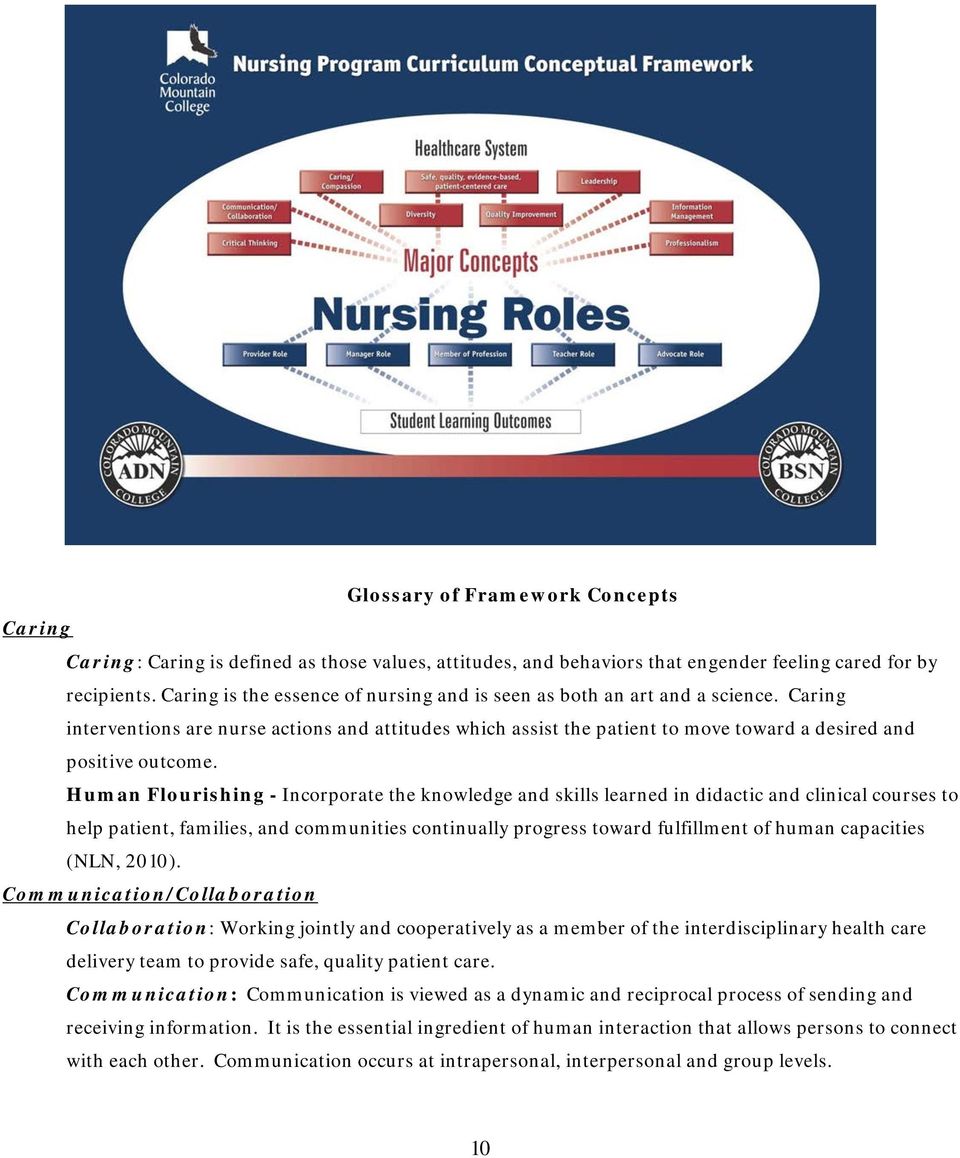
9 are the four competencies that the NLN has identified as competencies applicable to all nursing baccalaureate programs. The NLN (2010) competencies include promoting human flourishing, possessing sound nursing judgment, understanding professional identity and embracing the spirit of inquiry. This chart identifies CMC nursing curriculum assignments that have directly attributed to the students success in the RN-BSN nursing program and aligns them with the competencies identified by the AACN and the NLN. The essential RN-BSN graduate attributes includes the following: 1. Provider Role - Professional Healthcare Provider/Baccalaureate Generalist Nursing Practice/Quality/Safe & Ethical Practice/Prevention and Health Promotion 2. Advocate Role - Effective Collaborator /Communicator/Information Management/ Cultural Competence 3. Manager Role - Leader/Change Agent/Sustainability 4. Member of the Profession - Scholarship/Evidence Based Practice 5. Teacher Role - Educator/Consultant Conceptual Framework of the Nursing Program The conceptual framework of the CMC nursing programs incorporates the NLN Competency of Graduates (2010) and the AACN Essentials of a Baccalaureate Nurse (2008) models. The CMC conceptual framework includes four major components: healthcare system, nursing roles, student learning outcomes and major concepts that are spiraled throughout the curriculum (see p. 10). The major concepts include: critical thinking, communication/collaboration, caring/compassion, diversity, quality improvement, safety, quality, evidence-based patient-centered care, leadership, information management, professionalism. All of the major concepts are within the healthcare system and incorporated into the nursing roles which guide the student learning outcomes. 9

10 Glossary of Framework Concepts Caring Caring: Caring is defined as those values, attitudes, and behaviors that engender feeling cared for by recipients. Caring is the essence of nursing and is seen as both an art and a science. Caring interventions are nurse actions and attitudes which assist the patient to move toward a desired and positive outcome. Human Flourishing - Incorporate the knowledge and skills learned in didactic and clinical courses to help patient, families, and communities continually progress toward fulfillment of human capacities (NLN, 2010). Communication/Collaboration Collaboration: Working jointly and cooperatively as a member of the interdisciplinary health care delivery team to provide safe, quality patient care. Communication: Communication is viewed as a dynamic and reciprocal process of sending and receiving information. It is the essential ingredient of human interaction that allows persons to connect with each other. Communication occurs at intrapersonal, interpersonal and group levels. 10
11 Critical Thinking Critical Thinking: Critical thinking is the nurse s ability to reason, analyze and make decisions based on evidence based practice and scientific principles. Clinical Reasoning: The process by which nurses assemble clues, process the information, reach a decision about the patient problem or situation, plan and implement interventions, evaluate outcomes, and reflect on and learn from the process (Hoffman, 2007) Nursing Judgment: Make judgments in practices, substantiated with evidence, that synthesize nursing science and knowledge from other disciplines in the provision of safe, quality care and promote the health of patient, families, and communities (NLN, 2010). Clinical judgment and nursing judgment can be used interchangeably. Diversity: The range of personal, cultural and ethnical differences found within society which can include variations in: race, age, gender, sexual orientation, religion, disability, beliefs, values, attitudes and socioeconomic status. Evidence-Based Care: Integrate best current evidence with clinical expertise and patient/family preferences and values for delivery of optimal health care (Quality and Safety Education for Nurses [QSEN], 2012, p. 4). Healthcare System Healthcare System: The healthcare system is developed to provide safe, quality, evidence-based patient-centered care that strives to meet the health care needs of various patient populations across the lifespan and healthcare continuum. Health: Health is seen as a multidimensional concept and not just the opposite of illness. Nurses need to understand the concepts of health, health promotion, wellness and illness to assist patients and their families in reaching optimal wellness. Information Management: Informatics: Use of information and technology to communicate, manage knowledge, mitigate error, and support decision making (QSEN, 2012, p. 4). Health Information Management- Acquiring, analyzing, and protecting digital and traditional medical information vital to providing quality patient care ( Leadership Leadership: Leadership in nursing provides guidance, direction and influence to achieve goals. Leadership incorporates open communication, respect, and shared decision making to ensure optimum patient outcomes. 11

12 Sustainability in Healthcare: Meeting the needs of the present without compromising the ability of future generations to meet their own needs incorporating social, environmental and economic factors. Nursing Roles: Nursing roles as defined by the Colorado Articulation Model ( ) are integrated into the CMC nursing curriculum. The five roles include that of provider, manager, teacher, member of the profession and advocate. Patient-Centered Care: Recognize the patient or designee as the source of control and full partner in providing compassionate and coordinated care based on respect for patient s preferences, values, and needs (QSEN, 2012, p. 4). Professionalism: Professional Identity: Express one s identity as a nurse through actions that reflect integrity, a commitment to evidence-based practice, caring, advocacy, and safe, quality care for diverse patients, families, and communities, and a willingness to provide leadership in improving care (NLN, 2010). Professionalism: A set of behaviors and values which drives actions within the healthcare setting to provide and promote safe, quality respectful patient care. Professionalism includes responsibility and accountability for patient care and education, truth and responsiveness in communication and the ability to create a trusting compassionate patient relationship. As a member of the nursing discipline, the professional nurse has the core values of integrity and altruism and remains active in quality improvement and advancement of the science of nursing. Nursing Process: The nursing process provides an organized, systematic method of problem solving, critical thinking and clinical reasoning to create and evaluate optimum patient outcomes. Spirit of Inquiry: Act as an evolving scholar who contributes to the development of the science of nursing practice by identifying questions in need of study, critiquing published research, and using available evidence as a foundation to propose creative, innovative, or evidence-based solutions to clinical practice problems (NLN, 2010) Quality Improvement: Use data to monitor the outcomes of care processes and use improvement methods to design and test changes to continuously improve the quality and safety of health care systems (QSEN, 2012, p. 4). Safety: Minimizes risk of harm to patients and providers through both system effectiveness and individual performance (QSEN, 2012, p. 4). The Roles of the Professional Nurse The professional nurse assumes five basic roles in practice: Provider of care, manager of care, teacher, advocate, and member within the discipline. 12

13 Provider of Care As a provider of care, the nurse utilizes the nursing process to formulate and implement nursing care for individuals who have health care needs while utilizing critical thinking and sound judgments to provide competent practice. The nurse s commitment to patient-centered care is reflected through a collaborative approach involving the patient, family, significant others, and members of the health care team. Manager of Care As a manager of care, the professional nurse provides and coordinates care for a group of patients/clients using collaboration, consultation, organization, delegation, accountability, advocacy, and respect. The nurse retains accountability for care delegated to others and knows the legal parameters of others scope of practice, as well as their roles and responsibilities. Teacher The nurse provides information and education in variety of settings to promote, maintain and restore health across the lifespan. The nurse provides culturally appropriate learning activities by effectively utilizing resources and current technology and by promoting a caring environment. Advocate The nurse promotes a climate in which patients may act in their own interest, including accessing available resources and intervenes when they are unable to act in their own interest. The nurse advocates for vulnerable populations, social justice, and sustainable health care. Member of Profession As a member within the nursing profession, the nurse demonstrates accountability, autonomy, and authority in practice. The Colorado Nurse Practice Act, the American Nurses Association Code of Ethics, and current standards of practice guide nursing practice. The nurse practices within the ethical and legal framework of the nursing profession and is responsible for ensuring high standards of nursing practice. The nurse contributes to the improvement of nursing by supporting the advancements of the science of nursing, remaining a lifelong learner, and assuming the responsibility to actively support the continued growth and positive image of the profession. Academic Progression Model with Articulating Levels of Nursing Practice The practical nurse functions primarily in structured health care systems such as acute and long-term care facilities and clinics where the policies and procedures and protocols for provision of care are established, and there is ready recourse for assistance and support from the registered nurse. The practical nurse promotes and maintains health, prevents illness and injury, and provides care utilizing standardized procedures and the nursing process. The practical nurse is guided by the licensed practical nurse scope of practice within each state of licensure. 13

14 The associate degree nurse is prepared as a competent entry-level practitioner who can provide and coordinate care for groups of patients with basic and complex health care needs. The associate degree nurse is prepared to function both within acute care and long term care systems where policies and procedures are specified and guidance is available. Associate degree nurses maintain professional relationships by advocating and supporting patient decisions, and by collaborating and communicating with patients, families, and other health care professionals. In providing care, the associate degree nurse may delegate aspects of care to licensed and unlicensed personnel. In delegating the care to others, associate degree nurses remain accountable for care of their own patients and patients delegated to others under their direction. The associate degree nurse is guided by the licensed registered nurse scope of practice within each state of licensure. The baccalaureate degree nurse includes a liberal education with a broad perspective to care for individuals, families, communities, and populations. The five roles of the baccalaureate nurse are enhanced by the AACN Essentials of Baccalaureate Education for Professional Nursing Practice (AACN, 2008). The Provider role will expand on Information Management and Application of Patient Care Technology and Interprofessional Communication and Collaboration for Improving Patient Healthcare Outcomes (AACN, 2008). The Manager Role will expand on Basic Organizational and Systems Leadership for Quality Care and Patient Safety and Healthcare Policy, Finance, and Regulatory Environments (AACN, 2008). The Member of the Profession will expand on Scholarship for Evidence-Based Practice and Professionalism and Professional Values (AACN, 2008). The Advocate Role will expand Clinical Prevention and Population Health (AACN, 2008). The setting in which the baccalaureate nurse practices may or may not have established protocols, procedures, and policies and also has the potential for variations requiring independent nursing decisions. The Baccalaureate nurse is guided by the licensed registered nurse scope of practice within each state of licensure and works within the models set forth by the NLN and the AACN. Program Outcomes Baccalaureate Nursing Program Leveling and Outcome Measurement The CMC RN-BSN Nursing Program provides for student progression from an Associate Degree program which included the foundational knowledge needed to practice as a Registered Nurse. Student enrolled in the CMC RN-BSN program have previously passed the NCLEX-RN and hold a valid state license. The RN-BSN program expands that knowledge base to incorporate community care, focused population care, leadership, management and research. The RN-BSN program builds on the five roles of the nurse by incorporating enhanced knowledge related to each role (Provider, Advocate, Teacher, Manager, and Member of the Profession). Completion of the RN-BSN program enables students to enter graduate programs either at the Master s and/or Doctoral level. 14
15 Baccalaureate Nursing Program Outcomes Student active participation toward achieving the CMC RN-BSN Nursing Program outcomes is essential in order to maintain national accreditation and achieve program goals. Program outcomes are developed as performance indicators, which show that the CMC Nursing Program is meeting the mission and goals set by the faculty. Program outcomes have been developed from criteria and guidelines of the Accreditation Commission for Education in Nursing (ACEN), the American Association of Colleges of Nursing (AACN) and the National League of Nursing (NLN). They include: OUTCOME #1: Graduates will demonstrate a post-graduation employment rate of 80%. Measurement: A survey is taken 6 months following graduation. The goal of 80% will be extrapolated from those graduates who respond to the survey. OUTCOME #2: 80% of nursing employers will be satisfied with the level of baccalaureate education received at CMC. Measurement: A survey is taken 6-12 months post-graduation. The goal of 80% of surveys will express overall satisfaction with the program. OUTCOME #3: 80% of students and graduates will be satisfied with the level of baccalaureate education received at CMC. Measurement: A survey is taken 6 months following graduation. The goal of 80% of surveys will express overall satisfaction with the program. OUTCOME #4: Students will complete the RN-BSN program of study and progress toward graduation in a timely manner. Measurement: 90% of students will graduate with a baccalaureate degree in nursing within 3 years from time of admission into the nursing program. 15

16 RN-BSN Program Student Learning Outcomes with Related Competencies 1. Synthesizes professional nursing roles and values while providing safe, quality patientcentered nursing care through scholarship for evidence based practice. Demonstrates the professional standard of moral, ethical, and legal conduct. Promotes the image of nursing by modeling the values and articulating the knowledge, skills, and attitudes of the nursing profession. Communicates effectively with the healthcare team on difficult healthcare decisions that reflect on one s own beliefs and values as they relate to professional practice. Act to prevent unsafe, illegal, or unethical care practices Articulate the value of pursuing practice excellence, lifelong learning, and professional engagement to foster professional growth and development. Integrate evidence, clinical judgment, interprofessional perspectives, and patient preferences in planning, implementing, and evaluating outcomes of care. 2. Demonstrates organizational and systems leadership when planning safe, quality care for diverse populations by analyzing healthcare systems and policies, including nursing financial and regulatory practices. Apply leadership concepts, skills, and decision making in the provision of high quality nursing care, healthcare team coordination, and the oversight and accountability for care delivery in a variety of settings. Participates in complex system issues by participating in quality and patient safety initiatives involving individuals, families, groups, communities, populations and other members of the healthcare team. Promotes achievement of safe and quality outcomes of care for diverse populations. Analyze how healthcare is organized and financed, including the implications of business principles, such as patient and system cost factors. Determine state and national statues, rules, and regulation that authorize and define professional nursing practice. Explore the impact of socio-cultural, economic, legal, and political factors influencing healthcare delivery and practice. Advocate for consumers and the nursing profession. 3. Incorporates evidence-based care to complex patient situations including strategies for health promotion and disease prevention for individuals, families, groups, communities, and diverse populations across the lifespan and continuum of healthcare environments. Assess protective and predictive factors, including genetics, which influence the health of individuals, families, groups, communities, and populations. Participate in clinical prevention and population-focused interventions in relation to effectiveness, efficiency, cost-effectiveness, and equity. Advocate for social justice, including a commitment to the health of vulnerable population and the elimination of health disparities. Implement evidence-based nursing interventions as appropriate for managing the acute and chronic care of patients and promoting health across the lifespan. Provide nursing care based on evidence that contributes to safe and high quality patient outcomes within healthcare microsystems. 4. Develops interpersonal communication and collaboration of the entire interdisciplinary team for improving patient health outcomes. 16
17 Use inter- and intraprofessional communication and collaborative skills to deliver evidence-based, patient-centered care. Incorporate effective communication techniques, including negotiation and conflict resolution to produce positive professional working relationships. Develops teambuilding skills and collaborative strategies when working with other interprofessional teams. 5. Analyzes patient situations and applies clinical reasoning/critical thinking skills as necessary to provide quality patient care to diverse populations by combining previous nursing knowledge with a liberal education base. Integrate theories and concepts from liberal education into nursing practice. Apply knowledge of social and cultural factors to the care of diverse populations. Use skills on inquiry, analysis, and information literacy to address practice issues. Value the ideal of lifelong learning to support excellence in nursing practice. Engage in clinical/critical and ethical thinking to provide leadership in promoting advocacy, collaboration, and social justice. 6. Incorporates information technology to communicate, manage knowledge, mitigate error, and support decision-making by using current information management and patient care technologies. Apply skills in using patient care technologies, information systems, and communication devices that support safe nursing practice. Demonstrates effective communication in a variety of healthcare settings by using telecommunication technologies. Recognizes the role of information technology in improving patient care outcomes and creating a safe care environment. Evaluates data from all relevant sources, including technology, to inform the delivery of care. RN-BSN Program Completion Outcomes Portfolio The nursing program monitors each student s progression in the program through the use of a portfolio. Assignments are collected by the nursing faculty for the purpose of documenting students success in completing program outcomes. Students participate in this process by asking questions and submitting assignments that students believe best demonstrate meeting student outcomes for each course. Appendix D includes the BSN Student Learning Outcomes Competency Evidence Chart which contains the assignments related to this topic. (See Appendix D) Nursing Program Curriculum The nursing curriculum of CMC is ever evolving and created from evidence-based research to ensure that students are prepared for professional practice. Nursing is a caring art and science. Through the use of hybrid courses and practice experiences, the faculty will empower the students with the knowledge needed to practice safe, quality, patient-centered nursing creating optimum patient outcomes. The pre-requisites for the RN-BSN Nursing 17
18 Program provide the student with a well-rounded liberal education that prepares graduates to deal with complexity, diversity, and change. The CMC RN-BSN program embeds practice experiences woven throughout the curriculum to enable graduates to achieve the Essentials of Baccalaureate education for professional nursing practice (AACN, 2008). These practice experiences provide students opportunities to deliver care across the life-span and across the continuum of care. Evidence-based practice uses current nursing and medical research incorporated into quality, safe, patient care techniques creating professional nursing practice. Nursing as a science is based in research, both qualitative and quantitative, that is used to guide and create professional nursing practice. Quality research is performed by nursing researchers and scientists. The research is published in nursing journals and incorporated in nursing practice to ensure optimum patient outcomes. The faculty uses nursing research to create and update the curriculum on a continual basis to improve the education all students receive documents incorporated into the curriculum is ANA Standards of Practice, ACCN, Essentials of Baccalaureate, NLN, and QSEN. 18

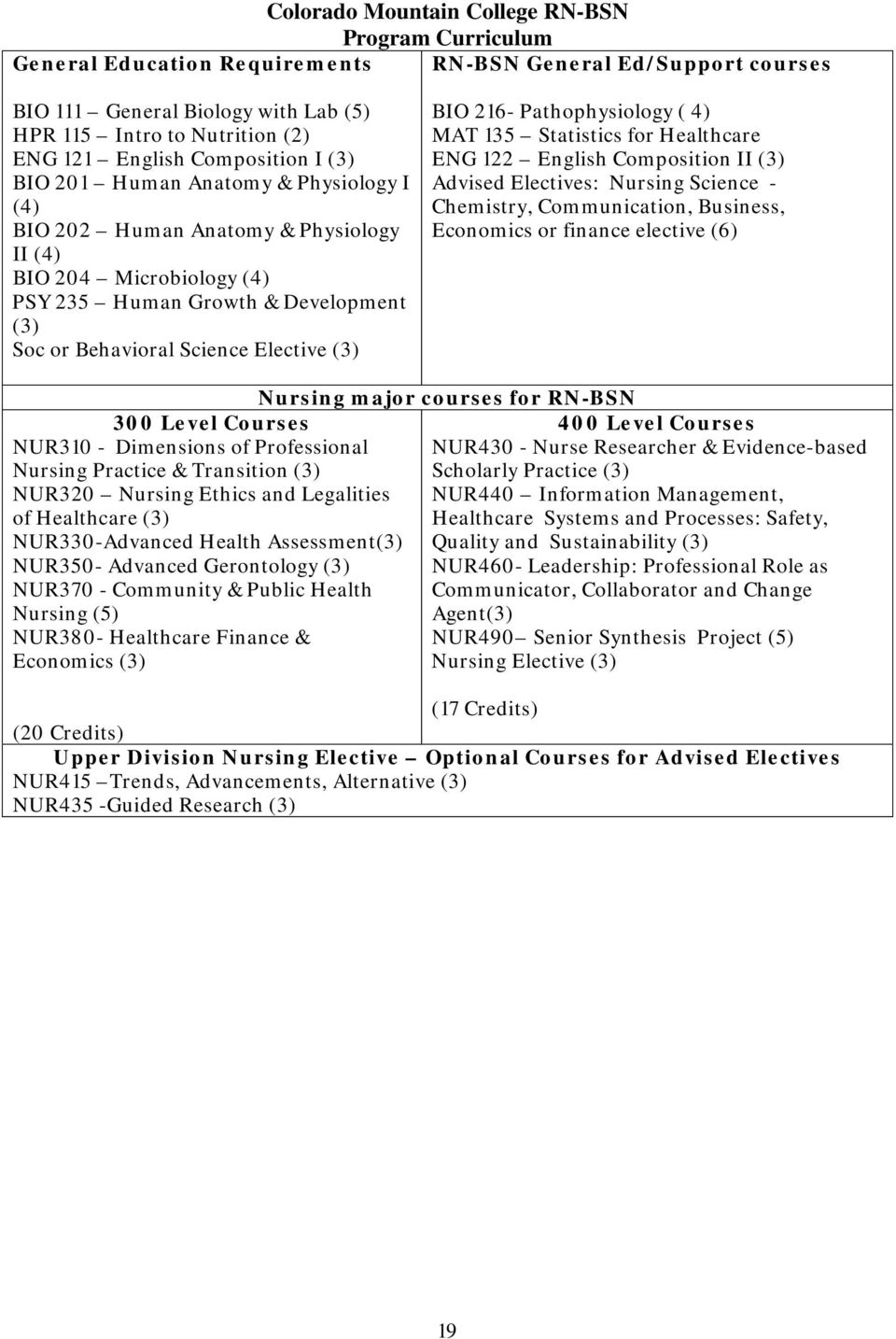
19 Colorado Mountain College RN-BSN Program Curriculum General Education Requirements RN-BSN General Ed/Support courses BIO 111 General Biology with Lab (5) HPR 115 Intro to Nutrition (2) ENG 121 English Composition I (3) BIO 201 Human Anatomy & Physiology I (4) BIO 202 Human Anatomy & Physiology II (4) BIO 204 Microbiology (4) PSY 235 Human Growth & Development (3) Soc or Behavioral Science Elective (3) BIO 216- Pathophysiology ( 4) MAT 135 Statistics for Healthcare ENG 122 English Composition II (3) Advised Electives: Nursing Science - Chemistry, Communication, Business, Economics or finance elective (6) 300 Level Courses NUR310 - Dimensions of Professional Nursing Practice & Transition (3) NUR320 Nursing Ethics and Legalities of Healthcare (3) NUR330-Advanced Health Assessment(3) NUR350- Advanced Gerontology (3) NUR370 - Community & Public Health Nursing (5) NUR380- Healthcare Finance & Economics (3) Nursing major courses for RN-BSN 400 Level Courses NUR430 - Nurse Researcher & Evidence-based Scholarly Practice (3) NUR440 Information Management, Healthcare Systems and Processes: Safety, Quality and Sustainability (3) NUR460- Leadership: Professional Role as Communicator, Collaborator and Change Agent(3) NUR490 Senior Synthesis Project (5) Nursing Elective (3) (17 Credits) (20 Credits) Upper Division Nursing Elective Optional Courses for Advised Electives NUR415 Trends, Advancements, Alternative (3) NUR435 -Guided Research (3) 19
20 Admission Requirements The RN-BSN Program Packet provides specific information regarding admission requirements for the nursing program. The student applying for admission into the RN-BSN program must meet the requirements as stated by the most recent packet. Please see the nursing website, for the admission application packet. If the applicant attended a previous RN-BSN nursing program, the applicant must submit a letter of recommendation from the nursing program the applicant attended to the CMC Director of Nursing Education. Grading In order to progress through the curriculum, the student must pass all courses with an average of 77% or greater and all clinical course outcomes must be met. Any student who does not receive a 77% average or greater on exams will not pass that didactic course regardless of points earned on non-exam work. The exam average shall be calculated by averaging the exams in the course. Once it is determined that the student has met the criteria of a 77% exam average, then the student s grade will be calculated as stated in the syllabus. Faculty may use the Gradebook application on Canvas or another online LMS program to assist students in monitoring their progress and current grade based on completed assignments and exams. While this may be a useful tool for the student, calculated grades on Canvas or other LMS applications are not official grades. Official grades will be posted in WebAdvisor. Grading Scale The following grading scale will be used throughout the Nursing Program: A C A C B C B D B F 0 69 Grade Rounding All individual exams will be carried one decimal point (to the tenth place) before calculating exam scores. The total exam scores will be calculated without rounding. Final course grade computation can then include additional learning requirements for the course. Students must achieve 77.0%exam average on all quizzes, exams, and finals before class projects and papers are computed into the course grade. Each course syllabi will identify how final grades are calculated and are course specific. The final course grade recorded on the student s record may be rounded to the CMC Nursing department grading scale. 20

21 EXAMPLES Student 1: Exam 1 Exam 2 Exam 3 Exam Score Average (Exam 1+2+3) / % 78.9% 84.6% 81.9% (cannot round up) Resulting Grade: This student passed the course. When calculating the final grade, the instructor will use 81.9% as the exam score average, not 82.0%. Student 2: Exam 1 Exam 2 Exam 3 Exam Score Average (Exam 1+2+3) / % 75.8% (cannot round up) Resulting Grade: This student does not meet the requisite of 77% for the overall exam average, and no additional assignments will be added to the grade. This student earned a 76.2% in the course, and would be awarded the grade of C- for the final grade (see above for Grading Scale). Because the student did not earn a C or better in the course, he or she would not be eligible to take the progressive nursing courses. Grade Expectations An A student demonstrates the following: Attends all clinical assignments Always prepared for class Demonstrates interest by asking questions and finding out what they do not understand Possesses determination, initiative, self-discipline and professionalism Demonstrates intelligence, insight, and creativity Achieves high test scores A B student demonstrates the following: Rarely absent from class or clinical Prepared for class Willingness to participate and demonstrate interest Positive attitude and generally completes assignments A C student demonstrates the following: Meets minimum requirements for the nursing program 21
22 Incompletes In rare circumstances, situations not controllable by the student may occur that will result in excessive absences. Excessive absences resulting from serious illness (as diagnosed by a physician), hospitalization, family crises, or death in the immediate family may prevent a student from meeting course objectives during the regularly scheduled semester timeframe. When appropriate, a student may be eligible to take an incomplete in his or her coursework. Incompletes must be arranged by your nursing course faculty and nursing advisor with approval from the Director of Nursing Education. The faculty and student must create and submit a written completion plan as outlined in the CMC Student Handbook. Time frame for completion will be decided on an individual basis with approval of the Director of Nursing Education. Withdrawal from Nursing Course To withdraw from a class you will need to follow the Colorado Mountain College withdrawal policy. It is the responsibility of the student to carry out the withdrawal process, but the student s advisor is available to assist. To withdraw from a class (drop), you must complete an Add/Drop form and submit it to any CMC site registration office. Notifying the faculty, your advisor, or simply not attending class are not sufficient ways to ensure that you are withdrawn/dropped from the class. If you cannot submit an Add/Drop form to any CMC site registration office, you must submit a written request to be dropped. This request must be submitted to any CMC site registration office. The date the written notice is received shall determine your eligibility to drop the class and/or receive any related refunds. Students may not drop (withdraw from) a class after the Class Withdrawal Date. The date is published in the class schedule, or on the class syllabus. It is usually the date on which 75% of the course instruction has occurred. Students dropping (withdrawing from) a class after the census date published in the schedule will receive a W grade for the class. Audit Policy Auditing of a nursing course requires approval from the Director of Nursing Education. Students who register for a class through the audit option receive an AU. This symbol verifies only that the student registered for the class. The student is not required to regularly attend class or to be evaluated. However, all risk management and student conduct requirements still apply. A student registered as an AU cannot change to a grade option. Students cannot meet prerequisite requirements through this grade option. 22
23 Hybrid Class Attendance, Online Learning Responsibilities and Requirements Hybrid courses combine set days for synchronous classroom instructions with a significant amount of asynchronous learning activities. The definitions of synchronous and asynchronous classrooms are as follows: Synchronous online classes are those that require students and instructors to be online at the same time. Lectures, discussions, and presentations occur at a specific hour. All students must be online at that specific hour in order to participate. Asynchronous classes are just the opposite. Instructors provide materials, lectures, tests, and assignments that can be accessed at any time. Students may be given a time frame usually a one week window during which they need to connect at least once or twice. Asynchronous components may include online discussions, audio-video presentation, reading assignments, self-testing exercises, small group work and simulations. The instructor will provide details about the class schedule, synchronous meeting times, and other details to help in your success. Students must possess basic computer skills including the ability to navigate varied web sites and programs, use , send attachments, and utilize DSL, etc. See the following website for common FAQ and technology requirements. Hybrid course work requires a high level of personal responsibility and an active role in the student s learning process. It is expected that the student is self-driven and motivated. Online attendance means that all lessons and assignments are completed independently and by the listed due date. Each course will list any required minimum on-line attendance or activity. The course syllabus for each individual course will establish the specific course attendance policies, the online discussion requirements and the face-to-face attendance dates and requirements. The student is expected to actively participate in the asynchronous or online portion of the hybrid courses, complete all online assignments as scheduled, take all quizzes/examinations when scheduled, and notify instructor if unavailable to participate in an online activity by deadline. The student is expected to attend synchronous classroom instruction and learning activities. If a student misses a synchronous class meeting, the student needs to contact the faculty to discuss alternate assignments as defined by the course syllabus. Excessive tardiness will be dealt with on an individual basis. The student is expected to follow current edition of APA guidelines for required written reports/papers. 23
24 Practicum Field Experiences, Course Lab, Clinical Course and Simulation Attendance Practicum field experiences will be required to build upon the RN skills and to meet the BSN competencies. These practicum field experiences are arranged preceptorships and will be guided by the course faculty. All missed time must be made up. There are courses that may include a course lab or simulation. These are required and if missed are required to be made up. Academic Integrity Integrity is an attribute of the professional nurse and the nursing faculty is committed to academic and personal integrity within this program. Students are expected to demonstrate integrity in the academic as well as the clinical setting. All students within the nursing program are expected to meet the following: 1) Individually complete all school related work unless otherwise stated by the course syllabi. 2) Properly acknowledge and cite all use of the ideas, results or words of others. 3) Properly acknowledge all contributors to a given piece of work. 4) Make sure all work submitted as their own is produced without the aid of unsanctioned materials or unsanctioned collaboration. 5) Treat other students in an ethical manner, respecting their integrity and right to pursue their educational goals without interference. This requires a student neither facilitates academic dishonesty by others nor obstruct their academic progress. 6) Follow standards of practice, codes of ethics, and HIPAA guidelines for expected behaviors. The following are not accepted at any time: 1) Plagiarism as defined by the CMC Student Handbook. handbookhttp://catalog.coloradomtn.edu/content.php?catoid=3&navoid= 650 2) Submitting another individuals work in in part or whole as one s own. 3) Providing an assignment for another student to copy. 4) Copying answers from another individual in any format such as during an exam, test or quiz, but may also include discussion groups or other activities. 5) Making ones answers available during an exam, test or quiz or any other assignment. 6) Discussion of any exam, test or quiz outside of the classroom. 7) Any form of dishonesty which includes, but is not limited to, breach of confidentiality and falsification of records. 24
25 Students who are judged to have engaged in some form of academic misconduct shall be subject to one or all of the following sanctions: 1) Receive a grade of zero on the assignment or exam 2) Disciplinary action 3) Expulsion from the Nursing Program Generally, a student s intentions will not be the primary consideration in the determination of whether academic misconduct has occurred. A student s intention will usually be considered only during the process of deciding on the appropriate sanction or penalties. The Academic Expectations and Sanctions, as outlined in the separate CMC Student Handbook (page 13-19), will be upheld. Guidelines for Student Success The CMC nursing program is designed to create nurses capable of professional practice. The following guidelines should serve as a guide for you to develop your professional practice. General Guidelines for Success All healthcare workers are required by federal law to protect and guard private patient information. As student nurses you will have access to private and confidential information. It is your responsibility to protect the patients confidential information at all times under the guidelines of the Federal Health Information Portability and Accountability Act (HIPAA). HIPAA will be covered in your fundamentals course in the 1 st semester to give you a full understanding of the rules and regulations you must comply with. In alignment with professional nursing practice, you must understand the guidelines for participating in on-line social networking sites. Students who participate in on-line social networking sites are not to discuss the policies or procedures of the CMC nursing program or any of the clinical sites used by CMC. The nursing program should only be discussed in a positive and professional way. Professional behavior is required in nursing practice; all inappropriate photographs should be removed prior to starting the nursing program. If you have any issues within the nursing program or CMC, use the appropriate channels to get resolution. Social networking sites are not intended for discussion of professional issues but for social interaction. If the CMC nursing program or any of the clinical sites used by CMC are discussed in an online social networking site, avoid any negative or unnecessary comments. As a professional practicing nurse, inappropriate 25
26 behavior on a social networking site can have severe repercussions including, but not limited to, disciplinary action and loss of nursing license. Students are required to have CMC ID badges with them while on campus, in clinical, simulation lab, or in any way representing the Colorado Mountain College Nursing Program. Professional communication is expected in all forms of communication (i.e., verbal, , text messaging, phone, social networking. Accountability is a positive attribute for the profession of nursing and is expected of all CMC nursing students. American Psychological Association (APA) format is the standard for the field of nursing. All formal written work must be written in APA format. Students are expected to purchase or have available the most current edition of the APA Manual. Students should be familiar with the contents of the CMC Student Handbook and CMC Nursing Student Handbook. Students attending classes at CMC are provided with a CMC address. This will be the only address used for all purposes in the nursing program and students are expected to check their every 24 hours. Using is an excellent way to communicate with your faculty and faculty will respond to all s within 48 business hours of being sent. CMC is committed to providing access to everyone with the ability to benefit from a program of higher education. We empower students with disabilities to take responsibility for their education. Services are available to meet your special needs and assist you in meeting your educational goals. Please contact our CMC Disability Services Coordinator by calling: or our toll free number at and request to speak to the CMC Disability Coordinator at your nearest CMC location. They will assist you in the process for individual accommodations. If a student receives an injury, the healthcare provider written medical release must be submitted to the Director of Nursing Education before returning to class or clinical. Students who will return after a health related leave of absence, including an illness, surgery, or pregnancy related health conditions, are required to obtain a written release from their health care provider before returning to class or clinical/practicum. The Colorado Mountain College Nursing Program is committed to civility in all interactions between and among the individuals and groups making up the campus and the community. Civility is behavior that shows respect toward another and causes another to feel valued. Civil behavior can consistently be expressed through social 26
27 politeness, keen sensitivity, respect, and courteous treatment to others. The Colorado Mountain College Nursing Program acknowledges differences amongst student in values, interests, and experiences, and we encourage students to participate by offering and listening to individual views. While engaged with others in the classroom, on the Discussion Board, and in the community, disagreements can occur, and the Colorado Mountain College Nursing Program expects students to express ideas in a civilized manner and respond to opposing positions with civilized responses. Incivility (i.e. verbal and nonverbal insults, personal attack, etc.) will not be tolerated and may result in disciplinary action. Synchronous Classroom Guidelines for Success All students are expected to come to class prepared for the unit topic. Completing all assigned readings will help you to learn and apply your knowledge in a more useful way. Utilize the course schedule you receive to manage your time well in order to complete all written assignments on the assigned due date. All of your courses will have a syllabus and course schedule, with due dates. Assignments not turned in on the due date may receive a 5% deduction per each class day that it is late. The expectation is that only registered students in the nursing program should be in the scheduled classes or synchronized classrooms. Students children are not expected to be in class, and childcare should be arranged prior to the start of all nursing course work. This includes any synchronized classroom activities (i.e. live chats). To support a positive learning environment while in the classroom: 1) Taking breaks during learning is essential to increasing knowledge, breaks will be provided to encourage this. Be sure to maintain your energy by planning for snacks during breaks. In order to maintain a clean and professional classroom, eating at times other than breaks is discouraged. 2) Water and liquid beverages are acceptable in class only if you use a spill proof container. 3) Technology should be used to promote learning. Cell phones should be on silent, texting during class is not appropriate; volume on your personal laptop should be muted. If you use a laptop, it should be used to increase knowledge of course content and not for other purposes during class. Inappropriate use of any device may require the faculty to have you discontinue use of your personal electronic device. 4) The faculty encourages you to ask questions and participate in classroom discussions. Please remember that all students should be given the opportunity to ask questions during the class. If you have questions that cannot be answered 27
28 during the scheduled class time, please take the time to meet with your faculty outside of class. 5) All personal belongings that you bring into the class should leave with you at the end of the day. All unattended items may be discarded at the end of the scheduled class. 6) The goal of the CMC nursing program is to support the environment. In this effort, please limit printing, utilizing electronic resources to remain environmentally conscious and keep program costs at a minimum. 7) Any in-class announcements, handouts or other material are considered part of the course curriculum. Hybrid Classroom Guidelines for Success In a hybrid course with an online component, the dynamics have shifted to a collaborative teaching and learning environment. The teacher is more of a guide to learning resources than a lecturer. The student has more responsibility for reading and interacting with content material, the teacher, and the other students in the class. To be successful in a collaborative learning environment you need to be an active participant in the process. Take responsibility for your learning and listen carefully. Read all of the assigned materials before any group activities. Explore external resources on the assigned topics. Actively participate in the opportunities for interaction in discussion forums, chat rooms, synchronous meetings, and . Stay engaged throughout the course, ask questions if you do not understand, seek clarification if process and procedures are confusing, and ask for help if the technology is not working. Expect feedback on your performance in a timely manner. Provide constructive feedback to your classmates as appropriate. Share any relevant professional experiences with your classmates. Apply your new knowledge to your own environment. Be flexible, adaptable, and patient with technology challenges, glitches, and failures. Develop an active sense of humor and have fun. 28
29 Time Management A set of well-developed time management skills may be the most important factor in succeeding in a hybrid course with an online component. The student needs to organize and plan ahead to be able to allocate sufficient time to access course materials, participate in online classes and discussion boards, and complete all of the assignments. 1) The student should plan to spend approximately three hours per week per credit hour reading, writing papers, participating in discussion boards, etc. in a traditional semester format. If the class delivered in an 8 week class, expect a little more than twice that. For example, in a three credit course taught over 8 weeks, the students should expect to spend about hours a week participating in synchronous and asynchronous activities. 2) Check the Canvas course space daily for new announcements, assignment modifications, due dates/times, discussion board interactions, and new course materials and web resources. 3) Schedule study and interaction time on your calendar it is easy to procrastinate and to be pulled to other responsibilities if you don t assign yourself time for the coursework. Technology Hybrid courses with an online component use a variety of constantly evolving technology tools to facilitate teacher/student and student/student interactions. This is still a new field and glitches, delays, and malfunctions are inevitable. 1) Know the minimum hardware, software, and skills requirements for the course before you register: 2) Be sure to make back-ups of your course work -- experiencing a technology failure at the eleventh hour is very stressful and seldom an acceptable excuse 3) Be sure to make a backup computer plan. If your personal computer is experiencing technical difficulties, plan which devices you can use as a back-up while your own personal device is being serviced/repair. 4) Test your equipment and connections before meetings and presentations 5) Microsoft Word is the standard word processing program for the majority of CMC instructors. Students without Microsoft Word may use the free software from 29
30 to create Word-compatible documents. The program also includes spreadsheet, presentation, drawing, and database applications. The program is available for Windows, Macintosh, or Linux operating systems. Microsoft Word is installed on computers available in computer labs at CMC locations. 6) Know where to get help for technology issues. Service Desk phone number, , and address, Internet Etiquette (Netiquette) Always practice Internet Etiquette when communicating electronically. The purpose of communicating electronically in an online course is to share information. 1) Be respectful of other participants, their time, their bandwidth, and their opinions. 2) Remember that you are communicating with real people who do not have the advantage of seeing your body language or hearing your voice inflections, and who may interpret your message differently than you intended. a. Using all caps may be interpreted as shouting. b. Use humor and sarcasm carefully (we can t see the twinkle in your eye); add emoticons to provide a visual representation of your intent. c. Keep your critiques constructive; antagonistic criticism may cause an unwanted reaction. d. Civility during interactions with peers and faculty is expected at all times. Incivility will not be tolerated and may be subjected to disciplinary action. 3) Remember that you are judged by the quality of your writing a. Spelling and grammar do count. b. Be coherent and succinct. c. Don t plagiarize; respect copyrights. d. Don t depend on a single source when contributing new information from external resources. e. Be professional. ("Guidelines for success," 2013) Statement of Professional Behavior Upon entering the profession of nursing, nurses accept the responsibilities and trust that have accrued to nursing over the years, and also nurses accept the obligation to adhere to the profession s code for ethics. The Code for Nurses, published by the American Nurses Association, is the standard by which ethical conduct is guided and evaluated by the profession. It provides a framework within which nurses can make ethical decisions and discharge their 30
31 professional responsibilities to the public, to other members of the health team, and to the profession. The CMC Nursing Program supports The Code of Ethics for Nurses. This high standard of professional behavior applies to the classroom and student learning activities in all settings when representing CMC as a nursing student. (Appendix B) Dress Code Policy General Dress Code Guideline The professional image promotes trust and confidence in your patients as well as in yourself. Students are expected to use good taste in considering appropriate dress for classroom environment. The nursing program is a prominent and respected program within CMC and students within the program are expected to lead by professional example. Dress may be casual but should reflect the position of nursing students preparing for professional employment. ID badge is to be worn at all times in class, simulation lab and practice experiences. If you misplace your ID badge it is your responsibility to replace it at a cost of $ When in a practice experiences setting: o A white lab coat with the CMC logo is to be worn over professional attire or business casual attire. o Hair must be clean and neat. Long hair must be pulled back from the face so that it does not fall forward when leaning over. Beards and mustaches must be clean, trimmed, and neat. Cosmetics are to be used moderately. No large headbands or excessive hair jewelry. o Stethoscope covers are not allowed in the clinical setting. o Artificial nails (including wraps, acrylics or tips) are known sources of bacteria. For infection control purposes, artificial nails are not allowed at any time during the clinical rotations or simulation labs. o Natural nails tips must be kept to ¼ inch in length per the CDC Hand Hygiene in Healthcare Settings-Core (2012). Nail polish is strongly discouraged. o No open-toe or open-back shoes are permitted in clinical/practicum or simulation lab. o For infection control purposes and for patient and student safety, the only acceptable jewelry to be worn in clinical or simulation lab are: engagement rings, wedding rings, and a maximum of two small plain post style ear studs are acceptable. No jewelry in any body part except ear lobes is acceptable. 31
32 o o o o o Because of the close and physical nature of direct care nursing, students are expected to be clean and odor free. Perfume or shaving lotion is not permitted as they may be offensive and irritating to patients. Maternity uniforms must be made of the same fabric and approved by the Director of Nursing Education. Tobacco odors and second hand smoke are offensive and physiologically dangerous to some patients and are unacceptable in the clinical area. CMC nursing program believes in health promotions and disease prevention; therefore, the CMC supports tobacco free healthcare facilities and smoking breaks are not permitted. No visible tattoos are acceptable in the clinical settings or simulation lab. Tattoos must be covered by clothing or bandages. Additional guidelines may be required by various clinical agencies and will be indicated on course syllabi. Student Uniforms When an RN-BSN CMC nursing student is participating in a practice experience, community, or lab experience, a white lab coat with the CMC logo is to be worn over professional attire or business casual attire. See the previous section for other dress requirements in the practicum, community, or lab setting. Student Involvement Student Faculty Representatives Students are encouraged to actively participate with the CMC BSN nursing program. A faculty representative (either RN-BSN advisor or the Program Lead) will be the designated liaison between the students and faculty to address students concerns or issues. Student Nurses Association The students are encouraged to join the CMC chapter of the National Student Nursing Association (NSNA). The NSNA mentors the professional development of future nurses and facilitates their entrance into the profession by providing educational resources, leadership opportunities, and career guidance. Our chapter s goal is to bring all students together to strengthen our program, community, and the nursing profession as a whole. Throughout the year, the NSNA chapter will participate in fundraising, fellowship activities, leadership activities, volunteerism, and attend conferences when possible. A faculty advisor works as a facilitator with the students involved in the NSNA; please go to for more information. 32
33 Academic Advising While in the nursing program at CMC all students are assigned a Nursing Faculty Advisor who will work closely with the individual students throughout the program. Nursing program faculty is available to students for advisement and maintains regular office hours for this purpose. Students are highly recommended to meet each semester with their nursing faculty advisor. Office hours are posted outside faculty offices; appointments with individual faculty should be scheduled during these hours. Students needing advisement are encouraged to seek assistance before a problem becomes critical. Communication within the Nursing Program Within the profession of nursing, appropriate, creative, problem solving and conflict resolution is a necessary skill. The goal within the nursing program is to resolve all issues on a case by case basis, and we encourage resolution at the lowest level possible. When individual issues occur that can be dealt with on an individual basis, please communicate directly with the faculty or student involved with the issue prior to advancing on the channel of communication. Proper channels of communication are necessary for success within the nursing program. Within the CMC Nursing Program, as in any organization, there are appropriate lines of authority and channels of communication. If you encounter a problem in a nursing class, and the problem directly relates to the class or the nursing faculty, then contact that nursing faculty first. If the problem is not resolved, or if the problem is a broader issue within the nursing program, then the following lines of communication should be followed (in order from first to contact to last). The channels are as follows: Nursing Faculty teaching the course first Nursing Faculty Advisor (when applicable) Program Lead or Designated Liaison Director of Nursing Education Vice President for Academic Affairs President of the College When the channels of communication are not used in appropriate order, and a higher positioned individual is contacted, the communication moves back down the channel until the person with the most direct knowledge of the issue is contacted. Failure to follow the channel of communication in conflict resolution is an unprofessional behavior and may impair the appeals process. If problems arise, please save everyone time and energy and use the proper line of communication. 33
34 Student Records Student records help staff and faculty plan educational opportunities to meet individual student needs, better understand the student and counsel him or her more effectively for academic success during the school year. These records are also helpful in guiding the student in finding gainful and fulfilling employment after graduation. Student records are confidential and kept in a secure, locked cabinet. These records will be released to faculty and professional staff for authorized educational purposes and in accordance with college policy, the Colorado State Open Records Act, the Family Educational Rights and Privacy Act (FERPA) and Freedom of Information Statutes. The nursing program maintains records of criminal background checks, drug testing, health information, clinical evaluations, and counseling forms. Please refer to the Colorado Mountain College Catalog (page 30) for more information on Student Privacy, Records & Rights; and Colorado Mountain College Student Handbook (Page 8) for more information on FERPA. Program Progression The CMC RN-BSN program requires at least a 77% (C) on all nursing and non-nursing (C, not C-) classes to progress in the program. Note that classes may not be offered every semester, and some classes have prerequisite classes. In addition placement in a class for a student who is retaking the class is based on space-availability. This may mean that graduation will be delayed. A student who does not achieve a 77% in a class must meet with his or her advisor to create a plan for the student including next steps for improving academic performance and/or professional behavior in the program. This meeting should also include the faculty teaching the course in which the student earned the non-passing grade. One action required by the student who has not passed a class is to write a letter (due in 5 business days from the meeting) to the Director of Nursing Education addressing the following: Reason(s) student believes he or she did not progress or pass the course Plans or changes to the student s daily life, study habits, etc., that the student believes will facilitate success in future courses A student can repeat a course one time. If the student is unsuccessful on the second attempt (i.e. does not achieve a C (77%)), the student will not be able to continue in the program. Students who are failing to progress or choose to withdraw from the program are required to meet with the Director of Nursing Education to address success strategies. If there is a gap of greater than two semesters between courses, the student may be required to complete remediation and/or retake pre-requisite nursing courses. Students are expected to inform their nursing faculty advisor every semester about their course plan and plan 34
35 for graduation. Specific guidelines for remediation will be written by the DNE and the Admissions/Appeals Committee. Withdrawal or Leave of Absence from the Nursing Program Withdrawing from the Nursing Program is not the same as withdrawing from a nursing course. A student who wishes to withdraw or take a leave of absence from the RN-BSN Nursing Program is required to give written notice to the Director of Nursing Education as soon as the decision is made. A student who withdraws or takes a leave of absence from the RN-BSN Nursing Program may be allowed for readmission without reapplying if the following are true: The student is in good academic standing before withdrawing. This includes any current classes enrolled in when the decision to withdraw is made. The student commits to returning to the program within one calendar year of withdrawal There is available spaces in the courses Readmission A student who chose to withdrawal or take a leave of absence from the program must have written a letter to the Director of Nursing Education before leaving. The student must also have met the criteria listed above. A student who is requesting to reenter the program must write a letter of intent to the Director of Nursing Education. If any of the criteria above are not met, then the student must apply for readmission into the program. Initial acceptance into the program does not guarantee readmission. Probation A student placed on Academic or Non-Academic Probation will be given a Counseling Form and must complete an Action Plan, developed jointly by student and faculty, indicating the student s plan for improvement in the identified area. Copies will be distributed as follows: Student, Student s Record, Nursing Faculty Advisor and the Director of Nursing Education. Academic Probation If a student is at risk for success within the program, the student s course faculty or nursing advisor may place the student on academic probation. Students who fail to follow their success plan may be at risk for termination from the nursing program. The following include some but not all reasons a student may be placed on academic probation: a. Practicum/clinical performance is unsatisfactory b. cumulative grade point average falls below a 2.4 during any semester 35
36 c. synchronous/asynchronous attendance interferes with ability to achieve course outcomes d. failure to uphold the agreed upon action plan from a written student counseling form or other agreed upon written plan A student will be removed from academic probation when: a. the unsatisfactory performance is improved to a satisfactory status as determined by the faculty or nursing advisor Non-academic Probation A student is automatically placed on Non-Academic Probation if misconduct unrelated to academic performance occurs (see Student Code of Conduct in the separate CMC Student Handbook). A student is removed from Non-Academic Probation when the conditions attached to sanctions imposed by the College have been satisfied. If the conditions have not been satisfied within the designated time frame, the student shall be dismissed from the College. Suspension/Dismissal The College may suspend, dismiss or otherwise discipline a student if: 1. The safety of a patient is at risk or jeopardized. 2. Conduct that threatens or endangers the health, safety or welfare of any person may result in disciplinary action by the College (see Student Code of Conduct in the separate CMC Student Handbook) 3. Following suspension, dismissal or discipline, a student must demonstrate his or her ability to perform safely in the clinical care area before the student will be allowed to return to any clinical area, in addition to any other requirements of the College or the Nursing Program. 4. Absences exceeding 10% of total assigned course/clinical hours will interfere with student s ability to satisfactorily meet course outcomes. Graduation Graduation requirements are presented in the CMC College Catalog (page 105), or online within the CMC webpage, Academic Grade Appeal An academic grade appeal can be made when a student feels that the grade was awarded in a capricious manner. Students wishing to appeal a grade should discuss the grade assignment with the instructor and their advisor. If the matter is not resolved, a written notice of appeal must be submitted to the Dean/Director of the Colorado Mountain College campus center that 36
37 offered the class. Please refer to the Colorado Mountain College Student Handbook (page 14) for more info. Complaint/Grievance Procedure A complaint is a formal written communication that expresses dissatisfaction with the operations of the Nursing program other than academic grade appeal. The words grievance and complaint are used interchangeably. Prior to this procedure, students are expected to have utilized the informal process of resolution by using all channels of communication. To pursue a complaint or grievance related to the Nursing Program or its faculty, a student shall: 1. Gather and analyze facts regarding their complaint. 2. Initiate an Action Plan to resolve the problem and discuss the plan with the faculty involved. 3. Discuss issue with the Director of Nursing Education if issue is not resolved. 4. If necessary, follow the Appeal process as outlined in the separate CMC Student Handbook under the section, Student Complaint Process. (page 9-10) Resources for Students Nursing Faculty Advisor Each student will be assigned a nursing faculty advisor (may vary by semester) for assistance in progressing through the program. Advisors are available to students by appointment and students are encouraged to meet with his or her advisor. Students may request a change in advisor by contacting the Director of Nursing Education. Student Health Services CMC does not have on campus student health services onsite. Nursing students are required to have health insurance while in the program. CMC does not offer health insurance; however, if a student cannot find a provider, American College Student Association (ACSA), is available for consideration. Learning Lab Student services are available to all CMC students through arrangement. Alpine Learning Assistance Center (ALAC) The Spring Valley campus offers free tutoring and workshops through the Alpine Learning Assistance Center, which is located on the first floor of the Calaway Academic Building. There are 2 types of free tutoring available: The Spring Valley campus offers free tutoring and workshops through the Alpine Learning Assistance Center, which is located on the first floor of the Callaway Academic Building. There are 3 types of free tutoring available: 37
38 Open tutoring labs for Math, English and Writing are held most days of the week. The students are not required to sign-up for open tutoring labs. Nursing students are encouraged to use these services for writing papers, for reading skills, and for medical mathematics. Group tutoring for nursing specific classes may be available, depending on resources. Group tutoring requires a referral by an instructor and the completion of an agreement form. Groups are required to be a minimum of 3 students. While these services are free, if a student needs to miss a scheduled tutoring session and fails to give more than 24 hours notice, the student will be charged $ Additionally, if a student misses two scheduled tutor sessions, the sessions will be reevaluated and may be cancelled. Smarthinking offers sophisticated services, including live, online tutoring -- available 24 hours, 7 days per week. This is available through CMC Canvas courses. Additional services made available by the ALAC are free academic success workshops. The purposes of the workshops are to give students skills for success both in the class and in preparing for the workforce. Examples include reading strategies, using commas correctly, interviewing and resume preparation. The topics for workshops vary greatly, and a schedule is available the first week of the semester. Students are not required to sign-up in advance for these workshops. Counseling The student support center s highest goal is to help you succeed in all you do. Student services provide several resources for you to reach your goals for college education and beyond. Student services have the following types of counseling available: Individual counseling Group counseling Mental health counseling referral Academic counseling Students who need more information on services available to them can speak to their nursing faculty advisor or contact Vice President of Student Affairs, Central Administration & Admissions, 802 Grand Avenue, PO Box 10001, Glenwood Springs, CO 81601, (970) , (800) Students with Disabilities & Non-Discrimination Statement The Disability Service Coordinators (DSC) at CMC are committed to assisting students with disabilities become successful in their academic programs. The DSC provides students with disabilities the support needed to complete their chosen area of study, and the opportunity to enhance their basic academic skills. DSC is committed to equal access in the classroom while preserving the integrity of the course objectives. Support services are structured to meet the 38
39 individual needs of the students who have documented disability that limits a major life activity, such as learning. Students must be registered with the Disability Services Coordinator on their campus to receive services. All records are kept confidential. Documentation Guidelines for disabilities are available on the internet at Colorado Mountain College is dedicated to the principle of providing equal opportunity with regard to all prospective and current employees and students. In addition, the college shall continue to take positive steps to ensure non-discrimination based on disability, race, creed, color, sex, age, national origin, ancestry, sexual orientation or religion. Inquiries concerning Title VI and IX may be referred to the Chief of Human Resources Officer and inquiries for Section 504 and ADA may be referred to Brad Bankhead, Vice President of Student Services, 831 Grand Avenue, Glenwood Springs, Colorado, 81601, (970) , or to the Office for Civil Rights, U.S. Department of Health and Human Services, Region VIII, 1961 Stout Street, Room 1426, Denver, Colorado 80294, (303) ; (303) (TDD). Student Support Services (SSS) Success Center The SSS is available to select students including those who are First Generation college students, low income students and students with disabilities. SSS is committed to empowering participating students through their CMC academic careers to help them reach their true potential and achieve their educational goals. Services include tutoring, seminars and advising. Contact the Program Director for more information, Libraries Physical libraries are located at Spring Valley (Quigley), Steamboat Springs, and Leadville. These libraries have full computer labs, and study rooms. Quigley Library also offers current nursing books and current nursing journals. To access the databases from home go to and click on Online Articles, E-Books, & More. Note: students must have a current CMC library card which they can acquire either in person or online. Virtual Library In addition to the physical libraries, CMC offers a virtual library. The Virtual Librarian for the Virtual Library resides at the Dillon campus and library support is accessible to all CMC students. In order to access the virtual library, go to Many of the services available have already been described above; however, CMC nursing students also have access to CINAHL, a large database of health care related journal articles. If you need help with the Virtual Library, [email protected] or call , extension 2926 or
40 Financial Aid Financial aid is available to all students in one form or another, regardless of the student s financial situation. Students are required to fill out a Free Application for Federal Student Aid (FAFSA). There are four basic types of financial aid: Grants, Loans, Work Study, and Scholarships. Grants are free money from the government and do not need to be paid back. Loans must be paid back based with interest 6 months after graduation or if the student is enrolled in less than 6 credits. Work study offers an opportunity for students to work while in school. There are limited funds for this category and are issued based on needs and first come, first serve basis. Scholarships are monies given to students typically by organizations and do not need to be paid back. For a complete list of Foundation Scholarships, including nursing scholarships, available to CMC students, visit For more information about financial aid, please speak to a Financial Aid Advisor on your campus. 40
41 Scholarships for Nursing There are specific scholarships available in the Nursing Program. Each has a set of criteria that the student applicant must meet in order to be considered. More information can be obtained from the CMC Foundation. Nursing scholarships include: Glasier Family Scholars Roaring Fork Campus Merrill-Cutter Endowed Nursing Scholarship Garfield County Alice Peterson-Erickson Scholarship for Nursing Roaring Fork Campus Pauline Taylor-Genova Nursing Scholarship Spring Valley Campus Pat Thomas Nursing Scholarship Summit Campus Valley View Hospital Auxiliary Memorial Scholarship Spring Valley Dr. R. Douglas and Alexandra Yajko Nursing Scholarship Spring Valley Campus Maureen Nuckols and Friends Nursing Scholarship Roaring Fork Valley Summit Medical Center Health Foundation Nursing Scholarship Summit Campus Kay Maloney Scholarship for Nursing Summit Campus High Country Healthcare Scholarship for Nursing Summit Campus David and Cindy Miller Scholarship (BSN specific) Garfield County Gallagher Scholarship for BSN (BSN specific)- Summit County Other scholarships and financial aid are available. Contact the Financial Aid Office for more information: Non-Academic Policies CPR Certification/Recertification Students are required to maintain current American Heart Association BLS for Health Care Providers for the entirety of the program. No other type of CPR certification will be accepted. Student Health Insurance Each student is required to have proof of current health insurance. A copy must be on file in the Nursing Program office. Liability Insurance Certain, limited student liability insurance coverage is provided by Colorado Mountain College. Accident Reporting Procedure Students who are injured and or become ill while in the clinical setting should: a. Notify the faculty and/or charge nurse immediately 41
42 b. Complete the 1 st Report of Injury Pinnacol form (Appendix D) and CMC Incident Report form (Appendix D) c. Complete the facility Incident Report d. Forward all forms to Steve Rozanski: [email protected] Phone: Fax: e. The faculty will refer ill or injured students to the nearest approved facility. If necessary, the hospital emergency room will be used. If ill, the cost for this care is the responsibility of the student and must be claimed under the student s individual health insurance. If injured during a clinical experience, follow the Worker s Compensation procedure for payment of care, located in Appendix E. Criminal Background Checks, FBI fingerprinting, and Drug Tests These are completed through American Data Bank Group ( and will be required prior to admission into the nursing program. The fee is the student s responsibility. Positive drug testing or criminal convictions may prevent the students acceptance into the Nursing Program and/or attendance in clinical rotations which would preclude accomplishment of course objectives. It is the responsibility of the student to notify the Director of Nursing Education of any arrests/convictions while a nursing student. See Appendix H for a list of disqualifying criminal offenses. Professional Licensure Prior to admission to the Nursing Program, students are required to inform the Director of Nursing Education of all professional licenses they hold or have held. Additionally, they must answer the following question: Has your professional license ever been revoked, suspended or under investigation? Have you received a Letter of Admonition from the Board of Nursing? If yes to either or both of these questions, the student shall provide a written explanation of this information. Alcohol and Drug Testing Policy The Colorado Mountain College Nursing Program conforms to the common health profession requirement for drug testing. Both initial enrollment in the CMC Nursing Program and subsequent placement at clinical sites is contingent upon presentation of a negative drug test. CMC will not accept previous employment drug tests. All students enrolling in the CMC Nursing Program, in addition to other established entry criteria, must agree to present documentation of a current drug test. The drug test must 42
43 be paid for at the student s expense and must be conducted within three (3) calendar days or 72 hours of entry into the program. Suspicion based alcohol or drug testing will be performed if performance problems or displayed behavior in the nursing program may be substance abuse related. CMC Nursing Program supports and enforces a zero tolerance alcohol and drug policy. Refusal to Participate Students refusing to participate in the drug testing program will not be admitted into the program. Initial Drug Test Prospective Nursing students must, in addition to other established entry criteria, present documentation of a current drug test. The drug test must be paid for at the student s expense and must be conducted within three (3) calendar days or 72 hours of entry into the program. Students may select a testing location from the list of approved labs. Initial Testing Results Positive Upon enrollment into the program, if the result of the initial drug test is positive for controlled substances, as defined in this procedure, the student will be terminated from the program unless a retest of the split sample is requested at the time notification of test failure is given. The student is fully responsible for the cost of this additional testing. If the results of the retest are still positive, tuition may be refunded in accordance with the College refund policy as stated in the catalog. Refusal to Participate in Drug Test If a prospective student refuses to provide a timely drug test upon entry into the program, the student will be terminated from the program. Tuition may be refunded in accordance with the College refund policy as stated in the catalog. Program Re-enrollment Students who refuse the drug test or whose test results are positive for controlled substances, must show proof that they have been evaluated by a certified substance abuse professional who determines what, if any, assistance that student needs in resolving problems associated with drug abuse/misuse. Proof that the substance abuse professional is certified must be given to the CMC Alcohol and Drug Program administrator. Students identified as needing rehabilitation must show proof of successfully completing the prescribed program before being allowed to re-enroll in the Nursing Program. This proof must be reviewed and approved by the CMC contracted Medical Review Officer (MRO). If re-enrollment is approved, student will be subject to unannounced drug testing during the duration of the program. If any test is positive student will immediately be dismissed from the program. This delayed progression counts as the student s one-time deferment. 43
44 Suspicion Based Testing The Nursing Program may test students on a reasonable cause basis. The faculty member or clinical staff and another individual will approach the student if their behavior is inappropriate or questionable and will require immediate alcohol and/or drug testing. If a student is having performance problems or if the faculty member or clinical staff directly observes behavior that may be alcohol or drug related, the faculty and clinical staff will take immediate action. If the test is positive and the student is impaired the student will be held at the clinical site until appropriate transportation can be arranged. 44
45 Definitions Alcohol Testing: Providing a breath test or blood test to determine the presence of alcohol. Authorized Lab: A collection site or sites identified by the CMC Nursing program where students may present themselves for the purpose of taking a drug test. Controlled Substance: Has the meaning assigned by 21 USC 802 ad includes all substances listed on Schedule I through V as they may be revised from time to time (21 CFR 1308), such as amphetamines, natural and synthetic opiates, marijuana, cocaine, barbiturates, methadone, phencyclidine, menzodiazephines and propoxyphene and their metabolites, and prescription drugs for which the student does not have a current prescription. Drug means any substance (other than alcohol) that is a controlled substance as defined in this section and 49 CFR Part 40. Drug Test: Providing a urine sample to be analyzed for the presence or absence of specific controlled substances, as well as for substitution, adulteration, or dilution of the sample. Positive Test: The presence in the test sample of illegal drugs and/or metabolites, or of prescription drugs and metabolites for which the student does not have a current prescription, at levels exceeding current testing guidelines. Medical Review Office (MRO): A licensed MD or DO with knowledge of drug abuse disorders that is employed or used to conduct drug testing in accordance with federal regulations. On Duty Time: All time from the time a student begins work at a clinical rotation site until the time he/she is relieved from work and all responsibility for performing work, or all time actively participating in any CMC Nursing Program class work or activities. Reasonable Cause: The College or clinical rotation site believes the actions or appearance or conduct of a nursing student who is on duty is indicative of the use of alcohol or a controlled substance. Substance Abuse Professional: A licensed physician, or a licensed or certified psychologist, social worker (certified by the national Association of Alcoholism and Drug Abuse Counselors Certification Commission) with knowledge of and clinical experience in the diagnosis and treatment of controlled substance-related disorders. Suspicion-Based Testing: The student may be required to submit to a drug test if Nursing Program personnel or clinical site personnel have reasonable cause to believe that a student s performance problems or displayed behavior may be substance abuse related. Snow Policy/Cancellation of Class or Clinical due to Hazardous Weather Conditions Due to distances/routes traveled by certain clinical groups, the Director of Nursing Education may decide to cancel all or individual site clinical sessions. In many cases, this will be a collaborative decision made among clinical faculty and the Director of Nursing 45
46 Education. This information will be communicated by the individual faculty to students involved via Canvas as well through the emergency phone tree. Make up of content/time will be made on a situational basis based on student s ability to meet clinical objectives. Because students travel from many geographical areas and weather may be inclement in one area and not in another, it may be necessary for the student to make the decision of traveling to clinical or not, so as not to jeopardize personal safety. If the student is unable to drive to a clinical site, the student must notify the clinical faculty and clinical site as soon as possible. In case of extreme weather, the C.E.O. of the campus may close the campus and cancel all scheduled activities. If you suspect weather dictates closure, please follow the instructions for your site for example: Spring Valley: call the Snow Hotline at (970) Summit campus classes should check for updates on delays. You can also look on enews ( to find out about weather conditions and campus closures. 46
47 State Of Colorado Nursing Education Policies and Guidelines Colorado Associate Degree Nursing Programs Policy and Guidelines for Prevention and Management of Human Immunodeficiency Virus and Infectious Disease in the Nursing Education Community Numerous reportable communicable diseases (i.e. Hepatitis, HIV, rubella, Rubeola, Varicella) which infect individuals through various methods of contact may represent a public health threat to the campus community. In particular reference to HIV, current evidence indicates that HIV infected individuals do not infect others through casual contact. Consequently, individuals sharing common living space, study areas, libraries, classrooms and theaters are not a public health threat to the campus community. Therefore, exclusion of infected individuals from these activities is not necessary, nor appropriate. When cases of reportable communicable disease are known to exist on the campus, the College will review matters on a case-by-case basis to decide what actions, if any, need to be taken to protect against direct threat of harm to others. Health Policy Students are required to have a physical examination form completed prior to the start of the nursing program or for re-entry into the program (see admission packet for physical examination form). The following screenings are required: 2 step PPD (Tuberculin Test) completed on initial entrance in August when you are first enrolled in the Nursing Program. For your second year the annual PPD is a single step. Documentation of the following immunizations is required prior to the start of the first semester in August: D-TaP Current D-T Booster MMR-Students who were born after January 1, 1957 must have 2 MMR doses (Colorado Department of Public Health and Environment) Hepatitis B series Titer required for Varicella or documented proof of disease Influenza Vaccine (documentation requirements vary depending on public health release of vaccines, but usually by October 1 st ) The following immunizations are highly recommended: Polio: if received, indicate date Students with individual health conditions that could be an issue in the clinical setting should meet with the Director of Nursing Education. Pregnant students should meet with their Obstetrician to discuss the impact their pregnancy will have on their clinical. 47
48 APPENDICES 48
49 Appendix A Nursing Program Faculty and Staff Nursing Program Website: Director of Nursing Education Betty Damask-Bembenek, EdD(c), RN [email protected] Administrative Staff Shannon Kyle, Clinical Liaison/Lead Admin Assistant, Spring Valley [email protected] Georgia Scarbrough, AAI, Spring Valley [email protected] Nancy Redner, AAI, Summit/Breck [email protected] x 2622 Nursing Faculty Full time Judith Evans, MSN, RN, CNE [email protected] Connie Geiman, DNP, RN [email protected] Margaret Gilmon, PhD, RN [email protected] x 2635 Karen Hamick, MSN, RN [email protected] Liz Kruger, MSN, RN [email protected] x 2638 Rebecca Loth-Luetke, PhD(c), RN [email protected] Charlotte Strahm, DNSc, RN [email protected] Carol Turrin, MBA, MSN, RN [email protected] x 2611 Sarah Weatherred, MSN, RN [email protected] Nursing Faculty Adjunct Mary Pat DeWald, MSN, RN [email protected] Whitney Erickson, MNSc, RN [email protected] Monika Mayer, MSN, RN [email protected] Lanea Orgill, MSN, RN [email protected] Catherine Plough, BSN, RN [email protected] Alyse Poll, MSN, RN [email protected] Jennifer Morgan-Osborn MSN, RN [email protected] Nancy Savidge, MSN, RN [email protected] Diane Warren, MSN, RN [email protected] Sarah Washburn, MS, RN, RNC-OB [email protected]
50 Appendix B American Nurses Association Code of Ethics for Nurses Upon entering the profession of nursing, nurses accept the responsibilities and trust that have accrued to nursing over the years, and also nurses accept the obligation to adhere to the profession s code for ethics. The Code for Nurses, published by the American Nurses Association, is the standard by which ethical conduct is guided and evaluated by the profession. It provides a framework within which nurses can make ethical decisions and discharge their professional responsibilities to the public, to other members of the health team, and to the profession. The CMC Nursing Program supports The Code of Ethics for Nurses. This high standard of professional behavior applies to the classroom and student learning activities in all settings when representing CMC as a nursing student. 1. The nurse, in all professional relationships, practices with compassion and respect for the inherent dignity, worth, and uniqueness of every individual, unrestricted by considerations of social or economic status, personal attributes, or the nature of health problems. 2. The nurse s primary commitment is to the patient, whether an individual, family, group, or community. 3. The nurse promotes, advocates for, and strives to protect the health, safety, and rights of the patient. 4. The nurse is responsible and accountable for individual nursing practice and determines the appropriate delegation of tasks consistent with the nurse s obligation to provide optimum patient care. 5. The nurse owes the same duties to self as to others, including the responsibility to preserve integrity and safety, to maintain competence, and to continue personal and professional growth. 6. The nurse participates in establishing, maintaining, and improving health care environments and conditions of employment conducive to the provision of quality health care and consistent with the values of the profession through individual and collective action. 7. The nurse participates in the advancement of the profession through contributions to practice, education, administration, and knowledge development. 8. The nurse collaborates with other health professionals and the public in promoting community, national, and international efforts to meet health needs. 9. The profession of nursing, as represented by associations and their members, is responsible for articulating nursing values, for maintaining the integrity of the profession and its practice, and for shaping social policy. *To view the entire Code of Ethics, please go to the following website: The American Nurses Association Center for Ethics & Human Rights 8515 Georgia Avenue, Suite 400 Silver Spring, MD (301) Appendix C 50
51 APA Style: Appendix C Basic Guide to APA Many book and scholarly journal editors as well as grant reviewers and others require that manuscripts they consider for publication be prepared in APA (American Psychological Association) format. This is true in many disciplines, including nursing. Standardization and formatting parameters needed in order to make it easier for readers to move through writings efficiently. APA format is a standard set of conventions for formatting manuscripts. It contains detailed instructions for in-text citation references, references lists, pagination, margins, hierarchy of subheadings, running heads, etc. The following pages are a brief overview of basic APA formatting including in-text citation referencing, a reference page, and an example containing a title page and abstract. It would be impractical to condense all the examples into this document. If you cannot find what you are looking for here, you are encouraged to purchase the APA Manual or visit the official site. The APA format manual is lengthy and complex but well-indexed and very explicit. Nursing students are required to cite all work using APA. Failure to do so may result in academic misconduct. Faculty instructors shall indicate if a paper or assignment needs to be in APA format. APA papers need to be double spaced, include the title page, running head, correct titles, correct citations and list of references as dictated by the 6 th Edition APA Manual. Requirement of an abstract will be determined by the course instructor. Title Page The text of the title page should be centered on the page between the side margins, using upper and lower case. The running head is the first two or three words of the title of the work. The running head (in all caps) and a page number flush to the left will be the header on every page, with the exception being the title page. On the title page, flush to the left, are the words running head which will be written out as follows: Running Head: TITLE OF PAPER. The title, which should relay to the reader exactly what will be presented in the paper, should be followed by the author s name, the institutional affiliation, in this case, Colorado Mountain College Nursing Program, the course code and name, submission date, and professor s name. Remember to double space. 51
52 Appendix C Headings Use headings in the text to help the reader follow your thinking about the paper s organization. The types of headings you use depend on the detail in your paper. Consult the APA manual for the five levels of headings and their use. For example, the first level is centered, boldface, with the first word of the title being uppercase and the rest in lowercase. The second level is the same as the first, except is flush to the left. For more heading levels see sixth edition APA Manual. Pagination and Order Every page of the paper (except the title page) receives a page number. The page number is included as part of the page header. The number should appear at least 1 inch from the righthand edge of the page, in the space between the top edge of the paper and the first line of text. Be sure they are in the correct order. Abbreviations Abbreviations should be used as little as possible. If you introduce a term and choose to abbreviate it, do so by writing the term out and enclose its abbreviation in parentheses following it. Example: American Psychological Association (APA). Quotations Ideas, theories, direct work, or research that has influenced your work should be cited. Direct work quoted from another author s work, material duplicated from a test item, or verbatim instructions to participants, fewer than 40 words, should be typed and set off with quotation marks, followed by author, year and specific page number in parentheses. Example: She stated, the placebo effect disappeared when behaviors were studied in this manner (Miele, 1993, p. 276), but she did not clarify which behaviors were studied. Display a direct quote of 40 words or more, in a freestanding block of text, and omit the quotation marks. Start on a new line, indent about a ½ inch from the left margin for the entire quote. Remember to include the author s name, publication date and page numbers. Example: Miele (1993) found the following: The placebo effect, which had been verified in previous studies, disappeared when behaviors were studied in this manner. Furthermore, the behaviors were never exhibited again, even when real drugs were administered. Earlier studies (e.g., Abdullah, 1984; Fox, 1979) were clearly premature in attributing the results to a placebo effect. (p. 276) Steps to citing in the text 1. Place the complete citation within parentheses. Use the words in the first part of the citation exactly as they appear in the References so that the source in the text can easily be located in the References. 52
53 Appendix C 2. Use the author s last name only and year (not month or day) for the citation: The patients had heart failure (Peterson, 2006). Peterson (2006) found the patients had heart failure. An unsupportive environment can lead to hopelessness (Vandall-Walker, Jensen and Oberle 2007). Vandall-Walker, Jensen and Oberle (2007) researched the relationship between an unsupportive environment and hopelessness. 3. Place the name of a group author (corporations, organizations, and government agencies) first when no individual author is listed in the source. (World Health Organization, 2007) 4. Use the first two or three words of the title of the work when no author is listed. Capitalize all major words of the title. ( Studying Congestive Heart Failure, 2008). 5. Use italics for titles of books, periodicals, and reports. Use quotation marks for titles of articles, chapters, or web pages. 6. Include the page or paragraph number for a direct quotation: p. or pp. for page numbers, para. for paragraph numbers. The caring concept defines a process as coming together and engages with another s mind-body-soul (Capik, 1997, p. 6). 7. Place any necessary punctuation after the final parenthesis of the citation unless it is a block quotation. 8. Never use a URL address in the citation. Basic guidelines for formatting the References page 1. APA style places the references in alphabetical order without numbers. The reference page will be double-spaced, and entries should have a hanging indent. 2. Use periods to separate each major element in the reference: Name, A. (Year). Article title. Journal Title, 24(4), Include the author s last name and first and middle initials: Davis, P. Q. If a middle name is given, use only the initial. 4. Place the year in parentheses after the author s name: Davis, P.Q. (2008). If no year is available, put (n.d.) in parentheses. 5. Place the name of a group author (corporations, organizations, and government agencies) first when no individual author is listed in the source. If using a website with no author, use the group author as well (corporations, organizations, and government agencies). 6. Place the title of a book or article first when no author is listed in the source. 53
54 Appendix C 7. Capitalize the following elements of the first title mentioned in the reference: first word, proper nouns, and the first word after a colon or a dash: Clay, R. (2008). Science vs. Ideology: Psychologists fight back about the misuse of research. Monitor on Psychology, 39(6). Retrieved from 8. Capitalize all major words of the second title mentioned in the reference (e.g., journal titles, newspaper titles, book titles). 9. Use italics for titles of books, journals, newspapers, and movies. 10. Never use quotation marks or italics for article titles. 11. Include a retrieval date only for Internet sources because content can change over time. 12. For internet sites, place the title of the web page in italics if the web page is a report or brochure; otherwise, leave the title without italics. Include the URL address. 13. Use the Digital Object Identified (DOI) number for electronic sources rather than the name of a database (if available): doi:xxxxxx. If the document does not contain a DOI number, use the URL of the publisher s home page: Retrieved from (Do not use periods at the end of a DOI number or URL address.) 14. Include database retrieval information only for sources with limited circulation. 15. Never include a source that is not mentioned in the paper. Examples of citations Book with one author: Dillon, P. M. (2007) Nursing health assessment: A critical thinking, case studies approach. (2 nd ed). pp Philadelphia: F.A. Davis. Book with more than one author. Ignatavicius, D. & Workman, M. (2010). Medical-surgical nursing: Critical thinking for collaborative care. Philadelphia: Elsevier Saunders. Book with editor: For a single editor, use "(Ed.)". Miller, J., & Smith, T. (Eds.). (1996). Cape Cod stories: Tales from Cape Cod, Nantucket, and Martha's Vineyard. San Francisco, CA: Chronicle Books. Journal with one author Hughes, J. C., Brestan, E. V., & Valle, L. A. (2004). Problem-solving interactions between mothers and children. Child and Family Behavior Therapy, 26(1), pp
55 Appendix C Journal with more than one author Hanggi, E. B., & Ingersoll, J. F. (2009). Long-term memory for categories and concepts in horses(equus caballus). Animal Cognition, 12, pp Internet with DOI Sagarin B. J., & Lawler-Sagarin, K. A. (2005). Critically evaluating competing theories: An exercise based on the Kitty Genovese murder. Teaching of Psychology, 32(3), pp doi: /s top3203_8. Internet without DOI Reitzes, D. C., & Mutran, E. J. (2004). The transition to retirement: Stages and factors that influence retirement adjustment. International Journal of Aging and Human Development, 59(1), pp Retrieved from A website with an author Leary, P. (2009, July 31). Victoria research web. Retrieved from More examples can be found at the following website: American Psychological Association (2010). Publication Manual of the American Psychological Association. Washington, DC: American Psychological Association. **Copies of the APA 6 th Edition are available in the Library for checkout. Students may go to for additional information on APA format. 55
56 Appendix D BSN Student Learning Outcomes (SLO) Competency Evidence Chart BSN Graduate Attributes/ Competencies Provider Role: Professional Healthcare Provider Advocate Role: Effective Communicator Collaborator/ Culturally Competence Manager Role: Leader/ Social Change Agent/ Sustainability Member or Profession: Scholar/ Evidence Based Practice Teacher Role: Educator/ Consultant SLO 1 Synthesizes professional nursing roles and values while providing safe, quality patient-centered nursing care through scholarship for evidence based practice SLO 2 Demonstrates organizational and systems leadership when planning safe, quality care for diverse populations by analyzing healthcare systems and policies, including nursing financial and regulatory practices SLO 3: Incorporates evidence-based care to complex patient situations including strategies for health promotion and disease prevention for individuals, families, groups, communities, and diverse populations across the lifespan and Nur330 Physical Assessment NUR 350 Geriatric Assessment: Use of Evidence- Based Tools Nur330 Risk Reduction Paper NUR 370 Family Assessment NUR 380 Article #2 Assignment Nur310 Dimensions Scholarly Paper NUR 320 Case Study Nur310 Dimensions Scholarly Paper NUR 320 Mock Ethics Committee Project & Case Studies NUR 370 Advocate Project NUR 350 Geriatric Assessment: Use of Evidence- Based Tools NUR 490 Synthesis Project NUR 460 Analysis of a Quality Nursing Leader Paper & Presentation NUR 490 Synthesis Project NUR 380 Homework #1 Homework #2 NUR 320 Mock Ethics Committee Project NUR 370 Advocate Project NUR 490 Synthesis Project NUR 490 Synthesis Project NUR 320 Case Study NUR 430 Critique of Research Paper NUR 490 Synthesis Project Nur310 Dimensions Scholarly Paper NUR 350 Scholarly Paper: Current Healthcare Issue in the Elderly NUR 490 Synthesis Project NUR 430 Critique of Research Paper NUR 350 Scholarly Paper: Current Healthcare Issue in the Elderly Nur310 Dimensions Scholarly Paper Nur330 Risk Reduction Paper NUR 350 Scholarly Paper: Current Healthcare Issue in the Elderly 56
57 continuum of healthcare environments. SLO 4. Develops interpersonal communication and collaboration of the entire interdisciplinary team for improving patient health outcomes. NUR 320 Mock Ethics Committee Project NUR 490 Synthesis Project NUR460 Quality Improvement Nursing Intervention Paper/Project NUR 490 Synthesis Project NUR 350 Scholarly Paper: Current Healthcare Issue in the Elderly SLO 5. Analyzes patient situations and applies clinical reasoning/critical thinking skills as necessary to provide quality patient care to diverse populations by combining previous nursing knowledge with a liberal education base. Nur330 Physical Assessment NUR 350 Geriatric Assessment: Use of Evidence- Based Tools NUR 320 Case Studies Across Life Span NUR 370 Cultural Assessment Paper NUR 490 Synthesis Project NUR 380 Article #3 Assignment Nur310 Dimensions Scholarly Paper NUR 490 Synthesis Project NUR 430 Critique of Research Paper NUR 350 Geriatric Assessment: Use of Evidence- Based Tools SLO 6. Incorporates information technology to communicate, manage knowledge, mitigate error, and support decision making by using current information management and patient care technologies. NUR 440 Health Information Management Presentation NUR 440 Museum Project NUR 490 Synthesis Project NUR 440 Sustainability Portfolio Nur310 Dimensions Scholarly Paper NUR 490 Synthesis Project NUR 440 Sustainability Portfolio NUR 440 Health Information Management Presentation NUR 440 Museum Project 57
58 Appendix E CMC nursing student injured during clinical need to immediately contact their clinical instructor. With their assistance, the student will complete the following form whether using medical services or not. The Form needs to be completed as best possible and faxed or ed to the District Office Business Office ( ) within 24 hours of the injury. As soon as the claim is filed, Pinnacol Assurance will assign a claim number that will be available to both the medical provider and injured worker. Please contact Steve Rozanski with any questions: [email protected] Phone: Fax:
59 Appendix E Early reporting can save you money. Report all injuries immediately! The information below allows Pinnacol Assurance s customer service representatives to quickly and accurately process your claim. Use the completed form as a guide when reporting by phone or online to save you time. Don t wait to report if you don t have all the answers. PLEASE PRINT CLEARLY. A. POLICY INFORMATION Policy Number: Company Name: Address or Location (if different than mailing address): Prepared by: Title: Please Print Fax: ( ) - Phone: ( ) - Date Completed: / / B. INJURED WORKER INFORMATION Injured Worker s Social Security Number: - - Date of Injury: / / First Name: M.I. Last Name: Home/Mailing Address: Phone: ( ) - City State Zip Cod Date of Birth: / / Male Female Marital Status: Language: English Spanish Other: Occupation: Date Hired: / / Employee Status: Full-time Part-time Seasonal Volunteer Independent Contractor Days Worked per Week: Hours Worked per Day: Pay Rate: per: Hourly Weekly Monthly Annually Other: C. ACCIDENT / INJURY INFORMATION Fatal Injury: Yes No If Fatal Injury: Date of Death / / Time of Injury: am pm Time Work Began: Last Day Worked: / / Full Pay on Date of Injury: Yes No Accident Occurred on Employers Premises: Yes No If Applicable: Location Code: Dept Code: Accident Location: City State Zip Code Name of Employer Representative Notified: Date Notified: / / Witnesses: Name(s) and Phone Number(s) How Did the Injury Occur: Attach Additional Information if Necessary Specific Activity the Employee Was Engaged In: What Equipment Was Being Used: Body Part(s) Injured: Right Left Not Applicable Type of Injury Sustained: Safety Equipment Provided Safety Equipment Used Possible Drug/Alcohol Involved Employer Questioning Liability D. RETURN TO WORK INFORMATION Has the Injured Worker Returned to Work? Yes No Date Returned to Work: / / Estimated Return to Work Date: / / Is this a lost time Claim? Yes No (Claim is lost time if there is a loss of more than three scheduled work days due to the injury). MEDICAL PROVIDER INFORMATION: Where Was Your Employee Treated? No Medical Treatment Treated by Employer Walk-In Clinic 911 Called Emergency Room Hospitalized > 24 hrs/overnight Possible Surgery Medical Provider Name Street Address City State Zip Code Phone Updated 12/09 FIRST REPORT OF INJURY To report a claim: Call or Or Fax to or Or go to 59
60 Appendix E PINNACOL ASSURANCE FIRST REPORT OF INJURY FORM INSTRUCTIONS 1. Report all work-related injuries within 24 hours! Quick reporting can significantly reduce the total cost of the claim. Our goal is to get your employee back to work as quickly as possible and reporting within 24 hours streamlines that process. Report the injury to Pinnacol Assurance even if you question whether the injury is truly job related. Provide information as to why you question the validity of the claim. 2. This form is a guide for reporting injuries by phone, or fax using the numbers on the front of this form. Online reporting is fastest. To report online, go to select Quicklinks, then Report an Injury. The employer or authorized representative should report the injury to Pinnacol Assurance; please do not have the injured worker complete this form. 3. Within 7 days after notification of an injury, the employer is required to provide the injured worker with a list of two medical providers who have been designated by the employer to provide medical treatment for the injured employee. The injured worker must choose one of the designated providers from this list. Designating providers from Pinnacol's SelectNet list helps ensure your employee is seen by an occupational medical provider knowledgeable about the workers' compensation system and return to work issues. If you do not have two designated providers, call Pinnacol for assistance. 4. When reporting a claim by phone or the Internet, a copy of the completed form will be mailed to you for your records. Please review the copy to ensure all information is correct. If changes are needed, please contact Pinnacol s claim representative assigned to the claim. 5. If the injured worker owes court ordered child support, compensation benefits may be attached and payment of the child support obligation may be withheld and forwarded to the obligee. (C.R.S & (4)) A. Critical Data Please answer as many questions as possible for Pinnacol to begin processing the claim. Don't wait to report if you don't have all the answers, however all questions on this form will need to be completed in order to meet the requirements of the Colorado Workers' Compensation Act. Especially critical is the information regarding Date of Injury, if the injured worker will miss more than three scheduled days from work, and when you expect the injured worker to return to work. Definitions: Date of Injury: The date the accident occurred, or in the case of an occupational disease, the date of the first and last exposure. Lost-Time Claim: The loss of more than three scheduled workdays due to the injury. Wages and Time Worked: Provide either the weekly pay rate and hours OR the hourly pay rate and hours worked. Wages may also include: overtime wages, tips, commissions, room & board, housing, lodging and cost of health insurance. If you are unsure how to answer, call the customer service phone number on the front of this form. Accident Location: Provide the address if the accident occurred on the employer s premises or if it occurred outside the employer s premises at an identifiable location. If it occurred at a place that cannot be identified by a number or street, such as a public highway, provide references locating the place accurately as possible. It is unlawful to knowingly provide false, incomplete, or misleading facts or information to an insurance company for the purpose of defrauding or attempting to defraud the company. Penalties may include imprisonment, fines, denial of insurance and civil damages. Any insurance company or agent of an insurance company who knowingly provides false, incomplete or misleading facts or information to a policyholder or injured worker for the purpose of defrauding or attempting to defraud the policyholder or injured worker with regard to a settlement or award payable from insurance proceeds shall be reported to the Colorado Division of Insurance within the Department of Regulatory Agencies. OSHA FORM 301 QUESTIONS If you had 10 or fewer employees during all of the last calendar year or your business is classified in a specific low-hazard retail, service, financial, insurance, or real estate industry, you do not have to keep injury and illness records unless the Bureau of Labor Statistics or OSHA informs you in writing that you must do so. For this Pinnacol Assurance First Report of Injury to be considered equivalent to OSHA Form 301 (Injury and Illness Incident Report) the following questions must be completed along with the information on the front of this form. If you have questions regarding the OSHA recordkeeping standard contact your Pinnacol Assurance Safety Consultant. Case Number from OSHA 300 Log Was the Employee Hospitalized Overnight as an In-Patient? Yes No What was the Employee doing just Before the Incident Occurred? Describe the activity, as well as the tools, equipment, or material the employee was using. Be specific. Examples: climbing a ladder while carrying roofing materials, spraying chlorine from hand sprayer, daily computer key-entry. What was the Injury or Illness? Tell us the part of the body that was affected and how it was affected; be more specific than hurt, pain, or sore. Examples: strained back, chemical burns to hand, carpal tunnel syndrome. What Object or Substance Directly Harmed the Employee? Examples: concrete floor, chlorine, radial arm saw. If this question does not apply to the incident, leave blank. What was the Name of the Physician/Health Care Professional Who Provided Medical Treatment to the Employee? Updated 12/09 60
61 Appendix E WORKER S COMPENSATION DOCTORS FOR COLORADO MOUNTAIN COLLEGE ALPINE CAMPUS Steamboat Medical Clinic 1475 Pine Grove Road Steamboat Springs, CO tel fax Steamboat Springs Family Medicine 501 Anglers Drive, Suite 201 Steamboat Springs CO tel fax ASPEN Aspen Medical Care 611 W. Main Street Aspen, CO tel fax Mid Valley Family Practice 1450 E. Valley Rd. Suite 102 Basalt, CO tel fax DENVER Concentra Clinics (4 locations in Denver and nationwide presence) 1212 Broadway Suite 150 Denver, CO (303) SUMMIT CAMPUS BRECKENRIDGE /DILLON Breckenridge Medical Center 555 S Park Plaza Breckenridge, CO tel fax Breckenridge Family Care 400 N. Park STE 1-A Breckenridge CO tel fax SUMMIT CAMPUS CONT D High County Healthcare 265 Tanglewood Lane, Suite E-1 PO Box 979 Silverthorne CO tel, fax BUENA VISTA Buena Vista Family Practice Clinic 836 Hwy 24 S Buena Vista, CO tel fax CARBONDALE Roaring Fork Family Physicians 1340 So. Hwy 133 Carbondale, CO tel fax EDWARDS Colorado Mountain Medical 0322 Beard Creek Road, Suite 200 Edwards, CO tel fax Avon Medical Center 220 Chapel Place Avon, CO tel fax GLENWOOD Glenwood Medical Associates Family Practitioners (only) 1830 Blake Ave. Glenwood Springs, CO tel fax 61
62 Appendix E New Castle Family Health 820 Castle Valley Blvd. Suite 210 New Castle CO tel RIFLE Grand River Primary Care 501 Airport Road Rifle, CO tel fax Leadville Medical Center 825 West 6 th Street Leadville, CO TIMBERLINE Leadville, CO tel fax Rocky Mountain Family Practice of Leadville 735 Hwy. 24 So tel fax GRAND JUNCTION Work Partners 2646 Patterson Road Suite A Grand Junction, CO (970)
63 Appendix F Nursing Program Student Change Form The student is responsible for notifying the Nursing Program Administrative Assistant of changes in name, address, or phone number. (Please print legibly to insure correct changes are made to your records and leave with Administrative Assistant at your site and also forward a copy to the main nursing program office.) The student is responsible to contact the Registration office with any changes. Change in: (please check) Name Address Phone number Cell Phone Name: Mailing Address: Phone Number: 63
64 Appendix G Spring Valley Campus Summit (Breckenridge) Campus 3000 County Road Denison Placer Road/PO Box 2208 Glenwood Springs, CO Breckenridge, CO fax fax FERPA Release and Student Reference Request Student Name: Student ID: I request to serve as a reference for me. Faculty Staff Member Name The purpose(s) of the reference(s) are: (check all applicable spaces) application for employment scholarship or honorary award admission to another educational institution The reference may be given in the following form(s): (check one or both spaces) written oral I authorize the above-names faculty/staff member to release information and provide an evaluation about any and all information from my education records at Colorado Mountain College deemed necessary by said person to provide the above reference. This release applies to (check all applicable spaces): 1. All prospective employers OR 2. All educational institutions OR 3. All organizations considering me for a scholarship or award OR 4. The following employers, educational institutions and/or organizations considering me for an award or scholarship: 5. Other: (list, be specific, i.e. school, institution, etc.) I understand further that: (1) I have the right not to consent to the release of my education records; (2) I have the right to request a copy of any written reference from the above-names faulty/staff member; and (3) this authorization will remain continuously in effect for a maximum of one year, unless the authorization is withdrawn in writing and delivered to the above-names faculty/staff member. Any such revocation shall not affect disclosures previously made by said faculty/staff prior to Colorado Mountain College s receipt of any such written revocation. Student Name (Print) Student Signature Date REQUIRED FINAL SENTENCE: This document contains personal information from a student s educational records. It is protected by the Family Educational Rights & Privacy Act (20 U.S.C./1232g) and may not be re-released without consent of the eligible student. 64
65 Appendix H Colorado Community College System Nursing Background Check Modification The Colorado Community College System ( CCCS ) and the State Board for Community Colleges and Occupational Education authorize the nursing programs to conduct a background investigation of all student applicants. The clinical sites used in the nursing programs require background checks of all potential interns. The purpose is to maintain a safe and productive educational and clinical environment. New students who refuse to comply with the background investigation will not be allowed to enter a CCCS Nursing Program. An Applicant will be disqualified from a CCCS nursing program based on the following guidelines: Any violent felony convictions of homicide. (No time limit) Crimes of violence (assault, sexual offenses, arson, kidnapping, any crime against an atrisk adult or juvenile, etc.) as defined in section C.R.S. in the 10 years immediately preceding the submittal of application. Any offense involving unlawful sexual behavior in the 10 years immediately preceding the submittal of application. Any crime, the underlying basis of which has been found by the court on the record to include an act of domestic violence, as defined in section C.R.S. in the 7 years immediately preceding the submittal of application. Any crime of child abuse, as defined in section C.R.S. in the 7 years immediately preceding the submittal of application. Any crime related to the sale, possession, distribution or transfer of narcotics or controlled substances in the 7 years immediately preceding the submittal of application. Any felony theft crimes in the 7 years immediately preceding the submittal of application. Any misdemeanor theft crimes in the 5 years immediately preceding the submittal of application. Any offense of sexual assault on a patient by a psychotherapist, as defined in section C.R.S. in the 7 years immediately preceding the submittal of application. Crimes of moral turpitude (prostitution, public lewdness/exposure, etc.) in the 7 years immediately preceding the submittal of application. Registered Sex Offenders. ( No time limit) Any offense in another state, the elements of which are substantially similar to the elements of any of the above offenses. More than one (1) D.U.I. in the 7 years immediately preceding the submittal of application. If the investigation reveals information that could be relevant to the application, the designated individual responsible for background checks may request additional information from the applicant. The offense shall be reviewed on a case by case basis. Students who have successfully completed the terms of a deferred adjudication agreement will not be disqualified. If any applicant feels the criminal background check is inaccurate, they may appeal the decision and request a review with the specific community college applied at. It is the applicant s burden to produce substantial evidence that proves the crimes charged are incorrect. 65
66 Appendix I Nursing Program Student Counseling Form Student s Name: Datatel#: Date: Site: Semester: Fall Spring Summer Course Code: Course Title: This is official notification of current: Theory Grade: Clinical Grade: Satis Unsatis (F): Needs Improvement (NI) Clinical Probation: Yes Program Requirement not Met: Description of Incident or Behavior: Instructor s Recommendations: Student s Plan of Action (completed by student): Student s Comments: Student Signature: Date: 1. Student File Instructor Signature: Date: 2. Instructor Director Signature: Date: 3. Student 66
67 Appendix J Functional Abilities Requirements Introduction The knowledge, skills, and abilities required to safely and effectively practice nursing are varied and complex. The National Council of State Boards of Nursing has defined the following functional abilities that a nurse must possess to practice safely and effectively. To ensure that your decision to pursue a career in nursing is the correct one for you; we ask that you review them. They are the non-academic requirements of the program, and they comprise physical, emotional, and professional demands required of a nurse. Take into consideration whether you can perform the following functions, with or without accommodations. If you determine that you are unable to do any of the skills listed and you have a documented disability, you will then need to determine if a reasonable accommodation can be provided. Throughout your education program, you will find yourself in a variety learning experiences. You will need to take into consideration the specifics of each position and the percentage of time the skill will be needed in order to determine if reasonable accommodations can be provided. To request accommodations, you will need to contact the campus access office and present documentation of your disability. Functional Ability Categories and Representative Activities/Attributes Gross Motor Skills * Move within confined space * Sit and maintain balance * Stand and maintain balance * Reach above shoulders (e.g. IV poles) * Reach below waist (e.g., plug electrical appliance into wall outlets) Fine Motor Skills * Pick up objects with hands * Grasp small objects with hands (e.g., IV tubing, pencil) * Write with pen or pencil * Key/type (e.g., use computer) * Pinch/pick or otherwise work with fingers (e.g., manipulate a syringe) * Twist (e.g., turn objects/knobs using hands) * Squeeze with finger (e.g., eye dropper Physical Endurance * Stand (e.g., at patient side during surgical or therapeutic procedure) * Sustain repetitive movements (e.g., CPR) * Maintain physical tolerance (e.g., work entire shift) Physical Strength * Push and pull 25 pounds (e.g., position patients) * Support 25 pounds of weight (e.g., ambulate patient) * Lift 25 pounds (e.g., pick up a child, transfer patient) * Move light objects weighing up to 10 pounds (e.g., IV poles) * Move heavy objects weighing from 11 to 50 pounds * Defend self against combative patient 67
68 Appendix J * Carry equipment/supplies * Use upper body strength (e.g., perform CPR, physically restrain a patient) * Squeeze with hands (e.g., operate fire extinguisher) Mobility * Twist * Bend * Stoop/squat * Move quickly (e.g., ladders/stools/stairs) * Walk Hearing * Hear normal speaking level sounds (e.g., person-to-person report) * Hear faint voices * Hear faint body sounds (e.g., blood pressure sounds, assess placement of tubes) * Hear in situations when not able to see lips (e.g., when masks are used) * Hear auditory alarms (e.g., monitors, fire alarms, call bells) Visual * See objects up to 20 inches away (e.g., information on a computer screen, skin conditions) * See objects up to 20 feet away (e.g., patient in a room) * See objects more than 20 feet away (e.g., patient at end of hall) * Use depth perception * Use peripheral vision * Distinguish color intensity (e.g., color codes on supplies, charts, bed) * Distinguish color intensity (e.g., flushed skin, skin paleness) Tactile * Feel vibrations (e.g., palpate pulses) * Detect temperature (e.g., skin solutions) * Feel differences in surface characteristics (e.g., skin turgor, rashes) * Feel differences in sizes, shapes (e.g., palpate vein, identify body landmarks) * Detect environmental temperature (e.g., check for drafts) Smell * Detect odors from patient (e.g., foul smelling drainage, alcohol breath, etc.) * Detect smoke * Detect gases or noxious smells Reading * Read and understand written documents (e.g., policies, protocols) Arithmetic Competence * Read and understand columns of writing (flow sheet, charts) * Read digital displays * Read graphic printouts (e.g., EKG) * Calibrate equipment * Convert numbers to and/or from the Metric System * Read graphs (e.g., vital sign sheets) * Tell time * Measure time (e.g., count duration of contractions, etc.) * Count rates (e.g., drips/minute, pulse) * Use measuring tools (e.g., thermometer) * Read measurement marks (e.g., measurement tapes, scales. etc.) * Add, subtract, multiply, and/or divide whole numbers 68
69 Appendix J * Compute fractions (e.g., medication dosages) * Use a calculator * Write numbers in records Emotional Stability * Establish therapeutic boundaries * Provide patient with emotional support * Adapt to changing environment/stress * Deal with the unexpected (e.g., patient going bad, crisis) * Focus attention on task * Monitor own emotions * Perform multiple responsibilities concurrently * Handle strong emotions (e.g., grief) Analytical Thinking * Transfer knowledge from one situation to another * Process information * Evaluate outcomes * Problem solve * Prioritize tasks * Use long-term memory * Use short-term memory Critical Thinking * Identify cause-effect relationships * Plan/control activities for others * Synthesize knowledge and skills * Sequence information Interpersonal Skills * Negotiate interpersonal conflict * Respect differences in patients * Establish rapport with patients * Establish rapport with co-workers Communication Skills * Teach (e.g., patient/family about health care) * Explain procedures * Give oral reports (e.g., report on patient's condition to others) * Interact with others (e.g., health care workers) * Speak on the telephone * Influence people * Direct activities of others * Convey information through writing (e.g., progress notes) Reprinted with permission from National Council of State Boards of Nursing, Inc., Chicago, IL 69
70 Appendix K Student Influenza Declination Waiver I,, am a student nurse enrolled in Colorado Mountain College Nursing Program. I acknowledge by my signature below my declination to complete the Influenza Vaccination. I recognize that I am at a high risk for Influenza (Flu) while in the clinical setting, but due to personal choice I decline obtaining the vaccination. I accept the consequences of the risk of contracting the Flu as a result of this decision and will not hold Colorado Mountain College responsible in the event of any injury or disease as a result of my clinical courses. Print (clearly) Name: Signature of Student: Date: Witness Signature: Date: 70
71 Appendix L Campus-wide Emergency Procedures 71
72 Appendix M Nursing Program Letter of Agreement I have read and understand all information in the RN-BSN Nursing Program Handbook, and I agree to comply with the policies and requirements as stated and will have access to the handbook while engaged in CMC Nursing program activities and course work. I am aware that I am responsible for reading and adhering to the Colorado Mountain College Student Handbook and the Colorado Mountain College Catalog. I understand that, in addition to all the requirements in the above documents, I must maintain at least 77% in each nursing and related course. I will adhere to the academic integrity standards and ANA Code for Nursing while enrolled in the CMC Nursing Program. Finally, I agree to allow the CMC Nursing Program to release information to clinical sites for verification only that CMC holds in current file: contact information, physical, FBI printing, criminal background check, drug testing, CPR, student insurance and current immunizations. Student Signature Date Student Name- printed Date 72
73 References American Association of Colleges of Nursing. (2008). The Essentials of Baccalaureate Education for Professional Nursing Practice. Washington, D.C.: AACN American Nurses Association [ANA] (2004). Nursing: Scope and standards of practice. Silver Spring, MD. Charter Colorado Council on Nursing Education ( ). Colorado Articulation Model. Colorado Board of Nursing. Guidelines for success in online classes. (2013). Retrieved October 3, 2013, from Hoffman, K. (2007).Unpublished PhD thesis, A comparison of decision-making by expert and novice nurses in the clinical setting, monitoring patient haemodynamic status post abdominal aortic aneurysm surgery. University of Technology, Sydney. Quality and Safety Education for Nurses [QSEN] (2012). Retrieved April 22, 2014 from Institute of Medicine (2003). Crossing the quality chasm. Washington, DC: National Academics Press. National Council of State Board of Nursing (2006). NCSBN Annual Meeting. Chicago. National Council of State Board of Nursing. Yocum, Carolyn J. A Validation Study: Functional Abilities Essential for Nursing Practice National League for Nursing (2010). Outcomes and Competencies for Graduates of Practical/Vocational, Diploma, Associate Degree, Baccalaureate, Master's. Practice Doctorate, and Research Doctorate Programs in Nursing. Educational competencies for graduate of associate degree nursing programs. New York: National League for Nursing. 73
74 74
University of Pikeville Division of Nursing RN-to-BSN Program. Accreditation Statement
 University of Pikeville Division of Nursing RN-to-BSN Program Accreditation Statement The University of Pikeville RN-BSN completion program is a candidate for accreditation by the National League for Nursing
Westminster Campus Nursing Program Curriculum Organizing Framework
 Westminster Campus Nursing Program Curriculum Organizing Framework The curriculum organizing framework describes the concepts, beliefs and philosophy upon which the nursing curriculum is organized and
University of Pikeville Division of Nursing RN- to- BSN Program. Accreditation Statement. Admission Criteria* RN to BSN Program
 University of Pikeville Division of Nursing RN- to- BSN Program Accreditation Statement The University of Pikeville RN- BSN program is a candidate for accreditation by the National League for Nursing Accrediting
RN- BSN Program Admission and Curriculum. Accreditation Statement. Admission Criteria RN- BSN Program
 RN- BSN Program Admission and Curriculum Accreditation Statement The University of Pikeville RN- BSN program is accredited by the Accreditation Commission for Education in Nursing (ACEN), 4 Peachtree Road
University of Pikeville Division of Nursing RN-to-BSN Program. Admission and Curriculum Information
 Admission Criteria for the RN-to-BSN Program University of Pikeville Division of Nursing RN-to-BSN Program Admission and Curriculum Information 1. Must submit an application for admission to the University
MASTER OF SCIENCE IN NURSING Director: Jennifer Twaddell
 Nursing MASTER OF SCIENCE IN NURSING Director: Jennifer Twaddell Department of Nursing Mission and Purposes The Department of Nursing is dedicated to carrying out the mission of the College of Arts and
MASTER OF SCIENCE IN NURSING Director: Jennifer Twaddell
 Graduate Studies and Research 476 The University of North Carolina at Pembroke 2014-2015 Academic Catalog MASTER OF SCIENCE IN NURSING Director: Jennifer Twaddell Department of Nursing Mission and Purposes
BACHELOR OF SCIENCE IN NURSING (BSN)
 BACHELOR OF SCIENCE IN NURSING (BSN) (Please see the Undergraduate Program Offerings by Campus chart in the catalog or on the Herzing Website at www.herzing.edu/career-programs/downloads for a list of
RN - BSN Student Handbook
 Department of Nursing RN - BSN Student Handbook August 2015 Dear R.N. Student: Your enrollment in the nursing program at Wheeling Jesuit University Department of Nursing affirms your choice to participate
BAKER COLLEGE SCHOOL OF NURSING
 BAKER COLLEGE SCHOOL OF NURSING Graduate Nursing Handbook OVERVIEW MISSION, PHILOSOPHY AND PROGRAM OUTCOMES School of Nursing Mission The mission of the Baker College School of Nursing is to prepare graduates
HANDBOOK FOR GRADUATE NURSING STUDENTS Supplement to the Ferris State University Code of Student Community Standards
 FERRIS STATE UNIVERSITY COLLEGE OF HEALTH PROFESSIONS SCHOOL OF NURSING HANDBOOK FOR GRADUATE NURSING STUDENTS Supplement to the Ferris State University Code of Student Community Standards JULY 2012 TABLE
HANDBOOK FOR GRADUATE NURSING STUDENTS Supplement to the Ferris State University Code of Student Community Standards
 FERRIS STATE UNIVERSITY COLLEGE OF HEALTH PROFESSIONS SCHOOL OF NURSING HANDBOOK FOR GRADUATE NURSING STUDENTS Supplement to the Ferris State University Code of Student Community Standards JULY 2015 TABLE
THE SCHOOL OF NURSING
 NURSING BACHELOR OF SCIENCE IN NURSING The RN to BSN Program is a baccalaureate program for Registered Nurses who hold an active, unencumbered license as a Registered Nurse from any state in the United
THE SCHOOL OF NURSING
 NURSING BACHELOR OF SCIENCE IN NURSING The RN to BSN Program is a baccalaureate program for Registered Nurses who hold an active, unencumbered license as a Registered Nurse from any state in the United
Master of Science in Nursing Program. Nurse Educator PRECEPTOR / FACULTY / STUDENT ORIENTATION HANDBOOK. Angelo State University
 Master of Science in Nursing Program Nurse Educator PRECEPTOR / FACULTY / STUDENT ORIENTATION HANDBOOK Angelo State University Revised Fall 2014 1 TABLE OF CONTENTS Master of Science in Nursing Program
COLLEGE OF HEALTH & HUMAN SERVICES
 COLLEGE OF HEALTH AND HUMAN SERVICES 159 COLLEGE OF HEALTH & HUMAN SERVICES Degree Program Dothan Campus Montgomery Campus The College of Health and Human Services provides quality education for professional
Bradley University Department of Nursing Graduate Student Handbook
 Bradley University Department of Nursing Graduate Student Handbook Welcome Graduate Nursing Students! The Graduate Student Handbook has been developed to provide guidelines to foster your success. Throughout
ASSOCIATE OF SCIENCE IN NURSING PROGRAM
 A LEADING AMERICAN UNIVERSITY WITH INTERNATIONAL REACH ASSOCIATE OF SCIENCE IN NURSING PROGRAM Dear Preceptor, The faculty members of the Associate of Science in Nursing Program of Western Kentucky University
SCHOOL OF NURSING BACCALAUREATE IN NURSING DEGREE (BSN) Nursing. Nursing. Julie Luetschwager, Ph.D., Dean
 105 SCHOOL OF NURSING Julie Luetschwager, Ph.D., Dean Regina Hall, Room 118 (920) 923-8094 Excellence in education is at the forefront of Marian s commitment to students. Graduates of our programs in nursing
Department of Health Sciences Moss School of Nursing. Master of Science Degree in Nursing (MSN)
 Department of Health Sciences Moss School of Nursing Master of Science Degree in Nursing (MSN) MSN Program Information Packet The Master of Science in Nursing degree will provide graduates with a foundation
SALT LAKE COMMUNITY COLLEGE PHILOSOPHY OF THE NURSING PROGRAM
 SALT LAKE COMMUNITY COLLEGE PHILOSOPHY OF THE NURSING PROGRAM The philosophy of the nursing program is consistent with the mission statement and values of Salt Lake Community College. The mission of the
Nursing Program Outcomes
 The Associate Degree Nursing Program at Thomas Nelson Community College has as its mission to empower students to obtain the knowledge, skills and attitudes necessary to successfully apply for the National
Bachelor of Science Degree In Nursing
 Bachelor of Science Degree In Nursing Option for Registered Nurses 2013/2014 Student Handbook On Blackboard at UT Martin Campus and UT Martin Ripley Center Campus Accredited by the Accreditation Commission
NLN Competencies for Graduates of Practical/Vocational Programs (2012) which LPN Programs shall meet.
 Added by ICN/INAC Education Subcommittee NLN Competencies for Graduates of Practical/Vocational Programs (2012) which LPN Programs shall meet. Competencies to Facilitate Seamless Nursing Educational Transition
OKLAHOMA BOARD OF NURSING 2915 North Classen Blvd., Suite 524 Oklahoma City, OK 73106 (405) 962-1800
 OKLAHOMA BOARD OF NURSING 2915 North Classen Blvd., Suite 524 Oklahoma City, OK 73106 (405) 962-1800 NURSING COMPETENCIES BY EDUCATIONAL LEVEL: GUIDELINES FOR NURSING PRACTICE AND EDUCATION IN OKLAHOMA
THE UNIVERSITY OF TEXAS AT TYLER SCHOOL OF NURSING. NURS 3415.060 WEB COURSE PROFESSIONAL DEVELOPMENT FOR THE RN Fall 2015
 NURS 3415: FA 2015 1 THE UNIVERSITY OF TEXAS AT TYLER SCHOOL OF NURSING NURS 3415.060 WEB COURSE PROFESSIONAL DEVELOPMENT FOR THE RN Fall 2015 Dr. Pam Martin Office: BRB 2020 (903) 566-7043 [email protected]
COLLEGE OF HEALTH & HUMAN SERVICES
 COLLEGE OF HEALTH AND HUMAN SERVICES 195 COLLEGE OF HEALTH & HUMAN SERVICES The College of Health and Human Services provides quality education for professional practice in a variety of areas associated
SCHOOL OF NURSING. Baccalaureate in Nursing Degree (BSN) Nursing. Pat O Connor, Interim Dean Greta Kostac, Ph.D, Interim Dean
 102 SCHOOL OF NURSING Degree programs for Registered Nurses (RNs) Pat O Connor, Interim Dean Greta Kostac, Ph.D, Interim Dean Regina Hall, Room 118 (920) 923-8094 Excellence in education is at the forefront
Subdomain Weight (%)
 CLINICAL NURSE LEADER (CNL ) CERTIFICATION EXAM BLUEPRINT SUBDOMAIN WEIGHTS (Effective June 2014) Subdomain Weight (%) Nursing Leadership Horizontal Leadership 7 Interdisciplinary Communication and Collaboration
Crosswalk of the Master s Essentials with the Baccalaureate and DNP Essentials
 Crosswalk of the Master s Essentials with the Baccalaureate and DNP Essentials Essential 1: Background for Practice from Sciences and Humanities Baccalaureate: Liberal Education for Baccalaureate Generalist
NURSING Chair: Barbara B. Synowiez
 21 NURSING Chair: Barbara B. Synowiez Faculty: Joyce Beard, Cherry M. Beasley 1, Jennifer Johnson, Jennifer Jones-Locklear, Katharine Kemplin, Debbie Locklear, Kathy Locklear, Melonie Moody 2, Pamela Morgan,
Clinical Practicum From the second semester of the sophomore year, students will engage in clinical practice in various clinical settings.
 School of Nursing Elizabeth Simon, RN, PhD, CCRN, CEN, ANP, Director Nursing Major - B.S. Primary Faculty, Rockland: Inseon Hwang, DNSc, NP-C, RN, Assistant Professor Maureen Kroning, EdD, RN, Associate
Calendar. Program Mission and Outcomes
 Mercy College of Nursing and Health Sciences 31 Mercy College of Nursing and Health Sciences Master of Science in Nursing Dean: Kezia Lilly Faculty: Dana Hunt Office: 4431 S. Fremont St. Springfield, MO
EDYTH T. JAMES DEPARTMENT OF NURSING
 EDYTH T. JAMES DEPARTMENT OF NURSING Our nursing program has a rich 106-year history that includes being the first nursing school established in the state of Maryland. The Washington Missionary College
OAKLAND UNIVERSITY SCHOOL OF NURSING RN/BSN DEGREE COMPLETION SEQUENCE
 OAKLAND UNIVERSITY SCHOOL OF NURSING RN/BSN DEGREE COMPLETION SEQUENCE Please visit the School of Nursing website at: www2.oakland.edu/nursing/ ON-LINE PROGRAM AT IN-STATE TUITION RATES Oakland University
Center for Medicine, Nursing and Health Sciences North Haven Campus
 School of Nursing School and Program Information..................................................168 Mission Statement.............................................................. 169 Values.........................................................................
How To Become A Doctor Of Nursing Practice
 Department of Health Sciences Moss School of Nursing Doctor of Nursing Practice: Family Nurse Practitioner (DNP) DNP Program Information Packet The Doctor of Nursing Practice (DNP) degree is designed for
Navarro College Associate Degree Nursing Program Excerpt from ADN Student Handbook
 Navarro College Associate Degree Nursing Program Excerpt from ADN Student Handbook I. INTRODUCTION The following policies, guidelines, and statements are subject to on-going review and may change due to
Registered Nurse to Bachelor of Science in Nursing. RN-BSN Information Packet
 Registered Nurse to Bachelor of Science RN-BSN Information Packet The RN-BSN program at Pensacola State College is a new applicant pursuing initial accreditation by the Commission on Collegiate Nursing
Calendar. Program Mission and Outcomes. Class Dates. Deadlines for Intent to Graduate Card Fall 2015... September 10 Spring 2016...
 43 Mercy College of Nursing and Health Sciences Master of Science in Nursing Dean: Kezia Lilly Director: Cozi Bagley Faculty: Dana Hunt Office: 4431 S. Fremont St. Springfield, MO 65804 (417) 820-2069
How To Be A Nurse
 University of Maine School of Nursing Program Outcome # 1, Key Concepts and Level Outcomes Program Outcome: The graduate will provide patient-centered which represents the patients preferences, values,
COLLEGE OF HEALTH & HUMAN SERVICES
 COLLEGE OF HEALTH AND HUMAN SERVICES 187 COLLEGE OF HEALTH & HUMAN SERVICES The College of Health and Human Services provides quality education for professional practice in a variety of areas associated
Running head: PROGRAM DESCRIPTION 1. Program Description. Bachelor of Science and Master of Science Degree Programs in Nursing
 Running head: PROGRAM DESCRIPTION 1 Program Description Bachelor of Science and Master of Science Degree Programs in Nursing Messiah College Department of Nursing Approved_11-3-15 PROGRAM DESCRIPTION 2
WWCC NURSING STUDENT HANDBOOK 2015-16 ADDENDUM: SECOND-YEAR STUDENTS DURING 2015-16 ACADEMIC YEAR ONLY (Revised 9.16.15) PROGRAM OF LEARNING
 WWCC NURSING STUDENT HANDBOOK 2015-16 ADDENDUM: SECOND-YEAR STUDENTS DURING 2015-16 ACADEMIC YEAR ONLY (Revised 9.16.15) Second-year nursing students during the 2015-16 academic year will be completing
Kaplan University School of Nursing
 Kaplan University School of Nursing 2013 School Overview healthcare.kaplan.edu Contents Who We Are... 5 Our Goal... 5 Kaplan University History... 6 School of Nursing Mission... 6 School of Nursing Philosophy...
Information for Nursing Students
 Information for Nursing Students This section of the student handbook has been prepared to familiarize students with the philosophy and conceptual framework of the nursing program, and to provide other
National Student Nurses Association, Inc. Code of Ethics: Part II Code of Academic and Clinical Conduct and Interpretive Statements
 National Student Nurses Association, Inc. Code of Ethics: Part II Code of Academic and Clinical Conduct and Interpretive Statements Adopted by the NSNA Board of Directors, October 27, 2009 in Phoenix,
Colorado Mountain College RN-BSN Baccalaureate of Science in Nursing Degree. Application for Admission Fall 2015 & Spring 2016 Rolling admission
 Colorado Mountain College RN-BSN Baccalaureate of Science in Nursing Degree Application for Admission Fall 2015 & Spring 2016 Rolling admission Revised 7.2.15 Table of Contents Admission Process... 4 Application
academic programs Accreditation Program Description Associate of Science Nursing (ASN) Program ASN Program Admission Requirements Career Pathways
 academic programs Nursing DEPARTMENT Associate of Science in Nursing Degree (ASN) (122 Credits) Bachelor of Science in Nursing Degree (RN/BSN) (184 Credits) Program Description The associate and baccalaureate
Washburn University School of Nursing. Preceptor Handbook for Graduate Students
 1 Washburn University School of Nursing Preceptor Handbook for Graduate Students 2 TABLE OF CONTENTS Description of the Program...3 Graduate Program Preceptor Guidelines...4 Code of Professional Conduct...7
BSN STUDENT HANDBOOK Revised March 2009
 BSN STUDENT HANDBOOK Revised March 2009 INTRODUCTION The Bachelor of Science in Nursing Program is designed for registered nurses who desire a baccalaureate degree in nursing. It provides career mobility
How To Get A Nursing Degree
 MASTER OF SCIENCE IN NURSING Program Director Judith L. Papenhausen, Ph.D., RN Graduate Coordinator and Chairperson Denise M. Boren, Ph.D., RN The mission of the graduate program in nursing at California
I. Required Nursing Courses ON-LINE PROGRAM AT IN-STATE TUITION RATES
 SCHOOL OF NURSING BSN DEGREE COMPLETION SEQUENCE F REGISTERED NURSES 3027 Human Health Building 2200 N. Squirrel Road, Rochester MI 8309-01 (28) 370-253 www.oakland.edu/nursing [email protected] ON-LINE
Master of Science in Nursing Education and Administration
 BELLARMINE UNIVERSITY in veritatis amore Donna and Allan Lansing School of Nursing & Health Sciences Master of Science in Nursing Education and Administration The purpose of the Master of Science in Nursing
The Oakland University nursing programs are fully accredited by the Commission on Collegiate Nursing Education.
 OAKLAND UNIVERSITY SCHOOL OF NURSING RN/BSN DEGREE COMPLETION SEQUENCE 3027 Human Health Building 2200 N. Squirrel Road, Rochester MI 8309-01 (28) 370-253 / www.oakland.edu/nursing / [email protected]
r o c h e s t e r co l l e g e c ta lo g 141
 School of Nursing r o c h e sdepartment School t e r coof l lnursing e gof e Religion cata lo& g Bible 2012-2013 141 school of (NUR) The mission of the Rochester College School of Nursing is to prepare
Course Descriptions NUR 3805 Nursing Roles, Dimensions and Perspectives 3 credits NUR 3069 Advanced Health Assessment 2 credits
 Course Descriptions NUR 3805 Nursing Roles, Dimensions and Perspectives 3 credits The discipline of Nursing has been identified as having the potential for making a major impact on the transformation of
How To Get A Nursing Degree At Troy University
 T ROY UNIVERSITY C OLLEGE OF HEALTH & HUMAN SERVICES S CHOOL OF NURSING RN - BSN/MSN ONLINE EDUCATIONAL MOBILITY TRACK Two Semester or Four Semester Program of Studies Academic Advisors: Troy Dr. Shellye
SCHOOL OF NURSING GRADUATE PROGRAM STUDENT HANDBOOK 2014-2015
 1 SCHOOL OF NURSING GRADUATE PROGRAM STUDENT HANDBOOK 2014-2015 (Revisions effective January, 12, 2015) 2 The revisions contained in this document are effective January 12, 2015. They supersede existing
University of Pikeville. RN- BSN Program Student Handbook Fall 2015
 University of Pikeville RN- BSN Program Student Handbook Fall 2015 Representation of Accreditation Status The University of Pikeville is accredited by the Commission on Colleges of the Southern Association
I. Required Nursing Courses ON-LINE PROGRAM AT IN-STATE TUITION RATES
 OAKLAND UNIVERSITY SCHOOL OF NURSING RN/BSN DEGREE COMPLETION SEQUENCE 3027 Human Health Building 2200 N. Squirrel Road, Rochester MI 8309-01 (28) 370-253 www.oakland.edu/nursing [email protected] Healthcare
Comparison of Tuning Competencies to U.S. National Accepted Competencies
 November, 2008 Comparison of Tuning Competencies to U.S. National Accepted Competencies How Tuning might benefit higher education in the U.S. We in the United States might learn a great deal from the Tuning
GRADUATE PROGRAMS WITH A MAJOR IN NURSING (MS)
 GRADUATE PROGRAMS WITH A MAJOR IN NURSING (MS) Associate Dean: Dr. Donna Wofford Graduate Coordinator: Dr. Joe Franta Faculty: Belport, Coram, DeNiro, Howard, Murtagh, Rooney The Department of Nursing
COLLEGE OF HEALTH SCIENCES
 COLLEGE OF HEALTH SCIENCES Dr. Katherine Pasour, Dean Dr. Kerry Thompson, Chair SCHOOL OF NURSING NURSING FACULTY: Professors Judith Hilton, Kerry Thompson Associate Professors Sylvia Bradshaw, Kathryn
UTHealth School of Nursing Doctor of Nursing Practice (DNP) Preceptor Guidelines
 1 UTHealth School of Nursing Doctor of Nursing Practice (DNP) Preceptor Guidelines Introduction A clinical preceptorship/fellowship is a supervised clinical experience that allows students to apply knowledge
Program Outcomes At the completion of the baccalaureate program, the graduate will be able to:
 Bachelor of Science in Nursing Improving the nation s health in the twenty-first century requires increasing the variety of care delivery settings available to the general population. Professional nurses
RN - BSN/MSN T ROY UNIVERSITY C OLLEGE OF HEALTH & HUMAN SERVICES S CHOOL OF NURSING ONLINE EDUCATIONAL MOBILITY TRACK. For More Information:
 T ROY UNIVERSITY C OLLEGE OF HEALTH & HUMAN SERVICES S CHOOL OF NURSING RN - BSN/MSN ONLINE EDUCATIONAL MOBILITY TRACK Two Semester or Four Semester Program of Studies Academic Advisors: Troy/Montgomery
SCHOOL OF NURSING Philosophy Statement
 SCHOOL OF NURSING Philosophy Statement Nursing is a discipline, a profession, and a service. The discipline of nursing is a body of knowledge, formalized in philosophical and scientific theory/theoretical
NMNEC CURRICULUM BSN
 NMNEC CURRICULUM BSN 1 NMNEC Program Objectives 1. Engage in professional nursing practice that is patient-centered and culturally appropriate for individuals, families, and communities. 2. Integrate principles
Preceptor Orientation 1. Department of Nursing & Allied Health RN to BSN Program. Preceptor Orientation Program
 Preceptor Orientation 1 Department of Nursing & Allied Health RN to BSN Program Preceptor Orientation Program Revised January 2011 Preceptor Orientation 2 The faculty and staff of SUNY Delhi s RN to BSN
Hagerstown Community College Official Course Syllabus Document. Course: NUR 112: Care of Human Needs (6 credits) Fall 2015
 Hagerstown Community College Official Course Syllabus Document Course: NUR 112: Care of Human Needs (6 credits) Fall 2015 INSTRUCTOR: Patricia Williams COURSE DESCRIPTION: This course focuses on the care
UTHealth School of Nursing MSN Preceptor Handbook
 UTHealth School of Nursing MSN Preceptor Handbook Introduction A clinical preceptorship is a supervised clinical experience that allows students to apply knowledge and skills in a practice setting. Each
Associate Degree Nursing Program 2014 Admission Brochure
 Associate Degree Nursing Program 2014 Admission Brochure Brunswick Community College PO Box 30 Supply, NC 28462 Lee Brinkley (910) 755-7460 [email protected] 1-800-754-1050 ext. 7460 www.brunswickcc.edu
Council on Social Work Education. Curriculum Policy Statement for Baccalaureate Degree Programs in Social Work Education
 Council on Social Work Education Curriculum Policy Statement for Baccalaureate Degree Programs in Social Work Education B1.0 SCOPE AND INTENT OF THE CURRICULUM POLICY STATEMENT B1.1 This document sets
Purpose. Admission Requirements NURSING EDUCATION STUDENT LEARNING OUTCOMES RESIDENCY REQUIREMENTS. Clinical Requirements
 NURSING EDUCATION Purpose This program is designed for professional nurses who have earned a Master s or Doctoral Degree in Nursing and seek further education in advanced nursing practice. Concentrations
School of Nursing Program
 School of Nursing Program 18 School of Nursing Program The Duke University School of Nursing Program Mission The mission of the Duke University School of Nursing is to create a center of excellence for
School of Nursing and Allied Health Dean Dr. Kimberly Sharp
 300 School of and Allied Health Dean Dr. Kimberly Sharp Division of Division Chair Dr. Elizabeth Battalora Professors D. Sharp, K. Sharp Associate Professors Migues, Sonneland Instructor R. Shamblin The
Doctor of Nursing Practice (DNP)
 2014-2015 Creighton University Catalog 1 Doctor of Nursing Practice (DNP) Creighton University College of Nursing offers a program of study in nursing leading to the degree of Doctor of Nursing Practice
Nursing. Faculty. Programs Offered. Bachelor of Science in Nursing. (707) 664-2465 www.sonoma.edu/nursing
 Nursing (707) 664-2465 www.sonoma.edu/nursing Department Chair Liz Close Administrative Staff Ana Munoz Eileen O Brien Faculty Anita Catlin Liz Close Carole Heath Deborah Kindy Jeanette Koshar Deborah
The University of Mississippi School of Education
 The University of Mississippi School of Education Master s Degree in Literacy Education Department of Teacher Education Educators as Reflective Professionals Graduate Handbook Revised Fall 2012 1 Table
Chipola College. The RN to BSN Online Nursing Program Handbook 2013-2014. A Higher Degree Of Success
 Chipola College The RN to BSN Online Nursing Program Handbook 2013-2014 A Higher Degree Of Success January, 2014 Welcome The Health Sciences faculty welcomes you to the online Bachelor of Science in Nursing
The Lincoln University Department of Health Sciences Nursing Program
 The Lincoln University Department of Health Sciences Nursing Program COURSE TITLE: Transcultural Nursing COURSE NUMBER: NUR456 Perspectives CREDIT HOURS 3 PREREQUISITE (S): Admission to the nursing major
School of Nursing Program
 School of Nursing Program 18 Admisssion and Progression The Duke University School of Nursing Program MISSION The mission of the Duke University School of Nursing is to create a center of excellence for
[ASSESSMENT REPORT: RN TO BSN]
![[ASSESSMENT REPORT: RN TO BSN]](/thumbs/27/9895147.jpg "[ASSESSMENT REPORT: RN TO BSN]") 2012 Indiana University By Stephanie N. Pratt, MSN, RN [ASSESSMENT REPORT: RN TO BSN] The following report contains a summary of assessment data and recommendations. 2010 is the first full year for implementation
2012 Indiana University By Stephanie N. Pratt, MSN, RN [ASSESSMENT REPORT: RN TO BSN] The following report contains a summary of assessment data and recommendations. 2010 is the first full year for implementation
Master of Nursing Graduate Degree. Clinical Nurse Leader
 Master of Nursing Graduate Degree Clinical Nurse Leader Clinical Manual for Students 2014-1015 Reviewed and Approved August, 2014 Associate Dean for Research and Graduate Education Table of Contents Overview...3
School of Nursing. Objectives. Undergraduate Degree Offered. Graduate Degree Offered. Accreditation. Programs of Study.
 256 Luth M. Tenorio, PhD, RN, Dean Janet M. Claypool, MN, RNC, Associate Dean Objectives The aim of the is to provide educational preparation for professional practice. There are four major goals for the
UNIVERSITY OF NORTH DAKOTA COLLEGE OF NURSING INFORMATION AND APPLICATION TO THE COLLEGE OF NURSING DISTANCE DELIVERY RN TO BSN PROGRAM
 UNIVERSITY OF NORTH DAKOTA COLLEGE OF NURSING INFORMATION AND APPLICATION TO THE COLLEGE OF NURSING DISTANCE DELIVERY RN TO BSN PROGRAM INTRODUCTION The RN/BSN Option is an upper division completion program
PURPOSE QUINSIGAMOND COMMUNITY COLLEGE NURSE EDUCATION DEPARTMENT PHILOSOPHY
 WELCOME Welcome to the Nursing Education Program at Quinsigamond Community College. The faculty hope that this experience will be a rich and rewarding one for you. This student handbook has been developed