
ADMINISTRATION GUIDE. Linksys. ATA Administration Guide, Version 2.0
|
|
|
- Philip Whitehead
- 10 years ago
- Views:
Transcription
1 ADMINISTRATION GUIDE Linksys ATA Administration Guide, Version 2.0
2 Table of Contents Preface vii Document Audience Supported Firmware Document Conventions Document Purpose and Contents Related Documentation Online Resources Copyright and Trademarks Technical Support Finding Information in PDF Files Finding Text in a PDF Finding Text in Multiple PDF Files Chapter 1: Introducing Linksys Analog Telephone Adapters Comparison of ATA Devices 16 Linksys ATA Connectivity Requirements 18 Linksys PAP2T Connectivity 18 Linksys SPA2102 Connectivity 19 Linksys SPA3102 Connectivity 20 Linksys SPA8000 Connectivity 21 ATA Software Features 22 Voice Supported Codecs 22 SIP Proxy Redundancy 23 Other Linksys ATA Software Features 23 Chapter 2: Basic Administration and Configuration of Your Linksys ATA Device Basic Services and Equipment Required 28 Downloading Firmware 29 Basic Installation and Configuration 30 Upgrading the Firmware for the Linksys ATA Device 30 Setting up Your Linksys ATA Device 31 Using the Administration Web Server 31 Connecting to the Administration Web Server 32 Setting Up the WAN Configuration for Your Linksys ATA Device 32 Registering to the Service Provider 33 Advanced Configurations 34 Upgrading, Rebooting, and Resyncing Your Linksys ATA Device 34 Upgrade URL 34 Resync URL 35 Reboot URL 35 Provisioning Your Linksys ATA Device 35 Provisioning Capabilities 36 Configuration Profile 36 Chapter 3: Configuring Your System for ITSP Interoperability.. 38 Network Address Translation (NAT) and Voice over IP (VoIP) 38 NAT Mapping with Session Border Controller 38 NAT Mapping with SIP-ALG Router 38 Configuring NAT Mapping with a Static IP Address 39 vii viii viii ix x xi xi xi xii xii xii Linksys ATA Administration Guide i

3 Table of Contents Configuring NAT Mapping with STUN 40 Determining Whether the Router Uses Symmetric or Asymmetric NAT 41 Firewalls and SIP 42 Configuring SIP Timer Values 43 Chapter 4: Configuring Voice Services Supported Codecs 44 Using a FAX Machine (SPA2102, SPA3102 or SPA8000) 45 Fax Troubleshooting 46 Managing Caller ID Service 47 Silence Suppression and Comfort Noise Generation 48 Configuring Dial Plans 49 About Dial Plans 49 Editing Dial Plans 55 Secure Call Implementation 57 Enabling Secure Calls 57 Secure Call Details 58 Using a Mini-Certificate 58 Generating a Mini Certificate 59 SIP Trunking and Hunt Groups on the SPA About SIP Trunking 62 Setting the Trunk Group Call Capacity 64 Inbound Call Routing for a Trunk Group 64 Contact List for a Trunk Group 65 Outgoing Call Routing for a Trunk Group 66 Configuring a Trunk Group 67 Trunk Group Management 68 Setting the Hunt Policy 69 Additional Notes About Trunk Groups 69 Chapter 5: Configuring Music on Hold Using the Internal Music Source for Music On Hold 70 Using the Internal Music Source 70 Changing the Music File for the Internal Music Source 71 Configuring a Streaming Audio Server 71 About the Streaming Audio Server 71 Configuring the Streaming Audio Server 72 Using the IVR with an SAS Line 73 Chapter 6: Configuring the PSTN (FXO) Gateway Connecting to PSTN and VoIP Services 74 How VoIP-To-PSTN Calls Work 75 One-Stage Dialing 75 Two-Stage Dialing 76 How PSTN-To-VoIP Calls Work 77 Terminating Gateway Calls 77 VoIP Outbound Call Routing 78 Configuring VoIP Failover to PSTN 79 Sharing One VoIP Account Between the FXS and PSTN Lines 80 Other Options 81 Linksys ATA Administration Guide ii
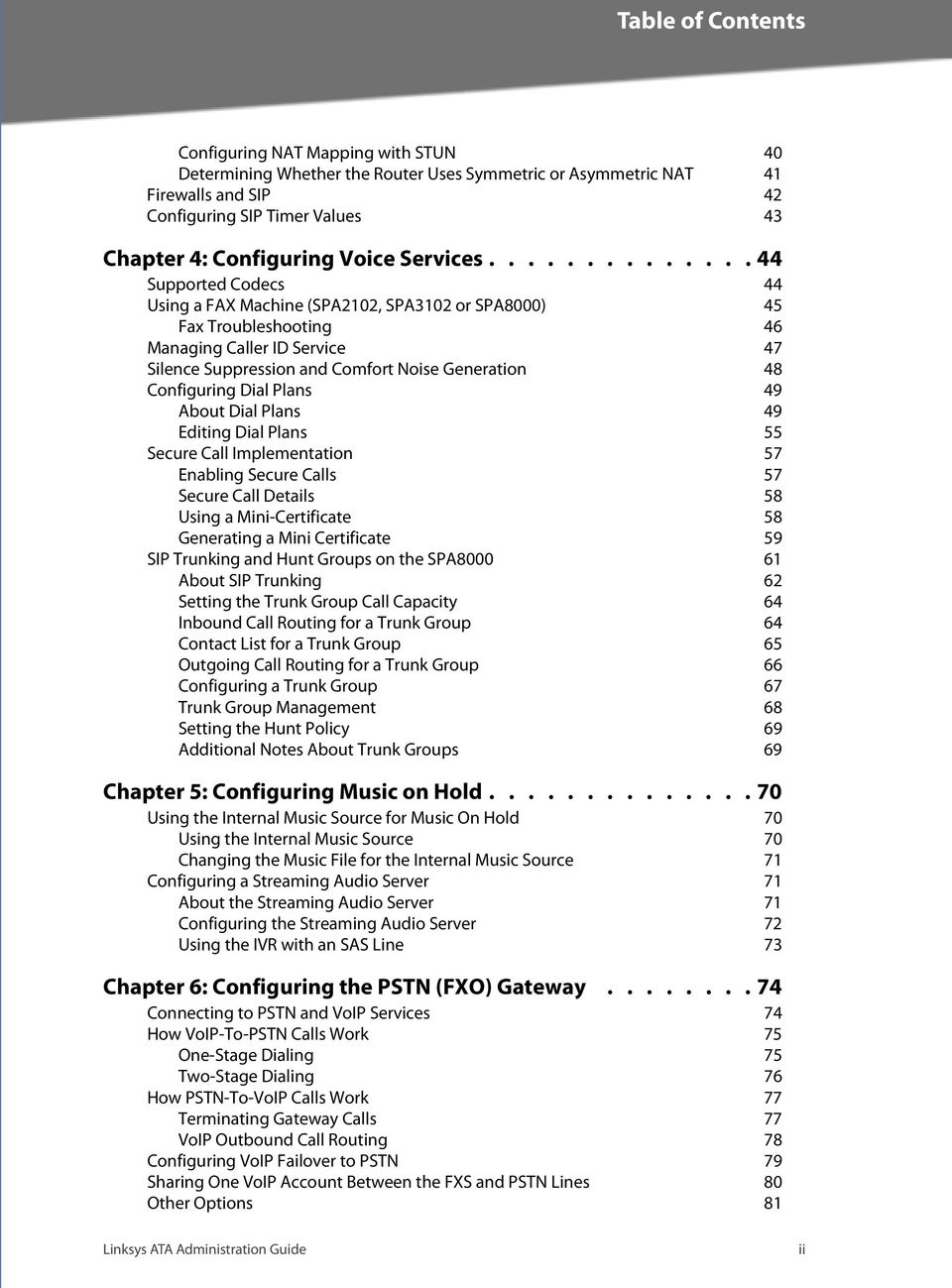
4 Table of Contents PSTN Call to Ring Line 1 81 Symmetric RTP 81 Call Progress Tones 81 Call Scenarios 82 PSTN to VoIP Call with and Without Ring-Thru 82 VoIP to PSTN Call With and Without Authentication 83 Call Forwarding to PSTN Gateway 85 Appendix A: Linksys ATA Routing Field Reference Status page 86 Product Information section 86 System Status section 87 WAN Setup page 87 Internet Connection Settings section 88 Static IP Settings section 88 PPPoE Settings section 88 Optional Settings section 89 MAC Clone Settings section 89 Remote Management section 90 QOS Settings section 90 VLAN Settings section 90 LAN Setup page 90 Networking Service section 91 LAN Networking Settings section 91 Static DHCP Lease Settings section 91 Application page 92 Port Forwarding Settings section 92 DMZ Settings section 92 Miscellaneous Settings section 93 System Reserved Ports Range section 93 Appendix B: Linksys ATA Voice Field Reference Info page 94 Product Information section 95 System Status section 95 Line Status section 95 System Information section (PAP2T) 97 PSTN Line Status section (AG310 and SPA3102) 97 Trunk Status section (SPA8000) 99 System page 99 System Configuration section 100 Internet Connection Type section (PAP2T) 100 Optional Network Configuration section (PAP2T) 100 Miscellaneous Settings section (not used with PAP2T) 101 SIP page 102 SIP Parameters section 102 SIP Timer Values (sec) section 103 Response Status Code Handling section 105 RTP Parameters section 105 SDP Payload Types section 106 NAT Support Parameters section 107 Linksys ATA Administration Guide iii

5 Table of Contents Trunking Parameters section (SPA8000) 109 Regional page 110 Call Progress Tones section 110 Distinctive Ring Patterns section 112 Distinctive Call Waiting Tone Patterns section 113 Distinctive Ring/CWT Pattern Names section 113 Ring and Call Waiting Tone Spec section 114 Control Timer Values (sec) section 114 Vertical Service Activation Codes section 116 Vertical Service Announcement Codes section (SPA2102, SPA8000) 119 Outbound Call Codec Selection Codes section 120 Miscellaneous section 121 Line page 123 Line Enable section 124 Streaming Audio Server (SAS) section 124 NAT Settings section 125 Network Settings section 125 SIP Settings section 126 Call Feature Settings section 128 Proxy and Registration section 128 Subscriber Information section 130 Supplementary Service Subscription section 130 Audio Configuration section 132 Gateway Accounts section (SPA3102/AG310) 132 VoIP Fallback to PSTN section (SPA3102/AG310) 133 Dial Plan section 133 FXS Port Polarity Configuration section 135 Trunk Group page (SPA8000) 135 Line Enable section 135 Network Settings section 136 SIP Settings section 136 Subscriber Information section 138 Dial Plan section 139 NAT Settings section 139 Proxy and Registration section 140 PSTN Line page (AG310 and SPA3102) 141 Line Enable section 142 NAT Settings section 142 Network Settings section 142 SIP Settings section 143 Proxy and Registration section 145 Subscriber Information section 146 Audio Configuration section 146 Dial Plans section 149 VoIP-To-PSTN Gateway Setup section 149 VoIP Users and Passwords (HTTP Authentication) section 150 Ring Settings section 151 FXO (PSTN) Timer Values (sec) section 151 PSTN Disconnect Detection section 153 International Control (Settings) section 155 User page 156 Linksys ATA Administration Guide iv
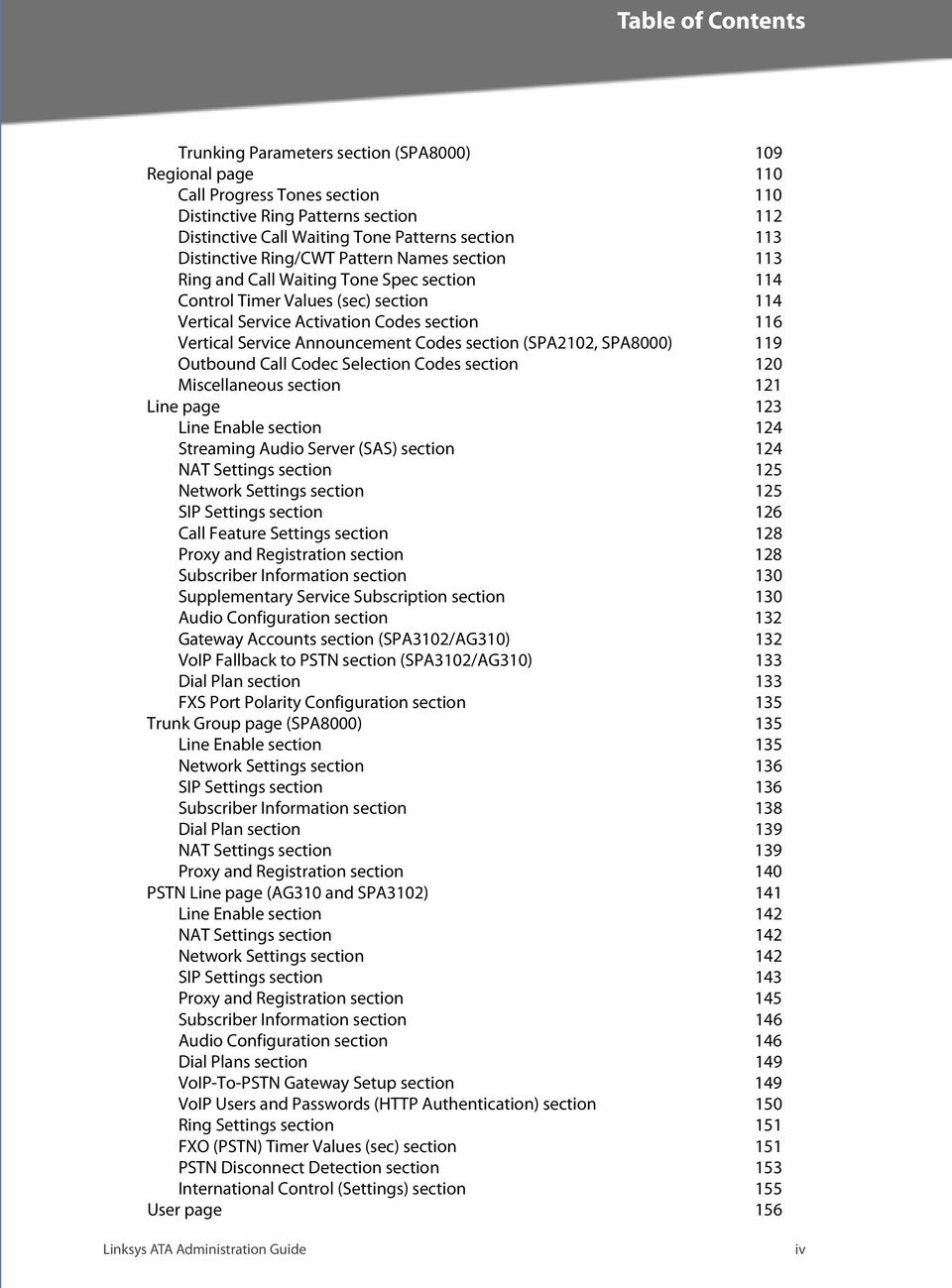
6 Table of Contents Call Forward Settings section 157 Selective Call Forward Settings section 157 Speed Dial Settings section 158 Supplementary Service Settings section 158 Distinctive Ring Settings section 159 Ring Settings section 159 PSTN User page (AG310 and SPA3102) 160 PSTN-To-VoIP Selective Call Forward Settings section 160 PSTN-To-VoIP Speed Dial Settings section 161 PSTN Ring Thru Line 1 Distinctive Ring Settings section 161 PSTN Ring Thru Line 1 Ring Settings section 161 Appendix C: Provisioning Reference (WRP400) Appendix D: Troubleshooting Appendix E: Environmental Specifications PAP2T 174 SPA SPA SPA RTP WRP WRTP54G 177 AG Appendix F: Warranty Information Limited Warranty 178 Exclusions and Limitations 178 Obtaining Warranty Service 179 Technical Support 179 Appendix G: Regulatory Information Federal Communications Commission Interference Statement 180 Industry Canada Statement 180 Règlement d Industry Canada 180 EC Declaration of Conformity (Europe) 181 User Information for Consumer Products Covered by EU Directive 2002/96/EC on Waste Electric and Electronic Equipment (WEEE) 181 Appendix H: Safety Information Meaning of the Warning Symbol 188 General Safety Information 188 Power Safety Information 189 Appendix I: Software License Agreement Software in Linksys Products: 190 Software Licenses: 190 Schedule 1 Linksys Software License Agreement 190 Schedule Linksys ATA Administration Guide v
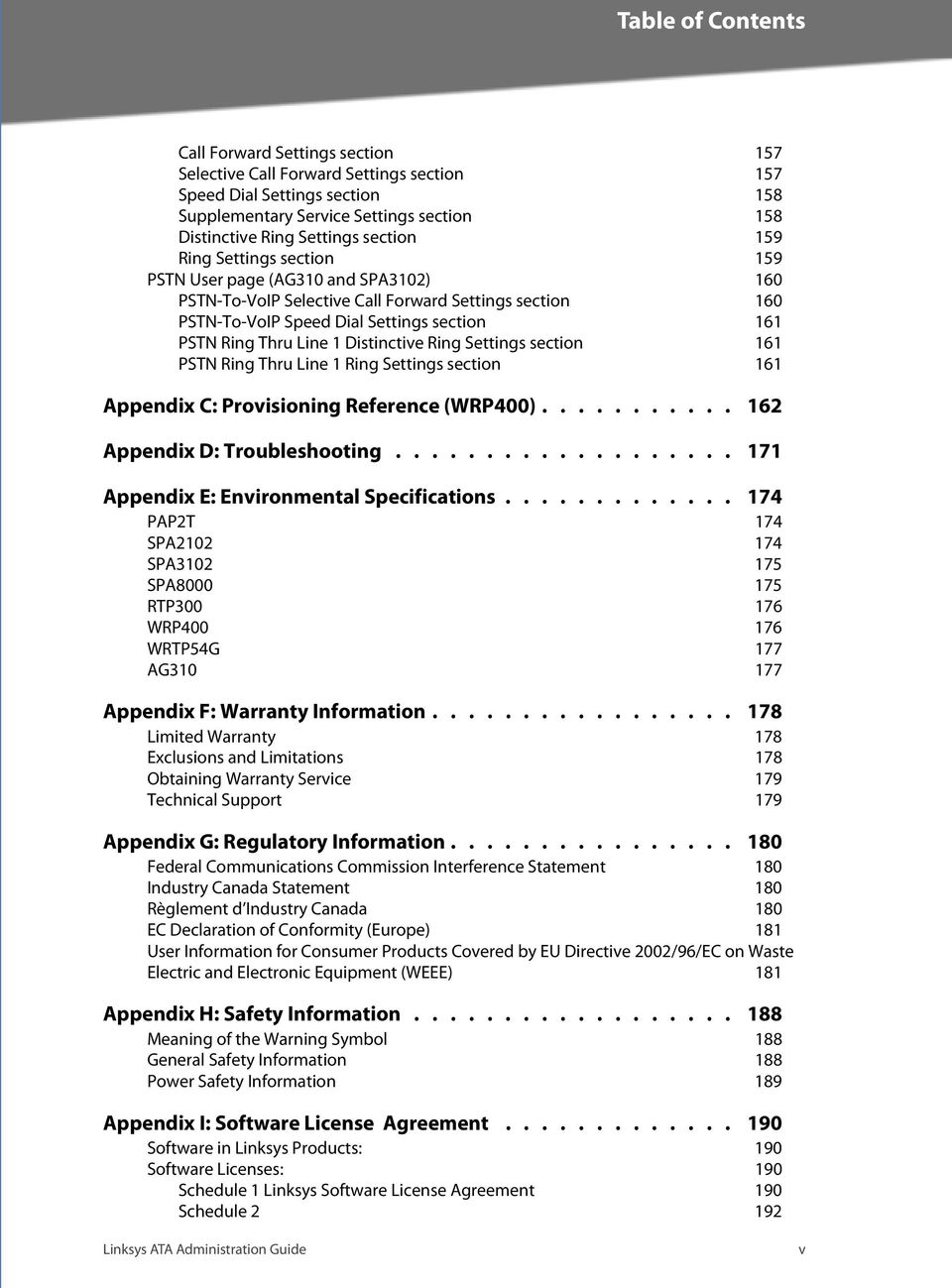
7 Table of Contents Schedule Appendix J: Contacts Linksys ATA Administration Guide vi

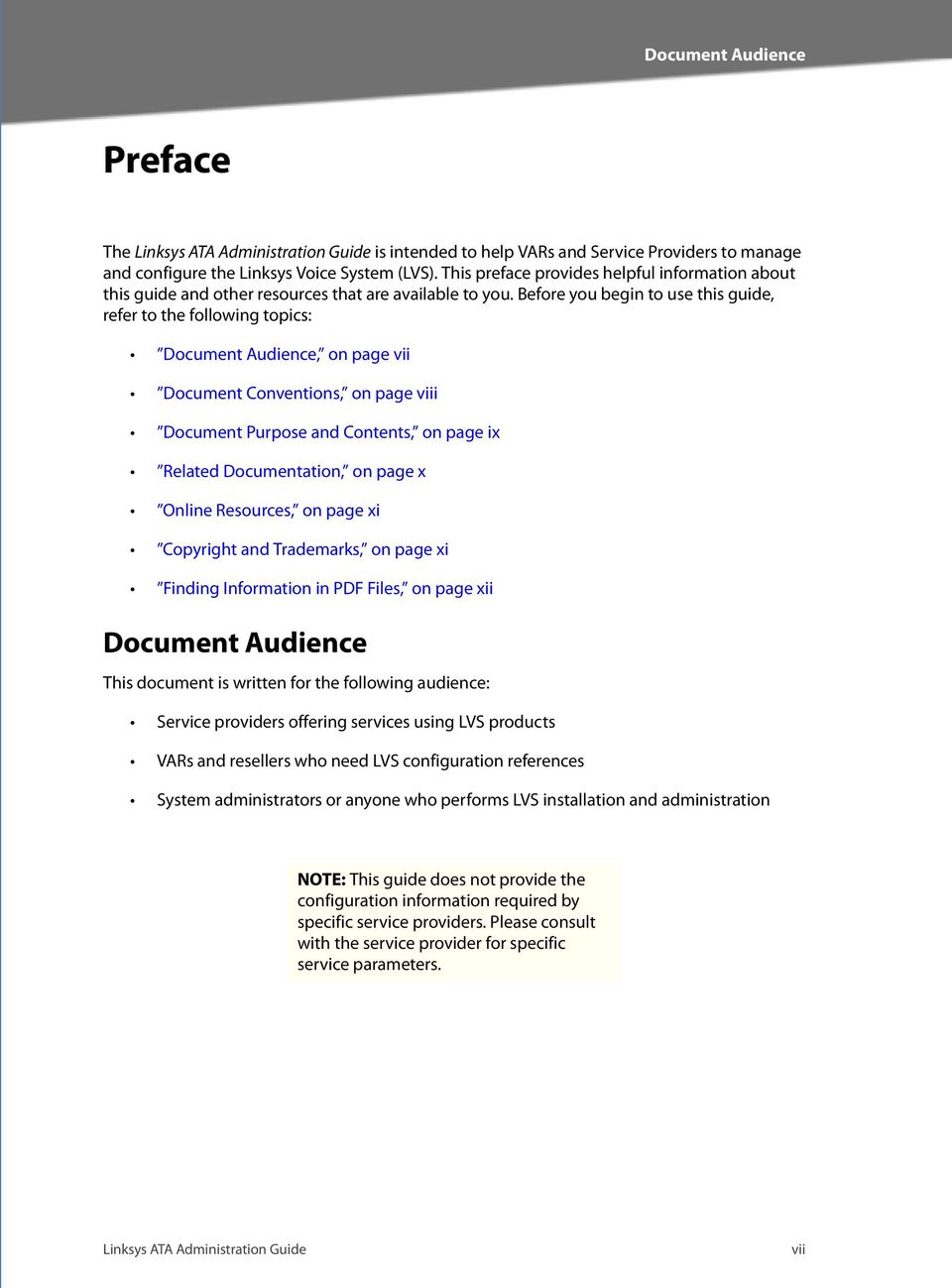
8 Document Audience Preface The Linksys ATA Administration Guide is intended to help VARs and Service Providers to manage and configure the Linksys Voice System (LVS). This preface provides helpful information about this guide and other resources that are available to you. Before you begin to use this guide, refer to the following topics: Document Audience, on page vii Document Conventions, on page viii Document Purpose and Contents, on page ix Related Documentation, on page x Online Resources, on page xi Copyright and Trademarks, on page xi Finding Information in PDF Files, on page xii Document Audience This document is written for the following audience: Service providers offering services using LVS products VARs and resellers who need LVS configuration references System administrators or anyone who performs LVS installation and administration NOTE: This guide does not provide the configuration information required by specific service providers. Please consult with the service provider for specific service parameters. Linksys ATA Administration Guide vii
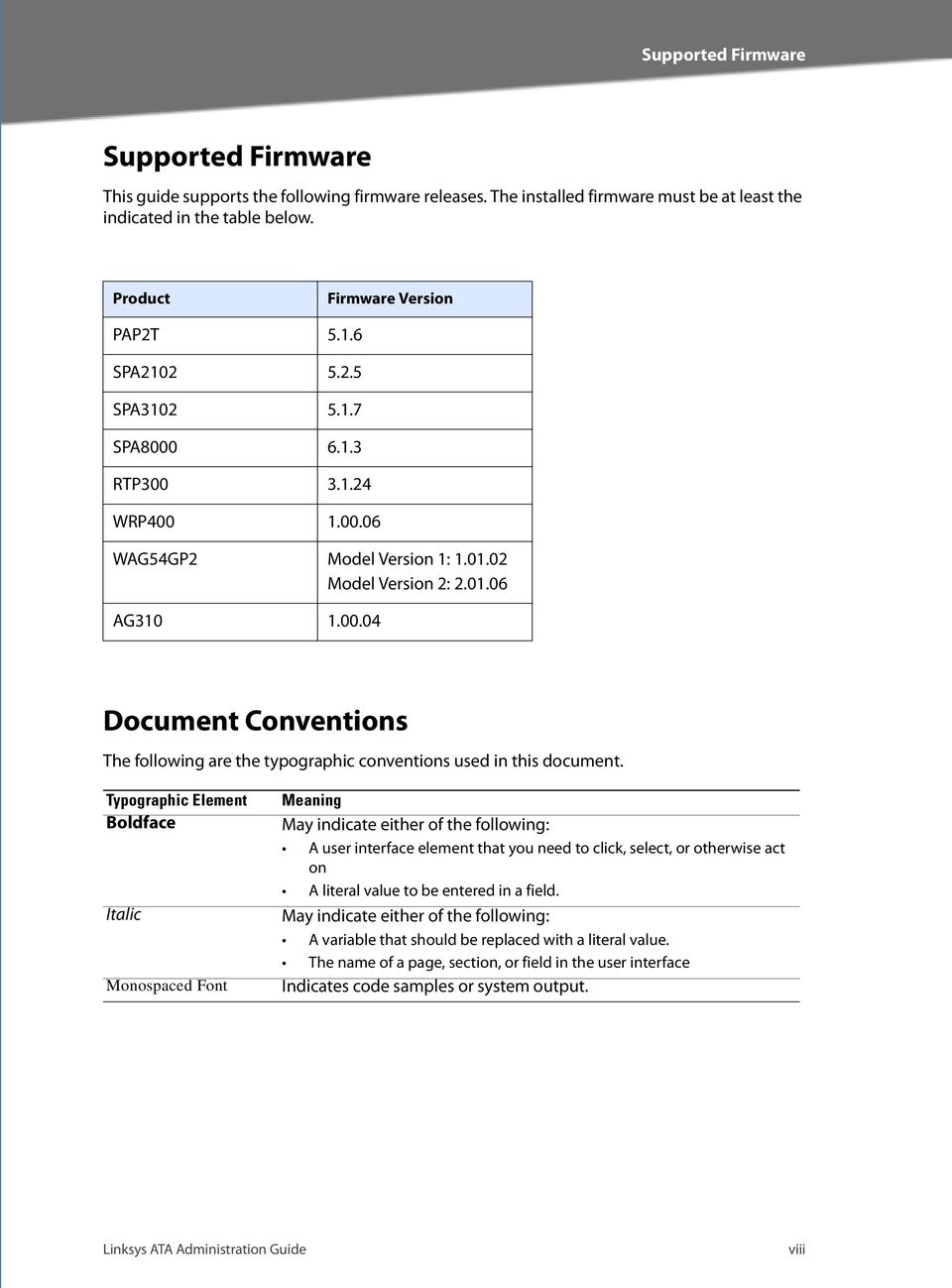
9 Supported Firmware Supported Firmware This guide supports the following firmware releases. The installed firmware must be at least the indicated in the table below. Product Firmware Version PAP2T SPA SPA SPA RTP WRP WAG54GP2 Model Version 1: Model Version 2: AG Document Conventions The following are the typographic conventions used in this document. Typographic Element Boldface Italic Monospaced Font Meaning May indicate either of the following: A user interface element that you need to click, select, or otherwise act on A literal value to be entered in a field. May indicate either of the following: A variable that should be replaced with a literal value. The name of a page, section, or field in the user interface Indicates code samples or system output. Linksys ATA Administration Guide viii
10 Document Purpose and Contents Document Purpose and Contents This document provides information that an administrator needs to configure the Linksys Voice System, which typically consists of a SPA9000 IP PBX, one or more SPA900 Series IP phones, and the optional SPA400 PSTN gateway and voice mail server. This guide focuses primarily on the tasks that an administrator performs to configure a SPA9000 with the SPA9000 administration web server. NOTE: This guide does not cover initial installation and configuration, SPA900 Series phone configuration, the Setup Wizard, or provisioning. See Related Documentation, on page x. The information in this guide is organized into the following chapters and appendices: Chapter Chapter 1, "Introducing Linksys Analog Telephone Adapters" Chapter 2, "Basic Administration and Configuration of Your Linksys ATA Device" Chapter 3, "Configuring Your System for ITSP Interoperability" Chapter 4, "Configuring Voice Services" Chapter 5, "Configuring Music on Hold" Chapter 6, "Configuring the PSTN (FXO) Gateway" Appendix A, "Linksys ATA Routing Field Reference" Appendix B, "Linksys ATA Voice Field Reference" Appendix C, "Provisioning Reference (WRP400)" Appendix D, "Troubleshooting" Appendix E, "Environmental Specifications" Appendix F, "Warranty Information" Linksys ATA Administration Guide Contents This chapter introduces the functionality of the Linksys ATA devices and describes the features that are available. This chapter describes the equipment and services that are required to install your ATA device and explains how to complete the basic administration and configuration tasks. This chapter provides configuration details for the purpose of helping you to ensure that your infrastructure properly supports voice services. This chapter describes how to configure your ATA device to meet the customer s requirements for voice services. This chapter explains how to configure Music on Hold using either a music file or streaming audio. This chapter describes how to configure the Linksys SPA3102 and AG310 devices to provide PSTN connectivity. This chapter describes the settings that you can configure under the Router and Network tabs in the administration web server pages. This chapter describes the settings that you can configure under the Voice tab in the administration web server pages. The WRP400 can be provisioned remotely. This chapter provides information about the parameters that can be provisioned from an XML profile by using the Linksys profile compiler tool (SPC). This appendix provides solutions to problems that may occur during the installation and operation of the Linksys ATA devices. These appendices provide additional product information. ix

11 Related Documentation Appendix I, "Software License Agreement" Appendix H, "Safety Information" Appendix J, "Contacts" Related Documentation Refer to the following documentation to provide additional information about features and functionality of Linksys ATAs: Your Linksys ATA Quick Installation Guide Your Linksys ATA User Guide SPA Provisioning Guide The Linksys ATA Administration Guide is part of a complete suite of documentation that is available to assist you in using and configuring Linksys devices. The following documents are of special interest to Linksys Voice System administrators. NOTE: These documents and more are available at Linksys.com. Document Title Description Intended Audience Linksys Phone Administration Guide Linksys SPA9x2 Phone User Guide Linksys Voice System Installation and Configuration Guide Configuration and management of IP phones Deployment options with or without the SPA9000 IP PBX SPA9x2 series IP phones Phone setup Phone features SPA9x2 series IP phones Network design considerations and site preparation Switch configuration Initial installation and configuration of the LVS components: SPA9000, SPA400, SPA900 series IP phones. VARs and Service Providers VARS and phone end-users VARs and Service Providers Linksys ATA Administration Guide x
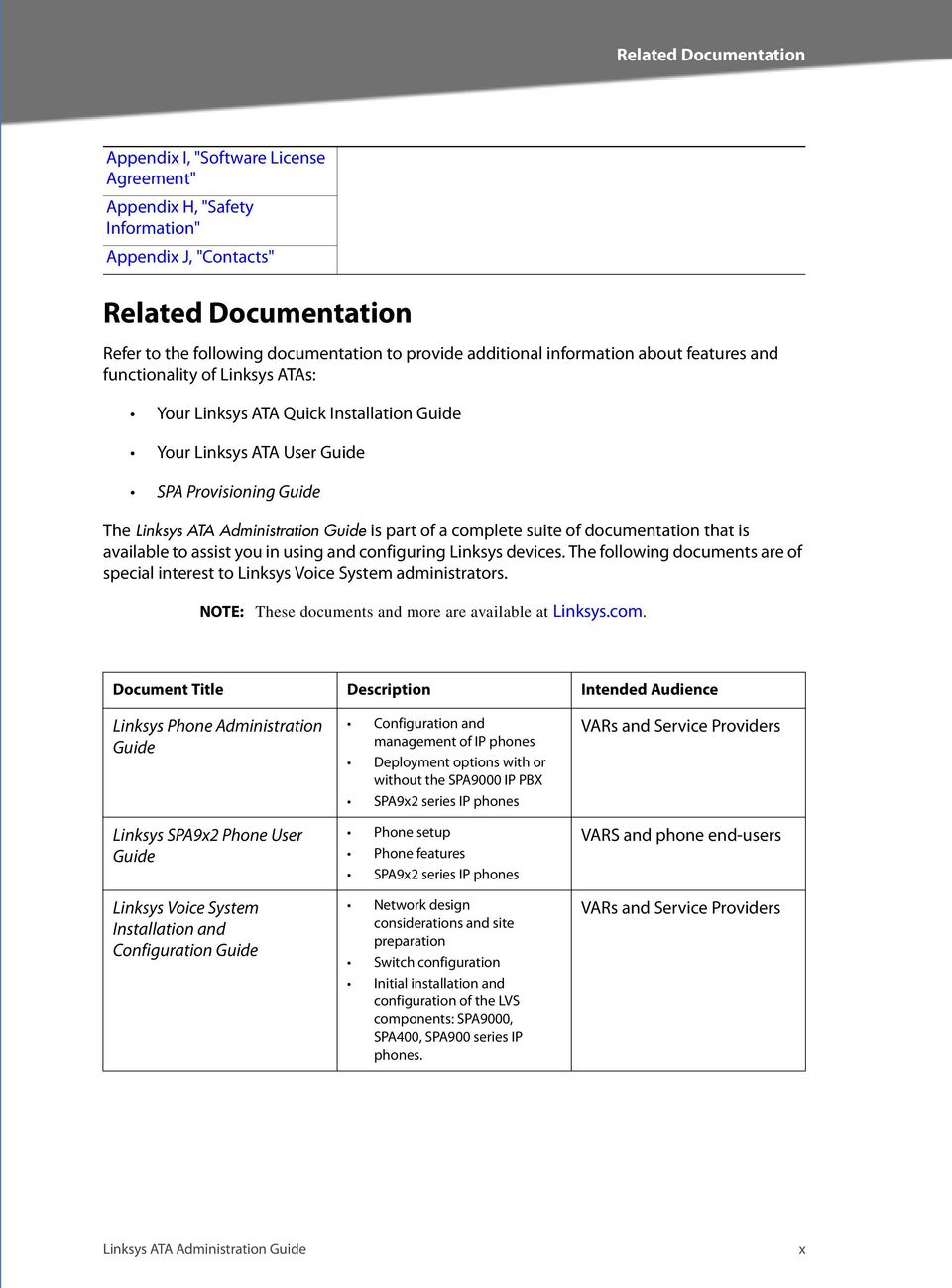
12 Online Resources Document Title Description Intended Audience Linksys Voice System Administration Guide Administration and configuration of system features using the SPA9000 and SPA400 Deployment options for ITSP, PSTN, and ISDN services SPA9000, SPA400, SPA900 series phones VARs and Service Providers Linksys Provisioning Guide Provisioning LVS components Service Providers only Online Resources Website addresses in this document are listed without in front of the address because most current web browsers do not require it. If you use an older web browser, you may have to add in front of the web address. Resource Linksys Linksys International Glossary Network Security Link Copyright and Trademarks Technical Support Linksys is a registered trademark or trademark of Cisco Systems, Inc. and/or its affiliates in the U.S. and certain other countries. Copyright 2008 Cisco Systems, Inc. All rights reserved. Adobe, Acrobat, and Flash are either registered trademarks or trademarks of Adobe Systems Incorporated in the United States and/or other countries. Other brands and product names are trademarks or registered trademarks of their respective holders. Other brands and product names are trademarks or registered trademarks of their respective holders. A list of technical support phone numbers and web sites is available in Appendix J, "Contacts." Linksys ATA Administration Guide xi

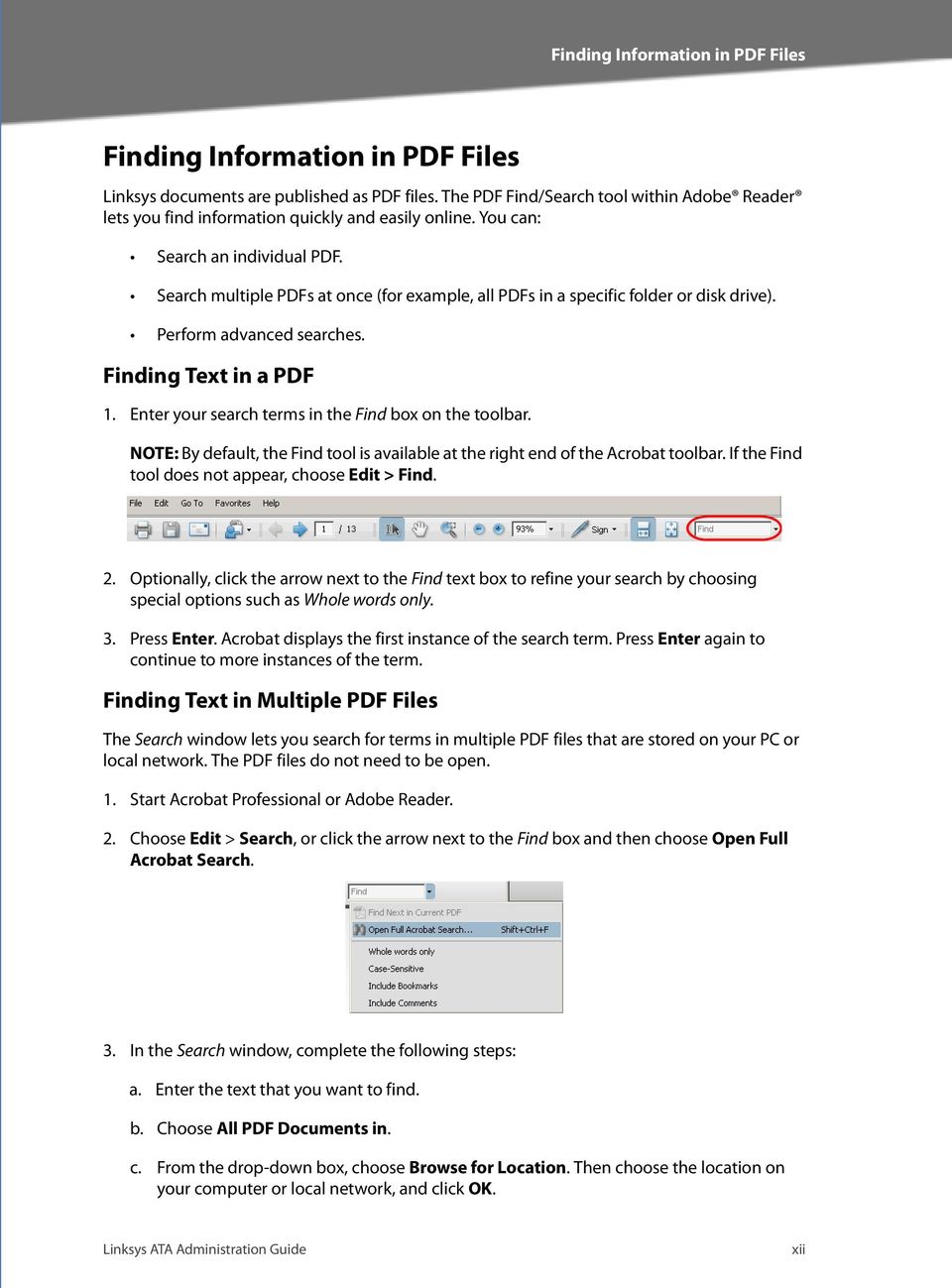
13 Finding Information in PDF Files Finding Information in PDF Files Linksys documents are published as PDF files. The PDF Find/Search tool within Adobe Reader lets you find information quickly and easily online. You can: Search an individual PDF. Search multiple PDFs at once (for example, all PDFs in a specific folder or disk drive). Perform advanced searches. Finding Text in a PDF 1. Enter your search terms in the Find box on the toolbar. NOTE: By default, the Find tool is available at the right end of the Acrobat toolbar. If the Find tool does not appear, choose Edit > Find. 2. Optionally, click the arrow next to the Find text box to refine your search by choosing special options such as Whole words only. 3. Press Enter. Acrobat displays the first instance of the search term. Press Enter again to continue to more instances of the term. Finding Text in Multiple PDF Files The Search window lets you search for terms in multiple PDF files that are stored on your PC or local network. The PDF files do not need to be open. 1. Start Acrobat Professional or Adobe Reader. 2. Choose Edit > Search, or click the arrow next to the Find box and then choose Open Full Acrobat Search. 3. In the Search window, complete the following steps: a. Enter the text that you want to find. b. Choose All PDF Documents in. c. From the drop-down box, choose Browse for Location. Then choose the location on your computer or local network, and click OK. Linksys ATA Administration Guide xii
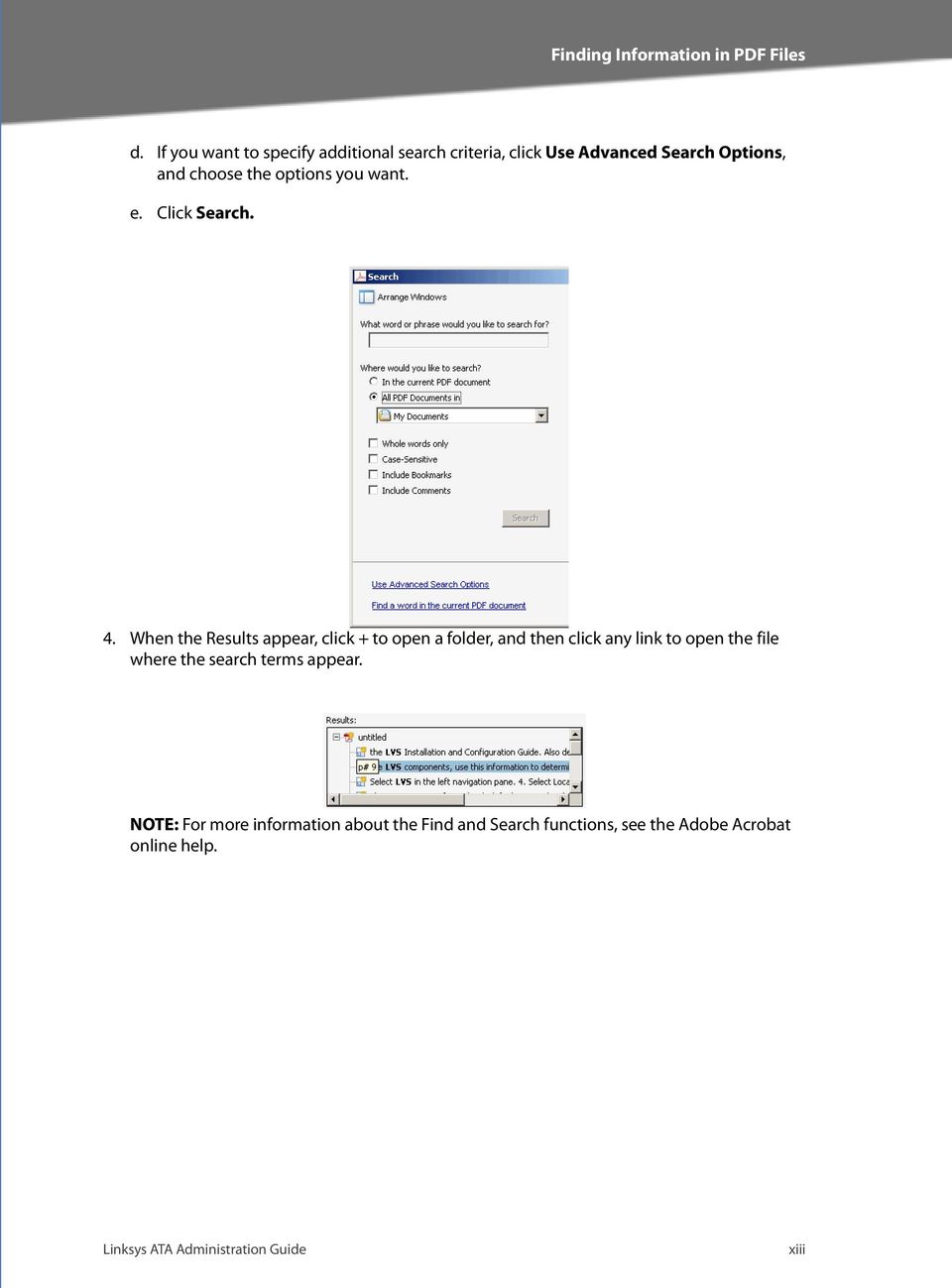
14 Finding Information in PDF Files d. If you want to specify additional search criteria, click Use Advanced Search Options, and choose the options you want. e. Click Search. 4. When the Results appear, click + to open a folder, and then click any link to open the file where the search terms appear. NOTE: For more information about the Find and Search functions, see the Adobe Acrobat online help. Linksys ATA Administration Guide xiii
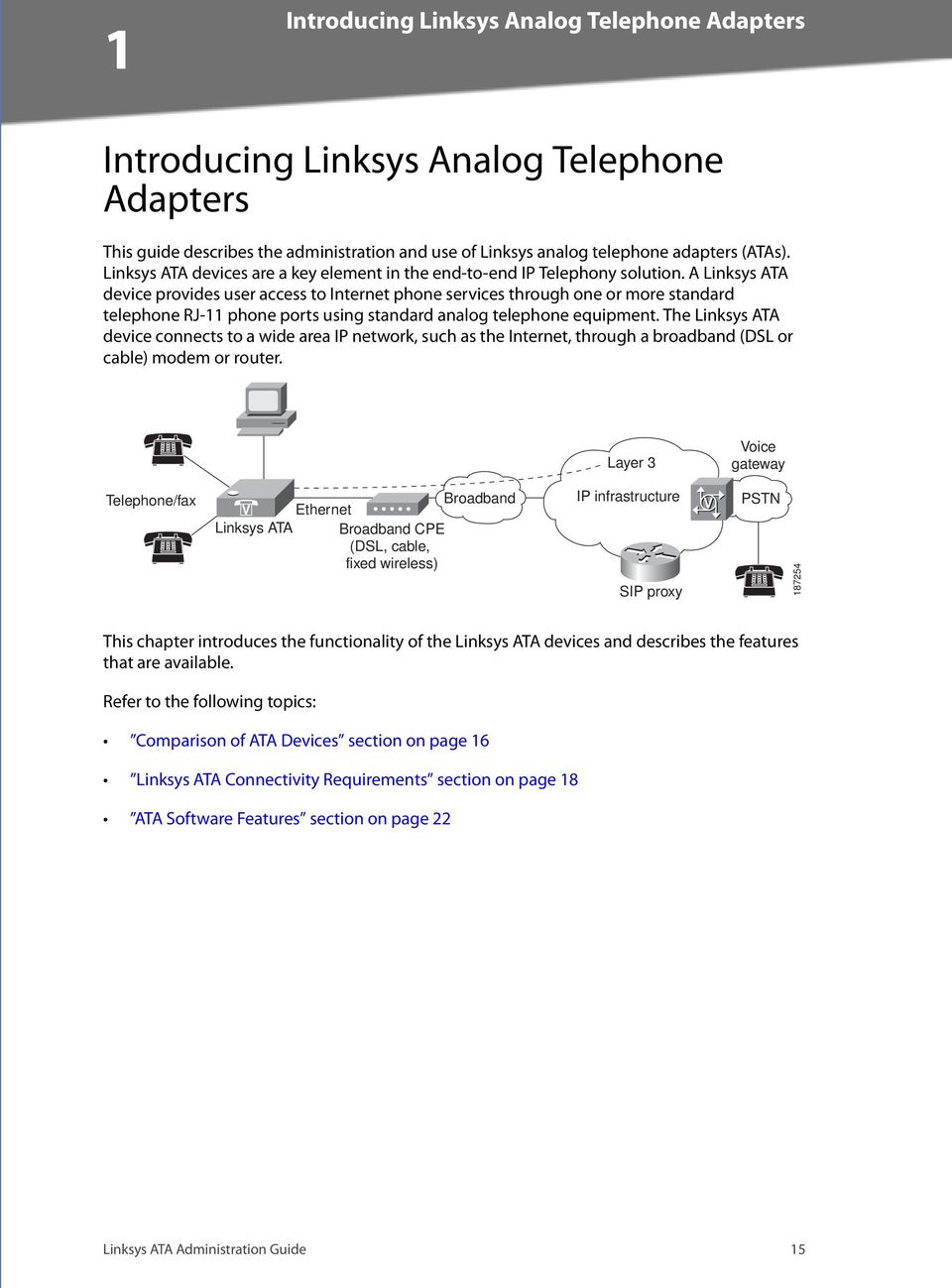
15 1 Introducing Linksys Analog Telephone Adapters Introducing Linksys Analog Telephone Adapters This guide describes the administration and use of Linksys analog telephone adapters (ATAs). Linksys ATA devices are a key element in the end-to-end IP Telephony solution. A Linksys ATA device provides user access to Internet phone services through one or more standard telephone RJ-11 phone ports using standard analog telephone equipment. The Linksys ATA device connects to a wide area IP network, such as the Internet, through a broadband (DSL or cable) modem or router. Layer 3 Voice gateway Telephone/fax Broadband V Ethernet Linksys ATA Broadband CPE (DSL, cable, fixed wireless) IP infrastructure SIP proxy V PSTN This chapter introduces the functionality of the Linksys ATA devices and describes the features that are available. Refer to the following topics: Comparison of ATA Devices section on page 16 Linksys ATA Connectivity Requirements section on page 18 ATA Software Features section on page 22 Linksys ATA Administration Guide 15
16 Introducing Linksys Analog Telephone Adapters Comparison of ATA Devices Comparison of ATA Devices Each Linksys ATA device is an intelligent low-density Voice over IP (VoIP) gateway that enables carrier-class residential and business IP Telephony services delivered over broadband or highspeed Internet connections. A Linksys ATA device maintains the state of each call it terminates and makes the proper reaction to user input events (such as on/off hook or hook flash). The Linksys ATA devices use the Session Initiation Protocol (SIP) open standard so there is little or no involvement by a middle-man server or media gateway controller. SIP allows interoperation with all ITSPs that support SIP. The following table summarizes the ports and features provided by the Linksys ATA devices described in this document. Product Name FXS (Analog Phone) FXO PSTN Connection RJ-45 Internet (WAN) RJ-45 Ethernet (LAN) Configurable Voice Lines Description PAP2T Voice adapter with two FXS ports. SPA Voice adapter with router. SPA Voice adapter with router and PSTN connectivity. SPA Maintenance only 8 Voice adapter with support for up to eight FXS devices. Supports SIP Trunking for inbound call routing to trunk groups. RTP IP router with two FXS ports. Provides ATA device functionality. WRP Wireless-G IP router with two FXS ports. Provides ATA device functionality. Can be remotely provisioned. WRTP54G WAG54GP Wireless-G IP router with two FXS ports. Provides ATA device functionality. AG ADSL2+ gateway with VoIP and PSTN connectivity. Provides ATA device functionality. NOTE: The information contained in this guide is not a warranty from Linksys, a division of Cisco Systems, Inc. Customers planning to use Linksys ATA devices in a VoIP service deployment are advised to test all functionality they plan to support before putting the Linksys ATA device in service. By implementing Linksys ATA devices with the SIP protocol, intelligent endpoints at the edges of a network perform the bulk of the call processing. This allows the deployment of a large network with thousands of subscribers without complicated, expensive servers. Linksys ATA Administration Guide 16

17 Introducing Linksys Analog Telephone Adapters Comparison of ATA Devices Figure 1 illustrates how the different Linksys ATA devices provide voice connectivity in a VoIP network. Ethernet/Wireless LAN Fax (up to 4 SPA8000) WRP400, RTP300, WRTP54G, and SPA2102 PSTN Broadband router Internet DSL/cable modem WAG54GP2, AG310 Analog phone (up to 8 with SPA8000) SPA8000, PAP2T SPA3102 Broadband router Ethernet/Wireless LAN Ethernet/Wired LAN PSTN Notes on Figure 1: Figure 1: How Linksys ATAs Provide Voice Connectivity The AG310, SPA3102, SPA8000, and WAG54GP2 act as SIP-PSTN gateways. They provide PSTN connectivity in addition to a single FXS port. In addition, the AG310 and WAG54GP2 provide an ADSL2+ gateway. The WRP400, RTP300, and WRTP54G routers provide ports for analog telephone devices and provide QoS in the form of priority packet queueing. Linksys ATA Administration Guide 17

18 Introducing Linksys Analog Telephone Adapters Linksys ATA Connectivity Requirements Linksys ATA Connectivity Requirements A Linksys ATA device can be connected to a local router, or directly to the Internet. Each phone connected to an RJ-11 (analog) port on the Linksys ATA device connects to other devices through SIP, which is transmitted over the IP network. In order to ensure connectivity between the devices connected to its FXS ports, the Linksys ATA device requires the following functionality to be supplied on the network connected to its Ethernet port: Connection to an IP router with hairpinning support Connection to an outbound Proxy server When a phone connected to the Linksys ATA device communicates with another phone, it sends a SIP packet onto the internal LAN. The packet is then forwarded to the external LAN or directly to the Internet. The source address and source port on the original packet are assigned by the Linksys ATA device DHCP server. The address and port are translated by the Linksys ATA device using Network Address Translation (NAT) and Port Address Translation (PAT). The packet is then routed back to the internal network on the Linksys ATA device by the local router or the ISP router. Problems can occur with calls between phones connected to the Linksys ATA device when an outbound proxy or a router with hairpinning support is not available. The Linksys ATA device cannot directly connect the two telephone devices, but requires a local or remote router to route the packet back to its destination on the local network from which it originated. The necessary routing can be provided by a router with hairpinning support, or by an outbound SIP proxy, which is typically provided by the Internet Telephony Service Provider (ITSP). When relying on the ITSP for interconnecting phones on the Linksys ATA device, local phones connected to the Linksys ATA device are unable to communicate with each other if the Internet connection is not available for any reason. It is recommended you connect the Linksys ATA device to a local router that provides hairpinning support to prevent this problem. Linksys PAP2T Connectivity As shown in the following figure, the PAP2T has two FXS ports (voice lines 1 and 2). Administrative IVR (Line 1 or Line 2) Line 1 Line 2 Ethernet port IP Router (with hairpinning) or Broadband modem ISP Internet LAN WAN IP PAP2T ITSP Linksys ATA Administration Guide 18

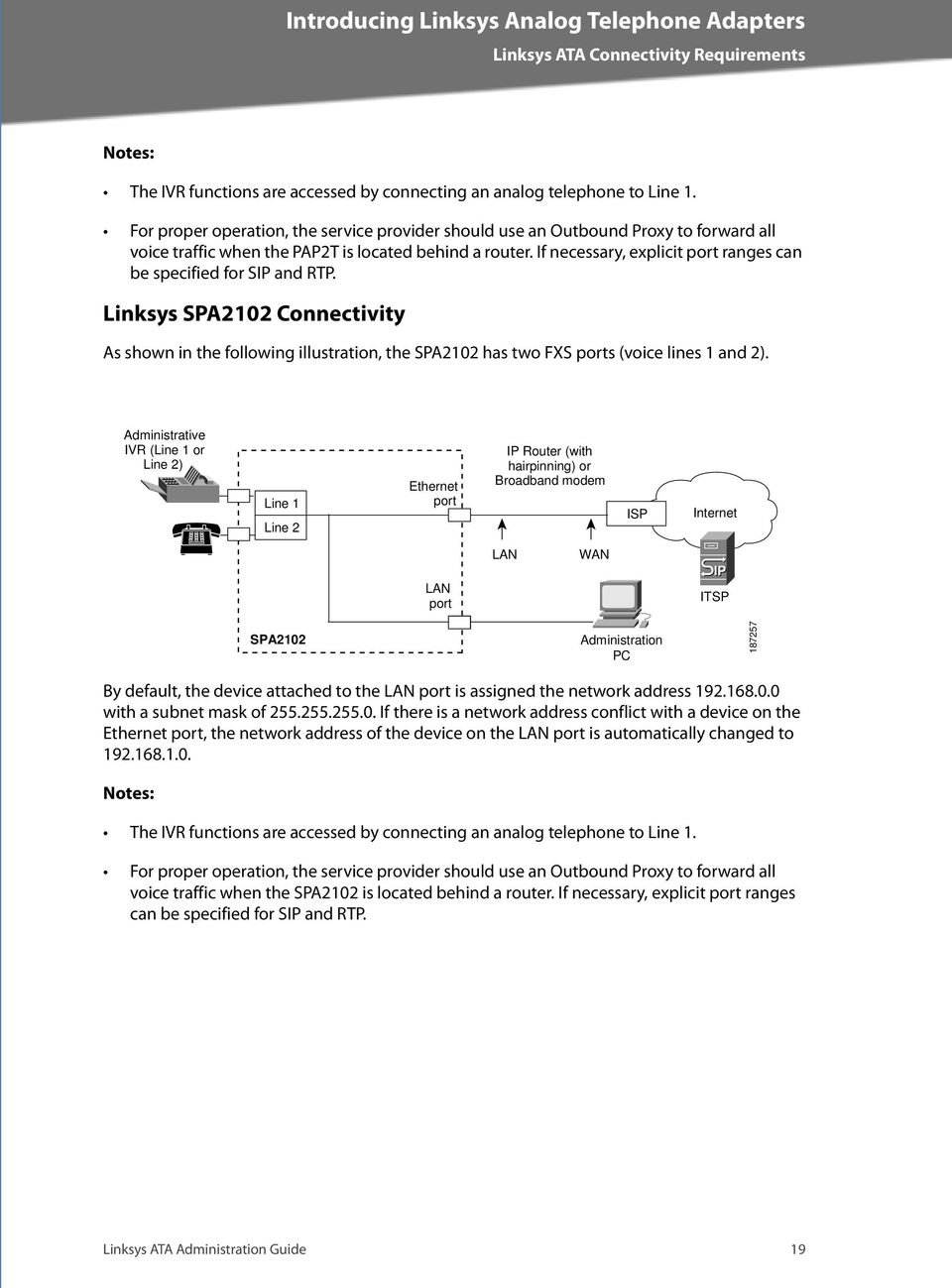
19 Introducing Linksys Analog Telephone Adapters Linksys ATA Connectivity Requirements Notes: The IVR functions are accessed by connecting an analog telephone to Line 1. For proper operation, the service provider should use an Outbound Proxy to forward all voice traffic when the PAP2T is located behind a router. If necessary, explicit port ranges can be specified for SIP and RTP. Linksys SPA2102 Connectivity As shown in the following illustration, the SPA2102 has two FXS ports (voice lines 1 and 2). Administrative IVR (Line 1 or Line 2) Line 1 Line 2 Ethernet port IP Router (with hairpinning) or Broadband modem ISP Internet LAN port LAN WAN IP ITSP SPA2102 Administration PC By default, the device attached to the LAN port is assigned the network address with a subnet mask of If there is a network address conflict with a device on the Ethernet port, the network address of the device on the LAN port is automatically changed to Notes: The IVR functions are accessed by connecting an analog telephone to Line 1. For proper operation, the service provider should use an Outbound Proxy to forward all voice traffic when the SPA2102 is located behind a router. If necessary, explicit port ranges can be specified for SIP and RTP. Linksys ATA Administration Guide 19
20 Introducing Linksys Analog Telephone Adapters Linksys ATA Connectivity Requirements Linksys SPA3102 Connectivity As shown in the following figure, the SPA3102 has one FXS port (voice line 1). Administrative IVR (Line 1 or Line 2) PSTN Line 1 PSTN Line 1 Ethernet port LAN port IP Router (with hairpinning) or Broadband modem LAN WAN ISP Internet IP ITSP By default, the device on the LAN port is assigned the network address with a subnet mask of If there is a network address conflict with a device on the Ethernet port, the network address of the device on the LAN port is automatically changed to Notes: SPA3102 Administration PC The IVR functions are accessed by connecting an analog telephone to Line 1. For proper operation, the service provider should use an Outbound Proxy to forward all voice traffic when the SPA3102 is located behind a router. If necessary, explicit port ranges can be specified for SIP and RTP Linksys ATA Administration Guide 20

21 Introducing Linksys Analog Telephone Adapters Linksys ATA Connectivity Requirements Linksys SPA8000 Connectivity As shown in the following illustration, the SPA8000 consists of eight voice ports (voice lines 1-8). Administrative IVR (Line 1 or Line 2) 8 FXS (RJ-11/RJ-21 ) ports SPA8000 Line 1 Line 2 NAT/PAT Internal DHCP server Ethernet port IP Router (with hairpinning) or Broadband modem ISP Internet AUX port LAN WAN IP ITSP Line 3 Line 4 Administration PC Line 5 Line 6 Line 7 Line By default, the device on the AUX port is assigned the network address with a subnet mask of If there is a network address conflict with a device on the Ethernet port, the network address of the device on the AUX port is automatically changed to In the illustration, one fax machine is connected to each pair of ports to illustrate that only one T.38 connection is supported by each of the four pairs of RJ-11 ports. Up to four fax machines can be connected to the SPA8000 router, but they must be distributed as shown. Notes: With the SPA8000, use line 1 or line 2 to access the IVR functions. See the SPA8000 Quick Installation Guide for IVR instructions. For proper operation, the service provider should use an Outbound Proxy to forward all voice traffic when the SPA8000 is located behind a router. If necessary, explicit port ranges can be specified for SIP and RTP. The SPA8000 is not designed to forward IP packets to devices connected to its AUX port and that configuration is not supported. The SPA8000 also can be configured with trunk groups and trunk lines. See SIP Trunking and Hunt Groups on the SPA8000, on page 61. Linksys ATA Administration Guide 21
22 Introducing Linksys Analog Telephone Adapters ATA Software Features ATA Software Features The Linksys ATA device is a full featured, fully programmable phone adapter that can be custom provisioned within a wide range of configuration parameters. This section contains a high-level overview of features to provide a basic understanding of the feature breadth and capabilities of the Linksys ATA device. The following sections describe the factors that contribute to voice quality: Voice Supported Codecs, on page 22 SIP Proxy Redundancy, on page 23 Other Linksys ATA Software Features, on page 23 Voice Supported Codecs Negotiation of the optimal voice codec sometimes depends on the ability of the Linksys ATA device to match a codec name with the codec used by the far-end device. The Linksys ATA device allows the network administrator to individually name the various codecs that are supported so that the Linksys ATA device can successfully negotiate the codec with the far-end equipment. The administrator can select which low-bit-rate codec is to be used for each line. G.711a and G.711u are always enabled. Configure your preferred codec in the (FXS) tab in the Administration Web Server. See Linksys ATA Voice Field Reference, on page 94. See also Supported Codecs, on page 44 for a list of which codecs are supported on each Linksys ATA device. Codec (Voice Compression Algorithm) Description G.711 (A-law and mμ-law) This very low complexity codec supports uncompressed 64 kbps digitized voice transmission at one through ten 5 ms voice frames per packet. This codec provides the highest voice quality and uses the most bandwidth of any of the available codecs. G.726 This low complexity codec supports compressed 16, 24, 32, and 40 kbps digitized voice transmission at one through ten 10 ms voice frames per packet. This codec provides high voice quality. G.729a The ITU G.729 voice coding algorithm is used to compress digitized speech. Linksys supports G.729. G.729a is a reduced complexity version of G.729. It requires about half the processing power to code G.729. The G.729 and G.729a bit streams are compatible and interoperable, but not identical. G The Linksys ATA device supports the use of ITU G audio codec at 6.4 kbps. Up to two channels of G can be used simultaneously. For example, Line 1 and Line 2 can be using G simultaneously, or Line 1 or Line 2 can initiate a three-way conference with both call legs using G Note: The WRP400 device does not support the G audio codec. NOTE: When no static payload value is assigned per RFC 1890, the Linksys ATA device can support dynamic payloads for G.726. Linksys ATA Administration Guide 22
23 Introducing Linksys Analog Telephone Adapters ATA Software Features SIP Proxy Redundancy In typical commercial IP Telephony deployments, all calls are established through a SIP proxy server. An average SIP proxy server may handle thousands of subscribers. It is important that a backup server be available so that an active server can be temporarily switched out for maintenance. The Linksys ATA device supports the use of backup SIP proxy servers (via DNS SRV) so that service disruption should be nearly eliminated. A relatively simple way to support proxy redundancy is to configure your DNS server with a list of SIP proxy addresses. The Linksys ATA device can be instructed to contact a SIP proxy server in a domain named in the SIP message. The Linksys ATA device consults the DNS server to get a list of hosts in the given domain that provides SIP services. If an entry exists, the DNS server returns an SRV record that contains a list of SIP proxy servers for the domain, with their host names, priority, listening ports, and so on. The Linksys ATA device tries to contact the list of hosts in the order of their stated priority. If the Linksys ATA device is currently using a lower priority proxy server, it periodically probes the higher priority proxy to see whether it is back on line, and switches back to the higher priority proxy when possible. SIP Proxy Redundancy is configured in the Line and PSTN Line tabs in the Administration Web Server. See Linksys ATA Routing Field Reference, on page 86. Other Linksys ATA Software Features The following table summarizes other features provided by Linksys ATA devices. Feature Description Streaming Audio Server See Configuring a Streaming Audio Server, on page 71. T.38 Fax Relay See Using a FAX Machine (SPA2102, SPA3102 or SPA8000), on page 45. Silence Suppression See Silence Suppression and Comfort Noise Generation, on page 48. Modem and Fax Pass- Through Adaptive Jitter Buffer Modem pass-through mode can be triggered only by predialing the number set in the Modem Line Toggle Code. (Set in the Regional tab.) FAX pass-through mode is triggered by a CED/CNG tone or an NSE event. Echo canceller is automatically disabled for Modem pass-through mode. Echo canceller is disabled for FAX pass-through if the parameter FAX Disable ECAN (Line 1 or 2 tab) is set to yes for that line (in that case FAX pass-through is the same as Modem pass-through). Call waiting and silence suppression is automatically disabled for both FAX and Modem pass-through. In addition, out-of-band DTMF Tx is disabled during modem or fax pass-through. The Linksys ATA device can buffer incoming voice packets to minimize outof-order packet arrival. This process is known as jitter buffering. The jitter buffer size proactively adjusts or adapts in size, depending on changing network conditions. The Linksys ATA device has a Network Jitter Level control setting for each line of service. The jitter level determines how aggressively the Linksys ATA device tries to shrink the jitter buffer over time to achieve a lower overall delay. If the jitter level is higher, it shrinks more gradually. If jitter level is lower, it shrinks more quickly. Adaptive Jitter Buffer is configured in the Line and PSTN Line tabs. See Linksys ATA Voice Field Reference, on page 94. Linksys ATA Administration Guide 23
24 Introducing Linksys Analog Telephone Adapters ATA Software Features Feature International Caller ID Delivery Secure Calls Adjustable Audio Frames Per Packet DTMF Call Progress Tone Generation Call Progress Tone Pass Through Echo Cancellation Description In addition to support of the Bellcore (FSK) and Swedish/Danish (DTMF) methods of Caller ID (CID) delivery, Linksys ATAs provide a large subset of ETSI-compliant methods to support international CID equipment. International CID is configured in the Line and PSTN Line tabs. See Linksys ATA Voice Field Reference, on page 94. A user (if enabled by service provider or administrator) has the option to make an outbound call secure in the sense that the audio packets in both directions are encrypted. See Secure Call Implementation section on page 57. This feature allows the user to set the number of audio frames contained in one RTP packet. Packets can be adjusted to contain from 1 10 audio frames. Increasing the number of packets decreases the bandwidth utilized, but it also increases delay and may affect voice quality. See the RTP Packet Size parameter found in the SIP tab in the Linksys ATA Voice Field Reference, on page 94. The Linksys ATA device may relay DTMF digits as out-of-band events to preserve the fidelity of the digits. This can enhance the reliability of DTMF transmission required by many IVR applications such as dial-up banking and airline information. DTMF is configured in the DTMF Tx Mode parameter found in the Line tabs. See the Linksys ATA Voice Field Reference, on page 94. The Linksys ATA device has configurable call progress tones. Call progress tones are generated locally on the ATA device so an end user is advised of status (such as ringback). Parameters for each type of tone (for instance a dial tone played back to an end user) may include frequency and amplitude of each component, and cadence information. See the Regional tab in the Linksys ATA Voice Field Reference, on page 94. This feature allows the user to hear the call progress tones (such as ringing) that are generated from the far-end network. See the Regional tab in the Linksys ATA Voice Field Reference, on page 94. Impedance mismatch between the telephone and the IP Telephony gateway phone port can lead to near-end echo. The Linksys ATA device has a nearend echo canceller that compensates for impedance match. The Linksys ATA device also implements an echo suppressor with comfort noise generator (CNG) so that any residual echo is not noticeable. Echo Cancellation is configured in the Regional, Line, and PSTN Line tabs. See Linksys ATA Voice Field Reference, on page 94. Linksys ATA Administration Guide 24
25 Introducing Linksys Analog Telephone Adapters ATA Software Features Feature Signaling Hook Flash Event Configurable Dial Plan with Interdigit Timers Polarity Control Calling Party Control Report Generation and Event Logging Syslog and Debug Server Records Description The Linksys ATA device can signal hook flash events to the remote party on a connected call. This feature can be used to provide advanced mid-call services with third-party-call-control. Depending on the features that the service provider offers using third-party-call-control, the following Linksys ATA features may be disabled to correctly signal a hook-flash event to the softswitch: Call Waiting Service (parameter call waiting serv set in the Line tab) Three Way Conference Service (parameter three-way conf serv set in the Line tab) Three Way Call Service (parameter three-way call serv set in the Line tab) You can configure the length of time allowed for detection of a hook flash using the Hook Flash Timer parameter on the Regional tab of the administration web server. See Linksys ATA Voice Field Reference, on page 94. The Linksys ATA device has three configurable interdigit timers: Initial timeout (T) Signals that the handset is off the hook and that no digit has been pressed yet. Long timeout (L) Signals the end of a dial string; that is, no more digits are expected. Short timeout (S) Used between digits; that is after a digit is pressed a short timeout prevents the digit from being recognized a second time. See Configuring Dial Plans, on page 49 for more information. The Linksys ATA device allows the polarity to be set when a call is connected and when a call is disconnected. This feature is required to support some pay phone system and answering machines. Polarity Control is configured in the Line and PSTN Line tabs. See Linksys ATA Voice Field Reference, on page 94. Calling Party Control (CPC) signals to the called party equipment that the calling party has hung up during a connected call by removing the voltage between the tip and ring momentarily. This feature is useful for auto-answer equipment, which then knows when to disengage. CPC is configured in the Regional, Line, and PSTN Line tabs. See Linksys ATA Voice Field Reference, on page 94. The Linksys ATA device reports a variety of status and error reports to assist service providers to diagnose problems and evaluate the performance of their services. The information can be queried by an authorized agent, using HTTP with digested authentication, for instance. The information may be organized as an XML page or HTML page. Report Generation and Event Logging are configured in the System, Line, and PSTN Line tabs. See Linksys ATA Voice Field Reference, on page 94. Syslog and Debug Sever Records log more details than Report Generation and Event Logging. Using the configuration parameters, the Linksys ATA device allows you to select which type of activity/events should be logged. Syslog and Debug Server allow the information captured to be sent to a Syslog Server. Syslog and Debug Server Records are configured in the System, Line, and PSTN Line tabs. See Linksys ATA Voice Field Reference, on page 94. Linksys ATA Administration Guide 25
26 Introducing Linksys Analog Telephone Adapters ATA Software Features Feature SIP Over TCP SIP Over TLS Media Loopback Register Retry Enhancements Description To guarantee state-oriented communications, Linksys SPA2102 and SPA3102 devices allow you to choose TCP as the transport protocol for SIP. This protocol is guaranteed delivery, which assures that lost packets are retransmitted. TCP also guarantees that the SIP packages are received in the same order that they were sent. As a result, TCP overcomes the main disadvantages of UDP. In addition, for security reasons, most corporate firewalls block UDP ports. With TCP, new ports do not need to be opened or packets dropped, because TCP is already in use for basic activities such as Internet browsing or e-commerce. SIP over TCP is configured in the Line tabs. See Linksys ATA Voice Field Reference, on page 94. Linksys SPA2102 and SPA3102 devices allow the use of SIP over Transport Layer Security (TLS). SIP over TLS is designed to eliminate the possibility of malicious activity by encrypting the SIP messages of the service provider and the end user. SIP over TLS relies on the widely-deployed and standardized TLS protocol. SIP Over TLS encrypts only the signaling messages and not the media. A separate secure protocol such as Secure Real-Time Transport Protocol (SRTP) can be used to encrypt voice packets. SIP over TLS is configured in the SIP Transport parameter configured in the Line tab(s). See Linksys ATA Voice Field Reference, on page 94. Linksys SPA2102, SPA3102, and PAP2T devices allow service providers to use media loopback to quantitatively and qualitatively measure the voice quality experienced by the end user. One device acts as the audio transmitter and receiver while the other device acts as the audio mirror. The audio mirror transmits the audio packets that it receives back to the transmitter/receiver instead of transmitting the data sampled on its local microphone (IP phone) or attached analog telephone (ATA-type device). Media loopback is configured in the User tab. See Linksys ATA Voice Field Reference, on page 94. The Register Retry Enhancements feature for Linksys SPA2102, SPA3102, and PAP2T devices adds flexibility to the delay timers that are activated when the SIP REGISTER of a device fails. Once a SIP REGISTER failure response code is sent, a delay timer is selected depending on the type of registration failure response code. The delay timers can be one of the following: Reg Retry Random Delay Random delay range (in seconds) to add to the Register Retry Intvl parameter when retrying a SIP REGISTER after a failure. The default is 0, which disables this feature. Reg Retry Long Random Delay Random delay range (in seconds) to add to the Register Retry Long Intvl parameter when retrying a SIP REGISTER after a failure. The default is 0, which disables this feature. Reg Retry Intvl Cap The maximum value to cap the exponential backoff retry delay. The exponential back-off retry delay starts with the setting found in the Register Retry Intvl parameter and doubles it on every REGISTER retry after a failure. In other words, the retry interval after a failure is always set to the seconds configured in the Register Retry Intvl parameter. If this feature is enabled, the Reg Retry Random Delay setting is added on top of the exponential back-off adjusted delay value. The default value is 0, which disables the exponential back-off feature. Register Retry is configured in the SIP tab. See Linksys ATA Voice Field Reference, on page 94. Linksys ATA Administration Guide 26
27 Introducing Linksys Analog Telephone Adapters ATA Software Features Feature DHCP Renewal on Timeout Description Linksys SPA2102, SPA3102, and PAP2T voice devices typically operate in a network where a DHCP server assigns IP addresses to the devices. Because IP addresses are a limited resource, the DHCP server periodically renews the device lease on the IP address. Therefore, if a Linksys ATA device loses its IP address for any reason, or if some other device on the network is assigned its IP address, the communication between the SIP proxy and the device is either severed or degraded. Whenever an expected SIP response is not received within a programmable amount of time after the corresponding SIP command is sent, the DHCP Renewal on Timeout feature automatically causes the device to request a renewal of its IP address. If the DHCP server returns the IP address that it originally assigned to the device, the Linksys ATA device is presumed to be operating correctly. If it returns a different address, the ATA device changes its IP address to the new address provided by the DHCP server. The Linksys ATA device then resets, and once again sends a SIP register request for the DHCP server to accept. Linksys ATA Administration Guide 27
28 Basic Administration and Configuration of Your Linksys ATA 2 Basic Services and Equipment Required Basic Administration and Configuration of Your Linksys ATA Device This chapter describes the equipment and services that are required to install your ATA device and explains how to complete the basic administration and configuration tasks. Refer to the following topics: Basic Services and Equipment Required section on page 28 Downloading Firmware section on page 29 Basic Installation and Configuration section on page 30 Upgrading the Firmware for the Linksys ATA Device section on page 30 Setting up Your Linksys ATA Device section on page 31 Using the Administration Web Server section on page 31 Upgrading, Rebooting, and Resyncing Your Linksys ATA Device section on page 34 Provisioning Your Linksys ATA Device section on page 35 Basic Services and Equipment Required To configure your Linksys ATA devices, you need the following services and equipment: An integrated access device or modem for broadband access to the Internet Internet Telephony Service Provider (ITSP) for Voice Over IP Telephone service You must have to following information about your account: SIP Proxy (IP address or name) Account information and Password Computer with Microsoft Windows XP or Windows Vista (for system configuration) Analog phones UPS (uninterruptible Power Source) recommended for devices such as the Integrated Access Device, network switch, router, and PoE switch to ensure that your phone system continues to work during a power failure, just like your home phone. Linksys ATA Administration Guide 28
29 Basic Administration and Configuration of Your Linksys ATA Downloading Firmware Downloading Firmware Always download and install the latest firmware for your Linksys ATA device before doing any configurations. 1. Direct your browser to the following URL: 2. In the Search box near the top right corner of the page, type the model number of your Linksys ATA device. 3. In the search results list, click the Downloads link for your product. Refer to the following example. 4. When the Downloads page appears choose your product version from the Version dropdown list., if the page includes a Version prompt. 5. Under Firmware, click the link for the latest version of the firmware. NOTE: If you are using Windows XP Service Pack 2 (SP2) and Internet Explorer, you may see the Pop-up blocked message in your browser information bar. If you see this message, click the information bar and select Temporarily Allow Pop-ups. Then click the link again. 6. Click Save in the File Download dialog box that appears. 7. In the Save As dialog box, choose a location for the file and then click Save. 8. When the download is complete, if prompted, click Close. The name of the file depends on the firmware file of your device. If the firmware file you download is in zip format, double-click the file and extract its contents to a single folder or to the desktop. To extract the firmware file from the archive, use a utility such as WinZip, or use the built-in decompression features of Windows XP. Linksys ATA Administration Guide 29
30 Basic Administration and Configuration of Your Linksys ATA Basic Installation and Configuration Basic Installation and Configuration See your particular Linksys ATA device s Quick Installation Guide and User Guide for instructions. If you are configuring the complete Linksys Voice System, also refer to the LVS Installation and Configuration Guide. Upgrading the Firmware for the Linksys ATA Device In this procedure, you install the firmware files that you downloaded previously. 1. Determine the address of the Linksys ATA device: a. Connect an analog telephone to the Phone 1 or Phone 2 port on the ATA device. b. Press **** on the keypad to access the IVR menu. c. Press 110# to determine the Internet (WAN) IP address. 2. Make a note of the IP address that is announced. NOTE: If the administration computer is connected to the Ethernet port of the Linksys ATA device, the default IP address is Use the administration computer to install the latest firmware: a. Extract the Zip file, and then run the executable file to upgrade the firmware. b. When the Firmware Upgrade Warning window appears, click Continue. c. In the next window that appears, enter the IP address of the Linksys ATA device, and then click OK. d. In the Confirm Upgrade window, verify that the correct device information and product number appear. Then click Upgrade. e. A progress message appears while the upgrade is in progress. The success window appears when the upgrade is completed. The device reboots. f. Click OK to close the confirmation message. g. To verify the upgrade, point the web browser to the IP address of the Linksys ATA device. Check the Router > Status page. The Software Version field should show the firmware version that you installed. NOTE: You may need to refresh your browser to display the updated page reflecting the new version number. Linksys ATA Administration Guide 30
31 Basic Administration and Configuration of Your Linksys ATA Setting up Your Linksys ATA Device Setting up Your Linksys ATA Device After installation and basic configuration of your Linksys ATA device, you will use the administration web server to finish your configuration. Linksys ATA devices support two levels of administration privileges: Administrator and User. Both privileges can be password protected. NOTE: By default, there are no passwords assigned for either the Administrator account or the User account. The Administrator account can modify all the web profile parameters and the passwords of both Administrator and User account. The User account can access only part of the web profile parameters. The parameters that the User account can access are specified using the Administrator account on the Provisioning page of the administration web server. To directly access the Administrator account level privilege, use the following URL: If the password has been set for the Administrator account, the browser prompts for authentication. The User account name and the Administrator account name cannot be changed. When browsing pages with the Administrator account privilege, you can switch to User account privilege by clicking the User Login link. If the User account password is set, the browser prompts for authentication when you click the User Login link. From the User account, you can switch to the Administrator account by clicking the Admin Login link. Authentication is required if the Administrator account password has been set. NOTE: Switching between User and Administrator accounts or between basic and advanced views discards any uncommitted changes on the web pages. Using the Administration Web Server This section describes how to use the administration web server to configure the advanced settings of the Linksys ATA device. It includes the following topics: Connecting to the Administration Web Server section on page 32 Setting Up the WAN Configuration for Your Linksys ATA Device section on page 32 Registering to the Service Provider section on page 33 Advanced Configurations section on page 34 Linksys ATA Administration Guide 31
32 Basic Administration and Configuration of Your Linksys ATA Using the Administration Web Server Connecting to the Administration Web Server To access the Linksys ATA administration web server, perform the following steps. 1. Start Internet Explorer on a computer that is connected to the same network as the ATA device. 2. Determine the address of the Linksys ATA device. a. Connect an analog telephone to the Phone 1 port of the ATA device. b. Press **** on the keypad to access the IVR menu. c. Press 110# to determine the Internet (WAN) IP address. NOTE: For more information on the IVR menu, see your Quick Installation Guide or User Guide for your device, or the LVS Administration Guide. 3. Direct the browser to the IP address of the ATA device. 4. The Router > Status page appears. By default, the page is in Basic User mode. Log on to the administrator view by clicking Admin Login, near the top right corner of the page. Then click Advanced. NOTE: By default, no password is required. You can assign an administrative password later, but it is convenient not to use a password during the initial configuration. Setting Up the WAN Configuration for Your Linksys ATA Device 1. Start Internet Explorer, connect to the administration web server, and choose Admin access with Advanced settings. 2. Click Network tab > WAN Setup. 3. Complete the WAN configuration for DHCP, static IP addressing, or PPPoE. For DHCP: a. Select DHCP from the Connection Type drop-down menu. b. If you use a cable modem, you may need to configure the MAC Clone Settings. (Contact your ISP for more information.) c. If your service uses a specific PC MAC address, then select yes from the Enable MAC Clone Service setting. d. Then enter the PC s MAC address in the Cloned MAC Address field. For Static IP Addressing: a. Select Static IP from the Connection Type drop-down menu. b. In the Static IP Settings section, enter the IP address in the Static IP field, the subnet mask in the NetMask field, and the default gateway IP address in the Gateway field. Linksys ATA Administration Guide 32
33 Basic Administration and Configuration of Your Linksys ATA Using the Administration Web Server c. In the Optional Settings section, enter the DNS server address(es) in the Primary DNS and optional Secondary DNS fields. For PPPoE: a. Select PPPoE from the Connection Type drop-down menu. This is the correct setting for most DSL users. b. Enter the values provided by the ITSP in the following fields: PPPoE Login Name PPPoE Login Password PPPoE Service Name 4. Click Submit All Changes. The Linksys ATA device reboots. 5. To verify your progress, click the Router tab and then click Status. Under System Status, confirm the WAN Connection Type, Current IP, Current Netmask, Current Gateway, and Primary DNS. Registering to the Service Provider To use VoIP phone service, you must configure your Linksys ATA device to the Service Provider. 1. Start Internet Explorer, connect to the administration web server, and choose Admin access with Advanced settings. 2. Click Voice tab > Line N, where N is the line number that you want to configure. 3. Enter the account information for your ITSP. The following is the minimum required configuration to connect the ATA device to an ITSP: User ID The account number or logon name for your ITSP account (Subscriber Information section) Password The password for your ITSP account (Subscriber Information section) Proxy The proxy server for your ITSP account (Proxy and Registration section) 4. After making any necessary changes, click the Submit All Changes button. 5. To verify your progress, perform the following tasks: After the devices reboot, click Voice tab > Info. Scroll down to the Line 1 Status section of the page. Verify that the line is registered. Refer to the following example. Linksys ATA Administration Guide 33
34 Basic Administration and Configuration of Your Linksys ATA Upgrading, Rebooting, and Resyncing Your Linksys ATA Device Use an external phone to place an inbound call to the telephone number that was assigned by your ITSP. Assuming that you have left the default settings in place, the phone should ring and you can pick up the phone to get two-way audio. If the line is not registered, you may need to refresh the browser several times because it can take a few seconds for the registration to succeed. Also verify that your DNS is configured properly. NOTE: If the device has more than one Line tab, each line tab must be configured separately. Each line tab can be configured for a different ITSP. Advanced Configurations Other parameters may need to be changed from the defaults, depending on the requirements of a specific ITSP. Some of the commonly configured parameters include the following: Streaming Audio Server You can enable an external music source for music on hold. See the Configuring a Streaming Audio Server, on page 71 for further information. NAT Settings You can adjust these settings to resolve issues that arise when using a ATA on a network behind a Network Address Translation (NAT) device. See the Network Address Translation (NAT) and Voice over IP (VoIP), on page 38 for further information. Subscriber Information You can configure security parameters. See the Secure Call Implementation, on page 57 for further information. Dial Plan You can configure a dial plan for a specific line. See the Configuring Dial Plans, on page 49 for further information. Upgrading, Rebooting, and Resyncing Your Linksys ATA Device The administration web server supports upgrading, rebooting, and resyncing functions through special URLs. Administrator account privilege is needed for these functions. Upgrade URL The Upgrade URL lets you upgrade the ATA device to the firmware specified by the URL, which can identify either a TFTP or HTTP server. NOTE: If the value of the Upgrade Enable parameter in the Provisioning page is No, you cannot upgrade the ATA device even if the web page indicates otherwise. The syntax of the Upgrade URL is as follows: Both HTTP and TFTP are supported for the upgrade operation. If no protocol is specified, TFTP is assumed. If no server-name is specified, the host that requests the URL is used as server-name. Linksys ATA Administration Guide 34
35 Basic Administration and Configuration of Your Linksys ATA Provisioning Your Linksys ATA Device If no port specified, the default port of the protocol is used. (69 for TFTP or 80 for HTTP) The firmware-pathname is typically the file name of the binary located in a directory on the TFTP or HTTP server. If no firmware-pathname is specified, /spa.bin is assumed, as in the following example: Resync URL The Resync URL lets you force the ATA device to do a resync to a profile specified in the URL, which can identify either a TFTP, HTTP, or HTTPS server. The syntax of the Resync URL is as follows: NOTE: The SPA resyncs only when it is idle. If no parameter follows /resync?, the Profile Rule setting from the Provisioning page is used. If no protocol is specified, TFTP is assumed. If no server-name is specified, the host that requests the URL is used as server-name. If no port is specified, the default port is used (69 for TFTP, 80 for HTTP, and 443 for HTTPS). The profile-path is the path to the new profile with which to resync, for example: Reboot URL The Reboot URL lets you reboot the ATA device. The Reboot URL is as follows: NOTE: The ATA device reboots only when it is idle. Provisioning Your Linksys ATA Device This section describes the provisioning functionality of the ATA device. This section includes the following topics: Provisioning Capabilities section on page 36 Configuration Profile section on page 36 For detailed information about provisioning your ATA device, refer to the Linksys SPA Provisioning Guide. Linksys ATA Administration Guide 35
36 Basic Administration and Configuration of Your Linksys ATA Provisioning Your Linksys ATA Device Provisioning Capabilities The ATA device provides for secure provisioning and remote upgrade. Provisioning is achieved through configuration profiles transferred to the device via TFTP, HTTP, or HTTPS. To configure Provisioning, go to Provisioning tab in the administration web server. The ATA device can be configured to automatically resync its internal configuration state to a remote profile periodically and on power up. The automatic resyncs are controlled by configuring the desired profile URL into the device. The ATA device accepts profiles in XML format, or alternatively in a proprietary binary format, which is generated by a profile compiler tool available from Linksys. The ATA device supports up to 256-bit symmetric key encryption of profiles. For the initial transfer of the profile encryption key (initial provisioning stage), the ATA device can receive a profile from an encrypted channel (HTTPS), or it can resync to a binary profile generated by the Linksyssupplied profile compiler. In the latter case, the profile compiler can encrypt the profile specifically for the target ATA device, without requiring an explicit key exchange. Remote firmware upgrade is achieved via TFTP or HTTP (firmware upgrades using HTTPS are not supported). Remote upgrades are controlled by configuring the desired firmware image URL into the ATA device via a remote profile resync. For further information about remote provisioning refer to the Linksys SPA Provisioning Guide. Configuration Profile The ATA configuration profile can be either an XML file or a binary file with a proprietary format. The XML file consists of a series of elements (one per configuration parameter), encapsulated within the element tags <flat-profile> </flat-profile>. The encapsulated elements specify values for individual parameters. Here is an example of a valid XML profile: <flat-profile> <Admin_Passwd>some secret</admin_passwd> <Upgrade_Enable>Yes</Upgrade_Enable> </flat-profile> Binary format profiles contain ATA parameter values and user access permissions for the parameters. By convention, the profile uses the extension.cfg (for example, spa2102.cfg). The Linksys Profile Compiler (SPC) tool compiles a plain-text file containing parameter-value pairs into a properly formatted and encrypted.cfg file. The SPC tool is available from Linksys for the Win32 environment and Linux-i386-elf environment. Requests for SPC tools compiled on other platforms are evaluated on a case-by-case basis. Please contact your Linksys sales representative for further information about obtaining the SPC tool. The syntax of the plain-text file accepted by the profile compiler is a series of parameter-value pairs, with the value in double quotes. Each parameter-value pair is followed by a semicolon. Here is an example of a valid text source profile for input to the SPC tool: Admin_Passwd some secret ; Upgrade_Enable Yes ; Refer to the Linksys SPA Provisioning Guide for further details. Linksys ATA Administration Guide 36
37 Basic Administration and Configuration of Your Linksys ATA Provisioning Your Linksys ATA Device The names of parameters in XML profiles can generally be inferred from the ATA configuration Web pages, by substituting underscores (_) for spaces and other control characters. Further, to distinguish between Lines 1, 2, 3, and 4, corresponding parameter names are augmented by the strings _1_, _2_, _3_, and _4_. For example, Line 1 Proxy is named Proxy_1_ in XML profiles. Parameters in the case of source text files for the SPC tool are similarly named, except that to differentiate Line 1, 2, 3, and 4, the appended strings ([1], [2], [3], or [4]) are used. For example, the Line 1 Proxy is named Proxy[1] in source text profiles for input to the SPC. Linksys ATA Administration Guide 37
38 Configuring Your System for ITSP Interoperability 3 Network Address Translation (NAT) and Voice over IP (VoIP) Configuring Your System for ITSP Interoperability This chapter provides configuration details for the purpose of helping you to ensure that your infrastructure properly supports voice services. Network Address Translation (NAT) and Voice over IP (VoIP), on page 38 Firewalls and SIP, on page 42 Configuring SIP Timer Values, on page 43 Network Address Translation (NAT) and Voice over IP (VoIP) NAT is a function that allows multiple devices to share the same public, routable, IP address to establish connections over the Internet. NAT is present in many broadband access devices to translate public and private IP addresses. To enable VoIP to co-exist with NAT, some form of NAT traversal is required. Some ITSPs provide NAT traversal, but some do not. If your ITSP does not provide NAT traversal, you have several options. NAT Mapping with Session Border Controller, on page 38 NAT Mapping with SIP-ALG Router, on page 38 Configuring NAT Mapping with a Static IP Address, on page 39 Configuring NAT Mapping with STUN, on page 40 NAT Mapping with Session Border Controller It is strongly recommended that you choose an ITSP that supports NAT mapping through a Session Border Controller. With NAT mapping provided by the ITSP, you have more choices in selecting a router. NAT Mapping with SIP-ALG Router If the ITSP network does not provide a Session Border Controller functionality, you can achieve NAT mapping by using a router that has a SIP ALG (Application Layer Gateway). The Linksys WRV200 router is recommended for this purpose, although any router with a SIP-ALG can be used. By using a SIP-ALG router, you have more choices in selecting an ITSP. Linksys ATA Administration Guide 38
39 Configuring Your System for ITSP Interoperability Network Address Translation (NAT) and Voice over IP (VoIP) Configuring NAT Mapping with a Static IP Address If the ITSP network does not provide a Session Border Controller functionality, and if other requirements are met, you can configure NAT mapping to ensure interoperability with the ITSP. Requirements: You must have an external (public) IP address that is static. The NAT mechanism used in the router must be symmetric. See Determining Whether the Router Uses Symmetric or Asymmetric NAT, on page 41. The LAN switch must be configured to enable Spanning Tree Protocol and Port Fast on the ports to which the SPA devices are connected. NOTE: Use NAT mapping only if the ITSP network does not provide a Session Border Controller functionality. 1. Connect to the administration web server, and choose Admin access with Advanced settings. 2. Click Voice tab > SIP. 3. Scroll down to the NAT Support Parameters section, and then enter the following settings to support static mapping to your public IP address: Handle VIA received, Insert VIA received, Substitute VIA Addr: yes Handle VIA rport, Insert VIA rport, Send Resp To Src Port: yes EXT IP: Enter the public IP address for your router. Voice tab > SIP: NAT Support Parameters 4. Click Voice tab > Line N, where N represents the line interface number. 5. Scroll down to the NAT Settings section. NAT Mapping Enable: Choose YES. NAT Keep Alive Enable: Choose YES (optional). Voice tab > Line N > NAT Settings Linksys ATA Administration Guide 39
40 Configuring Your System for ITSP Interoperability Network Address Translation (NAT) and Voice over IP (VoIP) 6. Click Submit All Changes. NOTE: You also need to configure the firewall settings on your router to allow SIP traffic. See Firewalls and SIP, on page 42. Configuring NAT Mapping with STUN If the ITSP network does not provide a Session Border Controller functionality, and if other requirements are met, it is possible to use STUN as a mechanism to discover the NAT mapping. This option is considered a practice of last resort and should be used only if the other methods are unavailable. Requirements: STUN is a viable option only if your router uses asymmetric NAT. See Determining Whether the Router Uses Symmetric or Asymmetric NAT, on page 41. You must have a computer running STUN server software. The LAN switch must be configured to enable Spanning Tree Protocol and Port Fast on the ports to which the SPA devices are connected. NOTE: Use NAT mapping only if the ITSP network does not provide a Session Border Controller functionality. 1. Connect to the administration web server, and choose Admin access with Advanced settings. 2. Click Voice tab > SIP. 3. Scroll down to the NAT Support Parameters section, and then enter the following settings to enable and support the STUN server settings: Handle VIA received: yes Handle VIA rport: yes Insert VIA received: yes Insert VIA rport: yes Substitute VIA Addr: yes Send Resp To Src Port: yes STUN Enable: Choose yes. STUN Server: Enter the IP address for your STUN server. Linksys ATA Administration Guide 40
41 Configuring Your System for ITSP Interoperability Network Address Translation (NAT) and Voice over IP (VoIP) Voice tab > SIP > NAT Support Parameters 4. Click Voice tab > Line N, where N is the number of the line interface. 5. Scroll down to the NAT Settings section. NAT Mapping Enable: Choose yes. NAT Keep Alive Enable: Choose yes (optional). Voice tab > Line N > NAT Settings NOTE: Your ITSP may require the SPA device to send NAT keep alive messages to keep the NAT ports open permanently. Check with your ITSP to determine the requirements. 6. Click Submit All Changes. NOTE: You also need to configure the firewall settings on your router to allow SIP traffic. See Firewalls and SIP, on page 42. Determining Whether the Router Uses Symmetric or Asymmetric NAT STUN does not work on routers with symmetric NAT. With symmetric NAT, IP addresses are mapped from one internal IP address and port to one external, routable destination IP address and port. If another packet is sent from the same source IP address and port to a different destination, then a different IP address and port number combination is used. This method is restrictive because an external host can send a packet to a particular port on the internal host only if the internal host first sent a packet from that port to the external host. Note This procedure assumes that a syslog server is configured and is ready to receive syslog messages. 1. Make sure you do not have firewall running on your PC that could block the syslog port (port 514 by default). 2. Connect to the administration web server, and choose Admin access with Advanced settings. Linksys ATA Administration Guide 41
42 Configuring Your System for ITSP Interoperability Firewalls and SIP 3. To enable debugging, complete the following tasks: a. Click Voice tab > System. b. In the Debug Server field, enter the IP address of your syslog server. NOTE: This address and port number must be reachable from the SPA9000. c. From the Debug level drop-down list, choose To collect information about the type of NAT your router is using, complete the following tasks: a. Click Voice tab > SIP. b. Scroll down to the NAT Support Parameters section. c. From the STUN Test Enable field, choose yes. 5. To enable SIP signalling, complete the following task: a. Click Voice tab > Line N, where N represents the line interface number. b. In the SIP Settings section, choose full from the SIP Debug Option field. 6. Click Submit All Changes. 7. View the syslog messages to determine whether your network uses symmetric NAT. Look for a warning header in the REGISTER messages, such as Warning: 399 spa "Full Cone NAT Detected. Firewalls and SIP To enable SIP requests and responses to be exchanged with the SIP proxy at the ITSP, you must ensure that your firewall allows both SIP and RTP unimpeded access to the Internet. Make sure that the following ports are not blocked: SIP ports UDP port 5060 through 5063, which are used for the ITSP line interfaces RTP ports to Also disable SPI (Stateful Packet Inspection) if this function exists on your firewall. Linksys ATA Administration Guide 42
43 Configuring Your System for ITSP Interoperability Configuring SIP Timer Values Configuring SIP Timer Values The default timer values should be adequate in most circumstances. However, you can adjust the SIP timer values as needed to ensure interoperability with your ISTP. For example, if SIP requests are returned with an invalid certificate message, you may need to enter a longer SIP T1 retry value. To view the default settings or to make changes, open the Voice > SIP page, and scroll down to the SIP Timer Values section. For field descriptions, see SIP Timer Values (sec) section, on page 103 of Appendix B. Linksys ATA Administration Guide 43
44 Configuring Voice Services 4 Supported Codecs Configuring Voice Services This chapter describes how to configure your ATA device to meet the customer s requirements for voice services. Supported Codecs, on page 44 Using a FAX Machine (SPA2102, SPA3102 or SPA8000), on page 45 Managing Caller ID Service, on page 47 Silence Suppression and Comfort Noise Generation, on page 48 Configuring Dial Plans, on page 49 Secure Call Implementation, on page 57 SIP Trunking and Hunt Groups on the SPA8000, on page 61 Supported Codecs The following list shows the current supported codecs for each Linksys ATA device. If you need to change the G711u codec which is configured by default, set your preferred codecs in the FXS Line tab(s); Audio Configuration. You may set your first, second, and third preferred codec. See Linksys ATA Routing Field Reference, on page 86. PAP2T / SPA2102 / SPA3102 / SPA8000 / AG310 G.711u (configured by default) G.711a G G G G G.729a G.723 WRTP54G/RTP300 / WAG54GP2 G.711u (configured by default) G.711a G Linksys ATA Administration Guide 44
45 Configuring Voice Services Using a FAX Machine (SPA2102, SPA3102 or SPA8000) G.729a G.723 WRP400 G.711u (configured by default) G.711a G G.729a Using a FAX Machine (SPA2102, SPA3102 or SPA8000) NOTE: T.38 Fax is only supported on the SPA2102, SPA3102, and the SPA8000. The SPA2102 and SPA3102 support a single connection, while the SPA8000 supports one connection for each pair of ports (1/2, 3/4, 5/6, and 7/8) for a maximum of four connections. To optimize fax completion rates, complete the following steps: 1. Upgrade the Linksys ATA firmware to the latest version 2. Ensure that you have enough bandwidth for uplink and downlink. For G.711 fallback, it is recommend to have approximately 100Kbps. For T.38, allocate at least 50 kbps. 3. To optimize G.711 fallback fax completion rates, set the following on the Line tab of your Linksys ATA device: Network Jitter Buffer: very high Jitter buffer adjustment: disable Call Waiting: no 3 Way Calling: no Echo Canceller: no Silence suppression: no Preferred Codec: G.711 Use pref. codec only: yes Linksys ATA Administration Guide 45
46 Configuring Voice Services Using a FAX Machine (SPA2102, SPA3102 or SPA8000) 4. If you are using a Cisco media gateway for PSTN termination, disable T.38 (fax relay) and enable fax using modem passthrough. For example: modem passthrough nse payload-type 110 codec g711ulaw fax rate disable fax protocol pass-through g711ulaw 5. Enable T.38 fax on the SPA 2102 by configuring the following parameter on the Line tab for the FXS port to which the FAX machine is connected: FAX_Passthru_Method: ReINVITE NOTE: If a T.38 call cannot be set-up, then the call should automatically revert to G.711 fallback. 6. If you are using a Cisco media gateway use the following settings: Make sure the Cisco gateway is correctly configured for T.38 with the SPA dial peer. For example: fax protocol T38 fax rate voice fax-relay ecm disable fax nsf no vad Fax Troubleshooting If have problems sending or receiving faxes, complete the following steps: 1. Verify that your fax machine is set to a speed between 7200 and Send a test fax in a controlled environment between two Linksys ATAs. 3. Determine the success rate. 4. Monitor the network and record the following statistics: Jitter Loss Delay 5. If faxes fail consistently, capture a copy of the web interface settings by selecting Save As > Web page, complete from the administration web server page. You can send this configuration file to Technical Support. 6. Enable and capture the debug log. For instructions, refer to Appendix D, "Troubleshooting.". NOTE: You may also capture data using a sniffer trace. 7. Identify the type of fax machine connected to the Linksys ATA device. Linksys ATA Administration Guide 46
47 Configuring Voice Services Managing Caller ID Service 8. Contact technical support. If you are an end user of Linksys VoIP products, contact the reseller or Internet telephony service provider (ITSP) that supplied the equipment. If you are an authorized Linksys Voice System partner, contact Linksys technical support. Managing Caller ID Service The choice of caller ID (CID) method is dependent on your area/region. To configure CID, use the following parameters: Parameter Tab Description and Value Caller ID Regional The following choices are available: Method Bellcore (N.Amer,China) CID, CIDCW, and VMWI. FSK sent after first ring (same as ETSI FSK sent after first ring) (no polarity reversal or DTAS). DTMF (Finland, Sweden) CID only. DTMF sent after polarity reversal (and no DTAS) and before first ring. DTMF (Denmark) CID only. DTMF sentbefore first ring with no polarity reversal and no DTAS. ETSI DTMF CID only. DTMF sent after DTAS (and no polarity reversal) and before first ring. ETSI DTMF With PR CID only. DTMF sent after polarity reversal and DTAS and before first ring. ETSI DTMF After Ring CID only. DTMF sent after first ring (no polarity reversal or DTAS). ETSI FSK CID, CIDCW, and VMWI. FSK sent after DTAS (but no polarity reversal) and before first ring. Waits for ACK from CPE after DTAS for CIDCW. ETSI FSK With PR (UK) CID, CIDCW, and VMWI. FSK is sent after polarity reversal and DTAS and before first ring. Waits for ACK from CPE after DTAS for CIDCW. Polarity reversal is applied only if equipment is on hook. DTMF (Denmark) With PR CID only. DTMF sent after polarity reversal (and no DTAS) and before first ring. The default is Bellcore(N.Amer, China). Caller ID FSK Standard Regional The ATA device supports bell 202 and v.23 standards for caller ID generation. Select the FSK standard you want to use, bell 202 or v.23. The default is bell 202. This field is not found in the PAP2T. The types of Caller ID are as follows: On Hook Caller ID Associated with Ringing This type of Caller ID is used for incoming calls when the attached phone is on hook. See the following figure (a) (c). All CID methods can be applied for this type of CID. On Hook Caller ID Not Associated with Ringing This feature is used to send VMWI signal to the phone to turn the message waiting light on and off (see Figure 1 (d) and Linksys ATA Administration Guide 47
48 Configuring Voice Services Silence Suppression and Comfort Noise Generation (e)). This is available only for FSK-based CID methods: (Bellcore, ETSI FSK, and ETSI FSK With PR). Off Hook Caller ID This is used to delivery caller-id on incoming calls when the attached phone is off hook (see the following figure). This can be call waiting caller ID (CIDCW) or to notify the user that the far end party identity has changed or updated (such as due to a call transfer). This is available only for FSK-based CID methods: (Bellcore, ETSI FSK, and ETSI FSK With PR). a) Bellcore/ETSI Onhook Post-Ring FSK First Ring FSK b) ETSI Onhook Post-Ring DTMF First Ring DTMF c) ETSI Onhook Pre-Ring FSK/DTMF Polarity Reversal CAS (DTAS) DTMF/ FSK First Ring d) Bellcore Onhook FSK w/o Ring OSI FSK e) ETSI Onhook FSK w/o Ring Polarity Reversal CAS (DTAS) FSK f) Bellcore/ETSI Offhook FSK CAS (DTAS) Wait For ACK FSK Silence Suppression and Comfort Noise Generation Voice Activity Detection (VAD) with Silence Suppression is a means of increasing the number of calls supported by the network by reducing the required bandwidth for a single call. VAD uses a sophisticated algorithm to distinguish between speech and non-speech signals. Based on the current and past statistics, the VAD algorithm decides whether or not speech is present. If the VAD algorithm decides speech is not present, the silence suppression and comfort noise generation is activated. This is accomplished by removing and not transmitting the natural silence that occurs in normal two-way connection. The IP bandwidth is used only when someone is speaking. During the silent periods of a telephone call, additional bandwidth is available for other voice calls or data traffic because the silence packets are not being transmitted across the network. Comfort Noise Generation provides artificially-generated background white noise (sounds), designed to reassure callers that their calls are still connected during silent periods. If Comfort Noise Generation is not used, the caller may think the call has been disconnected because of the dead silence periods created by the VAD and Silence Suppression feature. Silence suppression is configured in the Line and PSTN Line tabs. See Linksys ATA Routing Field Reference, on page 86. Linksys ATA Administration Guide 48
49 Configuring Dial Plans Configuring Dial Plans Dial plans determine how the digits are interpreted and transmitted. They also determine whether the dialed number is accepted or rejected. You can use a dial plan to facilitate dialing or to block certain types of calls such as long distance or international. This section includes information that you need to understand dial plans, as well as procedures for configuring your own dial plans. This section includes the following topics: About Dial Plans, on page 49 Editing Dial Plans, on page 55 About Dial Plans This section provides information to help you understand how dial plans are implemented. Refer to the following topics: Digit Sequences, on page 49 Digit Sequence Examples, on page 51 Acceptance and Transmission the Dialed Digits, on page 52 Dial Plan Timer (Off-Hook Timer), on page 53 Interdigit Long Timer (Incomplete Entry Timer), on page 54 Interdigit Short Timer (Complete Entry Timer), on page 55 Digit Sequences A dial plan contains a series of digit sequences, separated by the character. The entire collection of sequences is enclosed within parentheses. Each digit sequence within the dial plan consists of a series of elements, which are individually matched to the keys that the user presses. Note White space is ignored, but may be used for readability. Digit Sequence Function * # Enter any of these characters to represent a key that the user must press on the phone keypad. x Enter x to represent any character on the phone keypad. Linksys ATA Administration Guide 49
50 Configuring Dial Plans Digit Sequence [sequence]. (period) <dialed:substituted>, (comma)! (exclamation point) *xx S0 or L0 Function Enter characters within square brackets to create a list of accepted key presses. The user can press any one of the keys in the list. Numeric range For example, you would enter [2-9] to allow the user to press any one digit from 2 through 9. Numeric range with other characters For example, you would enter [35-8*] to allow the user to press 3, 5, 6, 7, 8, or *. Enter a period for element repetition. The dial plan accepts 0 or more entries of the digit. For example, 01. allows users to enter 0, 01, 011, 0111, and so on. Use this format to indicate that certain dialed digits are replaced by other characters when the sequence is transmitted. The dialed digits can be zero or more characters. EXAMPLE 1: <8:1650>xxxxxxx When the user presses 8 followed by a seven-digit number, the system automatically replaces the dialed 8 with If the user dials , the system transmits EXAMPLE 2: <:1>xxxxxxxxxx In this example, no digits are replaced. When the user enters a 10-digit string of numbers, the number 1 is added at the beginning of the sequence. If the user dials , the system transmits Enter a comma between digits to play an outside line dial tone after a user-entered sequence. EXAMPLE: 9, 1xxxxxxxxxx An outside line dial tone is sounded after the user presses 9, and the tone continues until the user presses 1. Enter an exclamation point to prohibit a dial sequence pattern. EXAMPLE: 1900xxxxxxx! The system rejects any 11-digit sequence that begins with Enter an asterisk to allow the user to enter a 2-digit star code. Enter S0 to reduce the short inter-digit timer to 0 seconds, or enter L0 to reduce the long inter-digit timer to 0 seconds. Linksys ATA Administration Guide 50
51 Configuring Dial Plans Digit Sequence Examples The following examples show digit sequences that you can enter in a dial plan. In a complete dial plan entry, sequences are separated by a pipe character ( ), and the entire set of sequences is enclosed within parentheses. EXAMPLE: ( [1-8]xx 9, xxxxxxx 9, <:1>[2-9]xxxxxxxxx 8, <:1212>xxxxxxx 9, 1 [2-9] xxxxxxxxx 9, xxxxxxx! 9, 011xxxxxx. 0 [49]11 ) Extensions on your system EXAMPLE: ( [1-8]xx 9, xxxxxxx 9, <:1>[2-9]xxxxxxxxx 8, <:1212>xxxxxxx 9, 1 [2-9] xxxxxxxxx 9, xxxxxxx! 9, 011xxxxxx. 0 [49]11 ) [1-8]xx Allows a user dial any three-digit number that starts with the digits 1 through 8. If your system uses four-digit extensions, you would instead enter the following string: [1-8]xxx Local dialing with seven-digit number EXAMPLE: ( [1-8]xx 9, xxxxxxx 9, <:1>[2-9]xxxxxxxxx 8, <:1212>xxxxxxx 9, 1 [2-9] xxxxxxxxx 9, xxxxxxx! 9, 011xxxxxx. 0 [49]111) 9, xxxxxxx After a user presses 9, an external dial tone sounds. The user can enter any seven-digit number, as in a local call. Local dialing with 3-digit area code and a 7-digit local number EXAMPLE: ( [1-8]xx 9, xxxxxxx 9, <:1>[2-9]xxxxxxxxx 8, <:1212>xxxxxxx 9, 1 [2-9] xxxxxxxxx 9, xxxxxxx! 9, 011xxxxxx. 0 [49]11 ) 9, <:1>[2-9]xxxxxxxxx This example is useful where a local area code is required. After a user presses 9, an external dial tone sounds. The user must enter a 10-digit number that begins with a digit 2 through 9. The system automatically inserts the 1 prefix before transmitting the number to the carrier. Local dialing with an automatically inserted 3-digit area code EXAMPLE: ( [1-8]xx 9, xxxxxxx 9, <:1>[2-9]xxxxxxxxx 8, <:1212>xxxxxxx 9, 1 [2-9] xxxxxxxxx 9, xxxxxxx! 9, 011xxxxxx. 0 [49]11 ) 8, <:1212>xxxxxxx This is example is useful where a local area code is required by the carrier but the majority of calls go to one area code. After the user presses 8, an external dial tone sounds. The user can enter any seven-digit number. The system automatically inserts the 1 prefix and the 212 area code before transmitting the number to the carrier. U.S. long distance dialing EXAMPLE: ( [1-8]xx 9, xxxxxxx 9, <:1>[2-9]xxxxxxxxx 8, <:1212>xxxxxxx 9, 1 [2-9] xxxxxxxxx 9, xxxxxxx! 9, 011xxxxxx. 0 [49]11 ) 9, 1 [2-9] xxxxxxxxx After the user presses 9, an external dial tone sounds. The user can enter any 11-digit number that starts with 1 and is followed by a digit 2 through 9. Linksys ATA Administration Guide 51
52 Configuring Dial Plans Blocked number EXAMPLE: ( [1-8]xx 9, xxxxxxx 9, <:1>[2-9]xxxxxxxxx 8, <:1212>xxxxxxx 9, 1 [2-9] xxxxxxxxx 9, xxxxxxx! 9, 011xxxxxx. 0 [49]11 ) 9, xxxxxxx! This digit sequence is useful if you want to prevent users from dialing numbers that are associated with high tolls or inappropriate content, such as numbers in the U.S.. After the user press 9, an external dial tone sounds. If the user enters an 11-digit number that starts with the digits 1900, the call is rejected. U.S. international dialing EXAMPLE: ( [1-8]xx 9, xxxxxxx 9, <:1>[2-9]xxxxxxxxx 8, <:1212>xxxxxxx 9, 1 [2-9] xxxxxxxxx 9, xxxxxxx! 9, 011xxxxxx. 0 [49]11 ) 9, 011xxxxxx. After the user presses 9, an external dial tone sounds. The user can enter any number that starts with 011, as in an international call from the U.S. Informational numbers EXAMPLE: ( [1-8]xx 9, xxxxxxx 9, <:1>[2-9]xxxxxxxxx 8, <:1212>xxxxxxx 9, 1 [2-9] xxxxxxxxx 9, xxxxxxx! 9, 011xxxxxx. 0 [49]11 ) 0 [49]11 This example includes two digit sequences, separated by the pipe character. The first sequence allows a user to dial 0 for an operator. The second sequence allows the user to enter 411 for local information or 911 for emergency services. Acceptance and Transmission the Dialed Digits When a user dials a series of digits, each sequence in the dial plan is tested as a possible match. The matching sequences form a set of candidate digit sequences. As more digits are entered by the user, the set of candidates diminishes until only one or none are valid. When a terminating event occurs, the SPA9000 either accepts the user-dialed sequence and initiates a call, or else rejects the sequence as invalid. The user hears the reorder (fast busy) tone if the dialed sequence is invalid. The following explains how terminating events are processed. Terminating Event The dialed digits do not match any sequence in the dial plan. The dialed digits exactly match one sequence in the dial plan. Processing The number is rejected. If the sequence is allowed by the dial plan, the number is accepted and is transmitted according to the dial plan. If the sequence is blocked by the dial plan, the number is rejected. Linksys ATA Administration Guide 52
53 Configuring Dial Plans Terminating Event A timeout occurs. The user presses the # key or the dial softkey on the phone display. Processing The number is rejected if the dialed digits are not matched to a digit sequence in the dial plan within the time specified by the applicable interdigit timer. The Interdigit Long Timer applies when the dialed digits do not match any digit sequence in the dial plan. The default value is 10 seconds. The Interdigit Short Timer applies when the dialed digits match one or more candidate sequences in the dial plan. The default value is 3 seconds. If the sequence is complete and is allowed by the dial plan, the number is accepted and is transmitted according to the dial plan. If the sequence is incomplete or is blocked by the dial plan, the number is rejected. Dial Plan Timer (Off-Hook Timer) You can think of the Dial Plan Timer as the off-hook timer. This timer starts counting when the phone goes off hook. If no digits are dialed within the specified number of seconds, the timer expires and the null entry is evaluated. Unless you have a special dial plan string to allow a null entry, the call is rejected. The default value is 5. Syntax for the Dial Plan Timer SYNTAX: (Ps<:n> dial plan ) s: The number of seconds; if no number is entered after P, the default timer of 5 seconds applies. n: (optional): The number to transmit automatically when the timer expires; you can enter an extension number or a DID number. No wildcard characters are allowed because the number will be transmitted as shown. If you omit the number substitution, <:n>, then the user hears a reorder (fast busy) tone after the specified number of seconds. Examples for the Dial Plan Timer Allow more time for users to start dialing after taking a phone off hook. EXAMPLE: (P9 (9,8<:1408>[2-9]xxxxxx 9,8,1[2-9]xxxxxxxxx 9,8,011xx. 9,8,xx. [1-8]xx) P9 After taking a phone off hook, a user has 9 seconds to begin dialing. If no digits are pressed within 9 seconds, the user hears a reorder (fast busy) tone. By setting a longer timer, you allow more time for users to enter the digits. Linksys ATA Administration Guide 53
54 Configuring Dial Plans Create a hotline for all sequences on the System Dial Plan EXAMPLE: (P9<:23> (9,8<:1408>[2-9]xxxxxx 9,8,1[2-9]xxxxxxxxx 9,8,011xx. 9,8,xx. [1-8]xx) P9<:23> After taking the phone off hook, a user has 9 seconds to begin dialing. If no digits are pressed within 9 seconds, the call is transmitted automatically to extension 23. Create a hotline on a line button for an extension EXAMPLE: ( P0 <:1000>) With the timer set to 0 seconds, the call is transmitted automatically to the specified extension when the phone goes off hook. Enter this sequence in the Phone Dial Plan for Ext 2 or higher on a client station. Interdigit Long Timer (Incomplete Entry Timer) You can think of this timer as the incomplete entry timer. This timer measures the interval between dialed digits. It applies as long as the dialed digits do not match any digit sequences in the dial plan. Unless the user enters another digit within the specified number of seconds, the entry is evaluated as incomplete, and the call is rejected. The default value is 10 seconds. Note This section explains how to edit a timer as part of a dial plan. Alternatively, you can modify the Control Timer that controls the default interdigit timers for all calls. See Resetting the Control Timers, on page 56. Syntax for the Interdigit Long Timer SYNTAX: L:s, ( dial plan ) s: The number of seconds; if no number is entered after L:, the default timer of 5 seconds applies. Note that the timer sequence appears to the left of the initial parenthesis for the dial plan. Example for the Interdigit Long Timer EXAMPLE: L:15, (9,8<:1408>[2-9]xxxxxx 9,8,1[2-9]xxxxxxxxx 9,8,011xx. 9,8,xx. [1-8]xx) L:15, This dial plan allows the user to pause for up to 15 seconds between digits before the Interdigit Long Timer expires. This setting is especially helpful to users such as sales people, who are reading the numbers from business cards and other printed materials while dialing. Linksys ATA Administration Guide 54
55 Configuring Dial Plans Interdigit Short Timer (Complete Entry Timer) You can think of this timer as the complete entry timer. This timer measures the interval between dialed digits. It applies when the dialed digits match at least one digit sequence in the dial plan. Unless the user enters another digit within the specified number of seconds, the entry is evaluated. If it is valid, the call proceeds. If it is invalid, the call is rejected. The default value is 3 seconds. Syntax for the Interdigit Short Timer SYNTAX 1: S:s, ( dial plan ) Use this syntax to apply the new setting to the entire dial plan within the parentheses. SYNTAX 2: sequence Ss Use this syntax to apply the new setting to a particular dialing sequence. s: The number of seconds; if no number is entered after S, the default timer of 5 seconds applies. Examples for the Interdigit Short Timer Set the timer for the entire dial plan. EXAMPLE: S:6, (9,8<:1408>[2-9]xxxxxx 9,8,1[2-9]xxxxxxxxx 9,8,011xx. 9,8,xx. [1-8]xx) S:6, While entering a number with the phone off hook, a user can pause for up to 15 seconds between digits before the Interdigit Short Timer expires. This setting is especially helpful to users such as sales people, who are reading the numbers from business cards and other printed materials while dialing. Set an instant timer for a particular sequence within the dial plan. EXAMPLE: (9,8<:1408>[2-9]xxxxxx 9,8,1[2-9]xxxxxxxxxS0 9,8,011xx. 9,8,xx. [1-8]xx) 9,8,1[2-9]xxxxxxxxxS0 With the timer set to 0, the call is transmitted automatically when the user dials the final digit in the sequence. Editing Dial Plans You can edit dial plans and can modify the control timers. Entering the Line Interface Dial Plan This dial plan is used to strip steering digits from a dialed number before it is transmitted out to the carrier. 1. Connect to the administration web server, and choose Admin access with Advanced settings. 2. Click Voice tab > Line N, where N represents the line interface number. 3. Scroll down to the Dial Plan section. Linksys ATA Administration Guide 55
56 Configuring Dial Plans 4. Enter the digit sequences in the Dial Plan field. For more information, see About Dial Plans, on page Click Submit All Changes. Resetting the Control Timers You can use the following procedure to reset the default timer settings for all calls. NOTE: If you need to edit a timer setting only for a particular digit sequence or type of call, you can edit the dial plan. See About Dial Plans, on page Connect to the administration web server, and choose Admin access with Advanced settings. 2. Click Voice tab > Regional. 3. Scroll down to the Control Timer Values section. 4. Enter the desired values in the Interdigit Long Timer field and the Interdigit Short Timer field. Refer to the definitions at the beginning of this section. Voice > Regional: Control Timer Values Linksys ATA Administration Guide 56
57 Secure Call Implementation Secure Call Implementation This section describes secure call implementation with the ATA device. It includes the following topics: Enabling Secure Calls section on page 57 Secure Call Details section on page 58 Using a Mini-Certificate section on page 58 Generating a Mini Certificate section on page 59 NOTE: This is an advanced topic meant for experience installers. See also the LVS Provisioning Guide. Enabling Secure Calls A secure call is established in two stages. The first stage is no different from normal call setup. The second stage starts after the call is established in the normal way with both sides ready to stream RTP packets. In the second stage, the two parties exchange information to determine if the current call can switch over to the secure mode. The information is transported by base64 encoding embedded in the message body of SIP INFO requests, and responses using a proprietary format. If the second stage is successful, the ATA device plays a special Secure Call Indication Tone for a short time to indicate to both parties that the call is secured and that RTP traffic in both directions is being encrypted. If the user has a phone that supports call waiting caller ID (CIDCW) and that service is enabled, the CID will be updated with the information extracted from the Mini-Certificate received from the remote party. The Name field of the CID will be prepended with a $ symbol. Both parties can verify the name and number to ensure the identity of the remote party. The signing agent is implicit and must be the same for all ATAs that communicate securely with each other. The public key of the signing agent is pre-configured into the ATA device by the administrator and is used by the ATA device to verify the Mini-Certificate of its peer. The Mini- Certificate is valid if it has not expired, and it has a valid signature. The ATA device can be configured so that, by default, all outbound calls are either secure or not secure. If secure by default, the user has the option to disable security when making a call by dialing *19 before dialing the target number. If not secure by default, the user can make a secure outbound call by dialing *18 before dialing the target number. However, the user cannot force inbound calls to be secure or not secure; that depends on whether the caller has security enabled or not. The ATA device will not switch to secure mode if the CID of the called party from its Mini- Certificate does not agree with the user-id used in making the outbound call. The ATA device performs this check after receiving the Mini-Certificate of the called party Linksys ATA Administration Guide 57
58 Secure Call Implementation Secure Call Details Looking at the second stage of setting up a secure call in greater detail, this stage can be further divided into two steps. 1. The caller sends a Caller Hello message (base64 encoded and embedded in the message body of a SIP INFO request) to the called party with the following information: Message ID (4B) Version and flags (4B) SSRC of the encrypted stream (4B) Mini-Certificate (252B) Upon receiving the Caller Hello, the called party responds with a Callee Hello message (base64 encoded and embedded in the message body of a SIP response to the caller s INFO request) with similar information, if the Caller Hello message is valid. The caller then examines the Callee Hello and proceeds to the next step if the message is valid. 2. The caller sends the Caller Final message to the called party with the following information: Message ID (4B) Encrypted Master Key (16B or 128b) Encrypted Master Salt (16B or 128b) The Master Key and Master Salt are encrypted with the public key from the called party mini-certificate. The Master Key and Master Salt are used by both ends for deriving session keys to encrypt subsequent RTP packets. The called party then responds with a Callee Final message (which is an empty message). Using a Mini-Certificate The Mini-Certificate (MC) contains the following information: User Name (32B) User ID or Phone Number (16B) Expiration Date (12B) Public Key (512b or 64B) Signature (1024b or 512B) The MC has a 512-bit public key used for establishing secure calls. The administrator must provision each subscriber of the secure call service with an MC and the corresponding 512-bit private key. The MC is signed with a 1024-bit private key of the service provider, which acts as the CA of the MC. The 1024-bit public key of the CA signing the MC must also be provisioned for each subscriber. Linksys ATA Administration Guide 58
59 Secure Call Implementation The CA public key is used to verify the MC received from the other end. If the MC is invalid, the call will not switch to secure mode. The MC and the 1024-bit CA public key are concatenated and base64 encoded into the single parameter Mini Certificate. The 512-bit private key is base64 encoded into the SRTP Private Key parameter, which should be kept secret, like a password. (Mini Certificate and SRTP Private Key are configured in the Line tabs.) Because the secure call establishment relies on exchange of information embedded in message bodies of SIP INFO requests/responses, the service provider must ensure that the network infrastructure allows the SIP INFO messages to pass through with the message body unmodified. Generating a Mini Certificate Linksys provides a Mini Certificate Generator for the generation of mini certificates and private keys. Partners in North America can find the Mini Certificate Generator on the SPA Utilities page at the Linksys Partner Connection (LPC) at Linksys.com. Partners in Europe, the Middle East, and Africa can find the Mini Certificate Generator on the Firmware and Tools page at linksys-itsp.com. NOTE: The partner sites require a logon. The Mini Certificate Generator uses the following syntax: gen_mc ca-key user-name user-id expire-date Where: ca-key is a text file with the base64 encoded 1024-bit CA private/public key pairs for signing/verifying the MC, such as the following: 9CC9aYU1X5lJuU+EBZmi3AmcqE9U1LxEOGwopaGyGOh3VyhKgi6JaVtQZt87PiJINKW8XQj3B9Qqe3VgYx WCQNa335YCnDsenASeBxuMIEaBCYd1l1fVEodJZOGwXwfAde0MhcbD0kj7LVlzcsTyk2TZYTccnZ75TuTj j13qvys= 5nEtOrkCa84/mEwl3D9tSvVLyliwQ+u/Hd+C8u5SNk7hsAUZaA9TqH8Iw0J/ IqSrsf6scsmundY5j7Z5mK5J9uBxSB8t8vamFGD0pF4zhNtbrVvIXKI9kmp4vph1C5jzO9gDfs3MF+zjyY rvufdm+pxtdbxmm+fgufrpauxb7/k= user-name is the name of the subscriber, such as Joe Smith. Maximum length is 32 characters user-id is the User ID of the subscriber, which must match exactly the user-id used in the INVITE when making the call, such as The maximum length is 16 characters. expire-date is the expiration date of the MC, such as 00:00:00 1/1/34 (34=2034). Internally the date is encoded as a fixed 12B string: Linksys ATA Administration Guide 59
60 Secure Call Implementation The tool generates the Mini Certificate and SRTP Private Key parameters that can be provisioned. For example: gen_mc ca_key Joe Smith :00:00 1/1/34 Produces the following Mini Certificate and SRTP Private Key: <Mini Certificate> Sm9lIFNtaXRoAAAAAAAAAAAAAAAAAAAAAAAAAAAAAAAxNDA4NTU1MTIzNAAAAAAAMDAwMDAwMDEwMTM00O vjakde2vvmf3rw4ppxl7lagiagmpblsag2+++ylsqt198cp9rp/ xmgffopmdkgx6jftkq5sxlcuwgxpxpxkexvpzklylpsb28l4rhg5qza+gqj1hdfcmg6dffz9sjhxes767g 0JIS+N8lQBLr0AuemotknSjjjOy8c+1lTCd2t44Mh0vmwNg4fDck2YdmTMBR516xJt4/uQ/ LJQlni2kwqlm7scDvll5k232EvvvVtCK0AYa4eWd6fQOpiESCO9CC9aYU1X5lJuU+EBZmi3AmcqE9U1LxE OGwopaGyGOh3VyhKgi6JaVtQZt87PiJINKW8XQj3B9Qqe3VgYxWCQNa335YCnDsenASeBxuMIEaBCYd1l1 fveodjzogwxwfade0mhcbd0kj7lvlzcstyk2tzytccnz75tutjj13qvys= <SRTP Private Key> b/dwc96x4yqracnyzl5en1ciuhvqqqrvcr6qd/8r52ievjjow/ e+klm4xiifepakmu8ubooxkg36sedkusp0aq== Linksys ATA Administration Guide 60
61 SIP Trunking and Hunt Groups on the SPA8000 SIP Trunking and Hunt Groups on the SPA8000 The SPA8000 supports SIP Trunking, which allows you to connect a traditional PBX to VoIP services. In this configuration, calls go through the ITSP rather than the PSTN, yet the call routing functionality is similar to that of traditional PSTN lines. You can configure up to four trunk groups for the purpose of inbound call routing and outbound caller identification. You can configure a trunk number on the SPA8000, such that an incoming call automatically rings the grouped lines simultaneously or in a specified order. For outbound calls, SIP Trunking ensures that all calls on a trunk line can be identified by the trunk number and a common caller ID. This feature helps you to ensure that calls are directed to available lines and that work groups such as sales teams can work together to answer calls. In addition, teams can project a common identity when placing outbound calls on a trunk. This section provides information about SIP trunking and explains how to configure your trunk groups. Refer to the following topics: About SIP Trunking, on page 62 Setting the Trunk Group Call Capacity, on page 64 Inbound Call Routing for a Trunk Group, on page 64 Contact List for a Trunk Group, on page 65 Outgoing Call Routing for a Trunk Group, on page 66 Configuring a Trunk Group, on page 67 Additional Notes About Trunk Groups, on page 69 Setting the Hunt Policy, on page 69 Trunk Group Management, on page 68 Linksys ATA Administration Guide 61
62 SIP Trunking and Hunt Groups on the SPA8000 About SIP Trunking The SIP Trunking feature allows a traditional PBX to seamlessly migrate from PSTN service to VoIP service over a broadband link. The SPA8000 offers up to eight telephone lines to the PBX. Fax PBX System Fax SPA8000 Integrated Access Device Internet ITSP PBX System The SPA8000 offers four trunk groups, numbered T1, T2, T3, and T4. A SIP-based voice service with an ITSP can be configured on each trunk group with a distinct phone number. Each of the eight SPA8000 lines can be configured either as a standalone line, as in a classic ATA FXS port, or as a trunk line that is associated with a trunk group. Inbound calling: A trunk group offers a single number for callers to call into the small business, with the capability to programmatically ring one or more trunk lines. Outbound calling: When a PBX phone makes a call, the PBX selects one of the available trunk lines. The trunk line assumes the Caller ID of the trunk group. Linksys ATA Administration Guide 62
63 SIP Trunking and Hunt Groups on the SPA8000 The following figure shows a simplified logical block diagram of the SPA8000 with the SIP Trunking feature. Phone 1 Phone 2 Phone 3 Phone 4 Phone 5 Phone 6 Phone 7 Phone 8 L1 L2 L3 L4 L5 L6 L7 L8 ITSP RTP Path SIP Path Internal Proxy Server T1 T2 T3 T4 SIP Path: As a standalone line, the SIP User Agent (SIP UA) exchanges signaling directly with the ITSP equipment. As a trunk line, the Line UA exchanges signaling with the internal proxy server only. The Internal Proxy Server handles all SIP signalling between both ends of the call, from call establishment to termination. RTP Path: Whether the line is standalone or a member of a trunk group, the Line UA exchanges RTP packets directly with the ITSP equipment. NOTE: Although the figure shows only one ITSP account, in fact each standalone line and each Trunk Group can be configured with a different ITSP (with some limitations applied). Linksys ATA Administration Guide 63
64 SIP Trunking and Hunt Groups on the SPA8000 Setting the Trunk Group Call Capacity The ITSP may set a limit to the number of calls that can be made on a trunk group. You can configure a trunk group s call capacity parameter to meet the requirements of the ITSP. Both incoming call and outgoing calls are counted towards this limit. The call capacity has the following impact on call handling: Inbound calls: When the limit is reached, the Trunk UA replies 486 to the caller. Outbound calls: When the limit is reached, the Line UA plays a fast busy tone to the caller. Note that a trunk line can make an outgoing call only through its own trunk. If that trunk reaches full capacity, it will not attempt to failover to use other trunks. You can configure this setting in the Voice tab > Trunk (T1... T4) page, Subscriber Information section, Call Capacity field. For more information, see Configuring a Trunk Group, on page 67. Inbound Call Routing for a Trunk Group An incoming call is handled as follows: 1. When an incoming call is detected by the Trunk UA, the UA first checks if there is capacity to handle the call. If there is insufficient capacity, the UA rejects the call with a 486 response. 2. If there is spare call capacity, the UA consults the Contact List to determine which line or lines to ring (that is, for the proxy to send SIP INVITE to), and starts hunting. (See Configuring a Trunk Group, on page 67) 3. When a line is selected to ring, one or more PBX phones may be alerted, according to the PBX features and configuration. 4. The Caller ID of the external Caller is signaled by the Line UA out to the FXS port using the configured Caller ID method (FSK, DTMF, etc.). The PBX must be able to detect Caller ID signal in order for the proper Caller ID to show. 5. If the call is picked up by the PBX, the Line UA replies 200 OK with SDP to the internal Proxy. The Trunk UA in turn replies 200 OK to the ITSP and relay the Line SDP in the 200 OK message also. If all goes well, the Line UA and the ITSP equipment start exchanging RTP packets afterwards. Linksys ATA Administration Guide 64
65 SIP Trunking and Hunt Groups on the SPA8000 Contact List for a Trunk Group The hunting process for incoming calls is controlled by the Contact List. The Contact List specifies the lines to ring, the order in which to ring them, the duration to ring one line before trying another line, and the maximum period to hunt. Below, the syntax is described and examples are provided to help you to configure the Contact List for each trunk group. SYNTAX: line[,line[,line[ ]]],hunt=hrule[,cfwd=target] line: The line numbers (1-8), or a wildcard * or? to represent all lines. NOTES: The Trunk UA rings only trunk lines, that is, lines that are assigned to a trunk group through the Voice tab > Line page, Trunk Group field. The Trunk UA does not ring any standalone lines that are included in the Contact List. The Trunk UA rings any trunk line that is included in the list, even if it is not assigned to the particular trunk group for this Contact List. You can instruct the SPA8000 to hunt only the phones that are on-hook, through the Voice tab > SIP page, Trunking Parameters section, Hunt Policy field. See Setting the Hunt Policy, on page 69. hunt=hrule: The hunt order, ring interval, and maximum duration, in the following format: hunt=algo;interval;max algo: The hunt order. re: Restart. Hunting starts at the beginning of the list. If the first line does not answer within the specified interval (see below), the hunt proceeds through the lines in sequential order. ne: Next. The Trunk UA determines the line that was chosen in the previous hunt, and hunting starts with the next line in the list. If that line does not answer within the specified interval (see below), the hunt proceeds through the lines in sequential order. ra: Random order. The Trunk UA randomly chooses a line from the list. If the selected line does not answer within the specified interval (see below), the hunt proceeds randomly through the unchosen lines until each line is tried. al: All. The Trunk UA rings all the lines at the same time. interval: The number of seconds to wait for one line to answer, before choosing another line. If interval is *, the hunt is stopped at the first line that starts ringing, and rings the line until it answers, or the caller hangs up, or the line's ringer times out. max: The maximum duration of the hunt, either in seconds or cycles. When this limit is reached, the call is rejected or is forwarded to the specified call forward number (see below). If max is greater than interval, it represents the total time in seconds to hunt. Linksys ATA Administration Guide 65
66 SIP Trunking and Hunt Groups on the SPA8000 If max is less than interval, it represents the maximum number of times to cycle through the hunt group. If max is 0, hunting continues indefinitely until the caller either hangs up or the call is answered. Exceptions: This value is ignored if algo = all, or interval = * (but it must be present and should be set to 1). cfwd=target: If the call is unanswered and the maximum hunting duration has been met, the call is forwarded to the specified number. When forwarding the call, the SPA8000 sends a 302 response to the ITSP. EXAMPLES: 1,2,3,4,5,6,7,8,hunt=re;*;1 Lines 1 through 8 are included (1,2,3,4,5,6,7,8). The hunt starts at the beginning of the list (hunt=re). When an available line is found, the call stays with the line until the call is either answered, rejected, or cancelled by the caller (* is entered for interval).?,hunt=al;30;1,cfwd= A wildcard character (?) is used to represent all trunk lines. All lines ring simultaneously (hunt=al). If there is no answer after 30 seconds (30), the call is forwarded to the specified number (cfwd= ).?,hunt=ra;12;1,cfwd= A wildcard character is used to represent all trunk lines. The Trunk UA chooses lines in random order (hunt=ra). If a selected line does not answer within 12 seconds (12), the Trunk UA chooses another line at random. If there is no answer after 1 cycle (1), the call is forwarded to forwarded to the specified number (cfwd= ).?,hunt=ra;*;1,cfwd= A wildcard character is used to represent all trunk lines. The Trunk UA chooses lines in random order (hunt=ra). The interval is *, meaning the hunt stops when a selected line starts ringing, and will ring the line until it answers, or the caller hangs up, or the line's ringer times out. If the ringer times out, the call is automatically forwarded to the specified number (cfwd= ). Outgoing Call Routing for a Trunk Group Outbound calls on a trunk line are handled as follows: 1. When a PBX phone selects an outside line, the PBX looks for an open line. If the PBX finds an open line, it takes the line off hook and bridges the audio between the PBX phone and the line. On detecting the off hook signal, the SPA8000 Line UA plays dial tone and ready to collect digits from the PBX phone. 2. As the PBX phone user dials the number, the Line UA applies its dial plan to the number. If the Line UA detects an invalid number, it rejects the all by playing reorder tone, then howling tone, then silence. If a valid number is received, it sends a SIP INVITE message to the internal Proxy. 3. The Proxy routes the call to the trunk group UA for the line, and the trunk group UA will attempt to place the call to the ITSP if there is available capacity on the trunk. If there is no call capacity left on the trunk, the internal Proxy will reject the INVITE from the Line UA, which in turn terminates the call and plays reorder tone out to the FXS port. Linksys ATA Administration Guide 66
67 SIP Trunking and Hunt Groups on the SPA8000 NOTE: The Trunk UA will also apply the Trunk Dial Plan on the number before sending out INVITE to the ITSP. This Trunk Dial Plan typically is redundant since the trunk should trust the number sent by the Line UA. By default the trunk dial plan allows any non-empty number: ([*#0-9A-D][*#0-9A-D].) Configuring a Trunk Group To configure a hunt group, you must first specify the trunk lines by assigning lines to trunk groups. Then you enter the account information, specify the call capacity, and configure the Contact List. Before you begin this procedure, determine which lines you want to associate with each trunk group that you are configuring. Refer to the following example: Line Trunk Group 1, 3, 5 T1 4, 6, 8 T2 2 None 1. Connect to the administration web server, and choose Admin access with Advanced settings. 2. Assign each line to a trunk group, as needed: a. Click Voice tab > Ln, where n represents the number of the line interface. b. In the Trunk Group field, near the top of the line configuration page, choose a trunk number or choose none for a standalone line (the default setting). c. Repeat this step for each line that you want to add to a trunk group. Voice > Ln > Trunk Group field Linksys ATA Administration Guide 67
68 SIP Trunking and Hunt Groups on the SPA Enter the settings for each trunk group, as needed: a. Click Voice tab > Tn, where n represents the trunk group number (T1... T4). b. Enter the account information in the Subscriber Information section. Display Name: The Caller ID that you want to use for outbound calls on this line User ID: Your account number with the ITSP (usually the telephone number) Password: Your password for this ITSP account c. In the Call Capacity field, enter the maximum number of concurrent calls allowed by your ITSP, or leave the default setting, unlimited (16 calls). d. In the Contact List field, modify the contact list as needed. See Contact List for a Trunk Group, on page 65. e. Repeat this step for each trunk group that you need to configure. 4. Click Submit All Changes. Trunk Group Management You can check the status of the trunks by clicking the Trunk Status link, which appears both at the top right corner of the web page and at the lower left corner. You also can connect directly to the Trunk Status Page by entering the following URL: spa8000-ip-addr/status. This page is available with the User Login orthe Admin Login. Trunk Status page The Trunk Status page shows all calls that are currently active on each trunk group. This page shows a snapshot of the trunk activity. You can refresh the data at any time by clicking the Refresh button on the web browser toolbar. The page shows the following information: External: The called number Station: The SPA8000 line that is in use for this call Linksys ATA Administration Guide 68
69 SIP Trunking and Hunt Groups on the SPA8000 Direction: The direction of the call, either Outbound or Inbound State: The state of the call Calling: An outbound call was initiated but is not ringing at the other end. Proceeding: The outbound call is ringing at the other end. Ringing: An inbound call is ringing. Connected: The call is connected. Duration: The duration of the call In the case of a hung call, you can select the check box for the call and then click the Delete button to cancel the call. Setting the Hunt Policy You can configure the SPA8000 so that the hunt rule applies to all phone or only to the phones that are on hook. 1. Connect to the administration web server, and choose Admin access with Advanced settings. 2. Click Voice tab > SIP. 3. Scroll down to the Trunking Parameters section. 4. In the Hunt Policy field, choose the desired option: onhook only: The hunt includes only the phones that are on hook. any state: The hunt includes all phones regardless of the state. 5. Click Submit All Changes. Additional Notes About Trunk Groups This section includes information about other topics that may be of interest when you are configuring trunk groups: Voice mail: There is no individual mail box for a trunk line. For example, if lines 1, 2, 3, and 4 belong the trunk group T1, then the four lines implicitly share the same voice mail box from the ITSP. When there is new voice mail waiting in the trunk mail box, the UAs for all four lines will be notified by the ITSP via the internal Proxy, and all four lines will show the message waiting indicator, such as by playing stutter dial tone, if enabled by the administrator. Supplementary features: Supplementary features are offered at the line level only, not at the trunk level. Via the PBX, the phone user can trigger/control supplementary service and settings by signaling to the line port or configuring the line parameters. For more information, refer to the Appendix B, "Linksys ATA Voice Field Reference." Linksys ATA Administration Guide 69
70 Configuring Music on Hold 5 Using the Internal Music Source for Music On Hold Configuring Music on Hold This chapter explains how to configure Music on Hold using either a music file or streaming audio. This chapter includes the following topics: Using the Internal Music Source for Music On Hold, on page 70 Configuring a Streaming Audio Server, on page 71 Using the Internal Music Source for Music On Hold An internal music source with the user ID imusic is available. It plays an internally stored music file repeatedly. The unit ships with a default music file (Romance de Amor). You can override this file by downloading a new file into the unit by using TFTP. Refer to the following topics: Using the Internal Music Source, on page 70 Changing the Music File for the Internal Music Source, on page 71 Using the Internal Music Source To use the internal music source, simply identify imusic as the MOH server for each IP phone. 1. Use the phone menu to find the IP address of the phone: a. Press the Setup button on the phone keypad. b. Press 9 - Network, and then scroll down to 2- Current IP Address. 2. Start Internet Explorer, and then enter the IP address of the telephone. The Telephone Configuration page appears in a separate browser window. 3. Click Admin Login, and then click Advanced. 4. Click the Ext 1 tab. 5. Scroll down to the Call Feature Settings section. 6. Enter the following value in the MOH Server field: imusic 7. Click Submit All Changes. 8. To verify, place a test call to the extension. When the call is answered and put on hold, the caller should hear the default music file (Romance de Amor). Linksys ATA Administration Guide 70
71 Configuring Music on Hold Configuring a Streaming Audio Server Changing the Music File for the Internal Music Source The following resources are required to change the music file for the internal music source: TFTP server software The IP address of the administration computer that is connected to the SPA9000 A music source in G.711u format, sampled at 8000 samples/sec with no file header, up to 65.5 seconds in length, with no header information 1. Before you begin, make sure that you have TFTP server software running on your computer. 2. Start Internet Explorer, connect to the administration web server, and choose Admin access with Advanced settings. 3. Click Voice tab > SIP. 4. Scroll down to the Internal Music Source Parameters section. 5. Enter the following URL in the Internal Music URL field: tftp://server_ipaddress:portpath server_ipaddress: The local IP address of the computer you are using as the TFTP server port: The port number used by the TFTP server (default 69) path: The location and name of a music file in the correct format For example, if the computer local IP address is , the directory is named musicdir, and the converted music file is named jazzmusic.dat, then you would enter the following URL: tftp:// :69/musicdir/jazzmusic.dat 6. Click Submit All Changes. The unit reboots. Then the unit downloads the file and stores it in flash memory. Configuring a Streaming Audio Server This section describes how to use and configure a streaming audio server (SAS). It includes the following topics: About the Streaming Audio Server, on page 71 Configuring the Streaming Audio Server, on page 72 Using the IVR with an SAS Line, on page 73 About the Streaming Audio Server The Streaming Audio Server (SAS) feature lets you attach an audio source to an FXS port and use it as a streaming audio source device. If the unit has multiple FXS ports, either or both of the associated lines can be configured as an SAS server. Linksys ATA Administration Guide 71
72 Configuring Music on Hold Configuring a Streaming Audio Server Use a media signal adapter to connect an Ethernet cable from a media source to the FXS port. The following is a URL for a device that has been tested with Linksys ATA devices: =music+coupler After you complete the required configuration, the FXS port is ready to stream audio. The functionality depends on the hook state of the FXS port: If the FXS port is off hook, an incoming call is answered automatically and audio is streamed to the calling party. NOTE: Each SAS server can maintain up to five simultaneous calls. If the second line on the unit is disabled, then the SAS line can maintain up to 10 simultaneous calls. Further incoming calls receive a busy signal (SIP 486 Response). If the FXS port is on-hook when the incoming call arrives, a SIP 503 response code is transmitted to indicate Service Not Available. If an incoming call is auto-answered, but later the FXS port changes to on-hook, the call is not terminated but continues to stream silence packets to the caller. The SAS line can be set up to refresh each streaming audio session periodically using a SIP re-invite message, which detects if the connection to the caller is down. If the caller does not respond to the refresh message, the SAS line terminates the call so that the streaming resource can be used for other callers. Additional information: The SAS line does not ring for incoming calls even if the attached equipment is on-hook. If no calls are in session, battery is removed from tip-and-ring of the FXS port. Some audio source devices have an LED to indicate the battery status. This can be used as a visual indication as to whether audio streaming is in progress. Call Forwarding, Call Screening, Call Blocking, DND, and Caller-ID Delivery features are not available on an SAS line. Configuring the Streaming Audio Server Use the following procedure to configure an SAS with an external music source. 1. Connect an RJ-11 adapter between the music source (a CD player or ipod, for example) and an FXS port. 2. Start Internet Explorer, connect to the administration web server, and choose Admin access with Advanced settings. Linksys ATA Administration Guide 72
73 Configuring Music on Hold Configuring a Streaming Audio Server 3. Configure the FXS port: a. Click Voice tab > FXS N, where N represents the number of the FXS port where you connected the cable from the external music source. b. In the Subscriber Infomation section, enter the following settings: Display Name: Enter an extension number of name for the FXS 1 port, such as Receptionist Area Fax Machine. User ID: Enter a three- to four-digit extension number that is not is use by another extension. c. In the Streaming Audio Server (SAS) section, choose yes from the SAS Enable drop-down list. 4. Click Submit All Changes. 5. Configure each phone to use this audio source as the MOH server: a. Click the PBX Status link to view the list of phones. b. In the list, find the phone that you want to configure, and then click the hyperlink in the IP Address column. The Telephone Configuration page appears in a separate window. c. Click the Ext 1 tab. d. Scroll down to the Call Feature Settings section. e. In the MOH Server field, enter the extension number that you assigned to the FXS port for the streaming audio server. f. Click Submit All Changes. g. Close the window for the Telephone Configuration page. h. Repeat this step to configure each phone, as needed. Using the IVR with an SAS Line The IVR can still be used on an SAS line, but the user needs to follow the following steps: 1. Power off the ATA device. 2. Connect a phone to the port and make sure the phone is on-hook. 3. Power on the ATA device. 4. Pick up handset and press * * * * to invoke IVR in the usual way. If the ATA device boots and finds that the SAS line is on-hook, it does not remove battery from the line so that IVR may be used. But if the ATA device boots up and finds that the SAS line is offhook, it removes battery from the line because no audio session is in progress. Linksys ATA Administration Guide 73
74 Configuring the PSTN (FXO) Gateway 6 Connecting to PSTN and VoIP Services Configuring the PSTN (FXO) Gateway This chapter describes how to configure the PSTN gateway provided by Linksys ATAs devices with one or more FXO ports, which includes the AG310 and SPA3102 devices. It includes the following sections: Connecting to PSTN and VoIP Services section on page 74 How VoIP-To-PSTN Calls Work section on page 75 How PSTN-To-VoIP Calls Work section on page 77 Configuring VoIP Failover to PSTN section on page 79 Sharing One VoIP Account Between the FXS and PSTN Lines section on page 80 Other Options section on page 81 Call Scenarios section on page 82 Connecting to PSTN and VoIP Services The SPA3102 and AG310 devices have the following ports for connection to telephony devices: FXS port (Phone) Connect to a standard analog telephone or fax machine, configured by using the Line page. FXO port (Line) Connect to a standard telephone wall jack for connectivity to the PSTN, configured using the PSTN Line page. Line 1 does not provide a gateway because it provides only VoIP service. The VoIP-To-PSTN calling function is referred to as a PSTN gateway, and the PSTN-To-VoIP calling function is referred to as a VoIP gateway. Note the following definitions: VoIP caller One who calls the Linksys ATA device via VoIP to obtain PSTN service VoIP user VoIP caller that has a user account (user-id and password) on the Linksys ATA device PSTN caller One who calls the Linksys ATA device from the PSTN to obtain VoIP service Line 1 can be configured with a regular VoIP account and can be used in the same way as the Line 1 of any Linksys ATA device. With the SPA3102 and AG310 devices, a second VoIP account can be configured to support PSTN gateway calls exclusively. A different SIP port should be assigned to Line 1 and the PSTN Line. The same VoIP account may be used for both Line 1 and the PSTN Line if a different SIP port is assigned to each. Linksys ATA Administration Guide 74
75 Configuring the PSTN (FXO) Gateway How VoIP-To-PSTN Calls Work VoIP callers can be authenticated by one of the following methods: No Authentication All callers are accepted for service. PIN Caller is prompted to enter a PIN right after the call is answered. HTTP digest SIP INVITE must contain a valid authorization header. PSTN callers can be authenticated by one of the following methods: No authentication All callers are accepted for service. PIN Caller is prompted to enter a PIN right after the call is answered. How VoIP-To-PSTN Calls Work To obtain PSTN services through the SPA3102 or AG310 devices, the VoIP caller establishes a connection with the PSTN Line by way of a standard SIP INVITE request addressed to the PSTN Line. The PSTN Line can be configured to support one-stage and two-stage dialing as described in the following sections. One-Stage Dialing One-stage dialing allows a call to be started over VoIP and then immediately get a dial tone on the PSTN. To use one-stage dialing, the Request-URI of the INVITE to the PSTN Line should have the form <Dialed-Number>@<SPA-Address>, where <Dialed-Number> is the number dialed by the VoIP caller, and <SPA-Address> is a valid address of the SPA3102 or AG310 device, such as :5061. If the FXO port is currently in use (off-hook) or the PSTN line is being used by another extension, the Linksys ATA device replies to the INVITE with a 503 response. Otherwise, it compares the <Dialed-Number> with the User ID parameter of the PSTN Line. If they are the same, the Linksys ATA device interprets this as a request for two-stage dialing (see the Two-Stage Dialing section on page 76). If they are different, the Linksys ATA device processes the <Dialed-Number> using the corresponding <Dial Plan>. If dial plan processing fails, the Linksys ATA device replies with a 403 response. Otherwise, it replies with a 200 and at the same time takes the FXO port off hook and dials the target number returned after processing the dial plan. NOTE: If the User ID parameter on the PSTN Line is blank, the Register parameter should be disabled for the PSTN Line. If HTTP Digest Authentication is enabled, the Linksys ATA device challenges the INVITE with a 401 response if it does not have a valid Authorization header. The Authorization header should include a <User ID n> parameter, where n refers to one of eight VoIP user accounts that can be configured on the Linksys ATA device. The credentials are computed based on the corresponding password using Message Digest 5 (MD5). The <User ID n> parameter must Linksys ATA Administration Guide 75
76 Configuring the PSTN (FXO) Gateway How VoIP-To-PSTN Calls Work match one of the VoIP accounts stored on the Linksys ATA device. Each VoIP user account contains the information listed below. Parameter Web Page Description Values User ID 1/2/3/4/ 5/6/7/8 Password 1/2/3/ 4/5/6/7/8 User 1/2/3/4/5/ 6/7/8 DP PSTN Line The username value. 31-character string PSTN Line The password value. 31-character string PSTN Line Specifies the dial plan to be used for this VoIP user. If 0, dial plan processing is disabled; the given target number is dialed to the PSTN as is. Choice of 0-8 NOTE: If Authentication is disabled, a default dial plan is used for all unknown VoIP users. Two-Stage Dialing In two-stage dialing, the Linksys ATA device takes the FXO port off-hook but does not automatically dial any digits after accepting the call. To invoke two-stage dialing, the VoIP caller should INVITE the PSTN Line without the user-id in the Request-URI or with a user-id that matches exactly the <User ID n> of the PSTN Line. A different user-id in the Request-URI is treated as a request for one-stage dialing if one-stage dialing is enabled, or dropped by the Linksys ATA device (as if no user-id is given) if one-stage dialing is disabled. NOTE: If Authentication is disabled, a default dial plan is assigned to all VoIP callers. HTTP Digest Authentication can be also used for two-stage dialing, as in one-stage dialing. If using HTTP Digest Authentication or Authentication is disabled, the VoIP caller should hear the PSTN dial tone right after the call is answered (by a SIP 200 response). If PIN Authentication is enabled, the VoIP caller is prompted to enter a PIN number after the Linksys ATA device answers the call. The PIN number must end with a # key. The inter-pin-digit timeout is 10 seconds (not configurable). Up to eight VoIP caller PIN numbers can be configured on the Linksys ATA device. A dial plan can be selected for each PIN number. If the caller enters a wrong PIN or the Linksys ATA device times out waiting for more PIN digits, the Linksys ATA device tears down the call immediately with a BYE request. NOTE: When the source address of the INVITE is , authentication is automatically disabled because this is a call by the local user. This applies to both one-stage and two-stage dialing. The following table lists the parameters used in two-stage dialing. Parameter Web Page Description Values VoIP Caller 1/2/3/4/ 5/6/7/8 PIN VoIP Caller 1/2/3/4/ 5/6/7/8 DP PSTN Line PSTN Line The PIN for VoIP Caller 1, 2, 3, 4, 5, 6, 7, or character string Specifies which dial plan to be used for this VoIP caller. If 0, dial plan processing is disabled; the given target number is dialed to the PSTN as is. Choice of 1 to 8 Linksys ATA Administration Guide 76
77 Configuring the PSTN (FXO) Gateway How PSTN-To-VoIP Calls Work How PSTN-To-VoIP Calls Work PSTN-To-VoIP calls can be made with two-stage dialing only. The only authentication method available is the PIN method. The Linksys ATA device takes the FXO port off hook after a configurable number of rings. If PIN Authentication is enabled, it prompts the caller to enter the PIN number followed by a # key. The Inter-PIN-digit timeout is set at 10 seconds. Up to eight PSTN PIN numbers can be configured in the Linksys ATA device. If the given PIN does not match any of the PSTN PIN values, the Linksys ATA device plays the reorder tone to the FXO port for up to 10 seconds, and then takes the FXO port on-hook. If the given PIN matches one of PSTN PIN values, the Linksys ATA device plays dial tone to the FXO port and is ready to accept digits for the target VoIP number from the PSTN caller. The collected digits are processed by the dial plan associated with the PIN number. NOTE: If Authentication is disabled, a default dial plan is used for all PSTN callers. Terminating Gateway Calls There are two call legs in a PSTN gateway call: the PSTN call leg and the VoIP call leg. A gateway call is terminated when either call leg is ended. When the call terminates, the FXO port goes onhook so the PSTN line can be used again. The Linksys ATA device detects that the PSTN call leg is ended when one of the following conditions occurs during a call: The PSTN Line voltage drops to a very low value (this occurs if the line is disconnected from the PSTN service or if the PSTN switch provides a CPC signal). A polarity reversal or disconnect tone is detected at the FXO port. There is no voice activity for a configurable period of time in either direction at the FXO port. When any of the above conditions occur, the Linksys ATA device takes the FXO port on hook and sends a BYE request to end the VoIP call leg. On the other hand, when the Linksys ATA device receives a SIP BYE from the VoIP during a call, it takes the FXO port on hook to end the PSTN call leg. In addition, the Linksys ATA device can also send a refresh signal periodically to the VoIP call leg to determine whether the call leg is still up. If a refresh operation fails, the Linksys ATA device ends both call legs. The following table lists parameters for terminating gateway calls. Parameter Detect CPC Detect Long Silence Web Page PSTN Line PSTN Line Description Values If yes, the Linksys ATA device detects CPC as a disconnect signal. If yes, the Linksys ATA device detects prolonged silence period as a disconnect signal. Yes or No The default is Yes. Yes or No Linksys ATA Administration Guide 77
78 Configuring the PSTN (FXO) Gateway How PSTN-To-VoIP Calls Work Long Silence Duration: PSTN Line The minimum duration of continuous silence before the Linksys ATA device disconnects the call, if the Detect (PSTN) Long Silence parameter is enabled The default is 30(s). ToneScript The default is 30;4(.25/.25/ 1+2) Disconnect Tone: PSTN Line Tone Script of the disconnect tone to detect. The Linksys ATA device supports two frequency components. If the tone has only one frequency, use the same value for both frequencies. Each cadence segment must have the same frequency. The level value is the threshold to detect each tone. The total duration is the minimum duration of the tone to be recognized as the disconnect tone If yes, the Linksys ATA device interprets polarity reversal as a disconnect signal. On an inbound PSTN call, Linksys ATA device disconnects on the first polarity reversal. On an outbound PSTN call, Linksys ATA device disconnects on the second polarity reversal (because the first polarity reversal indicates the outbound call is connected). Detect Polarity Reversal: PSTN Line Yes or No The default is Yes. Detect Disconnect Tone: PSTN Line If yes, the Linksys ATA device interprets the disconnect tone as specified in the Disconnect Tone parameter as the disconnect signal. Yes or No The default is Yes. very low, low, medium, high, very high The default is Medium. Silence Threshold: PSTN Line This is the signal energy threshold. Below this threshold is considered silence. VoIP Outbound Call Routing Calls made from Line 1 are routed through the configured Line 1 service provider, by default. You can override this behavior by IP dialing, through which the calls can be routed to any IP address entered by the user. The Linksys ATA device allows flexible call routing with four sets of gateway parameters and configurable dial plans. The following table lists VoIP outbound call routing parameters. Parameter Web Page Description Gateway 1 Line 1 Fully qualified domain name (or IP address) of a gateway. If the port number is not specified, 5060 is assumed. GW1 Nat Mapping Enable Line 1 Whether to enable NAT mapping when using Gateway 1. GW1 User ID Line 1 The authentication user name when using Gateway 1. Values Domain name or IP address. The default is blank. Yes or No The default is no. 31-character string The default is blank. GW2 Password Line 1 The authentication password when using Gateway character string. The default is blank. Linksys ATA Administration Guide 78
79 Configuring the PSTN (FXO) Gateway Configuring VoIP Failover to PSTN Gateways 1 to 4 can be specified in a dial plan with the special identifier gw1, gw2, gw3, or gw4. Also, gw0 represents the internal PSTN gateway via the FXO port. You can specify in the dial plan to use gwx (x = 0,1,2,3,4) when making certain calls. In general, you can specify any gateway address in the dial plan. In addition, three parameters are added that can be used with call routing: usr User-id used for authentication with the given gateway pwd Password used for authentication with the given gateway nat Enable or disable NAT mapping when calling the gateway The following table lists some examples. Example <9,:>xx.<:@gw1 [93]11<:@gw0> <8,:1408>xxxxxxx<:@pstn.Linksys.com:506 1;usr=joe;pwd=joe_pwd;nat> <8,:1408>xxxxxxx<:@gw2:5061;usr= Alex Bell ;pwd= anything ;nat=no> Description Dial 9 to start outside dial tone, followed by one or more digits, and route the call to Gateway 1. Route 911 and 311 calls to the local PSTN gateway Dial 8 to start outside dial tone, prepend 1408 followed by seven digits, and route the call to pstn.linksys.com:5061, with user-id = joe, and pwd = bell_pwd, and enable NAT mapping Dial 8 to start outside dial tone, prepend 1408 followed by seven digits, and route the call to Gateway 2, but use the given port, user-id, and password, and no pstn.linksys.com:5061, and with user-id = Alex Bell and pwd = bell_pwd, and disable NAT mapping You can set up multiple PSTN gateways at different locations and configure Line 1 to use a different gateway when dialing specific numbers. Configuring VoIP Failover to PSTN When power is disconnected from the SPA3102 or AG310 device, the FXS port is connected to the FXO port. In this case, the telephone attached to the FXS port is electrically connected to the PSTN service via the FXO port. When power is applied to the Linksys ATA device, the FXS port is disconnected from the FXO port. However, if the PSTN line is in use when the power is applied to the Linksys ATA device, the relay is not flipped until the PSTN line is released. This is done so that the Linksys ATA device does not interrupt any call in progress on the PSTN line. When Line 1 VoIP service is down (because of registration failure or loss of network link), the Linksys ATA device can be configured to automatically route all outbound calls to the internal gateway using the parameter listed below. Parameter Web Page Description Auto PSTN Fallback Line 1 If enabled, the Linksys ATA device automatically routes outbound calls to Gateway 0 when registration fails or network link is down. Value The default is yes. Linksys ATA Administration Guide 79
80 Configuring the PSTN (FXO) Gateway Sharing One VoIP Account Between the FXS and PSTN Lines Sharing One VoIP Account Between the FXS and PSTN Lines Both the FXS (Line 1) and FXO (PSTN Line) can to receive incoming calls for a single VoIP account if they are different ports. Consider the following: If the service provider allows multiple registration contacts and simultaneous ringing, both lines can register periodically with the service provider. In this case, both lines receive inbound calls to this VoIP account. The PSTN Line should be configured with a sufficiently long answer delay before the call is automatically answered to allow for the function of the PSTN gateway. If the service provider does not allow more than one register contact, the PSTN Line should not register. In this case, only Line 1 rings on the inbound call to this VoIP account because it is the only line registered with the service provider. Line 1 can have the call forwarded to the PSTN Line after a few seconds using the Call- Forward-On-No-Answer feature with gw0 as the forward destination. Similarly, Line 1 can apply Call-Forward-All, Call-Forward-On-Busy, and Call-Forward-Selective feature, and direct the caller to the PSTN-Gateway. Only PIN authentication is allowed when a VoIP caller is forwarded to the PSTN-gateway from Line 1. If HTTP Authentication is used, the caller is not authenticated. When using the Forward-To-GW0 feature, you can forward the caller to a specific PSTN number, using the syntax <PSTN-number>@gw0 in the forward destination. When using this with Call-Forward-Selective, you can develop some interesting applications. For example, you can forward all callers with 408 area code to , or all callers with 800 area code to (This is the number for Tell Me). When this syntax is used, authentication is not used and the target PSTN number is automatically dialed by the Linksys ATA device after the caller is forwarded to gw0. Linksys ATA Administration Guide 80
81 Configuring the PSTN (FXO) Gateway Other Options Other Options This section describes other options provided by the Linksys ATA device. It includes the following topics: PSTN Call to Ring Line 1 section on page 81 Symmetric RTP section on page 81 Call Progress Tones section on page 81 PSTN Call to Ring Line 1 This feature allows a PSTN caller to ring Line 1. When the PSTN line rings, the PSTN Line makes a local VoIP call to Line 1. If Line 1 is busy, it stops. After a given number of rings, the VoIP gateway picks up the call. Symmetric RTP The Symmetric RTP parameter is used to send audio RTP to the source IP and port of the inbound RTP packets. This facilitates NAT traversal. The following table lists symmetric RTP parameters. Parameter Web Page Description Symmetric RTP Line 1 Enable symmetric RTP operation. If enabled, the Linksys ATA device sends RTP packets to the source address of the last received valid inbound RTP packet. If disabled, the Linksys ATA device sends RTP to the destination as indicated in the inbound SDP. Values Yes or No The default is yes. Symmetric RTP PSTN Line Same as above for the PSTN line. Yes or No The default is yes. Call Progress Tones The ATA has configurable call progress tones. Call progress tones are generated locally on the ATA, so an end user is advised of status (such as ringback). Parameters for each type of tone (for instance a dial tone played back to an end user) may include: number of frequency components frequency and amplitude of each component cadence information. When one VoIP account is shared between the FXS and PSTN Lines, the following parameters are recommended to be set. See the Regional page in the Linksys ATA Voice Field Reference, on page 94 for these and other call progress tone parameters. Linksys ATA Administration Guide 81
82 Configuring the PSTN (FXO) Gateway Call Scenarios Call Progress Tone VoIP PIN Tone PSTN PIN Tone Outside Dial Tone Description This tone is played to prompt a VoIP caller to enter a PIN number. This tone is played to prompt a PSTN caller to enter a PIN number. During two-stage PSTN-gateway dialing and with a dial plan assigned, the Linksys ATA device collects digits from the VoIP caller and processes the number using the dial plan. The Linksys ATA device plays the Outside Dial Tone to prompt the VoIP caller to enter the PSTN number. This tone should be specified to sound different from the PSTN dial tone. Call Scenarios This section describes some typical scenarios where the Linksys ATA device can be applied. Some terms are introduced in the first few sections and reused in later sections. This section includes the following topics: PSTN to VoIP Call with and Without Ring-Thru section on page 82 VoIP to PSTN Call With and Without Authentication section on page 83 Call Forwarding to PSTN Gateway section on page 85 PSTN to VoIP Call with and Without Ring-Thru The PSTN caller calls the PSTN line connected to the FXO port. Ring-Thru is disabled. After the call rings for a delay equal to the value in PSTN Answer Delay, the VoIP gateway answers the call and prompts the PSTN caller to enter a PIN number (assuming PIN authentication is enabled). After a valid PIN is entered, the caller is prompted to dial the VoIP number. A dial plan is selected according to the PIN number entered by the caller. If authentication is disabled, the default PSTN dial plan is used. Note than the dial plan choice cannot be 0 for a PSTN caller. NOTE: A PSTN Access List in terms of Caller ID (ANI) patterns can be configured into the Linksys ATA device to automatically grant access to the PSTN caller without entering the PIN. In this case, the default PSTN dial plan is also used. The same scenario can be implemented using Ring-Thru. When the PSTN line rings, Line 1 rings also. This feature is called Ring-Thru. If Line 1 is picked up before the VoIP gateway autoanswers, it is connected to the PSTN call. Line 1 hears a call waiting tone if it is already connected to another call. Linksys ATA Administration Guide 82
83 Configuring the PSTN (FXO) Gateway Call Scenarios VoIP to PSTN Call With and Without Authentication This section describes three scenarios with and without authentication and includes the following topics: Using PIN Authentication section on page 83 Using HTTP Digest Authentication section on page 83 Without Authentication section on page 84 Using PIN Authentication This scenario assumes that the PSTN Line has a different VoIP account than the Line 1 account. The VoIP caller calls the FXO number, which auto-answers after VoIP Answer Delay. The Linksys ATA device then prompts the VoIP caller for a PIN. When a valid PIN is entered, the SPA3102 or AG310 device plays the Outside Dial Tone and prompts the caller to dial the PSTN number. The number dialed is processed by the dial plan corresponding to the VoIP caller. If the dial plan choice is 0, no dial plan is needed and the user hears the PSTN dial tone right after the PIN is entered. If the dial plan choice is not 0, the final number returned from the dial plan after the complete number is dialed by the caller is dialed to the PSTN. The caller does not hear the PSTN dial tone (except for a little leakage before the first digit of the final number is auto-dialed by the Linksys ATA device). If the PSTN Line is busy (off-hook, ringing, or PSTN line not connected) when the VoIP caller calls, the Linksys ATA device replies with 503. If the PIN number is invalid or entered after the VoIP call leg is connected, the Linksys ATA device plays the reorder tone to the VoIP caller and eventually ends the call when the reorder tone times out. NOTE: If VoIP Caller ID Pattern is specified and the VoIP caller ID does not match any of the given patterns, the Linksys ATA device rejects the call with a 403. This rule applies regardless of the authentication method, even when the source IP address of the INVITE request is in the VoIP Access List. Using HTTP Digest Authentication The same scenario can be implemented with HTTP digest authentication when the calling device supports the configuration of a auth-id and password to access the Linksys ATA device PSTN gateway. When the VoIP caller calls the PSTN Line, the Linksys ATA device challenges the INVITE request with a 401 response. The calling device should then provide the correct credentials in a subsequent retry of the INVITE, computed with the auth-id and password using MD5. If the credentials are correct, the target number specified in the user-id field of the INVITE Request-URI is processed by the dial plan corresponding to the VoIP user (assuming the dial plan choice is not 0). The final number is then auto-dialed by the Linksys ATA device. If the credentials are incorrect, the Linksys ATA device challenges the INVITE again. If the auth- ID does not exist in the Linksys ATA device configuration, the Linksys ATA device replies 403 to the INVITE. If the target number is invalid according to the corresponding dial plan, the Linksys ATA device also replies 403 to the INVITE. Again, if the PSTN Line is busy at the time of the call, the Linksys ATA device replies 503. Linksys ATA Administration Guide 83
84 Configuring the PSTN (FXO) Gateway Call Scenarios NOTE: HTTP Digest Authentication is one way to perform one-stage dialing of a VoIP-To-PSTN call. The other way is with no authentication require. However, if the target number is not specified in the Request-URI or the number matches the account user-id of the PSTN Line, the call reverts to two-stage dialing. Without Authentication This scenario can also be implemented without authentication, using one-stage or two-stage dialing, as in the HTTP Authentication case. The default VoIP caller dial plan is used in this scenario. Authentication is performed when the method is none or when the source IP address of the inbound INVITE matches one of the VoIP Access List patterns. The following table lists the parameters used in VoIP to PSTN Call With and Without Authentication. Parameter Web Page Description VoIP Answer Delay PSTN Line A comma-separated list of IP address templates, such that callers with a source IP address matching any of the templates will be accepted for PSTN gateway service without further authentication. Outside Dial Tone Regional Alternative to the Dial Tone. It prompts the user to enter an external phone number, as opposed to an internal extension. It is triggered by a comma encountered in the dial plan. VoIP Caller ID Pattern PSTN Line A comma-separated list of caller number templates such that callers with numbers not matching any of these templates are rejected for PSTN gateway service regardless of the setting of the authentication method. The comparison is applied before the access list is applied. If this parameter is blank (not specified), all callers are considered for PSTN gateway service. VoIP Access List PSTN Line A comma-separated list of IP address templates, such that callers with a source IP address matching any of the templates are accepted for PSTN gateway service without further authentication. Values For example: *.*, ??. The default is blank. The default is 420@- 19;10(*/0/1). For example: 1408*, 1512???1234. Note:? matches any single digit; * matches any number of digits. The default is blank. For example: *.*, ??. The default is blank. Linksys ATA Administration Guide 84
85 Configuring the PSTN (FXO) Gateway Call Scenarios Call Forwarding to PSTN Gateway This section describes a number of scenarios that forward calls to the PSTN gateway. It includes the following topics: Forward-On-No-Answer to the PSTN Gateway section on page 85 Forward-All to the PSTN gateway section on page 85 Forward to a Particular PSTN Number section on page 85 Forward-On-Busy to PSTN Gateway or Number section on page 85 Forward-On-No-Answer to the PSTN Gateway In this scenario, Line 1 is configured to Cfwd No Ans Dest to the PSTN Gateway. The scenario is implemented by setting User 1 to forward to gw0 on no answer, with Cfwd No Ans Delay set to six seconds. The caller calls Line 1 and if Line 1 is not picked up after six seconds, the PSTN Line picks up the call and the call reverts to a PSTN-Gateway call, as described above. In this case, HTTP authentication is not allowed because Line 1 does not authenticate inbound INVITE requests. If you need to authenticate the VoIP caller in this case, you must select the PIN authentication method, or else the caller is not authenticated. NOTE: If the PSTN Line is busy at the moment of the forward, it does not answer the VoIP call. The call forward rule is ignored and Line 1 continues to ring. Forward-All to the PSTN gateway In this scenario, Line 1 is configured with Cfwd All Dest parameter to the PSTN gateway.this scenario is the same the previous case, except the FXO picks up the Line 1 call immediately. If the PSTN Line is busy at the moment of the call, the PSTN Line does not pick up the call, the call forward rule is ignored, and Line 1 continues to ring. Forward to a Particular PSTN Number In this scenario, the forward destination is set to <target-number>@gw0>. This is the same as in the previous examples, except that the Linksys ATA device automatically dials the given target number on the PSTN line right after it answers the VoIP call leg. This is a special case of onestage dialing where the target number is specified in the configuration. The caller is not authenticated in this case regardless of the authentication method. However, the caller is still limited by the VoIP Caller ID Pattern parameter Forward-On-Busy to PSTN Gateway or Number This scenario is similar to the previous cases of call forwarding to gw0, but this applies when Line 1 is active. Linksys ATA Administration Guide 85
86 Status page Linksys ATA Routing Field Reference This chapter describes the settings that you can configure under the Router and Network tabs in the administration web server pages. After you click the Router tab on the SPA2102, SPA3102, or the Network tab on the SPA8000, you can choose the following pages: Status page, on page 86 WAN Setup page, on page 87 LAN Setup page, on page 90 Application page, on page 92 NOTE: This information applies to the SPA2102, SPA3102, and SPA8000 routers. To configure router settings for the PAP2T, AG310, RTP300, WRP400, WAG54GP2, and WRTP54G, see the Linksys user guide for the router. NOTE: Not all fields listed may be applicable to your ATA device or your setup. Router tab > Status page You can use the Status page to view information about the Router. The Status page includes the following sections: Product Information section, on page 86 System Status section, on page 87 Router tab > Status page > Product Information section Product Name Serial Number Software Version Hardware Version MAC Address Model number of the ATA device. Serial number of the ATA device. Version number of the ATA software. Version number of the ATA hardware. MAC address of the ATA device. Linksys ATA Administration Guide 86
87 WAN Setup page Client Certificate Customization Status of the client certificate, which authenticates the ATA device for use in the ITSP network. For a Remote Configuration (RC) unit, this field indicates whether the unit has been customized or not. Pending indicates a new RC unit that is ready for provisioning. If the unit has already retrieved its customized profile, this field displays the name of the company that provisioned the unit. Router tab > Status page > System Status section Current Time Current date and time of the system; for example, 10/3/ :43:00. Elapsed Time Total time elapsed since the last reboot of the system; for example, 25 days and 18:12:36. WAN Connection Type Current IP Host Name Domain Current Netmask Current Gateway Primary DNS Secondary DNS LAN IP Address Broadcast Pkts Sent Broadcast Bytes Sent Broadcast Pkts Recv Broadcast Bytes Recv Broadcast Pkts Dropped Broadcast Bytes Dropped The connection type: DHCP or Static IP. The current IP address assigned to the ATA device. The current IP address assigned to the ATA device. The network domain name of the ATA device. The network mask assigned to the ATA device. The default router assigned to the ATA device. The primary DNS server assigned to the ATA device. The secondary DNS server assigned to the ATA device. The address of the router. Total number of broadcast packets sent. Total number of broadcast packets received. Total number of broadcast bytes sent. Total number of broadcast bytes received and processed. Total number of broadcast packets received but not processed. Total number of broadcast bytes received but not processed. Router tab > WAN Setup page You can use the WAN Setup page to enter the WAN connection settings. This page includes the following sections: Internet Connection Settings section, on page 88 Static IP Settings section, on page 88 PPPoE Settings section, on page 88 Linksys ATA Administration Guide 87
88 WAN Setup page Optional Settings section, on page 89 MAC Clone Settings section, on page 89 Remote Management section, on page 90 QOS Settings section, on page 90 VLAN Settings section, on page 90 Router tab > WAN Setup page > Internet Connection Settings section Connection Type The type of WAN connection. Options are: DHCP, Static IP, PPPoE, PPPoE / DHCP (tries PPPoE then DHCP), or DHCP/ PPPoE (tries DHCP then PPPoE). Router tab > WAN Setup page > Static IP Settings section Static IP NetMask Gateway Static IP address of ATA device, which takes effect if DHCP is disabled. The default is The NetMask used by ATA device when DHCP is disabled. The default is The default gateway used by ATA device when DHCP is disabled. The default is Router tab > WAN Setup page > PPPoE Settings section PPPoE Login Name PPPoE Login Password PPPoE Service Name The account name assigned by the ISP for connecting on a Point-to- Point Protocol over Ethernet (PPPoE) link. The password assigned by the ISP for connecting on a Point-to-Point Protocol over Ethernet (PPPoE) link. The service name assigned by the ISP for connecting on a Point-to-Point Protocol over Ethernet (PPPoE) link. Linksys ATA Administration Guide 88
89 WAN Setup page Router tab > WAN Setup page > Optional Settings section HostName Domain Primary DNS Secondary DNS DNS Service Order DNS Query Mode Primary NTP Server Secondary NTP Server The host name of the ATA device. The network domain of the ATA device. The DNS server that is used by the ATA device. NOTE: When DHCP is enabled, you can enter the IP address of a DNS server in addition to DHCP-supplied DNS servers. When DHCP is disabled, enter the primary DNS server. The default is Sets the secondary DNS server to take over if problems are discovered with the Primary DNS server. NOTE: When DHCP is enabled, you can enter the IP address of a primary or secondary DNS server in addition to DHCP-supplied DNS servers. When DHCP is disabled, enter the primary and secondary DNS server. The default is The method for selecting the DNS server: Manual (enter the IP address of the DNS server manually; that is do not look at the DHCP-supplied DNS table), Manual/DHCP, and DHCP/Manual. The mode of DNS query: parallel or sequential. NOTE: With parallel DNS query mode, the ATA device sends the same DNS lookup request to all the DNS servers at the same time, and the first incoming reply is accepted by the ATA device. The default is parallel. The IP address or name of the primary NTP server. The IP address or name of the secondary NTP server. Router tab > WAN Setup page > MAC Clone Settings section A MAC address is a 12-digit code assigned to a unique piece of hardware for identification, like a social security number. Some ISPs require you to register a MAC address in order to access the Internet. If you do not wish to re-register the MAC address with your ISP, you may assign the MAC address you have currently registered with your ISP to the router with the MAC Address Clone feature. Enable MAC Clone Service Cloned MAC Address To use MAC Address cloning, select Yes. Default is No. Use when your ISP requires a certain MAC address. It s usually the address for your PC. Linksys ATA Administration Guide 89
90 LAN Setup page Router tab > WAN Setup page > Remote Management section Enable WAN Web Server WAN Web Server Port Allows or prevents access to the administration web server from a computer that is not directly connected to the ATA device. Options are Yes or No. The default value is Yes. The port that is used for WAN access to the ATA device. The default value is 80. Router tab > WAN Setup page > QOS Settings section Use Quality of Service (QoS) to assign different priority levels to different types of data transmissions. QOS Policy QOS QDisc Maximum Uplink Speed Enable when you want to use QoS. Options are: Always On or On when Phone is Use (default). Allow QoS Queuing. Options are None or TBF (token bucket filter). Information can be found at about TBF at: lartc.qdisc.classless.html The maximum bandwidth for LAN to WAN throughput. The default is 128 kbps. Router tab > WAN Setup page > VLAN Settings section Enable VLAN VLAN ID Allows (yes) or prevents (no) VLAN access. NOTE: Choose yes if your ATA device is connected to a switch that uses VLAN tagging. The VLAN tag for the VLAN to which the ATA device is assigned. Router tab > LAN Setup page You can use the LAN Setup page to enter your LAN settings. This page includes the following sections: Networking Service section, on page 91 LAN Networking Settings section, on page 91 Static DHCP Lease Settings section, on page 91 Linksys ATA Administration Guide 90
91 LAN Setup page Router tab > LAN Setup page > Networking Service section Networking Service Options are NAT or Bridge. NAT the unit acts as a router and provides IP addresses to PCs attached to the LAN port. Bridge The unit acts as a switch, a passthrough, and does not give IP addresses. Router tab > LAN Setup page > LAN Networking Settings section Use these network settings when using NAT. LAN IP Address LAN Subnet Mask Enable DHCP Server DHCP Lease Time DHCP Client Starting IP Address Number of Client IP Addresses IP address of the Linksys ATA device on the LAN side. IP address for subnet mask. Options are Yes or No for the DHCP Server to provide an IP address. Provided by the DHCP Server. IP renewal process begins when the time expires. Initial IP address the DHCP Server provides for PCs attached to the LAN port. Number IP addresses available for the DHCP Server to provide. Router tab > LAN Setup page > Static DHCP Lease Settings section Use these settings when using a static IP address. Enable Host Mac Address Host IP Address Options are Yes or No. Default is No. Match to other device s MAC address. Match to other device s IP address. Linksys ATA Administration Guide 91
92 Application page Router tab > Application page You can use the Application page to set up port forwarding, DMZ, and multicast passthrough, and to reserve ports. This page includes the following sections: Port Forwarding Settings section, on page 92 DMZ Settings section, on page 92 Miscellaneous Settings section, on page 93 System Reserved Ports Range section, on page 93 Router tab > Application page > Port Forwarding Settings section This feature allows you to set up specialized Internet applications that require port forwarding on a range of ports. Enable Service Name Starting Port Ending Port Protocol Server IP Address Enable forwarding for the chosen application. Options are Yes or No. Any name to call the port forwarding starting port. The starting port of the port range you wish to forward. The ending port of the port range you wish to forward. Select the protocol you wish to use for each application. Choices are: TCP, UDP, or BOTH. The LAN address of the computer to receive port forwarding. Router tab > Application page > DMZ Settings section The DMZ feature allows one network computer to be exposed to the Internet for use of a special-purpose service such as Internet gaming or video conferencing. DMZ hosting forwards all the ports at the same time to one PC. The Port Forwarding feature is more secure because it only opens the ports you want to have opened, while DMZ hosting opens all the ports of one computer, exposing the computer to the Internet. Enable DMZ DMZ Host IP Address Any PC whose port is forwarded must have its DHCP client function disabled and should have a new static IP address assigned to it because its address may change when using the DHCP function. To expose one PC, select Yes. The default is No. Specify the host computer s IP address. Linksys ATA Administration Guide 92
93 Application page Router tab > Application page > Miscellaneous Settings section Multicast Passthru Used for passing multicast traffic. Options are disabled, inbound, outbound, inbound and outbound. Router tab > Application page > System Reserved Ports Range section Starting Port A port identified as a reserve port and that is not used for NAT translation. That is, if there is a conflict if port forwarding is set on the same port then the port forwarding is cancelled. Default is Num of Ports Reserved Total number of ports reserved. Options are: 256, 512, and Linksys ATA Administration Guide 93
94 Info page Linksys ATA Voice Field Reference This chapter describes the settings that you can configure under the Voice tab in the administration web server pages. NOTE: For information about the Voice > Provisioning tab, see the Linksys SPA Provisioning Guide. After you click the Voice tab, you can choose the following pages: Info page, on page 94 System page, on page 99 SIP page, on page 102 Regional page, on page 110 Line page, on page 123 Trunk Group page (SPA8000), on page 135 PSTN Line page (AG310 and SPA3102), on page 141 User page, on page 156 PSTN User page (AG310 and SPA3102), on page 160 NOTE: Not all fields listed may be applicable to your ATA device or your setup. Info page You can use the Info page to view information about the ATA device. With some variations, depending on the model, this page includes the following sections: Product Information section, on page 95 System Status section, on page 95 Line Status section, on page 95 System Information section (PAP2T), on page 97 PSTN Line Status section (AG310 and SPA3102), on page 97 Trunk Status section (SPA8000), on page 99 NOTE: The fields on the Info page are read-only and cannot be edited. Linksys ATA Administration Guide 94
95 Info page Voice tab > Info page > Product Information section Field Product Name Serial Number Software Version Hardware Version MAC Address Client Certificate Customization Description Model number/name. Serial number. Software version number. Hardware version number. MAC address. Status of the client certificate, which can indicate if the ATA device has been authorized by your ITSP. For a Remote Configuration (RC) unit, this field indicates whether the unit has been customized or not. Pending indicates a new RC unit that is ready for provisioning. If the unit has already retrieved its customized profile, this field displays the name of the company that provisioned the unit. Voice tab > Info page > System Status section Field Description Current Time Current date and time of the system; for example, 10/3/ :43:00. Elapsed Time Total time elapsed since the last reboot of the system; for example, 25 days and 18:12:36. RTP Packets Sent Total number of RTP packets sent (including redundant packets). RTP Bytes Sent Total number of RTP bytes sent. RTP Packets Recv Total number of RTP packets received (including redundant packets). RTP Bytes Recv Total number of RTP bytes received. SIP Messages Sent Total number of SIP messages sent (including retransmissions). SIP Bytes Sent Total number of bytes of SIP messages sent (including retransmissions). SIP Messages Recv Total number of SIP messages received (including retransmissions). SIP Bytes Recv Total number of bytes of SIP messages received (including retransmissions). External IP External IP address used for NAT mapping. Voice tab > Info page > Line Status section Field (PSTN) Hook State Registration State Last Registration At Next Registration In Description Hook state of the FXO port. Options are either On or Off. Indicates if the line has registered with the SIP proxy. Last date and time the line was registered. Number of seconds before the next registration renewal. Linksys ATA Administration Guide 95
96 Info page Message Waiting Call Back Active Last Called Number Last Caller Number Mapped SIP Port Call 1 and 2 State Call 1 and 2 Tone Call 1 and 2 Encoder Call 1 and 2 Decoder Call 1 and 2 FAX Call 1 and 2 Type Call 1 and 2 Remote Hold Call 1 and 2 Callback Call 1 and 2 Peer Name Call 1 and 2 Peer Phone Call 1 and 2 Call Duration Call 1 and 2 Packets Sent Call 1 and 2 Packets Recv Call 1 and 2 Bytes Sent Call 1 and 2 Bytes Recv Call 1 and 2 Decode Latency Indicates whether you have new voice mail waiting. Options are either Yes or No. The value automatically is set to Yes when a message is received. You also can clear or set the flag manually. Setting this value to Yes can activate stutter tone and VMWI signal. This parameter is stored in long term memory and survives after reboot or power cycle. Indicates whether a call back request is in progress. Options are either Yes or No. The last number called from the FXO Line. Number of the last caller. Port number of the SIP port mapped by NAT. May take one of the following values: Idle Collecting PSTN Pin Invalid PSTN PIN PSTN Caller Accepted Connected to PSTN Type of tone used by the call. Codec used for encoding. Codec used for decoding. Status of the fax pass-through mode. Direction of the call. May take one of the following values: PSTN Gateway Call = VoIP-To-PSTN Call VoIP Gateway Call = PSTN-To-VoIP Call PSTN To Line 1 = PSTN call ring through and answered by Line 1 Line 1 Forward to PSTN Gateway = VoIP calls Line 1 then forwarded to PSTN GW Line 1 Forward to PSTN Number =VoIP calls Line 1 then forwarded to PSTN number Line 1 To PSTN Gateway Line 1 Fallback To PSTN Gateway Indicates whether the far end has placed the call on hold. Indicates whether the call was triggered by a call back request. Name of the internal phone. Phone number of the internal phone. Duration of the call. Number of packets sent. Number of packets received. Number of bytes sent. Number of bytes received. Number of milliseconds for decoder latency. Linksys ATA Administration Guide 96
97 Info page Call 1 and 2 Jitter Call 1 and 2 Round Trip Delay Call 1 and 2 Packets Lost Call 1 and 2 Packet Error Call 1 and 2 Mapped RTP Port Call 1 and 2 Media Loopback Number of milliseconds for receiver jitter. Number of milliseconds for delay. Number of packets lost. Number of invalid packets received. The port mapped for Real Time Protocol traffic for Call 1/2. Media loopback is used to quantitatively and qualitatively measure the voice quality experienced by the end user. Voice tab > Info page > System Information section (PAP2T) Field DHCP Current IP Host Name Domain Current Netmask Current Gateway Primary DNS Secondary DNS Description Indicates if DHCP is enabled. Displays the current IP address assigned to the ATA device. Displays the current IP address assigned to the ATA device. Displays the network domain name of the ATA device. Displays the network mask assigned to the ATA device. Displays the default router assigned to the ATA device. Displays the primary DNS server assigned to the ATA device. Displays the secondary DNS server assigned to the ATA device. Voice tab > Info page > PSTN Line Status section (AG310 and SPA3102) Field (PSTN) Hook State (PSTN) Line Voltage (PSTN) Loop Current Registration State Last Registration At Next Registration In Last Called VoIP Number Last Called PSTN Number Last VoIP Caller Last PSTN Caller Description Hook state of the FXO port. Either On or Off. The voltage existing on the PSTN line. The current (milliamperes) existing on the local loop. Indicates if the line has registered with the SIP proxy. Last date and time the line was registered. Number of seconds before the next registration renewal. The last VoIP number called from the FXO Line. The PSTN number dialed by the SPA (logged only if a non-trivial dial plan is used). The last VoIP caller to the FXO Line. Name and number of the last PSTN caller. Linksys ATA Administration Guide 97
98 Info page Last PSTN Disconnect Reason PSTN Activity Timer Mapped SIP Port Call Type VoIP State PSTN State VoIP Tone PSTN Tone VoIP Peer Name PSTN Peer Name VoIP Peer Number PSTN Peer Number VoIP Call Encoder Reason for SPA hanging up the FXO port. Can be one of the following: PSTN Disconnect Tone PSTN Activity Timeout CPC Signal Polarity Reversal VoIP Call Failed VoIP Call Ended Invalid VoIP Destination Invalid PIN PIN Digit Timeout VoIP Dialing Timeout PSTN Gateway Call Timeout VoIP Gateway Call Timeout Shows the time (ms) before the SPA disconnects the current gateway unless the PSTN side has some audio activity. Port number of the SIP port mapped by NAT. May take one of the following values: PSTN Gateway Call = VoIP-To-PSTN Call VoIP Gateway Call = PSTN-To-VoIP Call PSTN To Line 1 = PSTN call ring through and answered by Line 1 Line 1 Forward to PSTN Gateway = VoIP calls Line 1 then forwarded to PSTN GW Line 1 Forward to PSTN Number =VoIP calls Line 1 then forwarded to PSTN number Line 1 To PSTN Gateway Line 1 Fallback To PSTN Gateway May take one of the following values: Idle Collecting PSTN Pin Invalid PSTN PIN PSTN Caller Accepted Connected to PSTN May take one of the following values: Idle Collecting PSTN Pin Invalid PSTN PIN PSTN Caller Accepted Connected to PSTN Indicates what tone is being played to the VoIP call leg. Indicate what tone is being played to the PSTN call leg. Name of the party at the VoIP call leg. Name of the party at the PSTN call leg. Phone number of the party at the VoIP call leg. Phone number of the party at the PSTN call leg. Audio encoder being used for the VoIP call leg. Linksys ATA Administration Guide 98
99 System page VoIP Call Decoder VoIP Call FAX VoIP Call Remote Hold VoIP Call Duration VoIP Call Packets Sent VoIP Call Packets Recv VoIP Call Bytes Sent VoIP Call Bytes Recv VoIP Call Decode Latency VoIP Call Jitter VoIP Call Round Trip Delay VoIP Call Packets Lost VoIP Call Packet Error VoIP Call Mapped RTP Port Audio decoder being used for the VoIP call leg. Status of the fax pass-through mode. Indicates whether the far end has placed the call on hold. Duration of the call. Number of packets sent. Number of packets received. Number of bytes sent. Number of bytes received. Number of milliseconds for decoder latency. Number of milliseconds for receiver jitter. Number of milliseconds for delay. Number of packets lost. Number of invalid packets received. The port mapped for Real Time Protocol traffic for Call 1/2. Voice tab > Info page > Trunk Status section (SPA8000) Field Registration State Last Registration At Next Registration In Message Waiting Mapped SIP Port Description Indicates if the line has registered with the SIP proxy. Last date and time the line was registered. Number of seconds before the next registration renewal. Indicates whether you have new voice mail waiting. Options are either Yes or No. This value is updated when voice mail notification is received. You can also manually modify it to clear or set the flag. Setting this value to Yes can activate stutter tone and VMWI signal. This parameter is stored in long term memory and survives after reboot or power cycle. Port number of the SIP port mapped by NAT. Voice tab > System page You can use the System page to configure your system and network connections. With some variations, depending on the model, this page includes the following sections: System Configuration section section on page 100 Internet Connection Type section (PAP2T) section on page 100 Optional Network Configuration section (PAP2T) section on page 100 Miscellaneous Settings section (not used with PAP2T) section on page 101 Linksys ATA Administration Guide 99
100 System page Voice tab > System page > System Configuration section Field Restricted Access Domains Enable Web Server Web Server Port Enable Web Admin Access Admin Password User Password Description This feature is used when implementing software customization. Enable/disable web server of the ATA device. This feature should only be used on firmware version or later. The default is yes. This field is only found in the PAP2T. Port number of the ATA device administration web server. The default is 80. This field is only found in the PAP2T. Lets you enable or disable local access to the administration web server. Select yes or no from the drop-down menu. The default is yes. Password for the administrator. The default is no password. Password for the user. The default is no password. Voice tab > System page > Internet Connection Type section (PAP2T) Field DHCP Static IP NetMask Gateway Description Enable or disable DHCP. The default is yes. Static IP address of ATA device, which takes effect if DHCP is disabled. The default is The NetMask used by ATA device when DHCP is disabled. The default is The default gateway used by ATA device when DHCP is disabled. The default is Voice tab > System page > Optional Network Configuration section (PAP2T) Field Host Name Domain Primary DNS Description The host name of the ATA device. The network domain of the ATA device. DNS server used by ATA device in addition to DHCP supplied DNS servers if DHCP is enabled; when DHCP is disabled, this is the primary DNS server. The default is Linksys ATA Administration Guide 100
101 System page Field Secondary DNS DNS Server Order DNS Query Mode Syslog Server Debug Server Debug Level Primary NTP Server Secondary NTP Server Description Sets the secondary DNS server to take over if problems are discovered with the Primary DNS server. This is in addition to DHCP-supplied DNS servers if DHCP is enabled; when DHCP is disabled, this is the secondary DNS server. The default is Specifies the method for selecting the DNS server. The options are Manual (enter the IP address of the DNS server manually; that is do not look at the DHCP-supplied DNS table), Manual/DHCP, and DHCP/Manual. Do parallel or sequential DNS Query. With parallel DNS query mode, the ATA device sends the same request to all the DNS servers at the same time when doing a DNS lookup, the first incoming reply is accepted by the ATA device. The default is parallel. Specify the syslog server name and port. This feature specifies the server for logging ATA device system information and critical events. If both Debug Server and Syslog Server are specified, Syslog messages are also logged to the Debug Server. The debug server name and port. This feature specifies the server for logging ATA device debug information. The level of detailed output depends on the debug level parameter setting. The higher the debug level, the more debug information is generated. Zero (0) means no debug information is generated. To log SIP messages, Debug Level must be set to at least 2. The default is 0. IP address or name of primary NTP server. IP address or name of secondary NTP server. Voice tab > System page > Miscellaneous Settings section (not used with PAP2T) Field Syslog Server Debug Server Debug Level Description Specifies the IP address of the syslog server. Specifies the IP address of the debug server, which logs debug information. The level of detailed output depends on the debug level parameter setting. Determines the level of debug information that is generated. Select 0, 1, 2, or 3 from the drop-down menu. The higher the debug level, the more debug information is generated. The default is 0, which indicates that no debug information is generated. Linksys ATA Administration Guide 101
102 SIP page Voice tab > SIP page You can use the SIP page to configure the SIP settings. With some variations, depending on the model, this page includes the following sections: SIP Parameters section section on page 102 SIP Timer Values (sec) section section on page 103 Response Status Code Handling section section on page 105 RTP Parameters section section on page 105 SDP Payload Types section section on page 106 NAT Support Parameters section section on page 107 Trunking Parameters section (SPA8000) section on page 109 Voice tab > SIP page > SIP Parameters section Field Description Max Forward SIP Max Forward value, which can range from 1 to 255. The default is 70. Max Redirection Number of times an invite can be redirected to avoid an infinite loop. The default is 5. Max Auth Maximum number of times (from 0 to 255) a request may be challenged. The default is 2. SIP User Agent Name User-Agent header used in outbound requests. The default is $VERSION. If empty, the header is not included. Macro expansion of $A to $D corresponding to GPP_A to GPP_D allowed. SIP Server Name Server header used in responses to inbound responses. The default is $VERSION. SIP Reg User Agent Name SIP Accept Language DTMF Relay MIME Type Hook Flash MIME Type User-Agent name to be used in a REGISTER request. If this value is not specified, the SIP User Agent Name parameter is also used for the REGISTER request. The default is blank. Accept-Language header used. There is no default (this indicates ATA device does not include this header). If empty, the header is not included. MIME Type used in a SIP INFO message to signal a DTMF event. The default is application/dtmf-relay. MIME Type used in a SIP INFO message to signal a hook flash event. The default is application/hook-flash. Linksys ATA Administration Guide 102
103 SIP page Remove Last Reg Lets you remove the last registration before registering a new one if the value is different. Select yes or no from the drop-down menu. The default is no. Use Compact Header Lets you use compact SIP headers in outbound SIP messages. Select yes or no from the drop-down menu. If set to yes, the ATA device uses compact SIP headers in outbound SIP messages. If set to no, the ATA device uses normal SIP headers. If inbound SIP requests contain compact headers, ATA device reuses the same compact headers when generating the response regardless the settings of the Use Compact Header parameter. If inbound SIP requests contain normal headers, ATA device substitutes those headers with compact headers (if defined by RFC 261) if Use Compact Header parameter is set to yes. The default is no. Escape Display Name Lets you keep the Display Name private. Select yes if you want the ATA device to enclose the string (configured in the Display Name) in a pair of double quotes for outbound SIP messages. Any occurrences of or \ in the string is escaped with \ and \\ inside the pair of double quotes. Otherwise, select no. The default is no. RFC 2543 Call Hold Configures the type of call hold: a:sendonly or The default is no; do not use the syntax in a HOLD SDP; use the a:sendonly syntax. Mark All AVT Packets If set to yes, all AVT tone packets (encoded for redundancy) have the marker bit set. If set to no, only the first packet has the marker bit set for each DTMF event. The default is yes. SIP TCP Port Min Specifies the lowest TCP port number that can be used for SIP sessions. This field is not found in the PAP2T. SIP TCP Port Max Specifies the highest TCP port number that can be used for SIP sessions. This field is not found in the PAP2T. Voice tab > SIP page > SIP Timer Values (sec) section Field SIP T1 SIP T2 SIP T4 SIP Timer B SIP Timer F Description RFC 3261 T1 value (RTT estimate), which can range from 0 to 64 seconds. The default is.5. RFC 3261 T2 value (maximum retransmit interval for non-invite requests and INVITE responses), which can range from 0 to 64 seconds. The default is 4. RFC 3261 T4 value (maximum duration a message remains in the network), which can range from 0 to 64 seconds. The default is 5. INVITE time-out value, which can range from 0 to 64 seconds. The default is 32. Non-INVITE time-out value, which can range from 0 to 64 seconds. The default is 32. Linksys ATA Administration Guide 103
104 SIP page SIP Timer H SIP Timer D INVITE final response, time-out value, which can range from 0 to 64 seconds. The default is 32. ACK hang-around time, which can range from 0 to 64 seconds. The default is 32. SIP Timer J Non-INVITE response hang-around time, which can range from 0 to 64 seconds. The default is 32. INVITE Expires INVITE request Expires header value. If you enter 0, the Expires header is not included in the request. The default is 240. Range: 0 (2 31 1). ReINVITE Expires ReINVITE request Expires header value. If you enter 0, the Expires header is not included in the request. The default is 30. Range: 0 (2 31 1). Reg Min Expires Minimum registration expiration time allowed from the proxy in the Expires header or as a Contact header parameter. If the proxy returns a value less than this setting, the minimum value is used. The default is 1. Reg Max Expires Maximum registration expiration time allowed from the proxy in the Min- Expires header. If the value is larger than this setting, the maximum value is used. The default is Reg Retry Intvl Interval to wait before the ATA device retries registration after failing during the last registration. The default is 30. Reg Retry Long Intvl When registration fails with a SIP response code that does not match Retry Reg RSC, the ATA device waits for the specified length of time before retrying. If this interval is 0, the ATA device stops trying. This value should be much larger than the Reg Retry Intvl value, which should not be 0. The default is Reg Retry Random Delay Reg Retry Long Random Delay Reg Retry Intvl Cap Random delay range (in seconds) to add to Register Retry Intvl when retrying REGISTER after a failure. The default is 0, which disables this feature. Random delay range (in seconds) to add to Register Retry Long Intvl when retrying REGISTER after a failure. The default is 0, which disables this feature. The maximum value to cap the exponential back-off retry delay (which starts at Register Retry Intvl and doubles on every REGISTER retry after a failure). In other words, the retry interval is always at Register Retry Intvl seconds after a failure. If this feature is enabled, Reg Retry Random Delay is added on top of the exponential back-off adjusted delay value. The default value is 0, which disables the exponential back-off feature. Linksys ATA Administration Guide 104
105 SIP page Voice tab > SIP page > Response Status Code Handling section Field SIT1 RSC SIT2 RSC SIT3 RSC SIT4 RSC Try Backup RSC Retry Reg RSC Description SIP response status code for the appropriate Special Information Tone (SIT). For example, if you set the SIT1 RSC to 404, when the user makes a call and a failure code of 404 is returned, the SIT1 tone is played. Reorder or Busy tone is played by default for all unsuccessful response status code for SIT 1 RSC through SIT 4 RSC. SIP response status code to INVITE on which to play the SIT2 Tone. SIP response status code to INVITE on which to play the SIT3 Tone. SIP response status code to INVITE on which to play the SIT4 Tone. SIP response code that retries a backup server for the current request. Interval to wait before the ATA device retries registration after failing during the last registration. The default is 30. Voice tab > SIP page > RTP Parameters section Field RTP Port Min RTP Port Max Description Minimum port number for RTP transmission and reception. The RTP Port Min and RTP Port Max parameters should define a range that contains at least 4 even number ports, such as The default is Maximum port number for RTP transmission and reception. The default is RTP Packet Size Max RTP ICMP Err Packet size in seconds, which can range from 0.01 to Valid values must be a multiple of 0.01 seconds. The default is Number of successive ICMP errors allowed when transmitting RTP packets to the peer before the ATA device terminates the call. If value is set to 0, the ATA device ignores the limit on ICMP errors. The default is 0. Linksys ATA Administration Guide 105
106 SIP page RTCP Tx Interval No UDP Checksum Stats In BYE Interval for sending out RTCP sender reports on an active connection. It can range from 0 to 255 seconds. During an active connection, the ATA device can be programmed to send out compound RTCP packet on the connection. Each compound RTP packet except the last one contains a SR (Sender Report) and a SDES.(Source Description). The last RTCP packet contains an additional BYE packet. Each SR except the last one contains exactly 1 RR (Receiver Report); the last SR carries no RR. The SDES contains CNAME, NAME, and TOOL identifiers. The CNAME is set to <User ID>@<Proxy>, NAME is set to <Display Name> (or Anonymous if user blocks caller ID), and TOOL is set to the Vendor/Hardware-platform-software-version (such as Linksys/ATA device (b)). The NTP timestamp used in the SR is a snapshot of the ATA device s local time, not the time reported by an NTP server. If the ATA device receives a RR from the peer, it attempts to compute the round trip delay and show it as the <Call Round Trip Delay> value (ms) in the Info section of ATA device web page. The default is 0. Select yes if you want the ATA device to calculate the UDP header checksum for SIP messages. Otherwise, select no. The default is no. Determines whether the ATA device includes the P-RTP-Stat header or response to a BYE message. The header contains the RTP statistics of the current call. Select yes or no from the drop-down menu. The format of the P- RTP-Stat header is: P-RTP-State: PS=<packets sent>,os=<octets sent>,pr=<packets received>,or=<octets received>,pl=<packets lost>,ji=<jitter in ms>,la=<delay in ms>,du=<call duration in s>,en=<encoder>,de=<decoder>. The default is no. Voice tab > SIP page > SDP Payload Types section Field Description NSE Dynamic Payload NSE dynamic payload type. The valid range is The default is 100. AVT Dynamic Payload AVT dynamic payload type. The valid range is The default is 101. INFOREQ Dynamic Payload G726r16 Dynamic Payload G726r24 Dynamic Payload G726r40 Dynamic Payload G729b Dynamic Payload INFOREQ dynamic payload type. There is no default. G dynamic payload type. The valid range is The default is 98. G dynamic payload type. The valid range is The default is 97. G dynamic payload type. The valid range is The default is 96. G.729b dynamic payload type. The valid range is The default is 99. Linksys ATA Administration Guide 106
107 SIP page NSE Codec Name AVT Codec Name G711u Codec Name G711a Codec Name G726r16 Codec Name G726r24 Codec Name G726r32 Codec Name G726r40 Codec Name G729a Codec Name G729b Codec Name G723 Codec Name EncapRTP Codec Name NSE codec name used in SDP. The default is NSE. AVT codec name used in SDP. The default is telephone-event. G.711u codec name used in SDP. The default is PCMU. G.711a codec name used in SDP. The default is PCMA. G codec name used in SDP. The default is G G codec name used in SDP. The default is G G codec name used in SDP. The default is G G codec name used in SDP. The default is G G.729a codec name used in SDP. The default is G729a. G.729b codec name used in SDP. The default is G729ab. G.723 codec name used in SDP. The default is G723. EncapRTP codec name used in SDP. The default is EncapRTP. Voice tab > SIP page > NAT Support Parameters section Field Handle VIA received Handle VIA rport Insert VIA received Description If you select yes, the ATA device processes the received parameter in the VIA header (this value is inserted by the server in a response to anyone of its requests). If you select no, the parameter is ignored. Select yes or no from the drop-down menu. The default is no. If you select yes, the ATA device processes the rport parameter in the VIA header (this value is inserted by the server in a response to anyone of its requests). If you select no, the parameter is ignored. Select yes or no from the drop-down menu. The default is no. Inserts the received parameter into the VIA header of SIP responses if the received-from IP and VIA sent-by IP values differ. Select yes or no from the drop-down menu. The default is no. Linksys ATA Administration Guide 107
108 SIP page Insert VIA rport Substitute VIA Addr Send Resp To Src Port STUN Enable STUN Test Enable STUN Server EXT IP EXT RTP Port Min NAT Keep Alive Intvl Inserts the parameter into the VIA header of SIP responses if the receivedfrom IP and VIA sent-by IP values differ. Select yes or no from the drop-down menu. The default is no. Lets you use NAT-mapped IP:port values in the VIA header. Select yes or no from the drop-down menu. The default is no. Sends responses to the request source port instead of the VIA sent-by port. Select yes or no from the drop-down menu. The default is no. Enables the use of STUN to discover NAT mapping. Select yes or no from the drop-down menu. The default is no. If the STUN Enable feature is enabled and a valid STUN server is available, the ATA device can perform a NAT-type discovery operation when it powers on. It contacts the configured STUN server, and the result of the discovery is reported in a Warning header in all subsequent REGISTER requests. If the ATA device detects symmetric NAT or a symmetric firewall, NAT mapping is disabled. The default is no. IP address or fully-qualified domain name of the STUN server to contact for NAT mapping discovery. External IP address to substitute for the actual IP address of the ATA device in all outgoing SIP messages. If is specified, no IP address substitution is performed. If this parameter is specified, the ATA device assumes this IP address when generating SIP messages and SDP (if NAT Mapping is enabled for that line). However, the results of STUN and VIA received parameter processing, if available, supersede this statically configured value. The default is External port mapping number of the RTP Port Min. number. If this value is not zero, the RTP port number in all outgoing SIP messages is substituted for the corresponding port value in the external RTP port range. The default is 0. Interval between NAT-mapping keep alive messages. The default is 15. Linksys ATA Administration Guide 108
109 SIP page Voice tab > SIP page > Trunking Parameters section (SPA8000) The trunking parameters apply to the Trunk Groups that you configure on the Trunk Group pages. SIP Trunking is available on the SPA8000 only. Field Proxy Debug Option Hunt Policy Description This feature controls which proxy debuy messages to log. The choices are as follows: none No logging. 1-line Logs the start-line only for all messages. 1-line excl. OPT Logs the start-line only for all messages except OPTIONS requests/responses. 1-line excl. NTFY Logs the start-line only for all messages except NOTIFY requests/responses. 1-line excl. REG Logs the start-line only for all messages except REGISTER requests/responses. 1-line excl. OPT NTFY REG Logs the start-line only for all messages except OPTIONS, NOTIFY, and REGISTER requests/responses. full Logs all SIP messages in full text. full excl. OPT Logs all SIP messages in full text except OPTIONS requests/responses. full excl. NTFY Logs all SIP messages in full text except NOTIFY requests/responses. full excl. REG Logs all SIP messages in full text except REGISTER requests/responses. full excl. OPT NTFY REG Logs all SIP messages in full text except for OPTIONS, NOTIFY, and REGISTER requests/responses. The default is none. This parameter can be used to modify the hunting behavior for trunk lines, based on the call state of the trunk lines that are specified in the Voice tab > Trunk page, Contact List field. The following options are available: onhook only: An incoming call is directed to a specified trunk line only if the call state is onhook. any state: An incoming call is directed to any specified trunk line without regard to the call state. Linksys ATA Administration Guide 109
110 Regional page Voice tab > Regional page You can use the Regional page to localize your system with the appropriate regional settings. With some variations, depending on the model, this page includes the following sections: Call Progress Tones section section on page 110 Distinctive Ring Patterns section section on page 112 Distinctive Call Waiting Tone Patterns section section on page 113 Distinctive Ring/CWT Pattern Names section section on page 113 Ring and Call Waiting Tone Spec section section on page 114 Control Timer Values (sec) section section on page 114 Vertical Service Activation Codes section section on page 116 Vertical Service Announcement Codes section (SPA2102, SPA8000) section on page 119 Outbound Call Codec Selection Codes section section on page 120 Miscellaneous section section on page 121 Voice tab > Regional page > Call Progress Tones section Field Dial Tone Second Dial Tone Outside Dial Tone Prompt Tone Busy Tone Reorder Tone Description Prompts the user to enter a phone number. Reorder Tone is played automatically when Dial Tone or any of its alternatives times out. The default is 350@-19,440@-19;10(*/0/1+2). Alternative to the Dial Tone when the user dials a three-way call. The default is 420@-19,520@-19;10(*/0/1+2). Alternative to the Dial Tone. It prompts the user to enter an external phone number, as opposed to an internal extension. It is triggered by a, (comma) character encountered in the dial plan. The default is 420@-19;10(*/0/1). Prompts the user to enter a call forwarding phone number. The default is 520@-19,620@-19;10(*/0/1+2). Played when a 486 RSC is received for an outbound call. The default is 480@-19,620@-19;10(.5/.5/1+2). Played when an outbound call has failed or after the far end hangs up during an established call. Reorder Tone is played automatically when Dial Tone or any of its alternatives times out. The default is 480@-19,620@-19;10(.25/.25/1+2). Linksys ATA Administration Guide 110
111 Regional page Off Hook Warning Tone Ring Back Tone Ring Back 2 Tone Confirm Tone SIT1 Tone SIT2 Tone SIT3 Tone SIT4 Tone MWI Dial Tone Cfwd Dial Tone Holding Tone Conference Tone Secure Call Indication Tone Played when the caller has not properly placed the handset on the cradle. Off Hook Warning Tone is played when Reorder Tone times out. The default is 480@10,620@0;10(.125/.125/1+2). Played during an outbound call when the far end is ringing. The default is 440@-19,480@-19;*(2/4/1+2). Your ATA device plays this ringback tone instead of Ring Back Tone if the called party replies with a SIP 182 response without SDP to its outbound INVITE request. The default value is the same as Ring Back Tone, except the cadence is 1s on and 1s off. The default is 440@-19,480@-19;*(1/1/1+2). Brief tone to notify the user that the last input value has been accepted. The default is 600@-16; 1(.25/.25/1). Alternative to the Reorder Tone played when an error occurs as a caller makes an outbound call. The RSC to trigger this tone is configurable on the SIP screen. The default is 985@-16,1428@-16,1777@-16;20(.380/0/1,.380/0/2,.380/0/ 3,0/4/0). Alternative to the Reorder Tone played when an error occurs as a caller makes an outbound call. The RSC to trigger this tone is configurable on the SIP screen. The default is 914@-16,1371@-16,1777@-16;20(.274/0/1,.274/0/2,.380/0/ 3,0/4/0). Alternative to the Reorder Tone played when an error occurs as a caller makes an outbound call. The RSC to trigger this tone is configurable on the SIP screen. The default is 914@-16,1371@-16,1777@-16;20(.380/0/1,.380/0/2,.380/0/ 3,0/4/0). Alternative to the Reorder Tone played when an error occurs as a caller makes an outbound call. The RSC to trigger this tone is configurable on the SIP screen. The default is 985@-16,1371@-16,1777@-16;20(.380/0/1,.274/0/2,.380/0/ 3,0/4/0). Played instead of the Dial Tone when there are unheard messages in the caller s mailbox. The default is 350@-19,440@-19;2(.1/.1/1+2);10(*/0/1+2). Played when all calls are forwarded. The default is 350@-19,440@-19;2(.2/.2/1+2);10(*/0/1+2). Informs the local caller that the far end has placed the call on hold. The default is 600@-19*(.1/.1/1,.1/.1/1,.1/9.5/1). Played to all parties when a three-way conference call is in progress. The default is 350@-19;20(.1/.1/1,.1/9.7/1). Played when a call has been successfully switched to secure mode. It should be played only for a short while (less than 30 seconds) and at a reduced level (less than -19 dbm) so it does not interfere with the conversation. The default is 397@-19,507@-19;15(0/2/0,.2/.1/1,.1/2.1/2). Linksys ATA Administration Guide 111
112 Regional page VoIP PIN Tone PSTN PIN Tone Feature Invocation Tone Specification of the tone played to prompt a VoIP caller for a PIN number (if PIN authentication is selected and the caller requires authentication to use the PSTN gateway). This setting applies to the SPA3102 only. The default is 600@-10;*(0/1/1,.1/.1/1,.1/.1/1,.1/.5/1). Specification of the tone played to prompt a PSTN caller for a PIN number (if PIN authentication is selected and the caller requires authentication to use the VoIP gateway). This setting applies to the SPA3102 only. The default is 600@-10;*(0/.7/1,.2/.1/1,.2/.1/1,.2/.5/1). Played when a feature is implemented. The default is 350@-16;*(.1/.1/1). This field is not found in the PAP2T. Voice tab > Regional page > Distinctive Ring Patterns section Field Description Ring1 Cadence Cadence script for distinctive ring 1. The default is 60(2/4). Ring2 Cadence Cadence script for distinctive ring 2. The default is 60(.3/.2, 1/.2,.3/4). Ring3 Cadence Cadence script for distinctive ring 3. The default is 60(.8/.4,.8/4). Ring4 Cadence Cadence script for distinctive ring 4. The default is 60(.4/.2,.3/.2,.8/4). Ring5 Cadence Cadence script for distinctive ring 5. The default is 60(.2/.2,.2/.2,.2/.2,1/4). Ring6 Cadence Cadence script for distinctive ring 6. The default is 60(.2/.4,.2/.4,.2/4). Ring7 Cadence Cadence script for distinctive ring 7. The default is 60(.4/.2,.4/.2,.4/4). Ring8 Cadence Cadence script for distinctive ring 8. The default is 60(0.25/9.75). Ring9 Cadence Cadence script for distinctive ring 9. This field is for the SPA2102 and SPA8000 only. The default is 60(.4/.2,.4/2). Linksys ATA Administration Guide 112
113 Regional page Voice tab > Regional page > Distinctive Call Waiting Tone Patterns section Field Description CWT1 Cadence Cadence script for distinctive CWT 1. The default is 30(.3/9.7). CWT2 Cadence Cadence script for distinctive CWT 2. The default is 30(.1/.1,.1/9.7). CWT3 Cadence Cadence script for distinctive CWT 3. The default is 30(.1/.1,.1/.1,.1/9.3). CWT4 Cadence Cadence script for distinctive CWT 4. The default is 30(.1/.1,.3/.1,.1/9.5). CWT5 Cadence Cadence script for distinctive CWT 5. The default is 30(.3/.1,.1/.1,.3/9.1). CWT6 Cadence Cadence script for distinctive CWT 6. The default is 30(.3/.1,.3/.1,.1/9.1). CWT7 Cadence Cadence script for distinctive CWT 7. The default is 30(.1/.1,.3/.1,.1/9.3). CWT8 Cadence Cadence script for distinctive CWT 8. The default is 2.3(.3/2). CWT9 Cadence Cadence script for distinctive CWT 9. This field is for the SPA2102 only. The default is 30(.3/9.7). Voice tab > Regional page > Distinctive Ring/CWT Pattern Names section Field Ring1 Name Ring2 Name Ring3 Name Ring4 Name Ring5 Name Description Name in an INVITE s Alert-Info Header to pick distinctive ring/cwt 1 for the inbound call. The default is Bellcore-r1. Name in an INVITE s Alert-Info Header to pick distinctive ring/cwt 2 for the inbound call. The default is Bellcore-r2. Name in an INVITE s Alert-Info Header to pick distinctive ring/cwt 3 for the inbound call. The default is Bellcore-r3. Name in an INVITE s Alert-Info Header to pick distinctive ring/cwt 4 for the inbound call. The default is Bellcore-r4. Name in an INVITE s Alert-Info Header to pick distinctive ring/cwt 5 for the inbound call. The default is Bellcore-r5. Linksys ATA Administration Guide 113
114 Regional page Ring6 Name Ring7 Name Ring8 Name Ring9 Name Name in an INVITE s Alert-Info Header to pick distinctive ring/cwt 6 for the inbound call. The default is Bellcore-r6. Name in an INVITE s Alert-Info Header to pick distinctive ring/cwt 7 for the inbound call. The default is Bellcore-r7. Name in an INVITE s Alert-Info Header to pick distinctive ring/cwt 8 for the inbound call. The default is Bellcore-r8. Name in an INVITE s Alert-Info Header to pick distinctive ring/cwt 9 for the inbound call. This field is for the SPA2102 only. The default is Bellcore-r9. Voice tab > Regional page > Ring and Call Waiting Tone Spec section IMPORTANT: Ring and Call Waiting tones don t work the same way on all phones. When setting ring tones, consider the following recommendations: 1. Begin with the default Ring Waveform, Ring Frequency, and Ring Voltage. 2. If your ring cadence doesn t sound right, or your phone doesn t ring, change your Ring Waveform, Ring Frequency, and Ring Voltage to the following: a. Ring Waveform: Sinusoid b. Ring Frequency: 25 c. Ring Voltage: 80V Voice tab > Regional page > Control Timer Values (sec) section Field Hook Flash Timer Min Hook Flash Timer Max Callee On Hook Delay Reorder Delay Description Minimum on-hook time before off-hook qualifies as hook-flash. Less than this the on-hook event is ignored. Range: seconds. The default is 0.1. Maximum on-hook time before off-hook qualifies as hook-flash. More than this the on-hook event is treated as on-hook (no hook-flash event). Range: seconds. The default is 0.9. Phone must be on-hook for at this time in sec before the ATA device will tear down the current inbound call. It does not apply to outbound calls. Range: seconds. The default is 0. Delay after far end hangs up before reorder tone is played. 0 = plays immediately, inf = never plays. Range: seconds. The default is 5. Linksys ATA Administration Guide 114
115 Regional page Call Back Expires Call Back Retry Intvl Call Back Delay VMWI Refresh Intvl Interdigit Long Timer Interdigit Short Timer CPC Delay CPC Duration Expiration time in seconds of a call back activation. Range: seconds. The default is Call back retry interval in seconds. Range: seconds. The default is 30. Delay after receiving the first SIP 18x response before declaring the remote end is ringing. If a busy response is received during this time, the ATA device still considers the call as failed and keeps on retrying. The default is 0.5. Interval between VMWI refresh to the CPE. The default is 0.5. Long timeout between entering digits when dialing. The interdigit timer values are used as defaults when dialing. The Interdigit_Long_Timer is used after any one digit, if all valid matching sequences in the dial plan are incomplete as dialed. Range: 0 64 seconds. The default is 10. Short timeout between entering digits when dialing. The Interdigit_Short_Timer is used after any one digit, if at least one matching sequence is complete as dialed, but more dialed digits would match other as yet incomplete sequences. Range: 0 64 seconds. The default is 3. Delay in seconds after caller hangs up when the ATA device starts removing the tip-and-ring voltage to the attached equipment of the called party. Range: seconds. ATA device has had polarity reversal feature since release 1.0 which can be applied to both the caller and the callee end. This feature is generally used for answer supervision on the caller side to signal to the attached equipment when the call has been connected (remote end has answered) or disconnected (remote end has hung up). This feature should be disabled for the called party (in other words, by using the same polarity for connected and idle state) and the CPC feature should be used instead. Without CPC enabled, reorder tone will is played after a configurable delay. If CPC is enabled, dial tone will be played when tip-to-ring voltage is restored Resolution is 1 second. The default is 2. Duration in seconds for which the tip-to-ring voltage is removed after the caller hangs up. After that, tip-to-ring voltage is restored and dial tone applies if the attached equipment is still off-hook. CPC is disabled if this value is set to 0. Range: 0 to second. Resolution is second. The default is 0 (CPC disabled). Linksys ATA Administration Guide 115
116 Regional page Voice tab > Regional page > Vertical Service Activation Codes section Vertical Service Activation Codes are automatically appended to the dial-plan. There is no need to include them in dial-plan, although no harm is done if they are included. Field Call Return Code Call Redial Code Blind Transfer Code Call Back Act Code Call Back Deact Code Call Back Busy Act Code Cfwd All Act Code Cfwd All Deact Code Cfwd Busy Act Code Cfwd Busy Deact Code Cfwd No Ans Act Code Cfwd No Ans Deact Code Cfwd Last Act Code Cfwd Last Deact Code Block Last Act Code Block Last Deact Code Description This code calls the last caller. The default is *69. Redials the last number called. This field is not found in the PAP2T. The default is *07. Begins a blind transfer of the current call to the extension specified after the activation code. The default is *98. Starts a callback when the last outbound call is not busy. The default is *66. Cancels a callback. The default is *86. Starts a callback when the last outbound call is busy. This field is only found in the PAP2T. The default is *05 Forwards all calls to the extension specified after the activation code. The default is *72. Cancels call forwarding of all calls. The default is *73. Forwards busy calls to the extension specified after the activation code. The default is *90. Cancels call forwarding of busy calls. The default is *91. Forwards no-answer calls to the extension specified after the activation code. The default is *92. Cancels call forwarding of no-answer calls. The default is *93. Forwards the last inbound or outbound calls to the extension specified after the activation code. The default is *63. Cancels call forwarding of the last inbound or outbound calls. The default is *83. Blocks the last inbound call. The default is *60. Cancels blocking of the last inbound call. The default is *80. Linksys ATA Administration Guide 116
117 Regional page Accept Last Act Code Accept Last Deact Code CW Act Code CW Deact Code CW Per Call Act Code CW Per Call Deact Code Block CID Act Code Block CID Deact Code Block CID Per Call Act Code Block CID Per Call Deact Code Block ANC Act Code Block ANC Deact Code DND Act Code DND Deact Code CID Act Code CID Deact Code CWCID Act Code CWCID Deact Code Dist Ring Act Code Dist Ring Deact Code Speed Dial Act Code Accepts the last outbound call. It lets the call ring through when do not disturb or call forwarding of all calls are enabled. The default is *64. Cancels the code to accept the last outbound call. The default is *84. Enables call waiting on all calls. The default is *56. Disables call waiting on all calls. The default is *57. Enables call waiting for the next call. The default is *71. Disables call waiting for the next call. The default is *70. Blocks caller ID on all outbound calls. The default is *67. Removes caller ID blocking on all outbound calls. The default is *68. Blocks caller ID on the next outbound call. The default is *81. Removes caller ID blocking on the next inbound call. The default is *82. Blocks all anonymous calls. The default is *77. Removes blocking of all anonymous calls. The default is *87. Enables the do not disturb feature. The default is *78. Disables the do not disturb feature. The default is *79. Enables caller ID generation. The default is *65. Disables caller ID generation. The default is *85. Enables call waiting, caller ID generation. The default is *25. Disables call waiting, caller ID generation. The default is *45. Enables the distinctive ringing feature. The default is *26 Disables the distinctive ringing feature. The default is *46. Assigns a speed dial number. The default is *74. Linksys ATA Administration Guide 117
118 Regional page Secure All Call Act Code Secure No Call Act Code Secure One Call Act Code Secure One Call Deact Code Conference Act Code Attn-Xfer Act Code Modem Line Toggle Code FAX Line Toggle Code Referral Services Codes Makes all outbound calls secure. The default is *16. Makes all outbound calls not secure. The default is *17. Makes the next outbound call secure. (It is redundant if all outbound calls are secure by default.) The default is *18. Makes the next outbound call not secure. (It is redundant if all outbound calls are not secure by default.) The default is *19. If this code is specified, the user must enter it before dialing the third party for a conference call. Enter the code for a conference call. If the code is specified, the user must enter it before dialing the third party for a call transfer. Enter the code for a call transfer. Toggles the line to a modem. The default is *99. Modem pass-through mode can be triggered only by predialing this code. Toggles the line to a fax machine. This field is not found in the PAP2T. The default is #99. These codes tell the ATA device what to do when the user places the current call on hold and is listening to the second dial tone. One or more *code can be configured into this parameter, such as *98, or *97 *98 *123, etc. Max total length is 79 chars. This parameter applies when the user places the current call on hold (by Hook Flash) and is listening to second dial tone. Each *code (and the following valid target number according to current dial plan) entered on the second dial-tone triggers the ATA device to perform a blind transfer to a target number that is prepended by the service *code. For example, after the user dials *98, the ATA device plays a special dial tone called the Prompt Tone while waiting for the user the enter a target number (which is checked according to dial plan as in normal dialing). When a complete number is entered, the ATA device sends a blind REFER to the holding party with the Refer-To target equals to *98 target_number. This feature allows the ATA device to hand off a call to an application server to perform further processing, such as call park. The *codes should not conflict with any of the other vertical service codes internally processed by the ATA device. You can empty the corresponding *code that you do not want to ATA device to process. Linksys ATA Administration Guide 118
119 Regional page Feature Dial Services Codes These codes tell the ATA device what to do when the user is listening to the first or second dial tone. One or more *code can be configured into this parameter, such as *72, or *72 *74 *67 *82, etc. Max total length is 79 chars. This parameter applies when the user has a dial tone (first or second dial tone). Enter *code (and the following target number according to current dial plan) entered at the dial tone triggers the ATA device to call the target number prepended by the *code. For example, after user dials *72, the ATA device plays a special tone called a Prompt tone while awaiting the user to enter a valid target number. When a complete number is entered, the ATA device sends a INVITE to *72 target_number as in a normal call. This feature allows the proxy to process features like call forward (*72) or BLock Caller ID (*67). The *codes should not conflict with any of the other vertical service codes internally processed by the ATA device. You can empty the corresponding *code that you do not want to ATA device to process. You can add a parameter to each *code in Features Dial Services Codes to indicate what tone to play after the *code is entered, such as *72 c *67 p. Below are a list of allowed tone parameters (note the use of back quotes surrounding the parameter w/o spaces) c = <Cfwd Dial Tone> d = <Dial Tone> m = <MWI Dial Tone> o = <Outside Dial Tone> p = <Prompt Dial Tone> s = <Second Dial Tone> x = No tones are place, x is any digit not used above If no tone parameter is specified, the ATA device plays Prompt tone by default. If the *code is not to be followed by a phone number, such as *73 to cancel call forwarding, do not include it in this parameter. In that case, simple add that *code in the dial plan and the ATA device send INVITE *73@... as usual when user dials *73. Voice tab > Regional page > Vertical Service Announcement Codes section (SPA2102, SPA8000) Field Service Annc Base Number Service Annc Extension Codes Description Base number for service announcements. Extension codes for service announcements. Linksys ATA Administration Guide 119
120 Regional page Voice tab > Regional page > Outbound Call Codec Selection Codes section These codes automatically appended to the dial-plan. So no need to include them in dial-plan (although no harm to do so either). Field Prefer G711u Code Force G711u Code Prefer G711a Code Force G711a Code Prefer G723 Code Force G723 Code Prefer G726r16 Code Force G726r16 Code Prefer G726r24 Code Force G726r24 Code Prefer G726r32 Code Force G726r32 Code Prefer G726r40 Code Force G726r40 Code Prefer G729a Code Force G729a Code Description Makes this codec the preferred codec for the associated call. The default is * Makes this codec the only codec that can be used for the associated call. The default is * Makes this codec the preferred codec for the associated call. The default is * Makes this codec the only codec that can be used for the associated call. The default is * Makes this codec the preferred codec for the associated call. The default is * Makes this codec the only codec that can be used for the associated call. The default is * Makes this codec the preferred codec for the associated call. The default is * Makes this codec the only codec that can be used for the associated call. The default is * Makes this codec the preferred codec for the associated call. The default is * Makes this codec the only codec that can be used for the associated call. The default is * Makes this codec the preferred codec for the associated call. The default is * Makes this codec the only codec that can be used for the associated call. The default is * Makes this codec the preferred codec for the associated call. The default is * Makes this codec the only codec that can be used for the associated call. The default is * Makes this codec the preferred codec for the associated call. The default is * Makes this codec the only codec that can be used for the associated call. The default is * Linksys ATA Administration Guide 120
121 Regional page Voice tab > Regional page > Miscellaneous section Field Set Local Date (mm/dd) Set Local Time (HH/mm) Description Sets the local date (mm stands for months and dd stands for days). The year is optional and uses two or four digits. Sets the local time (hh stands for hours and mm stands for minutes). Seconds are optional. Time Zone Selects the number of hours to add to GMT to generate the local time for caller ID generation. Choices are GMT-12:00, GMT-11:00,, GMT, GMT+01:00, GMT+02:00,, GMT+13:00. The default is GMT-08:00. FXS Port Impedance Sets the electrical impedance of the FXS port. Choices are 600, 900, uF, uF, nF, nF, nF, or nF. The default is 600. Daylight Saving Time Rule Daylight Saving Time Enable Enter the rule for calculating daylight saving time; it should include the start, end, and save values. This rule is comprised of three fields. Each field is separated by ; (a semicolon) as shown below. Optional values inside [ ] (the brackets) are assumed to be 0 if they are not specified. Midnight is represented by 0:0:0 of the given date. SYNTAX: Start = <start-time>; end=<end-time>; save = <save-time>. The <start-time> and <end-time> values specify the start and end dates and times of daylight saving time. Each value is in this format: <month> /<day> / <weekday>[/hh:[mm[:ss]]] The <save-time> value is the number of hours, minutes, and/or seconds to add to the current time during daylight saving time. The <save-time> value can be preceded by a negative (-) sign if subtraction is desired instead of addition. The <save-time> value is in this format: [/[+ -]HH:[mm[:ss]]] The <month> value equals any value in the range 1-12 (January-December). The <day> value equals [+ -] any value in the range If <day> is 1, it means the <weekday> on or before the end of the month (in other words the last occurrence of < weekday> in that month). The <weekday> value equals any value in the range 1-7 (Monday-Sunday). It can also equal 0. If the <weekday> value is 0, this means that the date to start or end daylight saving is exactly the date given. In that case, the <day> value must not be negative. If the <weekday> value is not 0 and the <day> value is positive, then daylight saving starts or ends on the <weekday> value on or after the date given. If the <weekday> value is not 0 and the <day> value is negative, then daylight saving starts or ends on the <weekday> value on or before the date given. The abbreviation HH stands for hours (0-23). The abbreviation mm stands for minutes (0-59). The abbreviation ss stands for seconds (0-59). The default Daylight Saving Time Rule is start=4/1/7;end=10/-1/7;save=1. Daylight Saving Time can be turned on or off. This option affects the time stamp on CallerID and affects all the lines and extensions of the phone. Default is Yes (on). Linksys ATA Administration Guide 121
122 Regional page FXS Port Input Gain Input gain in db, up to three decimal places. The range is to The default is -3. FXS Port Output Gain Output gain in db, up to three decimal places. The range is to The Call Progress Tones and DTMF playback level are not affected by the FXS Port Output Gain parameter. The default is -3. DTMF Playback Level DTMF Playback Length Detect ABCD Playback ABCD Caller ID Method Caller ID FSK Standard FXS Port Power Limit Local DTMF playback level in dbm, up to one decimal place. The default is Local DTMF playback duration in milliseconds. The default is.1. To enable local detection of DTMF ABCD, select yes. Otherwise, select no. The default is yes. Setting has no effect if DTMF Tx Method is INFO; ABCD is always sent OOB regardless in this setting. To enable local playback of OOB DTMF ABCD, select yes. Otherwise, select no. The default is yes. The following choices are available: Bellcore (N.Amer,China) CID, CIDCW, and VMWI. FSK sent after first ring (same as ETSI FSK sent after first ring) (no polarity reversal or DTAS). DTMF (Finland, Sweden) CID only. DTMF sent after polarity reversal (and no DTAS) and before first ring. DTMF (Denmark) CID only. DTMF sentbefore first ring with no polarity reversal and no DTAS. ETSI DTMF CID only. DTMF sent after DTAS (and no polarity reversal) and before first ring. ETSI DTMF With PR CID only. DTMF sent after polarity reversal and DTAS and before first ring. ETSI DTMF After Ring CID only. DTMF sent after first ring (no polarity reversal or DTAS). ETSI FSK CID, CIDCW, and VMWI. FSK sent after DTAS (but no polarity reversal) and before first ring. Waits for ACK from CPE after DTAS for CIDCW. ETSI FSK With PR (UK) CID, CIDCW, and VMWI. FSK is sent after polarity reversal and DTAS and before first ring. Waits for ACK from CPE after DTAS for CIDCW. Polarity reversal is applied only if equipment is on hook. DTMF (Denmark) With PR CID only. DTMF sent after polarity reversal (and no DTAS) and before first ring. The default is Bellcore(N.Amer, China). The ATA device supports bell 202 and v.23 standards for caller ID generation. Select the FSK standard you want to use, bell 202 or v.23. The default is bell 202. This field is not found in the PAP2T. The choices are from 1 to 8. This field is only found in the PAP2T. The default is 3. Linksys ATA Administration Guide 122
123 Line page Feature Invocation Method More Echo Suppression Select the method you want to use, Default or Sweden default. This field is not found in the PAP2T. The default is Default. Enable or disable more echo suppresion. The default is no. This field is not found in the PAP2T. Voice tab > Line page Depending on the ATA device, there may be one or more Line pages (L1, L2, and so on). You can use the Line page to configure the lines for voice service. With some variations, depending on the model, his page includes the following sections: Line Enable section section on page 124 Streaming Audio Server (SAS) section section on page 124 NAT Settings section section on page 125 Network Settings section section on page 125 SIP Settings section section on page 126 Call Feature Settings section section on page 128 Proxy and Registration section section on page 140 Subscriber Information section section on page 130 Supplementary Service Subscription section section on page 130 Audio Configuration section section on page 132 VoIP Fallback to PSTN section (SPA3102/AG310) section on page 133 Gateway Accounts section (SPA3102/AG310) section on page 132 Dial Plan section section on page 133 FXS Port Polarity Configuration section section on page 135 In a configuration profile, the Line parameters must be appended with the appropriate numeral (for example, [1] or [2]) to identify the line to which the setting applies. The number of lines varies with the model of the ATA device. For example, the SPA2102 provides two Line tabs (Line 1 and Line 2), while the SPA8000 provides eight tabs (Line1 through Line 8). The SPA2102 provides one User tab for each Line tab (User 1 and User 2), where many of the line-specific configuration parameters are contained. The SPA8000 does not provide User tabs, but consolidates all the line-specific parameters on the Line tab. Linksys ATA Administration Guide 123
124 Line page Voice tab > Line page > Line Enable section Field Line Enable Trunk Enable Description To enable this line for service, select yes. Otherwise, select no. The default is yes. To add this line to a trunk group, choose the trunk group number. Otherwise, choose none. This feature is available on the SPA8000 only. The default is none. Voice tab > Line page > Streaming Audio Server (SAS) section Field SAS Enable SAS DLG Refresh Intvl Description To enable the use of the line as a streaming audio source, select yes. Otherwise, select no. If enabled, the line cannot be used for outgoing calls. Instead, it auto-answers incoming calls and streams audio RTP packets to the caller. The default is no. If this value is not zero, it is the interval at which the streaming audio server sends out session refresh (SIP re-invite) messages to determine whether the connection to the caller is still active. If the caller does not respond to the refresh message, the ATA device ends this call with a SIP BYE message. The range is 0 to 255 seconds (0 means that the session refresh is disabled). The default is 30. SAS Inbound RTP Sink This setting works around devices that do not play inbound RTP if the streaming audio server line declares itself as a send-only device and tells the client not to stream out audio. Enter a Fully Qualified Domain Name (FQDN) or IP address of an RTP sink; this value is used by the streaming audio server line in the SDP of its 200 response to an inbound INVITE message from a client. The purpose of this parameter is to work around devices that do not play inbound RTP if the SAS line declares itself as a send-only device and tells the client not to stream out audio. This parameter is a FQDN or IP address of a RTP sink to be used by the SPA SAS line in the SDP of its 200 response to inbound INVITE from a client. It will appear in the c = line and the port number and, if specified, in the m = line of the SDP. If this value is not specified or equal to 0, then c = and a=sendonly will be used in the SDP to tell the SAS client to not to send any RTP to this SAS line. If a non-zero value is specified, then a=sendrecv and the SAS client will stream audio to the given address. Special case: If the value is $IP, then the SAS line s own IP address is used in the c = line and a=sendrecv. In that case the SAS client will stream RTP packets to the SAS line. The default value is empty. Linksys ATA Administration Guide 124
125 Line page Voice tab > Line page > NAT Settings section Field NAT Mapping Enable NAT Keep Alive Enable NAT Keep Alive Msg NAT Keep Alive Dest Description To use externally mapped IP addresses and SIP/RTP ports in SIP messages, select yes. Otherwise, select no. The default is no. To send the configured NAT keep alive message periodically, select yes. Otherwise, select no. The default is no. Enter the keep alive message that should be sent periodically to maintain the current NAT mapping. If the value is $NOTIFY, a NOTIFY message is sent. If the value is $REGISTER, a REGISTER message without contact is sent. The default is $NOTIFY. Destination that should receive NAT keep alive messages. If the value is $PROXY, the messages are sent to the current proxy server or outbound proxy server. The default is $PROXY. Voice tab > Line page > Network Settings section Field Description SIP ToS/DiffServ Value TOS/DiffServ field value in UDP IP packets carrying a SIP message. The default is 0x68. SIP CoS Value [0-7] CoS value for SIP messages. The default is 3. RTP ToS/DiffServ Value RTP CoS Value [0-7] Network Jitter Level Jitter Buffer Adjustment ToS/DiffServ field value in UDP IP packets carrying RTP data. The default is 0xb8. CoS value for RTP data. The default is 6. Determines how jitter buffer size is adjusted by the ATA device. Jitter buffer size is adjusted dynamically. The minimum jitter buffer size is 30 milliseconds or (10 milliseconds + current RTP frame size), whichever is larger, for all jitter level settings. However, the starting jitter buffer size value is larger for higher jitter levels. This setting controls the rate at which the jitter buffer size is adjusted to reach the minimum. Select the appropriate setting: low, medium, high, very high, or extremely high. The default is high. Controls how the jitter buffer should be adjusted. Select the appropriate setting: up and down, up only, down only, or disable. The default is up and down. Linksys ATA Administration Guide 125
126 Line page Voice tab > Line page > SIP Settings section Field SIP Transport SIP Port SIP 100REL Enable EXT SIP Port Auth Resync-Reboot SIP Proxy-Require SIP Remote-Party-ID SIP GUID Description The TCP choice provides guaranteed delivery, which assures that lost packets are retransmitted. TCP also guarantees that the SIP packages are received in the same order that they were sent. As a result, TCP overcomes the main disadvantages of UDP. In addition, for security reasons, most corporate firewalls block UDP ports. With TCP, new ports do not need to be opened or packets dropped, because TCP is already in use for basic activities such as Internet browsing or e-commerce. Options are: UDP, TCP, TLS. The default is UDP. Port number of the SIP message listening and transmission port. The default is To enable the support of 100REL SIP extension for reliable transmission of provisional responses (18x) and use of PRACK requests, select yes. Otherwise, select no. The default is no. The external SIP port number. If this feature is enabled, the ATA device authenticates the sender when it receives the NOTIFY resync reboot (RFC 2617) message. To use this feature, select yes. Otherwise, select no. The default is yes. The SIP proxy can support a specific extension or behavior when it sees this header from the user agent. If this field is configured and the proxy does not support it, it responds with the message, unsupported. Enter the appropriate header in the field provided. To use the Remote-Party-ID header instead of the From header, select yes. Otherwise, select no. The default is yes. This field is not found in the PAP2T. The Global Unique ID is generated for each line for each device. When it is enabled, the ATA device adds a GUID header in the SIP request. The GUID is generated the first time the unit boots up and stays with the unit through rebooting and even factory reset. This feature was requested by Bell Canada (Nortel) to limit the registration of SIP accounts. The default is yes. Linksys ATA Administration Guide 126
127 Line page SIP Debug Option RTP Log Intvl Restrict Source IP Referor Bye Delay Refer Target Bye Delay Referee Bye Delay Refer-To Target Contact Sticky 183 SIP messages are received at or sent from the proxy listen port. This feature controls which SIP messages to log. Choices are as follows: none No logging. 1-line Logs the start-line only for all messages. 1-line excl. OPT Logs the start-line only for all messages except OPTIONS requests/responses. 1-line excl. NTFY Logs the start-line only for all messages except NOTIFY requests/responses. 1-line excl. REG Logs the start-line only for all messages except REGISTER requests/responses. 1-line excl. OPT NTFY REG Logs the start-line only for all messages except OPTIONS, NOTIFY, and REGISTER requests/responses. full Logs all SIP messages in full text. full excl. OPT Logs all SIP messages in full text except OPTIONS requests/responses. full excl. NTFY Logs all SIP messages in full text except NOTIFY requests/responses. full excl. REG Logs all SIP messages in full text except REGISTER requests/responses. full excl. OPT NTFY REG Logs all SIP messages in full text except for OPTIONS, NOTIFY, and REGISTER requests/responses. The default is none. The interval for the RTP log. If Lines 1 and 2 use the same SIP Port value and the Restrict Source IP feature is enabled, the proxy IP address for Lines 1 and 2 is treated as an acceptable IP address for both lines. To enable the Restrict Source IP feature, select yes. Otherwise, select no. If configured, the PAP2T will drop all packets sent to its SIP Ports originated from an untrusted IP address. A source IP address is untrusted if it does not match any of the IP addresses resolved from the configured Proxy (or Outbound Proxy if Use Outbound Proxy is yes). The default is no. Controls when the ATA device sends BYE to terminate stale call legs upon completion of call transfers. Multiple delay settings (Referor, Refer Target, Referee, and Refer-To Target) are configured on this screen. For the Referor Bye Delay, enter the appropriate period of time in seconds. The default is 4. For the Refer Target Bye Delay, enter the appropriate period of time in seconds. The default is 0. For the Referee Bye Delay, enter the appropriate period of time in seconds. The default is 0. To contact the refer-to target, select yes. Otherwise, select no. The default is no. If this feature is enabled, the IP telephony ignores further 180 SIP responses after receiving the first 183 SIP response for an outbound INVITE. To enable this feature, select yes. Otherwise, select no. The default is no. Linksys ATA Administration Guide 127
128 Line page Auth INVITE Reply 182 On Call Waiting Use Anonymous with RPID Use Local Addr in FROM When enabled, authorization is required for initial incoming INVITE requests from the SIP proxy. When set to yes, your ATA device replies with a SIP 182 response to the caller if it is already in a call and the phone is off-hook. To use this feature, select yes. Otherwise, keep the default, no. This field is found on the SPA2102 and SPA3102 only. When set to yes, use anonymous in the SIP message when remote party ID is requested in the SIP message. This field is found on the SPA2102 only. Default is yes. The IP address of the local address enclosed in the FROM of the SIP message. This field is found on the SPA2102 only. Default is no. Voice tab > Line page > Call Feature Settings section Field Description Blind Attn-Xfer Enable Enables the ATA device to perform an attended transfer operation by ending the current call leg and performing a blind transfer of the other call leg. If this feature is disabled, the ATA device performs an attended transfer operation by referring the other call leg to the current call leg while maintaining both call legs. To use this feature, select yes. Otherwise, select no. MOH Server Conference Bridge URL Conference Bridge Ports The default is no. User ID or URL of the auto-answering streaming audio server. When only a user ID is specified, the current or outbound proxy is contacted. Music-onhold is disabled if the MOH Server is not specified. This feature supports external conference bridging for n-way conference calls (n > 2), instead of mixing audio locally. To use this feature, set this parameter to that of the server s name, for example, [email protected]:12345 or conf (which uses the Proxy value as the domain). This field is found on the SPA2102 and PAP2T only. Select the maximum number of conference call participants. The range is 3 to 10. The default is 3. This field is found on the SPA2102 and PAP2T only. Voice tab > Line page > Proxy and Registration section Field Proxy Outbound Proxy Use Outbound Proxy Description SIP proxy server for all outbound requests. SIP Outbound Proxy Server where all outbound requests are sent as the first hop. Enablse the use of an Outbound Proxy. If set to no, the Outbound Proxy and Use OB Proxy in Dialog parameters are ignored. The default is no. Linksys ATA Administration Guide 128
129 Line page Field Use OB Proxy In Dialog Register Make Call Without Reg Register Expires Ans Call Without Reg Use DNS SRV DNS SRV Auto Prefix Proxy Fallback Intvl Proxy Redundancy Method Voice Mail Server Mailbox Subscribe Expires Description Whether to force SIP requests to be sent to the outbound proxy within a dialog. Ignored if the parameter Use Outbound Proxy is no, or the Outbound Proxy parameter is empty. The default is yes. Enable periodic registration with the Proxy parameter. This parameter is ignored if Proxy is not specified. The default is yes. Allow making outbound calls without successful (dynamic) registration by the unit. If No, dial tone will not play unless registration is successful. The default is no. Allow answering inbound calls without successful (dynamic) registration by the unit. If proxy responded to REGISTER with a smaller Expires value, the PAP2T will renew registration based on this smaller value instead of the configured value. If registration failed with an Expires too brief error response, the PAP2T will retry with the value given in the Min-Expires header in the error response. The default is Expires value in sec in a REGISTER request. The PAP2T will periodically renew registration shortly before the current registration expired. This parameter is ignored if the Register parameter is no. Range: 0 (231 1) sec Whether to use DNS SRV lookup for Proxy and Outbound Proxy. The default is no. If enabled, the PAP2T will automatically prepend the Proxy or Outbound Proxy name with _sip._udp when performing a DNS SRV lookup on that name. The default is no. This parameter sets the delay (sec) after which the PAP2T will retry from the highest priority proxy (or outbound proxy) servers after it has failed over to a lower priority server. This parameter is useful only if the primary and backup proxy server list is provided to the PAP2T via DNS SRV record lookup on the server name. (Using multiple DNS A record per server name does not allow the notion of priority and so all hosts will be considered at the same priority and the PAP2T will not attempt to fall back after a fail over). The default is 3600 PAP2T will make an internal list of proxies returned in DNS SRV records. In normal mode, this list will contain proxies ranked by weight and priority. if Based on SRV port is configured the PAP2T does normal first, and also inspect the port number based on 1st proxy s port on the list. The default is Normal. Enter the URL or IP address of the server. Expiry time to the voice mail server. The time to send another subscribe message to the voice mail server. Linksys ATA Administration Guide 129
130 Line page Voice tab > Line page > Subscriber Information section Field Display Name User ID Password Use Auth ID Auth ID Directory Number Call Capacity Cfwd No Ans Delay Mini Certificate SRTP Private Key Description Display name for caller ID. Extension number for this line. Password for this line. To use the authentication ID and password for SIP authentication, select yes. Otherwise, select no to use the user ID and password. The default is no. Authentication ID for SIP authentication. Enter the number for this line. Maximum number of calls allowed on this line interface. Choices: {unlimited,1,2,3, 25 }. Default is 16. Note that the the ATA device does not distinguish between incoming and outgoing calls when talking about call capacity. Note: unlimited = 16 Delay, in seconds, before the call forwarding of no-answer calls feature is triggered. The default is 20. Base64 encoded of Mini-Certificate concatenated with the 1024-bit public key of the CA signing the MC of all subscribers in the group. The default is empty. Base64 encoded of the 512-bit private key per subscriber for establishment of a secure call. The default is empty. Voice tab > Line page > Supplementary Service Subscription section The ATA device provides native support of a large set of enhanced or supplementary services. All of these services are optional. The parameters listed in the following table are used to enable or disable a specific supplementary service. A supplementary service should be disabled if a) the user has not subscribed for it, or b) the Service Provider intends to support similar service using other means than relying on the ATA device. Field Call Waiting Serv Block CID Serv Block ANC Serv Dist Ring Serv Description Enable Call Waiting Service. The default is yes. Enable Block Caller ID Service. The default is yes. Enable Block Anonymous Calls Service The default is yes. Enable Distinctive Ringing Service The default is yes. Linksys ATA Administration Guide 130
131 Line page Field Cfwd All Serv Cfwd Busy Serv Cfwd No Ans Serv Cfwd Sel Serv Cfwd Last Serv Block Last Serv Accept Last Serv DND Serv CID_Serv CWCID Serv Call Return Serv Call Redial Serv Call Back Serv Three Way Call Serv Three Way Conf Serv Attn Transfer Serv Unattn Transfer Serv MWI Serv VMWI Serv Speed Dial Serv Description Enable Call Forward All Service The default is yes. Enable Call Forward Busy Service The default is yes. Enable Call Forward No Answer Service The default is yes. Enable Call Forward Selective Service The default is yes. Enable Forward Last Call Service The default is yes. Enable Block Last Call Service The default is yes. Enable Accept Last Call Service The default is yes. Enable Do Not Disturb Service The default is yes. Enable Caller ID Service The default is yes. Enable Call Waiting Caller ID Service The default is yes. Enable Call Return Service The default is yes. Enable Call Redial Service. This field is not found in the PAP2T. Enable Call Back Service. Enable Three Way Calling Service. Three Way Calling is required for Three Way Conference and Attended Transfer. The default is yes. Enable Three Way Conference Service. Three Way Conference is required for Attended Transfer. The default is yes. Enable Attended Call Transfer Service. Three Way Conference is required for Attended Transfer. The default is yes. Enable Unattended (Blind) Call Transfer Service. The default is yes. Enable MWI Service. MWI is available only if a Voice Mail Service is set-up in the deployment. The default is yes. Enable VMWI Service (FSK). The default is yes. Enable Speed Dial Service. The default is yes. Linksys ATA Administration Guide 131
132 Line page Field Secure Call Serv Referral Serv Feature Dial Serv Service Announcement Serv Description Enable Secure Call Service. The default is yes. Enable Referral Service. See the Referral Services Codes parameter for more details. The default is yes. Enable Feature Dial Service. See the Feature Dial Services Codes parameter for more details. The default is yes. Enable Service Announcement Service. The default is yes. Voice tab > Line page > Audio Configuration section A codec resource is considered as allocated if it has been included in the SDP codec list of an active call, even though it eventually may not be the one chosen for the connection. So, if the G.729a codec is enabled and included in the codec list, that resource is tied up until the end of the call whether or not the call actually uses G.729a. If the G.729a resource is already allocated and since only one G.729a resource is allowed per device, no other low-bit-rate codec may be allocated for subsequent calls; the only choices are G711a and G711u. On the other hand, two G.723.1/G.726 resources are available per device. Therefore it is important to disable the use of G.729a in order to guarantee the support of two simultaneous G.723/G.726 codec. Gateway Accounts section (SPA3102/AG310) Field Gateway1/2/3/4 GW1/2/3/4 NAT Mapping Enable GW1/2/3/4 Auth ID GW1/2/3/4 Password Description The first of 4 gateways that can be specified to be used in the <Dial Plan> to facilitate call routing specification (that overrides the given proxy information). This gateway is represented by gw1 in the <Dial Plan>. For example, the rule 1408xxxxxxx<:@gw1> can be added to the dial plan such that when the user dials digits, the call will be routed to Gateway 1. Without the <:@gw1> syntax, all calls are routed to the given proxy by default (except IP dialing). The default is blank. If enabled, the ATA device uses NAT mapping when contacting Gateway 1. The default is no. This value is the authentication user-id to be used by the SPA to authenticate itself to Gateway 1. The default is blank. This value is the password to be used by the SPA to authenticate itself to Gateway 1. The default is blank. Linksys ATA Administration Guide 132
133 Line page VoIP Fallback to PSTN section (SPA3102/AG310) Field Auto PSTN Fallback Description If enabled, the ATA device automatically routes all calls to the PSTN gateway when the Line 1 proxy is down (registration failure or network link down). The default is yes. Voice tab > Line page > Dial Plan section The default dial plan script for each line is as follows: (*xx [3469] [2-9]xxxxxx 1xxx[2-9]xxxxxx xxxxxxxxxxxx.). The syntax for a dial plan expression is as follows: Dial Plan Entry *xx Functionality Allow arbitrary 2 digit star code [3469]11 Allow x11 sequences 0 Operator 00 Int l Operator [2-9]xxxxxx 1xxx[2-9]xxxxxx xxxxxxxxxxxx. US local number US digit long distance number Everything else (Int l long distance, FWD,...) Linksys ATA Administration Guide 133
134 Line page Field Dial Plan Description Dial plan script for this line. The default is (*xx [3469] [2-9]xxxxxx 1xxx[2-9]xxxxxxS0 xxxxxxxxxxxx.) The dial plan syntax is expanded in the SPA3102 and AG310 to allow the designation of three parameters to be used with a specific gateway: uid the authentication user-id pwd the authentication password nat if this parameter is present, use NAT mapping Each parameter is separated by a semi-colon (;). Furthermore, it recognizes gw0, gw1,, gw4 as the locally configured gateways, where gw0 represents the local PSTN gateway in the same SPA3102 or AG310 unit. Example 1: *1xxxxxxxxxx<:@fwdnat.pulver.com:5082;uid=jsmith;pwd=xyz Example 2: *1xxxxxxxxxx<:@fwd.pulver.com;nat;uid=jsmith;pwd=xyz Example 3: Enable IP Dialing Emergency Number [39]11<:@gw0> Enable or disable IP dialing. If IP dialing is enabled, one can dial [user-id@]a.b.c.d[:port], and : are dialed by entering *, user-id must be numeric (like a phone number) and a, b, c, d must be between 0 and 255, and port must be larger than 255. If port is not given, 5060 is used. Port and User-Id are optional. If the user-id portion matches a pattern in the dial plan, then it is interpreted as a regular phone number according to the dial plan. The INVITE message, however, is still sent to the outbound proxy if it is enabled. The default is no. Comma separated list of emergency number patterns. If outbound call matches one of the pattern, SPA will disable hook flash event handling. The condition is restored to normal after the phone is onhook. Blank signifies no emergency number. Maximum number length is 63 characters. The default is blank. Linksys ATA Administration Guide 134
135 Trunk Group page (SPA8000) Voice tab > Line page > FXS Port Polarity Configuration section Field Idle Polarity Caller Conn Polarity Callee Conn Polarity Description Polarity before a call is connected: Forward or Reverse. The default is Forward. Polarity after an outbound call is connected: Forward or Reverse. The default is Forward. Polarity after an inbound call is connected: Forward or Reverse. The default is Forward. Voice tab > Trunk Group page (SPA8000) On the SPA8000, you can use the Trunk Group pages (T1... T4) to configure the Trunk Groups. This page includes the following sections: Line Enable section section on page 135 NAT Settings section section on page 139 Network Settings section section on page 136 SIP Settings section section on page 136 Subscriber Information section section on page 138 Dial Plan section section on page 139 Proxy and Registration section section on page 145 Voice tab > Trunk Group page > Line Enable section Field Line Enable Description To enable this line for service, select yes. Otherwise, select no. The default is yes. Linksys ATA Administration Guide 135
136 Trunk Group page (SPA8000) Voice tab > Trunk Group page > Network Settings section Field Description SIP ToS/DiffServ Value TOS/DiffServ field value in UDP IP packets carrying a SIP message. The default is 0x68. SIP CoS Value [0-7] CoS value for SIP messages. The default is 3. Voice tab > Trunk Group page > SIP Settings section Field SIP Transport SIP Port SIP 100REL Enable Auth Resync-Reboot SIP Proxy-Require SIP Remote-Party-ID SIP GUID Description The TCP choice provides guaranteed delivery, which assures that lost packets are retransmitted. TCP also guarantees that the SIP packages are received in the same order that they were sent. As a result, TCP overcomes the main disadvantages of UDP. In addition, for security reasons, most corporate firewalls block UDP ports. With TCP, new ports do not need to be opened or packets dropped, because TCP is already in use for basic activities such as Internet browsing or e-commerce. Options are: UDP, TCP, TLS. The default is UDP. Port number of the SIP message listening and transmission port. The default is To enable the support of 100REL SIP extension for reliable transmission of provisional responses (18x) and use of PRACK requests, select yes. Otherwise, select no. The default is no. If this feature is enabled, the ATA device authenticates the sender when it receives the NOTIFY resync reboot (RFC 2617) message. To use this feature, select yes. Otherwise, select no. The default is yes. The SIP proxy can support a specific extension or behavior when it sees this header from the user agent. If this field is configured and the proxy does not support it, it responds with the message, unsupported. Enter the appropriate header in the field provided. To use the Remote-Party-ID header instead of the From header, select yes. Otherwise, select no. The default is yes. This field is not found in the PAP2T. The Global Unique ID is generated for each line for each device. When it is enabled, the ATA device adds a GUID header in the SIP request. The GUID is generated the first time the unit boots up and stays with the unit through rebooting and even factory reset. This feature was requested by Bell Canada (Nortel) to limit the registration of SIP accounts. The default is yes. Linksys ATA Administration Guide 136
137 Trunk Group page (SPA8000) SIP Debug Option Restrict Source IP Referor Bye Delay Refer Target Bye Delay Referee Bye Delay Refer-To Target Contact Auth INVITE SIP messages are received at or sent from the proxy listen port. This feature controls which SIP messages to log. Choices are as follows: none No logging. 1-line Logs the start-line only for all messages. 1-line excl. OPT Logs the start-line only for all messages except OPTIONS requests/responses. 1-line excl. NTFY Logs the start-line only for all messages except NOTIFY requests/responses. 1-line excl. REG Logs the start-line only for all messages except REGISTER requests/responses. 1-line excl. OPT NTFY REG Logs the start-line only for all messages except OPTIONS, NOTIFY, and REGISTER requests/responses. full Logs all SIP messages in full text. full excl. OPT Logs all SIP messages in full text except OPTIONS requests/responses. full excl. NTFY Logs all SIP messages in full text except NOTIFY requests/responses. full excl. REG Logs all SIP messages in full text except REGISTER requests/responses. full excl. OPT NTFY REG Logs all SIP messages in full text except for OPTIONS, NOTIFY, and REGISTER requests/responses. The default is none. If Lines 1 and 2 use the same SIP Port value and the Restrict Source IP feature is enabled, the proxy IP address for Lines 1 and 2 is treated as an acceptable IP address for both lines. To enable the Restrict Source IP feature, select yes. Otherwise, select no. If configured, the PAP2T will drop all packets sent to its SIP Ports originated from an untrusted IP address. A source IP address is untrusted if it does not match any of the IP addresses resolved from the configured Proxy (or Outbound Proxy if Use Outbound Proxy is yes). The default is no. Controls when the ATA device sends BYE to terminate stale call legs upon completion of call transfers. Multiple delay settings (Referor, Refer Target, Referee, and Refer-To Target) are configured on this screen. For the Referor Bye Delay, enter the appropriate period of time in seconds. The default is 4. For the Refer Target Bye Delay, enter the appropriate period of time in seconds. The default is 0. For the Referee Bye Delay, enter the appropriate period of time in seconds. The default is 0. To contact the refer-to target, select yes. Otherwise, select no. The default is no. When enabled, authorization is required for initial incoming INVITE requests from the SIP proxy. Linksys ATA Administration Guide 137
138 Trunk Group page (SPA8000) Voice tab > Trunk Group page Subscriber Information section Field Display Name User ID Password Use Auth ID Auth ID Call Capacity Contact List Description Display name for caller ID. Extension number for this line. Password for this line. To use the authentication ID and password for SIP authentication, select yes. Otherwise, select no to use the user ID and password. The default is no. Authentication ID for SIP authentication. Maximum number of calls allowed on this trunk group. Choices: 1-15 or unlimited (16 calls). Default is unlimited. Both incoming call and outgoing call are counted towards this limit. The call capacity has the following impact on call handling: Inbound calls: When the limit is reached, the Trunk SUA replies 486 to the caller. Outbound calls: When the limit is reached, the Line SUA plays a fast busy tone to the caller. Note that a trunk line can make an outgoing call only through its own trunk. If that trunk reaches full capacity, it will not attempt to failover to use other trunks This parameter determines which trunk lines to ring on an incoming call. When an incoming call is detected by the Trunk SUA (SIP User Agent), the SUA first checks if there is capacity to handle the call. If not, the SUA rejects the call with a 486 response. If there is spare capacity, the SUA consults the Contact List to determine which lines to ring (that is, for the proxy to send SIP INVITE to), and starts "hunting." The Contact List specifies the lines, the hunt method, and other options. EXAMPLES: 1,2,3,4,5,6,7,8,hunt=re;*;1 Lines 1 through 8 are participating (1,2,3,4,5,6,7,8). The Trunk SUA will hunt to each specified line in the specified order (hunt=re). The call stays with a selected line until the call is either answered, rejected, or cancelled by the caller (*). The Trunk SUA replies 486 right away if no line is available to ring at the moment (1).?,hunt=al;30;0,cfwd= A wildcard character is used to represent all trunk lines. All lines ring simultaneously (hunt=al). If there is no answer after 30 seconds (30), the call is forwarded to the specified number (cfwd= ).?,hunt=ra;12;1,cfwd= A wildcard character is used to represent all trunk lines. The Trunk SUA hunts in random order (hunt=ra). If there is no answer within 12 seconds (12), the Trunk SUA chooses another line at random. If there is no answer after 1 round (1), the call is forwarded to forwarded to the specified number (cfwd= ). Linksys ATA Administration Guide 138
139 Trunk Group page (SPA8000) Contact List (continued) NOTES: The Trunk SUA rings only trunk lines (lines that are assigned to a trunk group through the Voice tab > Line page, Trunk Group field). The Trunk SUA will not ring any standalone lines that are included in the Contact List. The Trunk SUA will ring any trunk line that is included in the list, even if it is not assigned to this particular trunk. You can instruct the SPA8000 to hunt only the phones that are on-hook, through the Voice tab > SIP page, Trunking Parameters section, Hunt Policy field. See Trunking Parameters section (SPA8000), on page 109. Voice tab > Trunk Group page > Dial Plan section Field Dial Plan Description Dial plan script for this trunk. NOTE: The trunk SUA will also apply the Trunk Dial Plan on the number before sending out INVITE to the ITSP. This Trunk Dial Plan typically is redundant since the trunk should trust the number sent by the Line SUA. By default the trunk dial plan allows any non-empty number: ([*#0-9A-D][*#0-9A-D].) Voice tab > Trunk Group page > NAT Settings section Field NAT Mapping Enable NAT Keep Alive Enable NAT Keep Alive Msg NAT Keep Alive Dest Description To use externally mapped IP addresses and SIP/RTP ports in SIP messages, select yes. Otherwise, select no. The default is no. To send the configured NAT keep alive message periodically, select yes. Otherwise, select no. The default is no. Enter the keep alive message that should be sent periodically to maintain the current NAT mapping. If the value is $NOTIFY, a NOTIFY message is sent. If the value is $REGISTER, a REGISTER message without contact is sent. The default is $NOTIFY. Destination that should receive NAT keep alive messages. If the value is $PROXY, the messages are sent to the current proxy server or outbound proxy server. The default is $PROXY. Linksys ATA Administration Guide 139
140 Trunk Group page (SPA8000) Voice tab > Trunk Group page > Proxy and Registration section Field Proxy Use Outbound Proxy Outbound Proxy Use OB Proxy In Dialog Register Make Call Without Reg Register Expires Ans Call Without Reg Use DNS SRV DNS SRV Auto Prefix Proxy Fallback Intvl Description SIP proxy server for all outbound requests. Enablse the use of an Outbound Proxy. If set to no, the Outbound Proxy and Use OB Proxy in Dialog parameters are ignored. The default is no. SIP Outbound Proxy Server where all outbound requests are sent as the first hop. Whether to force SIP requests to be sent to the outbound proxy within a dialog. Ignored if the parameter Use Outbound Proxy is no, or the Outbound Proxy parameter is empty. The default is yes. Enable periodic registration with the Proxy parameter. This parameter is ignored if Proxy is not specified. The default is yes. Allow making outbound calls without successful (dynamic) registration by the unit. If No, dial tone will not play unless registration is successful. The default is no. Allow answering inbound calls without successful (dynamic) registration by the unit. If proxy responded to REGISTER with a smaller Expires value, the PAP2T will renew registration based on this smaller value instead of the configured value. If registration failed with an Expires too brief error response, the PAP2T will retry with the value given in the Min-Expires header in the error response. The default is Expires value in sec in a REGISTER request. The PAP2T will periodically renew registration shortly before the current registration expired. This parameter is ignored if the Register parameter is no. Range: 0 (231 1) sec Whether to use DNS SRV lookup for Proxy and Outbound Proxy. The default is no. If enabled, the PAP2T will automatically prepend the Proxy or Outbound Proxy name with _sip._udp when performing a DNS SRV lookup on that name. The default is no. This parameter sets the delay (sec) after which the PAP2T will retry from the highest priority proxy (or outbound proxy) servers after it has failed over to a lower priority server. This parameter is useful only if the primary and backup proxy server list is provided to the PAP2T via DNS SRV record lookup on the server name. (Using multiple DNS A record per server name does not allow the notion of priority and so all hosts will be considered at the same priority and the PAP2T will not attempt to fall back after a fail over). The default is 3600 Linksys ATA Administration Guide 140
141 PSTN Line page (AG310 and SPA3102) Field Proxy Redundancy Method Voice Mail Server Mailbox Subscribe Expires Description PAP2T will make an internal list of proxies returned in DNS SRV records. In normal mode, this list will contain proxies ranked by weight and priority. if Based on SRV port is configured the PAP2T does normal first, and also inspect the port number based on 1st proxy s port on the list. The default is Normal. Enter the URL or IP address of the server. Expiry time to the voice mail server. The time to send another subscribe message to the voice mail server. Voice tab > PSTN Line page (AG310 and SPA3102) On the SPA3102 and AG310, you can use the PSTN Line page to configure your PSTN line. This page includes the following sections: Line Enable section section on page 124 NAT Settings section section on page 142 Network Settings section section on page 142 SIP Settings section section on page 143 Proxy and Registration section section on page 145 Subscriber Information section section on page 146 Audio Configuration section section on page 146 Dial Plans section section on page 149 VoIP-To-PSTN Gateway Setup section section on page 149 VoIP Users and Passwords (HTTP Authentication) section section on page 150 FXO (PSTN) Timer Values (sec) section section on page 151 PSTN Disconnect Detection section section on page 153 International Control (Settings) section section on page 155 Linksys ATA Administration Guide 141
142 PSTN Line page (AG310 and SPA3102) Voice tab > PSTN Line page > Line Enable section Field Line Enable PSTN Contact List Description To enable this line for service, select yes. Otherwise, select no. The default is yes. Select the appropriate list: None, Phone 1+2, Phone 1, or Phone 2. The default is Phone1+2. Voice tab > PSTN Line page > NAT Settings section Field NAT Mapping Enable NAT Keep Alive Enable NAT Keep Alive Msg NAT Keep Alive Dest Description To use externally mapped IP addresses and SIP/RTP ports in SIP messages, select yes. Otherwise, select no. The default is no. To send the configured NAT keep alive message periodically, select yes. Otherwise, select no. The default is no. Enter the keep alive message that should be sent periodically to maintain the current NAT mapping. If the value is $NOTIFY, a NOTIFY message is sent. If the value is $REGISTER, a REGISTER message without contact is sent. Escape sequence of %xx is also accepted. For example, %0d%0a is unescaped into \r\n (CRLF). The default is $NOTIFY. Destination that should receive NAT keep alive messages. If the value is $PROXY, the messages are sent to the current or outbound proxy. The default is $PROXY. Voice tab > PSTN Line page > Network Settings section Field SIP ToS/DiffServ Value SIP CoS Value [0-7] RTP ToS/DiffServ Value RTP CoS Value [0-7] Description TOS/DiffServ field value in UDP IP packets carrying a SIP message. The default is 0x68. CoS value for SIP messages. The default is 3. ToS/DiffServ field value in UDP IP packets carrying RTP data. The default is 0xb8. CoS value for RTP data. The default is 6. Linksys ATA Administration Guide 142
143 PSTN Line page (AG310 and SPA3102) Network Jitter Level Jitter Buffer Adjustment Determines how jitter buffer size is adjusted by the ATA device. Jitter buffer size is adjusted dynamically. The minimum jitter buffer size is 30 milliseconds or (10 milliseconds + current RTP frame size), whichever is larger, for all jitter level settings. However, the starting jitter buffer size value is larger for higher jitter levels. This setting controls the rate at which the jitter buffer size is adjusted to reach the minimum. Select the appropriate setting: low, medium, high, very high, or extremely high. The default is high. Controls how the jitter buffer should be adjusted. Select the appropriate setting: up and down, up only, down only, or disable. The default is up and down. Voice tab > PSTN Line page > SIP Settings section Field SIP Port SIP 100REL Enable EXT SIP Port Auth Resync-Reboot SIP Proxy-Require SIP Remote-Party-ID SIP GUID Description Port number of the SIP message listening and transmission port. The default is To enable the support of 100REL SIP extension for reliable transmission of provisional responses (18x) and use of PRACK requests, select yes. Otherwise, select no. The default is no. The external SIP port number. If this feature is enabled, the ATA device authenticates the sender when it receives the NOTIFY resync reboot (RFC 2617) message. To use this feature, select yes. Otherwise, select no. The default is yes. The SIP proxy can support a specific extension or behavior when it sees this header from the user agent. If this field is configured and the proxy does not support it, it responds with the message, unsupported. Enter the appropriate header in the field provided. To use the Remote-Party-ID header instead of the From header, select yes. Otherwise, select no. The default is yes. This field is not available with the PAP2T. The Global Unique ID is generated for each line for each device. When it is enabled, the ATA device adds a GUID header in the SIP request. The GUID is generated the first time the unit boots up and stays with the unit through rebooting and even factory reset. This feature was requested by Bell Canada (Nortel) to limit the registration of SIP accounts. The default is yes. Linksys ATA Administration Guide 143
144 PSTN Line page (AG310 and SPA3102) SIP Debug Option RTP Log Intvl Restrict Source IP Referor Bye Delay Refer Target Bye Delay Referee Bye Delay Refer-To Target Contact Sticky 183 SIP messages are received at or sent from the proxy listen port. This feature controls which SIP messages to log. Choices are as follows: none No logging. 1-line Logs the start-line only for all messages. 1-line excl. OPT Logs the start-line only for all messages except OPTIONS requests/responses. 1-line excl. NTFY Logs the start-line only for all messages except NOTIFY requests/responses. 1-line excl. REG Logs the start-line only for all messages except REGISTER requests/responses. 1-line excl. OPT NTFY REG Logs the start-line only for all messages except OPTIONS, NOTIFY, and REGISTER requests/responses. full Logs all SIP messages in full text. full excl. OPT Logs all SIP messages in full text except OPTIONS requests/responses. full excl. NTFY Logs all SIP messages in full text except NOTIFY requests/responses. full excl. REG Logs all SIP messages in full text except REGISTER requests/responses. full excl. OPT NTFY REG Logs all SIP messages in full text except for OPTIONS, NOTIFY, and REGISTER requests/responses. The default is none. The interval for the RTP log. If Lines 1 and 2 use the same SIP Port value and the Restrict Source IP feature is enabled, the proxy IP address for Lines 1 and 2 is treated as an acceptable IP address for both lines. To enable the Restrict Source IP feature, select yes. Otherwise, select no. If configured, the PAP2T will drop all packets sent to its SIP Ports originated from an untrusted IP address. A source IP address is untrusted if it does not match any of the IP addresses resolved from the configured Proxy (or Outbound Proxy if Use Outbound Proxy is yes). The default is no. Controls when the ATA device sends BYE to terminate stale call legs upon completion of call transfers. Multiple delay settings (Referor, Refer Target, Referee, and Refer-To Target) are configured on this screen. For the Referor Bye Delay, enter the appropriate period of time in seconds. The default is 4. For the Refer Target Bye Delay, enter the appropriate period of time in seconds. The default is 0. For the Referee Bye Delay, enter the appropriate period of time in seconds. The default is 0. To contact the refer-to target, select yes. Otherwise, select no. The default is no. If this feature is enabled, the IP telephony ignores further 180 SIP responses after receiving the first 183 SIP response for an outbound INVITE. To enable this feature, select yes. Otherwise, select no. The default is no. Linksys ATA Administration Guide 144
145 PSTN Line page (AG310 and SPA3102) Voice tab > PSTN Line page > Proxy and Registration section Field Proxy Use Outbound Proxy Outbound Proxy Use OB Proxy In Dialog Register Make Call Without Reg Register Expires Ans Call Without Reg Use DNS SRV DNS SRV Auto Prefix Description SIP proxy server for all outbound requests. Enable the use of Outbound Proxy. If set to no, the Outbound Proxy parameter and Use OB Proxy in Dialog is ignored. The default is no. SIP Outbound Proxy Server where all outbound requests are sent as the first hop. Whether to force SIP requests to be sent to the outbound proxy within a dialog. Ignored if the Use Outbound Proxy parameter is no, or if the Outbound Proxy parameter is empty. The default is yes. Enable periodic registration with the Proxy. This parameter is ignored if the Proxy parameter is not specified. The default is yes. Allow making outbound calls without successful (dynamic) registration by the unit. If No, dial tone will not play unless registration is successful. The default is no. Allow answering inbound calls without successful (dynamic) registration by the unit. If proxy responded to REGISTER with a smaller Expires value, the PAP2T will renew registration based on this smaller value instead of the configured value. If registration failed with an Expires too brief error response, the PAP2T will retry with the value given in the Min-Expires header in the error response. The default is Expires value in sec in a REGISTER request. PAP2T will periodically renew registration shortly before the current registration expired. This parameter is ignored if the Register parameter is no. Range: 0 (231 1) sec Whether to use DNS SRV lookup for Proxy and Outbound Proxy. The default is no. If enabled, the PAP2T will automatically prepend the Proxy or Outbound Proxy name with _sip._udp when performing a DNS SRV lookup on that name. The default is no. Linksys ATA Administration Guide 145
146 PSTN Line page (AG310 and SPA3102) Field Proxy Fallback Intvl Proxy Redundancy Method Description This parameter sets the delay (sec) after which the PAP2T will retry from the highest priority proxy (or outbound proxy) servers after it has failed over to a lower priority server. This parameter is useful only if the primary and backup proxy server list is provided to the PAP2T via DNS SRV record lookup on the server name. (Using multiple DNS A record per server name does not allow the notion of priority and so all hosts will be considered at the same priority and the PAP2T will not attempt to fall back after a fail over). The default is 3600 The PAP2T makes an internal list of proxies returned in DNS SRV records. In normal mode this list will contain proxies ranked by weight and priority. If the parameter Based on SRV port is configured, the PAP2T creates a list in normal mode first, and then inspects the port numbers based on the 1 st proxy s port on the list. The default is Normal. Voice tab > PSTN Line page > Subscriber Information section Field Display Name User ID Password Use Auth ID Auth ID Call Capacity Description Display name for caller ID. Extension number for this line. Password for this line. To use the authentication ID and password for SIP authentication, select yes. Otherwise, select no to use the user ID and password. The default is no. Authentication ID for SIP authentication. Maximum number of calls allowed on this line interface. Choices: {unlimited,1,2,3, 25 }. Default is 16. Note that the ATA device does not distinguish between incoming and outgoing calls when talking about call capacity. Note: unlimited = 16 Voice tab > PSTN Line page > Audio Configuration section A codec resource is considered as allocated if it has been included in the SDP codec list of an active call, even though it eventually may not be the one chosen for the connection. So, if the G.729a codec is enabled and included in the codec list, that resource is tied up until the end of the call whether or not the call actually uses G.729a. If the G729a resource is already allocated and since only one G.729a resource is allowed per device, no other low-bit-rate codec may be allocated for subsequent calls; the only choices are G711a and G711u. On the other hand, two G.723.1/G.726 resources are available per device. Therefore it is important to disable the use of G.729a in order to guarantee the support of two simultaneous G.723/G.726 codec. Linksys ATA Administration Guide 146
147 PSTN Line page (AG310 and SPA3102) Field Description Preferred Codec Preferred codec for all calls. (The actual codec used in a call still depends on the outcome of the codec negotiation protocol.) Select one of the following: G711u, G711a, G726-16, G726-24, G726-32, G726-40, G729a, or G723. The default is G711u. Silence Supp Enable To enable silence suppression so that silent audio frames are not transmitted, select yes. Otherwise, select no. The default is no. Use Pref Codec Only To use only the preferred codec for all calls, select yes. (The call fails if the far end does not support this codec.) Otherwise, select no. The default is no. Silence Threshold Select the appropriate setting for the threshold: high, medium, or low. The default is medium. G729a Enable To enable the use of the G729a codec at 8 kbps, select yes. Otherwise, select no. The default is yes. Echo Canc Enable To enable the use of the echo canceller, select yes. Otherwise, select no. The default is yes. G723 Enable To enable the use of the G723a codec at 6.3 kbps, select yes. Otherwise, select no. The default is yes. Echo Canc Adapt Enable To enable the echo canceller to adapt, select yes. Otherwise, select no. The default is yes. G Enable To enable the use of the G726 codec at 16 kbps, select yes. Otherwise, select no. The default is yes. Echo Supp Enable To enable the use of the echo suppressor, select yes. Otherwise, select no. The default is yes. G Enable To enable the use of the G726 codec at 24 kbps, select yes. Otherwise, select no. The default is yes. FAX CED Detect Enable To enable detection of the fax Caller-Entered Digits (CED) tone, select yes. Otherwise, select no. The default is yes. G Enable To enable the use of the G726 codec at 32 kbps, select yes. Otherwise, select no. The default is yes. FAX CNG Detect Enable To enable detection of the fax Calling Tone (CNG), select yes. Otherwise, select no. The default is yes. G Enable To enable the use of the G726 codec at 40 kbps, select yes. Otherwise, select no. The default is yes. FAX Passthru Codec Select the codec for fax passthrough, G711u or G711a. The default is G711u. Linksys ATA Administration Guide 147
148 PSTN Line page (AG310 and SPA3102) DTMF Process INFO FAX Codec Symmetric DTMF Process AVT FAX Passthru Method DTMF Tx Method FAX Process NSE Hook Flash Tx Method FAX Disable ECAN Release Unused Codec FAX Enable T38 FAX Tone Detect Mode Symmetric RTP This field is not available for the PAP2T. To use the DTMF process info feature, select yes. Otherwise, select no. The default is yes. To force the ATA device to use a symmetric codec during fax passthrough, select yes. Otherwise, select no. The default is yes. This field is not available for the PAP2T. To use the DTMF process AVT feature, select yes. Otherwise, select no. The default is yes. Select the fax passthrough method: None, NSE, or ReINVITE. The default is NSE. Select the method to transmit DTMF signals to the far end: InBand, AVT, INFO, Auto, InBand+INFO, or AVT+INFO. InBand sends DTMF using the audio path. AVT sends DTMF as AVT events. INFO uses the SIP INFO method. Auto uses InBand or AVT based on the outcome of codec negotiation. The default is Auto. To use the fax process NSE feature, select yes. Otherwise, select no. The default is yes. Select the method for signaling hook flash events: None, AVT, or INFO. None does not signal hook flash events. AVT uses RFC2833 AVT (event = 16). INFO uses SIP INFO with the single line signal=hf in the message body. The MIME type for this message body is taken from the Hook Flash MIME Type setting. The default is None. If enabled, this feature automatically disables the echo canceller when a fax tone is detected. To use this feature, select yes. Otherwise, select no. The default is no. This feature allows the release of codecs not used after codec negotiation on the first call, so that other codecs can be used for the second line. To use this feature, select yes. Otherwise, select no. The default is yes. To enable the use of the ITU-T T.38 standard for faxing, select yes. Otherwise, select no. The default is yes. This parameter has three possible values: caller or callee - SPA will detect FAX tone whether it is callee or caller caller only - SPA will detect FAX tone only if it is the caller callee only - SPA will detect FAX tone only if it is the callee The default is caller or callee. (SPA3102 and AG310only) Enable symmetric RTP operation. If enabled, the SPA3102 sends RTP packets to the source address and port of the last received valid inbound RTP packet. If disabled (or before the first RTP packet arrives) the SPA3102 sends RTP to the destination as indicated in the inbound SDP. The default is yes. Linksys ATA Administration Guide 148
149 PSTN Line page (AG310 and SPA3102) Voice tab > PSTN Line page > Dial Plans section Field Dial Plan 1/2/3/4/5/6/7/ 8 Description Dial plan script for this line. The default is (xx.) Dial plans in the dial plan pool to be associated with a VoIP Caller or a PSTN Caller. Each dial plan in the pool is referenced by a index 1 to 8 corresponding to Dial Plan 1 to 8. The dial plan syntax is the same as that used for Line 1. Voice tab > PSTN Line page > VoIP-To-PSTN Gateway Setup section Field VoIP-To-PSTN Gateway Enable VoIP Caller Authentication Method VoIP PIN Max Retry One Stage Dialing Line 1 VoIP Caller DP Default VoIP Caller DP Description Enable or disable VoIP-To-PSTN Gateway functionality. The default is yes. Method to be used to authenticate a VoIP Caller to access the PSTN gateway. Choose from {none, PIN, HTTP Digest. The default is none. Number of trials to allow VoIP caller to enter a PIN number (used only if authentication method is set to PIN). The default is 3. Enable one-stage dialing (applicable if authentication method is none, or HTTP Digest, or caller is in the Access List). The default is yes. Index of the dial plan in the dial plan pool to be used when the VoIP Caller is calling from Line 1 of the same SPA3102 or AG310 unit during normal operation (in other words, not due to fallback to PSTN service when Line 1 VoIP service is down). Choose from {none, 1, 2, 3, 4, 5, 6, 7, 8} Authentication is skipped for Line 1 VoIP caller. The default is 1. Index of the dial plan in the dial plan pool to be used when the VoIP Caller is not authenticated. Choose from {none, 1, 2, 3, 4, 5, 6, 7, 8}. The default is 1. Linksys ATA Administration Guide 149
150 PSTN Line page (AG310 and SPA3102) Field Line 1 Fallback DP VoIP Caller ID Pattern VoIP Access List VoIP Caller 1/2/3/4/5/6/ 7/8 PIN VoIP Caller 1/2/3/4/5/6/ 7/8 DP Description Index of the dial plan in the dial plan pool to be used when the VoIP Caller is calling from Line 1 of the same SPA3102 or AG310 unit due to fallback to PSTN service when Line 1 VoIP service is down. Choose from {none, 1, 2, 3, 4, 5, 6, 7, 8}. The default is 1. A comma-separated list of caller number templates such that callers with numbers not matching any of these templates are rejected for PSTN gateway service, regardless of the setting of the authentication method. The comparison is applied before the access list is applied. If this parameter is blank (not specified), all callers are considered for PSTN gateway service. For example: 1408*, 1512???1234. Note:? matches any single digit; * matches any number of digits. The default is blank. A comma separated list of IP address templates, such that callers with source IP address matching any of the templates will be accepted for PSTN gateway service without further authentication. For example: *.*, ??. The default is blank. One of 8 PIN numbers that can be specified to control access to the PSTN gateway by a VoIP Caller, when the VoIP Caller Authentication Method parameter is set to PIN. The default is blank. Index of the dial plan in the dial plan pool to be associated with the VoIP caller who enters the PIN that matches VoIP Caller 1/2/3/4/5/6/7/8 PIN. The default is 1. Voice tab > PSTN Line page > VoIP Users and Passwords (HTTP Authentication) section Field VoIP User 1/2/3/4/5/6/7/ 8 Auth ID VoIP User 1/2/3/4/5/6/7/ 8 DP VoIP User 1/2/3/4/5/6/7/ 8 Password Description The first of 8 user-id s that a VoIP Caller can use to authenticate itself to the SPA using the HTTP Digest method (in other words, by embedding an Authorization header in the SIP INVITE message sent to the SPA. If the credentials are missing or incorrect, the SPA will challenge the caller with a 401 response). The VoIP caller whose authentication user-id equals to this ID is referred to VoIP User 1 of this SPA. Note: If the caller specifies an authentication user-id that does not match any of the VoIP User Auth ID s, the INVITE will be rejected with a 403 response. The default is blank. Index of the dial plan in the dial plan pool to be used with VoIP User 1. The default is 1. The password to be used with VoIP User 1. The user assumes the identity of VoIP User 1 must therefore compute the credentials using this password, or the INVITE will be challenged with a 401 response The default is blank. Linksys ATA Administration Guide 150
151 PSTN Line page (AG310 and SPA3102) Field VoIP User 1/2/3/4/5/6/7/ 8 Auth ID VoIP User 1/2/3/4/5/6/7/ 8 DP VoIP User 1/2/3/4/5/6/7/ 8 Password Description The first of 8 user-id s that a VoIP Caller can use to authenticate itself to the SPA using the HTTP Digest method (in other words, by embedding an Authorization header in the SIP INVITE message sent to the SPA. If the credentials are missing or incorrect, the SPA will challenge the caller with a 401 response). The VoIP caller whose authentication user-id equals to this ID is referred to VoIP User 1 of this SPA. Note: If the caller specifies an authentication user-id that does not match any of the VoIP User Auth ID s, the INVITE will be rejected with a 403 response. The default is blank. Index of the dial plan in the dial plan pool to be used with VoIP User 1. The default is 1. The password to be used with VoIP User 1. The user assumes the identity of VoIP User 1 must therefore compute the credentials using this password, or the INVITE will be challenged with a 401 response The default is blank. Voice tab > PSTN Line page > Ring Settings section Field Default Ring Description 1-8, Follow Line Cfg Voice tab > PSTN Line page > FXO (PSTN) Timer Values (sec) section Field VoIP Answer Delay PSTN Answer Delay VoIP PIN Digit Timeout PSTN PIN Digit Timeout Description Delay in seconds before auto-answering inbound VoIP calls for the FXO account. The range is The default is 3. Delay in seconds before auto-answering inbound PSTN calls after the PSTN starts ringing. The range is The default is 16. Timeout to wait for the 1 st or subsequent PIN digits from a VoIP caller. The range is The default is 10. Timeout to wait for the 1 st or subsequent PIN digits from a PSTN caller. The range is The default is 10. Linksys ATA Administration Guide 151
152 PSTN Line page (AG310 and SPA3102) Field VoIP DLG Refresh Intvl PSTN Ring Thru Delay PSTN-To-VoIP Call Max Dur VoIP-To-PSTN Call Max Dur Description Interval between (SIP) Dialog refresh messages sent by the SPA to detect if the VoIP call-leg is still up. If value is set to 0, SPA will not send refresh messages and VoIP call-leg status is not checked by the SPA. The refresh message is a SIP ReINVITE and the VoIP peer must response with a 2xx response. If VoIP peer does not reply or response is not greater than 2xx, the SPA will disconnect both PSTN and VoIP call legs automatically. The range is The default is 30. Delay in seconds before starting to ring thru Line 1 after the PSTN starts ringing. In order for Line 1 to have the caller-id information, the delay should be set to larger than the delay required to complete the PSTN callerid delivery (such as 5s). The range is The default is 5. Limit on the duration of a PSTN-To-VoIP Gateway Call. Unit is in seconds. 0 means unlimited. The range is The default is 0. Limit on the duration of a VoIP-To-PSTN Gateway Call. Unit is in seconds. 0 means unlimited. The range is The default is 0. PSTN Dialing Delay Delay after hook before the SPA dials a PSTN number. The range is The default is 1. PSTN Ring Timeout PSTN Dial Digit Len PSTN Hook Flash Len PSTN Ring Thru CWT Delay PSTN Ring Timeout Delay after a ring burst before the SPA decides that PSTN ring has ceased. The range is The default is 5. Determines the on/off time when transmitting digits through the FXO port. The syntax is on-time/off-time, where on-time and off-time are expressed in seconds with up to two decimal places, within the permitted range, which is from.05 to The default is.1/.1. If this value is blank, the default is used. The length of the hook flash in seconds. During a PSTN-to-VoIP gateway call, the Linksys ATA device processes the out-of-band hook flash signal sent from the VoIP peer through a hook-flash (momentary on-hook signal) on the FXO port. This allows the VoIP peer to initiate a three-way conference call and subsequent call transfer. The duration of the on-hook signal can be configured using this parameter. The default is The permitted range is limited to 0.02 to 1.6 seconds. Specify the delay before incoming PSTN calls will ring Line 1 using a Call Waiting Tone. The default is 3. Specify the delay after a ring burst before the Gateway decides that the PSTN ring has ended. The default is 5. Linksys ATA Administration Guide 152
153 PSTN Line page (AG310 and SPA3102) Field PSTN Dialing Delay PSTN Dial Digit Len Description Specify the delay after the PSTN phone line is on-hook before the Gateway dials a PSTN number. The default is 1. Specify the on/off time when the Gateway transmits digits through the Line (FXO) port. The syntax is on-time/off-time, expressed in seconds with up to two decimal places. The permitted range is 0.05 to The default is.1/.1. PSTN Hook Flash Len Default is.25. Voice tab > PSTN Line page > PSTN Disconnect Detection section Field Detect CPC Detect Polarity Reversal Detect (PSTN) Long Silence Min CPC Duration Detect Disconnect Tone Description CPC is a brief removal of tip-and-ring voltage. If enabled, the SPA will disconnect both call legs when this signal is detected during a gateway call. The default is yes. If enabled, SPA will disconnect both call legs when this signal is detected during a gateway call. If it is a PSTN gateway call, the 1st polarity reversal is ignored and the 2 nd one triggers the disconnection. For VoIP gateway call, the 1 st polarity reversal triggers the disconnection. The default is yes. If enabled, SPA will disconnect both call legs when the PSTN side has no voice activity for a duration longer than the length specified in the Long Silence Duration parameter during a gateway call The default is yes. Specify the minimum duration of a low tip-and-ring voltage (below 1V) for the Gateway to recognize it as a CPC signal or PSTN line removal. The default is 0.2. If enabled, SPA will disconnect both call legs when it detects the disconnect tone from the PSTN side during a gateway call. Disconnect tone is specified in the Disconnect Tone parameter, which depends on the region of the PSTN service. The default is yes. Linksys ATA Administration Guide 153
154 PSTN Line page (AG310 and SPA3102) Field (PSTN) Long Silence Duration Silence Threshold Disconnect Tone Description This value is minimum length of PSTN silence (or inactivity) in seconds to trigger a gateway call disconnection if Detect Long Silence is yes. The default is 30. This parameter adjusts the sensitivity of PSTN silence detection. Choose from {very low, low, medium, high, very high}. The higher the setting, the easier to detect silence and hence easier to trigger a disconnection. The default is medium. This value is the tone script which describes to the SPA the tone to detect as a disconnect tone. The syntax follows a standard Tone Script with some restrictions. Default value is standard US reorder (fast busy) tone, for 4 seconds. Restrictions: 2 frequency components must be given. If single frequency is desired, the same frequency is used for both The tone level value is not used. 30 (dbm) should be used for now. Only 1 segment set is allowed Total duration of the segment set is interpreted as the minimum duration of the tone to trigger detection 6 segments of on/off time (seconds) can be specified. A 10% margin is used to validated cadence characteristics of the tone. The Disconnect Tone Script and Impedance value for various countries follow: US 480@-30,620@-30;4(.25/.25/1+2) Impedance: 600 UK 400@-30,400@-30; 2(3/0/1+2) Impedance: France 440@-30,440@-30; 2(0.5/0.5/1+2) Impedance: nF Germany 425@-10; 10(0.48/0.48/1) Impedance: nF Netherlands 425@-30,425@-30; 2(0.5/0.5/1+2) Impedance: 600 Sweden 425@-10; 10(0.25/0.25/1) Impedance:600 Norway 425@-10; 10(0.5/0.5/1) Impedance: 600 Italy 425@-30,425@-30; 2(0.2/0.2/1+2) Impedance: nF Spain 425@-10; 10(0.2/0.2/1,0.2/0.2/1,0.2/0.6/1) Impedance: nF Portugal 425@-10; 10(0.5/0.5/1) Impedance: nF Poland 425@-10; 10(0.5/0.5/1) Impedance: n/a Denmark 425@-10; 10(0.25/0.25/1) Impedance: 600 Linksys ATA Administration Guide 154
155 PSTN Line page (AG310 and SPA3102) Voice tab > PSTN Line page > International Control (Settings) section Field Description FXO Port Impedance Desired impedance of the FXO Port. Choose from {600, 900, , nF, nF, nf, nf, nf, nf, nf, nf, nf} The default is 600. The Disconnect Tone Script and Impedance values for various countries follos: US 480@-30,620@-30;4(.25/.25/1+2) Impedance: 600 UK 400@-30,400@-30; 2(3/0/1+2) Impedance: France 440@-30,440@-30; 2(0.5/0.5/1+2) Impedance: nF Germany 425@-10; 10(0.48/0.48/1) Impedance: nF Netherlands 425@-30,425@-30; 2(0.5/0.5/1+2) Impedance: 600 Sweden 425@-10; 10(0.25/0.25/1) Impedance:600 Norway 425@-10; 10(0.5/0.5/1) Impedance: 600 Italy 425@-30,425@-30; 2(0.2/0.2/1+2) Impedance: nF Spain 425@-10; 10(0.2/0.2/1,0.2/0.2/1,0.2/0.6/1) Impedance: nF Portugal 425@-10; 10(0.5/0.5/1) Impedance: nF Poland 425@-10; 10(0.5/0.5/1) Impedance: n/a Denmark 425@-10; 10(0.25/0.25/1) Impedance: 600 Ring Frequency Min Specify the lower limit of the ring frequency used to detect the ring signal. The default is 10. SPA To PSTN Gain db of digital gain (or attenuation if negative) to be applied to the signal sent from the SPA to the PSTN side. The range is -15 to 12. The default is 0. Ring Frequency Max Specify the higher limit of the ring frequency used to detect the ring signal. The default is 100. PSTN To SPA Gain db of digital gain (or attenuation if negative) to be applied to the signal sent from the PSTN side to the SPA. The range is -15 to 12. The default is 0. Ring Validation Time Specify the minimum signal duration required by the Gateway for recognition as a ring signal. The default is 256 ms. Tip/Ring Voltage Adjust Choices are {3.1, 3.2, 3.35, 3.5}. The default is 3.5. Operational Loop Current Min On-Hook Speed Current Limiting Enable Choices for ma are: {10, 12, 14, 16). The default is 10. Choose from {Less than 0.5ms, 3ms (ETSI), 26ms (Australia)}. The default is Less than 0.5ms. Enable or disable current limiting. The default is no. Ring Frequency Min Minimum ring frequency to detect. The range is The default is 10. Linksys ATA Administration Guide 155
156 User page Field Description Ring Frequency Max Maximum ring frequency to detect. The range is The default is 100. Ring Validation Time Choose from {100, 150, 200, 256, 384, 512, 640, 1024} (ms). The default is 256ms. Ring Indication Delay Choose from {0, 512, 768, 1024, 1280, 1536, 1792} (ms). The default is 512ms. Ring Timeout Choose from {0, 128, 256, 384, 512, 640, 768, 896, 1024, 1152, 1280, 1408, 1536, 1664, 1792, 1920} (ms). The default is 640 ms. Ring Threshold Choose from { , , } (Vrms). The default is Vrms. Ringer Impedance Choose from {High, Synthesized(Poland, S.Africa, Slovenia)}. The default is high. Line-In-Use Voltage Determines the voltage threshold at which the SPA-3000 assumes the PSTN is in use by another handset sharing the same line (and will declare PSTN gateway service not available to incoming VoIP callers). The default value is 40v. Voice tab > User page Depending on the model of ATA device, there may be one or more User pages. You can use this page to configure the user settings. This page includes the following sections: Call Forward Settings section section on page 157 Selective Call Forward Settings section section on page 157 Speed Dial Settings section section on page 158 Supplementary Service Settings section section on page 158 Distinctive Ring Settings section section on page 159 Ring Settings section section on page 159 NOTE: For the SPA8000, the settings on this page occur on each Line tab ([1] to [8]). When a call is made from Line 1 or Line 2, the ATA device shall use the user and line settings for that line; there is no user login support. Per user parameter tags must be appended with [1] or [2] (corresponding to line 1 or 2) in the configuration profile. It is omitted below for readability. Linksys ATA Administration Guide 156
157 User page Voice tab > User page > Call Forward Settings section Field Cfwd All Dest Cfwd Busy Dest Cfwd No Ans Dest Cfwd No Ans Delay Description Forward number for Call Forward All Service In addition to normal call forward destination as used in the other ATAs, on the SPA3102 or AG310, you can specify the following additional parameters: gw0 forward the caller to use the PSTN gateway forward to caller to the PSTN number (dialed automatically by the SPlocalA through the PSTN gateway) The default is blank. Forward number for Call Forward Busy Service. Same as Cfwd All Dest. The default is blank. Forward number for Call Forward No Answer Service. Same as Cfwd All Dest. In addition to normal call forward destination as used in the other ATAs, on the SPA3102 or AG310, you can specify the following additional parameters: gw0 forward the caller to use the PSTN gateway forward to caller to the PSTN number (dialed automatically by the SPA through the PSTN gateway) The default is blank. Delay in sec before Call Forward No Answer triggers. Same as Cfwd All Dest. The default is 20. Voice tab > User page > Selective Call Forward Settings section Field Description Cfwd Sel1-8 Caller Caller number pattern to trigger Call Forward Selective 1, 2, 3, 4, 5, 6, 7, or 8. The default is blank. Cfwd Sel1-8 Dest Forward number for Call Forward Selective 1, 2, 3, 4, 5, 6, 7, or 8. Same as Cfwd All Dest. The default is blank. Block Last Caller ID of caller blocked via the Block Last Caller service. The default is blank. Accept Last Caller ID of caller accepted via the Accept Last Caller service. The default is blank. Cfwd Last Caller The Caller number that is actively forwarded to Cfwd Last Dest by using the Call Forward Last activation code The default is blank. Cfwd Last Dest Forward number for the Cfwd Last Caller parameter. Same as Cfwd All Dest. The default is blank. Linksys ATA Administration Guide 157
158 User page Voice tab > User page > Speed Dial Settings section This section does not apply to the WIP310 wireless phone. Field Description Speed Dial 2-9 Target phone number (or URL) assigned to speed dial 2, 3, 4, 5, 6, 7, 8, or 9. The default is blank. Voice tab > User page > Supplementary Service Settings section The ATA device provides native support of a large set of enhanced or supplementary services. All of these services are optional. The parameters listed in the following table are used to enable or disable a specific supplementary service. A supplementary service should be disabled if a) the user has not subscribed for it, or b) the Service Provider intends to support similar service using other means than relying on the ATA device. Field CW Setting Block CID Setting Block ANC Setting DND Setting CID Setting CWCID Setting Dist Ring Setting Secure Call Setting Message Waiting Description Call Waiting on/off for all calls. The default is yes. Block Caller ID on/off for all calls. The default is no. Block Anonymous Calls on or off. The default is no. DND on or off. The default is no. Caller ID Generation on or off. The default is yes. Call Waiting Caller ID Generation on or off. The default is yes. Distinctive Ring on or off. The default is yes. If yes, all outbound calls are secure calls by default. The default is no. This value is updated when there is voice mail notification received by the ATA device. The user can also manually modify it to clear or set the flag. Setting this value to yes can activate stutter tone and VMWI signal. This parameter is stored in long term memory and will survive after reboot or power cycle. The default is no. Linksys ATA Administration Guide 158
159 User page Field Accept Media Loopback Request Media Loopback Mode Media Loopback Type Description Controls how to handle incoming requests for loopback operation. Choices are: Never, Automatic, and Manual, where: never never accepts loopback calls; reply 486 to the caller automatic automatically accepts the call without ringing manual rings the phone first, and the call must be picked up manually before loopback starts. The default is Automatic. The loopback mode to assume locally when making call to request media loopback. Choices are: Source and Mirror. Default is Source. Note that if the Linksys ATA device answers the call, the mode is determined by the caller. The loopback type to use when making call to request media loopback operation. Choices are Media and Packet. Default is Media. Note that if the Linksys ATA device answers the call, then the loopback type is determined by the caller (the Linksys ATA device always picks the first loopback type in the offer if it contains multiple types.) Voice tab > User page > Distinctive Ring Settings section Caller number patterns are matched from Ring 1 to Ring 8. The first match (not the closest match) will be used for alerting the subscriber. Field Description Ring1-9 Caller Caller number pattern to play Distinctive Ring/CWT 1, 2, 3, 4, 5, 6, 7, 8, or 9. The default is blank. Voice tab > User page > Ring Settings section Field Default Ring Default CWT Hold Reminder Ring Call Back Ring Cfwd Ring Splash Len Cblk Ring Splash Len Description Default ringing pattern, 1 8, for all callers. The default is 1. Default CWT pattern, 1 8, for all callers. The default is 2. Ring pattern for reminder of a holding call when the phone is on-hook. The default is None. Ring pattern for call back notification. The default is None. Duration of ring splash when a call is forwarded (0 10.0s). The default is 0. Duration of ring splash when a call is blocked (0 10.0s). The default is 0. Linksys ATA Administration Guide 159
160 PSTN User page (AG310 and SPA3102) Field VMWI Ring Splash Len VMWI Ring Policy Ring On No New VM Description Duration of ring splash when new messages arrive before the VMWI signal is applied (0 10.0s). The default is.5. The parameter controls when a ring splash is played when a the VM server sends a SIP NOTIFY message to the ATA device indicating the status of the subscriber s mail box. 3 settings are available: New VM Available ring as long as there is 1 or more unread voice mail New VM Becomes Available ring when the number of unread voice mail changes from 0 to non-zero New VM Arrives ring when the number of unread voice mail increases. The default is New VM Available. If enabled, the ATA device will play a ring splash when the VM server sends SIP NOTIFY message to the ATA device indicating that there are no more unread voice mails. Some equipment requires a short ring to precede the FSK signal to turn off VMWI lamp. The default is no. Voice tab > PSTN User page (AG310 and SPA3102) On the SPA3102 and AG310, you can use the PSTN User page to configure the PSTN user settings. This page includes the following sections: PSTN-To-VoIP Selective Call Forward Settings section section on page 160 PSTN-To-VoIP Speed Dial Settings section section on page 161 PSTN Ring Thru Line 1 Distinctive Ring Settings section section on page 161 PSTN Ring Thru Line 1 Ring Settings section section on page 161 Voice tab > PSTN User page > PSTN-To-VoIP Selective Call Forward Settings section Field Cfwd Sel1-8 Caller Cfwd Sel1-8 Dest Description Eight PSTN Caller Number Patterns to be blocked for VoIP gateway services or forwarded to a certain VoIP number. If the caller is blocked, the SPA will not auto-answers the call. Eight VoIP destinations to forward a PSTN caller matching the Cfwd Sel x Caller parameter. If this entry is blank, the PSTN caller is blocked for VoIP service. Linksys ATA Administration Guide 160
161 PSTN User page (AG310 and SPA3102) Voice tab > PSTN User page > PSTN-To-VoIP Speed Dial Settings section Field Description Speed Dial 1-9 The VoIP number to call when the PSTN caller dials a single digit 2 Voice tab > PSTN User page > PSTN Ring Thru Line 1 Distinctive Ring Settings section Field Ring1-8 Caller Description Eight PSTN Caller Number Patterns such that the corresponding ring will be used to ring through Line 1 if the PSTN caller matches this pattern. Voice tab > PSTN User page > PSTN Ring Thru Line 1 Ring Settings section Field Default Ring Description The default ring to be used to ring through Line 1. Choose from {1,2,3,4,5,6,7,8,Follow Line 1}. If Follow Line 1 is selected, the ring to be used is determined by Line 1 s distinctive ring settings. The default is 1. Linksys ATA Administration Guide 161
162 Provisioning Reference (WRP400) The WRP400 can be provisioned remotely. This chapter provides information about the parameters that can be provisioned from an XML profile by using the Linksys profile compiler tool (SPC). NOTE:For instructions about provisioning, see the Linksys SPA Provisioning Guide (available to partners through the Linksys Partner Connection in North America and through ). Feature/XML Tag Parameters Examples Wireless QoS <WL_QOS> Internet Access Priority <RT_QOS> RTSP <RTSP> IGMP <IGMP> <WL_QOS>wl_wme,wl_wme_no_ack </WL_QOS> wl_wme: WMM support (Wi-Fi Multimedia); on (enabled) or off (disabled) wl_wme_no_ack: Noacknowledgement option; on (enabled) or off (disabled) <RT_QOS>QoS,rate_mode,manual_ rate</rt_qos> QoS: Internet access priority; 1 (enabled) or 0 (disabled) rate_mode: Upstream bandwidth type; 0 (manual) or 1 (automatic) manual_rate: Upstream bandwidth rate; numerals from 64 to <RTSP>rtsp_enable</RTSP> rtsp_enable: Real Time Streaming Protocol (RTSP); 1 (enabled) or 0 (disabled) <IGMP>force_igmp_version,multicast _pass,multicast_immediate_leave </ IGMP> force_igmp_version: Specifies the version of IGMP that is supported; 1 (IGMP v1, RFC 1112), 2 (IGMP v2, RFC 2236) or 3 (IGMP v3, RFC 3376) multicast_pass: IGMP proxy, allows multicast traffic through the router for your multimedia application devices; 1 (enabled) or 0 (disabled) multicast_immediate_leave: Allows immediate channel swapping or flipping without lag or delays; 1 (eanbled) or 0 (disabled) To enable WMM with the Noacknowledgement option turned off: <WL_QOS>wl_wme=on,wl_wme_no_ ack=off</wl_qos> To enable Manual QoS and specify the upstream bandwidth rate: <RT_QOS>QoS=1,rate_mode=0, manual_rate=5000</rt_qos> To enable Auto QoS: <RT_QOS> QoS=1, rate_mode=1</rt_qos> To disable QoS: <RT_QOS>QoS=0 </RT_QOS> To enable RTSP: <RTSP>rtsp_enable=1 </RTSP> To disable RTSP: <RTSP>rtsp_enable=0 </RTSP> To specify IGMP version 1 with multicast pass through and immediate leave: <IGMP>force_igmp_version=1, multicast_pass=1,multicast_immediate _ leave=1</igmp> Linksys ATA Administration Guide 162
163 UPnP <UPNP> QoS Category Priority Rule <QOS_PRIORITY_ RULE> <UPNP>upnp_enable,upnp_config, upnp_keep_portmap</upnp> upnp_enable: UPnP status; 1 (enabled) or 0 (disabled) upnp_config: Allows configuration of UPnP; 1 (enabled) or 0 (disabled) upnp_keep_portmap: Keeps UPnP configurations after system reboot; 1 (enabled) or 0 (disabled) NOTE: This paramater applies only if upnp_config is enabled. upnp_internet_dis: Prevents Internet access; 1 (Internet access is disabled) or 0 (Internet access is allowed) <QOS_PRIORITY_RULE>category_ number,name, priority,port_range</ QOS_PRIORITY_RULE> category_num: QoS Category number; 1 (application), 2 (online game), 3 (MAC address), 4 (Ethernet port) name: Name string, corresponding to the selected category Application: The name of the application Online Games: The name of the game MAC Address: The MAC address in the format xx:xx:xx:xx:xx:xx Ethernet Port: The port; Ethernet Port 1, Ethernet Port 2, Ethernet Port 3, or Ethernet Port 4 priority: Priority; 0 (Low), 1 (Normal), 2 (Medium), 3 (High) port_range: The port range; start;end;protocol start : The first port number in the range end: The final port number in the range protocol : 0 (Both, 1 (TCP, 2 (UDP To allow users to config UPnP: <UPNP> upnp_enable=1,upnp_config=1 </UPNP> To allow user to config UPnP,and save this config even after system reboot: <UPNP>upnp_enable=1,upnp_config =1,upnp_keep_portmap=1 </UPNP> To allow user to enable or disable Internet access::<upnp>upnp_enable= 1,upnp_ internet_dis=1</upnp> To allow user to do any UPnP function: <UPNP>upnp_enable=1,upnp_config =1,upnp_keep_portmap=1,upnp_ internet_dis=1</upnp> To configure a rule for an application: <QOS_PRIORITY_RULE>category_num = 1,name= ap1, priority=3,port_range= 111;222; 0;333;444;1</QOS_PRIORITY_ RULE> To configure a rule for an online game: Format 1 (default game): <QOS_ PRIORITY_RULE> category_ number=2, name,priority</qos_ PRIORITY_RULE> Example: <QOS_PRIORITY_RULE>category_num = 2, name=age of Empires,priority=2 </QOS_PRIORITY_RULE> Format 2 (with port range): <QOS_ PRIORITY_RULE>category_ number=2, name,priority,port_range</qos_ PRIORITY_RULE> <QOS_ PRIORITY_ RULE>category_num=2, name= game1,priority=1, port_range= 555; 666;1</QOS_ PRIORITY_RULE> To configure a rule for a MAC Address: <QOS_PRIORITY_RULE>category_num =3,name=mac1,priority=1,mac= 00:02: 03:04:05:06</QOS_ PRIORITY_RULE> To configure a rule for an Ethernet port: <QOS_PRIORITY_RULE>category_num = 4,name= Ethernet Port 1,priority=0 </QOS_PRIORITY_RULE> To delete all rules: <QOS_PRIORITY_ RULE></QOS_PRIORITY_RULE> Linksys ATA Administration Guide 163
164 Basic Wireless Settings for Primary Network <WL_BASIC_SET_1> Basic Wireless Settings for Secondary or Guest Network <WL_BASIC_SET_2> Wireless Security for SSID1 <WL_SECURITY_SET_1> Wireless Security for SSID2 <WL_SECURITY SET_2> <WL_BASIC_SET_1>wl_net_mode,wl _closed,wl_ssid</wl_basic_set_1> wl_net_mode: Network mode; mixed, b-only, g-only, or disabled wl_closed: SSID broadcast status; 1 (disabled) or 0 (enabled) wl_ssid: Wireless network name; enter 1 to 32 ASCII characters (backslash character not allowed) <WL_BASIC_SET_2>wl1_net_mode_t mp,wl1_closed,wl1_ssid,ap_isolation </WL_BASIC_SET_2> IMPORTANT: The secondary network can be enabled only when when wl_net_mode is enabled for the primary network. wl1_net_mode_tmp: Network mode; 1 (enabled), 0 (disabled) wl1_closed: SSID broadcast status; 1 (disabled) or 0 (enabled) wl1_ssid: Wireless network name; enter 1-32 ASCII characters (backslash character not allowed) ap_isolation: For Internet Only Access (Guest Network); 1 (disabled) or 0 (enabled) ctrl_ssid2: Allows Service Provider to lock SSID2; when enabled, user will not be able to configure SSID2 from the device GUI; 1 (enabled) or 0 (disabled) <WL_SECURITY_SET_1>wl_security_ mode2= [mode],[parameters]</ WL_SECURITY_SET_1> <WL_SECURITY_SET_2>wl1_security _mode2= [mode],[parameters]</ WL_SECURITY_SET_1> wl_security_mode2: Security mode for SSID1 wl1_security_mode2: Security mode for SSID2 Acceptable values are WEP, WPA Personal, WPA2 Personal, WPA Enterprise, WPA2 Enterprise, or Disabled To enable SSID-1 and specify the SSID name: <WL_BASIC_SET_1> wl_net_mode =g-only,wl_closed=0, wl_ssid=aaabbb</wl_basic_set_1> To configure SSID-1 as a Wireless B network: <WL_BASIC_SET_1>wl_net_ mode=b-only,wl_ssid= aaabbb</wl_ BASIC_SET_1> To disable SSID-1: <WL_BASIC_SET_1> wl_net_mode=disabled</wl_basic_ SET_1> To enable SSID-2 and specify the SSID name, with guest network: <WL_ BASIC_ SET_2>wl1_net_mode_tmp= 1,wl1_ closed=0,wl1_ssid= cccddd, ap_isolation=1</wl_basic_ SET_2> To disable SSID-2: <WL_BASIC_SET_2> wl1_net_mode_tmp=0</wl_basic_ SET_2> To enable SSID-2 guest network: <WL_ BASIC_SET_2>ap_isolation=1</WL_ BASIC_SET_2> To prevent SSID-2 configuration from the device GUI: <WL_BASIC_SET_2> ctrl_ ssid2=0</wl_basic_set_2> To disable Wireless Security 1: <WL_ SECURITY_SET_1>wl_security_mode2 = disabled </WL_SECURITY_ SET_1> To disable Wireless Security 2: <WL_ SECURITY_SET_1>wl1_security_mode2 =disabled</wl_security_set_1> Linksys ATA Administration Guide 164
165 Wireless Security, continued WEP Parameters wl_wep_bit: WEP encryption; 64 (64 bits 10 hex digits) or 128 (128 bits 26 hex digits) wl_passphrase: WEP passphrase; enter 1 to 16 ASCII characters wl_key1: Key 1; 10 or 26 hex wl_key2: Key 2; 10 or 26 hex wl_key3: Key 3; 10 or 26 hex wl_key4: Key 4; 10 or 26 hex wl_key: WEP transmission key; numerals from 1 to 4 WPA Personal and WPA2 Personal Parameters wl_crypto: WPA algorithms; tkip (TKIP) or aes (AES) wl_wpa_psk: WPA shared key; enter from 8 to 63 ASCII characters wl_wpa_gtk_rekey: WPA group key renewal; numerals from 600 to 7200 WPA Enterprise and WPA2 Enterprise Parameters wl_crypto: WPA algorithms; tkip (TKIP) or aes (AES) wl_radius_ipaddr: RADIUS server address wl_radius_port: RADIUS port number; numerals from 1 to wl_radius_key: RADIUS shared key; enter from 1 to 79 ASCII characters wl_wpa_gtk_rekey: Key renewal timeout; numerals from 600 to 7200 To enable Wireless WEP 1 and specify the passphrase and keys: <WL_ SECURITY_ SET_1>wl_security_ mode2= wep,wl_wep_bit=64,wl_ passphrase=test1,wl_key1= 81461A6 88C,wl_key2=A8B0AFDB8F,wl_key3= B99D3E230B,wl_key4=B9EF3E6ACD, wl_key=4</wl_security_ SET_1> To enable Wireless WEP 2 and specify the passphrase and keys: <WL_ SECURITY_SET_2>wl1_security_mode2 =wep,wl1_wep_bit=64,wl1_ passphrase=test2,wl1_ key1=8542e268 D6,wl1_key2=FFD9405B 8B,wl1_key3= 25C9B8C5BB,wl1_key4=73B13791B2, wl1_key=4</wl_security_ SET_2> To enable Wireless WPA Personal, specify the keys and set the renewal rate: <WL_ SECURITY_SET_1>wl_ security_ mode2= wpa_personal,wl_ crypto=aes, wl_wpa_ psk=personal, wl_wpa_gtk_ rekey=700</wl_ SECURITY_SET_1> To enable Wireless WPA2 Personal, specify the keys and set the group key renewal: <WL_SECURITY_SET_1>wl_ security_mode2=wpa2_personal,wl_ crypto=aes,wl_wpa_psk=personal,wl_ wpa_gtk_ rekey=700</wl_security_ SET_1> To enable WPA Enterprise and specify the RADIUS information: <WL_ SECURITY_SET_1> wl_security_ mode2=wpa_enterprise,wl_crypto= aes,wl_radius_ipaddr= , wl_radius_port=6666,wl_radius_key= enterprise,wl_wpa_gtk_rekey=666 </WL_ SECURITY_SET_1> To enable WPA2 Enterprise and specify the RADIUS information: <WL_ SECURITY_ SET_1>wl_security_ mode2= wpa2_ enterprise,wl_crypto= aes,wl_radius_ipaddr= , wl_radius_port=6666,wl_radius_key= enterprise,wl_wpa_gtk_rekey=666 </WL_SECURITY_SET_1> Linksys ATA Administration Guide 165
166 LAN DHCP <LAN_DHCP> Switch Rate <SWITCH_RATE> WAN Type <WAN_TYPE> <LAN_DHCP>dhcp_lease,dhcp_defa ult_lease</lan_dhcp> dhcp_lease: Client lease time in minutes; numerals from 1 to 9999 dhcp_default_lease: Default lease time in minutes; numerals from 1 to 9999 NOTE: Dhcp_default_lease allows the Service Provider to configure the length of the default lease time. By default, the client lease time is set to 0, meaning 1 day. <SWITCH_RATE>mv_switch_total_rate_li mit,mv_switch_ingress_mcast_rate</ SWITCH_RATE> mv_switch_total_rate_limit: Limits the switch throughput; numerals from 1 to 200 (default is 4) mv_switch_ingress_mcast_rate: Ingress multicast rate in Mbps; numerals from 1 to 100 (default is 80) NOTE: The switch rate is set by dividing 200 by the mv_swtich_total_rate_limit. With the default value of 4, the throughput is limited to 50Mbps. MPORTANT: It is highly recommended to keep the default switch rate settings. Default settings hae been tested to support the appropriate Quality of Service for the IPTV video transmission towards the et-top box, in addition to maintaining the appropriate Quality of Service of the Voice Telephony transmission. <WAN_TYPE>wan_proto=[mode], [parameters]</wan_type> wan_proto: Internet connection type; dhcp, static, pppoe, pptp, l2tp, heartbeat DHCP Parameters No other settings are required. Static IP Parameters wan_ipaddr: WAN IP address wan_netmask: WAN subnet mask wan_gateway: Gateway IP address PPPoE (Point-to-Point Protocol over Ethernet) Parameters ppp_username: User name; enter from 1 to 63 ASCII characters ppp_passwd: Password; enter from 1 to 63 ASCII characters ppp_service: Service name; enter from 0 to 63 ASCII characters To set the client lease time: <LAN_DHCP> dhcp_default_lease=888 </LAN_DHCP> To set lease time and default lease time: <LAN_DHCP>dhcp_lease=777,dhcp_ default_lease=888</lan_dhcp> To set the switch rate limit to 40 Mbps and the multicast rate to 40 Mbps: <SWITCH_RATE>mv_switch_total_rate_ limit=5,mv_switch_ingress_mcast_rate=40 </SWITCH_RATE> To configure a DHCP connection: <WAN_ TYPE>wan_proto=dhcp </WAN_TYPE> To configure a Static IP connection: <WAN_TYPE>wan_proto=static,wan_ ipaddr= ,wan_netmask= ,wan_gateway= </WAN_TYPE> To configure a PPPPoE connection: <WAN_TYPE>wan_proto=pppoe,ppp_ username=adc,ppp_passwd=def </WAN_TYPE> To configure a PPPPoE connection type and specify a service name: <WAN_TYPE> wan_proto=pppoe, ppp_username=adc,ppp_passwd= def,ppp_service=aaa</wan_type> Linksys ATA Administration Guide 166
167 WAN Type, continued PPP Demand <PPP_DEMAND> PPTP (Point-to-Point Tunneling Protocol) Parameters wan_ipaddr: WAN IP address wan_netmask: WAN subnet mask wan_gateway: Gateway IP address L2TP (Layer 2 Tunneling Protocol) Parameters l2tp_server_ip: Server IP address ppp_username: User name; enter from 1 to 63 ASCII characters ppp_passwd: Password; enter from 1 to 63 ASCII characters Heartbeat for Telstra Cable Network Parameters hb_server_ip: Heartbeat server IP address ppp_username: User name; enter from 1 to 63 ASCII characters ppp_passwd: Password; enter from 1 to 63 ASCII characters <PPP_DEMAND>ppp_demand,ppp_redia lperiod</ppp_demand> ppp_demand: PPP Demand Type; 1 (Connect on Demand) or 0 (Keep Alive) ppp_idletime: Maximum idle time in minutes; numerals from 1 to 9999 ppp_redialperiod: Redial period in seconds; numerals from 2 to 180 To configure a PPTP connection: <WAN_TYPE> wan_ proto=pptp,ppp_ username=adc,ppp_passwd=def,wan_ipad dr= ,wan_netmask= ,pptp_server_ip= </WAN_TYPE> To configure an L2TP connection: <WAN_ TYPE>wan_proto=l2tp, ppp_username= adc,ppp_passwd= def,l2tp_server_ip= </WAN_TYPE> To configure a Telstra Cable connection: <WAN_TYPE>wan_proto= heartbeat,ppp_username=adc,ppp_ passwd=def,hb_ server_ip= </ WAN_TYPE> Fail Pattern: <WAN_TYPE>wan_proto=dhcpd </WAN_TYPE> <WAN_TYPE>wan_proto=static,wan_ ipaddr= ,wan_netmask= </WAN_TYPE> <WAN_TYPE>wan_proto=l2tp,ppp_ passwd=def,l2tp_server_ip= </WAN_TYPE> <WAN_TYPE>wan_proto=heartbeat, ppp_username=adc,ppp_passwd=def </WAN_TYPE> <WAN_TYPE>wan_proto=static,wan_ ipaddr=aaabbb,wan_netmask= ,wan_gateway= </WAN_TYPE> To configure PPP to connect on demand: <PPP_DEMAND>ppp_ demand=1, ppp_ idletime=666</ppp_ DEMAND> To configure PPP to keep alive: <PPP_ DEMAND>ppp_demand=0,ppp_redial period=77</ppp_demand> Linksys ATA Administration Guide 167
168 PPP Demand, continued WAN Host <WAN_HOST> WAN MTU <WAN_MTU> WAN DNS <WAN_DNS> WAN DNS, continued <WAN_HOST>wan_hostname=host_test, wan_domain=domain</wan_host> wan_hostname: WAN hostname; enter from 0 to 39 ASCII characters wan_domain: WAN domain name; enter from 0 to 63 ASCII characters <WAN_MTU>mtu_enable</WAN_MTU> mtu_enable: MTU mode; 0 (automatic) or 1 (manual) wan_mtu: MTU size; if MTU mode is manual, enter a numeral from 576 to 1500 NOTE: The default size depends on the Internet Connection Type: DHCP or Static IP: 1500 PPPoE: 1492 PPTP or L2TP: 1460 Telstra Cable: 1500 <WAN_DNS>wan_dns</WAN_DNS> wan_dns: DNS IP address; separate multiple addresses with a space Fail Pattern: <PPP_DEMAND>ppp_demand=1,ppp_ idletime= 66666</PPP_DEMAND> <PPP_DEMAND>ppp_demand=0,ppp_ redialperiod=777</ppp_demand> <PPP_DEMAND>ppp_demand=1 </PPP_ DEMAND> <PPP_DEMAND>ppp_demand=0 </PPP_ DEMAND> <PPP_DEMAND>ppp_demand=1,ppp_ redialperiod=77</ppp_demand> <PPP_DEMAND>ppp_demand=0,ppp_ idletime= 666</PPP_DEMAND> To specify a WAN hostname and WAN domain name: <WAN_HOST> wan_ hostname=host_test,wan_domain= domain_test</wan_ HOST> To specify a WAN hostname only: <WAN_ HOST>wan_hostname= host_test</ WAN_HOST> To specify a WAN domain name only: <WAN_HOST>wan_domain=domain_ test</wan_host> To enable MTU in Auto mode: <WAN_ MTU>mtu_enable=0</WAN_MTU> To enable MTU in Manual mode and specify the MTU size: <WAN_MTU> mtu_ enable=1,wan_mtu=888 </WAN_MTU> To enable MTU in Manual mode without specifying the MTU size: <WAN_MTU> mtu_enable=1</wan_ MTU> Fail Pattern <WAN_MTU>mtu_enable=0,wan_mtu= 999</WAN_MTU> <WAN_MTU>wan_mtu=777</WAN_ MTU> To specify one DNS address: <WAN_ DNS>wan_dns= </WAN_ DNS> To specify multiple DNS addresses: <WAN_DNS>wan_dns= </WAN_DNS> <WAN_ DNS>wan_dns= </WAN_ DNS> Fail Pattern <WAN_DNS>wan_dns=aaabbb</ WAN_DNS> <WAN_DNS>wan_dns= aa</WAN_DNS> <WAN_DNS>wan_dns= </WAN_DNS> Linksys ATA Administration Guide 168
169 DHCP Reservation <DHCP_RESERVATION> Single Port Forwarding <SINGLE_PORT_ FORWARDING> Port Range Forwarding <PORT_RANGE_ FOWARDING> <DHCP_RESERVATION>dhcp_statics=nam e;mac;ip</dhcp_reservation> dhcp_statics: Identifies the client name: A name for this reservation mac: The MAC address of the client; enter the MAC address without hyphens ip: The IP address of the client <SINGLE_PORT_FORWARDING>forward_s ingle=name:on off:both tcp udp:externalport:internal-port:ip</ SINGLE_PORT_FORWARDING> NOTE: To configure port forwarding, you also should configure a DHCP reservation for the designated server. forward_single: Supports port forwarding on the specified port name: Application name; enter a name or use the following names for standard applications: FTP, Telnet, SMTP,DNS,TFTP,Finger, HTTP, POP3, NNTP on off: on (enabled) or off (disabled) both tcp udp: Selected protocol; tcp, udp, or both external-port: The external port number internal-port: The internal port number ip: The IP address of the PC that should receive the requests. <PORT_RANGE_FORWARDING>forward_s ingle=name:on off:both tcp udp:port range start:port range end:ip</ PORT_RANGE_FORWARDING> NOTE: To configure port forwarding, you also should configure a DHCP reservation for the designated server. forward_port: Supports port forwarding on a range of ports name: Application name on off: 0n (Enabled or off (Disabled both tcp udp: Selected protocol; tcp, udp, or both external-port: The external port number internal-port: The internal port number ip: The IP address of the PC running the specific application. To create two reservations (R51 and R52) for two clients: <DHCP_RESERVATION>dhcp_statics= R51; 00:0E:35:6B:56:78;100</DHCP_ RESERVATION><DHCP_RESERVATION> dhcp_statics=r52;00:0e:35:6b:34:56; 101</ DHCP_ RESERVATION> To delete all reservations: <DHCP_ RESERVATION></DHCP_ RESERVATION> To forward FTP to : <SINGLE_PORT_FORWARDING>forward_si ngle=ftp:on:tcp:21:21:18</single_ PORT_FORWARDING> To configure port forwarding for a nonstandard application: <SINGLE_PORT_ FORWARDING>forward_single=fw1:on: both:1111: 2222:28</SINGLE_PORT_ FORWARDING> To delete all: <SINGLE_PORT_FORWARDING> </SINGLE_PORT_FORWARDING> To configure port forwarding for default standard applications such as FTP, Telnet, SMTP, and others: <SINGLE_PORT_ FORWARDING> forward_single=ftp:on: tcp:21:21:18 </SINGLE_PORT_ FORWARDING> <SINGLE_PORT_FORWARDING> forward_single=telnet:on:tcp:23:23:19</ SINGLE_ PORT_FORWARDING> To allow forwarding on two specified port ranges: <PORT_RANGE_FORWARDING> forward_port=prf1:on:tcp:555:666:18 </PORT_RANGE_FORWARDING> <PORT_RANGE_FORWARDING> forward_port=prf2:on:both:777:888:19</ PORT_ RANGE_FORWARDING> To delete all: <PORT_RANGE_FORWARDING> </PORT_ RANGE_FORWARDING> Linksys ATA Administration Guide 169
170 Port Range Triggering <PORT_RANGE_ TRIGGERING> VLAN <WAN_VLAN> Router Syslog <ROUTER_SYSLOG> <PORT_RANGE_TRIGGERING>port_trigge r=name:on off:trigger start:trigger end:forward start:forward end</ PORT_RANGE_TRIGGERING> port_trigger: Supports port range triggering name: Application name on off: On (enabled) or Off (disabled) trigger start:trigger end: Triggered range forward star:forward end: Forwarded range <WAN_VLAN>wan_vlan_enable,wan_vla n_id</wan_vlan> wan_vlan_enable: VLAN status; 1 (enabled) 0 (disabled) wan_vlan_id: VLAN ID number <ROUTER_SYSLOG>log_provision</ ROUTER_SYSLOG> log_provision: Type of log; 0 (console display), 1 (system log), or 2 (console display and system log) To configure two port range triggers: <PORT_RANGE_TRIGGERING>port_ trigger=prt1:on:111:222:333:444 </PORT_ RANGE_TRIGGERING> <PORT_RANGE_TRIGGERING>port_ trigger=prt2:on:555:666:777:888 </PORT_ RANGE_TRIGGERING> To delete all: <PORT_RANGE_TRIGGERING></PORT_ RANGE_TRIGGERING> To enable VLAN and specify the VLAN ID: <WAN_VLAN>wan_vlan_enable=1, wan_vlan_id=123</wan_vlan> To disable VLAN: <WAN_VLAN>wan_ vlan_enable=0</wan_vlan> To configure console display and system log: <ROUTER_SYSLOG> log_provision=2</ ROUTER_SYSLOG> Linksys ATA Administration Guide 170
171 Troubleshooting This appendix provides solutions to problems that may occur during the installation and operation of the Linksys ATA devices. NOTE: If you can't find an answer here, check the Linksys website at Q. I want to use a different computer to access the administration web server. The address I entered did not work. A. Use the Interactive Voice Response Menu to find out the Internet IP address. Follow these steps: 1. Use a telephone connected to the Phone 1 port of the ATA device. 2. Press **** (in other words, press the star key four times). 3. Wait until you hear Linksys configuration menu. Please enter the option followed by the # (pound) key or hang up to exit. 4. Press 110#. 5. You hear the IP address assigned to the Linksys ATA Internet (external) interface. Write it down. 6. Press 7932#. 7. Press 1 to enable WAN access to the administration web server. 8. Open the web browser on a networked computer. 9. Start Internet Explorer and enter the IP address of the ATA device. Q. I m trying to access the Linksys ATA administration web server, but I do not see the login screen. Instead, I see a screen saying, 404 Forbidden. A. If you are using Windows Explorer, perform the following steps until you see the administration web server login screen (Mozilla requires similar steps): 1. Click File. Make sure Work Offline is NOT checked. 2. Press CTRL + F5. This is a hard refresh, which forces Windows Explorer to load new webpages, not cached ones. 3. Click Tools. Click Internet Options. Click the Security tab. Click the Default level button. Make sure the security level is Medium or lower. Then click the OK button. Linksys ATA Administration Guide 171
172 Q. How do I save my current configuration? A. Currently, the only way is to do HTTPGET from an HTTP client, from which you get the entire HTML page. Alternatively, from your browser you can select File > Save as > HTML from any of the administration web server pages. Do this in Admin, Advanced mode. This saves all the tabs into one HTML file. This HTML file is helpful to provide to our support team when you have a problem or technical question. Q. How do I debug my ATA device? Is there a syslog? A. The Linksys ATA devices send out debug information via syslog to a syslog server. The ports can be configured (by default the port is 514). 1. Make sure you do not have firewall running on your PC that could block port On the administration web server System tab, set Debug Server as the IP address and port number of your syslog server. Note that this address has to be reachable from the ATA device. 3. Also, set Debug level to 3. You do not need to change the value of the syslog server parameter. 4. To capture SIP signaling messages, under the Line tab, set SIP Debug Option to Full. The file output is syslog.<portnum>.log (for the default port setting, syslog.514.log). Q. How do I access the ATA device if I forget my password? A. By default, the User and Admin accounts have no password. If the ITSP set the password for either account and you do not know what it is, you need to contact the ITSP. If the password for the user account was configured after you received the ATA device, you can reset the device to the user factory default, which preserves any provisioning completed by the ITSP. If the Admin account needs to be reset, you have to perform a full factory reset, which also erases any provisioning. To reset the ATA device to the factory defaults, perform the following steps: 1. Connect an analog phone to the ATA device and access the IVR by pressing ****. 2. Press the appropriate code to reset the unit: Press # to reset the unit to the defaults as it shipped from the ITSP. This will reset the User account password to the default of blank. Press 73738# to perform a full reset of unit to the defaults as it shipped from Linksys. This will reset the Admin account password to the default of blank. 3. Press 1 to confirm the operation. Press * to cancel the operation. 4. Login to the unit using the User or Admin account without a password and reconfigure the unit as necessary. Linksys ATA Administration Guide 172
173 Q. My ATA device is behind a NAT device or firewall and I m unable to make a call or I m only receiving a one-way connection. What should I do? A: 1. Configure your router to port forward TCP port 80" to the IP address currently being used by your Linksys ATA device. If you do this often, we suggest that you use static IP address for the ATA device, instead of DHCP. (For help with port forwarding, consult your router documentation) 2. On the Line tab of the administration web server, change the value of Nat Mapping Enable to yes. On the SIP tab; change Substitute VIA Addr to yes, and the EXT IP parameter to the IP address of your router. 3. Make sure you are not blocking the UDP PORT 5060,5061 and port for UDP packets in the range of Also, disable SPI if this feature is provided by your firewall. Identify the SIP server to which the ATA device is registering, if it supports NAT, using the Outbound Proxy parameter. 4. Add a STUN server to allow traversal of UDP packets through the NAT device. On the SIP tab of the administration web server, set STUN Enable to yes, and enter the IP address of the STUN server in STUN Server. STUN (Simple Traversal of UDP through NATs) is a protocol defined by RFC 3489, that allows a client behind a NAT device to find out its public address, the type of NAT it is behind, and the port associated on the Internet connection with a particular local port. This information is used to set up UDP communication between two hosts that are both behind NAT routers. Open source STUN software can be obtained at the following website: NOTE: STUN does not work with a symmetric NAT router. Enable debug through syslog (see FAQ#10), and set STUN Test Enable to yes. The messages indicate whether you have symmetric NAT or not. Linksys ATA Administration Guide 173
174 PAP2T Environmental Specifications PAP2T Device Dimensions Unit Weight Power Certification Operating Temp 3.98 x 3.98 x 1.10 (101 x 101 x 28 mm) W x H x D 5.40 oz (153g) V 50-60Hz, AC Input FCC (Part 15 Class B), cul, CE, IC-003, A-Tick 32 to 113º F(0 to 45ºC) Storage Temp -17º to 158ºF (-27 to 70ºC) Operating Humidity Storage Humidity 10% to 90% relative humidity, Non-Condensing 10% to 90% relative humidity, Non-Condensing SPA2102 Device Dimensions Unit Weight Power Certification Operating Temp 3.98 x 3.98 x 1.10 (101 x 101 x 28 mm) W x H x D 5.29 oz (0.15kg) V 50-60Hz (26-34VA), AC Input FCC (Part 15 Class B), CE, ICES º to 113º F(0 to 45ºC) Storage Temp -13º to 185ºF (-25 to 85ºC) Operating Humidity Storage Humidity 10% to 90% relative humidity, Non-Condensing 10% to 90% relative humidity, Non-Condensing Linksys ATA Administration Guide 174
175 SPA3102 SPA3102 Device Dimensions Unit Weight Power Certification Operating Temp 3.98 x 3.98 x 1.10 (101 x 101 x 28 mm) 5.11 oz (0.145kg) V 50-60Hz (26-34VA), AC Input FCC (Part 15 Class B), CE, ICES-003, A-Tick Certification, RoH 32º to 113º F(0 to 45ºC) Storage Temp -13º to 185ºF (-25 to 85ºC) Operating Humidity Storage Humidity 10% to 90% relative humidity, Non-Condensing 10% to 90% relative humidity, Non-Condensing SPA8000 Device Dimensions Unit Weight Power Certification Operating Temp 6.69 x 1.54 x 8.66 (170 x 39 x 220 mm) 2.85 lbs (1.30kg) V 50-60Hz (26-34VA), AC Input FCC (Part 15 Class B), CE, ICES-003, A-Tick Certification, RoH, UL 32º to 113º F(0 to 45ºC) Storage Temp -13º to 185ºF (-25 to 85ºC) Operating Humidity Storage Humidity 10% to 90% relative humidity, Non-Condensing 10% to 90% relative humidity, Non-Condensing Linksys ATA Administration Guide 175
176 RTP300 RTP300 Device Dimensions Unit Weight 6.69 x 6.69 x 1.22 (170 x 170 x 31 mm) oz (.346 kg) Power External, 12V DC, 1.0A Certification Operating Temp FCC (Part 15 Class B), CE, cul 32º to 104º F(0 to 40ºC) Storage Temp -4º to 140ºF (-20 to 60ºC) Operating Humidity Storage Humidity 10% to 85% relative humidity, Non-Condensing 5% to 90% relative humidity, Non-Condensing WRP400 Device Dimensions 5.51 x 5.51 x 1.06 (140 x 140 x 27 mm) Unit Weight oz (285 g) Power Certification Operating Temp External, Switching 5VDC 2A FCC (Part 15 Class B), CE, ICES-003, RoHS, UL, A-Tick, NZ Telepermit, CB, Wi-Fi (802.11b + WPA2, g + WPA2, WMM, WPS) 32º to 104º F(0 to 40ºC) Storage Temp -20 C to 60 C (-4 F to 140 F) Operating Humidity Storage Humidity 10% to 85% relative humidity, Non-Condensing 5% to 90% relative humidity, Non-Condensing Linksys ATA Administration Guide 176
177 WRTP54G WRTP54G Device Dimensions Unit Weight 6.69 x 6.69 x 1.22 (170 x 170 x 31 mm) oz (.39 kg) Power External, 12V DC, 1.0A Certification Operating Temp FCC (Part 15 Class B), CE, UL 32º to 104º F(0 to 40ºC) Storage Temp -4º to 140ºF (-20 to 60ºC) Operating Humidity Storage Humidity 10% to 85% relative humidity, Non-Condensing 5% to 90% relative humidity, Non-Condensing AG310 Device Dimensions Unit Weight 6.69 x 6.69 x 1.22 (170 x 170 x 31 mm) oz (.41 kg) Power 12V DC, 1.25A Certification FCC (Part 15B SubpartB Class B, FCC (Part 15C SubpartB, FCC (Part 68), UL60950, UL1950, A- Tick, UPnP able/cert Able, CE certification pending, Comply to RoHS Operating Temp 32º to 104º F(0 to 40ºC) Storage Temp -4º to 158ºF (-20 to 70ºC) Operating Humidity Storage Humidity 10% to 85% relative humidity, Non-Condensing 5% to 90% relative humidity, Non-Condensing Linksys ATA Administration Guide 177
178 Limited Warranty Warranty Information Limited Warranty Linksys warrants this Linksys hardware product against defects in materials and workmanship under normal use for the Warranty Period, which begins on the date of purchase by the original end-user purchaser and lasts for the period specified for this product at warranty. The internet URL address and the web pages referred to herein may be updated by Linksys from time to time; the version in effect at the date of purchase shall apply. This limited warranty is non-transferable and extends only to the original end-user purchaser. Your exclusive remedy and Linksysf entire liability under this limited warranty will be for Linksys, at its option, to (a) repair the product with new or refurbished parts, (b) replace the product with a reasonably available equivalent new or refurbished Linksys product, or (c) refund the purchase price of the product less any rebates. Any repaired or replacement products will be warranted for the remainder of the original Warranty Period or thirty (30) days, whichever is longer. All products and parts that are replaced become the property of Linksys. Exclusions and Limitations This limited warranty does not apply if: (a) the product assembly seal has been removed or damaged, (b) the product has been altered or modified, except by Linksys, (c) the product damage was caused by use with non.linksys products, (d) the product has not been installed, operated, repaired, or maintained in accordance with instructions supplied by Linksys, (e) the product has been subjected to abnormal physical or electrical stress, misuse, negligence, or accident, (f ) the serial number on the Product has been altered, defaced, or removed, or (g) the product is supplied or licensed for beta, evaluation, testing or demonstration purposes for which Linksys does not charge a purchase price or license fee. ALL SOFTWARE PROVIDED BY LINKSYS WITH THE PRODUCT, WHETHER FACTORY LOADED ON THE PRODUCT OR CONTAINED ON MEDIA ACCOMPANYING THE PRODUCT, IS PROVIDED AS IS WITHOUT WARRANTY OF ANY KIND. Without limiting the foregoing, Linksys does not warrant that the operation of the product or software will be uninterrupted or error free. Also, due to the continual development of new techniques for intruding upon and attacking networks, Linksys does not warrant that the product, software or any equipment, system or network on which the product or software is used will be free of vulnerability to intrusion or attack. The product may include or be bundled with third party software or service offerings. This limited warranty shall not apply to such third party software or service offerings. This limited warranty does not guarantee any continued availability of a third party s service for which this product s use or operation may require. TO THE EXTENT NOT PROHIBITED BY LAW, ALL IMPLIED WARRANTIES AND CONDITIONS OF MERCHANTABILITY, SATISFACTORY QUALITY OR FITNESS FOR A PARTICULAR PURPOSE ARE LIMITED TO THE DURATION OF THE WARRANTY PERIOD. ALL OTHER EXPRESS OR IMPLIED CONDITIONS, REPRESENTATIONS AND WARRANTIES, INCLUDING, BUT NOT LIMITED TO, ANY IMPLIED WARRANTY OF NON-INFRINGEMENT, ARE DISCLAIMED. Some jurisdictions do not allow limitations on how long an implied warranty lasts, so the above limitation may not apply to you. This limited warranty gives you specific legal rights, and you may also have other rights which vary by jurisdiction. Linksys ATA Administration Guide 178
179 Obtaining Warranty Service TO THE EXTENT NOT PROHIBITED BY LAW, IN NO EVENT WILL LINKSYS BE LIABLE FOR ANY LOST DATA, REVENUE OR PROFIT, OR FOR SPECIAL, INDIRECT, CONSEQUENTIAL, INCIDENTAL OR PUNITIVE DAMAGES, REGARDLESS OF THE THEORY OF LIABILITY (INCLUDING NEGLIGENCE), ARISING OUT OF OR RELATED TO THE USE OF OR INABILITY TO USE THE PRODUCT (INCLUDING ANY SOFTWARE), EVEN IF LINKSYS HAS BEEN ADVISED OF THE POSSIBILITY OF SUCH DAMAGES. IN NO EVENT WILL LINKSYS LIABILITY EXCEED THE AMOUNT PAID BY YOU FOR THE PRODUCT. The foregoing limitations will apply even if any warranty or remedy provided under this limited warranty fails of its essential purpose. Some jurisdictions do not allow the exclusion or limitation of incidental or consequential damages, so the above limitation or exclusion may not apply to you. Obtaining Warranty Service If you have a question about your product or experience a problem with it, please go to where you will find a variety of online support tools and information to assist you with your product. If the product proves defective during the Warranty Period, contact the Value Added Reseller (VAR) from whom you purchased the product or Linksys Technical Support for instructions on how to obtain warranty service. The telephone number for Linksys Technical Support in your area can be found in the product User Guide and at Have your product serial number and proof of purchase on hand when calling. A DATED PROOF OF ORIGINAL PURCHASE IS REQUIRED TO PROCESS WARRANTY CLAIMS. If you are requested to return your product, you will be given a Return Materials Authorization (RMA) number. You are responsible for properly packaging and shipping your product to Linksys at your cost and risk. You must include the RMA number and a copy of your dated proof of original purchase when returning your product. Products received without a RMA number and dated proof of original purchase will be rejected. Do not include any other items with the product you are returning to Linksys. Defective product covered by this limited warranty will be repaired or replaced and returned to you without charge. Customers outside of the United States of America and Canada are responsible for all shipping and handling charges, custom duties, VAT and other associated taxes and charges. Repairs or replacements not covered under this limited warranty will be subject to charge at Linksys then-current rates. Technical Support This limited warranty is neither a service nor a support contract. Information about Linksys current technical support offerings and policies (including any fees for support services) can be found at: This limited warranty is governed by the laws of the jurisdiction in which the Product was purchased by you. Please direct all inquiries to: Linksys, P.O. Box 18558, Irvine, CA Linksys ATA Administration Guide 179
180 Federal Communications Commission Interference Statement Regulatory Information This appendix includes the following regulatory statements: Federal Communications Commission Interference Statement, on page 180 Industry Canada Statement, on page 180 Règlement d Industry Canada, on page 180 EC Declaration of Conformity (Europe), on page 181 User Information for Consumer Products Covered by EU Directive 2002/96/EC on Waste Electric and Electronic Equipment (WEEE), on page 181 Federal Communications Commission Interference Statement This product has been tested and complies with the specifications for a Class B digital device, pursuant to Part 15 of the FCC Rules. These limits are designed to provide reasonable protection against harmful interference in a residential installation. This equipment generates, uses, and can radiate radio frequency energy and, if not installed and used according to the instructions, may cause harmful interference to radio communications. However, there is no guarantee that interference will not occur in a particular installation. If this equipment does cause harmful interference to radio or television reception, which is found by turning the equipment off and on, the user is encouraged to try to correct the interference by one or more of the following measures: Reorient or relocate the receiving antenna Increase the separation between the equipment or devices Connect the equipment to an outlet other than the receiver s Consult a dealer or an experienced radio/tv technician for assistance Industry Canada Statement This device complies with Industry Canada ICES-003 rule. Operation is subject to the following two conditions: This device may not cause interference and This device must accept any interference, including interference that may cause undesired operation of the device. Règlement d Industry Canada Cet appareil est conforme à la norme NMB003 d Industrie Canada. Le fonctionnement est soumis aux conditions suivantes : Linksys ATA Administration Guide 180
181 EC Declaration of Conformity (Europe) Ce périphérique ne doit pas causer d interférences; Ce périphérique doit accepter toutes les interférences reçues, y compris celles qui risquent d entraîner un fonctionnement indésirable.. EC Declaration of Conformity (Europe) In compliance with the EMC Directive 89/336/EEC, Low Voltage Directive 73/23/EEC, and Amendment Directive 93/68/EEC, this product meets the requirements of the following standards: EN55022 Emission EN55024 Immunity The following acknowledgements pertain to this software license. User Information for Consumer Products Covered by EU Directive 2002/96/EC on Waste Electric and Electronic Equipment (WEEE) This document contains important information for users with regards to the proper disposal and recycling of Linksys products. Consumers are required to comply with this notice for all electronic products bearing the following symbol: English - Environmental Information for Customers in the European Union European Directive 2002/96/EC requires that the equipment bearing this symbol on the product and/or its packaging must not be disposed of with unsorted municipal waste. The symbol indicates that this product should be disposed of separately from regular household waste streams. It is your responsibility to dispose of this and other electric and electronic equipment via designated collection facilities appointed by the government or local authorities. Correct disposal and recycling will help prevent potential negative consequences to the environment and human health. For more detailed information about the disposal of your old equipment, please contact your local authorities, waste disposal service, or the shop where you purchased the product. Linksys ATA Administration Guide 181
182 User Information for Consumer Products Covered by EU Directive 2002/96/EC on Waste Български (Bulgarian) - Информация относно опазването на околната среда за потребители в Европейския съюз Европейска директива 2002/96/EC изисква уредите, носещи този символ върху изделието и/или опаковката му, да не се изхвърля т с несортирани битови отпадъци. Символът обозначава, че изделието трябва да се изхвърля отделно от сметосъбирането на обикновените битови отпадъци. Ваша е отговорността този и другите електрически и електронни уреди да се изхвърлят в предварително определени от държавните или общински органи специализирани пунктове за събиране. Правилното изхвърляне и рециклиране ще спомогнат да се предотвратят евентуални вредни за околната среда и здравето на населението последствия. За по-подробна информация относно изхвърлянето на вашите стари уреди се обърнете към местните власти, службите за сметосъбиране или магазина, от който сте закупили уреда. Ceština (Czech) - Informace o ochranì _ivotního prostøedí pro zákazníky v zemích Evropské unie Evropská smìrnice 2002/96/ES zakazuje, aby zaøízení oznaèené tímto symbolem na produktu anebo na obalu bylo likvidováno s netøídìným komunálním odpadem. Tento symbol udává, _e daný produkt musí být likvidován oddìlenì od bì_ného komunálního odpadu. Odpovídáte za likvidaci tohoto produktu a dalších elektrických a elektronických zaøízení prostøednictvím urèených sbìrných míst stanovených vládou nebo místními úøady. Správná likvidace a recyklace pomáhá pøedcházet potenciálním negativním dopadùm na _ivotní prostøedí a lidské zdraví. Podrobnìjší informace o likvidaci starého vybavení si laskavì vy_ádejte od místních úøadù, podniku zabývajícího se likvidací komunálních odpadù nebo obchodu, kde jste produkt zakoupili. Dansk (Danish) - Miljøinformation for kunder i EU EU-direktiv 2002/96/EF kræver, at udstyr der bærer dette symbol på produktet og/eller emballagen ikke må bortskaffes som usorteret kommunalt affald. Symbolet betyder, at dette produkt skal bortskaffes adskilt fra det almindelige husholdningsaffald. Det er dit ansvar at bortskaffe dette og andet elektrisk og elektronisk udstyr via bestemte indsamlingssteder udpeget af staten eller de lokale myndigheder. Korrekt bortskaffelse og genvinding vil hjælpe med til at undgå mulige skader for miljøet og menneskers sundhed. Kontakt venligst de lokale myndigheder, renovationstjenesten eller den butik, hvor du har købt produktet, angående mere detaljeret information om bortskaffelse af dit gamle udstyr. Deutsch (German) - Umweltinformation für Kunden innerhalb der Europäischen Union Die Europäische Richtlinie 2002/96/EC verlangt, dass technische Ausrüstung, die direkt am Gerät und/oder an der Verpackung mit diesem Symbol versehen ist, nicht zusammen mit unsortiertem Gemeindeabfall entsorgt werden darf. Das Symbol weist darauf hin, dass das Produkt von regulärem Haushaltmüll getrennt entsorgt werden sollte. Es liegt in Ihrer Verantwortung, dieses Gerät und andere elektrische und elektronische Geräte über die dafür zuständigen und von der Regierung oder örtlichen Behörden dazu bestimmten Sammelstellen zu entsorgen. Ordnungsgemäßes Entsorgen und Recyceln trägt dazu bei, potentielle negative Folgen für Umwelt und die menschliche Gesundheit zu vermeiden. Wenn Sie weitere Informationen zur Entsorgung Ihrer Altgeräte benötigen, wenden Sie sich bitte an die örtlichen Behörden oder städtischen Entsorgungsdienste oder an den Händler, bei dem Sie das Produkt erworben haben. Linksys ATA Administration Guide 182
183 User Information for Consumer Products Covered by EU Directive 2002/96/EC on Waste Eesti (Estonian) - Keskkonnaalane informatsioon Euroopa Liidus asuvatele klientidele Euroopa Liidu direktiivi 2002/96/EÜ nõuete kohaselt on seadmeid, millel on tootel või pakendil käesolev sümbol, keelatud kõrvaldada koos sorteerimata olmejäätmetega. See sümbol näitab, et toode tuleks kõrvaldada eraldi tavalistest olmejäätmevoogudest. Olete kohustatud kõrvaldama käesoleva ja ka muud elektri- ja elektroonikaseadmed riigi või kohalike ametiasutuste poolt ette nähtud kogumispunktide kaudu. Seadmete korrektne kõrvaldamine ja ringlussevõtt aitab vältida võimalikke negatiivseid tagajärgi keskkonnale ning inimeste tervisele. Vanade seadmete kõrvaldamise kohta täpsema informatsiooni saamiseks võtke palun ühendust kohalike ametiasutustega, jäätmekäitlusfirmaga või kauplusega, kust te toote ostsite. Español (Spanish) - Información medioambiental para clientes de la Unión Europea La Directiva 2002/96/CE de la UE exige que los equipos que lleven este símbolo en el propio aparato y/o en su embalaje no deben eliminarse junto con otros residuos urbanos no seleccionados. El símbolo indica que el producto en cuestión debe separarse de los residuos domésticos convencionales con vistas a su eliminación. Es responsabilidad suya desechar este y cualesquiera otros aparatos eléctricos y electrónicos a través de los puntos de recogida que ponen a su disposición el gobierno y las autoridades locales. Al desechar y reciclar correctamente estos aparatos estará contribuyendo a evitar posibles consecuencias negativas para el medio ambiente y la salud de las personas. Si desea obtener información más detallada sobre la eliminación segura de su aparato usado, consulte a las autoridades locales, al servicio de recogida y eliminación de residuos de su zona o pregunte en la tienda donde adquirió el producto. ξλληνικά (Greek) - Στοιχεία περιβαλλοντικής προστασίας για πελάτες εντός της Ευρωπαϊκής Ένωσης Η Κοινοτική Οδηγία 2002/96/EC απαιτεί ότι ο εξοπλισμός ο οποίος φέρει αυτό το σύμβολο στο προϊόν και/ή στη συσκευασία του δεν πρέπει να απορρίπτεται μαζί με τα μικτά κοινοτικά απορρίμματα. Το σύμβολο υποδεικνύει ότι αυτό το προϊόν θα πρέπει να απορρίπτεται ξεχωριστά από τα συνήθη οικιακά απορρίμματα. Είστε υπεύθυνος για την απόρριψη του παρόντος και άλλου ηλεκτρικού και ηλεκτρονικού εξοπλισμού μέσω των καθορισμένων εγκαταστάσεων συγκέντρωσης απορριμμάτων οι οποίες παρέχονται από το κράτος ή τις αρμόδιες τοπικές αρχές. Η σωστή απόρριψη και ανακύκλωση συμβάλλει στην πρόληψη πιθανών αρνητικών συνεπειών για το περιβάλλον και την υγεία. Για περισσότερες πληροφορίες σχετικά με την απόρριψη του παλιού σας εξοπλισμού, παρακαλώ επικοινωνήστε με τις τοπικές αρχές, τις υπηρεσίες απόρριψης ή το κατάστημα από το οποίο αγοράσατε το προϊόν. Français (French) - Informations environnementales pour les clients de l Union européenne La directive européenne 2002/96/CE exige que l équipement sur lequel est apposé ce symbole sur le produit et/ou son emballage ne soit pas jeté avec les autres ordures ménagères. Ce symbole indique que le produit doit être éliminé dans un circuit distinct de celui pour les déchets des ménages. Il est de votre responsabilité de jeter ce matériel ainsi que tout autre matériel électrique ou électronique par les moyens de collecte indiqués par le gouvernement et les pouvoirs publics des collectivités territoriales. L élimination et le recyclage en bonne et due forme ont pour but de lutter contre l impact néfaste potentiel de ce type de produits sur l environnement et la santé publique. Pour plus d informations sur le mode d élimination de Linksys ATA Administration Guide 183
184 User Information for Consumer Products Covered by EU Directive 2002/96/EC on Waste votre ancien équipement, veuillez prendre contact avec les pouvoirs publics locaux, le service de traitement des déchets, ou l endroit où vous avez acheté le produit. Italiano (Italian) - Informazioni relative all ambiente per i clienti residenti nell Unione Europea La direttiva europea 2002/96/EC richiede che le apparecchiature contrassegnate con questo simbolo sul prodotto e/o sull imballaggio non siano smaltite insieme ai rifiuti urbani non differenziati. Il simbolo indica che questo prodotto non deve essere smaltito insieme ai normali rifiuti domestici. È responsabilità del proprietario smaltire sia questi prodotti sia le altre apparecchiature elettriche ed elettroniche mediante le specifiche strutture di raccolta indicate dal governo o dagli enti pubblici locali. Il corretto smaltimento ed il riciclaggio aiuteranno a prevenire conseguenze potenzialmente negative per l ambiente e per la salute dell essere umano. Per ricevere informazioni più dettagliate circa lo smaltimento delle vecchie apparecchiature in Vostro possesso, Vi invitiamo a contattare gli enti pubblici di competenza, il servizio di smaltimento rifiuti o il negozio nel quale avete acquistato il prodotto. Latviešu valoda (Latvian) - Ekoloģiska informācija klientiem Eiropas Savienības jurisdikcijā Direktīvā 2002/96/EK ir prasība, ka aprīkojumu, kam pievienota zīme uz paša izstrādājuma vai uz tā iesaiņojuma, nedrīkst izmest nešķirotā veidā kopā ar komunālajiem atkritumiem (tiem, ko rada vietēji iedzīvotāji un uzņēmumi). Šī zīme nozīmē to, ka šī ierīce ir jāizmet atkritumos tā, lai tā nenonāktu kopā ar parastiem mājsaimniecības atkritumiem. Jūsu pienākums ir šo un citas elektriskas un elektroniskas ierīces izmest atkritumos, izmantojot īpašus atkritumu savākšanas veidus un līdzekļus, ko nodrošina valsts un pašvaldību iestādes. Ja izmešana atkritumos un pārstrāde tiek veikta pareizi, tad mazinās iespējamais kaitējums dabai un cilvēku veselībai. Sīkākas ziņas par novecojuša aprīkojuma izmešanu atkritumos jūs varat saņemt vietējā pašvaldībā, atkritumu savākšanas dienestā, kā arī veikalā, kur iegādājāties šo izstrādājumu. Lietuvškai (Lithuanian) - Aplinkosaugos informacija, skirta Europos Sąjungos vartotojams Europos direktyva 2002/96/EC numato, kad įrangos, kuri ir kurios pakuotė yra pažymėta šiuo simboliu (įveskite simbolį), negalima šalinti kartu su nerūšiuotomis komunalinėmis atliekomis. Šis simbolis rodo, kad gaminį reikia šalinti atskirai nuo bendro buitinių atliekų srauto. Jūs privalote užtikrinti, kad ši ir kita elektros ar elektroninė įranga būtų šalinama per tam tikras nacionalinės ar vietinės valdžios nustatytas atliekų rinkimo sistemas. Tinkamai šalinant ir perdirbant atliekas, bus išvengta galimos žalos aplinkai ir žmonių sveikatai. Daugiau informacijos apie jūsų senos įrangos šalinimą gali pateikti vietinės valdžios institucijos, atliekų šalinimo tarnybos arba parduotuvės, kuriose įsigijote tą gaminį. Malti (Maltese) - Informazzjoni Ambjentali ghal Klijenti fl-unjoni Ewropea Id-Direttiva Ewropea 2002/96/KE titlob li t-taghmir li jkun fih is-simbolu fuq il-prodott u/jew fuq l-ippakkjar ma jistax jintrema ma skart municipali li ma giex isseparat. Is-simbolu jindika li dan il-prodott ghandu jintrema separatament minn ma l-iskart domestiku regolari. Hija responsabbiltà tieghek li tarmi dan it-taghmir u kull taghmir iehor ta l-elettriku u elettroniku permezz ta facilitajiet ta gbir appuntati apposta mill-gvern jew mill-awtoritajiet lokali. Ir-rimi b mod korrett u r-riciklagg jghin jipprevjeni konsegwenzi negattivi potenzjali ghall-ambjent u ghas-sahha tal-bniedem. Ghal aktar informazzjoni dettaljata dwar ir-rimi tat-taghmir antik tieghek, jekk joghgbok ikkuntattja lill-awtoritajiet lokali tieghek, is-servizzi ghar-rimi ta l-iskart, jew il-hanut minn fejn xtrajt il-prodott. Magyar (Hungarian) - Környezetvédelmi információ az európai uniós vásárlók számára Linksys ATA Administration Guide 184
185 User Information for Consumer Products Covered by EU Directive 2002/96/EC on Waste A 2002/96/EC számú európai uniós irányelv megkívánja, hogy azokat a termékeket, amelyeken, és/vagy amelyek csomagolásán az alábbi címke megjelenik, tilos a többi szelektálatlan lakossági hulladékkal együtt kidobni. A címke azt jelöli, hogy az adott termék kidobásakor a szokványos háztartási hulladékelszállítási rendszerektõl elkülönített eljárást kell alkalmazni. Az Ön felelõssége, hogy ezt, és más elektromos és elektronikus berendezéseit a kormányzati vagy a helyi hatóságok által kijelölt gyûjtõredszereken keresztül számolja fel. A megfelelõ hulladékfeldolgozás segít a környezetre és az emberi egészségre potenciálisan ártalmas negatív hatások megelõzésében. Ha elavult berendezéseinek felszámolásához további részletes információra van szüksége, kérjük, lépjen kapcsolatba a helyi hatóságokkal, a hulladékfeldolgozási szolgálattal, vagy azzal üzlettel, ahol a terméket vásárolta. Nederlands (Dutch) - Milieu-informatie voor klanten in de Europese Unie De Europese Richtlijn 2002/96/EC schrijft voor dat apparatuur die is voorzien van dit symbool op het product of de verpakking, niet mag worden ingezameld met niet-gescheiden huishoudelijk afval. Dit symbool geeft aan dat het product apart moet worden ingezameld. U bent zelf verantwoordelijk voor de vernietiging van deze en andere elektrische en elektronische apparatuur via de daarvoor door de landelijke of plaatselijke overheid aangewezen inzamelingskanalen. De juiste vernietiging en recycling van deze apparatuur voorkomt mogelijke negatieve gevolgen voor het milieu en de gezondheid. Voor meer informatie over het vernietigen van uw oude apparatuur neemt u contact op met de plaatselijke autoriteiten of afvalverwerkingsdienst, of met de winkel waar u het product hebt aangeschaft. Norsk (Norwegian) - Miljøinformasjon for kunder i EU EU-direktiv 2002/96/EF krever at utstyr med følgende symbol avbildet på produktet og/eller pakningen, ikke må kastes sammen med usortert avfall. Symbolet indikerer at dette produktet skal håndteres atskilt fra ordinær avfallsinnsamling for husholdningsavfall. Det er ditt ansvar å kvitte deg med dette produktet og annet elektrisk og elektronisk avfall via egne innsamlingsordninger slik myndighetene eller kommunene bestemmer. Korrekt avfallshåndtering og gjenvinning vil være med på å forhindre mulige negative konsekvenser for miljø og helse. For nærmere informasjon om håndtering av det kasserte utstyret ditt, kan du ta kontakt med kommunen, en innsamlingsstasjon for avfall eller butikken der du kjøpte produktet. Polski (Polish) - Informacja dla klientów w Unii Europejskiej o przepisach dotyczących ochrony środowiska Dyrektywa Europejska 2002/96/EC wymaga, aby sprzęt oznaczony symbolem znajdującym się na produkcie i/lub jego opakowaniu nie był wyrzucany razem z innymi niesortowanymi odpadami komunalnymi. Symbol ten wskazuje, że produkt nie powinien być usuwany razem ze zwykłymi odpadami z gospodarstw domowych. Na Państwu spoczywa obowiązek wyrzucania tego i innych urządzeń elektrycznych oraz elektronicznych w punktach odbioru wyznaczonych przez władze krajowe lub lokalne. Pozbywanie się sprzętu we właściwy sposób i jego recykling pomogą zapobiec potencjalnie negatywnym konsekwencjom dla środowiska i zdrowia ludzkiego. W celu uzyskania szczegółowych informacji o usuwaniu starego sprzętu, prosimy zwrócić się do lokalnych władz, służb oczyszczania miasta lub sklepu, w którym produkt został nabyty. Português (Portuguese) - Informação ambiental para clientes da União Europeia A Directiva Europeia 2002/96/CE exige que o equipamento que exibe este símbolo no produto e/ou na sua embalagem não seja eliminado junto com os resíduos municipais não separados. O Linksys ATA Administration Guide 185
186 User Information for Consumer Products Covered by EU Directive 2002/96/EC on Waste símbolo indica que este produto deve ser eliminado separadamente dos resíduos domésticos regulares. É da sua responsabilidade eliminar este e qualquer outro equipamento eléctrico e electrónico através das instalações de recolha designadas pelas autoridades governamentais ou locais. A eliminação e reciclagem correctas ajudarão a prevenir as consequências negativas para o ambiente e para a saúde humana. Para obter informações mais detalhadas sobre a forma de eliminar o seu equipamento antigo, contacte as autoridades locais, os serviços de eliminação de resíduos ou o estabelecimento comercial onde adquiriu o produto. Română (Romanian) - Informaţii de mediu pentru clienţii din Uniunea Europeană Directiva europeană 2002/96/CE impune ca echipamentele care prezintă acest simbol pe produs şi/sau pe ambalajul acestuia să nu fie casate împreună cu gunoiul menajer municipal. Simbolul indică faptul că acest produs trebuie să fie casat separat de gunoiul menajer obişnuit. Este responsabilitatea dvs. să casaţi acest produs şi alte echipamente electrice şi electronice prin intermediul unităţilor de colectare special desemnate de guvern sau de autorităţile locale. Casarea şi reciclarea corecte vor ajuta la prevenirea potenţialelor consecinţe negative asupra sănătăţii mediului şi a oamenilor. Pentru mai multe informaţii detaliate cu privire la casarea acestui echipament vechi, contactaţi autorităţile locale, serviciul de salubrizare sau magazinul de la care aţi achiziţionat produsul. Slovenčina (Slovak) - Informácie o ochrane životného prostredia pre zákazníkov v Európskej únii Podľa európskej smernice 2002/96/ES zariadenie s týmto symbolom na produkte a/alebo jeho balení nesmie byť likvidované spolu s netriedeným komunálnym odpadom. Symbol znamená, že produkt by sa mal likvidovať oddelene od bežného odpadu z domácností. Je vašou povinnosťou likvidovať toto i ostatné elektrické a elektronické zariadenia prostredníctvom špecializovaných zberných zariadení určených vládou alebo miestnymi orgánmi. Správna likvidácia a recyklácia pomôže zabrániť prípadným negatívnym dopadom na životné prostredie a zdravie ľudí. Ak máte záujem o podrobnejšie informácie o likvidácii starého zariadenia, obráťte sa, prosím, na miestne orgány, organizácie zaoberajúce sa likvidáciou odpadov alebo obchod, v ktorom ste si produkt zakúpili. Slovenèina (Slovene) - Okoljske informacije za stranke v Evropski uniji Evropska direktiva 2002/96/EC prepoveduje odlaganje opreme, oznaèene s tem simbolom na izdelku in/ali na embala_i med obièajne, nerazvršèene odpadke. Ta simbol opozarja, da je treba izdelek odvreèi loèeno od preostalih gospodinjskih odpadkov. Vaša odgovornost je, da to in preostalo elektrièno in elektronsko opremo odnesete na posebna zbirališèa, ki jih doloèijo dr_avne ustanove ali lokalna uprava. S pravilnim odlaganjem in recikliranjem boste prepreèili morebitne škodljive vplive na okolje in zdravje ljudi. Èe _elite izvedeti veè o odlaganju stare opreme, se obrnite na lokalno upravo, odpad ali trgovino, kjer ste izdelek kupili. Suomi (Finnish) - Ympäristöä koskevia tietoja EU-alueen asiakkaille EU-direktiivi 2002/96/EY edellyttää, että jos laitteistossa on tämä symboli itse tuotteessa ja/tai sen pakkauksessa, laitteistoa ei saa hävittää lajittelemattoman yhdyskuntajätteen mukana. Symboli merkitsee sitä, että tämä tuote on hävitettävä erillään tavallisesta kotitalousjätteestä. Sinun vastuullasi on hävittää tämä elektroniikkatuote ja muut vastaavat elektroniikkatuotteet viemällä tuote tai tuotteet viranomaisten määräämään keräyspisteeseen. Laitteiston oikea hävittäminen estää mahdolliset kielteiset vaikutukset ympäristöön ja ihmisten terveyteen. Lisätietoja vanhan laitteiston oikeasta hävitystavasta saa paikallisilta viranomaisilta, jätteenhävityspalvelusta tai siitä myymälästä, josta ostit tuotteen. Linksys ATA Administration Guide 186
187 User Information for Consumer Products Covered by EU Directive 2002/96/EC on Waste Svenska (Swedish) - Miljöinformation för kunder i Europeiska unionen Det europeiska direktivet 2002/96/EC kräver att utrustning med denna symbol på produkten och/eller förpackningen inte får kastas med osorterat kommunalt avfall. Symbolen visar att denna produkt bör kastas efter att den avskiljts från vanligt hushållsavfall. Det faller på ditt ansvar att kasta denna och annan elektrisk och elektronisk utrustning på fastställda insamlingsplatser utsedda av regeringen eller lokala myndigheter. Korrekt kassering och återvinning skyddar mot eventuella negativa konsekvenser för miljön och personhälsa. För mer detaljerad information om kassering av din gamla utrustning kontaktar du dina lokala myndigheter, avfallshanteringen eller butiken där du köpte produkten. Linksys ATA Administration Guide 187
188 Meaning of the Warning Symbol Safety Information Meaning of the Warning Symbol IMPORTANT SAFETY INSTRUCTIONS This warning symbol means danger. This symbol is used to indicate a situation that could cause bodily injury. Before you work on any equipment, be aware of the hazards involved with electrical circuitry and be familiar with standard practices for preventing accidents. General Safety Information WARNING: Work During Lightning Activity Do not work on the system or connect or disconnect cables during periods of lightning WARNING: Installation Instructions Read the installation instructions before connecting the system to the power source WARNING: SELV Circuit To avoid electric shock, do not connect safety extralow voltage (SELV) circuits to telephone-network voltage (TNV) circuits. LAN ports contain SELV circuits, and WAN ports contain TNV circuits. Some LAN and WAN ports both use RJ-45 connectors. Use caution when connecting cables. WARNING: Equipment Installation Only trained and qualified personnel should be allowed to install, replace, or service this equipment. Linksys ATA Administration Guide 188
189 Power Safety Information WARNING: Local National Electrical Codes Installation of the equipment must comply with local and national electrical codes. WARNING: Product Disposal Ultimate disposal of this product should be handled according to all national laws and regulations. Power Safety Information WARNING: TN Power The device is designed to work with TN power systems. WARNING: Warning Ground Conductor Warning Never defeat the ground conductor or operate the equipment in the absence of a suitably installed ground conductor. Contact the appropriate electrical inspection authority or an electrician if you are uncertain that suitable grounding is available. WARNING: Power Supply Installation Warning The power supply must be placed indoors. WARNING: Circuit Breaker This product relies on the building s installation for short-circuit (overcurrent) protection. Ensure that the protective device is rated not greater than: 120 VAC, 15A U.S. (240 VAC, 10A international) WARNING: Warning Main Disconnecting Device The plug-socket combination must be accessible at all times, because it serves as the main disconnecting device. Linksys ATA Administration Guide 189
190 Software in Linksys Products: Software License Agreement Software in Linksys Products: This product from Cisco-Linksys LLC or from one of its affiliates Cisco Systems-Linksys (Asia) Pte Ltd. or Cisco-Linksys K.K. ("Linksys") contains software (including firmware) originating from Linksys and its suppliers and may also contain software from the open source community. Any software originating from Linksys and its suppliers is licensed under the Linksys Software License Agreement contained at Schedule 1 below. You may also be prompted to review and accept that Linksys Software License Agreement upon installation of the software. Any software from the open source community is licensed under the specific license terms applicable to that software made available by Linksys at or as provided for in Schedules 2 and 3 below. Where such specific license terms entitle you to the source code of such software, that source code is upon request available at cost from Linksys for at least three years from the purchase date of this product and may also be available for download from For detailed license terms and additional information on open source software in Linksys products please look at the Linksys public web site at: or Schedule 2 below as applicable. BY DOWNLOADING OR INSTALLING THE SOFTWARE, OR USING THE PRODUCT CONTAINING THE SOFTWARE, YOU ARE CONSENTING TO BE BOUND BY THE SOFTWARE LICENSE AGREEMENTS BELOW. IF YOU DO NOT AGREE TO ALL OF THESE TERMS, THEN YOU MAY NOT DOWNLOAD, INSTALL OR USE THE SOFTWARE. YOU MAY RETURN UNUSED SOFTWARE (OR, IF THE SOFTWARE IS SUPPLIED AS PART OF ANOTHER PRODUCT, THE UNUSED PRODUCT) FOR A FULL REFUND UP TO 30 DAYS AFTER ORIGINAL PURCHASE, SUBJECT TO THE RETURN PROCESS AND POLICIES OF THE PARTY FROM WHICH YOU PURCHASED SUCH PRODUCT OR SOFTWARE. Software Licenses: The software Licenses applicable to software from Linksys are made available at the Linksys public web site at: and respectively. For your convenience of reference, a copy of the Linksys Software License Agreement and the main open source code licenses used by Linksys in its products are contained in the Schedules below. Schedule 1 Linksys Software License Agreement THIS LICENSE AGREEMENT IS BETWEEN YOU AND CISCO-LINKSYS LLC OR ONE OF ITS AFFILIATES CISCO SYSTEMS-LINKSYS (ASIA) PTE LTD. OR CISCO-LINKSYS K.K. ("LINKSYS") LICENSING THE SOFTWARE INSTEAD OF CISCO-LINKSYS LLC. BY DOWNLOADING OR INSTALLING THE SOFTWARE, OR USING THE PRODUCT CONTAINING THE SOFTWARE, YOU ARE CONSENTING TO BE BOUND BY THIS AGREEMENT. IF YOU DO NOT AGREE TO ALL OF THESE TERMS, THEN YOU MAY NOT DOWNLOAD, INSTALL OR USE THE SOFTWARE. YOU MAY RETURN UNUSED SOFTWARE (OR, IF THE SOFTWARE IS SUPPLIED AS PART OF ANOTHER PRODUCT, THE UNUSED PRODUCT) FOR A FULL REFUND UP TO 30 DAYS AFTER ORIGINAL PURCHASE, SUBJECT TO THE RETURN PROCESS AND POLICIES OF THE PARTY FROM WHICH YOU PURCHASED SUCH PRODUCT OR SOFTWARE. Linksys ATA Administration Guide 190
191 Software Licenses: License. Subject to the terms and conditions of this Agreement, Linksys grants the original end user purchaser of the Linksys product containing the Software ("You") a nonexclusive license to use the Software solely as embedded in or (where authorized in the applicable documentation) for communication with such product. This license may not be sublicensed, and is not transferable except to a person or entity to which you transfer ownership of the complete Linksys product containing the Software, provided you permanently transfer all rights under this Agreement and do not retain any full or partial copies of the Software, and the recipient agrees to the terms of this Agreement. "Software" includes, and this Agreement will apply to (a) the software of Linksys or its suppliers provided in or with the applicable Linksys product, and (b) any upgrades, updates, bug fixes or modified versions ("Upgrades") or backup copies of the Software supplied to You by Linksys or an authorized reseller, provided you already hold a valid license to the original software and have paid any applicable fee for the Upgrade. Protection of Information. The Software and documentation contain trade secrets and/or copyrighted materials of Linksys or its suppliers. You will not copy or modify the Software or decompile, decrypt, reverse engineer or disassemble the Software (except to the extent expressly permitted by law notwithstanding this provision), and You will not disclose or make available such trade secrets or copyrighted material in any form to any third party. Title to and ownership of the Software and documentation and any portion thereof, will remain solely with Linksys or its suppliers. Collection and Processing of Information. You agree that Linksys and/or its affiliates may, from time to time, collect and process information about your Linksys product and/or the Software and/or your use of either in order (i) to enable Linksys to offer you Upgrades; (ii) to ensure that your Linksys product and/or the Software is being used in accordance with the terms of this Agreement; (iii) to provide improvements to the way Linksys delivers technology to you and to other Linksys customers; (iv) to enable Linksys to comply with the terms of any agreements it has with any third parties regarding your Linksys product and/or Software and/ or (v) to enable Linksys to comply with all applicable laws and/or regulations, or the requirements of any regulatory authority or government agency. Linksys and/ or its affiliates may collect and process this information provided that it does not identify you personally. Your use of your Linksys product and/or the Software constitutes this consent by you to Linksys and/ or its affiliates' collection and use of such information and, for EEA customers, to the transfer of such information to a location outside the EEA. Software Upgrades etc. If the Software enables you to receive Upgrades, you may elect at any time to receive these Upgrades either automatically or manually. If you elect to receive Upgrades manually or you otherwise elect not to receive or be notified of any Upgrades, you may expose your Linksys product and/or the Software to serious security threats and/or some features within your Linksys product and/or Software may become inaccessible. There may be circumstances where we apply an Upgrade automatically in order to comply with changes in legislation, legal or regulatory requirements or as a result of requirements to comply with the terms of any agreements Linksys has with any third parties regarding your Linksys product and/ or the Software. You will always be notified of any Upgrades being delivered to you. The terms of this license will apply to any such Upgrade unless the Upgrade in question is accompanied by a separate license, in which event the terms of that license will apply. Open Source Software. The GPL or other open source code incorporated into the Software and the open source license for such source code are available for free download at If You would like a copy of the GPL or other open source code in this Linksys ATA Administration Guide 191
192 Software Licenses: Software on a CD, Linksys will mail to You a CD with such code for $9.99 plus the cost of shipping, upon request. Term and Termination. You may terminate this License at any time by destroying all copies of the Software and documentation. Your rights under this License will terminate immediately without notice from Linksys if You fail to comply with any provision of this Agreement. Limited Warranty. The warranty terms and period specified in the applicable Linksys Product User Guide shall also apply to the Software. Disclaimer of Liabilities. IN NO EVENT WILL LINKSYS OR ITS SUPPLIERS BE LIABLE FOR ANY LOST DATA, REVENUE OR PROFIT, OR FOR SPECIAL, INDIRECT, CONSEQUENTIAL, INCIDENTAL OR PUNITIVE DAMAGES, REGARDLESS OF CAUSE (INCLUDING NEGLIGENCE), ARISING OUT OF OR RELATED TO THE USE OF OR INABILITY TO USE THE SOFTWARE, EVEN IF LINKSYS HAS BEEN ADVISED OF THE POSSIBILITY OF SUCH DAMAGES. IN NO EVENT WILL LINKSYS' LIABILITY EXCEED THE AMOUNT PAID BY YOU FOR THE PRODUCT. The foregoing limitations will apply even if any warranty or remedy under this Agreement fails of its essential purpose. Some jurisdictions do not allow the exclusion or limitation of incidental or consequential damages, so the above limitation or exclusion may not apply to You. Export. Software, including technical data, may be subject to U.S. export control laws and regulations and/or export or import regulations in other countries. You agree to comply strictly with all such laws and regulations. U.S. Government Users. The Software and documentation qualify as "commercial items" as defined at 48 C.F.R and 48 C.F.R All Government users acquire the Software and documentation with only those rights herein that apply to non-governmental customers. General Terms. This Agreement will be governed by and construed in accordance with the laws of the State of California, without reference to conflict of laws principles. The United Nations Convention on Contracts for the International Sale of Goods will not apply. If any portion of this Agreement is found to be void or unenforceable, the remaining provisions will remain in full force and effect. This Agreement constitutes the entire agreement between the parties with respect to the Software and supersedes any conflicting or additional terms contained in any purchase order or elsewhere. END OF SCHEDULE 1 Schedule 2 If this Linksys product contains open source software licensed under Version 2 of the "GNU General Public License" then the license terms below in this Schedule 2 will apply to that open source software. The license terms below in this Schedule 2 are from the public web site at GNU GENERAL PUBLIC LICENSE Version 2, June 1991 Copyright (C) 1989, 1991 Free Software Foundation, Inc. Linksys ATA Administration Guide 192
193 Software Licenses: 51 Franklin Street, Fifth Floor, Boston, MA , USA Everyone is permitted to copy and distribute verbatim copies of this license document, but changing it is not allowed. Preamble The licenses for most software are designed to take away your freedom to share and change it. By contrast, the GNU General Public License is intended to guarantee your freedom to share and change free software--to make sure the software is free for all its users. This General Public License applies to most of the Free Software Foundation's software and to any other program whose authors commit to using it. (Some other Free Software Foundation software is covered by the GNU Lesser General Public License instead.) You can apply it to your programs, too. When we speak of free software, we are referring to freedom, not price. Our General Public Licenses are designed to make sure that you have the freedom to distribute copies of free software (and charge for this service if you wish), that you receive source code or can get it if you want it, that you can change the software or use pieces of it in new free programs; and that you know you can do these things. To protect your rights, we need to make restrictions that forbid anyone to deny you these rights or to ask you to surrender the rights. These restrictions translate to certain responsibilities for you if you distribute copies of the software, or if you modify it. For example, if you distribute copies of such a program, whether gratis or for a fee, you must give the recipients all the rights that you have. You must make sure that they, too, receive or can get the source code. And you must show them these terms so they know their rights. We protect your rights with two steps: (1) copyright the software, and (2) offer you this license which gives you legal permission to copy, distribute and/or modify the software. Also, for each author's protection and ours, we want to make certain that everyone understands that there is no warranty for this free software. If the software is modified by someone else and passed on, we want its recipients to know that what they have is not the original, so that any problems introduced by others will not reflect on the original authors' reputations. Finally, any free program is threatened constantly by software patents. We wish to avoid the danger that redistributors of a free program will individually obtain patent licenses, in effect making the program proprietary. To prevent this, we have made it clear that any patent must be licensed for everyone's free use or not licensed at all. The precise terms and conditions for copying, distribution and modification follow. TERMS AND CONDITIONS FOR COPYING, DISTRIBUTION AND MODIFICATION 0. This License applies to any program or other work which contains a notice placed by the copyright holder saying it may be distributed under the terms of this General Public License. The "Program", below, refers to any such program or work, and a "work based on the Program" means either the Program or any derivative work under copyright law: that is to say, a work containing the Program or a portion of it, either verbatim or with modifications and/or translated into another language. (Hereinafter, translation is included without limitation in the term "modification".) Each licensee is addressed as "you". Linksys ATA Administration Guide 193
194 Software Licenses: Activities other than copying, distribution and modification are not covered by this License; they are outside its scope. The act of running the Program is not restricted, and the output from the Program is covered only if its contents constitute a work based on the Program (independent of having been made by running the Program). Whether that is true depends on what the Program does. 1. You may copy and distribute verbatim copies of the Program's source code as you receive it, in any medium, provided that you conspicuously and appropriately publish on each copy an appropriate copyright notice and disclaimer of warranty; keep intact all the notices that refer to this License and to the absence of any warranty; and give any other recipients of the Program a copy of this License along with the Program. You may charge a fee for the physical act of transferring a copy, and you may at your option offer warranty protection in exchange for a fee. 2. You may modify your copy or copies of the Program or any portion of it, thus forming a work based on the Program, and copy and distribute such modifications or work under the terms of Section 1 above, provided that you also meet all of these conditions: a) You must cause the modified files to carry prominent notices stating that you changed the files and the date of any change. b) You must cause any work that you distribute or publish, that in whole or in part contains or is derived from the Program or any part thereof, to be licensed as a whole at no charge to all third parties under the terms of this License. c) If the modified program normally reads commands interactively when run, you must cause it, when started running for such interactive use in the most ordinary way, to print or display an announcement including an appropriate copyright notice and a notice that there is no warranty (or else, saying that you provide a warranty) and that users may redistribute the program under these conditions, and telling the user how to view a copy of this License. (Exception: if the Program itself is interactive but does not normally print such an announcement, your work based on the Program is not required to print an announcement.) These requirements apply to the modified work as a whole. If identifiable sections of that work are not derived from the Program, and can be reasonably considered independent and separate works in themselves, then this License, and its terms, do not apply to those sections when you distribute them as separate works. But when you distribute the same sections as part of a whole which is a work based on the Program, the distribution of the whole must be on the terms of this License, whose permissions for other licensees extend to the entire whole, and thus to each and every part regardless of who wrote it. Thus, it is not the intent of this section to claim rights or contest your rights to work written entirely by you; rather, the intent is to exercise the right to control the distribution of derivative or collective works based on the Program. In addition, mere aggregation of another work not based on the Program with the Program (or with a work based on the Program) on a volume of a storage or distribution medium does not bring the other work under the scope of this License. Linksys ATA Administration Guide 194
195 Software Licenses: 3. You may copy and distribute the Program (or a work based on it, under Section 2) in object code or executable form under the terms of Sections 1 and 2 above provided that you also do one of the following: a) Accompany it with the complete corresponding machine-readable source code, which must be distributed under the terms of Sections 1 and 2 above on a medium customarily used for software interchange; or, b) Accompany it with a written offer, valid for at least three years, to give any third party, for a charge no more than your cost of physically performing source distribution, a complete machine-readable copy of the corresponding source code, to be distributed under the terms of Sections 1 and 2 above on a medium customarily used for software interchange; or, c) Accompany it with the information you received as to the offer to distribute corresponding source code. (This alternative is allowed only for noncommercial distribution and only if you received the program in object code or executable form with such an offer, in accord with Subsection b above.) The source code for a work means the preferred form of the work for making modifications to it. For an executable work, complete source code means all the source code for all modules it contains, plus any associated interface definition files, plus the scripts used to control compilation and installation of the executable. However, as a special exception, the source code distributed need not include anything that is normally distributed (in either source or binary form) with the major components (compiler, kernel, and so on) of the operating system on which the executable runs, unless that component itself accompanies the executable. If distribution of executable or object code is made by offering access to copy from a designated place, then offering equivalent access to copy the source code from the same place counts as distribution of the source code, even though third parties are not compelled to copy the source along with the object code. 4. You may not copy, modify, sublicense, or distribute the Program except as expressly provided under this License. Any attempt otherwise to copy, modify, sublicense or distribute the Program is void, and will automatically terminate your rights under this License. However, parties who have received copies, or rights, from you under this License will not have their licenses terminated so long as such parties remain in full compliance. 5. You are not required to accept this License, since you have not signed it. However, nothing else grants you permission to modify or distribute the Program or its derivative works. These actions are prohibited by law if you do not accept this License. Therefore, by modifying or distributing the Program (or any work based on the Program), you indicate your acceptance of this License to do so, and all its terms and conditions for copying, distributing or modifying the Program or works based on it. 6. Each time you redistribute the Program (or any work based on the Program), the recipient automatically receives a license from the original licensor to copy, distribute or modify the Program subject to these terms and conditions. You may not impose any further restrictions on the recipients' exercise of the rights granted herein. You are not responsible for enforcing compliance by third parties to this License. Linksys ATA Administration Guide 195
196 Software Licenses: 7. If, as a consequence of a court judgment or allegation of patent infringement or for any other reason (not limited to patent issues), conditions are imposed on you (whether by court order, agreement or otherwise) that contradict the conditions of this License, they do not excuse you from the conditions of this License. If you cannot distribute so as to satisfy simultaneously your obligations under this License and any other pertinent obligations, then as a consequence you may not distribute the Program at all. For example, if a patent license would not permit royaltyfree redistribution of the Program by all those who receive copies directly or indirectly through you, then the only way you could satisfy both it and this License would be to refrain entirely from distribution of the Program. If any portion of this section is held invalid or unenforceable under any particular circumstance, the balance of the section is intended to apply and the section as a whole is intended to apply in other circumstances. It is not the purpose of this section to induce you to infringe any patents or other property right claims or to contest validity of any such claims; this section has the sole purpose of protecting the integrity of the free software distribution system, which is implemented by public license practices. Many people have made generous contributions to the wide range of software distributed through that system in reliance on consistent application of that system; it is up to the author/donor to decide if he or she is willing to distribute software through any other system and a licensee cannot impose that choice. This section is intended to make thoroughly clear what is believed to be a consequence of the rest of this License. 8. If the distribution and/or use of the Program is restricted in certain countries either by patents or by copyrighted interfaces, the original copyright holder who places the Program under this License may add an explicit geographical distribution limitation excluding those countries, so that distribution is permitted only in or among countries not thus excluded. In such case, this License incorporates the limitation as if written in the body of this License. 9. The Free Software Foundation may publish revised and/or new versions of the General Public License from time to time. Such new versions will be similar in spirit to the present version, but may differ in detail to address new problems or concerns. Each version is given a distinguishing version number. If the Program specifies a version number of this License which applies to it and "any later version", you have the option of following the terms and conditions either of that version or of any later version published by the Free Software Foundation. If the Program does not specify a version number of this License, you may choose any version ever published by the Free Software Foundation. 10. If you wish to incorporate parts of the Program into other free programs whose distribution conditions are different, write to the author to ask for permission. For software which is copyrighted by the Free Software Foundation, write to the Free Software Foundation; we sometimes make exceptions for this. Our decision will be guided by the two goals of preserving the free status of all derivatives of our free software and of promoting the sharing and reuse of software generally. NO WARRANTY 11. BECAUSE THE PROGRAM IS LICENSED FREE OF CHARGE, THERE IS NO WARRANTY FOR THE PROGRAM, TO THE EXTENT PERMITTED BY APPLICABLE LAW. EXCEPT WHEN OTHERWISE Linksys ATA Administration Guide 196
197 Software Licenses: STATED IN WRITING THE COPYRIGHT HOLDERS AND/OR OTHER PARTIES PROVIDE THE PROGRAM "AS IS" WITHOUT WARRANTY OF ANY KIND, EITHER EXPRESSED OR IMPLIED, INCLUDING, BUT NOT LIMITED TO, THE IMPLIED WARRANTIES OF MERCHANTABILITY AND FITNESS FOR A PARTICULAR PURPOSE. THE ENTIRE RISK AS TO THE QUALITY AND PERFORMANCE OF THE PROGRAM IS WITH YOU. SHOULD THE PROGRAM PROVE DEFECTIVE, YOU ASSUME THE COST OF ALL NECESSARY SERVICING, REPAIR OR CORRECTION. 12. IN NO EVENT UNLESS REQUIRED BY APPLICABLE LAW OR AGREED TO IN WRITING WILL ANY COPYRIGHT HOLDER, OR ANY OTHER PARTY WHO MAY MODIFY AND/OR REDISTRIBUTE THE PROGRAM AS PERMITTED ABOVE, BE LIABLE TO YOU FOR DAMAGES, INCLUDING ANY GENERAL, SPECIAL, INCIDENTAL OR CONSEQUENTIAL DAMAGES ARISING OUT OF THE USE OR INABILITY TO USE THE PROGRAM (INCLUDING BUT NOT LIMITED TO LOSS OF DATA OR DATA BEING RENDERED INACCURATE OR LOSSES SUSTAINED BY YOU OR THIRD PARTIES OR A FAILURE OF THE PROGRAM TO OPERATE WITH ANY OTHER PROGRAMS), EVEN IF SUCH HOLDER OR OTHER PARTY HAS BEEN ADVISED OF THE POSSIBILITY OF SUCH DAMAGES. END OF TERMS AND CONDITIONS END OF SCHEDULE 2 Schedule 3 If this Linksys product contains open source software licensed under the OpenSSL license then the license terms below in this Schedule 3 will apply to that open source software. The license terms below in this Schedule 3 are from the public web site at source/license.html The OpenSSL toolkit stays under a dual license, i.e. both the conditions of the OpenSSL License and the original SSLeay license apply to the toolkit. See below for the actual license texts. Actually both licenses are BSD-style Open Source licenses. In case of any license issues related to OpenSSL please contact [email protected]. OpenSSL License /* ================================================================= === Copyright (c) The OpenSSL Project. All rights reserved. Redistribution and use in source and binary forms, with or without modification, are permitted provided that the following conditions are met: 1. Redistributions of source code must retain the above copyright notice, this list of conditions and the following disclaimer. 2. Redistributions in binary form must reproduce the above copyright notice, this list of conditions and the following disclaimer in the documentation and/or other materials provided with the distribution. Linksys ATA Administration Guide 197
198 Software Licenses: 3. All advertising materials mentioning features or use of this software must display the following acknowledgment: "This product includes software developed by the OpenSSL Project for use in the OpenSSL Toolkit. ( 4. The names "OpenSSL Toolkit" and "OpenSSL Project" must not be used to endorse or promote products derived from this software without prior written permission. For written permission, please contact 5. Products derived from this software may not be called "OpenSSL" nor may "OpenSSL" appear in their names without prior written permission of the OpenSSL Project. 6. Redistributions of any form whatsoever must retain the following acknowledgment: "This product includes software developed by the OpenSSL Project for use in the OpenSSL Toolkit ( THIS SOFTWARE IS PROVIDED BY THE OpenSSL PROJECT ``AS IS'' AND ANY EXPRESSED OR IMPLIED WARRANTIES, INCLUDING, BUT NOT LIMITED TO, THE IMPLIED WARRANTIES OF MERCHANTABILITY AND FITNESS FOR A PARTICULAR PURPOSE ARE DISCLAIMED. IN NO EVENT SHALL THE OpenSSL PROJECT OR ITS CONTRIBUTORS BE LIABLE FOR ANY DIRECT, INDIRECT, INCIDENTAL, SPECIAL, EXEMPLARY, OR CONSEQUENTIAL DAMAGES (INCLUDING, BUT NOT LIMITED TO, PROCUREMENT OF SUBSTITUTE GOODS OR SERVICES; LOSS OF USE, DATA, OR PROFITS; OR BUSINESS INTERRUPTION) HOWEVER CAUSED AND ON ANY THEORY OF LIABILITY, WHETHER IN CONTRACT, STRICT LIABILITY, OR TORT (INCLUDING NEGLIGENCE OR OTHERWISE) ARISING IN ANY WAY OUT OF THE USE OF THIS SOFTWARE, EVEN IF ADVISED OF THE POSSIBILITY OF SUCH DAMAGE. ================================================================= This product includes cryptographic software written by Eric Young ([email protected]). This product includes software written by Tim Hudson ([email protected]). Original SSLeay License Copyright (C) Eric Young ([email protected]) All rights reserved. This package is an SSL implementation written by Eric Young ([email protected]). The implementation was written so as to conform with Netscapes SSL. This library is free for commercial and non-commercial use as long as the following conditions are aheared to. The following conditions apply to all code found in this distribution, be it the RC4, RSA, lhash, DES, etc., code; not just the SSL code. The SSL documentation included with this distribution is covered by the same copyright terms except that the holder is Tim Hudson ([email protected]). Copyright remains Eric Young's, and as such any Copyright notices in the code are not to be removed. Linksys ATA Administration Guide 198
199 Software Licenses: If this package is used in a product, Eric Young should be given attribution as the author of the parts of the library used. This can be in the form of a textual message at program startup or in documentation (online or textual) provided with the package. Redistribution and use in source and binary forms, with or without modification, are permitted provided that the following conditions are met: 1. Redistributions of source code must retain the copyright notice, this list of conditions and the following disclaimer. 2. Redistributions in binary form must reproduce the above copyright notice, this list of conditions and the following disclaimer in the documentation and/or other materials provided with the distribution. 3. All advertising materials mentioning features or use of this software must display the following acknowledgement: "This product includes cryptographic software written by Eric Young ([email protected])" The word 'cryptographic' can be left out if the rouines from the library being used are not cryptographic related :-). 4. If you include any Windows specific code (or a derivative thereof) from the apps directory (application code) you must include an acknowledgement: "This product includes software written by Tim Hudson ([email protected])" THIS SOFTWARE IS PROVIDED BY ERIC YOUNG ``AS IS'' AND ANY EXPRESS OR IMPLIED WARRANTIES, INCLUDING, BUT NOT LIMITED TO, THE IMPLIED WARRANTIES OF MERCHANTABILITY AND FITNESS FOR A PARTICULAR PURPOSE ARE DISCLAIMED. IN NO EVENT SHALL THE AUTHOR OR CONTRIBUTORS BE LIABLE FOR ANY DIRECT, INDIRECT, INCIDENTAL, SPECIAL, EXEMPLARY, OR CONSEQUENTIAL DAMAGES (INCLUDING, BUT NOT LIMITED TO, PROCUREMENT OF SUBSTITUTE GOODS OR SERVICES; LOSS OF USE, DATA, OR PROFITS; OR BUSINESS INTERRUPTION) HOWEVER CAUSED AND ON ANY THEORY OF LIABILITY, WHETHER IN CONTRACT, STRICT LIABILITY, OR TORT (INCLUDING NEGLIGENCE OR OTHERWISE) ARISING IN ANY WAY OUT OF THE USE OF THIS SOFTWARE, EVEN IF ADVISED OF THE POSSIBILITY OF SUCH DAMAGE. The licence and distribution terms for any publically available version or derivative of this code cannot be changed. i.e. this code cannot simply be copied and put under another distribution licence [including the GNU Public Licence.] END OF SCHEDULE 3 Linksys ATA Administration Guide 199
200 Contacts For additional information or troubleshooting help, refer to the User Guide on the CD-ROM. Additional support is also available by phone or online. US/Canada Contacts 24-Hour Technical Support US/Canada: Mexico: RMA (Return Merchandise Authorization) Website FTP Site ftp://ftp.linksys.com Support Sales Information (800-LINKSYS) Global Contacts Website Product Registration Linksys ATA Administration Guide 200
201 080714NC-LB
ADMINISTRATION GUIDE. Cisco Small Business Pro SPA2102, SPA3102, SPA8000, PAP2T, WRP400. Analog Telephone Adapters
 ADMINISTRATION GUIDE Cisco Small Business Pro SPA2102, SPA3102, SPA8000, PAP2T, WRP400 Analog Telephone Adapters OL-17901-01 Contents About This Document ix Chapter 1: Introducing Cisco Small Business
ADMINISTRATION GUIDE. Cisco Small Business SPA2102, SPA3102, SPA8000, SPA8800, PAP2T. Analog Telephone Adapters
 ADMINISTRATION GUIDE Cisco Small Business SPA2102, SPA3102, SPA8000, SPA8800, PAP2T Analog Telephone Adapters Cisco and the Cisco Logo are trademarks of Cisco Systems, Inc. and/or its affiliates in the
Voice Gateway with Router
 Voice User Guide Model No. SPA3102 Copyright and Trademarks Specifications are subject to change without notice. Linksys is a registered trademark or trademark of Cisco Systems, Inc. and/or its affiliates
Linksys ATA Administrator Users Guide
 Linksys ATA Administrator Users Guide Document Version 3.2 Corporate Headquarters Linksys 121 Theory Drive Irvine, CA 92617 USA http://www.linksys.com Tel: 949 823-1200 800 546-5797 Fax: 949 823-1100 Copyright
Linksys ATA Administrator Guide
 Document Version 3.2 Corporate Headquarters Linksys 121 Theory Drive Irvine, CA 92617 USA http://www.linksys.com Tel: 949 823-1200 800 546-5797 Fax: 949 823-1100 Copyright 2007 Cisco Systems, Inc. All
IP Telephony. User Guide. System SPA9000. Model No. Voice
 IP Telephony System User Guide Voice Model No. SPA9000 Copyright and Trademarks Specifications are subject to change without notice. Linksys is a registered trademark or trademark of Cisco Systems, Inc.
ADMINISTRATION GUIDE Cisco SPA100 Series Phone Adapters
 ADMINISTRATION GUIDE Cisco SPA100 Series Phone Adapters SPA112 and SPA122 Cisco and the Cisco Logo are trademarks of Cisco Systems, Inc. and/or its affiliates in the U.S. and other countries. A listing
ADMINISTRATION GUIDE Linksys Voice System
 ADMINISTRATION GUIDE Linksys Voice System SPA9000 IP Telephony System SPA400 PSTN VoIP Gateway with Integrated Voice Mail Server SPA9x2 IP Phones Table of Contents Preface.............................
CRA 210 Analog Telephone Adapter 3 Ethernet Port + 2 VoIP Line + 1 PSTN Line
 CRA 210 Analog Telephone Adapter 3 Ethernet Port + 2 VoIP Line + 1 PSTN Line Getting Started Guide Page: 1 of 30 Table of Contents 1. WELCOME - - - - - - - - - - - - - - - - - - - - - - - - - - - - - -
Linksys SPA2102 Router Configuration Guide
 Linksys SPA2102 Router Configuration Guide Dear 8x8 Virtual Office Customer, This Linksys guide provides instructions on how to configure the Linksys SPA2102 as a router. You only need to configure your
Cisco SPA232D Mobility Enhanced Phone Adapter
 ADMINISTRATION GUIDE Cisco SPA232D Mobility Enhanced Phone Adapter Cisco and the Cisco logo are trademarks or registered trademarks of Cisco and/or its affiliates in the U.S. and other countries. To view
Broadband Phone Gateway BPG510 Technical Users Guide
 Broadband Phone Gateway BPG510 Technical Users Guide (Firmware version 0.14.1 and later) Revision 1.0 2006, 8x8 Inc. Table of Contents About your Broadband Phone Gateway (BPG510)... 4 Opening the BPG510's
ADMINISTRATION GUIDE Cisco SPA100 Series Phone Adapters
 ADMINISTRATION GUIDE Cisco SPA100 Series Phone Adapters SPA112 and SPA122 Contents Getting Started 1-1 Feature Overview 1-1 Understanding Voice Service Operations 1-2 ATA Voice Features 1-2 LED Status
Linksys Voice over IP Products Guide: SIP CPE for Massive Scale Deployment
 Linksys Voice over IP Products Guide: SIP CPE for Massive Scale Deployment Corporate Headquarters Linksys 121 Theory Drive Irvine, CA 92617 USA http://www.linksys.com Tel: 949 823-1200 800 546-5797) Fax:
GW400 VoIP Gateway. User s Guide
 GW400 VoIP Gateway User s Guide P/N: 956YD30001 Copyright 2006. All Rights Reserved. Document Version: 1.0 All trademarks and trade names are the properties of their respective owners. i Table of Contents
NetComm V90 VoIP Phone Quick Start Guide Draft Release 0.1
 NetComm V90 VoIP Phone Quick Start Guide Draft Release 0.1 Copyright NetComm Ltd Overview NetComm V90 SIP VoIP Phone User Guide Table of Contents Overview... 3 V90 VoIP Phone Specification...4 Shipping
AudioCodes. MP-20x Telephone Adapter. Frequently Asked Questions (FAQs)
 AudioCodes MP-20x Telephone Adapter Frequently Asked Questions (FAQs) Page 2 AudioCodes Customer Support Table of Contents Introduction... 6 Frequently Asked Questions... 7 Web Access... 7 Q1: How must
IP PBX. SD Card Slot. FXO Ports. PBX WAN port. FXO Ports LED, RED means online
 1 IP PBX SD Card Slot FXO Ports PBX LAN port PBX WAN port FXO Ports LED, RED means online 2 Connect the IP PBX to Your LAN Internet PSTN Router Ethernet Switch FXO Ports 3 Access the PBX s WEB GUI The
Application Notes for Avaya IP Office 7.0 Integration with Skype Connect R2.0 Issue 1.0
 Avaya Solution & Interoperability Test Lab Application Notes for Avaya IP Office 7.0 Integration with Skype Connect R2.0 Issue 1.0 Abstract These Application Notes describe the steps to configure an Avaya
V101 SIP VoIP Telephone Adaptor User Manual V1.1m
 V101 SIP VoIP Telephone Adaptor User Manual V1.1m Quick Guide Step 1: Broadband (ADSL/Cable Modem) Connections for V101 A. Connect V101 LAN port to ADSL NAT Router as the following connection. B. Connect
Configuration Notes 290
 Configuring Mediatrix 41xx FXS Gateway with the Asterisk IP PBX System June 22, 2011 Proprietary 2011 Media5 Corporation Table of Contents Introduction... 3 About Mediatrix 41xx Series FXS Gateways...
UIP1868P User Interface Guide
 UIP1868P User Interface Guide (Firmware version 0.13.4 and later) V1.1 Monday, July 8, 2005 Table of Contents Opening the UIP1868P's Configuration Utility... 3 Connecting to Your Broadband Modem... 4 Setting
User Manual. SIP Analog Telephone Adaptor SIP-GW2. Sedna Advanced Electronics Ltd. www.sednacomputer.com
 User Manual SIP-GW2 SIP Analog Telephone Adaptor Sedna Advanced Electronics Ltd. www.sednacomputer.com Table of Contents 1. WELCOME... 3 2. INSTALLATION... 3 3. WHAT IS INCLUDED IN THE PACKAGE... 5 3.1
Cisco ATA 187 Analog Telephone Adaptor
 Cisco ATA 187 Analog Telephone Adaptor Product Overview The Cisco ATA 187 Analog Telephone Adaptor is a handset-to-ethernet adaptor that turns traditional telephone devices into IP devices. Customers can
VoIP Telephone Adapter User s Manual
 VoIP Telephone Adapter User s Manual Last Update: 2008/10/10 1 Introduction...3 1.1 Product Overview (Single Phone Port Model)...3 1.2 Product Overview (Dual Phone Port Model)...4 2 IVR Interface for TA...6
Intelligent Call Routing Gateway Solution for VoIP
 Voice Gateway with Router PRODUCT DATA Intelligent Call Routing Gateway Solution for VoIP Toll Quality Voice and Carrier-Grade Feature Support The delivers clear, high-quality voice communication in diverse
FortiVoice. Version 7.00 VoIP Configuration Guide
 FortiVoice Version 7.00 VoIP Configuration Guide FortiVoice Version 7.00 VoIP Configuration Guide Revision 2 14 October 2011 Copyright 2011 Fortinet, Inc. All rights reserved. Contents and terms are subject
Cisco PAP2T Internet Phone Adapter with 2 VoIP Ports Cisco Small Business Voice Gateways and ATAs
 Cisco PAP2T Internet Phone Adapter with 2 VoIP Ports Cisco Small Business Voice Gateways and ATAs Feature-Rich VoIP Service Through Your High-Speed Internet Connection Highlights Enables high-quality feature-rich
Application Notes for Configuring Cablevision Optimum Voice SIP Trunking with Avaya IP Office - Issue 1.1
 Avaya Solution & Interoperability Test Lab Application Notes for Configuring Cablevision Optimum Voice SIP Trunking with Avaya IP Office - Issue 1.1 Abstract These Application Notes describe the procedures
CISCO SPA3102 PHONE ADAPTER WITH ROUTER
 CISCO SMALL BUSINESS VOICE GATEWAYS AND ATAS Intelligent Call-Routing Gateway for VoIP HIGHLIGHTS Enables high-quality, feature-rich voice-over-ip service through your broadband Internet connection Two
Cisco SPA901 1-Line IP Phone Cisco Small Business IP Phone
 Cisco SPA901 1-Line IP Phone Cisco Small Business IP Phone Durable, Affordable, Feature-Rich IP Telephone for the Home Office and Business Small, affordable, single line business class IP Phone Connect
Application Note Configuring the Synapse SB67070 SIP Gateway for Broadvox GO! SIP Trunking
 Configuring the Synapse SB67070 SIP Gateway for Broadvox GO! SIP Trunking 2012 Advanced American Telephones. All Rights Reserved. AT&T and the AT&T logo are trademarks of AT&T Intellectual Property licensed
VOIP NETWORK CONFIGURATION GUIDE RELEASE 6.10
 TALKSWITCH DOCUMENTATION VOIP NETWORK CONFIGURATION GUIDE RELEASE 6.10 CT.TS005.002606 ANSWERS WITH INTELLIGENCE INTRODUCTION About this guide This guide will help you plan and configure a TalkSwitch system
Welcome. Unleash Your Phone
 User Manual Welcome Unleash Your Phone For assistance with installation or troubleshooting common problems, please refer to this User Manual or Quick Installation Guide. Please visit www.vonage.com/vta
Copyright and Trademarks. How to Use this Guide. Phone Adapter with Router
 Copyright and Trademarks Specifications are subject to change without notice. Linksys is a registered trademark or trademark of Cisco Systems, Inc. and/or its affiliates in the U.S. and certain other countries.
Application Notes for Configuring Intelepeer SIP Trunking with Avaya IP Office 7.0 - Issue 1.0
 Avaya Solution & Interoperability Test Lab Application Notes for Configuring Intelepeer SIP Trunking with Avaya IP Office 7.0 - Issue 1.0 Abstract These Application Notes describe the procedures for configuring
Cisco Analog Telephone Adaptor Overview
 CHAPTER 1 This section describes the hardware and software features of the Cisco Analog Telephone Adaptor (Cisco ATA) and includes a brief overview of the Skinny Client Control Protocol (SCCP). The Cisco
6.40A AudioCodes Mediant 800 MSBG
 AudioCodes Mediant 800 MSBG Page 1 of 66 6.40A AudioCodes Mediant 800 MSBG 1. Important Notes Check the SIP 3 rd Party Validation Website for current validation status. The SIP 3 rd party Validation Website
Application Notes for Configuring Broadvox SIP Trunking with Avaya IP Office - Issue 1.0
 Avaya Solution & Interoperability Test Lab Application Notes for Configuring Broadvox SIP Trunking with Avaya IP Office - Issue 1.0 Abstract These Application Notes describe the procedures for configuring
VOI-7000 VOI-7100 SIP IP Telephone
 VOI-7000 VOI-7100 SIP IP Telephone User Manual 1 Ver 2.01-0609 Table of Contents 1. INTRODUCTIONS... 1 1.1. FEATURES... 1 1.2. PACKING CONTENTS... 2 1.3. LCD DISPLAY AND KEYPADS... 2 2. INSTALLATIONS &
OfficeMaster Gate (Virtual) Enterprise Session Border Controller for Microsoft Lync Server. Quick Start Guide
 OfficeMaster Gate (Virtual) Enterprise Session Border Controller for Microsoft Lync Server Quick Start Guide October 2013 Copyright and Legal Notice. All rights reserved. No part of this document may be
Cisco Unified Communications 500 Series
 Cisco Unified Communications 500 Series IP PBX Provisioning Guide Version 1.0 Last Update: 02/14/2011 Page 1 DISCLAIMER The attached document is provided as a basic guideline for setup and configuration
VoIP 110R/200R/422R/404R/440R. User s Guide
 VoIP 110R/200R/422R/404R/440R User s Guide Trademarks Contents are subject to revise without prior notice. All trademarks belong to their respective owners. FCC Warning This equipment has been tested and
User Manual. ANALOG TERMINAL ADAPTOR Model: HT-912. Release 1.0
 User Manual ANALOG TERMINAL ADAPTOR Model: HT-912 Release 1.0 Contents 1 Introduction...3 1.1 General Information...3 1.2 Protocols...3 1.3 Hardware Specification...3 1.4 Software Specification...4 1.5
ATA Solution with a PSTN Gateway
 Telephone Adapter with 1 FXS and 1 FXO Port PRODUCT DATA ATA Solution with a PSTN Gateway Toll Quality Voice and Carrier- Grade Feature Support The delivers clear, high-quality voice communication in a
CPEi 800/825 Series. User Manual. * Please see the Introduction Section
 CPEi 800/825 Series User Manual * Please see the Introduction Section Contents Introduction...iii Chapter 1: CPEi 800/825 User Guide Overview... 1-1 Powerful Features in a Single Unit... 1-2 Front of the
TELEPHONE MAN OF AMERICA. Earning Your Business Every Step of the Way!
 TELEPHONE MAN OF AMERICA Earning Your Business Every Step of the Way! Specializing in Telecom Equipment of all Brands, Carrier Services, Technician Services, Maintenance Agreements & Purchasing Excess
VoIP ATA series (ATA171plus, ATA172plus, ATA-171, ATA-172, ATA-171M, ATA-171P)
 ATA Web User Guide VoIP ATA series (ATA171plus, ATA172plus, ATA-171, ATA-172, ATA-171M, ATA-171P) User Guide Released Date : January-2012 Firmware Version : V.300 1. Introduction... 4 2. Hardware Overview...
How To Configure Aastra Clearspan For Aastro (Turbos) And Bpb (Broadworks) On A Pc Or Macbook (Windows) On An Ipa (Windows Xp) On Pc Or Ipa/
 BroadSoft Partner Configuration Guide Aastra Clearspan TM April 2011 Document Version 1.4 2811 Internet Blvd. Frisco, TX 75034, U.S.A Tel: 469-365-3237 Fax: 469-365-3071 WWW.AASTRA.COM BroadWorks Guide
Network Connection Considerations for Microsoft Response Point 1.0 Service Pack 2
 Network Connection Considerations for Microsoft Response Point 1.0 Service Pack 2 Updated: February 2009 Microsoft Response Point is a small-business phone solution that is designed to be easy to use and
VoIP Network Configuration Guide
 The owner friendly phone system for small business VoIP Network Configuration Guide Release 7.10 Copyright 2011 Fortinet, Inc. All rights reserved. Fortinet, FortiGate, FortiGuard, FortiCare, FortiManager,
D-Link DVG-1402S. Manual. 2Voice + 4SW VoIP Router. Version B.1. Building Networks for People
 D-Link DVG-1402S 2Voice + 4SW VoIP Router Manual Building Networks for People Version B.1 Contents Package Contents... 3 Introduction... 4 Rear Panel Connections... 5 Front Panel LEDs... 6 Features...
8 Port Modular IP PBX Solution 8 Port IP PBX + SIP Gateway System IPG-80XG
 8 Port IP Modular PBX + SIP PBX Gateway Solution System The IPG-80XG SIP IPPBX is a feature rich IP PBX offering PBX services and VoIP Telephony Management in one device. It can support a telephone network
P160S SIP Phone Quick User Guide
 P160S SIP Phone Quick User Guide Version 2.2 TABLE OF CONTENTS 1.0 INTRODUCTION... 1 2.0 PACKAGE CONTENT... 1 3.0 LIST OF FIGURES... 2 4.0 SUMMARY OF KEY FUNCTIONS... 3 5.0 CONNECTING THE IP PHONE... 4
Note: these functions are available if service provider supports them.
 Key Feature New Feature Remote Maintenance: phone can be diagnosed and configured by remote. Zero Config: automated provisioning and software upgrading even through firewall/nat. Centralized Management:
Getting Started KX-TDA5480
 4-Channel VoIP Gateway Card Getting Started KX-TDA5480 Model KX-TDA0484 Thank you for purchasing the Panasonic 4-Channel VoIP Gateway Card, KX-TDA5480/KX-TDA0484. Please read this manual carefully before
Cisco SPA2012 Phone Adapter with Router
 Cisco SPA2102 Phone Adapter with Router Cisco Small Business Voice Gateways and ATAs Feature-Rich Voice Adapter for VoIP Highlights Enables high-quality, feature-rich voice-over-ip service through your
Sipura SPA-3102 Simplified Users Guide Version 1.1a In Progress :)
 Sipura SPA-3102 Simplified Users Guide Version 1.1a In Progress :) A Step by Step Introduction Written by Jason from JMG Technology http://www.jmgtechnology.com.au Section 1 Getting Started When you receive
How To Install The Sipura Spa 2000
 SIPURA SPA-2000 Installation Guide Version 1.1 DocVersion: SPA-2000-IG-v1-1-041205 All Rights Reserved. Copyright 2005 The use, disclosure, modification, transfer, or transmittal of this work for any purpose,
EarthLink Business SIP Trunking. ININ IC3 IP PBX Customer Configuration Guide
 EarthLink Business SIP Trunking ININ IC3 IP PBX Customer Configuration Guide Publication History First Release: Version 1.0 August 30, 2011 CHANGE HISTORY Version Date Change Details Changed By 1.0 8/30/2011
Internet Telephony PBX System. IPX-300 Series. Quick Installation Guide
 Internet Telephony PBX System IPX-300 Series Quick Installation Guide Overview PLANET IPX-300/IPX-300W IP PBX telephony systems ( IP PBX in the following term) are designed and optimized for the small
User Manual. ANALOG TERMINAL ADAPTOR Model: HT-842R. Release 1.2
 User Manual ANALOG TERMINAL ADAPTOR Model: HT-842R Release 1.2 Contents 1 Introduction...3 1.1 General Information...3 1.2 Protocols...3 1.3 Hardware Specification...4 1.4 Software Specification...4 1.5
Avaya IP Office 8.1 Configuration Guide
 Avaya IP Office 8.1 Configuration Guide Performed By tekvizion PVS, Inc. Contact: 214-242-5900 www.tekvizion.com Revision: 1.1 Date: 10/14/2013 Copyright 2013 by tekvizion PVS, Inc. All Rights Reserved.
Chapter 1 Configuring Basic Connectivity
 Chapter 1 Configuring Basic Connectivity This chapter describes the settings for your Internet connection and your wireless local area network (LAN) connection. When you perform the initial configuration
Phone Adapter. with 2 Ports for Voice-over-IP. Installation and Troubleshooting Guide. Model No. PAP2 Ver. 2. Voice
 Phone Adapter with 2 Ports for Voice-over-IP Voice Installation and Troubleshooting Guide Model No. PAP2 Ver. 2 Copyright and Trademarks Specifications are subject to change without notice. Linksys is
Chapter 1 Configuring Internet Connectivity
 Chapter 1 Configuring Internet Connectivity This chapter describes the settings for your Internet connection and your wireless local area network (LAN) connection. When you perform the initial configuration
KE1020A INSTALL GUIDE
 KE1020A INSTALL GUIDE Table of Contents 1 Check for Required Items...2 2 Installation Steps...2 2.1 Installation View... 2 2.2 Connection Chart to Determine Cable Types... 2 3 Ready to Use...3 3.1 Changing
Linksys Gateway SPA2100-SU Manual
 Linksys Gateway SPA2100-SU Manual Manuel de l'utilisateur Table of Contents Looking for Basic Setup Instructions?... 3 Most Recent Version of this Manual... 3 Advanced Setup Instructions... 4 Wiring Your
Configuration Notes 0217
 PBX Remote Line Extension using Mediatrix 1104 and 1204 Introduction... 2 Application Scenario... 2 Running the Unit Manager Network (UMN) Software... 3 Configuring the Mediatrix 1104... 6 Configuring
Cisco ATA 186 Analog Telephone Adaptor
 Data Sheet Cisco ATA 186 Analog Telephone Adaptor The Cisco ATA 186 Analog Telephone Adaptor is a handset-to-ethernet adaptor that turns traditional telephone devices into IP devices. Customers can take
Getting Started. 16-Channel VoIP Gateway Card. Model No. KX-TDA0490
 16-Channel VoIP Gateway Card Getting Started Model No. KX-TDA0490 Thank you for purchasing a Panasonic 16-Channel VoIP Gateway Card. Please read this manual carefully before using this product and save
Minitar MVA11A. VoIP ATA (SIP) User Manual
 Minitar MVA11A VoIP ATA (SIP) User Manual Last Revision Date: March 2008 Table of Contents Chapter 1 Introduction... 6 1.1 Overview... 6 1.2 Features... 7 1.3 PC System Requirements... 7 Chapter 2 Installation...
Cisco SPA3102 Phone Adapter with Router Cisco Small Business Voice Gateways and ATAs
 Cisco SPA3102 Phone Adapter with Router Cisco Small Business Voice Gateways and ATAs Intelligent Call-Routing Gateway for VoIP Highlights Enables high-quality, feature-rich voice-over-ip service through
SIP Trunking Quick Reference Document
 SIP Trunking Quick Reference Document Publication Information SAMSUNG TELECOMMUNICATIONS AMERICA reserves the right without prior notice to revise information in this publication for any reason. SAMSUNG
SVP307 SIP VoIP phone User Manual
 SVP307 SIP VoIP phone User Manual Table of Contents 1 Check for Required Items...3 2 Installation Steps...3 2.1 Installation View...3 2.2 Connection Chart to Determine Cable Types...3 3 LCD Display...4
VOICE OVER IP USER S MANUAL
 VOICE OVER IP USER S MANUAL Your User Name: Your Password: Your Prefix No.: Your H323 ID: Your Extension No.: PI Gatekeeper IP Address: 4.38.32.22 i. INDEX i. INDEX..............................................................
Wave SIP Trunk Configuration Guide FOR BROADVOX
 Wave SIP Trunk Configuration Guide FOR BROADVOX Last updated 1/7/2014 Contents Overview... 1 Special Notes... 1 Before you begin... 1 Required SIP trunk provisioning and configuration information... 1
VoIP CONFIGURATION GUIDE FOR MULTI-LOCATION NETWORKS
 VoIP CONFIGURATION GUIDE FOR MULTI-LOCATION NETWORKS INTRODUCTION About this guide This guide is designed to help you plan and configure a TalkSwitch multi-location network for Voice over IP (VoIP). NOTE:
VP301 SIP. VoIP Phone. User Manual. V1.1p
 VP301 SIP VoIP Phone User Manual V1.1p Quick Guide Step 1: Broadband (ADSL/Cable Modem) Connections for VP301 A. Connect VP301 RJ45 WAN port to ADSL NAT Router as the following connection. B. Connect VP301
Mediatrix 4404 Step by Step Configuration Guide June 22, 2011
 Mediatrix 4404 Step by Step Configuration Guide June 22, 2011 Proprietary 2011 Media5 Corporation Table of Contents First Steps... 3 Identifying your MAC Address... 3 Identifying your Dynamic IP Address...
EarthLink Business SIP Trunking. Toshiba IPedge Customer Configuration Guide
 EarthLink Business SIP Trunking Toshiba IPedge Customer Configuration Guide Publication History First Release: Version 1.0 August 30, 2011 CHANGE HISTORY Version Date Change Details Changed By 1.0 8/30/2011
Application Notes for BT Wholesale/HIPCOM SIP Trunk Service and Avaya IP Office 8.0 Issue 1.0
 Avaya Solution & Interoperability Test Lab Application Notes for BT Wholesale/HIPCOM SIP Trunk Service and Avaya IP Office 8.0 Issue 1.0 Abstract These Application Notes describe the procedures for configuring
VoiceCenter IP-based Phone System
 FEATURES & BENEFITS + A Microsoft Response Point Phone System + Designed with Simplicity in Mind: Easy to Install, Use, and Manage + Scalable Add Up to 50 Phones and Phone Lines 1 to a Network + No Fees
H.323 / SIP VoIP Gateway VIP GW. Quick Installation Guide
 H.323 / SIP VoIP Gateway VIP GW Quick Installation Guide Overview This quick installation guide describes the objectives; organization and basic installation of the PLANET VIP-281/VIP-480/VIP-880/VIP-1680/VIP-2480
UTG7100-IP Series. SIP VoIP Telephone. User Manual. V1.1t
 UTG7100-IP Series SIP VoIP Telephone User Manual V1.1t 1 Table of Content 1. Introductions...3 2. Features...3 3. Standard Compliances...4 4. Packing Contents...4 5. LED Indicators...4 6. Installations
DPH-140S SIP Phone Quick User Guide
 DPH-140S SIP Phone Quick User Guide Version 1.0 TABLE OF CONTENTS 1.0 INTRODUCTION... 1 2.0 PACKAGE CONTENT... 1 3.0 LIST OF FIGURES... 2 4.0 SUMMARY OF KEY FUNCTIONS... 3 5.0 CONNECTING THE IP PHONE...
EZLoop IP-PBX Enterprise SIP Server
 EZLoop IP-PBX Enterprise SIP Server Copyright 2007 Teletronics International, Inc. 2 Choke Cherry Road, Rockville, MD 20850 [email protected] www.teletronics.com CH1. Overview...4 1.1 Specifications...4
Quick Start Guide. Cisco SPA232D Mobility Enhanced ATA
 Quick Start Guide Cisco SPA232D Mobility Enhanced ATA Package Contents Analog Telephone Adapter Ethernet Cable Phone Cable Power Adapter Quick Start Guide Product CD-ROM Welcome Thank you for choosing
VoIP Router TA G81022MS User Guide
 VoIP Router TA G81022MS User Guide V. 1.0 TABLE OF CONTENTS TABLE OF CONTENTS...2 1.0 INTRODUCTION...1 2.0 PACKAGE CONTENT...1 3.0 SUMMARY OF LED & CONNECTOR DESCRIPTION...2 3.1 THE FRONT LEDS...2 3.2
LVS 9000 Overview. 2006 Cisco Systems, Inc. All Rights Reserved. Linksys/Cisco Proprietary All Content Subject To Change Not a Warranty
 LVS 9000 Overview 1 Voice over IP is Everywhere Lower Monthly Bills for Broadband Access and the Usage of Broadband Phone Services Coupled with Availability of Advanced Telephony Features Are Driving Small
 Date: December 19, 2007 [R7] [ The VoIP Technology Expert ] WellGate 3512 Wi Fi VoIP Gateway Broadband Router 2 port FXS + 1 PSTN VoIP Gateway Wi Fi 802.11 b/g Access Point Mode Wi Fi 802.11 b/g Client
SIP Proxy Server. Administrator Installation and Configuration Guide. V2.31b. 09SIPXM.SY2.31b.EN3
 SIP Proxy Server Administrator Installation and Configuration Guide V2.31b 09SIPXM.SY2.31b.EN3 DSG, DSG logo, InterPBX, InterServer, Blaze Series, VG5000, VG7000, IP590, IP580, IP500, IP510, InterConsole,
BroadCloud Adtran Total Access Quick Start Guide
 BroadCloud Adtran Total Access Quick Start Guide Specification Document Version 2.0 1009 Pruitt Road The Woodlands, TX 77380 Tel +1 281.465.3320 WWW.BROADSOFT.COM BroadCloud Adtran NetVanta QSG Copyright
Chapter 6 Using Network Monitoring Tools
 Chapter 6 Using Network Monitoring Tools This chapter describes how to use the maintenance features of your Wireless-G Router Model WGR614v9. You can access these features by selecting the items under
Broadband Router ESG-103. User s Guide
 Broadband Router ESG-103 User s Guide FCC Warning This equipment has been tested and found to comply with the limits for Class A & Class B digital device, pursuant to Part 15 of the FCC rules. These limits
IP101 VoIP Phone. User Manual
 IP101 VoIP Phone User Manual 1 Introduction...3 1.1 Hardware Overview...3 1.2 Software Overview...4 2 Setup the IP Phone system by using keypad...4 2.1 Keypad Description...4 2.2 Keypad Function and Setting
Getting Started. 16-Channel VoIP Gateway Card. Model No. KX-TDA0490
 16-Channel VoIP Gateway Card Getting Started Model No. KX-TDA0490 Thank you for purchasing a Panasonic 16-Channel VoIP Gateway Card. Please read this manual carefully before using this product and save
VOIP-211RS/210RS/220RS/440S. SIP VoIP Router. User s Guide
 VOIP-211RS/210RS/220RS/440S SIP VoIP Router User s Guide Trademarks Contents are subject to revise without prior notice. All trademarks belong to their respective owners. FCC Warning This equipment has
How To Configure A Linksys Pap2T With Virtualbpx On A Cell Phone On A Pc Or Ipad Or Ipa (For Ipa) On A Ipa Or Ip2T On A Sim Sim (For Sim Sims
 Linksys PAP2T Configuration with VirtualPBX The Linksys PAP2T is an inexpensive ATA device that connects to the internet and registers with your Virtual PBX extension, allowing you to use any analog phone
Internet and Intranet Calling with Polycom PVX 8.0.1
 Internet and Intranet Calling with Polycom PVX 8.0.1 An Application Note Polycom PVX is an advanced conferencing software application that delivers Polycom's premium quality audio, video, and content sharing