
1 Annual Report Sample & Assay Technologies
|
|
|
- Justina Wade
- 10 years ago
- Views:
Transcription
1 D A S U N T E R N E H M E N K O N Z E R N L A G E B E R I C H T K O N Z E R N A B S C H L U S S L O R E M I P S U M 1 M A G A Z I N : T H E M A L O R E M I P S U M Annual Report 2011 Sample & Assay Technologies

2 KEY FIGURES Q I A G E N K E Y F I G U R E S As of December 31 $ 1,000 except per share data Results Net sales 1,169,747 1,087,431 1,009, , ,774 Operating income 99, , , ,662 83,133 Net income 1 96, , ,767 89,033 50,122 Basic earnings per share Diluted earnings per share (EPS) 1, Number of shares Weighted average number of common chares used to compute basic net income per common share 233, , , , ,457 Weighted average number of common shares used to compute diluted net income per common share 239, , , , ,959 Cash flow Cash fl ow from operations 244, , , ,998 84,811 Capital expenditures for property, plant and equipment 86,805 79,667 52,179 39,448 34,492 Free cash fl ow (Cash fl ow from operations less capital expenditures) 157, , , ,550 50,319 Cash EPS (Cash fl ow from operations / weighted average number of diluted shares) Balance sheet Total assets 3,756,453 3,913,995 3,796,464 2,885,323 2,775,174 Cash and cash equivalents 221, , , , ,320 Total long-term liabilities, including current portion 722,621 1,125,070 1,183,182 1,197,088 1,220,084 Total shareholders' equity 1 2,548,304 2,476,353 2,291,169 1,453,844 1,391,575 1 Attributable to the owners of QIAGEN N.V results reflect capital increase in 2009 and corresponding change in number of shares outstanding N E T S A L E S A D J U S T E D N E T I N C O M E A D J U S T E D D I L U T E D E A R N I N G S P E R S H A R E Excluding acquisition, business integration, restructuring and related charges as well as amortization of acquired IP and equity-based compensation of $ 61.4 million in 2007, $ 74.3 million in 2008, $ 61.8 million in 2009, $ 78.4 million in 2010, and $ million in Excluding acquisition, business integration, restructuring and related charges as well as amortization of acquired IP and equity-based compensation of $ 0.35 in 2007, $ 0.36 in 2008, $ 0.29 in 2009, $ 0.33 in 2010, and $ 0.58 in $ 1,000 $ 1,000 $ per share 1,200, , ,000, , , , , , ,000 80, ,000 40, year CAGR + 20 % 5-year CAGR + 22 % 5-year CAGR + 12 % CAGR Compound annual growth rate

3 QIAGEN AT A GLANCE C U S T O M E R W O R K F L O W BIOLOGICAL SAMPLE S A M P L E T E C H N O L O G I E S Extraction, isolation and purification of the molecules of life DNA, RNA and proteins in reliable, standardized processes. A S S AY T E C H N O L O G I E S Wide range of tailor-made applications to make molecular information from biological samples visible and available for interpretation. VALUABLE MOLECULAR INFORMATION P R O D U C T C AT E G O R I E S 13 % INSTRUMENTS are used with consumables, even enabling customers to fully automate processes from the preparation of clinical samples to delivery of valuable results. 87 % CONSUMABLE PRODUCTS are specialized kits that contain all necessary materials to support the use of sample and / or assay technologies. C U S T O M E R C L A S S E S MOLECULAR DIAGNOSTICS 47 % Physicians, hospitals and healthcare providers use QIAGEN technologies to save lives and fight disease. Our products support disease prevention such as screening women for risk of cervical cancer; profiling of patients to pinpoint many diseases; personalized healthcare to guide treatment decisions; and point of need testing to provide on-site diagnosis. APPLIED TESTING 7 % Professionals in fields such as human identification and forensics, food testing and veterinary medicine use QIAGEN technologies in commercial applications beyond human healthcare. Our products are helping to solve crimes, secure food supplies and detect potentially devastating livestock diseases. PHARMA 20 % ACADEMIA 26% Scientists in the pharmaceutical and biotechnology industries look to QIAGEN to advance gene-based drug discovery and development, supporting the creation of new medical breakthroughs. Researchers at life science laboratories around the world depend on QIAGEN to advance our understanding of the molecular basis of life. Customers include universities and research institutes. K E Y F I G U R E S Q I A G E N AT A G L A N C E Percentage share of 2011 net sales

4 Our mission As the innovative market and technology leader, QiAGEn creates sample & Assay Technologies that enable access to valuable molecular information from any biological sample. Our mission is to enable our customers to achieve outstanding success and breakthroughs in life sciences, applied testing, pharma and molecular diagnostics. We thereby make improvements in life possible. Our commitment to the markets, customers and patients we serve drives our innovation and leadership in all areas where our sample & Assay Technologies are required. The exceptional talent, skill and passion of our employees are key to QiAGEn s excellence, success and value.
5 anagement RepoRt m anagem entmrepo rt Financial Results overnance RepoRt Fi nan cial resu lts g Overnan cegrepo rt 2011 RevieW

6 The QIAGEN Spirit Molecul ar Diagnostics USA Ger m antown 14 Sustainabilit y USA washington d.c. 50 Academia Jordan A mman Let ter to our shareholders 4 Rep o rt o f t h e Supervisory Boa r d REVIEW QIAGEN Annual Report 2011
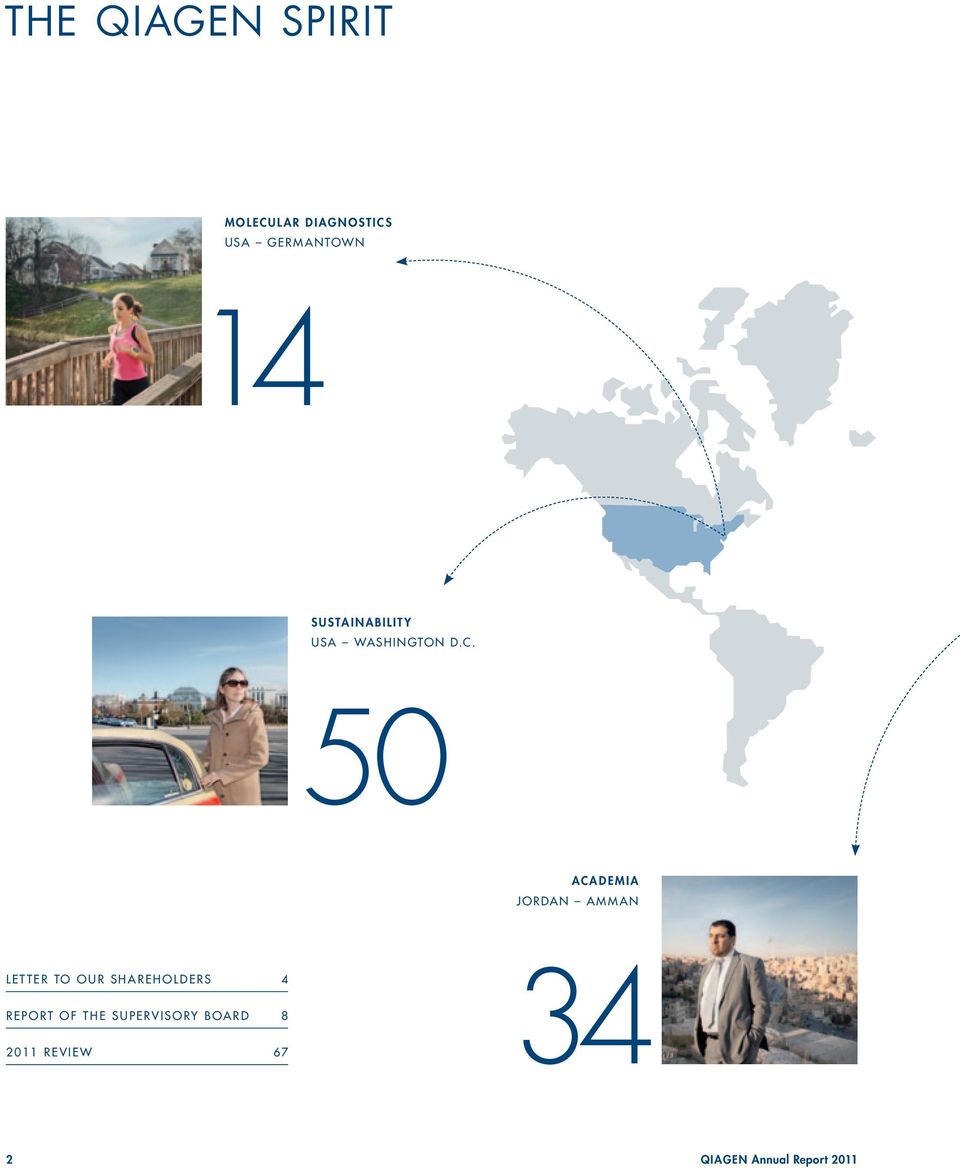
7 Innovation Ger m any DUESSELDORF 58 Applied Testing Japan Tokyo 42 Phar m a China Shanghai 26 QIAGEN Annual Report

8 Peer M. Schatz Chief Executive Officer When I meet with the employees of QIAGEN at our locations around the world, I feel the spirit, pride and excitement among our people about their roles in shaping a new wave of growth in the molecular revolution. Our employees are committed to transforming the technologies and workflows used in healthcare, life sciences research, and industrial and public safety applications. They are applying state-of-the-art science to meet the urgent needs of society, and as a result creating significant value for our customers, shareholders and QIAGEN. Indeed, our employees are helping make improvements in life possible, and our achievements to date have been the result of their outstanding level of commitment, energy and talent. I extend my sincere appreciation and thanks to each of our employees on behalf of the members of the Supervisory Board and Executive Committee. It is clear that QIAGEN faced a very challenging year in 2011, one that began with unprecedented catastrophes in Japan and other countries in the Asia-Pacific region. The ongoing macroeconomic weakness in the U.S. and Europe led to continued softness in utilization of healthcare services, and the fiscal crisis prompted many governments to curb investments in life science research. These factors not only negatively affected the stock price of QIAGEN and many of our peers, but also were the key reasons that led to softer sales growth in Despite these volatilities, we still delivered growth in all regions 4 QIAGEN Annual Report 2011

9 The Qiagen Spirit l letter to our shareholders and all customer classes and were able to achieve our earnings targets. Net sales grew 8 % to $1.17 billion, while net income attributable to owners of QIAGEN N.V. declined 33 % to $ 96.0 million, primarily due to the impact of a $ 75 million restructuring charge related to our productivity initiative started in the fourth quarter of 2011 as well as charges related to two important strategic acquisitions made in the year. Our results on an adjusted basis, which exclude costs such as restructuring-related charges as well as the amortization of intangible assets and share-based compensation, showed sustained improvement over We took important actions during 2011 to improve our performance as the year progressed, expanding net sales at a faster pace in the second half of the year and making significant progress on our strategy to leverage QIAGEN s leadership in Sample & Assay Technologies to drive innovation and growth. QIAGEN is at an inflection point, and we see a new wave of growth and innovation emerging, energized by the spirit of our employees and focused on four strategic initiatives: Driving platform success: Our focus has shifted from individual instruments to complete automation systems that cover entire laboratory workflows from initial sample processing to final result, and are based on long-term supply and service agreements. A prime example is the QIAsymphony RGQ, a breakthrough modular system that has started a new era of laboratory automation and workflow consolidation. The global rollout of this cutting-edge automation platform is progressing faster than initially expected. At the end of 2011, the QIAsymphony installed base exceeded 550 systems worldwide, and we have set an ambitious target to add 200 new systems by the end of We believe this platform is in the early years of a product cycle that will last at least a decade, driven by the need for efficient, highly versatile and flexible automation solutions manifest in all of QIAGEN s customer classes. Also in 2011, we completed a key milestone in advancing our high-through put automation portfolio by introducing the QIAensemble Decapper, a unique system that automates many tedious manual tasks for handling clinical liquid sample vials. Adding content: Leveraging our automation platforms, QIAGEN is adding new test content through innovation and acquisitions to expand our offering in every customer class. In our largest customer class, Molecular Diagnostics, we already market a full portfolio of blood viral, microbiology and virology assays plus proprietary companion diagnostics in Europe and Asia. We have made a significant start on migrating these to the United States through three FDA regulatory submissions in The acquisitions of Cellestis Ltd. and Ipsogen S.A. added important assays for latent tuber culosis (TB) and a range of blood cancers to the QIAGEN portfolio. We have also significantly expanded our offering for our customers in Academia, Pharma and Applied Testing. Key product launches in 2011 included several new mericon assays for food safety testing, a series of new Investigator kits for forensic applications, as well as the Certal product line for quality control in bioprocessing. An updated version of our GeneGlobe online portal now provides scientists with access to about 60,000 gene- specific assays for R & D applications. Broadening geographic presence: While we continue to find growth opportunities in developed countries, our expansion in emerging markets is truly dynamic. The top seven emerging markets generated 21% growth at constant exchange rates in 2011 and represented 12 % of net sales. China represents our thirdlargest market in sales, and we opened subsidiaries in 2011 to begin direct sales in India and Taiwan. Key areas for future expansion are in Eastern Europe, Latin America and Asia. QIAGEN Annual Report
10 Growing efficiently and effectively: QIAGEN launched a project in late 2011 to boost productivity and free up an estimated $ 50 million in cost savings mostly for reallocation to strategic initiatives designed to drive innovation and growth. Initial actions focused on eliminating organizational layers, overlapping structures and duplication. These measures have also led to workforce reductions, which were handled in a responsible manner with fair and respectful treatment of our employees. As we move forward, we are refocusing R&D activities on high-growth areas, optimizing capacity utilization at selected sites and capturing savings from shared service functions. We believe a major advantage for QIAGEN is that our products and expertise span all customer classes in molecular testing. No other company from our perspective covers the entire continuum from basic research in Academia right into various commercial applications in Molecular Diagnostics, Pharma and Applied Testing in a depth and quality comparable to what QIAGEN has built. Today, as knowledge and invention flow ever more quickly from research to commercial products, I am convinced that QIAGEN is uniquely equipped to provide solutions at every step, and especially now that this continuum is starting to leverage its potential. We see opportunities to help our customers simplify and transform their workflows across all phases of the value chain. In Molecular Diagnostics, which contributed 47 % of net sales in 2011, QIAGEN made significant strides in expanding our test portfolio. One of the most exciting developments under way today in modern medicine is the emergence of ways to personalize healthcare identifying the most appropriate treatments for a patient. QIAGEN has taken a strong leadership position as the provider of choice for molecular companion diagnostics, driven by a broad range of products, such as the KRAS and EGFR tests approved during 2011 in Japan. QIAGEN also completed two U.S. submissions in 2011 for the therascreen KRAS test as a companion diagnostic for novel colorectal cancer drugs. QIAGEN had another successful year in reaching new co-development partnerships with pharmaceutical companies and acquiring exclusive rights to novel biomarkers. We are very focused on providing significant value to our partners in the pharmaceutical industry, the labo ratories providing companion diagnostic testing services, the payers expecting significant benefits, and most importantly the patients who can benefit from the use of these technologies to improve the quality and efficiency of healthcare. An ongoing challenge in 2011 was the post-recession decline in U.S. utilization of healthcare services, including the use of our digene HPV Test to prevent cervical cancer (which accounted for approx i- mately 15 % of total net sales in 2011). We continue to drive market conversion to molecular HPV testing, approaching the 50 % penetration threshold and growing test volumes, as well as locking in long-term contracts with key U.S. customers. We are also leading the global expansion of HPV testing, including initiatives in Europe and emerging markets. In China, we submitted our carehpv Test, an important advance for cervical cancer prevention in low-resource settings, and received regulatory approval for a next-generation carehcv test. A number of important submissions are planned for Applied Testing, which contributed 7 % of net sales in 2011, is growing thanks to QIAGEN s easy-to- use platforms and proprietary technologies for applications that safeguard society and its food supplies. We are expanding our test content and transforming workflows. In forensics, QIAGEN is in the forefront of an ongoing shift toward uniform standards for human identification procedures. As a longtime leader in providing sample technology kits for forensics, we now offer a range of assays and instruments for genetic fingerprinting thereby also offering a complete workflow and full sys tems. 6 QIAGEN Annual Report 2011

11 The Qiagen Spirit l letter to our shareholders We are also growing rapidly in food safety testing and veterinary diagnostics for livestock, with an array of molecular assays and instruments to automate testing in laboratories or in the field. Pharma, which contributed 20 % of net sales in 2011, faces industry challenges that include cost pressures and Big Pharma mergers. These have, however, also led to a situation where there has never been a greater need for more effective research and development. QIAGEN has built an extensive port folio of products to enable Pharma research into disease pathways, and the automated workflows of our QIAsymphony platform enhance the productivity of industry labs. Increasingly, our molecular techno logies are also used in designing clinical trials, selecting and profiling patients, monitoring disease progression and providing insights for better drug development. We are seeing substantial growth in molecular testing for clinical research in Pharma and Academia. Academia, which contributed 26 % of net sales in 2011, is a group of customers that is the heart of the life science industry generating new ideas about the secrets of life and creating innovative approaches to disease. As an area of strength for QIAGEN, Academia is very important for us. In addition to profitable sales, relationships with academic scientists drive dissemination well beyond basic research labs. Increasingly, universities and institutes are expanding from discovery research into translational me dicine, even conducting clinical trials, to move innovations into the marketplace. As translational research gains momentum, QIAGEN s engagement across the entire value chain basic research, drug devel opment, clinical diagnostics and other commercial applications provides a significant competitive advantage. The strategies I have outlined here hold significant potential to deliver sustainable sales growth. At the same time, we are highly dedicated to driving earnings growth and increas ing shareholder value in 2012 and beyond. The efficiency initiative started in 2011 will help us to improve margins through strategic actions to enhance productivity, streamline operations, and focus on growth in highly profitable areas of our customer classes. Like you, we are not satisfied with the recent share price performance of QIAGEN, and we are as committed as ever to creating shareholder value by intensifying our focus on our strategic initiatives. Our vision for QIAGEN is to play an ever more pivotal role in the molecular revolution, leveraging the value of our growing portfolio of innovative technologies across all customer classes. We appreciate the dedicated spirit of our 3,900 employees and our business partners around the world, and we are committed to making QIAGEN a great workplace that attracts the very best people. We are convinced that our strategy will deliver faster growth in the coming years and create value for all of our stakeholders our shareholders, our employees, our customers and, above all, the people who benefit from our Sample & Assay Technologies in line with our mission of making improvements in life possible. Thank you for your loyalty and support of QIAGEN. Peer M. Schatz QIAGEN Annual Report
12 The Supervisory Board wishes to thank all QIAGEN employees and members of the Executive Committee for contributing to our achievements in We would also like to thank our shareholders, customers, business partners and other stakeholders for honoring QIAGEN with your continued collaboration and trust. Economic events created a challenging business environment in 2011, but QIAGEN delivered growth in all customer classes and across geographic regions. We achieved significant milestones on our strategic initiatives, and as the year progressed we began to realize accelerating total sales growth. These advances confirm our conviction that QIAGEN s innovative new products and strategic acquisitions will deliver growing value in the coming years for customers of our Sample & Assay Technologies, and increasing returns for shareholders. Among the year s strategic accomplishments, QIAGEN reached an installed base of more than 550 QIAsymphony instruments, propelled by introduction of the full QIAsymphony RGQ platform. We launched new test content in each customer class and pursued regulatory approvals in the U.S. for two KRAS companion diagnostic tests to expand global markets for promising assays in Molecular Diagnostics. The full acquisition of Cellestis Ltd. and an 89% majority stake in Ipsogen S.A. added breakthrough diagnostic technologies with dynamic growth opportunities. Geographic expansion continued, especially in emerging markets as QIAGEN began direct operations in India and Taiwan. Late in the year, after intensive discussion within the Supervisory Board, QIAGEN also began implementing a comprehensive project to improve productivity and enhance profitability through changes throughout the organization. As empowered by the Dutch Corporate Governance Code, the Supervisory Board devoted considerable time in 2011 to discussing QIAGEN s corporate strategy, main risks and opportunities, and an annual assessment by the Managing Board of the design and effectiveness of internal risk management and control systems as well as any significant changes in them. In addition, the Supervisory Board discussed and reviewed the functioning of its committees and individual members, its current composition, competence and desired profile. The Supervisory Board came to the conclusion that it and the Managing Board were properly functioning. Following the tragic passing in October 2011 of Dr. Vera Kallmeyer, who had joined the Supervisory Board earlier in the year, we have begun to search for additional candidates in our aim to expand the profile of the Supervisory Board in terms of competences, experiences and international background. 8 QIAGEN Annual Report 2011

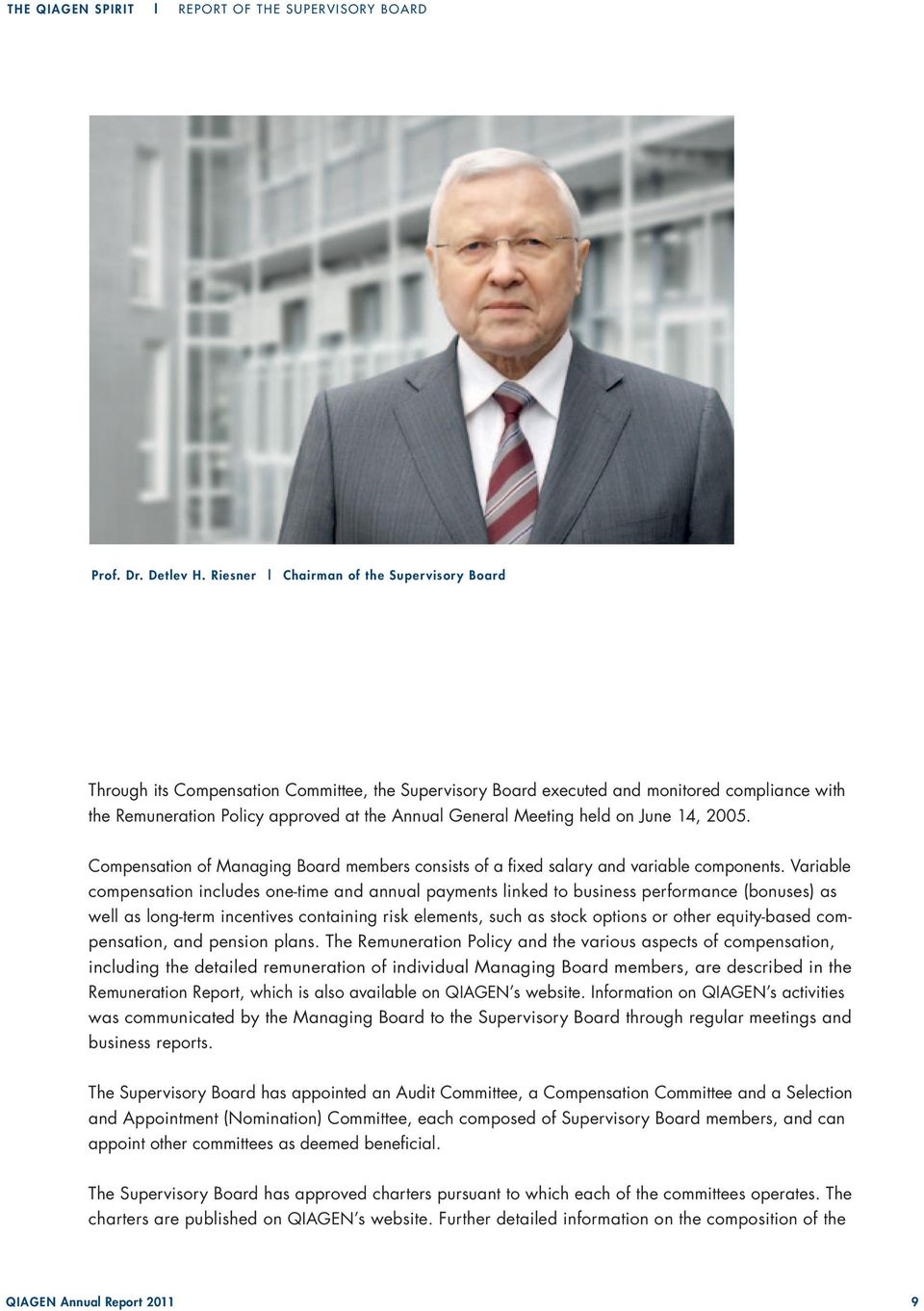
13 The Qiagen Spirit l Report of the Supervisory Board Prof. Dr. Detlev H. Riesner Chairman of the Supervisory Board Through its Compensation Committee, the Supervisory Board executed and monitored compliance with the Remuneration Policy approved at the Annual General Meeting held on June 14, Compensation of Managing Board members consists of a fixed salary and variable components. Var iable compensation includes one-time and annual payments linked to business performance (bonuses) as well as long-term incentives containing risk elements, such as stock options or other equity-based compensation, and pension plans. The Remuneration Policy and the various aspects of compensation, including the detailed remuneration of individual Managing Board members, are described in the Remuneration Report, which is also available on QIAGEN s website. Information on QIAGEN s activities was communicated by the Managing Board to the Supervisory Board through regular meetings and business reports. The Supervisory Board has appointed an Audit Committee, a Compensation Committee and a Selection and Appointment (Nomination) Committee, each composed of Supervisory Board members, and can appoint other committees as deemed beneficial. The Supervisory Board has approved charters pursuant to which each of the committees operates. The charters are published on QIAGEN s website. Further detailed information on the composition of the QIAGEN Annual Report
14 Supervisory Board and its committees, the number of committee meetings held in 2011 and the main topics of discussion, the independence of its members and their remuneration, as well as other information on the Supervisory Board, can be found in the Corporate Governance Report, which is an integral part of this Annual Report. The Supervisory Board met nine times during 2011 with regular attendance of the members of the Managing Board for certain agenda items. The Supervisory Board also met to review and discuss agenda items in the absence of the Managing Board members, such as to review performance and strategy as well as to discuss compensation matters. We are pleased to report very high attendance at our meetings no member of the Supervisory Board was frequently absent from the Supervisory Board meetings in Information about the Supervisory Board members, including positions held on other boards, is included in the Corporate Governance Report. All members of the Supervisory Board fulfill the independence criteria as defined by the Marketplace Rules of the NASDAQ Stock Market and the Dutch Corporate Governance Code, with the exception of our former CEO Dr. Metin Colpan due to his position as a consultant for QIAGEN. QIAGEN N.V. is a company organized under the laws of the Netherlands and has an international network of subsidiaries. The Supervisory Board follows the principle of increasing shareholder value as we represent the interests of all stakeholders, including shareholders, and has always pursued the highest standards in Corporate Governance. QIAGEN is committed to a corporate governance structure that best suits its business and stakeholders, and that complies with relevant rules and regulations. Since 1997, QIAGEN has endorsed the recommendations made in the report of the Netherlands Committee on Corporate Governance, which was replaced by the Dutch Corporate Governance Code effective January 1, 2004, and amended and restated effective January 1, Our policy is to follow the guidelines of Good Practice of Corporate Governance as described in the Dutch Corporate Governance Code, although some minor deviations may result from the impact of factors such as legal requirements imposed on QIAGEN or industry standards. QIAGEN is also subject to the rules regarding Corporate Governance set by NASDAQ, where our common shares have been listed since In addition, QIAGEN has adopted the standards set by the Corporate Governance Code of Germany, where our common shares have been listed since QIAGEN provides detailed disclosure in the Corporate Governance Report regarding compliance with the German and Dutch Corporate Governance Codes. QIAGEN believes all of our operations are carried out in accordance with legal frameworks, including Dutch Corporate Law, U.S. laws and regulations, and the laws of the German capital market, in particular the Wertpapierhandelsgesetz. QIAGEN s common shares are registered and traded in the U.S. on the NASDAQ Global Select Market and in Germany on the Frankfurt Stock Exchange in the Prime Standard segment. Shareholders in the U.S. and Europe hold the majority of common shares. Among topics the Supervisory Board discussed during 2011 were strategies for allocation of capital to enhance returns to shareholders. 10 QIAGEN Annual Report 2011

15 The Qiagen Spirit l Report of the Supervisory Board In 2011, shareholders authorized the Managing Board, subject to approval of the Supervisory Board, to repurchase common shares through December 31, The Supervisory Board continues to actively consider its options. In this Annual Report, the financial statements for 2011 are presented as prepared by the Managing Board, audited by Ernst & Young LLP (Independent Registered Public Accounting Firm), and examined and approved by the Supervisory Board. The term of office for the members of the Supervisory Board expires as of the close of the Annual General Meeting of Shareholders of QIAGEN N.V., which is scheduled for June 27, All members of the Supervisory Board will stand for reelection at this meeting: Prof. Dr. Detlev H. Riesner, Dr. Werner Brandt, Dr. Metin Colpan, Erik Hornnaess, Prof. Dr. Manfred Karobath, Elizabeth E. Tallett and Heino von Prondzynski. The Supervisory Board also plans to propose during the Joint Meeting of members of the Supervisory Board and Managing Board that the members of the Managing Board be reelected at this Annual General Meeting. Venlo, the Netherlands, March 2012 Prof. Dr. Detlev H. Riesner Chairman of the Supervisory Board In Memoria m Dr. Ver a K all meyer Dr. Vera Kallmeyer, a member of the QIAGEN Supervisory Board, passed away on October 21, Dr. Kallmeyer, a consulting professor in the Department of Neuro surgery at the Stanford University School of Medicine and founding partner of the investment and consulting firm Equity4Health LLC, joined the Supervisory Board and Audit Committee earlier in She quickly brought fresh scientific and business perspectives to QIAGEN before her life was unfortunately cut short. With M.D., Ph.D. and M.B.A. degrees, Dr. Kallmeyer had deep experience and was an international thought leader in entrepreneurial healthcare businesses. She taught at Stanford on biomedical innovation, translational medicine and entrepreneurship. During the short time Dr. Kallmeyer was with us, QIAGEN benefited from her rich insights and her friendship on the Supervisory Board. QIAGEN Annual Report
16 QIAGEN S GROWTH and innovation STRATEGY WE ARE IMPLEMENTING A STRATEGY TO LEVERAGE OUR LEADERSHIP IN SAMPLE & ASSAY TECHNOLOGIES TO DRIVE GROWTH AND INNOVATION ACROSS ALL CUSTOMER CLASSES. S c i e n t i f i c a d va n c e s T e c h n o l o g y d i s s e m i n at i o n The molecular revolution is gaining momentum, rapidly expanding our knowledge about the building blocks of life. Driven by scientific advances, molecular technologies are being disseminated into a growing number of applications beyond R&D and healthcare. The fundamental business drivers remain strong A g i n g p o p u l at i o n H e a lt h c a r e p r e s s u r e The population in most developed countries is aging. About U.S. 10,000 baby boomers are turning 65 each day. Demographic changes put additional pressure on healthcare systems, driving the use of molecular information to guide treatment decisions. 12 QIAGEN Annual Report 2011

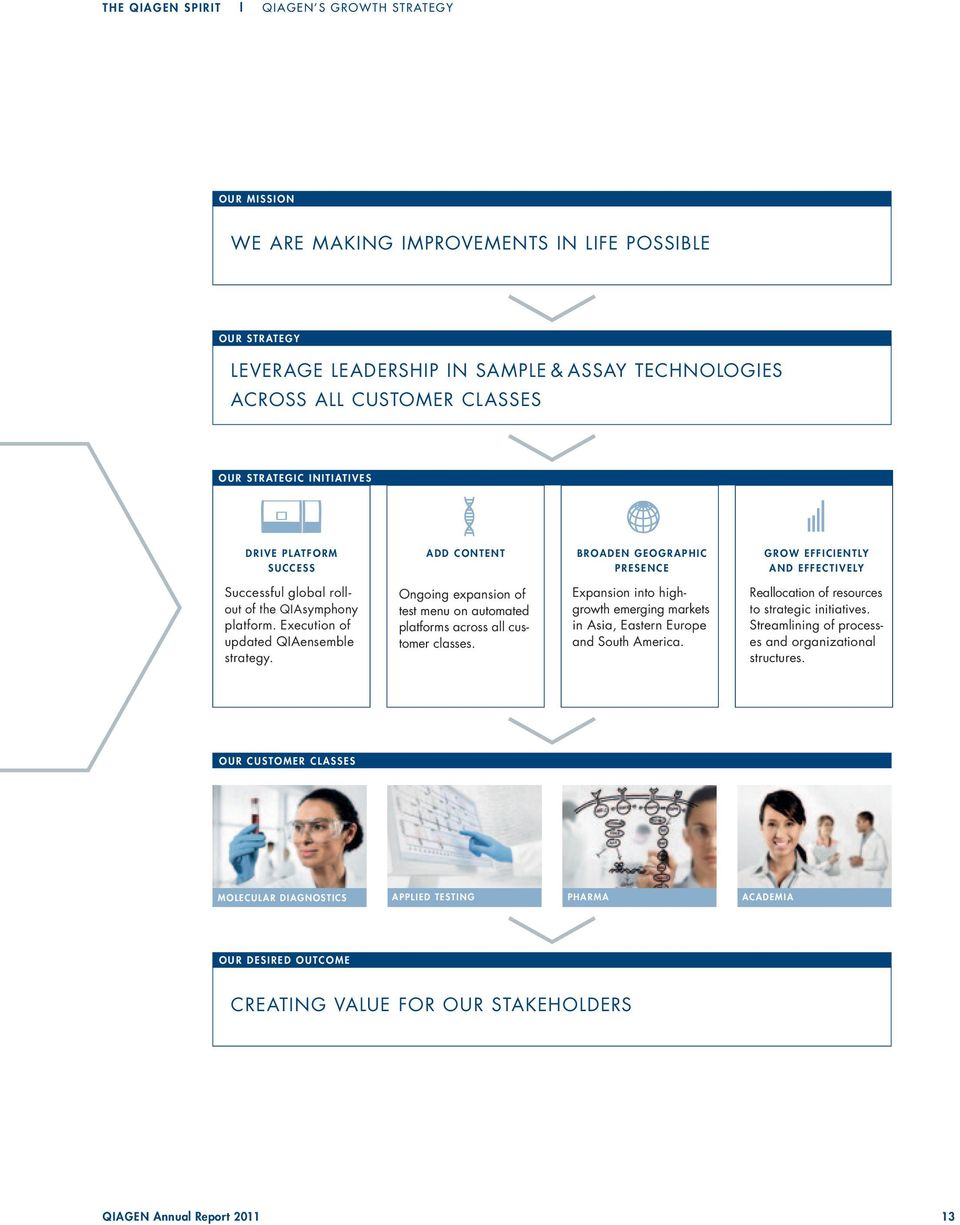
17 theqiagenspiritlqiagen s growth strategy o u R m I S S I o N We Are MAKING IMprOVeMeNTS IN LIFe possible o u R S t R At E G y LeVerAGe LeADerShIp IN SAMpLe & ASSAY TeChNOLOGIeS ACrOSS ALL CUSTOMer CLASSeS o u R S t R At E G I c I N I t I At I v E S d R I v E p l At f o R m S u c c E S S A d d c o N t E N t b R o A d E N G E o G R A p h I c p R E S E N c E G R o W E f f I c I E N t ly A N d E f f E c t I v E ly Successful global rollout of the QIAsymphony platform. execution of updated QIAensemble strategy. Ongoing expansion of test menu on automated platforms across all customer classes. expansion into highgrowth emerging markets in Asia, eastern europe and South America. reallocation of resources to strategic initiatives. Streamlining of processes and organizational structures. o u R c u S t o m E R c l A S S E S molecul AR diagnostics ApplIEd testing phar m A AcAdEmIA o u R d E S I R E d o u t c o m E CreATING VALUe FOr OUr STAKehOLDerS QIAGENAnnualReport
18

19 M o l e c u l a r D i ag n ostics Dr. Carole Welsch / USA Germ antown

20 the healthcare system is fighting increasing costs. Since you don t want to ration care, the only viable option to address this issue is to get more efficient in treatment, to be smarter in the way we provide care. The turning point for Carole Welsch came at Singapore General Hospital. With a Ph.D. in molecular and cellular biology, Dr. Welsch was working as a post-doctoral research scientist in the hospital s National Cancer Center, and already understood the scientific intricacies of cancer and what makes treatments work. But it was the patients she encountered in Singapore who made the difference. Being exposed every day to the cancer patients so many of their situations are heartbreaking it changes you. It makes you want to get up in the morning and go to work to help them, Dr. Welsch says. Now Dr. Welsch is more excited than ever about improving the lives of those patients. As a U.S. marketing manager for Molecular Diagnostics, she is helping to drive the 21st Century approach to medicine known as Personalized Healthcare a change that has only recently begun to take hold, but has already dramatically impacted the care of patients. Personalized Healthcare starts with the patients. Instead of applying a best guess approach to treatment, each patient is evaluated with companion diagnostics to determine the genetic likelihood of success with specific medicines. The right drug for the right patient at the right time can make a big difference. endure the process of waiting and watching to see what works, while also suffering through the side effects, which are often significant. Genomic Data Changes Everything Genetic tests that enable personalized therapies are one of many rapidly growing areas in healthcare. As the largest customer class of QIAGEN, Molecular Diagnostics (47% of QIAGEN s total sales in 2011) is providing products that tap into DNA and RNA, the most basic structures of life, to assist in human healthcare. Specialized Sample & Assay kits, used in tandem with advanced automation systems, can unlock valuable information from those molecules that may hold the keys to life or death, disease prevention or progression, and healing or declining in health. QIAGEN has strategically built its position as a leading company in Molecular Diagnostics by offering a broad portfolio of tests and automated systems for various healthcare needs. With a total global market estimated at more than $ 4.6 billion in 2011, and an annual compound growth rate of 15 % from 2010 to 2015, molecular testing represents the most dynamic segment of the global in vitro diagnostics market. Focusing on various pillars of patient need, QIAGEN is executing its growth strategy across four areas: About 75 % of patients in oncology don t respond to treatment. Unfortunately, traditional therapy is often trial and error patients get one treatment, and if that doesn t work then they are led to the next treatment, Dr. Welsch says. With Personalized Healthcare, the patient doesn t have to PREVENTION QIAGEN is building a range of solutions for screening non-symptomatic patients for disease risks to allow early intervention. For example, QIAGEN is helping to drive the global expansion of human papillomavirus (HPV) testing to support early detection of cervical cancer, a 16 QIAGEN Annual Report 2011
21 The Qiagen Spirit Molecular Diagnostics 30 DIFFERENT BIOM ARKERS ARE COVERED BY QIAGEN S TEST PORTFOLIO FOR PERSONALIZED HE ALTHCARE APPLICATIONS. leading cause of cancer-related death among women. In 2011, QIAGEN s acquisition of Cellestis Ltd., creator of a novel screening test for latent tuberculosis (TB), added a new growth driver in Prevention based on a unique premolecular technology that also holds promise in identifying other latent diseases present in a person but not yet active. PROFILING QIAGEN continues to expand its extensive menu of tests for profiling various diseases, such as infections with influenza, hepatitis, and HIV to allow a better diagnosis for early and targeted treatment. PERSONALIZED HEALTHCARE QIAGEN s Personalized Healthcare franchise is building on a broad portfolio of tests that cover more than 30 biomarkers and help unlock genomic information which enable physicians to tailor treatments to individual patients. In 2011, QIAGEN added new biomarkers to its pipeline of companion diagnostics, expanded partnerships with top pharmaceutical companies, and completed two Premarket Approval (PMA) application submissions to the U.S. Food and Drug Administration (FDA) for a test that guides colorectal cancer treatments. QIAGEN s acquisition of an 89 % majority stake in Ipsogen S.A. during 2011 added a new area of leadership with a portfolio of assays to profile leukemia and other blood cancers. POINT OF NEED Molecular testing is increasingly moving into the field and other settings with no laboratory infrastructure and the need for quick results. Following QIAGEN s acquisition of the innovative ESE platform in 2010 that addresses exactly these requirements, new applications are being developed in Molecular Diagnostics and other fields. QIAGEN is executing a clear strategy to accelerate growth in Molecular Diagnostics and drive the healthcare transformation: improving automation platforms, expanding assay menus and broadening its global presence while emphasizing efficiency and effectiveness in managing growth. Achievements in each strategic initiative reinforce momentum in other areas. Placing QIAGEN s systems in laboratories drives dissemination of sample and assay kits, while expanding the content menu increases the value of QIAGEN instruments to customers. Geographic expansion not only fuels sales but also builds QIAGEN s global reputation and adds scale for effective product launches. A major initiative of QIAGEN is the global rollout of QIAsymphony, a flexible modular platform that addresses what is believed to be the largest market segment in molecular testing: low- to medium- throughput laboratories. QIAsymphony has helped to launch a new era of laboratory automation and workflow consolidation. In 2011, QIAGEN achieved its goal of more than 550 QIAsymphony systems installed worldwide since its launch and established a new target to reach more than 750 installed systems by the end of QIAsymphony RGQ is the complete sample-to-result version that was launched at the end of It provides the most versatile integrated workflow available, delivering reliable data with maximum speed and minimum hands-on time. The platform is achieving rapid acceptance among many QIAGEN Annual Report
22 different types of laboratory customers in Molecular Diagnostics as well as in QIAGEN s other customer classes. The business value of flexible automation for clinical laboratories is augmented by QIAGEN s expanding menu of assays designed to run on the QIAsymphony platform. Equally important is that laboratories place a high value on QIAsymphony s versatility as the only automation system that can process both commercial assays as well as laboratory-developed tests. These tests, known as LDTs, were previously often performed manually. This was a time-consuming and expensive process given that LDTs account for up to 50 % of test volumes in clinical laboratories. Based on its ability to be used with such a broad range of tests, the demand for QIAsymphony RGQ is expected to remain strong for many years and to be a key growth driver over the next decade. Building on a longstanding reputation as a pioneer in life science research, QIAGEN has created a leading position in Molecular Diagnostics through relationships with the scientists and clinicians who are using genomic technologies to transform the work of hospital and independent laboratories. QIAGEN is the most respected brand name among research labs because originally, we were a pure life science research company. Over the last decade, we have established the same thing with the clinical labs, Dr. Welsch says. Clinical labs have come to know QIAGEN for our quality and reliability. Now we are strengthening our position with therascreen companion diagnostics and other tests in areas such as Profiling and Prevention. As the world faces an aging population and growing healthcare obligations, diagnostics account for only 2 % of medical costs but drive more than 70 % of treatment decisions. Using biomarkers and genomic information to save lives, guide treatments and conserve scarce resources offers great promise. Prevention Detects Disease and Saves Lives One of the greatest advances in diagnostics is the ability to prevent disease by detecting changes in the body even before patients experience first symptoms, and molecular technologies like QIAGEN s QuantiFERON-TB Gold for detection of latent tuberculosis or digene HC2 HPV Test for detection of HPV which causes cervical cancer carry screening to a whole new level of sensitivity and accuracy. HPV is the primary cause of cervical cancer, the second most common malignancy among women globally. Cervical cancer strikes nearly 500,000 women a year and contributes to 270,000 deaths annually. By detecting HPV infection, 18 QIAGEN Annual Report 2011
23 The Qiagen Spirit Molecular Diagnostics screening enables close monitoring and early treatment before cervical cancer can develop, protecting women from debilitating illness or death. The value of HPV testing is increasingly recognized around the world, and QIAGEN is a leader in the expansion of screening. In 2011, QIAGEN s market-leading digene HC2 HPV Test, the gold standard in testing for high-risk types of HPV, passed a milestone of more than 80 million kits delivered since the assay became the first HPV test to receive U.S. regulatory approval in In the U.S., where treatment guidelines recommend that women receiving the traditional Pap test also undergo periodic HPV testing, market conversion efforts have led to approximately 45 % of women receiving co-testing. Other countries have established or are evaluating co-testing, primary screening or reflex HPV screening as a cornerstone of cervical cancer prevention. In late 2011, QIAGEN launched the QIAensemble Decapper, the first instrument to automate the tedious process of manually handling clinical liquid sample vials. Several other automation enhancements are being developed as part of the QIAensemble program. QIAGEN has also been proactive in expanding access to HPV screening in emerging markets, creating the carehpv test for use in regions with limited healthcare resources and only basic infrastructures. In 2011, QIAGEN also submitted carehpv for regulatory approval in China. In Latin America, Asia and Africa, QIAGEN is working with health agencies to enable the use of its HPV tests for cervical cancer prevention in settings where limited care is available. In 2011, QIAGEN added an important new growth driver in Prevention with the acquisition of Cellestis, an Australian biotech company whose patent-protected pre-molecular technology is capable of detecting many diseases at earlier stages than any other diagnostic methods. The technology, known as QuantiFERON, uses the immune system s own memory to provide critical information on latent infections, where pathogens such as bacteria, viruses or fungi are present in such low amounts that they are not detectable with DNA-based testing or other methods. The lead product, QuantiFERON-TB Gold, is a breakthrough that is already on the market for detection of latent tuberculosis (TB). The World Health Organization estimates that about one third of the world s population carries the TB bacteria. QuantiFERON-TB Gold has regulatory approvals in major markets including the United States, Europe, and Japan, and is being endorsed by numerous healthcare bodies as a key to prevention of active tuberculosis. Patients with latent TB are infected with the tuberculosis bacterium, but it often remains hidden for years with no symptoms. About 5 % to 10 % of patients with latent TB at some point develop active tuberculosis, a contagious disease that typical spreads from one active patient to 10 to 20 other people. Given the recent emergence of completely drug-resistant TB strains, screening for latent TB becomes an increasingly important pillar in the global fight against this disease. Screening for latent TB is particularly beneficial to prevent the development of active TB in dozens of medical situations such as healthcare workers and emergency personnel; patients whose immune systems are compromised or who need drugs contraindicated with latent TB; and populations whose living situations may expose them to tuberculosis (e.g., in the military, nursing homes or prisons). The potential global market in latent TB screening is estimated at 50 million tests and has still very low penetration rates. QuantiFERON-TB Gold had pro forma full-year net sales of approximately $ 55 million in 2011 and grew at a strong double-digit pace. Meanwhile, QIAGEN is actively pursuing additional applications for the QuantiFERON QIAGEN Annual Report
24 With Personalized Healthcare, the patient doesn t have to endure the process of waiting and watching to see what works, while also suffering through the side effects, which are often significant. technology, including the U.S. regulatory submission of the QuantiFERON CMV test along with a complementary DNA-based molecular diagnostic test in The benefit of advanced diagnostics for Prevention continues to grow as discoveries reveal more about the relationship of biomarkers and genetic information to the potential for disease present in the body. Profiling Pinpoints the Type and Severity of Diseases QIAGEN s portfolio of more than 120 diagnostic tests, particularly the artus line of assays for infectious diseases, makes it a global leader in Molecular Diagnostics for Profiling. QIAGEN assays enable laboratories and physicians to pinpoint the type and severity of many diseases in symptomatic patients. QIAGEN s offering includes tests for human immunodeficiency virus (HIV), hepatitis B (HBV), hepatitis C (HCV), and many other targets. The range of tests is being expanded for Profiling, such as through the submission of the artus Influenza assay in 2011 for FDA clearance. In the case of influenza and also many other tests, these assays are already marketed in Europe and Asia and are now being submitted to the regulatory approval process in the U.S. QIAGEN s business is also expanding in emerging markets. In China, QIAGEN gained regulatory approval in 2011 for its second-generation hepatitis C test, the carehcv RT-PCR Kit V2. Developed and manufactured by QIAGEN in China, the HCV kit is part of the care line of products addressing specific healthcare and testing needs of countries with limited resources or healthcare infrastructure. Many of QIAGEN s assays are already compatible with QIAsymphony RGQ, combining content with platform to build a growing presence in hospitals and clinics. QIAsymphony RGQ enables laboratories to consolidate Profiling tests into a streamlined workflow. The platform was launched with a comprehensive infectious disease panel, which is also useful in transplantation medicine, and this menu is being expanded with Personalized Healthcare assays. Personalized Makes all the Difference QIAGEN is in the vanguard of creating innovative molecular technologies to detect biomarkers that can predict the success or failure of treatments guiding doctors to use the right drugs in the right patients. Sales in Personalized Healthcare reached approximately $ 75 million in 2011 and are growing rapidly. The healthcare system is fighting increasing costs. Since you don t want to ration care, the only viable option to address this issue is to get more efficient in treatment, to be smarter in the way we provide care, Dr. Welsch says. Personalized Healthcare and companion diagnostics support the approach of getting more efficient and effective in the way we treat cancer and other diseases. QIAGEN s leadership in Personalized Healthcare springs from a broad range of tests covering more than 30 biomarkers already marketed in select regions of the world, as well as more than 15 projects under way to co-develop and market companion diagnostics with leading pharmaceutical and biotech companies such as Amgen, AstraZeneca, Boehringer Ingelheim, Bristol-Myers Squibb, Eli Lilly and Company, and Pfizer. Companion diagnostics are taking hold first in cancer treatments, where the pressure to innovate is driven by poor patient outcomes due to low response rates with major chemotherapy drugs and by the high cost of therapies, both in financial impact and side effects for patients. Other diseases such as autoimmune and central nervous system disorders also are starting to leverage genomic data to individualize treatments. QIAGEN is rapidly building leadership in Personalized Healthcare around its therascreen brand of companion diagnostics, a family of assays designed to run on QIAsymphony RGQ and other QIAGEN instruments. 20 QIAGEN Annual Report 2011
25 The Qiagen Spirit Molecular Diagnostics In 2011, two PMA (Pre-Market Approval) applications were submitted to the FDA for companion diagnostics to detect mutations of the KRAS gene, which are common in cancer patients. The therascreen KRAS RGQ kit is paired with two novel drugs for use in treating metastatic colorectal cancer, one marketed by Bristol-Myers Squibb/Eli Lilly and the other by Amgen. As much as 40 % of all colorectal cancer patients have KRAS mutations that make their cancers unresponsive to such treatments. U.S. regulators are expected to decide on marketing approvals in The KRAS biomarker is also at the center of a co-development agreement with Pfizer in another therapeutic area. QIAGEN is working on a companion diagnostic for submission to the FDA in non-small cell lung cancer (NSCLC). QIAGEN and Pfizer entered a collaboration agreement in 2011 to co-develop a KRAS assay paired with an investigational compound in global clinical trials for NSCLC. About 85 % of lung cancers worldwide are classified as NSCLC, with a five-year survival rate of only about 15 %. To date, QIAGEN markets a broad range of tests for Personalized Healthcare and research applications covering more than 30 different biomarkers, including CEmarked assays for KRAS among colorectal cancer patients, EGFR in non-small cell lung cancer (NSCLC) and BRAF in malignant melanoma. This portfolio also includes several assays based upon the Pyrosequencing technology, among others tests for detection of variants and quantification of methylation levels in genes associated with Alzheimer (APOE), Glioblastoma (MGMT), cardiovascular disorders (MTHFR), and other diseases. In 2011, Japan, one of the largest markets for companion diagnostics, approved the therascreen KRAS Mutation Detection Kit and the therascreen EGFR Mutation Detection Kit RGQ to help guide cancer treatments. EGFR, or epidermal growth factor receptor, has been shown to play an important role in certain cancers and is the target of many new anticancer drugs. Even as these companion diagnostics are emerging from the pipeline, QIAGEN continues to invest in deepening its portfolio of biomarkers and assays. The 2011 acquisition of Ipsogen added approximately 80 assays covering 15 biomarkers associated with various blood cancers, leading to an immediate partnership to develop its JAK2 biomarker as a companion diagnostic for an investigational drug compound under development by Eli Lilly & Company. In addition, QIAGEN gained an exclusive option in 2011 to all biomarkers emerging from the Berlin based startup Alacris Theranostics GmbH, which is mining vast amounts of genomic data and large clinical sample sets in its cancer discovery efforts. QIAGEN Annual Report
26 clinical labs have come to know QIAGEN for our quality and reliability. Now we are strengthening our position with therascreen companion diagnostics and other tests in areas such as Profiling and Prevention. 22 QIAGEN Annual Report 2011
27 THE QIAGEN SPIRIT MOLECULAR DIAGNOSTICS MOLECULAR DIAGNOSTICS OVERVIEW 47% MOLECULAR DIAGNOSTICS Personalized Healthcare is clearly gaining momentum. The pharmaceutical industry and leading researchers have embraced molecular testing to guide the use of new drugs in cancer and other diseases. Private and public payers are also increasingly open to reimbursement for companion diagnostics. Dr. Welsch expects economics to become an increasingly strong growth driver. In colorectal cancer alone, she says, Personalized Healthcare promises about $ 600 million in annual savings in the U.S. only. The availability of FDA-approved tests will provide more reliable, standardized results for patients; much less expensive assays for payers; and efficient, easier-to-run tests for laboratory personnel. We ve been talking about personalized medicine since the sequencing of the human genome early in the last decade. Only recently has it started to become cost-effective, Dr. Welsch says. The U.S. market for companion diagnostics is expected to grow ten-fold in just six years, from about $ 150 million in 2009 to roughly $ 1.5 billion in 2015, according to the consulting firm Frost & Sullivan. QIAGEN Focuses on the Future Working at the heart of QIAGEN s effort to transform healthcare, Dr. Welsch fi nds a parallel activity when she goes home and recharges: She likes to unwind by running. Living in suburban Washington, D.C., an area of active lifestyles combined with a family-friendly environment, Dr. Welsch and her husband are raising two adorable little girls, ages 2 and 4. Running usually takes Dr. Welsch out on a 5 K or a 10 K competition, though recently she completed a marathon. Like the sport of running, transforming the world of medicine requires dedication, discipline and endurance. The work is exciting but intense. No two trails are alike. A focus on the destination fuels Dr. Welsch s sense of hope. She thrives on the rapid progress in Personalized Healthcare. Life is improving for the patients, who still catch her eye. Spending her days educating doctors and healthcare executives on the value of the genomic revolution, Dr. Welsch knows it s a marathon: We are just at the beginning of this new wave. TRANSFORMING MEDICINE QIAGEN technologies are transforming the practice of medicine. Healthcare professionals increasingly use molecular diagnostics to unlock valuable biological information that can help to save lives and fight disease. Customers include hospitals, private laboratories and diagnostics service providers. Molecular Diagnostics focuses on four needs: PREVENTIoN Screening non-symptomatic patients for disease risks allows early intervention. PRoFIlING Molecular testing pinpoints the type and severity of various diseases. PERSoNAlIzED HEAlTHCARE Unlocking genomic information guides treatment decisions and the use of medicines in cancer and other diseases. PoINT of NEED Molecular diagnostics is moving into the field, for quick results without laboratory infrastructure. BROAD PORTFOLIO QIAGEN offers one of the broadest portfolios of Sample & Assay Technologies for Molecular Diagnostics along with efficient automated solutions covering entire laboratory workflows. These innovations are helping to drive the dissemination of molecular technologies in modern healthcare. As a market and technology leader, QIAGEN intends to remain at the forefront of the revolution in the use of diagnostics for human health, an area that is expected to provide significant opportunities for further growth. QIAGEN Annual Report
28 Prevention Profiling EARLY DETECTION IMPROVES OUTCOMES Preventive screening with QIAGEN technologies helps to save lives and improve health outcomes. The marketleading digene HC2 HPV Test is the gold standard in testing women for human papillomavirus (HPV), the primary cause of cervical cancer. carehpv expands access in low-resource markets. The proprietary QuantiFERON technology provides a promising new pipeline of preventive screening tests. PRECISE DIAGNOSIS DEFEATS DISEASES QIAGEN is a leader in its industry with a broad range of assays to detect and profile various diseases, such as infections and blood cancers. Examples include artus tests for influenza, HIV, HBV, HCV or CMV HIGHLIGHTS QIAGEN makes significant progress despite a challenging economy: The digene HPV Test surpasses 80 million shipments since its U.S. regulatory approval in 1999 driven by the global expansion of HPV testing in cervical cancer prevention programs. Acquisition of Cellestis Ltd. adds QuantiFERON-TB Gold, a breakthrough test for latent tuberculosis, to QIAGEN s Prevention portfolio HIGHLIGHTS QIAGEN further strengthens its presence in Profiling: QIAGEN s artus assay for Influenza A / B is submitted for U.S. FDA clearance, while carehcv for hepatitis C gains approval in China and other assays advance in pipeline. Rapid uptake of QIAsymphony RGQ includes Profiling customers seeking a flexible sample-to-result automation platform. QIAensemble Decapper launched in the U.S, as a unique instrument to automate the tedious process of handling clinical liquid sample vials. GROWTH STRATEGY GROWTH STRATEGY An estimated one third of the world s population carries a latent TB infection. Early detection of latent TB using QuantiFERON-TB Gold offers promise in numerous patient sub-populations that are vulnerable to development of the active form of this disease, providing substantial potential for growth. Matching QIAGEN s market-leading portfolio of Profiling tests with the highly flexible and versatile QIAsymphony RGQ platform has potential to drive dissemination of molecular diagnostics across the healthcare market. Meanwhile, the growing content menu adds value for QIAsymphony and other QIAGEN instruments. In HPV, QIAGEN partners with healthcare authorities worldwide to expand access to the digene HPV Test or carehpv test in screening programs for cervical cancer, a leading cause of cancer-related death among women. U.S. market penetration continues to grow reaching nearly 50 %, while QIAGEN is further improving the automation of this market-leading test.
29 personalized healthcare POINT OF NEED INDIVIDUAL INFORMATION ENHANCES TREATMENT QIAGEN is a global leader in the rapidly expanding Personalized Healthcare market. The company offers a broad range of tests for Personalized Healthcare applications covering more than 30 biomarkers and is active in more than 15 projects with pharmaceutical companies to develop companion diagnostics for new drugs. PORTABLE TESTS REACH OUT QIAGEN is leading the way as molecular testing moves beyond the laboratory. The pioneering ESEQuant fluorescence technology provides a platform to collaborate with customers in developing Point of Need applications for a range of healthcare needs that require fast turnaround, away from the lab HIGHLIGHTS QIAGEN makes significant advances in Personalized Healthcare: The therascreen test for detection of mutations in the KRAS gene are submitted to the FDA as companion diagnostics for two novel colorectal cancer drugs. Japan approves therascreen companion diagnostics for KRAS and EGFR biomarkers to help guide colorectal and lung cancer treatments, respectively HIGHLIGHTS QIAGEN is progressing in collaborations to commercialize portable, battery-operated ESEQuant devices which allow for rapid testing without access to a laboratory infrastructure. Potential applications mainly encompass rapid detection of various viral and bacterial pathogens. QIAGEN adds new co-development agreements with Pfizer, Eli Lilly and Company, and an undisclosed partner expanding the pipeline of genetic tests showing promise as companion diagnostics beyond oncology. GROWTH STRATEGY GROWTH STRATEGY QIAGEN continues to expand its portfolio of genomic biomarkers and pipeline of companion diagnostics for applications in cancer and other diseases in collaboration with leading pharmaceutical companies. By submitting Personalized Healthcare tests to regulators in the U.S. and other key countries, QIAGEN plans to move more companion diagnostics into the commercial phase of sales growth. Point of Need diagnostics offer promise for healthcare testing in developed and emerging markets. QIAGEN is actively working on assays and collaborations to address urgent needs in emergency healthcare, intensive care and field applications with respect to a variety of diseases.
30 Pharm a d r. S o n g k a i L i u / CH I N A SHANGHAI» What strikes me most about the QIAGEN Spirit is the continuous pursuit of superior quality products and the highly cooperative working environment. «
31
32 60,000 D IFFERENT GENE-SPECIFIC ASSAYS AVAIL A BLE THRO U G H Q IAGEN S GENEGLO BE ONLINE PORTAL Shanghai is bustling. In the world s largest city, 23 million people are making their way daily through crowded streets, driving the dramatic transformation of China s largest city into an economic, commercial and financial center. For Songkai Liu, Ph.D., Shanghai is also undergoing a dramatic transformation to become a new center for drug discovery and research. Pharma companies are increasingly moving R & D operations to Shanghai, building networks with major research universities, contract research organizations (CROs) and other pharmaceutical companies as this vibrant city emerges from its unique colonial past. Dr. Liu is well suited for his role as QIAGEN s business manager for key accounts with Pharma customers in Asia-Pacific. With a Ph.D. in molecular biology, he has extensive handson experience working in the R & D laboratory of a major pharmaceutical company. He is also glad to be back home in China after having studied and worked in Europe and the United States. My industry background is a plus. Before I came to QIAGEN, when I was working in R & D, I was the customer, so I know what my former colleagues are thinking and the increasingly complex environment in which they are working, Dr. Liu says. It now goes beyond having to address the scientific demands for assays and instruments used in laboratories. Purchasing departments are increasingly playing a more active role in decisions, so more and more we must consider the business side and not just the technical point of view of our customers. Given my experience as a former customer, I can appreciate this fast-changing environment and better understand how QIAGEN can address a broad range of customer needs. Dr. Liu s job as a business manager is to provide full business solutions to meet the needs of Pharma companies and CROs. He interacts with people at multiple levels not just lab directors and crosses functional lines to coordinate sales representatives, customer support and commercial interactions. Globally, QIAGEN is helping the Pharma industry move forward drug discovery to create a new era of innovation. The Pharma customer class contributed 20 % of sales in 2011, with net sales rising 4 % at constant exchange rates (CER). World of Pharma R & D is Changing Under intense economic pressures, pharmaceutical and biotech companies worldwide are making more critical assessments of R & D spending and working to be more productive in creating new drugs. QIAGEN is partnering with the industry by providing fast, automated technologies and efficient processes. The pharmaceuticals industry faces multiple chal- 28 QIAGEN Annual Report 2011
33 The Qiagen Spirit l Pharma lenges: The economic slowdown and austerity measures are squeezing government and private budgets for drugs. Several companies are losing revenues due to patent expirations on blockbuster products, mergers and acquisitions are driving the consolidation of R & D activities, and investors are questioning a lack of new drug approvals and return on investment in R & D. As a result, the pharmaceuticals industry has slowed spending on R & D in recent years, and most of the top companies announced cuts in R & D spending and staff levels in 2010 or The pressures are ongoing. In its 2012 Global R & D Funding Forecast, the Battelle Institute projects a 2.2 % decline in R & D spending by the global life science industry this year (including an anticipated 5.7 % decline in the U.S.). Pharma and biotech companies are responding by closing R & D sites, canceling some projects to focus pipelines more tightly, and seeking approaches to reduce risk. Large firms are looking to smaller biotech companies as sources of new products and also outsourcing more activities by hiring universities and CROs to do work ranging from discovery research to clinical trials. This more virtual or open approach to innovation makes relationships in the pharmaceutical industry more complex. For QIAGEN, these changes in Pharma present challenges but also many new opportunities. QIAGEN Tools Make R & D More Effective QIAGEN is in the forefront of helping Pharma transform R & D. The molecular biology revolution has opened up new ways of understanding diseases and the biological pathways associated with them, and QIAGEN s technologies for exploring those pathways are accelerating the creation of new drugs. Companies use QIAGEN tools across the entire R & D continuum: to identify and validate molecular targets, discover potential drugs and measure their activity, select patients for clinical trials and monitor disease progression, and finally market pharmaceuticals paired with companion diagnostics for greater safety and efficacy. QIAGEN invests continually in expanding its portfolio of biomarkers molecules such as nucleic acids or proteins that indicate cell processes or biochemical pathways associated with diseases and designing technologies to detect and measure these markers. Biomarkers serve as an engine of innovation. Biomarkers translate into relevant new test content for Pharma R & D. The acquisition in 2010 of SABiosciences brought more than 100 assay panels for QIAGEN Annual Report
34 m y i n d u s t ry b a c k g r o u n d i s a p l u s. B e f o r e I c a m e t o Q I A G E N, when I was working in R & D, I was the customer, so I know what my former colleagues are thinking and the increasingly complex environment which they are working. high-performance analysis of DNA, RNA, epigenetic, and microrna targets in pathways associated with specific diseases. In 2011, QIAGEN acquired a strategic stake in Alacris Theranostics, an innovative startup focusing on full genome-based cancer therapies, including an exclusive option to Alacris pipeline of biomarkers the next generation of tests for discovery of drug targets and development of companion diagnostics. QIAGEN s GeneGlobe online portal, which in 2011 has seen the integration of the SABiosciences PCR assay panels and the implementation of new features for improved usability such as research and presentation tools, adds value for Pharma scientists with an industry-leading source of information on disease pathways, biomarkers and genomic information. GeneGlobe provides searchable, annotated data on 60,000 pathway and gene-related technologies, with links to order products related to each avenue of investigation. Additionally, QIAGEN offers Pharma comprehensive automation solutions to streamline workflows and novel solutions for quality control in bioprocessing. The rollout of QIAsymphony RGQ helps labs to accelerate projects and reduce staff time, the compatible Certal product line introduced in 2011 brings a new level of speed, efficiency and reliability to quality control of cell-culture-based biotechnology products, biopharmaceutical protein drugs and cell lines for vaccine production. Pharma labs are also benefiting from the new QIAxcel Advanced to streamline analysis of DNA and RNA, and new PyroMark platforms for applications in oncology, microbiology and pharmacogenetics. QIAGEN Serves Pharma as a Full Partner Innovation in QIAGEN technologies has transformed the company s position from a component supplier to a full partner in pharmaceutical R & D solutions. As the Pharma industry responds to economic challenges in R & D, QIAGEN is partnering with its customers to support new ways of doing business while driving innovation. QIAGEN s commercial focus makes the company a preferred partner for Pharma companies implementing practices to help control R & D spending and ensure maximum value. QIAGEN works with global supply chains and invests in capabilities such as e-marketing and e-ordering to connect with procurement systems for customers. Going beyond traditional sales calls targeting scientists, QIAGEN business managers address Pharma customers needs to demonstrate value and return on investment in laboratory platforms. Dedicated specialist teams work with decision makers across functions in Pharma companies, as well as outside collaborators. Today s Pharma is far more complicated than it used to be, Dr. Liu says. You cannot just work with the pharma company itself so much of the work is being outsourced to CROs or universities. We have to serve a broad range of customers 30 QIAGEN Annual Report 2011
35 The Qiagen Spirit l Pharma that are involved in pharmaceutical R & D activities. As a business manager, you track all these project flows. It s never just one stop. The increasing importance of genomic information in discovering and developing drugs and the use of companion diagnostics paired with drugs for Personalized Healthcare are transforming the Pharma industry with therapies targeted to be safer and more effective for specific patient groups. QIAGEN believes it is the global independent leader in partnering with Pharma companies for Personalized Healthcare, from early research into biomarkers for diseases, through clinical trials using molecular tests to select and monitor patients, through commercialization and marketing of drugs paired with companion diagnostics. The company s relationships with Pharma and biotech customers begin in R & D laboratories but increasingly become full economic partnerships as the industry turns to designing new drugs in cancer, cardiovascular and metabolic diseases around the genomic characteristics of targeted patient groups. In more than 15 partnerships with leading companies, QIAGEN is more than a supplier of laboratory tools: It is bringing companion diagnostics to market alongside its partners important new drugs. Emerging Markets Attract Pharma Business As the pharmaceutical industry finds most of its growth coming from emerging markets, a key strength for QIAGEN is the company s ability to work with global networks in serving Pharma customers supported by its own presence in the markets of Asia, Latin America, the Middle East and Eastern QIAGEN Annual Report
36 you cannot just work with the pharma company itself so much of the work is being outsourced to CROs or universities. As a business manager, you track all these project flows. It s never just one stop. 32 QIAGEN Annual Report 2011
37 theqiagenspirit l pharma 20% pharma AutomatedplatformssuchasQIAsymphonyRGQ provide a flexible sample-to-result workflow to accelerater&dinaworldoflimitedresources. europe. For example, China has gradually become a leading provider of pharmaceutical r & D services to the world. Most of the growth is coming from multinational drug companies and global CrOs establishing r & D operations in China. QIAGeN s relationships in emerging markets span these diverse organizations to provide full solutions for pharma r & D in an era of outsourcing and collaboration. pharma companies and CrOs working in China often approach purchasing with a global perspective, Dr. Liu says. Local lab directors or buyers often have to coordinate with their headquarters in europe or North America and with colleagues around the world. This adds complexity to the relationships with pharmaceutical customers and can be challenging at times. One of the QIAGeN business manager s roles, he says, is to work in global networks to help customers in a new environment where information fl ow is also truly global. Dr. Liu, who lives with his wife and three-year-old daughter in Shanghai, has the kind of global background that perfectly suits this multinational commercial hub and he is passionate about serving pharma. pharmaceutical r & D has been facing cuts globally, but the business is in a good position to grow in China during the next five to 10 years, Dr. Liu says. We expect to expand and prosper along with it and play a key role in the development of new medicines. driving efficiencies QIAGENprovidesfast,efficienttoolsforpharmaceuticalR&d coveringthecontinuumfrombasic researchtoclinicaltrials. closetieswithpharmacustomerscanprogressto co-developmentofcompaniondiagnostics,commercializedalongsidenewdrugs highlights QIAGENhelpspharmaR&dthriveinleantimes: RolloutofQIAsymphonyRGQenablespharma labstoaccelerateprojectswithlessstafftime. GeneGlobeonlineportaloffersresearchersan industry-leadingsourceondiseasepathwayswith searchabledataon60,000assays. QIAGENlaunchesthenewCertalproductlinefor qualitycontrolinbiopharmaceuticalprocessing. growth strategy QIAGENservesasafullpartner,providingmoleculartechnologiesforallstagesofpharmaceutical R&dandcommercialization helpingtodevelop betterandsaferdrugsmoreefficiently. dedicated teams work with pharma scientists, businessstaffsandcollaboratorstosolveproblems andmaximizereturnoninvestment.efficientbusinessprocessesalignwithcustomers globalsupply chainsandprocurementsystems. QIAGENAnnualReport
38
39 Ac a d e m i a IzzEddeen Othm an / Jordan A mm an» QIAGEN Spirit means for me ambition, teamwork and achievement. It fits nicely with our main goal: Making improvements in life possible. «
40 The Arab Spring revolutionary movements seized the attention of the world in People around the world followed the demonstrations on television, online or in print. For IzzEddeen Othman, QIAGEN s regional manager of international sales, the impact was much closer to home. Mr. Othman supports QIAGEN customers in Egypt, Libya, Syria, Yemen and several other countries that became hotspots among the dramatic changes during QIAGEN s Middle East region comprises 14 countries with 400 million people. Living with his wife and two children in Jordan, the recreational boxer travels the Middle East and stays in close contact with QIAGEN customers across the region. The Arab Spring shut down the normal business processes in several countries during a period of many weeks during We had no shipments into Libya during the war, while Egypt was frozen during the revolution, Mr. Othman says. However, the situation has been improving after these temporary business disruptions, and the long-term business outlook is more positive than ever before. Governments are moving to make bigger investments in healthcare, create a more supportive environment for life science research, and other policy actions that genuinely aim to benefit the populations of these countries. Coming out of the turmoil of 2011, Middle Eastern countries are pursuing a path common to many of the high-profile emerging markets. Whether in Latin America, Asia or North Africa, developing countries often invest in intellectual capital as a strategy for long-term economic and social progress. The investments create modern infrastructures, often leapfrogging older technologies and scientific tools to implement the latest breakthroughs. Governments are growing in their understanding of the importance of life sciences research, and in particular publishing that research and finding commercial applications. They know that life science research can improve medical care as well as the quality of their universities, and this can be very beneficial to their people, Mr. Othman says. Academia is a Driver of Innovation Just like in many other countries, academic researchers are at the very forefront of this development. Universities and other research institutions are where many of the world s top scientists are performing breakthrough research that is helping to unlock the molecular secrets of life. They are continuously extending the boundaries of our knowledge, ultimately spurring the development of new trends or entire 36 QIAGEN Annual Report 2011
41 The Qiagen Spirit l Academia 400 million people live in QIAGEN s Middle East region WITH 14 COUNTRIES. areas of research. To achieve high-quality results in the shortest time, however, scientists require reliable, cost-efficient and easy-to-use research tools. This is why QIAGEN technologies have been an integral part of many breakthrough discoveries since the beginning of the molecular revolution, and the company aims to continue to be a partner of choice for years to come. Close ties to the academic research community provide significant benefits for QIAGEN as well. Through collaborations with academic institutions, QIAGEN can identify and address emerging trends in life science research and help set new standards, which can then later be disseminated to the other customer classes of Molecular Diagnostics, Pharma and Applied Testing. Collaborations with leading scientists exist across a wide array of research fields and applications, including fundamental research into molecular pathways of many diseases, veterinary and forensic testing, and translational studies for the development of new diagnostics and drugs. Many existing partnerships also support high-profile research. For example, following the Japanese earthquake and tsunami in 2011, QIAGEN joined forces with an international team that aims to study the genetic impact of radioactivity on animals and plants near the Fukushima Daiichi Nuclear Power Station. QIAGEN is also collaborating with Wheaton College to establish genetic fingerprints for animal species to support conservation efforts in North America, or with international teams that work on the development of novel assays for detection of gene doping in sports. QIAGEN s close relationships with the academic research community pay off. Despite budget pressures from government austerity measures in 2011, QIAGEN sales to the Academia customer class rose 2 % CER, representing 26 % of total sales, underpinned by a differentiated product portfolio. Life science researchers look to QIAGEN test kits for highly reliable, reproducible results in areas such as epigenetics, gene pathway analysis, mirna or gene expression and function, as well as the expertise of the company s customer service employees, who speak the language of science and often help lab personnel solve tough problems. Instruments for efficient automated workflows also save valuable time compared with traditional manual procedures. An important tool to help outreach efforts to scientists in Academia is QIAGEN s unique GeneGlobe online portal, which was further expanded in 2011 and builds upon the QIAGEN Annual Report
42 governments are growing in their understanding of the importance of life sciences research, and in particular publishing that research and finding commercial applications. They know that life science research can improve medical care as well as the quality of their universities, and this can be very beneficial to their people. expertise acquired with SABiosciences in Gene- Globe provides searchable information on some 60,000 assays, including intense annotation and references, based on extensive data mining. Researchers can match these assays against their molecular targets and laboratory samples to generate reliable, reproducible results. The GeneGlobe data link to online direct-ordering for test kits. Life science researchers have responded enthusiastically to GeneGlobe, and sales through this channel are growing rapidly. In 2011, QIAGEN also introduced several new assays for investigation of a wide range of disease pathways. Additionally, the company launched new portfolios consolidating technologies for mirna profiling, DNA methylation and reverse gene transcription, techniques often used in life science research. Advanced instrument systems, designed to save time and effort in laboratories, are attractive to universities and institutes facing tight budgets. Academic customers particularly in areas related to clinical research and translational medicine contributed signifi- cantly in 2011 to the highly successful rollout of QIAsymphony RGQ, which streamlines workflows by providing automated sample-to-result processing. Academic Research Helping to Advance Societies Innovation in emerging markets tends to follow a pattern driven by education: Students often leave to gain scientific training in other parts of the world, then return to apply their knowledge for the benefit of people in their home countries. The process builds critical mass in developing countries universities. In the same way, Mr. Othman believes many young people who have left the Middle East for a time will bring their dreams home and build critical mass for scientific education and research in a more supportive environment. Leaders in the region are making this repatriation of knowledge an explicit goal. In Saudi Arabia, QIAGEN s second-largest market in the Middle East following Egypt, life science research is growing significantly with support from the government and help from QIAGEN technologies and expertise. 38 QIAGEN Annual Report 2011
43 The Qiagen Spirit l Academia For example, the Saudi government has created the King Abdullah University of Science and Technology (KAUST) as a center for graduate education and research. Since 2009, KAUST has attracted scholars from around the world to focus on life sciences, engineering, computer and physical sciences. In 2011, QIAGEN contributed to a life science research study by helping KAUST researchers network with clinicians in Molecular Diagnostics labs around the Kingdom of Saudi Arabia, Mr. Othman says. The scientists needed to connect with the hospital labs to gather a diverse selection of samples, and the doctors in the field were eager to help because they saw the value of the research for helping their patients. We showed the scientists at KAUST that our automated systems, particularly the QIAsymphony, work very well for these sophisticated labs in the biggest hospitals of Saudi Arabia, Othman says. It was a win-win engagement with Academia and the molecular diagnostics community in this country. Emerging Market Strategy Delivers Growth Driving the further expansion of QIAGEN s footprint in emerging regions has been one of the company s main strategic initiatives in 2011 and will also remain a priority going forward. When expanding its market presence, QIAGEN is implementing a proven approach to the rapidly growing needs of emerging markets for Sample & Assay Technologies: During early stages, QIAGEN will not only work through networks of national distributors but also cultivate academic researchers. Sales in the Middle East region have seen strong double-digit growth over the past three years (not counting the 2009 surge in H1N1 flu-related products). Mr. Othman s team works through distributors QIAGEN Annual Report
44 We SHOWED that our automated systems, particularly the QIAsymphony, work very well for these sophisticated labs in the biggest hospitals of Saudi Arabia. It was a win-win engagement with Academia and the Molecular Diagnostics community in this country. 40 QIAGEN Annual Report 2011
45 theqiagenspirit l academia 26% academia achieving Breakthroughs Newideasaboutthebuildingblocksoflifestill mainlycomefromacademia.academiclaboratories continue to depend on QIAGEN, a trusted longtimepartner,forproblemsolving,top-quality technologiesandreproducibleresults. but also provides demonstrations and support directly to customers, aided by his background as a Biology major who worked in a genetics laboratory for a specialty hospital. In other emerging markets, QIAGeN has progressed from working with distributors to establishing a direct presence with subsidiaries and more extensive commercial, manufacturing or r & D operations. In India, for example, QIAGeN established a direct presence in 2011 to build upon relationships in one of the world s fastest growing economies. With 1.2 billion people, India s rapidly expanding healthcare infrastructure, academic r & D, pharma industry and Applied Testing markets make it attractive for expansion. QIAGeN expects a growth trajectory in India similar to its successful experience in China over the past several years. QIAGeN also launched a direct presence in Taiwan in Mr. Othman says the Middle east is not at that stage yet it may take a few years of building the business. But the growth of academic research and medical innovation holds great promise for the Middle east and other developing regions. The relationships QIAGeN is building in these markets, Mr. Othman says, can only grow stronger based on an established leadership in life science r & D. AsinnovationinAcademialeadsintotranslational research,qiagen srelationshipsprovideacompetitiveadvantageindevelopingmoleculardiagnosticsandothercommercialapplications highlights QIAGENcontinuestodeliverinnovativesolutions: Newtechnologiesenablecutting-edgeresearch inmirna,epigeneticsandentirediseasepathways. ScientistsuseenhancedGeneGlobeonlineportal, withrichannotationsandreferences, toguide researchandorderfrom60,000assays. AutomationsystemssuchasQIAsymphonyRGQ contributetoefficientoperations,especiallyinclinicalresearchandtranslationalmedicine. growth strategy lifescienceresearchremainsapriorityindevelopedcountries andisexpandinginemerging markets.amidausteritymeasures,platformssuch asqiasymphonyofferasolutiontohelpacademic labsimproveefficiencyandspeedinresearch. QIAGENistargetingthemostpromisingapplicationsamidtightbudgets forexample,creating novelbiomarkersandassaysfordiseasepathways thatenablebreakthroughsinmedicalresearch. QIAGENAnnualReport
46 A pplied T esting N ao h ito Isoya m a / JA PA N TO K YO» For me, the QIAGEN Spirit is all about team work. Global and local team members work together to achieve success. This is QIAGEN s strength. «
47
48 ~50 additional EZ1 Advanced XL ins truments were installed in Japan following the Tsunami disaster to aid the identification of victims. March 11, 2011, is etched in memory for Naohito Isoyama. It was a normal day for the 39-year-old QIAGEN manager, who was working with his team to help customers adopt automated systems for molecular testing. At 2:46 in the afternoon, the world changed. A violent jolt struck the QIAGEN headquarters for Japan on the 6th floor of an office tower in downtown Tokyo as seismic waves rolled in from an earthquake centered more than 200 miles away. Everything started to shake. Books and computer monitors fell off desks. Employees crawled under desks for protection. It shook for a very long time, more than five minutes. Earthquakes are common in Japan, but this one felt worse than any I could remember, Mr. Isoyama says. When the shaking stopped, damage was minimal in the QIAGEN office in Tokyo, and no one was hurt. At the warehouse in a nearby suburb, some QIAGEN instruments and test kits were damaged, but again the people were safe. But as the world now knows, the 9.0 magnitude Tohoku quake was just the beginning. About 40 minutes later, a wall of water up to 35 meters high crushed cities and devastated countryside in northeast Japan, triggered a nuclear crisis at the Fukushima power plant and drove tens of thousands of people from their homes. The count of confirmed dead would surpass 15,000, while several thousand are still missing. In the aftermath of the March 11 disaster, QIAGEN came to play a significant role in the recovery of Japan as employees provided advanced forensic tools and support that were critical for the identification of victims. DNA Technologies Support Recovery QIAGEN is a global leader in molecular technologies for human identification and forensics as part of the Applied Testing customer class, which also encompasses veterinary and food safety testing. Forensic laboratories around the world rely on QIAGEN instruments, sample extraction and assay kits to make identifications after wars, crimes and disasters. Examples abound: the war in Bosnia-Herzegovina, Hurricane Katrina, the September 2001 attacks on the U.S., and the 2004 Indian Ocean tsunami. Japan s National Research Institute of Police Science, which oversees forensic procedures in the country, had chosen QIAGEN back in 2003 to install EZ1 series instruments for 44 QIAGEN Annual Report 2011
49 The Qiagen Spirit l applied testing DNA sample processing in Japanese police labs. At the time, police in Japan had only used DNA testing in the most serious crimes, although in recent years authorities have been increasingly turning to DNA for the evaluation of evidence. After the earthquake and tsunami, the government turned to QIAGEN again to expand its capabilities with an emergency purchase of nearly 50 EZ1 Advanced XL instruments. EZ1 is widely used in forensics because of its accuracy, reliability and ease of use. After the disaster, EZ1 Advanced XL instruments were installed in police science labs in every prefecture of Japan. The labs have appreciated the high quality of our instruments, kits and support service, Mr. Isoyama says. As authorities recovered the bodies, police science labs extracted DNA using the EZ1 instruments and compared genetic patterns with DNA records for the victims or relatives to make identifications and provide closure for families and communities. The recovery effort in Japan is a dramatic example of what QIAGEN molecular technologies do around the world for commercial and governmental customers in the market segment known as Applied Testing. Innovative Applications Offer Safeguards Applied Testing, which represented 7 % of QIAGEN s total sales in 2011, promises to provide strong growth momentum in the coming years. QIAGEN s innovative technologies offer growth opportunities at the intersection of molecular biology with daily life applications. QIAGEN products help safeguard the safety of food people buy in grocery stores, protect the health of livestock, and make human DNA identifications when society needs certainty. Customers in Applied Testing combine a commercial approach that demands speed and efficiency in molecular testing with a requirement for highest-quality results, since sample material can be scarce or challenging, and DNA identification as well as other applications can have important consequences for individuals and society. QIAGEN is strategically introducing waves of new content to these customers with a growing portfolio of test kits for forensics, food safety and veterinary applications. Human identification and forensics The market for genetic fingerprinting is changing dramatically through the harmonization of forensic testing standards, creating an QIAGEN Annual Report
50 after the disaster, EZ1 Advanced XL instruments were installed in police science labs in every prefecture of Japan. The labs have appreciated the high quality of our instruments, kits and support service. opportunity for QIAGEN in 2011 and In an effort to standardize DNA databases for investigations and thus facilitate the exchange of data between countries, forensic labs in the European Union must switch to new DNA identification procedures that meet rules known as the European Standard Set (ESS). QIAGEN is a leader in forensic DNA sample processing and testing. Its Investigator range of kits for forensic applications provides a most comprehensive and versatile coverage of the latest standards in human ID. In 2011, the product offering was further expanded by the introduction of the Investigator ESSplex Plus assay, an improved version of its ESS-compliant kit to generate human DNA profiles with an extremely high sensitivity. The ability to generate full profiles even from the lowest amounts of DNA is a key requirement in human ID testing, since sample material can often be scarce or highly degraded. In addition, QIAGEN also introduced the Investigator Quantiplex Kit, a highly sensitive test that confirms whether a sample contains enough DNA to enable analysis by investigators. Standardization of forensic procedures represents a growth opportunity. The human identification market is estimated at $ 300 million in Europe alone, and QIAGEN expects harmonization to spread to other markets. Food safety Demand for safety testing in the human food chain is growing as consumers become more aware, legal requirements tighten and food manufacturers deal with complex ingredients and supply chains. Following a 2010 acquisition of more than 70 food safety assays, QIAGEN continues to expand the range of tools for highly specific, sensitive real-time PCR analysis that food manufacturers and laboratories can use to ensure a safe food supply from farm to fork. In 2011, QIAGEN launched 12 new mericon test kits for reliable detection of pathogens, Genetically Modified Organisms (GMO), and various plant and animal ingredients. Recent deadly outbreaks of food-related infections in Europe and the United States highlight the urgent need for safeguards. Amid the unprecedented 2011 outbreak of enterohemorrhagic E. coli in Europe, QIAGEN s mericon VTEC Kit served as a complete assay to detect or rule out the presence of the toxic strains. Veterinary diagnostics Diseases in livestock, which can economically devastate whole regions and threaten food supplies, drive the increasing demand for faster, more reliable detection technologies. QIAGEN addresses these needs with its cador product line and is strategically positioned to further expand its presence in molecular veterinary diagnostics with expertise and new products. In 2011, Applied Testing launched a new product tailored to the special challenges of veterinary samples such as whole blood. The QIAamp cador Pathogen Mini Kit analyzes viral DNA or RNA and bacterial DNA in a highly efficient process for veterinary customers. Veterinary applications of QIAGEN technologies are proliferating as agricultural studies focus on tracking livestock diseases, authorities step up efforts to contain outbreaks, and Point of Need technology makes molecular testing in the field more feasible. QIAGEN plans to expand its offering in this segment. 46 QIAGEN Annual Report 2011
51 The Qiagen Spirit l applied testing Automated Platforms Drive Dissemination QIAGEN s advanced instrument platforms are driving dissemination of molecular technologies in Applied Testing. Tasks such as DNA extraction and analysis were time-consuming and labor-intensive in the past, but are now quick and efficient with the use of devices such as the EZ1, QIAcube and the new QIAsymphony RGQ. When I started in 2001, only the big institutes had our instruments. A customer had to spend a lot of time to prepare an instrument for each use. Now our instruments provide much easier handling, and the customer base has changed to a much broader variety of labs, Mr. Isoyama says. worldwide are attracted to QIAGEN platforms by their ease of use, efficient workflows and proven reliability. Instruments drive the use of sample and assay kits, and QIAGEN s broad portfolio of content drives sales of its instruments. Point of Need devices such as QIAGEN s ESEQuant platform offer particular benefits in locations not convenient to laboratories. In 2011, for example, many schools in Russia adopted ESEQuant devices for a comprehensive drug-screening program, allowing reliable detection and quantification of opiates, amphetamines, THC and other illegal substances in urine samples within only 10 minutes. As in Japan s emergency expansion of its human identification capabilities with the purchase of more EZ1 devices for police labs in 2011, commercial and industrial customers Taking dissemination to new lengths, QIAGEN is also collaborating with the European Space Agency on uses of molecular detection technologies for space missions. QIAGEN Annual Report
52 When I started in 2001, only the big institutes had our instruments. A customer had to spend a lot of time to prepare an instrument for each use. Now our instruments provide much easier handling, and the customer BASE HAS changed to a much broader variety of labs. 48 QIAGEN Annual Report 2011
53 theqiagenspirit l applied testing 7 % applied testing safeguarding society Appliedtestingcoversnon-medical,non-research applications such as human identification and forensics,foodsafetyandveterinarydiagnostics. In 2011, QIAGeN tools aided experiments on energy selfsufficiency for space stations and on analysis of Martian soil samples for signs of life. QIAGENhelpsSolvechallengesinJapan Since the March 11 earthquake, calm has returned to Japan. Some disruptions continue for example, some laboratories only run experiments at night due to the risk of power shortages. QIAGeN s mission has expanded to helping customers deal with a broad range of issues in their daily business routines that emerged in the aftermath of the disasters. Mr. Isoyama, who has master s degrees in food and environmental microbiology from universities in Japan and the United States, leads an automated systems team that helps scientists solve technical and business issues. he and five QIAGeN colleagues demonstrate instruments and help find solutions for laboratories throughout the country. In his spare time, Mr. Isoyama is passionate about photography and enjoys eating out. he and his wife, who live in a suburb of Tokyo, were not directly impacted by the earthquake or tsunami. Still, they realize how all of his approximately 100 colleagues lives changed following the disasters, and that 2011 was a year of extraordinary effort and achievement. I am very proud of the QIAGeN team, which many of our customers relied upon for support during an extremely difficult time, Mr. Isoyama says. The rebuilding efforts will continue in 2012, and the experiences and memories will last for a very long time. customersincludelawenforcementandgovernmentalagencies,veterinarylaboratories,foodsafetybodiesandlargefoodmakers. QIAGENsupportslaboratoryworkflowsfromsamplepreparationtofinalresultsandisinvestingin growingassayportfoliosacrossallapplications highlights QIAGENgrows,addinginnovativeapplications: humanid QIAGENhelpsforensiclabsinEurope upgradetostandardizedprocedures,supportsjapanesepoliceafterthe2011tsunami,andlaunches newdnafingerprintingtechnologies. foodtesting InEurope shemorrhagice. colioutbreak,themericonvteckithelpsensurethesafety offoodsupplies.qiagenlaunches12newassays forpathogens,gmosandingredients. veterinarydiagnostics thecadorlineforlivestockdiseasesaddsanewpathogenkitforanalysis ofviraldnaorrnaandbacterialdna. growth strategy QIAGENisattheforefrontofmakingmolecular testingefficientandeasytouseinpublicsafety andindustrialapplications,withagrowingmenu ofassaysthatrunonautomatedplatforms. Growthopportunitiesincludeexpandinguseof QIAGENportabletestingplatformsandnewsolutionstoaddressspecializedclientneeds. QIAGENAnnualReport
54 S usta i n a b i l i t y S tephany F oster / USA Washingto n, D.C.
55
56 30 % of energy is saved by Q IAGEN s new green R & D and production facilities in Europe compared to conventional buildings. For Stephany Foster, doing business sustainably is about more than checkmarks on a list of rules. It s about employees whether in Hilden, Germantown, Shanghai, Manchester, Tokyo or more than 30 other locations around the world understanding that QIAGEN stands for doing the right thing, and that they are responsible for creating a sustainable business that is based on a culture of accountability. Success means that customers can rely on QIAGEN Sample & Assay Technologies to deliver reliable, reproducible results. Quality products every day, anywhere in the world that create sustainability. This isn t just a check-the-box idea. It s about trust, says Ms. Foster, Senior Director and Head of Internal Audit for QIAGEN. If you establish trust with a customer or employee or community, you have to focus on keeping that trust. You cannot think of ethics or compliance as something where you just check a box and it won t affect what you do tomorrow. increased scrutiny, QIAGEN s proactive commitment is rooted in its culture. Sustainable Economic Relationships Succeed Only companies that are economically sustainable growing, profitable, creating value for shareholders, and providing economic benefits to employees and communities can achieve their strategic objectives. Ms. Foster stays close to the economic progress of QIAGEN. Sales have nearly tripled since she joined the world leader in molecular Sample & Assay Technologies in QIAGEN has made numerous acquisitions and integrated those businesses. QIAGEN has expanded from developed markets in Western Europe and North America to emerging and highly dynamic regions in Asia-Pacific and Latin America. Different nationalities and cultures are blending into a unified global corporate culture. Though Ms. Foster is trained as a CPA, her job as Head of Internal Audit goes well beyond accounting. Her team does focus on the numbers, to ensure QIAGEN s financial statements and disclosures are sound. But Ms. Foster also sees her role as translating an ethical culture into consistent daily business practices. Traveling around the QIAGEN world, she loves meeting employees face-to-face and reinforcing the value of integrity and accountability. She s a teacher and coach in compliance and business conduct. QIAGEN follows a comprehensive approach to sustainability, creating consistent disciplines for economic progress, environmental development and corporate citizenship. While many companies respond reactively after they encounter It starts with the tone at the top the CEO, CFO and other members of the Executive Committee. At QIAGEN, we are performance-driven but always focused on doing what s right, Ms. Foster says. As a company, we will push to make sure we re meeting targets. The tone is that we work really hard to get it done, but we want to get it done right. In pursuing financial integrity, Ms. Foster says creating understanding is the key to ensuring sustainable practices such as sound reporting and disclosure, compliance with laws governing business conduct, and generating an atmosphere of trust in relationships with employees and customers. The business of a company with annual sales of more than $ 1 billion and governed by regulations in more than 100 countries is 52 QIAGEN Annual Report 2011
57 The Qiagen Spirit l Sustainability complex, so ensuring compliance begins with communicating policies clearly and reinforcing them with training. We translate all policies into multiple languages. This means not just English and German, but also into Spanish, French, Turkish, Portuguese, Chinese, Japanese and Italian. We try as often as possible to offer our training in local languages, with a video component to help employees fully understand the issues, Ms. Foster says. Virtually all employees receive training in the Code of Ethics and confidentiality issues, while training for specialized topics such as antitrust or insider trading is tailored specifically to relevant employees, she says. In 2011, QIAGEN continued to expand initiatives related to the global rollout of corporate policies, in particular by providing new online training modules, such as those related to conflicts of interest as a result of gifts and gratuities. QIAGEN maintains hotlines for employees to report suspected violations of business policies. Ms. Foster, as part of the Global Compliance Committee, which includes functions from Legal, Human Resources, and Regulatory, reviews any potential allegations, and updates policies as needed. Globalizing business processes also helps ensure good practices. In 2011, for instance, QIAGEN implemented a new global Procurement approach to standardize purchasing with online systems. Ms. Foster is a believer in keeping communication personal. QIAGEN is still of a size that senior managers have relationships with high-level executives around the world and are accessible to mid-level managers and other employees, she notes. Many members of the Executive Committee have an open-door policy. Personally I ve been to almost every QIAGEN location, Ms. Foster says. She has conducted financial compliance training in Germany, Turkey, Italy, China, Singapore, India, Mexico, the United States, and members of her team have gone to even more countries. The goal for me is to give employees a face when we are discussing these topics, which are critical to our future success and ability to operate in many countries. Keeping up with a rapidly growing business is a constant challenge. When QIAGEN makes an acquisition, Ms. Foster s team is quickly involved, providing training and face-to-face contact to create understanding of sound principles and QIAGEN Annual Report
58 policies for accounting, compliance, and business conduct. I think what motivates employees the most is their own supervisor. If they respect their supervisor, they would do anything for that person so we focus our compliance training efforts on managers, she says. It s really about leadership. Ms. Foster, a mother of two young children who lives just outside Washington, D.C., has a love for life that she says is also part of the QIAGEN culture. She is a sports fanatic who enjoys watching sports as well as playing flag football and golf. She also loves to travel, which she attributes to the benefits of her mother having worked as a flight attendant. A personal milestone in 2011 was the birth of her second child. As part of the QIAGEN management team, Ms. Foster knows meeting financial targets for a quarter or year is important, but after watching the fallout from the scandals that have hit companies around the world in recent years, she believes protecting a company s integrity is far more important. If you want the business to keep growing, as QIAGEN has over the last 25 years, you must have integrity, she says. It takes only one employee to put our operations and future at risk, and my team seeks to make this clear in interactions with QIAGEN employees around the world. Environmental Solutions Benefit Business Since the early days of QIAGEN, protecting the environment, as well as the health and safety of people using its products, has been a central theme. Innovations from QIAGEN, for example, have transformed the preparation of biological samples to isolate and purify nucleic acids (DNA and RNA) from a risky encounter with toxic chemicals into an automated process utilizing easy-to-use kits. The commitment to green development approaches has expanded well beyond product safety. QIAGEN proactively manages the environmental footprint of its own operations and products with great care. Continual improvement initiatives have been implemented to generate energy savings as well as reduce the use of water, paper, and packaging materials. Other initiatives have focused on waste reduction, and improving transportation efficiency. Some of the most visible enhancements take the form of green buildings at QIAGEN s key sites. In 2011, QIAGEN undertook major expansion projects at its headquarters sites in Hilden, Germany, and Germantown, Maryland, by enhancing the environmental performance of buildings at both sites to improve energy and water efficiency, air quality and materials. Two new buildings in Hilden, which were inaugurated during 2011, have received gold standard certifications under the U.S. Green Building Council s LEED (Leadership in Energy and Environmental Design) certification program, and the environmental performance of existing buildings was also upgraded. Expansion of the Hilden operational headquarters includes a new R & D facility that is considered the first green lab in Europe, as well as a production facility and storage building. The new production and research facilities are expected to use up to 30 % less energy than conventional facilities. A special heating system is expected to save an estimated 500 tons of CO 2 and 250 kilowatts of power per year. The North American headquarters and manufacturing center in Germantown incorporate cutting-edge designs and materials to minimize energy usage and provide an environmentally 54 QIAGEN Annual Report 2011
59 The Qiagen Spirit l Sustainability sustainability isn t just a check-the-box idea. It s about trust. If you establish trust with a customer or employee or community, you have to focus on keeping that trust. friendly campus. The U.S. production facility saves more than 4.5 million gallons of potable water per year, for example, by using wastewater produced in the manufacturing process to cool the building. Usage of variable-frequency drives on site has helped to reduce the electric utility bill by 11 %, and new mechanical systems that were installed during the ongoing site expansion are approximately 15 % more efficient than standard devices. QIAGENcares Anchors Corporate Citizenship A sense of social responsibility is core to the mission of making improvements in life possible primarily through QIAGENcares, an umbrella for initiatives to aid in the fight against diseases by facilitating access around the world to advanced molecular diagnostic technologies. While QIAGENcares is open to a broad range of initiatives, the program includes a strong commitment to testing for human papillomavirus (HPV) infections. HPV is the primary cause of cervical cancer, a disease that claims about 270,000 lives every year, 80 % of them in developing countries. As studies have shown, these lives could be saved if women had access to advanced screening methods. To date, QIAGEN has announced its intention to donate more than QIAGEN Annual Report
60 people have their own internal guides as to how they act in the workplace, and in life in general. My objective is to ensure that each employee reflects on how their individual actions impact our reputation and to ensure they comply with the letter and spirit of our policies. 56 QIAGEN Annual Report 2011
61 The Qiagen Spirit l Sustainability 1.5 million HPV tests to bring cervical cancer screening to the world s developing nations. QIAGEN works closely with global health advocates and public health partners to select and serve appropriate recipient groups. In 2011, QIAGEN initiated a comprehensive cervical cancer prevention program in Rwanda, partnering with the country s government and Merck, the maker of the leading HPV vaccine. QIAGEN is offering women in Rwanda 250,000 HPV tests at no charge: the digene HPV Test and the carehpv Test, a portable testing system designed to reach women where access to medical care is more challenging. The carehpv technology, developed in collaboration with the international health organization PATH, which is partly financed by the Bill and Melinda Gates Foundation, expands access to HPV testing in regions with limited healthcare resources and infrastructure, such as no running water or electricity. In 2011, QIAGEN also joined an innovative publicprivate partnership to combat cervical cancer in women in sub-saharan Africa and Latin America, particularly HIV-positive women. The George W. Bush Institute, Susan G. Komen for the Cure, and U.S. and United Nations programs are all collaborating in the initiative, which also targets breast cancer. QIAGEN s commitment of state-of-the-art molecular screening tests for HPV will help to identify women most at risk for cervical cancer. Infection with HIV weakens the immune system and reduces the body s ability to fight infection with HPV, and cervical cancer is 4 to 5 times more common among women living with HIV than women who are HIV-negative. In addition to deploying the carehpv Test in humanitarian efforts, in 2011 QIAGEN submitted carehpv for regulatory approval in China, a huge market with regions where the digene HPV Test may be appropriate and others where carehpv will likely work best. Chinese regulatory approval was granted in 2011 for the carehcv RT-PCR Kit V2, a secondgeneration hepatitis C test also designed for use in areas with limited resources or infrastructure. In many areas where QIAGEN operates, local health, cultural and social programs are supported under a policy that defines budgets and a selection process for donations and sponsorships. Caring is More than a Set of Rules While implementing good corporate citizenship often means designing and following policies for sound economic, environmental or societal interactions, caring is more than a set of rules for QIAGEN employees. Ms. Foster likes to tell a story as a metaphor for corporate efforts to ensure responsible business conduct: A certain company had a dress code requiring professional business attire for all employees. One of the men liked to show his personality by always wearing Mickey Mouse ties to work. This was not appreciated by the management team. As a result, the CEO personally rewrote the dress code, this time outlawing all ties with cartoon characters. After implementation of the policy, the man arrived at work wearing suspenders that depicted, naturally, his favorite mouse of the cartoon variety. Suspenders, he observed, were not covered in the revised dress code. The lesson is that you can never write enough rules, Ms. Foster says. People have their own internal guides as to how they act in the workplace, and in life in general. My objective is to ensure that each employee reflects on how their individual actions impact our reputation and to ensure they comply with the letter and spirit of our policies. QIAGEN Annual Report
62
63 I n n ovat i o n Dr. Fr ancesc a Di Pasq uale / ger m any DUESSELDORF» For me, the QIAGEN Spirit is about mastering the challenge of developing innovative products for tomorrow s world today. «
64 Growing up in the Alps of northern Italy, Francesca Di Pasquale s passion was skiing. But along the way to earning many scientific degrees, a new passion was added in the area of molecular biology. Today, the energy and intensity of Dr. Di Pasquale are creating new products in the cutting-edge Research and Development pipeline of QIAGEN. Exploring the science of DNA and other molecules, she is passionate about solving real-life problems with molecular technologies. This really tiny, small world the world of DNA is something which you cannot see but which has a big effect in life, Dr. Di Pasquale says. She led the development of the new Investigator Quantiplex Kit launched by QIAGEN in 2011, a real-time PCR assay that provides superior speed and sensitivity in quantifying DNA, a crucial step in analyzing trace evidence for forensic investigations and human identification. As a senior scientist at QIAGEN s major site in Hilden, Germany, Dr. Di Pasquale leads a team designing new assays for Applied Testing customers, which involve solutions for a variety of human ID, food safety and veterinary testing applications. The creative process in R & D, she says, looks at unmet needs by interacting with customers, considers the molecular technologies that already exist, and designs new solutions to solve people s problems. Leading Our Industry in Innovation As one of the pioneers in life sciences from the start of the biotechnology revolution, QIAGEN has been pursuing success by seeking to lead the industry in innovation aiming to consistently deliver the best new Sample & Assay Technologies to the market across all of QIAGEN s four customer classes. To this end, QIAGEN has been committing approximately 11 % of sales to Research and Development, representing a larger percentage of sales than many competitors. R & D spending in 2011 amounted to approximately $ 131 million, roughly a 4 % increase from The result of sustained commitment and strategic management of R & D is that QIAGEN is completing major regulatory submissions and delivering new products to its four customer classes. Highlights that emerged from this pipeline in 60 QIAGEN Annual Report 2011
65 The Qiagen Spirit l Innovation ~11% O F 2011 A N N UA L SA L ES I N VES T ED IN R&D AC TIVITIES, WELL ABOVE THE IN D USTRY AVER AGE include the regulatory submissions of two KRAS companion diagnostics in the U.S. for guiding treatment decisions for patients with metastatic colorectal cancer; the artus Influenza profiling assay submitted for U.S. clearance; the carehpv screening test, an important Prevention product for emerging markets, submitted in China; and the launch of new products in Applied Testing, including the Investigator Quantiplex Kit which help improve forensic investigations. Creating the DNA Quantification Kit In its most recent innovative success, Dr. Di Pasquale s Applied Testing assay development team began with a critical challenge in forensic work: the fact that DNA evidence often is quite limited. The goal in police labs often is to take very small amounts of biological material such as trace from a phone, keyboard or cigarette butt and use the DNA to identify a human being. The Crime Scene Investigation of forensic labs may lack the sizzle of television dramas, but there are similarities between solving mysteries in real life and on TV. Real investigators may not wrap up the case in 60 minutes, but they face intense time pressures and QIAGEN Annual Report
66 this really tiny, small world the world of DNA is something which you cannot see but which has a big effect in life. they often work with tiny traces of saliva or blood. The Quantiplex project began in 2010 when QIAGEN looked at its portfolio of products for human ID with an eye on adding content in the form of new assays. The quantification of DNA, a stage between extraction of the DNA and actual identification and analysis, was a gap in the offering for forensic workflow. But what, exactly, did the market need? Dr. Di Pasquale went to a major forensics conference in Berlin and interviewed about 50 CSI and forensic scientists from around the world. At the same time, QIAGEN sales and marketing teams surveyed their forensic customers. The answers were, essentially, that CSI labs needed faster and more sensitive DNA quantification and less expensive tools to solve crimes. Dr. Di Pasquale s team designed a proprietary DNA quantification test with very high standards. The highly sensitive assay is designed to confirm whether a biological sample contains enough nucleic acid to enable DNA fingerprinting analysis and to establish whether inhibitors (or contaminants) in the sample might require further purification before proceeding further with the analysis. The team created a controlled study to test the kit under rigorous real-life conditions at labs around the world. The results were really amazing. Our Investigator Quantiplex Kit provides more sensitive results with extremely small amounts of DNA in a sample, and they are reproducible across different ethnic groups and lab conditions in various regions, Dr. Di Pasquale says. The competitors quantification takes 1-1/2 hours, while QIAGEN s kit takes only 48 minutes. Speed is a significant advantage in forensic labs. QIAGEN launched the product in 2011, backed by the published results of the field test in forensic labs, and Dr. Di Pasquale s team moved on to their next project in the pipeline. Managing Innovation for Results In a company deeply rooted in science, Dr. Di Pasquale says, it is critical to manage the R & D process. The goal is to create value in the form of products that emerge and succeed in the marketplace not just to conduct studies. QIAGEN s approach to innovation focuses on results. 62 QIAGEN Annual Report 2011
67 The Qiagen Spirit l Innovation Dr. Di Pasquale notes that the complexity of innovation has increased as QIAGEN has grown and expanded into diverse technologies and applications. At the end of 2011, R & D had more than 700 researchers pursuing several dozen projects. The Beyond! program helps employees throughout QIAGEN introduce new ideas for products or approaches even if they lie beyond the company s current lines of business. An online database of innovative ideas, accessible to everyone in R & D, promotes creativity and interaction. QIAGEN has taken a number of actions to stimulate and manage innovation: Teams are at the core. Small groups like Dr. Di Pasquale s team of specialists are dedicated to discovering and developing new technologies of value in each of QIAGEN s customer classes. A global network of volunteers from R & D, marketing and operations gathers ideas for new, innovative products. Following the assessment of the commercial potential of these ideas, portfolio teams in each customer class Applied Testing, for example, has teams for forensics, food safety and veterinary refine the most promising projects to pursue. QIAGEN Annual Report
68 it is important to learn how to use the tools we have, so we can think outside the box and use our existing tools to do something entirely new. Sometimes, the need is to look outside at what people in the world are doing and develop completely new tools to solve their problems. 64 QIAGEN Annual Report 2011
69 The Qiagen Spirit l Innovation QIAsymphony RGQ QIAsymphony RGQ is a breakthrough modular platform that has started a new era of laboratory automation and workflow consolidation. The highly flexible and versatile flagship instrument can process both commercial assays and a broad array from laboratory-developed tests from sample to result. It is expected to be a key growth driver during the next decade and support global expansion in all customer classes. Centers of excellence in locations across Europe, North America and Asia each focus on a specialty in R & D such as companion diagnostics, automated systems or pathway analysis. Working together in these centers fosters collaboration among scientists. Incentives such as cash and non-cash prizes encourage the creativity of QIAGEN employees and development of new ideas. In recognition of these initiatives, QIAGEN was honored in 2011 with an award for the best innovation management in Germany. The judges in a competition sponsored by strategy consultants A.T. Kearney and the business magazine WirtschaftsWoche cited QIAGEN s global and cross-functional innovation strategy, anchored in corporate culture, with encouragement for out of the box thinking by all employees. Outstanding individual scientists also drive innovation. In December 2011, Dr. Fabienne Hermitte, cofounder of Ipsogen SA, in which QIAGEN acquired a majority stake last year, was selected for the second prize among three winners of the European Commission s First EU Prize for Women Innovators. The judges cited her leadership in R & D as enabling Ipsogen to pioneer diagnostics for Personalized Healthcare in various cancers. Passion for Improving Life Dr. Di Pasquale has moved on to her next project: an idea for increasing the number of real-time PCR reactions that can run in a single vessel from six to 12, or perhaps 30. The change offers promise for increasing the efficiency of instruments and speeding up the work of laboratory personnel. Innovation has many different levels, she says. It is important to learn how to use the tools we have, so we can think outside the box and use our existing tools to do something entirely new. Sometimes, the need is to look outside at what people in the world are doing and develop completely new tools to solve their problems. This devotion to creating new applications and new tools is good news for QIAGEN s sustained growth in the future and for the people whose lives will be improved. I think every scientist here has his or her own baby their own products that they are working on, she says. And we really have a lot of passion for our babies. QIAGEN Annual Report
70 Our mission As the innovative market and technology leader, QiAGEn creates sample & Assay Technologies that enable access to valuable molecular information from any biological sample. Our mission is to enable our customers to achieve outstanding success and breakthroughs in life sciences, applied testing, pharma and molecular diagnostics. We thereby make improvements in life possible. Our commitment to the markets, customers and patients we serve drives our innovation and leadership in all areas where our sample & Assay Technologies are required. The exceptional talent, skill and passion of our employees are key to QiAGEn s excellence, success and value.
71 2011 RevieW Financial results management report governance report
72
73 Ov e rv i e w Content Content Ov e rv i e w 70 The Executive Committee 70 Common Shares 72 Supervisory Board 115 Share Ownership 120 Additional Information 121 m anagement report 77 Fi n a n c i a l r esult s 129 Business and Operating Environment 79 Opportunities and Risks 92 Performance Review 98 Consolidated Financial Statements 131 Notes to Consolidated Financial Statements 138 Auditor s Report 183 Human Resources 106 Future Perspectives 108 S e rv i c e 186 G ov e r n a n c e Report 111 Corporate Structure 113 Managing Board 113 QIAGEN Key Figures 186 Glossary 188 Service 192
74 The Executive Committee Dr. Ulrich Schriek Senior Vice President Corporate Business Development Roland Sackers Managing Director, Chief Financial Officer Peer M. Schatz Dr. Joachim SchorR Managing Director, Senior Vice President Global Research and Development Managing Director, Chief Executive Officer Joined QIAGEN in 1997 and was appointed Vice President Corporate Business Development in Dr. Schriek previously held sales and marketing positions at Pharmacia Biotech. He earned a degree in Biology and obtained his Ph.D. in Biochemistry from the Ruhr University in Bochum, Germany. Dr. Schriek is a member of various industry panels and organizations, including the World Economic Forum Technology Pioneers Selection Committee and the Nanobiotechnology Initiative started by the German Federal Ministry of Education and Research. Joined QIAGEN in 1999 as Vice President Finance and has been Chief Financial Officer since In 2006, Mr. Sackers became a member of the Managing Board. Between 1995 and 1999, he served as an auditor with Arthur Andersen Wirtschaftsprüfungsgesellschaft Steuerberatungsgesellschaft. Mr. Sackers earned his Diplom-Kaufmann from the Westfälische Wilhelms-Universität Münster, Germany, after studying business administration. Mr. Sackers is a board member of the industry association BIO Deutschland. He is also a non-executive director and chair of the audit committee of Immunodiagnostic Systems Holding (IDS), a leading producer of immunological tests for research and diagnostic applications publicly listed in the United Kingdom, as well as member of the board of directors and head of the audit committee of Ipsogen S.A. Joined QIAGEN in 1993 as Chief Financial Officer and was appointed a Managing Director in 1998 and CEO in January Mr. Schatz was previously a partner in a private management buyout group in Switzerland and worked in finance and systems positions at Sandoz and Computerland AG as well as in leadership positions at various startup companies in Europe and the U.S. He graduated from the University of St. Gallen, Switzerland, and obtained an M.B.A. in Finance from the University of Chicago. Through January 2012, he served as a member of the German Corporate Governance Commission. He serves as a member of the Managing Board of PMS Asset Management GmbH and holds director positions of the U.S. industry associations AdvaMedDx and ALSSA. He is also chairman of the Board of Directors of Ipsogen S.A. Joined QIAGEN in 1992 and was appointed Senior Vice President Research and Development and a Managing Director in Before joining QIAGEN, Dr. Schorr worked for the pharmaceutical company Hoechst AG and also was a co-founder of Coley Pharmaceuticals, EnPharma Pharmaceuticals and QBM Cell Sciences. He holds a Ph. D. in Molecular Biology and Virology from the University of Cologne. Dr. Schorr is currently a member of the Supervisory Board of QBM Cell Sciences. 70 QIAGEN Annual Report 2011
75 Ov e rv i e w The Executive Committee Bernd Uder Managing Director, Senior Vice President Global Sales Dr. Thomas Schweins Senior Vice President Human Resources, Marketing, Strategy Douglas Liu Senior Vice President Global Operations Dr. Michael Collasius Senior Vice President Automated Systems Joined QIAGEN in 2001 as Vice President Sales and Marketing and was appointed a Managing Director and Senior Vice President Sales and Marketing in Mr. Uder became Senior Vice President Global Sales in 2005 following a restructuring of the sales and marketing organization. Before joining QIAGEN, he served as Vice President European Biolab Sales and Marketing with Pharmacia and Vice President Global e.business with Amersham Pharmacia Biotech. Joined QIAGEN in 2004 as Vice President Corporate Strategy and was appointed Vice President Marketing & Strategy in In late 2011, Mr. Schweins also assumed responsibility for Human Resources. Dr. Schweins came to QIAGEN from The Boston Consulting Group. He previously worked as a Technology Manager, and later as an Assistant to the Management Board, at Hoechst /Aventis. Dr. Schweins earned an M.Sc. degree in biochemistry from the University of Hanover. He obtained his Ph.D. at the Max Planck Society and received an M.Sc. from the University of Southern California in Los Angeles where he studied business administration and chemistry. Joined QIAGEN in 2005 as Vice President Global Operations. Before joining QIAGEN, Mr. Liu worked at Bayer Healthcare as Head of Operations for Nucleic Acid Diagnostics in the U.S. and in Strategic Planning and Consulting at Bayer AG in Leverkusen, Germany. Prior to these positions, Mr. Liu worked at Abbott Diagnostics and Chiron Diagnostics in the U.S. He earned a B.S. degree from the University of Illinois and an M.B.A. from Boston University. Joined QIAGEN in 1992 and was appointed Vice President Automated Systems in He led the integration and development of QIAGEN s instrumentation business as General Manager of QIAGEN Instruments since its acquisition in Dr. Collasius graduated from the Institute for Genetics in Cologne, Germany, and obtained his Ph.D. in Chemistry from the Max Planck Institute of Biochemistry in Martinsried, Germany. QIAGEN Annual Report
76 Common Shares QIAGEN and many peers in the molecular diagnostics and life science tools segment saw share prices under pressure in 2011 from global economic turbulence. Macro-level industry drivers overshadowed QIAGEN s significant progress on strategic initiatives to return to a stronger growth profile. Our senior executives and Investor Relations team communicate proactively and openly with the financial community. N A S D A Q Market Segment Ticker ISIN G E R M A N y NASDAQ NASDAQ Global Select Market QGEN NL Market Frankfurt Stock Exchange Segment Prime Standard Ticker QIA WKN C A P I TA L I Z AT I O N D E C. 3 1, Market $ 3.23 billion capitali zation Shares out standing 234,221,000 Free float approx. 86 % Market Environment U.S. and European capital markets endured yet another volatile year in Investors tried at the start of the year to shrug off Europe s debt problems, turmoil in North Africa and the Middle East, and Japan s earthquake, tsunami and nuclear crisis. Attention soon turned to economic weakness in the U.S. and Europe, and decelerating growth prospects elsewhere, which led to mixed equity market performances around the world. All of these factors led to ongoing weak economic conditions in the U.S. and Europe and concerns for Although the broad U.S. equity market showed modest gains in 2011, with the S & P 500 index rising 2.1 %, the Morgan Stanley Capital Index (MSCI) showed that stocks in Europe returned 10.5 %, while Japan returned 14.2 % and emerging market stocks trailed all other markets and returned 18.2 %. The molecular diagnostics and life science tools segment was affected by austerity in government budgets in certain parts of Europe and the U.S., as well as restrained R&D investment among pharmaceutical companies. In the healthcare industry, a sluggish economy and continued high unemployment in the U.S. dampened patient utilization of physician services and diagnostic tests. Against the backdrop of this challenging environment, QIAGEN focused on delivering solid growth in sales and adjusted earnings (which exclude restructuring-related charges as well as the amortization of intangible assets) in 2011, while investing in strategic initiatives to further accelerate growth in 2012 and beyond. These actions included investments in creating a new long-term product cycle with the QIAsymphony RGQ automation platform, adding valuable testing content to drive growth across all customer classes, expanding geographically, especially in the most promising emerging markets, and launching a project to improve efficiency and resource allocation. Listings in the U.S. and Europe QIAGEN s global shares have been registered and traded in the United States since 1996 on the NASDAQ Global Select Market (NASDAQ National Market prior to July 2006) and in Germany since 1997 on the Frankfurt Stock Exchange (and the Prime Standard segment since its launch in 2003). Dual listing on NASDAQ and the Frankfurt Stock Exchange provides advantages for QIAGEN, our shareholders and employees. The dual listing enlarges the potential market and increases liquidity for our shares. Unlike American Depositary Receipts (ADRs), QIAGEN common shares provide equal corporate rights for all shareholders and can be traded on either exchange, in U.S. dollars or euros. Share Price and Liquidity QIAGEN common shares declined in 2011, ending the year at $ ( 29 %) on NASDAQ 72 QIAGEN Annual Report 2011
77 Ov e rv i e w Common Shares and at ( 28 %) on the Frankfurt Stock Exchange. At the same time, QIAGEN common shares provided high liquidity during 2011, with average daily trading volume of approximately 2.7 million shares (1.9 million on NASDAQ, 0.8 million on the Frankfurt Stock Exchange (XETRA) and 15,500 on other German exchanges). As of December 31, 2011, the free float, which affects weighting of QIAGEN shares in various indexes, was approximately 86 %. Index Membership QIAGEN is one of the largest constituents of Germany s TecDAX, a stock index that tracks the 30 largest German companies from the technology sector not included in the benchmark DAX index. As of December 31, 2011, QIAGEN held the No. 2 position among the TecDAX constituents based on market capitalization. In June 2011, QIAGEN was added to the U.S. large-cap Russell 1000 and broad-market Russell 3000 indexes. The Russell 3000 index measures performance of the 3,000 largest companies in the U.S. The Russell 1000 index is a subset of the Russell 3000 index and includes approximately 1,000 of the largest securities based on a combination of their market capitalization and current index membership. In December 2011, QIAGEN was removed from the NASDAQ 100, an index of 100 of the largest domestic and international non-financial companies listed on the NASDAQ based on market capitalization, following an annual review of index constituents. QIAGEN Share Price Development NASDAQ % 120 % 100 % 80 % QIAGEN NASDAQ Biotech Index QIAGEN SHARE PRICE DEVELOPMENT FRANKFURT STOCK EXCHANGE ( XETRA) % 120 % 100 % 80 % 60 % QIAGEN Tec DAX Index QIAGEN Annual Report
78 Shareholder Structure QIAGEN has a truly global investor base comprised of more than 300 identified institutional investors, according to NASDAQ. QIAGEN s shareholder base has undergone a transition in recent years from significant holdings by Growth style investors toward investors with a Growth at a Reasonable Price (GARP) or Value orientation. Members of the Managing Board and the Supervisory Board in total held approximately 3.4 % of QIAGEN s outstanding common shares at the end of Annual Shareholders Meeting At the 2011 Annual Shareholders Meeting, QIAGEN shareholders followed the Board of Directors recommendations for all proposed resolutions, voting in favor of all resolutions with significant majorities that were often well above 95 % of shares present at the meeting. Shareholders present or represented at the meeting held on June 30, 2011, in Venlo, the Netherlands, held approximately million shares, or 52 % of the approximately million issued and outstanding common shares of QIAGEN as of the record date for the meeting. S h a r e h o l d e r s t r u c t u r e b y g e o g r a p h y a s o f d e c e m b e r 3 1, % Other Europe 3% Asia 10 % United Kingdom 14 % France 50 % North America 12 % Germany 50.1% of total capital identified S h a r e h o l d e r s t r u c t u r e b y i n v e s t o r t y p e a s o f d e c e m b e r 3 1, % Other 14 % Index 37% Value 4 % Yield 26 % GARP 13 % Growth 50.1% of total capital identified GARP Growth at a reasonable price 74 QIAGEN Annual Report 2011
79 Ov e rv i e w Common Shares K e y s h a r e d ata a s o f d e c e m b e r 3 1, Total stockholders equity (in $ thousand) 2,548,304 2,476,353 Issued shares Outstanding shares at December 31 (in thousand) 234, ,115 Basic weighted average number of shares outstanding (in thousand) 233, ,635 Year-end market capitalization (in $ million) 3,234 4,557 Year-end market capitalization (in million) 2,494 3,410 N A S D A Q Year-end price $ $ High $ $ Low $ $ Average daily trading volume (in shares) 1,877,296 1,424,444 F r a n k f u r t S t o c k E x c h a n g e ( X E T R A ) Year-end price High Low Average daily trading volume (in shares) 830, ,000 Investor Relations and Transparency QIAGEN is committed to offering shareholders, analysts and communities around the world transparent, comprehensive and readily accessible information on our strategies, performance and prospects. In 2011, QIAGEN received an Extel Award for Excellence, ranking No. 1 for best Investor Relations practices among biotechnology companies, based on the annual Thomson Reuters pan-european survey of investors. Our leaders recognize the importance of maintaining close relationships with investors and analysts. QIAGEN executives presented at more than 30 national and international brokerage conferences in In addition to meetings during these conferences, QIAGEN executives took part in more than 200 visits to institutional investors in Europe, the United States and Asia, and were also involved in numerous calls. In total, these activities resulted in more than 900 direct discussions with investors and analysts. QIAGEN Annual Report
80 QIAGEN held in-depth conference calls to discuss quarterly results during An analyst and investor day was hosted in November at the annual meeting of the Association for Molecular Pathology (AMP) in Dallas, Texas. More than 50 financial industry professionals attended the event focused on strategic initiatives and QIAGEN s growing presence in Molecular Diagnostics. All QIAGEN-hosted investor presentations are accessible as webcasts on More than 30 analysts from international brokerages followed QIAGEN in At year-end, approximately 30 % of the analysts covering QIAGEN recommended buying QIAGEN common shares, while approximately 60 % had hold or neutral recommendations and 10 % had sell or underperform recommendations. 76 QIAGEN Annual Report 2011
81 Ove rv i e w Lorem Ipsum management RePoRt Business and operating environment 79 opportunities and Risks 92 Performance Review 98 human Resources 106 Future Perspectives 108 Financial results governance report management report Qiagen annual report
82 78 QIAGEN Annual Report 2011
83 m a n ag e m e n t r e p o r t Business and Operating Environment Management Report Business and Operating Environment Overview QIAGEN is the world s leading provider of Sample & Assay Technologies. Our products and systems are playing a pivotal role in the biology revolution by empowering customers to transform raw biological samples into valuable molecular information. QIAGEN technologies allow healthcare providers to detect disease and make treatment decisions, scientists to explore the secrets of life, pharmaceutical companies to develop new drugs, and other professionals to apply advanced tools for a diverse range of needs that include human identification, veterinary medicine and food safety. Our mission is to make improvements in life possible by enabling our customers to achieve outstanding success and breakthroughs in Molecular Diagnostics, Applied Testing, Pharma and Academia. Biological samples contain millions of molecules, but only a small portion of this material is typically of interest for specific medical or other applications. Sample technologies are used to collect biological materials and stabilize, extract and purify the molecule of interest. Assay technologies are then used to amplify and enrich this small amount of isolated material to make it readable and ready for interpretation. Sample & Assay Technologies operate in a highly synchronized manner. QIAGEN began operations in 1986 by introducing to the emerging biotechnology sector a novel method that standardized and dramatically accelerated the extraction and purification of nucleic acids biological molecules such as DNA (deoxyribonucleic acid) and RNA (ribonucleic acid) that are essential for life as carriers of genetic information. Since the introduction of that first ready-to-use kit, QIAGEN has expanded to become the global leader with a broad offering of molecular technologies, including related automated systems. Our products are used in virtually all areas of science focused on advancing knowledge about the molecular basis of life. QIAGEN has become a trusted partner by enabling researchers to obtain exciting insights with products that are considered standards for quality and reliability. More than one billion biological samples are estimated to already have been prepared or analyzed using QIAGEN technologies in laboratories around the world. Net sales of $ 1.2 billion in 2011 were composed of consumable kits and other revenues (87 % of sales) and automated systems and instruments (13 % of sales). QIAGEN has leveraged its leadership position in Sample & Assay Technologies to build a strong position in Molecular Diagnostics. The commercial applications of molecular technologies are transforming healthcare by providing highly specific genetic information to guide prevention and treatment strategies. Molecular Diagnostics accounted for 47 % of net sales in Our products are also increasingly used in Applied Testing, which are areas of molecular testing not related to human healthcare or research that include human identification and forensics, food and water safety, and veterinary testing. With a focus on innovation, QIAGEN now markets more than 500 core products that are distributed in thousands of variations and combinations. Innovative products are continually being introduced to address new market opportunities or extend the life of existing product lines. We have made a number of strategic acquisitions to enhance our technology and product offerings. We have funded our growth through internally generated funds as well as through debt offerings and private and public sales of equity securities. QIAGEN shares are listed on the NASDAQ exchange under the ticker symbol QGEN and on the Frankfurt Prime Standard as QIA. The company is registered under its commercial and legal name QIAGEN N.V. with the trade register (kamer van koophandel) of the Dutch region Limburg Noord under file number QIAGEN N.V. is a public limited liability company (naamloze vennootschap) under Dutch law as a holding company. Our principal executive office is located at Spoorstraat 50, 5911 KJ Venlo, The Netherlands, and our telephone number is As a holding company, QIAGEN conducts business through subsidiaries located throughout the world, including the Americas, Europe, China, Japan, Australia, India and other major markets. Further information about QIAGEN can be found at By referring to our website, we do not incorporate the website or any portion of the website by reference into this Annual Report. QIAGEN Annual Report
84 Operating Environment in 2011 Economic Environment In 2011 a weak economic recovery and uncertainties about the near-term outlook created a challenging business environment for QIAGEN and affected demand for our products. The pace of economic growth around the world slowed as 2011 progressed. A series of shocks and policy issues affected the economic environment: natural disasters including Japan s earthquake, tsunami and nuclear crisis; political turmoil and armed conflicts in North Africa and the Middle East; the sovereign debt crisis in several European countries, particularly Greece; fiscal austerity moves by governments in Europe and the United States; and deceleration in what had been the rapid growth of emerging markets such as China and India. For 2011, the Gross Domestic Product (GDP) in the 20 largest economies (known as the G20 ) grew an estimated 2.8 %, considerably less than the 5 % growth in 2010, the first year of recovery after the financial crisis and recession of The fourth quarter of 2011 brought a decline in GDP in Europe, fueling fears of a recession, and slower GDP expansion in the United States and other markets. Industry Environment Demand for QIAGEN products is influenced by industry developments in specific customer classes as well as by the broad economy. In 2011, economic weakness in the U.S. and Europe dampened utilization of healthcare services and diagnostic tests for example, reducing women s visits to their doctors and use of screening tests for human papillomavirus (HPV) as a strategy for prevention of cervical cancer. Customers in Academia faced limitations on public investments in life science research as the fiscal crisis prompted many governments to curtail spending. In the Pharma industry, many companies continued to reduce spending on R&D and cut staff and projects amid consolidation and pricing pressures. The long-term growth trend in molecular technologies remains intact. Genomic information is transforming the practice of medicine, and healthcare providers are increasingly relying on molecular diagnostics to detect and profile diseases and then to guide treatments. Researchers in Academia and Pharma are using gene-based approaches to discover causes and mechanisms of diseases and new ways to treat them, as well as to design and monitor clinical trials for new drugs. Public and private users are finding new applications for DNA testing to solve crimes, improve productivity and safeguard food supplies. Recent Developments QIAGEN achieved a number of strategic milestones in the development of our business in 2011: in January, QIAGEN began direct sales through a subsidiary in India, a strategic market with 1.2 billion people and rapidly growing healthcare and R&D sectors. The new presence in India is a milestone in QIAGEN s strategy to expand our footprint in emerging, high-growth regions. in May, we updated our strategy for ongoing development of the QIAensemble suite of next-generation automation platforms, including the QIAensemble Decapper, the industry s first automated device to unseal liquid cytology sample vials, one of the most burdensome steps in laboratory workflow. The Decapper was launched in December The future QIAensemble suite is planned to incorporate proven core components from the QIAsymphony platform, enhancing compatibility and allowing migration of tests between the two platforms. in July, QIAGEN purchased 62 % of the shares of Ipsogen S.A., a publicly listed French company that is a global leader in molecular profiling for leukemia and other blood cancers. We initiated a public tender offer for the remaining shares in October and held an 89 % stake by year-end. QIAGEN intends to fully acquire Ipsogen. The relationship provides access to a broad range of assays covering 15 biomarkers used worldwide for the diagnosis, prognosis and monitoring of patients with various blood cancers. Many of these assays have the potential to be used as companion diagnostics to guide treatment decisions. Almost all of Ipsogen s assays have been developed for use on QIAGEN s Rotor-Gene Q real-time PCR system, which will enable smooth transfer onto the QIAsymphony RGQ platform. in August, we fully acquired Cellestis Ltd., a publicly listed Australian company that has developed and begun to commercialize QuantiFERON, a patent-protected pre-molecular technology capable of providing information on diseases far earlier than possible with other diagnostic methods. Cellestis has achieved regulatory approvals and product launches in major markets for QuantiFERON-TB Gold In-Tube, a leading test for latent tuberculosis (TB), a non-symptomatic infection that affects approximately onethird of the world s population. We believe QuantiFERON-TB Gold has significant untapped market potential as a preventive screening test to protect vulnerable populations from development of active TB disease. 80 QIAGEN Annual Report 2011
85 m a n ag e m e n t r e p o r t Business and Operating Environment in August, QIAGEN began direct sales in Taiwan, a rapidly growing, dynamic market that adds momentum to our expansion in Asia, especially in serving the active academic research and pharmaceutical drug development sectors in Taiwan. Also in August, we entered into a partnership with Pfizer Inc. for development of a companion diagnostic based on QIAGEN s proprietary KRAS assay technology, which reliably detects mutations of the KRAS gene, for use in guiding treatment with an investigational Pfizer compound in global clinical development for non-small cell lung cancer (NSCLC). in September, QIAGEN entered into a partnership with Eli Lilly and Company for the development, manufacturing and commercialization of a companion diagnostic for an early stage investigational compound known as a Janus kinase 2 (JAK2) inhibitor. Lilly s proposed drug targets the JAK2 gene, which has been shown to play a role in myeloproliferative neoplasms, a variety of blood cancers. We gained exclusive access to the JAK2 biomarker being used in developing the companion diagnostic through our agreement with Ipsogen. in November, QIAGEN began implementing a project to enhance productivity and free up resources for reallocation to strategic initiatives to drive growth and innovation. Initial actions focused on eliminating organizational layers, overlapping structures and duplication between global, regional and local activities. As part of this project, R&D activities will focus more tightly on high-growth areas in all customer classes. QIAGEN also plans to optimize capacity utilization at selected sites and capture savings from shared service functions. As part of this project, QIAGEN reduced its worldwide workforce by approximately 8 10 % at the end of 2011 and in early Annual pre-tax cost savings of approximately $ 50 million are expected in 2012, with the majority to be reinvested in strategic initiatives. Our Products QIAGEN holds leadership positions in a wide range of customer classes for Sample & Assay Technologies. We offer more than 500 core consumable products (known as kits ) as well as a number of instrument solutions to fully automate the processing of almost all QIAGEN products used for sample preparation and subsequent analysis. The terms Sample and Assay Technologies define two phases of the process of unlocking valuable molecular information from raw biological materials, predominantly in digital form: Sample Technologies: QIAGEN has developed and advanced a broad range of technologies to extract and purify molecules of interest from biological samples such as blood, bone, tissue, etc. QIAGEN technologies ensure that a biological sample is consistently processed in a highly reproducible, standardized method with the highest level of quality before entering subsequent analysis with assay technologies. Assay Technologies: Building on its leadership in sample technologies, QIAGEN has developed assay technologies that enable the analysis of various kinds of molecules from virtually any biological sample. Assay technologies make information contained in isolated molecules visible and available for interpretation. Assays are tailor-made to address the specific demands of various research areas and commercial applications. Laboratory Developed Test (LDT) assays enable the customer to target molecules of interest for detection using reagents in the kit on platforms such as polymerase chain reaction (PCR). Commercially approved assays are preconfigured by QIAGEN to test for specific targets such as genetic mutations, gene expression levels, influenza, human papillomavirus (HPV), tuberculosis (TB), hepatitis and herpes viruses, or human immunodeficiency virus (HIV). These technologies provide two main categories of revenue streams for QIAGEN: Revenues from consumables and related sales: Consumable products, typically sample preparation or test kits and related sales, account for approximately % of our net sales. To maximize customer convenience and reduce user error, these kits contain all necessary reagents and buffers, and a manual including protocols and relevant background information. Each kit is sufficient to support a number of applications, varying from one to more than 1,000 tests. Major applications for QIAGEN consumable products are plasmid DNA purification, RNA purification and stabilization; genomic and viral nucleic acid purification; nucleic acid transfection; polymerase chain reaction (PCR) amplification; reverse transcription; DNA cleanup after PCR and sequencing; DNA cloning and protein purification. Our QIAGEN Annual Report
86 validated PCR assays enable detection of viral or bacterial pathogens and parasites in humans and animals, as well as pharmacogenomic testing and genotyping. Our largest-selling product is the digene HC2 HPV Test, a signal-amplified test regarded as the gold standard in testing for high-risk strains of the human papillomavirus (HPV), the primary cause of cervical cancer in women. Related revenues include royalties, milestone payments from co-development agreements with pharmaceutical companies for companion diagnostics, payments from technology licenses and patent sales. We also have revenue from custom services, such as whole genome amplification services, DNA sequencing, and non-cgmp DNA production on a contract basis. Automation systems and instruments: Our instrumentation systems automate the use of Sample & Assay Technologies into efficient solutions for a broad range of laboratory needs. These systems, which account for approximately 10 % to 15 % of net sales, enable customers to perform reliable and reproducible nucleic acid sample preparation, assay setup, target detection and other laboratory tasks. QIAGEN offers automated systems for all phases of testing, from sample to result. Among them: QIAsymphony is an innovative, easy-to-use modular system offering many features such as continuous loading, random access, and the ability to process an almost unlimited range of sample types. QIAsymphony received the Association for Laboratory Automation s New Product Award (NPA) following its introduction in In late 2010, we launched QIAsymphony RGQ, an integrated system that has started a new era of integrated workflow consolidation and laboratory automation, covering all steps from initial sample processing to the final result. QIAsymphony RGQ gives customers access to a broad menu of commercially available assays while also allowing them to run their own PCR-based laboratory-developed tests (LDTs), which account for more than half of the volume of tests performed in many molecular diagnostic laboratories. In 2011, the installed base of QIAsymphony systems increased to more than 550 instruments worldwide. Rotor-Gene Q, the world s first rotary real-time PCR cycler system, uses real-time PCR reactions to make specific sequences of DNA and RNA visible through amplification and quantifiable through real-time measurement. This system enhances QIAGEN s options to offer sample and assay technology solutions spanning from sample to result, and is an integral part of the QIAsymphony RGQ system. PyroMark is a high-resolution detection platform based upon Pyrosequencing technology, that allows for the realtime analysis and quantification of genetic mutations and DNA methylation patterns down to the single base pair level. This enables users to identify even previously unknown mutations or variations in targeted DNA regions. This technology also can be employed in multiplex analysis for genetic and pathogen detection. Pyrosequencing plays a pivotal role in epigenetic research and also can be of great value to diagnostic laboratories running personalized healthcare and profiling assays. QIAcube, a sample processing instrument incorporating novel and proprietary technologies, allows users to fully automate the use of almost all of our products originally designed for manual processing of samples. The QIAcube received the NPA honor from the Association for Laboratory Automation in QIAxcel, designed to take the place of traditional slab-gel analysis, can replace tedious and time-consuming methods of nucleic acid separation in low- to high-throughput laboratories. QIAxcel is characterized by unprecedented sensitivity and time to results for analysis of DNA fragments and RNA. ESEQuant Tube Scanners are portable, battery-operated optical measurement devices based on technology developed by ESE GmbH, a company we acquired in These UV and fluorescence detection systems enable point of need testing in healthcare and applied testing markets. The ESE technology permits low-throughput molecular testing in physician practices, emergency rooms, remote field areas, and other settings where a laboratory infrastructure is not accessible and fast turnaround is required. 82 QIAGEN Annual Report 2011
87 m a n ag e m e n t r e p o r t Business and Operating Environment Customers From the early days of the biotechnology revolution, we believed that Sample & Assay Technologies for nucleic acids would play an increasingly important role in cutting-edge biology and that major new commercial uses would develop for information extracted from DNA and RNA. We have been supplying customers since 1986 with innovative proprietary products for the analysis of nucleic acids. We focus on four customer classes for our products: Molecular Diagnostics enabling hospitals, physicians and other providers to save lives and fight disease. The commercial use of these technologies in human healthcare has grown to provide approximately half of QIAGEN net sales. Applied Testing unlocking the potential of molecular information in testing fields not related to human healthcare, such as forensics, food and water testing, veterinary medicine, environmental testing and biosecurity. Pharma supporting gene-based drug discovery and development by pharmaceutical and biotechnology companies as well as the manufacturing and quality control of biological medicines. logical markers for disease and develop novel technologies for the detection and analysis of those diagnostic clues from the human body. The molecular diagnostics market, with sales estimated at approximately $ 3 billion in 2011 is still a small part of the global in vitro diagnostics market, but it is the fastest growing segment at a projected compound annual growth rate of approximately 10 %. Market penetration is still low in the U.S., other developed countries and emerging markets. However, given the advantages of precise genetic information over traditional tests, QIAGEN expects the molecular diagnostics market to provide significant growth opportunities over the long term. Growth in the Molecular Diagnostics customer class is built upon four strategies for fighting disease, and QIAGEN is targeting each of these fields with a range of dedicated products and tailored marketing: Prevention using advanced technologies to screen nonsymptomatic patients as a preventive strategy, such as testing women for HPV to protect from cervical cancer or screening patients for latent tuberculosis (TB) infection to guard against active TB disease. Academia providing tools for life sciences research, including academic institutions and governmental laboratories, such as the National Institutes of Health (NIH) in the U.S. and major research-based universities and institutes around the world. Molecular Diagnostics The ability of advanced diagnostic technologies to unlock molecular information from patients is changing the practice of medicine, while creating a significant and growing market for nucleic acid sample preparation and assay technology products. In recent years, the advent of polymerase chain reaction (PCR) and other amplification technologies has made the prospect of nucleic acid-based diagnostics feasible. This new generation of molecular diagnostics can be used to identify microorganisms, cancer cells, bacteria and viruses by searching for their specific nucleic acid sequences or to characterize previously unknown DNA sequences related to human diseases. Commercial applications for molecular diagnostics are multiplying as researchers identify new bio- Profiling screening symptomatic patients to profile the precise type of disease, for example, testing patients with flulike symptoms to confirm or rule out dangerous strains such as the influenza type A (H1N1) swine flu. Personalized Healthcare determining which patients are most likely to respond positively to particular therapies, such as landmark QIAGEN tests for testing the mutation status of genes such as KRAS, EGFR, BRAF and others that influence the effectiveness and safety profile of novel medicines for treatment of various cancers. Point of Need enabling on-site diagnosis in physician practices, emergency rooms, remote field areas, and other settings where a laboratory infrastructure is not accessible and fast turnaround is required. We offer one of the broadest portfolios of molecular technologies for human healthcare. Success in Molecular Diagnostics depends on the ability to analyze purified nucleic acid samples from a variety of samples, including blood, tissue, body fluids and stool, and on automated systems that can handle QIAGEN Annual Report
88 hundreds of samples concurrently. Other key factors are the range of assays targeting various diseases and biomarkers, convenience and ease of laboratory workflow, versatility, reliability and standardization of the nucleic acid processing and detection procedures. One of the largest prevention markets is screening for HPV, a viral infection that is the primary cause of cervical cancer, which kills about 270,000 women a year. We are the global market leader in HPV screening technologies. In the United States, we sell our HPV products primarily for two FDAapproved indications: adjunctive primary screening with a Pap test for women age 30 and older, and follow-up testing of inconsistent Pap test results in women of any age. In Europe and the rest of the world, HPV testing is in varying stages of adoption. We are working closely with public health authorities and researchers on an increasing number of clinical trials and policy initiatives aimed at expanding the use of HPV testing for prevention or follow-up to treatment of cervical cancer. Following QIAGEN s 2011 acquisition of Cellestis Ltd., with its early-warning QuantiFERON-TB Gold product to detect latent TB infection, we expect to drive the growth of this highly accurate screening test as a strategy for the prevention of active TB disease in vulnerable populations. Approximately one-third of the world s population is infected with the tuberculosis bacterium but suffers no symptoms, a condition known as latent TB. However, about 5 % to 10 % of those patients at some point will develop active tuberculosis, a potentially life-threatening contagious disease that typically spreads from one active patient to 10 to 20 other people. Sales of QuantiFERON-TB Gold were approximately $ 55 million in 2011, and the potential global market for latent TB detection is estimated at up to $ 1 billion. for the co-development of companion diagnostics for personalized healthcare. We have research projects with high-profile companies such as Amgen, Boehringer Ingelheim, Bristol- Myers Squibb/ImClone, Eli Lilly, and Pfizer. Acquisitions of biomarkers and other technologies contribute to our expanding co-development relationships. For example, shortly after our acquisition of a majority interest in Ipsogen in 2011, we entered an agreement with Eli Lilly to co-develop a companion diagnostic for a Lilly compound for certain blood cancers targeting the Janus kinase 2 (JAK2) gene, based on our exclusive access to the JAK2 biomarker through Ipsogen. The first companion diagnostics are already being marketed in Europe and other markets, and we made regulatory submissions in 2011 for two companion diagnostics to be used with colorectal cancer drugs in the U.S. A key element of the global expansion in this area is the ability of labs to efficiently use these assay technologies on QIAsymphony RGQ. We market a range of automation systems designed for low-, medium-, and high-throughput nucleic acid sample preparation and handling tasks in laboratories performing molecular diagnostics. The flagship platform is QIAsymphony, based on its unique characteristics. Nucleic acid samples purified on our instruments are ready for use in the demanding and sensitive downstream assays performed in molecular diagnostic applications. We offer closed and open assay technologies. Open assay technologies contain PCR reagents to identify molecules of choice. Closed assays, diagnostics with predefined targets, include multiplexing and other pathogen or genetic mutation detection assays such as tests for HIV, tuberculosis, influenza or hepatitis. We market assays directly to end customers via our sales channels, and selected assays through major diagnostic partners with complementary customer groups. In addition, we intend to enter into partnerships or other agreements with companies to broaden the distribution of our products. In Profiling, we offer an extensive range of Sample & Assay Technologies for use in the diagnosis of patients for various diseases, including HIV, hepatitis, influenza and blood cancers. We are expanding this portfolio of assays, and intend to gain regulatory approvals for these products in various geographic regions in the coming years, particularly the U.S. A key element of this global expansion will be the use of these assay technologies on QIAsymphony RGQ. In Personalized Healthcare, we enter into collaborative arrangements with pharmaceutical and biotech companies Applied Testing Demand is growing in Applied Testing our term for the use of molecular technologies outside of human healthcare and research applications. Industry and government organizations use standardized sample preparation and assay solutions for human identification and forensics, food and water safety, and veterinary testing. The value of genetic fingerprinting has been shown in criminal investigations involving DNA analysis, public policy compliance for food safety and genetically modified organisms (GMOs), and containment of diseases in commercial livestock. Molecular testing can be 84 QIAGEN Annual Report 2011
89 m a n ag e m e n t r e p o r t Business and Operating Environment performed by well-trained researchers in fully equipped laboratories, and increasingly also by less-trained personnel provided with easy-to-use, reproducible and standardized methods for point of need testing. Our manual DNA and RNA purification methods and the automated solutions on QIAsymphony, QIAcube, EZ1 Advanced, BioRobot EZ1 and other products, as well as our amplification enzymes and quantitative assays, address the needs in these markets. Pharma QIAGEN is a significant supplier for pharmaceutical and biotechnology companies. Drug discovery and development efforts increasingly employ genomic information, both to guide research in diseases and to differentiate the patient populations most likely to respond to particular therapies. Approximately half of QIAGEN sales in this customer class support research, while the remaining half of sales support clinical development processes, including the stratification of patient populations based on genetic information. QIAGEN s GeneGlobe online portal offers scientists an industry-leading source of information with searchable data on 60,000 genomic technologies for disease pathways, including annotations and references, to guide research and to enable ordering from this very broad portfolio of assays. As new drugs are commercialized, testing technologies developed in parallel with those therapies can move from Pharma R&D into the molecular diagnostics market as companion diagnostics, which would be marketed within the Molecular Diagnostics customer class. Healthcare professionals can then customize treatment by testing for specific genetic biomarkers that help to determine the safety and efficacy profiles of drugs in individual patients, achieving the best possible therapeutic results and avoiding unnecessary treatments. In the coming years, we expect a wave of newly discovered biomarkers and companion diagnostics to transform the treatment of an increasing number of diseases. In addition to the broad portfolio of molecular technologies, QIAGEN brings to the Pharma market a full infrastructure for co-development programs, intellectual property on platforms and content, extensive regulatory experience, global reach in our sales channels, and independence as a company focusing exclusively on these types of technologies. Academia QIAGEN provides Sample & Assay Technologies to leading research institutions around the world. Many academic laboratories continue to utilize manual, labor intensive methods for nucleic acid separation and purification. Recognizing the opportunity to replace traditional methods with reliable, fast, highly reproducible, and high-quality nucleic acid extraction and purification technologies, QIAGEN has concentrated product development and marketing efforts on the research markets in industry and Academia. The academic market also supports our presence in the Molecular Diagnostics and Pharma customer classes. Research in university settings often helps in the development of specific technologies for targeted biomolecules, and academic research can also result in scientific publications that validate the usefulness of QIAGEN technologies for specific applications. Geographic Markets QIAGEN currently markets products in more than 100 countries. The following table shows total revenue by geographic market for the past three years (net sales are attributed to countries based on the location of the subsidiary making the sale, as certain subsidiaries have international distribution): $ 1,000 Net sales Americas: United States 466, , ,151 Other Americas 55,137 50,912 47,995 Total Americas 521, , ,146 Europe 444, , ,949 Asia Pacific & Rest of World 203, , ,730 Total 1,169,747 1,087,431 1,009,825 Expansion into high-potential geographic markets is a core priority. The top seven emerging markets (Brazil, Russia, India, China, South Korea, Mexico and Turkey) represented 12 % of net sales in We have built a presence in China with approximately 350 employees, making it our third-largest geographic market in terms of sales. In 2011, new subsidiaries were created in India and Taiwan, further expanding our presence in Asia. Research and Development QIAGEN invests more in research and development, which totaled $ million in 2011, or 11 % of sales, than most companies in our industry. We are committed to expanding Financial Results QIAGEN Annual Report
90 QIAGEN s global leadership in Sample & Assay Technologies as rapid advances in molecular biology open up new and useful applications. Our strategy for managing innovation focuses on addressing the most significant unmet medical and scientific needs. We target our resources to develop the most promising technologies for use by our customers in Molecular Diagnostics, Applied Testing, Pharma and Academia and to meet the needs of healthcare professionals and scientists in key geographic markets. Innovation at QIAGEN follows parallel paths: Creating new systems for automation of workflows platforms for laboratories, hospitals and other users of these novel molecular technologies. personalized cancer therapies, and assays for a broad range of other targets. The rollout of QIAsymphony RGQ is accompanied by an extensive development program involving assays for Molecular Diagnostics and other customer classes. Regulatory submissions planned for 2012 include companion diagnostics for cancer drugs targeting EGFR (epidermal growth factor receptor) in the U.S. and the BRAF gene in the European Union and molecular and pre-molecular assays for the infectious disease CMV (cytomegalovirus). In Applied Testing, QIAGEN continues to develop new content for human identification, food safety and veterinary diagnostics. We are also expanding our extensive portfolio of products for disease pathway research by Pharma and Academic customers. In addition, we are developing assays for specific applications in key markets such as China and Japan. The combined markets for QIAGEN s current assay development portfolio total more than $ 1 billion in potential annual sales. expanding our broad portfolio of content in particular, novel assays to detect and characterize molecular structures and biomarkers for disease or genetic identification. More than 700 employees in research and development work in eight centers of excellence on four continents. Our comprehensive intellectual property portfolio spans more than 1,000 granted patents and more than 1,000 pending applications. Innovations in instrumentation are strengthening our leadership in the automation of these technologies, driving dissemination of molecular technologies in healthcare and other fields, and generating increased demand for QIAGEN consumable products. We continue to extend our modular, medium-throughput QIAsymphony platform, enabling hospitals and other customers to adopt or greatly expand their use of molecular diagnostics. QIAsymphony RGQ, designed to allow fully integrated processing from initial sample to final result, has expanded the QIAsymphony installed base since the launch of the fully integrated system in late We plan to integrate modules in the future for specialized needs such as pyrosequencing. In 2011, we updated development plans for the QIAensemble system, a high-throughput platform based on the same core technologies of QIAsymphony, including plans to enable migration of QIAGEN assays between the two platforms. QIAGEN is commercializing a deep pipeline of content: molecular assays for preventive screening and diagnostic profiling of diseases, tests for important biomarkers to guide In addition, QIAGEN has invested in co-development of companion diagnostics for personalized healthcare through projects with pharmaceutical and biotech companies. We have created a center of excellence in companion diagnostics in Manchester, U.K. These programs typically begin with development of targeted assays to assist our customers in the clinical development of new drugs by identifying patient populations most likely to respond favorably to specific therapies. The collaborations have potential to develop into companion diagnostics marketed commercially along with the new drugs. Sales and Marketing We market our products in more than 100 countries throughout the world. We have established subsidiaries in markets we believe have the greatest sales potential in the Americas, Europe, Australia and Asia. We have established a network of experienced marketing personnel and employ a field sales force of more than 1,500 people, who sell QIAGEN products and provide direct support to customers. A significant number of marketing and sales staff members are experienced scientists with academic degrees in molecular biology or related areas. In addition, business managers oversee relationships with key accounts to ensure that QIAGEN is serving their needs on the commercial side, such as procurement systems, financing arrangements, data on the costs and value of our systems, and collaborations among organizations. We also have specialized independent distributors and importers in many markets. 86 QIAGEN Annual Report 2011
91 m a n ag e m e n t r e p o r t Business and Operating Environment Our marketing strategy focuses on providing high-quality products that offer customers unique value, coupled with commitment to technical excellence and customer service. We have developed a range of marketing tools to provide customers with direct access to technical support and to inform them of new product offerings, as well as to enhance QIAGEN s reputation for technical excellence, high-quality products and commitment to customer service. One such tool is our technical service hotline, which allows existing or potential customers to discuss a wide range of technical questions regarding our products and related molecular biology procedures, via phone or , with Ph.D. and M.Sc. scientists in our technical service group. Frequent communication with customers enables us to identify market needs, gain early insight into new developments and business opportunities, and address them with new products. QIAGEN s GeneGlobe online portal has become a valuable outreach to life science researchers in Pharma and Academia by providing an industry-leading resource on disease pathways, biomarkers and genomic information. GeneGlobe provides searchable, annotated data on 60,000 pathway and gene-related technologies, with links to order products related to each avenue of investigation. We also distribute several publications, including our catalog, to existing and potential customers worldwide, providing new product information, product updates, and articles by customers and by our scientists about existing and new applications. Our website ( contains a full online product catalog and ordering system, as well as a host of support tools, scientific design tools and other resources. We have full Japanese and Chinese language versions of our website, and some information is available on our site in French, German and Korean to support these markets. Information contained on our website, or accessed through it, is not part of this Annual Report. In addition, QIAGEN holds numerous scientific seminars to present technical information at leading clinical, academic and industrial research institutes worldwide. We conduct direct marketing campaigns to announce new products or offer special promotions, and we offer personalized electronic newsletters with useful information for molecular biology applications. In addition to keeping customers informed of new product offerings, we offer an inventory consignment program. The QIAcabinet is a storage cabinet owned by the company and placed in customer laboratories at their request. Stocked with QIAGEN products, the QIAcabinet offers customers the convenience of immediate access, reducing reorder procedures and shipping costs. We monitor cabinet inventory and bill the customers at regular intervals as products are used. QIAcabinet increases our visibility in the laboratory and helps maintain our competitive position, while reducing distribution costs. Seasonality Our business does not experience significant, predictable seasonality. Historically, a significant portion of our sales have been to researchers, universities, government laboratories and private foundations whose funding is dependent upon grants from government agencies, such as the National Institutes of Health and similar bodies. To the extent that our customers experience increases, decreases or delays in funding arrangements and budget approvals, and to the extent that any of our customers activities are slowed, such as during times of higher unemployment, vacation periods or delays in the approval of government budgets, including the U.S. federal government s budget, we may experience fluctuations in sales volumes during the year or delays from one period to the next in the recognition of sales. Intellectual Property, Proprietary Rights and Licenses We have made and expect to continue to make investments in intellectual property. In 2011, our purchases of intangible assets totaled $ 34.6 million. While we do not depend solely on any individual patent or technology, we are significantly dependent in the aggregate on technology that we own or license. Therefore, we consider protection of proprietary technologies and products one of the major keys to our business success. We rely on a combination of patents, licenses and trademarks to establish and protect proprietary rights. As of December 31, 2011, we owned 186 issued patents in the United States, 136 issued patents in Germany and 740 issued patents in other major industrialized countries. We have over 1,000 pending patent applications. Our policy is to file patent applications in Western Europe, the United States and Japan. U.S. patents have a term of 17 years from the date of issue (for patents issued from applications submitted prior to June 8, 1995), or 20 years from the date of filing (in the case of patents issued from applications submitted on or after June 8, 1995). Patents in most other countries have a term of 20 years from the date of filing the patent application. We intend to aggressively prosecute and enforce patents and to otherwise protect our proprietary technologies. We also rely on trade secrets, know-how, continuing technological QIAGEN Annual Report
92 innovation and licensing opportunities to develop and maintain our competitive position. Our practice is to require employees, consultants, outside scientific collaborators, sponsored researchers and other advisers to execute confidentiality agreements upon commencement of their relationships with us. These agreements provide that all confidential information developed by or made known to the individual during the course of the relationship is to be kept confidential and not disclosed to third parties, subject to a right to publish certain information in scientific literature in certain circumstances and to other specific exceptions. In the case of our employees, the agreements provide that all inventions conceived by individuals in the course of their employment will be our exclusive property. Competition We believe our primary competition in sample technology products involves traditional separation and purification methods, such as phenol extraction, cesium chloride density gradient centrifugation, and precipitation. These methods utilize widely available reagents and other chemicals supplied by companies such as Sigma-Aldrich Corp. and Roche Diagnostics GmbH (Applied Sciences Division). We compete with these methods through our innovative technologies and products, which offer a comprehensive solution for nucleic acid collection, pre-treatment, separation and purification needs and provide significant advantages in speed, reliability, convenience, reproducibility and ease of use. We also experience competition in various markets from other companies providing sample preparation products in kit form and assay solutions. These competitors include, but are not limited to, Promega Corp., Millipore Corp., and Macherey-Nagel GmbH for nucleic acid separation and purification; Life Technologies Corp. and Promega Corp. for assay solutions and for transfection reagents; and Sigma- Aldrich Corp. and Fisher Scientific for protein fractionation products. We believe our proprietary technologies and products offer significant advantages over competitors products with regard to purity, speed, reliability and ease-of-use. In our HPV franchise, we face competition from well-established diagnostic technologies, such as cytology, and from emerging HPV testing approaches, such as signal amplified testing, research-based PCR, other indicators of disease and other traditional testing methods developed by laboratories. Our competitors include companies such as Roche Diagnostics GmbH and Gen-Probe, Inc., whose HPV tests were approved in the U.S. during the second half of 2011, as well as Hologic, Inc., which has been marketing FDAapproved HPV testing products in the U.S. in recent years. We expect competition to intensify, but QIAGEN s leading position in the HPV market is supported by our marketing efforts and the data supporting our gold standard digene HPV Test. We believe we have a competitive advantage driven by the fact that more than 80 million of these tests have been distributed worldwide as well as a multitude of clinical trials encompassing more than one million women. These clinical trial results, many of which have been published in peerreviewed journals such as the New England Journal of Medicine, have validated that our HPV test products, used alone or in conjunction with the Pap test, demonstrate high clinical sensitivity and high negative predictive value for diagnosis of cervical disease and cancer. In addition to the industry-leading clinical performance of our assay, considering the high-volume needs of the HPV testing market, QIAGEN has another competitive benefit in terms of its offering for HPV testing automation systems, including performance and reliability, ease of use, standardization, cost, proprietary position and regulatory approvals. In 2011, multiyear contracts were concluded with a number of major U.S. customers for HPV screening products. Also in late 2011, QIAGEN launched the QIAensemble Decapper in the U.S., which automates several manual processing steps. The medical diagnostics and biotechnology industries are subject to intense competition. Some of our other products, such as tests for Chlamydia, Gonorrhea, hepatitis B virus, herpes simplex virus and cytomegalovirus, compete against existing screening, monitoring and diagnostic technologies, including tissue culture and antigen-based diagnostic methodologies. Our competitors for gene-based diagnostic probes include Roche Diagnostics, Abbott, Siemens and Gen-Probe. We believe the primary competitive factors in the market for gene-based probe diagnostics and other screening devices are clinical validation, performance and reliability, ease of use, standardization, cost, proprietary position, competitors market shares, access to distribution channels, regulatory approvals and availability of reimbursement. We do not believe our competitors have the same comprehensive approach to Sample & Assay Technologies as QIAGEN or the ability to provide the broad range of technologies and depth of products and services that we offer. With 88 QIAGEN Annual Report 2011
93 m a n ag e m e n t r e p o r t Business and Operating Environment our complete range of manual and fully automated solutions, we believe we offer the value of standardization of procedures and, therefore, more reliable results. We also believe our integrated strategic approach gives us a competitive advantage. The quality of sample preparation a field in which we have a unique market and leadership position is a key prerequisite for reliable molecular assay solutions, which are increasingly being applied in emerging markets such as Molecular Diagnostics and Applied Testing. Current and potential competitors may be in the process of seeking FDA or foreign regulatory approvals for their respective products. QIAGEN s continued future success will depend in large part on our ability to maintain our technological advantage over competing products, expand our market presence and preserve customer loyalty. There can be no assurance that we will be able to compete effectively in the future or that development by others will not render our technologies or products non-competitive. Suppliers As part of our quality assessment procedures, we periodically evaluate the performance of our raw material suppliers, potential new alternative sources of such materials, and the risks and benefits of reliance on our existing suppliers. We buy materials for our products from many suppliers, and are not dependent on any one supplier or group of suppliers for our business as a whole. Raw materials generally include chemicals, raw separation media, biologics, plastics and packaging. Raw materials are generally readily available at competitive, stable prices from a number of suppliers. Certain raw materials are produced under our specifications, so we closely monitor stock levels to maintain adequate supplies. We believe we maintain inventories of raw materials at a sufficient level to ensure reasonable customer service levels and to guard against normal volatility in availability. Government Regulations We are not subject to direct regulation other than regulation generally applicable to businesses pursuant to various laws and regulations in effect in the different jurisdictions in which we operate, including laws and regulations applicable to environmental matters, such as the handling and disposal of hazardous wastes. Our research and development activities involve the controlled use of small amounts of hazardous materials, chemicals and radioactive compounds. Although we believe that our safety procedures for handling and disposing of such materials comply with the standards pre- scribed by applicable regulations, such as the United States Occupational Safety and Health Administration s, or OSHA, Hazard Communication and Occupational Exposure to Hazardous Chemicals in Laboratories standards, the risk of accidental contamination or injury from these materials cannot be completely eliminated. In the event of such an accident, we could be held liable for any damages that result, and any such liability could have a material adverse effect on us. We also comply with the OSHA Bloodborne Pathogens standard and the Center for Disease Control/National Institutes of Health Biosafety in Microbiological and Biomedical Laboratories standards for the handling of biological materials and comply with the United States Department of Transportation and International Air Transport Association regulations for the shipping of our kits which contain materials classified as hazardous. There are other federal, state and local laws and regulations applicable to our business, including those of the United States Environmental Protection Agency and the Maryland Department of the Environment. However, we do not expect that compliance with governmental regulations to which we are subject will have a material effect on our capital expenditures, earnings or competitive positions. International sales of in vitro diagnostic (IVD) and other medical devices are subject to the regulatory requirements of each country or defined economic region, such as the European Union. The regulatory review process varies from country to country and many countries also impose product standards, packaging requirements, labeling requirements and import restrictions on devices. In the United States, IVDs are regulated by the FDA as medical devices. Medical devices are classified into one of three classes on the basis of the controls deemed by the FDA to be necessary to reasonably ensure their safety and effectiveness. Class I devices are subject to general controls, including labeling, premarket notification and adherence to FDA s quality system regulations, which are device-specific good manufacturing practices. Class II devices are subject to general controls and special controls, including performance standards and postmarket surveillance. Class III devices are subject to most of the previously identified requirements as well as to premarket approval. Class I devices are exempt from premarket submissions to the FDA; most Class II devices require the submission of a 510(k) premarket notification to the FDA; and Class III devices require submission of a QIAGEN Annual Report
94 premarket approval application, or PMA. Most in vitro diagnostic kits are regulated as Class I or Class II devices and are either exempt from premarket notification or require a 510(k) submission. A 510(k) notification must demonstrate that a medical device is substantially equivalent to another legally marketed device, termed a predicate device, that is legally marketed in the United States and for which a PMA was not required. A device is substantially equivalent to a predicate device if it has the same intended use and technological characteristics as the predicate, or has the same intended use but different technological characteristics, where the information submitted to the FDA does not raise new questions of safety and effectiveness and demonstrates that the device is at least as safe and effective as the legally marketed device. Most 510(k)do not require clinical data for clearance, but a minority will. The FDA is supposed to issue a decision letter within 90 days of receipt of the 510(k) if it has no additional questions or send a first action letter requesting additional information within 75 days. Requests for additional data, including clinical data, will increase the time necessary to review the notice. If the FDA does not agree that the new device is substantially equivalent to the predicate device, the new medical device is automatically classified as a Class III device for which a PMA will be required. However, the sponsor may petition the FDA to make a risk-based determination that the device does not pose the type of risk associated with Class III devices and down-classify the device to Class I or Class II. Class III devices, such as our HC2 HPV test, require the submission and approval of a PMA prior to product sale. The PMA process is more complex, costly and time consuming than the 510(k) process. A PMA must be supported by more detailed and comprehensive scientific evidence, including clinical data, to demonstrate the safety and efficacy of the medical device for its intended purpose. If the device is determined to present a significant risk, the sponsor may not begin a clinical trial until it submits an investigational device exemption, or IDE, to the FDA and obtains approval from the FDA to begin the trial. After the PMA is submitted, the FDA has 45 days to make a threshold determination that the PMA is sufficiently complete to permit a substantive review. If the PMA is complete, the FDA will file the PMA. The FDA is subject to a performance goal review time for a PMA of 180 days from the date of filing, although in practice this review time is longer. Questions from the FDA, requests for additional data and referrals to advisory committees may delay the process considerably. The total process may take several years, and the FDA may also request additional clinical data as a condition of approval or after the PMA is approved. Product changes after approval typically require a supplemental submission with FDA review cycles ranging from 30 to 180 days. Any products manufactured or distributed pursuant to FDA clearances or approvals are subject to pervasive and continuing regulation by the FDA, including recordkeeping requirements, reporting of adverse experiences with the use of the device, and restrictions on advertising and promotion. Device manufacturers are required to register their establishments and list their devices with the FDA and are subject to periodic inspections by the FDA and certain state agencies. Noncompliance with applicable FDA requirements can result in, among other things, warning letters, fines, injunctions, civil penalties, recalls or seizures of products, total or partial suspension of production, refusal of the FDA to grant 510(k) or PMA approval for devices, withdrawal of 510(k) clearances and/or PMA approvals, or criminal prosecution. Some of our test kits are sold for research use only in the United States. We do not promote these tests for clinical diagnostic use, and they are labeled For Research Use Only or RUO, as permitted by FDA regulations. Receipt and maintenance of regulatory authorization to market and sell our products is vital to future success. In addition to seeking regulatory authorizations for our products, we work with other companies to seek regulatory clearance or approval for use of their products to provide the specimens necessary to perform our diagnostic tests. The time, money and resources required for new product clearances or approvals by the FDA and foreign authorities is unpredictable, and the necessary approvals or clearances may not be granted on a timely basis or at all. Delays or failure to receive such approvals or clearances could have a material adverse effect on our business, financial condition and results of operations. Organizational Structure QIAGEN N.V. is the holding company for more than 50 consolidated subsidiaries, the majority of which have the primary function of the distribution of our products and services on a regional basis. Certain subsidiaries also have research and development or production activities. A listing of our significant subsidiaries and their jurisdictions of incorporation is included on page 182 of this Annual Report. 90 QIAGEN Annual Report 2011
95 m a n ag e m e n t r e p o r t Business and Operating Environment Property QIAGEN s production and manufacturing facilities for consumable products are located in Germany, the United States, China, France, and the United Kingdom. Our instrument production facilities are located in Switzerland. In recent years, we have made investments in automated and interchangeable production equipment to increase our production capacity and improve efficiency. Our production and manufacturing operations are highly integrated and benefit from sophisticated inventory control. Production management personnel are highly qualified, and many have advanced degrees in engineering, business and science. We also have installed and continue to expand production-planning systems that are included in our integrated information and control system based on the SAP R/3 business software package from SAP AG. Worldwide, we use SAP software to integrate most of our operating subsidiaries. Capital expenditures for property, plant and equipment totaled $ 86.8 million, $ 79.7 million and $ 52.2 million for 2011, 2010 and 2009, respectively. QIAGEN has an established quality system, including standard manufacturing and documentation procedures, intended to ensure that products are produced and tested in accordance with the FDA s Quality System Regulations, which impose current Good Manufacturing Practice (cgmp) requirements. For cgmp production, special areas were built in our facilities in Hilden, Germany, and Germantown and Gaithersburg, Maryland. These facilities operate in accordance with cgmp requirements. The consumable products manufactured at QIAGEN GmbH in Germany, and QIAGEN Sciences, Inc. and QIAGEN Gaithersburg, Inc., both in Maryland, are produced under ISO 9001: 2000, ISO 13485:2003 for Medical Devices, and ISO 13485:2003 CMDCAS, and the EC Directive 98/79/EC for medical devices. QIAGEN Instruments AG in Switzerland, which produces the majority of our instrumentation product line, is also ISO 9001: 2000 and 13485:2003 certified. Our certifications form part of our ongoing commitment to provide our customers high-quality, state-of-the-art Sample & Assay Technologies and to the development of our Total Quality Management system. manufacturing and research facilities in the United States. QIAGEN Sciences, Inc. owns a 27-acre site in Germantown, Maryland. The 200,000 square foot Germantown facility consists of several buildings in a campus-like arrangement and is intended to accommodate over 250 employees. There is room for future expansion of up to 200,000 square feet of facility space. We lease a facility in Gaithersburg, Maryland, comprising a total of 150,000 square feet for manufacturing, warehousing, distribution and research operations. In 2009, we purchased additional land adjacent to our facility in Hilden, Germany, for 2.5 million (approximately $ 3.2 million) and began construction to further expand our facilities for research and development and production. In 2010, we began construction on expansion of our research, production and administrative space in Germantown, Maryland. While the construction in Germany is complete, the U.S. expansion projects are expected to continue into 2014, with both projects estimated at a total cost of approximately $ 94.0 million, of which $ 54.1 million had been incurred as of December 31, We anticipate being able to fund these expansions with cash generated by operating activities. Other subsidiaries throughout the world lease smaller amounts of space. Our corporate headquarters are located in leased office space in Venlo, The Netherlands. We believe our existing and planned production and distribution facilities can support anticipated production needs for the next 36 months. Our production and manufacturing operations are subject to various federal, state, and local laws and regulations including environmental regulations. We do not believe we have any material issues relating to these laws and regulations. Our facilities in Hilden, Germany, currently occupy a total of approximately 755,000 square feet, some of which is leased pursuant to separate contracts, the last of which expires in Our production capacity is increased through our QIAGEN Annual Report
96 Opportunities and Risks QIAGEN, like any other company, has business operations that involve significant opportunities and risks. Effective management is paramount to safeguarding the sustainable value creation, and the central task of the leadership team. Managing opportunities and risks is an integral part of the corporate governance system in place throughout QIAGEN, not the task of one particular organizational unit. According to our current assessment, we consider the opportunities and risks to be manageable and the survival of QIAGEN not to be endangered at the time of this report; QIAGEN is well prepared to meet future challenges. Opportunities As an international company, QIAGEN is exposed to a wide variety of developments in the various markets in which it operates. Our mission is to make improvements in life possible by capturing growth opportunities presented by the dissemination of molecular technologies across the four customer classes in Molecular Diagnostics, Applied Testing, Pharma and Academia. Due to increased life expectancy for people living in developed countries, and also the dynamic growth of healthcare demand in many emerging markets, the need for innovative diagnostics is increasing at a marked pace. This is underscored by the proven benefits of diagnostics to improve healthcare outcomes, particularly the advent of companion diagnostics to personalize healthcare, while still representing a small fraction of overall healthcare expenditures. Our internal R & D activities present major opportunities, and we are working to find new products and improve existing ones across our portfolio of Sample & Assay Technologies. We also continuously evaluate potential additional opportunities across our four customer classes as an integral part of our strategy. All of these factors represent future growth opportunities for QIAGEN. Risks This section outlines a number of significant risks to which QIAGEN is exposed. The order in which the risks are listed is not intended to imply any assessment as to the likelihood of their materialization or the extent of any resulting damages. They should also be seen in light of the opportunities that could result from positive trends. For further information, refer to the risks and uncertainties discussed under the caption Risk Factors in Item 3 of the 2011 Annual Report on Form 20-F on file with the U.S. Securities and Exchange Commission and throughout this Annual Report. An inability to manage our growth, manage business expansion, or successfully integrate acquired businesses could adversely affect our business. Our business has grown rapidly, with total net sales increasing to nearly $ 1.2 billion in 2011 from $ million in We have made several acquisitions in recent years, including Cellestis Ltd. in August 2011 and purchased a majority of Ipsogen S.A. shares in July Other acquisitions include SABiosciences and DxS Ltd. in 2009; Corbett Life Science Pty. Ltd., or Corbett, in 2008; and Digene Corporation, or Digene, in We intend to identify and acquire other businesses in the future that support our strategy to build on our global leadership position in Sample & Assay Technologies. The successful integration of acquired businesses requires a significant effort and expense across all operational areas. We have also made significant investments to expand our business operations. In January 2009, we purchased land adjacent to our facility in Germany and in August 2009 began a major expansion project to create additional facilities for research and development as well as to expand production capacity. This expansion project was substantially completed by the end of In addition, we began a project in June 2010 to expand our facility in Germantown, Maryland, for research, production and administrative space, and this project is expected to continue into These expansion projects increase our fixed costs, resulting in higher operational costs in the future that will negatively impact our gross profit and operating income until we fully utilize the additional capacity of these planned facilities. We also continue to upgrade our operating and financial systems and expand the geographic presence of our operations, which has resulted in the hiring of new employees as well as increased responsibilities for both existing and new management personnel. The rapid expansion of our business and the addition of new personnel may place a strain on our management and operational systems. Our future operating results will depend on the ability of our management to continue to implement and improve our research, product development, manufacturing, sales and marketing and customer support programs, enhance our operational and financial control systems, expand, train and manage our employee base, integrate acquired businesses, and effectively address new issues related to our growth as they arise. 92 QIAGEN Annual Report 2011
97 m a n ag e m e n t r e p o r t Opportunities and Risks Acquisitions expose us to new risks, and we may not achieve the anticipated benefits of acquisitions of technologies and businesses. During the past several years, we have acquired and integrated a number of companies through which we have gained access to new technologies, products and businesses that complement our internally developed product lines. In the future, we expect to acquire additional technologies, products or businesses to expand our operations. Acquisitions expose us to new operating and other risks. Our continued growth is dependent on the development and success of new products. Rapid technological change and frequent new product introductions are typical in the markets we serve. Our future success will depend in part on continuous, timely development and introduction of new products that address evolving market requirements. We believe successful new product introductions provide a significant competitive advantage because customers make an investment of time in selecting and learning to use a new product and are reluctant to switch thereafter. To the extent that we fail to introduce new and innovative products, or such products suffer significant delays in development or are not accepted in the market, we may lose market share to our competitors, which will be difficult or impossible to regain. An inability to successfully develop and introduce new products, for technological or other reasons, could reduce our growth rate or otherwise have an adverse effect on our business. Global economic conditions could adversely affect our business, results of operations and financial conditions. Our results of operations could be materially affected by adverse general conditions in the global economy and global financial markets. In times of economic hardship or high unemployment, patients may decide to forego or delay routine tests, in particular for our HPV test used to screen women for risk of cervical cancer. Changes in the availability or reimbursement of our molecular diagnostic testing products by insurance providers and healthcare maintenance organizations could also have a significant adverse impact on our results of operations. Access to financing in the global financial markets has also been adversely affected for many businesses during the recent challenging economic times and public debt crisis. The uncertainty surrounding the resolution of the economic and sovereign debt crisis in Europe continues to have a negative impact on financial markets and economic conditions more generally. Our customers may face internal financing pressures that adversely impact spending decisions, the ability to purchase our products or that lead to a delay in collection of receivables and thus negatively impact our cash flow. A severe or prolonged economic downturn could result in a variety of risks to our business that would adversely impact our results of operations, including the reduction or delay in planned improvements to healthcare systems in various countries, the reduction of funding for life sciences research, and intensified efforts by governments and healthcare payors regarding cost-containment efforts. Our concentration of a significant portion of revenues in products related to HPV testing increases our dependence on that product group s success. Contributions in 2011 from global sales of our HPV test products represent approximately 20 % of our total net sales, of which approximately 15 % were in the United States. While the ultimate decision to order this test is made by physicians in consultation with their patients, in the U.S. the test analysis is generally performed by reference laboratories, who in turn are the customers of QIAGEN in terms of ordering tests and related equipment. At present, a limited number of reference laboratories in the U.S. account for the majority of HPV test sales. In times of economic hardship or high unemployment patients may decide to forego or delay routine tests, as was the case during the second half of 2010 and during much of 2011 in the U.S. Further, the cost of HPV testing in the U.S. is reimbursed to reference laboratories by insurance providers and health maintenance organizations. If these insurance plans decide to limit the availability of payments for our test to their members, it could have a significant adverse impact on our results of operations. Growth in other areas through diversification and new product launches has reduced the proportion of total net sales coming from HPV tests in the U.S., but if we fail to further diversify, we could be at risk that under-performance of the HPV line or loss of a customer could materially affect results of operations. We may encounter delays in receipt, or limits in the amount, of reimbursement approvals and public health funding, which will impact our ability to grow revenues in the healthcare market. QIAGEN Annual Report
98 Third-party payors are often reluctant to reimburse healthcare providers for the use of medical tests that involve new technologies or provide novel diagnostic information. In addition, third-party payors are increasingly limiting reimbursement coverage for medical diagnostic products and, in many instances, are exerting pressure on diagnostic product suppliers to reduce their prices. Since each third-party payor often makes reimbursement decisions on an individual patient basis, obtaining such approvals is a time-consuming and costly process that requires us to provide scientific and clinical data supporting the clinical benefits of each of our products. As a result, there can be no assurance that reimbursement approvals will be obtained. This process can delay the broad market introduction of new products, and could have a negative effect on our results of operations. As a result, third-party reimbursement may not be consistent or financially adequate to cover the cost of our products. This could limit our ability to sell our products or cause us to reduce prices, which would adversely affect our results of operations. Reduction in research and development budgets and government funding may result in reduced sales. Our customers include researchers at pharmaceutical and biotechnology companies, academic institutions, and government and private laboratories. Fluctuations in the research and development budgets of these organizations could have a significant adverse effect on demand for our products. Research and development budgets are affected by changes in available resources, the mergers of pharmaceutical and biotechnology companies, changes in spending priorities and institutional budgetary policies. Our results of operations could be adversely affected by any significant decrease in expenditures for life sciences research and development by pharmaceutical and biotechnology companies, academic institutions, and government and private laboratories. In addition, short-term changes in administrative, regulatory or purchasing-related procedures can create uncertainties or other impediments that can have an adverse impact on our results of operations. In recent years, the pharmaceutical and biotechnology industries have undergone substantial restructuring and consolidation. Additional mergers or consolidation within the pharmaceutical and biotechnology industries could cause us to lose existing customers and potential future customers, which could have a material adverse impact on our results of operations. Approximately 25 % of our sales are generated from demand for our products used in the Academia customer class by researchers at universities, government laboratories and private foundations, and whose funding is dependent upon grants from government agencies, such as the U.S. National Institutes of Health (NIH). Although the level of research funding has been increasing in recent years, we cannot assure you that this trend will continue given federal and state budget constraints. Government funding of research and development is subject to the political process, which is inherently unpredictable. Future sales may be adversely affected if our customers delay purchases as a result of uncertainties regarding the approval of government or industrial budget proposals. Also, government proposals to reduce or eliminate budgetary deficits have sometimes included reduced allocations to the NIH and government agencies in other countries that fund life sciences research and development activities. We rely on collaborative commercial relationships to develop some of our products. Our long-term business strategy involves entering into strategic alliances as well as marketing and distribution arrangements with academic, corporate and other partners relating to the development, commercialization, marketing and distribution of certain of our existing and potential products. We may be unable to continue to negotiate these collaborative arrangements on acceptable terms, and these relationships also may not be scientifically or commercially successful. In addition, we may be unable to maintain these relationships, and our collaborative partners may pursue or develop competing products or technologies, either on their own or in collaboration with others. Some of our customers are requiring us to change our sales arrangements to lower their costs, and this may limit our pricing flexibility and harm our business. Some of our customers have developed purchasing initiatives to reduce the number of vendors from which they purchase products to lower their supply costs. In some cases, these customers have established agreements with large distributors, which include discounts and direct involvement in the distributor s purchasing process. These activities may force us to supply large distributors with our products at discounts in order to continue providing products to some customers. For similar reasons, many larger customers, including the U.S. government, have requested, and may request in the future, special pricing arrangements, which can include blanket purchase agreements. These agreements may limit our pricing 94 QIAGEN Annual Report 2011
99 m a n ag e m e n t r e p o r t Opportunities and Risks flexibility, which could harm our business and affect our results of operations. For a limited number of customers, and at the customer s request, we have conducted sales transactions through third-party online intermediaries to whom we are required to pay commissions. The time and expense needed to obtain regulatory approval and respond to changes in regulatory requirements could adversely affect our ability to commercially distribute our products and generate sales. We and our customers operate in a highly regulated environment characterized by continuous changes in the governing regulatory framework, particularly for product approvals. Genetic research activities and products commonly referred to as genetically engineered (such as certain food and therapeutic products) are subject to extensive governmental regulation in most developed countries, especially in the major markets for pharmaceutical and diagnostic products such as the European Union, the U.S. and Japan. In recent years, several highly publicized scientific events (most notably in genomic research and cloning ) have prompted intense public debates on the ethical, philosophical and religious implications of an unlimited expansion in genetic research and the use of products emerging from this research. As a result of this debate, some key countries may increase existing regulatory barriers, which could adversely affect demand for our products and prevent us from fulfilling our growth expectations. Furthermore, there can be no assurance that any future changes of applicable regulations will not require further expenditures or an alteration, suspension or liquidation of our operations in certain areas, or even in their entirety. Our senior management consists of an Executive Committee comprised of the Managing Directors and our most senior executives responsible for core functions. Although we have not experienced any difficulties attracting or retaining key management and scientific staff, our ability to recruit and retain qualified, skilled employees will continue to be critical to our success. Given the intense competition for experienced scientists among pharmaceutical and biotechnology companies as well as academic and other research institutions, there can be no assurance that we will be able to attract and retain employees critical to our success on acceptable terms. Initiatives to expand QIAGEN will also require additional employees, including management with expertise in areas such as manufacturing and marketing, and the development of existing managers to lead a growing organization. Changes in tax laws or their application could adversely affect our results of operations. The integrated nature of our worldwide operations enables us to reduce the effective tax rate on our earnings since a portion of our earnings are taxed at more favorable rates in some jurisdictions. Changes in tax laws or their application with respect to matters such as changes in tax-rates, transfer pricing and income allocation, utilization of tax loss carry forwards, intercompany dividends, controlled corporations, and limitations on tax relief allowed on the interest on intercompany debt, and changes to tax credit mechanisms, could increase our effective tax rate and adversely affect our results of operations. The U.S. healthcare reform law could affect our business. We heavily rely on air cargo carriers and other overnight logistics services, and shipping delays or interruptions could harm our business. Our customers in the scientific research markets typically only keep a modest inventory of our products on hand, and consequently require overnight delivery of purchases. As a result, we heavily rely on air cargo carriers and logistic suppliers. If overnight services are suspended or delayed, and other delivery carriers and logistic suppliers cannot provide satisfactory services, customers may suspend a significant amount of their work. Our success depends on the continued employment of our key personnel, any of whom we may lose at any time. Comprehensive healthcare reform legislation was signed into law in the U.S. in Although we cannot fully predict the many ways in which this healthcare reform might affect our business, the law imposes a 2.3 % excise tax on certain transactions, including many sales of medical devices, which we expect will include the U.S. sales of our assays and instruments. This tax will apply to U.S. sales of all taxable medical devices occurring after December 31, The increased tax burden may adversely affect our results of operations. Our business may require substantial additional capital. Our future capital requirements and level of expenses will depend upon numerous factors. We currently anticipate that our short-term capital requirements will be satisfied by cash QIAGEN Annual Report
100 flow from our operations. As of December 31, 2011, we had short-term debt of $ million due and paid in January 2012 and outstanding long-term loan facilities of approximately $ million, of which $ 1.6 million is current and due in Furthermore, as of December 31, 2011, we have capital lease obligations, including the current portion, of $ 23.5 million, that expire in various years through We may need to refinance all or part of these liabilities before or at their contractual maturities. We currently do not foresee that this will happen, but if at some point in time our existing resources should be insufficient to fund our activities, we may need to raise funds through public or private debt or equity financings. The funds for the refinancing of existing liabilities or for the ongoing funding of our business may not be available or, if available, not on terms acceptable to us. If adequate funds are not available, we may be required to reduce or delay expenditures for research and development, production, marketing, capital expenditures and/or acquisitions, which could have a material adverse effect on our business and results of operations. To the extent that additional capital is raised through the sale of equity or convertible securities, the issuance of any securities could result in dilution to our shareholders. An impairment of goodwill and intangible assets could reduce our earnings. At December 31, 2011, our consolidated balance sheet reflected approximately $ 1.7 billion of goodwill and approximately $ million of intangible assets. Goodwill is recorded when the purchase price of a business exceeds the fair market value of the tangible and separately measurable intangible net assets. U.S. generally accepted accounting principles (U.S. GAAP) requires us to test goodwill for impairment on an annual basis or when events or circumstances occur indicating that goodwill might be impaired. Long-lived assets, such as intangible assets with finite useful lives, are reviewed for impairment whenever events or changes in circumstances indicate that the carrying amount may not be recoverable. Doing business internationally creates certain risks for our business. Our business involves operations in several countries outside of the U.S. Our consumable manufacturing facilities are located in Germany, China, the United Kingdom and the U.S., and our instrumentation facilities are located in Switzerland. We have established sales subsidiaries in numerous countries including the U.S., Germany, Japan, the United Kingdom, France, Switzerland, Australia, Canada, the Netherlands, Sweden, Italy, Hong Kong, Singapore, Turkey, Korea, Malaysia, China, Spain, Brazil, Mexico and India. In addition, our products are sold through independent distributors serving more than 40 other countries. Conducting and launching operations on an international scale requires close coordination of activities across multiple jurisdictions and time zones and consumes significant management resources. We have invested heavily in computerized information systems in order to manage more efficiently the widely dispersed components of our operations. If we fail to coordinate and manage these activities effectively, our business and results of operations will be adversely affected. Our operations are subject to other risks inherent in international business activities, such as general economic conditions in the countries in which we operate, overlap of different tax structures, unexpected changes in regulatory requirements, compliance with a variety of foreign laws and regulations, and longer accounts receivable payment cycles in certain countries. Other risks associated with international operations include import and export licensing requirements, trade restrictions, exchange controls and changes in tariff and freight rates, as may occur as a result of rising energy costs. Exchange rate fluctuations may adversely affect our business and operating results. Since we currently market our products throughout the world, a significant portion of our business is conducted in currencies other than the U.S. dollar, our reporting currency. As a result, fluctuations in value, relative to the U.S. dollar, of the currencies in which we conduct our business have caused and will continue to cause foreign currency transaction gains and losses. Foreign currency transaction gains and losses arising from normal business operations are charged against earnings in the period when incurred. We hedge a portion of the anticipated cash flow that we expect to exchange into other currencies, subject to our short-term financing needs. Due to the number of currencies involved, the variability of currency exposures and the potential volatility of currency exchange rates, we cannot predict the effects of future exchange rate fluctuations. While we may engage in foreign exchange hedging transactions to manage our foreign currency exposure, there can be no assurance that our hedging strategy will adequately protect our operating results from the effects of future exchange rate fluctuations. 96 QIAGEN Annual Report 2011
101 m a n ag e m e n t r e p o r t Opportunities and Risks We depend on patents and proprietary rights that may fail to protect our business. Our success depends to a large extent on our ability to develop proprietary products and technologies and to establish and protect our patent and trademark rights in these products and technologies. As of December 31, 2011, we owned 186 issued patents in the United States, 136 issued patents in Germany and 740 issued patents in other major industrialized countries. In addition, at December 31, 2011, we had 1,045 pending patent applications, and we intend to file applications for additional patents as our products and technologies are developed. The patent positions of technologybased companies, including our Company, involve complex legal and factual questions and may be uncertain, and the laws governing the scope of patent coverage and the periods of enforceability of patent protection are subject to change. In addition, patent applications in the United States are maintained in secrecy until patents issue, and publication of discoveries in the scientific or patent literature tends to lag behind actual discoveries by several months. Therefore, no assurance can be given that patents will issue from any patent applications that we own or license or if patents do issue, that the claims allowed will be sufficiently broad to protect our technology. In addition, no assurance can be given that any issued patents that we own or license will not be challenged, invalidated or circumvented, or that the rights granted thereunder will provide us competitive advantages. Further, as issued patents expire, we may lose some competitive advantage as others develop competing products and as a result, we may lose revenue. We are subject to risks associated with patent litigation. The biotechnology industry has been characterized by extensive litigation regarding patents and other intellectual property rights. We are aware that patents have been applied for and/or issued to third parties claiming technologies for the Sample & Assay Technologies that are closely related to those we use. From time to time, we receive inquiries requesting confirmation that we do not infringe patents of third parties. We endeavor to follow developments in this field, and we do not believe that our technologies or products infringe any proprietary rights of third parties. However, there can be no assurance that third parties will not challenge our activities and, if so challenged, that we will prevail. In addition, the patent and proprietary rights of others could require that we alter our products or processes, pay licensing fees or cease certain activities, and there can be no assurance that we will be able to license any technologies that we may require on acceptable terms. In addition, litigation, including proceedings that may be declared by the U.S. Patent and Trademark Office or the International Trade Commission, may be necessary to respond to any assertions of infringement, enforce our patent rights and/or determine the scope and validity of our proprietary rights or those of third parties. Litigation could involve substantial cost, and there can be no assurance that we would prevail in any proceedings. Our business exposes us to potential product liability. The marketing and sale of our products and services for certain applications entail a potential risk of product liability. Although we are not currently subject to any material product liability claims, product liability claims may be brought against us in the future. Further, there can be no assurance that our products will not be included in unethical, illegal or inappropriate research or applications, which may in turn put us at risk of litigation. We carry product liability insurance coverage, which is limited in scope and amount, but that we believe is currently appropriate for us. There can be no assurance, however, that we will be able to maintain this insurance at a reasonable cost and on reasonable terms, or that this insurance will be adequate to protect us against any or all potential claims or losses. We are subject to various laws and regulations generally applicable to businesses in the different jurisdictions in which we operate, including laws and regulations applicable to the handling and disposal of hazardous substances. Although we believe that our procedures for the handling and disposal of hazardous materials comply with the standards prescribed by applicable regulations, the risk of accidental contamination or injury from these materials cannot be completely eliminated Our operations have inherent IT risks. Business and production process are increasingly dependent on information technology systems. Major disruptions or failure of global or regional business systems may result in the loss of data and/or impairment of business and production processes. QIAGEN has established a global IT organization with rules and regulations that define the relevant roles and responsibilities. Technical precautions have been established together with our IT service providers to address this risk. QIAGEN Annual Report
102 Performance Review Forward-looking and Cautionary Statements This report contains forward-looking statements that are subject to risks and uncertainties. These statements can be identified by the use of forward-looking terminology, such as believe, hope, plan, intend, seek, may, will, could, should, would, expect, anticipate, estimate, continue or other similar words. Such statements are based on management s current expectations and are subject to a number of factors and uncertainties that could cause actual results to differ materially from those described in the forward-looking statements. We caution investors that there can be no assurance that actual results or business conditions will not differ materially from those projected or suggested in such forward-looking statements as a result of various factors, including, but not limited to, the following: risks associated with our expansion of operations, including the acquisition of new businesses; variability in our operating results from quarter to quarter; management of growth, international operations, and dependence on key personnel; intense competition; technological change; our ability to develop and protect proprietary products and technologies and to enter into and maintain collaborative commercial relationships; our future capital requirements; general economic conditions and capital market fluctuations; and uncertainties as to the extent of future government regulation of our business. As a result, our future success involves a high degree of risk. For further information, refer to the more specific risks and uncertainties discussed under the caption Risk Factors in Item 3 of the 2011 Annual Report on Form 20-F on file with the U.S. Securities and Exchange Commission and throughout this Annual Report. Results of Operations Overview QIAGEN is the world s leading provider of innovative Sample & Assay Technologies, based on independent market studies of United States and European market shares for our products and technologies. Our automated systems and consumable products empower customers to transform raw biological samples into valuable molecular information. Sample technologies are used to isolate DNA, RNA and proteins from any biological sample, such as blood or tissue. Assay technologies are then used to amplify, enrich and provide results for analysis of biomolecules, such as the DNA of a virus or a mutation of a gene. We sell our products, sample and assay kits known as consumables and automated instrumentation systems using those technologies, to four major customer classes: Molecular Diagnostics healthcare providers supporting many aspects of patient care including prevention, profiling of diseases, personalized healthcare and point of need testing Applied Testing customers using molecular technologies in fields such as forensics, veterinary diagnostics and food safety testing Pharma drug discovery and development efforts of pharmaceutical and biotechnology companies Academia researchers exploring the secrets of life such as the mechanisms and pathways of diseases, and in some cases translating that research into drug targets or commercial applications QIAGEN markets products in more than 100 countries throughout the world. We have established subsidiaries in markets we believe have the greatest sales potential, including countries throughout Europe, Asia, the Americas and Australia. We also work with specialized independent distributors and importers. As of December 31, 2011, we employed approximately 3,900 people in more than 35 locations worldwide. In 2011, operating income on a consolidated basis was $ 99.6 million, a 47 % decline from $ million in 2010, which in turn was a 5 % increase compared from $ million in The 2011 decline was due to the impact of a restructuring-related charge in the fourth quarter of 2011 as well as charges related to the acquisitions of Cellestis and Ipsogen. We have delivered five-year compound annual growth rates of approximately 20 % in net sales and 6 % in net income through 2011, as reported under U.S. GAAP. We have funded our growth through internally generated funds, debt, and private and public sales of equity securities. Recent Acquisitions QIAGEN has made a number of strategic acquisitions since 2009, expanding our technology and product offerings as well as extending our geographic presence. These transactions include: in August 2011, we acquired Cellestis Ltd., a publicly listed Australian company that develops and provides in vitro 98 QIAGEN Annual Report 2011
103 m a n ag e m e n t r e p o r t Performance Review diagnostics and life science research products based on its proprietary QuantiFERON technology. The technology provides information on the activity of the cell-mediated functions of the immune system from whole blood samples. By tapping into the body s memory system, this approach allows detection of diseases much earlier than other diagnostic methods, such as PCR. With QuantiFERON, we are adding a pre-molecular technology that is complementary to our DNA-based molecular testing franchise. QuantiFERON is a trademark of Cellestis, Ltd. in July 2011, we entered into binding agreements with a group of major shareholders of Ipsogen S.A. and purchased a majority of the Ipsogen shares. Ipsogen S.A., a publicly listed French company that is a global leader in molecular profiling and personalized healthcare diagnostics for a broad range of blood cancers. In October 2011, we initiated a public tender offer for the remaining shares. By year-end 2011, we had acquired 89 % of the shares of Ipsogen. QIAGEN intends to fully acquire Ipsogen through future public offers. in January 2010, we acquired ESE GmbH, now QIAGEN Lake Constance GmbH, a German developer and manufacturer of portable, battery-operated, ultra-fast time to result multiplex UV and fluorescence optical measurement devices. ESE s systems for point of need testing in healthcare and applied testing enable low-throughput molecular testing in physician practices, emergency rooms, remote field areas, and other settings where a laboratory infrastructure is not accessible and fast turnaround is required. in December 2009, we acquired SABiosciences Corporation, a U.S. company that holds a leading position in the design and commercialization of disease- and pathwayfocused real-time PCR-based assay panels (PCR Arrays), which are widely utilized in biomedical research and in development of new drugs and diagnostics. in September 2009, we acquired DxS Ltd, now QIAGEN Manchester, a pioneer in development and marketing of companion diagnostics that enable physicians to predict patient responses in order to make cancer therapies more effective. Headquartered in the U.K., QIAGEN Manchester, Ltd brings a portfolio of molecular diagnostic assays and related intellectual property, as well as a deep pipeline of companion diagnostic partnerships in oncology with leading pharmaceutical companies. The acquisition has given QIAGEN a leading position in personalized healthcare and strengthen our overall strategic position in Molecular Diagnostics. Our financial results include the contributions of our recent acquisitions from the date of acquisition, as well as costs related to the acquisitions and integrations of the acquired companies, such as the relocation and closure of certain facilities. Other Changes During 2010, we determined that QIAGEN operates as one business segment in accordance with ASC Topic 280, Segment Reporting. Our decision-making process has evolved as a result of continued growth, restructuring and stream lining of the organization, and revised internal budgeting and reporting approaches. Our chief operating decision maker (CODM) now makes decisions on business operations and resource allocation based on evaluations of the QIAGEN Group as a whole. With revenues derived from our entire product and service offerings, it is not practicable to provide a detail of revenues for each group of similar products and services or for each customer group, as full discrete financial information is not available. Considering the acquisitions made during 2011, we determined that we still operate as one business segment. However, we do provide certain revenue information by customer class to allow better insight into our operations. This information is estimated using certain assumptions to allocate revenue among the customer classes. In March 2010, the U.S. President signed the Patient Protection and Affordable Care Act and a reconciliation bill that amended the Health Care and Education Reconciliation Act of 2010 (collectively, the Acts ). As a result of the Acts, a 2.3 % excise tax will be imposed on the sale, including leases, of any taxable medical devices by the manufacturer, producer or importer of such devices. A taxable medical device is any FDA-regulated device intended for human use. The excise tax will apply to U.S. sales of all taxable medical devices occurring after December 31, While we continue to evaluate the potential impact at the present time, we expect a net positive impact from the Acts effective 2013 due to the expected increase in net sales resulting from increased healthcare coverage, which will be partially offset by the excise tax. QIAGEN Annual Report
104 2011 compared to 2010 Net Sales In 2011, net sales increased 8 % to $ 1,169.7 million compared to $ 1,087.4 million in This increase in net sales reflected a positive impact of 4 % from foreign exchange rates, an organic sales increase of 2 % and sales from our recently acquired businesses of 2 %. In 2011, consumable and related revenues, which represent approximately 87 % of total sales, increased 8 % as compared to Sales of instrumentation products, which represent 13 % of net sales, increased 5 % in QIAsymphony placements contributed to growth in cash sales and to growing pro-rata contributions under multiyear reagent rental agreements implemented since the launch of the full QIAsymphony RGQ system in late In Academia, which represents approximately 26 % of net sales, we experienced 7 % growth in 2011 compared to 2010, reflecting increased sales in consumable and instrumentation products following the success of targeted growth initiatives, primarily in Europe and Asia/Pacific. The Americas delivered flat sales amid ongoing budget uncertainty and cautious spending. A significant portion of our revenues is denominated in euros and currencies other than the United States dollar. Changes in currency exchange rates can affect net sales, potentially to a significant degree. Net sales were positively impacted by $ 33.9 million in currency exchange movements for 2011 as compared to In Molecular Diagnostics, which represents approximately 47 % of net sales, we achieved an increase of 9 % in 2011 compared to In 2011, healthcare-related sales advanced based on the global rollout of the QIAsymphony automation platform and increasing use of our companion diagnostics portfolio in Europe and other markets outside the U.S. Personalized Healthcare revenues also benefited from milestone payments for co-development projects with pharmaceutical companies. Global HPV (human papillomavirus) test sales were slightly lower in 2011, due mainly to the decline in U.S. sales linked to reduced demand for tests amid ongoing challenging economic conditions. Net sales in 2011 also included first-time contributions from Cellestis and Ipsogen, both of which were acquired in the second half of In Applied Testing, which represents approximately 7 % of net sales, we achieved 4 % growth in 2011 compared to 2010, primarily as a result of higher instrumentation sales. Consumable sales of human identification and forensics products increased, benefitting from new European standards. Applied Testing also saw contributions from new veterinary testing and food safety products. In Pharma, which represents approximately 20 % of net sales, we experienced 7 % growth in 2011 compared to 2010, led by a demand for products used in oncology research as well as the GeneGlobe portfolio. Also contributing to the growth was ongoing expansion of Certal products used on QIAsymphony for quality control in biopharmaceutical processing. Gross Profit Gross profit was $ million, or 64 % of net sales, in 2011, compared to $ million, or 66 % of net sales, in The decline in gross margin was due to several factors. Generally, our consumable sample and assay products have a higher gross margin than our instrumentation products and service arrangements. Fluctuations in the sales levels of these products and services can result in fluctuations in gross margin between periods. An increase in milestone payments from companion diagnostic co-development arrangements in 2011 negatively affected the margin since the gross margin on these services is significantly below the margin on product sales. In addition, the QuantiFERON TB product acquired with the Cellestis acquisition in 2011 carries a lower gross margin. Gross margin also was negatively impacted by 2011 costs related to the relocation of production facilities, including moving into newly constructed production space in Hilden, Germany. Additionally, gross margin in 2011 reflects costs incurred following the Japanese earthquake and other natural disasters in the first half of 2011, as well as costs related to the restructuring announced late in Amortization expense related to developed technology and patent and license rights acquired in a business combination is included in cost of sales. The amortization expense on acquisition-related intangibles within cost of sales increased to $ 70.2 million in 2011 from $ 61.8 million in 2010, as a result of an increase in intangibles acquired in recent business combinations. We expect our acquisition-related intangible amortization to continue to increase as a result of acquisitions. 100 QIAGEN Annual Report 2011
105 m a n ag e m e n t r e p o r t Business Performance and Review Operating Environment In addition, during 2011, a total of $ 9.6 million was expensed to acquisition and restructuring-related cost of sales in connection with the relocation of production facilities as well as the write-up of acquired inventory to fair market value as a result of business combinations. In accordance with purchase accounting rules, acquired inventory was written up to fair market value and subsequently expensed as the inventory was sold. In 2010, this expense was $ 1.3 million. Research and Development Research and development expenses increased by 4 % to $ million (11 % of net sales) in 2011, compared to $ million (12 % of net sales) in The increase in research and development expense was positively affected by $ 5.5 million of currency exchange impact in Our business combinations, along with the acquisition of new technologies, have resulted in an increase in research and development costs. As we continue to discover, develop and acquire new products and technologies, we expect to incur additional expenses related to facilities, licenses and employees engaged in research and development efforts. Additionally, research and development costs are expected to increase as a result of seeking regulatory approvals, including U.S. FDA Pre-Market Approval (PMA), U.S. FDA 510(k) clearance and EU CE approval of certain assays or instruments. We have a strong commitment to innovation and expect to continue to make investments in our research and development efforts. Sales and Marketing Sales and marketing expenses increased 15 % to $ million (26 % of net sales) in 2011 from $ million (25 % of net sales) in The increase in sales and marketing expenses reflects the acquisitions in 2011 along with increased sales and marketing investments to globalize the newly acquired Cellestis and Ipsogen product portfolios, as well as our investment in new sales subsidiaries in India and Taiwan. The increase also includes $ 11.3 million of currency exchange impact in Sales and marketing expenses are primarily associated with personnel, commissions, advertising, trade shows, publications, freight and logistics expenses and other promotional expenses. In addition, the sales and marketing expenses include the costs of maintaining separate sales organizations addressing customers in Molecular Diagnostics, Applied Testing, Pharma and Academia. We anticipate that sales and marketing costs will continue to increase along with new product introductions and growth in sales of our products, but we expect sales and marketing costs will grow at a relatively slower rate than our overall revenue growth over the long term. General and Administrative, Integration and Other General and administrative, business integration, restructuring and related costs increased by 69 % to $ million (16 % of net sales) in 2011 from $ million (10 % of net sales) in The net increase is due primarily to $ 72.4 million in restructuring costs in 2011 related to internal restructuring of subsidiaries, including severance and retention costs, plus increased costs in connection with our 2011 acquisitions, partially offset by operational efficiencies. The restructuring costs primarily relate to a project we began in late 2011 to enhance productivity by streamlining the organization and freeing up resources for reallocation to strategic initiatives to help drive growth and innovation, strengthen our industry leadership position and improve longer-term profitability. This project aims to eliminate organizational layers and overlapping structures, actions that will enhance our processes, speed and productivity. Additionally, general and administrative, integration and related costs increased by $ 3.8 million due to currency impact in 2011, compared to the same period of During 2011, we incurred acquisition costs of approximately $ 13.9 million, primarily in connection with the acquisitions of Cellestis and Ipsogen. We have continued to incur integration costs for businesses acquired, totaling approximately $ 6.2 million in 2011, compared to $ 10.1 million in In connection with the integration of the acquired companies, we aim to improve efficiency in general and administrative operations. As we further integrate the acquired companies and pursue other opportunities to gain efficiencies, we expect to continue to incur additional business integration and restructuring costs in Over time, we believe the integration and restructuring activities will reduce general and administrative expenses as we improve efficiency in general and administrative operations. QIAGEN Annual Report
106 Acquisition-Related Intangible Amortization Amortization expense related to developed technology and patent and license rights acquired in a business combination is included in cost of sales. Amortization of trademarks, customer base and noncompete agreements acquired in a business combination is recorded in operating expense under the caption acquisition-related intangible amortization. Amortization expenses of intangible assets not acquired in a business combination are recorded within cost of sales, research and development, or sales and marketing line items based on the use of the asset. During 2011, amortization expense on acquisition-related intangibles within operating expense increased to $ 26.7 million, compared to $ 23.5 million in The increase in expense is the result of an increase in amortized intangibles acquired in our recent business combinations. We expect acquisition-related intangible amortization to continue to increase as a result of our acquisitions. Other Income (Expense) Other expense was $ 3.4 million in 2011, compared to $ 15.4 million in The decrease in total other expense in 2011 was primarily the result of increased interest income, lower interest expense and higher foreign currency gains, partially offset by lower income from equity method investees. Interest expense decreased to $ 25.4 million in 2011, compared to $ 27.8 million in Interest costs primarily relate to long-term debt, discussed in Note 16 in the accompanying notes to the consolidated financial statements. The decrease in interest expense is primarily due to a lower outstanding debt balance following repayments of $ million in For the year ended December 31, 2011, interest income increased to $ 6.1 million from $ 4.5 million in The increase in interest income was primarily due to higher shortterm investments during the first half of For the year ended December 31, 2011, gains on foreign currency transactions increased to $ 12.4 million from $ 2.6 million in 2010, primarily as a result of favorable currency fluctuations while funding the Cellestis acquisition. Provision for Income Taxes In 2011 and 2010, our effective tax rates were 1.3 % and 17 %, respectively. Our operating subsidiaries are exposed to effective tax rates ranging from zero up to more than 40 %. Fluctuations in the distribution of pre-tax income among our operating subsidiaries can lead to fluctuations of the effective tax rate in the consolidated financial statements. The effective rate for 2011 was impacted by restructuring charges, including impairments, that lowered the mix of earnings in our higher taxing jurisdictions. In addition, we realized a full-year benefit of the tax planning implemented in 2010, as well as a partial benefit recognized from additional tax planning where implementation began late in Foreign Currencies QIAGEN N.V. s reporting currency is the U.S. dollar, and most of our subsidiaries functional currencies are the local currencies of the countries in which they are headquartered. All amounts in the financial statements of entities whose functional currency is not the U.S. dollar are translated into U.S. dollar equivalents at exchange rates as follows: (1) assets and liabilities at period-end rates, (2) income statement accounts at average exchange rates for the period, and (3) components of shareholders equity at historical rates. Translation gains or losses are recorded in shareholders equity, and transaction gains and losses are reflected in net income. The net gain (loss) on foreign currency transactions in 2011, 2010 and 2009 was $ 12.4 million, $ 2.6 million and $ 5.6 million, respectively, and is included in other income (expense), net. Derivatives and Hedging In the ordinary course of business, we use derivative instruments, including swaps, forwards and/or options, to manage potential losses from foreign currency exposures and variable-rate debt. The principal objective of such derivative instruments is to minimize the risks and/or costs associated with global financial and operating activities. We do not utilize derivative or other financial instruments for trading or other speculative purposes. All derivatives are recognized as either assets or liabilities in the balance sheet and are measured at fair value with any change in fair value recognized in earnings in the period of change, unless the derivative qualifies as an effective hedge that offsets certain exposures. In determining fair value, we consider both the counterparty 102 QIAGEN Annual Report 2011
107 m a n ag e m e n t r e p o r t Performance Review credit risk and our own creditworthiness. To determine our own credit risk we estimate our own credit rating by benchmarking the price of our outstanding debt to publicly available comparable data from rated companies. Using the estimated rating, we quantify our credit risk by reference to publicly traded debt with a corresponding rating. Foreign Currency Derivatives. As a globally active enterprise, we are subject to risks associated with fluctuations in foreign currencies in our ordinary operations. This includes foreign currency-denominated receivables, payables, debt and other balance sheet positions, including intercompany items. We manage our balance sheet exposure on a group-wide basis primarily using foreign exchange forward contracts. Interest Rate Derivatives. We have used interest rate derivative contracts on certain borrowing transactions to hedge fluctuating interest rates. We entered into interest rate swaps in which we agreed to exchange, at specified intervals, the difference between fixed and floating interest amounts calculated by reference to an agreed-upon notional principal amount. The interest swaps matured in We make use of economic hedges i. e., derivatives that do not have a formally designated hedging relationship as well as accounting hedges. All derivatives that qualify for hedge accounting are cash-flow hedges. Further details of our derivative and hedging activities can be found in Note 7 to the accompanying consolidated financial statements. Liquidity and Capital Resources To date, we have funded our business primarily through internally generated funds, debt, and private and public sales of equity. Our primary use of cash has been to support continuing operations and our capital expenditure requirements including construction of new facilities and acquisitions. As of December 31, 2011 and 2010, we had cash and cash equivalents of $ million and $ million, respectively. We also had short-term investments of $ 54.6 million at December 31, Cash and cash equivalents are primarily held in U.S. dollars and euros, other than those cash balances maintained in the local currency of subsidiaries to meet local working capital needs. At December 31, 2011, cash and cash equivalents had decreased by $ million from December 31, 2010, primarily due to cash used in investing activi- ties of $ million and cash used in financing activities of $ million partially offset by cash provided by operating activities of $ million. As of December 31, 2011 and 2010, we had working capital of $ million and $ million, respectively. Operating Activities. For the years ended December 31, 2011 and 2010, we generated net cash from operating activities of $ million and $ million, respectively. While net income of $ 94.9 million in 2011 decreased by $ 49.3 million as compared to the prior year, the non-cash components such as depreciation and amortization, sharebased compensation, deferred income taxes and other noncash activity including restructuring measures increased cash from operating activities by $ million as of December 31, This increase was partially offset by net changes in operating assets and liabilities of $ 42.9 million, primarily due to an increase in inventories and accounts receivable. In 2011, inventories increased primarily due to increased safety stock in connection with the transfer of production activities to a new production facility in Germany. Because we rely heavily on cash generated from operating activities to fund our business, a decrease in demand for our products, longer collection cycles or significant technological advances of competitors would have a negative impact on our liquidity. Investing Activities. Approximately $ million of cash was used in investing activities during 2011, compared to $ million during Investing activities during 2011 consisted principally of $ million invested in short-term investments, $ 86.8 million in cash paid for purchases of property and equipment, primarily in our ongoing construction projects in Germany and the U.S., as well as $ 34.6 million paid for intangible assets. Cash paid for acquisitions, net of cash acquired, of $ million was used primarily in the acquisitions of Cellestis and Ipsogen and includes $ 3.1 million of cash paid in connection with acquisition milestone achievements. As of December 31, 2011, we also acquired a stake in Alacris for $ 3.4 million and made an investment of $ 16.4 million in another privately held company. These investing activities were partially offset by $ million from the sale of short-term investments. QIAGEN Annual Report
108 In 2009, we purchased the land and building adjacent to our facility in Hilden, Germany, for 2.5 million (approximately $ 3.2 million) to further expand our German facilities for research and development and production. In addition, we started the expansion of our Germantown, Maryland, facility for production and administrative space in June While the construction in Germany is substantially complete, the U.S. expansion projects are expected to continue into 2014, with both projects at an estimated total cost of approximately $ 94.0 million. We anticipate that we will be able to fund these expansions with cash generated by operating activities. In connection with certain acquisitions, we could be required to make additional contingent cash payments totaling up to $ million based on the achievement of certain revenue and operating results milestones as follows: $ 26.5 million in 2012, $ 11.1 million in 2013, $ 12.3 million in 2014, $ 4.7 million in 2015, $ 6.4 million in 2016 and $ 42.1 million payable in any 12-month period from now until 2016 based on the accomplishment of certain revenue targets, the launch of certain products or the grant of certain patent rights. Of the $ million total contingent obligation, approximately $ 39.8 million is accrued as of December 31, Financing Activities. Financing activities used $ million in cash for the year ended December 31, 2011 compared to $ 35.2 million for Cash used during 2011 was primarily related to the repayment of long-term of debt of $ million partially offset by proceeds of short-term and long-term debt of $ million and $ 44.0 million respectively. Also in 2011, $ 29.8 million was used to purchase additional shares of Ipsogen s noncontrolling interest and other cash payments of $ 7.6 million were related to milestone payments from previous acquisitions. Cash used during 2010 was primarily due to the repayment of $ 50.0 million of longterm debt and capital lease payments, partially offset by proceeds from debt as well as cash provided by the issuance of common shares in connection with our equity compensation plans and tax benefits from stock-based compensation. In December 2011, we entered into a million syndicated multi-currency revolving credit facility expiring December 2016 of which million (approximately $ million) was utilized at December 31, 2011, and is due in We have additional credit lines totaling $ 8.6 million at variable interest rates, none of which was utilized as of December 31, We also have capital lease obligations, including interest, in the aggregate amount of $ 23.5 million, and carry $ million of long-term debt, of which $ 1.6 million is current as of December 31, As of December 31, 2011, we have drawn down 1.6 million under a loan to finance research and development projects in Germany. The loan bears interest at 3.5 % and is due to be fully repaid by In July 2007, we signed a Syndicated Multi-Currency Term Loan and Revolving Credit Facilities Agreement with Deutsche Bank AG, Deutsche Bank Luxembourg S.A., and the lenders named in the syndication agreement. We used the proceeds of the term loan and the bridge loan to pay the cash component of the Digene acquisition consideration and the fees and expenses of the Digene offer and the merger. During 2011, we repaid the debt in full. We have notes payable, which are the long-term borrowings of the proceeds from the issuances of $ million senior unsubordinated convertible notes, with a 1.5 % coupon due in 2024 through QIAGEN Finance (2004 Notes), and of $ million 3.25 % senior convertible notes (2006 Notes) due in 2026 through QIAGEN Euro Finance. QIAGEN Finance and Euro Finance are unconsolidated subsidiaries, which were established for this purpose. The 2004 Notes are convertible into our common shares at a conversion price of $ , subject to adjustment, and the 2006 Notes are convertible into our common shares at a conversion price of $ 20.00, subject to adjustment. In connection with conversion of $ 5.0 million of the 2004 Notes, we repaid $ 5.0 million of the debt to QIAGEN Finance. At December 31, 2011, $ million and $ million are included in long-term debt for the amount of the notes payable to QIAGEN Finance and Euro Finance, respectively. The $ million note payable has an effective rate of 1.84 %, and had an original maturity in July We refinanced the $ million note, which has a new maturity date of February The $ million note payable has an effective rate of 3.97 % and is due in December QIAGEN N.V. has guaranteed the 2004 and 2006 Notes and has agreements with QIAGEN Finance and Euro Finance to issue shares to the investors in the event of conversion. These subscription rights, along with the related receivable, are recorded at fair value in the equity of QIAGEN N.V. as paid-in capital. 104 QIAGEN Annual Report 2011
109 m a n ag e m e n t r e p o r t Performance Review We expect that cash from financing activities will continue to be impacted by issuances of our common shares in connection with our equity compensation plans and that the market performance of our stock will impact the timing and volume of the issuances. Additionally, we may make future acquisitions or investments requiring cash payments, the issuance of additional equity or debt financing. We believe that funds from operations, existing cash and cash equivalents, together with the proceeds from our public and private sales of equity, and availability of financing facilities, will be sufficient to fund our planned operations and expansion during the coming year. However, the global economic downturn may have a greater impact on our business than currently expected, and we may experience a decrease in the sales of our products, which could impact our ability to generate cash. The availability of debt financing has also been negatively impacted by the global credit crisis. If our future cash flows from operations and other capital resources are not adequate to fund our liquidity needs, we may be required to obtain additional debt or equity financing or to reduce or delay our capital expenditures, acquisitions or research and development projects. If we could not obtain financing on a timely basis or at satisfactory terms, or implement timely reductions in our expenditures, our business could be adversely affected. Off-Balance Sheet Arrangements Other than our arrangements with QIAGEN Finance and Euro Finance as discussed above and in the notes to the consolidated financial statements, we did not use special purpose entities and do not have off-balance sheet financing arrangements as of and during the years ended December 31, 2011, 2010 and Contractual Obligations As of December 31, 2011, our future contractual cash obligations are as follows: C o n t r a c t u a l O b l i g at i o n s Payments Due by Period Contractual obligations (in $ thousand) Total Thereafter Long-term debt 447,622 1, , ,000 Capital lease obligations 23,503 4,008 4,191 4,366 4,640 3,674 2,624 Operating leases 51,948 15,879 12,067 9,316 6,905 4,763 3,018 Purchase obligations 80,738 54,686 25, License and royalty payments 9,776 1,600 1,122 1,222 1,222 1,222 3,388 Total contractual cash obligations 613,587 77,790 43, ,400 13,286 9, ,030 In addition to the above and pursuant to purchase agreements for several of our recent acquisitions, we could be required to make additional contingent cash payments totaling up to $ million based on revenue and other milestones in 2012 and beyond. Liabilities associated with uncertain tax positions, including interest, are currently estimated at $ 7.4 million and are not included in the table above, as we cannot reasonably estimate when, if ever, an amount would be paid to a government agency. Ultimate settlement of these liabilities is dependent on factors outside of our control, such as examinations by each agency and expiration of statutes of limitation for assessment of additional taxes. Dividend QIAGEN has not paid a cash dividend since its inception. Credit Rating QIAGEN is currently not rated by any credit rating agency. QIAGEN Annual Report
110 Human Resources Overview The skills, knowledge, dedication and passion of our employees are critical for the success of QIAGEN. We want to recruit, support and retain the best employees, offering performance-based remuneration, development opportunities and measures to balance work and family life. We are committed to diversity in our teams that reflect the various backgrounds of our business partners. At the end of 2011, QIAGEN had 3,938 full-time equivalent employees, a 10 % increase from 3,587 at the end of Total personnel expenses in 2011 were $ 347 million compared to $ 334 million in Training and Retention At QIAGEN, we recognize that employees are our most important resource. Their exceptional talent, skill, and passion are key to our long-term success and corporate value. Employee development is therefore viewed as an integral success factor in creating lasting value for our customers, patients, colleagues, partners, and shareholders. QIAGEN has established a global Performance Enhancement System (PES) that creates a clear framework for regular, one-on-one review sessions in which managers discuss career development topics with each of their employees. These sessions include discussions of goals and their achievement, training needs and interests, career planning, organizational development, and the results of regularly performed 180 surveys. Professional Training and Development at QIAGEN is an ongoing process reaching all employees, which cycles from PES to participation, review, follow-up, and back to PES. Management Campus (MC) This program, which is composed of two components, is designed to ensure the ongoing development of QIAGEN s future management generations. MC I accelerates the careers of our professionals by providing insights into major management topics while focusing on individual development and business-related innovative actions. MC II is a senior executive program that is designed to invest in skill sets of QIAGEN s senior managers. QIAGEN Executive MBA Program To support our future growth, QIAGEN offers employees the opportunity to participate in the QIAGEN Executive MBA Business Integration Program in cooperation with the University of Würzburg, Germany. The program provides professionals with a wide range of management skills and knowledge, which are key to an executive career in the industry and at QIAGEN in particular. Participants study in an international environment with colleagues from around the world. Two modules are conducted with partner universities in the U.S.: at Boston University in Boston, Massachusetts, and at Florida Gulf Coast University in Fort Myers, Florida. Compensation System Since the creation of QIAGEN, management has formed a culture that seeks to attract and retain the best talent worldwide and reward associates for their performance. This compensation system aims to foster focus on achieving corporate strategic initiatives as well as personal accountability. It is critical for QIAGEN to offer attractive compensation packages on a global basis. According to the QIAGEN philosophy, an employee who achieves their performance objectives should generally be awarded compensation comparable to the median levels of compensation provided by relevant benchmark companies. QIAGEN participates in various compensation benchmarking surveys that provide information on the level, as well as the mix, of compensation awarded by various companies and industries for a broad range of positions around the world. In the case of QIAGEN, these include many peer life science and diagnostic companies based in the U.S. QIAGEN has a pay for performance culture, with the compensation of employees linked to the achievement of corporate financial and individual performance goals. Business goals are established by the senior management. These goals are set at ambitious levels each year to motivate and drive performance, with a focus on both short-term and long-term quantifiable objectives. Performance metrics used for these goals include the achievement of targets for net sales, adjusted operating income and free cash flow. In 2011, the payments for short-term variable compensation were based on 77 % achievement of the business goals. 106 QIAGEN Annual Report 2011
111 m a n ag e m e n t r e p o r t Human Resources Compensation for a significant majority of employees worldwide includes fixed base compensation and benefits, which vary according to local market customs, as well as a shortterm variable cash bonus. The level of fixed compensation is paid in cash, usually on a monthly basis, and is designed to provide the employee with a reasonable standard of living relative to the compensation offered by peer companies. The amount of short-term variable cash bonus is designed to reward performance, with the payout amount based on the achievement of overall corporate financial results as well as individual performance against a written set of objectives. In the case of the Managing Board members, the maximum individual bonus is equivalent to 40 % of the annual fixed salary. by professional trainers, and on-site soccer fields and beach volleyball courts, all free of charge. All female employees have free access to screening for HPV, the primary cause of cervical cancer. Furthermore, to align our compensation programs with the interests of shareholders, senior executives receive a portion of their total compensation in the form of long-term compensation, which is granted as equity as a reward for performance. These grants are determined on an individual basis and approved by the Compensation Committee. These equity grants are predominantly made in the form of Restricted Stock Units (RSUs) with a staggered vesting period typically over three (40 %), five (50 %) and 10 years (10 %) and stock options, which have a staggered vesting period typically over three years. Work-Life Balance QIAGEN introduced services to help employees balance their personal life with our dynamic and driven work environment, including in-house corporate childcare and sabbatical programs, as well as company-sponsored fitness and health facilities, and programs. Flexible working hours apply to all employees except for functions that require on-time presence. Workplace Health In today s business climate, the health of employees is often directly related to the health of the company. Increased job satisfaction, improved morale, reduced injuries, and increased productivity are just some of the benefits which a healthy work environment can have. At its headquarters, QIAGEN regularly offers health days where all employees are invited to receive free counsel and to participate in screening and nutrition programs, medical check-ups, etc. QIAGEN provides in-house gyms open to all employees, sports courses coached QIAGEN Annual Report
112 Future Perspectives QIAGEN is playing a pivotal role in the molecular biology revolution by empowering customers to transform raw biological samples into valuable molecular information. We believe QIAGEN is in a strong position to take advantage of the significant opportunities thanks to our global leadership in Sample & Assay Technologies, which is underpinned by a stable and growing customer base, an excellent product portfolio and a pipeline of innovative projects. QIAGEN believes the relevant global market for molecular diagnostics and life science research products totals approximately $ 70 billion. Among the fundamental growth drivers in the current business environment are ongoing breakthroughs and insights into molecular biology, new technologies to analyze molecular information, improvements in the quality and reductions in cost of healthcare using diagnostics, increasing demands for quality, and revenue streams made possible through consumable products. We have grown substantially in recent years with a flexible strategy that includes developing innovative new products, partnering, and acquiring companies or technologies to complement our portfolio. QIAGEN will continue to leverage its global leadership in Sample & Assay Technologies to expand in all customer groups. Our strategies for the future are guided by the QIAGEN vision of making improvements in life possible through the use of our innovative products in a growing number of applications. QIAGEN Perspectives for 2012 QIAGEN continued to make good progress on achieving its strategic initiatives during 2011 to drive growth and innovation, as demonstrated by the stronger performance in the second half of the year despite challenging macroeconomic conditions. QIAGEN intends to build on this momentum and accelerate full-year growth in 2012 compared to 2011, leveraging its leadership in Sample & Assay Technologies by (1) driving platform success, especially the rollout of QIAsymphony RGQ; (2) adding content to these platforms across all customer classes; (3) broadening its geographic presence in highgrowth markets; and (4) growing efficiently and effectively. QIAsymphony RGQ, the breakthrough modular platform, has started a new era of laboratory automation and workflow consolidation. This flagship instrument is expected to be a key growth driver during the next decade and support global expansion in all customer classes, particularly Molecular Diagnostics. QIAGEN achieved its year-end 2011 goal of more than 550 QIAsymphony systems installed worldwide, and has set a new goal to reach more than 750 installed systems by the end of Customer demand is very strong for QIAsymphony given its many features, including its status as the industry s first automation system that can process both commercial assays and a broad array of laboratory-developed tests from sample to clinical result. Also in late 2011, QIAGEN introduced the novel QIAensemble DCU system, which is the first system automating the tedious process of manually handling clinical liquid sample vials. Building on the QIAsymphony success, QIAGEN is adding high-value content for use on its automated systems, particularly novel biomarkers and companion diagnostics for use in Personalized Healthcare as well as by customers in Pharma and Academia: two separate U.S. regulatory submissions are under review for QIAGEN s therascreen KRAS assay as companion diagnostics for use in combination with two medicines for treatment of patients with metastatic colorectal cancer. These submissions were completed in July and August 2011, marking the first regulatory submissions by QIAGEN for companion diagnostics in the U.S. Discussions with the FDA have been progressing well. A further milestone in the Personalized Healthcare strategy was achieved in December 2011 with the regulatory approval of the therascreen EGFR mutation detection kit in Japan, which built on the country s approval of the therascreen KRAS assay in April Both tests have been shown to play an important role in guiding cancer treatment decisions. Japan is one of the largest markets for companion diagnostic tests, with a combined potential patient population for EGFR and KRAS testing estimated at approximately 100,000 per year. At the end of 2011, QIAGEN held an 89 % stake in Ipsogen S.A. (Alternext:ALIPS), a French company that is a pioneer in molecular testing for leukemia and other blood cancers. 108 QIAGEN Annual Report 2011
113 m a n ag e m e n t r e p o r t Future Perspectives Ipsogen products are based on a rich intellectual property portfolio that includes 15 biomarkers such as JAK2, for which QIAGEN plans to develop a companion diagnostic in collaboration with Eli Lilly & Company. In July 2011 QIA- GEN announced its acquisition of a majority stake in Ipsogen, and subsequently increased its holding through a public offer to acquire all remaining shares. QIAGEN intends to fully acquire Ipsogen through future public offers. in January 2012, QIAGEN reached agreements to acquire worldwide exclusive rights to three biomarkers expected to play important roles in personalizing treatment of various cancers. A strategic co-development partnership and licensing agreement with Insight Genetics, Inc. covers a genetic test for the ALK (anaplastic lymphoma kinase) biomarker, a promising target for a novel class of lung cancer drugs. In a separate agreement between Ipsogen and Personal Genome Diagnostics Inc., QIAGEN acquired exclusive rights to testing for mutations of the IDH1 and IDH2 genes, implicated in brain cancers, acute myelogenous leukemia (AML) and certain other malignancies. QIAGEN plans to provide these biomarker assays to researchers and to develop companion diagnostics for use with new medicines. QIAGEN also added novel content to its portfolio through the acquisition of Cellestis Limited in August 2011, gaining access to a breakthrough pre-molecular technology for diagnosing diseases earlier than possible with other diagnostic methods. The QuantiFERON-TB Gold (QFT) test for latent tuberculosis (TB), which is approved and recommended in national guidelines in many developed countries (including U.S., Europe and Japan), had pro forma full-year net sales of approximately $ 55 million in 2011 and grew at a strong double-digit CER pace. Building on that success, QIAGEN intends to submit two tests for U.S. regulatory approval in 2012 for detection of the cytomegalovirus (CMV): the QuantiFERON-CMV test and a complementary DNA-based molecular diagnostic test. QIAGEN is expanding its geographic presence after beginning direct sales in India and Taiwan during The top seven emerging markets (Brazil, Russia, India, China, South Korea, Mexico and Turkey) represented 12 % of net sales in 2011 and generated 21 % CER growth compared to Key areas under consideration for expansion are in Eastern Europe, Latin America and Asia. Ongoing strong growth in these markets is expected in To grow more efficiently and effectively, QIAGEN launched a project in November 2011 to enhance productivity and free up resources for reallocation to strategic initiatives. Initial actions have focused on eliminating organizational layers, overlapping structures and duplication between global, regional and local activities. As part of this project, R&D activities will focus on high-growth areas in all customer classes. QIAGEN also plans to optimize capacity utilization at selected sites and capture savings from shared service functions. As a result of these reallocations and efficiency programs, the number of positions in QIAGEN s worldwide workforce is being reduced by approximately 8 10 %, with the vast majority of actions completed by the end of January Annual pre-tax cost savings of approximately $ 50 million are expected to be created in 2012, with the majority to be reinvested. A pre-tax restructuring charge of approximately $ 75 million was taken in the fourth quarter of 2011, of which approximately 40 % was cash-related. QIAGEN plans to take a restructuring charge in 2012 for additional restructuring measures related to this program. QIAGEN has set a goal to accelerate growth in 2012, building on the progress on strategic initiatives during For the full year, total net sales are expected to rise on a mix of organic growth and contributions from the Cellestis and Ipsogen acquisitions in Stable cash flows and a strong balance sheet will enable QIAGEN to build its business through internal investments in new products and geographic expansion as well as through targeted acquisitions. Global Economic Perspectives for 2012 The near-term economic outlook is mixed. In the United States, improving conditions in employment, retail sales and the housing market suggest that growth continued in early 2012 and may be accelerating. Uncertainties include the impact of rising energy prices, slowdowns in Europe and other parts of the world, and potential political developments in the U.S. and abroad. In Europe, negative economic reports in early 2012 pointed toward a potential recession, although infusions of liquidity through monetary policy and negotiated settlements of sovereign debt for Greece seemed to stabilize the situation. Still, austerity policies targeting excessive sovereign debt in Europe and the U.S. present a potential risk to economic recovery. In addition, a slowdown in the growth of China and other emerging markets, together with the potential slowdown in Europe, could have negative impacts across all developed economies. QIAGEN Annual Report
114 Industry Perspectives for 2012 Customer classes served by QIAGEN present opportunities, and also uncertainties, for 2012 and beyond. In Molecular Diagnostics, demand continues to grow in 2012 based on the superiority of molecular testing in identifying and profiling many diseases. Companion diagnostics, using genetic biomarkers to personalize care by predicting the usefulness of treatments, are disseminating rapidly. U.S. regulatory approvals of new companion diagnostics are expected in On the other hand, pressure to control costs in healthcare is intensifying worldwide because of fiscal austerity efforts and the demands of aging populations. Political uncertainties in 2012 could affect the implementation of U.S. healthcare reform, which currently is set to impose a 2.3 % surtax on medical devices (including assays and instruments) starting in 2013 and to greatly expand the number of U.S. residents with health benefits starting in In Applied Testing, two developments from 2011 the European harmonization of standards for forensic laboratories and an increasing emphasis on food safety after crises in the U.S. and Europe will create ongoing opportunities in 2012 for QIAGEN technologies. Research in Academia will likely face budget restrictions in 2012 from economic weakness and government austerity initiatives in certain areas of Europe as well as the United States and other markets. The Pharma industry has begun 2012 with additional announcements of cutbacks, although the industry s need to improve effectiveness in developing new drugs is stronger than ever and supportive of demand for our products. In summary, QIAGEN intends to pursue growth opportunities across all of its customer classes. Subsequent Events There were no events requiring disclosure. 110 QIAGEN Annual Report 2011
115 GoveRnAnCe RePoRt Corporate Structure 113 managing Board 113 Supervisory Board 115 Share ownership 120 Additional information 121 Financial results governance report Qiagen annual report
116 112 QIAGEN Annual Report 2011
117 G ov e r n a n c e R e p o r t Corporate Structure Managing Board Governance Report QIAGEN recognizes the importance of clear and straightforward rules on corporate governance and, where appropriate, has adapted its internal organization and processes to these rules. This section provides an overview of QIAGEN s corporate governance structure and includes details of the information required under the Dutch Corporate Governance Code (the Code ). The Code is applicable to QIAGEN N.V. (in the following also referred to as the Company ), as it is a publicly listed company incorporated under the laws of the Netherlands with a registered seat in Venlo, the Netherlands. The Code contains the principles and concrete provisions which the persons involved in a listed company (including Managing Board members and Supervisory Board members) and stakeholders should observe in relation to one another. the Supervisory Board and the Audit Committee. The Managing Board is accountable for the performance of its duties to the Supervisory Board and the General Meeting. The Managing Board provides the Supervisory Board with timely information necessary for the exercise of the duties of the Supervisory Board. In discharging its duties, the Managing Board takes into account the interests of QIAGEN, its enterprises and all parties involved in QIAGEN, including shareholders and other stakeholders. Composition and appointment QIAGEN has also established an Executive Committee, of which four members currently serve as Managing Directors of QIAGEN. As of December 31, 2011, our Managing Board consisted of the following individuals: Corporate Structure QIAGEN is a public company with limited liability (naamloze vennootschap) incorporated under Dutch law similar to a Corporation (Inc.) in the United States. QIAGEN has a twotiered board structure. QIAGEN is managed by a Managing Board, which is supervised and advised by a Supervisory Board. It is in the interest of QIAGEN and all its stakeholders that each Board performs its functions appropriately and that there is a clear division of responsibilities between the Managing Board, the Supervisory Board, the general meeting of shareholders ( General Meeting ) and the external auditor in a well-functioning system of checks and balances. Name Age* Peer M. Schatz Managing Director, Chief Executive Officer 46 Roland Sackers Managing Director, Chief Financial Officer 43 Dr. Joachim Schorr Managing Director, Senior Vice President, Research and Development 51 Bernd Uder Managing Director, Senior Vice President, Global Sales 54 Managing Board * As of December 31, 2011 General The Managing Board is responsible for the management and the general affairs of QIAGEN as well as defining and achieving QIAGEN s aims, strategy, policies and results. The Managing Board is also responsible for complying with all relevant legislation and regulations as well as for managing the risks associated with the business activities and the financing of QIAGEN. It reports related developments to and discusses the internal risk management and control systems with The Managing Board consists of one or more members as determined by the Supervisory Board. The members of the Managing Board are appointed by the General Meeting upon the joint meeting of the Supervisory Board and the Managing Board (the Joint Meeting ) having made a binding nomination for each vacancy. However, the General Meeting may at all times overrule the binding nature of such a nomination by a resolution adopted by at least a two-thirds majority of the votes cast, if such majority represents more QIAGEN Annual Report
118 than half the issued share capital. Managing Directors are appointed annually for the period beginning on the date following the Annual General Meeting up to and including the date of the Annual General Meeting held in the following year. Members of the Managing Board may be suspended and dismissed by the General Meeting by a resolution adopted by a two-thirds majority of the votes cast, if such majority represents more than half of the issued share capital, unless the proposal was made by the Joint Meeting, in which case a simple majority of votes cast is sufficient. Furthermore, the Supervisory Board may at any time suspend (but not dismiss) a member of the Managing Board. Conflicts of interest Resolutions to enter into transactions under which members of the Managing Board could have a conflict of interest with QIAGEN, and which are of material significance to QIAGEN and/or the relevant member of the Managing Board, require the approval of the Supervisory Board. QIAGEN has not entered into any such transactions in Remuneration The remuneration granted to the members of the Managing Board in 2011 consisted of a fixed salary and other variable components, with the significant majority of remuneration awarded in the form of QIAGEN equity. Variable compensation included annual payments linked to business performance (bonuses), as well as long-term equity incentives that were awarded based on individual performance. Stock options granted to the Managing Board members must have an exercise price that is higher than the market price at the time of grant. Restricted Share Units granted to the Managing Board members, vest over a 10-year period. Some of these grants contain vesting hurdles related to the achievement of specific operational and financial goals that are not disclosed due to confidential reasons. The long-term vesting periods are designed to strengthen the Managing Board members commitment to QIAGEN and achieving its strategic initiatives, which in turn would benefit shareholders and other stakeholders. The tables below state the amounts earned on an accrual basis by our Managing Board members in Year ended December 31, 2011 Name Managing Board: Fixed Salary Variable Cash Bonus Annual Compensation ($) Other 1 Total Peer M. Schatz 1,305, ,000 1,000 1,845,000 Roland Sackers 576, ,000 26, ,000 Dr. Joachim Schorr 366, ,000 38, ,000 Bernd Uder 370, ,000 15, ,000 1 Amounts include, among others, inventor bonus and relocation costs. We also occasionally reimburse our Managing Directors personal expenses related to attending out-of-town meetings but not directly related to their attendance. The value of such reimbursed personal expenses is reported above as other. Amounts do not include the reimbursement of certain expenses relating to travel incurred at the request of QIAGEN, other reimbursements or payments that in total did not exceed $ 10,000 or tax amounts paid by QIAGEN to tax authorities in order to avoid double-taxation under multi-tax jurisdiction employment agreements. Year ended December 31, 2011 Name Managing Board: Defined Contribution Benefit Plan Long-Term Compensation Stock Options Restricted Stock Units Peer M. Schatz $ 91, , ,427 Roland Sackers $ 93,000 37, ,385 Dr. Joachim Schorr $ 35,000 17,231 29,705 Bernd Uder $ 57,000 16,652 28,708 Further details on the composition of remuneration for the Managing Board, and the implementation of the Remuneration Policy during 2011, are disclosed in the Remuneration Report of the Compensation Committee as published on our website at QIAGEN Annual Report 2011
119 G ov e r n a n c e R e p o r t Supervisory Board Supervisory Board General The Supervisory Board supervises the policies of the Managing Board, the general course of QIAGEN s affairs and strategy and the business enterprises we operate. The Supervisory Board assists the Managing Board by providing advice relating to the business activities of QIAGEN. In 2011, the Supervisory Board had nine regular meetings that were held with the attendance of the Managing Board, while certain agenda items were discussed exclusively between the Supervisory Board members. In discharging its duties, the Supervisory Board takes into account the interests of QIAGEN, its enterprise and all parties involved in QIAGEN, including shareholders as well as other stakeholders. The Supervisory Board is responsible for the quality of its own performance. In this respect, the Supervisory Board conducts a self-evaluation on an annual basis. Composition and appointment The Supervisory Board consists of at least three members, or a larger number as determined by the Joint Meeting. Members of the Supervisory Board are appointed by the General Meeting upon the Joint Meeting having made a binding nomination for each vacancy. However, the General Meeting may at all times overrule the binding nature of such a nomination by a resolution adopted by at least a two-thirds majority of the votes cast, if such majority represents more than half the issued share capital. by the General Meeting by a resolution adopted by a twothirds majority of the votes cast, if such majority represents more than half of the issued share capital, unless the proposal was made by the Joint Meeting, in which case a simple majority of votes cast is sufficient. The Supervisory Board currently consists of the following members: Name Age* Prof. Dr. Detlev H. Riesner Chairman of the Supervisory Board, Supervisory Director and Chairman of the Selection and Appointment Committee 70 Dr. Werner Brandt Supervisory Director and Chairman of the Audit Committee 58 Dr. Metin Colpan Supervisory Director 56 Erik Hornnaess Deputy Chairman of the Supervisory Board, Supervisory Director, Chairman of the Compensation Committee, Member of the Audit Committee and Member of the Selection and Appointment Committee 74 Prof. Dr. Manfred Karobath Supervisory Director and Member of the Compensation Committee 70 Heino von Prondzynski Supervisory Director 62 Elizabeth E. Tallett Supervisory Director and Member of the Audit Committee and Member of the Compensation Committee 62 The Supervisory Board shall be composed in a way that enables it to carry out its duties properly and enables its members to act critically and independently of one another and of the Managing Board and any particular interests. To that effect, the Supervisory Board has adopted a profile of its size and composition that takes into account the nature of our business, our activities and the desired expertise and background of the members of the Supervisory Board. The current profile of the Supervisory Board can be found on our website. The Supervisory Board has appointed a chairman from its members who has the duties assigned to him by the Articles of Association and the Code. Members of the Supervisory Board are appointed for oneyear terms for the period beginning on the day after the Annual General Meeting up to and including the day of the Annual General Meeting held in the following year. Members of the Supervisory Board may be suspended and dismissed * As of December 31, 2011 The Supervisory Director Dr. Vera Kallmeyer passed away in October The following is a brief summary of the background of each of the Supervisory Directors. References to QIAGEN in relation to periods prior to April 29, 1996, refer to QIAGEN GmbH and its consolidated subsidiaries: Professor Dr. Detlev H. Riesner, 70, is a co-founder of the Com pany. He has been a member of the Supervisory Board since 1996 and was appointed Chairman of the Supervisory Board in 1999, and in 2005, he was also appointed Chairman of the Selection and Appointment Committee. Professor Riesner has held the Chair of Biophysics at the Heinrich- Heine-University in Duesseldorf since 1980 and retired in He has held the position of Dean of the Science QIAGEN Annual Report
120 Faculty ( ), Vice President of the University (Research) ( ) and Director of Technology ( ). In 2007, he became a member of the University s board of trustees. Prior to that, he was Professor of Biophysical Chemistry at the Darmstadt Institute of Technology and, from 1975 to 1977, Lecturer of Biophysical Chemistry at Hannover Medical School. He has held guest professorships at the Institute of Microbiology, Academia Sinica, Beijing, and the Department of Neurology at the University of California, San Francisco. He received his M.S. in Physics from Hannover Institute of Technology and his Ph.D. from the University of Braunschweig, with post-graduate work at Princeton University. Professor Riesner is either a member of the Supervisory Board or a director of AC Immune S.A., Lausanne; Algiax Pharmaceuticals GmbH (former Spinal Cord Therapeutics), Erkrath; Evocatal GmbH, Duesseldorf; DRK Blutspendedienst West ggmbh, Hagen; and DIWA GmbH, Duesseldorf. His memberships in the advisory boards of NewLab Bioquality AG and Direvo AG ended when the companies were sold in Professor Riesner is also a member of the scientific advisory boards of PrioNet, Canada, and the Alberta Prion Research Institute, Canada. Dr. Werner Brandt, 58, joined the Company s Supervisory Board in In the same year, he was appointed Chairman of the Audit Committee. Dr. Brandt has been a member of the Executive Board and the Chief Financial Officer of SAP AG since From 1999 to 2001, he was a member of the Executive Board and Chief Financial Officer of the German-American healthcare company, Fresenius Medical Care AG, where he also served as Labor Relations Director. From 1992 to 1999, Dr. Brandt was a member of the Managing Board of Baxter Deutschland GmbH and Vice President for European Operations. In this capacity, he was responsible for Baxter s financial operations in Europe. Dr. Brandt began his career in 1981 at the former Price Waterhouse GmbH (now PricewaterhouseCoopers) in Frankfurt. Dr. Brandt completed his Doctorate in business administration from the Technical University of Darmstadt, Germany, in 1991, after studying business administration at the University of Nuremberg-Erlangen, Germany, from 1976 to Dr. Brandt is currently a member of the Supervisory Board of Deutsche Lufthansa AG. Dr. Metin Colpan, 56, is a co-founder of the Company and was Chief Executive Officer and a Managing Director from 1985 through Dr. Colpan has been a member of the Supervisory Board since Dr. Colpan obtained his Ph.D. and M.S. in Organic Chemistry and Chemical Engineering from the Darmstadt Institute of Technology in Prior to founding QIAGEN, Dr. Colpan was an Assistant Investigator at the Institute for Biophysics at the University of Duesseldorf. Dr. Colpan has had wide experience in separation techniques, and in the separation and purification of nucleic acids in particular, and has filed many patents in the field. Dr. Colpan currently serves as a Super visory Board member of Morphosys AG, Munich, Germany; and Qalovis Farmer Automatic Energy GmbH, Laer, Germany. Dr. Colpan previously served as Supervisory Board member of Ingenium Pharmaceuticals AG, GenPat77 Pharmacogenetics AG and GPC Biotech AG, each in Munich, Germany. Erik Hornnaess, 74, has been a member of the Supervisory Board since He joined the Audit Committee in 2002, the Compensation Committee in 2005 and the Selection and Appointment Committee in He was appointed Deputy Chairman of the Supervisory Board in Mr. Hornnaess worked for Astra Pharmaceuticals, Sweden, from 1965 until 1979 in various management positions in Sweden, Australia, and Canada and, for the last three years of this period, as the General Manager for the Benelux region (Belgium, The Netherlands and Luxembourg). In 1979, he joined Abbott Laboratories European Headquarters in Paris, France, and from 1982, he was the Area Vice-President of Abbott Diagnostic Division in Europe, Middle-East and Africa, with headquarters in Wiesbaden, Germany. Mr. Hornnaess retired from Abbott Laboratories on March 1, Additionally, Mr. Hornnaess served as the Vice-President of European Diagnostic Manufacturers Asso ciation (EDMA), Brussels, in the period 1995 through Mr. Hornnaess graduated from Aarhus Handels hojskole, Denmark, with an M.B.A. and obtained a P.M.D. from the Harvard Business School. Professor Dr. Manfred Karobath, 70, has been a member of the Supervisory Board since 2000 and joined the Compensation Committee in Prof. Dr. Karobath studied medicine, and from 1967 to 1980, he worked first in the Department of Biochemistry of the University of Vienna and, after a stage as postdoctoral fellow, he joined the Department of Psychia try where he became Professor of Biological Psychiatry. In 1980, he joined Sandoz Pharma in Basel, first in drug discovery, and later he became Senior Vice President and head of R & D. In 1992, Prof. Dr. Karobath joined Rhone Poulenc Rorer ( RPR ) as President of R&D and Executive Vice President, and later, he became a member of the boards of 116 QIAGEN Annual Report 2011
121 G ov e r n a n c e R e p o r t Supervisory Board directors of RPR, Pasteur Mérieux Connaught, Centeon and Rhone Poulenc Pharma. He has received several scientific awards and has published 92 scientific papers. Heino von Prondzynski, 62, joined the Supervisory Board as well as the Audit Committee in Mr. von Prondzynski retired in 2005 from Roche where he served as Chief Executive Officer of Roche Diagnostics and a member of the Executive Committee of the Roche Group. Prior to joining Roche in 2000, Mr. von Prondzynski worked at Chiron, first as General Manager and Chief Executive Officer in Germany and Italy, later as President of the Vaccines Division in Emeryville, USA. Mr. von Prondzynski started his career with Bayer in Germany as a sales representative and later worked in Austria and Brazil as General Manager. He studied mathematics, geography and history at Westfälische Wilhelms University of Münster in Germany. Mr. von Prondzynski is a director of Koninklijke Philips Electronics NV, and Hospira, Inc., and HTL Strefa. Mr. von Prondzynski was previously a director of Epigenomics AG and Chairman of Nobel Biocare Holding AG. Elizabeth E. Tallett, 62, has been a Principal of Hunter Partners, LLC, a management company for early to midstage pharmaceutical, biotechnology and medical device companies, since Her senior management experience in cludes President and CEO of Transcell Technologies Inc., President of Centocor Pharmaceuticals, member of the Parke- Davis Executive Committee, and Director of Worldwide Strategic Planning for Warner-Lambert Company. Ms. Tallett graduated from Nottingham University, England, with dual Bachelor s degrees with honors in mathematics and economics. She is a member of the board of directors of Principal Finan cial Group, Inc., Coventry Health Care, Inc., Meredith Corp., and IntegraMed America, Inc. Ms. Tallett is currently the Lead Director for both Principal and Coventry Health Care. She was also a director of Varian, Inc., Immunicon, Inc. and Varian Semiconductor Equipment Associates, Inc. at times during the past five years. Ms. Tallett was a founding board member of the Biotechnology Council of New Jersey and is a Trustee of Solebury School in Pennsylvania. Conflicts of Interest Resolutions to enter into transactions under which members of the Supervisory Board could have a conflict of interest with QIAGEN, and which are of material significance to QIAGEN and/or the relevant member of the Supervisory Board, require the approval of the Supervisory Board ple- num. In 2011, neither QIAGEN nor its Supervisory Board members have entered into any such transactions. Committees The Supervisory Board has established an Audit Committee, a Compensation Committee and a Selection and Appointment (Nomination) Committee from among its members and can establish other committees as deemed beneficial. The Supervisory Board has approved charters under which each of the committees operates. These charters are published on our website ( Audit Committee The Audit Committee s primary duties and responsibilities include, among other things, to serve as an independent and objective party to monitor QIAGEN s accounting and financial reporting process and internal risk management, control and compliance systems. The Audit Committee also is directly responsible for proposing the external auditor to the Supervisory Board, which then proposes the appointment of the external auditor to the General Meeting. Further, the Audit Committee is responsible for the compensation and oversight of QIAGEN s external auditor and for providing an open avenue of communication among the external auditor as well as the Management Board and the Supervisory Board. Our Internal Audit department operates under the direct responsibility of the Audit Committee. The Audit Committee currently consists of three members: Dr. Brandt (Chairman), Ms. Tallett, and Mr. Hornnaess. The Audit Committee members are appointed by the Supervisory Board and serve for a term of one year. The Supervisory Board has designated Dr. Brandt as a financial expert as defined in provisions III.3.2 and III.5.7 of the Code. The Audit Committee met six times in 2011 and did meet with the external auditor excluding members of the Managing Board in January Among other things, the Audit Committee discussed the selection of the external auditor to audit the consolidated financial statements and accounting and records of QIAGEN and its subsidiaries, along with the preapproval of fees for these services. Further, it reviewed QIAGEN s compliance with various laws and policies, including the Code of Conduct; reviewed the risk management system; discussed the performance of the external auditor with management; and discussed on a quarterly basis the scope and results of the reviews and audits with the external auditor. The Audit Committee also discussed financial accounting and reporting principles and policies as well QIAGEN Annual Report
122 as the adequacy of internal accounting, financial and operating controls and procedures with the external auditor and management. These discussions included a review of developments in accounting standards and their impact on QIAGEN s financial statements. The Audit Committee considered and approved recommendations regarding changes to QIAGEN s accounting policies and processes. In addition, the Audit Committee reviewed with management and the external auditor all quarterly reports prior to their public release as well as quarterly and annual reports prepared under U.S. GAAP (reported on Forms 6-K and 20-F) for filing with the U.S. Securities and Exchange Commission and the annual report prepared under IFRS. The Audit Committee performs a self-evaluation of its activities on an annual basis. Compensation Committee The Compensation Committee s primary duties and responsibilities include, among other things, the preparation of a proposal for the Supervisory Board concerning the Remuneration Policy for the Managing Board to be adopted by the General Meeting, the preparation of a proposal concerning the individual compensation of Managing Board members to be adopted by the Supervisory Board and the preparation of the Remuneration Report on compensation policies for the Managing Board to be adopted by the Supervisory Board. The Remuneration Report reviews the implementation of the Remuneration Policy in the most recent year and provides an outline of the Remuneration Policy for the future. The Compensation Committee currently consists of three members: Mr. Hornnaess (Chairman), Ms. Tallett and Prof. Dr. Karobath. Members are appointed by the Supervisory Board and serve for a term of one year. The Compensation Committee met 12 times in It reviewed, approved and made recommendations on QIAGEN s compensation and benefits policies, practices and procedures to ensure that legal and fiduciary responsibilities of the Supervisory Board and the Managing Board are carried out. Further, the Compensation Committee approved equity-based remuneration systems and their application, including stock rights or stock option grants on a monthly basis. Selection and Appointment Committee The Selection and Appointment (Nomination) Committee is primarily responsible for the preparation of selection criteria and appointment procedures for members of the Supervisory Board and Managing Board as well as the periodic evaluation of the scope and composition of the Managing Board and the Supervisory Board, including the profile of the Supervisory Board. Additionally, the Selection and Appointment Committee periodically evaluates the functioning of individual members of the Managing Board and Supervisory Board, reporting these results to our Supervisory Board. It also proposes the (re-) appointments of members of our Managing Board and Supervisory Board and supervises the policy of our Managing Board in relation to selection and appointment criteria for senior management. The Selection and Appointment Committee prepares and submits to our Supervisory Board an annual report of its deliberations and findings. Current members of the Selection and Appointment Committee are Prof. Dr. Riesner (Chairman) and Mr. Hornnaess. Members are appointed by the Supervisory Board and serve for a one-year term. The Selection and Appointment Committee convened three times in Remuneration Compensation for the Supervisory Board in 2011 consisted of a fixed retainer compensation, additional retainer amounts for Chairman and Vice Chairman, and committee membership fees. Annual remuneration of the Supervisory Board members is as follows: Fee paid to each member of the Supervisory Board 30,000 Additional compensation payable to members holding the following positions: Chairman of the Supervisory Board 20,000 Vice Chairman of the Supervisory Board 5,000 Chairman of the Audit Committee 15,000 Chairman of the Compensation Committee 10,000 Fee payable to each member of the Audit Committee 7,500 Fee payable to each member of the Compensation Committee 5,000 Members of the Supervisory Board also receive 1,000 for attending the Annual General Meeting and 1,000 for attending each meeting of the Supervisory Board. Members of the Supervisory Board receive 1,000 for attending each meeting of any subcommittees (other than the 118 QIAGEN Annual Report 2011
123 G ov e r n a n c e R e p o r t Supervisory Board Audit Committee, Compensation Committee and Selection and Appointment Committee). Supervisory Board members also receive variable compensation, which is determined annually by the Compensation Committee pursuant to a formula based on growth of Adjusted Earnings per Share provided that such remuneration will not exceed 5,000 per year. ($) Fixed Chairman / Committee Meeting Subcommittee Variable Cash Total Remuneration Vice Chairman Membership Attendance Meeting Remuneration Name Committee Attendance Supervisory Board: Prof. Dr. Detlev H. Riesner 42,000 28,000 8,400 4,200 7,000 89,600 Dr. Werner Brandt 42,000 21,000 7,000 7,000 77,000 Dr. Metin Colpan 42,000 7,000 4,200 7,000 60,200 Erik Hornnaess 42,000 21,000 10,500 7,000 7,000 87,500 Prof. Dr. Manfred Karobath 42,000 7,000 7,000 4,200 7,000 67,200 Heino von Prondzynski 42,000 6,125 5,600 4,200 7,000 64,925 Elizabeth E. Tallett 21,000 5,250 4,200 3,500 33,950 Dr. Vera Kallmeyer 1 14,000 3,500 2,800 1,400 2,300 24,000 1 Dr. Vera Kallmeyer was a member of our Supervisory Board from June 2011 until her passing in October Supervisory Board members also receive a variable component, in the form of share-based compensation. Stock options granted to the Supervisory Board members must have an exercise price that is higher than the market price at the time of grant. During 2011, the following options or other sharebased compensation were granted to the members of the Supervisory Board. Dr. Colpan is paid a fee of 2,750 per day for scientific consulting services, subject to adjustment. During 2011, QIAGEN paid approximately $ 100,000 to Dr. Colpan for scientific consulting services including travel reimbursements under this agreement. No agency or advisory service fees were paid to other members of the Supervisory Board. The agreement with Dr. Colpan was terminated in January Year ended December 31, 2011 Grants Name Supervisory Board: Stock Options Restricted Stock Units Prof. Dr. Detlev H. Riesner 1,355 4,671 Dr. Werner Brandt 1,355 4,671 Dr. Metin Colpan 1,355 4,671 Erik Hornnaess 1,355 4,671 Prof. Dr. Manfred Karobath 1,355 4,671 Heino von Prondzynski 1,355 4,671 In 2004, QIAGEN entered into a consulting agreement with Dr. Metin Colpan, our former Chief Executive Officer and current Supervisory Board member, pursuant to which QIAGEN Annual Report
124 Share Ownership The following table sets forth certain information as of January 27, 2012, concerning the ownership of common shares by our directors and officers. In preparing the following table, we have relied on information furnished by these individuals. Name and country of residence Shares Beneficially Owned 1 Percent Ownership 2 Peer M. Schatz, Germany 1,606, % Roland Sackers, Germany 24,852 4 * Dr. Joachim Schorr, Germany 5 * Bernd Uder, Germany 6 * Prof. Dr. Detlev H. Riesner, Germany 1,752, % Dr. Werner Brandt, Germany 6,882 8 * Dr. Metin Colpan, Germany 4,538, % Erik Hornnaess, Spain 11, * Professor Dr. Manfred Karobath, Austria 2, * Heino von Prondzynski, Switzerland * Elizabeth E. Tallett, USA * * Indicates that the person beneficially owns less than 0.5 % of the Common Shares issued and outstanding as of January 27, the number of Common Shares issued and outstanding as of January 27, 2012 was 234,260,408. The persons and entities named in the table have sole voting and investment power with respect to all shares shown as beneficially owned by them and have the same voting rights as shareholders with respect to Common Shares. 2 Does not include Common Shares subject to options or awards held by such persons at January 27, See footnotes below for information regarding options now exercisable or that could become exercisable within 60 days of the date of this table. 3 Does not include 2,226,064 shares issuable upon the exercise of options now exercisable or that could become exercisable within 60 days from the date of this table having exercise prices ranging from $ to $ per share. Options expire in increments during the period between 9/2012 and 2/2021. Does not include 316,627 shares issuable upon the release of unvested stock awards that could become releasable within 60 days from the date of this table. 4 Does not include 99,363 shares issuable upon the exercise of options now exercisable or that could become exercisable within 60 days from the date of this table having exercise prices ranging from $ to $ per share. Options expire in increments during the period between 2/2018 and 2/ Does not include 70,342 shares issuable upon the exercise of options now exercisable or that could become exercisable within 60 days from the date of this table having exercise prices ranging from $ to $ per share. Options expire in increments during the period between 2/2017 and 2/2021. Does not include 48,221 shares issuable upon the release of unvested stock awards that could become releasable within 60 days from the date of this table. 6 Does not include 62,202 shares issuable upon the exercise of options now exercisable or that could become exercisable within 60 days from the date of this table having exercise prices ranging from $ to $ per share. Options expire in increments during the period between 2/2017 and 2/2021. Does not include 47,354 shares issuable upon the release of unvested stock awards that could become releasable within 60 days from the date of this table. 7 Does not include 53,485 shares issuable upon the exercise of options now exercisable or that could become exercisable within 60 days from the date of this table having exercise prices ranging from $ to $ per share. Options expire in increments during the period between 4/2013 and 2/2021. Includes 1,752,068 shares held by Riesner Verwaltungs GmbH, of which Professor Riesner is the sole stockholder. Does not include 2,146 shares issuable upon the release of unvested stock awards that could become releasable within 60 days from the date of this table. 8 Does not include 4,876 shares issuable upon the exercise of options now exercisable or that could become exercisable within 60 days from the date of this table having exercise prices ranging from $ to $ per share. Options expire in increments during the period between 4/2018 and 2/2021. Does not include 2,146 shares issuable upon the release of unvested stock awards that could become releasable within 60 days from the date of this table. 9 Does not include 646,818 shares issuable upon the exercise of options now exercisable or that could become exercisable within 60 days from the date of this table having exercise prices ranging from $ to $ per share. Options expire in increments during the period between 4/2012 and 2/2021. Includes 3,738,703 shares held by CC Verwaltungs GmbH, of which Dr. Colpan is the sole stockholder and 800,000 shares held by Colpan GbR. Does not include 2,146 shares issuable upon the release of unvested stock awards that could become releasable within 60 days from the date of this table. 10 Does not include 66,818 shares issuable upon the exercise of options now exercisable or that could become exercisable within 60 days from the date of this table having exercise prices ranging from $ to $ per share. Options expire in increments during the period between 4/2013 and 2/2021. Does not include 2,146 shares issuable upon the release of unvested stock awards that could become releasable within 60 days from the date of this table. 11 Does not include 60,818 shares issuable upon the exercise of options now exercisable or that could become exercisable within 60 days from the date of this table having exercise prices ranging from $ to $ per share. Options expire in increments during the period between 4/2013 and 2/2021. Does not include 2,146 shares issuable upon the release of unvested stock awards that could become releasable within 60 days from the date of this table. 12 Does not include 4,876 shares issuable upon the exercise of options now exercisable or that could become exercisable within 60 days from the date of this table having exercise prices ranging from $ to $ per share. Options expire in increments during the period between 4/2018 and 2/2021. Does not include 2,146 shares issuable upon the release of unvested stock awards that could become releasable within 60 days from the date of this table. 120 QIAGEN Annual Report 2011
125 G ov e r n a n c e R e p o r t Share Ownership Additional Information The following table sets forth the vested and unvested options and stock awards of our officers and directors as of January 27, 2012: Total Vested Total Unvested Expiration Exercise Total Unvested Name Options Options Dates Price Stock Awards Peer M. Schatz 2,107, ,096 9/30/2012 to 2/28/2021 $ 4.59 to $ ,467,856 Roland Sackers 60,198 77,563 2/28/2018 to 2/28/2021 $ to $ ,294 Dr. Joachim Schorr 52,015 36,038 2/28/2017 to 2/28/2021 $ to $ ,683 Bernd Uder 47,599 28,703 2/28/2017 to 2/28/2021 $ to $ ,099 Prof. Dr. Detlev H. Riesner 51,838 3,101 4/1/2013 to 2/28/2021 $ 6.02 to $ ,785 Dr. Werner Brandt 3,229 3,101 4/29/2018 to 2/28/2021 $ to $ ,553 Dr. Metin Colpan 645,171 3,101 4/1/2012 to 2/28/2021 $ 6.02 to $ ,785 Erik Hornnaess 65,171 3,101 4/1/2013 to 2/28/2021 $ 6.02 to $ ,785 Prof. Dr. Manfred Karobath 59,171 3,101 4/1/2013 to 2/28/2021 $ 6.02 to $ ,785 Heino von Prondzynski 3,229 3,101 4/29/2018 to 2/28/2021 $ to $ ,553 Additional Information Shareholders Our shareholders exercise their voting rights through Annual and Extraordinary General Meetings. Resolutions of the General Meeting are adopted by an absolute majority of votes cast, unless a different majority of votes or quorum is required by Dutch law or the Articles of Association. Each common share confers the right to cast one vote. Furthermore, the Managing Board, or where appropriate, the Supervisory Board, shall provide all shareholders and other parties in the financial markets with equal and simultaneous information about matters that may influence QIAGEN s share price. QIAGEN is required to convene an Annual General Meeting in the Netherlands no later than six months following the end of each year. The agenda for the Annual General Meeting must contain certain matters as specified in QIAGEN s Articles of Association and under Dutch law, including, among other things, the adoption of QIAGEN s annual financial statements. Additional Extraordinary General Meetings may be convened at any time by the Managing Board, the Supervisory Board or by one or more shareholders jointly representing at least 40 % of QIAGEN s issued share capital. Furthermore, one or more shareholders, who jointly represent at least 10 % of QIAGEN s issued share capital may, on their application, be authorized by the district court judge having applications for interim relief, to convene a General Meeting. Shareholders are entitled to propose items for the agenda of the General Meeting provided that they hold at least 1 % of the issued share capital or the shares they hold represent a market value of at least 50 million. Proposals for agenda items for the General Meeting must be submitted at least 60 days prior to the meeting date. The notice convening a General Meeting, accompanied by the agenda, shall be sent no later than 15 days prior to the meeting. QIAGEN informs the General Meeting by means of explanatory notes to the agenda, providing all facts and circumstances relevant to the proposed resolutions. QIAGEN Annual Report
126 The Audit of Financial Reporting The external auditor is appointed annually by the General Meeting. The Audit Committee recommends to the Supervisory Board the external auditor to be proposed for (re)appointment by the General Meeting. In addition, the Audit Committee evaluates and, where appropriate, recommends the replacement of the external auditor. The external auditor is invited to attend the meeting of the Supervisory Board at which the financial statements shall be approved and is furthermore invited to attend the General Meeting at which the financial statements are adopted and may be questioned by the General Meeting on its statement on the fairness of our annual accounts. At the Annual General Meeting in 2011, Ernst & Young Accountants was appointed as external auditor for the Company for Share-Based Compensation During 2005, the QIAGEN N.V. Amended and Restated 2005 Stock Plan (the Plan) was adopted. The Plan allows for the granting of stock rights and incentive stock options, as well as non-qualified options, stock grants and stock-based awards, generally with terms of up to 10 years, subject to earlier termination in certain situations. Generally, options vest over a three-year period. The vesting and exercisability of certain stock rights will be accelerated in the event of a Change of Control, as defined in the Plan. To date, all option grants have been at the market value on the grant date or at a premium above the closing market price on the grant date. We issue new Common Shares to satisfy option exercises and had approximately 22.1 million Common Shares reserved and available for issuance under this plan at December 31, Stock Options During the years ended December 31, 2011 and 2010, we granted 601,897 and 570,282 stock options, respectively. A summary of the status of employee stock options as of December 31, 2011, and changes during the year then ended is presented below: All employee options Outstanding at Number of Shares (in thousand) Weighted Average Exercise Price January 1, ,332 $ Granted 602 $ Exercised (655) $ Forfeited (62) $ Expired (690) $ Outstanding at Weighted Average Con tractual Term Aggre gate Intrinsic Value ($ 1,000) December 31, ,527 $ $ 15,315 Exercisable at December 31, ,453 $ $ 15,315 Vested and expected to vest at December 31, ,436 $ $ 15,315 Restricted Stock Units Restricted stock units represent rights to receive common shares at a future date. There is no exercise price and the fair market value at the time of grant is recognized ratably over the requisite vesting period, generally 10 years. In connection with the 2007 acquisition of Digene Corporation, we assumed three additional equity incentive plans. No new grants will be made under these plans. We had approximately 0.1 million common shares reserved and available for issuance under these plans at December 31, A summary of QIAGEN s restricted stock units as of December 31, 2011, and changes during the year is presented below: Restricted Stock Units ($ 1,000) Weighted Average Con tractual Aggre gate Intrinsic Value Restricted Stock Units Term ($ 1,000) Outstanding at January 1, ,417 Granted 1,929 Vested (451) Forfeited (244) Outstanding at December 31, , ,030 Vested and expected to vest at December 31, , , QIAGEN Annual Report 2011
127 G ov e r n a n c e R e p o r t Additional Information Risk Management QIAGEN has identified various risk factors for our business that are reviewed in detail in the 2011 Form 20-F filed with the U.S. Securities and Exchange Commission. There may be current risks that we have not yet fully assessed or that are currently qualified as minor, but could have a material adverse impact on our performance in the future. The Managing Board has developed and implemented strategies, controls and mitigation measures to identify current and developing risks as part of our risk management system. A variety of functional experts evaluate these business risks, attempting to mitigate and manage these risks. Risks identified by QIAGEN are subdivided into four major categories with the following key focus areas: Functional Group Risk Management Focus The senior executives managing these functional groups report either to the Chief Executive Officer or to a member of the Executive Committee. These executives, in connection with the Chief Financial Officer, make strategic determinations as to the proper risk management procedures to be employed based on their assessment of the risk level. All identified risks are required to be systematically evaluated based on their likelihood of occurring and their potential impact (estimated in monetary terms). The goal is to determine risks that could significantly threaten our success. The results of the risk assessment and any updates are reported to the Audit Committee on a regular basis. At least once a year, the Supervisory Board discusses the corporate strategy and business risks as well as the results of an assessment by the Managing Board and the Audit Committee on the structure and operations of the internal risk management and control systems, including any significant changes. Strategic risks Operational risks Compliance Financial Identification and monitoring of competitive threats to the business Complexity of product portfolio Development and success of key R&D projects Dependence on key customers for single product groups Monitoring of production risks, including contamination prevention, high-quality product assurance and existence of appropriate redundancy of operations including supplier dependence Dependence on individual production sites for certain key products Successful integration of acquisitions to achieve anticipated benefits Purchasing initiatives, price controls and changes to reimbursements Monitoring of regulatory risk, including compliance with various regulatory bodies and pending regulatory product approvals Monitoring safety in operations and environmental hazard risks Ability to defend against intellectual property infringements and maintain competitive advantage after expiration Extensive network of subsidiaries and distributors leads to increased risk of FCPA or anti-trust concerns Tax compliance Fluctuation in currency exchange rates Goodwill impairment Economic risk (including healthcare funding) IT system risks In 2008, QIAGEN established a Compliance Committee under the leadership of the Chief Financial Officer in his function as Chief Compliance Officer. The Compliance Committee, which consists of senior executives from Human Resources, Internal Audit, SEC Reporting, Legal and Regulatory, performs a quarterly assessment of the legal and regulatory risks, and initiates any required corrective actions. With publicly listed shares in the United States, QIAGEN is subject to Sections 302 and 404 of the Sarbanes Oxley Act. QIAGEN enacted internal controls and procedures over its financial reporting in 2011 as described in more detail in Item 15 of the 2011 Annual Report on Form 20-F on file with the U.S. Securities and Exchange Commission. In a report on its audit of internal controls over financial reporting, the external auditor Ernst & Young expressed the opinion that QIAGEN has maintained in all material respects effective internal control over financial reporting as of December 31, 2011, under the applied criteria issued by the Committee of Sponsoring Organizations of the Treadway Commission (COSO), an organization formed by various professional accounting and auditing associations in the U.S. Whistleblower Policy and Code of Conduct QIAGEN adopted a Whistleblower Policy concerning the reporting of alleged irregularities within QIAGEN of a general, operational or financial nature. Furthermore, a Code of Conduct was adopted that outlines business principles for our QIAGEN Annual Report
128 3. Best practice provision II.2.5 recommends that shares granted to management board members without financial consideration shall be retained for a period of at least five years or until at least at the end of the employemployees and rules of conduct. The Code of Conduct can be found on our website at Anti-Takeover Measures In 2004, the Supervisory Board granted an option to the Dutch Foundation Stichting Preferente Aandelen QIAGEN that allows the Foundation to acquire preference shares from QIAGEN if (i) a person has (directly or indirectly) acquired or has expressed a desire to acquire more than 20 % of our issued share capital, or (ii) a person holding at least a 10 % interest in the share capital has been designated as a hostile person by our Supervisory Board. The option enables the Foundation to acquire preference shares equal to the number of our outstanding common shares at the time of the relevant exercise of the right, less one share. When exercising the option and exercising its voting rights on these shares, the Foundation must act in the interest of QIAGEN and the interests of our stakeholders. No preference shares are currently outstanding. Dutch Corporate Governance Code The corporate governance structure and compliance with the Code is the joint responsibility of the Managing Board and the Supervisory Board. They are accountable for this res ponsibility to the General Meeting. QIAGEN continues to seek ways to improve its corporate governance by measuring itself against international best practice. The Code was last amended on December 10, 2008, and can be found at Non-application of a specific best practice provision is not in itself considered objectionable by the Code and may well be justified because of particular circumstances relevant to a company. In accordance with Dutch law, we disclose in our Annual Report the application of the Code s principles and best practice provisions. To the extent that we do not apply certain principles and best practice provisions, or do not intend to apply these in the current or the subsequent year, we state the reasons. QIAGEN takes a positive view of the Code and applies nearly all of the best practice provisions. However, we prefer not to apply some provisions due to the international character of our business as well as the fact acknowledged by the Commission that drafted the Code that existing contractual agreements between QIAGEN and individual members of the Managing Board cannot be set aside at will. The following provides an overview of exceptions that we have identified: 1. Best practice provision II.1.1 recommends that a management board member is appointed for a maximum period of four years. A member may be reappointed for a term of not more than four years at a time. Members of the Managing Board are appointed annually for a one-year period beginning on the day following the General Meeting up to and including the day of the General Meeting held in the following year. The employment agreements with the Managing Directors have an indefinite term, but can be terminated with a three-month notice period by the Managing Director and with a sixmonth notice period by QIAGEN. These agreements were entered into before the Code became applicable; the terms were not renegotiated since this was not considered to be in the interest of QIAGEN. All members of the Managing Board have additional employment agreements with other QIAGEN affiliates that have notice periods deviating from terms in the employment agreements with QIAGEN N.V. (Mr. Uder and Dr. Schorr 24 months, Mr. Schatz and Mr. Sackers 36 months). 2. Best practice provision II.2.4 recommends that the number of granted options shall be dependent on the achievement of challenging targets specified beforehand. From time to time, members of our Managing Board are granted options to acquire common shares at an exercise price higher than the market price on the grant date (as determined by reference to an organized trading market or association). Our view is that the challenging target has been set at the time of granting the options since the holder cannot realize any value from these options unless the price of our common shares has risen above the exercise price. 124 QIAGEN Annual Report 2011
129 G ov e r n a n c e R e p o r t Additional Information ment, if this period is shorter. The number of shares to be granted shall be dependent on the achievement of clearly quantifiable and challenging targets specified before-hand. Members of the Managing Board are granted restricted stock units from time to time. Restricted stock units represent rights to receive common shares at a future date. The number of granted restricted stock units is dependent upon the achievement of predefined performance goals. Restricted stock units are structured so that 40 % of a grant vests after three years, 50 % after five years and the remaining 10 % after ten years. Further, a portion of the restricted stock unit grants made to Mr. Schorr and Mr. Uder in 2011 are linked to certain predefined milestones that must be achieved before receiving the grants (in addition to the vesting periods). 4. Best practice provision II.2.8 recommends that the maximum remuneration in the event of dismissal of a management board member may not exceed one year s salary (the fixed remuneration component). If the maximum of one year s salary would be manifestly unreasonable for a management board member who is dismissed during his first term of office, such board member shall be eligible for a severance pay not exceeding twice the annual salary. As explained in item 1 (best practice provision II.1.1), in addition to their employment agreements with QIAGEN N.V., the Managing Board members have entered into employment agreements with certain QIAGEN affiliates that have notice periods of either 24 months or 36 months. In case of termination of an agreement without serious cause as defined by the applicable law, the respective affiliate would remain obliged to compensate the Managing Board member for the remaining term of the employment agreement. QIAGEN believes that these contractual arrangements are well justified due to the long tenures of the Managing Board members. 5. Best practice provision II.2.11 recommends that the supervisory board may recover from the management board members any variable remuneration awarded on the basis of incorrect financial or other data. The current employment agreements with the Managing Directors, which were entered into before the recent Code changes took effect, do not include so-called clawback provisions. In the event of unjustified variable remuneration awards that were based on incorrect financial or other data, the Supervisory Board would make use of its statutory powers. 6. Best practice provision III.3.5 recommends that a person may be appointed to the supervisory board for a maximum of three 4-year terms. The Chairman of the Supervisory Board, Prof. Riesner, has been a member of the Supervisory Board of QIAGEN N.V. since its establishment in Further, Mr. Hornnaess has served on the Supervisory Board since Prof. Riesner contributes his profound scientific expertise and excellent connections in the scientific community to the board profile, while Mr. Hornnaess contributes significant value due to his long-term experience in various management positions in the life science industry. Both board members have unique knowledge about QIAGEN that is considered to be highly valuable. As a result, QIAGEN strongly supports the reappointment of both members beyond the 12-year term as recommended by the Code. 7. Best practice provision III.7.1 recommends that a supervisory board member may not be granted any shares and/or rights to shares by way of remuneration. QIAGEN has granted stock options to the members of the Supervisory Board as a remuneration component since its establishment. Since 2007, Supervisory Board members have also been granted restricted stock units. This practice is in compliance with international business practice in our industry, and we consider the granting of stock options or stock rights as an important incentive to attract individuals with the required skills and expertise to serve on our Supervisory Board. 8. Best practice provision IV.1.1 recommends that a general meeting of shareholders is empowered to cancel binding nominations of candidates for the management board and supervisory board, and to dismiss members of either board by a simple majority of votes of those in attendance, although the company may require a quorum of at least one third of the voting rights outstanding for such vote to have force. If such quorum is not represented, but a majority of those in attendance votes in QIAGEN Annual Report
130 favor of the proposal, a second meeting may be convened and its vote will be binding, even without a onethird quorum. Our Articles of Association currently state that the General Meeting may at all times overrule a binding nomination by a resolution adopted by at least a two-thirds majority of the votes cast, if such majority represents more than half of the issued share capital. Although a deviation from provision IV.1.1 of the Code, the Supervisory Board and the Managing Board hold the view that these provisions will enhance the continuity of QIAGEN s management and policies. Declaration of Compliance of QIAGEN N.V. regarding the German Corporate Governance Code In QIAGEN s 2001 Annual Report, the Managing Board and the Supervisory Board of QIAGEN N.V. declared their intention to disclose compliance with the German Corporate Governance Code pursuant to 161 of the German Stock Corporation Law (AktG) or state the deviations for a particular period. QIAGEN N.V. is a company organized under the laws of The Netherlands and subject to the laws, rules and regulations of this country. In addition, our shares are listed on the NASDAQ Stock Exchange. As a result, the compliance of QIAGEN with the German Corporate Governance Code is dependent on the code s compatibility with the laws, rules, regulations and customs that QIAGEN is subject to in The Netherlands and the U.S. QIAGEN declares compliance with the German Corporate Governance Code with the following exceptions: 1. Item 3.8 paragraph 2 If the company takes out a D&O (directors and officers liability insurance) policy for the Management Board, a deductible of at least 10 % of the loss up to at least the amount of one and a half times the fixed annual compensation of the Management Board member must be agreed upon. A similar deductible must be agreed upon in any D&O policy for the Supervisory Board. 2. Item paragraph 3 For instance, share or index-based compensation elements related to the enterprise may come into consideration as variable components. These elements shall be related to demanding, relevant comparison parameters. Changing such performance targets or the comparison parameters retroactively shall be excluded. For extraordinary developments a possibility of limitation (cap) must in general be agreed upon by the Supervisory Board. From time to time, the members of our Managing Board are granted restricted stock units and options to acquire common shares at an exercise price set 2 % higher than the market price on the grant date (as determined by reference to an organized trading market or association). These option rights and restricted stock units are subject to multiyear vesting periods and sales restrictions. Members of the Managing Board cannot realize any profit from these grants unless they succeed in increasing shareholder value on a long-term period. For these reasons, as well as to ensure comparability to equity-based incentives granted by peer companies in our industry, we consider these terms to be the most appropriate comparison parameters for the restricted stock units and stock options granted to Managing Board members. 3. Item paragraph 4 and 5 In concluding Management Board contracts, care shall be taken to ensure that payments made to a Management Board member on premature termination of his contract without serious cause do not exceed the value of two years compensation (severance payment cap) and compensate no more than the remaining term of the contract. The severance payment cap shall be calculated on the basis of the total compensation for the past full financial year and if appropriate also the expected total compensation for the current financial year. Payments promised in the event of premature termination of a Management Board member s contract due to a change of control shall not exceed 150 % of the severance payment cap. QIAGEN s D&O insurance policy provides for a fixed deductible of $ 10,000 for members of the Managing Board and the Supervisory Board, which we consider an appropriate sign by our members of taking responsibility for their actions. The employment agreements with Managing Directors have an indefinite term, but can be terminated with a three-month notice period by the Managing Director and with a six-month notice period by QIAGEN. All members 126 QIAGEN Annual Report 2011
131 G ov E R N A N c e R e p o r t Additional Information of the Managing Board have additional employment agreements with other QIAGEN affiliates that have longer notice periods (Mr. Uder and Dr. Schorr 24 months, Mr. Schatz and Mr. Sackers 36 months). In case of a termination without serious cause as defined by the applicable law, QIAGEN would remain obliged to compensate the Managing Board Member for the remaining term of the agreement. No arrangements exist for early retirement of Managing Board members. In the event of the sale or transfer of all or substantially all of QIAGEN s assets or business to an acquirer in one or several transactions including a merger, consolidation or a transfer of shares to a third party, the Managing Board members are entitled to a Change of Control bonus payment commensurate to a multiple (Mr. Schatz 5 times, Mr. Sackers 3 times, Mr. Uder and Dr. Schorr 2 times) of their annual salary (fixed payment and annual bonus). QIAGEN believes that these severance and Change of Control agreements are appropriate due to the long tenures of the Managing Board members. QIAGEN Annual Report
132 128 QIAGEN Annual Report 2011
133 g Ov e r n a n c e r e p O r t Corporate Structure Managing Board FinAnCiAL ReSuLtS Consolidated Financial Statements 131 notes to Consolidated Financial Statements 138 Auditor s Report 183 Financial results Qiagen annual report
134 130 QIAGEN Annual Report 2011
135 fi n a n c i a l r e s u lt s Consolidated Financial Statements Financial Results C O N S O L I D AT E D B A L A N C E S H E E T S : A S S E T S As of December 31 $ 1,000 Note Assets Current assets: Cash and cash equivalents (2) 221, ,407 Short-term investments (9) 54, ,077 Accounts receivable, net of allowance for doubtful accounts of $ 4,315 and $ 3,227 in 2011 and 2010, respectively (2) 230, ,418 Income taxes receivable 19,009 10,920 Inventories, net (2) 132, ,633 Prepaid expenses and other current assets (10) 59,055 64,402 Deferred income taxes (14) 31,652 30,731 Total current assets 748,432 1,364,588 Long-term assets: Property, plant and equipment, net (11) 371, ,664 Goodwill (13) 1,733,722 1,352,281 Intangible assets, net of accumulated amortization of $ 417,430 and $ 312,326 in 2011 and 2010, respectively (13) 819, ,327 Deferred income taxes (14) 26,866 37,182 Other long-term assets 56,154 60,953 Total long-term assets 3,008,021 2,549,407 Total assets 3,756,453 3,913,995 The accompanying notes are an integral part of these consolidated financial statements. QIAGEN Annual Report
136 C O N S O L I D AT E D B A L A N C E S H E E T S : L I A B I L I T I E S A N D E Q U I T Y As of December 31 $ 1,000, except per value Note Liabilities and equity Current liabilities: Current portion of long-term debt (16) 1,617 75,835 Short-term loans 142,329 Accounts payable 59,848 47,803 Accrued and other liabilities (of which $ 7,383 and $ 6,296 in 2011 and 2010 due to related parties) (15), (20) 213, ,054 Income taxes payable 31,211 25,211 Deferred income taxes (14) 32,883 30,504 Total current liabilities 481, ,407 Long-term liabilities: Long-term debt, net of current portion (of which $ 445,000 in 2011 and 2010 due to related parties) (16), (20) 446, ,171 Deferred income taxes (14) 207, ,667 Other liabilities 63,881 51,397 Total long-term liabilities 716,998 1,049,235 Commitments and contingencies (18) Equity: Preference shares, 0.01 EUR par value, authorized 450,000 shares, no shares issued and outstanding Financing preference shares, 0.01 EUR par value, authorized 40,000 shares, no shares issued and outstanding Common Shares, 0.01 EUR par value, authorized 410,000 shares, issued and outstanding 234,221 and 233,115 shares at December 31, 2011 and 2010, respectively 2,739 2,724 Additional paid-in capital 1,673,733 1,648,985 Retained earnings 855, ,890 Accumulated other comprehensive income (6) 15,904 64,754 Equity attributable to the owners of QIAGEN N.V. 2,548,304 2,476,353 Noncontrolling interest 9,494 Total equity 2,557,798 2,476,353 Total liabilities and equity 3,756,453 3,913,995 The accompanying notes are an integral part of these consolidated financial statements. 132 QIAGEN Annual Report 2011
137 fi n a n c i a l r e s u lt s Consolidated Financial Statements C O N S O L I D AT E D S TAT E M E N T S O F I N C O M E Years ended December 31 Note $ 1,000, except per share data Net sales (2) 1,169,747 1,087,431 1,009,825 Cost of sales 419, , ,752 Gross profit 749, , ,073 Operating expenses: Research and development (2) 130, , ,900 Sales and marketing 307, , ,814 General and administrative, integration and other (2) 185, , ,933 Acquisition-related intangible amortization 26,746 23,492 18,221 Total operating expenses 650, , ,868 Income from operations 99, , ,205 Other income (expense): Interest income 6,128 4,457 3,522 Interest expense (25,358) (27,815) (29,641) Other income, net 15,854 7,942 18,244 Total other expense (3,376) (15,416) (7,875) Income before provision for income taxes 96, , ,330 Provision for income taxes (2), (14) 1,263 28,810 34,563 Net income 94, , ,767 Net (loss) attributable to noncontrolling interest (1,089) Net income attributable to the owners of QIAGEN N.V. 96, , ,767 Basic net income per common share attributable to the owners of QIAGEN N.V Diluted net income per common share attributable to the owners of QIAGEN N.V Weighted-average common shares outstanding (in thousand) Basic (3) 233, , ,928 Diluted (3) 239, , ,612 The accompanying notes are an integral part of these consolidated financial statements. QIAGEN Annual Report
138 C O N S O L I D AT E D S TAT E M E N T S O F C O M P R E H E N S I V E I N C O M E Years ended December 31 $ 1,000 Note Net income 94, , ,767 Gains (losses) on cash flow hedges, before tax (7) 5,417 14,636 (12,741) Reclassification adjustments on cash flow hedges, before tax (7) (3,961) (8,874) 8,367 Cash flow hedges, before tax 1,456 5,762 (4,374) Gains (losses) on pensions, before tax 180 (184) 300 Foreign currency translation adjustments, before tax (51,383) 10,920 42,001 Other comprehensive (loss) income, before tax (49,747) 16,498 37,927 Income tax relating to components of other comprehensive (loss) income (1,174) (1,890) (2,936) Total other comprehensive (loss) income, after tax (50,921) 14,608 34,991 Comprehensive income 44, , ,758 Comprehensive loss attributable to noncontrolling interest 3,160 Comprehensive income attributable to the owners of QIAGEN N.V. 47, , ,758 The accompanying notes are an integral part of these consolidated financial statements. 134 QIAGEN Annual Report 2011
139 fi n a n c i a l r e s u lt s Consolidated Financial Statements C O N S O L I D AT E D S TAT E M E N T S O F C H A N G E S I N E Q U I T Y $ 1,000 except shares Note Common Shares Shares Amount Additional Paid-In Capital Retained Earnings Accumulated Other Comprehensive Income (Loss) Equity Attributable to the Owners of QIAGEN N.V. Non- controlling Interest Total Equity Balance at December 31, ,839 2, , ,812 15,155 1,453,844 1,453,844 Net income 137, , ,767 Unrealized loss, net on hedging contracts (9,005) (9,005) (9,005) Realized loss, net on hedging contracts 5,841 5,841 5,841 Unrealized gain, net on pension Translation adjustment, net 37,945 37,945 37,945 Common stock issuance from public offering 31, , , ,571 Common stock issuances from conversion of warrants Common stock issuances under employee stock plans 2, ,883 26,920 26,920 Tax benefit of employee stock plans 3,363 3,363 3,363 Share-based compensation 9,747 9,747 9,747 Proceeds from subscription receivables Balance at December 31, ,074 2,711 1,622, ,579 50,146 2,291,169 2,291,169 Net income 144, , ,311 Unrealized gain, net on hedging contracts 9,807 9,807 9,807 Realized gain, net on hedging contracts (6,125) (6,125) (6,125) Unrealized loss, net on pension (129) (129) (129) Translation adjustment, net 11,055 11,055 11,055 Common stock issuances under employee stock plans 1, ,228 11,241 11,241 Tax benefit of employee stock plans Share-based compensation 13,592 13,592 13,592 Proceeds from subscription receivables Balance at December 31, ,115 2,724 1,648, ,890 64,754 2,476,353 2,476,353 Acquisition of Ipsogen S.A. 42,437 42,437 Acquisition of Ipsogen S.A. shares from noncontrolling interests (29,783) (29,783) Net income (loss) 96,038 96,038 (1,089) 94,949 Unrealized gain, net on hedging contracts (6) 3,707 3,707 3,707 Realized gain, net on hedging contracts (6) (2,825) (2,825) (2,825) Unrealized gain, net on pension (6) Translation adjustment, net (6) (49,858) (49,858) (2,071) (51,929) Common stock issuances under employee stock plans 1, ,763 8,778 8,778 Tax benefit of employee stock plans (4,565) (4,565) (4,565) Share-based compensation (17) 19,539 19,539 19,539 Proceeds from subscription receivables 1,011 1,011 1,011 Balance at December 31, ,221 2,739 1,673, ,928 15,904 2,548,304 9,494 2,557,798 The accompanying notes are an integral part of these consolidated financial statements. QIAGEN Annual Report
140 C O N S O L I D AT E D S TAT E M E N T S O F C A S H F L O W S Years ended December 31 $ 1,000 Cash flows from operating activities: Note Net income 94, , ,767 Adjustments to reconcile net income to net cash provided by operating activities, net of effects of businesses acquired: Depreciation and amortization 70,456 57,511 48,575 Amortization of acquisition-related intangible assets 96,921 85,268 71,819 Non-cash acquisition and restructuring related costs 43,029 10,030 Share-based compensation: Share-based compensation expense (17) 19,539 13,592 9,747 Excess tax benefits from share-based compensation (4,153) (1,976) (5,942) Deferred income taxes (14) (31,861) (19,942) (10,609) Gain on sale of investments (11,501) Other (1,184) (12,113) 1,907 Net changes in operating assets and liabilities: Accounts receivable (2) (28,203) (6,884) (25,213) Inventories (2) (15,945) 2,348 (21,534) Prepaid expenses and other (10) (10,082) 6,431 (9,364) Other assets (4,183) (2,965) (8,213) Accounts payable 7,261 3,482 (9,076) Accrued and other liabilities (15) 19,577 (26,983) 23,859 Income taxes (14) (6,244) 13,639 12,473 Other (5,098) (4,967) 2,270 Net cash provided by operating activities 244, , ,995 Cash flows from investing activities: Purchases of property, plant and equipment (86,805) (79,666) (52,179) Proceeds from sale of equipment 2,020 3, Purchases of intangible assets (34,583) (44,243) (17,178) Proceeds from sale / cash paid for investments (19,284) 7,985 1,476 Purchases of short-term investments (9) (186,817) (110,076) (40,000) Sales of short-term investments (9) 242,630 44,000 Cash paid for acquisitions, net of cash acquired (4) (457,483) (36,985) (234,732) Net cash used in investing activities (540,322) (215,511) (341,744) 136 QIAGEN Annual Report 2011
141 fi n a n c i a l r e s u lt s Consolidated Financial Statements C O N S O L I D AT E D S TAT E M E N T S O F C A S H F L O W S Years ended December 31 $ 1,000 Note Cash flows from financing activities: Proceeds from short-term debt (16) 142,329 Proceeds from debt (16) 44,000 3,016 Repayment of debt (16) (469,857) (50,000) (25,000) Principal payments on capital leases (3,703) (3,262) (2,991) Proceeds from subscription receivables 1, Excess tax benefits from share-based compensation 4,153 1,976 5,942 Issuance of common shares 8,778 11, ,492 Acquisition of noncontrolling interest (29,783) Other financing activities (7,558) 814 (210) Net cash (used in) provided by financing activities (310,630) (35,228) 629,198 Effect of exchange rate changes on cash and cash equivalents (1,101) 2,837 (12,205) Net (decrease) increase in cash and cash equivalents (607,274) 2, ,244 Cash and cash equivalents, beginning of year 828, , ,313 Cash and cash equivalents, end of year 221, , ,557 Supplemental cash flow disclosures: Cash paid for interest 20,760 25,557 27,662 Cash paid for income taxes 41,494 33,781 36,003 Supplemental disclosure of non-cash investing and financing activities: Equipment purchased through capital lease 545 1, Intangible assets acquired in non-monetary exchange 30,341 The accompanying notes are an integral part of these consolidated financial statements. QIAGEN Annual Report
142 Notes to Consolidated Financial Statements December 31, Description of the Business and Basis of Presentation QIAGEN N.V., a Netherlands holding company, and subsidiaries (we, our or the Company) is a leading provider of innovative sample and assay technologies. These technologies consumable products such as sample and assay kits and automated instrumentation systems empower customers to transform raw biological samples into valuable molecular information. We serve four major customer classes: Molecular Diagnostics laboratories; Applied Testing customers in fields such as forensics, veterinary diagnostics and food safety; Pharmaceutical research and development groups, and Academic researchers. We market our products in more than 100 countries. During 2011, we acquired all the shares of Cellestis Ltd. and a majority of the shares in Ipsogen S.A, as discussed more fully in Note 4. These acquisitions have been accounting for as business combinations, and the acquired companies results have been included in the accompanying financial statements form their respective dates of acquisition. Basis of Presentation The accompanying consolidated financial statements were prepared in conformity with U.S. generally accepted accounting principles (GAAP) and all amounts are presented in U.S. dollars rounded to the nearest thousand, unless otherwise indicated. Reclassifications Certain reclassifications of prior year amounts have been made to conform to the current year presentation in Note 14 related to the prior year presentation of certain gross deferred tax asset information. 2. Summary of Significant Accounting Policies Principles of Consolidation The consolidated financial statements include the accounts of QIAGEN N.V. and its wholly-owned subsidiaries that are not considered variable interest entities. All significant intercompany accounts and transactions have been eliminated. Investments in companies where we exercise significant influence over the operations but do not have control, and where we are not the primary beneficiary, are accounted for using the equity method. All other investments are accounted for under the cost method. When there is a portion of equity in an acquired subsidiary not attributable, directly or indirectly, to the Company, we record the fair value of the noncontrolling interests at the acquisition date and classify the amounts attributable to noncontrolling interests separately in equity in the consolidated financial statements. Any subsequent changes in the Company s ownership interest while the Company retains its controlling financial interest in its subsidiary are accounted for as equity transactions. 138 QIAGEN Annual Report 2011
143 fi n a n c i a l r e s u lt s Notes to Consolidated Financial Statements Use of Estimates The preparation of financial statements in conformity with accounting principles generally accepted in the United States requires management to make estimates and assumptions that affect the reported amounts of assets, liabilities and disclosure of contingencies at the date of the financial statements as well as the reported amounts of revenues and expenses during the reporting period. Actual results could differ from those estimates. Concentrations of Risk We buy materials for products from many suppliers, and are not dependent on any one supplier or group of suppliers for the business as a whole. However, key components of certain products, including certain instrumentation components and chemicals, are available only from a single source. If supplies from these vendors were delayed or interrupted for any reason, we may not be able to obtain these materials timely or in sufficient quantities in order to produce certain products and sales levels could be negatively affected. Additionally, our customers include researchers at pharmaceutical and biotechnology companies, academic institutions and government and private laboratories. Fluctuations in the research and development budgets of these researchers and their organizations for applications in which our products are used could have a significant effect on the demand for our products. The financial instruments used in managing our foreign currency and interest rate exposures have an element of risk in that the counterparties may be unable to meet the terms of the agreements. We attempt to minimize this risk by limiting the counterparties to a diverse group of highly-rated international financial institutions. The carrying values of our financial instruments incorporate the non-performance risk by using market pricing for credit risk. However, we have no reason to believe that any counterparties will default on their obligations and therefore do not expect to record any losses as a result of counterparty default. In order to minimize our exposure with any single counterparty, we have entered into master agreements which allow us to manage the exposure with the respective counterparty on a net basis. In connection with such agreements, we do not require and are not required to pledge collateral for derivative transactions. Other financial instruments that potentially subject us to concentrations of credit risk are cash and cash equivalents, short-term investments, and accounts receivable. We attempt to minimize the risks related to cash and cash equivalents and short-term investments by dealing with highly-rated financial institutions and investing in a broad and diverse range of financial instruments. We have established guidelines related to credit quality and maturities of investments intended to maintain safety and liquidity. Concentration of credit risk with respect to accounts receivable is limited due to a large and diverse customer base, which is dispersed over different geographic areas. Allowances are maintained for potential credit losses and such losses have historically been within expected ranges. Foreign Currency Translation Our reporting currency is the U.S. dollar and our subsidiaries functional currencies are generally the local currency of the respective countries in which they are headquartered. All amounts in the financial statements of entities whose functional currency is not the U.S. dollar are translated into U.S. dollar equivalents at exchange rates as follows: (1) assets and liabilities at period-end QIAGEN Annual Report
144 rates, (2) income statement accounts at average exchange rates for the period, and (3) components of equity at historical rates. Translation gains or losses are recorded in equity, and transaction gains and losses are reflected in net income as a component of other income, net. Realized gains or losses on the value of derivative contracts entered into to hedge the exchange rate exposure of receivables and payables are also included in net income as a component of other income, net. The net gain (loss) on foreign currency transactions in 2011, 2010 and 2009 was $ 12.4 million, $ 2.6 million, and $ 5.6 million, respectively, and is included in other income, net. Segment Information We determined that we operate as one operating segment in accordance with the Financial Accounting Standards Board (FASB) Accounting Standards Codification (ASC) Topic 280, Segment Reporting. Our chief operating decision maker (CODM) makes decisions based on the Company as a whole. In addition, we have a common basis of organization and types of products and services which derive revenues and consistent product margins. Accordingly, we operate and make decisions as one reporting unit. Certain reclassifications of prior year amounts have been made to conform to the current year presentation, including reclassifications related to reporting as a single segment under ASC Topic 280, Segment Reporting. Revenue Recognition Our revenues are reported net of sales and value added taxes, discounts and sales allowances, and are derived primarily from the sale of consumable and instrumentation products, and to a much lesser extent, from the sale of services, intellectual property and technology. We recognize revenue when four basic criteria are met: (1) persuasive evidence of an arrangement exists; (2) delivery has occurred or services have been rendered; (3) the fee is fixed or determinable; and (4) collectability is reasonably assured. Consumable and Related Products: Revenue from consumable product sales is generally recognized upon transfer of title consistent with the shipping terms. We maintain a small amount of consignment inventory at certain customer locations. Revenues for the consumable products which are consigned in this manner are recognized upon consumption. We generally allow returns of consumable products if the product is returned in a timely manner and in good condition. Allowances for returns are provided for based upon the historical pattern of returns and Management s evaluation of specific factors that impact the risk of returns. Related revenue includes license fees, intellectual property and patent sales, royalties and milestone payments. License fees from research collaborations include payments for technology transfer and access rights. Non-refundable, up-front payments received in connection with collaborative research and development agreements are generally deferred and recognized on a straight-line basis over the contract period during which there is any continuing obligation. Revenue from intellectual property and patent sales is recognized when earned, either at the time of sale, or over the performance period. Payments for milestones, generally based on the achievement of substantive and at-risk performance criteria, are recognized in full at such time as the specified milestone has been achieved according to the terms of the agreement. Royalties from licensees are based on reported sales of licensed products and revenues are calculated based on contract terms when reported sales are reliably measurable, fees are fixed or determinable and collectability is reasonably assured. 140 QIAGEN Annual Report 2011
145 fi n a n c i a l r e s u lt s Notes to Consolidated Financial Statements instrumentation: Revenue from instrumentation includes the instrumentation equipment, installation, training and other instrumentation services, such as extended warranty services or product maintenance contracts. Revenue from instrumentation equipment is generally recognized when title passes to the customer, upon either shipment or written customer acceptance after satisfying any installation and training requirements. For instrumentation equipment sales that contain other obligations, such as providing consumables, advanced training, separatelypriced extended warranty services or separately-priced extended maintenance contracts, revenue is first allocated to separately-priced extended warranty or maintenance contracts based on the stated contract price, then the remaining contract value is allocated to the remaining elements based on objective, verifiable evidence of the fair value of the individual components. The price charged when the element is sold separately generally determines its fair value. Revenues for extended warranty services or extended product maintenance contracts are deferred and recognized on a straight-line basis over the contract period. We have contracts with multiple elements which are accounted for under ASC , Revenue Recognition Multiple-Element Arrangements. Multiple-element arrangements are assessed to determine whether there is more than one unit of accounting. In order for a deliverable to qualify as a separate unit of accounting, all of the following criteria must be met: The delivered items have value to the client on a stand-alone basis; The arrangement includes a general right of return relative to the delivered items; and Delivery or performance of the undelivered items is considered probable and substantially in the control of the Company. Arrangement consideration is allocated at the inception of the arrangement to all deliverables on the basis of their relative selling price. Effective as of January 1, 2011, when applying the relative selling price method, the selling price for each deliverable is determined using (a) vendor-specific objective evidence of selling price, if it exists; or otherwise (b) third-party evidence of selling price. If neither vendor-specific objective evidence nor third-party evidence of selling price exists for a deliverable, then the best estimated selling price for the deliverable is used. Prior to January 1, 2011, only the vendor-specific objective evidence of selling price was used. The arrangement consideration is allocated to the separate units of accounting based on each unit s relative fair value. Revenue is then recognized using a proportional-performance method, such as recognizing revenue based on relative fair value of products or services delivered, or on a straight-line basis as appropriate. If these criteria are not met, deliverables included in an arrangement are accounted for as a single unit of accounting and revenue and costs are deferred until the period in which the final deliverable is provided. Warranty We provide warranties on our products against defects in materials and workmanship generally for a period of one year. A provision for estimated future warranty costs is recorded in cost of sales at the time product revenue is recognized. Product warranty obligations are included in QIAGEN Annual Report
146 accrued and other liabilities in the accompanying consolidated balance sheets. The changes in the carrying amount of warranty obligations are as follows: $ 1,000 Total Balance at December 31, ,468 Provision charged to cost of sales 3,678 Usage (3,258) Adjustments to previously provided warranties, net (477) Currency translation 29 Balance at December 31, ,440 Provision charged to cost of sales 4,376 Usage (3,649) Adjustments to previously provided warranties, net (198) Currency translation (59) Balance at December 31, ,910 Research and Development Research and product development costs are expensed as incurred. Research and development expenses consist primarily of salaries and related expenses, facility costs and amounts paid to contract research organizations, and laboratories for the provision of services and materials as well as costs for internal use or clinical trials. Government Grants We recognize government grants when there is reasonable assurance that all conditions will be complied with and the grant will be received. Our government grants generally represent subsidies for specified activities and are therefore recognized when earned as a reduction of the expenses recorded for the activity that the grants are intended to compensate. Thus, when the grant relates to research and development expense, the grant is recognized over the same period that the related costs are incurred. Otherwise, amounts received under government grants are recorded as liabilities in the balance sheet. When the grant relates to an asset, the value of the grant is deducted from the carrying amount of the asset and recognized over the same period that the related asset is depreciated. Shipping and Handling Income and Costs Shipping and handling costs charged to customers are recorded as revenue in the period that the related product sale revenue is recorded. Associated costs of shipping and handling are included in sales and marketing expenses. For the years ended December 31, 2011, 2010 and 2009, shipping and handling costs totaled $ 24.0 million, $ 19.9 million and $ 17.5 million, respectively. Advertising Costs The costs of advertising are expensed as incurred and are included as a component of sales and marketing expense. Advertising costs for the years ended December 31, 2011, 2010 and 2009 were $ 6.3 million, $ 7.6 million and $ 10.6 million, respectively. 142 QIAGEN Annual Report 2011
147 fi n a n c i a l r e s u lt s Notes to Consolidated Financial Statements General and Administrative, Integration and Other General and administrative expenses primarily represent the costs required to support administrative infrastructure. In addition, we incur indirect acquisition and business integration costs in connection with business combinations. These costs represent incremental costs that we believe would not have been incurred absent the business combinations. Major components of these costs include payroll and related costs for employees remaining with the Company on a transitional basis; public relations, advertising and media costs for re-branding of the combined organization; and, consulting and related fees incurred to integrate or restructure the acquired operations. Other costs include relocation and restructuring costs. These costs are expensed as incurred. Income Taxes We account for income taxes under the liability method. Under this method, total income tax expense is the amount of income taxes expected to be payable for the current year plus the change from the beginning of the year for deferred income tax assets and liabilities established for the expected further tax consequences resulting from differences in the financial reporting and tax basis of assets and liabilities. Deferred tax assets and/or liabilities are determined by multiplying the differences between the financial reporting and tax reporting bases for assets and liabilities by the enacted tax rates expected to be in effect when such differences are recovered or settled. The effect on deferred taxes of a change in tax rates is recognized in income in the period that includes the enactment date. Tax benefits are initially recognized in the financial statements when it is more likely than not that the position will be sustained upon examination by the tax authorities. Such tax positions are initially and subsequently measured as the largest amount of tax benefit that is greater than 50 % likely of being realized upon ultimate settlement with the tax authority using the cumulative probability method, assuming the tax authority has full knowledge of the position and all relevant facts. Our policy is to recognize interest accrued related to unrecognized tax benefits in interest expense and penalties within the income tax provision. Derivative Instruments We enter into derivative financial instrument contracts to minimize the variability of cash flows or income statement impact associated with the anticipated transactions being hedged or to hedge fluctuating interest rates. As changes in foreign currency or interest rate impact the value of anticipated transactions, the fair value of the forward or swap contracts also changes, offsetting foreign currency or interest rate fluctuations. Derivative instruments are recorded on the balance sheet at fair value. Changes in fair value of derivatives are recorded in current earnings or other comprehensive income, depending on whether a derivative is designated as part of a hedge transaction. Share-Based Payments Compensation cost for all share-based payments is recorded based on the grant date fair value. Stock Options: We utilize the Black-Scholes-Merton valuation model for estimating the fair value of our stock options granted. Option valuation models, including Black-Scholes-Merton, require the input of highly subjective assumptions, and changes in the assumptions used can materially QIAGEN Annual Report
148 affect the grant date fair value of an award. These assumptions include the risk-free rate of interest, expected dividend yield, expected volatility, expected life of the award and forfeiture rate. Risk-Free Interest Rate This is the average U.S. Treasury rate (having a term that most closely resembles the expected life of the option) at the date the option was granted. Dividend Yield We have never declared or paid dividends on our common stock and do not anticipate declaring or paying any dividends in the foreseeable future. expected Volatility Volatility is a measure of the amount by which a financial variable such as a share price has fluctuated (historical volatility) or is expected to fluctuate (expected volatility) during a period. We use a combination of the historical volatility of our stock price and the implied volatility of market-traded options of our stock to estimate the expected volatility assumption input to the Black-Scholes-Merton model. Our decision to use a combination of historical and implied volatility is based upon the availability of actively traded options of our stock and our assessment that such a combination is more representative of future expected stock price trends. expected Life of the Option This is the period of time that the options granted are expected to remain outstanding. We estimated the expected life by considering the historical exercise behavior. We use an even exercise methodology, which assumes that all vested, outstanding options are exercised uniformly over the balance of their contractual life. Forfeiture Rate This is the estimated percentage of options granted that are expected to be forfeited or cancelled on an annual basis before becoming fully vested. We estimated the forfeiture rate based on historical forfeiture experience. Restricted Stock Units: Restricted stock units represent rights to receive Common Shares at a future date. The fair market value is determined based on the number of restricted stock units granted and the fair market value of our shares on the grant date. The fair market value at the time of the grant, less an estimate for pre-vesting forfeitures, is recognized in expense over the vesting period. Cash and Cash Equivalents Cash and cash equivalents consist of cash on deposit in banks and other cash invested temporarily in various instruments that are short-term and highly liquid, and having an original maturity of less than 90 days at the date of purchase. Short-Term Investments Short-term investments are classified as available for sale and stated at fair value in the accompanying balance sheet. Interest income is accrued when earned and changes in fair market values are reflected as unrealized gains and losses, calculated on the specific identification method, as a component of accumulated other comprehensive income. The amortization of premiums and accretion of discounts to maturity arising from acquisition is included in interest income. A decline in fair value that is judged to be other-than-temporary is accounted for as a realized loss and the write-down is included in the consolidated statements of income. Realized gains and losses, determined on a specific identification basis, on the sale of short-term investments are included in income. 144 QIAGEN Annual Report 2011
149 fi n a n c i a l r e s u lt s Notes to Consolidated Financial Statements Fair Value of Financial Instruments The carrying value of cash and cash equivalents, notes receivable, accounts receivable, accounts payable and accrued liabilities approximate their fair values because of the short maturities of those instruments. The carrying value of our variable rate debt and capital leases approximates their fair values because of the short maturities and/or interest rates which are comparable to those available to us on similar terms. The fair values of the notes payable to QIAGEN Finance and Euro Finance, further discussed in Note 16, were estimated by using available over-the-counter market information on the convertible bonds which were issued by QIAGEN Finance and Euro Finance, the values of which correlate to the fair value of the loan arrangements we have with QIAGEN Finance and Euro Finance which include the notes payable, the guarantee and the warrant agreement (further discussed in Note 12). Accounts Receivable Our accounts receivable are unsecured and we are at risk to the extent such amounts become uncollectible. We continually monitor accounts receivable balances, and provide for an allowance for doubtful accounts at the time collection becomes questionable based on payment history or age of the receivable. Amounts determined to be uncollectible are written off against the reserve. For the years ended December 31, 2011, 2010 and 2009, write-offs of accounts receivable totaled $ 0.6 million, $ 0.8 million and $ 0.6 million, while provisions for doubtful accounts which were charged to expense totaled $ 2.1 million, $ 1.4 million and $ 1.7 million, respectively. For all years presented, no single customer represented more than ten percent of accounts receivable or consolidated net sales. Inventories Inventories are stated at the lower of cost, determined on a first-in, first-out basis, or market and include material, capitalized labor and overhead costs. Inventories consisted of the following as of December 31, 2011 and 2010: As of December 31 $ 1, Raw materials 26,645 23,738 Work in process 33,757 33,043 Finished goods 71,834 69,852 Total inventories 132, ,633 Property, Plant and Equipment Property, plant and equipment, including equipment acquired under capital lease obligations, are stated at cost. Depreciation is computed using the straight-line method over the estimated useful lives of the assets (one to 40 years). Amortization of leasehold improvements is computed on a straight-line basis over the lesser of the remaining life of the lease or the estimated useful life of the improvement asset. We have a policy of capitalizing expenditures that materially increase assets useful lives and charging ordinary maintenance and repairs to operations as incurred. When property or equipment is disposed of, the cost and related accumulated depreciation and amortization are removed from the accounts and any gain or loss is included in earnings. QIAGEN Annual Report
150 Acquired Intangibles and Goodwill Acquired intangibles with alternative future uses are carried at cost less accumulated amortization and consist of licenses to technology held by third parties and other acquired intangible assets. Amortization is computed over the estimated useful life of the underlying patents, which has historically ranged from one to twenty years. Purchased intangible assets acquired in business combinations, other than goodwill, are amortized over their estimated useful lives unless these lives are determined to be indefinite. Intangibles are assessed for recoverability considering the contract life and the period of time over which the intangible will contribute to future cash flow. The unamortized cost of intangible assets, where cash flows are independent and identifiable from other assets, is evaluated periodically and adjusted, if necessary, if events and circumstances indicate that a decline in value below the carrying amount has occurred. Amortization expense related to developed technology and patent and license rights which have been acquired in a business combination is included in cost of sales. Amortization of trademarks, customer base and non-compete agreements which have been acquired in a business combination is recorded in operating expense under the caption acquisition-related intangible amortization. Amortization expenses of intangible assets not acquired in a business combination are recorded within either the cost of sales, research and development or sales and marketing line items based on the use of the asset. Goodwill represents the difference between the purchase price and the estimated fair value of the net assets acquired arising from business combinations. Goodwill is subject to impairment tests annually or earlier if indicators of potential impairment exist, using a fair-value-based approach. We have elected to perform our annual test for indications of impairment as of October 1 of each year. Following the annual impairment tests for the years ended December 31, 2011, 2010 and 2009, goodwill has not been impaired. Investments We have investments in non-marketable securities issued by privately held companies. These investments are included in other long-term assets in the accompanying consolidated balance sheets and are accounted for using the equity or cost method of accounting. Investments are evaluated at least quarterly, or sooner if impairment indicators are noted, to determine if declines in value are other-than-temporary. In making that determination, we consider all available evidence relating to the realizable value of a security. This evidence includes, but is not limited to, the following: Adverse financial conditions of a specific issuer, segment, industry, region or other variables; The length of time and the extent to which the fair value has been less than cost; and The financial condition and near-term prospects of the issuer. The fair values of any of our cost or equity method investments have declined below their carrying value whenever adverse events or changes in circumstances indicate that recorded values may not be recoverable. If any such decline is considered to be other than temporary (based on various factors, including historical financial results, product development activities and the overall health of the affiliate s industry), then a write-down of the investment would be recorded in operating expense to its estimated fair value. 146 QIAGEN Annual Report 2011
151 fi n a n c i a l r e s u lt s Notes to Consolidated Financial Statements Impairment of Long-Lived Assets We review our long-lived assets for impairment whenever events or changes in circumstances indicate that the carrying amount of an asset or a group of assets may not be recoverable. We consider, amongst other indicators, a history of operating losses or a change in expected sales levels to be indicators of potential impairment. Assets are grouped and evaluated for impairment at the lowest level for which there are identifiable cash flows that are largely independent of the cash flows of other groups of assets. If an asset is determined to be impaired, the loss is measured as the amount by which the carrying amount of the asset exceeds fair value which is determined by applicable market prices, when available. When market prices are not available, we generally measure fair value by discounting projected future cash flows of the asset. Considerable judgment is necessary to estimate discounted future cash flows. Accordingly, actual results could differ from such estimates. During 2011, in connection with our internal restructuring we recorded an asset impairment charge of $ 42.1 million related to the abandonment of certain projects. There were no material impairment losses recognized for long-lived assets during the years ended December 31, 2010 and Recent Authoritative Pronouncements Adoption of New Accounting Standards In September 2011, the FASB issued Accounting Standard Update (ASU) No , Testing Goodwill for Impairment (the revised standard). The revised standard is intended to reduce the cost and complexity of the annual goodwill impairment test by providing entities an option to perform a qualitative assessment to determine whether further impairment testing is necessary. We did not use this option in In June 2011, the FASB issued ASU No , Comprehensive Income (Topic 220) Presentation of Comprehensive Income, to increase the prominence of items reported in other comprehensive income and to facilitate convergence of U.S. GAAP and IFRS. This amendment requires that all nonowner changes in equity be presented either in a single continuous statement of comprehensive income or in two separate but consecutive statements. The amendment therefore eliminates the option to present components of other comprehensive income as part of the statement of changes in equity. This amendment does not change the items reported under other comprehensive income, it does not change when an item of other comprehensive income must be reclassified to net income and entities can choose to show line items net of tax effects or show one amount of aggregate income tax expense or benefit. This amendment must be applied retrospectively and for public entities, these amendments become effective for interim and fiscal periods beginning after December 15, We believe we currently comply with the provisions of this amendment by using the two statement approach. In May 2011, the FASB issued ASU No , Amendments to Achieve Common Fair Value Measurement and Disclosure Requirements in U.S. GAAP and IFRS, to amend FASB ASC 820, Fair Value Measurement, to improve comparability of fair value measurements in both U.S. GAAP and IFRS financial statements. Under these amendments, the FASB does not intend to cause any change in the application of the requirements under Topic 820. Some amendments provide clarification on the application of existing fair value measurement requirements, while other amendments change a particular principle or requirement for measuring fair value, or change disclosure requirements about fair value measurements. The amendments are to be applied prospectively and are effective for public entities for interim and annual periods beginning after December 15, We do not believe the adoption of this guidance will have a material impact on our consolidated financial statements. QIAGEN Annual Report
152 In December 2010, the FASB issued ASU No , Disclosure of Supplementary Pro Forma Information for Business Combinations a consensus of the FASB Emerging Issues Task Force, to amend FASB ASC 805, Business Combinations, regarding how public entities disclose supplemental pro forma information for business combinations that occur during the year. Under the amended guidance, a public entity that presents comparative financial statements must disclose the revenue and earnings of the combined entity as though the business combination(s) that occurred during the current year had occurred as of the beginning of the prior annual reporting period. The guidance in ASU also amends ASC 805 to require public entities to provide a description of the nature and amount of any material, nonrecurring pro forma adjustments directly attributable to business combination(s) that are included in the reported pro forma revenue and earnings. We adopted this update on January 1, In April 2010, the FASB issued ASU No , Revenue Recognition Milestone Method (Topic 605): Milestone Method of Revenue Recognition. The ASU codifies the consensus reached in Emerging Issues Task Force Issue No. 08-9, Milestone Method of Revenue Recognition. The amendments in this ASU provide guidance on defining a milestone and determining when it may be appropriate to apply the milestone method of revenue recognition for research or development transactions. Consideration that is contingent on achievement of a milestone in its entirety may be recognized as revenue in the period in which the milestone is achieved only if the milestone is judged to meet certain criteria to be considered substantive. Milestones should be considered substantive in their entirety and may not be bifurcated. An arrangement may contain both substantive and nonsubstantive milestones, and each milestone should be evaluated individually to determine if it is substantive. The amendments in the ASU are effective on a prospective basis for milestones achieved in fiscal years, and interim periods within those years, beginning on or after June 15, Early adoption is permitted. We adopted these updates on January 1, 2011 without any impact. In April 2010, the FASB issued ASU No , Income Taxes (Topic 740). This ASU codifies an SEC Staff Announcement relating to accounting for the Health Care and Education Reconciliation Act of 2010 and the Patient Protection and Affordable Care Act. On March 30, 2010, the U.S. President signed the Health Care and Education Reconciliation Act of 2010, which is a reconciliation bill that amends the Patient Protection and Affordable Care Act that was signed by the President on March 23, 2010 (collectively, the Acts ). Questions had arisen about the effect, if any, of the two different signing dates. The SEC has concluded that the two Acts, when taken together, represent the current healthcare reforms as passed by U.S. Congress and signed by the U.S. President and therefore would not object to the view that the two Acts should be considered together for accounting purposes. As a result of the Acts, a 2.3 % excise tax will be imposed on the sale, including leases, of any taxable medical devices by the manufacturer, producer or importer of such devices. A taxable medical device is any FDA regulated device intended for human use. The excise tax will apply to the sales of all taxable medical devices occurring in the U.S. after December 31, While we continue to evaluate the impact of the Acts, at the present time, we expect a net positive impact from the legislation due to the expected increase in net sales resulting from increased health coverage, which will be partially offset by the excise tax. In October 2009, the FASB issued new authoritative guidance regarding Revenue Recognition Multiple Deliverable Revenue Arrangements. This guidance provides amendments for separating consideration in multiple deliverable arrangements and removes the objective-and-reliable-evi- 148 QIAGEN Annual Report 2011
153 fi n a n c i a l r e s u lt s Notes to Consolidated Financial Statements dence-of-fair-value criterion from the separation criteria used to determine whether an arrangement involving multiple deliverables contains more than one unit of accounting, replaces references to fair value with selling price to distinguish from the fair value measurements required under the Fair Value Measurements and Disclosures guidance, provides a hierarchy that entities must use to estimate the selling price, eliminates the use of the residual method for allocation, and expands the ongoing disclosure requirements. We adopted this update on January 1, 2011 and will apply its requirements for all new contracts entered into or materially modified after January 1, The adoption of this guidance did not have any material impact on the consolidated financial statements. 3. Net Income per Common Share Attributable to the owners of QIAGEN N.V. We present basic and diluted earnings per share. Basic earnings per share is calculated by dividing the net income attributable to the owners of QIAGEN N.V. by the weighted average number of common shares outstanding. Diluted earnings per share reflect the potential dilution that would occur if all in the money securities to issue common shares were exercised. The following schedule summarizes the information used to compute earnings per common share: Years ended December 31 $ 1, Weighted average number of Common Shares used to compute basic net income per Common Share 233, , ,928 Dilutive effect of stock options and restrictive stock units 2,876 2,843 2,717 Dilutive effect of outstanding warrant shares 2,338 5,005 3,967 Weighted average number of Common Shares used to compute diluted net income per Common Share 239, , ,612 Outstanding stock options and restrictive stock units having no dilutive effect, not included in above calculation 3,995 2,152 2,627 Outstanding warrants having no dilutive effect, not included in above calculation 23,591 21,462 22, Acquisitions and Divestiture Acquisitions have been accounted for as business combinations, and the acquired companies results have been included in the accompanying statements of income from their respective dates of acquisition. Our acquisitions have historically been made at prices above the fair value of the acquired net assets, resulting in goodwill, due to expectations of synergies of combining the businesses. These synergies include use of our existing infrastructure, such as sales force, shared service centers, distribution channels and customer relations, to expand sales of the acquired businesses products; use of the infrastructure of the acquired businesses to cost-effectively expand sales of our products; and elimination of duplicative facilities, functions and staffing. QIAGEN Annual Report
154 2011 Acquisitions On August 29, 2011, we acquired all outstanding shares of Cellestis Ltd., a publicly listed Australian company, for $ million in cash. Cellestis develops and provides in vitro diagnostics and life science research products based on its proprietary QuantiFERON technology. The technology provides information on the activity of the cell-mediated functions of the immune system from whole blood samples. By tapping into the body s memory system, this approach allows diseases to be detected much earlier than with other diagnostic methods, such as PCR. With QuantiFERON, we are adding a pre-molecular technology that allows us to look even deeper than with DNA-based molecular testing and thereby strive to feed and drive our DNA-based molecular franchise. QuantiFERON is a trademark of Cellestis, Ltd. On July 8, 2011, the Board of Directors of Ipsogen S.A. voted in favor of QIAGEN s offer for per share and QIAGEN entered into binding agreements with a group of major shareholders of Ipsogen to purchase a majority of the Ipsogen shares. Ipsogen, a publicly listed company founded in 1999 and based in Marseille, France, is a global leader in molecular profiling and personalized healthcare diagnostics for a broad range of applications in the field of hematology. The acquisition of Ipsogen provides QIAGEN access to a broad range of assays covering 15 biomarkers used worldwide for the diagnosis, prognosis and monitoring of patients with various blood cancers. Many of these assays also are used as companion diagnostics in personalized healthcare to make and guide treatment decisions. Many of Ipsogen s assays have CE-IVD Marking in Europe and have been developed for use on QIAGEN s Rotor-Gene Q real-time PCR system. This has the potential to enable the smooth and rapid transfer of these unique products onto QIAGEN s QIAsymphony RGQ, a novel integrated sample-to-result laboratory automation platform that includes the Rotor-Gene Q system. On July 12, 2011, we paid 40.9 million ($ 57.4 million) for the initial 62.6 % of Ipsogen outstanding common shares. On the acquisition date, the fair value of the noncontrolling interest was $ 42.4 million and the fair value of all Ipsogen outstanding shares and other equity instruments was approximately 70.2 million ($ 99.9 million). The fair value of the noncontrolling interest was based on reference to quoted market values of Ipsogen stock. The assignment of the total consideration including the fair value of the noncontrolling interest as of the date of the acquisition is shown below. Since QIAGEN held more than 50 %, a public tender offer for the remaining shares at the same price was submitted and approved by the Autorité des marchés financiers. As of December 31, 2011, we paid an additional $ 29.8 million and hold 89.3 % of the Ipsogen shares on a fully diluted basis. 150 QIAGEN Annual Report 2011
155 fi n a n c i a l r e s u lt s Notes to Consolidated Financial Statements As of December 31, 2011, the preliminary purchase price allocations are as follows: $ 1,000 Purchase price: Cellestis Acquisition Ipsogen Acquisition Total Cash consideration paid 372,452 57, ,888 Fair value of remaining shares 42,437 42, ,452 99, ,325 Preliminary allocation: Working capital 16,893 15,246 32,139 Fixed and other long-term assets 1,112 2,429 3,541 Developed technology, licenses and know-how 67,200 36, ,600 Customer relationships 42,600 10,600 53,200 Tradenames 12,000 1,500 13,500 Goodwill 270,860 52, ,955 Deferred tax liability on fair value of identifiable intangible assets acquired (37,981) (16,485) (54,466) Liabilities assumed (232) (1,912) (2,144) 372,452 99, ,325 The allocations of the purchase prices are preliminary and based upon information that was available to management at the time the financial statements were prepared. Accordingly, the allocation may change. We have gathered no information that indicates the final purchase price allocations will differ materially from the preliminary estimates other than for the final determination of the intangible assets acquired and the resulting deferred taxes with the acquisition of Cellestis and Ipsogen. Acquisition-related costs are expensed when incurred and are included in general, administrative, integration and other in the accompanying consolidated statements of income. The amortization periods for the acquired intangible assets with definite lives of Cellestis and Ipsogen is 10 years for developed technology, customer relationships and trade names and 7 years for licenses. The goodwill acquired in these acquisitions is not deductible for tax purposes. Since the acquisition date, the results of Cellestis and Ipsogen are included in the consolidated results through December 31, Net sales for the combined companies totaled $ 28.6 million and net loss attributable to the owners of QIAGEN N.V. was $ 1.7 million as of December 31, Acquisition-related costs for Cellestis and Ipsogen for the year ended December 31, 2011, amounted to $ 5.8 million and $ 5.6 million, respectively. QIAGEN Annual Report
156 Pro Forma Results The following unaudited pro forma information assumes that the above acquisitions occurred at the beginning of the periods presented. For the years ended December 31, 2011, and 2010, pro forma net sales would have been $ 1,213.5 million and $ 1,140.2 million, pro forma net income would have been $ 91.9 million and $ million, and pro forma diluted net income per common share would have been $ 0.38 and $ 0.58, respectively. These unaudited pro forma results are intended for informational purposes only and are not necessarily indicative of the results of operations that would have occurred had the acquisitions been in effect at the beginning of the periods presented, or of future results of the combined operations. Other 2011 Acquisitions During 2011, we completed three acquisitions which individually were not significant to the overall consolidated financial statements. The cash paid for other 2011 acquisitions, net of cash acquired, was $ 47.9 million. Certain acquisitions included contingent consideration where we are required to assess the acquisition date fair value of the contingent consideration liabilities, which is recorded as part of the purchase consideration. This is discussed further in Note 8, Fair Value Measurements, where we continuously assess and adjust the fair value of the contingent consideration liabilities, if necessary, until the settlement or expiration of the contingency occurs. The total fair value of the milestone payments of approximately $ 24.9 million, determined as of the acquisition date, has been recognized as purchase price. The fair value of the milestone payments of approximately $ 23.5 million was determined using a discount rate of 0.80 % and a probability regarding the accomplishment of the milestones of 90 % to 100 %. The fair value of the milestone payments of approximately $ 1.4 million was determined using a discount rate of 3.25 % with the assumption that only the first milestone will be met based on the assumptions of the business plan. Under the purchase agreements, we could be required to make additional contingent cash payments totaling $ 44.0 million through 2016, of which $ 24.9 million was accrued at December 31, Acquisitions In 2010, we completed two acquisitions which individually were not significant to the overall consolidated financial statements. We acquired 100 % of the shares of ESE GmbH (subsequently renamed QIAGEN Lake Constance GmbH), a privately held developer and manufacturer of UV and fluorescence optical measurement devices. ESE is based in Stockach, Germany. ESE pioneered the development and manufacturing of optical measurement systems for medical and industrial applications. The systems utilize unique, high-performance and award-winning fluorescence detection technologies integrated into compact modules. We have demonstrated that ESE s fluorescence detection systems can be used to measure signals generated by our existing testing technologies, including the HDA and thda isothermal assay systems. We also acquired the food market business of the Institute for Product Quality (ifp), a Berlin-based company which sells food, veterinary and environmental quality control assays. The transaction was an asset purchase of primarily patents, know-how, intellectual property rights and customer data related to the business. We have entered into license and contract manufacturing agreements with ifp under which ifp will perform the production for QIAGEN. Aggregate consideration paid in 2010 for the acquisitions was $ 22.7 million and an amount of $ 2.9 million was retained in an escrow account to cover any claims for breach of any representations, warranties or indemnities. During 2011 and 2010, $ 1.3 million and $ 1.6 million, respectively, 152 QIAGEN Annual Report 2011
157 fi n a n c i a l r e s u lt s Notes to Consolidated Financial Statements of the funds were released along with the preacquisition contingencies. Furthermore, the purchase agreements for both acquisitions included aggregate milestone payments of up to $ 8.1 million. As of December 31, 2011 and 2010, $ 2.6 million and $ 5.2 million, respectively, was accrued Acquisitions DxS Ltd. Acquisition On September 21, 2009, we acquired 100 % of the outstanding shares of DxS Ltd. (DxS), a privately held developer and manufacturer of companion diagnostic products headquartered in Manchester, United Kingdom. With this acquisition, we believe that we have taken a strong leadership position in Personalized Healthcare (PHC). The transaction was valued at $ 94.5 million in cash, plus up to an additional $ 35.0 million in contingent consideration. The acquisition date fair value of the total consideration was $ million, which consisted of $ 94.5 million in cash and $ 17.6 million for the acquisition date fair value of the contingent consideration. A portion of the purchase consideration was deposited in an escrow account with a paying agent to cover any claims for breach of representations, warranties, covenants or indemnities or failure to satisfy certain conditions. As a result, as of December 31, 2011, $ 4.8 million ($ 8.7 million as of December 31, 2010) is included in prepaid expenses and other in the accompanying consolidated balance sheets. Correspondingly, we have recorded preacquisition contingencies of $ 4.8 million ($ 8.7 million as of December 31, 2010) which are included in accrued and other liabilities in the accompanying consolidated balance sheets. The contingent consideration of up to $ 35.0 million relates to specific commercial and other milestones, which, if met, will be paid. The preliminary total fair value of milestones was approximately $ 17.6 million which, as of the acquisition date, has been recognized as purchase price. The fair value of the milestone payments was determined using a discount rate of 3.25 % and a probability regarding the accomplishment of the milestones of %. Refer to Note 8 of the Consolidated Financial Statements, Fair Value Measurements, for additional information on the fair market valuation of the contingent consideration. As of December 31, 2011 and 2010, $ 11.2 million and $ 14.3 million was accrued, respectively, and $ 6.3 million and $ 4.1 million was paid, respectively. SABiosciences Acquisition On December 14, 2009, we acquired 100 % of the outstanding shares of SABiosciences Corporation, located in Frederick, Maryland (USA). SABiosciences holds a leading position in the design and commercialization of disease- and pathway-focused real-time PCR-based assay panels, which are widely utilized in biomedical research and in the development of future drugs and diagnostics. At closing, the purchase price was $ 97.6 million in cash. As of December 31, 2010, we have $ 5.9 million of the consideration in an escrow account with a paying agent to cover any claims for breach of representations, warranties, covenants or indemnities or failure to satisfy certain conditions. This amount is included in prepaid expenses and other in the accompanying Consolidated Balance Sheet. Correspondingly, we have preacquisition contingencies of $ 5.9 million which are included in accrued and other liabilities in the accompanying Consolidated Balance Sheet. As of December 31, 2011, the full amount of the escrow has been released along with the preacquisition contingencies. QIAGEN Annual Report
158 As of December 31, 2010, the final allocation of the purchase price and transaction costs for the acquisitions of DxS and SABiosciences are follows: $ 1,000 Purchase price: DxS Acquisition SABiosciences Acquisition Total Cash 94,823 97, ,409 Fair value of milestones 17,599 17, ,422 97, ,008 Final allocation: Working capital ,503 10,766 Fixed and other long-term assets 2,199 2,215 4,414 Product technology and know-how 16,400 26,400 42,800 Purchased in-process research and development 1,400 1,700 3,100 Customer relationships 54,900 8,400 63,300 Tradename 4,100 1,900 6,000 Goodwill 55,417 62, ,850 Deferred tax liability on fair value of identifiable intangible assets acquired (21,522) (15,965) (37,487) Liabilities assumed (735) (735) 112,422 97, ,008 The weighted-average amortization period for the intangible assets acquired with DxS is 15 years and with SABiosciences is 10 years. The goodwill acquired in these acquisitions is not deductible for tax purposes. Other 2009 Acquisitions On August 6, 2009, we acquired Explera s.r.l., a leading supplier in molecular diagnostics and personalized medicine in Italy. The transaction is valued at $ 7.5 million with a fixed purchase price of $ 5.0 million and milestone payments of $ 2.5 million. With this acquisition, we expanded the size of our Molecular Diagnostics sales channel in Italy and added several activities in the area of personalized medicine and access to a suite of CE-IVD pyrosequencing assays. On November 12, 2009, we acquired 100 % of the outstanding shares of a developer, producer and distributor of PCR-based technologies for forensics, kinship and paternity analysis, and other human identity testing applications located in Germany. Upon closing of the transaction, an upfront payment of $ 23.3 million was paid to the sellers, less an amount of $ 13.1 million which was originally retained in an escrow account to cover any claims for breach of any of representations, warranties or indemnities. The escrow funds were partially released to the sellers and another $ 1.6 million was paid to the sellers during There were no further claims against the escrow as of December 31, QIAGEN Annual Report 2011
159 fi n a n c i a l r e s u lt s Notes to Consolidated Financial Statements 2009 Divestiture In July 2009, through the sale of our subsidiary in Austria, we sold the Olerup SSP product line and related assets to Olerup International AB, a subsidiary of LinkMed, a Swedish venture capital company specializing in life sciences. The Olerup SSP product line includes molecular transplantation testing products used for DNA human leukocyte antigen (HLA) typing. We retained rights to all Olerup SSP assays for applications outside transplantation testing, such as in personalized medicine. The transaction does not affect our presence in new sequencing-based typing assays in the area of transplantation. We recorded a net gain of approximately $ 1.2 million on the sale of the business, which is recorded in other income, net in Restructuring Late in 2011, we began a project to enhance productivity by streamlining the organization and freeing up resources for reallocation to strategic initiatives to help drive growth and innovation, strengthen our industry leadership position and improve longer-term profitability. This project aims to eliminate organizational layers and overlapping structures, actions that will enhance our processes, speed and productivity. We recorded pretax charges of $ 74.9 million in the fourth quarter of 2011, of which $ 5.5 million is recorded in cost of sales and $ 69.4 million is recorded in general, administrative, integration and other. The pretax charges consists of $ 20.1 million for workforce reductions and $ 42.1 million for intangible asset abandonment charges. Additionally, we incurred contract termination and consulting costs of $ 12.7 million. At December 31, 2011, a restructuring accrual of $ 26.9 million was included in accrued and other liabilities in the accompanying consolidated balance sheet. We expect to record additional restructuring charges in 2012 related to this program. The specific restructuring measures and associated estimated costs were based on management s best business judgment under the existing circumstances at the time the estimates were made. If future events require changes to these estimates, such adjustments will be reflected in the applicable line item in the consolidated statement of operations Restructuring of Acquired Business In October 2009, we started the closure of our facilities and relocation of our activities in Brisbane and Sydney to other locations, primarily to QIAGEN Instruments AG in Switzerland. These restructurings follow the acquisition of Corbett in 2008 and consolidate our instrument manufacturing activities. The closure and relocation were completed in 2010 at a total pre tax cost of approximately $ 4.2 million, of which $ 1.9 million was incurred in QIAGEN Annual Report
160 6. Accumulated Other Comprehensive Income The following table is a summary of the components of accumulated other comprehensive income at December 31: $ 1, Net unrealized loss on cash flow hedging contracts, net of tax of $ 0.1 million and $ 0.7 million in 2011 and 2010, respectively (762) (1,644) Net unrealized gain (loss) on pension, net of tax 115 (11) Foreign currency translation effects from intercompany long-term investment transactions, net of tax of $ 4.9 million and $ 4.4 million in 2011 and 2010, respectively 7,369 5,774 Foreign currency translation adjustments 9,182 60,635 Accumulated other comprehensive income 15,904 64, Derivatives and Hedging Derivatives and Hedging In the ordinary course of business, we use derivative instruments, including swaps, forwards and/or options, to manage potential losses from foreign currency exposures and variable rate debt. The principal objective of such derivative instruments is to minimize the risks and/or costs associated with global financial and operating activities. We do not utilize derivative or other financial instruments for trading or other speculative purposes. We recognize all derivatives as either assets or liabilities on the balance sheet on a gross basis, measure those instruments at fair value and recognize the change in fair value in earnings in the period of change, unless the derivative qualifies as an effective hedge that offsets certain exposures. We do not offset the fair value of derivative instruments with cash collateral held or received from the same counterparty under a master netting arrangement. As of December 31, 2011 and December 31, 2010, all derivatives that qualify for hedge accounting are cash-flow hedges. For derivative instruments that are designated and qualify as a cash flow hedge, the effective portion of the gain or loss on the derivative is reported as a component of other comprehensive income (loss) and reclassified into earnings in the same period or periods during which the hedged transaction affects earnings. Gains and losses on the derivative representing either hedge ineffectiveness or hedge components excluded from the assessment of effectiveness are recognized in current earnings. In 2011 and 2010, we did not record any hedge ineffectiveness related to any cash-flow hedges in earnings and did not discontinue any cash-flow hedges. During the next 12 months, we expect that approximately $ 0.8 million of derivative losses included in accumulated other comprehensive income, based on their valuation as of December 31, 2011, will be reclassified into income. The cash flows derived from derivatives, including those that are not designated as hedges, are classified in the operating section of the consolidated statements of cash flows, in the same category as the consolidated balance sheet account of the underlying item. 156 QIAGEN Annual Report 2011
161 fi n a n c i a l r e s u lt s Notes to Consolidated Financial Statements Foreign Currency Derivatives As a globally active enterprise, we are subject to risks associated with fluctuations in foreign currencies in our ordinary operations. This includes foreign currency-denominated receivables, payables, debt, and other balance sheet positions including intercompany items. We manage balance sheet exposure on a group-wide basis primarily using foreign exchange forward contracts, foreign exchange options and cross-currency swaps. We had been party to foreign currency forward contracts with an aggregate notional amount of $ 44.0 million, which were entered into in connection with the notes payable to QIAGEN Finance (see Note 16) and which qualify for hedge accounting as cash-flow hedges. We determined that no ineffectiveness exists related to these derivatives. However, the differences between spot and forward rates were excluded from the assessment of hedge effectiveness and included in interest income as it effectively constitutes the difference in the interest rates of the respective currency pairs. The contracts matured in July 2011, and had fair market values included in accrued and other liabilities in the accompanying consolidated balance sheet at December 31, 2010, of approximately $ 3.9 million. In addition, we were party to cross-currency swaps which were entered into in connection with the notes payable to Euro Finance (see Note 16) and which qualified as cash-flow hedges with a notional amount of $ million as of December 31, 2011 and 2010, which mature in November 2012 and had fair market values of $ 0.7 million included in prepaid and other assets and $ 1.7 million included in accrued and other liabilities as of December 31, 2011, and as of December 31, 2010, had $ 4.6 million included in other long-term liabilities in the accompanying consolidated balance sheets. Undesignated Derivative Instruments We are party to various foreign exchange forward and swap arrangements which had, at December 31, 2011, an aggregate notional value of approximately $ million and fair values of $ 5.6 million and $ 0.8 million, which are included in other assets and other liabilities, respectively, and which expire at various dates through April The transactions have been entered into to offset the effects from short-term balance sheet exposure to foreign currency exchange risk. Changes in the fair value of these arrangements have been recognized in other income, net. We were party to various foreign exchange forward and swap arrangements which had, at December 31, 2010, an aggregate notional value of approximately $ million and fair values of $ 0.7 million and $ 5.1 million, which are included in other assets and other liabilities, respectively, and which expired at various dates through April The transactions have been used to offset the effects from short-term balance sheet exposure to foreign currency exchange risk. Changes in the fair value of these arrangements have been recognized in other income, net. Interest Rate Derivatives We use interest rate derivative contracts on certain borrowing transactions to hedge fluctuating interest rates. We have entered into interest rate swaps in which we agree to exchange, at specified intervals, the difference between fixed and floating interest amounts calculated by reference to an agreed-upon notional principal amount. During 2008, we entered into interest rate swaps, which effectively fixed the variable interest rates on $ million of our variable rate debt and qualify for hedge accounting as cash-flow hedges. We have determined that no ineffectiveness QIAGEN Annual Report
162 exists related to these swaps. During 2010, $ million of the swaps matured. The remaining $ million matured in October As of December 31, 2010, these swaps had an aggregate fair value of $ 2.7 million, which is recorded in accrued and other liabilities in the accompanying consolidated balance sheets. Fair Values of Derivative Instruments The following table summarizes the fair value amounts of derivative instruments reported in the consolidated balance sheets as of December 31, 2011 and 2010: Derivatives in Asset Positions Fair Value Derivatives in Liability Positions Fair Value December December December December $ 1,000 31, , , , 2010 Derivative instruments designated as hedges Interest rate contracts (2,663) Foreign exchange contracts 658 (1,723) (8,452) Total derivative instruments designated as hedges 658 (1,723) (11,115) Undesignated derivative instruments Foreign exchange contracts 5, (769) (5,113) Total derivative instruments 6, (2,492) (16,228) Gains and Losses on Derivative Instruments The following tables summarize the locations and gains on derivative instruments for the years ended December 31, 2011 and 2010: Gain (Loss) Location of (Gain) Loss Reclas- Gain Recognized Year ended December 31, 2011 Recognized (Gain) Loss in sified from AOCI in Income $ 1,000 in AOCI Income Statement into Income Cash flow hedges Interest rate contracts 2,721 Interest expense Foreign exchange contracts 2,696 Other income, net (3,961) Total 5,417 (3,961) Undesignated derivative instruments Foreign exchange contracts Other income, net 14,194 Gain (Loss) Location of (Gain) Loss Reclas- Loss Recognized Year ended December 31, 2010 Recognized (Gain) Loss in sified from AOCI in Income $ 1,000 in AOCI Income Statement into Income Cash flow hedges Interest rate contracts 3,611 Interest expense NA Foreign exchange contracts 11,025 Other income, net (8,874) NA Total 14,636 (8,874) NA Undesignated derivative instruments Foreign exchange contracts NA Other income, net NA (2,239) NA Not applicable 158 QIAGEN Annual Report 2011
163 fi n a n c i a l r e s u lt s Notes to Consolidated Financial Statements The amounts noted in the table above for accumulated other comprehensive income (AOCI) do not include any adjustment for the impact of deferred income taxes. 8. Fair Value Measurements Assets and liabilities are measured at fair value according to a three-tier fair value hierarchy which prioritizes the inputs used in measuring fair value as follows: Level 1. observable inputs, such as quoted prices in active markets; Level 2. inputs, other than the quoted price in active markets, that are observable either directly or indirectly; and Level 3. unobservable inputs in which there is little or no market data, which require the reporting entity to develop its own assumptions. Our assets and liabilities measured at fair value on a recurring basis consist of short-term investments, which are classified in Level 1 and Level 2 of the fair value hierarchy, derivative contracts used to hedge currency and interest rate risk, which are classified in Level 2 of the fair value hierarchy, and contingent consideration accruals, which are classified in Level 3 of the fair value hierarchy, and are shown in the tables below. In determining fair value for Level 2 instruments, we apply a market approach, using quoted active market prices relevant to the particular instrument under valuation, giving consideration to the credit risk of both the respective counterparty to the contract and the Company. To determine our credit risk, we estimated our credit rating by benchmarking the price of outstanding debt to publicly-available comparable data from rated companies. Using the estimated rating, our credit risk was quantified by reference to publicly-traded debt with a corresponding rating. We value contingent consideration liabilities using Level 3 unobservable inputs, applying the income approach, such as the discounted cash flow technique, or the probability-weighted scenario method. Contingent consideration arrangements obligate us to pay the sellers of an acquired entity if specified future events occur or conditions are met such as the achievement of technological or revenue milestones. We use various key assumptions, such as the probability of achievement of the milestones and the discount rate, to represent the nonperforming risk factors and time value when applying the income approach. We regularly review the fair value of the contingent consideration, and reflect any change in the accrual in the condensed consolidated statement of income in the line items commensurate with the underlying nature of milestone arrangements. QIAGEN Annual Report
164 The following table presents our fair value hierarchy for our financial assets and liabilities measured at fair value on a recurring basis as of December 31, 2011 and 2010: As of December 31, 2011 As of December 31, 2010 $ 1,000 Level 1 Level 2 Level 3 Total Level 1 Level 2 Level 3 Total Assets: Short-term investments 9,290 45,287 54,577 70,000 36, ,077 Foreign exchange contracts 6,147 6, ,290 51,434 60,724 70,000 36, ,754 Liabilities: Foreign exchange contracts 2,492 2,492 13,565 13,565 Interest rate contracts 2,663 2,663 Contingent consideration 38,646 38,646 22,510 22,510 2,492 38,646 41,138 16,228 22,510 38,738 For liabilities with Level 3 inputs, the following table summarizes the activity as of December 31, 2011: $ 1,000 Fair Value Measurements Using Significant Unobservable Inputs (Level 3) Contingent Consideration Beginning balance at December 31, ,510 Additions from acquisitions 24,885 Payments (9,065) Total loss included in earnings 253 Foreign currency translation 63 Ending balance at December 31, ,646 The carrying values of financial instruments, including cash and equivalents, accounts receivable, accounts payable and other accrued liabilities, approximate their fair values due to their shortterm maturities. The estimated fair value of long-term debt as disclosed in Note 16 was based on current interest rates for similar types of borrowings. The estimated fair values may not represent actual values of the financial instruments that could be realized as of the balance sheet date or that will be realized in the future. There were no fair value adjustments in the years ended December 31, 2011 and 2010 for nonfinancial assets or liabilities required to be measured at fair value on a nonrecurring basis. 160 QIAGEN Annual Report 2011
165 fi n a n c i a l r e s u lt s Notes to Consolidated Financial Statements 9. Short-Term Investments At December 31, 2011, we had EUR 35.0 million ($ 45.3 million as of December 31, 2011) of loan note receivables due from financial institutions. These loan receivables are non-derivative financial assets with fixed or determinable payments that are not quoted in an active market and are carried at fair market value, which is equal to the cost. These loans consist of $ 25.9 million which finally matures in November 2013, and $ 19.4 million which finally matures in October 2013 with put option rights on a quarterly basis. Interest income is determined using the effective interest rate method. These loans are classified as current assets in the accompanying consolidated balance sheets since we may put the loans at our discretion. At December 31, 2011, we also had EUR 7.2 million ($ 9.3 million) in term deposits with final maturities between July 2012 and December The deposits can be withdrawn at the end of each quarter without penalty. At December 31, 2010, short-term investments consisted of $ 70.0 million of investments in shortterm funds that have a fixed maturity date. Thereof $ 50.0 million matured in January 2011 and $ 20.0 million matured in May These fund investments are carried at fair market value, which is equal to the cost. Additionally, we had EUR 27.0 million ($ 36.1 million as of December 31, 2010) of loan note receivables due from financial institutions. These loan receivables are non-derivative financial assets with fixed or determinable payments that are not quoted in an active market. These loans consist of $ 9.4 million which matured in February 2011, and $ 26.7 million which matures in November 2013 with put option rights on a quarterly basis beginning in February Interest income is determined using the effective interest rate method. These loans are classified as current assets in the accompanying consolidated balance sheets since we may put the loans at our discretion. For the years ended December 31, 2011 and 2010, proceeds from sales of short-term investments totaled $ million and $ 44.0 million, respectively. There were no realized gains or losses during 2011 or Prepaid Expenses and Other Current Assets Prepaid expenses and other current assets are summarized as follows as of December 31, 2011 and 2010: $ 1, Prepaid expenses 27,832 24,061 Amounts held in escrow in connection with acquisitions 7,026 27,006 Value added tax 9,488 7,039 Other receivables 14,709 6,296 Total 59,055 64,402 QIAGEN Annual Report
166 11. Property, Plant and Equipment Property, plant and equipment, including equipment acquired under capital lease obligations, are summarized as follows as of December 31, 2011 and 2010: $ 1,000 Estimated Useful Life (in Years) Land 15,686 16,053 Buildings and improvements , ,946 Machinery and equipment , ,973 Computer software ,344 53,948 Furniture and office equipment ,809 75,030 Construction in progress 51,827 59, , ,368 Less: Accumulated depreciation and amortization (290,065) (249,704) Property, plant and equipment, net 371, ,664 Amortization of assets acquired under capital lease obligations is included within accumulated depreciation and amortization above for the years ended December 31, 2011 and 2010, respectively. For the years ended December 31, 2011, 2010 and 2009, depreciation and amortization expense totaled $ 57.0 million, $ 47.9 million and $ 42.0 million, respectively. Repairs and maintenance expense was $ 12.9 million, $ 11.8 million and $ 10.9 million in 2011, 2010 and 2009, respectively. For the years ended December 31, 2011 and 2010, construction in progress includes amounts related to the construction of new facilities in Germany and the United States. For the years ended December 31, 2011, 2010 and 2009, interest capitalized in connection with construction projects was not significant. 12. Investments We have made strategic investments in certain companies that are accounted for using the equity or cost method of accounting. The method of accounting for an investment depends on the level of influence. We monitor changes in circumstances that may require a reassessment of the level of influence. We periodically review the carrying value of these investments for impairment, considering factors such as the most recent stock transactions and book values from the recent financial statements. The fair value of cost and equity-method investments are estimated 162 QIAGEN Annual Report 2011
167 fi n a n c i a l r e s u lt s Notes to Consolidated Financial Statements when there are identified events or changes in circumstances that may have an impact on the fair value of the investment. A summary of these investments, which are included in other assets, is as follows: $ 1,000 Equity Investments as of December 31 Share of Income (Loss) for the Years Ended December 31 Company Ownership PreAnalytiX GmbH % 15,723 15, ,969 2,887 QBM Cell Science % (10) 11 (49) QIAGEN Finance % QIAGEN Euro Finance % 622 1, Pyrobett % 3,749 3,927 (178) (73) Dx Assays Pte Ltd % (316) Scandinavian Gene Synthesis AB % 15, Peak-Service % 20 We have a 50 % interest in a joint venture company, PreAnalytiX GmbH, for which we are not the primary beneficiary. Thus, the investment is accounted for under the equity method. PreAnalytiX was formed to develop, manufacture and market integrated systems for the collection, stabilization and purification of nucleic acids for molecular diagnostic testing. At present, our maximum exposure to loss as a result of our involvement with PreAnalytiX is limited to our share of losses from the equity method investment itself. We have a 100 % interest in QIAGEN Finance (Luxembourg) S.A. (QIAGEN Finance) and QIAGEN Euro Finance (Luxembourg) S.A. (Euro Finance), companies established for the purpose of issuing convertible debt in 2004 and 2006, respectively. In August 2004, we issued $ million of 1.5 % Senior Convertible Notes (2004 Notes) due in 2024 through QIAGEN Finance. In May 2006, we completed the offering of $ million of 3.25 % Senior Convertible Notes (2006 Notes) due in 2026 through Euro Finance. The proceeds of the 2004 and 2006 Notes were loaned to subsidiaries within the consolidated QIAGEN N.V. group. QIAGEN N.V. has guaranteed all of these Notes, and has agreements with each of QIAGEN Finance and Euro Finance to issue common shares to the investors in the event of conversion of any of the Notes. QIAGEN Finance and Euro Finance are variable interest entities. We are not the primary beneficiary, therefore neither is consolidated. Accordingly, the 2004 and 2006 convertible debt is not included in the consolidated statements of QIAGEN N.V., though QIAGEN N.V. does report the full obligation of the debt through its liabilities to QIAGEN Finance and Euro Finance. QIAGEN N.V. accounts for its investments in QIAGEN Finance and Euro Finance as equity investments and accordingly records 100 % of the profit or loss of QIAGEN Finance and Euro Finance in the gain or loss from equity method investees. At present, our maximum exposure to loss as a result of our involvement with QIAGEN Finance and Euro Finance is limited to our share of losses from the equity method investments. QIAGEN Annual Report
168 In 2010, we made a $ 4.0 million investment in Pyrobett, a company located in Singapore which performs research and development activities related to the development of instruments for use in life sciences. During the second quarter of 2011, we paid $ 9.7 million for a 40 % share together with a $ 6.7 million advance payment towards the potential future acquisition of the remaining 60 % of Scandinavian Gene Synthesis AB. We hold a call option, exercisable for two months after October 2012 to acquire the remaining 60 % of shares. Conversely, the sellers in this transaction hold a put option to sell the remaining 60 % of shares to us, exercisable for two months after October In case neither the put nor the call option is exercised, the sellers must repay $ 6.7 million. The investment is accounted for under the equity method. At December 31, 2011 and 2010, we had a total of cost-method investments in non-publicly traded companies with carrying amounts of $ 6.8 million and $ 3.4 million, respectively, which are included in other assets. The fair value of these cost-method investments are not estimated as there are no identified events or changes in circumstances that may have a significant adverse effect on the fair value of the investment. At December 31, 2011 and 2010, we had a loan receivable of $ 1.5 million and $ 1.6 million, respectively, included in other long-term assets, due from Dx Assays, which bears interest at 15 % and is due in March During 2009, we sold our investment in a privately held company which had been accounted for under the cost method of accounting, and realized a gain of $ 10.5 million in The proceeds were received in January 2010, and an additional gain of $ 0.6 million was recorded in 2010 following the receipt of additional proceeds which had been held in escrow. 13. Intangible Assets The following sets forth the acquired intangible assets by major asset class as of December 31, 2011, and December 31, 2010: Weighted Gross Accumulated Gross Accumulated Average Life Carrying Amortization Carrying Amortization $ 1,000 Amount Amount Amortized intangible assets: Patent and license rights 11.8 years 294,854 (115,310) 289,199 (88,275) Developed technology 10.3 years 605,847 (210,022) 501,287 (157,838) Customer base, trademarks, in-process R & D and non-compete agreements 10.6 years 336,216 (92,098) 275,167 (66,213) 1,236,917 (417,430) 1,065,653 (312,326) Unamortized intangible assets: Goodwill 1,733,722 1,352, QIAGEN Annual Report 2011
169 fi n a n c i a l r e s u lt s Notes to Consolidated Financial Statements In connection with the acquisitions as more fully discussed in Note 4, approximately $ 0.6 million of purchase price was allocated to purchased in-process research and development and capitalized in No purchased in-process research and development was capitalized in During 2009, $ 1.6 million of goodwill from a previous acquisition was written off following the acquisition of DxS Ltd. and is recorded in general and administrative, integration and other expenses in the accompanying consolidated statements of income. Accumulated goodwill impairment totaled $ 1.6 million as of December 31, 2011 and Amortization expense on intangible assets totaled approximately $ million, $ 94.9 million and $ 78.4 million, respectively, for the years ended December 31, 2011, 2010 and During 2011, in connection with the restructuring discussed more fully in Note 5, an abandonment charge of $ 42.1 million related to discontinued projects was recorded in general, administrative and other. During 2009, additional amortization of $ 5.0 million was recorded in cost of sales related to the impairment of developed technology, which was triggered by the acquisition of DxS and SABiosciences. Amortization of intangibles for the next five years is expected to be approximately: $ 1,000 Amortization Years ended December 31: , , , , ,979 The changes in the carrying amount of goodwill for the years ended December 31, 2011 and 2010 are as follows: $ 1,000 Total Balance at December 31, ,337,064 Earn-out and milestone payments 2,983 Purchase adjustments 579 Effect of foreign currency translation 11,655 Balance at December 31, ,352,281 Goodwill acquired during the year 402,575 Earn-out and milestone payments 1,122 Purchase adjustments 615 Effect of foreign currency translation (22,871) Balance at December 31, ,733,722 QIAGEN Annual Report
170 The changes in the carrying amount of goodwill during the year ended December 31, 2011 resulted from the 2011 acquisitions, foreign currency translation and purchase price adjustments primarily related to the 2010 acquisitions. During 2010, changes in goodwill resulted from earn-out and milestone payments, purchase price adjustments related to the 2009 acquisitions and foreign currency translation. We occasionally enter into transactions which include the purchase, sale, or licensing of patented or non-patented technology as well as supply agreements, particularly in the areas of Pharma and Molecular Diagnostics. The agreements may be structured such that the transaction is required to be accounted for in accordance with ASC No. 845, Nonmonetary Transactions ( ASC No. 845 ) and may include multiple deliverables accounted for in accordance with ASC No. 605, Revenue Recognition. During 2010, we entered into a series of transactions with a third party, under which we exchanged certain intangible assets in a nonmonetary exchange. We have accounted for this transaction under ASC No. 845, and recorded the intangible assets received at the fair value of the assets surrendered. As there is no observable market for these assets, we have performed this nonrecurring fair value measurement based on significant unobservable inputs (Level 3 as defined in Note 8). We have performed the fair value analysis using an income approach, including development of inputs such as future revenues to be generated under the assets, and future costs associated with product development, production, and distribution under the patents, in order to determine an exit price from the perspective of a market participant that holds the assets. As a result of nonmonetary transactions, we recorded intangible assets of $ 30.3 million, net sales of $ 11.0 million and deferred revenues of $ 19.3 million. In the same series of transactions, we agreed to supply certain products and the deferred revenue will be recognized ratably in connection with the supply of the products. During 2011, we recognized $ 1.6 million of the deferred revenue. 14. Income Taxes Income before provision for income taxes for the years ended December 31, 2011, 2010 and 2009 consisted of: $ 1, Pretax income in The Netherlands 30,232 55,431 72,190 Pretax income from foreign operations 65, , ,140 96, , , QIAGEN Annual Report 2011
171 fi n a n c i a l r e s u lt s Notes to Consolidated Financial Statements The provisions for income taxes for the years ended December 31, 2011, 2010 and 2009 are as follows: $ 1, Current The Netherlands 6,752 12,265 12,633 Foreign 26,372 36,487 32,539 33,124 48,752 45,172 Deferred The Netherlands Foreign (31,861) (19,942) (10,609) (31,861) (19,942) (10,609) Total provision for income taxes 1,263 28,810 34,563 The Netherlands statutory income tax rate for the years ended December 31, 2011, 2010 and 2009, was 25 %, 25.5 % and 25.5 %. The principal items comprising the differences between income taxes computed at The Netherlands statutory rate and the effective tax rate for the years ended December 31, 2011, 2010 and 2009, are as follows: $ 1,000 Amount % Amount % Amount % Income taxes at The Netherlands statutory rate 24, , , Earnings of subsidiaries taxed at different rates 3, , , Tax impact from permanent items 5, , Tax impact from tax exempt income (23,382) (24.3) (10,283) (6.0) (11,039) (6.4) Tax contingencies, net (1,675) (1.7) (1,269) (0.7) 1, Taxes due to changes in tax rates (3,521) (3.7) (1,400) (0.8) (3,671) (2.0) Restructuring (12,903) (7.5) Prior year taxes (2,632) (2.7) Other items, net (773) (0.8) (962) (0.6) (2,067) (1.2) Total provision for income taxes 1, , , We conduct business globally and, as a result, file numerous consolidated and separate income tax returns in the Netherlands, Germany, Switzerland and the U.S. federal jurisdiction, as well as in various other state and foreign jurisdictions. In the normal course of business, we are subject to examination by taxing authorities throughout the world. Our tax years since 2000 are open for income tax examinations by tax authorities. Our subsidiaries, with few exceptions, are no longer subject to income tax examinations by tax authorities for years before The U.S. consolidated group is subject to federal and most state income tax examinations by tax authorities beginning the year ending December 31, 2007, through the current period. QIAGEN Annual Report
172 During 2011, the tax authorities audited the income tax returns of our German subsidiaries for the tax years 2006 through The outcome of the audit resulted in a current tax liability of $ 5.3 million primarily related to the timing of certain deductions. As such, a deferred tax asset and deferred tax benefit was recorded that substantially offset the current year liability and expense. As a result of the audit being settled in 2011, the Company released $ 2.3 million of tax reserves through income tax expense. We do not currently anticipate that our existing reserves related to uncertain tax positions as of December 31, 2011, will significantly increase or decrease during the twelve-month period ending December 31, 2012; however, various events could cause our current expectations to change in the future. The majority of these uncertain tax positions, if ever recognized in the financial statements, would be recorded in the statement of operations as part of the income tax provision. Changes in the gross amount of unrecognized tax benefits are as follows: $ 1,000 Unrecognized Tax Benefits Balance at December 31, ,338 Additions based on tax positions related to the current year 322 Additions for tax positions of prior years 124 Settlements with taxing authorities (592) Reductions due to lapse of statute of limitations (1,361) Decrease from currency translation (158) Balance at December 31, ,673 Additions based on tax positions related to the current year 757 Additions for tax positions of prior years 31 Settlements with taxing authorities (2,257) Reductions due to lapse of statute of limitations (207) Decrease from currency translation (62) Balance at December 31, ,935 At December 31, 2011, and December 31, 2010, our net unrecognized tax benefits totaled approximately $ 6.3 million and $ 8.0 million, respectively, of which $ 6.3 million in benefits, if recognized, would favorably, affect our effective tax rate in any future period. It is possible that approximately $ 0.5 million of the unrecognized tax benefits may be released during the next 12 months due to lapse of statute of limitations or settlements with tax authorities. Our policy is to recognize interest accrued related to unrecognized tax benefits in interest expense and penalties within tax provision expense. At December 31, 2011 and 2010, we have net interest expense and penalties of $ 0.1 million. At December 31, 2011 and 2010, we have 168 QIAGEN Annual Report 2011
173 fi n a n c i a l r e s u lt s Notes to Consolidated Financial Statements accrued interest of $ 0.5 million and $ 0.4 million, respectively, that are not included in the table above. We have recorded net deferred tax liabilities of $ million and $ million at December 31, 2011 and 2010, respectively, which are reflected on the consolidated balance sheets at December 31, 2011 and 2010 as follows: $ 1, Current deferred tax asset 31,652 30,731 Current deferred tax liabilities (32,883) (30,504) Non-current deferred tax asset 26,866 37,182 Non-current deferred tax liabilities (207,112) (200,667) Net deferred tax liabilities (181,477) (163,258) The components of the net deferred tax liability at December 31, 2011 and December 31, 2010 are as follows: Deferred Deferred Deferred Deferred $ 1,000 Tax Assets Tax Liability Tax Assets Tax Liability Net operating loss carry forwards 10,389 13,658 Accrued and other liabilities 25,981 (65) 30,138 (6,487) Inventories 3,106 (1,578) 3,134 (1,915) Allowance for bad debts 726 (471) 744 (473) Currency revaluation 1,846 2,303 (3,588) Depreciation and amortization 124 (19,854) 51 (9,272) Tax credits 6,848 9,067 Unremitted profits and earnings (1,175) (1,042) Intangibles 2,523 (218,027) 1,228 (206,481) Equity awards 7,289 5,624 Other 6,553 (1,432) 7,342 (1,913) Valuation allowance (4,260) (5,376) 61,125 (242,602) 67,913 (231,171) Net deferred tax liabilities (181,477) (163,258) QIAGEN Annual Report
174 At December 31, 2011, and December 31, 2010, we had $ 39.4 million and $ 57.6 million in total foreign net operating losses. At December 31, 2011, and December 31, 2010, we had $ 5.1 million and $ 23.5 million of U.S. federal net operating loss (NOL) carryforwards. At December 31, 2011, the entire NOLs in the U.S. are subject to limitations under Section 382 of the Internal Revenue Code but all losses subject to IRC 382 limitation are expected to be utilized before they expire. The net operating losses in the U.S. will expire beginning December 31, 2021 through December 31, As of December 31, 2011, and December 31, 2010, we had other foreign NOL carryforwards totaling approximately $ 34.3 million and $ 34.1 million, respectively. These NOLs were primarily generated from acquisitions and operating losses from our subsidiaries. A portion of the foreign net operating losses will be expiring beginning December 31, The valuation allowance amounts for the years ended December 31, 2011 and 2010 are $ 4.3 million and $ 5.4 million, respectively. We had a decrease of $ 1.1 million in 2011 largely due to the release of the valuation allowance on assets that were used to offset current tax liability. In 2010, the company had a decrease of valuation allowance of $ 10.2 million, whereby the tax effects were eliminated by the assets that were no longer available for future use as a result of intercompany sale of assets. As of December 31, 2011, residual Netherlands income taxes have not been provided on the undistributed earnings of the majority of our foreign subsidiaries as these earnings are considered to be either permanently reinvested or can be repatriated tax free. We have $ 17.8 million dollars of undistributed earnings that we do not consider permanently reinvested and have recorded deferred income taxes or withholding taxes at December 31, 2011, and December 31, 2010, of approximately $ 1.2 million and $ 1.0 million, respectively. All other undistributed earnings can be both distributed in a tax efficient manner and are considered permanently reinvested. There are no income tax consequences regarding payment of dividends to our shareholders. To date, we have never paid dividends. 15. Accrued and Other Liabilities Accrued and other liabilities at December 31, 2011 and 2010 consist of the following: $ 1, Accrued expenses 82,342 54,122 Payroll and related accruals 44,421 42,503 Preacquisition contingencies assumed in acquisition 6,203 28,679 Accrued earn-outs and milestone payments 17,470 24,808 Swaps and forwards 2,492 11,685 Accrued royalties 25,659 16,400 Deferred revenue 23,793 20,973 Accrued interest on long-term debt 7,383 6,296 Current portion of capital lease obligations 4,006 3,588 Total accrued and other liabilities 213, , QIAGEN Annual Report 2011
175 fi n a n c i a l r e s u lt s Notes to Consolidated Financial Statements 16. Lines of Credit and Debt The credit facilities available at December 31, 2011, totaled million (approximately $ million). This includes a million syndicated multi-currency revolving credit facility expiring December 2016, of which million (approximately $ million) was utilized at December 31, 2011, and four other lines of credit amounting to 6.6 million with no expiration date, none of which were utilized as of December 31, The million facility can be utilized in euro, U.K pound or U.S. dollar and bears interest of 0.8 % to 2.35 % above three months EURIBOR, or LIBOR in relation to any loan not in euro, and is offered with interest periods of one, two, three, six or twelve months. The commitment fee is calculated based on 35 % of the applicable margin. No commitment fees were paid in The revolving facility agreement contains certain financial and non-financial covenants, including but not limited to, restrictions on the encumbrance of assets and the maintenance of certain financial ratios. We were in compliance with these covenants at December 31, There was no significant outstanding line of credit or short-term borrowings as of December 31, The credit facilities are for general corporate purposes. At December 31, 2011, total long-term debt was approximately $ million, $ 1.6 million of which is current. We believe that funds from operations, existing cash and cash equivalents, and availability of financing facilities as needed, will be sufficient to fund our debt repayments coming due in Total long-term debt consists of the following at December 31, 2011 and 2010: $ 1, $ 500 million note payable bearing interest at LIBOR plus a variable margin, repaid in ,000 Notes payable to QIAGEN Euro Finance bearing interest at an effective rate of 3.97 % due in December , ,000 Notes payable to QIAGEN Finance bearing interest at an effective rate of 1.84 % due in February , ,000 R&D-related loan bearing interest at 3.50 % due in ,103 3,006 Production-related loans bearing interest at effective rates of 4.57 % and 6.28 % due in May and November Total long-term debt 447, ,006 Less current portion 1,617 75,835 Long-term portion 446, ,171 Ipsogen S.A., acquired in July 2011 as discussed in Note 4 above, carries two long-term bank debts. The first loan, effective as of May 25, 2009, was for 0.3 million, having an effective rate of 6.28 % and monthly payments due through May The second loan, effective as of June 25, 2009, was for 0.3 million, having an effective rate of 4.57 % and monthly payments due through November The fair value of both debts approximate their carrying values at December 31, QIAGEN Annual Report
176 Future principal maturities of long-term debt as of December 31, 2011, are as follows: $ 1,000 Years ending December , , Thereafter 145, ,622 Interest expense on long-term debt was $ 22.1 million, $ 24.9 million and $ 26.7 million for the years ended December 31, 2011, 2010 and 2009, respectively. In May 2006, we completed the offering of $ 300 million of 3.25 % Senior Convertible Notes due in 2026 (2006 Notes) through an unconsolidated subsidiary, QIAGEN Euro Finance. The net proceeds of the 2006 Notes were loaned by Euro Finance to consolidated subsidiaries and at December 31, 2011 and 2010, $ 300 million is included in long-term debt for the loan amounts payable to Euro Finance. These long-term notes payable to Euro Finance have an effective interest rate of 3.97 % and are due in December Interest is payable semi-annually in May and November. The 2006 Notes were issued at 100 % of principal value, and are convertible into 15.0 million common shares at the option of the holders upon the occurrence of certain events, at a price of $ per share, subject to adjustment. QIAGEN N.V. has an agreement with Euro Finance to issue shares to the investors in the event of conversion. This subscription right, along with the related receivable, is recorded at fair value in the equity of QIAGEN N.V. as paid-in capital. The 2006 Notes cannot be called for the first 7 years and are callable thereafter subject to a provisional call trigger of 130 % of the conversion price. In addition, the holders of the 2006 Notes may require QIAGEN to repurchase all or a portion of the outstanding Notes for 100 % of the principal amount, plus accrued interest, on May 16, 2013, 2017 and Based on an estimation using available over-the-counter market information on the convertible bond issued by QIAGEN Euro Finance, the fair value of the 2006 Notes at December 31, 2011, was $ million. We have reserved 15.0 million common shares for issuance in the event of conversion. In August 2004, we completed the sale of $ 150 million of 1.5 % Senior Convertible Notes due in 2024 (2004 Notes), through our unconsolidated subsidiary QIAGEN Finance. The net proceeds of the Senior Convertible Notes were loaned by QIAGEN Finance to consolidated subsidiaries in the U.S. and Switzerland and at December 31, 2011 and 2010, $ 145 million is included in longterm debt for the loan amounts payable to QIAGEN Finance. These long-term notes payable to QIAGEN Finance originally matured in July We refinanced the $ 145 million note, which was loaned under another agreement to another consolidated subsidiary, and is payable to QIAGEN Finance with an effective interest rate of 1.84 % and is due in February This refinancing does not impact the amounts payable by QIAGEN Finance under the 2004 Notes. Interest is payable semi-annually in February and August. The 2004 Notes were issued at 100 % 172 QIAGEN Annual Report 2011
177 fi n a n c i a l r e s u lt s Notes to Consolidated Financial Statements of principal value, and are convertible into 11.5 million common shares at the option of the holders upon the occurrence of certain events at a price of $ per share, subject to adjustment. QIAGEN N.V. has an agreement with QIAGEN Finance to issue shares to the investors in the event of conversion. This subscription right, along with the related receivable, is recorded at fair value in the equity of QIAGEN N.V. as paid-in capital. The 2004 Notes may be redeemed, in whole or in part, at QIAGEN s option on or after August 18, 2011, at 100 % of the principal amount, provided that the actual trading price of our common shares exceeds 120 % of the conversion price for twenty consecutive trading days. In addition, the holders of the 2004 Notes may require QIAGEN to repurchase all or a portion of the outstanding 2004 Notes for 100 % of the principal amount, plus accrued interest, on August 18, 2014 and Based on an estimation using available over-the-counter market information on the convertible bond issued by QIAGEN Finance, the fair value of the 2004 Notes at December 31, 2011 was $ million. We have reserved 11.5 million common shares for issuance in the event of conversion. 17. Share-Based Compensation We adopted the QIAGEN N.V. Amended and Restated 2005 Stock Plan (the Plan) in The Plan allows for the granting of stock rights and incentive stock options, as well as non-qualified options, stock grants and stock-based awards, generally with terms of up to 10 years, subject to earlier termination in certain situations. Generally, options vest over a three-year period. The vesting and exercisability of certain stock rights will be accelerated in the event of a Change of Control, as defined in the Plan. To date, all option grants have been at the market value on the grant date or at a premium above the closing market price on the grant date. We issue new Common Shares to satisfy option exercises and had approximately 22.1 million Common Shares reserved and available for issuance under this plan at December 31, In connection with the 2007 acquisition of Digene Corporation, we assumed three additional equity incentive plans. No new grants will be made under these plans. We had approximately 0.1 million common shares reserved and available for issuance under these plans at December 31, Stock Options During the years ended December 31, 2011 and 2010, we granted 601,897 and 570,282 stock options, respectively. The following are the weighted-average assumptions used in valuing the stock options granted to employees for the years ended December 31, 2011, 2010 and 2009: Stock price volatility 34 % 31 % 40 % Risk-free interest rate 1.88 % 2.12 % 2.13 % Expected life (in years) Dividend rate 0 % 0 % 0 % Forfeiture rate 6.1 % 7.0 % 7.7 % QIAGEN Annual Report
178 A summary of the status of employee stock options as of December 31, 2011, and changes during the year then ended is presented below: Number Weighted Weighted Aggregate of Shares Average Average Intrinsic Value All employee options (in thousand) Exercise Price Con tractual Term $ 1,000 Outstanding at January 1, ,332 $ Granted 602 $ Exercised (655) $ Forfeited (62) $ Expired (690) $ Outstanding at December 31, ,527 $ $ 15,315 Exercisable at December 31, ,453 $ $ 15,315 Vested and expected to vest at December 31, ,436 $ $ 15,315 Generally, stock option grants are valued as a single award with a single average expected term and are amortized over the vesting period. The weighted-average grant date fair value of options granted during the years ended December 31, 2011, 2010 and 2009 was $ 6.49, $ 6.42 and $ 6.33, respectively. The total intrinsic value of options exercised during the years ended December 31, 2011 and 2010 was $ 3.7 million and $ 7.7 million, respectively. At December 31, 2011, the unrecognized share-based compensation expense related to employee stock option awards including estimated forfeitures is approximately $ 4.0 million and will be recognized over a weighted average period of approximately 1.73 years. At December 31, 2011, 2010 and 2009, options were exercisable with respect to 5.5 million, 6.4 million and 7.4 million Common Shares at a weighted average price of $ 12.37, $ and $ per share, respectively. The options outstanding at December 31, 2011, expire in various years through Restricted Stock Units Restricted stock units represent rights to receive Common Shares at a future date. There is no exercise price and the fair market value at the time of the grant is recognized ratably over the requisite vesting period, generally 10 years. The fair market value is determined based on the number of restricted stock units granted and the market value of our shares on the grant date. Prevesting forfeitures were estimated to be approximately 7.7 %. At December 31, 2011, there was $ 61.1 million remaining in unrecognized compensation cost including estimated forfeitures related to these awards, which is expected to be recognized over a weighted average period of 8.0 years. The weighted average grant date fair value of restricted stock units granted during the year ended December 31, 2011, was $ The total fair value of restricted stock units released during the years ended December 31, 2011, and 2010 was $ 8.8 million and $ 2.5 million, respectively. 174 QIAGEN Annual Report 2011
179 fi n a n c i a l r e s u lt s Notes to Consolidated Financial Statements A summary of restricted stock units as of December 31, 2011, and changes during the year are presented below: Restricted Weighted Aggregate Restricted Stock Units Stock Units (in thousand) Average Con tractual Term Intrinsic Value $ 1,000 Outstanding at January 1, ,417 Granted 1,929 Vested (451) Forfeited and cancelled (244) Outstanding at December 31, , ,030 Vested and expected to vest at December 31, , ,488 Compensation Expense Share-based compensation expense before taxes for the years ended December 31, 2011, 2010 and 2009 totaled approximately $ 19.5 million, $ 13.6 million and $ 9.7 million, respectively, as shown in the table below. No share-based compensation cost was capitalized in inventory in 2011, 2010 or 2009 as the amounts were not material. The excess tax benefit realized for the tax deductions of the share-based payment arrangements totaled $ 4.2 million, $ 2.0 million and $ 5.9 million, respectively, for the years ended December 31, 2011, 2010 and Compensation expense $ 1, Cost of sales 1, Research and development 3,055 2,087 1,826 Sales and marketing 4,285 2,885 1,936 General and administrative 10,528 7,688 5,186 Share-based compensation expense before taxes 19,540 13,592 9,747 Income tax benefit 4,231 2,856 2,913 Net share-based compensation expense 15,309 10,736 6, Commitments and Contingencies Lease Commitments We lease facilities and equipment under operating lease arrangements expiring in various years through an indefinite period of time. Certain rental commitments provide for escalating rental payments or have renewal options extending through various years. Certain facility and equipment leases constitute capital leases expiring in various years through The accompanying consolidated financial statements include the assets and liabilities arising from these capital lease obligations. Rent expense under operating lease agreements was $ 20.3 million, $ 17.9 million and $ 13.0 million for the years ended December 31, 2011, 2010 and 2009, respectively. QIAGEN Annual Report
180 Minimum future obligations under capital and operating leases at December 31, 2011, are as follows: $ 1,000 Capital Leases Operating Leases ,384 15, ,307 12, ,196 9, ,178 6, ,922 4,763 Thereafter 2,802 3,018 27,789 51,948 Less: Amount representing interest (4,287) 23,502 Less: Current portion (4,006) Long-term portion 19,496 Licensing and Purchase Commitments We have licensing agreements with companies, universities and individuals, some of which require certain up-front payments. Royalty payments are required on net product sales ranging from one to 25 percent of covered products or based on quantities sold. Several of these agreements have minimum royalty requirements. The accompanying consolidated financial statements include accrued royalties relating to these agreements in the amount of $ 25.7 million and $ 16.4 million at December 31, 2011 and 2010, respectively. Royalty expense relating to these agreements amounted to $ 43.3 million, $ 45.7 million, and $ 47.2 million for the years ended December 31, 2011, 2010 and 2009, respectively. Royalty expense is primarily recorded in cost of sales, with a small portion recorded as research and development expense depending on the use of the technology under license. Some of these agreements also have minimum raw material purchase requirements and requirements to perform specific types of research. At December 31, 2011, we had commitments to purchase goods or services, and for future minimum guaranteed royalties. They are as follows: $ 1,000 Purchase Commitments License & Royalty Commitments ,686 1, ,556 1, , , ,222 Thereafter 3,388 80,738 9, QIAGEN Annual Report 2011
181 fi n a n c i a l r e s u lt s Notes to Consolidated Financial Statements Contingent Consideration Commitments Pursuant to the purchase agreements for certain acquisitions, as discussed more fully in Note 4, we could be required to make additional contingent cash payments totaling up to $ million based on the achievement of certain revenue and operating results milestones as follows: $ 26.5 million in 2012, $ 11.1 million in 2013, $ 12.3 million in 2014, $ 4.7 million in 2015, $ 6.4 million in 2016, and $ 42.1 million, payable in any 12-month period from now until 2016 based on the accomplishment of certain revenue targets, the launch of certain products or the grant of certain patent rights. Of the $ million total contingent obligation, approximately $ 39.8 million is accrued as of December 31, We reassessed the fair value of the contingent consideration as of December 31, 2011, the result of which was not materially different from the fair value determined as of the date of the acquisitions. Employment Agreements Certain of our employment contracts contain provisions which guarantee the payments of certain amounts in the event of a change in control, as defined in the agreements, or if the executive is terminated for reasons other than cause, as defined in the agreements. At December 31, 2011, the commitment under these agreements totaled $ 19.2 million. Contingencies In the ordinary course of business, we provide a warranty to customers that our products are free of defects and will conform to published specifications. Generally, the applicable product warranty period is one year from the date of delivery of the product to the customer or of site acceptance, if required. Additionally, we typically provide limited warranties with respect to our services. From time to time, we also make other warranties to customers, including warranties that our products are manufactured in accordance with applicable laws and not in violation of third-party rights. We provide for estimated warranty costs at the time of the product sale. We believe our warranty reserves as of December 31, 2011 and 2010 appropriately reflect the estimated cost of such warranty obligations. Preacquistion Contingencies In connection with certain acquisitions, amounts were paid into escrow accounts to cover preacquistion contingencies assumed in the acquisition. The escrow amounts expected to be claimed by QIAGEN are recorded as an asset in prepaid and other expenses and amount to $ 7.0 million as of December 31, 2011 ($ 27.0 million as of December 31, 2010). In addition, we have recorded $ 6.2 million for preacquistion contingencies as a liability under accrued and other liabilities as of December 31, 2011 ($ 28.7 million as of December 31, 2010). Litigation From time to time, QIAGEN may be party to legal proceedings incidental to its business. As of December 31, 2011, certain claims, suits or legal proceedings arising out of the normal course of business have been filed or were pending against QIAGEN or its subsidiaries. These matters have arisen in the ordinary course and conduct of business, as well as through acquisition. Although it is not possible to predict the outcome of such litigation, based on the facts known to QIAGEN and after consultation with legal counsel, management believes that such litigation will not have a material adverse effect on QIAGEN s financial position or results of operations. QIAGEN Annual Report
182 QIAGEN Sciences, Inc. vs. Operon Biotechnologies, Inc. On July 2, 2009, Operon Biotechnologies, Inc. (Operon) commenced arbitration against QIAGEN Sciences, Inc. asserting a breach of a supply agreement between the parties and seeking monetary damages. Operon asserted that QIAGEN failed to comply with the preferred supplier provisions of the agreement and that this breach caused damages, including lost profits. QIAGEN denied the allegations and asserted counterclaims. The dispute was submitted to an arbitration panel and in June 2011 the arbitration panel concluded in favor of QIAGEN on all claims. As a result, in 2011, Operon paid QIAGEN approximately $ 2.1 million for past-due receivables, interest and legal fees. Cybeles Life Science Consulting (Claimant) vs. Research Biolabs Ptd. Ltd. (Respondent) On August 18, 2010, Cybeles Life Science Consulting (Cybeles) initiated an arbitration proceeding against QIAGEN s Singaporean affiliate Research Biolabs Pte. Ltd. (Research Biolabs) in the Swiss Chambers Court of Arbitration and Mediation. The Notice of Arbitration alleged breaches of the distribution agreement between the parties, and claimed loss and damage in the amount of approximately $ 1.3 million. Research Biolabs considers the complaint as not justified and will continue to vigorously defend the claim. 19. Employee Benefit Plans We maintain various benefit plans, including defined contribution and defined benefit plans. Our U.S. defined contribution plan is qualified under Section 401(k) of the Internal Revenue Code, and covers substantially all U.S. employees. Participants may contribute a portion of their compensation not exceeding a limit set annually by the Internal Revenue Service. This plan includes a provision for us to match a portion of employee contributions. Total expense under the 401(k) plans, including the plans acquired via business acquisitions, was $ 2.3 million, $ 2.1 million and $ 2.0 million for the years ended December 31, 2011, 2010 and 2009, respectively. We also have a defined contribution plan which covers certain executives. We make matching contributions up to an established maximum. Matching contributions made to the plan, and expensed, totaled approximately $ 0.3 million in each year ended December 31, 2011, 2010 and We have four defined benefit, non-contributory retirement or termination plans that cover certain employees in Germany, France, Japan and Italy. These defined benefit plans provide benefits to covered individuals satisfying certain age and service requirements. For certain plans, we calculate the vested benefits to which employees are entitled if they separate immediately. The benefits accrued on a pro-rata basis during the employees employment period are based on the individuals salaries, adjusted for inflation. The liability under the defined benefit plans was $ 2.9 million at December 31, 2011, and $ 2.4 million at December 31, 2010, and is included as a component of other long-term liabilities on the consolidated balance sheets. 178 QIAGEN Annual Report 2011
183 fi n a n c i a l r e s u lt s Notes to Consolidated Financial Statements 20. Related Party Transactions In 2011 and 2010, we had a consulting agreement with Dr. Metin Colpan, our former Chief Executive Officer and current Supervisory Board member, pursuant to which Dr. Colpan is paid a fee of 2,750 per day for consulting services, subject to adjustment. We incurred consulting expenses of approximately $ 0.1 million and $ 0.3 million in December 31, 2011 and 2010, respectively, for scientific consulting services under this agreement. In January 2012, the agreement under which Dr. Colpan provided scientific consulting services was terminated. We have a 100 % interest in QIAGEN Finance (Luxembourg) S.A. (QIAGEN Finance) and QIAGEN Euro Finance (Luxembourg) S.A. (Euro Finance), which were established for the purpose of issuing convertible debt. As discussed in Note 12, QIAGEN Finance and Euro Finance are variable interest entities with no primary beneficiary, thus they are not consolidated. Accordingly, the convertible debt is not included in the consolidated statements of QIAGEN N.V., though QIAGEN N.V. does report the full obligation of the debt through its liabilities to QIAGEN Finance and Euro Finance. As of December 31, 2011 and 2010, we had loans payable to QIAGEN Finance of $ million and accrued interest due to QIAGEN Finance of $ 4.4 million and $ 3.3 million, respectively. We also had amounts receivable from QIAGEN Finance of $ 3.4 million and $ 2.3 million, respectively. As of December 31, 2011 and 2010, we have a loan payable to Euro Finance of $ million, accrued interest due to Euro Finance of $ 3.0 million and amounts receivable from Euro Finance of $ 1.6 million. The amounts receivable are related to subscription rights which are recorded net in the equity of QIAGEN N.V. as paid-in capital. From time to time, we have transactions with other companies in which we hold an interest all of which are individually and in the aggregate immaterial, as summarized in the table below. Years ended December 31 $ 1, Net sales 6,287 2,605 Loans receivable 1,539 1,560 Accounts receivable 3,606 2,400 Accounts payable 4,642 1, Segment Information Considering the acquisitions made during 2011, we determined that we still operate as one business segment in accordance with ASC Topic 280, Segment Reporting. As a result of our continued restructuring and streamlining of the growing organization, and with revised internal budgeting and reporting approaches, our chief operating decision maker (CODM) makes decisions with regard to business operations and resource allocation based on evaluations of QIAGEN as a whole. Accordingly, we operate as one business segment. Summarized product category and geographic information is shown in the tables below. QIAGEN Annual Report
184 Product Category Information Net sales for the product categories are attributed based on those revenues related to sample and assay products and similarly related revenues, and revenues derived from instrumentation sales. $ 1, Net sales Consumables and Related Revenues 1,011, , ,216 Instrumentation 157, , ,609 Total 1,169,747 1,087,431 1,009,825 Geographical Information Net sales are attributed to countries based on the location of the subsidiary generating the sale. QIAGEN operates manufacturing facilities in Germany, Switzerland, China, the United Kingdom, France and the United States that supply products to other countries. The sales from these manufacturing operations to other countries are included in the Net Sales of the countries in which the manufacturing locations are based. The intersegment portions of such net sales are excluded to derive consolidated net sales. No single customer represents more than ten percent of consolidated net sales. Our official country of domicile is the Netherlands, which reported net sales of $ 23.9 million, $ 21.5 million and $ 20.3 million for the years ended 2011, 2010 and 2009, respectively, and these amounts are included in the line item Europe as shown in the table below. $ 1, Net sales Americas: United States 466, , ,151 Other Americas 55,137 50,912 47,995 Total Americas 521, , ,146 Europe 444, , ,949 Asia Pacific & Rest of World 203, , ,730 Total 1,169,747 1,087,431 1,009, QIAGEN Annual Report 2011
185 fi n a n c i a l r e s u lt s Notes to Consolidated Financial Statements Long-lived assets include property, plant and equipment. The Netherlands, which is included in the balances for Europe, reported long-lived assets of $ 1.1 million and $ 0.5 million for the years ended 2011 and 2010, respectively. $ 1, Long-lived assets Americas: United States 98, ,342 Other Americas 2,579 2,154 Total Americas 101, ,496 Europe 259, ,405 Asia Pacific & Rest of World 11,276 11,763 Total 371, ,664 Q I A G E N N. V. A N D S U B S I D I A R I E S S C H E D U L E I I VA L U AT I O N A N D Q U A L I F Y I N G A C C O U N T S For the years ended December 31, 2011, 2010 and 2009 Balance at Beginning Provision Charged to Foreign Exchange Balance at $ 1,000 of Year Expense Write-Offs and Other End of Year Year ended December 31, 2009: Allowance for doubtful accounts 3,070 1,705 (562) (811) 3,402 Year ended December 31, 2010: Allowance for doubtful accounts 3,402 1,444 (771) (848) 3,227 Year ended December 31, 2011: Allowance for doubtful accounts 3,227 2,131 (593) (450) 4,315 QIAGEN Annual Report
186 List of Subsidiaries The following is a list of subsidiaries as of December 31, 2011, other than certain subsidiaries that did not in the aggregate constitute a significant subsidiary Company Name Jurisdiction of Incorporation Cellestis Limited Cellestis GmbH Corbett Research Ltd Pty Ipsogen SA QIAGEN Australia Holding QIAGEN Inc. (Canada) QIAGEN Deutschland Holding GmbH QIAGEN Gaithersburg, Inc. QIAGEN GmbH QIAGEN Hamburg GmbH QIAGEN, U.S. Finance Holdings QIAGEN, Finance (MALTA) Ltd QIAGEN, Inc. (USA) QIAGEN Instruments AG QIAGEN K.K. QIAGEN Lake Constance GmbH QIAGEN Ltd. QIAGEN Manchester Ltd. QIAGEN Mexico QIAGEN North American Holdings Inc. QIAGEN Pty. Ltd. QIAGEN SA QIAGEN Sciences, LLC QIAGEN Shenzhen Co. Ltd. QIAGEN SpA Quanta Biosciences, Inc. SABiosciences Australia Germany Australia France Australia Canada Germany Delaware Germany Germany Luxembourg Malta California Switzerland Japan Germany U.K. U.K. Mexico California Australia France Maryland China Italy Maryland Maryland 182 QIAGEN Annual Report 2011
187 fi n a n c i a l r e s u lt s Notes to Consolidated Financial Statements Auditor s Report Report of Independent Registered Public Accounting Firm The Supervisory Board and Shareholders of QIAGEN N.V. and Subsidiaries We have audited the accompanying consolidated balance sheets of QIAGEN N.V. and Subsidiaries as of December 31, 2011 and 2010, and the related consolidated statements of income, comprehensive income, equity and cash flows for each of the three years in the period ended December 31, Our audits also included the financial statement schedule listed in the Index at Item 18(A). These financial statements and schedule are the responsibility of the Company s management. Our responsibility is to express an opinion on these financial statements and schedule based on our audits. We conducted our audits in accordance with the standards of the Public Company Accounting Oversight Board (United States). Those standards require that we plan and perform the audit to obtain reasonable assurance about whether the financial statements are free of material misstatement. An audit includes examining, on a test basis, evidence supporting the amounts and disclosures in the financial statements. An audit also includes assessing the accounting principles used and significant estimates made by management, as well as evaluating the overall financial statement presentation. We believe that our audits provide a reasonable basis for our opinion. In our opinion, the financial statements referred to above present fairly, in all material respects, the consolidated financial position of QIAGEN N.V. and Subsidiaries at December 31, 2011 and 2010, and the consolidated results of their operations and their cash flows for each of the three years in the period ended December 31, 2011, in conformity with U.S. generally accepted accounting principles. Also, in our opinion, the related financial statement schedule, when considered in relation to the basic financial statements taken as a whole, presents fairly in all material respects the information set forth therein. We also have audited, in accordance with the standards of the Public Company Accounting Oversight Board (United States), QIAGEN N.V. and Subsidiaries internal control over financial reporting as of December 31, 2011, based on criteria established in Internal Control-Integrated Framework issued by the Committee of Sponsoring Organizations of the Treadway Commission and our report dated March 26, 2012, expressed an unqualified opinion thereon. Ernst & Young GmbH Wirtschaftsprüfungsgesellschaft March 26, 2012 Mannheim, Germany QIAGEN Annual Report
188 Report of Independent Registered Public Accounting Firm The Supervisory Board and Shareholders of QIAGEN N.V. and Subsidiaries We have audited QIAGEN N.V. and Subsidiaries internal control over financial reporting as of December 31, 2011, based on criteria established in Internal Control-Integrated Framework issued by the Committee of Sponsoring Organizations of the Treadway Commission (the COSO criteria). QIAGEN N.V. and Subsidiaries management is responsible for maintaining effective internal control over financial reporting, and for its assessment of the effectiveness of internal control over financial reporting included in the accompanying Report of Management on Internal Control over Financial Reporting. Our responsibility is to express an opinion on the company s internal control over financial reporting based on our audit. We conducted our audit in accordance with the standards of the Public Company Accounting Oversight Board (United States). Those standards require that we plan and perform the audit to obtain reasonable assurance about whether effective internal control over financial reporting was maintained in all material respects. Our audit included obtaining an understanding of internal control over financial reporting, assessing the risk that a material weakness exists, testing and evaluating the design and operating effectiveness of internal control based on the assessed risk, and performing such other procedures as we considered necessary in the circumstances. We believe that our audit provides a reasonable basis for our opinion. A company s internal control over financial reporting is a process designed to provide reasonable assurance regarding the reliability of financial reporting and the preparation of financial statements for external purposes in accordance with generally accepted accounting principles. A company s internal control over financial reporting includes those policies and procedures that (1) pertain to the maintenance of records that, in reasonable detail, accurately and fairly reflect the transactions and dispositions of the assets of the company; (2) provide reasonable assurance that transactions are recorded as necessary to permit preparation of financial statements in accordance with generally accepted accounting principles, and that receipts and expenditures of the company are being made only in accordance with authorizations of management and directors of the company; and (3) provide reasonable assurance regarding prevention or timely detection of unauthorized acquisition, use, or disposition of the company s assets that could have a material effect on the financial statements. Because of its inherent limitations, internal control over financial reporting may not prevent or detect misstatements. Also, projections of any evaluation of effectiveness to future periods are subject to the risk that controls may become inadequate because of changes in conditions, or that the degree of compliance with the policies or procedures may deteriorate. In our opinion, QIAGEN N.V. and Subsidiaries maintained, in all material respects, effective internal control over financial reporting as of December 31, 2011, based on the COSO criteria. 184 QIAGEN Annual Report 2011
189 fi n a n c i a l r e s u lt s Auditor s Report We also have audited, in accordance with the standards of the Public Company Accounting Oversight Board (United States), the consolidated balance sheets of QIAGEN N.V. and Subsidiaries as of December 31, 2011 and 2010, and the related consolidated statements of income, comprehensive income, equity and cash flows for each of the three years in the period ended December 31, 2011, of QIAGEN N.V. and Subsidiaries and our report dated March 26, 2012, expressed an unqualified opinion thereon. Ernst & Young GmbH Wirtschaftsprüfungsgesellschaft March 26, 2012 Mannheim, Germany QIAGEN Annual Report
190 Qiagen Key figures Q i a g e n K e y f i g u r e s $ 1,000 except per share data Results Net sales 1,169,747 1,087,431 1,009, ,975 Operating income 99, , , ,662 Net income* 96, , ,767 89,033 Basic earnings per share (EPS) * Diluted earnings per share (EPS)* Number of shares Weighted average number of common shares used to compute basic net income per common share 233, , , ,804 Weighted average number of common shares used to compute diluted net income per common share 239, , , ,259 Cash flow Cash flow from operations 244, , , ,998 Capital expenditures for property, plant and equipment 86,805 79,667 52,179 39,448 Free cash flow (Cash flow from operations less capital expenditures) 157, , , ,550 Cash EPS (Cash flow from operations / weighted average number of diluted shares) Balance sheet Total assets 3,756,453 3,913,995 3,796,464 2,885,323 Cash and cash equivalents 221, , , ,313 Total long-term liabilities, including current portion 722,621 1,125,070 1,183,182 1,197,088 Total equity* 2,548,304 2,476,353 2,291,169 1,453,844 * Attributable to the owners of QIAGEN N.V. 186 QIAGEN Annual Report 2011
191 Service QIAGEN Key Figures As of December , , , , , ,607 83, ,601 94,837 84,140 68,889 43,185 50,122 70,539 62,225 48,705 42,850 23, , , , , , , , , , , , ,787 84, ,479 91,237 53,798 64,060 36,686 34,492 28,995 13,728 12,621 19,558 59,136 50,319 72,484 77,509 41,177 44,502 (22,450) ,775,174 1,212, , , , , , , , ,375 98,993 44,893 1,220, , , , , ,331 1,391, , , , , ,031 QIAGEN Annual Report
192 Glossary A Amplification Making multiple copies of nucleic acid sequences to enable analysis for diagnostic or identification purposes. Various technologies are used to amplify genomic information in the laboratory, the most popular being the Polymerase Chain Reaction (PCR). Applied Testing Use of Sample & Assay Technologies for professional applications beyond healthcare and research, including human identification and forensics, veterinary testing, food safety and other uses in non-human health applications. B Biomarker Molecules found in the body that indicate a specific biological condition such as a disease, predisposition to a disease, or probable response to drugs, which are increasingly used to personalize medical treatments for various conditions. Biomedical research Scientific investigation of any matter related to living or biological systems. Biomedical usually denotes an emphasis on problems related to human health and diseases. Bioprocessing Use of biological materials such as cells in culture or enzymes to manufacture products for example, pharmaceutical companies use of recombinant DNA technology to produce protein-based therapeutics. C CE mark A mandatory mark, officially called CE marking, that designates products as meeting safety, health and environmental requirements for the European Economic Area (EEA). The CE mark is a precondition to market products that can be used for in vitro diagnostics in Europe, and is also accepted by many other countries outside of Europe. Clinical trial A research study involving patients or human subjects. The most common clinical trials evaluate new drugs, medical devices, biologics or other patient interventions in scientifically controlled settings, and are required for regulatory approval of new therapies or diagnostics. Companion diagnostics A key tool for personalized medicine. Companion diagnostics are tests administered ahead of, or in combination with, individual drug therapies, allowing physicians to assess the likely outcome and safety, and eliminating a trial and error approach to treatment of disease. CT Chlamydia trachomatis, a disease-causing bacteria. Chlamydia infections are the most common bacterial sexually transmitted infections in humans and are the leading cause of infectious blindness worldwide. Cytology Study of cells and their structure, function, multiplication and pathology. D DNA Deoxyribonucleic acid is a molecule seen as a basic building block of life. It contains genetic information including the instructions needed for an organism to develop, survive and reproduce. In DNA, two strands form a double helix structure built up from the four nucleotides, or bases, adenine, cytosine, thymine and guanine (A, C, T and G). DNA methylation A type of chemical modification, where DNA acts as an on and off switch for individual genes. Methylation patterns can be analyzed to diagnose conditions and determine the presence or absence of disease. DNA sequencing The process used to obtain the sequential DNA arrangement of the nucleotides, or bases, A, C, G and T. The DNA sequence carries information that a cell needs to assemble protein and RNA molecules and is important in investigating the functions of genes. Drug metabolism The chemical alteration of a drug by the body. Drug target The biological target for a medicine to act in the body and fight disease. E EGFR The epidermal growth factor receptor, which has been shown to play an important role in certain cancers and is the target of new anticancer drugs known as EGFR inhibitors. Epigenetics A research area devoted to the analysis of hereditary factors that may have an impact on the phenotype of an organism or its gene expression, but are not associated with changes in the underlying DNA sequence. A key mechanism in epigenetics is DNA methylation. F FDA The Food and Drug Administration is an agency of the U.S. Department of Health and Human Services responsible for regulating drugs, medical devices, biologicals such as vaccines, food, dietary supplements, blood products, radiation-emitting devices, veterinary products and cosmetics in the United States. Forensics Application of scientific techniques to legal matters for example, analysis of physical evidence from crime scenes or use of DNA evidence for identification of victims or perpetrators. 188 QIAGEN Annual Report 2011
193 Service Glossary Functional genomics Study of genes, their resulting proteins and the functions of specific proteins in the body. G GC Gonococcus, or Neisseria gonorrhoeae, is a species of Gram-negative bacteria responsible for the sexually transmitted disease gonorrhea. Gene expression Transfer of genetic information to its active form, usually from DNA via RNA (transcription) into proteins (translation). Gene silencing Repression of gene expression, especially using the recently discovered mechanism of RNAi (RNA interference). sirna duplexes can be designed to target and repress expression of specific genes. Genetic modification (GM) The process of manipulating genes, usually outside the organism s normal reproductive process, to obtain different characteristics, for example in genetically modified foods. Genome The entire genetic information of an organism. In most organisms it consists of DNA; in some viruses it can consist of RNA. Genomic DNA A representative sample of DNA contained in a genome. Genomics Scientific study of genes and their role in an organism s structure, growth, health, disease, ability to resist disease, etc. Genotyping Genetic fingerprinting, DNA testing, DNA typing, and DNA profiling study or testing of variations in the genetic information among different individuals. H HDA Helicase-dependent amplification is an amplification technology for nucleic acids working at constant temperatures, unlike changing temperatures involved in PCR. High-throughput screening Testing of large numbers of samples, often simultaneously. HLA Human leukocyte antigen is a gene product of the major histocompatibility complex that influences immune response. These antigens play an important role in human organ transplantation, transfusions in refractory patients and certain disease associations. HPV A virus identified as a necessary factor in the development of nearly all cases of cervical cancer in women. Approximately 130 human papillomavirus (HPV) types have been identified. Persistent infection with one of 15 high-risk subtypes of sexually transmitted HPV may lead to potentially precancerous lesions and can progress to invasive cancer. Hybrid capture technology Proprietary technology used to detect various infections such as HPV, chlamydia trachomatis (CT), neisseria gonorrhea (GC) and cytomegalovirus (CMV). In hybrid capture, RNA probes bind to DNA in the targeted virus or bacterium, forming a hybrid. This hybrid is then captured by an antibody added to the solution. In a later step, additional antibodies that produce light in the presence of hybrids are introduced. They bind to the hybrids, resulting in the emission of light that is measured by an instrument called a luminometer. The amount of light detected indicates the amount of target DNA present. I Immunoassay Biochemical test that measures concentration of a specific antibody in a biological liquid, typically serum or urine, using the reaction of an antibody or antibodies to its antigen. The assay takes advantage of the specific binding of an antibody to its antigen. In vitro diagnostics These tests, known as IVD, are medical devices intended to perform diagnoses from assays in a laboratory test tube, or more generally in a controlled environment outside a living organism. In Latin, in vitro means in glass. K KRAS The KRAS gene (short for Kirsten rat sarcoma viral oncogene homolog) encodes a protein also known as KRAS that is involved in regulating cell division. While the protein product of the unmutated KRAS gene performs an essential function in normal tissue signaling, mutated KRAS genes are potent oncogenes that play a role in many cancers. L Latent TB Condition of being infected with the tuberculosis bacterium but suffering no active disease or symptoms. About one-third of the world s population is estimated to have latent TB, and most will not show any symptoms. About 5 % 10 % of these patients, however, eventually develop active tuberculosis during their lifetime, a potentially lifethreatening and highly contagious disease. M Metabolic enzyme A protein that catalyzes biochemical reactions for the synthesis, modification and breakdown of molecules (e.g., drugs) in a living organism. The metabolic enzyme pattern differs among individuals and provides a basis for analyzing individual drug responses in patients. Metabolic markers A molecular marker associated with a metabolic function. QIAGEN Annual Report
194 MicroRNAs (mirnas) Single-stranded RNA molecules about nucleotides in length, which regulate gene expression. mirnas are encoded by genes that are transcribed from DNA but not translated into proteins (non-coding RNA). Molecular biology The study of life processes at the molecular level, typically through the study of nucleic acids (DNA and RNA) and proteins. Molecular diagnostics The use of DNA, RNA and proteins to test for specific health conditions in humans. Multiplex assay A type of laboratory procedure that performs multiple assays concurrently. N Nucleic acid Single or double-stranded polynucleotides involving RNA or DNA, which are the crucial building blocks of life involved in storage and expression of genetic information. o Oncogene An oncogene is a gene that, when mutated or expressed at high levels, helps turn a normal cell into a tumor cell. Examples are PI3K, BRAF, KRAS, BCL-ABL. Optical fluorescence detection technology A technique using optical measurement to quantify and analyze light emissions specific to molecular interactions in a variety of diagnostic and other applications. P Pap smear The Papanicolaou test (also called Pap smear, Pap test, cervical smear, or smear test) is a cytology-based screening test used to detect premalignant and malignant (cancerous) processes in the cervix. Pathogen A pathogen or infectious agent is a biological agent that causes disease or illness. Pathway A series of metabolic / biological actions among molecules in a cell. An understanding of entire pathways and the complex interactions of all molecules involved as opposed to the study of individual molecules is a key to understanding the specifics of many diseases and the development of new diagnostics and drugs. PCR Polymerase chain reaction is the most widely used laboratory technique to amplify DNA or RNA sequences. The temperature of a sample is repeatedly raised and lowered to help heat-stable polymerase enzymes copy the target nucleic acid sequence. PCR can produce a billion copies of the target sequence in a few hours. Personalized medicine Use of information from a patient s genotype, level of gene expression and other clinical data to stratify disease, select a medication or dosage, or initiate a therapeutic or preventive measure that is particularly suited to that patient at the time of administration. Pharmacogenetics Study of the association between specific genetic characteristics and response to drug therapy to select the right medicine for the right patient. Pharmacogenomics Analyzing the entire spectrum of genes that determine drug behavior and sensitivity, pharmacogenomics is concerned with genetic effects on drugs themselves, and with genetic variances that contribute to variable effects of drugs in different individuals. Polymerases Enzymes that catalyze the production of a nucleic acid strand using an existing strand as a template used in PCR and RT-PCR. Predisposition A genetic effect that influences the observable characteristics of an organism but can be modified by environmental conditions. Genetic testing can identify individuals who are genetically predisposed to certain health problems. Primer A strand of nucleic acid that serves as a starting point for DNA or RNA synthesis. They are required because the enzymes that catalyze replication, DNA polymerases, can only add new nucleotides to an existing strand of DNA. Pyrosequencing A next-generation DNA sequencing technology based on the sequencing by synthesis principle. Pyrosequencing enables decoding of short to medium-length DNA sequences and is highly useful for analyzing DNA methylation patterns. Q QuantiFERON Proprietary pre-molecular technology that uses the immune system s own memory to provide information on latent infections, where pathogens are present in such low amounts that they are not detectable with DNA-based testing or other methods. QIAGEN acquired the QuantiFERON products and technology with the acquisition of Cellestis Ltd. in R Real-time PCR Polymerase chain reaction in real time that involves the sequence-specific amplification of DNA molecules using heat-stable polymerase enzymes. It is often used to measure the amount of a specific DNA molecule in a sample. RNA Ribonucleic acid is one of the building blocks of life, included in many types of biologically relevant molecules, especially mrna (messenger RNA), which is copied from DNA and encodes proteins. 190 QIAGEN Annual Report 2011
195 Service Glossary RNAi RNA interference is one methodology used to cause gene silencing. RT-PCR Reverse-transcriptase polymerase chain reaction is a technique that transcribes RNA molecules into DNA molecules, which are then amplified by PCR. S SARS Severe acute respiratory syndrome is an atypical pneumonia, caused by the SARS coronavirus (SARS CoV), a novel coronavirus. does not have the disease. High specificity is important when the treatment or diagnosis could be harmful to patients, mentally and / or physically. Swine flu Any strain of the influenza virus that can be endemic in pigs (swine), and also found in humans. The pandemic in humans, widely known as swine flu or H1N1, was due to a strain of influenza. A virus subtype H1N1 that global health authorities viewed as a particularly dangerous threat. Sensitivity A statistical measure of how well a test correctly identifies a condition. For example, sensitivity in a medical test to determine if a person has a certain disease is the probability that if the person has the disease, the test result will be positive. High sensitivity is required when early diagnosis and treatment are beneficial to patients, or when a disease is infectious and screening is needed to contain it. W Workflow An orderly series of steps a laboratory must follow to take a sample from raw biological material through isolation and purification, identification and measurement by molecular assays, on to analysis and through final results. Automation systems increasingly move beyond individual lab tasks to focus on enhancing the efficiency of entire workflows. sirna Short interfering RNA is a specific short sequence of double-stranded RNA (dsrna) with less than 30 base pairs. SNP Single nucleotide polymorphism DNA sequence variations occurring when a single nucleotide (A, C, T or G) in the genome differs between members of a species. Variations in DNA sequences can affect how humans develop diseases and respond to pathogens, drugs, vaccines and other agents, and thus serve as potential biomarkers. SNPs are thought to be key enablers in achieving the potential of personalized medicine. Specificity A statistical measure of how well a test correctly identifies the negative cases, those that do not meet the condition under study. For example, specificity in a medical test to determine if a person has a certain disease is the probability that a negative result accurately indicates that the person QIAGEN Annual Report
196 Service C o r p o r at e C o m m u n i c at i o n s F i n a n c i a l C a l e n d a r T r a d e m a r k s For Investors Phone worldwide: Phone U.S.: [email protected] For Media Phone worldwide: Phone U.S.: qiagen.com Q I A G E N i n t h e i n t e r n e t www. qiagen.com c r e d i t s Concept and Design 3st kommunikation, Mainz Photography Andreas Fechner ( pages 2, 3,14-64 ) Michael Dannenmann ( pages 4, 70, 71) Antonia Nahas ( page 9 ) P u b l i c at i o n D at e Published on March 30, 2012, by QIAGEN N.V. April 25, 2012 First Quarter 2012 Results June 27, 2012 Annual General Meeting July 24, 2012 Second Quarter 2012 Results October 29, 2012 Third Quarter 2012 Results January 2013 Fourth Quarter 2012 Results Our name together with our logo is registered as a trademark in the United States and a number of other countries: QIAGEN. For a complete list of QIAGEN s trademarks and disclaimers, please refer to QIAGEN s webpage under trademarks_disclaimers.aspx In this annual report QIAGEN is using the term molecular diagnostics. The use of this term is in reference to certain countries, such as the United States, limited to products subject to regulatory requirements. As of February 2012, QIAGEN molecular diagnostics products included 7 FDA (PMA approved or 510K cleared) products, 16 clinical sample concentrator products (12 kits and 4 instruments), 61 EU CE IVD assays (from QIAGEN GmbH, QIAGEN Gaithersburg Inc, QIAGEN Manchester Ltd), 9 EU CE IVD sample preparation products, 20 EU CE IVD instruments for sample purification or detection, 8 China SFDA IVD assays and 7 China SFDA IVD instruments. This Annual Report may also contain trade names or trademarks of companies other than QIAGEN QIAGEN, all rights reserved. 192 QIAGEN Annual Report 2011
197 D A S U N T E R N E H M E N K O N Z E R N L A G E B E R I C H T K O N Z E R N A B S C H L U S S L O R E M I P S U M 7 QIAGEN AROUND THE WORLD N E T H E R L A N DS - V E N LO Holding Company USA - GER M ANTOWN / GAITH ERSBU RG North American HQ C H I N A - S H A N G H A I Asian HQ G E R M A N Y - H I L D E N Operational HQ Headquarters QIAGEN Companies QIAGEN Distributors and Importers For a full list of our subsidiaries and distributors, please visit
198 DEVELOPMENT OF QIAGEN Q I A G E N N E T S A L E S, E M P L O Y E E S A N D S T R AT E G Y D E V E L O P M E N T Net sales ( $ 1,000 ) No. of employees QIAGEN founded First kit commercialized IPO New York IPO Frankfurt Expansion into automation GMP manufacturing established New R&D site in Maryland 1,200 1, , ,560 1,650 1, D E V E L O P M E N T O F Q I A G E N P R O D U C T S T R AT E G Y M A R K E T S T R AT E G Y Leadership in individual platform technologies C O M P O N E N T S Leadership in Sample & Assay Technologies Integrate platform technologies into complete workfl ows W O R K F L O W S
199 First avian flu assay Leader in Profiling Leader in Prevention QIAsymphony SP launch Leader in Personalized Healthcare 550 QIAsymphony systems installed worldwide 1,010 1,087 1, ,900 4, ,400 3,600 3,500 3,000 3,000 2,600 2,500 1,800 2, ,550 1,600 1,300 1,500 1, Develop automated systems for workfl ows Expand molecular content on automated systems A U T O M AT I O N M O L E C U L A R C O N T E N T Create customer-specific sales channels Build critical mass in molecular diagnostics Molecular Diagnostics customer class created: Prevention Profiling Personalized Healthcare Point of Need
200 8 W W W.QIAGEN.COM Sample & Assay Technologies
TABLE OF CONTENTS. Introduction...1. Chapter1 AdvancesinTreatment...2. Chapter2 MedicinesinDevelopment...11. Chapter3 ValueandSpending...
 CANCER TABLE OF CONTENTS Introduction...1 Chapter1 AdvancesinTreatment...2 Chapter2 MedicinesinDevelopment......11 Chapter3 ValueandSpending......15 Chapter4 Conclusion...22 INTRODUCTION Researchers and
From Sample to Insight
 Annual Report 2013 From Sample to Insight Sample & Assay Technologies OUR MISSION As the innovative market and technology leader, QIAGEN creates Sample & Assay Technologies that enable access to valuable
The NIH Roadmap: Re-Engineering the Clinical Research Enterprise
 NIH BACKGROUNDER National Institutes of Health The NIH Roadmap: Re-Engineering the Clinical Research Enterprise Clinical research is the linchpin of the nation s biomedical research enterprise. Before
Craig Hallum Conference Investor Presentation
 Craig Hallum Conference Investor Presentation Improving cancer outcomes with groundbreaking precision in molecular testing Paul Kinnon President and CEO Sept 2015 1 Forward-Looking Statements Certain statements
2014 Wells Fargo Healthcare Conference June 17, 2014 NYSE: Q
 2014 Wells Fargo Healthcare Conference June 17, 2014 NYSE: Q Copyright 2013 Quintiles Forward Looking Statements and Use of Non-GAAP Financial Measures This presentation contains forward-looking statements
Remuneration Report by the Compensation Committee
 Remuneration Report by the Compensation Committee QIAGEN s Shareholders had approved a remuneration policy with respect to the Members of the Managing Board in the General Meeting dated June 14, 2005 (the
Join our scientific talent community
 Join our scientific talent community There has never been a better time to be a part of Janssen Research & Development. We are at the forefront of healthcare leading, evolving and transforming it into
Special Feature: Growth Model of an Agile Company
 Special Feature: Growth Model of an Agile Company 15 Sysmex s Global Strategy From the time of its establishment, Sysmex has followed a steady growth trajectory, and the Group now provides products and
Manufacturing CUSTOM CHEMICALS AND SERVICES, SUPPORTING SCIENTIFIC ADVANCES FOR HUMAN HEALTH
 Manufacturing CUSTOM CHEMICALS AND SERVICES, SUPPORTING SCIENTIFIC ADVANCES FOR HUMAN HEALTH VWR enables the advancement of science by providing high-quality chemicals and services, customized to your
A leader in the development and application of information technology to prevent and treat disease.
 A leader in the development and application of information technology to prevent and treat disease. About MOLECULAR HEALTH Molecular Health was founded in 2004 with the vision of changing healthcare. Today
OPKO Health to Acquire Bio-Reference Laboratories
 OPKO Health to Acquire Bio-Reference Laboratories - Complementary in-depth expertise in diagnostics business with state of the art experience in use of genomic data for personalized therapy - Acquisition
Daiichi Sankyo to Acquire Ambit Biosciences
 For Immediate Release Company name: DAIICHI SANKYO COMPANY, LIMITED Representative: Joji Nakayama, Representative Director, President and CEO (Code no.: 4568, First Section, Tokyo Stock Exchange) Please
Testimony of Timothy Coetzee, Ph.D. Representative of a Patient Advocacy Organization President, Fast Forward LLC
 Testimony of Timothy Coetzee, Ph.D. Representative of a Patient Advocacy Organization President, Fast Forward LLC Committee on Oversight and Government Reform Domestic Policy Subcommittee U.S. House of
What Lies Ahead? Trends to Watch: Health Care Product Development in North America
 What Lies Ahead? Trends to Watch: Health Care Product Development in North America What Lies Ahead? for 2015 DIA has released its third annual What Lies Ahead? report, providing experts insights into the
Diagnostics Division. Roland Diggelmann COO Roche Diagnostics. Picture
 Diagnostics Division Roland Diggelmann COO Roche Diagnostics Picture HY 2013: Roche Group highlights HY 2013 performance Strong Pharma performance, driven by US; solid growth for Diagnostics 12% core EPS
HALF YEAR REPORT AS OF JUNE 30
 2 0 1 4 HALF YEAR REPORT AS OF JUNE 30 T O O U R S H A R E H O L D E R S Dear shareholders, ladies and gentlemen, The Nemetschek Group continued its successful development in the second quarter of 2014
Cancer Patients Urgently Need Effective, Genetically-Targeted Treatments
 Cancer Patients Urgently Need Effective, Genetically-Targeted Treatments The Core Problem One Symptom, Not One Disease The disease we call cancer is the second most common cause of death in the United
How To Combine The Two Companies Into A Single Company
 Announcement no. 22/2007 To OMX The Nordic Exchange, Copenhagen, and the press Vedbæk, November 27, 2007 EXIQON TO ACQUIRE ONCOTECH INC AND ENTER THE MARKET FOR CANCER MOLECULAR DIAGNOSTICS IN 2008 Summary:
THE SIDNEY KIMMEL COMPREHENSIVE CANCER CENTER AT JOHNS HOPKINS
 Ushering in a new era of cancer medicine Center is ushering in a new era of cancer medicine. Progress that could not even be imagined a decade ago is now being realized in our laboratories and our clinics.
Tuberculosis OUR MISSION THE OPPORTUNITY
 Tuberculosis OUR MISSION Guided by the belief that every life has equal value, the Bill & Melinda Gates Foundation works to help all people lead healthy, productive lives. Our Global Health Program is
FOSSIL GROUP, INC. REPORTS FOURTH QUARTER AND FISCAL YEAR 2014 RESULTS; Fourth Quarter Net Sales of $1.065 Billion; Diluted EPS Increases 12% to $3.
 FOSSIL GROUP, INC. REPORTS FOURTH QUARTER AND FISCAL YEAR 2014 RESULTS; Fourth Quarter Net Sales of $1.065 Billion; Diluted EPS Increases 12% to $3.00 Fiscal Year 2014 Net Sales Increase 8% to $3.510 Billion;
The Retrospective Approach To Companion Diagnostics
 Portfolio Media. Inc. 860 Broadway, 6th Floor New York, NY 10003 www.law360.com Phone: +1 646 783 7100 Fax: +1 646 783 7161 [email protected] The Retrospective Approach To Companion Diagnostics
Groundbreaking Collaborative Clinical Trial Launched
 Groundbreaking Collaborative Clinical Trial Launched For immediate release Media Contacts: June 16, 2014 Richard Folkers Alison Hendrie 9:00 a.m., EDT Foundation for the NIH Rubenstein Communications (301)
UNITED STATES SECURITIES AND EXCHANGE COMMISSION Washington, D.C. 20549 FORM 20-F
 Table of Contents UNITED STATES SECURITIES AND EXCHANGE COMMISSION Washington, D.C. 20549 FORM 20-F REGISTRATION STATEMENT PURSUANT TO SECTION 12(b) OR (g) OF THE SECURITIES EXCHANGE ACT OF 1934 or ANNUAL
exactly. The need for efficiency in developing effective new therapeutics has never been greater.
 exactly. The need for efficiency in developing effective new therapeutics has never been greater. As demands on the global healthcare system increase and treating disease becomes more complex, the research,
Management s Discussion and Analysis
 Management s Discussion and Analysis 64 Financial Policy Sysmex regards increasing its market capitalization to maximize corporate value as an important management objective and pays careful attention
Half Year 2015 Results
 Half Year 2015 Results Letter to shareholders LifeWatch First Half Highlights Revenue growth of 9.1% to USD 52.5 million Above-market growth of over 12% in core monitoring services resulting in market
15350 Sherman Way, Suite 350 Van Nuys, CA 91406 Phone 877-310-0717 Fax 818-251-5300 www.hemacare.com. April 17, 2015.
 15350 Sherman Way, Suite 350 Van Nuys, CA 91406 Phone 877-310-0717 Fax 818-251-5300 www.hemacare.com April 17, 2015 Dear Shareholder, We are experiencing exciting times at HemaCare. Over the course of
Watson to Gain Ability to See with Planned $1B Acquisition of Merge Healthcare Deal Brings Watson Technology Together with Leader in Medical Images
 Watson to Gain Ability to See with Planned $1B Acquisition of Merge Healthcare Deal Brings Watson Technology Together with Leader in Medical Images Armonk, NY and CHICAGO -- [August 6, 2015]: IBM (NYSE:
FOSSIL GROUP, INC. REPORTS THIRD QUARTER 2014 RESULTS. Third Quarter Net Sales Increase 10% to $894 Million; Diluted EPS Increases 24% to $1.
 FOSSIL GROUP, INC. REPORTS THIRD QUARTER RESULTS Third Quarter Net Sales Increase 10% to $894 Million; Diluted EPS Increases 24% to $1.96 Updates Full Year Guidance and Provides Fourth Quarter Guidance
PYROSEQUENCING AB. Interim report January - September 2003
 1 PYROSEQUENCING AB Interim report January - September 2003 Uppsala, Sweden, October 23, 2003. Pyrosequencing AB (Stockholm: PYRO A) today reported results for the first nine months 2003. Highlights (Figures
Individualizing Your Lung Cancer Care: Informing Decisions Through Biomarker Testing
 Individualizing Your Lung Cancer Care: Informing Decisions Through Biomarker Testing These Are Hopeful Times for Lung Cancer Survivors When people first learn they have cancer, they are often afraid. But
Genomic Medicine The Future of Cancer Care. Shayma Master Kazmi, M.D. Medical Oncology/Hematology Cancer Treatment Centers of America
 Genomic Medicine The Future of Cancer Care Shayma Master Kazmi, M.D. Medical Oncology/Hematology Cancer Treatment Centers of America Personalized Medicine Personalized health care is a broad term for interventions
Orphan Pharma: pathfinders for an increasingly specialised industry
 Orphan Pharma: pathfinders for an increasingly specialised industry Foreword We are continuing our series by profiling the R&D and Clinical Development leadership of European and North American specialty
Cautionary Statement
 Cautionary Statement The following document contains certain forward-looking statements and forward-looking information, which is based on current expectations, estimates, projections, assumptions and
Caring, one person at a time.
 JOHNSON & JOHNSON STRATEGIC FRAMEWORK Caring, one person at a time. STRATEG IC FRAM EWOR K 1 Nothing is more important than the health and well-being of those we love. That s why the Johnson & Johnson
Management s Discussion and Analysis
 Management s Discussion and Analysis 6 Financial Policy Sysmex regards increasing its market capitalization to maximize corporate value an important management objective and pays careful attention to stable
Abbott to Acquire Alere, Becoming Leader in Point of Care Testing and Significantly Advancing Global Diagnostics Presence
 News Release Abbott to Acquire Alere, Becoming Leader in Point of Care Testing and Significantly Advancing Global Diagnostics Presence ABBOTT GAINS LEADERSHIP IN THE $5.5 BILLION POINT OF CARE SEGMENT,
Richard T. Clark Chief Executive Officer and President. Executing on Our Strategy
 Richard T. Clark Chief Executive Officer and President Executing on Our Strategy Merck s Plan to Win: Preparing for Our Future Success BECOME THE MOST TRUSTED INDUSTRY LEADER IN DELIVERING VALUE TO CUSTOMERS
Targeting Cancer: Innovation in the Treatment of Chronic Myelogenous Leukemia EXECUTIVE SUMMARY. New England Healthcare Institute
 Targeting Cancer: Innovation in the Treatment of Chronic Myelogenous Leukemia New England Healthcare Institute NEHI Innovation Series March 2004 Executive Summary From drugs and medical devices, to information
National Center for Healthcare Leadership SUMMARY. Health Leadership Competency Model
 National Center for Healthcare Leadership Health Leadership Competency Model SUMMARY The NCHL Health Leadership Competency Model was created through research by the Hay Group with practicing health leaders
Nuevas tecnologías basadas en biomarcadores para oncología
 Nuevas tecnologías basadas en biomarcadores para oncología Simposio ASEBIO 14 de marzo 2013, PCB Jose Jimeno, MD, PhD Co-Founder / Vice Chairman Pangaea Biotech SL Barcelona, Spain PANGAEA BIOTECH BUSINESS
Slide 1, Opening Matt Ginter, Treasurer and Vice President, Investor Relations
 Q3 2015 Earnings Call Transcript Inge Thulin & Nicholas Gangestad October 22, 2015 Slide 1, Opening Matt Ginter, Treasurer and Vice President, Investor Relations Thank you and good morning everyone. Welcome
2019 Healthcare That Works for All
 2019 Healthcare That Works for All This paper is one of a series describing what a decade of successful change in healthcare could look like in 2019. Each paper focuses on one aspect of healthcare. To
Financial Information
 Financial Information Solid results with in all key financial metrics of 23.6 bn, up 0.4% like-for like Adjusted EBITA margin up 0.3 pt on organic basis Net profit up +4% to 1.9 bn Record Free Cash Flow
2015 Russian Nanotechnology Investment Enabling Technology Leadership Award
 2015 Russian Nanotechnology Investment Enabling Technology Leadership Award 2015 Contents Background and Company Performance... 3 Technology Leverage and Customer Impact of OJSC RUSNANO... 3-5 Conclusion...
Abbott Diagnostics. Durable Growth Business
 Abbott Diagnostics Durable Growth Business Forward-Looking Statement Some statements in this presentation may be forward-looking statements for purposes of the Private Securities Litigation Reform Act
Diluted net income per share (Yen) 90.03 129.05. Net assets per share assets. Equity
 Summary of Consolidated Financial Results for the Nine months Ended December 31, 2008 February 3, 2009 Listed company name : Sysmex Corporation Code : 6869 Listed stock exchanges : Tokyo Stock Exchange
The. for DUKE MEDICINE. Duke University School of Medicine. People
 The for DUKE MEDICINE Decades of hard work by dedicated physicians and scientists, along with capable and often inspired leadership, have placed the Duke School of Medicine among the nation s best. Now,
NURSE & ALLIED STAFFING CLINICAL TRIALS SERVICES EDUCATION & RETAINED SEARCH
 NURSE & ALLIED STAFFING CLINICAL TRIALS SERVICES EDUCATION & RETAINED SEARCH May 2008 This presentation contains forward-looking statements. Statements that are predictive in nature, that depend upon or
Revision of the Directive 98/79/EC on In Vitro Diagnostic Medical Devices. Response from Cancer Research UK to the Commission August 2010
 Revision of the Directive 98/79/EC on In Vitro Diagnostic Medical Devices Response from Cancer Research UK to the Commission August 2010 1. Cancer Research UK (CR-UK) 1 is leading the world in finding
Background and Company Performance... 3. Industry Challenges... 3. Product Family Attributes and Business Impact... 3. Conclusion...
 Contents Background and Company Performance... 3 Industry Challenges... 3 Product Family Attributes and Business Impact... 3 Conclusion... 5 Significance of Product Leadership... 6 Understanding Product
Annual General Meeting of Fresenius SE & Co. KGaA on May 13, 2011. Speech of Dr. Ulf M. Schneider, Chairman of the Management Board
 Annual General Meeting of Fresenius SE & Co. KGaA on May 13, 2011 Speech of Dr. Ulf M. Schneider, Chairman of the Management Board The spoken word has precedence. Chart: Welcome Good morning, ladies and
Patient Centricity and the Changing Landscape of Healthcare
 Patient Centricity and the Changing Landscape of Healthcare Andrea Cotter Director Healthcare Marketing IBM Corporation IBM Healthcare and Life Sciences Patient Centricity and the Changing Landscape of
Formal script: Call to order, introductions, matters for vote.
 1 Formal script: Call to order, introductions, matters for vote. 2 Before I get started, you should know that the presentation you are about to hear contains forward looking statements. As you should read
2009 Foley & Lardner LLP Attorney Advertising Prior results do not guarantee a similar outcome Models used are not clients but may be representative
 Attorney Advertising Prior results do not guarantee a similar outcome Models used are not clients but may be representative of clients 321 N. Clark Street, Suite 2800, Chicago, IL 60654 312.832.4500 Life
QIAGEN N.V. Corporate Governance
 118 QIAGEN N.V. Corporate Governance Corporate Governance 119 Corporate Governance Decl ar ation of Com pliance of Q IAGEN N.V. regarding the Ger m an Corpor ate Governance Code In QIAGEN s 2001 Annual
*See note 4 to our Summary Financial Information table below concerning our current operational and reporting structure
 INTERIM REPORT 1(39) Nokia Corporation Interim Report for Q1 2014 FINANCIAL AND OPERATING HIGHLIGHTS First quarter 2014 highlights for continuing operations*: Nokia s non-ifrs diluted EPS in Q1 2014 of
A Letter from MabVax Therapeutics President and Chief Executive Officer
 A Letter from MabVax Therapeutics President and Chief Executive Officer Dear Fellow Stockholder: You have invested in MabVax Therapeutics because you share our passion for finding new therapies for the
A Cost Effective Way to De Risk Biomarker Clinical Trials: Early Development Considerations
 A Cost Effective Way to De Risk Biomarker Clinical Trials: Early Development Considerations Ce3, Inc. and Insight Genetics, Inc. Oncology Forum July 15, 2015 Agenda Introductions Definitions Regulations
Biotech Short Profile
 The Company X is leading the development of next generation biological therapies and production systems. The Company is in two pivotal Phase III clinical studies in colorectal cancer for a unique anticancer
Management Discussion and Analysis
 Management Discussion and Analysis MARKET REVIEW The economy for China continued to grow robustly with GDP growth of 9.6 percent in 2004. The austerity measures implemented by the Chinese government have
Accenture Advanced Enterprise Performance Management Solution for SAP
 Accenture Advanced Enterprise Performance Management Solution for SAP Helping oil and gas companies exploit today s insight and fuel tomorrow s high performance In the recent Accenture High Performance
The Board reviews risks to the Company s business plan at its scheduled meetings.
 Pharmaxis Ltd 1. Board responsibility The Pharmaxis Board is responsible for ensuring the Company establishes and maintains a risk management framework for the oversight and management of risk. The Board
U.S. Clinical Laboratory and Pathology Testing 2013-2015:
 U.S. Clinical Laboratory and Pathology Testing 2013-2015: Market Analysis, Trends, and Forecasts Now more than ever, it s critical to understand the industry at a macro level. Prepare your organization
J.P. Morgan 2016 Healthcare Conference CEO. January 12, 2016 NYSE: Q. Copyright 2016 Quintiles
 J.P. Morgan 2016 Healthcare Conference Tom Pike CEO January 12, 2016 Copyright 2016 Quintiles NYSE: Q Forward Looking Statements and Use of Non-GAAP Financial Measures This presentation contains forward-looking
Graduate and Postdoctoral Affairs School of Biomedical Sciences College of Medicine. Graduate Certificate. Metabolic & Nutritional Medicine
 Graduate and Postdoctoral Affairs School of Biomedical Sciences College of Medicine Graduate Certificate in Metabolic & Nutritional Medicine Graduate Certificate Metabolic & Nutritional Medicine Purpose
FLORIDA A&M UNIVERSITY AND BRISTOL-MYERS SQUIBB PHARMACEUTICAL INDUSTRY RESIDENCY PROGRAM 2015-2016
 FLORIDA A&M UNIVERSITY AND BRISTOL-MYERS SQUIBB PHARMACEUTICAL INDUSTRY RESIDENCY PROGRAM 2015-2016 TABLE OF CONTENTS Dear Prospective Residents.........................................................
Faculty of of Science
 Faculty of of Science At Ryerson, we believe science is all about discovery and results. We call our approach connected science an approach that forms unique bonds between disciplines to solve some of
Healthcare Challenges and Trends The Patient at the Heart of Care
 WHITE PAPER Healthcare Challenges and Trends The Patient at the Heart of Care Quality healthcare is one of the most important factors in how individuals perceive their quality of life. In most countries,
Global Non-Small Cell Lung Cancer Therapeutics Market 2015-2019
 Brochure More information from http://www.researchandmarkets.com/reports/3453273/ Global Non-Small Cell Lung Cancer Therapeutics Market 2015-2019 Description: About non-small cell lung cancer therapeutics
American College of Medical Genetics and Genomics Strategic Plan
 American College of Medical Genetics and Genomics Strategic Plan The American College of Medical Genetics and Genomics (ACMG) is the specialty society for diplomates certified by the American Board of
In the largest and perhaps the most ambitious collaborative
 FEATURES THE BIRTH OF TRANSCELERATE BIOPHARMA, INC. Revolution in Clinical Research Partnerships by Dalvir Gill and Garry Neil In the largest and perhaps the most ambitious collaborative effort ever initiated
The Healing Power of Data
 The Healing Power of Data The Healing Power of Data A Message from the Dean and Vice President for Health Sciences Imagine living in a world in which: a mobile device predicts when you are at high risk
Talent & Organization. Change Management. Driving successful change and creating a more agile organization
 Talent & Organization Change Management Driving successful change and creating a more agile organization 2 Organizations in both the private and public sectors face unprecedented challenges in today s
the central lab of choice for investigative sites and sponsors www.labconnectllc.com
 the central lab of choice for investigative sites and sponsors www.labconnectllc.com Overview The LabConnect difference. LabConnect begins by developing a uniquely tailored laboratory services plan for
Decision to Continue the Development of Tecemotide (L-BLP25) in Non-Small Cell Lung Cancer to be Announced
 September 27, 2013 ONO PHARMACEUTICAL CO., LTD. Corporate Communications Phone: +81-6-6263-5670 Decision to Continue the Development of Tecemotide (L-BLP25) in Non-Small Cell Lung Cancer to be Announced
From Research Services and Process Development to GMP Manufacturing
 From Research Services and Process Development to GMP Manufacturing P a r ag o n B i o s e r v i c e s, I n c. A contract research and GMP manufacturing organization (CMO) with a focus on the development
CLINICAL TRIALS SHOULD YOU PARTICIPATE? by Gwen L. Nichols, MD
 CLINICAL TRIALS SHOULD YOU PARTICIPATE? by Gwen L. Nichols, MD Gwen L. Nichols, M.D., is currently the Oncology Site Head of the Roche Translational Clinical Research Center at Hoffman- LaRoche. In this
Personalized medicine in China s healthcare system
 Personalized medicine in China s healthcare system Jingmin Kan, Sam Linsen Netherlands office for Science and Technology, Guangzhou and Shanghai, China Content PERSONALIZED MEDICINE 2 FOCUS AT THE INDIVIDUAL
Immune Therapeutics. Corporate Governance Guidelines.
 Immune Therapeutics Corporate Governance Guidelines The Board of Directors has adopted these Guidelines in order to reflect the Company s commitment to good corporate governance. The Board believes that
WuXi PharmaTech Announces Second-Quarter 2014 Results
 WuXi PharmaTech Announces Second-Quarter 2014 Results SHANGHAI, August 13, 2014 /Xinhua-PRNewswire/ -- WuXi PharmaTech (Cayman) Inc. (NYSE: WX), a leading research and development services company serving
We d like to do the same for you. Owen J. Sullivan CEO, Right Management President, Specialty Brands ManpowerGroup
 Business & Talent. Aligned. Regardless of the economic environment, your industry or geography, your size or your earnings, your most valuable asset is your workforce. How you manage this asset spells
New Developments in Overseas Insurance Business ~ Agreement to Acquire 100% Ownership of a Listed
 New Developments in Overseas Insurance Business ~ Agreement to Acquire 100% Ownership of a Listed U.S. Life Insurance Group, StanCorp Financial Group, Inc. ~ July 24, 2015 Meiji Yasuda Life Insurance Company
Acquisition of. Special Investor Presentation
 Acquisition of Special Investor Presentation October 21, 2015 Forward-looking Statements This presentation contains statements which constitute forward-looking statements within the meaning of Section
Healthcare Company. Business Strategy
 Panasonic IR Day 2012 Healthcare Company Business Strategy May 23, 2012 Panasonic Corporation Healthcare Company President Kenji Yamane Notes: 1. This is an English translation from the original presentation
HOPKINTON, Mass., April 24, 2013 - HIGHLIGHTS:
 HOPKINTON, Mass., April 24, 2013 - HIGHLIGHTS: Record first-quarter revenue, non-gaap net income, non-gaap EPS, operating cash flow and free cash flow Year-over-year revenue growth across U.S. and major
Great Expectations: Why Pharma Companies Can t Ignore Patient Services
 Accenture Life Sciences Rethink Reshape Restructure... for better patient outcomes Great Expectations: Why Pharma Companies Can t Ignore Patient Services Accenture Research Note: Key findings from a survey
Taking Strategic Partnerships to the Next Level: An Alternative Approach to Licensing Your Development Asset
 Taking Strategic Partnerships to the Next Level: An Alternative Approach to Licensing Your Development Asset Introduction In this era of strategic development deals, inventiv Health has significantly broadened
Bioethics Education in Professional Science Master s Programs at California State University Channel Islands
 ETHICS AND THE PSM Bioethics Education in Professional Science Master s Programs at California State University Channel Islands Ching-Hua Wang, M.D., Ph.D., Director of MS Biotechnology and Bioinformatics