
VS NetCom Serial Device Server Lite Series User Manual
|
|
|
- Carmel Gilmore
- 10 years ago
- Views:
Transcription
1 VS NetCom Serial Device Server Lite Series User Manual NetCom 111, 113, 211, 411, 413, 811, 813 and 811RM, 813RM

2 1. TABLES 1.1. TABLE OF CONTENTS 1. TABLES TABLE OF CONTENTS TABLE OF IMAGES TABLE OF TABLES INTRODUCTION FEATURES PRODUCT SPECIFICATIONS Common Characteristics Specific Characteristics NetCom 111 and NetCom NetCom 411 and NetCom 811 and NetCom 811RM and 813RM (19 version) PACKING LIST HARDWARE CONFIGURATION POWER SUPPLY ETHERNET SERIAL PORT SIMPLE SETTINGS WINDOWS DRIVER QUICK INSTALLATION INSTALLATION PROCEDURE Start the Installation Wizard Find and configure NetCom Devices Configure IP Parameters Configure Firewall Install Drivers VERIFY THE INSTALLATION UNINSTALL THE DRIVERS SOFTWARE CONFIGURATION CONFIGURE IN WEB-INTERFACE Page 1 NetCom 111, 113, 211, 411, 413,

3 Webbrowser Server Configuration Server Info Server Parameter Authentication Date & Time Webbrowser Serial Port Configuration Serial Settings Transfer Settings Driver Mode TCP Raw Server TCP Raw Client Null Modem Tunnel IP-Modem TCP Advanced Settings UDP Data Transfer Print Server Function Webbrowser NetCom Tools Ping Statistics Netstat Firmware Save and Load Configuration Logging and Debug CONFIGURE WITH MANAGER PROGRAM Starting NetCom Manager NetCom Server Settings - Info NetCom Server Settings - Ports NetCom Server Settings - Firewall NetCom Server Settings Options Manual Detection/Installation of a NetCom Firewall Traversal Configuration SOHO Firewall example SOHO Virtual Servers NetCom Detection through SOHO Firewall Serial Ports through SOHO Firewall DMZ and Virtual Servers NetCom Helper Service Configure Helper Service Detection and Priority , 813, 811RM, 813RM Page 2

4 Broadcast Search DNS based Search DNS based Firewall Configuration Changed IP Address Broadcast Domain Internal DNS Internet Polling Period CONFIGURE NETCOM VIA TELNET CONSOLE Telnet Main Menu Server Configuration Menu Parameter Authentication Date & Time Info Serial Ports Menu Communication Parameters Data Transfer Modes Driver Mode TCP Raw Server Mode TCP Raw Client Mode Null Modem Tunnel IP Modem UDP Mode Print Server Function Tools Menu Ping Statistics Netstat Logging Firmware Save&Exit Menu Save Parameter Exit Reboot CONFIGURE NETCOM VIA SERIAL CONSOLE ERASE CONFIGURATION OF NETCOM THE VIRTUAL COM DRIVER...70 Page 3 NetCom 111, 113, 211, 411, 413,

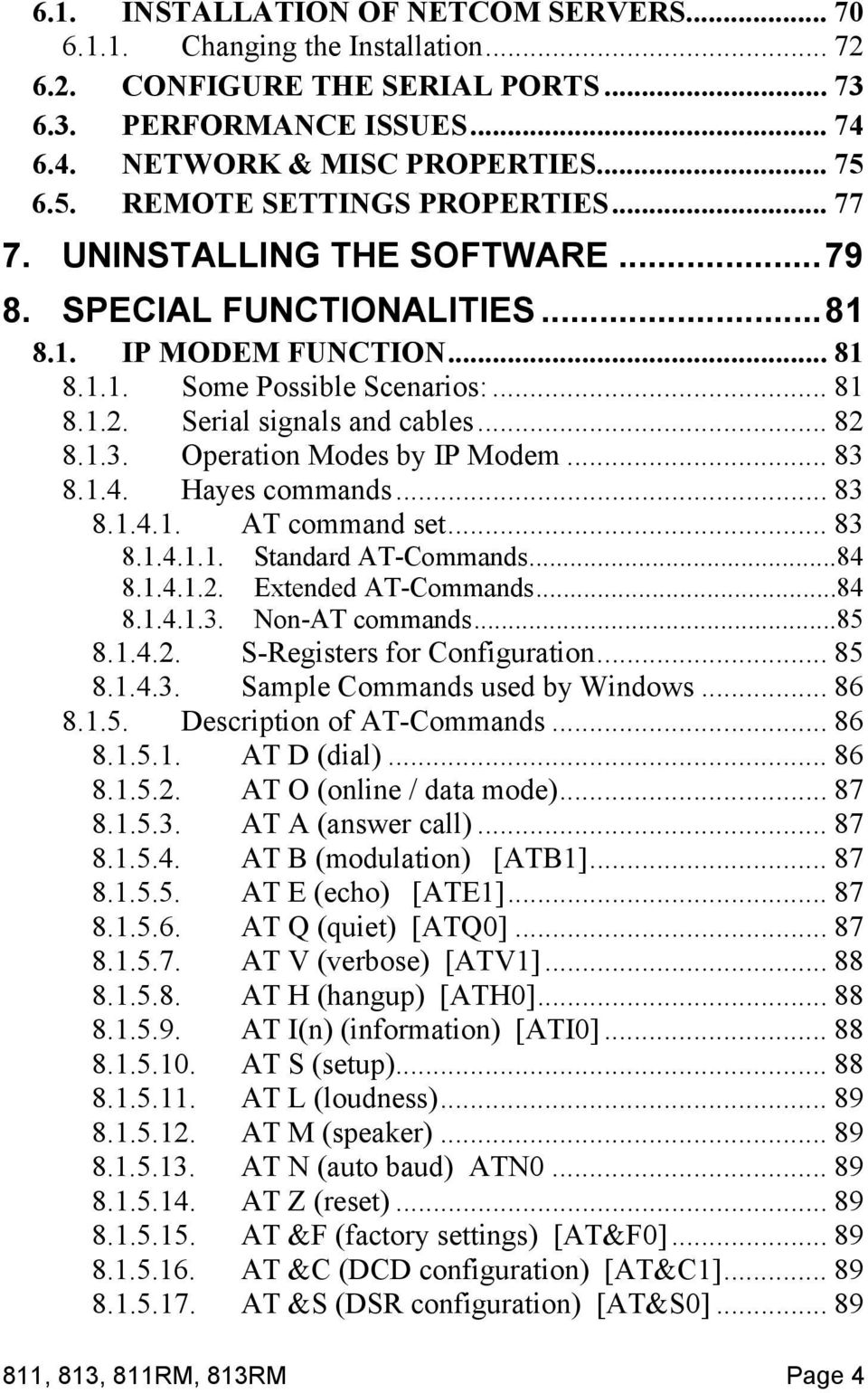
5 6.1. INSTALLATION OF NETCOM SERVERS Changing the Installation CONFIGURE THE SERIAL PORTS PERFORMANCE ISSUES NETWORK & MISC PROPERTIES REMOTE SETTINGS PROPERTIES UNINSTALLING THE SOFTWARE SPECIAL FUNCTIONALITIES IP MODEM FUNCTION Some Possible Scenarios: Serial signals and cables Operation Modes by IP Modem Hayes commands AT command set Standard AT-Commands Extended AT-Commands Non-AT commands S-Registers for Configuration Sample Commands used by Windows Description of AT-Commands AT D (dial) AT O (online / data mode) AT A (answer call) AT B (modulation) [ATB1] AT E (echo) [ATE1] AT Q (quiet) [ATQ0] AT V (verbose) [ATV1] AT H (hangup) [ATH0] AT I(n) (information) [ATI0] AT S (setup) AT L (loudness) AT M (speaker) AT N (auto baud) ATN AT Z (reset) AT &F (factory settings) [AT&F0] AT &C (DCD configuration) [AT&C1] AT &S (DSR configuration) [AT&S0] , 813, 811RM, 813RM Page 4
6 AT &D (DTR configuration) [AT&D2] AT &K (handshake) [AT&K3] AT \Q [AT\Q3] AT &V (view profile) AT &W (save profile) AT &Z (save destination) PRINT SERVER OPERATION Printer Queue Printer Reset Init String Definition ASCII Text ASCII Control Codes Numeric Codes Modem Control Signals Timing Options Reset Example Operation in Windows Add a New Printer Create new printer port Name the new Printer Port Configure the Printer Port Install Printer Driver Modify an Existing Printer Open the properties Add the Print Server Port TCP/IP DESCRIPTION RECOMMENDED SETTINGS Static Configuration DHCP Configuration Automatic Configuration (APIPA) Other Configuration HARDWARE DETAILS SERIAL PORT SIGNAL ASSIGNMENT VIEWS OF NETCOM NetCom 111, 113 and NetCom 411 and Page 5 NetCom 111, 113, 211, 411, 413,

7 NetCom 811 and NetCom 811RM and 813RM Rackmount TROUBLESHOOTING GUIDE GLOSSARY OF TERMS TABLE OF IMAGES Installation Wizard Start Driver Installation Discover and Select NetCom Devices for Installation Define NetComs IP Configuration DNS Name for NetCom Server Use current drivers dialog Install drivers for the serial ports VScom drivers in the Start Menu NetCom in Device Manager NetCom Manager NT Uninstall NetCom Drivers NetCom Manager NetCom Manager Servers Panel NetCom IP-Parameters Webinterface for configuration Webinterface Request to Reboot Web Panel Server Information Web Panel Server Parameter Web Panel Authentication Web Panel Date & Time Web Panel Serial Settings Web Panel Advanced Flow Control Serial Port Mode Selection Web Panel Driver Mode Web Panel TCP Raw Server Web Panel Raw Client Web Panel Null Modem Tunnel Web Panel IP-Modem Web Panel TCP Advanced Settings Web Panel UDP Data Transfer Web Panel Print Server Configuration , 813, 811RM, 813RM Page 6

8 Web Panel Ping Web Panel Statistics Port Selection Web Panel Port Statistics Web Panel Start Netstat Web Panel Netstat Output Web Panel Firmware Upload Web Panel Save/Load Configuration Web Panel Syslog & Debug NetCom Manager NetCom Manager in Device Manager NetCom Manager in Start Menu NetCom Manager Servers Panel NetCom Server Settings NetCom Ports Panel NetCom Firewall Panel NetCom Options Panel NetCom Firewall Panel Port Configuration for Driver NetCom Helper Service Enter Qualified Domain Name Password protected Telnet option Open configuration menu Main menu configuration console Pull Down Server Configuration IP-Configuration Parameters Access Authentication Password Dialog Date & Time Date and Time Retrieval options Information NetCom Server Information Menu, select serial port for configuration Config Communication Parameters Serial transfer parameters Standard Flow Controls Advanced Flow Control configuration Config Data Transfer Mode (TCP/IP) TCP-Ports for Driver mode and Raw Data Available Transfer Modes Page 7 NetCom 111, 113, 211, 411, 413,

9 Parameters for transfer modes Driver Mode parameters TCP Raw Server parameters TCP Raw Client parameters Null Modem Tunnel parameters IP Modem Parameters UDP Mode parameters Telnet Print Server Configuration Tools menu Ping test utility Statistics for serial ports Status and Statistics Netstat analysis Sample Netstat output Syslog Option Syslog configuration Firmware Update Settings, Firmware Update via TCP/IP Save actual Parameters Exit from configuration Exit and Reboot Select NetCom to install Excluded NetCom NetCom Manager Ports View Reconfigured NetCom found Replaced NetCom found NetCom COM Port Serial Settings NetCom COM Port Performance Settings NetCom COM Port Network & Misc Properties NetCom COM Port Remote Settings Properties To uninstall the NetCom software Uninstall in the Start Menu Confirm Uninstall of Drivers Installation Wizard to uninstall Drivers Add a printer Select Printer Port Create Printer Port Properties of Print Server Port Properties of Print Server Port , 813, 811RM, 813RM Page 8
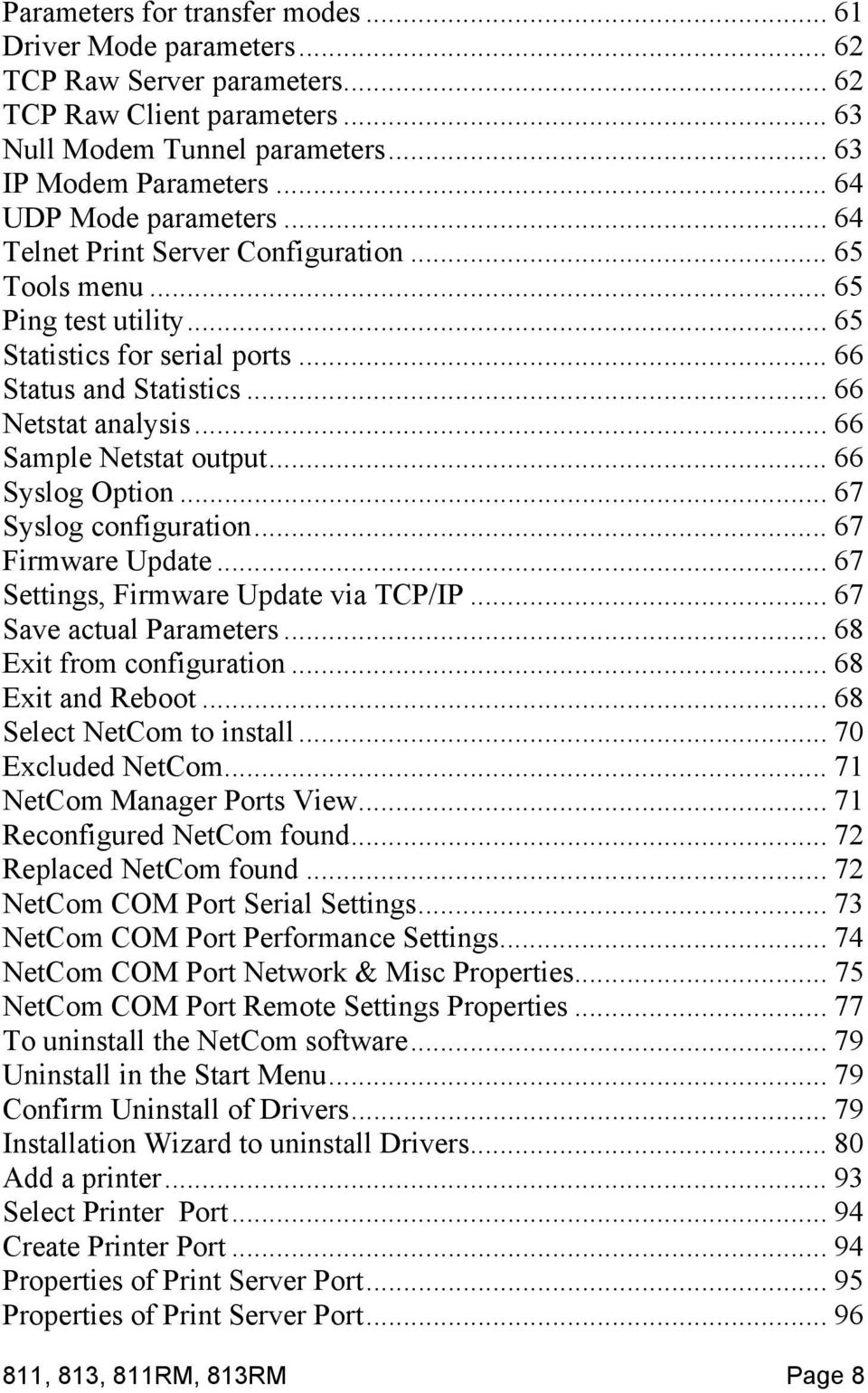
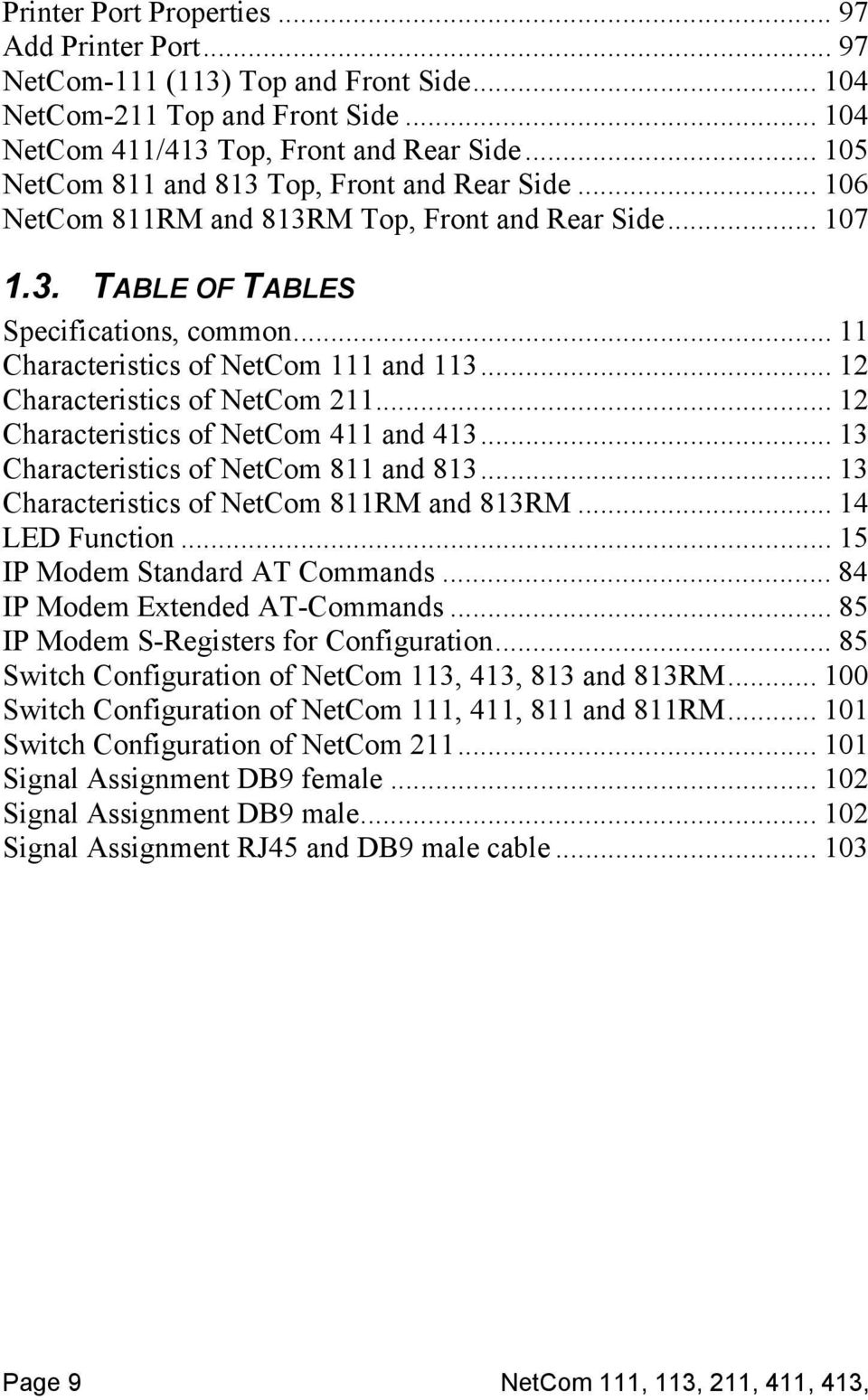
10 Printer Port Properties Add Printer Port NetCom-111 (113) Top and Front Side NetCom-211 Top and Front Side NetCom 411/413 Top, Front and Rear Side NetCom 811 and 813 Top, Front and Rear Side NetCom 811RM and 813RM Top, Front and Rear Side TABLE OF TABLES Specifications, common Characteristics of NetCom 111 and Characteristics of NetCom Characteristics of NetCom 411 and Characteristics of NetCom 811 and Characteristics of NetCom 811RM and 813RM LED Function IP Modem Standard AT Commands IP Modem Extended AT-Commands IP Modem S-Registers for Configuration Switch Configuration of NetCom 113, 413, 813 and 813RM Switch Configuration of NetCom 111, 411, 811 and 811RM Switch Configuration of NetCom Signal Assignment DB9 female Signal Assignment DB9 male Signal Assignment RJ45 and DB9 male cable Page 9 NetCom 111, 113, 211, 411, 413,
11 2. INTRODUCTION The VS NetCom Serial Devices Servers are designed to remotely operate serial ports over networks. The network interface is 100Mbit/s Ethernet on all cable operated models. The transport is implemented via TCP/IP protocol. Therefore control is available via Ethernet, Intranet and Internet. The supplied driver software hides the network transfer from your applications. Software applications using standard COM ports need no change to operate via NetCom through the virtual serial ports. This manual covers several different models of NetCom Devices. In general the operation is the same on all models, except where explicitly noted otherwise. The models named here are now grouped as the NetCom Lite series. These devices come with a steel case well suited for industrial environments. NetCom supports high serial speeds up to 921 kbps. All serial ports operate in common RS-232 mode. The models NetCom 113, 413, 813 and 813RM also offer the industrial RS-422 and RS-485 configuration. In RS-485 mode the NetCom may use the Automatic Receive Transmit (ART) control logic to follow the RS-485 specifications for transmitting data. No special code is necessary to be implemented in your software applications FEATURES Single power supply DC 9V-30V, ma@12v AC V 47-63Hz, 25VA Ethernet 10/100BaseTx for auto-configuration Three way serial port interfaces: RS-232 (and RS-422/485) Max kbps, half- and full-duplex TCP/IP configuration fixed or by DHCP Easy remote configuration via SNMP Drivers for Windows and Linux operating systems Documented interface for every networked operating system 811, 813, 811RM, 813RM Page 10

12 2.2. PRODUCT SPECIFICATIONS Most of the characteristics are common for all models. However some must differ from model to model COMMON CHARACTERISTICS Processor ARM7 (S3C4510B) Memory 8MB SDRAM 1MB Flash (2MB with 8 serial ports) Ethernet connector RJ45 10BaseT/100BaseTx Parity None, Even, Odd, Mark, Space Data bits 5, 6, 7, 8 Stop bits 1, 2 (1.5) Protocols TCP/IP, UDP, SNMP, DHCP, ICMP, ARP, Telnet, RTelnet, HTTP Management Driver software Serial console, Telnet, Webbrowser, SNMP Windows Vista/2003/XP/2000, Windows NT, Linux Management software Driver installation and configuration program, Management console Operating temp. 0 to 55 C Approval CE, FCC Table 1: Specifications, common Page 11 NetCom 111, 113, 211, 411, 413,

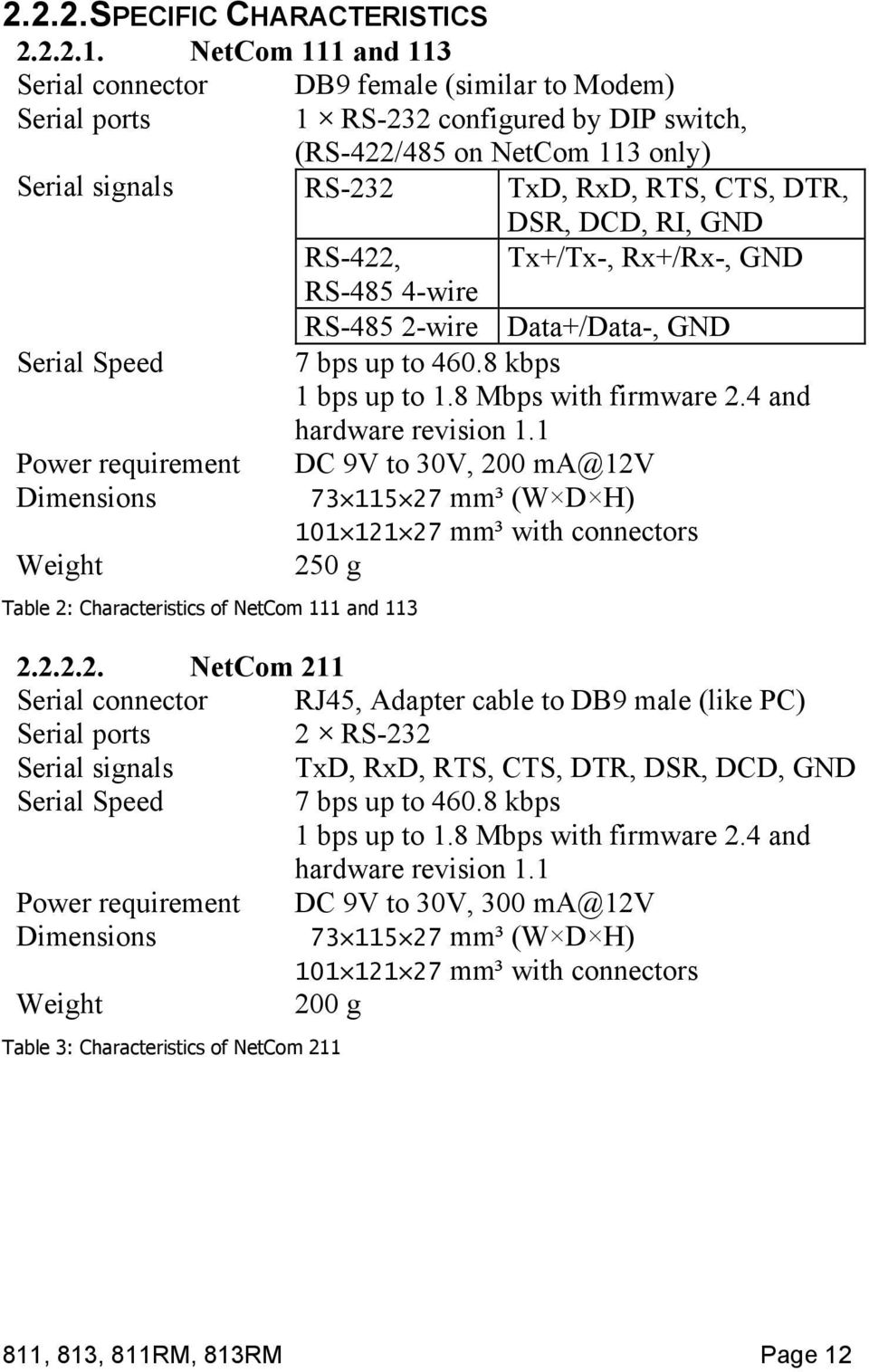
13 SPECIFIC CHARACTERISTICS NetCom 111 and 113 Serial connector DB9 female (similar to Modem) Serial ports 1 RS-232 configured by DIP switch, (RS-422/485 on NetCom 113 only) Serial signals RS-232 TxD, RxD, RTS, CTS, DTR, DSR, DCD, RI, GND RS-422, Tx+/Tx-, Rx+/Rx-, GND RS wire RS wire Data+/Data-, GND Serial Speed 7 bps up to kbps 1 bps up to 1.8 Mbps with firmware 2.4 and hardware revision 1.1 Power requirement DC 9V to 30V, 200 ma@12v Dimensions mm³ (W D H) mm³ with connectors Weight 250 g Table 2: Characteristics of NetCom 111 and NetCom 211 Serial connector RJ45, Adapter cable to DB9 male (like PC) Serial ports 2 RS-232 Serial signals TxD, RxD, RTS, CTS, DTR, DSR, DCD, GND Serial Speed 7 bps up to kbps 1 bps up to 1.8 Mbps with firmware 2.4 and hardware revision 1.1 Power requirement DC 9V to 30V, 300 ma@12v Dimensions mm³ (W D H) mm³ with connectors Weight 200 g Table 3: Characteristics of NetCom , 813, 811RM, 813RM Page 12
14 NetCom 411 and 413 Serial connector DB9 female (similar to Modem) Serial ports 4 RS-232 configured by DIP switch, (RS-422/485 on NetCom 413 only) Serial signals RS-232 TxD, RxD, RTS, CTS, DTR, DSR, DCD, RI, GND RS-422, Tx+/Tx-, Rx+/Rx-, GND RS wire RS wire Data+/Data-, GND Serial Speed 14 bps up to kbps 1 bps up to 3.6 Mbps with firmware 2.4 and hardware revision 1.1 Power requirement DC 9V to 30V, 400 ma@12v Dimensions mm³ (W D H) mm³ with connectors Weight 500 g Table 4: Characteristics of NetCom 411 and NetCom 811 and 813 Serial connector DB9 female (similar to Modem) Serial ports 8 RS-232 configured by DIP switch, (RS-422/485 on NetCom 813 only) Serial signals RS-232 TxD, RxD, RTS, CTS, DTR, DSR, DCD, RI, GND RS-422, Tx+/Tx-, Rx+/Rx-, GND RS wire RS wire Data+/Data-, GND Serial Speed 14 bps up to kbps 1 bps up to 3.6 Mbps with firmware 2.4 and hardware revision 1.1 Power requirement DC 9V to 30V, 600 ma@12v Dimensions mm³ (W D H) mm³ with connectors Weight 900 g Table 5: Characteristics of NetCom 811 and 813 Page 13 NetCom 111, 113, 211, 411, 413,

15 NetCom 811RM and 813RM (19 version) Serial connector DB9 male (similar to PC) Serial ports 8 RS-232 configured by DIP switch, (RS-422/485 on NetCom 813RM only) Serial signals RS-232 TxD, RxD, RTS, CTS, DTR, DSR, DCD, RI, GND RS-422, Tx+/Tx-, Rx+/Rx-, GND RS wire RS wire Data+/Data-, GND Serial Speed 14 bps up to kbps 1 bps up to 3.6 Mbps with firmware 2.4 and hardware revision 1.1 Power requirement AC 100V to 240V, 47-63Hz, 25VA Dimensions mm³ (W D H) mm³ with connectors Weight 1350 g Table 6: Characteristics of NetCom 811RM and 813RM 2.3. PACKING LIST VS NetCom Power supply 12V 0.8A for DC Models NetCom 111/113, 211, 411/413, and 811/813 Power cord for AC Models NetCom 811/813RM Serial Null Modem adapter for each port (not 211, 811/813RM) CD-ROM with driver and configuration software Quick Installation Guide 811, 813, 811RM, 813RM Page 14

16 3. HARDWARE CONFIGURATION 3.1. POWER SUPPLY The NetCom device is powered by a single 9-30V power supply. It requires 200 ma up to 800 ma of current, depending on the device type and voltage supplied. A suitable power supply adapter is part of the packaging. Connect the cable to the power jack at the rear side of NetCom, and put the adapter into the socket. For the 19 devices of course just plug the power cord into the socket. The Power LED on NetCom (red) will light. You can connect a power supply of your choice, providing the technical requirements are met ETHERNET The connector for network is the usual RJ45. Simply connect it to your (switching) Hub. When the connect is done the Link LED on NetCom (yellow) will light. When data traffic occurs on the network, this LED will blink. It depends on your network whether a 100Mbit or a 10Mbit connect will be established. A 100Mbit net causes the Speed LED on NetCom (green) to light, otherwise it will remain dark. Red LED Yellow LED Green LED Status Off Device off, no power On Off Off No connection On On Off 10Mbit connection established On Blink Off 10Mbit data transfer (traffic) On On On 100Mbit connection established On Blink On 100Mbit data transfer (traffic) Table 7: LED Function Page 15 NetCom 111, 113, 211, 411, 413,

17 3.3. SERIAL PORT SIMPLE SETTINGS There is one set of 4 (2) Dip switches to configure the operation mode of the NetCom Device. On NetCom 413, 813 and 813RM there is a separate set for each serial port. Before connecting a serial device, the serial port configuration must be completed. Warning: a bad configuration may cause serious damage in the NetCom or the connected device. To avoid these problems, it is recommended not to connect a device to the serial ports in the first installation. Also all serial ports should be configured for RS232. This is done by setting the DIP switches like these examples. Depending on your NetCom Device you have two or for positions: NetCom 211 Other devices 811, 813, 811RM, 813RM Page 16

18 4. WINDOWS DRIVER QUICK INSTALLATION This section describes the minimum steps required to install the Windows Driver and Management programs. Most configuration options are ignored. They are covered in later sections. Before starting installation, it is essential to have an IP configuration ready for the NetCom Device to install. You may read the section TCP/IP Description below. In many networks the default configuration is fine. If in doubt, please ask your Network Administrator for help. The following description is based on Windows XP Professional, with Service Pack 2 installed. The installation on other configurations of Windows XP is similar. Drivers are provided for Windows NT, Windows 2000, Windows XP, Windows 2003 Server and Windows Vista. The x86 and x64 Editions have separate drivers INSTALLATION PROCEDURE The installation of drivers is described first. This is followed by a procedure to verify a correct installation. The last part of this section is the uninstall process START THE INSTALLATION WIZARD This is the Installation Wizard, it is named VSNSETUP.EXE. You ll find it on the CD-ROM shipped with the NetCom, in the directory responsible for your operating system. The drivers are also Image 1: Installation Wizard available on the Internet, in the latest version. The Installation Wizard for Windows NT is named VSNSTUNT.EXE. Start this program to install the drivers. Your screen displays a Vscom logo. Select the folder to install programs and drivers into. In most situations the suggested setting is fine, just hit enter. Image 2: Start Driver Installation Page 17 NetCom 111, 113, 211, 411, 413,

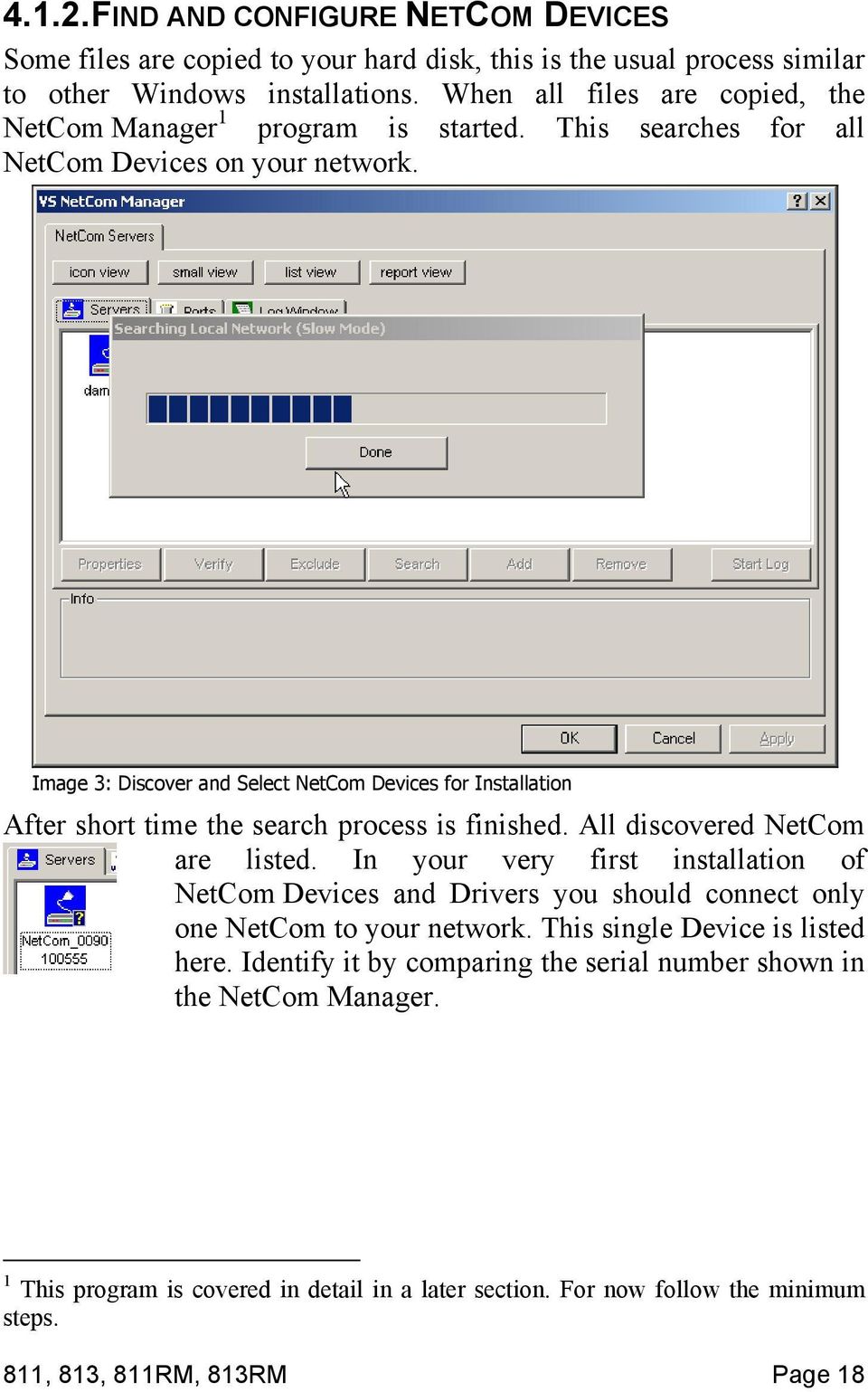
19 FIND AND CONFIGURE NETCOM DEVICES Some files are copied to your hard disk, this is the usual process similar to other Windows installations. When all files are copied, the NetCom Manager 1 program is started. This searches for all NetCom Devices on your network. Image 3: Discover and Select NetCom Devices for Installation After short time the search process is finished. All discovered NetCom are listed. In your very first installation of NetCom Devices and Drivers you should connect only one NetCom to your network. This single Device is listed here. Identify it by comparing the serial number shown in the NetCom Manager. 1 This program is covered in detail in a later section. For now follow the minimum steps. 811, 813, 811RM, 813RM Page 18
20 Configure IP Parameters As mentioned above, it is important to configure the NetCom to operate in your network. In many networks this is done by a so called DHCP server. Please ask your Network Administrator for information. If you need to define parameters manually, double-click the devices icon. Image 4: Define NetComs IP Configuration This panel opens. Deselect the Option of Use DHCP, and place your parameters as IP address, Netmask and Broadcast. Click on the OK button. Since driver version you may also enter a DNS name instead of the IP address. Image 5: DNS Name for NetCom Server Click the DNS button, and enter the Qualified Domain Name defining the NetCom Server. Your Administrator will provide you with it. Page 19 NetCom 111, 113, 211, 411, 413,

21 Configure Firewall As you will see in Image 4 the driver may also operate by traversal of a Network Firewall. This requires a special configuration, which is skipped here. Please read in detail in section Manual Detection/Installation of a NetCom. For now proceed with the standard installation INSTALL DRIVERS You are now back in the NetCom Manager. Click the OK button, the installation continues. Windows detects the serial ports on the fresh NetCom as new Hardware. Since Windows XP Service Pack 2 you are asked about to get latest drivers. Image 6: Use current drivers dialog There are no later drivers on the Windows Update website. Select the third item, and click on Next. This question neither appears on Windows XP prior to SP2, nor on any previous Windows version. 811, 813, 811RM, 813RM Page 20
22 Image 7: Install drivers for the serial ports The pre-selected automatic installation is fine, just click on Next. The driver files are already copied to your hard disk. Now Windows installs them in the system directory. To Finish the installation click on that button as it appears. These latest steps happen for each serial port on the NetCom Device. Just repeat the procedure, until all ports are successfully installed. Windows will show you this. In most situations it is not required to reboot the system. Of course you can do that now, to test the drivers VERIFY THE INSTALLATION Image 8: VScom drivers in the Start Menu In the Start Menu you ll find Vision Systems GmbH, a new program group. The installed programs are the NetCom Manager, the Driver Repair program and an option for Uninstallation. This group is not installed on Windows NT. Page 21 NetCom 111, 113, 211, 411, 413,
23 Image 9: NetCom in Device Manager In the Device Manager the serial ports are listed in the usual section Ports. Additionally there is a new device class Vscom Virtual Com. All installed NetCom Devices are listed herein. The available options are described later. On Windows NT there is no Device Manager. You ll find the serial ports listed in the Control panel in the Image 10: NetCom Manager NT Ports applet. To configure the NetCom and special port options, there is a new applet named NetCom Manager. 811, 813, 811RM, 813RM Page 22
24 4.3. UNINSTALL THE DRIVERS To completely uninstall the NetCom Drivers and files, there are three methods. The usual way is to use the Add/Remove Programs applet in the Control Panel, and remove the NetCom Drivers. This will start the NetCom uninstallation program. Image 11: Uninstall NetCom Drivers As a second way you may start the Uninstall program in the start menu. The third method is to start the Installation Wizard again. This will detect the drivers on the system. You have the options to repair the current installation, or to remove the installed drivers. Page 23 NetCom 111, 113, 211, 411, 413,
25 5. SOFTWARE CONFIGURATION The NetCom Devices may also be used without the installation of a driver software. Customer applications contact the NetCom directly, using network functions. These setups require independent configuration of the NetCom Device and the serial ports. There are several ways to do this configuration. The NetCom offers a Webbrowser interface, a Manager program to use in Windows, configuration via serial port, via Telnet and also via SNMP. This SNMP option is not covered in this manual, please see separate documentation. The serial port option is a fallback, if every other way of configuration fails. The options are here described in the order Web, Manager program, Telnet and serial port. Configurations via Webbrowser and via Telnet require a functional TCP/IP connection to the NetCom Device. Image 12: NetCom Manager And you must also know the IP-Address of the NetCom, to contact it. The easiest way to retrieve this information is the NetCom Manager program. So here is a very minimal description of this program. You find this program on the CD-ROM shipped with the NetCom Device. In Windows 2000, XP, 2003 Server and Windows Vista it is named NETCOMMGR.EXE (NETCOMMGRA64.EXE in x64 Editions), while in Windows NT the name is NETCOMMGRNT.EXE. Just double-click to start it direct from the CD-ROM. If you already installed the drivers, the program is also in the Start Menu. 811, 813, 811RM, 813RM Page 24
26 Image 13: NetCom Manager Servers Panel Identify the NetCom Device by comparing the serial number. Double-click the Icon of the NetCom. You ll see the IP-Parameters. Note the IP address, to use it in your browser or via Telnet. Image 14: NetCom IP-Parameters Page 25 NetCom 111, 113, 211, 411, 413,
27 5.1. CONFIGURE IN WEB-INTERFACE Open your Webbrowser. In the address line type the address of the NetCom Server. In the example from above type as the target. You may do this on any operating system you prefer. Image 15: Webinterface for configuration The NetCom welcomes you with its Home screen. To access the different options of configuration, the images above function as a link. In many menus you ll see a blue question mark. This is a symbol for help. When clicked a short explanation pops up, informing about the function of this parameter. Some other settings require a reboot to save and activate them. Whenever this situation occurs, the NetCom requests a REBOOT. It is done like this here, you may reboot now, or do that later when the configuration is finished. Image 16: Webinterface Request to Reboot WEBBROWSER SERVER CONFIGURATION The Server Configuration is a very long menu. It is divided in its logical sections throughout this document. 811, 813, 811RM, 813RM Page 26
28 Server Info Information about the selected NetCom is displayed as Server Info. Starting with the Server Type, this is the model of the NetCom, followed by the version of Software and Hardware. This will give a rough overview, which features are implemented, or need an upgrade of the firmware. The Image 17: Web Panel Server Information Serial Nr. is important to identify the device you are configuring right now. For further information the UpTime is listed. Contact and Location are User-defined information. They may later help to find the device in the installation, and the person responsible for management Server Parameter The Server Parameter allow configuration of the NetComs name and of course all parameters in IP-settings. So far the name is just informative, e.g. in the NetCom Manager program or SNMP. Manual changes of IP parameters are only available with DHCP set as Disabled. When DHCP is not used, enter IP Address and Netmask, as well as the Broadcast address. Gateway is required, if there are Routers in the Image 18: Web Panel Server Parameter network. DNS is used to access other stations by name. The ConfigPort is used to access the NetCom for administration via Telnet. It is suggested to use the standard value for Telnet, TCP port number 23. However it may be changed for different purposes. This does not change the function of the Telnet menus. KeepAlive is an intrinsic function of the TCP/IP protocol. If used it causes network traffic, but problems are detected earlier. In a LAN this is usually not a problem. However, if used via DialUp connections this may cause problems. If this functions is used, you must define an interval in seconds. NetCom has a better chance to react on network Page 27 NetCom 111, 113, 211, 411, 413,
29 problems, or failed hosts. Even dropping an old connection may be useful in certain environments Authentication Image 19: Web Panel Authentication Authentication sets a password to restrict access to the configuration of NetCom. To protect against accidental mistyping, you must type the Password again Date & Time It may be helpful to have a correct time setting in the NetCom. You may manually enter the time here. Please note, there is no real time clock with a battery backup in the NetCom. When the NetCom is restarted, the time is lost. But since Firmware version 1.6 it is possible to configure NetCom for automatic time retrieval via SNTP. Define State for retrieval method of Interval or Startup, or Off Image 20: Web Panel Date & Time of course. Parameter Mode is used to find the Time Server. It may be defined direct, or by DHCP. The Interval in seconds instructs the NetCom to regularly check for an update of the internal time settings. The Time Server may be given by IP-Address, or by name. A name of course requires a DNS server, see at Server Parameter above. Below these options there is the button Save. This will store all configurations done here in the NetCom. In many cases NetCom requires a reboot to proceed. 811, 813, 811RM, 813RM Page 28
30 WEBBROWSER SERIAL PORT CONFIGURATION This is also a huge menu. Each serial port of the NetCom is listed in a separate Column. The top half of the parameters titled Serial Settings is directly related to common serial configurations. The bottom half titled Transfer Settings configures the operation mode of NetCom on the network. Each serial port is configured separately, there is no setting shared between ports Serial Settings When the NetCom is used via the Virtual Com Driver mode, the serial parameters are controlled by the application, which opened the serial port. However certain installations use a different operation, without Driver mode. Then the serial parameters must be defined separately. This is done in this panel. Some NetCom devices allow to operate in RS422/485 modes. This is normally configured by DIP switches, the current setting is displayed as PortType. The serial port is based on standard UARTs, the type and maximum speed are also displayed. These are hardware Image 21: Web Panel Serial Settings parameters, and can not be changed. Hardware revision 1.1 features serial ports based on enhanced UARTs. They require Firmware version 2.4 for full support. Baud rates of four times as high as the standard MaxBaudrate are available now. The current UART Model may be changed to a less advanced type. In some situations it may be desirable to deactivate the FIFO memory, or some other options. The Baudrate may be selected in a drop-down list, or entered manually. If Manual is selected in the list, the value in the respective field is used to transmit data. NetCom checks if the configuration is possible, and warns otherwise. DataBit per character, Parity and StopBit are quite usual parameters. Page 29 NetCom 111, 113, 211, 411, 413,
31 The FlowType is available as standard configuration. There is also an Advanced setting, which gives very specific control to the user. NetCom can generate Events on RTS, DTR or as XON/XOFF, when the serial receive buffer is filled/emptied. It will also respect the state of CTS, DSR or XON/XOFF when sending data to the connected serial device. Image 22: Web Panel Advanced Flow Control The RxTriggerLevel defines when NetCom sends the received data to the host. If the amount of data is this high, the data is sent. It does not matter if there is still data coming on the serial line. If less data is received, the NetCom waits some time for further data, before sending the buffer. The TxTriggerLevel operates similar for the transmission. If the defined amount is received from the network, the NetCom does not accecpt more data to transmit Transfer Settings The Transfer Settings allow different Image 23: Serial Port Mode Selection modes. They are selected by the basic Mode setting. Depending on the current mode, only some of the many parameters are useful. The web configuration hides those parameters without function. Basically the NetCom Devices can act as a server or as a client. As the main difference a server waits for clients to contact it, while a client actively contacts a server. A NetCom can do both, and partially both at the same time. Keep this in mind throughout this section. 811, 813, 811RM, 813RM Page 30
32 Driver Mode Only very few parameters have a function in Driver Mode. NetCom is operating as a Server. It accepts two connections per serial port. One connection is used to transmit the serial data, this is the Image 24: Web Panel Driver Mode TCP Port(Data). And the other is used to transmit control information, TCP Port(Control). This control connection includes the configuration of the serial port, as well as signals for changed Modem Status lines. This mode is required when the serial port is operated via the Virtual Com Driver, it is default. The NetCom can check if the connected Client is still alive. This may be done, when a second Client wants to establish a connection (On Connect). It may also be done in regular intervals (Polling) TCP Raw Server As TCP Raw Server NetCom operates very simple. It only waits for incoming data connections in Raw IP mode. As with the Driver Mode only the data Image 25: Web Panel TCP Raw Server connection is defined. As a special configuration NetCom allows for more than one connection at a time. If the number is raised, it is the responsibility of the customer to ensure correct operation TCP Raw Client Also as Raw Client the NetCom requires very few parameters. Under certain conditions it establishes a Raw TCP connection to a pre-defined Destination. Since version 2.0 of the Image 26: Web Panel Raw Client NetCom Firmware the Destination can hold multiple hosts as targets for a connection. They are entered as a comma separated list of DNS names or IP-Addresses. Each destination will have a TCP port number, separated by a colon. Instead of a single IP-Address or DNS name, a range of IP-Addresses is also valid. This range must be followed by the TCP port number, as in :2077. Page 31 NetCom 111, 113, 211, 411, 413,
33 The parameter Connect defines if NetCom uses the connections as Permanent, Triggered or DSR. With Permanent or Triggered any activity on the serial ports establishes the connection, inactivity of longer than the ShortHoldTime cause NetCom to close the connection. DSR is new since Firmware version 2.0, the TCP-connections follow the state of the DSR signal at the NetCom serial port. When it becomes active they are established, until DSR becomes inactive. At that moment the connections are dropped Null Modem Tunnel This is a mixed mode, requiring parameters for server function and for the destination. The NetCom operates as a server while accepting connections in Driver Mode. If there is no current connection, the NetCom may establish a connection as a client. This is also a special connection, using the Driver Mode protocol. NetCom can will not only transmit serial data in both Image 27: Web Panel Null Modem Tunnel directions, it will also pass information about the current settings of the Modem Status lines. And it will itself set the Modem Control lines as required by the other host. Since this operation requires another NetCom to accept the connection, both NetCom together operate as a long Null-Modem cable. The data is sent via a tunnel through the network. The configuration as Server (top) requires the same parameters as the Driver Mode, hence TCP Port(Control) and TCP Port(Data). The configuration as Client (bottom) first require a destination. Here it is given by name, but a direct IP-Address may be more usual. On the destination there is also a TCP Port(Control) and TCP Port(Data) to accept the connect of the NetCom. The connection is normally established in Triggered mode, i.e. when some event occurs on the serial port. It is hold for the defined ShortHoldTime. It is also possible to have the connection Permanent. As in the normal Driver Mode the function of a connected client can be checked via KeepAlive signals in different modes. 811, 813, 811RM, 813RM Page 32
34 IP-Modem The serial port of a NetCom may mimic (emulate) a serial modem. This feature is available since Firmware version 2.0 of the NetCom. There is the separate Image 28: Web Panel IP-Modem section 8.1 below defining this functionality. Here are the basic network parameters only. A modem accepts connections from the network, in this case via TCP/IP. The TCP port for this is defined as the TCP Port(Data). This is the only parameter required to set here. All other values are normally defined via AT-commands. However for short, Destination allows for up to four predefined targets, available with special Dial commands. The IP Modem Config is known as the Init String in standard modems TCP Advanced Settings All of the above operation modes are special configurations for options. In some situations none of the pre-defined modes fit the customers needs. When this is the case, the TCP Advanced Settings offer the configuration of any Transfer parameter. Unusual combinations of Modes are possible with this, also standard modes with unusual parameters. Image 29: Web Panel TCP Advanced Settings UDP Data Transfer Image 30: Web Panel UDP Data Transfer The UDP mode is available as a function since the version 1.4 of the firmware. UDP sends data in single packets instead of a stream. This protocol requires a UDP Port(local) for listening to incoming data. Other stations on the network send their data to this Page 33 NetCom 111, 113, 211, 411, 413,
35 port. The Destination host is configured by IP-Address or name, plus the target UDP Port(Dest). A UDP Broadcast is sent if the destination address is the broadcast Address (see above) and the Firmware version 1.8 or later is installed. UDP MaxPacketSize is a limit for the size of UDP packets. When the amount of data received on the serial port reaches this limit, the UDP Frame is assembled and sent to the destination. UDP Timeout defines when NetCom sends the received data as a UDP Frame. If the reception of serial data is interrupted for this time (in milliseconds), the data sampled so far is sent to the destination. UDP Trigger defines a sequence of characters. As soon as this sequence is detected in the received data, all data up to the end of this Trigger is sent to the destination. In most situations such a Trigger includes control or other special characters. Enter them numeric: as \xhh where HH is the hexadecadic code of the character, or as \OOO where OOO is the octal code of the character. The backslash itself must be doubled as \\ Print Server Function Firmware version 2.2 introduces the function as a Print Server according to RFC1179, also called a»line printer daemon«. A print server is accessed through its IP Address via one specified TCP Port (see Server Parameter). Data is handled in distinct queues, each with a certain name. Each queue is handled by a certain serial port, and the data is sent to the serial printer attached to this port. Each serial port configured for Print Server operation has its separate QueueName. The default value is»lpd«plus port Image 31: Web Panel Print Server Configuration number. The InitString is a special feature of NetCom. This string is sent to the serial printer at the beginning of the next queued print job. The definition is in section below. 811, 813, 811RM, 813RM Page 34
36 WEBBROWSER NETCOM TOOLS Since Firmware version the available tools are: The Ping utility to check if a station is available. Statistic information for each serial port. The Netstat utility to monitor used TCP connections. The option to update the firmware. Saving of Configuration to / Loading from a file. Syslog DebugLog Ping Image 32: Web Panel Ping Enter the IP-Address or the name of a station in the field, and click the Ping button. The network connection is checked by sending certain ICMP data packages. PING from : 44 (72) bytes of data 52 bytes from : icmp_seq=0 ttl=255 time=1.560 msec 52 bytes from : icmp_seq=0 ttl=255 time=1.542 msec 52 bytes from : icmp_seq=0 ttl=255 time=1.542 msec back If the target responds, the network between the NetCom and the target is operational. The time required for an echo depends on the speed of the network. In a typical Ethernet this is only very few Milliseconds, while it can be several seconds throughout the Internet. Page 35 NetCom 111, 113, 211, 411, 413,
37 Statistics Image 33: Web Panel Statistics Port Selection Select the serial port to see its statistical information. The statistics window reports the state of the modem status and control signals. Also the number of state changes. The number of characters sent and received is shown at the bottom. Image 34: Web Panel Port Statistics 811, 813, 811RM, 813RM Page 36
38 Netstat Use Netstat to see the actual connection status of NetCom. This is a standard tool for network debugging. Image 35: Web Panel Start Netstat Update Proto Local Address Foreign Address State tcp : :0 LISTEN tcp : :0 LISTEN tcp : :0 LISTEN tcp : :0 LISTEN tcp : :0 LISTEN tcp : :0 LISTEN tcp : :0 LISTEN tcp : :0 LISTEN tcp : :0 LISTEN tcp : :0 LISTEN tcp : :1280 TIMEWAIT tcp : :1281 ESTABLISHED udp :161 udp :19970 udp :32331 Image 36: Web Panel Netstat Output A Foreign Address of is listed when NetCom is waiting for an incoming connection (LISTEN). If the value is not , the connection is either active (ESTABLISHED) or closed (TIMEWAIT). Page 37 NetCom 111, 113, 211, 411, 413,
39 Firmware Image 37: Web Panel Firmware Upload Save and Load Configuration To upload a new version of the firmware, put the name of the file in the field. Your webbrowser may allow to search for the file. Click on the Update button. While loading the file is checked. If it is valid, it is stored in the Flash Memory. When the upload is finished, NetCom will Reboot. Image 38: Web Panel Save/Load Configuration It is possible to save the actual configuration to a text file. This is first implemented in Firmware version 1.6. Of course it is also possible to load the saved configuration into a NetCom Logging and Debug Syslogging requires a server the information is sent to. Facility allows to select the data sent to that server. For Debuglog the NetCom behaves as the server. Open a TCP connection to the configured port, and receive all information generated. Image 39: Web Panel Syslog & Debug 811, 813, 811RM, 813RM Page 38
40 5.2. CONFIGURE WITH MANAGER PROGRAM Shipped with the NetCom Devices there is a versatile program for Windows Operating System, named NetCom Manager. This program shall detect, manage and configure the NetCom Devices in your network. You can start it by several ways. First of all it is stored on the CD-ROM, named NETCOMMGR.EXE (NETCOMMGRNT.EXE on Windows NT, NETCOMMGRA64.EXE in x64 Editions of Windows). It is possible to start it directly from the CD-ROM. See this Icon to the left. When the Virtual Com Drivers are installed, there are more options to run the program. In Image 40: NetCom Manager Windows NT the same Icon appears in the Control Panel, to start the NetCom Manager program. In Windows 2000, XP, 2003 Server and Windows Vista the driver software installs a new device class Vscom Virtual Com. The properties of the class open the NetCom Manager. Additionally the installation of the drivers created a new program group in the Start Menu. Image 41: NetCom Manager in Device Manager Image 42: NetCom Manager in Start Menu This section of documentation focuses on management of the NetCom Devices. The options to configure driver-specific options of the serial ports are skipped here. This includes some buttons and panels. They are described in total below, in the documentation of the drivers and panels. While in the configuration process, a click on a button or a double-click on an item opens properties or other options. In many situations, a right-click with the mouse opens context-sensitive options. Just try it out. The NetCom Manager is designed to help configure driver options. So for very detailed configuration of a NetCom, it is better to use the Webbrowser interface, or do it via Telnet. However, here are the options. Page 39 NetCom 111, 113, 211, 411, 413,
41 STARTING NETCOM MANAGER When NetCom Manager is started, it will Search the NetCom in your LAN by SNMP. This process may take up to 30 seconds. The devices in a LAN are typically found in the first seconds. If this is enough for you, you can stop the search by click on the Done button. Image 43: NetCom Manager Servers Panel The NetCom are listed here in the Servers panel. Since the Search uses broadcast mechanisms, the range is limited. If you have Routers in your network, or you contact some NetCom via Internet, you must Add them manually. Enter the network parameters to access the NetCom. Select a NetCom, and click on the Properties button, double-click the Icon, or use a right click. Using Verify the NetCom Manager contacts the NetCom to check if it is properly configured and online. Exclude is only useful in conjunction with the Virtual Com Drivers, so skipped here. Search repeats the search from the program start, and may be used at any time. Remove removes a server from this list. This option is most often used to clear old data from the drivers database. For monitoring purposes you may select a NetCom, and Start Log for 811, 813, 811RM, 813RM Page 40
42 this. It may be done for several Devices at the same time. The output is visible in the Log Windows panel NETCOM SERVER SETTINGS - INFO As described above, open the Properties of a NetCom Device. The Server Settings start with the Info panel. Configure the options as your network requires. Image 44: NetCom Server Settings The Server Name is just for information. As factory setting it includes the serial number of the device. You may change it to any string of printable ASCII characters, since there is no functionality related to the name. This name is listed in the Server panel of NetCom Manager. The next parameters are fixed, and displayed for information only. The Telnet port allows to configure this NetCom via Telnet. The value is a TCP port. Factory setting is 23, the standard port for Telnet. By default the NetCom is set to Use DHCP for automatic configuration of IP parameters. This is the suggested method. However there are several situations where this option can not be used. In this case deactivate it. When inactive, other parameters may be changed. The basic parameters IP address and Netmask are mandatory. Instead of an IP address you may enter a DNS name. The NetCom Manager will resolve that name to the actual IP address. Page 41 NetCom 111, 113, 211, 411, 413,
43 If address or netmask are changed, the NetCom Manager calculates a matching address for Broadcast. You may also change this address. The DHCP option will also configure the Default gateway and the Name server. Without DHCP you must enter these parameters by yourself. However they are not required in all configurations. So enter if they are not used NETCOM SERVER SETTINGS - PORTS Image 45: NetCom Ports Panel The Ports panel lists all serial ports of a NetCom. Some of the options are driver related, e.g. the Com Number. Each serial port may operate via three TCP ports. The TCP Control Port is used in the Virtual Com Driver mode, and also in Null-Modem Tunnel. If Driver mode is not desired, this parameter is ignored almost always. The TCP Data Port is used to transmit data to and from the serial port. Use the default, or change the value to the settings required for your network. There is also a UDP Data Port, used in packet data transfer. You can not switch the NetCom to UDP mode with the Manager. But if it is already in this mode, you can change this basic parameter. 811, 813, 811RM, 813RM Page 42
44 NETCOM SERVER SETTINGS - FIREWALL Image 46: NetCom Firewall Panel Many networks use a Firewall to protect the stations in the network from other networks, including the Internet. In some situations the contact to a NetCom must pass through such a Firewall. To do this you must Enable Firewall, and enter the Address of the Firewall. The address may be the IP address, or the Qualified Domain Name (DNS). The Manager configures a NetCom via SNMP, which uses UDP. The Firewall must have a special Port to receive those data, and to transfer it to the internal network. Enter this port here. The same scheme applies to the logging option. By default a NetCom listens on port 1200 for logging connections. The Firewall must also have a special Log Port to receive this connection, and to transfer it to the NetCom. The NetCom does not need any configuration to operate in a Firewall protected environment. This configuration here is for installation of the drivers. There is a Firewall tutorial section later in this manual. Page 43 NetCom 111, 113, 211, 411, 413,
45 NETCOM SERVER SETTINGS OPTIONS Image 47: NetCom Options Panel This Panel is available since software version , in this enhanced version. A Safe to File of the configuration is available, as well as the opposing Load from File of this data. You can also Reboot the NetCom. This may be useful, e.g. if an old connection blocks access to the NetCom. The button Apply Changes commits all parameter settings done so far to the NetCom. And the Verify checks the current settings by reloading the status from the NetCom to the Manager program. When you want to install a Firmware Update, use this button. The NetCom may be protected for access, in this case you must place the current Server Password in the dialog. The option to change the password is reserved for a future extension. Exclude Server is related to the Driver installation only. You may Enable Log to see events at the NetCom, for monitoring. If enabled, the log will also appear in the central Log Window. At any time it s possible to Clear the log, or Capture the data to a file. 811, 813, 811RM, 813RM Page 44
46 MANUAL DETECTION/INSTALLATION OF A NETCOM Sometimes the NetCom Device Server can not be detected by the automatic in the NetCom Manager. To detect and configure devices the protocol SNMP is used. The detection is done by sending out a broadcast on all available network interfaces of your computer. This SNMP broadcast is realized as an Ethernet broadcast. Such a broadcast is only transmitted through Hubs and Switches. When there is a Router between the computer and the NetCom, probably the broadcast is not transmitted further. This is especially the situation when the NetCom is located somewhere via Internet, but also in big networks of some companies. If this is the case, the detection has to be done manually. Refer to Image 43 and Add the NetCom by use of the button. Enter the IP-Address of the NetCom in the NetCom Server Settings, and click the button Verify. Since now the IP-Address of the NetCom is known, the NetCom Manager sends a request directly to this target. This directed SNMP request is transported, even by Routers. The NetCom sends the normal reply, giving all required information to the NetCom Manager. Now it is possible to configure all options as usual. Also the drivers for virtual serial ports are installable now. Please note, the drivers require to have the IP Address. They can not operate using a DNS name, because a driver can not perform a DNS name resolution. If your NetCom is located on a dynamic IP Address (e.g. on a DialUp connection with 24 hours disconnection), you need to reconfigure the driver installation, when the IP Address has changed. There is a NetCom Helper Service for assistance FIREWALL TRAVERSAL CONFIGURATION There are more difficult situations with a Firewall between the NetCom and the NetCom Manager. Many Firewalls protect the internal LAN by using the Feature of NAT (Network Address Translation). In this situation the IP-Address of the internal device is not visible on the Internet. Only the Firewall can be contacted via its public IP-Address. The NetCom Manager and the driver software for the virtual serial ports can handle such setups. But this requires certain configurations SOHO Firewall example The most easy situation for such a setup is by using a very simple SOHO Router as the Firewall. This configuration will show the principle of the technical details. Those principles can be transferred very easy to the configuration of more complicated installations. On the Page 45 NetCom 111, 113, 211, 411, 413,
47 SOHO Router there is only one public IP-Address on the external side, and typically 254 internal IP-Addresses for the LAN side. These internal addresses may be assigned by DHCP or static. Such Routers offer a feature typically named DMZ, which in fact is only a single exposed host. It is recommended not to use the DMZ for several reasons, some of them are security related SOHO Virtual Servers The Router also offers Virtual Servers, which is the option required for NetCom installation. These Virtual Servers (here named VSrv for short) operate by a technic called PAT (Port Address Translation). Certain data addressed to the public IP-Address of the Router are forwarded to the internal private address of the NetCom. The NetCom can be contacted via the public IP-Address of the Router. First you need to configure the Router for some VSrvs. As the absolute minimum there is one VSrv for the NetCom device itself, and another two VSrvs for each serial port of the NetCom. Those VSrv are to be configured for TCP or UDP transmissions. Please read in the manual of your Router how to do that. You need a port for the external interface, and an IP-Address plus a port for the LAN side. The IP-Address is of course that of the NetCom. As an example the most easy device is a NetCom 113. The internal port for SNMP is 161 for UDP. The serial port requires ports 2000 and 2001 for TCP. Function External port Internal port SNMP 8161/UDP 161/UDP Control 9000/TCP 2000/TCP Data 9001/TCP 2001/TCP Configure your Router for these example VSrvs, and use the internal IP-Address of the NetCom for the targets. Connect the NetCom to your LAN. Now you are ready for a very first test. Use Telnet to connect to the Data port of the NetCom serial port. Open a console (DOS Box) and type the command Telnet <Routers-IP-Address> 9001 You will be connected to the serial port. Every character you type is sent out of the serial port, and every received data is shown on your screen. The serial parameters are preconfigured in your NetCom. 811, 813, 811RM, 813RM Page 46
48 NetCom Detection through SOHO Firewall Now open the NetCom Manager as in section above, and click the Add button. You again get the NetCom Server Settings dialog. But now you have to select the panel named Firewall. Image 48: NetCom Firewall Panel Check the Option Enable Firewall, and enter the IP-Address of the Router in the Address field. In the field Port enter the target port for the SNMP configuration. From the Virtual Server example above this is port Since there is no configured VSrv for Logging, ignore this field. Click the button Verify to have the NetCom Manager contact the Router. This is a directed request, so there is no problem with broadcasts. Some ISP will block the SNMP protocol, which typically means they do not transport data for 161/udp to their customers (this is the first reason why port 8161 was used in the example). The Router will transfer the request to UDP-Port 161 on the NetCom, which is the port for SNMP. The NetCom will answer the request, and send it out to your computer. The NAT function in the Router will exchange the source IP of the data by its own public value, so the NetCom Manager Page 47 NetCom 111, 113, 211, 411, 413,
49 will see the answer come from the Router. The NetCom Manager is satisfied with this data. This answer brings every required information about the NetCom, including its internal IP-Address. Select the panel of NetCom Server Settings to verify the information, but do not make any changes here Serial Ports through SOHO Firewall Now the NetCom is available in the NetCom Manager, but still the serial ports are not usable. The information of the TCP-ports for the VSrv related to the serial port is still missing. In the NetCom Server Settings select the NetCom Ports Panel. In this panel select one serial port, in this example of NetCom 113 there is only one serial port. Click the Properties button to open the configuration of the port. Image 49: Port Configuration for Driver Since the Firewall function is enabled, the parameters for Firewall mapping are available for editing. Enter the ports defined in the Router, 9001 and 9000 in this example. Please note, so far there is no number for the Virtual Com Port available. The driver is not installed in this moment, and Windows does not know about the available 811, 813, 811RM, 813RM Page 48
50 hardware. This will happen later in the installation. Click the OK button, and proceed with the driver installation as already described DMZ and Virtual Servers Why is it recommended not to use the DMZ function of the Router? There are two reasons. The first one is simple, only one device in the LAN can be defined as the DMZ target. The DMZ is implemented as Send all IP data targeted for the Router to the DMZ station, as long as there is no specific rule for a different target. When a second NetCom shall be installed on the LAN, the Virtual Servers have to be configured anyway. The second reason is the security. Using the DMZ the Firewall in the Router becomes transparent. All data from outside is transferred to the LAN, including all malicious data NETCOM HELPER SERVICE In certain situations users of VScom NetCom Serial Device Servers come to the problem of dynamic IP addresses. This typically happens when the NetCom is used over Internet, using an ADSL or cable Modem connection. At certain times (e.g. every 24 hours) the NetCom is disconnected from the internet. When it is re-connected, it will receive a new IP Address, which is different than before. The NetCom Driver for Windows installs the serial ports on the NetCom Servers as virtual local Com Ports in the system. They are seen in the Device Manager, and standard applications like Hyperterminal have a seamless access to the connected serial devices. To perform this task the driver uses the IP Address of the NetCom Server. On the established TCP connections the driver exchanges serial data, commands and status information. When the IP Address of the NetCom has changed, the driver attempts to contact the old IP Address, which will fail. So the virtual Com Port is not usable any longer. Up to driver version users have to use the NetCom Manager NETCOMMGR.EXE to reconfigure the driver. Since the driver version there are more options. The software installs a so-called Helper Service on the system. This service monitors the configured NetCom Servers, and detects the changed IP Address. The driver is reconfigured to use the new IP Address, so the port is usable again. This all happens without specific user interaction. Page 49 NetCom 111, 113, 211, 411, 413,
51 Configure Helper Service Image 50: NetCom Helper Service The NetCom Helper Service is configured via NetCom Manager. There is a new Register card. In the upper part users enable the Helper Service, and they also configure the polling frequency. If the Helper Service is disabled, it is also stopped in the system; it does not consume any system resources. Of course it does not provide any help when disabled. The Polling Period is given in seconds. When the interval is over, the configuration of the NetCom Servers is checked. The lower part in the new panel lists all NetCom Servers available in the system configuration. The user must decide which of those shall be monitored. At the regular intervals as configured above the NetCom Server is checked. The Helper Service attempts to connect to the NetCom Server, and verifies the parameters. If the verification fails, the Service uses several methods to find and identify the NetCom Server Detection and Priority The NetCom Helper Service has two basic methods to detect and identify a NetCom Server. The first method is the broadcast search on the network, the new method is DNS based. The DNS method has two variants, with or without firewall configuration. The reasons for changing IP Addresses or the methods to use are discussed later Broadcast Search The method of broadcast search is the same method as used in the NetCom Manager. A broadcast request is sent to the local network, and the NetCom Servers reply to this. The NetCom Manager lists them for configuration. This method is used by the NetCom Helper Service also. A NetCom Server is identified by MAC-Address and Serial Number. These two parameters are fixed, customers can not change them. If a NetCom Server is found with a changed IP Address, the driver configuration is updated DNS based Search In driver versions up to the NetCom Server has been configured by its IP Address. This is still the standard situation in later driver 811, 813, 811RM, 813RM Page 50
52 versions. However the Info Panel of Server Properties is modified (see Image 4). You may enter a Qualified Domain Name instead of the IP address. The name is resolved, i.e. translated to the current IP Address associated with the name. This IP Address is configured in the driver, and the DNS name is also saved there. Image 51: Enter Qualified Domain Name In a local company network this may not be an especially useful option. But when the NetCom Server is used via the Internet, this is the standard situation for most applications. DNS is used when the NetCom is not a part of the local network broadcast domain. As a consequence it is not detectable via the broadcast method described above. Provided there is a reliable DNS service available, now it is more easy to install a NetCom in the system. Please read about the Manual Detection/Installation of a NetCom. The NetCom Helper Service regularly checks if the NetCom Server is still available on the known IP Address. If the attempt for contact fails, the Helper Service uses DNS to find the new IP Address of the NetCom Server. This new IP Address is used for future operation DNS based Firewall Configuration The NetCom Servers do not manage an Internet Connection on their own. It is possible to have a NetCom Server on a public IP Address, but then the Internet Connection is managed by Routers. More often the NetCom Server connects to a private LAN, and has a private IP Address. The Internet Connection is managed by a Router, which also acts as a Firewall. This Router uses NAT/PAT to make the NetCom Server available via Internet. Please read about Firewall Traversal Configuration. When the Firewall Configuration is activated for access to the NetCom, it has been possible to enter the DNS name of the NetCom Server in previous versions of the driver. Precisely it was the DNS name of the Router. This name has been resolved at the time of configuration, and has been stored for later use. Now the NetCom Helper Service monitors the DNS name to connect to the NetCom Server. If the connect fails, the DNS name is resolved again. The new result is used in the driver Changed IP Address There are several configurations with changed or regularly changing IP Addresses. This is a rough overview. Page 51 NetCom 111, 113, 211, 411, 413,
53 Broadcast Domain The broadcast domain is part of a local network. In typical SOHO networks the domain covers the entire network. The broadcast domain is typically limited by Routers. Broadcasts are transmitted between computer and NetCom Server, if there are only Switches/Hubs or WLAN Access Points on the way between those two. Usually the IP Addresses in a local network are static. This is also the situation when there is a DHCP server, and all clients use this. If the server is configured properly, it will provide the same IP Address to a certain station again and again. It does so, because the stations are identified by their unique MAC-Address. A changed IP Address may occur because the network is re-organized, combined with a reconfiguration of the DHCP server. In most cases however it is simply because the station has been switched off for a comparably long time. So the DHCP server forgot about the station, and provided the IP Address to a different target Internal DNS If the company network becomes larger, it will also use some Routers. For organisation the network is grouped in subnets. As mentioned above, typically the broadcasts are blocked by Routers, so the broadcasts only cover a single subnet. To contact stations in other subnets the IP Address of the target is required. Usually this is provided by a DNS server. This server may co-operate with a DHCP server. A usual cause for a changed IP Address in the NetCom Server is a connection to a different subnet. It will have a different IP Address there, but the DNS server will know about the new address Internet Some ISP disconnect the customers stations from the Internet in regular intervals, e.g. every 24 hours. If the station is configured for immediate re-connect, it will get a new IP Address. This station can notify a Dynamic DNS service, so this will resolve to the new address. This is typically combined with a SOHO Firewall/Router Polling Period The last matter to check about is a suitable Polling Period for the NetCom Helper Service. The standard value is 3600 seconds, i.e. one hour. With this configuration a change in the address is noticed up to 60 minutes later. When the change occurs just before the Helper Service checks the connect, it will be recognized very soon, if the check happens just before the change, it will require the maximum time. 811, 813, 811RM, 813RM Page 52
54 Usually an installation requires to have changes detected very soon, but this is not possible on networks. The NetCom Server has no feature to contact all clients, and notify them of a changed configuration. This is because the NetCom Server can not manage a possibly huge list of client computers. So the Helper Service is installed on the client computers. If there are a lot of clients, very frequent polls cause a high load. For one side on the network, but most important on the NetCom Server. The best choice for a suitable polling interval depends on the usage period of the client computer. If it is unused for some hours per day (over night), it will detect a change at least the next morning. Provided the change happens over night. If the NetCom Server uses an Internet connection with regular disconnects, it is a good idea to configure those disconnects to times of inactivity of the clients. For manual detection of changes it is possible to restart the NetCom Helper Service. Controlling a service requires administrative privileges on the Windows system. A restricted user account can not do this. Restricted users use the Polling Period configured by the system Administrator. Page 53 NetCom 111, 113, 211, 411, 413,
55 5.3. CONFIGURE NETCOM VIA TELNET CONSOLE There are many situations, when using the NetCom Manager program for Windows is not appropriate. And a graphical Webbrowser may also be unavailable. To enable configuration also in this situation, there is the Telnet option. It is preferred by many users. To connect your Telnet session you need the IP-address of NetCom. Also you must be able to communicate with NetCom via IP. If you can send a PING to NetCom and receive an Echo, the configuration is fine. This requires a predefined NetCom, maybe via a DHCP server. You may also use the NetCom Manager Program (on a different computer) to find the IP-Address of the NetCom. Start your Telnet program, set it to use a terminal emulation of VT100. This is recommended, but VT52 is also possible. The Telnet session is closed by the NetCom, when no user input occurred for at least 3 minutes. In your Telnet, establish a connection to the NetCom. If the configuration port is changed from the default 23 for Telnet, use this port. If the NetCom is password protected, you need to enter the password right now. Please enter your password: Image 52: Password protected Telnet option When connected to NetCom you must define the type of terminal used. Please choose your terminal type (1:VT100 2:VT52 [1]): 1 Image 53: Open configuration menu 811, 813, 811RM, 813RM Page 54
56 TELNET MAIN MENU The configuration with Telnet is menu-driven NetCom V ServerConfig SerialPorts Tools Save&Exit h=help -+ Server configuration settings Image 54: Main menu configuration console This is the start point for configuration. ServerConfig has all options to configure the NetCom device itself, including the IP-Parameters to access it. SerialPorts defines settings related to the serial port. Tools has some utilities like PING or displays statistics. In Exit you may leave the menu or reboot the NetCom. At any time you can get a short hint by typing H for help. Page 55 NetCom 111, 113, 211, 411, 413,
57 SERVER CONFIGURATION MENU Parameter ServerConfig Parameter Authentification Date & Time Info Image 55: Pull Down Server Configuration Server Parameter Server Name [NetCom_ ] MAC Address 00:04:D9:80:00:14 DHCP Enabled IP Address Netmask Broadcast Gateway DNS Domain netcom.vscom.com.tw ConfigPort [23 ] KeepAlive Off KeepAliveInterval [0 ] Image 56: IP-Configuration Parameters Selecting Parameter brings up all Network configuration items, listed below. Use the cursors to select the parameter you want to change. Hit <Enter> to go in edit mode. Type the new value. Server Name identifies the device when the driver software searches for devices; this will help you find the correct NetCom server. DHCP is for automatic IP configuration. IP Address, Netmask and Broadcast are parameters you get from your network administrator. Same applies to Gateway, DNS and Domain. The ConfigPort is 23 by default, which is standard for Telnet. You should only change it if you have strong reasons. KeepAlive is the TCP-intrinsic function of connection checking. The related interval is defined in seconds. 811, 813, 811RM, 813RM Page 56
58 Authentication ServerConfig Parameter Authentification Date & Time Info Image 57: Access Authentication Security Settings This menu allows to enter a password. This password is later required to get access to NetCom. It is also possible to leave the password empty. Password [empty] Image 58: Password Dialog Date & Time ServerConfig Parameter Authentification Date & Time Info Image 59: Date & Time Date and Time Settings Since Firmware version 1.6 the NetCom can retrieve actual date and time from a specified server. Date & Time [ :17:33 UTC+0] Simple Network Time Protocol State Off Mode DHCP Interval [1800 ] Server [ ] Image 60: Date and Time Retrieval options Retype the value of Date & Time for manual setting. The format is DD-MM-YYYY HH:MM:SS UTC+/-TZ (Time Zone) The State field has three possible settings: - Off : disables automatic time retrieval. - Startup : NetCom gets the time at reset or power on. - Interval : NetCom repeats to retrieve time. The Mode field allows to decide how to configure the time server. It is either possible to get the server by DHCP, or direct specified. The Interval defines how often the NetCom retrieves the time from the Server. Page 57 NetCom 111, 113, 211, 411, 413,
59 Info ServerConfig Parameter Authentification Date & Time Info Image 61: Information Info brings up general information about the device. Server Info Server Type 413 Software Version Hardware Version 1.0 Serial Nr Contact [<unset> ] Location [<unset> ] Image 62: NetCom Server Information This dialog displays some basic information about the installed NetCom server. The Administrator may provide some contact information here. Contact defines a person to contact for help, e.g. Mrs. Jane Doe, 555-HELP. Location is the physical place of the NetCom, e.g. CeBIT Hall 12, Service Box IX.a SERIAL PORTS MENU The settings available in this menu are by port. Therefore, first the port to configure has to be chosen. SerialPorts Port 1 Port 2 Port 3 Port Image 63: Menu, select serial port for configuration Just select the port by placing the cursor, and then press <Enter> Communication Parameters SerialPorts Serial Settings Transfer Settings Image 64: Config Communication Parameters These settings come in effect in the case of the Raw connection type; i.e. if the Driver Mode is not used. The driver will configure the parameters as the application requested it. 811, 813, 811RM, 813RM Page 58
60 The parameters are organised in two groups. The serial settings define the basic behaviour of the serial port. And the Transfer Settings configure the operation mode of NetCom on the network. Each serial port is configured separately, there is no setting shared between ports. Serial Settings Port Nr. 1 PortType rs232 MaxBaudrate Model Baudrate Manual 110 FlowType None DataBit 8 Parity None StopBit 1 RxFifoLength 2048 RxTriggerLevel [1248 ] TxFifoLength 2048 TxTriggerLevel [800 ] Image 65: Serial transfer parameters Many standard options to use with all serial ports. The maximum serial speed is visible. Hardware revision 1.1 features serial ports based on enhanced UARTs. They require Firmware version 2.4 for full support. Baud rates of four times as high as the standard MaxBaudrate are available now. You may configure the serial transmission by setting Baudrate from a defined list. If you select Manual in this list, you may enter it numeric below. If the selected value is not possible, an error is displayed. Also configure character size, parity mode and the length of the stop bit. The settings of RxTriggerLevel and TxTriggerlevel define when NetCom issues a buffer empty/full message. If the values are less than 16, they have direct impact on the handling of the serial port hardware FIFO. Also, if you change the UART Model to 16450, the FIFO size is configured to support a single Byte. This option reduces latency times, by increasing the network traffic. FlowType DataBit None Parity RTS/CTS StopBit DTR/DSR RxFifoLength XON/XOFF RxTriggerLevel Advanced TxFifoLength Image 66: Standard Flow Controls FlowType opens a submenu of configurations. Handshaking is available via Standard XON/XOFF or RTS/CTS. Also possible is the use DTR/DSR. There is also an Advanced option for detailed and customer specific configuration. Page 59 NetCom 111, 113, 211, 411, 413,
61 FlowType Configuration Port Nr. 1 AutoCTS off AutoRTS off AutoDSR off AutoDTR off AutoTxXOnXOff off AutoRxXOnXOff off Image 67: Advanced Flow Control configuration SerialPorts Serial Settings Transfer Settings Image 68: Config Data Transfer Mode (TCP/IP) Transfer Settings Port Nr. 1 Mode Driver Mode TCP Port(Control) [2000 ] TCP Port(Data) [2001 ] KeepAliveMode On Connect KeepAliveInterval [0 ] Image 69: TCP-Ports for Driver mode and Raw Data Transfer Settings Port Nr. 1 Mode Driver Mode TCP Port(Control) Null Modem Tunnel TCP Port(Data) TCP Raw Server TCP Raw Client KeepAliveMode TCP Advanced Settings KeepAliveInterval UDP Mode IP Modem Image 70: Available Transfer Modes This Advanced allows to configure the flow control in a special menu. Every combination for incoming and outgoing flow control may be defined with this option Data Transfer Modes These are TCP/IP parameters. The TCP Port for Data transfers the serial data, while the TCP Port for Control transfers the control information defined by the VS NetCom driver, if installed. Programs operating in Raw TCP mode (like Telnet) connect to the Data port for data transfer. Since there are more transfer modes (listed below), all parameters are explained at the Advanced Settings. To change the current Mode of the serial port, place the cursor on the field and hit enter. A drop-down list of the available modes appears. 811, 813, 811RM, 813RM Page 60
62 Transfer Settings For demonstration Port Nr. 1 purposes the TCP Mode TCP Advanced Settings Advanced Settings Server On mode is selected. All TCP Port(Control) [2000 ] parameters may be TCP Port(Data) [2001 ] Max.Clients [1 ] changed. This allows some unexpected Client Off Destination [ ] configurations. TCP Port(Control) [2000 ] Here this is used to TCP Port(Data) [2001 ] Connect Triggered show and explain all ShortHoldTime [0 ] parameters and their KeepAliveMode On Connect purposes. KeepAliveInterval [0 ] Information is also Image 71: Parameters for transfer modes available On-Screen when typing help. NetCom usually acts as a network server. This means it accepts incoming connections. The most used Driver Mode is explained above. It is possible to disable this option by setting Server to Off. Usually there is only one client connection at a time, but the limit can be raised. NetCom can also operate as a network client, but in most installations it does not. This is enabled by setting Client to On. In certain situations NetCom contacts a computer (server) defined by Destination to send data. Most customers just need a Raw TCP connection to the server. The target application is defined by the TCP Port(Data). If the server is another NetCom, both devices can also exchange control information via the TCP Port(Control). There are three types of Connect, Permanent, Triggered and DSR. In Permanent mode NetCom connects to the server immediately. If the connection is interrupted for some reason NetCom keeps trying until it is established again. In Triggered mode NetCom connects to the server when data arrives on the serial port. When no more data arrives, ShortHoldTime (in milliseconds) defines how long to keep the connect before closing it. Warning: a time shorter than 1000 may cause problems. DSR is controlled by the external device via the DSR signal. When the DSR becomes active at the NetCom, the connection to the target is established. As long as DSR is active the NetCom operates similar to the Permanent configuration. When DSR becomes inactive, the connection is terminated. Page 61 NetCom 111, 113, 211, 411, 413,
63 NetCom can monitor an open connection. This is controlled by the KeepAliveMode, which has three settings: Off, On Connect and Polling. Please note, this option is effective only in Driver Mode and Null Modem Tunnel. If the Keep Alive function is required in the other modes, the global option in Server Parameters is available. o Off: no KeepAlives o On Connect: when a client is trying to connect to the server and there was a connection before, the server checks if the first connection still exists. If it does not exist anymore, the server accepts the new connection o Polling: the server checks in KeepAliveInterval (seconds), if a connection still exists. There are predefined modes usable as compact configuration options. Listed and described below Driver Mode In Driver Mode NetCom operates as a server. It accepts connections on the Data and the Control port. Both must origin on the same computer, Mode Driver Mode TCP Port(Control) [2000 ] TCP Port(Data) [2001 ] KeepAliveMode On Connect KeepAliveInterval [0 ] Image 72: Driver Mode parameters this is checked. The parameters for Keep Alive apply in driver mode. Only a single client computer is allowed at a time. The Control port set to zero is TCP Raw Server TCP Raw Server Mode Mode TCP Port(Data) [2001 ] Max.Clients [1 ] Image 73: TCP Raw Server parameters TCP Raw Server The NetCom also operates as a server in this mode. It only accepts raw data connections to the Data port (this is also possible in Driver Mode). In Raw Server mode multiple clients may connect. Serial data received is sent to each client, all clients can send data. The customers application is responsible to avoid data confusion and damage. 811, 813, 811RM, 813RM Page 62
64 TCP Raw Client Mode Mode TCP Raw Client In Raw Client Mode Destination [ ] the NetCom is a TCP Port(Data) [2001 ] network client. Under Connect Triggered ShortHoldTime [0 ] defined conditions it establishes a Raw Image 74: TCP Raw Client parameters TCP connection to a pre-defined Destination. Since version 2.0 of the NetCom Firmware the Destination can hold multiple hosts as targets for a connection. They are entered as a comma separated list of DNS names or IP-Addresses. Each destination will have a TCP port number, separated by a colon. Instead of a single IP-Address or DNS name, a range of IP-Addresses is also valid. This range must be followed by the TCP port number, as in :2077. The Connect modes and Short Hold Time apply Null Modem Tunnel Mode Server TCP Port(Control) [2000 ] TCP Port(Data) [2001 ] Null Modem Tunnel Client Destination [ ] TCP Port(Control) [2000 ] TCP Port(Data) [2001 ] ShortHoldTime [0 ] KeepAliveMode On Connect KeepAliveInterval [0 ] Image 75: Null Modem Tunnel parameters This is a special mode. Two NetComs connect via network and simulate a long Null Modem cable between the two serial ports. This mode is symmetric, both NetCom operate as server and as client at the same time. The server part operates in Driver Mode and waits for incoming connections. Serial data is transmitted, but also control and status signals on the serial port. The client part uses the three types of Connect, Permanent, Triggered and DSR. Page 63 NetCom 111, 113, 211, 411, 413,
65 IP Modem The serial port of a NetCom may mimic (emulate) a serial modem. This feature is available since Firmware version 2.0 of the NetCom. There is the separate section 8.1 below defining this functionality. Mode IP Modem TCP Port(Data) [2001 ] Destination [ ] IP Modem Config [ ] Image 76: IP Modem Parameters Here are the basic network parameters only. A modem accepts connections from the network, in this case via TCP/IP. The TCP port for this is defined as the TCP Port(Data). This is the only parameter required to set here. All other values are normally defined via AT-commands. However for short, Destination allows for up to four predefined targets, available with special Dial commands. The IP Modem Config is known as the Init String in standard modems UDP Mode UDP is an Internet Protocol, which does not define a connection. There is no extra data to signal a successful transmission. As a side effect data may be sent and received faster than with TCP/IP. UDP is available since Firmware version Port Nr. 1 Mode Transfer Settings UDP Mode UDP Port(Local) [2002 ] Destination [ ] UDP Port(Dest) [2002 ] UDP MaxPacketSize [1458 ] UDP Timeout [0 ] UDP Trigger [ ] Image 77: UDP Mode parameters Please compare with the parameters for TCP Raw Server and Client Modes. The parameters to configure the UDP Mode are similar to a mixture of these modes. Since there is no connection as in TCP/IP, it is required to configure the NetCom to receive data via UDP. The only parameter required is the local port number. To define where to send the data NetCom needs the Destination, and the port to address there. A UDP Broadcast is sent if the destination address is the broadcast Address (see above) and the Firmware version 1.8 or later is installed. Since there is no connection, data can not be sent in a stream. UDP uses packages. There are several ways to define the content for a package. The maximum size of such a package may be defined. If this amount of 811, 813, 811RM, 813RM Page 64
66 serial data is received, a package is generated and sent. UDP Timeout (given in Milliseconds) is an interval. If no serial data is received for this time, all data available so far is sent as a package. A value of zero causes all data to be sent immediately. UDP Trigger defines a sequence of characters. As soon as this sequence is detected in the received data, all data up to the end of this Trigger is sent to the destination. In most situations such a Trigger includes control or other special characters. Enter them numeric: as \xhh where HH is the hexadecadic code of the character, or as \OOO where OOO is the octal code of the character. The backslash itself must be doubled as \\ Print Server Function Firmware version 2.2 introduces the function as a Print Server according to RFC1179, also called a»line printer daemon«. A print server is accessed through its IP Address via one specified TCP Port (see Parameter in above). Data is handled in distinct queues, each with a certain name. Each queue is handled by a certain serial port, and the data is sent to the serial printer attached to this port. Transfer Settings Port Nr. 1 Mode Print Server QueueName [lpd1 ] InitString [ ] Image 78: Telnet Print Server Configuration Each serial port configured for Print Server operation has its separate QueueName. The default value is»lpd«plus port number. The InitString is a special feature of NetCom. This string is sent to the serial printer at the beginning of the next queued print job. The definition is in section below TOOLS MENU Ping Tools Ping Statistic Netstat Logging Firmware Image 79: Tools menu The Ping tool allows for verification of network settings. Try to reach some hosts in your local network. IP-Address to ping to: [ ] Image 80: Ping test utility Page 65 NetCom 111, 113, 211, 411, 413,
67 Statistics Tools Ping Statistic Netstat Logging Firmware Image 81: Statistics for serial ports Tools Port 1 Port 2 Port 3 Port The Statistics are presented on a by-port base. So you first select the serial port, and then you have the information about modem status and control. Also the amount of data transferred is shown Netstat Netstat is a common tool to display the actual status of network Tools Ping Statistic Netstat Logging Firmware Image 83: Netstat analysis Line Status DTR off (0) DSR off (0) RTS off (0) CTS off (0) DCD off (0) RI off (0) Common Serial Tx 0 Serial Rx 0 Image 82: Status and Statistics connections. It may be used to monitor the actual status of the NetCom. This is a sample result of Netstat. When there is more to display, it will start with 1/2 in the first line. Or even more for a long list. You may change to a different page by using the 1/1 Proto Local Address Foreign Address State tcp : :0 LISTEN tcp : :0 LISTEN tcp : :0 LISTEN tcp : :0 LISTEN tcp : :0 LISTEN tcp : :0 LISTEN tcp : :0 LISTEN tcp : :0 LISTEN tcp : :0 LISTEN tcp : :0 LISTEN tcp : :3665 ESTABLISHED udp :161 udp :33320 udp :10397 Image 84: Sample Netstat output Page Up/Down keys in your Telnet. The display is refreshed in an interval of some seconds. Use ESC key to return to the menu. 811, 813, 811RM, 813RM Page 66
68 Logging Tools Ping Statistic Netstat Logging Firmware Image 85: Syslog Option Logging Syslog Off Destination [ ] Facility [1 ] Debuglog Off Debug Port [0 ] Image 86: Syslog configuration Firmware Tools Ping Statistic Netstat Logging Firmware Image 87: Firmware Update Since Firmware version 1.6 the NetCom has two options of Logging. There is the standard Syslog, and a second option of logging via Telnet. Activate the Syslog, and define the machine with the Syslog Demon running. Also configure the Facility parameter. You may also connect to a special Debug Port on the NetCom to get all messages in realtime. There is an option to upgrade the Firmware of NetCom. This is either done via the actual channel (i.e. the serial or Telnet connection). Or independently via a separate TCP/IP connection. This setting defines the parameter. The Firmware is sent coded in base64, via very simple programs like a second Telnet session, or similar tools. Firmware Update Update Port [2400 ] [ Start Update ] Image 88: Settings, Firmware Update via TCP/IP Page 67 NetCom 111, 113, 211, 411, 413,
69 SAVE&EXIT MENU Save Parameter Save&Exit Save Parameter Exit Reboot Image 89: Save actual Parameters Exit Save&Exit Save Parameter Exit Reboot Image 90: Exit from configuration When some changes are done, it is possible to save these modified settings here. Confirmation is requested before doing this Do you want to save the changes Yes No You will not be surprised, when you leave the menu by selecting this option. If you made any changes of parameters, you must confirm to save these Reboot You also leave the menu here. But the NetCom is restarted. This Save&Exit Save Parameter Exit Reboot Image 91: Exit and Reboot activates any changes in the settings. This reboot is necessary for some changes like IP configuration. Others do not require a reboot. Also here, if parameters are changed during the session, confirmation for saving them is requested. 811, 813, 811RM, 813RM Page 68
70 5.4. CONFIGURE NETCOM VIA SERIAL CONSOLE In some situations it may be impossible to get network access to the NetCom Device. If this happens (e.g. by an accidentally misconfiguration), neither Telnet, nor the webinterface is functional. It may be even impossible to use the NetCom manager program. In this situation you must connect to the NetCom via the serial port. Disconnect any serial cable from NetCom. Set the DIP-Switches of port 1 to RS-232 Configuration, all switches to Off. Then connect the NetCom from port 1 to your computer using a standard modem cable (direct connection). If you do not have a modem cable, use a Null Modem cable and plug the Null Modem adaptor to the serial port. On NetCom 211 or the rackmount versions you need a Null Modem cable anyway. Open any serial terminal program (Hyperterminal, minicom, ), select bps, 8 Bit, No Parity as configuration. Set your terminal to emulate a VT 100 (recommended, but VT52 is also possible), including the Arrow keys. When connected to NetCom you must define the type of terminal used. This is the same configuration option as described above in Telnet Main Menu ERASE CONFIGURATION OF NETCOM Sometimes it is required to clear any configuration done, and go back to the Factory Settings. To make a clean configuration the DIP switches must be configured to the pattern of Factory settings. Refer to Section 10.1 below or to the table on top of the NetCom case. When this pattern is chosen, the NetCom has to be restarted, by power off or by Reset button. This is for security. When changing a DIP configuration, the Factory settings might appear by accident. So the NetCom requires to be restarted with this DIP pattern active. The Ethernet cable should not be connected. While restarting, the NetCom erases the current configuration, and replaces the parameter with the default values. When this is finished, the Power LED blinks once. Do not power off or reset the NetCom before this blink is seen. Page 69 NetCom 111, 113, 211, 411, 413,
71 6. THE VIRTUAL COM DRIVER If properly configured, the serial ports of the NetCom Devices appear as virtual serial ports in your computer. The virtual means, there is no real hardware related to the serial port. However the driver offers the full functionality of a serial port to the system. The interface used by the driver is VCOMM, which in turn is supported by the Windows API. So Windows does not see a difference to Com1, and also no application should detect the change. This section of the manual covers the correct installation of the drivers and serial ports. Please do a quick review of the section 4 Windows Driver Quick Installation, before reading further. As of the time of writing, the current driver is version INSTALLATION OF NETCOM SERVERS Image 92: Select NetCom to install The NetCom Manager program is started by the Installation Wizard. Often there are more than only one NetCom listed. And sometimes not all of them are to be used on this specific computer. 811, 813, 811RM, 813RM Page 70
72 Image 93: Excluded NetCom The Exclude button is used for that purpose. Select a NetCom Device, and click on that button. The driver will later ignore this NetCom, when installing and operating the serial ports. The Icon changes to olive color. In Image 92: Select NetCom to install above you ll notice yellow questions marks at each icon. These appear when the NetCom is not already installed for the Virtual Com driver. It may also appear, if you open NetCom Manager without administrative privileges. If the mark changes to a red exclamation mark, the NetCom is non functional. It may be without power, the network may be broken, or the device is completely removed. To clear the display in NetCom Manager just use the Remove button. If a NetCom has not been operational when the Manager program was started, it is either displayed with the exclamation mark, or not displayed at all. You may make it operational be connecting it now. To install it, use the button Search to find it in the network now. Or Add it manually with that button. Image 94: NetCom Manager Ports View Similarly you may exclude certain ports on a specific NetCom Server from installation as a Virtual Com port. These are the special options used while installing the driver software. At any time after installation the configuration may be changed by the NetCom Manager program. This may result in serial ports appearing in or vanishing from the system. Page 71 NetCom 111, 113, 211, 411, 413,
73 CHANGING THE INSTALLATION There are common situations, when the current configuration needs a change. In the first case the NetCom has been moved to a different location, or the logical structure of the network has changed. It may happen the IP-Address of NetCom is also changed. Either by Automatic (DHCP), or manually via a different interface like the Webbrowser. Because of the changed address the driver does not find the serial port to contact. Now open the NetCom Manager. It will re-detect the devices. In this process the Manager finds the already installed NetCom, but with a new configuration. Then the Manager requests interaction from the user. This question here assumes the NetCom shall be installed from Image 95: Reconfigured NetCom found scratch. This will produce a Com port with a new number. If just a reconfiguration occurred, click on No. When you do that, the parameters of the installed Virtual Com are changed to contact the same serial ports on a new network address. The second case occurs, when a NetCom is replaced by another device. This new device shall have the same configuration, especially the same IP-Address. When you start the NetCom Manager, it will detect a new device with parameters already in the database. So a similar question appears. An installation of a new serial port is assumed again. If the device shall replace the old one, Click on the No button. Image 96: Replaced NetCom found In general the driver software and the NetCom Manager identify the NetCom Devices by the combination of IP-Address and serial number. If one of these is changed, the above requests appear. 811, 813, 811RM, 813RM Page 72
74 6.2. CONFIGURE THE SERIAL PORTS When the serial ports are installed by the Virtual Com driver software, any application may use them. In the Device Manager they appear as NetCom COM Port (Image 9: NetCom in Device Manager). Without special tests a program does not see a difference between Com1 and virtual Com7. For example the HyperTerminal program has no problem to communicate through these Virtual Com. And this situation is common amongst most programs. A typical application selects a serial port, and opens it. After that it performs the standard configuration of bits per character, parity settings and number of stop bits. Also the flow control (handshaking) is defined by the application. Windows sends these requests to the port driver, and this driver sends the requests to the serial port on the NetCom. Image 97: NetCom COM Port Serial Settings The same parameters may be pre-configured in the Device Manager. This is done via the Properties of the NetCom COM Port. In the Local Settings tab these standard parameters are defined. Since most programs configure these parameters by themselves, the values are very rarely used. A typical situation is a serial printer attached to this virtual port. Page 73 NetCom 111, 113, 211, 411, 413,
75 As usual this behaves different in Windows NT. There is no Device Manager. To change these standard parameters, open the Ports applet in the Control Panel. However it is suggested you open the new NetCom Manager applet instead. Change to the Ports view as in Image 94: NetCom Manager Ports View. Double-click on the small icon at the left side. In this dialog go to the Local Settings tab, as seen above PERFORMANCE ISSUES However operation through the network causes some extra time, which is approximately 5 Milliseconds. With a port internal to the computer this time may be just some 100 Microseconds. This has an impact on reaction times. Some data protocols may be sensible. A lot of configurations are possible to compensate for this. But these have an effect on the sheer data throughput of the virtual serial port. Image 98: NetCom COM Port Performance Settings Consequently the configuration starts on the Performance tab. There are four already defined sets of parameters. The default configuration is for Best Performance. The driver software and the NetCom communicate with big data blocks. As a result a reaction on short events on the serial port is somehow delayed. For applications operating 811, 813, 811RM, 813RM Page 74
76 with short data blocks, and waiting for short answers this is not optimal. It causes transmission delays, called Latency. In three steps the Latency may be reduced, at the cost of reduced throughput for large data blocks. The fastest setting Virtual FIFO Off simulates a deactivated FIFO. The port is configured as if the FIFO is off, buffers are configured to never wait for a timeout, hence gaining in best reaction times. Short Latency mimics a 16C550 with full FIFO enabled, but no network timeouts will occur. Use the Driver Default to get the standard setting. Use Advanced to get access to detailed configuration NETWORK & MISC PROPERTIES When you use the Advanced checkbox on the Performance tab, the Network & Misc tab opens automatically. Image 99: NetCom COM Port Network & Misc Properties The parameters on this tab control the operation of the driver software on the computer. Page 75 NetCom 111, 113, 211, 411, 413,
77 Tx Network Buffer Size : If the application sends small chunks of data to the driver, these are buffered to send them in one large packet. This defines the size of the buffer. And also the maximum packet size sent to the serial port by the driver software. Rx Network Buffer Size : This is the size of the buffer to receive data from the NetCom. Automatic Trigger : based on internal rules, this checkbox selects a best practice value for Tx Trigger Level. Deactivate it to control that parameter manually. Tx Trigger Level : Controls the time when data is sent to the NetCom. If the Tx buffer holds at least this amount of data, the driver immediately sends them. If there is less data, the driver uses a timeout to determine when to send them. Network Timeout (ms) : This is the timeout. Overspeed : This is a special option, not really related to network communication. There are old applications, limited in the maximum speed. With Overspeed you define a multiplier. The baudrate requested by the application is multiplied with this factor. The result is sent to the NetCom to configure the serial port. E.g. the application may be limited to 38,400 bps, but there is a modem capable of 230,400 bps on the serial port. Set Overspeed to a value of 6.000, and configure the application to use 38,400 bps. Open If Absent : The NetCom may be used from a computer with a DialUp connection. When this option is used, the driver will delay the connection to NetComs serial port. Even when an application opens the port, and configures the parameters, no data is sent. The connection is established when data is sent to the NetCom, or when status information is requested. Keep Alive : This option will periodically send control information to the NetCom to check, if the connection is still operational. As a side effect a DialUp connection will not automatically close. Passive Modem : This option controls how often the driver retrieves Modem status information from the NetCom. If activated, the driver never asks for the modem status. Instead the NetCom informs the driver of any changes. If an application frequently requests the Modem status, it gets the last value received. On slow networks like the Internet this option is recommended. If inactive, the driver software retrieves the Modem status from 811, 813, 811RM, 813RM Page 76
78 the NetCom serial port each time the application requests it. With a maximum frequency of 10 per second. If the latest retrieved information is not older than 100 milliseconds, this value is returned. Simulate Device Off on Connection Loss : When this option is enabled, the NetCom driver does not attempt to preserve transmitted data. If on a normal serial port the connected device is switched off, all data sent to this device gets lost. NetCom simulates this behaviour. All data sent from the application to the driver is discarded, when the TCP connection to the NetCom is lost. The NetCom driver attempts to re-establish the connection in regular intervals. When the NetCom is available again, data may be transferred from then on REMOTE SETTINGS PROPERTIES The other panel created by activating the Advanced checkbox on the Performance tab, is the Remote Settings tab. Image 100: NetCom COM Port Remote Settings Properties The parameters on this tab control the operation of the serial port on the NetCom Device. They are defined and activated by the driver software. Page 77 NetCom 111, 113, 211, 411, 413,
79 Tx Trigger Level : The serial port on the NetCom Device buffers data for transmission to external devices. If the amount of data in this buffer drops below this level, the NetCom is capable to receive new data. It will send a related event to the driver software. Rx Trigger Level : When the serial port has received this amount of data, these are sent to the driver on the connected computer. If the amount is less than this, the NetCom applies a timeout of about 5 character times. This means the timeout varies with the serial transmission speed. Remote Flow Control signals the NetCom to perform the handshake on its own. This is necessary, because the network delay of some milliseconds is to long for reliable operation in many situations. To use this option, Firmware version is required for the NetCom. Enable : The configuration shown here is active, when the pre-defined performance levels are used. When using the Advanced option, Remote Flow Control is completely disabled. Enable as required. While it is best practice to configure as above, you can disable certain events here. CTS, DSR and Tx XON/XOFF control the output of data to the serial port. And RTS, DTR and Rx XON/XOFF are used to stop transmission from the connected device. An application has the option to use any combination of these methods at the same time. The command to use them is transferred to the NetCom. For example, if the port is configured to use Hardware Flow Control, the NetCom will control the RTS line, and observe the CTS line. If requested, any of these methods may be unchecked. In that case the driver software on the computer will control the lines. Override App Settings : In rare situations it is necessary to ignore the applications configuration. Check this box, and select the Flow Control to use with the device. Limits : These buttons are prepared for future software versions. 811, 813, 811RM, 813RM Page 78
80 7. UNINSTALLING THE SOFTWARE The drivers and services install as usual. So it is easy to remove the drivers from the system. The entry is found in Control panel, section Add/Remove Programs. It is removed like other applications. Image 101: To uninstall the NetCom software You must confirm the uninstall operation and the devices are removed from the system. Further all driver and configuration files are removed from the Windows- and System-directories. A simple de-installation via the Device Manager may result in some driver files scattered in Windows. There is also a separate uninstall item in the Start Menu. This is the same procedure as in the Control Panel. You are also asked to confirm the de-installation of the drivers. Image 102: Uninstall in the Start Menu Image 103: Confirm Uninstall of Drivers Page 79 NetCom 111, 113, 211, 411, 413,
81 You may also start the Installation Wizard a second time. It will detect the installed drivers. The options are to Repair the drivers, which copies the current driver files to the Windows directories. And it is possible to completely uninstall the current drivers with the Remove option. Image 104: Installation Wizard to uninstall Drivers The option of Update is available when the installation program is started from an external medium. Provided the driver files there are of a later version, it is possible to update the drivers in the system. The already configured parameters are retained. 811, 813, 811RM, 813RM Page 80
82 8. SPECIAL FUNCTIONALITIES This chapter documents some functions and protocols, not directly related to the basic function of a serial port. There is the Modem Emulation by IP-Modem, the Print Server mode, and the encrypted communication by OpenVPN. The technical details of these operation modes are described in this separate section, because it would be to confusing to have the details in the description of the configuration menus IP MODEM FUNCTION The Firmware version 2.0 brings the new function of IP Modem. Used in this mode, the serial port of the NetCom emulates a standard serial modem. Basically this means the NetCom will a) answer to AT-commands on the serial port b) establish a connection to a destination c) inform the connected serial device of the connection d) accept a TCP connection, and inform the serial device of that event For connections the NetCom will use a TCP connection. This differs from a normal telephone line, so there will be some modifications in the behaviour. The target is an IP-Address, not a phone number. Also for hardware reasons the automatic baudrate detection used in today serial Modems is not available. However this is not a problem at all, the IP Modem can be installed in Windows as a Standard 33600bps Modem. Later there will be an INF-file for ease of installation SOME POSSIBLE SCENARIOS: 1. The customer has a remote management installation, operating via telephone line. These lines may be in-house or through public phone systems to other destinations. The customer wants to reduce costs for these lines, management and possibly hardware, using the Intra- or Internet. 2. The customer wants to contact several stations from a central server. Because of frequent target changes he does not want to define the target by a Virtual Com Port. 3. Remotely distributed devices contact a central system by Modem. This is the reverse of option 1. Page 81 NetCom 111, 113, 211, 411, 413,
83 4. A computer without Network access shall have at least limited control on the connections established by a NetCom. 5. Old fashioned BBS installations become accessible via Internet. The typical multi-modem box is replaced by a NetCom Server with multiple ports configured for IP Modem operation SERIAL SIGNALS AND CABLES A real modem provides the same signals as the serial port of a PC. However, where a signal is an output on the PC, it is an input to the modem, and vice versa. So in the NetCom the emulation of a modem must be incomplete. By exchanging RxD and TxD the data connection is fine, the same for handshaking RTS and CTS. The DTR of the PC is connected to DSR of NetCom, this is simple. The RI may be ignored, some connectors for serial ports also do that. However a real modem provides DSR and DCD to the PC. There is only the DTR left on NetCom to serve these signals. In most configurations the NetCom-DTR serves as the DCD to the computer. The cable must provide a DSR to the PC then, e.g. by shortcut to the PC-DTR. In some configurations the NetCom-DTR must serve as the DSR. This is configurable by a command. The recommended cable connects as shown in this table. Please note, this installation does not use the simply crossed signals. Especially the DSR of the PC is internally connected to the DTR of the PC. DB9m PC IP-Modem DB9m DB9f 3 TxD RxD RxD TxD RTS CTS CTS RTS DSR PC-DTR (internal loop-back) 4 DTR DSR DCD DTR GND GND 5 5 The limitation of signals is a restriction in function, compared to real world serial modems. 811, 813, 811RM, 813RM Page 82
84 OPERATION MODES BY IP MODEM The function of IP-Modem may be configured port by port. On a NetCom with a single port there is no much of a difference. However a NetCom with two or more serial ports operates each port independently. In the following sections of this manual the phrase serial port of a NetCom, configured to operate as IP Modem is replaced by IP Modem for brevity. Two basic operation modes are available. The first and default mode is Modem-to-Modem. This requires a serial port of a NetCom configured as IP Modem on both ends of the connection. When one IP Modem dials the other, the connection is established on the TCP level. Directly afterwards both IP Modems negotiate to ensure, they are a real NetCom IP Modem and are free for connection. If successful both issue a CONNECT response to the serial connected devices. This is convenient for the customer to understand. The CONNECT may report some parameters, e.g. the minimum serial speed used by both Modems. These extra parameters are not implemented so far. The other mode is named as Modem-to-Host. The destination is any software, which opens a TCP port for Listen. It may be a second NetCom configured for TCP Raw Server Mode. It may also be the customers application, running on a certain computer. This mode offers less features HAYES COMMANDS The IP Modem operates with a command set similar to those in real Modems. All of the commands start with the character sequence ΑΤ AT command set The following table lists many standard commands (in alphabetical order). The AT is omitted for brevity. The discussion of the functions is below the tables in section below. Page 83 NetCom 111, 113, 211, 411, 413,
85 Standard AT-Commands These commands are based on the old Hayes Modem AT Hayes-Standard IP Modem Function A Answer Call Accept a connection Bn ITU-T modulation Define some modem operation modes Dnnn Dial connection, basically phone number as nnn Connect to the target system by IP-Address and TCP-Port. E.g. ATD10,0,8,42,2023 will dial to port 2023 on IP-Address E Echo on/off Enable/Disable local echo of command H0 Hang up Terminate the TCP connection. I Device Information I0 through I9 report information L Speaker Volume Ignored, always answered with OK M Speaker On/Off Ignored, always answered with OK N Auto serial speed N0 no Auto, N1 reports error O Return to data mode Q Result Codes Enable or disable result codes/strings S=nn/S? S-Register Set/request configuration registers V0/1 Responses Numeric/text responses to commands X Busy/Dial detect Ignored, always answered with OK Z Reset to User profile Standard Table 8: IP Modem Standard AT Commands Extended AT-Commands AT Standard-Extensions IP Modem Function &C DCD control When to turn on DCD (by IP-Modems DTR) &D DTR meaning Hang Up, Command Mode or Reset &F Load factory Default &K Flow Control &S DSR control When to turn on DSR (by IP-Modems DTR) &V View Profiles &W Store Profile &W0/&W1 is Standard. ATZ1 loads profile 1 &Zn=dd Save for short dial Define possible targets by DNS name or IP-Address %C1 V.42bis enable Ignored 811, 813, 811RM, 813RM Page 84
86 \Q Flow control See &K Table 9: IP Modem Extended AT-Commands Non-AT commands All these commands apply in Command Mode. If a Dial command succeeds with a CONNECT, the IP-Modem is in data mode. Every data received on the serial port is sent to the other station/ip Modem. And there is a special character sequence in Data Mode, which changes back to Command Mode. This sequence is +++ by default, with an interval of 1 second before and after this command; the three characters must appear in one second S-Registers for Configuration Traditional there is a set of registers to control certain operations. These registers are controlled via the AT S-command mentioned above. This is a list of those supported by IP-Modem. Reg. Function Range/units Default S0 Auto-Answer Ring (no Auto-Answer) S1 Ring Counter (read only) S2 Escape Code (ASCII) 43 (= + for +++ ) S3 Carriage Return S4 Line feed S5 Backspace 0-32, S8 Comma pause (seconds) Accept but ignore S9 Carrier detect response (0.1 sec) 6 time S12 Escape Guard time ( (= 1 second) sec) S25 DTR Ready Delay (0.01 sec) 5 (= 50 msecs) S26 RTS to CTS Delay (0.01 sec) 1 (= 10 msecs) S30 Disconnect Timer 0-90 (seconds) 0 (read only, AT\Tnn) Table 10: IP Modem S-Registers for Configuration S0 is frequently used to configure a modem to auto answer incoming calls. S1 may be checked by software if S0 is Zero, i.e. no Auto-Answer. S2 may be set to a different character, if the +++ may happen in typical data. Otherwise the software must insert a pause in the transmission. Page 85 NetCom 111, 113, 211, 411, 413,
87 Sample Commands used by Windows The NetCom IP Modem is intended for manual installation as kind of a Standard Modem in Windows. The reference is the MDMGEN.INF file. The commands used in that file are: "AT&F", "ATA", "ATH", "AT &F E0 V1 &C1 &D2 S95=47 S0=0<cr>", "ATS0=0<cr>", "ATX4", "ATS7=<#>", "AT%C", "AT\N", "AT&K", "ATS30=<#>", "ATB", "ATDP", "ATDT", "ATL", "ATM" DESCRIPTION OF AT-COMMANDS The commands are listed more or less in a functional grouping. Configuration commands are listed also with their default settings in brackets AT D (dial) This is the general Dial command. The target is defined as IP-Address plus TCP-port number. The dots in the address are replaced by a comma, and the TCP port is also separated by a comma. On normal modems a comma generates a pause in the dialling sequence. This is commonly required, so all software will support it; even multiple comma. The modifiers T for Touch Tone and P for Pulse dialling have no direct equivalent on the TCP connection. They are used to change between Modem and Host mode, if the ATB command enables this (ATB2 or ATB3). Otherwise the IP Modem will ignore them. Basically dialling is done to a given IP-Address plus a TCP port number. The IP-Address is given in decimal Octet format, where comma replaces the dot as the separator. This is followed by another comma, separating the TCP Port from the IP-Address. If the port is omitted, the target port is the same as the local TCP Data Port as defined in the configuration of IP Modem (see or above). There are situations where the target is known by a DNS name. This name can not be used in a dial string, mostly because very few software will support it. So there is the option of dialling to a pre-defined entry by shortcut. This is given by an S followed by one or two digits. The shortcuts S90 to S99 are reserved; so far only S1 to S4 are implemented. Shortcuts are defined and saved by AT&Znn=<FDN:Port>. 811, 813, 811RM, 813RM Page 86
88 All other non-numeric characters are understood as modifiers. The IP-Modem will simply ignore them. This especially applies to space characters. Typically dial strings are: ATDT192,168,254,254,2003<cr> Dial another IP Modem as a Modem-to-Modem AT&Z12=demokit.vscom.com.tw:23<cr> Define a shortcut for ATDPS12<cr> configuration port Dial the other IP Modem as Modem-to-Host AT O (online / data mode) If a connection is established, the IP Modem can still be in command mode. The ATO activates the transparent data mode AT A (answer call) Have the IP Modem answer an incoming call, and establish a TCP connection. This command is required if Auto-Answer is disabled. Observe the operation mode defined by ATB AT B (modulation) [ATB1] This command is used to define the modulation to use on the phone line. Since the only modulation available is IP, there is no choice. The command is used to change between Modem-to-Modem and Modem-to-Host mode. ATB0 Modem-to-Host mode ATB1 Modem-to-Modem mode, which is the default ATB2 Modem-to-Modem when Touch Tone dialling, Modem-to-Host when Pulse dialling. Answer in Modem-to-Modem. ATB3 Modem-to-Modem when Touch Tone dialling, Modem-to-Host when Pulse dialling. Answer in Modem-to-Host AT E (echo) [ATE1] Disable and enable the echo of the commands received. ATE0 to disable and ATE1 to enable the echo AT Q (quiet) [ATQ0] Configures the Modem to remain quiet. The Modem will not send any response messages to the serial port. Page 87 NetCom 111, 113, 211, 411, 413,
89 AT V (verbose) [ATV1] Responses as numeric values (ATV0) or as text strings (ATV1). OK 0 CONNECT 1 RING 2 NO CARRIER 3 ERROR 4 CONNECT NO DIALTONE 6 BUSY 7 NO ANSWER AT H (hangup) [ATH0] Command to disconnect. Also used as ATH0. The related version ATH1 to just go off-hook is not supported, and reports an ERROR AT I(n) (information) [ATI0] Report technical information about the IP-Modem. It is frequently used to identify the device. The answer is always sent as <cr><lf><#response#><cr><lf> <cr><lf>ok<cr><lf>. Here are the defined #response#-strings. ATI or kbps maximum ATI0 ATI Mbps Ethernet ATI2 ATI3 Version 1.0 / <compile-date> Version of Modem-Firmware ATI4 Current Profile ATI5 ATI6 NetCom 230k IP-Modem Device Identification ATI7 ATI8 ATI9 (<Name>\Serial#\IP-#:port\Com- X\NetCom) Display serial port used ATI10 ATI11 <very extended information> AT S (setup) Set and read the S-registers for configuration. ATSrr? is a request to read the current value, ATSrr=nnn stores the value nnn in the register rr. Unknown registers report ERROR. See Section above for possible registers and parameters. 811, 813, 811RM, 813RM Page 88
90 AT L (loudness) AT M (speaker) These commands are answered with OK, but completely ignored. There is no function like speaker AT N (auto baud) ATN0 Automatic detection of serial speed. For hardware reasons this detection is not implemented. The command ATN0 is accepted and answered with OK. The ATN1 for automatic detection is not available, and answered with the ERROR response AT Z (reset) Reset the configuration to a stored profile. IP Modem only supports profile 0 for simplicity. Same as ATZ0 or as AT&F or AT&F AT &F (factory settings) [AT&F0] This command has been designed as Reset to Factory settings, while ATZ simply meant reset. At time of invention users could change the default behaviour of their Modem, which was activated by ATZ. Nowadays the ATZ is ignored by many software. Instead AT&F is used, followed by complex initialisation strings. User may save profiles, which are selected by AT&F0 or AT&F1. There is no longer a documented way to revert to Factory Defaults. While IP Modem itself has such a way, this is not usable to simply reset the configuration as Modem. So IP Modem will support only user profile 0, and it uses AT&F9 to really reset the user profile to the Factory defaults AT &C (DCD configuration) [AT&C1] Configure the DCD signal to the PC. As IP Modem this signal may be generated by the DTR output. A standard modem can have DCD always on, and it can have the DCD follow the external carrier signal. When set to always on by AT&C0 the DCD may have a separate source. The DTR is free to serve as a DSR to the PC. The operation of DSR is defined by AT&S, so these commands are related. An AT&C1 is the default, the DTR operates as DCD to the PC (this will require a cable connecting NetCom DTR to the DCD of the PC). This command has priority over AT&S AT &S (DSR configuration) [AT&S0] Configure the DSR signal to the PC. As IP Modem this signal may be generated by the DTR output. A standard modem can have DSR always on, as long as the Modem has power. Or it can have the DSR signalling whether the IP Modem is in command or in data mode. When set to Page 89 NetCom 111, 113, 211, 411, 413,
91 always on by AT&S0 (this is the default) the DSR may have a separate source. The DTR is free to serve as a DCD to the PC. The operation of DCD is defined by AT&C, so these commands are related. An AT&S1 has DSR follow the data mode. The AT&C has priority over this command. AT&S1 can only be effective, if AT&C0 is set AT &D (DTR configuration) [AT&D2] Understand the DTR signal of the PC. The input on the IP Modem is the DSR, which requires a proper serial cable. Usually this signal is either ignored, or serves to disconnect from the phone line. There are four options: AT&D0 Ignore DTR from PC AT&D1 Toggle DTR to enter command mode AT&D2 Toggle DTR to disconnect and enter command default mode AT&D3 Toggle DTR to reset the IP Modem perform ATZ AT &K (handshake) [AT&K3] AT \Q [AT\Q3] Configure serial Flow Control. AT&K0 and AT\Q0 disable all Flow Control. The default is AT&K3 and AT\Q3 to use RTS/CTS Hardware Flow Control between PC and IP Modem. AT&K4 and AT\Q1 configure for XON/XOFF Software Flow Control between PC and IP Modem. Other Options are not supported AT &V (view profile) Show Profiles. This will display the current profile, the stored user profile, the short dial strings and the factory profile. Parameters are accepted but ignored. AT&V is AT&V0 and is AT&V AT &W (save profile) Save the current configuration as user profile. AT&W is the same as AT&W0, all other commands report an ERROR AT &Z (save destination) This command will save a destination in internet syntax. It is given by <host>:<port>. The <host> is either an IP-Address in dotted octet notation, or an FQN in correct syntax. The <port> is a string representing a decimal number. If :<port> is omitted, the target port is the local TCP Data Port as defined in the configuration of NetCom (see and above). 811, 813, 811RM, 813RM Page 90
92 8.2. PRINT SERVER OPERATION Sometimes the NetCom Serial Device Servers are used together with serial printers. These printers are available via a network to several stations for printing. So far there have been two operation modes to achieve this. First the serial port can operate as a TCP Raw Server, and the station just sends the data to print via a TCP connection. As second option a computer running Windows could install the driver for virtual serial ports. The printer is then controlled via this Com port. In both these solutions the buffering of data occurred on the client station. Beginning with Firmware version 2.2 the NetCom Devices offer a true Print Server mode, using the Line Printer Daemon protocol as of RFC1197. Here a print server (lpd) is a station with one IP Address and a single defined port to accept commands and data for printing. Several printers may be attached to the print server. Each printer has a separate data queue for management of print jobs. The data of the jobs is saved in this queue, instead of the client as before PRINTER QUEUE The basic function of an lpd is to accept the data for printing, store it in a spooler queue, and send it to the printer when this is ready for printing. This is done for several queues in parallel. Each printer is identified by the name of the queue, where it is attached to. The NetCom Device Servers allow to configure a custom name for each queue, while the default name is»lpd«plus the number of the serial port (lpd1, lpd2, ). This name is set in the properties of the serial port. When the lpd is running on a separate computer, the hard disk is used to save the data of the queues. The NetCom Servers neither have a mass storage device, nor huge amounts of memory. Each queue accepts at least one job with a size of up to 250 KB print data. If the job has more data, memory is either assigned dynamically to save the job, or the data is spooled through a ring buffer. Data is printed while the client still sends data. The amount of available dynamic memory depends on the number of ports in a NetCom Device Server, and the operations active on these ports PRINTER RESET Before a new job is sent to the printer, this printer should be in a well known state. On a parallel printer port this is easy to achieve. There is a defined signal to send a»reset«command to the printer. Page 91 NetCom 111, 113, 211, 411, 413,
93 Such a definition is not available for serial printers. Instead there is a reset command, which users may send via the serial line. Typically this command is specific to the manufacturer or even to the printer model. So the NetCom allows to specify this command by entering an InitString for each queue Init String Definition The Initialisation of the printer typically involves ASCII control codes, ordinary ASCII characters and some binary data. On some models it may also be necessary to provide a certain state of the modem control signals RTS and DTR, applied with special timing. The InitString in the NetCom Device Serves offer all these options ASCII Text Ordinary ASCII characters are entered as they are on the keyboard. The single exception is the Less Than character <, which is used for other special functions ASCII Control Codes ASCII control codes are entered by their standard name, enclosed in Angle Brackets, i.e. in < and > (Greater Than). Some examples of this are <ESC>, <CR> or <TAB> Numeric Codes Especially binary data must be send by means of its numeric value. Since the < ASCII character has a special function, the only way to use this is the numeric method. This also applies to printable characters of some Extended ASCII character sets. The NetCom accept the decimal value, also enclosed in angle brackets. Up to three decimal digits define the character to send to the printer. The < is used as <60>, while the <ESC> may also sent as <027>. The > may be used directly, however for clarity <62> should be preferred Modem Control Signals Via the InitString control of RTS and DTR is available. This manual does not make statements about voltage levels on the signals, these are just set to an active or inactive state. <RTS+> and <RTS-> activate and deactivate the RTS signal, while <DTR+> and <DTR-> do the same for DTR Timing Options Especially when using Modem Control signals it will be required to hold them in a given state for a defined amount of time. This may be done by applying a»pause«-command in the InitString. The delay is given as numeric value in milliseconds (msec), preceded by a P. So 811, 813, 811RM, 813RM Page 92
94 <P50> causes the NetCom to wait 50 msec before proceeding with the next command or start printing. Up to three digits are possible. If more than 999 msec are required, the Pause-command must be repeated. Please note: The delay is not executed as an exact time. NetCom guarantees to wait at least the required amount of time. The smallest delay possible is 10 msec, due to internal handling of date and time Reset Example For example here is a hypothetic serial printer. The serial port operates at 1200 bps, 7 bit and even parity and 1 stop bit. For Reset the printer requires the command <ESC>@0 sent with DTR and RTS off. When the data is transmitted, DTR must be on, and 50 msec later RTS must also be on. Each character sent is 10 bits long, including the start bit. At 1200 bps each character needs 8.3 msec for transmission. So the transmission lasts for 25 msec. To be sure the control signals are active, an extra delay is applied after change of signals. The resulting string would be <RTS-><DTR-><P10><ESC>@0<P35><RTS+><P50><DTR+> The delay of 35 msec after the command data shall ensure, all data is completely transmitted to the printer OPERATION IN WINDOWS The Printer Server mode may be used to support serial printers in Windows Operating System. This is a short instruction how to install and use it. Experience on installing printers in Windows is required for this instruction. First the installation of a new printer is given, the modification of an existing printer setup is described later Add a New Printer From»Control Panel«open the»printers and Faxes«windows. Select the»add a printer«option. The usual»add Printer«Wizard appears. Click the Next button to select the port, where Image 105: Add a printer the printer is attached to. Page 93 NetCom 111, 113, 211, 411, 413,
95 Select the option of»local Printer «, but de-select the automatic detection of the printer type as shown below. Image 106: Select Printer Port Click the Next button to continue Create new printer port Image 107: Create Printer Port You need to create a new port for the printer, the required type is a»standard TCP/IP Port«. 811, 813, 811RM, 813RM Page 94
96 In the»add Standard TCP/IP Port«Wizard just click the Next button, and have the NetCom serial Device Server properly configured for LPD-operation Name the new Printer Port Then the properties of the new printer port must be entered. You need the network address of the NetCom, this may be the IP Address or a DNS name for the device. The port name is only for internal identification in Windows. It will be listed in the possible ports to Image 108: Properties of Print Server Port connect printers to. The name is similar to»lpt1:«or»com3:«, but it does not denote any real hardware in your computer. You are free to enter any name not used so far. The name is not related to the LPD Queue name on the NetCom. Again click the Next button Configure the Printer Port As the last step in creating the printer port for your printer you need to enter some additional information. As the»device Type«select Custom, and open the Settings. Page 95 NetCom 111, 113, 211, 411, 413,
97 Image 109: Properties of Print Server Port Under»Port Settings«select the LPR protocol instead of the Raw method. The Port Number becomes unavailable, because the standard TCP Port 515 is used in this configuration. Enter the Queue name you configured in the NetCom. Each serial port on a NetCom has a separate Queue name to identify it. So it may be a good idea to name the queue after the printer attached to the serial port. Be sure to enable the Byte Counting, because this is required by the Print Server function in the NetCom. Close these options with the OK button Install Printer Driver Now the printer port is installed, and the Printer installation Wizard continues. Select the printer from the list, or install a new type using an installation disk the usual way Modify an Existing Printer In several situations it is necessary to modify the configuration of a printer, which is already installed in Windows. For example, the mode of use shall be changed to Printer Server Mode, the printer is moved from a local serial port to a NetCom Serial Device Server, or the installation program of the printer only accepts local serial ports to attach the printer to. In such situations it is required to create a new lpd port, and modify the configuration of the printer. 811, 813, 811RM, 813RM Page 96
98 Open the properties Again open»printers and Faxes«in the Control Panel. Select the installed printer, and open the properties. Image 110: Printer Port Properties In the properties select the tab for»ports« Add the Print Server Port The button for Add Port opens a dialogue with the possible printer port types. Select Standard TCP/IP Port and click on New Port. Image 111: Add Printer Port This will open the Add TCP Port wizard as of section above. Proceed as described there. Page 97 NetCom 111, 113, 211, 411, 413,
99 9. TCP/IP DESCRIPTION TCP/IP is the protocol used on the Internet. Nowadays it is also used in local networks. This opens access to any device connected somewhere to the Internet. But a simple contact like plugging in a cable is not enough. The network has to be configured. Your network administrator is responsible to do that. If any question during configuration, ask him. Configuration means to set certain parameters in any device and computer. Since IP-configuration is a frequent source of problems, a little bit of theory is provided here RECOMMENDED SETTINGS Basically every device on the LAN has a so-called IP-address. In typical small networks the IP-address is similar to X.Y, and there is a corresponding netmask of The X ranges from 0 to 255, while Y is from 1 to 254. The combination of X.Y must be unique in your LAN, i.e. two stations must not have the same configuration STATIC CONFIGURATION All stations on the network have a fixed IP-Address. In small networks this is typically of the type. To configure NetCom for your LAN, it must have the same X as your computer, and the same netmask. So it needs a unique Y to establish communication DHCP CONFIGURATION Another typical configuration is the automatic configuration. This requires a dedicated server in the LAN, which serves as a so-called DHCP server. Every device can send a request, the reply is a special configuration for this device on the network. The NetCom Devices support DHCP, so just activate it. For best operation the DHCP server itself should be configured. It may identify the NetCom Device by its MAC- or Ethernet-Address. There should be an internal database, to always provide the same IP-Address to stations with a given MAC. There are free DHCP server programs available for Windows operating system. 811, 813, 811RM, 813RM Page 98
100 If the DHCP server can not be configured to provide a reserved IP address to the NetCom, it may happen the NetCom will receive a changed address after some time. This will make the driver for this NetCom inoperative. To solve such problems, driver version invents the NetCom Helper Service to assist AUTOMATIC CONFIGURATION (APIPA) A different type of automatic configuration is used by Windows. If the stations are prepared for automatic settings, it will search for a DHCP server (see above). But in SOHO networks this server might not exist. Windows detects this failure, and the computer self-assigns an IP-Address. This address is from the reserved LINKLOCAL block for such purposes. The IP-Address is like N.N, where N.N is from 0.1 to ; the corresponding netmask is mandatory. The address is selected by random, and checked if already used. The NetCom Devices do not support this method. However it is legal to assign a static address from this range to the NetCom. Try to find an unused address in you network, starting at Check by PING and ARP, if the address is used. If not, assign it to the NetCom. This is only a workaround. The better solution is to install or configure a simple DHCP server program. Typical SOHO Internet Routers of today already have such a server. Or you may change your network to static configuration OTHER CONFIGURATION If the configuration of your computer differs from these examples, strong reasons are likely. Ask your network administrator for proper parameters in this situation. Page 99 NetCom 111, 113, 211, 411, 413,
101 10. HARDWARE DETAILS So far many details of the hardware are not covered. The information is provided in this section SERIAL PORT The serial ports in the NetCom Devices follow the specifications of RS 232. On some models it is also possible to use the serial port in RS 422 or RS 485 mode. This is defined by a set of DIP-switches. Here is a list of the available modes and the switch settings. Warning: a bad configuration may cause serious damage in the NetCom or the connected device. Line Mode, Comment S1 S2 S3 S4 Switch positions Configuration via serial port Note 1 Off Off RS232 Data communication Off Off On On Factory settings Note 2 Off On RS422 Data communication Point-to-multipoint Off On On On RS485 by ART Note 3 4 wire Full Duplex On Off 2 wire Half Duplex with Echo On On Off On 2 wire Half Duplex without Echo Off Off 4 wire Full Duplex On Off RS485 by RTS 2 wire Half Duplex with Echo On Off Off On 2 wire Half Duplex without Echo Off Off Table 11: Switch Configuration of NetCom 113, 413, 813 and 813RM 811, 813, 811RM, 813RM Page 100
102 Line Mode, Comment Configuration via serial port Note 1 S1 S2 S3 S4 Switch positions Off Off RS232 Data communication Off Off On On Factory settings Note 2 Off On Table 12: Switch Configuration of NetCom 111, 411, 811 and 811RM RS232 Line Mode, Comment Configuration via serial port Note 1 Data communication Factory settings Note 1 S1 S2 Switch positions Off Off On On Off On Table 13: Switch Configuration of NetCom 211 Note 1: Configuration via serial port is only effective on port 1 of any NetCom Device. Note 2: Factory Settings are restored on Power-Up of NetCom. This configuration is functional on port 1 only. Note 3: ART is the Automatic Receive Transmit control. In RS 485 this is the recommended option. The NetCom performs the required activation and disabling of the RS 485 transmitter by an internal automatic. It is available in NetCom 113, 413, 813 and 813RM models. Page 101 NetCom 111, 113, 211, 411, 413,
103 10.2. SIGNAL ASSIGNMENT It is of course important to know the exact location of the serial signals in the configured mode. This is the table for the DB9 female connectors on NetCom 111, 113, 411, 413, 811 and 813. Pin RS /485 4-wire wire DB9 female 1 DCD Rx- (A) 2 TxD Rx+ (B) 3 RxD Tx+ (B) Data+ (B) 4 DSR Tx- (A) Data- (A) 5 GND GND GND 6 DTR 7 CTS 8 RTS 9 RI Table 14: Signal Assignment DB9 female This is for the DB9 male connectors on NetCom 811RM and 813RM. Note the reversed direction of counting. Pin RS /485 4-wire wire DB9 male 1 DCD Tx- (A) Data- (A) 2 RxD Tx+ (B) Data+ (B) 3 TxD Rx+ (B) 4 DTR Rx- (A) 5 GND GND GND 6 DSR 7 RTS 8 CTS 9 RI Table 15: Signal Assignment DB9 male Please note the GND signal in RS 422 and RS 485 modes. This signal must also be connected between the serial devices. So in reality there is neither a 2-wire nor a 4-wire connection. With the exception of very 811, 813, 811RM, 813RM Page 102
104 special configurations, a serial cable without GND violates the specifications for RS 422 and RS 485. The only remaining table is that of the RJ45 and DB9 male connectors on NetCom 211. Pin RJ45 RS232 Pin DB9 RJ45 & DB9 male cable 1 RTS 7 2 DTR 4 3 GND 5 4 TxD 3 5 RxD 2 6 DCD 1 7 DSR 6 8 CTS 8 Table 16: Signal Assignment RJ45 and DB9 male cable Since the RJ45 only has eight contacts, the signal of RI is not implemented on the NetCom 211. This is hardly a problem in today applications. Page 103 NetCom 111, 113, 211, 411, 413,
105 10.3. VIEWS OF NETCOM This section will show all of the NetCom Devices provided by VScom NETCOM 111, 113 AND 211 Image 112: NetCom-111 (113) Top and Front Side Here showing NetCom 111 (the NetCom 113 is very similar) with the serial connector and the configuration switches. The hidden rear side holds the power connector, Reset hole and the Ethernet RJ45. Compare the view of NetCom 411 to see those components. Image 113: NetCom-211 Top and Front Side This is NetCom 211. Visible are the two RJ45 for COM1 and COM2 with the configuration DIP switch. The hidden rear side is the same as on NetCom 111/113 with Power connector, Reset and Ethernet RJ , 813, 811RM, 813RM Page 104
106 NETCOM 411 AND 413 Image 114: NetCom 411/413 Top, Front and Rear Side The front side of NetCom 413 and 411 holds the four DB9 female connectors for the serial ports. On the rear side are the power jack, the configuration switches (one switch on 411) and the Ethernet RJ45. Page 105 NetCom 111, 113, 211, 411, 413,
107 NETCOM 811 AND 813 Image 115: NetCom 811 and 813 Top, Front and Rear Side The NetCom 811 and 813 provide 8 serial ports in two rows of four, equipped with DB9 female each. On the rear side are the power jack, the configuration switches (one switch on 811) and the Ethernet RJ , 813, 811RM, 813RM Page 106
108 NETCOM 811RM AND 813RM RACKMOUNT Image 116: NetCom 811RM and 813RM Top, Front and Rear Side The NetCom 811RM and 813RM are designed for 19 Rackmount usage. They provide 8 serial ports in two rows of four, equipped with DB9 male each. To the left of the front is the Ethernet RJ45, the Reset hole is in the lower right corner. On the rear side are the power jack and the configuration switches (one switch on 811). Also provided is a mounting kit with two angles for a 19 rack. Page 107 NetCom 111, 113, 211, 411, 413,
109 11. TROUBLESHOOTING GUIDE The most common problems when using NetCom are caused by a failure in the configuration of network parameters. This is a list of some symptoms, and tests to check them. 1) First examine the network configuration of your computer. Open a console window (MSDOS command prompt), and use the command IPCONFIG /ALL to retrieve the information. Among other information some data is displayed as this: Ethernet adapter Local Area Connection: Description...: <Your LAN card> Dhcp Enabled...: Yes Autoconfiguration Enabled...: Yes IP Address...: Subnet Mask...: DHCP Server...: If DHCP is activated, and there is a DHCP server found, the configuration is OK. A common problem is an IP-Address like xxx.yyy, because this is an automated address of APIPA. If no DHCP server is present in the network, a static configuration is recommended. Here we prefer the range of up to for computer and NetCom. Change the computers configuration, and select a similar address for NetCom. 2) Start the NetCom Manager program. Search for the device, the Manager performs a discovery of available NetCom devices. Check the properties of each device for a matching serial number. Once the NetCom is identified, check the IP-Address and the Netmask. If all this information is displayed as Zero, the IP-settings do not match your computers settings. To correct this, you need administrative privileges for your computer. Start the NetCom Manager as Administrator, and configure correct parameters in the NetCom. Close the Manager program. 811, 813, 811RM, 813RM Page 108
110 3) Important: The default configuration of NetCom may result in a fixed IP-Address. It will be the same for all connected devices. As a side effect the Manager can not send a dedicated configuration to a certain device. Therefore it is best to connect several NetCom one by one, configure them, connect the next and search for that device. 4) Try to PING the NetCom. Open a console window and use PING <IP-Address of NetCom> to send some data. The replies should reach your computer in a few milliseconds. If they time out, check the IP parameters again. 5) Telnet to the NetCom. Open a console window, and use the Telnet <IP-Address of NetCom> command to connect. The configuration menu appears. If not, open NetCom Manager, and check the setting of Telnet port in the NetCom. The default is the name telnet, or the number 23. 6) Telnet to the serial port of NetCom. Open a console window, and use the Telnet <IP-Address of NetCom> <data port> command to connect. Everything you type is sent out through the serial port. Every data received is displayed on the screen. To check the operation, place a standard loopback plug to the serial port. Then you see your own data as an Echo while typing. 7) Check the Device Manager for error messages. 8) Run Hyperterminal, and open the serial port of NetCom device. Use the loopback plug to see the Echo of your typing. Use a Null Modem cable, and connect it from COM1 to the NetCom. Open a second Window of Hyperterminal for COM1. Send some data between these two windows. Transfer a file using ZMODEM protocol. 9) Often so-called Personal Firewall programs cause unspecific errors when other software starts communicating. Check the documentation of the program to see how to allow access. 10) If some special function is not operative, check for the proper version of the Firmware. In case of doubt install the latest version available ( Page 109 NetCom 111, 113, 211, 411, 413,
111 11) In rare cases or on special hardware the driver for Windows may have a problem. Please load and install the latest version ( and try again. It is necessary to uninstall the previous version. 12) Transmissions on IP-networks impose some extra delay in transmit and receive times. These can add to between 5 and 10 milliseconds, depending on configurations. Such delays may cause applications to complain about non-functional hardware, in fact it is a protocol/delay problem. Many other problems occur because of a failed serial connection, caused by wrong cabling. Here are some frequent causes. 13) The serial cable in RS 232 mode may simply be to long. This mostly happens with higher transmission rates. 14) In RS 422 and RS 485 it is mandatory to also connect the GND signal of all devices. It is a very frequent error not to do this. The information is transferred (and defined) by the positive or negative difference of the Data+ and Data- lines. However the specification requires a common voltage range between the connected devices. To ensure this range the connected GND is required. 15) A network in RS 485 requires biasing resistors. The Data+ line require a pull-up resistor to +5V, and the Data- line need a pull-down resistor to GND. The value is about 750 Ω to 1 kω. When no station is transmitting, the Data-lines float. This will cause noise and strange errors. The biasing resistors place a differential voltage to the lines, at least 200 mv. These resistors must not exist on the network more than once. Therefore they are not implemented in the NetCom serial ports. 16) The adapter provided with the NetCom Devices is not a simple Gender Changer. It is a Null-Modem adapter, and exchanges some signal positions. With the adapter the serial port is like a PC Com1, without it is like a Modem. Do not use this adapter when in RS 422 or RS , 813, 811RM, 813RM Page 110
112 12. GLOSSARY OF TERMS APIPA: ART: DHCP: FTP: HTTP: Internet: IP: Automatic Private IP-Addressing A scheme to self-assign an IP-Address to a network device. The device selects an address of the LINKLOCAL range to by random. If this address is unused, it assigns it to itself. Otherwise the next address is tested. It became widespread with Windows 98. The netmask is , the addresses are not routed on the Internet. Automatic Receive Transmit control Special control for RS485 modes. In RS485 the line driver for transmitting must be disabled (tri-stated) when the device does not send data. In a 2-wire configuration this is known as data direction change, with 4-wire it is called line contention. Dynamic Host Configuration Protocol A service used to retrieve an IP-configuration from a database server. File Transfer Protocol A common protocol to access a file server. HyperText Transfer Protocol The protocol used by web browsers to access a web server. The net connecting networks A set of protocols to exchange data between different networks. These information s are carried via a global network of fibres and satellite links. Internet Protocol The basic definitions for data packages. These Internet frames are stored and transported embedded in data frames of the local network. Page 111 NetCom 111, 113, 211, 411, 413,
113 IP-Address: Internet Address The Internet address is noted as a group of 4 decimal numbers. Each station on the Internet has a unique address. Some ranges are reserved for private networks, not connected to the Internet. LINKLOCAL: This is a reserved address range for private (i.e. not connected to the Internet) networks. Designed for small number of stations. Used with APIPA. NAT: Network Address Translation A technique to have a private LAN share one public IP-Address. With NAT the transport information in IP-frames is exchanged by the public data of the NAT-Router. Netmask: Groups stations to a Net The AND-operation between the IP-Address and the Mask is an important value. When to stations have identical value here, they are in the same net. Which means they can communicate direct, without transmitting to a Router. PAT: Port Address Translation A technique to share a public IP-Address by many internal servers on private addresses. The target address and port is exchanged with values stored in an internal table. Mostly used together with NAT. Router: Transmits data over the Internet The backbone devices of the Internet. Routers connect two networks together. On one side they receive data frames containing IP-data. They extract these data, and send them on another side; there also stored in data frames of the second network. Typically they connect more than two networks. The basic task is to decide which route the IP-data must take now. 811, 813, 811RM, 813RM Page 112
114 RS-232/V.24: common serial transmission Characters are sent as separate bits, timing is well defined. The medium is copper cable, using typical +/- 12 Volt. Each signal is defined related to a common ground; one wire per signal plus GND. RS-232 is a point-to-point connection. RS-422: Industrial serial transmission (multidrop) A transmission method with differential signals. Allows higher speed, longer cables and is resistive against electrical noise. RS-422 allows for up to 16 receivers. The transmission is via twisted pair copper cable using differential signals. Sender and receivers must share a common voltage range (max. +/-7Volt difference). Two lines per signal, plus common GND. RS-422 is a point-to-multipoint connection. RS-485: Industrial serial transmission (multipoint) The signals and cables are the same as RS-422. The transmitters can go tri-state. Several stations can send data on the same lines, at different times. RS-485 is a multipoint-to-multipoint connection. SNMP: Simple Network Management Protocol A general purpose configuration system. Devices understanding SNMP may be configured and monitored. TCP/IP: Transmission Control Program/Internet Protocol TCP establishes connections between two partners via the Internet. The data is sent in IP-frames, each frame is acknowledged be the recipient. Lost packages are repeated. Software using TCP has a secured transmission; the delivery of the data is guaranteed. UDP: User datagram protocol Similar to TCP the data is sent in IP-frames. But in opposite there is no connection or acknowledge by the recipient. The transmission is faster for small data, but data can get lost. Software using UDP must handle the related problems. Page 113 NetCom 111, 113, 211, 411, 413,
115 811, 813, 811RM, 813RM Page 114
116 Page 115 NetCom 111, 113, 211, 411, 413,
VS NetCom Serial Device Server Cable Versions User Manual
 VS NetCom Serial Device Server Cable Versions User Manual NetCom 111, 113, 211, 411, 413, 811, 813 and 811RM, 813RM 1. TABLES 1.1. TABLE OF CONTENTS 1. TABLES...1 1.1. TABLE OF CONTENTS... 1 1.2. TABLE
VS NetCom Wireless Serial Device Server WLAN Versions User Manual
 VS NetCom Wireless Serial Device Server WLAN Versions User Manual NetCom 123, 423, 823RM and 1623RM 1. TABLES 1.1. TABLE OF CONTENTS 1. TABLES...1 1.1. TABLE OF CONTENTS... 1 1.2. TABLE OF IMAGES... 6
User Manual. NetCom PRO/WLAN. Edition: April 2012
 User Manual NetCom PRO/WLAN Edition: April 2012 Tel: +49 40 528 401 0 Fax: +49 40 528 401 99 Web: www.visionsystems.de Support: [email protected] The software described in this manual is furnished
User s Manual TCP/IP TO RS-232/422/485 CONVERTER. 1.1 Introduction. 1.2 Main features. Dynamic DNS
 MODEL ATC-2000 TCP/IP TO RS-232/422/485 CONVERTER User s Manual 1.1 Introduction The ATC-2000 is a RS232/RS485 to TCP/IP converter integrated with a robust system and network management features designed
IP SERIAL DEVICE SERVER
 IP SERIAL DEVICE SERVER ( 1 / 2 / 4 serial port ) Installation guide And User manual Version 1.0 1Introduction... 5 1.1Direct IP mode...5 1.2Virtual COM mode...5 1.3Paired mode...6 1.4Heart beat... 6
3.1 RS-232/422/485 Pinout:PORT1-4(RJ-45) RJ-45 RS-232 RS-422 RS-485 PIN1 TXD PIN2 RXD PIN3 GND PIN4 PIN5 T+ 485+ PIN6 T- 485- PIN7 R+ PIN8 R-
 MODEL ATC-2004 TCP/IP TO RS-232/422/485 CONVERTER User s Manual 1.1 Introduction The ATC-2004 is a 4 Port RS232/RS485 to TCP/IP converter integrated with a robust system and network management features
One Port Serial Server Users Manual Model ESP901, ESP901E
 One Port Serial Server Users Manual Model ESP901, ESP901E Documentation Number: ESP901-2303 International Headquarters B&B Electronics Mfg. Co. Inc. 707 Dayton Road -- P.O. Box 1040 -- Ottawa, IL 61350
MODBUS TCP to RTU/ASCII Gateway. User s Manual
 MODBUS TCP to RTU/ASCII Gateway User s Manual 1 INTRODUCTION... 1 1.1 FEATURES... 2 1.2 PRODUCT SPECIFICATIONS... 3 1.3 DEFAULT SETTINGS... 4 2 MAKING THE HARDWARE CONNECTIONS... 5 2.1 POWER CONNECTION...
BIT COMMANDER. Serial RS232 / RS485 to Ethernet Converter
 BIT COMMANDER Serial RS232 / RS485 to Ethernet Converter (Part US2000A) Copyrights U.S. Converters 1 Contents Overview and Features... 3 Functions..5 TCP Server Mode... 5 Httpd Client Mode.5 TCP Auto mode....6
Prestige 202H Plus. Quick Start Guide. ISDN Internet Access Router. Version 3.40 12/2004
 Prestige 202H Plus ISDN Internet Access Router Quick Start Guide Version 3.40 12/2004 Table of Contents 1 Introducing the Prestige...3 2 Hardware Installation...4 2.1 Rear Panel...4 2.2 The Front Panel
3.5 EXTERNAL NETWORK HDD. User s Manual
 3.5 EXTERNAL NETWORK HDD User s Manual Table of Content Before You Use Key Features H/W Installation Illustration of Product LED Definition NETWORK HDD Assembly Setup the Network HDD Home Disk Utility
Broadband Router ESG-103. User s Guide
 Broadband Router ESG-103 User s Guide FCC Warning This equipment has been tested and found to comply with the limits for Class A & Class B digital device, pursuant to Part 15 of the FCC rules. These limits
TDP43ME NetPS. Network Printer Server. Control Center. for Ethernet Module
 Panduit Corp. 2010 TDP43ME NetPS PA26306A01 Rev. 01 11-2010 Network Printer Server Control Center for Ethernet Module NOTE: In the interest of higher quality and value, Panduit products are continually
Wireless Router Setup Manual
 Wireless Router Setup Manual NETGEAR, Inc. 4500 Great America Parkway Santa Clara, CA 95054 USA 208-10082-02 2006-04 2006 by NETGEAR, Inc. All rights reserved. Trademarks NETGEAR is a trademark of Netgear,
Serial over Ethernet Device Server. User s Manual
 Serial over Ethernet Device Server User s Manual Second Edition, November 2005 SUNIX Co., Ltd. Tel : +886-2-8913-1987 Fax: +886-2-8913-1986 Http://www.sunix.com.tw [email protected] Serial over Ethernet
TCP/IP Converter DDS EX-9132 Operation Manual for 8051 Series
 TCP/IP Converter DDS EX-9132 Operation Manual for 8051 Series First Edition, March 2005 Table of Contents 1. Introduction 3 Overview 4 Package Checklist 5 Block Diagram 6 Features 7 Product Specifications
ZyWALL 5. Internet Security Appliance. Quick Start Guide Version 3.62 (XD.0) May 2004
 ZyWALL 5 Internet Security Appliance Quick Start Guide Version 3.62 (XD.0) May 2004 Introducing the ZyWALL The ZyWALL 5 is the ideal secure gateway for all data passing between the Internet and the LAN.
USER GUIDE. Ethernet Configuration Guide (Lantronix) P/N: 2900-300321 Rev 6
 KRAMER ELECTRONICS LTD. USER GUIDE Ethernet Configuration Guide (Lantronix) P/N: 2900-300321 Rev 6 Contents 1 Connecting to the Kramer Device via the Ethernet Port 1 1.1 Connecting the Ethernet Port Directly
CPEi 800/825 Series. User Manual. * Please see the Introduction Section
 CPEi 800/825 Series User Manual * Please see the Introduction Section Contents Introduction...iii Chapter 1: CPEi 800/825 User Guide Overview... 1-1 Powerful Features in a Single Unit... 1-2 Front of the
Nokia Siemens Networks. CPEi-lte 7212. User Manual
 Nokia Siemens Networks CPEi-lte 7212 User Manual Contents Chapter 1: CPEi-lte 7212 User Guide Overview... 1-1 Powerful Features in a Single Unit... 1-2 Front of the CPEi-lte 7212... 1-2 Back of the CPEi-lte
RS-232/422/485, Power over Ethernet
 IP-COM-M IP-COMi-M IP-COM-M PoE IP-COMi-M PoE RS-232 RS-232/422/485 RS-232, Power over Ethernet RS-232/422/485, Power over Ethernet Edition: September 2012 The computer programs provided with the hardware
Prestige 324. Prestige 324. Intelligent Broadband Sharing Gateway. Version 3.60 January 2003 Quick Start Guide
 Prestige 324 Intelligent Broadband Sharing Gateway Version 3.60 January 2003 Quick Start Guide 1 Introducing the Prestige The Prestige is a broadband sharing gateway with a built-in four-port 10/100 Mbps
Application Note 2. Using the TCPDIAL & TCPPERM Commands to Connect Two TransPort router Serial Interfaces Over TCP/IP.
 Application Note 2 Using the TCPDIAL & TCPPERM Commands to Connect Two TransPort router Serial Interfaces Over TCP/IP. Reverse Telnet or Serial Terminal Server MultiTX feature UK Support March 2014 1 Contents
Guideline for setting up a functional VPN
 Guideline for setting up a functional VPN Why do I want a VPN? VPN by definition creates a private, trusted network across an untrusted medium. It allows you to connect offices and people from around the
Prestige 324 Quick Start Guide. Prestige 324. Intelligent Broadband Sharing Gateway. Version V3.61(JF.0) May 2004 Quick Start Guide
 Prestige 324 Intelligent Broadband Sharing Gateway Version V3.61(JF.0) May 2004 Quick Start Guide 1 1 Introducing the Prestige The Prestige is a broadband sharing gateway with a built-in four-port 10/100
Welcome. Unleash Your Phone
 User Manual Welcome Unleash Your Phone For assistance with installation or troubleshooting common problems, please refer to this User Manual or Quick Installation Guide. Please visit www.vonage.com/vta
Setup Manual and Programming Reference. RGA Ethernet Adapter. Stanford Research Systems. Revision 1.05 (11/2010)
 Setup Manual and Programming Reference Stanford Research Systems Revision 1.05 (11/2010) Certification Stanford Research Systems certifies that this product met its published specifications at the time
TK700 +70 C -25 C 95% RH EMC TK701G TK701U TK704G TK704U TK704W. TK-Series Cellular Router
 +70 C -25 C 95% RH EMC TK701G TK701U TK704G TK704U TK704W The industrial 2G GPRS- and 3G UMTS routers offered by Welotec enables the access to Ethernet devices or a local network remotely via mobile network
F2103 GPRS DTU USER MANUAL
 F2103 GPRS DTU USER MANUAL Add:J1-J2,3rd Floor,No.44,GuanRi Road,SoftWare Park,XiaMen,China 1 Zip Code:361008 Contents Chapter 1 Brief Introduction of Product... 3 1.1 General... 3 1.2 Product Features...
your Gateway Windows network installationguide 802.11b wireless series Router model WBR-100 Configuring Installing
 your Gateway Windows network installationguide 802.11b wireless series Router model WBR-100 Installing Configuring Contents 1 Introduction...................................................... 1 Features...........................................................
Chapter 2 Preparing Your Network
 Chapter 2 Preparing Your Network This document describes how to prepare your network to connect to the Internet through a router and how to verify the readiness of your broadband Internet service from
2-Port RS232/422/485 Combo Serial to USB2.0 Adapter (w/ Metal Case and Screw Lock Mechanism) Installation Guide
 2-Port RS232/422/485 Combo Serial to USB2.0 Adapter (w/ Metal Case and Screw Lock Mechanism) Installation Guide 1. Introduction Thank you for purchasing this 2-Port RS232/422/485 Combo Serial to USB Adapter.
RN-WIFLY-EVAL-UM. WiFly Evaluation Kit. 2012 Roving Networks. All rights reserved. RN-WIFLY-EVAL-UM Version 1.32r 10/9/2012 USER MANUAL
 WiFly Evaluation Kit 2012 Roving Networks. All rights reserved. Version 1.32r 10/9/2012 USER MANUAL OVERVIEW This document describes the hardware and software setup for Roving Networks evaluation kits,
Networking. General networking. Networking overview. Common home network configurations. Wired network example. Wireless network examples
 Networking General networking Networking overview A network is a collection of devices such as computers, printers, Ethernet hubs, wireless access points, and routers connected together for communication
Programming and Using the Courier V.Everything Modem for Remote Operation of DDF6000
 Programming and Using the Courier V.Everything Modem for Remote Operation of DDF6000 1.0 Introduction A Technical Application Note from Doppler System July 5, 1999 Version 3.x of the DDF6000, running version
RN-XV-RD2 Evaluation Board
 RN-XV-RD2 Evaluation Board 2012 Roving Networks. All rights reserved. -1.01Version 1.0 9/28/2012 USER MANUAL OVERVIEW This document describes the hardware and software setup for Roving Networks RN-XV-RD2
1 Serial RS232 to Ethernet Adapter Installation Guide
 Installation Guide 10/100 Mbps LED (amber color ) Link/Activity LED (green color ) 1. Introduction Thank you for purchasing this 1-port RS232 to Ethernet Adapter (hereinafter referred to as Adapter ).
GV-Data Capture V3 Series User's Manual
 GV-Data Capture V3 Series User's Manual Before attempting to connect or operate this product, please read these instructions carefully and save this manual for future use. 2006 GeoVision, Inc. All rights
c. Securely insert the Ethernet cable from your cable or DSL modem into the Internet port (B) on the WGT634U. Broadband modem
 Start Here Follow these instructions to set up your router. Verify That Basic Requirements Are Met Assure that the following requirements are met: You have your broadband Internet service settings handy.
Prestige 792H. G.SHDSL 4-port Security Gateway. Compact Guide Version 3.40(BZ.0) March 2004
 G.SHDSL 4-port Security Gateway Compact Guide Version 3.40(BZ.0) March 2004 Table of Contents 1 Introducing the Prestige... 3 1.1 Certifications... 3 2 Hardware... 4 2.1 Rear Panel Connections... 4 2.2
LAN / WAN Connection Of Instruments with Serial Interface By Using a Terminal Server
 Products: EFA with EFA Scan, DVRM and DVMD with Realtime Monitor or Stream Explorer DVMD-B1 LAN / WAN Connection Of Instruments with Serial Interface By Using a Terminal Server Remote control of test and
Prestige 623R-T. Quick Start Guide. ADSL Dual-link Router. Version 3.40
 Prestige 623R-T ADSL Dual-link Router Quick Start Guide Version 3.40 February 2004 Introducing the Prestige The Prestige 623R-T ADSL Dual-link Router is the ideal all-in-one device for small networks connecting
Debugging Network Communications. 1 Check the Network Cabling
 Debugging Network Communications Situation: you have a computer and your NetBurner device on a network, but you cannot communicate between the two. This application note provides a set of debugging steps
Internet-bridge XPort
 Ing. Z.Královský Ing. Petr Štol Perk 457 Okrajová 1356 675 22 STA 674 01 T EBÍ Development & production of control equipment Tel.: 568 870982 Tel.: 568 848179 Visualization, measurement and regulation
USER MANUAL GUIMGR Graphical User Interface Manager for FRM301/FRM401 Media Racks
 USER MANUAL GUIMGR Graphical User Interface Manager for FRM301/FRM401 Media Racks CTC Union Technologies Co., Ltd. Far Eastern Vienna Technology Center (Neihu Technology Park) 8F, No. 60 Zhouzi St. Neihu,
TW100-BRF114 Firewall Router. User's Guide. Cable/DSL Internet Access. 4-Port Switching Hub
 TW100-BRF114 Firewall Router Cable/DSL Internet Access 4-Port Switching Hub User's Guide Table of Contents CHAPTER 1 INTRODUCTION...1 TW100-BRF114 Features...1 Package Contents...3 Physical Details...
UDS1100 User Guide Part Number 900-417 Revision B June 2006
 UDS1100 User Guide Part Number 900-417 Revision B June 2006 Copyright & Trademark Contacts 2006, Lantronix. All rights reserved. No part of the contents of this book may be transmitted or reproduced in
How To Set Up An Andsl Modem Router For Internet Access
 ADSL Modem Router Setup Manual NETGEAR, Inc. 4500 Great America Parkway Santa Clara, CA 95054 USA 208-10026-01 2006-2 2006 by NETGEAR, Inc. All rights reserved. Trademarks NETGEAR is a trademark of Netgear,
BROADBAND FIREWALL ROUTER WITH 1-USB + 1-PARALLEL PRINT SERVER PORT
 BROADBAND FIREWALL ROUTER WITH 1-USB + 1-PARALLEL PRINT SERVER PORT USER S MANUAL V1.0 Trademarks Windows 95/98/Me and Windows NT/2000/XP are registered trademarks of Microsoft Corporation. All other brands
Remote Access Server - Dial-Out User s Guide
 Remote Access Server - Dial-Out User s Guide 95-2345-05 Copyrights IBM is the registered trademark of International Business Machines Corporation. Microsoft, MS-DOS and Windows are registered trademarks
Iridium Extreme TM Satellite Phone. Data Services Manual
 Iridium Extreme TM Satellite Phone Data Services Manual Table of Contents 1 OVERVIEW... 1 2 HOW IT WORKS... 1 3 BEFORE INSTALLING... 2 4 USB DRIVER INSTALLATION... 3 5 MODEM INSTALLATION AND CONFIGURATION...
LBNP16312. RS-232/485/422 serial device server. User manual
 Tu Sitio de Automatización! LBNP16312 RS-232/485/422 serial device server User manual Summarize-----------------------------------------------------------------------------14-3 Package checklist---------------------------------------------------------------------14-3
Ethernet Interface Manual Thermal / Label Printer. Rev. 1.01 Metapace T-1. Metapace T-2 Metapace L-1 Metapace L-2
 Ethernet Interface Manual Thermal / Label Printer Rev. 1.01 Metapace T-1 Metapace T-2 Metapace L-1 Metapace L-2 Table of contents 1. Interface setting Guiding...3 2. Manual Information...4 3. Interface
Vantage RADIUS 50. Quick Start Guide Version 1.0 3/2005
 Vantage RADIUS 50 Quick Start Guide Version 1.0 3/2005 1 Introducing Vantage RADIUS 50 The Vantage RADIUS (Remote Authentication Dial-In User Service) 50 (referred to in this guide as Vantage RADIUS)
Atop ABLELink Ethernet-Serial Server GW51C- MAXI
 Atop ABLELink Ethernet-Serial Server GW51C- MAXI User Manual Version 1.1 Updated on 2004/08/18 Tel: 886-3-5508137 Fax: 886-3-5508131 www.atop.com.tw IMPORTANT ANNOUNCEMENT The information contained in
Chapter 7 Troubleshooting
 Chapter 7 Troubleshooting This chapter provides troubleshooting tips and information for your ProSafe VPN Firewall 200. After each problem description, instructions are provided to help you diagnose and
Firewall VPN Router. Quick Installation Guide M73-APO09-380
 Firewall VPN Router Quick Installation Guide M73-APO09-380 Firewall VPN Router Overview The Firewall VPN Router provides three 10/100Mbit Ethernet network interface ports which are the Internal/LAN, External/WAN,
Chapter 6 Using Network Monitoring Tools
 Chapter 6 Using Network Monitoring Tools This chapter describes how to use the maintenance features of your Wireless-G Router Model WGR614v9. You can access these features by selecting the items under
Follow these steps to prepare the module and evaluation board for testing.
 2 Getting Started 2.1. Hardware Installation Procedure Follow these steps to prepare the module and evaluation board for testing. STEP1: Plug the EG-SR-7100A module into the sockets on the test board.
CMP-102U. Quick Installation Guide
 CMP-102U Quick Installation Guide V1.0 http://www.cnet.com.tw 1 CMP-102U Supports One High-speed USB2.0 Port MFP Server Supports 10/100Mbps Fast Ethernet Network Quick Installation Guide 1 Package Contents:
Linksys Gateway SPA2100-SU Manual
 Linksys Gateway SPA2100-SU Manual Manuel de l'utilisateur Table of Contents Looking for Basic Setup Instructions?... 3 Most Recent Version of this Manual... 3 Advanced Setup Instructions... 4 Wiring Your
BR-6624. Load Balancing Router. Manual
 BR-6624 Load Balancing Router Manual TABLE OF CONTENTS 1: INTRODUCTION...1 Internet Features...1 Other Features...3 Package Contents...4 Physical Details...4 2: BASIC SETUP...8 Overview...8 Procedure...8
R&S AFQ100A, R&S AFQ100B I/Q Modulation Generator Supplement
 I/Q Modulation Generator Supplement The following description relates to the Operating Manuals, version 03 of R&S AFQ100A, and version 01 of R&S AFQ100B. It encloses the following topics: LXI features,
Chapter 6 Using Network Monitoring Tools
 Chapter 6 Using Network Monitoring Tools This chapter describes how to use the maintenance features of your RangeMax Wireless-N Gigabit Router WNR3500. You can access these features by selecting the items
DSL-2600U. User Manual V 1.0
 DSL-2600U User Manual V 1.0 CONTENTS 1. OVERVIEW...3 1.1 ABOUT ADSL...3 1.2 ABOUT ADSL2/2+...3 1.3 FEATURES...3 2 SPECIFICATION...4 2.1 INDICATOR AND INTERFACE...4 2.2 HARDWARE CONNECTION...4 2.3 LED STATUS
1. MOXA NPort Express TCP/IP to RS-232 server
 GS_GSR_GCR_UserManual_App_E_MOXA_V01.doc / 17.08.2009 GeoSIG Ltd. Appendix E Page E-1 1. MOXA NPort Express TCP/IP to RS-232 server 1.1. General Explanations The NPort Express RS-232/422/485 Device server
Metasys System Direct Connection and Dial-Up Connection Application Note
 Metasys System Direct Connection and Dial-Up Connection Application Note Code No. LIT-1201639 Software Release 5.1 Issued August 27, 2013 Supersedes October 4 2010 Refer to the QuickLIT website for the
Broadband Router ALL1294B
 Broadband Router ALL1294B Broadband Internet Access 4-Port Switching Hub User's Guide Table of Contents CHAPTER 1 INTRODUCTION... 1 Broadband Router Features... 1 Package Contents... 3 Physical Details...
XPort Device Server User Guide
 XPort Device Server User Guide Part Number 900-270 Revision P November 2014 Intellectual Property 2014 Lantronix. All rights reserved. No part of the contents of this book may be transmitted or reproduced
PRILINK PRI Management System
 www.prilink.com PRILINK PRI MANAGEMENT SSTEM INSTALLATION GUIDE PRI Management PRILINK PRI Management System Installation Guide Version 3.0, Rev. 12-01-24 Page 1 Table of Contents 1 HARDWARE INSTALLATION...
xpico User Guide Part Number 900-618 Revision A April 2012
 xpico User Guide Part Number 900-618 Revision A April 2012 Copyright and Trademark 2012 Lantronix. All rights reserved. No part of the contents of this book may be transmitted or reproduced in any form
Load Balancer LB-2. User s Guide
 Load Balancer LB-2 User s Guide TABLE OF CONTENTS 1: INTRODUCTION...1 Internet Features...1 Other Features...3 Package Contents...4 Physical Details...4 2: BASIC SETUP...8 Overview...8 Procedure...8 3:
NetProbe Lite. Web Based 8 Channel Sensor Collector. User Manual. Version 1.2
 NetProbe Lite Web Based 8 Channel Sensor Collector User Manual Version 1.2 Copyright Information Copyright 2004-2005, Mega System Technologies, Inc. All rights reserved. Reproduction without permission
nappliance misa Server 2006 Standard Edition Users Guide For use with misa Appliances 2006 nappliance Networks, Inc.
 nappliance misa Server 2006 Standard Edition Users Guide For use with misa Appliances The information contained in this document represents the current view of Microsoft Corporation on the issues discussed
TW100-BRV204 VPN Firewall Router
 TW100-BRV204 VPN Firewall Router Cable/DSL Internet Access 4-Port Switching Hub User's Guide Table of Contents CHAPTER 1 INTRODUCTION... 1 TW100-BRV204 Features... 1 Package Contents... 3 Physical Details...
IP Serial Server. User Manual
 IP Serial Server IPS-101 (1-port) IPS-102 (2-port) IPS-201 (1-port) IPS-202 (2-port) IPS-204 (4-port) User Manual V2.0 2009.03.09 Page: 1 / 62 Copyright This document contains proprietary information that
NPort 5110 Series User s Manual
 First Edition, December 2004 www.moxa.com/product Moxa Technologies Co., Ltd. Tel: +886-2-8919-1230 Fax: +886-2-8919-1231 Web: www.moxa.com MOXA Technical Support Worldwide: [email protected] The Americas
Cisco 831 Router and Cisco SOHO 91 Router Cabling and Setup Quick Start Guide
 English CHAPTER 1 Cisco 831 Router and Cisco SOHO 91 Router Cabling and Setup Quick Start Guide Cisco One-Year Limited Hardware Warranty Terms Easy Installation: Try These Steps First! (CRWS Users) Overview
MAX T1/E1. Quick Start Guide. VoIP Gateway. Version 1.0
 MAX T1/E1 TM VoIP Gateway Quick Start Guide Version 1.0 Contents INTRODUCTION 1 Hardware Needed Software Needed 1 1 NET2PHONE MAX SET UP Hardware Set Up Software Set Up Set Up Internet Protocol (IP) Address
SecureLinx Spider Duo Quick Start Guide
 SecureLinx Spider Duo Quick Start Guide SecureLinx Spider Duo Quick Start Guide SecureLinx Spider Duo QUICK START GUIDE CONTENTS Overview... 2 What s In The Box... 3 Installation and Network Settings...
GlobalSCAPE DMZ Gateway, v1. User Guide
 GlobalSCAPE DMZ Gateway, v1 User Guide GlobalSCAPE, Inc. (GSB) Address: 4500 Lockhill-Selma Road, Suite 150 San Antonio, TX (USA) 78249 Sales: (210) 308-8267 Sales (Toll Free): (800) 290-5054 Technical
ADSL MODEM. User Manual V1.0
 ADSL MODEM User Manual V1.0 CONTENTS 1.OVERVIEW... 3 1.1 ABOUT ADSL... 3 1.2 ABOUT ADSL2/2+... 3 1.3 FEATURES... 3 2 SPECIFICATION... 4 2.1 INTERFACE INTRODUCTION... 4 2.1.1 INDICATOR AND INTERFACE...
Management Software. Web Browser User s Guide AT-S106. For the AT-GS950/48 Gigabit Ethernet Smart Switch. Version 1.0.0. 613-001339 Rev.
 Management Software AT-S106 Web Browser User s Guide For the AT-GS950/48 Gigabit Ethernet Smart Switch Version 1.0.0 613-001339 Rev. A Copyright 2010 Allied Telesis, Inc. All rights reserved. No part of
User Manual. Onsight Management Suite Version 5.1. Another Innovation by Librestream
 User Manual Onsight Management Suite Version 5.1 Another Innovation by Librestream Doc #: 400075-06 May 2012 Information in this document is subject to change without notice. Reproduction in any manner
TRP-C31M MODBUS TCP to RTU/ASCII Gateway
 TRP-C31M MODBUS TCP to RTU/ASCII Gateway User s Manual Printed Feb. 2007 Rev 1.0 Trycom Technology Co., Ltd 1F, No.2-11, Sihu street, Yingge Township, Taipei, Taiwan ROC Tel: 886-2-86781191, Fax: 886-2-86781172
English version. LW320/LW321 Sweex Wireless 300N Router. Package Contents. Terminology list
 LW320/LW321 Sweex Wireless 300N Router Do not expose the Sweex Wireless 300N Router to extreme temperatures. Do not place the device in direct sunlight or in the direct vicinity of heating elements. Do
Application Note. Terminal Server G6
 MICROSENS GmbH & Co. KG Küferstr. 16 59067 Hamm/Germany Tel. +49 2381 9452-0 FAX +49 2381 9452-100 E-Mail [email protected] Web www.microsens.de Summary As of firmware version v10.6 MICROSENS Generation
Ethernet Radio Configuration Guide
 Ethernet Radio Configuration Guide for Gateway, Endpoint, and Repeater Radio Units April 20, 2015 Customer Service 1-866-294-5847 Baseline Inc. www.baselinesystems.com Phone 208-323-1634 FAX 208-323-1834
DSA-1000 / PRT-1000 Device Server / Thermal Printer
 LevelOne DSA-1000 / PRT-1000 Device Server / Thermal Printer User Manual V2.0 TABLE OF CONTENTS 1. INTRODUCTION...- 3-2. DEVICE OVERVIEW...- 7-3. HARDWARE SETUP...- 10-4. SYSTEM CONFIGURATION...- 12 -,
Connecting the DG-102S VoIP Gateway to your network
 Contents of Package: DG-102S VoIP Station Gateway Power adapter CD-ROM, including User s Manual Quick Install Guide Requirements: RS-232 Console Cable Two RJ-45 CAT-5 Straight-Through Cables For more information
R&S AFQ100A, R&S AFQ100B I/Q Modulation Generator Supplement
 I/Q Modulation Generator Supplement The following description relates to the Operating Manuals, version 03 of R&S AFQ100A, and version 01 of R&S AFQ100B. It encloses the following topics: LXI features,
EMG Ethernet Modbus Gateway User Manual
 EMG Ethernet Modbus Gateway User Manual Rev 2.2 07/2010 CONTENTS 1. Introduction 1.1. General Features 1.2 Installing the Drivers 2. Configuration 2.1 Main Device Parameters 2.1.1 RS485 Serial Communication
How To Check If Your Router Is Working Properly
 Chapter 6 Using Network Monitoring Tools This chapter describes how to use the maintenance features of your RangeMax Dual Band Wireless-N Router WNDR3300. You can access these features by selecting the
Network User's Guide for HL-2070N
 f Multi-Protocol On-board Print Server Network User's Guide for HL-2070N Please read this manual thoroughly before using the printer. You can print or view this manual from the Printer CD-ROM at any time,
SIP Proxy Server. Administrator Installation and Configuration Guide. V2.31b. 09SIPXM.SY2.31b.EN3
 SIP Proxy Server Administrator Installation and Configuration Guide V2.31b 09SIPXM.SY2.31b.EN3 DSG, DSG logo, InterPBX, InterServer, Blaze Series, VG5000, VG7000, IP590, IP580, IP500, IP510, InterConsole,
32 Transferring Projects and Data
 32 Transferring Projects and Data This Chapter explains how to transfer GP-Pro EX project files to the GP and how to transfer the project files stored on the GP to your PC. Please start by reading 32.1
Load Balancing Router. User s Guide
 Load Balancing Router User s Guide TABLE OF CONTENTS 1: INTRODUCTION... 1 Internet Features... 1 Other Features... 3 Package Contents... 4 Physical Details... 4 2: BASIC SETUP... 8 Overview... 8 Procedure...
Ultra Thin Client TC-401 TC-402. Users s Guide
 Ultra Thin Client TC-401 TC-402 Users s Guide CONTENT 1. OVERVIEW... 3 1.1 HARDWARE SPECIFICATION... 3 1.2 SOFTWARE OVERVIEW... 4 1.3 HARDWARE OVERVIEW...5 1.4 NETWORK CONNECTION... 7 2. INSTALLING THE
LevelOne. User Manual. FBR-1430 VPN Broadband Router, 1W 4L V1.0
 LevelOne FBR-1430 VPN Broadband Router, 1W 4L User Manual V1.0 Table of Contents CHAPTER 1 INTRODUCTION... 1 VPN BROADBAND ROUTER FEATURES... 1 Internet Access Features... 1 Advanced Internet Functions...