
ERP Implementation Challenges
|
|
|
- Milo Riley
- 5 years ago
- Views:
Transcription
1 4 The Performance of ERP Systems Don t be afraid to take a big jump. You can t cross a chasm in two steps. David Lloyd George The key factor is to remember that any ERP system is a means to an end. It has to help the organization manage complex business processes so it can increase productivity and run more efficiently. J. Pallato Pallato s advice guides this chapter. ERP software and technology are tools whose deployment probably represents percent of an ERP implementation effort. ERP systems are a means to an end, and often an impetus to changing the way higher education does its business. Almost invariably this means changing the campus culture. We see ERP as percent about people, and about campus and institutional culture values, organizations, rules, and responsibilities. It s also about how colleges and universities do their work, approach their business strategies and processes, and regard their orientation toward customers and colleagues. The study continually finds contradictions and informative juxtapositions of an ERP implementation s technical aspects with its people or cultural aspects. This chapter addresses the following questions: How well did a major segment of higher education implement ERP systems? Did they complete their implementations on time? What are the critical success factors for an ERP implementation and what are the major obstacles? Are they external to the institution or internal for example, do problems stem from software and hardware or from policies, traditions, and staffing? Do institutions feel their ERP efforts were successful and how do they know? What benefits accrued to successful ERP implementers? How satisfied were the faculty, staff, and students? What does an ERP implementation cost and how was it funded? What were the most important changes that resulted from an ERP implementation? What key lessons can higher education learn from ERP implementations included in this study? After the initial wave of ERP implementation, the literature began to give warnings, helpful hints, and complete guidelines for all facets of ERP. Included was advice on deciding whether ERP fits the organization, 2002 EDUCAUSE. Reproduction by permission only. EDUCAUSE CENTER FOR APPLIED RESEARCH 43

2 selecting a vendor, choosing modules versus comprehensive packages, planning, implementation, training, and benchmarking. 1-5 This study addresses these issues squarely, and a key objective of this chapter is to provide a summary of effective practices on the basis of the study s 500-plus contributors shared experiences. We begin with a national and comprehensive overview of the implementation experience. Time to Completion Popular opinion is that ERP implementations take longer to complete than planned often much longer. This is not what the study s respondents report (see Figure 4-1). Seventy-six percent of the institutions indicated that they completed their financial system on time or early; the figures are 70 percent for human resource and 67 percent for student modules. However, the larger the institution, the less likely it was to finish on time, regardless of vendor. Larger institutions have more complex processes and are more likely to engage in customization. Later, this chapter will show that customization has a major impact on time to completion and cost. Fewer than 5 percent of the respondents indicated that they went over schedule by more than 50 percent, which we feel is a remarkable overall performance. Sixty percent of the sample s modules were operational within one to two years after planning and purchase of the software, 20 percent within three years, and 20 percent in four or more years. About 5 percent were operational within a year. The figures are the same for financial, HR, and student systems. Financial systems go in faster, followed by HR and then student modules. Planning and purchasing for 80 percent of the study s sample is completed within a year. A number of institutions applauded the speed and ease of their implementation. Our vendor s methodology is solid and guided us through the process as painlessly as possible. We brought up a large ERP system in six months for a large statewide system. Two of the major modules went live with barely a ripple. Project timelines are the most aggressive our vendor has ever encountered. Such aggressiveness appears to have hurdled traditional obstacles such as resistance to change and preponderance of customizations instead of business process reengineering. Anecdotal observations suggest that institutions with a burning platform outperform those without. Institutions with a Y2K Figure 4-1. Performance against Original Schedule 44

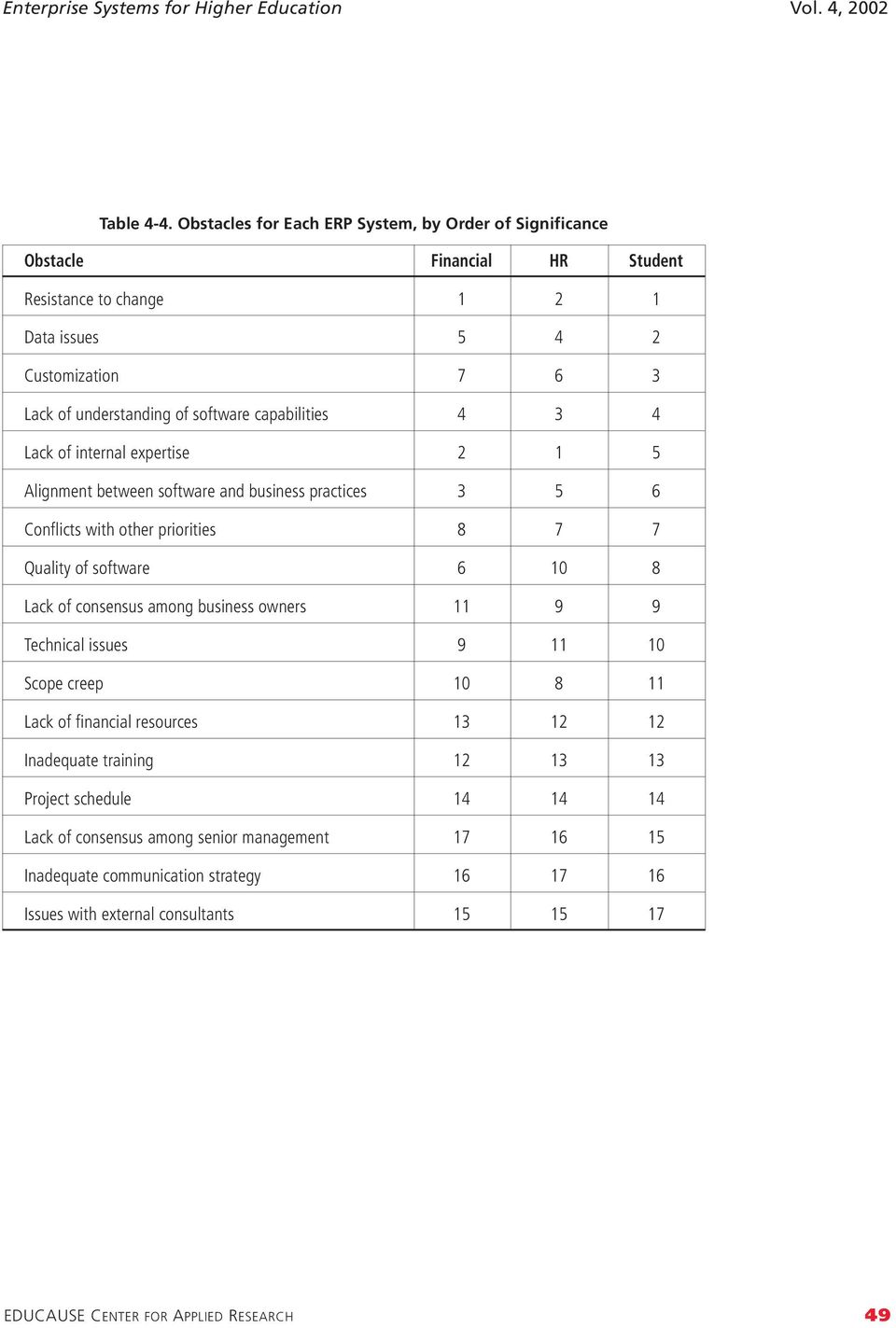
3 problem and a failing legacy system were under enormous pressure to succeed and to do so quickly. This certainly was the case at the University of Minnesota, where student administrative services would not work beyond the year The institution had to cope with Y2K, a legacy system, and a concomitant legislative mandate to shift from quarters to semesters. No work was done on the legacy system, as all bets were made on completion of the vendor s student system. The administration had left the door open to success or defeat, but not retreat. The stress was enormous for all involved. Minnesota succeeded, but apparently no more rapidly than other institutions in the study s survey sample. The study s data acknowledge cases like Minnesota s but also indicate that institutions that commit to an ERP implementation succeed with or without a burning platform. CIOs increasingly are able to accurately determine time frames for implementation. Institutions that went over the planned implementation time gave the following reasons, in order of magnitude: organizational issues (especially with the student system), data issues, resource constraints, and an unrealistic time frame to begin with. Less often mentioned but nevertheless real and important were technical problems, scope creep, failure of the vendor to deliver key functions, and training. An example from Smith College s situation illustrates why one institution s project timeline expanded. The initial timeline developed for the implementation called for it to be completed in about three years, according to Kim Butz, Smith College s former director of administrative technology. However, about halfway through Smith s implementation, SCT introduced its Web modules, and Smith elected to expand the scope of the implementation to include these components. Overall, the entire implementation was completed in four-and-ahalf years. All respondents were asked to identify the three biggest obstacles they had to overcome to successfully complete their implementations. Their responses appear in Tables 4-1 to 4-3. When these tables are combined to rank the obstacles in order of significance, a remarkably similar pattern for all three ERP modules emerges (see Table 4-4). Clearly, the perceived obstacles to success are internal to the institution. Resistance to change and lack of internal expertise, whether reflected in a lack of understanding of the software s capabilities or a lack of alignment between software and business practices, are both rated among the top barriers. One respondent noted, We clearly underestimated the personnel resources required for implementation, and another commented on conflicts over priorities between the project team and production staff in both IT and the functional areas. Still another said, Our admissions office resisted the change, and as a result the module was two years over schedule. Data issues and customization were more likely to plague the student systems, but that s not surprising. Data issues, many attributable to sins of the past when all units maintained their own systems, must now be aligned and transferred into a new integrated system. Robert B. Kvavik of the University of Minnesota has joked about a Minnesota state legislator asking the university s lobbyist, Stan, how many people work at the U? And the answer was about half, which was probably as good an answer as he could give because so much personnel data sat on multiple databases that could not be combined and reported. Perry Hanson, CIO of Brandeis EDUCAUSE CENTER FOR APPLIED RESEARCH 45

4 Table 4-1. Obstacles for Financial Systems Obstacle Frequency Percentage Resistance to change Lack of internal expertise Alignment between software and business practices Lack of understanding of software capabilities 60 9 Data issues 57 9 Quality of software 43 7 Customization 42 6 Conflicts with other priorities 39 6 Technical issues 31 5 Scope creep 30 5 Lack of consensus among business owners 29 4 Inadequate training 28 4 Lack of financial resources 24 4 Project schedule 20 3 Issues with external consultants 17 3 Inadequate communication strategy 15 2 Lack of consensus among senior management

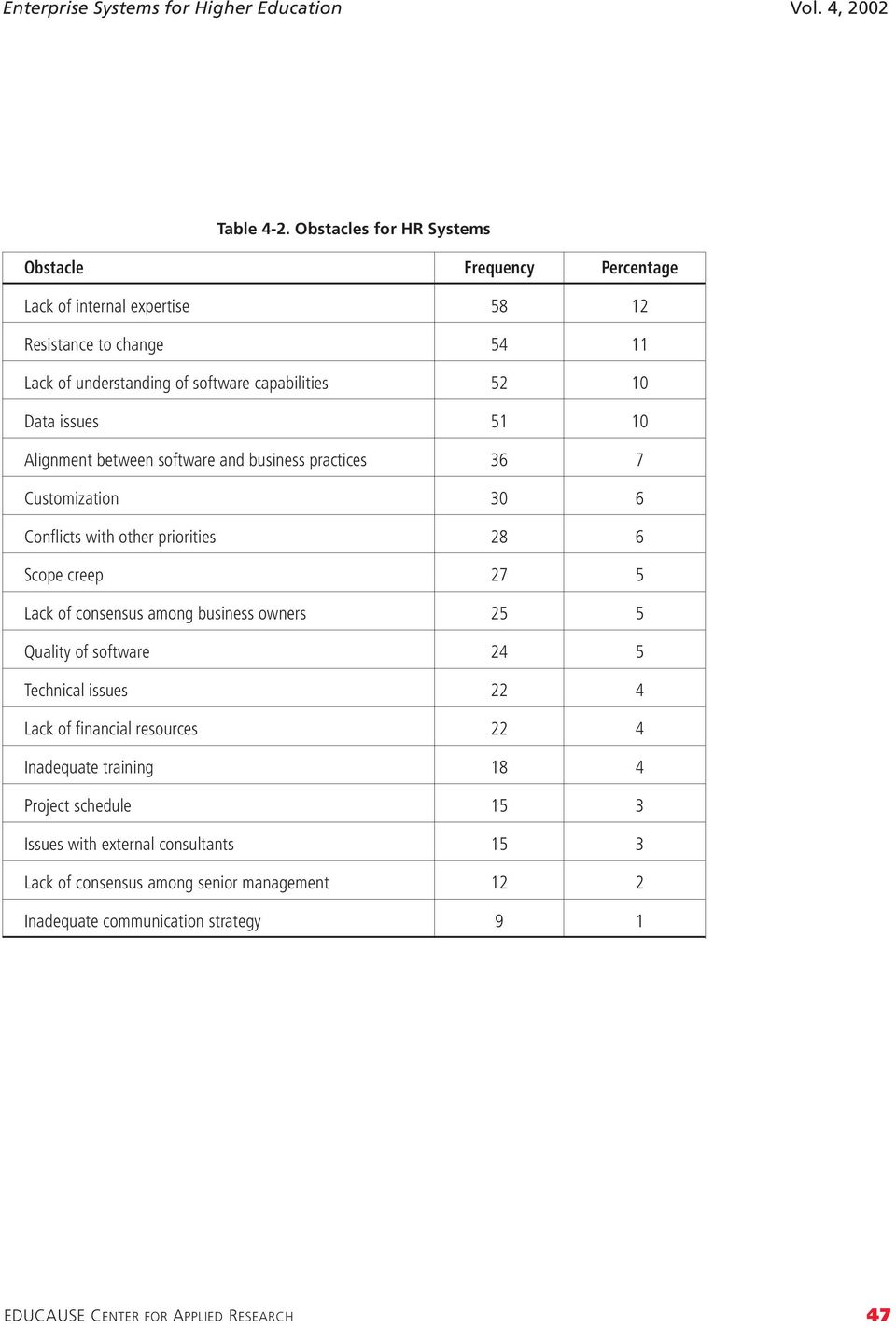
5 Table 4-2. Obstacles for HR Systems Obstacle Frequency Percentage Lack of internal expertise Resistance to change Lack of understanding of software capabilities Data issues Alignment between software and business practices 36 7 Customization 30 6 Conflicts with other priorities 28 6 Scope creep 27 5 Lack of consensus among business owners 25 5 Quality of software 24 5 Technical issues 22 4 Lack of financial resources 22 4 Inadequate training 18 4 Project schedule 15 3 Issues with external consultants 15 3 Lack of consensus among senior management 12 2 Inadequate communication strategy 9 1 EDUCAUSE CENTER FOR APPLIED RESEARCH 47
6 Table 4-3. Obstacles for Student Systems Obstacle Frequency Percentage Resistance to change Data issues Customization 55 9 Lack of understanding of software capabilities 54 8 Lack of internal expertise 51 8 Alignment between software and business practices 47 7 Conflicts with other priorities 36 6 Quality of software 34 6 Lack of consensus among business owners 31 5 Technical issues 27 5 Scope creep 24 4 Lack of financial resources 21 4 Inadequate training 19 3 Project schedule 14 2 Lack of consensus among senior management 13 2 Inadequate communication strategy 12 2 Issues with external consultants

7 Table 4-4. Obstacles for Each ERP System, by Order of Significance Obstacle Financial HR Student Resistance to change Data issues Customization Lack of understanding of software capabilities Lack of internal expertise Alignment between software and business practices Conflicts with other priorities Quality of software Lack of consensus among business owners Technical issues Scope creep Lack of financial resources Inadequate training Project schedule Lack of consensus among senior management Inadequate communication strategy Issues with external consultants EDUCAUSE CENTER FOR APPLIED RESEARCH 49
8 University, noted that with the completion of their ERP system, We can actually count who works here, and our payrolls are accurate. Obstacles noted in the interviews include problems with institutional culture, tradition, and practices. Compensation and benefits at many institutions do not motivate behavior, and there is a lack of clarity about who owns the data. Implementation Difficulties The study s respondents were asked to rate the difficulty of implementing ERP systems in comparison with other large technology projects (Figure 4-2). On a scale of 1 5, with 5 being very difficult and 3 being about the same, the mean response for the overall difficulty of the initial implementation was 3.52 for financial, 3.53 for HR, and 3.80 for student modules. Technical difficulty was rated as less of an issue, although it was still judged to be greater than on other IT projects: 3.41 for financial, 3.41 for HR, and 3.55 for student. Rated more difficult was managing process and organizational change, with reported means of 3.69 for financial, 3.69 for HR, and 3.90 for student. So overall, ERP systems are viewed as more difficult to implement than other major IT initiatives. For a few institutions, they proved to be extremely difficult. Anne Strine, assistant vice chancellor, Information Technology, of Pima Community College, said, I think it fit in with my expectations, but I think very few in the college had experienced a project with such an impact and such a short implementation time frame. I don t think anyone would say it was harder, but in a way it was, because people didn t know what to expect. After we got into the project, I tried to keep people aware that it was going to be a tough project, so that it was part of their expectation and they didn t panic when it got hard. John Berens, CIO of the University of Wisconsin at Oshkosh, paints a different picture. I must have been the most naïve CIO that went into this. It was absolutely more difficult than planned. I knew it would be very large and very long in terms of time and resources. I guess I didn t appreciate the degree to which student systems touched every aspect of the campus. Literally it touched throughout the campus the students, all the employees, and then every office that depended on the core student system. Echoing Berens s observations were Mark Sheehan and Craig Deaton of Montana State University. It was more difficult than planned. The compressed timeline sounds good on paper, but until you live through the war, you really don t know its impacts on personnel and the organization. The Figure 4-2. Implementation Difficulty Compared with Other Large IT Projects 50

9 implementation was more complex. The new system was more complex than the legacy system. And I am sure some of our estimates and projections were based on the legacy experience, but it was an entirely different ball game... the entire paradigm shift that the whole organization experienced was difficult. The functional users had to take more ownership of their systems. The staff absorbed more complex levels of technology. The legacy system was basically a mainframe. We moved to client-server and Web services. And there was the technical shift to new operating systems and more robust Web services. Then there is the cultural shift for the organization the four campuses having to work together. Before, the campuses met every four months to discuss issues, but it wasn t the same as working together under the same umbrella. The study s panel of experts also emphasized the level and the nature of the new systems difficulty. Polley Ann McClure, vice president and CIO at Cornell University, noted, There are serious long-term implications for institutions from these projects. Many had never managed a big institutional project like this, where different departments had to work together in a systematic, somewhat hierarchical process to be successful. These comments complement the findings of the quantitative data in important ways. They provide a sense not only of what the new level of difficulty was, but of its complexity as well. Clearly, trade-offs were made to accommodate the schedule, and these have a negative impact on customer satisfaction. The study analyzed the importance of institution size, Carnegie class, vendor chosen, and whether the institution was public or private, viewing all these factors as possibly affecting the difficulty of an ERP implementation. The main finding was that the larger the institution s student body, the more difficult the project regardless of vendor chosen, public or private status, or Carnegie class. 6 Especially noteworthy is the date of implementation. The study grouped the implementations into four time-of-implementation periods: , , , and 2001 and later. Implementations during in particular emerged as difficult, especially for doctoral institutions. The implementations were more likely to go over time and budget, and more customization of the base code was undertaken. Productivity drops were more significant, and it took longer to return to an earlier level of productivity. The student implementations were the most difficult. In retrospect, the study s respondents who represented this period were most likely to change their approach should they do it again. The difficulties encountered during this time period were probably due, at least in part, to problems with particular software and institutions trying to complete their implementations in time for the Y2K deadline. Cutting corners in areas like training and reengineering, or reducing functionality to ensure on-time project completion could account for the longer-term productivity drops. Reengineering and Business Process Redesign Ideally, reengineering and business process redesign are a continual activity in the new ERP environment. From a practical standpoint, it s wise to reengineer and align institutional policies, procedures, and business rules (such as charts of accounts, vacation and sick-time policies, and grading systems) in advance of an ERP system implementation because it means that less work is needed to customize code, thereby reducing costs. Note, however, that undertaking EDUCAUSE CENTER FOR APPLIED RESEARCH 51

10 full reengineering including modification of workflows, information transfers, and business processes before selecting and understanding the nuances of an ERP package can necessitate more customizations to make the software work with the new processes. The University of Minnesota significantly modified nearly 100 student policies (not processes) prior to implementation, including standardizing honors criteria and reducing nine grading systems to three. But this appears to be an exception. Only 13 percent of the respondents reengineered processes in advance of the ERP implementation; 60 percent did reengineering as part of the ERP implementation process, and 22 percent did no reengineering. AA, BA, and MA institutions reengineered later in the implementation than did doctoral institutions, usually after the implementation was complete. Financial systems were reengineered later than HR and student systems. Overall, there was no statistical significance by Carnegie class, institution size, vendor used, or ERP system purchased. Charles White, vice president, Information Resources and Administrative Affairs, Trinity University, supports the quantitative findings. We did not engage [in] the process that the vendor recommended a year-long audit of our business practices because we felt there was not enough time to complete the audit and implement the system before our Y2K deadline. As a consequence, To this day, we continue to run into business practices that require change. Some staff members feel that we should change the system to reflect the process, rather than changing our business practice. They talk about the tail wagging the dog, but I make the argument fairly strongly from the IT side of the house that they should change their business practices rather than customize the system. And they generally change their business practices. Judith Caruso of the University of Wisconsin Madison comments, We changed business processes, but [we did it] during the implementation process as we figured out how to implement a particular module. For example, the ERP system changed the work relationship between the registrar and the bursar. We had to redesign those business areas. Staff moved from one office to another; their lines of work changed. Customization Customization has been a major issue for senior administrators because of a fear that their organizations would pave the cow paths, that is, not make the expected changes to business processes, thereby failing to produce efficiencies and to change the way service is provided. Of course, the more modifications made to code, the costlier and more time-consuming the implementation and subsequent upgrades. It s not surprising then to find that 87 percent of the study s respondents agreed or strongly agreed that their institution s strategy was to implement software with as few customizations as possible (see Figure 4-3). The concern is warranted. One of the study s most significant findings is the singular and overwhelming impact customization had on the sample s ability to finish on time and on budget. This reveals a dilemma, because customization improves satisfaction Figure 4-3. Limiting Customization Was a Strategic Goal 52

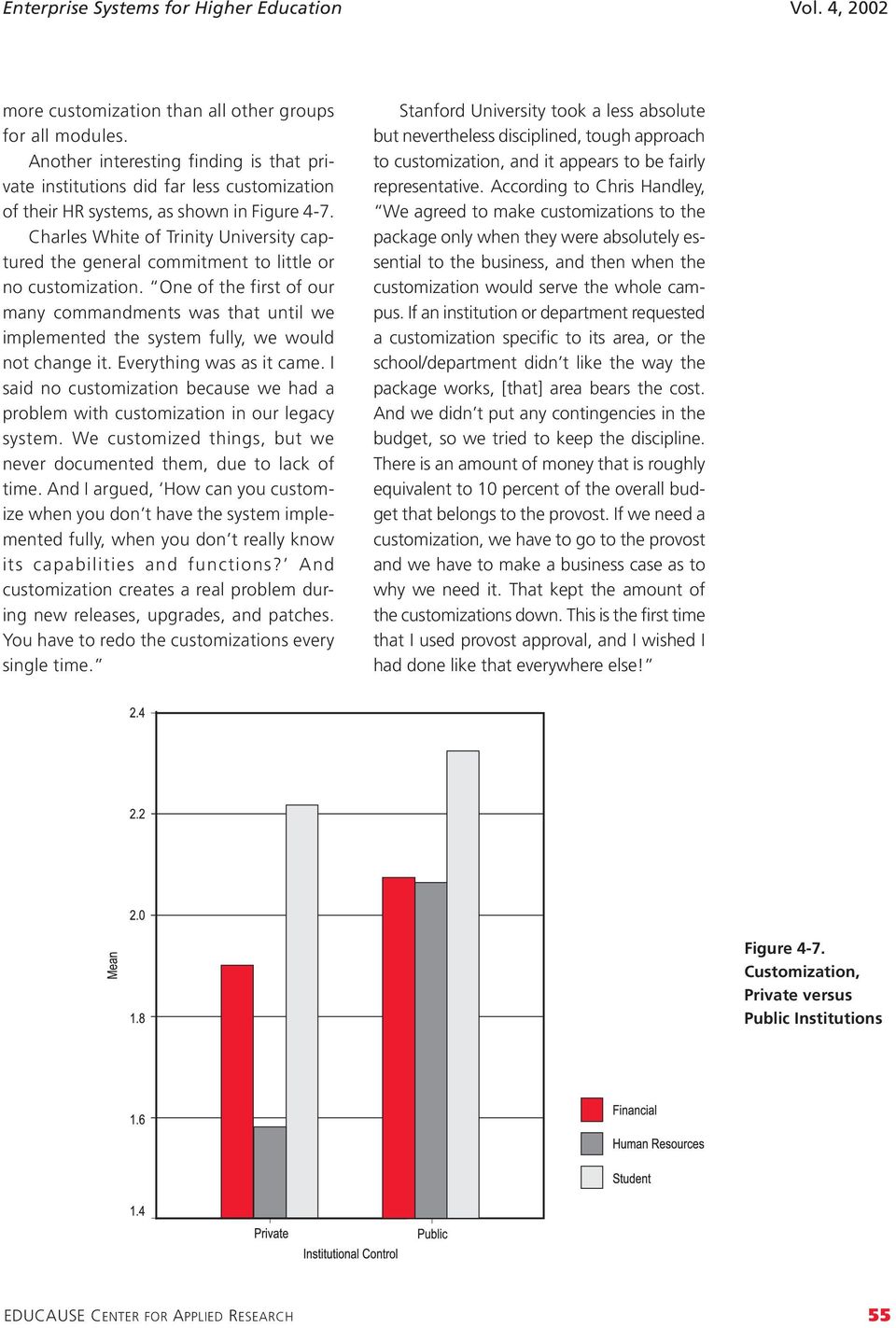
11 levels with the ERP implementation outcomes for staff, management, and students. 7 That customization is a problem is not surprising by itself. What is surprising is that many factors that higher education intuitively believes would put a project at risk such as budget, quality of financial and project management, and project manager s experience were not statistically significant. We speculate that CIOs recognized these problems (as demonstrated in Tables 4-1 through 4-4) and successfully addressed or circumvented them. In retrospect, the survey did not ask the CIOs to address obstacles they ranked higher than customization for example, levels of resistance to change, staff experience, and dataintegrity problems. These may well have had a significant impact on time to completion and would have fit nicely into the regression models the study developed. In practice, 30 percent of the respondents indicated that they had made no modifications to their systems, 48 percent had modified up to 10 percent of the code, and 23 percent had modified more than 11 percent of the code. (See Figure 4-4.) Only nine institutions, or 4 percent, had modified more than 25 percent of the code. This is less customization than the study had expected. Institutions were asked on a four-point scale ranging from strongly disagree = 1 to strongly agree = 4 whether they had a structured and formal process for making customizations, whether they followed their process for making customizations, and whether the institution s strategy was to implement with as few customizations as possible. The means were calculated for each question. Figure 4-5 shows that doctoral institutions were initially planning to do more customization than other Carnegie class institutions. For that reason they appear to have established more rigorous structures for monitoring and approving customizations. Institutions were asked on a five-point scale ranging from from none, minor (1 10 percent of code), some (11 25 percent of code), significant (26 50 percent of the code), and extreme (more than 50 percent of code), with none = 1 and extreme = 5, whether they had made customizations to their modules. The means were calculated, as shown in Figures 4-6 and 4-7. Figure 4-6 shows how institutions in the various Carnegie classes customized their products. Regardless of Carnegie class, the student systems were the most customized. Doctoral institutions especially Dr. Ext. institutions did significantly Figure 4-4. Degree of Customization EDUCAUSE CENTER FOR APPLIED RESEARCH 53
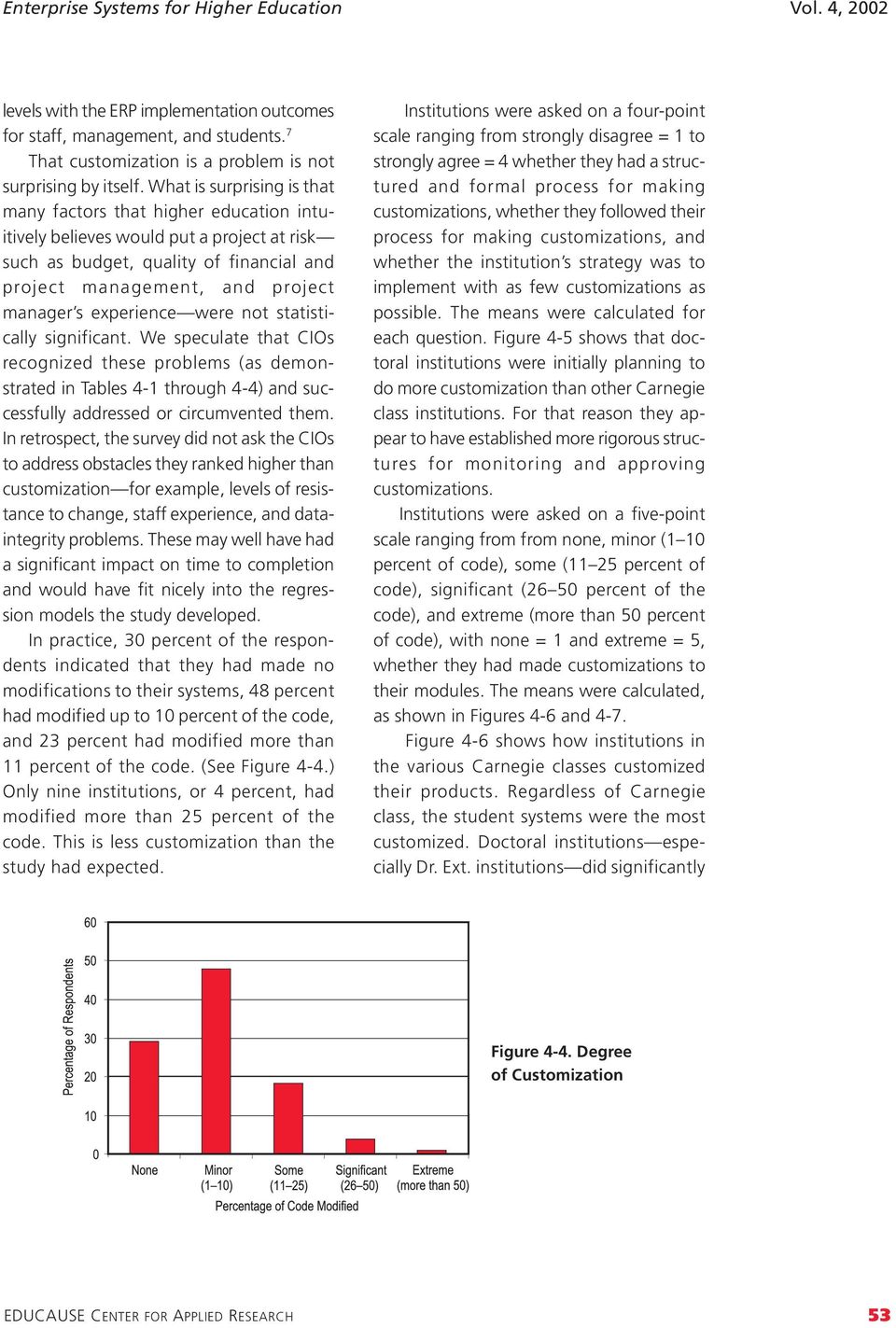
12 Figure 4-5. Customization Strategy and Processes, by Carnegie Class Figure 4-6. Actual Customizations, by Module and Carnegie Class 54

13 more customization than all other groups for all modules. Another interesting finding is that private institutions did far less customization of their HR systems, as shown in Figure 4-7. Charles White of Trinity University captured the general commitment to little or no customization. One of the first of our many commandments was that until we implemented the system fully, we would not change it. Everything was as it came. I said no customization because we had a problem with customization in our legacy system. We customized things, but we never documented them, due to lack of time. And I argued, How can you customize when you don t have the system implemented fully, when you don t really know its capabilities and functions? And customization creates a real problem during new releases, upgrades, and patches. You have to redo the customizations every single time. Stanford University took a less absolute but nevertheless disciplined, tough approach to customization, and it appears to be fairly representative. According to Chris Handley, We agreed to make customizations to the package only when they were absolutely essential to the business, and then when the customization would serve the whole campus. If an institution or department requested a customization specific to its area, or the school/department didn t like the way the package works, [that] area bears the cost. And we didn t put any contingencies in the budget, so we tried to keep the discipline. There is an amount of money that is roughly equivalent to 10 percent of the overall budget that belongs to the provost. If we need a customization, we have to go to the provost and we have to make a business case as to why we need it. That kept the amount of the customizations down. This is the first time that I used provost approval, and I wished I had done like that everywhere else! Figure 4-7. Customization, Private versus Public Institutions EDUCAUSE CENTER FOR APPLIED RESEARCH 55
14 Smith College took a slightly different approach on implementing without customizations, according to Kimberly Butz, Smith s former director of administrative technology. What we decided up front was that each department would have to use the system for one year through their full business cycle before we would consider any modifications. And it ended up that after implementing all five base modules and all the Web modules, that there are only about 10 form or program modifications campuswide. As a result, Smith s ongoing system maintenance was made significantly easier. When it comes time for upgrades, we implement them so much earlier than other Banner schools because of our vanilla approach to implementation, explained Ruth Constantine, Smith College s vice president for finance and administration. Reasons given for modifying code included improving reporting, filling gaps in functionality, integrating the product with other systems, improving the look and usability of screens, and getting the product to conform to existing processes. Gaps in functionality, conformance to existing practices (especially for HR and student modules), and improved reporting were the factors most often cited, and more often by doctoral institutions. For example, one institution indicated that it gives no grades but instead evaluates portfolios, and another has courses that are worth one-third of a unit, so major modifications were needed. The large doctoral institutions in particular had problems with gaps in functionality or difficulties accommodating different practices in multicampus systems. In some instances, state-mandated requirements necessitated significant customization. It is not at all clear from the study s findings that plain vanilla is best. A number of institutions reported major business problems because the no-customization approach had been too rigid. Some institutions found creative ways to provide enhanced functionality beyond that offered by their ERP package without customizing the system s base code. For example, one BA institution created new forms for some areas of its system rather than modifying those that were provided with the system. They also used bolt-ons, or third-party applications, that interfaced with their ERP system, rather than trying to utilize subpar functionality in some areas of the ERP package or creating new functionality in the package. They used external data analysis tools to track and manipulate data in ways the core system could not. By taking this approach, they could meet their users business needs more fully, while the core system was largely unmodified, making it easy to upgrade and maintain. What the data show is that customizations were made, usually for pragmatic reasons, in conformity with a formal process often involving senior management. Institutions where customization was undertaken also indicated a higher level of staff and student satisfaction. A price was paid, however, in terms of completion time and cost. But this may well be a reasonable trade-off. Consultants Consulting firms and independent consultants played a major role in the implementation of ERP systems. Large, general-purpose consulting firms, specialized firms, and vendors implementation consultants were all used. For purposes of the survey, we categorized these consultants as a large, general-purpose consulting firm; a national or international firm that provides a broad range of services to clients in a number of industries; a specialized consulting firm; a firm that provides a focused range of services, such as higher education consulting, ERP consulting, or project management; independent consultants; 56
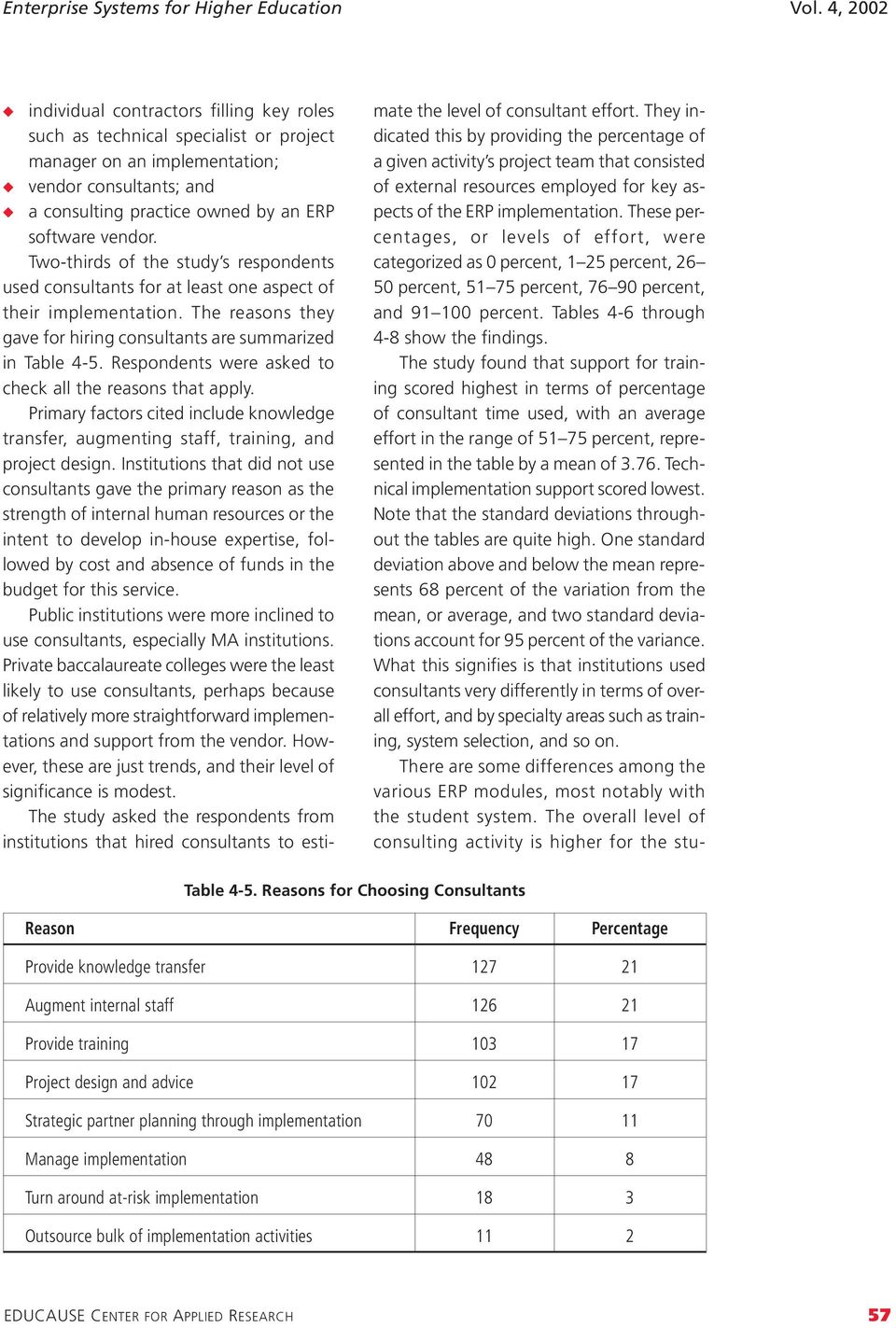
15 individual contractors filling key roles such as technical specialist or project manager on an implementation; vendor consultants; and a consulting practice owned by an ERP software vendor. Two-thirds of the study s respondents used consultants for at least one aspect of their implementation. The reasons they gave for hiring consultants are summarized in Table 4-5. Respondents were asked to check all the reasons that apply. Primary factors cited include knowledge transfer, augmenting staff, training, and project design. Institutions that did not use consultants gave the primary reason as the strength of internal human resources or the intent to develop in-house expertise, followed by cost and absence of funds in the budget for this service. Public institutions were more inclined to use consultants, especially MA institutions. Private baccalaureate colleges were the least likely to use consultants, perhaps because of relatively more straightforward implementations and support from the vendor. However, these are just trends, and their level of significance is modest. The study asked the respondents from institutions that hired consultants to estimate the level of consultant effort. They indicated this by providing the percentage of a given activity s project team that consisted of external resources employed for key aspects of the ERP implementation. These percentages, or levels of effort, were categorized as 0 percent, 1 25 percent, percent, percent, percent, and percent. Tables 4-6 through 4-8 show the findings. The study found that support for training scored highest in terms of percentage of consultant time used, with an average effort in the range of percent, represented in the table by a mean of Technical implementation support scored lowest. Note that the standard deviations throughout the tables are quite high. One standard deviation above and below the mean represents 68 percent of the variation from the mean, or average, and two standard deviations account for 95 percent of the variance. What this signifies is that institutions used consultants very differently in terms of overall effort, and by specialty areas such as training, system selection, and so on. There are some differences among the various ERP modules, most notably with the student system. The overall level of consulting activity is higher for the stu- Table 4-5. Reasons for Choosing Consultants Reason Frequency Percentage Provide knowledge transfer Augment internal staff Provide training Project design and advice Strategic partner planning through implementation Manage implementation 48 8 Turn around at-risk implementation 18 3 Outsource bulk of implementation activities 11 2 EDUCAUSE CENTER FOR APPLIED RESEARCH 57
16 Table 4-6. Consultant Activity for Financial Systems Type of Support Mean Standard Deviation Training Upgrades Project management Ongoing System selection System design Project planning Technical implementation Process redesign Table 4-7. Consultant Activity for HR Systems Type of Support Mean Standard Deviation Training Ongoing Project management System selection Project planning Upgrades System design Technical implementation Process redesign

17 Table 4-8. Consultant Activity for Student Systems Type of Support Mean Standard Deviation System selection Training Ongoing Upgrades Project planning System design Technical implementation Project management Process redesign dent systems than for HR and finance. Interestingly, consultant support for system selection was much higher and ranked number one for student systems, whereas it ranked fourth and fifth for HR and finance, respectively. (See Table 4-9.) Project management for student systems was ranked lower. 8 Internal staff largely provided support for system selection. However, when consulting firms were used, large consulting firms were most often chosen, especially for the selection of financial systems. Consultants of all types particularly the vendor firms supported project planning. This pattern is also true for system design. Specialized con- Table 4-9. Consultant Activity Ranked in Terms of Most Used, by Module Type of Support Financial HR Student Training Upgrades Project management Ongoing System selection System design Project planning Technical implementation Process redesign EDUCAUSE CENTER FOR APPLIED RESEARCH 59

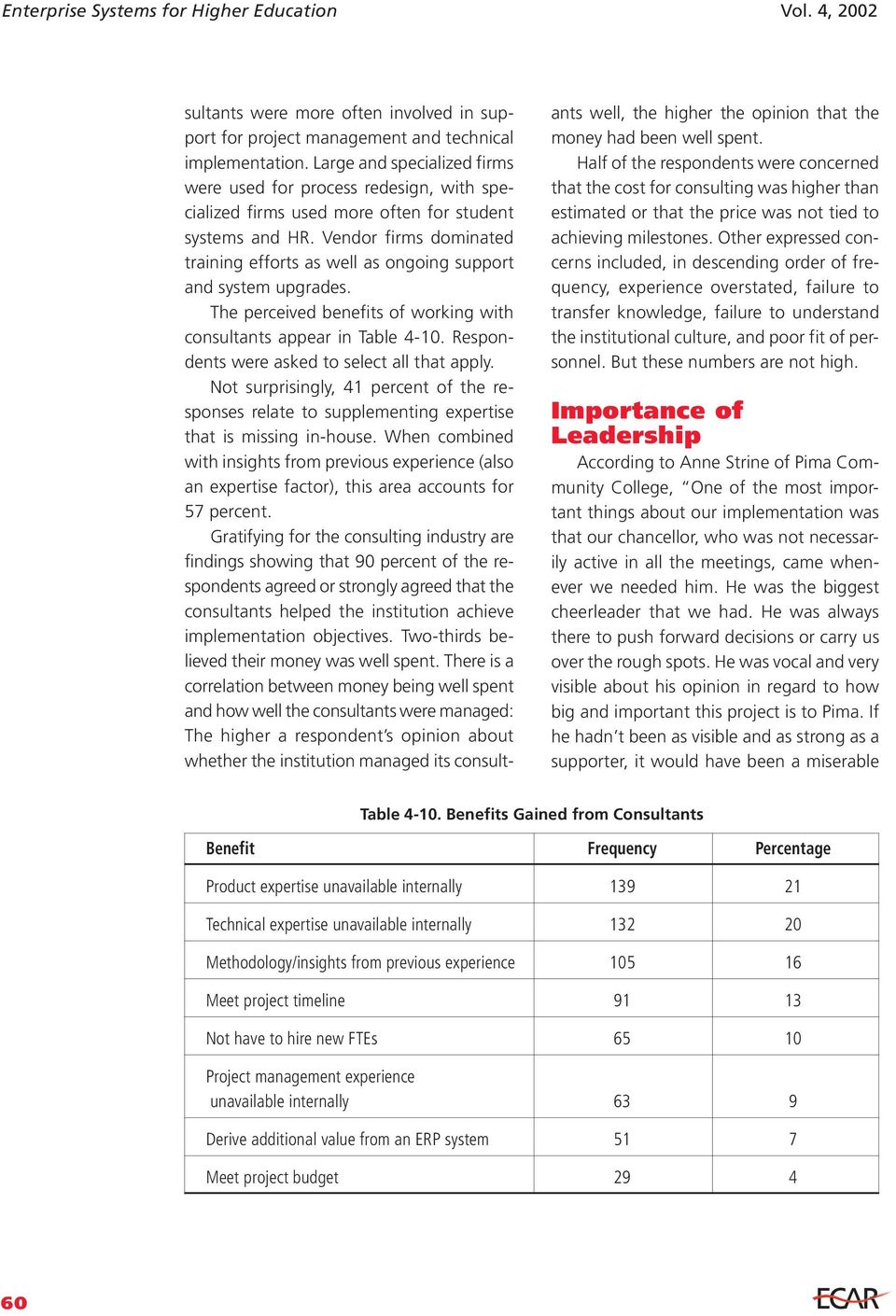
18 sultants were more often involved in support for project management and technical implementation. Large and specialized firms were used for process redesign, with specialized firms used more often for student systems and HR. Vendor firms dominated training efforts as well as ongoing support and system upgrades. The perceived benefits of working with consultants appear in Table Respondents were asked to select all that apply. Not surprisingly, 41 percent of the responses relate to supplementing expertise that is missing in-house. When combined with insights from previous experience (also an expertise factor), this area accounts for 57 percent. Gratifying for the consulting industry are findings showing that 90 percent of the respondents agreed or strongly agreed that the consultants helped the institution achieve implementation objectives. Two-thirds believed their money was well spent. There is a correlation between money being well spent and how well the consultants were managed: The higher a respondent s opinion about whether the institution managed its consultants well, the higher the opinion that the money had been well spent. Half of the respondents were concerned that the cost for consulting was higher than estimated or that the price was not tied to achieving milestones. Other expressed concerns included, in descending order of frequency, experience overstated, failure to transfer knowledge, failure to understand the institutional culture, and poor fit of personnel. But these numbers are not high. Importance of Leadership According to Anne Strine of Pima Community College, One of the most important things about our implementation was that our chancellor, who was not necessarily active in all the meetings, came whenever we needed him. He was the biggest cheerleader that we had. He was always there to push forward decisions or carry us over the rough spots. He was vocal and very visible about his opinion in regard to how big and important this project is to Pima. If he hadn t been as visible and as strong as a supporter, it would have been a miserable Table Benefits Gained from Consultants Benefit Frequency Percentage Product expertise unavailable internally Technical expertise unavailable internally Methodology/insights from previous experience Meet project timeline Not have to hire new FTEs Project management experience unavailable internally 63 9 Derive additional value from an ERP system 51 7 Meet project budget
19 project. He got to the bottom of things... did not let things fester. Many institutions have stressed the importance of active participation by the chancellor or provost as a contribution to project success. According to Richard West, California State University System s CFO, You need executive involvement, not just sponsorship. It s important to have discipline in project management. On-Campus ERP Promoters Respondents were asked to identify the primary advocate for an ERP solution at their institution. Most often mentioned was the CIO (31 percent), followed by the CFO (29 percent), and the president or chancellor (17 percent). The chief academic officer was the primary advocate for an ERP solution at only 4 percent of the institutions. Table 4-11 shows the primary advocates, by Carnegie class. The study looked at sponsorship of the specific ERP systems and found that the CFO, not surprisingly, sponsored a financial system at 75 percent of the institutions responding, followed by the CIO (7 percent) and the president/chancellor (5 percent). Perhaps surprising is the CFO s leadership for HR systems (45 percent) versus that of the chief HR officer (27 percent). There s a very different pattern for student systems, where the following officers served as executive sponsors: chief academic officer, 21% CIO, 17% CFO, 17% chief student affairs officer, 17% president, 9% other, 19% The chief sponsor changed during 18 percent of the financial and student implementations, but during only 13 percent of the HR implementations. One striking finding is the overwhelming opinion that senior business officers were supportive of an ERP solution. On a scale of 1 4, with 1 representing strong disagreement and 4 representing strong agreement, these officers achieved a mean score of 3.34 for their support. Department managers scored lower, with a mean of Full-time managers were allocated to the project at 55 percent of the institutions. Doctoral institutions overwhelmingly used full- Table Primary On-Campus ERP Advocates, by Carnegie Class Chief ERP Advocate AA BA MA Dr. Ext. Dr. Int. (n = 31) (n = 65) (n = 61 (n = 34) (n = 20) Board of Trustees 3% 2% 3% 3% 5% President 19% 20% 23% 15% 5% System/district office 3% 3% 7% 3% 10% Chief academic officer 0% 3% 5% 3% 0% Chief information officer 48% 35% 24% 17% 45% Chief financial officer 17% 27% 30% 44% 25% Chief HR officer 0% 2% 0% 3% 0% Chief student affairs officer 0% 0% 2% 0% 0% Other 10% 8% 16% 12% 10% EDUCAUSE CENTER FOR APPLIED RESEARCH 61

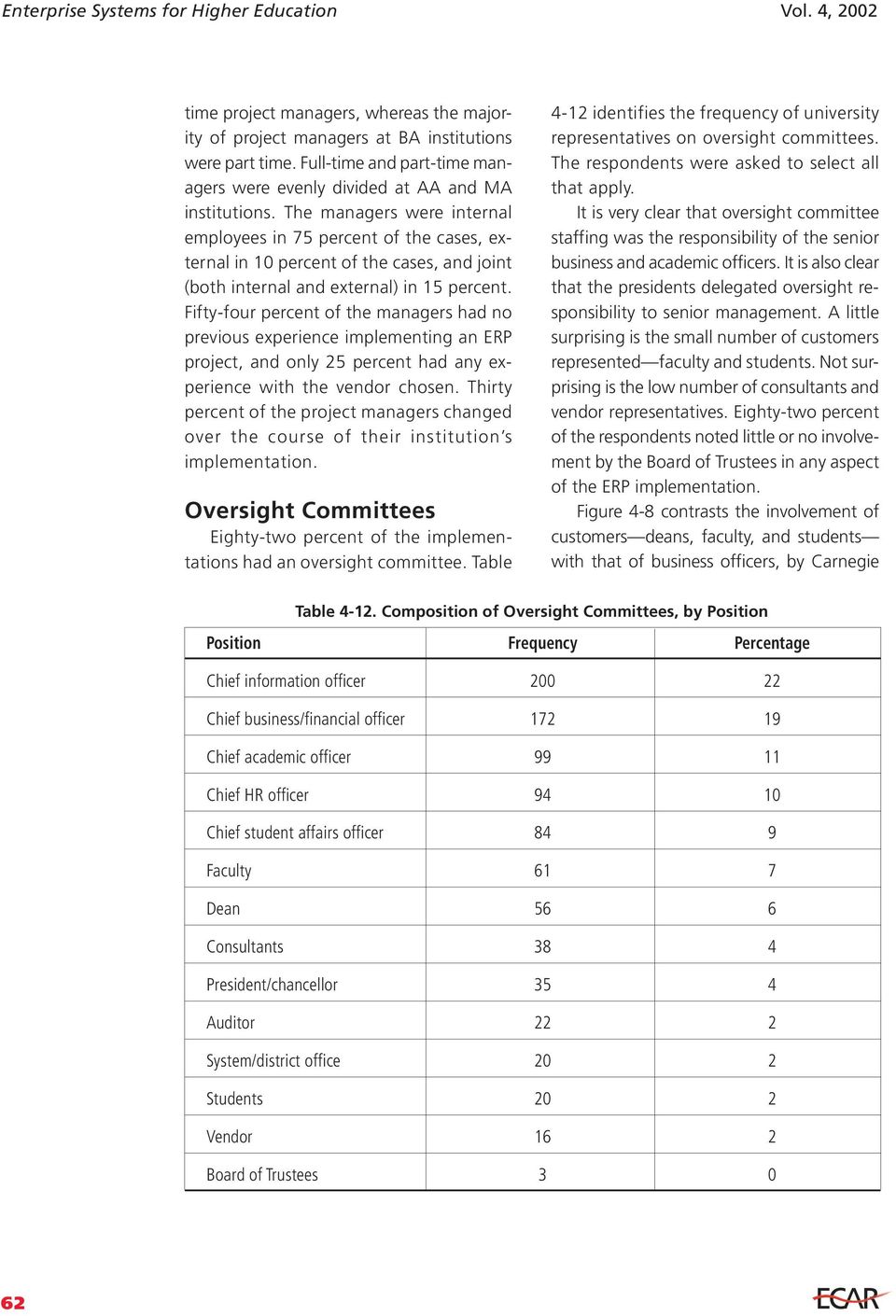
20 time project managers, whereas the majority of project managers at BA institutions were part time. Full-time and part-time managers were evenly divided at AA and MA institutions. The managers were internal employees in 75 percent of the cases, external in 10 percent of the cases, and joint (both internal and external) in 15 percent. Fifty-four percent of the managers had no previous experience implementing an ERP project, and only 25 percent had any experience with the vendor chosen. Thirty percent of the project managers changed over the course of their institution s implementation. Oversight Committees Eighty-two percent of the implementations had an oversight committee. Table 4-12 identifies the frequency of university representatives on oversight committees. The respondents were asked to select all that apply. It is very clear that oversight committee staffing was the responsibility of the senior business and academic officers. It is also clear that the presidents delegated oversight responsibility to senior management. A little surprising is the small number of customers represented faculty and students. Not surprising is the low number of consultants and vendor representatives. Eighty-two percent of the respondents noted little or no involvement by the Board of Trustees in any aspect of the ERP implementation. Figure 4-8 contrasts the involvement of customers deans, faculty, and students with that of business officers, by Carnegie Table Composition of Oversight Committees, by Position Position Frequency Percentage Chief information officer Chief business/financial officer Chief academic officer Chief HR officer Chief student affairs officer 84 9 Faculty 61 7 Dean 56 6 Consultants 38 4 President/chancellor 35 4 Auditor 22 2 System/district office 20 2 Students 20 2 Vendor 16 2 Board of Trustees
21 Figure 4-8. Stakeholder Involvement in ERP Projects, by Carnegie Class class. Institutions were asked to rank levels of involvement on a scale of 1 5, with 1 being lowest and 5 highest. The means were calculated and are shown in Figure 4-8. The disparities are substantial across all Carnegie classes. As we move through the five classes, from AA to Dr. Ext., the involvement of deans, faculty, and students declines. Only 2 percent of the committees included the university auditor. At the University of Minnesota, the auditor proved to be a particularly useful representative by continually introducing risk management methodologies and assessment into the implementation process and by providing assurance to the president and Board of Regents as the implementation progressed. Implementation teams varied greatly by institution, according to the study s interview data. At Pima Community College, Anne Strine described an implementation team comprised of a group from each functional area and IT. We met weekly throughout the implementation to communicate progress, changes, and additions. Everyone knew what was going on. You don t want senior administrators making decisions about a real operational issue that they haven t touched in years. So we tried to keep a balance a college-wide policy orientation view of what was going on in addition to an operational perspective. Wayne State University followed conventional project management wisdom. According to John Camp, assistant vice president and deputy CIO, and James Johnson, vice president for Computing and Information Technology and CIO, We had a project sponsor and an oversight committee for each system, [and we] had project management teams [of users] organized by process. Project management came from IT. The EVP [executive vice president] for finance was the sponsor for the financial system, the chief of staff and EVP for finance were the spon- EDUCAUSE CENTER FOR APPLIED RESEARCH 63
22 sors for the HR system, and the associate provost was the sponsor for the student system. We also had a cabinet IT committee that had oversight for all the projects and owned the budget. Structure and participation were much different at small institutions, such as Whitman College. According to CIO Keiko Pitter, The financial aid office employs two people; the registrar employs three. So the committee structure is a waste of time because you see the same faces every time. We hired a half-time project manager from our vendor. I was the other half of the project manager position. One of the senior officers of the college comprised the steering committee. On top of that, the Board of Trustees assigned two people from industry who belonged to their group not trustees themselves to monitor our progress. But I gave a report to these two gentlemen every three months. And for each module, there was an implementation team. The ERP implementations at the California State University (CSU), Georgia, and Wisconsin systems have an oversight board and a central leadership office. Each system, however, has fulfilled its centralized mission in different ways. The nature of the ERP application implementations for these systems varies greatly in the amount of central control and individual institution autonomy allowed. For instance, in the case of student ERP implementations in the University of Wisconsin System, individual campuses are able to choose any student application they want, while at CSU, all campuses are required to migrate to the PeopleSoft student application. Only the University of Wisconsin System, for its financial and human resource applications, maintains a single database instance for the entire system. Both Georgia and CSU have a separate database instance per campus. Level of Involvement The respondents assessed the level of involvement with the project for a number of their institutional officers on a scale of 1 4, with 1 representing no involvement, 2 minimal involvement, 3 some involvement, and 4 active involvement. (See Table 4-13.) As one survey respondent put it, the CIO and CFO clearly play a dominant role. One outcome was that confidence in the CIO and the IT office has been strengthened as a result of the project. Fully 80 percent of the respondents agreed or agreed strongly. An anonymous survey respondent noted: We obtained a balance of power between IT and the end users, and much better communications and respect between the two. This compares with 62 percent in the non-erp institutions. Cost of Implementation ERP systems are expensive in terms of both actual costs and intangible costs, raising some difficult questions. What is a reasonable cost for moving toward a more efficient business model? How long should an ERP system be in place before its worth can be demonstrated? Institutions often underestimate their costs for ERP implementation. The systems require not only software packages but also changes in practice across the enterprise. This often results in costs not expected at the outset, such as outside consulting to find the most efficient implementation strategies, training for employees throughout the organization, and software customization in certain areas of the business. Higher education institutions are generally unaccustomed to having to estimate the level of effort required to implement such complex projects, which can span several years and involve thousands of staffhours of effort across multiple campus, school, and functional boundaries. Further 64
23 Table Mean Level of Involvement of Various Participants Position Level of Involvement Chief information officer 3.72 Chief business/financial officer 3.46 Vendor 3.29 Consultants 3.00 Chief HR officer 2.99 Chief student affairs officer 2.79 Chief academic officer 2.40 Dean 2.24 President/chancellor 2.09 Faculty 2.05 Auditor 2.03 System/district office 1.95 Students 1.56 Board of Trustees 1.51 complicating matters, some institutions reported that their software vendors, to make their bids appear more competitive, underestimated the level of effort required to implement their product. Such estimating challenges often raise the cost of an ERP implementation well above projections. 9,10 At the same time, non- ERP approaches are not without cost either, but the study didn t gather such figures for these institutions. Widely Ranging Costs The survey asked respondents to include all costs that their institution associated with the ERP implementation project, including hardware, software, personnel, consulting services, and so on. Having reviewed the data, we concluded that it would be premature to report the numbers found, in the absence of a standardized costing template/methodology to assure real meaning and data comparability. However, we do note with caution some trends and benchmarks. The costs in the study s survey ranged from $20,000 (which we think is a data-entry error) to $130 million. 11 On average, a finance module cost $2.9 million, HR module $2.3 million, and a student module $3.1 million. There is an enormous variation in cost by institution when viewed by the standard deviation, probably because the institutions sum up their expenses in very different ways. There are also enormous differences by Carnegie class. BA implementations are the least expensive, followed by AA and MA institutions, whose implementations usually cost double that of a BA implementation. Doctoral institution imple- EDUCAUSE CENTER FOR APPLIED RESEARCH 65
24 mentation costs vary greatly, running anywhere between 10 and 20 times the cost of AA, BA, and MA implementations. Student systems cost the most across all Carnegie classes and are often two to three times more expensive than finance and HR systems at AA, BA, and MA institutions. Finding the Means to Pay Table 4-14 shows the sources of funds used to pay for ERP implementations. By far the most common source, representing the majority of funds, was central allocations, followed by internal reallocations and discretionary funds. Several institutions indicated that they had received Title III and V funds. Funding mechanisms varied significantly by state and by private versus public institution status. The University of Texas San Antonio received no state funding. The university used a student IT fee that had no restrictions on its use. Oberlin College used the information technology office s replacement and renewal fund as seed money for the implementation and then used a capital funding mechanism (blessed by the trustees) for four to five years to fund the rest. In Rhode Island, the software was paid for by the state s Department of Administration because debt service by law has to be paid by the department and is not included in the budgets for the University of Rhode Island and the other state-funded schools. Also, maintenance was built into their contract for seven years. Princeton University received $70 million from the trustees in a single appropriation to be paid out over five years. Departments across the institution cut their budgets to achieve the 5-percent savings needed to pay for this allocation. At Stanford University, the funding came from end-of-year-surpluses. Staying within the Budget Respondents were asked whether their projects stayed within their original budget. The study s findings appear in Table More than two-thirds of the institutions indicated that they finished on or under their original budget. Five percent or fewer went over budget by 50 percent. While the number of responses is low, the factors most often cited for causing implementations to go over budget included (from most frequent to least frequent) underestimated project staffing, underestimated consulting fees, and an unrealistic budget to begin with. Other factors were noted in the open-ended Table Sources of Funds Source Recurring Over 25% Nonrecurring Over 25% Central allocation Internal reallocation Legislative allocation User fees Tax on unit budgets Endowment State bonds Institutional bonds Discretionary funds
25 Table Percentage of Implementations Under, On, and Over Budget Budget Module Implemented Financial HR Student Under budget 7% 5% 5% On budget 61% 69% 63% Over budget by up to 50% 28% 24% 27% Over budget by more than 50% 4% 2% 5% questions. One institution noted that it bought the wrong product and lacked skills, which led to the heavy use of consultants who lacked higher education experience. Others noted complicated custom data conversion, scope creep, and customizations. One survey respondent commented that one strategy for staying on budget was to cut lots of corners, with the result that two to three years later, needed functionality continued to be missing. The University of Minnesota managed its project in terms of five risk areas and weighted the importance of each one: schedule (50 percent), budget (10 percent), functionality (20 percent), personnel (15 percent), and infrastructure (5 percent). Each represented trade-offs. To finish on time or on budget often meant that functionality had to be sacrificed. But these were calculated decisions based on weights, opportunities, and circumstances. Added Cost of New Systems Institutions were asked to compare post- ERP and pre-erp increases in ongoing support costs. The findings appear in Table Factors were rated on a scale of 1 7, where 1 represents an increase of more than 100 percent and 7 a decrease of more than 25 percent. The factors are ordered by the mean cost. A mean of 5 indicates that the costs are about the same. A mean below five indicates an increased cost. Not surprisingly, costs increased the most for packaged software, databases, and training, followed by staff and hardware. The smallest cost increase, as would be expected, was for internal applications and code. Interestingly, the mean change was not a decrease for any of the categories. However, some institutions reported no increase in costs in a number of areas. Training is the near-unanimous choice of experienced ERP implementers as the most underestimated budget item. Training expenses are high because workers almost invariably have to learn a new set of processes, not just a new software interface. Reporting was another implementation task identified as a significant problem area. Many institutions must create literally hundreds of reports to be able to effectively use their ERP systems, and some of the institutions interviewed did not realize this until well into their implementations. The study looked at expenditure patterns by Carnegie class, institution size, and public versus private status. For the most part there were few differences, but there were also some exceptions. AA institutions were least likely to have budget increases above 26 percent. Private institutions tended to have higher post-erp staffing and infrastructure costs, which suggests that modernizing the IT infrastructure may have been a larger issue initially for them. Some cost increases are obvious. Larger institutions pay more for their software post-erp, EDUCAUSE CENTER FOR APPLIED RESEARCH 67
26 Table Cost Trends Post-ERP Expense Mean Percentage Percentage Percentage Percentage Decreased or Increased up Increased over Increased over Stayed the Same to 25% 26% 51% Packaged software Database Training Staff/personnel Hardware and infrastructure Desktop products and services Help desk and user support System operations and management Consulting Internal applications and code largely because software and the associated annual maintenance are priced to the size of the institution. Assessing the Implementation How well did the participating institutions implement their ERP systems? Respondents were asked to evaluate the various aspects of their implementation on a scale of 1 4, with 1 being strongly disagree and 4 being strongly agree. The findings appear in Table What the study finds is a more positive assessment of financial management, project definition, and rollout, including provision of timely training. Communications and benchmarking were assessed significantly lower, as was the effectiveness of the training provided. Measuring the success of ERP systems goes beyond simple measures of efficiency. In the rush toward ERP systems while under the threat of Y2K, many organizations did not set up benchmarks and metrics against which to measure the success of their implementation. 12 Richard West of California State University captures the situation in higher education: This industry in general doesn t have measures in place. And it is difficult to put measures in place in an industry that doesn t measure. Anne Strine outlines the more commonly used benchmarks and measures of success. I think our implementation was a success. I would measure success by, one, did we stay on budget and on schedule? The answer in both cases is yes. Two, are we able to run the college on the system? Yes! Did we have any major blips in delivery of service? No, 68
27 Table Implementation Assessment Implementation Aspect Mean Excellent budgeting/financial management 3.00 Excellent software rollout strategy 2.99 Scope of project was well defined 2.96 Provided timely training for ERP system users 2.95 Excellent job managing/assessing data conversion 2.88 Excellent executive engagement 2.82 Excellent job identifying project outcomes 2.77 Project had an excellent written strategy 2.73 Exemplary job communicating goals/status/changes 2.66 Training provided users with understanding of system s capacities 2.57 Broad agreement on benchmarks for the project 2.53 Excellent job measuring and communicating project outcomes 2.52 we didn t. We didn t miss a payroll, we didn t screw up registration. Perry Hanson feels his project was a success at Brandeis University. It was a success partly because we did it quickly and partly because we came in under budget. And partly because we made fundamental changes to the way Brandeis does business, because so many of the business practices here were ill defined, or there was a lack of cooperation between departments. We used this as a vehicle to pull a lot of things together, and it worked. I think over the next two years you re going to see even more come together. People matured tremendously over the process. At Montana State University, Mark Sheehan and Craig Deaton define success as reaching the majority of our goals within the timeline with the resources provided. And with that definition, I would say that we were successful. We were able to migrate and to provide equivalent, if not enhanced, business services at the end of the implementation. We added new services, particularly in the Web arena, and we did so in the pockets of our budget constraints. Were there pockets of nonsuccess? Yes, we made rational choices as we ran out of time and money. We decided that certain areas were not priorities to the organization. We would return to them in subsequent years. We were not successful in some of the quality aspects especially in data conversion. There is still some legacy data that we never converted into the new system. It rests in some flat files in our legacy system. We need to migrate the data at some point of time. And there are services at the end of the contract that we did not move forward with document imaging, workflow. These measures of success may be acceptable, but they are not sufficient. Institutions going forward need to build EDUCAUSE CENTER FOR APPLIED RESEARCH 69
28 more-robust performance measures that address investments of people and money (inputs), the quality and timeliness of various processes, and the outcomes, which should be measures of efficiency, effectiveness, and customer satisfaction. They should be able to link input levels and process performance to outputs in measurable ways. Lastly, metrics should be set in advance of project implementation, and pre-implementation benchmarks should be measured; then project success can be accurately judged. These conclusions were backed by observations of the ERP vendors. Almost all of the vendors interviewed indicated that they were seeing their customers focus much more heavily on return on investment (ROI) as a criterion for software selection and as a performance measure in software implementations. This focus has emerged over the past year in the worsening economic climate, which has forced institutions to take a more business-oriented view of their operations because of costs and other pressures. However, the vendors also indicated that measuring success is difficult for many higher education institutions because they often do not clearly articulate their goals before beginning an implementation. Moreover, unlike their corporate counterparts, they do not have a culture of measuring their performance on a regular basis. To help their customers work through these issues, many of the vendors, including Oracle, SAP, and SCT, have developed services that address performance measurement. Ron Police, senior vice president for Oracle Higher Education, explained, We have a formal reference program being put in place to measure the customer s goals and metrics going in, and to identify what value the system drives. Achievement of Goals In the opinion of survey respondents, ERP projects were a success. One hundred twenty-four, or 51 percent, of respondents answered yes, they achieved what was intended. One hundred twelve, or 46 percent, reported partial achievement, and only six, or 3 percent, answered no. One institution answering no elaborated: We still have not received the primary benefits and really have not achieved the additional functionality that was anticipated. We are Y2K compliant but basically do what the old system did. However, this is an exception in the survey. Respondents were asked to assess the performance of their implementation against a number of common project outcomes. Their responses, shown in Table 4-18, are based on a scale of 1 4, where 1 represents strongly disagree and 4 represents strongly agree. Respondents uniformly, across all sizes and types of institutions, see benefits from the ERP implementations. There is a clear perception of professional development resulting from the implementation as well as improved service levels and accountability owing to better and more easily accessible information. In short, the promise of ERP systems was significantly fulfilled. But it came at a higher cost than expected. The promised efficiencies did not translate into cost savings. Non-ERP institutions were more inclined than ERP institutions to believe that they had reduced business risk (mean of 3.27). There was no difference in improved business performance between ERP and non-erp institutions. Timing of Benefits The study asked respondents to estimate how long it took to get the desired outcomes after they went live with the new systems. Their answers appear in Table
29 Table Assessment of Outcomes Outcome Mean ERP participants gained from experience professionally 3.30 Added new services for students, faculty, and staff 3.29 Improved services to students, faculty, and staff 3.25 Easier to take advantage of new technologies 3.22 Management information is more accurate and accessible 3.12 Enhanced regulatory compliance 3.11 Improved institutional processes 3.04 Increased institutional accountability 3.03 Enhanced institution s business performance 3.02 Reduced business risk 2.97 Enhanced support of academic mission 2.92 Enhanced primary users knowledge and skills 2.91 Increased stakeholders confidence in institution 2.79 Less costly to integrate than previous system 2.56 Less costly to upgrade than previous system 2.16 Removed some services that students, faculty, and staff valued 2.15 Less costly to operate and maintain that previous system 2.01 Table Time Needed to Obtain Desired Outcomes Length of Time Frequency Percentage Immediately Within 3 months months months to 1 year More than 1 year EDUCAUSE CENTER FOR APPLIED RESEARCH 71
30 Institutional productivity dropped immediately after the implementation (during the first six months) for 54 percent of the respondents. In contrast, 70 percent believe that productivity has improved today (see Figure 4-9). Institutions were asked to rank productivity immediately following implementation and productivity today on a scale of 1 5, with 1 representing dropped significantly and 5 representing increased significantly. The mean scores were calculated and are shown in Figure 4-9. A number of institutions discussed a break-in period. The first year-and-a-half were difficult: productivity declined as people learned how to use the system and became accustomed to the integrated environment. After the adjustment, institutions liked the ERP systems because of greater access to data, better data quality, better services for students, and so on. Sue Van Voorhis of the University of Minnesota explained, The first term we went live, we could not issue financial aid. We did not bill students until December. We had to stabilize the system. We implemented a sixmonth project and resolved the problems, plus we implemented our paperless financial aid process, which is a huge success. The Web has forced us to put expert professionals at the front counter and phones, since the Web has the responsibility for general support and processing. There are 23 expert caseworkers at the desks and phones. They all know registration, financial aid, and billing issues and make professional judgment decisions. These positions were created at the professional level. Several staff did not qualify or get hired for these positions. They get up to 500 walk-ins, 2,000 calls, and 300 s per day at the beginning of the term. The cause of this productivity drop varies, but several factors were identified in the study s research. End-user training, both its quality and its timing, can have a significant impact on how prepared employees are to use the new system. If training is provided Figure 4-9. Changes in Productivity, by Carnegie Class Mean 72
31 too soon, before users have access to the system, they will have difficulty making the transition when the software is available. Having personal hand-holding available for users who needed it was reported as an effective way for at least one institution to help its users through the initial cutover. Another factor is the involvement of end users in both the design and testing phases of the project. This can help prevent the rollout of the new system without critical components functioning correctly for example, reporting. A factor often overlooked that can help mitigate the post-implementation trough is effective communications throughout the project s life cycle. If employees know what to expect from the ERP project, when to expect it, and what will change and if they feel that they had input throughout the process the natural tendency to resist change will be reduced. While there will always be some pain associated with any implementation, paying attention to these factors helped some of the institutions in the study make more effective use of their ERP systems more rapidly. Too often, senior management expects to gain value from an ERP implementation as soon as it is installed. What the study s data show is that most systems do not provide an ROI until after they have been running for some time, and only when the business leadership can improve the business processes that the newly installed system(s) affect. Ken Orgill at West Virginia University described the problem: The university executives were chagrined at the lack of savings, but we did not limit their expectations initially. The system did free people up. For example, I have four or five data-entry staff that we retrained and moved to other areas. We gained productivity, and on top of that we gained functionality over the previous product. We could do more with the system, and by the same token we couldn t cut FTEs. Deborah Elias-Smith, vice president for PowerCAMPUS at SCT, thinks ROI has become a stronger focus for higher education executives post-y2k. From 1997 to 2000, few took advantage of the transformational capabilities of the software. In the last two years, providing higher levels of service and improving productivity are becoming more compelling and commonplace business cases. To obtain increased productivity, an ERP application s business owners must be willing and able to use the capacities of the technology to reduce, eliminate, or transfer costs through a lowering of headcount and/ or a reduction in transaction costs by, for example, outsourcing, eliminating duplication, and reducing the need for facilities; increase revenue through planning and better management tools that can help deliver a higher yield, gain access to new markets and products/services, or higher productivity; avoid new costs for existing or new services and functions, often through a transfer of effort; and change the nature of work being performed by university employees, often by implementing self-service capabilities. Some institutions have been aggressive and deliberative in obtaining additional value. The California State University System created a measures-of-success document, The Integrated Technology Strategy: Measures of Success, in 1999 in response to questions from the California legislature on how CSU was going to measure progress on its ERP implementation. For the next 10 years, CSU is committed to report back to the legislature on the ERP and other IT initiatives. EDUCAUSE CENTER FOR APPLIED RESEARCH 73
32 At other institutions, cultural barriers often prevent management from realizing the potential value from their ERP systems. For example, many of the institutions interviewed for the study indicated that they did not reduce headcount following their implementations, even though a significant amount of data-entry work was eliminated through the use of self-service tools included with their ERP packages. Because these institutions were reluctant to trim their workforce, their costs did not drop. However, some did indicate increased effectiveness because the employees were redeployed or retrained to perform more value-added tasks. One major advantage of the new ERP tools is an increased capacity to create reports, and this promises to provide value to ERP implementers. Combined with a data warehouse that gathers information previously stored all over the institution, the system can provide management with high-quality analytics and real-time access to the information that it needs to make decisions or take action. Anne Strine summarized the productivity problem at Pima Community College: I also, absolutely, believe the conventional wisdom that it takes about three years to reap the benefits of an ERP system. And I think that it was true for our implementation. We didn t ever lose anything, but it was harder for a while. We didn t start to reap the benefits until two or three years down the road, but we can really see the benefits now in the data that we have available to us, in how we can get to it much more easily, how we can use it to make decisions in a different way, and how we are offering services to our students that we never could before. Ruth Constantine, Smith College s vice president for finance and administration, explained the situation her institution encountered post-implementation: The expectation [as the system went live] was it is going to meet all of our needs today. And then people begin to realize all the reports they have to write, and that they must adapt the way they do business to the way they can get information. It s hard, it s time consuming, it s frustrating, and on the day it goes live, it s not going to meet all your needs that day. It s going to begin to meet all of your needs over the course of the next year. In summary, it s clear that many institutions lose functionality and momentum in the earliest stages of implementation, only to recover old functions and gain new ones as they gain mastery of new technologies and business processes. Specifically, there is a steep learning curve in using new systems and screens that do not always align with past practice. Other reasons for short-term losses in productivity include lack of experience, failure to change business practices and accept the new system, and more data entry and monitoring at the source. 13 How did the study s constituents benefit from the ERP systems, and how would they characterize the outcomes? The respondents were asked to assess how they themselves benefited from the implementations and how management, students, staff, and faculty benefited. Eighty-seven percent perceived major benefits for management, 85 percent for staff, 78 percent for students, and 68 percent for faculty. Figure 4-10 shows perceived differences by various institutional constituencies, as assessed by the respondents. The highest assessments of the ERP implementation benefits come from the respondents themselves and from their senior management and Board of Regents. Conversely, they feel that the faculty most often assessed the implementation as fair, poor, or very poor. 74
33 Figure Benefits as Perceived by Various Constituencies There were some differences by Carnegie class in assessing benefits for students and faculty. Respondents from doctoral institutions viewed students and faculty as seeing fewer benefits than respondents from the other Carnegie class institutions. AA and Dr. Int. institutions perceived the characterization of benefits by students and faculty as significantly higher. One other significant difference emerged when the cost of the implementation was considered. The lower the cost of the implementation, the higher the perceived characterization of benefits by students and faculty. Cost did not have a similar effect for the respondents, senior management, staff, or Board of Regents. Mark Sheehan and Craig Deaton of Montana State University report a notuntypical faculty perception of benefits: The academic community resents it. They were never properly introduced to the system and never participated in its development. But things change, as noted by Chris Handley of Stanford University. At the end of the first full cycle, you start to hear people say, You know, I m finally starting to see why they did this. But in the first year, they hate your guts there are no two ways about it. On the positive side, I do think some of the users will tell you that they have more information than they ever had before. But they will also tell you that since they have moved from a highly customized system, it [now] requires more steps to complete a task. Members of the vendor community echo these comments. Judy Chappelear and Karen Willett from PeopleSoft explain, You get different answers regarding success, depending on where the institution is with implementation. Implementations are always painful. There is no such thing as a painless one. Sometimes that pain lasts longer at some institutions than at others. But after the implementation, most of them are happy. The other factor is that you get a different answer, depending on whom you ask at the institution. So maybe if you re talking to a faculty person, you would get, Oh, PeopleSoft. I don t think that was any great shakes. But if you talk to the registrar, you might get a glowing report. I think, depending on what voice you re listening to, you ll hear something a little bit different. But I think from the CIO s standpoint and the CFO s, and the other folks on the executive side, you d get a high percentage of positive responses. Willett also illustrated the effect communication has on the reported level of satisfaction. At institutions that made the EDUCAUSE CENTER FOR APPLIED RESEARCH 75
34 entire community aware of what was going on, what was coming, and what the benefits would be, expectations were better managed and people tended to be more satisfied with the project results. There is a lesson here, and that is not to underestimate the differences in perspective between providers of information technology solutions and their users. Information technologists are accountable for delivering robust and reliable working systems on budget and on schedule. Users of information technologies, on the other hand, must continue to run their business and are appropriately concerned with high functionality. Users also want their systems to perform in ways that make sense in the local context. The trade-off between standardization, as embodied in decisions not to modify vendor code, and operational accountability for local departmental performance, college performance, and overall student satisfaction should not be underestimated. Doing It Again Would the respondents do it again, and if so, what would they change? Would they build or buy next time? Eighty-eight percent would buy, 7 percent would build, and 5 percent had no opinion. Two-thirds of the respondents would use a similar approach if they were to do an ERP project again. However, only 46 percent of the non-erp institutions would take the same approach. Table 4-20 shows what respondents would change. The study finds again a concern for communications, process redesign, and training, which are human factors. Less concern is shown for the software and hardware purchased and the implementation of the technology. Table What Respondents Would Change in Their Next ERP Project Change Frequency Communications 112 Process redesign 102 Training process 90 Project schedule 88 Project budget 71 Project governance 61 Internal team structure 58 Software customizations 52 Project manager 50 Project scope 48 External consultants 43 Software 41 Technology infrastructure 29 76
35 New Issues Created ERP systems bring change to institutions that adopt them. Some changes are expected and some are not. Most often mentioned is a change in workload and the nature of work. More Work, Different Work Sixty-nine percent of the respondents perceive that central, departmental, and college workloads have increased significantly. Also, 66 percent believe that the nature of the work has changed significantly. There are new divisions of labor and dependencies within the institution and between central and departmental offices. There is a need for a higher level of technical skills and concomitantly a greater need for ongoing and timely training. There is an expectation of more local decision making, which is tied to expected service improvements. The study observed that a good number of institutions had not planned thoroughly for the changes brought about by the transition to an enterprise-wide way of doing business. That is the bottom line for most organizations implementing ERP a paradigm shift in the underlying principles of business practice. Changing from departments, silos, and bunkers to an informationsharing culture can challenge employees to begin thinking of the ultimate goals of the enterprise rather than the specific performance of their individual unit. In other words, with ERP, every area of an organization must focus on customers and efficiency. Various comments provide insight into how the nature of work has changed. Offices can now do their own reporting against the institution s data, and more persons at more levels of the organization have direct access to relevant information for planning, budgets, and decisions. We are much more efficient. No manual entry of information. Work has shifted from keying data to assisting students and analyzing data. In general, the scope of staff s responsibilities has broadened. Department administrators must be more knowledgeable about the systems and associated business practices, and there is increased data monitoring and security awareness. More technology and automation require higher levels of skills among formerly clerical staff. End users now input more information. Central workload now focuses more on compliance, as much of the managementlevel work is done locally. True 7-by-24 IT support is no longer an option but a necessity. New Interdependencies Service silos with their bunker generals often typified pre-erp institutions, but that has changed at many institutions. The logic of ERP is to move away from a silo-based, suboptimal environment in which information is captive and protected, services are mapped to organizations, and departmental data solutions predominate. In the new environment, information is ubiquitous and shared, services are integrated and seamless, and enterprise data warehouse solutions predominate, along with horizontal administrative structures and processes. The ERP system s integrated capabilities enabled Smith College to make some significant service improvements in its customerfacing offices. Before ERP implementation, a student had to visit a specific office to complete a transaction with the college and often had to visit multiple offices for complex issues. But after the implementation, Smith was able to dramatically improve this process. Our records are absolutely, completely in EDUCAUSE CENTER FOR APPLIED RESEARCH 77
36 sync, so it doesn t matter what office a student walks into, from a customer service point of view, explained Ruth Constantine. If we have the information, we don t want to send her to somebody else. Now we know we can look at the absolute same screen and help that student, even if she came to the controller s counter instead of the student financial services counter. One respondent noted, It is more work to understand the integrated nature of the ERP and its effects on other offices. The integrated system requires offices to work closely together in ways they haven t before. It is typical to see four or five different groups to coordinate yearend closing, for example. We are much more sensitive to interoffice dependencies. All offices have to coordinate their upgrade activities, and major stakeholders have to work together. Although this new paradigm takes institutions some time to get used to, one respondent noted that this integration had really benefited their institution because employees had to take an enterprise-wide view of their jobs, thereby getting a better understanding of how the business operates as a whole. External Interdependencies and Standardization Some respondents raised concerns about their institution s dependence on the performance and long-term viability of the vendor. The systems had been expensive to install and required a good deal of time and planning. An institution cannot afford to change vendors often or suddenly. Moving to an external vendor also required the institutions to adapt more of their operations to a national standard. We believe there is a long-term benefit here that has yet to be fully recognized, especially in terms of customer satisfaction. Many believed that sharing the cost of development by purchasing a product from an external vendor would reduce development costs and improve the overall quality of the product, with a concomitant benefit to the way institutions do business and serve their customers. Implementation difficulties and the actual cost of the product undermined that belief for many. We believe the jury is still out, especially because of measurement inadequacies and an internal inability (and sometimes resistance) to take full advantage of the product s capabilities. Nevertheless, there is cause for concern, as voiced by CIO Dave Lambert of Georgetown University. The only thing we just have to remember is we re doing it to ourselves again here. I mean the ERP system architectures are now falling at least two generations behind architectures that underlie advanced research computing and advanced networking. Where we [in higher education] are doing grid [computing], we re doing end-to-end stuff. The administrative processes and supporting technologies transform generally much more slowly than technologies [that lean toward supporting] the heart of the academic enterprise. John Curry believes that higher education, at least now on its administrative side, has tied its future to the investment strategies of the vendors. 14 We are using external pressures from our vendors and our peer vendor user groups to do the right internal things a powerful tool for sustaining technological currency. At the same time, if the vendors aren t taking advantage of the other technologies that we have much greater control over for our research business, we re going to see some kind of disconnect or frustration in the near future. Lessons Learned Niccolo Machiavelli and his lesser-known but equally inspirational predecessor Francesco Guiciardini earned their reputations by assembling the political practices 78
37 that served the best interests and promoted the survival of princes of the realm. Today s princes or princesses, be they presidents, provosts, CFOs, or CIOs, can gain enlightenment from the insights their many colleagues have offered in this study. A key advantage to surveying hundreds of institutions post-erp implementation is the benefit of hindsight. No longer consumed by the ERP effort, people have the time, distance, and perspective to reflect on what went well and what could have been done better, thereby providing valuable insights for the rest of the higher education community. Many of these insights, or lessons learned, will sound all too familiar, but their recurrence emphasizes the importance of permanently incorporating them into our collective thinking about project management. We recognize that cultures vary greatly among the institutions surveyed in this study and that no single practice described here will necessarily work everywhere. 15 In listing effective practices, we exercise caution, following the good advice of Guiciardini: In Storia d Italia, he commented, He who imitates what is evil always goes beyond the example that is set; on the contrary, he who imitates what is good always falls short. Barry Fullerton of the University System of Georgia gives a more contemporary version of this advice: The law of unintended consequences will be in play. It s not going to go the way you think. You can t anticipate all that s going to happen or all the money it s going to need. I d give you the same advice as I would to someone going overseas. Take out half your clothes and double your money. Leadership Strong leadership is imperative to implementation success. Leaders need to profess an ERP vision that will both guide and inspire the campus community in an engaged and determined manner. Additionally, leaders must understand and respond to the needs of their project teams, including everything from basic project blocking and tackling to acknowledging and rewarding team efforts at key junctures in the project. Advice about strong leadership in ERP implementations is prevalent, but its familiarity makes it no less important. The following views on leadership come from people who have learned these lessons well. John Curry: Walk a mile in the shoes of those whose roles you would change. Embrace relentless incrementalism as the change approach of choice. Lead change from the business rather than the technology side of the house. 16 Richard West, California State University System: You need executive involvement, not just sponsorship. It s important to have discipline in project management. Chris Handley, Stanford University: Get buy in from the top and use that buy in to get penetration through the two or three layers in each school and department. Universities are pretty impervious to communication vertically. Just because the president does something, it doesn t mean the senior managers agree with it or will do it. You ll have the fight sooner or later so have it sooner. Dave Lambert, Georgetown University: You are better off getting things done fast than you are to worry too much about whether it s going to be the right thing to do. Because where people are in terms of understanding what this next generation of software does is so far away from what it really does that they cannot participate in the process in any way, shape, or form. They can t make decisions. They can t participate in functional requirements until they ve had a chance to see it. And the whole world changes after that. EDUCAUSE CENTER FOR APPLIED RESEARCH 79
38 Communication A communications plan ties the many parts of the ERP vision and plan together, making the goals and implementation requirements clearly understood and supported throughout the institution. Communication is another element of project management that everyone thinks they fully understand, but few do it really well. It has been said that it s almost impossible to over-communicate, and within the context of ERP projects, no one has been accused of that yet. Robert B. Kvavik of the University of Minnesota recommends that institutions build a communications budget that is four times what you think you are going to need. Then double it! You then have the right amount. Other respondents offered some important thoughts regarding communication. Jeff Noyes, University of Texas San Antonio: Make sure people who are supposed to tell others actually do so. There is unrest in the schools/colleges despite the sponsors doing presentations to the deans three times. Kimberly Butz, Smith College: It really touches every area of the community, so you have to keep everyone informed, including the faculty and people who may not have ever used your legacy systems. But hopefully, if you do the implementation right, it s going to reach everybody in the organization, so it s really important that you communicate to all of them. Ownership of Data Shared data-center operations and central ownership of data are critical to success, and they reduce costs. The old silos led to redundant and duplicative systems for maintaining and using data. Data was entered often and used seldom. Data incompatibility and differences in fields resulted in continual recoding when data was needed for central institutional purposes. Lucinda Lea, Middle Tennessee State University: You need to get all the players at the table to decide who owns what data and who is authorized to make decisions/ changes regarding that data. Christopher Koch: It is expensive to port university information from old systems to new ERP homes. Old data are often dirty. Even clean data may demand some overhaul to match process modifications necessitated by the ERP implementation... Often, the data from the ERP system must be combined with data from external systems for analysis purposes. Users with heavy analysis needs should include the cost of a data warehouse in the ERP budget. 17 Training An enormous training effort is needed to prepare staff for the cultural transformation that ERP implementations require. It s important that everyone who needs training receives it. Generally, training costs are underestimated and delivery timing is bad. Training needs to focus on using the system to support transactions and on leveraging the technology to change existing business practices. Carol A. Carrier, University of Minnesota: Be very deliberate on how you organize and deliver training. We were successful with a central training model that had eight fulltime trainers. At peak, the HR organization offered eight courses specifically related to the new systems. Time it well. If offered too early, the training is lost. We offered open labs where people could just come in and work for an hour with an instructor. Everything was evaluated thoroughly. Chris Handley, Stanford University: We decided that no employee could get a user ID for the system unless he/she completed training. We did not care who you were, and we enforced it. And even with all that, the first round of training that you do for any of these systems you are lucky if you 80
39 get to the 80-percent level, because you can t get really good training until you have all the business processes in place. The business processes normally get reinvented after the first year after it goes live, as people understand how to use it. So the training does not become good training until about year two. Consultants Consultants were key to successful implementations, but the costs surprised everyone, especially prior to the year 2000, when the demand for functional experts in particular was enormous. Institutions lost some of their best people only to have to rehire them from consulting firms. When using consultants, select them carefully, be clear about their scope of responsibility, and actively manage the relationship to get maximum benefit. Steve Cawley, University of Minnesota: We used prequalified consulting firms. We hired a consultant to take over the legacy systems so that our AIS staff could devote themselves entirely to PeopleSoft. We managed our consultants very carefully and maximized our return on that investment. Modifications to Vendor Software One of the most significant findings of this study is the impact customization had on the sample s ability to finish on time and on budget. Many of the ERP implementations tried to limit customizations, and some were more successful than others. Successful efforts here will bear fruit with every new release. Bill Bowes, University System of Georgia: We established the principle of using the business processes of the financial and human resource software and were very careful about mods. We learned this from our student implementation. We didn t want to get into a situation where we had to do major mods for every new release. Reporting ERP products often do not contain the reports institutions need. Many institutions have created data warehouses to solve their reporting and data query needs. Bruce Maas, University of Wisconsin Milwaukee: We rolled out the data warehousing concurrently with every module to solve reporting problems. We had earlier experience on our campus with a legacy data mart, which provided limited access to the most commonly needed list/label data. There was a commitment from our campus leaders at the very start of our project planning to improve upon existing legacy data warehousing capabilities with the new system in order to provide easy, timely access to data to our end-user community. Obtaining Value There are four basic ways to obtain value from ERP implementations: efficiency, effectiveness, customer satisfaction, and reduced business risk. More efficient relationships between universities and students have been provided by online, onestop self-service and by linking and automating related transactions. These services have been provided on a scale that simply would not have been possible using personal service in expensive physical facilities. Major savings can be realized by digitizing the services institutions provide to an expanding customer base that makes heavy use of these services. Higher education can also provide the service more quickly, saving time and money and enhancing customer satisfaction. A good example is the University of Minnesota s paperless financial aid process. The university built a Web-based front end to the PeopleSoft financial aid and student EDUCAUSE CENTER FOR APPLIED RESEARCH 81
40 financials and linked it with the Department of Education. Included are a promissory-note process and a signature feature that interact with the Department of Education s e- signature process. There is also an online award process that lets students accept, reject, or adjust loan amounts 24 x 7. The system supports 700 simultaneous users. It reduced the process from six weeks to four days, and it saved $80,000 annually by reducing the need for temporary help, overtime, and printing and mailing. Waiting lines disappeared; 500,000 pieces of paper were no longer needed. Payback on the $250,000 investment was three years. Eighty-seven percent of the students used the system in the inaugural year, and customer satisfaction soared, as did record accuracy and reconciliation of accounts. The implementation of new enterprise systems can motivate institutions to rationalize their policies and procedures. Rational procedures and policies can contribute to improved efficiencies by, for example, reducing the number of grading systems or simplifying and automating record holds. Learning and Knowledge Learn from other projects. The ECAR systems study emphasizes that knowledge gained from previous projects helps institutions move forward more effectively with their implementations. A lot of information is already circulating on this topic in the industry, but below are a few salient points that emerged from the research. Organization of Project Team(s) We created experts in each administrative area, which helped us move from central ERP to distributed ERP responsibilities. Dave Koehler, Princeton University: Make the project a functional project, not a technical one [that is,] make the ownership of the project functional. Project management is a key skill. People in higher education don t typically have an affinity for this. Lucinda Lea, Middle Tennessee State University: The working groups should be led by functional users. Be careful about who you put on the working groups. Personalities matter, especially in the leadership positions. Leaders need to know how to problem solve, how to work together, and how to build relationships. Mark Sheehan and Craig Deaton, Montana State University: Involve the entire campus beyond the extent they want to be involved. Don t let people opt out of planning the system. We did give the academic community the opportunity to opt out, and they took it. I think their idea was, You guys handle it, and whatever you come up with will be fine with us. That did not pan out. Ongoing Support Richard West, California State System: Don t wait on decisions about releases. Stay current on those. It s important to have a good understanding of technology life cycle. You ve got to stay close to the vendor. You shouldn t go off the release cycle. Ongoing support requires attention. ERP systems require ongoing resources for maintenance and patches and fixes in a way that legacy applications didn t. Testing the links between ERP packages and other university software links that have to be built on a case-by-case basis is another often underestimated cost. 18 Implementation teams can never stop. 19 Smith College felt that by going through the implementation process, its employees who participated on the project teams learned an enormous amount about the 82
41 management and operations of the institution. Going through that process, Butz explained, those people learned an incredible amount about the system, the process, and about the business functions of other parts of the institution. One of the things I think always happens when you start looking at implementing an integrated system, people start realizing what other offices do. In addition to individual learning, Constantine believes that a significant amount of institutional learning took place over the course of the project, enabling the Smith project teams to work more effectively as the implementation progressed. By the time we got to our final component, the advancement and fundraising piece, we really got it in terms of taking a look at our business needs and in particular our reporting needs, she said. How do we make use of the data to meet our business needs?... We looked at that issue at a much earlier point for the implementation, which was critical to its success. We wished we had understood that more thoroughly when we implemented student and financials. So I think we learned as we went on the student implementation, and then we got better as we went along. Endnotes 1 O. Volkoff, B. Sterling, and E.F.P. Newson, Getting Your Money s Worth from an Enterprise System, Ivey Business Journal, 64 (1), Sept. 1999, p H. Bassirian, Expert Warns of ERP Perils, Computer Weekly, Mar. 23, E. Sherman, ERP Attitude Adjustments, Computerworld, 52 (1), Feb. 14, D. James and M.L. Wolf, A Second Wind for ERP (Enterprise Resource-Planning) (Statistical Data Included), The McKinsey Quarterly, Spring 2000, p J. Pallato, Get the Most out of ERP: Shrewd Preparation Improves Chances for Timely ROI, Internet World, 8 (2), Feb. 2002, p Cross tabulations were run on institution size, vendor chosen, public/private, and Carnegie class against the difficulty of the implementation, using chi-squares. There was no statistical significance except for size of institution. 7. No other variable in the study (over 900 variables) was found to be statistically significant at the 0.01 or 0.05 levels. 8. Note also that the highest standard deviation was for system selection. 9. Volkoff et al., op. cit. 10.M. Vernon, ERP Endangered Species? Computer Weekly, Nov. 4, 1999, p Meta Group recently did a study looking at ERP implementation for 63 companies surveyed, including small, medium, and large companies in a range of industries. The average TCO was $15 million (the highest was $300 million and lowest was $400,000). They also found that it took eight months after the new system was in (31 months total) to see any benefits. But the median annual savings from the new ERP system was $1.6 million. 12.In the private sector, Bradford and Roberts (2001) found that most companies are not able to demonstrate whether ERP systems have been profitable. Only 42 percent of companies surveyed measured their ERP system against any kind of metric. 13.Meta Group, op. cit. 14.J. Curry, The Organizational Challenge: IT and Revolution in Higher Education, in Richard N. Katz and Associates, Web Portals and Higher Education (San Francisco: Jossey-Bass), 2002, pp C. Koch, The ABC s of ERP, CIO ERP Research Center (Web), retrieved on 2/15/02 from Feb. 7, Curry, op. cit. 17. Koch, op. cit. 18. Ibid. 19. Ibid. EDUCAUSE CENTER FOR APPLIED RESEARCH 83
Executive Summary. At the end of the twentieth century and. Enterprise Systems for Higher Education Vol. 4, 2002
 01 Executive Summary At the end of the twentieth century and into the twenty-first, higher education has invested, by a conservative estimate, $5 billion in administrative and enterprise resource planning
ERP Survey Questionnaire
 0 ERP Survey Questionnaire Thank you for your participation in the EDUCAUSE study of Enterprise Resource Planning (ERP) systems. The survey is a key part of a major study on ERP in higher education in
The Promise and Performance of Enterprise Systems in Higher Education
 ECAR Respondent Summary October 2002 Respondent Summary The Promise and Performance of Enterprise Systems in Higher Education Paula King Enterprise system implementations are among the single largest investments
Enterprise Resource Planning Systems in Higher Education
 EDUCAUSE Center for Applied Research Research Bulletin Volume 2002, Issue 22 November 12, 2002 Enterprise Resource Planning Systems in Higher Education Paula King, EDUCAUSE Center for Applied Research
Survey of more than 1,500 Auditors Concludes that Audit Professionals are Not Maximizing Use of Available Audit Technology
 Survey of more than 1,500 Auditors Concludes that Audit Professionals are Not Maximizing Use of Available Audit Technology Key findings from the survey include: while audit software tools have been available
ERP 101: A Primer for Busy Executives
 ERP 101: A Primer for Busy Executives Arthur J. Herbert, III, PMP Edwin T. Cornelius, III, Ph.D. When considering an ERP implementation, busy institution executives need a crash course. The purpose of
Becoming Agile: a getting started guide for Agile management in Marketing and their partners in IT, Sales, Customer Service and other business teams.
 Becoming Agile: a getting started guide for Agile management in Marketing and their partners in IT, Sales, Customer Service and other business teams. Agile for Business www.agilefluent.com Summary The
ONE IT Organization, Staffing, and Planning
 ONE IT Organization, Staffing, and Planning The first section of the 2005 core data survey included questions that can be clustered into three areas: campus information technology (IT) leadership and organization,
HR AND BENEFITS: T HE N E X T O U T S O U R C I N G WAV E
 FIDELITY WORKPLACE SERVICES SM HR AND BENEFITS: T HE N E X T O U T S O U R C I N G WAV E A Study of Finance, Human Resource, and Benefits Decision Makers Among Large Companies HR/BENEFITS OUTSOURCING REPORT
FORGE A PERSONAL CONNECTION
 ONLINE REPORT SPONSORED BY: SNAPSHOT: FORGE A PERSONAL CONNECTION EMPLOY CRM IN HIGHER EDUCATION TO STREAMLINE AND SOLIDIFY STUDENT RECRUITING AND RETENTION. INSIDE P2 DEPLOY AN INTEGRATED CRM SYSTEM P3
Human Resource Models
 Human Resource Models Human Resource Models What is a Human Resources (HR) Model and what role does it play in the development of a successful business? A HR Model is an organization s strategic framework
Becoming Agile: a getting started guide for Agile project management in Marketing, Customer Service, HR and other business teams.
 Becoming Agile: a getting started guide for Agile project management in Marketing, Customer Service, HR and other business teams. Agile for Business www.agilefluent.com Summary The success of Agile project
THE INFORMATION TECHNOLOGY PROJECT CHARTER
 1-01-12 INFORMATION MANAGEMENT: STRATEGY, SYSTEMS, AND TECHNOLOGIES THE INFORMATION TECHNOLOGY PROJECT CHARTER John P. Murray INSIDE Gaining Project Charter Approval; Project Charter Components; Project
Essential Elements for Any Successful Project
 In this chapter Learn what comprises a successful project Understand the common characteristics of troubled projects Review the common characteristics of successful projects Learn which tools are indispensable
Assessing the Appropriate Level of Project, Program, and PMO Structure
 PMI Virtual Library 2011 Daniel D. Magruder Assessing the Appropriate Level of Project, Program, and PMO Structure By Daniel D. Magruder, PMP Executive Summary Does your organization have in-flight projects
Computing & Communications Services
 2010 Computing & Communications Services 2010 / 10 / 04 Final Kent Percival, M.Sc., P.Eng. Defining the Value of the Business Analyst In achieving its vision, key CCS partnerships involve working directly
Agile Cloud-Enabled Services (ACES)
 Experience the commitment WHITE PAPER The future of public sector ERP: Agile Cloud-Enabled Services (ACES) The landscape for public sector enterprise resource planning (ERP) system deployments is changing
Managing the IT Project Portfolio:
 EDUCAUSE Center for Applied Research Research Bulletin Volume 2009, Issue February 10, 2009 Managing the IT Project Portfolio: A Project Ranking Methodology Randall Alberts, Georgia State University 4772
Performance Audit Concurrent Review: ERP Pre-Solicitation
 Performance Audit Concurrent Review: ERP Pre-Solicitation April 2002 City Auditor s Office City of Kansas City, Missouri 24-2001 April 10, 2002 Honorable Mayor and Members of the City Council: We conducted
NEEDS IMPROVEMENT EXAMPLE
 NEEDS IMPROVEMENT EXAMPLE Name William Worksafe Manager Linda Laboratory Title Manager- Health & Safety Grade 12 Review Period 07/01/2007 to 06/30/2008 School/Department Health & Safety Review period is
Implementing ERP in Small and Mid-Size Companies
 Implementing ERP in Small and Mid-Size Companies This is an excerpt from the April 1, 2001 issue of CIO Magazine ERP Implementation in 10 Easy Steps. 1. Ask the board of directors for an arbitrary but
Strategic Direction 7 Vision for Shared Administrative Services
 Strategic Direction 7 Vision for Shared Administrative Services Strategic Direction 7 - Centralize the System s business/administrative functions, where appropriate, in order to leverage resources and
When companies purchase an integrated learning
 Feature 2. Project team members are required to perform their regular responsibilities in addition to committing their time to the implementation. Organizations can overcome these challenges if they find
Training Programs for Enterprise-Wide Change
 Training Programs for Enterprise-Wide Change Top Five Requirements for Programs that Deliver Prepared by VisionCor, Inc. 1 Contents Summary... 3 Before We Get Started... 3 Program Principles... 4 Business
In an ERP implementation how the entire organization works changes forever
 Whether you re upgrading from a legacy based system or automating from scratch, selecting and deploying the right ERP solution is something organizations must get right. An ERP pervades through the entire
The Real ROI from Microsoft Dynamics AX
 RESEARCH NOTE October 2004 ROI ANALYSIS YOU CAN TRUST TM The Real ROI from Microsoft Dynamics AX THE BOTTOM LINE Independent research conducted by Nucleus showed that 75 percent of Microsoft Business Solutions-Axapta
White Paper from Global Process Innovation. Fourteen Metrics for a BPM Program
 White Paper from Global Process Innovation by Jim Boots Fourteen Metrics for a BPM Program This white paper presents 14 metrics which may be useful for monitoring progress on a BPM program or initiative.
The Business Impact of the Cloud. According to 460 Senior Financial Decision-Makers
 The Business Impact of the Cloud According to 460 Senior Financial Decision-Makers March 2012 Contents Summary of key findings 4 Finance decision-makers have a high awareness of cloud computing 4 The majority
SURVEY FINDINGS. Executive Summary. Introduction Budgets and Spending Salaries and Skills Areas of Impact Workforce Expectations
 SURVEY FINDINGS TEKsystems Annual IT Forecast 2015 Executive Summary More than 500 IT leaders (CIOs, IT VPs, IT directors and IT hiring managers) were polled on the current state of IT spending, skills
Improving Employee Satisfaction in Healthcare through Effective Employee Performance Management
 Improving Employee Satisfaction in Healthcare through Effective Employee Performance Management Introduction The following quotes are comments made by HR professionals from U.S. healthcare providers who
Hybrid: The Next Generation Cloud Interviews Among CIOs of the Fortune 1000 and Inc. 5000
 Hybrid: The Next Generation Cloud Interviews Among CIOs of the Fortune 1000 and Inc. 5000 IT Solutions Survey Wakefield Research 2 EXECUTIVE SUMMARY: Hybrid The Next Generation Cloud M ost Chief Information
Evolving Campus Support Models for E-Learning Courses
 ECAR Respondent Summary March 2003 Respondent Summary Evolving Campus Support Models for E-Learning Courses Paul Arabasz and Mary Beth Baker Wireless networks, course management systems, multimedia, and
Running Head: 360 DEGREE FEEDBACK 1. Leadership Skill Assessment: 360 Degree Feedback. Cheryl J. Servis. Virginia Commonwealth University
 Running Head: 360 DEGREE FEEDBACK 1 Leadership Skill Assessment: 360 Degree Feedback Cheryl J. Servis Virginia Commonwealth University 360 DEGREE FEEDBACK 2 Leadership Skill Assessment: 360 Degree Feedback
Governance Processes and Organizational Structures for Information Management
 UNIVERSITY BUSINESS EXECUTIVE ROUNDTABLE Governance Processes and Organizational Structures for Information Management Custom Research Brief Research Associate Lauren Edmonds Research Manager Priya Kumar
Michigan s HR Optimization Project--NASCIO Case Study
 Executive Summary Michigan s Human Resource (HR) Optimization Project was an interdepartmental initiative to increase the effectiveness and efficiency of statewide HR services delivery, by building upon
Development, Acquisition, Implementation, and Maintenance of Application Systems
 Development, Acquisition, Implementation, and Maintenance of Application Systems Part of a series of notes to help Centers review their own Center internal management processes from the point of view of
Looking back on how desktop support has evolved, it s interesting to see how tools
 DECEMBER 2013 Desktop Support Technology Written by Michael Hanson Data analysis by Jenny Rains Looking back on how desktop support has evolved, it s interesting to see how tools have changed. Many years
ENERGY STAR Portfolio Manager and Utility Benchmarking Programs: Effectiveness as a Conduit to Utility Energy Efficiency Programs
 ENERGY STAR Portfolio Manager and Utility Benchmarking Programs: Effectiveness as a Conduit to Utility Energy Efficiency Programs ABSTRACT Rohit Vaidya, Nexus Market Research Arlis Reynolds, National Grid
Efficiency and Not-for-Profit Can Go Hand-in-Hand
 Efficiency and Not-for-Profit Can Go Hand-in-Hand Efficiency and Not for Profit Can Go Hand in Hand In today s nonprofit business environment, operating efficiently is not just a good idea, but a necessity
Center for Effective Organizations
 Center for Effective Organizations HR METRICS AND ANALYTICS USES AND IMPACTS CEO PUBLICATION G 04-8 (460) EDWARD E. LAWLER III ALEC LEVENSON JOHN BOUDREAU Center for Effective Organizations Marshall School
By Hart Research Associates
 One Year Out Findings From A National Survey Among Members Of The High School Graduating Class Of 2010 Submitted To: The College Board By Hart Research Associates August 18, 2011 Hart Research Associates
Blue Saffron Managed Services : The Customer Experience
 Blue Saffron Managed Services : The Customer Experience 1 Contents Background... 3 Section 1: SME Business and ICT Challenges... 3 Section 2: Key Drivers and Considerations for Managed Services... 5 Section
EXCERPT SCOPE OF WORK RICHARD N. KATZ & ASSOCIATES ORIGINAL PROPOSAL TO NEVADA SYSTEM OF HIGHER EDUCATION OFFICE OF THE CHANCELLOR
 EXCERPT SCOPE OF WORK RICHARD N. KATZ & ASSOCIATES ORIGINAL PROPOSAL TO NEVADA SYSTEM OF HIGHER EDUCATION OFFICE OF THE CHANCELLOR CONSULTING ASSISTANCE FOR ONLINE LEARNING INITIATIVE 07/08/202 (BOARD
EXECUTIVE BEHAVIORAL INTERVIEW GUIDE
 EXECUTIVE BEHAVIORAL INTERVIEW GUIDE INTERVIEW GUIDE INSTRUCTIONS: This Interview Guide is intended to help hiring executives conduct behavioral interviews for executive classifications covered by the
Selecting an ERP Software Package For Small and Midsize Manufacturers
 Selecting an ERP Software Package For Small and Midsize Manufacturers Choosing the right ERP software package for your company can be a daunting task. The ERP software as well as its vendor can make the
Obstacles and opportunities for model-based testing. in an industrial software environment
 Obstacles and opportunities for model-based testing in an industrial software environment Harry Robinson Test Architect, Enterprise Management Division Microsoft Corporation [email protected] Abstract
Benchmarking in the contact center: Tips for managing what you measure
 Benchmarking in the contact center: Tips for managing what you measure Table of Contents What are some of the initial considerations for a contact center embarking on or thinking about a benchmarking initiative?...2
PMO Director. PMO Director
 PMO Director It s about you Are you curious about how individual projects further a company s strategy? Can you think at the macro level across broad groups of people and services? Do you have an eye for
THE CHANGING ROLE OF THE CHRO
 A HARVARD BUSINESS REVIEW ANALYTIC SERVICES REPORT THE CHANGING ROLE OF THE CHRO Copyright 2015 Harvard Business School Publishing. sponsored by SPONSOR PERSPECTIVE The datafication of HR is a leading
Nonprofits Focus on a More Robust Investment Oversight Process
 Survey: Nonprofit Investment Challenges 2014 Nonprofits Focus on a More Robust Investment Oversight Process SEI s Nonprofit Management Research Panel recently completed a survey of executives and Investment
SEVEN WAYS THAT BUSINESS PROCESS MANAGEMENT CAN IMPROVE YOUR ERP IMPLEMENTATION SPECIAL REPORT SERIES ERP IN 2014 AND BEYOND
 SEVEN WAYS THAT BUSINESS PROCESS MANAGEMENT CAN IMPROVE YOUR ERP IMPLEMENTATION SPECIAL REPORT SERIES ERP IN 2014 AND BEYOND CONTENTS INTRODUCTION 3 EFFECTIVELY MANAGE THE SCOPE OF YOUR IMPLEMENTATION
TROY UNIVERSITY Sorrell College of Business Response to ACBSP Evaluation Feedback Report November 11, 2008
 TROY UNIVERSITY Sorrell College of Business Response to ACBSP Evaluation Feedback Report November 11, 2008 Standard ACBSP TROY SCOB 1 Although it is noted that the DCCs are a systematic approach to performance
Project management best practices
 Project management best practices Project management processes and techniques are used to coordinate resources to achieve predictable results. All projects need some level of project management. The question
10 Steps to Building a More Profitable Construction Business. Leslie Shiner, MBA Sage Certified Consultant
 10 Steps to Building a More Profitable Construction Business Leslie Shiner, MBA Sage Certified Consultant Introduction is a pragmatic approach to developing business practices that result in greater profitability.
The Opportunity Cost of Study Abroad Programs: An Economics-Based Analysis
 Frontiers: The Interdisciplinary Journal of Study Abroad The Opportunity Cost of Study Abroad Programs: An Economics-Based Analysis George Heitmann Muhlenberg College I. Introduction Most colleges and
Transfer Intelligence: How Community College Transfer Students Work toward a Bachelor s in Criminal Justice
 Transfer Intelligence: How Community College Transfer Students Work toward a Bachelor s in Criminal Justice Lisel Blash, Darla Cooper, Kelley Karandjeff, Nathan Pellegrin, Diane Rodriguez-Kiino, Eva Schiorring
Effective Management of Accounts Receivable. Virginia Layton Miami University
 Effective Management of Accounts Receivable Virginia Layton Miami University Executive Summary Faced with a 1.6 million dollar writeoff of student accounts receivable in 2003, we embarked upon a campaign
Department Chair Online Resource Center Starting a New Program: A Case Study
 Department Chair Online Resource Center Starting a New Program: A Case Study Melvyn Jay Oremland, director, B.S./M.S. Forensic Science Program, Pace University. Starting a New Program: A Case Study. In
".,!520%'$!#)!"#$%&!>#($!#)! <*+,-(./0!/+!567!5+:,($2,+$! @,'/(/#+(!
 ".,!520%'$!#)!"#$%&!>#($!#)!
Assessing Your Information Technology Organization
 Assessing Your Information Technology Organization Are you running it like a business? By: James Murray, Partner Trey Robinson, Director Copyright 2009 by ScottMadden, Inc. All rights reserved. Assessing
Student Feedback on Online Summer Courses
 Student Feedback on Online Summer Courses October 8, 2015 Santa Clara University Office of Assessment Report Introduction In the summer of 2015, approximately 700 undergraduate students were enrolled in
Guideline to purchase a CRM Solution
 Guideline to purchase a CRM Solution esphere Whitepaper Content list Introduction... 3 Challenges... 3 Overview... 4 Define Your CRM Requirements and Business Objectives and start gather information...
ERP Implementation Risk: Identifying, Monitoring and Remediating Issues Throughout the Project to Ensure Success
 ERP Implementation Risk: Identifying, Monitoring and Remediating Issues Throughout the Project to Ensure Success Introduction From hardware and software implementation to support services, organizations
CHAPTER 1: INTRODUCTION TO ENTERPRISE SYSTEMS FOR MANAGEMENT
 1 CHAPTER 1: INTRODUCTION TO ENTERPRISE SYSTEMS FOR MANAGEMENT CHAPTER OBJECTIVES: Understand the information systems evolution and its historical role in organizations leading to systems integration and
MEASURING SMB CUSTOMER OUTCOMES: THE DELL MANAGED SERVICES ADVANTAGE
 MEASURING SMB CUSTOMER OUTCOMES: THE DELL MANAGED SERVICES ADVANTAGE Sanjeev Aggarwal, Partner Laurie McCabe, Partner Sponsored by Dell CONTENTS Introduction...3 Section 1: SMB Business and IT Challenges...3
The MetLife Survey of
 The MetLife Survey of Challenges for School Leadership Challenges for School Leadership A Survey of Teachers and Principals Conducted for: MetLife, Inc. Survey Field Dates: Teachers: October 5 November
Higher One Disbursement Services. Multiple Financial Aid Disbursements to Increase Student Success and Reduce Fraud
 Higher One Disbursement Services Multiple Financial Aid Disbursements to Increase Student Success and Reduce Fraud White Paper March 2014 Summary Several institutions are testing the idea of disbursing
Project Management Office (PMO) Charter
 Project Management Office (PMO) Charter Information & Communication Technologies 10 January 2008 Information & Communication Technologies Enterprise Application DISCLAIMER Services Project Management Office
University of Wisconsin System New Personnel Systems Work Group Recommendations
 Work Group Name: Compensation Date: March 16, 2012 Work Group Lead(s): Karen Massetti-Moran, UW-Milwaukee Work Group Iddi Adam UW Colleges Members: Sasha Showsh UW-Eau Claire Jane Marquardt UW-Extension
OPTIMUS SBR. Optimizing Results with Business Intelligence Governance CHOICE TOOLS. PRECISION AIM. BOLD ATTITUDE.
 OPTIMUS SBR CHOICE TOOLS. PRECISION AIM. BOLD ATTITUDE. Optimizing Results with Business Intelligence Governance This paper investigates the importance of establishing a robust Business Intelligence (BI)
The 2015 Manufacturing ERP Report
 The 2015 Manufacturing ERP Report. All rights reserved. No unauthorized reproduction without the author s written consent. All references to this publication must cite Panorama Consulting Solutions as
HR Service Delivery: Campus Initiatives
 HR Service Delivery: Campus Initiatives David Odato, UCSF Jeannine Raymond, UCB Ramona Agrela, UCI Karen Hull, UCD Facilitated by: Scott Bolman, Mercer University of California Human Resources December
Avoiding ERP Implementation Pitfalls. Pre-Purchase Considerations
 Avoiding ERP Implementation Pitfalls Pre-Purchase Considerations It has often been said that one needs to have nerves of steel when setting out to implement a major business change initiative. That said,
15 Principles of Project Management Success
 15 Principles of Project Management Success Project management knowledge, tools and processes are not enough to make your project succeed. You need to get away from your desk and get your hands dirty.
The Total Cost of Ownership: Warning Signs of Hidden In-House Systems Costs
 The Total Cost of Ownership: Warning Signs of Hidden In-House Systems Costs A study conducted by PricewaterhouseCoopers September 2003 The Total Cost of Ownership: Warning Signs of Hidden In-House System
The Real ROI from SAP
 RESEARCH NOTE ROI ANALYSIS YOU CAN TRUST TM The Real ROI from SAP THE BOTTOM LINE Fifty-seven percent of SAP customers interviewed did not believe that they had achieved a positive ROI, after having used
Houston Community College Transforms IT Systems to Improve Service and Efficiency
 Houston Community College Transforms IT Systems to Improve Service and Efficiency Houston Community College Houston, TX www.hccs.edu Industry: Education & Research Annual Revenue: US$255 million Employees: