
Nonprofits Focus on a More Robust Investment Oversight Process
|
|
|
- Hollie Harris
- 9 years ago
- Views:
Transcription

1 Survey: Nonprofit Investment Challenges 2014 Nonprofits Focus on a More Robust Investment Oversight Process SEI s Nonprofit Management Research Panel recently completed a survey of executives and Investment Committee members from nonprofits in the U.S. to gauge their current investment challenges and practices. The poll was completed by 150 executives from nonprofits ranging in size from $25 million to $5 billion in assets. Three-quarters of all respondents serve on their organizations Investment Committees. The poll was conducted in June 2014 and the findings below focus on participant responses on the use of alternatives, better leveraging the Investment Committee, risk management concerns and strategies, and opinions around investment outsourcing. If you have any questions, please [email protected]. Introduction John Adams once said to be good, and to do good, is all we have to do. For nonprofit executives and Investment Committees, the number one priority has always been and always will be the organization s mission. That s why they serve. However, the ability to use the organization s endowment to do good has never been more challenging. The responsibility of balancing the endowment s ability to grow, managing the risks involved, and supporting the spending needs of the mission only continues to increase in complexity. The below poll findings show how nonprofits are evolving to improve the overall effectiveness of the investment portfolio in achieving the organization s mission. Some key findings: Despite growing complexities in managing portfolios, respondents are prioritizing increasing overall diversification. Alternative investments are being used by a vast majority, and allocations will either remain the same or increase over the next year. Many are looking to utilize the Investment Committee in a more strategic manner, including playing a bigger role in organizational financial planning or providing a higher level of risk analysis around the portfolio. Very few have prioritized hiring an in-house Chief Investment Officer (CIO) over the next year. An overall focus on risk management initiatives is at the top of the list of priorities for nonprofits. Further validating that focus is the trend that positive risk-adjusted returns have become more important than overall returns for many respondents. An increased level of necessary due diligence for alternatives, and concerns around having the resources required to perform the necessary due diligence around investment managers have fueled use of outsourcing. Those using an outsourced approach to investment management are more confident that active investment shifts are made quickly in response to changing market conditions SEI 1
2 Poll demographics Size of respondents by asset size of endowment Type of organizations 2014 SEI 2
3 Role of respondents Focus on maximizing the Investment Committee s impact The Investment Committee is an incredibly valuable resource for nonprofits as it traditionally can bring together a wide range of expertise and insight. However, We need to find a way to one of the ongoing challenges for nonprofits has always been around maximizing improve the Investment that resource. The volunteer nature of committees leads to limited meeting time Committee s understanding of risk in the portfolio. and regular turnover of members. Coincidentally, only two participants (one percent) said it was an organizational priority to hire a Chief Investment Officer (CIO) over the next 12 months. Poll participants pointed to a number of challenges when it comes to how the organization is best utilizing the Investment Committee: Arming Investment Committees with information Over the next 12 months, there appears to be an increased focus on providing Committees with better access to information. A little more than one-third (34 percent) said improving Investment Committee education around new investment vehicles is an organizational priority. One-third (33 percent) said better gauging global economic outlook is a priority, while nearly one-quarter (23 percent) said it was important to improve spending policy research and planning. Nearly one-quarter (24 percent) also said they lack confidence that the Committee is currently provided with enough information to conduct substantial risk analysis. Finding resources for due diligence More than three-quarters (78 percent) said managing the investment portfolio is more complex now than in the past. More than one-third (35 percent) said that a priority over the next 12 months is to increase portfolio diversification. Almost one in five (19 percent) of poll respondents said the Investment Committee is concerned about the resources required to perform the necessary due diligence around investment managers moving forward. Making the Committee s role more strategic Over the next 12 months, poll respondents indicated it is a priority to utilize the Committee for more strategic initiatives and to do this effectively nonprofits will need a system that best leverages the Committee s limited time. Areas of focus will include better aligning 2014 SEI 3

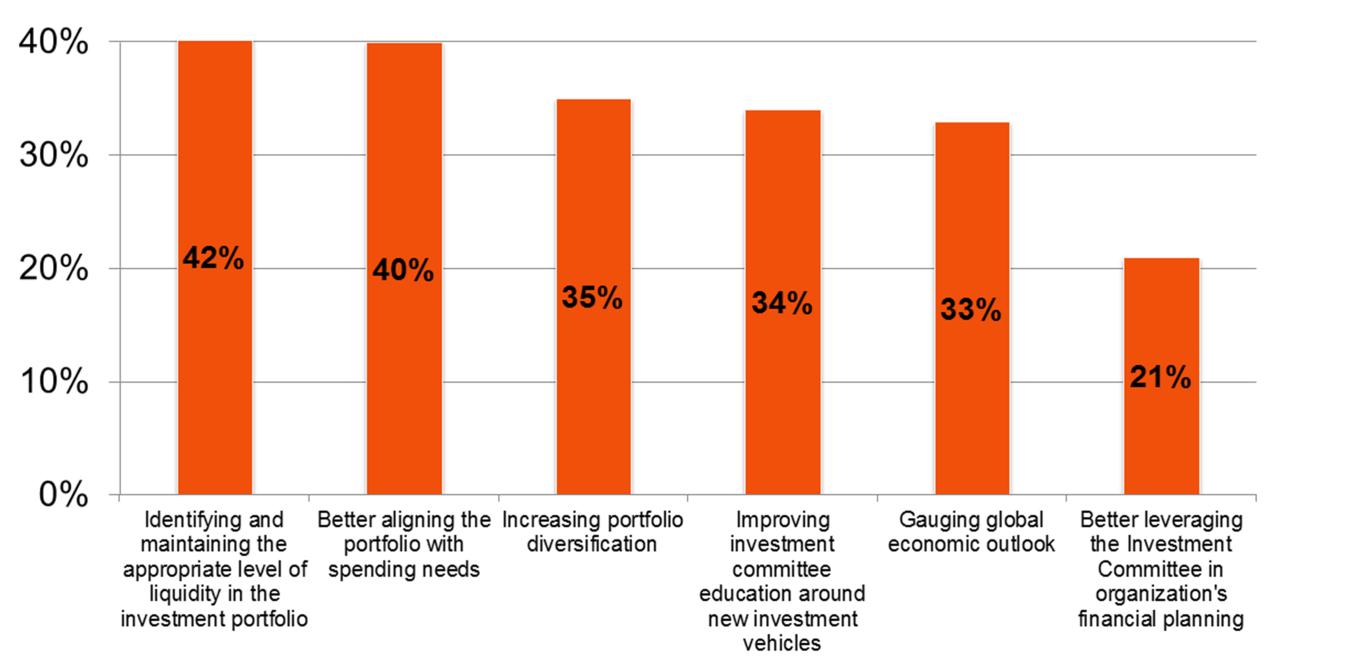
4 the portfolio with organizational spending needs (40 percent), better leveraging the Committee in the organization s financial planning (21 percent), and building donor confidence in investment strategies (23 percent). The chart below shows the percentage of respondents that identified these items as organizational priorities over the next 12 months (only the top six ranked priorities are shown). Alternative investments remain popular There is little debating the popularity of alternative investments within nonprofit investment portfolios. The majority (82 percent) of all participating organizations have at least some assets in the portfolio allocated to alternative investments. The larger the asset pool, the more likely alternative investments are used. Of those participants with $300 million or more in assets, 92 percent have allocations to alternative investments. In contrast, only 78 percent of those with less than $300 million in assets have allocations to alternatives. Percentage of portfolio invested in alternatives by all repondents 2014 SEI 4

5 Larger organizations use alternatives more - The size of the organization and the percentage allocated to alternatives appears to be correlated. More than one-third (39 percent) of those organizations with over $300 million in assets have allocated 31 percent or more of the portfolio to alternatives. The below chart breaks down each size group into how much that group is investing in alternatives. Percentage of portfolio invested in alternatives by size Concerns around use of alternatives While alternatives remain popular, there are definitely concerns in making these investments. Poll results suggest that nonprofits are still very much sensitive to some of the challenges that were highlighted during the 2008 financial crisis. During the crisis, many nonprofits were challenged from a liquidity standpoint, as many popular alternative investments had lock-up periods preventing investors from accessing their much-needed investments to support rapidly decreasing finances. The lack of liquidity in alternatives continues to top the list of challenges. Percentage citing these challenges when it comes to using alternatives 2014 SEI 5
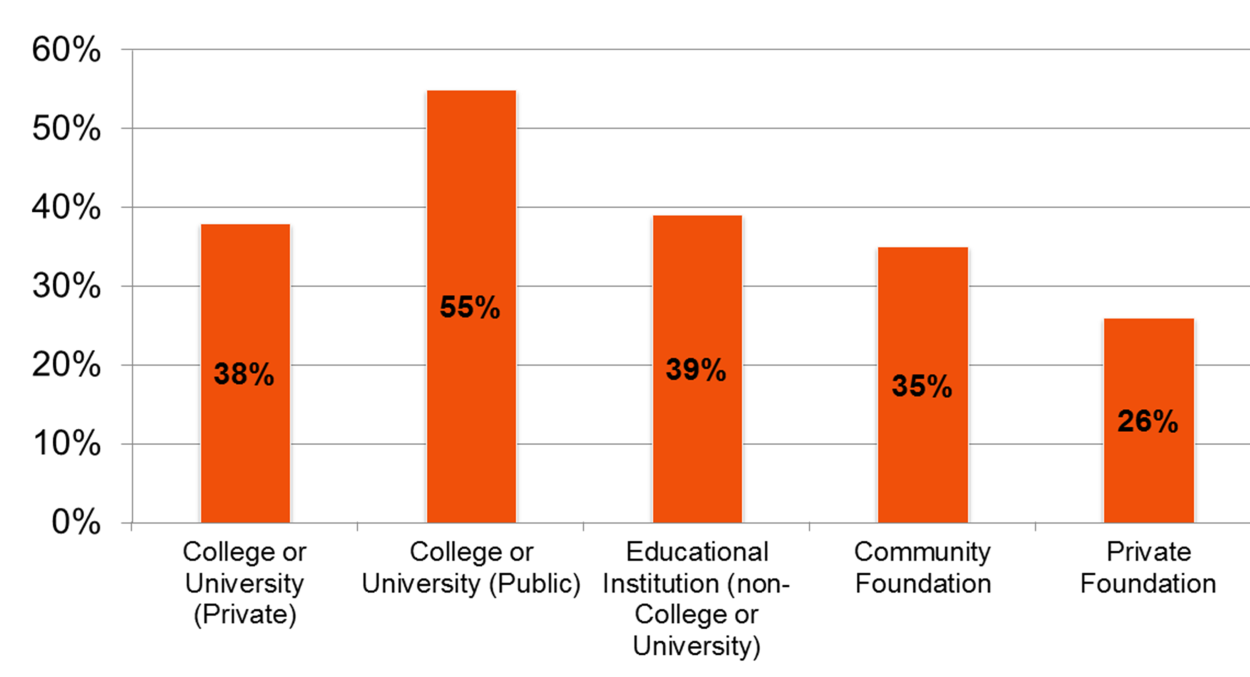
6 Despite concerns, allocations remain significant While concerns exist, they have done little to temper a willingness to allocate a significant percentage of the portfolio to alternative investments. Of the poll respondents currently using alternatives, a significant portion (70 percent) allocate 11 percent or more of the total portfolio to these investments. When looking at just those with over $300 million in assets, 85 percent allocate percent or more of the total portfolio to alternatives; 50 percent allocate 31 percent or more. Nonprofits will continue to invest in alternatives Almost all (96 percent) of poll participants said they will either maintain or increase the allocation to alternative investments over the next 12 months. These results break out to 21 percent increasing and 75 percent maintaining the current allocation. Educational endowments embrace alternatives When looking at the types of organizations and how they are investing in alternatives, as expected, the college and university segment leads the way. More than half (55 percent) of the public college and universities have at least 21 percent of the portfolio invested in alternatives (by far the largest group). The below chart breaks down the top five types of poll respondents and shows the percentage from that group that has 21 percent or more of the portfolio invested in alternatives. Percentage by organization type investing 21% or more in alternatives 2014 SEI 6

7 Evaluating investment outsourcing Investment outsourcing continues to grow in use by nonprofits and that trend does not appear to be slowing down. According to Casey Quirk, the nonprofit sector will be the fastest growing users of investment outsourcing over the next five years. The firm predicts nonprofit assets invested in outsourcing programs will experience a compound annual growth rate of 15 percent over the next five years, and will top $391 billion by 2018 comprising 38 percent of all outsourced assets. 1 Investment outsourcing is defined in a lot of different ways by a lot of different providers. At a minimum, the primary service of an outsourcing provider is taking over the responsibility of researching, hiring, monitoring and replacing money managers. Poll respondents were asked to identify their current approach to the selection of money managers. They were provided the following definitions and the chart to the right shows the percentage using each approach: Internal Model- The investment committee does NOT use external investment consultants and therefore handles all manager research, selection and replacing internally Consultant/Advisor Model - The organization uses a consultant or advisor who researches and provides a selection of manager finalists but ultimately the investment committee selects and replaces managers. Outsourcing Model- The organization utilizes an outsourcing provider who makes all or some manager research, selection and monitoring decisions. 55% Nearly one-third (30 percent) of the nonprofits participating in the poll currently use an outsourcing provider, further validating this ongoing trend. Those currently using an outsourcing provider were asked to rank the top three benefits to this approach. Using a weighted system for how respondents ranked those benefits, the below chart identifies the top three: Top 3 Benefits of Using an Outsourced Approach to Selecting Money Managers 1. Can more promptly take advantage of market changes 2. Improved overall risk management 3. Access to better money managers Outsourcing Survey, Casey, Quirk & Associates LLC (March 2014) 2014 SEI 7
8 Those currently making manager selection decisions internally or through the recommendations of a consultant or advisor were asked why they do not currently use an outsourced approach. The top three reasons are below. Top 3 Reasons For Those Not Currently Using an Outsourced Approach for Manager Selection 1. Satisfied with the current provider or process (80 percent) 2. Investment Committee prefers to select the money managers (49 percent) 3. Investment Committee feels it is their fiduciary duty to select managers (45 percent) Outsourcing asset allocation decisions In some instances, organizations choose to take an additional step when it comes to investment outsourcing by delegating asset allocation decisions to an outside partner. The majority of the nonprofit poll respondents (79 percent) said the Investment Committee makes all asset allocation decisions either with or without suggestions from outside advice. The remaining 21 percent have outsourced some or all asset allocation decisions to an outside fiduciary. An emphasis on risk management More nonprofits are looking to implement effective risk management programs that help protect the organization s ability to achieve its mission. Successful risk management strategies come in many shapes and sizes but ultimately provide the ability to forecast and evaluate financial risks together with identifying strategies to avoid or minimize their impact. The poll results suggest this is an increased focus for many nonprofits. Comprehensive risk management programs often integrate investment portfolio decisions with the impact they have on organizational finances. This includes not just investment risks within the portfolio but managing risks the portfolio could present to the organization at large. Emphasis on risk-adjusted returns The market volatility of the past few years looks to have led many organizations to implement risk-adjusted metrics when evaluating investment success. Nearly half (46 percent) of the poll participants said that positive risk-adjusted returns are a more important benchmark of investment success than overall portfolio returns. Managing the risk/reward balance is a huge priority for us. Impact of portfolio on spending A significant majority (81 percent) were confident that the spending policy is set with a definitive understanding of overall portfolio risk. While that might be the case, many lack confidence that the appropriate amount of time is being spent to stress test the portfolio against a variety of scenarios and how that would impact spending. Almost half (44 percent) lack confidence that sufficient time is spent assessing the impact of various market shocks (e.g. a 20 percent market decline) on the ability to spend/achieve mission. Just over one-quarter (27 percent) felt confident the organization knows the impact that a rise in interest rates would have on the portfolio and the ability to spend/achieve the mission. Impact of portfolio on liquidity and spending Nearly half (49 percent) lack confidence that the Investment Committee has identified all key portfolio risks. As almost all poll respondents noted a plan to maintain or increase allocations to alternatives, liquidity risk is one area of concern. Nearly half (42 percent) said identifying and maintaining the appropriate level of liquidity in the investment portfolio is a priority in the next 12 months SEI 8

9 Active investment shifts are challenging Nearly half (48 percent) of all participants said they lack confidence that active investment shifts are made quickly in response to changing market conditions. This could also be a by-product of the current approach to investment management considering the ability to do this was identified as the top benefit by those using an outsourced approach to manager selection. The chart below compares the percentage from each group that lacked confidence that active investment shifts are made quickly in response to changing market conditions. Additional highlights The results from this poll have demonstrated how complex of an environment it has become for Investment Committees and those overseeing nonprofit investments. Beyond the day-in and day-out challenges, there are always new and distinct challenges to address, including the use of environment, social and governance (ESG) investing, the loom of inflation and the use of underwater funds. ESG investing seeing early adoption Socially responsible investing continues to evolve and recent evidence suggests that these factors may offer long term performance benefits. The poll results show a very challenging and complicated environment for investing, and integrating ESG is another component to add to that mix. However, poll respondents must be seeing some level of value in this emerging approach as nearly one-third (32 percent) of the poll participants said the organization either currently does or plans to integrate ESG factors into the investment process. Inflation not viewed as threat before 2016 As inflation continues to stay below target in most regions of the world, there appears to be little concern of a potential impact on portfolios. Only 18 percent said that inflation will be a threat to the organization s purchasing power by the end of Spending from underwater funds The Uniform Prudent Management of Institutional Funds Act (UPMIFA) has had an impact on how Investment Committees and Boards elect to spend from underwater funds or funds that drop below historic dollar value. As equity markets rallied significantly in 2013, the number of underwater funds continued to decrease. The number of poll participants that currently have underwater funds is less than one-third (30 percent). However, of that group, 64 percent with underwater funds are spending from them SEI 9
10 Conclusion Poll respondents confirmed that managing investment portfolios is more complex now than in the past; however that has not impacted efforts to add new asset classes, better align investments with organizational finances, and implement risk management strategies that require additional analysis. Overall allocations to alternative investments are significant and could continue to grow. Many respondents lack confidence that the organization is successful at implementing important components of risk management such as assessing the impact of market shocks and interest rate fluctuations. Investment Committees continue to be challenged with time and resource constraints, yet the desire is to involve them more with organizational financial planning. Some have elected to outsource manager selection to outside partners to help create additional capacity while those who haven t are reluctant because they either like to select managers or feel that it is their fiduciary responsibility to do so. Some organizations have even elected to outsource asset allocation decisions. While the challenges continue to grow, nonprofit executives and Investment Committees are prioritizing those items that ultimately strengthen the organization and help maximize the ability to meet its overall mission. Any questions on this poll or for more information around SEI s nonprofit outsourcing services, [email protected] or call This information is for educational purposes only. Not intended to be investment, legal and/or tax advice. Please consult your financial/tax advisor for more information. Information provided by SEI Investments Management Corp., a wholly owned subsidiary of SEI Investments Company. SEI SEI 10
Investment Governance Practices for Foundations & Endowments
 Non-Profit Management Research Panel Investment Governance Practices for Foundations & Endowments In September 2013, the Non-Profit Management Research Panel conducted a poll to explore current investment
seic.com/institutions
 Nonprofit Management Research Panel Liquidity Pool Management for U.S. Colleges and Universities Gain a better understanding of your school s financial risks and the benefits of integrating the investment
CALIFORNIA STATE TEACHERS RETIREMENT SYSTEM INNOVATION PORTFOLIO POLICY
 CALIFORNIA STATE TEACHERS RETIREMENT SYSTEM INNOVATION PORTFOLIO POLICY INVESTMENT BRANCH April 2016 O. Innovation Portfolio Policy EXECUTIVE SUMMARY In accordance with the CalSTRS Investment Policy and
Empowering your team, investment program and mission
 Outsourced CIO solutions NONPROFITS Empowering your team, investment program and mission I don't love this sky diving theme for this particular brochure - what about something like a crew team? Basically,
CFA Institute Contingency Reserves Investment Policy Effective 8 February 2012
 CFA Institute Contingency Reserves Investment Policy Effective 8 February 2012 Purpose This policy statement provides guidance to CFA Institute management and Board regarding the CFA Institute Reserves
NORTH CAROLINA DEPARTMENT OF STATE TREASURER INVESTMENT MANAGEMENT DIVISION. External Investment Manager and Vehicle Selection Policy and Procedures
 I. Background NORTH CAROLINA DEPARTMENT OF STATE TREASURER INVESTMENT MANAGEMENT DIVISION External Investment Manager and Vehicle Selection Policy and Procedures The North Carolina Retirement Systems include
Fiduciary Guidelines for Foundation & Endowment Trustees
 1 Legal and Regulatory Oversight 3 Selecting and Monitoring Investment Managers 2 Developing a Spending Policy 2 Investment Policy Statements 3 Administration and Records online report consulting group
wealth management Insights on... P o r t r a i t o f t h e F a m i l y O f f i c e Offices that Serve Families with Exceptional Wealth
 Insights on... wealth management P o r t r a i t o f t h e F a m i l y O f f i c e Offices that Serve Families with Exceptional Wealth In 1889, Byron Laflin Smith a respected banker in Chicago, Illinois
Asset Management Portfolio Solutions Disciplined Process. Customized Approach. Risk-Based Strategies.
 INSTITUTIONAL TRUST & CUSTODY Asset Management Portfolio Solutions Disciplined Process. Customized Approach. Risk-Based Strategies. As one of the fastest growing investment managers in the nation, U.S.
Sample Investment Policy. Introduction
 Sample Investment Policy Introduction This statement of investment policy was adopted by the Board of Directors of Organization Name on Date, to provide for the creation of, and guidelines for the management
Nonprofit Guide to Prudent Investing. From The Merrill Lynch Center for Philanthropy & Nonprofit Management
 Nonprofit Guide to Prudent Investing From The Merrill Lynch Center for Philanthropy & Nonprofit Management Traditionally, nonprofit organizations invested charitable funds relatively conservatively. However,
The essential Guide To TarGeT date Funds
 The Essential Guide to Target Date FundS ALL TARGET DATE FUNDS ARE NOT CREATED EQUAL Target date funds are a revolutionary idea: A single investment that evolves over time according to the changing needs
Dartmouth College Endowment Investment Policy Statement Updated August 2013
 Introduction and Purpose of the Endowment This Investment Policy Statement ( IPS ) applies to the endowment of Dartmouth College (the College ), referred to throughout this document as the Total Return
Small Endowments versus Large: A Closer Look at Returns and Asset Allocation
 Monograph Series Small Endowments versus Large: A Closer Look at Returns and Asset Allocation INTRODUCTION By Bob Bovinette Due in part to the negative performance of many endowments during the recent
Outsourced Investment Management: An Overview for Institutional Decision-Makers
 1 Outsourced Investment Management: An Overview for Institutional Decision-Makers August 2013 Table of Contents Contents Definition and Rationale... 1 Growth of Outsourcing... 3 Deciding on an Outsourcing
private client managed portfolios
 private client managed portfolios Simplify, preserve and enhance. Your wealth is the cumulative result of your hard work, discipline, and astute management. Yet the opportunities it affords may also come
Remarks by. Carolyn G. DuChene Deputy Comptroller Operational Risk. at the
 Remarks by Carolyn G. DuChene Deputy Comptroller Operational Risk at the Bank Safety and Soundness Advisor Community Bank Enterprise Risk Management Seminar Washington, D.C. October 22, 2012 Good afternoon,
FIDUCIARY RESPONSIBILITIES OF INVESTMENT COMMITTEES
 FOCUS TOPIC B R I E F FIDUCIARY RESPONSIBILITIES OF INVESTMENT COMMITTEES C H R I S T O P H E R M. M E Y E R, C FA / Managing Principal / Chief Investment Officer To avoid implementation shortfall and
LOCAL CHURCH ADDENDUM TO THE STATEMENT OF INVESTMENT GUIDELINES
 LOCAL CHURCH ADDENDUM TO THE STATEMENT OF INVESTMENT GUIDELINES The Investment Committee of the General Council on Finance and Administration Adopted by The General Council on Finance and Administration
Investment Management for Non-Profit Organizations
 Investment Management for Non-Profit Organizations Bradley, Foster & Sargent has worked with non-profit organizations for many years managing their endowments and helping them achieve their mission, long
INVESTMENT POLICY STATEMENT Valued Client
 INVESTMENT POLICY STATEMENT Valued Client August 17, 2010 PREPARED BY: John Ohl Bay Colony Advisors 91 Main St STE 308 Concord, Massachusetts 01742 (978) 369-7200 [email protected] www.baycolonyadvisors.com
Uses of Quantitative Investment Strategies in Asia
 GREENWICH ASSOCIATES Commissioned by: Uses of Quantitative Investment Strategies in Asia Best Practices for Asian Institutions Considering Quantitative Approaches to Investing 2013 GREENWICH ASSOCIATES
Advisors Turn to ETF Managers. Growing Assets and Increasing Client Value
 Advisors Turn to ETF Managers Growing Assets and Increasing Client Value Advisor partnerships with ETF managers are on the rise ishares has tracked an increased number of advisors partnering with ETF managers.
Bringing Alternatives Within Reach
 Bringing Alternatives Within Reach Goldman Sachs Multi-Manager Alternatives Fund (Ticker: GSMMX) Mutual funds pursuing alternative investment strategies, also known as alternative mutual funds, open up
J.P. Morgan ETFs ANOTHER REASON TO PARTNER. ANOTHER WAY TO BENEFIT FROM OUR INVESTMENT THINKING.
 J.P. Morgan ETFs ANOTHER REASON TO PARTNER. ANOTHER WAY TO BENEFIT FROM OUR INVESTMENT THINKING. EXCHANGE-TRADED FUNDS ARE CHANGING THE WAY THE WORLD INVESTS and have quickly become one of the most popular
CALIFORNIA PUBLIC EMPLOYEES RETIREMENT SYSTEM STATEMENT OF INVESTMENT POLICY FOR GLOBAL EQUITY. October 13, 2014
 CALIFORNIA PUBLIC EMPLOYEES RETIREMENT SYSTEM STATEMENT OF INVESTMENT POLICY FOR GLOBAL EQUITY October 13, 2014 This policy is effective immediately upon adoption and supersedes all previous Global Equity
BUSINESS INTELLIGENCE: IT'S TIME TO TAKE PRIVATE EQUITY TO THE NEXT LEVEL. by John Stiffler
 IT'S TIME TO TAKE PRIVATE EQUITY TO by John Stiffler In a challenging economic environment, portfolio management has taken on greater importance. Private equity firms must look at every possible avenue
TIAA-CREF Asset Management. TIAA-CREF Global Equity Strategies. Combining discipline and innovation for investments that seek to consistently deliver
 TIAA-CREF Asset Management TIAA-CREF Global Equity Strategies Combining discipline and innovation for investments that seek to consistently deliver A distinguished heritage of intelligent equity investing
Principles and Practices in Credit Portfolio Management
 International Association of Credit Portfolio Managers Principles and Practices in Credit Portfolio Management Findings of the 2013 Survey Survey Goal IACPM Members share their views on the state of CPM
BRINKER CAPITAL OVERVIEW. Helping You Invest with Confidence
 BRINKER CAPITAL OVERVIEW Helping You Invest with Confidence PARTIALLY INVESTED PERIODIC INVESTMENT FULLY INVESTED Unwavering Focus on Investment Excellence For more than 25 years, Brinker Capital has been
Endowment Policies, Guidelines, and Objectives
 Tower Foundation of San Jose State University Endowment Policies, Guidelines, and Objectives Purpose of the Endowment Policy Statement This statement is issued by the Finance and Investment Committee (the
Investment outsourcing means insourcing best practices.
 Investment outsourcing means insourcing best practices. Non-profit organizations Joseph Gelly, Jr., Managing Director & Head of Institutional Canada Heather Myers, Managing Director, Non-Profits Adam Hornung,
Elements of a clearly defined investment policy statement for non-profits
 Elements of a clearly defined investment policy statement for non-profits An update Greg Coffey, CFA, Client Executive Lila Han, CFA, CAIA, Senior Analyst, Non-Profits Today s increasingly complex investment
INVESTMENT POLICY April 2013
 Policy approved at 22 April 2013 meeting of the Board of Governors (Minute 133:4:13) INVESTMENT POLICY April 2013 Contents SECTION 1. OVERVIEW SECTION 2. INVESTMENT PHILOSOPHY- MAXIMISING RETURN SECTION
On Outsourcing of the Family Office Chief Investment Officer Role
 On Outsourcing of the Family Office Chief Investment Officer Role By Robin Coady Smith, Co Founder, the Continuum Consortium & Douglas S. Rogers, CFA As this very complex topic of outsourcing of the family
Practice Management Value-Add Programs. TIAA-CREF Asset Management. Practice Management. Preparing you for new investors and new opportunities
 Practice Management Value-Add Programs TIAA-CREF Asset Management Practice Management Preparing you for new investors and new opportunities Say hello to today s new investors. And to tomorrow s retirement
INVESTMENT POLICY STATEMENT
 INVESTMENT POLICY STATEMENT Investment Options Dated : August 2015 Profile Name United Bank of Michigan 900 East Paris Avenue SE Grand Rapids, MI 49546 Primary Contact Eric Soya 616.559.4534 Advisor Devenir
BRIDGING INVESTORS WITH INSTITUTIONAL SOLUTIONS
 BRIDGING INVESTORS WITH INSTITUTIONAL SOLUTIONS WE BELIEVE THE BRIDGE IS AN EXCELLENT METAPHOR FOR THE WORK WE DO AT FUND EVALUATION GROUP Premier portfolio management like superior bridge construction
ABC, Inc. Policy Number: Investment Policy Date of Board Resolution:
 ABC, Inc. Policy Number: Investment Policy Date of Board Resolution: Purpose This policy establishes investment objectives, policies, guidelines and eligible securities related to all assets held by ABC,
Principles for An. Effective Risk Appetite Framework
 Principles for An Effective Risk Appetite Framework 18 November 2013 Table of Contents Page I. Introduction... 1 II. Key definitions... 2 III. Principles... 3 1. Risk appetite framework... 3 1.1 An effective
Your Investment Policy Statement. Your Investor Profile
 Your Investment Policy Statement Date: 03/21/10 Prepared for : John Sample Address: Province: Postal Code: 123 Any Street Ontario A1B 2C3 Phone: (123) 456-7890 Prepared by: Dealer Address: Province: Postal
California State University, Fresno Foundation INVESTMENT POLICY STATEMENT
 INVESTMENT POLICY STATEMENT 1. Purposes of the Investment Policy Statement The purposes of this Investment Policy Statement for the management of the Foundation funds under management authority of the
Distribution-Focused Strategies A cash flow strategy for retirement
 Distribution-Focused Strategies A cash flow strategy for retirement Designed by advisors to meet the need for steady cash flows in retirement with extensive flexibility and control all with low costs.
A guide to achieving growth and sustainability in your practice
 PRACTICE MANAGEMENT 7 Key Practices to Help Grow Your Business A guide to achieving growth and sustainability in your practice Over the years, we ve partnered with advisors to help them build better businesses.
Retirement Connections: A Professionally Managed Solution
 Retirement Connections: A Professionally Managed Solution Expand your practice and build loyalty with an easy-to-use retirement plan for your small business clients For Financial Advisor use only. Not
Investment Policy Statements for Nonprofit Organizations
 online report consulting group Investment Policy Statements for Nonprofit Organizations summary a template for prudent investment decisions As a nonprofit trustee, keeping your organization s portfolio
Clients per professional. Over $1B 45 $750MM $1B 48 $500MM $750MM 45 $250MM $500MM 47. Over $1B 38 $750MM $1B 38 $500MM $750MM 35
 The power of the independent advice business $123 $750MM $1B $91 model AUM per (millions) $500MM $750MM $75 Clients per 45 $750MM $1B 48 $500MM $750MM 45 $250MM $500MM $72 $250MM $500MM 47 More than one-third
Preventing Fraud: Assessing the Fraud Risk Management Capabilities of Today s Largest Organizations
 Preventing Fraud: Assessing the Fraud Risk Management Capabilities of Today s Largest Organizations Overview In late 2006 and 2007, Protiviti commissioned a study to gauge the fraud risk management (FRM)
Portfolio Management Consultants Perfecting the Portfolio
 Portfolio Management Consultants Perfecting the Portfolio Envestnet PMC is the ultimate advisor to the advisor. Our goal is to help advisors strengthen relationships with their clients and improve outcomes
Are You in the Wrong Target-Date Fund?
 Insights August 2014 Are You in the Wrong Target-Date Fund? Now Is a Good Time to Reevaluate TDFs may have different investment strategies, glide paths, and investment-related fees. Because these differences
CALVERT UNCONSTRAINED BOND FUND A More Expansive Approach to Fixed-Income Investing
 CALVERT UNCONSTRAINED BOND FUND A More Expansive Approach to Fixed-Income Investing A Challenging Environment for Investors MOVING BEYOND TRADITIONAL FIXED-INCOME INVESTING ALONE For many advisors and
Considerations for Plan Sponsors: CUSTOM TARGET DATE STRATEGIES
 PRICE PERSPECTIVE April 2015 Considerations for Plan Sponsors: CUSTOM TARGET DATE STRATEGIES In-depth analysis and insights to inform your decision making. EXECUTIVE SUMMARY Defined contribution plan sponsors
FIDUCIARY ADVISORY SERVICES
 FIDUCIARY ADVISORY SERVICES Comprehensive investment oversight for charities and non-profit organizations Boards of Directors have the opportunity to make a difference in how charities fulfill their missions.
The Role of Internal Audit in Risk Governance
 The Role of Internal Audit in Risk Governance How Organizations Are Positioning the Internal Audit Function to Support Their Approach to Risk Management Executive summary Risk is inherent in running any
SAY NEW INVESTOR DEMANDS ARE RESHAPING THE COMPETiTIVE LANDSCAPE. Frontline Revolution: The New Battleground for Asset Managers
 Frontline Revolution: The New Battleground for Asset Managers Asset managers are rethinking their business models to capitalize on new trends in investor demand, according to a State Street survey of 300
AMERICAN REGISTRY OF INTERNET NUMBERS INVESTMENT POLICY STATEMENT January 2014
 AMERICAN REGISTRY OF INTERNET NUMBERS INVESTMENT POLICY STATEMENT January 2014 Introduction This statement of investment policy has been adopted by the Board of Trustees of the American Registry of Internet
SEI Advisor Network Wealth and Advisor Services
 SEI Advisor Network Wealth and Advisor Services Providing flexible services that help you save time, build long-term relationships and increase profitability. seic.com/advisors Advisor Network Suite of
Corporate Social Responsibility: Implications for Human Resources and Talent Engagement
 Corporate Social Responsibility: Implications for Human Resources and Talent Engagement Winnie Kwan and Emily Tuuk Center for Advanced Human Resource Studies May 2012 I. Introduction Over the past few
NorthStar Asset Management Group Inc. New York Office. Harness the Benefits of Real Estate Lending
 NorthStar Asset Management Group Inc. New York Office Harness the Benefits of Real Estate Lending Forward Looking Statements This sales material includes forward-looking statements that can be identified
MAINSTREET ADVISORS SOCIALLY RESPONSIBLE INVESTING
 MAINSTREET ADVISORS SOCIALLY RESPONSIBLE INVESTING WHETHER YOU ARE STANDING IN LINE READING MAGAZINES AT THE CHECKOUT IN THE LOCAL GROCERY, WATCHING THE NIGHTLY NEWS, OR READING THE NEWSPAPER THERE IS
Weighing the Alternatives: Do Non-Traditional Investments Have a Place in an IRA?
 According to new research from Cerulli Associates, most financial service professionals now incorporate alternative investment vehicles into their clients portfolios. In the research firm s new report,
The Outsourced Chief Investment Officer (CIO) As Fiduciary Manager
 The Outsourced Chief Investment Officer (CIO) As Fiduciary Manager HighView: Canada s Outsourced CIO We Are Independent Stewards Of Wealth For Affluent Canadian Families And The Foundations They Support.
Renaissance Charitable Foundation Inc.
 Charitable Foundation Inc. Revised July 2008 I. Statement of Purpose The intent of this is to establish guidelines that will govern the investment activities of ( RCF ) and any Registered Investment Advisor
UMA Model Portfolios Professional Advice for Your Unified Managed Account
 UMA Model Portfolios Professional Advice for Your Unified Managed Account B The introduction of unified managed accounts has helped many investors to consolidate and streamline their investment portfolios.
CFO Insights How CFOs Can Own Analytics
 CFO Insights How CFOs Can Own Analytics Much has been made about the unprecedented quantities of data companies collect these days, from their own operations, supply chains, production processes, and customer
Fiduciary Management. What is Fiduciary Management?
 Fiduciary Management What is Fiduciary Management? Fiduciary Management can be defined as a pension management solution which focuses on achieving the long term goals of a pension fund within a defined
Calaveras Community Foundation Investment Policy Statement
 Investment Policy Statement Adopted July 12 th 2011 Investment Policy Statement Table of Contents A. Purpose.1 B. Background..1 C. Objectives.1 D. Risk Tolerance.2 E. Investment Guidelines / Asset Allocation.
THE U.S. TRUST STUDY OF THE PHILANTHROPIC CONVERSATION:
 THE U.S. TRUST STUDY OF THE PHILANTHROPIC CONVERSATION: Understanding advisor approaches and client expectations OCTOBER 2013 Conducted in partnership with The Philanthropic Initiative (TPI) Overview The
Private Trust Companies A Primer
 Private Trust Companies A Primer FAMILY OFFICES HAVE BEEN AROUND FOR YEARS, AND A FEW FAMILY OFFICES HAVE HELD TRUST POWERS OVER THE YEARS, CREATING A FAMILY PRIVATE TRUST COMPANY HAS BEEN RELATIVELY UNUSUAL
Fiduciary Asset Management. A Discretionary Investment Management Solution
 Fiduciary Asset Management A Discretionary Investment Management Solution 01 / MORGAN STANLEY The Fiduciary Asset Management program is designed to provide a customized, discretionary solution to help
UPMIFA and You New Rules on Nonprofit Endowments & Investments
 UPMIFA and You New Rules on Nonprofit Endowments & Investments Presented by: Daniel Walker, Esq. Leonard Cole, Esq. July 15, 2009 2009 All materials are proprietary. What is UPMIFA? Uniform Prudent Management
Today s bond market is riskier and more volatile than in several generations. As
 Fixed Income Approach 2014 Volume 1 Executive Summary Today s bond market is riskier and more volatile than in several generations. As interest rates rise so does the anxiety of fixed income investors
Single Manager vs. Multi-Manager Alternative Investment Funds
 September 2015 Single Manager vs. Multi-Manager Alternative Investment Funds John Dolfin, CFA Chief Investment Officer Steben & Company, Inc. Christopher Maxey, CAIA Senior Portfolio Manager Steben & Company,
TIAA-CREF Asset Management. Global capabilities Recognized performance
 TIAA-CREF Asset Management Global capabilities Recognized performance Earning our clients trust since 1918 TIAA-CREF s greatest assets are the lasting relationships we ve developed and maintained since
By Jeffrey M. Covell, Area Senior Vice President & Area Assistant Director
 INSTITUTIONAL INVESTMENT & FIDUCIARY SERVICES: Investment Basics: Evaluating the OCIO through Performance Attribution and Analysis By Jeffrey M. Covell, Area Senior Vice President & Area Assistant Director