
AGRIUM ANNUAL REPORT 2013
|
|
|
- Hilda Reeves
- 10 years ago
- Views:
Transcription
1 AGRIUM ANNUAL REPORT 2013

2 EVERY DAY THE WORLD FACES A GROWING CHALLENGE: PRODUCING ENOUGH FOOD TO SUSTAIN A RAPIDLY INCREASING POPULATION THAT ALSO WANTS TO IMPROVE ITS DIET, WHILE AT THE SAME TIME MANAGING THE PLANET S LIMITED AMOUNT OF ARABLE LAND. EVERY DAY, 15,800 AGRIUM EMPLOYEES MEET THIS CHALLENGE HEAD-ON, DRAWING ON OVER 80 YEARS OF INGENUITY AND KNOW-HOW TO PRODUCE AND DISTRIBUTE CROP INPUTS IN A SAFE AND RESPONSIBLE MANNER.

3 WHAT DRIVES US WORLD CHALLENGE 8 BILLION ESTIMATED WORLD POPULATION BY 2025 The world population is projected to increase by 75 million people per year, to reach 8 billion by Arable land on a per capita basis is expected to decline by 10 percent. GROWING OPPORTUNITY 50% OF THE WORLD S BASIC FOOD REQUIREMENTS RELY ON COMMERCIAL FERTILIZER TABLE OF CONTENTS 1 GLOBAL CHALLENGE 2 STRATEGY 6 GROWTH 7 GLOBAL PRESENCE 8 FINANCIAL HIGHLIGHTS 10 SUSTAINABILITY 12 OUR PEOPLE 14 LETTER FROM THE PRESIDENT & CHIEF EXECUTIVE OFFICER 18 LETTER FROM THE BOARD CHAIR 20 REVIEW OF GOALS & PRIORITIES 23 MANAGEMENT S DISCUSSION AND ANALYSIS 92 FINANCIAL STATEMENTS AND NOTES YEAR FINANCIAL HIGHLIGHTS 160 DIRECTORS AND OFFICERS 161 SHAREHOLDER AND CORPORATE INFORMATION Agrium produces and distributes the crop nutrients, crop protection products, seed and agronomic expertise that provide growers with the tools needed to meet the world s growing demand for food. The over 15,800 employees at Agrium know the importance of helping growers increase yields globally and are committed to helping achieve this critical goal. That is why we are driven to remain at the forefront of the production and efficient distribution of crop inputs, providing growers with the latest crop nutrients, crop protection, seeds and expert agronomic advice. We do this while striving to be the industry leader in environmental responsibility and safety for the benefit of our employees, customers and other stakeholders. AGRIUM ANNUAL REPORT 2013 // GLOBAL CHALLENGE // PAGE 1

4 EVERY DAY WE ARE FOCUSED ON EXECUTING ON OUR STRATEGY: TO BECOME THE LEADING CROP INPUT COMPANY, OPERATING ACROSS THE VALUE CHAIN. Agrium s Oakland, Illinois Retail facility FOCUSING ON AN INTEGRATED STRATEGY Agrium s strategy is to invest and operate across the crop input value chain through production and marketing of crop nutrients and other crop input products, innovation, distribution and retail sales. We are the largest global agricultural retailer, providing growers across North America, South America and Australia with top quality crop input products and services. We are also a leading Wholesale producer and distributor of crop nutrients, with operations strategically located to supply key global markets. Agrium has over nine million tonnes of nutrient production capacity across all three macro nutrients. We are the world s fourth largest nitrogen producer, as well as a major producer of potash and phosphate. Our innovation and technological advancement of Environmentally Smart Nitrogen ( ESN ) has also made us a global leader in the development and sales of controlledrelease agricultural nutrients. On a daily basis, our integrated strategy provides invaluable market intelligence across Agrium. This fosters improved efficiencies and allows us to better manage the volatility in global nutrient markets through better marketing and purchase decisions for both of our business units. It also allows us the flexibility to leverage our Retail operations to provide higher Wholesale operating rates. PORTFOLIO OF PRODUCTS & SERVICES* (PERCENTAGE OF 2013 ADJUSTED EBITDA) RETAIL 43% OTHER ** 6% POTASH 14% PHOSPHATE 3% NITROGEN 34% * Excludes other inter-segment eliminations and Wholesale EBITDA is approximated using a proportional allocation as a percentage of gross profit. ** Other includes AAT and Wholesale Product Purchased for Resale. Source: Agrium PAGE 2 // STRATEGY // AGRIUM ANNUAL REPORT 2013

5 AGRIUM PRECISION AGRICULTURE SERVICES THE WORLD CHALLENGE How to help growers optimize yields, improve economic returns and reduce environmental impact by leveraging precision agriculture technologies. GROWING OPPORTUNITY AGRIUM: AN OVERVIEW Agrium s strategy is to operate across the crop input value chain outlined below. The crop nutrients that growers require are provided by major fertilizer wholesale manufacturers, such as Agrium Wholesale, and distributed to agriculture retailers, as well as industrial customers. Our Wholesale business unit produces all three of the major crop nutrients. Our Retail operations market all the crop inputs and services growers require, including producing and marketing a broad range of private label and nationally branded crop protection products and seeds. THE SIGNIFICANT GROWTH NEEDED IN GLOBAL FOOD PRODUCTION OVER THE NEXT DECADE IS A KEY DRIVER FOR OUR BUSINESS. AGRIUM HAS A HUGE OPPORTUNITY TO PROVIDE THE EXPERTISE AND PRODUCTS THAT WILL HELP FEED A GROWING WORLD. WE HAVE THE RIGHT STRATEGY, ASSET MIX AND TEAM TO CAPITALIZE ON THIS OPPORTUNITY. CHUCK MAGRO President & Chief Executive Officer On-going technological innovations have created an opportunity to further develop precision agriculture services to growers. Precision agriculture employs new technologies to better recognize the significant variation in yield capability within a field. Innovations in areas such as satellite global positioning and imaging, new precision agriculture equipment and related software have come together to provide growers with the ability to be more precise in terms of crop input use. This data can be used to help optimize both productivity and profitability of the field by significantly varying the rate of crop inputs within a field, providing both economic and environmental benefits. Agrium Retail is at the forefront of crop-inputs technology and offers precision agriculture services to our grower customers under our new brand Echelon. Our platform offers soil sampling, fertility treatments, variable rate nutrient application, field scouting, tissue sampling, field trial analysis, yield monitoring and mapping as well as crop input record keeping. Agrium s Echelon precision agriculture software tool can be used by our agronomists and growers on a computer, or a smartphone or tablet right in the field. Agrium provides precision agriculture services on approximately 10 million acres in the U.S. and this is expected to continue to grow at a rapid pace 1. MARKET INTELLIGENCE FEEDBACK MARKET INTELLIGENCE IS SHARED ACROSS THE ORGANIZATION BOTH FROM RETAIL S ALMOST HALF A MILLION GROWER CUSTOMERS WORLDWIDE AND FROM WHOLESALE S GLOBAL NUTRIENT MARKETING ACTIVITIES. AGRIUM WHOLESALE Wholesale manufactures and distributes all three major nutrient products of nitrogen, phosphate and potash, as well as our ESN, ammonium sulfate and micronutrients. We market potash and nitrogen in North America and internationally and are a local supplier of phosphates in our core North American markets. Our international nitrogen sales are supported by our joint venture offshore nitrogen facilities. We distribute these products on a daily basis by means of rail, barge, and truck. AGRIUM RETAIL Agrium Retail is the largest global retailer of crop input products and services. It provides growers in North and South America, as well as Australia, with nutrients, seed, crop protection products and advisory and application services that help to maximize yields and returns. Retail purchases a significant amount of its nutrient needs from Wholesale at market-competitive prices. These sales also allow Wholesale to optimize production rates for certain products and under certain conditions. The Viterra Inc. ( Viterra ) acquisition will provide additional opportunities to capture inter-business unit synergies with Wholesale 1. STORAGE AND DISTRIBUTION Agrium Wholesale has over 2.5 million tonnes of global storage capacity and over 4,500 rail cars under long-term leases. THE GROWERS DIRECT CONNECTION TO GROWERS Growers across the globe require crop inputs and services provided by Agrium in order to achieve optimal yields for their crops. RETAIL CUSTOMERS Agrium Wholesale s retail customer base is very broad. From a regional perspective, a majority of our North American manufactured nitrogen and phosphate products are marketed predominantly in Western Canada, the Pacific Northwest and the U.S. Plains. Our domestic potash sales are marketed to retailers across North America. INDUSTRIAL CUSTOMERS Industrial customers represent just over 10 percent of Wholesale s sales. These are predominantly nitrogen products such as ammonia, urea, and ammonium nitrate which are used in a variety of commercial applications. 1 See disclosure under the heading Forward-Looking Statements on page 24 of the MD&A. AGRIUM ANNUAL REPORT 2013 // STRATEGY // PAGE 3

6 AGRIUM S CROP INPUTS SOLUTIONS FOR GROWERS Agrium produces, distributes and sells all the crop input products and services that growers need to maximize their yields and returns. Our products and expertise are instrumental in formulating and offering an efficient and diverse portfolio of products every growing season. The main categories of products that growers use are nutrients (fertilizers), seed, crop protection, and application and other services. These products are used during specific stages of a crop s growth cycle as illustrated below. 1. NUTRIENTS Nutrients, more commonly known as fertilizer, are products that replenish soil productivity needed to continue to optimize yields and grow healthy plants. These include dry and liquid nitrogen, phosphate, potash, sulfur and micronutrients. 2. SEED Higher yielding seed varieties and new seed traits are constantly being developed and are instrumental in helping grow yields globally. Agrium s seed specialists provide advice and expertise on seed choices and we offer our own Dyna-Gro seed, specifically selected for each growing region of the U.S. 3. CROP PROTECTION Is a broad spectrum of products that help growers minimize yield losses and protect crop quality from weeds, disease and insects. This includes herbicides, fungicides, insecticides and adjuvants. We produce and offer growers our private label brand of high quality crop protection products as well as nationally branded products. 4. APPLICATION AND OTHER SERVICES Across our North and South American operations, we often apply the crop protection and crop nutrient products for the grower using the latest equipment and practices. A full suite of precision agriculture services are offered as well as crop scouting, soil testing and agronomic advice. AN INTEGRATED STRATEGY PROVIDING REAL SYNERGIES AND RESULTS Agrium s strategy is to invest and operate across the agricultural inputs value chain through production, distribution of crop inputs and through to retail sales to the grower customers. This integrated strategy allows us to generate both strategic and operational synergies; a stable but growing earnings base as a result of greater utilization of assets, market intelligence from the grower, leveraging our size and scale and a pipeline of expansion and acquisition opportunities that provide us with numerous competitive advantages. STABLE EARNINGS BASE GREATER UTILIZATION OF ASSETS AGRIUM S CROP INPUTS AND SERVICES DURING THE AGRICULTURE CYCLE THE STAGES OF CROP PRODUCTION PRE-PLANTING PLANTING THE BENEFITS OF COMBINED EFFORTS EARLY GROWTH LATE GROWTH CROP INPUTS & SERVICES LEGEND HARVEST NUTRIENTS SEED POST-HARVEST CROP PROTECTION APPLICATION AND OTHER SERVICES MARKET INTELLIGENCE AND LEVERAGING OUR SIZE AND SCALE EXPANSION AND ACQUISITION PAGE 4 // STRATEGY // AGRIUM ANNUAL REPORT 2013

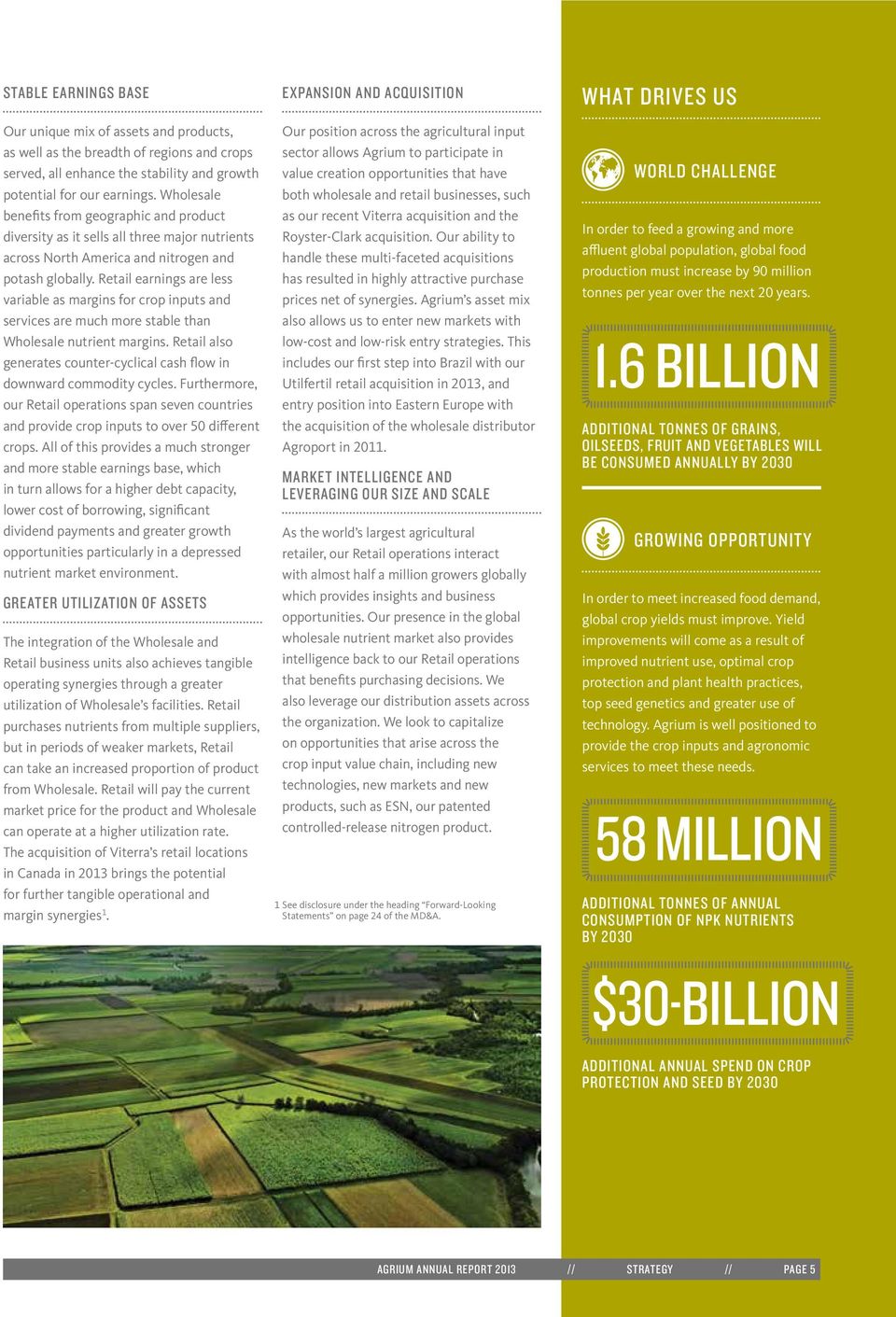
7 STABLE EARNINGS BASE Our unique mix of assets and products, as well as the breadth of regions and crops served, all enhance the stability and growth potential for our earnings. Wholesale benefits from geographic and product diversity as it sells all three major nutrients across North America and nitrogen and potash globally. Retail earnings are less variable as margins for crop inputs and services are much more stable than Wholesale nutrient margins. Retail also generates counter-cyclical cash flow in downward commodity cycles. Furthermore, our Retail operations span seven countries and provide crop inputs to over 50 different crops. All of this provides a much stronger and more stable earnings base, which in turn allows for a higher debt capacity, lower cost of borrowing, significant dividend payments and greater growth opportunities particularly in a depressed nutrient market environment. GREATER UTILIZATION OF ASSETS The integration of the Wholesale and Retail business units also achieves tangible operating synergies through a greater utilization of Wholesale s facilities. Retail purchases nutrients from multiple suppliers, but in periods of weaker markets, Retail can take an increased proportion of product from Wholesale. Retail will pay the current market price for the product and Wholesale can operate at a higher utilization rate. The acquisition of Viterra s retail locations in Canada in 2013 brings the potential for further tangible operational and margin synergies 1. EXPANSION AND ACQUISITION Our position across the agricultural input sector allows Agrium to participate in value creation opportunities that have both wholesale and retail businesses, such as our recent Viterra acquisition and the Royster-Clark acquisition. Our ability to handle these multi-faceted acquisitions has resulted in highly attractive purchase prices net of synergies. Agrium s asset mix also allows us to enter new markets with low-cost and low-risk entry strategies. This includes our first step into Brazil with our Utilfertil retail acquisition in 2013, and entry position into Eastern Europe with the acquisition of the wholesale distributor Agroport in MARKET INTELLIGENCE AND LEVERAGING OUR SIZE AND SCALE As the world s largest agricultural retailer, our Retail operations interact with almost half a million growers globally which provides insights and business opportunities. Our presence in the global wholesale nutrient market also provides intelligence back to our Retail operations that benefits purchasing decisions. We also leverage our distribution assets across the organization. We look to capitalize on opportunities that arise across the crop input value chain, including new technologies, new markets and new products, such as ESN, our patented controlled-release nitrogen product. 1 See disclosure under the heading Forward-Looking Statements on page 24 of the MD&A. WHAT DRIVES US WORLD CHALLENGE In order to feed a growing and more affluent global population, global food production must increase by 90 million tonnes per year over the next 20 years. 1.6 BILLION ADDITIONAL TONNES OF GRAINS, OILSEEDS, FRUIT AND VEGETABLES WILL BE CONSUMED ANNUALLY BY 2030 GROWING OPPORTUNITY In order to meet increased food demand, global crop yields must improve. Yield improvements will come as a result of improved nutrient use, optimal crop protection and plant health practices, top seed genetics and greater use of technology. Agrium is well positioned to provide the crop inputs and agronomic services to meet these needs. 58 MILLION ADDITIONAL TONNES OF ANNUAL CONSUMPTION OF NPK NUTRIENTS BY 2030 $30-BILLION ADDITIONAL ANNUAL SPEND ON CROP PROTECTION AND SEED BY 2030 AGRIUM ANNUAL REPORT 2013 // STRATEGY // PAGE 5
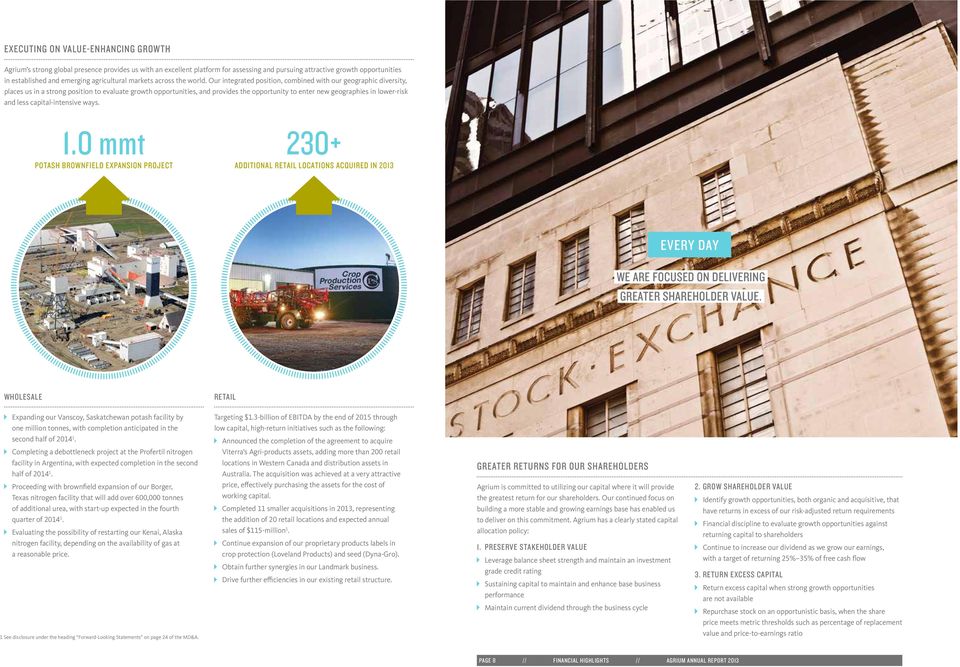
8 EVERY DAY WE ARE LOOKING FOR THE RIGHT OPPORTUNITIES TO ENHANCE OUR BUSINESS THROUGH ACCRETIVE GROWTH AND CONTINUOUS IMPROVEMENT. Agrium's Vanscoy potash expansion project DISCIPLINED GROWTH AND OPERATIONAL EXCELLENCE: A WINNING COMBINATION We know the importance of maximizing the value of our assets and striving for operational excellence across the organization now and into the future. Since 2005, Agrium s strategy has been to grow across the value chain in order to bring our shareholders strong returns. We have succeeded in doing that and have developed an enviable portfolio of assets. We are focused on delivering even more from these assets in order to further increase returns. Key measures have been established across the organization, with targets for the end of 2015 to deliver on this promise. Our Wholesale business unit has also been tasked to achieve approximately $60-million of operational improvements by the end of We know the importance of seizing the moment and capitalizing on the right opportunities when they present themselves. The supportive fundamental backdrop underpinning the agricultural sector has provided Agrium with a strong pipeline of high-return opportunities, providing us with good reason to be optimistic about the future. We plan to execute on these opportunities and bring value-added growth that will contribute to the bottom line 1. $1.5 BILLION IN EBITDA 2 GROWTH SINCE % AVERAGE RETURN ON CAPITAL EMPLOYED 2 SINCE See disclosure under the heading Forward-Looking Statements on page 24 of the MD&A. 2 Refer to Additional IFRS and Non-IFRS Financial Measures on page 83 of the MD&A. PAGE 6 // GROWTH // AGRIUM ANNUAL REPORT 2013

9 AGRIUM S GLOBAL PRESENCE EUROPE NORTH AMERICA 17 WHOLESALE WHOLESALE PRODUCTION FACILITIES 17 primary production facilities, two mines, and an extensive distribution and storage network 2 WHOLESALE MILLION TONNES OF NPK DISTRIBUTED ANNUALLY Extensive storage and distribution network through Agrium Europe, with annual nutrient distribution volumes of approximately two million tonnes 1,100+ RETAIL RETAIL FACILITIES Over 1,100 Retail facilities under the name Crop Production Services (CPS) AFRICA AND THE MIDDLE EAST SOUTH AMERICA 50% WHOLESALE INTEREST IN THE PROFERTIL NITROGEN FACILITY 58 RETAIL RETAIL FACILITIES 26% WHOLESALE INTEREST IN THE MOPCO NITROGEN FACILITY 26 percent equity interest in Misr Fertilizers Production Company S.A.E. (MOPCO) in Egypt AUSTRALIA 230+ RETAIL FACILITIES 50 percent interest in Profertil, S.A. in Argentina 58 Retail facilities under the name Agroservicios Pampeanos (ASP) in Argentina, Chile, Uruguay and Brazil RETAIL Over 230 Retail facilities under the name Landmark in Australia AGRIUM ANNUAL REPORT 2013 // GLOBAL PRESENCE // PAGE 7

10 EXECUTING ON VALUE-ENHANCING GROWTH Agrium s strong global presence provides us with an excellent platform for assessing and pursuing attractive growth opportunities in established and emerging agricultural markets across the world. Our integrated position, combined with our geographic diversity, places us in a strong position to evaluate growth opportunities, and provides the opportunity to enter new geographies in lower-risk and less capital-intensive ways. 1.0 mmt POTASH BROWNFIELD EXPANSION PROJECT 230+ ADDITIONAL RETAIL LOCATIONS ACQUIRED IN 2013 EVERY DAY WE ARE FOCUSED ON DELIVERING GREATER SHAREHOLDER VALUE. WHOLESALE RETAIL Expanding our Vanscoy, Saskatchewan potash facility by Targeting $1.3-billion of EBITDA by the end of 2015 through one million tonnes, with completion anticipated in the low capital, high-return initiatives such as the following: second half of Announced the completion of the agreement to acquire Completing a debottleneck project at the Profertil nitrogen Viterra s Agri-products assets, adding more than 200 retail facility in Argentina, with expected completion in the second half of locations in Western Canada and distribution assets in Australia. The acquisition was achieved at a very attractive GREATER RETURNS FOR OUR SHAREHOLDERS Proceeding with brownfield expansion of our Borger, Texas nitrogen facility that will add over 600,000 tonnes of additional urea, with start-up expected in the fourth quarter of Evaluating the possibility of restarting our Kenai, Alaska nitrogen facility, depending on the availability of gas at a reasonable price. price, effectively purchasing the assets for the cost of working capital. Completed 11 smaller acquisitions in 2013, representing the addition of 20 retail locations and expected annual sales of $115-million 1. Continue expansion of our proprietary products labels in crop protection (Loveland Products) and seed (Dyna-Gro). Obtain further synergies in our Landmark business. Drive further efficiencies in our existing retail structure. Agrium is committed to utilizing our capital where it will provide the greatest return for our shareholders. Our continued focus on building a more stable and growing earnings base has enabled us to deliver on this commitment. Agrium has a clearly stated capital allocation policy: 1. PRESERVE STAKEHOLDER VALUE Leverage balance sheet strength and maintain an investment grade credit rating Sustaining capital to maintain and enhance base business performance Maintain current dividend through the business cycle 2. GROW SHAREHOLDER VALUE Identify growth opportunities, both organic and acquisitive, that have returns in excess of our risk-adjusted return requirements Financial discipline to evaluate growth opportunities against returning capital to shareholders Continue to increase our dividend as we grow our earnings, with a target of returning 25% 35% of free cash flow 3. RETURN EXCESS CAPITAL Return excess capital when strong growth opportunities are not available Repurchase stock on an opportunistic basis, when the share price meets metric thresholds such as percentage of replacement 1 See disclosure under the heading Forward-Looking Statements on page 24 of the MD&A. value and price-to-earnings ratio PAGE 8 // FINANCIAL HIGHLIGHTS // AGRIUM ANNUAL REPORT 2013
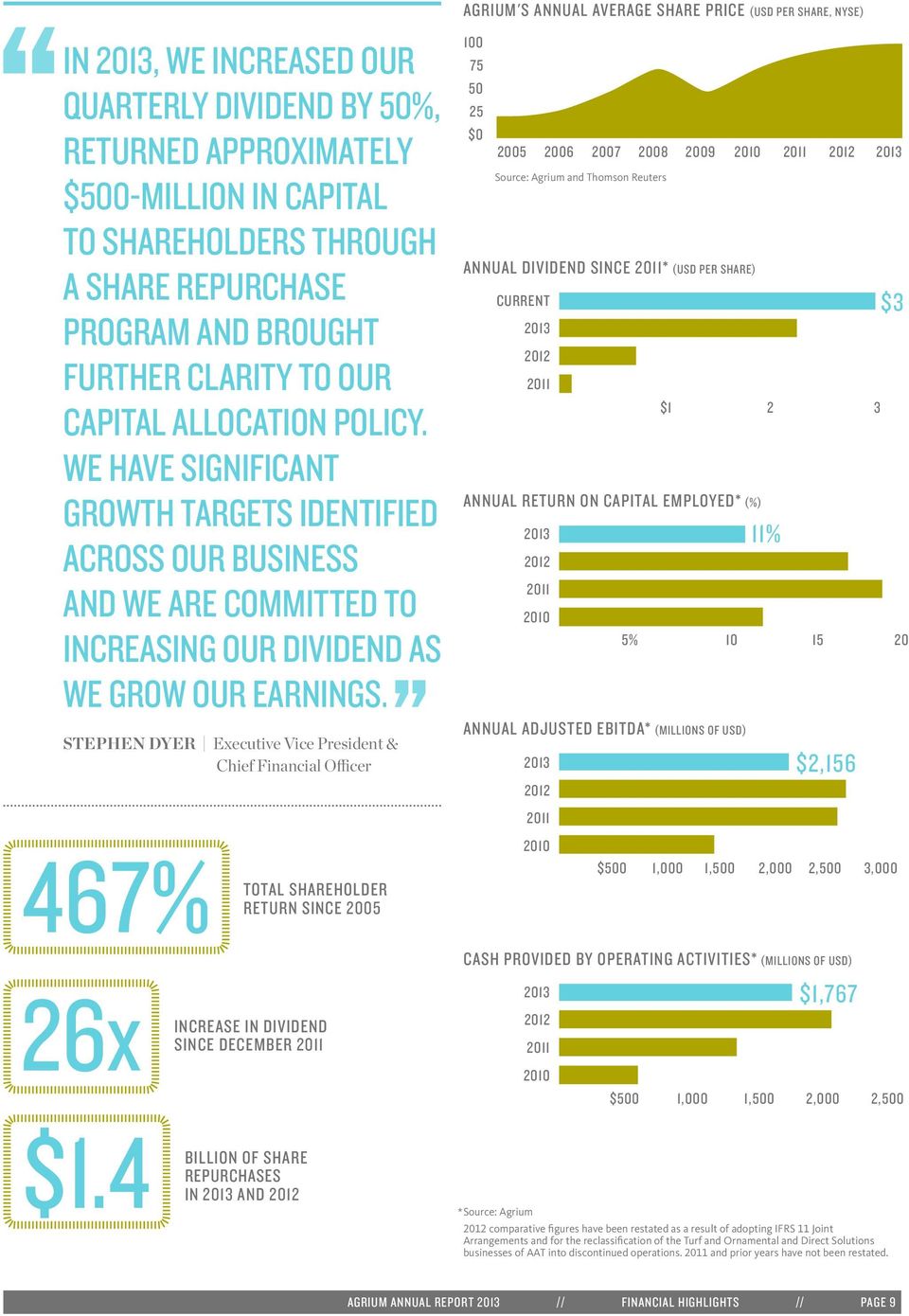
11 AGRIUM'S ANNUAL AVERAGE SHARE PRICE (USD PER SHARE, NYSE) IN 2013, WE INCREASED OUR QUARTERLY DIVIDEND BY 50%, RETURNED APPROXIMATELY $500-MILLION IN CAPITAL TO SHAREHOLDERS THROUGH A SHARE REPURCHASE PROGRAM AND BROUGHT FURTHER CLARITY TO OUR CAPITAL ALLOCATION POLICY. WE HAVE SIGNIFICANT GROWTH TARGETS IDENTIFIED ACROSS OUR BUSINESS AND WE ARE COMMITTED TO INCREASING OUR DIVIDEND AS WE GROW OUR EARNINGS $ Source: Agrium and Thomson Reuters ANNUAL DIVIDEND SINCE 2011* (USD PER SHARE) CURRENT $1 2 3 ANNUAL RETURN ON CAPITAL EMPLOYED* (%) % $3 5% STEPHEN DYER Executive Vice President & Chief Financial Officer ANNUAL ADJUSTED EBITDA* (MILLIONS OF USD) $2, % TOTAL SHAREHOLDER RETURN SINCE $500 1,000 1,500 2,000 2,500 3,000 26x INCREASE IN DIVIDEND SINCE DECEMBER 2011 CASH PROVIDED BY OPERATING ACTIVITIES* (MILLIONS OF USD) $1,767 $500 1,000 1,500 2,000 2,500 $1.4 BILLION OF SHARE REPURCHASES IN 2013 AND 2012 * Source: Agrium 2012 comparative figures have been restated as a result of adopting IFRS 11 Joint Arrangements and for the reclassification of the Turf and Ornamental and Direct Solutions businesses of AAT into discontinued operations and prior years have not been restated. AGRIUM ANNUAL REPORT 2013 // FINANCIAL HIGHLIGHTS // PAGE 9
12 EVERY DAY WE ARE COMMITTED TO MAKING A POSITIVE IMPACT ON THE COMMUNITIES AND ENVIRONMENT IN WHICH WE OPERATE. OUR SOCIETAL IMPACT As our company grows, we integrate our commitment to grow responsibly into our new businesses and communities. We listen to stakeholders, plan with experts, implement programs, apply best management practices and track our performance to achieve continuous improvement. Our vision of making an increasingly positive impact on stakeholders translates into a focus on employee well-being, safety, environmental stewardship and playing an integral role in society. For a more comprehensive discussion of our activities and performance in this area, please see Agrium s full sustainability report at 1,300+ CHARITIES SUPPORTED IN 2013 OUR SUSTAINABILITY PRIORITIES At Agrium, our four areas of strategic focus have been identified through stakeholder engagement. Through this engagement we have identified opportunities for improvement and focus, and are working through strategic partnerships to deliver on our sustainability priorities. The following summarizes our four areas of strategic focus: economy, community, environment, workplace. 125,000+ SCHOOL STUDENTS REACHED BY AGRIUM-SPONSORED PROGRAMS ON AGRICULTURE, NUTRIENT STEWARDSHIP, THE ENVIRONMENT AND FARM SAFETY IN 2013 PAGE 10 // SUSTAINABILITY // AGRIUM ANNUAL REPORT 2013

13 ECONOMY Given our presence across the agricultural products and services value chain, Agrium is uniquely positioned to understand broad evolving trends and challenges in agriculture. Our extensive network of manufacturing, distribution and retail centers enables us to make a significant economic impact in hundreds of rural communities. We believe that the ability to produce food is fundamental to reducing poverty, advancing education and stabilizing economies worldwide. COMMUNITY Through continuous engagement and open dialogue, we identify areas of long-term focus and investment that provide mutual opportunity and maximum benefit to community members. Agrium works in partnership with stakeholders in the community to be a good neighbor protecting, growing and enriching the communities in which we operate. In this spirit, we strive to build and maintain positive relationships within our communities. FOUR AREAS OF STRATEGIC FOCUS ENVIRONMENT The environment is important to us all and we must work together to care for it. Agrium effects meaningful environmental change by creating, implementing and measuring programs to enrich and improve the natural environment in which food is grown. We also work with customers to ensure our products and services contribute the maximum value to their crops while minimizing nutrient losses to the environment. WORKPLACE Agrium s impact on our employees overall well-being can be considerable as we develop and implement workplace practices, environment, health, safety and security standards, compensation programs and career development plans. We strive to ensure a high-performing workforce by focusing on employee well-being and engagement, and by creating a culture of diversity, learning and continuous improvement. AGRIUM SUPPORTS THE FOLLOWING PROGRAMS, PRODUCTS AND INITIATIVES: AGRIUM ANNUAL REPORT 2013 // SUSTAINABILITY // PAGE 11

14 EVERY DAY WE INVEST IN OUR EMPLOYEES BY PROVIDING A SAFE AND REWARDING WORKPLACE THAT FOSTERS A HIGH-PERFORMANCE CULTURE. INVESTING IN OUR EMPLOYEES APPROACH TO LEARNING AND DEVELOPMENT At Agrium, we believe that our employees are our greatest assets. As a result, we know the importance of sustaining a work environment that provides them with stimulating and challenging opportunities that allow for learning, growth and success. Our dedication to these values and our commitment to investing in our employees have continued to yield outstanding returns. 70% 20% ON-THE-JOB EXPERIENCE FEEDBACK AND COACHING 10% EDUCATION PAGE 12 // OUR PEOPLE // AGRIUM ANNUAL REPORT 2013

15 AN OUTSTANDING EMPLOYER We at Agrium know that our focus on providing a professional, engaging and rewarding workplace is one of the key factors that sets us apart and others have taken notice as well. In 2013, Agrium continued to garner widespread recognition for our commitment to being an employer of choice, as we were named a member of: Corporate Knights Best 50 Corporate Citizens, Canada s Best Diversity Employers, Canada s Top Employers for Young People, Canada s Top 100 Employers, Alberta s Top 60 Employers, Canada s 10 Most Admired Corporate Cultures and Achievers 50 U.S. Most Engaged Workplaces. 15,800+ TOTAL NUMBER OF EMPLOYEES WORLDWIDE 83% OVERALL EMPLOYEE ENGAGEMENT The hard work and dedication of Agrium s employees are driven by a sense of responsibility for helping to address the growing global need for agricultural productivity and sustainable food supplies. As a result, our employees have the unique and valuable opportunity to be part of the solution to one of the world s greatest challenges. This common goal drives our strong culture of high-performance and contributes to the high level of employee engagement at Agrium. 67% AGRIUM S CONTINUED SUCCESS IS A TESTAMENT TO THE HARD WORK AND STRONG CHARACTER OF OUR EMPLOYEES, AS THEIR DAILY EFFORTS AND DEDICATION ARE CRITICAL COMPONENTS OF OUR PERFORMANCE, REPUTATION, AND CULTURE. WE ARE EXTREMELY PROUD OF THEIR CONTRIBUTIONS AND ARE FOCUSED ON FOSTERING AN ENVIRONMENT THAT INVESTS IN AND DEVELOPS THE FUTURE LEADERS OF AGRIUM. CHUCK MAGRO President & Chief Executive Officer REDUCTION IN LOST TIME INJURY RATES SINCE 2002 Underlying Agrium s strong operational and financial performance is a commitment to the health and safety of all of our stakeholders. Keeping Agrium s employees safe, healthy and secure is our top priority and an integral part of providing an environment that allows them to thrive and realize their full potential. We are firmly committed to continuous improvement in the area of safety performance, and our efforts have continued to produce positive results. AGRIUM ANNUAL REPORT 2013 // OUR PEOPLE // PAGE 13

16 LETTER FROM THE PRESIDENT & CHIEF EXECUTIVE OFFICER We are delighted to report another year of solid results for Agrium. The advantages of being a global leader across the agricultural product and services value chain were unmistakable again in We continued to deliver value for our stakeholders despite the challenges of lower fertilizer prices globally, turmoil in international potash markets and a shortened spring and fall application season in North America. Our 2013 net earnings from continuing operations reached $7.31 per share, generating $2.2-billion in Adjusted EBITDA 1 and $1.8-billion cash flow from operations. While these figures are down from last year s record results, they are still strong. Much of the strength in our earnings was due to the impressive performance of our Retail operations, which achieved record EBITDA again in 2013 despite crop nutrient prices declining 20 percent to 30 percent and a much shorter fertilizer application season compared to In addition to achieving solid results in our core Strategic Business Units in 2013, we enhanced our disclosure to be more comprehensive and set challenging performance and financial targets for our organization. We are driving the business units to methodically achieve these targets and leverage our assets across the agricultural crop input value chain. We continued to raise our dividend this year and made significant progress on our share buy-back program. We closed the acquisition of Viterra's highly successful retail Agri-products business and succeeded in defending a critical proxy contest with an activist shareholder who was focused on breaking up the company. 1 Adjusted EBITDA is defined as earnings (loss) from continuing operations before finance costs, income taxes, depreciation and amortization and before finance costs, income taxes, depreciation and amortization of joint ventures. 2 See disclosure under the heading Forward-Looking Statements on page 24 of the MD&A PROXY CONTEST: OUR STRATEGY VALIDATED A key milestone came in April, when we were successful in a 10-month proxy contest with an activist shareholder. At our Annual General Meeting, shareholders supported our integrated strategy of operating across the agricultural crop input value chain by re-electing all 12 of our incumbent Board members. We would like to thank our shareholders for their commitment to this process and for ultimately endorsing our strategy. Further validation of our strategy and diversified portfolio came in the second half of the year, as our Retail business unit supported Company earnings with a record fourth quarter and annual EBITDA in As a result, Agrium weathered the storm of softer commodity and nutrient prices, particularly in the potash markets, with less volatility than most of our wholesale-focused peers. CAPITAL POLICY HIGHLIGHTS: FOCUS ON SHAREHOLDERS Agrium s capital allocation policy calls for us to preserve and enhance shareholder value. This is achieved in part by leveraging our balance sheet strength and maintaining our investment grade credit rating, as well as ensuring that there is always sufficient sustaining capital to maintain and enhance our base business performance. PAGE 14 // LETTER FROM THE PRESIDENT & CHIEF EXECUTIVE OFFICER // AGRIUM ANNUAL REPORT 2013

17 We look to grow shareholder value by striking a balance between growth and capital returns to shareholders. The Viterra acquisition is a great example of our growth strategy at work. We also raised our dividend again this year to reach a $3.00 annualized payout per common share, as it is the key platform for capital return to shareholders. Going forward, our goal is to continue to increase the dividend in tandem with the growth of our business. We have set a target of returning 25 percent to 35 percent of free cash flow, after sustaining capital expenditures, in dividend payments to shareholders 2. We are also committed to returning additional excess capital to shareholders when it cannot be put to use to generate higher returns. In this regard, we announced plans in May 2013 to buy back up to 7.4 million (5 percent) of Agrium s common shares for cancellation over the year, and we have bought back 5.8 million shares as of December 31, VITERRA: A HOME RUN ACQUISITION We were pleased to welcome new employees and customers to the Agrium family in 2013 as we completed the acquisition of Viterra s retail Agri-products business. The assets acquired are a perfect strategic fit, and we acquired them at an excellent price making this a home run transaction for Agrium. The acquisition provided us with more than 200 Western Canadian outlets, tripling the size of Agrium s Canadian Retail operations. It also added some distribution assets to our Retail Australia operations. We look forward to building on Viterra s impressive track record and achieving significant synergies 2. LOOKING AHEAD: OPTIMIZING OUR EXISTING ASSETS AND PURSUING INTEGRATED GROWTH We continued to make Operational Excellence a key focus for the organization in Operational Excellence is about ensuring we are making the most of the assets we have and maximizing the value from investments we have made. We will increase our efforts in this area in 2014, and going forward, Operational Excellence will frame everything we do. We have set performance and financial targets for our business units to focus our efforts on achieving meaningful improvements. In the Wholesale business unit, we are targeting a minimum of $60-million in additional EBITDA by 2017 from the recently introduced Lean Six Sigma program 2. In Retail, we are measuring our performance against a clearly defined set of financial targets. lower our cash costs per tonne for the entire mine by approximately 15 percent or $20 per tonne 2. This will help ensure we are even more cost competitive on a global basis, which is particularly important given the uncertainty that global potash markets experienced this past year. It will also ensure we maintain our Canpotex allocation for international exports, given that our peers have completed expansion projects as well. Meanwhile, the expansion of the Profertil nitrogen facility Agrium co-owns in Argentina is also well underway and slated for start-up in the second half of The debottleneck and efficiency project is expected to add approximately 125,000 tonnes of urea and 10,000 tonnes of ammonia capacity on an annual basis with no additional natural gas required 2. In the first quarter of 2014, we started construction on the expansion project at our Borger, Texas nitrogen facility. This project has Board of Director approval and an estimated cost of $720-million and is expected to add over 600,000 tonnes of new urea capacity once complete 2. At this time, MOPCO is on-site at its nitrogen facility in Egypt, assessing the plant condition in the anticipation of a restart of construction of the second and third trains. We remain focused on the potential resumption of construction, depending on the improvement of the political and civil situation in that country 2. On the Retail side, we have a clear path to achieving our $1.3-billion EBITDA target by The lion s share of this growth is expected to come from continued improvement to the base business, through our ongoing focus on increased seed sales, growth in our Loveland proprietary products across all three major product lines and supported by an increased emphasis on precision agriculture. We expect the Viterra acquisition to add $90-million to $110-million of EBITDA on an annual basis after synergies by 2015, and have plans for further improvements in the Australian business 2. We also expect tuck-in acquisitions to continue to contribute to significant growth in our earnings 2. While these largely organic growth opportunities are the foundation of our growth plans at Agrium, we will continue searching for accretive prospects, and will maintain the financial flexibility to capitalize on attractive opportunities as they arise. ADJUSTED EBITDA AND AGRIUM'S AVERAGE SHARE PRICE (MILLIONS OF USD) $3,000 $2,500 (USD PER SHARE, NYSE) $100 $80 Throughout our history, Agrium has been a growth company, and value-added growth remains a priority for us. For Wholesale, we are entering the final year of construction of the expansion of our Vanscoy potash operation in Saskatchewan. $2,000 $1,500 $1,000 $60 $40 A 14-week turnaround will be required in 2014 in order to tie-in the one million tonne capacity expansion by the end of the year. The tie-in process is expected to reduce potash production this year by about 500,000 tonnes. However, once complete the project $ $20 Adjusted EBITDA Agrium's Average Share Price is expected to increase our production capacity by 50 percent and Source: Agrium and Thomson Reuters AGRIUM ANNUAL REPORT 2013 // LETTER FROM THE PRESIDENT & CHIEF EXECUTIVE OFFICER // PAGE 15

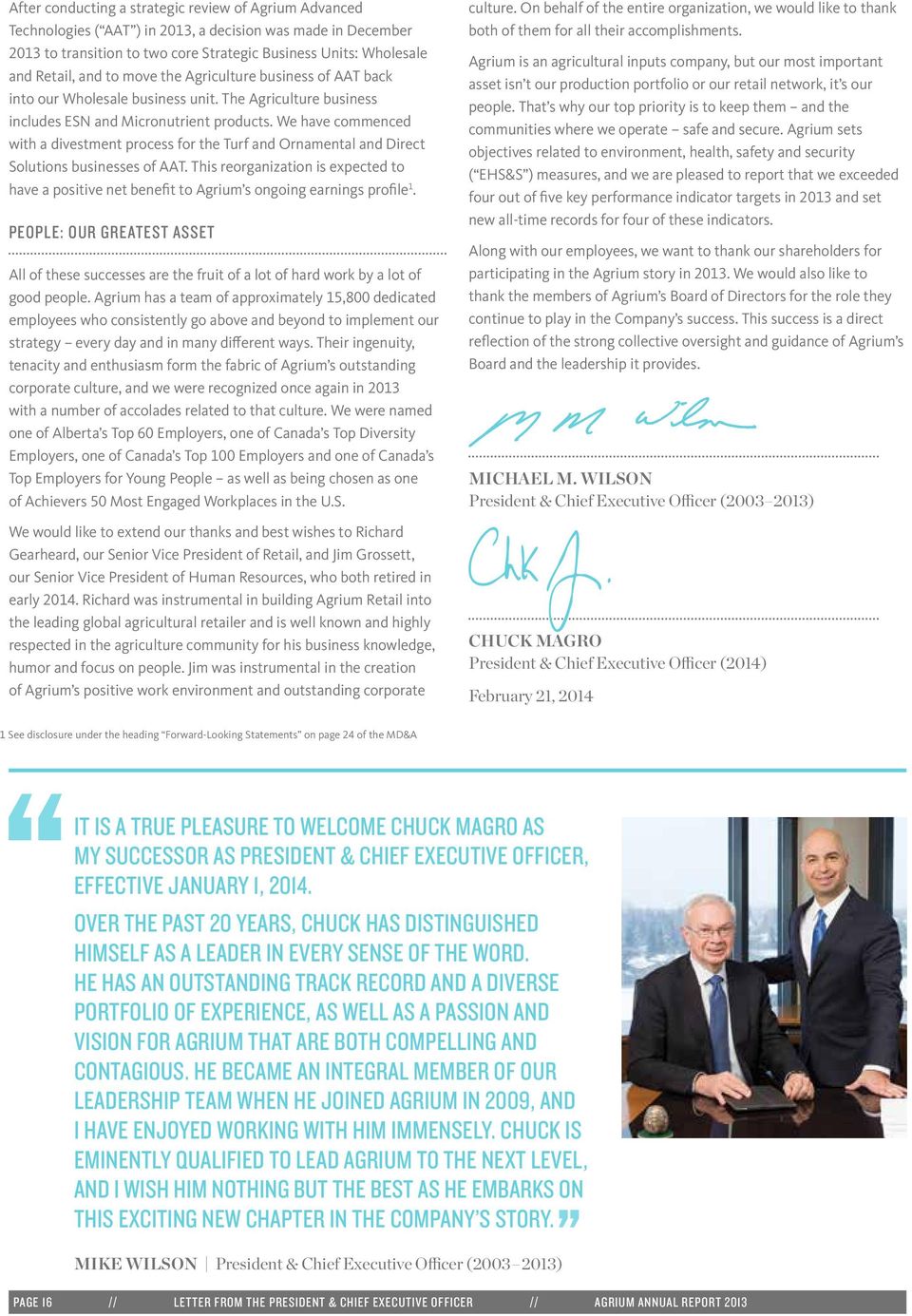
18 After conducting a strategic review of Agrium Advanced Technologies ( AAT ) in 2013, a decision was made in December 2013 to transition to two core Strategic Business Units: Wholesale and Retail, and to move the Agriculture business of AAT back into our Wholesale business unit. The Agriculture business includes ESN and Micronutrient products. We have commenced with a divestment process for the Turf and Ornamental and Direct Solutions businesses of AAT. This reorganization is expected to have a positive net benefit to Agrium s ongoing earnings profile 1. PEOPLE: OUR GREATEST ASSET All of these successes are the fruit of a lot of hard work by a lot of good people. Agrium has a team of approximately 15,800 dedicated employees who consistently go above and beyond to implement our strategy every day and in many different ways. Their ingenuity, tenacity and enthusiasm form the fabric of Agrium s outstanding corporate culture, and we were recognized once again in 2013 with a number of accolades related to that culture. We were named one of Alberta s Top 60 Employers, one of Canada s Top Diversity Employers, one of Canada s Top 100 Employers and one of Canada s Top Employers for Young People as well as being chosen as one of Achievers 50 Most Engaged Workplaces in the U.S. We would like to extend our thanks and best wishes to Richard Gearheard, our Senior Vice President of Retail, and Jim Grossett, our Senior Vice President of Human Resources, who both retired in early Richard was instrumental in building Agrium Retail into the leading global agricultural retailer and is well known and highly respected in the agriculture community for his business knowledge, humor and focus on people. Jim was instrumental in the creation of Agrium s positive work environment and outstanding corporate culture. On behalf of the entire organization, we would like to thank both of them for all their accomplishments. Agrium is an agricultural inputs company, but our most important asset isn t our production portfolio or our retail network, it s our people. That s why our top priority is to keep them and the communities where we operate safe and secure. Agrium sets objectives related to environment, health, safety and security ( EHS&S ) measures, and we are pleased to report that we exceeded four out of five key performance indicator targets in 2013 and set new all-time records for four of these indicators. Along with our employees, we want to thank our shareholders for participating in the Agrium story in We would also like to thank the members of Agrium s Board of Directors for the role they continue to play in the Company s success. This success is a direct reflection of the strong collective oversight and guidance of Agrium s Board and the leadership it provides. MICHAEL M. WILSON President & Chief Executive Officer ( ) CHUCK MAGRO President & Chief Executive Officer (2014) February 21, See disclosure under the heading Forward-Looking Statements on page 24 of the MD&A IT IS A TRUE PLEASURE TO WELCOME CHUCK MAGRO AS MY SUCCESSOR AS PRESIDENT & CHIEF EXECUTIVE OFFICER, EFFECTIVE JANUARY 1, OVER THE PAST 20 YEARS, CHUCK HAS DISTINGUISHED HIMSELF AS A LEADER IN EVERY SENSE OF THE WORD. HE HAS AN OUTSTANDING TRACK RECORD AND A DIVERSE PORTFOLIO OF EXPERIENCE, AS WELL AS A PASSION AND VISION FOR AGRIUM THAT ARE BOTH COMPELLING AND CONTAGIOUS. HE BECAME AN INTEGRAL MEMBER OF OUR LEADERSHIP TEAM WHEN HE JOINED AGRIUM IN 2009, AND I HAVE ENJOYED WORKING WITH HIM IMMENSELY. CHUCK IS EMINENTLY QUALIFIED TO LEAD AGRIUM TO THE NEXT LEVEL, AND I WISH HIM NOTHING BUT THE BEST AS HE EMBARKS ON THIS EXCITING NEW CHAPTER IN THE COMPANY S STORY. MIKE WILSON President & Chief Executive Officer ( ) PAGE 16 // LETTER FROM THE PRESIDENT & CHIEF EXECUTIVE OFFICER // AGRIUM ANNUAL REPORT 2013
19 Q & A WITH CHUCK MAGRO Some of the most frequent questions Chuck Magro has been asked since becoming President and CEO of Agrium include the following: Q: WHAT WILL BE YOUR FOCUS AS THE NEW CEO OF AGRIUM? A: My first priority will be to maintain and nurture our strong corporate culture; it is one of the few true key competitive advantages a company can develop. Secondly, we need to continue to focus on getting more from what we already have, through Operational Excellence, and thirdly, continuing to grow in a smart and measured way. Q: WHERE DO YOU SEE THE COMPANY IN FIVE YEARS? A: I think Agrium five years from now will look a lot like Agrium today except bigger and more international. We will continue to have a Retail-Wholesale balance, because we think it adds a lot of value over the agricultural cycle. The expansion projects in today s portfolio will be finished, so we will be a bigger company with more capacity, generating a tremendous amount of free cash flow. We will have met our current targets for Retail and set new higher targets, with a continued focus on private label retail products, continuing to grow the seed business and a focus on growing our precision agriculture product offering. We ll likely have more of a presence in the international hubs where we ve introduced ourselves over the past several years. Overall, we re going to further leverage our proven strengths, and in turn, all of this will drive higher returns for our shareholders through higher earnings and dividend growth. We re an agricultural inputs company, so we will continue to follow our mission and strive to be the global leader across the agricultural crop input value chain 1. Q: CAN YOU EXPAND ON WHAT OPERATIONAL EXCELLENCE MEANS FOR AGRIUM? A: Operational Excellence is about taking a fresh look at the way we do things, clarifying what are truly key priorities and dedicating resources accordingly. It s a focus on improving efficiencies, doing more with what we have and controlling what we can control. It includes initiatives like getting higher asset utilization rates and higher net realized selling prices, managing costs appropriately, taking care of the base business and driving for continuous improvement throughout the entire business. Operational Excellence will help ensure we are both improving our existing businesses and maximizing the value of our current and future growth initiatives. For example, Wholesale has recently introduced the Lean Six Sigma program as part of its continuous improvement program and is focused on improving performance on key environmental and safety metrics, raw material consumption efficiencies, cost management and plant reliability. The better our plants run, the more efficient they are, the safer they are for our employees, and the more competitive Agrium will be. Another example is Retail s performance targets covering all key aspects of the business, from working capital to growth. We expect to achieve these targets by continuing to improve all aspects of our business, including the optimization of our Retail branch system. AGRIUM ANNUAL REPORT 2013 // LETTER FROM THE PRESIDENT & CHIEF EXECUTIVE OFFICER // PAGE 17

20 LETTER FROM THE BOARD CHAIR 2013 was a busy year for Agrium and its Board of Directors. We oversaw the continued success and growth of your Company, completed the acquisition of Viterra s retail Agri-products business, increased the dividend by 50 percent, welcomed two new highly qualified Board members, and oversaw the seamless transition to a new and highly capable CEO. I would like to start by acknowledging Mike Wilson s outstanding service to your Company and extend the Board s heartfelt appreciation for his leadership, dedication and many contributions to Agrium s success. Since joining Agrium in 2000, Mike has worked tirelessly to pursue a highly successful vision of integrated growth, and has skillfully guided the Company through several challenging agricultural cycles. Under his leadership, Agrium reached new highs in terms of earnings and company valuation. Mike will continue to serve on the Board of Directors through to May 2014, and we appreciate that as well. It is a testament to the strength of Agrium s management team that there were several strong internal candidates to take over the CEO role. Following a very thorough evaluation of both internal and external candidates, the Board appointed Chuck Magro as Agrium s President & Chief Executive Officer. We have worked with Chuck in senior leadership roles over the past several years and have great confidence in his ability to take the Company forward. I would also like to acknowledge the invaluable contributions Frank W. Proto has made in his 21 years on Agrium s Board, much of that time spent as the Board Chair. Frank will retire from the Board in 2014 and there is no doubt that his thoughtful guidance and insights have been instrumental to the long-term success and growth of the Company. No review of 2013 would be complete without discussing the significant challenge Agrium faced from an activist shareholder who questioned the integrated structure of your Company. This was a long and difficult process, but it was also a rigorous test of Agrium s strategy, governance and vision, and we came away from it an even stronger company, with greater conviction in the course we have set. We want to thank our shareholders for their commitment during this campaign and for ultimately supporting our strategy. We also took some important insights from this proxy contest and put them to work. Shareholders told us they saw benefit in adding more retail experience to the Board, and so we did. With the addition of David Everitt and Mayo Schmidt, who both joined the Board in February 2013, we added two new directors with excellent industry-specific experience and expertise. Mr. Everitt brings with him excellent agricultural, retail, distribution and engineering experience after serving as president of Deere and Company s Agriculture and Turf division for over a decade. Mr. Schmidt has deep industry knowledge in agriculture, retail, distribution and crop inputs following his career as the CEO of Viterra. Your Board and senior leadership team have also enhanced disclosure for our Retail business unit and established stronger alignment between management compensation and Agrium s key performance PAGE 18 // LETTER FROM THE BOARD CHAIR // AGRIUM ANNUAL REPORT 2013
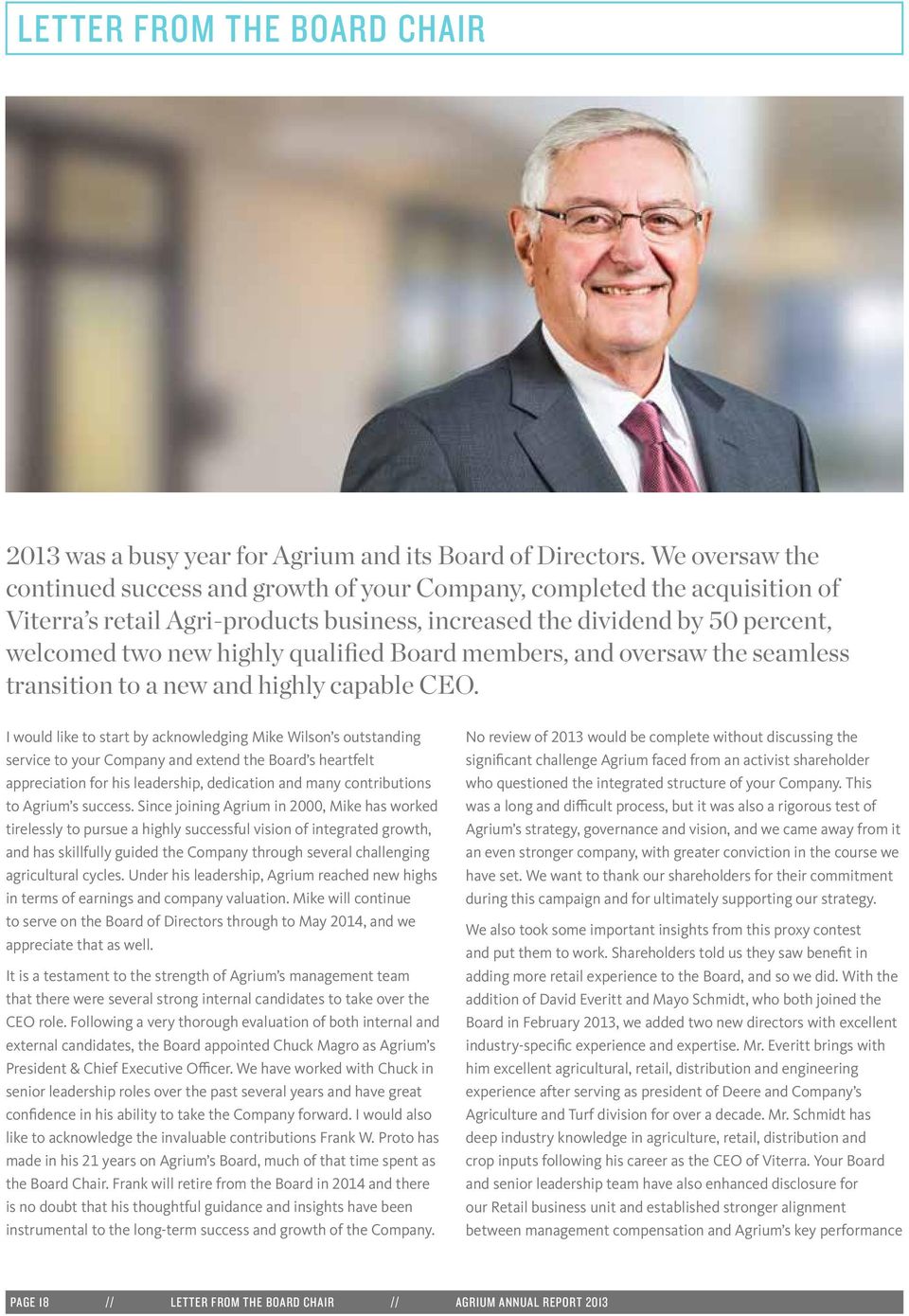
21 metrics. Please take the time to read this year s Management Proxy Circular for the full disclosure of our metric-based management compensation program. I am very proud to be a member of a Board of Directors that continually demonstrates its commitment, insight, and thorough, thoughtful review of Company matters. Our role is to provide oversight and advice to management in its efforts to execute Agrium s strategic targets, and to ensure that management is acting in the best interests of shareholders and other stakeholders. In this regard, the Board of Directors was very pleased to approve a significant dividend increase during 2013, bringing our annualized dividend to $3.00 per share. We also approved a significant share repurchase program in These returns of capital are made possible because of Agrium s stability of earnings and countercyclical cash flow, a direct result of our integrated strategy, global diversification and the scale to achieve substantial efficiencies. We are pleased with the capital allocation policy that we put in place in 2013 and are confident it will serve shareholders well. We will continue to grow our earnings by optimizing our existing assets, and we have a strong pipeline of growth projects that meet or exceed our return hurdles to do just that. At the same time, we are committed to retaining enough capital on our balance sheet to sustain operations in a safe and appropriate manner, as well as pursue strategic growth opportunities as they become available. That being said, as our new policy makes clear, we are also committed to returning capital to shareholders when it cannot be put to use to generate higher returns for our shareholders. Agrium is a company with incredible purpose. Every day, our employees work tirelessly to provide the essential ingredients required by today s agriculture industry. This is a critically important service for the world, as a growing global population requires more food from a limited amount of arable land. Agrium s Board is proud of the Company s role in providing the crop inputs required to meet the growing needs of the world s food producers, while maintaining very high environmental, social responsibility and safety standards in the communities in which we operate. The members of the Board are excited about the future of your Company, and look forward to continuing to see the Company execute its growth strategy as well as increase capital returns to shareholders, as we grow the business in order to bring substantial value to all of our stakeholders. VICTOR ZALESCHUK Board Chair February 21, 2014 I AM VERY PROUD TO BE A MEMBER OF A BOARD OF DIRECTORS THAT CONTINUALLY DEMONSTRATES ITS COMMITMENT, INSIGHT, AND THOROUGH, THOUGHTFUL REVIEW OF COMPANY MATTERS. VICTOR ZALESCHUK Board Chair AGRIUM ANNUAL REPORT 2013 // LETTER FROM THE BOARD CHAIR // PAGE 19
22 REVIEW OF 2013 GOALS/RESULTS & PRIORITIES FOR 2014 A key component of Agrium s strategic planning process is to identify, execute and measure our success against our corporate goals. These key priorities provide a clear focus for the organization regarding such important measures as financial results, capital allocation and returns, operational excellence, major projects and acquisitions, as well as environmental and safety practices. CLOSE THE VITERRA ACQUISITION IN THE FIRST HALF OF 2013 AND DEVELOP AND IMPLEMENT AN EFFECTIVE INTEGRATION PLAN FOR VITERRA S RETAIL AGRI-PRODUCTS BUSINESS, INCLUDING IDENTIFYING AND CAPTURING SYNERGIES. Achieved Agrium completed the Viterra acquisition on October 1, 2013, as the regulatory review period was slightly longer than expected. The Viterra acquisition included over 200 locations in Western Canada and a number of distribution assets in Australia. Also included in this transaction was Viterra s research and development platform for seed and an affiliated retail fuel business. We expect to achieve historical EBITDA of approximately $75-million to $90-million in the first year and are targeting synergies of approximately $15-million to $20-million by the end of Agrium expects to achieve these synergies by bringing our strengths in proprietary crop protection, purchasing scale and centralization of services to these valuable Canadian retail locations. Integration of these locations started in the fourth quarter of 2013 and has been proceeding well. In the fourth quarter of 2013, Agrium reported a $257-million purchase gain, representing the difference between the fair value of acquired net assets and the purchase price, another indication of the excellent value of this transaction. MAINTAIN OUR INVESTMENT GRADE CREDIT RATING AND CONTINUE TO RETURN CAPITAL TO SHAREHOLDERS. Achieved Agrium maintained its investment grade rating, completed a major acquisition and other growth initiatives, added $1-billion of long-term debt to support growth and also made significant returns of capital to shareholders in Agrium increased its dividend by 50 percent, raising the annual payment to $3.00 per share from $2.00 per share. At the same time, we delivered on another share buy-back, purchasing 5.8 million shares for cancellation at an average price of $86 per share for a total value of $498-million. In 2013, meaningful capital returns to shareholders were a priority and going forward we will continue to target returning 25 percent to 35 percent of free cash flow to our shareholders through dividends as our organization continues to grow 1. DEVELOP ANY APPROVED NITROGEN EXPANSION PROJECTS ON TIME AND ON BUDGET. THIS INCLUDES MAINTAINING THE 2014 TIME FRAME FOR THE SOUTH AMERICAN NITROGEN DEBOTTLENECK PROJECT AND PROGRESSING THE EXPANSION PLANS FOR OUR NORTH AMERICAN NITROGEN ASSET BASE. Achieved During 2013, Agrium continued to progress on several nitrogen projects and realigned priorities on others. We remained focused on the engineering and evaluation of the Borger, Texas brownfield expansion in 2013 which led to Board of Director approval in the first quarter of Construction has commenced on this project and is expected to add over 600,000 tonnes of urea to existing production at a cost of approximately $720-million 1. The debottleneck project at our Profertil nitrogen facility in Argentina is on schedule and is slated to be complete in the second half of 2014, providing approximately 125,000 tonnes of additional urea and 10,000 tonnes of net ammonia production with no additional natural gas input required 1. We are also evaluating whether a restart of the Kenai, Alaska nitrogen facility might be possible in the future, given the recent additional drilling in the Alaskan Cook Inlet. The Kenai facility was shut down in October 2007 due to a lack of natural gas in the region. COMPLETE ALL KEY ANALYSES REQUIRED TO DETERMINE IF OUR GREENFIELD NITROGEN PROJECT SHOULD PROCEED. Achieved Agrium s nitrogen greenfield project assessment continued in 2013 but due to the risk of cost escalation, the focus has shifted to finding a potential partner and long-term gas contract for the project. PROGRESS BROWNFIELD POTASH EXPANSION PROJECT AT THE VANSCOY FACILITY AND REMAIN WITHIN TIMELINES AND PROJECT BUDGET. Partially Achieved Our brownfield potash project, which is expected to add one million tonnes of incremental capacity, is on schedule and expected to be complete in the fourth quarter of The project is expected to be approximately 25 percent above the previous spending estimates due to labor shortages, contractor productivity and extreme winter conditions in Saskatchewan. We believe that the project remains financially viable even with sustained low potash prices. A highlight of the expansion project is the expectation that the cash cost per tonne for the entire mine is expected to decline by approximately 15 percent or $20 per tonne by PAGE 20 // GOALS & PRIORITIES // AGRIUM ANNUAL REPORT 2013
23 IMPLEMENT THE NECESSARY ACTIONS TO CAPTURE THE REMAINING PORTION OF AUD$40-MILLION IN SYNERGIES, AS WELL AS ADDITIONAL SYNERGIES OR BUSINESS IMPROVEMENTS AT OUR LANDMARK RETAIL OPERATIONS BY THE END OF Not Achieved In 2013, we recorded an impairment charge of $220-million, resulting from reduced expectations for sales, gross margins and long-term growth from our Retail Australia operations and in realizing the AUD $40-million of synergies identified prior to our acquisition in Total incremental synergies obtained by the end of 2013 were approximately $19-million and Agrium will continue to drive toward further improvements in Although synergies were achieved by reducing overhead expenses and increasing fertilizer margins, Landmark 2013 EBIT was $14-million lower than This decrease was primarily due to lower livestock export sales and decreased livestock prices which resulted in lower sales commissions. Landmark 2013 overhead expenses were $15-million lower than A further reduction of $10-million is expected to be achieved by 2015 with the final relocation of information technology and accounting services to our U.S. office 1. Several Loveland proprietary crop protection registrations were received in Australia in 2013 and more are expected in CONTINUE TO GROW AND OPTIMIZE OUR RETAIL BUSINESS ON A VARIETY OF FRONTS IN ORDER TO REACH OUR TARGETED EBITDA OF $1.3-BILLION AND OTHER ASSOCIATED FINANCIAL TARGETS BY Achieved Our Retail business unit delivered on this goal on several fronts in Retail delivered another record EBITDA in 2013, despite numerous industry challenges such as significantly lower nutrient prices and much shorter spring and fall application seasons in the U.S. Earnings in 2014 will get a boost from the Viterra acquisition, which closed in October 2013, and from ongoing improvements in our Retail Australia operations. Organic growth was achieved this year with gross profit from proprietary seed and crop protection products increasing by 21 percent and 9 percent, respectively. During the year, we continued to acquire independent retail businesses at attractive multiples and leverage efficiencies through our existing structure by optimizing the number and locations of farm centers. ASSIST MOPCO IN RECOMMENCING THE CONSTRUCTION PROJECTS AT THE EGYPTIAN NITROGEN FACILITY IN ORDER TO TRIPLE PRODUCTION CAPACITY. Not Achieved The construction project to triple capacity at the site, which has been on hold for over two years due to political instability and civil unrest, was not able to recommence this year. Agrium senior leadership staff held several meetings with Egyptian government leaders in 2013 to evaluate a potential restart of the expansion project. There was a positive development in late 2013, with the Egyptian government issuing a decree supporting the recommencement of construction and at this time MOPCO is on-site and assessing the plant condition in the anticipation of a restart of construction. However, it is too early to say whether the project will be successfully completed. Agrium will continue to actively evaluate the situation in order to bring a positive resolution to the issue 1. The existing MOPCO facility in Egypt produced at relatively high levels in 2013 (~94 percent of operating capacity). ACTIVELY EVALUATE NEW ESN SITES IN THE U.S. CORN BELT. Not Achieved We undertook a strategic review of Agrium Advanced Technologies in 2013, which resulted in a decision to transition the ESN and Micronutrient products back to the Wholesale business unit and we have commenced with a divestment process for the Turf and Ornamental and Direct Solutions businesses. This was done to take advantage of Wholesale s strengths in distribution and manufacturing, and is expected to provide a net improvement to our financial results. No additional ESN capacity was built in However, we did achieve a 20 percent increase in sales volumes this year due to the continuing strength of demand for this product, given the yield advantage it presents and its environmentally-friendly attributes 2. IDENTIFY AND IMPLEMENT AREAS FOR CONTINUOUS IMPROVEMENT IN AGRIUM S EHS&S PERFORMANCE AND GOVERNANCE. Achieved The safety of our employees, the environment and the communities in which we operate is always at the forefront of all our decisions. Our ultimate goal is to have zero incidents in this regard, and every year we continue to show improvement. In 2013, we continued to improve results in all of our consolidated EHS&S key performance indicators. We set new records for key performance indicators associated with Total Recordable Injuries ( TRI ), which we improved by 17 percent, Lost Time Injury ( LTI ), which improved by 11 percent, Contractor TRI ( CTRI ), which we improved by 47 percent, and Environmental Incident Rates ( EIR ), which was 18 percent lower than in Since 2008, Agrium has improved both TRI and LTI by more than 30 percent and EIR by over 60 percent. These results demonstrate our commitment to our employees, contractors and other stakeholders. Our EHS&S key performance indicators represent the consolidation of the individual business units metrics. Our Wholesale business unit continues to achieve industryleading results for LTI and TRI metrics. The Retail business unit is fostering a safety focus among its employees on a daily basis, and their achievements have been impressive, as they have lowered their LTI and TRI metrics by more than 40 percent since 2007, when we started our focused growth of Retail. 1 See disclosure under the heading, Forward-Looking Statements on page 24 of the MD&A. 2 Results in the MD&A represent only the Agriculture business. See Agrium Advanced Technologies Key Developments on page 52. AGRIUM ANNUAL REPORT 2013 // GOALS & PRIORITIES // PAGE 21
24 OUR KEY PRIORITIES IN 2014 SAFETY: Identify and implement areas for continuous improvement in Agrium s EHS&S performance and governance. OPERATIONAL EXCELLENCE: Implement enhanced Operational Excellence programs, including a targeted $15-million improvement in Wholesale net returns in 2014 through the implementation of a Lean Six Sigma efficiency program and the completion of an entity-wide program to optimize shared services. Continue to optimize our Retail business in order to reach our stated EBITDA target of $1.3-billion as well as other associated financial metric targets (ROCE, Working capital as a percentage of sales, and Operating coverage ratio reduction, etc.) by the end of NITROGEN EXPANSIONS: Progress our nitrogen projects, including our Borger, Texas facility expansion and Profertil nitrogen debottleneck projects. Assist MOPCO in an evaluation of a potential recommencement of the construction project to triple capacity at the Egyptian nitrogen facility. Continue to evaluate a potential restart of our Kenai, Alaska facility and potential partner and gas contract for the greenfield nitrogen project 1. POTASH EXPANSION: Bring our brownfield potash expansion at the Vanscoy facility to completion by the end of 2014 and contain capital cost escalation 1. RETAIL SYNERGIES: Effectively integrate the recently acquired Viterra retail Agri-products business in 2014, including laying the foundation for achieving at least $15-million in synergies from this acquisition by the end of Demonstrate progress in achieving the remaining portion of AUD $40-million in synergies from our Landmark Retail operations by the end of AAT RESTRUCTURE: Successfully transition AAT s ESN and Micronutrient products back to the Wholesale business unit and complete the divestiture of the Turf and Ornamental and Direct Solutions businesses in Achieve at least $10-million in ongoing annual net increase in EBITDA from this initiative 1. 1 See disclosure under the heading, Forward-Looking Statements on page 24 of the MD&A. PAGE 22 // GOALS & PRIORITIES // AGRIUM ANNUAL REPORT 2013
25 MANAGEMENT S DISCUSSION AND ANALYSIS FEBRUARY 21, 2014 TABLE OF CONTENTS 24 Forward-Looking Statements 27 Executive Summary Yielding Results from our Integrated Business 28 Retail 38 Wholesale 52 Advanced Technologies 53 Other 54 Agricultural Crop Input Overview & 2014 Outlook 58 Key Business Metrics 60 Consolidated Performance 64 Quarterly Results of Operations 65 Financial Condition 68 Liquidity and Capital Resources 70 Debt Instruments, Capital Management and Ratings 73 Business Acquisitions 73 Outstanding Share Data 73 Off-Balance Sheet Arrangements 73 Financial Instruments 74 Enterprise Risk Management 77 Controls and Procedures 78 Contingent Liabilities 78 Environmental Protection Requirements 82 Accounting Estimates 83 Additional IFRS and Non-IFRS Financial Measures Fourth Quarter Management s Discussion and Analysis 90 Key Assumptions and Risks in Respect of Forward-Looking Statements AGRIUM ANNUAL REPORT 2013 // MANAGEMENT S DISCUSSION AND ANALYSIS // PAGE 23
26 This Management s Discussion and Analysis ( MD&A ) of operations and financial condition focuses on Agrium s long-term vision, strategy and growth opportunities as well as its historical performance for the two years ended December 31, The board of directors of Agrium (the Board of Directors ) carries out its responsibility for review of this disclosure and, prior to publication, approves this disclosure. In reviewing this disclosure, the reader should consider the cautionary notes regarding forward-looking statements contained in this MD&A (page 90) and the Consolidated Financial Statements and related notes (pages 92 to 150). Throughout this MD&A, unless otherwise specified, Agrium, the Company, we, our, us and similar expressions refer collectively to Agrium Inc. and its subsidiaries, any partnerships involving Agrium Inc. or any of its subsidiaries, its significant equity investments and Agrium Inc. s share of its joint ventures. The Company s consolidated quarterly and annual financial information and its Annual Information Form for the year ended December 31, 2013 ( AIF ) are available under Agrium s corporate profile on SEDAR ( The Company s reports are also filed with the United States ( U.S. ) Securities and Exchange Commission on EDGAR ( All dollar amounts refer to U.S. dollars, except where otherwise stated and 2012 financial information presented and discussed in this MD&A is prepared in accordance with International Financial Reporting Standards ( IFRS ) as issued by the International Accounting Standards Board ( IASB ). We have restated 2012 comparative figures as a result of adopting IFRS 11 Joint Arrangements whereby the classification and accounting of our investment in Profertil S.A. ( Profertil ) and other joint arrangements previously accounted for using the proportionate consolidation method are accounted for using the equity method. As a result of management intending to sell components of the Advanced Technologies business unit that were not transitioned to Wholesale. We have classified these net assets as held for sale and have classified the related results of operations (including comparative 2012 results) as discontinued and prior years have not been restated. See notes 3 and 5 of the Notes to the Consolidated Financial Statements for further details. FORWARD-LOOKING STATEMENTS Certain statements and other information included in this MD&A constitute forward-looking information and financial outlook within the meaning of applicable Canadian securities legislation or forward-looking statements within the meaning of applicable U.S. securities legislation (collectively herein referred to as forward-looking statements ), including the safe harbour provisions of provincial securities legislation and the U.S. Private Securities Litigation Reform Act of 1995, Section 21E of the U.S. Securities Exchange Act of 1934, as amended, and Section 27A of the U.S. Securities Act of 1933, as amended. Forward-looking statements are typically identified by the words believe, expect, anticipate, project, intend, estimate, outlook, focus, potential, will, should, would, could and other similar expressions. Forward-looking statements in this MD&A are intended to provide Agrium shareholders and potential investors with information regarding Agrium, including management s assessment of future financial and operational plans and outlook, and may not be appropriate for other purposes. These forward-looking statements include, but are not limited to, references to: our ability to continue PAGE 24 // MANAGEMENT S DISCUSSION AND ANALYSIS // AGRIUM ANNUAL REPORT 2013
27 delivering value to all of our stakeholders; our adaptability to fluctuating market conditions; disclosures made under the heading Agricultural Crop Input Overview & 2014 Outlook ; our 2014 key corporate goals, including expansion and growth of our business and operations; our core business strategies and plans for implementing them; estimates, forecasts and statements as to management s expectations with respect to, among other things, business, growth, demand and financial prospects, financial multiples and accretion estimates, future trends, plans and objectives; key drivers for our business and global and regional industry trends; the potential for continued growth in our two business units; estimates, forecasts and statements as to management s expectations with respect to our expansion projects, including, among others, our Vanscoy brownfield potash expansion project, our Borger brownfield expansion project, our nitrogen facility expansion project in Egypt and our brownfield expansion and efficiency project at the Profertil nitrogen facility in Argentina, and the impact of such expansion projects on Agrium s operations; additional brownfield opportunities and greenfield expansions under evaluation, including the potential restart of our Kenai nitrogen facility in Alaska; our agreement for the long-term supply of phosphate rock and the utility of Agrium s newly constructed import terminal on the West Coast of Canada; expectations respecting the acquisition of the majority of Viterra Inc. s retail Agri-products assets (the Viterra acquisition ) (as defined herein), including, among others, with respect to the final purchase price and adjustments, anticipated benefits thereof and magnitude of synergies therefrom; reserves and resource estimates relating to Agrium s potash operations, including mine life estimates; future capital expenditures, including sustaining capital and investing capital, and capital resources; future cash requirements and long-term obligations; our expectations respecting financing of announced projects through cash provided from operating activities, existing lines of credit and funds available from new debt or equity securities offerings; anticipated tax rates; asset retirement obligations; future crop input sales and prices; availability of raw materials; risk mitigation activities; remediation and tailings management activities; the anticipated impact of emissions legislation and the implementation of emissions reduction protocols; Agrium s emissions and emissions management activities and anticipated compliance costs; environmental and civil liabilities, including the anticipated resolution of certain legal and regulatory proceedings and the effect of such proceedings on our business; our assumptions and critical estimates in applying accounting policies; and our recently completed and proposed future acquisitions and dispositions, including the strategic dissolution of our Advanced Technologies business unit; integration plans in respect of completed and future acquisitions, any expected synergies therefrom and benefits thereof. These forward-looking statements are based on certain assumptions and analyses made by management in light of our experience and perception of historical trends, current conditions and expected future developments, as well as other factors believed to be appropriate in the circumstances. Readers are cautioned not to place undue reliance on the forward-looking statements as such, by their nature, are subject to various known and unknown material risks and uncertainties that may cause our actual results, performance or achievements to be materially different from any future results, performance or achievements expressed or implied by such forward-looking statements. Please refer to the discussion under the heading Key Assumptions and Risks in Respect of Forward-Looking Statements with respect to the material assumptions and risks associated with the forward-looking statements. Additional risks and uncertainties that may affect all forward-looking information included in this MD&A include, but are not limited to, the following: u changes in general economic, market, business and weather conditions, including global agricultural supply/demand factors and crop price levels; fluctuations in global and regional supply/ demand factors impacting the crop input application season and the price of crop nutrients and raw materials/feedstock; global economic and market conditions affecting availability of credit and access to capital markets; build-up of inventories in distribution channels; and shortage of labor supply; u changes in government policies and legislation and regulation, or the interpretation, administration and enforcement thereof, in the jurisdictions in which we operate, regarding, among others, agriculture and crop input prices, safety, production processes, environment and greenhouse gas; u actions by competitors and others that include changes to industry capacity, utilization rates and product pricing; failure of customers, suppliers and counterparties to financial instruments to perform their respective obligations thereunder; potential for expansion plans to be delayed; restrictions on our ability to transport or deliver our products to markets, including potential changes to anti-trust laws, or interpretations thereof, that could negatively impact our international marketing operations through our one-third interest in Canpotex (as defined herein), the offshore marketing agency for potash produced by us in Saskatchewan and the two other major potash producers in Canada; and other uncertainties in the potash market due primarily to the break-up of the BPC (as defined herein) potash marketing organization; AGRIUM ANNUAL REPORT 2013 // MANAGEMENT S DISCUSSION AND ANALYSIS // PAGE 25
28 u changes in margins and/or levels of supplier rebates for major crop inputs, such as crop protection products, nutrients and seed, as well as crop input prices declining below cost of inventory between the time of purchase and sales; u general operating risks associated with investment in foreign jurisdictions; the level and effectiveness of future capital expenditures; decline in performance of existing capital assets; and unfavorable fluctuations in foreign exchange and tax rates in the jurisdictions in which we operate; u future operating rates, production costs and sustaining capital of our facilities; unexpected costs from present and discontinued mining operations and/or labor disruptions; the inherent risks associated with our mining operations; inaccuracies in reserve and resource estimates; changes to timing, construction cost and performance of other parties in respect of new facilities, including the Argentine Profertil nitrogen facility; and risks associated with civil unrest in Egypt and the impact on our interest in the Egyptian Misr Fertilizers Production Company S.A.E. facility ( MOPCO ), including the risk that MOPCO may not be allowed to proceed with the completion of the new facilities; u changes in development plans for our expansion, efficiency, debottleneck and other major projects, including the potential for capital construction costs to be higher than expected or construction progress to be delayed due to various factors, including shortage of equipment and labor, the inadequate performance of other parties, risks associated with technology or inflationary pressure; u environmental, health, safety and security risks typical of those found throughout the agriculture, mining and chemical manufacturing sectors and the crop inputs supply chain, including risk of injury to employees, contractors or members of the public, and possible environmental contamination; and risks associated with the transportation, storage and use of chemicals and the security of our facilities and personnel; u integration risks that might cause anticipated synergies from our recent (including those described in this MD&A) and future acquisitions to be less than expected, including the acquired business actual results being different than those upon which we based our expectations, and industry factors which may affect us and the acquired business in general and thereby impact the demand for our products and services; and u various strategic risks, including our ability to effectively implement our business strategy and our risk mitigation strategies, including hedging and insurance; our ability to complete proposed acquisitions and dispositions as anticipated, including the strategic dissolution of our Advanced Technologies business unit; our ability to integrate and achieve synergies from any recent or proposed acquisitions within expected time frames; specifically, there are risks associated with the Viterra acquisition, including potential liabilities associated with the assets acquired by Agrium and the introduction of technologies in the agricultural industry that may be disruptive to our business. The above items and their possible impact are discussed more fully in the relevant parts of this MD&A, including the sections headed Key Business Risks, Key Business Metrics and Enterprise Risk Management and in our AIF. Additional information on the foregoing and other risk factors is also detailed from time to time in the reports filed by Agrium as part of our continuous disclosure on SEDAR and EDGAR. In addition to the foregoing, all of the forward-looking statements contained in this MD&A are qualified by the cautionary statements contained herein and by stated or inherent assumptions and apply only as of the date of this MD&A. Except as required by law, Agrium disclaims any intention or obligation to update or revise any forward-looking statements as a result of new information or future events. PAGE 26 // MANAGEMENT S DISCUSSION AND ANALYSIS // AGRIUM ANNUAL REPORT 2013
29 EXECUTIVE SUMMARY YIELDING RESULTS FROM OUR INTEGRATED BUSINESS 2013 IN REVIEW Agrium s business spans the crop input value chain, as we produce and distribute nutrients, seed and crop protection products and services to growers. We are among the largest producers of the three major crop nutrients nitrogen, phosphate and potash in the world and the largest global agricultural retailer. This combination of earnings streams proved itself in 2013, a year when disruptions in the global nutrient markets caused significant volatility of earnings in the fertilizer industry. Throughout this time, our Retail business unit has performed steadily, continuing to meet growers needs every day. North America experienced a comparatively wet and late spring in 2013, which delayed seeding and subsequently pushed the agricultural input cycle later throughout the year. Despite these challenges, crop yields were impressive across the U.S., and Canada saw a record harvest in 2013, setting expectations for strong crop input demand in In 2013, we continued to expand our business with the acquisition of certain retail Agri-products assets from Viterra Inc. (the Viterra acquisition ). Agrium acquired over 200 retail locations in Western Canada, and several locations in Australia. Agrium is now the largest agricultural input retailer in Canada, complementing our leading position in the U.S., Australia and South America. During the year, significant progress was made on work at the Vanscoy potash mine expansion, and Agrium continues to evaluate other growth opportunities. Global supply and demand imbalances in the nitrogen, potash and phosphate markets led to a year of lower crop nutrient pricing. However, we believe long-term demand fundamentals are strongly in favor of Agrium s business. Every day, the global population grows, and with it the need for more food. Agrium is, and will continue to be, a critical link in the production chain to feed the world. The Company also significantly increased its dividend in 2013 to its current level of $3.00 per share annually. This was in addition to the implementation of our Normal Course Issuer Bid in 2013, pursuant to which we purchased 5.8 million shares at an average price of USD$86 for a total consideration of $498-million CONSOLIDATED AND BUSINESS UNIT FINANCIAL PERFORMANCE In 2013, Agrium s net earnings from continuing operations were $1.1-billion, compared to $1.5-billion in Our 2013 EBITDA 1 fell to $2.1-billion, from $2.6-billion in Our Retail business unit achieved EBITDA of $986-million in 2013, which includes Viterra for three months of operation, a $257-million one-time purchase gain from the Viterra acquisition and a $220-million goodwill impairment for the Retail Australia operations. Integration costs from the Viterra acquisition in the fourth quarter of 2013 were $8-million. Excluding these three one-time items, Retail s 2013 EBITDA was a record $957-million, compared to the previous record of $951-million reported in The increase was a result of the increasing balance across our input product lines (which can be seen in the sales growth across the seed category) and our continued focus on growth of our proprietary products (primarily Loveland Products ( Loveland ) and Dyna-Gro, which are expected to be further enhanced with the Viterra canola varieties). Our Wholesale business unit achieved Adjusted EBITDA 1 of $1.3-billion in 2013, compared to $1.9-billion in 2012, reflecting lower nutrient prices and lower nitrogen production volumes due to the extended outages at our Redwater and Carseland facilities. Our Agrium Advanced Technologies ( AAT ) business unit produced EBITDA of $30-million in 2013, with the impact of lower nutrient prices offsetting higher demand for Environmentally Smart Nitrogen ( ESN ), compared to $58-million in Following a strategic review process, Agrium decided to dissolve the AAT business unit. The Agriculture business, which includes the ESN and Micronutrient products, will now be incorporated into Wholesale, and Management intends to sell the Turf and Ornamental and Direct Solutions businesses. These businesses have been reported within discontinued operations. ADJUSTED EBITDA BY BUSINESS UNIT* (MILLIONS OF USD) $3,000 $2,500 $2,000 $1,500 $1,000 $2,686 $2,156 $951 $986 $1,940 $1,286 $500 $0 TOTAL RETAIL WHOLESALE * 2013 AAT EBITDA is $30-million, and 2012 AAT EBITDA was $58-million. Source: Agrium 1 Refer to Additional IFRS and Non-IFRS Financial Measures on page 83 of this MD&A. AGRIUM ANNUAL REPORT 2013 // MANAGEMENT S DISCUSSION AND ANALYSIS // PAGE 27
30 RETAIL Every day, Agrium s agricultural Retail business unit is focused on offering innovative crop input products and related services to our customers, including high-quality seed, crop nutrition, crop protection products and related agronomic and precision agriculture services. We are committed to being the leading provider of agricultural inputs and services in each of the key markets we serve. Retail is the largest global agricultural retailer, with close to 1,500 facilities spanning North America, Australia and much of South America. Retail works directly with growers to help them maximize the productivity of their farms through the implementation of the best crop management practices, based on a thorough understanding of soils, climate conditions and crop requirements. We provide innovative technologies, products and experience, backed by a commitment to sound environmental practices. Retail also provides application services for the products we sell, offering the latest precision agriculture equipment and standards to meet growers needs. In Australia, Retail also provides livestock marketing and auction services. Retail is focused on providing our customers with the products and services they need to grow the best crops possible. We do this farm by farm, one customer at a time, by leveraging our extensive expertise gained as a result of being in the business as part of Agrium or its predecessor companies for over 50 years and drawing on our global depth and reach. A core component of our Retail strategy is the focus we place on performance management, building on our strong grower relationships and the strength of our brands, including our proprietary Loveland crop protection and specialty nutrient products and Dyna-Gro seed. Serving customers in diverse markets requires a variety of marketing programs and we are able to effectively adapt to these different market conditions. We provide a complete offering of products and agronomic services in order to achieve greater market penetration and customer loyalty. Additionally, we strive to build strong relationships with leading growers in each of our markets, allowing us to grow along with our customers. We leverage the scale of our Retail business to minimize costs, grow sales of our proprietary products and adopt new technologies to more effectively serve our customers. Through all of these efforts, we are committed to protecting the environment and the health and safety of our employees, customers and the communities in which we operate. PAGE 28 // MANAGEMENT S DISCUSSION AND ANALYSIS // AGRIUM ANNUAL REPORT 2013
31 CANADA NORTH AMERICA CANADA USA USA Loveland HAWAII Loveland HAWAII SOUTH AMERICA SOUTH AMERICA BRAZIL CROP PRODUCTION SERVICES CANADA (CPSC) ARGENTINA CROP PRODUCTION SERVICES (CPS) AUSTRALIA CROP PRODUCTION SERVICES CANADA (CPSC) CROP PRODUCTION SERVICES (CPS) URUGUAY AUSTRALIA CHILE CROP PRODUCTION SERVICES (CANADA) (CPS Canada) CROP PRODUCTION SERVICES (CPS U.S.) AGROSERVICIOS PAMPEANOS (ASP) AGROSERVICOS PAMPEANOS (ASP) HEAD OFFICE LANDMARK LOCATIONSHEAD OFFICE LANDMARK STATE OFFICE AGRIUM ANNUAL REPORT 2013 // MANAGEMENT S DISCUSSION AND ANALYSIS // PAGE 29
32 RETAIL KEY DEVELOPMENTS One of the major developments in 2013 was the Viterra acquisition. This transaction closed on October 1, 2013, and provided Retail with over 200 new retail branches across Western Canada, adding to the approximately 63 retail branches owned in the region prior to the Viterra acquisition. As part of the Viterra acquisition, we also acquired distribution assets in Australia. Total annual sales from the Viterra acquisition are estimated at approximately $1.7-billion. During 2013, a purchase gain of $257-million was recognized to reflect the difference between the fair value of acquired net assets and the purchase price. The final purchase price allocation is expected to be completed in This acquisition positions Agrium as the largest agricultural retailer in Canada. We expect synergies from the Viterra acquisition of at least $15-million annually by the end of 2015, primarily from economies of scale and by increasing the distribution of our proprietary crop protection, nutrient and seed products. The Viterra acquisition is also expected to offer potential synergy opportunities for Agrium s Wholesale business unit. In addition to the Viterra acquisition, we also completed a number of acquisitions of smaller independent retail operations in This included 20 facilities, representing annual sales of approximately $115-million. It also included a few specialty or vertical integration opportunities. One of these was our acquisition of Echelon AG Inc. ( Echelon ). Echelon is a provider of precision agriculture services utilizing state-of-the-art satellite imagery technology in conjunction with proprietary algorithms to identify optimal application rates for nutrients, seed and other inputs. Based in Western Canada, Echelon has been operating since 2007, and has been working with Crop Production Services, Inc. ( CPS U.S. ) and Crop Production Services (Canada) Inc. ( CPS Canada ) since 2010, to provide precision agriculture services to our grower customers in Alberta, Saskatchewan, Manitoba, North Dakota and Montana. Retail s Landmark business in Australia remains a focus for continued improvement and additional synergies in Specific key developments include the implementation of Retail s North American Information Technology systems in Australia and the licensing of additional Loveland products and Viterra canola in Australia, which are expected to enhance margins in that region. In the fourth quarter of 2013, we recorded the Viterra acquisition within Retail. This resulted in a $257-million purchase gain, representing the difference between the fair value of acquired net assets and the purchase price. During the quarter, we also recorded goodwill impairment in Retail Australia of $220-million due to synergy delays and reduced expectations for sales, gross margins and long-term growth. Our Retail business continues to focus on opportunities to organically grow our earnings, by increasing the sales in our seed business in general and our proprietary seed, specialty nutrient and chemical businesses in particular. We also continue to focus on the optimization of our network of facilities through further implementation of our hub and spoke model, which may include strategic store closures. During 2013, we consolidated 43 facilities across our distribution channel. PAGE 30 // MANAGEMENT S DISCUSSION AND ANALYSIS // AGRIUM ANNUAL REPORT 2013
33 RETAIL FINANCIAL RESULTS Retail sales reached $11.9-billion in 2013, compared to $11.5-billion in 2012, while gross profit rose to $2.6-billion from $2.5-billion in Total EBIT in 2013 was $748-million, which included the Viterra purchase gain, Viterra operating results in the fourth quarter (which included $8-million of integration costs) and the impairment of Retail Australia goodwill. Excluding the Viterra gain and integration costs and the Landmark impairment, EBIT was $719-milllion in 2013, compared to $757-million recorded in 2012, and EBITDA (excluding the same items) reached another historical record of $957-million in 2013, compared to $951-million in Retail s results this year were impacted by a comparatively late start to both the spring and fall application seasons in the U.S., particularly when compared to the very early and long spring and fall application seasons experienced in Normalized comparable store sales 1, which are normalized for changes in commodity nutrient prices, increased by 5 percent in 2013, compared to an 8 percent increase in Excluding the Viterra acquisition, all other acquisitions completed by the end of 2012 and in 2013 contributed approximately $400-million in addition to the comparable store base in sales. Depreciation and amortization expenses increased to $238-million in 2013, compared to $194-million in 2012, due to the Viterra acquisition and recent smaller acquisitions. Retail s increased sales in 2013 were offset by a corresponding increase in cost of product sold, which was $9.3-billion in 2013, compared to $9.0-billion in Total non-cash working capital was $2.1-billion at the end of 2013, which is approximately the same as the prior year. The Viterra acquisition added working capital requirements in the fourth quarter of 2013 in a relatively low sales quarter, which was offset by lower priced year-end nutrient inventory compared to As a result, average non-cash working capital as a percentage of sales was flat year-over-year at 20 percent RETAIL GROSS PROFIT (MILLIONS OF USD) 2013 RETAIL GROSS PROFIT: DIVERSIFIED MARKETS BY GEOGRAPHY (MILLIONS OF USD) Services and Other 16% $421 Crop Protection Products 38% $987 South America 3% $80 United States 77% $2,021 Australia 15% $381 Crop Nutrients 32% $839 Merchandise 4% $94 Seed 10% $274 Canada 5% $133 Source: Agrium Source: Agrium 1 Refer to Additional IFRS and Non-IFRS Financial Measures on page 83 of this MD&A. AGRIUM ANNUAL REPORT 2013 // MANAGEMENT S DISCUSSION AND ANALYSIS // PAGE 31
34 RETAIL EXPENSES Retail selling expenses increased by 11 percent to $1.8-billion in The majority of this variance was due to operating costs associated with recent acquisitions, including integration expenses for the Viterra acquisition of $8-million in the fourth quarter of 2013, partly due to severance costs. Total selling expense as a percentage of sales was 15.5 percent in 2013, an increase from the 14.5 percent recorded in Retail s operating coverage ratio also increased to 71 percent in 2013, up from 69 percent in 2012, primarily due to higher expenses from Viterra in the fourth quarter, which is a slower sales period for that business. In 2013, EBITDA (excluding the purchase gain of $257-million for the Viterra acquisition and the $220-million goodwill impairment of Landmark) as a percentage of sales was 8.0 percent, compared to 8.3 percent in This was partly due to the addition of Viterra s lower EBITDA margin business in the fourth quarter of RETAIL PERFORMANCE Years ended December 31, (millions of U.S. dollars, except as noted) Sales 11,913 11,479 Cost of product sold 9,298 9,001 Gross profit 2,615 2,478 Expenses Selling 1,847 1,669 General and administrative Earnings from associates and joint ventures (9) (9) Purchase gain (257) Goodwill impairment 220 Other income (50) (61) EBIT EBITDA EBITDA to sales (%) Operating coverage ratio (%) Comparable store sales (%) (2) 8 Normalized comparable store sales (%) 5 8 Average non-cash working capital to sales (%) CROP NUTRIENTS: PRODUCTS AND SERVICES Retail supplies the crop nutrients that are essential to growing healthy plants, including dry and liquid nitrogen, phosphate, potash, sulfur and micronutrients. Agrium Retail acquires crop nutrient products from a wide variety of suppliers at market prices, including purchases from Agrium Wholesale. These are typically bulk blended at Agrium Retail branches, or applied using variable rate technology or conventional equipment. Our Retail branches work closely with growers to understand their goals and customize our delivery of products, agronomic advice and product application services to help achieve these goals. Agrium Retail also delivers additional value to growers through its application services, which are provided on a fee-for-service basis. Our Retail agronomists use the 4R nutrient stewardship system to help determine the right nutrient source, applied at the right time, at the right rate and in the right place. We offer a full precision agriculture service, which we rebranded under the name Echelon in 2013, formerly known as Nutriscription HD. The precision agriculture service provides growers with highly sophisticated tools that help growers adjust crop inputs to better recognize the differences in yield potential within a field and thereby increase yields with more effective utilization of crop inputs. Precision agriculture technologies such as Echelon can provide significant improvements to both grower profitability and environmental protection. PAGE 32 // MANAGEMENT S DISCUSSION AND ANALYSIS // AGRIUM ANNUAL REPORT 2013
35 CROP NUTRIENTS: FINANCIAL RESULTS Our crop nutrient sales were $5.0-billion in 2013, compared to $5.1-billion in The decrease was due to lower average nutrient prices offsetting higher sales volumes when compared to Average crop nutrient sales prices at the retail level were down 8 percent year-over-year due to weaker global prices for all three major nutrients: nitrogen, potash and phosphate. Total Retail nutrient sales volumes increased by 6 percent, reaching 8.6 million tonnes in 2013, compared to 8.2 million tonnes in The higher volumes were attributable to Viterra and other acquisitions in 2013 and to stronger volumes in Australia. Cost of product sold was down slightly on lower purchased nutrient prices to $4.2-billion in 2013, compared to $4.3-billion in Gross profit reached $839-million this year, compared to $821-million in Crop nutrient margins were $97 per tonne in 2013, compared to $101 per tonne in The decrease was primarily due to declining nutrient prices throughout 2013 and partly due to the higher proportion of sales in Australia and Canada, where margins tend to be lower than in the U.S. Nutrient margins in our Australian operations are lower than those in North and South America, as nutrients in this market are primarily held at port and blended by the product suppliers once Agrium arranges a sale. However, per-tonne margins in Australia showed year-over-year improvement in Total Retail gross profit as a percentage of crop nutrient sales was 16.8 percent in 2013, compared to 16.0 percent in CROP PROTECTION PRODUCTS: PRODUCTS AND SERVICES Agrium Retail s crop protection business markets a broad spectrum of herbicide, fungicide, insecticide and adjuvant products that help growers minimize yield losses and protect crop quality from weeds, disease and insects. Our Retail business serves as both a retailer of crop protection products and, to a lesser extent, a wholesaler to other retail operators. We are the largest independent distributor of crop protection products in the U.S. As part of our proprietary Loveland crop protection business, we own and operate five blending and formulation facilities, including major production facilities located in Greeley, Colorado; Billings, Montana; Greenville, Mississippi; Fairbury, Nebraska; Casilda, Argentina; and we have a joint venture formulation plant based in Winnipeg, Manitoba. CROP NUTRIENTS SALES AND MARGINS (MILLIONS OF USD) CROP NUTRIENTS SALES VOLUMES TONNES (000 s) $6,000 $5,000 16% 17% $821 $839 10,000 8,000 8,618 8,157 $4,000 $3,000 $2,000 $1,000 $0 $4,303 $4, Gross Profit Cost of Product Sold 6,000 4,000 2, ,091 1,954 1,408 1, Q1 Q2 Q3 Q4 Source: Agrium Source: Agrium AGRIUM ANNUAL REPORT 2013 // MANAGEMENT S DISCUSSION AND ANALYSIS // PAGE 33
36 CROP PROTECTION PRODUCTS: FINANCIAL RESULTS The crop protection product category delivered strong results in Crop protection product sales increased to $4.2-billion in 2013, compared to $3.9-billion in The cost of crop protection product sold also increased to $3.2-billion in 2013, compared to $3.0-billion in Gross profit for crop protection products reached $987-million in 2013, compared to $928-million in The increase in sales and gross profit was attributable to both higher sales volumes and prices. Increased sales volumes were partly due to recent acquisitions. In addition, higher sales were also aided by increased demand for different types of herbicides, as some weeds have become resistant to glyphosates, and by greater demand for fungicides in 2013 due to a wetter growing season and an overall upward trend in demand for these types of products. Gross margin for crop protection products was 23.5 percent compared to 23.6 percent in In North America, our proprietary Loveland crop protection products accounted for approximately 18.2 percent of our total crop protection product sales, compared to approximately 17.6 percent in 2012, and continued to contribute margins significantly higher than other crop protection products. CROP PROTECTION PRODUCTS SALES AND MARGINS (MILLIONS OF USD) $4,500 $4,000 $3,500 $3,000 $2,500 $2,000 $1,500 $1,000 $500 $0 24% $928 $2, Source: Agrium SEED SALES AND MARGINS (MILLIONS OF USD) $1,400 $1,200 $1,000 $800 $600 $400 $200 $0 20% $240 23% $987 $3,217 22% $274 $949 $ Gross Profit Cost of Product Sold Gross Profit Cost of Product Sold SEED: PRODUCTS AND SERVICES Agrium Retail s network provides seed and seed-related information to growers across key agricultural regions. We offer our own proprietary Dyna-Gro branded seed and also procure seed from top global suppliers. Our Dyna-Gro seed specialists license leading seed traits from major seed suppliers and match seed characteristics to local soil and growing conditions in order to achieve the best results for growers in each area. Increases in seed market share, combined with continued technological advances in seed genetics and our focus on delivering high-quality seed products to our customers, provide significant potential for continued strong growth in this key area of our business. The Viterra acquisition brought with it a significant seed canola research and development program. With laboratories in Saskatoon, Saskatchewan and Horsham, Australia, a vast germplasm bank and research farms in Saskatchewan, we have acquired significant plant breeding capabilities that will allow us to continue Viterra s work in developing improved seed varieties. Viterra has developed and patented a number of proprietary seed genetics and varieties, and these proprietary product lines are expected to make up a significant portion of our seed sales in Canada. SEED: FINANCIAL RESULTS Seed sales reached $1.3-billion in 2013, compared to $1.2-billion in The increase in seed sales was primarily due to higher seed prices compared to The cost of product sold for seed also increased slightly to $984-million in 2013, compared to $949-million in Gross profit from seed was $274-million, compared to $240-million in Gross margin for 2013 was 21.8 percent, up from the 20.2 percent reported in In 2013, Agrium s proprietary Dyna-Gro branded seed sales increased by 11 percent over the previous year and accounted for approximately 18.7 percent of our total North American seed sales versus 17.8 percent in Source: Agrium PAGE 34 // MANAGEMENT S DISCUSSION AND ANALYSIS // AGRIUM ANNUAL REPORT 2013
37 MERCHANDISE: PRODUCTS AND SERVICES The merchandise product category includes fencing, feed supplements, livestock-related animal health products, irrigation equipment and other products. The fuel and equipment businesses acquired from Viterra in Canada are also included in the merchandise category. This product line is a much larger component of our Australian and Canadian operations than it is for Agrium s U.S. and South American Retail operations. MERCHANDISE: FINANCIAL RESULTS Merchandise sales totaled $612-million in 2013, compared to $524-million in Gross profit reached $94-million in the current year, compared to $93-million in The increases in sales and gross profit are the result of the fourth quarter merchandise earnings from Viterra and improvement in animal health and other livestock-related products in Australia in the second half of The results from Viterra s fuel business are also included in the 2013 fourth quarter results, which had the effect of increasing sales and lowering margins as a percentage of sales. The fuel business acquired through the Viterra acquisition provides Retail with another touch-point with our grower customers. SERVICES AND OTHER: PRODUCTS AND SERVICES Agrium delivers value to growers and earns customer loyalty through services such as product application, soil and leaf testing and crop scouting. We maintain a large fleet of application equipment in order to ensure timely applications at optimal rates. Seed treatment is another service that we provide to growers. This service involves applying products to seeds to protect them from pests and disease. Services in our Australian operations also include providing customers with livestock marketing, as well as various insurance and real estate services. CPS U.S. offers customers a variety of specialty services in the Western U.S. to help ensure effective crop input applications aimed at optimizing yields and minimizing input losses on the region s high-value crops. This includes the operation of our Precision Ag Lab laboratory services and a wireless network of weather stations in the region, which supply field-specific weather data and soil moisture information to proprietary software that predicts disease and infestation. CPS provides tissue and soil sampling services aimed at optimizing yields. Our Echelon precision agriculture offering includes services such as yield data mapping, record keeping, soil fertility management, variable rate fertilizer application and variable rate seeding recommendations. Agrium s precision agriculture service is being used on over 10 million acres of growers land in the U.S. SERVICES AND OTHER: FINANCIAL RESULTS Sales of services and other were $846-million in 2013, compared to $718-million in The increase was primarily due to stronger demand for application services in North America as a result of increased crop protection sales volumes in 2013 and the growing use of precision agriculture services by growers in North America. The addition of Viterra also contributed to the increased sales of services and other. Gross profit increased to $421-million in 2013, compared to $396-million in the previous year. PRODUCT LINE PERFORMANCE Years ended December 31, (millions of U.S. dollars, except as noted) Crop nutrients Sales 4,993 5,124 Cost of product sold 4,154 4,303 Gross profit Gross profit (%) Crop protection products Sales 4,204 3,924 Cost of product sold 3,217 2,996 Gross profit Gross profit (%) Seed Sales 1,258 1,189 Cost of product sold Gross profit Gross profit (%) Merchandise Sales Cost of product sold Gross profit Gross profit (%) Services and other Sales Cost of product sold Gross profit Gross profit (%) Total sales 11,913 11,479 Total cost of product sold 9,298 9,001 Total gross profit 2,615 2,478 Total gross profit (%) AGRIUM ANNUAL REPORT 2013 // MANAGEMENT S DISCUSSION AND ANALYSIS // PAGE 35
38 REGIONAL PERFORMANCE (millions of U.S. dollars, except as noted) North America International North America International Sales 9,329 2,584 8,997 2,482 Cost of product sold 7,175 2,123 6,975 2,026 Gross profit 2, , Gross profit (%) Expenses Selling 1, , General and administrative Earnings from associates and joint ventures (3) (6) (2) (7) Purchase gain (257) Goodwill impairment 220 Other income (40) (10) (31) (30) EBIT 940 (192) EBITDA 1,142 (156) Sales and margins in North America increased in 2013 due to recent acquisitions and higher crop protection products sales as well as improved margins in crop nutrients and seed compared to Growth in higher margin proprietary product lines was also a significant contributor to higher gross margins in International sales and margins also increased due to increased margins per tonne in Australia and the full year results from our venture into the Brazilian market compared to North American EBIT increased due to improved margins across the majority of the Retail product lines and to recent acquisitions. Also included in 2013 North American EBIT was a purchase gain on the Viterra acquisition of $257-million. International EBIT was lower than 2012 primarily due to a goodwill impairment charge for Retail Australia of $220-million and challenges in the Australian livestock markets. PAGE 36 // MANAGEMENT S DISCUSSION AND ANALYSIS // AGRIUM ANNUAL REPORT 2013
39 RETAIL QUARTERLY RESULTS Our Retail business is seasonal in nature and is strongly influenced by the North American second quarter spring application and planting season. The second quarter is also important to our Landmark operations in Australia, given that significant application occurs ahead of the winter wheat seeding that generally takes place in the second quarter. This year, the U.S. experienced a late and wet spring season and the later timing also resulted in a later harvest than last year and a compressed fall nutrient application window. Due to the significant difference in weather patterns between 2012 and 2013, we saw some sales that were in the second quarter last year move to the third quarter this year. A compressed fall season as experienced in 2013 often results in a stronger than normal spring fertilizer application season in the following year, as growers attempt to make up for lower than expected application opportunities in the previous fall. RETAIL QUARTERLY RESULTS* (millions of U.S. dollars, except as noted) Q4 Q3 Q2 Q1 Q4 Q3 Q2 Q1 Sales North America* 1,538 1,531 4,657 1,587 1,451 1,249 4,406 1,873 Sales international* Total sales 2,102 2,109 5,563 2,139 1,975 1,834 5,219 2,451 Cost of product sold 1,516 1,598 4,421 1,763 1,466 1,396 4,115 2,024 Gross profit , , Gross profit (%) Gross profit by product Crop nutrients Crop protection products Seed Merchandise Services and other EBIT (28) EBITDA (in percentages) Dec 31 Sept 30 June 30 March 31 Dec 31 Sept 30 June 30 March 31 Return on operating capital employed (a) Return on capital employed (a) Average non-cash working capital to sales (a) Operating coverage ratio (a) Comparable store sales (b) (2) (3) 8 15 Normalized comparable store sales (b) (a) These measures are based on rolling four quarters ended. (b) These measures are based on 12 or six months ended. * Sales by location of third-party customers AGRIUM ANNUAL REPORT 2013 // MANAGEMENT S DISCUSSION AND ANALYSIS // PAGE 37
40 WHOLESALE Agrium s Redwater nitrogen and phosphate production facility Every day, Agrium s Wholesale business unit is focused on producing, marketing and distributing all major fertilizer products across the globe in the most efficient, safe and sustainable manner possible. We have over nine million tonnes of nutrient production capacity and significant associated distribution capability. This diverse asset mix enables us to provide the critical crop nutrients our customers need to help them optimize crop yields in order to sustain a growing world population. Agrium Wholesale has numerous competitive advantages that drive our performance and earnings on a daily basis. The majority of our production capacity and distribution capability is located close to our key end-markets, allowing us to leverage lower freight costs and logistical synergies. These factors, combined with access to long-term, low-cost raw material inputs for the production of crop nutrients, enables us to realize some of the highest margins in North America. For nitrogen, we have access to some of the most secure and lowest cost natural gas in the world at our North American nitrogen facilities. Our potash reserves are located in Saskatchewan, Canada, representing some of the highest quality and lowest cost potash in the world. Our phosphate business benefits from a competitive cost position in sulfur, obtained as a byproduct from Canadian oil production, as well as an integrated ammonia supply from our nitrogen facilities. PAGE 38 // MANAGEMENT S DISCUSSION AND ANALYSIS // AGRIUM ANNUAL REPORT 2013
41 NORTH AMERICA KAMLOOPS PLYMOUTH CALGARY CARSELAND MOSES LAKE KENNEWICK ROMA REDWATER FORT SASKATCHEWAN JOFFRE STANDARD GRANUM VANSCOY FT. MACLEOD WATSON CLAVET CANADA LEAL BLOOM CONDA USA GARNER EARLY MARSEILLES WEST SACRAMENTO DENVER HOMESTEAD NIOTA MEREDOSIA MT. VERNON NORTH BEND LYNCHBURG PADUCAH BORGER FLORENCE AMERICUS TIFTON EUROPE & AFRICA/ MIDDLE EAST NITROGEN PRODUCTION FACILITY SOLUTION PRODUCTION FACILITY REIMS LA PALLICE ANGOULÊME PHOSPHATE PRODUCTION FACILITY BORDEAUX PHOSPHATE MINE POTASH PRODUCTION FACILITY POTASH MINE IMMINGHAM IPSWICH ROUEN GHENT GRANULATION PRODUCTION FACILITY LUBECK BRAKE ROSTOCK EMDEN BUCHHOLZ ANTWERP THIERSHEIM BRUSSELS SETE EUROPE LIVORNO RAVENNA CONSTANȚA BUCHAREST DROBETA-TURNU SEVERIN PLEVEN STARA ZAGORA GALAȚI BRĂILA DOBRICH VARNA SOUTH AMERICA SOUTH AMERICA ARGENTINA SAN MARTIN SAN NICOLAS IMPORT TERMINAL (PROFERTIL) ANHYDROUS AMMONIA STORAGE SOLUTION STORAGE DRY STORAGE BLEND STORAGE ENGRO DISTRIBUTION AMMONIA PIPELINE SYSTEM CORPORATE/WHOLESALE HEAD OFFICE UNITED STATES SALES OFFICE DAMIETTA (MOPCO NITROGEN PRODUCTION FACILITY)** EGYPT BAHÍA BLANCA (PROFERTIL S.A.)* NITROGEN PRODUCTION FACILITY SOLUTION PRODUCTION FACILITY PHOSPHATE PRODUCTION FACILITY PHOSPHATE MINE POTASH PRODUCTION FACILITY POTASH MINE GRANULATION PRODUCTION FACILITY ANHYDROUS AMMONIA STORAGE SOLUTION STORAGE DRY STORAGE * Profertil S.A. is 50 percent owned by Agrium Inc. in Argentina. BLEND STORAGE ** Agrium owns a 26 percent interest in Misr Fertilizers Production Company, ENGRO DISTRIBUTION S.A.E. ( MOPCO ) in Egypt. AMMONIA PIPELINE SYSTEM CORPORATE/WHOLESALE HEAD OFFICE NITROGEN PRODUCTION ANHYDROUS AMMONIA STORAGE UNITED STATES SALES OFFICE SOLUTION STORAGE DRY STORAGE AGRIUM EUROPE SUBSIDIARY/SALES OFFICE AGRIUM EUROPE HEAD OFFICE SOLUTION STORAGE DRY STORAGE AGRIUM EUROPE SUBSIDIARY/SALES OFFICE AGRIUM EUROPE HEAD OFFICE NITROGEN PRODUCTION FACILITY AGRIUM ANNUAL REPORT 2013 // MANAGEMENT S DISCUSSION AND ANALYSIS // PAGE 39
42 Growers use the following three key crop nutrients to help replenish soil nutrient balance and enhance both crop yields and quality. N Nitrogen Improves crop growth, yield and protein levels Ammonia, urea, urea ammonium nitrate ( UAN ) solutions, ammonium nitrate u Overall low North American natural gas prices and a further Western Canadian AECO gas advantage relative to NYMEX; and u Facilities located near key end-markets in the Americas and Europe. P Phosphate Role of nutrient Stimulates root development and flowering and encourages early crop development Our products Monoammonium phosphate ( MAP ), superphosphoric acid ( SPA ) products Our advantages u Competitive cost position for sulfur and ammonia; u In-market freight advantage; and u Integrated Conda rock supply. K Potash Regulates plant growth processes and helps protect crops from drought and disease Muriate of potash ( MOP or potash ) u World-scale, high-quality and low-cost advantage; u High historical operating rate due to integration with Retail and a balanced geographic sales mix; u Capacity expansion initiative; and u Partner in a major international marketing and logistics company (Canpotex) WHOLESALE CAPACITY, PRODUCTION AND SALES (thousands of product tonnes) Capacity Production (a) Sales (b) Nitrogen volumes North America Canada 3,515 2,499 1,618 U.S. 1,333 1,122 1,774 Total nitrogen 4,848 3,621 3,392 Potash volumes North America Canada 2,035 1, U.S. 734 International 654 Total potash 2,035 1,713 1,531 Phosphate volumes North America Canada U.S. 510 (c) Total phosphate 1,170 (c) 1,111 1,026 Ammonium sulfate and other volumes North America Canada U.S Total other Total produced product 8,704 7,017 6,562 Product purchased for resale volumes (d) North America U.S. 526 International 2,161 Total product purchased for resale 2,687 Total Wholesale 8,704 7,017 9,249 Wholesale equity accounted joint ventures: International nitrogen (e) International product purchased for resale 304 (a) Production, net of transfers. (b) Sales represent country of sales destination, not country of production. (c) SPA and Merchant Grade Phosphoric Acid ( MGA ) are reported by cargo weight. (d) Purchase for resale includes sales of all the major crop nutrient products. (e) Represents our 50 percent joint venture interest in the capacity of Profertil, which is accounted for using the equity method. PAGE 40 // MANAGEMENT S DISCUSSION AND ANALYSIS // AGRIUM ANNUAL REPORT 2013
43 WHOLESALE KEY DEVELOPMENTS During 2013, Wholesale continued to progress expansion plans for potash and nitrogen, which will increase our capacity, help lower costs and grow future earnings for the Company. Our brownfield potash expansion project at Vanscoy is on schedule for completion in the second half of The project is expected to increase our annual production capacity by one million tonnes and reduce our cash cost of production by approximately $20 per tonne by 2017, when total incremental production is fully operational. In the second half of 2014 we intend to bring the plant down for approximately 14 weeks for the final tie-in to existing production. The project is expected to exceed previous spending estimates by approximately 25 percent due to labor shortages, contractor productivity and extreme weather conditions in Saskatchewan 1. Current estimates are contingent on improved contractor productivity and adherence to the current construction schedule 1. Agrium has a 50 percent interest in the Profertil nitrogen facility located in Bahia Blanca, Argentina, which currently has a total annual capacity of 1.2 million tonnes of urea and 70,000 net tonnes of merchant ammonia. A brownfield expansion and energy efficiency project is currently underway to increase the facility s total projected annual production capacity by approximately 125,000 tonnes of urea and 10,000 net tonnes of merchant ammonia. The expansion project is designed to significantly increase gas utilization efficiency, such that no additional gas will be required to produce the additional volume, leading to significant anticipated reductions in per-tonne production costs. The expansion project is proceeding as planned and is expected to be completed in the second half of Agrium also owns a 26 percent stake in a nitrogen facility located in Egypt, the Egyptian Misr Fertilizers Production Company S.A.E. ( MOPCO ). The 675,000 tonne urea facility has a competitive gas cost structure. An expansion project to triple the annual capacity by adding two new facilities was put on hold due to security concerns resulting from political and civil unrest. The project was over 90 percent complete when it was suspended. The expansion project would increase production capacity to 1.95 million tonnes of urea and 150,000 net tonnes of merchant ammonia. There remains continued interest from the Egyptian government to complete the project, given the existing facility s strong environmental and economic performance and the positive contribution the expanded facility could provide to the Egyptian economy. There was a positive development in late 2013, with the Egyptian government issuing a decree supporting the recommencement of construction and at this time MOPCO is on-site and assessing the plant condition in the anticipation of a restart of construction. However, it is too early to say whether the project will be successfully completed. During the fourth quarter of 2013, construction was completed for Agrium s phosphate rock import terminal at Neptune Bulk Terminals (Canada) Ltd. on the West Coast of Canada. This dedicated terminal will facilitate the handling and delivery of imported phosphate rock from Morocco for production at our facility in Redwater, Alberta. The phosphate rock supply from our mine in Kapuskasing, Ontario ceased in the second quarter of 2013, as the mine was closed due to depletion of its economic reserves WHOLESALE GROSS PROFIT BY NUTRIENT (MILLIONS OF USD) 2013 WHOLESALE GROSS PROFIT: DIVERSIFIED MARKETS BY GEOGRAPHY AND END-USER (MILLIONS OF USD) Phosphate 6% $67 Potash 24% $270 Nitrogen 61% $672 Canadian Ag 29% $326 U.S. Ag 43% $472 Product Purchased for Resale 1% $9 Ammonium Sulfate and Other 8% $89 International 10% $109 Industrial 18% $200 Source: Agrium Source: Agrium 1 Exclusive of sustaining capital scope and owner s costs. AGRIUM ANNUAL REPORT 2013 // MANAGEMENT S DISCUSSION AND ANALYSIS // PAGE 41
44 Throughout 2013, engineering and evaluation continued on the Borger brownfield expansion project, with approval by the Board of Directors received and construction started in the first quarter of The estimated cost of the project is $720-million and it is expected to add over 600,000 tonnes of new urea capacity once complete, which is estimated to be the fourth quarter of Agrium s nitrogen greenfield project assessment continued in 2013 but due to the risk of cost escalation, the focus has shifted to finding a potential partner and long-term gas contract for the project. We are also evaluating whether a restart of the Kenai, Alaska nitrogen facility might be possible in the future, given the recent additional drilling in the Alaskan Cook Inlet. The Kenai facility was shut down in October 2007 due to a lack of natural gas in the region. The critical factor in determining a potential restart would be the attainment of natural gas supply contracts at an appropriate price. The capacity of the facility is just over 900,000 tonnes of saleable nitrogen. In December 2013, Agrium announced that after a strategic review of the AAT business unit it had decided to transfer the ESN and Micronutrient products of the Agriculture business of AAT back to the Wholesale business unit. Prior to the formation of the AAT business unit, ESN production was within Wholesale. We will look to leverage the existing manufacturing and distribution capabilities of Wholesale to deliver potential synergies. The Agriculture business of AAT will be reported in Wholesale s results commencing in the first quarter of In note 27 of the Notes to the Consolidated Financial Statements, we have modified our segment reporting to reflect the change by including AAT s 2012 and 2013 Agriculture business results within our Wholesale business unit. WHOLESALE FINANCIAL RESULTS Sales from Wholesale operations were $4.3-billion in 2013, compared to $5.1-billion in Gross profit was $1.1-billion in 2013, compared to $1.8-billion in Wholesale EBIT was $1.0-billion in 2013, compared to $1.7-billion in Adjusted EBITDA also decreased to $1.3-billion in 2013 from $1.9-billion in The decline in sales and earnings was primarily a result of lower global nutrient prices across all three major nutrients, particularly in the second half of WHOLESALE EXPENSES Wholesale expenses were $77-million in 2013, compared to $57-million in The increase was primarily due to lower earnings from associates and joint ventures this year, as well as asset decommissioning and mine remediation costs associated with the closing of our Kapuskasing phosphate rock mine. Earnings from associates and joint ventures in 2013 were $61-million, compared to $80-million in This decrease was primarily due to lower net earnings for our 50 percent investment in the Profertil nitrogen plant in Argentina. Profertil reported $43-million in equity earnings in 2013, compared to $76-million in The decrease was due to lower global urea prices in 2013 and lower urea production at the facility due to longer gas curtailments during cold weather this year. This was partly offset by higher equity earnings from our 26 percent interest in the MOPCO nitrogen facility. MOPCO reported $17-million in equity earnings in 2013, compared to a contribution of $2-million in PAGE 42 // MANAGEMENT S DISCUSSION AND ANALYSIS // AGRIUM ANNUAL REPORT 2013
45 WHOLESALE PERFORMANCE Years ended December 31, (millions of U.S. dollars, except as noted) Nitrogen Sales 1,724 2,012 Gross profit 672 1,075 Potash Sales Gross profit Phosphate Sales Gross profit Ammonium sulfate and other Sales Gross profit Product purchased for resale Sales 1,131 1,347 Gross profit 9 31 Total sales 4,339 5,058 Total gross profit 1,107 1,750 Expenses Selling General and administrative Earnings from associates and joint ventures (61) (80) Other expenses EBIT 1,031 1,693 EBITDA 1,232 1,883 EBITDA to sales (%) Adjusted EBITDA 1,286 1,940 NITROGEN [N] PRODUCTS Nitrogen represents over 60 percent of the total volume of crop nutrients used globally, and a similar proportion of our 2013 Wholesale sales of manufactured product. Nitrogen is the one crop nutrient most likely to result in an immediate adverse impact on a crop s yield if application rates are reduced. The foundation for virtually all nitrogen products is ammonia, which can be applied directly as a fertilizer or upgraded to products such as urea, UAN solutions or ammonium nitrate. Agrium owns and operates five major nitrogen production facilities in North America and has a 50 percent joint venture interest in Profertil s South American nitrogen facility, along with an additional five facilities in North America that upgrade ammonia to other nitrogen products, such as UAN and nitric acid. These facilities have a combined annual nitrogen production capacity of approximately 5.5 million tonnes. MOPCO s Egyptian nitrogen facility has a total annual production capacity of 675,000 tonnes of urea; this represents approximately 175,000 tonnes attributable to Agrium through its 26 percent equity ownership in the facility. Collectively, these global production assets place Agrium among the world s top four publicly traded nitrogen producers. Our extensive North American nitrogen facilities benefit from the development of long-term, low-cost, non-conventional (shale) natural gas, which has positioned North America, and Alberta in particular, among the lowest gas cost regions in the world. Furthermore, Agrium s numerous locations and extensive distribution network facilitate the supply of these products to our core markets in Western Canada, the U.S. Pacific Northwest and the U.S. Plains, where nitrogen prices are generally higher than in the other regions of North America. Profertil s nitrogen facility also benefits from similar in-market advantages related to its position in Argentina s large domestic fertilizer market. On an annual basis, approximately 75 percent of our North American nitrogen sales are directed to agricultural markets, with the remaining 25 percent sold to industrial customers. North American demand from agricultural customers is highly seasonal in nature, while industrial demand is more evenly distributed throughout the year. A high proportion of our industrial ammonia sales are priced on a gas index-plus margin basis, thereby contributing to stability in sales and earnings throughout the year. As a result, our average sales price for ammonia in a given quarter will be influenced by the relative weighting of sales to industrial customers compared to sales to the generally higher return agricultural markets. Industrial ammonia sales volumes were approximately 467,000 tonnes in 2013, compared to 495,000 tonnes in AGRIUM ANNUAL REPORT 2013 // MANAGEMENT S DISCUSSION AND ANALYSIS // PAGE 43
46 NITROGEN FINANCIAL RESULTS NITROGEN PERFORMANCE Years ended December 31, (millions of U.S. dollars, except as noted) Nitrogen Sales 1,724 2,012 Cost of product sold 1, Gross profit 672 1,075 Tonnes sold ( 000) Ammonia 1,219 1,188 Urea 1,270 1,511 Other 903 1,030 Total North American tonnes sold ( 000) 3,392 3,729 Selling price per tonne Ammonia Urea Other Selling price per tonne Margin per tonne Equity accounted joint ventures: Nitrogen Sales Cost of product sold Gross profit Tonnes sold ( 000) Selling price per tonne Margin per tonne Total nitrogen including equity accounted joint ventures Sales 1,958 2,298 Cost of product sold 1,225 1,103 Gross profit 733 1,195 Tonnes sold ( 000) 3,932 4,285 Selling price per tonne Cost of product sold per tonne Margin per tonne NITROGEN GROSS PROFIT Nitrogen gross profit was $672-million in 2013, compared to $1.1-billion in The decrease was due to lower realized sales prices and volumes. We experienced extended production outages at our Redwater and Carseland nitrogen facilities this year, which impacted our volumes and raised operating costs. Our average margins on a per tonne basis were $198 per tonne in 2013, compared to $288 per tonne in NITROGEN PRICES Agrium s average realized nitrogen price was $508 per tonne in 2013, compared with $539 per tonne in Benchmark U.S. Gulf (NOLA) urea prices averaged $377 per tonne in 2013, a 26 percent decrease from $512 per tonne in Agrium s average realized urea prices were $490 per tonne in 2013, a 16 percent reduction from 2012 levels. North American ammonia prices were also lower in 2013, with average benchmark U.S. Corn Belt ammonia prices of $692 per tonne, compared to $777 per tonne in Nitrogen prices were tempered in 2013 due to higher Chinese urea exports and a decline in crop prices. NITROGEN SALES (MILLIONS OF USD) $2,500 $2,000 $1,500 $1,000 $500 $0 NITROGEN GROSS MARGINS (USD/TONNE) $350 $300 $250 $200 $150 $100 $50 $0 $288 $1,075 $ Source: Agrium $198 $231 $267 $119 $ Q1 Q2 Q3 Q4 Source: Agrium $672 $1,052 Gross Profit Cost of Product Sold PAGE 44 // MANAGEMENT S DISCUSSION AND ANALYSIS // AGRIUM ANNUAL REPORT 2013
47 NITROGEN PRODUCT AND GAS COST Nitrogen cost of product sold was $1.1-billion in 2013, somewhat higher than $937-million in On a per-tonne basis, cost of product sold averaged $310 per tonne in 2013, compared with $251 per tonne in The increase in per-tonne cost of product sold was due to higher natural gas costs in 2013 and the impact of planned and unplanned production outages at our Redwater and Carseland nitrogen facilities in the second half of Production asset depreciation and amortization expense of $23 per tonne is included in cost of product sold in 2013, compared to $16 per tonne in Gas volumes purchased in 2013 were 113 billion cubic feet, down from 120 billion cubic feet in Agrium s gas cost represented in nitrogen cost of product sold for 2013 was $3.45 per MMBtu (overall gas cost of $3.32 per MMBtu, including the impact of realized gains on natural gas derivatives), compared to $3.07 per MMBtu in 2012 (overall gas cost of $3.38 per MMBtu, including the impact of realized losses on natural gas derivatives). Hedging gains or losses on all gas derivatives are included in other expenses and therefore not included in cost of product sold. The average U.S. benchmark (NYMEX) natural gas price for 2013 was $3.67 per MMBtu, compared to $2.80 per MMBtu in The Alberta (AECO) basis differential was a $0.60 per MMBtu discount to NYMEX in 2013, higher than the $0.40 discount per MMBtu differential in NATURAL GAS PRICES: NORTH AMERICAN INDICES AND NORTH AMERICAN AGRIUM PRICES (U.S. dollars per MMBtu) NYMEX AECO Basis Wholesale Overall gas cost excluding realized hedging impact Realized hedging impact (0.13) 0.31 Overall gas cost (a) NITROGEN SALES VOLUMES AND OPERATING RATES Nitrogen sales volumes were 3.4 million tonnes in 2013, compared to 3.7 million tonnes in The decrease in nitrogen sales volumes in 2013 primarily resulted from lost production at our Redwater and Carseland facilities in the second half of the year due to increased planned and unplanned outages. Overall North American demand for nitrogen was comparable to 2012, as planted acreage across most crops was similar to the levels attained in Our nitrogen product category primarily consists of urea, ammonia, UAN and industrial grade ammonium nitrate. Urea is the highest volume nitrogen product sold globally, and accounted for over 40 percent of Agrium s nitrogen capacity and 2013 production. (a) Weighted average gas price of all gas purchases, excluding our 50 percent share of the Profertil facility. NATURAL GAS USE (BCF) Western U.S. International Potash Canada (Borger, Texas) (Profertil) and other Total AGRIUM ANNUAL REPORT 2013 // MANAGEMENT S DISCUSSION AND ANALYSIS // PAGE 45
48 POTASH [K] PRODUCTS Agrium is North America s third largest producer of potash. Potash deposits are highly concentrated in only a few regions globally, with the world s largest known potash deposits located in Saskatchewan, Canada, whose mines accounted for about 46 percent of 2013 global potash reserves. Additionally, Canada accounted for approximately 39 percent of the global potash trade in Agrium produces potash at our facility in Vanscoy, Saskatchewan and exports international sales through our interest in Canpotex. Canpotex is an industry association owned equally by the three major Canadian potash producers, tasked with marketing the portion of our produced potash that is sold outside of Canada and the U.S. Our share of Canpotex total sales was 9.3 percent in 2012, averaged 9.1 percent in 2013 and is expected to be 8.2 percent at the start of The downward trend is a result of recent capacity expansions by the other Canpotex producers. However, we anticipate our Canpotex allocation will rise back up above the 2012 figure of 9.2 percent once our major expansion project at our Vanscoy facility and associated test-run is completed in POTASH SALES (MILLIONS OF USD) $700 $600 $500 $400 $300 $200 $100 $0 POTASH GROSS MARGINS (USD/TONNE) $300 $250 $200 $265 $342 $ Source: Agrium $176 $270 $294 $221 $221 Gross Profit Cost of Product Sold POTASH FINANCIAL RESULTS POTASH PERFORMANCE Years ended December 31, (millions of U.S. dollars, except as noted) Potash North America Sales Cost of product sold Gross profit Tonnes sold ( 000) Selling price per tonne Margin per tonne Potash international Sales Cost of product sold Gross profit Tonnes sold ( 000) Selling price per tonne Margin per tonne Total potash Sales Cost of product sold Gross profit Tonnes sold ( 000) 1,531 1,292 Selling price per tonne Cost of product sold per tonne Margin per tonne POTASH GROSS PROFIT Our potash gross profit in 2013 was $270-million, compared to $342-million in The decrease in gross profit this year was due to substantially lower North American and international realized potash prices, resulting from significantly weaker global supply and demand fundamentals. Our sales volumes for both North American and international sales increased relative to This was a result of 2012 volumes and average per tonne costs being negatively impacted by the first of two major planned turnarounds as part of our ongoing brownfield expansion project at our Vanscoy mine. The benefits from the higher volumes in 2013, and the associated reduction in per tonne costs, were more than offset by lower prices. Our potash margins averaged $176 per tonne in 2013, compared to $265 per tonne in $150 $100 $50 $103 $112 $ Q1 Q2 Q3 Q4 Source: Agrium PAGE 46 // MANAGEMENT S DISCUSSION AND ANALYSIS // AGRIUM ANNUAL REPORT 2013
49 POTASH PRICES North American and international sales prices for potash came under pressure in 2013 due to factors such as capacity additions by a number of key producers, weaker crop prices, weak demand from India, delays in second half Chinese supply agreements and significant market uncertainty created by the break-up of the Belarusian Potash Company ( BPC ) marketing agency in the summer of Benchmark prices in the U.S. Corn Belt trended lower throughout 2013, averaging $471 per tonne in 2013 compared to $570 per tonne in 2012 and ending the 2013 year at $405 per tonne. Our realized North American selling price declined by 21 percent to $421 per tonne in 2013, compared to $534 per tonne in Our average realized international sales price was $298 per tonne in 2013, a 22 percent decline from the $383 per tonne realized in International prices are referenced at the mine site, thereby excluding transportation costs, while North American sales are referenced at delivered prices. North American sales volumes accounted for 57 percent of total potash sales in 2013, compared to 63 percent in Agrium s realized selling price for total potash sales was $369 per tonne in 2013, compared to $479 per tonne in POTASH PRODUCT COST Potash cost of product sold in 2013 was $294-million, compared to $276-million in On a per-tonne basis, the average cost of product sold in 2013 was $193 per tonne, compared to $214 per tonne in The decrease in cost of product sold per tonne relative to 2012 was attributed to higher production in 2013, resulting from an eight-week turnaround in 2012 related to the Vanscoy expansion. The decrease in cost of product sold was also driven by a slightly higher proportional shift in our sales mix towards the international market. Production asset depreciation and amortization expense of $33 per tonne is included in cost of product sold in 2013, compared to $32 per tonne in In the second half of 2014, Agrium expects to complete a 14-week turnaround to finalize the tie-in of the one million tonne brownfield expansion project. This is anticipated to lower volumes produced and increase per-tonne production costs significantly during the second half of POTASH SALES VOLUMES AND OPERATING RATES Potash sales volumes were 1.5 million tonnes in 2013, compared to 1.3 million tonnes in The increase in volumes was primarily due to higher production rates in 2013 as we undertook a planned eight-week turnaround at our Vanscoy facility in International sales were also higher in 2013 compared to the prior year as most major consumers purchased at higher volumes in the first half of the year compared to Sales of produced product into the North American market were 877,000 tonnes in 2013, an increase from 819,000 tonnes in International potash sales volumes accounted for 654,000 tonnes of product sales in 2013, which was significantly higher than the 473,000 tonnes sold in 2012, but remained below historic norms. Production volumes in 2013 were 1.7 million tonnes, compared to 1.4 million tonnes in Our current annual production capacity of two million tonnes requires 5.9 million tonnes of feed at a grade of 24.6 percent K 2 O and a milling recovery rate of 85 percent. Our Technical Report 1 gives an expected mine life of 46 years when considering Proven and Probable Mineral Reserves and Measured and Indicated Mineral Resources, with an additional 15 years estimated to be contained in Inferred Mineral Resources at our higher forecasted post-expansion rate. This is based on the estimate of 65.8 million tonnes of Proven Mineral Reserves (24.5 percent K 2 O), 15.2 million tonnes of Probable Mineral Reserves (22.7 percent K 2 O), million tonnes of Measured Mineral Resources (22.7 percent K 2 O) and million tonnes of Indicated Mineral Resources (24.9 percent K 2 O) as described in the Technical Report 1. Mineral resources that are not mineral reserves do not have demonstrated economic viability. 1 Certain scientific and technical information regarding Vanscoy Potash Operations is based on the technical report entitled National Instrument Technical Report on Vanscoy Potash Operations dated February 15, 2012 (the Technical Report ) prepared by A. Dave Mackintosh, P Geo. of ADM Consulting Limited and Erika D. Stoner of the Company, both of whom are Qualified Persons as defined in National Instrument Standards of Disclosure for Mineral Projects. The Technical Report has been filed with the securities regulatory authorities in each of the provinces of Canada and with the U.S. Securities and Exchange Commission. Portions of the following information are based on assumptions, qualifications and procedures that are not fully described herein. Reference should be made to the full text of the Technical Report, which is available for review on SEDAR at and on EDGAR at AGRIUM ANNUAL REPORT 2013 // MANAGEMENT S DISCUSSION AND ANALYSIS // PAGE 47
50 PHOSPHATE [P] PRODUCTS Agrium is North America s fifth largest producer of phosphate. Collectively, Agrium s two phosphate facilities have the capacity to produce approximately 1.2 million tonnes of phosphate-based fertilizer products annually. At our facility in Conda, Idaho we produce MAP, SPA and MGA products, which are sold primarily in the Northwestern U.S. Our Redwater, Alberta facility is the only phosphate production site in Canada and produces MAP primarily for distribution in Western Canada. Three primary raw materials are required to produce granular ammonium phosphates: phosphate rock, sulfur and ammonia. Our Conda, Idaho facility obtains rock from our Rasmussen Ridge rock mine located in the region. Our Redwater, Alberta facility previously obtained rock from our Kapuskasing, Ontario mine before its closure in the second quarter of 2013 due to depletion of economic reserves. Redwater now sources rock from Morocco in a long-term supply agreement with OCP S.A. ( OCP ). This agreement covers rock supply for the period up to 2020, with purchase prices based on a formula derived from the global price of finished phosphate products. The agreement also enables Agrium to continue benefiting from our Redwater phosphate facility s competitive sulfur and ammonia cost positions, as well as our in-market delivered pricing advantage in Western Canada. Our Redwater facility produces ammonia on-site and sources sulfur locally. Given the abundant supply of sulfur in the region, due to the presence of oil and gas producers, we obtain sulfur at highly favorable prices relative to global prices. Our Conda facility sources sulfur and sulfuric acid domestically, while obtaining the majority of its ammonia from our Alberta nitrogen plants. Our competitive cost position for sulfur and ammonia is a major benefit. A further competitive strength is our transportation cost advantage for local customers in Western Canada and the Western U.S. relative to the major phosphate producers based in Florida. PHOSPHATE FINANCIAL RESULTS PHOSPHATE PERFORMANCE Years ended December 31, (millions of U.S. dollars, except as noted) Phosphate Sales Cost of product sold Gross profit Tonnes sold ( 000) 1,026 1,095 Selling price per tonne Cost of product sold per tonne Margin per tonne PHOSPHATE GROSS PROFIT Phosphate gross profit was $67-million in 2013, compared to $199-million in The decrease was due to a combination of significantly lower realized sales prices and slightly higher cost of product. On a per-tonne basis, our phosphate margins were $65 per tonne in 2013, compared to $181 per tonne in PHOSPHATE PRICES Central Florida diammonium phosphate ( DAP ) prices averaged $487 per tonne in 2013, compared to $534 per tonne in Benchmark Central Florida prices began the year at approximately $557 per tonne and ended the year at approximately $380 per tonne, a decline of approximately 32 percent, as international demand for phosphates was weak during the second half of Our realized phosphate price represents a blend of phosphate products, with over 80 percent of our sales made up of MAP and the remainder being higher valued SPA and MGA. Our average realized phosphate sales price was $638 per tonne in 2013, compared to $728 per tonne in Phosphate prices are higher in Western Canada than in the Southern U.S. or U.S. Corn Belt, as pricing in this region reflects the cost of transportation associated with Western Canada s position as a net importer of phosphates from the Southeastern U.S. PHOSPHATE SALES (MILLIONS OF USD) PHOSPHATE GROSS MARGINS (USD/TONNE) $900 $800 $700 $600 $500 $400 $300 $200 $100 $0 $199 $67 $598 $ Gross Profit Cost of Product Sold $230 $180 $130 $80 $30 $(20) $181 $161 $83 $65 $38 $(16) Q1 Q2 Q3 Q4 Source: Agrium Source: Agrium PAGE 48 // MANAGEMENT S DISCUSSION AND ANALYSIS // AGRIUM ANNUAL REPORT 2013
51 PHOSPHATE PRODUCT COST Phosphate cost of product sold was $587-million in 2013, compared to $598-million in The decrease was primarily attributable to slightly lower sales volumes. On a per-tonne basis, cost of product sold was $573 per tonne in 2013, compared to $547 per tonne in Throughout the first half of 2013, costs increased at the Kapuskasing mine as it approached the end of its economic reserve life. At the mid-point of 2013, we started blending in imported rock at the Redwater facility and by year-end we were fully operational with imported rock. Production asset depreciation and amortization expense of $52 per tonne is included in cost of product sold in 2013, compared to $70 per tonne in The year-over-year reduction is due to elevated depreciation expenses in 2012 due to higher asset retirement obligations at Conda in 2012 and also at Kapuskasing related to the end of mine life. PHOSPHATE SALES VOLUMES AND OPERATING RATES Phosphate sales volumes were 1.0 million tonnes in 2013, a slight decrease from 1.1 million tonnes in Operating rates achieved in 2013 at our Redwater facility were slightly lower than in 2012 due to longer planned and unplanned nitrogen outages impacting ammonia supply this year and transitioning to imported rock in the second half of AMMONIUM SULFATE AND OTHER WHOLESALE PRODUCTS Our Other Wholesale products are primarily comprised of ammonium sulfate products produced in Western Canada. Ammonium sulfate fertilizer contains both nitrogen and sulfur, resulting in one of the most effective methods of supplying sulfur to soils in an immediately available form. Our Rainbow Plant Food ( Rainbow ) business produces nitrogen, phosphate and potash ( NPK ) products in the Southeastern U.S. The Rainbow product line offers homogeneous distribution of NPK products, with a specific combination of nutrients contained in each granule. In contrast to the more common practice of blending different nutrient granules at a farm center, this alternative offers the advantages of reduced product segregation and a more unified distribution of nutrients. Rainbow products are produced at our facilities in Americus, Georgia and Florence, Alabama, and are often used on high-value crops such as cotton, peanuts, vegetables and tobacco, as well as having limited use on row crops. AMMONIUM SULFATE AND OTHER WHOLESALE FINANCIAL RESULTS Ammonium sulfate and other gross profit was $89-million in 2013, compared to $103-million in The decrease was primarily attributable to a decrease in realized sales prices for both ammonium sulfate and our Rainbow product line. AMMONIUM SULFATE AND OTHER PERFORMANCE Years ended December 31, (millions of U.S. dollars, except as noted) Ammonium sulfate and other Sales Cost of product sold Gross profit Tonnes sold ( 000) Ammonium sulfate Other Total other tonnes sold ( 000) Selling price per tonne Ammonium sulfate Cost of product sold per tonne Ammonium sulfate Margin per tonne Ammonium sulfate AGRIUM ANNUAL REPORT 2013 // MANAGEMENT S DISCUSSION AND ANALYSIS // PAGE 49
52 PRODUCT PURCHASED FOR RESALE In addition to selling our manufactured products, our Wholesale business unit purchases crop nutrient products from other suppliers for resale to customers in the Americas and Europe. This business enables us to leverage the value of our extensive distribution and marketing network beyond what is possible through the sale of our manufactured product alone. Sales of product purchased for resale were $1.1-billion in 2013, compared to $1.3-billion in Total sales volumes for this business were lower at 2.7 million tonnes in 2013, compared to 2.9 million tonnes in The breakdown of sales volumes by geographic region was 2.2 million tonnes in Europe, 0.4 million tonnes in North America and 0.1 million tonnes in South America. Gross profit from our product purchased for resale business was $9-million in 2013, compared to $31-million in Our average selling price was $421 per tonne in 2013, compared to $460 per tonne in Our average per-tonne margins were $3 per tonne in 2013, down from the $11 per tonne achieved in The decrease in gross profit was due to lower realized sales prices and margins per tonne in both North American and international markets. This was attributable to declining global prices during 2013 experienced across all fertilizer products. WHOLESALE DISTRIBUTION AND STORAGE Agrium Wholesale has developed an extensive transportation, storage and warehousing network to optimize deliverability of product to our agricultural customers in the highly seasonal peak demand periods. In total, our global distribution and storage capacity amounts to over 2.5 million tonnes. We also have approximately 4,500 rail cars under long-term operating leases and use barges, pipelines and ocean vessels to transport our product. Our wholly-owned subsidiary, Agrium Europe, owns and leases over 450,000 tonnes of dry and liquid storage capacity at both port and inland sites. WHOLESALE QUARTERLY RESULTS The agricultural sector is the primary market for our Wholesale business unit, so timing of sales fluctuates based on seasonal factors. The second quarter, which coincides with the spring application season in North America, is typically Wholesale s most important quarter from a sales volumes and EBIT perspective. The fourth quarter is also important in terms of sales volumes and EBIT, as it encompasses the fall fertilizer application season in the northern hemisphere and the spring application season in Argentina. The first quarter is generally the weakest, as application and sales volumes are light in the winter months. PAGE 50 // MANAGEMENT S DISCUSSION AND ANALYSIS // AGRIUM ANNUAL REPORT 2013
53 WHOLESALE QUARTERLY RESULTS (millions of U.S. dollars, except as noted) Q4 Q3 Q2 Q1 Q4 Q3 Q2 Q1 Sales external , , ,407 1,017 Sales inter-segment Total sales ,496 1,128 1, ,646 1,153 Cost of product sold , Gross profit Gross profit (%) Nitrogen Sales Cost of product sold Gross profit Tonnes sold ( 000) , , Selling price (per tonne) Margin (per tonne) Potash Sales Cost of product sold Gross profit Tonnes sold ( 000) Selling price (per tonne) Margin (per tonne) Phosphate Sales Cost of product sold Gross profit (4) Tonnes sold ( 000) Selling price (per tonne) Margin (per tonne) (16) Ammonium sulfate and other Sales Cost of product sold Gross profit Tonnes sold ( 000) Product purchased for resale Sales Cost of product sold Gross profit (6) (3) Tonnes sold ( 000) Selling price (per tonne) Margin (per tonne) (9) (5) EBIT EBITDA Adjusted EBITDA AGRIUM ANNUAL REPORT 2013 // MANAGEMENT S DISCUSSION AND ANALYSIS // PAGE 51
54 ADVANCED TECHNOLOGIES Agrium Advanced Technologies produces ESN, a leading controlled-release fertilizer product used on row crops and provides growers significant economic and environmental benefits. We also provide an array of micronutrient products. KEY DEVELOPMENTS After conducting a strategic review of AAT in 2013, a decision was made in December 2013 to transition the Agriculture business of AAT back to our Wholesale business unit. The Agriculture business includes ESN and Micronutrient products. Management has commenced a divestment process for the Turf and Ornamental and Direct Solutions businesses. These businesses are reported in discontinued operations. As a result, in 2013 we moved to two core business units, Wholesale and Retail. The results reported for AAT in this MD&A represent only the Agriculture business, which will be reported in Wholesale in the 2014 results; consequently these results are not directly comparable to prior years. In note 27 of the Notes to the Consolidated Financial Statements, we have modified our segment reporting to reflect the change by including AAT s 2012 and 2013 Agriculture business results within our Wholesale business unit. ESN is our premier polymer-coated urea product, which offers several key advantages over traditional nitrogen products. ESN has been shown to increase crop yields significantly in specific agricultural conditions compared to traditional nitrogen products, while also providing quality improvements in crops such as wheat, canola and potatoes. Additionally, ESN provides significant protection against nitrogen loss to the air and water through reduced volatilization, denitrification and leaching. ESN sales volumes grew by approximately 20 percent in 2013 as we utilized the 136,000 tonnes of additional ESN production capacity provided by the expansion project at our New Madrid, Missouri facility that was completed in We also continued with trial testing of ESN across a wide variety of crops and countries. ESN SALES VOLUMES TONNES (000 s) Source: Agrium PAGE 52 // MANAGEMENT S DISCUSSION AND ANALYSIS // AGRIUM ANNUAL REPORT 2013
55 AAT AGRICULTURE BUSINESS FINANCIAL RESULTS Sales in the Agriculture business were $263-million in 2013, compared to $264-million in 2012, as higher product sales volumes were offset by lower global nitrogen prices and higher urea costs. Gross profit was $35-million in 2013, compared to $67-million in EBIT was $14-million in 2013, down from $45-million in EBITDA declined to $30-million in 2013, compared to $58-million in Sales volumes for ESN were 342,000 tonnes in 2013, up from 284,000 tonnes in This was offset by lower realized sales prices for our controlled release products and higher input costs, primarily as a result of outages at our Carseland ESN facility in the second half of ADVANCED TECHNOLOGIES EXPENSES Expenses were $21-million in 2013, down from $22-million in 2012, due to cost efficiencies implemented in ADVANCED TECHNOLOGIES AGRICULTURE BUSINESS FINANCIAL RESULTS Years ended December 31, (millions of U.S. dollars, except as noted) Agriculture Total sales Total cost of product sold Total gross profit Expenses Selling 4 3 General and administrative Earnings from associates and joint ventures 1 (2) Other expenses 2 EBIT EBITDA EBITDA to sales (%) ADVANCED TECHNOLOGIES AGRICULTURE QUARTERLY RESULTS ESN and Micronutrient sales are marketed to the agricultural sector and are therefore seasonal in nature. However, ESN sales are generally distributed more evenly during the year than other nitrogen products, partly due to the broader application window it affords. ADVANCED TECHNOLOGIES AGRICULTURE QUARTERLY RESULTS (millions of U.S. dollars, except as noted) Q4 Q3 Q2 Q1 Q4 Q3 Q2 Q1 Sales external Sales inter-segment Total sales Cost of product sold Gross profit Gross profit (%) EBIT (1) (4) EBITDA OTHER Our Other business unit is a non-operating segment comprised of corporate and administrative functions that provide support and governance to our operating business units. The Other business unit is also used to eliminate inter-segment transactions so that each operating segment can be evaluated and managed on a stand-alone basis. The eliminations relate to purchase and sale transactions between our core Retail and Wholesale business units. Expenses included in EBIT of our non-operating segment primarily comprise general and administrative costs at our headquarters in Calgary, Alberta, share-based payments expense and other expenses such as regulatory compliance, foreign exchange gains and losses and business development costs associated with evaluating new growth opportunities. Other business unit EBIT was a $163-million net expense in 2013, compared to a $279-million net expense in The decrease in net expense was primarily attributable to a change in share-based payments. As our share price decreased year-over-year, we experienced a share-based payments recovery of $7-million in 2013, compared to a share-based payments expense of $108-million in AGRIUM ANNUAL REPORT 2013 // MANAGEMENT S DISCUSSION AND ANALYSIS // PAGE 53
56 AGRICULTURAL CROP INPUT OVERVIEW & 2014 OUTLOOK Nutrient markets have shown some promising improvement in the first part of 2014, and we are optimistic on the outlook for the coming year. Global demand for all three nutrients is expected to increase over 2013 levels and grower fundamentals are expected to support strong crop inputs spending in GROWERS RESPONDED TO ROBUST ECONOMIC SIGNALS AND FAVORABLE WEATHER TO PRODUCE RECORD GLOBAL GRAIN AND OILSEED CROP YIELDS IN 2013 u Global production of grains and oilseeds set a record of 2.9 billion tonnes, 8 percent above 2012/13 levels and 9 percent above the five-year average. u Crop prices have declined year-over-year in 2013 as a result of higher global production; however, prices and U.S. grower margins remain above historical levels. u Reduced and more stable crop prices have supported robust demand growth. The United States Department of Agriculture ( USDA ) projects that global grain demand growth will be over 4 percent in 2013/14, which would be the highest annual growth since 1978/79 and more than 1.5 percentage points above any year in the past decade, which was a period of very strong demand growth. u Chinese grain and oilseed imports have grown at an average rate of 15 percent per year over the past decade, driven in large part by Chinese pork consumption, which has more than doubled since u Analysts expect that lower corn prices and a more comfortable supply and demand balance will lead to reduced corn area in the U.S. in 2014, from 95.4 million acres in 2013 to a forecasted range of 91 to 94 million acres in This is expected to result in higher plantings of other crops such as soybeans, cotton and wheat. u In Western Canada, growers produced record crop yields, with overall crop production up 33 percent from 2012 levels and 37 percent above the five-year average. Increased production means increased nutrient removal, which is expected to support crop nutrient demand in u U.S. corn yields in 2013 were 29 percent above 2012 levels, which is expected to result in increased nutrient removal from soils this year compared to 2013 levels. u Growers enter 2014 in a robust financial position. The USDA estimates that U.S. net farm income was a record $131-billion in 2013, 44 percent above the previous five-year average, which has put growers in a position to invest in top-quality seed, crop protection products, crop nutrients and agronomic services in PAGE 54 // MANAGEMENT S DISCUSSION AND ANALYSIS // AGRIUM ANNUAL REPORT 2013
57 CROP PROTECTION PRODUCT KEY FACTORS u We expect that growers will continue the trend of increased use of alternative crop protection products to combat the growing incidence of glyphosate resistant weeds. u Glyphosate selling prices are expected to remain relatively stable in 2014, following increased prices in u Continued strength in demand for fungicides, adjuvants and nutritionals (liquid micronutrients) is anticipated in 2014 assuming normal growing conditions. SEED MARKET KEY FACTORS u Seed demand and margins are expected to continue to benefit from new trait offerings from major seed suppliers. u Among such new traits are 2,4-D and dicamba resistant seed varieties, which are expected to be available in 2015 to help address glyphosate resistant weeds. u There has been rapid growth of soybean and corn area in the Northern U.S. and Western Canada, a trend that is expected to continue as seed companies invest in shorter-season varieties. GRAIN PRODUCTION, CONSUMPTION AND STOCKS/USE RATIO 2,750 2,500 2,250 2,000 1,750 1,500 1,250 Production (million tonnes) Consumption (million tonnes) U.S. Corn Stocks/Use (%) Global Grain Stocks/Use (%) 60% 50% 40% 30% 20% 10% 1, / / / / / / / / / / / / / / / / / / / / % Source: USDA GROWING MEAT CONSUMPTION DRIVES CROP DEMAND 1,000 METRIC TONNE (CARCASS WEIGHT BASIS) U.S. CROP CASH MARGINS* (USD/ACRE) 60,000 $400 $4.48/ bu 50,000 40,000 China Pork Consumption U.S. Pork Consumption $300 $3.64/ bu $8.97/ bu $10.97/ bu 30,000 $200 20,000 10, $100 $0 CORN SOYBEANS $4.73/ bu $5.84/ bu WHEAT 2003/ /12 Average 2014/2015 Source: USDA Foreign Agricultural Service * 2014/15 crop prices reflect new crop futures less basis. Source: USDA, Doane, Green Markets, Agrium AGRIUM ANNUAL REPORT 2013 // MANAGEMENT S DISCUSSION AND ANALYSIS // PAGE 55
58 NITROGEN MARKET SITUATION AND OUTLOOK Global nitrogen markets were under downward pressure in the second half of 2013, partly due to increased Chinese urea export availability and capacity additions in Algeria and Abu Dhabi. However, global prices rebounded significantly in early 2014 and have the potential to remain firm through the spring application season in the northern hemisphere. u Global nitrogen consumption increased by over 2 percent in 2013 and is projected to increase by 1.5 percent to 2 percent in u Nitrogen capacity additions have tended to be delayed over the past several years, making it difficult to project the timing of export capacity within a year. In 2014, Algeria is expected to add over 1.3 million tonnes of urea export supply, as is Saudi Arabia. Both projects are expected to commence production in the second half of the year. There are projects in India and Turkmenistan that will not provide significant export supply, but in the case of India may impact import demand, although natural gas supplies may be a restriction. China is also adding significant nitrogen capacity, although delays have been common in China in recent years. u The Chinese government announced in December 2013 that it would reduce the export tax rate during the Chinese peak demand periods. The peak demand periods run from January 1 through June 30 and November 1 through December 31. The lower export tariffs are still expected to be restrictive enough to provide some support to global urea prices during those months. u Export restrictions in certain nitrogen export markets, such as Algeria and Libya, had a significant impact on the nitrogen market in 2013 and have the potential to limit nitrogen exports from these markets again in u Ukrainian urea operating rates were reduced significantly in the third and early fourth quarters of Russia recently agreed to lower natural gas prices with the Ukraine, which will reduce the cost of production and likely lead to increased annual production and exports in u U.S. fall ammonia applications were below expected levels in 2013 due to a short fall application season. This should support demand for all nitrogen products in the spring of 2014, despite an expected reduction in U.S. corn area. u A severe winter in North America in late 2013 and early 2014 contributed to higher year-over-year natural gas prices. However, North American gas prices remain at historically low levels, particularly relative to European prices. This has resulted in the continuation of solid North American nitrogen margins, even with lower global nitrogen prices. PAGE 56 // MANAGEMENT S DISCUSSION AND ANALYSIS // AGRIUM ANNUAL REPORT 2013
59 PHOSPHATE MARKET SITUATION AND OUTLOOK u Global phosphate demand declined by approximately 1 percent in Global phosphate demand is projected to grow by between 2 percent and 3 percent in After a prolonged slide in phosphate prices in the second half of 2013, global phosphate prices started to firm in early u Phosphate capacity additions are expected in Jordan and Tunisia in 2014, although there is the risk that further civil unrest in Tunisia could reduce phosphate production there in Morocco is expected to increase granulation capacity in u The Indian phosphate import market is an important one globally and lower demand from India negatively impacted the phosphate market in This was a result of low North American demand after a significant increase in North American phosphate prices since 2010, exacerbated by the devaluation of the rupee in However, we believe Indian domestic inventories were drawn down in 2013, which should lead to an improvement in import demand in u The global phosphate cost curve declined slightly in 2013 due to lower sulfur and ammonia prices, which are two important raw materials used for phosphate production. However, sulfur markets firmed again in early u 2013 was a year of consolidation in the North American phosphate market, as the largest phosphate producer announced it intended to acquire the production assets of the third largest producer in North America and another producer shut down some capacity. u Brazil imported record volumes of DAP/MAP in 2013 and import demand is expected to be strong again in u China exported 4.5 million tonnes of DAP/MAP in 2013, roughly equivalent to levels in We expect Chinese exports to be between four and five million tonnes of DAP/MAP in POTASH SITUATION AND OUTLOOK u Global potash consumption increased by less than 1 percent in 2013 but is expected to increase by a more normal 3 percent to 4 percent in u Global potash capacity is projected to increase by approximately four million product tonnes in 2014, with most of the capacity being added in Canada. u The breakup of the BPC (Russian/Belarusian) potash marketing organization was a source of significant uncertainty in potash markets in the second half of 2013, resulting in buyers globally purchasing potash on a just-in-time basis. Ownership and leadership changes at Uralkali in late 2013 and a new Chinese potash contract in January 2014 are expected to bring more stability to potash markets in u India contracted for increased volumes of potash for its 2013/14 agricultural year, but the subsequent decline in the value of the Indian rupee and uncertainty created by the BPC development resulted in delayed shipments and renegotiated pricing. u China had a robust potash import program in the first half of However, delays in a potash import supply agreement in the second half of the year led to a reduction in 2013 import levels compared to We expect that Chinese potash imports will increase in u Brazil imported a record volume of potash in 2013 and we expect Brazil to import a similar volume of potash in u North American potash applications were below expected levels in the fall of 2013 due to the late harvest and early onset of winter conditions. This is expected to support strong demand in the spring of CROP NUTRIENT PRICES (USD/TONNE) $700 $600 $500 $400 $300 $200 $100 Midwest Potash C.F. DAP Arab Gulf Urea Average Arab Gulf Urea $432 $348 NOLA Urea $527 $377 Midwest Potash $569 $471 C.F. DAP $533 $471 0 Sep 10 Oct 10 Nov 10 Dec 10 Jan 11 Feb 11 Mar 11 Apr 11 May 11 Jun 11 July 11 Aug 11 Sep 11 Oct 11 Nov 11 Dec 11 Jan 12 Feb 12 Mar 12 Apr 12 May 12 Jun 12 July 12 Aug 12 Sep 12 Oct 12 Nov 12 Dec 12 Jan 13 Feb 13 Mar 13 Apr 13 May 13 Jun 13 July 13 Aug 13 Sep 13 Oct 13 Nov 13 Dec 13 Source: Green Markets AGRIUM ANNUAL REPORT 2013 // MANAGEMENT S DISCUSSION AND ANALYSIS // PAGE 57
60 KEY BUSINESS METRICS Our financial results are sensitive to a number of factors that affect our operations and resulting net earnings. The following table sets out the impact of changes in some key variables on our earnings based on activity levels for the year ended December 31, SENSITIVITIES ON 2013 SALES, MARGINS OR TONNES RETAIL AND WHOLESALE SENSITIVITY IMPACT TO EBIT, NET EARNINGS AND NET EARNINGS PER DILUTED SHARE Net earnings Change Net earnings impact per (millions of U.S. dollars, except as noted) in factor EBIT impact impact diluted share (f) Retail (a) Crop nutrients 1.00% Crop protection products 1.00% Seed 1.00% Merchandise 1.00% Wholesale (b) Nitrogen (c)(d) $ Potash (c)(e) $ Phosphate (c) $ Product purchased for resale (a) 1.00% Exchange rate from CAD to USD $ (a) Change in factor is gross profit as a percentage of sales. (b) Wholesale s sensitivity to a $0.50/MMBtu change in natural gas prices is $35-million in EBIT and $27-million in net earnings. The sensitivity assumes no change to the price spread between U.S. and Alberta natural gas and excludes the impact of natural gas derivatives and industrial ammonia sales, which are on a gas index-plus margin basis. (c) Change in factor is margin per metric tonne of North American Wholesale produced sales. (d) Excludes the impact of natural gas sensitivity described in footnote (b) above. (e) Excludes the impact of potash production tax and resource surcharge. (f) Based on Agrium s 2013 effective tax rate of 27 percent and 148 million weighted average outstanding shares. PAGE 58 // MANAGEMENT S DISCUSSION AND ANALYSIS // AGRIUM ANNUAL REPORT 2013
61 MARGINS RETAIL Retail product margins are normally more stable than Wholesale margins, as Retail tends to be more of a cost-plus margin business than Wholesale. However, there are several factors that can influence Retail margins. For example, nutrient margins are impacted by price volatility between the time we purchase the product and the time we sell the product to the grower, as well as price volatility driven by the relative timing of our competitors nutrient purchases in relation to our purchases. Fluctuations in commodity prices affect the types of crops planted, resulting in different crop input needs, but more significantly affect the timing of growers decisions on the application levels and rates of our products. Lower crop commodity prices relative to the price of the inputs may result in growers delaying purchase and application of crop inputs that would otherwise optimize crop yields. Weather conditions can create significant fluctuations in the timing of Retail s sales and the related margins based on the ability to plant or harvest and the associated application of inputs. Finally, crop protection and seed margins are influenced by changes in the value of chemicals and newer seed varieties from our suppliers, as well as shortages or oversupply of different products. WHOLESALE Nitrogen cost of product sold is affected by changes in North American natural gas prices and nitrogen prices are impacted by changes in the global nitrogen supply/demand situation. The combination of these market fluctuations impacts nitrogen production margins. Fluctuations in raw material input costs such as phosphate rock, sulfur and ammonia affect our phosphate margins. Foreign trade policies, the existence and activities of marketing agencies, and buying strategy affect global supply/demand, which also influences potash pricing and margins. Wholesale s purchase for resale margins are impacted by price volatility of a crop nutrient between the time we purchase the product and the time we sell the product to the customer. FOREIGN EXCHANGE The international currency of the agribusiness industry is the U.S. dollar and, accordingly, we use the U.S. dollar as our reporting currency. We conduct business primarily in U.S. and Canadian dollars, and we also have some exposure to the Argentine peso, Australian dollar and euro. Fluctuations in these currencies could also impact our financial results. SELECTED RETAIL AND CONSOLIDATED FINANCIAL MEASURES PERFORMANCE RATIOS Retail Retail North Consolidated North Consolidated (in percentages) America* Retail* Agrium America* Retail* Agrium Return on operating capital employed (a) Return on capital employed (a) Average non-cash working capital to sales (b) N/A N/A EBITDA to sales* * Represents a non-ifrs financial measure, which does not have a standardized meaning prescribed by IFRS and therefore may not be directly comparable to similar measures presented by other issuers. See the discussion in the section Additional IFRS and Non-IFRS Financial Measures on page 83. (a) Tax rate of 27 percent ( percent). (b) Retail North America average non-cash working capital to sales not disclosed. AGRIUM ANNUAL REPORT 2013 // MANAGEMENT S DISCUSSION AND ANALYSIS // PAGE 59
62 CONSOLIDATED PERFORMANCE SELECTED ANNUAL INFORMATION (millions of U.S. dollars, except per share amounts) Sales 15,727 16,024 15,470 Cost of product sold 11,954 11,716 11,137 Gross profit 3,773 4,308 4,333 Expenses Selling 1,876 1,697 1,673 General and administrative Earnings from associates and joint ventures (68) (91) (21) Purchase gain (257) Goodwill impairment 220 Other expenses Earnings before finance costs and income taxes 1,630 2,216 2,223 Finance costs related to long-term debt Other finance costs Earnings before income taxes 1,474 2,086 2,063 Income taxes Net earnings from continuing operations 1,080 1,516 1,508 Net loss from discontinued operations (17) (18) (133) Net earnings 1,063 1,498 1,375 Attributable to: Equity holders of Agrium 1,062 1,494 1,371 Non-controlling interest Total net earnings 1,063 1,498 1,375 Earnings per share attributable to equity holders of Agrium Basic earnings per share from continuing operations Basic loss per share from discontinued operations (0.11) (0.11) (0.84) Basic earnings per share Diluted earnings per share from continuing operations Diluted loss per share from discontinued operations (0.11) (0.12) (0.84) Diluted earnings per share Total assets 15,977 15,805 13,140 Non-current financial liabilities Long-term debt 3,066 2,069 2,098 Other financial liabilities Derivative financial liabilities 16 Total non-current financial liabilities 3,090 2,105 2,134 Dividends declared Dividends declared per share PAGE 60 // MANAGEMENT S DISCUSSION AND ANALYSIS // AGRIUM ANNUAL REPORT 2013
63 SALES Consolidated sales decreased 2 percent to $15.7-billion from 2012 to 2013 due to lower Wholesale sales attributed to weaker market pricing across all commodities. Overall, Wholesale sales decreased by 14 percent. However, this was partially offset by increased Retail sales of 4 percent resulting from favorable weather conditions, which increased sales of fungicides, growth regulators and herbicides. Viterra contributed $276-million in sales during the year. Consolidated sales from 2011 to 2012 increased 4 percent to $16.0-billion, largely the result of Retail sales experiencing an 11 percent increase mainly driven by an earlier spring season and extended fall application season. Increased planted acreage in 2012 led to higher volumes of crop protection products sold coupled with increased crop nutrient usage. Wholesale sales decreased by 9 percent, attributed to lower international potash demand. GROSS PROFIT Gross profit for the year ended December 31, 2013 was $3.8-billion, a $535-million decrease over The decrease was primarily due to Wholesale experiencing a gross profit decrease of $643-million as a result of lower realized sales prices for nitrogen and phosphate due to weaker market conditions, higher nitrogen input costs from higher natural gas prices, and lower potash margins stemming from uncertainty in the potash market due primarily to the break-up of BPC. These were partially offset by a Retail gross profit increase of $137-million as a result of increased crop protection and seed sales and the impact of a full year of earnings from acquisitions made in the second half of SELLING EXPENSES Selling expenses were $1.9-billion in 2013 compared to $1.7-billion in Approximately 98 percent of our selling expenses were in our Retail business unit. Selling expenses were higher in 2013 compared to 2012, driven by higher Retail sales activity coupled with costs associated with late 2012 and 2013 tuck-in acquisitions. Selling expenses of $63-million were related to the Viterra acquisition. GENERAL AND ADMINISTRATIVE EXPENSES General and administrative expenses decreased due to a decline in share-based payments expense, as there was a share-based payments recovery of $7-million in 2013 compared to a share-based payments expense of $108-million in The change in sharebased payments expense was attributed to a decrease in share price in 2013 compared to an increase in share price in Our closing share price on the New York Stock Exchange at December 31, 2013 was $91.48, compared to $99.87 at December 31, General and administrative expenses for the years ended December 31, 2013 and 2012 were $329-million and $428-million, respectively. DEPRECIATION AND AMORTIZATION Advanced (millions of U.S. dollars) Retail Wholesale Technologies Other Total 2013 Cost of product sold Selling General and administrative Cost of product sold Selling General and administrative Depreciation and amortization included in selling expenses was $222-million in 2013 compared to $169-million in The full amount of the increase was attributed to the Retail business unit, as Retail had a greater depreciable base as a result of recent acquisitions. Wholesale depreciation and amortization included in general and administrative increased by $9-million, caused by accelerated depreciation at our Kapuskasing mine coinciding with its closure. EARNINGS FROM ASSOCIATES AND JOINT VENTURES Earnings from associates and joint ventures were $68-million and $91-million in 2013 and 2012, respectively. Our earnings from associates and joint ventures decreased from the prior year as the Profertil facility faced lower global urea prices and an increase in gas supply interruptions during the year. These interruptions reduced production and tonnes available for sale and increased costs per tonne. This was partially offset by increased earnings from our MOPCO nitrogen facility as the facility was restarted in September AGRIUM ANNUAL REPORT 2013 // MANAGEMENT S DISCUSSION AND ANALYSIS // PAGE 61
64 PURCHASE GAIN Upon completion of the Viterra acquisition, we recorded a purchase gain of $257-million representing the difference between the fair value of the acquired net assets and the purchase price. Refer to note 4 of the Notes to the Consolidated Financial Statements for further discussion. GOODWILL IMPAIRMENT A $220-million goodwill impairment was recorded in the Retail Australia business as a result of delayed synergy realization and reduced expectations for sales, gross margins and long-term growth of Retail Australia. Refer to note 14 of the Notes to the Consolidated Financial Statements for further discussion. OTHER EXPENSES OTHER EXPENSES BREAKDOWN (millions of U.S. dollars) Realized (gain) loss on derivative financial instruments (1) 24 Unrealized gain on derivative financial instruments (15) (17) Interest income (76) (91) Foreign exchange loss Environmental remediation and asset retirement obligations 7 80 Bad debt expense 9 22 Potash profit and capital tax Other In 2013, there was a net gain of $16-million on net realized and unrealized derivative financial instruments compared to a net loss of $7-million in The change was primarily driven by gains in the Wholesale business unit from favorable gas and power price derivative contracts. Interest income decreased by $15-million from 2012 to 2013 as the early spring season in 2012 shifted Retail sales to earlier in the year, resulting in more earned interest. The spring season returned to a more normal weather pattern in Foreign exchange loss increased from $23-million in 2012 to $43-million in 2013 as there were losses incurred on draws from our global credit facility. Environmental remediation and asset retirement obligations decreased by $73-million as there were charges in 2012 for legacy Canadian and Conda sites that did not recur in Other expenses increased by $54-million from 2012 to 2013 due to a combination of items, including proxy defense costs of $17-million and $13-million in acquisition costs related to the Viterra acquisition. OTHER FINANCE COSTS Other finance costs were $66-million in 2013, compared to $41-million in The increase was due to higher interest expenses under the global credit facility borrowings and extension fees to increase the facility limits. Additionally, there was also higher interest expense on pensions in INCOME TAXES Our overall effective tax rate was 27 percent for both 2013 and The non-taxable purchase gain on the Viterra acquisition in Canada was largely offset by the goodwill impairment related to Retail Australia which is not deductible for tax purposes. The effective tax rate in Canada was 14 percent in 2013 compared to 22 percent in This was largely due to the purchase gain on the Viterra acquisition. Changes in statutory income tax rates, the mix of earnings, tax allowances and realization of unrecognized tax assets among the jurisdictions in which we operate can impact our overall effective tax rate. Further details of the year-over-year variances in these rates for the years ended December 31, 2013 and 2012 are provided in note 8 of the Notes to the Consolidated Financial Statements. NET LOSS FROM DISCONTINUED OPERATIONS In December 2013, Agrium s Board of Directors approved the plan to sell components of the Advanced Technologies business unit. The operations of the Turf and Ornamental and Direct Solutions businesses have been classified as discontinued and we recorded the assets held for sale at fair value less costs to sell, which resulted in a write-down of $60-million (see notes 5 and 14 of the Notes to the Consolidated Financial Statements for further information). Additionally, following the settlement of litigation in December 2013, we received $75-million for an insurance claim related to a division of AWB Limited ( AWB ) that we acquired in 2010 and sold in We had not previously accrued a receivable for this claim because of the uncertainty of the outcome of the litigation. We incurred an additional $22-million of legal fees and additional settlements relating to the sold division of AWB. PAGE 62 // MANAGEMENT S DISCUSSION AND ANALYSIS // AGRIUM ANNUAL REPORT 2013
65 ASSETS Total assets increased by 1 percent from 2012 to The advance to Glencore International plc ( Glencore ) initiated in the fourth quarter of 2012 was settled with cash and assets acquired in the Viterra acquisition in See the discussion in the section Financial Condition on page 65 for detailed analysis. From 2011 to 2012, total assets increased by 20 percent. The majority of this increase was due to the above-mentioned advance coupled with increased spending in 2012 compared to 2011 for the Vanscoy potash expansion project. NON-CURRENT FINANCIAL LIABILITIES Total non-current financial liabilities increased by 47 percent from 2012 to This was attributed to the issuance of $500-million of 3.5 percent debentures due June 2023 and $500-million of 4.9 percent debentures due June 2043, both in the second quarter of See the discussion in the section Financial Condition on page 65 for detailed analysis. Total non-current financial liabilities decreased by 1 percent from 2011 to DIVIDENDS DECLARED Starting in 2011 and through to 2013, a series of dividend increases were approved by the Board of Directors, as follows: DIVIDEND BREAKDOWN Dividends declared Dividends declared per share Effective date per share Frequency on an annualized basis May 10, 2011 $ Semi-annually $ 0.11 December 14, 2011 $ Semi-annually $ 0.45 June 7, 2012 $ Semi-annually $ 1.00 December 14, 2012 $ Quarterly $ 2.00 September 23, 2013 $ Quarterly $ 3.00 We declared dividends on our common shares of $367-million in 2013 and $154-million in Common share dividends paid were $334-million in 2013 and $115-million in AGRIUM ANNUAL REPORT 2013 // MANAGEMENT S DISCUSSION AND ANALYSIS // PAGE 63
66 QUARTERLY RESULTS OF OPERATIONS The agricultural products business is seasonal in nature. Consequently, comparisons made on a year-over-year basis are more appropriate than quarter-over-quarter comparisons. Crop input sales are primarily concentrated in the spring and fall crop input application seasons, which are in the second quarter and fourth quarter. Crop nutrient inventories are normally accumulated leading up to each application season. Our cash collections generally occur after the application season is complete. SELECTED QUARTERLY INFORMATION (millions of U.S. dollars, except per share amounts) Q4 Q3 Q2 Q1 Q4 Q3 Q2 Q1 Sales 2,867 2,796 6,908 3,156 3,093 2,768 6,669 3,494 Cost of product sold 2,127 2,167 5,209 2,451 2,119 2,038 4,838 2,721 Gross profit , , Expenses Selling General and administrative Earnings from associates and joint ventures (29) (11) (15) (13) (22) (35) (13) (21) Purchase gain (257) Goodwill impairment 220 Other (income) expenses (4) (11) (20) Earnings before finance costs and income taxes , , Total finance costs Income taxes Net earnings from continuing operations Net (loss) earnings from discontinued operations (11) (4) 3 (5) (4) (11) 1 (4) Net earnings Attributable to: Equity holders of Agrium Non-controlling interest 3 (2) 2 2 Earnings per share from continuing operations attributable to equity holders of Agrium: Basic Diluted Earnings per share attributable to equity holders of Agrium: Basic Diluted EBITDA , , Adjusted EBITDA , , Dividends declared Dividends declared per share PAGE 64 // MANAGEMENT S DISCUSSION AND ANALYSIS // AGRIUM ANNUAL REPORT 2013
67 Significant items affecting the comparability of quarterly results include the following: 2013 u We had record sales for a second quarter, as there was a return to more normal seasonal crop input demand compared to the second quarter of 2012, when the early spring season shifted sales typically earned in the second quarter to the first quarter of 2012; u During the fourth quarter, the Turf and Ornamental and Direct Solutions businesses of the AAT business unit were reported within discontinued operations. See the section Net loss from discontinued operations under Consolidated Performance on page 60 for additional discussion; u Also included in the fourth quarter was a purchase gain of $257-million related to the Viterra acquisition (see page 62 for further information); u Additionally, goodwill impairment of $220-million occurred in the fourth quarter in relation to delayed synergies realized and reduced expectations for sales, gross margins and long-term growth in Australia Retail (see page 62 for further information); and 2012 u Sales were a first quarter record as there was strong demand for crop input products due to an early spring season; u We had record gross profit for a second quarter, largely attributed to higher Retail sales resulting from increased sales volumes for most of our major product lines as a result of the early spring; u Our third quarter net earnings included a charge of $66-million related to environmental remediation liabilities. Also during the quarter, we were impacted by the eight-week planned turnaround and some additional mining related challenges at the Vanscoy facility, which resulted in 54 percent lower potash sales tonnes compared to the third quarter of 2011; and u Our share-based payments expense for the first, second and third quarters of 2012 was $64-million, $9-million and $53-million, respectively, compared to a share-based payments recovery of $18-million in the fourth quarter of The changes between quarters were largely driven by movements in fair value due to changes in share price. u Our share-based payments expense for the first and fourth quarters was $16-million and $28-million, respectively, compared to share-based payments recovery of $30-million and $21-million, respectively, in the second and third quarters. The changes between quarters were largely driven by movements in fair value due to changes in share price. FINANCIAL CONDITION BALANCE SHEET ANALYSIS (millions of U.S. dollars) Variance Assets 15,977 15, Liabilities 9,181 8, Shareholders equity 6,796 6,920 (124) AGRIUM ANNUAL REPORT 2013 // MANAGEMENT S DISCUSSION AND ANALYSIS // PAGE 65
68 The following are changes to the financial condition of our consolidated balance sheets for the year ended December 31, DETAILED BALANCE SHEET ANALYSIS (millions of U.S. dollars, except as noted) December 31, 2013 December 31, 2012 $ Change % Change Explanation of the change in balance Assets Cash and cash equivalents % See discussion in the section Liquidity and Capital Resources. Accounts receivable 2,105 2,224 (119) (5%) Lower Wholesale receivables of $156-million resulting from lower fourth quarter sales in all product lines were partially offset by increased Retail rebates receivable. Income taxes receivable % Increased due to expected refunds in Canada and the U.S. as a result of tax installments paid that were greater than taxes payable. Inventories 3,413 3, % Retail crop protection products inventory increased in North America in 2013 by $222-million to position against future price increases. The remaining increase was due to the Viterra acquisition. Advance on acquisition of Viterra Inc. Prepaid expenses and deposits 1,792 (1,792) (100%) The Viterra acquisition was completed in 2013 and the advance was settled in full % Prepaid seed increased in North America to lock in pricing and support growth in the business. Crop protection prepay also increased due to favorable rates. Other current assets N/A Increase in marketable securities resulting from a change in the nature of investments previously classified as cash and cash equivalents. Assets held for sale N/A In December 2013, Agrium s Board of Directors approved the plan to divest the AAT Turf and Ornamental and Direct Solutions businesses. Property, plant and equipment 4,960 3,484 1,476 42% Wholesale additions increased by approximately $1-billion due to spending related to the Vanscoy potash expansion project and approximately $130-million due to nitrogen expansion projects. The remaining increase was primarily due to the Viterra acquisition of $286-million. Intangibles % The increase was primarily due to the Viterra acquisition adding $148-million of intangibles. This was offset by amortization and amounts reclassified as assets held for sale related to the AAT Turf and Ornamental and Direct Solutions businesses. Goodwill 1,958 2,349 (391) (17%) The majority of the decrease is due to goodwill impairment of $220-million recognized in 2013 for Retail Australia in addition to the reclassification of AAT assets held for sale. Foreign exchange translation comprised the remainder of the decrease. Investments in % associates and joint ventures Other assets Deferred income tax assets % PAGE 66 // MANAGEMENT S DISCUSSION AND ANALYSIS // AGRIUM ANNUAL REPORT 2013
69 (millions of U.S. dollars, except as noted) December 31, 2013 December 31, 2012 $ Change % Change Explanation of the change in balance Liabilities Short-term debt 764 1,314 (550) (42%) The decrease was due to higher short-term borrowings outstanding in 2012 relating to cash management strategies for operational needs and to fund the advance of the Viterra acquisition. Accounts payable 3,985 3, % Increase primarily due to the Viterra acquisition, adding approximately $320-million of total accounts payable. Customer prepayments increased by $56-million. Trade payables increased by approximately $134-million which is directly related to increases in inventory. Income taxes payable (135) (99%) Change is due to lower earnings in Canada. Liabilities held for sale N/A In December 2013, Agrium s Board of Directors approved the plan to divest the AAT Turf and Ornamental and Direct Solutions businesses. Long-term debt 3,124 2, % Long-term debt increased as a result of the issuance of an aggregate $1-billion of debentures in May This was partially offset by the repayment of a $460-million facility. Post-employment benefits (49) (27%) The decrease was primarily the result of an actuarial gain of approximately $45-million recorded in 2013 resulting from a revision to the discount rate. Other provisions % Increase resulting from the Viterra acquisition. Other liabilities (20) (25%) Decrease primarily due to a reduction in the fair value of share-based payment liabilities primarily as a result of a decrease in our share price. Deferred income tax liabilities (54) (9%) Decrease in U.S. deferred income tax liabilities offset by an increase in the Canadian deferred income tax liabilities resulting from the Viterra acquisition. WORKING CAPITAL Our working capital from continuing operations, defined as current assets excluding current assets held for sale less current liabilities excluding current liabilities held for sale, at December 31, 2013 was $2.4-billion, a decrease of $599-million over December 31, See the discussion of current assets in the section Financial Condition on page 65 for more information on the drivers of this change in working capital from continuing operations. WORKING CAPITAL BREAKDOWN (millions of U.S. dollars) Current assets excluding current assets held for sale 7,306 8,540 Current liabilities excluding current liabilities held for sale 4,921 5,556 Working capital from continuing operations 2,385 2,984 AGRIUM ANNUAL REPORT 2013 // MANAGEMENT S DISCUSSION AND ANALYSIS // PAGE 67
70 SHAREHOLDERS EQUITY Shareholders equity was $6.8-billion at December 31, 2013, a decrease of $124-million compared to December 31, This was primarily driven by a net increase in retained earnings of $298-million at December 31, 2013 compared to December 31, 2012, which represents the 2013 net earnings attributable to equity holders of Agrium offset by the Normal Course Issuer Bid ( NCIB ) share repurchase coupled with dividends of $367-million. The NCIB share repurchase of $498-million resulted in a reduction to share capital of $72-million and a reduction to retained earnings of $426-million. Additionally, shareholders equity was impacted by a $340-million foreign currency translation loss in accumulated other comprehensive loss due to the decline in the exchange rates of the Canadian and Australian dollar. DISCONTINUED OPERATIONS After conducting a strategic review of AAT in 2013, Agrium s Board of Directors approved the transition of parts of the AAT business unit, consisting of our ESN and Micronutrient products, to our Wholesale business unit. Management intends to sell components of the AAT business unit that we did not transition to Wholesale. We consider that a sale by December 2014 is highly probable. We have classified assets of the operations not transferred to Wholesale as held for sale, and have classified related results of operations as discontinued. Refer to note 5 of the Notes to the Consolidated Financial Statements for further detail. LIQUIDITY AND CAPITAL RESOURCES Our liquidity and capital resources needs can be met through a variety of sources, including cash on hand, cash provided by operations and short-term borrowings from the issuance of commercial paper and borrowings from our credit facilities, as well as long-term debt and equity capacity from the capital markets. Depending on the nature, timing and extent of any potential acquisitions or greenfield and brownfield development opportunities, we may consider expanding existing sources of financing or accessing other sources of financing. SOURCES AND USES OF CASH (millions of U.S. dollars) Cash provided by operating activities 1,767 2,070 Cash used in investing activities (681) (3,302) Cash (used in) provided by financing activities (867) 581 Effect of exchange rate changes on cash and cash equivalents (24) 37 Increase (decrease) in cash and cash equivalents from continuing operations 195 (614) Cash and cash equivalents used in discontinued operations (52) (15) CASH PROVIDED BY OPERATING ACTIVITIES Cash provided by operating activities is made up of net earnings from continuing operations adjusted for items not affecting cash, interest received, interest paid, income taxes paid, dividends from associates and joint ventures and net changes in non-cash working capital. Net earnings from continuing operations adjusted for items not affecting cash was a source of cash of $1.9-billion in 2013 and $2.6-billion in Non-cash items include depreciation and amortization, earnings from associates and joint ventures, purchase gain, goodwill impairment, share-based payments, unrealized gain on derivative financial instruments, interest income, finance costs and income taxes. The significant non-cash items include goodwill impairment of $220-million recognized in 2013 offset by the purchase gain of $257-million, a share-based payments recovery in 2013 compared to a share-based payments expense in 2012, and a decrease in income taxes in NON-CASH WORKING CAPITAL Our non-cash working capital levels are affected by numerous factors including: demand for our products and services, together with pre-sales of product and inventory build leading up to the spring and fall crop input application seasons; selling prices of our products and services; raw material input and other costs; and foreign exchange rates. The net change in non-cash working capital for the year ended December 31, 2013 was a source of cash of $536-million compared to a use of cash of $138-million for the year ended December 31, The 2013 increase in cash flow from non-cash working capital, after adjusting for amounts added through acquisitions, was primarily driven by a decrease in receivables and inventories coupled with increases in payables and a lower increase in prepaid expenses and deposits. For further discussion of working capital balance sheet account changes from December 31, 2012 to December 31, 2013, see the section Financial Condition on page 60. PAGE 68 // MANAGEMENT S DISCUSSION AND ANALYSIS // AGRIUM ANNUAL REPORT 2013
71 CASH USED IN INVESTING ACTIVITIES Investing activities used $681-million of cash in 2013, a decrease of $2.6-billion compared to BUSINESS ACQUISITIONS In 2012, we advanced $1.8-billion to Glencore for the Viterra acquisition. In 2013 upon completion of the Viterra acquisition, we received cash and assets of $1.3-billion in settlement of the advance. In 2013, we completed various acquisitions of smaller, independent retail operations for total consideration of approximately $60-million. In 2012, we completed various retail acquisitions, which included the domestic acquisitions of Ritter Crop Services and West Texas Agriplex in addition to Utilfertil in Brazil. CAPITAL EXPENDITURES CAPITAL EXPENDITURES BREAKDOWN (millions of U.S. dollars) Sustaining capital Investing capital 1, Total 1,755 1,225 CAPITAL EXPENDITURES BY BUSINESS UNIT CAPITAL EXPENDITURES BY BUSINESS UNIT (millions of U.S. dollars) Retail Wholesale 1, AAT and Other ,755 1, Sustaining capital includes the cost of replacements and betterments of our facilities. Our sustaining capital expenditures increased in 2013 by $92-million, largely related to sustaining projects at the Vanscoy potash facility. Retail s sustaining capital expenditures in 2013 were $166-million. In the prior year, we had planned for a sustaining capital program of approximately $500-million to $550-million during Our actual sustaining capital expenditures in 2013 were $591-million. The variance was primarily a result of planned 2014 sustaining expenditures being shifted into 2013 in addition to increased sustaining projects at our Vanscoy potash facility. Investing capital typically includes a significant expansion of existing operations or new acquisitions. Our investing capital expenditures increased compared to 2012 due to expenditures related to the Vanscoy potash expansion project. CASH (USED IN) PROVIDED BY FINANCING ACTIVITIES Financing activities used $867-million of cash in 2013, a change of $1.5-billion compared to 2012, when financing activities provided $581-million of cash. SHORT-TERM DEBT Cash used in the repayment of short-term debt in 2013 was $511-million compared to cash provided by short-term debt in 2012 of $1.1-billion. The repayment of short-term debt in 2013 related to the multi-jurisdictional facility that was drawn upon for operational needs and for the 2012 advance of funds to Glencore for the Viterra acquisition. LONG-TERM DEBT On May 28, 2013, we issued $500-million of 3.5 percent debentures due June 1, 2023 and $500-million of 4.9 percent debentures due June 1, CAPITAL EXPENDITURES BY TYPE (MILLIONS OF USD) $2,000 $1,600 $1,200 $800 $400 $333 $330 $499 $726 $591 $1,164 Sustaining Capital Investing Capital On October 1, 2012, we issued $500-million of 3.15 percent debentures due October 1, The debentures were issued under our base shelf prospectus, which permits issuance in Canada and the U.S. of common shares, preferred shares, subscription receipts, debt securities or units. In May 2013, we repaid a $460-million floating rate bank loan. We also repaid $58-million of the South American credit facilities during $ DIVIDENDS See the discussion in the section Consolidated Performance on page 60 for information about our dividends. AGRIUM ANNUAL REPORT 2013 // MANAGEMENT S DISCUSSION AND ANALYSIS // PAGE 69
72 NORMAL COURSE ISSUER BID In May 2013, we announced the acceptance by the Toronto Stock Exchange of our notice of intention to make an NCIB. Pursuant to the NCIB, we are authorized to make purchases of up to 5 percent, approximately 7,472,587 common shares, until May 20, 2014 through the facilities of the Toronto Stock Exchange, the New York Stock Exchange and/or alternative trading platforms, subject to compliance with applicable Canadian and U.S. rules. During 2013, we purchased approximately 5,770,182 shares for total consideration of approximately $498-million pursuant to the NCIB. CASH AND CASH EQUIVALENTS USED IN DISCONTINUED OPERATIONS Cash and cash equivalents used in discontinued operations was $52-million in 2013 and $15-million in For further discussion on discontinued operations, see the section Net loss from discontinued operations under Consolidated Performance on page 60. CASH POSITION Our year-end cash balance was $801-million in 2013 and $658-million in The increase in cash in 2013 was primarily driven by significantly lower cash used in investing activities than in In 2012, $1.8-billion was advanced to Glencore for the Viterra acquisition. During 2013, $1.3-billion of the advance related to the Viterra acquisition was repaid to Agrium by Glencore. This was partially offset by an increase in capital expenditures and higher cash used in financing activities. Although long-term debt issued during the year was higher in 2013 compared to 2012, and the amount paid for shares repurchased during 2013 was lower than in 2012, dividends, short-term debt and long-term debt payments were all higher during Long-term debt issued in 2013 comprised of $1-billion of debentures and long-term debt issued in 2012 consisted of $500-million of debentures. We do not hold material cash balances in currencies other than the U.S. dollar and the Canadian dollar. We do not depend on repatriation of cash from our foreign subsidiaries to meet our liquidity and capital resources needs. DEBT INSTRUMENTS, CAPITAL MANAGEMENT AND RATINGS DEBT INSTRUMENTS Short-term debt consists mainly of U.S. dollar-denominated commercial paper ( CP ) issued in Canada and the U.S. as well as various bank lines of credit for our operations in Europe, South America and Australia. As of December 31, 2013, we had $503-million of commercial paper outstanding at a weighted average interest rate of 0.33 percent. For our international operations, we had credit facilities of approximately $696-million of which $261-million was outstanding at December 31, 2013, including $180-million in Europe, $50-million in South America and $31-million in Australia. We also have a $2.3-billion credit facility in North America, which expires in Refer to note 17 of the Notes to the Consolidated Financial Statements for further information on our short-term debt and long-term debt. SHORT-TERM DEBT (MILLIONS OF USD) LONG-TERM DEBT MATURITY (MILLIONS OF USD) $3,500 $3,000 $2,500 $2,000 $1,500 $1,000 $500 $0 Credit facility draws $701 $1, Commercial paper and credit facility draws* $2,232 $ Unutilized Utilized $600 $500 $400 $300 $200 $100 $0 $ $ $500 $500 $500 $300 $ $ $ * Includes $503-million of CP issued under a separate CP program. Amounts borrowed under the CP program reduce our borrowing capacity under the multi-jurisdictional facility. PAGE 70 // MANAGEMENT S DISCUSSION AND ANALYSIS // AGRIUM ANNUAL REPORT 2013
73 CAPITAL MANAGEMENT Refer to note 26 of the Notes to the Consolidated Financial Statements for further information on our capital management policies. MULTI-JURISDICTIONAL FACILITY COVENANTS Limit 2013 Interest coverage ratio (a) Debt to capital ratio (b) (a) Calculated as the last 12 months net earnings from continuing operations before finance costs, income taxes, depreciation and amortization divided by interest, which includes interest on long-term debt plus other interest. (b) Calculated as the sum of short-term debt and long-term debt, divided by the sum of total debt and total equity. These covenants were met as at December 31, 2013 and December 31, DEBT RATINGS The following information relating to Agrium s credit ratings is provided as it relates to our financing costs, liquidity and operations. Specifically, credit ratings affect Agrium s ability to obtain short-term and long-term financing and the cost of such financing. A reduction in the current rating on our debt by the rating agencies, particularly a downgrade below investment grade, or a negative change in the outlook for the Company, could adversely affect Agrium s cost of financing and our access to sources of liquidity and capital. DEBT RATINGS BREAKDOWN Date of Long-term debt USD commercial Ratings Rating agency affirmation rating paper outlook Standard & Poor s Ratings Services November 27, 2013 BBB A-2 Stable Moody s Investors Service November 27, 2013 Baa2 P-2 Stable DBRS Limited May 28, 2013 BBB N/A Stable Refer to our 2013 AIF in the section Item 7 Description of Capital Structure 7.3 Debt Ratings for further information on our ratings, including ratings definitions. FUTURE CASH REQUIREMENTS CONTRACTUAL OBLIGATIONS AND OTHER COMMITMENTS At December 31, 2013, our aggregate contractual obligations for continuing operations are as set out in the table below. CONTRACTUAL AND OTHER OBLIGATIONS Payment due by period Less than One to three Four to five More than (millions of U.S. dollars) one year years years five years Total Long-term debt (a) ,827 5,845 Operating leases Purchase obligations ,689 Asset retirement obligations (c) (b) 475 Environmental remediation liabilities (d) Total 1,294 1, ,498 9,053 (a) Figures include interest and principal payments and capital lease repayments. (b) This figure does not include estimated asset retirement obligations related to our potash operations. See the following discussion in the section Asset retirement obligations. (c) Represents the undiscounted, inflation-adjusted estimated cash outflows. (d) Represents the undiscounted, estimated cash outflows. AGRIUM ANNUAL REPORT 2013 // MANAGEMENT S DISCUSSION AND ANALYSIS // PAGE 71
74 LONG-TERM DEBT Failure to maintain certain financial ratios in respect of our credit facilities and bank loans and other covenants in the various debt instruments may trigger early repayment provisions. See the discussion in the section Debt Instruments, Capital Management and Ratings on page 70. OPERATING LEASES Operating lease commitments consist primarily of leases for railcars and contractual commitments at distribution facilities in our Wholesale business unit, vehicles and application equipment in our Retail business unit, and office equipment and property leases throughout our operations. The commitments represent the minimum payments under each agreement. PURCHASE OBLIGATIONS Purchase obligations include minimum commitments for North American natural gas purchases, which include both floating rate and fixed rate contracts, and are calculated using the prevailing NYMEX forward prices for U.S. facilities and AECO forward prices for Canadian facilities at December 31, Profertil has three long-term gas contracts denominated in U.S. dollars, expiring in These three contracts account for approximately 85 percent of Profertil s gas requirements. YPF S.A. ( YPF ), our joint venture partner in Profertil, supplies approximately 26 percent of the gas under these contracts. We have a power co-generation agreement for our Carseland facility that expires on December 31, The maximum commitment under this agreement is to purchase 60 megawatthours of power per hour through The price for the power is based on a fixed charge adjusted for inflation and a variable charge based on the cost of natural gas, which is provided to the facility for power generation. Our phosphate rock supply agreement extends to Our minimum commitment is to purchase 800,000 tonnes in 2014 and 798,000 tonnes from 2015 to 2018, with subsequent volumes to be determined in The purchase price is based on a formula that tracks finished product pricing and key published phosphate input costs. We entered into a freight contract to import phosphate rock extending to 2018, with a total outstanding commitment of $162-million at December 31, In addition to amounts disclosed in the preceding table, future capital expenditures include cancellable contracts for total costs of approximately: (i) potash facility expansion $750-million to $850-million; (ii) Texas nitrogen expansion project $22-million; and (iii) Profertil nitrogen expansion project $48-million. ASSET RETIREMENT OBLIGATIONS Our mining, extraction, processing and distribution activities result in asset retirement obligations, which are part of our normal course of operations. Such retirement obligations include closure, dismantlement, site restoration or other legal or constructive obligations for termination and retirement of assets. Expenditures may occur before and after closure. We expect to incur expenditures for obligations over the next 30 years, with the exception of those for potash operations, which are expected to occur after 100 years. The timing of retirement expenditures is dependent on a number of factors such as the life and nature of the asset, legal requirements and technology. The discounted, inflation-adjusted estimated cash outflows required to settle the asset retirement obligations are estimated at $314-million at December 31, ENVIRONMENTAL REMEDIATION LIABILITIES We establish provisions for environmental expenditures that relate to existing conditions caused by past operations that do not contribute to current or future revenue generation. We capitalize environmental expenditures that extend the life of the property, increase its capacity or mitigate or prevent contamination from future operations. The discounted, inflation-adjusted estimated cash outflows required to settle the environmental remediation liabilities are estimated at $165-million at December 31, FUTURE CAPITAL EXPENDITURES SUSTAINING CAPITAL Our sustaining capital is expected to be approximately $550-million to $600-million in 2014 due to a number of large sustaining projects planned for the year. The 2014 sustaining capital program includes the following: u Reliability projects for Wholesale manufacturing facilities; u Wholesale resource development projects; u Risk management and risk reduction projects; u Planned turnaround inspection and overhaul at certain Wholesale facilities; and u Spending at our Retail operations in North and South America and Australia. INVESTING CAPITAL Our investing capital program planned for 2014 includes the following: u Further expenditures on the Vanscoy potash expansion project to increase annual production capacity by one million tonnes; u Debottlenecking of the Borger ammonia facility and brownfield urea expansion; and u Retail investments in efficiency opportunities. We anticipate that we will be able to finance the announced projects through a combination of cash provided from operating activities, existing lines of credit (see the discussion in the section Debt Instruments, Capital Management and Ratings on page 70 for further details) and funds available from new debt or equity securities offerings. PAGE 72 // MANAGEMENT S DISCUSSION AND ANALYSIS // AGRIUM ANNUAL REPORT 2013
75 BUSINESS ACQUISITIONS We completed the Viterra acquisition on October 1, The acquired assets form part of our Retail business unit and include over 200 farm centers in Canada as well as distribution assets in Australia. Our purchase price allocation is not final because we are continuing to obtain and verify information required to determine the deferred income taxes arising on recognition of the assets acquired and liabilities assumed. Our valuation is expected to be completed within 12 months of the acquisition date. We have recorded a purchase gain of $257-million representing the difference between the fair value of the acquired net assets and the purchase price. During 2013, the Retail business unit completed the acquisition of various businesses for total consideration of approximately $60-million. Refer to note 4 of the Notes to the Consolidated Financial Statements for further information on our business acquisitions. FINANCIAL INSTRUMENTS OUTSTANDING SHARE DATA The number and principal amount of our outstanding shares at February 21, 2014 were as follows: OUTSTANDING SHARES AT FEBRUARY 21, 2014 Number Market of shares value Common shares 144 million $13-billion At February 21, 2014, the number of stock options outstanding (issuable assuming full conversion, where each option granted can be exercised for one common share) was approximately nil. OFF-BALANCE SHEET ARRANGEMENTS GUARANTEES We are contractually obligated to reimburse Canpotex, an industry association of which we are a one-third owner, for our approximately 9 percent pro-rata share of any operating losses or other liabilities incurred. We believe that the probability of conditions arising that would trigger this guarantee is remote. Reimbursements, if any, are made from reductions of our cash receipts from Canpotex. RISK MANAGEMENT In the normal course of business, our balance sheet, results of operations and cash flows are exposed to various risks. On an annual basis, the Board approves a strategic plan that takes into account the opportunities and major risks of our business and mitigating factors to reduce these risks. The Board sets upper limits on the transactional and balance sheet exposures that management can manage, and the time periods over which management is permitted to manage. Our Corporate Financial Risk Committee reviews risk management policies and procedures on an annual basis, and monitors compliance with these limits and associated exposure management activity. We manage risk in accordance with our Exposure Management Policy. The objective of the policy is to reduce volatility in cash flows and earnings. Our derivative financial instruments and the nature of the risks to which they are, or may be, subject are set out in the following table: DERIVATIVE FINANCIAL INSTRUMENTS Risks Commodity Currency price Credit Liquidity Foreign currency forward and option contracts X X X Natural gas and seed forward, swap and option contracts, nutrient swap contracts and power swap contracts X X X Refer to note 23 of the Notes to the Consolidated Financial Statements for further information on our financial instruments. AGRIUM ANNUAL REPORT 2013 // MANAGEMENT S DISCUSSION AND ANALYSIS // PAGE 73
76 ENTERPRISE RISK MANAGEMENT WE MANAGE RISKS TO OUR ENTERPRISE In the normal course of operations, our business activities expose us to risk. The acceptance of certain risks is both necessary and advantageous in order to achieve our growth targets and our vision. We focus on long-term results and manage related risks and uncertainties. Our risk management structure strives to ensure sound business decisions are made that balance risk and reward and drive the maximization of total shareholder return. RISK METHODOLOGY Through Agrium s structured Enterprise Risk Management ( ERM ) process, senior management, business units and corporate functions seek to identify and manage risks facing our business. Once identified, risks and related mitigation strategies are evaluated, documented and reviewed on an evergreen basis, with a formal review and quarterly sign-off. Many of these risks cross business units and corporate functions. In these cases, the aggregate risk to Agrium is considered and an overall corporate risk is recorded. Additional mitigation strategies are developed by the senior leadership team for implementation where residual risk is considered to be unacceptably high. Residual risk represents the remaining risk after taking into account existing mitigation strategies. The risks we identify are assigned to six categories: strategic, financial, operational, market, environmental and political. RISK RANKING MATRIX At Agrium, we utilize our risk matrix to assess the potential impact of risks based on the expected frequency and consequence of risk events: u We assess consequence based on the potential aggregate impact of a risk event on the following three areas: (a) company reputation; (b) our financial health; and (c) the environment and the health and safety of our employees and external parties; and u Frequency represents how often a consequence related to a risk is expected to occur it is akin to probability of loss from the risk. AGRIUM S RISK MATRIX More Severe A B C D E Less Severe FREQUENCY RATING 1 Highly Improbable (> 20 years) 2 Improbable (10 20 years) 3 Remote (5 10 years) 4 Probable (1 5 years) 5 Frequent (annually) CONSEQUENCE RATING A Catastrophic B Grave C Significant D Moderate E Modest PAGE 74 // MANAGEMENT S DISCUSSION AND ANALYSIS // AGRIUM ANNUAL REPORT 2013
77 KEY BUSINESS RISKS RISK GOVERNANCE STRUCTURE At Agrium, we believe that good risk management is critical to successful execution of strategy, and that everyone on the Agrium team has a role to play in managing risk. BOARD OF DIRECTORS u Governs risk management directly and through its committees; u Responsible for understanding the material risks of the business and the related mitigation strategies, and taking reasonable steps to ensure that management has an effective risk management process in place; and u Individual committees of the Board oversee specific risks relevant to their areas of responsibility. For example, the Audit Committee monitors the risk management process for financial risks; the Environment, Health, Safety and Security Committee monitors the process for managing environmental, health, safety and security ( EHS&S ) risks; and the Compensation Committee assesses risks in compensation programs. MANAGEMENT u Risks that are unique to our separate strategic business units are managed by the presidents of those business units and their teams; and u Functional risks are managed by the corporate functional heads and their teams. CHIEF RISK OFFICER u Agrium has an appointed Chief Risk Officer ( CRO ). The CRO is responsible for maintaining an effective ERM process. The CRO monitors current developments in risk management practices, drives improvements in Agrium s risk management philosophy, program and policies, and champions development of a best practice risk management culture; u The CRO reports quarterly to the Board and senior management on all significant risks, including new or increased risks resulting from changes in operations or external factors; and u The CRO also formally reports to the Board of Directors annually on the ERM process and material risks. GOVERNANCE FUNCTIONS u Agrium maintains several risk governance functions that contribute to our overall control environment, including Internal Audit, Corporate EHS&S, Legal, and the Internal Control and Disclosure Compliance team. The following is a discussion of the key business risks facing Agrium. PRODUCT PRICE AND MARGIN Agrium s operating results are dependent on product prices and margins, which are in turn dependent on demand for crop inputs. Demand for crop inputs can be affected by a number of factors, including weather conditions, outlook for crop nutrient prices and farming economics, governmental policies, access of our customers to credit and build-up of inventories in distribution channels. The majority of our Wholesale nutrient business is a commodity business with little product differentiation. Product prices are largely affected by supply and demand conditions, input costs and product prices and, therefore, resulting margins can be volatile. Within our Wholesale business unit, we sell manufactured product as well as product we have purchased for resale. Both components of the business are subject to margin volatility. Our Retail business unit experiences relatively stable margins, which provides stability to our annual cash flows and earnings. Nonetheless, during times of significant price volatility, margins can be affected to a certain degree by the above factors. RAW MATERIALS Natural gas is the principal raw material used to manufacture nitrogen and is the single largest purchased raw material for our Wholesale operation. North American natural gas prices are subject to price volatility. An increase in the price of natural gas increases our nitrogen cost of production, and may negatively impact nitrogen margins for our North American nitrogen sales. This is particularly important for our nitrogen facilities in Western Canada and Borger, Texas where we purchase gas on the open market. Higher production costs may be partially or fully reflected in higher domestic and international product prices, but these conditions do not always prevail. In addition, the price for natural gas in North America can vary significantly compared to the price for natural gas in Europe and Asia. Significantly lower natural gas prices in Europe and/or Asia would give our competitors in Europe and Asia a competitive advantage, which could, in turn, decrease international and domestic product prices to a level below what we would consider to be competitive given our input costs. There is also a risk to the Profertil nitrogen facility concerning gas deliverability during the winter due to strains on gas distribution and residential demand in Argentina. The Argentine government has at times reduced the amount of gas available to industrial users in favor of residential users during the peak winter demand season. Profertil may also not be able to renew its long-term gas supply contracts at favorable rates or at all. There are inherent risks associated with mining. For phosphate, there are risks associated with the variability in the quality of phosphate rock that can impact cost and production volumes. For potash mining, there is a risk of incurring water intake or flooding, as well as variability in quality, that can impact cost and production volumes. AGRIUM ANNUAL REPORT 2013 // MANAGEMENT S DISCUSSION AND ANALYSIS // PAGE 75
78 ENVIRONMENT, HEALTH, SAFETY AND SECURITY We face EHS&S risks typical of those found throughout the agriculture, mining and chemical manufacturing sectors and the international fertilizer supply chain. These include the potential of physical injury to employees and contractors; possible environmental contamination and human exposure to chemical releases and accidents during manufacturing, transportation, storage and use; and the security of our personnel, products, intellectual property and physical assets domestically and overseas from intentional acts of destruction, crime, violence, terrorism, and ethnic and international conflicts. In addition, there are risks of natural disasters and risks to health, including pandemic risk. UNPLANNED PLANT DOWNTIME The results of our Wholesale business are dependent on the availability of our manufacturing facilities. Prolonged plant shutdown may result in a significant reduction in product that is available for sale, may affect the environment and/or the community, and may cause injury to an employee or a member of the public. COUNTRY We have significant operations in Canada, the U.S. and Australia. We also operate in a number of South American and European countries, and have business investments in Egypt and China. International business exposes us to a number of risks, such as uncertain economic conditions in the countries in which we do business, abrupt changes in foreign government policies and regulations, restrictions on the right to convert and repatriate currency, political risks and the possible interruption of raw material supply due to transportation issues or government imposed restrictions. We do not engage in business activities in any country that is a state sponsor of terrorism. Construction of two new trains at the MOPCO-operated nitrogen plant in Egypt was shut down in November 2011 due to civil unrest, and as a result MOPCO may be unable to complete the planned expansion of the facility. As Agrium holds a 26 percent interest in MOPCO, failure to complete the expansion could have an adverse effect on our profitability, financial condition and results of operations. Following its nationalization by the Argentine government, YPF, as the other 50 percent owner of the Profertil nitrogen facility, may have different business and economic interests or policy objectives under government management than it did in the past, which may be inconsistent with our interests as the 50 percent owner of that facility and which could have an adverse effect on the profitability, financial condition and results of operations of the Profertil facility. The Argentine government has imposed currency controls and regulatory measures to limit the flow of U.S. dollars out of the country. We do not depend on repatriation of cash from our foreign subsidiaries to meet our liquidity and capital resources needs. BUSINESS ACQUISITIONS AND EXPANSIONS There is a risk that recent acquisitions could fail to fully deliver the expected economic benefits, or we may experience integration challenges that could result in delays in achieving some or all of any anticipated synergies and require the allocation of additional resources to integrate the acquired businesses. Similarly, there is a risk that expansions of existing facilities or greenfield developments undertaken may have higher capital construction costs or be delayed or that such expansions may not generate the expected return on investment. FOREIGN EXCHANGE A significant shift in the value of the Canadian dollar against the U.S. dollar could impact the earnings of our Canadian operations, which earn revenues mainly in U.S. dollars and incur expenses mainly in Canadian dollars. The major impact would be to our Canadian potash and phosphate operations, on a per unit cost of product basis, as well as to our corporate overhead costs. Significant changes in the Canadian dollar can also have a direct impact on our Canadian effective income tax rate. A significant shift in the value of the Australian dollar against the U.S. dollar could impact the reported earnings of our Australian operations, which earn revenues mainly in Australian dollars but report in U.S. dollars. CREDIT AND LIQUIDITY Our business is dependent on access to operating credit lines to fund our ongoing operations. Should overall credit liquidity in the markets be limited, this could impact our ability to operate under normal conditions. COUNTERPARTY We face the risk of loss should a counterparty be unable to fulfill its obligations with respect to accounts receivable or other contracts, including derivative financial instruments. LEGISLATIVE RISK We are subject to legislation, regulation and government policies in the jurisdictions in which we operate. We cannot predict how these laws, regulations or policies or their interpretation, administration and enforcement will change over time, and it is possible that future changes could negatively impact our operations, markets or cost structure. LITIGATION RISK Agrium, like any other business, is subject to the risk of becoming involved in disputes and litigation. Any material or costly dispute or litigation could adversely impact our consolidated financial position and results of operations. See the discussion Litigation in the section Contingent Liabilities on page 78. PAGE 76 // MANAGEMENT S DISCUSSION AND ANALYSIS // AGRIUM ANNUAL REPORT 2013
79 TRANSPORTATION Reducing the delivered cost of product and ensuring reliability of product delivery to our customers are key success factors for our Wholesale marketing operations. A potential medium-term risk is the increased regulations and costs of transporting ammonia within North America given the safety risks of transporting this product. HUMAN RESOURCES Long-term forecasts predict a tight labor market across many areas in which we operate due to changing demographics, including the general aging of the population. A tight labor market, including the associated risks of losing key individuals and difficulty attracting and retaining qualified personnel, is a risk to the business. WEATHER Anomalies in regional weather patterns can have a significant and unpredictable impact on the demand for our products and services, and may also have an impact on prices. Our customers have limited windows of opportunity to complete required tasks at each stage of crop cultivation. Should adverse weather occur during these seasonal windows, we could face the possibility of reduced revenue in those seasons without the opportunity to recover until the following season. In addition, we face the significant risk of inventory carrying costs should our customers activities be curtailed during their normal seasons. We must manufacture product throughout the year in order to meet peak season demand, as well as react quickly to changes in expected weather patterns that affect demand. CONTROLS AND PROCEDURES DISCLOSURE CONTROLS AND PROCEDURES We maintain disclosure controls and procedures designed to provide reasonable assurance that information required to be disclosed by us in our annual filings, interim filings (as these terms are defined in National Instrument , Certification of Disclosure in Issuers Annual and Interim Filings) and other reports filed or submitted by us under provincial and territorial securities legislation is recorded, processed, summarized and reported within the required time periods. Our Chief Executive Officer ( CEO ) and Chief Financial Officer ( CFO ), after evaluating the effectiveness of our disclosure controls and procedures as of the end of the period covered by the annual filings, being December 31, 2013, have concluded that, as of such date, our disclosure controls and procedures were effective in providing reasonable assurance that information required to be disclosed by Agrium in reports that it files or submits is (i) recorded, processed, summarized and reported within the required time periods, and (ii) accumulated and made known to management, including the CEO and CFO, to allow timely decisions regarding required disclosure. Our disclosure controls and procedures are designed to provide reasonable assurance of achieving their objectives and, as indicated in the preceding paragraph, the CEO and CFO believe that our disclosure controls and procedures are effective at that reasonable assurance level, although the CEO and CFO do not expect that the disclosure controls and procedures will prevent all errors or fraud. A control system, no matter how well conceived or operated, can provide only reasonable, not absolute, assurance that the objectives of the control system will be met. INTERNAL CONTROL OVER FINANCIAL REPORTING Management is responsible for establishing and maintaining adequate internal control over financial reporting, as defined in Rules 13(a)-15(f) and 15(d)-15(f) under the Securities Exchange Act of 1934, as amended. Internal control over financial reporting is designed to provide reasonable assurance regarding the reliability of financial reporting and preparation of financial statements for external purposes in accordance with International Financial Reporting Standards. Under the supervision and with the participation of our management, including our CEO and CFO, we conducted an evaluation of the design and effectiveness of our internal control over financial reporting as of the end of the fiscal year covered by this report based on the framework issued by the Committee of Sponsoring Organizations of the Treadway Commission in Internal Control Integrated Framework (1992). Based on this evaluation, the CEO and CFO concluded that as of December 31, 2013 we did maintain effective internal control over financial reporting. The effectiveness of internal control over financial reporting as of December 31, 2013 was audited by KPMG LLP, an independent registered public accounting firm, as stated in their report, which is included in this 2013 Annual Report to Shareholders. We completed the Viterra acquisition on October 1, 2013 as more fully described in note 4 of the Notes to the Consolidated Financial Statements. This business was excluded from management s evaluation of the effectiveness of the Company s internal controls over financial reporting as of December 31, 2013 due to the proximity of the acquisition to year-end. The associated net assets represent 11 percent of consolidated net assets and total revenues represent 2 percent of consolidated revenues included in Agrium s 2013 consolidated financial statements. AGRIUM ANNUAL REPORT 2013 // MANAGEMENT S DISCUSSION AND ANALYSIS // PAGE 77
80 CONTINGENT LIABILITIES LITIGATION From time to time, we become involved in legal or administrative proceedings related to our current and acquired businesses. Such proceedings expose us to possible losses and we expect our involvement in such matters to continue in the normal conduct of our business. We regularly assess the need for accounting recognition and/or disclosure of these matters. Our assessment considers the probability of adverse judgments and the range of possible losses. We base our assessment of the probable outcome on our judgment of a number of factors, including similar past experience and history, precedents, relevant financial, scientific and other evidence of each matter, and opinions from corporate and outside counsel. Accruals are recorded when occurrence is probable and the outcome is reasonably estimable. We may not be able to make a reliable estimate of losses or the range of possible losses when claims do not specify an amount of damages sought, there are numerous plaintiffs or when a case is in its early stages. We will represent our interests vigorously in all of the proceedings in which we are involved. Legal proceedings and environmental matters are inherently complex and, as described above, we apply significant judgment in estimating probable outcomes. As a result, there exists the potential for adjustments to liabilities and material variance between actual costs and estimates. Information on the amounts accrued for litigation, environmental remediation and asset retirement are disclosed in note 20 of the Notes to the Consolidated Financial Statements. Our assessment of specific litigation matters at the date of issuance of this MD&A is set out below. For a discussion on Idaho Mining Properties and Manitoba Mining Properties, see the section Environmental Contingencies on page 79. OIL-FOR-FOOD PROGRAMME On June 27, 2008, the Iraqi government filed a civil lawsuit in the U.S. against AWB, a subsidiary we acquired in 2010, and 92 other parties alleging that the defendants participated in an illegal conspiracy to divert funds from the United Nations Oil-For-Food Programme ( OFFP ) escrow account. The lawsuit seeks total damages in excess of $10-billion from the defendants, jointly and severally, as well as treble damages under the U.S. Racketeer Influenced and Corrupt Organizations Act. As to AWB specifically, the lawsuit alleges that AWB unlawfully diverted more than $232-million from the OFFP escrow account. AWB and a number of other defendants filed motions to dismiss the complaint in June The court granted the motions and dismissed the lawsuit with prejudice in a decision dated February 6, The plaintiff has appealed this decision. Although we believe that the possibility of a material financial effect from this matter is remote, an adverse decision could have a material adverse effect on AWB and on Agrium s consolidated financial position and results of operations. ENVIRONMENTAL PROTECTION REQUIREMENTS Agrium s operations are subject to a variety of federal, provincial, state and local laws, regulations, licenses and permits, the purpose of which is to protect the environment. These environmental protection requirements may apply during design and construction, operation or modification, at the time of plant or mine closure, and beyond. The environmental requirements for new projects typically focus on: baseline site conditions; ensuring that the design and equipment selection meet operating requirements; the satisfaction of permitting, pre-construction studies, discharge and other operating requirements; and the use of appropriate safeguards during construction. Licenses, permits and approvals at operating sites are obtained in accordance with laws and regulations, which may limit or regulate: operating conditions, rates and efficiency; land, water and raw material use and management; product storage, quality and transportation; waste storage and disposal; and emissions and other discharges. Additional legal requirements may apply in circumstances where site contamination predates the current applicable regulatory framework or where there is otherwise evidence that remediation activities have not been successful in protecting the environment. These additional requirements may result in an environmental remediation liability that must be resolved. Finally, the environmental protection requirements that may apply at the time of plant closure can be of two types: environmental remediation that did not come due or arise until operations ceased; or asset retirement obligations stipulated by contractual or constructive obligations or other legal requirements. Asset retirement obligations typically involve the removal of the asset, remediation of any contamination resulting from the use of that asset and reclamation of the land. We record provisions under IFRS for environmental remediation and asset retirement. Provision amounts are provided in note 20 of the Notes to the Consolidated Financial Statements. If a matter does not meet the requirements for recognition as a provision under IFRS, it is classified as an environmental contingency. PAGE 78 // MANAGEMENT S DISCUSSION AND ANALYSIS // AGRIUM ANNUAL REPORT 2013
81 ENVIRONMENTAL CONTINGENCIES We are responsible for environmental remediation of certain facilities and sites. Work at these sites is in various stages of environmental management; we are assessing and investigating some sites and remediating or monitoring others. New information, including changes in regulations or results of investigations by regulatory bodies, could lead to reassessment of our exposure related to these matters. In addition, we may revise our estimates of our future obligations because they are dependent on a number of uncertain factors, including the method and extent of the remediation and cost-sharing arrangements with other parties involved. In assessing whether we would accrue a provision, at each reporting period we undertake a provision review process. Our process includes a review by in-house legal counsel in consultation with internal accounting, business unit and other technical staff to determine whether current information available to us supports our estimates of the financial effect of these matters and our related disclosures. Where appropriate, in-house legal counsel consults with external counsel as to its analysis and conclusions about the facts of each case, the status of litigation, and discussions and correspondence with third parties. We also review publicly available information for similar matters involving other companies. Our review includes previously assessed matters and an assessment as to whether any new matters require review. Some remediation activities at our sites are subject to the U.S. Comprehensive Environmental Response, Compensation, and Liability Act ( CERCLA ), the U.S. Resource Conservation and Recovery Act ( RCRA ) and similar federal, state, provincial and local environmental laws. CERCLA provides for phases of remediation (investigation, risk assessment, remedy selection, remedial design and construction, maintenance and long-term monitoring, and closure) under regulatory oversight. Remediation activities at our sites are predominantly in the investigation phase. For the matters described below, at the date of issuance of our 2013 Financial Statements, we determined that we could not make a reliable estimate of the amount and timing of any financial effect in excess of the amounts accrued for the ultimate resolution of these matters. Reasons for this determination include: complexity of the matters; early phases of most proceedings; lack of information on the nature and timing of future actions in the matters; dependency on the completion and findings of investigations and assessments; and the lack of specific information as to the nature, extent, timing and cost of future remediation. Until we have greater clarity as to our liability and the extent of our financial exposure, it is not practical to make a reliable estimate of the financial effect of these matters. As negotiations, discussions and assessments proceed, we may provide estimates. Events or factors that could alleviate our current inability to make reliable estimates for these matters include: further identification of allegations or demands; completion of remediation phases; a ruling by a court; or initiation of substantive settlement negotiations. UNITED STATES ENVIRONMENTAL PROTECTION AGENCY PHOSPHATE INDUSTRY INITIATIVE In 2003, the United States Environmental Protection Agency ( EPA ) began investigating the phosphate industry as part of its National Enforcement Initiative regarding the mineral processing industry. The purpose of the EPA s National Enforcement Initiative is to ensure that waste resulting from mineral processing is managed in accordance with RCRA regulations. RCRA is the federal statute that governs the generation, transportation, treatment, storage and disposal of hazardous wastes. The EPA is also evaluating the industry s compliance with certain U.S. Clean Air Act ( CAA ) programs, including Prevention of Significant Deterioration ( PSD ) and Maximum Achievable Control Technology ( MACT ), the U.S. Emergency Planning and Community Right to Know Act ( EPCRA ) and CERCLA. In 2005, the EPA and the Idaho Department of Environmental Quality ( IDEQ ) commenced an investigation of the Conda facility to evaluate compliance with CAA, RCRA, CERCLA and relevant state law. The EPA notified Nu-West Industries, Inc. ( Nu-West ), a wholly-owned subsidiary of Agrium, of potential violations of RCRA, CAA, EPCRA and CERCLA at the Conda facility. In 2007, the EPA issued a notice of violation ( NOV ) to Nu-West alleging certain violations of the CAA and MACT at phosphoric acid production facilities, primarily involving pollution control equipment as well as start-up, shut-down and malfunction procedures. Nu-West formally responded to the EPA allegations; however, the NOV remains open. The EPA has yet to identify any further allegations or demands. In 2008, the EPA issued a NOV to Nu-West identifying certain alleged violations of RCRA, focusing principally on the government s interpretation of the Bevill exemption, among other regulatory standards. Nu-West is cooperating with the government s inquiry and is in active discussion to resolve the EPA s allegations. Among other activities designed to assist in obtaining resolution of the EPA s claims, in 2009, Nu-West entered into a voluntary consent order with the EPA to evaluate potential impacts on the environment from the Conda facility s operations by means of an environmental assessment pursuant to section 3013 of RCRA. Nu-West is working cooperatively with the EPA and the IDEQ to negotiate work scopes to advance this assessment. In 2013, Nu-West continued to perform site assessment activities and we expect that the assessment will be substantially complete by 2014; however, final completion will be dependent on the results of the assessment. AGRIUM ANNUAL REPORT 2013 // MANAGEMENT S DISCUSSION AND ANALYSIS // PAGE 79
82 Nu-West, along with other industry members also being evaluated under the same National Enforcement Initiative, is involved in ongoing discussions with the EPA, the U.S. Department of Justice ( DOJ ) and various environmental agencies to resolve these matters. Although Agrium is uncertain as to how the matters will be resolved or if litigation will ensue, potential resolution of the government s RCRA allegations may be by a settlement and may include requirements to pay certain penalties, which Agrium currently believes will not be material, modify certain operating practices and undertake certain capital improvement projects, and to provide financial assurance for the future closure, maintenance and monitoring costs for the phosphogypsum stack system at the Conda facility, as well as resolve the RCRA section 3013 voluntary consent order site investigation findings. Nu-West continued to negotiate the terms of settlement with the EPA and DOJ. In 2008, the EPA further notified Nu-West that the government had commenced investigation of phosphate industry compliance with certain provisions of CERCLA and EPCRA. In March 2011, the EPA issued a NOV to Nu-West alleging violations of certain emissions reporting and related requirements under CERCLA and EPCRA. Nu-West has performed technical research in support of developing reporting protocols and had discussions with the EPA in response to these allegations. The EPA discussions with Nu-West and other industry members are ongoing. LEGACY ENVIRONMENTAL REMEDIATION ACTIVITIES: IDAHO MINING PROPERTIES Nu-West has performed, is performing, or in the future may perform site investigation and remediation activities at six closed phosphate mines and one mineral processing facility near Soda Springs, Idaho. These sites were mined and operated from as early as 1955 until as late as Selenium, a trace mineral essential for optimal human health, but which can be toxic at higher concentrations, was found to be leaching from reclaimed lands associated with historic phosphate mines owned, leased or operated by Nu-West or other parties. Nu-West, the U.S. government and other phosphate producers have been working diligently to identify the sources of selenium contamination, develop remedies for the closed mines and implement best practices to ensure selenium issues do not become a concern for current and new mining operations. In 2009, Nu-West initiated a lawsuit against the U.S. government, which is the owner and lessor of four of the historic mine sites (the Lawsuit ). The Lawsuit was brought under CERCLA to determine the U.S. government s liability to pay for a material portion of the past and future investigation and remediation costs for those sites. In 2013, the U.S. government and Nu-West reached final settlement terms, whereby the U.S. government will: (a) pay 33 percent of past and future investigation and remediation costs; and (b) contribute, independent of its 33 percent share, all the funds remaining from the government s recovery of approximately $16-million in a bankruptcy proceeding involving Washington Group International, a past responsible party at the historic mine sites, which remaining funds are estimated to be approximately $7-million. Nu-West has not accrued any amounts for potential recoveries from third parties. Since reaching this settlement with the U.S. government, Nu-West has executed subsequent agreements with federal and state environmental agencies under CERCLA establishing the scope of preliminary work to be conducted at the four historic mine sites. Nu-West commenced the preliminary scope of work in 2013, and it is expected to take one to three additional years to complete. Completion of the preliminary phase of work will enable Nu-West and the agencies to determine what, if any, further remediation work will be required. LEGACY ENVIRONMENTAL REMEDIATION ACTIVITIES: MANITOBA MINING PROPERTIES As part of the acquisition in 1996 of Viridian Inc. ( Viridian ), which is now a wholly-owned Canadian subsidiary of Agrium, we assumed certain liabilities associated with the Fox Mine Site, a closed mineral processing site near Lynn Lake, Manitoba. Viridian is currently treating water draining from the site in order to meet downstream water quality standards. Viridian has substantially completed the investigation phase of remediation and we are currently commencing remedial alternatives selection. We expect to receive approval of a remedial design within the next 36 months. For this matter, we have not disclosed information about the amount accrued for site remediation because disclosure of the information would seriously prejudice our position. PAGE 80 // MANAGEMENT S DISCUSSION AND ANALYSIS // AGRIUM ANNUAL REPORT 2013
83 CLIMATE CHANGE AND GREENHOUSE GAS ISSUES Directly and indirectly, Agrium generates greenhouse gas ( GHG ) emissions through the production, distribution and use of its products. These emissions may be subject to climate change policy and regulations being developed in North America. However, these policies are developing in a unique way within the various state, provincial and federal jurisdictions. In the province of Alberta, legislation has been enacted that applies to facilities emitting greater than 100,000 tonnes of CO 2 equivalent ( CO 2 e ) per year. Existing facilities that exceed this threshold are required to decrease their emissions intensity by 12 percent relative to their average baseline. If a company is unable to decrease its emissions intensity through increases in operational efficiency, it is still able to comply with the Alberta requirements by purchasing qualifying emission offsets from other sources in Alberta or by contributing to the Climate Change and Emissions Management Fund ( the Fund ). Historically, the contribution costs to the Fund have been set at $15 per tonne of CO 2 e. Agrium has three facilities in Alberta with CO 2 e emissions in excess of 100,000 tonnes per year. Those facilities are Redwater Fertilizer Operations (total typical annual emissions of approximately 750,000 tonnes, excluding NH3-1 emissions, which can contribute up to approximately 420,000 tonnes of CO 2 e); Carseland Nitrogen Operations (total typical annual emissions of approximately 550,000 tonnes); and Fort Saskatchewan Nitrogen Operations (total typical annual emissions of approximately 550,000 tonnes), in each case depending on operating time, which is influenced by market demand and supply factors. The annual impact of this legislation on Agrium is expected to range from $1-million to $4-million a year going forward based on a valuation of $15 per tonne, depending on variations in production from year to year, which will directly impact CO 2 e emissions. These expected annual costs are lower than they otherwise could have been, due in part to Agrium s implementation of various efficiency and emissions reduction projects. These projects include overall efforts to increase operational efficiency, the purchase of emission offset credits, as well as the operation of a cogeneration facility in partnership with TransCanada Energy Ltd. at Carseland that captures waste heat and produces emission offset credits. Agrium has also been involved in the development of the Nitrous Oxide Emissions Reduction Protocol ( NERP ), which is designed to generate credits for farmers who reduce their nitrous oxide ( N 2 O ) emissions. NERP was approved by Alberta Environment in October The implementation of NERP is expected to result in more effective farm application of nitrogen fertilizer, reduced GHG emissions at the farm level and the introduction of additional low-cost offsets to the market. Agrium s Canadian retail arm, Crop Production Services (Canada), has a branded service called Carbon Reduction Offset Credit for the aggregation of carbon offsets in accordance with established government regulatory protocols on GHG reduction. Agrium will continue to take a leadership role in the fertilizer industry s negotiations with governments on fair and equitable air emission reduction targets in an effort to achieve a pragmatic and realistic compliance system that preserves the global competitiveness of the industry. To that end, Agrium and the Canadian fertilizer industry are currently in discussions with the Government of Canada on the industry s GHG reduction target to help meet Canada s commitment pursuant to the Copenhagen Accord to reduce GHG emissions by 17 percent below 2005 levels by In an effort to reduce CO 2 e emissions, Agrium has also developed strategies to improve energy efficiency in our operations, capture and store carbon, reduce the amount of N 2 O emissions from our nitric acid facilities and reduce emissions in agriculture. About 60 percent of the natural gas required to produce ammonia, the basic building block of all nitrogen fertilizer, is used to provide the necessary hydrogen for the process. Given current economically viable technologies, the CO 2 emissions related to this process are fixed by the laws of chemistry and cannot be reduced. Use of the remaining natural gas may be managed through improvements in energy efficiency, which will reduce CO 2 emissions. Significant early action has been implemented by the Company to achieve these improvements and the Fort Saskatchewan facility is currently being used as a demonstration project for implementing an additional energy efficiency program for our nitrogen operations. Independent government-sponsored studies estimate that a further 3 percent to 5 percent reduction in combustion emissions intensity may be theoretically attainable for the Canadian industry but will be a challenging and potentially cost prohibitive target. Where feasible, Agrium is pursuing opportunities to capture CO 2 from our nitrogen operations for enhanced oil recovery ( EOR ), industrial use or underground storage. At our Borger, Texas operation, approximately 315,000 tons of CO 2 were captured in 2013 for EOR. In 2007, Agrium signed an agreement to capture CO 2 emissions from our Redwater, Alberta facility for EOR, where we sell the CO 2 to a third party who will manage the total project relating to the CO 2 transmission and EOR. This project is scheduled to become operational in late 2015; in the prior year, the project had been planned to become operational in early The change to late 2015 was due to revised time frames issued by the builders of the Alberta Carbon Trunk Line. Agrium also has installed N 2 O reduction technology at two of our three operating U.S. nitric acid plants and has plans to install N 2 O reduction technology at our third plant during 2015 or beyond, depending on reduction technology performance currently under evaluation. AGRIUM ANNUAL REPORT 2013 // MANAGEMENT S DISCUSSION AND ANALYSIS // PAGE 81
84 In addition to the stewardship initiatives at our manufacturing plants, Agrium and the fertilizer industry are also promoting efforts to reduce GHG emissions at the farm field level, where we are working with several groups to promote 4R nutrient stewardship (use of the right fertilizer source at the right time in the right rate and in the right place). Through this stewardship system, farmers are reducing field emissions of GHGs. Careful placement, timing, attention to rate and product selection (all tenets of the 4R system) can significantly reduce these common agricultural emissions. Agrium estimates that the production stage of its operations accounts for roughly 95 percent of its overall emissions. In 2011, Agrium met its 2020 commitment to reduce North American GHG emissions intensity by 10 percent from 2005 levels. The GHG emissions intensity reduction target was met ahead of schedule, primarily through the closure of less carbon-efficient facilities and increased production at more carbon-efficient facilities. Agrium is currently considering an updated and more stringent GHG emissions intensity reduction target. In the U.S., the EPA has recently enacted GHG emissions legislation that establishes a reporting program for emissions of CO 2, methane and other GHGs, as well as a permitting program for large GHG emissions sources. While the U.S. Congress has considered various legislation to reduce or tax GHG emissions, to date it has not enacted any laws in that regard. However, if Congress undertakes comprehensive tax reform in the coming year, it is possible that such reform could include a carbon tax. ACCOUNTING ESTIMATES The 2013 and 2012 financial information presented and discussed in this MD&A is prepared in accordance with IFRS as issued by the IASB. CRITICAL ACCOUNTING JUDGMENTS AND ESTIMATES We prepare our financial statements in accordance with IFRS, which requires us to make judgments in applying accounting policies. Judgments that have the most significant effect on the amounts recognized in these financial statements are described in note 2 of the Notes to the Consolidated Financial Statements. We also make assumptions and critical estimates. Critical estimates are those which are most subject to uncertainty and have the most significant risk of resulting in a material adjustment to the carrying amounts of assets and liabilities within the next year. We base our assumptions and estimates on our historical experience, current trends and all available information that we believe is relevant at the time we prepare the financial statements. However, future events and their effects cannot be determined with certainty. Accordingly, as confirming events occur, actual results could ultimately differ from our assumptions and estimates. Such differences could be material. Our significant accounting policies are discussed in note 28 of the Notes to the Consolidated Financial Statements. We believe that the following accounting estimates are the most critical in helping readers understand and evaluate our reported financial results. As well, they require our most difficult, subjective or complex judgments, resulting from the need to make estimates about the effects of matters that are inherently uncertain. SIGNIFICANT JUDGMENTS u Determination and group of cash generating units and impairment testing; u Functional currency; u Provisions; and u Deferred income tax assets. ASSUMPTIONS AND CRITICAL ESTIMATES u Inventories; u Rebates; u Long-lived assets; u Income taxes; u Goodwill and intangible assets; u Share-based payments; u Provisions; and u Business acquisitions purchase price allocations. Refer to note 2 of the Notes to the Consolidated Financial Statements for further information on our significant judgments and assumptions and critical estimates. ACCOUNTING STANDARDS AND POLICY CHANGES NOT YET IMPLEMENTED Refer to note 28 of the Notes to the Consolidated Financial Statements for further information on our accounting standards and policy changes not yet implemented. PAGE 82 // MANAGEMENT S DISCUSSION AND ANALYSIS // AGRIUM ANNUAL REPORT 2013
85 ADDITIONAL IFRS AND NON-IFRS FINANCIAL MEASURES Certain financial measures in this Annual Report are not prescribed by IFRS. We consider these financial measures discussed herein to provide useful information to both management and investors in measuring our financial performance and financial condition. In general, an additional IFRS financial measure is a measure relevant to understanding a company s financial performance that is not a minimum measure mandated by IFRS. A non-ifrs financial measure generally either excludes or includes amounts that are not excluded or included in the most directly comparable measure calculated and presented in accordance with IFRS. We consider the additional IFRS and non-ifrs financial measures discussed herein to provide useful information to both management and investors in measuring our financial performance and financial condition. Refer to the following tables for further discussion of how they are calculated and their usefulness to users including management. Non-IFRS financial measures are not recognized measures under IFRS and our method of calculation may not be directly comparable to that of other companies. These non-ifrs measures should not be considered as a substitute for, or superior to, measures of financial performance prepared in accordance with IFRS. The following table outlines our additional IFRS financial measures, their definitions and how management assesses each measure. As the measures set out below are presented in our consolidated financial statements included in this Annual Report, they are classified as additional IFRS financial measures where they reflect consolidated Agrium, and are classified as non-ifrs financial measures where they do not reflect consolidated Agrium, including references to EBITDA when presented on an operating segment basis. ADDITIONAL IFRS FINANCIAL MEASURES Additional IFRS financial measures Definition Management s assessment EBIT Earnings (loss) from continuing operations before finance costs and income taxes. EBIT provides a supplemental measure used by management to: (1) evaluate the effectiveness of our businesses; (2) evaluate our ability to service debt; and (3) determine resource allocations. We believe EBIT is useful to investors, securities analysts and management, as the measure allows for an evaluation of segment performance exclusive of capital structure and income taxes, both of which are not a direct result of the efficiency of each business and are generally accounted for and evaluated on a consolidated basis. Consolidated ROOCE (Consolidated return on operating capital employed) Consolidated ROCE (Consolidated return on capital employed) Interest coverage Net debt to net debt plus equity Last 12 months EBIT less income taxes at a tax rate of 27 percent ( percent) divided by rolling four quarter average operating capital employed. Operating capital employed includes non-cash working capital, property, plant and equipment, investments in associates and joint ventures, and other assets. Last 12 months EBIT less income taxes at a tax rate of 27 percent ( percent) divided by rolling four quarter average capital employed. Capital employed includes operating capital employed, intangibles and goodwill. Last 12 months net earnings from continuing operations before finance costs, income taxes, depreciation and amortization divided by interest, which includes interest on long-term debt plus other interest. Net debt includes short-term debt and long-term debt, net of cash and cash equivalents. Equity consists of shareholders equity. Consolidated ROOCE provides a measure of our operating performance and the efficiency of our capital allocation process over the long term. We believe this metric is useful in measuring and maximizing shareholder value in a growing company. Refer to ROOCE. Multiple monitored by management as part of strategic capital management, as our revolving credit facilities require that we maintain specific interest coverage. We believe this metric is useful in assessing our ability to cover our net interest charge with our operating income. Multiple monitored by management as part of strategic capital management. We believe this metric is useful to investors and other interested parties in assessing our growth capacity and future capital needs. AGRIUM ANNUAL REPORT 2013 // MANAGEMENT S DISCUSSION AND ANALYSIS // PAGE 83
86 The following table outlines our non-ifrs financial measures, their definitions and usefulness, and how management assesses each measure. NON-IFRS FINANCIAL MEASURES Non-IFRS financial measures Definition Management s assessment EBITDA Adjusted EBITDA Earnings (loss) from continuing operations before finance costs, income taxes, depreciation and amortization. Earnings (loss) from continuing operations before finance costs, income taxes, depreciation and amortization and before finance costs, income taxes, depreciation and amortization of joint ventures. Refer to EBIT. This measure is also used by investors and securities analysts as a valuation metric and as an alternative to cash flow from operations. Refer to EBIT and EBITDA. Management believes that this metric provides useful comparative information on our profitability, as Adjusted EBITDA adds back finance costs, income taxes, depreciation and amortization of joint ventures. EBITDA to sales EBITDA divided by sales. Metric is used to measure operating performance earnings and cash flow we generate from each dollar of sales. We believe this metric is useful in providing a basis to evaluate operating profitability that is comparable from period to period. Retail North America and Retail measures: return on operating capital employed; return on capital employed; average non-cash working capital to sales; and operating coverage ratio. Comparable store sales Normalized comparable store sales Capital expenditures sustaining Capital expenditures investing These measures when calculated using information from our Retail segment are considered non-ifrs financial measures as the specific Retail components are not separately presented in our consolidated financial statements or notes to the consolidated financial statements. See definitions of ROOCE and ROCE in the preceding Additional IFRS Financial Measures table. Represents the increase or decrease in current period Retail store sales compared to the prior period. We include a location in the comparable store base once it is in operation or owned for over 12 months. If we close a store, we retain the sales of the closed location in the comparable store base if the closed location is in close geographical proximity to an existing location, unless we plan to exit the market area or are unable to economically or logistically serve it. We do not make adjustments for temporary closures, expansions or renovations of stores. Comparable store sales normalized by using published NPK benchmark prices and adjusting current year prices to reflect pricing from the previous year based on our percent of NPK utilization by product. Cost of replacements and betterments to our facilities. Significant expansion of our existing operations. Metrics are used by management to evaluate our Retail business. We believe these metrics are also useful to investors and securities analysts in evaluating operating performance of our Retail business. Metric is commonly used in the retail and distribution industry. We believe this metric is useful in highlighting the performance of our existing stores by measuring the change in sales for such stores for a period over the comparable period of equivalent length. Refer to comparable store sales. This metric removes fluctuations created by changes in commodity prices. Used to evaluate capital spending on improving existing operations and capacity. Used to evaluate capital spending on business expansion and development. PAGE 84 // MANAGEMENT S DISCUSSION AND ANALYSIS // AGRIUM ANNUAL REPORT 2013
87 RECONCILIATIONS OF ADDITIONAL IFRS AND NON-IFRS FINANCIAL MEASURES RETURN ON OPERATING CAPITAL EMPLOYED AND RETURN ON CAPITAL EMPLOYED Rolling four quarters ended Rolling four quarters ended December 31, 2013 December 31, 2012 Retail Retail North Consolidated North Consolidated (millions of U.S. dollars, except as noted) America Retail Agrium America Retail Agrium EBIT less income taxes EBIT , ,216 Income taxes at a tax rate of 27 percent ( percent) , ,596 Average operating capital employed Average non-cash working capital 1,715 2,337 2,698 1,642 2,276 2,539 Average property, plant and equipment , ,029 Average investments in associates and joint ventures Average other assets ,479 3,283 7,677 2,257 3,084 6,213 Return on operating capital employed (ROOCE) (%) 28% 17% 15% 23% 18% 26% Average capital employed Average operating capital employed 2,479 3,283 7,677 2,257 3,084 6,213 Average intangibles Average goodwill 1,791 2,125 2,206 1,790 2,209 2,305 4,817 6,030 10,543 4,546 5,886 9,168 Return on capital employed (ROCE) (%) 14% 9% 11% 11% 9% 17% ADJUSTED EBITDA AND EBITDA TO EBIT Advanced (millions of U.S. dollars) Retail Wholesale Technologies Other Consolidated 2013 Adjusted EBITDA 986 1, (146) 2,156 Equity accounted joint ventures: Finance costs and income taxes Depreciation and amortization EBITDA 986 1, (146) 2,102 Depreciation and amortization EBIT 748 1, (163) 1, Adjusted EBITDA 951 1, (263) 2,686 Equity accounted joint ventures: Finance costs and income taxes Depreciation and amortization EBITDA 951 1, (263) 2,629 Depreciation and amortization EBIT 757 1, (279) 2,216 RETAIL COMPARABLE STORE SALES AND RETAIL NORMALIZED COMPARABLE STORE SALES Twelve months ended December 31, (millions of U.S. dollars, except as noted) Retail sales from the current period comparable store base 11,234 11,182 Prior year Retail sales 11,479 10,316 Comparable store sales (%) (2.1%) 8.4% Current year sales normalized for NPK benchmark prices 12,000 11,147 Normalized comparable store sales (%) 4.5% 8.1% AGRIUM ANNUAL REPORT 2013 // MANAGEMENT S DISCUSSION AND ANALYSIS // PAGE 85
88 2013 FOURTH QUARTER MANAGEMENT S DISCUSSION AND ANALYSIS NET EARNINGS Agrium s 2013 fourth quarter net earnings from continuing operations were $110-million, or $0.74 diluted earnings per share from continuing operations, compared to net earnings from continuing operations of $358-million, or $2.36 diluted earnings per share from continuing operations, for the same quarter of FINANCIAL OVERVIEW Three months ended December 31, (millions of U.S. dollars, except per share amounts and where noted) Change % Change Sales 2,867 3,093 (226) (7) Gross profit (234) (24) Expenses Earnings from continuing operations before finance costs and income taxes (346) (65) Net earnings from continuing operations (248) (69) Net loss from discontinued operations (11) (4) (7) 175 Net earnings (255) (72) Diluted earnings per share from continuing operations (1.62) (69) Diluted loss per share from discontinued operations (0.08) (0.02) (0.06) 300 Diluted earnings per share (1.68) (72) Effective tax rate (%) N/A (3) SALES Sales decreased by $226-million to $2.9-billion for the fourth quarter of Factors that affected our performance during the fourth quarter of 2013 compared to the fourth quarter of 2012 include the following: u Wholesale sales decreased by 24 percent to $963-million due to lower realized sales prices across all product lines and lower nitrogen volumes; and u Retail sales increased by 6 percent to $2.1-billion largely due to Viterra which accounted for $276-million in sales during the current quarter. Crop nutrient sales decreased as colder weather impacted North American sales. GROSS PROFIT Our gross profit for the fourth quarter of 2013 was $740-million, a decrease of $234-million compared to the fourth quarter of The main drivers of this variance consisted of: u Wholesale s gross profit decreased by $283-million to $170-million for the fourth quarter of 2013, compared to the fourth quarter of 2012 primarily as a result of weaker realized sales prices across all product lines and lower urea sales volumes due to outages at our Redwater and Carseland nitrogen facilities; and EXPENSES Expenses increased by $112-million for the fourth quarter of 2013 compared to the fourth quarter of This difference is primarily a result of the following items: u A $220-million goodwill impairment was recorded in Retail Australia as a result of reduced expectations for sales, gross margins and long-term growth in Retail Australia; u An increase in Retail selling expenses of $73-million driven by increased costs associated with Viterra and other recent acquisitions (see the section Retail on page 87 for further discussion); and u A $46-million unfavorable change in share-based payments, with a $28-million share-based payments expense in the current quarter compared to an $18-million share-based payments recovery in the same period last year (see the section Other on page 89 for further discussion). The above increases were partially offset by a $257-million purchase gain reported in the fourth quarter of This represents the difference between the fair value of acquired net assets and the purchase price. u Retail s gross profit increased by $77-million to $586-million for the fourth quarter of 2013, compared to the fourth quarter of 2012 due to the inclusion of results from Viterra coupled with favorable nutrient cost positions and higher seed rebates from suppliers. PAGE 86 // MANAGEMENT S DISCUSSION AND ANALYSIS // AGRIUM ANNUAL REPORT 2013
89 The following table is a summary of our other expenses (income) for the fourth quarters of 2013 and 2012, respectively. OTHER EXPENSES BREAKDOWN Three months ended December 31, (millions of U.S. dollars) Realized loss (gain) on derivative financial instruments 1 (2) Unrealized gain on derivative financial instruments (1) Interest income (25) (26) Foreign exchange loss 16 9 Environmental remediation and asset retirement obligations 2 2 Bad debt recovery (11) (8) Potash profit and capital tax 6 3 Other 8 2 (4) (20) EFFECTIVE TAX RATE The effective tax rate on continuing operations was 24 percent for the fourth quarter compared to 27 percent for the same period last year due to permanent differences between tax and accounting on the Viterra purchase gain and the Retail Australia goodwill impairment. BUSINESS SEGMENT PERFORMANCE RETAIL Retail reported record fourth quarter sales of $2.1-billion up from $2.0-billion reported in the same quarter last year. Gross profit was $586-million in the fourth quarter of 2013, a 15 percent increase from last year s fourth quarter of $509-million. Retail reported EBITDA of $195-million, up $71-million from the fourth quarter of last year. Included in this quarter s results is a $257-million purchase gain for the Viterra acquisition, a $220-million goodwill impairment for the Landmark business in Australia, and results from the recently acquired Viterra business (fourth quarter EBITDA loss of $12-million), which included $8-million of integration costs. Excluding these items, EBITDA would have been $166-million, the highest fourth quarter Retail EBITDA in our history. These excellent results were achieved due to increased margins for nutrients, seed and services and other product lines, which more than offset the headwinds of lower crop nutrient sales volumes (excluding Viterra volumes), lower nutrient prices and the compressed fall application season. On a full year basis, and excluding the items listed above for the fourth quarter, EBITDA reached $957-million in 2013, surpassing last year s record $951-million. Total crop nutrient sales were $1.1-billion this quarter, on par with the fourth quarter of Incremental sales from Viterra were offset by lower nutrient sales volumes in the U.S. in the fourth quarter, due to the shortened fall application season. Gross profit for crop nutrients was $178-million this quarter, an increase of $23-million compared to the $155-million reported in the fourth quarter of Excluding the Viterra results in the current quarter, gross profit increased by $4-million in Total crop nutrient margins as a percentage of sales were 17 percent in the fourth quarter of 2013, higher than the 14 percent reported in the same quarter last year. Although nutrient prices declined during the second half of 2013, increased prescription blend and proprietary nutrient sales resulted in higher dollar per tonne margins than Crop protection sales were $511-million in the fourth quarter of 2013, compared to $491-million in sales in the same period last year. The increase was driven primarily by incremental sales from Viterra and higher sales of glyphosates in the quarter. Gross profit was $205-million this quarter, compared to $203-million reported in the fourth quarter of Crop protection margins as a percentage of sales were 40 percent this quarter. The 1 percent decline in margins in the fourth quarter of 2013 relative to the same period last year was due to a higher product mix of wholesale volumes, which traditionally represent lower margins than retail sales. Seed sales were $95-million in the fourth quarter of 2013, down from the $105-million reported in the fourth quarter of last year. The reduction in North American seed sales was due to the late fall season, which particularly impacted wheat seed sales. Gross profit was $60-million this quarter, up from the $43-million reported last year. Seed margins as a percentage of sales were 63 percent in the fourth quarter of 2013, significantly higher than the 41 percent reported in the fourth quarter of The increase in gross profit and margins in the fourth quarter of 2013 is related to higher annual seed volume, which resulted in higher rebates for seed from suppliers this quarter. The continued sales growth in our proprietary Dyna-Gro branded seed versus national brand sales mix also supported higher average seed margins both in the quarter and on an annual basis. Our proprietary product line of seeds once again demonstrated solid growth in sales and gross profit for both the fourth quarter and the 2013 year, relative to the same periods last year. Proprietary seed accounted for approximately 18 percent of our total seed sales and approximately 26 percent of our seed gross profit for calendar year AGRIUM ANNUAL REPORT 2013 // MANAGEMENT S DISCUSSION AND ANALYSIS // PAGE 87
90 Sales of merchandise in the fourth quarter of 2013 were $228-million, compared to $132-million in the same period last year. Gross profit for this product line was $30-million this quarter, compared to $21-million reported in the fourth quarter of The increase is related to incremental earnings from Viterra and additional sales volumes of animal health and other livestockrelated products in Australia. Services and other sales were $216-million this quarter, compared to the $151-million reported in the fourth quarter of Gross profit was $113-million in the fourth quarter of 2013, compared to $87-million for the same period last year. The increases in the current quarter relate to incremental gross profit from the purchased Viterra locations and increased Australian livestock sales commissions. Selling expenses as a percentage of sales was 24 percent in the fourth quarter of 2013 which is up marginally from the 22 percent reported in the same period last year. Retail selling expenses were $504-million for the fourth quarter, compared to $431-million in the same period last year. The majority of the variance was due to increased costs associated with Viterra operating in a traditionally slower sales period than other Retail geographies. On a full-year basis, selling expenses as a percentage of sales remained similar to 2012 at approximately 15 percent. In the fourth quarter of 2013, we recorded the Viterra acquisition within Retail. This resulted in a $257-million purchase gain, representing the difference between the fair value of acquired net assets and the purchase price. During the quarter, we also recorded goodwill impairment in Retail Australia of $220-million due to synergy delays and reduced expectations for sales, gross margins and long-term growth. WHOLESALE Wholesale s 2013 fourth quarter sales were $963-million, down $310-million from the same quarter last year. Gross profit was $170-million this quarter, compared to $453-million in the fourth quarter of Wholesale reported EBITDA of $210-million in the fourth quarter of 2013, down from the $495-million reported in the same period last year. Wholesale s Adjusted EBITDA was $234-million this quarter, compared to $516-million reported in the same period last year. Wholesale s results this quarter were principally impacted by significantly lower global crop nutrient prices. Nitrogen gross profit in the fourth quarter of 2013 was $129-million, compared to $293-million in the same quarter last year. Nitrogen sales volumes were 907,000 tonnes in the fourth quarter of 2013, down 59,000 tonnes from the same period last year. The lower sales volumes were primarily due to reduced product availability resulting from plant outages in the fourth quarter, accompanied by a shorter fall application season in the U.S. Realized sales prices for all nitrogen products were lower than the fourth quarter of 2012, with urea realized sales prices down 27 percent, or $148 per tonne year-over-year. Nitrogen cost of product sold was $314 per tonne this quarter, compared to $257 per tonne reported in the fourth quarter of The increase was due to higher North American gas prices and costs associated with outages at our Carseland and Redwater nitrogen facilities in the quarter. These outages lowered production by approximately 130,000 tonnes of nitrogen products and impacted per tonne costs, as fixed costs were spread across lower sales volumes. Our average nitrogen gross margins were $144 per tonne this quarter, compared to $304 per tonne in the same period last year. Agrium s average natural gas cost included in cost of product sold was $3.51/MMBtu this quarter ($3.39/MMBtu including the impact of realized gains on natural gas derivatives), compared to $3.26/MMBtu for the same period in 2012 ($3.35/MMBtu including the impact of realized losses on natural gas derivatives). Hedging gains or losses are included in other expenses and not cost of product sold, thus are not part of the calculation of gross profit. The U.S. benchmark (NYMEX) natural gas price for the fourth quarter of 2013 was $3.63/MMBtu, compared to $3.36/MMBtu in the same quarter last year. The AECO (Alberta) basis differential was a $0.62/MMBtu discount to NYMEX in the fourth quarter of 2013, an increase from the $0.28/MMBtu discount in the fourth quarter of Potash gross profit for the fourth quarter of 2013 was $39-million, compared to $79-million reported in the same quarter last year. The year-over-year decline was principally due to lower realized international and North American sales prices. Prices came under pressure due to weaker demand from India, delayed negotiations for second half Chinese supply contracts and uncertainty created by the breakup of BPC. International sales volumes were 89,000 tonnes this quarter, in line with 86,000 tonnes reported in the fourth quarter of last year. North American sales volumes this quarter were 255,000 tonnes, also consistent with the volumes achieved for the same period last year. Potash cost of product sold was $201 per tonne this quarter, compared to $216 per tonne reported in the fourth quarter of The decrease was due to a higher proportion of sales shipped directly to end customers compared to last year, which lowered the average freight cost. Gross margin was $112 per tonne in the fourth quarter of 2013, compared to the $233 per tonne in the same quarter of In the second half of 2014, Agrium will take an extended 14 week turnaround at our Vanscoy potash mine to tie in the one million tonne expansion project. PAGE 88 // MANAGEMENT S DISCUSSION AND ANALYSIS // AGRIUM ANNUAL REPORT 2013
91 Phosphate gross profit was a loss of $4-million in the fourth quarter of 2013, compared to a $47-million profit in the same quarter last year. The decrease was primarily a result of lower realized sales prices derived from weak international market conditions in the fourth quarter. Phosphate sales volumes this quarter were 285,000 tonnes, slightly higher than the 279,000 tonnes sold in the fourth quarter of Realized phosphate sales prices were $560 per tonne this quarter, a $162 per tonne decrease from the same quarter last year. Phosphate cost of product sold was $576 per tonne in the fourth quarter of 2013, a $20 per tonne increase from the same period last year. The increase was due to higher costs at both of our phosphate facilities, partially due to higher ammonia costs resulting from higher natural gas costs. The increase in costs at the Redwater facility was largely due to higher rock input costs associated with the transition to imported rock, after economic reserves of this input from our Kapuskasing, Ontario mine were depleted in the second quarter of Gross margin was a loss of $16 per tonne in the fourth quarter of 2013, compared to a positive margin of $166 per tonne in the same period in Gross profit from ammonium sulfate and other products was $12-million this quarter, a reduction of $14-million from the same period last year. This was due to lower realized sales prices and lower customer sales resulting from limited customer storage available this quarter. Product purchased for resale gross margin was a loss of $6-million this quarter, compared to a profit of $8-million in the fourth quarter of 2012 as a result of lower North American demand and lower global sales prices for nutrients. ADVANCED TECHNOLOGIES After conducting a strategic review of AAT in 2013, a decision was made in December 2013 to transition the Agriculture business of AAT back into our Wholesale business unit. The Agriculture business includes ESN and Micronutrient products. Management has commenced with a divestment process of the Turf and Ornamental and Direct Solutions businesses. These businesses have been reported within discontinued operations. As a result, in 2013 we moved to two core strategic business units, Retail and Wholesale. The results reported for AAT represent only the Agriculture business that will be reported within Wholesale in the 2014 results; consequently these results are not directly comparable to prior years. AAT reported a quarterly gross profit of $2-million in the fourth quarter of 2013, a decrease of $21-million from the $23-million reported in the same period last year. EBITDA was $3-million in the fourth quarter, a $15-million decrease from the same period last year. The lower year-over-year results were primarily due to lower than forecasted sales resulting from the later than expected fall application window and weak urea markets that impacted ESN margins. OTHER EBITDA for our Other non-operating business unit for the fourth quarter of 2013 was a loss of $94-million, compared to a loss of $2-million for the fourth quarter of The unfavorable change was primarily driven by: u A $46-million unfavorable change in share-based payments, where there was a $28-million expense in the fourth quarter of 2013 compared to an $18-million recovery in the fourth quarter of This was largely caused by an appreciation of our share price during the fourth quarter of 2013 compared to a depreciation of our share price during the fourth quarter of 2012; u A $7-million increase in gross profit elimination for the three months ended December 31, 2013 compared to the three months ended December 31, 2012 which reflected more inter-segment inventory held in our Retail business unit not yet sold to external customers; u A $6-million unfavorable change on foreign exchange losses; and u $6-million in Viterra acquisition costs. BUSINESS ACQUISITIONS See the discussion in the section Business Acquisitions on page 73 for further information on the Viterra acquisition. DISCONTINUED OPERATIONS Refer to the section Discontinued Operations on page 68 for further discussion on our discontinued operations during the fourth quarter. AGRIUM ANNUAL REPORT 2013 // MANAGEMENT S DISCUSSION AND ANALYSIS // PAGE 89
92 ADDITIONAL IFRS AND NON-IFRS FINANCIAL MEASURES See the section Additional IFRS and Non-IFRS Financial Measures on page 83 for further details on our additional IFRS and non-ifrs financial measures. The following table is a reconciliation of our fourth quarter Adjusted EBITDA and EBITDA to EBIT as determined in accordance with IFRS. RECONCILIATION OF FOURTH QUARTER ADJUSTED EBITDA AND EBITDA TO EBIT Three months ended December 31, 2013 Three months ended December 31, 2012 (millions of U.S. dollars) Retail Wholesale AAT Other Consolidated Retail Wholesale AAT Other Consolidated Adjusted EBITDA (94) (2) 656 Equity accounted joint ventures: Finance costs and income taxes Depreciation and amortization EBITDA (94) (2) 635 Depreciation and amortization EBIT (1) (99) (8) 529 KEY ASSUMPTIONS AND RISKS IN RESPECT OF FORWARD-LOOKING STATEMENTS All of the forward-looking statements contained in this MD&A are qualified by the cautionary statements contained herein and by stated or inherent assumptions and apply only as of the date of this MD&A. Except as required by law, Agrium disclaims any intention or obligation to update or revise any forward-looking statements as a result of new information or future events. The following table outlines certain significant forward-looking statements contained in this MD&A and provides the material assumptions used to develop such forward-looking statements and material risk factors that could cause actual results to differ materially from the forward-looking statements. Forward-looking statements Material assumptions Material risk factors Remaining portion of AUD$40-million of synergies to be achieved on the Landmark acquisition (a) Incremental EBITDA of $75-million to $95-million and synergies of $15-million to $20-million to be achieved upon the Viterra acquisition by the end of 2015 (b) Retail s EBITDA to reach $1.3-billion by 2015 (c) u Agrium s ability to successfully integrate the business of Landmark as planned within expected time frames and costs. u Agrium s ability to successfully integrate the retail Agri-products assets as planned within expected time frames and costs. u Retail business conditions are assumed to be within normal parameters with respect to prices, margins, product availability and supplier agreements for our major products. u Agrium s ability to identify suitable candidates for acquisitions and to negotiate acceptable terms. u Agrium s ability to implement its standards, controls, procedures and policies at the acquired businesses to realize the expected synergies. u Agrium s ability to achieve enhanced purchasing efficiencies, expansion of product offerings and reduction in overhead expenses. These could be affected by industry factors impacting Agrium s and Landmark s businesses generally, and the demand from growers for crop inputs and related products. u Agrium s ability to achieve enhanced purchasing efficiencies, expansion of product offerings and reduction in overhead expenses. These could be affected by industry factors impacting Agrium s business generally, and the demand from growers for crop inputs and related products. u Agrium s ability to integrate the acquired retail Agri-products assets, including its ability to achieve efficiencies as planned. u Agrium s ability to integrate acquisitions, including its ability to achieve efficiencies as planned. PAGE 90 // MANAGEMENT S DISCUSSION AND ANALYSIS // AGRIUM ANNUAL REPORT 2013
93 Forward-looking statements Material assumptions Material risk factors Return of 25 percent to 35 percent of free cash flow to Agrium s shareholders through dividends (d) 2014 capital spending program (e) Construction of MOPCO s additional urea trains, including estimated capacity increase Brownfield expansion at our Vanscoy, Saskatchewan potash mine, including estimated capacity increase and capital costs associated with the project, to be completed in the second half of 2014 Completion of Profertil debottleneck project by 2014, including estimated capacity increase and reduction in production costs. To be completed in the third quarter of 2014 Potential brownfield opportunity at the Borger facility, including estimated completion date Ability to finance announced projects Ability to sustain projected potash production with existing reserves and resources Carbon capture and storage project progressing as planned u Agrium s ability, among other matters, to achieve its performance targets, complete proposed projects on time and on budget and maintain its investment grade rating. u Agrium s ability to generate free cash flows as planned. u We believe we will have sufficient financial resources to fund our expected capital spending program. u The level of sustaining and investing capital may vary significantly depending on corporate priorities as the year progresses and based on changes in the rate of inflation or engineering costs. u Recommencement of the construction of two new u Further delay in the construction, completion plants in and commissioning of the project due to civil unrest in Egypt. u The expansion construction will be completed on schedule as planned and on budget, as revised. u Labor shortages and/or inefficiency causing schedule delays and/or cost increases. u There can be no assurance that anticipated contributions of additional potash capacity will be realized. u Project will be completed on schedule as planned and on budget. This could be affected by escalation in costs and labor shortages causing schedule delays and/or cost increases. u Necessary permits, utilities and project approvals are secured on time. u EPC resources and shop space is available to meet the project s fast-track approach. u We will be able to utilize our available credit facilities or access capital markets for additional sources of financing. u Potash reserves are accessible and of sufficient quality to provide the required ore for long-term production. u Start-up in late u Labor shortages and/or inefficiency causing schedule delays and/or cost increases. u There can be no assurance that anticipated contributions of additional urea capacity will be realized. u Potential inability to access or utilize our credit facilities or access capital markets. u Flooding and/or poor ground conditions limiting access to major sections of the ore body or resulting in poor ore quality. u Carbon capture and storage funding not received from Alberta government. u Upgrader projects (specifically the NorthWest Upgrader) cancelled or delayed. u Issues with engineering/procurement or construction of the facility or pipeline. (a) The purpose of this particular financial outlook is to communicate our current expectation of the impact that the Landmark acquisition may have on future results of operations. Readers are cautioned that it may not be appropriate for other purposes. (b) The purpose of this particular financial outlook is to communicate our current expectation of the impact that the Viterra acquisition may have on future results of operations. Readers are cautioned that it may not be appropriate for other purposes. (c) The purpose of this particular financial outlook is to assist readers in understanding our expected financial results. Readers are cautioned that it may not be appropriate for other purposes. (d) The purpose of this particular financial outlook is to assist readers in assessing our liquidity and capital resources. Readers are cautioned that it may not be appropriate for other purposes. (e) The purpose of this particular financial outlook is to assist readers in assessing our liquidity and capital resources. Readers are cautioned that it may not be appropriate for other purposes. AGRIUM ANNUAL REPORT 2013 // MANAGEMENT S DISCUSSION AND ANALYSIS // PAGE 91
94 FINANCIAL STATEMENTS AND NOTES FEBRUARY 21, 2014 TABLE OF CONTENTS 96 Consolidated Statements of Operations 97 Consolidated Statements of Comprehensive Income 98 Consolidated Statements of Cash Flows 99 Consolidated Balance Sheets 100 Consolidated Statements of Shareholders Equity 101 Notes to the Consolidated Financial Statements Corporate Information Critical Accounting Judgments, Assumptions and Estimates Impact of Adoption of IFRS Business Acquisitions Discontinued Operations, Assets and Liabilities Held for Sale Expenses Finance Costs Income Taxes Earnings per Share Cash Flow Information Accounts Receivable Inventories Property, Plant and Equipment Intangibles and Goodwill Investments in Associates and Joint Ventures Other Assets Debt Accounts Payable Post-Employment Benefits Other Provisions Other Liabilities Share-Based Payments Financial Instruments Commitments Contingent Liabilities Capital Management Operating Segments Significant Accounting Policies and Recent Accounting Pronouncements PAGE 92 // CONSOLIDATED FINANCIAL STATEMENTS // AGRIUM ANNUAL REPORT 2013
95 FINANCIAL REPORTING RESPONSIBILITIES The audited consolidated financial statements and all information contained in this annual report are the responsibility of management, and the audited consolidated financial statements are approved by the Board of Directors of the Company. The consolidated financial statements have been prepared by management and are presented fairly in accordance with accounting principles generally accepted in Canada and reflect management s best estimates and judgments based on currently available information. The Company has established an internal audit program and accounting and reporting systems supported by internal controls designed to safeguard assets from loss or unauthorized use and ensure the accuracy of the financial records. The financial information presented throughout this annual report is consistent with the consolidated financial statements. KPMG LLP, an independent registered public accounting firm, has been appointed by the shareholders as external auditors of the Company. The Reports of Independent Registered Public Accounting Firm to the Shareholders and Board, which describe the scope of their examination and express their opinion, are included in this annual report. The Audit Committee of the Board, whose members are independent of management, meets at least five times a year with management, the internal auditors and the external auditors to oversee the discharge of the responsibilities of the respective parties. The Audit Committee reviews the independence of the external auditors, pre-approves audit and permitted non-audit services and reviews the consolidated financial statements and other financial disclosure documents before they are presented to the Board for approval. MANAGEMENT S REPORT ON INTERNAL CONTROL OVER FINANCIAL REPORTING Management is responsible for establishing and maintaining adequate internal control over financial reporting as defined in Rules 13a-15(f) and 15d-15(f) under the Securities Exchange Act of 1934, as amended. Internal control over financial reporting is designed to provide reasonable assurance regarding the reliability of financial reporting and preparation of financial statements for external purposes in accordance with generally accepted accounting principles. Under the supervision and with the participation of our management, including our Chief Executive Officer and Chief Financial Officer, we conducted an evaluation of the design and effectiveness of our internal control over financial reporting as of the end of the fiscal year covered by this report based on the framework issued by the Committee of Sponsoring Organizations of the Treadway Commission (COSO) in Internal Control Integrated Framework (1992). Based on this evaluation, management concluded that as of December 31, 2013 the Company did maintain effective internal control over financial reporting. We completed the Viterra acquisition on October 1, 2013 as more fully described in note 4 of the Notes to the Consolidated Financial Statements. This business was excluded from management s evaluation of the effectiveness of the Company s internal controls over financial reporting as of December 31, 2013 due to the proximity of the acquisition to year-end. The associated net assets represent 11 percent of consolidated net assets and total revenues represent 2 percent of consolidated revenues included in Agrium s 2013 consolidated financial statements. The effectiveness of internal control over financial reporting as of December 31, 2013 was audited by KPMG LLP, an independent registered public accounting firm, as stated in their report which is included in this 2013 Annual Report to Shareholders. CHUCK MAGRO President & Chief Executive Officer STEPHEN G. DYER Executive Vice President & Chief Financial Officer Calgary, Canada February 21, 2014 AGRIUM ANNUAL REPORT 2013 // CONSOLIDATED FINANCIAL STATEMENTS // PAGE 93
96 REPORT OF INDEPENDENT REGISTERED PUBLIC ACCOUNTING FIRM TO THE BOARD OF DIRECTORS AND SHAREHOLDERS OF AGRIUM INC. We have audited Agrium Inc. s internal control over financial reporting as of December 31, 2013, based on criteria established in Internal Control Integrated Framework (1992) issued by the Committee of Sponsoring Organizations of the Treadway Commission (COSO). Agrium Inc. s management is responsible for maintaining effective internal control over financial reporting and for its assessment of the effectiveness of internal control over financial reporting, included in the accompanying Management s Report on Internal Control over Financial Reporting. Our responsibility is to express an opinion on the Company s internal control over financial reporting based on our audit. We conducted our audit in accordance with the standards of the Public Company Accounting Oversight Board (United States). Those standards require that we plan and perform the audit to obtain reasonable assurance about whether effective internal control over financial reporting was maintained in all material respects. Our audit included obtaining an understanding of internal control over financial reporting, assessing the risk that a material weakness exists, and testing and evaluating the design and operating effectiveness of internal control based on the assessed risk. Our audit also included performing such other procedures as we considered necessary in the circumstances. We believe that our audit provides a reasonable basis for our opinion. A company s internal control over financial reporting is a process designed to provide reasonable assurance regarding the reliability of financial reporting and the preparation of financial statements for external purposes in accordance with generally accepted accounting principles. A company s internal control over financial reporting includes those policies and procedures that (1) pertain to the maintenance of records that, in reasonable detail, accurately and fairly reflect the transactions and dispositions of the assets of the company; (2) provide reasonable assurance that transactions are recorded as necessary to permit preparation of financial statements in accordance with generally accepted accounting principles, and that receipts and expenditures of the company are being made only in accordance with authorizations of management and directors of the company; and (3) provide reasonable assurance regarding prevention or timely detection of unauthorized acquisition, use, or disposition of the company s assets that could have a material effect on the financial statements. Because of its inherent limitations, internal control over financial reporting may not prevent or detect misstatements. Also, projections of any evaluation of effectiveness to future periods are subject to the risk that controls may become inadequate because of changes in conditions, or that the degree of compliance with the policies or procedures may deteriorate. In our opinion, Agrium Inc. maintained, in all material respects, effective internal control over financial reporting as of December 31, 2013, based on criteria established in Internal Control Integrated Framework (1992) issued by the Committee of Sponsoring Organizations of the Treadway Commission. Agrium Inc. completed the Viterra acquisition in the fourth quarter of Management has excluded, from its assessment of the effectiveness of Agrium Inc. s internal control over financial reporting as of December 31, 2013, this business internal controls over financial reporting. The associated net assets represent 11 percent of consolidated net assets and total revenues represent 2 percent of consolidated revenues included in Agrium s 2013 consolidated financial statements. Our audit of internal controls over financial reporting of Agrium Inc. also excluded an evaluation of the internal controls over financial reporting of the Viterra business acquired. We also have audited, in accordance with the Canadian generally accepted auditing standards and the standards of the Public Company Accounting Oversight Board (United States), the consolidated balance sheets of Agrium Inc. as at December 31, 2013 and December 31, 2012, and the related consolidated statements of operations, comprehensive income, cash flows and shareholders equity for the years then ended, and our report dated February 21, 2014 expressed an unmodified (unqualified) opinion on those consolidated financial statements. Chartered Accountants February 21, 2014 Calgary, Canada PAGE 94 // CONSOLIDATED FINANCIAL STATEMENTS // AGRIUM ANNUAL REPORT 2013
97 INDEPENDENT AUDITORS REPORT OF REGISTERED PUBLIC ACCOUNTING FIRM TO THE BOARD OF DIRECTORS AND SHAREHOLDERS OF AGRIUM INC. We have audited the accompanying consolidated financial statements of Agrium Inc., which comprise the consolidated balance sheets as at December 31, 2013 and December 31, 2012, the consolidated statements of operations, comprehensive income, cash flows and shareholders equity for the years then ended, and notes, comprising a summary of significant accounting policies and other explanatory information. MANAGEMENT S RESPONSIBILITY FOR THE CONSOLIDATED FINANCIAL STATEMENTS Management is responsible for the preparation and fair presentation of these consolidated financial statements in accordance with International Financial Reporting Standards as issued by the International Accounting Standards Board, and for such internal control as management determines is necessary to enable the preparation of consolidated financial statements that are free from material misstatement, whether due to fraud or error. AUDITORS RESPONSIBILITY Our responsibility is to express an opinion on these consolidated financial statements based on our audits. We conducted our audits in accordance with Canadian generally accepted auditing standards and the standards of the Public Company Accounting Oversight Board (United States). Those standards require that we comply with ethical requirements and plan and perform the audit to obtain reasonable assurance about whether the consolidated financial statements are free from material misstatement. An audit involves performing procedures to obtain audit evidence about the amounts and disclosures in the consolidated financial statements. The procedures selected depend on our judgment, including the assessment of the risks of material misstatement of the consolidated financial statements, whether due to fraud or error. In making those risk assessments, we consider internal control relevant to the company s preparation and fair presentation of the consolidated financial statements in order to design audit procedures that are appropriate in the circumstances. An audit also includes evaluating the appropriateness of accounting policies used and the reasonableness of accounting estimates made by management, as well as evaluating the overall presentation of the consolidated financial statements. We believe that the audit evidence we have obtained in our audits is sufficient and appropriate to provide a basis for our audit opinion. OPINION In our opinion, the consolidated financial statements present fairly, in all material respects, the consolidated financial position of Agrium Inc. as at December 31, 2013 and December 31, 2012, and its consolidated financial performance and its consolidated cash flows for the years then ended in accordance with International Financial Reporting Standards as issued by the International Accounting Standards Board. OTHER MATTER We also have audited, in accordance with the standards of the Public Company Accounting Oversight Board (United States), Agrium Inc. s internal control over financial reporting as of December 31, 2013, based on the criteria established in Internal Control Integrated Framework (1992) issued by the Committee of Sponsoring Organizations of the Treadway Commission (COSO), and our report dated February 21, 2014 expressed an unmodified (unqualified) opinion on the effectiveness of Agrium Inc. s internal control over financial reporting. Chartered Accountants February 21, 2014 Calgary, Canada AGRIUM ANNUAL REPORT 2013 // CONSOLIDATED FINANCIAL STATEMENTS // PAGE 95
98 CONSOLIDATED STATEMENTS OF OPERATIONS Years ended December 31, (millions of U.S. dollars, except per share amounts) (a) Sales 15,727 16,024 Cost of product sold 11,954 11,716 Gross profit 3,773 4,308 Expenses Selling 1,876 1,697 General and administrative Earnings from associates and joint ventures (note 15) (68) (91) Purchase gain (note 4) (257) Goodwill impairment (note 14) 220 Other expenses (note 6) Earnings before finance costs and income taxes 1,630 2,216 Finance costs related to long-term debt (note 7) Other finance costs (note 7) Earnings before income taxes 1,474 2,086 Income taxes (note 8) Net earnings from continuing operations 1,080 1,516 Net loss from discontinued operations (note 5) (17) (18) Net earnings 1,063 1,498 Attributable to: Equity holders of Agrium 1,062 1,494 Non-controlling interest 1 4 Net earnings 1,063 1,498 Earnings per share attributable to equity holders of Agrium (note 9) Basic earnings per share from continuing operations Basic loss per share from discontinued operations (0.11) (0.11) Basic earnings per share Diluted earnings per share from continuing operations Diluted loss per share from discontinued operations (0.11) (0.12) Diluted earnings per share (a) Certain amounts have been restated to reflect the adoption of IFRS 11 and reclassifications resulting from discontinued operations. See note 3, Impact of Adoption of IFRS 11, and note 5, Discontinued Operations, Assets and Liabilities Held for Sale. See accompanying notes. PAGE 96 // CONSOLIDATED FINANCIAL STATEMENTS // AGRIUM ANNUAL REPORT 2013
99 CONSOLIDATED STATEMENTS OF COMPREHENSIVE INCOME Years ended December 31, (millions of U.S. dollars) Net earnings 1,063 1,498 Other comprehensive (loss) income Items that are or may be reclassified to earnings Available for sale financial instruments (Losses) gains (8) 1 Foreign currency translation differences (Losses) gains (340) 64 Reclassifications to earnings (1) Associates and joint ventures loss (note 15) (4) (3) (352) 61 Items that will never be reclassified to earnings Post-employment benefits Actuarial gains (losses) 45 (7) Deferred income taxes (14) 2 31 (5) Other comprehensive (loss) income (321) 56 Comprehensive income 742 1,554 Attributable to: Equity holders of Agrium 743 1,550 Non-controlling interest (1) 4 Comprehensive income 742 1,554 See accompanying notes. AGRIUM ANNUAL REPORT 2013 // CONSOLIDATED FINANCIAL STATEMENTS // PAGE 97
100 CONSOLIDATED STATEMENTS OF CASH FLOWS Years ended December 31, (millions of U.S. dollars) (a) Operating Net earnings from continuing operations 1,080 1,516 Adjustments for Depreciation and amortization Earnings from associates and joint ventures (68) (91) Purchase gain (257) Goodwill impairment 220 Share-based payments (7) 108 Unrealized gain on derivative financial instruments (15) (17) Unrealized foreign exchange loss 2 Interest income (76) (91) Finance costs Income taxes Other Interest received Interest paid (140) (108) Income taxes paid (663) (405) Dividends from associates and joint ventures Net changes in non-cash working capital (note 10) 536 (138) Cash provided by operating activities 1,767 2,070 Investing Acquisitions, net of cash acquired (64) (213) Acquisition of Viterra Inc. 1,260 (1,801) Capital expenditures (1,755) (1,225) Capitalized borrowing costs (61) (26) Investments in associates and joint ventures (10) Purchase of investments (171) (14) Proceeds from disposal of investments 82 Other (56) Net changes in non-cash working capital Cash used in investing activities (681) (3,302) Financing Short-term debt (511) 1,098 Long-term debt issued 1, Transaction costs on long-term debt (14) (5) Repayment of long-term debt (522) (12) Dividends paid (334) (115) Shares issued 2 7 Shares repurchased (498) (913) Cash (used in) provided by financing activities (867) 581 Effect of exchange rate changes on cash and cash equivalents (24) 37 Increase (decrease) in cash and cash equivalents from continuing operations 195 (614) Cash and cash equivalents used in discontinued operations (note 5) (52) (15) Cash and cash equivalents beginning of year 658 1,287 Cash and cash equivalents end of year (note 10) (a) Certain amounts have been restated to reflect the adoption of IFRS 11 and reclassifications resulting from discontinued operations. See note 3, Impact of Adoption of IFRS 11, and note 5, Discontinued Operations, Assets and Liabilities Held for Sale. See accompanying notes. PAGE 98 // CONSOLIDATED FINANCIAL STATEMENTS // AGRIUM ANNUAL REPORT 2013
101 CONSOLIDATED BALANCE SHEETS (millions of U.S. dollars) December 31, (a) Assets Current assets Cash and cash equivalents (note 10) Accounts receivable (note 11) 2,105 2,224 Income taxes receivable Inventories (note 12) 3,413 3,094 Advance on acquisition of Viterra Inc. (note 4) 1,792 Prepaid expenses and deposits Other current assets (note 16) 104 Assets held for sale (note 5) 202 7,508 8,540 Property, plant and equipment (note 13) 4,960 3,484 Intangibles (note 14) Goodwill (note 14) 1,958 2,349 Investments in associates and joint ventures (note 15) Other assets (note 16) Deferred income tax assets (note 8) ,977 15,805 Liabilities and shareholders equity Current liabilities Short-term debt (note 17) 764 1,314 Accounts payable (note 18) 3,985 3,479 Income taxes payable Current portion of long-term debt (note 17) Current portion of other provisions (note 20) Liabilities held for sale (note 5) 44 4,965 5,556 Long-term debt (note 17) 3,066 2,069 Post-employment benefits (note 19) Other provisions (note 20) Other liabilities (note 21) Deferred income tax liabilities (note 8) ,181 8,885 Shareholders equity Share capital 1,820 1,890 Retained earnings 5,253 4,955 Accumulated other comprehensive (loss) income (279) 71 Equity holders of Agrium 6,794 6,916 Non-controlling interest 2 4 Total equity 6,796 6,920 15,977 15,805 (a) Certain amounts have been restated to reflect the adoption of IFRS 11. See note 3, Impact of Adoption of IFRS 11. See accompanying notes. AGRIUM ANNUAL REPORT 2013 // CONSOLIDATED FINANCIAL STATEMENTS // PAGE 99
102 CONSOLIDATED STATEMENTS OF SHAREHOLDERS EQUITY Other comprehensive income Available Comprehensive Millions of for sale Foreign loss of Equity Noncommon Share Retained financial currency associates and holders controlling Total (millions of U.S. dollars, except share data) shares capital earnings instruments translation joint ventures Total of Agrium interest equity December 31, ,994 4,420 (1) , ,428 Net earnings 1,494 1, ,498 Other comprehensive income (loss), net of tax Post-employment benefits (5) (5) (5) Other 1 63 (3) Comprehensive income (loss), net of tax 1, (3) 61 1, ,554 Dividends (154) (154) (154) Non-controlling interest transactions (4) (4) Shares repurchased (9) (113) (800) (913) (913) Share-based payment transactions December 31, ,890 4, (3) 71 6, ,920 Net earnings 1,062 1, ,063 Other comprehensive income (loss), net of tax Post-employment benefits Other (8) (338) (4) (350) (350) (2) (352) Comprehensive income (loss), net of tax 1,093 (8) (338) (4) (350) 743 (1) 742 Dividends (367) (367) (367) Non-controlling interest transactions (2) (2) (1) (3) Shares repurchased (5) (72) (426) (498) (498) Share-based payment transactions December 31, ,820 5,253 (8) (264) (7) (279) 6, ,796 See accompanying notes. PAGE 100 // CONSOLIDATED FINANCIAL STATEMENTS // AGRIUM ANNUAL REPORT 2013
103 NOTES TO THE CONSOLIDATED FINANCIAL STATEMENTS (millions of U.S. dollars unless otherwise stated) 1. CORPORATE INFORMATION CORPORATE INFORMATION Agrium Inc. ( Agrium ) is incorporated under the laws of Canada with common shares listed under the symbol AGU on the New York Stock Exchange (NYSE) and the Toronto Stock Exchange (TSX). Our Corporate head office is located at Lake Fraser Drive S.E., Calgary, Canada. We conduct our operations globally from our Wholesale head office in Calgary and our Retail head office in Loveland, Colorado, United States. In these financial statements, we, us, our and Agrium mean Agrium Inc., its subsidiaries and joint arrangements. Agrium operates two core strategic business units: u Retail: Distributes crop nutrients, crop protection products, seed and services directly to growers through a network of farm centers in two geographical segments: North America, including the United States and Canada; and International, including Australia and South America. u Wholesale: Operates in North and South America and Europe, and produces, markets and distributes crop nutrients and industrial products through the following businesses: Nitrogen: Manufacturing in Alberta, Texas and Argentina; Potash: Mining and processing in Saskatchewan; Phosphate: Owning and operating mines and production facilities in Alberta and Idaho; Product purchased for resale: Marketing nutrient products from other suppliers in North and South America and Europe; Ammonium sulfate and other: Producing blended crop nutrient products; and ESN and Micronutrients: Producing ESN, Environmentally Smart Nitrogen, polymer-coated nitrogen crop nutrients, as well as micronutrient products. Formerly the Agriculture business of Agrium Advanced Technologies ( AAT ). Additional information on our operating segments is included in note 27. BASIS OF PREPARATION AND STATEMENT OF COMPLIANCE These consolidated financial statements of Agrium, as at and for the year ended December 31, 2013, were approved for issuance by the Board of Directors on February 21, We prepared the financial statements in accordance with International Financial Reporting Standards ( IFRS ) as issued by the International Accounting Standards Board ( IASB ). We have set out our significant accounting policies and recent accounting pronouncements in note 28. These financial statements are presented in U.S. dollars. We prepared these financial statements using the historical cost basis, with the exception of items that IFRS requires to be measured at fair value. PRINCIPAL SUBSIDIARIES, ASSOCIATES AND JOINT VENTURES Relationship Location Principal activity Ownership (%) Agrium, a general partnership Subsidiary Canada Manufacturer and distributor of crop nutrients 100 Agrium U.S. Inc. Subsidiary United States Manufacturer and distributor of crop nutrients 100 Crop Production Services, Inc. Subsidiary United States Crop input retailer 100 Crop Production Services (Canada) Inc. Subsidiary Canada Crop input retailer 100 Landmark Rural Operations Ltd. Subsidiary Australia Crop input retailer 100 Agrium Europe S.A. Subsidiary Belgium Distributor of crop nutrients 100 Agroservicios Pampeanos S.A. Subsidiary Argentina Crop input retailer 100 Misr Fertilizers Production Company S.A.E. Associate Egypt Manufacturer and distributor of crop nutrients 26 Profertil S.A. Joint venture Argentina Manufacturer and distributor of crop nutrients 50 AGRIUM ANNUAL REPORT 2013 // NOTES TO THE CONSOLIDATED FINANCIAL STATEMENTS // PAGE 101
104 2. CRITICAL ACCOUNTING JUDGMENTS, ASSUMPTIONS AND ESTIMATES IFRS requires us to state significant judgments that we make in applying our accounting policies and, separate from judgments, the assumptions and critical estimates that we make in preparing the financial statements. A) JUDGMENTS THAT HAVE THE MOST SIGNIFICANT EFFECT ON THE AMOUNTS RECOGNIZED IN THE FINANCIAL STATEMENTS Area of judgment Determination and Grouping of Cash Generating Units (CGUs) and Impairment Testing In testing for impairment, we group assets into CGUs when we cannot identify independent cash flows with individual assets. We also combine certain CGUs for goodwill impairment testing. We use judgment when determining a CGU in defining the smallest identifiable group of assets that generate cash inflows that are largely independent of the cash inflows from other assets or groups of assets. We also use judgment in determining whether indicators of impairment exist. Functional Currency We determine the functional currency for each entity, as well as for jointly controlled entities and associates. We also make judgments about whether an entity may have multiple branches with different functional currencies. This requires that we assess the primary economic environment in which each of these entities operates. Our determination of functional currency affects how we translate foreign currency balances and transactions. The determination of functional currency affects the carrying value of non-current assets and accordingly, the amortization of those assets included in earnings. The determination of functional currency includes an assessment of various primary and secondary indicators. Provisions We make judgments as to whether an obligation exists and whether an outflow of resources embodying economic benefits for a liability of uncertain timing or amount is probable, not probable, or remote. Deferred Income Tax Assets We recognize deferred tax assets only to the extent we consider it probable that those assets will be recoverable. Our recognition of deferred tax assets affects the amount of our tax provision. Judgment factors We based our grouping of long-lived assets, other than goodwill and indefinite-lived intangibles, for impairment testing on geographic regions, economic and commercial influences, product lines, extent of shared infrastructure and interdependence of cash flows. We determined that (a) we would group Wholesale assets by product lines because of differing production processes and inputs for each nutrient; and (b) we would group Retail assets by geographic regions based on customers, products and distribution methods. We have allocated the majority of our goodwill to two groups of CGUs within our Retail business unit, Retail North America and Retail Australia, based on the level at which management monitors goodwill for impairment. In determining the functional currency of our foreign operations, we primarily considered the currency that determines the pricing of transactions, rather than focusing on the currency in which transactions are denominated. For our operations in Argentina, we determined that the functional currency was the U.S. dollar, rather than the local currency. We consider all available information relevant to each specific matter. In 2013, we continued to review our litigation, asset retirement and environmental remediation provisions and determined that our current provision is our best estimate of future outflows. Accordingly, we did not make any significant changes to our existing provisions. We make judgments about when deferred tax assets are likely to reverse, and judgments as to whether or not there will be sufficient taxable profits available to offset the tax assets when they do reverse. In determining whether to establish a valuation allowance against a deferred tax asset, we perform a continual evaluation of all positive and negative evidence. Our evaluation includes the magnitude and duration of any past losses, current profitability and whether profitability is sustainable, and our earnings forecasts. PAGE 102 // NOTES TO THE CONSOLIDATED FINANCIAL STATEMENTS // AGRIUM ANNUAL REPORT 2013
105 B) ASSUMPTIONS AND CRITICAL ESTIMATES In preparing financial statements, we also make assumptions and critical estimates. Critical estimates are those that are most subject to uncertainty and have the most significant risk of resulting in a material adjustment to the carrying amounts of assets and liabilities within the next year. We base our assumptions and estimates on our historical experience, current trends and all available information that we believe is relevant at the time we prepare the financial statements. However, future events and their effects cannot be determined with certainty. Accordingly, as confirming events occur, actual results could ultimately differ from our assumptions and estimates. Such differences could be material. The following require our most difficult, subjective or complex assumptions and estimates. Sensitivity analysis presents the impact of reasonably possible changes to one assumption, while holding other assumptions constant. Accordingly, such analysis provides only an approximation of the sensitivity to the individual assumptions shown, and does not reflect the full impact on our financial position and results of operations. Description Assumptions and estimation uncertainty Effect if actual results differ from assumptions Inventories We value inventories at the lower of cost and net realizable value through inventory allowances. Subsequent changes in facts or circumstances could result in the reversal of previously recorded allowances. Calculating inventory allowances requires estimates and assumptions about a combination of interrelated factors affecting forecasted selling prices, including demand and supply variables. Demand variables include grain and We considered whether lower international prices for potash in the second half of 2013 required that we write down inventories and determined that a write-down was not necessary. Results could differ if inventory allowances oilseed prices, stock-to-use ratios and changes During 2013 and 2012, we did not record change because actual selling prices or selling in inventories in distribution channels. Supply any material inventory write-downs. costs differ materially from forecasted selling variables include forecasted prices of raw prices and selling costs. materials such as natural gas, operating A 1-percent reduction in our inventories rates and crop nutrient inventory levels. at December 31, 2013 would have reduced net earnings by $25-million in Rebates Our rebate agreements with suppliers, primarily for crop protection products and seed, provide rebates and prepay discounts, typically based on the achievement of specified purchase volumes, sales to end users over a specified period of time, or when market conditions cause vendors to reduce manufacturers suggested retail prices. We account for rebates and prepay discounts as reductions in the prices of suppliers products. We accrue rebates that are probable and that we can reasonably estimate. We accrue rebates that are not probable or estimable when we achieve certain milestones. We accrue rebates not covered by binding agreements or published vendor programs when we obtain conclusive documentation of right of receipt. We record accruals for some rebates by estimating the point at which we will have completed our performance under an agreement. Due to the complexity and diversity of individual vendor agreements, we analyze and review historical trends to apply rates negotiated with our vendors to estimated and actual purchase volumes to determine accruals. Amounts accrued throughout the year could be impacted if actual purchase volumes differ from projected volumes. We have not made any material changes in the accounting methodology we use to record vendor rebates during the past two fiscal years. We collect substantially all receivables associated with vendor rebates in the following fiscal year and therefore do not need to make subjective long-term estimates. Adjustments made to our gross profit and inventory in the following fiscal year have historically not been material. A 10-percent change in our vendor rebates at December 31, 2013 would have affected net earnings by $12-million in AGRIUM ANNUAL REPORT 2013 // NOTES TO THE CONSOLIDATED FINANCIAL STATEMENTS // PAGE 103
106 Description Assumptions and estimation uncertainty Effect if actual results differ from assumptions Long-Lived Assets We evaluate long-lived assets other than goodwill and indefinite-lived intangible assets (which we test separately) for impairment whenever events or changes in circumstances indicate that the carrying value may not be recoverable. We consider whether indicators of impairment exist at each financial statement reporting date. Income Taxes Domestic and foreign tax authorities periodically audit our income tax returns, as is the case with most companies. Audits include questions about our tax filing positions, including the timing and amount of deductions. We recognize tax provisions when it is more likely than not that there will be a future outflow of funds to a taxing authority. In such cases, we provide for the amount that we expect on settlement. In determining our provision for income taxes, we use an annual effective income tax rate based on annual income, permanent differences between book and tax income, and substantially enacted income tax rates. We adjust our annual effective income tax rate as additional information on outcomes or events becomes available. In recording deferred taxes, we estimate the extent to which it is probable that timing differences will reverse. Our impairment calculations contain uncertainties, as they require assumptions and estimates about future cash flows and asset fair values. In determining recoverable amounts, we make assumptions about discount and growth rates, future sales, product margins and overall market conditions. Fair value assessments are subject to estimates and assumptions about factors including new technology, market conditions for our products, availability of raw material inputs and estimated service lives of assets. We make assumptions to estimate the exposures associated with our various filing positions. We recognize a provision when it becomes probable that we will incur additional tax liabilities for such exposures. Changes in tax law, the level and geographic mix of earnings and the results of tax audits also affect our effective income tax rate. Determining tax provisions requires that we make assumptions about the ultimate outcome of a filing position, which can change over time depending on facts and circumstances. In determining whether to establish a valuation allowance against a deferred income tax asset, we perform a continual evaluation of all positive and negative evidence. Our evaluation includes the magnitude and duration of any past losses, current profitability and whether profitability is sustainable, and our earnings forecasts. At December 31, 2013, property, plant and equipment was $4,960-million, or 31 percent of our total assets. At December 31, 2013, finite-lived intangibles were $716-million, or 4 percent of our total assets. Although we believe that our assumptions and estimates are reasonable, and that our accruals for tax liabilities are adequate for all open tax years based on our interpretations of tax law and prior experience, actual results could differ. This may affect income tax expense and earnings reported in future years. Our effective income tax rate in a given financial statement period could change materially to the extent that we prevail in matters for which we have recorded a liability, or are required to pay amounts in excess of our recorded liability. PAGE 104 // NOTES TO THE CONSOLIDATED FINANCIAL STATEMENTS // AGRIUM ANNUAL REPORT 2013
107 Description Assumptions and estimation uncertainty Effect if actual results differ from assumptions Goodwill and Intangible Assets We conduct impairment tests annually in the fourth quarter and whenever events or changes in circumstances indicate that carrying values may not be recoverable. We test for impairment if a CGU or group of CGUs has goodwill allocated to it, or includes intangible assets that have an indefinite useful life. We determine recoverable amounts by estimating fair value less costs of disposal using a discounted five-year forecasted cash flow with a terminal value. We use observable market data inputs to develop discount rates for each CGU or group of CGUs using a capital asset pricing model, which we believe approximates the discount rate from a market participant s perspective. Share-Based Payments We determine costs for share-based payments using market-based valuation techniques. We determine the fair value of our market-based and performance-based non-vested share awards at the date of grant using generally accepted valuation techniques. A portion of our share-based payments expense results from performance-based share awards, which require us to estimate the likelihood of achieving Company and corporate peer group performance goals. Assumptions underlying projected cash flows used in our goodwill impairment test are derived from several sources, including our annual five-year plan, which contains information on sales (based on external and internal forecasts), assumed production levels and costs, product pricing, capital expenditures and allocation of corporate costs. The estimated recoverable amount of a CGU could be impacted by changes in crop nutrient prices, climate, interest rates, inflation rates, growth rates, foreign currency exchange rates, costs, pricing, capital expenditures, tariffs and market conditions, including planted acreage and global production capacity additions. We also use our market capitalization and comparative market multiples to corroborate discounted cash flow results. The long-term future growth rate that we use to estimate terminal value is based on past performance and management s expectations of market development. Generally growth rates do not exceed the average long-term growth rate of the business unit, country or market in which the CGU (or group of CGUs) operates. We make assumptions in applying valuation techniques. We use these assumptions in estimating the future volatility of our stock price, expected dividend yield, future employee turnover rates, future employee stock option exercise behavior and corporate performance. Such estimates and assumptions are inherently uncertain. Changes in these assumptions affect the fair value estimates. We recorded an impairment of goodwill in Retail Australia in 2013, as described in note 14. Material assumptions and sensitivity of the results of goodwill impairment testing to changes in assumptions are described in note 14. If actual results are not consistent with our estimates or assumptions, we may be exposed to an impairment that could be material. If key assumptions and estimates about our Retail Australia operations change, including lower than assumed sales growth, higher costs, or other negative factors, we could record a material impairment to goodwill. A 10-percent change in our share-based payments expense for the year ended December 31, 2013 would have affected net earnings by $1-million in AGRIUM ANNUAL REPORT 2013 // NOTES TO THE CONSOLIDATED FINANCIAL STATEMENTS // PAGE 105
108 Description Assumptions and estimation uncertainty Effect if actual results differ from assumptions Provisions We recognize provisions based on our assessment of our obligations and available information. Any matters not included as provisions are uncertain in nature and we cannot make a reliable estimate of the amount of the obligation. Provisions for litigation: In the normal course of business, legal proceedings and other claims brought against Agrium expose us to potential losses. Given the nature of these events, in many cases we cannot make a reliable estimate of the amounts involved due to uncertainty about the final outcome. Provisions for asset retirement and environmental remediation: We apply a number of assumptions in estimating provisions for Agrium sites. We make these assumptions due to the nature of the factors affecting the amount, if any, that will ultimately be required to settle these matters if or when they come due. Business Acquisitions Purchase Price Allocation We allocate the purchase price of an acquired business to its identifiable tangible and intangible assets acquired and liabilities assumed at their estimated fair values at the acquisition date. We use all available information to estimate fair values. We typically engage external consultants to assist in the fair value determination of identifiable intangible assets and other significant assets. We make assumptions to determine whether obligations exist and to estimate the amount of obligations that we believe exist. In estimating the final outcome of litigation, we make assumptions about factors including experience with similar matters, past history, precedents, relevant financial, scientific and other evidence, and facts specific to the matter. These assumptions determine whether we require a provision or disclosure in the financial statements. In determining provisions for asset retirement and environmental remediation, we assess factors such as the extent of contamination, the nature of the work Agrium is obliged to perform or pay for, changes to environmental laws and regulations, and whether we will share any of the costs with third parties. Our purchase price allocation process involves uncertainty as we make assumptions to identify the acquired intangible assets, property, plant and equipment, and the liabilities assumed in the acquisition, and estimate the fair value of those acquired assets and liabilities based upon quoted market prices and widely accepted valuation techniques, including discounted cash flows and market multiple analyses. Such estimates include assumptions about inputs to our discounted cash flow calculations, industry economic factors and business strategies. Given the nature of these provisions, they can change significantly due to the inherent uncertainties in our estimates. Changes could have a material impact on our future earnings. A 10-percent change in our provision for litigation at December 31, 2013 would have affected net earnings by $4-million in A change in the assumptions underlying our provisions could have a significant impact on our financial position and results of operations. A 1-percent change in the rate we use to discount our provisions at December 31, 2013 would have affected net earnings by $7-million in We closed the acquisition of assets of Viterra Inc. during At December 31, 2013, we reported a provisional purchase price allocation, recording total assets acquired of $995-million and total liabilities assumed of $253-million. We will finalize the purchase price allocation in 2014, which may impact the purchase gain recorded in PAGE 106 // NOTES TO THE CONSOLIDATED FINANCIAL STATEMENTS // AGRIUM ANNUAL REPORT 2013
109 3. IMPACT OF ADOPTION OF IFRS 11 Upon the application of IFRS 11, effective January 1, 2013 and with retrospective application to January 1, 2012, we reviewed and assessed the legal form and terms of contracts of our investments in joint arrangements. The application of IFRS 11 changed the classification and subsequent accounting of our investment in Profertil S.A. ( Profertil ) and all other joint arrangements, for which we previously used the proportionate consolidation method of accounting. We hold 50 percent of the voting rights of Profertil, which, along with another party, provides us with joint control over the arrangement. Profertil is structured as a limited company and the arrangement provides us with rights to the net assets of the limited company. Accordingly, under IFRS 11 we classified Profertil and other similar joint arrangements as joint ventures using the equity method of accounting. IMPACT OF IFRS 11 ON NET EARNINGS 2012 Decrease in sales (354) Decrease in cost of product sold (222) Decrease in gross profit (132) Decrease in selling and general and administrative expenses (11) Decrease in other expenses (2) Decrease in other finance costs (4) Decrease in income taxes (37) Increase in earnings from associates and joint ventures (78) Impact on net earnings IMPACT OF IFRS 11 ON ASSETS AND LIABILITIES December 31, 2012 January 1, 2012 As As previously As previously As reported Adjustments restated reported Adjustments restated Current assets 8,712 (172) 8,540 7,137 (152) 6,985 Property, plant and equipment 3,698 (214) 3,484 2,533 (198) 2,335 Investments in associates and joint ventures Other assets 130 (31) Current liabilities 5,647 (91) 5,556 3,427 (95) 3,332 Long-term debt 2,115 (46) 2,069 2,098 (36) 2,062 Other liabilities 80 (1) (1) 58 Deferred income tax liabilities 618 (34) (51) 586 Cash and cash equivalents 726 (68) 658 1,346 (59) 1,287 IMPACT OF IFRS 11 ON CASH FLOWS 2012 Decrease in cash provided by operating activities (64) Decrease in cash used in investing activities 36 Increase in cash provided by financing activities 19 AGRIUM ANNUAL REPORT 2013 // NOTES TO THE CONSOLIDATED FINANCIAL STATEMENTS // PAGE 107
110 4. BUSINESS ACQUISITIONS VITERRA INC. We completed the acquisition of 100 percent of certain Canadian and Australian agri-products assets of Viterra Inc. ( Viterra ) from Glencore International plc ( Glencore ) on October 1, The acquired assets form part of our Retail business unit and include over 200 farm centers in Canada as well as distribution assets in Australia. Benefits of the acquisition include expansion of geographical coverage for the sale of crop inputs in Canada and Australia, acquisition of a significant customer base and talented workforce and synergies between Agrium and Viterra, including cost saving opportunities. We have engaged independent valuation experts to assist us in determining the fair value of certain assets acquired and liabilities assumed and related deferred income tax impacts. Our purchase price allocation is not final because we are continuing to obtain and verify information required to determine the fair value of certain assets and liabilities and the amount of deferred income taxes arising on their recognition. We have recorded a purchase gain for the excess of the provisional estimated fair value of the acquired net assets over the purchase price. Before recording our provisional estimates of fair values and concluding that a purchase gain was appropriate, we completed a rigorous reassessment of whether we had correctly identified all of the assets acquired and liabilities assumed to determine if we should have recognized any additional assets or liabilities. We also reviewed IFRS 3 Business Combinations before determining that our procedures were appropriate in determining our provisional measurement of identifiable assets acquired and liabilities assumed at the acquisition date. We concluded that our measurements appropriately reflected consideration of all available information at the acquisition date, and accordingly we believe that the purchase gain is appropriate considering the nature and circumstances of the acquisition. Such circumstances included: (a) Glencore s desire to have us as a strategic partner in their bid for Viterra in competition with other bidders; (b) Glencore s intention to divest assets that were not strategic to its operations on favorable terms to us compared to other bidders because of our immediate and direct ability to integrate, control, manage and obtain synergies from the acquired assets in Canada within our unique vertically integrated operating strategy; and (c) the 18-month period from initial execution of the acquisition agreement on March 19, 2012 until closing, during which we were entitled to an amount equal to cumulative contingent operating cash flows, reducing our consideration paid by $268-million. Acquisition costs in 2013 of $13-million are included in other expenses (2012 $4-million). PROVISIONAL ESTIMATE OF FAIR VALUES OF ASSETS ACQUIRED AND LIABILITIES ASSUMED October 1, 2013 Accounts receivable (a) 123 Inventories 405 Other current assets 30 Property, plant and equipment 286 Intangibles (b) 148 Other non-current assets 3 Accounts payable (153) Provisions (c) (42) Deferred income tax liabilities (58) Net assets acquired 742 Cash purchase price (d) 485 Purchase gain 257 (a) Includes gross contractual trade accounts receivable of $124-million, of which $1-million are considered to be uncollectible. (b) Intangibles include customer relationships of $85-million and trademarks and proprietary and other technology, including seed research and development technology, of $63-million. Acquired customer relationships have an estimated useful life of seven years. Acquired proprietary technology has an estimated useful life of 10 years. (c) Includes provisions for litigation, post-employment benefits, asset retirement obligations and environmental remediation. Asset retirement and environmental remediation are for site restoration at farm center locations in Canada. Although amounts and timing are uncertain because the closing dates of the farm centers are unknown, we estimate that we will incur the expenditures in the next 40 years. We are unable to estimate the timing of settlement of litigation as the majority of the matters are in the early stages. (d) Net of cash acquired of $121-million. PAGE 108 // NOTES TO THE CONSOLIDATED FINANCIAL STATEMENTS // AGRIUM ANNUAL REPORT 2013
111 VALUATION TECHNIQUES UTILIZED FOR CLASSES OF NON-CURRENT ASSETS ACQUIRED Asset Fair value technique Description of approach Customer relationships Income approach Multi-period Present value of net cash flows estimated to be generated excess earnings method by the relationships, adjusted for cash flows attributed to contributory assets Proprietary and other technology Income approach Current cost of a similar new item Excess margin method Land Market comparison Observed market prices for sales of similar property Buildings Depreciated replacement cost Estimated cost of a new asset of similar capacity adjusted for depreciation and obsolescence Equipment Market comparison; depreciated Observed market prices for sales of similar equipment; replacement cost cost approach as above SUMMARY RESULTS OF OPERATIONS OF ACQUIRED OPERATIONS OF VITERRA (a) October 1 December 31, 2013 Sales (b) 276 Net loss (a) Results of acquired operations included in our consolidated statements of operations for the period from the date of acquisition to December 31, (b) If the acquisition had occurred on January 1, 2013, we estimate that our consolidated sales revenue for the year ended December 31, 2013 would have been $1,903-million. We are not able to calculate what consolidated net earnings would have been for the year ended December 31, 2013 as we do not have access to disaggregated financial and operating information including gross margins and expenses before the acquisition date necessary to perform the calculation. (20) 5. DISCONTINUED OPERATIONS, ASSETS AND LIABILITIES HELD FOR SALE AGRIUM ADVANCED TECHNOLOGIES In December 2013, Agrium s Board of Directors approved the transition of parts of the AAT business unit, consisting of our ESN and Micronutrient operations to our Wholesale business unit. Management has committed to a plan to sell components of the AAT business unit that we did not transition to Wholesale, and has begun to actively market the assets. We consider that a sale by December 2014 is highly probable. We have classified assets of the operations not transferred to Wholesale as held for sale, and have classified related results of operations as discontinued. We recorded the assets held for sale at fair value less costs of disposal, primarily based on expressions of interest received from potential third-party buyers, less our costs of sale. As we did not base the inputs to this fair value measurement on observable market transactions, we classified the fair value as a Level 3 measurement. AGRIUM ANNUAL REPORT 2013 // NOTES TO THE CONSOLIDATED FINANCIAL STATEMENTS // PAGE 109
112 AWB LIMITED Following the settlement of litigation in December 2013, we received $75-million for an insurance claim related to a division of AWB Limited ( AWB ), that we acquired in 2010 and sold in We had not previously accrued a receivable for this claim because of the uncertainty of the outcome of the litigation. We incurred an additional $22-million of legal fees and additional settlements in 2013 relating to the sold division of AWB. CONDENSED INFORMATION OF DISCONTINUED OPERATIONS Operating information Discontinued operations of assets held for sale Sales Expenses Loss before income taxes (13) (30) Income tax recovery (3) (12) Loss before measurement of assets held for sale (10) (18) Loss on measurement of assets held for sale (63) Income tax recovery on loss on measurement of assets held for sale (3) Loss on discontinued operations of assets held for sale before the undernoted (70) (18) Recovery on settlement of litigation (75) Legal fees and provisions 22 Net loss from discontinued operations (17) (18) Cash (used in) Operating activities (52) (15) (52) (15) BALANCE SHEET INFORMATION December 31, 2013 Accounts receivable 65 Inventories 81 Property, plant and equipment 26 Intangibles 28 Deferred income tax assets 2 Assets held for sale 202 Accounts payable 41 Income taxes payable 2 Other provisions 1 Liabilities held for sale 44 PAGE 110 // NOTES TO THE CONSOLIDATED FINANCIAL STATEMENTS // AGRIUM ANNUAL REPORT 2013
113 6. EXPENSES We present expenses in our statements of operations by function. IFRS requires us to also provide information about expenses by nature. EXPENSES BY NATURE (Increase) decrease in finished goods inventory (75) 5 Purchased and produced raw materials and product for resale 12,397 12,081 Rebates (942) (867) Freight and distribution Short-term employee benefits (a) 1,398 1,261 Post-employment benefits (b) Share-based payments (c) (7) 108 Depreciation of property, plant and equipment Amortization of intangibles Other depreciation and amortization 4 25 Operating leases Other ,159 13,841 Classified as: Cost of product sold 11,954 11,716 Selling 1,876 1,697 General and administrative ,159 13,841 Compensation of key management personnel included in the above: (a) 2013 $16-million (2012 $13-million) (b) 2013 $3-million (2012 $4-million) (c) 2013 $(5)-million (2012 $60-million) OTHER EXPENSES Realized (gain) loss on derivative financial instruments (1) 24 Unrealized gain on derivative financial instruments (15) (17) Interest income (76) (91) Foreign exchange loss Environmental remediation and asset retirement obligations 7 80 Bad debts 9 22 Potash profit and capital tax Other AGRIUM ANNUAL REPORT 2013 // NOTES TO THE CONSOLIDATED FINANCIAL STATEMENTS // PAGE 111
114 7. FINANCE COSTS FINANCE COSTS RELATED TO LONG-TERM DEBT Gross finance costs related to long-term debt Less: Capitalized borrowing costs Capitalized borrowing costs primarily relate to our Vanscoy potash expansion, capitalized at a rate of 5 percent ( percent). OTHER FINANCE COSTS Accretion of environmental remediation and asset retirement obligations Other interest expense INCOME TAXES COMPONENTS OF INCOME TAXES Current income taxes Deferred income taxes origination and reversal of temporary differences (111) (17) RECONCILIATION OF STATUTORY TAX RATE TO EFFECTIVE TAX RATE Earnings before income taxes Canada 789 1,060 Foreign 685 1,026 1,474 2,086 Statutory rate (%) Income taxes at statutory rate Purchase gain (68) Goodwill impairment 66 Foreign currency (losses) gains relating to Canadian operations (20) 5 Differences in foreign tax rates Earnings from associates and joint ventures (14) (23) Other 10 3 Income taxes Current Canada Foreign Deferred Canada (28) Foreign (83) (17) (111) (17) PAGE 112 // NOTES TO THE CONSOLIDATED FINANCIAL STATEMENTS // AGRIUM ANNUAL REPORT 2013
115 COMPONENTS OF DEFERRED INCOME TAXES Components of Components Components deferred income tax recognized not recognized liabilities (assets) in earnings in earnings Receivables, inventories and accrued liabilities (138) (59) (71) 13 (8) (2) Property, plant and equipment Intangibles (29) (20) 35 Asset retirement and environmental remediation (156) (160) 4 (8) (53) Deferred partnership income (60) (69) (15) 8 Loss carry-forwards (a) (66) (69) (11) (27) 14 (1) Other (2) (13) (8) 8 19 Net deferred income tax liabilities (assets) (111) (17) 52 7 Deferred income tax assets (75) (70) Deferred income tax liabilities Net deferred income tax liabilities (a) Unused tax losses of $58-million (2012 $41-million) expiring through 2033 (2012 expiring through 2032) have not been recognized in the financial statements. We have recognized unused tax losses of $51-million (2012 $55-million) as our forecasts predict that we will earn future taxable income in that tax jurisdiction in 2014 and following years, and the tax losses do not expire under current tax legislation. 9. EARNINGS PER SHARE ATTRIBUTABLE TO EQUITY HOLDERS OF AGRIUM Numerator Net earnings from continuing operations 1,079 1,512 Net loss from discontinued operations (17) (18) Net earnings 1,062 1,494 Denominator (millions) Weighted average number of shares outstanding for basic and diluted earnings per share CASH FLOW INFORMATION CASH AND CASH EQUIVALENTS December 31, Cash Short-term investments NET CHANGES IN NON-CASH OPERATING WORKING CAPITAL Accounts receivable 166 (198) Inventories 46 (98) Prepaid expenses and deposits (34) (116) Other current assets 25 (5) Accounts payable (138) AGRIUM ANNUAL REPORT 2013 // NOTES TO THE CONSOLIDATED FINANCIAL STATEMENTS // PAGE 113
116 11. ACCOUNTS RECEIVABLE December 31, Trade accounts 1,948 2,164 Allowance for doubtful accounts (78) (72) Rebates and other non-trade accounts Derivative financial instruments 1 8 Other taxes INVENTORIES 2,105 2,224 December 31, Raw materials Finished goods Product for resale 2,585 2, PROPERTY, PLANT AND EQUIPMENT 3,413 3,094 Machinery Buildings and and Assets under December 31, 2013 Land improvements equipment construction Other Total Cost December 31, ,170 3,408 1, ,109 Additions , ,873 Acquisitions Disposals (2) (42) (145) (12) (201) Other adjustments (a) (4) (267) 4 (89) Foreign currency translation (2) (35) (162) (108) (5) (312) December 31, ,313 3,650 2, ,720 Accumulated depreciation December 31, 2012 (484) (2,078) (63) (2,625) Depreciation (91) (284) (9) (384) Disposals Other adjustments (a) Foreign currency translation December 31, 2013 (517) (2,186) (57) (2,760) Net book value ,464 2, ,960 (a) Includes assets classified as held for sale with a net book value of $26-million. PAGE 114 // NOTES TO THE CONSOLIDATED FINANCIAL STATEMENTS // AGRIUM ANNUAL REPORT 2013
117 Machinery Buildings and and Assets under December 31, 2012 Land improvements equipment construction Other Total Cost December 31, , ,660 Additions ,381 Acquisitions Disposals (1) (6) (55) (1) (1) (64) Other adjustments (119) 4 (17) Foreign currency translation December 31, ,170 3,408 1, ,109 Accumulated depreciation December 31, 2011 (411) (1,859) (55) (2,325) Depreciation (70) (233) (7) (310) Disposals Foreign currency translation (5) (28) (1) (34) December 31, 2012 (484) (2,078) (63) (2,625) Net book value ,330 1, ,484 DEPRECIATION OF PROPERTY, PLANT AND EQUIPMENT Cost of product sold Selling General and administrative Depreciation recorded in inventory TURNAROUND COSTS INCLUDED IN MACHINERY AND EQUIPMENT Cost Balance, beginning of year Additions Retirements (16) (42) Balance, end of year Accumulated depreciation Balance, beginning of year (42) (63) Depreciation (35) (21) Retirements Balance, end of year (61) (42) Net book value Turnaround costs include replacement or overhaul of equipment and items such as compressors, turbines, pumps, motors, valves, piping and other parts, assessment of production equipment, replacement of aged catalysts, new installation or recalibration of measurement and control devices and other costs. We capitalize turnaround costs only if they meet the capitalization criteria described in note 28 (j). AGRIUM ANNUAL REPORT 2013 // NOTES TO THE CONSOLIDATED FINANCIAL STATEMENTS // PAGE 115
118 14. INTANGIBLES AND GOODWILL Trade Customer Total December 31, 2013 names (a) relationships (b) Technology Other intangibles Goodwill Cost December 31, ,349 Additions Acquisitions Disposals (1) (14) (15) Other adjustments (c) (23) (40) (23) (2) (88) (115) Foreign currency translation (4) (12) (10) (1) (27) (60) December 31, ,127 2,177 Accumulated amortization and impairment losses December 31, 2012 (12) (209) (57) (84) (362) Amortization (2) (59) (16) (25) (102) Impairment losses (220) Disposals Other adjustments (c) Foreign currency translation December 31, 2013 (3) (241) (48) (97) (389) (219) Net book value ,958 (a) Trade names with a net book value of $22-million (December 31, 2012 $39-million) have indefinite useful lives for accounting purposes. (b) The remaining amortization period of customer relationships at December 31, 2013 is approximately 10 years. (c) Includes assets classified as held for sale with a net book value of $91-million. Trade Customer Total December 31, 2012 names relationships Technology Other intangibles Goodwill Cost December 31, ,277 Additions Acquisitions Other adjustments (7) (7) (4) Foreign currency translation December 31, ,349 Accumulated amortization and impairment losses December 31, 2011 (9) (158) (37) (65) (269) Amortization (2) (52) (19) (19) (92) Other adjustments 1 1 Foreign currency translation (1) (1) (2) December 31, 2012 (12) (209) (57) (84) (362) Net book value ,349 AMORTIZATION OF FINITE-LIVED INTANGIBLES Cost of product sold 3 4 Selling General and administrative PAGE 116 // NOTES TO THE CONSOLIDATED FINANCIAL STATEMENTS // AGRIUM ANNUAL REPORT 2013
119 GOODWILL IMPAIRMENT TESTING We have allocated substantially all of our goodwill to two groups of CGUs: Retail North America and Retail Australia. We base the calculated recoverable amount on fair value less costs of disposal, which was greater than value in use. Fair value less costs of disposal is a Level 3 measurement. In calculating the recoverable amount, we adjust discount rates for each group of CGUs for the risk associated with achieving our forecasts and for the currency in which the cash flows are generated. The assumptions and other factors that have the greatest influence on our calculation of the recoverable amounts are: u Discount rate, based on a capital asset pricing model using observable market data inputs; u Long-term growth rate, which does not exceed the long-term projected growth rates for the relevant markets; u Earnings before finance costs, income taxes, depreciation and amortization, which is primarily driven by: Sales growth rates, based on results over the past five years and our internal forecasts for the next five years; Crop input price benchmarks, based on internal and external market information; Profit margins, based on past experience and adjusted for expected changes; and Operating costs as a percentage of gross profit. u Capital expenditures; u The interrelationships between sales, cost of product sold and working capital; and u Achievement of cost savings from acquisitions. RETAIL AUSTRALIA DETAILS OF IMPAIRMENT TESTING Retail Australia Pre-tax discount rate (%) 11.0 Terminal growth rate per annum (%) 2.0 Goodwill allocated before impairment 370 Change that would result in carrying value equal to recoverable amount (a) Increase in pre-tax discount rate (%) N/A Decrease in long-term growth rate (%) N/A Decrease in forecasted EBITDA growth over forecast period (%) (b) N/A (a) After reducing carrying value by impairment. (b) Earnings from continuing operations before finance costs, income taxes, depreciation and amortization ( EBITDA ). RETAIL AUSTRALIA Based on our annual impairment test, we recorded an impairment charge of $220-million, resulting in a reduced carrying amount for Retail Australia of $677-million. The impairment charge is a result of reduced expectations for sales, gross margins and long-term growth in our Retail operations in Australia. During 2013, operating results in Australia were mixed, with nutrient sales in the second quarter increasing over 2012 and sales of cattle, wool and other merchandise not meeting expectations in the first and second quarters, but improving in the third quarter. We attributed the unfavorable results to extreme drought conditions and other competitive pressures in Australia that we expected to improve in the near future, and not as long-term indicators of market or performance deterioration or indicators of impairment. In the third quarter, following a senior management change, we began preparation of new five-year operating forecasts, which we finalized in December. The forecasts reflect management s expectations that results in 2014 and subsequent years would not recover to previously anticipated levels as a result of lower expected nutrient sales, lower cattle prices and higher operating costs. Management also determined that Retail Australia would experience delays in fully realizing the AUD $40-million in synergies announced when Agrium acquired the operations. Accordingly, calculations of the recoverable amount for impairment testing purposes for the five-year forecast period reflect reduced projected sales and earnings and a long-term sales growth rate of 2 percent, reduced from 2.5 percent in previous calculations. We reported the impairment charge in the statements of operations. AGRIUM ANNUAL REPORT 2013 // NOTES TO THE CONSOLIDATED FINANCIAL STATEMENTS // PAGE 117
120 AGRIUM ADVANCED TECHNOLOGIES We completed our impairment test of goodwill allocated to our AAT cash generating unit in the fourth quarter of Our impairment test calculated recoverable amount as value in use, which was greater than fair value less costs of disposal, based on forecasts in our annual five-year plan, using a pre-tax discount rate of 12 percent. The test did not indicate impairment of goodwill. Results of AAT in the first three quarters of 2013 showed increased sales, with earnings consistent with However as described in note 5, in December of 2013, management and Agrium s Board of Directors committed to a plan to transition parts of AAT to our Wholesale business unit, and to sell the remaining components. At the date of classification as discontinued operations, we estimated the fair value less costs of disposal of the components that we plan to sell. Based on internal estimates and expressions of interest from potential third-party buyers, fair value less costs of disposal was less than carrying value at the date that we decided to sell the components. Accordingly, we have reduced goodwill by $56-million and the remaining assets by $7-million. We reported this impairment charge in discontinued operations. OTHER Our annual impairment tests of goodwill allocated to other groups of CGUs during 2013 determined that impairment did not exist. At December 31, 2013, the carrying value of goodwill allocated to other groups of CGUs was Retail North America ($1,770-million), Retail South America ($13-million) and Wholesale Product Purchased for Resale Europe ($24-million). Key inputs to our test of Retail North America included a pre-tax discount rate of 11.8 percent and a terminal growth rate per annum of 2.5 percent. We do not believe that a reasonably possible change in any assumptions used in our calculation of the recoverable amount of Retail North America would result in a recoverable amount being equal to the carrying amount. Effective January 1, 2013, we changed the date of our annual goodwill impairment test from our third quarter annually to our fourth quarter, to correspond to our annual budgeting cycle. 15. INVESTMENTS IN ASSOCIATES AND JOINT VENTURES INVESTMENTS IN ASSOCIATES AND JOINT VENTURES December 31, Investments in associates Investments in joint ventures A) ASSOCIATES INVESTMENTS IN ASSOCIATES December 31, Reporting period Interest (%) Location Misr Fertilizers Production Company S.A.E. ( MOPCO ), a private nitrogen producer September Egypt Advanced Microbial Solutions, L.L.C., a private crop nutrient producer November U.S Other MOPCO has begun an expansion of its nitrogen production facility in Egypt. As Egypt has been subject to political instability and civil unrest, a risk exists that these conditions may prohibit MOPCO from completing the expansion. Along with restrictions due to MOPCO s use of capital for the expansion, these conditions could restrict our ability to obtain dividends from MOPCO. We have representation on MOPCO s board of directors as well as employees who participate in management decision-making and, accordingly, we maintain significant influence on MOPCO. We record our share of the earnings of MOPCO on a one-quarter lag because financial statements of MOPCO are not available on the date of issuance of our financial statements. PAGE 118 // NOTES TO THE CONSOLIDATED FINANCIAL STATEMENTS // AGRIUM ANNUAL REPORT 2013
121 SUMMARIZED FINANCIAL INFORMATION OF MOPCO December 31, Current assets Non-current assets 1,673 1,654 1,815 1,860 Current liabilities Non-current liabilities ,063 Net assets of MOPCO Proportionate ownership interest in MOPCO Unamortized purchase price adjustment Carrying amount of interest in MOPCO Sales Net earnings Total comprehensive income Proportionate share of MOPCO income 20 5 Purchase price adjustment amortization (3) (3) Earnings from MOPCO 17 2 Dividends received from MOPCO 9 AGGREGATE INFORMATION FOR ASSOCIATES THAT ARE NOT INDIVIDUALLY MATERIAL Share of net earnings 8 11 Share of other comprehensive loss (4) (3) Share of total comprehensive income 4 8 We own a one-third interest in Canpotex Limited, which exports the portion of our produced potash that is sold outside of Canada and the United States. Canpotex is an industry association owned equally by us and two other producers of potash in Canada. We have significant influence through our ability to appoint directors to the board of Canpotex. We account for our investment based on our economic interest of approximately 9 percent, which is our allocation of production capacity among the members of the association. We are contractually obligated to reimburse Canpotex for our 9 percent share of any operating losses or other liabilities incurred by Canpotex. We believe that the probability of conditions arising that would trigger this guarantee is remote. Reimbursements, if any, are made from reductions of our cash receipts from Canpotex. B) JOINT VENTURES INVESTMENTS IN JOINT VENTURES December 31, Reporting period Interest (%) Location Profertil December Argentina Other We have a 50 percent ownership interest in Profertil S.A. (a joint venture with YPF S.A. ( YPF )), a corporation based in Argentina. Profertil is a producer and wholesale distributor of nitrogen crop nutrients. A contractual agreement between Agrium and YPF establishes joint control over Profertil and provides us with 50 percent of the voting rights. The Central Bank of Argentina has imposed restrictions on allowing U.S. dollar funds to leave Argentina in the form of dividends or loan payments. Profertil has declared dividends to us of $97-million that we have loaned back to the joint venture. The loans bear interest at 5.6 percent and are unsecured; $80-million is due in 2014, and $17-million is due in We collected $23-million of dividends during 2013 and expect to collect the loaned amount through contributions to the joint venture for capital projects and through repayment of loans of other operating entities in Argentina. AGRIUM ANNUAL REPORT 2013 // NOTES TO THE CONSOLIDATED FINANCIAL STATEMENTS // PAGE 119
122 SUMMARIZED FINANCIAL INFORMATION OF PROFERTIL December 31, January 1, Current assets (a) Non-current assets Current liabilities (b) Non-current liabilities (c) Net assets of Profertil Proportion of ownership interest in Profertil Elimination of unrealized profit (1) (3) (3) Loans and accrued interest Other 1 (2) (3) Carrying amount of interest in Profertil (a) Includes cash and cash equivalents of $138-million (December 31, 2012 $136-million, January 1, 2012 $118-million). (b) Includes current financial liabilities (excluding trade and other payables and provisions) of $108-million (December 31, 2012 $19-million, January 1, 2012 $78-million). (c) Includes non-current financial liabilities (excluding trade and other payables and provisions) of $89-million (December 31, 2012 $91-million, January 1, 2012 $69-million) Sales Depreciation and amortization Interest income 1 2 Interest expense 2 8 Income taxes Net earnings Total comprehensive income Proportionate share of Profertil income Earnings from Profertil Dividends received from Profertil 23 Summarized financial information of associates and joint ventures represents amounts that investees have recorded in their financial statements, adjusted for any fair value adjustments at acquisition and for differences in accounting policies. C) TRANSACTIONS WITH ASSOCIATES, JOINT VENTURES AND CO-VENTURERS For the year ended December 31, Purchases from Profertil Sales to Canpotex Purchases from MOPCO 46 3 As at December 31, Amounts owed to Profertil PAGE 120 // NOTES TO THE CONSOLIDATED FINANCIAL STATEMENTS // AGRIUM ANNUAL REPORT 2013
123 16. OTHER ASSETS OTHER CURRENT ASSETS December 31, Other financial assets Marketable securities (a) OTHER ASSETS December 31, Other financial assets Investments Receivables (b) Other non-financial assets (a) Comprised primarily of U.S. equities (13 percent), U.S. Government debt (27 percent), U.S. Corporate debt (30 percent), and Canadian Corporate debt (22 percent). All securities are rated as investment grade or higher and are capable of liquidation within five trading days. (b) Unsecured term loan receivable bearing interest at 3.4 percent per annum, repayable $11-million annually until DEBT December 31, December 31, Maturity Rate (%) (a) Utilized Utilized Short-term debt Commercial paper (b) Credit facilities (c)(d) , ,314 Long-term debt Floating rate bank loans Floating rate bank loans % debentures (f) % debentures (f) % debentures (f) % debentures (e)(f) % debentures (f) % debentures (f) % debentures (f) % debentures (e)(f) Other ,160 2,612 Unamortized transaction costs (36) (25) Current portion of long-term debt (58) (518) 3,066 2,069 (a) Weighted average rates at December 31, (b) In December 2013, we entered into a $1-billion U.S. dollar-denominated commercial paper program. (c) Short-term debt is unsecured and consists of U.S. dollar-denominated debt of $52-million, euro-denominated debt of $180-million and other debt of $29-million (2012 $1,107-million, $192-million and $15-million, respectively). (d) In April 2013, we increased the total capacity available on our multi-jurisdictional revolving credit facility from $1.6-billion to $2.5-billion and extended the term by one year to (e) During 2013 we issued $500-million of 3.5 percent debentures due June 1, 2023 and $500-million of 4.9 percent debentures due June 1, (f) Debentures have various provisions that allow redemption prior to maturity, at our option, at specified prices. AGRIUM ANNUAL REPORT 2013 // NOTES TO THE CONSOLIDATED FINANCIAL STATEMENTS // PAGE 121
124 SHORT-TERM DEBT AVAILABLE AND UNUTILIZED CREDIT FACILITIES December 31, Multi-jurisdictional facility 2,500 European facilities 364 South American facilities 132 Short-term debt drawn Letters of credit issued under the multi-jurisdictional facility (35) Debt capacity available 2,197 During 2013, we entered into letter of credit facilities amounting to $200-million. Issuance of letters of credit of $53-million at December 31, 2013 under these facilities does not reduce our available credit under our multi-jurisdictional facilities ,996 (764) 18. ACCOUNTS PAYABLE December 31, Trade 1,418 1,224 Customer prepayments 1,420 1,104 Accrued liabilities Other taxes Accrued interest Dividends Derivative financial instruments 2 19 Share-based payments POST-EMPLOYMENT BENEFITS 3,985 3,479 December 31, Defined benefit pension plan obligations Other post-employment benefit plan obligations We sponsor post-employment pension and medical plans subject to broadly similar regulatory frameworks in Canada and the United States. For funded plans, we contribute to trustee-administered plans that are legally separate from Agrium. Regulations in each country govern the administration of assets that we hold in trust for the plans. We are responsible for governance, which includes oversight of all aspects of the plans, including investment and contribution decisions. Our pension committee assists in managing the plans, including the appointment of independent trustees, actuaries and investment professionals. Fewer than 15 percent of our employees are members of defined benefit pension plans. Entitlement to benefits is generally conditional on the employee remaining in service for a minimum period or reaching a specified age. We engage a qualified actuary to perform calculations of our net benefit obligations using the projected unit credit method. Post-employment benefit plans expose us to actuarial risks such as longevity risk, interest rate risk and market (investment) risk. We fund the cost of the registered and qualified defined benefit pension plans based on minimum statutory requirements. Our contributions include the cost of any current year accrual and any amortized payments relating to past service. We have the right to increase contributions beyond the minimum requirement. We do not fund the majority of pension obligations for executive plans. Employees cannot contribute to the defined benefit pension plans. The estimated aggregate expected contribution to fund our defined benefit plans for 2014 is $10-million. PAGE 122 // NOTES TO THE CONSOLIDATED FINANCIAL STATEMENTS // AGRIUM ANNUAL REPORT 2013
125 CONTINUITY OF OBLIGATIONS Defined benefit Other post-employment pension plans benefit plans Change in defined benefit obligations Balance, beginning of year Obligations associated with acquisitions 44 Foreign currency translation on Canadian obligations (12) 3 (4) 1 Employee contributions 1 1 Interest cost Service cost Past service cost 1 Actuarial loss arising from liability experience loss adjustments Actuarial loss arising from changes in demographic assumptions 7 2 Actuarial (gain) loss arising from changes in financial assumptions (31) 15 (10) (9) Benefits paid (11) (12) (3) (3) Balance, end of year Arising from: Funded plans Unfunded plans Change in plan assets Fair value, beginning of year Assets associated with acquisitions 43 Foreign currency translation on Canadian assets (7) 3 Return on plan assets interest 8 10 Return on plan assets excluding interest 18 4 Employer contributions Employee contributions 1 1 Benefits paid (12) (12) (1) (3) Fair value, end of year Unfunded status and provision for post-employment benefits Present value of defined benefit obligation Fair value of plan assets Deficit in the plans AGRIUM ANNUAL REPORT 2013 // NOTES TO THE CONSOLIDATED FINANCIAL STATEMENTS // PAGE 123
126 ACTUARIAL CALCULATIONS OF EXPENSE Defined benefit pension plans Service cost for benefits earned during the year 8 8 Past service cost 1 Interest cost on accrued benefit obligations 5 5 Expected return on plan assets (1) (3) Net amortization and deferral 2 1 Net expense Other post-employment benefit plans Service cost for benefits earned during the year 3 3 Interest cost on accrued benefit obligations 3 3 Net expense 6 6 Defined contribution pension plans Total expense EXPENSE LINE ITEMS Cost of product sold General and administrative Other expenses 6 6 Other finance costs ACTUARIAL LOSS RECOGNIZED IN OTHER COMPREHENSIVE INCOME Cumulative balance, beginning of year Amounts recognized during the year (45) 7 Cumulative balance, end of year ASSUMPTIONS AND SENSITIVITIES ACTUARIAL ASSUMPTIONS (PERCENT) Future benefits obligation Future benefits expense (expressed as weighted averages) Defined benefit pension plans Discount rate Expected long-term rate of return on assets N/A N/A 10 6 Rate of increase in compensation levels Other post-employment benefit plans Discount rate We base the rate used to discount liabilities on high-quality (minimum rating of AA or greater) fixed income investments with cash flows that match the currency, timing and amount of the plans expected cash flows. We base the expected long-term rate of return on assets on long-term expectations of inflation, along with the expected long-term real return for each asset class, weighted in accordance with the stated investment policy for the plans. We base expectations of real returns and inflation on a combination of current market conditions, historical capital market data and future expectations. ASSUMED AND ULTIMATE HEALTH CARE COST TREND RATES Health care cost trend rate assumed for the next fiscal year (%) 7 7 Ultimate health care cost trend rate (%) 5 5 Fiscal year the rate reaches the ultimate trend rate PAGE 124 // NOTES TO THE CONSOLIDATED FINANCIAL STATEMENTS // AGRIUM ANNUAL REPORT 2013
127 MORTALITY ASSUMPTIONS PER LATEST AVAILABLE STANDARD MORTALITY TABLES Average life expectancy currently aged 65 years ( years) Male Female We base assumptions about life expectancy on actuarial mortality tables published in Canada and the United States. SENSITIVITY ANALYSIS Defined benefit obligation Increase Decrease Discount rate impact of 1% movement (51) 60 Health care cost trend rate impact of 1% movement 10 (8) Longevity impact of one year increase in life expectancy 10 N/A Per capita claims cost impact of 1% movement 1 (1) DURATION OF BENEFIT OBLIGATION (YEARS) Active members Retired members Average duration of the benefit obligation ASSET ALLOCATION AND INVESTMENT STRATEGY Our investment objective for our defined benefit plans is to maximize long-term return on plan assets using a mix of equities and fixed income investments while managing an appropriate level of risk. It is our policy not to invest in commodities, precious metals, mineral rights, bullion or collectibles. We may use derivative financial instruments to create a desirable asset mix position, adjust the duration of a fixed income portfolio, replicate the investment performance of interest rates or a recognized capital market index, manage currency exposure and reduce risk. We do not use derivative financial instruments to create exposures to securities that would otherwise not be permitted under our investment policy. DEFINED BENEFIT PLANS ASSET ALLOCATION Target allocation Plan assets Asset categories (percent) Equity securities 60 Canadian equity funds U.S. equity funds International equity funds Emerging market equity funds 3 4 Debt securities 40 Canadian debt securities U.S. debt securities Cash and other 2 1 DEFINED BENEFIT PLANS EFFECTIVE DATE OF MOST RECENT VALUATION FOR FUNDING PURPOSES Current effective date Next required date Canadian plans December 31, 2011 December 31, 2014 and December 31, 2013 U.S. plans January 1, 2013 January 1, 2014 AGRIUM ANNUAL REPORT 2013 // NOTES TO THE CONSOLIDATED FINANCIAL STATEMENTS // PAGE 125
128 20. OTHER PROVISIONS Environmental Asset December 31, 2013 remediation (a) retirement (b) Litigation Total December 31, Additional provisions or changes in estimates (note 25) 16 (8) Acquisitions Draw-downs (20) (6) (16) (42) Reversals (8) (2) (10) Accretion Foreign currency translation (5) (11) (16) December 31, Current portion Non-current portion (a) We estimate that our environmental remediation liabilities will be settled between 2014 and Obligations are estimated using discount rates ranging from 0.65 percent to 4.50 percent ( percent to 4.55 percent). No individual environmental remediation provision is material. Environmental remediation provisions include $34-million for our Idaho phosphate mining and processing sites. (b) Mining, extraction, processing and distribution activities result in asset retirement obligations in the normal course of operations. Obligations include closure, dismantlement, site restoration or other legal or constructive obligations for termination and retirement of assets. Expenditures may occur before and after closure. Expenditures for the obligations are expected to occur over the next 30 years with the exception of those for our potash operations, which are expected to occur after 100 years. Timing of expenditures is dependent on a number of factors, such as the life and nature of the asset, legal requirements and technology. Obligations are estimated using discount rates ranging from 1.57 percent to 4.55 percent ( percent to 4.55 percent). Provisions include $148-million for our Idaho phosphate mining and processing sites. No other site provision is material. 21. OTHER LIABILITIES December 31, Other financial liabilities Other Other non-financial liabilities Share-based payments SHARE-BASED PAYMENTS PLAN FEATURES Plan Eligibility Granted Vesting period Term Settlement Stock Options and Tandem Stock Appreciation Rights ( TSARs ) Officers and employees Annually 25% per year over four years 10 years Cash or shares at holder s discretion Stock Appreciation Rights ( SARs ) Performance Share Units ( PSUs ) Director Deferred Share Units ( DSUs ) Certain employees outside Canada Executive officers and other eligible employees Directors Annually Annually At the discretion of the Board of Directors 25% per year over four years On the third anniversary of the grant date Fully vested upon grant 10 years Cash N/A N/A Cash In cash on Director s departure from the Board Cash settlement of TSARs and SARs allows a holder to choose to receive the price of our shares on the NYSE on the date of exercise in excess of the exercise price of the right. Each PSU confers a right to receive a cash payment of the fair market value of a common share of Agrium at the vesting date. Holders of all forms of share-based payments are entitled to the value of dividends paid on common shares in the form of additional rights or units. Our Board of Directors has the discretion to accelerate vesting on the retirement, termination, death or disability of an optionee or on a change in ownership or control of Agrium. PAGE 126 // NOTES TO THE CONSOLIDATED FINANCIAL STATEMENTS // AGRIUM ANNUAL REPORT 2013
129 A) STOCK OPTIONS AND TANDEM STOCK APPRECIATION RIGHTS PLAN OPTION AND TSAR ACTIVITY (number of units in thousands; weighted average price in U.S. dollars) Options and TSARs Units Exercise price Units Exercise price Outstanding, beginning of year 2, , Granted Forfeited (12) (278) Exercised (342) (266) Expired (5) Outstanding, end of year 2, , Exercisable, end of year 1, , Maximum available for future grants, end of year Cash received from equity-settled awards 2 7 Tax benefit from equity-settled awards 2 Weighted average fair value of granted Weighted average share price at exercise date OPTIONS AND TSARS OUTSTANDING (number of units in thousands; weighted average remaining contractual life in years; weighted average exercise price in U.S. dollars) At December 31, 2013 Options outstanding Options exercisable Remaining contractual Exercise Exercise Range of exercise prices life Units price Units price less than $ $15.87 to $ $39.57 to $ $40.03 to $ $61.44 to $ , , , The stock option plan permits the attachment of SARs to all grants of options. We expect that the majority of option holders will elect to exercise their options as a SAR and surrender their options, and therefore receive settlement in cash. B) STOCK APPRECIATION RIGHTS PLAN SAR ACTIVITY (number of units in thousands; weighted average price in U.S. dollars) SARs Units Exercise price Units Exercise price Outstanding, beginning of year Granted Forfeited (6) (5) Exercised (85) (189) Expired (5) Outstanding, end of year Exercisable, end of year Weighted average fair value of granted Weighted average share price at exercise date AGRIUM ANNUAL REPORT 2013 // NOTES TO THE CONSOLIDATED FINANCIAL STATEMENTS // PAGE 127
130 SARS OUTSTANDING (number of units in thousands; weighted average remaining contractual life in years; weighted average exercise price in U.S. dollars) At December 31, 2013 SARs outstanding SARs exercisable Remaining contractual Exercise Exercise Range of exercise prices life Units price Units price less than $ $38.54 to $ $40.03 to $ $49.03 to $ $68.66 to $ C) PERFORMANCE SHARE UNIT PLAN PSUs vest based on the relative ranking of our average quarterly total shareholder return over a three-year performance cycle, compared to the average quarterly total shareholder return of a peer group of companies over the same period. The number of units that vest ranges from none of the original PSUs granted to 150 percent of the original PSUs granted, depending on our relative performance ranking. We base the value of each PSU granted on the average closing price of our common shares on the NYSE during the last five days of the three-year cycle. PSU ACTIVITY (number of units in thousands) Outstanding, beginning of year Granted Forfeited (46) (12) Exercised (163) (316) Outstanding, end of year Weighted average fair value of granted D) DIRECTOR DEFERRED SHARE UNIT PLANS Under our DSU plans, Directors can elect to receive a portion or all of their director s fees in DSUs, whereby DSUs issued are calculated by dividing the director s fees by the fair market value of our common shares on the date that the fees become payable. The plans also permit grants at the discretion of the Board of Directors. COMPENSATION (RECOVERY) EXPENSE BY PLAN Stock options and TSARs (11) 54 SARs (3) 13 PSUs 5 33 DSUs 2 8 (7) 108 E) OTHER INFORMATION LIABILITIES FOR CASH-SETTLED PLANS December 31, Total fair value liability for cash-settled plans Total intrinsic liability for cash-settled plans At December 31, 2013, unrecognized compensation expense for unvested awards was $19-million. During 2013, cash of $34-million was used to settle our liability for awards exercised. PAGE 128 // NOTES TO THE CONSOLIDATED FINANCIAL STATEMENTS // AGRIUM ANNUAL REPORT 2013
131 VALUATION MODELS We determine the fair value of TSARs and SARs using a Black-Scholes model, and the fair value of PSUs using a Monte Carlo simulation model, taking into account the terms and conditions upon which the share options were granted. We estimate expected annual volatility taking into consideration historic share price volatility. VALUATION MODEL INPUTS December 31, Grant price (U.S. dollars) Share price (U.S. dollars) Expected annual volatility (%) Risk-free interest rate (%) Expected annual dividend yield (%) Expected life (years) 4 4 Forfeiture rate (%) 23. FINANCIAL INSTRUMENTS A) FINANCIAL RISK MANAGEMENT OBJECTIVES AND POLICIES In the normal course of business, our balance sheet, results of operations and cash flows are exposed to various risks. On an annual basis, the Board approves a strategic plan that takes into account the opportunities and major risks of our business and mitigating factors to reduce these risks. The Board sets upper limits on the transactional and balance sheet exposures that management can manage, and the time periods over which management is permitted to manage. Our Corporate Financial Risk Committee reviews risk management policies and procedures on an annual basis, and monitors compliance with these limits and associated exposure management activity. We manage risk in accordance with our Exposure Management Policy. The objective of the policy is to reduce volatility in cash flows and earnings. Risks that we manage include: Item Affected by Risk management policies Sales Product prices and foreign currency Foreign currency forward and option contracts exchange rates Cost of product sold Prices of natural gas and power Natural gas forward, swap and option natural gas and power contracts; power swap contracts Cost of product sold Prices of nutrients purchased Nutrient swaps and fixed price product purchased for resale for resale product purchase commitments Selling, general and administrative, Foreign currency exchange rates Foreign currency forward and option contracts and other expenses denominated in local currencies Capital expenditures Foreign currency exchange rates Foreign currency forward and option contracts Interest expense USD, EUR and AUD interest rates Maintaining a combination of fixed and floating rate debt; interest rate swaps to manage risk for up to 10 years Financial instruments Market risk currency risk USD balances in Canadian, Australian, Foreign currency forward and option contracts European and South American to manage risk for up to three years subsidiaries; foreign currencies held in U.S. dollar-denominated subsidiaries Market risk commodity price Market prices of natural gas, seed, Natural gas and seed forward, swap and option contracts; risk (natural gas, seed, power power and nutrients power swap contracts to manage power price risk for and nutrient price risk) up to five years Market risk interest rate risk Changes in market interest rates Maintaining a combination of fixed and floating rate debt; Floating: short-term debt, interest rate swaps to manage risk for up to 10 years; floating rate long-term debt, cash management policies cash and cash equivalents Fixed: long-term debt Credit risk Ability of customers or counterparties Credit approval and monitoring practices; counterparty to financial instruments to policies; master netting arrangements; counterparty credit meet obligations policies and limits; arrangements with financial institutions Liquidity risk Fluctuations in cash flows Preparing and monitoring detailed forecasts of cash flows; cash management policies; uncommitted, multiple-year credit facilities AGRIUM ANNUAL REPORT 2013 // NOTES TO THE CONSOLIDATED FINANCIAL STATEMENTS // PAGE 129
132 B) MARKET RISK CURRENCY RISK FOREIGN EXCHANGE DERIVATIVE FINANCIAL INSTRUMENTS OUTSTANDING December 31, Notional Fair value Notional Fair value (millions, of assets (millions, of assets Sell/Buy buy currency) Maturities (liabilities) buy currency) Maturities (liabilities) Forwards USD/CAD CAD CAD/USD USD USD USD/AUD AUD (1) AUD Swaps USD/AUD AUD (1) (1) 4 Balances in non-u.s. dollar subsidiaries generate foreign currency translation gains and losses, which are included in other comprehensive income. BALANCES IN NON-U.S. DOLLAR SUBSIDIARIES December 31, (in U.S. dollar equivalent) CAD EUR AUD CAD EUR AUD Cash and cash equivalents (90) 3 40 Accounts receivable Advance on acquisition of Viterra Inc. 920 Short-term debt (378) (153) (31) (800) (172) Accounts payable (1,166) (84) (254) (839) (46) (270) Current portion of other provisions (44) (25) (53) (15) (1,194) (118) 244 (642) (107) 189 SENSITIVITY OF FOREIGN CURRENCY TRANSLATION IN OTHER COMPREHENSIVE INCOME TO U.S. DOLLAR CHANGES December 31, CAD EUR AUD CAD EUR AUD A $10-million increase requires a strengthening (weakening) against the U.S. dollar (cents) (1) (7) 5 (2) (8) 5 A $10-million decrease requires a strengthening (weakening) against the U.S. dollar (cents) 1 6 (5) 2 6 (5) SENSITIVITY OF NET EARNINGS TO U.S. DOLLAR CHANGES December 31, Net U.S. dollar-denominated asset balance in Canadian operations 62 1,009 A $10-million impact requires a strengthening or weakening of the U.S. dollar against the Canadian dollar (cents) 22 1 PAGE 130 // NOTES TO THE CONSOLIDATED FINANCIAL STATEMENTS // AGRIUM ANNUAL REPORT 2013
133 C) MARKET RISK COMMODITY PRICE RISK NATURAL GAS, POWER AND NUTRIENT DERIVATIVE FINANCIAL INSTRUMENTS OUTSTANDING December 31, Fair value Fair value of assets of assets Notional Maturities (liabilities) Notional Maturities (liabilities) Natural gas (BCF) NYMEX contracts Swaps bought (42) Swaps sold (10) AECO contracts Swaps (4) (19) Power swaps (GWh) (15) IMPACT OF CHANGE IN FAIR VALUE OF NATURAL GAS DERIVATIVE FINANCIAL INSTRUMENTS December 31, A $10-million increase in net earnings requires an increase in gas prices per MMBtu A $10-million decrease in net earnings requires a decrease in gas prices per MMBtu (1.87) (1.81) D) MARKET RISK INTEREST RATE RISK IMPACT OF CHANGE IN FLOATING RATE DEBT (BASIS POINTS) December 31, 2013 A $10-million decrease in net earnings requires an increase in interest rates 162 E) CREDIT RISK MAXIMUM EXPOSURE TO CREDIT RISK December 31, Cash and cash equivalents Accounts receivable 2,105 2,224 Advance on acquisition of Viterra Inc. 919 Other current assets 104 Other non-current assets ,109 3,900 TRADE ACCOUNTS RECEIVABLE AGING December 31, Allowance for Allowance for doubtful doubtful Gross accounts Gross accounts Not past due 1,600 (30) 1,776 (31) 30 days or less 169 (5) 210 (5) days 75 (4) 48 (4) days 3 (2) 32 (2) Greater than 90 days 101 (37) 98 (30) 1,948 (78) 2,164 (72) We believe we will collect trade accounts receivable that are past due and not included in the allowance for doubtful accounts, based on historical payment behavior and rigorous analysis of individual customer risk, industry risk, and regional and country risk. AGRIUM ANNUAL REPORT 2013 // NOTES TO THE CONSOLIDATED FINANCIAL STATEMENTS // PAGE 131
134 TRADE ACCOUNTS RECEIVABLE ALLOWANCE FOR DOUBTFUL ACCOUNTS Balance, beginning of year Additions 9 22 Write-offs (3) (20) Balance, end of year Balance as a percentage of trade accounts receivable 4 3 TRADE ACCOUNTS RECEIVABLE RISK CONCENTRATION We determine and monitor concentrations of credit risk using our aging analysis of trade receivables. Geographic and industry diversity also mitigates credit risk. Trade accounts receivable have significant concentrations of credit risk in the agriculture sector. We consider that geographic diversity mitigates any concentration of risk. The availability of crop insurance programs in Canada and the United States also mitigates credit risk. Our Wholesale business unit diversifies risk concentration by selling to industrial customers outside the agriculture sector, and uses letters of credit and credit insurance to mitigate risk. We are closely monitoring the economic environment in Argentina and have taken measures to limit our exposure to that country. Our exposure to credit risk in the Eurozone is negligible. We do not expect any significant losses from trade accounts receivable other than the amounts classified as doubtful accounts, based on historical information about default rates and our analysis of current receivables. We mitigate credit risk in accounts receivable in our Retail operations in Western Canada through an agency agreement with a Canadian financial institution whereby the financial institution provides credit to qualifying Agrium customers to assist in financing their crop input purchases. The agency agreement results in customers having loans directly with the institution while Agrium has only a limited recourse involvement to the extent of an indemnification of the institution for 50 percent of its future bad debts to a maximum of 5 percent of the qualified customer loans. We assumed the agreement, which expires in 2018, in the Viterra acquisition. Outstanding customer credit with the financial institution was $592-million at December 31, 2013, which is not recognized in the consolidated balance sheet. Historical indemnification losses on this arrangement have been negligible and the average aging of the customer loans with the financial institution is current. DERIVATIVES AND CASH AND CASH EQUIVALENTS RISK CONCENTRATION At December 31, 2013, all counterparties to derivative financial instruments have maintained an investment grade credit rating and there is no indication that any counterparty will be unable to meet its obligations under derivative financial contracts or cash and cash equivalents. The carrying amount of financial assets represents the maximum credit exposure. F) LIQUIDITY RISK The table below summarizes the maturity profile of our financial liabilities based on contractual undiscounted payments, including estimated interest payments and excluding the impact of netting arrangements. Carrying Contractual Less than One to Four to More than December 31, 2013 amount cash flows one year three years five years five years Short-term debt Accounts payable 3,865 3,865 3,865 Current portion of long-term debt Long-term debt 3,066 5, ,827 Other liabilities Foreign exchange derivative contracts ,779 10,438 4, ,827 The amounts included above for derivative financial instruments are subject to change as interest rates, exchange rates or commodity prices change. PAGE 132 // NOTES TO THE CONSOLIDATED FINANCIAL STATEMENTS // AGRIUM ANNUAL REPORT 2013
135 G) NETTING ARRANGEMENTS We enter into derivative transactions under master netting arrangements. Under these arrangements, we aggregate the amounts owed by each counterparty for all contracts outstanding in the same currency or commodity into a single net amount that is receivable or payable by us or our counterparty. If a default occurs, all outstanding transactions under the arrangement are terminated and the net termination value is receivable or payable for settlement purposes. We record the carrying amounts of our foreign exchange derivative contracts on a gross basis, therefore the carrying values do not reflect amounts subject to enforceable master netting arrangements for our foreign exchange derivative contracts. The gross amounts netted are negligible. We record the carrying amounts of our natural gas, power and nutrient derivative contracts held under master netting arrangements on a net basis, and we reflect the amounts subject to enforceable master netting arrangements in the carrying value of the derivatives. NATURAL GAS, POWER AND NUTRIENT DERIVATIVE FINANCIAL INSTRUMENTS OUTSTANDING December 31, Gross Carrying Gross Carrying amount Netting amount amount Netting amount Accounts receivable 26 (26) 139 (135) 4 Accounts payable (26) 26 (154) 135 (19) (15) (15) H) GAIN (LOSS) ON DERIVATIVE FINANCIAL INSTRUMENTS INCLUDED IN EARNINGS Realized Gain on foreign exchange derivative financial instruments 6 8 Loss on natural gas, power and nutrient derivative financial instruments (5) (32) Realized gain (loss) on derivative financial instruments 1 (24) Unrealized (Loss) gain on foreign exchange derivative financial instruments (1) 5 Gain on natural gas, power and nutrient derivative financial instruments Unrealized gain on derivative financial instruments Net gain (loss) on derivative financial instruments 16 (7) I) FAIR VALUES Financial instrument Category Measurement Cash and cash equivalents (a) FVTPL Fair value Accounts receivable (a) L&R Amortized cost Accounts receivable derivative financial instruments FVTPL Fair value Advance on acquisition of Viterra Inc. (a) L&R Amortized cost Marketable securities AFS or FVTPL Fair value Other financial assets L&R Amortized cost Other financial assets AFS Fair value Other financial assets derivative financial instruments FVTPL Fair value Short-term debt (a) Financial liabilities Amortized cost Accounts payable (a) Financial liabilities Amortized cost Accounts payable derivative financial instruments FVTPL Fair value Long-term debt Financial liabilities Amortized cost Other financial liabilities Financial liabilities Amortized cost Other financial liabilities derivative financial instruments FVTPL Fair value (a) Carrying value approximates fair value due to the short-term nature of the instruments. AGRIUM ANNUAL REPORT 2013 // NOTES TO THE CONSOLIDATED FINANCIAL STATEMENTS // PAGE 133
136 FAIR VALUE HIERARCHY We determine the fair value of financial instruments classified as Level 1 using independent quoted market prices for identical instruments in active markets. We estimate the fair value of financial instruments classified as Level 2 using quoted prices for similar instruments in active markets or prices for identical or similar instruments in markets that are not active, or using valuation techniques that are based on industry-accepted third-party models, which make maximum use of market-based inputs. We classify fair value estimates that are not based on observable market data as Level 3. We consider a market active if quoted prices are readily and regularly available and based on actual and regularly occurring market transactions. For any significant Level 3 measurements, we employ a valuation team or retain valuation experts to calculate certain measurements and review any third-party information that we utilize. We monitor the availability of observable market data to assess the appropriate classification of financial instruments within the fair value hierarchy. Changes in economic conditions or market liquidity generally drive changes in the availability of observable market data. Changes in the availability of observable market data, which may result in changing the valuation technique used, are generally the cause of transfers between Level 1, Level 2 and Level 3. There have been no transfers between Level 1 and Level 2 fair value measurements in the reporting periods ended December 31, 2013 or December 31, We do not measure any of our financial instruments using Level 3 inputs. FAIR VALUE MEASUREMENT TECHNIQUES AND INPUTS FOR FINANCIAL INSTRUMENTS MEASURED USING LEVEL 2 INPUTS Financial instrument Measurement technique Key inputs Foreign exchange forward contracts Discounted cash flow Forward exchange rates, contract forward rates and interest rates Foreign exchange swaps and options Discounted cash flow Forward exchange and interest rates from observable yield curves and contract interest rates Natural gas swaps Market comparison Current market and contractual prices for natural gas, forward pricing curves, quoted forward prices for natural gas, basis differentials, volatility factors and interest rates Power swaps Market comparison Current market and contractual prices for power, forward pricing curves, quoted forward prices for power, volatility factors and interest rates FINANCIAL INSTRUMENTS MEASURED AT FAIR VALUE ON A RECURRING BASIS Fair value Carrying Fair value Carrying Level 1 Level 2 value Level 1 Level 2 value Cash and cash equivalents FVTPL Accounts receivable derivatives Fair value through profit or loss Other current financial assets Available for sale equities Available for sale fixed income Other financial assets Available for sale Accounts payable derivatives Fair value through profit or loss Long-term debt (a) Debentures amortized cost 3,124 2,989 2,393 2,000 Fixed and floating rate debt amortized cost (a) We determine the fair value of long-term debt based on comparable debt instruments with similar maturities to our debt, adjusted where necessary to our credit spread, based on information published by financial institutions. Carrying value of floating rate debt approximates fair value. PAGE 134 // NOTES TO THE CONSOLIDATED FINANCIAL STATEMENTS // AGRIUM ANNUAL REPORT 2013
137 SENSITIVITY IMPACT OF CHANGE IN FAIR VALUE OF DEBENTURES December 31, 2013 Interest rate increase of 1% (274) Interest rate decrease of 1% 320 The weighted average effective interest rate on long-term debt at December 31, 2013 was 5 percent (December 31, percent). 24. COMMITMENTS A) OPERATING LEASES Operating lease commitments consist primarily of leases for railcars and contractual commitments at distribution facilities in our Wholesale business unit, vehicles and application equipment in our Retail business unit, and office equipment and property leases throughout our operations. Commitments represent minimum payments under each agreement. FUTURE MINIMUM LEASE PAYMENTS FOR OPERATING LEASES December 31, Less than one year From one to five years More than five years B) OTHER COMMITMENTS Cost of product Natural gas and other (a)(b) Power, sulfuric acid and other (c)(d) Purchase commitments Other Long-term debt (e) Derivative financial instruments Foreign exchange 2 Asset retirement obligations Environmental remediation liabilities , (a) Our minimum commitments for North American natural gas purchases, which include both floating rate and fixed rate contracts, are calculated using the prevailing NYMEX forward prices for U.S. facilities and AECO forward prices for Canadian facilities at December 31, (b) Commitments include our proportionate share of commitments of joint ventures. Profertil has three long-term gas contracts denominated in U.S. dollars, expiring in These three contracts account for approximately 85 percent of Profertil s gas requirements. YPF S.A., our joint venture partner in Profertil, supplies approximately 26 percent of the gas under these contracts. (c) We have a power co-generation agreement for our Carseland facility that expires on December 31, The maximum commitment under this agreement is to purchase 60 megawatt-hours of power per hour through The price for the power is based on a fixed charge adjusted for inflation and a variable charge based on the cost of natural gas, which is provided to the facility for power generation. (d) Our phosphate rock supply agreement extends to Our minimum commitment is to purchase 800,000 tonnes in 2014 and 798,000 tonnes from 2015 to 2018, with subsequent volumes to be determined in The purchase price is based on a formula that tracks finished product pricing and key published phosphate input costs. We entered into a freight contract to import phosphate rock extending to 2018, with a total commitment of $162-million at December 31, (e) Includes principal and interest payments and capital lease repayments. (f) Future capital expenditures include cancellable contracts for total costs of approximately: (i) potash facility expansion $750-million to $850-million; (ii) Texas nitrogen expansion project $22-million; (iii) Profertil nitrogen expansion project $48-million. AGRIUM ANNUAL REPORT 2013 // NOTES TO THE CONSOLIDATED FINANCIAL STATEMENTS // PAGE 135
138 25. CONTINGENT LIABILITIES From time to time, we become involved in legal or administrative proceedings related to our current and acquired businesses. Such proceedings expose us to possible losses and we expect our involvement in such matters to continue in the normal conduct of our business. We regularly assess the need for accounting recognition and/or disclosure of these matters. Our assessment considers the probability of adverse judgments and the range of possible losses. We base our assessment of the probable outcome on our judgment of a number of factors, including similar past experience and history, precedents, relevant financial, scientific and other evidence of each matter, and opinions from corporate and outside counsel. Accruals are recorded when occurrence is probable and the outcome is reasonably estimable. We may not be able to make a reliable estimate of losses or the range of possible losses when claims do not specify an amount of damages sought, there are numerous plaintiffs or when a case is in its early stages. We will represent our interests vigorously in all of the proceedings in which we are involved. Legal and administrative proceedings involving possible losses are inherently complex and we apply significant judgment in estimating probable outcomes. As a result, there exists the potential for adjustments to liabilities and material variance between actual costs and estimates. Information on the amounts accrued for litigation, environmental remediation and asset retirement are disclosed in note 20. Our assessment of specific matters at the date of issuance of these financial statements is set out below. A) LITIGATION OIL-FOR-FOOD PROGRAMME As described in prior years, AWB Limited, a subsidiary we acquired in 2010, is a defendant along with 92 other parties alleging that the defendants participated in an illegal conspiracy to divert funds from the United Nations Oil-For-Food Programme ( OFFP ) escrow account. The lawsuit seeks total damages in excess of $10-billion from the defendants, jointly and severally. The court dismissed the lawsuit in The plaintiff has appealed this decision. Although we believe that the possibility of a material financial effect from this matter is remote, an adverse decision could have a material adverse effect on AWB and on Agrium s consolidated financial position and results of operations. We have not accrued a liability for damages for this matter. B) ENVIRONMENTAL CONTINGENCIES We are responsible for environmental remediation of certain facilities and sites. Work at these sites is in various stages of environmental management we are assessing and investigating some sites and remediating or monitoring others. We have established a provision for our estimated liabilities (see note 20). However, new information, including changes in regulations or results of investigations, could lead to reassessment of our exposure related to these matters. In addition, we may revise our estimates of our future obligations because they are dependent on a number of uncertain factors including the method and extent of the remediation, as well as cost-sharing arrangements with other parties involved. For the matters described below, at the date of issuance of these financial statements, we determined that we could not make a reliable estimate of the amount and timing of any financial effect in excess of the amounts accrued. Reasons for this determination include: complexity of the matters; early phase of most proceedings; lack of information on the nature and timing of future actions in the matters; dependency on the completion and findings of investigations and assessments; and the lack of specific information as to the nature, extent, timing and cost of future remediation. Until we have greater clarity as to our liability and the extent of our financial exposure, it is not practical to make a reliable estimate of the financial effect of these matters. As negotiations, discussions and assessments proceed, we may provide estimates. Events or factors that could alleviate our current inability to make reliable estimates include: further identification of allegations or demands; completion of investigations; completion of remediation phases; a ruling by a court; or initiation of substantive settlement negotiations. An adverse result on final resolution of these matters could have a material adverse impact. PAGE 136 // NOTES TO THE CONSOLIDATED FINANCIAL STATEMENTS // AGRIUM ANNUAL REPORT 2013
139 IDAHO PHOSPHATE MINING AND PROCESSING SITES We are subject to investigations by U.S. federal and state agencies of existing and former phosphate mining and processing sites in Idaho. Nu-West Industries, Inc. ( Nu-West ), a wholly-owned subsidiary of Agrium, has been notified of potential violations of federal and state statutes. Nu-West is working co-operatively with federal and state agencies and, depending on the site, is in the investigation or risk assessment stage or has, for some sites, begun preliminary work under agreements with the agencies. Completion of investigations, risk assessments or preliminary work will enable Nu-West and the agencies to determine what, if any, remediation work will be required. MANITOBA MINING PROPERTIES As part of the acquisition in 1996 of Viridian Inc. ( Viridian ), which is now a wholly-owned Canadian subsidiary of Agrium, we assumed certain liabilities associated with the Fox Mine Site, a closed mineral processing site near Lynn Lake, Manitoba. Viridian is currently treating water draining from the site in order to meet downstream water quality standards. Viridian has substantially completed the investigation phase of remediation and we are currently commencing remedial alternatives selection. We expect to receive approval of a remedial design within the next 36 months. For this matter, we have not disclosed further information about site remediation because disclosure of the information would seriously prejudice our position. 26. CAPITAL MANAGEMENT A) POLICIES AND OBJECTIVES IN MANAGING CAPITAL Our objectives for managing capital are to: (a) maintain a strong balance sheet and flexible capital structure in order to optimize the cost of capital at an acceptable level of risk; (b) support an investment grade credit rating profile; (c) improve our return on capital employed by implementing working capital initiatives; and (d) maximize shareholder value. We continually monitor the ratios outlined in the table below to manage our capital. CAPITAL MANAGEMENT December 31, Net debt to net debt plus equity (%) (a) Interest coverage (multiple) (b) Return on operating capital employed (%) (c) Return on capital employed (%) (d) Average non-cash working capital to sales (%) (e) (a) Net debt includes short-term debt and long-term debt, net of cash and cash equivalents. Equity consists of shareholders equity. For purposes of capital management, capital comprises debt and equity. We also monitor our debt-to-capital ratio, calculated as the sum of short-term debt and long-term debt, divided by the sum of the total debt and total equity. This ratio is required to be less than or equal to 65 percent to satisfy certain debt covenants. (b) Interest coverage is the last 12 months net earnings from continuing operations before finance costs, income taxes, depreciation and amortization divided by finance costs, which includes finance costs related to long-term debt plus other finance costs. (c) Last 12 months earnings from continuing operations before finance costs and income taxes ( EBIT ) less income taxes at a tax rate of 27 percent ( percent) divided by rolling four quarter average operating capital employed. Operating capital employed includes non-cash working capital, property, plant and equipment, investments in associates and joint ventures, and other assets. (d) Last 12 months EBIT less income taxes at a tax rate of 27 percent ( percent) divided by rolling four quarter average capital employed. Capital employed includes operating capital employed, intangibles and goodwill. (e) Rolling four quarter average non-cash working capital divided by sales. (f) Interest coverage, return on operating capital employed, return on capital employed, EBIT and free cash flow are additional IFRS financial measures that do not have a standardized meaning prescribed by IFRS and therefore may not be comparable to similar measures presented by other issuers. AGRIUM ANNUAL REPORT 2013 // NOTES TO THE CONSOLIDATED FINANCIAL STATEMENTS // PAGE 137
140 Our strategy in managing capital is to maintain our ratio of net-debt to net-debt-plus-equity in a target range of 35 percent to 45 percent, return on operating capital employed at a target of 12 percent and average non-cash working capital to sales of approximately 16 percent. In order to maintain or adjust our capital structure, we may adjust the amount of dividends paid to shareholders, return capital to shareholders, issue new shares, or issue or redeem debt. We have targeted paying annual dividends of 25 percent to 35 percent of free cash flow. We define free cash flow as cash provided by operating activities, less sustaining capital expenditures. Our authorized share capital consists of unlimited common shares without par value and unlimited preferred shares. We maintain a base shelf prospectus, which permits issuance in Canada and the United States of up to an additional $1.0-billion of common shares, preferred shares, subscription receipts, debt securities or units until May Issuance of further securities under the base shelf prospectus requires filing a prospectus supplement and is subject to the availability of funding in capital markets. Our revolving credit facilities require that we maintain specific interest coverage and debt-to-capital ratios, as well as other non-financial covenants as defined in our credit agreements. We were in compliance with all covenants at December 31, B) PURCHASES OF AGRIUM SHARES During 2013, we purchased five million shares for total consideration of $498-million under our Normal Course Issuer Bid ( NCIB ). During 2012, we purchased and cancelled 8.74 million common shares for total consideration of $913-million. Under the NCIB, we may purchase for cancellation up to 5 percent of our currently issued and outstanding common shares until May 20, The actual number of shares purchased will be at Agrium s discretion and will depend on market conditions, share prices, Agrium s cash position and other factors. C) DIVIDENDS DECLARED AND PAID DIVIDENDS December 31, Declared Paid to Declared Paid to Effective Per share shareholders Total Effective Per share shareholders Total February 22, April 18, May 11, July 12, April 09, July 18, December 14, January 17, August 08, October 17, December 12, January 16, DIVIDENDS PAYABLE December 31, Declared Declared Prior Current Prior Current fiscal year fiscal year Total fiscal year fiscal year Total Balance, beginning of year Declared N/A N/A Paid in cash (75) (259) (334) (36) (79) (115) Balance, end of year PAGE 138 // NOTES TO THE CONSOLIDATED FINANCIAL STATEMENTS // AGRIUM ANNUAL REPORT 2013
141 27. OPERATING SEGMENTS We organize our operating segments according to the organizational and reporting structure through which we operate our business. Our core businesses are: RETAIL u North America u International WHOLESALE u Nitrogen u Potash u Phosphate u Product purchased for resale u Ammonium sulfate and other u ESN and Micronutrients (formerly the Agriculture business of Agrium Advanced Technologies) Each of these segments operates according to its own strategy, goals and tactics in alignment with Agrium s overall corporate strategy. Our chief operating decision maker ( CODM our senior leadership team, consisting of our CEO and all of our Executive Vice-Presidents and Senior Vice-Presidents) measures performance and allocates resources based on segment earnings before finance costs, interest income and income taxes. The CODM reviews internal reports reflecting the information included in the tables below on a regular basis. The reports reviewed by the CODM reflect operating information including sales, gross margins, and net earnings before finance costs, interest income and income taxes. On a regular basis the CODM also reviews Retail sales by product line, but not Retail net earnings information by product line, reflecting how Retail aggregates expenses and net earnings in its accounting records and financial reports. The CODM does not regularly review: (a) financial information aggregated on any other product line or geographic basis; (b) segment financing costs, income taxes or balance sheet information; or (c) unallocated Wholesale overhead costs. The CODM believes that this information is most relevant in evaluating the results of certain segments relative to other entities that operate in similar industries. The accounting policies of segments are the same as the accounting policies described in note 28. We record sales between segments at prices equivalent to those charged to third parties. We eliminate such sales on consolidation. We continually monitor changes in facts and circumstances that could cause a change in the composition of our operating segments, as determined by the information regularly reviewed by the CODM. We report a non-operating segment, Other, for inter-segment eliminations and corporate functions. In the fourth quarter of 2013, we changed the format for reporting segment information. The regular reports reviewed by the CODM added disclosures reflecting Retail operating results by geographic region (North America and International). We have modified our segment reporting to reflect these changes. AAT ceased to be a strategic business unit in the fourth quarter of We transferred some assets and operations of AAT to our Wholesale business unit, and classified some operations of AAT as discontinued. We have modified our segment reporting and restated the segmented disclosures for these changes. AGRIUM ANNUAL REPORT 2013 // NOTES TO THE CONSOLIDATED FINANCIAL STATEMENTS // PAGE 139
142 SEGMENT OPERATIONS Sales Retail North America 9,329 8,997 International 2,584 2,482 Total Retail 11,913 11,479 Wholesale Nitrogen 1,724 2,012 Potash Phosphate Product purchased for resale 1,131 1,347 Ammonium sulfate and other ,339 5,058 ESN and Micronutrients (a) Total Wholesale 4,602 5,322 Other (788) (777) 15,727 16,024 Inter-segment sales Retail North America Total Retail Wholesale Nitrogen Potash Phosphate Ammonium sulfate and other ESN and Micronutrients (a) Total Wholesale Earnings before income taxes Retail North America International (192) 38 Total Retail Wholesale Nitrogen 672 1,075 Potash Phosphate Product purchased for resale 9 31 Ammonium sulfate and other ,107 1,750 Unallocated expenses ,031 1,693 ESN and Micronutrients (a) Total Wholesale 1,045 1,738 Other (163) (279) Earnings before finance costs and income taxes 1,630 2,216 Finance costs related to long-term debt Other finance costs Earnings before income taxes 1,474 2,086 (a) Formerly the Agriculture business of Agrium Advanced Technologies. PAGE 140 // NOTES TO THE CONSOLIDATED FINANCIAL STATEMENTS // AGRIUM ANNUAL REPORT 2013
143 Sales Retail Crop nutrients 4,993 5,124 Crop protection products 4,204 3,924 Seed 1,258 1,189 Merchandise Services and other ,913 11,479 ENTITY-WIDE DISCLOSURES December 31, Total assets Retail North America 7,658 6,581 International 1,331 1,757 Total Retail 8,989 8,338 Wholesale Nitrogen 1,391 1,241 Potash 2,645 1,620 Phosphate Product purchased for resale Ammonium sulfate and other ,482 4,288 ESN and Micronutrients Total Wholesale 5,680 4,833 Other 1,106 2,634 Assets held for sale ,977 15,805 Investments in associates and joint ventures Retail North America International Total Retail Wholesale Nitrogen Product purchased for resale ESN and Micronutrients 27 Total Wholesale Earnings (loss) from associates and joint ventures Retail North America 3 2 International 6 7 Total Retail 9 9 Wholesale Nitrogen Product purchased for resale ESN and Micronutrients (1) 2 Total Wholesale Other (1) AGRIUM ANNUAL REPORT 2013 // NOTES TO THE CONSOLIDATED FINANCIAL STATEMENTS // PAGE 141
144 Additions to non-current assets (a) Retail North America International Total Retail Wholesale Nitrogen Potash 1, Phosphate Product purchased for resale 2 1 Ammonium sulfate and other ,660 1,153 ESN and Micronutrients 6 34 Total Wholesale 1,666 1,187 Other ,475 1,582 (a) Includes property, plant and equipment, intangibles and goodwill. NON-CASH ITEMS Share-based Share-based payments Depreciation payments Depreciation expense Purchase Goodwill and expense and (recovery) gain impairment amortization (recovery) amortization Retail North America (257) International Total Retail (257) Wholesale Nitrogen Potash Phosphate Product purchased for resale 1 1 Ammonium sulfate and other Unallocated expenses ESN and Micronutrients Total Wholesale Other (7) (7) (257) KEY DATA BY REGION Non-current Non-current Sales (a) assets (b) Sales (a) assets (b) Canada 2,119 3,738 2,047 2,401 United States 10,181 3,574 10,550 3,495 Europe South America Australia 2, , Other ,727 8,320 16,024 7,137 (a) Sales by location of third-party customers. (b) Excludes financial instruments and deferred tax assets. No revenues from transactions with a single external customer amount to 10 percent or more of Agrium s revenues. PAGE 142 // NOTES TO THE CONSOLIDATED FINANCIAL STATEMENTS // AGRIUM ANNUAL REPORT 2013
145 28. SIGNIFICANT ACCOUNTING POLICIES AND RECENT ACCOUNTING PRONOUNCEMENTS A) PRINCIPLES OF CONSOLIDATION SUBSIDIARIES These consolidated financial statements include the accounts of Agrium, its subsidiaries and the entities over which Agrium has control. We achieve control when we are exposed to, or have rights to, variable returns from our involvement with an entity and have the ability to affect those returns through our power over the entity. We consider our voting and contractual rights and all other relevant facts and circumstances in assessing whether we have the power to direct the relevant activities of an entity. We consolidate subsidiaries from the date we obtain control until the date control ceases. We eliminate all intercompany transactions, balances and unrealized gains or losses on consolidation. ASSOCIATES Associates are those entities in which we have significant influence, but not control, over financial and operating policies. We presume that significant influence exists where we hold from 20 percent to 50 percent of the voting power of another entity. However, significant influence may or may not exist regardless of voting rights, depending on our power to be actively involved and influential in policy decisions affecting an entity. We account for investments in associates using the equity method and recognize our investment initially at cost. Our investment includes goodwill identified on acquisition, net of any accumulated impairment losses. The financial statements include our share of the income and expenses and equity movements of associates from the date we obtain significant influence until the date that significant influence ceases. JOINT VENTURES Joint ventures are joint arrangements whereby the parties that have joint control of the arrangement have rights to its net assets. We account for investments in joint ventures using the equity method, whereby we initially recognize our investment at cost and adjust it thereafter to recognize our share of the profit or loss and other comprehensive income of the joint ventures. Joint arrangements classified as joint operations require a different accounting method. We do not have such investments. EQUITY METHOD OF ACCOUNTING FOR ASSOCIATES AND JOINT VENTURES On acquisition of an investment in an associate or joint venture, we recognize any excess of the cost of the investment over our share of the net fair value of the identifiable assets and liabilities of the investee as goodwill, which is included within the carrying amount of the investment. Any excess of our share of the net fair value of the identifiable assets and liabilities over the cost of the investment is recognized immediately in earnings. When necessary, we adjust amounts reported by subsidiaries, associates or joint ventures to conform with Agrium s accounting policies. We discontinue the use of the equity method from the date when the investment ceases to be an associate or joint venture. When we transact with an associate or joint venture of Agrium, we recognize profits and losses resulting from the transactions with the associate or joint venture in the consolidated financial statements only to the extent of interests in the associate or joint venture that are not related to Agrium. B) BUSINESS COMBINATIONS We account for acquisitions of subsidiaries and businesses using the acquisition method. We measure consideration for each acquisition at the aggregate of the fair values of assets given, liabilities incurred or assumed, and equity instruments issued in exchange for control of the acquiree at the acquisition date. Where applicable, consideration for the acquisition includes any asset or liability resulting from a contingent consideration arrangement, measured at its acquisition date fair value. For deferred taxes, employee benefit arrangements, replaced acquiree share-based payment awards and assets held for sale, IFRS provides exceptions to recording amounts at fair value. We recognize acquisition-related costs in earnings as incurred. On an acquisition-by-acquisition basis, we recognize any non-controlling interest in the acquiree either at fair value or at the noncontrolling interest s proportionate share of the acquiree s net assets. The excess of total consideration for each acquisition plus non-controlling interest in the acquiree, over the fair value of the identifiable net assets acquired, is recorded as goodwill. If the total consideration plus non-controlling interest is less than the fair value of the net assets acquired, we recognize a purchase gain in earnings. AGRIUM ANNUAL REPORT 2013 // NOTES TO THE CONSOLIDATED FINANCIAL STATEMENTS // PAGE 143
146 If the initial accounting for a business combination is incomplete by the end of the reporting period in which the combination occurs, we report provisional amounts for the items for which the accounting is incomplete. The measurement period is the period from the date of acquisition to the date we receive complete information about facts and circumstances that existed as of the acquisition date, and is subject to a maximum of one year. We adjust provisional amounts retrospectively during the measurement period, or recognize additional assets or liabilities to reflect new information obtained about facts and circumstances that existed as of the acquisition date that, if known, would have affected the amounts recognized as of that date. C) FOREIGN CURRENCY The functional currency for each of our subsidiaries, joint ventures and associates is the currency of the primary economic environment in which it operates. Our reporting currency is the U.S. dollar. For operations located in Canada, Australia and Europe, the functional currency is the local currency. All transactions that are not denominated in an entity s functional currency are foreign currency transactions. These transactions are initially recorded in the functional currency by applying the appropriate daily exchange rate that best approximates the actual rate of the transaction. Monetary assets and liabilities denominated in foreign currencies are remeasured at the functional currency rate of exchange at the reporting date. We recognize all differences in earnings. Non-monetary items measured at historical cost are not remeasured they remain translated at the exchange rate at the date of the transaction. Non-monetary items measured at fair value in a foreign currency are translated using the exchange rate at the date when the fair value was determined. The assets and liabilities of operations with a functional currency other than the U.S. dollar, including goodwill and fair value adjustments arising on acquisition, are translated to our reporting currency at the exchange rate at the reporting date. Income, expenses and capital transactions are translated at the average exchange rate for the month. Translation differences resulting from fluctuations in exchange rates are recognized directly in the foreign currency translation component of other comprehensive income. If we dispose of our entire interest in an entity or as associate, or joint control over a joint venture, the relevant amount of foreign currency translation in equity is reclassified to earnings. D) REVENUE RECOGNITION We measure revenue at the fair value of the consideration received or receivable. We recognize revenue based on individual contractual terms when all of the following criteria are met: the significant risks and rewards of ownership of the goods have been transferred to the customer; we retain neither continuing managerial involvement to the degree usually associated with ownership nor effective control over the goods sold; we can measure the amount of revenue and costs incurred or to be incurred; and it is probable that the economic benefits associated with the transaction will flow to us. These conditions are generally satisfied when title passes to the customer according to the sales agreement, which in most cases is when product is picked up by the customer or delivered to the destination specified by the customer, typically a customer s premises, the vessel on which the product will be shipped or the destination port. Our assessment of the probability that economic benefits will flow to us as a result of a sale includes consideration of customer creditworthiness, historical collection practices, accounts receivable aging trends, and collection and write-off history. We do not have significant levels of revenue transactions with multiple elements. We recognize revenue from services, which generally consist of crop input application delivered over a short time frame, in the period that we perform the service. We report revenue net of sales taxes, returns, discounts and rebates. Interest income is recognized using the effective interest method. E) REBATES We account for rebates and prepay discounts as a reduction of the prices of the suppliers products. Rebates based on the amount of materials purchased reduce cost of product as inventory is sold. Rebates that are based on sales volume are offset to cost of product sold if they have been earned based on sales volume of related products. F) INCOME TAXES We recognize income tax expense in earnings except to the extent that it relates to items recognized directly in equity, in which case we recognize it directly in equity or in other comprehensive income. Current income tax is the expected tax payable or recoverable on taxable income for the year, using tax rates enacted or substantively enacted at the reporting date, and any adjustment to taxes payable or recoverable in respect of previous years. We recognize deferred income tax on temporary differences between the carrying amounts of assets and liabilities in the financial statements and the corresponding tax bases used in the computation of taxable income. We measure deferred income tax assets and liabilities at the tax rates that we expect to apply in the period in which the liability is settled or the asset realized, based on tax rates (and tax laws) that have been enacted or substantively enacted by the end of the reporting period. We generally recognize deferred income tax assets for all deductible temporary differences to the extent it is probable that taxable income will be available against which those deductible temporary differences can be utilized. We recognize a tax benefit or liability for an uncertain tax position when our best estimate is that the position is more likely than not to be sustained on examination, based on a qualitative assessment of all relevant factors. PAGE 144 // NOTES TO THE CONSOLIDATED FINANCIAL STATEMENTS // AGRIUM ANNUAL REPORT 2013
147 We review the carrying amount of deferred income tax assets at the end of each reporting period and reduce the amount to the extent it is no longer probable that sufficient taxable income will be available to allow all or part of the asset to be recovered. Deferred income tax assets and liabilities are offset when there is a legally enforceable right to set off current income tax assets against current income tax liabilities and when they relate to income taxes levied by the same taxation authority. G) FINANCIAL INSTRUMENTS Financial assets are classified in the following categories at the time of initial recognition, based on the purpose for which the financial assets were acquired. i) Financial assets held at fair value through profit or loss ( FVTPL ) are financial assets classified as held for trading, which include marketable securities and derivative financial instruments included within accounts receivable and other financial assets. ii) Available for sale ( AFS ) financial assets are non-derivative financial assets that are designated as AFS, or that are not allocated to any of the other categories of financial assets. This classification is comprised of investments included within other financial assets. iii) Loans and receivables ( L&R ) are non-derivative financial assets with fixed or determinable payments that are not quoted in an active market. This category of financial asset includes trade receivables, rebates and other non-trade accounts receivable, and other receivables included in other financial assets. We derecognize financial assets when contractual rights to receive cash flows from the assets expire or when the financial assets are transferred along with all significant risks and rewards of ownership. Financial liabilities are categorized as either held at FVTPL or as other financial liabilities. Financial liabilities held at FVTPL include derivative financial instruments classified as held for trading. Other financial liabilities include trade and other payables, short-term and long-term debt, and other financial liabilities. We derecognize financial liabilities when we have discharged the obligation or it is cancelled or expires. All financial assets and financial liabilities are initially recognized at fair value. Financial instrument classification FVTPL (assets and liabilities) AFS (assets) Held to maturity investments L&R Other financial liabilities Subsequent measurement of gains or losses at each period end Fair value; unrealized gains or losses recognized in earnings Fair value; unrealized gains and losses recognized in other comprehensive income; recognized in earnings on derecognition of the asset or when the asset is written down as impaired Amortized cost using the effective interest rate method; recognized in earnings if asset/liability is derecognized or asset is impaired IMPAIRMENT OF FINANCIAL ASSETS Financial assets other than those carried at FVTPL are assessed for indications of impairment at each reporting date. For loans and receivables carried at amortized cost, the amount of impairment is the difference between the asset s carrying amount and the present value of estimated future cash flows, discounted at the original effective interest rate. For AFS financial assets, impairment losses are determined as the difference between the acquisition costs, net of any principal repayment and amortization, and the current fair value less any impairment loss previously recognized. For debt instruments, we recognize the cumulative loss directly in earnings. If, in a subsequent period, the amount of the impairment loss decreases and the decrease can be related objectively to an event occurring after the impairment was recognized, the previously recognized impairment loss is reversed through earnings to the extent that the carrying amount of the investment at the date the impairment is reversed does not exceed what the amortized cost would have been if the impairment had not been recognized. We do not net derivative assets and liabilities except where contracts under master netting arrangements include both asset and liability positions. In such cases, we offset the fair value amounts for multiple similar derivative financial instruments with the same counterparty, including any related cash collateral asset or obligation. We record transaction costs of financial instruments as a reduction of the cost of the instruments, except for costs of financial instruments classified as fair value through profit or loss, which are expensed as incurred. Contracts that require delivery of financial assets (regular way purchases and sales) are accounted for on the trade date. AGRIUM ANNUAL REPORT 2013 // NOTES TO THE CONSOLIDATED FINANCIAL STATEMENTS // PAGE 145
148 H) CASH AND CASH EQUIVALENTS Cash equivalents are carried at fair value, and consist of short-term investments with an original maturity of three months or less. I) INVENTORIES Wholesale inventories, consisting primarily of crop nutrients, operating supplies and raw materials, include both direct and indirect production and purchase costs, depreciation and amortization of assets employed directly in production, and freight to transport product to storage facilities. Crop nutrients include our produced product and products purchased for resale. Operating supplies include catalysts used in the production process, materials used for repairs and maintenance, and other supplies. Inventories are valued at the lower of cost on a weighted average basis and net realizable value. Retail inventories, consisting primarily of crop nutrients, crop protection products, seed and merchandise, include the cost of delivery to move the product to storage facilities. Inventories are recorded at the lower of cost on a weighted average basis and net realizable value. J) PROPERTY, PLANT AND EQUIPMENT We measure property, plant and equipment at historical cost less accumulated depreciation and accumulated impairment loss. The cost of property, plant and equipment comprises its purchase price plus any costs directly attributable to bringing the asset to the location and condition necessary for it to be capable of operating in the manner intended by management. We capitalize costs that meet the recognition criteria of providing a future economic benefit that can be reliably estimated. If a legal or constructive obligation exists to decommission property, plant and equipment, the discounted value of the obligation is included in the carrying value of the assets when the obligation arises. We capitalize and depreciate expenditures separately for each material component of a composite asset according to useful life and patterns of depreciation. Capitalized components of property, plant and equipment may include items that require replacement at regular intervals, major inspections and overhauls (including turnaround costs), spare parts used in connection with specific equipment, or standby equipment. If such costs meet the recognition criteria and have an estimated useful life of greater than one year, we capitalize and depreciate them over the lesser of their estimated useful life and the remaining period until the next replacement or major inspection or overhaul, generally one to three years. Expenditures that meet these capitalization criteria that are incurred during planned plant shutdowns are recorded as turnaround costs. We derecognize and expense the carrying amount of replaced components. We recognize expenses for day-to-day maintenance and repairs in earnings as they are incurred. If the construction or preparation for use of property, plant or equipment extends over a period of longer than one year, we capitalize borrowing costs incurred on borrowed capital up to the date of completion as part of the cost of acquisition or construction. To the extent that we borrow funds generally and use them for acquiring an asset, we determine the amount of borrowing costs eligible for capitalization by applying a capitalization rate, which is the weighted average of the borrowings that are outstanding during a period, other than borrowings made specifically to acquire an asset. Property, plant and equipment are depreciated on a straight-line basis using the following estimated useful lives: Buildings and improvements Machinery and equipment Other 1 40 years 2 55 years 1 45 years Management determines estimated useful lives based on experience and current technology. Factors that affect the estimated useful lives of our assets include sustaining capital programs, access to new supplies of raw materials, new technology and market conditions for our products. Depreciation methods, expected useful lives and residual values are reassessed annually and adjusted if appropriate. K) GOODWILL AND INTANGIBLE ASSETS Goodwill represents the difference between the fair value of the consideration transferred in a business combination and the fair value of the identifiable net assets acquired at the date of acquisition. If the fair value of the identifiable net assets acquired exceeds the fair value of the consideration transferred, we record the difference in earnings as a purchase gain. Goodwill is initially determined based on provisional fair values. Fair values are finalized within one year of the acquisition date. Goodwill on acquisition of subsidiaries is separately disclosed and goodwill on acquisitions of associates and joint ventures is included within investments in associates and joint ventures. Goodwill, including goodwill in associates and joint ventures, is not amortized. Intangible assets acquired as part of the acquisition of a business are capitalized separately from goodwill if the asset is separable or arises from contractual or legal rights, and the fair value can be measured reliably on initial recognition. PAGE 146 // NOTES TO THE CONSOLIDATED FINANCIAL STATEMENTS // AGRIUM ANNUAL REPORT 2013
149 Purchased intangible assets are initially recorded at cost and finite-lived intangible assets are amortized over their useful economic lives on a straight-line basis. Finite-lived intangible assets are tested for impairment if there is an indication of impairment. Intangible assets having indefinite lives and intangible assets that are not yet ready for use are not amortized and are tested for impairment annually or when there is an indication of impairment. We recognize internally generated intangible assets for development costs at cost when the criteria for feasibility are met. Cost comprises materials, labor and overhead that are directly attributable to preparing the asset for its intended use. Development expenditures that do not meet the capitalization criteria are expensed as incurred. Intangible assets are considered to have indefinite lives when, based on an analysis of all relevant factors, there is no foreseeable limit to the period over which the asset is expected to generate cash flows for us. The factors considered in making this determination include the existence of contractual rights for unlimited terms, or evidence that renewal of the contractual rights without significant incremental cost can be expected for indefinite periods into the future in view of our future investment intentions. The life cycles of the products and processes that depend on the asset are also considered. The following estimated useful lives, which are reassessed annually, have been determined for classes of finite-lived intangible assets: Trade names Customer relationships Technology Other 10 years 5 15 years 3 7 years 5 20 years L) IMPAIRMENT We review the carrying amounts of non-current assets at each reporting date to determine whether there is any indication of impairment. If any indication of impairment exists, the asset s recoverable amount is estimated. For goodwill and intangible assets that have indefinite lives or that are not yet available for use, the recoverable amount is estimated each year during the fourth quarter. On January 1, 2013, we prospectively changed the period of testing for impairment of goodwill and indefinite-lived intangible assets from the third quarter to the fourth quarter to align with our annual forecasting cycle and the crop year. The recoverable amount of an asset or CGU is the greater of its value in use and its fair value less costs of disposal. In assessing value in use, the estimated future cash flows are discounted to their present value using a pre-tax discount rate that reflects current market assessments of the time value of money and the risks specific to the asset or CGU, using assumptions that market participants would use. In assessing fair value less costs of disposal, we are not required to use a specific approach. For some calculations we use an income approach with a discounted cash flow technique. For other calculations we use a market approach based on prices and other information generated by market transactions. For the purpose of impairment testing, assets are grouped together into the smallest practicable group of assets that have the ability to generate cash inflows from continuing use that are largely independent of the cash inflows of other assets or groups of assets. For the purpose of impairment testing, the goodwill acquired in a business combination is allocated to CGUs or groups of CGUs that are expected to benefit from the synergies of the combination, and reflects the lowest level at which goodwill is monitored for internal reporting purposes. If there is an indication of impairment of an asset or CGU below the level to which goodwill has been allocated, the asset or CGU is first tested for impairment, and we recognize any impairment loss on that asset or CGU before testing at the level to which goodwill has been allocated. We recognize an impairment loss if the carrying amount of an asset or CGU exceeds its estimated recoverable amount. Impairment losses are recognized in earnings. Impairment losses recognized in respect of CGUs are allocated first to reduce the carrying amount of any goodwill allocated to the units and then to reduce the carrying amounts of the other assets in the CGU on a pro-rata basis. An impairment loss in respect of goodwill is not reversed. In respect of other assets, impairment losses recognized in prior periods are assessed at each reporting date for any indication that the loss has decreased or no longer exists. An impairment loss is reversed if there has been a change in the estimates used to determine the recoverable amount. An impairment loss is reversed only to the extent that the asset s carrying amount does not exceed the carrying amount that would have been determined, net of depreciation or amortization, if no impairment loss had been recognized. Goodwill that forms part of the carrying amount of an investment in an associate or joint venture is not recognized separately, and therefore is not tested for impairment separately. Instead, the entire amount of the investment in an associate or joint venture is tested for impairment as a single asset when there is an indication that the investment may be impaired. AGRIUM ANNUAL REPORT 2013 // NOTES TO THE CONSOLIDATED FINANCIAL STATEMENTS // PAGE 147
150 M) LEASES Leases whereby we assume substantially all the risks and rewards of ownership are classified as finance leases. Upon initial recognition, the leased asset (and corresponding liability) is measured at an amount equal to the lower of its fair value and the present value of the minimum lease payments. Subsequent to initial recognition, the asset is accounted for in accordance with the accounting policy applicable to that asset. Minimum lease payments made under finance leases are apportioned between the finance cost and the reduction of the outstanding liability. The finance cost is allocated to each period during the lease term to produce a constant periodic rate of interest on the remaining balance of the liability. Operating leases are not recognized on the balance sheet. We recognize payments made under operating leases in earnings over the term of the lease. An arrangement may be or contain a lease according to the substance of the arrangement. This is the case if the arrangement is dependent on the use of an asset or conveys a right to use an asset, even if not explicitly stated. N) EMPLOYEE BENEFITS i) Defined contribution plans For defined contribution plans, we pay fixed periodic contributions into a separate entity, and once payment is made we have no legal or constructive obligation to pay further amounts. We recognize obligations for contributions to defined contribution pension plans as a personnel expense when services are rendered by employees. ii) Defined benefit plans Generally, defined benefit plans define an amount of pension benefit that an employee will receive on retirement, usually dependent on factors such as age, years of service and compensation. Plans are generally paid for life upon retirement, with certain provisions for spousal survivors or guarantees for those without a spouse at retirement. We calculate our net obligation for defined benefit pension plans separately for each plan by estimating the amount of future benefits that employees have earned in return for their service in the current and prior periods. We discount obligations to determine present value. We deduct the fair value of any plan assets in determining our net obligation. We perform calculations annually using the services of a qualified actuary using the projected unit credit method. We recognize all actuarial gains and losses arising from defined benefit pension plans in other comprehensive income in the period in which they occur. We recognize all expenses related to defined benefit pension plans in earnings as a personnel expense. iii) Other long-term employee benefit plans We recognize all actuarial gains and losses in other comprehensive income in the period in which they occur. iv) Short-term employee benefits We record short-term employee benefit obligations as a personnel expense as employees provide services. For the amount expected to be paid for short-term bonuses or profit-sharing plans, we recognize an undiscounted liability if we have a present legal or constructive obligation to pay the amount as a result of past service provided by an employee, and the obligation can be estimated reliably. O) PROVISIONS We recognize a provision if, as a result of a past event, we have a present legal or constructive obligation that can be estimated reliably, and it is more likely than not that an outflow of economic benefits will be required to settle the obligation. Where the effect of discounting is material, we discount provisions at a pre-tax rate that reflects current market assessments of the time value of money. We use a pre-tax risk-free rate to discount estimated future risk-adjusted cash outflows. We recognize unwinding of the discount (accretion) as a finance cost. We assess discount rates and projected timing of future obligations for each reporting period. We remeasure provisions each reporting period, taking into account changes in the likelihood and timing of future outflows and changes in discount rates. We expense legal fees as incurred. ENVIRONMENTAL REMEDIATION We capitalize environmental expenditures that extend the life of a property, increase its capacity or mitigate or prevent contamination from future operations. Environmental expenditures that relate to existing conditions caused by past operations that do not contribute to current or future revenue generation are expensed. We record our best estimates of future costs when environmental remediation efforts are probable and the costs can be reliably estimated based on current law and existing technologies. PAGE 148 // NOTES TO THE CONSOLIDATED FINANCIAL STATEMENTS // AGRIUM ANNUAL REPORT 2013
151 ASSET RETIREMENT OBLIGATIONS Asset retirement obligations, which include provisions for legal or constructive obligations for decommissioning and restoration costs, are measured based on current requirements, technology and price levels. In the period that a reliable estimate can be made, we recognize a liability and a corresponding asset for the present value of estimated future cash outflows over the useful economic life of the asset. Changes due to revisions to discount rates, the timing or the amount of the original estimate of the provision are reflected on a prospective basis by adjusting the carrying amount of the related property, plant and equipment. P) SHARE-BASED PAYMENTS We have stock option plans for officers and certain employees, and performance share unit plans for eligible employees. Our plans are considered to be cash-settled and we account for awards as liabilities where the fair value of the award is determined at the grant date using a valuation model that includes an estimated forfeiture rate. We use a Black-Scholes option pricing model for plans with a service condition and a Monte Carlo simulation model for plans with service and market conditions. We accrue and recognize compensation expense over the vesting period of the award. We remeasure fair value at each reporting date and recognize changes in the period in which the fluctuation occurs. If an employee is eligible to retire during the vesting period, we recognize compensation expense over the period from the date of grant to the retirement eligibility date. If an employee is eligible to retire on the date of grant, we recognize compensation expense on the grant date. Q) NON-CURRENT ASSETS HELD FOR SALE AND DISCONTINUED OPERATIONS Non-current assets and disposal groups are classified as held for sale if their carrying amounts will be recovered through a sale transaction rather than through continuing use. This condition is met only when the sale is highly probable and the asset or disposal group is available for immediate sale in its present condition. Management must be committed to the sale, an active program to locate a buyer must have been initiated and the sale should be completed within one year from the date of classification. Non-current assets and disposal groups classified as held for sale are measured at the lower of their carrying amount and fair value less costs of disposal. Once classified as held for sale, property, plant and equipment and intangible assets are not depreciated or amortized and are recognized at fair value less costs of disposal. Impairment losses on the initial classification as held for sale and subsequent gains or losses on remeasurement are recognized in profit or loss. Gains are not recognized in excess of any cumulative impairment loss. Non-current assets classified as held for sale are presented separately on the balance sheet. The assets and liabilities of a disposal group classified as held for sale are presented separately as one line in both the assets and liabilities sections of the balance sheet. Amounts presented for non-current assets or assets and liabilities of disposal groups classified as held for sale are not reclassified or re-presented on the balance sheet for prior periods. A discontinued operation is a component of an entity that has been disposed of or is held for sale, and whose operations and cash flows are clearly distinguished from the rest of the entity, both operationally and for financial reporting purposes. In the consolidated statements of operations and consolidated statements of cash flows for the reporting period and the comparable period of the previous year, income, expenses and cash flows from discontinued operations are reported separately from income, expenses and cash flows from continuing operations. R) RECENT ACCOUNTING PRONOUNCEMENTS New or amended Standard/ interpretation Description Agrium s date and method of adoption Impact New IFRS 9 Financial Instruments replaces previous guidance on the classification and measurement of financial assets, which will be classified on initial recognition at either (a) amortized cost, or (b) fair value, with gains and losses on remeasurement recognized in earnings, except for recognition in other comprehensive income on election for equity instruments that are not held for trading. Financial Instruments (2013) replaces the hedge accounting requirements in IAS 39 to more closely align the accounting with risk management activities, introduces new requirements when an entity has chosen the fair value option for its own debt, and removes the mandatory effective date for IFRS 9. The effective date has been deferred indefinitely. We are evaluating the impact of early adoption as permitted by the standard on a retrospective basis. We expect that initial adoption will have an impact on our financial statements, since it will be adopted retrospectively; however, we are not able at this time to reasonably estimate the impact. AGRIUM ANNUAL REPORT 2013 // NOTES TO THE CONSOLIDATED FINANCIAL STATEMENTS // PAGE 149
152 New or amended Standard/ interpretation Description Agrium s date and method of adoption Impact New IFRS 10 Consolidated Financial Statements implements a single model based on control for the preparation and presentation of financial statements. It introduces a new definition of control, requiring power over the investee; exposure, or rights, to variable returns from involvement with the investee; and the ability to use power over the investee to affect the amount of returns. This model also applies to investments in associates (IAS 28). New IFRS 11 Joint Arrangements requires us as a party to a joint arrangement to recognize our rights and obligations arising from the arrangement. All of our joint arrangements under IFRS 11 have been classified as joint ventures requiring equity accounting. We previously used proportionate consolidation. New IFRS 12 Disclosure of Interests in Other Entities requires us to disclose information that allows users to evaluate the nature of, impact of and risks associated with our interests in joint arrangements, associates and other entities. New IFRS 13 Fair Value Measurement provides a single set of requirements to be applied to all fair value measurements, replacing the existing guidance dispersed across many standards. It provides a definition of fair value as a market-based measurement, along with enhanced disclosures about fair value measurements. Amended IAS 19 Employee Benefits eliminates the corridor approach for defined benefit plans requiring presentation of related gains and losses in other comprehensive income, and adding enhanced disclosure requirements. Amended IFRS 7 and IAS 32 IFRS 7 contains new disclosure requirements for amounts offset or subject to master netting arrangements. Offsetting Financial Assets and Liabilities (IAS 32) (a) clarifies requirements for the right to set-off for rights that are contingent, and enforceability in default, insolvency or bankruptcy of all parties to a liability and (b) clarifies provisions on net settlement. Amended IAS 36 Recoverable Amount Disclosures for Non-Financial Assets limits disclosures of recoverable amount of impaired assets that are based on fair value less costs of disposal. New IFRIC 20 Stripping Costs in the Production Phase of a Surface Mine New IFRIC 21 Levies establishes guidance on accounting for levies imposed by governments. Adopted January 1, 2013; retrospectively Adopted January 1, 2013; in accordance with IFRS 11 Adopted January 1, 2013 Adopted January 1, 2013; prospectively Adopted January 1, 2013 IFRS 7 amendments adopted January 1, 2013, and IAS 32 amendments will be adopted January 1, 2014 Adopted June 1, 2013 Adopted January 1, 2013 Will be adopted January 1, 2014 There has been no material impact on adoption. See note 3 for the impact on adoption. We have added disclosures about our interests in other entities. There has been no material impact on adoption. We eliminated the corridor approach on adoption of IFRS. We adopted all other requirements with no material impact. See note 19 for additional disclosures. There has been no material impact from the adoption of IFRS 7 amendments. We are not able at this time to reasonably estimate the impact of the IAS 32 amendments. There has been no material impact on adoption. There has been no material impact on adoption. We do not expect a material impact. PAGE 150 // NOTES TO THE CONSOLIDATED FINANCIAL STATEMENTS // AGRIUM ANNUAL REPORT 2013
153 10-YEAR FINANCIAL HIGHLIGHTS (millions of U.S. dollars, except per share data and ratios) 2004 (a) 2005 (a) 2006 (a) 2007 (a) 2008 (a) 2009 (a) (b) 2013 OPERATIONS Sales 2,838 3,294 4,193 5,270 10,031 9,129 10,743 15,470 16,024 15,727 Gross profit 905 1, ,598 3,223 1,943 2,648 4,333 4,308 3,773 EBIT (c)(e)(g)(h)(i)(j)(k)(l) , ,113 2,223 2,216 1,630 EBITDA (d)(f)(k)(l) , ,447 2,604 2,629 2,102 Earnings (loss) from continuing operations (g)(h)(i)(j)(k)(l) , ,508 1,516 1,080 Diluted earnings (loss) per share from continuing operations (g)(h)(i)(j)(k)(l) Finance costs Dividends per common share CASH FLOW Cash provided by operating activities ,058 1, ,350 2,070 1,767 Capital expenditures ,225 1,755 BALANCE SHEET Non-cash working capital from continuing operations ,564 1,712 2,262 2,612 2,366 2,302 Total assets 2,661 2,785 3,265 5,832 9,837 9,785 12,892 13,140 15,805 15,977 Total debt ,232 1,805 2,760 2,363 3,901 3,888 Shareholders equity 948 1,180 1,233 3,088 4,110 4,592 5,193 6,428 6,920 6,796 COMMON SHARE STATISTICS Weighted average common shares outstanding (in millions) Closing share price (U.S.$) Market capitalization (m) 2,224 2,881 4,188 11,409 5,358 9,656 14,497 10,603 14,881 13,173 PROFITABILITY RATIOS Return on operating capital employed (%) (e) Return on capital employed (%) (e) Return on average shareholders equity (%) (e) DEBT RATIOS Debt to debt plus equity (%) EBITDA interest coverage (f) (a) Years prior to 2010 have not been adjusted for the transition to IFRS. (b) Restated for the application of IFRS 11 Joint Arrangements requiring equity accounting for joint ventures. Also restated for discontinued operations of the Turf and Ornamental and Direct Solutions businesses where required. Prior years have not been restated. (c) Earnings (loss) from continuing operations before finance costs and income taxes. (d) Earnings (loss) from continuing operations before finance costs, income taxes, depreciation and amortization. (e) These are additional IFRS financial measures under IFRS and are not measures of financial performance under previous Canadian generally accepted accounting principles (tax rate applied on return on operating capital employed and return on capital employed ratio calculations was 27 percent for 2013 and 28 percent for ). (f) These are non-ifrs financial measures under IFRS and are not measures of financial performance under previous Canadian generally accepted accounting principles. (g) Data for 2006 includes an impairment charge on our Kapuskasing phosphate rock mine and Redwater phosphate facility of $136-million ($95-million net of tax). (h) Data for 2008 includes an inventory and purchase commitment write-down of $216-million ($149-million net of tax). (i) Data for 2008 includes an impairment charge on our EAgrium investment of $87-million ($45-million net of non-controlling interest). (j) Data for 2009 includes an inventory and purchase commitment write-down of $63-million ($49-million net of tax). (k) Data for 2011 includes an impairment charge on our Hanfeng investment of $61-million ($47-million net of tax). (l) Data for 2013 includes a goodwill impairment charge on our Retail Australia of $220-million and a purchase gain on the Viterra acquisition of $257-million. Combined amount of $37-million with no tax impact. (m) Market capitalization is calculated as period end common shares outstanding multiplied by period end share price. AGRIUM ANNUAL REPORT 2013 // 10-YEAR FINANCIAL HIGHLIGHTS // PAGE 151
154 FINANCIAL HIGHLIGHTS EARNINGS AND OPERATING CASH FLOWS (millions of U.S. dollars, except per share amounts) Q1 Q2 Q3 Q (1) Sales 3,156 6,908 2,796 2,867 15,727 16,024 Cost of product sold 2,451 5,209 2,167 2,127 11,954 11,716 Gross profit 705 1, ,773 4,308 Gross profit (%) Expenses Selling ,876 1,697 General and administrative (Earnings) loss from associates and joint ventures (13) (15) (11) (29) (68) (91) Purchase gain (257) (257) Goodwill impairment Other expenses (income) (11) (4) Earnings before finance costs and income taxes 239 1, ,630 2,216 Finance costs related to long-term debt Other finance costs Earnings before income taxes 199 1, ,474 2,086 Income taxes Net earnings from continuing operations ,080 1,516 Net (loss) earnings from discontinued operations (5) 3 (4) (11) (17) (18) Net earnings ,063 1,498 Add (deduct) Depreciation and amortization (Earnings) loss from associates and joint ventures (13) (15) (11) (29) (68) (91) Purchase gain (257) (257) Goodwill impairment Share-based payments 16 (30) (21) 28 (7) 108 Unrealized (gain) loss on derivative financial instruments (7) 3 (10) (1) (15) (17) Unrealized foreign exchange (gain) loss 16 (12) (2) (2) 2 Interest income (15) (16) (20) (25) (76) (91) Finance costs Income taxes Other Interest received Interest paid (56) (18) (42) (24) (140) (108) Income taxes paid (255) (200) (137) (71) (663) (405) Dividends from associates and joint ventures Net changes in non-cash working capital 306 (1,007) 201 1, (138) EBIT 239 1, ,630 2,216 EBITDA 347 1, ,102 2,629 Adjusted EBITDA 356 1, ,156 2,686 Capital expenditures ,755 1,225 Basic earnings per share from continuing operations Diluted earnings per share from continuing operations Basic earnings per share Diluted earnings per share (1) Restated for the application of IFRS 11 Joint Arrangements requiring equity accounting for joint ventures and reclassifications resulting from discontinued operations. PAGE 152 // FINANCIAL HIGHLIGHTS // AGRIUM ANNUAL REPORT 2013
155 CONSOLIDATED BALANCE SHEETS (millions of U.S. dollars) Q1 Q2 Q3 Q (1) ASSETS Current assets Cash and cash equivalents Accounts receivable 2,395 3,845 2,982 2,105 2,105 2,224 Income taxes receivable Inventories 4,604 2,913 2,845 3,413 3,413 3,094 Advance on acquisition of Viterra Inc. 1, ,792 Prepaid expenses and deposits Other current assets Assets held for sale ,005 8,139 7,202 7,508 7,508 8,540 Property, plant and equipment 3,705 3,940 4,370 4,960 4,960 3,484 Intangibles Goodwill 2,356 2,250 2,259 1,958 1,958 2,349 Investments in associates and joint ventures Other assets Deferred income tax assets ,529 15,807 15,277 15,977 15,977 15,805 LIABILITIES AND SHAREHOLDERS EQUITY Current liabilities Short-term debt 1, ,314 Accounts payable 5,259 3,615 2,943 3,985 3,985 3,479 Income taxes payable Current portion of long-term debt Current portion of other provisions Liabilities held for sale ,210 4,202 3,863 4,965 4,965 5,556 Long-term debt 2,078 3,066 3,014 3,066 3,066 2,069 Post-employment benefits Other provisions Other liabilities Deferred income tax liabilities ,567 8,478 8,026 9,181 9,181 8,885 Shareholders equity Share capital 1,892 1,880 1,858 1,820 1,820 1,890 Retained earnings 5,019 5,618 5,493 5,253 5,253 4,955 Accumulated other comprehensive income (loss) 48 (170) (101) (279) (279) 71 Equity holders of Agrium 6,959 7,328 7,250 6,794 6,794 6,916 Non-controlling interest Total equity 6,962 7,329 7,251 6,796 6,796 6,920 17,529 15,807 15,277 15,977 15,977 15,805 (1) Restated for the application of IFRS 11 Joint Arrangements requiring equity accounting for joint ventures. AGRIUM ANNUAL REPORT 2013 // FINANCIAL HIGHLIGHTS // PAGE 153
156 SEGMENTED FINANCIAL INFORMATION The supplementary financial and performance data set out below and on the reverse contains certain financial information and other items that are not measures of our financial performance under IFRS. PRODUCT LINES 2013 Sales Selling Cost of Inventory Cost of Gross Gross tonnes price product sold Margin tonnes (millions of U.S. dollars, except where otherwise noted) Sales product sold profit profit (%) (000 s) ($/tonne) ($/tonne) ($/tonne) (000 s) Retail Crop nutrients 4,993 4, , ,674 Crop protection products 4,204 3, Seed 1, Merchandise Services and other ,913 9,298 2, North America 9,329 7,175 2, International 2,584 2, Wholesale (1) Nitrogen Ammonia , Urea , Other Total Nitrogen 1,724 1, , Potash , Phosphate , Product purchased for resale 1,131 1, , Ammonium sulfate and other ,339 3,232 1, , ,299 Advanced Technologies (2) Other inter-segment eliminations (788) (804) 16 Total 15,727 11,954 3, Wholesale equity accounted joint ventures: Nitrogen Product purchased for resale Total Wholesale including equity accounted joint ventures 4,692 3,516 1, , RESULTS BY SEGMENT 2013 Advanced (millions of U.S. dollars) Retail Wholesale Technologies (2) Other Total Sales 11,913 4, (788) 15,727 Cost of product sold 9,298 3, (804) 11,954 Gross profit 2,615 1, ,773 Gross profit (%) Expenses Selling 1, (14) 1,876 General and administrative Earnings from associates and joint ventures (9) (61) 1 1 (68) Purchase gain (257) (257) Goodwill impairment Other (income) expenses (50) EBIT 748 1, (163) 1,630 EBITDA 986 1, (146) 2,102 Adjusted EBITDA 986 1, (146) 2,156 (1) Inventory tonnes represents finished goods. (2) Reflects the results of ESN and Micronutrients businesses only. These results will be reflected in the Wholesale segment in subsequent disclosures. PAGE 154 // SEGMENTED FINANCIAL INFORMATION // AGRIUM ANNUAL REPORT 2013
157 PRODUCT LINES 2012 (3) Sales Selling Cost of Inventory Cost of Gross Gross tonnes price product sold Margin tonnes (millions of U.S. dollars, except where otherwise noted) Sales product sold profit profit (%) (000 s) ($/tonne) ($/tonne) ($/tonne) (000 s) Retail Crop nutrients 5,124 4, , ,332 Crop protection products 3,924 2, Seed 1, Merchandise Services and other ,479 9,001 2, North America 8,997 6,975 2, International 2,482 2, Wholesale (1) Nitrogen Ammonia , Urea , Other , Total Nitrogen 2, , , Potash , Phosphate , Product purchased for resale 1,347 1, , Ammonium sulfate and other ,058 3,308 1, , ,125 Advanced Technologies (2) Other inter-segment eliminations (777) (790) 13 Total 16,024 11,716 4, Wholesale equity accounted joint ventures: Nitrogen Product purchased for resale Total Wholesale including equity accounted joint ventures 5,452 3,572 1, , RESULTS BY SEGMENT 2012 (3) Advanced (millions of U.S. dollars) Retail Wholesale Technologies (2) Other Total Sales 11,479 5, (777) 16,024 Cost of product sold 9,001 3, (790) 11,716 Gross profit 2,478 1, ,308 Gross profit (%) Expenses Selling 1, (13) 1,697 General and administrative (Earnings) loss from associates and joint ventures (9) (80) (2) (91) Purchase gain Goodwill impairment Other expenses (income) (61) EBIT 757 1, (279) 2,216 EBITDA 951 1, (263) 2,629 Adjusted EBITDA 951 1, (263) 2,686 (1) Inventory tonnes represents finished goods. (2) Reflects the results of ESN and Micronutrients businesses only. These results will be reflected in the Wholesale segment in subsequent disclosures. (3) Restated for the application of IFRS 11 Joint Arrangements requiring equity accounting for joint ventures and reclassifications resulting from discontinued operations. AGRIUM ANNUAL REPORT 2013 // SEGMENTED FINANCIAL INFORMATION // PAGE 155
158 GENERAL INFORMATION ANNUAL WHOLESALE PRODUCTION CAPACITY BY PRODUCT GROUP (000s of tonnes) (a) Nitrogen Phosphate Potash Other Canada Carseland, Alberta 815 Ft. Saskatchewan, Alberta 700 Joffre, Alberta 480 Redwater, Alberta 1, Standard/Granum, Alberta 120 Vanscoy, Saskatchewan 2,035 Total Canada 3, , United States Borger, Texas 529 North Bend, Ohio (b) 170 Conda, Idaho 510 Kennewick, Washington (b) 430 West Sacramento, California (b) 204 Americus, Georgia 159 Florence, Alabama 137 Total United States 1, Total North America 4,848 1,170 2, International Profertil, Argentina, an equity accounted joint venture (c) 635 Total International 635 Total including equity accounted joint venture 5,483 1,170 2, (a) Gross production. (b) Upgrade facilities which use purchased ammonia in production of upgrade products including UAN, Urea, and Nitric Acid. (c) Represents 50 percent Profertil S.A. production. PRODUCT ANALYSIS Nutrient Nitrogen Phosphorous Potassium Sulfur (%N) (%P2O5) (%K2O) (%S) Anhyrous ammonia 82 Urea 46 Urea ammonium nitrate solutions (UAN) Monoammonium phosphate (MAP) Superphosphoric acid (SPA) 70 Muriate of potash (MOP) 60 Ammonium sulfate PRODUCTION FACTORS Ammonia (82% N) Urea (46% N) MAP (monoammonium phosphate) UAN (32% N) production of 1 tonne of ammonia requires: MMBtu of natural gas production of 1 tonne of urea requires: 0.58 tonnes of ammonia 0.76 tonnes of carbon dioxide production of 1 tonne of MAP requires: tonnes of ammonia 1.35 tonnes of 40% P2O5 phosphoric acid 1.91 tonnes of phosphate rock at 63% Bone Phosphate of Lime tonnes of sulfur production of 1 tonne of UAN requires: tonnes of ammonium nitrate tonnes of urea PAGE 156 // GENERAL INFORMATION // AGRIUM ANNUAL REPORT 2013
159 PERFORMANCE KEY DATA AND RATIOS (millions of U.S. dollars, except where otherwise noted) (1) DATA Sales 15,727 16,024 EBIT 1,630 2,216 EBITDA 2,102 2,629 Adjusted EBITDA 2,156 2,686 Net earnings from continuing operations 1,080 1,516 Net earnings 1,063 1,498 Cash provided by operating activities 1,767 2,070 Working capital from continuing operations 2,385 2,984 Non-cash working capital from continuing operations 2,302 2,366 Total assets 15,977 15,805 Total debt 3,888 3,901 Shareholders equity 6,796 6,920 Enterprise value 16,260 18,124 Number of employees 15,800 14,500 VALUE RATIOS (:1 except per share amounts) EBITDA per share Price to earnings (P/E) Price to operating cash flow per share (P/CF) 8 8 Enterprise value to EBITDA 8 7 Price to book value per common share Shareholders equity to total assets Book value per common share LIQUIDITY RATIOS (:1) Quick ratio Current ratio Working capital from continuing operations to sales Average non-cash working capital from continuing operations to sales Sales to total assets Total asset turnover PROFITABILITY RATIOS (%) Return on operating capital employed Return on capital employed Return on average shareholders equity Operating coverage EBITDA to sales DEBT RATIOS (:1 except percentages) Debt to debt plus equity (%) Net debt to net debt plus equity (%) EBIT interest coverage EBITDA interest coverage (1) Restated for the application of IFRS 11 Joint Arrangements requiring equity accounting for joint ventures and reclassifications resulting from discontinued operations. AGRIUM ANNUAL REPORT 2013 // PERFORMANCE // PAGE 157
160 RATIO DEFINITIONS EBIT = EBITDA = Adjusted EBITDA = Working capital from continuing operations = Non-cash working capital from continuing operations = Enterprise value = Price to earnings = Price to operating cash flow per share = Price to book value per common share = Quick ratio = Current ratio = Average non-cash working capital from continuing operations to sales = Total asset turnover = Return on operating capital employed = Return on capital employed = Return on average shareholders equity = Operating coverage = Debt to debt plus equity = Net debt to net debt plus equity = EBIT interest coverage = EBITDA interest coverage = earnings (loss) from continuing operations before finance costs and income taxes earnings (loss) from continuing operations before finance costs, income taxes, depreciation and amortization earnings (loss) from continuing operations before finance costs, income taxes, depreciation and amortization and before finance costs, income taxes, depreciation and amortization of joint ventures (current assets assets held for sale) (current liabilities liabilities held for sale) (current assets cash and cash equivalents advance on acquisition of Viterra Inc. other current assets assets held for sale) (current liabilities short-term debt current portion of long-term debt liabilities held for sale) net debt + (period end shares outstanding x closing share price) closing share price (diluted earnings per share from continuing operations + asset impairment (after tax) per share purchase gain (after tax) per share) closing share price (cash provided by operating activities / weighted average common shares outstanding) closing share price shareholders equity / period end shares outstanding current assets inventories current liabilities current assets / current liabilities rolling four quarter average non-cash working capital from continuing operations / sales sales / average total assets EBIT after income taxes (tax rate: 27 percent for 2013, 28 percent for 2012) rolling four quarter average (non-cash working capital from continuing operations + property, plant and equipment + investments in associates and joint ventures + other assets) EBIT after income taxes (tax rate: 27 percent for 2013, 28 percent for 2012) rolling four quarter average (non-cash working capital from continuing operations + property, plant and equipment + intangibles + goodwill + investments in associates and joint ventures + other assets) earnings (loss) from continuing operations / average shareholders equity gross profit less earnings (loss) from continuing operations before finance costs and income taxes gross profit debt (short-term debt and long-term debt) debt + shareholders equity net debt (short-term debt and long-term debt, less cash and cash equivalents) net debt + shareholders equity EBIT / finance costs EBITDA / finance costs PAGE 158 // RATIO DEFINITIONS // AGRIUM ANNUAL REPORT 2013
161 CAPITAL STOCK & TRADING HISTORY COMMON SHARE DATA (millions, except where otherwise noted) Average share price (USD) Closing share price (USD) Average share price (CAD) Closing share price (CAD) Period end common shares outstanding Period end diluted shares outstanding U.S. trading volume Canadian trading volume Total trading volume Market capitalization (USD) 13,173 14,881 10,603 Market capitalization (CAD) 13,992 14,772 10,804 Dividends per share (USD) SHARE PRICE AND VOLUME HISTORY (SHARE PRICE) $120 $100 $80 $60 $40 $20 C$ Share Price U.S.$ Share Price Total Volume (NYSE & TSX) (MILLIONS OF SHARES) $0 Q1 Q2 Q3 Q4 Q1 Q2 Q3 Q4 Q1 Q2 Q3 Q4 Q1 Q2 Q3 Q4 Q1 Q2 Q3 Q4 Q1 Q2 Q3 Q4 Q1 Q2 Q3 Q4 Q1 Q2 Q3 Q4 Q1 Q2 Q3 Q4 Q1 Q2 Q3 Q Source: Thomson Financial AGRIUM ANNUAL REPORT 2013 // CAPITAL STOCK & TRADING HISTORY // PAGE 159
162 DIRECTORS & OFFICERS AGRIUM S BOARD OF DIRECTORS Victor J. Zaleschuk, Board Chair David Everitt Russell K. Girling Susan A. Henry Russell J. Horner David J. Lesar John E. Lowe Charles V. Magro The Honourable Anne McLellan, P.C. Derek G. Pannell Frank W. Proto Mayo Schmidt Michael M. Wilson AGRIUM S OFFICERS Charles V. Magro Stephen G. Dyer Leslie A. O Donoghue Richard L. Gearheard Michael R. Webb Andrew K. Mittag Eric B. Miller Ron A. Wilkinson Patrick J. Freeman Kevin R. Helash Angela S. Lekatsas Susan C. Jones Fredrick R. Thun Thomas E. Warner Gary J. Daniel President & Chief Executive Officer Executive Vice President & Chief Financial Officer Executive Vice President, Corporate Development and Strategy & Chief Risk Officer Senior Vice President and President, Retail Business Unit Senior Vice President, Human Resources Senior Vice President and President, Agrium Advanced Technologies Business Unit Senior Vice President & Chief Legal Officer Senior Vice President and President, Wholesale Business Unit Vice President, Corporate Development & Strategy Vice President, Canadian Retail Vice President & Treasurer Vice President, Marketing & Distribution Vice President & Corporate Controller Vice President, U.S. Retail Corporate Secretary PAGE 160 // DIRECTORS & OFFICERS // AGRIUM ANNUAL REPORT 2013
163 SHAREHOLDER INFORMATION ANNUAL GENERAL MEETING The Annual and Special Meeting of the shareholders of Agrium Inc. will be held at 11:00 a.m. (MDT) on Wednesday, May 7, 2014 at Agrium Place, Main Floor Rotunda,13131 Lake Fraser Drive S.E., Calgary, Alberta. Shareholders of record on March 19, 2014 are urged to attend and participate in the business of the meeting. It will be carried live on the Company s website at STOCK EXCHANGES AND TRADING SYMBOL Common shares are listed on the Toronto and New York Stock Exchanges under AGU. COMPLIANCE WITH NYSE LISTING STANDARDS ON CORPORATE GOVERNANCE Our common shares are listed on the New York Stock Exchange (NYSE), but as a listed foreign private issuer, the NYSE does not require us to comply with all of its listing standards regarding corporate governance. Notwithstanding this exemption, we are in compliance in all material respects with the NYSE listing standards and we intend to continue to comply with those standards so as to ensure that there are no significant differences between our corporate governance practices and those practices required by the NYSE of other publicly listed companies. Readers are also referred to the Corporate Governance Section of our website at for further information. DIVIDEND INFORMATION A cash dividend of seventy-five cents U.S. per common share was paid on January 16, 2014 to shareholders of record on December 31, A cash dividend of seventy-five cents U.S. per common share was paid on October 17, 2013 to shareholders of record on September 30, A cash dividend of fifty cents U.S. per common share was paid on July 18, 2013 to shareholders of record on June 28, A cash dividend of fifty cents U.S. per common share was paid on April 18, 2013 to shareholders of record on March 28, PRIVACY OFFICER Telephone (403) Toll Free (877) [email protected] AUDITORS KPMG LLP Suite 2700, Avenue SW Calgary, Alberta, Canada T2P 4B9 Telephone (403) Fax (403) TRANSFER AGENT COMMON SHARES CST Trust Company P.O. Box 700 Station B Montreal, Quebec, Canada H3B 3K3 Telephone Outside North America (416) Inside North America (800) Fax Outside North America (514) Inside North America (888) [email protected] Website TRUSTEE UNSECURED NOTES AND DEBENTURES The Bank of New York Mellon P.O. Box Sanders Creek Parkway East Syracuse, New York, U.S Attention Bondholder Relations Telephone (800) Website INVESTOR & MEDIA RELATIONS CONTACT Richard Downey Vice President, Investor and Corporate Relations Telephone (403) Fax (403) Todd Coakwell Director, Investor Relations Telephone (403) Fax (403) [email protected] AGRIUM ANNUAL REPORT 2013 // SHAREHOLDER INFORMATION // PAGE 161
164 CORPORATE INFORMATION CORPORATE AND WHOLESALE HEAD OFFICE AGRIUM INC Lake Fraser Drive SE Calgary, Alberta, Canada T2J 7E8 Telephone (403) Fax (403) RETAIL HEAD OFFICES CROP PRODUCTION SERVICES, INC Rocky Mountain Avenue, Loveland, Colorado, U.S Telephone (970) SOUTH AMERICA AGROSERVICIOS PAMPEANOS S.A. Dardo Rocha 3278, Piso 2 (B1640FTX) Martinez Provincia de Buenos Aires, Argentina Telephone Fax AUSTRALIA LANDMARK OPERATIONS LIMITED 380 La Trobe Street Melbourne, Victoria 3000, Australia Telephone WHOLESALE SALES OFFICES CANADA AGRIUM INC Lake Fraser Drive SE Calgary, Alberta, Canada T2J 7E8 Telephone (403) Fax (403) UNITED STATES OF AMERICA AGRIUM U.S. INC South Ulster Street, Suite 1700 Denver, Colorado, U.S Telephone (303) Fax (303) ARGENTINA PROFERTIL S.A. Puerto Ingeniero White Zona Cangrejales Bahia Blanca (8103) Provincia de Buenos Aires, Argentina Telephone Fax EUROPE AGRIUM EUROPE S.A. Avenue Louise 326/ Bruxelles, Belgium Telephone +32 (0) Fax +32 (0) CORPORATE WEBSITE Inquiries about shareholdings, share transfer requirements, elimination of duplicate mailings, address changes or lost certificates should be directed to CST Trust Company. PAGE 162 // CORPORATE INFORMATION // AGRIUM ANNUAL REPORT 2013
165
166 AGRIUM INC Lake Fraser Drive S.E. Calgary, Alberta, Canada T2J 7E8 T: (403) AGRIUM U.S. INC South Ulster Street, Suite 1700 Denver, Colorado, U.S.A T: (303) NYSE AND TSX: AGU
Herman Miller, Inc. First Quarter Fiscal 2015 Investor Conference Call September 18, 2014
 Herman Miller, Inc. First Quarter Fiscal 2015 Investor Conference Call September 18, 2014 The following document is a replication of the notes used in Herman Miller, Inc. s First Quarter Fiscal 2015 conference
Village Farms International Announces Year End 2014 Results and Adoption of Advance Notice By-Law
 March 18, 2015 TRADING SYMBOL: The Toronto Stock Exchange: Village Farms International, Inc. VFF Village Farms International Announces Year End 2014 Results and Adoption of Advance Notice By-Law Vancouver,
Interim Results 2015 12 March 2015
 Interim Results 2015 12 March 2015 2015 Interim Highlights Adjusted diluted EPS of 5.80c underlying increase of 7.1% Group Revenue Agri-Services Operating Profit Share of Profit of Associates and JV Adjusted
TIGroup Shareholder Update: Fiscal 2008 Major Goals Met or Exceeded. Revenue Run Rate Reaches $40M. Positive 2009 Outlook
 News Release: FOR IMMEDIATE RELEASE TIGroup Shareholder Update: Fiscal 2008 Major Goals Met or Exceeded. Revenue Run Rate Reaches $40M. Positive 2009 Outlook BEVERLY HILLS, Calif. January 13, 2009 -- Tri-Isthmus
First Quarter 2015 Earnings Conference Call. 20 February 2015
 First Quarter 2015 Earnings Conference Call 20 February 2015 Safe Harbor Statement & Disclosures The earnings call and accompanying material include forward-looking comments and information concerning
*See note 4 to our Summary Financial Information table below concerning our current operational and reporting structure
 INTERIM REPORT 1(39) Nokia Corporation Interim Report for Q1 2014 FINANCIAL AND OPERATING HIGHLIGHTS First quarter 2014 highlights for continuing operations*: Nokia s non-ifrs diluted EPS in Q1 2014 of
FOR IMMEDIATE RELEASE
 FOR IMMEDIATE RELEASE O-I REPORTS FULL YEAR AND FOURTH QUARTER 2014 RESULTS O-I generates second highest free cash flow in the Company s history PERRYSBURG, Ohio (February 2, 2015) Owens-Illinois, Inc.
AGCO 4205 River Green Parkway Duluth, GA 30096-2563 USA www.agcocorp.com. Matt Rushing VP, Advanced Technology Solutions Product Line
 AGCO 4205 River Green Parkway Duluth, GA 30096-2563 USA www.agcocorp.com Telephone 770-232-8450 Matt Rushing VP, Advanced Technology Solutions Product Line The white paper below is a re-print of testimony
AT&T to Acquire DIRECTV May 19, 2014
 AT&T to Acquire DIRECTV May 19, 2014 2014 AT&T Intellectual Property. All rights reserved. AT&T, the AT&T logo and all other marks contained herein are trademarks of AT&T Intellectual Property and/or AT&T
Third Quarter 2015 Earnings Conference Call. 21 August 2015
 Third Quarter 2015 Earnings Conference Call 21 August 2015 Safe Harbor Statement & Disclosures The earnings call and accompanying material include forward-looking comments and information concerning the
Preliminary Results 2015 23 September 2015
 Preliminary Results 2015 23 September 2015 Forward-Looking Statements This presentation contains forward-looking statements. These statements have been made by the Directors in good faith based on the
TIAA-CREF Asset Management. Global capabilities Recognized performance
 TIAA-CREF Asset Management Global capabilities Recognized performance Earning our clients trust since 1918 TIAA-CREF s greatest assets are the lasting relationships we ve developed and maintained since
W.W. Grainger, Inc. First Quarter 2015 Results Page 1 of 9
 W.W. Grainger, Inc. First Quarter 2015 Results Page 1 of 9 News Release GRAINGER REPORTS RESULTS FOR THE 2015 FIRST QUARTER Revises 2015 Guidance Quarterly Summary Sales of $2.4 billion, up 2 percent Operating
Performance Food Group Company Reports First-Quarter Fiscal 2016 Earnings
 NEWS RELEASE For Immediate Release November 4, 2015 Investors: Michael D. Neese VP, Investor Relations (804) 287-8126 [email protected] Media: Joe Vagi Manager, Corporate Communications (804) 484-7737
THIRD QUARTER 2015 RECORD RESULTS REPORTED BY AMPHENOL CORPORATION
 Amphenol News Release World Headquarters 358 Hall Avenue P. O. Box 5030 Wallingford, CT 06492-7530 Telephone (203) 265-8900 FOR IMMEDIATE RELEASE For Further Information: Craig A. Lampo Senior Vice President
RESEARCH IN MOTION REPORTS YEAR-END AND FOURTH QUARTER RESULTS FOR FISCAL 2012
 FOR IMMEDIATE RELEASE March 29, 2012 RESEARCH IN MOTION REPORTS YEAR-END AND FOURTH QUARTER RESULTS FOR FISCAL 2012 Waterloo, ON Research In Motion Limited (RIM) (Nasdaq: RIMM; TSX: RIM), a world leader
Bank of America Merrill Lynch Banking & Insurance CEO Conference Bob Diamond
 4 October 2011 Bank of America Merrill Lynch Banking & Insurance CEO Conference Bob Diamond Thank you and good morning. It s a pleasure to be here and I d like to thank our hosts for the opportunity to
STRATEGY UPDATE 2 MARCH 2016
 STRATEGY UPDATE 2 MARCH 2016 Portfolio Focus on Attractive Growth and Margin Opportunities André Lacroix, CEO Intertek Group plc, is today announcing a strategic update outlining the Group s plan to deliver
We d like to do the same for you. Owen J. Sullivan CEO, Right Management President, Specialty Brands ManpowerGroup
 Business & Talent. Aligned. Regardless of the economic environment, your industry or geography, your size or your earnings, your most valuable asset is your workforce. How you manage this asset spells
Brookfield financial Review q2 2010
 Brookfield financial Review q2 2010 Overview Operating cash flow and gains totalled $327 million in the second quarter or $0.53 per share compared to $294 million in the prior year. This brings operating
COMPANY CONTACTS: Jay S. Hennick Founder & CEO. D. Scott Patterson President & COO (416) 960-9500
 COMPANY CONTACTS: Jay S. Hennick Founder & CEO D. Scott Patterson President & COO John B. Friedrichsen Senior Vice President & CFO (416) 960-9500 FOR IMMEDIATE RELEASE FirstService Reports Record Fourth
ACADIAN TIMBER CORP. REPORTS FOURTH QUARTER AND YEAR-END RESULTS
 News Release Investors, analysts and other interested parties can access Acadian Timber Corp. s 2015 Fourth Quarter Results conference call via webcast on Thursday, February 11, 2016 at 1:00 p.m. ET at
Yara International ASA Third Quarter results 2012
 Yara International ASA Third Quarter results 212 19 October 212 1 Summary third quarter Strong results and cash flow Yara-produced NPK deliveries up 1% Strong production increase Cautious start to European
ACADIAN TIMBER CORP. REPORTS FIRST QUARTER RESULTS
 News Release Investors, analysts and other interested parties can access Acadian Timber Corp. s 2012 First Quarter Results conference call via webcast on Wednesday, May 2, 2012 at 1:00 p.m. ET at www.acadiantimber.com
Ternium Announces First Quarter 2015 Results
 Sebastián Martí Ternium - Investor Relations +1 (866) 890 0443 +54 (11) 4018 2389 www.ternium.com Ternium Announces First Quarter 2015 Results Luxembourg, April 29, 2015 Ternium S.A. (NYSE: TX) today announced
Yara International ASA Fourth quarter results 2011. 7 February 2012
 Yara International ASA Fourth quarter results 211 7 February 212 1 Summary fourth quarter Strong quarter and best full-year results so far Good farm profitability drove improved margins, more than offsetting
NRG Energy to Combine with Texas Genco Creating the Leading Competitive Power Generation Company in the United States
 NEWS RELEASE FOR IMMEDIATE RELEASE NRG Energy to Combine with Texas Genco Creating the Leading Competitive Power Generation Company in the United States Transaction Valued at $5.8 Billion PRINCETON, NJ
THE CANOLA COUNCIL OF CANADA STRATEGIC PLAN IT S AMAZING WHAT ONE MORE BUSHEL OF CANADIAN CANOLA CAN DO.
 THE CANOLA COUNCIL OF CANADA STRATEGIC PLAN IT S AMAZING WHAT ONE MORE BUSHEL OF CANADIAN CANOLA CAN DO. WITH EVERY ADDITIONAL BUSHEL WE GROW AND SELL, WE STRENGTHEN THE POSITIVE IMPACT OF CANOLA. MORE
FRANKLIN ELECTRIC REPORTS RECORD SECOND QUARTER 2013 SALES AND EARNINGS
 For Immediate Release For Further Information Refer to: John J. Haines 260-824-2900 FRANKLIN ELECTRIC REPORTS RECORD SECOND QUARTER 2013 SALES AND EARNINGS Bluffton, Indiana July 30, 2013 - Franklin Electric
1983, 1993, 2003 Mars, Incorporated Printed on environmentally friendly paper, 100% chlorine free in manufacture
 1983, 1993, 2003 Mars, Incorporated Printed on environmentally friendly paper, 100% chlorine free in manufacture Mars, Incorporated The Five Principles of Mars Quality Responsibility Mutuality Efficiency
We do what we say we will do.
 We do what we say we will do. Investor Presentation November 2012 1 Forward-Looking Statements Certain statements in this document are forward-looking statements, which reflect management s current beliefs
Rockwell Automation Supplier Handbook. Meeting Our Customer s Needs Through Supplier Partnerships
 Rockwell Automation Supplier Handbook Meeting Our Customer s Needs Through Supplier Partnerships 3 Doing Business a Better Way As a Rockwell Automation supplier, you are critical to our company s success
Norsat International Inc. Fourth Quarter 2008 Earnings Conference Call March 12, 2009
 Norsat International Inc. Fourth Quarter 2008 Earnings Conference Call March 12, 2009 Operator: Good day and welcome to the Norsat 2008 Year End Earnings Conference call. All lines have been placed on
Conference Call Transcript 1Q14 Results Abril Educação (ABRE11 BZ) May 13 th, 2014
 Operator: Good morning, ladies and gentlemen, and thank you for waiting. At this time, we would like to welcome everyone to Abril Educação earnings conference call. The presentation of the results for
DATA GROUP LTD. ANNOUNCES FIRST QUARTER RESULTS FOR 2014
 For Immediate Release DATA GROUP LTD. ANNOUNCES FIRST QUARTER RESULTS FOR 2014 HIGHLIGHTS Q1 2014 First quarter 2014 ( Q1 ) Revenues of 77.9 million, Q1 Gross Profit of 18.8 million and Q1 Net Income of
SYMANTEC CORPORATION 4Q13 and FY13 RESULTS PREPARED REMARKS
 Introduction Helyn Corcos, Vice President Investor Relations Good afternoon and thank you for joining our call to discuss our fourth quarter and fiscal year 2013 results. With me today are Steve Bennett,
Third Quarter 2014 Earnings Conference Call. 13 August 2014
 Third Quarter 2014 Earnings Conference Call 13 August 2014 Safe Harbor Statement & Disclosures The earnings call and accompanying material include forward-looking comments and information concerning the
The first quarter was highlighted by:
 Mercantile Bank Corporation Reports Strong First Quarter 2013 Results Diluted earnings per share increased 79 percent Continued asset quality improvement and outlook remains positive GRAND RAPIDS, Mich.,
FCC Ag Economics: Farm Sector Health Drives Farm Equipment Sales
 FCC Ag Economics: Farm Sector Health Drives Farm Equipment Sales Fall 2015 FCC Ag Economics: Farm Sector Health Drives Farm Equipment Sales 1 Introduction Agriculture is always evolving. Average farm sizes
TRITON AND TAL INTERNATIONAL ANNOUNCE MERGER CREATING WORLD S LARGEST INTERMODAL CONTAINER LESSOR
 TRITON AND TAL INTERNATIONAL ANNOUNCE MERGER CREATING WORLD S LARGEST INTERMODAL CONTAINER LESSOR Significant synergies and efficiencies to enhance container supply and customer service platform Highly
Morningstar Investment Services Managed Portfolios
 Morningstar Investment Services Managed Portfolios Mutual Fund Portfolios ETF Portfolios Select Stock Baskets A Team You Can Trust The Insight of Your Financial Advisor, The Strength of Morningstar At
Doug Whitehead President & CEO Finning International Inc. Remarks - Annual General Meeting, May 11, 2005
 Doug Whitehead President & CEO Finning International Inc. Remarks - Annual General Meeting, May 11, 2005 Thank you Conrad. Good morning everyone. Welcome, and thank you for joining us today. In my remarks
Forward-Looking Statements
 MANAGEMENT S DISCUSSION AND ANALYSIS For the three months ended March 31, 2010 Dated May 21, 2010 Management's Discussion and Analysis ( MD&A ) is intended to help shareholders, analysts and other readers
GAP INC. REPORTS THIRD QUARTER RESULTS
 GAP INC. REPORTS THIRD QUARTER RESULTS SAN FRANCISCO November 19, 2015 Gap Inc. (NYSE: GPS) today reported results for the third quarter of fiscal year 2015 and updated its full-year fiscal 2015 outlook.
Waste Management Announces Second Quarter Earnings
 FOR IMMEDIATE RELEASE Waste Management Announces Second Quarter Earnings Collection and Disposal Income from Operations Grows 3.4% HOUSTON July 26, 2012 Waste Management, Inc. (NYSE: WM) today announced
John Deere Financial Portfolio and Funding. Deere & Company August 2013
 John Deere Financial Portfolio and Funding Deere & Company August 2013 Safe Harbor Statement & Disclosures This presentation includes forward-looking information subject to important risks and uncertainties.
Accenture Overview Page 1
 Accenture Overview Page 1 Company Overview Accenture is one of the world s leading management consulting, technology services and outsourcing organizations, with more than 246,000 employees; offices and
AXA INVESTMENT MANAGERS
 AXA INVESTMENT MANAGERS Entering a new phase of growth Investor Day November 20, 2014 Andrea ROSSI CEO AXA Investment Managers Member of the AXA Group Executive Committee Certain statements contained herein
2013 Letter from Our Chairman & CEO
 2013 Letter from Our Chairman & CEO In fiscal 2013, we extended our track record of creating exceptional shareholder value. Pierre Nanterme Chairman & CEO Delivering in fiscal 2013 In fiscal 2013, Accenture
GOLDMAN SACHS REPORTS EARNINGS PER COMMON SHARE OF $17.07 FOR 2014
 The Goldman Sachs Group, Inc. 200 West Street New York, New York 10282 GOLDMAN SACHS REPORTS EARNINGS PER COMMON SHARE OF $17.07 FOR 2014 FOURTH QUARTER EARNINGS PER COMMON SHARE WERE $4.38 NEW YORK, January
2014 Annual General Meeting. 23 October 2014
 2014 Annual General Meeting 23 October 2014 Disclaimer This presentation has been prepared by SKILLED Group Limited (ASX:SKE). The information contained in this presentation is of a general nature only,
Financial Information
 Financial Information Solid results with in all key financial metrics of 23.6 bn, up 0.4% like-for like Adjusted EBITA margin up 0.3 pt on organic basis Net profit up +4% to 1.9 bn Record Free Cash Flow
Financial Translation. Pierre Courduroux Senior Vice President and Chief Financial Officer
 Financial Translation Pierre Courduroux Senior Vice President and Chief Financial Officer Forward-Looking Statements Certain statements contained in this presentation are forward-looking statements, such
We do what we say we will do.
 We do what we say we will do. Investor Presentation March 2013 1 Forward-Looking Statements Certain statements in this document are forward-looking statements, which reflect management s current beliefs
Frequently Asked Questions About Asset-Based Lending
 Bank of America Merrill Lynch White Paper Frequently Asked Questions About Asset-Based Lending January 2014 Executive summary Contents Asset-based lending offers a powerful financing solution for midsized
2014 Full Year Results
 2014 Full Year Results February 4, 2015 Safe harbor This document contains forward-looking statements, which can be identified by terminology such as expect, would, will, potential, plans, prospects, estimated,
Management s Discussion and Analysis
 Management s Discussion and Analysis 6 Financial Policy Sysmex regards increasing its market capitalization to maximize corporate value an important management objective and pays careful attention to stable
GOLDMAN SACHS REPORTS FIRST QUARTER EARNINGS PER COMMON SHARE OF $5.94 AND INCREASES THE QUARTERLY DIVIDEND TO $0.65 PER COMMON SHARE
 The Goldman Sachs Group, Inc. 200 West Street New York, New York 10282 GOLDMAN SACHS REPORTS FIRST QUARTER EARNINGS PER COMMON SHARE OF $5.94 AND INCREASES THE QUARTERLY DIVIDEND TO $0.65 PER COMMON SHARE
WEYCO REPORTS THIRD QUARTER SALES AND EARNINGS
 WEYCO REPORTS THIRD QUARTER SALES AND EARNINGS (Milwaukee, Wisconsin---November 4, 2014) Weyco Group, Inc. (NASDAQ:WEYS) (the Company ) today announced financial results for the quarter ended September
last page of this release. 3 Operating margin is calculated as operating income divided by net revenues.
 By: EARNINGS RELEASE Expeditors International of Washington, Inc. 1015 Third Avenue, Suite 1200 Seattle, Washington 98104 CONTACTS: R. Jordan Gates Bradley S. Powell President and Chief Operating Officer
Herman Miller, Inc. First Quarter Fiscal 2016 Investor Conference Call September 17, 2015
 Herman Miller, Inc. First Quarter Fiscal 2016 Investor Conference Call September 17, 2015 The following document is a replication of the notes used in Herman Miller, Inc. s First Quarter Fiscal 2016 conference
Positive 4 th quarter solidifies profitable 2010 for Old National
 FOR IMMEDIATE RELEASE January 31, 2011 Contacts: Media: Kathy A. Schoettlin (812) 465-7269 Executive Vice President Communications Financial Community: Lynell J. Walton (812) 464-1366 Senior Vice President
How To Make Money From A Bank Loan
 NEWS RELEASE FOR FURTHER INFORMATION: WEBSITE: www.bnccorp.com TIMOTHY J. FRANZ, CEO TELEPHONE: (612) 305-2213 DANIEL COLLINS, CFO TELEPHONE: (612) 305-2210 BNCCORP, INC. REPORTS THIRD QUARTER NET INCOME
Syncordia Technologies and Healthcare Solutions, Corp. Reports Second Quarter Fiscal 2016 Results
 Syncordia Technologies and Healthcare Solutions, Corp. Reports Second Quarter Fiscal 2016 Results - Sequential growth of Revenue and Adjusted EBITDA of 15% and 10%, respectively Toronto, Ontario. November
Antony Jenkins Deutsche Bank Global Financial Services Investor Conference
 7 June 2011 Antony Jenkins Deutsche Bank Global Financial Services Investor Conference Good morning and thank you all for coming. I want to start by thanking Deutsche Bank for inviting me to speak on behalf
POWER AUTHORITY OF THE STATE OF NEW YORK SUMMARY OF THE TRUSTEES MEETING MINUTES OF. May 22, 2014
 POWER AUTHORITY OF THE STATE OF NEW YORK SUMMARY OF THE TRUSTEES MEETING MINUTES OF May 22, 2014 Introduction Chairman Koelmel welcomed the Trustees and staff members who were present at the meeting. He
Achieve your career potential. Discover the Acorn Emerging Leaders Programme at Schneider Electric
 Achieve your career potential Discover the Acorn Emerging Leaders Programme at Schneider Electric How can you boost your career and become a global business leader? At Schneider Electric, we know the answer
Hydrogenics Reports Fourth Quarter and Full Year 2015 Results
 PRESS RELEASE Hydrogenics Reports Fourth Quarter and Full Year 2015 Results Kolon, Alstom, and China Wins Highlight 2015 Achievements Mississauga, Ontario. March 9, 2016 Hydrogenics Corporation (NASDAQ:
TripAdvisor Reports Fourth Quarter and Full Year 2013 Financial Results
 TripAdvisor Reports Fourth Quarter and Full Year 2013 Financial Results NEWTON, MA, February 11, 2014 -- TripAdvisor, Inc. (NASDAQ: TRIP), the world s largest travel website*, today announced financial
Second quarter 2015 results August 20, 2015
 Second quarter 2015 results August 20, 2015 Group highlights Q2 2015 Sales of 8.7 billion, up 17.1% (up 3.1% at constant exchange rates) Sales excluding gas up 4.8% at constant exchange rates Underlying
GE Commercial Equipment Financing
 GE Commercial Equipment Financing Paul Bossidy President & Chief Executive Officer, GE Commercial Equipment Financing April 2, 2003 This presentation includes certain "forward-looking statements" within
People Strategy in Action
 People Strategy in Action Welcome to Our People Strategy 2 The Bausch + Lomb People Strategy The Bausch + Lomb People Strategy 3 Introduction Transforming our company through our people Our transformation
The following recap provides an overview of the topics covered at the event to help you better understand the growth opportunities of this business.
 The Principal Financial Group Retirement and Investor Services Workshop Recap On Sept. 12, 2014, the Principal Financial Group held an investor event in New York City to provide an update on its Retirement
DATA GROUP LTD. ANNOUNCES SECOND QUARTER FINANCIAL RESULTS FOR 2015
 For Immediate Release DATA GROUP LTD. ANNOUNCES SECOND QUARTER FINANCIAL RESULTS FOR 2015 SECOND QUARTER HIGHLIGHTS Second quarter 2015 ( Q2 ) Revenues of $73.4 million, a decrease of 4.3% year over year
ADP REPORTS FOURTH QUARTER AND FISCAL 2011 RESULTS; PROVIDES FISCAL 2012 GUIDANCE
 FOR IMMEDIATE RELEASE ADP REPORTS FOURTH QUARTER AND FISCAL 2011 RESULTS; PROVIDES FISCAL 2012 GUIDANCE For the Year, Revenues Rise 11%, 6% Organic; EPS from Continuing Operations up 6% (excluding certain
To Our Shareholders A Message from the CEO
 To Our Shareholders A Message from the CEO Overview of Fiscal 2007 Performance Looking at consolidated performance during fiscal 2007, or the year ended March 31, 2007, ORIX achieved an 18% rise in net
ASX Announcement. 20 November 2015. AGM Presentations
 ASX Announcement 20 November 2015 AGM Presentations In accordance with the ASX Listing Rules and the Corporations Act 2001, attached are the presentations to be given at today s Annual General Meeting.
CHAIRMAN S ADDRESS: MR MALCOLM KINNAIRD AC
 ANNUAL GENERAL MEETING Adelaide Brighton Ltd 19 MAY 2010 CHAIRMAN S ADDRESS: MR MALCOLM KINNAIRD AC Adelaide Brighton reported a record net profit after tax of $123.1 million, a 2.0% increase over the
FOSSIL GROUP, INC. REPORTS FOURTH QUARTER AND FISCAL YEAR 2014 RESULTS; Fourth Quarter Net Sales of $1.065 Billion; Diluted EPS Increases 12% to $3.
 FOSSIL GROUP, INC. REPORTS FOURTH QUARTER AND FISCAL YEAR 2014 RESULTS; Fourth Quarter Net Sales of $1.065 Billion; Diluted EPS Increases 12% to $3.00 Fiscal Year 2014 Net Sales Increase 8% to $3.510 Billion;
Q3 2014 SHAREHOLDERS REPORT. A leading provider of independent commercial real estate consulting and advisory services, software and data solutions.
 A leading provider of independent commercial real estate consulting and advisory services, software and data solutions. Q3 2014 SHAREHOLDERS REPORT THIRD QUARTER REPORT 2014 FOR THE NINE MONTHS ENDED SEPTEMBER
How To Understand How Well-Run A Company Like Aerocean Does Well
 3 rd Quarter 2014 Earnings Conference Call Transcript Overview*: BDC reported 3Q14 consolidated revenues of $613.1M, income from continuing operations of $50.4M and diluted EPS from continuing operations
Element Reports $0.32 per share of Free Operating Cash Flow and Initiates Quarterly Dividend of $0.025 per share
 News Release For Immediate Release Element Reports 0.32 per share of Free Operating Cash Flow and Initiates Quarterly Dividend of 0.025 per share U.S. portion of GE Fleet transaction closed August 31 st
AB Volvo, 405 08 Göteborg, Sweden. Ref No 953810003, August 2009. The Volvo Way
 AB Volvo, 405 08 Göteborg, Sweden Ref No 953810003, August 2009 The Volvo Way index Preface Our mission Customers first Customer focus Clear objectives Quality, safety, environmental care Continuous improvements
B U I L D I N G N O R T H A M E R I C A N F I N T E C H L E A D E R S H I P. BMO 2013 Technology and Digital Media Conference
 B U I L D I N G N O R T H A M E R I C A N F I N T E C H L E A D E R S H I P BMO 2013 Technology and Digital Media Conference Forward-Looking Statements This presentation contains certain statements that
CHAIRMAN S STATEMENT. William Fung Group Chairman
 CHAIRMAN S STATEMENT William Fung Group Chairman The year 213 is the final year of our Three-Year Plan that covered the period 211 to 213. This Three-Year Plan has also been one of the most challenging
North America s Source for Equipment Finance
 North America s Source for Equipment Finance Certain information in this presentation is forward-looking and related to anticipated financial performance, events and strategies. When used in this context,
Advanta Limited Q2 CY 14 Earnings Conference Call. July 28, 2014
 Advanta Limited Q2 CY 14 Earnings Conference Call ANALYST: MANAGEMENT: MR. NITIN AGARWAL-ANALYST-IDFC SECURITIES MR. CLAUDIO TORRES- CEO - ADVANTA LIMITED MR. MANOJ GUPTA- GROUP CFO- ADVANTA LIMITED Page
PRESS RELEASE. November 12, 2013
 PRESS RELEASE November 12, 2013 TORC OIL & GAS LTD. ANNOUNCES THIRD QUARTER 2013 FINANCIAL & OPERATIONAL RESULTS, SUCCESSFUL TRANSITION TO SUSTAINABLE DIVIDEND PLUS GROWTH COMPANY AND INCREASE TO 2013
Media Contact: Mike Conway Director, Corporate Communications Sherwin-Williams Direct: 216.515.4393 Pager: 216.422.3751 mike.conway@sherwin.
 The Sherwin-Williams Company Reports First Quarter 2012 Financial Results Consolidated net sales increased 15.1% to a record $2.14 billion Diluted net income per common share increased 50.8% to a record
BALANCE SHEET HIGHLIGHTS
 Home Capital Reports Q1 Earnings: Diluted Earnings per Share of $0.92; adjusted diluted earnings per share of $0.96 Dividend of $0.24 per common share. Toronto, May 4, 2016 - Home Capital today reported
Merger & Acquisition, Integration and Divestiture
 Financial Services the way we do it Merger & Acquisition, Integration and Divestiture Financial institutions are re-focusing their M&A strategies and objectives while aligning their organizations to adapt