
Clearwell ediscovery Platform
|
|
|
- Robert Douglas
- 10 years ago
- Views:
Transcription
1 Clearwell ediscovery Platform Identification and Collection Guide 7.1.2
2 Clearwell ediscovery Platform : Identification and Collection Guide The software described in this book is furnished under a license agreement and may be used only in accordance with the terms of the agreement. Last updated: Legal Notice Copyright 2012 Symantec Corporation. All rights reserved. Symantec, the Symantec Logo, Clearwell and the Clearwell ediscovery Platform are trademarks or registered trademarks of Symantec Corporation or its affiliates in the U.S. and other countries. Other names may be trademarks of their respective owners. The product described in this document is distributed under licenses restricting its use, copying, distribution, and decompilation/ reverse engineering. No part of this document may be reproduced in any form by any means without prior written authorization of Symantec Corporation and its licensors, if any. THE DOCUMENTATION IS PROVIDED "AS IS" AND ALL EXPRESS OR IMPLIED CONDITIONS, REPRESENTATIONS AND WARRANTIES, INCLUDING ANY IMPLIED WARRANTY OF MERCHANTABILITY, FITNESS FOR A PARTICULAR PURPOSE OR NON-INFRINGEMENT, ARE DISCLAIMED, EXCEPT TO THE EXTENT THAT SUCH DISCLAIMERS ARE HELD TO BE LEGALLY INVALID. SYMANTEC CORPORATION SHALL NOT BE LIABLE FOR INCIDENTAL OR CONSEQUENTIAL DAMAGES IN CONNECTION WITH THE FURNISHING, PERFORMANCE, OR USE OF THIS DOCUMENTATION. THE INFORMATION CONTAINED IN THIS DOCUMENTATION IS SUBJECT TO CHANGE WITHOUT NOTICE. The Licensed Software and Documentation are deemed to be commercial computer software as defined in FAR and subject to restricted rights as defined in FAR Section "Commercial Computer Software - Restricted Rights" and DFARS , et seq. "Commercial Computer Software and Commercial Computer Software Documentation", as applicable, and any successor regulations. Any use, modification, reproduction release, performance, display or disclosure of the Licensed Software and Documentation by the U.S. Government shall be solely in accordance with the terms of this Agreement. Symantec Corporation 350 Ellis Street Mountain View, CA

3 Contents About This Guide 7 Related Documents 7 Revision History 8 Obtaining More Product Information 9 Documentation Comments/Feedback? 9 Technical Support 9 Contacting Technical Support 9 Licensing Portal 10 Customer Service 10 Product Documentation 11 Getting Started 13 About Data Identification and Collection 13 Collections Module User Interface 14 Checklist: Before You Begin Logging On 15 Clearwell Collection Workflow 15 Network and Data Map Setup 17 About Data Mapping 17 Supported Source Types 17 Best Practices 18 Network Impact and Performance 18 Clearwell Collection Methodology and Setup 19 Tips, Troubleshooting, and Technical Support 19 Setting Up Your Data Map 20 Before You Begin Source Account Overview 20 Define Source Groups (Optional) 21 Data Discovery Overview 21 Importing Custodians to Your Data Map 22 Adding Destinations for Collected Data 30 Setting up Data Sources 32 About Adding (or Importing) Sources to Your Data Map 32 Required Source Information 33 Import Sources Using Bulk Import (from CSV or Script) 34 Local Domain Exchange Setup 37 Step 1: Create a New Domain Admin Account 37 Step 2: Perform Active Directory Discovery and Import Custodians 40 Step 3: Add Exchange Source to the Data Map 41 Step 4: Test an Exchange Mailbox Collection 42

4 BPOS Exchange/Office 365 Setup 43 Overview 44 Step 1: Create a New Admin Account (for BPOS) 44 Step 2: Perform Active Directory Discovery and Import Custodians (for BPOS) 46 Step 3: Configure the Clearwell Appliance's Outlook Template Profile 47 Step 4: Add the Exchange BPOS Source to your Data Map 53 Step 5: Test an Exchange Mailbox Collection 54 Lotus Domino Server Setup 55 Step 1: Perform Domino Server Discovery 55 Step 2: Add the Domino Source 56 SharePoint Server Setup 57 Add the SharePoint Source 57 File Share and Windows PC Setup 58 Add File Share (or PC) Source 58 Symantec Enterprise Vault (EV) 59 EV Source Considerations Before Setup 59 About EV Discovery 60 Step 1: Perform EV Discovery/Vault Administration 61 Step 2: Add EV Sources 64 Step 3: Update your License 64 Collectors 65 About the Collectors 65 Step 1: Verify Collector License 65 Step 2: Add the Source Account 66 Step 3: Add the Collector Source 67 Step 4: Create a Collection Task 68 Creating and Managing Collections 70 About Collection Activities 70 About OnSite Collections 71 OnSite Collection Reference Card 71 Creating a Collection and Running Tasks 72 Process Overview 72 Create/Add a New Collection 72 Add Tasks to a Collection 73 Filtering Best Practices (for Enterprise Vault Sources) 78 Keyword-Based Collection (Non-EV Sources) 81 Include/Exclude Directories 82 Secure Encryption for OnSite Collection Tasks 87 Create a Collection Template 87 Run (or Schedule) a Collection Task 88 Schedule a Recurring Collection Task 90 Running Custodian Assignments 92 Enterprise Vault Considerations 92 Performing OnSite Collection Tasks 94 Running Collection Reports 94 Collection Reports 94

5 Creating and Managing Holds 97 About EV Hold Activities 97 Prerequisites 97 Creating and Managing Hold Tasks 98 Create a Hold 98 Schedule a Hold 102 Create a Hold and Collection Task 103 View/Report Hold Statistics 104 Edit/Re-Apply a Hold Task 105 Copy a Hold Task 106 Release a Hold 107 EV Holds and Release Guidelines 107 Creating, Analyzing and Processing Collections 109 About Collection Sets and Analytics 109 Creating Collection Sets 109 Analyzing Collection Task Data 112 Viewing Collection Analytics 112 Changing Collection Settings 112 Processing Collection Sets 113 Analyzing Data Across Your Case 114 Viewing Processed Data 114 Collection Administration and Maintenance 119 Managing Collection User Accounts 119 Defining Collections Administration User Accounts 119 Viewing/Editing the Collections Admin Role 121 Running Collections Backups 124 About Collections Backups 124 Configuring the Collections Backup Location 125 Running an On-Demand Collections Backup 126 Scheduled Collections Backups 127 Archiving, Restoring, and Deleting Collections 129 Archiving versus Deleting Collections 129 Restoring an Archived Collection 130 Managing Your Collections License 132 About Reusable Licenses 132 Updating Your License 133 Additional Collections Admin Tasks 138

6 Tips and Troubleshooting 139 Verify Network Setup by Data Source 140 Troubleshooting Exchange Collections 143 Troubleshooting File Server or PC Collections 143 Performing Collections on a File Share Source 144 Troubleshooting Mailbox Connectivity for BPOS Exchange 146 Troubleshooting Collector Sources 147 Enabling Scaleout Mode (for EV Collection) 148 Enable Scaling to Multiple EV Servers 148 Enable Multiple PST Creation 149 Changing Source Accounts 149 Technical Support 150

7 Identification and Collection Guide: About This Guide PAGE: 7 and Collection Guide Identification and Collection Guide Welcome to the Clearwell ediscovery Platform, Identification and Collection Guide. The Clearwell Identification and Collection Guide provides administrators and end users of the identification and collection module within the Clearwell ediscovery Platform with the tools and information for data source setup, identifying, collecting, managing, reporting, and placing holds on data, in addition to collection set analysis. The Identification and Collection module provides administrators with greater visibility and control over the sources required for collecting data used to create a case, and adds more filtering capability which administrators can apply during collection and analysis. This section contains the following sections: About This Guide in the next section Related Documents on page 7 Revision History on page 8 Obtaining More Product Information on page 9 Technical Support on page 9 Product Documentation on page 11 About This Guide This guide provides an overview of the Identification and Collection module, a licensed add-on feature to the Clearwell ediscovery Platform. The sections in this guide describe how to identify and associate data sources, create and run collection tasks, analyze and manage collection, and perform other regular administrative and maintenance tasks. This guide is intended for system and IT administrators, decision makers, and anyone who is interested in understanding how the Clearwell ediscovery Platform leverages data sources using the Identification and Collection feature. Related Documents Refer the following documents for additional information related to Clearwell s Identification and Collection module: Symantec Clearwell ediscovery Platform New Features Overview Symantec Clearwell Identification and Collection Reference Card Symantec Clearwell OnSite Collection Reference Card

8 Identification and Collection Guide: Revision History PAGE: 8 Revision History The following table lists the information that has been revised or added since the initial release of this document. The table also lists the revision date for these changes. Revision Date Sep 2012 March 2012 Feb 2012 Nov 2011 May 2011 Feb 2011 Dec 2010 Sep 2010 New Information Added source support for: Four new collectors (See Supported Source Types on page 17.) EV SharePoint, EV File Share Archives Documented new features: Licensing: Separated from Processing, Analysis & Review module license Enhanced EV Vault and Archive source management Enhanced filtering for EV sources: -to-custodian mapping for journal archiving, message type, retention category, policies, custom attributes Retention and Tag Policy creation and application to EV collections Hold in Place feature (for EV source users) - introduced in 7.1.1, added to this document for Set property to scale EV collection to multiple deployment servers (allowing simultaneous search and retrieval) Added source collection support for Symantec Enterprise Vault (EV) Documented additional new features: Archive/restore collections Collection Reports Documented procedure for obtaining a licence update; formatting changes throughout Added source collection support for: Exchange 2010 (discovery, search, mailbox) SharePoint Web pages Documented new features: Bulk import of custodians via CSV or Script Reusable custodian licensing Keyword-based collection Documented OnSite Collector secure encryption option Added support for: SharePoint with proxy MAC (for OnSite) collection Documented Folder Exclusion feature Added (to Data Sources list) support for: Microsoft Exchange Cloud Servers (BPOS) Lotus Domino Server (Lotus Notes) Documented new features: Custodian Merge Bulk Import of Sources to data maps Moved OnSite Collection Details to stand-alone reference: Refer to OnSite Collections Reference Card Created guide for new Collections module.

9 Identification and Collection Guide: Obtaining More Product Information PAGE: 9 Obtaining More Product Information To obtain more information, refer to: Symantec products web site Go to Documentation link To obtain the most current online and PDF versions of the documentation, click the Documentation link at the bottom of any page in the Clearwell ediscovery Platform. Online help Click the Help link in the Clearwell user interface to access online help. Documentation Comments/Feedback? Got questions or comments on this guide, or other user documentation? We appreciate your feedback! Feel free to contact us at [email protected] Technical Support The primary role of the Clearwell Technical Support team is to respond to our customers to help resolve technical issues affecting features or functionality of the Clearwell ediscovery Platform. This includes configuration, workflow, and internal system issues, but does not include assistance with legal-related or case-specific queries. For additional help with technical issues, refer also to Clearwell s Knowledge Base content available online at: For information about Symantec's support offerings, visit our Web site at: Contacting Technical Support Before contacting Technical Support, make sure you have satisfied the system requirements that are listed in your product documentation. Also, you should be at the system on which the problem occurred, in case it is necessary to replicate the problem. When you contact Technical Support, please have the following information available: Product version and patch level Service tag number Available memory, disk space, and NIC information Operating system Problem description: Affected case name Screenshots demonstrating behavior Accurate reproduction steps Error messages and log files

10 Identification and Collection Guide: Technical Support PAGE: 10 Troubleshooting that was performed before contacting Symantec Recent software configuration changes and network changes Note: You must have administrative access to the system in order to perform most troubleshooting. Be sure to have this available, as well as a system/network administrator resource in the event access is required. To contact Clearwell Technical Support, use any of the following methods: Customer Support Portal (Clearwell Products) Phone Toll-Free (North America): Clearwell ( ) Licensing Portal If your Clearwell product requires registration or a license key, access our Licensing Portal: Symantec Licensing Portal Customer Service To contact Symantec Customer Care, use any of the following methods: Customer Care Portal (Non-Technical Support) Enterprise Products Phone Toll-Free (North America): For other regions: Customer Service is available to assist with non-technical questions, such as the following types of issues: Questions regarding product licensing or serialization Product registration updates, such as address or name changes General product information (features, language availability, local dealers) Latest information about product updates and upgrades Information about upgrade assurance and support contracts Information about the Symantec Buying Programs Advice about Symantec's technical support options Non-technical pre-sales questions Issues that are related to manuals
11 Identification and Collection Guide: Product Documentation PAGE: 11 Product Documentation The table below lists the administrator and end-user documentation that is available for the Clearwell ediscovery Platform product. Clearwell ediscovery Platform Documentation Document Installation and Configuration Installation Guide Upgrade Overview Guide Upgrade Guide Utility Node Guide Native Viewer Installation Guide Distributed Architecture Deployment Guide Getting Started Comments Describes prerequisites, and how to perform a full install of the Clearwell software application Provides critical upgrade information, by version, useful prior to upgrading an appliance to the current product release Describes prerequisites and upgrade information for the current customers with a previous version of the Clearwell software application For customers using utility nodes, describes how to install and configure appliances as utility nodes for use with an existing Clearwell software setup Describes how to install and configure the Brava Client for native document rendering and redaction for use during analysis and review in Clearwell Provides installation and configuration information for the Review/ Processing Scalability feature (7.x) in a distributed architecture deployment Navigation Reference Card Provides a mapping of the Clearwell user interface (7.x) compared to 6.x Clearwell QuickStart Guide Reviewer QuickStart Guide User and Administration Legal Hold Guide Identification and Collection Guide Case Administration Guide System Administration Guide Load File Import Guide User Guide Export and Production Guide Transparent Predictive Coding Guide Describes basic appliance and case configuration A reviewer's reference to using the Analysis & Review module in Clearwell Describes how to set up and configure a Clearwell appliance for Legal Holds, and use the Legal Hold module as an administrator in Clearwell Describes how to prepare and collect data for processing, using the Identification and Collection module Describes case setup, processing, and management, plus pre-processing navigation, tips, and recommendations. Includes processing exceptions reference and associated reports, plus file handling information for multiple languages, and supported file types and file type mapping Includes system backup, restore, and support features, configuration, and anti-virus scanning guidelines for use with Clearwell Describes how to import load file sources into Clearwell Describes how to perform searches, analysis, and review, including detailed information and syntax examples for performing advanced searches Describes how to use, produce, and troubleshoot exports Describes how to use the Transparent Predictive Coding feature in Clearwell to train the system to predict results from control data and tag settings

12 Identification and Collection Guide: Product Documentation PAGE: 12 Clearwell ediscovery Platform Documentation Document Reference and Support Collection OnSite Collection Review and Redaction Keyboard Shortcuts Production User Rights Management Online Help A quick reference card of how to collect data in Clearwell A quick reference for performing OnSite collection tasks Reviewer's reference card of all redaction functions A quick reference card listing all supported shortcuts Administrator's reference card for production exports A quick reference card for managing user accounts Includes all the above documentation (excluding Installation and Configuration) to enable search across all topics. To access this information from within the Clearwell user interface, click Help. Release Release Notes Comments Provides latest updated information specific to the current product release For the latest product information:

13 Getting Started : About Data Identification and Collection PAGE: 13 Identification and Collection Guide Getting Started Use this section to help guide you through verifying your setup, and what to do after logging on to the Clearwell ediscovery Platform. In this section: About Data Identification and Collection in the next section Collections Module User Interface on page 14 Checklist: Before You Begin... in the next section Logging On on page 15 Clearwell Collection Workflow on page 15 About Data Identification and Collection Clearwell's Identification and Collection module allows you to: keep a catalog of multiple data sources (such as File Shares, PCs, Exchange servers, SharePoint and Lotus Domino servers, Symantec Enterprise Vault archives, among others) in your data map set up Collection Tasks, which create copies of data from these data sources, grouped into Collections place and manage holds on data (from EV sources) move the data through Processing and Analysis by creating Collection Sets archive and restore collections as needed to optimize data storage and custodian licenses report on collection data with summary and error reports, run as jobs and/or available in Microsoft XLS formats Typically, IT builds the Data Map and supplies the proper account credentials and locations for relevant data sources. (Refer to the Identification and Collection Network Setup Guide). However, a Collection Admin with appropriate permissions, can add as many data sources to the Data Map as needed, and perform multiple collections from these sources.

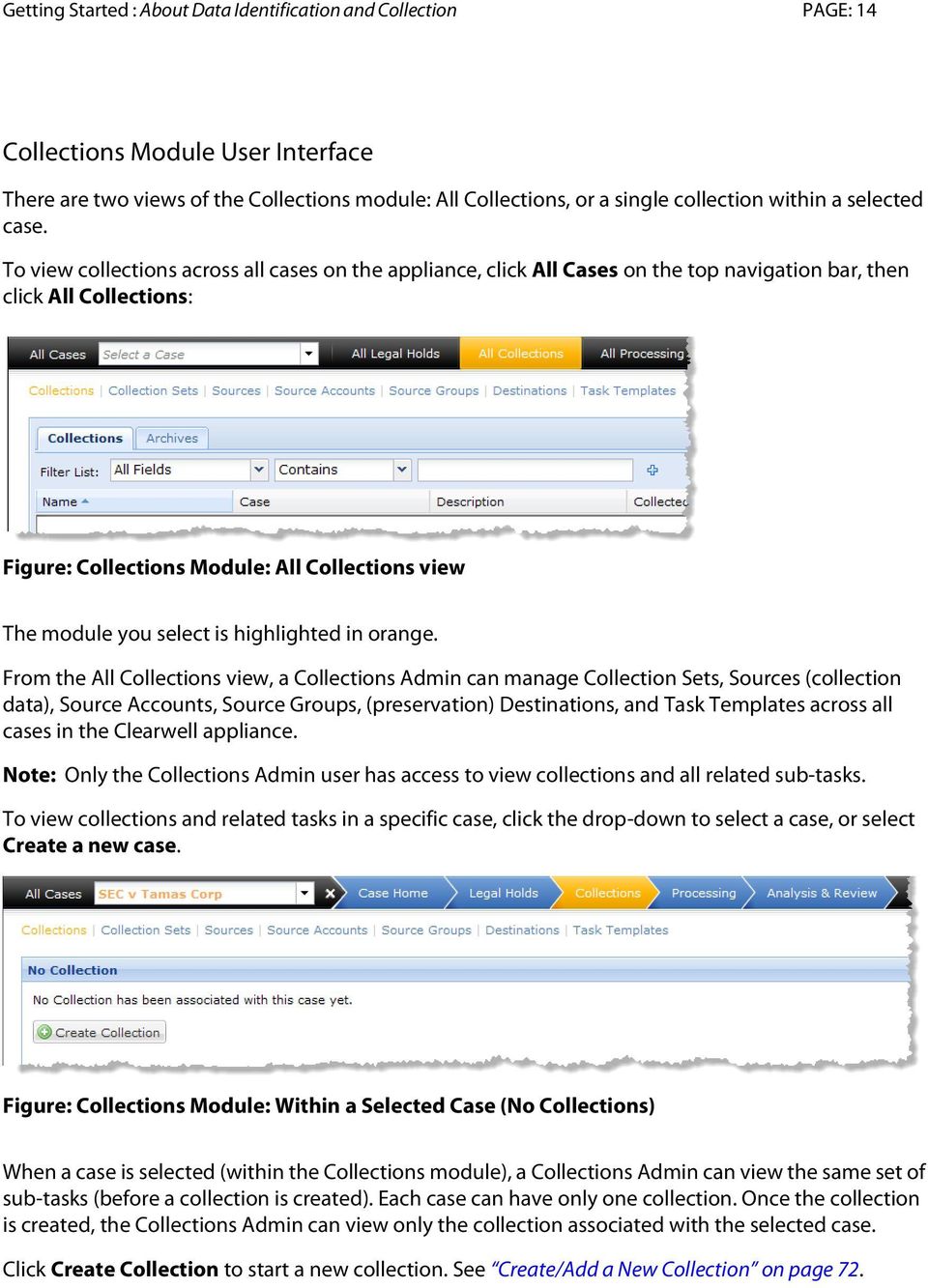
14 Getting Started : About Data Identification and Collection PAGE: 14 Collections Module User Interface There are two views of the Collections module: All Collections, or a single collection within a selected case. To view collections across all cases on the appliance, click All Cases on the top navigation bar, then click All Collections: Figure: Collections Module: All Collections view The module you select is highlighted in orange. From the All Collections view, a Collections Admin can manage Collection Sets, Sources (collection data), Source Accounts, Source Groups, (preservation) Destinations, and Task Templates across all cases in the Clearwell appliance. Note: Only the Collections Admin user has access to view collections and all related sub-tasks. To view collections and related tasks in a specific case, click the drop-down to select a case, or select Create a new case. Figure: Collections Module: Within a Selected Case (No Collections) When a case is selected (within the Collections module), a Collections Admin can view the same set of sub-tasks (before a collection is created). Each case can have only one collection. Once the collection is created, the Collections Admin can view only the collection associated with the selected case. Click Create Collection to start a new collection. See Create/Add a New Collection on page 72.
15 Getting Started : Checklist: Before You Begin... PAGE: 15 Checklist: Before You Begin... Use the following checklist to verify your setup before you begin working with the Clearwell Identification and Collection module: Clearwell appliance is properly installed. Refer to the Clearwell ediscovery Platform Installation Guide to verify your installation and configuration. Network is set up for data collection. Refer to the Identification and Collection Network Setup Checklist and Network Setup Guide for information about how to set up your IT environment and ensure your network is ready for mapping your source data. Data Map and Collections License is installed. See Managing Your Collections License on page 132 to check for license information, including the number of custodian licenses currently available for use. (Custodian licenses are reusable.) Change/update account, Help, and Support link information. See Logging On in the next section. Logging On The first time you log on, be sure to: 1. Change the account password. Note: The password is the same on every Clearwell appliance. Leaving the default password opens your system up to vulnerabilities. 2. Update the Need Help? link on the Login page. 3. Update the Support link. Clearwell Collection Workflow Follow these basic steps of identification and collection in this guide to prepare your data sources for case creation and management: Data Mapping. Create and manage source accounts, add sources, custodians, and destinations to your data map. (See Network and Data Map Setup on page 17.) Collections. Create collections, add collection tasks, run and schedule data collection, perform onsite collection. (See Creating and Managing Collections on page 70.) Collection Sets. Analyze and process collected data by creating collection sets and assigning to a case. (See Creating, Analyzing and Processing Collections on page 109.) For more information about this workflow, refer to the Collection Workflow Reference. Occasionally, you may also want to set Collections user permissions, perform collections and data map backups, check Collections licensing information, and perform other maintenance tasks. See Collection Administration and Maintenance on page 119.

16 Getting Started : Clearwell Collection Workflow PAGE: 16

17 Network and Data Map Setup : About Data Mapping PAGE: 17 Identification and Collection Guide Network and Data Map Setup This section describes how to ensure your network is properly set up before mapping your data sources to the Clearwell Platform. About Data Mapping on page 17 Best Practices on page 18 Setting Up Your Data Map on page 20 About Data Mapping Through the Identification and Collection module, administrators can set up a data map by associating all available data sources in preparation for collection. Supported Source Types Clearwell supports the following source types for identification and collection. Source Types Source Version / Type Supported Details Network File Shares Personal Computers Windows Network, and OnSite collection Mac Off-network only / OnSite collection Note: For information about collecting data from non-network sources, see About OnSite Collections on page 71. Microsoft Servers Exchange (Windows) BPOS Exchange or Office 365 Lotus Domino Server SharePoint with Proxy Web page sources Symantec Enterprise Exchange (EV) Mailbox and Vault (EV) Lotus Domino (EV) Journaling Archives (Sources and Archives) SharePoint Archive (EV) File System Archive (EV) OpenText Livelink 9.2 sp1 or later (up to as of April 2012) When creating a collection with a Livelink source, keyword search is available for files, but not available for volumes. Interwoven WorkSite NT (HP Autonomy imanage) DeskSite or FileSite 8.x Interwoven DeskSite or FileSite 8.x client must be installed locally by the enterprise user on the Clearwell appliance Note: The client version must match the server version in use. EMC Documentum Content Server 5.3 Foundation Services Collector Content Server or later Foundation Classes Collector Xerox Docushare 4.0 or later IBM FileNet Content Manager 8

18 Network and Data Map Setup: Best Practices PAGE: 18 Best Practices This section outlines the best practices which Network administrators and ediscovery practitioners should consider before setting up your network environment to use the Identification and Collection module in Clearwell. IMPORTANT! Read this section first, before completing the tasks in the following sections, according to the source type(s) you are setting up for identification and collection. Network Impact and Performance Clearwell's Identification and Collection Module (IC Module) is an ediscovery solution, allowing customers to search, filter, and collect data from various data sources. Collection can happen directly (via an OnSite collection onto an external hard drive) or across the network. Network collections can come from multiple data sources, including Microsoft Exchange Server, Lotus Domino Server, File Shares, Symantec Enterprise Vault (EV), SharePoint, and various collector sources. (See all Supported Source Types on page 17). Collections are performed on-demand, only when the user starts a specific Collection Task. The Clearwell IC Module is not maintaining or updating a persistent index of data at these data sources. Network impact is limited to the scope of the specific collection tasks. For most ediscovery use cases, these tasks can and should be targeted at individual subsets of data at these sources, rather than the entire source. For example: collecting a single or a small number of specific Exchange mailboxes collecting a user s Public File Share folder SharePoint collections leveraging Clearwell s federated search feature This submits the search request to SharePoint s own index, and Clearwell will collect (and occupy the network for) just the positive results.

19 Network and Data Map Setup : Best Practices PAGE: 19 Clearwell Collection Methodology and Setup In consideration of network impact and performance, Clearwell's collection filters are applied intelligently - scanning for metadata matches first, and then performing (the more networkintensive) keyword scanning second. The number of simultaneous collection tasks and threads are limited across all collections. These limits are adjustable, and can be set by a Clearwell solutions consultant, services professional, or support. Recommended Numbers of Collection Tasks & Threads by Source Type Supported Source Type Local Exchange Server Local SharePoint Source Account Requirements 5 max parallel tasks, 1 thread per task 10 max parallel tasks, 500 max threads per task Notes Each task must be single-threaded, this is a MAPI limitation Source Setup (by Source Type) See also Tips and Troubleshooting on page 139.) Lotus Domino Server FileShares PC on the network PC and Mac (for OnSite Collection) Single-threaded 10 max parallel tasks, ~128 max threads per task (same as FileShares) No throttle. To collect multiple mailboxes truly in parallel simultaneously, the user needs to create separate Exchange Sources, each one attached to a different Source Account. You can do this for up to 5 mailboxes, depending on the appliance specs and whether the Exchange server has set limitations # of threads actually is dynamically configured based on # of CPUs (same as FileShares) These are direct-to-drive collections, typically not done over the network Tips, Troubleshooting, and Technical Support For troubleshooting information in this guide, see Tips and Troubleshooting on page 139, and refer to the appropriate section depending upon the source type.

20 Network and Data Map Setup: Setting Up Your Data Map PAGE: 20 Setting Up Your Data Map As you prepare to add sources to your data map, check the overview information and network setup references in this section first to ensure you have what you need to get started. Before You Begin... Ensure your network is properly set up before adding sources: Review Best Practices on page 18 for setting up your network. See Verify Network Setup by Data Source on page 140. Determine the sources and accounts needed for setup: See Source Account Overview in the next section See Define Source Groups (Optional) on page 21. See Data Discovery Overview on page 21. As needed, add (or import) custodians to the data map, and specify destinations and policies: See Importing Custodians to Your Data Map on page 22 See Adding Destinations for Collected Data on page 30. Source Account Overview A source account is the authentication used to control access to the Preservation Destination (where collected data will be stored). From the Collections > Source Accounts screen, administrators can create multiple accounts if the network setup requires different authentication accounts to access source data. IMPORTANT! If you plan to collect from a Symantec EV source, be sure to use an Active Directory username and password that can navigate EV topology and searches using the EV Admin Console. Use this account for both the EsaEvCrawlerService logon and your EV collection source account. Make sure that the account belongs to the Local Administrators group on the Clearwell appliance. For more information, refer to Symantec Enterprise Vault (EV) on page 59, or check with your Clearwell system administrator. From your list of sources, you can use the Filter List menu to view accounts Name, Description, User, or accounts currently In Use (enabled accounts are listed by default) and apply additional filter parameters. To change or enable/disable an account, click the source account name, change the account settings, and click Save.

21 Network and Data Map Setup : Setting Up Your Data Map PAGE: 21 Define Source Groups (Optional) As part of adding sources to your data map, you can (optionally) create customized groups for your sources. Source groups can help organize larger data maps containing multiple sources. You can assign a specific source group to each data source, then filter or search for sources within a specific group. To add a source group 1. From the Collections module, click Source Groups. 2. Click Add to open the New Group window. 3. Enter a name for the source group, and a description (optional). An asterisk (*) indicates a required field. 4. Click OK to submit the new group, or click Cancel to discard your changes. Data Discovery Overview Data discovery populates your data map with employee data, called custodians when it becomes available for collection. Typically, servers represent a critical source of data from which to collect. To add servers to your data map, be sure to perform discovery on Active Directory or Lotus Domino (for Lotus Notes sources) first. Note: Check with your system administrator to verify whether discovery may have already been done on servers during network setup of your collections environment. From System > Servers, you can select one or more sources you want to discover. Select from four main server/archive sources (which may contain source types within, such as Symantec EV): Active Directory Shows domain sources available for discovery (or click to add a domain if the domain source exists, but does not appear on the list.) Verify that the sources to be added are part of your Active Directory Forest. See Setting up Data Sources on page 32 for detailed steps to perform discovery depending on Exchange source type. HP IAP Shows HP IAP archive sources available for discovery. Alternatively, click Add if the HP IAP source exists, but does not appear on the list.) When finished, click Start Discovery.
22 Network and Data Map Setup: Setting Up Your Data Map PAGE: 22 Symantec EV Shows results for all Enterprise Vault sources and archives from discovery. To discover a new EV vault directory, you must have the Directory Server Host Name. Under Policies, rules can be applied to EV sources later, when specifying filter criteria in preparation for collection. See Symantec Enterprise Vault (EV) on page 59. Lotus Domino Shows Lotus Domino server sources available for discovery (or click to add if the Domino server source exists, but does not appear on the list.) See Lotus Domino Server Setup on page 55. To perform discovery and/or start adding sources, continue with steps in Setting up Data Sources on page 32 for each specific source type you want to add. Importing Custodians to Your Data Map There are several ways to add custodians: Import multiple custodians at once, or individually, either from Active Directory, or from a CSV or Script file. To import using CSV or script, refer to the format requirements in this section. Note: Custodians in Clearwell s Processing and Review (PAR) module are not case-sensitive. As a result, custodians in the Identification and Collection (IC) module may be merged with similar custodian names in PAR. For example, the IC custodians joe admin, Joe admin, and Joe Admin, who are all considered unique in IC, are treated as the same custodian in PAR. Thus, when you add a collection set (created in IC) containing the custodian joe admin to a PAR case that contains another custodian Joe Admin they are merged as one custodian. However, if that same PAR case contained no similarly-named custodians, and all three IC custodians were added to the case, they will be considered unique. In any case, to ensure your IC custodians remain unique, you can either specify custodian names with a numeric designation, or simply unmerge custodians in PAR. Merging/Unmerging Custodians Later, after your selected custodians have been added to a case, you can use the Custodian Merge feature to resolve any same-name, or similarly-named custodians (that represent the same source or individual). Alternatively, use the Unmerge feature to keep Collection Set custodian names unique if similarly-named (representing other individual) custodians already exist. For more information, refer to "Merging Custodians" in the Case Administration Guide.
23 Network and Data Map Setup : Setting Up Your Data Map PAGE: 23 To add custodians 1. From the All Cases view, click Employee List. (Alternatively, within a case under the Collections module, click Sources, then from the Custodian box, click Edit Custodians, then Add. See also on page 30.) 2. From the Employee List, determine if you want to: A. Import multiple custodians. See To add custodians by bulk import (option A) on page 23. B. Add custodians individually. See To add a custodian individually (option B) on page 28. To add custodians by bulk import (option A) 1. From the Custodians window, click Import and select one of the following options: A. Active Directory (see Importing Custodians from Active Directory in the next section for details): From Active Directory (select individual custodians to add) Import All From Active Directory (add all custodians at once) B. From File (see Importing Custodians from CSV or Script on page 24 for format requirements): From CSV (enter CSV file name and path, or browse to location) From Script (enter Script file name and path or browse to location) 2. Upon discovery, click Import All Shown. 3. If your import was successful, all custodians you selected to add or import appear in the list of custodians. Click Save to associate the new custodians to the selected source, or click Cancel to discard your changes.
24 Network and Data Map Setup: Setting Up Your Data Map PAGE: 24 Importing Custodians from Active Directory Upon Active Directory discovery, only the first 100 custodians are displayed at a time. Use the Filter List menu to view by Custodian, User Name, or Address and apply additional filter parameters. Importing Custodians from CSV or Script The Collections Admin can automatically populate the Employee List by providing a CSV or script file which meets specific requirements for bulk import into Clearwell. Before importing your custodians, ensure your CSV file or script meets the following requirements. Note: When importing custodians from a file, the names are added in the system similar to a processed job. To view the status of your CSV or Script file import, click the Jobs link at the top of the screen. If an error occurs during import, a warning icon appears next to the link. Click the book icon in the Status column to view details in the job status log. CSV Import Format Requirements The CSV file should be provided in the following format: 1. Header row - First row of the file, consisting of the column names (in any order), separated by commas. The following column names should be specified: Note: An asterisk (*) indicates a required field. CSV Import Format Requirements Column Name Format Max Limit Example Name* UTF John Doe Domain UTF symantec File owner name UTF John Doe
25 Network and Data Map Setup : Setting Up Your Data Map PAGE: 25 CSV Import Format Requirements Column Name Format Max Limit Example File owner SID UTF Title UTF Analyst Division UTF Sales Location UTF-8 California Phone Number UTF-8 No limit Hired Date MM/DD/YYYY 10 05/02/2010 Terminated Date MM/DD/YYYY 10 08/10/2011 UTF-8 [email protected] [email protected] Primary (Integer) Index Note: with index 0 in the list of s will be displayed as primary: [email protected] Escalation Manager Unique ID System Admin UTF TRUE/FALSE (FALSE by default) 5 FALSE Unique ID* UTF Employee Record - Each of the following rows will be interpreted as an employee record, with each attribute separated by a comma. The number of fields in each row must match the number of columns in the header row. The following rules apply to attributes or columns in a CSV file for Employee List bulk import: CSV Import Format Requirements Attribute or Column Rule(s) Column names Case-Sensitive; (must be typed as shown in Table 1.) Can be written in any order Domain Column File owner name Column (Optional) Must be present with File owner name column (or both columns must be absent). Cannot be individually selected. Values must also be consistent in both columns if present (empty or populated). (Same rules apply as for Domain column.)
26 Network and Data Map Setup: Setting Up Your Data Map PAGE: 26 CSV Import Format Requirements Attribute or Column Fields containing line breaks (CRLF), double quotes, and commas Adding multiple values Rule(s) Must be enclosed in double quotes. ( " ) If using double quotes to enclose fields, a double quote appearing inside a field must be preceded with another double quote. Example: employee one, mc adams. When adding multiple values to a field, the values should be separated by commas (,) Example: Unique Domain and File owner name values Unique IDs Domain and File Owner Name pairs must be unique across all employees. This does not apply to records with empty Domain and File Owner Name values. If an employee entry contains the same Unique ID as another employee entry, the following rules will apply: New employee s , File owner name, File owner SID, and Domain column fields will be appended to the existing employee s entry. All other columns will be replaced. Example:
27 Network and Data Map Setup : Setting Up Your Data Map PAGE: 27 Script Import Requirements An asterisk (*) indicates a required field. Script Import File Format Requirements Column Name Format Max Limit Example Name* UTF John Doe Domain UTF symantec File owner name UTF John Doe File owner SID UTF Title UTF Analyst Division UTF Sales Location UTF-8 California Phone Number UTF-8 No limit Hired Date MM/DD/YYYY 10 05/02/2010 Terminated Date MM/DD/YYYY 10 08/10/2011 UTF-8 [email protected] [email protected] Primary (Integer) Index Note: with index 0 in the list of s will be displayed as primary: [email protected] Escalation Manager Unique ID System Admin UTF TRUE/FALSE (FASLE by default) 5 FALSE Unique ID* UTF Script File Format and Location All CSV formatting requirements also apply to those used for bulk import. However, to ensure security while running executable (.exe) files, all scripts must be stored in the folder: D:\customerScript\bulkImport. Appliance users should ensure that access to this folder is restricted to authorized users, since running executables on the Clearwell appliance can pose significant security threats to the system. Note: Unless the file is an executable (.exe), then it should contain the location of the executable used to run it (as shown in the first line of the following example). Example script: #!c:\perl\bin\perl.exe print "Name, ,Unique ID\n"; print "John Doe,JohnDoe\@johnDoe.com,1122\n"; print "Johnnie Doey,JohnnieDoey\@johnnieDoey.com,1122";
28 Network and Data Map Setup: Setting Up Your Data Map PAGE: 28 To add a custodian individually (option B) 1. From the All Cases > Employee List screen, click Add. Note: The bottom section will be visible only if your enterprise has a Legal Holds module license installed, and the logged on user must have appropriate permissions. 2. Specify the following information. An asterisk (*) indicates a required field. Adding a Custodian Field Custodian* Title Division Unique ID Location Description Enter the name of the custodian (up to 35 characters). The name is not case sensitive. Enter the custodian s title (if applicable). Enter the custodian s division or department (if applicable). Enter an identification number or code unique to this custodian. Enter a location. Enter the custodian s account. (Example: jsmith@acm .com). By default, the icon is selected to indicate that this is the primary address. Click the icon to add additional addresses for this custodian.
29 Network and Data Map Setup : Setting Up Your Data Map PAGE: 29 Adding a Custodian Field Phone Number Enter a phone number for the custodian. Click the icon to add additional phone numbers for this custodian. Escalation Manager (Legal Hold users only) Hired / Terminated Owner Info. (Domain, Owner Name, SID) System Admin for Legal Hold (Legal Hold users only) Legal Hold History (Legal Hold users only) Description 3. Click Save to associate the new custodian to the selected source, or click Cancel to discard your changes. 4. Click Close to close the Custodians window. Enter or browse for the name of this custodian s manager to whom legal hold notifications should be escalated. Enter the date of hire and termination, or click the calendar icon to select a date. Enter the Domain name, owner name, and the Security Identifier. Note: The owner name will only be collected (when filtering for collection) if the Windows user for the collection is running as the source account (or EsaApplicationService user if there is no account on the source), and it is in the domain where the owner name is kept. Select this check box if this custodian s role is a System Administrator, for use in customizing Legal Hold notifications. Displays summary of Legal Hold activity associated with this custodian. (Includes names of Legal Holds and Notifications, and date notifications were last sent.)
30 Network and Data Map Setup: Setting Up Your Data Map PAGE: 30 Adding Destinations for Collected Data After setting up an authentication account, add a Preservation Destination, the location where you want collected data to be copied. You can add multiple destinations to manage storage across geographical locations and by priority. To add a destination 1. From the Collections module, click Destinations. 2. Later, use the Filter List menu to view accounts by Destination, Description, or Account (enabled accounts are listed by default), and apply additional filter parameters. 3. To add a new source account: A. Click Add to open the Add Destinations page. B. Specify the following information. An asterisk (*) indicates a required field. Source Data Destination Field Account Path* Description Description Enter the name of the source account you created, or click Browse to select one from the list of accounts. Enter the path to the location where the collected data will be stored. Click the button to select a File Share or remote directory. Click Check Free Space to verify data storage capacity. Enter a description for this source account (up to 255 characters). C. Click Save to submit the destination, or click Cancel to discard your changes.
31 Setting up Data Sources: About Adding (or Importing) Sources to Your Data Map PAGE: 32 Network Setup Guide Setting up Data Sources Follow the steps in this section (by source type) to perform the tasks necessary to set up your organization's IT environment for Identification and Collection using Clearwell. For a general overview about adding (any) sources: About Adding (or Importing) Sources to Your Data Map on page 32 Required Source Information on page 33 Import Sources Using Bulk Import (from CSV or Script) on page 34 To start adding sources (by source type) refer to the appropriate section: Local Domain Exchange Setup on page 37 BPOS Exchange/Office 365 Setup on page 43 Lotus Domino Server Setup on page 55 SharePoint Server Setup on page 57 File Share and Windows PC Setup on page 58 Symantec Enterprise Vault (EV) on page 59 Collectors on page 65 About Adding (or Importing) Sources to Your Data Map Identify the sources of data (where the data will be collected from), or populate your data map automatically using the bulk import feature. Typical sources may include File Shares, Exchange Servers, SharePoint, Lotus Domino Servers, or remote locations such as a personal computer. Note: If you are adding a Symantec Enterprise Vault source, follow the steps in Symantec Enterprise Vault (EV) on page 59. From the Collections module, click Sources, then Add. (FileShare is shown in this example.) You will need to add a source for each type of data source--the storage device and location from which you want to collect data. Later, you will create collection tasks for each of these sources to begin collecting the data.
32 Setting up Data Sources: About Adding (or Importing) Sources to Your Data Map PAGE: 33 Note: Additional fields will be shown for EV source types, such as Site and Archive Type, and for collectors, such as Repository and Object Store. (For any EV source type, see Symantec Enterprise Vault (EV) on page 59.) Also note: For EV collection, Clearwell can run federated searches across all sites, however, the searches are specific to the Vault Site. If searches must be run across multiple sites, different Collection Sources must be created for each site, allowing collection tasks to be created and run for each of the sites. If you are adding a collector, but the collector does not appear in this list, or if you have a trial license you want to use, go to System > License and click Update License. Follow the on-screen instructions in the Update License Wizard to upload or copy/paste an available license for the appropriate collector(s). Required Source Information Depending on which type of sources you add, you will need to specify the following information. An asterisk (*) indicates a required field. Source Data Field *Source Name Description *Type *Site *Archive Type *Location (Host name/ip) Account *Repository Description Type the name of your data source (up to 35 characters). Enter a description of the source (up to 255 characters). Enter or select the source type. (Example: PC). (EV Source only): Enter the site and select an archive type to be used for this EV source. For example, entering the site: EVVAULTSITE and selecting the EV Domino mailbox archive allows collections from any mailbox archives in Lotus Domino from within EVVAULTSITE. Note: For details, refer to the Source Setup section and follow the steps in "Symantec Enterprise Vault (EV)" in the Network Setup Guide. Enter the Host name or IP address to the location of the data source. Note: For Collectors, the full HTTP address is required (DocuShare and FileNet collectors, for example): For DocuShare: For FileNet: service identifier> Verify the correct location convention with your system administrator. Click Test to validate the source location as entered. For other sources, enter the path (for example, File Share or PC), or URL (SharePoint, Exchange, Lotus Domino servers) to the location of the data source. Enter the name of the source account you created, or click Browse to select one from the list of accounts. (Documentum Collector Source Only): Enter the name of the repository to use for collection from the Documentum source. (Multiple repositories may exist.) For example: docbank1
33 Setting up Data Sources: About Adding (or Importing) Sources to Your Data Map PAGE: 34 Source Data (Continued) Field Worksite *Object Store (imanage Collector Source Only): Enter the name of the worksite to use for collection from the imanage source. (Multiple worksites may exist.) For example: imgworksite1 (FileNet Collector Source Only): Enter the name of the object store to use for collection from the FileNet source. (Multiple object stores may exist.) For example: FNOS1 Custodian Type the name of the custodian associated with the data source (Example: John R. Smith), or click Browse to select one from the list of custodians. Group Collection Templates and Collection History Description Type the group name associated with the data source, or click Browse to select one from (or add a new one to) the list of groups. Indicates whether a template has been applied to the collection. (Click link to edit collection templates.) View list of collections and task details. Import Sources Using Bulk Import (from CSV or Script) If you have multiple sources to add to your data map, you can import them all at once from a pre-formatted CSV file located in your Active Directory, or from a script (already discovered in Clearwell). For more information about CSV and script formats, see Table Source Import File Format Requirements. Scripts are useful if you frequently update your source list information and want to schedule the script to run periodically. (See Schedule a Script Run on page 36.) To start importing sources, see To import sources (using bulk import) in this section. Bulk Import Format Requirements Before importing your sources, ensure your CSV file or script meets the following requirements. (Header fields can be in any order.) An asterisk (*) indicates a required field. Source Import File Format Requirements Format Requirements Rules Script CSV Write output CSV file in UTF-8 to STDOUT UTF-8
34 Setting up Data Sources: About Adding (or Importing) Sources to Your Data Map PAGE: 35 Source Import File Format Requirements (Continued) Format Requirements Rules CSV and Script Contain header row with the following fields: Source Name* Description Type* Location* Account User Example: DOMAIN\user Account Password Custodian Name Group (Group name or group hierarchy) (up to 100 characters) (up to 255 characters) Must match a supported type (File Share, PC, Exchange, SharePoint, Domino). Note: If no sources are listed or do not match, this field is ignored. Must list full UNC path for File Shares Complete Host name for PCs (Not needed for Exchange) Full URL path for SharePoint Note: If this field is not listed or is incorrectly formatted, the field is ignored. If account does not exist, one will be created. (Account name can match this username) If an account already exists for this username, than a previously-existing account will be used. If there is a username that does not exist and no password is provided, then no account will be added. If custodian (by exact name) does not exist, one will be created. If a single custodian already exists with this exact name, existing will be used. If multiple custodians already exist with this exact name, leave the custodian field blank. If a group with this name and hierarchy branch does not exist, one will be created. If a group with this name and hierarchy already exists, than a previously-existing group will be used. Note: A group hierarchy can be separated by a \ (back slash), such as: HQ\Sales\Europe.
35 Setting up Data Sources: About Adding (or Importing) Sources to Your Data Map PAGE: 36 To import sources (using bulk import) 1. From the Collections module, click Sources. 2. Click Import and select an option: A. From CSV (imports sources listed in a comma separated values file) B. From Script (launches a script which automatically generates a CSV file. Note: Use this option if you regularly update your sources, but do not maintain a CSV file. If the script is discoverable in the correct path and properly formatted (see Table Source Import File Format Requirements.) 3. Whether importing sources from a CSV or Script file, the source names are added to the case similar to a processed job. To view the status of your CSV or Script file import, click the Jobs link at the top of the screen. If an error occurs during import, a warning icon appears next to the link. Click the book icon in the Status column to view details in the job status log. 4. If your import was successful, all sources you selected to add or import appear in the list of sources. Click Save to associate the new sources to the selected case, or click Cancel to discard your changes. Schedule a Script Run Import scripts can be scheduled to run once or periodically. To schedule your script to run automatically 1. Select All Cases from the Cases drop-down menu. 2. From the All Cases view, click Schedules. 3. Click Add. 4. From the Add Schedule page, select the Task Type Bulk Source Import. 5. Enter or select an Initial Run Date and Start Time. 6. To schedule the script to run as a recurring event, select the frequency. (Default is Once.) 7. Click Save.
36 Setting up Data Sources: Local Domain Exchange Setup PAGE: 37 Local Domain Exchange Setup Setting up data collection from your Local Domain Exchange source requires the following steps: 1. Create an Admin Account* for Exchange Mailbox Discovery and Collection 2. Discover mailboxes using Active Directory Discovery and import custodians 3. Add the Local Domain Exchange source to your data map 4. Test an Exchange mailbox collection Note: For the purposes of this setup, the domain user account is referred to as Admin Account. Continue with the following steps: Step 1: Create a New Domain Admin Account on page 37 Step 2: Perform Active Directory Discovery and Import Custodians on page 40 Step 3: Add Exchange Source to the Data Map on page 41 Step 4: Test an Exchange Mailbox Collection on page 42 Step 1: Create a New Domain Admin Account To create a new domain account 1. In your Windows interface, open All Programs [or for newer versions: Control Panel] > Administrative Tools > Active Directory Users and Computers. 2. Click to expand the domain, then right-click Users and select New > User. 3. Enter the name and logon information for the Clearwell Exchange Collection admin. 4. Click Next.
37 Setting up Data Sources: Local Domain Exchange Setup PAGE: Enter a Password and select (only) the option Password Never Expires, then click Next. 6. Clear the option to create an Exchange mailbox. (An Exchange mailbox is not required), then click Finish to create the admin account. Continue with next steps to set up your admin account permissions, depending on your mailbox setup. 1a: Set up Exchange Local Account Permissions Collecting from mailboxes in a Local Exchange server requires setting up a domain account with appropriate Exchange security permissions. The "Admin Account" MUST be: a Domain User for the enterprise domain a Local Administrator on the Clearwell appliance able to access and collect the target mailboxes (see below for access provisioning) able to write to the Preservation Destination Choose one of three options depending on how you want to set up the Admin Account: Option 1: Give "Admin Account" Access to Individual Target Mailboxes Option 2: Give "Admin Account" Access to a Store of Mailboxes Option 3: Run a PowerShell Script to Automate Running Multiple Mailboxes Option 1: Give "Admin Account" Access to Individual Target Mailboxes 1. Open the Exchange Management Console on your Exchange Server, then select the target custodian mailbox(es) from the listed mailboxes. 2. Select the option to Manage Full Access Permission 3. The Manage Full Access Permission window opens. 4. Click Add to the "Admin Account" and grant access.
38 Setting up Data Sources: Local Domain Exchange Setup PAGE: Click Manage. A confirmation screen appears. Ensure that the following permissions are available to the "Admin Account": Read Open mail send queue Execute Read metabase properties Read permissions Read properties Receive as Option 2: Give "Admin Account" Access to a Store of Mailboxes Exchange allows mailboxes to be grouped under Storage Groups and Stores. You can give the Clearwell "Admin Account" access to an entire Store or Storage Group, and Clearwell will be able to access all of the contained mailboxes. In addition to the permissions listed for Managing Full Access, in Option 1, also give the "Admin Account" the following five permissions: List contents List objects Create name properties in the information store Administer information store View information store status Note: Note: Ensure that any inherited permissions for this account do not take precedence and inadvertently deny these permissions. Option 3: Run a PowerShell Script to Automate Provisioning Many Mailboxes Follow the steps for Option 1, then repeat for multiple mailboxes by using a PowerShell script. This script should mirror the syntax shown on the confirmation screen when using the Exchange Management Console to set permissions. For example: Exchange Management Shell Command Completed: Add-MailboxPermission -Identity 'CN=CUSTODIANUSER,CN=Users,DC=DOMAIN,DC=local' -User 'DOMAIN\ADMINUSER' -AccessRights 'FullAccess'-InheritanceType all
39 Setting up Data Sources: Local Domain Exchange Setup PAGE: 40 Step 2: Perform Active Directory Discovery and Import Custodians Given the domain(s), Clearwell will perform an Active Directory discovery for mailboxes and groups. The admin can provide credentials that this discovery will perform as, or Clearwell will default to using its Application Service credentials. In addition to discovering mailboxes, Clearwell looks for specific patterns or attributes to determine on which servers these mailboxes reside. Once Active Directory completes, you can import custodian data. To perform Active Directory discovery 1. Log on to the Clearwell appliance using "Admin Account" (the Domain user). 2. In the Clearwell interface, in the All Cases view, click System > Servers. 3. From the drop-down menu, select Active Directory. 4. To add a new domain, click Add Domain then enter the domain name, and the administrator user name and password, and click Save. 5. When ready, click Start Discovery. This automatically detects the appropriate domain, and performs Active Directory discovery. Technical Note: This function checks for domains which contain the Clearwell appliance. Once the domain is detected, Clearwell used the logged in account ("Admin Account") to discover servers, mailboxes, and groups from Active Directory. Typically, this should automatically discover the same Active Directory domain used by BPOS Exchange (if applicable). Troubleshooting: In rare cases, the desired domain may not be automatically discovered. For example, if the enterprise has legacy domains that may have been consolidated or deleted. In this case, you can manually enter your enterprise domain and account credentials by clicking Add Domain on the System > Servers screen. 6. When the Active Directory discovery is complete, the System > Servers > Active Directory screen displays servers, users, and groups that have been discovered.
40 Setting up Data Sources: Local Domain Exchange Setup PAGE: 41 To import the Employee List from Active Directory 1. From the All Cases view, click Employee List. 2. From the Employee List, click Import and select Import All from Active Directory (imports all custodians at once). Note: Selecting "Import from Active Directory" (not "All") displays only the first 100 custodians at a time. Use the Filter List menu to view by Custodian, User Name, or Address and apply additional filter parameters. For more details, refer to the section "Importing Custodians to Your Data Map" in the Identification and Collection Guide. Step 3: Add Exchange Source to the Data Map To add the Local Exchange source to your data map 1. In the All Collections module, click Sources. 2. On the Sources screen, click Add.
41 Setting up Data Sources: Local Domain Exchange Setup PAGE: Enter a name for your Exchange source. Use the Admin Account you set up in 1a: Set up Exchange Local Account Permissions on page 38. Note: If you leave the Account field blank, Exchange collections will run using the ESAApplicationService account permissions. 4. When finished, click Save. Step 4: Test an Exchange Mailbox Collection To test the collection of a mailbox 1. In the All Collections module, click Collections. (In a selected case, Collections > Sources.) 2. Click Add to add a new collection. 3. On the Add Collection dialog, enter a name, destination, and click Save. 4. From the Collect screen, click Add to add a task to the selected collection. 5. On the Sources dialog, select the Exchange source type you just created and click Select. 6. In the Mailbox tab under Filtering, select a target mailbox you want to test, then click Save and Start. For more information about adding collections and tasks, refer to the section "Creating and Managing Collections" in the Identification and Collection Guide.
42 Setting up Data Sources: BPOS Exchange/Office 365 Setup PAGE: 43 BPOS Exchange/Office 365 Setup Setting up your Microsoft BPOS Exchange (Office 365) source for collection requires the following steps: 1. Create an Admin Account* for BPOS Exchange mailbox discovery and collection. 2. Discover mailboxes using Active Directory Discovery and import custodians. 3. Configure the Clearwell Appliance's Outlook Template Profile. 4. Add the BPOS Exchange source to your data map. 5. Test an Exchange mailbox collection. Note: For the purposes of this setup, the domain user account is referred to as Admin Account. For an introduction, and sample diagram, see the Overview on page 44, then continue with the following steps: Step 1: Create a New Admin Account (for BPOS) on page 44 Step 2: Perform Active Directory Discovery and Import Custodians (for BPOS) on page 46 Step 3: Configure the Clearwell Appliance's Outlook Template Profile on page 47 Step 4: Add the Exchange BPOS Source to your Data Map on page 53 Step 5: Test an Exchange Mailbox Collection on page 54
43 Setting up Data Sources: BPOS Exchange/Office 365 Setup PAGE: 44 Overview When adding your Exchange source, ensure that Exchange collections will run under the correct account. This is especially important if you are adding a BPOS Exchange/Office 365 source (hereafter, BPOS Exchange, BPOS, or Exchange ) to your data map for BPOS Exchange collection within a cloud environment. The following diagram illustrates the process for collection in a BPOS Exchange environment using Clearwell: A. Your Active Directory could be hosted directly by BPOS, or a one-way trust established between BPOS and the Enterprise domain, syncing Active Directory B. Clearwell collection Admin account given account privileges to open custodian mailboxes in BPOS, using Microsoft's Customer Mailbox Permission Management Tool (CMPMT) C. To collect from BPOS mailboxes, an Outlook profile on the Clearwell appliance is configured to connect to BPOS (via MAPI) D. During Collections, the Clearwell appliance connects to BPOS as an Outlook client would, copying messages in PSTs at the Preservation Destination Step 1: Create a New Admin Account (for BPOS) To create a new domain account 1. In your Windows interface, open All Programs [or for newer versions: Control Panel] > Administrative Tools > Active Directory Users and Computers. 2. Click to expand the domain, then right-click Users and select New > User. 3. Enter the name and logon information for the Clearwell Exchange Collection admin.
44 Setting up Data Sources: BPOS Exchange/Office 365 Setup PAGE: Click Next. 5. Enter a Password and select (only) the option Password Never Expires, then click Next. 6. Clear the option to create an Exchange mailbox. (An Exchange mailbox is not required), then click Finish to create the admin account. Continue with next steps to set up your admin account permissions, depending on your mailbox setup. Set up BPOS Exchange Account Permissions Collecting from mailboxes in a BPOS/Office 365 Exchange server requires setting up a domain account with appropriate Exchange security permissions. The "Admin Account" should be: a Domain User for the enterprise domain a Local Administrator on the Clearwell appliance able to access and collect the target BPOS mailboxes These requirements must be met in order to successfully collect mailboxes from Exchange BPOS. For the last requirement (This Account must be able to access and collect the target BPOS mailboxes), there are 2 possible avenues for provisioning the right level of access. 1a: Give "Admin Account" Access to Individual Target Mailboxes Using Microsoft's Customer Mailbox Permission Management Tool (CMPMT), grant the "Admin Account" full mailbox access to the target mailboxes. Technical Note: This should be equivalent to the "Add-MailboxPermission" PowerShell command for on-premise Exchange servers. Example: Exchange Management Shell command completed:
45 Setting up Data Sources: BPOS Exchange/Office 365 Setup PAGE: 46 Add-MailboxPermission -Identity 'CN=CUSTODIANUSER,CN=Users,DC=DOMAIN,DC=local' -User 'DOMAIN\ADMINUSER' -AccessRights 'FullAccess'-InheritanceType all Troubleshooting Test: On the Clearwell appliance, run Outlook (under the Admin Account) and try to open the target custodian's mailbox. It should open the mailbox without a popup Logon dialog box. Repeat for each user mailbox from which you want to collect. 1b: Run a PowerShell Script to Automate Provisioning Many Mailboxes This is basically the same as Option 1 above, but repeats it for many mailboxes with a PowerShell script. Work with your Microsoft Technical Account Manager to implement this script, which should mirror the full mailbox access granted by Microsoft's CMPMT, or something equivalent to the syntax shown above (Exchange Management Shell command). Note that in a full deployment, this script should be scheduled periodically or should refresh when new employees are added, or when the "Admin Account" requires access to a new batch of mailboxes. Once you have granted "Admin Account" permissions, you are now ready to perform Active Directory discovery and create Collection Tasks. Step 2: Perform Active Directory Discovery and Import Custodians (for BPOS) Given the domain(s), Clearwell will perform an Active Directory discovery for mailboxes and groups. The admin can provide credentials that this discovery will perform as, or Clearwell will default to using its Application Service credentials. In addition to discovering mailboxes, Clearwell looks for specific patterns or attributes to determine if mailboxes reside in the BPOS Exchange environment. Once Active Directory completes, you can import custodian data. To perform Active Directory discovery 1. Log on to the Clearwell appliance using "Admin Account" (the Domain user). 2. In the Clearwell interface, on the top navigation bar, click System > Servers, and from the drop-down menu select Active Directory. 3. To add a new domain, click Add Domain then enter the domain name, and the administrator user name and password, and click Save. 4. When ready, click Start Discovery. This automatically detects the appropriate domain, and performs Active Directory discovery.
46 Setting up Data Sources: BPOS Exchange/Office 365 Setup PAGE: 47 Technical Note: This function checks for domains which contain the Clearwell appliance. Once the domain is detected, Clearwell used the logged in account ("Admin Account") to discover mailboxes, and groups from Active Directory. Typically, this should automatically discover the same Active Directory domain used by BPOS Exchange. Troubleshooting: In rare cases, the desired domain may not be automatically discovered, for example, if the enterprise has legacy domains that may have been consolidated or deleted. In this case, you can manually enter your enterprise domain and account credentials by clicking Add Domain on the System > Servers screen. On the Add Domain dialog, you can also enter the fully-qualified domain name (the name given to your enterprise by Microsoft BPOS). 5. When the Active Directory discovery is complete, the System > Servers screen displays servers, users, and groups that have been discovered. To import the Employee List from Active Directory 1. In the All Cases view, click Employee List. 2. From the Employee List, click Import and select Import All from Active Directory (imports all custodians at once). Note: Selecting "Import from Active Directory" (not "All") displays only the first 100 custodians at a time. Use the Filter List menu to view by Custodian, User Name, or Address and apply additional filter parameters. For more details on adding/importing custodians for collections, refer to the Identification and Collection Guide. Step 3: Configure the Clearwell Appliance's Outlook Template Profile After Active Discovery of mailboxes and importing custodians to your BPOS environment, the Clearwell appliance's Outlook template profile must be configured. The BPOS environment runs Exchange An Outlook/MAPI connection to a mailbox requires various configurations in the Outlook profile. System administrators can collect profile parameter values from an existing Outlook profile connected to a BPOS mailbox. Key parameters include BPOS Exchange CAS Array (Client Access Server), and MAPI over HTTPS proxy server and filter.
47 Setting up Data Sources: BPOS Exchange/Office 365 Setup PAGE: 48 Note: The profile name is based on the Outlook version (OL2010). The profile name should be BPOSExchangeTemplateProfile-OL2010-Do not Delete. The following steps use an Outlook 2003 installation scenario, however you can use this as a guideline even if you have Outlook 2010 installed. Clearwell requires one template profile to be configured, which is used in all Exchange collection jobs to connect to mailboxes in the BPOS environment. In the Clearwell appliance, a profile called BPOSExchangeTemplateProfile-OL2010-Do not Delete is pre-installed. An IT administrator must configure this profile using the following steps. To configure the Outlook template profile 1. Log on to the box as the Exchange source account (Domain\CWAdmin). If any jobs are running, these steps should be done when jobs are completed and all Clearwell services that require MAPI are stopped (PSTCrawler and PSTRetriever). When a MAPI process is running, profile databases are locked and cannot be configured. 2. Launch D:\CW\<ver>bin\configureBPOSMapiProfile.bat The Mailbox Setup - BPOSExchangeTemplateProfile dialog appears. 3. Select Show Profiles.
48 Setting up Data Sources: BPOS Exchange/Office 365 Setup PAGE: 49 The Mail dialog appears. 4. Select BPOSExchangeTemplateProfile-OL2010-Do not Delete, and select Properties and click Accounts. On the warning dialog, click OK. Note: If the BPOSExchangeTemplateProfile-OL2010-Do not Delete profile is not present, click Add and create the profile name. On the warning dialog, click OK. 5. The Microsoft Exchange dialog (displaying the General tab) appears. Do not change any fields. CAUTION: Never select Check Name. If you clicked Check Name unintentionally, then be sure to remove the BPOSExchangeTemplateProfile-O L2010-Do not Delete profile and add a profile with same name.
49 Setting up Data Sources: BPOS Exchange/Office 365 Setup PAGE: 50 Click Cancel. The Account Settings dialog appears. 6. On the tab, select the Microsoft Exchange Server and click Change. The Change Account dialog appears. 7. In the Server field, enter the fully-qualified domain name of the BPOS CAS array. CAUTION: Do not select Use Cached Exchange Mode. Also do not change the User Name; leave the User Name as =. Click More Settings.
50 Setting up Data Sources: BPOS Exchange/Office 365 Setup PAGE: 51 CAUTION: Never select Check Name. If you clicked "Check Name" unintentionally, then be sure to remove the BPOSExchangeTemplateProfile-O L2010-Do not Delete profile and add a profile with the same name. The Microsoft Exchange dialog appears. 8. Under the General tab, select the option to Manually control connection state when starting, then click Apply. 9. Click the Security tab, and select the option to Encrypt data between Microsoft Outlook and Microsoft Exchange, then click Apply. 10. Click the Connection tab, and click Exchange Proxy Settings... The Microsoft Exchange Proxy Settings dialog appears.
51 Setting up Data Sources: BPOS Exchange/Office 365 Setup PAGE: Enter your company-specific proxy server and filter settings, then click OK. 12. Confirm your changes by clicking OK or Next to all subsequent dialogs. On the "Outlook could not connect" warning dialog, click OK. Click Cancel on the Microsoft Exchange dialog (showing the Server Name and Mailbox user. Remember, never click Check Name). 13. Click Finish on the "Congratulations" dialog and click Close to subsequent dialogs and finish configuring the profile. 14. Run the D:\CW\<ver>\bin\saveBPOSMapiProfile.bat to save the configured BPOS profile name. This saves the template profile as a registry file in the directory: D:\cw\<ver>\config\templates\msexchange If you encounter any issues, see Troubleshooting Mailbox Connectivity for BPOS Exchange on page 146 in the Troubleshooting section.
52 Setting up Data Sources: BPOS Exchange/Office 365 Setup PAGE: 53 Step 4: Add the Exchange BPOS Source to your Data Map To add Exchange BPOS to your data map 1. In the All Collections module, click Sources. 2. On the Sources screen, click Add. 3. Enter a name for your BPOS Exchange source. Use the Admin Account you set up in Step 1: Create a New Admin Account (for BPOS) on page 44. Note: If you leave the Account field blank, the Exchange collections will run using the ESAApplicationService account permissions. 4. Click Save.
53 Setting up Data Sources: BPOS Exchange/Office 365 Setup PAGE: 54 Step 5: Test an Exchange Mailbox Collection To test the collection of a mailbox 1. In the All Cases view, under All Collections, click Sources. 2. On the Sources screen, click Add to add a new collection. 3. On the Add Collection dialog, enter a name, destination, and click Save. 4. On the Collect screen for this collection, click Add to add a task to the selected collection. 5. On the Sources screen, select the Exchange BPOS you just created, and click Select. 6. In the Mailbox tab under Filtering, select a target mailbox you want to test, then click Save and Start. For more information about adding collections and tasks, refer to the section "Creating and Managing Collections" in the Identification and Collection Guide.
54 Setting up Data Sources: Lotus Domino Server Setup PAGE: 55 Lotus Domino Server Setup Follow the steps below to set up your Lotus Domino Server as a source for collection: Step 1: Perform Domino Server Discovery Step 2: Add the Domino Source Step 1: Perform Domino Server Discovery To perform discovery on the Domino server 1. Log on to the Clearwell appliance using "Admin Account" (the Domain user). 2. In the Clearwell interface, in the All Cases view, click System > Servers. 3. From the drop-down menu, select Lotus Domino. 4. To add a Lotus Domino server, click Add then enter names for the Source and Server Host, ID File, and Password, and click Save. 5. When ready, click Start Discovery. This automatically detects the appropriate domain, and performs discovery on the Domino server. Technical Note: This function checks for domains which contain the Clearwell appliance. Once the domain is detected, Clearwell used the logged in account ("Admin Account") to discover servers, mailboxes, and groups from the Domino server. Typically, this should automatically discover the same Active Directory domain used by BPOS Exchange (if applicable). Troubleshooting: In rare cases, the desired domain may not be automatically discovered. For example, if the enterprise has legacy domains that may have been consolidated or deleted. In this case, you can manually enter your enterprise domain and account credentials by clicking Add Domain on the System > Servers screen. 6. When discovery is complete, the System > Servers screen displays servers, users, and groups that have been discovered. 7. Continue with next steps to add the Domino source to your data map.
55 Setting up Data Sources: Lotus Domino Server Setup PAGE: 56 Step 2: Add the Domino Source To add the Domino server as a source 1. In the All Collections module, click Sources. Note: A warning message appears at the top of the screen if discovery on the Lotus Domino source was not performed first. 2. On the Sources screen, click Add, then enter the Source Name, and for the Type, select Domino. 3. Click Browse, or to enter an Account, Location, Custodian, and Group. 4. Click Save.
56 Setting up Data Sources: SharePoint Server Setup PAGE: 57 SharePoint Server Setup Clearwell supports collection from a SharePoint source through a proxy. Whether you are using a conventional SharePoint source, or SharePoint via Proxy, follow the steps in this section to add SharePoint and set up your connection accordingly. Add the SharePoint Source To add SharePoint as a source 1. In the All Collections module, click Sources. 2. On the Sources screen, click Add. 3. Enter the Source Name. 4. Select the SharePoint type, then enter the location (URL) to the SharePoint site. Note: Be sure to enter the full location path, and that the SharePoint source is visible to the Clearwell appliance. After entering the Location and Account, you can click Test to check the connection. 5. If you are adding SharePoint via proxy, select the Collection through a proxy option. 6. For the Account, enter a source user that has at least read permissions to this location. 7. Optionally, enter the maximum rate for data transfer for this source. 8. Optionally, enter a custodian or group to associate to the SharePoint source. Alternatively, click Browse to select these attributes. 9. Click Save. Username and Password Conventions When you enter in proxy information and a username/password, standard characters and symbols are allowed, including the "@" character within the password-either at the beginning or at the end of the password.
57 Setting up Data Sources: File Share and Windows PC Setup PAGE: 58 File Share and Windows PC Setup Follow the steps below to Add File Share (or PC) Source on page 58 to your data map in preparation for collections. If you encounter any issues, see Troubleshooting File Server or PC Collections. Add File Share (or PC) Source To add File Share as a source 1. In the All Collections module, click Sources. 2. On the Sources screen, select the File Share (or PC) source type, then click Add. 3. On the Add Source screen, enter the Source Name. 4. Enter the location, or click to select the location. Note: For File Share source, be sure to enter the full location path, and that the File Share source is visible to the Clearwell appliance. After entering the Location and Account, you can click Test to check the connection. 5. For the Account, enter a source user that has at least read permissions to this location. Alternatively, click Browse to select this user. 6. Optionally, enter a custodian or group to associate to the File Share source. Alternatively, click Browse to select these attributes. 7. Click Save.
58 Setting up Data Sources: Symantec Enterprise Vault (EV) PAGE: 59 Symantec Enterprise Vault (EV) As of 7.1.1, Clearwell integrates with Symantec Enterprise Vault (EV) as a data collection source. From an EV source, you can collect Exchange and Domino Mailbox archives, as well as Exchange Journal and Domino Journal archives. Additionally, Clearwell also supports collection from your EV SharePoint and EV File System archives. Clearwell supports EV collections and holds from EV API Runtime versions 9 SP3, EV , and EV IMPORTANT: The EV server version must match the EV API Runtime client. Also, ensure that your Clearwell appliance is in the same domain as the EV Directory server. Review these topics prior to setup, then follow the steps: EV Source Considerations Before Setup on page 59 About EV Discovery on page 60 Step 1: Perform EV Discovery/Vault Administration on page 61 Step 2: Add EV Sources on page 64 Step 3: Update your License on page 64 EV Source Considerations Before Setup Before setting up an EV source, System Administrators should consider the following: 1. If your organization is using Lotus Domino, will journaling be enabled? What Is Domino Server Journaling? Domino Server journaling lets you record copies of communications in your organization and store, or journal, them in a Mail Journaling database. The process of journaling is different from archiving. Journaling is simply a means of retaining copies of your users? messages 2. If your environment is using Microsoft Exchange, will Envelope Journaling be enabled? If not, is there another mechanism in place for capturing undisclosed recipients (BCC information) from journalized messages? What Is Exchange Journaling? Exchange Journaling is the ability to record all communications in an organization. communications are one of many different communication mechanisms that you may be required to journal. Therefore, journaling in Exchange has been developed to enable the messaging administrator to feed messaging data into a larger journaling solution, while using minimum overhead. Envelope journaling provides a much more useful service because it records data about all recipients that a message is delivered to. One way to understand how envelope journaling works is in the context of distribution groups. Most distribution lists change, and querybased distribution lists are specifically created based on the fact that lists change. This is important to understand prior as this will affect whether or not the information in the BCC field is available for searching via the To searching option. Depending on how Exchange is configured, Enterprise Vault may not process the undisclosed recipients resulting in incomplete or inaccurate search results.
59 Setting up Data Sources: Symantec Enterprise Vault (EV) PAGE: Is your organization archiving data other than such as File Servers, SharePoint Servers, Structured Databases, or Instant Messages? If the Enterprise Vault environment includes archives with non- content and you plan to search based on content-type, then you will need to have an understanding of what information is available in your vault. If you have legacy data that was archived in version 4.1 or earlier, then this option will not be available (added in version 5.0). 4. What level of indexing has the Enterprise Vault system been configured to use? The level of indexing configured will determine what search capability will be available in Clearwell EV Collector. Enterprise Vault Index Levels Index Level Brief Medium Full Description Allows searching of the metadata associated with the Author, Recipients, Subject, Date Range. Allows searching of the metadata associated with the Author, Recipients, Subject, Date Range, as well as key word searching of the content contained in the message body and the attachments. Allows searching of the metadata associated with the Author, Recipients, Subject, Date Range as well as key word and phrase searching of the content contained in the message body and the attachments. 5. Are there multiple Vault Sites in the Enterprise Vault environment? Clearwell EV Collector has the capability to run federated searches across all sites, however, the searches are specific to the Vault Site. If searches must be run across multiple sites, different Collection Sources must be created for each site, allowing collection tasks to be created and run for each of the sites. About EV Discovery Clearwell must first discover all EV related sources to be used for collection, including EV servers, sites, vaults, and archive directories. By selecting Symantec EV as the archive source to be discovered, administrators can perform a new discovery, or add to an existing list of previously discovered EV archive sources. Note: The EsaEVCrawlerService is used to perform the discovery.
60 Setting up Data Sources: Symantec Enterprise Vault (EV) PAGE: 61 Step 1: Perform EV Discovery/Vault Administration From System > Servers, for Symantec EV servers, you can discover new EV vault directories, and perform other administrative tasks such as check site/vault store and archive statistics, and create policies which you can later use to your collection filters (under the Retention and Policy Tags tab). About EV Policies As of 7.1.2, you can filter your collections and holds in EV by creating policies using policy tags. Policies are updated automatically every time a collection occurs. If documents are encountered with a new policy, that new policy is automatically added to the list of existing policies, by its name, and type. CAUTION: Before performing EV discovery, check that the correct version of EV API Runtime is installed. For both new installations, and upgrades from older versions, 7.1.x automatically installs EV API Runtime on the appliance. Clearwell also supports EV 9 SP3. To connect to the EV 9 SP3 version, follow the steps to uninstall , then re-install a supported version first. See the entry for Enterprise Vault (EV) in the table under Checklist 3: Data Source Setup on page 18. To perform discovery on the Enterprise Vault server 1. Log on to the Clearwell appliance using Admin Account. 2. In the Clearwell interface, in the All Cases view, click System > Servers. 3. From the drop-down menu, select Symantec EV. Under the EV Discovery Results tab appears either a blank field, or list of any previously discovered EV directories:
61 Setting up Data Sources: Symantec Enterprise Vault (EV) PAGE: To discover a new EV Directory server, enter the Directory Server Host name. Note: The version of the installed EV client is shown. This must exactly match the EV server (API Runtime) version. The EsaEVCrawlerService must also be running with the credentials that grant you Read permissions to the archives you intend to collect or hold. 5. When ready, click Start Discovery. This automatically detects the appropriate directories, and performs discovery on the EV Directory server. When discovery is complete, your discovery results display all EV vault directories that have been discovered. Troubleshooting: If you encounter issues during discovery, check the server logs, including output from the EsaEVCrawlerService. Any archives that were dropped for any reason are not reported through the Clearwell user interface. Be sure to check these logs first to determine what was dropped. 6. Continue with Step 2: Add EV Sources on page 64. Alternatively, continue to the next set of steps to view statistics on your discovered directories. To view vault directory statistics 1. Click any link displayed in your discovery results to view statistics about that site and/or its vault stores and associated archives. Clicking a parent vault directory displays the Site window: This view shows the directory server, associated vaults and total size for the selected site.
62 Setting up Data Sources: Symantec Enterprise Vault (EV) PAGE: 63 Clicking on a vault from the Site window displays the Vault Store s statistics and its associated Archives. The Archives section displays all associated archives, including its Vault Store, Created Date, Last Modified Date, and Size. Click on an archive to view these same statistics, plus view its Index status in a new window. 2. Continue with Step 2: Add EV Sources on page 64. Alternatively, continue to the next set of steps to create a new policy. To create a policy 1. From System > Servers, with Symantec EV selected, click the Policies tab. 2. Click Create New. 3. In the Add Policy window, enter a name (required) and choose the type of policy (Include, Exclude or create a Category). 4. Click Save. The policy can be applied when you create a collection or hold task. The Retention and Policy Tags tab appears allowing you to select this (or add a new) policy. 5. To delete one or more policies, click the trash can (delete) icon in the Action column, and confirm deletion.
63 Setting up Data Sources: Symantec Enterprise Vault (EV) PAGE: 64 Step 2: Add EV Sources An EV source is defined by the combination of a Site and Archive Type. Once selected, the system will collect or hold from all specified archive types of the selected site. To add an Enterprise Vault source 1. In the All Collections module, click Sources. 2. On the Sources screen, click Add, then enter the Source Name, and for the Type, select Enterprise Vault. Note: If the Enterprise Vault selection does not appear, your license may not have been updated. See "Managing Your Collections License" in the Identification and Collection Guide. Note: A warning message appears at the top of the screen if discovery on the EV source was not performed first. In the screen example, the selected site is EVVAULTSITE, with the EV Domino Mailbox Archive as the type. This allows collections from any mailbox in the Lotus Domino Mailbox archives from within EVVAULTSITE. 3. Select the Site and Archive Type. 4. Click Save. Note: If there will be multiple users for the Symantec Enterprise Vault source, you must add an account for each added local user. Step 3: Update your License Collection from an EV source requires a Clearwell 7.1.x version license. If you are upgrading your Clearwell appliance to 7.1.x, be sure to update your license. In the Clearwell user interface, go to System > License. For details, see Collection Administration and Maintenance on page 119. Continue to Creating and Managing Collections on page 70 to start adding collections and tasks for your EV source.
64 Setting up Data Sources: Collectors PAGE: 65 Collectors The Clearwell appliance supports collection from various add-on source types called collectors, each licensed separately for use with the Identification and Collection module. Topics in this section: About the Collectors For a list of supported collector source types, versions supported, and collector specifications, see Supported Source Types on page 17. Step 1: Verify Collector License on page 65 Step 2: Add the Source Account on page 66 Step 3: Add the Collector Source on page 67 Step 4: Create a Collection Task on page 68 About the Collectors Collectors are source types that you can add to your data map in Clearwell. Collectors can be purchased as an add-on license (SKU) to the Identification and Collection module. The licensed collectors then become available as a source type when creating new sources. For a list of supported collector source types, versions supported, and collector specifications, see Supported Source Types on page 17. Step 1: Verify Collector License In Clearwell, go to System > License to check for available licenses. The Data Source Types should show all licensed sources and collectors that were added to your Collections license. Once licensed, these data sources appear in your list of available types when adding a new data source in the Identification and Collection module. If the collector you want to use does not appear in the source types list, or if you have a trial license you want to use, click Update License. Follow the on-screen instructions in the Update License Wizard to upload or copy/ paste an available license for the appropriate collector(s). For more information, refer to "Managing Your Collections License" in the Identification and Collection Guide.
65 Setting up Data Sources: Collectors PAGE: 66 Step 2: Add the Source Account A source account must be added before you add the source. If one already exists, skip to step 3. To add a source account 1. From All Collections, click Source Accounts. A list of source accounts displays. 2. Click Add, then specify the following information. An asterisk (*) indicates a required field. Source Account Field Account* Description User* Password* Confirm Password* Description Enter a name for the source (up to 35 characters). The name is not case sensitive, but must be unique. Use only letters, numbers, and underscores. Be to use appropriate formatting. Enter a description for this source account (up to 255 characters). Enter the user s network ID or account. (Example: CORP/mike or mike@corp .com.) Enter and verify a case-sensitive password for the source account. Note: You can test these credentials by accessing the source directly (outside of Clearwell) using the same credentials. 3. Click Save to add the new account.
66 Setting up Data Sources: Collectors PAGE: 67 Step 3: Add the Collector Source Next, add the collector source to your data map in the Identifications and Collection module in Clearwell. To add the collector source 1. From the Collections module, click Sources. 2. Click Add. This example shows EMC Documentum selected as the source type. 3. To add a collector, specify the following information. An asterisk (*) indicates a required field. Collector Source Data Field *Source Name Description *Type Account Description Type the name of your data source (up to 35 characters). For example Documentum Source Enter a description of the source (up to 255 characters). Enter or select the source type. All licensed collectors will appear in the list. Enter the name of the source account you created, or click Browse to select one from the list of accounts. If Account is left blank, Clearwell will use the same Clearwell services user account as it is currently running.
67 Setting up Data Sources: Collectors PAGE: 68 Collector Source Data (Continued) Field *Location (Host name/ip) *Repository (Documentum Only) Worksite (imanage Only) *Object Store (FileNet Only) Custodian Group Collection Templates and Collection History Description Enter the Host name or IP address to the location of the data source. The full HTTP address is required for DocuShare and FileNet collectors. For example: For DocuShare: For FileNet: service identifier> (Verify the correct location convention with your system administrator). Click Test to validate the source location as entered. Enter the name of the repository to use for collection from the Documentum source. (Multiple repositories may exist.) For example: docbank1 Enter the name of the worksite to use for collection from the imanage source. (Multiple worksites may exist.) For example: imgworksite1 Enter the name of the object store to use for collection from the FileNet source. (Multiple object stores may exist.) For example: FNOS1 Click Browse to select a custodian from (or add a new one to) the list of custodians. Click Browse to select a group from (or add a new one to) the list of groups. Indicates whether a template has been applied to the collection. (Click link to edit collection templates.) View list of collections and task details. 4. Click Save to add the new data source. View the new collector source type in All Collections > Sources. Step 4: Create a Collection Task With your new collector source added to your source types, you can create a collection task using the newly-added collector. Data collected from the new collectors can be filtered by Author, Date Created, Date Modified, File Type, File Extension, Keyword (except Livelink ), and folder. For details on how to create a collection task and apply filters, see Creating and Managing Collections on page 70.
68 Setting up Data Sources: Collectors PAGE: 69
69 Creating and Managing Collections : About Collection Activities PAGE: 70 Identification and Collection Guide Creating and Managing Collections This section describes collections, and related tasks on the Clearwell Platform. About Collection Activities on page 70 About OnSite Collections on page 71 Creating a Collection and Running Tasks on page 72 Process Overview on page 72 Create/Add a New Collection on page 72 Add Tasks to a Collection on page 73 Include/Exclude Directories on page 82 Create a Collection Template on page 87 Run (or Schedule) a Collection Task on page 88 Schedule a Recurring Collection Task in the next section Running Custodian Assignments on page 92 Performing OnSite Collection Tasks on page 94 Running Collection Reports on page 94 About Collection Activities When creating and managing collections, you can: Collect data directly from multiple data sources Copy and store this data in a destination preservation store Choose and filter a set or subset of collected data to be made into a Collection Set, which can be added as a Processing case source.
70 Creating and Managing Collections: About OnSite Collections PAGE: 71 The following diagram shows how data is collected and organized from the source through case processing and analytics. (For more information about Collection Sets, and analyzing your collected and processed data in a case, see Creating, Analyzing and Processing Collections on page 109.) A single collection, typically named for a particular legal matter or case, can have any number of Tasks. Each task collects data from a single Data Source. Once tasks have finished collecting data, the data or subset of the data can be assembled into a Collection Set. Any number of Collection Sets can be created from one collection. The collection set can then be added as a case source to any Clearwell case before being processed. The same collection set can also be added to multiple Clearwell cases. To start creating new collections, see Creating a Collection and Running Tasks on page 72. About OnSite Collections Similar to Network collection tasks, Onsite Collection Tasks collect data, however, they also allow you to collect the data using a Flash drive or other external portable data storage device, without requiring data collection over a network. To collect data from remote sources, locked files, or from sources that are not reliably connected to your network, you can create an OnSite Collector (installer package) to be installed on an external portable drive, or directly onto a custodian s PC or Macintosh. To specify directories you want to include or exclude from PC or Mac OnSite Collection, see Include/Exclude Directories on page 82. To securely encrypt collected data when using Clearwell s OnSite Collector, see Secure Encryption for OnSite Collection Tasks on page 87. OnSite Collection Reference Card For an overview of the OnSite Collection feature, refer to the OnSite Collections Reference Card.
71 Creating and Managing Collections : Creating a Collection and Running Tasks PAGE: 72 Creating a Collection and Running Tasks Each collection you create can contain one or more collection tasks, in which you specify the data source, set filter parameters, and assign data to custodians (and later, analyze and package the results as a collection set) to be added to a new case. Process Overview This list describes the process of adding collections to begin collected data from your sources through creating and running tasks. 1. Add a collection. See Create/Add a New Collection on page Add Tasks to the collection. See Add Tasks to a Collection on page Run or Schedule a Task in the collection. See Run (or Schedule) a Collection Task on page 88. Create/Add a New Collection Collections provide a simple, efficient way to collect and organize data in preparation for a particular case. To add a collection 1. Select the All Collections module. If no collections yet exist for this case, click Create Collection. To add a new collection (when one or more collections exist), click Add. 2. The Add Collection window opens. A. Specify the following information. An asterisk (*) indicates a required field. Add a Collection Field Name* Description Default Destination* Case Description Enter a name for the collection (up to 35 characters). The name is not case sensitive, but must be unique. Use only letters, numbers, and underscores. Enter a description for this collection (up to 255 characters). Enter the location where data for this collection will be stored, or click Select to select one from the list of destinations (created during data source setup), or from the Destinations window, click Create New to locate and add a new destination. The case you previously selected is shown.) Click the drop-down menu to change the case to which you want to add this collection. B. Click Save to submit the new collection, or click Cancel to discard your changes. Tip: You can create a template based on this collection when you start adding tasks. Follow the steps in the next section to continue with adding a task, or see Create a Collection Template on page 87.
72 Creating and Managing Collections: Creating a Collection and Running Tasks PAGE: 73 Add Tasks to a Collection If you have just created a new collection, after clicking Save, the Collect screen opens, prompting you to add a task to the same collection. You can also add tasks to any existing collection by selecting the case, choosing the collection, then clicking Add. To add a task (to a newly-created collection) 1. Select the collection you just created to view the Collect screen. Note: If you want to add a task to collect data from a PC or laptop onsite (rather than over the network), you can upload the data collected from performing an On-Site collection. See Performing OnSite Collection Tasks on page Determine if you want to: A. Add a new task (whether or not a collection exists). Continue to step 2 in the next procedure: To add a task (to an existing collection). B. Copy the attributes of another task in the same collection. Follow the same steps (as it applies to collection tasks) as described for copying a hold in Copy a Hold Task on page 106. To add a task (to an existing collection) 1. From the Collections module within a case, select a collection from the list. 2. To add a task: From the Collect screen, click Add. The Sources window opens enabling you to select a source from which you want to collect data (defined in Data Mapping). For a lengthy list of sources, use the Group, Type, and Custodian boxes to filter the list that appears in the Sources (bottom section).
73 Creating and Managing Collections : Creating a Collection and Running Tasks PAGE: 74 The selections you make in each of these boxes appear in the source list, showing the Source, Description, Type, Group, Custodian, and the available actions that can be performed on the task. 3. From the select the source you want to use to run your task, and click Select. 4. Next, specify the following information. An asterisk (*) indicates a required field. Note: Tabbed options, and their order of appearance vary depending on the Source type. Add Task Filter Options Field Description Source* Collection Method* Description Type a description for this collection task. Previously selected source is shown (by default), or click Browse to use another source. For EV sources, see Filtering Best Practices (for Enterprise Vault Sources) on page 78. (Default is Network ), or click Cancel to collect data from a non-network source. For PC collections, choose a network collection, or an OnSite Windows or OnSite Mac collection. See Performing OnSite Collection Tasks on page 94.
74 Creating and Managing Collections: Creating a Collection and Running Tasks PAGE: 75 Add Task Filter Options (Continued) Field [Top Row Tabbed Options:] [Bottom Row Tabbed Options:] Description Mailboxes Archives Filtering Directories Known Files Destination Custodian Assignment Sender/ Recipient (For Exchange and Domino Mailbox sources only): Select the mailboxes in the Exchange or Domino source from which you are preparing to collect. (For EV sources only): This tab appears only if you are collecting from a Symantec Enterprise Vault (EV) source. Select archives to include in your collection task, then click Add Archives. Select an available archive by name, vault store, created date, last modified date, or size. Note: The Archive box only displays archives that match the source s Site and Archive Type. See Archive Selection on page 78 for information about these EV Source fields. Click to filter by: Sender/Recipient, Traits, Retention Policy Tags (EV Archives only), or Keywords, Date, File Type, Container Files, and Owner or SID (see Bottom Row Tabbed Options ). Select the Server Volumes and Directories: Default is shown, or click Add to add a new directory, or Browse and Add to search. Note: For PC collection tasks, you can choose which directories you want to exclude, as well as include in your collection. See Include/Exclude Directories on page 82. Select whether or not to filter out files on a known file list (such as NSRL, a NIST list). (Ignore is selected by default.) Note: Data collection will take longer if you choose to clear this option; however, you will typically collect a much smaller volume of data. Select the Destination Drive or Path: Previously selected destination is shown (by default), or click Browse to change the destination. Compression: Select this option to save the collected data as a compressed file in the target destination. Choose options to automatically assign a custodian by various source identifiers. See Running Custodian Assignments on page 92. (For EV Exchange or EV Domino Archive sources only): Choose whether to assign to custodian based on associated addresses, or create a new custodian using the archive s addresses. (For EV sources only): This tab appears only if you are collecting from a Symantec Enterprise Vault (EV) source. Choose a filter for searching by Sender or Recipient (To, From, Cc, Bcc), Sender (From), or Recipient (To, Cc, Bcc). Enter all addresses or display names to be searched.
75 Creating and Managing Collections : Creating a Collection and Running Tasks PAGE: 76 Add Task Filter Options (Continued) Field Description Date Traits Retention and Policy Tag Attachments Extensions Author Select any of Creation, Modification, and Last Accessed dates (according to time zone shown). Note: Loose MSG and EML files are excluded according to the file s Modification date, not the Sent date. However, exclusion based on Sent time still applies to PST and NSF files. (For EV SharePoint Archive source only): Select from Created Date, Archived Date, or Modified Date. To change the time zone, go to System > Settings. (EV Exchange and EV Domino Archive Sources only): Allows you to filter by: message type, attachments extensions, custom attributes, and to include or exclude non-indexed items. For message type, indicate whether to include or exclude specified types (or select all), such as: Exchange , Instant Messaging, Bloomberg, Fax, or DXL. You can filter by both keyword and attachment extension types. However, the parent message and its attachments are indexed together. So when both filtering traits are applied together, keywords will be filtered based on the whole message, not only to the matching attachments. The parent message will always be collected. For custom attributes, specify the values to restrict collection, and indicate whether to include or exclude documents based on specified custom attribute criteria, such as String, Number, or Date, with corresponding values. Add more lines to enter additional criteria. (Values will be treated as an OR expression.) Non-indexed items are excluded (by default). Click to filter by items that have not been indexed in Enterprise Vault. (EV Exchange and EV Domino Archive Sources only): For retention tags, indicate whether to include or exclude selected categories by name: Default Retention Tag, Domino Journaling, Exchange Mailbox, and Exchange Journaling. All existing policies appear in the Known Policies box. These are policies that may have been discovered, or created after initial EV source discovery. (Check also System > Servers > Symantec EV and click the Policies tab.) Click Add Policy to create a new policy. (EV File System Archive and EV SharePoint Sources only): Specify the attachments extensions to filter. (Turned off by default.) Indicate whether to include or exclude specified attachments extensions. Enter each additional extension on a new line. (For EV SharePoint Archive Sources Only): Choose whether or not to filter by author. If filtering by author, specify those to include by Custodian or Domain\Author. Click Add Custodians or Add Author if the name does not appear in the list.
76 Creating and Managing Collections: Creating a Collection and Running Tasks PAGE: 77 Add Task Filter Options (Continued) Field Description Keywords File Type Container Files Owner or SID to Custodian Mapping Filter documents that contain only certain keywords. Enter one or more keywords. (Click the icon to add additional lines for each keyword.) See Keyword-Based Collection (Non-EV Sources) on page 81. For EV sources, Keyword filtering provides the option of listing any, all, or none of the phrases entered. All three categories can be grouped together by an AND expression. Filter files by type or extensions to include or exclude. (File type filtering is turned off by default.) (For EV sources, see also File Extensions.) Note: Entering file extensions only searches based on extension name, not actual native file type. Clearwell can also collect PST files, and enables collection of locked files, even if they are still open or locked during collection. Note: You can enable error reporting on these files to identify potential issues and view a list of locked items. Clearwell attempts to re-open, or remediate locked files. Filter by container files that will always be included in the collection task. If selected, these container files will always be collected, regardless of other filters such as keyword, date range, and owner. Note: Any other filter options specified do not apply to container files. Filter by specified owner/sid by adding custodians or names and SIDs. (For EV Journaling Archive Sources Only): Specify whether or not to filter by addresses. Indicate custodian assignment rules to automatically populate their corresponding addresses to filter. Click to add a new row for each additional custodian to mapping. To remove or clear a custodian, click the delete icon to delete the row. Click Add Custodian to select a custodian that does not appear in the list. ( addresses can include wildcard characters.) Note: When not filtering by addresses, all Journaling archives will be attributed to the Source default custodian (or None, if no custodian for the source was specified.) For address filtering, select one of three options: Sender or Recipient (default), Sender, or Recipient. All addresses specified in the search will be subject to the same search type. Note: Filtering occurs in the following order to maximize performance: Date, Traits, Retention Policy and Tags, then Keywords. A. To include/exclude certain directories in your collection, click the Directories tab. Continue with steps in Include/Exclude Directories in the next section.
77 Creating and Managing Collections : Creating a Collection and Running Tasks PAGE: 78 B. To create a template based on this collection and selected task options, click Actions > Save Collection Template. Continue with steps in Create a Collection Template on page 87. (The next time you want to apply this template to a task, select Actions > Load Collection Template, and select it from the Templates window.) C. Click Save to save the task, or click Save and Start to add, and immediately start running the new task. Once the task is saved, click the icon to make a copy of this task. This is useful when, for example, you are using the same set of filter criteria to collect from multiple file shares (or PCs). Filtering Best Practices (for Enterprise Vault Sources) Refer to this section for tips and guidance during your EV archive selection and helpful search techniques when filtering criteria on EV source data. Archive Selection When you add an archive from your collection task Archives tab filter, the Archives window opens allowing you to select from all discovered archives for the selected source. From here, you can filter the list for specific archives to add, by Archive Name, Vault Store, Created Date, and Last Modified Date. Use the Boolean search operators, and type in keyword criteria to filter the list as needed. Click the + icon to add more filtering rows. Click any column heading to sort by that data type. Note: A maximum of 1000 archives can be selected. If you select more than 1000, a warning appears that performance may be affected as the large number of archives are added to the collection task. You are prompted to confirm whether or not the system should proceed. Tip: Alternatively, from the same Archives tab, click to Add Vaults. This allows you to include/exclude entire vaults, rather than individually selecting their archives without affecting performance. For example, adding an entire vault that contains 100,000 archives would occur almost instantly.
78 Creating and Managing Collections: Creating a Collection and Running Tasks PAGE: 79 Search Techniques The following search techniques serve as effective filtering methods when preparing to collect from a Symantec Enterprise Vault (EV) source. This section provides a brief overview of the search types to use in the Sender/Recipient and Keywords tabs for EV collection. For details on these and all other search types, particularly for reviewers using the Analysis & Review module, refer to "Advanced Search" in the User Guide. Using Wildcards in EV Searches A wildcard is a character that may be used in a search term to represent one or more other characters. Enterprise Vault sources support the use of the wildcards: Question Mark (?) and the Asterisk (*). You can broaden or narrow your search by truncating search terms using these wildcards to represent single (?) or multiple (*) characters. Single Character Use the question mark (?) o represent a single alphanumeric character in a search expression, at the end of a word. When searching, you must have at least three leading characters of the keyword. Example using (?) Entering Trader? Risk? Returns Trader, Traders Risk, Risks, Risky This is particularly useful when searching for single character variations to one or more keywords. Multiple Characters To specify zero or more alphanumeric characters, use an asterisk (*). Similar to the single character wildcard, you must have at least three leading characters before the asterisk. (A search term with only one asterisk, no preceding characters, could retrieve every record from the Enterprise Vault.) Example using (*) Entering Market* Invest* Returns Market, Markets, Marketing Invest, Invests, Investment, Investments, Investing This is especially helpful when searching for multiple variations to one or more keywords.
79 Creating and Managing Collections : Creating a Collection and Running Tasks PAGE: 80 Diacritics The Enterprise Vault index is in Unicode; therefore, searching may be language specific. For example, a search for éléphant would only yield the French variant of the word (more specifically, the accented e in the word, regardless of the language in which it was written). If you know that you have non-english or international which may contain special characters or accented letters, Clearwell recommends analyzing your search criteria and either generating multiple specific variations or using the single character wildcard (?) to ensure that you return meaningful results. Unicode is defined as a series of character encoding standards intended to support the characters used by a large number of the world's languages. Searching Domains To search for all to, or from a specific domain, you do not need to use symbol or any wildcards. When in the to/from search field, enter just the domain name, such as symantec.com Searching custodians Custodian addresses, display names and SMTP CN addresses can be searched using the Filtering > Sender/Recipient tab. The collected items will only include those which satisfy the search rule (Sender or Recipient/Sender/Recipient) and the , display names, or SMTP CN addresses specified in the text field. Searching Non-Indexed Items In some organizations, there are occasions where an encrypted, corrupted, or protected document or a very large document is archived and not indexed. When EV archives an item without indexing, it adds a Not Indexed attribute to allow searching. Note: These items, by default, will not be collected. Take precautions knowing that these documents will appear in all result sets, regardless of the search query, when the search nonindexed option is selected. Punctuation When Enterprise Vault indexes an item, any punctuation is treated as a Space. When setting up a collection from EV, and searching against a phrase or name with punctuation such as a middle initial followed by a period, the Period will be ignored.
80 Creating and Managing Collections: Creating a Collection and Running Tasks PAGE: 81 Enterprise Vault Index Level The level of indexing configured determines what search capability is available in Clearwell for EV collection. Index Level Brief Medium Full Description Allows searching of the metadata associated with the Author, Recipients, Subject, Date Range. Allows searching of the metadata associated with the Author, Recipients, Subject, Date Range, as well as key word searching of the content contained in the message body and the attachments. Allows searching of the metadata associated with the Author, Recipients, Subject, Date Range as well as key word and phrase searching of the content contained in the message body and the attachments. Keyword-Based Collection (Non-EV Sources) Clearwell s Keywords filtering feature (as of version 7.0) applies to all Identification and Collection source types: File Share, PC, Exchange (and BPOS), Sharepoint, Livelink, Domino, Symantec Enterprise Vault (EV), On-site PC and On-site Macintosh. When you select Keyword-based filtering, only documents that include any of the specified keywords will be collected. However, keyword filtering does not apply to any container (such as.zip,.rar,.gz,.tar) files, program files, images, audio files, video files or attachments. When a Keyword filter entry is composed of multiple words, Clearwell interprets it as an exact phrase. For example, if you enter the keyword: John Doe only documents (excluding nonapplicable file types) that contain the exact phrase John Doe will be collected, including documents containing variations such as: John Doey, or AJohn Doey. In addition to the exact phrasing, Keyword filtering allows wildcard searches. An asterisk (*) substitutes for multiple characters (within a 128 KB data range), and a question mark (?) substitutes for any single character. More advanced sea rc he types, such as Boolean, Stemmed, Proximity, and Concept searches can be performed in the Analysis & Review module, after collection data has been processed.
81 Creating and Managing Collections : Creating a Collection and Running Tasks PAGE: 82 Note: For Sharepoint Sources, Clearwell recommends using the SharePoint federated search option. This option allows Clearwell to use the SharePoint built-in index for optimized performance when using Keyword filtering. Invoking the federated search option enables wildcard searches to use alternate symbols (not necessarily * and?). Check with your federated search provider for specific rules on wildcard usage. Keyword Tips and Guidelines: The maximum number of keywords supported for a specific Collection Task is 100. Double quotes (") and single quotes (') are not allowed in Keyword Filters. For adding multiple keywords: to the filter, press + at the end of the input text field. at one time, copy and paste the list of keywords from a source document, where each keyword was placed on a new line. Include/Exclude Directories When collecting from a network or OnSite PC or laptop, you can target your source folders by selecting which directories to include and/or exclude. For example, rather than collecting all data from the C$ drive, you can choose to collect only from C$\My Documents for the selected custodian(s). Similarly, use the Exclude section if you know which specific folders or directories from which you do not want to collect data. CAUTION! You must have sufficient permissions for browsing/selecting directories. (The logged on user account is shown at the bottom of the Source Directories window.) Ensure that you are logged on with the correct account user and role. Clearwell strongly recommends logging on with the correct account first, before attempting to browse and add PC folders or directories. Specifying Directories for OnSite Collections You can select directories and folders for any OnSite collection, PC or Mac. For OnSite PC collection, follow the steps in this section To include/exclude directories for an OnSite PC. For an OnSite Mac collection, see the steps To include/exclude directories for an OnSite Macintosh in this section.
82 Creating and Managing Collections: Creating a Collection and Running Tasks PAGE: 83 To include/exclude directories for a network PC or File Share 1. On the Add Task page (for Network PC collection task), click the Directories tab. 2. On the Directories tab, do one or more of the following: A. To change the default C$ directory to include specific subdirectories or subfolders, click Edit then enter the folder or directory path to include, and click Update. (Click Add for each additional folder or directory to include.) B. Click Browse and Add to search folders on the Source Directories window. C. To exclude any directories or folders, click Add, then enter the folder or directory path to exclude, and click Update. Repeat for each additional folder or directory to exclude. You can use wildcards (only for Exclude) such as * or? when specifying shares or folders. For example: C$\win* or C$\win???? collects from the folder: C$\windows Note: Excluded folders must be in one of the specified directories in your Include list above. If a selected folder is not in one of the Include folders, the collection task will ignore the entry. Alternatively, click Browse and Add to search folders on the Source Directories window. (You must be logged on with the correct account user and role. Clearwell strongly recommends logging on with the correct account first, before attempting to browse and add PC folders or directories.) 3. Continue selecting other filters for your task, as described in Add Tasks to a Collection on page 73.
83 Creating and Managing Collections : Creating a Collection and Running Tasks PAGE: 84 To include/exclude directories for an OnSite PC 1. On the Add Task page (while creating a task for an OnSite Windows PC collection), click the Directories tab. (For an OnSite Macintosh collection, skip to the next section.) Note that unlike for a network PC source, Clearwell automatically includes all directories for OnSite PCs. (The Include All Folders option is selected by default.) 2. Clear the Include All Folders option to specify which folders (by version) to include for this OnSite PC. (Alternatively, click all or none at the top of the box for the version.) 3. To add any directories or folders to include, click Add, then enter the folder or directory path, and click Update. Repeat for each additional folder or directory to include. 4. If you want to exclude any directories or folders, click Add, then enter the folder or directory path to exclude, and click Update. Repeat for each additional folder or directory to exclude. You can use wildcards (only in the Exclude section) such as * or? when specifying shares or folders. For example, entering: C:\win* or C:\win???? will collect from the folder: C:\windows Note: Excluded folders must be in one of the specified directories in your Include list above. If a folder selected to be excluded is not in one of the Include folders, the collection task will ignore the entry. 5. Continue selecting other filters for your task, as described in Add Tasks to a Collection on page 73. To include/exclude directories for an OnSite Macintosh 1. On the Add Task page (while creating a task for an OnSite PC collection), click the dropdown menu to select the On-site Macintosh collection method.
84 Creating and Managing Collections: Creating a Collection and Running Tasks PAGE: Click the Directories tab. Similar to the OnSite Windows PC source, Clearwell automatically includes all directories for OnSite PCs. (The All option is selected by default.) 3. Clear the All option to specify which folders (by version) to include for this OnSite PC. (Alternatively, click all or none at the top of the box.) Note: Clearwell supports OnSite collection from Mac OS X. 4. To add any specific directories or folders to include, click Add, then enter the folder or directory path, and click Update. Repeat for each additional folder or directory to include. 5. If you want to exclude any directories or folders, click Add, then enter the folder or directory path to exclude, and click Update. Repeat for each additional folder or directory to exclude. Alternatively, click Browse and Add to search folders on the Source Directories window. (Ensure that you are logged on with the correct account user and role. Clearwell strongly recommends logging on with the correct account first, before attempting to browse and add PC folders or directories.) Note: Excluded folders must be in one of the specified directories in your Include list above. If a folder selected to be excluded is not in one of the Include folders, the collection task will ignore the entry. 6. Continue selecting other filters for your task, as described in Add Tasks to a Collection on page 73.
85 Creating and Managing Collections : Creating a Collection and Running Tasks PAGE: 86 OnSite Mac Collection Considerations In Macintosh OnSite collections, Clearwell collects data with the following considerations: Invalid Character handling Backslashes, colons, forward slashes: Unlike for PC collection, in which all files with invalid characters for Windows except for the backslash (\) are collected when compression is off, for OnSite Mac collection, users can create files and folders with forward slashes (/), but are listed instead with a colon (:) in Macintosh file listings. Thus, Clearwell collects files with forward slashes, but the slashes appear as colons. Clearwell marks these files as containing invalid characters in filename during package upload so that they are not processed further. However, Clearwell cannot validate characters such as the backslash, colon, and forward slash as they may actually appear in Windows paths. Files containing these three characters in their names are not marked as having invalid characters, but instead will appear as item was not found in validation logs. Unusual Filenaming Folders whose names end with dots or spaces are collected, but marked as item does not exist in validation logs. Folders whose names start with dots are collected and validated. Files which are targets of symbolic links are collected and validated. File paths Long paths up to 900 characters are collected. (Macintosh limit is 1024 characters, however Clearwell OnSite Mac collection will not exceed 900 characters, as both the destination path and content path can otherwise exceed 1024 characters.) Mounted volumes Any mounted volume, including network volumes, USB drives, CD drives, external harddisks are collected, if required. Clearwell does not collect data in an OnSite Macintosh collection with the following conditions: Invalid Filenames and/or Characters Filenames that are considered invalid in Windows are not collected. File types including AUX, CON, PRN, NUL, COM0..9, LPT0..9 are logged, but not collected. Files with a star (*), question mark (?), or double quotes (") are logged, but not collected if compression is turned On. Other Folders and Directory Types Symbolically-linked directories Directories which are targets of symbolic links are not collected (though configurable using a property in Support Features). /dev and /proc folders on Macintosh machines are not collected.
86 Creating and Managing Collections: Creating a Collection and Running Tasks PAGE: 87 Secure Encryption for OnSite Collection Tasks To ensure that the data you collect remains locked and protected until uploaded into Clearwell, when creating an OnSite collection task, on the Destination tab for Security and Compression select the option to Securely encrypt collected data on the destination drive. For more information about how to create an OnSite Collection task, refer to the OnSite Collections Reference Card. Create a Collection Template If you have many collections and tasks to create, templates are a quick way to apply source information you want to reuse in future collections and tasks. There are three ways to create Collection templates. You can either save a template when adding a new task, editing a task, or from the Collection Templates menu. Follow the set of steps that best suit your needs.
87 Creating and Managing Collections : Creating a Collection and Running Tasks PAGE: 88 To create a collection template (from the menu) 1. In the Collections module, click Task Templates. 2. Click Add to open the Add Templates page. 3. To add a template: A. Specify the following information. An asterisk (*) indicates a required field. Add a Collection Template Field Collection Template* Description Source Collection Method Description Enter a name for the template (up to 35 characters). The name is not case sensitive, but must be unique. Use only letters, numbers, and underscores. Enter a description for this template (up to 255 characters). Previously selected source is shown (by default), or click to select another source. (Default is Network ), or click Cancel to collect data from a non-network source. See Performing OnSite Collection Tasks on page 94. B. For all other tabbed option information, see Table 1-3 Add Task Filter Options on page 74. C. Click Save to submit the new collection template, or click Cancel to discard your changes. Run (or Schedule) a Collection Task Clicking Save upon creating a collection, the Collect screen appears. Each collection contains one or more collection tasks, in which you specify the data source, set filter parameters, assign data to custodians, and later, allow you to analyze and report results. To run a collection task 1. From the Collections module, select a collection containing the task you want to run. To run the task now, or schedule for later, skip to step 4. To verify selections or make changes first, continue to step To verify or edit the task first, then run: A. On the Collect screen, click the (Edit) icon under Actions, or click the task name to open the Edit Task page. B. Check your selections, then click Save and Start to start running the task.
88 Creating and Managing Collections: Creating a Collection and Running Tasks PAGE: To run or schedule a task (from the collection): To run a task, from the Collect screen, click the icon to start running the task. To schedule a task to run later, click the icon to schedule a run time. In the Schedule Collection Task window, enter the Start Date/Time, Max Duration (default is Unlimited), and number of retries the system will attempt to run the task. Enter a Stop Date/Time if you want to ensure the collection will not run passed a specified time, then indicate when you want the task to restart if collection is incomplete. You can also schedule the task to recur after the collection is finished. See Schedule a Recurring Collection Task on page 90. Click OK to schedule, or Clear Schedule to discard changes and reschedule. 4. To perform other actions on a task: A. To copy the task, click the icon B. To set up a recurring collection on the task (due to new or modified data), click the icon. (See Schedule a Recurring Collection Task in the next section.) C. To delete the task, click the icon.
89 Creating and Managing Collections : Creating a Collection and Running Tasks PAGE: 90 Schedule a Recurring Collection Task Recurring collection tasks are tasks within a collection which need to be run again when data has been added or changed in the source for the selected tasks. After a task has completed running, you can schedule a recurring collection to ensure all new and modified data will be collected. File Shares Data For File Shares, the system collects all files from the directory at the folder level containing the new and modified data, detected by the date modified, the number of files in the directory, or a change in the size of the directory. For all other sources in your data map, Clearwell collects all new or modified data detected. To run a recurring collection task 1. Follow the steps in Run (or Schedule) a Collection Task on page 88, to select a collection task that has already run for the first time. 2. To schedule the same task to run again: A. Click the icon to set up a recurring collection time. In the Recurring Collection Task window, enter the Start Date/Time, and how often you want to re-collect data (Once, Weekly, or Monthly), then enter the number of occurrences after which to end the collection for all new or modified data. Click OK to schedule, or Clear Schedule to discard changes and reschedule.
90 Creating and Managing Collections: Creating a Collection and Running Tasks PAGE: 91 When the task re-collection has completed, a new task is created with Recollect #[#]: in the description and a numbered designation. For example, when a recurring collection on task Exch01 with a description CEO laptop completes, the new task (containing recollected data) appears as: Exch02 with the description Recollect #1: CEO laptop. Note: Each re-collection from an existing task creates a new task. The new task contains the change in data collected from the original task and the re-collection. Each subsequent re-collection on the original task collects all changes (new or modified data) in the original, plus each of the previous recollections.
91 Creating and Managing Collections : Running Custodian Assignments PAGE: 92 Running Custodian Assignments During data collection, by default, the Clearwell Identification and Collection module assigns items to the default custodian if it identifies them with the same custodian you associated with the source during setup. When adding or editing tasks in a collection before collecting the data, you have the option of changing the default, to further narrow data collected from the source by assigning custodians based on a number of specific filter options. Note: If your task contains uploaded data from an OnSite collection, Clearwell will only retain custodian assignment options if the parent task is also part of the same collection. For more information, see Performing OnSite Collection Tasks on page 94. Enterprise Vault Considerations Before you begin: If you are assigning custodians to an Enterprise Vault (EV) Mailbox archive source, verify that discovery has been performed first, prior to custodian assignment. Since EV mailbox archives are -based collections, addresses are required for custodian assignment. Since archives themselves do not have addresses associated with them, Active Directory for Exchange, and/or Domino discovery (depending on your source) is necessary to match archives with appropriate addresses. To assign custodians (before running a task) 1. From the collection within your case, select a task to edit. If you are adding a new task, see Add Tasks to a Collection on page 73. (If you are editing an existing task, you can also click the icon under the Actions column. 2. On the Edit Task window, click the Custodian Assignment tab.
92 Creating and Managing Collections: Running Custodian Assignments PAGE: To assign (change) custodian filtering options: A. To change the default selection, specify the following information. Custodian Assignment Filter Details Option Description Sub-Options Assign items to the source s default (None) If items are found: (Default). Leaving this option selected does not assign custodians by any additional filters. Assign items to a custodian in priority order as follows: If no items are found: Assign to custodian based on item s domain/owner name or SID Assign to custodian with an owner name that matches: Create a new custodian using the item s SID and associated owner name Create a new custodian using component # of the item s path Select to assign custodian only if items found match custodian s domain, owner name or SID. Select to assign custodian only if items owner name matches either: Any component of the path, or Specified component in the path If no match (or in cases where a mismatch has occurred), create the custodian based on the identified owner and SID. Specify the component path number for the item. Assign the custodian: Don t assign a custodian Type a specific custodian you want to assign, or click Browse to select one from your source list. Specify not to assign the source s default custodian to items not found for that custodian B. To create a template based on this collection and selected task options, click Actions > Save Collection Template. See Create a Collection Template on page 87. C. Click Save to save your custodian assignments, or click Save and Start to save, and immediately start running the new task.
93 Creating and Managing Collections : Performing OnSite Collection Tasks PAGE: 94 Performing OnSite Collection Tasks To collect data from remote sources, or from sources that are not reliably connected to your network, you can create an OnSite Collector (installer package) to be installed on an external portable drive, or directly onto a custodian s PC or Macintosh. For information on how to create an OnSite Collector, refer to the Identification and Collection OnSite Collections Reference Card. To specify directories you want to include or exclude from PC or Mac OnSite Collection, see Include/Exclude Directories on page 82. Running Collection Reports As of 7.1.1, Clearwell provides details about collections in two report types: Collection Defensibility Report and Error File List Report. These allows Collections users and legal representatives to increase the defensibility and tracking of collections. Collection Reports The Collection Defensibility Report provides evidence of all collection activity (also referred to as Collection Task Summary Report ). Report data includes when collection tasks were run, how much data was collected, filters and custodian assignment rules used to configure the collection task, as well as recent activity and status of the collection. Viewing errors in the Error File List Report is especially helpful if your collection task job finished with a Partial Success or Errored state. You can quickly access a list of files which failed or were uncollected, then check to see if they are still acceptable. Typically, for a PC collection task for example, errors may occur from open/locked files that could not be collected at the time the collection was run. Knowing the details can help you plan when to run, or schedule the task to start again. From the Collections module, on the Collect screen, you can download reports in.xlsx (Microsoft Excel) format for either individual collection tasks, or for all collection tasks.
94 Creating and Managing Collections: Running Collection Reports PAGE: 95 To download or view a report 1. From the All Cases view, click All Collections. Alternatively, select a specific case and click Collections. 2. On the Collect screen, do one or more of the following: A. For Defensibility (task summary) Report: Click the report icon to download the report for the selected collection task. On the Download window, choose to Open or Save the report. Note that the filename CollectionTaskActivityReport is appended with the collection task name, and task ID. B. For Error File List Report: Click Export, then select Export Error File List. Note: If there were no errors contained in the collection job, no report is shown. On the Download window, choose to Open or Save the report. Note that the filename CollectionTaskActivityReport is appended with the collection task name, and task ID. C. For All Reports Click Export, then select Export All Reports. This generates the report as a collection job which can be viewed from the Jobs window. Click the icon under the status column to view defensibility reports for all collection tasks in that collection.
95 Creating and Managing Holds : About EV Hold Activities PAGE: 97 Legal Hold Setup Guide Creating and Managing Holds For users with one or more Enterprise Vault (EV) sources, Clearwell adds the EV Hold feature, allowing Identification and Collection module users to hold in place documents identified in their EV archives that may be needed, with or without collection. Main topics in this section: About EV Hold Activities Prerequisites Creating and Managing Hold Tasks EV Holds and Release Guidelines About EV Hold Activities As part of the Identification and Collection module in Clearwell, EV Holds provide collection users (with Enterprise Vault sources) with the ability to: place a hold on information in its current Enterprise Vault location without collecting or copying the data (for some data which is already on hold) automatically hold newly-added data in its current location both hold and collect EV data view/report statistics on EV hold tasks Placing EV data on hold suspends the data from any automatic disposition or deletion. EV Holds are useful for collections administrators who want greater control over, and visibility into their EV data prior to, or in conjunction with collections. When the data is no longer needed, administrators can release their holds on data with, or without deleting the hold task. Note: This feature applies only to users with Enterprise Vault archive sources. Prerequisites Before getting started, verify the following: Ensure you are running a supported version (9.x or 10.0) of Enterprise Vault. Ensure you specify the correct credentials for the EV server prior to discovery. Change the EsaCrawlerService and EsaEVRetrieverService service accounts to an account that has access to the EV server. Note: This account must be a part of the Local Admin group on the same Clearwell appliance. Add the service account that can access EV as a source account in the Clearwell utility. Ensure that the administrators with rights to collect from EV data sources also have rights to create hold tasks (as well as hold task users with rights to collect from EV data sources).
96 Creating and Managing Holds: Creating and Managing Hold Tasks PAGE: 98 Creating and Managing Hold Tasks Similar to collection tasks for any source, you can create hold tasks on EV sources. Follow the steps in this section for the type of hold activities you want to perform: Create a Hold Schedule a Hold Create a Hold and Collection Task View/Report Hold Statistics Edit/Re-Apply a Hold Task Copy a Hold Task Release a Hold Create a Hold To place EV data on hold, you create hold tasks. To collect and hold the data at the same time, see Create a Hold and Collection Task on page 103. To create a hold 1. From All Collections, select the collection for which you want to create a hold. (If none exists, create a new collection task. See also Create a Hold and Collection Task on page 103.) 2. With the collection selected, click Hold. 3. On the Hold screen, click Add (to add a hold task for this collection). 4. From the Sources window, select the EV source containing the data you want to hold, then click Select.
97 Creating and Managing Holds : Creating and Managing Hold Tasks PAGE: Enter a description for this hold. (The source type and archives you selected appear in the hold. Click Browse to change source information.) 6. Next, specify the following information. An asterisk (*) indicates a required field. Note: Tabbed options vary depending on EV Source type. Add Task Filter Options Field [Top Row Tabbed Options:] Description Archives Filtering Click Add Archives to select which archives to include in your hold task. Note: The Archive box only displays archives that match the source s Site and Archive Type. See Archive Selection on page 78 for information about these EV Source fields. Click to filter by: Sender/Recipient, Date, Keywords. (See Bottom Row Tabbed Options ).
98 Creating and Managing Holds: Creating and Managing Hold Tasks PAGE: 100 Add Task Filter Options (Continued) Field [Bottom Row Tabbed Options:] Description Sender/ Recipient Traits Retention and Policy Tag Keywords Date Select filter(s) you want to apply: Sender or Recipient (To, From, Cc, Bcc), Sender (From), or Recipient (To, Cc, Bcc) Enter all addresses or display names to be searched. (EV Exchange and EV Domino Archive Sources only): Allows you to filter by: message type, attachments extensions, custom attributes, and to include or exclude non-indexed items. For message type, indicate whether to include or exclude specified types (or select all), such as: Exchange , Instant Messaging, Bloomberg, Fax, or DXL. You can filter by both keyword and attachment extension types. However, the parent message and its attachments are indexed together. So when both filtering traits are applied together, keywords will be filtered based on the whole message, not only to the matching attachments. The parent message will always be collected. For custom attributes, specify the values to restrict collection, and indicate whether to include or exclude documents based on specified custom attribute criteria, such as String, Number, or Date, with corresponding values. Add more lines to enter additional criteria. (Values will be treated as an OR expression.) Non-indexed items are excluded (by default). Click to filter by items that have not been indexed in Enterprise Vault. (EV Exchange and EV Domino Archive Sources only): For retention tags, indicate whether to include or exclude selected categories by name: Default Retention Tag, Domino Journaling, Exchange Mailbox, and Exchange Journaling. All existing policies appear in the Known Policies box. These are policies that may have been discovered, or created after initial EV source discovery. (Check also System > Servers > Symantec EV and click the Policies tab.) Click Add Policy to create a new policy. Filter documents that contain only certain keywords. Enter one or more keywords. (Click the icon to add additional lines for each keyword.) For EV sources, Keyword filtering provides the option of listing any, all, or none of the phrases entered. All three categories can be grouped together by an AND expression. Filter by Date. Click the drop-down menu to select a filter type, and if applicable, enter or select a date. The default time zone is shown. To change time zone, go to System, and click Settings.
99 Creating and Managing Holds : Creating and Managing Hold Tasks PAGE: (Optional) To create a new collection task based on the same filtering criteria, select the option to: Also create a Collection task with the same attributes. (See Create a Hold and Collection Task on page 103.) Note: The collection task will not automatically run; collection tasks must be started manually. 8. (Optional) To create a template based on this hold task, click Actions > Save Collection Template. Continue to step 7. (The next time you want to apply this template to a task, select Actions > Load Collection Template, and select it from the Templates window.) 9. Click Apply Data Hold to hold the data and immediately start running the new task. Once started, the job can be viewed from the Jobs window. For hold tasks that complete successfully, you will not be able to add any new archives, and the data cannot be deleted until the hold is released. See Release a Hold on page 107. Alternatively, click Save to save the task (without running). Once the task is saved, you can make a copy of this task. See Copy a Hold Task on page 106.
100 Creating and Managing Holds: Creating and Managing Hold Tasks PAGE: 102 Schedule a Hold You can schedule the hold to run on a specific date and time (or simply re-apply the hold task by running it on demand. See Edit/Re-Apply a Hold Task on page 105.) Scheduling recurring runs allows you to place new items on hold in tasks that have already completed successfully. To schedule a hold task 1. From the Status column, click the (schedule) icon for the hold you want to schedule. The Schedule Hold Task window opens. (If the hold task has already been run successfully, the window displays Schedule Recurring Hold Task.) 2. Enter the Start Date/Time. If you are scheduling an incremental hold task: Select the frequency of the incremental hold task: Once, Daily or Weekly. If more than once, then indicate the number of occurrences after which to end the run. (There is no maximum limit of occurrences for Data Hold Tasks.) You can also schedule the task to recur after the hold is finished, similar to collection tasks. Refer to Schedule a Recurring Collection Task on page 90. Note: Note that new or modified items that match the task s filter criteria will be placed on hold (data will not be deleted from the source). 3. Click OK to schedule, or Clear Schedule to discard changes and reschedule. The date and time when the hold is scheduled to run appears in the Status column. For recurring scheduled task (for holds already run successfully), the description Hold Reapplied displays, with the status Data Hold Task will run again at [date/time]. The Next Schedule Run and Final Schedule Run fields also appear, to display what you have scheduled. After completing successfully, statistics reflect the size, and file count of items held, plus the date/time stamp of the run.
101 Creating and Managing Holds : Creating and Managing Hold Tasks PAGE: 103 Create a Hold and Collection Task When you want to hold EV source data that you also need to collect, you can create both a hold and collection tasks at the same time. You can either create a hold task based on a collection task, or a collection task based on a hold. (Creating a collection task can also be done by editing or copying a hold task. See also Edit/Re-Apply a Hold Task on page 105 and Copy a Hold Task on page 106.) To create a hold and collection task 1. Choose a method: A. Create a new hold from a collection task: From All Collections, select the EV collection you want to hold, then click Hold. Continue to step 2. B. Create a new collection from a hold task: From All Collections, click Hold. 2. Click Add. Select the hold for the EV data you want to collect. Continue to step Enter a description for this hold or collection, and the Source. Click Browse to select the source from its directory location. 4. Depending on whether this is a hold or collection task, select the option to: A. Also create a Collection task with the same attributes B. Also create a Data Hold task with the same attributes The new task will not automatically run; these also created tasks must be started manually. From the Holds or Collect screen, select the task, then click the to run the hold or collection. (run) icon 5. (Optional) If you are creating a collection task, and want to use this as a template, click Actions > Save Collection Template. Continue to step 6. (The next time you want to apply this template to a task, select Actions > Load Collection Template, and select it from the Templates window.) 6. Click Save to save the hold task (without running). Alternatively, to run the hold task, click Apply Data Hold (or for a collection, Save and Start).
102 Creating and Managing Holds: Creating and Managing Hold Tasks PAGE: 104 View/Report Hold Statistics After you have created several holds, a quick way to manage them is to view a summary of hold task information. Check statistics such as the file count, and size in your search results before collecting data or releasing the hold. The Hold screen displays all holds by Task Source, Description, Source Type, Held (File Count), and Status. The run and schedule icons appear for tasks not yet started, then reappear after the hold task has completed successfully. The following are all possible hold task Status values from corresponding actions: User Action, Status, and Result Action Status Result Save Not Started Hold saved, but not applied Apply Data Hold Submitted Job was started (Delete) icon: Keep Task but Release Hold Running Aggregating Success Failure Released Hold System is preparing to aggregate the data System is aggregating the data Hold ran, and completed successfully Hold failed. (View log details from Jobs window) Hold has been released, but task was not deleted To download or view a report 1. From the Actions column, click the (report) icon to download the Hold Task Defensibility Report for the hold task you want to view. 2. On the Download window, choose to Open or Save the report. Note that the filename HoldTaskDefensibilityReport is appended with the hold task name, and task ID. The report (Microsoft Excel file) displays creation date/time, and time zone information, as well as Task Details, Filters, and Task Activity and Status associated with the hold. To export all hold task information 1. For All Hold Reports, click Export, then select Export as CSV or Export as XLS. This generates a summary report for all hold tasks. 2. On the Download window, choose to Open or Save the report. Note that the filename tasks is appended with the date, and task ID.
103 Creating and Managing Holds : Creating and Managing Hold Tasks PAGE: 105 Edit/Re-Apply a Hold Task Hold tasks that have not been started yet can be edited before starting. However, once a hold task has been started, it can no longer be edited. Re-applying a hold task places only new items on hold. You can re-apply the same hold multiple times either by using the Edit action, or by clicking the (run) icon after a hold task has already finished running. To schedule re-applying the hold task for a later date/time, see Schedule a Hold on page 102. To edit a hold task 1. From the Actions column, click the (edit) icon to open the hold task you want to view/ change or create new collection tasks. Alternatively, if the hold has already finished running, from the Status column, click the (run) icon. This will automatically re-apply and run the hold using the same attributes. 2. Choose one or more of the following: A. If the task has not been started, you can: Add archives, vaults, change filters. Create a duplicate hold and save or run: Click Apply Data Hold. The existing hold task is run with the same filters and parameters, without creating a new task for each run. Create a new collection or data hold task using the same attributes. Follow steps 4-5 in Create a Hold and Collection Task on page 103. B. If the task has already run, the message This hold has already been run appears. You can: Create a new collection or data hold task using the same attributes. Follow steps 4-5 in Create a Hold and Collection Task on page 103. Note: The collection task is not automatically run at the time you create the collection from a hold. You must run it manually from All Collections > Collect.) Re-apply the hold: Click Apply Data Hold. The existing hold task is run again with the same filters and parameters, without creating a new task for each run.
104 Creating and Managing Holds: Creating and Managing Hold Tasks PAGE: 106 For holds re-applied, when completed successfully, the description Re-Hold appears with numbered tasks for quick identification. Alternatively, click Save to save the hold task without running (or re-applying) the hold. Copy a Hold Task Hold tasks can be copied at any time into either a hold or a collection task. To copy a hold task 1. From the Actions column, click the (copy) icon to open the hold task you want to copy to create a new task. The Copy pop-up appears. 2. Select to either Copy As Data Hold Task or Copy As Collection Task. The hold task opens allowing you to add/change the hold s archive/vault sources, or filters. Alternatively, you can specify additional collection criteria if you are copying the hold to as a collection task. For example, you can choose to specify the Destination and Custodian Assignments. 3. Save, or start/apply the task: A. For collection tasks, click Save (to run later) or Save and Start to save the task and immediately run the collection. B. For hold tasks, click Save (to run later) or Apply Data Hold to save the task and immediately apply a hold on the data.
105 Creating and Managing Holds : EV Holds and Release Guidelines PAGE: 107 Release a Hold To release a hold 1. From the Actions column, click the (delete) icon for the hold you want to release and keep or delete. 2. If the hold had been run and completed successfully, the Delete Confirmation window opens. 3. Choose whether to delete or keep the task record. In either case, the hold will be released. Select Delete Task and Release Hold or Keep Task but Release Hold. For tasks released, but not deleted, the Status column for the task shows Released Hold. EV Holds and Release Guidelines Review the following guidelines for effectively holding, releasing, and if needed, re-applying Enterprise Vault (EV) Holds. In the Identification & Collection module, holds are applied by running a Hold task, then released by deleting the task that applied the hold. (See Release a Hold on page 107.) However, once you have applied an EV hold, it cannot be released by restoring (through a backup) a version of the Identification and Collection module that does not contain the EV hold. Similarly, once EV holds have been released, it is not possible to reapply them by restoring a version of the Identification and Collection module in which the EV holds are set. If you need to re-apply a released hold, it is recommended to copy and rerun the task. (See Copy a Hold Task on page 106.)
106 Creating and Managing Holds: EV Holds and Release Guidelines PAGE: 108
107 Creating, Analyzing and Processing Collections : About Collection Sets and Analytics PAGE: 109 Identification and Collection Guide Creating, Analyzing and Processing Collections This sections describes how to organize your collected data into sets and how to analyze and filter that data in preparation for case management: About Collection Sets and Analytics in the next section Creating Collection Sets on page 109 Analyzing Collection Task Data on page 112 Viewing Collection Analytics on page 112 Changing Collection Settings on page 112 Processing Collection Sets on page 113 Analyzing Data Across Your Case on page 114 Viewing Processed Data on page 114 About Collection Sets and Analytics A Collection Set is a subset of your Collected data. Collection sets help you organize your collected data in a defensible and meaningful way that supports the case you create for the Case Administrator to manage and produce. Initially, you may collect more data than will actually process and use for a given case. Creating a Collection Set is a logical way to segment and further filter the data you eventually process/index and prepare for Search, Analysis, Review, and Production. Creating Collection Sets After you collect data from all sources (in your Active Directory network or other archive source, and from any OnSite Collection) you can organize and filter your collections into sets. Sets can be created from one collection, containing one or more tasks. When you create a collection set, you will be able to further narrow the data, including file types, date range, Follow the steps in this section to create a collection set from your collected data.
108 Creating, Analyzing and Processing Collections: Creating Collection Sets PAGE: 110 To create a collection set 1. In the Collections module, within a selected case, click Collections. 2. Select the collection containing the data you want to filter into a set, then click Sets. 3. From the Sets screen, click Add. A pre-processed view of your data appears. 4. To view the collection data before filtering into a set: A. Choose from the following filter options: Adding Collection Sets: Collection Data View Filter (Analysis) Summary, Document Type, Custodian, Error Type Description View data as a high-level summary, by the type of documents collected, by custodian, or by error type. Select Error Type to view any errors that may have occurred during data collection, such as files that were locked, or encrypted. These errors types include: could not read file could not determine file ID could not calculate MD5 could not de-nist could not access directory container type not supported could not handle unicode errors in path error evaluating the filter expression compression error validation error (typically a checksum failure) Note: When filtering by custodian for collection, the owner name will only be collected if the Windows user for the collection is running as the source account (or EsaApplicationService user if there is no account on the source), and it is in the domain where the owner name is kept.
109 Creating, Analyzing and Processing Collections : Creating Collection Sets PAGE: 111 Adding Collection Sets: Collection Data View Filter (View As:) Chart, or Table (Data Axis:) Collection Size, or Relative Export Description Change the output view of the data formatted as a graphic chart or in table form. View data by the size of the collected data, or relative to other data points in the collection. Choose whether to export this data view as a CSV (comma separated values), or XSL (Microsoft Excel) file for reporting purposes. 5. Select options to include in, or exclude from your collection set: A. Choose data types to include in your collection set by using the following filter options. Analysis: Collected Data View Filter Tasks / Custodians Tasks Custodians File Type / Date Options [Select Date Options] Document Type Description Choose to include all or none (no tasks). Choose to include all or none (no custodians). Note: If you filter your collection set containing one or more custodians, only tasks that actually have data for those custodians will be included in the collection set. However, if you include the None custodian (a catch-all for data that has not been assigned to an individual or existing custodian), all the tasks in your set are included. Choose to select all dates, dates on or before, dates on or after, or dates between, then click the calendar icon to select the date. Select (or clear) the options to include (or exclude) documents by file type. Note: If excluding loose MSG and EML document types, note that exclusion is based on the Modification date, not the Sent date. However, for PST and NSF files, exclusion is still based on Sent time. B. Click Preview to see a preliminary view of the collection set data based on the filter options you selected. C. Click Create at the bottom of the window to create your collection set, or Cancel to discard your selections.
110 Creating, Analyzing and Processing Collections: Analyzing Collection Task Data PAGE: 112 Analyzing Collection Task Data Once your data is collected, use the Analytics screen to view all data collected. Click Settings to change basic information about the collection set. Viewing Collection Analytics On the top navigation bar, for a selected case, click Collections > Analytics to view collection data for the case. Click the drop-down selectors to show collection data by Custodian, or Source Type, and view data as a chart or table. In Custodian view, a color represents a source type. To report this data in a printable file, you can export as either a CSV or XSL file. Changing Collection Settings On the top navigation bar, for a selected case, click Collections > Settings to change information about the collection. Enter a new name, provide a description, or click Select to change the default destination. To associate this collection set to another case, enter the case name. (For tracking purposes, the ID for the set is also shown.) When finished, click Save.
111 Creating, Analyzing and Processing Collections : Processing Collection Sets PAGE: 113 Processing Collection Sets After creating your collection set, you can now process the data for early case assessment, search, analysis and review. Note: Use the steps in this section as a basic guideline. For detailed information and options to enter when creating a case, refer to"preparing Your Case" in the Case Administration Guide. To process a collection set in a case 1. From the All Cases view, select the case you want to add the collection set to (or, to add a new case, click the drop-down menu and select Create New Case, or under the navigation bar click New Case to set up your case. Follow the steps in "Preparing Your Case" in the Case Administration Guide.) Upon clicking Save the Case Home screen appears. 2. To add a collection set to your case: A. On the top navigation bar, click the Processing module, and select Sources & Pre- Processing. The Processing module opens to the Manage Sources tab. 3. From the Processing module, click the drop-down menu and select Add Collection Set, then click Go. The Collection Sets window appears. 4. Select the collection set you want to process with this case, and click Select. 5. (Optional) To view your collection set data before processing, select the Processing Options tab. A summary of your collection set data appears. (You can also analyze this data by Document Type, Custodian, or Timeline.) To continue to process this case with this source data, refer to the "Processing Source Data" in the Case Administration Guide.
112 Creating, Analyzing and Processing Collections: Analyzing Data Across Your Case PAGE: 114 Analyzing Data Across Your Case After your case (containing the collection set source you added) has completed Post- Processing, Data Analytics are now available on the Case Home view. Analytics are the statistical views of your collected and processed data, which not only shows the volume of data collected and processed, but helps you to visually understand the information contained in your case by viewing it in a variety of different ways. Viewing Processed Data To view your processed data Note: Your case source data must be processed/indexed before analysis. The Data Analytics option becomes available only after your data has completed Post-Processing. 1. On the top navigation bar, within a selected case, click Case Home, then select Data Analytics. 2. The Analytics screen appears with the Overview, showing a chart of the volume of data contained in the case. Overview Tab This overall view of the data is defined by collected data (sources added to be processed), to what was actually processed; to later, what has been reviewed, and produced. 3. As users begin reviewing documents contained in the case, select the blue tag icon next to the Reviewed label in the chart. This allows you to select which Review tags should be included in this Data Analytics chart. If data has been tagged or its status has changed, a Refresh link appears at the bottom of the chart. Click Refresh to see the most up to date data.
113 Creating, Analyzing and Processing Collections : Analyzing Data Across Your Case PAGE: To see additional views from the Overview tab: A. Click any of the circle markers to see a detailed view of the data at any single phase in the process. For example, Case Sources (to view data by file type, or source of collected data). 5. Click the Collected tab to view all initial data collected for the case. Collected Tab The Collected tab allows you to view more detailed information about the data collected by selecting filter options providing different views of the same data at the first phase in the process Collection. A. View the collected data information by using the following filter options. Analysis: Collected Data View Filter (Y-Axis) By Files By Volume Zoom In/Zoom Out (View As:) Chart or Table Export Sort by Description View data according to how many different file types were collected. View data by size/volume of data collected. (For example, volume ranges from 0 KB MB) Change the detail level by viewing either a specific area of data, or an expanded view. Change the output view of the data formatted as a graphic chart or in table form. Choose whether to export this data view as a CSV (comma separated values) or XSL (Microsoft Excel) file for reporting purposes. Change the sort order by volume, data count, or alphabetic (ascending or descending). 6. Click the Case Sources tab to view all source data included in the case, (included, or excluding any initial collected data).
114 Creating, Analyzing and Processing Collections: Analyzing Data Across Your Case PAGE: 116 Case Sources Tab The Case Sources tab allows you to view more detailed information about the data ultimately included in the case. This may include additional sources, and/or container files (such as PST, and XSL files) that were added to the case, even after data was collected in the first phase. Alternatively, this view can also reflect sources that may have been removed from the case after initial data collection. Thus, your case source data may appear greater, or smaller than your collected data view. A. View the case source data information by using the same filter options as described in Table: Analysis: Collected Data View on page Click the Processed tab to view all data that was eventually processed and indexed in the case. Processed Tab A. View the case source data information by using the following filter options: Analysis: Processed Data View Filter (Y-Axis) By Documents By Volume Zoom In/Zoom Out (View As:) Chart or Table Export Sort by Description View data according to how many documents were actually processed and indexed. View data by size/volume of data collected. (For example, volume ranges from 0 KB MB) Change the detail level by viewing either a specific area of data, or an expanded view. Change the output view of the data formatted as a graphic chart or in table form. Choose whether to export this data view as a CSV (comma separated values) or XSL (Microsoft Excel) file for reporting purposes. Change the sort order by volume, data count, or alphabetic (ascending or descending).
115 Creating, Analyzing and Processing Collections : Analyzing Data Across Your Case PAGE: Click the Reviewed tab to view the post-processed data that has been reviewed in the case. Reviewed Tab When analyzing reviewed data, if you notice that it has increased (rather than decreased in volume) it may be due to attachments and related threads that were selected by the case administrator to be reviewer and included in the case. Note: Any time documents in a case are reviewed, the case analytics view must be updated, indicated by a Refresh icon at the bottom left of the Analytics page. Click the icon to ensure you are viewing the latest possible data. A. View the processed data information by using the same filter options as described in the Table: Analysis: Processed Data View on page Click the Produced tab to view the production-ready data that has been prepared for case. Produced Tab A. View the produced data information by using the same filter options as described in the Table: Analysis: Processed Data View on page 116.
116 Creating, Analyzing and Processing Collections: Analyzing Data Across Your Case PAGE: 118
117 Collection Administration and Maintenance: Managing Collection User Accounts PAGE: 119 Identification and Collection Guide Collection Administration and Maintenance This section describes how to manage and maintain your collected data in Clearwell. Managing Collection User Accounts on page 119 Defining Collections Administration User Accounts on page 119 Viewing/Editing the Collections Admin Role on page 121 Running Collections Backups on page 124 About Collections Backups on page 124 Configuring the Collections Backup Location on page 125 Running an On-Demand Collections Backup on page 126 Scheduled Collections Backups on page 127 Archiving, Restoring, and Deleting Collections on page 129 Managing Your Collections License on page 132 About Reusable Licenses on page 132 Updating Your License on page 133 Additional Collections Admin Tasks on page 138 Note: For information about global user accounts, any other user account types, or general account administration on the Clearwell appliance, refer to "Managing User Accounts" in the System Administration Guide. Managing Collection User Accounts For information about how to manage user accounts and the roles that determine each user s access permissions to the Identification and Collection module, see to the following topics: Defining Collections Administration User Accounts in the next section Viewing/Editing the Collections Admin Role on page 121 Defining Collections Administration User Accounts A user s account and its associated user role determine the data source mapping and collection administration tasks that the user can perform. A collections administrator, by default, can manage data maps, collections, and collection sets within in your Clearwell network. Administrator-level users can define Collections Admin options to also allow other general, document access, or case administration rights. Accounts created by the Collections Admin can have collection management privileges, but not system administrative privileges. For more information about System Administrator privileges, refer to"managing User Accounts" in the System Administration Guide.
118 Collection Administration and Maintenance: Managing Collection User Accounts PAGE: 120 To add a collections user account 1. From the Home view, Users. 2. Use the Show menu to view all accounts or just the enabled, disabled, or expired accounts (enabled accounts are listed by default). 3. To add a new global user account: A. Click Add to open the Add User page. B. Specify the following information. An asterisk (*) indicates a required field. Collections Admin Account Field User Name* Full Name Role* Account Status Description Enter a login name for the user (up to 35 characters). The name is not case sensitive, but must be unique. Use only letters, numbers, and underscores. Enter the user s full name (up to 255 characters). Select the Collections Admin role to specify the user s access to manage Collections. The predefined role (for this module) is: Collections Admin. Allows access to the data map, collections, and collection set management. The predefined role cannot be changed. To further define the Collection Admin role, see Viewing/Editing the Collections Admin Role on page 121. For information about defining other general user roles, refer to the "Managing User Accounts" in the System Administration Guide. Select whether the account is enabled or disabled. Disabling an account prevents users from logging in and removes the account from the user lists. Expires Select Never or select On and click and select a month and day when the account expires (or enter the date as MM/DD/YYYY). The account expires at 12:01 AM on the selected date. Password* Verify Password* Enter and verify a case-sensitive password for the account.
119 Collection Administration and Maintenance: Managing Collection User Accounts PAGE: 121 Collections Admin Account (Continued) Field Address Enter the user s address (up to 255 characters). Show Info-bubbles Select whether information icons are displayed next to some fields. Moving the cursor over the icon opens a bubble describing the field. Display Microsoft Office documents Comments Description Select whether a selected Microsoft Office document is opened in the browser (the default) or in a separate application window (requires Microsoft Office 2007). Enter additional comments about the account. Note: To limit access to specific cases (all cases are authorized by default), click the Cases tab, click Selected Cases, select the appropriate cases in the left column, and click to move them to the Authorized Cases list. For information on how to override the case access rights, or define new access profiles, refer to "Managing User Accounts" in the System Administration Guide. C. Click Save to submit the new account, or click Cancel to discard your changes. 4. To change or enable/disable an account, click the account name, change the account settings, and click Save. Viewing/Editing the Collections Admin Role As with other user accounts, the Collections Admin role specifies a set of access permissions that can be assigned to the specified user s account. Only a system administrator with the role management privilege can create and assign user roles. To assign a role to a Collections Admin account, refer to Defining Collections Administration User Accounts on page 119. Among other user roles listed, the Collection Admin role allows collection set management, and access to the data map, collection tasks, and collection analytics (by default). Follow the steps in this section to define the Collection Admin role by editing permissions from the Edit Role page.
120 Collection Administration and Maintenance: Managing Collection User Accounts PAGE: 122 To view and edit the Collection Admin role 1. In the System view, click Users. 2. Click the Roles tab to view the list of user roles. 3. To edit the collection admin user role: A. Click Collection Admin. The Edit Role (Collection Admin) page displays. B. Specify the following information. An asterisk (*) indicates a required field. Collection Admin Role Details Field Role Name* Description General Rights Allow dashboard access Description Enter a role name (up to 35 characters). Enter a description of the role (up to 255 characters). Allow access to the management charts and reports shown on the Dashboard pages. Collection Rights Allow collections access Document Access Rights Allow read-only access to Identification and Collection module in Clearwell. Includes: Collections, Collection Templates, Collection Sets, Sources, Source Accounts, Source Groups, Custodians, and Destinations. Data Map Management - Allows users to add/modify data map objects. Includes: Sources, Destinations, Source Accounts, Source Groups, Custodians, and Collection Templates. Collections Management - Allows users to add/modify Collections) Clearwell Collection Set Management - Allows user to add/modify Collection Sets) Allow Viewing Allow tagging Select whether users can view all or no documents in their authorized cases. For users who can view documents, you can enable or disable tagging (including bulk and smart tagging), folder operations, redaction, tag history viewing and searching, exporting, and printing. Allow users to assign documents to folders, select values for one or more tag categories, and enter comments. Allow Viewing must be selected for these options to be available. If you select this check box, you can choose the following options: Allow move or removing from folders Allows users to move or remove tags from folders. Allow bulk tagging Allow users to tag multiple items in one operation. If you choose this option, you can also enable smart tagging. Smart tagging allows users to apply a set of tag values and comments to all current and/or future documents that match the specified search criteria.
121 Collection Administration and Maintenance: Managing Collection User Accounts PAGE: 123 Collection Admin Role Details (Continued) Field Allow redacting Prompt for reason code Allow tag history search Allow exporting Allow printing All review preparation Allow searching and filtering by processing flags Case Administration Rights Case Administration Rights Description Allow users to use the redaction features. This option appears only if the cluster is licensed for the redaction features. Select to prompt the user for a reason when specifying a redaction. This option appears only if the cluster is licensed for the redaction features and Allow redacting is selected. Allow users to perform tag history searches. Allow Viewing must be selected for this option to be available. Allow users to export documents from the Clearwell platform. Allow Viewing must be selected for this option to be available. Allow users to print documents generate PDF files with information obtained from the system. Allow Viewing must be selected for this option to be available. Allows users to cache a set of review documents before the review cycle begins. Allows users to search and filter for documents flagged during processing. Allow users to perform case administration functions. If a user does not have case administration for any cases, the Collections module is not displayed. The following options are supported: No case admin rights User cannot perform any case administration functions. All case admin rights User can perform all case administration functions. Custom case admin rights Select from the following options to customize the use case rights: Allow case and user management Allows management of users and case document sources (including the ability to process documents into the case). If this check box is selected, all of the other custom rights are automatically activated. If you choose not to allow the role to manage users or case document sources, you can still individually configure the other administration rights shown below. Allow tag definition Allows user to define tags. Allow folder setup Allows user to configure folders. Allow production folder management Allows user to configure production folders. This option appears only if the cluster is licensed for the production feature and is selectable only if Allow folder setup is selected. Allow custodian management Allows user to manage custodians. Allow participant management Allows user to define aliases and add, delete and edit the list of participants in an alias. View and manage exceptions Allows user to handle exceptions associated with a case.
122 Collection Administration and Maintenance: Running Collections Backups PAGE: 124 Collection Admin Role Details (Continued) Field System Administration Settings Allow system management Allow support access Allow case and template management Allow user management Description Allow all system management functions, except for the support, case, and user functions listed below. If none of the system management functions are allowed, the System menu is not displayed. If case management also is not allowed for any cases, the All Cases view is not displayed. Note: This privilege allows users to manage jobs and schedules for ALL cases. See "Managing Schedules and Jobs" in the System Administration Guide. Allow access to the support functions. See "Using the Support Features" in the System Administration Guide. Allow the user to create and manage cases and case templates, and back up and restore cases. Allow the user to add or edit non-system administrative accounts. If this check box is selected, you can also select the Allow admin user and role management check box, which allows the user to add or edit user roles and system administrative user accounts. C. Click Save to submit the new account, or click Cancel to discard your changes. Running Collections Backups This section describes setting the location for your collection backups and how to run a backup on your data map and collections. About Collections Backups on page 124 Configuring the Collections Backup Location on page 125 Running an On-Demand Collections Backup on page 126 About Collections Backups Creating a backup for your collections is a critical aspect of collections administration. You can backup your Clearwell data by running an on-demand, or scheduled backup. You may also want to change the default backup location destination. For information about case, appliance, and system backups, or cluster backups, refer to the section "Backup and Restore" in the System Administration Guide. Note: Only Clearwell's catalog of collections, tasks, data map sources, custodians, and destinations are backed up, not the data preserved at your storage destinations. Data map and collection areas cannot be viewed or modified while the backup job is running.
123 Collection Administration and Maintenance: Running Collections Backups PAGE: 125 Configuring the Collections Backup Location By default, system backups are saved on the local appliance. Clearwell recommends saving backups on Identifications and Collection to a shared network location for disaster recovery in the event of an appliance failure. Saving backups to an external location also makes it easier to move cases between appliances in a cluster to optimize the use of available disk space. To perform Collections backups, refer to Running an On-Demand Collections Backup on page 126. To change the backup location 1. From the System view, click Support Features. 2. Select Property Browser from the feature menu, and click Submit to view the properties that you can change. 3. Enter the following information. An asterisk (*) indicates a required field. Directory Properties Field Name of property to change New value (leave blank to remove) Confirm change* Description Enter the following property name: esa.case.backupdir You can change this value by editing the esa.case.backupdir property using the Property Browser support feature. You must specify the backupdir for each appliance in the cluster by repeating the process for each appliance in the Choose an appliance drop-down list. You must also set the esa.case.sharedbackupdir property to true in order for the cluster to recognize the backupdir location as a shared location that is visible by all appliances in the cluster. It is not necessary to set this property for each appliance in the cluster. Enter the full path of the backup location in Uniform Naming Convention (UNC) format (up to 256 characters). For example: \\pine\backup_folder Select the check box to confirm the change. 4. Click Submit to apply the change.
124 Collection Administration and Maintenance: Running Collections Backups PAGE: 126 Running an On-Demand Collections Backup On-demand backups are a convenient way to save collected data should your data become unusable or source data unavailable. It is typical to perform an on-demand, collections backup after collected new data and before the case management workflow begins. To backup a collection on demand Before you begin: Verify that no one is currently accessing the collection. To backup a collection, you must have the Collections Admin role with collection management permissions. 1. From the System view, click Backups. 2. Click the Data Map and Collections Backups tab. The Backups page displays showing any backups previously performed. 3. Click Start New Backup Provide a backup name. Best Practice: Only use alphanumeric characters in backup names. 5. Select the option to perform a system backup on completion. The Clearwell system will not be available during a system backup. Clearwell delays userperformed operations that impact the system until the system backup completes. System backups typically run between 1-5 minutes. 6. Click Start Backup. The backup begins. The duration of a collections backup depends on the size of the collection and the backup location.
125 Collection Administration and Maintenance: Running Collections Backups PAGE: 127 Next Steps: To stop the backup, click Pickup at the top of the page, and click Stop. To verify that the backup was successful, go to System > Jobs. Successful jobs are automatically pruned from the jobs list. If you do not see the backup in the Jobs pane and it has completed running, it was successful. Scheduled Collections Backups Scheduled collections backups help you maintain a set of up-to-date backups on all collected data. Each scheduled collection backup overwrites the most recent backup with the same backup name. If you need to preserve multiple copies of a collection backup, schedule a weekly backup to occur on each day of the week. For example, you can create seven weekly-backup schedules with one backup for each day of the week. This would result in a scheduled Sunday backup, Monday backup, Tuesday backup, Wednesday backup, Thursday backup, Friday backup, and Saturday backup. Note: If you schedule several weekly backups and plan to have a full, appliance backup over the weekend, consider skipping a case backup on Saturday and Sundays since they may be redundant to other backup types. To schedule a collection backup Before you begin: To backup a collection, you must have the Collection Admin role with collection management permissions. 1. From the System view, click Schedules. The Schedule pane displays with a list of current schedules. 2. At the bottom of the Schedule pane, click Add. The Add Schedule page displays. 3. From the Task Type menu, select Backup. 4. Set the Initial Run Date, Start Time. 5. Choose whether the backup should be run daily or weekly. Remember that scheduled collection backups overwrite the most recent backup with the same backup name. 6. Select Enabled to run the scheduled backup at the next scheduled time. 7. If there are existing cases you want to back up at the time of the collection data backup, choose either all, or selected cases that you want to backup. Note: If the collection backup name is changed after setting up a backup schedule, the new name is automatically added to the schedule, and the collection continues to be backed up. Backups made with the old name are not deleted. 8. If you also want to back up the system at the same time, select System backup. 9. Select Collections, Data Map backup.
126 Collection Administration and Maintenance: Running Collections Backups PAGE: Provide a name for the collection backup. Best Practice: Only use alphanumeric characters in backup names. Note: The Clearwell system will not be available during a system backup. Clearwell delays user-performed operations that impact the system until the backup completes, if the collections backup includes a system backup. System backups typically run between 1-5 minutes. 11. Click Save. The new collection backup displays in the Schedule pane. Next Steps: To view when the backup ran, go to System > Schedules. The Last Run column lists the most recent time that the backup ran. To verify that the backup was successful, go to System > Jobs. Successful jobs are automatically pruned from the jobs list. If you do not see the backup in the Jobs pane and it has completed running, it was successful. To view the collection backup schedule You can view all scheduled tasks, including backups, from System > Schedules. The Schedule pane describes when the task is scheduled to run, when it was last run, and whether the task is enabled.
127 Collection Administration and Maintenance: Archiving, Restoring, and Deleting Collections PAGE: 129 Archiving, Restoring, and Deleting Collections Occasionally, you may want to set aside or remove old collections that are no longer necessary, such as when a case containing a collection is no longer active. Alternatively, you may simply want to reduce the custodian license quota by archiving unused collections. As of 7.1.1, Collection Admins can archive collections in an effort to manage collection data and optimize license capacity. Collection sets cannot be created from archived collections; however, before archiving the collection, you can create a collection set and import it into your case prior to processing for analysis and review. This allows reviewers working in the Analysis & Review module to still perform search tasks on archived collection set data. Archiving versus Deleting Collections Both archiving or deleting a collection will remove the collection from active view or use. Additionally, both an archived or deleted collection releases associated custodian licenses. However, only archiving allows you to fully restore the collection at a later date. When a collection is archived, the custodian licences are released (if they are unique in the system), allowing you to reuse the custodian licenses for other collections. When a collection is deleted, its contents (collections and tasks) are removed from Clearwell. The data itself is not actually deleted or moved, but cannot be recovered from its current location. (The default destination for the selected legal hold's data is provided. For example: D:\CaseData.) Note: Clearwell does not recommend deleting a collection unless you are certain the data is no longer needed. While the information is not permanently deleted, it cannot be restored in the same way as an archived collection, and may require assistance from Technical Support to recover the data. To archive or delete a collection 1. From the System view, click All Collections. The Collections screen appears showing all collection sets across all cases. 2. Click the (archive or delete) icon under the Actions column for the collection you select.
128 Collection Administration and Maintenance: Archiving, Restoring, and Deleting Collections PAGE: A warning appears with the option of either archiving or deleting the selected collection set. Confirm your action: A. To remove the collection by archiving (which can be restored later), and release one or more associated custodian licenses, click Archive. Note: The custodian license is released only if the custodian is unique in the system, and not associated with any other active collections. B. To remove the collection by deletion (removing all contents, but will not be permanently deleted or moved, and can be recovered), and release custodian licenses, click Delete. CAUTION: Consider your action carefully before deleting a collection. Even though the data is not permanently deleted or moved, and is still in the system, it is not easily or readily recoverable, and may require Technical Support s assistance. Your archived collection now appears on the Archives tab, from where it can later be restored. The associated custodians are no longer counted against your custodian license. To check, go to System > License to view the number of custodian licenses in use. See Managing Your Collections License on page 132. Restoring an Archived Collection Archived collections can be restored by from the Archives tab. The collection you select will be listed among your active Collections. Note: The custodians associated with the collection(s) you restore will be counted against your license.
129 Collection Administration and Maintenance: Archiving, Restoring, and Deleting Collections PAGE: 131 To restore an archived collection 1. From the System view, click All Collections. 2. On the Collections screen, click the Archives tab. 3. Click the (restore) icon for the selected collection you want to archive. 4. At the prompt, click Yes, Restore to continue with restoring the selected collection. Your collection is now restored, and reappears on the Collections tab, where it is available for active use. The associated custodians are once again counted against your custodian license. To check, go to System > License to view the reduced number of custodian licenses in use.
130 Collection Administration and Maintenance: Managing Your Collections License PAGE: 132 Managing Your Collections License Your Collections license key is supplied by Clearwell Technical Support based on the terms of your license agreement. For new Clearwell appliances, or for more information about your general Clearwell license, refer to the "Managing Your License" in the System Administration Guide. Note: If you have upgraded Clearwell from a prior version, and have a license to collect data from a Symantec Enterprise Vault source, a license update is required. When updated, the Symantec EV source type will appear under the Collections License item on the License screen. About Reusable Licenses In the Identification and Collections module, your custodian licenses are reusable. When a or collection is archived, or a collection task is deleted, or a custodian has been reassigned, the licensed custodian count decreases. Note: The custodian license becomes reusable in two cases: (1) If the custodian was removed from the collection task, and was not assigned to any other collection tasks, and (2) if the custodian was assigned to a collection which was archived. (In this case, if the collection is ever restored, the custodian will once again count against the custodian license.)
131 Collection Administration and Maintenance: Managing Your Collections License PAGE: 133 Updating Your License Use the License screen to view license details and to update (apply a new) license. On the associated Detail page, you can view how much of your licensed capacity each case currently uses. The Collections license is based on a per-custodian use. Updating your license requires license information either to be copied/pasted in, or uploaded from a.zip or SLF file. Have this information handy before you choose to update. To view or update license information 1. From the System view, select License. In this example, the current capacity is for 500 custodians. Periodically note the custodian count, particularly each time you archive a collection or task. 2. To view details for your cases, click View Details. The Details page shows each case with the capacity used for each. Click Done to return to the License screen. Click an underlined case link to open the Status screen for that case. 3. To update the license, click Update License. The Update License Wizard opens.
132 Collection Administration and Maintenance: Managing Your Collections License PAGE: Select the method you want to use to update your license. Copying/pasting a license will replace the license information with the new license on the server where it is installed. Uploading a file will add to your existing license. (As shown in this example, you can choose to copy and paste the license information instead, from license.txt file, attached in an message you received.) Click Next. 5. Do one of the following: A. If copying/pasting the license information, click Paste to the place the copied text into the window. (Click Clear to delete.) Note: Depending on your Internet Explorer security settings, clicking Paste may prompt you to allow access to the System Clipboard. Clicking Allow access is safe and will stay in effect until the page is refreshed again.
133 Collection Administration and Maintenance: Managing Your Collections License PAGE: 135 B. If uploading a license (from a ZIP or SLF file), browse to the location of the license package. Note that when you select the path, your Internet Explorer security settings are updated to that location, though your license file will still be properly uploaded. Note: Uploading a file will add/merge the license information with the current license on the server where it is installed. Click Next.
134 Collection Administration and Maintenance: Managing Your Collections License PAGE: Review the license information to be applied (replacing or adding to your existing license). A. If you copy/pasted in your license (you received a license.txt file via ), note that the information, as shown, will replace your existing license: B. If you uploaded your license (from a ZIP or SLF file), note that the information, as shown, will be added to your existing license: To confirm and continue, click Next. (Alternatively, click Previous to re-apply the license information.)
135 Collection Administration and Maintenance: Managing Your Collections License PAGE: The final screen of the Wizard displays a message reflecting your license status. Click Finish. (Alternatively, click Previous to re-apply the license information.)
136 Collection Administration and Maintenance: Additional Collections Admin Tasks PAGE: 138 Additional Collections Admin Tasks The following table summarizes additional tasks that Clearwell administrators managing collections can perform. Summary of Additional Collections Tasks Task Defining Collection Admin Accounts Managing Task Collections Backing Up Data Map and Collections Managing Licenses Extend Collection Search and Retrievals to multiple servers (EV) Troubleshooting Description A user s account and its associated user role determine the system administration tasks the user can perform, and the cases the user can search and/or administer. In addition, an access profile can override the case privileges in a user s role, and limit document visibility within a case to specific folders and/or a specific date range. See Defining Collections Administration User Accounts on page 119. Data collections can be scheduled to occur automatically. See Run (or Schedule) a Collection Task on page 88. (Tasks can be stopped and started as needed.) Data Maps and Collections should be backed up periodically to minimize data loss in the event of a system failure. See Running an On-Demand Collections Backup on page 126. You can view and update the Collections license. See Managing Your Collections License on page 132. (For Symantec Enterprise Vault Storage Servers only): If you have more than one server to be used for collections from one or more EV sources, you can perform search and retrieval on multiple servers simultaneously to optimize input/output distribution. See System logs can be uploaded to Technical Support for analysis. (Refer to "Troubleshooting" in the System Administration Guide). For information about troubleshooting collections from a specific source type, see Tips and Troubleshooting on page 139.
137 Tips and Troubleshooting : PAGE: 139 Network Setup Guide Tips and Troubleshooting This section provides tips and techniques for resolving issues you may encounter with sources or accounts associated with your data map on your Clearwell appliance. Topics in this section: Verify Network Setup by Data Source on page 140 Troubleshooting Exchange Collections on page 143 Troubleshooting File Server or PC Collections on page 143 Troubleshooting Mailbox Connectivity for BPOS Exchange on page 146 Troubleshooting Collector Sources on page 147 Enabling Scaleout Mode (for EV Collection) on page 148 Changing Source Accounts on page 149 Technical Support on page 150
138 Tips and Troubleshooting : Verify Network Setup by Data Source PAGE: 140 Verify Network Setup by Data Source The Clearwell Identification and Collection module allows you to configure multiple data sources, each with an associated authentication account. Use this as a checklist when populating your data map with the sources your organization will use. Data Source Setup Checklist Check Supported Source Type Source Account Requirements Notes Local Exchange Server Source Account must: have permission to open other mailboxes belong to a Local Administrator group (on the Clearwell appliance) include the following "admin account" permissions according to your setup: For an individual target mailbox setup: Read Open mail send queue Execute Read metabase properties Read permissions Read properties Receive as For mailbox store access, add these permissions to those above: List contents List objects Create name properties in the information store Administer information store View information store status All versions of Microsoft Exchange Server (later than 2000) rely entirely on the Microsoft Active Directory service for directory operations Similar account permissions are required for retrieving using BlackBerry Enterprise Server Exchange BPOS/Office 365 Local SharePoint Source Account should have Read privileges Clearwell appliance connects to the SharePoint site via HTTP or HTTPS The SharePoint server must be reachable from the Clearwell appliance SharePoint BPOS/Office 365
139 Tips and Troubleshooting : Verify Network Setup by Data Source PAGE: 141 Data Source Setup Checklist Check Supported Source Type Source Account Requirements Notes Lotus Domino Server An Administrator Key File must have permissions to open or read data from collected mailboxes If the Clearwell appliance and Domino server are on different domains, a crosscertificate may be needed FileShares Source Account should have Read privileges Clearwell appliance and file shares should be in the same Active Directory domain forest Clearwell collects from folders and subfolders that are visible to the specified account PC on the network Source Account should have Read privileges on the local workstation/ laptop Only volumes, folders and files visible to the specified account will be collected Local drives or volumes on the PC must be configured to allow sharing Local PC should be configured with Windows Firewall turned Off PC (for OnSite Collection) User Logged On to OnSite PC should have privileges to run the OnSite Collector (.exe) file. Local Admin privileges are a required to run the OnSite Collector installation (.msi) file. Clearwell OnSite Collector is an.exe file. (Some anti-virus configurations prevent.exe files from running from an external drive.) USB ports could be blocked due to policy restrictions After creating and downloading an OnSite Collector file, extract the package and run the installation.msi file.
140 Tips and Troubleshooting: Verify Network Setup by Data Source PAGE: 142 Data Source Setup Checklist Check Supported Source Type Source Account Requirements Notes Mac (for OnSite Collection) [No additional setup required] Symantec Enterprise Vault (EV) Check Symantec Enterprise Vault API Runtime version. Upgrading to Clearwell automatically installs EV API Runtime client (but also supports EV 9 SP3 installed version). If using an unsupported version, or if you want to use EV 9 SP3 instead of , do the following: Uninstall, then reinstall a supported version of EV: 1. Stop Clearwell services. 2. On Windows, go to Control Panel > Add/Remove Programs and uninstall Symantec Enterprise Vault API Runtime. 3. Restart the server. 4. Install Symantec Enterprise Vault 9 SP3 (9.0.3) API Runtime. 5. Restart the server. Add Domain Account to the Local Administrators group. (Create as many Local Users on the appliance as needed. Source accounts will be needed for each user.) Ensure Admin Account has Read permissions to the EV archives for discovery, then change the EsaEVCrawlerService credentials. (By default, Clearwell uses EsaApplicationService credentials.) These credentials should be used when creating a source account for EV, before adding the source. EV Collection is supported starting in Clearwell API Runtime and the EV Server must be running the same exact version. Clearwell 7.1.x supports EV API Runtime versions: 9 SP3 (9.0.3), , (and as of 7.1.2). After upgrading to 7.1.1, before logging on to Clearwell, clear the Browser s cache (history). An updated (7.1.x) license is required for the Symantec EV server option to appear in Clearwell. Multiple Local Users can be created on the appliance. (to enable concurrent multiple PST creation). For more information, see Collection Administration and Maintenance on page 119.
141 Tips and Troubleshooting : Troubleshooting Exchange Collections PAGE: 143 Troubleshooting Exchange Collections If you are unable to see the mailbox or Exchange server, or you are having difficulty collecting from Exchange, follow the steps below to troubleshoot the issue. Continue in order until the issue has been resolved. To troubleshoot Exchange Server collection 1. Download Active Directory explorer (AD explorer) from Microsoft Sysinternals Web site: 2. Launch AD explorer, and run it as the EsaApplicationService account. You should be able to see the Exchange server and mailboxes in the AD Forest. 3. Launch Outlook from the Clearwell appliance, and log on as the same Source account you use for the Exchange server source in your Data Map. Specify the mailbox and Exchange server name. You should be able to open the mailbox. 4. Check your security settings for the mailbox. The security settings may be preventing mailbox access. Troubleshooting File Server or PC Collections If you are encountering issues with collecting data from a File Server or PC source, follow the steps in this section to troubleshoot the issue. This procedure replicates the network collection process in order in attempt to help you diagnose and resolve the issue. To troubleshoot File Server or PC collection 1. Determine the user account to be used for access to the source file system. (This is either the account assigned to the source, or the user being run by EsaApplicationService.) 2. Determine the path that will be used to mount the source. A. For File Server sources, this is the source locator. B. For a PC source, this is the locator preceded by "\\" followed by "\" then the directory from where you want to collect the data. For example, if you want to collect "abcdata#" from a PC source whose hostname is "jsmith123", the path is: \\jsmith123\abcdata# 3. While logged in to the Clearwell appliance as the EsaApplicationService user, type the following command at the command prompt: net use [path] /user:[domain\user] where [path] is the path you determined in step 2, and [domain\user] is the account you determined in step 1.
142 Tips and Troubleshooting: Troubleshooting File Server or PC Collections PAGE: 144 If you receive an error at this point, it could indicate one of the following cases: You may need to adjust the permissions on the file system you are trying to collect data from, and/or adjust the permissions on the share itself. If you are attempting to collect across domains, the domains may not be configured correctly to allow access. Continue to step 4 to test these cases and try to resolve the issue. 4. To troubleshoot the error complete the following steps in order until the issue is resolved: A. Try browsing to the path in Windows Explorer. If this is successful, you should be able to collect from the source(s). B. To remove the mounting you just added, type the following: net use path /delete C. If you still cannot collect, wait until there are no collection or processing jobs running. Then select and run the support feature Unmount all file systems mounted. (From the System view, select Support Features.) D. Try collecting from the source once again. 5. If the issue persists, contact Customer Support. Performing Collections on a File Share Source To perform the collection, run Microsoft's "net use" command, which requires 'RunAs' privileges, and do the following: Confirm with IT that your Group Policy Object (GPO) Software Restriction has not disabled 'RunAs.exe' for the appliance or <EsaApplicationService User> To test this, log on to Clearwell as <EsaApplicationService User> and run the following command with Source account in a CMD shell. RunAs /profile /user:domain\sourceuser cmd.exe If successful, this launches another CMD.EXE shell as 'domain\sourceuser'
143 Tips and Troubleshooting : Troubleshooting File Server or PC Collections PAGE: 145 Also ensure that the 'domain\sourceuser' has inherited subdirectory permissions. In Windows Explorer, right-click the source directory and select Security > Advanced > Permissions. Ensure that the Allow inheritable permissions from the parent option is enabled. Note: (For File Share Sources Only) For File Share sources, the Clearwell application uses the Source Account, and performs a collection by using the RunAs service. For more information, refer to the Microsoft Support Knowledge Base article: support.microsoft.com/kb/ In some configurations, a customer's Group Policy Object (GPO) will have to be adjusted such that it allows RunAs. Refer to the Administrator's Tip in: DisablingtheRunAsCommand.html With appropriate permission rules, the collection is similar to reading/opening a file over the network. You can simply copy/paste that file to another location (the Preservation Destination).
144 Tips and Troubleshooting: Troubleshooting Mailbox Connectivity for BPOS Exchange PAGE: 146 Troubleshooting Mailbox Connectivity for BPOS Exchange As an IT administrator, you can test mailbox connectivity using a test mailbox in BPOS. To test mailbox connectivity 1. Follow steps 1, 2 and 3 in the section Troubleshooting Exchange Collections on page On the Mail dialog, select Copy and enter a test profile name, as in "test-profile", then enter the Use Name and click Check Names to test connectivity. When finished, the user can launch Outlook to check whether he is able to open the test mailbox and see Inbox, Outbox and so on. 3. If the mailbox connectivity test is successful: Continue to the Network Setup Checklist for verification that your setup is configured and ready for collections. If the user could not connect to the mailbox, do the following: A. Delete the test profile and edit the BPOSExchangeTemplateProfile-OL2010-Do not Delete profile with proper Server and proxy parameters and repeat the test. IMPORTANT: After any modifications are made to the BPOSExchangeTemplateProfile- OL2010-Do not Delete profile, remember to export the REG key by clicking savebpos- MapiProfile.bat (see step 14 from the previous procedure). CAUTION: Do NOT use the BPOSExchangeTemplateProfile-OL2010-Do not Delete profile to test connectivity to specific mailboxes in BPOS using Outlook. Always create a test profile (see step 2 in this procedure). CAUTION: Clicking Check Name in the template profile BPOSExchangeTemplateProfile- OL2010-Do not Delete can result in failures to connect to multiple mailboxes during collection.
145 Tips and Troubleshooting : Troubleshooting Collector Sources PAGE: 147 Troubleshooting Collector Sources If you encounter issues attempting to add a collector or run a collection task from a collector source, review the following checklist first. Check your setup against these frequently encountered issues to verify your collector source status before contacting Customer Support for assistance. Do you have the right credentials? Check which credentials you are using and double-check how you entered Account information on the Sources > Add screen. Note that leaving the Account field blank will default to the current logged-on Clearwell ESA services user account credentials. You may need to enter a different account, as specified for the collector you are adding. If you are attempting access through a browser, try accessing the data source (Documentum or Livelink or imanage or FileNet) directly, not through the Clearwell browser. Check how you are entering the credentials - username versus domain\username versus username@domain Is your collection task trying to write the results to a destination location? Is the destination accessible? Are the credentials correct for accessing this destination? Try browsing to the destination through Windows Explorer from the Clearwell appliance. Are there documents to collect? For these ECM data sources, Clearwell may only collect documents, but not other data types (such as calendar items, and plug-in widgets). Are the documents getting filtered out? Check all the filters that you specified and ensure that the documents which are not being collected are not part of other filter criteria (date, author, folder, file type/extension, keywords). Was Clearwell not able to collect all the documents? Most likely, the cause could be that either access is denied (to either a file or directory), or by a locked file (because its open or is being used by a process). If a file cannot be downloaded from within the UI of a collector, then Clearwell is not able to collect the data. Check the Uncollected.csv and Validation.csv files in the job log to find the filenames and paths.
146 Tips and Troubleshooting: Enabling Scaleout Mode (for EV Collection) PAGE: 148 Enabling Scaleout Mode (for EV Collection) Use properties described in this section to configure multiple Symantec Clearwell appliances to distribute, search, collect, or hold tasks against Symantec Enterprise Vault sources. Enable Scaling to Multiple EV Servers Enable Multiple PST Creation Enable Scaling to Multiple EV Servers As of 7.1.2, Symantec Clearwell offers administrators the ability to optimize Enterprise Vault collection performance by distributing EV searches, collections, and holds across two or more Clearwell appliances. On multiple deployment servers, this enables search and retrievals to be performed on two or more servers simultaneously. Thus, the Clearwell appliance distributes I/O evenly, improving performance. If your Symantec Clearwell appliance server (running EV collection or hold tasks) is already part of a cluster, collection scalability is enabled by default. (In such cases, setting this property overrides the cluster.) For non-clustered environments, you can distribute EV search, collection, and hold tasks across multiple Symantec Clearwell appliances by setting the following properties. For example, if you have four EV servers, and one Clearwell appliance to be used for collection from all EV servers, set the following property to list each server (node) by name/id. (Alternatively, you can disable scalability to exclude input/output at any time by leaving the value blank.) To scale EV collection to two or more servers 1. From the System view, click Support Features, and select Property Browser. 2. To specify additional nodes or ports, enter the property: esa.icp.collection.scaleout.remote_nodes=[node1;node2;node3] where node1, node2, node3 are the servers running EV collection tasks, and on which this property is set. 3. Click Submit. Note: You must restart impacted EV collection jobs for scaleout mode to take affect. Check that scalability has been enabled by viewing the Job status log in All Collections > Collect > Status. Click the Job log icon for the selected Collection. You can disable scalability at any time by entering the property and leaving the Value field blank.
147 Tips and Troubleshooting : Changing Source Accounts PAGE: 149 Enable Multiple PST Creation Note: (For Exchange-based EV Collection Only) This section applies only to EV collection from Microsoft Exchange archives (not NSF or Exchange Mailboxes). Due to a limitation that exists with Microsoft s MAPI protocol, a user can write only one PST at a time. However, if you need to support the model of multiple PST creation, you can create multiple Local User accounts. Each user would then be able to create one PST at a time. Multiple users allows for concurrent PST creation. Follow the steps to create as many users as needed for concurrent PST creation. To enable multiple PST creation on the Clearwell appliance 1. Create more than one Local User on the appliance (one for each additional PST creator) and add them to the Local Administrators group. 2. From the System view, click All Collections > Source Accounts. Create a source account for each Local User created in step From the System view, click Support Features, and select Property Browser. 4. Enter the property: esa.collection.ev.pst_writer_ic_source_accounts=[user1;user2;user3] where user1, user2, user3 are the Source Account names created in step 2 (comma separated). Include all accounts created for each user. 5. Click Submit. You can disable this at any time by entering the property and leaving the field blank. Note: Only the collection processes that have started after setting this property will support parallel creation of PSTs. Existing collections will need to be stopped and restarted. Changing Source Accounts If you change the Source Account (for source password) that is associated with a Source or a Destination, you may have to refresh the Clearwell appliance before the new Account settings take effect. To refresh the Clearwell appliance 1. From the System view, select Support Features. 2. Select the support feature Unmount all UNC paths mounted by Clearwell appliance. 3. Click Submit. This will clear out the old Account settings, which may have been cached.
148 Tips and Troubleshooting: Technical Support PAGE: 150 Technical Support For technical support: Go to: where you can access the Clearwell Support Portal, search the Clearwell knowledge base, and if necessary, log a case.
Symantec Mobile Management for Configuration Manager
 Symantec Mobile Management for Configuration Manager Replication Services Installation Guide 7.5 Symantec Mobile Management for Configuration Manager: Replication Services Installation Guide The software
Symantec Backup Exec System Recovery Granular Restore Option User's Guide
 Symantec Backup Exec System Recovery Granular Restore Option User's Guide Symantec Backup Exec System Recovery Granular Restore Option User's Guide The software described in this book is furnished under
Symantec Enterprise Vault
 Symantec Enterprise Vault Setting up SMTP Archiving 10.0 Symantec Enterprise Vault: Setting up SMTP Archiving The software described in this book is furnished under a license agreement and may be used
Symantec Security Information Manager - Best Practices for Selective Backup and Restore
 Symantec Security Information Manager - Best Practices for Selective Backup and Restore Symantec Security Information Manager - Best practices for selective backup and restore The software described in
Symantec Mail Security for Microsoft Exchange Management Pack Integration Guide
 Symantec Mail Security for Microsoft Exchange Management Pack Integration Guide Symantec Mail Security for Microsoft Exchange Management Pack Integration Guide The software described in this book is furnished
Symantec Enterprise Vault. Upgrading to Enterprise Vault 11.0.1
 Symantec Enterprise Vault Upgrading to Enterprise Vault 11.0.1 Symantec Enterprise Vault: Upgrading to Enterprise Vault 11.0.1 The software described in this book is furnished under a license agreement
Symantec Backup Exec 2010 R2. Quick Installation Guide
 Symantec Backup Exec 2010 R2 Quick Installation Guide 20047221 The software described in this book is furnished under a license agreement and may be used only in accordance with the terms of the agreement.
Symantec Enterprise Vault
 Symantec Enterprise Vault Reporting 10.0 Symantec Enterprise Vault: Reporting The software described in this book is furnished under a license agreement and may be used only in accordance with the terms
Backup Exec 15. Quick Installation Guide
 Backup Exec 15 Quick Installation Guide 21344987 Documentation version: 15 PN: 21344987 Legal Notice Copyright 2015 Symantec Corporation. All rights reserved. Symantec, the Symantec Logo, the Checkmark
Altiris IT Analytics Solution 7.1 SP1 from Symantec User Guide
 Altiris IT Analytics Solution 7.1 SP1 from Symantec User Guide Altiris IT Analytics Solution 7.1 from Symantec User Guide The software described in this book is furnished under a license agreement and
Enterprise Vault Installing and Configuring
 Enterprise Vault Installing and Configuring Enterprise Vault 6.0 Legal Notice Copyright 2005 Symantec Corporation. All rights reserved. Symantec, the Symantec Logo, VERITAS, the VERITAS Logo, and Enterprise
Veritas Operations Manager LDom Capacity Management Add-on User's Guide 4.1
 Veritas Operations Manager LDom Capacity Management Add-on User's Guide 4.1 November 2011 Veritas Operations Manager LDom Capacity Management Add-on User's Guide The software described in this book is
Backup Exec Cloud Storage for Nirvanix Installation Guide. Release 2.0
 Backup Exec Cloud Storage for Nirvanix Installation Guide Release 2.0 The software described in this book is furnished under a license agreement and may be used only in accordance with the terms of the
Symantec Endpoint Protection Shared Insight Cache User Guide
 Symantec Endpoint Protection Shared Insight Cache User Guide Symantec Endpoint Protection Shared Insight Cache User Guide The software described in this book is furnished under a license agreement and
Enterprise Vault.cloud. Microsoft Exchange Managed Folder Archiving Guide
 Enterprise Vault.cloud Microsoft Exchange Managed Folder Archiving Guide Enterprise Vault.cloud: Microsoft Exchange Managed Folder Archiving Guide The software described in this book is furnished under
Symantec Event Collector 4.3 for Microsoft Windows Quick Reference
 Symantec Event Collector 4.3 for Microsoft Windows Quick Reference Symantec Event Collector for Microsoft Windows Quick Reference The software described in this book is furnished under a license agreement
Symantec Backup Exec System Recovery Exchange Retrieve Option User's Guide
 Symantec Backup Exec System Recovery Exchange Retrieve Option User's Guide Symantec Backup Exec System Recovery Exchange Retrieve Option User's Guide The software described in this book is furnished under
Symantec Enterprise Vault
 Symantec Enterprise Vault Setting up SMTP Archiving 11.0 Symantec Enterprise Vault: Setting up SMTP Archiving The software described in this book is furnished under a license agreement and may be used
Symantec Enterprise Security Manager Oracle Database Modules Release Notes. Version: 5.4
 Symantec Enterprise Security Manager Oracle Database Modules Release Notes Version: 5.4 Symantec Enterprise Security Manager Oracle Database Modules Release Notes The software described in this book is
Symantec NetBackup for Microsoft SharePoint Server Administrator s Guide
 Symantec NetBackup for Microsoft SharePoint Server Administrator s Guide for Windows Release 7.5 Symantec NetBackup for Microsoft SharePoint Server Administrator s Guide The software described in this
Symantec Security Information Manager 4.8 Release Notes
 Symantec Security Information Manager 4.8 Release Notes Symantec Security Information Manager 4.8 Release Notes The software described in this book is furnished under a license agreement and may be used
Symantec ApplicationHA agent for SharePoint Server 2010 Configuration Guide
 Symantec ApplicationHA agent for SharePoint Server 2010 Configuration Guide Windows on Hyper-V 6.1 February 2014 Symantec ApplicationHA agent for SharePoint Server 2010 Configuration Guide The software
User Guide. DocAve Lotus Notes Migrator for Microsoft Exchange 1.1. Using the DocAve Notes Migrator for Exchange to Perform a Basic Migration
 User Guide DocAve Lotus Notes Migrator for Microsoft Exchange 1.1 Using the DocAve Notes Migrator for Exchange to Perform a Basic Migration This document is intended for anyone wishing to familiarize themselves
Symantec Enterprise Security Manager Modules for Sybase Adaptive Server Enterprise Release Notes 3.1.0
 Symantec Enterprise Security Manager Modules for Sybase Adaptive Server Enterprise Release Notes 3.1.0 Release 3.1.0 for Symantec ESM 6.5.x and 9.0.1 Symantec Enterprise Security Manager Modules for Sybase
Veritas Cluster Server Getting Started Guide
 Veritas Cluster Server Getting Started Guide Windows Server 2003, Windows Server 2008 5.1 Service Pack 2 21101490 Veritas Cluster Server Getting Started Guide The software described in this book is furnished
Symantec Backup Exec TM 11d for Windows Servers. Quick Installation Guide
 Symantec Backup Exec TM 11d for Windows Servers Quick Installation Guide September 2006 Symantec Legal Notice Copyright 2006 Symantec Corporation. All rights reserved. Symantec, Backup Exec, and the Symantec
Symantec Virtual Machine Management 7.1 User Guide
 Symantec Virtual Machine Management 7.1 User Guide Symantec Virtual Machine Management 7.1 User Guide The software described in this book is furnished under a license agreement and may be used only in
Symantec System Recovery 2013 Management Solution Administrator's Guide
 Symantec System Recovery 2013 Management Solution Administrator's Guide Symantec System Recovery 2013 Management Solution Administrator's Guide The software described in this book is furnished under a
This course includes practical hands-on exercises that enable you to test your new skills and begin to use those skills in a working environment.
 Symantec Clearwell ediscovery Platform 7.x: Administration Day(s): 5 Course Code: HA0429 Overview The Symantec Clearwell ediscovery Platform 7.x: Administration course is designed for the network, IT security,
Symantec NetBackup OpenStorage Solutions Guide for Disk
 Symantec NetBackup OpenStorage Solutions Guide for Disk UNIX, Windows, Linux Release 7.6 Symantec NetBackup OpenStorage Solutions Guide for Disk The software described in this book is furnished under a
Symantec Enterprise Vault
 Symantec Enterprise Vault Guide for Mac OS X Users 10.0 Symantec Enterprise Vault: Guide for Mac OS X Users The software described in this book is furnished under a license agreement and may be used only
Symantec Enterprise Vault
 Symantec Enterprise Vault Guide for Microsoft Outlook 2010 Users 9.0 Symantec Enterprise Vault: Guide for Microsoft Outlook 2010 Users The software described in this book is furnished under a license agreement
Norton Small Business. Getting Started Guide
 Norton Small Business Getting Started Guide The software described in this book is furnished under a license agreement and may be used only in accordance with the terms of the agreement. Copyright 2015
Symantec Enterprise Vault
 Symantec Enterprise Vault Guide for Microsoft Outlook 2003/2007 Users 10.0 Full Outlook Add-In Symantec Enterprise Vault: Guide for Microsoft Outlook 2003/2007 Users The software described in this book
Configuring Symantec AntiVirus for Hitachi High-performance NAS Platform, powered by BlueArc
 Configuring Symantec AntiVirus for Hitachi High-performance NAS Platform, powered by BlueArc Configuring Symantec AntiVirus for Hitachi High-performance NAS Platform, powered by BlueArc The software described
Veritas Operations Manager Advanced 5.0 HSCL Pack 1 Release Notes
 Veritas Operations Manager Advanced 5.0 HSCL Pack 1 Release Notes November 2012 Veritas Operations Manager Advanced Release Notes The software described in this book is furnished under a license agreement
Symantec NetBackup Backup, Archive, and Restore Getting Started Guide. Release 7.5
 Symantec NetBackup Backup, Archive, and Restore Getting Started Guide Release 7.5 Symantec NetBackup Backup, Archive, and Restore Getting Started Guide The software described in this book is furnished
Veritas Operations Manager Package Anomaly Add-on User's Guide 4.1
 Veritas Operations Manager Package Anomaly Add-on User's Guide 4.1 November 2011 Veritas Operations Manager Package Anomaly Add-on User's Guide The software described in this book is furnished under a
Symantec Mobile Management 7.2 MR1Quick-start Guide
 Symantec Mobile Management 7.2 MR1Quick-start Guide Symantec Mobile Management 7.2 MR1 Quick-start Guide The software described in this book is furnished under a license agreement and may be used only
Symantec ApplicationHA agent for Microsoft Exchange 2010 Configuration Guide
 Symantec ApplicationHA agent for Microsoft Exchange 2010 Configuration Guide Windows on Hyper-V 6.1 February 2014 Symantec ApplicationHA agent for Microsoft Exchange 2010 Configuration Guide The software
Symantec NetBackup for Microsoft SharePoint Server Administrator s Guide
 Symantec NetBackup for Microsoft SharePoint Server Administrator s Guide for Windows Release 7.6 Symantec NetBackup for Microsoft SharePoint Server Administrator s Guide The software described in this
Symantec Enterprise Security Manager Modules. Release Notes
 Symantec Enterprise Security Manager Modules for MS SQL Server Databases Release Notes Release 4.1 for Symantec ESM 9.0.x and 10.0 For Windows 2000/2008 and Windows Server 2003 Symantec Enterprise Security
Symantec LiveUpdate Administrator. Getting Started Guide
 Symantec LiveUpdate Administrator Getting Started Guide Symantec LiveUpdate Administrator Getting Started Guide The software described in this book is furnished under a license agreement and may be used
Symantec Protection Center Enterprise 3.0. Release Notes
 Symantec Protection Center Enterprise 3.0 Release Notes Symantec Protection Center Enterprise 3.0 Release Notes The software described in this book is furnished under a license agreement and may be used
Symantec Enterprise Vault
 Symantec Enterprise Vault Guide for Microsoft Outlook 2010/2013 Users 10.0 Full Outlook Add-In Symantec Enterprise Vault: Guide for Microsoft Outlook 2010/2013 Users The software described in this book
Symantec Enterprise Vault
 Symantec Enterprise Vault Guide for Microsoft Outlook 2010/2013 Users 10.0 Light Outlook Add-In Symantec Enterprise Vault: Guide for Microsoft Outlook 2010/2013 Users The software described in this book
Symantec Enterprise Vault
 Symantec Enterprise Vault Guide for Microsoft Outlook 2003/2007 Users 9.0 Symantec Enterprise Vault: Guide for Microsoft Outlook 2003/2007 Users The software described in this book is furnished under a
Symantec Enterprise Vault
 Symantec Enterprise Vault Guide for Microsoft Outlook 2010/2013 Users 10.0 Full Outlook Add-In Symantec Enterprise Vault: Guide for Microsoft Outlook 2010/2013 Users The software described in this book
Symantec Enterprise Vault
 Symantec Enterprise Vault Guide for Microsoft Outlook 2003/2007 Users 10.0 Light Outlook Add-In Symantec Enterprise Vault: Guide for Microsoft Outlook 2003/2007 Users The software described in this book
Symantec Enterprise Vault Technical Note
 Symantec Enterprise Vault Technical Note Configuring Internal and External WebApp URLs for OWA 2007 SP4 and later Symantec Enterprise Vault: Configuring Internal and External WebApp URLs for OWA The software
PGP CAPS Activation Package
 PGP CAPS Activation Package Administrator's Guide 9.12/10.0 The software described in this book is furnished under a license agreement and may be used only in accordance with the terms of the agreement.
Omniquad Exchange Archiving
 Omniquad Exchange Archiving Deployment and Administrator Guide Manual version 3.1.2 Revision Date: 20 May 2013 Copyright 2012 Omniquad Ltd. All rights reserved. Omniquad Ltd Crown House 72 Hammersmith
Symantec Endpoint Encryption Full Disk
 Symantec Endpoint Encryption Full Disk Policy Administrator Guide Version 8.0.1 Copyright 2011 Symantec Corporation. All rights reserved. Symantec and the Symantec Logo are trademarks or registered trademarks
Clearwell ediscovery Platform
 Clearwell ediscovery Platform Case Administration Guide 7.1.2 Clearwell ediscovery Platform : Case Administration Guide The software described in this book is furnished under a license agreement and may
Symantec Critical System Protection Agent Event Viewer Guide
 Symantec Critical System Protection Agent Event Viewer Guide Symantec Critical System Protection The software described in this book is furnished under a license agreement and may be used only in accordance
How To Archive A Mail From A Mailbox On A Server On A Password Protected (Smtp) On A Pc Or Mac (Mailbox) On An Ipa (For A Password Safemail) On Your Pc Or Ipa On A Mac
 Symantec Enterprise Vault Setting up SMTP Archiving 11.0 Symantec Enterprise Vault: Setting up SMTP Archiving The software described in this book is furnished under a license agreement and may be used
Email Encryption. Administrator Guide
 Email Encryption Administrator Guide Email Encryption Administrator Guide Documentation version: 1.0 Legal Notice Copyright 2015 Symantec Corporation. All rights reserved. Symantec, the Symantec Logo,
Symantec Data Center Security: Server Advanced v6.0. Agent Guide
 Symantec Data Center Security: Server Advanced v6.0 Agent Guide Symantec Data Center Security: Server Advanced Agent Guide The software described in this book is furnished under a license agreement and
Symantec Enterprise Vault
 Symantec Enterprise Vault Setting up IMAP 11.0 Symantec Enterprise Vault: Setting up IMAP The software described in this book is furnished under a license agreement and may be used only in accordance with
Dell Enterprise Reporter 2.5. Configuration Manager User Guide
 Dell Enterprise Reporter 2.5 2014 Dell Inc. ALL RIGHTS RESERVED. This guide contains proprietary information protected by copyright. The software described in this guide is furnished under a software license
Symantec NetBackup Vault Operator's Guide
 Symantec NetBackup Vault Operator's Guide UNIX, Windows, and Linux Release 7.5 Symantec NetBackup Vault Operator's Guide The software described in this book is furnished under a license agreement and may
Symantec Secure Email Proxy Administration Guide
 Symantec Secure Email Proxy Administration Guide Documentation version: 4.4 (2) Legal Notice Copyright 2014 Symantec Corporation. All rights reserved. Symantec, the Symantec Logo, and the Checkmark Logo
DocAve 6 Service Pack 1 Job Monitor
 DocAve 6 Service Pack 1 Job Monitor Reference Guide Revision C Issued September 2012 1 Table of Contents About Job Monitor... 4 Submitting Documentation Feedback to AvePoint... 4 Before You Begin... 5
Recovering Encrypted Disks Using Windows Preinstallation Environment. Technical Note
 Recovering Encrypted Disks Using Windows Preinstallation Environment Technical Note Preface Documentation version Documentation version: 11.0, Release Date: Legal Notice Copyright Symantec Corporation.
Quick Install Guide. Lumension Endpoint Management and Security Suite 7.1
 Quick Install Guide Lumension Endpoint Management and Security Suite 7.1 Lumension Endpoint Management and Security Suite - 2 - Notices Version Information Lumension Endpoint Management and Security Suite
Altiris Patch Management Solution for Linux 7.1 SP2 from Symantec User Guide
 Altiris Patch Management Solution for Linux 7.1 SP2 from Symantec User Guide Altiris Patch Management Solution for Linux 7.1 SP2 from Symantec User Guide The software described in this book is furnished
Symantec NetBackup for Lotus Notes Administrator's Guide
 Symantec NetBackup for Lotus Notes Administrator's Guide for UNIX, Windows, and Linux Release 7.5 Symantec NetBackup for Lotus Notes Administrator's Guide The software described in this book is furnished
Portal Administration. Administrator Guide
 Portal Administration Administrator Guide Portal Administration Guide Documentation version: 1.0 Legal Notice Legal Notice Copyright 2013 Symantec Corporation. All rights reserved. Symantec, the Symantec
Symantec ApplicationHA agent for Internet Information Services Configuration Guide
 Symantec ApplicationHA agent for Internet Information Services Configuration Guide Windows on Hyper-V 6.1 February 2014 Symantec ApplicationHA agent for Internet Information Services Configuration Guide
Symantec Patch Management Solution for Windows 7.5 SP1 powered by Altiris User Guide
 Symantec Patch Management Solution for Windows 7.5 SP1 powered by Altiris User Guide Altiris Patch Management Solution for Windows 7.5 SP1 from Symantec User Guide The software described in this book is
Symantec Protection Engine for Cloud Services 7.0 Release Notes
 Symantec Protection Engine for Cloud Services 7.0 Release Notes Symantec Protection Engine for Cloud Services Release Notes The software described in this book is furnished under a license agreement and
MaaS360 Cloud Extender
 MaaS360 Cloud Extender Installation Guide Copyright 2013 Fiberlink Communications Corporation. All rights reserved. Information in this document is subject to change without notice. The software described
WatchDox Administrator's Guide. Application Version 3.7.5
 Application Version 3.7.5 Confidentiality This document contains confidential material that is proprietary WatchDox. The information and ideas herein may not be disclosed to any unauthorized individuals
Symantec Client Firewall Policy Migration Guide
 Symantec Client Firewall Policy Migration Guide Symantec Client Firewall Policy Migration Guide The software described in this book is furnished under a license agreement and may be used only in accordance
Symantec Backup Exec Management Plug-in for VMware User's Guide
 Symantec Backup Exec Management Plug-in for VMware User's Guide The software described in this book is furnished under a license agreement and may be used only in accordance with the terms of the agreement.
Symantec Enterprise Vault
 Symantec Enterprise Vault Setting up SharePoint Server Archiving 10.0 Symantec Enterprise Vault: Setting up SharePoint Server Archiving The software described in this book is furnished under a license
Symantec NetBackup Desktop and Laptop Option README. Release 6.1 MP7
 TM Symantec NetBackup Desktop and Laptop Option README Release 6.1 MP7 2 The software described in this document is furnished under a license agreement and may be used only in accordance with the terms
HP IMC Firewall Manager
 HP IMC Firewall Manager Configuration Guide Part number: 5998-2267 Document version: 6PW102-20120420 Legal and notice information Copyright 2012 Hewlett-Packard Development Company, L.P. No part of this
MaaS360 On-Premises Cloud Extender
 MaaS360 On-Premises Cloud Extender Installation Guide Copyright 2014 Fiberlink Communications Corporation. All rights reserved. Information in this document is subject to change without notice. The software
Symantec Mail Security for Microsoft Exchange Management Pack Integration Guide
 Symantec Mail Security for Microsoft Exchange Management Pack Integration Guide Symantec Mail Security for Microsoft Exchange Management Pack Integration Guide The software described in this book is furnished
Symantec Enterprise Vault
 Symantec Enterprise Vault Setting up Exchange Server Archiving 10.0 Symantec Enterprise Vault: Setting up Exchange Server Archiving The software described in this book is furnished under a license agreement
Symantec AntiVirus Corporate Edition Patch Update
 Symantec AntiVirus Corporate Edition Patch Update Symantec AntiVirus Corporate Edition Update Documentation version 10.0.1.1007 Copyright 2005 Symantec Corporation. All rights reserved. Symantec, the Symantec
IBM Lotus Protector for Mail Encryption
 IBM Lotus Protector for Mail Encryption Server Upgrade Guide 2.1.1 Version Information Lotus Protector for Mail Encryption Server Upgrade Guide. Lotus Protector for Mail Encryption Server Version 2.1.1.
HP A-IMC Firewall Manager
 HP A-IMC Firewall Manager Configuration Guide Part number: 5998-2267 Document version: 6PW101-20110805 Legal and notice information Copyright 2011 Hewlett-Packard Development Company, L.P. No part of this
Veritas Cluster Server Database Agent for Microsoft SQL Configuration Guide
 Veritas Cluster Server Database Agent for Microsoft SQL Configuration Guide Windows 2000, Windows Server 2003 5.0 11293743 Veritas Cluster Server Database Agent for Microsoft SQL Configuration Guide Copyright
Altiris Asset Management Suite 7.1 from Symantec User Guide
 Altiris Asset Management Suite 7.1 from Symantec User Guide Altiris Asset Management Suite 7.1 from Symantec User Guide The software described in this book is furnished under a license agreement and may
Altiris Asset Management Suite 7.1 SP2 from Symantec User Guide
 Altiris Asset Management Suite 7.1 SP2 from Symantec User Guide Altiris Asset Management Suite 7.1 SP2 from Symantec User Guide The software described in this book is furnished under a license agreement
http://docs.trendmicro.com/en-us/smb/hosted-email-security.aspx
 Trend Micro Incorporated reserves the right to make changes to this document and to the product described herein without notice. Before installing and using the product, review the readme files, release
Symantec Database Security and Audit 3100 Series Appliance. Getting Started Guide
 Symantec Database Security and Audit 3100 Series Appliance Getting Started Guide Symantec Database Security and Audit 3100 Series Getting Started Guide The software described in this book is furnished
Symantec Security Information Manager 4.6 Administrator's Guide
 Symantec Security Information Manager 4.6 Administrator's Guide Symantec Security Information Manager 4.6 Administrator's Guide The software described in this book is furnished under a license agreement
Microsoft Dynamics GP. Workflow Installation Guide Release 10.0
 Microsoft Dynamics GP Workflow Installation Guide Release 10.0 Copyright Copyright 2008 Microsoft Corporation. All rights reserved. Complying with all applicable copyright laws is the responsibility of
Policy Based Encryption Essentials. Administrator Guide
 Policy Based Encryption Essentials Administrator Guide Policy Based Encryption Essentials Administrator Guide Documentation version: 1.0 Legal Notice Copyright 2015 Symantec Corporation. All rights reserved.
Symantec Protection for SharePoint Servers 6.0.4 Implementation Guide
 Symantec Protection for SharePoint Servers 6.0.4 Implementation Guide for Microsoft SharePoint 2003/2007 Symantec Protection for SharePoint Servers Implementation Guide The software described in this book
Enterprise Vault Whitepaper Move Archive Feature Overview
 Enterprise Vault Whitepaper Move Archive Feature Overview This document provides an overview of the Enterprise Vault Move Archive feature This document applies to the following version(s) of :
VERITAS Backup Exec TM 10.0 for Windows Servers
 VERITAS Backup Exec TM 10.0 for Windows Servers Quick Installation Guide N134418 July 2004 Disclaimer The information contained in this publication is subject to change without notice. VERITAS Software
Veritas Enterprise Vault. Setting up Exchange Server Archiving
 Veritas Enterprise Vault Setting up Exchange Server Archiving 12 Veritas Enterprise Vault: Setting up Exchange Server Archiving Last updated: 2015-12-09. Legal Notice Copyright 2015 Veritas Technologies
Symantec System Recovery 2011 Management Solution Administrator's Guide
 Symantec System Recovery 2011 Management Solution Administrator's Guide Symantec System Recovery 2011 Management Solution Administrator's Guide The software described in this book is furnished under a