
Community Health. Status. Report
|
|
|
- Frank Cameron
- 10 years ago
- Views:
Transcription
1 Community Health Status Report 2014
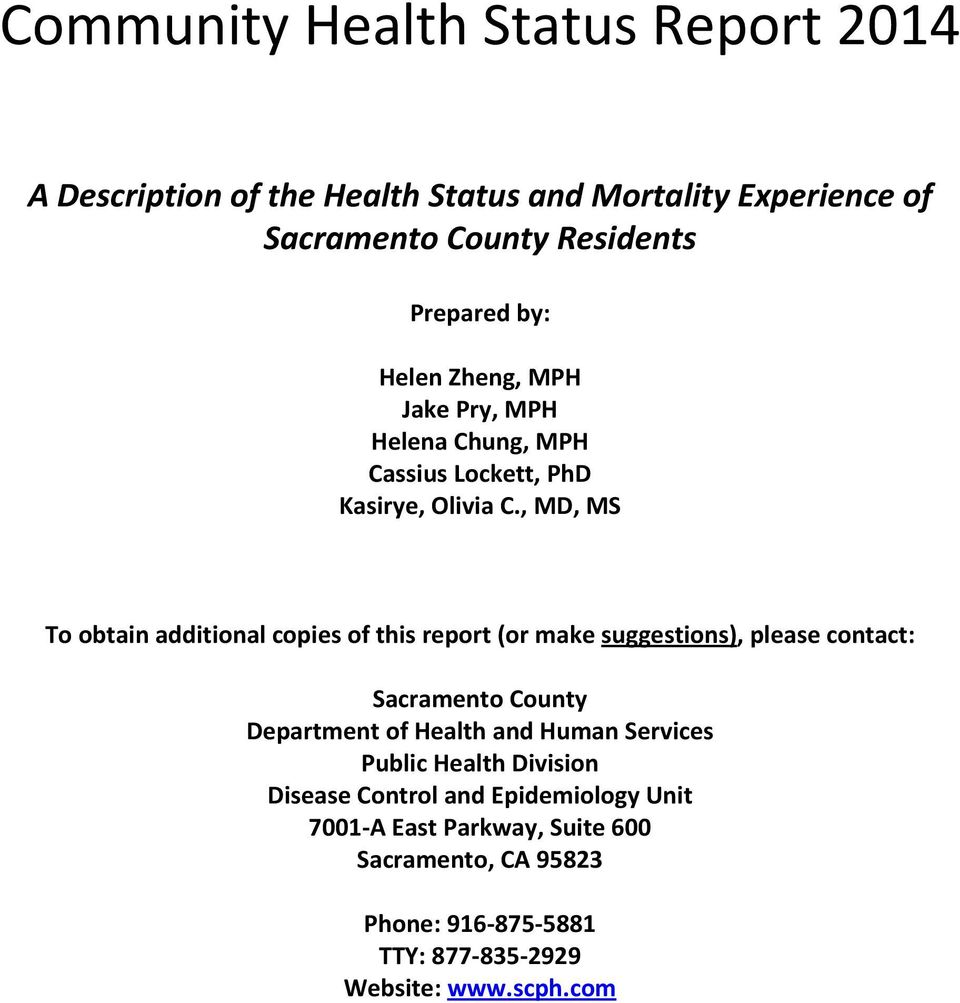
2 Community Health Status Report 2014 A Description of the Health Status and Mortality Experience of Sacramento County Residents Prepared by: Helen Zheng, MPH Jake Pry, MPH Helena Chung, MPH Cassius Lockett, PhD Kasirye, Olivia C., MD, MS To obtain additional copies of this report (or make suggestions), please contact: Sacramento County Department of Health and Human Services Public Health Division Disease Control and Epidemiology Unit 7001 A East Parkway, Suite 600 Sacramento, CA Phone: TTY: Website:
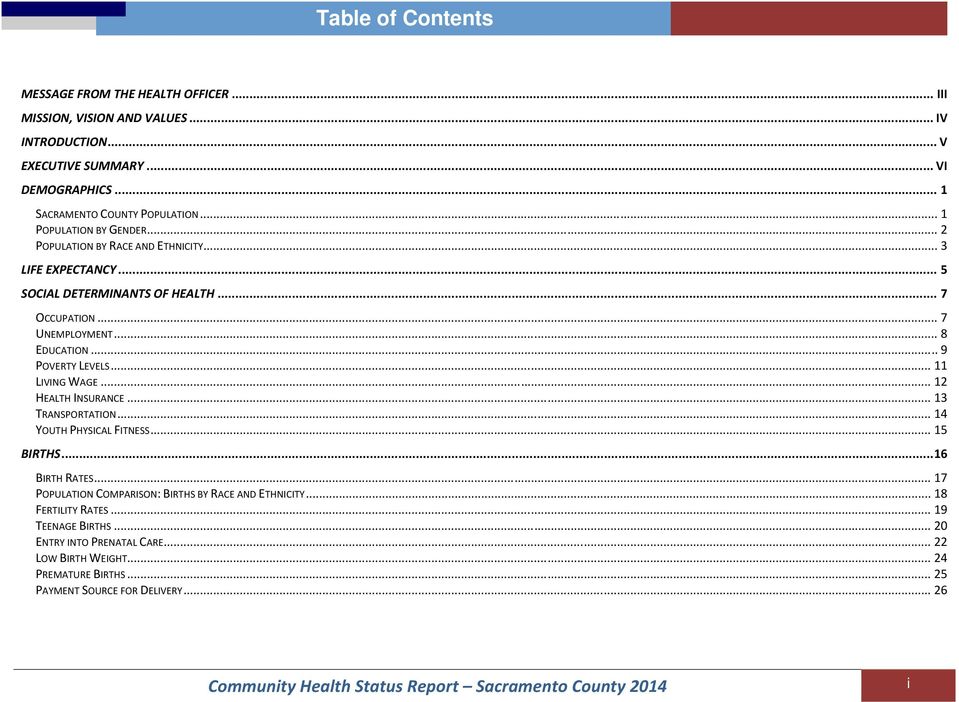
3 Table of Contents Table of Content MESSAGE FROM THE HEALTH OFFICER... III MISSION, VISION AND VALUES... IV INTRODUCTION... V EXECUTIVE SUMMARY... VI DEMOGRAPHICS... 1 SACRAMENTO COUNTY POPULATION... 1 POPULATION BY GENDER... 2 POPULATION BY RACE AND ETHNICITY... 3 LIFE EXPECTANCY... 5 SOCIAL DETERMINANTS OF HEALTH... 7 OCCUPATION... 7 UNEMPLOYMENT... 8 EDUCATION... 9 POVERTY LEVELS LIVING WAGE HEALTH INSURANCE TRANSPORTATION YOUTH PHYSICAL FITNESS BIRTHS BIRTH RATES POPULATION COMPARISON: BIRTHS BY RACE AND ETHNICITY FERTILITY RATES TEENAGE BIRTHS ENTRY INTO PRENATAL CARE LOW BIRTH WEIGHT PREMATURE BIRTHS PAYMENT SOURCE FOR DELIVERY Community Health Status Report Sacramento County 2014 i
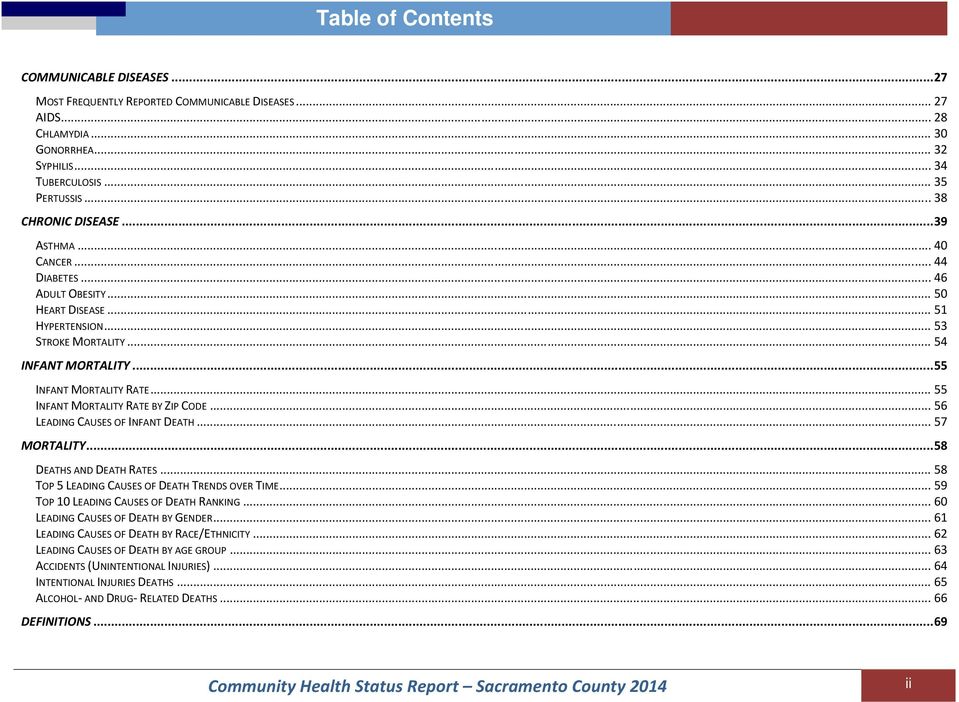
4 Table of Contents COMMUNICABLE DISEASES MOST FREQUENTLY REPORTED COMMUNICABLE DISEASES AIDS CHLAMYDIA GONORRHEA SYPHILIS TUBERCULOSIS PERTUSSIS CHRONIC DISEASE ASTHMA CANCER DIABETES ADULT OBESITY HEART DISEASE HYPERTENSION STROKE MORTALITY INFANT MORTALITY INFANT MORTALITY RATE INFANT MORTALITY RATE BY ZIP CODE LEADING CAUSES OF INFANT DEATH MORTALITY DEATHS AND DEATH RATES TOP 5 LEADING CAUSES OF DEATH TRENDS OVER TIME TOP 10 LEADING CAUSES OF DEATH RANKING LEADING CAUSES OF DEATH BY GENDER LEADING CAUSES OF DEATH BY RACE/ETHNICITY LEADING CAUSES OF DEATH BY AGE GROUP ACCIDENTS (UNINTENTIONAL INJURIES) INTENTIONAL INJURIES DEATHS ALCOHOL AND DRUG RELATED DEATHS DEFINITIONS Community Health Status Report Sacramento County 2014 ii
5 Message From the Health Officer Message From the Health Officer Sacramento County, Department of Health and Human Services, Public Health Division, is pleased to bring you the 2014 Community Health Status Report. The purpose of this report is to provide an overview of some of the key community health indicators and trends in our County. One of the primary roles of public health is to systematically collect, analyze, report and disseminate information about the health of the County s population. This is done to encourage collaboration to support community driven health improvement intervention and policy. This report presents public health data that can be directly compared with clearly established benchmarks, such as national standards and is meant to be a tool for learning as well as planning. Olivia Kasirye, MD, MS. Public Health Officer Sacramento County This is the third edition of the Community Health Status Report. This year s report includes data on life expectancy, social determinants of health, chronic disease, communicable disease, births and mortality. As much as possible, we compared our local data to State or national Healthy People 2020 Objectives. In addition to health related indicators, we included other socio economic factors that influence the health status of the population. The community is the most valuable partner in public health. Therefore the broad purpose of the report is to help policy makers, educators, community members and program planners identify priority issues and measure progress in the domain of population health. The general public, health professionals and organizations that deal with preventing disease and mortality will find the information in the report useful. We value your opinions about this report and welcome the opportunity for feedback and collaboration. Community Health Status Report Sacramento County 2014 iii
6 Mission, Vision and Values Mission, Vision and Values Mission: The mission of Sacramento County Public Health is to promote, protect, and assure conditions for optimal health and public safety for residents and communities of Sacramento County through leadership, collaboration, prevention and response. Vision: Optimal health and well being for Sacramento County communities! Values: Collaboration: We value collaboration and diversity. Dedication: We are dedicated to meet the public health needs of Sacramento County residents and communities. Quality: We provide high quality and effective services based on best practices and the most current information and resources. Competence: We hire staff with essential skills, education, experience and certification to accomplish program goals. Responsiveness: We listen to community needs, monitor community health, and develop responses to match needs. Accountability: We accept responsibility and accountability for providing efficient and quality service. We conduct ourselves with integrity in delivering services. Diversity: We respect and value diversity within the community and strive to deliver services that are respectful and relevant to the needs, values, and beliefs of the community. We seek to recruit and hire diverse staffs that enhance our level of understanding of various populations and to promote cultural competence. Efficiency: We look for the most efficient way to get the job done. Mission, Vision and Values Community Health Status Report Sacramento County 2014 iv
7 Introduction Acknowledgements The Department of Health and Human Services acknowledges all health care providers for their timely reporting of communicable diseases to the Disease Control and Epidemiology Unit. Technical Notes Population Data The population data used in this report are from the State of California, Department of Finance, Race/Ethnic Population with Age and Sex Detail, , Sacramento, CA, May 2007 and State of California, Department of Finance, Race/Ethnic Population with Age and Sex Detail, Sacramento, CA, Jan Birth (including Prenatal Care) and death data The birth and death data presented in this report are from the State of California, Department of Public Health birth and death master files for the Sacramento County 2002 through Communicable Disease Data The data presented on communicable disease in Sacramento County were obtained from the State of California, Department of Public Health, the HIV and AIDS registry (EHARS), California Reportable Disease Information Exchange (CalREDIE), and the TB registry. Please note that all communicable disease data for 2012 are provisional. Chronic Disease Data The data for chronic diseases in Sacramento County are based on the information obtained from the 2001, 2003, 2005, 2007, 2009 and 2011 California Health Interview Survey (CHIS). Social Determinants of Health Data The social determinants of health indicator data were obtained from California Department of Public Health, Office of Health Equity. Introduction Community Health Status Report Sacramento County 2014 v
8 Executive Summary Monitoring the occurrence of disease and mortality in the population is vital to understanding and limiting their impact on human health. This Community Health Status Report focuses on social determinants of health and general health indicators, including birth rates, prenatal care, sexually transmitted infections, asthma, diabetes, obesity, heart disease and infant mortality. The statistics provide a picture of the health status and mortality experiences of residents in Sacramento County. This report accomplishes essential public health functions such as monitoring the health status of a community to identify community health problems, and informing, educating and empowering people to manage health issues in their communities. Highlights of Major Findings Demographics The population in the County of Sacramento increased by 9.0% between 2003 and The Hispanic population increased the most of all races and ethnicities in Sacramento County, increasing by 31.0% in the period between 2003 and Sacramento County s population is aging. From 2003 to 2013, there was a 54.2 % increase in the population over ages 60 69, and a 44.7% increase over age 85 and older. Social Determinants of Health Unemployment has been slowly decreasing from late 2009 in Sacramento County to 8.9% in August of The most common occupation in Sacramento County falls in the category of Management, Business, Science and Arts 63.2% of Sacramento County s residents reported at least some college education in the five years average ( ). This was slightly higher than the State as a whole (59.8%). High school graduation rate increased 4.4% from school year 2009/2010 to 2011/2012 for Sacramento County. People with no health insurance coverage increased from 2001 to 2011 in Sacramento County. Executive Summary Community Health Status Report Sacramento County 2014 vi
9 Executive Summary Life Expectancy From 2002 to 2011, life expectancy increased for all racial and ethnic groups. In 2011, Hispanic residents had the highest life expectancy (87.7 years) and African Americans had the lowest (73.8 years). On average, Hispanic residents live 13.9 more years than their African American counterparts, 9.1 more years than Caucasians and 3.6 more years than Asians and Pacific Islanders. Hispanics experienced the greatest increase in life expectancy over the time span (4.7 %). Births The number of births increased from 2002 to During the 10 year period, Hispanics had the highest birth rate of all the race/ ethnicities. Although teenage birth rates declined for all racial and ethnic groups, Hispanic and African American teens continued to have birth rates that were more than twice that of Caucasian teens. Low birth weight birth rates were significantly higher for African Americans than for any other racial or ethnic groups. From 2002 to 2011, Sacramento County did meet the Healthy People 2020 Objective of reducing births with low birth weight to less than 7.8% of all live births. Communicable Diseases Chlamydia was the most commonly reported communicable disease in Sacramento County with 8,351 cases of Chlamydia reported in 2012, a 43.4 % increase since During the same year, 31.8% of chlamydia infections were in teenage girls between the ages of 15 and 19. The rate of chlamydia was 29.2% higher than the State rate in In 2012, Gonorrhea was the second most commonly reported communicable disease in Sacramento County. Of the 2,156 reported cases of Gonorrhea, 26.5% occurred in teenage girls ages years, in During the 10 year period, the incidence rate of Gonorrhea increased by 12.3%. The incidence rate was 67.6% higher than the State in Community Health Status Report Sacramento County 2014 vii
10 Executive Summary The number of cases of primary and secondary Syphilis is increasing. In 2003, there were 13 cases of primary and secondary syphilis reported compared to 138 cases of primary and secondary syphilis reported in The incidence of AIDS in the Sacramento County declined 20.2% from 8.4 per 100,000 population in 2002 to 6.7 per 100,000 population in For the past 10 years, statewide incidence rates for Tuberculosis have steadily declined, whereas rates in the County have fluctuated due to sporadic outbreaks among different racial/ethnic groups and homeless persons. Chronic Disease Based on the California Health Interview Survey (CHIS) results, Sacramento County has a higher prevalence of asthma than the State across all years. In 2011, Multi race (27.2%) followed by Caucasians (18.2%) and African Americans (11.7%) had the highest prevalence of asthma, and young adults aged years (26.0%) followed by ages years (15.3%), had the highest prevalence of all age groups. In 2011, Sacramento County had a higher diabetes prevalence rate than the State, with the prevalence of diabetes in residents ages 65 years and over being significantly higher than in other age groups. The prevalence of heart disease was lower than the State s average (5.2% versus 6.3%). Residents greater than age 65 years had the highest heart disease prevalence. The rate declined by 38.2% from 2001 to Cancer age adjusted incidence rate was per 100,000 population in 2011 for Sacramento, which is 8.4% higher than the State rate. The age adjusted cancer mortality rate also is 12.8% higher than the State in Community Health Status Report Sacramento County 2014 viii

11 Executive Summary Infant Mortality African Americans had the highest infant mortality rate of all ethnic and racial groups. From 2002 through 2011, African American infants had two to three times the mortality of all other infants born in the County. The three leading causes for all infants in 2011 were: 1. Congenital malformations 2. Prematurity and low birth weight 3. Sudden Infant Death Syndrome (SIDS) From 2002 to 2011, the overall infant mortality rate decreased from 6.1 in 2002 to 5.5 per 1,000 live births in Mortality In 2011, cancer surpassed heart disease as the leading cause of death, and was followed by heart disease, chronic lower respiratory disease (CLRD) and stroke. Diabetes was the 7th leading cause of death. Heart disease was ranked number one for Caucasians and American Indian/Alaskan Natives, and number two for all other racial and ethnic groups. In 2011, unintentional and intentional injuries together accounted for more than 38% of all deaths in children between the ages of one and 18. Of the unintentional fatal injuries, the vast majority was due to motor vehicle crashes (60%). Community Health Status Report Sacramento County 2014 ix
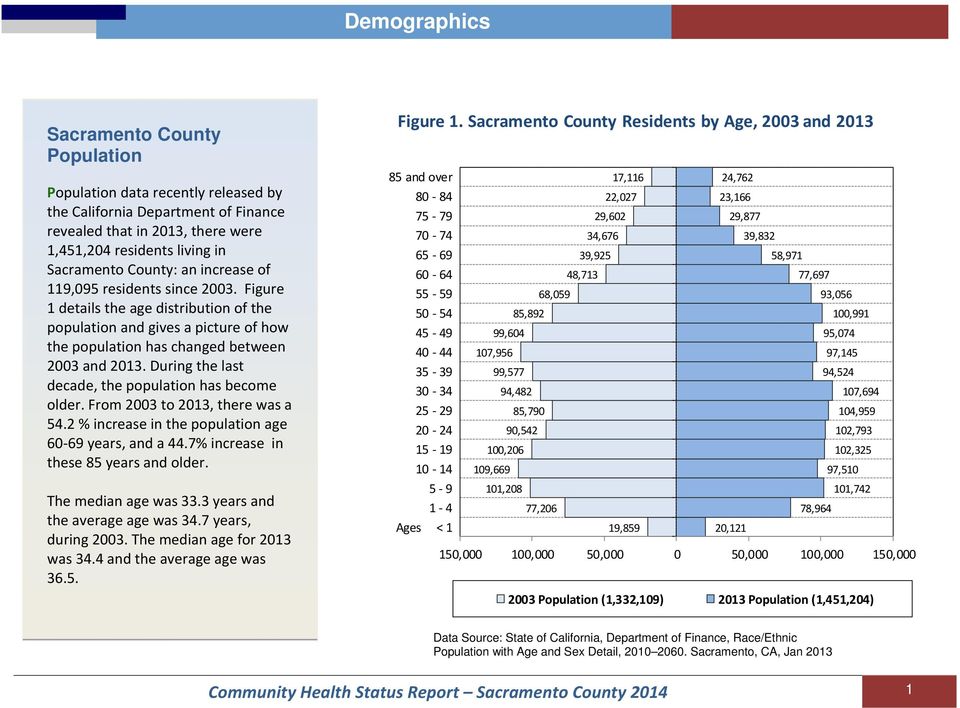
12 Demographics Demographics Sacramento County Population Population data recently released by the California Department of Finance revealed that in 2013, there were 1,451,204 residents living in Sacramento County: an increase of 119,095 residents since Figure 1 details the age distribution of the population and gives a picture of how the population has changed between 2003 and During the last decade, the population has become older. From 2003 to 2013, there was a 54.2 % increase in the population age years, and a 44.7% increase in these 85 years and older. The median age was 33.3 years and the average age was 34.7 years, during The median age for 2013 was 34.4 and the average age was Figure 1. Sacramento County Residents by Age, 2003 and and over Ages < 1 99, ,956 99, , , ,208 85,892 94,482 85,790 90,542 68,059 77,206 48,713 29,602 34,676 39,925 17,116 22,027 19,859 24,762 23,166 29,877 20,121 39,832 58,971 77,697 78,964 93, ,991 95,074 97,145 94, , , , ,325 97, , , ,000 50, , , , Population (1,332,109) 2013 Population (1,451,204) Data Source: State of California, Department of Finance, Race/Ethnic Population with Age and Sex Detail, Sacramento, CA, Jan 2013 Community Health Status Report Sacramento County
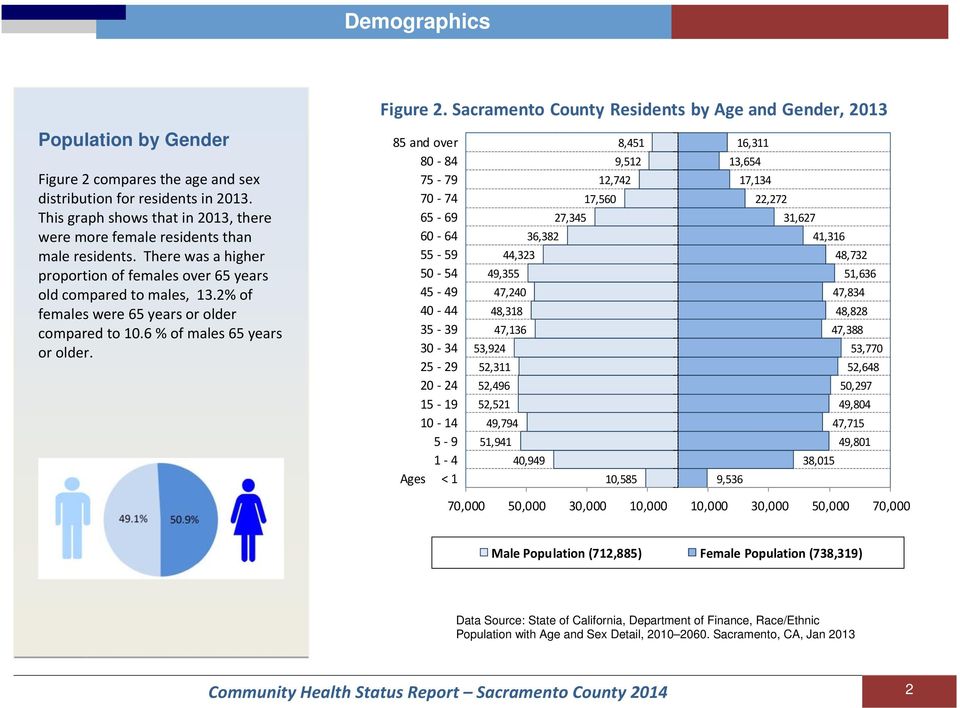
13 Demographics Figure 2. Sacramento County Residents by Age and Gender, 2013 Population by Gender Figure 2 compares the age and sex distribution for residents in This graph shows that in 2013, there were more female residents than male residents. There was a higher proportion of females over 65 years old compared to males, 13.2% of females were 65 years or older compared to 10.6 % of males 65 years or older. 85 and over Ages < 1 8,451 9,512 12,742 17,560 27,345 36,382 44,323 49,355 47,240 48,318 47,136 53,924 52,311 52,496 52,521 49,794 51,941 40,949 10,585 16,311 13,654 17,134 22,272 31,627 41,316 48,732 51,636 47,834 48,828 47,388 53,770 52,648 50,297 49,804 47,715 49,801 38,015 9,536 70,000 50,000 30,000 10,000 10,000 30,000 50,000 70,000 Male Population (712,885) Female Population (738,319) Data Source: State of California, Department of Finance, Race/Ethnic Population with Age and Sex Detail, Sacramento, CA, Jan 2013 Community Health Status Report Sacramento County
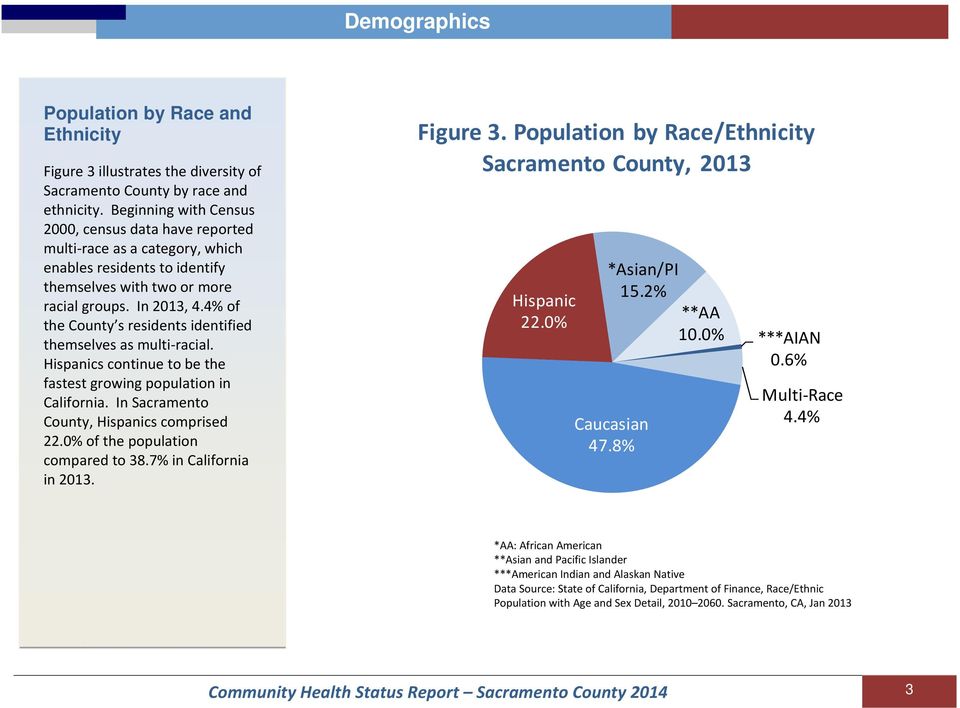
14 Demographics Population by Race and Ethnicity Figure 3 illustrates the diversity of Sacramento County by race and ethnicity. Beginning with Census 2000, census data have reported multi race as a category, which enables residents to identify themselves with two or more racial groups. In 2013, 4.4% of the County s residents identified themselves as multi racial. Hispanics continue to be the fastest growing population in California. In Sacramento County, Hispanics comprised 22.0% of the population compared to 38.7% in California in Figure 3. Population by Race/Ethnicity Sacramento County, 2013 Hispanic 22.0% *Asian/PI 15.2% **AA 10.0% ***AIAN 0.6% Caucasian 47.8% Multi Race 4.4% *AA: African American **Asian and Pacific Islander ***American Indian and Alaskan Native Data Source: State of California, Department of Finance, Race/Ethnic Population with Age and Sex Detail, Sacramento, CA, Jan 2013 Community Health Status Report Sacramento County
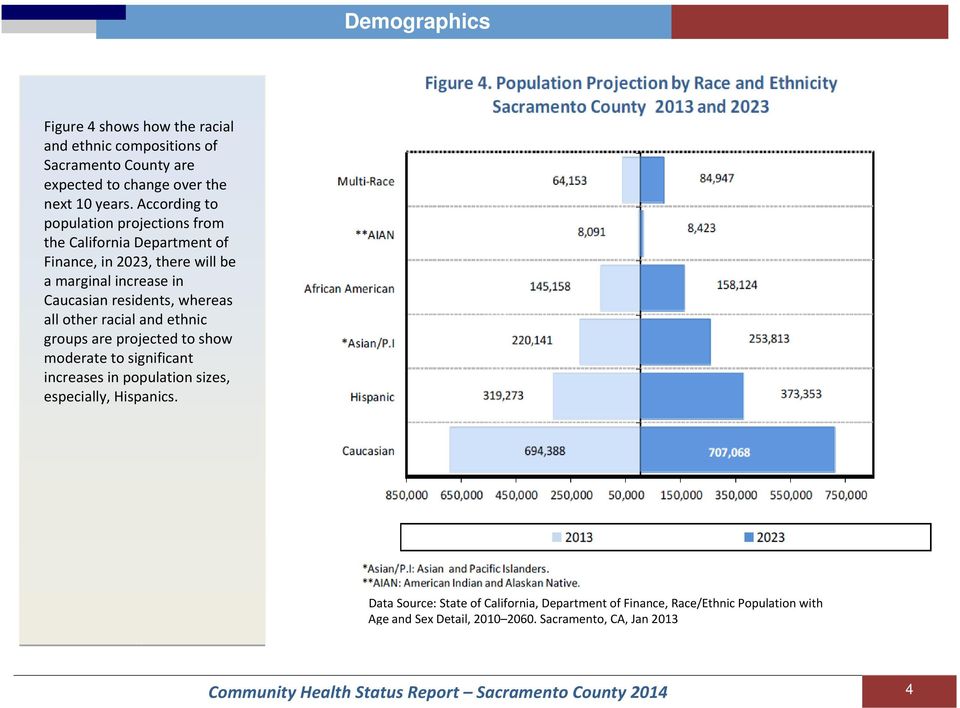
15 Demographics Figure 4 shows how the racial and ethnic compositions of Sacramento County are expected to change over the next 10 years. According to population projections from the California Department of Finance, in 2023, there will be a marginal increase in Caucasian residents, whereas all other racial and ethnic groups are projected to show moderate to significant increases in population sizes, especially, Hispanics. Data Source: State of California, Department of Finance, Race/Ethnic Population with Age and Sex Detail, Sacramento, CA, Jan 2013 Community Health Status Report Sacramento County
16 Life Expectancy Life Expectancy Life Expectancy in Sacramento County Life expectancy is a measure that summarizes health over the entire lifespan. Life expectancy at birth is the average number of years that a newborn can expect to live, assuming that he/she experiences the currently prevailing rates of death throughout his/her lifespan. Table 1 shows that over the ten year span, the life expectancy for Sacramento County increased from 77.6 years to 79.5 years (2.4% change). Life expectancy also increased for all racial and ethnic groups, especially for African Americans and Hispanics. In 2011, Hispanic residents had the highest life expectancy (87.7 years), followed by Asian/Pacific Islanders (84.1 years), Caucasians (78.6 years) and African Americans (73.8 years). Table 1. Life Expectancy by Race/Ethnicity, Sacramento County, Year Overall Hispanic Caucasian African- American Asian/PI % increase Data Source: Population State of California, Department of Finance, Race/Ethnic Population with Sex Detail, , Sacramento, CA, July Life Expectancy Calculation Chiang (I) Method. United Kingdom Community Health Status Report Sacramento County

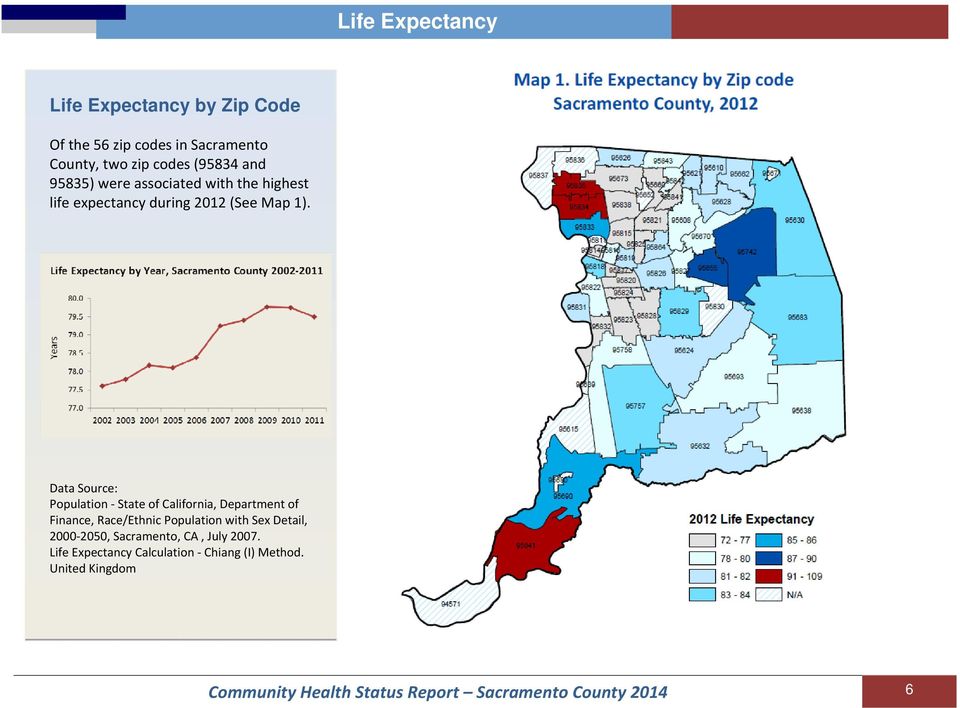
17 Life Expectancy Life Expectancy by Zip Code Of the 56 zip codes in Sacramento County, two zip codes (95834 and 95835) were associated with the highest life expectancy during 2012 (See Map 1). Data Source: Population State of California, Department of Finance, Race/Ethnic Population with Sex Detail, , Sacramento, CA, July Life Expectancy Calculation Chiang (I) Method. United Kingdom Community Health Status Report Sacramento County
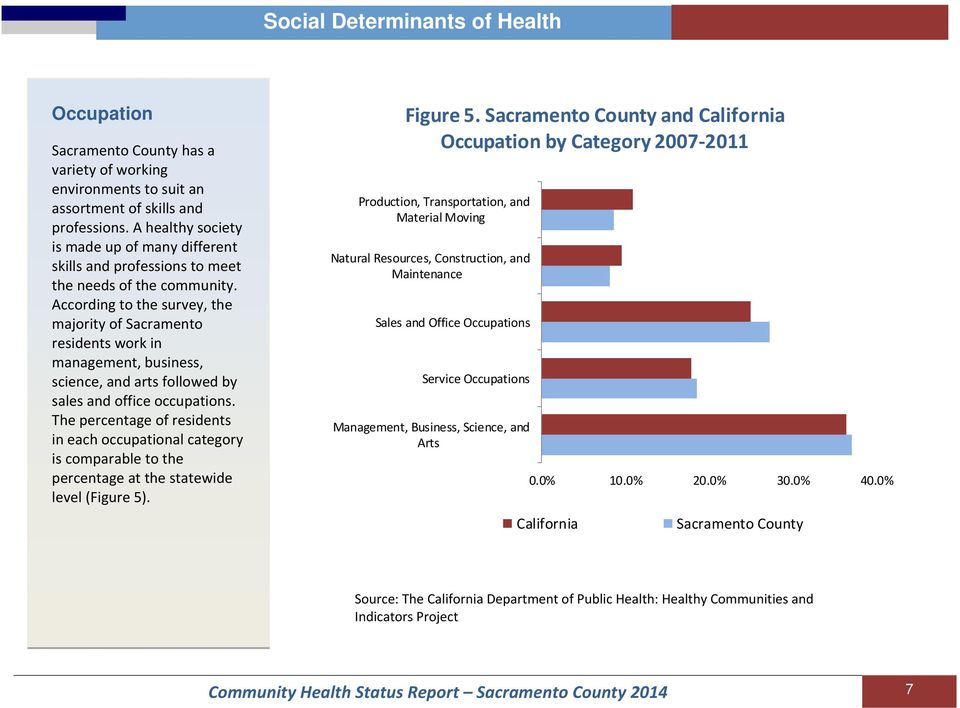
18 Social Determinants of health Social Determinants of Health Occupation Sacramento County has a variety of working environments to suit an assortment of skills and professions. A healthy society is made up of many different skills and professions to meet the needs of the community. According to the survey, the majority of Sacramento residents work in management, business, science, and arts followed by sales and office occupations. The percentage of residents in each occupational category is comparable to the percentage at the statewide level (Figure 5). Figure 5. Sacramento County and California Occupation by Category Production, Transportation, and Material Moving Natural Resources, Construction, and Maintenance Sales and Office Occupations Service Occupations Management, Business, Science, and Arts 0.0% 10.0% 20.0% 30.0% 40.0% California Sacramento County Source: The California Department of Public Health: Healthy Communities and Indicators Project Community Health Status Report Sacramento County
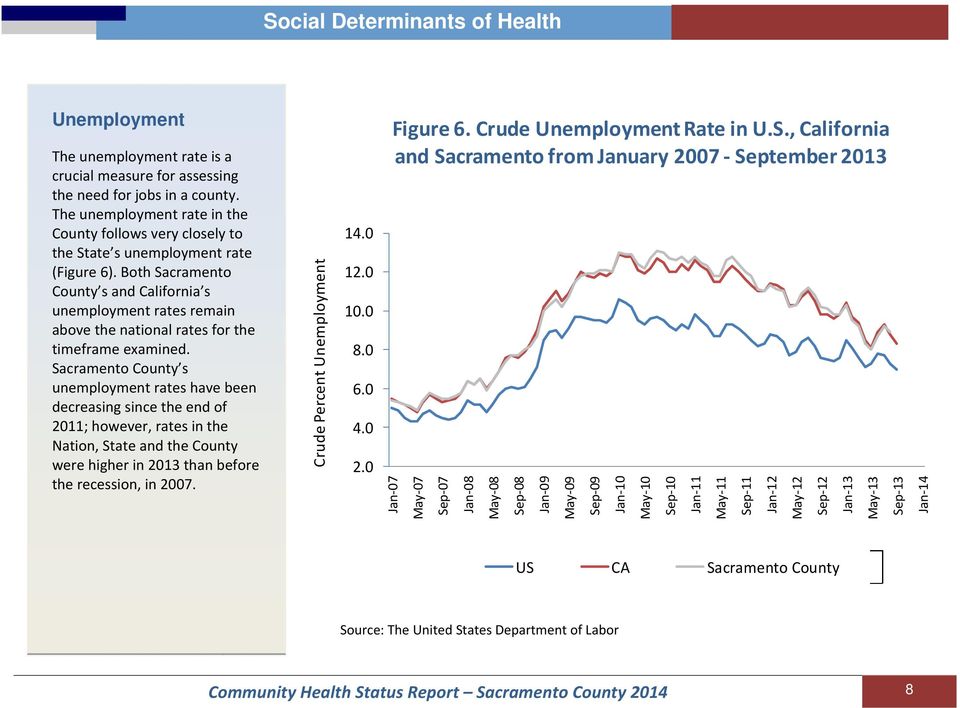
19 Social Determinants of Health Unemployment The unemployment rate is a crucial measure for assessing the need for jobs in a county. The unemployment rate in the County follows very closely to the State s unemployment rate (Figure 6). Both Sacramento County s and California s unemployment rates remain above the national rates for the timeframe examined. Sacramento County s unemployment rates have been decreasing since the end of 2011; however, rates in the Nation, State and the County were higher in 2013 than before the recession, in Crude Percent Unemployment Jan 07 Figure 6. Crude Unemployment Rate in U.S., California and Sacramento from January 2007 September 2013 May 07 Sep 07 Jan 08 May 08 Sep 08 Jan 09 May 09 Sep 09 Jan 10 May 10 Sep 10 Jan 11 May 11 Sep 11 Jan 12 May 12 Sep 12 Jan 13 May 13 Sep 13 Jan 14 US CA Sacramento County Source: The United States Department of Labor Community Health Status Report Sacramento County
20 Social Determinants of Health Education Sacramento County is home to several academic institutions. Education is critical to a healthy community. It equips individuals to compete for better employment opportunities and provides confidence to make healthy decisions. The majority of Sacramento County residents reported at least some college education (63.2%). This was slightly higher than the State as a whole (59.8%). Percent of Population Estimate Figure 7. Sacramento County and California Educational Attainment Among Adults ( 25 yrs) Less Than 9th Grade 9th to 12th Grade (No Diploma) High School Some college, Graduate no degree (Equivalency) Associate's Degree Bachelor's Degree Graduate or Professional Degree Sacramento County California Source: The California Department of Public Health: Healthy Communities and Indicators Project Community Health Status Report Sacramento County

21 Social Determinants of Health Health Equity High School Graduation Rate The graduation rate is the percentage of the students expected to graduate in four years that actually did graduate. Sacramento County shows an increasing trend in graduation rates across the school years from 72.3% in 2009/2010 to 76.7% (4.4% increases) in 2011/2012 as indicated in Figure 8. The increasing trend in Sacramento County is consistent with the increase at the state level though, Sacramento is consistently lower than the State s rates for the years displayed. Percent Figure 8. Percent Cohort High School Graduation Rates by School Year, The high school dropout rate for school year varied by race/ethnicity. It was highest for African Americans at 6.4% (See insert) / / /2012 Sacramento County California Source: Ed Data Education Data Partnership Note General Education Degree Recipients, Special Education Certificates of Completion or those that remain enrolled without a diploma are not included in these rates. Community Health Status Report Sacramento County
22 Social Determinants of Health Poverty Levels Figure 9 shows that Sacramento County had a slightly higher percentage of individuals living in poverty compared to the State. More than 30% of families in Sacramento reported an income at or below 185% the Federal Poverty Level (FPL). Percent Figure 9. Percent Population by Levels of Poverty, Sacramento County vs. California, <50% FPL <100% FPL <125% FPL <185% FPL Sacramento County California Source: The California Department of Public Health: Healthy Communities and Indicators Project. Community Health Status Report Sacramento County
23 Social Determinants of Health Living Wage The living wage in Sacramento County for one adult with two children is $20.17 per hour. Of the approximately 510,967 households in Sacramento County, those reporting as Hispanic showed the greatest percentage of poverty. Percent Families Figure 10. Families Living Below the Living Wage by Race/Ethnicity in 2010 AIAN Asian African American Hispanic NHOPI White Multiple Other Total California Sacramento AIAN American Indian / Alaska Native NHOPI Native Hawaiian / Other Pacific Islander Source: The California Department of Public Health: Healthy Communities and Indicators Project Community Health Status Report Sacramento County
24 Social Determinants of Health Health Insurance Health insurance is a major factor in maintaining health. People who do not have health insurance coverage may incur high medical costs. They often do not access preventative services, and do not have a medical home. Figure 11 shows that Sacramento County s percentage of individuals with no insurance almost doubled in the period of 10 years. The percentage for the State also increased, but not as dramatically. Percent Figure 11. Percent with No Health Insurance Coverage, Sacramento County vs. California, These numbers are expected to be reduced with the initiation of the ACA (Affordable Care Act) Sacramento California Source: California Health Interview Survey (CHIS) Community Health Status Report Sacramento County
25 Social Determinants of Health Transportation The majority (75.0%) of commuters reported driving alone. That is 2.0% higher than the statewide estimate of 73.0%. Although studies show that 18.9% of the population had access to public transit within ½ mile, only about 3% of commuters used public transit. Figure 12 shows that the State had a higher percentage of commuters using public transportation and walking than the County. The County had a higher percentage of commuters carpooling than the State. Percent Commuter Figure 12. Percent Commuters by Transport Method Sacramento County and California, Carpooled Public Transportation Walked Other Means Worked at Home Sacramento County California Source: The California Department of Public Health: Healthy Communities and Indicators Project Community Health Status Report Sacramento County
26 Social Determinants of Health Youth Physical Fitness Physical fitness is an important aspect of public health. Coupled with good nutrition, it can lead to a healthy population. 85 Figure 13. Percent of Sacramento County Youth Fitness by Grade, 2012/2013 Figure 13 shows that the majority of Sacramento County youth felled within the Healthy Fitness Zone measure. In general, a higher percentage of youth met the requirements for the healthy fitness zone as they progressed in school. Those populations reporting as Asian, White and Multi Race were among the highest percentage of youth meeting HFZ requirements across the grades represented. Percent Grade 5 Students in HFZ Grade 7 Students in HFZ Grade 9 Students in HFZ African American Asian Hispanic Multi Race Caucasian AIAN* Source: California Department of Education Fitness Gram Data HFZ: Healthy Fitness Zone Standards established by The Cooper Institute that represent levels of fitness that offer some degree of protection against diseases that can result from sedentary living. These standards are organized by gender and age. AIAN*: American Indian/Alaskan Native Community Health Status Report Sacramento County
27 Births Births Births Table 2 shows that the total number of births for the County increased by 3.9% from 2002 to By race/ ethnicity, births among Caucasians decreased by 13.2% (1,182 fewer births) in 2011 compared to In the Multi Racial group, there was a 91.5% increase from 508 births in 2002 to 973 births in This is probably attributable to changes in the data collection. Among the Asian/Pacific Islander group, there was a 21.6% increase in births in 2011 compared to Table 2. Total Number of Births by Race and Ethnicity Sacramento County, Year Caucasian African American Hispanic Asian/Pacific Islander Multi Race American Indian Total Births ,952 1,955 4,880 2, , ,125 1,987 5,503 3, , ,926 2,023 5,848 3, , ,881 2,091 6,107 3, , ,781 2,195 6,573 3, , ,565 2,289 6,662 3, , ,224 2,158 6,316 3, , ,996 2,219 5,856 3, , ,973 2,107 5,640 3, , ,770 2,183 5,533 3, ,998 Data Source: State of California, Department of Public Health birth and death master files for the Sacramento County 2002 through Community Health Status Report Sacramento County
28 Births Birth Rates The birth rate (entire county, specific racial or ethnic group) is calculated as the number of live births to a certain population divided by the total number of people in that population, and is reported per 1,000 population. Rates for the County decreased from 14.8 in 2002 to 14.0 in 2011 per 1,000 population. The overall birth rate for California declined from 15.0 to 12.7 per 1,000 population. Over the 10 year span, Hispanics had the highest birth rate over all race/ethnicity groups, followed by Asian/ Pacific Islander. Caucasians had the lowest birth rate. In 2006, the Hispanic birth rate of 24.1 per 1,000 population was 53.0% higher than the County s birth rate in the same year. Rate per 1,000 Population Figure 14. Birth Rate by Race/ Ethnicity, Sacramento County and California, Caucasian Hispanic Overall Sacramento African American Asian/Pacific Islander California Data Source: State of California, Department of Public Health birth and death master files for the Sacramento County 2002 through Community Health Status Report Sacramento County
29 Births Population Comparison: Births by Race and Ethnicity Figure 15 shows the distribution of births for each racial and ethnic category. In 2011, Hispanics and Asian/Pacific Islanders were overrepresented in births; comprising 21.8% and 15.1% of the population, respectively, but accounting for 27.7% and 17.3% of the births, respectively. Caucasians were under represented in births; whereas they comprised 48.4 % of the population, they accounted for 38.9% of the births. Figure 15. Sacramento County Live Births by Race/Ethnicity, 2011 Hispanic 27.7% Asian/Pacific Islander 17.3% Caucasian 38.9% African American 10.9% American Multi Race 4.9% Indian 0.4% Data Source: State of California, Department of Public Health birth and death master files for the Sacramento County 2002 through Community Health Status Report Sacramento County
30 Births Fertility Rates The fertility rate is calculated by dividing the number of births by the number of women ages years old (child bearing) and then multiplying that result by 1,000. It is defined as the number of births per 1,000 females ages 15 to 44 years. Over the past 10 years, Sacramento County had an average fertility rate of 70.6 per 1,000 females ages 15 to 44. During the 10 year period, Caucasians experienced the lowest fertility rate among all racial and ethnic groups. The fertility rate for Hispanic women was the highest, although it decreased 17.5% over the 10 year period. Rate per 1,000 Population Figure 16. Fertility Rate by Race/ Ethnicity, Sacramento County and California, Caucasian Asian/Pacific Islander Sacramento Hispanic African American California Data Source: State of California, Department of Public Health birth and death master files for the Sacramento County 2002 through Community Health Status Report Sacramento County
31 Births Teenage Births Adolescent pregnancy and childbearing have been associated with adverse health and social consequences. Births to mothers less than 20 years of age are presented here in three different age groups (12 14, and 18 19). The rates of births to females ages 15 to 17 years dropped 48.6% during the 10 year period, from 20.3 in 2002 to 10.5 per 1,000 females in The birth rate for year olds declined 33.5% from 65.2 in 2002 to 43.4 per 1,000 females in Rate per 1,000 Females by Age Group Figure 17. Teen Birth Rate by Year Sacramento County, Data Source: State of California, Department of Public Health birth and death master files for the Sacramento County 2002 through Community Health Status Report Sacramento County
32 Births From 2002 to 2011, the birth rate for adolescents aged 15 to 19 years declined for all racial and ethnic groups. The overall teen birth rate declined 25.5%. The teen birth rate for Asian/Pacific Islanders dropped 53.4%; Hispanics dropped 35.3%; Caucasians dropped 35.1% and African Americans dropped 15.6% during the 10 year period. Over the 10 year span, Hispanics had the highest teen birth rate. Rate per 1,000 Population Figure 18. Birth Rate by Race/ Ethnicity for Mothers Aged Sacramento County and California, In 2011, the teen birth rates for Hispanics and African Americans were more than two times higher than that of Caucasians and Asian/Pacific Islanders Caucasian Hispanic Asian/Pacific Islander African American Sacramento California Data Source: State of California, Department of Public Health birth and death master files for the Sacramento County 2002 through Community Health Status Report Sacramento County
33 Births Entry into Prenatal Care Early entry into prenatal care (PNC) is vital to the health of the mother and the infant. The Healthy People 2020 Objective (U.S. Govt.) states that 77.9% of mothers should enter prenatal care during the first trimester (first three months of pregnancy). During the past 10 years, Sacramento County met the Objective except for the years 2007 and From 2002 to 2011, the percent of mothers entering prenatal care during the first trimester decreased for all racial /ethnic groups. Caucasians had the highest percentage entering prenatal care during the first trimester, over the 10 year period. Figure 19, First Trimester Entry Into PNC by Race/ Ethnicity Sacramento County, Percent Entering Early PNC Caucasian Asian/Pacific Islander Hispanic African American Sacramento Healthy People 2020 Data Source: State of California, Department of Public Health birth and death master files for the Sacramento County 2002 through Community Health Status Report Sacramento County
34 Births Sacramento County did not achieve the Healthy People 2020 Objective for entry into prenatal care for mothers aged less than 25 years old, regardless of race/ethnicity, in Figure 20, First Trimester Entry Into Prenatal Care by Race/Ethnicity and Age of Mother, Sacramento County, The percentage entering early prenatal care increased with mothers ages. In 2011, women aged 25 or older, with the exception of African Americans, were either very close to or surpassed the Healthy People 2020 Objective for early entry into prenatal care. Percent Entering Early PNC and Under and Older Hispanic Caucasian African American Asian/Pacific Islander Multi Race Healthy People 2020 Data Source: State of California, Department of Public Health birth and death master files for the Sacramento County 2002 through Community Health Status Report Sacramento County
35 Births Low Birth Weight Low birth weight (less than 2500 grams or 5.5 pounds) is the risk factor most closely associated with infant death. Increases in infant birth weight can contribute substantially to reductions in the infant death rate. From 2002 to 2011, Sacramento County did meet the Healthy People 2020 Objective of reducing births with low birth weight to less than 7.8% of all live births. From 2002 to 2011, Caucasians and Hispanics met the Objective; while Asian/ Pacific Islanders met the Objective in four of the 10 years. African Americans had the highest percentages of births with low birth weight during the 10 year period, with an average of 11.7%. That was 50.0% higher than the Healthy People 2020 Objective. Percent Figure 21. Percent of Infants Born with Low Birthweight By Race/Ethnicity, Sacramento County, Hispanic Caucasian African American AsianPacific Islander Healthy People 2020 Sacramento Data Source: State of California, Department of Public Health birth and death master files for the Sacramento County 2002 through Community Health Status Report Sacramento County
36 Births Premature Births Preterm birth is the birth of an infant prior to 37 weeks of pregnancy. Preterm related causes of death accounted for 20.2% of all infant deaths for Sacramento County in Figure 22. Percent of Preterm Births By Race/Ethnicity, Sacramento County, From 2002 to 2011, Sacramento County did not meet the Healthy People 2020 Objective of reducing preterm births to less than 11.4% of all live births except for From 2007 to 2011, Caucasians did meet the Objective. African Americans had higher premature birth rates across the 10 year period. Percent Hispanic Caucasian African American Asian/PI Healthy People 2020 Sacramento Data Source: State of California, Department of Public Health birth and death master files for the Sacramento County 2002 through Community Health Status Report Sacramento County
37 Births Payment Source for Delivery In 2011, Medi Cal payment accounted for 45.3% of all deliveries, and private insurance paid for 49.7% of deliveries. The major sources of payment for deliveries by race and ethnicity were: African Americans Medi Cal (64.0%); Hispanics Medi Cal (62.8%); Caucasians Private (63.4%); Asian/Pacific Islanders Private (56.7%). Insurance status was reported as none or unknown for 6.4% of deliveries in Sacramento County; this was equivalent to 239 births in Figure 23. Percent of Births by Payment Source at Delivery and Race/Ethnicity, Sacramento County, 2011 Overall Multi Race Asian/Pacific Islander African American Caucasian Hispanic Percent Others Private Medi Cal Data Source: State of California, Department of Public Health birth and death master files for the Sacramento County 2002 through Community Health Status Report Sacramento County
38 Communicable Diseases Most Frequently Reported Communicable Diseases Health care providers are required by law to report certain communicable diseases to local Health Officers (California Code of Regulations Title 17). Currently, there are 84 diseases on the list. This information is critical for monitoring disease in the community, for ensuring appropriate treatments and monitoring of cases and evaluations of people who may have been exposed. Chlamydia, gonorrhea, Hepatitis C, Hepatitis B and campylobacter were the top five communicable diseases in Communicable Diseases Table 3. Most Frequently Reported Communicable Diseases Sacramento County, 2012 General Reportable Disease Case Rate* Vector Borne Disease Case Rate* Hepatitis C, chronic West Nile Virus Neuroinvasive Coccidiomycosis West Nile Virus Fever Giardia Malaria Tuberculosis Sexually Transmitted Disease Case Rate* Meningitis, bacterial*** Chlamydia 8, Meningitis, viral Gonorrhea 2, Cryptosporidiosis Pelvic Inflammatory Disease (PID) Amebiasis Syphilis Primary & Secondary Meningococcal Disease AIDS Legionellosis HIV Encephalitis, viral 4 N/A Vaccine Preventable Case Rate* Botulism 2 N/A Hepatitis B carrier Hepatitis C acute 2 N/A Influenza ICU Food Borne Disease Case Rate* Pertussis Campylobacter Hepatitis A Salmonella Influenza Death 4 N/A Shigella Hepatitis B acute 4 N/A E. coli O Haemophilus Influenza** 1 N/A E. coli HUS 1 N/A Measles, Mumps, Rubella, Tetanus 1 N/A Rate*: Per 100,000 Population Wound and Infant Only **Invasive under 15 years of age *** Other than N. meningitides Data Source: State of California, Department of Public, Health Immuniza on Branch Data Source: California Reportable Disease Information Exchange, Confirmed Cases by Episode Date Community Health Status Report Sacramento County
39 Communicable Diseases AIDS The reported incidence of AIDS in the Sacramento County declined 20.2% from 8.4 per 100,000 population in 2002 to 6.7 per 100,000 population in 2011 (Figure 24). The incidence of AIDS in California declined 50.2% for the time period. The declines have been attributed to anti retroviral therapy, which can significantly reduce mortality and prolong the lives of residents living with HIV. In 2012, AIDS and HIV incidence rates in Sacramento ranked in the top 10 of counties in California. Rate Per 100,000 Population Figure 24. AIDS Incidence Rate, Sacramento County vs. California California Sacramento Data Source: State of California, Department of Public Health, office of AIDS Community Health Status Report Sacramento County
40 Communicable Diseases Males accounted for 80.3% of AIDS cases diagnosed from Men who have sex with men (MSM) constituted 48.9% of AIDS cases and intravenous drug users (IDU) constituted 11.1% of cases. Due to new drug treatments and better medical management of AIDS cases, the number of people living with AIDS (PLWA) continues to steadily increase. In 2000, there were 915 PLWA in Sacramento County compared to 1,862 PLWA in It was estimated that in 2011, there were 1,309 people living with HIV that did not progress to AIDS. AIDS disproportionately impacts African Americans. African Americans constituted 10.6 % of the population and 25.8 % of AIDS cases (Figure 25). However, Caucasians still are the major race affected at 52.9% of the total. Figure 25. AIDS Cases by Race/Ethnicity Sacramento County African American 25.8% Caucasian 52.9% Hispanic 15.5% Asian/PI* 3.5% Multi Race 1.5% AIAN** 0.8% *Asian/P.I: Asian and Pacific Islanders. **AIAN: American Indian and Alaskan Native. Data Source: State of California, Department of Public Health, office of AIDS Community Health Status Report Sacramento County
41 Communicable Diseases Chlamydia Chlamydia infections were the most commonly reported communicable disease. Chlamydia rates increased 43.4%, from in 2003 to per 100,000 population in The Chlamydia incidence rate was 29.2% higher than the statewide rate in 2012 (See the insert). Sacramento County had the fourth highest incidence rate in 2012, in the State. Females had higher incidence rate than males (Figure 26). Rate Per 100,000 Population Chlamydia Incidence Rate In Sacramento County and California, Sacramento California Rate per 100,000 Population Figure 26, Chlamydia Infection Incidence Rates by Gender, Sacramento County, , Female Male Data Source: State of California, Department of Public Health, STD Branch Community Health Status Report Sacramento County
42 Communicable Diseases In 2012, 70.0% of Chlamydia cases were females. Males may not experience symptoms and therefore do not get tested and reported. Among females, 31.9% of cases were amongst adolescents aged years, while the age group of year olds constituted 39.1% of cases. Rate per 100,000 Population Figure 27. Chlamydia Infection Incidence Rate by Age and Gender, Sacramento County, Male Female Data Source: State of California, Department of Public Health, STD Branch Community Health Status Report Sacramento County
43 Communicable Diseases Gonorrhea Sacramento County reported a rate of cases per 100,000 population in 2012, which is the third highest in the State of California behind San Francisco and Fresno Counties. The incidence rate of gonorrhea in Sacramento County is consistently ( ) above that reported for California. Rate per 100,000 Population Figure 28, Gonorrhea Infection Incidence Rates by Gender, Sacramento County, Female Male Data Source: State of California, Department of Public Health, STD Branch Community Health Status Report Sacramento County
44 Communicable Diseases Rate Per 100,000 Population In 2012, 53.2% of Gonorrhea cases were females. Among the females, 33.1% were years old, followed by those years old (26.5%). Among males, 28.6% were aged years, followed by those aged years (18.0%). Both males and females experienced increases in each age group in 2012 compared to 2011 and Rate per 100,000 Population Gonorrhea Incidence Rate In Sacramento County and California, Figure 29. Gonorrhea Infection Incidence Rate by Age and Gender, Sacramento County Male Female Sacramento California Data Source: State of California, Department of Public Health, STD Branch Community Health Status Report Sacramento County
45 Communicable Diseases Syphilis The State of California continues to experience an increase in primary and secondary (P&S) syphilis cases. The number of P&S syphilis cases in Sacramento County increased from 13 cases in 2003 to 138 in Rate per 100,000 Population Figure 30 illustrates data 8.0 comparing Sacramento County s 7.0 rate to the statewide rate of P&S Syphilis. Sacramento County has 6.0 surpassed the Statewide rate in 5.0 recent years (2011 and 2012) with a rate of 9.6 per 100, population in 2012 compared to 3.0 the Statewide rate of 7.8 per 100,000 population. 2.0 Figure 30. Primary and Secondary Syphilis Rate by Year, Sacramento County vs. California, Sacramento County California Source: California Department of Public Health, STD Control Branch (data reported through 08/19/2013) Community Health Status Report Sacramento County
46 Communicable Diseases Tuberculosis The Healthy People 2020 Objective for tuberculosis (TB) is 1.0 new case per 100,000 population. During the ten year period, Sacramento County did not meet this Objective. Table 4 compares tuberculosis incidence rates for Sacramento County with Statewide incidence rates for While statewide incidence rates have steadily declined, rates in Sacramento County have fluctuated due to identification of outbreaks. Statewide and Sacramento County s incidence rates have declined since Table 4 shows that the total number of cases in 2003 was more than double that in Year Table 4. Number of Tuberculosis Cases and Rates Sacramento County, Total Count Male Count Female Count Rate Sacramento Rate California Source: California Department of Public Health, Center for Infectious Diseases Division of Communicable Disease Control, Tuberculosis Control Branch Community Health Status Report Sacramento County
47 Communicable Diseases In 2012, Asian/Pacific Islanders made up the highest proportion of TB cases in the County (Figure 31). TB incidence rates declined among all ethnic groups, but the rates among Asians and Pacific Islanders remained higher than the rates for all other race/ethnicity groups over the 10 year period (see following graph). Rate per 100,000 Population Figure 31. Tuberculosis Incidence Rates by Race/Ethnicity Sacramento County, Caucasian African American Hispanic Asian/Pacific Islander Source: California Department of Public Health, Center for Infectious Diseases Division of Communicable Disease Control, Tuberculosis Control Branch Community Health Status Report Sacramento County
48 Communicable Diseases The greatest number of TB cases in 2003 to 2012 occurred amongst individuals over 45 years of age. TB can affect older people adversely if their immune systems become compromised, giving dormant bacteria a chance to cause active disease. The proportion of TB cases occurring among persons who are homeless in the County fluctuates from year to year. In general, it has decreased from a high of 13% of cases in 2005, corresponding to an outbreak during that time, to 7% of cases in Over 76% of homeless cases were males and 23.2% were females over the 10 year period. The majority of homeless TB cases in the County occurred among Caucasians (48.5%), followed by African Americans (32.3%) and Asian/Pacific Islanders (14.1%). Figure 32. Tuberculosis Cases by Age Group, Sacramento County Years, 31% Years, 29% 65 Years and Older, 25% Years, 10% 5 14 Years, 3% 0 4 Years, 2% Source: California Department of Public Health, Center for Infectious Diseases Division of Communicable Disease Control, Tuberculosis Control Branch Community Health Status Report Sacramento County
49 Communicable Diseases Pertussis Pertussis is a cyclical disease with outbreaks occurring every three to four years. The County s pertussis incidence rates exceeded the statewide rates from 2003 to Since 2010, the incidence rates have been lower than the State s (Figure 33). Sacramento County experienced a dramatic increase of pertussis cases in 2006 and There were 206 reported cases in 2006 with an incidence rate of 14.4 per 100,000 population and 175 reported in 2010 with a lower incidence rate of 12.3 per 100,000 population. From , a total of 1,051 pertussis cases was reported in Sacramento County. Rate per 100,000 population Figure 33. Pertussis Incidence Rates, Sacramento County vs. California, Sacramento County California Data Source: California Department of Public Health Community Health Status Report Sacramento County
50 Chronic Diseases Chronic Diseases Asthma, diabetes, overweight, cancer, heart disease, hypertension and health status estimates presented in this report are based on the California Health Interview Survey (CHIS) for Sacramento County and the State of California, and OSHPD (Office of Statewide Health & Planning Department) hospital discharge data. According to hospital discharge data, the top chronic diseases resulting in inpatient care in Sacramento County were mental illness, heart disease (including cerebrovascular disease), cancer, chronic lower respiratory disease and diabetes. Table 5. OSHPD Chronic Discharge Disease Data By selected Chronic Diseases, Sacramento County,2011 Disease Visits Mental disorder 10,497 Heart disease 9,868 Cancer 3,525 Cerebrovascular disease 3,053 Chronic lower respiratory disease 2,289 Pneumonia & influenza 2,195 Diabetes 1,821 Nephritis 887 Hypertension 454 Chronic liver & cirrhosis 303 Atherosclerosis 283 Alzheimer 52 Aortic aneurysm 38 Parkinson 23 Data Source: Office of Statewide Health & Planning Department (OSHPD), hospital discharge data. Community Health Status Report Sacramento County
51 Chronic Diseases Asthma Lifetime Asthma Prevalence Figure 34. Lifetime Asthma Prevalence, Sacramento County vs. California, In 2011, 14.9%, (an estimated 209,000) of Sacramento County residents of all ages were diagnosed with asthma at some point in their lives (lifetime asthma prevalence). Compared to California, the lifetime asthma prevalence for residents in Sacramento County was higher across all years (Figure 34). In 2011, Sacramento County had the lowest asthma prevalence (14.9%) since In 2011, the lifetime asthma prevalence was only 5.7% higher in Sacramento County than the State, the smallest difference over the period. Percent Sacramento County California Data Source: California Health Interview Survey (CHIS) Community Health Status Report Sacramento County
52 Chronic Diseases Asthma Prevalence by Age Figure 35 shows the distribution of asthma prevalence by age group. In Sacramento County, young adults aged years of age had the highest asthma prevalence (26.0 %), followed by residents years of age (15.3%) Figure 35. Lifetime Asthma Prevalence by Age Group Percent Sacramento California Data Source: California Health Interview Survey (CHIS) Community Health Status Report Sacramento County
53 Chronic Diseases Asthma Prevalence by Race/Ethnic Group Asthma prevalence varied with different racial and ethnic groups in Sacramento County in The rate among the multi racial group (26%) was higher than for the other race/ethnicities followed by Caucasians at 18.2%. Percent Figure 36. Asthma Prevalence by Race/Ethnicity Sacramento County vs. California, Hispanic Caucasian African American Asian/PI* Multirace Sacramento California Asian/PI*: Asian Pacific Islander Data Source: California Health Interview Survey (CHIS) Community Health Status Report Sacramento County
54 Chronic Diseases Chronic Lower Respiratory Disease Chronic Lower Respiratory Diseases (CLRD) is a diverse group of disorders involving impairment of lung function. CLRD comprises three major diseases: chronic bronchitis, emphysema and asthma. Conditions are characterized by shortness of breath due to airway obstruction. Mortality is high in older age groups, especially greater than age 65. Deaths were distributed primarily in the following zip Codes: (Carmichael), (Sacramento), and 95621(Citrus Heights), (Florin) and (Folsom/Clarksville). Community Health Status Report Sacramento County
55 Chronic Diseases Cancer Cancer was one of the leading causes of death in Sacramento County in Compared with the State, Sacramento County had a higher cancer incidence rate and cancer mortality rate for the most common cancer sites, listed in Table 6. Although breast cancer had a higher incidence rate, lung cancer had a higher mortality rate (Table 6). See the page 69 on definitions for explanation of ageadjusted rates. Cancer Table 6. Most Common Cancer in Sacramento County and California, 2011 Sacramento Age Adjusted Incidence Rates Incidence Deaths Sacramento California Sacramento California All Sites 6, Lung and Bronchus Colon and Rectum Breast 1, Prostate Leukemia All rates are per 100,000. Rates are age adjusted to the 2000 U.S. Standard Population. Data Source: California Cancer Registry Age Adjusted Mortality Rates Community Health Status Report Sacramento County
56 Chronic Diseases Cancer Incidence Rates by Race/Ethnicity and Gender The rates were higher for males than for females, except among the Asian/ Pacific Islanders. This disparity was greatest for African Americans. Overall, Asian/Pacific Islanders had the lowest cancer incidence rates among all race/ethnicity groups. Figure 37. Age Adjusted Incidence Rate by Race/Ethnicity and Gender Sacramento County vs. California, 2011, All Sites Combined Rate per 100,000 Population Caucasian African American Hispanic Asian/Pacific Islander California Male Sacramento County Male California Female Sacramento County Female Rates are shown as the number of new cases or deaths per 100,000 persons. All rates are ageadjusted to the 2000 United States Standard Population. Rate based on fewer than 15 cases are not shown. Data Source: California Department of Health, Cancer registry. Community Health Status Report Sacramento County
57 Chronic Diseases Diabetes In 2011, it was estimated that 97,000 adults in Sacramento County had been diagnosed with diabetes at some point in their lives. The prevalence of diabetes in Sacramento County was 9.2%. Compared to the State, the County s diabetes rate was higher in 2011, but lower in 2005 to In 2011, it is estimated that there were 55,000 adult males (10.7%) and 43,000 females (7.8%) diagnosed with diabetes. Among those diagnosed with diabetes in 2011, 17.1% had Type I diabetes, 78.5% had Type II diabetes. Percent Figure 38. Diabetes Rate by Year, Sacramento County vs. California, California Sacramento Data Source: California Health Interview Survey (CHIS) Community Health Status Report Sacramento County
58 Chronic Diseases Diabetes Mortality Diabetes was the seventh leading cause of death in Sacramento County in The death rate was more than 5 times as high for persons aged 65 and older group (123.0 per 100,000) compared to aged years old groups (23.7 per 100,000). Mortality was related primarily to heart disease complications. The risk for stroke and end stage renal disease is also higher for persons with diabetes. Diabetes deaths were primarily distributed in the following zip codes: (Carmichael), (Sacramento), (Florin), and (Sacramento). See map 3. Data Source: State of California, Department of Public Health birth and death master files for the Sacramento County 2007 through Community Health Status Report Sacramento County
59 Chronic Diseases Diabetes Prevalence by Age Individuals age 65 years and older had the highest prevalence of Type II diabetes (25.0 %), followed by individuals age years (15.4%). In 2011, the diabetes rate in Sacramento was higher than the State s for individuals 50 and older (Figure 39). Overweight and obesity are major risk factors for Type II diabetes. Percent Figure 39. Prevalence of Diabetes by Age Group, Sacramento County vs. California, Sacramento California Data Source: California Health Interview Survey (CHIS) Community Health Status Report Sacramento County
60 Chronic Diseases Prevalence of Diabetes by Race/Ethnicity Diabetes prevalence varied with different racial and ethnic groups in Sacramento County in American Indian and Alaskan Natives had the highest diabetes prevalence (14.2%), followed by African Americans (13.2%) and Asian/Pacific Islanders (12.9%). The County had higher rates than the State for all groups except for Hispanic. Percent Figure 40. Diabetes Prevalence by Race/Ethnicity Sacramento County vs. California, Hispanic Caucasian African American Asian/PI AIAN Sacramento California Data Source: California Health Interview Survey (CHIS) Community Health Status Report Sacramento County
61 Chronic Diseases Adult Obesity In 2011, an estimated 295,000 (28.0%) adults aged 18 years and older were obese (Body Mass Index) [BMI] greater than or equal to 30) and 360,000 (34.2%) adults were considered overweight (BMI between 25.0 and 29.9). From 2001 to 2011, the obesity rate for adults increased by 28.4%. Figure 41 shows that males had higher overweight rates than females across all years. In 2011, adult males had higher obesity rates than adult females. Percent Figure 41. Prevalence of Adult Obesity and Overweight by Gender, Sacramento County, Overweight Male Overweight Female Obese Male Obese Female Data Source: California Health Interview Survey (CHIS) Community Health Status Report Sacramento County
62 Chronic Diseases Heart Disease In 2011, an estimated 55,000 adult residents in Sacramento County reported living with heart disease. The prevalence rate for heart disease was 5.2% in Sacramento County, which was 17.5% lower than the State Figure 42. Heart Disease Prevalence by Year Sacramento County vs. California, Heart disease prevalence for adults 65 and older decreased by 38.2% from 24.9 in 2001 to 15.4% in The heart disease prevalence rate for seniors in Sacramento County was 28.0 % lower than the statewide rate in 2011 (see the insert). Percent Prevalence of Heart Disease for aged 65 and Older Sacramento County vs California, Percent (%) Sacramento California Sacramento California Data Source: California Health Interview Survey (CHIS) Community Health Status Report Sacramento County
63 Chronic Diseases Heart Disease Mortality During the last 50 years, mortality from heart disease has declined steadily in the United States. The Healthy People 2020 Objective is to reduce the cardiovascular disease (CVD) death rate by 20% from in 2007 to per 100,000 population in In 2011, the ageadjusted heart disease mortality rate for the County was per 100,000 population. In Sacramento County, heart disease deaths were primarily distributed in the following zip Codes: (Carmichael), (Sacramento) and (Sacramento) [Map 4]. Data Source: State of California, Department of Public Health birth and death master files for the Sacramento County 2007 through 2011 Community Health Status Report Sacramento County
64 Chronic Diseases Hypertension From 2001 to 2011, the prevalence of hypertension for adults 65 and over was approximately 60%. The prevalence was three times higher than the other age groups Prevalence of Hypertension by Year Sacramento County and California, Percent (%) Sacramento Sacramento Age Sacramento Age 65 and Over Hypertension Mortality In 2011, the age adjusted death rate for hypertension was 26.1 per 100,000 population in the County. Hypertension deaths were primarily distributed in the following zip codes: 95608, and (Map 5). Data Source: State of California, Department of Public Health birth and death master files for the Sacramento County 2007 through 2011 Community Health Status Report Sacramento County
65 Chronic Diseases Stroke Mortality In 2011, there were 540 stroke related deaths in Sacramento County. The age adjusted mortality rate was 38.4 per 100,000 population. Stroke related deaths were primarily distributed in the following zip codes: (Carmichael), (Sacramento), (Sacramento), (Florin), (Sacramento), (Sheldon/Elk Grove), (Sacramento), (Rancho Cordova/Gold River), (Citrus Heights), (Fair Oaks), and (Citrus Heights). [Map 6] Data Source: State of California, Department of Public Health birth and death master files for the Sacramento County 2007 through 2011 Community Health Status Report Sacramento County
66 Infant Mortality Infant Mortality Infant Mortality Rate The infant mortality rate is calculated by dividing the number of deaths for infants less than one year of age by the number of births in the same year. The rate is per 1,000 live births. Figure 43 shows the infant mortality rates for all racial and ethnic groups. Over the 10 year span, African American infants had the highest infant mortality rate. During the 10 year span, the infant mortality rate for African Americans was more than twice that of any other racial or ethnic groups and the Healthy People 2020 Objective (6.0 per 1,000 live births). Overall, Sacramento County did meet the Healthy People 2020 Objective for 2003 to Rate per 1,000 Live Births Figure 43. Infant Mortality Rates by Race and Ethnicity, Sacramento County, Hispanic White Black Asian/PI Healthy People 2020 Sacramento Data Source: State of California, Department of Public Health, Death Master File Community Health Status Report Sacramento County
67 Infant Mortality Infant Mortality Rate by Zip Code Map 7 shows the spatial distribution of infant mortality rates during 2007 to Zip codes and had the highest infant mortality rates, followed by zip codes and Zip codes 95825, 95818, 95820, 95842, 95823, and all had higher infant mortality rates than the healthy People 2020 Objective of 6.0 per 1,000 live births. For the 10 year span, , the overall infant mortality rate decreased from 6.1 in 2002 to 5.5 per 1,000 live births in Data Source: State of California, Department of Public Health birth and death master files for the Sacramento County 2007 through 2011 Community Health Status Report Sacramento County
68 Infant Mortality Leading Causes of Infant Death In 2011, the five leading causes of death for infants accounted for 66.1% of all deaths in Sacramento County (Table 7). Of the 109 total infant deaths, 26 (the largest number) were due to congenital malformations: 13 were neonatal deaths and 13 were post neonatal deaths (neonatal is up to 28 days old and post neonatal is less than one year old). 22 were due to prematurity and low birth weight. There were 10 infant deaths due to Sudden Infant Death Syndrome (SIDS). Nine of these were postneonatal deaths and one was neonatal. Causes of Infant Death Table 7. Leading Causes of Infant Death Sacramento County, 2011 Total Deaths Neonatal Deaths Post Neonatal Deaths Percent of Total Congenital malformations Prematurity and low birthweight Sudden infant death syndrome (SIDS) Newborn affected by maternal factors and by complications of pregnancy, labor and delivery Respiratory Accident Other Causes All Causes Data Source: State of California, Department of Public Health, Death Master File Community Health Status Report Sacramento County
69 Mortality Deaths and Death Rates The total number of deaths of Sacramento County s residents increased by 9% from 9,578 deaths in 2002 to 10,443 deaths in During this 10 year period, the number of deaths in males increased by 464 deaths (9.7%) and the number of deaths in females increased by 401 (8.3%) deaths. Age Adjusted Death Rates* (see definitions on page 69): From 2002 to 2011, the age adjusted death rate fell by 9.8% from per 100,000 population to per 100,000 population. In males, it dropped by 11.5% (Table 8). *Rates are per 100,000 population, age adjusted to 2000 U.S. Population Standard. Mortality Table 8. Age-Adjusted Mortality Rate* per 100,000 Population, Sacramento County, Year Sacramento Female Male Data Source: State of California, Department of Public Health, Death Master File Community Health Status Report Sacramento County
70 Mortality Top Five Leading Causes of Death Trends over Time Over the 10 year span, heart disease, cancer, stroke, Chronic Lower Respiratory Disease (CLRD) and accidents remained the top five causes of deaths across all years. From 2002 to 2011, the percentages of all five leading cause of deaths were reduced, but the percentages of cancer and CLRD deaths significantly declined, 17.9 and 40.8% respectively (Figure 44). Percent of Total Deaths Figure 44. Percent of the Top 5 Leading Cause of all Deaths Sacramento County, Cancer Heart Disease Chronic Lower Respiratory Stroke Accident Data Source: State of California, Department of Public Health, Death Master File Community Health Status Report Sacramento County
71 Mortality Top 10 Leading Causes of Death Ranking Premature death is defined as death before age 75. Many of these are considered preventable. Cancer, heart disease, accidents, suicide and homicide were the top five leading causes of premature death. Years of potential life lost indicate the burden sustained by society due to younger people dying prematurely. Accidents, suicide, homicide and liver disease rank higher in deaths among individuals less than 75 years old. Table 9. Leading Causes of Death, Sacramento County, 2011 Total Deaths: 10,443. Total Deaths Before 75: 4,735 90,795 Years of Life Lost Before 75 Years Leading Causes Rank Cause of Death Count Rank Cause of Death Leading Cause of Premature Deaths*** Years of Life Lost 1 Cancer 2,406 1 Cancer 20,284 2 Heart Disease 2,396 2 Heart Disease 11,888 3 CLRD* Accident** 9,538 4 Stroke Suicide 4,825 5 Accidents** Homicide 3,421 6 Alzheimer's Disease Liver Disease 3,061 7 Diabetes Diabetes 2,676 8 Influenza & Pneumonia Stroke 2,634 9 Suicide CLRD* 2, Liver Diseases Influenza & Pneumonia 1,369 * Chronic Lower Respiratory Disease (CLRD) ** Accident (Unintentional Injuries). *** Life lost before 75 years old. Data Source: State of California, Department of Public Health, Death Master File Community Health Status Report Sacramento County
72 Mortality Leading Causes of Death by Gender In 2011, cancer and heart disease were the top two leading causes of death for both females and males, and accounted for 44.9% of deaths among females and 47.1% of deaths among males. Table 10 shows the differences in leading causes of death for males and females: heart disease is the leading cause of death in the Nation and for males in the County but ranked second for females. Cancer is the leading cause for the females. In the U.S., breast cancer is the most diagnosed cancer in females but lung cancer is the leading cause of death from cancer in females (CDC). Table 10. Leading Causes of Death by Gender Sacramento County, 2011 Females Deaths Rank Males Deaths Rank Cancer 1,209 1 Heart Disease 1,266 1 Heart Disease 1,130 2 Cancer 1,197 2 CLRD* Accidents** Stroke CLRD* Alzheimer Stroke Influenza & Pneumonia Diabetes Diabetes Suicide Accidents** Influenza & Pneumonia Hypertension Liver Disease Liver Disease Alzheimer All Others 1,357 All Others 1,374 Total Deaths 5,215 Total Deaths 5,228 * Chronic Lower Respiratory Disease (CLRD) ** Accident (Unintentional Injuries) Data Source: State of California, Department of Public Health, Death Master File Community Health Status Report Sacramento County
73 Mortality Leading Causes of Death by Race/Ethnicity In 2011, heart disease and cancer were the two leading causes of death across all racial and ethnic groups. There were some differences in ranking of causes of death by race/ethnicity. Stroke was the third leading cause of death for African Americans, Asian/Pacific Islanders, and American Indians/Alaskan Natives. The third leading cause of death for Hispanics and Multi Racial group was accidents. CLRD* was the third leading cause of death for Caucasians. Stroke was the fourth leading cause of death for Caucasians. Diabetes was the fourth leading cause for African Americans, Asian/Pacific Islanders, Multi race and American Indians /Alaskan Natives (Table 11). Table 11. Leading Causes of Death by Race/Ethnicity, Sacramento County, 2011 Rank Caucasian African American Hispanic Asian/Pacific Islander American Indian Alaskan Native Multi Race 1 Heart Disease Cancer Cancer Cancer Heart Disease Cancer 2 Cancer Heart Disease Heart Disease Heart Disease Cancer Heart Disease 3 CLRD* Stroke Accidents** Stroke Stroke Accidents** 4 Stroke Diabetes Liver Disease Diabetes Diabetes Diabetes 5 Alzheimer Accidents** Diabetes CLRD* CLRD* Stroke 6 Accidents** CLRD* Stroke 7 Influenza & Pneumonia 8 Diabetes Alzheimer Influenza & Pneumonia Accidents** CLRD* Hypertension CLRD* Accidents** Hypertension Suicide Influenza & Pneumonia Suicide Suicide Alzheimer 9 Suicide Homicide Homicide Alzheimer Homicide Influenza & Pneumonia Influenza & 10 Liver Disease Alzheimer Parkinson Liver Disease Homicide Pneumonia * Chronic Lower Respiratory Disease (CLRD) ** Accident (Unintentional Injuries) Data Source: State of California, Department of Public Health, Death Master File Community Health Status Report Sacramento County
74 Mortality Leading Causes of Death by age group In 2011, the top three leading causes of death for ages 1 14 years were perinatal conditions, followed by accidents and cancer. For the age group, the leading cause of deaths were accidents; of the 37 accidental deaths, 67.6% (25) were motor vehicle accidents. Accidents were also a leading cause for the age group years: of the 93 deaths, 38.7% (36) were related to motor vehicle accidents and 47.3% (44) were related to exposure to poisons. Cancer and heart disease were the top two causes for those 45 years and older. Causes 1 14 Years * Chronic Lower Respiratory Disease (CLRD) ** Accident (Unintentional Injuries) Table 12. Leading Causes of Death By Age Group Sacramento County, 2011 Cause Deaths Cause Deaths Cause Deaths Perinatal Conditions #1 Cause #2 Cause #3 Cause 9 Accidents** 7 Cancer years Accidents** 37 Homicide 27 Suicide Years Accidents** 93 Cancer 86 Suicide Years Cancer 682 Heart Disease 406 Accidents** Years Cancer 568 Heart Disease 358 CLRD* Years Heart Disease 1,578 Cancer 1,051 Data Source: State of California, Department of Public Health, Death Master File Alzheimer's Disease 360 Community Health Status Report Sacramento County
75 Mortality Accidents (Unintentional Injuries) From 2002 to 2011, the number of unintentional injury deaths increased 4.7% from 406 to 425. After 2006, unintentional injury deaths declined from 536 in 2006 to 425 in 2011, which represented a decrease of 20.8%. Transportation accidents were the leading cause of unintentional injury deaths in 2011, followed by poisoning (exposure to noxious substances) and fall related deaths. Of the 425 unintentional injury deaths in 2011, 129 (30.5%) were due to transportation accidents. Of those deaths, 93.8% were due to motor vehicle accidents (Figure 45). Figure 45. Leading Causes of Unintentional Deaths Sacramento County, 2011 Falls 26.1% Drowning 3.5% Other 10.8% Poisoning 29.2% Transportation 30.5% Motor Vehicle 28.5% Other Transport 2.0% Data Source: State of California, Department of Public Health, Death Master File Community Health Status Report Sacramento County
76 Mortality Intentional Injuries Deaths There were a total of 263 intentional deaths in Of those deaths, 177 (67.3%) were suicides and 86 (32.7%) were homicides. The leading manner of suicide was use of firearms, which accounted for 32.7% of all suicides, followed by hanging, strangulation and suffocation, poisoning and exposure to noxious substances. The leading manner of homicides was also the use of a firearm, which accounted for 67.4% of all homicides. The second leading manner of homicide was assault with a sharp object, followed by hanging, strangulation and suffocation (Table 13). Table 13 Leading Manner of Intentional Injury Sacramento County, 2011 Manner Counts Percent (%) Suicide Discharge of Firearm Poisoning and Exposure to Noxious Substances Hanging, Strangulation and Suffocation Jumping from a High Place Others Homicide Assault with Firearm Assault with Sharp Object Assault by Hanging, Strangulation and Suffocation Other Total Intentional Deaths Data Source: State of California, Department of Public Health, Death Master File Community Health Status Report Sacramento County
77 Mortality Alcohol- and Drug- Related Deaths From 2002 to 2011, 3,867 deaths were associated with alcohol and drugs in Sacramento County. Alcoholand drug related deaths represented 3.9% of the deaths recorded during the 10 year period (Table 14). The number of alcohol and drugrelated deaths increased from 322 in 2002 to 405 in The age adjusted mortality rate increased from 25.4 in 2002 to 26.8 per 100,000 population, in Table 14. Alcohol and Drug Related Deaths, Sacramento County, Year All Deaths 9,578 9,744 9,634 9,949 10,016 9,542 9,791 9,770 10,048 10,443 Alcohol and Drug Related Percent Age Adjusted Data Source: State of California, Department of Public Health, Death Master File Community Health Status Report Sacramento County
78 Mortality Figure 46 shows the racial and ethnic distribution of alcoholand drug related deaths over the 10 year period. Caucasians accounted for 71.9% of deaths followed by Hispanics and African Americans. Figure 46. Percent of Alcohol and Other Drug Related Deaths by Race/Ethnicity, Sacramento County, The age group with the largest number of deaths was years, accounting for 35.5% of all deaths during the 10 year period (see the following pie chart). Percent of Acohol and Drug Related Deaths by Age Group, Sacramento County, % % % Caucasian 71.9% African American 10.9% Hispanic 13.1% American Indian 1.2% Asian/PI 2.9% Multi Race 0.1% % % % Under % % Data Source: State of California, Department of Public Health, Death Master File Community Health Status Report Sacramento County
79 Mortality Nearly 40% of all deaths were associated with alcohol or drug poisoning; 14.5% were caused by mental or behavioral disorders and 9.7% were related to suicide There were 1,160 alcohol related deaths attributed to alcoholic liver disease (30.0%), of which 512 (56.6%) were due to alcoholic cirrhosis. Nearly 40% of all deaths were associated with alcohol or drug poisoning; 14.5% were caused by mental or behavioral disorders and 9.7% were related to suicide. Table 15. Alcohol and Drug Related Deaths by Underlying Cause Sacramento County, Causes Deaths Percent Total 3, Accidental drug or alcohol poisoning 1, Alcohol Liver disease Mental or behavioral disorder due to drug or alcohol use Suicide Undetermined intent Alcoholic cardiomyopathy Adverse effects of therapeutic drugs Alcoholic gastritis Homicide Degeneration of nervous system due to alcohol Data Source: State of California, Department of Public Health, Death Master File Community Health Status Report Sacramento County
80 Definitions Causes of Death: The standard diagnostic categories of the International Statistical Classification of Diseases Code the tenth revision (ICD 10) were used to identify the leading causes of death. Age Adjusted Death Rate: Age adjusted death rates are used to compare relative mortality risk across groups and over time. These rates show expected mortality if the age distribution of population were the same. Age adjusted rates are index numbers and cannot be compared to crude or other types of rates. The rate is calculated by dividing the total number of expected deaths in a standard population if the people in this population had experienced the same age specific death rates as the population being adjusted to the total standard population. The rate is expressed per 100,000 population. In this report the 2000 US standard population is used. Birth Rate: The birth rate is calculated as the number of births to a certain population (entire county, specific racial or ethnic group) divided by the total number of people in that population, and is reported per 1,000 population. Fertility Rate: The fertility rate is defined as the number of births annually per 1,000 women ages 15 to 44 years. Health Disparity: Health disparities adversely affect groups of people who have systematically experienced greater social and/or economic obstacles to health and/or a clean environment based on their racial or ethnic group; religion; socioeconomic status; gender; age; mental health; cognitive, sensory, or physical disability; sexual orientation; geographic location; or other characteristics historically linked to discrimination or exclusion. Incidence: The number of new cases of disease or other condition that occur in a specified population during a given period. Definitions Community Health Status Report Sacramento County
81 Definitions Infant Mortality Rate: Number of deaths to infants under one year of age divided by the number of births in the same year. The rate is per 1,000 live births. Low Birth Weight: Weight of a baby at birth less than 2500 grams (Less than 5.5 pounds). Prevalence: The proportion of cases of a disease or other condition present in a population without any distinction between new and old cases. When used without qualification the term usually refers to the number of cases as a proportion of the population at risk at a specified point in time (point prevalence). SIDS: Sudden Infant Death Syndrome (SIDS) is the diagnosis given for the sudden death of an infant under one year of age that remains unexplained after a thorough case investigation (i.e., autopsy, death scene exam, review of health status prior to dying and other family medical history). SIDS is the leading cause of death in infants between one month and one year of age. Social Determinants of Health: The social determinants of health are the conditions in which people are born, grow, live, work and age. These circumstances are shaped by the distribution of money, power and resources at global, national and local levels. Teen Birth Rate: The number of live births to females age 15 to 19 years divided by the number of females in the population age 15 to 19 years. The rate is expressed per 1,000 females ages 15 to 19 years. Definitions Community Health Status Report Sacramento County
82 County of Sacramento Board of Supervisors Phil Serna, District 1 Jimmie R. Yee, District 2, Chair Susan Peters, District 3 Roberta MacGlashan, District 4 Don Nottoli, District 5 Brad Hudson, County Executive Office Department of Health & Human Services Sherri Z. Heller, EdD, Director County Health officer Kasirye, Olivia C., MD, MS Community Health Status Report Sacramento County
Community Information Book Update October 2005. Social and Demographic Characteristics
 Community Information Book Update October 2005 Public Health Department Social and Demographic Characteristics The latest figures from Census 2000 show that 36,334 people lived in San Antonio, an increase
State Health Assessment Health Priority Status Report Update. June 29, 2015 Presented by UIC SPH and IDPH
 State Health Assessment Health Priority Status Report Update June 29, 2015 Presented by UIC SPH and IDPH 1 Health Priority Presentation Objectives 1. Explain context of how this discussion fits into our
ARE FLORIDA'S CHILDREN BORN HEALTHY AND DO THEY HAVE HEALTH INSURANCE?
 infant mortality rate per 1,000 live births ARE FLORIDA'S CHILDREN BORN HEALTHY AND DO THEY HAVE HEALTH INSURANCE? Too Many of Florida's Babies Die at Birth, Particularly African American Infants In the
The Health of Riverside County 2 A Community Health Profile
 The Health of A Community Health Profile The Health of 2 A Community Health Profile The Health of 3 A Community Health Profile TABLE OF CONTENTS Executive Summary.. 3 Acknowledgements.. 5 Introduction...
Healthy People in Healthy Communities
 Healthy People 2020 Alaska Hawaii American Samoa U.S. Virgin Islands Federated States of Micronesia Republic of Marshall Islands Commonwealth of Northern Mariana Islands Puerto Rico Palau Guam www.healthypeople.gov
Healthy People in Healthy Communities
 Healthy People 2020 Alaska Hawaii American Samoa U.S. Virgin Islands Federated States of Micronesia Republic of Marshall Islands Commonwealth of Northern Mariana Islands Puerto Rico Palau Guam www.healthypeople.gov
Pregnant and Parenting Youth in Foster Care in Washington State: Comparison to Other Teens and Young Women who Gave Birth
 January 2014 RDA Report 11.202 Olympia, Washington Pregnant and Parenting in Care in Washington State: Comparison to Other and Women who Gave Birth Laurie Cawthon, MD, MPH Barbara Lucenko, PhD Peter Woodcox,
in children less than one year old. It is commonly divided into two categories, neonatal
 INTRODUCTION Infant Mortality Rate is one of the most important indicators of the general level of health or well being of a given community. It is a measure of the yearly rate of deaths in children less
COMPREHENSIVE REPORT. Prepared by Florida Department of Health Collier County on behalf of Collier County Residents and Health Care Providers
 Collier County COMMUNITY STATUS 2013 COMPREHENSIVE REPORT Prepared by Florida Department of Health Collier County on behalf of Collier County Residents and Health Care Providers Table of Contents ACKNOWLEDGMENTS...
Health Profile for St. Louis City
 Health Profile for St. Louis City The health indicators of St. Louis City show that the city has many health problems. To highlight a few, the city s rates of sexually transmitted diseases (i.e., HIV/AIDS,
Durham County Community Health. Assessment? What Is a Community Health
 Durham County Community Health Assessment This document presents key findings from the 2011 Durham County Community Health Assessment. The goal of the assessment was to provide a compilation of valid and
Selected Health Status Indicators DALLAS COUNTY. Jointly produced to assist those seeking to improve health care in rural Alabama
 Selected Health Status Indicators DALLAS COUNTY Jointly produced to assist those seeking to improve health care in rural Alabama By The Office of Primary Care and Rural Health, Alabama Department of Public
Morbidity and Mortality among Adolescents and Young Adults in the United States
 Morbidity and Mortality among Adolescents and Young Adults in the United States AstraZeneca Fact Sheet 2011 Authors Robert Wm. Blum MD, MPH, PhD William H. Gates, Sr. Professor and Chair Farah Qureshi,
Wendy Martinez, MPH, CPH County of San Diego, Maternal, Child & Adolescent Health
 Wendy Martinez, MPH, CPH County of San Diego, Maternal, Child & Adolescent Health Describe local trends in birth Identify 3 perinatal health problems Identify 3 leading causes of infant death Age Class
Diabetes. African Americans were disproportionately impacted by diabetes. Table 1 Diabetes deaths by race/ethnicity CHRONIC DISEASES
 Diabetes African Americans were disproportionately impacted by diabetes. African Americans were most likely to die of diabetes. People living in San Pablo, Pittsburg, Antioch and Richmond were more likely
Adolescent Mortality. Alaska s adolescent mortality rate is 29% higher than the national rate and almost 1.6 times the Healthy People 2010 target.
 Alaska Maternal and Child Health Data Book 23 15 Adolescent Mortality Nationally, unintentional injury, assault and suicide account for 51% of deaths among adolescents ages 1-14 years in 2. Over the last
Stark County Indicators Report 2014
 Stark County Indicators Report 214 Table of Contents Acknowledgements... 5 Introduction... 6 Stark County Demographics Population Estimates... 9 Population Estimates by Race... 1 Population Estimates by
ST. LOUIS COUNTY COMMUNITY HEALTH NEEDS ASSESSMENT
 THE CENTER FOR COMMUNITY AND PUBLIC HEALTH U NIVERSITY OF N EW E NGLAND 716 S TEVENS A VE. P ORTLAND, ME 04103 (207)221-4560 WWW.UNE.EDU/CCPH ST. LOUIS COUNTY COMMUNITY HEALTH NEEDS ASSESSMENT DECEMBER
New York State s Racial, Ethnic, and Underserved Populations. Demographic Indicators
 New York State s Racial, Ethnic, and Underserved Populations While much progress has been made to improve the health of racial and ethnic populations, and increase access to care, many still experience
Community Health Assessment
 Community Health Assessment City of Long Beach Department of Health and Human Services JULY 2013 City of Long Beach Department of Health and Human Services Bureau Managers Susan Price, MSW, Interim Director
The Health and Well-being of the Aboriginal Population in British Columbia
 The Health and Well-being of the Aboriginal Population in British Columbia Interim Update February 27 Table of Contents Terminology...1 Health Status of Aboriginal People in BC... 2 Challenges in Vital
King County City Health Profile Vashon Island
 King County City Health Profile Vashon Island West Seattle North Highline Burien SeaTac/Tukwila Vashon Island Des Moines/Normandy Park Kent-West East Federal Way Fed Way-Dash Point/Woodmont December, 212
Demographic and Labor Market Profile of the city of Detroit - Michigan
 Demographic and Labor Market Profile of the city of Detroit - Michigan Leonidas Murembya, PhD Regional Coordinator [email protected] www.michigan.gov/lmi 517-241-6574 State of Michigan Department
Health Care Access to Vulnerable Populations
 Health Care Access to Vulnerable Populations Closing the Gap: Reducing Racial and Ethnic Disparities in Florida Rosebud L. Foster, ED.D. Access to Health Care The timely use of personal health services
New Brunswick Health Indicators
 New Brunswick Health Indicators Issue 8, July 2013 A population health bulletin published by the Office of the Chief Medical Officer of Health Youth Sexual Health Sexual health is an important aspect of
Memorial Hermann Rehabilitation Hospital Katy Community Health Needs Assessment
 Memorial Hermann Rehabilitation Hospital Katy Memorial Hermann Rehabilitation Hospital Katy Prepared by: Community Hospital Consulting August 2012 Table of Contents Executive Summary... Facility Background..
Overview of Vital Records and Public Health Informatics in CDPH
 Overview of Vital Records and Public Health Informatics in CDPH Este Geraghty, MD, MS, MPH/CPH, FACP, GISP Deputy Director, Center for Health Statistics and Informatics California Department of Public
2015 HonorHealth Rehabilitation Hospital Community Health Needs Assessment. Approved by the Board Strategic Planning Committee October 2015
 2015 Community Health Needs Assessment Approved by the Board Strategic Planning Committee October 2015 Table of Contents Table of Contents... i Table of Figures... iv Table of Tables... v I. Executive
activity guidelines (59.3 versus 25.9 percent, respectively) and four times as likely to meet muscle-strengthening
 18 HEALTH STATUS HEALTH BEHAVIORS WOMEN S HEALTH USA 13 Adequate Physical Activity* Among Women Aged 18 and Older, by Educational Attainment and Activity Type, 09 11 Source II.1: Centers for Disease Control
EXECUTIVE SUMMARY: INTEGRATED EPIDEMIOLOGIC PROFILE FOR HIV/AIDS PREVENTION AND CARE ELIGIBLE METROPOLITAN AREA PLANNING, PHILADELPHIA
 EXECUTIVE SUMMARY: INTEGRATED EPIDEMIOLOGIC PROFILE FOR HIV/AIDS PREVENTION AND CARE PLANNING, PHILADELPHIA ELIGIBLE METROPOLITAN AREA 2015 Prepared for the Philadelphia Eligible Metropolitan Area Ryan
Public health functions to be exercised by NHS England. Variation to the 2013-14 agreement
 Public health functions to be exercised by NHS England Variation to the 2013-14 agreement April 2013 You may re-use the text of this document (not including logos) free of charge in any format or medium,
NATIONAL BABY FACTS. Infants, Toddlers, and Their Families in the United States THE BASICS ABOUT INFANTS AND TODDLERS
 NATIONAL BABY FACTS Infants, Toddlers, and Their Families in the United States T he facts about infants and toddlers in the United States tell us an important story of what it s like to be a very young
HIV/AIDS in the Houston Area
 HIV/AIDS in the Houston Area The 2013 Houston Area Integrated Epidemiologic Profile for HIV/AIDS Prevention and Care Services Planning Page 1 Disclaimer: This document is the most current HIV/AIDS epidemiologic
Substance Use, Treatment Need and Receipt of Treatment in Minnesota:
 Substance Use, Treatment Need and Receipt of Treatment in Minnesota: Results from Minnesota Student Survey, Minnesota Survey on Adult Substance Use, and Drug and Alcohol Abuse Normative Evaluation System
Broome County Community Health Assessment 2013-2017 1 APPENDIX A
 Community Health Assessment 2013-2017 1 APPENDIX A 2 Community Health Assessment 2013-2017 Table of Contents: Appendix A A Community Report Card will be developed based on identified strengths and opportunities
This issue of Public Health Data Watch covers. Public Health Data Watch. Health of Native Hawaiians and Other Pacific Islanders in King County
 Public Health Seattle & King County Public Health Data Watch Volume 1 Number 1 August 28 Health of Native Hawaiians and Other Pacific Islanders in King County Key Points Over 15, Native Hawaiian and Other
Leading Causes of Death, by Race & Ethnicity
 Leading Causes of Death, by Race & Ethnicity African Americans had the highest rate of death. Heart disease, cancer and stroke were the top three leading causes of death for whites, African Americans and
Demographic Analysis of the Salt River Pima-Maricopa Indian Community Using 2010 Census and 2010 American Community Survey Estimates
 Demographic Analysis of the Salt River Pima-Maricopa Indian Community Using 2010 Census and 2010 American Community Survey Estimates Completed for: Grants & Contract Office The Salt River Pima-Maricopa
An Equity Profile of the Kansas City Region. Summary. Overview. The Equity Indicators Framework. central to the region s economic success now and
 An Equity Profile of the Kansas City Region PolicyLink and PERE An Equity Profile of the Kansas City Region Summary Overview Across the country, regional planning organizations, community organizations
Hepatitis C Infections in Oregon September 2014
 Public Health Division Hepatitis C Infections in Oregon September 214 Chronic HCV in Oregon Since 25, when positive laboratory results for HCV infection became reportable in Oregon, 47,252 persons with
Projections of the Size and Composition of the U.S. Population: 2014 to 2060 Population Estimates and Projections
 Projections of the Size and Composition of the U.S. Population: to Population Estimates and Projections Current Population Reports By Sandra L. Colby and Jennifer M. Ortman Issued March 15 P25-1143 INTRODUCTION
A Strategic Plan for Improving Preconception Health and Health Care: Recommendations from the CDC Select Panel on Preconception Care
 1 A Strategic Plan for Improving Preconception Health and Health Care: Recommendations from the CDC Select Panel on Preconception Care Presentation by Kay A. Johnson, MPH, EdM Research Assistant Professor,
KANKAKEE COUNTY ANALYSIS OF COMMUNITY HEALTH NEEDS
 ANALYSIS OF COMMUNITY HEALTH NEEDS March 2007 Prepared for Kankakee County Health Department Provena St. Mary s Hospital Riverside HealthCare Prepared by University of Illinois College of Medicine at Rockford
A SNAPSHOT OF ALPENA COUNTY
 A SNAPSHOT OF ALPENA COUNTY agbioresearch.msu.edu msue.msu.edu About the Data This County Profile is to be used with the 2015-2016 Issue Identification process for State University Extension. Unless otherwise
Motor Vehicle Deaths Updated: August 2014
 Motor Vehicle Deaths Updated: Motor vehicle death rates rise rapidly during the teen years and remain very high into early adulthood. The rate for teens, however, has followed a downward trend for most
Estimates of New HIV Infections in the United States
 Estimates of New HIV Infections in the United States Accurately tracking the HIV epidemic is essential to the nation s HIV prevention efforts. Yet monitoring trends in new HIV infections has historically
Connecticut Diabetes Statistics
 Connecticut Diabetes Statistics What is Diabetes? State Public Health Actions (1305, SHAPE) Grant March 2015 Page 1 of 16 Diabetes is a disease in which blood glucose levels are above normal. Blood glucose
UF Health Jacksonville CHNA Implementation Strategy
 UF Health Jacksonville CHA Implementation Strategy Adopted by the UF Health Jacksonville Governing Board on: December 7, 2015 This document describes how UF Health Jacksonville (the hospital) plans to
Introduction. Methods
 Introduction Improving the health of a community is critical not only to enhancing residents quality of life but also in supporting its future prosperity. To this end, The Health Collaborative of Bexar
Educational Attainment of Veterans: 2000 to 2009
 Educational Attainment of Veterans: to 9 January 11 NCVAS National Center for Veterans Analysis and Statistics Data Source and Methods Data for this analysis come from years of the Current Population Survey
Part 4 Burden of disease: DALYs
 Part Burden of disease:. Broad cause composition 0 5. The age distribution of burden of disease 6. Leading causes of burden of disease 7. The disease and injury burden for women 6 8. The growing burden
Lloyd Potter is the Texas State Demographer and the Director of the Texas State Data Center based at the University of Texas at San Antonio.
 Lloyd Potter is the Texas State Demographer and the Director of the Texas State Data Center based at the University of Texas at San Antonio. 1 2 Texas population in 2014 was just under 27 million and was
HEALTH BEHAVIOR, HEALTH OUTCOMES. AND HEALTH STATUS DATA ELEMENTS SOURCE DOCUMENTATION
 HEALTH BEHAVIOR, HEALTH OUTCOMES. AND HEALTH STATUS DATA ELEMENTS SOURCE DOCUMENTATION Data Element Data Source Hyperlink Focus Area: Disparities Percentage of Overall Premature Deaths (Ages 5 64), '0
Claudia Benton, MSN, RN-BC, PHN Erin Slack, MPH February 12, 2014
 Claudia Benton, MSN, RN-BC, PHN Erin Slack, MPH February 12, 2014 Present local data highlights, including bright spots, areas for improvement and data of interest Provide a summary list of areas for improvement
Appendix E. Methodology for Statistical Analyses. Comparing North Carolina s Local Public Health Agencies 1
 Appendix E Methodology for Statistical Analyses Comparing North Carolina s Local Public Health Agencies 1 Appendix E Methodology for Statistical Analyses Data Based on prior research and data availability,
Diabetes Brief. Pre diabetes occurs when glucose levels are elevated in the blood, but are not as high as someone who has diabetes.
 Diabetes Brief What is Diabetes? Diabetes mellitus is a disease of abnormal carbohydrate metabolism in which the level of blood glucose, or blood sugar, is above normal. The disease occurs when the body
Recommendations for Maricopa County Health Assessment
 Recommendations for Maricopa County Health Assessment Final Report June 29, 2012 Prepared for: St. Luke s Health Initiatives 2929 N Central Ave Suite 1550 Phoenix Arizona, 85012 Submitted by: Abt Associates
CITY OF EAST PALO ALTO A COMMUNITY HEALTH PROFILE
 CITY OF EAST PALO ALTO A COMMUNITY HEALTH PROFILE www.gethealthysmc.org Contact us: 650-573-2398 [email protected] HEALTH BEGINS WHERE PEOPLE LIVE Over the last century, there have been dramatic increases
Oklahoma county. Community Health Status Assessment
 Oklahoma county Wellness Score 2014 Community Health Status Assessment Mental and Social Health Overall Mental Health score The World Health Organization defines mental health as a state of well-being
Huron County Community Health Profile
 2014 Huron County Community Health Profile ` Prepared by: Eileen Unruh RN, MSN Samantha Fackler RN, MSN 11/1/2014 1 HURON COUNTY COMMUNITY HEALTH PROFILE TABLE OF CONTENTS INTRODUCTION.... 4 DEMOGRAPHICS...
Demographic Profile of Wichita Unemployment Insurance Beneficiaries Q3 2015
 Demographic Profile of Wichita Unemployment Insurance Beneficiaries Q3 2015 The Bureau of Labor Statistics defines an unemployed person as one 16 years and older having no employment and having made specific
Community Health Profile 2009
 Community Health Profile 2009 American Indian Health Services of Chicago, Inc. Chicago, IL Urban Indian Health Institute Seattle Indian Health Board PO Box 3364 Seattle, WA 98114 Ph. (206) 812-3030 Fx.
Diabetes: The Numbers
 Diabetes: The Numbers Changing the Way Diabetes is Treated. What is Diabetes? Diabetes is a group of diseases characterized by high levels of blood glucose (blood sugar) Diabetes can lead to serious health
Demographic Profile of Wichita Unemployment Insurance Beneficiaries Q2 2014
 Demographic Profile of Wichita Unemployment Insurance Beneficiaries Q2 2014 The Bureau of Labor Statistics defines an unemployed person as one 16 years and older having no employment and having made specific
The Status of Women in Cumberland County, North Carolina
 IWPR #R366 January 2013 The Status of Women in Cumberland County, North Carolina Women in Cumberland County, and in North Carolina as a whole, have made significant progress during the last few decades,
Facts about Diabetes in Massachusetts
 Facts about Diabetes in Massachusetts Diabetes is a disease in which the body does not produce or properly use insulin (a hormone used to convert sugar, starches, and other food into the energy needed
The goal is to transform data into information, and information into insight. Carly Fiorina
 DEMOGRAPHICS & DATA The goal is to transform data into information, and information into insight. Carly Fiorina 11 MILWAUKEE CITYWIDE POLICY PLAN This chapter presents data and trends in the city s population
Lafourche Parish Health Profile Index 223
 Lafourche Parish Health Profile Index 223 A Accidents, see also Unintentional Injury as a cause of death, 12, 39, 139-142 rates (listed by type of accident) Adolescent alcohol use, 26 antisocial behavior,
The recession of 2007 2009, a
 Employment outlook: Labor force projections to : a more slowly growing workforce The projected labor force growth over the next 10 years will be affected by the aging of the baby-boom generation; as a
Preventing Pediatric Diabetes: Are Racial Disparities A Factor? A Children s Health Fund Issue Brief February 2004
 Preventing Pediatric Diabetes: Are Racial Disparities A Factor? A Children s Health Fund Issue Brief February 2004 The Children s Health Fund The Children s Health Fund (CHF), working with hospitals and
Alabama s Rural and Urban Counties
 Selected Indicators of Health Status in Alabama Alabama s Rural and Urban Counties Jointly produced to assist those seeking to improve health care in rural Alabama by The Office of Primary Care and Rural
Becoming Teenwise 101
 Becoming Teenwise 101 May 2, 2013 Teenwise Minnesota 22 nd Annual Conference Presentation Overview Pregnancy, birth and STI statistics and trends Adolescent sexual behavior trends Health disparities Evidence-based
Public Health Services
 Public Health Services FUNCTION The functions of the Public Health Services programs are to protect and promote the health and safety of County residents. This is accomplished by monitoring health status
LICENSED SOCIAL WORKERS IN THE UNITED STATES, 2004. Chapter 2 of 4. Demographics
 LICENSED SOCIAL WORKERS IN THE UNITED STATES, 2004 Chapter 2 of 4 Demographics Prepared by Center for Health Workforce Studies School of Public Health, University at Albany Rensselaer, NY and NASW Center
Racial Disparities in US Healthcare
 Racial Disparities in US Healthcare Paul H. Johnson, Jr. Ph.D. Candidate University of Wisconsin Madison School of Business Research partially funded by the National Institute of Mental Health: Ruth L.
Texas Diabetes Fact Sheet
 I. Adult Prediabetes Prevalence, 2009 According to the 2009 Behavioral Risk Factor Surveillance System (BRFSS) survey, 984,142 persons aged eighteen years and older in Texas (5.4% of this age group) have
The Status of Women in Guilford County, North Carolina
 IWPR # R363 November 2012 The Status of Women in Guilford County, North Carolina Women in Guilford County, and in North Carolina as a whole, have made significant progress in the last few decades. The
The National Survey of Children s Health 2011-2012 The Child
 The National Survey of Children s 11-12 The Child The National Survey of Children s measures children s health status, their health care, and their activities in and outside of school. Taken together,