
Global Cyber Executive Briefing
|
|
|
- Dwight Lyons
- 10 years ago
- Views:
Transcription
1 Global Cyber Executive Briefing Lessons from the front lines Read more

2 Global Cyber Sectors Executive Briefing Lessons from the front lines In a world increasingly driven by digital technologies and information, cyber-threat management is more than just a strategic imperative. It s a fundamental part of doing business. Yet for many C-suite executives and board members, the concept of cybersecurity remains vague and complex. Although it might be on your strategic agenda, what does it really mean? And what can your organization do to shore up its defenses and protect itself from cyber-threats? High Technology The high-tech sector is often ground zero for cyber-attacks... Read more Online Media The online media sector might have the greatest exposure... Insurance Cyber-attacks in the insurance sector are growing... Read more Manufacturing Manufacturers are increasingly being targeted not just by... Read more Read more Read more Conclusion This report focused on seven key industry sectors that are prime targets for cyberattacks. Follow-on reports will highlight the top cyber-threats in other major sectors that are also highly vulnerable. After all, the single biggest takeaway from the stories and insights presented here is that breaches are inevitable -- and that no industry or organization is immune. Your organization will be hacked someday. Read more Telecommunications Telecom companies are a big target for cyber-attacks... Read more E-Commerce & Online payments As more and more businesses... Retail Credit card data is the new currency for hackers and... Read more Read more

3 Lessons from the front lines In a world increasingly driven by digital technologies and information, cyber-threat management is more than just a strategic imperative. It s a fundamental part of doing business. Yet for many C-suite executives and board members, the concept of cybersecurity remains vague and complex. Although it might be on your strategic agenda, what does it really mean? And what can your organization do to shore up its defenses and protect itself from cyber-threats? A common myth is that cyber-attacks only happen to certain types of organizations, such as high-profile technology businesses. However, the cold, hard truth is that every organization has valuable data to lose. In fact, the attacks that happen most frequently are completely indiscriminate using scripted, automated tools that identify and exploit whatever weaknesses they happen to find. Cyber-attacks can be extremely harmful. Tangible costs range from stolen funds and damaged systems to regulatory fines, legal damages, and financial compensation for injured parties. However, what might hurt even more are the intangible costs -- such as loss of competitive advantage due to stolen intellectual property, loss of customer or business partner trust, loss of integrity due to compromised digital assets, and overall damage to an organization s reputation and brand -- all of which can send an organization s share price plummeting, and in extreme cases can even drive a company out of business. Being resilient to cyber-risks starts with awareness at the board and C-suite level; a recognition that at some point your organization will be attacked. You need to understand the biggest threats, and which assets are at greatest risk -- the assets at the heart of your organization s mission. Who could potentially target your organization, and for what reasons? Which assets are attackers likely to view as most valuable? What are the possible scenarios for attack (see Table 1), and what is the potential impact to your business? Questions such as these can help determine how advanced and persistent the cyber-threats to your business are likely to be. This insight allows you, as a C-suite executive or board member, to determine your organization s risk appetite and provide guidance that helps internal and external security professionals reduce your risk exposure to an acceptable level through a well-balanced cyberdefense. Although it isn t possible for any organization to be 100 percent secure, it is entirely possible to use a mix of processes for prevention, detection, and response to keep cyber-risk below a level set by the board and enable an organization to operate with less disruption. Incident classification pattern Point of Sale System Intrusions 14% Web App Attacks 35% Insider Misuse 8% Physical Theft/Loss <1% Miscellaneous Errors 2% Crimeware 4% Card Skimmers 9% Denial of Service Attacks <1% Cyber-espionage 22% Everything else 6% Percentage Table 1: Frequency of incident classification patterns from 1367 breaches during Source: Verizon 2014 Data Breach Investigations Report Next page

4 Previous page To be effective and well balanced, a cyber-defense must have three key characteristics: secure, vigilant, and resilient. Secure: Being secure means focusing protection around the risksensitive assets at the heart of your organization s mission the ones that both you and your adversaries are likely to agree are the most valuable. Vigilant: Being vigilant means establishing threat awareness throughout the organization, and developing the capacity to detect patterns of behavior that may indicate, or even predict, compromise of critical assets. Resilient: Being resilient means having the capacity to rapidly contain the damage, and mobilize the diverse resources needed to minimize impact including direct costs and business disruption, as well as reputation and brand damage. This executive briefing is a starting point for organizations to understand their most important cyber-threats. It highlights the top threats for seven key industry sectors -- retail, manufacturing, e-commerce & online payments, online media, high technology, telecommunications, and insurance and offers real-world stories and practical insights to help your organization begin to assess its threat profile and stay a step ahead of cyber-criminals. By highlighting real-life cases, we hope to make clear that being hacked is nothing to be ashamed of. Breaches occur at all organizations not because they are badly managed, but because hackers and cyber-criminals are getting smarter every day. By sharing information about breaches we can learn how to better protect ourselves an imperative being promoted by the Partnering for Cyber-Resilience 2 initiative of the World Economic Forum. The stories clearly show that breaches are inevitable: your organization will be hacked someday. They also show that we all depend on each other for a resilient cyber-space. For example, online media can be used to spread malware; vulnerabilities in the high-tech sector affect other industries that use digital technology; and disruption in online payments impact e-commerce. By sharing and understanding these cases and taking responsibility at the C-suite and board level, we can all work together towards a safer cyber-space. 2 To sector
5 Cyber-Threats High Technology Cases Who? Fraudulent certificates lead to bankruptcy and a national security breach Leading software company loses face along with customer data and source code What? Business Impact Loss of intellectual property and customer information Reduce a company s competitive advantage Great financial losses Reputation damage State Actors Hacktivists Vengeful hacktivists force a leading online platform to shut down for more than a month Closed Research and development data Personal Identifiable Information Insiders Competitors Backdoor in critical products Next page

6 High Technology Previous page The high-tech sector is often ground zero for cyber-attacks. One obvious reason is that these organizations have very valuable information to be stolen. However, another more subtle reason is the nature of high-tech organizations themselves. High-tech companies and their employees generally have a higher risk appetite than their counterparts in other sectors. Also, they tend to be early adopters of new technologies that are still maturing and are therefore especially vulnerable to attacks and exploits. For example, employees in high-tech are more likely to use (and self-administer) cutting-edge mobile devices and the latest mobile apps, which might not be secure. In addition, many high-tech organizations have open environments and corporate cultures that are designed to stimulate creativity and collaboration, but are more difficult to defend. As a result, high-tech organizations typically have a very large attack surface to protect. Just as important, some parts of the high-tech sector provide an attack path into other sectors, since high-tech products are a key infrastructure component for all kinds of organizations. Technology is a key enabler, but it can also be a key source of vulnerability. For example, because of the tremendous need to establish trust on the internet, attacks on certificate authorities have caused serious privacy breaches across a number of industries. Also, vulnerabilities in point-of-sale systems have led to major security breaches for retailers, and back doors in communication hardware have exposed organizations in every sector to a wide range of attacks. Speaking of back doors, the growing involvement of covert state actors in this area has been making headlines recently, causing serious reputational damage for the organizations involved. For companies in the high-tech sector, one of the biggest threats is loss of intellectual property (IP). Having IP lost or stolen after years of investment can dramatically reduce an organization s competitive advantage (which involved both IP and personal information). States and competitors are often the actors in IP theft; however, insiders are also a major threat. A single highly skilled insider with the right kind of access can quickly make off with huge amounts of valuable data. Since many high-tech companies also offer online services, loss of customer information is another major threat that is highly visible, since many countries require disclosure when personal identifiable information is lost. However, IP theft might actually be more prevalent. It s hard to know for sure based on media coverage since there is generally no requirement to disclose lost IP. Hacktivism is another significant threat in this sector. High-tech companies create products that technically savvy people are keen to hack in the original sense of the word, which means using something for a purpose other than what it was designed for. s that prosecute or sue people for this type of hacking may find themselves targeted by hacktivist groups, which can lead to great financial losses and reputation damage. Case 1 Case 2 Case 3 Fraudulent certificates lead to bankruptcy and a national security breach Leading software company loses face along with customer data and source code Vengeful hacktivists force a leading online platform to shut down for more than a month

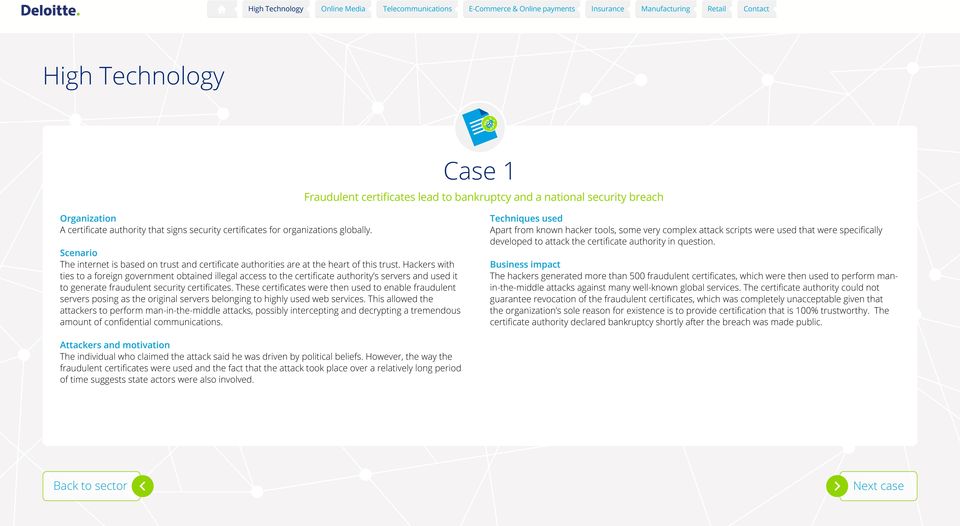
7 High Technology Case 1 Fraudulent certificates lead to bankruptcy and a national security breach A certificate authority that signs security certificates for organizations globally. The internet is based on trust and certificate authorities are at the heart of this trust. Hackers with ties to a foreign government obtained illegal access to the certificate authority s servers and used it to generate fraudulent security certificates. These certificates were then used to enable fraudulent servers posing as the original servers belonging to highly used web services. This allowed the attackers to perform man-in-the-middle attacks, possibly intercepting and decrypting a tremendous amount of confidential communications. Apart from known hacker tools, some very complex attack scripts were used that were specifically developed to attack the certificate authority in question. The hackers generated more than 500 fraudulent certificates, which were then used to perform manin-the-middle attacks against many well-known global services. The certificate authority could not guarantee revocation of the fraudulent certificates, which was completely unacceptable given that the organization s sole reason for existence is to provide certification that is 100% trustworthy. The certificate authority declared bankruptcy shortly after the breach was made public. The individual who claimed the attack said he was driven by political beliefs. However, the way the fraudulent certificates were used and the fact that the attack took place over a relatively long period of time suggests state actors were also involved. Next case
8 High Technology Case 2 Leading software company loses face along with customer data and source code A large software vendor that sells software globally, with more than $1 billion in annual revenue. Hackers infiltrated the company s network and downloaded more than 100 million encrypted user credentials, along with credit card information for millions of customers. In addition, the source code for a number of key products was stolen. No one has claimed the attack and information about the attackers is not publicly known. However, given the type of information stolen, it is likely this was the work of an organized group of cybercriminals aiming to use the stolen credentials for identity theft, and to sell the stolen source code for financial gain. Also, since the stolen source code was for a widely used application, it s possible that the application itself will be used as an attack vector, since finding vulnerabilities is much easier with the source code in hand. The company s Chief Security Officer described the attack as sophisticated. Other than that, no details have been made public. This story made global headlines, dealing a severe blow to the company s reputation -- especially since people expect better security practices from a software vendor. The company had to require more than 100 million users to change their passwords, and offered a large portion of their customers a year of free credit monitoring. In addition, the loss of its source code could significantly reduce the company s long-term competitive advantage. Next case

9 High Technology Case 3 Vengeful hacktivists force a leading online platform to shut down for more than a month A very large technology company that sells products all around the world and operates a popular online platform. The online platform, which has millions of users, was attacked by a hacktivist group with a grudge against the company. The hackers managed to steal more than 70 million user names and passwords, as well as credit card information in multiple attacks spanning months. In the wake of the attack, the company was forced to temporarily shut down its online service, denying access to users for more than a month. Prior to the attack, the company had made some decisions in a public case that did not sit well with a particular group of clever hackers. This hacktivist group sought revenge by hitting the company with a very impactful attack. The initial attack vector the hackers used to infiltrate the company s network is not publicly known. What is known however is that the attackers spent a long time in the company s internal network. During this time they discovered a number of vulnerabilities that could be easily exploited. Most likely they used a SQL injection attack against the online platform s internet-facing servers to steal data from sensitive databases. The company lost personal and credit card information for more than 70 million users. Also, because the attackers were so deeply nested in the internal network, the company decided to close down the online platform for multiple months resulting in major financial losses. Customers were later compensated for the downtime, costing the company even more money. What s more, the breach was reported in the news globally, badly damaging the organization s reputation. Next sector

10 Cyber-Threats Online media Cases addresses stolen from an service provider News website is the launch pad for a banking malware outbreak Business Impact Who? What? Reputational damage Spread Manipulate public opinion Readers redirected to fake news Cybercriminals Hacktivists Trusted Information Resources News website Script Kiddies Online Content Next page

11 Online Media Previous page The online media sector might have the greatest exposure to cyber-threats. Since its organizations operate online, they have a huge attack surface to protect. Also, since its products are in high demand and completely digital, there is a high risk of being infiltrated and robbed of valuable content both by individuals and organized crime groups. As in other industries, attacks that use an organization s website as the point of entry are common. So are social engineering attacks, such as spear phishing, which trick people into giving away passwords and other sensitive information. However, what makes the online media industry unique is the fact that the sector itself can serve as a vector for launching attacks, due to the large number of people who use its services. A good example of this is the watering hole attack, in which hackers breach a popular website and then use it as a delivery platform for malware. Another threat that uses online media itself as the attack vector involves manipulating news sources to trick people or automated programs into making misinformed decisions. There are many well known examples of high profile online media accounts being hacked and fed deceptive information. In one extreme case, the attack triggered a stock market crash by fooling stock trading programs into placing automatic sell orders based on false information from a political online media account. For online media organizations, attacks that cause reputational damage are one of the biggest threats. News organizations in particular are increasingly popular targets for hacktivists and attack groups loyal to a particular nation or cause. Some of these attacks target specific reporters in an effort to uncover their sources; other attacks disrupt websites or present substitute content in order to damage an organization s reputation, spread propaganda, or manipulate public opinion. Case 1 Case 2 Case 3 addresses stolen from an service provider News website is the launch pad for a banking malware outbreak Hackers redirect readers to fake news

12 Online Media Case 1 addresses stolen from an service provider A company that provides services for more than 2,000 large organizations in all sectors, sending billions of marketing and customer communications s annually. An unknown group of hackers breached the company s databases and stole nearly 60 million addresses. Little is publicly known about the attackers. They might have been script kiddies hacking for fun, organized criminals planning to use the addresses for spear phishing attacks, or perhaps a competitor trying to embarrass the company. Although the exact technique has not been disclosed, experts believe it was something simple, such as SQL injection. This might explain why the company has been reluctant to share details about the attack. Although this breach only involved names and addresses, not financial information, it was very damaging because it was directly related to the company s core business of sending marketing s on behalf of clients. Also, the sheer size of the data loss drew a lot of attention from the media. The company was forced to notify all affected clients, who in turn had to notify their own customers, since this massive leakage of addresses exposed them to spear phishing attacks. This made both the company and its clients look bad. In tangible terms, this breach cost the company and its clients an estimated $200 million in customer compensation. Next case

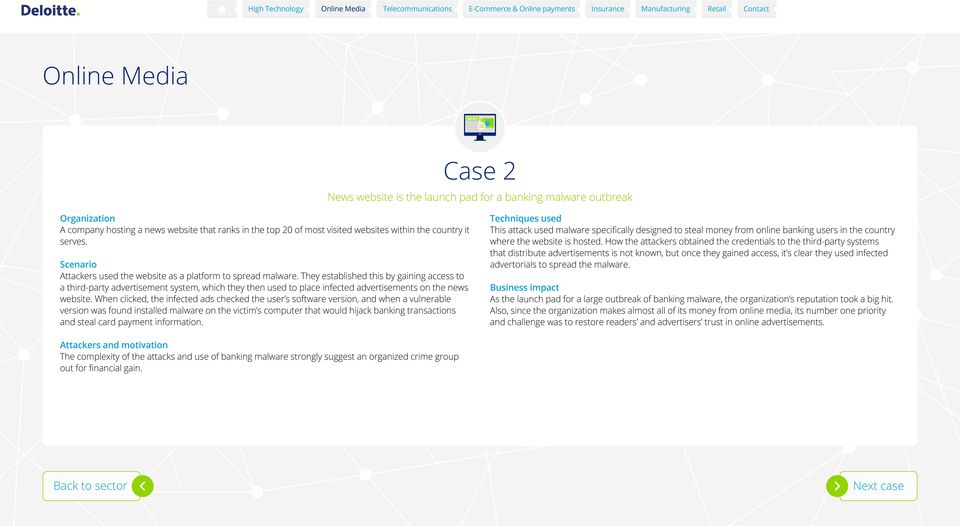
13 Online Media Case 2 News website is the launch pad for a banking malware outbreak A company hosting a news website that ranks in the top 20 of most visited websites within the country it serves. Attackers used the website as a platform to spread malware. They established this by gaining access to a third-party advertisement system, which they then used to place infected advertisements on the news website. When clicked, the infected ads checked the user s software version, and when a vulnerable version was found installed malware on the victim s computer that would hijack banking transactions and steal card payment information. This attack used malware specifically designed to steal money from online banking users in the country where the website is hosted. How the attackers obtained the credentials to the third-party systems that distribute advertisements is not known, but once they gained access, it s clear they used infected advertorials to spread the malware. As the launch pad for a large outbreak of banking malware, the organization s reputation took a big hit. Also, since the organization makes almost all of its money from online media, its number one priority and challenge was to restore readers and advertisers trust in online advertisements. The complexity of the attacks and use of banking malware strongly suggest an organized crime group out for financial gain. Next case
14 Online Media Case 3 Hackers redirect readers to fake news A large news organization, with a strong presence both online (websites) and offline (newspapers). A hacker group with political ties tricked employees of a third-party domain registrar into revealing information that was then used to access domain name server (DNS) records, allowing the group to redirect all incoming web traffic to its own website. The attackers were hacktivists spreading propaganda and wanting to influence public opinion about events occurring in their region. The attackers used social engineering, in particular spear phishing, to gain access to the reseller s DNS account. It then altered DNS records to redirect web traffic to its own server, which hosted a visually identical copy of the news website but presented altered facts. The attack tarnished the organization s reputation and credibility, which because of the organization s size and name recognition, also had a ripple effect on other news organizations. This caused readers to question the legitimacy of news stories they viewed online, and likely drove some to other news sources. Next sector

15 Cyber-Threats Telecommunications Cases Who? State-sponsored hackers launch privacy attack False claims do real damage to a major ISP ISP CLAIM What? Business Impact Damage company s reputations Underminded customer trust Loss of confidental information of organization Script Kiddies Thief steals a laptop containing personal information of customers Customer Data Cybercriminals Intellectual Property State Actors Communications Data Next page
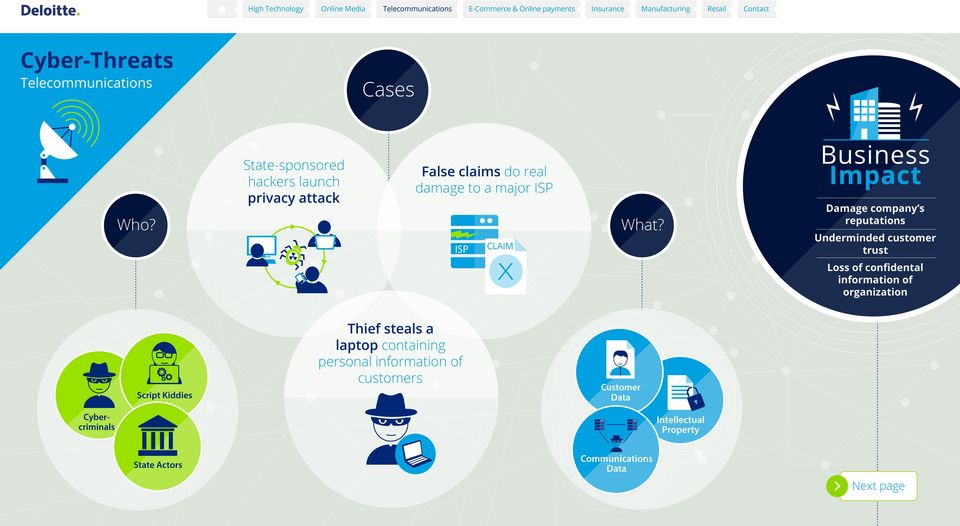
16 Telecommunications Previous page Telecom companies are a big target for cyber-attacks because they build, control and operate critical infrastructure that is widely used to communicate and store large amounts of sensitive data. Government agencies are increasingly attacking telecom operators infrastructure and applications to establish covert surveillance. These sophisticated actors typically use very advanced persistent threats (APT) that can operate undetected for long periods of time. Communication channels targeted for covert surveillance include everything from phone lines and online chat to mobile phone data. There have even been cases where one nation s cyber-attack prevented another nation s leaders from communicating on their mobile devices. Given that telecom companies control critical infrastructure, the impact of an attack can be very high and far-reaching. In fact, even the false claim of an attack can force a telecom company to shut down critical services that consumers and businesses rely on. Customer data is another popular high impact target. Telecom organizations typically store personal information -- such as names, addresses and financial data about all of their customers. This sensitive data is a compelling target for cyber-criminals or insiders looking to blackmail customers, conduct identity theft, steal money or launch further attacks. Information can be lost in a variety of ways that may be as simple as a stolen laptop. Of course, laptops can be lost or stolen in any sector; however, the problem tends to be worse in telecom because employees in this sector often serve customers as part of a call center or help desk function and may have large amounts of sensitive customer data stored on their laptops. One critical threat unique to the telecommunications sector is the attack of leased infrastructure equipment, such as home routers from Internet Service Providers (ISPs). Once the equipment has been compromised, hackers can use it to steal data, launch other attacks anonymously, store exfiltrated data, or access expensive services such as international phone calls. To avoid upsetting customers, telecom companies generally refund any charges associated with such attacks, often resulting in significant lost revenue. ISP Case 1 Case 2 Case 3 State-sponsored hackers launch privacy attack False claims do real damage to a major ISP Thief steals a laptop containing sensitive customer information

17 Telecommunications Case 1 State-sponsored hackers launch privacy attack A very large international mobile phone provider. Cyber spies gained access to mobile communication channels for surveillance purposes by incorporating malicious software on a spoofed social media page of privileged users within the company. The attackers were associated with a government agency that wanted to spy on large groups of mobile phone users. The attack was an extremely sophisticated combination of several techniques. The attackers first spoofed the personal social media pages of privileged users within the company. The spoofed pages then installed malicious software on the users computers, taking advantage of their elevated system privileges to penetrate deeply into the company s network. This ultimately allowed the attackers to access mobile communication data for surveillance purposes. The size and scope of the attack did significant damage to the organization s reputation and confidentiality of the infrastructure. It also fueled customer concerns about privacy, which is a major issue for the entire telecom sector. Next case

18 Telecommunications ISP Case 2 False claims do real damage to a major ISP A large internet service provider (ISP), hosting a nation s critical infrastructure. A teenage hacker gained access to hundreds of the ISP s servers and then published a list of user names and passwords he claimed to have stolen from them. This forced the company to temporarily suspend the accounts of all affected users. It later turned out the data was obtained from a different company and not the ISP. The attacker was an individual teenager who was hacking for fun and ego gratification, bragging about his accomplishments in online forums. A vulnerability in a website not related to the affected company was exploited to export data from the database containing customer information. The attacker then selected all users having addresses from the ISP s domain in order to make the public (and the ISP itself) believe the ISP had been compromised. The ISP did not have the proper processes in place to determine if it had been compromised or not, and thus had to assume the published data had been stolen from its systems. In response, it was forced to suspend all affected accounts, which angered a lot of customers and prompted many to switch to another provider. Also, the fact that the ISP could not conclusively determine if the leaked data had actually originated from its systems gave the impression the company did not have a very good handle on security breaches. Next case

19 Telecommunications Case 3 Thief steals a laptop containing sensitive customer information A very large cable service provider that offers television, internet and mobile telephony services. One of the organization s employees in violation of company policy -- had stored a lot of sensitive customer information on his laptop. The laptop was an older model and the data was stored unencrypted. Personal information for 40,000 customers was lost, including client numbers, names, -addresses, postal codes, genders and parts of bank account numbers. The attacker was a petty thief who was interested in the laptop, not the data. In fact, it s likely he didn t even know the data was there. Although the technique of stealing a physical laptop was not sophisticated or specifically relevant for the Telecommunications sector, the type of data that resided on it was. It s unclear whether the stolen data was used maliciously since the thief may not have even realized it was there. However, all affected customers had to be informed of the incident, leading to loss of trust. Also, extensive media coverage caused significant embarrassment and reputation damage for the company. Next sector

20 Cyber-Threats E-Commerce & Online payments Cases Who? Lost customer data leads to lost trust Thieves use stolen data to create their own credit cards Hacktivists strike back with a vengeance What? Business Impact Loss of trust, money and services Identity theft of customers Non-Compliance issues Hacktivists Customer Data Cybercriminals Money Script Kiddies Card payment information Next page

21 E-Commerce & Online payments Previous page As more and more businesses move or expand from bricks to clicks, criminals are following suit. Many e-commerce websites are directly connected both to the internet and to a company s back-end systems for data processing and supply management, making the website a prime attack point for gaining access to crucial information assets within the organization. One of the most common attacks in this sector is a database breach. Often, such attacks result in a loss of customer data, including names, physical addresses, phone numbers, addresses and payment information. Since trust is especially important in e-commerce, the loss of customer data can be very damaging to an online company s reputation and business performance. This is true even if the attacker is an unsophisticated script kiddie who is just showing off for friends or messing around for fun. Also, the impact of a breach can go far beyond reputation damage, depending on where in the world it occurred. A number of US states have already instituted breach notification laws, and the EU is expected to follow shortly. Such laws require organizations to come forward and publically admit they were breached. The EU directive also includes heavy fines. Online payment systems are another vulnerable area that is often attacked. The ability to accept payment is critically important for online businesses, since it is one of the last steps in a customer s purchase journey. As such, the financial impact of a payment system attack can be enormous, depending on its duration. After all, if customers can t pay, they can t buy. Most e-commerce sites outsource payment processing to a variety of third-party providers that promise high availability of their payment services. However, these providers are increasingly being targeted with denial-of-service attacks, particularly by hacktivists that want to disrupt an organization in a highly visible way. Payment-related attacks are also appealing to criminals looking for financial gain. Saving a customer s credit card data in an internal database might seem like a good way to make the shopping process more convenient, but it creates an attractive target for cybercriminals. Payment processing vendors are even more attractive to attack, since the potential for a big score is much greater. In the brick-and-mortar world, cyber-criminals have developed a variety of techniques for skimming credit cards at Point of Sale (POS) terminals and ATMs. Also, they have developed a wide range of attack vectors targeted directly at online payment vendors. Some of the most sophisticated attacks use a combination of online and traditional physical techniques to increase their effectiveness. Attacks on a payment vendor can be just as damaging to a company s reputation as attacks that target the business directly, since most customers don t see a distinction between an organization and its service providers. Case 1 Case 2 Case 3 Lost customer data leads to lost trust Hacktivists strike back with a vengeance Thieves use stolen data to create their own credit cards
22 E-Commerce & Online payments Case 1 Lost customer data leads to lost trust An e-commerce company that operates daily deals websites in numerous countries. Hackers breached the security of the organization s computer system, resulting in unauthorized access to customer data. The attackers were most likely after customer credit card data to sell on the black market. More than 50 million usernames, hashed passwords and addresses were stolen, badly damaging the company s reputation. And because customer data was involved, the organization was required to report the breach, which attracted attention from the media. The incident received worldwide press coverage, both in newspapers and on television. What s more, loss of personal data resulted in a loss of customer trust, which is especially critical for e-commerce companies. This almost certainly had a negative impact on revenue. SQL Injection, which is the most common form of attack for websites and web applications, was most likely used for this breach. However, other entry methods cannot be ruled out, including a more sophisticated cross-site scripting attack, or perhaps exploitation of a flaw in the web application that might have resulted from poor testing. Next case
23 E-Commerce & Online payments Case 2 Hacktivists strike back with a vengeance A very large financial services firm whose core global business is processing credit card transactions. A popular protest turned into cyber-terrorism with a call to-action from a politically motivated hacker collective. Together, thousands of people initiated a large denial-of-service attack on the company s network, making its services unavailable to clients. The attack was motivated by the company s decision to block payments to a well known website based on claims that the site s activities were illegal. This decision caused a worldwide commotion among the website s supporters. Popular support for the cause -- combined with low technical requirements to participate -- resulted in a large-scale attack. To make the attack as successful as it was, the hackers recruited a large numbers of volunteers to help. All participants installed special attack software on their computers, which together formed a single large botnet. The software was specifically designed to perform a large distributed denialof-service attack (DDoS) on the company s network. Instructions were sent via chat telling all of the computers in the botnet to start attacking the company s network. Due to the large number of people involved in the attack, the company s payment services quickly became unavailable or highly inaccessible for 10 hours. Direct costs of the attack have been estimated at more than $3 million. But the incident s overall impact was even greater, showing how cyber-protests could be used to damage organizations and influence their behavior. Since the attack, other organizations within the sector have been targeted for protest by the same group. Next case
24 E-Commerce & Online payments Case 3 Thieves use stolen data to create their own credit cards A large financial services firms that provides electronic transaction processing worldwide. A group of criminals broke into the company s systems and over the course of a year stole magnetic stripe data for approximately 7 million credit cards. They then created fake credit cards by programming the stolen data onto cheap prepaid cards, which were later used to purchase expensive items such as computers and televisions. The attackers were motivated by financial gain. The careful target selection and sophisticated techniques used for the attack suggest the involvement of a well organized cyber-criminal group. Attackers infiltrated a crucial part of the payment processing infrastructure containing magnetic stripe data, which was then exported to create duplicate credit cards that were later used for fraudulent transactions. The company revealed that the data breach cost an estimated $90 million, which includes fraud losses as well as fines, costs associated with the investigation, charges from card networks and client aftercare. The company s reputation also took a lot of damage, both from consumers and from clients within the payment card networks. Next sector
25 Cyber-Threats Insurance Cases Who? Hackers steal personal data about customers - and potential customers Even small breaches can have a meaningful impact and require corrective action What? Business Impact Tangible costs related to legal fees, fines, lawsuits, fraud monitoring costs Intangible costs such as customers trust Customer compensation Targeted insurer accused of doing too little too late Cybercriminals Customer Data Social security numbers Fraudulent Acts Creditcard Information Next page
26 Insurance Previous page Cyber-attacks in the insurance sector are growing exponentially as insurance companies migrate toward digital channels in an effort to create tighter customer relationships, offer new products and expand their share of customers financial portfolios. This shift is driving increased investment in traditional core IT systems (e.g., policy and claims systems) as well as in highly integrated enabling platforms such as agency portals, online policy applications and web- and mobile-based apps for filing claims. Although these digital investments provide new strategic capabilities, they also introduce new cyber-risks and attack vectors to organizations that are relatively inexperienced at dealing with the challenges of an omni-channel environment. What s more, the challenges are likely to become more complex as insurers embrace big data and advanced analytics that require collecting and handling vast amounts of consumer information. As insurers find new and innovative ways to analyze data, they must also find ways to secure the data from cyber-attacks. Cyber-criminals have started to recognize that insurers possess large amounts of personal information about their customers, which is very attractive to identity thieves and fraudsters. In some cases, insurers also possess significant amounts of customer credit card and payment data. However, there is at least one case in the insurance sector where the victims of a cyber-attack weren t even paying customers but merely consumers who had requested a price quote. Cyber-criminals targeting insurers often have significant resources. This enables them to employ sophisticated attacks that combine advanced malware with other techniques such as social engineering. Attacks on insurance firms can result in significant, tangible damages such as fines, legal fees, lawsuits and fraud monitoring costs. However, a less obvious but no less significant impact may be loss of trust, driven by customers concerns about whether their information is truly safe. Since the insurance business revolves around trust, a major breach can have a very real impact on an insurer s brand and market value. It s worth noting that most of the breaches publicly reported by insurance companies to date have been characterized as shortterm attacks, with cyber-criminals compromising a system, stealing specific information and then quickly moving on. In fact, our research did not uncover any documented cases of long-term infiltration and cyber-crime in the insurance sector. However, we believe the number of long-term attacks may be silently growing as attackers quietly slip in undetected and establish a persistent, ongoing presence in critical IT environments. Over the years, many insurance organizations have invested a lot of money in security tools and processes that may be providing a false sense of security. As attackers learn to leverage encryption and other advanced attack techniques, traditional tools such as firewalls, antivirus software, intrusion detection systems (IDS) and intrusion preven tion systems (IPS) are becoming less and less effective. As a result, many insurers may be misallocating their limited resources to address compliance-oriented, easily recognized threats while completely overlooking stealthy long-term threats that ultimately could be far more damaging. Case 1 Case 2 Case 3 Hackers steal personal data about customers -- and potential customers Even small breaches can have a meaningful impact and require corrective action Targeted insurer accused of doing too little too late
27 Insurance Case 1 Hackers steal personal data about customers -- and potential customers A group of large insurance and financial services companies. Cyber-criminals breached the company database and stole information of more than one million customers and sales prospects, including driver s license data and social security numbers. Cyber-criminals were after personal identifiable information in order to sell it on the black market for identity fraud purposes. Part of the network used by the organization s members was breached by cyber-criminals and used to steal customer information. The organization was obliged to provide affected customers with free credit monitoring for a year, and to reimburse all damages resulting from the breach. In addition to those tangible costs which were substantial -- the organization suffered significant brand damage and loss of trust. Next case
28 Insurance Case 2 Even small breaches can have a meaningful impact and require corrective action A very large investment and insurance company. The attack targeted company employees with s containing malware that could capture confidential data such as bank account numbers, social security numbers, user accounts/logins, passwords and credit card numbers. Hackers used this information to compromise several servers, including servers used by employees to remotely access the company s IT systems. The attack targeted company employees with s containing malicious software that could capture confidential data such as bank account numbers, social security numbers, user accounts/ logins, passwords and credit card numbers. Although the attack affected only a small number of employees -- and only a handful of customers -- it still received media coverage that damaged the company s reputation. Cyber-criminals were after online banking information to perpetrate fraud for financial gain. Next case
29 Insurance Case 3 Targeted insurer accused of doing too little too late An insurance and financial services firm that specializes in serving seniors. Attackers exploited vulnerable software on the company s servers and stole payment card information for more than 93,000 customers, including names, addresses and unencrypted card security codes. Cyber-criminals were after payment card information to sell on the black market and commit fraudulent transactions. Vulnerabilities in the company s systems and software were discovered and exploited by the cybercriminals to gain access to payment card information. The company immediately removed the vulnerable IT elements and had to issue a formal apology. It also offered free identify fraud monitoring to affected customers. However, the company has been strongly criticized for retaining unencrypted security codes --which is a noncompliance issue according to the Payment Card Industry Data Security Standard (PCI DSS) -- and for not reporting the breach to its customers sooner. Next sector
30 Cyber-Threats Manufacturing Cases Malware snares employee log-in credentials Worm grabs control of industrial plants Business Impact Who? What? Reputational damage Loss of a competitive advantage and production Hacktivists Executive pilfers intellectual property from a competitor Market Advantage State Actors Intellectual Property x Y Competitors IP Industrial Control Systems Next page
31 Manufacturing Previous page Manufacturers are increasingly being targeted not just by traditional malicious actors such as hackers and cyber-criminals, but by competing companies and nations engaged in corporate espionage. Motivations range from money and revenge to competitive advantage and strategic disruption. What happens to a manufacturing business when its production operations suddenly grind to a halt? And what are the consequences of being unable to satisfy market demand? In today s business environment of increased automation, connectivity and globalization, even the most powerful organizations in the world are vulnerable to debilitating cyber-threats. Also, as production spreads across the globe, regional and national politics are becoming an increasingly important factor in corporate and manufacturing policies. Many existing manufacturing systems were developed at a time when security was much less of an issue. Also, the focus of manufacturing technology has traditionally been on performance and safety, not security. This has led to major security gaps in production systems. In addition, the growing complexity of these systems has resulted in large and elaborate network infrastructures that are extremely specialized. And in many cases the systems are being operated and managed by manufacturing specialists rather than the IT function. Combined with the integration of IT and operations, these trends have created a system environment with a large attack surface that is very difficult to manage and secure. Types of cyber-attacks in manufacturing vary widely. Traditional attacks involve hackers gaining unauthorized access to sensitive systems and data. Phishing facilitates the process by tricking executives and their staffs into revealing login credentials and other private information, giving attackers front-door access to the organization s systems. Advanced malware is another type of attack that is increasingly common in manufacturing and increasingly disruptive. In an era of ubiquitous connectivity when more and more industrial systems are connected to the internet, this malicious software infiltrates weak systems and hardware (often legacy manufacturing systems) and then spreads itself to other systems, leaving behind a trail of destruction and disruption. Internal threats, although often less technically sophisticated, can be just as damaging. In manufacturing, there are countless incidents of malicious insiders stealing a company s intellectual property or other confidential information for personal profit or revenge. These internal attacks can be committed by current and former employees and contractors at any level of the organization even the executive level. The results of any of these attacks can be severe, ranging from loss of valuable ideas and market advantage to financial and reputational damage -- particularly in cases where sensitive customer data is compromised. Case 1 Case 2 Case 3 Malware snares employee log-in credentials Worm grabs control of industrial plants Executive pilfers intellectual property from a competitor
32 Manufacturing Case 1 Malware snares employee log-in credentials A large, global automotive manufacturer. Attackers infiltrated the manufacturer s corporate network and installed malicious software. This malware allowed the attackers to obtain employee log-in credentials, which in turn could be used to target other key systems within the company that contained intellectual property. The attack targeted intellectual property related to automotive technology. This type of IP is very valuable and can be used to blackmail the company, or to gain competitive advantage. A close analysis of the incident suggests the attackers were part of an organized crime group. The attackers used a mix of techniques to deploy the malware into the company s network, including targeted attacks and exploiting vulnerabilities in outdated systems. The incident received global media coverage, causing significant reputational damage to the company. However, the potential damage was reduced by the fact that the organization fixed the security flaws before making a statement to the press. This gave the organization time to investigate the attack and to determine it had not lost any information other than the employee login credentials. Next case
33 Manufacturing Case 2 Worm grabs control of industrial plants A multinational engineering and electronics firm with global operations. Attackers used a variant of advanced malware to infect multiple industrial plants around the world. Once the infection spread, the attackers could take control of systems used to monitor and control critical industrial systems such as power plants, and influence their inner workings. These type of attacks typically target high value infrastructure with the goal of causing widespread damage to an organization or even to an entire nation. The level of complexity, sophistication and funding needed for this attack suggests the actors were most likely state-sponsored. To deploy the malware into the industrial plants, the attackers used infected removable media such as USB devices. Once an infected device was connected to a plant s internal network, the advanced malware was automatically deployed -- grabbing control of the plant and running commands to influence its supervisory control and data acquisition (SCADA) systems. Official statements by the company emphasized that no real damage had been done to any of the infiltrated plants. However, the incident still created a huge stir in the media and significantly damaged the company s reputation, since the attackers were theoretically able to control high value infrastructure that could have wreaked havoc on the environment. Next case
34 Manufacturing Case 3 Executive pilfers intellectual property from a competitor A leading manufacturer of video cameras and other digital cinematography tools. The company had valuable intellectual property (IP) stolen by a competing executive. The company was sharing its IP via with the executive s former employer to explore a possible joint venture, and the executive used old login credentials to gain access to the s. The attacker was a rival industry executive who wanted to get an unfair advantage over his competitors by using their intellectual property to enhance his own company s products. The executive obtained the login information while working at his former employer, which made the mistake of not removing or deactivating his account after he left for another firm. This allowed the executive to continue accessing his former employer s and redirect the exchange of intellectual property to his current account. IP theft can lead to a flood of counterfeit products. In this case, the targeted company lost a hardearned competitive advantage derived from years of cutting-edge research and development. After the theft, its products no longer stood out in the marketplace, which weakened its sales and strategic market position. Next sector
35 Cyber-Threats Retail Cases Weak wireless security provides an open door to attack Inside job goes undetected for years Business Impact Who? What? Damage company's brand Cut into sales Fines and settlement costs Hackers steal card data on millions of customers Insiders Cardholder Data 200,- Cybercriminals Contractors x 0 Intellectual Property Personal Data Next page
36 Retail Previous page Credit card data is the new currency for hackers and criminals, and retailers possess a lot of it. This makes the retail industry an almost irresistible target for cyber-attacks. The industry s attack surface is expanding as retailers of every shape and size look to boost sales and improve efficiency by harnessing the latest data-driven technologies. Use of big data and sophisticated data warehouse models is growing fast. Also, many retailers are getting into the healthcare and pharmacy businesses, and as such are holding more sensitive data than ever before. Meanwhile, there is a steady shift from cash payments to electronic card payments in developing countries. Insider threats in retail are also rising. Employee turnover is high, and the typical retailer has many points of insider vulnerability, including seasonal and traditional employees, as well as numerous stores and distribution centers. Many retailers also outsource some of their business processes to third parties. Trends such as these are giving rise to a new breed of criminals. Instead of stealing money or physical goods from a store or warehouse, these cyber-criminals focus on stealing information -- especially the valuable cardholder data that flows between consumers and retailers. System access by employees and third-party contractors should be tied to job functions and carefully planned and monitored. Access to specific data fields should be carefully planned as well due to the threat of data aggregation (creating sensitive data by piecing together seemingly benign data from various data sources). Point-of-sale (POS) systems are an increasingly popular point of attack for acquiring transaction data, giving cyber-criminals immediate access to valuable information such as card numbers and personal identification numbers (PINs). Traditional data sources within the organization are also vulnerable. These include databases containing customer information, as well as intellectual property valuable to competitors, such as planned future store locations and demographic data (e.g., average income or age in a shop s region). Some attacks use advanced technology that take advantage of weaknesses in the IT infrastructure. Other attacks are as simple as an insider copying data to portable media and then walking out the door. Whether an attack is simple or sophisticated, the results can be disastrous. Retailers today must understand the potential threats and take aggressive action to protect themselves and their customers from harm. Case 1 Case 2 Case 3 Hackers steal card data on millions of customers Weak wireless security provides an open door to attack Inside job goes undetected for years
37 Retail Case 1 Hackers steal card data on millions of customers A large retailer that sells a variety of food and non-food products. Attackers installed malware on the retailer s point-of-sale (POS) systems. The infected systems recorded the data for every card swiped through the machine, including PINs. The malware was also capable of spreading itself throughout the organization, eventually infecting millions of POS systems within the retailer and collecting vast amounts of credit card data that was later resold for illicit purposes. The attackers were identified as organized criminals motivated by the potential financial gain from selling huge amounts of credit card information. This attack used malware that can be purchased on the criminal market. The attackers installed the malware into the retailer s environment, where it spread itself onto point-of-sale systems that could then be used to extract confidential data and create other backdoors into the retailer s network. The attack received worldwide media coverage, severely damaging the company s brand and cutting into sales. Financial impacts included: a drop in the company s share price over the following quarter and into the next fiscal year; heavy fines; and the cost of offering free credit monitoring to millions of customers. Next case
38 Retail Case 2 Weak wireless security provides an open door to attack A large retailer that sells apparel and home fashions. Attackers were able to exploit weak security on one of the retailer s wireless networks, which allowed them to intercept card transactions and access the organization s central database. The database, which was not encrypted, contained personal information and credit card details. As a result, the attackers were able to simply download the database and start selling the stolen information through a wide variety of channels. Several different techniques for attacking wireless networks were used to gain access to the network. Once inside, the attackers were able to monitor and intercept network data that eventually gave them access to the database of confidential information. The retailer s reputation took a big hit due to the large amount of personal identifiable and credit card information that was lost. This had a significant financial impact, including fines, settlement costs and lost sales. The attackers were cyber-criminals motivated by the financial gain of selling personal and cardholder data. Next case
39 Retail Case 3 Inside job goes undetected for years A large retailer that sells communication-related products and services. Over the course of several years an employee of the retailer was able to obtain more than 8 million pieces of sensitive data, including personal information and classified documents. The employee sold the information to the highest bidders, which often included criminal organizations. The attacker was an employee who had worked at the retailer for many years. The employee was motivated by the financial gain from selling confidential information. This incident illustrates that a very severe breach does not require sophisticated attack patterns. In this particular case, the attacker had direct access to confidential information and simply copied it onto portable media and took it home at the end of the day. The magnitude and especially the duration of the attack damaged the company s reputation and share price. Other impacts included financial compensation for customers affected by the breach, as well as lasting mistrust of employees. Conclusion
40 Conclusion This report focused on seven key industry sectors that are prime targets for cyber-attacks. Follow-on reports will highlight the top cyber-threats in other major sectors that are also highly vulnerable. After all, the single biggest takeaway from the stories and insights presented here is that breaches are inevitable -- and that no industry or organization is immune. Your organization will be hacked someday. Attacks can result in significant tangible costs ranging from stolen money and property to regulatory fines, legal damages, and financial compensation. But those are just the tip of the iceberg. The really significant costs are the intangibles, particularly loss of competitive advantage, loss of customer trust, and damage to an organization s reputation and brand. Intangibles such as these can have a major impact on an organization s strategic market position and share price. The good news is that cyber-threats are a manageable problem. As noted earlier, a well-balanced cyber-defense needs to be secure, vigilant, and resilient. Although it isn t possible for any organization to be 100 percent secure, by focusing on these three key attributes, it is entirely possible to manage and mitigate cyber-threats in a way that reduces their impact and minimizes the potential for business disruption. In closing, here are five takeaway questions to reflect on through the lens of a secure, vigilant, and resilient approach to cybersecurity: 1. Are we focused on the right things? Often asked, but difficult to accomplish. Understand how value is created in your organization, where your critical assets are, how they are vulnerable to key threats. Practice defense-in-depth. 2. Do we have the right talent? Quality over quantity. There may not be enough talent to do everything in-house, so take a strategic approach to sourcing decisions. Are the security teams focused on the real business areas? 3. Are we proactive or reactive? Retrofitting for security is very expensive. Build it upfront in your management processes, applications, and infrastructure. 4. Are we incentivizing openness and collaboration? Build strong relationships with partners, law enforcement, regulators, and vendors. Foster internal cooperation across groups and functions, and ensure that people aren t hiding risks to protect themselves. 5. Are we adapting to change? Policy reviews, assessments, and rehearsals of crisis response processes should be regularized to establish a culture of perpetual adaptation to the threat and risk landscape. Contact
41 Contact Deloitte Cyber Leaders Global Kelly Bissell EMEA Fernando Picatoste APAC Victor Keong LATCO Martin Carmuega Americas Edward Powers Nick Galletto Global Coordination Team Roel van Rijsewijk Partner Cyber Risk Services Peter van Nes Junior Manager Cyber Risk Services Mike Lameree Senior Consultant Cyber Risk Services Dana Spataru Senior Manager Cyber Risk Services Deloitte refers to one or more of Deloitte Touche Tohmatsu Limited, a UK private company limited by guarantee ( DTTL ), its network of member firms, and their related entities. DTTL and each of its member firms are legally separate and independent entities. DTTL (also referred to as Deloitte Global ) does not provide services to clients. Please see for a more detailed description of DTTL and its member firms. Deloitte provides audit, tax, consulting, and financial advisory services to public and private clients spanning multiple industries. With a globally connected network of member firms in more than 150 countries and territories, Deloitte brings world-class capabilities and high-quality service to clients, delivering the insights they need to address their most complex business challenges. Deloitte s more than 200,000 professionals are committed to becoming the standard of excellence. This communication contains general information only, and none of Deloitte Touche Tohmatsu Limited, its member firms, or their related entities (collectively, the Deloitte network ) is, by means of this communication, rendering professional advice or services. No entity in the Deloitte network shall be responsible for any loss whatsoever sustained by any person who relies on this communication For information, contact Deloitte Touche Tohmatsu Limited.
10 Smart Ideas for. Keeping Data Safe. From Hackers
 0100101001001010010001010010101001010101001000000100101001010101010010101010010100 0100101001001010010001010010101001010101001000000100101001010101010010101010010100000 0100101001001010010001010010101001010101001000000100101001010101010010101010010100000
WRITTEN TESTIMONY OF
 WRITTEN TESTIMONY OF KEVIN MANDIA CHIEF EXECUTIVE OFFICER MANDIANT CORPORATION BEFORE THE SUBCOMMITTEE ON CRIME AND TERRORISM JUDICIARY COMMITTEE UNITED STATES SENATE May 8, 2013 Introduction Thank you
PCI Compliance for Healthcare
 PCI Compliance for Healthcare Best practices for securing payment card data In just five years, criminal attacks on healthcare organizations are up by a stunning 125%. 1 Why are these data breaches happening?
Internet threats: steps to security for your small business
 Internet threats: 7 steps to security for your small business Proactive solutions for small businesses A restaurant offers free WiFi to its patrons. The controller of an accounting firm receives a confidential
Cyber security Time for a new paradigm. Stéphane Hurtaud Partner Information & Technology Risk Deloitte
 Cyber security Time for a new paradigm Stéphane Hurtaud Partner Information & Technology Risk Deloitte 90 More than ever, cyberspace is a land of opportunity but also a dangerous world. As public and private
Combatting the Biggest Cyber Threats to the Financial Services Industry. A White Paper Presented by: Lockheed Martin Corporation
 Combatting the Biggest Cyber Threats to the Financial Services Industry A White Paper Presented by: Lockheed Martin Corporation Combatting the Biggest Cyber Threats to the Financial Services Industry Combatting
WHAT EVERY CEO, CIO AND CFO NEEDS TO KNOW ABOUT CYBER SECURITY.
 WHAT EVERY CEO, CIO AND CFO NEEDS TO KNOW ABOUT CYBER SECURITY. A guide for IT security from BIOS The Problem SME s, Enterprises and government agencies are under virtually constant attack today. There
Protecting Your Data, Intellectual Property, and Brand from Cyber Attacks
 White Paper Protecting Your Data, Intellectual Property, and Brand from Cyber Attacks A Guide for CIOs, CFOs, and CISOs White Paper Contents The Problem 3 Why You Should Care 4 What You Can Do About It
Proactive Credential Monitoring as a Method of Fraud Prevention and Risk Mitigation. By Marc Ostryniec, vice president, CSID
 Proactive Credential Monitoring as a Method of Fraud Prevention and Risk Mitigation By Marc Ostryniec, vice president, CSID The increase in volume, severity, publicity and fallout of recent data breaches
AUTOMATED PENETRATION TESTING PRODUCTS
 AUTOMATED PENETRATION TESTING PRODUCTS Justification and Return on Investment (ROI) EXECUTIVE SUMMARY This paper will help you justify the need for automated penetration testing software and demonstrate
KASPERSKY SECURITY INTELLIGENCE SERVICES. EXPERT SERVICES. www.kaspersky.com
 KASPERSKY SECURITY INTELLIGENCE SERVICES. EXPERT SERVICES www.kaspersky.com EXPERT SERVICES Expert Services from Kaspersky Lab are exactly that the services of our in-house experts, many of them global
Network Security & Privacy Landscape
 Network Security & Privacy Landscape Presented By: Greg Garijanian Senior Underwriter Professional Liability 1 Agenda Network Security Overview -Latest Threats - Exposure Trends - Regulations Case Studies
Cybercrime: risks, penalties and prevention
 Cybercrime: risks, penalties and prevention Cyber attacks have been appearing in the news with increased frequency and recent victims of cybercrime have included well-known companies such as Sony, LinkedIn,
How To Stop A Cybercriminal From Stealing A Credit Card Data From A Business Network
 2012 Payment Card Threat Report The second annual study of unencrypted payment card storage Automated Attacks and Card Data Handling In 2011, data breaches increased 42% and as such, last year was reported
Addressing APTs and Modern Malware with Security Intelligence Date: September 2013 Author: Jon Oltsik, Senior Principal Analyst
 ESG Brief Addressing APTs and Modern Malware with Security Intelligence Date: September 2013 Author: Jon Oltsik, Senior Principal Analyst Abstract: APTs first came on the scene in 2010, creating a wave
Analyzing Security for Retailers An analysis of what retailers can do to improve their network security
 Analyzing Security for Retailers An analysis of what retailers can do to improve their network security Clone Systems Business Security Intelligence Properly Secure Every Business Network Executive Summary
Teradata and Protegrity High-Value Protection for High-Value Data
 Teradata and Protegrity High-Value Protection for High-Value Data 03.16 EB7178 DATA SECURITY Table of Contents 2 Data-Centric Security: Providing High-Value Protection for High-Value Data 3 Visibility:
September 20, 2013 Senior IT Examiner Gene Lilienthal
 Cyber Crime September 20, 2013 Senior IT Examiner Gene Lilienthal The following presentation are views and opinions of the speaker and does not necessarily reflect the views of the Federal Reserve Bank
QUARTERLY REPORT 2015 INFOBLOX DNS THREAT INDEX POWERED BY
 QUARTERLY REPORT 2015 INFOBLOX DNS THREAT INDEX POWERED BY EXPLOIT KITS UP 75 PERCENT The Infoblox DNS Threat Index, powered by IID, stood at 122 in the third quarter of 2015, with exploit kits up 75 percent
Incident Response 101: You ve been hacked, now what?
 Incident Response 101: You ve been hacked, now what? Gary Perkins, MBA, CISSP Chief Information Security Officer (CISO) Information Security Branch Government of British Columbia Agenda: threat landscape
Cybersecurity Workshop
 Cybersecurity Workshop February 10, 2015 E. Andrew Keeney, Esq. Kaufman & Canoles, P.C. E. Andrew Keeney, Esq. Kaufman & Canoles, P.C. 150 West Main Street, Suite 2100 Norfolk, VA 23510 (757) 624-3153
Retail Security: Enabling Retail Business Innovation with Threat-Centric Security.
 Retail Security: Enabling Retail Business Innovation with Threat-Centric Security. 2015 Cisco and/or its affiliates. All rights reserved. This document is Cisco public information. (1110R) 1 In the past
Cyber Security Management
 Cyber Security Management Focusing on managing your IT Security effectively. By Anthony Goodeill With the news cycles regularly announcing a recurrently theme of targets of hacker attacks and companies
WHITE PAPER KEEPING CLIENT AND EMPLOYEE DATA SECURE DRIVES REVENUE AND BUILDS TRUST PROTECTING THE PROTECTOR
 KEEPING CLIENT AND EMPLOYEE DATA SECURE DRIVES REVENUE AND BUILDS TRUST Protecting Identities. Enhancing Reputations. IDT911 1 DATA BREACHES AND SUBSEQUENT IDENTITY THEFT AND FRAUD THREATEN YOUR ORGANIZATION
Perspectives on Cybersecurity in Healthcare June 2015
 SPONSORED BY Perspectives on Cybersecurity in Healthcare June 2015 Workgroup for Electronic Data Interchange 1984 Isaac Newton Square, Suite 304, Reston, VA. 20190 T: 202-618-8792/F: 202-684-7794 Copyright
The FBI Cyber Program. Bauer Advising Symposium //UNCLASSIFIED
 The FBI Cyber Program Bauer Advising Symposium October 11, 2012 Today s Agenda What is the threat? Who are the adversaries? How are they attacking you? What can the FBI do to help? What can you do to stop
Who Drives Cybersecurity in Your Business? Milan Patel, K2 Intelligence. AIBA Quarterly Meeting September 10, 2015
 Who Drives Cybersecurity in Your Business? Milan Patel, K2 Intelligence AIBA Quarterly Meeting September 10, 2015 The Answer 2 Everyone The relationship between the board, C-suite, IT, and compliance leaders
FINANCIAL FRAUD: THE IMPACT ON CORPORATE SPEND IT SECURITY RISKS SPECIAL REPORT SERIES
 FINANCIAL FRAUD: THE IMPACT ON CORPORATE SPEND IT SECURITY RISKS SPECIAL REPORT SERIES Kaspersky Lab 2 Corporate IT Security Risks Survey details: More than 5,500 companies in 26 countries around the world
INVESTIGATIONS REPORT
 2014 DATA BREACH INVESTIGATIONS REPORT Executive Summary INSIDER MISUSE DOS ATTACKS MISCELLANEOUS ERRORS PHYSICAL THEFT AND LOSS CYBER-ESPIONAGE CRIMEWARE PAYMENT CARD SKIMMERS WEB APP ATTACKS 92 % THE
EY Cyber Security Hacktics Center of Excellence
 EY Cyber Security Hacktics Center of Excellence The Cyber Crime Underground Page 2 The Darknet Page 3 What can we find there? Hit men Page 4 What can we find there? Drug dealers Page 5 What can we find
CYBER SECURITY THREAT REPORT Q1
 CYBER SECURITY THREAT REPORT Q1 Moving Forward Published by UMC IT Security April 2015 0 U.S. computer networks and databases are under daily cyber-attack by nation states, international crime organizations,
AUTOMATED PENETRATION TESTING PRODUCTS
 AUTOMATED PENETRATION TESTING PRODUCTS Justification and Return on Investment (ROI) EXECUTIVE SUMMARY This paper will help you justify the need for an automated penetration testing product and demonstrate
Cybersecurity: Protecting Your Business. March 11, 2015
 Cybersecurity: Protecting Your Business March 11, 2015 Grant Thornton. All LLP. rights All reserved. rights reserved. Agenda Introductions Presenters Cybersecurity Cybersecurity Trends Cybersecurity Attacks
Cyber Threats: Exposures and Breach Costs
 Issue No. 2 THREAT LANDSCAPE Technological developments do not only enhance capabilities for legitimate business they are also tools that may be utilized by those with malicious intent. Cyber-criminals
Application Security in the Software Development Lifecycle
 Application Security in the Software Development Lifecycle Issues, Challenges and Solutions www.quotium.com 1/15 Table of Contents EXECUTIVE SUMMARY... 3 INTRODUCTION... 4 IMPACT OF SECURITY BREACHES TO
NATIONAL CYBER SECURITY AWARENESS MONTH
 NATIONAL CYBER SECURITY AWARENESS MONTH Tip 1: Security is everyone s responsibility. Develop an awareness framework that challenges, educates and empowers your customers and employees to be part of the
WHAT YOU NEED TO KNOW ABOUT CYBER SECURITY
 SMALL BUSINESSES WHAT YOU NEED TO KNOW ABOUT CYBER SECURITY ONE CLICK CAN CHANGE EVERYTHING SMALL BUSINESSES My reputation was ruined by malicious emails ONE CLICK CAN CHANGE EVERYTHING Cybercrime comes
TLP WHITE. Denial of service attacks: what you need to know
 Denial of service attacks: what you need to know Contents Introduction... 2 What is DOS and how does it work?... 2 DDOS... 4 Why are they used?... 5 Take action... 6 Firewalls, antivirus and updates...
How-To Guide: Cyber Security. Content Provided by
 How-To Guide: Cyber Security Content Provided by Who needs cyber security? Businesses that have, use, or support computers, smartphones, email, websites, social media, or cloudbased services. Businesses
Defending Against Data Beaches: Internal Controls for Cybersecurity
 Defending Against Data Beaches: Internal Controls for Cybersecurity Presented by: Michael Walter, Managing Director and Chris Manning, Associate Director Protiviti Atlanta Office Agenda Defining Cybersecurity
OVERVIEW. 1. Cyber Crime Unit organization. 2. Legal framework. 3. Identity theft modus operandi. 4. How to avoid online identity theft
 OVERVIEW 2 1. Cyber Crime Unit organization 2. Legal framework 3. Identity theft modus operandi 4. How to avoid online identity theft 5. Main challenges for investigation 6. Conclusions ORGANIZATION 3
Don t Fall Victim to Cybercrime:
 Don t Fall Victim to Cybercrime: Best Practices to Safeguard Your Business Agenda Cybercrime Overview Corporate Account Takeover Computer Hacking, Phishing, Malware Breach Statistics Internet Security
ACE European Risk Briefing 2012
 #5 ACE European Risk Briefing 2012 IT and cyber risk respondent profiles The research was carried out between 13 April and 3 May 2012. The sample comprised 606 European risk managers, CROs, CFOs, COOs
PENETRATION TESTING GUIDE. www.tbgsecurity.com 1
 PENETRATION TESTING GUIDE www.tbgsecurity.com 1 Table of Contents What is a... 3 What is the difference between Ethical Hacking and other types of hackers and testing I ve heard about?... 3 How does a
20+ At risk and unready in an interconnected world
 At risk and unready in an interconnected world Key findings from The Global State of Information Security Survey 2015 Cyber attacks against power and utilities organizations have transitioned from theoretical
AVOIDING ONLINE THREATS CYBER SECURITY MYTHS, FACTS, TIPS. ftrsecure.com
 AVOIDING ONLINE THREATS CYBER SECURITY MYTHS, FACTS, TIPS ftrsecure.com Can You Separate Myths From Facts? Many Internet myths still persist that could leave you vulnerable to internet crimes. Check out
Impact of Data Breaches
 Research Note Impact of Data Breaches By: Divya Yadav Copyright 2014, ASA Institute for Risk & Innovation Applicable Sectors: IT, Retail Keywords: Hacking, Cyber security, Data breach, Malware Abstract:
An New Approach to Security. Chris Ellis McAfee Senior System Engineer [email protected]
 An New Approach to Security Chris Ellis McAfee Senior System Engineer [email protected] Advanced Targeted Attack Challenges Criminal Theft Sabotage Espionage After the Fact Expensive Public Uncertainty
Cyber Security Metrics Dashboards & Analytics
 Cyber Security Metrics Dashboards & Analytics Feb, 2014 Robert J. Michalsky Principal, Cyber Security NJVC, LLC Proprietary Data UNCLASSIFIED Agenda Healthcare Sector Threats Recent History Security Metrics
SIZE DOESN T MATTER IN CYBERSECURITY
 SIZE DOESN T MATTER IN CYBERSECURITY WE SECURE THE FUTURE SIZE DOESN T MATTER IN CYBERSECURITY WE SECURE THE FUTURE TABLE OF CONTENTS SIZE DOESN T MATTER IN CYBERSPACE 03 SUMMARY 05 TOP REASONS WHY SMBS
The Key to Secure Online Financial Transactions
 Transaction Security The Key to Secure Online Financial Transactions Transferring money, shopping, or paying debts online is no longer a novelty. These days, it s just one of many daily occurrences on
Reducing Cyber Risk in Your Organization
 Reducing Cyber Risk in Your Organization White Paper 2016 The First Step to Reducing Cyber Risk Understanding Your Cyber Assets With nearly 80,000 cyber security incidents worldwide in 2014 and more than
Global Corporate IT Security Risks: 2013
 Global Corporate IT Security Risks: 2013 May 2013 For Kaspersky Lab, the world s largest private developer of advanced security solutions for home users and corporate IT infrastructures, meeting the needs
defending against advanced persistent threats: strategies for a new era of attacks agility made possible
 defending against advanced persistent threats: strategies for a new era of attacks agility made possible security threats as we know them are changing The traditional dangers IT security teams have been
Cyber/IT Risk: Threat Intelligence Countering Advanced Adversaries Jeff Lunglhofer, Principal, Booz Allen. 14th Annual Risk Management Convention
 Cyber/IT Risk: Threat Intelligence Countering Advanced Adversaries Jeff Lunglhofer, Principal, Booz Allen 14th Annual Risk Management Convention New York, New York March 13, 2013 Today s Presentation 1)
Security and Privacy
 Security and Privacy Matthew McCormack, CISSP, CSSLP CTO, Global Public Sector, RSA The Security Division of EMC 1 BILLIONS OF USERS MILLIONS/BILLIONS OF APPS 2010 Cloud Big Data Social Mobile Devices
THE PERFECT STORM WEATHERING CYBER THREATS IN THE HEALTHCARE INDUSTRY
 THE PERFECT STORM WEATHERING CYBER THREATS IN THE HEALTHCARE INDUSTRY BY DR. BRIAN MCELYEA AND DR. EMILY DARRAJ Approved for Public Release: Case # 16-0276 NORTHROP GRUMMAN WHITE PAPER 2016 Northrop Grumman
Policy for Protecting Customer Data
 Policy for Protecting Customer Data Store Name Store Owner/Manager Protecting our customer and employee information is very important to our store image and on-going business. We believe all of our employees
for Critical Infrastructure Protection Supervisory Control and Data Acquisition SCADA SECURITY ADVICE FOR CEOs
 for Critical Infrastructure Protection Supervisory Control and Data Acquisition SCADA SECURITY ADVICE FOR CEOs EXECUTIVE SUMMARY Supervisory Control and Data Acquisition (SCADA) systems are used for remote
White paper. Phishing, Vishing and Smishing: Old Threats Present New Risks
 White paper Phishing, Vishing and Smishing: Old Threats Present New Risks How much do you really know about phishing, vishing and smishing? Phishing, vishing, and smishing are not new threats. They have
I N T E L L I G E N C E A S S E S S M E N T
 I N T E L L I G E N C E A S S E S S M E N T (U//FOUO) Malicious Cyber Actors Target US Universities and Colleges 16 January 2015 Office of Intelligence and Analysis IA-0090-15 (U) Warning: This document
Cyber Security. CYBER SECURITY presents a major challenge for businesses of all shapes and sizes. Leaders ignore it at their peril.
 Cyber Security Personal and commercial information is the new commodity of choice for the virtual thief, argues Adrian Leppard, Commissioner for City of London Police, as he sets out the challenges facing
GUIDE TO IMPROVING INFORMATION SECURITY IDENTIFYING WEAKNESSES & STRENGTHENING SECURITY
 Penetration Testing: What You Need to Know Now GUIDE TO IMPROVING INFORMATION SECURITY IDENTIFYING WEAKNESSES & STRENGTHENING SECURITY PENETRATION TESTING: GUIDE TO IMPROVING INFORMATION SECURITY Contact
SECURING YOUR SMALL BUSINESS. Principles of information security and risk management
 SECURING YOUR SMALL BUSINESS Principles of information security and risk management The challenge Information is one of the most valuable assets of any organization public or private, large or small and
SecurityMetrics Vision whitepaper
 SecurityMetrics Vision whitepaper 1 SecurityMetrics Vision: Network Threat Sensor for Small Businesses Small Businesses at Risk for Data Theft Small businesses are the primary target for card data theft,
Cyber - Security and Investigations. Ingrid Beierly August 18, 2008
 Cyber - Security and Investigations Ingrid Beierly August 18, 2008 Agenda Visa Cyber - Security and Investigations Today s Targets Recent Attack Patterns Hacking Statistics (removed) Top Merchant Vulnerabilities
9. Information Assurance and Security, Protecting Information Resources. Janeela Maraj. Tutorial 9 21/11/2014 INFO 1500
 INFO 1500 9. Information Assurance and Security, Protecting Information Resources 11. ecommerce and ebusiness Janeela Maraj Tutorial 9 21/11/2014 9. Information Assurance and Security, Protecting Information
CYBERSECURITY INESTIGATION AND ANALYSIS
 CYBERSECURITY INESTIGATION AND ANALYSIS The New Crime of the Digital Age The Internet is not just the hotspot of all things digital and technical. Because of the conveniences of the Internet and its accessibility,
Five keys to a more secure data environment
 Five keys to a more secure data environment A holistic approach to data infrastructure security Compliance professionals know better than anyone how compromised data can lead to financial and reputational
Cyber Security Strategy
 NEW ZEALAND S Cyber Security Strategy 2015 A secure, resilient and prosperous online New Zealand Ministerial Foreword The internet and technology have become a fundamental element in our lives. We use
Website Security: How to Avoid a Website Breach. Jeff Bell, CISSP, CPHIMS, ACHE Director, IT Security and Risk Services CareTech Solutions
 Website Security: How to Avoid a Website Breach Jeff Bell, CISSP, CPHIMS, ACHE Director, IT Security and Risk Services CareTech Solutions www.caretech.com > 877.700.8324 An enterprise s website is now
Security A to Z the most important terms
 Security A to Z the most important terms Part 1: A to D UNDERSTAND THE OFFICIAL TERMINOLOGY. This is F-Secure Labs. Learn more about the most important security terms with our official explanations from
Fighting Advanced Threats
 Fighting Advanced Threats With FortiOS 5 Introduction In recent years, cybercriminals have repeatedly demonstrated the ability to circumvent network security and cause significant damages to enterprises.
Franchise Data Compromise Trends and Cardholder. December, 2010
 Franchise Data Compromise Trends and Cardholder Security Best Practices December, 2010 Franchise Data Security Agenda Cardholder Data Compromise Overview Breach Commonalities Hacking Techniques Franchisee
Knowing Your Enemy How Your Business is Attacked. Andrew Rogoyski June 2014
 Knowing Your Enemy How Your Business is Attacked Andrew Rogoyski June 2014 Why Cyber is the New Security 1986: Lawrence Berkeley NL discovers attempt to copy US Government Information on Arpanet 1988:
Answering your cybersecurity questions The need for continued action
 www.pwc.com/cybersecurity Answering your cybersecurity questions The need for continued action January 2014 Boards and executives keeping a sustained focus on cybersecurity do more than protect the business:
SBA Cybersecurity for Small Businesses. 1.1 Introduction. 1.2 Course Objectives. 1.3 Course Topics
 SBA Cybersecurity for Small Businesses 1.1 Introduction Welcome to SBA s online training course: Cybersecurity for Small Businesses. SBA s Office of Entrepreneurship Education provides this self-paced
How Your Current IT Security System Might Be Leaving You Exposed TAKEAWAYS CHALLENGES WHITE PAPER
 WHITE PAPER CHALLENGES Protecting company systems and data from costly hacker intrusions Finding tools and training to affordably and effectively enhance IT security Building More Secure Companies (and
How To Deal With A Converged Threat From A Cloud And Mobile Device To A Business Or A Customer'S Computer Or Network To A Cloud Device
 Ten Tips for Managing Risks on Convergent Networks The Risk Management Group April 2012 Sponsored by: Lavastorm Analytics is a global business performance analytics company that enables companies to analyze,
Cyber Security. An Executive Imperative for Business Owners. 77 Westport Plaza, St. Louis, MO 63416 p 314.439.4700 f 314.439.4799
 Cyber Security An Executive Imperative for Business Owners SSE Network Services www.ssenetwork.com 77 Westport Plaza, St. Louis, MO 63416 p 314.439.4700 f 314.439.4799 Pretecht SM by SSE predicts and remedies
Online security. Defeating cybercriminals. Protecting online banking clients in a rapidly evolving online environment. The threat.
 Defeating cybercriminals Protecting online banking clients in a rapidly evolving online environment The threat As the pace of technological change accelerates, so does the resourcefulness and ingenuity
Intrusion Detection and Cyber Security Monitoring of SCADA and DCS Networks
 Intrusion Detection and Cyber Security Monitoring of SCADA and DCS Networks Dale Peterson Director, Network Security Practice Digital Bond, Inc. 1580 Sawgrass Corporate Parkway, Suite 130 Sunrise, FL 33323