
McDowell Technical Community College
|
|
|
- Julia Wilcox
- 10 years ago
- Views:
Transcription
1 McDowell Technical Community College Catalog and Student Handbook McDowell Technical Community College 54 College Drive Marion, NC (828) Fax (828) MTCC Downtown JobLink Career Center Mailing: 54 College Drive Located at 81 South Main Street, Suite 2 Marion, NC (828) Fax (828) MTCC Small Business Center Mailing: 54 College Drive Located at 100 Business Center Drive Marion, NC (828) Fax (828)

2 MTCC Board Of Trus ustees Matt Smith, Chairman Annette Bryant, Vice-Chairman Appointees of the Governor s Office Expiration of Term John H. Cook June 30, 2008 Annette Bryant June 30, 2009 Sid Harkleroad June 30, 2010 Carroll W. Hemphill June 30, 2011 Appointees of the McDowell County Board of Education Gwen Conley June 30, 2008 Phil Tate June 30, 2009 Matt Smith June 30, 2010 Larry Miller June 30, 2011 Appointees of the McDowell County Commissioners Andrew K. Webb June 30, 2008 Mitch Gillespie June 30, 2009 Joseph R. Kaylor June 30, 2010 Darren Waugh June 30, 2011 The President of the Student Government Association serves as an Ex- Officio, Non-Voting Member of the Board of Trustees. Adminis dministr trativ ative Officer icers President Dr. Bryan W. Wilson Vice-President for Finance and Administration Vice-President for Learning and Student Services Shirley Brown Dean of Curriculum Programs Heather Hollifield-Hoyle Dean of Health Sciences Penny Cross 2

3 MTCC Foundation In 1977, the McDowell Technical Community College Foundation, Inc. was created to enrich resource development and enhance the quality of college life by procurement of gifts from the private sector. The Foundation operates under the auspices of a Board of Directors who plan and conduct fundraising projects, pledge campaigns and related programs. Individuals who wish to contribute to the Foundation may contact Dr. Bryan W. Wilson, MTCC President, at or Sharon Smith at Members of the Foundation are: Terms expire June, 2008 Joyce Ellis Chris Wiseman (YMCA) Steve McMahan (Rock-Tenn) Matt Smith, MTCC Trustee Dennis Whitson (Whitson Realty) Terms expire June, 2009 Sim Butler, Chairman Vacancy Rachel Dowdle (Wachovia) Kevin Hall (Crane Resistoflex) Steve Jones (Joanne Howle Realty) Terms expire June, 2010 Vacancy Annette Bryant, MTCC Trustee Bill Robinson Sharon P. Smith (McDowell TCC), Vice-chair Jack Wood MTCC SGA Representative MTCC Staff Dr. Bryan W. Wilson (President), Secretary Vacancy (Vice President for Finance & Administration), Treasurer Julie Brown (Coordinator of Resource Development) Shirley Brown (Vice President for Learning and Student Services) Michael Lavender (Director of External Relations) About This Catalog alog This catalog was prepared by Michael Lavender, Director of External Relations, using Adobe Pagemaker 7.0. The cover design is by Stephen Ward, Instructor in Graphic Design. 3

4 Table Of Contents Board of Trustees 2 Administrative Officers 2 Foundation 3 Phone List 5 Academic Calendar 6-7 College History 8-9 General Information Performance Measures Degrees, Diplomas and Certificates Admissions Academic Regulations Distance Learning & Non-Traditional Classes Student Expenses Student Financial Aid Services To Students Student Oriented Policies and Procedures Student Activities Continuing Education Academic Programs Course Descriptions College Personnel Index This catalog should not be considered a contract between McDowell Technical Community College and the student. Curriculum offerings may be altered to meet the needs of individuals and a minimum enrollment is required for offering or continuing a class. Tuition and fees are subject to change. Questions not answered in this publication may be directed to the Student Services Office. McDowell Technical Community College is an equal opportunity/affirmative action institution. McDowell Technical Community College does not discriminate on the basis of race, color, national origin, sex, religion, age or disability in employment or the provision of services. 4

5 McDowell Technical Community College Phone List--November 2007 BRYAN WILSON (PRESIDENT) Ray McKesson-Interim (VP) SHIRLEY BROWN (VP) Penny Cross (Dean) HEATHER HOYLE (Dean) Rhonda Silver, Asst. To Pres ADN (RN) Foothills Parker, Jo Ann Andrews, Terry Ford, Don Phillips, Ann Phone List Auto Body Foster, Belinda Pool, Tonya Auto Mechanics Fowler, Richard Poteat, Anita Ball, Wilma Gainey, Trina (Baxter) Presnell, Deborah Bartlett, Lora (PN-06) Getty, Richard Price, Pam Ext Beck, Pat Gibson, Ramona Print Shop Bell, Phyllis Gililand, Elizabeth (Beth) Prison Benfield, Susan (ADN) Goble-Talley, Anna Przestwor, Joy Benge, Marvese Griffith, Joy Putnam, Deborah Benton, Jim Grindstaff, Steve Queen, Joyce Biddix, Audra Hamlin, Kelly Raab, Tom Biddix, Revonda Harmon, Ladelle (BO) Ramsey, Dorothy Boardroom Bldg Harwood, Myla Reeves, Gwen Book Store Helms, Scott Ricker, Karen Book Store Office Helton, Sherry RN Office Boyles, Michelle Hensley, Charles Robinson, Lisa Bradburn, Freddy Hensley, Jill Rose, Breanna Bradley, Diana Hensley, Jimmy Ext Rountree, John Broome Jerry Ext Hodge, Teresa Sain, Pamela RN Brown, Shirley (VP) Hollifield, Ron Schultz, Robert Bruce, Paula Hoyle, Heather Short, Donna Buchanan, Darian Hughes, Joni Shuford, Kim (Ledbetter) Burleson, Michele Hughey, Lee Ext Silkwood, Pam Byrd, Lisa Hyatt, Marc Ext Silver, Frank Ext Byrd, Wayne Ingle, Terri Silver, Rhonda Café Jackson, Joan Silver, Sharon Carpentry Job Link Sisk, Pat Cheshire, Jeanette (RN) Johnson, Margaret Small Bus. Center Cloninger, Phyllis Jones, Dustin Smith, Jay Computer Lab Bldg Kanipe Dean Smith, Melisa Cosmetology Lobby King, Edwin Smith, Sharon Cosmetology Office Lavender, Michael Smith, Sondra Costner, Carl Laws, Loresa Snart, Clarence Crawley, Kelly Ledbetter, Brad Spratt, Barry Creech, Joyce Ext Ledbetter, Mary Beth # Sprinkle, Mike Ext Cross, Chip Library Steele, Rhonda Cross, Penny (Dean) LiMone, Julie Stines, Wayne Culp, Jennifer Long, Susan Taylor, Tamara Davis, Donna Lowdermilk, Lora Thompson, Ed # Day Care Machine Shop Thomspon, Gabrielle Day Care Baby Room Macopson, Elmer Tipton, Sharon Day Care Kitchen Maintenance Toney, David Dillard, John McClelland, Terri (628) Trouble Line Dills, April (RN) McCraw, Donnie Truett, Lorrie Dobson, Valerie McCraw, Sandi Tuttell, Richard (MCI) Doggett, Juanita McIntosh, Michael Walsh, Terrance Duncan, Julia McKesson, Ray (Interim) Ward, Jamie Early College McKinney, Perry Ward, Steven Edwards, Jeannie, Ext Melton, Judy Washburn, Chris Edwards, Linda Mills, Rachael Watts, Beverly Edwards, Wanda Moore, Debbie Welding Edwards, Wayne Morgan, Andy Wilkerson, Michelle 0 Electronics Morgan, Logan Willis, Jean Cecilia Eller, Gail Morgan, Sue Wilson, Bryan Dr Ellis, Marty Munday, Eva Wilson, Rick English, Susan Munday, Robert Wright, Diane Estey, Roselie Murray, Shelba Wyatt, Jane Esthetics Lobby Noe, Beatrice (Kay) FAX Cont. Ed Noe, Steve FAX Job Link Nur Asst. Info Line (CNA) FAX MTCC Nursing Info (LPN & RN) FAX Small Bus Padgett, Julie Fields, Gail
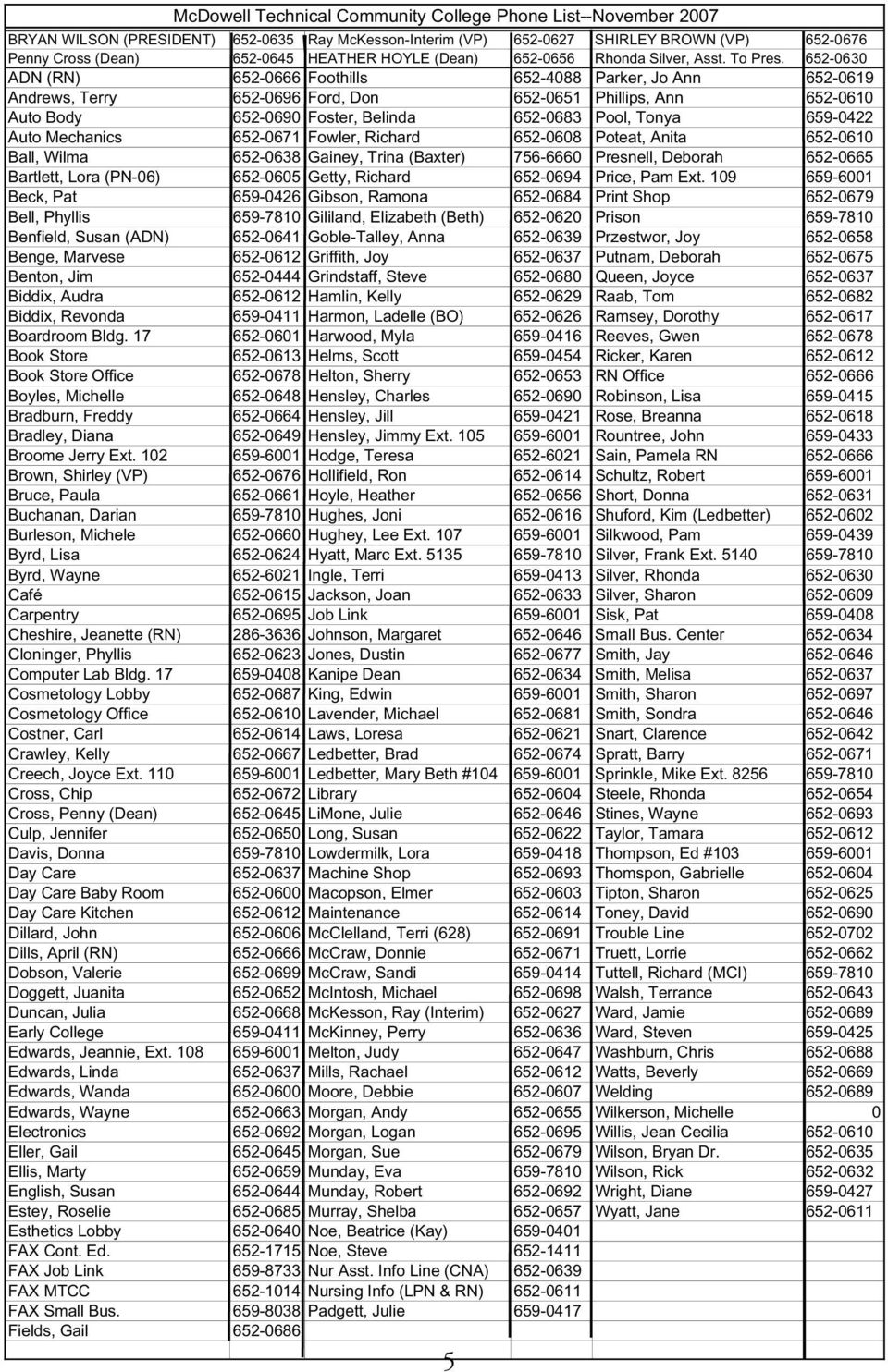
6 Academic Calendar FALL SEMESTER, 2008 Work/Annual Leave Days... August Mandatory Work Day for Staff & Faculty... August 13 New Student 10:00 am & 5:30 pm... August 13 Fall Registration... August 14 Telecourse & Internet Orientation 10:00 am & 5:30 pm... August 14 Faculty Association 2:00 pm... August 14 Work/Annual Leave Day for Staff and Faculty... August 15 First Day of Class... August 18 End Drop/Add... August 20 First Day of Class (Weekend)... August 23 Tuition Refund Request Deadline... August 29 Labor Day Holiday... September 1 Last Day to Receive Non-Punitive Grade of W... September 23 Incompletes Due... September 30 End of First 8 Weeks (Weekend)... October 11 End of First 8 Weeks... October 15 NCCCS Conference... October Fall Break, Work/Annual Leave Day... October Beginning of Second 8 Weeks... October 16 Beginning of Second 8 Weeks (Weekend)... October 18 SGA Fall Festival 11:00 am 1:00 pm & 6:00 pm 8:00 pm... October 28 Veterans Day Holiday... November 11 Pre-Registration for Spring Semester Begins... November 17 Thanksgiving Holidays... November Pre-Registration for Spring Semester Ends... December 3 Last Day of Classes... December 16 Work/Annual Leave Day... December Final Grades/Attendance 10:00 am... December 18 Campus Closed... December Christmas Holidays... December Campus Closed... December FALL SEMESTER, 2009 New Student 10:00 am and 5:30 pm... August 17 Fall Registration... August 18 Telecourse & Internet Orientation 10:00 am & 5:30 pm... August 18 Faculty Association 2:00 pm... August 18 First Day of Class... August 19 End Drop/Add... August 21 First Day of Class (Weekend)... August 22 Tuition Refund Request Deadline... September 1 Labor Day Holiday... September 7 Last Day to Receive Non-Punitive Grade of W... September 22 Incompletes Due... September 30 End of First 8 Weeks (Weekend)... October 10 Fall Break, Work/Annual Leave Day... October Beginning of Second 8 Weeks (Weekend)... October 17 End of First 8 Weeks... October 20 Beginning of Second 8 Weeks... October 21 Veteran s Day Holiday... November 11 Pre-Registration for Spring Semester Begins... November 13 Thanksgiving Holidays... November Pre-Registration for Spring Semester Ends... November 30 End of Second 8 Weeks (Weekend)... December 12 Last Day of Class... December 17 Final Grades/Attendance 10 am... December 18 6
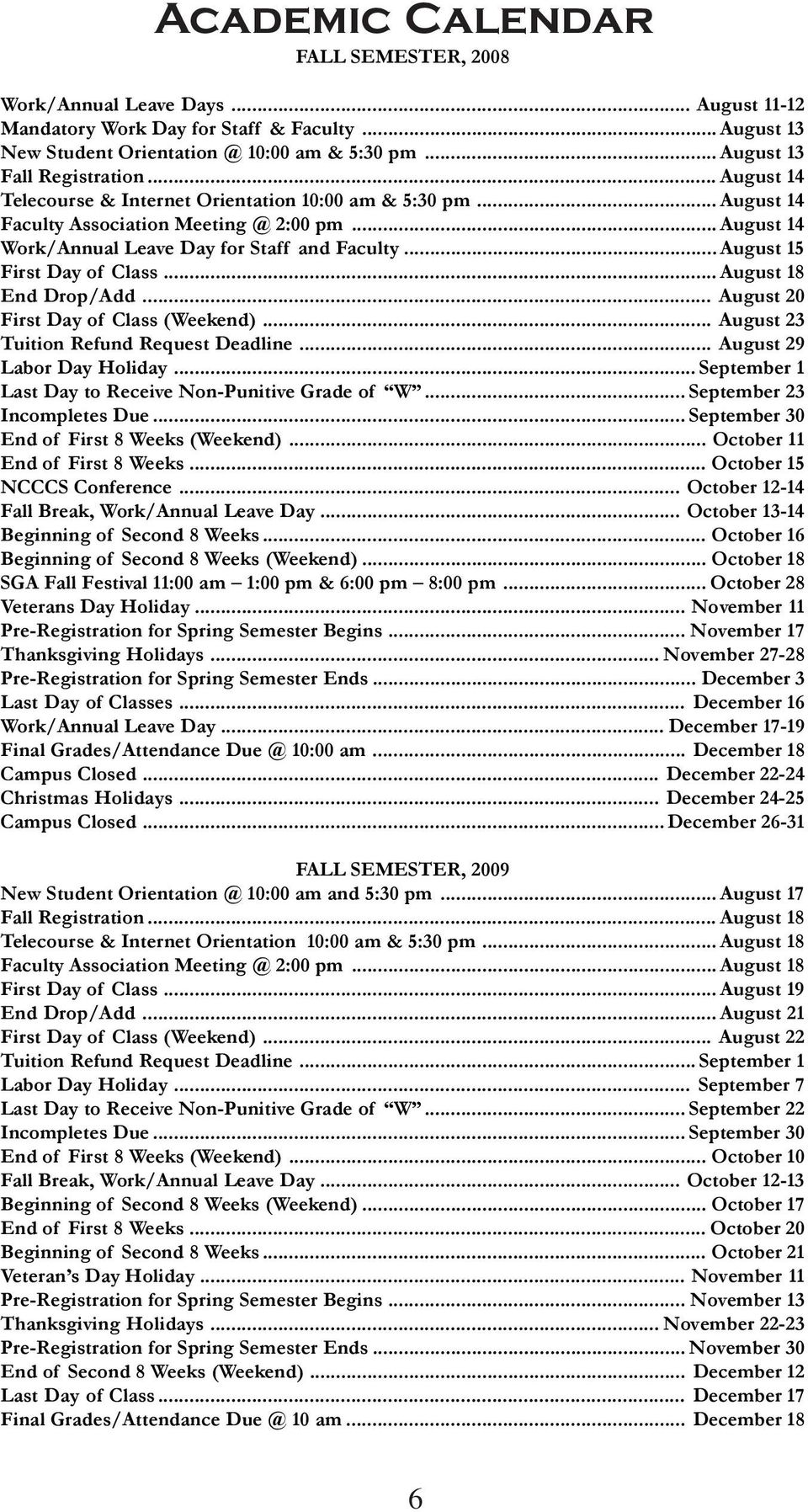
7 Campus Closed... December Christmas Holidays... December Campus Closed... December SPRING SEMESTER, 2009 New Year s Holiday... January 1 Work/Annual Leave... January 2 Mandatory Work Day for Staff & Faculty... January 5 Spring Registration... January 6 Telecourse & Internet Orientation 10:00 am & 5:30 pm... January 6 Faculty Association 2:00 pm... January 6 First Day of Class... January 7 End of Drop/Add... January 9 Beginning of First 8 Weeks (Weekend)... January 10 Martin Luther King, Jr. Holiday... January 19 Tuition Refund... January 21 Last Day to Receive Non-Punitive Grade of W... February 11 Incompletes Due... February 18 End of First 8 Weeks (Weekend Classes)... February 28 End of First 8 Weeks... March 4 Beginning of Second 8 Weeks... March 5 Beginning of Second 8 Weeks (Weekend)... March 7 MTCC Fire and Rescue College... March Pre-Registration for Summer Semester Begins... April 9 Easter Monday Holiday... April 13 Good Friday Holiday Observed... April 14 Spring Break, Work/Annual Leave Days... April Pre-Registration for Summer Semester Ends... April 29 Last Day of Second 8 Weeks (Weekend)... May 2 Last Day of Classes... May 6 Work/Annual Leave Days... May 7-13 Final Grades/Attendance 10:00 am... May 8 SUMMER SEMESTER, 2009 Summer Registration... May 14 Telecourse & Internet Orientation 10:00 am & 5:30 pm... May 14 Faculty Association 2:00 pm... May 14 Mandatory Work Day... May 15 First Day of Class... May 18 End of Drop/Add... May 22 Memorial Day Holiday... May 25 Tuition Refund Request Deadline... May 27 Last Day to Receive Non-Punitive Grade of W... June 8 End of First 5 Week Classes... June 22 Beginning of Second 5 Week Classes... June 23 Incompletes Due... June 29 Independence Day Holiday... July 4 Independence Day Holiday observed... July 7 Work/Annual Leave Days... July 8-10 Pre-Registration for Fall Semester Begins... July 14 Pre-Registration for Fall Semester Ends... July 27 GED 6:00 pm... July 31 Last Day of Class for Summer Semester... August 3 Work/Annual Leave Day... August 4-14 Graduation 10:00 am & 5:30 pm... August 4 Final Grades/Attendance 10:00 am... August 5 MCI 1:00 pm... August 7 7:00 pm... August 7 7
8 1964 MTCC Histor ory McDowell Technical Community College was established as the Marion- McDowell Industrial Education Center, located in downtown Marion, N.C. near the corner of State Street and South Garden Street. M-MIEC operated as a satellite unit of Asheville-Buncombe Technical Institute until September, M-MIEC became an independent unit of the Department of Community Colleges. The first Board of Trustees was sworn in, giving more local autonomy The school moved to permanent facilities on a 31-acre site at the intersection of Interstate 40 and Highway 226 in Marion The N.C. General Assembly made it possible for the school to become an independent institution. The College was officially chartered as McDowell Technical Institute A new building expansion program was completed, adding 39,322 square feet to the existing campus. Expansion included a new Auto Mechanics shop, 500-seat Amphitheatre, Learning Resource Center, Teaching Auditorium (seating 220), permanent administrative offices, classrooms and an expanded Student Commons area McDowell Technical Institute Foundation, Inc. was created to enrich resource development and enhance the quality of college life by procurement of gifts from the private sector The N.C. General Assembly enacted a bill to change the school s name to McDowell Technical College Robert M. Boggs succeeded John A. Price as President, becoming the College s second Chief Administrator. The College undertook a major bond campaign, which resulted in $2,400,000 for the addition of new facilities Construction was completed on the Industrial Skills Center, a 32,000 square foot class/lab facility, housing special industrial skills training facilities and class/lab areas for technical and vocational programs. The Day Care/Classroom building was completed, housing a day care area for children of MTCC students, Continuing Education classrooms/offices, an auditorium and faculty offices. The new facility added 11,200-square feet to existing campus facilities McDowell Technical College changed its name to McDowell Technical Community College to more accurately reflect the comprehensive educational opportunities available to the citizens of McDowell County. The MTCC Small Business Center was funded and established to provide educational opportunities and financial assistance to small businesses in the 8

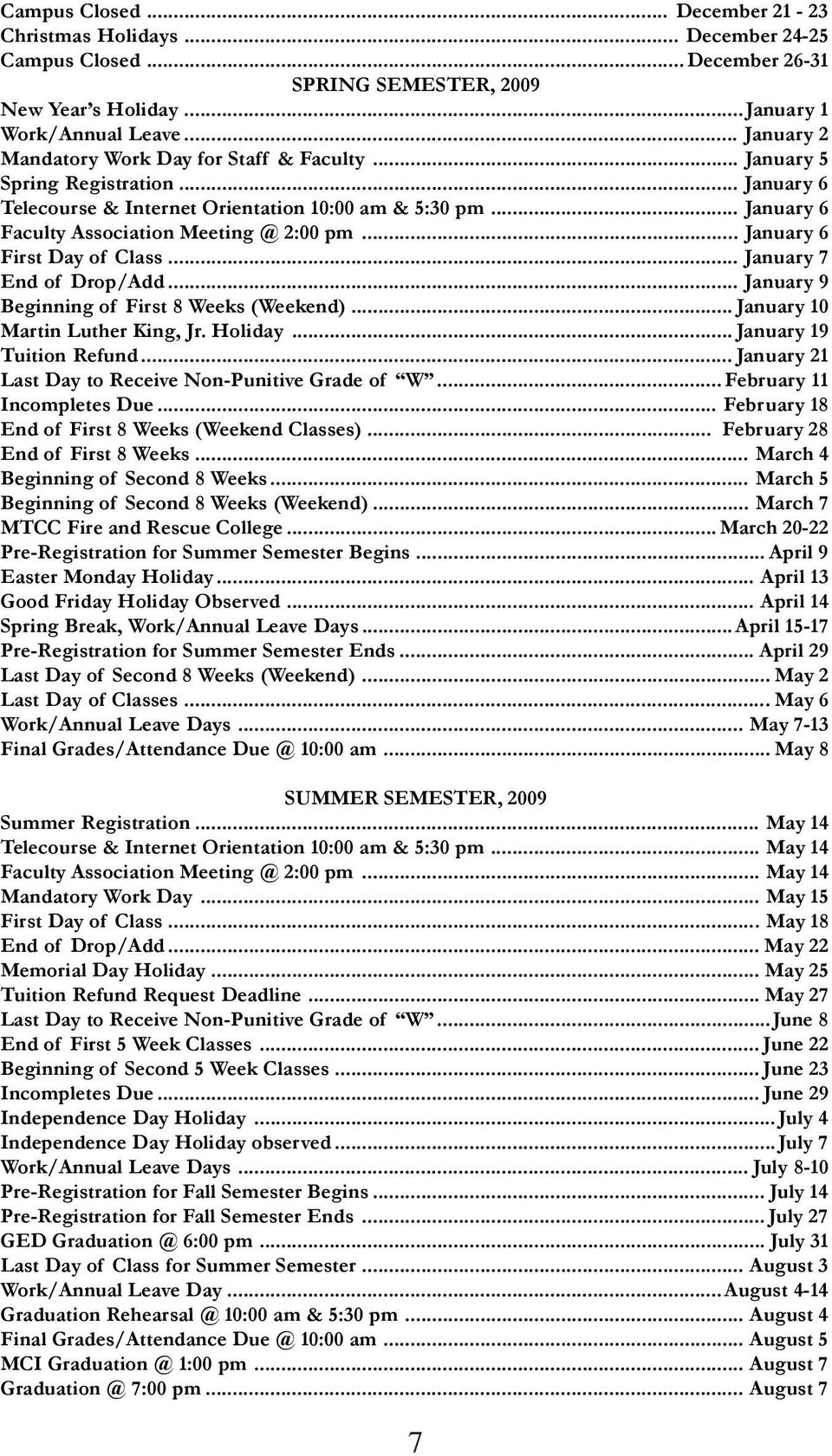
9 county The MTCC Career Center was established, providing students with information and help in choosing careers. The MTCC Downtown Center, located in downtown Marion at the original site of the Marion-McDowell Industrial Education Center, was established to offer Continuing Education classes MTCC, in conjunction with Isothermal and Cleveland Community Colleges, established the Foothills Nursing Consortium to begin offering an Associate Degree Nursing Program in MTCC's North Carolina Information Highway Room was certified and became operational, offering conferences and classes via live interactive video and sound The MTCC Downtown Center moved to its new location at 35 South Main Street in Marion, where the McDowell County Schools Accelerated Learning Center and the McDowell County JobLink Career Center were also located. Construction was completed on a new 19,950 square foot classroom building, the Library was renovated and a new handicapped lift was installed in the Administrative Building. 1,000 square foot was added to the college bookstore Dr. Robert Boggs retired after 15 years of service to the College. Dr. H. Edwin Beam became Interim President and the Board of Trustees began the search for a new President. Today, McDowell Technical Community College offers Associate Degrees, Diplomas, and/or Certificates in more than 30 curriculum programs. The College also offers classes in many areas of Continuing Education. MTCC currently serves more than 6,800 students per year with some type of education and training Dr. Virginia R. Mitchell became third president of the College. Instructor Jan Alms designed the first College Seal, which was incorporated into the College s Presidential Medallion, vested upon Dr. Mitchell during inaugural ceremonies in May Dr. Bryan W. Wilson succeeded Dr. Virginia R. Mitchell as president of the College after she retired in December, Mr. Ford Miller, local businessman, made the largest private donation the college had ever received when he gave MTCC the former Marion Mills Office Building on Baldwin Avenue. Trustees named the building The Ford Miller Employment and Training Complex. Plans were begun to convert the building to a combination office and classroom building to house MTCC staff and students, the McDowell County JobLInk Career Center and associated partners, and the McDowell County Employment Security Commission. 9
10 General Infor ormation Accreditation McDowell Technical Community College is accredited by the Commission on Colleges of the Southern Association of Colleges and Schools (1866 Southern Lane, Decatur, Georgia : Telephone number ) to award certificates, diplomas, and associate degrees. Mission and Goals Preamble McDowell Technical Community College in Marion, North Carolina, is situated in the foothills of the beautiful Blue Ridge Mountains and is located 32 miles east of Asheville near the intersection of Interstate 40 and NC Highway 226 South. Established in 1964, MTCC began as the Marion-McDowell Industrial Education Center near downtown Marion, and operated as a satellite unit of Asheville-Buncombe Technical Institute until The college moved to its current 31 acre site in 1970 and was officially chartered in 1971 as McDowell Technical Institute. In 1979, the college s name was changed to McDowell Technical College and in 1988 to the current McDowell Technical Community College. Although the name has changed, the process of lifelong learning has remained as its primary focus. Mission Statement McDowell Technical Community College is a member of the North Carolina Community College System, dedicated to providing studentcentered accessible, high-quality educational opportunities and services which fulfill the personal development, training and employment needs of the residents, businesses, and industries of McDowell County and the surrounding areas through an open-door admissions policy. The college recognizes each person s right to an education and seeks to contribute to the maximum development of a globally and culturally diverse workforce and improve the quality of life of the individuals in our community. The college provides life-long learning opportunities by: Offering comprehensive academic transfer, professional/technical, developmental, basic skills and continuing education programs through traditional and non-traditional delivery methods; Providing comprehensive student support services; Interacting and assisting with others to encourage, promote and facilitate economic growth and community development; 10

11 Recruiting, retaining and developing a highly qualified and diverse faculty and staff who are dedicated to quality education and service to the college and the community; Enhancing student life by sponsoring a variety of educational, cultural, and community services and activities. Graduate Competencies McDowell Technical Community College strives to prepare graduates to: 1. Listen and communicate effectively, orally and in writing. 2. Demonstrate competence in reading. 2. Perform effectively in their chosen occupations. 3. Demonstrate positive interpersonal life skills. 4. Demonstrate quantitative competencies. 5. Demonstrate skills in using a personal computer. 6. Use information to analyze problems and make logical decisions. General Responsibilities Students are expected to acquaint themselves with and observe College regulations and policies contained in the Catalog and Student Handbook and all announcements made by administrative officials. Academic Year McDowell Technical Community College operates on the semester system (Fall, Spring and Summer). Classes are regularly scheduled Monday through Friday for the day curriculum. Classes are regularly scheduled Monday through Friday for the evening curriculum. Weekend curriculum classes may also be offered on an occasional basis. Holidays, days for registration, and the first and last days for classes in each semester are indicated on the academic calendar. Hours of Operation The administrative offices of the College are open Monday through Thursday 8:00 am to 5:00 pm, and Friday 8:00 am to 4:30 pm. The Evening Director may be contacted Monday-Thursday from 2:00 to 10:30 pm and from 8:00 to 3:00 pm on Friday (Due to the nature of class schedules, the hours for the Evening Director may vary by an hour or so each semester.) In general, the College will offer day and night curriculum classes in technical, vocational, general education and college transfer programs from approximately 8:00 am to 10:30 pm Monday through Friday. Occasionally, classes will begin or end an hour earlier or later than these parameters. Weekend and summer semester classes may vary from this schedule. The Switchboard will be open from 8:00 am to 10:00 pm Monday through Thursday and 8:00 am to 4:30 pm on Fridays. 11
12 Continuing Education classes will be offered across campus and throughout the community at varying times, day and evening, throughout the week. Consult the Schedule of Classes for Continuing Education class times. The bookstore, located adjacent to the Student Commons, is open Monday- Thursday from 8:30 am to 6:00 pm, and Friday from 9:00 am to 4:30 pm. Hours of operation for the annual Fire and Rescue College will be mailed to applicants several weeks prior to the event. Closing of School For Bad Weather At times, McDowell Technical Community College curriculum and/or continuing education classes may be delayed or canceled due to inclement weather, natural disaster, or other emergency. The President is responsible for making the decision of whether to delay or cancel classes and for communicating this decision to the Director of External Relations for communication to the news media and to the college switchboard. When it becomes necessary to discontinue or delay classes, an announcement will be made to local and regional radio and television stations. Morning announcements will be made about 6:15 am for day classes. All day classes will operate according to the announcement and will either be canceled for the day or begin at 10:00 am. Should it become necessary to change from the delayed class schedule to class cancellation, the stations will be notified by around 8:00 am. Announcements concerning evening classes will be made over the same stations during the afternoon, hopefully by 3:00 pm. There is no abbreviated schedule for evening classes. Students may call the college if they cannot receive one of the radio or television stations listed. If the college is closed, students may access a recorded closing/delay message by calling the College at During inclement weather, students and staff members may listen to these stations for news about school delays or class cancellation: Radio WWNC (570 AM) Asheville WBRM (1250 AM) Marion WTOE (1470 AM) Spruce Pine WNCW (88.7 FM) Spindale WMNC (92.1 FM) Morganton WKSF (99.9 FM) Asheville WQNQ (104.3 FM), Asheville/Old Fort WMIT (106.9FM) Black Mountain Television WLOS (Ch. 13, Asheville) WBTV (Channel 3, Charlotte) WSOC (Ch. 9, Charlotte) WYFF (Ch. 4, Greenville) WSPA (Ch. 7, Spartanburg) Class makeup: The college recognizes its obligation to deliver the instructional services for which students pay tuition and fees. For this reason, all missed classes should be re-scheduled or made up in a manner determined by the 12
13 Vice-President for Learning and Student Services. The final attendance report must document how cancelled classes were made up. Housing McDowell Technical Community College is a commuter institution and does not provide living accommodations for students. However, if a student desires to live in the community while attending classes, the Student Services Office will refer him/her to appropriate resources for assistance in locating suitable housing. Parking Parking facilities are available for students, visitors, staff and faculty. Handicapped parking facilities are available and are appropriately designated across campus. Unauthorized vehicles will be towed away at the owner s expense. Food Services A short order café is located in the Student Commons. The café serves breakfast, lunch, and dinner Monday through Thursday, and breakfast and lunch on Fridays. The cafe may be closed on certain occasions when the college is holding special events in the Student Commons or when class is not in session. Snacks and soft drinks may also be purchased from vending machines in the Student Commons. Library Services Library Services encompasses the Library and audiovisual materials and equipment. Library staff members are available to help students and faculty as well as members of the community with library needs. The Library is open from 8:00 am to 9:00 pm Monday through Thursday and from 8:00 am to 4:00 pm on Friday. A wide variety of library resources is available to support the curriculum programs of the College. The book collection includes more than 27,000 volumes of current reference materials, college transfer, technical and vocational materials and an extensive paperback collection. Approximately 190 periodicals and newspapers are received throughout the year. Patrons are welcome to recommend materials for purchase. Audiovisual materials, including video cassettes, are available for classroom instruction. Audiovisual equipment is maintained in most of the classrooms on campus. Equipment is available in the Library for viewing video cassettes. The on-line card catalog (SIRSI Web cat) provides easy access to Library materials and makes the check-out process smooth, quick and accurate. Additional library resources include Interlibrary Loan through the Mountain College Library Network (MCLN), On-Line Computer Library Center (OCLC) and Community College Libraries in North Carolina (CCLINC). Other refer- 13

14 ence services are the SIRS CD-ROM reference products: Researcher, Renaissance, and Government Reporter. Computers are available for Internet research, including NC LIVE. Through its 60+ databases, NC LIVE provides access to full-text articles from over 9,000 magazines and newspapers from 12 vendors. It also provides access to over 22,000 electronic books. Remote access to NC LIVE is also available to library patrons Use of Telephones Students will not be called out of class to receive personal calls except in the case of an emergency. A pay telephone has been provided in Building 11 for personal calls. Cell Phones and Beepers Cellular telephones, beepers, two-way radios and similar devices may cause distraction and/or disruption of the learning environment. Students are to keep all such devices turned off during class and while in the MTCC Library. Students with extenuating circumstances must seek permission of the individual instructor or library staff member to have such devices turned on in these locations. Children On Campus It is College policy that children may not accompany students to class. Children who are brought to campus for other reasons must be closely supervised by a responsible adult and may be asked to leave if they become disruptive. Children enrolled in the MTCC Child Development Center are allowed on campus when supervised by College staff. Child Development Center The McDowell Technical Community College Child Development Center provides quality care for infants and children through age 5 during the day. The Center is open from 7:30 a.m. to 6:00 p.m. Monday through Thursday, and from 7:30 a.m. to 4:30 p.m. on Friday. Financial assistance is available to qualifying applicants. Children s Services Network Children's Services Network is a child care advocacy, resource, and referral agency serving as a link between parents, child care providers and the community. This program is operated as a service to students, faculty, staff and, particularly, community residents. Free services include a resource lending library, free educational brochures, a database of current child care statistics, and a referral service for parents seeking child care. For information, contact the MTCC Child Development Center or the Children s Services Network (828)

15 Dress Students are to exercise judgment in dressing appropriately for classes or laboratory work. Students in certain curriculum programs may be required to wear particular items of clothing for safety and/or designation of their course of study. Noise Students are to be considerate of classes which are in session. Excessive noise will not be tolerated within administrative or classroom buildings. Tobacco-Free (No Smoking) Facilities Smoking is limited to the designated smoking areas behind/beside selected buildings. Ash and trash receptacles are located in those areas for disposal of litter. Please use these receptacles to help keep our campus neat and clean. Tobacco use is not permitted inside any building owned or leased by the College or in College owned vehicles. Those who violate this policy will receive a verbal warning for the first offense. Continued violation of this policy will result in disciplinary action. Bulletin Boards Students may post notices on bulletin boards subject to the approval of the Student Government Advisor in the Student Services Office. Lost and Found All Lost items should be reported to the Switchboard Operator in Building 11. All Found items should be turned in to this office as well. The Switchboard Operator will post information on articles/items which have been turned in. 15

16 Performance Measures McDowell Technical Community College Performance Measures and Standards for Performance Funding Last revised May 2008 from the 2007 Critical Success Factors report by NCCCS. Measures A, B, C, D & E are required for performance funding. Measure H is MTCC s choice for the 6 th standard for performance funding. An asterisk * indicates that number is too small to report without violating students privacy. A minimum of 10 students is required for a reportable sample size Measure Description Standard(s) System Average Performance A. Progress of Basic Skills Students B. Passing Rates for Licensure and Certification for First-Time Test Takers C. Goal Completion for Completers Includes all adult literacy students. % of students whose progress is based on: 1. progressing within level 2. completing the level entered or a predetermined goal, and 3. completing the level entered and advancing to a higher level Examines the % of first time test-takers from community colleges passing an examination required for NC licensure or certification prior to practicing the profession. Licensure: examination required by state statute for an individual to work in that occupation Certification: generally voluntary but may be required by employers or an outside accrediting agency. Purely voluntary examinations are not reported. Reports proportion of graduates of certificate, diploma, and degree programs who report that their primary goal in attending has been met. 75% Composite Score 82% 89% 80% Aggregate Passing Rate 70% Single Exam Pass Rate 85% Aggregate BLET 93 % Cosmetology: Apprentice (1) Cosmet (1) Cosmet Tchr (1) Manicurist (1) Esthetics (1) EMT 84% EMT-I 64% EMT-P 69% Pract Nurs 95% ADN 89% RLS, Sales 69% 95% 99% 100% MTCC Performance 84% Aggregate BLET 94% Cosmetology: Apprentice (1) Cosmet (1) Cosmet Tchr (1) Manicurist (1) Esthetics (1) EMT 74% EMT-I 42% EMT-P -- Pract Nurs 94% ADN (FNC) -- RLS, Sales * D. Employment of Graduates E. Performance of College Transfer Students F. Passing Rates in Developmental Courses The proportion of identified community college completers who are employed within one year of last attendance. Purpose of this measure is to compare the performance of community college associate degree students (Associate in Arts, Associate in Science, and Associate in Fine Arts) who transfer to public NC universities with students native to the four-year institutions. The percent of students who complete developmental English, mathematics, or reading courses with a grade of C or better. 95% (adjusted) 86.2% w/ GPA >=2.0 after two semesters 99.51% 99.22% 84.2% Total 81.8% w/ 24 hr %Assoc Deg 70% Total 80% Total 83% English 77% Math 85% Reading 84.4% Total 100% w/ 24 hr % w/ Assoc Degree 97% Total 99% English 96% Math 100% Reading 16

17 Measure Description Standard(s) System Average Performance MTCC Performance G. Success Rates of Developmental Students in Subsequent College Level Courses H. Student Satisfaction of Completers and Non-completers ** I. Curriculum Student Retention and Graduation J. Employer Satisfaction with Graduates K. Client Satisfaction with Customized Training L. Program Enrollment College Summary: Performance of developmental students in subsequent college level courses will be compared with the performance of non-developmental students in those courses. Performance of students in ENG 111 will be used to assess developmental English Performance in the first college-level math course will be used to assess developmental math Performance in the first humanities course after completion of developmental reading will be used to assess developmental reading Reports proportion of graduates and early-leavers who indicate that the quality of the college programs and services met or exceeded their expectations. This composite measure consists of: 1. Number of individuals completing a curriculum program with a certificate, diploma, or degree; and 2. Number who have not completed a program but are continuing enrollment in either curriculum or occupational extension programs. Each composite indicator will be reported separately for each college. The sum of the two will be divided by the total curriculum students in the cohort to compute an indicator of curriculum student progress and success. Reports a percentage of a sample of businesses that employ individuals trained or educated by a community college indicating that they are satisfied with the quality of those employees as it relates to community college training and education. This measure is intended primarily to determine the satisfaction of organizations whose employees have been trained through a community college. The percentage of businesses / industries that have received services from a community college indicating that their expectations have been met. This measure is intended primarily to determine the satisfaction of organizations that received services from a community college. A minimum three-year average annual unduplicated headcount enrollment in a curriculum program. No statistically significant difference between developmental and nondevelopmental students 86% of former developmental students passed subsequent coursework in area compared to 86% of non-developmental students. 90% Total 97% Total 95% Non-completers 98% Completers 60% of Fall Cohort 65% 65% 85% 97% 93% 98% of former developmental students passed subsequent coursework in area compared to 96% of non-developmental students. 93% Total 90% 99% 100% 3 year average annual enrollment minimum of 10 students 6 programs systemwide did not meet minimum averaged program enrollment 97% Non-completers 92% Completers 0 programs (All of MTCC programs met the standard) The college met the standards on 10 out of 12 Performance Measures. We did not meet the standard for required Measures B and E. Compared to last year s measures MTCC showed increased performance on Measure B (aggregate increased), G, and I; while MTCC s performance on Measure A showed a significant improvement, Measures D and F showed slight decreases; and MTCC s overall performance on Measures C, H, K, and L remained the same as last year. Note: (1) indicates Data Not Available. 17
18 Degrees, ees, Diplomas & Certif tificat icates es McDowell Technical Community College awards the ASSOCIATE IN APPLIED SCIENCE DEGREE (A.A.S.) upon the successful completion of the following technical curricula: Accounting Advertising and Graphic Design Associate Degree Nursing Automotive Systems Technology Biotechnology Business Administration-Concentrations Available In: Marketing and Retailing Operations Management Computer Information Technology Cosmetology Early Childhood Associate-Concentrations Available In: Special Education Teacher Associate Electrical/Electronics Technology Health Information Technology Industrial Systems Technology Office Systems Technology Photographic Technology The College awards the ASSOCIATE IN ARTS DEGREE (A.A.) upon the successful completion of the following College Transfer Curriculum: College Transfer - Liberal Arts Program The College awards the ASSOCIATE IN GENERAL EDUCATION (A.G.E.) upon the successful completion of the following: General Education The College awards DIPLOMAS upon the successful completion of the following vocational curricula: Advertising and Graphic Design Air Conditioning, Heating and Refrigeration Technology Auto Body Repair Automotive Systems Technology Cabinetmaking (Correctional Only) Carpentry College Transfer Core Cosmetology Dialysis Technology 18

19 Early Childhood Electrical/Electronics Technology Health Information Technology Industrial Systems Technology Information Systems Technology-Programming (Correctional Only) Horticulture Technology (Correctional Only) Machining Technology Networking Technology Office Systems Technology Practical Nursing Education Surgical Technology Web Technology (Pending Approval) Welding Technology The College awards CERTIFICATES upon the successful completion of the following curricula: Accounting- Accounts Payable, Accounts Receivable, Bookkeeping Accounting- Payroll Accounting Clerk Accounting- Income Tax Preparer Basic Law Enforcement Training Carpentry Computer Information Technology Cosmetology Cosmetology-Esthetics Instructor Cosmetology - Esthetics Technology Cosmetology-Instructor Cosmetology - Manicuring Instructor Cosmetology - Manicuring / Nail Technology Early Childhood Health Information Technology Industrial Systems Technology Infant/Toddler Care Nursing Assistant Office Systems Technology-Concentration available in Medical Transcription Real Estate Welding Technology The College awards CERTIFICATES OF COURSE COMPLETION upon successful completion of non-credit Continuing Education courses. The North Carolina Department of Public Instruction awards ADULT HIGH SCHOOL EQUIVALENCY CERTIFICATES to individuals who make satisfactory scores on General Educational Development (GED) examinations. 19

20 Admissions As a member of the North Carolina Community College System, McDowell Technical Community College operates under an "open door" admissions policy. Open door admissions means, Any person who is a high school graduate or at least 18 years old has the opportunity to pursue the various educational opportunities that are offered by institutions in the system. Special admission requirements, such as educational qualifications, physical abilities, assessment scores and State Board policy restrictions, are attached to certain curriculums. Applicants scoring below specified minimums on entrance exams will be counseled and required to enroll in classes designed to eliminate their admission deficiencies. The following are the general admission requirements. However, some curricula have special requirements for admission. Consult the section of this catalog which describes the particular curriculum in which you wish to enroll for a list of the exceptions or requirements. The College has six departments: Business Technologies Department College Transfer / General Education Department Continuing Education Department Correctional Education Department Health, Human & Public Services Department Vocational Department Curriculum Admissions Curriculum classes are offered in all departments except the Continuing Education Department. Therefore, admission to all departments except the Continuing Education Department are coordinated through and conducted in the Student Services Office. For curriculum admissions, an applicant must be a graduate of an accredited high school or must have been awarded a high school equivalency certificate. Exceptions may be made for concurrent enrollment and Huskins Bill students, as well as individuals whose age and maturity make success likely. Continuing Education Admissions In general, Continuing Education courses are open for enrollment to persons 18 years of age or older, or those whose high school graduating class has graduated. However, because some specialty and advanced courses may be more difficult and require a greater degree of preparation, potential enrollees should be aware of the nature of the course requirements to determine their possible success in those courses. To meet admissions requirements for certain specialized courses such as Fire 20

21 How to Enroll in a Curriculum Program Persons wishing to enroll in a curriculum program at the College must complete the entire application process and meet requirements as follows: Submit an application form, health form (depending upon program area) and residency statement. There is no application fee! Obtain official transcripts of credits from all secondary and postsecondary schools attended. Records should show that the student is a high school graduate or has a state-approved equivalent education. Complete admission and placement tests administered by the College through the Student Enrichment Center. Student suitability for admission to individual programs will be determined by scores on the placement exam and specific program requirements. Applicants scoring below the necessary minimum will be required to enroll in various developmental (remediation) courses to ensure success in their curricula. The Vice President for Learning and Student Services will review all requests for placement test exemption. Students classified as transfer or special students may be considered for such exemptions, as may those with satisfactory scores on the ACT or SAT, and those who have satisfactorily completed college level English or Algebra with appropriate grades. **For information on admission to Continuing Education courses, refer to the Continuing Education section of this catalog. Service, Law Enforcement or Management Development Training, potential students must be employed by or recommended by one of the requesting training agencies. Special Admissions Provisional Admissions Students who have applied too late to secure all supporting documents for admission to a particular semester may be admitted as provisional students. In such cases, all requirements for regular admission should be completed within the first semester of attendance. Students who fail to secure all supporting documents or satisfy requirements for official admission to the College may not be eligible for financial assistance and will not be allowed to enroll the next semester. Admission of Special Students A special student is defined as one who is enrolled in curriculum credit courses, but who is not working toward a degree or diploma. Special students may register to take courses for which they have met prerequi- 21
22 sites, provided that such registration does not pre-empt students enrolled in a degree, diploma, or certificate program. A student may take a maximum of 15 hours in any one semester while classified as a special student. When a student reaches 20 cumulative hours, he/she will be counseled to declare a major or curriculum preference. For admission to McDowell Technical Community College, special students need only to complete the application for admission which is available in the Student Services Office. Special students may be asked to submit proof of high school graduation and meet certain placement criteria, depending on the courses they wish to enroll in. If they desire to be reclassified as a regular student with intent to pursue and earn a degree, diploma, or certificate at McDowell Technical Community College, they must meet the admission criteria of their chosen program of study. Visiting Student Status A visiting student is defined as one who is a student in good standing at another institution of higher education. A visiting student may enroll at MTCC by completing an application and furnishing MTCC with a letter of permission and transcripts from the parent college (college at which the individual is a regular student). Visiting students may register to take courses for which they have met prerequisites, provided that such registration does not pre-empt students enrolled in a degree, diploma, or certificate program. Foreign Student Admission A student wishing to apply for admission as a foreign student (F1- VISA) should first make arrangements through the American Consulate in his/her own country to take the Test of English as a Foreign Language (TOEFL Test). To demonstrate proficiency in the English language, international applicants from non-english speaking countries must score at least 133 on the computer-based test or a 450 on the paper-based test. If the applicant is already in the Marion area, the MTCC placement test may be substituted for the TOEFL requirement. Applicants will not be considered until a satisfactory score is received on this exam. Educational records, including transcripts, must be translated into the English language by officials from the school(s) from which the applicant graduated. These records must contain course titles, grades and an explanation of the marking system. Foreign applicants must submit an official certification that adequate funds are at the applicant s disposal to meet education and living expenses, including transportation, housing, insurance, out-of-state tuition, etc. The MTCC Application for Admission, high school transcript, college transcripts, TOEFL or MTCC placement test scores and official documentation of financial resources must be received before an admis- 22
23 sion decision can be made and a U.S. Immigration and Naturalization Service I-20 can be issued. Foreign applicants must meet all other regular admission requirements as stated in this catalog. Admission of Minors An applicant who is a minor between the age of 16 and 18 may be considered as a person with special needs and admitted to appropriate courses or programs, provided: 1) That the minor applicant has left the public schools no less than six calendar months prior to the last day of regular registration of the semester in the institution for which admission is sought: and 2) That the application of such minor is supported by a notarized petition of the minor s parent, legal guardian, or other person or agency having legal custody and control of such minor applicant, which petition certifies the place of residence and date of birth of the minor, the parental or other appropriate legal relationship of the petitioner to the minor applicant, and the date on which the minor applicant left the public schools. However, all or any part of the six-month waiting period may be waived by the superintendent of the public schools of the administrative unit in which the applicant resides; and 3) That such admission will not pre-empt College facilities and staff to such an extent as to render the College unable to admit all applicants who have graduated from high school or who are 18 years of age or older. It shall be the policy of the State Board of Education and the Community College System to encourage young people to complete high school before seeking admission to community colleges or technical institutes. Huskins/Concurrent Enrollment of High School Students Huskins Bill and concurrent enrollment policies provide opportunities for community colleges and high schools to articulate their programs to effect an uninterrupted educational flow from a high school into a community college program. Articulated programs enable students to take courses at a community college while enrolled in high school. The objectives to these programs are: (1) to provide a program for selected high school students to participate in college credit educational opportunities not otherwise available. (2) to enhance the motivation and achievement of high school students. (3) to improve the equalization of opportunities among high schools throughout the state by offering college credit courses and (4) to encourage high school students to utilize post secondary opportunities as a means for pursuing lifelong educational goals. 23
24 High school students wishing to enroll at MTCC must first get approval from their high school principal or his/her designee. Additionally, they must submit an MTCC Application for Admission and meet placement test requirements for the program/courses in which they wish to enroll. The Huskins Bill provides an opportunity for high school students to take classes during the school day which provide college credit and, in some cases, credit toward high school graduation. Students interested in this program should contact officials at their high school for information about enrollment and testing procedures. Under certain circumstances, public school students who are 16 years of age may be concurrently enrolled in courses at MTCC while enrolled in high school. These students must submit a completed concurrent enrollment form along with their application. Concurrent enrollment forms may be obtained from a student s high school principal or his/her designee, or from the MTCC Student Services Office. These classes are taken after the student s regular high school day has ended. Tech Prep Curriculum The Tech Prep program is designed to meet the needs of McDowell County students who wish to enter the Community College System and go into a one-year diploma or two-year degree program. Participating students may receive advanced placement and be able to receive college credit for courses taken while in high school. This program is a college preparatory (high school) course of study developed to serve students wanting to go immediately into a two-year trade, technical, or community college program, or into employment. McDowell County students will begin planning their Tech Prep course of study in the eighth grade with the assistance of their school counselor. Tech Prep students will identify their career and educational goals in a program that begins at the ninth grade level and continues through two years at McDowell Technical Community College or another community college. Tech Prep classes are taken during the regular high school day. Enrollment Limitations Some curriculum programs have maximum student enrollment limitations and/or reserve space for currently enrolled students. Acceptance to most programs except Nursing and BLET will be on a first come, first served basis as evidenced by the receipt of qualified applications and payment of all appropriate fees. 24
25 Applicants who do not register and pay at established times may lose their position. Readmissions Students who have withdrawn in good standing, withdrawn while on probation, or who have been suspended for academic deficiencies should submit requests for readmission to the VP for Learning and Student Services. Consideration of requests for readmission of students who have withdrawn for these reasons will be made in light of the applicant s ability, evidence of growth and maturity, time elapsed since withdrawing and other extenuating circumstances. Additional consideration will be given to those who have completed course prerequisites. Enrollment limits and class sequencing will also be considered in evaluating a request for readmission. Transfer Transfer From Other Schools Students who complete course work in another accredited college or university may apply for admission to MTCC. An application must be submitted and must include official transcripts for all institutions previously attended. Transfer applicants must have maintained a satisfactory conduct standing in the institution from which they are transferring to be accepted as a student in good standing at MTCC. Academic work completed at accredited colleges and universities will be accepted at full value for required courses passed with the grade of "C" or better if completed within the last 5 years. Courses taken at other institutions must have essentially the same content, contact hours and difficulty level as MTCC courses. In order to receive a degree or diploma from MTCC, a student must earn the last 20 semester hours of their program in residence at MTCC with at least a "C" average (see graduation requirements). Applicants who seek admission with advanced standing at MTCC should make an appointment with an admissions counselor to conduct a transcript evaluation. The admissions officer will conduct an official transcript evaluation when the applicant's admission file is complete. Requests for transfer credit should be made prior to the student s first term of enrollment. All transfer credit will be computed by the end of the first semester of the student s initial enrollment. The applicant can inquire in Student Services about all credits which transfer, preferably prior to enrollment. A transfer student applying too late to complete pre-entrance requirements may be admitted as a provisional student. In such a case, all requirements for regular admission must be completed within the first semester of attendance. 25
26 A student on academic probation or suspended status from his/her last college or post-secondary institution may be admitted on a probationary basis and may be subject to academic progress regulations as defined in this catalog. Transfer of Credits from College Level Examination Program Credit may be allowed for up to 14 semester hours of college work based on appropriate scores on the CLEP General Examination where appropriate to the student's program of study. CLEP subject examinations are evaluated individually if applicable to the program of study. Transfer of Credits For Military Experience McDowell Technical Community College recognizes the unique nature of the military lifestyle and has committed itself to easing the transfer of relevant course credits, providing flexible academic residency requirements and crediting learning from appropriate military training and experience. Veterans of the Armed Forces automatically receive credit for two semester hours of physical education credit. They are eligible to apply for curriculum credit in other areas based on prior education, training and experience. See the Veterans Certifying Official in the Student Services Office for more information on credit for prior military experience. Transfer Within Curriculums McDowell Technical Community College will make all reasonable efforts to assist students who transfer from one curriculum to another within the College. Credits earned in one curriculum will transfer to another when appropriate. A student s cumulative grade point average will be computed only from the credits transferred to the new curriculum. The VP for Learning and Student Services is the primary authority in determining transfer of credits from other schools and within curriculums. When there is doubt about the transfer of a credit, the VP for Learning and Student Services will consult the appropriate faculty members. If a student wishes to appeal the decision, the transcript will be referred to the Dean of Curriculum Programs, whose decision will be final. Transfer To Other Schools The school to which a student wishes to transfer is responsible for deciding which credits from McDowell Technical Community College will be accepted. Most colleges and universities will accept 26
27 MTCC credit for a course if a grade of C or higher is earned. Students planning to transfer to senior institutions should strongly consider enrolling in the MTCC College Transfer or General Education program. Transfer of credits from other areas may be limited. Students should seek the advice of a counselor in these instances. There are many four-year schools which transfer technical courses from McDowell Technical Community College. Students should contact four-year schools of their choice to determine which courses will transfer. False Information Furnishing false data for admission or failure to fully disclose requested information will be grounds for rejection of an application or dismissal of a student who has already be admitted to the college. Notification of Acceptance (*Does not apply to nursing students.) Applicants will be notified by mail of their admission status within one to four weeks after their application is received. Placement into a requested program may be determined at a later date. Official notification of acceptance or placement in a program is issued only by the Vice-President for Learning and Student Services or his/her designee. Applicants not placed in the program of their choice will be notified of this decision. An admissions interview may be requested prior to placement into any program. An applicant who changes his/her mailing address prior to registration for classes, who desires to apply for a different program, or wishes to enroll in a different semester than the one for which he/she originally applied should notify the Student Services Office immediately. Placement Information (*Does not apply to nursing students.) Placement into a specific course of study is based upon standards which will help to assure the applicant s success in that course of study. New students seeking a degree, certificate or diploma need to take the COMPASS and/or Asset Placement Test administered by the Student Enrichment Center under the auspices of the Student Services Office. Those who do not yet possess the background required by their course of study may be enrolled in developmental (refresher) courses designed to provide this background. An individual s educational background, interest, motivation, experience and aptitude will be considered when an application is submitted to the College. Students may be required to take developmental classes based on their placement test scores. Grades in these classes are used in the calculation of grade point averages, but do not count toward hours required for graduation. 27
28 Academic Regulations Grading System McDowell Technical Community College is on a semester system. Grades will be issued at the conclusion of each semester based on the following system: Grade Numerical Range Significance Quality Points A Excellent 4 Quality Points B Above Average 3 Quality Points C Average 2 Quality Points D** Below Average but passing 1 Quality Point F Below 70 Failure 0 Quality Points W Withdrawal prior to 30% point 0 Quality Points (Non-punitive) WP Withdrawal Passing after 30% point 0 Quality Points (Non-punitive) WF Withdrawal Failing after 30% point 0 Quality Points (Punitive) I Incomplete Treated as F unless removed within 6 weeks. AU Audit 0 Quality Points NS No Show (never attended class) 0 Quality Points (Non-punitive) ** Does not apply to Nursing, Nursing Assistant or HIT Students, for whom the lowest passing grade is C. Grade point averages are determined by dividing the total number quality points by the number of hours attempted. If a course is repeated the highest grade will be used in determining a student s hour quality points. A grade point average 28
29 of 2.00 indicates that the student has an average of C; above 2.00 indicates that he has an average of above a C; below 2.00 indicates that he has an average below C. Under unusual or extenuating circumstances, faculty may use a different grading system other than the one listed above. Should this be necessary, the instructor must approve this change with Administrators in Educational Programs and list the new grading system on the Course Syllabi for that particular course. Incompletes The grade I, incomplete, may be assigned when a student is unable to complete a course by the end of the semester. The student must present valid reasons why the course cannot be completed, and obtain the instructor's approval. This grade can be removed if the work to be completed is satisfactorily accomplished within a period of six weeks starting from the registration date of the following semester. An incomplete grade is treated as a failing grade in GPA computation after the period of six weeks has lapsed and the work has not been completed. Standards of Progress Students are expected to make progress toward graduation. Since a 2.00 cumulative grade point average is required for graduation, the acceptable grade point averages which students are expected to maintain vary with the number of hours which they have accumulated. ASSOCIATE DEGREE PROGRAMS Cumulative Minimum Grade Point Semester Hours Average Completion 2.00 VOCATIONAL DIPLOMA PROGRAMS Cumulative Minimum Grade Point Semester Hours Average Completion 2.00 **There are additional regulations for Nursing, HIT, BLET and other specific curriculums. Check with the Student Services Office, the Nursing Department, or your advisor for these regulations. Also, see Graduation Requirements in this Catalog. 29
30 Academic Advisement/Probation The above cumulative grade point averages are the minimums which must be attained in order for a student to make reasonable progress toward graduation. A 2.00 grade point average is required for graduation. Students who fall below the specified minimum will be placed on Academic Probation for the following semester and will be required to reduce their course loads. Academic Suspension and Readmission Students who fail to earn a 2.00 GPA during any semester of academic probation may be suspended from their program of study. The period of suspension will not be less than one semester, nor more than one year. Students who have been suspended for academic deficiencies should submit requests for readmission to the VP for Learning and Student Services. Requests for readmission will be considered in light of the applicant s ability, evidence of growth and maturity, time elapsed since suspension and other extenuating circumstances. Additional consideration will be given to those who have completed course prerequisites. Enrollment limits and class sequencing will also be considered in evaluating a request for readmission. Recognition of Academic Honor Students Students enrolled full-time (12 credit hours or more) who receive no incompletes are eligible for the following academic honor s lists: President s List - Grade point average of 4.00 Dean s List - Grade point average of Honor List - Grade point average of Academic honor lists are posted on-campus and provided to newspapers each semester. Faculty Advisor Each student enrolled at McDowell Technical Community College will be assigned an advisor. The basic purpose of this is to provide each student personal assistance in orientation and progress throughout the time enrolled. Student Services personnel can help a student determine the name of his or her advisor. Advisors maintain office hours as posted on their office doors. The student s faculty advisor may be consulted regarding various problems, but must, in all cases, be consulted by the student in the following instances: 1. When planning the forthcoming semester s studies. 2. When changing courses within the current program. 3. When changing programs of study. 4. When preparing to enter a final semester of studies to determine graduation eligibility. 30
31 Registration The College operates on the semester system (Fall, Spring and Summer). All students are expected to register during the time set aside for that purpose. Registration dates are listed in the College calendar published in the College Catalog and Student Handbook, the Schedule of Classes, and the MTCC website. Students may not register for a semester until they have paid any deferred or past due charges owed to the College. These fees are paid through the Business Office. Students are responsible for obtaining registration clearance each semester before they are permitted to register for classes. Current students who register late will be charged an additional fee of $5.00. Students may pre-register for classes during periods set aside for that purpose prior to the beginning of each semester. These dates are also listed on the College calendar. Pre-registration gives students more time and flexibility to register and meet with their advisors. Schedule Changes and Withdrawal The following steps must be adhered to before schedule changes are official: 1. The student secures a Add/Drop/Withdrawal Form from the Student Services Office. 2. Individual schedule changes must be approved by the appropriate instructor. 3. Notification of schedule changes must be acknowledged and recorded by the Student ServicesOffice. 4. Students who do not withdraw from school officially and have to be administratively withdrawn from school because of absences will be dropped from classes with grades of WP or WF." Students may change their academic schedules during the prescribed period without scholastic penalty. However, any course dropped after the 30% point in the semester will be marked "WP" (Withdrawal Passing) or "WF" (Withdrawal Failing). A "WF" carries the same stigma as an "F" (Failure). Courses dropped after the 10% point in the semester are not subject to a refund. Course Substitutions Students may be allowed to substitute one course for another to meet graduation requirements. The substituted course must contribute to the goals of the degree program equally as well as the original course. Students must obtain approval from the instructor, advisor, Dean of Curriculum Programs and the VP for Learning and Student Services to substitute one course for another. A course substitution form may be obtained in the Student Services Office. Repeating Courses A course may be repeated for credit for the purposes of obtaining certification hours, gaining additional knowledge, improving a grade or for the purposes of 31
32 auditing a class. A student may receive credit hours toward graduation only once for a course. In the case of a course which has been repeated, only the quality points and hours earned in the most recent enrollment will be used in the computation of the cumulative quality point average. However, all grades will be shown on the transcript during the semester in which the course was taken. No financial aid may be received by students repeating a course unless the student previously received a grade of D or F in the class. Auditing Courses Students who wish to audit courses must register and pay the same fees as students taking courses for credit. Unless the instructor makes an exception, auditing students are subject to the attendance policy (as stated in the College Catalog and Student Handbook). Students auditing courses which involve laboratory work may work in labs only during the course s scheduled laboratory hours and under the direct supervision of the instructor. Otherwise, laboratories are closed to auditing students. No financial aid is received for audited classes. Credit by Examination A student may pass a specially prepared examination and receive credit for a course without having to do the normal course work. The student must present evidence of his knowledge of the subject matter. Usually, the student must enroll in the course long enough to convince the instructor of his/her ability and for at least 10% of the scheduled classes before requesting credit by examination. The student must then present a Credit by Examination Request form to the instructor to begin the process. A Credit by Examination Request form may be obtained in the Student Services Office. The student will not receive a letter grade or quality points. Credit by Examination will be entered on the student s transcript. The hours will be counted toward graduation, but will not be used in computing quality point averages. A student may earn up to 20% of the course requirements for any curriculum through credit-by-examination. Change of Program If a student wishes to change his/her program of study, he/she must contact the Student Services Office and complete the Change of Program form. The student should at this point request re-evaluation of transcripts from his/her program advisor for the purpose of transferring credits to the new program of study. Credit or Contact Hours Credit for course work is recorded in semester hours. One semester hour credit is given for one hour of class work, two hours of laboratory or three hours 32
33 shop work per week during a 16 week term. Manipulative laboratory credit is one semester hour for each three hours of work. Manipulative laboratory involves development of skills and job proficiency. Co-op Education credit is one semester hour of credit for 10 hours of work per week. Maximum Course Load Students are encouraged not to enroll in more courses than they can successfully complete. Students enrolling for 19 credit hours or more must have special permission, and may not enroll for more than 22 credit hours. Students who request heavier courseloads should have a 3.00 grade point average. Permission must be granted by the faculty advisor and the VP for Learning and Student Services. Procedures For Student Withdrawal To officially withdraw from the College or from a course, the student must follow these procedures: 1. The student will report to the Student Services Office, request to be withdrawn from classes, and obtain a withdrawal form, and if applicable, request a Tuition Refund Request form. 2. The student is responsible for obtaining each instructor's signature, last date of class attendance and withdrawal grade on the withdrawal form, and for returning this form to the Student Services Office. If the circumstances surrounding the withdrawal process do not allow the student to do the above, the Student Services Office will perform the withdrawal procedure for the student upon request. 3. A student may withdraw prior to the 30% point of the semester without scholastic penalty. This procedure, if followed, will entitle the student to have his permanent record show the notation "withdrawn." This notation indicates good standing and the privilege of readmission but may affect financial aid. 4. Any student who withdraws, or is withdrawn due to violation of the College's attendance policy, after the 30% point of the semester will receive a grade of "WP" or "WF." 5. Any student who fails to officially withdraw from the College may receive a grade of "WF." STUDENTS ARE ENCOURAGED TO INITIATE AND FOLLOW THROUGH WITH OFFICIAL WITHDRAWAL PROCEDURES. Class Attendance Students are expected to attend and be on time for all classes, laboratory and clinical periods and shop sessions. A student who never attends class will be assigned a grade of no-show (NS). A student who is absent for five consecutive class sessions or two consecutive weeks of class or whose total absences exceed 20% of the total scheduled hours for 33
34 a class, laboratory period or shop session will be automatically withdrawn from class by their instructor and assigned a grade of "W" (Withdrawn) if the withdrawal date is prior to the 30% point of the course (30% of the total scheduled hours of the class). If the withdrawal date is beyond the 30% point, the student will be assigned a grade of either "WP" (Withdrawn Pass) or "WF" (Withdrawn Fail), depending upon whether the student was passing or failing the class at the time of withdrawal. (For Individualized Instruction, a student must complete 100% of required hours.) If the student does not follow through with official withdrawal procedures, the instructor will complete a drop/add form and give it to the registrar in Student Services when a student has been withdrawn for attendance reasons. The instructor will have the option to assign a non-punitive grade, regardless of the student s academic status in that course. Exceptions to the above policies will be made only on rare occasions when the nature of a student s absences warrant such exception. Appeals should be made in writing to the VP for Learning and Student Services. Permission to be readmitted to class (and thereby remove the withdrawal grade) will be granted by joint approval of the instructor responsible for the course and the VP for Learning and Student Services. Evaluations Final evaluations in all subjects will be held at the end of each semester. These evaluations (tests or other) combined with the student s record in class will constitute the final grade. Grading Reports Final grade reports are furnished to the student. Grade reports will not be released if the student has any outstanding debt to the college. Change of Name or Address Students should immediately report any change of name or address on the appropriate form to the Student Services Office. Residency Requirements The last 20 semester hours of any curriculum must be earned at McDowell Technical Community College. This is the minimum residency requirement. Exceptions to this provision may be made only by the VP for Learning and Student Services. Student Classification Full-Time Student:* Part-Time Student:* A student enrolled for 12 or more credit hours. A student enrolled for less than 12 credit hours. 34
35 Freshman: Sophomore: A student with fewer than 32 semester hours of credit. A student with 32 or more semester hours of credit. *Since the summer semester is an abbreviated term, 9 or more credit hours is considered full-time during the summer; less than 9 hours is considered part-time. For Pell Grant purposes, a student must be enrolled for 12 semester hours of credit during any semester for which he/she wishes to be considered full-time, including the summer semester. Graduation Requirements It is the responsibility of each student to know and to meet the graduation requirements of the College in her/his particular program of study and to maintain the minimum required grade average. Counselors and faculty advisors are available to work with individual students, but the final responsibility for meeting graduation requirements lies with the student. The following list constitutes the minimum requirements for the Associate in Applied Science Degree, Associate in General Education Degree and Diploma: 1. Complete all course requirements as outlined by curriculums, achieve an overall grade point average of 2.00 or above with all passing grades and satisfy proficiency standards in English, math, and reading. 2. Students who fail individual subjects or have incomplete grades must make up such deficiencies before being allowed to graduate. 3. Applications for graduation must be submitted to the Student Services Office one semester prior to the completion of course requirements. One semester prior to the semester that the student expects to complete diploma or degree requirements, the student is expected to have a preliminary record check by an academic advisor. It is the student s responsibility to arrange for a final record check with the Student Services Office. 4. Students are expected to be present for graduation practice and ceremony. Graduation exercises are held each year at the end of the summer semester. 5. Students must fulfill all financial obligations to the College. Graduation Graduation exercises are held each year at the end of the summer semester. Graduation With Honors and High Honors A graduate who completes two-thirds of his/her curriculum program at MTCC with an accumulated grade point average of 3.50 to 3.79 on a 4.0 scale will be graduated with "honors." Graduates with an accumulated grade point average of 3.80 to 4.0 will graduate with "high honors." These distinctions will be noted on the diploma and on the student s permanent record. 35
36 Graduation Caps and Gowns; Class Rings All orders for class rings, caps and gowns, and graduation invitations will be made through the Student Services Office. Notices will be posted relevant to dates for measurements. Students are urged to be prompt when making these orders. Completion of Two A.A.S. Degrees Students who fulfill degree requirements for two curriculum programs within a prescribed term of study shall be awarded only one degree at commencement. However, completion of both degree requirements will be noted on the student s permanent record and credentials. Any MTCC graduate who desires a second degree must fulfill all degree requirements for the second degree plus a minimum of 20 semester hour credits earned in residency beyond the first degree. Students with an Associate Degree from another accredited institution may receive a second Associate Degree from MTCC by fulfilling the conditions outlined above. 36
37 Distance Learning & Non-Traditional Classes Distance Learning Students who cannot fit a traditional classroom course into their schedules or who prefer to try something new, have several alternatives, including Webbased classes on the Internet, telecourses and interactive television classes (ITV) between campuses or on the North Carolina Information Highway (NCIH), or hybrid classes combining different delivery methods. All alternative instructional formats require workloads comparable to a traditional class. As our society becomes more fast paced, people are often restricted in their activities by commitments of time and place. Enrolling in distance learning courses enables MTCC students to take classes outside the campus environment or classes which are originating from a distant site. Some types of distance learning courses may not be for everyone and are best suited for people who are motivated self-starters, who are capable of working independently, and those who are dedicated and committed to seeing a project through to completion. Many people cannot attend regular classes on-campus due to work conflicts or difficulties securing daycare for children. Distance learning provides these persons with the opportunity to take full college credit courses without having to spend tremendous amounts of time away from home and family. Classes held via the North Carolina Information Highway, on the other hand, are traditional in all respects except that the instructor is typically teaching at a distant site or MTCC is broadcasting the class to other institutions at a distance. When these classes are broadcast to McDowell Tech, students see, hear and speak with the instructor in the Interactive Television (ITV) classroom on the McDowell Tech campus. ITV classes are monitored by staff members. All facilities and resources available to traditional MTCC students are also available to distance learners. Telecourses A telecourse is an innovative instructional method involving the use of television programs, textbooks, CD s, and other materials to provide distant access to a limited number of curriculum courses. They are designed for the convenience of those students who have conflicting schedules, as well as to employ instructional resources to support courses beyond those normally available. Telecourses carry traditional curriculum credit. Individuals may register for MTCC telecourses by contacting the Student Services Office at the beginning of each semester. Students must attend one orientation session, held on-campus at the beginning of each semester. Students should consult the Schedule of Classes (published prior to the beginning of each semester) for the date of these sessions. 37
38 Students must complete textbook assignments and other requirements for telecourse programming, and take exams according to the course syllabus. Additional work may be assigned by the instructor. Orientation and exams are on-campus requirements. An instructor is available on an appointment basis to answer questions or to assist students taking telecourses. In addition, the Distance Learning Director is available to assist students. North Carolina Information Highway Classes McDowell Technical Community College was certified as a North Carolina Information Highway (NCIH) site in As part of the North Carolina Information Integrated Network (NCIIN), classes are both sent and received at McDowell Technical Community College. Students interact with instructors using microphones, video cameras, television monitors, faxes and telephones in the Interactive Television (ITV) classroom. MTCC faculty who are trained to use the technology provided by this format can teach to clusters of students at distant sites, or students in the ITV classroom can receive instruction from a distant site equipped with similar technology. This interactive system allows MTCC to provide courses which might not be available locally. Classes held via the North Carolina Information Highway are traditional classes in all respects except that the instructor is typically teaching at a distant site or MTCC is broadcasting the class to other institutions at a distance. When these classes are broadcast to McDowell Tech, students see, hear and interact with the instructor using the latest technology located in the ITV technology classroom on the McDowell Tech campus. ITV classes are monitored by staff members. Students register for these classes as they would register for traditional curriculum classes. Information will be provided to students at the beginning of each semester which will help them access instructors via phone, or other means of communication. Internet & Web-Assisted Classes During the Academic Year, McDowell Technical Community College began offering classes via the World Wide Web/ Internet. These classes are offered where sufficient student demand justifies their existence in the curriculum. Students have an excellent opportunity to receive college credit for work which may be completed at their convenience, rather than at scheduled class times. Students with unusual work schedules, lack of childcare, jobs which require considerable travel, and others with conflicting schedules, should find these courses very attractive. Students in these classes will complete coursework similar to work and assignments in traditional classroom settings. However, rather than attend class meetings at a particular time, they will correespond with instructors via the internet from personal computers, and receive assignments and information via . Students may make appointments to see their instructors on- 38
39 campus when necessary, and faculty are available for virtual office hours via computer. Most of these classes will require students to purchase textbooks and other supplementary materials. An orientation session must be completed on the Main Campus prior to beginning coursework on the Internet. Details concerning examinations, course requirements and technical internet information will be provided with the course syllabus at this meeting. Students will receive traditional curriculum credit upon successful completion of these classes and must pay standard tuition rates as listed in the College Catalog and Student Handbook. Web-Assisted classes offer students the option of a traditional-based format, using the Internet as a supplement to these courses. Hybrid Classes As the number of distance education courses continues to grow, a new type of class has been developed. Hybrid courses use a combination of various instructional methods to deliver educational material to students. Some hybrid classes meet in a traditional classroom during the week and are supplemented with class notes, assignments and discussion forums which are available online to support learning opportunities for students. Other classes may have significant portions of instruction available on the web. Saturday Classes Traditionally, curriculum classes have been offered at MTCC only during the regular workweek. However, beginning in 1998, occasional courses will be offered to MTCC students who would prefer to attend classes on Saturdays due to work, family or social commitments during the workweek. Student demand and availability of instructors will determine which classes will be offered each semester. The requirements for these classes are the same as for other curriculum classes of the same title and course number. However, since these classes are condensed into one meeting per week, rather than two, three or more, students will be expected to attend class for an extended period of time each Saturday. The total number of contact hours will be the same as for classes offered during the workweek. Individualized Instruction (Independent Study) Students may under certain circumstances register for courses by Individualized Instruction. Students who wish to register for a course through Individualized Instruction should contact the Student Services Office to procure the appropriate form to be completed. The student is required to have a 2.50 grade point average or recommendation of faculty advisor, present reasons why the course cannot be taken in a regular class, obtain written approval from the 39
40 instructor of the course and the VP for Learning and Student Services, and submit a completed Request for Individualized Instruction Form to the Student Services Office. No more than one course per semester may be taken as Individualized Instruction, for a maximum of 12 semester hours that can be counted toward graduation. Cooperative Education (Co-Op) Cooperative Education (Co-op) is designed to give students an opportunity to receive non-major elective credit, and in some limited cases, required credit for on-the-job work experience. Students participating in the cooperative education program will work under the direction of the MTCC Cooperative Education Director, their job supervisor, and their Curriculum Advisor. The work experience used for co-op must be significantly related to the student s program of study. Furthermore, the cooperative education student may receive up to eight hours of academic credit for an approved Associate of Applied Science program, up to four hours of academic credit for an approved Diploma program, up to two hours of academic credit for an approved Certificate program, and one credit hour of academic credit in the Associate of Arts program. Eligibility Any student who is enrolled in a curriculum program which offers Co-op for academic credit may be eligible if they meet the following requirements: 1. Be approved by his/her advisor. 2. Be approved by the Co-op Director. 3. Students with previous work experience must be registered for classes in their program of study, or must have completed such courses before taking Co-op classes. 4. Students with no previous work history must complete at least one semester at the college before taking Co-op Education classes. Academic Credit A minimum work load of 10 hours per week is required to qualify for the program. In most cases, the student may earn credit toward the Associate in Applied Science and Associate in Arts degree programs. Co-op Options Eligible students in the College Transfer program must use Co-op credit for non-major elective credit. Students in Technical Degree programs must use Co-op credit for non-major elective credit, except in programs were Co-op courses are listed as a requirement. Approval for substituting Co-op for required curriculum courses must be approved by the Dean of Curriculum Programs, the VP for Learning and Student Services, the Curriculum Advisor, and the Co-op Director. 40
41 Application Procedure Students interested in participating in the Co-op program must contact the Co-op Director and curriculum advisor. Students are selected for Co-op based on an evaluation of their interview and other pertinent criteria. After a student has been approved for Co-op, the curriculum advisor will assist him/her in locating an appropriate assignment. Students already working must have the approval of the College and employer. Registration Students must have the approval of the Co-op Director and curriculum advisor before registering for a Co-op work experience. Those students who are approved must follow normal registration procedures. Students are invited to inquire at the Co-op Office for more detailed information. High School Completion Adults may complete high school education through the High School Equivalency Program. This program is available to all non-high school graduates who are at least eighteen years of age or those sixteen years of age who have been out of public school six months or longer. Students between the age of sixteen and eighteen must have a minor permission form signed by a parent or legal guardian, as well as the signature of the principal at the last high school attended. Adults may earn a high school equivalency certificate by successfully completing the General Educational Development tests (GED). GED tests are designed to measure a person s knowledge and skill in five areas. Test One measures the ability to use correct and effective English in written expression. Tests Two, Three and Four measure the ability to read, understand and interpret material in social studies, natural sciences and literature, respectively. Test Five measures the ability to solve problems in mathematics. GED tests are given according to the schedule published in local newspapers and in the Schedule of Classes published each semester. Generally, these tests will be given on the 1st and 3rd Thursday and Friday of each month. There is a $7.50 charge for the series of GED tests, paid once per year. Equivalency Certificates are issued by the N.C. State Board of Education and are recognized almost without exception as the legal equivalent of a diploma from an accredited high school. 41
42 Student Expenses McDowell Technical Community College receives financial support from local, state and federal sources, allowing educational opportunities at a minimum cost. Tuition fees are set by the State Board of Community Colleges and are subject to change without notice. Cost of textbooks and supplies are additional expenses which vary according to the program of study. The payment of tuition and all required fees must be made at the time of registration unless deferred payment arrangements have been made with the Business Office. *Students are not officially registered until tuition payment and fees have been received in the Business Office or deferred by Financial Aid or a signed Promissory Note. **The following information applies to students enrolled in curriculum programs (technical, vocational, college transfer and general education). For information on Continuing Education fees, see the appropriate section of this catalog. TUITION (In-State) $42.00 per credit hour, up to a maximum tuition charge of $ per semester. [16 or more credit hours=$672.00) TUITION (Out-of-State) Any vocational or technical student whose legal residence is outside the State of North Carolina, or, in the case of students who are boarding or living with relatives in the community, whose parents or guardians are living outside the State, shall pay tuition fees as follows: $ per semester credit hour, up to 16 credit hours; maximum tuition charge of $3, per semester. Past Due Accounts Students may not register for a semester, receive transcripts or participate in graduation until deferred or past due charges are paid in the Business Office. Residency Status For Tuition Purposes Under North Carolina law, each person must be classified as a resident or nonresident for tuition purposes. North Carolina law (General Statute ) requires that, To qualify as an in-state resident for tuition purposes, a person must have established legal residence (domicile) in North Carolina and 42
43 maintained that legal residence for at least 12 months immediately prior to enrollment in order to be considered for classification as a North Carolina resident. Failure to provide accurate information for residency classification can result in classification as a nonresident and/or disciplinary action. All applicants who are petitioning for in-state residency must complete a North Carolina Residencyand-Tuition Status Application Form for further consideration and appeal. This form is available in the Student Services Office of the Administration Building (Building 11). Questions regarding residency status should be directed to the VP for Learning and Student Services. Regulations concerning the classification of students by residence are set forth in A Manual to Assist The Public Higher Education Institutions of North Carolina in the Matter of Student Residence Classification for Tuition Purposes. A copy of the manual is available in the Student Services Office for student inspection. Tuition Exemptions College tuition exemptions are as follows: North Carolina residents who are 65 years of age and older. Curriculum students who are prison inmates. Full-time college staff members enrolled in one course per semester. Current high school students taking courses at community colleges. Some students enrolled in the BLET training program. Any person who is the survivor of a law enforcement officer, firefighter, volunteer firefighter, or rescue squad worker killed as a direct result of traumatic injury sustained in the line of duty may be eligible for a tuition waiver. Any spouse or children (ages 17 to 22) of law enforcement officers, firefighters, volunteer firefighters, or rescue squad workers who are permanently and totally disabled as a result of a traumatic injury sustained in the line of duty may be eligible for waiver of tuition. Late Registration Fee Currently enrolled students who do not pay tuition and fees on or before the day of registration will be assessed a $5.00 late charge. New students or former students (students who were not enrolled during the past academic year) who register during the prescribed registration period will not be assessed a late registration fee. Activity Fee All curriculum students taking 9 credit hours or more will pay a student activity fee of $7.50 per semester at the time of registration. Students taking fewer 43
44 than 9 credit hours will pay a student activity fee of $3.75 per semester. These fees are not refundable. Student Insurance Fee In order that every student may be covered by insurance in case of an accident, institutional policy requires that each student enroll in the accident insurance program at registration. The established fee is $1.30 per semester. This fee is not refundable. Liability Insurance Students enrolled in Practical Nursing Education, Associate Degree Nursing, Certified Nursing Assistant, Teacher Associate, Cosmetology, Nail Technology, Health Information Technology, Surgical Technology, Phlebotomy and Early Childhood Associate are required to purchase professional liability insurance coverage. The cost of liability insurance is $14.50 per year. Technology Fee In order to offset the cost of copies, toner, state-of-the-art computer labs, and other technology made available to students, a fee of $1.00 per credit hour, up to a maximum of $16.00 per semester, is charged to each student at the time of registration. This fee is not refundable. Identification Badge All curriculum students are required to purchase a picture identification badge to be on his/her person at all times while on the campus grounds for a fee of $3.00 for the academic year. Fees For Special Purposes Graduation expenses for diploma, caps and gowns are payable at the beginning of the semester in which the student expects to graduate. These costs can be obtained from the Student Services Office. EducationalTesting Fee Students enrolled in the Practical Nursing Education and Associate Degree Nursing Programs are charged an educational testing fee each semester. The current fees are $75.00 per semester for Practical Nursing Education students and $ for first semester Associate Degree Nursing students. Additional Expenses Some curriculums require students to purchase additional supplies, equipment and/or uniforms. Students should contact the instructor/advisor in the curriculum they plan to enter. 44
45 Book Costs Students are required to purchase the necessary textbooks for courses. Copying of textbooks is not allowed and is a violation of copyright laws in most cases. The average cost ranges from $200 to $400 per semester, depending on the student s chosen curriculum. Workbooks and certain text materials which are expendable items may be required by some instructors. Continuing Education Fire and Rescue College Fee Students attending the McDowell Fire and Rescue College will be charged a fee of $ Returned Check Fee A $ service charge is assessed for each returned check. Refund Policy Tuition refunds are not automatic; it is the student s responsibility to file a request. Tuition refunds for students shall not be made unless the student is, in the judgment of the institution, compelled to withdraw for unavoidable reasons. A 100% tuition refund can be made to a student who withdraws by registration day. A 75% tuition refund can be made to a student who withdraws before the 10% point in the semester. An official withdrawal must be made by completing the "Add/Drop/Withdrawal" form. An official request for a refund must be made by completing the "Request for Refund" form. Both of these forms should be submitted together to the Student Services Office for processing. Tuition refunds will not be considered after the 10% point in the semester. There is no refund made on activity fees or insurance unless the class is cancelled. The "Request for Tuition Refund" and "Add/Drop Withdrawal" forms may be obtained in the Student Services Office. Students will receive a copy of the textbook refund policy when textbooks are published in the College Bookstore. Books must be returned within ten days of registration for consideration of refund. All refunds are subject to the terms and conditions stated on the textbook refund policy. 45
46 Student Financial Aid Students who have satisfactory academic records and are in need of aid may qualify for financial assistance. Although the primary responsibility for financing an education remains with students and families, McDowell Technical Community College participates in several programs designed to supplement individual and family contributions. Financial aid may consist of grants, scholarships, campus employment or any combination of these as determined by the policies of the Financial Aid Office. Eligibility for Financial Aid Eligibility requirements for receiving financial aid may change from year to year. Specific requirements are established by the U.S. Department of Education for federally funded aid programs. The North Carolina State Education Assistance Authority and the North Carolina Community College System determine eligibility for state funded programs. Any local and/or private scholarship sources determine the eligibility for awarding funds from their respective programs. Students must be in a program leading to a degree, diploma, or eligible certificate (at least 16 semester hours in length) to be eligible for Federal financial aid. Therefore, students enrolled as Special Credit/Undecided are not eligible to receive Federal financial aid. In addition, any student in default of a student loan or owing a repayment of Pell Grant funds will not be awarded financial aid. All students receiving financial aid must maintain satisfactory academic progress. At MTCC, students must maintain a grade point average of 2.0 and complete 67% of all credit hours attempted. Students that receive financial aid and subsequently withdraw from classes before the end of the semester may be required to repay a portion of Pell Grant, SEOG and ACG funds. Students falling below the minimum standard for academic progress and/or in ineligible status due to overpayment of Pell Grant funds or student loan default should contact the MTCC Financial Aid Office to determine how their eligibility may be regained. Application For Financial Aid Students applying for financial aid at MTCC should complete a Free Application for Federal Student Aid (FAFSA). There is no technical deadline to apply for financial aid at MTCC, but students should apply at least eight weeks prior to the beginning of their first semester at MTCC. Funds are limited in some financial aid categories, i.e. NC Student Incentive Grant (SIG) and Supplemental Educational Opportunity Grant (SEOG). Therefore, early applicants are most likely to receive assistance if eligible and funds are available. Students may also be required to submit additional internal and external scholarship applications if interested in applying for aid other than or in addition to Federal and State funds. FAFSA forms and scholarship applications are available in the MTCC Financial Aid Office and at local high school guidance offices. Student financial aid information is kept confidential within the MTCC Financial Aid Office. Student financial aid awards are disbursed once a semester and can be adjusted according to changes in eligibility and enrollment. 46
47 Special Tips Apply for Federal Aid Programs at least eight (8) weeks in advance of the semester of entry. Apply to outside sources for non-governmental and non-institutional aid programs. Complete all forms as accurately as possible to avoid delays in processing. Nondiscrimination in Aid Awards As with all programs of the College, financial aid awards are made equitably without regard to age, race, color, sex, handicap, disability, religion, political affiliation, or national/ethnic origin. For further information, see the College s policies on discrimination in the General Information Section of this catalog. Types of Aid I. Government Aid Programs Pell Grant The Federal Pell Grant Program provides the foundation on which the financial aid package is developed. Students begin the financial aid process by completing the Free Application for Federal Student Aid (FAFSA). From this application, an expected family contribution (EFC) is calculated to determine the family s contribution to the student s education. This figure is used by the Financial Aid Office to determine the amount of the Pell Grant award. Federal Pell Grant awards can range from $400 to $4731 per academic year depending on enrollment status. Supplemental Educational Opportunity Grant (SEOG) This grant is awarded to students with exceptional financial need. Limited funds are available with priority given to students receiving Pell Grant funds with a low expected family contribution. Priority is given to students completing their FAFSA prior to March 15. Federal Work-Study (FWS) A limited number of part-time employment positions are available to eligible students on campus. The work-study program provides students with an additional means of contributing to their educational costs. When possible, students are placed in an area of work which matches their career interests and skills. Academic Competitiveness Grant (ACG) This grant is available to Pell Grant eligible students that graduated high school in 2005 or later with a completed rigorous high school program of study. Students must be enrolled full-time to be considered. Yearly amounts up to $750 for first year students and $1300 for second year students can be awarded if eligible. Vocational Rehabilitation Students who have a substantial handicap to employment from a physical or emotional problem may be eligible for funds through the N.C. Division of 47
48 Vocational Rehabilitation. Application should be made through the V.R. Office in the county of residence. II. State Aid Programs Education Access Rewards North Carolina Scholars Fund (EARN) EARN was established by the 2007 NC General Assembly and will be made available for the first time in Fall Semester In order to be considered, dependent students must be a resident of North Carolina, enrolled full time and be enrolled in college (other than credits received while in high school) within seven months of high school graduation or receipt of a GED. The student s total family income cannot exceed 200% of the applicable federal poverty guideline. Eligibility is determined from information reported on the FAFSA; no additional application is necessary. The maximum grant amount per student is $4000 per academic year. North Carolina Community College Grant (NCCCG) North Carolina residents that have completed the Free Application for Federal Student Aid to determine eligibility for Pell Grant may also be eligible to receive the NCCC Grant. Students must be enrolled in at least six credit hours in an eligible program to be considered for this grant. If eligible, students are awarded this grant for Fall and Spring Semesters (no award is available for Summer Semester). The guidelines for this grant are different than those for Pell Grant; therefore not all Pell Grant recipients will be eligible. No additional application is necessary; eligibility is determined from the FAFSA. North Carolina Student Incentive Grant (SIG) This grant is an additional state grant available to students demonstrating a high level of financial need after completing the Free Application for Federal Student Aid. These funds are very limited; therefore, all eligible students may not be able to receive the award. Eligibility is determined by the NC State Education Assistance Authority. No additional application is necessary; eligibility is determined from the FAFSA. Students should complete the FAFSA by March 15 to be considered for this grant. North Carolina Education Lottery Scholarship (NCELS) North Carolina residents that have completed the Free Application for Federal Student Aid to determine eligibility for Pell Grant may also be eligible to receive this scholarship. Students must be enrolled in at least six credit hours in an eligible program to be considered for this scholarship. If eligible, students are awarded this scholarship for Fall and Spring Semesters (no award is available in Summer Semester). The guidelines for this grant are different than those for Pell Grant and NC Community College Grant; therefore not all Pell Grant recipients will be eligible. No additional application is necessary; eligibility is determined from the FAFSA. Nurse Education Scholarship/Loan Program (NESLP) This scholarship/loan program is made available through the NC State Education Authority for Licensed Practical Nursing and Associate Degree Nursing students. Once the student has completed their program of study, this loan is repaid by full-time employment as a licensed nurse in North Carolina. Students 48
49 should complete a MTCC scholarship application in addition to completing a FAFSA. Nurse Scholars Program (NSP) This program is available to Associate Degree Nursing students through the NC State Education Assistance Authority. Students should have a cumulative grade point average at least 3.0 and also have a demonstrated record of leadership skills. Students should complete the FAFSA as early as possible and visit for additional application instructions. The deadline is early May each year. Prospective Teacher Scholarship/Loan Program This scholarship/loan program is made available through the NC State Education Authority for students that have chosen to pursue teaching as a career. Once the student has completed their program of study, this loan is repaid with full-time employment as a teacher in NC s public schools. Students should complete the FAFSA as early as possible and visit for additional application instructions. The deadline is February 28 each year. Teacher Assistant Scholarship Fund (TASF) This program provides funding to full-time teacher assistants who are enrolled in a NC community college transfer program leading to teacher certification at a qualifying four-year campus. Applicants must have the endorsement of the principal of their employing school and have a cumulative grade point average of 3.0. Students should complete the FAFSA as early as possible and visit for additional application instructions. Less Than Half Time Grant Funds for this grant are provided by the NC Department of Community Colleges. Students must be enrolled for less than six credit hours and fall within specific EFC (expected family contribution) limits to be eligible for these funds in Fall and/or Spring semesters. No additional application is necessary; eligibility is determined from the FAFSA. Targeted Assistance Grant Funds for this grant are provided by the NC Department of Community Colleges. Students must be enrolled in one of the following programs to be considered for this grant: Machining Technology, Industrial Systems or Electrical/Electronics. No additional application is necessary; eligibility is determined by the FAFSA. WIA, TAA, TRA Students who become unemployed may qualify for educational financial assistance in addition to unemployment compensation. Students interested in applying for TAA or TRA benefits should contact their local Employment Security Commission. Another possible source of educational assistance for unemployed and/or underemployed individuals is WIA benefits. Interested individuals should contact the JobLink Center for more information and eligibility criteria. 49
50 III. Institutional Aid McDowell Technical Community College Board of Trustees Scholarship The MTCC Board of Trustees Scholarship is awarded by the Board of Trustees to four (4) students per year for $200 per semester. This scholarship is based on financial need. Applications are available in the Financial Aid Office at MTCC. Crane Fund for Widows and Children Crane Resistoflex Corporation provides scholarship funds for needy and deserving widows and/or children or deserving wives and/or children of men who provide limited support due to age and disability. Applications are in the MTCC Financial Aid Office. Maxine Souther Robinson Memorial Scholarship The Maxine Souther Robinson Scholarship was created by friends and family of Maxine Souther Robinson, mother of former MTCC Instructor Dr. James R. Robinson, to honor her commitment to nursing and her advocacy of higher education in the profession. Maxine was employed in nursing for over 40 years and was Director of Nursing for Unicoi County Memorial Hospital. This scholarship will be awarded on an annual basis to a second year student in the ADN program. Yearly awarded amounts vary depending upon contributions to the fund. IV. Other Scholarships In addition to the above programs, various companies, organizations and individuals provide scholarships as funds allow. American Society for Quality Control Fund of the Community Foundation of WNC This scholarship opportunity is available to students who aspire to continue their education in advanced studies in a field which relates to quality control. To be eligible to apply, the student must be a high school graduate or possess an equivalency certificate and be a resident of a county within Western North Carolina. Applications are available in the MTCC Financial Aid Office. Jeld-Wen Scholarship Jeld-Wen Fiber provides scholarship funds for two incoming freshmen in any curriculum. Applications are available in the MTCC Financial Aid Office. State Employee s Credit Union Foundation Scholarship The SECU Foundation established this two-year scholarship program to assist NC Community College System students achieve academic success. Students must be a resident of North Carolina, demonstrate financial need per results of current FAFSA, be enrolled full-time and maintain a grade point average of at least 2.5 in order to be eligible to apply. Four scholarships are awarded annually. Applications are available in the MTCC Financial Aid Office. Wachovia Technical Scholarship The Department of Community Colleges makes the Wachovia Technical Scholarship available to second-year students in a two-year technical program who demonstrate financial need and show academic promise. One scholarship is awarded yearly. Applications are available in the MTCC Financial Aid Office. 50
51 William Harold Smith Scholarship The William Harold Smith Charitable Trust provides scholarship assistance to graduates of McDowell High School attending a postsecondary institution. Awards are based on need and may be renewed as long as the recipient maintains satisfactory academic progress. Applications are available in the Financial Aid Office or at McDowell High School. Applications must be submitted each semester for which aid is requested. V. Veterans Benefits U.S. Department of Veterans Affairs Benefits McDowell Technical Community College is approved by the North Carolina State Approving Agency for the enrollment of persons eligible for education assistance benefits from the U.S. Department of Veterans Affairs (DVA). Entitled veterans, participants in the Montgomery G.I. Bill contributory program, active duty military personnel in voluntary education programs, active members of the National Guard who are drilling, and eligible spouses and offspring who have applied, met all admissions criteria, been fully accepted, and actively matriculated may be certified to the U.S. DVA Regional Office as enrolled and in pursuit of an approved program of education. No student receiving benefits from the DVA will be certified by the institution until all admissions criteria have been met and transfer credit evaluated. DVA Standards of Progress, Attendance and Conduct Public Law requires that each educational institution approved for veterans to receive educational benefits (GI Bill) must establish written policies that clearly state what is expected of the veteran in the areas of academic progress, class attendance and conduct. Many of these expectations are required of all students, veterans and non-veterans, and are covered in this Catalog ad Student Handbook. Further requirements include that any recipient of veteran s benefits: (1) who withdraws from all subjects undertaken will have his or her educational benefits terminated on the date of withdrawal; (2) who drops any of his or her courses may have benefits reduced; and (3) must maintain a level of satisfactory academic progress. Students are considered to be making unsatisfactory progress if they have not achieved a level of progress consistent with their time in the program. Veterans who are making unsatisfactory progress will be terminated by the Veterans Certifying Official. When performance meets the level of satisfactory progress, the recipient may be recertified. Recipients of DVA benefits need to consult the Veteran s Certifying Official before enrolling in telecourses, Cooperative Education classes, Internet classes, or making course substitutions. Veterans Pay Schedule For accuracy, a veteran should contact the U.S. Department of Veterans Affairs Regional Office in Atlanta, GA, at for an assessment of benefits which they may receive. Benefits will vary according to many criteria. A period of six to ten weeks should be allowed for receipt of the Veterans Administration subsistence check. For many information about programs available at this institution, contact the campus Veterans Certifying Official in the MTCC Office of Student Services. 51
52 Services To Students The Student Services Office at McDowell Technical Community College is responsible for various types of student assistance: admissions, counseling, orientation, testing, supervision of and assistance in planning student activities, financial aid, placement of graduates, school publications and community-school relations. Objectives McDowell Technical Community College, operating under the Open- Door admissions policy of the North Carolina Department of Community Colleges, is committed to taking prospective students and placing them in a program of study commensurate with their interests and abilities through counseling, guidance and testing. As a result of this commitment, the Student Services Office must respond to the needs of a diverse student population. The ultimate objective is total service to the student and to the community. Specifically, the objectives can be broken down as follow: 1. To provide information to prospective students and the community on opportunities available at McDowell Technical Community College. 2. To provide a counseling and testing program to assist prospective students in selecting a suitable program of study. 3. To orient new students to the college environment. 4. To provide professional counseling services to all students with scholastic, financial, personal and social problems. 5. To provide and assist in the development of a program of student activities. 6. To provide for the maintenance and utilization of student records. 7. To identify and utilize all community resources which can be used to the advantage of the student, school and community. These objectives support the educational programs and the philosophy of McDowell Technical Community College so that each student can reach his/her fullest potential. The student is encouraged to seek the assistance available in the Office of Student Services. Programs of Assistance Orientation At the beginning of each fall semester, an orientation program is held for new students to acquaint them with basic ideas, procedures, student support and learning resources, academic areas, administrative personnel and services of the College. 52
53 Guidance and Counseling McDowell Technical Community College recognizes the diversity of students and programs of instruction represented at the College. It is of utmost importance that faculty, staff and students become aware of and utilize the services available to them. Instructors and academic advisors have the most direct contact with students; therefore, the identification of student needs and problems as well as referral to the Student Services Office when deemed necessary is vital to the educational process. Trained Counselors are available to all students during day and evening hours Monday through Thursday and day hours on Friday. The primary objectives of Guidance and Counseling services are: 1.To assist students in developing to maximum potential. 2.To assist students in achieving an understanding and acceptance of themselves. 3.To assist students in developing decision-making skills. Services are available to assist students in coping with academic or vocational problems. Students are assisted according to their individual abilities, backgrounds and situations in life. Health Services The College does not have a health clinic to provide hospitalization or emergency services. The physical location of the College campus is easily accessible to hospital facilities in both Marion and Morganton. In the event of an emergency, EMS ambulances are available on a 24-hour schedule; phone 911. First-aid supplies are available in all shop areas and in each campus building. If a student becomes ill during class and is unable to go by him/herself to the first aid station, it is the responsibility of the individual s instructor to accompany the student there. If the student is unable to contact a parent, spouse or relative, then the instructor should contact the Student Services Office (or the Receptionist after 8:00 pm), who will contact the parent, spouse or relative. In the event of serious accident or sickness, the following procedures should be followed: 1. Summon EMS ambulance service. 2. Make the person as comfortable as possible WITHOUT MOVING HER/ HIM UNTIL HELP ARRIVES. 3. As soon as possible, notify the Safety Director at or the receptionist at extension 0. Note: The College s Comprehensive Safety Plan is posted on the College website ( under the heading General Information. 53
54 Any student enrolling in the College may complete a student medical (health) data form. This information may be used for the purpose of referral in the event of an emergency and to notify appropriate personnel of conditions which may affect the student s enrollment in a particular program. Student Enrichment Center The Student Enrichment Center provides a variety of testing, counseling and student support services. These include: placement testing, career assessments and personality inventories to explore student interests and aptitudes, career counseling services, tutorial assistance services, and support services for students with disabilities (including students with learning disabilities). The Student Enrichment Center operates the MTCC Student Tutorial Program. Students interested in participating in the program as a tutor or those desiring tutorial assistance should contact the Center for further details. All Student Enrichment Center services are free to the MTCC student. Walk-ins are accepted; however, appointments are encouraged to guarantee the student these services in a timely manner. Placement Tests In order to guarantee high program standards and student success, it is important that the academic abilities of students be equal to program entrance requirements. The open door policy allows all students the opportunity to obtain higher education; however, program entrance requirements must be met. Each new student, except as designated below, is required to take a placement test prior to enrolling in a curriculum at McDowell Technical Community College. These tests are administered in the Student Enrichment Center. Testing assures that students will be enrolled in classes appropriate to academic abilities. It is recommended that students take the test one to two semesters prior to enrollment to provide time to address any academic deficiencies. Student Enrichment Center staff will advise each student according to the results of his/her placement test. The test or parts of the test may be waived under these circumstances: Submit official ASSET or COMPASS scores taken within the last three years from another college. Submit an official transcript showing completion of college level English or math within the last 5 years at an accredited college with a grade of C or better. Submit proof of SAT verbal score Critical Reading of 500 or above or ACT English and Reading scores of 20 or above taken within the last three years. Submit proof of SAT math score of 520 or above or ACT score of 10 or above taken within the last three years. 54
55 Exemptions for testing are not made for applicants seeking admission to the Associate Degree Nursing or the Practical Nursing Programs. About the Test The college uses two ACT tests for placement purposes: Assessing Students Success in Entry and Transfer (ASSET) Computer Adaptive Placement, Assessment, and Support System (COMPASS) ASSET is a timed pencil and paper type test while COMPASS is a computerized adaptive type test and is not timed. The test includes writing, reading, numerical skills and algebra. Most students taking the test on campus will be taking the COMPASS version. There is currently no fee for the test. Entrance requirements vary for individual courses and programs. The sections required are based on the chosen curriculum. Students will receive the test results immediately. Results from tests do not affect eligibility for admission, but developmental courses may be required as part of the student s curriculum if the test indicates the need. Prior to taking the test applicants are encouraged to obtain the COMPASS Sample Test Questions from the Student Enrichment Center or the JobLink Center. They can also be accessed at After completing the practice test an applicant may find it helpful to review some of the test subject matter before attempting the test. A placement test review class is offered at the JobLink Center once a semester. Placement Testing Rules Must have an application on file with Student Services. Must make an appointment with the Student Enrichment Center. Discuss special needs or concerns related to testing at that time. Persons with disabilities may request special accommodations. Official documentation verifying the disability and the need for special accommodations must be submitted prior to testing. Special accommodations include, but are not limited to, braille, large print materials and tests on audiotape. Must bring social security number and have a picture ID. Pencils and scrap paper will be provided. Placement test scores are considered current for three years. Returning students who have successfully completed all developmental courses within the last 5 years will not be required to retest unless there has been a change of major which requires higher levels of math or English. Retesting will not be permitted unless it is determined by the Director of the Student Enrichment Center or the Vice President for Learning and Student Services that the test scores are invalid or the student provides evidence that additional academic preparation has been completed. 55
56 Developmental Studies McDowell Technical Community College has a Developmental Studies program designed to identify and assist students with academic weaknesses. Students scoring below proficiency levels determined by the College are required to enroll in the Developmental courses appropriate for the identified weakness. Required Developmental courses are prerequisites for certain other courses and must be taken. They count in computation of grade point average but do not count toward the hours required for particular degree programs. These courses may also be taken by others, at the student s initiative, or on recommendation of a faculty member. Career Planning and Development Educational objectives generally are pursued by students for the purpose of preparing themselves for the world of work or for job mobility. The function of all personnel involved in the educational process is to provide ways and means to assist the student in career planning and individual development. Job Placement The College offers job placement assistance through the Office of Student Services and the JobLink Career Center. A job placement counselor is available in Student Services for the purposes of referral to the JobLink Career Center. Although employment cannot be guaranteed by McDowell Technical Community College, every effort is made to notify students of job opportunities and assist them in securing positions of employment. The JobLink Career Center provides resume preparation, counseling, and assists students in securing employment. Up-to-date job openings are posted and available on-line through resources provided at the JobLink Career Center. Short-term employability skills classes are available to those seeking employment. Students interested in full or part-time jobs are asked to complete a JobLink Customer Profile and have a conference with JobLink staff. Students are also encouraged to utilize the services of the North Carolina Employment Security Commission located on State Street in Marion, NC for job placement assistance. 56
57 Student-Oriented Policies & Procedures Diversity and Non-Discrimination Diversity McDowell Technical Community College values diversity and desires to create a situation where all persons, regardless of race, sex, age, national origin, religion, disability or other factors, may realize their fullest potential. To this end, the college prohibits discrimination of all kinds in programs, services and employment. Provisions For Handicapped/ Learning Disabled Persons It is the intent of the College to make courses of study accessible to qualified students. Students should contact the Student Enrichment Center prior to enrollment so that necessary adjustments to programs and facilities might be addressed. Non-Discrimination Policy It is the policy of McDowell Technical Community College that no qualified individual shall, on the basis of sex, age, religion, race, color, national/ ethnic origin, handicap or political affiliation, be excluded from participation in, be denied admission or access to, be denied the benefits of, or be subjected to discrimination in its educational programs, activities or employment policies as required by Title IX of the Education Amendments of 1972, the Age Discrimination Act of 1975, Title VI of the Civil Rights Act of 1964, Section 504 of the Rehabilitation Act of 1973, and the Americans With Disabilities Act (ADA). When Believe You Have Been Discriminated Against Those Without Disabilities Any person who thinks he or she may have been discriminated against for reasons other than disability may write to: VP for Learning and Student Services, c/o McDowell Technical Community College, 54 College Drive, Marion, NC Telephone (828) In addition, he or she may consult with or write to the Office for Civil Rights, District of Columbia Office, U.S. Department of Education, 1100 Pennsylvania Ave., NW, Room 316, P.O. Box 14620, Washington, DC Telephone (202) (TDD ). 57
58 Those With Disabilities The Vice-President for Finance and Administration has been designated to coordinate compliance with the non-discrimination requirements contained in section of the Department of Justice regulations. Information concerning the provisions of the American with Disabilities Act and the rights provided thereunder are available from the ADA Coordinator (The VP for Finance and Administration). An individual who believes he or she may have been discriminated against based on disability may call (828) or write to: VP for Finance and Administration, McDowell Technical Community College, 54 College Drive, Marion, NC In addition, he or she may consult with or write to the Office for Civil Rights, District of Columbia Office, U.S. Department of Education, 1100 Pennsylvania Ave., NW, Room 316, P.O. Box 14620, Washington, DC Telephone (202) (TDD ). ADA Grievance Procedure McDowell Technical Community College has adopted an internal grievance procedure providing for prompt and equitable resolution of complaints alleging any action prohibited by the U.S. Department of Justice regulations implementing Title II of the Americans with Disabilities Act. 1. A complaint should be filed in writing, and should contain the name and address of the person filing the complaint, a brief description of the alleged violation of ADA regulations. Complaints may be made verbally, provided the same information is given as would be given in writing. 2. A complaint should be filed within15 days after the complainant becomes aware of the alleged violation. (Processing of allegations of discrimination which occured before this grievance procedure was in place will be considered on a case-by-case basis.) 3. An investigation, as may be appropriate, shall follow the filing of a complaint. The investigation shall be conducted by the VP for Finance and Administration. These rules contemplate informal but thorough investigations, affording all interested persons and their representatives, if any, an opportunity to submit evidence relevant to the complaint. 4. A written determination as to the validity of the complaint and a description of the resolution, if any, shall be issued by the VP for Finance and Administration and a copy forwarded to the complainant no later than 30 days after its filing. 5. The ADA coordinator shall maintain the files and records of McDowell Technical Community College relating to the complaints filed. 6. The complainant may request a reconsideration of the case in instances where he or she is dissatisfied with the resolution. The request for reconsideration should be made within 10 days to the VP for Finance and Administration. 7. The right of a person to a prompt and equitable resolution of the 58
59 complaint filed hereunder shall not be impaired by the person's pursuit of other remedies such as the filing of an ADA complaint with the responsible federal department or agency. Use of this grievance procedure is not a prerequisite to the pursuit of other remedies. 8. These rules shall be construed to protect the substantive rights of interested persons to meet appropriate due process standards and to assure that McDowell Technical Community College complies with the ADA and implementing regulations. Equal Opportunity/Affirmative Action Institution McDowell Technical Community College is an Equal Opportunity/Affirmative Action Institution in complicance with all policies on non-discrimination. The College has an Affirmative Action Plan. The Affirmative Action Officer for McDowell Technical Community College is the VP for Finance and Administration. The contact number is (828) Code of Student Conduct Proper Conduct The College has a responsibility to ensure students an optimum opportunity for learning. That responsibility includes providing a healthful and safe environment, protecting property and records, and supporting the laws of the community, state and nation. In order to maintain an appropriate environment for study and learning, the College expects students to conduct themselves as mature, responsible adults. Dismissal for Improper Conduct Personal conduct that detracts from the educational process will not be tolerated. The College reserves the right to dismiss any student who disrupts the learning environment. Basis for Suspension or Expulsion; Types of Inappropriate Conduct Expulsion, suspension from the College or a lesser sanction may result from the commission of any of the following offenses: 1. Academic Dishonesty (Plagiarism) - Students will not give or receive help during tests; will not submit papers or reports (that are supposed to be original work) which are not entirely their own; and will not cite source materials improperly. Sanctions will include receipt of a failing grade in applicable coursework and disciplinary probation for a first offense. The instructor of the course in which the infraction occurred, or the Dean of Curriculum Programs or the Dean of Health Sciences will deal with this offense. 59
60 2. Willfully representing the College or a student organization without that group s permission or representing improperly the identity of any other individual member of the campus community. 3. Violation of the terms of disciplinary probation or of any College regulation during the period of probation. 4. Lewd or indecent conduct, including public physical and/or verbal actions and distribution of obscene or libelous written materials. 5. Possession, distribution or use of alcoholic beverages/controlled substances or being in a state of intoxication on the College campus or during a college-sponsored activity. 6. Possession, use or distribution of any narcotic drugs, amphetamines, barbiturates or similar agents except as expressly permitted by law. ( Narcotic and dangerous drugs are as defined by agencies of the State of North Carolina and/or the United States Government.) Any influence which may be attributed to the use of drugs or alcoholic beverages shall not in any way limit the responsibility of the individual for the consequences of his/her actions. 7. Gambling. 8. Theft from, misuse of or damage to College property; theft of or damage to property of a member of the College community or a campus visitor, whether on College premises or at a College function. Unauthorized entry upon the property of the College, including entry after closing hours, unauthorized use of a key or entry into a restricted area, is forbidden. 9. Mental or physical abuse (hazing) of any person on College premises, or at College sponsored or supervised functions; conduct which threatens or endangers the health or safety of any such persons. 10. Forgery, alteration or misuse of College documents, records or instruments of identification with intent to deceive. 11. Intentional obstruction or disruption of teaching, research, administration, disciplinary proceedings or other College activities, including public service functions and other duly authorized activities on College premises. 12. Occupation or seizure in any manner of College property, a College facility or any portion thereof for a use inconsistent with prescribed, customary or authorized use; preventing, obstructing or substantially interfering with the use of a facility or a portion thereof by those persons to whom the space is assigned. 13. Participating in or conducting an assembly, demonstration or gathering in a manner which threatens or causes injury to persons or property; which interferes with free access of College facilities; which is harmful, obstructive or disruptive to the educational process or institutional functions of the College; or remaining at the scene of such an assembly after being asked to leave by a representative of Student Services, the Business Office, Educational Programs Office, or the President s Office. 60
61 14. Possession or use of a firearm, incendiary device or explosive, except in connection with a College approved activity. This also includes unauthorized use of any instrument designed to inflict serious bodily injury to any person. 15. Setting off a fire alarm or using or tampering with any fire- safety equipment, except with reasonable belief in the need for such alarm or equipment. 16. Failure to comply with instructions of College officials acting in performance of their duties. 17. Smoking is limited to designated smoking areas. Please use ash and trash receptacles to dispose of litter. The use of tobacco products in any form is not permitted inside any building owned or leased by the College or in College owned vehicles. Students who violate this policy will receive a verbal warning by College staff for the first offense. Continual use of tobacco products will be considered a violation of this policy and appropriate disciplinary action will be taken. 18. The presence of animals on campus is forbidden, except in the case of seeing-eye dogs. 19. Violation of a local, state or federal criminal law on College premises which adversely affects the College community s pursuit of its proper educational purposes. Levels of Discipline and Appeal: Policy and Procedure Members of the instructional staff of the College are empowered to impose upon students those sanctions within his or her jurisdiction or to recommend to appropriate administrators sanctions of a greater nature. The following disciplinary actions are authorized for use by faculty and administrators of the College: 1. Oral warning. 2. Written warning. 3. Restriction, in writing, specifying the deprivation of privilege or other terms of restriction. 4. Disciplinary probation, the conditions of which are expressed in writing, with an acknowledgment of notice signed by the individual placed on probation. 5. Oral suspension and immediate exclusion from specific institution facilities or from all institution facilities for a period not to exceed three school days unless superseded by suspension with written notice stating cause. 6. Suspension with written notice stating cause and specifying any conditions or terms of the suspension. Suspension with written notice shall be exercised only by the President, or in his absence, by his designated representative. The length of suspension will be identified in any written notice provided to the student. 7. Expulsion or dismissal for cause. This disciplinary action shall be taken only with approval of the Board of Trustees by formal resolution of 61
62 motion adopted. Prior thereto, the individual shall be in a status of suspension with written notice stating cause. The Board of Trustees shall notify the individual, who shall be offered a full and fair hearing before the Board of Trustees or an impartial panel constituting a quorum of the Board, and shall have the right to be represented by counsel for defense, to bring witnesses for his defense, to confront, examine and cross-examine the witnesses against him, and to be provided at least five days before such hearing with a detailed statement of the charges against him and copies of documents which may be presented as evidence against him. A record of hearing proceedings shall be kept. Grievances Grievance Policy It is the policy of McDowell Technical Community College to provide all students, faculty and staff with the means to seek resolution to any problem affecting their enrollment or employment. The primary objective of a grievance procedure is to ensure that individual rights are protected. Further, it is essential that the individual be given adequate opportunity to bring valid complaints and problems to the attention of the college, with the assurance that an individual s grievances will be handled fairly, rapidly, and in a non-threatening atmosphere. A grievance is defined as the dissatisfaction that occurs when an individual has reason to believe that a condition or situation, or an action affecting the individual, is unjust, inequitable, and/or hindrance to effective performance. A grievable action is an action that is in violation of written campus policies or procedures or constitutes arbitrary, capricious, or unequal application of written campus policies or procedures. In implementing a grievance policy, the College emphasizes the importance of rectifying any problems before utilizing the grievance policy. However, the College realizes that all problems cannot be corrected without a grievance policy. The procedure is not intended to initiate action against a member of the student body, faculty, staff, or administration; or to alter college policy. Procedures: The following procedure is established for handling student grievances as they relate to disciplinary action, claims of sexual or disability discrimination, sexual harassment, teacher/student/staff relationships, grades, and college regulations. Because of the private and sensitive nature of sexual harassment, disability discrimination, and possibly certain other incidents, the grievant may choose a third party mediator to help resolve such a complaint on an informal basis. Minor infractions of the rules and regulations of the College may be handled administratively or by the instructor in charge. 62
63 The following outlines the grievance procedure to be followed: 1. Individuals with concerns should first discuss their problem with the student, faculty or staff member(s) who is/are involved. Both parties should attempt to resolve the issue in discussion. 2. If the complaint is not resolved, the individual must talk with the faculty/staff member s immediate supervisor, the department director, Dean of Curriculum Programs, or Dean of Health Sciences, who will attempt to resolve the complaint. 3. In the event that the grievance cannot be resolved within the department, individuals should submit a signed grievance form to the Vice President for Learning and Student Services or the Vice President for Finance and Administration within five (5) school days after the completion of step 2. The complaint should specify the time, place and nature of the incident that resulted in the complaint. 4. Copies of the complaint will be forwarded to the appropriate administrator (director, dean or vice president) of the area involved. 5. Within ten (10) school days after receiving a signed grievance form, the Chairperson will schedule and hold a meeting of the Grievance Committee to establish facts and recommend action. The student or employee may have persons appear on his/her behalf, provided that a list of names is given to the Chairperson of the Grievance Committee one (1) school day prior to the meeting. Burden of proof shall rest with the individual to refute or disprove any fact or finding. The student or employee portion of the Grievance Committee meeting shall be taped to ensure that a full and accurate record of the information presented is available to the student or employee and committee members and to facilitate the writing of the minutes of the meeting. Copies of the tape may be made for the individual at cost, and the individual may request a copy of the minutes. The discussion following the student or employee portion of the meeting is considered a closed session. The Grievance Committee (Student) shall consist of: The Dean of Curriculum Programs or Dean of Health Sciences will serve as Chairperson of the Committee and will not have a vote in the Committee s decision. The Vice President for Learning and Student Services will serve as the student advocate to ensure that the student s rights are not violated. The Vice President will not have a vote in the Committee s decision. Two faculty members, at least one being from the same department as the aggrieved student (i.e., a vocational/technical instructor when a student is in one of the vocational or technical cur- 63
64 ricula or a College/General Education instructor when a student is in the College Transfer or General Education program). Two students: The President of the SGA and one other student elected by the SGA. One administrator, appointed by the college President. The student (grievant). 6. Five (5) voting members are required before a vote on a grievance can be taken. The decision of the Grievance Committee shall be by majority vote. Within ten (10) school days, the Grievance Committee shall submit findings of facts and recommendations to the Vice President for Learning and Student Services and or the Vice President for Finance and Administration with copies going to each party of the grievance and to the college President. This shall serve as the final decision unless changed through the appeal process. 7. If the Grievant is not satisfied with the decision of the Grievance Committee, he/she may appeal the decision. This appeal must be made within three (3) school days of receipt of the decision, by means of written request to the college President. The President will render a decision within ten (10) school days and transmit the decision in writing to both concerned parties and to the Grievance Committee members. In all cases, the President s decision shall serve as the final governing authority of the college. Student Records: Confidentiality and Release McDowell Technical Community College recognizes the importance of exercising responsibility in the maintenance and security of all student records. In order to meet that responsibility and the requirements of the Family Education Rights and Privacy Act of 1974, as enacted by Congress, the College makes the following information known: I. Types of educational records and information which directly relate to students and which are maintained by the College, such as: A. Permanent Student Files: Transcripts of work at other institutions, health forms or records, recommendation letters, placement test profiles, application and residency forms. B. Transcripts: Academic record of all courses taken while enrolled at the College. C. Student Financial Aid Records. II. The official responsible for the maintenance of each type of record, the persons who have access to those records and the purpose for which they have access: A. The VP for Learning and Student Services is the individual responsible for the maintenance of student files and transcripts. 64
65 B. The permanent clerical staff in the Student Services Office have access to the files for maintenance purposes. C. The Student Services counselors have access to the files for the purpose of academic advisement. D. Other authorized College personnel have access whenever the nature of their responsibility requires access to student records or information contained therein. E. Only Financial Aid Staff may access student financial aid records. III. The policy of the College for reviewing, maintaining, transcribing and expunging records: A. As a matter of policy, the institution destroys all student records except the official transcript five (5) years after the student leaves the College. B. Parents and legal guardians of independent students 18 years of age or older do not have the right to view student records, grades, test scores, etc. unless written consent of the student is received. Parents of dependent students as defined in section 152 of the Internal Revenue Code of 1954 may review student records without the written consent of the student. C. Requests for student transcripts will be honored for students with no outstanding debt to the College. D. Student s records and/or official transcript will be forwarded only upon the written request of the student. E. Whenever it is requested that grades or records of students be released to faculty or to any agency, written permission must be obtained from the student except as outlined in II preceding. Forms are available in the Student Services Office for this purpose. F. Unless otherwise requested by the student, instructors may post final exam and end of course grades provided a numerical code is used. IV. The procedures established by the College providing access to student records: A. Upon receipt of a written request from the student, the VP for Learning and Student Services shall within 45 days: 1. Allow the student to inspect and review the permanent file and transcript. 2. Provide the student with copies of the material, if the student so desires. 3. Interpret the records to the student. 4. Allow the student to challenge, in writing, the content of the files. Upon receipt of the challenge, the VP for Learning and Student Services shall conduct a hearing at which time any materials found to be inappropriate or misleading will be 65
66 corrected. Students shall also have the opportunity to insert into their files any written explanations they deem appropriate. B. McDowell Technical Community College considers the following Directory Information, and will release such information unless the student notifies the VP for Learning and Student Services in writing during the first three class days of each semester: 1. Name. 2. Program of study. 3. Dates of attendance. 4. Degrees and awards received. 66
67 Student Activities Student Government Association On February 5, 1981, the Board of Trustees of McDowell Technical Community College approved granting the existing Student Advisory Council full status as a Student Government Association. The duties and responsibilities of the SGA are to serve in an advisory capacity to the President, Administration and Faculty on matters pertaining to student interest and welfare. Participation in SGA is an important way for students to have input into decision-making at the college. The MTCC Student Government Association actively participates in and supports the state student government organization known as N4CSGA. The academic, educational, career and social needs and concerns of the students at MTCC are addressed and given due consideration through this association both at the local level and state level. The president of the SGA serves as an exofficio member of the Board of Trustees of MTCC. Any curriculum student who is attending at least half-time and has at least a 2.0 GPA is eligible to be a voting member of the SGA. Non-SGA members who wish to have input into college decisions or address issues which are of concern to themselves or others should contact an SGA member or the SGA Advisor to express those concerns. To request a time to speak before members of the Student Government Association, a student should contact the SGA advisor or an SGA officer to schedule time on the SGA meeting agenda. The SGA advisor can provide additional information about how to become an SGA member, more complete information about SGA activities, or a list of SGA members and officers. The staff member from Student Services who is designated as SGA advisor acts only to guide and represent staff and administrative viewpoints. The Student Government Association sponsors various events, including Spring Fling, Summer Splash and Fall Festival. All students are invited to participate free of charge; these activities are paid for through student activity fees at the beginning of each semester. Students may bring a guest to these events for a nominal charge. This charge covers food for the event. Occasionally, the Student Government Association will sponsor dances or other events. Announcements of these events will be posted or presented in class. A nominal fee may be charged for guests at these events. Students who wish to form a new club or organization on campus must seek official recognition through the Student Government Association. Phi Theta Kappa National Honor Society-Beta Zeta Lambda Chapter A chapter of the Phi Theta Kappa Honor Society was organized at McDowell Tech in The purpose of Phi Theta Kappa is to recognize and encourage scholarship among associate degree students. To achieve this purpose, Phi Theta Kappa provides opportunities for the development of leadership and service, for 67
68 an intellectual climate to exchange ideas and ideals, for lively fellowship for scholars, and for stimulation of interest in continuing academic excellence. The Society is recognized by the American Association of Community Colleges as the official general honor society for two-year colleges. Each fall and spring semester, the Beta Zeta Lambda chapter may extend an invitation to MTCC students who have been recommended by their advisors and have completed at least 12 credit hours of course work required for an associate degree and who have a GPA of 3.5 or higher. National Technical Honor Society McDowell Technical Community College faculty and staff organized a chapter of the National Technical Honor Society during the academic year. NTHS, as it is abbreviated, began in 1984 to reward excellence in workforce education. It is an internationally recognized and proven program with over 1,500 member schools and colleges. Student membership in NTHS is available to those who seek to uphold critical workplace values and high levels of achievement. Once yearly, NTHS may extend an invitation to MTCC students who have completed at least 6 credit hours of course work required for their program of study, have achieved a GPA of at least 3.0, and have been recommended by their faculty advisor. Student Publications McDowell Technical Community College recognizes the value of providing opportunities for students and faculty to engage in journalistic endeavors. Under the auspices of the MTCC administration and Student Government Association, manuals, newspapers and other periodicals may be published as sufficient student interest develops. Who s Who McDowell Technical Community College participates in Who s Who Among Students in American Junior Colleges. Outstanding students are nominated by faculty members. North Carolina Community College Student Leadership Institute McDowell Technical Community College participates in Student Leadership Institute. Outstanding students are nominated by faculty/staff members. 68
69 Continuing Education McDowell Technical Community College, through the Department of Continuing Education, offers life-long learning opportunities to any adult, regardless of his/her educational background. A wide variety of programs are offered to provide opportunities for individuals to develop to their fullest potential whatever vocational, intellectual or cultural talents they wish. Courses are designed to provide educational opportunities to prepare individuals for entry into an occupation, to retrain or upgrade the skills of those who are already employed, or to provide cultural and general interest courses for selfimprovement. These non-curriculum classes may vary in length. Continuing Education courses may be organized on or off campus, day or night, based upon the interest shown by the community, the availability of competent instructors, and the limitations of available equipment, space, and funds. Admission Requirements In general, all Continuing Education courses are open for enrollment to persons 18 years of age or older, or to those whose high school graduating class has graduated. However, because some specialty and advanced courses may be more difficult and require a greater degree of preparation, potential enrollees should be aware of the nature of the course requirements to determine their possible success in those courses. In certain specialized courses, ie: Advanced Technology Training Apprenticeship Training Fire Services Training Law Enforcement Training Management Development Training New & Expanding Industrial Training potential students must be employed by or recommended by one of the requesting training agencies. Course Descriptions/Schedules Specific course descriptions are provided in course schedules or may be furnished upon request. A course schedule is published each semester. Brochures are placed in appropriate areas throughout the county and courses may be advertised in local newspapers or on local radio stations. Registration and Fees Adults should notify the College by phone, letter or personal visit to preregister for each class. Official registration will be held at the first class meeting. Registration fees for occupational, practical skills, avocational, and academic 69
70 courses range from $50-65 per course, depending on course length. Selfsupporting class fees will vary, depending on the course. Registration fees for community service classes range from $5-30 per course, depending on course length. *Senior Citizens, 65 years of age and older, are fee exempt, except for classes that are self-supporting. Registration fees for Continuing Education courses are set by the N.C. Legislature, and are subject to change. Fees are non-refundable, except when the class fails to materialize. An extra charge may be necessary in some courses for books, materials, and class supplies. Books and supplies may be purchased in the College Bookstore. When classes meet at neighborhood locations, the College Bookstore make arrangements for books to be purchased at the class meeting place. Class Locations A number of Continuing Education classes are held on campus. Classes are conducted throughout McDowell County wherever a suitable meeting place can be arranged. Classes are organized in any community whenever a sufficient number of prospective class members indicate an interest. Attendance A minimum enrollment of 10 persons is needed to conduct a class. Adults are expected to attend class regularly. Insufficient enrollment may result in cancellation of the class. Certificates College credit is not granted for completion of courses in the Department of Continuing Education. However, certificates are awarded to students who successfully complete course requirements in classes which carry CEU credits. Licenses, diplomas, or other forms of recognition are awarded by certain agencies outside the College upon successful completion of specially designed courses. Certificates will not be released to students who have any outstanding debts to the college. Continuing Education Units (CEU) The Continuing Education Department will award Continuing Education Units (CEU's) for the successful completion of appropriate courses. The CEU was designed to recognize and record individual and institutional participation in non-traditional studies and special activities. The CEU is a recognized recording method for substantive non-credit learning experiences. A CEU is defined as "10 hours of participation in an organized Continuing Education experience under responsible sponsorship and qualified instruction or direction." 70
71 Programs Offered in Continuing Education General Adult and Community Services The College is always concerned with identifying community potentials and community needs, drawing together resources at the College and other agencies to create new educational opportunities. Programs afford the opportunity for individuals to gain personal satisfaction through self-advancement. This includes opportunities to grow intellectually, to develop creative skills or talent, to learn hobby or leisure time activities, and to gain civic and cultural awareness. The general types of programs offered are: Academic Courses Personal Business Education Citizenship Development Courses Homemaking Education Family Life Programs Consumer Education Health and Safety Education Language Arts Education Creative Arts Education Music/Dance Education Occupational and Continuing Education Programs The college offers a number of Occupational and Continuing Education Services, including Teleconference Workshops, Computer Training, and a variety of specialized programs designed to enhance an individual s employability, to help him or her learn a new career, to establish a pattern of growth and stability in business and industry, and to help individuals stay abreast of trends in their chosen field. These programs may be subdivided as follows: Small Business Center McDowell Technical Community College's Small Business Center (SBC) began operations on September 6, The center was established to provide McDowell County with its first comprehensive small business development and assistance program. The mission of the SBC is to train, counsel, develop and provide needed services for small businesses and their owners. As part of its provision of services, the SBC will attempt: To operate as an information service on small business issues and concerns. 71
72 To coordinate the referral of small business owners/managers to acquire legal sources for in-depth assistance, counseling and financial assistance. To assist in the preparation of business plans, loan packages and research projects related to small business growth and operation. To provide limited tax and accounting services for sole proprietorship and partnership businesses. To seek out information and assist in loan package preparation involving Federal and State financing programs for small business owners. To deliver one-on-one business counseling. To assist small business owners with marketing and management problems. To offer seminars/workshops on timely topics of interest to the small business owner. To offer a resource library of books and videos to be checked out by clients at no charge. New and Expanding Industry This categorically funded program is a customized training service for new employees of a new or expanding company. The NEIT program, begun more than 30 years ago, was the nation's first initiative to link skills training to industrial development. State funds are allocated on a project-by-project basis to pay for essential training costs, including an instructor's wages and travel, materials development (shared with the company), video training tapes, an allowance for non-salvageable production materials and the cost of a temporary training facility, if needed. Focused Industrial Training (FIT) The Focused Industrial Training program was started in November, FIT provides funds for specific "focused" training, targeted to workers employed in industrial-type occupations and the traditional trades. Examples of what FIT can do for an industry are: Pay an instructor to train employees, in class or on the job, who have gaps in skill levels due to cross-training needs, technological changes or expanding industry demands; and Pay an instructor to train as few as one or two people -- if that is the need. Occupational Industry Training McDowell Technical Community College conducts in-plant courses to assist manufacturing, service and/or governmental organizations with inservice training of their employees. In-plant training is defined as an occupational extension course that meets the following conditions: 1) Training shall occur in the facilities or at the sites in which the organization normally operates. 72
73 2) Enrollment shall be limited to the employees of the organization in which the training occurs; trainees may be newly-hired employees who need entry level skills or existing employees who, due to documented changes in job content, need up-grading or retraining. 3) Training may partially be conducted at the employee's assigned work station during normal working hours. 4) Training shall be directly related to job skills. Examples of types of training offered to industry include: Statistical Process Control, Total Quality Management, Industrial Sewing, Weaving, Mold Line Training, Forklift Licensure, Blueprint Reading, Measuring Instruments, Metric System, Mathematics, Hydraulics and Pneumatics, Maintenance Mechanics, Industrial Safety, Fire Brigade Training, Upholstery, Technical Writing, Communication Skills, Furniture Making, Furniture Framing, Fixer Training, etc. Companies officials who desire this type of training for their employees should contact MTCC for more information. Management Development Training MTCC offers several different training options concerning Management Development. The college has certified instructors available in areas such as: McGraw-Hill Supervision Training, Zenger Miller Management Training, Deming Quality Control Training and the latest innovations in Total Quality Management. Apprenticeship Training If a system of "learning by doing" under the guidance of "master craftsmen" has endured for over 4,000 years, the system undoubtedly contains basic qualitative factors for our contemporary society. These factors should be identified clearly and implemented properly where such training is needed. North Carolina is requiring increasingly greater numbers of highly trained men and women to keep pace with our rapidly changing economy. New demands on the abilities and experience of workers, who need wider training because of changing methods, materials and technology, call for a new look into educational methods. Apprenticeship is an effective means for a young person to develop formal skills. As such, it makes a major contribution to our state's economic growth. McDowell Technical Community College can help train an employed apprentice by making available necessary courses, instructors and classrooms for supplemental related instruction. The main objective for the Apprenticeship Program is to combine 4,000 to 8,000 hours of on-the-job training with a program of formal related instruction through MTCC. The major objective of the related instruction 73
74 is to teach an apprentice that part of the technical related information pertaining to his/her trade which can best be taught in the classroom. Other objectives include: development of an ability to apply technical related information to his or her trade, evolvement of proper attitudes and human relations, and adjustment to social problems encountered in the world of work. The North Carolina Apprentice Council and Department of Labor have mandated that related training will be required of every apprentice. MTCC has some equivalent courses in the curriculum program that may offer the apprentice an opportunity to acquire an Associate Degree at the same time they are completing the Apprenticeship Program. Emergency Services Training Fire Service Training MTCC provides a wide range of fire training opportunities to meet the continuing education training needs of area firefighters. The College offers all course and training requirements to obtain LEVEL II Certification, Instructor Certification, Hazardous Material Awareness Level and Hazardous Material Operational Level. The College also holds an Annual Fire and Rescue College. In total, the College offers over 150 courses annually in virtually every area of Fire Training. Rescue Training MTCC provides a wide range of training opportunities to meet the continuing education training requirements of Rescue Personnel. The college offers Rescue Technician (RT) Certification for area rescue personnel. The Annual Fire and Rescue College also provides courses in areas such as Vehicle Extrication, Search Procedures, Man-Tracking, Hazardous Materials, etc. Emergency Medical Services Training MTCC provides a wide range of training opportunities to meet the needs of area Emergency Medical Personnel. The college provides continuing education training as well as inservice training opportunities weekly to meet local need. Advanced training opportunities are also offered including: Basic Cardiac Life Support, Advanced Cardiac Life Support, Pediatric Advanced Life Support, and Vehicle Operator Training. The College offers the following levels of Emergency Services Training: EMT, EMT-Intermediate, and EMT-Paramedic. In addition to these programs, the college offers over 100 courses annually in the areas of CPR Certification, First Aid Certification, CPR Recertification and Communicable Disease Training to help local government and industry leaders meet OSHA requirements. Law Enforcement Training MTCC provides a number of training opportunities to local Law Enforcement personnel. Training classes are provided to city, county and 74
75 Department of Corrections officers to meet continuing education needs. The college currently offers training opportunities in the following areas: Firearms Recertification, Breathalizer Training, Unarmed Self-Defense Training, Basic Law Enforcement Training (see Curriculum Program description) and Specialized Training. Adult Basic Skills Programs All Basic Skills classes have open enrollment. A student may register any time during the semester and attend the class which is most convenient to their schedule. All classes are offered free of charge and materials will be provided. The goals of instruction are to improve basic skills in reading, writing and math which will lead to successful completion of the GED test. Adult Basic Education (ABE) ABE classes provide instruction for adults who want to improve their skills in reading, writing, spelling, and math. Instructors are available to help those individuals who score below ninth grade level in any subject. Special accommodations are made for beginning readers. Under special circumstances, individuals with high school diplomas who need to review their skills may enroll in an ABE class. General Educational Development (GED) A pre-test is given to all students enrolled in a GED preparation class. The scores on this test are a good indicator of how successful a person will be at passing an Official GED test. The General Educational Development test is composed of five separate examinations in Writing, Social Studies, Science, Literature and Arts, and Mathematics. All questions are multiple choice, except for one part of the writing test which asks the examinees to write an essay. English as a Second Language (ESL) Written and spoken English, math, reading and other subjects are currently offered at the JobLink Career Center and on the Main Campus to foreign-born students. Classes are offered at several workplace sites throughout the county. Instructors are trained to work with students who need assistance completing forms such as immigration papers, tax and insurance documents, or job applications; obtaining driver s license, health and financial services; and obtaining practical skills such as cooking, shopping, and solving housing needs. All classes are offered at a variety of times and locations. For more information, call MTCC at or check the listing of current classes in the MTCC Schedule of Classes published each semester. 75
76 Human Resources Development (HRD) The purpose of the Human Resources Development (HRD) program is to educate and train individuals for success in the workplace. The HRD Program focuses on the development of basic workplace skills by providing employability skills training to unemployed and underemployed adults. Typical groups targeted for HRD training include, but are not limited to the following: unemployed insurance claimants, JobLink customers, public assistance recipients, dislocated workers, out-of-school youth, individuals in career/job transition, and probationers. HRD Success by Choice Develop a healthy self-esteem and positive attitude to ensure a happy life and a successful career. Establish goals and explore career opportunities. HRD Workplace Computer Literacy Prepare for employment and/or make the transition into further computer training an easy one by learning the introductory skills of operating a computer. HRD Career Planning and Assessment Find out about you, search for the ideal career, and get in touch with the resources to reach your goals. HRD Career Readiness for Dislocated Workers Prepare to meet your educational goals to achieve your chosen career. Learn training success strategies, including note taking, test taking strategies, and reducing test anxiety. Prepare for the community college placement test. HRD Introduction to Keyboarding Be prepared for keyboarding used in the workplace by learning the elementary keyboarding skills. Explore careers and/or training option opportunities. HRD Pre-Employment Training Prepare for employment by developing a positive attitude, learning to communicate well, and realizing the importance of punctuality and good attendance. Earn an Employability Certificate and make a connection with local employers. HRD Resume/Interviewing/Internet Job Search Professionally prepare for the job you want! Utilize resume develop- 76
77 ment techniques to complete a professional resume; prepare for your interview; become familiar with application procedures; and do Internet job searches to assist you in locating and obtaining employment. HRD Nursing Career Readiness Obtain assistance in the selection of a healthcare career, prepare for the educational programs of nursing, and review for the pre-nursing exam. HRD Money Smart Learn to become financially independent and make smart money decisions! Topics covered will include banking services, understanding credit and credit card use, checking accounts, personal budgets, saving money, consumer rights and responsibilities, importance of credit history, and consumer and home loans. HRD Employability Lab Self-directed, self-paced instruction is provided in a lab setting structured to meet the needs of JobLink customers. All courses in the Human Resources Development program are offered at no cost to unemployed individuals seeking employment and underemployed individuals who are working and meet special income guidelines. If you are not in either category, the usual occupational extension fee will apply. Classes are offered at the JobLink Career Center and scheduled on a continuous basis throughout the year to meet the needs of the students who enroll. For more information, call the HRD office at , ext
78 Adult Basic Skills Program Basic Skills classes help students improve their skills in reading, writing and math, which will lead to the successful completion of the GED test. Instruction is also available to assist beginning readers and those for whom English is their second language (ESL). Adult Basic Skills classes are free and students may join at any time. Students may enroll for basic review even if they have high school diplomas or GEDs. Program information is contained elsewhere in this section. JobLink Career Center MTWTh ABE/GED classes 8:00am- 8:30pm JobLink Career Center F ABE/GED classes 8:00am- 2:00pm Collins & Aikman T ABE/GED classes 9:00pm- 1:00am Wed. St. John s MTWThF Family Literacy classes 8:30am- 12 noon JobLink Career Center MTWTh ESL classes 6:00pm- 9:00pm Eastfield Elementary TTh ESL classes 6:15pm- 8:30pm Sheltered Workshop MTWTh Comp. Ed classes 8:30am-11:45pm Sheltered Workshop F Comp. Ed classes 8:30am- 10:45pm Rocky Pass Rest Home MTWThF Comp. Ed classes 12:45pm- 1:45pm D.I.R.E.C.T. Program (Developing Individual Readiness and Effective Career Training) Under Title I-B of the Workforce Investment Act (WIA), McDowell Technical Community College is offering comprehensive youth services and activities through intensive case management for Out-of-School Youth ages Youth must be income eligible and fall into one of the categories outlined by WIA. Several of those categories are school dropout, parenting, and poor or no work history. The D.I.R.E.C.T. program provides youth enrolled in the program assistance in achieving academic and employment success with continued supportive services and incentives for achievement. For more information, call the Human Resources Development (HRD) office at the JobLink Career Center at ext. 105 or
79 McDowell Technical Community College is a partner in JobLink Career Center, a userfriendly facility providing job seekers access to a variety of employment and training services. Local professionals from various partner agencies work together to provide the best service for all customers. JobLink is convenient, efficient and effective. Check us out! McDowell County JobLink Career Center Career Planning, Training & Placement Services Services Career Counseling Career Exploration/Research Career Testing/Assessment Career/Job Related Faxing &Copying Services Computer Software Tutorials Education & Training Information/Access English As A Second Language (ESL)- GED/Basic Skills Internet Job Search Interview/Job Search Preparation Location and Hours 81 South Main Street, Suite 2. Marion, NC Phone Fax :30 AM - 5:00 PM Monday - Thursday 8:30 AM - 4:00 PM Friday 79 Job Readiness Classes (HRD) Job Referrals Job Listings Labor Market Information Needs & Services Referral NC Career Readiness Certification (CRC) Resume Preparation WorkKeys Testing Preparation (KeyTrain) WorkKeys Tresting Short-Term Job Readiness Classes Classes are offered at no cost if you are unemployed, have been notified of a lay off, or are working and meet special income guidelines. How to Get a Job (2-4 hours) Learn to Use a Computer (30 hours) Connect with an Employer (30 hours) Partners On Site The following partners have staff at the center on a part-time or full-time basis. Employment Security Commission McDowell Co. Dept. of Social Services McDowell Technical Community College Vocational Rehabilitation Get a Resume (15 hours) Manage Your Money (15 hours) Recharge your Attitude (15 hours) Workforce Investment Act Out of School Youth Program Adult Program
80 Tec echnical and Vocational Prog ograms Please refer to the following lists when selecting electives in Humanities/Fine Arts and Social/Behavioral Sciences in all academic programs except College Transfer and General Education. Humanities/Fine Arts Select one of the following: ART 111 Art Appreciation DRA 111 Theatre Appreciation DRA 126 Storytelling HUM 122 Southern Culture MUS 110 Music Appreciation PHI 210 History of Philosophy REL 110 World Religion REL 211 Intro to Old Testament REL 212 Intro to New Testament Social/Behavioral Science Select one of the following: ECO 251 Principles of Microeconomics ECO 252 Principles of Macroeconomics HIS 131 American History I HIS 132 American History II POL 120 American Government POL 130 State and Local Government PSY 150 General Psychology SOC 210 Introduction to Sociology SOC 213 Sociology of the Family SOC 220 Social Problems
81 Academic Prog ograms Accounting A25100 (Associate Degree) The Accounting curriculum is designed to provide students with the knowledge and the skills necessary for employment and growth in the accounting profession. Using the language of business, accountants assemble and analyze, process and communicate essential information about financial operations. In addition to course work in accounting principles, theories, and practice; students will study business law, finance, management, and economics. Related skills are developed through the study of communications, computer applications, financial analysis, critical thinking skills, and ethics. Graduates should qualify for entry-level accounting positions in many types of organizations including Accounting firms, small businesses, manufacturing firms, banks, hospitals, school systems, and governmental agencies. With work experience and additional education, an individual may advance in the accounting profession. In addition to the courses listed below, students may be required to take developmental classes based on their placement test scores. Grades in these classes are used in the calculation of grade point averages, but do not count toward hours required for graduation. Title Class/Lab/Credit I. General Education Courses MAT 115 Math Models COM 231 Public Speaking ENG 111 Expository Writing Select one course each from Humanities/Fine Arts and Social/Behavioral Sciences on Page 80. II. Major Courses A. Core 1. Required Courses 81
82 ACC 120 Principles of Financial Accounting ACC 121 Principles of Managerial Accounting BUS 115 Business Law I ACC 220 Intermediate Accounting I Required Subject Areas CIS 110 Introduction to Computers ACC 129 Individual Income Tax ECO 252 Principles of Macroeconomics B. Concentration C. Other Major Courses (Must be selected from identified prefixes) (A student must take 32 shc from the following, not to exceed 9 shc in any other prefix except ACC. * Classes are recommended for the A.A.S.) ACC 130 Business Income Taxes ACC 180 Principles in Bookeeping ACC 227 Practices in Accounting *BUS 110 Introduction to Business CTS 135 Integrated Software Introduction *OST 131 Keyboarding *ACC 150 Accounting Software Applications ACC 140 Payroll Accounting *ACC 240 Gov & Not-For-Profit Acct DBA 110 Database Concepts ACC 110 Ten Key Calculator COE 111 Work Experience I BUS 230 Small Business Management or BUS 137 Principles of Management OST 136 Word Processing CTS 130 Spreadsheet I COE 211 Work Experience OST 286 Professional Development III. Other Required Courses ACC 221 Intermediate Accounting II Total Credits: 75 82
83 Recommended Semester Schedule First Year-Fall ACC 120 Principles of Financial Accounting CIS 110 Introduction To Computers BUS 110 Introduction To Business ENG 111 Expository Writing MAT 115 Mathematical Models First Year-Spring ACC 121 Principles of Managerial Accounting ACC 140 Payroll Accounting BUS 115 Business Law I CIS 120 Spreadsheet I ACC 180 Practices in Bookkeeping Humanities Elective-See list of required courses First Year-Summer ACC 110 Ten-Key Calculator CTS 110 Database Concepts BUS 137 Principles of Management or BUS 230 Small Business Management Second Year-Fall ACC 220 Intermediate Accounting ACC 129 Individual Income Tax OST 136 Word Processing ACC 240 Government & Not-For-Profit Social Science Elective-See list of required courses *Recommend Microeconomics Second Year-Spring ACC 227 Practices in Accounting ECO 252 Principles of Macroeconomics CTS 135 Integrated Software Introduction ACC 150 Accounting Software Applications ACC 221 Intermediate Accounting II Second Year-Summer COM 231 Public Speaking
84 Title Accounts Payable, Accounts Receivable, Bookkeeping Certificate Program Class/Lab/Credit Reccomended Semester Schedule First Year-Fall ACC 120 Principles of Financial Accounting CIS 110 Introduction To Computers First Year-Spring ACC 121 Principles of Managerial Accounting ACC 150 Accounting Software Applications ACC 180 Practices in Bookkeeping Title Payroll Accounting Clerk Certificate Program Class/Lab/Credit Reccomended Semester Schedule First Year-Fall ACC 120 Principles of Financial Accounting CIS 110 Introduction To Computers BUS 110 Introduction to Business First Year-Spring ACC 121 Principles of Managerial Accounting ACC 140 Payroll Accounting ACC 150 Accounting Software Applications Title Income Tax Preparer Certificate Program Class/Lab/Credit Reccomended Semester Schedule First Year-Fall ACC 120 Principles of Financial Accounting BUS 110 Introduction to Business ACC 129 Individual Income Tax First Year-Spring ACC 121 Principles of Managerial Accounting ACC 130 Business Income Taxes
85 Adv dver ertising and Graphic Design A30100 (Associate Degree) D30100 (Diploma-Evening) This curriculum is designed to provide students with knowledge and skills necessary for employment in the graphic design profession, which emphasizes design, advertising, illustration, and digital and multimedia preparation of printed and electronic promotional materials. Students will be trained in the development of concept and design for promotional materials such as newspaper and magazine advertisements, posters, folders, letterheads, corporate symbols, brochures, booklets, preparation of art for printing, lettering and typography, photography, and electronic media. Graduates should qualify for employment opportunities with graphic design studios, advertising agencies, printing companies, department stores, a wide variety of manufacturing industries, newspapers, and business with in-house graphics operations. In addition to the courses listed below, students may be required to take developmental classes based on their placement test scores. Grades in these classes are used in the calculation of grade point averages, but do not count toward hours required for graduation. *This curriculum was designed to be entered in the fall of each year. Some classes may not be offered every semester. *Certificate Program available. See Advisor for more information. Title Class/Lab/Credit I. General Education Courses MAT 115 Math Models or MAT 151 Statistics I or MAT 161 College Algebra COM 231 Public Speaking ENG 111 Expository Writing Select one course each from Humanities/Fine Arts and Social/Behavioral Sciences on Page
86 ART 111 Art Appreciation **Recommended PSY 150 General Psychology **Recommended II. Major Courses A. Core 1. Required Courses GRD 110 Typography I GRD 280 Portfolio Design Required Subject Areas DES 135 Principles & Elements of Design GRD 141 Graphic Design I GRD 142 Graphic Design II GRD 121 Drawing Fundamentals I GRD 131 Illustration I GRD 151 Computer Design Basics GRD 152 Computer Design Techniques I B. Concentration (If appropriate) C. Other Major Courses (Must be selected from identified prefixes) GRD 111 Typography II GRD 271 Multimedia Design I GRD 272 Multimedia Design II GRD 281 Design of Advertising III. Other Required Courses COE 111 Co-op Work Experience I GRD 113 History of Graphic Design GRD 241 Graphic Design III GRD 160 Photo Fundamentals I GRD 263 Illustrative Imaging The following courses may be substituted for COE 111 with approval of advisor: BUS 110 Introduction To Business BUS 125 Personal Finance BUS 230 Small Business Management OST 286 Professional Development Total Credits: 67 86
87 Recommended Semester Schedule First Year-Fall ENG 111 Expository Writing GRD 121 Drawing Fundamentals I GRD 110 Typography GRD 151 Computer Design Basics DES 135 Principles & Elements of Design MAT 115 Mathematical Models or MAT 151 Statistics I or MAT 161 College Algebra First Year-Spring GRD 160 Photo Fundamentals I GRD 111 Typography II GRD 131 Illustration I GRD 152 Computer Design Techniques Social Sciences Elective-See list of required courses First Year-Summer GRD 141 Graphic Design I Second Year-Fall GRD 142 Graphic Design II GRD 113 History of Graphic Design GRD 271 Multimedia Design I GRD 263 Illustrative Imaging COM 231 Public Speaking Second Year-Spring GRD 241 Graphic Design III ART 111 Art Appreciation ** Recommended GRD 272 Multimedia Design II GRD 281 Design of Advertising COE 111 Work Experience I Second Year-Summer GRD 280 Portfolio Design
88 Diploma Program Title Class/Lab/Credit I. General Education Courses MAT 115 Math Models COM 231 Public Speaking II. Major Courses A. Core 1. Required Courses GRD 110 Typography I GRD 280 Portfolio Design Required Subject Areas DES 135 Principles & Elements of Design GRD 121 Drawing Fundamentals I GRD 131 Illustration I GRD 141 Graphic Design I GRD 142 Graphic Design II GRD 151 Computer Design Basics GRD 152 Computer Design Techniques I GRD 160 Photo Fundamentals I B. Concentration C. Other Major Courses III. Other Required Courses Total Credits: 38 Recommended Semester Schedule First Year-Fall GRD 121 Drawing Fundamentals I GRD 110 Typography GRD 151 Computer Design Basics MAT 115 Mathematical Models First Year-Spring GRD 131 Illustration I GRD 152 Computer Design Techniques
89 DES 135 Principles & Elements of Design GRD 141 Graphic Design I First Year-Summer GRD 160 Photo Fundamentals I GRD 142 Graphic Design II COM 231 Public Speaking Second Year-Fall GRD 280 Portfolio Design
90 Air Conditioning, Heating, and Refr efrig iger eration Tec echnology D35100 (Diploma) The Air Conditioning, Heating, and Refrigeration Technology curriculum provides the basic knowledge to develop skills necessary to work with residential and light commercial systems. Topics include mechanical refrigeration, heating and cooling theory, electricity, controls, and safety. The diploma program covers air conditioning, furnaces, heat pumps, tools and instruments. Diploma graduates should be able to assist in the start up, preventive maintenance, service, repair, and/or installation of residential and light commercial systems. In addition to the courses listed below, students may be required to take developmental classes based on their placement test scores. Grades in these classes are used in the calculation of grade point averages, but do not count toward hours required for graduation. Diploma Program Title Class/Lab/Credit I. General Education Courses ENG 101 Applied Communications I MAT 101 Applied Mathematics I II. Major Courses A. Core 1. Required Courses AHR 110 Introduction to Refrigeration AHR 112 Heating Technology AHR 113 Comfort Cooling AHR 114 Heat Pump Technology Required Subject Areas ELC 111 Introduction to Electricity AHR 210 Residential Building Code AHR 211 Residential System Design
91 B. Concentration C. Other Major Courses (Must be selected from identified prefixes) BPR 111 Blueprint Reading AHR 160 Refrigerant Certification AHR 130 HVAC Controls CIS 113 Computer Basics III. Other Required Courses Total Credits: 38 Recommended Semester Schedule First Year-Fall AHR 110 Introduction to Refrigeration ELC 111 Introduction to Electricity First Year-Spring AHR 112 Heating Technology BPR 111 Blueprint Reading ENG 101 Applied Communications AHR 130 HVAC Controls First Year-Summer MAT 101 Applied Mathematics I AHR 113 Comfort Cooling AHR 160 Refrigerant Certification AHR 211 Residential System Design CIS 113 Computer Basics Second Year-Fall AHR 114 Heat Pump Technology AHR 210 Residential Building Code
92 Associate e Degree ee Nur ursing, Non-Int on-integ egrat ated ed A45120 (Associate Degree) This curriculum provides individuals with the knowledge and skills necessary to provide nursing care to clients and groups of clients through the lifespan in a variety of settings. Courses will include content related to the nurse s role as provider of nursing care, as manager of care, as a member of the discipline of nursing, and as a member of the interdisciplinary team. Graduates of this program are eligible to apply to take the National Council Licensure Examination (NCLEX-RN) which is requried for practice as a Registered Nurse. Employment opportunities include hospitals, long term care facilities, clinics, physician s offices, industry, and community agencies. *This curriculum was designed to be entered in the fall (day program) or spring (evening/ weekend program) of each year. Some classes may not be offered every semester. Spring entry may be possible for students entering with prior coursework in practical nursing education (Advanced Placement). **Students may enroll in certain courses listed below pending acceptance into the ADN program. Enrollment in such courses does not guarantee acceptance. Job Opportunities Registered Nurse employment opportunities exist with hospitals, acute and longterm care skilled facilities such as nursing homes and convalescent centers, clinics, physicians offices, industry, home care agencies, one-day surgery centers, and private and public health agencies. Foothills Nursing Consortium Foothills Nursing Consortium is an alliance of three community colleges in the Foothills Region of North Carolina: Cleveland Community College in Shelby, Isothermal Community College in Spindale, and McDowell Technical Community College in Marion. Foothills Nursing Consortium offers Associate Degree Nursing to prepare students for licensure as a Registered Nurse. The program is five semesters in length, although Licensed Practical Nurses may enter the Advanced Placement ADN program during the second semester after completing other specified admission criteria. The number of advanced placement students may vary from college to college and year to year. During the five semester sequence, students will take classes at some point from all three colleges in the consortium. Thus, students will be required to travel to complete all course requirements. Most non-nursing courses will be sched- 92
93 uled at McDowell Technical Community College for McDowell Tech students and the majority of clinical experiences will be held in McDowell County for McDowell County residents when scheduling permits. Thirteen first-year students will be admitted each fall semester and ten students each spring entry. Applicants must apply in their county of residence if they live in the service area of one of the three colleges which make up the consortium. Otherwise, applicants may apply to the college of their choice. Academic Admissions and Regulations In addition to regular college admissions requirements and procedures, individuals interested in Associate Degree Nursing Program are also subject to the following admissions requirements, procedures and academic regulations. The ADN Program is a selective program. Admissions Requirements Enrollment in the Associate Degree Nursing Program is limited. Applicants are advised to apply early; contact the Office of Student Services for the current ADN Applicant Information Packet. Admissions requirements are as follows: 1. Complete and submit application for admission to MTCC. 2. Provide official transcript of high school education and/or GED scores. Preference for admission is given to students who graduate as North Carolina Academic Scholars. 3. Submit an official transcript from all of the colleges you have attended; course syllabi may be required. A college course must be a C or higher to be considered for transfer. The minimum required college GPA (during the last two years) is Submit three (3) references (not relatives or close friends). Example: registered nurses, teachers, employers, supervisors, and guidance counselors. References that are more than two years old at the time of the general admission requirement deadline will not be acceptable. References must be received by the college in envelopes sealed by the reference person on forms provided. References may not be hand-delivered by the applicant. 5. Complete placement tests, which will be administered by the college to which you apply. It is the applicant s responsibility to contact the college s testing center and make arrangements for placement testing. The placement testing consists of Reading, English/Writing Skills, Numerical Skills and Algebra (4 tests). 6. Complete all developmental courses required as a result of placement tests with a grade of C or better by the specified deadline. 93
94 7. Prerequisite courses: You are required to have completed biology and chemistry in high school (complete high school unit) with a grade of B or above. If you have not completed the biology* prequesite, you must complete the requirement in college with a grade of C or above before being considered. Prerequisite courses are not accepted from the Adult High School Diploma unless the student is a graduate of the program. Students can apply for ADN admissions while they are in the process of taking Chemistry 131 and Chemistry 131A for the Chemistry prerequisite. Chemistry 131 and Chemistry 131A have to be successfully completed prior to entry into the program. *Students who have completed college level Anatomy & Physiology with a grade of C or above will be exempt from the prerequisite biology course. Note: The above criteria must be met by the admissions requirements deadline (see the MTCC Health Sciences Advisor) to be eligible to take the PSB-Nursing School Aptitude Examination-RN. 8. When notified by the MTCC Health Sciences Advisor, students report for the PSB-Nursing School Aptitude Examiniation-RN (a fee is charged). 9. If indicated, an interview will be scheduled with the MTCC Health Sciences Advisor and the Nursing Director/Faculty. 10. Health forms will be provided and acceptance into the ADN program is contingent upon favorable results of physical and emotional examinations. 11. Written notification of acceptance into the ADN Program will be sent by the MTCC Health Sciences Advisor and the Program Director. 12. Nursing Assistant I (NA I) certification is required for entry into the nursing program. All students must provide proof of NA I certification when nursing classes begin. In addition to the above requirements, Advanced Placement candidates must also: 13. Submit official copy of college Practical Nursing or other nursing program transcripts (course syllabi may be required). 14. Submit evidence of current unrestricted license as a Practical Nurse in the state of North Carolina. Unrestricted license must also be current at the time of acceptance into the program. 94
95 15. First year non-nursing courses (general/related) and Anatomy and Physiology I must be in progress if the Anatomy and Physiology series has not been completed. Students are responsible for making sure that all admission requirements have been met and that all materials have been received by the Admissions Office. Admissions requirements currently in effect must be completed. Completion of these requirements will not guarantee admission into the program. Standards of Progress A 2.0 grade point average in nursing consortium courses is required for satisfactory academic standing. The 2.0 grade point average will be based upon grades earned in each semester of study. If a cumulative grade point average of required courses falls below 2.0, the student is on academic warning and will be required to work with his/her advisor and counselor in planning the necessary course of action. For admission into the second level, the first level student must have a 2.0 grade point average in required nursing and science courses by the end of the spring semester. For more information about first and second levels, see the Office of Student Services for more information. The grading scale for ADN program courses is as follows: A B C F 76 and below The student must pass both the theory and clinical portions of courses to receive credit. Failure of either portion will mean course failure and suspension from the program. Title Class/Lab/Clinical/Credit I. General Education Courses BIO 165 Anatomy and Physiology I BIO 166 Anatomy and Physiology II BIO 175 General Microbiology ENG 111 Expository Writing ENG 113 Literature Based Research PSY 150 General Psychology PSY 241 Developmental Psychology Humanities Elective-Select one from the list on page 80 95
96 II. Major Courses A. Core 1. Required Courses NUR 115 Fundamentals of Nursing NUR 125 Maternal-Child Nursing NUR 135 Adult Nursing I NUR 185 Mental Health Nursing NUR 235 Adult Nursing II Required Subject Areas B. Concentration C. Other Major Courses (Must be selected from identified prefixes) NUR 117 Pharmacology NUR 133 Nursing Assessment NUR 233 Leadership in Nursing NUR 244 Issues and Trends BIO 155 Nutrition or NUR 189 Nursing Transition III. Other Required Courses (Maximum of 7 shc for AAS, 4 shc for diploma and 1 shc for certificate) (Includes free electives, orientation, and/or study skills courses) ACA 115 College Student Success Total Credits: 76 Recommended Semester Schedule (DAY) First Year-Fall NUR 115 Fundamentals of Nursing NUR 117 Pharmacology BIO 165 Anatomy & Physiology I PSY 150 General Psychology ACA 115 College Student Success *BIO 155 Nutrition *Generic students only First Year-Spring NUR 135 Adult Nursing I NUR 133 Nursing Assessment BIO 166 Anatomy & Physiology II *NUR 189 Nursing Transition *Advanced Placement students only 96
97 First Year-Summer NUR 185 Mental Health Nursing BIO 175 General Microbiology PSY 241 Developmental Psychology ENG 111 Expository Writing Second Year-Fall NUR 125 Maternal-Child Nursing NUR 233 Leadership in Nursing ENG 113 Literature Based Research Second Year-Spring NUR 235 Adult Nursing II NUR 244 Issues and Trends Humanities Elec.-See list on page Recommended Semester Schedule (Evening/Weekend) First Level Spring (First Semester) NUR 115 Fundamentals of Nursing NUR 117 Pharmacology BIO 165 Anatomy & Physiology I PSY 150 General Psychology ACA 115 College Student Success *BIO 155 Nutrition *Generic Students Only Summer (Second Semester) NUR 133 Nursing Assessment BIO 166 Anatomy & Physiology II PSY 241 Developmental Psychology ENG 111 Expository Writing *NUR 189 Nursing Transition *Advanced Placement Students Only Fall (Third Semester) NUR 135 Adult Nursing I NUR 185 Mental Health Nursing Spring (Fourth Semester) NUR 125 Maternal-Child Nursing NUR 233 Leadership in Nursing BIO 175 General Microbiology ENG 113 Literature Based Research
98 Fall (Fifth Semester) NUR 244 Issues and Trends Humanities Elec.-See list on page Spring (Sixth Semester) NUR 235 Adult Nursing II
99 Aut uto body Repai epair D60100 (Diploma) The Autobody Repair curriculum provides training in the use of equipment and materials of the auto body repair trade. The student studies the construction of the automobile body and techniques of autobody repairing, rebuilding, and refinishing. Course work will include autobody fundamentals, industry overview, and safety. Students will perform hands on repairs in the areas of non-structural and structural repairs, mig welding, plastics and adhesives, refinishing and other related areas. Graduates of the curriculum should be prepared to take ASE certification exams and should qualify for entry-level employment opportunities in the automotive body and refinishing industry. Graduates may find employment with franchised independent garages, or may seek self-employment. In addition to the courses listed below, students may be required to take developmental classes based on their placement test scores. Grades in these classes are used in the calculation of grade point averages, but do not count toward hours required for graduation. *Certificate Program may be available. See Advisor for more information. Title Class/Lab/Credit I. General Education Courses ENG 101 Applied Communications I MAT 101 Applied Mathematics I II. Major Courses A. Core 1. Required Courses AUB 111 Painting & Refinishing I AUB 112 Painting and Refinishing II AUB 114 Special Finishes AUB 121 Non-Structural Damage I AUB 122 Non Structural Damage II AUB 131 Structural Damage I AUB 132 Structural Damage II AUB 134 Autobody Mig Welding AUB 136 Plastics and Adhesives Required Subject Areas 99
100 B. Concentration C. Other Major Courses AUB 162 Autobody Estimating II. Other Required Courses CIS 110 Introduction to Computers Total Credits: 42 Recommended Semester Schedule First Year-Fall AUB 111 Painting & Refinishing I CIS 110 Introduction to Computers First Year-Spring AUB 121 Non-Structural Damage I ENG 101 Applied Communications I First Year-Summer AUB 131 Structural Damage I AUB 134 Autobody Mig Welding Second Year-Fall AUB 112 Painting and Refinishing II AUB 162 Autobody Estimating Second Year-Spring AUB 122 Non Structural Damage II AUB 114 Special Finishes AUB 136 Plastics and Adhesives Second Year-Summer AUB 132 Structural Damage II MAT 101 Applied Mathematics I
101 Title Class/Lab/Credit Certificate Program Recommended Semester Schedule First Year-Fall AUB 111 Painting & Refinishing I AUB 162 Autobody Estimating Fitst Year-Spring AUB 114 Special Finishes AUB 136 Plastics and Adhesives First Year-Summer AUB 131 Structural Damage I AUB 134 Autobody Mig Welding
102 Aut utomo omotiv tive Systems Tec echnology A60160 (Associate Degree) D60160 (Diploma) This curriculum prepares individuals for employment as Automotive Service Technicians. It provides an introduction to automotive careers and increases student awareness of the challenges with this fast and ever-changing field. Classroom and lab experiences integrate technical and academic course work. Emphasis is placed on theory, servicing and operation of brakes, electrical/electronic systems, engine performance, steering/suspension, automatic transmission/transaxles, engine repair, climate control, and manual drive trains. Upon completion of this curriculum, students should be prepared to take the ASE certification exam and be ready for full-time employment in dealerships and repair shops in the automotive service industry. Cooperative education opportunities may be available at some North Carolina Community Colleges. In addition to the courses listed below, students may be required to take developmental classes based on their placement test scores. Grades in these classes are used in the calculation of grade point averages, but do not count toward hours required for graduation. *Certificate Program may be available. See Advisor for more information. Title Class/Lab/Credit I. General Education Courses COM 231 Public Speaking ENG 111 Expository Writing MAT 115 Math Models Select one course each from Humanities/Fine Arts and Social/Behavioral Sciences on Page 80. II. Major Courses A. Core 1. Required Courses AUT 141 Suspension and Steering Systems AUT 151 Brake Systems AUT 161 Basic Auto Electricity Required Subject Areas AUT 181 Engine Performance AUT 183 Engine Performance
103 B. Concentration C. Other Major Courses AUT 110 Introduction to Automotive Technology AUT 113 Automotive Servicing I AUT 114 Safety and Emissions AUT 114A Safety and Emissions Lab AUT 116 Engine Repair AUT 116A Engine Repair Lab AUT 141A Suspension and Steering Lab AUT 151A Brake Systems Lab AUT 163 Adv. Auto Electricity AUT 171 Auto Climate Control AUT 181A Engine Performance I Lab AUT 212 Auto Shop Management AUT 213 Automotive Servicing II AUT 221 Auto Transmissions/Transaxels AUT 231 Manual Transmissions/Transaxels/Drivetrains CIS 110 Introduction to Computers III. Other Required Courses Total Credits: 69 Recommended Semester Schedule First Year-Fall AUT 110 Introduction to Automotive Technology AUT 116 Engine Repair AUT 116A Engine Repair Lab AUT 161 Basic Auto Electricity First Year-Spring AUT 114 Safety and Emissions AUT 114A Safety and Emissions Lab AUT 163 Adv. Auto Electricity AUT 181 Engine Performance I AUT 181A Engine Performance I Lab MAT 115 Math Models First Year-Summer AUT 171 Auto Climate Control AUT 183 Engine Performance II HUM 122 Southern Culture or other Humanities
104 Second Year-Fall AUT 221 Auto Transmissions/Transaxles AUT 231 Manual Transmissions/Transaxles/Drivetrains PSY 150 General Psychology CIS 110 Introduction to Computers Second Year-Spring AUT 113 Automotive Servicing I AUT 213 Automotive Servicing II AUT 212 Auto Shop Management COM 231 Public Speaking ENG 111 Expository Writing Second Year-Summer AUT 141 Suspension and Steering Systems AUT 141A Suspension and Steering Lab AUT 151 Brake Systems AUT 151A Brake Systems Lab Diploma Program Title Class/Lab/Credit I. General Education Courses ENG 101 Applied Communications I MAT 101 Applied Mathematics I II. Major Courses A. Core 1. Required Courses AUT 141 Suspension and Steering Systems AUT 151 Brake Systems AUT 161 Basic Auto Electricity Required Subject Areas AUT 181 Engine Performance AUT 183 Engine Performance B. Concentration C. Other Major Courses AUT 113 Automotive Servicing I AUT 116 Engine Repair AUT 116A Engine Repair Lab AUT 171 Auto Climate Control
105 AUT 212 Auto Shop Management AUT 213 Automotive Servicing II AUT 221 Auto Transmissions/Transaxels AUT 231 Manual Transmissions/Transaxels/Drivetrains CIS 110 Introduction to Computers III. Other Required Courses Total Credits: 47 Recommended Semester Schedule First Year-Fall AUT 116 Engine Repair AUT 116A Engine Repair Lab AUT 161 Basic Auto Electricity First Year-Spring AUT 181 Engine Performance I MAT 101 Applied Math I First Year-Summer AUT 171 Auto Climate Control AUT 183 Engine Performance II Second Year-Fall AUT 221 Auto Transmissions/Transaxles AUT 231 Manual Transmissions/Transaxles/Drivetrains CIS 110 Introduction to Computers Second Year-Spring AUT 113 Automotive Servicing I AUT 213 Automotive Servicing II AUT 212 Auto Shop Management ENG 101 Applied Communications I Second Year-Summer AUT 141 Suspension and Steering Systems AUT 151 Brake Systems
106 Certificate Program Title Class/Lab/Credit First Year-Fall AUT 116 Engine Repair AUT 116A Engine Repair Lab AUT 161 Basic Auto Electricity First Year-Spring AUT 181 Engine Performance I AUT 181A Engine Performance I Lab First Year-Summer AUT 183 Engine Performance II Total Credits:
107 Basic Law Enfor orcement Training C55120 (Certificate) Basic Law Enforcement Training (BLET) is designed to give students essential skills required for entry-level employment as law enforcement officers with state, county, or municipal governments, or with private enterprise. This program utilizes State Commission mandated topics and methods of instruction. General subjects include, but are not limited to, criminal, juvenile, civil, traffic and alcohol beverage laws; investigative, patrol, custody and court procedures; emergency responses; and ethics and community relations. Students must successfully complete and pass all units of study which include the certification examinations mandated by the North Carolina Criminal Justice Education and Training Standards Commission and the North Carolina Sheriffs Education and Training Standards Commission to receive a certificate. In addition to the courses listed below, students may be required to take developmental classes based on their placement test scores. Grades in these classes are used in the calculation of grade point averages, but do not count toward hours required for graduation. *Enrollment in this program may be limited. Special admissions procedures may apply. Contact the BLET Coordinator for additional information. **McDowell Technical Community College students may also take a limited number of classes on the MTCC campus to apply toward a degree in Criminal Justice through Western Piedmont Community College. Contact Western Piedmont for additional information and requirements. Title Class/Lab/Credit I. General Education Courses II. Major Courses A. Core 1. Required Courses CJC 100-A Basic Law Enforcement Tng CJC 100-B Basic Law Enforcement Tng * *CJC 100-A is a prerequisite for CJC 100-B 2. Required Subject Areas 107
108 B. Concentration C. Other Major Courses III. Other Required Courses Total Credits: 19 Recommended Semester Schedule First Year-Fall CJC 100-A Basic Law Enforcement Training First Year-Spring CJC 100-B Basis Law Enforcement Training* *CJC 100-A is a prerequisite for CJC 100-B 108
109 BIOTEC TECHN HNOL OLOG OGY (A20100) Biotechnology is becoming an important part of North Carolina s economy. The North Carolina Community College System is working to train individuals for exciting careers in this rapidly-advancing field. The Biotechnology Associate in Applied Science Degree is offered through a Collaborative Agreement with Asheville-Buncombe Technical Community College in Asheville, N.C. Students in the program attend the first year at McDowell Tech and the second year at A-B Tech. The Biotechnology curriculum, which has emerged from molecular biology and chemic engineering, is designed to meet the increasing demands for laboratory technicians in various biological and chemical technologies. Course work emphasizes biology, chemistry, mathematics, and technical communications. The curriculum objectives are designed to prepare graduates to serve in three distinct capacities: research assistant to biologists or chemical laboratory technician/ instrumentation technician, and quality control/quality assurance technician. Graduates may find employment in various areas of industry and government including research and development, manufacturing, sales and customer service. Program of Study Courses to be taken at McDowell ACA 115 College Student Success BIO 111 General Biology I CIS 110 Introduction to Computers ENG 111 Expository Writing MAT 161 College Algebra MAT 161A College Algebra (Lab) BIO 112 General Biology II ENG 114 Professional Research & Reporting MAT 151 Statistics MAT 151A Statistics Lab BIO 275 Humanities/Fine Arts Social/Behavioral Science The remaining hours to complete the AAS Degree in Biotechnology must be completed at Asheville-Buncombe Technical Community College. 109
110 Business Adminis dministr tration A25120 (Associate Degree) The Business Administration curriculum is designed to introduce students to the various aspects of the free enterprise system. Students will be provided with a fundamental knowledge of business functions, processes, and an understanding of business organizations in today s global economy. Course work includes business concepts such as accounting, business law, economics, management, and marketing. Skills related to the application of these concepts are developed through the study of computer applications, communication, team building, and decision making. Through these skills, students will have a sound business education base for lifelong learning. Graduates are prepared for employment opportunities in government agencies, financial institutions and large to small business or industry. In addition to the courses listed below, students may be required to take developmental classes based on their placement test scores. Grades in these classes are used in the calculation of grade point averages, but do not count toward hours required for graduation. Title Class/Lab/Credit I. General Education Courses MAT 115 Math Models COM 231 Public Speaking ENG 111 Expository Writing Select one course each from Humanities/Fine Arts and Social/Behavioral Sciences on Page 80. II. Major Courses A. Core 1. Required Courses MKT 120 Principles of Marketing BUS 115 Business Law I BUS 137 Principles of Management Required Subject Areas ACC 120 Principles of Financial Accounting
111 ECO 251 Principles of Microeconomics CIS 110 Introduction to Computers B. Concentration C. Other Major Courses (Must be selected from identified prefixes) BUS 110 Introduction to Business OST 131 Keyboarding BUS 230 Small Business Management BUS 147 Business Insurance MKT 123 Fundamentals of Selling BUS 225 Business Finance ECO 252 Principles of Macroeconomics OST 136 Word Processing BUS 153 Human Resource Management BUS 125 Personal Finance OST 236 Advanced Word Processing OST 286 Professional Development CTS 130 Spreadsheet III. Other Required Courses Total Credits: 71 Recommended Semester Schedule First Year-Fall MAT 115 Mathematical Models BUS 110 Introduction to Business CIS 110 Introduction to Computers ENG 111 Expository Writing ACC 120 Principles of Financial Accounting First Year-Spring CTS 130 Spreadsheet I BUS 115 Business Law OST 131 Keyboarding MKT 120 Principles of Marketing Humanites/Social Sciences Elective-See list of required courses First Year-Summer BUS 230 Small Business Management BUS 147 Business Insurance
112 Second Year-Fall BUS 225 Business Finance ECO 251 Principles of Microeconomics BUS 137 Principles of Management MKT 123 Fundamentals of Selling BUS 125 Personal Finance Second Year-Spring ECO 252 Principles of Macroeconomics BUS 153 Human Resource Management OST 286 Professional Development OST 136 Word Processing Humanities/Social Sciences Elective-See list of required courses Second Year-Summer COM 231 Public Speaking OST 236 Advanced Word Processing
113 Business Adminis dministr tration Concentration: Marketing & Retailing A2512F (Associate Degree) Marketing and Retailing is a concentration under the curriculum title of Business Administration. This curriculum is designed to provide students with fundamental skills in marketing and retailing. Course work includes: marketing, retailing, merchandising, selling, advertising, computer technology and management. Graduates should qualify for marketing positions within organizations and employment in retailing services and product businesses. In addition to the courses listed below, students may be required to take developmental classes based on their placement test scores. Grades in these classes are used in the calculation of grade point averages, but do not count toward hours required for graduation. Title Class/Lab/Credit I. General Education Courses MAT 115 Math Models COM 231 Public Speaking ENG 111 Expository Writing Select one course each from Humanities/Fine Arts and Social/Behavioral Sciences on Page 80. II. Major Courses A. Core 1. Required Courses BUS 115 Business Law I MKT 120 Principles of Marketing BUS 137 Principles of Management Required Subject Areas ACC 120 Principles of Financial Accounting ECO 252 Principles of Macroeconomics CIS 110 Introduction to Computers
114 B. Concentration MKT 220 Advertising & Sales Promotion MKT 225 Market Research MKT 122 Visual Merchandising MKT 123 Fundamentals of Selling MKT 227 Marketing Applications C. Other Major Courses (Must be selected from identified prefixes) ECO 251 Principles of Microeconomics BUS 110 Introduction to Business OST 131 Keyboarding MKT 121 Retailing CTS 130 Spreadsheet I OST 136 Word Processing MKT 224 International Marketing OST 286 Professional Development III. Other Required Courses Total Credits: 71 Recommended Semester Schedule First Year-Fall MAT 115 Mathematical Models BUS 110 Introduction to Business CIS 110 Introduction to Computers ENG 111 Expository Writing ACC 120 Principles of Financial Accounting First Year-Spring CTS 130 Spreadsheet I BUS 115 Business Law OST 131 Keyboarding MKT 120 Principles of Marketing Humanites/Social Sciences Elective-See list of required courses First Year-Summer MKT 220 Advertising & Sales Promotion COM 231 Public Speaking
115 Second Year-Fall ECO 251 Principles of Microeconomics BUS 137 Principles of Management MKT 123 Fundamentals of Selling MKT 122 Visual Merchandising MKT 121 Retailing Second Year-Spring ECO 252 Principles of Macroeconomics OST 136 Word Processing MKT 224 International Marketing MKT 225 Market Research Humanities/Social Sciences Elective-See list of required courses Second Year-Summer MKT 227 Marketing Applications OST 286 Professional Development
116 Business Adminis dministr tration Concentration: Operations Management A2512G (Associate Degree) Operations Management is a concentration under the curriculum title of Business Administration. This curriculum is designed to educate individuals in the technical and managerial aspects of operations for manufacturing and service industries. Emphasized are analytical reasoning, problem solving, and continuous improvement concepts required in today s dynamic business and industry environments. Concepts include quality, productivity, organizational effectiveness, financial analysis, and the management of human, physical, and information resources. Graduates should qualify for leadership positions or enhance their professional skills in supervision, team leadership, operations planning, quality assurance, manufacturing and service management, logistics/distribution, health and safety, human resources management, and inventory/materials management. In addition to the courses listed below, students may be required to take developmental classes based on their placement test scores. Grades in these classes are used in the calculation of grade point averages, but do not count toward hours required for graduation. Title Class/Lab/Credit I. General Education Courses MAT 115 Math Models COM 231 Public Speaking ENG 111 Expository Writing Select one course each from Humanities/Fine Arts and Social/Behavioral Sciences on Page 80. II. Major Courses A. Core 1. Required Courses BUS 115 Business Law I BUS 137 Principles of Management MKT 120 Principles of Marketing
117 2. Required Subject Areas ACC 120 Principles of Financial Accounting ECO 251 Principles of Microeconomics CIS 110 Introduction to Computers B. Concentration OMT 112 Materials Management ISC 121 Environmental Health & Safety ISC 210 Operation & Production Planning OMT 260 Issues in Operations Management ISC 130 Introduction to Quality Control C. Other Major Courses (Must be selected from identified prefixes) OST 131 Keyboarding BUS 225 Business Finance BUS 153 Human Resource Management BUS 135 Principles of Supervision OMT 143 Just-In-Time BUS 240 Business Ethics III. Other Required Courses Total Credits: 65 Recommended Semester Schedule First Year-Fall MAT 115 Mathematical Models CIS 110 Introduction to Computers ENG 111 Expository Writing ACC 120 Principles of Financial Accounting OMT 143 Just-In-Time First Year-Spring BUS 115 Business Law MKT 120 Principles of Marketing OMT 112 Materials Management ISC 130 Introduction to Quality Control Humanites Elective-See list of required courses First Year-Summer OST 131 Keyboarding ISC 121 Environmental Health & Safety
118 Second Year-Fall ECO 251 Principles of Microeconomics BUS 137 Principles of Management BUS 240 Business Ethics BUS 225 Business Finance Second Year-Spring PSY 150 General Psychology ISC 210 Operations and Production Planning BUS 153 Human Resources Management BUS 135 Principles of Supervision Second Year-Summer COM 231 Public Speaking OMT 260 Issues in Operations Management
119 Carpentr pentry D35180 (Diploma) This Carpentry curriculum is designed to train students to construct structures using standard building materials and hand and power tools. Carpentry skills and a general knowledge of residential construction will also be taught. Course work includes: footings and foundations, framing, interior and exterior trim, cabinetry, blueprint reading, residential planning and estimating and other related topics. Students will develop skills through hands-on participation. Graduates should qualify for employment in the residential building construction field as rough carpenters, framing carpenters, roofers, maintenance carpenters and other related job titles. In addition to the courses listed below, students may be required to take developmental classes based on their placement test scores. Grades in these classes are used in the calculation of grade point averages, but do not count toward hours required for graduation. Title Class/Lab/Credit I. General Education Courses ENG 101 Applied Communications I MAT 101 Applied Mathematics I II. Major Courses A. Core 1. Required Courses BPR 130 Blueprint Reading CAR 110 Introduction to Carpentry CAR 111 Carpentry I CAR 112 Carpentry II CAR 113 Carpentry III CAR 115 Residential Planning & Estate Required Subject Areas B. Concentration 119
120 C. Other Major Courses (Must be selected from identified prefixes) ISC 110 Workplace Safety CAR 114 Residential Building Codes DFT 119 Basic CAD III. Other Required Courses Total Credits: 41 Recommended Semester Schedule First Year-Fall CAR 110 Introduction to Carpentry CAR 111 Carpentry I ISC 110 Workplace Safety *MAT 101 Applied Math I First Year-Spring CAR 112 Carpentry II BPR 130 Blueprint Reading ENG 101 Applied Communications I First Year-Summer CAR 115 Residential Planning & Estate CAR 114 Residential Building Codes DFT 119 Basic CAD Second Year-Fall CAR 113 Carpentry III Certificate Program Title Class/Lab/Credit First Year-Fall CAR 110 Introduction to Carpentry CAR 111 Carpentry I First Year-Spring CAR 112 Carpentry II Total Credits:
121 Certificate Program Title Class/Lab/Credit First Year-Spring CAR 111 Carpentry I BPR 130 Blueprint Reading First Year-Summer CAR 114 Residential Building Codes CAR 115 Residential Planning & Estate Total Credits:
122 College e Transf ansfer - Liberal Arts Prog ogram A10100 (Associate Degree) The College Transfer/Liberal Arts program is designed for students who intend to transfer to a four-year college or university. The student may complete course work equivalent to the first two years of study required for a bachelor s degree. Unless otherwise indicated, classes in this program satisfy the articulation agreement with colleges in the University of North Carolina System and are eligible for transfer to four-year degree programs, provided all other requirements for transfer are satisfied. The curriculum in the College Transfer/Liberal Arts program is designed to meet students needs. It includes courses in English, humanities/fine arts, foreign languages, mathematics, science, social sciences, and physical education. The Associate in Arts degree (A.A.) is awarded upon completion of program requirements. Graduates usually transfer to a senior insitution with junior year status. Follow up studies show that community college transfer students are generally successful in their studies at senior institutions. *The Placement Test is required for all courses listed. In addition to the courses listed below, students may be required to take developmental classes based on their placement test scores. Grades in these classes are used in the calculation of grade point averages, but do not count toward hours required for graduation. Title Class/Lab/Credit I. General Education Courses. 44 shc required English Composition 6 shc required ENG 111 Expository Writing ENG 113 Literature Based Research Humanities/Fine Arts 12 shc required (Choose one three (3) shc course from the six following courses) ENG 241 British Literature I or ENG 242 British Literature II or 122
123 ENG 231 American Literature I or ENG 232 American Literature II or ENG 251 Western World Literature I or ENG 273 African-American Literature (Choose one three (3) shc course from the three following courses) MUS 110 Music Appreciation or ART 111 Art Appreciation or HUM 122 Southern Culture (Choose six (6) semester hours from the following. At least 3 shc must come fron nonliterature courses.) FRE 111 Elementary French I* FRE 112 Elementary French II* SPA 111 Elementary Spanish I* SPA 112 Elementary Spanish II* COM 231 Public Speaking DRA 111 Theatre Appreciation REL 110 World Religion REL 211 Introduction to Old Testament REL 212 Introduction to New Testament PHI 210 History of Philosophy PHI 240 Introduction to Ethics ENG 241 British Literature I ENG 242 British Literature II ENG 231 American Literature I ENG 232 American Literature II ENG 251 Western World Literature I ENG 273 African-American Literature *Students must meet the foreign language requirements (if applicable) of the institution to which they plan to transfer. These requirements must be met prior to or following admission to the senior institution. Social/Behavioral Sciences 12 shc required HIS 111 World Civilizations I HIS 112 World Civilizations II SOC 210 Introduction to Sociology
124 (Choose three (3) shc from the following) PSY 150 General Psychology PSY 239 Psychology of Personality PSY 241 Developmental Psychology PSY 281 Abnormal Psychology ECO 251 Principles of Microeconomics ECO 252 Principles of Macroeconomics POL 120 American Government Natural Science 8 shc required BIO 111 General Biology I BIO 112 General Biology II Mathematics 8 shc required (Choose six (8) shc from the following) MAT 140 Survey of Mathematics MAT 140A Survey of Mathematics Lab MAT 151 Statistics I MAT 151A Statistics I Lab MAT 161 College Algebra MAT 161A College Algebra Lab MAT 171 Precalculus Algebra MAT 171A Precalculus Algebra Lab MAT 172 Precalculus Trigonometry MAT 172A Precalculus Trigonometry Lab MAT 175 Precalculus MAT 175A Precalculus Lab MAT 271 Calculus I MAT 272 Calculus II MAT 273 Calculus III II. Major Courses A. Core 1. Required Courses 2. Required Subject Areas B. Concentration C. Other Major Courses III. Other Required Courses After meeting program requirements, electives may be selected from the following approved courses: (Choose shc.) Of this shc, 2 shc must be PED 110 and 3 shc must be CIS
125 Computer Science 3 shc required CIS 110 Introduction to Computers Health/Physical Education (2 shc required) PED 110 Fit and Well For Life PED 111 Physical Fitness PED 113 Aerobics I PED 117 Weight Training PED 120 Walking For Fitness PED 130 Tennis-Beginning PED 128 Golf-Beginning PED 152 Swimming-Beginning PED 139 Bowling-Beginning PED 155 Water Aerobics Humanities/Fine Arts ART 111 Art Appreciation COM 231 Public Speaking DRA 111 Theatre Appreciation DRA 126 Storytelling ENG 231 American Literature I ENG 232 American Literature II ENG 241 British Literature I ENG 242 British Literature II ENG 251 Western World Literature I ENG 273 African-American Literature HUM 122 Southern Culture MUS 110 Music Appreciation PHI 210 History of Philosophy PHI 240 Introduction to Ethics REL 110 World Religion REL 211 Introduction to Old Testament REL 212 Introduction to New Testament SPA 111 Elementary Spanish I* SPA 112 Elementary Spanish II* FRE 111 Elementary French I FRE 112 Elementary French II *Students must meet the foreign language requirements (if applicable) of the institution to which they plan to transfer. These requirements must be met prior to or following admission to the senior institution. Social/Behavioral Sciences ECO 251 Principles of Microeconomics ECO 252 Principles of Macroeconomics
126 HIS 131 American History I HIS 132 American History II POL 120 American Government POL 130 State and Local Government PSY 150 General Psychology PSY 239 Psychology of Personality PSY 241 Developmental Psychology PSY 244 Child Development I * PSY 245 Child Development II * PSY 281 Abnormal Psychology SOC 213 Sociology of the Family SOC 220 Social Problems SOC 242 Sociology of Deviance *These are not articulated courses. Students are responsible for contacting the fouryear institution of their choice for approval of transfer credits in these courses. Natural Science BIO 165 Anatomy and Physiology I BIO 166 Anatomy and Physiology II BIO 175 General Microbiology CHM 131 Introduction to Chemistry CHM 131A Introduction to Chemistry Lab CHM 132 Organic and Biochemistry CHM 151 General Chemistry I CHM 152 General Chemistry II CHM 251 Organic Chemistry I CHM 252 Organic Chemistry II CHM 271 Biochemical Principles Mathematics MAT 140 Survey of Mathematics MAT 140A Survey of Mathematics Lab MAT 151 Statistics I MAT 151A Statistics I Lab MAT 161 College Algebra MAT 161A College Algebra Lab MAT 171 Precalculus Algebra MAT 171A Precalculus Algebra Lab MAT 172 Precalculus Trigonometry MAT 172A Precalculus Trigonometry Lab MAT 175 Precalculus MAT 175A Precalculus Lab MAT 271 Calculus I MAT 272 Calculus II MAT 273 Calculus III
127 Other Electives ACC 120 Principles of Accounting ACC 121 Principles of Accounting II BUS 110 Introduction to Business BUS 115 Business Law CIS 115 Introduction to Programming and Logic CSC 134 C++ Programming CSC 148 JAVA Programming Total Credits: 64 Recommended Semester Schedule *All classes are subject to a class size minimum. Certain classes may not be offered when this minimum is not met. **Students who do not follow the recommended semester schedule below cannot expect to complete this degree in two years. First Year-Fall ENG 111 Expository Writing HIS 111 World Civilizations I BIO 111 General Biology MAT 161 College Algebra or MAT 171 Precalculus Algebra or MAT 175 Precalculus or MAT 271 Calculus I PED 110 Fit and Well For Life* (*Student may elect to take PED 110 in spring.) Elective-See list of other required courses First Year-Spring ENG 113 Literature Based Research HIS 112 World Civilizations II BIO 112 General Biology II MAT 161 College Algebra or MAT 151 Statistics I or 127
128 MAT 172 Precalculus Trigonometry or MAT 272 Calculus II PED 110 Fit and Well For Life* (*If not taken in fall semester.) Elective-See list of other required courses Second Year-Fall ENG 231 American Literature I or ENG 241 British Literature I SOC 210 Introduction to Sociology Humanities Elective-See list of other required courses Elective-See list of other required courses Elective-See list of other required courses Second Year-Spring CIS 110 Introduction to Computers MUS 110 Music Appreciation or ART 111 Art Appreciation or HUM 122 Southern Culture Social Sciences Elective-See list of other required courses Humanities Elective-See list of other required courses Elective-See list of other required courses College Transfer Core Diploma Program Title Class/Lab/Credit General Education Core Hours Required 44 shc The core is the first level of completion that allows transfer students to take advantage of the terms of the Comprehensive Articulation Agreement and is a clear indication that the studnet has successfully completed the general education core. This assists senior institutions in transcript evaluation, assuring that proper credit is awarded for these courses. I. General Education Courses. 44 shc required 128
129 English Composition 6 shc required ENG 111 Expository Writing ENG 113 Literature Based Research Humanities/Fine Arts 12 shc required (Choose one three (3) shc course from the six following courses) ENG 231 American Literature I or ENG 232 American Literature II or ENG 241 British Literature I or ENG 242 British Literature II or ENG 251 Western World Literature I or ENG 273 African-American Literature (Choose one three (3) shc course from the three following courses) ART 111 Art Appreciation or HUM 122 Southern Culture or MUS 110 Music Appreciation (Choose six (6) semester hours from the following. Only one course may be in literature.) Any student who graduates from high school in 2004 or later and did not earn 2 credits of foreign language at the high school level must complete one of the following before applying to any college that is part of the University of North Carolina System or participates in the CAA: 1) receive the Associate of Arts, the Associate of Science, the Associate of Fine Arts, the baccalaureate or any higher degree 2) complete the 44 hour CAA general education core 3) complete six (6) semester hours of a second language. COM 231 Public Speaking DRA 111 Theatre Appreciation ENG 231 American Literature I ENG 232 American Literature II ENG 241 British Literature I ENG 242 British Literature II ENG 251 Western World Literature I ENG 273 African-American Literature PHI 210 History of Philosophy PHI 240 Introduction to Ethics REL 110 World Religion
130 REL 211 Introduction to Old Testament REL 212 Introduction to New Testament SPA 111 Elementary Spanish I* SPA 112 Elementary Spanish II* *Students must meet the foreign language requirements (if applicable) of the institution to which they plan to transfer. These requirements must be met prior to or following admission to the senior institution. Social/Behavioral Sciences 12 shc required HIS 111 World Civilizations I HIS 112 World Civilizations II SOC 210 Introduction to Sociology (Choose three (3) shc from the following) PSY 150 General Psychology PSY 239 Psychology of Personality PSY 241 Developmental Psychology PSY 281 Abnormal Psychology POL 120 American Government ECO 251 Principles of Microeconomics ECO 252 Principles of Macroeconomics Natural Science 8 shc required BIO 111 General Biology I BIO 112 General Biology II Mathematics 6 shc required (Choose six (6) shc from the following) MAT 140 Survey of Mathematics MAT 140A Survey of Mathematics Lab MAT 151 Statistics I MAT 151A Statistics I Lab MAT 161 College Algebra MAT 161A College Algebra Lab MAT 171 Precalculus Algebra MAT 171A Precalculus Algebra Lab MAT 172 Precalculus Trigonometry MAT 172A Precalculus Trigonometry Lab MAT 175 Precalculus MAT 175A Precalculus Lab MAT 271 Calculus I MAT 272 Calculus II MAT 273 Calculus III
131 Comput puter Infor ormation Tec echnology A25260 (Associate Degree) The Computer Information Technology curriculum is designed to prepare graduates for employment with organizations that use computers to process, manage, and communicate information. This is a flexible curriculum that can be customized to meet community information systems needs. Course work will develop a student s ability to communicate complex technical issues related to computer hardware, software, and networks in a manner that computer users can understand. Classes cover computer operations and terminology, operating systems, database, networking, security, and technical support. Graduates should qualify for employment in entry-level positions with businesses, educational systems, and governmental agencies which rely on computer systems to manage information. Graduates should be prepared to sit for industry-recognized certification exams. In addition to the courses listed below, students may be required to take developmental classes based on their placement test scores. Grades in these classes are used in the calculation of grade point averages, but do not count toward hours required for graduation. Title Class/Lab/Credit I. General Education Courses MAT 115 Math Models COM 231 Public Speaking ENG 111 Expository Writing Select one course each from Humanities/Fine Arts and Social/Behavioral Sciences on Page 80. II. Major Courses A. Core 1. Required Courses CIS 115 Intro to Programming & Logic CTS 120 Hardware/Software Support CTS 285 Systems Analysis & Design CTS 289 Systems Support Project DBA 110 Database Concepts NOS 110 Operating Systems Concepts
132 NOS 130 Windows Single User NOS 230 Windows Admin I SEC 110 Security Concepts Required Subject Areas CIS 110 Introduction to Computers BUS 110 Introduction to Business NET 110 Networking Concepts or NET 125 Networking Basics B. Concentration (If appropriate) C. Other Major Courses (Select 19 hours) OST 136 Word Processing CTS 130 Spreadsheet I ACC 120 Principles of Financial Accounting GRD 151 Computer Design Basics or WEB 110 Internet/ Web Fundamentals CTS 135 Integrated Software or MKT 120 Principles of Marketing OST 286 Professional Development CSC 134 C++ Programming CSC 151 Java Programming III. Other Required Courses Total Credits: 70 Recommended Semester Schedule First Year-Fall CIS 110 Introduction to Computers NET 110 Networking Concepts or NET 125 Networking Basics MAT 115 Mathematical Models NOS 110 Operating Systems Concepts OST 136 Word Processing First Year-Spring CIS 115 Introduction to Prog. & Logic
133 ENG 111 Expository Writing CTS 130 Spreadsheet I NOS 130 Windows Single User First Year-Summer COM 231 Public Speaking DBA 110 Database Concepts NOS 230 Windows Admin I Second Year-Fall ACC 120 Principles of Financial Accounting BUS 110 Introduction to Business GRD 151 Computer Design Basics or WEB 110 Internet/Web Fundamentals SEC 110 Security Concepts Social Sciences Elective-See list of required courses Second Year-Spring CTS 120 Hardware/Software Support CTS 135 Integrated Software or MKT 120 Principles of Marketing CTS 285 Systems Analysis & Design Humanities Elective-See list of required courses Second Year-Summer CTS 289 Systems Support Project OST 286 Professional Development
134 Cosmetology ology A55140 (Associate Degree) D55140 (Diploma) C55140 (Certificate) The Cosmetology curriculum is designed to provide competency-based knowledge, scientific/artistic principles and hands-on fundamentals associated with the cosmetology industry. The curriculum provides a simulated salon environment which enables students to develop manipulative skills. Course work includes instruction in all phases of professional imaging, hair design, chemical processes, skin care, nail care, multi-cultural practices, business/computer principles, product knowledge and other selected topics. Graduates should qualify to sit for the State Board of Cosmetic Arts examination. Upon successfully passing the State Board exam, graduates will be issued a license. Employment is available in beauty salons and related businesses. In addition to the courses listed below, students may be required to take developmental classes based on their placement test scores. Grades in these classes are used in the calculation of grade point averages, but do not count toward hours required for graduation. *Although no certificate information is listed below, a student may receive a certificate for completing 1200 hours. For further information, see the Department Chair for Cosmetology. Associate Degree Program Title Class/Lab/Credit I. General Education Courses MAT 115 Math Models COM 231 Public Speaking ENG 111 Expository Writing Select one course each from Humanities/Fine Arts and Social/Behavioral Sciences on Page 80. II. Major Courses A. Core 1. Required Courses COS 111 Cosmetology Concepts I COS 112 Salon I COS 113 Cosmetology Concepts II COS 114 Salon II
135 COS 115 Cosmetology Concepts III COS 116 Salon III Required Subject Areas COS 117 Cosmetology Concepts IV COS 118 Salon IV B. Concentration C. Other Major Courses (Must be selected from identified prefixes) COS 250 Computerized Salon Operation COS 240 Contemporary Design COS 224 Trichology Chemistry COE 113 Co-Op Work Experience I III. Other Required Courses Total Credits: 64 Recommended Semester Schedule DAY AND NIGHT CLASS First Year-Fall COS 111 Cosmetology Concepts I COS 112 Salon I MAT 115 Math Models First Year-Spring COS 113 Cosmetology Concepts II COS 114 Salon II ENG 111 Expository Writing First Year-Summer COS 115 Cosmetology Concepts III COS 116 Salon III COS 250 Computerized Salon Operation Humanities Elective-See list of required courses Second Year-Fall COS 117 Cosmetology Concepts IV COS 118 Salon IV COS 240 Contemporary Design COS 224 Trichology Chemistry Social Sciences Elective-See list of required courses
136 Second Year-Spring COE 113 Co-Op Work Experience I COM 231 Public Speaking Diploma Program Title Class/Lab/Credit I. General Education Courses MAT 101 Applied Mathematics I ENG 101 Applied Communications I II. Major Courses A. Core 1. Required Courses COS 111 Cosmetology Concepts I COS 112 Salon I COS 113 Cosmetology Concepts II COS 114 Salon II COS 115 Cosmetology Concepts III COS 116 Salon III COS 117* Cosmetology Concepts IV COS 118* Salon IV *COS 117 & 118 Required for degree, 1500 hour diploma, or 1500 hour certificate only. 2. Required Subject Areas B. Concentration C. Other Major Courses (Must be selected from identified prefixes) COS 250 Computerized Salon III. Other Required Courses Total Credits: 39 Recommended Semester Schedule DAY AND NIGHT CLASS First Year-Fall COS 111 Cosmetology Concepts I COS 112 Salon I MAT 101 Applied Mathematics I
137 First Year-Spring COS 113 Cosmetology Concepts II COS 114 Salon II ENG 101 Applied Communications I First Year-Summer COS 115 Cosmetology Concepts III COS 116 Salon III COS 250 Computerized Salon Operation Second Year-Fall *COS 117 Cosmetology Concepts IV *COS 118 Salon IV Certificate Program Title I. General Education Courses Class/Lab/Credit II. Major Courses A. Core 1. Required Courses COS 111 Cosmetology Concepts I COS 112 Salon I COS 113 Cosmetology Concepts II COS 114 Salon II COS 115 Cosmetology Concepts III COS 116 Salon III Required Subject Areas B. Concentration C. Other Major Courses III. Other Required Courses Total Credits: 32 Recommended Semester Schedule DAY AND NIGHT CLASS First Year-Fall COS 111 Cosmetology Concepts I COS 112 Salon I
138 First Year-Spring COS 113 Cosmetology Concepts II COS 114 Salon II First Year-Summer COS 115 Cosmetology Concepts III COS 116 Salon III
139 Cosmetology ology- Esthe hetics Tec echnology C55230 (Certificate) The Esthetics Technology curriculum provides competency-based knowledge, scientific/artistic principles and hands-on fundamentals associated with the art of skin care. The curriculum provides a simulated salon environment which enables students to develop manipulative skills. Course work includes instruction in all phases of professional Esthetics Technology, business/human relations, product knowledge, and other related topics. Graduates should be prepared to take the North Carolina Cosmetology State Board Licensing Exam and, upon passing, be licensed and qualified for employment in beauty and cosmetic/skin care salons, as a platform artist, and in related businesses. In addition to the courses listed below, students may be required to take developmental classes based on their placement test scores. Grades in these classes are used in the calculation of grade point averages, but do not count toward hours required for graduation. Students may enter this curriculum at the start of any semester. Availability of this curriculum will be determined by a sufficient number of students enrolling in this program. Title I. General Education Courses Class/Lab/Credit II. Major Courses A. Core 1. Required Courses COS 119 Esthetics Concepts I COS 120 Esthetics Salon I COS 125 Esthetics Concepts II COS 126 Esthetics Salon II Required Subject Areas B. Concentration C. Other Major Courses III. Other Required Courses Total Credits:
140 Recommended Semester Schedule Student Starting in Fall Semester: Fall COS 119 Esthetics Concepts I COS 120 Esthetics Salon I Spring COS 125 Esthetics Concepts II COS 126 Esthetics Salon II Student Starting in Spring Semester: Spring COS 119 Esthetics Concepts I COS 120 Esthetics Salon I Summer COS 125A Esthetics Concepts II A COS 126A Exthetics Salon II A Fall COS 125B Esthetics Concepts II B COS 126B Esthetics Salon II B Student Starting in Summer Semester: Summer COS 119A Esthetics Concepts I A COS 120A Esthetics Salon I A Fall COS 119B Esthetics Concepts I B * COS 120B Esthetics Salon I B* COS 125A Esthetics Concepts II A ** COS 126A Exthetics Salon II A ** Spring COS 125B Esthetics Concepts II B COS 126B Esthetics Salon II B *First 8 weeks only **Second 8 weeks only Students may enter this curriculum at the start of any semester. Availability of this curriculum will be determined by a sufficient number of students enrolling in this program. 140
141 Cosmetology ology - Manicuris ist/n t/nail Tec echnology C55400 (Certificate) The Manicuring/Nail Technology curriculum provides competency-based knowledge, scientific/artistic principles and hands-on fundamentals associated with the nail technology industry. The curriculum provides a simulated salon environment which enables students to develop manipulative skills. Course work includes instruction in all phases of professional nail technology, business/computer principles, product knowledge and other related topics. Graduates should be prepared to take the North Carolina Cosmetology State Board Licensing Exam and upon passing be licensed and qualify for employment in beauty and nail salons, as a platform artist, and in related businesses. In addition to the courses listed below, students may be required to take developmental classes based on their placement test scores. Grades in these classes are used in the calculation of grade point averages, but do not count toward hours required for graduation. *This curriculum was designed to be taken during the fall or spring semester. No classes are offered during the summer semester. Availability of this curriculum will be determined by a sufficient number of students enrolling in this program. COS 121 will be offered during the first 8 weeks of the semester; COS 122 will be offered during the second 8 weeks of the semester. Title Class/Lab/Credit I. General Education Courses II. Major Courses A. Core 1. Required Courses COS 121 Manicure/Nail Technology I COS 122 Manicure/Nail Technology II Required Subject Areas B. Concentration (If appropriate) C. Other Major Courses 141
142 III. Other Required Courses Total Credits: 12 Recommended Semester Schedule First Year-Fall* or Spring* COS 121 Manicure/Nail Technology I COS 122 Manicure/Nail Technology II *This curriculum was designed to be taken during the fall or spring semester. No classes are offered during the summer semester. Availability of this curriculum will be determined by a sufficient number of students enrolling in this program. 142
143 Cosmetology ology- Instr truct uctor C55160 (Certificate) The Cosmetology Instructor curriculum provides a course of study for learning the skills needed to teach the theory and practice of cosmetology as required by the North Carolina Board of Cosmetic Arts. Course work includes requirements for becoming an instructor, introduction to teaching theory, methods and aids, practice teaching, and development of evaluation instruments. Graduates of the program may be employed as cosmetology instructors in public or private education and business. In addition to the courses listed below, students may be required to take developmental classes based on their placement test scores. Grades in these classes are used in the calculation of grade point averages, but do not count toward hours required for graduation. *This curriculum is offered on an individual basis in fall and spring semester, based on student demand and waiting list. Title Class/Lab/Credit I. General Education Courses II. Major Courses A. Core 1. Required Courses COS 271 Instructor Concepts I COS 272 Instructor Practicum I COS 273 Instructor Concepts II COS 274 Instructor Practicum II Required Subject Areas B. Concentration C. Other Major Courses III. Other Required Courses Total Credits:
144 Recommended Semester Schedule First Year-Fall, Spring COS 271 Instructor Concepts I** and COS 272 Instructor Practicum I** or COS 273 Instructor Concepts II** and COS 274 Instructor Practicum II** *This curriculum is offered on an individual basis in fall or spring semesters, based on student demand. **Students may select COS 271 and COS 272 or they may select COS 273 and COS 274 during any one semester. COS 271 and COS 272 are required before COS 273 and COS 274. COE 113 may also be taken. 144
145 Cosmetology ology- Esthe hetics Instr truct uctor C55270 (Certificate) The Esthetics Instructor curriculum provides a course of study covering the skills needed to teach the theory and practices of esthetics as required by the North Carolina State Board of Cosmetology. Course work includes all phases of esthetics theory laboratory instruction. Graduates should be prepared to take the North Carolina Cosmetology State Board Esthetics Instructor Licensing Exam and upon passing be qualified for employment in a cosmetology or esthetics school. In addition to the courses listed below, students may be required to take developmental classes based on their placement test scores. Grades in these classes are used in the calculation of grade point averages, but do not count toward hours required for graduation. *This curriculum is offered on an individual basis in any semester, based on student demand. Title Class/Lab/Credit I. General Education Courses II. Major Courses A. Core 1. Required Courses COS 253 Esthetics Instructor I COS 254 Esthetics Instructor II Required Subject Areas B. Concentration (If appropriate) C. Other Major Courses III. Other Required Courses Total Credits:
146 Recommended Semester Schedule Student Starting in Fall Semester: Fall COS 253 Esthetics Instructor I Spring COS 254 Esthetics Instructor II Student Starting in Spring Semester: Spring COS 253 Esthetics Instructor I Summer COS 254A Esthetics Instructor II A Fall COS 254B Esthetics Instructor II B
147 Cosmetology ology - Manicuris ist Instr truct uctor C55380 (Certificate) This curriculum provides a course of study covering the skills needed to teach the theory and practices of manicuring as required by the North Carolina State Board of Cosmetology. Course work includes all phases of manicuring theory laboratory instruction. Graduates should be prepared to take the North Carolina Cosmetology State Board Manicuring Instructor Licensing Exam and upon passing be qualified for employment in a cosmetology or manicuring school. In addition to the courses listed below, students may be required to take developmental classes based on their placement test scores. Grades in these classes are used in the calculation of grade point averages, but do not count toward hours required for graduation. *This curriculum was designed to be taken during the fall or spring semester. No classes are offered in the summer. Title Class/Lab/Credit I. General Education Courses II. Major Courses A. Core 1. Required Courses COS 251 Manicure Instructor Concepts COS 252 Manicure Instructor Practicum Required Subject Areas B. Concentration C. Other Major Courses III. Other Required Courses Total Credits:
148 Recommended Semester Schedule First Year-Fall* COS 251 Manicure Instructor Concepts COS 252 Manicure Instructor Practicum *This curriculum is offered on an individual basis in the fall or spring semester based on student demand and to coincide with COS 121 and COS
149 Dialysis Tec echnology D45300 (Diploma) The Dialysis Technology curriculum provides individuals with the theoretical/clinical skills to care for patients/clients being treated for acute/chronic renal diseases. Students will care for patients/clients undergoing dialysis and will maintain dialysis equipment. Graduates of this program may be eligible to take the Certification Examination for Nephrology Technicians following one year of work experience. Employment opportunities include hospitals, renal dialysis facilities and clinics. Title Class/Lab/Clinical/Credit I. General Education Courses ENG 111 Expository Writing PSY 150 General Psychology II. Major Courses A. Core 1. Required Courses DIA 101 Intoduction to Dialysis Technology DIA 102 Dialysis for Special Populations DIA 103 Ethical/Legal Issues in Dialysis DIA 104 Care of the Complex Renal Patient B. Concentration C. Other Major Courses BIO 163 Basic Anatomy and Physiology CIS 113 Computer Basics III. Other Required Courses ACA 115 College Success and Study Skills Total Credits: 64 Recommended Semester Schedule First Year-Spring ACA 115 College Success and Study Skills BIO 163 Basic Anatomy and Physiology DIA 101 Intoduction to Dialysis Technology
150 First Year-Summer ENG 111 Expository Writing DIA 102 Dialysis for Special Populations PSY 150 General Psychology First Year-Fall DIA 103 Ethical/Legal Issues in Dialysis DIA 104 Care of the Complex Renal Patient CIS 113 Computer Basics
151 Early Childhood Education A55220 (Associate Degree) D55220 (Diploma) This curriculum prepares individuals to work with children from infancy through middle childhood in diverse learning environments. Students will combine learned theories with practice in actual settings with young children under the supervision of qualified teachers. Course work includes childhood growth and development; physical/nutritional needs of children; care and guidance of children; and communication skills with parents and children. Students will foster the cognitive/language, physical/motor, social/emotional and creative development of young children. Graduates are prepared to plan and implement developmentally appropriate programs in early childhood settings. Employment opportunities include child development and child care programs; preschools; public and private schools; recreational centers; Head Start Programs; and school age programs. In addition to the courses listed below, students may be required to take developmental classes based on their placement test scores. Grades in these classes are used in the calculation of grade point averages, but do not count toward hours required for graduation. Associate Degree Program Title Class/Lab/Credit I. General Education Courses MAT 115 Math Models COM 231 Public Speaking ENG 111 Expository Writing Select one course each from Humanities/Fine Arts and Social/Behavioral Sciences on Page 80. II. Major Courses A. Core 1. Required Courses COE 111 Work Experience I EDU 131 Child, Family & Community EDU 146 Child Guidance EDU 151 Creative Activities EDU 153 Health, Safety, Nutrition
152 EDU 221 Children with Exceptionalities EDU 271 Educational Technology EDU 280 Language & Literacy Experiences Required Subject Areas EDU 119 Introduction to Childhood Education PSY 244 Child Development I PSY 245 Child Development II B. Concentration C. Other Major Courses (Must be selected from identified prefixes) PSY 150 General Psychology CIS 110 Intro. to Computers SOC 213 Sociology of the Family EDU 153A Lab EDU 280A Literacy Experience Lab EDU 251 Exploration Activities EDU 251A Lab EDU 261 Early Childhood Administration I EDU 151A Creative Activities Lab EDU 262 Early Childhood Administration II **Optional EDU 234 Infants, Toddlers, and Twos **Optional III. Other Required Courses Total Credits: 65 Recommended Semester Schedule First Year-Fall EDU 119 Introduction to Childhood Education ENG 111 Expository Writing MAT 115 Math Models SOC 210 Introduction to Sociology First Year-Spring EDU 153 Health, Safety, and Nutrition EDU 153A Lab PSY 244 Child Development I SOC 213 Sociology of the Family PSY 150 General Psychology
153 First Year-Summer CIS 110 Introduction to Computers COM 231 Public Speaking PSY 245 Child Development II Second Year-Fall EDU 280 Language & Literacy Experiences EDU 280A Literacy Experience Lab EDU 221 Children With Exceptionalities EDU 131 Child, Family, & Community Second Year-Spring EDU 251 Exploration Activities EDU 251A Lab EDU 151 Creative Activities EDU 151A Lab COE 111 Work Experience I Second Year-Summer EDU 146 Child Guidance EDU 261 Early Childhood Administration I EDU 271 Educational Technology Humanities Elective-See list under required courses Other Classes Offered (Not required for graduation) EDU 234 Infant, Toddler, & Twos EDU 262 Early Childhood Administration II Diploma Program Title Class/Lab/Credit I. General Education Courses MAT 115 Math Models ENG 111 Expository Writing II. Major Courses A. Core 1. Required Courses COE 111 Work Experience I EDU 131 Child, Family & Community EDU 146 Child Guidance EDU 221 Children with Exceptionalities
154 EDU 151 Creative Activities EDU 153 Health, Safety, and Nutrition Required Subject Areas EDU 119 Introduction to Childhood Education PSY 244 Child Development I PSY 245 Child Development II B. Concentration C. Other Major Courses EDU 153A Lab EDU 251 Exploration Activities * EDU 251A Lab * EDU 271 Educational Technology EDU 151A Creative Activities Lab **Optional CIS 110 Introduction to Computers *Not needed for graduation III. Other Required Courses Total Credits: 39 Recommended Semester Schedule First Year-Fall EDU 119 Introduction to Childhood Education ENG 111 Expository Writing MAT 115 Math Models First Year-Spring EDU 153 Health, Safety, and Nutrition EDU 153A Lab PSY 244 Child Development I EDU 151 Exploration Activities EDU 151A Lab* First Year-Summer EDU 146 Child Guidance EDU 271 Educational Technology PSY 245 Child Development II Second Year-Fall EDU 221 Children With Exceptionalities (Day Stud. Only) EDU 131 Child, Family & Community CIS 110 Introduction to Computers COE 111 Work Experience I
155 Other Classes Offered (Not required for graduation) EDU 251 Exploration Activities EDU 251A Exploration Activities Lab Title Early Childhood Certificate Program Class/Lab/Credit Recommended Semester Schedule First Year-Spring PSY 244 Child Development I First Year-Summer PSY 245 Child Development II First Year-Fall EDU 119 Introduction to Childhood Education EDU 131 Child, Family & Community EDU 221 Children with Exceptionalities COE 111 Work Experience I Total Credits: 17 Infant/Toddler Care Certificate Program Title Class/Lab/Credit First Year-Fall EDU 119 Introduction to Childhood Education EDU 131 Child, Family & Community EDU 234 Infant, Toddler, & Twos First Year-Spring PSY 244 Child Development I EDU 153 Health, Safety, and Nutrition EDU 153A Lab Total Credits:
156 Early Childhood Education Concentration: Special Education (Night Prog ogram Only) A5522A (Associate Degree) Special Education is a concentration under the curriculum title of Early Childhood Associate. This curriculum prepares individuals to work with children from infancy through middle childhood in diverse learning environments. Students will combine learned theories with practice in actual settings with young children under the supervision of qualified teachers. Course work includes childhood growth and development, physical/nutritional needs of children, care and guidance of children, and communication skills with parents and children. Students will foster the cognitive/language, physical/motor, social/emotional and creative development of young children. Graduates are prepared to plan and implement developmentally appropriate programs in early childhood settings. Employment opportunities include child development and child care programs, preschools, public and private schools, recreational centers, Head Start Programs, and school age programs. In addition to the courses listed below, students may be required to take developmental classes based on their placement test scores. Grades in these classes are used in the calculation of grade point averages, but do not count toward hours required for graduation. *This program was designed for students taking evening classes. Some Education classes offered below are available only at night. Title Class/Lab/Credit I. General Education Courses MAT 115 Math Models COM 231 Public Speaking ENG 111 Expository Writing Select one course each from Humanities/Fine Arts and Social/Behavioral Sciences on Page
157 II. Major Courses A. Core 1. Required Courses COE 111 Work Experience I EDU 131 Child, Family & Community EDU 146 Child Guidance EDU 221 Children with Exceptionalities EDU 151 Creative Activities EDU 153 Health, Safety, Nutrition EDU 280 Language & Literacy Experiences Required Subject Areas EDU 119 Introduction to Early Childhood Education PSY 244 Child Development I PSY 245 Child Development II B. Concentration EDU 147 Behavior Disorders EDU 148 Learning Disabilities EDU 247 Physical Disabilities EDU 248 Mental Retardation C. Other Major Courses (Must be selected from identified prefixes) PSY 150 General Psychology CIS 110 Intro. to Computers EDU 151A Lab EDU 153A Lab EDU 271 Educational Technology EDU 280A Literacy Experience Lab III. Other Required Courses Total Credits: 70 Recommended Semester Schedule First Year-Fall EDU 119 Introduction to Early Childhood Education ENG 111 Expository Writing MAT 115 Math Models PSY 150 General Psychology First Year-Spring EDU 153 Health, Safety, and Nutrition EDU 153A Lab
158 SOC 213 Sociology of the Family PSY 244 Child Development I Humanities Elective-See list under required courses First Year-Summer CIS 110 Introduction to Computers PSY 245 Child Development II COM 231 Public Speaking Second Year-Fall EDU 280 Language & Literacy Experiences EDU 280A Literacy Experience Lab EDU 247 Physical Disabilities EDU 221 Children With Exceptionalities EDU 131 Child, Family & Community Second Year-Spring EDU 151 Creative Activities EDU 151A Lab EDU 148 Learning Disabilities EDU 147 Behavior Disorders COE 111 Work Experience I Second Year-Summer EDU 248 Mental Retardation EDU 271 Educational Technology EDU 146 Child Guidance
159 Early y Childhood Associate Concentration: Teac eacher Associate A5522B (Associate Degree) Teacher Associate is a concentration under the curriculum title of Early Childhood Associate. This curriculum prepares individuals to work with children from infancy through middle childhood in diverse learning environments. Students will combine learned theories with practice in actual settings with young children under the supervision of qualified teachers. Course work includes childhood growth and development, physical/nutritional needs of children, care and guidance of children, and communication skills with parents and children. Students will foster the cognitive/language, physical/motor, social/emotional and creative development of young children. Graduates are prepared to plan and implement developmentally appropriate programs in early childhood settings. Employment opportunities include child development and child care programs, preschools, public and private schools, recreational centers, Head Start Programs, and school age programs. In addition to the courses listed below, students may be required to take developmental classes based on their placement test scores. Grades in these classes are used in the calculation of grade point averages, but do not count toward hours required for graduation. Title Class/Lab/Credit I. General Education Courses MAT 115 Math Models COM 231 Public Speaking ENG 111 Expository Writing Select one course each from Humanities/Fine Arts and Social/Behavioral Sciences on Page 80. II. Major Courses A. Core 1. Required Courses COE 111 Work Experience I EDU 131 Child, Family & Community EDU 146 Child Guidance EDU 221 Children with Exceptionalities
160 EDU 280 Language & Literacy Experiences EDU 151 Creative Activities EDU 153 Health, Safety, Nutrition EDU 271 Educational Technology Required Subject Areas EDU 119 Introduction to Early Childhood Education PSY 244 Child Development I PSY 245 Child Development II B. Concentration (If appropriate) EDU 118 Teacher Assoc. Prin. & Practices EDU 186 Reading & Writing Methods EDU 235 School Age Dev. & Program EDU 275 Effective Teacher Training EDU 285 Internship Experiences-School Age COE 121 Co-op Work Experience II C. Other Major Courses (Must be selected from identified prefixes) PSY 150 General Psychology CIS 110 Intro. to Computers SOC 213 Sociology of the Family EDU 151A Lab EDU 153A Lab EDU 251 Exploration Activities EDU 251A Lab EDU 280A Literacy Experience Lab III. Other Required Courses Total Credits: 75 Recommended Semester Schedule First Year-Fall EDU 119 Introduction to Early Childhood Education ENG 111 Expository Writing MAT 115 Math Models SOC 210 Introduction to Sociology * Recommended First Year-Spring EDU 153 Health, Safety, and Nutrition EDU 153A Lab
161 SOC 213 Sociology of the Family EDU 118 Teacher Assoc. Prin. & Practices PSY 244 Child Development I Humanities Elective First Year-Summer EDU 186 Reading & Writing Methods COM 231 Public Speaking CIS 110 Introduction to Computers PSY 245 Child Development II* Second Year-Fall EDU 221 Children With Exceptionalities EDU 235 School Age Dev. & Program EDU 131 Child, Family, & Community PSY 150 General Psychology* COE 111 Work Experience I EDU 280 Language & Literacy Experiences EDU 280A Literacy Experience Lab Second Year-Spring EDU 251 Exploration Activities EDU 251A Lab EDU 151 Creative Activities EDU 151A Lab COE 121 Co-op Work Experience II EDU 285 Intern. Experiences-School Age EDU 275 Effective Teacher Training Second Year-Summer EDU 146 Child Guidance EDU 271 Educational Technology Early Childhood Diploma Program Title Class/Lab/Credit I. General Education Courses MAT 115 Math Models ENG 111 Expository Writing Select one course each from Humanities/Fine Arts and Social/Behavioral Sciences on Page
162 II. Major Courses A. Core 1. Required Courses COE 111 Work Experience I EDU 131 Child, Family & Community EDU 146 Child Guidance EDU 151 Creative Activities EDU 153 Health, Safety, & Nutrition EDU 221 Children with Exceptionalities Required Subject Areas EDU 119 Introduction to Early Childhood Education PSY 244 Child Development I PSY 245 Child Development II B. Concentration C. Other Major Courses CIS 110 Intro. to Computers EDU 151A Lab EDU 153A Lab EDU 271 Educational Technology III. Other Required Courses Total Credits: 40 Early Childhood Diploma Recommended Semester Schedule First Year-Fall EDU 119 Introduction to Early Childhood Education ENG 111 Expository Writing MAT 115 Math Models First Year-Spring EDU 153 Health, Safety, and Nutrition EDU 153A Lab EDU 151 Creative Activities EDU 151A Lab PSY 244 Child Development I
163 First Year-Summer EDU 146 Child Guidance EDU 271 Educational Technology PSY 245 Child Development II Second Year-Fall EDU 221 Children With Exceptionalities EDU 131 Child, Family, & Community COE 111 Co-op Work Experience I CIS 110 Introduction to Computers Early Childhood Certificate Program Recommended Semester Schedule First Year-Spring PSY 244 Child Development I First Year-Summer PSY 245 Child Development II First Year-Fall EDU 119 Introduction to Early Childhood Education EDU 221 Children With Exceptionalities EDU 131 Child, Family, & Community COE 111 Co-op Work Experience I Total Credits:
164 Electrical/Electr ical/electronics Tec echnology A35220 (Associate Degree) The Electrical/Electronics Technology curriculum is designed to provide training for persons interested in the installation and maintenance of electrical/electronic systems found in residential, commercial and industrial facilities. Training, most of which is hands-on, will include such topics as AC/DC theory, basic wiring practices, digital electronics, programmable logic controllers, industrial motor controls, the National Electric Code, and other subjects as local needs require. Graduates should qualify for a variety of jobs in the electrical/electronics field as an onthe-job trainee or apprentice, assisting in the layout, installation and maintenance of electrical/electronics systems. In addition to the courses listed below, students may be required to take developmental classes based on their placement test scores. Grades in these classes are used in the calculation of grade point averages, but do not count toward hours required for graduation. Associate Degree Program Title Class/Lab/Credit I. General Education Courses MAT 121 Algebra/Trigonometry I COM 231 Public Speaking ENG 111 Expository Writing Select one course each from Humanities/Fine Arts and Social/Behavioral Sciences on Page 80. II. Major Courses A. Core 1. Required Courses 2. Required Subject Areas ELC 112 DC/AC Electricity ELC 113 Basic Wiring I ELC 117 Motors and Controls ELC 128 Introduction to PLC ELN 131 Semiconductor Applications
165 B. Concentration C. Other Major Courses (Must be selected from identified prefixes) ELC 115 Industrial Wiring ELN 133 Digital Electronics ELC 228 PLC Applications ELN 275 Trouble Shooting CIS 110 Introduction to Computers PHY 131 Physics-Mechanics ELN 141 Digital Fundamentals ELN 240 Microprocessor Fundamentals ISC 112 Industrial Safety HYD 110 Hydraulics/Pneumatics I Students may take: COE 111 Work Experience I COE 121 Work Experience II COE 112 Work Experience I COE 113 Work Experience I COE 131 Work Experience III III. Other Required Courses Total Credits: 71 Recommended Semester Schedule First Year-Fall MAT 121 Algebra/Trigonometry ELC 112 DC/AC Electricity ENG 111 Expository Writing ELC 113 Basic Wiring I First Year-Spring ELN 131 Semiconductor Applications ELC 117 Motors & Controls CIS 110 Introduction to Computers Social Sciences Elective-See list of required courses First Year-Summer ELN 133 Digital Electronics ELC 128 Introduction to PLC COM 231 Public Speaking
166 Second Year-Fall ELC 228 PLC Applications ELN 141 Digital Fundamentals HUM 122 Southern Culture Second Year-Spring ELN 240 Microprocessor Fundamentals ELC 115 Industrial Wiring ELN 275 Trouble Shooting Second Year-Summer PHY 131 Physics-Mechanics ISC 112 Industrial Safety HYD 110 Hydraulics/Pneumatics I
167 General Education A10300 (Associate Degree) The Associate in General Education is designed for the academic enrichment of students who wish to broaden their education, with emphasis on personal interest, growth and development. Course work includes study in the areas of humanities and fine arts, social and behavioral sciences, natural sciences and mathematics, and English composition. Opportunities for the achievement of competence in reading, writing, oral communication, fundamental mathematical skills, and the basic use of computers will be provided. Through these skills, students will have a sound base for lifelong learning. Graduates are prepared for advancements within their field of interest and become better qualified for a wide range of employment opportunities. *The Placement Test is required for all courses listed in this program. In addition to the courses listed below, students may be required to take developmental classes based on their placement test scores. Grades in these classes are used in the calculation of grade point averages, but do not count toward hours required for graduation. Title Class/Lab/Credit I. General Education Courses 15 shc required English Composition 6 shc ENG 111 Expository Writing ENG 113 Literature Based Research Humanities/Fine Arts 3 shc ENG 241 British Literature I or ENG 242 British Literature II or ENG 231 American Literature I or ENG 232 American Literature II or ENG 251 Western World Literature I or ENG 273 African-American Literature
168 Social/Behavioral Sciences 3 shc HIS 111 World Civilizations I Natural Science/Mathematics Choose 3 (three) shc from the following: MAT 151 Statistics I MAT 161 College Algebra MAT 171 Precalculus Algebra MAT 175 Precalculus MAT 271 Calculus I II. Major Courses A. Core 1. Required Courses 2. Required Subject Areas B. Concentration C. Other Major Courses III. Other Required Courses After meeting program requirements, electives may be selected from the following approved courses: (Choose shc.) 3 shc must be CIS 110. Computer Science 3 shc CIS 110 Introduction to Computers Health/Physical Education PED 110 Fit and Well For Life PED 111 Physical Fitness PED 113 Aerobics I PED 117 Weight Training PED 120 Walking For Fitness PED 130 Tennis-Beginning PED 128 Golf-Beginning PED 152 Swimming-Beginning PED 139 Bowling-Beginning PED 155 Water Aerobics Humanities/Fine Arts ART 111 Art Appreciation COM 231 Public Speaking DRA 111 Theatre Appreciation DRA 126 Storytelling ENG 231 American Literature I ENG 232 American Literature II
169 ENG 241 British Literature I ENG 242 British Literature II ENG 251 Western World Literature I ENG 273 African-American Literature FRE 111 Elementary French I* FRE 112 Elementary French II* HUM 122 Southern Culture MUS 110 Music Appreciation PHI 210 History of Philosophy PHI 240 Introduction to Ethics REL 110 World Religion REL 211 Introduction to Old Testament REL 212 Introduction to New Testament SPA 111 Elementary Spanish I SPA 112 Elementary Spanish II Social/Behavioral Sciences ECO 251 Principles of Microeconomics ECO 252 Principles of Macroeconomics HIS 112 World Civilizations II HIS 131 American History I HIS 132 American History II HIS 236 North Carolina History POL 120 American Government POL 130 State and Local Government POL 210 Comparative Government PSY 150 General Psychology PSY 239 Psychology of Personality PSY 241 Developmental Psychology PSY 244 Child Development I PSY 245 Child Development II PSY 281 Abnormal Psychology SOC 210 Introduction to Sociology SOC 213 Sociology of the Family SOC 220 Social Problems SOC 242 Sociology of Deviance Natural Science BIO 155 Nutrition BIO 163 Basic Anatomy and Physiology BIO 165 Anatomy and Physiology I BIO 166 Anatomy and Physiology II BIO 175 General Microbiology BIO 111 General Biology I BIO 112 General Biology II
170 CHM 131 Introduction to Chemistry CHM 131A Introduction to Chemistry Lab CHM 132 Organic and Biochemistry CHM 151 General Chemistry I CHM 152 General Chemistry II CHM 251 Organic Chemistry I CHM 252 Organic Chemistry II CHM 271 Biochemical Principles Mathematics MAT 101 Math Models MAT 115 Mathematical Models MAT 151 Statistics I MAT 151A Statistics I Lab MAT 161 College Algebra MAT 161A College Algebra Lab MAT 171 Precalculus Algebra MAT 171A Precalculus Algebra Lab MAT 172 Precalculus Trigonometry MAT 172A Precalculus Trigonometry Lab MAT 175 Precalculus MAT 175A Precalculus Lab MAT 271 Calculus I MAT 272 Calculus II MAT 273 Calculus III Students must meet the receiving university s foreign language and/or health and physical education requirements either before or after transfer to the senior institution. Other Electives ACC 115 Success & Study Skills ACC 120 Principles of Financial Accounting ACC 121 Principles of Managerial Accounting BUS 110 Introduction to Business BUS 115 Business Law CIS 113 Computer Basics CIS 115 Introduction to Programming and Logic CSC 134 C++ Programming CSC 148 JAVA Programming MED 121 Medical Terminology I MED 122 Medical Terminology II NAS 101 Nursing Assistant I NAS 102 Nursing Assistant II NAS 103 Nursing Assistant III NUT 110 Nutrition Total Credits:
171 Recommended Semester Schedule *All classes are subject to a class size minimum. Certain classes may not be offered when this minimum is not met. **Students who do not follow the recommended semester schedule below cannot expect to complete this degree in two years. First Year-Fall ENG 111 Expository Writing HIS 111 World Civilizations I MAT 161 College Algebra or MAT 171 Precalculus Algebra or MAT 175 Precalculus or MAT 271 Calculus I Elective-See list of other required courses Elective-See list of other required courses First Year-Spring ENG 113 Literature Based Research Elective-See list of other required courses Elective-See list of other required courses Elective-See list of other required courses Elective-See list of other required courses Second Year-Fall ENG 231 American Literature I or ENG 241 British Literature I Elective-See list of other required courses Elective-See list of other required courses Elective-See list of other required courses Elective-See list of other required courses Elective-See list of other required courses Second Year-Spring CIS110 Introduction to Computers Elective-See list of other required courses Elective-See list of other required courses Elective-See list of other required courses Elective-See list of other required courses
172 Health Infor ormation Tec echnology A45360 (Associate) C45360 (Certificate) The Health Information Technology curriculum provides individuals with the knowledge and skills to process, analyze, abstract, compile, maintain, manage, and report health information. Students will supervise departmental functions; classify, code, and index diagnoses and procedures; coordinate information for cost control, quality management, statistics, marketing, and planning; monitor governmental and non-governmental standards; facilitate research; and design system controls to monitor patient information security. Employment opportunities include hospitals, rehabilitation facilities, nursing homes, health insurance organizations, outpatient clinics, physicians offices, hospice, and mental health facilities. **The Health Information Technology program is accredited by the Commission on the Accreditation for Health Informatics and Information Management (CAHIIM) Education**. Graduates of the program will be eligible to apply to write the national qualifying examination for certification as a registered health information technician (RHIT). HIT Admission Requirements The applicant must: 1. Complete an application for admission to the college. 2. Be a high school graduate or have earned a high school equivalency diploma (GED). 3. Submit official copies of all transcripts (high school and college). Transcripts must be sent directly to the institution. It is the responsibility of the applicant to ensure all necessary records are sent to the college s admission office. 4. Have a grade point average of 2.0 or higher on a 4.0 scale of the most recent academic transcript (high school or post-secondary). 5. Meet the McDowell Technical Community College placement test requirement. This may be met by: Taking and passing the COMPASS placement tests at the predetermined level set for the HIT program. The placement tests consist of Pre-Algebra, Algebra, Reading and English. If the placement test is not passed with the required score, developmental coursework may be required. In addition to the courses listed below, students may be required to take developmental classes based on their placement test scores. All developmental coursework must be completed prior to beginning any HIT, BIO, or MED prefix course. Grades in these classes are used in the calculation of grade point averages, but do not count toward hours required for graduation. 172
173 Associate Degree Program Title Class/Lab/Credit I. General Education Courses ACA 115 Success and Study Skills MAT 115 Math Models COM 231 Public Speaking ENG 111 Expository Writing Select one course each from Humanities/Fine Arts and Social/Behavioral Sciences on Page 80. II. Major Courses A. Core 1. Required Courses Class Lab Clin. Lab HIT 110 Fundamentals of Health Information Mgt HIT 112 Health Law and Ethics HIT 114 Health Data Systems/Standards HIT 210 Healthcare Statistics HIT 212 ICD-9-CM Coding HIT 214 CPT/Other Coding Systems HIT 216 Quality Management HIT 226 Principles of Disease HIT 280 Professional Issues MED 121 Medical Terminology I MED 122 Medical Terminology II Required Subject Areas BIO 165 Anatomy and Physiology I BIO 166 Anatomy and Physiology II HIT 122 Professional Practice Experience I HIT 124 Professional Practice Experience II HIT 218 Management Principles in HIT HIT 222 Professional Practice Experience III B. Concentration C. Other Major Courses CIS 110 Introduction to Computers DBA 110 Database Concepts HIT 215 Reimbursement Methodology HIT 220 Computers in Healthcare Total Credits:
174 Recommended Semester Schedule First Year-Fall ENG 111 Expository Writing MED 121 Medical Terminology I BIO 165 Anatomy and Physiology I HIT 110 Fundamentals of Health Information Mgt ACA 115 Success and Study Skills First Year-Spring MED 122 Medical Terminology II BIO 166 Anatomy and Physiology II HIT 114 Health Data Systems/Standards CIS 110 Introduction to Computers Humanities Elective (Choose one) First Year-Summer PSY 150 General Psychology HIT 112 Health Law and Ethics COM 231 Public Speaking DBA 110 Database Concepts Second Year-Fall HIT 212 ICD-9-CM Coding HIT 122 Professional Practice Experience I HIT 226 Principles of Disease MAT 115 Math Models HIT 218 Management Principles in HIT Second Year-Spring HIT 214 CPT/Other Coding Systems HIT 210 Healthcare Statistics HIT 216 Quality Management HIT 124 Directed Practice II HIT 220 Computers in Healthcare HIT 215 Reimbursement Methodology Second Year-Summer HIT 222 Professional Practice Experience III HIT 280 Professional Issues
175 Health Information Technology Coding Diploma Title Class/Lab/Credit I. General Education Courses ENG 111 Expository Writing BIO 165 Anatomy and Physiology II. Major Courses A. Core 1. Required Courses Class Lab Clin. Lab HIT 112 Health Law and Ethics HIT 114 Health Data Systems/Standards HIT 212 ICD-9-CM Coding HIT 214 CPT/Other Coding Systems MED 121 Medical Terminology I MED 122 Medical Terminology II HIT 226 Principles of Disease Required Subject Areas HIT 124 Professional Practice Experience II HIT 222 Professional Practice Experience III B. Concentration C. Other Major Courses HIT 110 Fundamentals of Health Information Mgt HIT 215 Reimbursement Methodology BIO 166 Anatomy and Physiology II CIS 110 Introduction to Computers DBA 110 Database Concepts Total Credits: 46 Recommended Semester Schedule First Year-Fall ENG 111 Expository Writing MED 121 Medical Terminology I HIT 110 Fundamentals of Health Information Mgt BIO 165 Anatomy and Physiology I First Year-Spring MED 122 Medical Terminology II CIS 110 Introduction to Computers HIT 114 Health Data Systems/Standards BIO 166 Anatomy and Physiology II
176 First Year-Summer HIT 112 Health Law and Ethics DBA 110 Database Concepts Second Year-Fall HIT 226 Principles of Disease HIT 212 ICD-9-CM Coding HIT 124 Professional Practice Experience I Second Year-Spring HIT 214 CPT/Other Coding Systems HIT 215 Reimbursement Methodology HIT 222 Professional Practice Experience III Certificate Program Title Class/Lab/Credit I. General Education Courses ENG 111 Expository Writing II. Major Courses A. Core 1. Required Courses HIT 110 Fundamentals of Health Information Mgt HIT 114 Health Data Systems/Standards MED 121 Medical Terminology I MED 122 Medical Terminology II Required Subject Areas B. Concentration C. Other Major Courses (Must be selected from identified prefixes) CIS 110 Introduction to Computers Total Credits: 17 Recommended Semester Schedule First Year-Fall ENG 111 Expository Writing MED 121 Medical Terminology I HIT 110 Fundamentals of Health Information Mgt
177 First Year-Spring MED 122 Medical Terminology II HIT 114 Health Data Systems/Standards CIS 110 Introduction to Computers
178 Industr trial Systems Tec echnology A50240 (Associate Degree) The Industrial Systems Technology curriculum is designed to prepare or up-grade individuals to safely service, maintain, repair, or install equipment. Instruction includes theory and skill training needed for inspecting, testing, troubleshooting, and diagnosing industrial systems. Students will learn multi-craft technical skills in blueprint reading, mechanical systems maintenance, electricity, hydraulics/pneumatics, welding, machining or fabrication, and includes various diagnostic and repair procedures. Practical application in these industrial systems will be emphasized and additional advanced course work may be offered. Upon completion of this curriculum, graduates should be able to individually, or with a team, safely install, inspect, diagnose, repair, and maintain industrial process and support equipment. Students will also be encouraged to develop their skills as life-long learners. In addition to the courses listed below, students may be required to take developmental classes based on their placement test scores. Grades in these classes are used in the calculation of grade point averages, but do not count toward hours required for graduation. Associate Degree Program Title Class/Lab/Credit I. General Education Courses MAT 121 Algebra/Trigonometry I COM 231 Public Speaking ENG 111 Expository Writing Select one course each from Humanities/Fine Arts and Social/Behavioral Sciences on Page 80. II. Major Courses A. Core 1. Required Courses MNT 110 Intro to Maintenance Processes WLD 112 Basic Welding Processes Required Subject Areas ELC 112 DC/AC Electricity BPR 111 Blueprint Reading HYD 110 Hydraulics/Pneumatics
179 MEC 111 Machine Processes I ISC 112 Industrial Safety B. Concentration C. Other Major Courses (Must be selected from identified prefixes) ELC 128 Intro. to PLC ELC 113 Basic Wiring I ELC 117 Motors and Controls ELC 115 Industrial Wiring WLD 121 GMAW (Mig) FCAW/Plate AHR 160 Refrigerant Certification CIS 110 Introduction to Computers MEC 112 Machine Process II PLU 111 Introd. to Basic Plumbing AHR 130 HVAC Controls WLD 110 Cutting Processes WLD 131 GTAW (TIG) Plate Students may select: COE 111 Co-op Work Experience COE 112 Co-op Work Experience I COE 113 Co-op Work Experience I WLD 115 SMAW (Stick) Plate ELC 111 Introduction to Electricity III. Other Required Courses Total Credits: 73 Recommended Semester Schedule First Year-Fall ELC 112 DC/AC Electricity MAT 121 Algebra/Trigonometry I ELC 113 Basic Wiring I ENG 111 Expository Writing First Year-Spring WLD 112 Basic Welding Processes ELC 117 Motors and Controls AHR 130 HVAC Controls CIS 110 Introduction to Computers
180 First Year-Summer ELC 128 Introduction to PLC AHR 160 Refrigerant Certification WLD 110 Cutting Processes COM 231 Public Speaking Second Year-Fall MEC 111 Machine Processes I WLD 121 GMAW (Mig) FCAW/Plate BPR 111 Blueprint Reading Social Sciences Elective-Telecourse Second Year-Spring MEC 112 Machine Processes II MNT 110 Introduction to Maintenance Processes ELC 115 Industrial Wiring PLU 111 Introduction to Plumbing Humanities Elective Second Year-Summer HYD 110 Hydraulics/Pneumatics ISC 112 Industrial Safety PHY 131 Physics-Mechanics
181 Machining Tec echnology D50300 (Diploma) The Machining Technology curriculum is designed to develop skills in the theory and safe use of hand tools, power machinery, computerized equipment and sophisticated precision inspection instruments. Students will learn to interpret blueprints, set up manual and CNC machines, perform basic and advanced machining operations and make decisions to insure that work quality is maintained. Employment opportunities for machining technicians exist in manufacturing industries, public institutions, governmental agencies and in a wide range of specialty machining job shops. In addition to the courses listed below, students may be required to take developmental classes based on their placement test scores. Grades in these classes are used in the calculation of grade point averages, but do not count toward hours required for graduation. Diploma Program Title Class/Lab/Credit I. General Education Courses ENG 101 Applied Communications MAT 101 Applied Mathematics II. Major Courses A. Core 1. Required Courses MAC 111 Machining Technology I MAC 112 Machining Technology II MAC 113 Machining Technology III Required Subject Areas MAC 122 CNC Turning MAC 124 CNC Milling BPR 111 Blueprint Reading BPR 121 Blueprint Reading Mechanics B. Concentration 181
182 C. Other Major Courses (Must be selected from identified prefixes) CIS 111 Basic PC Literacy MAC 151 Machining Calculations III. Other Required Courses Total Credits: 36 Recommended Semester Schedule First Year-Fall MAC 111A Machining Technology I BPR 111 Blueprint Reading MAC 151 Machining Calculations First Year-Spring MAC 111B Machining Technology I BPR 121 Blueprint Reading Mechanics MAC 122 CNC Turning First Year-Summer MAC 112A Machining Technology II MAT 101 Applied Mathematics Second Year-Fall MAC 112B Machining Technology II MAC 124 CNC Milling CIS 111 Basic PC Literacy Second Year-Spring MAC 113A Machining Technology III ENG 101 Applied Communications I Second Year-Summer MAC 113B Machining Technology III
183 Netw twor orking Tec echnology D25340 (Diploma) The Networking Technology curriculum prepares individuals for employment supporting network infrastructure environments. Students will learn how to use technologies to provide reliable transmission and delivery of data, voice, image, and video communications in business, industry, and education. Course work includes design, installation, configuration, and management of network infrastructure technologies and network operating systems. Emphasis is placed on the implementation and management of network software and the implementation and management of hardware such as switches and routers. Graduates may find employment in entry-level jobs as local area network managers, network operators, network analysts, and network technicians. Graduates may also be qualified to take certification examinations for various network industry certifications, depending on their local program. Title Class/Lab/Credit I. General Education Courses ENG 111 Expository Writing MAT 115 Math Models II. Major Courses A. Core 1. Required Courses CIS 115 Intro to Programming & Logic CTS 120 Hardware/Software Support NET 125 Networking Basics NET 126 Routing Basics NET 225 Routing & Switching I NET 226 Routing & Switching II NOS 110 Operating Systems Concepts NOS 120 Linux/UNIX Single User NOS 130 Windows Single User SEC 110 Security Concepts Required Subject Areas CIS 110 Introduction to Computers CTS 115 Information Sys Business Concepts NET 240 Network Design NOS 230 Windows Admin I
184 B. Concentration Total Credits: 48 Recommended Semester Schedule First Year-Fall CIS 110 Introduction to Computers MAT 115 Mathematical Models NET 125 Networking Basics NOS 110 Operating Systems Concepts First Year-Spring NOS 120 Linus/UNIX Single User NOS 130 Windows Single User CTS 120 Hardware/Software Support NET 126 Routing Basics CIS 115 Introduction to Prog. & Logic First Year-Summer NOS 230 Windows Admin I NET 225 Routing & Switching I ENG 111 Expository Writing Second Year-Fall CTS 115 Information Systems Business Concepts NET 240 Network Design SEC 110 Security Concepts NET 226 Routing & Switching II
185 Nur ursing Assistant C45480 (Certificate) The Nursing Assistant curriculum prepares individuals to work under the supervision of licensed health care professionals in performing nursing care and services for persons of all ages. Course work emphasizes growth and development throughout the life span, personal care, vital signs, communication, nutrition, medical asepsis, therapeutic activities, accident and fire safety, household environment and equipment management; family resources and services; and employment skills. Graduates of this curriculum may be eligible to be listed on the Nurse Aide I Registry as Nursing Assistant I and on the North Carolina Board of Nursing Nurse Aide II Registry as Nursing Assistant II. They may be employed in home health agencies, hospitals, clinics, nursing homes, extended care facilities, and doctor s offices. Applicants need to be aware that upon admission to a health science program with a clinical component, the clinical agency may require a criminal background check and/ or drug testing prior to participation in clinical practice experiences.* McDowell Technical Community College does not guarantee that institutions with student training affiliations will accept any student for training in any clinical program. Furthermore, the inability to complete the clinical portion of the program will result in course failure and dismissal from the program. *The clinical agency reserves the right to refuse someone with a criminal record the use of their facility. In addition to the courses listed below, students are required to complete all developmental classes based on their placement test scores before enrolling in the Nursing Assistant Certificate Program. Grades in these classes are used in the calculation of grade point averages, but do not count toward hours required for graduation. **The Nursing Assistant Program has an attendance policy which is more strict than the standard college attendance policy. Please refer to the Nursing Assistant Handbook for further information. Title Class/Lab/Clinical/Credit I. General Education Courses II. Major Courses A. Core 1. Required Courses 185
186 NAS 101 Nursing Assistant I NAS 102 Nursing Assistant II NAS 103 Home Health Care Required Subject Areas B. Concentration C. Other Major Courses III. Other Required Courses Total Credits: 14 Recommended Semester Schedule NAS 101 and NAS 102 are offered each fall and spring. NAS 103 is offered as needed when there is a sufficient number of students interested in taking the class. 186
187 Office Systems Tec echnology A25360 (Associate Degree) D25360 (Diploma) C25360 (Certificate) The Office Systems Technology Curriculum prepares individuals for positions in administrative support careers. It equips office professionals to respond to the demands of a dynamic computerized workplace. Students will complete courses designed to develop proficiency in the use of integrated software, oral and written communication, analysis and coordination of office duties and systems, and other support topics. Emphasis is placed on non-technical as well as technical skills. Graduates should qualify for employment in a variety of positions in business, government and industry. Job classifications range from entry-level to supervisor to middle management. In addition to the courses listed below, students may be required to take developmental classes based on their placement test scores. Grades in these classes are used in the calculation of grade point averages, but do not count toward hours required for graduation. Associate Degree Program Title Class/Lab/Credit I. General Education Courses MAT 115 Math Models COM 231 Public Speaking ENG 111 Expository Writing Select one course each from Humanities/Fine Arts and Social/Behavioral Sciences on Page 80. II. Major Courses A. Core 1. Required Courses OST 164 Text Editing Applications OST 184 Records Management
188 2. Required Subject Areas OST 136 Word Processing OST 289 Office Systems Management CIS 110 Introduction to Computers B. Concentration (If appropriate) C. Other Major Courses (Must be selected from identified prefixes) BUS 110 Introduction to Business OST 131 Keyboarding OST 134 Text Entry OST 236 Adv Word/Information Processing CTS 130 Spreadsheet I BUS 125 Personal Finance ACC 120 Principles of Financial Accounting OST 135 Advanced Text Entry & Format OST 223 Machine Transcription I ACC 140 Payroll Accounting OST 286 Professional Development COE 111 Co-Op Work Experience I OST 122 Office Computations DBA 110 Database Concepts CTS 135 Integrated Software Intro ECO 252 Principles of Macroeconomics or BUS 260 Business Communications III. Other Required Courses Total Credits: 73 Recommended Semester Schedule First Year-Fall MAT 115 Mathematical Models BUS 110 Introduction to Business CIS 110 Introduction to Computers ENG 111 Expository Writing OST 131 Keyboarding First Year-Spring CTS 130 Spreadsheet I OST 134 Text Entry OST 136 Word Processing OST 184 Records Management Humanites Elective-See list of required courses
189 First Year-Summer DBA 110 Database Concepts OST 135 Advanced Text Entry BUS 260 Business Communications or ECO Second Year-Fall OST 164 Text Editing ACC 120 Principles of Financial Accounting BUS 125 Personal Finance Social Sciences Elective-See list under required courses Second Year-Spring ECO 252 Principles of Macroeconomics or BUS CTS 135 Integrated Software Intro COE 111 Co-op Work Experience I OST 286 Professional Development ACC 140 Payroll Accounting OST 223 Machine Transcription Second Year-Summer COM 231 Public Speaking OST 236 Advanced Word Processing OST 289 Office Systems Management OST 122 Office Computations Diploma Program Title Class/Lab/Credit I. General Education Courses MAT 115 Math Models ENG 111 Expository Writing II. Major Courses A. Core 1. Required Courses OST 164 Text Editing Applications OST 289 Office Systems Management Required Subject Areas OST 136 Word Processing
190 OST 184 Records Management CIS 110 Introduction to Computers B. Concentration C. Other Major Courses (A total of 20 Semester Hours must be selected from identified prefixes) BUS 110 Introduction to Business OST 131 Keyboarding OST 134 Text Entry OST 236 Advanced Word Processing CTS 130 Spreadsheet I BUS 125 Personal Finance ACC 120 Principles of Financial Accounting OST 135 Advanced Text Entry OST 223 Machine Transcription ACC 140 Payroll Accounting OST 286 Professional Development COE 111 Co-op Work Experience I OST 122 Office Computations DBA 110 Database Concepts CTS 135 Integrated Software Intro ECO 252 Principles of Macroeconomics BUS 260 Business Communications III. Other Required Courses Total Credits: 39 Recommended Semester Schedule First Year-Fall MAT 115 Mathematical Models BUS 110 Introduction to Business CIS 110 Introduction to Computers ENG 111 Expository Writing OST 131 Keyboarding OST 164 Text Editing First Year-Spring CTS 130 Spreadsheet I OST 134 Text Entry OST 136 Word Processing OST 184 Records Management
191 Select 5 shc from the following list: ACC 120 Principles of Financial Accounting OST 122 Office Computations BUS 125 Personal Finance CTS 135 Integrated Software Intro COE 111 Co-op Work Experience I OST 286 Professional Development ACC 140 Payroll Accounting OST 223 Machine Transcription DBA 110 Database Concepts OST 135 Advanced Text Entry ECO 252 Principles of Macroeconomics or BUS 260 Business Communications First Year-Summer OST 236 Advanced Word Processing OST 289 Office Systems Management Office Systems Certificate Recommended Semester Schedule First Year-Fall CIS 110 Introduction to Computers OST 164 Text Editing Applications First Year-Spring OST 134 Text Entry OST 136 Word Processing OST 184 Records Management OST 286 Professional Development Medical Transcription Certificate Program Recommended Semester Schedule First Year-Fall CIS 113 Computer Basics OST 136 Word Processing OST 164 Text Editing Applications MED 121 Medical Terminology I
192 First Year-Spring MED 122 Medical Terminology II OST 201 Medical Transcription OST 203 Fundamentals of Medical Documentation
193 Photog ographic Tec echnology A30280 (Associate Degree) The Photographic Technology curriculum offers training in photographic techniques and their application in professional photographic disciplines. Where offered, students will receive comprehensive course work in four areas of concentration: Biomedical Photography, Photojournalism, Commercial Photography and Portrait Studio Management. Special emphasis is placed on developing skills in the following areas: fundamentals of camera systems, lighting, photographic process, digital imaging, design and business practices. Graduates should qualify for entry level jobs in the diverse photographic industry. Employment opportunities exist in the following areas: commercial photography, photojournalism, biomedical photography, portrait, photographic equipment sales, photographic laboratories, and imagining technologies; dependant upon courses offered and completed. In addition to the courses listed below, students may be required to take developmental classes based on their placement test scores. Grades in these classes are used in the calculation of grade point averages, but do not count toward hours required for graduation. *This curriculum was designed to be entered in the fall of each year. Some classes may not be offered every semester. Title Class/Lab/Credit I. General Education Courses MAT 115 Math Models or MAT 151 Statistics I or MAT 161 College Algebra COM 231 Public Speaking ENG 111 Expository Writing Select one course each from Humanities/Fine Arts and Social/Behavioral Sciences on Page 80. II. Major Courses A. Core 1. Required Courses PHO 110 Fundamentals of Photography
194 2. Required Subject Areas PHO 115 Basic Studio Lighting PHO 131 View Camera B. Concentration C. Other Major Courses (Must be selected from identified prefixes) PHO 113 History of Photography PHO 120 Intermediate Photography PHO 140 Digital Photo Imaging I PHO 150 Portfolio Development I PHO 216 Documentary Photography PHO 217 Photojournalism I PHO 223 Color Photography PHO 226 Portraiture PHO 235 Commercial Photography PHO 250 Portfolio Development II CIS 110 Introduction to Computers COE 111 Co-Op Work Experience I PHO 139 Introduction to Digital Imaging The following courses may be substituted for COE 111 with approval of advisor: BUS 110 Introduction To Business BUS 125 Personal Finance BUS 230 Small Business Management III. Other Required Courses Total Credits: Recommended Semester Schedule First Year-Fall PHO 110 Fundamentals of Photography PHO 113 History of Photography COM 231 Public Speaking Humanities Elective-See list of required courses First Year-Spring PHO 120 Intermediate Photography PHO 115 Basic Studio Lighting PHO 216 Documentary Photography
195 First Year-Summer PHO 150 Portfolio Development I CIS 110 Introduction to Computers ENG 111 Expository Writing PHO 139 Introduction to Digital Imaging Second Year-Fall PHO 131 View Camera PHO 226 Portraiture PHO 223 Color Photography Second Year-Spring PHO 140 Digital Photo Imaging I PHO 217 Photojournalism PHO 235 Commercial Photography MAT 115 Math Models or MAT 151 Statistics I** or MAT 161 College Algebra** COE 111 Co-op Work Experience **Recommended for transfer to four-year colleges Second Year-Summer PHO 250 Portfolio Development II Social Science Elective-See list of required courses
196 Practical Nur ursing Education D45660 (Diploma) This curriculum prepares individuals with the knowledge and skills to provide nursing care to children and adults. Students will participate in assessment, planning, implementing, and evaluating nursing care. Graduates of this program are eligible to apply to take the National Council Licensure Examination (NCLEX-PN) which is required to practice as a Practical Nurse. Employment opportunities include hospitals, rehabilitation facilities, long term care facilities, clinics, physician s offices, and home health agencies. Academic Admissions and Regulations: In addition to regular college admissions requirements and procedures, individuals interested in Practical Nursing Education are also subject to the following admissions requirements, procedures and academic regulations. The PNE Program is a selective program, admitting only 24 students per year to the day entry and 16 students per year to the evening/weekend option. Admissions Information (for class entering 2009, graduating 2010): All applications must be updated annually. If you have previously applied to the Practical Nursing Education Department, you must re-initiate the application process and must retake the NET-PN Exam. We do not maintain a waiting list. All applicants must complete a PNE priority form indicating preference for day entry, evening/weekend option, or either schedule. McDowell Technical Community College and the Practical Nursing Education Department follow a semester curriculum plan. The application period for Practical Nursing Education is October 3, 2008 May 11, Items 1-5 on the list of admissions requirements must be completed during this period. All admission requirements must be met before applicants will be considered for admission to the program. Applicants need to be aware that upon admission to a health science program with a clinical component, the clinical agency may require a criminal background check 196
197 and/or drug testing prior to participation in clinical practice experiences.* McDowell Technical Community College does not guarantee that institutions with student training affiliations will accept any student for training in any clinical program. Furthermore, the inability to complete the clinical portion of the program will result in course failure and dismissal from the program. In accordance with the NC General Statute applicants for initial licensure in North Carolina must have a criminal background check. Applicants with criminal convictions may have limited licensure and employment opportunities. *The clinical agency reserves the right to refuse someone with a criminal record the use of their facility. General Admission Requirements: 1. Applicants must submit a completed admissions application obtained from the Student Services Office. 2. Applicants must have a high school diploma or equivalent. An official high school transcript or GED (General Education Development) certificate must be sent to the college. Student copies of these items are not acceptable. 3. Official transcripts of all previous post-secondary education must be requested by the applicant and sent directly from the forwarding institution to the college. Student copies are not acceptable. *The minimum required GPA is 2.0* 4. Applicant s must attend a mandatory nursing information meeting before deadline (schedule of meetings will be provided). 5. Applicants must have completed a unit of high school Biology with a grade of C or above. College substitutions for this requirement are one semester of: BIO 111 or a higher college biology course, with a grade of C or above. Pre-requisite courses are not accepted from the Adult High School Diploma unless the student is a graduate of the program. In addition, High School or College level Chemistry and Math are strongly recommended. Institutional Requirement: Placement testing and all remedial course(s) must be completed by the general admissions deadline. Placement tests must be within the last three years to be considered current. 197
198 6. The Nursing Education Test-Practical Nursing (NET-PN examination), including the written expression component, will be scheduled by Jane Wyatt for all applicants. Applicants must make 51% or above to be considered for admission to the PNE program. Students whose scores do not meet the required minimum will be counseled by the Student Enrichment Center regarding the various career and educational options available to them. 7. Once all other admission requirements are met, applicants will be ranked using a competitive process, according to the Point Rating Tool. The top 40 ranking applicants will be admitted to the PNE program and notified with a letter of acceptance, pending receipt of the Student Medical Form. The next 12 applicants will be placed on an alternate list in order of ranking and notified accordingly. Placements in the day or evening/ weekend option will be based on the applicant s first choice. All admission rankings are confidential information. 8. All accepted applicants for admission to the PNE Program and alternates must submit a completed N.C. Community College System Student Medical Form, that is available in student services, which include required immunization records and diagnostic tests, by June 30, This examination of an applicant s physical and emotional health is a requirement and the accepted applicant s status is considered pending until this form is turned in to the PNE secretary and screened by the PNE Faculty. Where problematic physical or mental health conditions exist, faculty may require timely medical reports from a physician confirming that the individual is physically and mentally competent to enter the Practical Nurse Education program. 9. Accepted applicants for admission must have or obtain current CPR certification, including one-man CPR and infant and child CPR. Courses are routinely offered through the Department of Continuing Education at the college. Students admitted to the program will not be allowed to begin classes without current CPR certification. 10. Completion of a North Carolina state approved Nuse Aide I Training Program is required. Current NA I listing on the NC Nurse Aide Registry is required for all applicants by July 31, An orientation session is scheduled for all applicants accepted for admission. The orientation schedule and location will be mailed with the letter of acceptance. (Attendance is strongly recommended.)* 198
199 McDowell Technical Community College does not discriminate in its admission policies and procedures on the basis of sex, race, color, national origin, age, religion, or handicap. For further information, see the section of this catalog entitled Student Rights and Responsibilities. **Accepted applicants who are unable to attend the orientation session due to extenuating circumstances must notify the Nursing Program Director and complete all orientation requirements by August. An accepted applicant who fails to meet orientation requirements will forfeit his or her place in the PNE program. Academic Regulations 1. Students must earn an 80 or above in all NUR courses and a C or above in all co-requisites to progress in the Practical Nurse Program. 2. Pre-requisites and Co-requisites: Pre-requisite courses must be completed prior to taking a course for which there are pre-requisites. Co-requisite courses may be taken prior to, or must be taken concurrent with, the course for which there is a co-requisite. Course pre-requisites in the nursing curriculum plan are necessary to meet the required sequence of course materials. Students may not take nursing courses (prefix NUR) out of sequence. Should a student fail to successfully complete a non-nursing course which serves as a pre-requisite for another course in the ensuing semester, the student will be withdrawn from the program. 3. Students must pass the theory, lab and clinical portions of nursing courses to receive credit for the course. Failure of any portion of the course will mean course failure. 4. A 2.0 quality point average in the nursing curriculum is required for satisfactory academic standing. 5. A student may repeat one nursing course or one science course one time only. In order to re-enter the PNE Program at a later date, students must apply for re-entry three months prior to the semester. Re-entry to any semester will be on a space available basis for those who have a 2.0 quality point average and meet all other admission criteria. Transfer or former students who have been out of the nursing program for more than 2 years will need to take the following challenge exams: Nur101, Math Competency, and Nursing Lab Skills in order to be admitted to the program. Minimum required passing scores: NUR % Math Competency 80% NUR Lab Skills 80% 199
200 6. Students who do not master calculation of medication dosages with 80% accuracy before completing NUR 101 will be dismissed from the program. Students will be allowed two attempts to pass the math competency test. The first competency test will be in mid-october and the second test in early November, Required Courses Students may take these general/related (non-nursing) courses before being accepted into the nursing program or before the specified semester. General Education: PSY 150 ENG 111 BIO 163 CIS 113 Other Courses: NUT 110 Completion of these courses will help prepare students for, but not guarantee, admission to the PNE Program. Point Rating Tool The Admission Rating Tool is used by the PNE Admission Committee to select applicants for the PNE Program. All admission requirements must be met, including a 51% passing rate on the NET-PN Exam, prior to use of the Point Rating Tool. This tool was developed as an objective means of evaluating applicants. The point count criteria are divided into 5 distinct areas: (1) Most recent cumulative overall GPA - college or high school/ged (2) Specified college courses completed with a C or better (Bio 165 & Bio 166, Med 121 & Med 122, Chm 131 & Chm 131A)* (3) Current Nursing Assistant II listing with the NC Board of Nursing ** (4) Form D - Written expression component of NET-PN (5) NET-PN (Nursing Entrance Test) ranking An applicant s admission rating is confidential information. At no time and with no exceptions will an applicant s admission rating be discussed with anyone other than the applicant. When an individual s application is complete, his or her total point count will be calculated. It is this total which will be used in the selection process. 200
201 Please do not call to inquire about your point count. If you are accepted, you will be notified of your acceptance as outlined in Selection Process above. In the event of an identical score for ranking, College placement tests will be used to differentiate tie scores. 1. First preference will be given to the applicant(s) with the highest math scores. 2. In the event of a tie in math placement scores, preference will be given to the applicant(s) with the highest reading scores. 3. In the event of a tie in reading placement scores, preference will be given to applicant(s) with the highest writing scores. *Extra points are given for specified college courses with a C or better, but are not required. **Extra points are given for having current NA II Certification, but NA II Certification is not required for acceptance in the PNE Program. Admission criteria are reviewed each year and are subject to change from year to year. Graduates of the PNE Program are eligible to apply to take the National Council Licensure Examination (NCLEX-PN) which is required to practice as a Licensed Practical Nurse. Selection Process Deadlines 1. General admissions requirements (# s 1-5) must be met. May 11, Written notification will be mailed to those eligible as to time, May 18, 2009 date and place to complete the NET-PN (Nurse Entrance Test.) 3. If notified, eligible applicants will report for the NET-PN May 28, 2009 (Nurse Entrance Test), and the written expression component. (A fee is charged.) Student Medical Forms will be distributed at this time. 4. Final selection for admission is based on the Point Rating Tool (see separate sec tion) and acceptable results of the Student Medical Form. 5. Written notification of acceptance will be mailed by June 19, 2009 the Practical Nursing Program Director and Jane Wyatt, Health Sciences Advisor. 6. Written notification of orientation schedule will be mailed by June 19, 2009 by the Practical Nursing Program Director. 201
202 Complete Health Forms must be submitted to the Department of Health Science Secretary. June 30, 2009 Note: Dates subject to change If you have further questions, please call Jane Wyatt, Health Sciences Advisor, at Title Class/ Lab/ Credit I. General Education Courses ENG 111 Expository Writing PSY 150 General Psychology II. Major Courses A. Core 1. Required Courses Class Lab Clinical Credit NUR 101 Practical Nursing I NUR 102 Practical Nursing II NUR 103 Practical Nursing III Required Subject Areas B. Concentration C. Other Major Courses (Must be selected from identified prefixes) Class Lab Clinical Credit BIO 163 Basic Anatomy & Physiology CIS 113 Computer Basics NUT 110 Nutrition III. Other Required Courses Total Credits: 48 Curriculum by Semester Fall Semester Class Lab Clinical Credit NUR 101 Practical Nursing I BIO 163 Basic Anatomy & Physiology NUT 110 Nutrition CIS 113 Computer Basics
203 Spring Semester NUR 102 Practical Nursing II ENG 111 Expository Writing PSY 150 General Psychology Summer Semester NUR 103 Practical Nursing III
204 Real Estat ate C25400 (Certificate) The real estate curriculum provides the prelicensing education required by the North Carolina Real Estate Commission, prepares individuals to enter the profession, and offers additional education to meet their professional development needs. Course work includes the practices and principles of real estate, emphasizing financial and legal applications, property development and property values. Graduates should qualify for North Carolina Real Estate Sales and Broker examinations. They should be able to enter apprenticeship training and to provide real estate services to consumers in a competent manner. In addition to the courses listed below, students may be required to take developmental classes based on their placement test scores. Grades in these classes are used in the calculation of grade point averages, but do not count toward hours required for graduation. Title Class/Lab/Credit I. General Education Courses II. Major Courses A. Core 1. Required Courses RLS 112 Real Estate Fundamentals RLS 117 Real Estate Broker BUS 125 Personal Finance Required Subject Areas B. Concentration C. Other Major Courses III. Other Required Courses Total Credits:
205 Recommended Semester Schedule First Year-Fall RLS 112 Real Estate Fundamentals BUS 125 Personal Finance First Year-Spring RLS 117 Real Estate Broker RLS 112 is offered once per year. RLS 117 is offered as student needs demand and enrollment warrants. 205
206 Surgical Tec echnology D45740 (Diploma) The Surgical Technology curriculum prepares individuals to assist in the care of the surgical patient in the operating room and to function as a member of the surgical team. Students will apply theoretical knowledge to the care of patients undergoing surgery and develop skills necessary to prepare supplies, equipment, and instruments: maintain aseptic conditions; prepare patients for surgery; and assist surgeons during operations. Upon accreditation, graduates of this program will be eligible to apply to take the Liaison Council s Certification Examination for Surgical Technologists. Employment opportunities include labor/delivery/emergency departments, inpatient/outpatient surgery centers, dialysis units/facilities, physicians offices, and central supply processing units. ADMISSION REQUIREMENTS The following requirements must be met before the admission deadline in order to be considered for admission to the Surgical Technology program. All material must be sent to Student Services at McDowell Technical Community College. 1. Complete and submit an application for admission to McDowell Technical Community College declaring Surgical Technology as the major. Current or returning students may complete a Data Change form to declare Surgical Technology as their major. 2. Submit an official high school transcript or GED scores. 3. Submit an official transcript from all colleges attended. 4. Complete the COMPASS placement. The placement test consists of three parts: Reading, Writing, and Prealgebra. (Exceptions are possible with SAT/ACT scores or college level English/Math courses). Contact the Student Enrichment Center at to schedule an appointment. There is no charge for the COMPASS test. COM- PASS scores may be transferred from other colleges if the scores are not over three years old. 5. Complete all developmental courses required as a result of the placement test with a C or better by the specified deadline. 6. The applicant must have a cummulative 2.0 GPA in most recent high school/ college/ged course work. 206
207 The applicant is responsible for ensuring requirements 1-6 have been met and that all materials have been received by May 14 th, All admission criteria must be met in order to be eligible to take the PSB-Health Occupations Aptitude Exam. Completion of requirements will not guarantee admission. 7. Eligible applicants will be notified in writing to report for the PSB-Health Occupations Aptitude Exam on May 28 h, There is a cost for the exam. A picture ID is required for identification purposes. 8. All eligible applicants who score a 40 or higher on the PSB Health Occupations Aptitude Exam will be notified to attend an information meeting on June 16 th at 1:00 pm at Cleveland Community College. 9. A written notification of acceptance will be mailed by June 30th, 2009 to accepted students. In the event of a tie, the PSB reading comprehension score will be used to assign the ten allotted seats. 10. New Student orientation will be July 14 th, Students must be prepared to pay half of the clinical supply costs on orientation day. 11. All accepted applicants for admission to the Surgical Technology program must submit a North Carolina Community College System Student Medical Form by July 7, This form must be completed by a licensed healthcare provider. The accepted applicant s status is considered pending until this form is returned to and screened by the Surgical Technology Advisor. 12. Complete immunization records are required for all accepted applicants. Immunization records must be complete and a copy submitted to the Surgical Technology Advisor by July 7, Accepted applicants must provide proof of adult, infant and child cardiopulmonary resuscitation (CPR) certification by August 1, Students should be aware that upon admission to a program with a clinical component criminal background checks and/or drug testing may be required by the clinical facilities used for clinical sites. McDowell Technical Community College is an open door college and will not refuse admission to anyone based on a criminal record. However, the clinical site reserves the right to refuse someone with a criminal record the use its facility. If a student does not complete the clinical portion, he or she will not be able to successfully complete the Surgical Technology program. The clinical site reserves the right to refuse someone with a criminal record, positive drug test, and/or visible tattoo to use its facility. 15. Ten (10) students will be accepted into the Surgical Technology program Fall semester, Final admission will be based on: 207
208 Title A. Review of the applicant s academic record. B. PSB-Health Occupations Aptitude test results. C. Interview responses. D. Documentation of physical and emotional health that would provide evidence that is indicative of the applicant s ability to provide safe care to the public. E. Completion of required immunizations. F. Completion of CPR certification. Class Lab Clinical Credit I. General Education Courses ENG 111 Expository Writing MAT 101 Applied Math I or MAT 161 College Algebra II. Major Courses A. Core 1. Required Courses SUR 110 Introduction to Surgical Technology SUR 111 Perioperative Patient Care SUR 122 Surgical Procedures I SUR 123 Surgical Clinical Practice I SUR 134 Surgical Procedures II SUR 135 Surgical Clinical Practice II SUR 137 Professional Success Preparation Required Subject Areas B. Concentration C. Other Major Courses BIO 163 Anatomy and Physiology I BIO 175 General Microbiology III. Other Required Courses Total Credits: 47 Recommended Semester Schedule Fall Semester SUR 110 Introduction to Surgical Technology SUR 111 Perioperative Patient Care
209 ENG 111 Expository Writing * BIO 163 Anatomy and Physiology I * Spring Semester MAT 101 Applied Math I * or MAT 161 College Algebra * SUR 122 Surgical Procedures I SUR 123 Surgical Clinical Practice I Summer Semester BIO 175 General Microbiology SUR 134 Surgical Procedures II SUR 135 Surgical Clinical Practice II SUR 137 Professional Success Preparation * These courses may be offered during alternate semesters to provide for flexibility. 209
210 Web Tec echnologies (Pending Approval) (A25290) Associates Degree The Web Technologies curriculum prepares graduates for careers in the information technology arena using computers and distributed computing to disseminate and collect information via the web. Course work in this program covers the terminology and use of computers, network devices, networks, servers, databases, applications, programming languages, as well as web applications, site development and design. Studies will provide opportunity for students to learn related industry standards. Graduates should qualify for career opportunities as designers, administrators, or developers in the areas of web applications, websites, web services, and related areas of distributed computing. Recommended Semester Schedule Associates Degree First Year-Fall BUS 110 Introduction to Business CIS 110 Introduction to Computers NET 110 Networking Concepts NOS 110 OS Concepts WEB 110 Internet/Web Fundamentals First Year-Spring CIS 115 Introduction to Prog. & Logic ENG 111 Expository Writing WEB 115 Web Markup & Scripting Social Science Elective First Year-Summer COM 231 Public Speaking WEB 111 Introduction to Web Graphics DBA 110 Database Concepts Second Year-Fall MAT 115 Mathematical Models SEC 110 Security Concepts WEB 210 Web Design Humanities Elective
211 Second Year-Spring MKT 120 Principles of Marketing OST 286 Professional Development WEB 120 Introduction to Internet Multimedia WEB 140 Web Development Tools Second Year-Summer WEB 230 Implementing Web Serv WEB 250 Database Drive Websites WEB 287 Web E-Portfolio Total Hours: 68 Recommended Semester Schedule Diploma First Year-Fall BUS 110 Introduction to Business CIS 110 Introduction to Computers NET 110 Networking Concepts WEB 110 Internet/Web Fundamentals First Year-Spring CIS 115 Introduction to Prog. & Logic ENG 111 Expository Writing WEB 115 Web Markup & Scripting Social Science Elective Second Year-Fall MAT 115 Mathematical Models SEC 110 Security Concepts WEB 210 Web Design Humanities Elective Second Year-Spring COM 231 Public Speaking MKT 120 Principles of Marketing WEB 120 Introduction to Internet Multimedia WEB 140 Web Development Tools Total Hours:
212 Welding Tec echnology D50420 (Diploma) C50420 (Certificate) The Welding Technology curriculum provides students with a sound understanding of the science, technology, and applications essential for successful employment in the welding and metal industry. Instruction includes consumable and non-consumable electrode welding and cutting processes. Courses in math, blueprint reading, metallurgy, welding inspection, and destructive and nondestructive testing provides the student with industry-standard skills developed through classroom training and practical application. Successful graduates of the Welding Technology curriculum may be employed as entry-level technicians in welding and metalworking industries. Career opportunities also exist in construction, manufacturing, fabrication, sales, quality control, supervision, and welding-related self-employment. In addition to the courses listed below, students may be required to take developmental classes based on their placement test scores. Grades in these classes are used in the calculation of grade point averages, but do not count toward hours required for graduation. Diploma Program Title Class/Lab/Credit I. General Education Courses ENG 101 Applied Communications I MAT 101 Applied Mathematics I II. Major Courses A. Core 1. Required Courses WLD 110 Cutting Processes WLD 115 SMAW (Stick) Plate WLD 121 GMAW (MIG) FCAW/Plate WLD 131 GTAW (TIG) Plate WLD 141 Symbols & Specifications Required Subject Areas B. Concentration C. Other Major Courses (Must be selected from identified prefixes) 212
213 WLD 261 Certification Practices WLD 151 Fabrication I WLD 143 Welding Metallurgy WLD 116 SMAW (Stick) Plate/Pipe WLD 112 Basic Welding CIS 113 Computer Basics III. Other Required Courses Total Credits: 39 Recommended Semester Schedule *The knowledge and skills learned in welding classes often builds upon information from previous classes. It is preferable, therefore, for students to take welding classes in the recommended course sequence. WLD 115 shoud be the first welding course, for example; WLD 110 should be the second. Following the recommended course sequence will allow students to complete their degree in the easiest and most logical sequence. First Year-Fall WLD 112 Basic Welding WLD 141 Symbols & Specifications First Year-Spring WLD 115 SMAW ENG 101 Applied Communications MAT 101 Applied Mathematics I First Year-Summer WLD 110 Cutting WLD 131 GTAW (TIG) Plate Second Year-Fall WLD 121 GMAW (MIG) FCAW/Plate WLD 116 SMAW (Stick) Plate/Pipe Second Year-Spring WLD 151 Fabrication I WLD 143 Welding Metallurgy Second Year-Summer WLD 261 Certification Practices CIS 113 Computer Basics
214 Certificate Program Title Class/Lab/Credit I. General Education Courses II. Major Courses A. Core 1. Required Courses WLD 110 Cutting Processes* WLD 115 SMAW (Stick) Plate WLD 121 GMAW (MIG) FCAW/Plate WLD 131 GTAW (TIG) Plate WLD 141 Symbols & Specifications Required Subject Areas B. Concentration C. Other Major Courses III. Other Required Courses Total Credits: 18 *WLD 112 may be substituted for WLD 110 with advisor approval Recommended Semester Schedule First Year-Fall WLD 141 Symbols & Specifications *WLD 112 Basic Welding First Year-Spring WLD 115 SMAW First Year-Summer WLD 110 Cutting * WLD 131 GTAW (TIG) Plate *WLD 112 may be substituted for WLD 110 with advisor approval Second Year-Fall WLD 121 GMAW (MIG) FCAW/Plate
215 Correctional Prog ograms The following programs are offered for inmates at Marion Correctional Institute only. No students other than inmates are allowed to pursue these degrees or take classes in these departments. However, the college offers comparable programs in Cabinetmaking and Information Systems through traditional curriculum departments. Information on these programs may be found in this catalog on pages 106 and 166 respectively. Cabinetmaking D35160 (Diploma) This curriculum prepares students for employment in the woodworking industry. Kitchen cabinet and bathroom vanity design and construction are studied prior to practical application. This course also provides students the opportunity to understand and construct furniture products. Students will read blueprints, plan, construct, finish and install kitchen cabinets and bathroom vanities. Safe operation of hand tools and machinery will be emphasized while studying purchasing principles, building considerations and related subjects required for construction of cabinets and furniture. Graduates should qualify for employment in a facility manufacturing cabinets, furniture or other wood products. Students will understand plant organization and operations for possible self employment. *This program is designed for inmates at Marion Correctional Facility and may not be taken by individuals outside the prison system. Title Class/Lab/Credit I. General Education Courses ENG P101 Applied Communications I MAT P101 Applied Mathematics I II. Major Courses A. Core 1. Required Courses CAB P110 Shop Operations CAB P111 Cabinetmaking I CAB P112 Cabinetmaking II Correctional Program Only! 215
216 III. CAB P113 Cabinetmaking III DDF P110 Cabinet Design/Drafting DFT P117 Technical Drafting Required Subject Areas B. Concentration C. Other Major Courses (Must be selected from identified prefixes) PCW P132 Composite Materials Other Required Courses Total Credits: 38 Recommended Semester Schedule First Year-Fall CAB P110 Shop Operations CAB P111 Cabinetmaking I DFT P117 Technical Drafting MAT P101 Applied Mathematics I First Year-Spring PCW P132 Composite Materials ENG P101 Applied Communications I CAB P112 Cabinetmaking II Correctional Program Only! First Year-Summer CAB P113 Cabinetmaking III DDF P110 Cabinet Design/Drafting
217 Comput puter Infor ormation Tec echnology D25260 (Diploma) The Computer Information Technology curriculum is designed to prepare graduates for employment with organizations that use computers to process, manage, and communicate information. This is a flexible curriculum that can be customized to meet community information systems needs. Course work will develop a student s ability to communicate complex technical issues related to computer hardware, software, and networks in a manner that computer users can understand. Classes cover computer operations and terminology, operating systems, database, networking, security, and technical support. Graduates should qualify for employment in entry-level positions with businesses, educational systems, and governmental agencies which rely on computer systems to manage information. Graduates should be prepared to sit for industry-recognized certification exams. In addition to the courses listed below, students may be required to take developmental classes based on their placement test scores. Grades in these classes are used in the calculation of grade point averages, but do not count toward hours required for graduation. Title Class/Lab/Credit I. General Education Courses MAT P101 Applied Mathematics I ENG P101 Applied Communications II. Major Courses A. Core 1. Required Courses CIS P110 Introduction to Computers CIS P115 Introduction to Programming and Logic NOS P110 Survey of Operating Systems NET P110 Data Communication/Networking DBA P110 Database Concepts CIS P120 Spreadsheet I Correctional Program Only! 2. Required Subject Areas 217
218 B. Concentration (If appropriate) C. Other Major Courses OST P131 Keyboarding BUS P110 Introduction to Business GRD P151 Computer Design Basics BUS P125 Personal Finance OST P136 Word Processing ECO P252 Principles of Macroeconomics CSC P151 Java Programming III. Other Required Courses Total Credits: 43 Recommended Semester Schedule First Year-Fall MAT P101 Applied Mathematics I OST P131 Keyboarding CIS P110 Introduction to Computers BUS P110 Introduction to Business GRD P151 Computer Design Basics BUS P125 Personal Finance NOS P110 Survey of Operating Systems First Year-Spring ENG P101 Applied Communications CIS P115 Introduction to Programming and Logic CSC P151 Java Programming OST P136 Word Processing ECO P252 Principles of Macroeconomics NET P110 Data Communication/Networking Correctional Program Only! First Year-Summer DBA P110 Database Concepts CIS P120 Spreadsheet I
219 Horticultur ticulture e Tec echnology D15240 (Diploma) The Horticulture Technology curriculum is designed to prepare individuals for various careers in horticulture. Classroom instruction and practical laboratory applications of horticultural principles and practices are included in the program of study. Course work includes plant science, plant materials, propagation, soils, fertilizers, and pest management. Also included are courses in plant production, landscaping, and the management and operation of horticulture businesses. Graduates should qualify for employment opportunities in nurseries, garden centers, greenhouses, landscape operations, gardens, and governmental agencies. Graduates should also be prepared to take North Carolina Certified Plant Professional Examination. *This program is designed for inmates at Marion Correctional Facility and may not be taken by individuals outside the prison system. Title Class/Lab/Credit I. General Education Courses ENG P101 Applied Communication MAT P101 Applied Mathematics II. Major Courses A. Core 1. Required Courses HOR P160 Plant Materials I HOR P162 Applied Plant Science HOR P164 Horticulture Pest Management HOR P166 Soils & Fertilizers HOR P168 Plant Propogation Required Subject Areas B. Concentration C. Other Major Courses (Must be selected from identified prefixes) HOR P112 Landscape Design HOR P118 Equipment Operation & Maintenance HOR P235 Greenhouse Production HOR P251 Insects and Diseases HOR P225 Nursery Production HOR P170 Horticulture Computer Applications HOR P245 Horticulture Specialty Crops HOR P255 Interiorscapes Correctional Program Only! 219
220 HOR P273 Horticulture Management and Marketing III. Other Required Courses Total Credits: 45 Recommended Semester Schedule First Year-Fall MAT P101 Applied Mathematics HOR P160 Plant Materials I HOR P162 Applied Plant Science HOR P112 Landscape Design HOR P118 Equipment Operation & Maintenance HOR P166 Soils & Fertilizers First Year-Spring ENG P101 Applied Communication HOR P164 Horticulture Pest Management HOR P168 Plant Propogation HOR P235 Greenhouse Production HOR P251 Insects and Diseases HOR P225 Nursery Production First Year-Summer HOR P170 Horticulture Computer Applications HOR P245 Horticulture Specialty Crops HOR P255 Interiorscapes HOR P273 Horticulture Management and Marketing Correctional Program Only! 220
221 Class/Lab/Credit or Class/Lab/Exp./Credit Class/Lab/Credit or Class/Lab/Exp./Credit Course Descrip iptions Classes labled *VLC are available through the Virtual Learning Community (VLC). Academic Related ACA 085 Improving Study Skills This course is designed to improve academic study skills and introduce resources that will complement developmental courses and engender success in college-level courses. Topics include basic study skills, memory techniques, note-taking strategies, testtaking techniques, library skills, personal improvement strategies, goal setting, and learning resources. Upon completion, students should be able to apply the techniques learned to improve performance in college-level classes. ACA 111 College Student Success This course introduces the college s physical, academic, and social environment and promotes the personal development essential for success. Topics include campus facilities and resources; policies, procedures, and programs; study skills; and life management issues such as health, self-esteem, motivation, goal-setting, diversity, and communication. Upon completion, students should be able to function effectively within the college environment to meet their educational objectives. ACA 115 Success & Study Skills This course provides an orientation to the campus resources and academic skills necessary to achieve educational objectives. Emphasis is placed on an exploration of facilities and services, study skills, library skills, self-assessment, wellness, goal-setting, and critical thinking. Upon completion, students should be able to manage their learning experiences to successfully meet educational goals. (*VLC) ACA 118 College Study Skills This course covers skills and strategies designed to improve study behaviors. Topics include time management, note taking, test taking, memory techniques, active reading strategies, critical thinking, communication skills, learning styles, and other strategies for effective learning. Upon completion, students should be able to apply appropriate study strategies and techniques to the development of an effective study plan. ACA 120 Career Assessment This course provides the information and strategies necessary to develop clear personal, academic, and professional goals. Topics include personality styles, goal setting, various college curricula, career choices, and campus leadership development. Upon completion, students should be able to clearly state their personal, academic, and professional goals and have a feasible plan of action to achieve those goals. ACA 121 Managing a Team This course focuses on the process of the individual with an awareness of the reality in the collective teamwork approach for the workplace emphasizing process-orientation. Topics include how teams work, team effectiveness, team-building techniques, positive thinking, and leadership principles. Upon completion, students should be able to demonstrate an understanding of how teamwork strengthens ownership, involvement, and responsibility in the workplace. ACA 122 Prerequisites: Corequisites: College Transfer Success None None This course provides information and strategies necessary to develop clear academic and professional goals beyond the community college experience. Topics include the CAA, college culture, career exploration, gathering information on senior institutions, strategic planning, critical thinking, and communications skills for a successful academic transition. Upon completion, students should be able to develop an academic plan to transition successfully to senior institutions. This course has been approved to satisfy the Comprehensive Articulation Agreement for transferability as a premajor and/or elective course requirement. ACA 220 Professional Transition
222 Class/Lab/Credit or Class/Lab/Exp./Credit This course provides preparation for meeting the demands of employment or education beyond the community college experience. Emphasis is placed on strategic planning, gathering information on workplaces or colleges, and developing human interaction skills for professional, academic, and/or community life. Upon completion, students should be able to successfully make the transition to appropriate workplaces or senior institutions. Accounting ACC 110 Ten-Key Skills This course is designed to enable mastery of the touch system on a ten-key device. Emphasis is placed on the touch system on the ten-key device. Upon completion, students should be able to use the touch system on the ten-key device in making computations necessary in accounting. ACC 115 College Accounting This course introduces basic accounting principles for business. Topics include the complete accounting cycle with end-of-period statements, bank reconciliation, payrolls, and petty cash. Upon completion, students should be able to demonstrate an understanding of accounting principles and apply those skills to a business organization. ACC 120 Prin of Financial Accounting Prerequisites None This course introduces business decision-making accounting information systems. Emphasis is placed on analyzing, summarizing, reporting and interpreting financial information. Upon completion, students should be able to prepare financial statements, understand the role of financial information in decisionmaking and address ethical considerations. This course has been approved to satisfy the Comprehensive Articulation Agreement pre-major and/or elective course requirement. This course is also available through the Virtual Learning Community (VLC). ACC 121 Prin of Managerial Accounting Prerequisites: ACC 120 This course includes a greater emphasis on managerial and cost accounting skills. Emphasis is placed on Class/Lab/Credit or Class/Lab/Exp./Credit managerial accounting concepts for external and internal analysis, reporting and decision-making. Upon completion, students should be able to analyze and interpret transactions relating to managerial concepts including product-costing systems. This course has been approved to satisfy the Comprehensive Articulation Agreement pre-major and/or elective course requirement. This course is also available through the Virtual Learning Community (VLC). ACC 122 Prin of Financial Accounting II Prerequisites: ACC 120 This course provides additional instruction in the financial accounting concepts and procedures introduced in ACC 120. Emphasis is placed on the analysis of specific balance sheet accounts, with in-depth instruction of the accounting principles applied to these accounts. Upon completion, students should be able to analyze data, prepare journal entries, and prepare reports in compliance with generally accepted accounting principles. ACC 129 Individual Income Taxes Prerequisites: None Corequisites: None This course introduces the relevant laws governing individual income taxation. Topics include tax law, electronic research and methodologies, and the use of technology for preparation of individual tax returns. Upon completion, students should be able to analyze basic tax scenarios, research applicable tax law, and complete various individual tax forms. (VLC) ACC 130 Business Income Taxes Prerequisites: None Corequisites: None This course introduces the relevant laws governing business and fiduciary income taxes. Topics include tax depreciation, accounting periods and methods, corporations, partnerships, S corporations, estates and trusts, and gifts. Upon completion, students should be able to complete various tax forms pertaining to the topics covered in the course. ACC 140 Payroll Accounting Prerequisites: ACC 115 or ACC 120 This course covers federal and state laws pertaining to wages, payroll taxes, payroll tax forms, and journal and general ledger transactions. Emphasis is placed on computing wages; calculating social security, income, 222
223 Class/Lab/Credit or Class/Lab/Exp./Credit and unemployment taxes; preparing appropriate payroll tax forms; and journalizing/posting transactions. Upon completion, students should be able to analyze data, make appropriate computations, complete forms, and prepare accounting entries using appropriate technology. This course is also available through the Virtual Learning Community (VLC). ACC 150 Accounting Software Applications Prerequisites: ACC 115 or ACC 120 This course introduces microcomputer applications related to the major accounting systems. Topics include general ledger, accounts receivable, accounts payable, inventory, payroll, and correcting, adjusting, and closing entries. Upon completion, students should be able to use a computer accounting package to solve accounting problems. This course is also available through the Virtual Learning Community (VLC). ACC 180 Practices in Bookkeeping Prerequisites: ACC 120 This course provides advanced instruction in bookkeeping and record-keeping functions. Emphasis is placed on mastering adjusting entries, correction of errors, depreciation, payroll, and inventory. Upon completion, students should be able to conduct all key bookkeeping functions for small business. ACC 220 Intermediate Accounting I Prerequisites: ACC 120 This course is a continuation of the study of accounting principles with in-depth coverage of theoretical concepts and financial statements. Topics include generally accepted accounting principles and an extensive analyses of financial statements. Upon completion, students should be able to demonstrate competence in the conceptual framework underlying financial accounting, including the application of financial standards. ACC 221 Intermediate Accounting II Prerequisites: ACC 220 This course is a continuation of ACC 220. Emphasis is placed on special problems which may include leases, bonds, investments, ratio analyses, present value applications, accounting changes, and corrections. Upon completion, students should be able to demonstrate an understanding of the principles involved and display an analytical problem-solving ability for the topics covered. Class/Lab/Credit or Class/Lab/Exp./Credit ACC 225 Cost Accounting Prerequisites: ACC 121 This course introduces the nature and purposes of cost accounting as an information system for planning and control. Topics include direct materials, direct labor, factory overhead, process, job order, and standard cost systems. Upon completion, students should be able to demonstrate an understanding of the principles involved and display an analytical problem-solving ability for the topics covered. (*VLC) ACC 227 Practices in Accounting Prerequisites: ACC 220 This course provides an advanced in-depth study of selected topics in accounting using case studies and individual and group problem solving. Topics include cash flow, financial statement analysis, individual and group problem solving, practical approaches to dealing with clients, ethics and critical thinking. Upon completion, students should be able to demonstrate competent analytical skills and effective communication of their analysis in written and/or oral presentations. ACC 240 Gov & Not-for-Profit Acct Prerequisites: ACC 121 This course introduces principles and procedures applicable to governmental and not-for-profit organizations. Emphasis is placed on various budgetary accounting procedures and fund accounting. Upon completion, students should be able to demonstrate an understanding of the principles involved and display an analytical problem-solving ability for the topics covered. ACC 250 Adv Accounting Prerequisites: ACC 220 Corequisites: None This course is designed to analyze special accounting issues, which may include business combinations, partnerships, international accounting, estates, and trusts. Emphasis is placed on analyzing transactions and preparing working papers and financial statements. Upon completion, students should be able to solve a wide variety of problems by advanced application of accounting principles and procedures. ACC 269 Audit & Assurance Servcs Prerequisites: ACC 220 Corequisites: None 223
224 Class/Lab/Credit or Class/Lab/Exp./Credit This course introduces selected topics pertaining to the objectives, theory and practices in engagements providing auditing and other assurance services. Topics will include planning, conducting and reporting, with emphasis on the related professional ethics and standards. Upon completion, students should be able to demonstrate an understanding of the types of professional services, the related professional standards, and engagement methodology. Air Conditioning, Heating, and Refrigeration AHR 110 Intro to Refrigeration This course introduces the basic refrigeration process used in mechanical refrigeration and air conditioning systems. Topics include terminology, safety, and identification and function of components; refrigeration cycle; and tools and instrumentation used in mechanical refrigeration systems. Upon completion, students should be able to identify refrigeration systems and components, explain the refrigeration process, and use the tools and instrumentation of the trade. AHR 112 Heating Technology This course covers the fundamentals of heating including oil, gas, and electric heating systems. Topics include safety, tools and instrumentation, system operating characteristics, installation techniques, efficiency testing, electrical power, and control systems. Upon completion, students should be able to explain the basic oil, gas, and electrical heating systems and describe the major components of a heating system. AHR 113 Comfort Cooling This course covers the installation procedures, system operations, and maintenance of residential and light commercial comfort cooling systems. Topics include terminology, component operation, and testing and repair of equipment used to control and produce assured comfort levels. Upon completion, students should be able to use psychometrics, manufacturer specifications, and test instruments to determine proper system operation. AHR 114 Heat Pump Technology Prerequisites: AHR 110 or AHR 113 This course covers the principles of air source and water source heat pumps. Emphasis is placed on safety, Class/Lab/Credit or Class/Lab/Exp./Credit modes of operation, defrost systems, refrigerant charging, and system performance. Upon completion, students should be able to understand and analyze system performance and perform routine service procedures. AHR 115 Refrigeration Systems Prerequisites: AHR 110 This course introduces refrigeration systems and applications. Topics include defrost methods, safety and operational control, refrigerant piping, refrigerant recovery and charging, and leak testing. Upon completion, students should be able to assist in installing and testing refrigeration systems and perform simple repairs. AHR 120 HVACR Maintenance This course introduces the basic principles of industrial air conditioning and heating systems. Emphasis is placed on preventive maintenance procedures for heating and cooling equipment and related components. Upon completion, students should be able to perform routine preventive maintenance tasks, maintain records, and assist in routine equipment repairs. AHR 125 HVAC Electronics Corequisites: AHR 111 or ELC 111 This course introduces the common electronic control components in HVAC systems. Emphasis is placed on identifying electronic components and their functions in HVAC systems and motor-driven control circuits. Upon completion, students should be able to identify components, describe control circuitry and functions, and use test instruments to measure electronic circuit values and identify malfunctions. AHR 130 HVAC Controls Prerequisites: AHR 111 or ELC 111 This course covers the types of controls found in residential and commercial comfort systems. Topics include electrical and electronic controls, control schematics and diagrams, test instruments, and analyis and troubleshooting of electrical systems. Upon completion, students should be able to diagnose and repair common residential and commercial comfort system controls. AHR 160 Prerequisites: Corequisites: Refrigerant Certification None None 224
225 Class/Lab/Credit or Class/Lab/Exp./Credit This course covers the requirements for the EPA certification examinations. Topics include small appliances, high pressure systems, and low pressure systems. Upon completion, students should be able to demonstrate knowledge of refrigerants and be prepared for the EPA certification examinations. AHR 210 Residential Building Code This course covers the residential building codes that are applicable to the design and installation of HVAC systems. Topics include current residential codes as applied to HVAC design, service, and installation. Upon completion, students should be able to demonstrate the correct usage of residential building codes that apply to specific areas of the HVAC trade. AHR 211 Residential System Design This course introduces the principles and concepts of conventional residential heating and cooling system design. Topics include heating and cooling load estimating, basic psychometrics, equipment selection, duct system selection, and system design. Upon completion, students should be able to design a basic residential heating and cooling system. Art ART 111 Art Appreciation This course introduces the origins and historical development of art. Emphasis is placed on the relationship of design principles to various art forms including but not limited to sculpture, painting, and architecture. Upon completion, students should be able to identify and analyze a variety of artistic styles, periods, and media. This course has been approved to satisfy the Comprehensive Articulation Agreement general education core requirement in humanities/fine arts. (*VLC) Automotive Body Repair AUB 111 Painting & Refinishing I This course introduces the proper procedures for using automotive refinishing equipment and materials in surface preparation and application. Topics include federal, state, and local regulations, personal safety, refinishing equipment and materials, surface preparation, masking, application techniques, and other related topics. Upon completion, students should be Class/Lab/Credit or Class/Lab/Exp./Credit able to identify and use proper equipment and materials in refinishing following accepted industry standards. AUB 112 Painting & Refinishing II Prerequisites: AUB 111 This course covers advanced painting techniques and technologies with an emphasis on identifying problems encountered by the refinishing technician. Topics include materials application, color matching, correction of refinishing problems, and other related topics. Upon completion, students should be able to perform spot, panel, and overall refinishing repairs and identify and correct refinish problems. AUB 114 Special Finishes Prerequisites: AUB 111 This course introduces multistage finishes, custom painting, and protective coatings. Topics include base coats, advanced intermediate coats, clear coats, and other related topics. Upon completion, students should be able to identify and apply specialized finishes based on accepted industry standards. AUB 121 Non-Structural Damage I This course introduces safety, tools, and the basic fundamentals of body repair. Topics include shop safety, damage analysis, tools and equipment, repair techniques, materials selection, materials usage, and other related topics. Upon completion, students should be able to identify and repair minor direct and indirect damage including removal/repairing/ replacing of body panels to accepted standards. AUB 122 Non-Structural Damage II This course covers safety, tools, and advanced body repair. Topics include shop safety, damage analysis, tools and equipment, advanced repair techniques, materials selection, materials usage, movable glass, and other related topics. Upon completion, students should be able to identify and repair or replace direct and indirect damage to accepted standards including movable glass and hardware. AUB 131 Structural Damage I This course introduces safety, equipment, structural damage analysis, and damage repairs. Topics include 225
226 Class/Lab/Credit or Class/Lab/Exp./Credit shop safety, design and construction, structural analysis and measurement, equipment, structural glass, repair techniques, and other related topics. Upon completion, students should be able to analyze and perform repairs to a vehicle which has received light/ moderate structural damage. AUB 132 Structural Damage II Prerequisites: AUB 131 This course provides an in-depth study of structural damage analysis and repairs to vehicles that have received moderate to heavy structural damage. Topics include shop safety, structural analysis and measurement, equipment, structural glass, advanced repair techniques, structural component replacement and alignment, and other related topics. Upon completion, students should be able to analyze and perform repairs according to industry standards. AUB 134 Autobody MIG Welding This course covers the terms and procedures for welding the various metals found in today s autobody repair industry with an emphasis on personal/environmental safety. Topics include safety and precautionary measures, setup/operation of MIG equipment, metal identification methods, types of welds/joints, techniques, inspection methods, and other related topics. Upon completion, students should be able to demonstrate a basic knowledge of welding operations and safety procedures according to industry standards. AUB 136 Plastics & Adhesives This course covers safety, plastic and adhesive identification, and the various repair methods of automotive plastic components. Topics include safety, identification, preparation, material selection, and the various repair procedures including refinishing. Upon completion, students should be able to identify, remove, repair, and/or replace automotive plastic components in accordance with industry standards. AUB 162 Autobody Estimating This course provides a comprehensive study of autobody estimating. Topics include collision damage analysis, industry regulations, flat-rate and estimated time, and collision estimating manuals. Upon completion, students should be able to prepare and interpret a damage report. Class/Lab/Credit or Class/Lab/Exp./Credit Automotive AUT 110 Intro to Auto Technology Prerequisites: None Corequisites: None This course covers workplace safety, hazardous material and environmental regulations, use of hand tools, service information resources, basic concepts, systems, and terms of automotive technology. Topics include familiarization with vehicle systems along with identification and proper use of various automotive hand and power tools. Upon completion, students should be able to describe safety and environmental procedures, terms associated with automobiles, identify and use basic tools and shop equipment. AUT 112 Auto Shop Management This course covers principles of management essential to decision making, communication, authority, and leadership. Topics include shop supervision, customer relations, cost effectiveness, and workplace ethics. Upon completion, students should be able to describe basic automotive shop operation from a management standpoint. AUT 113 Automotive Servicing I This course is a lab used as an alternative to co-op placement. Emphasis is placed on shop operations, troubleshooting, testing, adjusting, repairing, and replacing components using appropriate test equipment and service information. Upon completion, students should be able to perform a variety of automotive repairs using proper service procedures and to operate appropriate equipment. AUT 114 Safety and Emissions This course covers the laws, procedures, and specifications needed to perform a North Carolina State Safety and Emissions inspection. Topics include brake, steering and suspension, lighting, horn, windshield wiper, tire, mirrors, and emission control devices inspection. Upon completion, students should be able to perform complete and thorough North Carolina State Safety and Emissions inspections. AUT 114A Safety and Emissions Lab
227 Class/Lab/Credit or Class/Lab/Exp./Credit Corequisites: AUT 114 This course is an optional lab that allows students to enhance their understanding of North Carolina State Emissions Inspection failures. Topics include evaporative, positive crankcase ventilation, exhaust gas recirculation and exhaust emissions systems operation, including catalytic converter failure diagnosis. Upon completion, students should be able to employ diagnostic strategies to repair vehicle emissions failures resulting from North Carolina State Emissions inspection. AUT 115 Engine Fundamentals This course covers the theory, construction, inspection, diagnosis, and repair of internal combustion engines and related systems. Topics include fundamental operating principles of engines and diagnosis, inspection, adjustment, and repair of automotive engines using appropriate service information. Upon completion, students should be able to perform basic diagnosis/repair of automotive engines using appropriate tools, equipment, procedures, and service information. AUT 116 Engine Repair This course covers the theory, construction, inspection, diagnosis, and repair of internal combustion engines and related systems. Topics include fundamental operating principles of engines and diagnosis, inspection, adjustment, and repair of automotive engines using appropriate service information. Upon completion, students should be able to perform basic diagnosis, measurement and repair of automotive engines using appropriate tools, equipment, procedures, and service information. AUT 116A Engine Repair Lab Corequisites: AUT 116 This course is an optional lab to be used as an alternative to co-op placement in meeting the NATEF standards for total hours. Topics include diagnosis, inspection, adjustment, and repair of automotive engines using appropriate service information. Upon completion, students should be able to perform basic diagnosis, measurement and repair of automotive engines using appropriate tools, equipment, procedures, and service information. AUT 141 Prerequisites: Corequisites: Suspension & Steering Systems None None Class/Lab/Credit or Class/Lab/Exp./Credit This course covers principles of operation, types, and diagnosis/repair of suspension and steering systems to include steering geometry. Topics include manual and power steering systems and standard and electronically controlled suspension and steering systems. Upon completion, students should be able to service and repair steering and suspension components, check and adjust alignment angles, repair tires, and balance wheels. AUT 141A Suspension & Steering Lab Corequisites: AUT 141 This course is an optional lab to be used as an alternative to co-op placement in meeting the NATEF standards for total hours. Topics include manual and power steering systems and standard and electronically controlled suspension and steering systems. Upon completion, students should be able to service and repair steering and suspension components, check and adjust alignment angles, repair tires, and balance wheels. AUT 151 Brake Systems This course covers principles of operation and types, diagnosis, service, and repair of brake systems. Topics include drum and disc brakes involving hydraulic, vacuum boost, hydra-boost, electrically powered boost, and anti-lock and parking brake systems. Upon completion, students should be able to diagnose, service, and repair various automotive braking systems. AUT 151A Brakes Systems Lab Corequisites: AUT 151 This course is an optional lab to be used as an alternative to co-op placement in meeting the NATEF standards for total hours. Topics include drum and disc brakes involving hydraulic, vacuum-boost, hydra-boost, electrically powered boost, and antilock, parking brake systems and emerging brake systems technologies. Upon completion, students should be able to diagnose, service, and repair various automotive braking systems. AUT 152 Brake Systems Lab Corequisites: AUT 151 This course provides a laboratory setting to enhance brake system skills. Emphasis is placed on practical experiences that enhance the topics presented in AUT 151. Upon completion, students should be able to apply the laboratory experiences to the concepts presented in AUT
228 Class/Lab/Credit or Class/Lab/Exp./Credit AUT 161 Basic Auto Electricity This course covers basic electrical theory, wiring diagrams, test equipment, and diagnosis, repair, and replacement of batteries, starters, and alternators. Topics include Ohm s Law, circuit construction, wiring diagrams, circuit testing, and basic troubleshooting. Upon completion, students should be able to properly use wiring diagrams, diagnose, test, and repair basic wiring, battery, starting, charging, and electrical concerns. AUT 162 Chassis Elect & Electronics This course covers electrical/electronic diagnosis/repair, including wiring diagrams, instrumentation, and electronic/computer-controlled devices and accessories. Topics include interpreting wiring diagrams and diagnosis and repair of chassis electrical and electronic systems. Upon completion, students should be able to read and interpret wiring diagrams and determine/ perform needed repairs on chassis electrical and electronic systems. AUT 163 Advanced Auto Electricity Prerequisites: None Corequisites: AUT 162 This course covers electronic theory, wiring diagrams, test equipment, and diagnosis, repair, and replacement of electronics, lighting, gauges, horn, wiper, accessories, and body modules. Topics include networking and module communication, circuit construction, wiring diagrams, circuit testing, and troubleshooting. Upon completion, students should be able to properly use wiring diagrams, diagnose, test, and repair wiring, lighting, gauges, accessories, modules, and electronic concerns. AUT 164 Automotive Electronics Prerequisites: None Corequisites: None This course covers fundamentals of electrical/electronic circuitry, semi-conductors, and microprocessors. Topics include Ohm s law, circuits, AC/DC current, solid state components, digital applications, and the use of digital multimeters. Upon completion, students should be able to apply Ohm s law to diagnose and repair electrical/electronic circuits using digital multimeters and appropriate service information. Class/Lab/Credit or Class/Lab/Exp./Credit AUT 171 Auto Climate Control This course covers the theory of refrigeration and heating, electrical/electronic/pneumatic controls, and diagnosis/repair of climate control systems. Topics include diagnosis and repair of climate control components and systems, recovery/recycling of refrigerants, and safety and environmental regulations. Upon completion, students should be able to describe the operation, diagnose, and safely service climate control systems using appropriate tools, equipment, and service information. AUT 181 Engine Performance I This course covers the introduction, theory of operation, and basic diagnostic procedures required to restore engine performance to vehicles equipped with complex engine control systems. Topics include an overview of engine operation, ignition components and systems, fuel delivery, injection components and systems and emission control devices. Upon completion, students should be able to describe operation and diagnose/repair basic ignition, fuel and emission related driveability problems using appropriate test equipment/service information. AUT 181A Engine Performance 1 Lab Corequisites: AUT 181 This course is an optional lab to be used as an alternative to co-op placement in meeting the NATEF standards for total hours. Topics include overviews of engine operation, ignition components and systems, fuel delivery, injection components and systems and emission control devices and emerging engine performance technologies. Upon completion, students should be able to describe operation and diagnose/repair basic ignition, fuel and emission related driveability problems using appropriate test equipment/service information. AUT 182 Engine Perform-Electrical Lab Corequisites: AUT 181 This course provides a laboratory setting to enhance the skills for diagnosing and restoring engine performance using electrial/electronics test equipment. Emphasis is placed on practical experiences that enhance the topics presented in AUT 181. Upon completion, students should be able to apply the laboratory experiences to the concepts presented in AUT
229 Class/Lab/Credit or Class/Lab/Exp./Credit AUT 183 Engine Performance This course covers study of the electronic engine control systems, the diagnostic process used to locate engine performance concerns, and procedures used to restore normal operation. Topics will include currently used fuels and fuel systems, exhaust gas analysis, emission control components and systems, OBD II (on-board diagnostics) and inter-related electrical/ electronic systems. Upon completion, students should be able to diagnose and repair complex engine performance concerns using appropriate test equipment and service information. AUT 184 Engine Performance-Fuels Lab Corequisites: AUT 181 This course provides a laboratory setting to enhance the skills for diagnosing and repairing fuel delivery/ management and emission systems. Emphasis is placed on practical experiences that enhance the topics presented in AUT 183. Upon completion, students should be able to apply the laboratory experiences to the concepts presented in AUT 183. AUT 185 Emission Controls Prerequisites:None Corequisites:None This course covers the design and function of emission control devices. Topics include chemistry of combustion as well as design characteristics and emission control devices which limit tailpipe, crankcase, and evaporative emissions. Upon completion, students should be able to troubleshoot, test, and service emission control systems. AUT 212 Auto Shop Management This course covers the principals of management essential to decision-making, communication, authority, and leadership. Topics include shop supervision, shop organization, customer relations, cost effectiveness and work place ethics. Upon completion, students should be able to describe basic automotive shop operation from a management standpoint. AUT 213 Automotive Servicing This course is a lab used as an alternative to co-op placement. Emphasis is placed on shop operations, troubleshooting, testing, adjusting, repairing, and replacing components using appropriate test equipment and service information. Upon completion, Class/Lab/Credit or Class/Lab/Exp./Credit students should be able to perform a variety of automotive repairs using proper service procedures and to operate appropriate equipment. AUT 221 Auto Transmissions/Transaxles This course covers operation, diagnosis, service, and repair of automatic transmissions/transaxles. Topics include hydraulic, pneumatic, mechanical, and electrical/electronic operation of automatic drive trains and the use of appropriate service tools and equipment. Upon completion, students should be able to explain operational theory and diagnose and repair automatic drive trains. AUT 231 Manual Trans/Ax/Drtrains This course covers the operation, diagnosis, and repair of manual transmissions/transaxles, clutches, driveshafts, axles, and final drives. Topics include theory of torque, power flow, and manual drive train service and repair using appropriate service information, tools, and equipment. Upon completion, students should be able to explain operational theory and diagnose and repair manual drive trains. Biology BIO 090 Foundations of Biology Corequisites: RED 090 This course introduces basic biological concepts. Topics include basic biochemistry, cell structure and function, interrelationships among organisms, scientific methodology, and other related topics. Upon completion, students should be able to demonstrate preparedness for college-level biology courses. BIO 092 Basics of Cell Biology Corequisites: RED 090 This course covers basic cell biology. Emphasis is placed on biological chemistry, cell structure and function, cellular metabolism, genetics, and other related topics. Upon completion, students should be able to demonstrate preparedness for college-level biology courses. BIO 094 Concepts of Human Biology Corequisites: RED 090 This course focuses on fundamental concepts of human biology. Topics include terminology, biochemis- 229
230 Class/Lab/Credit or Class/Lab/Exp./Credit try, cell biology, tissues, body systems, and other related topics. Upon completion, students should be able to demonstrate preparedness for college-level anatomy and physiology courses. BIO 106 Intro to Anat/Phys/Micro This course covers the fundamental and principle concepts of human anatomy and physiology and microbiology. Topics include an introduction to the structure and function of cells, tissues, and human organ systems, and an overview of microbiology, epidemiology, and control of microorganisms. Upon completion, students should be able to identify structures and functions of the human body and describe microorganisms and their significance in health and disease. This is a certificate and diploma level course. BIO 111 General Biology I Prerequisites None This course introduces the principles and concepts of biology. Emphasis is placed on basic biological chemistry, cell structure and function, metabolism and energy transformation, genetics, evolution, classification, and other related topics. Upon completion, students should be able to demonstrate understanding of life at the molecular and cellular levels. This course has been approved to satisfy the Comprehensive Articulation Agreement general education core requirement in natural sciences/mathematics. (*VLC) BIO 112 General Biology II Prerequisites: BIO 111 This course is a continuation of BIO 111. Emphasis is placed on organisms, biodiversity, plant and animal systems, ecology, and other related topics. Upon completion, students should be able to demonstrate comprehension of life at the organismal and ecological levels. This course has been approved to satisfy the Comprehensive Articulation Agreement general education core requirement in natural sciences/mathematics. (*VLC) BIO 155 Nutrition This course covers the biochemistry of foods and nutrients with consideration of the physiological effects of specialized diets for specific biological needs. Topics include cultural, religious, and economic factors that influence a person s acceptance of food as well as nutrient requirements of the various life stages. Upon completion, students should be able to identify the Class/Lab/Credit or Class/Lab/Exp./Credit functions and sources of nutrients, the mechanisms of digestion, and the nutritional requirements of all age groups. This course has been approved to satisfy the Comprehensive Articulation Agreement for transferrability as a pre-major and/or elective course requirement. BIO 165 Anatomy and Physiology I This course is the first of a two-course sequence which provides a comprehensive study of the anatomy and physiology of the human body. Topics include the structure, function, and interrelationship of organ systems with emphasis on the processes which maintain homeostasis. Upon completion, students should be able to demonstrate an in-depth understanding of principles of anatomy and physiology and their interrelationships. This course has been approved to satisfy the Comprehensive Articulation Agreement for transferability as a pre-major and/or elective course requirement. BIO 163 Basic Anatomy and Physiology This course provides a basic study of the structure and function of the human body. Topics include a basic study of the body stystems as well as an introduction to homeostasis, cells, tissues, nutrition, acid-base balance, and electrolytes. Upon completion, students should be able to demonstrate a basic understanding of the fundamental principles of anatomy and physiology and their interrelationships. This course has been approved to satisfy the Comprehensive Articulation Agreement for transferability as a pre-major and/or elective course requirement. BIO 166 Anatomy and Physiology II Prerequisites: BIO 165 This course is the second in a two-course sequence which provides a comprehensive study of the anatomy and physiology of the human body. Topics include the structure, function, and interrelationship of organ systems with emphasis on the processes which maintain homeostasis. Upon completion, students should be able to demonstrate an in-depth understanding of principles of anatomy and physiology and the interrelationships of all body systems. This course has been approved to satisfy the Comprehensive Articulation Agreement for transferability as a pre-major and/or elective course requirement. BIO 175 General Microbiology Prerequisites: BIO 110, BIO 111, BIO 163, BIO 165, or BIO
231 Class/Lab/Credit or Class/Lab/Exp./Credit This course covers principles of microbiology with emphasis on microorganisms and human disease. Topics include an overview of microbiology and aspects of medical microbiology, identification and control of pathogens, disease transmission, host resistance, and immunity. Upon completion, students should be able to demonstrate knowledge of microorganisms and the disease process as well as aseptic and sterile techniques. This course has been approved to satisfy the Comprehensive Articulation Agreement for transferability as a premajor and/or elective course requirement. BIO 275 Microbiology Prerequisites: BIO 110, BIO 112, BIO 163, BIO 165, or BIO 168 This course covers principles of microbiology and the impact these organisms have on man and the environment. Topics include the various groups of microorganisms, their structure, physiology, genetics, microbial pathogenicity, infectious diseases, immunology, and selected practical applications. Upon completion, students should be able to demonstrate knowledge and skills including microscopy, aseptic technique, staining, culture methods, and identification of microorganisms. This course has been approved to satisfy the Comprehensive Articulation Agreement pre-major and/ or elective course requirement. Blueprint Reading BPR 111 Blueprint Reading This course introduces the basic principles of blueprint reading. Topics include line types, orthographic projections, dimensioning methods, and notes. Upon completion, students should be able to interpret basic blueprints and visualize the features of a part. This course is also available through Virtual Learning Community (VLC). BPR 121 Blueprint Reading: Mechanical Prerequisites: BPR 111 or MAC 131 This course covers the interpretation of intermediate blueprints. Topics include tolerancing, auxiliary views, sectional views, and assembly drawings. Upon completion, students should be able to read and interpret a mechanical working drawing. BPR 122 Blueprint Reading-Mechanical Advanced Prerequisites: BPR 121or MAC 132 Class/Lab/Credit or Class/Lab/Exp./Credit This course covers the interpretation of advanced blueprints. Topics include working drawings of complex parts and the applications of GD & T. Upon completion, students should be able to interpret drawings of complex parts and mechanisms for features of fabrication, construction, and assembly. BPR 130 Blueprint Reading/Construction Prerequisites: This course covers the interpretation of blueprints and specifications that are associated with the construction trades. Emphasis is placed on interpretation of details for foundations, floor plans, elevations, and schedules. Upon completion, students should be able to read and interpret a set of construction blueprints. Business BUS 110 Introduction to Business This course provides a survey of the business world. Topics include the basic principles and practices of contemporary business. Upon completion, students should be able to demonstrate an understanding of business concepts as a foundation for studying other business subjects. This course has been approved to satisfy the Comprehensive Articulation Agreement for transferability as a pre-major and/or elective course requirement.(*vlc) BUS 115 Business Law I This course introduces the ethics and legal framework of business. Emphasis is placed on contracts, negotiable instruments, Uniform Commercial Code, and the working of the court systems. Upon completion, students should be able to apply ethical issues and laws covered to selected business decision-making situations. This course has been approved to satisfy the Comprehensive Articulation Agreement for transferability as a pre-major and/or elective course requirement (*VLC). BUS 125 Personal Finance This course provides a study of individual and family financial decisions. Emphasis is placed on building useful skills in buying, managing finances, increasing resources, and coping with current economic conditions. Upon completion, students should be able to develop a personal financial plan. 231
232 Class/Lab/Credit or Class/Lab/Exp./Credit BUS 135 Principles of Supervision This course introduces the basic responsibilities and duties of the supervisor and his/her relationship to higher-level supervisors, subordinates, and associates. Emphasis is placed on effective utilization of the work force and understanding the role of the supervisor. Upon completion, students should be able to apply supervisory principles in the work place. (*VLC) BUS 137 Principles of Management This course is designed to be an overview of the major functions of management. Emphasis is placed on planning, organizing, controlling, directing, and communicating. Upon completion, students should be able to work as contributing members of a team utilizing these functions of management. (*VLC) BUS 147 Business Insurance This course surveys the basic concepts of risk management. Topics include principles and applications of health, property, life, and casualty insurance. Upon completion, students should be able to evaluate different insurance needs and assist an organization in acquiring adequate insurance coverage. BUS 153 Human Resource Management This course introduces the functions of personnel/human resource management within an organization. Topics include equal opportunity and the legal environment, recruitment and selection, performance appraisal, employee development, compensation planning, and employee relations. Upon completion, students should be able to anticipate and resolve human resource concerns. (*VLC) BUS 225 Business Finance Prerequisites: ACC 120 This course provides an overview of business financial management. Emphasis is placed on financial statement analysis, time value of money, management of cash flow, risk and return, and sources of financing. Upon completion, students should be able to interpret and apply the principles of financial management. BUS 230 Small Business Management Class/Lab/Credit or Class/Lab/Exp./Credit This course introduces the challenges of entrepreneurship including the startup and operation of a small business. Topics include market research techniques, feasibility studies, site analysis, financing alternatives, and managerial decision making. Upon completion, students should be able to develop a small business plan.( *VLC) BUS 240 Business Ethics This course introduces contemporary and controversial ethical issues that face the business community. Topics include moral reasoning, moral dilemmas, law and morality, equity, justice and fairness, ethical standards, and moral development. Upon completion, students should be able to demonstrate an understanding of their moral responsibilities and obligations as members of the workforce and society. BUS 253 Leadership and Mgt Skills This course includes a study of the qualities, behaviors, and personal styles exhibited by leaders. Emphasis is placed on coaching, counseling, team building, and employee involvement. Upon completion, students should be able to identify and exhibit the behaviors needed for organizational effectiveness. BUS 260 Business Communication Prerequisites: ENG 111 This course is designed to develop skills in writing business communications. Emphasis is placed on business reports, correspondence, and professional presentations. Upon completion, students should be able to communicate effectively in the work place. (*VLC) Cabinetmaking CAB 110 Shop Operations This course covers establishing and maintaining a custom cabinet shop. Topics include financing, equipment acquisition, maintenance, inventory techniques, OSHA requirements, shop organization, and safety and delivery systems. Upon completion, students should be able to organize and maintain a custom cabinet business. This is a diploma-level course. 232
233 Class/Lab/Credit or Class/Lab/Exp./Credit CAB 111 Cabinetmaking I This course introduces wood technology, materials, purchasing, estimating, design considerations, and cabinet construction. Topics include wood identification and use, hand tools, safe machine operation, glue and clamping, abrasives, wood joinery, kitchen and bath layout, laminates, and finishing techniques. Upon completion, students should be able to select and process materials; make sound production decisions; and design, lay out, construct, and install cabinets. CAB 112 Cabinetmaking II Prerequisites: CAB 111 This course uses previously learned skills in the design and construction of furniture, European cabinetry, and special cabinet requirements. Topics include furniture repair, wood carving, inlaying, veneering, and millwork products. Upon completion, students should be able to design and construct a piece of furniture, repair defects, and understand the foundation of the 32 mm system. This is a diploma-level course. CAB 113 Cabinetmaking III Prerequisites: CAB 112 This course provides an opportunity to construct a cabinetmaking project. Emphasis is placed on following construction plans, quality construction, and efficient use of time and materials. Upon completion, students should be able to plan and construct an item of furniture and/or set of cabinets. This is a diplomalevel course. CAR 110 Prerequisites: Corequisites: Carpentry Introduction to Carpentry None None This course introduces the student to the carpentry trade. Topics include duties of a carpenter, hand and power tools, building materials, construction methods, and safety. Upon completion, students should be able to identify hand and power tools, common building materials, and basic construction methods. CAR 111 Carpentry I This course introduces the theory and construction Class/Lab/Credit or Class/Lab/Exp./Credit methods associated with the building industry, including framing, materials, tools, and equipment. Topics include safety, hand/power tool use, site preparation, measurement and layout, footings and foundations, construction framing, and other related topics. Upon completion, students should be able to safely lay out and perform basic framing skills with supervision. This is a diploma-level course. CAR 112 Carpentry II Prerequisites: CAR 111 This course covers the advanced theory and construction methods associated with the building industry including framing and exterior finishes. Topics include safety, hand/power tool use, measurement and layout, construction framing, exterior trim and finish, and other related topics. Upon completion, students should be able to safely frame and apply exterior finishes to a residential building with supervision. CAR 113 Carpentry III Prerequisites: CAR 111 This course covers interior trim and finishes. Topics include safety, hand/power tool use, measurement and layout, specialty framing, interior trim and finishes, cabinetry, and other related topics. Upon completion, students should be able to safely install various interior trim and finishes in a residential building with supervision. CAR 114 Residential Building Codes This course covers building codes and the requirements of state and local construction regulations. Emphasis is placed on the minimum requirements of the North Carolina building codes related to residential structures. Upon completion, students should be able to determine if a structure is in compliance with North Carolina building codes. CAR 115 Residential Planning/Estimating Prerequisites: BPR 130 This course covers project planning, management, and estimating for residential or light commercial buildings. Topics include planning and scheduling, interpretation of working drawings and specifications, estimating practices, and other related topics. Upon completion, students should be able to perform quantity take-offs and cost estimates. CAR 116 Metal Framing
234 Class/Lab/Credit or Class/Lab/Exp./Credit This course covers basic metal framing associated with residential and light construction. Topics include methods and procedures for framing floor, wall, and roof sections and other related topics. Upon completion, students should be able to properly install various metal framing components. Chemistry Initial student placement in developmental courses is based on individual college placement testing policies and procedures. Students should begin developmental course work at the appropriate level indicated by the college s placement test. CHM 081 Basic Chemistry I This course covers basic fundamental principles and laws of chemistry. Topics include matter, energy, atomic structure, periodic classification, nomenclature, bonding, molecular geometry, measurement, chemical reactions, stoichiometry, and gas laws. Upon completion, students should be able to explain and apply the chemical concepts and laboratory skills as needed in CHM 082. CHM 082 Basic Chemistry II Prerequisites: CHM 081 This course provides a continuation of the study of basic fundamental principles and laws of chemistry. Topics include intermolecular forces, solutions, acids and bases, redox reactions, chemical equilibrium, with elements of organic and nuclear chemistry. Upon completion, students should be able to explain and apply basic chemical concepts and laboratory skills needed for success in college-level chemistry courses. CHM 090 Chemistry Concepts This course provides a non-laboratory based introduction to basic concepts of chemistry. Topics include measurements, matter, energy, atomic theory, bonding, molecular structure, nomenclature, balancing equations, stoichiometry, solutions, acids and bases, gases, and basic organic chemistry. Upon completion, students should be able to understand and apply basic chemical concepts necessary for success in college-level science courses. CHM 092 Fundamentals of Chemistry Class/Lab/Credit or Class/Lab/Exp./Credit This course covers fundamentals of chemistry with laboratory applications. Topics include measurements, matter, energy, atomic theory, bonding, molecular structure, nomenclature, balancing equations, stoichiometry, solutions, acids and bases, gases, and basic organic chemistry. Upon completion, students should be able to understand and apply basic chemical concepts and demonstrate basic laboratory skills necessary for success in college-level science courses. CHM 094 Basic Biological Chemistry Prerequisites: MAT 060, 070, 080, 090, 095, 120, 161, 171, or 175 Corequisites: MAT 070 This course introduces the chemistry important to biological processes. Emphasis is placed on the aspects of general, organic, and biological chemistry that apply to biological systems and processes. Upon completion, students should be able to demonstrate an understanding of the basic biological chemistry necessary for success in college-level biology courses. CHM 097 Intro to Chemistry Lab This course is designed to provide basic chemical laboratory skills. Topics include laboratory approaches to measurement, algebra, balances, chemical symbols, atomic structure, nomenclature, balancing equations, stoichiometry, solutions, acids and bases, gases, and problem solving. Upon completion, students should be able to demonstrate the laboratory skills necessary for success in college-level chemistry courses. CHM 131 Introduction to Chemistry Prerequisites: MAT 70 This course introduces the fundamental concepts of inorganic chemistry. Topics include measurement, matter and energy, atomic and molecular structure, nuclear chemistry, stoichiometry, chemical formulas and reactions, chemical bonding, gas laws, solutions, and acids and bases. Upon completion, students should be able to demonstrate a basic understanding of chemistry as it applies to other fields. This course has been approved to satisfy the Comprehensive Articulation Agreement general education core requirement in natural sciences/mathematics. (*VLC) CHM 131A Introduction to Chemistry Lab Corequisites: CHM 131 This course is a laboratory to accompany CHM 131. Emphasis is placed on laboratory experiences that en- 234
235 Class/Lab/Credit or Class/Lab/Exp./Credit hance materials presented in CHM 131. Upon completion, students should be able to utilize basic laboratory procedures and apply them to chemical principles presented in CHM 131. This course has been approved to satisfy the Comprehensive Articulation Agreement general education core requirement in natural sciences/mathematics. CHM 132 Organic and Biochemistry Prerequisites: CHM 131 and CHM 131A or CHM 151 This course provides a survey of major functional classes of compounds in organic and biochemistry. Topics include structure, properties, and reactions of the major organic and biological molecules and basic principles of metabolism. Upon completion, students should be able to demonstrate an understanding of fundamental chemical concepts needed to pursue studies in related professional fields. This course has been approved to satisfy the Comprehensive Articulation Agreement general education core requirement in natural sciences/mathematics. (*VLC) CHM 151 General Chemistry I This course covers fundamental principles and laws of chemistry. Topics include measurement, atomic and molecular structure, periodicity, chemical reactions, chemical bonding, stoichiometry, thermochemistry, gas laws, and solutions. Upon completion, students should be able to demonstrate an understanding of fundamental chemical laws and concepts as needed in CHM 152. This course has been approved to satisfy the Comprehensive Articulation Agreement general education core requirement in natural sciences/mathematics. CHM 152 General Chemistry II Prerequisites: CHM 151 This course provides a continuation of the study of the fundamental principles and laws of chemistry. Topics include kinetics, equilibrium, ionic and redox equations, acid-base theory, electrochemistry, thermodynamics, introduction to nuclear and organic chemistry, and complex ions. Upon completion, students should be able to demonstrate an understanding of chemical concepts as needed to pursue further study in chemistry and related professional fields. This course has been approved to satisfy the Comprehensive Articulation Agreement general education core requirement in natural sciences/mathematics. CHM 251 Organic Chemistry I Prerequisites: CHM 152 Class/Lab/Credit or Class/Lab/Exp./Credit This course provides a systematic study of the theories, principles, and techniques of organic chemistry. Topics include nomenclature, structure, properties, reactions, and mechanisms of hydrocarbons, alkyl halides, alcohols, and ethers; further topics include isomerization, stereochemistry, and spectroscopy. Upon completion, students should be able to demonstrate an understanding of the fundamental concepts of covered organic topics as needed in CHM 252. This course has been approved to satisfy the Comprehensive Articulation Agreement for transferability as a pre-major and/or elective course requirement. CHM 252 Organic Chemistry II Prerequisites: CHM 251 This course provides continuation of the systematic study of the theories, principles, and techniques of organic chemistry. Topics include nomenclature, structure, properties, reactions, and mechanisms of aromatics, aldehydes, ketones, carboxylic acids and derivatives, amines and heterocyclics; multi-step synthesis will be emphasized. Upon completion, students should be able to demonstrate an understanding of organic concepts as needed to pursue further study in chemistry and related professional fields. This course has been approved to satisfy the Comprehensive Articulation Agreement for transferability as a pre-major and/or elective course requirement. CHM 271 Biochemical Principles Prerequisites: CHM 252 The course covers fundamental principles of biochemistry. Topics include structures, properties, reactions, and mechanisms of biomacromolecules including amino acids, peptides, proteins, carbohydrates and nucleic acids, enzymatic metabolic pathways, and biochemical genetics. Upon completion, students should be able to demonstrate an understanding of fundamental biochemical processes. This course has been approved to satisfy the Comprehensive Articulation Agreement premajor and/or elective course requirement. CHM 271A Biochemical Prin Laboratory Prerequisites: CHM 252 Corequisites: CHM 271 This course is a laboratory for CHM 271. Emphasis is placed on laboratory experiences that enhance materials presented in CHM 271. Upon completion, students should be able to utilize basic laboratory procedures and apply them to chemical principles presented in CHM 271. This course has been approved to satisfy the Comprehensive Articulation Agreement for transferability as a pre-major and/or elective course requirement. 235
236 Class/Lab/Credit or Class/Lab/Exp./Credit Computer Information Systems CIS 070 Fundamentals of Computing Corequisities: None This course covers fundamental functions and operations of the computer. Topics include identification of components, overview of operating systems, and other basic computer operations. Upon completion, students should be able to operate computers, access files, print documents and perform basic applications operations. CIS 110 Introduction to Computers This course introduces computer concepts, including fundamental functions and operations of the computer. Topics include identification of hardware components, basic computer operations, security issues, and use of software applications. Upon completion, students should be able to demonstrate an understanding of the role and function of computers and use the computer to solve problems. This course has been approved to satisfy the Comprehensive Articulation Agreement general education core requirement in natural sciences/mathematics. CIS 111 Basic PC Literacy This course provides a brief overview of computer concepts. Emphasis is placed on the use of personal computers and software applications for personal and workplace use. Upon completion, students should be able to demonstrate basic personal computer skills. This course is also available through the Virtual Learning Community (VLC). CIS 113 Computer Basics Corequisities: None This course introduces basic computer usage for noncomputer majors. Emphasis is placed on developing basic personal computer skills. Upon completion, students should be able to demonstrate competence in basic computer applications sufficient to use computerassisted instructional software. This course is also available through the Virtual Learning Community (VLC). CIS 115 Intro to Programming & Logic Prerequisites: MAT 070, 080, 090, 095, 120, 121, 161, 171, or 175 Class/Lab/Credit or Class/Lab/Exp./Credit This course introduces computer programming and problem solving in a programming environment. Topics include language syntax, data types, program organization, problem-solving methods, algorithm design, and logic control structures. Upon completion, students should be able to manage files with operating system commands, use top-down algorithm design, and implement algorithmic solutions in a programming language. This course has been approved to satisfy the Comprehensive Articulation Agreement general education core requirement in natural sciences/mathematics. Criminal Justice CJC 100 Basic Law Enforcement Trn This course covers the basic skills and knowledge needed for entry-level employment as a law enforcement officer in North Carolina. Topics are divided into general units of study: legal, patrol duties, law enforcement communications, investigations, practical application and sheriff-specific. Upon successful completion, the student will be able to demonstrate competence in the topics and areas required for the state comprehensive certification examination. This is a certificate-level course. Cooperative Education Class Lab Clinical Credit COE 110 World of Work This course covers basic knowledge necessary for gaining and maintaining employment. Topics include job search skills, work ethic, meeting employer expectations, workplace safety, and human relations. Upon completion, students should be able to successfully make the transition from school to work. COE 111 Co-op Work Experience I This course provides work experience with a collegeapproved employer in an area related to the student s program of study. Emphasis is placed on integrating classroom learning with related work experience. Upon completion, students should be able to evaluate career selection, demonstrate employability skills, and satisfactorily perform work-related competencies. (*VLC) COE 112 Prerequisites: Corequisites: Co-op Work Experience I None None 236
237 Class/Lab/Credit or Class/Lab/Exp./Credit This course provides work experience with a college approved employer in an area related to the student s program of study. Emphasis is placed on integrating classroom learning with related work experience. Upon completion, students should be able to evaluate career selection, demonstrate employability skills, and satisfactorily perform work-related competencies. COE 113 Co-op Work Experience I This course provides work experience with a collegeapproved employer in an area related to the student s program of study. Emphasis is placed on integrating classroom learning with related work experience. Upon completion, students should be able to evaluate career selection, demonstrate employability skills, and satisfactorily perform work-related competencies. COE 121 Co-op Work Experience II This course provides work experience with a collegeapproved employer in an area related to the student s program of study. Emphasis is placed on integrating classroom learning with related work experience. Upon completion, students should be able to evaluate career selection, demonstrate employability skills, and satisfactorily perform work-related competencies. COE 122 Co-op Work Experience II This course provides work experience with a collegeapproved employer in an area related to the student s program of study. Emphasis is placed on integrating classroom learning with related work experience. Upon completion, students should be able to evaluate career selection, demonstrate employability skills, and satisfactorily perform work-related competencies. COE 123 Co-op Work Experience II This course provides work experience with a collegeapproved employer in an area related to the student s program of study. Emphasis is placed on integrating classroom learning with related work experience. Upon completion, students should be able to evaluate career selection, demonstrate employability skills, and satisfactorily perform work-related competencies. COE 131 Prerequisites: Corequisites: Co-op Work Experience III None None Class/Lab/Credit or Class/Lab/Exp./Credit This course provides work experience with a collegeapproved employer in an area related to the student s program of study. Emphasis is placed on integrating classroom learning with related work experience. Upon completion, students should be able to evaluate career selection, demonstrate employability skills, and satisfactorily perform work-related competencies. COE 132 Co-op Work Experience III This course provides work experience with a collegeapproved employer in an area related to the student s program of study. Emphasis is placed on integrating classroom learning with related work experience. Upon completion, students should be able to evaluate career selection, demonstrate employability skills, and satisfactorily perform work-related competencies. COE 133 Co-op Work Experience III This course provides work experience with a collegeapproved employer in an area related to the student s program of study. Emphasis is placed on integrating classroom learning with related work experience. Upon completion, students should be able to evaluate career selection, demonstrate employability skills, and satisfactorily perform work-related competencies. COE 211 Co-op Work Experience IV This course provides work experience with a collegeapproved employer in an area related to the student s program of study. Emphasis is placed on integrating classroom learning with related work experience. Upon completion, students should be able to evaluate career selection, demonstrate employability skills, and satisfactorily perform work-related competencies. COE 215 Work Exp Seminar IV Corequisites: COE 211, COE 212, COE 213, or COE 214 This course provides work experience with a collegeapproved employer in an area related to the student s program of study. Emphasis is placed on integrating classroom learning with related work experience. Upon completion, students should be able to evaluate career selection, demonstrate employability skills, and satisfactorily perform work-related competencies. COE 231 Co-op Work Experience VI
238 Class/Lab/Credit or Class/Lab/Exp./Credit This course provides work experience with a collegeapproved employer in an area related to the student s program of study. Emphasis is placed on integrating classroom learning with related work experience. Upon completion, students should be able to evaluate career selection, demonstrate employability skills, and satisfactorily perform work-related competencies. Communication For AA, AS, and AFA programs, 3 SHC in Speech/Communication may be substituted for 3 SHC in Humanities/Fine Arts. Speech/Communication may not substitute for the literature requirement. COM 231 Public Speaking This course provides instruction and experience in preparation and delivery of speeches within a public setting and group discussion. Emphasis is placed on research, preparation, delivery, and evaluation of informative, persuasive, and special occasion public speaking. Upon completion, students should be able to prepare and deliver well-organized speeches and participate in group discussion with appropriate audiovisual support. This course has been approved to satisfy the Comprehensive Articulation Agreement general education core requirement in humanities/fine arts. Cosmetology COS 111 Cosmetology Concepts I Corequisites: COS 112 This course introduces basic cosmetology concepts. Topics include safety, first aid, sanitation, bacteriology, anatomy, diseases and disorders, hygiene, product knowledge, chemistry, ethics, manicures, and other related topics. Upon completion, students should be able to safely and competently apply cosmetology concepts in the salon setting. COS 112 Salon I Corequisites: COS 111 This course introduces basic salon services. Topics include scalp treatments, shampooing, rinsing, hair color, design, haircutting, permanent waving, pressing, relaxing, wigs, and other related topics. Upon completion, students should be able to safely and competently demonstrate salon services. Class/Lab/Credit or Class/Lab/Exp./Credit COS 113 Cosmetology Concepts II Corequisites: COS 114 This course covers more comprehensive cosmetology concepts. Topics include safety, product knowledge, chemistry, manicuring, chemical restructuring, and hair coloring. Upon completion, students should be able to safely and competently apply these cosmetology concepts in the salon setting. COS 114 Salon II Corequisites: COS 113 This course provides experience in a simulated salon setting. Topics include basic skin care, manicuring, nail application, scalp treatments, shampooing, rinsing, hair color, design, haircutting, chemical restructuring, pressing, wigs, and other related topics. Upon completion, students should be able to safely and competently demonstrate these salon services. COS 115 Cosmetology Concepts III Corequisites: COS 116 This course covers more comprehensive cosmetology concepts. Topics include safety, product knowledge, salon management, salesmanship, skin care, electricity/light therapy, wigs, thermal hair styling, lash and brow tinting, superfluous hair removal, and other related topics. Upon completion, students should be able to safely and competently apply these cosmetology concepts in the salon setting. COS 116 Salon III Corequisites: COS 115 This course provides comprehensive experience in a simulated salon setting. Emphasis is placed on intermediate-level of skin care, manicuring, scalp treatments, shampooing, hair color, design, haircutting, chemical restructuring, pressing, and other related topics. Upon completion, students should be able to safely and competently demonstrate these salon services. COS 117 Cosmetology Concepts IV Corequisites: COS 118 This course covers advanced cosmetology concepts. Topics include chemistry and hair structure, advanced cutting and design, and an overview of all cosmetology concepts in preparation for the licensing examination. Upon completion, students should be able to demonstrate an understanding of these cosmetology concepts and meet program completion requirements. 238
239 Class/Lab/Credit or Class/Lab/Exp./Credit COS 118 Salon IV Prerequisites: COS 114 and COS 116 Corequisites: COS 117 This course provides advanced experience in a simulated salon setting. Emphasis is placed on efficient and competent delivery of all salon services in preparation for the licensing examination and employment. Upon completion, students should be able to demonstrate competence in program requirements and the areas covered on the Cosmetology Licensing Examination and meet entry-level employment requirements. COS 119 Esthetics Concepts I This course covers the concepts of esthetics. Topics include orientation, anatomy, physiology, hygiene, sterilization, first aid, chemistry, basic dermatology, and professional ethics. Upon completion, students should be able to demonstrate an understanding of the concepts of esthetics and meet course requirements. COS 120 Esthetics Salon I This course covers the techniques of esthetics in a comprehensive experience in a simulated salon setting. Topics include client consultation, facials, body treatments, hair removal, make-up applications, and color analysis. Upon completion, students should be able to safely and competently demonstrate esthetic services on clients in a salon setting. COS 121 Manicure/Nail Technology I This course covers techniques of nail technology, hand and arm massage, and recognition of nail diseases and disorders. Topics include OSHA/safety, sanitation, bacteriology, product knowledge, salesmanship, manicures, artificial applications, pedicures, massage, and other related topics. Upon completion, students should be able to safely and competently perform nail care, including manicures, pedicures, massage, decorating, and artificial applications in a salon setting. Class/Lab/Credit or Class/Lab/Exp./Credit COS 122 Manicure/Nail Technology II Prerequisites: COS 121 This course covers advanced techniques of nail technology and hand and arm massage. Topics include OSHA/safety, product knowledge, customer service, salesmanship, artificial applications, nail art, and other related topics. Upon completion, students should be able to demonstrate competence necessary for the licensing examination, including advanced nail care, artificial enhancements, and decorations. COS 125 Esthetics Concepts II This course covers more comprehensive esthetics concepts. Topics include nutrition, business management, makeup, and color analysis. Upon completion students should be able to demonstrate an understanding of the advanced esthetics concepts and meet course requirements. COS 126 Esthetics Salon II This course provides experience in a simulated esthetics setting. Topics include machine facials, aromatherapy, massage therapy, electricity, apparatus, and salon grade exfoliation. Upon completion, students should be able to demonstrate competence in program requirements and the areas covered on the Cosmetology licensing examination for Estheticians. Graduates of MTCC, upon receiving State Board Licensure, will be issued certification for microdermabrasion. COS 240 Contemporary Design Prerequisites: COS 111 and COS 112 This course covers methods and techniques for contemporary designs. Emphasis is placed on contemporary designs and other related topics. Upon completion, students should be able to demonstrate and apply techniques associated with contemporary design. COS 250 Computerized Salon Ops This course introduces computer and salon software. Emphasis is placed on various computer and salon software applications. Upon completion, students should be able to utilize computer skills and software applications in the salon setting. COS 224 Trichology & Chemistry This course is a study of hair and the interaction of applied chemicals. Emphasis is placed on ph actions and the reactions and effects of chemical ingredients. Upon completion, students should be able to demonstrate an understanding of chemical terminology, ph testing, and chemical reactions on hair. 239
240 Class/Lab/Credit or Class/Lab/Exp./Credit COS 251 Manicure Instructor Concepts This course introduces manicuring instructional concepts. Topics include orientation, theories of education, unit planning, daily lesson planning, laboratory management, student assessment, record keeping, and other related topics. Upon completion, students should be able to identify theories of education, develop lesson plans, demonstrate supervision techniques, and assess student classroom performance. COS 252 Manicure Instructor Practicum Prerequisites: NC Cosmetology or Manicurist License and six months work experience in a cosmetic arts salon Corequisites: COS 251 This course covers supervisory and instructional skills for teaching manicuring students in a laboratory setting. Topics include demonstrations of services, supervision, student assessment, and other related topics. Upon completion, students should be able to demonstrate competence in the areas covered by the Manicuring Instructor Licensing Examination and meet program completion requirements. COS 253 Esthetics Ins. Concepts I This course introduces esthetic instructional concepts and skills. Topics include orientation, theories of education, unit planning, daily lesson plans, laboratory management, student assessment in a laboratory setting. Upon completion, students should be able to demonstrate esthetic services and instruct and objectively assess student performance in a classroom setting. COS 254 Esthetic Ins. Concepts II This course covers advanced esthetic instructional concepts and skills. Topics include practical demonstrations, lesson planning, lecture techniques, development and administration of assessment tools record keeping and other related topics. Upon completion, students should be able to demonostrate competencies in the areas covered by the Esthetics Instructor Licensing examination and meet program requirements. COS 271 Instructor Concepts I Prerequisites: Cosmetology License and six months experience as a licensed cosmetologist Corequisites: COS 272 Class/Lab/Credit or Class/Lab/Exp./Credit This course introduces the basic cosmetology instructional concepts. Topics include orientation, theories of education, unit planning, daily lesson planning, laboratory management, student assessment, record keeping, and other related topics. Upon completion, students should be able to identify theories of education, develop lesson plans, demonstrate supervisory techniques, and assess student performance in a classroom setting. COS 272 Instructor Practicum I Prerequisites: Cosmetology License and six months experience as a licensed cosmetologist Corequisites: COS 271 This course covers supervisory and instructional skills for teaching entry-level cosmetology students in a laboratory setting. Topics include demonstrations of services, supervision, and entry-level student assessment. Upon completion, students should be able to demonstrate salon services and instruct and objectively assess the entry-level student. COS 273 Instructor Concepts II Prerequisites: COS 271 and COS 272 Corequisites: COS 274 This course covers advanced cosmetology instructional concepts. Topics include practical demonstrations, lesson planning, lecture techniques, development and administration of assessment tools, record keeping, and other related topics. Upon completion, students should be able to develop lesson plans, demonstrate supervision techniques, assess student performance in a classroom setting, and keep accurate records. COS 274 Instructor Practicum II Prerequisites: COS 271 and COS 272 Corequisites: COS 273 This course is designed to develop supervisory and instructional skills for teaching advanced cosmetology students in a laboratory setting. Topics include practical demonstrations, supervision, and advanced student assessment. Upon completion, students should be able to demonstrate competence in the areas covered by the Instructor Licensing Examination and meet program completion requirements. This is a certificate-level course. Computer Science CSC 134 C++ Programming This course introduces computer programming using the C++ programming language with object-oriented 240
241 Class/Lab/Credit or Class/Lab/Exp./Credit programming principles. Emphasis is placed on event-driven programming methods, including creating and manipulating objects, classes, and using object-oriented tools such as the class debugger. Upon completion, students should be able to design, code, test and debug at a beginning level. This course has been approved to satisfy the Comprehensive Articulation Agreement for transferability as a premajor and/or elective course requirement. This course is also available through the Virtual Learning Community (VLC). CSC 151 JAVA Programming This course introduces computer programming using the JAVA programming language with objectoriented programming principles. Emphasis is placed on event-driven programming methods, including creating and manipulating objects, classes, and using object-oriented tools such as the class debugger. This course has been approved to satisfy the Comprehensive Articulation Agreement for transferability as a premajor and/or elective course requirement Computer Information Technology CTS 115 Info Sys Business Concept The course introduces the role of IT in managing business processes and the need for business process and IT alignment. Emphasis is placed on industry need for understanding business challenges and developing/managing information systems to contribute to the decision making process based on these challenges. Upon completion, students should be able to demonstrate knowledge of the hybrid business manager and the potential offered by new technology and systems. This course has been approved to satisfy the Comprehensive Articulation Agreement for transferability as a premajor and/or elective course requirement. Class/Lab/Credit or Class/Lab/Exp./Credit CTS 120 Hardware/Software Support Prerequisites: CIS 110 or CIS 111 This course covers the basic hardware of a personal computer, including installation, operations and interactions with software. Topics include component identification, memory-system, peripheral installation and configuration, preventive maintenance, hardware diagnostics/repair, installation and optimization of system software, commercial programs, system configuration, and device-drivers. Upon completion, students should be able to select appropriate computer equipment and software, upgrade/maintain existing equipment and software, and troubleshoot/repair non-functioning personal computers. CTS 130 Spreadsheet Prerequisites: CIS 110 or CIS 111 or OST 137 This course introduces basic spreadsheet design and development. Topics include writing formulas, using functions, enhancing spreadsheets, creating charts, and printing. Upon completion, students should be able to design and print basic spreadsheets and charts. CTS 135 Integrated Software Intro Prerequisites: CIS 110 or CIS 111 and OST 136, CTS 130 and DBA 110 This course instructs students in the Windows or Linux based program suites for word processing, spreadsheet, database, personal information manager, and presentation software. This course prepares students for introductory level skills in database, spreadsheet, personal information manager, word processing, and presentation applications to utilize data sharing. Upon completion, students should be able to design and integrate data at an introductory level to produce documents using multiple technologies. CTS 285 Systems Analysis & Design Prerequisites: CIS 115 This course introduces established and evolving methodologies for the analysis, design, and development of an information system. Emphasis is placed on system characteristics, managing projects, prototyping, CASE/OOM tools, and systems development life cycle phases. Upon completion, students should be able to analyze a problem and design an appropriate solution using a combination of tools and techniques. CTS 289 System Support Project Prerequisites: CTS 285 This course provides an opportunity to complete a significant support project with minimal instructor assistance. Emphasis is placed on written and oral communication skills, project definition, documentation, installation, testing, presentation, and user 241
242 Class/Lab/Credit or Class/Lab/Exp./Credit training. Upon completion, students should be able to complete a project from the definition phase through implementation. Database Management Technology DBA 110 Database Concepts This course introduces database design and creation using a DBMS product. Emphasis is placed on data dictionaries, normalization, data integrity, data modeling, and creation of simple tables, queries, reports, and forms. Upon completion, students should be able to design and implement normalized database structures by creating simple database tables, queries, reports, and forms. Dialysis DIA 101 Intro to Dialysis Tech This course introduces the theory and techniques of dialysis. Topics include principles of dialysis, nutritional needs, patient preparation and interaction, diagnostic tests, and measurement of the effectiveness and adequacy of dialysis. Upon completion, students should be able to demonstrate beginning theoretical, technical, and clinical skills needed to provide patient care techniques in the dialysis unit. This is a diploma-level course. DIA 102 Dialysis for Spec Pop Prerequisites: DIA 101 This course emphasizes the maintenance and use of hemodialysis equipment and alternative dialysis procedures. Topics include the water treatment system, types of contaminants, monitoring of clients being treated for acute/chronic renal diseases, and renal pharmacology. Upon completion, students should be able to demonstrate clinical skills necessary for the acute/chronic setting for the patient with specialized dialysis treatment plans. This is a diplomalevel course. Class/Lab/Credit or Class/Lab/Exp./Credit DIA 103 Ethical/Legal Iss in Dia Prerequisites: DIA 102 This course provides the theoretical application of the principles and practices involved in the care of the complex renal client. Topics include ethical/legal aspects in dialysis, contracts, professional liability, malpractice, health insurance, and choice to terminate therapy. Upon completion, students should be able to demonstrate a basic knowledge of the ethical/legal issues required in a client care setting. This is a diploma-level course. DIA 104 Care-Complex Renal Client Prerequisites: DIA 102 This course provides the clinical opportunity for care of the complex renal client. Emphasis is placed on gaining independence in care techniques and documentation. Upon completion, students should be able to care for a variety of renal clients and manage time effectively for a multiple client assignment. This is a diploma-level course. Design Drafting DDF 110 Cabinet Design/Drafting Prerequisites: DFT 117 This course covers the production of shop drawings and equipment lists. Topics include the use of orthographic projections and axonometric, oblique, and perspective projections in production drawings. Upon completion, students should be able to design and produce a set of plans that will facilitate the economical production of a project. Design DES 135 Principles & Elements of Design I This course introduces the basic concepts and terminology of design as they relate to the design profession. Topics include line, pattern, space, mass, shape, texture, color, unity, variety, rhythm, emphasis, balance, proportion, scale, and function. Upon completion, students should be able to demonstrate an understanding of the principles covered through handson application. Drafting DFT 119 Basic CAD This course introduces computer-aided drafting software for specific technologies to non-drafting majors. Emphasis is placed on understanding the software command structure and drafting standards for specific technical fields. Upon completion, students should be able to create and plot basic drawings. 242
243 Class/Lab/Credit or Class/Lab/Exp./Credit Drama/Theatre DRA 111 Theatre Appreciation This course provides a study of the art, craft, and business of the theatre. Emphasis is placed on the audience s appreciation of the work of the playwright, director, actor, designer, producer, and critic. Upon completion, students should be able to demonstrate a vocabulary of theatre terms and to recognize the contributions of various theatre artists. This course has been approved to satisfy the Comprehensive Articulation Agreement general education core requirement in humanities/fine arts. DRA 126 Storytelling This course introduces the art of storytelling and the oral traditions of folk literature. Topics include the history of storytelling, its value and purpose, techniques of the storyteller, and methods of collecting verbal art. Upon completion, students should be able to present and discuss critically stories from the world s repertory of traditional lore. This course has been approved to satisfy the Comprehensive Articulation Agreement general education core requirement in humanities/ fine arts. Economics ECO 251 Principles of Microeconomics This course introduces economic analysis of individual, business, and industry choices in the market economy. Topics include the price mechanism, supply and demand, optimizing economic behavior, costs and revenue, market structures, factor markets, income distribution, market failure, and government intervention. Upon completion, students should be able to identify and evaluate consumer and business alternatives in order to efficiently achieve economic objectives. This course has been approved to satisfy the Comprehensive Articulation Agreement general education core requirement in social/behavioral sciences. ECO 252 Principles of Macroeconomics This course introduces economic analysis of aggregate employment, income, and prices. Topics include major schools of economic thought; aggregate supply and demand; economic measures, fluctuations, and growth; money and banking; stabilization techniques; Class/Lab/Credit or Class/Lab/Exp./Credit and international trade. Upon completion, students should be able to evaluate national economic components, conditions, and alternatives for achieving socioeconomic goals. This course has been approved to satisfy the Comprehensive Articulation Agreement general education core requirement in social/behavioral sciences. Education EDU 113 Family/Early Child Credential This course covers business/professional practices for family early childhood providers, developmentally appropriate practices, positive guidance, and methods of providing a safe and healthy environment. Topics include developmentally appropriate practices; health, safety and nutrition; and business and professionalism. Upon completion, students should be able to develop a handbook of policies, procedures, and practices for a family child care home. EDU 118 Teacher Associate Princ. & Practices This course covers the teacher associate s role in the educational system. Topics include history of education, professional responsibilities and ethics, cultural diversity, communication skills, and identification of the optimal learning environment. Upon completion, students should be able to describe the supporting professional role of the teacher associate, demonstrate positive communication, and discuss educational philosophy. This course is a unique concentration requirement in the Teacher Associate concentration in the Early Childhood Associate program. EDU 119 Intro to Early Child Education Prerequisites: None Corequisites: None This course covers the foundations of the education profession, the diverse educational settings for young children, professionalism and planning developmentally appropriate programs for children. Topics include historical foundations, program types, career options, professionalism, and creating inclusive environments and curriculum that are responsive to the needs of children and families. Upon completion, students should be able design career plans and develop appropriate schedules, environments and activity plans while incorporating adaptations for children with exceptionalities. (*VLC) 243
244 Class/Lab/Credit or Class/Lab/Exp./Credit EDU 131 Child, Family, & Communication Prerequisites: None Corequisites: None This course covers the development of partnerships between families, inclusive programs for children/ schools that serve young children with and without disabilities, and the community. Emphasis is placed on requisite skills and benefits for successfully establishing, supporting, and maintaining respectful collaborative relationships between today s diverse families, centers/schools, and community resources. Upon completion, students should be able to describe appropriate relationships with parents/caretakers, center/school colleagues, and community agencies that enhance the educational experiences/well-being of all children. (VLC) EDU 146 Child Guidance This course introduces practical principles and techniques for providing developmentally appropriate guidance for all children with and without disabilities, including those at risk. Emphasis is placed on encouraging self-esteem, cultural awareness, effective communication skills, direct/indirect techniques/ strategies and observation to understand the underlying causes of behavior. Upon completion, students should be able to demonstrate appropriate interactions with children and families and promote conflict resolution, self-control, self-motivation, and selfesteem in children. This course is also available through the Virtual Learning Community (VLC). EDU 147 Behavior Disorders This course is a comprehensive study of behavior disorders encompassing characteristics, assessments, and placement alternatives. Topics include legislation, appropriate management interventions, and placement options for children with behavior disorders. Upon completion, students should be able to identify, develop, and utilize appropriate behavior management applications. This course is a unique concentration requirement in the Special Education concentration in the Early Childhood Associate program. Class/Lab/Credit or Class/Lab/Exp./Credit EDU 148 Learning Disabilities This course is a comprehensive study of the characteristics, teaching strategies, assessment tools, and placement alternatives for children with learning disabilities. Topics include characteristics, causes, assessment instruments, learning strategies, and collaborative methods for children with learning disabilities. Upon completion, students should be able to assist in identifying, assessing, and providing educational interventions for children with learning disabilities. This course is a unique concentration requirement in the Special Education concentration in the Early Childhood Associate program. EDU 151 Creative Activities This course covers planning, creation and adaptation of developmentally supportive learning environments with attention to curriculum, interactions, teaching practices and learning materials. Emphasis is placed on creating and adapting integrated, meaningful, challenging and engaging developmentally supportive learning experiences in art, music, movement and physical skills, and dramatics. Upon completion, students should be able to create, manage, adapt and evaluate developmentally supportive learning materials, experiences and environments. This course is also available through the Virtual Learning Community (VLC). EDU 151A Creative Activities Lab Corequisites: EDU 151 This course provides a laboratory component to complement EDU 151. Emphasis is placed on practical experiences that enhance concepts introduced in the classroom. Upon completion, students should be able to demonstrate a practical understanding of the development and implementation of appropriate creative activities. EDU 153 Health, Safety, & Nutrition Prerequisites:None Corequisites:None This course focuses on promoting and maintaining the health and well-being of all children. Topics include health and nutritional guidelines, common childhood illnesses, maintaining safe and healthy learning environments, recognition and reporting of abuse and neglect and state regulations. Upon completion, students should be able to demonstrate knowledge of health, safety, and nutritional needs, implement safe learning environments, and adhere to state regulations. EDU 153A Health, Safety, & Nutrition Lab Corequisites: EDU
245 Class/Lab/Credit or Class/Lab/Exp./Credit This course provides a laboratory component to complement EDU 153. Emphasis is placed on practical experiences that enhance concepts introduced in the classroom. Upon completion, students should be able to demonstrate a practical understanding of the development and implementation of safe indoor/outdoor environments and nutrition education programs. EDU 186 Reading & Writing Methods This course covers concepts, resources, and methods for teaching reading and writing to school-age children. Topics include the importance of literacy, learning styles, skills assessment, various reading and writing approaches, and instructional strategies. Upon completion, students should be able to assess, plan, implement, and evaluate developmentally appropriate reading and writing experiences. This course is a unique concentration requirement in the Teacher Associate concentration in the Early Childhood Associate program. EDU 216 Foundations of Education This course introduces the American educational system and the teaching profession. Topics include historical and philosophical foundations of education, contemporary educational, structural, legal, and financial issues, PRAXIS I preparation and observation and participation in public school classrooms. Upon completion, students should be able to relate classroom observations to the roles of teachers and schools and the process of teacher education. This course has been approved to satisfy the Comprehensive Articulation Agreement for transferability as a premajor and/or elective course requirement. This course is also available through the Virtual Learning Community (VLC). EDU 221 Children with Exceptional Prerequisites: EDU 144 and EDU 145 or PSY 244 and PSY 245 Corequisites: None This course, based on the foundation of typical development, introduces working with children with exceptionalities. Emphasis is placed on the characteristics and assessment of children and strategies for adapting the learning environment. Upon completion, students should be able to recognize atypical development, make appropriate referrals, collaborate with families and professionals to plan, implement, and evaluate inclusion strategies. (*VLC) Class/Lab/Credit or Class/Lab/Exp./Credit EDU 234 Infants, Toddlers, & Twos This course covers the skills needed to effectively implement group care for infants, toddlers, and twoyear olds. Emphasis is placed on child development and developmentally appropriate practices. Upon completion, students should be able to identify, plan, select materials and equipment, and implement and evaluate a developmentally appropriate curriculum. EDU 235 School-Age Development & Program This course presents developmentally appropriate practices in group care for school-age children. Topics include principles of development, environmental planning, and positive guidance techniques. Upon completion, students should be able to discuss developmental principles for children five to twelve years of age and plan and implement age-appropriate activities. EDU 247 Physical Disabilities Prerequisites: EDU 144 or PSY 244 This course covers characteristics, intervention strategies, adaptive procedures, and technologies for children with physical disabilities. Topics include intervention strategies, inclusive placement options, and utilization of support services for children with physical disabilities. Upon completion, students should be able to identify and utilize intervention strategies for specific disabilities and service delivery options for those disabilities. This course is a unique concentration requirement in the Special Education concentration in the Early Childhood Associate program. EDU 248 Mental Retardation Prerequisites: EDU 221 This course covers the causes and assessment of mental retardation and individualized instruction and curriculum for children with mental retardation. Emphasis is placed on definition, characteristics, assessment, and educational strategies for children with mental retardation. Upon completion, students should be able to identify, assess, and plan educational intervention strategies for children with mental retardation. This course is a unique concentration requirement in the Special Education concentration in the Early Childhood Associate program. EDU 251 Prerequisites: Corequisites: Exploration Activities None None 245
246 Class/Lab/Credit or Class/Lab/Exp./Credit This course covers discovery experiences in science, math, and social studies. Emphasis is placed on developing concepts for each area and encouraging young children to explore, discover, and construct concepts. Upon completion, students should be able to discuss the discovery approach to teaching, explain major concepts in each area, and plan appropriate experiences for children. EDU 251A Exploration Act Lab Corequisites: EDU 251 This course provides a laboratory component to complement EDU 251. Emphasis is placed on practical experiences that enhance concepts introduced in the classroom. Upon completion, students should be able to demonstrate a practical understanding of the development and implementation of appropriate science, math, and social studies activities for children. EDU 261 Early Childhood Admin I This course covers the policies, procedures, and responsibilities for the management of early childhood education programs. Topics include implementation of goals, principles of supervision, budgeting and financial management, and meeting the standards for a NC Child Day Care license. Upon completion, students should be able to develop program goals, explain licensing standards, determine budgeting needs, and describe effective methods of personnel supervision. (*VLC) EDU 262 Early Childhood Admin II Prerequisites: EDU 261 This course provides a foundation for budgetary, financial, and personnel management of the child care center. Topics include budgeting, financial management, marketing, hiring, supervision, and professional development of a child care center. Upon completion, students should be able to formulate marketing, financial management, and fund development plans and develop personnel policies, including supervision and staff development plans. (*VLC) EDU 271 Educational Technology This course introduces the use of technology to enhance teaching and learning in all educational settings. Topics include technology concepts, instructional strategies, materials and adaptive technology for children with exceptionalities, facilitation of assessment/evaluation, and ethical Class/Lab/Credit or Class/Lab/Exp./Credit issues surrounding the use of technology. Upon completion, students should be able to apply technology enhanced instructional strategies, use a variety of technology resources and demonstrate appropriate technology skills in educational environments. EDU 275 Effective Teacher Training This course provides specialized training using an experienced-based approach to learning. Topics include instructional preparation and presentation, student interaction, time management, learning expectations, evaluation, and curriculum principles and planning. Upon completion, students should be able to prepare and present a six-step lesson plan and demonstrate ways to improve students time-on-task. EDU 280 Prerequisites: Corequisites: Language & Literacy Exp None None This course explores the continuum of children s communication development, including verbal and written language acquisition and other forms of communication. Topics include selection of literature and other media, the integration of literacy concepts throughout the classroom environment, inclusive practices and appropriate assessments. Upon completion, students should be able to select, plan, implement and evaluate developmentally appropriate literacy experiences. (*VLC) EDU 280A Literacy Exp Lab Corequisites: EDU 280 This course provides a laboratory component to complement EDU 280. Emphasis is placed on practical experiences that enhance concepts introduced in the classroom. Upon completion, students should be able to demonstrate a practical understanding of the development and implementation of appropriate early literacy experiences. EDU 285 Internship Exp-School Age Prerequisites: ENG 111 Corequisites: COE 121 or COE 122 This course provides an opportunity to discuss internship experiences with peers and faculty. Emphasis is placed on evaluating and integrating practicum experiences. Upon completion, students should be able to demonstrate competence in early childhood education. This course is a unique concentration requirement in the 246
247 Class/Lab/Credit or Class/Lab/Exp./Credit Teacher Associate concentration in the Early Childhood Associate program. Electricity ELC 111 Intro to Electricity This course introduces the fundamental concepts of electricity and test equipment to non-electrical/electronics majors. Topics include basic DC and AC principles (voltage, resistance, current, impedance); components (resistors, inductors, and capacitors); power; and operation of test equipment. Upon completion, students should be able to construct and analyze simple DC and AC circuits using electrical test equipment. ELC 112 DC/AC Electricity This course introduces the fundamental concepts of and computations related to DC/AC electricity. Emphasis is placed on DC/AC circuits, components, operation of test equipment; and other related topics. Upon completion, students should be able to construct, verify, and tourbleshoot and repair DC/AC circuits. ELC 113 Basic Wiring I This course introduces the care/usage of tools and materials used in electrical installations and the requirements of the National Electrical Code. Topics include NEC, electrical safety, and electrical blueprint reading; planning, layout; and installation of electrical distribution equipment; lighting; overcurrent protection; conductors; branch circuits; and conduits. Upon completion, students should be able to properly install conduits, wiring, and electrical distribution equipment associated with basic electrical installations. ELC 115 Industrial Wiring This course covers layout, planning, and installation of wiring systems in industrial facilities. Emphasis is placed on industrial wiring methods and materials. Upon completion, students should be able to install industrial systems and equipment. ELC 117 Prerequisites: Corequisites: Motors and Controls None None Class/Lab/Credit or Class/Lab/Exp./Credit This course introduces the fundamental concepts of motors and motor controls. Topics include ladder diagrams, pilot devices, contactors, motor starters, motors, and other control devices. Upon completion, students should be able to properly select, connect, and troubleshoot motors and control circuits. ELC 128 Intro to PLC This course introduces the programmable logic controller (PLC) and its associated applications. Topics include ladder logic diagrams, input/output modules, power supplies, surge protection, selection/installation of controllers, and interfacing of controllers with equipment. Upon completion, students should be able to install PLCs and create simple programs. (*VLC) ELC 228 PLC Applications This course covers programming and applications of programmable logic controllers. Emphasis is placed on programming techniques, networking, specialty I/O modules, and system troubleshooting. Upon completion, students should be able to specify, implement, and maintain complex PLC controlled systems. Electronics ELN 131 Semiconductor Applications This course introduces the characteristics and applications of semiconductor devices and circuits. Emphasis is placed on analysis, selection, biasing, and applications. Upon completion, students should be able to construct, analyze, verify, and troubleshoot discrete component circuits using appropriate techniques and test equipment. ELN 133 Digital Electronics This course covers combinational and sequential logic circuits. Topics include number systems, Boolean algebra, logic families, MSI and LSI circuits, AC/DC converters, and other related topics. Upon completion, students should be able to construct, analyze, verify, and troubleshoot digital circuits using appropriate techniques and test equipment. (*VLC) ELN 135 Prerequisites: Corequisites: Electronic Circuits None None 247
248 Class/Lab/Credit or Class/Lab/Exp./Credit This course covers discrete component amplifiers, power supplies, wave-shaping, oscillators, and special purpose ICs. Topics include feedback, analog arithmetic circuits, current and voltage sources, amplifiers, timers, filters, regulators, and other related circuits. Upon completion, students should be able to determine, by the configuration, the function of common analog circuits and troubleshoot circuits based on applications. ELN 140 Semiconductor Devices This course covers semiconductor devices and circuits as they apply to the area of electronic servicing. Topics include semiconductor theory, diodes, transistors, linear integrated circuits, biasing, amplifiers, power supplies, and other related topics. Upon completion, students should be able to construct, verify, analyze, and troubleshoot semiconductor circuits. ELN 141 Digital Fundamentals This course covers combinational and sequential logic circuits. Topics include number systems, logic elements, Boolean algebra, Demorgan s theorem, logic families, flip flops, registers, counters, and other related topics. Upon completion, students should be able to analyze, verify, and troubleshoot digital circuits ELN 231 Industrial Controls This course introduces the fundamental concepts of control of rotating machinery and associated peripheral devices. Topics include rotating machine theory, ladder logic, electromechanical and solid state relays, motor controls, pilot devices, three-phase power systems, and other related topics. Upon completion, students should be able to interpret schematics and demonstrate an understanding of electromechanical and electronic control of rotating machinery. ELN 233 Microprocessor Systems This course covers the application and design of microprocessor control systems. Topics include control and interfacing of systems using AD/DA, serial/parallel I/O, communication protocols, and other related applications. Upon completion, students should be able to design, construct, program, verify, analyze, and troubleshoot fundamental microprocessor interface and control circuits using related equipment. (End Term Summer 2008) Class/Lab/Credit or Class/Lab/Exp./Credit ELN 240 Microprocessor Fund Prerequisites: ELN 141 This course introduces microprocessor architecture and microcomputer systems. Topics include use of technical documentation, bus architecture, I/O and memory systems, and other related topics. Upon completion, students should be able to analyze and troubleshoot basic microprocessor circuits. ELN 247 Electronic App Project This course provides a structured approach to an application-oriented electronics project. Emphasis is placed on selecting, planning, implementing, testing, and presenting an application-oriented project. Upon completion, students should be able to present and demonstrate an electronics application-oriented project. ELN 275 Troubleshooting This course covers techniques of analyzing and repairing failures in electronic equipment. Topics include safety, signal tracing, use of service manuals, and specific troubleshooting methods for analog, digital, and other electronics-based circuits and systems. Upon completion, students should be able to logically diagnose and isolate faults and perform necessary repairs to meet manufacturers specifications. English Initial student placement in developmental courses is based on individual college placement testing policies and procedures. Students should begin developmental course work at the appropriate level indicated by the college s placement test. ENG 070 Basic Language Skills This course introduces the fundamentals of standard written English. Emphasis is placed on effective word choice, recognition of sentences and sentence parts, and basic usage. Upon completion, students should be able to generate a variety of sentence types that clearly express ideas. This course does not satisfy the developmental reading and writing prerequisite for ENG 111 or ENG 111A. 248
249 Class/Lab/Credit or Class/Lab/Exp./Credit ENG 075 Reading & Language Essentials This course uses whole language to develop proficiency in basic reading and writing. Emphasis is placed on increasing vocabulary, developing comprehension skills, and improving grammar. Upon completion, students should be able to understand and create grammatically and syntactically correct sentences. This course integrates ENG 070 and RED 070. This course does not satisfy the developmental reading and writing prerequisite for ENG 111 or ENG 111A. ENG 075A Reading & Language Ess Lab Corequisites: ENG 075 This laboratory provides the opportunity to practice the skills introduced in ENG 075. Emphasis is placed on practical skills for increasing vocabulary, developing comprehension skills, and improving grammar. Upon completion, students should be able to apply those skills in the production of grammatically and syntactically correct sentences. ENG 080 Writing Foundations Prerequisites: ENG 070 or ENG 075 This course introduces the writing process and stresses effective sentences. Emphasis is placed on applying the conventions of written English, reflecting standard usage and mechanics in structuring a variety of sentences. Upon completion, students should be able to write correct sentences and a unified, coherent paragraph. This course does not satisfy the developmental reading and writing prerequisite for ENG 111 or ENG 111A. ENG 085 Reading & Writing Foundations Prerequisites: ENG 070 and RED 070; or ENG 075 This course uses whole language to develop proficiency in reading and writing for college. Emphasis is placed on applying analytical and critical reading skills to a variety of texts and on introducing the writing process. Upon completion, students should be able to recognize and use various patterns of text organization and compose effective paragraphs. This course integrates ENG 080 and RED 080. This course does not satisfy the developmental reading and writing prerequisites for ENG 111 or ENG 111A. ENG 085A Reading & Writing Found Lab Prerequisites: ENG 070 and RED 070; or ENG 075 Corequisites: ENG 085 Class/Lab/Credit or Class/Lab/Exp./Credit This laboratory provides the opportunity to practice the skills introduced in ENG 085. Emphasis is placed on practical skills for applying analytical and critical reading skills to a variety of texts and on the writing process. Upon completion, students should be able to apply those skills in the production of effective paragraphs. ENG 090 Composition Strategies Prerequisites: ENG 080 or ENG 085 This course provides practice in the writing process and stresses effective paragraphs. Emphasis is placed on learning and applying the conventions of standard written English in developing paragraphs within the essay. Upon completion, students should be able to compose a variety of paragraphs and a unified, coherent essay. This course satisfies the developmental writing requirement for ENG 111 and ENG 111A. ENG 090A Comp Strategies Lab Prerequisites: ENG 080 or ENG 085 Corequisites: ENG 090 This writing lab is designed to practice the skills introduced in ENG 090. Emphasis is placed on learning and applying the conventions of standard written English in developing paragraphs within the essay. Upon completion, students should be able to compose a variety of paragraphs and a unified, coherent essay. ENG 095 Reading & Comp Strategies Prerequisites: ENG 080 and RED 080; or ENG 085 This course uses whole language to strengthen proficiency in reading and writing for college. Emphasis is placed on applying critical reading skills to narrative and expository texts and on using the writing process. Upon completion, students should be able to comprehend, analyze, and evaluate college texts and to compose essays in preparation for college writing. This course integrates ENG 090 and RED 090. This course satisfies the developmental reading and writing prerequisites for ENG 111 and ENG 111A. ENG 095A Reading & Comp Strat Lab Prerequisites: ENG 080 and RED 080; or ENG 085 Corequisites: ENG 095- This laboratory provides the opportunity to practice the skills introduced in ENG 095. Emphasis is placed on practical skills for applying critical reading skills to narrative and expository texts and on the writing process. Upon completion, students should be able to apply those skills in the production of effective essays in preparation for college writing. 249
250 Class/Lab/Credit or Class/Lab/Exp./Credit ENG 101 Applied Communications I This course is designed to enhance reading and writing skills for the workplace. Emphasis is placed on technical reading, job-related vocabulary, sentence writing, punctuation, and spelling. Upon completion, students should be able to identify main ideas with supporting details and produce mechanically correct short writings appropriate to the workplace. This is a diploma-level course. ENG 111 Expository Writing Prerequisites: ENG 090 and RED 090; or ENG 095 This course is the required first course in a series of two designed to develop the ability to produce clear expository prose. Emphasis is placed on the writing process including audience analysis, topic selection, thesis support and development, editing, and revision. Upon completion, students should be able to produce unified, coherent, well-developed essays using standard written English. This course has been approved to satisfy the Comprehensive Articulation Agreement general education core requirement in English composition. ENG 113 Literature-Based Research Prerequisites: ENG 111 This course, the second in a series of two, expands the concepts developed in ENG 111 by focusing on writing that involves literature-based research and documentation. Emphasis is placed on critical reading and thinking and the analysis and interpretation of prose, poetry, and drama: plot, characterization, theme, cultural context, etc. Upon completion, students should be able to construct mechanically-sound, documented essays and research papers that analyze and respond to literary works. This course has been approved to satisfy the Comprehensive Articulation Agreement general education core requirement in English composition. (*VLC) ENG 114 Prof Research & Reporting Prerequisites: ENG 111 This course, the second in a series of two, is designed to teach professional communication skills. Emphasis is placed on research, listening, critical reading and thinking, analysis, interpretation, and design used in oral and written presentations. Upon completion, students should be able to work individually and collaboratively to produce well-designed business and professional written and oral presentations. This course has been approved to satisfy the Comprehensive Articulation Agreement general education core requirement in English composition. (*VLC) Class/Lab/Credit or Class/Lab/Exp./Credit ENG 231 American Literature I Prerequisites: ENG 112, ENG 113, or ENG 114 This course covers selected works in American literature from its beginnings to Emphasis is placed on historical background, cultural context, and literary analysis of selected prose, poetry, and drama. Upon completion, students should be able to interpret, analyze, and respond to literary works in their historical and cultural contexts. This course has been approved to satisfy the Comprehensive Articulation Agreement general education core requirement in humanities/fine arts. ENG 232 American Literature II Prerequisites: ENG 112, ENG 113, or ENG 114 This course covers selected works in American literature from 1865 to the present. Emphasis is placed on historical background, cultural context, and literary analysis of selected prose, poetry, and drama. Upon completion, students should be able to interpret, analyze, and respond to literary works in their historical and cultural contexts. This course has been approved to satisfy the Comprehensive Articulation Agreement general education core requirement in humanities/fine arts. ENG 241 British Literature I Prerequisites: ENG 112, ENG 113, or ENG 114 This course covers selected works in British literature from its beginnings to the Romantic Period. Emphasis is placed on historical background, cultural context, and literary analysis of selected prose, poetry, and drama. Upon completion, students should be able to interpret, analyze, and respond to literary works in their historical and cultural contexts. This course has been approved to satisfy the Comprehensive Articulation Agreement general education core requirement in humanities/fine arts. (*VLC) ENG 242 British Literature II Prerequisites: ENG 112, ENG 113, or ENG 114 This course covers selected works in British literature from the Romantic Period to the present. Emphasis is placed on historical background, cultural context, and literary analysis of selected prose, poetry, and drama. Upon completion, students should be able to interpret, analyze, and respond to literary works in their historical and cultural contexts. This course has been approved to satisfy the Comprehensive Articulation Agreement general education core requirement in humanities/fine arts. (*VLC) 250
251 Class/Lab/Credit or Class/Lab/Exp./Credit ENG 251 Western World Literature I Prerequisites: ENG 112, ENG 113, or ENG 114 This course provides a survey of selected European works from the Classical period through the Renaissance. Emphasis is placed on historical background, cultural context, and literary analysis of selected prose, poetry, and drama. Upon completion, students should be able to interpret, analyze, and respond to selected works. This course has been approved to satisfy the Comprehensive Articulation Agreement general education core requirement in humanities/fine arts. ENG 272 Southern Literature Prerequisites: ENG 112, ENG 113, or ENG 114 This course provides an analytical study of the works of several Southern authors. Emphasis is placed on the historical and cultural contexts, themes, aesthetic features of individual works, and biographical backgrounds of the authors. Upon completion, students should be able to interpret, analyze, and discuss selected works. This course has been approved to satisfy the Comprehensive Articulation Agreement pre-major and/or elective course requirement. ENG 273 African-American Literature Prerequisites: ENG 112, ENG 113, or ENG 114 This course provides a survey of the development of African-American literature from its beginnings to the present. Emphasis is placed on historical and cultural context, themes, literary traditions, and backgrounds of the authors. Upon completion, students should be able to interpret, analyze, and respond to selected texts. This course has been approved to satisfy the Comprehensive Articulation Agreement for transferability as a premajor and/or elective course requirement. (*VLC) French FRE 111 Elementary French I This course introduces the fundamental elements of the French language within a cultural context. Emphasis is placed on the development of basic listening, speaking, reading, and writing skills. Upon completion, students should be able to comprehend and respond with grammatical accuracy to spoken and written French and demonstrate cultural awareness. This Class/Lab/Credit or Class/Lab/Exp./Credit course has been approved to satisfy the Comprehensive Articulation Agreement general education core requirement in humanities/fine arts. FRE 112 Elementary French II Prerequisites: FRE 111 This course is a continuation of FRE 111 focusing on the fundamental elements of the French language within a cultural context. Emphasis is placed on the progressive development of listening, speaking, reading, and writing skills. Upon completion, students should be able to comprehend and respond with increasing proficiency to spoken and written French and demonstrate further cultural awareness. This course has been approved to satisfy the Comprehensive Articulation Agreement general education core requirement in humanities/fine arts. Graphic Design GRD 110 Typography I This course introduces the history and mechanics of type and its application to layout and design. Topics include typographic fundamentals, anatomy, measurements, composition, identification, and terminology. Upon completion, students should be able to demonstrate proficiency in design application, analysis, specification, and creation of typographic elements. GRD 111 Typography II Prerequisites: GRD 110 This course is a continuation of GRD 110. Emphasis is placed on solving challenging typographic problems. Upon completion, students should be able to understand and demonstrate advanced typographic applications. GRD 113 History of Graphic Design This course covers the history of graphic design and visual communications. Topics include major trends, developments, influences, and directions. Upon completion, students should be able to understand, recognize, and analyze important historical and worldwide cultural influences found in today s marketing of ideas and products. GRD 121 Prerequisites: Corequisites: Drawing Fundamentals I None None 251
252 Class/Lab/Credit or Class/Lab/Exp./Credit This course increases observation skills using basic drawing techniques and media in graphic design. Emphasis is placed on developing the use of graphic design principles, media applications, spatial considerations, drawing styles, and approaches. Upon completion, students should be able to show competence and proficiency in finished works. GRD 131 Illustration I Prerequisites: ART 131, DES 125, or GRD 121 This course introduces the application of rendering techniques to create illustrations. Emphasis is placed on controlling various media, methods, surfaces, design problems, and the appropriate media selection process. Upon completion, students should be able to produce quality illustrations from conception through finished artwork. GRD 141 Graphic Design I This course introduces the conceptualization process used in visual problem solving. Emphasis is placed on learning the principles of design and on the manipulation and organization of elements. Upon completion, students should be able to apply design principles and visual elements to projects. GRD 142 Graphic Design II Prerequisites: ART 121, DES 135, or GRD 141 This course covers the application of visual elements and design principles in advertising and graphic design. Topics include creation of various designs, such as logos, advertisements, posters, outdoor advertising, and publication design. Upon completion, students should be able to effectively apply design principles and visual elements to projects. GRD 151 Computer Design Basics This course covers designing and drawing with various types of software applications for advertising and graphic design. Emphasis is placed on creative and imaginative use of space, shapes, value, texture, color, and typography to provide effective solutions to advertising and graphic design problems. Upon completion, students should be able to use the computer as a creative tool. GRD 152 Computer Design Tech I Prerequisites: GRD 151 Class/Lab/Credit or Class/Lab/Exp./Credit This course covers complex design problems utilizing various design and drawing software applications. Topics include the expressive use of typography, image, and organization to communicate a message. Upon completion, students should be able to use appropriate computer software to professionally present their work. GRD 160 Prerequisites: Corequisites: Photo Fundamentals I None None This course introduces basic camera operations, roll film processing, and photographic print production. Topics include contrast, depth-of-field, subject composition, enlarger operation, and density control. Upon completion, students should be able to produce photographic prints with acceptable density values and quality. GRD 241 Graphic Design III Prerequisites: DES 136 or GRD 142 This course is an advanced exploration of various techniques and media for advertising and graphic design. Emphasis is placed on advanced concepts and solutions to complex and challenging graphic design problems. Upon completion, students should be able to demonstrate competence and professionalism in visual problem solving. GRD 260 Digital Processes/Theory Prerequisites: GRD 151 or GRA 151 This course covers technical problems associated with converting, formatting, preparing, reproducing, or outputting digital files for multimedia, print, video, photography, and communication media. Emphasis is placed on research, problem solving, analysis of output specifications, and exploration of current and emerging technologies in core and related industries. Upon completion, students should be able to identify and describe multiple solutions for each problem presented. GRD 263 Illustrative Imaging Prerequisites: GRD 151 or GRA 151 Corequisites : None This course covers the creative manipulation of images utilizing digital techniques of masking, layering, 252
253 Class/Lab/Credit or Class/Lab/Exp./Credit airbrushing, and painting. Topics include the aesthetic analysis of visual imagery as well as the legalities of manipulating images. Upon completion, students should be able to utilize software applications to creatively manipulate and illustratively build digital images which accomplish design objectives. GRD 265 Digital Print Production Prerequisites: GRD 152 or GRA 151 This course covers preparation of digital files for output and reproduction. Emphasis is placed on output options, separations, color proofing, and cost and design considerations. Upon completion, students should be able to prepare files and select appropriate output methods for design solutions. GRD 271 Multimedia Design I Prerequisites: GRD 151 or GRA 151 This course introduces the fundamentals of multimedia design and production for computer-related presentations. Topics include interface design, typography, storyboarding, scripting, simple animation, graphics, digital audiovideo, and copyright issues. Upon completion, students should be able to design and produce multimedia presentations. GRD 272 Multimedia Design II Prerequisites: GRD 271 This course is a continuation of GRD 271. Emphasis is placed on advanced animation, specialized software, quality control, and cross-platform delivery, as well as problems associated with delivery media and interactivity. Upon completion, students should be able to produce multimedia presentations and determine and adapt to technical specifications for delivery. GRD 280 Portfolio Design Prerequisites: GRD 142 and GRD 152 or GRA 152 This course covers the organization and presentation of a design/advertising or graphic art portfolio and appropriate related materials. Emphasis is placed on development and evaluation of the portfolio, design and production of a résumé and self-promotional materials, and interview techniques. Upon completion, students should be able to prepare and professionally present an effective portfolio and related self-promotional materials. Class/Lab/Credit or Class/Lab/Exp./Credit GRD 281 Design of Advertising This course explores the origins, roles, scope, forms, and development of advertising. Emphasis is placed on advertising development from idea through production and the interrelationship of marketing to types of advertising, media, and organizational structure. Upon completion, students should be able to demonstrate an understanding of the complexities and relationships involved in advertising design. Health Information Technology HIT 110 Fundamentals of HIM Prerequisites: ENG 095 or higher This course introduces Health Information Management (HIM) and its role in healthcare delivery systems. Topics include external standards, regulations, and initiatives; payment and reimbursement systems and healthcare providers and disciplines. Upon completion, students should be able to demonstrate an understanding of health information management and healthcare organizations, professions, and trends. HIT 112 Health Law and Ethics This course covers legislative and regulatory processes, legal terminology, and professional-related and practice-related ethical issues. Topics include confidentiality; privacy and security policies, procedures and monitoring; release of information policies and procedures; and professional-related and practice-related ethical issues. Upon completion, students should be able to apply policies and procedures for access and disclosure of Protected Health Information and apply and promote ethical standards. This course is also available through the Virtual Learning Community (VLC). HIT 114 Health Data Sys/Standards Prerequisites: HIT 110 This course covers basic concepts and techniques for managing and maintaining health data systems. Topics include structure and use of health information including collection tools, data sources and sets, storage and retrieval, quality and integrity of healthcare data. Upon completion, students should be able to monitor and apply organization-wide health data documentation guidelines and comply with regulatory standards. 253
254 Class/Lab/Credit or Class/Lab/Exp./Credit HIT 122 Prof Practice Exp I Prerequisites: HIT 110, 112 and 114 This course provides supervised clinical experience in healthcare settings. Emphasis is placed on practical application of curriculum concepts to the healthcare setting. Upon completion, students should be able to apply health information theory to healthcare facility practices. HIT 124 Prof Practice Exp II Prerequisites: HIT 110, 112 and 114 This course provides supervised clinical experience in healthcare settings. Emphasis is placed on practical application of curriculum concepts to the healthcare setting. Upon completion, students should be able to apply health information theory to healthcare facility practices. HIT 210 Healthcare Statistics Prerequisites: MAT 110, 115 or 140 and HIT 112 and 114 This course covers maintenance, compilation, analysis, and presentation of healthcare statistics and research protocols and techniques. Topics include basic statistical principles, indices, databases, registries, vital statistics, descriptive statistics, research protocol monitoring, Institutional Review Board processes, and knowledge-based research techniques. Upon completion, students should be able to apply, interpret, and present healthcare statistics and utilize research techniques to gather and interpret healthcare data. HIT 212 ICD-9-CM Coding Prerequisites: BIO 166, MED 122, HIT 112 and 114 Corequisites: HIT 226 This course covers ICD-9-CM diagnostic and procedural coding according to the guidelines of the Cooperating Parties. Emphasis is placed on coding conventions and rules, methodology and sequencing, data sets, documentation requirements, data retrieval, quality control, and use of coding resources. Upon completion, students should be able to apply coding principles to correctly assign ICD-9-CM diagnostic and surgical codes. HIT 214 CPT/Other Coding Systems Prerequisites: HIT 212 Class/Lab/Credit or Class/Lab/Exp./Credit This course covers application of principles and guidelines of CPT/HCPCS coding. Topics include clinical classification/nomenclature systems such as SNOMED, DSM, ICD-O and the use of encoders. Upon completion, students should be able to apply coding principles to correctly assign CPT/HCPCS codes. HIT 215 Reimbursement Methodology Prerequisites: HIT 212 This course covers reimbursement methodologies used in all healthcare settings as they relate to national billing, compliance, and reporting requirements. Topics include prospective payment systems, billing process and procedures, chargemaster maintenance, regulatory guidelines, reimbursement monitoring, and compliance strategies and reporting. Upon completion, students should be able to perform data quality reviews to validate code assignment and comply with reimbursement and reporting requirements. HIT 216 Quality Management Prerequisites: HIT 112 and 114 This course introduces principles of quality assessment and improvement, and utilization, risk, and case management, in healthcare. Topics include Continuous Quality Improvement, and case management processes, data analysis/reporting techniques, credentialing, regulatory quality monitoring requirements, and outcome measures and monitoring. Upon completion, students should be able to abstract, analyze, and report clinical data for facility-wide quality management/performance improvement programs and monitor compliance measures. HIT 218 Mgmt Principles in HIT Prerequisites: HIT 112 and 114 This course covers organizational management concepts as applied to healthcare settings. Topics include roles/functions of teams/committees, leadership, communication and interpersonal skills, designing and implementing orientation/training programs, monitoring workflow, performance standards, revenue cycles, and organizational resources. Upon completion, students should be able to apply management, leadership, and supervisory concepts to various healthcare settings. HIT 220 Computers in Healthcare Prerequisites: HIT 114 and CIS 110 or CIS 111 and DBA
255 Class/Lab/Credit or Class/Lab/Exp./Credit This course covers electronic health information systems and their design, implementation, and application. Topics include voice recognition and imaging technology, information security and integrity, data dictionaries, modeling, and warehousing to meet departmental needs. Upon completion, students should be able to apply policies/procedures to facilitate electronic health records and other administrative applications. HIT 222 Prof Practice Exp III This course provides supervised clinical experience in healthcare settings. Emphasis is placed on practical application of curriculum concepts to the healthcare setting. Upon completion, students should be able to apply health information theory to healthcare facility practices. HIT 226 Principles of Disease Prerequisites: BIO 166 or BIO 169 or MED 122 This course covers disease etiology and organ system involvement, including physical signs and symptoms, prognoses, and common complications and their management. Topics include basic microbiology, basic pharmacology, and principles of disease. Upon completion, students should be able to relate disease processes to etiology, physical signs and symptoms, prognosis, and common complications and their management. HIT 280 Professional Issues Prerequisites: HIT 212 and must be during the last semester of program This course provides a comprehensive discussion of topics common to the health information profession. Emphasis is placed on application of professional competencies, job search tools, and preparation for the certification examination. Upon completion, students should be able to demonstrate competence in entrylevel domains and subdomains for health information technologies. History Class/Lab/Credit or Class/Lab/Exp./Credit HIS 111 World Civilizations I This course introduces world history from the dawn of civilization to the early modern era. Topics include Eurasian, African, American, and Greco-Roman civilizations and Christian, Islamic and Byzantine cultures. Upon completion, students should be able to analyze significant political, socioeconomic, and cultural developments in pre-modern world civilizations. This course has been approved to satisfy the Comprehensive Articulation Agreement general education core requirement in social/behavioral sciences. HIS 112 World Civilizations II This course introduces world history from the early modern era to the present. Topics include the cultures of Africa, Europe, India, China, Japan, and the Americas. Upon completion, students should be able to analyze significant political, socioeconomic, and cultural developments in modern world civilizations. This course has been approved to satisfy the Comprehensive Articulation Agreement general education core requirement in social/behavioral sciences. HIS 131 American History I This course is a survey of American history from prehistory through the Civil War era. Topics include the migrations to the Americas, the colonial and revolutionary periods, the development of the Republic, and the Civil War. Upon completion, students should be able to analyze significant political, socioeconomic, and cultural developments in early American history. This course has been approved to satisfy the Comprehensive Articulation Agreement general education core requirement in social/behavioral sciences. (*VLC) HIS 132 American History II This course is a survey of American history from the Civil War era to the present. Topics include industrialization, immigration, the Great Depression, the major American wars, the Cold War, and social conflict. Upon completion, students should be able to analyze significant political, socioeconomic, and cultural developments in American history since the Civil War. This course has been approved to satisfy the Comprehensive Articulation Agreement general education core requirement in social/behavioral sciences. *VLC) Horticulture HOR 112 Landscape Design I
256 Class/Lab/Credit or Class/Lab/Exp./Credit This course covers landscape principles and practices for residential and commercial sites. Emphasis is placed on drafting, site analysis, and common elements of good design, plant material selection, and proper plant utilization. Upon completion, students should be able to read, plan, and draft a landscape design. This class is designed for inmates at Marion Correctional Facility and may not be taken by individuals outside the prison system. HOR 118 Equipment Operation & Maintenance This course covers the proper operation and maintenance of selected equipment used in horticulture. Emphasis is placed on the maintenance, minor repairs, safety devices, and actual operation of selected equipment. Upon completion, students should be able to design a maintenance schedule, service equipment, and demonstrate safe operation of selected equipment. This class is designed for inmates at Marion Correctional Facility and may not be taken by individuals outside the prison system. HOR 170 Horticulture Computer Applicatons This course introduces computer programs as they apply to the horticulture industry. Emphasis is placed on applications of software for plant identification, design, and irrigation. Upon completion, students should be able to use computer programs in horticultural situations. This class is designed for inmates at Marion Correctional Facility and may not be taken by individuals outside the prison system. HOR 225 Prerequisites: Corequisites: Nursery Production None None This course covers all aspects of nursery crop production. Emphasis is placed on field production and covers soils, nutrition, irrigation, pest control, and harvesting. Upon completion, students should be able to produce a marketable nursery crop. HOR 235 Greenhouse Production This course covers the production of greenhouse crops. Emphasis is placed on product selection and production based on market needs and facility availability, including record keeping. Upon completion, students should be able to select and make production schedules to successfully produce greenhouse crops.this class Class/Lab/Credit or Class/Lab/Exp./Credit is designed for inmates at Marion Correctional Facility and may not be taken by individuals outside the prison system. HOR 245 Horticulture Specialty Crops This course introduces the techniques and requirements for the production of horticultural crops of special or local interest. Topics include development of a local market, proper varietal selection, cultural practices, site selection, and harvesting and marketing practices. Upon completion, students should be able to choose, grow, and market a horticultural crop of special or local interest. This class is designed for inmates at Marion Correctional Facility and may not be taken by individuals outside the prison system. HOR 251 Insects & Diseases This course introduces insects and diseases of economic importance to horticultural crops. Topics include insect life cycles and identifying characteristics; plant diseases, including their signs and symptoms; control methods; and insect scouting for IPM. Upon completion, students should be able to demonstrate an understanding of insect and disease identification, collection, and control. This class is designed for inmates at Marion Correctional Facility and may not be taken by individuals outside the prison system. HOR 255 Interiorscapes This course covers plant selection, design, and management for interior settings. Topics include tropical plant identification, cultural requirements, insect and disease identification and control, and design and management requirements for interior plants. Upon completion, students should be able to design, install, and manage plants in interior settings. This class is designed for inmates at Marion Correctional Facility and may not be taken by individuals outside the prison system. HOR 273 Horticulture Mgmt & Marketing This course covers the steps involved in starting or managing a horticultural business. Topics include financing, regulations, market analysis, employer/employee relations, formulation of business plans, and operational procedures in a horticultural business. Upon completion, students should be able to assume ownership or management of a horticultural business. 256
257 Class/Lab/Credit or Class/Lab/Exp./Credit This class is designed for inmates at Marion Correctional Facility and may not be taken by individuals outside the prison system. Humanities HUM 120 Cultural Studies This course introduces the distinctive features of a particular culture. Topics include art, history, music, literature, politics, philosophy, and religion. Upon completion, students should be able to appreciate the unique character of the study culture. This course has been approved to satisfy the Comprehensive Articulation Agreement general education core requirement in humanities/fine arts. HUM 122 Southern Culture This course explores the major qualities that make the South a distinct region. Topics include music,politics, literature, art, religion, race relations, and the role of social class in historical and contemporary contexts. Upon completion, students should be able to identify the characteristics that distinguish Southern culture. This course has been approved to satisfy the Comprehensive Articulation Agreement general education core requirement in humanities/fine arts. Hydraulics HYD 110 Hydraulics/Pneumatics I This course introduces the basic components and functions of hydraulic and pneumatic systems. Topics include standard symbols, pumps, control valves, control assemblies, actuators, FRL, maintenance procedures, and switching and control devices. Upon completion, students should be able to understand the operation of a fluid power system, including design, application, and troubleshooting. Emphasis will be placed on drawing of hydraulic and pneumatic circuits. ISC 110 Prerequisites: Corequisites: Industrial Science Workplace Safety None None Class/Lab/Credit or Class/Lab/Exp./Credit This course introduces the basic concepts of workplace safety. Topics include fire, ladders, lifting, lockout/tag-out, personal protective devices, and other workplace safety issues related to OSHA compliance. Upon completion, students should be able to demonstrate an understanding of the components of a safe workplace. (*VLC) ISC 112 Industrial Safety This course introduces the principles of industrial safety. Emphasis is placed on industrial safety and OSHA and environmental regulations. Upon completion, students should be able to demonstrate knowledge of a safe working environment. (*VLC) ISC 115 Construction Safety This course introduces the basic concepts of construction site safety. Topics include ladders, lifting, lockout/tag-out, personal protective devices, scaffolds, and above/below ground work based on OSHA regulations. Upon completion, students should be able to demonstrate knowledge of applicable safety regulations and safely participate in construction projects. ISC 121 Envir Health & Safety This course covers workplace environmental, health, and safety issues. Emphasis is placed on managing the implementation and enforcement of environmental health and safety regulations and on preventing accidents, injuries, and illnesses. Upon completion, students should be able to demonstrate an understanding of basic concepts of environmental, health, and safety issues. ISC 130 Intro to Quality Control This course introduces the philosophies, principles, and techniques of managing quality. Topics include the functions, responsibilities, structures, costs, reports, personnel, and vendor-customer relationships associated with quality control and management. Upon completion, students should be able to demonstrate an understanding of quality control and management. ISC 210 Oper & Prod Planning This course includes the fundamentals of operations and production planning, forecasting, and scheduling. 257
258 Class/Lab/Credit or Class/Lab/Exp./Credit Topics include demand management, production planning and control, scheduling, and budgeting. Upon completion, students should be able to demonstrate an understanding of the concepts and techniques involved in operations and production planning. This course is a unique concentration requirement of the Operations Management concentration in the Business Administration program. Machining MAC 111 Machining Technology I This course introduces machining operations as they relate to the metalworking industry. Topics include machine shop safety, measuring tools, lathes, drilling machines, saws, milling machines, bench grinders, and layout instruments. Upon completion, students should be able to safely perform the basic operations of measuring, layout, drilling, sawing, turning, and milling. MAC 112 Machining Technology II Prerequisites: MAC 111 This course provides additional instruction and practice in the use of precision measuring tools, lathes, milling machines, and grinders. Emphasis is placed on setup and operation of machine tools including the selection and use of work holding devices, speeds, feeds, cutting tools, and coolants. Upon completion, students should be able to perform basic procedures on precision grinders and advanced operations of measuring, layout, drilling, sawing, turning, and milling. MAC 113 Machining Technology III Prerequisites: MAC 112 This course provides an introduction to advanced and special machining operations. Emphasis is placed on working to specified tolerances with special and advanced setups. Upon completion, students should be able to produce a part to specifications. MAC 114 Introduction to Metrology This course introduces the care and use of precision measuirng instruments. Emphasis is placed on the inspection of machine parts and use of a wide variety of measuring instruments. Upon completion, students should be able to demonstrate the correct use of measuring instruments. Class/Lab/Credit or Class/Lab/Exp./Credit MAC 121 Intro to CNC This course introduces the concepts and capabilities of computer numerical control machine tools. Topics include setup, operation, and basic applications. Upon completion, students should be able to explain operator safety, machine protection, data input, program preparation, and program storage. MAC 122 CNC Turning This course introduces the programming, setup, and operation of CNC turning centers. Topics include programming formats, control functions, program editing, part production, and inspection. Upon completion, students should be able to manufacture simple parts using CNC turning centers. MAC 124 CNC Milling This course introduces the manual programming, setup, and operation of CNC machining centers. Topics include programming formats, control functions, program editing, part production, and inspection. Upon completion, students should be able to manufacture simple parts using CNC machining centers. MAC 151 Machining Calculations This course introduces basic calculations as they relate to machining occupations. Emphasis is placed on basic calculations and their applications in the machine shop. Upon completion, students should be able to perform basic shop calculations. MAC 152 Adv Machining Calc This course combines mathematical functions with practical machine shop applications and problems. Emphasis is placed on gear ratios, lead screws, indexing problems, and their applications in the machine shop. Upon completion, students should be able to calculate solutions to machining problems. MAC 214 Machining Technology IV Prerequisites: MAC 112 This course provides advanced applications and practical experience in the manufacturing of complex parts. 258
259 Class/Lab/Credit or Class/Lab/Exp./Credit Emphasis is placed on inspection, gaging, and the utilization of machine tools. Upon completion, students should be able to manufacture complex assemblies to specifications. MAC 222 Advanced CNC Turning Prerequisites: MAC 122 This course covers advanced methods in setup and operation of CNC turning centers. Emphasis is placed on programming and production of complex parts. Upon completion, students should be able to demonstrate skills in programming, operations, and setup of CNC turning centers. MAC 224 Advanced CNC Milling Prerequisites: MAC 124 This course covers advanced methods in setup and operation of CNC machining centers. Emphasis is placed on programming and production of complex parts. Upon completion, students should be able to demonstrate skills in programming, operations, and setup of CNC machining centers. MAC 231 CNC Graphics Prog: Turning Prerequisites: MAC 121 or MAC 122 This course introduces Computer Numerical Control graphics programming and concepts for turning center applications. Emphasis is placed on the interaction of menus to develop a shape file in a graphics CAM system and to develop tool path geometry and part geometry. Upon completion, students should be able to develop a job plan using CAM software, include machine selection, tool selection. operational sequence, speed, feed, and cutting depth. MAC 232 CNC Graphics Prog: Milling Prerequisites: MAC 121 or 124 This course introduces Computer Numerical Control graphics programming and concepts for machining center applications. Emphasis is placed on developing a shape file in a graphics CAM system and transferring coded information from CAM graphics to the CNC milling center. Upon completion, students should be able to develop a complete job plan using CAM software to create a multi-axis CNC program. MAS 140 Prerequisites: Corequisites: Masonry Intro to Masonry None None Class/Lab/Credit or Class/Lab/Exp./Credit This course introduces basic principles and practices of masonry. Topics include standard tools, materials, and practices used in basic masonry and other related topics. Upon completion, students should be able to demonstrate an understanding of masonry and be able to use basic masonry techniques. Mathematics Initial student placement in developmental courses is based on individual college placement testing policies and procedures. Students should begin developmental course work at the appropriate level indicated by that college s placement test. MAT 050 Basic Math Skills This course is designed to strengthen basic math skills. Topics include properties, rounding, estimating, comparing, converting, and computing whole numbers, fractions, and decimals. Upon completion, students should be able to perform basic computations and solve relevant mathematical problems. MAT 060 Essential Mathematics Prerequisites: MAT 050 This course is a comprehensive study of mathematical skills which should provide a strong mathematical foundation to pursue further study. Topics include principles and applications of decimals, fractions, percents, ratio and proportion, order of operations, geometry, measurement, and elements of algebra and statistics. Upon completion, students should be able to perform basic computations and solve relevant, multistep mathematical problems using technology where appropriate. MAT 070 Introductory Algebra Prerequisites: MAT 060 Corequisites: RED 080 or ENG 085 This course establishes a foundation in algebraic concepts and problem solving. Topics include signed numbers, exponents, order of operations, simplifying expressions, solving linear equations and inequalities, graphing, formulas, polynomials, factoring, and elements of geometry. Upon completion, students should be able to apply the above concepts in problem solving using appropriate technology. (*VLC) MAT 080 Intermediate Algebra Prerequisites: MAT 070 Corequisites: RED 080 or ENG 085 This course continues the study of algebraic concepts with emphasis on applications. Topics include factor- 259
260 Class/Lab/Credit or Class/Lab/Exp./Credit ing; rational expressions; rational exponents; rational, radical, and quadratic equations; systems of equations; inequalities; graphing; functions; variations; complex numbers; and elements of geometry. Upon completion, students should be able to apply the above concepts in problem solving using appropriate technology. MAT 101 Applied Mathematics I Prerequisites: MAT 060, 070, 080, 090, or 095 This course is a comprehensive review of arithmetic with basic algebra designed to meet the needs of certificate and diploma programs. Topics include arithmetic and geometric skills used in measurement, ratio and proportion, exponents and roots, applications of percent, linear equations, formulas, and statistics. Upon completion, students should be able to solve practical problems in their specific areas of study. This course is intended for diploma programs. MAT 115 Mathematical Models Prerequisites: MAT 070, 080, 090, 095, 120, 121, 161, 171, or 175 This course develops the ability to utilize mathematical skills and technology to solve problems at a level found in non-mathematics-intensive programs. Topics include applications to percent, ratio and proportion, formulas, statistics, functional notation, linear functions, probability, sampling techniques, scatter plots, and modeling. Upon completion, students should be able to solve practical problems, reason and communicate with mathematics, and work confidently, collaboratively, and independently. MAT 120 Geometry and Trigonometry Prerequisites: MAT 070, 80, 90, 95, 121, 161, 171 or 175 This course introduces the concepts of plane trigonometry and geometry with emphasis on applications to problem solving. Topics include the basic definitions and properties of plane and solid geometry, area and volume, right triangle trigonometry, and oblique triangles. Upon completion, students should be able to solve applied problems both independently and collaboratively using technology. MAT 121 Algebra and Trigonometry Prerequisites: MAT 070, 080, 090, or 095 This course provides an integrated approach to technology and the skills required to manipulate, display, and interpret mathematical functions and formulas used in problem solving. Topics include simplification, Class/Lab/Credit or Class/Lab/Exp./Credit evaluation, and solving of algebraic and radical functions; complex numbers; right triangle trigonometry; systems of equations; and the use of technology. Upon completion, students should be able to demonstrate an understanding of the use of mathematics and technology to solve problems and analyze and communicate results. MAT 122 Algebra/Trigonometry II Prerequisites: MAT 121, 161, 171, or 175 This course extends the concepts covered in MAT 121 to include additional topics in algebra, function analysis, and trigonometry. Topics include exponential and logarithmic functions, translation and scaling of functions, Sine Law, Cosine Law, vectors, and statistics. Upon completion, students should be able to demonstrate an understanding of the use of technology to solve problems and to analyze and communicate results. MAT 140 Survey of Mathematics Prerequisites: MAT 070, 080, 090, 095, 120, 121, 161, 171 or 175 This course provides an introduction in a non-technical setting to selected topics in mathematics. Topics may include, but are not limited to, sets, logic, probability, statistics, matrices, mathematical systems, geometry, topology, mathematics of finance, and modeling. Upon completion, students should be able to understand a variety of mathematical applications, think logically, and be able to work collaboratively and independently. This course has been approved to satisfy the Comprehensive Articulation Agreement general education core requirement in natural sciences/ mathematics. This course is also available through the Virtual Learning Community (VLC). MAT 140A Survey of Mathematics Lab Prerequisites: MAT 070, 080, 090, 095, 120, 121, 161, 171 or 175 Corequisites: MAT 140 This course is a laboratory for MAT 140. Emphasis is placed on experiences that enhance the materials presented in the class. Upon completion, students should be able to solve problems, apply critical thinking, work in teams, and communicate effectively. This course has been approved to satisfy the Comprehensive Articulation Agreement for transferability as a premajor and/or elective course requirement. MAT 151 Statistics I Prerequisites: MAT 080, 090, 095, 120, 121, 140, 161, 171, or
261 Class/Lab/Credit or Class/Lab/Exp./Credit This course provides a project-based approach to the study of basic probability, descriptive and inferential statistics, and decision making. Emphasis is placed on measures of central tendency and dispersion, correlation, regression, discrete and continuous probability distributions, quality control, population parameter estimation, and hypothesis testing. Upon completion, students should be able to describe important characteristics of a set of data and draw inferences about a population from sample data. This course has been approved to satisfy the Comprehensive Articulation Agreement general education core requirement in natural sciences/mathematics. (*VLC) MAT 151A Statistics I Lab Prerequisites: MAT 080, 090, 095, 120, 121, 161, 171, or 175 Corequisites: MAT 151 This course is a laboratory for MAT 151. Emphasis is placed on experiences that enhance the materials presented in the class. Upon completion, students should be able to solve problems, apply critical thinking, work in teams, and communicate effectively. This course has been approved to satisfy the Comprehensive Articulation Agreement for transferability as a premajor and/or elective course requirement. MAT 155 Statistical Analysis Prerequisites: MAT 080, 090, 095, 120, 121, 161, 171, or 175 This course is an introduction to descriptive and inferential statistics. Topics include sampling, distributions, plotting data, central tendency, dispersion, Central Limits Theorem, confidence intervals, hypothesis testing, correlations, regressions, and multinomial experiments. Upon completion, students should be able to describe data and test inferences about populations using sample data. This course has been approved to satisfy the Comprehensive Articulation Agreement general education core requirement in natural sciences/mathematics. MAT 155A Statistics Analysis Lab Prerequisites: MAT 080, 090, 095, 120, 121, 161, 171, or 175 Corequisites: MAT 155 This course is a laboratory for MAT 155. Emphasis is placed on experiences that enhance the materials presented in the class. Upon completion, students should be able to solve problems, apply critical thinking, work in teams, and communicate effectively. MAT161 College Algebra Prerequisites: MAT 080, 090, or 095 Class/Lab/Credit or Class/Lab/Exp./Credit This course provides an integrated technological approach to algebraic topics used in problem solving. Emphasis is placed on applications involving equations and inequalities, polynomials, rational, exponential and logarithmic functions; and graphing and data analysis/modeling. Upon completion, students should be able to choose an appropriate model to fit a data set and use the model for analysis and prediction. This course has been approved to satisfy the Comprehensive Articulation Agreement general education core requirement in natural sciences/mathematics for an AA degree. (*VLC) MAT 161A College Algebra Lab Prerequisites: MAT 080, 090 or 095 Corequisites: MAT 161 This course is a laboratory for MAT 161. Emphasis is placed on experiences that enhance the materials presented in the class. Upon completion, students should be able to solve problems, apply critical thinking, work in teams, and communicate effectively. This course has been approved to satisfy the Comprehensive Articulation Agreement for transferability as a premajor and/or elective course requirement. MAT 171 Precalculus Algebra Prerequisites: MAT 080, 090, 095, or 161 This is the first of two courses designed to emphasize topics which are fundamental to the study of calculus. Emphasis is placed on equations and inequalities, functions (linear, polynomial, rational), systems of equations and inequalities, and parametric equations. Upon completion, students should be able to solve practical problems and use appropriate models for analysis and predictions. This course has been approved to satisfy the Comprehensive Articulation Agreement general education core requirement in natural sciences/mathematics. MAT 172 Precalculus Trigonometry Prerequisites: MAT 171 This is the second of two courses designed to emphasize topics which are fundamental to the study of calculus. Emphasis is placed on properties and applications of transcendental functions and their graphs, right and oblique triangle trigonometry, conic sections, and vectors and polar coordinates. Upon completion, students should be able to solve practical problems and use appropriate models for analysis and prediction. This course has been approved to satisfy the Comprehensive Articulation Agreement general education core requirement in natural sciences/mathematics. MAT 175 Prerequisites: Corequisites: Precalculus None None 261
262 Class/Lab/Credit or Class/Lab/Exp./Credit This course provides an intense study of the topics which are fundamental to the study of calculus. Emphasis is placed on functions and their graphs with special attention to polynomial, rational, exponential, logarithmic and trigonometric functions, and analytic trigonometry. Upon completion, students should be able to solve practical problems and use appropriate models for analysis and prediction. This course has been approved to satisfy the Comprehensive Articulation Agreement general education core requirement in natural sciences/mathematics. MAT 175A Precalculus Lab Corequisites: MAT 175 This course is a laboratory for MAT 175. Emphasis is placed on experiences that enhance the materials presented in the class. Upon completion, students should be able to solve problems, apply critical thinking, work in teams, and communicate effectively. This course has been approved to satisfy the Comprehensive Articulation Agreement for transferability as a premajor and/or elective course requirement. MAT 271 Calculus I Prerequisites: MAT 172 or MAT 175 This course covers in depth the differential calculus portion of a three-course calculus sequence. Topics include limits, continuity, derivatives, and integrals of algebraic and transcendental functions of one variable, with applications. Upon completion, students should be able to apply differentiation and integration techniques to algebraic and transcendental functions. This course has been approved to satisfy the Comprehensive Articulation Agreement general education core requirement in natural sciences/mathematics. MAT 272 Calculus II Prerequisites: MAT 271 This course provides a rigorous treatment of integration and is the second calculus course in a three-course sequence. Topics include applications of definite integrals, techniques of integration, indeterminate forms, improper integrals, infinite series, conic sections, parametric equations, polar coordinates, and differential equations. Upon completion, students should be able to use integration and approximation techniques to solve application problems.this course has been approved to satisfy the Comprehensive Articulation Agreement general education core requirement in natural sciences/mathematics. Class/Lab/Credit or Class/Lab/Exp./Credit MAT 273 Calculus III Prerequisites: MAT 272 This course covers the calculus of several variables and is the third calculus course in a three-course sequence. Topics include functions of several variables, partial derivatives, multiple integrals, solid analytical geometry, vector-valued functions, and line and surface integrals. Upon completion, students should be able to solve problems involving vectors and functions of several variables. This course has been approved to satisfy the Comprehensive Articulation Agreement general education core requirement in natural sciences/mathematics Mechanical MEC 111 Machine Processes I This course introduces shop safety, hand tools, machine processes, measuring instruments, and the operation of machine shop equipment. Topics include use and care of tools, safety, measuring tools, and the basic setup and operation of common machine tools. Upon completion, students should be able to safely machine simple parts to specified tolerances. MEC 112 Machine Processes II Prerequisites: MEC 111 This course covers advanced use of milling machines and lathes. Emphasis is placed on safety and compound setup of milling machines and lathes for manufacture of projects with a specified fit. Upon completion, students should be able to demonstrate proper procedures for manufacture of assembled parts MEC 141 Intro Mfg Processes This course covers the properties and characteristics of manufacturing materials and the processes used to form them. Emphasis is placed on manufacturing materials, heat-treating processes, and manufacturing processes. Upon completion, students should be able to identify physical characteristics of materials and describe processes used to manufacture a part. MEC 142 Physical Metallurgy This course covers the heat treating of metals. Emphasis is placed on the effects of hardening, temper- 262
263 Class/Lab/Credit or Class/Lab/Exp./Credit ing, and annealing on the structure and physical properties of metals. Upon completion, students should be able to heat treat materials. Medical MED 120 Survey of Med Terminology This course introduces the vocabulary, abbreviations, and symbols used in the language of medicine. Emphasis is placed on building medical terms using prefixes, suffixes, and word roots. Upon completion, students should be able to pronounce, spell, and define accepted medical terms. MED 121 Medical Terminology I This course introduces prefixes, suffixes, and word roots used in the language of medicine. Topics include medical vocabulary and the terms that relate to the anatomy, physiology, pathological conditions, and treatment of selected systems. Upon completion, students should be able to pronounce, spell, and define medical terms as related to selected body systems and their pathological disorders. (*VLC) MED 122 Medical Terminology II Prerequisites: MED 121 This course is the second in a series of medical terminology courses. Topics include medical vocabulary and the terms that relate to the anatomy, physiology, pathological conditions, and treatment of selected systems. Upon completion, students should be able to pronounce, spell, and define medical terms as related to selected body systems and their pathological disorders. (*VLC) Marketing and Retailing MKT 120 Principles of Marketing This course introduces principles and problems of marketing goods and services. Topics include promotion, placement, and pricing strategies for products. Upon completion, students should be able to apply marketing principles in organizational decision making. (*VLC) Class/Lab/Credit or Class/Lab/Exp./Credit This course examines the role of retailing in the economy. Topics include the development of present retail structure, functions performed, effective operations, and managerial problems resulting from current economic and social trends. Upon completion, students should be able to demonstrate an understanding of the basic principles of retailing. MKT 122 Visual Merchandising This course introduces basic layout design and commercial display in retail and service organizations. Topics include an analysis of display as a visual merchandising medium and an examination of the principles and applications of display and design. Upon completion, students should be able to plan, build, and evaluate designs and displays. This course is a unique concentration requirement of the Marketing and Retailing concentration in the Business Administration program. MKT 123 Fundamentals of Selling This course is designed to emphasize the necessity of selling skills in a modern business environment. Emphasis is placed on sales techniques involved in various types of selling situations. Upon completion, students should be able to demonstrate an understanding of the techniques covered. (*VLC) MKT 220 Advertising and Sales Promotion This course covers the elements of advertising and sales promotion in the business environment. Topics include advertising and sales promotion appeals, selection of media, use of advertising and sales promotion as a marketing tool, and means of testing effectiveness. Upon completion, students should be able to demonstrate an understanding of the concepts covered through application. (*VLC) MKT 224 International Marketing This course covers the basic concepts of international marketing activity and theory. Topics include product promotion, placement, and pricing strategies in the international marketing environment. Upon completion, students should be able to demonstrate a basic understanding of the concepts covered. MKT 121 Prerequisites: Corequisites: Retailing None None MKT 225 Marketing Research Prerequisites: MKT
264 Class/Lab/Credit or Class/Lab/Exp./Credit This course provides information for decision making by providing guidance in developing, analyzing, and using data. Emphasis is placed on marketing research as a tool in decision making. Upon completion, students should be able to design and conduct a marketing research project and interpret the results. This course is a unique concentration requirement of the Marketing and Retailing concentration in the Business Administration program. (*VLC) MKT 227 Marketing Applications This course extends the study of diverse marketing strategies. Emphasis is placed on case studies and small-group projects involving research or planning. Upon completion, students should be able to effectively participate in the formulation of a marketing strategy. This course is a unique concentration requirement of the Marketing and Retailing concentration in the Business Administration program. Maintenance MNT 110 Intro to Maint Procedures This course covers basic maintenance fundamentals for power transmission equipment. Topics include equipment inspection, lubrication, alignment, and other scheduled maintenance procedures. Upon completion, students should be able to demonstrate knowledge of accepted maintenance procedures and practices according to current industry standards. MNT 111 Maintenance Practices This course provides in-depth theory and practical applications relating to predictive and preventive maintenance programs. Emphasis is placed on equipment failure, maintenance management software, and techniques such as vibration and infrared analysis. Upon completion, students should be able to demonstrate an understanding of modern analytical and documentation methods. (*VLC) Music MUS 110 Music Appreciation This course is a basic survey of the music of the Western world. Emphasis is placed on the elements of music, terminology, composers, form, and style within a Class/Lab/Credit or Class/Lab/Exp./Credit historical perspective. Upon completion, students should be able to demonstrate skills in basic listening and understanding of the art of music. This course has been approved to satisfy the Comprehensive Articulation Agreement general education core requirement in humanities/fine arts. (*VLC) Nursing Assistant NAS 101 Nursing Assistant I This course introduces basic nursing skills required to provide personal care for patients, residents, or clients in a health care setting. Topics include communications, safety, patients rights, personal care, vital signs, elimination, nutrition, emergencies, rehabilitation, and mental health. Upon completion, students should be able to demonstrate skills necessary to qualify as a Nursing Assistant I with the North Carolina Nurse Aide I Registry. This is a certificate-level course. NAS 102 Nursing Assistant II Prerequisites: High school diploma or GED and currently listed as NA I with State of North Carolina This course provides training in selected advanced nursing assistant procedures. Emphasis is placed on sterile techniques, respiratory procedures, catheterizations, wound and trach care, irrigations, and ostomy care. Upon completion, students should be able to demonstrate skills necessary to qualify as a Nursing Assistant II with the North Carolina Board of Nursing. This is a certificate-level course. NAS 103 Home Health Care Prerequisites: High school diploma or GED This course covers basic health issues that affect clients in the home setting. Emphasis is placed on home safety, recognizing significant changes in the client s condition, family dynamics, and use of home health care equipment. Upon completion, students should be able to identify care for clients at home. This is a certificate-level course. NAS 104 Home Health Clinical This course provides supervised experience in the home and/or simulated laboratory with emphasis on the application of basic nursing skills. Emphasis is placed on the transfer of knowledge and skills from institutional settings to home environments. Upon completion, students should be able to safely and efficiently provide delegated basic care to clients in the home. This is a certificate-level course. 264
265 NET 110 Prerequisites: Corequisites: Class/Lab/Credit or Class/Lab/Exp./Credit Networking Technology Networking Concepts None None This course introduces students to the networking field. Topics include network terminology and protocols, local-area networks, wide-area networks, OSI model, cabling, router programming, Ethernet, IP addressing, and network standards. Upon completion, students should be able to perform tasks related to networking mathematics, terminology, and models, media, Ethernet, subnetting, and TCP/IP Protocols. This course is also available through the Virtual Learning Community (VLC). NET 125 Prerequisites: Corequisites: Networking Basics None None This course introduces the networking field. Emphasis is placed on network terminology and protocols, local-area networks, wide-area networks, OSI model, cabling, router programming, Ethernet, IP addressing, and network standards. Upon completion, students should be able to perform tasks related to networking mathematics, terminology, and models, media, Ethernet, subnetting, and TCP/IP Protocols. NET 126 Routing Basics Prerequisites: NET 125 This course focuses on initial router configuration, router software management, routing protocol configuration, TCP/IP, and access control lists (ACLs). Emphasis will be placed on the fundamentals of router configuration, managing router software, routing protocol, and access lists. Upon completion, students should have an understanding of routers and their role in WANs, router configuration, routing protocols, TCP/IP, troubleshooting, and ACLs. NET 225 Routing & Switching I Prerequisites: NET 126 This course focuses on advanced IP addressing techniques, intermediate routing protocols, commandline interface configuration of switches, Ethernet switching, VLANs, STP, and VTP. Emphasis will be placed on application and demonstration of skills acquired in pre-requisite courses. Upon completion, students should be able to perform tasks related to Class/Lab/Credit or Class/Lab/Exp./Credit VLSM, routing protocols, switching concepts and configuration, STP, VLANs, and VTP. NET 226 Routing & Switching II Prerequisites: NET 225 This course introduces WAN theory and design, WAN technology, PPP, Frame Relay, ISDN, and additional case studies. Topics include network congestion problems, TCP/IP transport and network layer protocols, advanced routing and switching configuration, ISDN protocols, PPP encapsulation operations on a router. Upon completion, students should be able to provide solutions for network routing problems, identify ISDN protocols, and describe the Spanning Tree protocol. NET 240 Network Design Prerequisites: NET 110 or NET 125 This course covers the principles of the design of LANs and WANs. Topics include network architecture, transmission systems, traffic management, bandwidth requirements, Internet working devices, redundancy, and broad-band versus base-band systems. Upon completion, students should be able to design a network to meet specified business and technical requirements. NET 260 Internet Dev & Support Prerequisites: NET 110 or NET 125 This course covers issues relating to the development and implementation of Internet related tools and services. Topics include Internet organization, site registration, servers, Web servers, Web page development, legal issues, firewalls, multimedia, TCP/IP, service providers, FTP, list servers, and gateways. Upon completion, students should be able to develop and support the Internet services needed within an organization. Network Operating Systems NOS 110 Operating System Concepts This course introduces students to a broad range of operating system concepts, including installation and maintenance. Emphasis is place on operating system concepts, management, maintenance, and resources required. Upon completion of this course, 265
266 Class/Lab/Credit or Class/Lab/Exp./Credit students will have an understanding of OS concepts, installation, management, maintenance, using a variety of operating systems. NOS 120 Linux/UNIX Single User Prerequisites: NOS 110 This course develops the necessary skills for students to develop both GUI and command line skills for using and customizing a Linux workstation. Topics include Linux file system and access permissions, GNOME Interface, VI editor, X Window System expression pattern matching, I/O redirection, network and printing utilities. Upon completion, students should be able to customize and use Linux systems for command line requirements and desktop productivity roles. NOS 130 Windows Single User Prerequisites: NOS 110 This course introduces operating system concepts for single-user systems. Topics include hardware management, file and memory management, system configuration/optimization, and utilities. Upon completion, students should be able to perform operating systems functions at the support level in a single-user environment. NOS 230 Windows Admin I Prerequisites: NOS 130 This course covers the installation and administration of a Windows Server network operating system. Topics include managing and maintaining physical and logical devices, access to resources, the server environment, managing users, computers, and groups, and Managing/Implementing Disaster Recovery. Upon completion, students should be able to manage and maintain a Windows Server environment. Nursing NUR 101 Practical Nursing I Prerequisites: BIO 163, NUT 110, CIS 113 This course introduces concepts as related to the practical nurse s caregiver and discipline-specific roles. Emphasis is placed on the nursing process, legal/ethical/ professional issues, wellness/illness patterns, and basic nursing skills. Upon completion, students should be able to demonstrate beginning understanding of nursing process to promote/maintain/restore optimum Class/Lab/Credit or Class/Lab/Exp./Credit health for diverse clients throughout the life span. This is a diploma-level course. NUR 102 Practical Nursing II Prerequisites: NUR 101, BIO 163, NUT 110, CIS 113 Corequisites: ENG 111, PSY 150 This course includes more advanced concepts as related to the practical nurse s caregiver and disciplinespecific roles. Emphasis is placed on the nursing process, delegation, cost effectiveness, legal/ethical/professional issues, and wellness/illness patterns. Upon completion, students should be able to begin participating in the nursing process to promote/maintain/ restore optimum health for diverse clients throughout the life span. This is a diploma-level course. NUR 103 Practical Nursing III Prerequisites: NUR 102 This course focuses on use of nursing/related concepts by practical nurses as providers of care/members of discipline in collaboration with health team members. Emphasis is placed on the nursing process, wellness/ illness patterns, entry-level issues, accountability, advocacy, professional development, evolving technology, and changing health care delivery systems. Upon completion, students should be able to use the nursing process to promote/maintain/restore optimum health for diverse clients throughout the life span. This is a diploma-level course. NUR 115 Fundamentals of Nursing Prerequisites: Admission to the Associate Degree Nursing program Corequisites: ACA 115, BIO 155, BIO 165, NUR 117, PSY 150 This course introduces concepts basic to beginning nursing practice. Emphasis is placed on the application of the nursing process to provide and manage care as a member of the discipline of nursing. Upon completion, students should be able to demonstrate beginning competence in caring for individuals with common alterations of health. NUR 117 Pharmacology This course introduces information concerning sources, effects, legalities, and the safe use of medications as therapeutic agents. Emphasis is placed on nursing responsibility, accountability, pharmocokinetics, routes of medication administration, contraindications and side effects. Upon 266
267 Class/Lab/Credit or Class/Lab/Exp./Credit completion, students should be able to compute dosages and administer medication safely. NUR 125 Maternal-Child Nursing Prerequisites: NUR 115 This course introduces nursing concepts related to the delivery of nursing care for the expanding family. Emphasis is placed on utilizing the nursing process as a framework for managing/providing nursing care to individuals and families along the wellness-illness continuum. Upon completion, students should be able to utilize the nursing process to deliver nursing care to mothers, infants, children, and families. NUR 133 Nursing Assessment Prerequisites: NUR 115, NUR 117 Corequisites: BIO 166, NUR 135 This course provides theory and application experience for performing nursing assessment of individuals across the life span. Emphasis is placed on interviewing and physical assessment techniques and documentation of findings appropriate for nursing. Upon completion, students should be able to complete a health history and perform a noninvasive physical assessment. NUR 135 Adult Nursing I Prerequisites: NUR 115, NUR 117 Corequisites: BIO 166, NUR 133 This course introduces concepts related to the nursing care of individuals experiencing acute and chronic alterations in health. Emphasis is placed on utilizing the nursing process as a framework for providing and managing nursing care to individuals along the wellness-illness continuum. Upon completion, students should be able to apply the nursing process to individuals experiencing acute and chronic alterations in health. NUR 185 Mental Health Nursing Prerequisites: NUR 133, NUR 135 Corequisites: BIO 175, ENG 111, PSY 241 This course includes concepts related to the nursing care of individuals experiencing alterations in social and psychological functioning. Emphasis is placed on utilizing the nursing process to provide and manage nursing care for individuals with common psychiatric disorders or mental health needs. Upon completion, students should be able to apply psychosocial theories in the nursing care of individuals with psychiatric/ mental health needs. NUR 189 Nursing Transition Class/Lab/Credit or Class/Lab/Exp./Credit Prerequisites: Enrollment in ADN Program and current unrestricted LPN license Corequisites: NUR 133 This course is designed to assist the licensed practical nurse in transition to the role of the associate degree nurse. Topics include the role of the registered nurse, nursing process, homeostasis, and validation of selected nursing skills and physical assessment. Upon completion, students should be able to articulate into the ADN program at the level of the generic student. To register for the course, the student must have a current, non-restricted license to practice as a Licensed Practical Nurse (LPN) in North Carolina, have passed the advanced placement challenge exam, and be admitted into the Associate Degree Nursing Program as an advanced placement student. NUR 233 Leadership in Nursing Prerequisites: NUR 185 Corequisites: NUR 125 This course is designed to enhance nursing leadership and management skills in a variety of health care settings. Emphasis is placed on leadership styles, supervision, delegation, leadership and management theories, conflict resolution, change, and time management. Upon completion, students should be able to apply leadership and management skills in a variety of health care settings. NUR 235 Adult Nursing II Prerequisites: NUR 125, NUR 233 Corequisites: NUR 244 This course provides expanded concepts related to nursing care for individuals experiencing common complex alterations in health. Emphasis is placed on the nurse s role as a member of a multidisciplinary team and as a manager of care for a group of individuals. Upon completion, students should be able to provide comprehensive nursing care for groups of individuals with common complex alterations in health. NUR 244 Issues and Trends Prerequisites: NUR 125, NUR 233 Corequisites: NUR 235 This course presents an overview of current trends and issues in nursing as they affect nursing practice in a changing health care environment. Emphasis is placed on making an effective transition into the roles of the practicing nurse. Upon completion, students should be able to articulate professional aspects of the practice of nursing. NUT 110 Nutrition Nutrition
268 Class/Lab/Credit or Class/Lab/Exp./Credit This course covers basic principles of nutrition and their relationship to human health. Topics include meeting nutritional needs of healthy people, menu modification based on special dietary needs, food habits, and contemporary problems associated with food selection. Upon completion, students should be able to apply basic nutritional concepts as they relate to health and well-being. (*VLC) Operations Management OMT 112 Materials Management This course covers the basic principles of materials management. Emphasis is placed on the planning, procurement, movement, and storage of materials. Upon completion, students should be able to demonstrate an understanding of the concepts and techniques related to materials management. This course is a unique concentration requirement of the Operations Management concentration in the Business Administration program. OMT 143 Just-In-Time This course is a study of the quality philosophy and Just-in-Time techniques designed to improve the ability to economically respond to change. Topics include production to demand with perfect quality, no unnecessary lead times, elimination of waste, developing productivity of people, and the quest for continuous improvement. Upon completion, students should be able to demonstrate an understanding of Just-in-Time methods and be prepared for the APICS CPIM examination. OMT 260 Issues in Operations Mgt Prerequisites: ISC 121, ISC 210, OMT 112, and ISC 130, ISC 131, ISC 132, or ISC 221 This course presents a variety of topics that highlight contemporary problems and issues related to operations management. Emphasis is placed on production and operations planning, environmental health and safety, materials management, and quality systems. Upon completion, students should be able to demonstrate the ability to make decisions and resolve problems in an operations management environment. This course is a unique concentration requirement of the Operations Management concentration in the Business Administration program. Class/Lab/Credit or Class/Lab/Exp./Credit Office Systems Technology OST 080 Keyboarding Literacy This course is designed to develop elementary keyboarding skills. Emphasis is placed on mastery of the keyboard. Upon completion, students should be able to demonstrate basic proficiency in keyboarding. OST 122 Office Computations This course introduces the keypad and the touch method using the electronic calculator. Topics include mathematical functions in business applications. Upon completion, students should be able to use the electronic calculator to solve a wide variety of problems commonly encountered in business. OST 131 Keyboarding This course covers basic keyboarding skills. Emphasis is placed on the touch system, correct techniques, and development of speed and accuracy. Upon completion, students should be able to key at an acceptable speed and accuracy level using the touch system. OST 134 Text Entry & Formatting This course is designed to provide the skills needed to increase speed, improve accuracy, and format documents. Topics include letters, memos, tables, and business reports. Upon completion, students should be able to produce mailable documents and key timed writings at speeds commensurate with employability. This course is also available through the Virtual Learning Community (VLC). OST 135 Adv Text Entry & Format Prerequisites: OST 134 This course is designed to incorporate computer application skills in the generation of office documents. Emphasis is placed on the production of letters, manuscripts, business forms, tabulation, legal documents, and newsletters. Upon completion, students should be able to make independent decisions regarding planning, style, and method of presentation. OST 136 Word Processing
269 Class/Lab/Credit or Class/Lab/Exp./Credit This course introduces word processing concepts and applications. Topics include preparation of a variety of documents and mastery of specialized software functions. Upon completion, students should be able to work effectively in a computerized word processing environment. (*VLC) OST 164 Text Editing Applications This course provides a comprehensive study of editing skills needed in the workplace. Emphasis is placed on grammar, punctuation, sentence structure, proofreading, and editing. Upon completion, students should be able to use reference materials to compose and edit text. (*VLC) OST 184 Records Management This course includes the creation, maintenance, protection, security, and disposition of records stored in a variety of media forms. Topics include alphabetic, geographic, subject, and numeric filing methods. Upon completion, students should be able to set up and maintain a records management system. (*VLC) OST 201 Medical Transcription I Prerequisites: OST 164 and OST 136 Corequisites: MED 122 or OST 142 This course introduces dictating equipment and typical medical dictation. Emphasis is placed on efficient use of equipment, dictionaries, PDRs, and other reference materials. Upon completion, students should be able to efficiently operate dictating equipment and to accurately transcribe a variety of medical documents in a specified time. This course is intended for diploma programs. OST 202 Medical Transcription II Prerequisites: OST 201 This course provides additional practice in transcribing documents from various medical specialties. Emphasis is placed on increasing transcription speed and accuracy and understanding medical procedures and terminology. Upon completion, students should be able to accurately transcribe a variety of medical documents in a specified time. This course is intended for diploma programs. OST 203 Fund of Med Doc Corequisites: MED 121 or OST 141 Class/Lab/Credit or Class/Lab/Exp./Credit This course covers the information and procedures necessary for producing acceptable medical documentation. Topics include digital dictation systems; workplace security systems; the access, retrieval, and transport of medical documents; and other transcribing techniques necessary for acceptable medical documentation. Upon completion, students should be able to process medical documents in a home-based or medical facility. This course is intended for diploma programs. OST 223 Machine Transcription I Prerequisites: OST 134, OST 136, and OST 164 This course covers the use of transcribing machines to produce mailable documents. Emphasis is placed on appropriate formatting, advanced text editing skills, and transcription techniques. Upon completion, students should be able to transcribe documents into mailable copy. OST 236 Adv Word/Information Processing Prerequisites: OST 135 or OST 136 This course develops proficiency in the utilization of advanced word/information processing functions. Topics include tables, graphics, macros, sorting, document assembly, merging, and newspaper and brochure columns. Upon completion, students should be able to produce a variety of complex business documents. This course is also available through the Virtual Learning Community (VLC). OST 286 Professional Development This course covers the personal competencies and qualities needed to project a professional image in the office. Topics include interpersonal skills, health lifestyles, appearance, attitude, personal and professional growth, multicultural awareness, and professional etiquette. Upon completion, students should be able to demonstrate these attributes in the classroom, office, and society. OST 289 Office Systems Management Prerequisites: OST 164 and either OST 134 or OST 136 This course provides a capstone course for the office professional. Topics include administrative office procedures, imaging, communication techniques, ergonomics, and equipment utilization. Upon comple- 269
270 Class/Lab/Credit or Class/Lab/Exp./Credit tion, students should be able to function proficiently in a changing office environment. Production Woodworking PCW 132 Composite Materials Construction This course covers the design and methods of using composite materials in woodworking. Topics include the use of composite materials such as plywood, m.d.f., particle board, and plastic laminate and their design and construction methods. Upon completion, students should be able to demonstrate a series of technical exercises and designs and make an object utilizing composite materials. This class is designed for inmates at Marion Correctional Facility and may not be taken by individuals outside the prison system. Physical Education PED 110 Fit and Well for Life This course is designed to investigate and apply the basic concepts and principles of lifetime physical fitness and other health-related factors. Emphasis is placed on wellness through the study of nutrition, weight control, stress management, and consumer facts on exercise and fitness. Upon completion, students should be able to plan a personal, lifelong fitness program based on individual needs, abilities, and interests. This course has been approved to satisfy the Comprehensive Articulation Agreement pre-major and/or elective course requirement. PED 111 Physical Fitness This course provides an individualized approach to physical fitness utilizing the five major components. Emphasis is placed on the scientific basis for setting up and engaging in personalized physical fitness programs. Upon completion, students should be able to set up and implement an individualized physical fitness program. This course has been approved to satisfy the Comprehensive Articulation Agreement pre-major and/or elective course requirement. PED 113 Aerobics I This course introduces a program of cardiovascular fitness involving continuous, rhythmic exercise. Emphasis is placed on developing cardiovascular efficiency, Class/Lab/Credit or Class/Lab/Exp./Credit strength, and flexibility and on safety precautions. Upon completion, students should be able to select and implement a rhythmic aerobic exercise program. This course has been approved to satisfy the Comprehensive Articulation Agreement pre-major and/or elective course requirement. PED 117 Weight Training I This course introduces the basics of weight training. Emphasis is placed on developing muscular strength, muscular endurance, and muscle tone. Upon completion, students should be able to establish and implement a personal weight traning program. This course has been approved to satisfy the Comprehensive Articulation Agreement pre-major and/or elective course requirement. PED 120 Walking For Fitness This course introduces fitness through walking. Emphasis is placed on stretching, conditioning exercises, proper clothing, fluid needs, and injury prevention. Upon completion, students should be able to participate in a recreational walking program. This course has been approved to satisfy the Comprehensive Articulation Agreement pre-major and/or elective course requirement. PED 128 Golf-Beginning This course emphasizes the fundamentals of golf. Topics include the proper grips, stance, alignment, swings for the short and long game, putting, and the rules and etiquette of golf. Upon completion, students shoud be albe to perform the basic golf shots and demonstrate a knowledge of the rules and etiquette of golf. This course has been approved to satisfy the Comprehensive Articulation Agreement pre-major and/or elective course requirement. PED 130 Tennis-Beginning This course emphasizes the fundamentals of tennis. Topics include basic strokes, rules, etiquette, and court play. Upon completion, students should be able to play recreational tennis. This course has been approved to satisfy the Comprehensive Articulation Agreement premajor and/or elective course requirement. PED 139 Prerequisites: Corequisites: Bowling-Beginning None None 270
271 Class/Lab/Credit or Class/Lab/Exp./Credit This course introduces the fundamentals of bowling. Emphasis is placed on ball selection, grips, stance and delivery along with rules and etiquette. Upon completion, students should be able to participate in recreational bowling. This course has been approved to satisfy the Comprehensive Articulation Agreement pre-major and/or elective course requirement. PED 152 Swimming-Beginning This course is designed for non-swimmers and beginners. Emphasis is placed on developing confidence in the water, learning water safety, acquiring skills in floating, and learning elementary strokes. Upon completion, students should be able to demonstrate safety skills and be able to tread water, back float, and use the crawl stroke for 20 yards. This course has been approved to satisfy the Comprehensive Articulation Agreement pre-major and/or elective course requirement. PED 155 Water Aerobics This course introduces rhythmic aerobic activities performed in water. Emphasis is placed on increasing cardiovascular fitness levels, muscular strength, muscular endurance, and flexibility. Upon completion, students should be able to participate in an individually-paced exercise program. This course has been approved to satisfy the Comprehensive Articulation Agreement pre-major and/or elective course requirement. Philosophy PHI 210 History of Philosophy Prerequisites: ENG 111 This course introduces fundamental philosophical issues through an historical perspective. Emphasis is placed on such figures as Plato, Aristotle, Lao-Tzu, Confucius, Augustine, Aquinas, Descartes, Locke, Kant, Wollstonecraft, Nietzsche, and Sartre. Upon completion, students should be able to identify and distinguish among the key positions of the philosophers studied. This course has been approved to satisfy the Comprehensive Articulation Agreement general education core requirement in humanities/fine arts. Class/Lab/Credit or Class/Lab/Exp./Credit PHI 240 Introduction to Ethics Prerequisites: ENG 111 This course introduces theories about the nature and foundations of moral judgments and applications to contemporary moral issues. Emphasis is placed on utilitarianism, rule-based ethics, existentialism, relativism versus objectivism, and egoism. Upon completion, students should be able to apply various ethical theories to individual moral issues such as euthanasia, abortion, crime and punishment, and justice. This course has been approved to satisfy the Comprehensive Articulation Agreement general education core requirement in humanities/fine arts. (*VLC) Photography PHO 110 Fund of Photography This course covers the basic technical aspects of black and white photography, including camera controls, light and optics, flash, film exposure, and processing. Emphasis is placed on mechanical principles of camera design and the relationship between subject and photographic image, with hands-on experience in the darkroom. Upon completion, students should be able to consistently produce technically excellent images. PHO 113 History of Photography This course introduces the history of photography from its inception through contemporary times. Emphasis is placed on technical and aesthetical developments in artistic and commercial photography. Upon completion, students should be able to identify significant photographers and procedures, trace the development of the medium, and discuss current trends in photography. PHO 115 Basic Studio Lighting Prerequisites: PHO 110 This course covers the basic principles of studio lighting. Topics include basic lighting techniques and application of lighting ratios to product illustration/portraiture using tungsten/electronic strobe sources, with emphasis on equipment maintenance and safety. Upon completion, students should be able to select and set up the best lights and lighting applications for a wide variety of photographic subjects. PHO 120 Intermediate Photography Prerequisites: PHO 110 This course expands the coverage of photographic materials and provides an opportunity to experiment. Emphasis is placed on additional techniques and processes, including photograms, solarization, multipleimaging, infrared film, toning, hand-coloring, and other non-traditional uses of photography. Upon completion, students should be able to demonstrate 271
272 Class/Lab/Credit or Class/Lab/Exp./Credit how the choice of technique enhances the photographic subject and influences content. PHO 131 View Camera Prerequisites: PHO 110 and PHO 115 This course is a comprehensive hands-on study of the large-format camera, including capabilities, movements, and applications in studio and architectural photography. Topics include camera systems, camera controls, perspective correction, plane of sharp focus, depth-of-field, image shape modification, and sheet film handling and processing. Upon completion, students should be able to demonstrate competence in using the view camera and its various controls. PHO 139 Intro to Digital Imaging Prerequisites: PHO 110 This course introduces the conversion of photographs into digital images by exploring the effect hardware and software have on the reproduction process. Topics include basic imaging tools and vocabulary, calibration, density, contrast, and color. Upon completion, students should be able to demonstrate a basic understanding of the digital imaging process and be able to capture and output images. PHO 140 Digital Photo Imaging I Prerequisites: PHO 110 This course introduces digital photo imaging exploring the use of hardware/software, image capture, input/output devices, ethics, and imaging aesthetics. Emphasis is placed on basic imaging tools and vocabulary of current digital imaging software, including selection tools, color correction, cloning, copy/ paste, and filters. Upon completion, students should be able to capture images with a digital camera or scanner, manipulate and retouch the image, and select final image output. PHO 150 Portfolio Development I Prerequisites: PHO 120 or PHO 130 This course provides an opportunity to develop a thematically related portfolio of photographic images that are consistent in print quality. Emphasis is placed on subject/content development, choice of materials, and archival processing controls; organizing and sequencing images; editing; print finishing; and portfolio presentation. Upon completion, students should be able to edit and exhibit a consistent body of photographic prints in a portfolio presentation. Class/Lab/Credit or Class/Lab/Exp./Credit PHO 214 Graphic Applications Prerequisites: PHO 110 This course covers the application of photosensitive materials used in graphic arts reproduction preparation. Emphasis is placed on methods of supplementing and transforming the continuous-tone photography, preparing imagery for graphic art usage, and digital technology usage in graphic applications. Upon completion, students should be able to use photosensitive materials and digital technology in graphic applications and design. PHO 216 Documentary Photography Prerequisites: PHO 110 This course introduces the practical, historical, and contemporary applications of documentary photography. Emphasis is placed on understanding the various approaches to creating a photographic documentary and how a documentary project can affect society. Upon completion, students should be able to produce a documentary project on a topic of interest to them. PHO 217 Photojournalism I Prerequisites: PHO 132 or PHO 223 This course covers logistics and techniques used in current professional newspaper photography. Topics include detailed study of spot and general news, sports, and feature photography along with basic newspaper layout, advanced photographic techniques, and legal issues. Upon completion, students should be able to demonstrate an understanding of basic aspects of news, sports, and feature photography. PHO 219 Digital Applications Prerequisites: PHO 139 This course provides additional experience in digital photography including input/output and computer manipulation of images. Topics include legal and ethical issues and commonly used hardware and software packages, including their basic controls and imaging tools. Upon completion, students should be able to input/output images and manipulate images. PHO 223 Color Photography Prerequisites: PHO 110 This course covers the primary materials and processes of color photography. Emphasis is placed on the cor- 272
273 Class/Lab/Credit or Class/Lab/Exp./Credit rect exposure, processing, and printing of both positive/negative color materials through exploration of films, filters, processes, and color temperature. Upon completion, students should be able to correctly execute the technical controls of color materials and explore the creative possibilities of color photography. PHO 226 Portraiture Prerequisites: PHO 115 This course covers the techniques of contemporary studio and location portraiture. Topics include lighting techniques, lighting ratios, available light to multiple light setups, posing techniques, and styles of glamour, fashion, corporate, and public relations portraiture. Upon completion, students should be able to choose the appropriate lighting, accessories, and posing style to produce a successful portrait. PHO 235 Commercial Photography Prerequisites: PHO 115 This course covers the techniques of advertising photography used in the print media. Emphasis is placed on the conception, lighting, and creation of photographic illustration used for food, fashion, and product photography. Upon completion, students should be able to produce advertising photographs for professional photographic illustration. PHO 240 Digital Photo Imaging II Prerequisites: PHO 140 This course covers advanced applications of digital imaging. Emphasis is placed on using digital cameras for image capture, with subsequent computer interfacing for image editing and production. Upon completion, students should be able to demonstrate an understanding of digital camera techniques and apply the technology to photographic projects. PHO 241 Digital Image Technology Prerequisites: All first year PHO courses Corequisites: PHO 211 or PHO 215 or PHO 217 or PHO 212, PHO 218, and PHO 225 This course provides an advanced study of technologies and processes used in the capture and purposing of digital images. Topics include operation and application of image capture, scanning, printing, and recording devices; and use of image retouching, toning, modifying and layout software. Upon completion, students should be able to capture, process, and Class/Lab/Credit or Class/Lab/Exp./Credit purpose digital images for specific applications used in various segments of the photographic industry. PHO 250 Portfolio Development II Prerequisites: PHO 217, PHO 226, and PHO 235 This course provides an opportunity to develop a diversified professional portfolio of photographs. Emphasis is placed on the development of a portfolio exhibiting technical excellence, consistency of vision, and professional presentation. Upon completion, students should be able to present a diversified portfolio of professional quality photographs to potential employers. Physics Initial student placement in developmental courses is based on individual college placement testing policies and procedures. Students should begin developmental course work at the appropriate level indicated by that college s placement test. PHY 131 Physics-Mechanics Prerequisites: MAT 121, 161, 171 or 175 This algebra/trigonometry-based course introduces fundamental physical concepts as applied to engineering technology fields. Topics include systems of units, problem-solving methods, graphical analysis, vectors, motion, forces, Newton s laws of motion, work, energy, power, momentum, and properties of matter. Upon completion, students should be able to apply the principles studied to applications in engineering technology fields. Plumbing PLU 111 Intro to Basic Plumbing This course introduces basic plumbing tools, materials, and fixtures. Topics include standard tools, materials, and fixtures used in basic plumbing systems and other related topics. Upon completion, students should be able to demonstrate an understanding of a basic plumbing system. POL 120 Prerequisites: Corequisites: Political Science American Government None None 273
274 Class/Lab/Credit or Class/Lab/Exp./Credit This course is a study of the origins, development, structure, and functions of American national government. Topics include the constitutional framework, federalism, the three branches of government including the bureaucracy, civil rights and liberties, political participation and behavior, and policy formation. Upon completion, students should be able to demonstrate an understanding of the basic concepts and participatory processes of the American political system. This course has been approved to satisfy the Comprehensive Articulation Agreement general education core requirement in social/behavioral sciences. POL 130 State & Local Government This course includes state and local political institutions and practices in the context of American federalism. Emphasis is placed on procedural and policy differences as well as political issues in state, regional, and local governments of North Carolina. Upon completion, students should be able to identify and discuss various problems associated with intergovernmental politics and their effect on the community and the individual. This course has been approved to satisfy the Comprehensive Articulation Agreement pre-major and/or elective course requirement. POL 210 Comparative Government This course provides a cross-national perspective on the government and politics of contemporary nations such as Great Britain, France, Germany, and Russia. Topics include each country s historical uniqueness, key institutions, attitudes and ideologies, patterns of interaction, and current political problems. Upon completion, students should be able to identify and compare various nations governmental structures, processes, ideologies, and capacity to resolve major problems. This course has been approved to satisfy the Comprehensive Articulation Agreement general education core requirement in social/behavioral sciences. Psychology PSY 118 Interpersonal Psychology This course introduces the basic principles of psychology as they relate to personal and professional development. Emphasis is placed on personality traits, communication/leadership styles, effective problem solving, and cultural diversity as they apply to personal and work environments. Upon completion, students should be able to demonstrate an understanding of Class/Lab/Credit or Class/Lab/Exp./Credit these principles of psychology as they apply to personal and professional development. PSY 150 General Psychology This course provides an overview of the scientific study of human behavior. Topics include history, methodology, biopsychology, sensation, perception, learning, motivation, cognition, abnormal behavior, personality theory, social psychology, and other relevant topics. Upon completion, students should be able to demonstrate a basic knowledge of the science of psychology. This course has been approved to satisfy the Comprehensive Articulation Agreement general education core requirement in social/behavioral sciences. (*VLC) PSY 239 Psychology of Personality Prerequisites: PSY 150 This course covers major personality theories and personality research methods. Topics include psychoanalytic, behavioristic, social learning, cognitive, humanistic, and trait theories including supporting research. Upon completion, students should be able to compare and contrast traditional and contemporary approaches to the understanding of individual differences in human behavior. This course has been approved to satisfy the Comprehensive Articulation Agreement general education core requirement in social/behavioral sciences. PSY 241 Developmental Psych Prerequisites: PSY 150 This course is a study of human growth and development. Emphasis is placed on major theories and perspectives as they relate to the physical, cognitive, and psychosocial aspects of development from conception to death. Upon completion, students should be able to demonstrate knowledge of development across the life span. This course has been approved to satisfy the Comprehensive Articulation Agreement general education core requirement in social/behavioral sciences. (*VLC) PSY 244 Child Development I This course provides an introduction to the study of child development and examines the growth and development of children from conception through early childhood. Topics include historical and theoretical perspectives, terminology, research and observation techniques as well as physical, cognitive, and psychosocial growth and change. Upon completion, students 274
275 Class/Lab/Credit or Class/Lab/Exp./Credit should be able to demonstrate an understanding of the early stages of child development. PSY 245 Child Development II This course examines the growth and development of children during early and middle childhood. Emphasis is placed on factors influencing physical, cognitive, and psychosocial growth and change. Upon completion, students should be able to demonstrate an understanding of early and middle child development. PSY 281 Abnormal Psychology Prerequisites: PSY 150 This course provides an examination of the various psychological disorders, as well as theoretical, clinical, and experimental perspectives of the study of psychopathology. Emphasis is placed on terminology, classification, etiology, assessment, and treatment of the major disorders. Upon completion, students should be able to distinguish between normal and abnormal behavior patterns as well as demonstrate knowledge of etiology, symptoms, and therapeutic techniques. This course has been approved to satisfy the Comprehensive Articulation Agreement general education core requirement in social/behavioral sciences. Reading Initial student placement in developmental courses is based on individual college placement testing policies and procedures. Students should begin developmental course work at the appropriate level indicated by that college s placement test. RED 070 Essential Reading Skills This course is designed to strengthen reading skills. Emphasis is placed on basic word attack skills, vocabulary, transitional words, paragraph organization, basic comprehension skills, and learning strategies. Upon completion, students should be able to demonstrate competence in the skills required for RED 080. This course does not satisfy the developmental reading prerequisite for ENG 111 or ENG 111A. RED 080 Intro to College Reading Prerequisites: RED 070 or ENG 075 This course introduces effective reading and inferential thinking skills in preparation for RED 090. Emphasis is placed on vocabulary, comprehension, and reading strategies. Upon completion, students should Class/Lab/Credit or Class/Lab/Exp./Credit be able to determine main ideas and supporting details, recognize basic patterns of organization, draw conclusions, and understand vocabulary in context. This course does not satisfy the developmental reading prerequisite for ENG 111 or ENG 111A. RED 090 Improved College Reading Prerequisites: RED 080 or ENG 085 This course is designed to improve reading and critical thinking skills. Topics include vocabulary enhancement; extracting implied meaning; analyzing author s purpose, tone, and style; and drawing conclusions and responding to written material. Upon completion, students should be able to comprehend and analyze college-level reading material. This course satisfies the developmental reading prerequisite for ENG 111 or ENG 111A. Religion REL 110 World Religions This course introduces the world s major religious traditions. Topics include Primal religions, Hinduism, Buddhism, Islam, Judaism, and Christianity. Upon completion, students should be able to identify the origins, history, beliefs, and practices of the religions studied. This course has been approved to satisfy the Comprehensive Articulation Agreement general education core requirement in humanities/fine arts. REL 211 Intro to Old Testament This course is a survey of the literature of the Hebrews with readings from the law, prophets, and other writings. Emphasis is placed on the use of literary, historical, archeological, and cultural analysis. Upon completion, students should be able to use the tools of critical analysis to read and understand Old Testament literature. This course has been approved to satisfy the Comprehensive Articulation Agreement general education core requirement in humanities/fine arts. REL 212 Intro to New Testament This course is a survey of the literature of first-century Christianity with readings from the gospels, Acts, and the Pauline and pastoral letters. Topics include the literary structure, audience, and religious perspective of the writings, as well as the historical and cultural context of the early Christian community. Upon completion, students should be able to use the tools of critical analysis to read and understand New Testa- 275
276 Class/Lab/Credit or Class/Lab/Exp./Credit ment literature. This course has been approved to satisfy the Comprehensive Articulation Agreement general education core requirement in humanities/fine arts. Real Estate RLS 112 Real Estate Fundamentals This course provides basic instruction in real estate principles and practices. Topics include law, finance, brokerage, closing, valuation, management, taxation, mathematics, construction, land use, property insurance, and NC License Law and Commission Rules. Upon completion, students should be able to demonstrate basic knowledge and skills necessary for real estate sales. RLS 113 Real Estate Mathematics This course provides basic instruction in business mathematics applicable to real estate situations. Topics include area computations, percentage of profit/ loss, bookkeeping and accounting methods, appreciation and depreciation, financial calculations and interest yields, property valuation, insurance, taxes, and commissions. Upon completion, students should be able to demonstrate proficiency in applied real estate mathematics. RLS 115 Real Estate Finance Prerequisites: RLS 112 or current Real Estate license This course provides advanced instruction in financing real estate transactions and real property valuation. Topics include sources of mortgage funds, financing instruments, mortgage types, loan underwriting, essential mathematics, and property valuation. Upon completion, students should be able to demonstrate knowledge of real estate finance necessary to act as real estate brokers. RLS 116 Real Estate Law Prerequisites: RLS 112 or current real estate license This course provides advanced instruction in legal aspects of real estate brokerage. Topics include property ownership and interests, brokerage relationships, agency law, contracts, settlement statements, and NC License Law and Commission Rules. Upon completion, students should be able to demonstrate knowledge of laws relating to real estate brokerage necessary to act as real estate brokers. Class/Lab/Credit or Class/Lab/Exp./Credit RLS 117 Real Estate Broker Prerequisites: RLS 112 This course consists of advanced-level instruction on a variety of topics related to Real Estate law and brokerage practices. Topics include: Real Estate brokerage, finance and sales, RESPA, fair housing issues, selected N. C. Real Estate License Law and N. C. Real Estate Commission Rule issues. Upon completion students should be able to demonstrate a knowledge of real estate brokerage, law and finance. Information Systems Security SEC 110 Security Concepts This course introduces the concepts and issues related to securing information systems and the development of policies to implement information security controls. Topics include the historical view of networking and security, security issues, trends, security resources, and the role of policy, people, and processes in information security. Upon completion, students should be able to identify information security risks, create an information security policy, and identify processes to implement and enforce policy. Sociology SOC 210 Introduction to Sociology This course introduces the scientific study of human society, culture, and social interactions. Topics include socialization, research methods, diversity and inequality, cooperation and conflict, social change, social institutions, and organizations. Upon completion, students should be able to demonstrate knowledge of sociological concepts as they apply to the interplay among individuals, groups, and societies. This course has been approved to satisfy the Comprehensive Articulation Agreement general education core requirement in social/behavioral sciences. (*VLC) SOC 213 Sociology of the Family This course covers the institution of the family and other intimate relationships. Emphasis is placed on mate selection, gender roles, sexuality, communication, power and conflict, parenthood, diverse lifestyles, divorce and remarriage, and economic issues. Upon 276
277 Class/Lab/Credit or Class/Lab/Exp./Credit completion, students should be able to analyze the family as a social institution and the social forces which influence its development and change. This course has been approved to satisfy the Comprehensive Articulation Agreement general education core requirement in social/ behavioral sciences. (*VLC) SOC 220 Social Problems This course provides an in-depth study of current social problems. Emphasis is placed on causes, consequences, and possible solutions to problems associated with families, schools, workplaces, communities, and the environment. Upon completion, students should be able to recognize, define, analyze, and propose solutions to these problems. This course has been approved to satisfy the Comprehensive Articulation Agreement general education core requirement in social/behavioral sciences. SOC 242 Sociology of Deviance This course provides an overview of deviant behavior and the processes involved in its definition, causation, prevention, control, and treatment. Topics include theories of causation, social control, delinquency, victimization, criminality, the criminal justice system, punishment, rehabilitation, and restitution. Upon completion, students should be able to identify and analyze issues surrounding the nature and development of social responses to deviance. This course has been approved to satisfy the Comprehensive Articulation Agreement pre-major and/or elective course requirement. Spanish SPA 110 Introduction to Spanish This course provides an introduction to understanding, speaking, reading, and writing Spanish. Emphasis is placed on pronunciation, parts of speech, communicative phrases, culture, and skills for language acquisition. Upon completion, students should be able to identify and apply basic grammar concepts, display cultural awareness, and communicate in simple phrases in Spanish. SPA 111 Elementary Spanish I This course introduces the fundamental elements of the Spanish language within a cultural context. Emphasis is placed on the development of basic listening, Class/Lab/Credit or Class/Lab/Exp./Credit speaking, reading, and writing skills. Upon completion, students should be able to comprehend and respond with grammatical accuracy to spoken and written Spanish and demonstrate cultural awareness. This course has been approved to satisfy the Comprehensive Articulation Agreement general education core requirement in humanities/fine arts. SPA 112 Elementary Spanish II Prerequisites: SPA 111 This course is a continuation of SPA 111 focusing on the fundamental elements of the Spanish language within a cultural context. Emphasis is placed on the progressive development of listening, speaking, reading, and writing skills. Upon completion, students should be able to comprehend and respond with increasing proficiency to spoken and written Spanish and demonstrate further cultural awareness. This course has been approved to satisfy the Comprehensive Articulation Agreement general education core requirement in humanities/fine arts. SPA 211 Intermediate Spanish I Prerequisites: SPA 112 This course provides a review and expansion of the essential skills of the Spanish language. Emphasis is placed on the study of authentic and representative literary and cultural texts. Upon completion, students should be able to communicate effectively, accurately, and creatively about the past, present and future. This course has been approved to satisfy the Comprehensive Articulation Agreement general education core requirement in humanities/fine arts. Surgical Technology SUR 110 Intro to Surg Tech Corequisites: SUR 111 This course provides a comprehensive study of the operative environment, professional roles, moral/legal/ethical responsibilities, and medical communications used in surgical technology. Topics include professional behaviors, medical terminology, interdepartmental/peer/relationships, operating room environment/ safety, pharmacology, anesthesia, incision sites, physiology of wound healing, and biomedical sciences. Upon completion, students should be able to apply theoretical knowledge of the course topics to the operative environment. SUR 111 Periop Patient Care Corequisites: SUR
278 Class/Lab/Credit or Class/Lab/Exp./Credit This course provides theoretical knowledge for the application of essential operative skills during the perioperative phase. Topics include surgical asepsis, sterilization/disinfection, and perioperative patient care. Upon completion, students should be able to demonstrate the principles and practices of aseptic technique, sterile attire, basic case preparation, and other relevant skills. SUR 122 Surgical Procedures I Prerequisites: SUR 110 and SUR 111 Corequisites: SUR 123 or STP 101 This course provides an introduction to selected basic and intermediate surgical specialties that students are exposed to in the first clinical rotation. Emphasis is placed on related surgical anatomy, pathology, and procedures that enhance theoretical knowledge of patient care, instrumentation, supplies, and equipment. Upon completion, students should be able to correlate, integrate, and apply theoretical knowledge of the course topics to the clinical operative environment. SUR 123 SUR Clinical Practice I Prerequisites: SUR 110 and SUR 111 Corequisites: SUR 122 This course provides clinical experience with a variety of perioperative assignments to build upon skills learned in SUR 111. Emphasis is placed on the scrub and circulating roles of the surgical technologist including aseptic technique and basic case preparation for selected surgical procedures. Upon completion, students should be able to prepare, assist with, and dismantle basic surgical cases in both the scrub and circulating roles. SUR 134 Surgical Procedures II Prerequisites: SUR 123 or STP 101 This course provides a comprehensive study of intermediate and advanced surgical specialties that students are exposed to in the second clinical rotation. Emphasis is placed on related surgical anatomy, pathology, and procedures that enhance theoretical knowledge of patient care, instrumentation, supplies, and equipment. Upon completion, students should be able to correlate, integrate, and apply theoretical knowledge of the course topics to the clinical operative environment. Class/Lab/Credit or Class/Lab/Exp./Credit This course provides clinical experience with a variety of perioperative assignments to build skills required for complex perioperative patient care. Emphasis is placed on greater technical skills, critical thinking, speed, efficiency, and autonomy in the operative setting. Upon completion, students should be able to function in the role of an entry-level surgical technologist. SUR 137 Prof Success Prep Prerequisites: SUR 123 Corequisites: SUR 134 and SUR 135 This course provides job-seeking skills and an overview of theoretical knowledge in preparation for certification. Topics include test-taking strategies, résumé preparation, and interviewing techniques. Upon completion, students should be able to prepare a résumé, demonstrate appropriate interview techniques, and identify strengths and weaknesses in preparation for certification. WEB 110 Prerequisites: Corequisites: Web Technologies Internet/Web Fundamentals None None This course introduces World Wide Web Consortium (W3C) standard markup language and services of the Internet. Topics include creating web pages, search engines, FTP, and other related topics. Upon completion, students should be able to deploy a handcoded website created with mark-up language, and effectively use and understand the function of search engines. WEB 111 Prerequisites: Corequisites: Intro to Web Graphics None None This course is the first of two courses covering the creation of web graphics, addressing problems peculiar to WWW display using appropriate software. Topics include web graphics file types, type conversion, RGB color, the browser-safe palette, elementary special effects, image maps, and other related topics. Upon completion, students should be able to create graphics such as banners buttons, backgrounds, and other graphics for Web pages. SUR 135 SUR Clinical Practice II Prerequisites: SUR 123 Corequisites: SUR 134 and SUR 137 WEB 115 Prerequisites: Corequisites: Web Markup and Scripting None None 278
279 Class/Lab/Credit or Class/Lab/Exp./Credit This course introduces Worldwide Web Consortium (W3C) standard client-side Internet programming using industry-established practices. Topics include JavaScript, markup elements, stylesheets, validation, accessibility, standards, and browsers. Upon completion, students should be able to develop hand-coded web pages using current markup standards. WEB 120 Prerequisites: Corequisites: Intro Internet Multimedia None None This is the first of two courses covering the creation of internet multimedia. Topics include internet multimedia file types, file type conversion, acquisition of digital audio/video, streaming audio/video and graphics animation plug-in programs and other related topics. Upon completion, students should be able to create internet multimedia presentations utilizing a variety of methods and applications. WEB 140 Prerequisites: Corequisites: Web Development Tools None None This course provides an introduction to web development software suites. Topics include the creation of web sites and applets using web development software. Upon completion, students should be able to create entire web sites and supporting applets. WEB 210 Prerequisites: Corequisites: Web Design None None This course introduces intermediate to advanced web design techniques. Topics include customer expectations, advanced markup language, multimedia technologies, usability and accessibility practices, and techniques for the evaluation of web design. Upon completion, students should be able to employ advanced design techniques to create high impact and highly functional web sites. WEB 230 Implementing Web Serv Prerequisites: NET 110 or NET 125 This course covers website and web server architecture. Topics include installation, configuration, administration, and security of web servers, services and sites. Upon completion, students should be able to effectively manage the web services deployment lifecycle according to industry standards. Class/Lab/Credit or Class/Lab/Exp./Credit WEB 250 Database Driven Websites Prerequisites: DBA 110 and WEB 140 This course introduces dynamic (database-driven) website development. Topics include the use of basic database CRUD statements (create, read, update and delete) incorporated into web applications, as well as in software architecture principles. Upon completion, students should be able to design and develop database driven web applications according to industry standards. WEB 287 Prerequisites: Corequisites: Web E-Portfolio None None This course covers the creation and organization of a web-based e-portfolio that includes a resume, references, and comprehensive academic and work samples. Emphasis is placed on creating an e-portfolio with solid design and demonstrable content, the production of a resume and self-promotional materials, and interview techniques. Upon completion, students should be able to present their own domain with included professional e-portfolio elements of resume, sample work, and related self-promotional materials. Welding WLD 110 Cutting Processes This course introduces oxy-fuel and plasma-arc cutting systems. Topics include safety, proper equipment setup, and operation of oxy-fuel and plasma-arc cutting equipment with emphasis on straight line, curve and bevel cutting. Upon completion, students should be able to oxy-fuel and plasma-arc cut metals of varying thickness. Course will cover mechanical cutting with bandsaw and shears. WLD 112 Basic Welding Processes This course introduces basic welding and cutting. Emphasis is placed on beads applied with gases, mild steel fillers, and electrodes and the capillary action of solder. Upon completion, students should be able to set up welding and oxy-fuel equipment and perform welding, brazing, and soldering processes. Students will be given the opportunity to construct metal sculpture, or jewelry and other art metal objects using basic wellding processes. 279
280 Class/Lab/Credit or Class/Lab/Exp./Credit WLD 115 SMAW (Stick) Plate This course introduces the shielded metal arc (stick) welding process. Emphasis is placed on padding, fillet, and groove welds in various positions with SMAW electrodes. Upon completion, students should be able to perform SMAW fillet and groove welds on carbon plate with prescribed electrodes. WLD 116 SMAW (Stick) Plate/Pipe Prerequisites: WLD 115 This course is designed to enhance skills with the shielded metal arc (stick) welding process. Emphasis is placed on advancing manipulative skills with SMAW electrodes on varying joint geometry. Upon completion, students should be able to perform groove welds on carbon steel with prescribed electrodes in the flat, horizontal, vertical, and overhead positions. WLD 121 GMAW (MIG) FCAW/Plate This course introduces metal arc welding and flux core arc welding processes. Topics include equipment setup and fillet and groove welds with emphasis on application of GMAW and FCAW electrodes on carbon steel plate. Upon completion, students should be able to perform fillet welds on carbon steel with prescribed electrodes in the flat, horizontal, and overhead positions. Students will be introduced to general maintenance welding and care of welding equipment. WLD 131 GTAW (TIG) Plate This course introduces the gas tungsten arc (TIG) welding process. Topics include correct selection of tungsten, polarity, gas, and proper filler rod with emphasis placed on safety, equipment setup, and welding techniques. Upon completion, students should be able to perform GTAW fillet and groove welds with various electrodes and filler materials. Class/Lab/Credit or Class/Lab/Exp./Credit WLD 141 Symbols & Specifications This course introduces the basic symbols and specifications used in welding. Emphasis is placed on interpretation of lines, notes, welding symbols, and specifications. Upon completion, students should be able to read and interpret symbols and specifications commonly used in welding. Basic sketching and drawing of welding blueprints will be taught. WLD 143 Welding Metallurgy This course introduces the concepts of welding metallurgy. Emphasis is placed on basic metallurgy, effects of welding on various metals, and metal classification and identification. Upon completion, students should be able to understand basic metallurgy, materials designation, and classification systems used in welding. Students will be given opportunities to produce small projects using basic metallurgy techniques such as casting, forging, and tempering. WLD 151 Fabrication I Prerequisites: WLD 110, WLD 115, WLD 116, and WLD 131 This course introduces the basic principles of fabrication. Emphasis is placed on safety, measurement, layout techniques, and the use of fabrication tools and equipment. Upon completion, students should be able to perform layout activities and operate various fabrication and material handling equipment. WLD 261 Certification Practices Prerequisites: WLD 115, WLD 121, and WLD 131 This course covers certification requirements for industrial welding processes. Topics include techniques and certification requirements for prequalified joint geometry. Upon completion, students should be able to perform welds on carbon steel plate and/or pipe according to applicable codes.students will be given an opportunity to qualify for at least one of our MTCC welder certifications. 280
281 Teresa Terry Andrews Assessment/Retention Specialist B.S., New Mexico State University College e Per ersonnel Wilma M. Ball Administrative Assistant to the Dean of Curriculum Programs A.A.S., McDowell Technical Community College Lora Poole Bartlett Practical Nursing Instructor R.N., B.S.N., M.S.N., Gardner Webb University Patricia M. Beck Instructor M.A., Appalachian State University Donna Behm Instructor B.S., Mars Hill College Audra Biddix LeadTeacher, Child Development Center N.C. Child Care Credential A.A.S., MTCC Lisa Michelle Boyles Children s Services Network Technical Assistant Consultant B.S., Appalachian State University C. Fredrick Bradburn English B.A., M.A., Western Carolina University Additional graduate study A. Darian Buchanan Instructor B.S., Appalachian State University M.A. Appalachian State University Michele H. Burleson Business Accounting A.A.S., McDowell Technical Community College B.S., University of North Carolina at Asheville M.S., Appalachian State University Certified Public Accountant C. Wayne Byrd Custodian B.A., Berea College Lisa D. Byrd Financial Aid Officer A.A.S., Western Piedmont Community College B.S., Gardner-Webb University Phyllis Cloninger Day Receptionist/Secretary A.A.S., McDowell Technical Community College Carl Costner Maintenance A.A.S., McDowell Technical Community College Kelly Giles Crawley Department Chair, College Transfer English B.A., University of North Carolina at Chapel Hill M.A., Wake Forest University Diana L. Bradley Parent Counselor, Children Services Network Diploma, A.A.S., McDowell Technical Community College Shirley F. Brown VP for Learning and Student Services A.A.S., McDowell Technical Community College B.S., M.A., Western Carolina University Additional graduate study Paula Bruce Psychology and Sociology A.A., Spartanburg Methodist College B.S., Lander College M.A., Appalachian State University Joyce A. Creech Workforce Development Case Manager A.A.S., McDowell Technical Community College B.S., Gardner Webb University Eugene Chip Cross Business Administration B.A., Presbyterian College M.S., Clemson University Penelope ( Penny ) A. Cross Dean of Health Sciences Director of Practical Nursing Education Program Diploma, Presbyterian Hospital School of Nursing B.S., University of North Carolina at Asheville B.S.N., Regents College-State University of New York M.S.N. Education, University of North Carolina at Greensboro 281
282 Jennifer Culp Mathematics B.A., University of North Carolina- Greensboro M.S., Western Carolina University Donna Marie Davis Instructor, Prison Programs B.S., Wingate University John Dillard History A.A., Western Piedmont Community College B.S., Appalachian State University M.A.S.S., Appalachian State University Valerie D. Dobson, MHS, RHIA Coordinator, Health Information Technology A.A.S., MTCC B.S., Western Carolina University M.H.S., Western Carolina University G. Juanita Doggett Director of Industrial Training A.A.S., Isothermal Community College B.T., Appalachian State University Julia Nunnally Duncan English Instructor, Author B.A., M.F.A., Warren Wilson College Additional creative writing workshops: Duke University, UNC-Greensboro, Warren Wilson College Jean H. (Jeannie) Edwards Director of Human Resources Development/ WIA Youth Program / Career Start/CRC A.A.S., McDowell Technical Community College; B.S., Gardner-Webb University M.A. Ed., Western Carolina University Wanda Edwards Lead Teacher, Child Development Center A.A.S., MTCC Childcare Credential Wayne Edwards Basic Law Enforcement Training Coordinator A.A.S., Mayland Community College A.A.S., A.A.S., McDowell Technical Community College B.S., Lees McCrae College M.A., Western Carolina University Martha S. Ellis Psychology B.A., Western Carolina University M.A., Western Carolina University Ed.D., University of North Carolina-Greensboro Additional graduate study, Appalachian State University Susan English Nursing A.A.S., Western Piedmont Community College B.S.N., Western Carolina University Roselie J. Estey Instructor State University of New York at New Paltz Gail B. Fields Developmental Studies B.A., Western Carolina University M.A., Appalachian State University Additional graduate study Donald G. Ford Director of Distance Education A.A.S., Blue Ridge Technical College B.M.M., Bethany Bible College and Theological Seminary Belinda M. Foster Testing Specialist B.S.B.A., Western Carolina University Richard D. Fowler Networking Technology A.A.S., McDowell Technical Community College B.T., Appalachian State University Trina Ann Gainey Instructor, Baxter Health Care Learning Center Undergraduate Study Richard M. Getty Biology B.S., Ma.Ed. Western Carolina University Ramona Gibson Assistant to Student Services and Admissions A.A.S., McDowell Technical Community College B.S. Gardner Webb University Elizabeth F. Gilliland Nursing B.S.N., Western Carolina University M.S.N., Western Carolina University Joy A. Griffith Supervisor of Child Development Center/ Supervisor of Children's Services Network A.A.S., McDowell Technical Community College B.S., Gardner-Webb University M.A.Ed., Western Carolina University 282
283 Kelly S. Hamlin Registrar B.S., Carson Newman College B. Ladelle Harmon, Jr. Director of Institutional Effectiveness A.A.S., McDowell Technical Community College B.B.A., Montreat College M.B.A., Montreat College Sherry Helton Assistant to Curriculum A.A.S., McDowell Technical Community College Jill J. Hensley Accounting Technician A.A.S., McDowell Technical Community College Jimmy D. Hensley Human Resources Development Recruiter/ GED Examiner/ and WIA Youth Program and Career Start Case Manager A.A.S., McDowell Technical Community College B.A., University of North Carolina at Asheville Ronald F. Hollifield Coordinator of Maintenance and Custodial Services A.A.S., McDowell Technical Community College Heather Hollifield-Hoyle Dean of Academic Programs B.A., University of North Carolina-Asheville M.A.Ed., Western Carolina University Certification in Developmental Studies, Appalachian State University Joni J. Hughes Accounting Technician A.A.S., Western Piedmont Community College Doris V. Hullett Instructor Associate in Education, Fellowship Baptist College B.R.E, M.R.E., Covington Theological Seminary James Marcus Marc Hyatt II Information Systems B.S.B.A., Appalachian State University M.A., Appalachian State University Joan Jackson Secretary, Small Business Center & Industrial Training A.A.S., McDowell Technical Community College Dustin C. Jones Computer Technician III B.S., Appalachian State University H. Dean Kanipe Coordinator of Small Business Center & Industrial Training B.S., Campbell University M.B.A., Western Carolina University Edwin King Basic Skills Coordinator A.A., Wayne Community College B.A., Mount Olive College M.A.Ed., East Carolina University Michael K. Lavender Director of External Relations B.A., Wake Forest University Additional graduate study Loresa B. Laws Accountant A.A.S., McDowell Technical Community College Kim S. Ledbetter Director of Financial Aid A.A.S., Western Piedmont Community College B.S., Gardner Webb University M. S., Western Carolina University Mary Beth Ledbetter Human Resources Development B.S., University of Dubuque in Iowa M.A., Western Carolina University William B. Ledbetter Director of Continuing Education A.A.S., Asheville/Buncombe Technical Comm. College Additional undergraduate study; Certification Susan C. Long Assistant to Student Records A.A.S., McDowell Technical Community College Elmer Macopson, Jr. Director of Technology B.S., Appalachian State University Terri Lynn Brundage McClelland Chemistry B.S., Madonna College M.S., Virginia Commonwealth University Additional graduate study R. Michael McIntosh Computer Lab Technician B.A., University of North Carolina at Wilmington Additional Graduate Study 283
284 Jerry C. McKinney Director, Evening Programs A.A.S., McDowell Technical Community College B.T., M.A., Ed.S., Appalachian State University Additional graduate study Judy P. Melton, R.N., B.S.N. Practical Nursing Education B.S.N., University of North Carolina at Charlotte Rachel Mills Lead Teacher, Child Development Center N.C. Child Care Credential A.A.S., McDowell Technical Community College Elizabeth F. ( Debbie ) Moore Assistant to Student Services A.A.S., McDowell Technical Community College Roy D. Moore Custodian Debbie ( Sue ) Morgan Publications Specialist A.A.S., McDowell Technical Community College E.M.T.B., E.R.T. Logan S. Morgan Carpentry A.A.S., Western Piedmont Community College B.S., Appalachian State University W. Anthony ( Andy ) Morgan College Transfer Apprenticeship Coordinator New Century Scholars Coordinator B.A., University of North Carolina at Asheville M.A., Gardner Webb University Additional graduate study Eva Munday Horticulture A.A.S., Fayetteville Technical Community College Robert S. Munday Vocational Department Chair Industrial Electrical/Electronics Technician A.A.S., Catawba Valley Technical College B.S., Western Carolina University Shelba M. Murray Director of Basic Skills B.S., M.A., Appalachian State University Additional graduate study Steve Noe Maintenance Assistant Certificate, Elgin College A.S., Kishwaukee College Julie B. Padgett College Liaison B.S., Western Carolina University JoAnne Parker Bookstore Assistant / Clerical Support Certificate, Cecil s Business College A.A.S., McDowell Technical Community College Ann G. Phillips Cosmetology A.A.S., MTCC Anita Poteat Cosmetology A.A.S., McDowell Technical Community College Deborah M. Presnell Coordinator, Early Childhood / Teacher Associate B.S., Gardner-Webb University M.A.Ed., Western Carolina University Pam O. Price JobLink Information Officer A.A.S., McDowell Technical Community College Joy Przestwor Office Systems Technology B.S., Siena Heights College M.Div., Harvard Divinity School M.B.A., Anna Maria College Ph.D. Candidate, Sancta Sophia Seminary Deborah H. Putnam Secretary/Receptionist Continuing Education A.A.S., McDowell Technical Community College Thomas W. Raab Photography B.A., Kutztown State University M.F.A., Cranbrook Academy of Art Dorothy J. Ramsey Purchasing Secretary A.A.S., McDowell Technical Community College B.S., Gardner Webb University Gwen Reeves Bookstore Manager A.A.S., McDowell Technical Community College B.B.A., Montreat College M.A.Ed., Western Carolina University Karen S. Ricker Assistant Teacher, Child Development Center Early Childhood Credential 284
285 Breanna Rose Controller B.S.B.A., Gardner Webb University John D. Rountree Photography Instructor B.A., Mars Hill College Rob C. Schultz Human Resources Development B.A., Central Wesleyan College Additional graduate study Jerry E. Seagle Instructor B.S.B.A., Western Carolina University M.A., Appalachian State University Donna W. Short Director, Student Enrichment Center Disability Services Counselor Veterans Certifying Official SGA Advisor A.A., Western Piedmont Community College B.A., M.A., Appalachian State University Additional graduate study Pam Silkwood Esthetics Technology A.S., Indiana Business College Certificate, Pacific College of Oriental Medicine Certificate, McDowell Technical Community College A.A.S., Cosmetology, MTCC Additional undergraduate study CIDESCO Diplomat # Frank D. Silver Director of Prison Education A.A.S., Western Piedmont Community College B.S.B.A., Western Carolina University M.A. Ed., Western Carolina University Rhonda Silver Personnel Officer Executive Assistant to the College President B.S.B.A., Appalachian State University Sharon E. Silver Associate Systems Administrator A.A.S., MTCC Additional undergraduate study Jay H. Smith Custodial Staff Melisa H. Smith Assistant Director, Child Development Center A.A.S., McDowell Technical Community College Sharon P. Smith Director of Library Services A.A.S., Gaston College A.A.S., McDowell Technical Community College B.S., M.L.S., East Carolina University Ed.S., Appalachian State University Additional graduate study, North Carolina State University Sondra E. Smith Secretary to Practical Nursing Education A.A.S., McDowell Technical Community College Additional undergraduate study Clarence Snart Information Systems B.S., Emporia State University Ed.M., Boston University Additional graduate study Barry C. Spratt Automotive Systems Technology Undergraduate study A.S.E. Certified Master Technician Mike Sprinkle Cabinetmaking Undergraduate Study, MTCC Rhonda A. Steele Early Childhood/Teacher Associate B.A., Christopher Newport College M.A., Appalachian State University Wayne Stines Machining Technology Diploma, Blue Ridge Technical Community College A.S., Mississippi Gulf Coast Junior College Patricia L. Tallent Library Assistant B.A., University of North Carolina at Greensboro Alisha Taylor Teacher Assistant, Child Development Center A.A.S., McDowell Technical Community College Gabrielle M. Thompson Coordinator of Library Services B.A., California State University at Long Beach Additional graduate study Sharon Tipton Accounting Technician A.A.S., McDowell Technical Community College David A. Toney Auto Body Repair A.A.S., McDowell Technical Community College Additional undergraduate study; certification 285
286 Lorrie Truett Secretary to Corp., Business, Outreach Program A.A.S., McDowell Technical Community College Richard V. Tuttell Adult Basic Education B.A., University of Central Florida M.A., Appalachian State University Terrance E. Walsh Computer Information Technology B.S.A.S., Youngstown State University M.B.A., Western Carolina University Additional graduate study Master CIW TM Designer Registered Dietitian Jamie Ward Welding Diploma, MTCC Associate Welding Inspector, American Welding Society (AWS) Stephen L. Ward Advertising and Graphic Design B.A., University of North Carolina at Charlotte Christopher E. Washburn Developmental Studies Coordinator of New Century Scholars Program A.A., Western Piedmont Community College B.A., North Carolina State University M.A. Ed., Western Carolina University Beverly K. Watts Mathematics Department Chair/Coordinator-Developmental Studies B.S., North Carolina State University M.A., Appalachian State University additional graduate study C. Jean Willis Cosmetology Department Chair-Health, Human and Public Services Coordinator of Cosmetology and Esthetics A.A.S., McDowell Technical College B.S., M.A., Western Carolina University Michele Wilkerson Custodian Diploma, MTCC Bryan W. Wilson President B.S., Western Carolina University M.Ed., University of South Carolina Ed.D., University of North Carolina at Greensboro Rick L. Wilson LPN Admissions/Counselor Cooperative Education A.A., Western Piedmont Community College B.S., Appalachian State University M.S., North Carolina A & T Additional graduate study Jane G. Wyatt Health Sciences Advisor A.A.S., McDowell Technical Community College B.T., Appalachian State University Foothills Nursing Consortium Faculty Jeanette Murray Cheshire, R.N., M.P.H. Director, Foothills Nursing Consortium A.D.N., Western Piedmont Community College B.S.N., University of North Carolina at Chapel Hill M.P.H., University of North Carolina at Chapel Hill Additional Study: Case Western Reserve University Kelly E. Jones, D.N.P., R.N. Assistant Director, Foothills Nursing Consortium A.D.N., Gaston College B.S.N., University of North Carolina at Charlotte M.S.N., Case Western Reserve C.N.N., Frontier School D.N.P., Case Western Reserve University Susan Benfield, R.N., B.S.N., M.S.N. Instructor, Foothills Nursing Consortium A.D.N., Western Piedmont Community College B.S.N., Winston-Salem State University M.S.N., University of North Carolina at Greensboro Debra Duncan, R.N., B.S.N., M.S.N. Instructor, Foothills Nursing Consortium A.A.S., Western Piedmont Community College B.S.N., Winston-Salem State University M.S.N., University of North Carolina at Greensboro Trisa Hines, R.N., B.S.N., M.A. Instructor, Foothills Nursing Consortium Diploma in Nursing, Spartanburg General Hospital School of Nursing Certificate Program FNP, Spartanburg General Hospital School of Nursing & University of South Carolina B.S.N., University of South Carolina M.A., Appalachian State University Pamela Sain, R.N., B.S.N., M.S.N. Instructor, Foothills Nursing Consortium A.D.N., Western Piedmont Community College B.S.N., University of North Carolina at Greensboro M.S.N., University of North Carolina at Greensboro 286
287 A Index D Academic Advisement 30 Academic Honors 30 Academic Suspension and Readmission 30 Acceptance 27 Accounting 81, 222 Accreditation 10 Activity Fee 43 ADA Grievance Procedure 58 Admission of Minors 23 Admission of Special Students 21 Admissions 69 Adult Basic Education 75 Adult Basic Skills 75, 78 Advertising and Graphic Design 85 Affirmative Action 59 Air Conditioning, Heating, and Refrigeration 224 Air Conditioning, Heating,and Refrigeration Techno 89 Appeal 61 Apprenticeship Training 73 Associate Degree Nursing 92 Attendance 70 Auditing Courses 32 Autobody Repair 99 Automotive 226 Automotive Body Repair 225 Automotive Systems Technology 102 B Bad Weather 12 Basic Law EnforcementTraining 107 Biology 229 BIOTECHNOLOGY 109 Board Of Trustees 2 Book Costs 45 Bulletin Boards 15 Business 231 Business Administration 110, 113, 116 C Cabinetmaking 215, 232 Calendar 6 Career Planning and Development 56 Carpentry 119, 233 Cell Phones and Beepers 14 CEU credits 70 Chemistry 234 Child Development Center 14 Children On Campus 14 Children s Services Network 14 Class Attendance 33 Closing 12 College Transfer 122 Communication 238 Computer Information Systems 236 Computer Information Technology 131, 236, 241 Computer Science 240 Concurrent Enrollment 23 Conduct 59 Confidentiality 64 Continuing Education Admissions 20 Cooperative Education 236 Cooperative Education (Co-Op) 40 Cosmetology 131, 143, 145, 147, 238 Cosmetology-Instructor 143 Course Substitutions 31 Credit by Examination 32 Credits from CLEP 26 Criminal Justice 236 Curriculum Admissions 20 Database Management Technology 242 Design 242 Design Drafting 242 Developmental Studies 56 Dialysis 242 Dialysis Technology 149 Disabilities 57 Discipline 61 Dismissal 59 Distance Learning 37 Drafting 242 Drama/Theatre 243 Dress 15 E Early Childhood Associate 149, 156, 159 Economics 243 Education 243 Electrical/Electronics Technology 164 Electricity 247 Electronics 247 Emergency Services Training 74 English 248 English as a Second Language 75 Equal Opportunity 59 Esthetics Instructor 145 Esthetics Technology 139 Evaluations 34 Expenses 42 Expulsion; 59 F Faculty Advisor 30 Faculty and Staff 281 Federal Work-Study 47 Fees 43, 44, 69 Financial Aid 46 Focused Industrial Training (FIT) 72 Food Services 13 Foreign Student 22 French 251 G GED 75 General Education 167 General Educational Development 75 Grading Reports 34 Grading System 28 Graduation 35 Graduation Requirements 35 Graphic Design 251 Guidance and Counseling 53 H Handicapped Persons 57 Health Information Technology 172, 253 Health Services 53 High School Completion 41 History 8, 255 Honor Societies 67 Horticulture 255 Horticulture Technology-Correctional 219 Hours of Operation 11 HRD 76 Human Resources Development 76 Humanities 257 Huskins Bill 23 Hybrid Classes 39 Hydraulics
288 I Inappropriate Conduct 59 Inclement Weather 12 Incompletes 29 Individualized Instruction 39 Industrial Science 257 Industrial Systems Technology 178 Industry Training 72 Information Highway Classes 38 Information Systems Security 276 Information Systems-Correctional 217 Internet Classes 38 J Job Placement 56 JobLink 79 L Late Registration Fee 43 Liability Insurance 44 Library Services 13 Lost and Found 15 M Machining 258 Machining Technology 181 Maintenance 264 Management Development Training 73 Manicurist Instructor 147 Manicurist/Nail Technician 141 Marketing & Retailing 113 Marketing and Retailing 263 Masonry 259 Mathematics 259 Maximum Course Load 33 Mechanical 262 Medical 263 Military Experience 26 Music 264 N Nail Technician 141 Network Operating Systems 265 Networking Technology 183, 265 New and Expanding Industry 72 Non-Discrimination Policy 57 Nursing 266 Nursing Assistant 183, 264 Nutrition 268 O Office Systems Technology 187, 268 Operations Management 116, 268 P Past Due Accounts 42 Pell Grant 47 Performance Measures 16 Personnel 281 Phi Theta Kappa 67 Philosophy 271 Phone List 5 Photographic Technology 193 Photography 271 Physical Education 270 Physics 273 Placement 54 Placement Information 27 Placement Tests 54 Plumbing 273 Political Science 273 Practical Nursing Education 196 Production Woodworking 270 Provisional Admissions 21 Psychology 274 R Reading 275 Readmissions 25 Real Estate 203, 276 Recreational Vehicle Maintenance 276 Refund Policy 45 Registration 31, 69 Religion 275 Repeating Courses 31 Residency Requirements 34 Residency Status 42 Returned Check Fee 45 S Saturday Classes 39 Schedule Changes 31 Small Business Center 71 Smoking 15 Sociology 276 Spanish 277 Special Admissions 21 Special Education 156 Special Students 21 Staff and Faculty 281 Standards of Progress 29 Student Classification 34 Student Conduct 59 Student Enrichment Center 54 Student Government Association 67 Student Insurance Fee 44 Student Leadership Institute 68 Student Publications 68 Student Records 64 Surgical Technology 206, 277 Suspension 59 T Teacher Associate 159 Tech Prep 24 Technology Fee 44 Telecourses 37 Telephones 14 Transfer 25 Transfer From Other Schools 25 Transfer of Credits 26 Transfer To Other Schools 26 Transfer Within Curriculums 26 TUITION 42 Tuition Exemptions 43 V Visiting Student 22 W Weather 12 Web Technologies 210, 278 Welding 279 Who s Who 68 Withdrawal 31,
Admission to the College
 Admission to the College Admission of Curriculum Students College of The Albemarle follows the open door admissions policy of the State Board of Community Colleges. This policy provides for the admission
McDowell Technical Community College
 1 McDowell Technical Community College Catalog and Student Handbook 2015-2016 McDowell Technical Community College 54 College Drive Marion, NC 28752 (828) 652-6021 Fax (828) 652-1014 www.mcdowelltech.edu
PNE Practical Nursing Education Fall 2013 Class of 2014
 PNE Practical Nursing Education Fall 2013 Class of 2014 Practical Nursing Education D45660 (Diploma) The Practical Nursing curriculum prepares individuals with the knowledge and skills to provide nursing
Undergraduate Admissions Policy
 Undergraduate Admissions Policy STATEMENT OF POLICY: Winston-Salem State University (WSSU) is committed to equality of educational opportunity. Admission to the university is based on merit and there is
Dual Credit Dual Enrollment Handbook
 Neosho, Missouri www.crowder.edu Dual Credit Dual Enrollment Handbook Crowder College: Building a civil, serving, literate, learning community of responsible citizens. 1 Table of Contents Definition of
McDowell Technical Community College PNE Practical Nursing Education Fall 2016 Class of 2017
 McDowell Technical Community College PNE Practical Nursing Education Fall 2016 Class of 2017 5/15/15 PAC Practical Nursing Education D45660 (Diploma) The Practical Nursing curriculum prepares individuals
NGTC Catalog / Student Handbook 2013-2014. Tuition and Fees. Fall Semester, 2013. Fees Due Each Term Upon Registration
 NGTC Catalog / Student Handbook 2013-2014 Tuition and Fees Tuition and Fees Fall Semester, 2013 Tuition Due Each Term Upon Registration $85 per credit hour For Georgia residents $170 per credit hour For
ADMISSION POLICY. Documents required to start the admission process are:
 ADMISSION POLICY The UAA welcomes applications from students who choose to combine intellectual integrity with spiritual goals in their efforts to obtain a profession. The Admission Committee reviews applications
Admissions 13 ADMISSIONS
 Admissions 13 South Piedmont Community College subscribes to the open door policy established by the North Carolina Community College System. The College will admit all applicants who: Are 18 years old
Admissions ADMISSION REQUIREMENTS
 Admissions Admission to Northwest University is granted to applicants meeting the University admissions requirements without regard to sex, race, color, age, national or ethnic origin, or physical disability.
ADMISSION REQUIREMENTS AND PROCEDURES
 ADMISSION REQUIREMENTS AND PROCEDURES Changes to some admission requirements have occurred, edits are indicated below in red. Santa Fe University of Art and Design is an academically challenging institution
Laralee Davenport. Students who do not meet one or more of the above requirements may be admitted as non-degree seeking.
 Dixie State University 1 Admissions Assistant Director: Office: Laralee Davenport Phone: (435) 652-7777 FAX: (435) 879-4060 Email: Website: Hours: Level 1, Holland Centennial Commons [email protected]
Nursing Admission Information
 Nursing Admission Information www.worwic.edu Table of Contents Introduction 3 Accreditation 3 Costs 3 CPN Program 4 Description 4 Admission Requirements 4-5 Drug Testing and Background Checks 5 GPA Admission
Admissions and Placement Chapter 3
 Admissions and Placement Chapter 3 Arkansas State University Mid-South 2015-2016 Catalog Page 26 Open Admissions Policy ASU Mid-South admits students without regard to race, color, religion, gender, national
Coastal Carolina University Catalog 2004/2005 ADMISSIONS
 ADMISSIONS 25 ADMISSION INFORMATION The Office of Admissions is committed to marketing the University and attracting students who seek to attend a comprehensive liberal arts institution. As a team, we
DUAL ENROLLMENT ARTICULATION AGREEMENT BETWEEN. NORTH FLORIDA COMMUNITY COLLEGE and HOME EDUCATION STUDENTS
 DUAL ENROLLMENT ARTICULATION AGREEMENT BETWEEN NORTH FLORIDA COMMUNITY COLLEGE and HOME EDUCATION STUDENTS Pursuant to s.1007.271 (13), F.S., the dual enrollment program is available for an eligible home
POLICY FOR APPLICANTS FOR UNDERGRADUATE ADMISSION: Degree and Non-Degree 11/16/2015. Policy Statement
 OFFICIAL POLICY 12.1.6 POLICY FOR APPLICANTS FOR UNDERGRADUATE ADMISSION: Degree and Non-Degree 11/16/2015 Policy Statement Undergraduate Admissions Policy Statement: In support of the statement of institutional
1. A Core 44 College Transfer Pathway leading to a minimum of 30 hours of college transfer credit, for qualifying high school juniors and seniors
 35 ADMISSIONS will be formulated by the dean of curriculum programs and approved by the president. The administration of the selective administrative rules and regulations adopted by the College becomes
Practical Nursing Admissions Requirements
 Practical Nursing Admissions Requirements Entry Fall 2016 2 HEALTH PROGRAMS ADMISSIONS REQUIREMENTS Below are the general admissions requirements for all health programs followed by the program specific
Practical Nursing Admissions Requirements
 Practical Nursing Admissions Requirements 2014-2015 HEALTH PROGRAMS ADMISSIONS REQUIREMENTS Below are the general admissions requirements for all health programs followed by the program specific requirements.
FOOTHILLS NURSING CONSORTIUM General Information
 2/23/2010 Generic 2011 ADN FOOTHILLS NURSING CONSORTIUM General Information 1. The Foothills Nursing Consortium includes: Cleveland Community College, Shelby Isothermal Community College, Spindale and
Associate Degree Nursing Admissions Requirements
 Associate Degree Nursing Admissions Requirements 2014-2015 SOUTH PIEDMONT COMMUNITY COLLEGE HEALTH PROGRAMS ADMISSIONS REQUIREMENTS Below are the general admissions requirements for all health programs
College of the Redwoods Health Occupations (707) 476-4214
 College of the Redwoods Health Occupations (707) 476-4214 Revised November 2003 7351 Tompkins Hill Road (707) 476-4419 (Fax) Eureka, CA 95501-9300 www.redwoods.edu.main/dept/ho/index.htm Licensed Vocational
FOOTHILLS SURGICAL TECHNOLOGY CONSORTIUM
 Deadline Date: March 2, 2015 FOOTHILLS SURGICAL TECHNOLOGY CONSORTIUM APPLICANT INFORMATION FOR FALL 2015 Isothermal Community College, McDowell Technical Community College, and Cleveland Community College
How To Get Into Darton College
 ADMISSIONS Section Three A. GENERAL The Office of Admissions at Darton College is responsible for providing information to prospective students, evaluating their applications, and notifying them concerning
Tuition and Fees 2014-2015. Academic and Registration Info
 Tuition and Fees 2014-2015 Academic and Registration Info North Idaho College 31 2014-2015 REGISTRATION Registration is the official process of enrolling in classes. NIC is on a 16-week Fall/Spring Semester,
Admission to Keystone College
 Admission to Keystone College Keystone College accepts applicants on a rolling admissions basis; however, priority is given to applications received by May 1 for fall semester applications and December
PRACTICAL NURSING 2015 ADMISSION BROCHURE
 PRACTICAL NURSING 2015 ADMISSION BROCHURE Brunswick Community College PO Box 30 Supply, NC 28462 1-800-754-1050 www.brunswickcc.edu For admission information, contact Lee Brinkley [email protected]
Practical Nursing Program Information for Applicants
 Practical Nursing Program Information for Applicants The application deadline is May 16, 2016 at noon. The Practical Nursing Program at ASUMH is designed to prepare the student to become a Licensed Practical
Medical Assisting Admissions Requirements
 Medical Assisting Admissions Requirements 2014-2015 2 HEALTH PROGRAMS ADMISSIONS REQUIREMENTS Below are the general admissions requirements for all health programs followed by the program specific requirements.
FOOTHILLS NURSING CONSORTIUM General Information
 2/20/2012 Generic 2013 ADN FOOTHILLS NURSING CONSORTIUM General Information 1. The Foothills Nursing Consortium includes: Cleveland Community College, Shelby Isothermal Community College, Spindale and
Inver Hills Community College Policies. Effective Date: August 2011
 Inver Hills Community College Policies Policy Name: Admission Policy Policy Number: 3.4 Author: Landon K. Pirius Authority: MnSCU Board Policy 3.4 and Procedure 3.4.1 Policy Custodian: Management Team
Bachelor of Science Nursing (RN to BSN)
 Bachelor of Science Nursing (RN to BSN) Application Packet The Bachelor of Science in Nursing program (BSN) is accredited by the Commission on Collegiate Nursing Education (CCNE). Olympic College Mission
CARTERET COMMUNITY COLLEGE
 CONTENTS CARTERET COMMUNITY COLLEGE 2015-16 General Catalog (Effective 8/2015) Chapter 7: Corporate and Community Education Division 2 7.1. General Information 2 7.1.1. Admissions 2 7.1.2. Dual Enrollment
Educational Costs. Student Classification Students are classified according to the following classifications for the purpose of registration:
 3 Admission, Registration & Educational Costs Admissions: Becoming a Rio Hondo Student Students who are high school graduates or individuals 18 years of age or over who show evidence that they can benefit
Career and College Promise (CCP)
 Career and College Promise (CCP) 2015 CCP Information Sessions March 5 at Lincoln Campus of Gaston College March 12 at Dallas Campus of Gaston College Career and College Promise CCP provides seamless dual
Medical Laboratory Assistant Admissions Requirements
 Medical Laboratory Assistant Admissions Requirements 2014-2015 1 2 HEALTH PROGRAMS ADMISSIONS REQUIREMENTS Below are the general admissions requirements for all health programs followed by the program
Associate Degree Nursing Admissions Requirements
 Associate Degree Nursing Admissions Requirements Entry Fall 2016 2 HEALTH PROGRAMS ADMISSIONS REQUIREMENTS Below are the general admissions requirements for all health programs followed by the program
Department of Computer Science Academic Policies
 Department of Computer Science Academic Policies January 2012 This manual describes the academic policies for the Master of Science Degree in Computer Science, Master of Science Degree in Computer Information
BLADEN COMMUNITY COLLEGE
 BLADEN COMMUNITY COLLEGE HOURS OF OPERATION: GENERAL CATALOG VOLUME XXIII 2009-2010 7418 HIGHWAY 41 WEST POST OFFICE BOX 266 DUBLIN, NC 28332 TELEPHONE 910.879.5500 FAX 910.879.5564 http://www.bladencc.edu
Admission to the College of Graduate Studies
 30 Admission to the College of Graduate Studies Admission to the College of Graduate Studies The University welcomes applications from individuals qualified for graduate study. Admission to graduate studies
Department of Computer Science Academic Policies
 Department of Computer Science Academic Policies Version 4 August 2008 This manual describes the academic policies for the Master of Science Degree in Computer Science, Master of Science Degree in Computer
Associate Degree Nursing Program Admissions Information Packet
 Associate Degree Nursing Program Admissions Information Packet The Associate Degree in Nursing (ADN) Program at Waubonsee Community College has been approved by the Illinois Department of Financial and
LPN TO ADN TRANSITION NURSING
 LPN TO ADN TRANSITION NURSING ADMISSIONS REQUIREMENTS 2015 MISSION STATEMENT The LPN to ADN Transition program supports the mission of the North Carolina Community College System and the mission of Vance-Granville
Regulation of Florida A&M University
 Regulation of Florida A&M University 2.015 Admissions. (1) General Policies. (a) Florida A&M University (FAMU) uses the common application form for undergraduate admission to any one of the state universities.
Admissions and Registration
 HILLSBOROUGH COMMUNITY COLLEGE CATALOG 2011-2012 www.hccfl.edu 10 Admissions and Registration Steps for Admission 1. Admissions 2. Financial Aid 3. Academic Assessment 4. Orientation and Registration For
Admission to the College
 Admission to the College OFFICE OF ADMISSIONS Director: Ms. Alba N. Cancetty Assistant Director: Mr. Thomas Bracken Loew Hall, Room 224 Phone: (718) 289-5895 GENERAL ADMISSIONS INFORMATION Bronx Community
The Office of Admissions Sheeler Lawson, Director
 The Office of Admissions Sheeler Lawson, Director Programs of Study The UNCSA college division is accredited by the Commission on Colleges of the Southern Association of Colleges and Schools to award the
CREDIT NURSING PROGRAMS
 COLLEGE of SOUTHERN MARYLAND CREDIT NURSING PROGRAMS ADMISSIONS BOOKLET TABLE OF CONTENTS General Information 3 Accreditation 4 Required Courses 5 Admission Requirements for 8 PN and ADN Clinical Programs
Requirements for Admission
 Requirements for Admission 25 Requirements for Admission Admissions Office Cope Administration Building 208 Application Filing Deadlines The deadline for Fall Semester applications is July 1. The deadline
Associate Degree Nursing Admissions Requirements
 Associate Degree Nursing Admissions Requirements Entry Fall 2016 2 HEALTH PROGRAMS ADMISSIONS REQUIREMENTS Below are the general admissions requirements for all health programs followed by the program
2015-2016 STEPS FOR ENROLLING
 2015-2016 STEPS FOR ENROLLING (1) GAIN ADMISSION q Complete Application for Admission online at www.pstcc.edu. q If your native language is not English, you will be required to demonstrate English proficiency.
of Eastern Shore Community College.
 Public and Private School Division Partners and Contact Information For questions regarding dual enrollment, your first point of contact is your high school guidance counselor. Accomack County Public Schools
Associate Degree Nursing Admissions Requirements. Entry Fall 2015 Weekend/Night Section
 Associate Degree Nursing Admissions Requirements Entry Fall 2015 Weekend/Night Section 2 SOUTH PIEDMONT COMMUNITY COLLEGE HEALTH PROGRAMS ADMISSIONS REQUIREMENTS Below are the general admissions requirements
Associate Degree Nursing Program 2014 Admission Brochure
 Associate Degree Nursing Program 2014 Admission Brochure Brunswick Community College PO Box 30 Supply, NC 28462 Lee Brinkley (910) 755-7460 [email protected] 1-800-754-1050 ext. 7460 www.brunswickcc.edu
Application for the Bachelor of Science in Nursing Major
 EAST TENNESSEE STATE UNIVERSITY- COLLEGE OF NURSING OFFICE OF STUDENT SERVICES BOX 70664 JOHNSON CITY, TN 37614-1701 (423)439-4578 or 1-888-37NURSE Fax: (423)439-4522 Application for the Bachelor of Science
ADMISSION POLICIES ENROLLMENT MANAGEMENT
 ADMISSION POLICIES ENROLLMENT MANAGEMENT The Division of Enrollment Management exists to identify, enroll, and retain motivated and qualified students who are committed to leadership, the liberal arts,
Dual Credit in Indiana Q & A
 Dual Credit in Indiana Q & A Version 7.7 2/29/2012 4:04 PM 1 Dual Credit in Indiana Q&A GENERAL INFORMATION 1. What is dual credit? Dual credit is the term given to courses in which high school students
Dual Enrollment Student Handbook
 Dual Enrollment Student Handbook WHERE OUTSTANDING LIVES GET STARTED Table of Contents 1 Welcome from the President 2 The Learning Environment 3 Purpose of Dual Enrollment 3 Benefits of Dual Enrollment
South Piedmont Community College. Associate Degree Nursing Admissions Requirements
 South Piedmont Community College Associate Degree Nursing Admissions Requirements 2010-2011 L. L. Polk Campus Old Charlotte Highway Campus 680 Highway 74 West 4209 Old Charlotte Highway Polkton, NC 28135
ADMISSIONS Mr. Walter Peacock Director of Admissions and Enrollment Management 1413 North Patterson Street
 ADMISSIONS Mr. Walter Peacock Director of Admissions and Enrollment Management 1413 North Patterson Street The admission policy of Valdosta State University is designed to admit those students whose academic
HANDBOOK. Educational Specialist Students. fv{ééä Éy Xwâvtà ÉÇ. for. TÇwÜxãá hç äxüá àç UxÜÜ xç fñü Çzá? ` v{ ztç
 HANDBOOK for Educational Specialist Students fv{ééä Éy Xwâvtà ÉÇ TÇwÜxãá hç äxüá àç UxÜÜ xç fñü Çzá? ` v{ ztç SPECIALIST CANDIDATE HANDBOOK INTRODUCTION This Handbook has been published to help students
CHICAGO NAIL SCHOOL (NAIL TECHNICIAN)
 CHICAGO NAIL SCHOOL (NAIL TECHNICIAN) Dear Prospective Student: Thank you for your interest in Chicago Nail School. If you want to embark upon a career as a Manicurist (Nail Technician), Chicago Nail School
Admissions and Enrollment
 Admissions and Enrollment Admission Policy The University of Arkansas Community College at Batesville welcomes all individuals who meet the following criteria: 1. (a) Have a high school diploma from an
College of the Redwoods
 College of the Redwoods Health Occupations (707) 476-4214 Revised November 2003 7351 Tompkins Hill Road (707) 476-4419 (Fax) Eureka, CA 95501-9300 www.redwoods.edu/departments/ho/index.htm LVN to RN Career
INFORMATION PACKET AND APPLICATION. to the PARALEGAL PROGRAM. Certificate Program. Associate of Arts Degree Program. Fall 2015
 INFORMATION PACKET AND APPLICATION to the PARALEGAL PROGRAM Certificate Program Associate of Arts Degree Program Fall 2015 PLEASE READ THIS MATERIAL CAREFULLY NOTICE OF NONDISCRIMINATION Johnson County
INDEX SECTION 2 SECTION 3 SECTION 4
 INDEX SECTION 1 PAGE MISSION STATEMENT 2 ADMISSION PROCEDURES 2 ADMISSION REQUIREMENTS 2 COURSE & LICENSING REQUIRMENTS 3 RULES & REGULATIONS 3 SCHOOL QUARTERS 3 SCHOOL HOURS 3 SECTION 2 LOCATION & FACILITY
Building Blocks to a Baccalaureate Degree
 Building Blocks to a Baccalaureate Degree Smart Start The University of Delaware s Associate in Arts Program offers Delawareans all the strengths of a traditional Liberal Arts education and the prestige
Medical Sonography Admissions Requirements
 Medical Sonography Admissions Requirements 2014-2015 SOUTH PIEDMONT COMMUNITY COLLEGE HEALTH PROGRAMS ADMISSIONS REQUIREMENTS Below are the general admissions requirements for all health programs followed
Florida Keys Community College Home Education Articulation Agreement
 Florida Keys Community College Home Education Articulation Agreement Program Description: The dual enrollment program for home education students consists of the enrollment of an eligible home education
SOUTH PIEDMONT COMMUNITY COLLEGE
 Volume 11 An Equal Opportunity College 2011-2012 SOUTH PIEDMONT COMMUNITY COLLEGE Serving Anson and Union Counties 2011-2012 Catalog L. L. Polk Campus 680 Highway 74 West, PO Box 126 Polkton, NC 28135
Glossary of College Terms
 Glossary of College Terms Academic Advisor: Member of student services who helps and advises students on what classes to take, what major to pursue, etc. He or she also assists students during the registration
INTRODUCTION [email protected]
 INTRODUCTION The nursing program at Allegany College of Maryland began in 1970 and has become a major component within the college. The program enjoys a positive reputation in the community, which has
El Camino College ADN Nursing Program
 El Camino College ADN Nursing Program Upward Mobility Program (LVN-RN and Transfer Applicants) FILING PERIOD: The El Camino College Nursing Program accepts applications twice a year beginning the third
Pearl River Community College Practical Nursing Full-Time Program Applications Accepted October 1 till March 1
 Pearl River Community College Practical Nursing Full-Time Program Applications Accepted October 1 till March 1 We are pleased that you have shown an interest in the Practical Nursing Program at Pearl River
South Piedmont Community College. Surgical Technology Admissions Requirements
 South Piedmont Community College Surgical Technology Admissions Requirements 2012-2013 L. L. Polk Campus Old Charlotte Highway Campus 680 Highway 74 West 4209 Old Charlotte Highway Polkton, NC 28135 Monroe,
Practical Nursing Program Information for Applicants
 Practical Nursing Program Information for Applicants The application deadline is May 15, 2015 at noon. The Practical Nursing Program at ASUMH is designed to prepare the student to become a Licensed Practical
2015 LPN-RN Challenge
 2015 LPN-RN Challenge An active CCC admission application listing Pre LPN-RN Challenge as your major must be submitted prior to the submission of this activation form. Include this activation form as part
Carolinas College of Health Sciences Application for General Studies, LPN Transition to ADN, Nursing, Radiologic Technology, and Surgical Technology
 Application for General Studies, LPN Transition to ADN, Nursing, Radiologic Technology, and Surgical Technology Dear Prospective Student: Welcome to Carolinas College of Health Sciences. We appreciate
PHILOSOPHY AND OBJECTIVES
 Blanco-Blanco Cosmetology School 901 24th Street West Billings, Montana 59102 406-652-2700 PHILOSOPHY AND OBJECTIVES Blanco Blanco Cosmetology School was established in 1986 to educate students with knowledge
Academic Information. Academic Credit. Credit Earned at Carl Sandburg College. Credit for Courses Completed at Other Colleges and Universities
 Carl Sandburg College 1 Academic Information Academic Credit Credit Earned at Carl Sandburg College The unit of credit measure is the semester hour which approximates the effort expended in 50 minutes
ALLIANCE CAREER CENTRE ADULT EDUCATION RTW SCHOOL OF PRACTICAL NURSING CATALOG MAY 2013 MAY 2014
 ALLIANCE CAREER CENTRE ADULT EDUCATION RTW SCHOOL OF PRACTICAL NURSING CATALOG MAY 2013 MAY 2014 530 N. Lincoln Avenue Alliance, Ohio 44601 Telephone: 330-829-2267 Table of Contents Adult Education Mission
Admissions. Admissions Application Procedures. Visiting Campus. English Language Competency Requirement for All Applicants
 University of Illinois at Chicago 1 Admissions Mailing Address: Office of Undergraduate Admissions (MC 018) University of Illinois at Chicago Suite 1100 Student Services Building 1200 West Harrison Street
ADMISSION REQUIREMENTS
 Degree: Associate in Applied Science Major: NURSING (ADN5) - Limited Access Program Credit Requirements: 68 semester credit hours Criminal Background Check Required: YES Urine Drug Screening Required:
UNDERGRADUATE APPLICATION AND REQUIREMENTS
 www.nku.edu E-Mail: [email protected] Office of Admissions, Lucas Administrative Center 400 Nunn Drive, Highland Heights, KY 41099 UNDERGRADUATE APPLICATION AND REQUIREMENTS Northern Kentucky University
Master of Education in Special Education with Elementary Licensure through the Urban Institute for Teacher Education 2015-2016
 University of Utah, College of Education Master of Education in Special Education with Elementary Licensure through the Urban Institute for Teacher Education 2015-2016 Program information is subject to
Admissions. Campus Visits and Admission Application
 Admissions Campus Visits and Admission Application Several opportunities are available for prospective students to gain a personal view of life on the Hannibal-LaGrange University campus. Tours, entertainment,
Huron School of Nursing
 Huron School of Nursing Excellence in Nursing Education Since 1884 Huron Hospital (Main Campus) 13951 Terrace Road East Cleveland, OH 44112 216.761.7996 Office 216.761.7541 Fax South Pointe Hospital (Branch