
Health Status and Health Service Utilisation
|
|
|
- Sybil Berry
- 10 years ago
- Views:
Transcription
1 An Phríomh-Oifig Staidrimh Central Statistics Office 31 August 2011 Fig. 1 Type medical cover held, Q Both 6% Neither 23% Private Health Only 41% Medical Card Only 30% Published by the Central Statistics Office, Ireland. Ardee Road Dublin 6 Ireland Skehard Road Cork Ireland LoCall: (ROI) (UK/NI) Tel: Tel: Fax: Fax: Both offices may be contacted through any of these telephone numbers. CSO on the Web: and go to Labour Market and Earnings: Labour Market Director General: Gerard O'Hanlon Enquiries: Labour Market statistics Direct Dial (021) [email protected] General queries Information Section, ext [email protected] Central Statistics Office The contents of this release may be quoted provided the source is given clearly and accurately. Reproduction for own or internal use is permitted. Health Status and Health Service Utilisation Quarterly National Household Survey Quarter This report includes revised and additional information on the type of medical cover held, updated June Almost five out of every ten adults have private health insurance In the third quarter of 2010, an estimated 47% of persons aged 18 years and over indicated that they had private health insurance and 6% of them also had a medical card. Another 30% reported that they had a medical card only, while 23% indicated that they had neither a medical card nor private health insurance. See table 1 and fig. 1 opposite. The proportion of adults with private health insurance decreased from 49% in 2007 to 47% in Those with private health insurance only decreased from 44% in 2007 to 41% in More men relied solely on general public health cover (neither a medical card or private health insurance) than women, with 26% of men not having either a medical card or private health insurance, compared 19% of women. More women than men had medical cards only, 33% as compared with 26%, while slightly over 40% of both men and women had private health insurance only. The proportion of adults relying solely on general public health cover decreases with age from an average of 33% of persons in the age group to just 2% among those aged 70 and over. Just over one third (34%) of non-irish nationals relied solely on medical card coverage as compared with 29% of Irish-nationals, while private health cover was more popular among Irish-nationals than non-irish nationals (51% as compared with 24%). Almost six out of every ten adults in employment reported having private health insurance. When compared with similar modules from the 3 rd quarters of 2001 and 2007, the estimates of coverage for 2010 show that: the proportions of both men and women with medical cards have increased from 2007 to 2010 (24% to 31% for males and 34% to 41% for females). the proportion of non-irish nationals with medical card cover only, doubled from 16% in 2007 to 34% in In addition, this group reported a substantial decrease in the proportion relying solely on general public health cover (61% to 42%) over the same period which brings it almost back to the 2001 level of 40%. the proportion of those over seventy with both medical card and private health cover remained constant, at 33%, over the period 2007 to For more information contact Kevin McCormack on or Sandra Tobin on
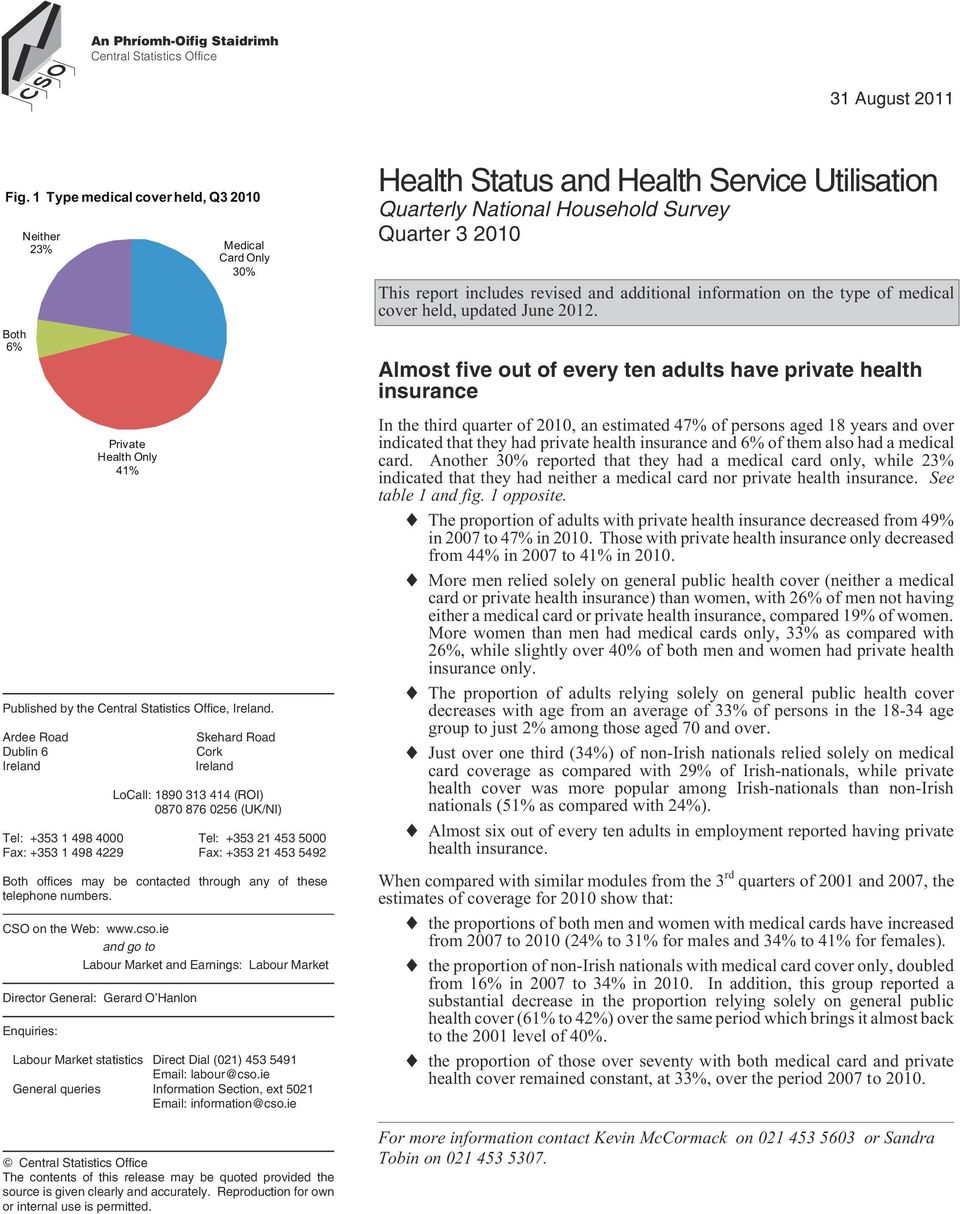
2 % Fig.2 Type of medical cover held, Q3 of 2001, 2007 and Q Q Q Medical Card Holders Private health insurance Neither % Fig.3 Self perceived health status by age group, Q Age Group Very Good Good Fair Bad/Very Bad Almost nine out of every ten adults perceive themselves to be in good or very good health Eighty seven percent of all adults perceived their own health as good or better in 2010, (45% as very good and 42% as good). A further 11% indicated that their health status was fair, with only 2% stating that their own health was bad or very bad. See table 2 and fig. 3 opposite. Overall there were no significant differences between male and female self-perceptions of their own health status. In the 3 rd quarter of 2010: The number of persons reporting that they were in good or very good health decreased with age. Those aged 70+ years, at 67%, were the only group where less than 78% of the adults reported that they were in good health or better, while among the younger age groups, years, over 90% indicated that they were in good health or better. Over 84% of adults in each Region perceived their own health as being very good or good in 2010, with Dublin reporting the highest percentage, at 89%. A higher percentage of non-irish nationals (93%) reported their own health as being very good or good compared with 87% of Irish nationals. Over half of the adults surveyed who reported having a disability perceived their own health as fair or bad/very bad. See table 2. The estimates for 2010 are broadly in line with those of See table 2. In the age groups and 65+, more men than women reported their health status as very good or good. Six percent of females aged 70+ reported their health status as bad or very bad, compared with 4% of men. See Table 1.1 below. Table 1.1 Self perceived health status by sex and age group, Q Perception of own health 1 % of persons Very Bad/ good Good Fair Very Bad 2 Male [0] [0] [2] Female [1] [3] All Persons [1] Small percentage of not stated responses not shown in table. 2 Figures in parentheses [ ] indicate percentages based on small numbers, and are, therefore, subject to a wide margin of error. 2
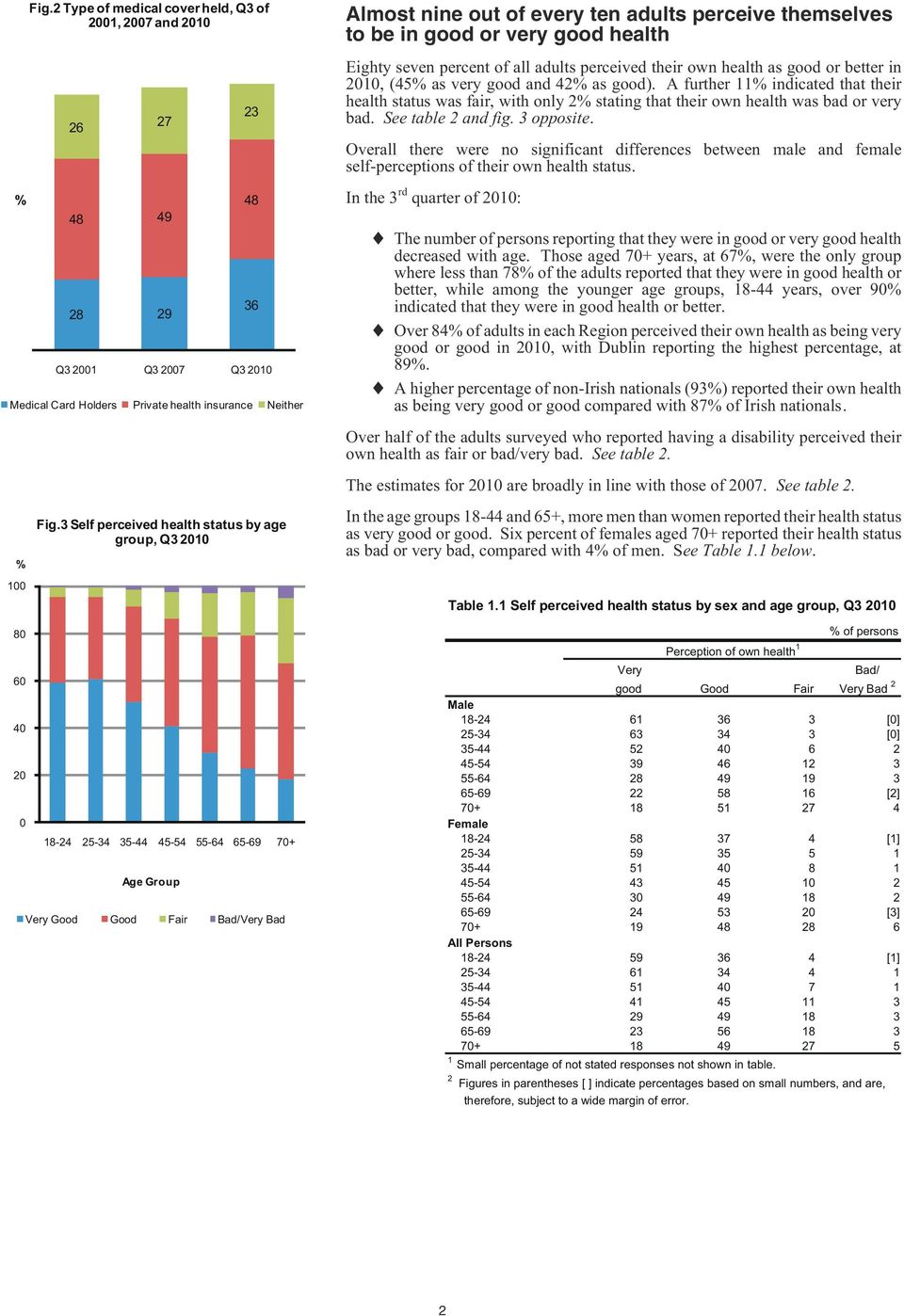
3 Hypertension, chronic back pain and high cholesterol most common health conditions Over forty percent of adults (42%) indicated that they have at some point been diagnosed by a doctor as having a health condition. A higher proportion of women (44%) reported at least one health condition when compared with men (40%). See table 3. Hypertension (11%) was the most prevalent condition reported by adults followed by chronic back conditions (10%) and high cholesterol (10%). See table 3. For young adults (those aged years), asthma (10%) was the most prevalent condition followed by chronic back pain (4%) and anxiety/depression (2%). See table 3. The prevalence of arthritis (osteo and rheumatoid) was higher in women (9%) than in men (5%) and also increases with age in both sexes. See table 3. For the majority of conditions a higher prevalence was found among older people than among younger age groups. The difference was far greater for some conditions with, for example, 35% of persons aged 70 and over reporting a diagnosis of hypertension compared with fewer than 5% of persons in each of the three youngest age groups. See table 3. A higher percentage of separated or divorced adults reported being diagnosed with hypertension than married adults (15% as compared with 12%). See table 3. Fig.4 Average number of GP consultations by age group in the 12 months prior to Q Number of Consultations Seven out of ten adults had at least one GP consultation in the previous year In 2010 almost nine out of ten persons aged 18 years and over (88%) consulted with the health service in relation to their own health at least once in the previous twelve months. The most frequent form of consultation was interaction with a General Practitioner (GP). Almost three quarters of persons consulted with a GP (74%), compared with 39% of persons reporting a consultation with a pharmacist, 27% of persons consulted with an optician, while 43% of persons consulted with a dentist and just over one in twenty (6%) consulted with a Community/Public Health nurse. See table 4a. On reviewing the number of GP consultations it is seen that 37% of adults consulted with a GP once or twice in the previous twelve months, while 7% had eleven or more consultations. The average number of GP consultations across the adult population was 3.2 visits per year. See table 4b Age Group Males Females Total The average number of GP consultation increased with age, with 2.4 consultations for year olds rising to 5.4 consultations for those aged 70 and over. For those with a disability the average number of GP consultations was 7.7 compared with 2.6 for those without a disability. Men were less likely to have consulted with a GP than women, with 34% of men having no GP consultation in the previous twelve months compared with 19% for women. The average number of consultations by men was 2.5, while the comparable number for women was 3.8. Irish nationals averaged 3.3 visits to GPs as compared with 2.2 visits for non-irish nationals. In all age groups a higher proportion of women consulted with a GP than men, and this was particularly evident among younger age groups. For example, 54% of year old men reported that they had consulted with a GP in the previous twelve months and they averaged 1.3 consultations in this period compared with 77% of women who averaged 3.4 consultations. See Table 1.2 overleaf. 3
4 Table 1.2 GP consultations by sex and age group, Q Male Female All Persons GP Consultations % - At least Average No. % - At least Average No. % - At least Average No. one consult consults 1 one consult consults 1 one consult consults 1 State Average is calculated across all persons including those with no GP consultations. Fig. 5 Average GP consultations by type of medical cover in the 12 months prior to Q Neither Private cover The type of medical cover is a significant factor on the average number of GP visits. Almost 9 out of every 10 adults with a medical card (86%) visited a GP at least once in the previous twelve months, compared with just over 7 out of every 10 adults with private health cover (73%) and just less than 6 out of every 10 adults with only general public health cover (57%). See Table 1.3 below. With an average of 5.2 consultations, medical card holders had almost two and a half times as many consultations as those with private health cover (2.2) and over two and a half times as many as those with only general public health cover (1.9). See table 4b. The average number of GP consultations increased with age with adults relying solely on general public health cover reporting half the number of consultations as those with a medical card up to the age of 70+. See table 1.3 below. Medical card Table 1.3 GP consultations by type of medical cover and age group, Q Average number of consultations per year Type of medical cover Medical card Private cover Neither GP Consultations GP Consultations GP Consultations % of adults with at least 1 Average No. %ofadults with at least 1 Average No. % of adults with at least 1 Average No. consult consults 1 consult consults 1 consult 2 consults 1,2 State [76] [4.3] 1 Average is calculated across all persons including those with no GP consultations. 2 Figures in parentheses [ ] indicate percentages based on small numbers, and are, therefore, subject to a wide margin of error. 4

5 Fig.6 Hospital Attendance by type of service in the 12 months prior to Q and 2010 % % A&E Outpatient Day Patient In Patient Fig.7 Percentage of inpatient stays by public/private hopsital by type of medical cover in the 12 months prior to Q Higher proportion of women report hospital attendance than men In the third quarter of 2010, 31% of persons aged 18 years and over reported attending a hospital in the 12 months prior to interview. Females (35%) reported a higher percentage of attendance than males (27%). See table 5a. Attendance at an accident and emergency (A&E) department was reported by 10% of adults, while twice as many respondents attended out-patient clinics (20%). See table 5a. Day-patient admissions were reported by 9% of respondents while 10% reported in-patient stays in the year to Q See table 5a and fig. 6 opposite. For all main hospital based services usage was highest for those aged 70 and over with the exception of A&E where the largest percentage was in the year age group (average of 13%). There was no statistically significant difference between the level of attendance at A&E departments of men and women. However women reported higher levels of out-patient attendance than men (22% compared with 17%), in-patient admission (13% compared with 7%) and day-patient attendance (10% compared with 8%). Across the four hospital based services those with a medical card reported the highest level of attendance. For example, 40% of medical card holders reported at least one hospital attendance, compared with 31% of private health insurance holders and 21% of those relying only on general public health cover. Over eight in every ten patient stays (82%) were in public hospitals. Men were more likely to have an in-patient stay in a private hospital (23%) than women (16%) and women stayed an average of 10.0 nights (excluding childbirth) as compared with 8.9 for men. See table 5b. For persons relying solely on general public health cover the proportion of their in-patient stays which were in a public hospital was 97%, compared with 90% for those with medical cards, and 62% for adults with private health cover. See table 5b and fig. 7 opposite. Persons with medical card cover spent on average almost 5 nights more (excluding childbirth) as an in-patient, (12.0) compared with those with private health insurance (7.4). See table 5b. The average maternity stay was 3.6 nights in hospital. See table 5b Medical card holders Private health insurance Neither Public Hospital Private Hospital 5

6 % less than 1 Fig. 8 Length of time on outpatient waiting list, Q3 2001, 2007 and to<3 3to<6 6to<9 9to<12 12or more Months waiting Hospital waiting lists increase In the third quarter of 2010, the proportion of the population aged 18 years and over on a hospital waiting list was 8%. The comparable figure for 2007 was 6%. Waiting list times given are from the time of referral to the time of interview. See table 5b. In 2010, 5% of adults were on an out-patient waiting list, while 1% were on an in-patient waiting list and a further 2% were on a day-patient waiting list. In 2007 the comparable percentages of persons on waiting lists were 3%, 1% and 1% respectively. See table 6a. In 2010, as was the case in 2007 and 2001, as age increased the percentage on out-patient waiting lists rose, with 9% of those aged 70 and over on an outpatient waiting list compared with 4% of year olds. When directly compared with 2007, all age groups showed an increase in the percentage on out-patient waiting lists. Persons who reported having a disability were more likely to be on a hospital waiting list with 14% on an out-patient waiting list, 5% on an in-patient waiting list and 3% on a day-care procedure waiting list. As in 2001 and 2007, respondents who reported being on a waiting list were asked their length of time on the waiting list as of the time of interview. See table 6b and fig. 8 opposite. In 2010 just under half (49%) of all persons on an out-patient waiting list were waiting less than 3 months. This was a decrease of 2% when compared with 2007 (50%). A further 13% of respondents reported that they had been on an out-patient waiting list for at least 12 months at the time of interview, this was an increase of 1 percentage point from 2007 (12%). Nearly 60% of persons on a day-care procedure waiting list were waiting less than 3 months at the time of interview, with 9% waiting 12 months or more. On average, those on an in-patient waiting list reported the longest length of wait at time of interview, with 40% reporting a wait of less than 3 months, down from 43% in 2007 but 21% reporting waiting times of 12 months or more, an increase from the 19% reported in Men and women reported similar lengths of waiting on all waiting lists. 6

7 Eight out of ten adults reported being happy all or most of the time Six statements were presented to respondents, four covering positive feelings and two dealing with negative feelings. During the four weeks preceding the interview: 61% of adults over the age of 18 years felt full of life all or most of the time and 54% had lots of energy, while 79% had been happy and 62% have felt calm and peaceful. However, 4% of adults indicated that they did not feel energetic at all. 13% of adults indicated that they had been tired all of the time or most of the time, out of which 3% had been feeling like this all the time. 38% of adults had felt calm and peaceful only sometimes or less often. Fig. 9 Perceptions of well-being in the four week period prior to Q Did you feel tired Did you feel worn out Did youhavealotofenergy Have you felt full of life Have you felt calm and peaceful Have you been happy 0% 10% 20% 30% 40% 50% 60% 70% 80% 90% 100% All of the time Most of the time Some of the time A little of the time Noneofthetime The data for males and females shows that when it comes to positive feelings realted to mental health, equal proportions of men and women (80%) felt happy, however 67% of males reported feeling calm or peaceful all or most of the time as compared with 59% of women. See table 7 and fig. 10 overleaf. When it comes to energy/vitality, 16% of women reported feeling worn out or tired all or most of the time compared with 10% of men while 65% of men reported having felt full of life compared with 59% of women. See table 7 and fig. 10 overleaf. 7

8 Fig. 10 Perceptions of well-being in the four week period prior to Q3 2010, classified by sex 100% 90% 80% 70% 60% 50% 40% 30% 20% 10% 0% M F M F M F M F M F M F Have you Have you felt been happy calmand peaceful Have you felt full of life Did you have a lot of energy Did you feel worn out Did you feel tired All of the time Most of the time Some of the time A little of the time Noneofthetime Adults in the age-groups felt less calm and peaceful all or most of the time than younger or older adults with 57% of year olds feeling calm and peaceful compared with 71% of year olds and 65% or more of those aged 65 years and older. The number of adults reporting being full of life or having a lot of energy decreased with age. Persons who reported having a disability were less likely to have felt happy, calm and peaceful, full of life or had a lot of energy and were more likely to have felt worn out and tired, all or most of the time. 8

9

10 Table 1 Percentage of persons aged 18 years and over classified by type of medical cover held, region, sex, age group, nationality and ILO economic status, quarter 3 of 2001, 2007 and % of adults Type of medical cover Medical Card Private Health Both Neither 2 Only Insurance Only State Region Border Midland West Dublin Mid-East Mid-West South-East South-West Male Female Nationality Irish nationals Non-Irish nationals ILO Economic Status In employment Unemployed Not economically active See Background Notes. 2 Contains a small number of 'not stated' responses. 3 Between July 2001 and December 2008, everyone over aged 70 was entitled to a medical card without a means test. A means test was introduced, with effect from January

11 Table 2 Percentage of persons aged 18 years and over classified by their perception of own health status, region, sex, age group, nationality, marital status, ILO economic status, type of medical cover and disability status, quarter 3 of 2007 and % of adults Perception of own health Bad/ Bad/ Very good Good Fair Very bad 3 Very good Good Fair Very bad 3 State Region Border Midland West Dublin Mid-East Mid-West South-East South-West Male Female [0] [1] Nationality Irish nationals Non-Irish nationals [1] Marital status Single Married Separated or divorced Widowed ILO Economic Status In employment Unemployed [1] [1] Not economically active Medical cover 1 Medical card holders Private health insurance Private health insurance only Neither Disability status Yes No See Background Notes. 2 Excludes a small percentage of 'not stated'. 3 Figures in parentheses [ ] indicate percentages based on small numbers, and are, therefore, subject to a wide margin of error. 11

12 Table 3 Percentage of persons aged 18 years and over classified by doctor diagnosed health conditions, region, sex, age group, nationality, ILO economic status and marital status, quarter ,2 %ofadults Doctor diagnosed health condition Angina Anxiety/ Asthma Arthritis Arthritis Chronic Chronic Cancer Diabetes Epilepsy depression (osteo) (rheumatoid) back conditions bronchitis State Region Border [0] Midland [1] West [1] Dublin Mid-East [0] Mid-West [0] South-East [1] South-West [0] Male Female [0] 2 10 [0] [0] 4 [0] [0] [0] [0] [0] 4 7 [0] [0] [0] [0] [0] [1] Nationality Irish nationals Non-Irish nationals [0] ILO Economic Status In employment Unemployed [1] [1] 1 [0] Not economically active Marital status Single Married Separated or divorced [1] Widowed [1] 1 See Background Notes. 2 Figures in parentheses [ ] indicate percentages based on small numbers, and are, therefore, subject to a wide margin of error. 12
![3 4 10 2 2 3 0 Region Border 2 4 5 3 5 8 3 2 3 [0] Midland 3 5 10 4 7 13 2 3 5 [1] West 2 5 8 2 6 13 2 3 3 [1] Dublin 3 5 7 3 3 11 2 2 2 0 Mid-East 1 3 7 3 4 7 2 2 3 [0] Mid-West 2 3 7 2 4 8 1 1 3](/docs-images/43/1033683/images/page_12.jpg "[0] South-East 3 5 7 3 4 10 2 2 3 [1] South-West 2 4 6 3 3 9 2 2 3 [0] Male 3 3 7 2 3 9 2 2 3 0 Female 2 5 7 4 5 10 2 2 3 1 18-24 [0] 2 10 [0] [0] 4 [0] [0] [0] [0] 25-34 [0] 4 7 [0] 0 6 1 0 1 [0]")
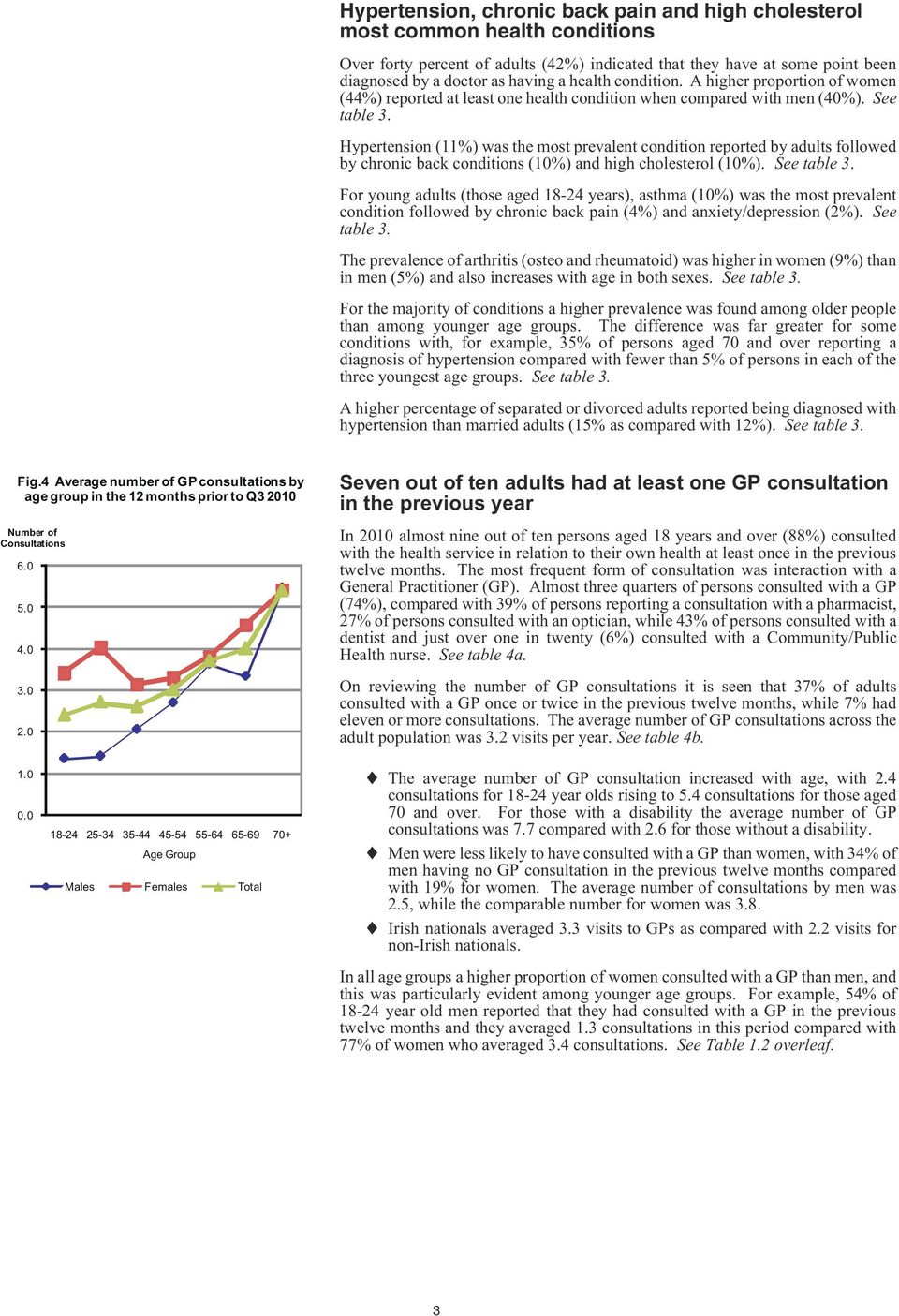
13 Table 3 (contd.) Percentage of persons aged 18 years and over classified by doctor diagnosed health conditions, region, sex, age group, nationality, ILO economic status and marital status, quarter ,2 % of adults Doctor diagnosed health condition Heart Heart Hyper- High Osteo- Permanent Stroke Urinary Other mental Other Any Attack Failure tension Cholesterol porosis accident/injury incontinence health problems condition condition 3 State Region Border 2 [1] [1] [1] [1] 9 41 Midland [1] [1] [1] [1] [1] West 1 [1] [1] [0] [1] 8 47 Dublin Mid-East [1] [0] Mid-West 1 [1] [1] [1] [0] 7 39 South-East [1] [1] South-West [1] [1] Male Female [0] [0] [0] [0] [0] 1 [0] [0] [0] [0] [0] 2 2 [0] 1 [0] [0] [0] [0] 4 4 [0] 2 [0] [0] [1] [2] [1] [0] [1] Nationality Irish nationals Non-Irish nationals [0] [0] 5 5 [0] 1 [0] [0] [1] 7 26 ILO Economic Status In employment [0] Unemployed [0] [0] 5 5 [0] 1 [0] [0] [0] 7 32 Not economically active Marital status Single Married Separated or divorced 3 [1] [1] [1] [1] Widowed [1] See Background Notes. 2 Figures in parentheses [ ] indicate percentages based on small numbers, and are, therefore, subject to a wide margin of error. Excludes a small number of non-responses. 13
14 Table 4a Percentage of persons aged 18 years and over classified by type of health consultation in the 12 months prior to interview, region, sex, age group, nationality, ILO economic status, medical cover and disability status, quarter % of adults Number of consultations Any General Practitioner Community Other health consultation (GP) Pharmacist Nurse Optician Dental health consultation 1 None 1 or more None 1 or more None 1 or more None 1 or more None 1 or more None 1 or more None 1 or more State Region Border Midland West Dublin Mid-East Mid-West South-East South-West Male Female Nationality Irish nationals Non-Irish nationals ILO Economic Status In employment Unemployed Not economically active Medical cover 1 Medical card holders Private health insurance Private health insurance only Neither Disability status Yes No See Background Notes. 14

15 Table 4b Persons aged 18 years and over classified by the number of GP consultations in the 12 months prior to interview, region, sex, age group and disability status, quarter Number of GP consultations % of all adults Adults who reported a GP consultation % of consultations Average Average that were to number of GP number of GP out-of-hours None 1or2 3to5 6to consultations 2 consultations 3 GP services State Region Border Midland West Dublin Mid-East Mid-West South-East South-West Male Female Nationality Irish nationals Non-Irish nationals ILO Economic Status In employment Unemployed Not economically active Medical cover 1 Medical card holders Private health insurance Private health insurance only Neither Disability status Yes No See Background Notes. 2 Average is calculated across all persons including those who reported no GP consultations. 3 Average is calculated across all persons who reported GP consultations. 15
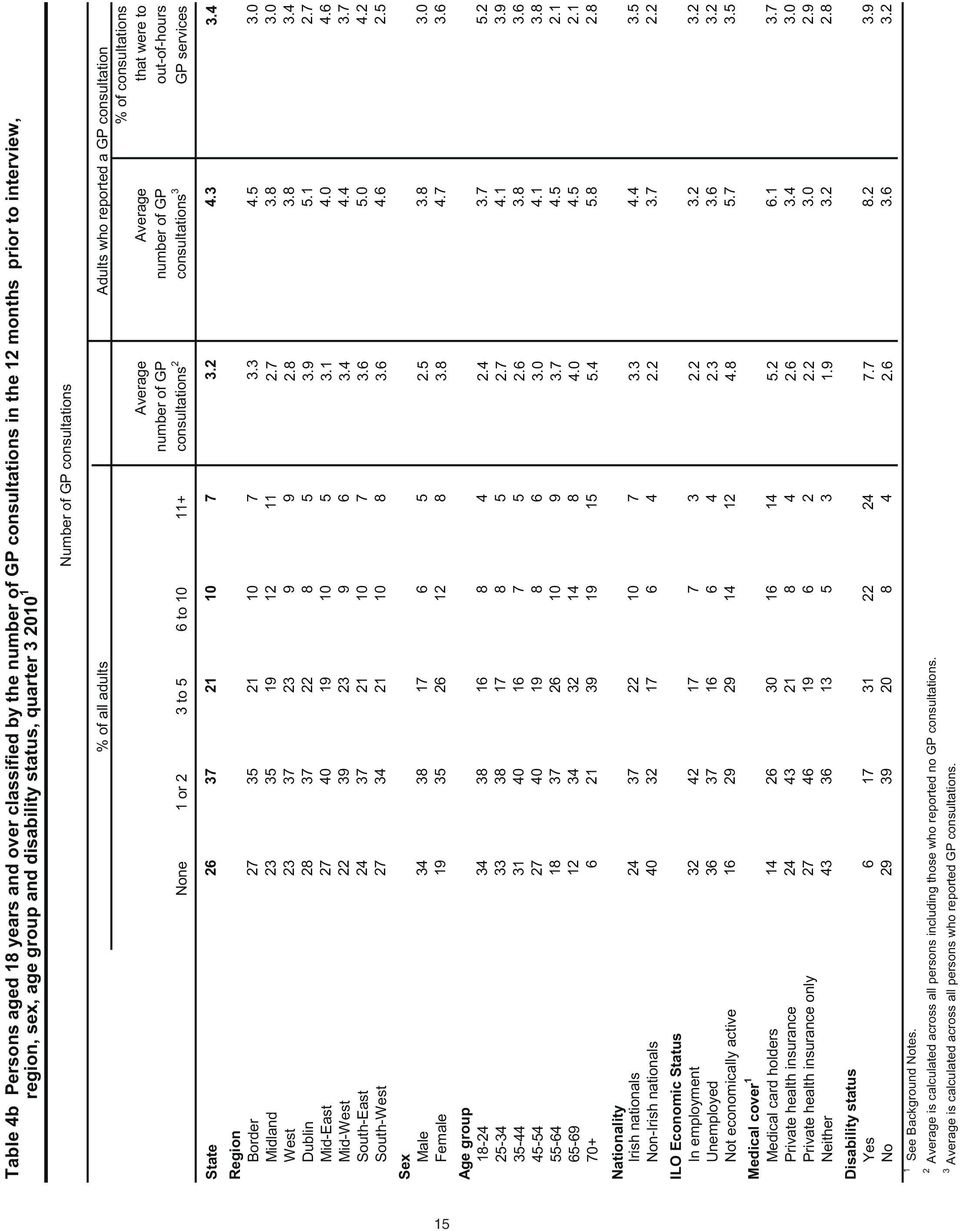
16 Table 5a Percentage of persons aged 18 years and over classified by main health services attended in the 12 months prior to interview, region, sex, age group, nationality, ILO economic status, type of medical cover and disability status, quarter ,2 % of adults Any health service admission 3 Accident and Out patient emergency attendance attendance Day-Patient admission admission Number of attendances None 1 or more None 1 or more None 1 or more None 1 or more None 1 or more In-Patient % attendance of which % attendance of which excludes childbirth(s) childbirth(s) State Region Border Midland West Dublin Mid-East Mid-West South-East South-West Male Female [1] Nationality Irish nationals Non-Irish nationals ILO Economic Status In employment Unemployed [16] Not economically active Medical cover Medical card holders Private health insurance Private health insurance only Neither Disability status Yes [1] No See Background Notes. Figures in parentheses [ ] indicate percentages based on small numbers, and are, therefore, subject to a wide margin of error. Any one of the four types of hospital attendance shown. 16
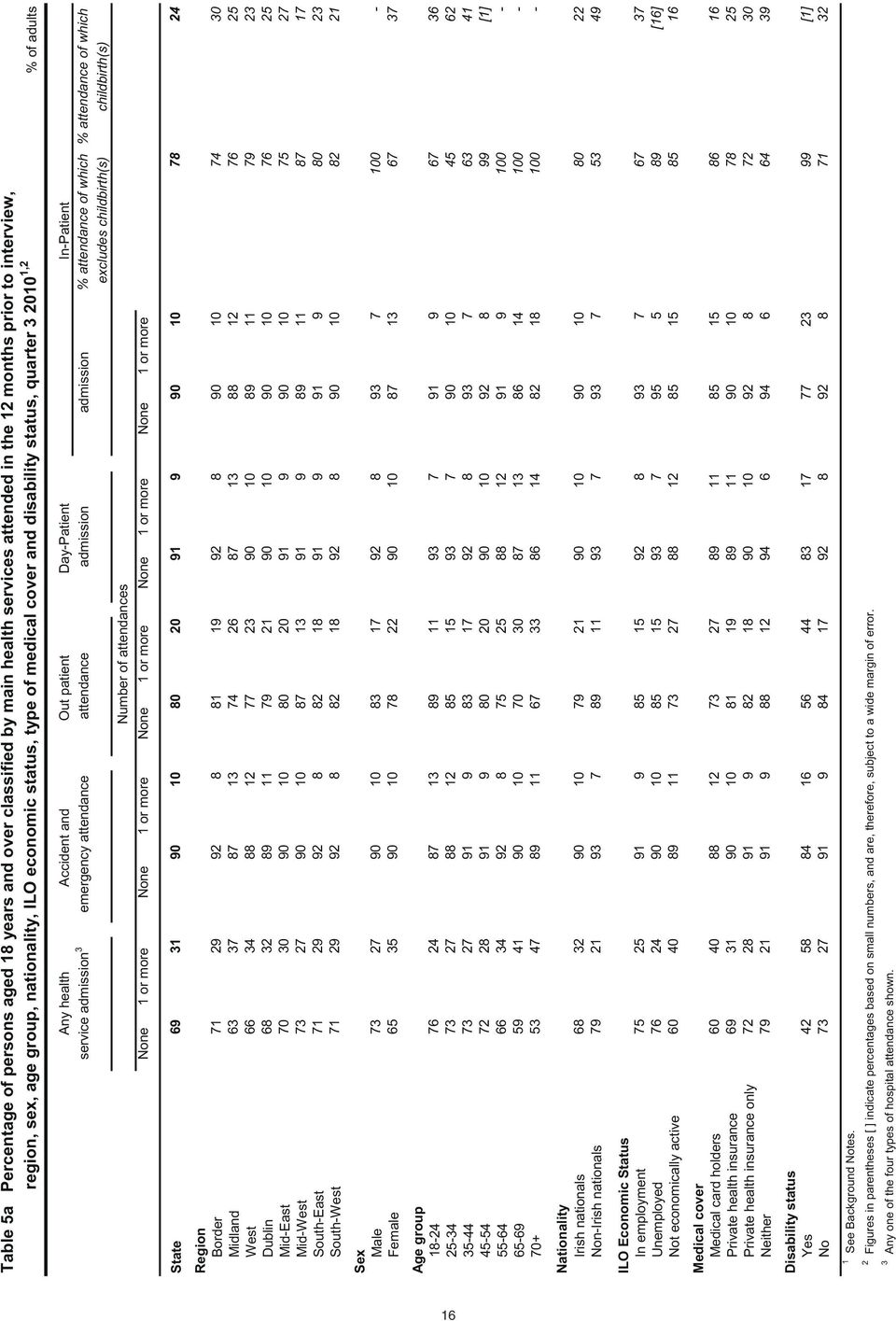
17 Table 5b Persons aged 18 years and over admitted as in-patients in the 12 months prior to interview classified by type of hospital, average number of nights, sex, age group, ILO economic status, type of medical cover and disability status, quarter ,2 Adults with one or more In- Patient %ofstaysby Public/Private Hospital Total Number of nights in hospital Excluding childbirth Childbirth Admissions Total Public Private Average Average Average % % % No. nights No. nights No. nights State Male Female [5] [6.0] ILO Economic Status In employment Unemployed 5 91 [9] [2.3] Not economically active Medical cover Medical card holders Private health insurance Private health insurance only Neither 6 97 [3] Disability status Yes [4.1] No See Background Notes. 2 Figures in parentheses [ ] indicate percentages based on small numbers, and are, therefore, subject to a wide margin of error. 17
![Admissions Total Public Private Average Average Average % % % No. nights No. nights No. nights State 10 82 18 8.3 9.5 3.6 Male 7 77 23 8.9 8.9 - Female 13 84 16 8.0 10.0 3.6 18-24 9 95 [5] 3.5 3.9 2.](/docs-images/43/1033683/images/page_17.jpg "4 25-34 10 87 13 5.4 7.2 3.6 35-44 7 83 17 7.7 9.5 4.3 45-54 8 75 25 7.9 7.9 [6.0] 55-64 9 78 22 8.4 8.4-65-69 14 70 30 10.0 10.0-70+ 18 81 19 14.5 14.5 - ILO Economic Status In employment 7 75 25 5.")
18 Table 6a Percentage of persons aged 18 years and over on hospital waiting lists at time of interview classified by type of hospital waiting list, region, sex, age group, nationality, type of medical cover and disability status, quarter 3 of 2001, 2007 and ,3 % of adults Type of hospital waiting list Outpatient waiting list Inpatient waiting list Day care procedure/ Any procedure/ investigation waiting list investigation waiting list State Region Border Midland West Dublin Mid-East Mid-West South-East South-West Male Female [1] [2] Nationality Irish nationals Non-Irish nationals [1] [1] 1 [1] Medical Cover 1 Medical card holders Private medical cover Private medical cover only Neither Disability status 4 Yes No See backgraound notes. Any one of the three types of waiting list shown Figures in parentheses [ ] indicate percentages based on small numbers, and are, therefore, subject to a wide margin of error. Variable was not included in Health module in
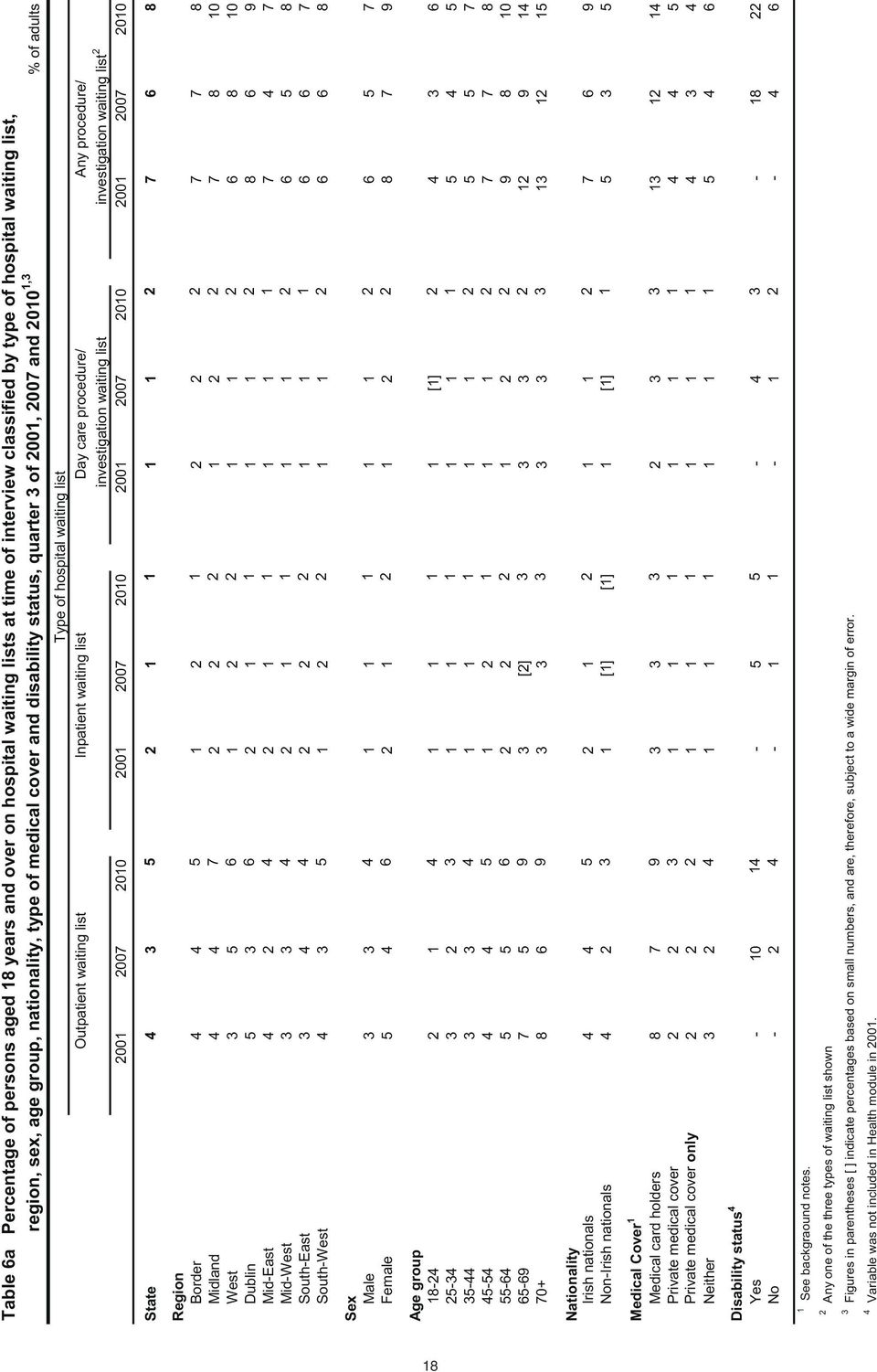
19 Table 6b Percentage of persons aged 18 years and over on hospital waiting lists at time of interview classified by length of time on hospital waiting list, type of waiting list and sex, quarter 3 of 2001, 2007 and ,2 % of adults on hospital waiting lists Length of wait Less than 1 month to less 3 months to less 6 months to less 9 months to less 12 months and Total persons Type of 1 month than 3 months than 6 months than 9 months than 12 months more on waiting list waiting list Outpatient Male [4] Female All Persons Inpatient Male 18 [10] [13] [9] 16 6 [5] [8] Female [7] [10] 5 [3] [8] All Persons Day care procedure Male [8] [7] 3 [5] [3] 8 [6] [8] Female [9] 15 3 [2] [4] All Persons [3] [4] Waitinglisttimesgivenarefromthetimeofreferraltothetimeofinterview. Figures in parentheses [ ] indicate percentages based on small numbers, and are, therefore, subject to a wide margin of error. 19
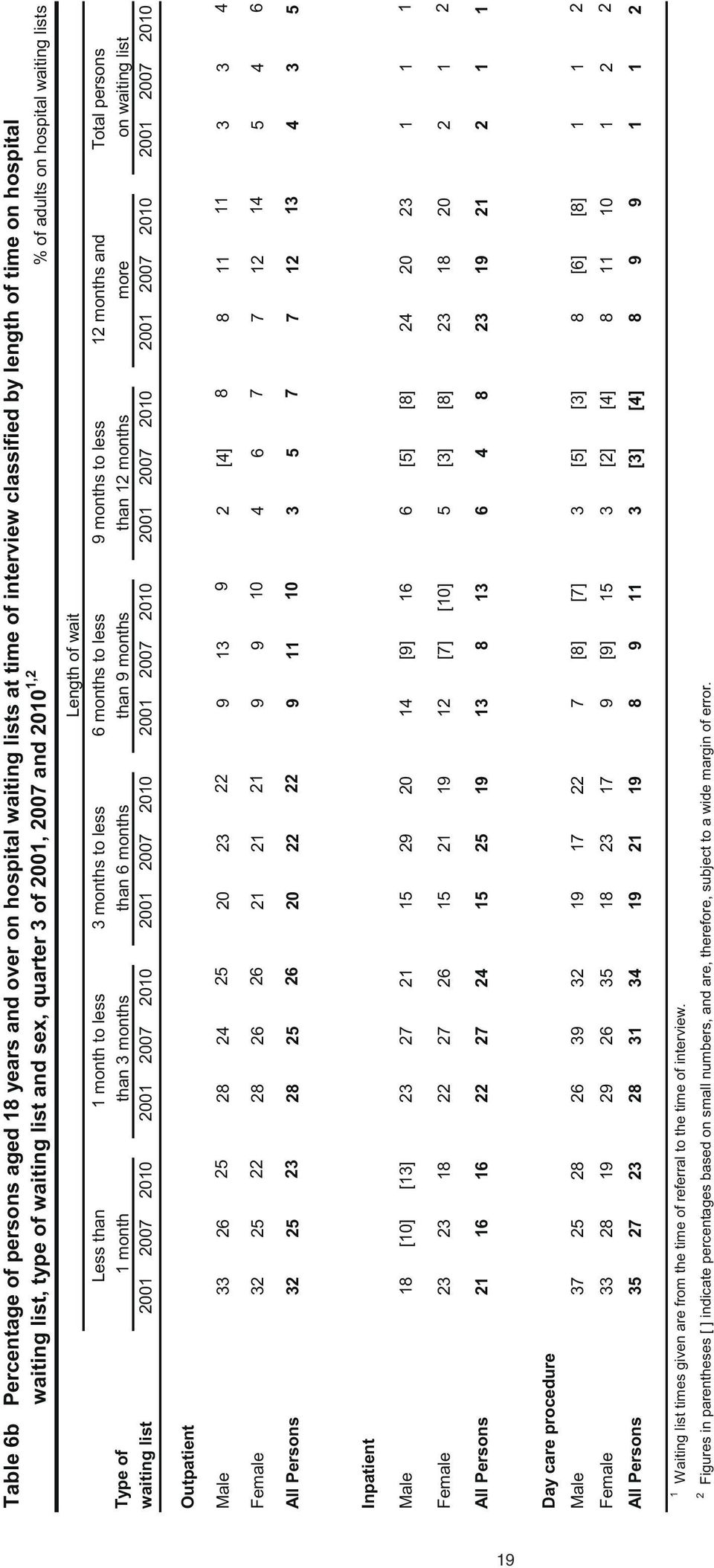
20 Table 7 Percentage of persons aged 18 years and over classified by their perception of own well-being status in the 4 weeks prior to interview, sex, age group and disability status, quarter ,3 % of adults All of Most of Some of A little of None of the time the time the time the time the time 2 Did you feel full of life State Male Female [1] Disability status Yes No Have you felt calm and peaceful State Male Female [2] Disability status Yes No Did you have a lot of energy State Male Female Disability status Yes No See Background Notes. 2 Figures in parentheses [ ] indicate percentages based on small numbers, and are, therefore, subject to a wide margin of error. 3 Excludes a small percentage of not stated. 20
![53 17 4 [1] 25-34 17 52 23 5 2 35-44 13 48 29 7 2 45-54 14 44 30 8 4 55-64 13 42 31 9 6 65-69 12 43 32 9 5 70+ 11 34 32 15 8 Disability status Yes 6 25 35 21 13 No 16 49 26 6 2 Have you felt calm and](/docs-images/43/1033683/images/page_20.jpg "peaceful State 14 48 29 7 2 Male 17 50 27 5 2 Female 12 47 30 8 3 18-24 21 50 23 5 1 25-34 13 50 28 7 2 35-44 10 47 32 9 2 45-54 12 46 31 8 3 55-64 15 47 28 7 3 65-69 14 55 24 5 [2] 70+ 17 48 27 6 1")
21 Table 7 (contd.) Percentage of persons aged 18 years and over classified by their perception of own well-being status in the 4 weeks prior to interview, sex, age group and disability status, quarter ,3 % of adults All of Most of Some of A little of None of the time the time the time the time the time 2 Have you been happy State Male Female [0] [1] Disability status Yes No Did you feel worn out State Male Female Disability status Yes No Did you feel tired State Male Female Disability status Yes No See Background Notes. 2 Figures in parentheses [ ] indicate percentages based on small numbers, and are, therefore, subject to a wide margin of error. 3 Excludes a small percentage of not stated. 21
22 Annex Table 1 Sample Size Health Module classified by region, sex, age group, nationality, ILO economic status, marital status, medical cover and disability status, Q3 2001, 2007 and 2010 Ungrossed number of persons State 44,844 21,253 15,673 Region Border 5,645 2,422 2,001 Midland 2,670 1, West 4,817 2,015 1,548 Dublin 13,403 4,277 3,092 Mid-East 4,519 1,992 1,555 Mid-West 3,126 2,124 1,657 South-East 4,494 2,740 2,014 South-West 6,170 4,095 2,912 Male 18,401 8,016 5,978 Female 26,443 13,237 9, ,848 1, ,789 3,332 2, ,792 4,374 3, ,538 4,035 2, ,172 3,538 2, ,748 1,417 1, ,957 3,300 2,197 Nationality Irish nationals 42,824 19,688 14,159 Non-Irish nationals 2,020 1,565 1,514 ILO Economic Status In employment 24,622 11,275 7,608 Unemployed 1, ,245 Not economically active 19,182 9,462 6,820 Marital status Single 12,752 5,936 4,722 Married 25,687 11,809 8,490 Separated or divorced 2,305 1,365 1,097 Widowed 4,100 2,143 1,364 Medical cover 1 Medical card holders 13,940 7,493 6,232 Private health insurance 21,697 10,776 7,729 Private health insurance only 20,615 9,227 6,433 Neither 10,294 4,541 3,008 Disability status 2 Yes - 3,782 2,097 No - 17,471 13, SeeBackgroundNotes. Variable was not included in Health module in
23 Central Statistics Office Quarterly National Household Survey Reference period Purpose of survey Questionnaire Grossing effect Disability Health Condition Health Consultations Health Status Background Notes The questions on health status and utilisation of the health service were included in the Quarterly National Household Survey (QNHS) in the three months from June to August This was an update of previous health modules asked during the same period in 2001and Sample sizes for all three surveys are contained in Annex Table 1 of this release. While the primary purpose of the QNHS is to collect information on employment and unemployment, it also includes modules on social topics of interest. The health module was asked of all persons aged 18 years and over across four waves of the QNHS sample who were participating directly in the survey. Percentages in this release have been calculated with respect to all such persons. The topics covered included consultations with GP or family doctor, other health appointments, waiting lists, private medical insurance, medical cards, perception of health and health conditions. The results in this release are based on the health questionnaire, a copy of which is available on the CSO website (additional web tables may be available at this address at a later date). The QNHS grossing procedure aligns the distribution of persons covered in the survey with independently determined population estimates at the level of sex, five-year age group and region. Given the health questions were asked to a sub-sample of the overall QNHS sample, the grossing factors applied in the derivation of the health module differ from those that were used in the preparation of the main QNHS estimates. Hence the overall populations do not necessarily match those presented in the main QNHS release. A disability or longstanding health problem refers to any of the following conditions (long lasting here relates to conditions affecting someone for at least 6 months or one which is likely to affect someone for at least 6 months): Blindness or a serious vision impairment Deafness or a serious hearing impairment A difficulty with basic physical activities such as walking, climbing stairs, reaching, lifting or carrying An intellectual disability A difficulty with learning, remembering or concentrating A psychological or emotional condition A difficulty with pain, breathing, or any other chronic illness or condition This module counted any health condition diagnosed by a doctor at any time in a respondent s past. A list of nineteen conditions was shown to respondents on a card during the interview. Health consultations were on a respondent s own behalf only during the twelve month period prior to interview. Other health consultations included physiotherapists, occupational therapists, dieticians etc. A full list can be found in the health questionnaire itself. A five-point rating scale was used to measure the self-perceived health status of respondents: How is your health in general? 1. Very Good 2. Good 3. Fair 4. Bad 5. Very Bad 23
24 Central Statistics Office ILO Labour Force Classification Medical Cover Well-being Waiting Lists Quarterly National Household Survey The primary classification used for the QNHS results is the ILO (International labour Office) labour force classification. Labour Force Survey data on this basis have been published since The ILO classification distinguishes the following main subgroups of the population aged 15 or over: In Employment: Persons who worked in the week before the survey for one hour or more for payment or profit, including work on the family farm or business and all persons who had a job but were not at work because of illness, holidays etc. in the week. Unemployed: Persons who, in the week before the survey, were without work and available for work within the next two weeks, and had taken specific steps, in the preceding four weeks, to find work. Inactive Population (not in labour force): All other persons. The labour force comprises persons employed plus unemployed. Medical cover is based on responses to the following two questions Are you covered by a medical card? Have you private medical insurance either in your own name or through another family member (such as VHI, Quinn Healthcare, Hibernian Aviva)? In Table 1 of this release those who indicated that they had both a medical card and private health insurance were placed in a separate category called Both. In the rest of the release the medical card holders category includes those with a medical card only, and a medical card plus private health cover. The same applies to the private health insurance category which includes private health cover only, and private health cover plus medical card holders. Those with private health insurance only is provided separately. The following six questions were asked to capture the self-perceived well-being of respondents in the four weeks prior to interview: 1. Did you feel full of life? 2. Have you felt calm and peaceful? 3. Did you have a lot of energy? 4. Did you feel worn out? 5. Have you been happy? 6. Did you feel tired? There was a five-point rating scheme used to capture response: 1. All of the time 2. Most of the time 3. Some of the time 4. A little of the time 5. None of the time Respondents were asked if they were currently on waiting lists for out-patient visits, day-care procedures or in-patient admissions and if so how long they had been waiting from the time of referral to the time of interview. This is exactly the same methodology as was used in the previous QNHS health modules in 2001 and
25 Central Statistics Office NUTS2 and NUTS3 regions Quarterly National Household Survey The regional classifications in this release are based on the NUTS (Nomenclature of Territorial Units) classification used by Eurostat. The NUTS3 regions correspond to the eight Regional Authorities established under the Local Government Act, 1991 (Regional Authorities) (Establishment) Order, 1993, which came into operation on 1 January The NUTS2 regions, which were proposed by Government and agreed by Eurostat in 1999, are groupings of the NUTS3 regions. The composition of the regions is set out below. Border, Midlands and Western NUTS2 Region Southern and Eastern NUTS2 Region Border Cavan Dublin Dublin Donegal Dun Laoghaire-Rathdown Leitrim Fingal Louth South Dublin Monaghan Sligo Mid-East Kildare Meath Midland Laois Longford Wicklow Offaly Mid-West Clare Westmeath Limerick City Limerick County West Galway City Galway County North Tipperary Mayo South-East Carlow Roscommon Kilkenny South Tipperary Waterford City Waterford County Wexford South-West Cork City Cork County Kerry 25
26 Central Statistics Office Quarterly National Household Survey QNHS Social Modules While the main purpose of the QNHS is the production of quarterly labour force estimates, there is also a provision for the collection of data on social topics through the inclusion of special survey modules. The selection of the major national modules undertaken to date has been largely based on the results of a canvas of users (over 100 organisations) that was conducted by the CSO in 1996, 2002, 2006, 2008 and most recently The results of the canvas are presented to the National Statistics Board and they are asked to indicate their priorities for the years ahead. The schedule for social modules in any given year is based on the following structure: Quarter 1 Annual modules update (Disability, Pensions, Childcare, Accidents and Illness), Information, Communication and Technology (ICT) Survey. Quarter 2 EU module (always covered under EU legislation) Quarter 3 National module. Quarter 4 National module. The table below outlines some of the social modules published to date in the QNHS. Reference Social Quarter Module Q Equality Q Cross Border Shopping Q Educational Attainment Q Crime and Victimisation Q Pensions Q Caring Q Union Membership Q Cross Border Shopping Q Lifelong learning Q Working conditions Q Pension provision Q Childcare Q Health Q Union Membership Q Work related Accidents and Illness (Q Q1 2007) Q ICT household survey Q Crime and Victimisation Q Sport and physical exercise Q ICT household survey Q Pension provision Q Special Saving Incentive Accounts (SSIAs) Q ICT household survey Q Recycling and energy conservation Q Reconciliation between work and family life Q Childcare Q Equality Q ICT household survey Q Union Membership Q Work organisation and working time Q Crime and Victimisation Q Housing Q ICT household survey Q Life long learning 26
27 Central Statistics Office Social modules yet to be published: Reference Quarter Q Q Q Social Module ICT household survey Voter Participation Response of households to economic downturn Quarterly National Household Survey Further information The following information on Labour Market statistics is available on the CSO website A full set of revised time series tables, further data in relation to all QNHS social modules, methodology details and questionnaires. Special analyses can also be requested by ing [email protected] 27
Taxation of Illness and Occupational Injury Benefits
 IT 22 Taxation of Illness and Occupational Injury Benefits ver 13.03 RPC003028_EN_WB_L_1 Introduction Illness Benefit (formerly known as Disability Benefit) and Occupational Injury Benefit paid by the
Treated problem substance use in the Traveller Community. Anne Marie Carew, Jean Long, Suzi Lyons, Delphine Bellerose
 Treated problem substance use in the Traveller Community Anne Marie Carew, Jean Long, Suzi Lyons, Delphine Bellerose Introduction Overview of NDTRS Profile cases from the Traveller Community seeking treatment
Employed Person Taking Care of an Incapacitated Individual
 IT 47 Employed Person Taking Care of an Incapacitated Individual ver 11.09 RPC001537_EN_WB_L_2 Who can claim? You, your spouse or civil partner may claim tax relief in respect of the cost of employing
Childminding Ireland. Employing a Nanny. A Tax Guide for Parents
 Childminding Ireland Employing a Nanny A Tax Guide for Parents 2012 Domestic Employments: An individual who makes payments to an employee in a domestic employment need not register as an employer where:
Tax Credits and Reliefs for Over 65 s
 Tax Credits and Reliefs for Over 65 s INTRODUCTION This is a guide to the tax credits and reliefs available to people aged 65 or over. After you have read this guide, you may require some of the more detailed
IT 27. Tax Relief for Service Charges. ver 15.09 RPC006035_EN_WB_L_2
 IT 27 Tax Relief for Service Charges ver 15.09 RPC006035_EN_WB_L_2 myaccount is a single access point for all Revenue s secure services (except ROS) and is the quickest and easiest way to manage your tax
Our vision: A national culture where all commit to safe and healthy workplaces and the safe and sustainable management of chemicals
 10 Summary of Workplace Injury, Illness and Fatality Statistics 2009-2010 Our vision: A national culture where all commit to safe and healthy workplaces and the safe and sustainable management of chemicals
Microfinance Ireland Microenterprise Loan Fund Scheme for the period to 30 th June 2013
 Microfinance Ireland Microenterprise Loan Fund Scheme for the period to 30 th June 2013 This financing benefits from a guarantee issued under the European Progress Microfinance Facility established by
Lump Sum Payments (Redundancy or Retirement)
 IT 21 Lump Sum Payments (Redundancy or Retirement) Ver. 14.07 RPC005008_EN_WB_L_1 Introduction In general, all payments made by employers to employees and directors are regarded as Pay for tax purposes
Capita Asset Services (Ireland) Limited acting as Operator of the SME Credit Guarantee Scheme
 1 st Quarter Report of 2015 to the Minister for Jobs, Enterprise and Innovation detailing the analysis and performance of the SME Credit Guarantee Scheme at 31 st March 2015 Capita Asset Services (Ireland)
Adoption in Ireland today
 Adoption in Ireland today for birth parents considering adoption 1 This is the second booklet in a series of three for birth parents considering adoption 2 This booklet focuses on infant adoption. For
T he Participation Support Team for Comhairle na nóg
 The Networking Events 2014 T he Participation Support Team for Comhairle na nóg organised and ran four Young People s Networking Events around the country in April 2014. One was held in Limerick, one in
Home Care Package Scheme. Information Booklet
 Home Care Package Scheme Health Tips for Older People Keep active Regular physical activity reduces your risk of chronic diseases, such as coronary heart disease, type 2 diabetes, stroke, cancer, osteoporosis
Pre-Budget 2016 Submission
 ACTIVE RETIREMENT NETWORK IRELAND MISSION STATEMENT ARNI will reach out to all older people to end loneliness through friendship and support Pre-Budget 2016 Submission June 2015 1. Introduction 1.1 About
IT72 Tax treatment of shares acquired by employees and directors under Unapproved Share Option Schemes
 IT72 Tax treatment of shares acquired by employees and directors under Unapproved Share Option Schemes RPC004963_EN_WB_L_1 1. Introduction 1.1 Overview This Explanatory Leaflet is aimed at the individual
Guide to your payments
 Guide to your payments Contents 03 Understanding your payments 04 I have an approved retirement fund 10 I have an annuity 14 A guide to your Tax Credits and Universal Social Charge Certificate 18 Revenue
Treated problem alcohol use in Ireland. 2012 figures from the National Drug Treatment Reporting System
 Treated problem alcohol use in Ireland 2012 figures from the National Drug Treatment Reporting System National Health Information Systems, Health Research Board, April 2014 Summary This update presents
Guide to taxation of Married Couples and Civil Partners
 RPC007325_EN_WB_L_2 IT 2 Guide to taxation of Married Couples and Civil Partners ver 16.04 myaccount is a single access point for all Revenue s secure services (except ROS) and is the quickest and easiest
Summary of Workplace Injury, Illness and Fatality Statistics 2010-2011
 11 Summary of Workplace Injury, Illness and Fatality Statistics 2010-2011 Our vision: A national culture where all commit to safe and healthy workplaces and the safe and sustainable management of chemicals
Presentation on the MOMENTUM Programme
 Presentation on the MOMENTUM Programme MOMENTUM Projects are supported by both the Irish Government and the European Social Fund Ciarán Conlon, Director FÁS National Programmes & Standards Investing in
DETERMINE YOUR OWN CLAIMS EXPERIENCE MICHAEL A WHELEHAN HEAD OF CLAIMS IPB INSURANCE
 DETERMINE YOUR OWN CLAIMS EXPERIENCE MICHAEL A WHELEHAN HEAD OF CLAIMS IPB INSURANCE Agenda 1. Footpath/slips and trips 2. Road Liability claims 3. Claims cost escalation 4. A changing propensity to claim?
POPULATION AGEING IN IRELAND. Projections 2002-2021
 POPULATION AGEING IN IRELAND Projections 2002-2021 Peter Connell (Information System Services, Trinity College Dublin) Dr. Dennis Pringle (Department of Geography and National Institute of Regional and
Self-harm in Ireland: Trends, risk factors and implications for intervention and prevention
 Self-harm in Ireland: Trends, risk factors and implications for intervention and prevention Prof. Ella Arensman National Suicide Research Foundation Department of Epidemiology and Public Health, UCC Systematic
Home Renovation Incentive scheme (HRI) Guide for Homeowners. Relevant to qualifying works carried out and paid for before April 2014
 Home Renovation Incentive scheme (HRI) Guide for Homeowners Relevant to qualifying works carried out and paid for before April 2014 December 2013 Contents 1. What is the Home Renovation Incentive (HRI)
THE CORRELATION BETWEEN PHYSICAL HEALTH AND MENTAL HEALTH
 HENK SWINKELS (STATISTICS NETHERLANDS) BRUCE JONAS (US NATIONAL CENTER FOR HEALTH STATISTICS) JAAP VAN DEN BERG (STATISTICS NETHERLANDS) THE CORRELATION BETWEEN PHYSICAL HEALTH AND MENTAL HEALTH IN THE
RE: ALTERING THE STRUCTURE OF HOUSEHOLD WASTE COLLECTION MARKETS A DISCUSSION DOCUMENT JUNE 2011
 2 nd September 2011 Mr. Eoin Corrigan Department of Environment, Community and Local Government Custom House Dublin 1 Dear Mr. Corrigan RE: ALTERING THE STRUCTURE OF HOUSEHOLD WASTE COLLECTION MARKETS
Plan P Rules. 1) Definitions. Terms and Conditions of Membership
 Plan P Rules Terms and Conditions of Membership Applicable to new registrations or renewals on/or after 1st January 2010. Please read and retain for future reference. Subsequent rules changes will be communicated
HRB Trends Series. Trends in treated problem alcohol use in Ireland, 2004 to 2006. Summary. Contents
 HRB Trends Series 1 Trends in treated problem alcohol use in Ireland, 2004 to 2006 Sarah Fanagan, Siobhán Reynolds, Deirdre Mongan and Jean Long Summary National Drug Treatment Reporting System Contents
Code of Practice for Determining Employment or Self-Employment Status of Individuals.
 Code of Practice for Determining Employment or Self-Employment Status of Individuals. Code of Practice in determining Employment status This leaflet was prepared by the Employment Status Group set up under
THE TREND OF MODERATE HOUSE PRICE GROWTH CONTINUES IN Q3
 Q3 2015 Results Property report myhome.ie report in partnership with THE TREND OF MODERATE HOUSE PRICE GROWTH CONTINUES IN Q3 PRIVATE CLIENTS DAVY MADE A DIFFERENCE THAT MATTERS TO ME. You don t accumulate
NATIONAL WASTE COLLECTION PERMIT OFFICE
 OFFALY COUNTY COUNCIL AS THE NATIONAL WASTE COLLECTION PERMIT OFFICE NEW Waste Collection Permit Application Form & Waste Collection Permit REVIEW Application Form Applicant Name: Telephone Number: Postal
Cyclist Injuries A Review of 2012 Casualties. Research Department, 6th August 2014. Údarás Um Shábháilteacht Ar Bhóithre Road Safety Authority
 Cyclist Injuries A Review of 2012 Casualties Research Department, 6th August 2014 Údarás Um Shábháilteacht Ar Bhóithre Road Safety Authority A review of cyclist casualties in 2012 This report has been
Inspectorate of Mental Health Services. National Overview of Psychologists Working in Mental Health Services Ireland 2012
 Inspectorate of Mental Health Services National Overview of Psychologists Working in Mental Health Services Ireland 2012 As part of the inspection of mental health services in 2012, the Inspector of Mental
PATTERNS AND DETERMINANTS OF HEALTH CARE UTILISATION IN IRELAND
 PATTERNS AND DETERMINANTS OF HEALTH CARE UTILISATION IN IRELAND 213 PATTERNS AND DETERMINANTS OF HEALTH CARE UTILISATION IN IRELAND Aoife McNamara 1, Charles Normand 2, Brendan Whelan 3 1. Health Research
Respite Services for Children with Life-Limiting Conditions and their Families in Ireland. Ó A National Needs Assessment
 Respite Services for Children with Life-Limiting Conditions and their Families in Ireland Ó A National Needs Assessment Published 2013 Ó Contents Foreword Executive Summary Section 1: Introduction to respite
Household Finance and Consumption Survey
 An Phríomh-Oifig Staidrimh Central Statistics Office Household Finance and Consumption Survey 2013 Published by the Stationery Office, Dublin, Ireland. Available from: Central Statistics Office, Information
TO BOARDS OF MANAGEMENT, PRINCIPAL TEACHERS AND TEACHING STAFF IN PRIMARY SCHOOLS
 Circular 0057/2013 TO BOARDS OF MANAGEMENT, PRINCIPAL TEACHERS AND TEACHING STAFF IN PRIMARY SCHOOLS Panel access for fixed-term/temporary (this includes substitute) and part-time teachers to the Supplementary
Cycle to Work Scheme
 Cycle to Work Scheme Frequently Asked Questions What is the purpose of the scheme?... 2 When did the scheme come into effect?... 2 What are the benefits of the scheme for employees/directors?... 2 What
Home Renovation Incentive Guide for Homeowners or Landlords
 Home Renovation Incentive Guide for Homeowners or Landlords This Guide updates the September 2015 version December 2015 myaccount is a single access point for all Revenue s secure services (except ROS)
Summary of Workplace Injury, Illness and Fatality Statistics 2011-2012
 12 Summary of Workplace Injury, Illness and Fatality Statistics 2011-2012 Our vision: A country where worker safety, health and welfare and the safe management of chemicals are central to successful enterprise
WASTE COLLECTION PERMIT APPLICATION FORM
 Version 3.1 WASTE COLLECTION PERMIT APPLICATION FORM Guidance Notes & Application Form For Both New & Review Waste Collection Permit Applications Applicant Name: Telephone Number: Postal Address: FORM
Applying in person for Probate
 Applying in person for Probate High Court What is Probate? When a person dies, it is sometimes necessary to apply to the Probate Office for Probate. This is a legal process which authorises someone to
AEGI. What does the AEGI offer? Will it cost anything? What is the Adult Educational Guidance Initiative (AEGI)? Who is it for? Definition of Guidance
 AEGI Adult Educational Guidance Initiative What is the Adult Educational Guidance Initiative (AEGI)? The AEGI is a Department of Education and Skills funded initiative which provides a quality educational
Special Report. September 2015
 Special Report September 2015 Serious Reportable Events Thursday 26 th November 2015 Contents Section Page 1. Summary 2 2: Introduction 3 3: Establishing the SRE Framework 4 4: Analysis of SREs reported
EUROPEAN AGRICULTURAL FUND FOR RURAL DEVELOPMENT (EAFRD) RURAL DEVELOPMENT PROGRAMME (RDP) 2014-2020 IRELAND LEADER
 EUROPEAN AGRICULTURAL FUND FOR RURAL DEVELOPMENT (EAFRD) RURAL DEVELOPMENT PROGRAMME (RDP) 2014-2020 IRELAND LEADER Acknowledgement with gratitude to Fáilte Ireland and Waterford Leader Partnership for
Summary of Workplace Injury, Illness and Fatality Statistics
 Summary of Workplace Injury, Illness and Fatality Statistics 2012-2013 Our vision: A country where worker safety, health and welfare and the safe management of chemicals are central to successful enterprise
National Daily Newspapers. National Weekly Newspapers. Regional Newspapers. Page 1 of 4
 National Daily Newspapers Irish Times Independent Star Examiner Publications The Evening Echo Fortune Green Irish Times Irish Independent Irish Daily Star Irish Examiner Evening Herald Evening Echo Metro
National Overview Meeting on Addiction Services. in Mental Health Services
 National Overview Meeting on Addiction Services in Mental Health Services Introduction In 2011 as in other years, the Inspectorate was interested in looking at a range of mental health services on a national
Task 7: Study of the Uninsured and Underinsured
 75 Washington Avenue, Suite 206 Portland, Maine04101 Phone: 207-767-6440 Email: [email protected] www.marketdecisions.com Task 7: Study of the Uninsured and Underinsured Vermont Office of Health
Comorbidity of mental disorders and physical conditions 2007
 Comorbidity of mental disorders and physical conditions 2007 Comorbidity of mental disorders and physical conditions, 2007 Australian Institute of Health and Welfare Canberra Cat. no. PHE 155 The Australian
Income Protection Plan for National University of Ireland, Galway (NUIG) employees Standard application form
 Income Protection Plan for National University of Ireland, Galway (NUIG) employees Standard application form Eligibility For use only by members under age 65 To be eligible to apply for membership of the
Private Health Insurance My Rights, My Choices
 Private Health Insurance My Rights, My Choices The Health Insurance Authority (HIA) is a statutory regulator of the private health insurance market in Ireland. The Health Insurance Authority What we do
APPLICATION PACK FOR CONTRACTORS APPLYING FOR A FIRST LICENCE
 APPLICATION PACK FOR CONTRACTORS APPLYING FOR A FIRST LICENCE (Contains Guidelines for Contractors applying for a First Licence and includes Application Form and Garda Vetting Form) April 2015 PSA 45-N-2015
OPW HANDBOOK FOR THE CONSULTANTS DIRECT INVITATION LISTS (CDIL)
 OPW HANDBOOK FOR THE CONSULTANTS DIRECT INVITATION LISTS (CDIL) FOR CONSULTANCY CONTRACTS WITH AN ESTIMATED VALUE OF LESS THAN 50,000 (EXCLUSIVE OF VAT) Table of Contents 1.0 Introduction...3 1.1 CDIL
Now and Tomorrow Excellence in Everything We Do
 Now and Tomorrow Excellence in Everything We Do Disability in Canada: A 2006 Profile ISSD-042-02-11 You can order this publication by contacting: Publishing Services Human Resources and Skills Development
Mental Health Acute Inpatient Service Users Survey Questionnaire
 Mental Health Acute Inpatient Service Users Survey Questionnaire What is the survey about? This survey is about your recent stay in hospital for your mental health. Who should complete the questionnaire?
Service to practitioners and business taxpayers
 Revenue s Service to Practitioners and Business Taxpayers Table of Contents 1. Introduction... 2 2. Information seeking... 4 3. Non-technical or simpler technical queries... 5 4. Revenue Technical Service...
Landfill Gas In Ireland - The Facts
 Landfill Gas In Ireland - The Facts Almost two million tonnes of municipal solid waste (MSW) were generated in Ireland in 1998, over 90% of which was consigned to landfill. At landfill, bacteria cause
Medical History Questionnaire
 Medical History Questionnaire Name: Date: Allergies (including latex): List all medications that you are currently taking, either prescription or non- prescription. Please specify dosage and length of
Social Welfare Support. A guide for cancer patients
 Social Welfare Support A guide for cancer patients Social Welfare Support A Guide for Cancer Patients This booklet gives information about social welfare support for cancer patients. If you have cancer
Working together to make a difference for children. Information for Parents. National Educational Psychological Service
 Working together to make a difference for children Information for Parents National Educational Psychological Service Who are we? NEPS stands for the National Educational Psychological Service. It is a
LIVING WAGE TECHNICAL DOCUMENT
 LIVING WAGE TECHNICAL DOCUMENT Calculating a Living Wage for the Republic of Ireland Living Wage Technical Group Version: July 2014 www.livingwage.ie CONTENTS 1 Living Wage 1 1.02 What is the Living Wage
APPLICATION FOR COMPENSATION FORM FOR A PERSONAL INJURY (Do not use this form for claims relating to fatal injuries)
 Compensation Services 6th Floor Millennium House 17-25 Great Victoria Street Belfast BT2 7AQ Telephone: 0300 200 7887 Criminal Injuries Compensation Scheme (2009) Made under the Criminal Injuries Compensation
Directory of Hospitals (and Treatment Centres) IDA Business Park, Purcellsinch, Dublin Road, Kilkenny.
 Directory of Applicable to new registrations or renewals on/or after 1st January 2014. Voluntary Health Insurance Board An Bord Árachais Sláinte Shaorálaigh Postal Address: IDA Business Park, Purcellsinch,
Selecting a Private Health Insurance Plan
 Selecting a Private Health Insurance Plan The Health Insurance Authority (HIA) is a statutory regulator of the private health insurance market in Ireland. The Health Insurance Authority What we do The
Full report - Women in the labour market
 Full report - Women in the labour market Coverage: UK Date: 25 September 2013 Geographical Area: UK Theme: Labour Market Key points The key points are: Rising employment for women and falling employment
Approved Hospitals, Scan Centres and Treatment Centres
 Maternity Out-patient List of Cover For Us Approved Hospitals, Scan Centres and Treatment Centres Hospital Cover For All Of Us Travel Sports Cover Out-patient Scan Maternity International Health & Travel
Memory Clinics in Ireland
 Memory Clinics in Ireland A Guide for Family Caregivers and Health Service Professionals 2nd edition Compiled by Associate Professor Suzanne Cahill, Vanessa Moore and Dr Maria Pierce in association with
Impact of Breast Cancer Genetic Testing on Insurance Issues
 Impact of Breast Cancer Genetic Testing on Insurance Issues Prepared by the Health Research Unit September 1999 Introduction The discoveries of BRCA1 and BRCA2, two cancer-susceptibility genes, raise serious
What do I do to see a doctor in Ireland? Produced by Health Information and Advocacy Centre in partnership with Ethnic Minority Health Forum
 What do I do to see a doctor in Ireland? Produced by Health Information and Advocacy Centre in partnership with Ethnic Minority Health Forum Researched and written by: Sarah Duku: Resource and Information
Tax Relief for Donations to Certain Sports Bodies
 Tax Relief for Donations to Certain Sports Bodies Introduction Section 41 of the Finance Act 2002 inserts a new section 847A into the Taxes Consolidation Act 1997 to provide for a scheme of tax relief
Boardmatch Ireland Sample of board positions from www.boardmatchireland.ie (1)
 Boardmatch Ireland (1) Organisation (2) Area of service Location Position name Position description Organisation supporting and promoting volunteering in Carlow. Volunteerism Carlow Board Members Join
.ie Domain. Profile Report
 .ie Domain Profile Report July 2015 Foreword Today marks the publication of IEDR s first Domain Profile Report. The IE Domain Registry (IEDR) is responsible for the management and administration of Ireland
Disability Allowance Application
 Disability Allowance Application CLIENT NUMBER If you need help with this form call us on % 0800 559 009. Who can get Disability Allowance? Please read this before you start Name If you, or a family member,