
FINANCIAL SERVICES TRAINING PACKAGE FNB99
|
|
|
- Dulcie Dickerson
- 10 years ago
- Views:
Transcription
1 FINANCIAL SERVICES TRAINING PACKAGE FNB99 This is Volume 5 of a 13-volume set. This volume should not be used in isolation but in the context of the complete set for the Financial Services Training Package. The material contained within this volume is part of the endorsed component of the financial services training package endorsed by the National Training Quality Committee in June 1999 and agreed by Ministers. This Training Package is to be reviewed by 30 June 2003.

2 (ANTA), 2003 This work has been produced with the assistance of funding provided by the Commonwealth Government through ANTA. An individual may make a photocopy of all or part of the work for their personal use. A Registered Training Organisation may make photocopies of all or part of the work for the teaching purposes of that organisation, including for supply to its students provided that any consideration does not exceed the marginal cost of preparation, reproduction, assembly and delivery. Except as permitted under the Copyright Act 1968, all other rights are reserved. Requests for permission may be directed to: Australian National Training Authority Level 11, AMP Place 10 Eagle Street BRISBANE, QLD 4000 Phone: (07) Fax: (07) This work is the result of wide consultations with Australian industry participants. It is a collaborative view and does not necessarily represent the view of ANTA or any specific body. For the sake of brevity it may omit factors which could be pertinent in particular cases. While care has been taken in the preparation of this Training Package, ANTA and the original developer do not warrant that any licensing or registration requirements specified here are either complete or up-to-date for your State or Territory. ANTA and the original developer do not accept any liability for any damage or loss (including indirect and consequential loss) incurred by any person as a result of relying on the information contained in this Training Package. This Training Package should not be regarded as professional advice and it should not be relied upon in any important matter without obtaining appropriate advice relevant to your circumstances. Published by: Australian Training Products Ltd Level 25, 150 Lonsdale St Melbourne 3000 Phone: Fax: [email protected] First Published: October 1999 STOCKCODE: atp9089 ISBN: Financial Services Training Package FNB99 Vol 5 0f 13 Printed for Australian Training Products Ltd by Document Printing Australia Melbourne, Australia AESharenet: P Print Version No: Version 4 8 August 2003

3 IMPORTANT Training Packages are living documents. Changes are periodically made to reflect the latest industry practices. As a user of the Training Package, and before commencing any form of training or assessment, you must ensure delivery is from the current version. Ensure you are complying with this requirement by: Checking the version identifier code of the version you currently have (located on the imprint page, just below the copyright statement) Accessing the Australian Training Products (ATP) website and comparing the version identifier. Where the ATP website shows a different version, the modification history, again shown on the ATP website in the training package sample, will display the changes made in all versions. ATP website for version comparison ( Changes in units of competency and packaging of qualifications are reflected on the National Training Information Service which only displays current information:
4

5 MODIFICATION HISTORY ENDORSED MATERIALS Please refer to the National Training Information Service for the latest version of Units of Competency and qualification information ( Financial Services Training Package FNB99 Sheet: 1 of 1 Version Date of Release Authorisation Comments 4 July 2003 NTQC 3.00 October 2002 NTQC 2.00 July 2001 NTQC Addition of Superannuation Standards. Three new qualifications in Superannuation Update of all Competency Standards; Addition of ASIC Standards, Financial Planning Standards; addition and revision of Accounting Standards; Revision of Qualifications Framework and Core Competency Units. Addition of Conveyancing Standards and changes to general Insurance Standards. Six new qualifications, four in General Insurance and two in Conveyancing sector June 1999 NTFC Primary release Forms control: All endorsed Training Packages will have a version number displayed on the imprint page of every volume constituting that Training Package. Every Training Package will display an up-to-date copy of this modification history form, to be placed immediately after the contents page of the first volume of the Training Package. Comments on changes will only show sufficient detail to enable a user to identify the nature and location of the change. Changes to Training Packages will generally be batched at quarterly intervals. This modification history form will be included within any displayed sample of that Training Package and will constitute all detail available to identify changes.

6 CONTENTS INTRODUCTION 8 FNBGEN01A Participate in negotiation 12 FNBGEN02A Evaluate risk for renewal business 16 FNBGEN03A Underwrite renewal business 19 FNBGEN04A Evaluate risk for business 24 FNBGEN05A Underwrite new business 29 FNBGEN06A Survey potential risk exposure 34 FNBGEN07A Issue renewal / cancellation advice 38 FNBGEN08A Issue contract of insurance 41 FNBGEN09A Process alteration to insurance policy 45 FNBGEN10A Follow company procedures to process claim 48 FNBGEN11A Recieve and record / register claim 51 FNBGEN12A Analyse insurance claims 55 FNBGEN13A Accept or reject a claim 60 FNBGEN14A Settle claims 63 FNBGEN15A Investigate claims 67 FNBGEN16A Process claims payments 71 FNBGEN17A Implement claim recovery procedures 74 FNBGEN18A Undertake post loss risk management 78 FNBGEN19A Review claims settlement policies and procedures 81 FNBGEN20A Review operational performance of portfolio 84 FNBGEN21A Resolve insurance disputes 88 FNBGEN22A Issue contracts of insurance covering non routine situations 93 FNBGEN23A Settle non routine claims 97 FNBGEN24A Process facultative and treaty reinsurance claims 100 FNBGEN30A Provide technical guidance 103 FNBGEN31A Inspect quality of work 108 FNBGEN32A Estimate jobs 112

7 FNBGEN33A Inspect damage and develop scope of work 116 FNBGEN34A Inspect vehicle systems / components and determine preferred repair action 120 FNBGEN35A Inspect vehicle / property for saleable items and determine their value 123 GENERAL INSURANCE COMPETENCIES INTERDEPENDENT ASSESSMENT CHART 126 HIGH LEVEL UNITS NOT INCLUDED IN THE PROPOSED PATHWAYS 128

8 INTRODUCTION This document details the outcomes of a review of the general Insurance competencies within the Financial Services Industry training package. The review was conducted within the National Finance ITAB's coverage and has included extensive input and validation from Industry bodies and relevant associated sectors affected by changes. The review was driven by Industry sector organisations like the Insurance Council of Australia (ICA), the Australian Insurance Institute (AII), Insurance Manufacturers of Australia (IMA), with strong representative input from the Financial Services - Insurance sector. The development and endorsement of these competency standards and a qualifications framework for general insurance will provide: a career path for those working in general insurance and a nationally consistent framework for training programs. Competency standards allow for the recognition of existing skills of those working in the industry, and they may be used for development of job descriptions and to determine the training needs of companies and individuals. The Australian Insurance Institute (AII) is the major provider of training for general insurance, and the outcomes of this project have the support of AII. The AII s training programs will be adjusted so that they are in line with the competency standards and qualifications pathways developed by the project. Thanks go to the industry based steering committee that oversaw the project of reviewing these competency standards and ensuring they met the needs of industry. Phil Turton Insurance Manufacturers of Australia Alan Mason Fran Scarlett Catherine Chaffey Eddie Hardman Joan Fitzpatrick Bronwyn Travers John Irvine Rilda Mossop Ian Graves Alan Jones Paul Simpson Lisa McDonald Jacquie Marks Insurance Council of Australia Futurestaff National Finance ITAB ANTA Australian Insurance Institute Australian Insurance Institute TAFE NSW, Business ESD, Sydney Institute of Technology National Finance ITAB QBE Insurance Group Ltd Wesfarmers Federation Insurance Ltd HCF Workcover Victoria Industrial Services, Department of Education and Training

9

10 General Insurance Units of Competency National Code FNBGEN01A FNBGEN24A FNBGEN30A FNBGEN35A

11

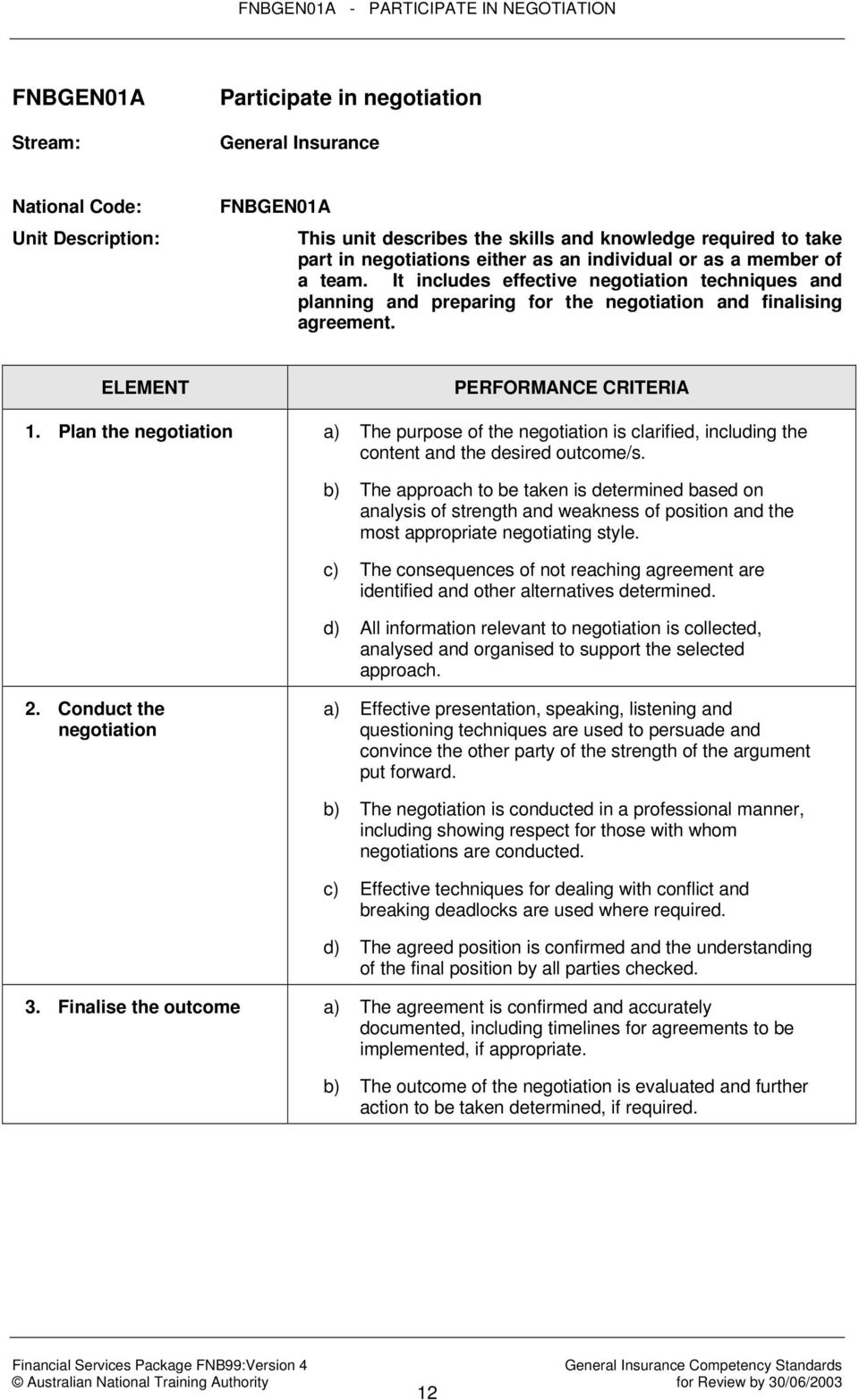
12 FNBGEN01A - PARTICIPATE IN NEGOTIATION FNBGEN01A Stream: Participate in negotiation General Insurance National Code: Unit Description: FNBGEN01A This unit describes the skills and knowledge required to take part in negotiations either as an individual or as a member of a team. It includes effective negotiation techniques and planning and preparing for the negotiation and finalising agreement. ELEMENT PERFORMANCE CRITERIA 1. Plan the negotiation a) The purpose of the negotiation is clarified, including the content and the desired outcome/s. b) The approach to be taken is determined based on analysis of strength and weakness of position and the most appropriate negotiating style. c) The consequences of not reaching agreement are identified and other alternatives determined. d) All information relevant to negotiation is collected, analysed and organised to support the selected approach. 2. Conduct the negotiation a) Effective presentation, speaking, listening and questioning techniques are used to persuade and convince the other party of the strength of the argument put forward. b) The negotiation is conducted in a professional manner, including showing respect for those with whom negotiations are conducted. c) Effective techniques for dealing with conflict and breaking deadlocks are used where required. d) The agreed position is confirmed and the understanding of the final position by all parties checked. 3. Finalise the outcome a) The agreement is confirmed and accurately documented, including timelines for agreements to be implemented, if appropriate. b) The outcome of the negotiation is evaluated and further action to be taken determined, if required. 12
13 FNBGEN01A - PARTICIPATE IN NEGOTIATION RANGE OF VARIABLES VARIABLE Purpose of the negotiation Sources of strength Negotiating styles Effective questioning techniques Effective presentation skills SCOPE Purpose of the negotiation may include: Settlement of an insurance claim Terms and conditions of a contract Roles and responsibilities Terms and conditions of employment Sources of strength may include: Legal and regulatory requirements Detailed knowledge of policy wording and coverage IR power Contacts and influence Control of resources Negotiating styles may include: Collaborative Competitive Subordinate Effective questioning techniques may include: Asking open questions (allow a range of responses) Asking closed questions (answer of yes or no) Asking reflective questions (allowing the speaker to clarify their answer) Effective presentation skills may include: preparing for presentation presenting facts in a logical sequence speaking clearly and using appropriate vocabulary using active listening skills and providing opportunities for feedback 13

14 FNBGEN01A - PARTICIPATE IN NEGOTIATION RANGE OF VARIABLES VARIABLE Deadlock breaking techniques SCOPE Techniques for breaking deadlocks may include: Restating the position Clarifying the positions of both parties Deferring the decision Summarising the progress to date Calling in a third party Preparing a compromise 14

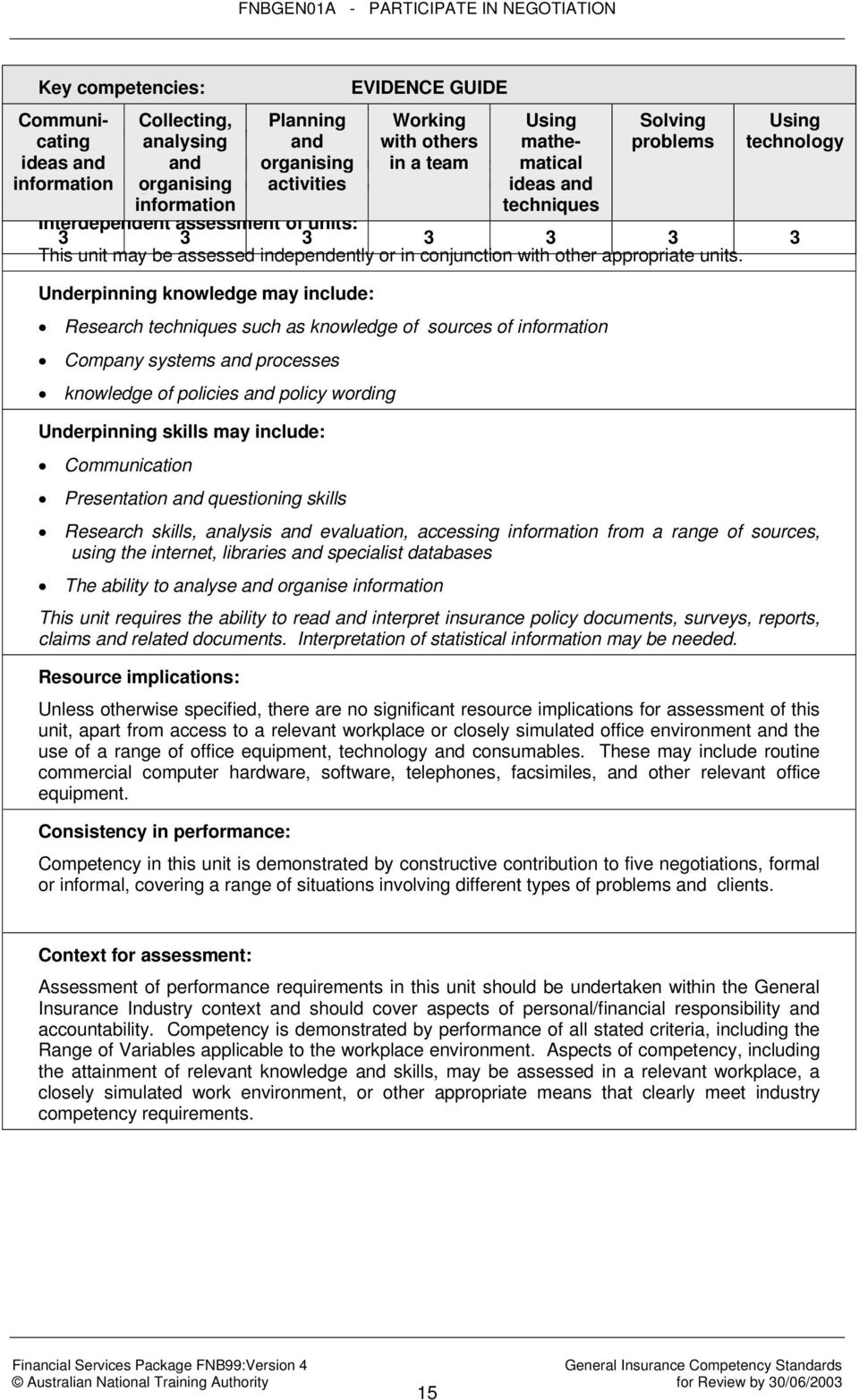
15 FNBGEN01A - PARTICIPATE IN NEGOTIATION Key competencies: Communicating analysing and with others mathe- problems technology Collecting, Planning Working Using Solving Using Critical aspects of evidence: ideas The and ability to make and constructive organising contribution in a to team a negotiation, matical and the ability to recognise and information use good negotiation organising techniques activities are critical to the judgement ideas of competence and in this unit. information techniques Interdependent assessment of units: This unit may be assessed independently or in conjunction with other appropriate units. Underpinning knowledge may include: Research techniques such as knowledge of sources of information Company systems and processes knowledge of policies and policy wording Underpinning skills may include: Communication Presentation and questioning skills Research skills, analysis and evaluation, accessing information from a range of sources, using the internet, libraries and specialist databases The ability to analyse and organise information This unit requires the ability to read and interpret insurance policy documents, surveys, reports, claims and related documents. Interpretation of statistical information may be needed. Resource implications: Unless otherwise specified, there are no significant resource implications for assessment of this unit, apart from access to a relevant workplace or closely simulated office environment and the use of a range of office equipment, technology and consumables. These may include routine commercial computer hardware, software, telephones, facsimiles, and other relevant office equipment. Consistency in performance: Competency in this unit is demonstrated by constructive contribution to five negotiations, formal or informal, covering a range of situations involving different types of problems and clients. Context for assessment: Assessment of performance requirements in this unit should be undertaken within the General Insurance Industry context and should cover aspects of personal/financial responsibility and accountability. Competency is demonstrated by performance of all stated criteria, including the Range of Variables applicable to the workplace environment. Aspects of competency, including the attainment of relevant knowledge and skills, may be assessed in a relevant workplace, a closely simulated work environment, or other appropriate means that clearly meet industry competency requirements. 15
16 FNBGEN02A - EVALUATE RISK FOR RENEWAL FNBGEN02A Evaluate risk for renewal business Stream: National Code: General Insurance FNBGEN02A Unit Description: This unit describes the competencies used in evaluating the risk for renewal business including gathering the risk information, and reviewing and assessing it against appropriate risk criteria. ELEMENT 1. Obtain information on risk PERFORMANCE CRITERIA a) Information is gathered in accordance with company guidelines, on risk changes since prior acceptance, if required b) Any claims on risk are identified c) Information is gathered on client history if applicable d) Surveys / reports are commissioned if applicable to risk e) Exception reporting is utilised if applicable f) Compliance requirements are adhered to in all cases 2. Review risk information a) Information is reviewed to determine its relevance and reliability b) Any claims on risk are checked and documented c) Compliance with risk management conditions is checked 3. Assess information against established risk criteria a) Risk acceptance criteria/net retentions are checked for any changes over past period b) Risk information is compared against risk acceptance criteria and procedures to assess acceptability of risk c) Liaison with other internal departments is conducted to assess impact on business if applicable d) Risk assessment data is documented according to company policy and procedures 16

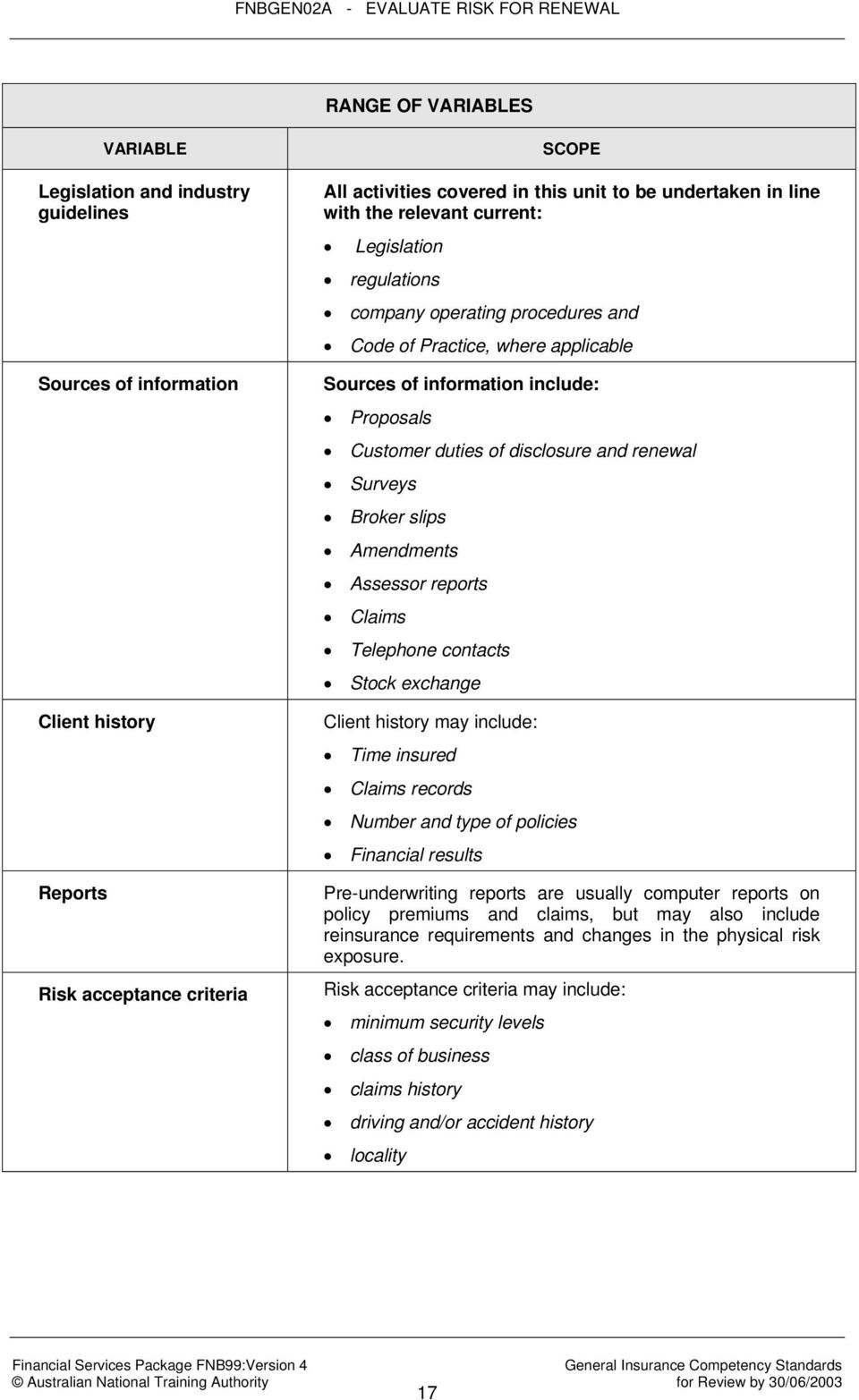
17 FNBGEN02A - EVALUATE RISK FOR RENEWAL RANGE OF VARIABLES VARIABLE Legislation and industry guidelines Sources of information Client history Reports Risk acceptance criteria SCOPE All activities covered in this unit to be undertaken in line with the relevant current: Legislation regulations company operating procedures and Code of Practice, where applicable Sources of information include: Proposals Customer duties of disclosure and renewal Surveys Broker slips Amendments Assessor reports Claims Telephone contacts Stock exchange Client history may include: Time insured Claims records Number and type of policies Financial results Pre-underwriting reports are usually computer reports on policy premiums and claims, but may also include reinsurance requirements and changes in the physical risk exposure. Risk acceptance criteria may include: minimum security levels class of business claims history driving and/or accident history locality 17
18 FNBGEN02A - EVALUATE RISK FOR RENEWAL Critical aspects of evidence to be considered: Comprehensive understanding of the industry sector and all legal obligations and company procedures in order to identify and thoroughly assess risks, and develop suitable products. Interdependent assessment of units: This unit can be assessed independently, however it may be assessed with other appropriate units for example: FNBGEN 3A FNBGEN 6A FNBGEN 8A FNBGEN 22A Underwrite renewal business Survey potential risk exposure Issue contract of insurance Issue contract of insurance in non routine situations Underpinning knowledge may include: Common law, legal systems and procedures Insurance Contracts Act, Insurance (Agents and Brokers) Act, Trade Practices Act, other statutory requirements Interim cover as it relates to expiry of contracts and cancellations (Insurance Contracts Act s.38, 58) Company policy, procedures, underwriting guidelines and authorities Detailed knowledge of company products Industry sector compliance requirements such as the General Insurance Code of Practice Risk prevention methods and application Industry market position relative to product/line of business Company or industry sector policy wording Relative industry hazards Reinsurance, treaty and facultative Statutory hazard, health and safety legislation per industry Underpinning skills to be demonstrated may include: Policy interpretation and application Ability to describe terms and conditions of insurance contracts to customers Hazard identification and assessment Application of technically acquired skills Price application Risk assessment Report writing Negotiation This unit requires the ability to read and interpret insurance policy documents, surveys, reports, claims and related documents. Interpretation of charts and statistical data may be needed. 18

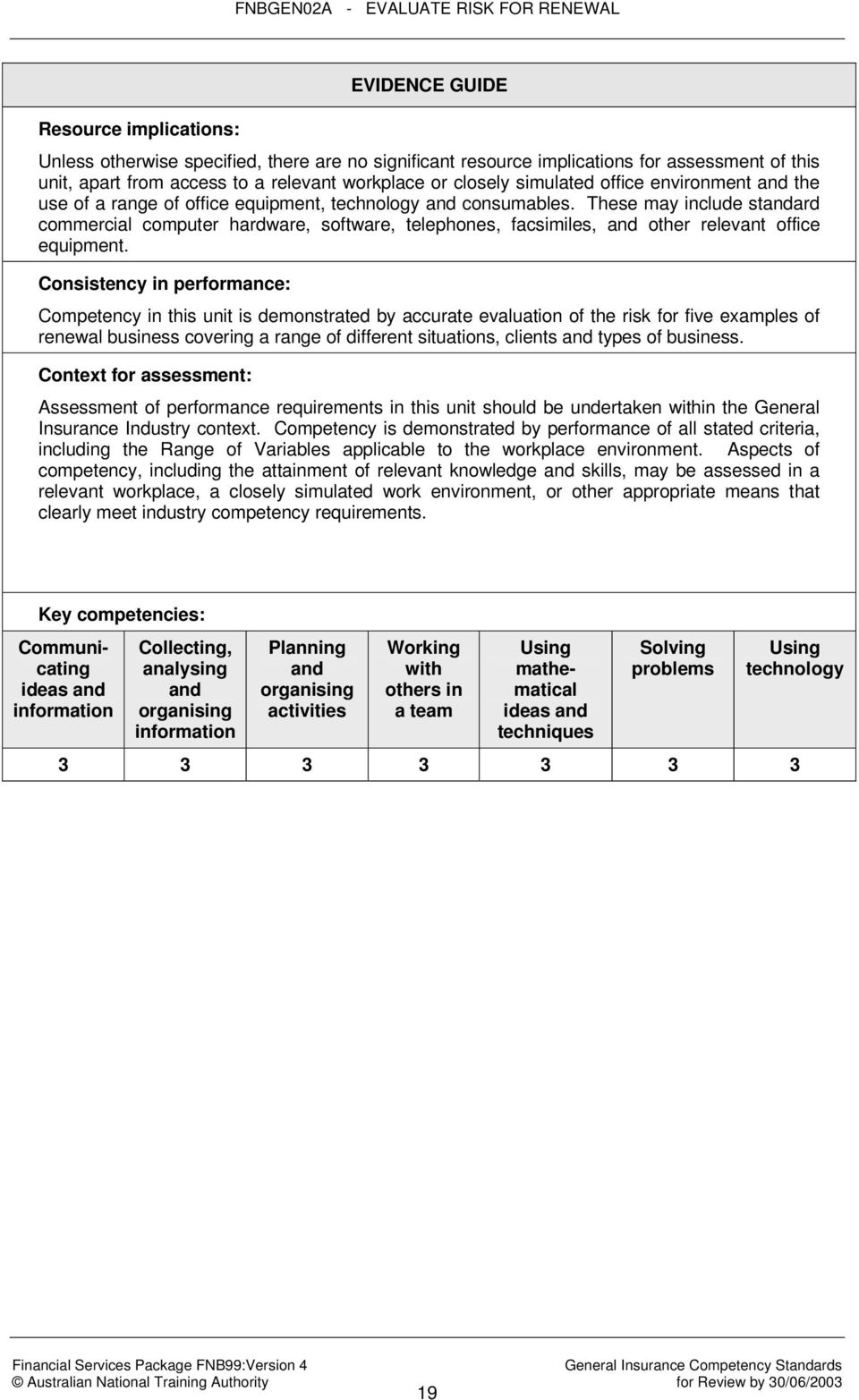
19 FNBGEN02A - EVALUATE RISK FOR RENEWAL Resource implications: Unless otherwise specified, there are no significant resource implications for assessment of this unit, apart from access to a relevant workplace or closely simulated office environment and the use of a range of office equipment, technology and consumables. These may include standard commercial computer hardware, software, telephones, facsimiles, and other relevant office equipment. Consistency in performance: Competency in this unit is demonstrated by accurate evaluation of the risk for five examples of renewal business covering a range of different situations, clients and types of business. Context for assessment: Assessment of performance requirements in this unit should be undertaken within the General Insurance Industry context. Competency is demonstrated by performance of all stated criteria, including the Range of Variables applicable to the workplace environment. Aspects of competency, including the attainment of relevant knowledge and skills, may be assessed in a relevant workplace, a closely simulated work environment, or other appropriate means that clearly meet industry competency requirements. Key competencies: Communicating ideas and information Collecting, analysing and organising information Planning and organising activities Working with others in a team Using mathematical ideas and techniques Solving problems Using technology
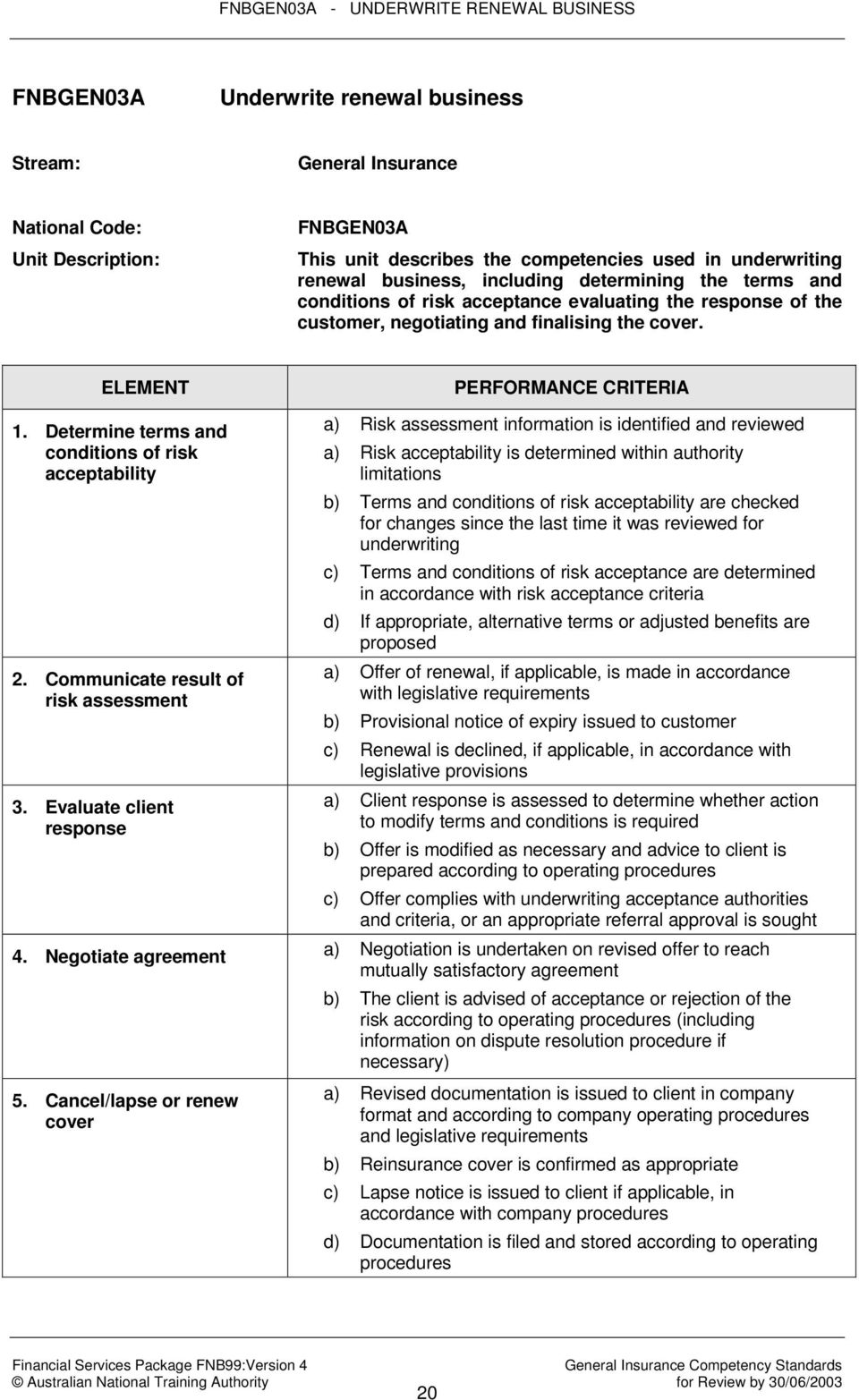
20 FNBGEN03A - UNDERWRITE RENEWAL BUSINESS FNBGEN03A Underwrite renewal business Stream: General Insurance National Code: Unit Description: FNBGEN03A This unit describes the competencies used in underwriting renewal business, including determining the terms and conditions of risk acceptance evaluating the response of the customer, negotiating and finalising the cover. ELEMENT PERFORMANCE CRITERIA 1. Determine terms and conditions of risk acceptability 2. Communicate result of risk assessment 3. Evaluate client response a) Risk assessment information is identified and reviewed a) Risk acceptability is determined within authority limitations b) Terms and conditions of risk acceptability are checked for changes since the last time it was reviewed for underwriting c) Terms and conditions of risk acceptance are determined in accordance with risk acceptance criteria d) If appropriate, alternative terms or adjusted benefits are proposed a) Offer of renewal, if applicable, is made in accordance with legislative requirements b) Provisional notice of expiry issued to customer c) Renewal is declined, if applicable, in accordance with legislative provisions a) Client response is assessed to determine whether action to modify terms and conditions is required b) Offer is modified as necessary and advice to client is prepared according to operating procedures c) Offer complies with underwriting acceptance authorities and criteria, or an appropriate referral approval is sought 4. Negotiate agreement a) Negotiation is undertaken on revised offer to reach mutually satisfactory agreement b) The client is advised of acceptance or rejection of the risk according to operating procedures (including information on dispute resolution procedure if necessary) 5. Cancel/lapse or renew cover a) Revised documentation is issued to client in company format and according to company operating procedures and legislative requirements b) Reinsurance cover is confirmed as appropriate c) Lapse notice is issued to client if applicable, in accordance with company procedures d) Documentation is filed and stored according to operating procedures 20
21 FNBGEN03A - UNDERWRITE RENEWAL BUSINESS RANGE OF VARIABLES VARIABLE Legislation and industry guidelines Conditions of risk acceptability Client history Declining renewal Revised documentation SCOPE All activities covered in this unit to be undertaken in line with the relevant current: Legislation regulations company operating procedures and Code of Practice, where applicable Terms of conditions of risk acceptability may include: excesses / deductibles variations in policy wording risk improvement requirements quality of risk pricing internal and industry statistics risk factors endorsements claims history warranties reinsurance cover Client history may include: Time insured Claims records Number of type of policies Financial results Declining renewal means advising client/ broker /agent of non-acceptance of risk. Revised documentation includes endorsement or renewal certificate. 21
22 FNBGEN03A - UNDERWRITE RENEWAL BUSINESS Critical aspects of evidence to be considered: Comprehensive understanding of the industry sector and all legal obligations and company procedures in order to identify and thoroughly assess risks, and develop suitable products. Interdependent assessment of units: This unit can be assessed independently, however it may be assessed with other appropriate units for example- FNBGEN 2A FNBGEN 3A FNBGEN 6A FNBGEN 8A FNBGEN 22A Evaluate risk for renewal business Underwrite renewal business Survey potential risk exposure Issue contract of insurance Issue contract of insurance in non routine situations Underpinning knowledge may include: Insurance Contracts Act, Insurance (Agents and Brokers) Act, Trade Practices Act, other statutory requirements Interim cover as it relates to expiry of contracts and cancellations (Insurance Contracts Act s.38, 58) Company policy, procedures, underwriting guidelines and authorities Industry sector compliance requirements such as the General Insurance Code of Practice Detailed knowledge of company products Risk prevention methods and application Industry market position relative to product/line of business Company or industry sector policy wording Relative industry hazards Reinsurance, treaty and facultative Statutory hazard, health and safety legislation per industry, or other compliance requirements For NZ and 1985 Insurance Law Reform Acts and other relevant legislation Underpinning skills to be demonstrated may include: Policy interpretation and application Hazard identification and assessment Application of technically acquired skills Price application Risk assessment Negotiation Use of the internet This unit requires the ability to read and interpret insurance policy documents, surveys, reports, claims and related documents. Interpretation of charts and statistical data may be needed. 22
23 FNBGEN03A - UNDERWRITE RENEWAL BUSINESS Resource implications: Unless otherwise specified, there are no significant resource implications for assessment of this unit, apart from access to a relevant workplace or closely simulated office environment and the use of a range of office equipment, technology and consumables. These may include standard commercial computer hardware, software, telephones, facsimiles, and other relevant office equipment. Consistency in performance: Competency in this unit is demonstrated by accurate underwriting of five examples of renewal business covering a range of different situations and products. Context for assessment: Assessment of performance requirements in this unit should be undertaken within the General Insurance Industry context. Competency is demonstrated by performance of all stated criteria, including the Range of Variables applicable to the workplace environment. Aspects of competency, including the attainment of relevant knowledge and skills, may be assessed in a relevant workplace, a closely simulated work environment, or other appropriate means that clearly meet industry competency requirements. Key competencies: Communicating ideas and information Collecting, analysing and organising information Planning and organising activities Working with others in a team Using mathematical ideas and techniques Solving problems Using technology
24 FNBGEN04A - EVALUATE RISK FOR BUSINESS FNBGEN04A Stream: Evaluate risk for business General Insurance National Code: Unit Description: FNBGEN04A This unit describes the competencies used in evaluating risk for new business including gathering the risk information, and reviewing and assessing it against appropriate risk criteria. Element Performance criteria 1. Identify and obtain risk information a) All sources of risk information are identified, gathered and recorded and deficiencies rectified b) Information is reviewed to determine its relevance and reliability and the integrity of its source c) Data is formatted for easy access d) Compliance requirements are adhered to in all cases 2. Assess Information Against Established Risk Acceptance Criteria a) All relevant risk information is assessed to determine if it is comprehensive and pertinent to the nature of the risk b) Surveys / reports are reviewed and commissioned if applicable to risk c) Data on risk exposure from survey report is interpreted d) Risk information is compared against risk acceptance criteria and company capacity to assess and accept risk e) Liaison with other internal departments is conducted to assess impact on business if applicable f) Proposed amendments to company wording are reviewed and compared to acceptance criteria g) Risk assessment data is documented according to company policy and procedures 3. Issue a quotation a) Quote based on all the risk assessment data is prepared and communicated if required 24
25 FNBGEN04A - EVALUATE RISK FOR BUSINESS RANGE OF VARIABLES VARIABLE Legislation and industry guidelines Sources of information SCOPE All activities covered in this unit to be undertaken in line with the relevant current: Legislation regulations company operating procedures and Code of Practice, where applicable Sources of information include: Proposals surveys previous insurers legal cases broker slips amendments pre-underwriting report claims telephone contacts stock exchange general knowledge publications (industry associations and trade journals) insurance reference services any other source the insurer deems relevant 25
26 FNBGEN04A - EVALUATE RISK FOR BUSINESS RANGE OF VARIABLES VARIABLE Conditions of risk assessment Reports Risk acceptance criteria SCOPE Terms of conditions of risk assessment may include: excesses / deductibles variations in policy wording risk improvement requirements quality of risk pricing internal and industry statistics risk factors warranties endorsements claims history adequate reinsurance cover additional exclusions sub-limits extensions Pre-underwriting reports are usually computer reports on policy premiums and claims, but may also include reinsurance requirements and changes in the physical risk exposure. Risk acceptance criteria may include: minimum security levels class of business claims history driving and/or accident history locality Critical aspects of evidence to be considered: Comprehensive understanding of the industry sector and all legal obligations and company procedures in order to identify and thoroughly assess risks, and develop a suitable policy. 26
27 FNBGEN04A - EVALUATE RISK FOR BUSINESS Interdependent assessment of units: This unit may be assessed independently, however demonstration of competency in conjunction with other units such as: FNBGEN 5A FNBGEN 6A FNBGEN 8A FNBGEN 20A FNBGEN 22A Underwrite new business Survey potential risk exposure Issue contract of insurance Review operational performance of portfolio Issue contract of insurance in non routine situations Underpinning knowledge may include: Common law, relevant legal systems and procedures, for example, Insurance Contracts Act, Insurance (Agents and Brokers) Act, Trade Practices Act; Interim cover as it relates to expiry of contracts and cancellations (Insurance Contracts Act s.38, 58) Company policy, procedures, underwriting guidelines and authorities for example: Best underwriting and loss control guides) Industry sector compliance requirements such as the General Insurance Code of Practice Knowledge of company products Risk prevention methods and application Industry market position relative to product/line of business Company or industry sector policy wording Relative industry hazards Reinsurance, treaty and facultative Statutory hazard, health and safety legislation per industry Underpinning skills to be demonstrated may include: Policy interpretation and application Hazard identification and assessment Ability to describe terms and conditions of insurance contracts to customers Price application Risk assessment Negotiation This unit requires the ability to read and interpret insurance policy documents, surveys, reports and related documents. Interpretation of charts and statistical data may be needed. Resource implications: Unless otherwise specified, there are no significant resource implications for assessment of this unit, apart from access to a relevant workplace or closely simulated office environment and the use of a range of office equipment, technology and consumables. These may include standard commercial computer hardware, software, telephones, facsimiles, and other relevant office equipment. 27
28 FNBGEN04A - EVALUATE RISK FOR BUSINESS Consistency in performance: Competency in this unit is demonstrated by accurate evaluations of risk in five examples of new business covering a range of customers and types of business. Context for assessment: Assessment of performance requirements in this unit should be undertaken within the General Insurance Industry context. Competency is demonstrated by performance of all stated criteria, including the Range of Variables applicable to the workplace environment. Aspects of competency, including the attainment of relevant knowledge and skills, may be assessed in a relevant workplace, a closely simulated work environment, or other appropriate means that clearly meet industry competency requirements. Key competencies: Communicating ideas and information Collecting, analysing and organising information Planning and organising activities Working with others in a team Using mathematical ideas and techniques Solving problems Using technology
29 FNBGEN05A - UNDERWRITE NEW BUSINESS FNBGEN05A Stream: Underwrite new business General Insurance National Code: Unit Description: FNBGEN05A This unit describes the competencies used in underwriting new business including determining the terms and conditions of risk acceptance, evaluating the response of the customer, negotiating and finalising the cover. Element Performance criteria 1. Determine terms and conditions of risk acceptability a) Risk assessment information is collected including determining the terms and conditions of risk acceptance, evaluating the response of the customer, negotiating and finalising the cover s identified and reviewed b) Risk acceptability is determined within authority limitations and capacities c) Terms and conditions of risk acceptance are determined in accordance with risk acceptance criteria d) Determine referrals where appropriate e) Facultative reinsurance placed where appropriate 2. Communicate result of risk assessment a) Quotation, if required, is prepared and communicated b) Terms and conditions of risk acceptance, including expiry date of offer and pricing, are advised to client within appropriate time frames c) Rejection of risk, if applicable, is advised as soon as it is evident that the risk falls outside the guidelines or as soon as a decision is made not to underwrite the risk 3. Evaluate client response a) Client response is assessed to determine whether action to modify terms and conditions is required b) Offer is modified as necessary and advice to client is prepared according to operating procedures c) Modified offer complies with underwriting acceptance authorities and criteria, or an appropriate referral approval is sought 4. Negotiate Agreement a) Negotiation is undertaken on revised offer to reach mutually satisfactory agreement, including charge to reinsurance where applicable b) The client is advised of acceptance or rejection of the risk according to operating procedures c) If conditions are placed on the acceptance of risk, establish a mechanism for checking that the conditions 29
30 FNBGEN05A - UNDERWRITE NEW BUSINESS Element 5. Issue Interim Cover Where Required have been met Performance criteria a) Disclosure requirements are adhered to in all cases b) Initial documentation is issued to the client in company format and according to operating procedures c) Reinsurance cover is confirmed as appropriate d) Additional information is obtained as required e) Documents are filed and stored in accordance with company operating procedures f) Expiry of interim cover is monitored following standard operating procedures, to ensure that any required terms are met prior to issue of policy RANGE OF VARIABLES VARIABLE Legislation and industry guidelines Sources of information SCOPE All activities covered in this unit to be undertaken in line with the relevant current: Legislation regulations company operating procedures and Code of Practice, where applicable Sources of information include: Proposals Surveys previous insurers legal cases broker slips amendments pre-underwriting report assessor reports claims telephone contacts stock exchange general knowledge publications (industry associations and trade journals) for NZ: the New Zealand Claims Register 30
31 FNBGEN05A - UNDERWRITE NEW BUSINESS RANGE OF VARIABLES VARIABLE Conditions of risk acceptability SCOPE Terms of conditions of risk acceptability may include: excesses / deductibles variations in policy wording risk improvement requirements quality of risk pricing internal and industry statistics risk factors warranties endorsements claims history adequate reinsurance cover additional exclusions sub-limits extensions Declining a risk Declining to accept a risk means advising a client or broker / agent of non-acceptance of risk. Initial documentation Client representation Risk acceptance criteria Disclosure Initial documentation includes any interim cover. The client may be represented by an insurance broker or agent. Letters of appointment will be necessary if there has been a change of agent or broker. Risk acceptance criteria may include: minimum security levels class of business claims history driving and/or accident history locality Disclosure requirements may be met in a variety of ways according to the way the business is written eg. Proposal, telephone, facsimile, e-commerce. 31
32 FNBGEN05A - UNDERWRITE NEW BUSINESS Critical aspects of evidence to be considered: Comprehensive understanding of the industry sector and all legal obligations and company procedures in order to identify and thoroughly assess risks, and develop a suitable policy. Interdependent assessment of units: This unit can be assessed independently, however it may be assessed with other appropriate units such as:. FNBGEN 4A FNBGEN 6A FNBGEN 8A FNBGEN 20A FNBGEN 22A Evaluate risk for new business Survey potential risk exposure Issue contract of insurance Review operational performance of portfolio Issue contract of insurance in non routine situations Underpinning knowledge may include: Common law, relevant legal systems and procedures, for example, Insurance Contracts Act, Insurance (Agents and Brokers) Act, Trade Practices Act; Interim cover as it relates to expiry of contracts and cancellations (Insurance Contracts Act s.38, 58) Company policy, procedures, underwriting guidelines and authorities for example: Best underwriting guides (BUG) and loss control guides Industry sector compliance requirements such as the General Insurance Code of Practice Risk prevention methods and application Industry market position relative to product/line of business Knowledge of company products Company or industry sector policy wording Relative industry hazards Reinsurance, treaty and facultative Statutory hazard, health and safety legislation per industry, and other client requirements Reinsurance Knowledge of e-commerce Underpinning skills to be demonstrated may include: Policy interpretation and application Hazard identification and assessment Application of technically acquired skills Price application Risk assessment Negotiation Use of the internet This unit requires the ability to read and interpret insurance policy documents, surveys, reports and related documents. Ability to calculate and estimate premiums and interpretation of charts and statistical data are also needed. 32
33 FNBGEN05A - UNDERWRITE NEW BUSINESS Resource implications: Unless otherwise specified, there are no significant resource implications for assessment of this unit, apart from access to a relevant workplace or closely simulated office environment and the use of a range of office equipment, technology and consumables. These may include standard commercial computer hardware, software, telephones, facsimiles, and other relevant office equipment. Consistency in performance: Competency in this unit is demonstrated by accurate underwriting of five examples of new business covering a range of different situations and products. Context for assessment: Assessment of performance requirements in this unit should be undertaken within the General Insurance Industry context. Competency is demonstrated by performance of all stated criteria, including the Range of Variables applicable to the workplace environment. Aspects of competency, including the attainment of relevant knowledge and skills, may be assessed in a relevant workplace, a closely simulated work environment, or other appropriate means that clearly meet industry competency requirements. Key competencies: Communicating ideas and information Collecting, analysing and organising information Planning and organising activities Working with others in a team Using mathematical ideas and techniques Solving problems Using technology
34 FNBGEN06A - SURVEY POTENTIAL RISK EXPOSURE FNBGEN06A Stream: Survey potential risk exposure General Insurance National Code: Unit Description: FNBGEN06A The unit describes the skills used in surveying risk exposure including examination of risk, analysis of data, reporting and making recommendations specifying loss control measures. ELEMENT PERFORMANCE CRITERIA 1. Determine hazards and exposures a) Comprehensive physical examination of risk is undertaken b) Client and relevant third parties are interviewed to identify potential risk components 2. Analyse level of hazards and exposures a) Risk type is assessed against known exposure factors b) Risk type is assessed for compliance with relevant legislation and company policy c) Acceptability of risk is determined within company underwriting requirements d) Maximum probable loss is estimated where applicable 3. Report and recommend on condition of risk exposure a) Condition and improvements to risk are fully documented according to company policy and procedures b) Loss control measures as applicable are specified as a condition of risk acceptance and renewal 4. Monitor and review loss control measures a) Loss control measures are followed up and recorded according to company policy and procedures b) Risk improvement is monitored against loss control measures c) Follow-up risk surveys are conducted as required 34
35 FNBGEN06A - SURVEY POTENTIAL RISK EXPOSURE RANGE OF VARIABLES VARIABLE Legislation and industry guidelines Risks Comprehensive physical examination Company policy and procedures Reports Hazard indicators SCOPE All activities covered in this unit to be undertaken in line with the relevant current: Legislation Regulations Company operating procedures and Code of Practice, where applicable Risks may include: Property (including risk types) Injury Casualty Liability Comprehensive physical examination may include company standard risk procedures, as defined by individual insurers. Company policy and procedures may include diary-keeping procedures. Reports may be made to: Underwriters Reinsurers Clients Third-parties Hazard indicators include: degree of quality control level of maintenance/housekeeping construction standard of premises risk management programs security program adjoining occupations proximity to other business premises/remote locations response times to services, such as fire/security/police protection levels for fire and burglary incident reporting systems compliance with statutory requirements (storage and licensing) management and staff attitude and commitment to safety and security of property and persons 35
36 FNBGEN06A - SURVEY POTENTIAL RISK EXPOSURE RANGE OF VARIABLES VARIABLE Sources of information Relevant legislation SCOPE Sources of information may include previous claims or loss adjusters reports. Relevant legislation may include: Building Codes Safety and Hazardous Goods Workers Compensation And other industrial legislation Critical aspects of evidence: Comprehensive understanding of the industry and all legal obligations and company procedures in order to thoroughly assess risks. Competency may be underpinned by knowledge in another discipline, eg: engineering, accounting, risk management. Interdependent assessment of units: This unit can be assessed independently, however it may be assessed with other appropriate units such as: FNBGEN 2A FNBGEN 3A FNBGEN 4A FNBGEN 5A. Evaluate risk for renewal business Underwrite renewal business Evaluate risk for new business Underwrite new business Underpinning knowledge may include: Company policy, procedures, underwriting guidelines and authorities Risk prevention methods and application Knowledge of company products Relative industry hazards Relevant legislative requirements Statutory hazard, health and safety legislation per industry Industry market position relative to product/line of business Reinsurance Industry compliance requirements Calculation of maximum probable loss (MPL) 36
37 FNBGEN06A - SURVEY POTENTIAL RISK EXPOSURE Underpinning skills to be demonstrated may include: Policy interpretation and application Hazard identification and assessment Application of technically acquired skills Price application Risk assessment Report writing Negotiation Organisation Data analysis and interpretation techniques Interpersonal Basic computer literacy This unit requires high levels of literacy and numeracy. It requires the ability to read and interpret policy documents, legislation and regulations, reports and related documents. It requires the ability to interpret charts, graphs and statistical information and calculate/estimate premiums and claims. Resource implications: Unless otherwise specified, there are no significant resource implications for assessment of this unit, apart from access to a relevant workplace or closely simulated office environment and the use of a range of office equipment, technology and consumables. These may include standard commercial computer hardware, software, telephones, facsimiles, and other relevant office equipment. Consistency in performance: Competency in this unit is demonstrated by accurate assessment of and reporting on three potential risks covering a range of different situations and types of potential risk. Context for assessment: Assessment of performance requirements in this unit should be undertaken within the General Insurance Industry context and should cover aspects of personal/financial responsibility and accountability. Competency is demonstrated by performance of all stated criteria, including the Range of Variables applicable to the workplace environment. Aspects of competency, including the attainment of relevant knowledge and skills, may be assessed in a relevant workplace, a closely simulated work environment, or other appropriate means that clearly meet industry competency requirements. Key competencies: Communicating ideas and information Collecting, analysing and organising information Planning and organising activities Working with others in a team Using mathematical ideas and techniques Solving problems Using technology
38 FNBGEN07A - ISSUE RENEWAL / CANCELLATION ADVICE FNBGEN07A Stream: National Code: Unit Description: Issue renewal / cancellation advice General Insurance FNBGEN07A This unit describes the skills needed to issue notices covering renewal, cancellation or lapse of insurance following the company s operating procedures. ELEMENT PERFORMANCE CRITERIA 1. Advise renewal / cancellation terms or lapse of insurance to client 2. Finalise renewal / cancellation or lapse terms a) Notices and information required by legislation and code of practice are provided within required time frames and according to operating procedures a) Terms of renewal / cancellation or lapse are finalised according to operating procedures and specified criteria b) Where necessary customer informed of lapse of policy c) All relevant documentation is completed promptly according to operating procedures d) Client follow-up, if applicable, is carried out and inquiries actioned according to company guidelines RANGE OF VARIABLES VARIABLE Legislation and industry guidelines SCOPE All activities covered in this unit to be undertaken in line with the relevant current: Legislation regulations company operating procedures and Code of Practice, where applicable Relevant legislation Relevant legislation includes: Insurance Contracts Act Insurance (Agents and Brokers) Act Code of Practice Trade Practices Act Documentation Documentation includes: amendments 38
39 FNBGEN07A - ISSUE RENEWAL / CANCELLATION ADVICE RANGE OF VARIABLES VARIABLE Cancellation SCOPE cover notes cancellations policy and renewals notices invoices placing slips letters of advice of alteration of terms Cancellation includes termination of insurance Lapse means non-renewal of a policy Critical aspects of evidence to be considered: The ability to make comply with industry Codes of Practice, a thorough approach to detail and following procedures accurately are critical to the judgement of competence in this unit. Interdependent assessment of units: This unit can be assessed independently, however it may be assessed with other appropriate units. Underpinning knowledge may include: Relevant legislation Company and departmental policy, procedures and authorities Company and industry sector policy wording Knowledge of company products IT and communication systems Basic industry sector compliance requirements This unit requires the ability to read and interpret notices and forms relating to insurance renewals and cancellations. Underpinning skills to be demonstrated may include: Basic computer literacy Ability to convey information about terms and conditions of insurance contracts to customers Negotiation Organisation Time management Resource implications: Unless otherwise specified, there are no significant resource implications for assessment of this unit, apart from access to a relevant workplace or closely simulated office environment and the 39
40 FNBGEN07A - ISSUE RENEWAL / CANCELLATION ADVICE use of a range of office equipment, technology and consumables. These may include standard commercial computer hardware, software, telephones, facsimiles, and other relevant office equipment. Consistency in performance: At minimum, issue of five examples of renewal information across a representative range of products, clients and conditions is required to assess this unit. Context for assessment: Assessment of performance requirements in this unit should be undertaken within the General Insurance Industry context and should cover aspects of personal/financial responsibility and accountability. Competency is demonstrated by performance of all stated criteria, including the Range of Variables applicable to the workplace environment. Aspects of competency, including the attainment of relevant knowledge and skills, may be assessed in a relevant workplace, a closely simulated work environment, or other appropriate means that clearly meet industry competency requirements. Key competencies: Communicating ideas and information Collecting, analysing and organising information Planning and organising activities Working with others in a team Using mathematical ideas and techniques Solving problems Using technology
41 FNBGEN08A - ISSUE CONTRACT OF INSURANCE FNBGEN08A Stream: Issue contract of insurance General Insurance National Code: Unit Description: FNBGEN08A This unit describes the competencies used in gathering the necessary information and issuing a new policy/contract of insurance in response to requests for quotes, new policies, or interim cover (cover note) in standard situations. It also covers canceling a policy at the customer s request. ELEMENT PERFORMANCE CRITERIA 1. Identify and clarify the customer s request a) Customer s requirements are identified b) All necessary information is elicited from the customer c) Data on insurance proposal is gathered within time lines required by company d) Underwriter s terms and conditions are applied e) Risk information advised by client is verified f) Survey requirements are implemented if applicable 2. Issue insurance contact a) Terms and conditions of contract are specified in line with company guidelines, policies and procedures b) If request falls outside the company guidelines, decision is referred to the appropriate person c) Contract documentation is completed and reviewed to ensure it meets legislative requirements d) Contracts are checked for accuracy and omissions according to operating procedures e) Cover note, quote, or new insurance contract is issued following company operating procedures and dispatched to customer f) Contract documentation is accurately filed in accordance with operating procedures g) If requested by customer, policy is cancelled and documentation dispatched to customer 41
42 FNBGEN08A - ISSUE CONTRACT OF INSURANCE RANGE OF VARIABLES VARIABLE Legislation and industry guidelines Relevant legislation Documentation Risk information Recording and filing SCOPE All activities covered in this unit to be undertaken in line with the relevant current: Legislation regulations company operating procedures and Code of Practice, where applicable Relevant legislation may includes: Insurance Contracts Act Insurance (Agents and Brokers) Act Code of Practice Trade Practices Act For NZ: Earthquake commission Act, Insurance Companies and Ratings Act Documentation includes: Amendments Cover notes Policy notices Invoices Certificate of insurance Risk information may include: claims history driving and/or accident history locality and other information relating to the particular contract Recording and filing may be electronic or paper based. Survey requirements Survey requirement may include risk improvement requirements. 42
43 FNBGEN08A - ISSUE CONTRACT OF INSURANCE Critical aspects of evidence to be considered: Compliance with industry Codes of Practice, consistent application of underwriting guidelines and authorities, a thorough approach to detail and following procedures accurately. Interdependent assessment of units: This unit can be assessed independently, however it may be assessed with other appropriate units such as: FNBGEN 2A Evaluate risk for renewal business FNBGEN 3A Underwrite renewal business OR FNBGEN 4A Evaluate risk for new business FNBGEN 5A Underwrite new business FNBGEN 20A Review operational performance of portfolio FNBGEN 22A Issue contract of insurance in non routine situations Underpinning knowledge may include: Relevant legislation Company and departmental policy, procedures and authorities Company and industry sector policy wording Product knowledge Interpretation of applicable ratings Company IT and communication systems Basic industry sector compliance requirements Underpinning skills to be demonstrated may include: Data analysis and interpretation techniques Policy interpretation and application Risk assessment techniques Hazard identification and assessment Negotiation This unit requires the ability to read and interpret notices and forms relating to insurance contracts and related documents. Numeracy skills are needed to calculate premiums, deductions and estimate claims Resource implications: Unless otherwise specified, there are no significant resource implications for assessment of this unit, apart from access to a relevant workplace or closely simulated office environment and the use of a range of office equipment, technology and consumables. These may include standard commercial computer hardware, software, telephones, facsimiles, and other relevant office equipment. Consistency in performance: Competency in this unit is demonstrated by issue of five insurance contracts across a representative range of products, customers and conditions. 43
44 FNBGEN08A - ISSUE CONTRACT OF INSURANCE Context for assessment: Assessment of performance requirements in this unit should be undertaken within the General Insurance Industry context and should cover aspects of personal/financial responsibility and accountability. Competency is demonstrated by performance of all stated criteria, including the Range of Variables applicable to the workplace environment. Aspects of competency, including the attainment of relevant knowledge and skills, may be assessed in a relevant workplace, a closely simulated work environment, or other appropriate means that clearly meet industry competency requirements. Key competencies: Communicating ideas and information Collecting, analysing and organising information Planning and organising activities Working with others in a team Using mathematical ideas and techniques Solving problems Using technology
45 FNBGEN09A - PROCESS ALTERATION TO INSURANCE POLICY FNBGEN09A Stream: Process alteration to insurance policy General Insurance National Code: Unit Description: FNBGEN09A This unit covers the competencies used in underwriting and processing alterations to insurance policies, recording the changes and issuing documents to customers. ELEMENT PERFORMANCE CRITERIA 1. Receive alteration advice from client a) Policy information is gathered, and accurately and promptly recorded according to company procedures b) Underwriter s terms and conditions are reviewed c) Policy alteration is reviewed to ensure it meets legislative and company requirements d) If policy meets legislative and company requirements, alteration is accepted 2. Issue policy alteration advice a) Policy alteration information is processed according to operating procedures b) Policy alteration is checked for accuracy and omissions according to operating procedures c) Information systems are accurately updated d) Completed documents are dispatched to clients within timelines in accordance with operating procedures e) All monies received are processed in accordance with operating procedures and legislative requirements f) Relevant documentation is accurately filed in accordance with operating procedures g) Customer is notified of any new terms that differ from he customer s request 45
46 FNBGEN09A - PROCESS ALTERATION TO INSURANCE POLICY RANGE OF VARIABLES VARIABLE Legislation and industry guidelines Alteration to policy Alteration advice Relevant legislation Documentation SCOPE All activities covered in this unit to be undertaken in line with the relevant current: legislation regulations company operating procedures and Code of Practice, where applicable Alterations to policy may include: Endorsements Special conditions Cancellation request Alteration advice may be received via , phone, post, facsimile, or in person. Relevant legislation includes: Insurance Contracts Act Insurance (Agents and Brokers) Act Trade Practices Act Code of Practice Relevant documentation may include written requests valuations photographs receipts Critical aspects of evidence to be considered: Compliance with industry Code of Practice and a thorough approach to detail and following procedures accurately are critical to the judgement of competence in this unit. Interdependent assessment of units: This unit can be assessed independently, however it may be assessed with other appropriate units. Underpinning knowledge may include: Relevant legislation Company and departmental policy, procedures and authorities Company and industry sector policy wording Product knowledge and basic industry sector compliance requirements 46
47 FNBGEN09A - PROCESS ALTERATION TO INSURANCE POLICY Underpinning skills to be demonstrated may include: Basic computer literacy Administrative Policy interpretation and application This unit requires the ability to read and insurance policies and related documents. Numeracy skills are needed to calculate premiums, deductions and estimate claims Resource implications: Unless otherwise specified, there are no significant resource implications for assessment of this unit, apart from access to a relevant workplace or closely simulated office environment and the use of a range of office equipment, technology and consumables. These may include standard commercial computer hardware, software, telephones, facsimiles, and other relevant office equipment. Consistency in performance: Competency in this unit is demonstrated by accurate processing of minimum of five altered contracts across a representative range of products, clients and conditions. Context for assessment: Assessment of performance requirements in this unit should be undertaken within the General Insurance Industry context and should cover aspects of personal/financial responsibility and accountability. Competency is demonstrated by performance of all stated criteria, including the Range of Variables applicable to the workplace environment. Aspects of competency, including the attainment of relevant knowledge and skills, may be assessed in a relevant workplace, a closely simulated work environment, or other appropriate means that clearly meet industry competency requirements. Key competencies: Communicating ideas and information Collecting, analysing and organising information Planning and organising activities Working with others in a team Using mathematical ideas and techniques Solving problems Using technology
48 FNBGEN10A - FOLLOW COMPANY PROCEDURES TO PROCESS CLAIM FNBGEN10A Stream National Code Follow company procedures to process claim General insurance FNBGEN10A Unit Description This unit describes the functions for processing an insurance claim in accordance with the company guidelines and procedures. In the majority of cases the process is handled through company information technology systems which contain information giving assistance and guidance to the operator. ELEMENT 1. Receive insurance claim PERFORMANCE CRITERIA a) Information relating to the claim is received and entered into the system accurately b) Completeness of the information is checked c) Customer is advised of company claims procedures and queries are responded to courteously and accurately d) Determination is made as to whether the claim is routine, and fully covered by the policy e) If the claim is not completely routine and fully with in the policy guidelines, it is passed on to appropriate staff 2. Process claim a) Claim is processed promptly in accordance with company guidelines and procedures b) Where required, payment information is passed on to appropriate staff c) Customer is kept informed of progress of the claim d) All claim information is accurately recorded RANGE OF VARIABLES VARIABLE Legislation and industry guidelines Systems SCOPE All activities covered in this unit to be undertaken in line with the relevant current: Legislation regulations company operating procedures and Code of Practice, where applicable Systems may be computerised, and data recording and updating will be by electronic in the majority of cases. 48
49 FNBGEN10A - FOLLOW COMPANY PROCEDURES TO PROCESS CLAIM RANGE OF VARIABLES VARIABLE SCOPE Claims checking Entering claims data Claims checking may be through manual checklists but in the majority of cases it will be through data entry validation on computer systems and may include: Previous payment to claimant Claim has been sent to the wrong insurer Liability has not been accepted Entering claims data may include coding according to company requirements (entering statistical data). Registering claims Registering claims may involve entering claims reserve/estimate, observing limits to authority level. Organisation procedures Organisation procedures may include: Initiation of new claims and processing of fully routine claims Correspondence presentation Security procedures Critical aspects of evidence to be considered: Full compliance with company operating procedures, legislative requirements and industry Code of Practice. Accuracy and attention to detail and thorough checking of data. Interdependent assessment of units: This unit can be assessed independently, however it may be assessed with other appropriate units. Underpinning knowledge may include: Relevant legislation and regulations Company policy, and procedures Company and industry sector policy wording IT and communications systems Principles and methods of filing Product knowledge Underpinning skills to be demonstrated may include Policy interpretation and application Communication skills, listening, responding Computer operation This unit requires the ability to read and interpret forms relating to insurance claims and related documents. Numeracy skills are needed to check accuracy of claims data 49
50 FNBGEN10A - FOLLOW COMPANY PROCEDURES TO PROCESS CLAIM Resource implications: Unless otherwise specified, there are no significant resource implications for assessment of this unit, apart from access to a relevant workplace or closely simulated office environment and the use of a range of office equipment, technology and consumables. These may include standard commercial computer hardware, software, telephones, facsimiles, and other relevant office equipment. Consistency in performance: Competency in this unit is demonstrated by accurate processing of a minimum of five claims across a representative range of products and conditions. Context for assessment: Assessment of performance requirements in this unit should be undertaken within the General Insurance Industry context and should cover aspects of personal/financial responsibility and accountability. Competency is demonstrated by performance of all stated criteria, including the Range of Variables applicable to the workplace environment. Aspects of competency, including the attainment of relevant knowledge and skills, may be assessed in a relevant workplace, a closely simulated work environment, or other appropriate means that clearly meet industry competency requirements. Key competencies: Communicating ideas and information Collecting, analysing and organising information Planning and organising activities Working with others in a team Using mathematical ideas and techniques Solving problems Using technology
51 FNBGEN11A - RECEIVE AND RECORD / REGISTER CLAIM FNBGEN11A Stream: National Code: Unit Description: ELEMENT Recieve and record / register claim General Insurance FNBGEN11A This unit describes the competencies needed to receive and record/register claims including gathering the information, initial estimation and entering the claim into the company records. PERFORMANCE CRITERIA 1. Receive notification of claim a) Advise customer of claims procedure b) Customer is given comprehensive information on the company claims procedure how to make a claim and any forms required for claim sent to customer c) Customer queries are answered clearly and accurately 2. Receive claim a) New claims advice is checked to verify correct policy detail b) Claims records are checked to ensure that the claim has not been registered previously 3. Record/register claim a) Claims data is accurately entered and claims are registered in accordance with company procedures b) Where necessary government authorities notified in the correct format 4. Estimate claim a) A preliminary reserve/estimate is calculated, where appropriate, according to company reserving policy 5. Create claim files or add information to existing files b) For a routine claim, a determination may be made on acceptance or referral of claim in accordance with company policy and procedures c) Need for internal or external service provider/s is identified, if appropriate d) Reinsurers are advised, if applicable e) Potential impact of the claim on the premium reported as required a) Correspondence is filed in correct claims files and allocated to relevant claims operatives b) All missing information, abnormalities or classification uncertainties are referred according to company policy c) An appropriate date is entered into diary system, where necessary d) All information is completed accurately and clearly, and in accordance with legislative and company requirements. e) Completed documentation is filed or referred for processing if appropriate 51
52 FNBGEN11A - RECEIVE AND RECORD / REGISTER CLAIM RANGE OF VARIABLES VARIABLE Legislation and industry guidelines Relevant Legislation Authorities Systems SCOPE All activities covered in this unit to be undertaken in line with the relevant current: Legislation regulations company operating procedures and Code of Practice, where applicable Legislation may include: State and Territory Workers Compensation Act and Regulations Taxation legislation Privacy Act Social security legislation Health and other services (Compensation) Acts Industrial relations legislation Authorities are usually written policy and procedures manuals that define the level of authority to make decisions on claims within the organisation. Authorities may include guidelines / procedures relating to injury management and use of service providers. Systems may be computerised, and record updating may be by electronic or manual data recording. Claims checking Entering claims data Claims checking may be through manual checklists or through data entry validation on computer systems and may include: Previous payment to claimant Claim has been sent to the wrong insurer Liability has not been accepted Entering claims data may include coding according to company requirements (entering statistical data). Registering claims Registering claims may involve entering claims reserve/estimate, observing limits to authority level. Recording in system, linking to relative policy, identifying interested parties, identifying reinsurance involvement. 52
53 FNBGEN11A - RECEIVE AND RECORD / REGISTER CLAIM RANGE OF VARIABLES VARIABLE Service providers Reinsurance Organisation procedures SCOPE Service providers may include: Assessors Investigators Private investigators Medical advisers Surveyors Engineers Accountants Auditors and others as required If reinsurance is identified, check specific treaty and/or facultative coverage for catastrophic claims and allocate internal category code. Organisation procedures may include: Initiation of new claims and processing of claims Correspondence presentation Security procedures Critical aspects of evidence to be considered: The following requirements are critical to the judgement of competence in this unit. Full compliance with company operating procedures, legislative requirements and industry Code of Practice Accuracy and attention to detail and thorough checking of data Interdependent assessment of units: This unit can be assessed independently, however it may be assessed with other appropriate units such as: FNBGEN 10A Follow company procedures to process claim FNBGEN 12A Analyse insurance claims FNBGEN 13A Accept or reject a claim FNBGEN 14A Settle claims FNBGEN 17A Implement claim recovery procedures FNBGEN 18A Undertake post loss risk management FNBGEN 19A Review claims settlement policies and procedures FNBGEN 23A Settle non routine claims Underpinning knowledge may include: Relevant legislation and regulations, company policy and procedures, underwriting guidelines and authorities 53
54 FNBGEN11A - RECEIVE AND RECORD / REGISTER CLAIM Company and industry sector policy wording Product knowledge IT and communications systems Principles and methods of filing Underpinning skills to be demonstrated may include: Policy interpretation and application Accurate data input This unit requires the ability to read and interpret forms relating to insurance claims and related documents. Numeracy skills are needed to check accuracy of claims data. Resource implications: Unless otherwise specified, there are no significant resource implications for assessment of this unit, apart from access to a relevant workplace or closely simulated office environment and the use of a range of office equipment, technology and consumables. These may include standard commercial computer hardware, software, telephones, facsimiles, and other relevant office equipment. Consistency in performance: Competency in this unit is demonstrated by receival and recording/registration of a minimum of five claims across a representative range of products, clients and conditions. Context for assessment: Assessment of performance requirements in this unit should be undertaken within the General Insurance Industry context and should cover aspects of personal/financial responsibility and accountability. Competency is demonstrated by performance of all stated criteria, including the Range of Variables applicable to the workplace environment. Aspects of competency, including the attainment of relevant knowledge and skills, may be assessed in a relevant workplace, a closely simulated work environment, or other appropriate means that clearly meet industry competency requirements. Key competencies: Communicating ideas and information Collecting, analysing and organising information Planning and organising activities Working with others in a team Using mathematical ideas and techniques Solving problems Using technology
55 FNBGEN12A - ANALYSE INSURANCE CLAIMS FNBGEN12A Stream: National Code: Unit Description: Analyse insurance claims General Insurance FNBGEN12A This unit describes the competencies needed when analyzing insurance claims including researching and validating the claim information and maintaining records and lines of the communication. ELEMENT PERFORMANCE CRITERIA 1. Collect and organise information relating to claim a) All relevant information is obtained to determine whether a valid claim exists (liability) b) Relevant information is organised into a coherent and valid body of case knowledge c) Confidentiality of information is maintained according to legislative requirements and industry principles as appropriate d) Any information deficiencies are identified, and additional information is sought from appropriate sources 2. Research claim and validate claim information a) Claims information checked to determine legitimacy of claim, including validity of the policy, and whether the claimant is eligible to claim on the policy b) Needs for investigation / further information are identified and appropriate service provider/s appointed where necessary c) Information is provided to reinsurers, if applicable d) Investigation and research are undertaken within established claims management criteria and authorities e) Progress of investigation is monitored, if applicable f) All missing information, abnormalities or classification uncertainties are referred to an appropriate authority 3. Maintain records and lines of communication a) Regular contact is maintained with the relevant parties to ensure that they are aware of the current status of the claim and are actively participating in the process b) Information which impacts on the policy is communicated promptly to the underwriter c) Diary system is maintained regularly and accurately 55
56 FNBGEN12A - ANALYSE INSURANCE CLAIMS RANGE OF VARIABLES VARIABLE Legislation and industry guidelines Legislative guidelines Liability Service providers Timelines SCOPE All activities covered in this unit to be undertaken in line with the relevant current: Legislation regulations company operating procedures and Code of Practice, where applicable Legislative guidelines may include: The Acts and Regulations appropriate to the jurisdiction in which the claim is made Statutory authority and guidelines Terms of agreements and advice Licensing conditions Performance standards Liability may involve, for example: motor vehicle accident, dependency payments, journey / third party, pecuniary loss, loss of goods, weekly payments, medical expenses, death of a worker, claim made after worker ceases employment and others Service providers may include: Assessors Investigators Solicitors Barristers Private investigators Medical advisers Surveyors Engineers Accountants Auditors and others as required Required timelines are according to legislation and industry Code of Practice and company guidelines. 56
57 FNBGEN12A - ANALYSE INSURANCE CLAIMS RANGE OF VARIABLES VARIABLE Relevant parties Documentation Recording SCOPE Relevant parties may include: the employer the authorised insurer the customer compensation authority self insurer medical and like providers union the worker legal service providers the community employer and industry associations claims assessors insurance brokers solicitors risk management consultants investigators witnesses Documentation for decision may include: Reference to all evidence / information considered, reasons for adopting / incorporating certain evidence / information preferred over other information / evidence. The basis on which the decision was determined. Recording systems may include computer and / or manual systems. 57
58 FNBGEN12A - ANALYSE INSURANCE CLAIMS Critical aspects of evidence: Thorough understanding of the industry and company obligations and objectives, effective analysis and interpretation of data are critical to the judgement of competence in this unit. Interdependent assessment of units: This unit can be assessed independently, however it may be assessed with other appropriate units such as: FNBGEN 10A FNBGEN 11A FNBGEN 13A FNBGEN 14A FNBGEN 17A FNBGEN 18A FNBGEN 19A FNBGEN 23A Follow company procedures to process claim Receive and record/register claim Accept or reject a claim Settle claims Implement claim recovery procedures Undertake post loss risk management Review claims settlement policies and procedures Settle non routine claims Underpinning knowledge may include: Relevant common law, legal systems and procedures, relevant Acts Company policy, procedures, underwriting guidelines and authorities Product knowledge Company IT and communications systems Industry sector compliance requirements Industry sector and company policy wording Underpinning skills to be demonstrated may include: Policy interpretation and application Communication skills This unit requires the ability to read and interpret insurance policy documents, surveys, reports and related documents. Numeracy skills are needed to check accuracy of claims data Resource implications: Unless otherwise specified, there are no significant resource implications for assessment of this unit, apart from access to a relevant workplace or closely simulated office environment and the use of a range of office equipment, technology and consumables. These may include standard commercial computer hardware, software, telephones, facsimiles, and other relevant office equipment. Consistency in performance: Competency in this unit is demonstrated by accurate analysis of a minimum of five claims across a representative range of products, clients and conditions. Context for assessment: Assessment of performance requirements in this unit should be undertaken within the General Insurance Industry context and should cover aspects of personal/financial responsibility and accountability. Competency is demonstrated by performance of all stated criteria, including the 58
59 FNBGEN12A - ANALYSE INSURANCE CLAIMS Range of Variables applicable to the workplace environment. Aspects of competency, including the attainment of relevant knowledge and skills, may be assessed in a relevant workplace, a closely simulated work environment, or other appropriate means that clearly meet industry competency requirements. Key competencies: Communicating ideas and information Collecting, analysing and organising information Planning and organising activities Working with others in a team Using mathematical ideas and techniques Solving problems Using technology
60 FNBGEN13A - ACCEPT OR REJECT A CLAIM FNBGEN13A Stream: National Code: Unit Description: Accept or reject a claim General Insurance FNBGEN13A This unit describes the competencies needed to decide whether to accept or reject a claim by reviewing the data against company policy and procedures. ELEMENT 1. Clarify claim information PERFORMANCE CRITERIA a) All information is analysed against legislative requirements, and company guidelines to decide for or against liability b) Information which potentially impacts in the future renewal of the policy or renewal terms is communicated promptly to the underwriter 2. Determine acceptability of claim a) Acceptability of claim is determined against policy specifications b) Reinsurance coverage is checked c) Queries on facts or the valid acceptance of the claim are referred to specialists for advice where required 3. Accept or reject claim a) Claim is processed within required timeframes and according to company guidelines b) Correct acceptance or rejection decision is made using an effective decision making process within timeframes in accordance with legislation, company policy and procedures and Code of Practice, as applicable c) Referral procedures are observed where claim amounts are outside claims settlement and / or claims management authorities d) Decision on liability made in light of the need to withstand scrutiny in subsequent proceedings 4. Document liability decisions a) Liability decisions are clearly communicated to the relevant parties in a manner required by the legislation, operating procedures and Code of Practice, as applicable b) Reasons for decisions are communicated promptly to client and other relevant parties c) Decisions are documented in such a way as to demonstrate the basis on which the decision was reached and all the evidence / information that was considered, where appropriate 60
61 FNBGEN13A - ACCEPT OR REJECT A CLAIM RANGE OF VARIABLES VARIABLE Legislation and industry guidelines Claims information Specialists Files Referral procedures Decision making process SCOPE All activities covered in this unit to be undertaken in line with the relevant current: Legislation regulations company operating procedures and Code of Practice, where applicable Claims information may include: Identifying data, policy, risk, previous history with the company Specialists may include: Company specialists or outside service providers such as investigators, lawyers, accountants, medical practitioners, loss assessors and so on Files may be paper document or electronic files Referral procedures may involve referral to the next authority level Decision making process may involve: fact finding research consultation Critical aspects of evidence: Application of company policy and procedures and compliance with legislation and regulations and industry codes of practice are critical to the judgement of competence in this unit. Interdependent assessment of units: This unit can be assessed independently, however it may be assessed with other appropriate units such as: FNBGEN 10A FNBGEN 11A FNBGEN 12A FNBGEN 14A FNBGEN 17A FNBGEN 18A FNBGEN 19A FNBGEN 23A Follow company procedures to process claim Receive and record/register claim Analyse insurance claims Settle claims Implement claim recovery procedures Undertake post loss risk management Review claims settlement policies and procedures Settle non routine claims 61
62 FNBGEN13A - ACCEPT OR REJECT A CLAIM Underpinning knowledge may include: Relevant legislation Accountability requirements Policy wording and coverage Level at which claim should be referred to senior staff Underpinning skills to be demonstrated may include: Methods of analysis The ability to analyse data and organise it to make a coherent case Written communication skills This unit requires the ability to read and interpret insurance policy documents, surveys, reports and related documents. Numeracy skills are needed to check accuracy of claims data Resource implications: Unless otherwise specified, there are no significant resource implications for assessment of this unit, apart from access to a relevant workplace or closely simulated office environment and the use of a range of office equipment, technology and consumables. These may include standard commercial computer hardware, software, telephones, facsimiles, and other relevant office equipment. Consistency in performance: To be considered competent in this unit, efficient analysis of a minimum of five claims across a representative range of products, clients and conditions is required. Context for assessment: Assessment of performance requirements in this unit should be undertaken within the General Insurance Industry context and should cover aspects of personal/financial responsibility and accountability. Competency is demonstrated by performance of all stated criteria, including the Range of Variables applicable to the workplace environment. Aspects of competency, including the attainment of relevant knowledge and skills, may be assessed in a relevant workplace, a closely simulated work environment, or other appropriate means that clearly meet industry competency requirements. Key competencies: Communicating ideas and information Collecting, analysing and organising information Planning and organising activities Working with others in a team Using mathematical ideas and techniques Solving problems Using technology
63 FNBGEN14A - SETTLE CLAIMS FNBGEN14A Stream: Settle claims General Insurance National Code: Unit Description: FNBGEN14A This unit describes the competencies needed to settle claims including the negotiation of terms, recording of detail, finalisation of payments and filing of documents. ELEMENT 1. Calculate claim entitlement PERFORMANCE CRITERIA a) Information is gathered and evaluated to determine the amount of loss suffered by the customer b) Settlement terms are determined according to policy wording, legislation and Code of Practice 2. Negotiate and communicate settlement terms a) Settlement terms are determined according to legislation, policy terms and conditions and Code of Practice where applicable b) Terms and conditions of settlement offer are promptly advised to client and / or third party, according to company claims procedures, where appropriate c) Response by client and / or third party to terms of settlement offer is considered to assess whether adjustment is required to take into account the value of lost or damage goods d) Negotiation is undertaken in an endeavour to reach mutual agreement on valuation e) Terms of settlement offer are modified as necessary and client and / or third party advised promptly 3. Document liability decisions a) Decisions are clearly communicated to the relevant parties in a manner required by the policy wording, the legislation, company operating procedures and Code of Practice b) Decisions are documented in such a way as to determine the basis on which the decision was reached and all the evidence / information that was considered, where applicable c) Claims documentation is sent to reinsurers 63
64 FNBGEN14A - SETTLE CLAIMS 4. Finalise settlement a) Once settlement is reached, payments are made/instructed within the required timeframe b) Settlement release is obtained from client and / or third party, as applicable c) Claim referred for recovery action if appropriate, and loss recovery agent appointed if applicable d) Recovery initiated from reinsurers if applicable e) Finalised claims files are stored and maintained according to company policy and legislative requirements and Code of Practice, as applicable RANGE OF VARIABLES VARIABLE Legislation and industry guidelines Settlement terms Customer Claim decision SCOPE All activities covered in this unit to be undertaken in line with the relevant current: Legislation Regulations Company operating procedures and Code of Practice, where applicable Settlement terms may include: Repair Replace Total loss Cash settle Vouchers Ex gratia payments Customer may be: the client a third party an agent or a lawyer acting for the client. Claim decision may be: repair approval replacement approval payment cancellation of claim (excess greater than settlement) partial settlement need further details 64
65 FNBGEN14A - SETTLE CLAIMS RANGE OF VARIABLES VARIABLE Storage of data SCOPE Storage of data may be electronic or as a hardcopy (paper) Recovery action Recovery action may include: determining liability of third party recovery from reinsurers determining financial status of third party salvage Critical aspects of evidence: Application of company policy and procedures and compliance with legislation and regulations and industry codes of practice are critical to the judgement of competence in this unit. Interdependent assessment of units: This unit can be assessed independently, however it may be assessed with other appropriate units such as: FNBGEN 10A FNBGEN 11A FNBGEN 12A FNBGEN 13A FNBGEN 17A FNBGEN 18A FNBGEN 19A FNBGEN 23A Follow company procedures to process claim Receive and record/register claim Analyse insurance claims Accept or reject a claim Implement claim recovery procedures Undertake post loss risk management Review claims settlement policies and procedures Settle non routine claims Underpinning knowledge may include: Relevant legislation Accountability requirements Policy coverage Level at which claim should be referred to senior staff Company philosophy, policy and procedures Underpinning skills to be demonstrated may include: Methods of analysis Negotiation skills Oral and written communication skills Computing skills This unit requires the ability to read and interpret insurance policy documents, surveys, reports and related documents. Numeracy skills are needed to check accuracy of claims data. Resource implications: Unless otherwise specified, there are no significant resource implications for assessment of this unit, apart from access to a relevant workplace or closely simulated office environment and the 65
66 FNBGEN14A - SETTLE CLAIMS use of a range of office equipment, technology and consumables. These may include standard commercial computer hardware, software, telephones, facsimiles, and other relevant office equipment. Consistency in performance: Competency in this unit is demonstrated by accurate decisions on five claims across a representative range of products, clients and conditions. Context for assessment: Assessment of performance requirements in this unit should be undertaken within the General Insurance Industry context and should cover aspects of personal/financial responsibility and accountability. Competency is demonstrated by performance of all stated criteria, including the Range of Variables applicable to the workplace environment. Aspects of competency, including the attainment of relevant knowledge and skills, may be assessed in a relevant workplace, a closely simulated work environment, or other appropriate means that clearly meet industry competency requirements. Key competencies: Communicating ideas and information Collecting, analysing and organising information Planning and organising activities Working with others in a team Using mathematical ideas and techniques Solving problems Using technology
67 FNBGEN15A - INVESTIGATE CLAIMS FNBGEN15A Stream: National Code: Unit Description: Investigate claims General Insurance FNBGEN15A This unit covers the competencies needed to investigate a claim. The investigation may cover the degree of liability or a potential fraud. The unit includes competencies for clarifying the brief, conducting the investigation and reporting. The function may be conducted within a company or it may be outsourced. ELEMENT PERFORMANCE CRITERIA 1. Clarify the brief and the instructions a) The brief provided to the investigator is clarified including the facts of the claim, the insurer s instructions and outcomes required b) The subject matter questions to be investigated are checked 2. Investigate claim a) Method of investigation is determined b) Required information is collected and organised to make a logical case c) Investigations are carried out in accordance with legislation, regulations and company operating procedures and Code of Practice, if applicable d) All data and information is recorded progressively and accurately e) All original documents, tapes, photographs and other material are filed and stored securely f) Appropriate changes in the brief or instructions are prepared and communicated g) Any changes in the brief or the instructions are complied with 3. Report on the investigation a) Comprehensive reports are prepared and transmitted according to reporting guidelines b) Copies of the documents, tapes photographs and other materials are provided to the insurer c) Facts and justification for conclusions are given to the insurer a) Recommendations for action are made, with appropriate justifications, where required 67
68 FNBGEN15A - INVESTIGATE CLAIMS RANGE OF VARIABLES VARIABLE Legislation and industry guidelines Investigation Investigations methods Materials The brief Progress reports SCOPE All activities covered in this unit to be undertaken in line with the relevant current: Legislation regulations company operating procedures and Code of Practice, where applicable Investigations may include: suspected or potential fraud validation of evidence determining causes or sequence of events identification of subject matter corroboration or analysis of subject matter extent of liability or other actual or potential problems Investigation methods may include: phone calls observation interviews review of documents mechanical or chemical analysis and other relevant information gathering activities Materials collected may include: documents electronic records audio and video tapes photographs subject matter and other relevant materials The brief may include information provided by the customer claims history witness statements Progress reports may be paper electronic 68
69 FNBGEN15A - INVESTIGATE CLAIMS RANGE OF VARIABLES VARIABLE Comprehensive Subject matter Report guidelines Nominated person SCOPE Comprehensive reports may include: findings recommendations photos witness statements Subject matter may include: individuals corporations incidents incidents evidence statements locations objects processes Report guidelines may include level of detail topics to be covered areas to be excluded limits and types of enclosures attachments and evidence frequency and number of reports structure of reports and number copies methods of transmission The nominated person would be the person who was monitoring the investigation on behalf of the company. Critical aspects of evidence: Whether the investigation complies with all legislative and regulatory requirements and the accuracy and completeness of the report are critical to the judgement of competence in this unit. Interdependent assessment of units: This unit can be assessed independently, however it may be assessed with other appropriate units. 69
70 FNBGEN15A - INVESTIGATE CLAIMS Underpinning knowledge may include: legislation, regulations, Privacy Act Code of Practice Company policy and procedures Report writing conventions Appropriate investigation methods (interviews, surveillance, Internet research, how to establish the authenticity of document, observation) Underpinning skills to be demonstrated may include: Report writing Scheduling of records or processes Operation of relevant equipment (camera, tape recorder, video camera, computer) Resource implications: Unless otherwise specified, there are no significant resource implications for assessment of this unit, apart from access to a relevant workplace or closely simulated office environment and the use of a range of office equipment, technology and consumables. These may include standard commercial computer hardware, software, telephones, facsimiles, and other relevant office equipment. Consistency in performance: At least two investigations need to be satisfactorily completed to achieve competency in this unit. Context for assessment: Assessment of performance requirements in this unit should be undertaken within the General Insurance Industry context and should cover aspects of personal/financial responsibility and accountability. Competency is demonstrated by performance of all stated criteria, including the Range of Variables applicable to the workplace environment. Aspects of competency, including the attainment of relevant knowledge and skills, may be assessed in a relevant workplace, a closely simulated work environment, or other appropriate means that clearly meet industry competency requirements. Key competencies: Communic ating ideas and information Collecting, analysing and organising information Planning and organising activities Working with others in a team Using mathematic al ideas and techniques Solving problems Using technology
71 FNBGEN16A - PROCESS CLAIMS PAYMENTS FNBGEN16A Stream: Process claims payments General Insurance National Code: Unit Description: FNBGEN16A This unit covers the competencies associated with the generation and processing of claim related payments. It applies to those who have this as their main job function and also to those who do this in association with a range of other duties. ELEMENT PERFORMANCE CRITERIA 1. Process payments a) Payment information is identified, checked and accurately recorded b) All payments are authorised in accordance with company operating procedures c) Payments are generated as directed with reference to legislation, company policy and operating procedures and Code of Practice, if applicable, within timeframes d) Payment documents are completed identifying relevant details e) Payment limits are observed for amounts requiring personal signing 2. Finalise payments a) Payments are dispatched within the required time frame b) Documents are copied and filed for auditing purposes according to company operating procedures c) Interested parties are advised according to operating procedures where liability is not accepted RANGE OF VARIABLES VARIABLE Legislation and industry guidelines Payment limits SCOPE All activities covered in this unit to be undertaken in line with the relevant current: Legislation regulations company operating procedures and Code of Practice, where applicable Payment limits will be related to the authority limits and will vary from one organisation to another. 71
72 FNBGEN16A - PROCESS CLAIMS PAYMENTS RANGE OF VARIABLES VARIABLE Company Operating Procedures Documents SCOPE Company Operating Procedures would specify: Delegations authority levels payment process company accounting systems timeframes filing requirements other relevant details Documents may be hard copies/paper or they may be electronic. Filing may be filing of hardcopies or entry and storage in a computer system. Critical aspects of evidence: Attention to detail and accuracy and understanding of the relevant legislation and company policy are critical to the judgement of competence in this unit. Interdependent assessment of units: This unit can be assessed independently, however it may be assessed with other appropriate units. Underpinning knowledge may include: details of appropriate legislation, regulations company operating procedures and Code of Practice accounting practice relevant taxation law, including GST requirements Underpinning skills to be demonstrated may include: use of computers use of office equipment filing systems both hardcopy or electronic records and money management software oral and written communication This unit requires the ability to read and interpret forms relating to insurance claims and related documents. Numeracy skills are needed to check accuracy of claims data. Resource implications: Unless otherwise specified, there are no significant resource implications for assessment of this unit, apart from access to a relevant workplace or closely simulated office environment and the use of a range of office equipment, technology and consumables. These may include standard commercial computer hardware, software, telephones, facsimiles, and other relevant office equipment. 72
73 FNBGEN16A - PROCESS CLAIMS PAYMENTS Consistency in performance: Competency in this unit is demonstrated by finalisation of five payments following the correct procedures and within the required timeframe. Context for assessment: Assessment of performance requirements in this unit should be undertaken within the General Insurance Industry context and should cover aspects of personal/financial responsibility and accountability. Competency is demonstrated by performance of all stated criteria, including the Range of Variables applicable to the workplace environment. Aspects of competency, including the attainment of relevant knowledge and skills, may be assessed in a relevant workplace, a closely simulated work environment, or other appropriate means that clearly meet industry competency requirements. Key competencies: Communicating ideas and information Collecting, analysing and organising information Planning and organising activities Working with others in a team Using mathematical ideas and techniques Solving problems Using technology
74 FNBGEN17A - IMPLEMENT CLAIM RECOVERY PROCEDURES FNBGEN17A Stream: Implement claim recovery procedures General Insurance National Code: Unit Description: ELEMENT FNBGEN17A This unit covers the competencies needed to recover money relating to a claim. It includes the complete process from initiating the recovery to finalisation of the claim. PERFORMANCE CRITERIA 1. Establish viability of recovery 2. Evaluate recovery methods 3. Implement and monitor recovery progress 4. Negotiate recovery settlement a) Sources and rights of recovery are identified b) Accurate calculation of achievable recovery amounts is made c) Extent of recovery success is evaluated a) The benefit to the company of using each of the available recovery methods is determined following company operating procedures b) Methods are assessed for compliance with relevant legislative and company policy requirements c) Recovery action decided upon is appropriate to circumstances of loss d) Recovery of correct amount from reinsurers is instigated where appropriate e) Where necessary loss recovery agents are appointed to undertake loss recovery a) Demand is issued to responsible party b) Knock for knock is confirmed, if applicable c) Diary system is utilised to monitor follow-up d) Referral is made to solicitor or other relevant service provider, if applicable e) Recovery is implemented and followed up within specified time frames and company guidelines a) Recovery settlement is negotiated on best terms according to company policy b) Negotiation is completed within time frames and company procedures 5. Process monies a) File is checked to determine whether recovery money has been received b) Where applicable, client s share of recovery money is paid promptly c) Claims are finalised according to legislation, regulations, company operating procedures and Code of Practice, if applicable 6. Record outcome a) All relevant records and files are promptly updated to display recovery action, amounts, etc. b) Underwriter is advised of any special circumstances, if applicable 74
75 FNBGEN17A - IMPLEMENT CLAIM RECOVERY PROCEDURES RANGE OF VARIABLES VARIABLE Legislation and industry guidelines SCOPE All activities covered in this unit to be undertaken in line with the relevant current: Legislation regulations company operating procedures and Code of Practice, where applicable Sources of recovery Recovery methods Negotiation/viability Records Relevant legislation Sources of recovery may include: liable parties goods sale salvage and disposal reinsurers other insurers Recovery methods may include: direct third party agents solicitors Negotiation/viability may include contributory negligence compromised settlement Records include: claims files relevant client files Relevant legislation may also include: Insurance (Agents and Brokers) Act Trade Practices Act Credit Acts Privacy Acts Law of liability and negligence International conventions Carriage of goods acts Small claims procedures Best terms basis Best terms means the best possible terms in the circumstances, including factors such as time, money and brand image. Service Providers Service providers may include: mercantile agents solicitors 75
76 FNBGEN17A - IMPLEMENT CLAIM RECOVERY PROCEDURES Critical aspects of evidence: Thorough and strategic overview of the company objectives and industry obligations and implementation of an effective recovery process are critical to the judgement of competence in this unit. Interdependent assessment of units: This unit can be assessed independently, however it may be assessed with other appropriate units such as: FNBGEN 11A FNBGEN 12A FNBGEN 13A FNBGEN 14A Receive and record/register claim Analyse insurance claims Accept or reject a claim Settle claims Underpinning knowledge may include: Company policy, procedures, underwriting guidelines and authorities, Credit Acts, Privacy Acts and relevant common law Insurance Contracts Act, Insurance (Agents and Brokers) Act, Trade practices Act Company and industry sector policy wording Relative industry sector hazards Relevant legislative requirements including relevant taxation law Industry sector compliance requirements Legal precedents and previous company and industry results Underpinning skills to be demonstrated may include: Policy interpretation and application Basic financial analysis techniques Negotiation This unit requires the ability to read and interpret forms relating to insurance claims and related documents. Numeracy skills are needed to calculate achievable recovery amounts Resource implications: Unless otherwise specified, there are no significant resource implications for assessment of this unit, apart from access to a relevant workplace or closely simulated office environment and the use of a range of office equipment, technology and consumables. These may include standard commercial computer hardware, software, telephones, facsimiles, and other relevant office equipment. Consistency in performance: Competency in this unit is demonstrated by accurate procedures for a minimum of five claims across a representative range of products, clients and conditions. 76
77 FNBGEN17A - IMPLEMENT CLAIM RECOVERY PROCEDURES Context for assessment: Assessment of performance requirements in this unit should be undertaken within the General Insurance Industry context and should cover aspects of personal/financial responsibility and accountability. Competency is demonstrated by performance of all stated criteria, including the Range of Variables applicable to the workplace environment. Aspects of competency, including the attainment of relevant knowledge and skills, may be assessed in a relevant workplace, a closely simulated work environment, or other appropriate means that clearly meet industry competency requirements. Key competencies: Communicating ideas and information Collecting, analysing and organising information Planning and organising activities Working with others in a team Using mathematical ideas and techniques Solving problems Using technology
78 FNBGEN18A - UNDERTAKE POST LOSS RISK MANAGEMENT FNBGEN18A Stream: National Code: Unit Description: Undertake post loss risk management General Insurance FNBGEN18A This unit describes the high level competencies needed to review the effect of losses on the portfolio, identify problems and develop remedial risk management strategies. ELEMENT 1. Identify unusual or unwanted trends in claims PERFORMANCE CRITERIA a) Unusual or unwanted trends in a cover or claims are identified and reported b) Relevant data is accessed and analysed, including the impact of reinsurance 2. Assess impact of claim and determine alternative strategies a) Strategies to minimise potential negative impacts to the portfolio are determined within requirements to meet policy obligations and legal requirements b) Consumers rights are protected according to legislative requirements and Code of Practice c) Information which impacts on the policy is communicated promptly to the underwriter d) Need for urgent action to protect company interests is determined RANGE OF VARIABLES VARIABLE Legislation and industry guidelines Documentation SCOPE All activities covered in this unit to be undertaken in line with the relevant current: Legislation regulations company operating procedures and Code of Practice, where applicable Documentation may include: reports on claims premium income solicitor s advice assessor comments surveys 78
79 FNBGEN18A - UNDERTAKE POST LOSS RISK MANAGEMENT RANGE OF VARIABLES VARIABLE Investigation Materials Strategies Potential negative impacts Consumers rights SCOPE Investigation may include: whether there are any significant claim trends whether there are any significant changes to the premium pool whether there are changes in the insurance industry to coverage of risk Materials may include: claim statistic reports premium reports surveys other relevant materials Strategies may include: training case studies Potential negative impacts may be identified by analysing loss rations and adjusting premiums accordingly additional security arrangements underwriting guidelines Consumers rights may include privacy and access to dispute resolution procedures. Critical aspects of evidence: Demonstration of ability to identify and assess data relating to losses, analyse it and use the analysis as a basis for development of effective strategies are critical to the judgement of competence in this unit. Interdependent assessment of units: This unit can be assessed independently, however it may be assessed with other appropriate units such as: FNBGEN 11A FNBGEN 12A FNBGEN 13A FNBGEN 14A Receive and record/register claim Analyse insurance claims Accept or reject a claim Settle claims 79
80 FNBGEN18A - UNDERTAKE POST LOSS RISK MANAGEMENT Underpinning knowledge may include: Relevant legislation ( Insurance Contracts Act, Insurance (Agents and Brokers) Act, Trade practices Act) Company policies and procedures Industry trends Research and analysis techniques Consumers rights Risk management Loss surveying Underpinning skills to be demonstrated may include: Collection and analysis of data IT skills statistical skills This unit requires high levels of literacy and numeracy. It requires the ability to read and interpret policy documents, legislation and regulations, reports and related documents. It requires the ability to interpret charts, graphs and statistical information. Resource implications: Unless otherwise specified, there are no significant resource implications for assessment of this unit, apart from access to a relevant workplace or closely simulated office environment and the use of a range of office equipment, technology and consumables. These may include standard commercial computer hardware, software, telephones, facsimiles, and other relevant office equipment. Consistency in performance: To be considered competent in this unit, effective strategies for post loss risk management would need to be proposed and justified. Context for assessment: Assessment of performance requirements in this unit should be undertaken within the General Insurance Industry context and should cover aspects of personal/financial responsibility and accountability. Competency is demonstrated by performance of all stated criteria, including the Range of Variables applicable to the workplace environment. Aspects of competency, including the attainment of relevant knowledge and skills, may be assessed in a relevant workplace, a closely simulated work environment, or other appropriate means that clearly meet industry competency requirements. Key competencies: Communicating ideas and information Collecting, analysing and organising information Planning and organising activities Working with others in a team Using mathematical ideas and techniques Solving problems Using technology
81 FNBGEN19A - REVIEW CLAIMS SETTLEMENT POLICIES AND PROCEDURES FNBGEN19A Stream: Review claims settlement policies and procedures General Insurance National Code: Unit Description: FNBGEN19A This unit describes the skills needed to review claims settlement policies and procedures including preparing reports on claims and monitoring trends in claims settlement and making changes to minimise losses. ELEMENT PERFORMANCE CRITERIA 1. Collect and analyse data on claims trends a) Data gathering processes are designed and implemented b) New data requirements identified and process for collecting the data established c) Data collected is analysed to identify trends and trends are documented 2. Monitor claims trends a) Information which impacts on the various portfolios is communicated promptly to management according to company procedures b) Accurate and timely claims reports are prepared to document trends where appropriate 3. Identify required changes to portfolio, claims settlement policy or procedures a) Identified information is communicated promptly to decision-makers in the management structure according to company procedures b) Changes to policy and procedures are instigated to minimise claims losses in similar circumstances RANGE OF VARIABLES VARIABLE Legislation and industry guidelines SCOPE All activities covered in this unit to be undertaken in line with the relevant current: Legislation regulations company operating procedures and Code of Practice, where applicable 81
82 FNBGEN19A - REVIEW CLAIMS SETTLEMENT POLICIES AND PROCEDURES RANGE OF VARIABLES VARIABLE Sources of information Data on claims trends Documentation SCOPE Sources of information may include reports on claims surveys previous policies and historical documents Data may be gathered from: claims reports declinature claims IDR referrals claim statistic reports surveys Documentation may include: reports on claims premium income claims settlement costs loss ratios claims frequency surveys Critical aspects of evidence: The ability to collect and interpret data from a wide range of sources and analyse the causes of trends and the effects on claims settlement policies and procedures are critical to the judgement of competence in this unit. Interdependent assessment of units: This unit can be assessed independently, however it may be assessed with other appropriate units such as: FNBGEN 10A FNBGEN 11A FNBGEN 12A FNBGEN 13A FNBGEN 14A FNBGEN 17A Follow company procedures to process claim Receive and record/register claim Analyse insurance claims Accept or reject a claim Settle claims Implement claim recovery procedures 82
83 FNBGEN19A - REVIEW CLAIMS SETTLEMENT POLICIES AND PROCEDURES Underpinning knowledge may include: data analysis techniques wide knowledge of claims policies and procedures industry trends in claims handling Underpinning skills to be demonstrated may include: data collection and interpretation preparation of reports This unit requires high levels of literacy and numeracy. It requires the ability to read and interpret policy documents, legislation and regulations, reports and related documents. It requires the ability to interpret charts, graphs and statistical information. Resource implications: Unless otherwise specified, there are no significant resource implications for assessment of this unit, apart from access to a relevant workplace or closely simulated office environment and the use of a range of office equipment, technology and consumables. These may include standard commercial computer hardware, software, telephones, facsimiles, and other relevant office equipment. Consistency in performance: One comprehensive review of the claims settlement policy and procedures would be required to demonstrate competency in this unit. Context for assessment: Assessment of performance requirements in this unit should be undertaken within the General Insurance Industry context and should cover aspects of personal/financial responsibility and accountability. Competency is demonstrated by performance of all stated criteria, including the Range of Variables applicable to the workplace environment. Aspects of competency, including the attainment of relevant knowledge and skills, may be assessed in a relevant workplace, a closely simulated work environment, or other appropriate means that clearly meet industry competency requirements. Key competencies: Communicating ideas and information Collecting, analysing and organising information Planning and organising activities Working with others in a team Using mathematical ideas and techniques Solving problems Using technology
84 FNBGEN20A - REVIEW OPERATIONAL PERFORMANCE OF PORTFOLIO FNBGEN20A Stream: Review operational performance of portfolio General Insurance National Code: Unit Description: FNBGEN20A The unit describes the competencies needed to conduct an operational review of the portfolio, including identifying problems and determining remedial action. ELEMENT PERFORMANCE CRITERIA 1. Analyse performance data a) Identified key performance data is collated and checked for accuracy b) Data is reviewed against planned outcomes and prior record c) Analysis is conducted to establish whether planned outcomes have been achieved d) Variations in performance are assessed to determine whether remedial action is required e) Performance is benchmarked 2. Identify performance problems and remedial action a) Performance problems are identified from available information b) Unusual circumstances are referred for strategic analysis as required c) Further analysis is undertaken in order to identify improvement measures 3. Document/determine and implement remedial action a) Existing authorities and acceptance criteria are reviewed to assess if amendments are needed b) Action plans to match performance with portfolio profile are prepared within guidelines and established authorities c) Action plans are implemented 4. Monitor effectiveness of remedial action a) Procedures are developed to monitor remedial action b) The remedial action is monitored to determine its effectiveness c) Results are analysed on an ongoing basis to ensure portfolio performance has stabilised and is moving towards planned outcomes RANGE OF VARIABLES 84
85 FNBGEN20A - REVIEW OPERATIONAL PERFORMANCE OF PORTFOLIO VARIABLE Legislation and industry guidelines Performance data Analysis Unusual circumstances Monitor remedial action SCOPE All activities covered in this unit to be undertaken in line with the relevant current: Legislation regulations company operating procedures and Code of Practice, where applicable Performance data may include: number and extent of losses statistics stock exchange general knowledge publications (industry associations and trade journals) claims loss ratio data revenue accounts density of portfolio per area benchmarking against predetermined objectives and /or internal and external business units Analysis techniques may include a comparative study of variation trends and loss ratios Frequently occurring risks one-off events or catastrophes Procedures may include: quality assurance testing monitoring preferred acceptance criteria Critical aspects of evidence: Understanding of the industry sector and all legal obligations and company policy and procedures, criteria and methodology for conducting a review of portfolio performance and ability to analyse data and propose remedies for problems are critical to the judgement of competence in this unit. Interdependent assessment of units: This unit can be assessed independently, however it may be assessed with other appropriate units such as: FNBGEN 4A FNBGEN 5A FNBGEN 8A Evaluate risk for new business Underwrite new business Issue contract of insurance 85
86 FNBGEN20A - REVIEW OPERATIONAL PERFORMANCE OF PORTFOLIO Underpinning knowledge may include: Relevant common law, legal systems and procedures, for example, Insurance Contracts Act, Insurance (Agents and Brokers) Act, Trade Practices Act; Interim cover as it relates to expiry of contracts and cancellations (Insurance Contracts Act s.38, 58) Company policy, procedures, underwriting guidelines and authorities for example: Best underwriting and loss control guides) Industry sector compliance requirements such as the General Insurance Code of Practice Risk prevention methods and application Industry market position relative to product/line of business Company or industry sector policy wording Relative industry hazards Reinsurance, treaty and facultative Statutory hazard, health and safety legislation per industry Underpinning skills to be demonstrated may include: Policy interpretation and application Hazard identification and assessment Application of technically acquired skills Price application Risk assessment Negotiation This unit requires high levels of literacy and numeracy. It requires the ability to read and interpret policy documents, legislation and regulations, reports and related documents. It requires the ability to interpret charts, graphs and statistical information. Resource implications: Unless otherwise specified, there are no significant resource implications for assessment of this unit, apart from access to appropriate reference material, a relevant workplace or closely simulated office environment and the use of a range of office equipment, technology and consumables. These may include standard commercial computer hardware, software, telephones, facsimiles, and other relevant office equipment. Consistency in performance: One comprehensive review of the operational performance of a portfolio, based on adequate data and analysis of the materials would be required to demonstrate competency in this unit. Context for assessment: Assessment of performance requirements in this unit should be undertaken within the General Insurance Industry context. Competency is demonstrated by performance of all stated criteria, including the Range of Variables applicable to the workplace environment. Aspects of competency, including the attainment of relevant knowledge and skills, may be assessed in a relevant workplace, a closely simulated work environment, or other appropriate means that clearly meet industry competency. Key competencies: 86
87 FNBGEN20A - REVIEW OPERATIONAL PERFORMANCE OF PORTFOLIO Communicating ideas and information Collecting, analysing and organising information Planning and organising activities Working with others in a team Using mathematical ideas and techniques Solving problems Using technology
88 FNBGEN21A - RESOLVE INSURANCE DISPUTES FNBGEN21A Stream: Resolve insurance disputes General Insurance National Code: Unit Description: FNBGEN21A This unit describes the competencies involved in resolving disputes lodged by customers who may have a dispute with the insurer or external service provider. The skills will be applied as part of a formal internal dispute resolution (IDR) process. ELEMENT PERFORMANCE CRITERIA 1. Establish that a dispute exists a) All information relating to the original decision is identified and grounds for dispute clarified b) Contact is made with all relevant parties to identify and clarify disputed issues c) The fact that a customer has a legitimate dispute is established, that is that initial complaint has not been resolved to customer s satisfaction d) All required information relevant to the dispute resolution process is provided to the customer e) If the complaint has not been addressed, the customer is assisted in following appropriate procedures to lodge a complaint prior to review as a dispute and informed of options and rights f) Where necessary, additional information is obtained from relevant parties as required and exchanged appropriately g) Where existence of a genuine dispute is established, customer is informed of the insurer s obligations, procedures and time frames 2. Investigate dispute and determine action to be taken a) All information available from prior dealings with customer is collected b) All information is assessed to ensure that the company operating procedures have been followed c) Further investigation is undertaken if necessary as a result of assessment of existing information d) The customer is kept informed of progress, and advised of any delays e) Established timelines are adhered to f) Action to be taken is determined in light of the facts, legislation, company procedures and policies and Code of Practice, and appropriate personnel informed. 88
89 FNBGEN21A - RESOLVE INSURANCE DISPUTES ELEMENT PERFORMANCE CRITERIA 3. Resolve dispute a) Customer is informed of the decision and given reasons if appropriate, and initial negotiation carried out with claimant or representative as required b) Disputes are resolved in a timely, considerate, and as far as practicable, non-litigious manner and as far as possible without resorting to formal conciliation services c) Rights of the customer are respected in all dispute settlement procedures 4. Finalise dispute a) All outcomes of the dispute resolution are recorded b) All parties affected by the decision are clearly and promptly advised of the outcome and their review rights c) If dispute is taken to outside review, relevant documentation is prepared according to legislation regulations and Code of Practice d) Decision of external dispute resolution body is attended to as appropriate in the circumstances e) All documentation is completed in accordance with legislation and company requirements RANGE OF VARIABLES VARIABLE Legislation and industry guidelines SCOPE All activities covered in this unit to be undertaken in line with the relevant current: Legislation regulations company operating procedures and Code of Practice, where applicable 89
90 FNBGEN21A - RESOLVE INSURANCE DISPUTES RANGE OF VARIABLES VARIABLE Relevant parties Disputes SCOPE Relevant parties in a dispute may include: the employer an authorised insurer the insured the claimant self insurer risk management consultant union the community employer and industry associations a third party workers compensation authority medical or similar providers legal service providers rehabilitation providers insurance brokers and/or underwriting agents investigators and assessors repairers and suppliers Note: Formal dispute resolution processes in the workers compensation area may have attendance and representation requirements Disputes may involve: the premium (amount, payment, penalties) liability indemnity currency or validity of contract fraud amounts claimed medical and similar providers / panels rehabilitation; extent of incapacity insurer s procedures, including failure to meet response time limits set for both informal and formal dispute resolution made direct to the insurer by any of the parties involved in the claim and other aspects of the insurance process 90
91 FNBGEN21A - RESOLVE INSURANCE DISPUTES RANGE OF VARIABLES Information VARIABLE Documentation Investigation Dispute resolution bodies SCOPE Information collected may include: customer details company policy details of past history with the company details of past history with other companies class of business and product involved and any other information needed to establish company s position in relation to the dispute Documentation may include reports from all those listed in as relevant parties. Investigation of the dispute will take into account: whether the correct procedure has been followed both in the administration of the policy and of the claim including whether the customer was kept informed of progress and status of claim at all times all information collected both initially and subsequently whether the original decision was based on adequate and correct information Disputes may be handled by informal negotiation, by a formal internal dispute resolution system or they may be referred to an outside body such as mediator, conciliation body or the Insurance enquiries and Complaints Commission (IECC) or Insurance Brokers Dispute Facility (IBDF), for NZ Insurance Ombudsman, dispute tribunal. Critical aspects of evidence may include: knowledge of the relevant legislation and company obligations in relation to dispute resolution, including appropriate processes and time frames ability to resolve disputes successfully in line with legislative requirements and company procedures and processes Interdependent assessment of units: This unit can be assessed independently, however it may be assessed with other appropriate units such as: FNBGEN 1A Participate in negotiation 91
92 FNBGEN21A - RESOLVE INSURANCE DISPUTES Underpinning knowledge may include: common law, legal systems and procedures, relevant Acts company policy, procedures, underwriting guidelines and authorities risk prevention methods and application information technology and communications systems industry sector compliance requirements, including dispute settling requirements industry sector and company policy wording Underpinning skills to be demonstrated may include: policy interpretation and application risk assessment organisational report writing negotiation and customer relations time management This unit requires the ability to read and interpret insurance policy documents, surveys, reports and related documents. Interpretation of charts and statistical data may be needed. Resource implications: Unless otherwise specified, there are no significant resource implications for assessment of this unit, apart from access to a relevant workplace or closely simulated office environment and the use of a range of office equipment, technology and consumables. These may include standard commercial computer hardware, software, telephones, facsimiles, and other relevant office equipment. Consistency in performance: Competency in this unit is demonstrated by effective resolution of two randomly selected disputes which required formal resolution. Key competencies: Assessment of performance requirements in this unit should be undertaken in a General Insurance Industry context or its close simulation and should cover aspects of personal/financial responsibility and accountability. Competency is demonstrated by performance of all stated criteria, including the Range of Variables applicable to the workplace environment. Aspects of competency, including the attainment of relevant knowledge and skills, may be assessed in a relevant workplace, a closely simulated work environment, or other appropriate means that clearly meet industry competency requirements. Evidence of underpinning knowledge and the capacity to manage task and operational contingencies should be gained through questioning and the use of case studies/scenarios. Key comp etenc ies: Collecting, analysing and organising information Planning and organising activities Working with others in a team Using mathematical ideas and techniques Solving problems Using technology
93 FNBGEN22A - ISSUE CONTRACTS OF INSURANCE COVERING NON ROUTINE SITUATIONS FNBGEN22A Stream: Issue contracts of insurance covering non routine situations General Insurance National Code: Unit Description: FNBGEN22 This unit describes the competencies used in undertaking the processes related to a contract of insurance in a non-routine situation. This includes identifying the necessary information, reviewing the request against the company guidelines and procedures and issuing a new policy/contract of insurance in response to requests for quotes, new policies, or interim cover (cover note) in non-routine situations. ELEMENT PERFORMANCE CRITERIA 1. Identify non routine aspects and clarify the customer s request 2. Determine company approach to complex and non-routine aspects of the request 3. Issue insurance contact a) Non routine aspects of the customer s requirements are identified b) All necessary information is elicited from the customer c) Specialists consulted where necessary d) Underwriter s terms and conditions for non-routine situations are applied e) Risk information advised by client is verified f) Survey requirements are implemented if applicable a) Company policy relating to the non-routine request in accessed and interpreted to determine company approach b) Specialists within and outside the company consulted as necessary c) Terms and conditions of contract are specified in line with company guidelines, policies and procedures d) Request is referred to higher authority if outside policy and company guidelines a) Any special aspects of contract are identified and notified to customer b) If the request is unacceptable and is declined, customer is informed and reasons given c) Contract documentation is completed and reviewed to ensure it meets company legislative requirements d) Contracts are checked for accuracy and omissions according to operating procedures for non-routine contracts e) Cover note, quote, or new insurance contract is issued following company operating procedures and dispatched to customer 93
94 FNBGEN22A - ISSUE CONTRACTS OF INSURANCE COVERING NON ROUTINE SITUATIONS RANGE OF VARIABLES VARIABLE Legislation and industry guidelines Relevant legislation Documentation Recording and filing Non-routine situations Special aspects of contract SCOPE All activities covered in this unit to be undertaken in line with the relevant current: Legislation regulations company operating procedures, including acceptable risks, declinature risks, referral risks code of practice, where applicable Relevant legislation includes: Insurance Contracts Act 1984 Insurance (Agents And Brokers) Act 1984 Code of Practice Trade Practices Act 1974 Documentation includes: Amendments Cover notes policy schedules exclusions extensions endorsements survey results Recording and filing may be electronic or paper based. Non-routine situations may include: referral risks risks outside authority levels difficult and hard to place risks technology risks oversupply of capital Special aspects of contract may include endorsement and exclusions policy wordings adoption of broker wordings 94
95 FNBGEN22A - ISSUE CONTRACTS OF INSURANCE COVERING NON ROUTINE SITUATIONS Critical aspects of evidence: Compliance with industry Codes of Practice, consistent application of underwriting guidelines and authorities, a thorough approach to detail and dealing with non-routine situations appropriately are critical to the judgement of competence in this unit. Interdependent assessment of units: This unit can be assessed independently, however it may be assessed with other appropriate units such as: FNBGEN 2A FNBGEN 3A OR FNBGEN 4A FNBGEN 5A AND FNBGEN 8A. Evaluate risk for renewal business Underwrite renewal business Evaluate risk for new business Underwrite new business Issue contract of insurance Underpinning knowledge may include: Relevant legislation Company and departmental policy, procedures and authorities Company and industry sector policy wording Interpretation of applicable ratings Company IT and communication systems Basic industry sector compliance requirements Underpinning skills to be demonstrated may include: Data analysis and interpretation techniques Policy interpretation and application Risk assessment techniques Hazard identification and assessment Negotiation This unit requires high levels of literacy and numeracy. It requires the ability to read and interpret policy documents, legislation and regulations, reports and related documents. It requires the ability to interpret charts, graphs and statistical information and calculate/estimate premiums and claims. Resource implications: Unless otherwise specified, there are no significant resource implications for assessment of this unit, apart from access to a relevant workplace or closely simulated office environment and the use of a range of office equipment, technology and consumables. These may include routine commercial computer hardware, software, telephones, facsimiles, and other relevant office equipment. 95
96 FNBGEN22A - ISSUE CONTRACTS OF INSURANCE COVERING NON ROUTINE SITUATIONS Consistency in performance: To be considered competent in the unit, assessment over five contracts across a representative range of products, and non-routine clients and conditions would be required. Context for assessment: Assessment of performance requirements in this unit should be undertaken within the General Insurance Industry context and should cover aspects of personal/financial responsibility and accountability. Competency is demonstrated by performance of all stated criteria, including the Range of Variables applicable to the workplace environment. Aspects of competency, including the attainment of relevant knowledge and skills, may be assessed in a relevant workplace, a closely simulated work environment, or other appropriate means that clearly meet industry competency requirements. Key competencies: Communicating ideas and information Collecting, analysing and organising information Planning and organising activities Working with others in a team Using mathematical ideas and techniques Solving problems Using technology
97 FNBGEN23A - SETTLE NON ROUTINE CLAIMS FNBGEN23A Stream: National Code: Unit Description: Settle non routine claims General Insurance FNBGEN23A This unit describes the competencies needed to settle nonroutine claims including the identification of non-standard issues, accessing all required information to allow a decision to be made, negotiation, and finalisation of claims ELEMENT 1. Negotiate and communicate settlement terms PERFORMANCE CRITERIA a) Non routine aspects of the claim are determined and evaluated in light of the policy wording, and the general policy of the company b) Settlement terms are determined according to policy wording, legislation, company operating procedures, and Code of Practice taking into account the non routine aspects of the claim c) Terms and conditions of settlement offer are promptly advised to client and / or third party, according to claims procedures d) Response by client and / or third party to terms of settlement offer is considered to assess whether adjustment is required e) Negotiation is undertaken to reach mutual agreement on settlement offer f) Terms of settlement offer are modified as necessary and client and / or third party advised promptly 2. Document liability decisions a) Decisions are clearly communicated to the relevant parties in a manner required by the legislation, operating procedures and Code of Practice b) Decisions are documented in such a way as to determine the basis on which the decision was reached and all the evidence / information that was considered c) Any aspects of the claim relevant to policy wording and general company policy are communicated to relevant personnel 3. Finalise settlement a) Once settlement is reached, final payments are made in the required timeframe b) Settlement release is obtained from client and / or third party, as applicable c) Finalised claims files are stored and maintained according to company policy and legislative requirements and Code of Practice, as applicable 97
98 FNBGEN23A - SETTLE NON ROUTINE CLAIMS RANGE OF VARIABLES VARIABLE Legislation and industry guidelines Settlement terms Customer Non routine aspects Adjustment SCOPE All activities covered in this unit to be undertaken in line with the relevant current: Legislation dispute resolution (IDR and IEC scheme) regulations company operating procedures and Code of Practice, where applicable Settlement terms may include: Repair, Replace or Cash Settle Customer may be the client, or a third party such as an agent or a lawyer acting for the client. Non routine aspects may include: special inclusions/exclusions disputes in other jurisdictions Adjustment may involve modifications of settlement terms based on: new facts negotiating the best terms Critical aspects of evidence: Application of company policy and procedures and compliance with legislation and regulations and industry codes of practice in identifying non-routine aspects of the claim and effecting an acceptable settlement are critical to the judgement of competence in this unit. Interdependent assessment of units: This unit can be assessed independently, however it may be assessed with other appropriate units such as: FNBGEN 11A FNBGEN 12A FNBGEN 13A FNBGEN 14A Receive and record/register claim Analyse insurance claims Accept or reject a claim Settle claims 98
99 FNBGEN23A - SETTLE NON ROUTINE CLAIMS Underpinning knowledge may include: relevant legislation dispute resolution bodies accountability requirements level at which claim should be referred to senior staff high level understanding and application of legal precedents detailed understanding of rights of subrogation (the more complex the claim, the more parties may be involved) Underpinning skills to be demonstrated may include: methods of analysis negotiation skills dispute resolution oral and written communication skills This unit requires high levels of literacy and numeracy. It requires the ability to read and interpret policy documents, legislation and regulations, reports and related documents. It requires the ability to interpret charts, graphs and statistical information and calculate settlement offers and adjustments. Resource implications: Unless otherwise specified, there are no significant resource implications for assessment of this unit, apart from access to a relevant workplace or closely simulated office environment and the use of a range of office equipment, technology and consumables. These may include routine commercial computer hardware, software, telephones, facsimiles, and other relevant office equipment. Consistency in performance: Competency in this unit is demonstrated by settlement of five non-routine claims covering a range of customers and types of business. Context for assessment: Assessment of performance requirements in this unit should be undertaken within the General Insurance Industry context and should cover aspects of personal/financial responsibility and accountability. Competency is demonstrated by performance of all stated criteria, including the Range of Variables applicable to the workplace environment. Aspects of competency, including the attainment of relevant knowledge and skills, may be assessed in a relevant workplace, a closely simulated work environment, or other appropriate means that clearly meet industry competency requirements. Key competencies: Communicating ideas and information Collecting, analysing and organising information Planning and organising activities Working with others in a team Using mathematical ideas and techniques Solving problems Using technology
100 FNBGEN24A - PROCESS FACULTATIVE AND TREATY REINSURANCE CLAIMS FNBGEN24A Stream National Code Unit Description Process facultative and treaty reinsurance claims General insurance FNBGEN24A This unit describes the functions for processing facultative and treaty reinsurance claims in accordance with the company guidelines and procedures. ELEMENT PERFORMANCE CRITERIA 1. Receive reinsurance claim a) Information relating to facultative or treaty claim is received and checked b) Completeness of the information is checked c) Coverage of a claim, or series of claims, under a specific client, policy, or treaty is confirmed 2. Calculate the recovery including reinstatements a) Amount of payment/outstanding is calculated according to company policy and procedures and treaty and facultative obligations b) Reinsurers notified of claim amount and details under relevant reinsurance arrangements c) Payment is requested from reinsurer d) Where required, payment information is passed on to appropriate staff e) All claim information is accurately recorded RANGE OF VARIABLES VARIABLE Legislation and industry guidelines Systems Claims checking SCOPE All activities covered in this unit to be undertaken in line with the relevant current: legislation regulations company operating procedures and Code of Practice, where applicable Systems may be computerised, and data recording and updating may be electronic in the majority of cases. Claims checking may be through checking against facultative certificate/placing slip or cover note checking against treaty cover note 100
101 FNBGEN24A - PROCESS FACULTATIVE AND TREATY REINSURANCE CLAIMS RANGE OF VARIABLES VARIABLE Entering claims data Organisation procedures SCOPE Entering claims data may include coding according to company requirements (entering statistical data) Organisation procedures may include: authority levels Critical aspects of evidence to be considered: Full compliance with company operating procedures, legislative requirements and industry Code of Practice, where applicable Compliance with terms and conditions of company reinsurance arrangement Interdependent assessment of units: This unit can be assessed independently, however it may be assessed with other appropriate units. Underpinning knowledge may include: Relevant legislation and regulations Company policy, and procedures Company and industry sector policy wording Reinsurance terminology and concepts such as: any one risk any one event reinstatement premium IT and communications systems Principles and methods of filing Underpinning skills to be demonstrated may include Policy interpretation and application Communication skills, listening, responding Ability to analyse data This unit requires high levels of literacy and numeracy. It requires the ability to read and interpret policy documents, legislation and regulations, reports and related documents. It requires the ability to interpret charts, graphs and statistical information and undertake related calculations. Resource implications: Unless otherwise specified, there are no significant resource implications for assessment of this unit, apart from access to a relevant workplace or closely simulated office environment and the use of a range of office equipment, technology and consumables. These may include standard commercial computer hardware, software, telephones, facsimiles, and other relevant office equipment. Consistency in performance: Competency in this unit is demonstrated processing of a minimum of three facultative and/or three treaty claims across a representative range of products and conditions. 101
102 FNBGEN24A - PROCESS FACULTATIVE AND TREATY REINSURANCE CLAIMS Context for assessment: Assessment of performance requirements in this unit should be undertaken within the General Insurance Industry context and should cover aspects of personal/financial responsibility and accountability. Competency is demonstrated by performance of all stated criteria, including the Range of Variables applicable to the workplace environment. Aspects of competency, including the attainment of relevant knowledge and skills, may be assessed in a relevant workplace, a closely simulated work environment, or other appropriate means that clearly meet industry competency requirements. Key competencies: Communicating ideas and information Collecting, analysing and organising information Planning and organising activities Working with others in a team Using mathematical ideas and techniques Solving problems Using technology
103 FNBGEN30A - PROVIDE TECHNICAL GUIDANCE FNBGEN30A Stream: Provide technical guidance General Insurance National Code: Unit Description: FNBGEN30A This unit identifies the competence required to access and interpret technical information, assist repairer with service/repair work, provide technical information to repairer. ELEMENT 1. Assist repairer with service/repair work PERFORMANCE CRITERIA a) Technical guidance, appropriate to skill level and need, is provided to repairer when determining the repair/service needed b) Repairers with appropriate advanced technical competence are used as a point of reference when required c) Technical assistance is provided to repairer, when needed, to identify any difficult faults d) Assistance is provided to repairer during work completion, when needed, to ensure technical requirements are met e) Potential faults are recognised before they develop and precautionary steps are taken to prevent them f) Problems arising from the repair procedure are addressed appropriately during the course of the repair 4. Provide technical information to repairer a) Appropriate technical information is made available to repairer when needed b) Current and relevant technical information is communicated to all repairers c) Repairers are shown where information can be found and how to access, interpret and apply it when required d) A range of information sources is accessed through an established network when required RANGE OF VARIABLES VARIABLE SCOPE 103
104 FNBGEN30A - PROVIDE TECHNICAL GUIDANCE RANGE OF VARIABLES Legislation VARIABLE Sources of information/ documents Resources Methods SCOPE All activities covered in this unit to be undertaken in line with the relevant current: legislation regulations company operating procedures Code of Practice, where applicable Sources of information/documents may include: In-house literature (electronic or paper-based) Experience of others in the organisation Other industry contacts (network) Spare parts representatives Insurance assessors Industry bodies/associations Australian Design Rules Manufacturer information Resources may include: test equipment technical information Methods, which should be applied under normal operating conditions, include: Interpreting technical information Mentoring Specific requirements Technical requirements for work completion may include: Supplier or manufacturer specifications Organisational quality standards Australian Design Rules Industry standards Recommended repair procedures Precaution notes 104
105 FNBGEN30A - PROVIDE TECHNICAL GUIDANCE RANGE OF VARIABLES VARIABLE Areas of advanced technical competence (mechanical) Areas of advanced technical competence (body) Technical information SCOPE Areas of advanced technical competence (mechanical) may include: Engine management systems Automatic transmission control Air-conditioning (including climate control) Advanced braking systems, including heavy vehicle testing LPG service and repair Steering alignment (front, rear and 4WS) Advanced steering systems Preparation of race cars (mechanical) Areas of advanced technical competence (body) may include: Body electronics Advanced welding Advanced colour matching Restoration Panel body alignment A/C systems (gas and degas) Airbags Preparation of race cars (body) Technical information may include: Workshop manuals Trade publications Supplier/manufacturer service bulletins and repair procedures Supplier/manufacturer specialised training programs Critical aspects of evidence: It is essential that competence is fully observed and there is the ability to transfer the competency to changing circumstances and to respond to unusual situations in the critical aspects of: Accessing and interpreting technical information Assisting repairers with service/repair work Providing technical information to repairers 105
106 FNBGEN30A - PROVIDE TECHNICAL GUIDANCE Interdependent assessment of units: This unit can be assessed independently, however it may be assessed with other appropriate units. Underpinning knowledge may include: Coaching principles Sources of technical information Technical training and education options for staff Technical and technological developments relevant to the sector of the industry in which one is employed Underpinning skills may include: communication coaching diagnosis of problems This unit requires the ability to read and interpret technical documents, insurance claims forms and related documents. Resource implications: Unless otherwise specified, there are no significant resource implications for assessment of this unit, apart from access to a relevant workplace or closely simulated environment and the use of a range of office equipment, technology and consumables. These may include standard commercial computer hardware, software, telephones, facsimiles, and other relevant office equipment. Consistency in performance: Competency in this unit is demonstrated by the provision of accurate and appropriate technical guidance in five cases in response to a range of problems, involving different types of technical problems clients and situations. Context for assessment: Assessment of performance requirements in this unit should be undertaken in a General Insurance Industry context or its close simulation and should cover aspects of personal/financial responsibility and accountability. Competency is demonstrated by performance of all stated criteria, including the Range of Variables applicable to the workplace environment. Aspects of competency, including the attainment of relevant knowledge and skills, may be assessed in a relevant workplace, as closely simulated work environment, or other appropriate means that clearly meet industry competency requirements. Evidence of underpinning knowledge and the capacity to manage task and operational contingencies should be gained through questioning and the use of case studies/scenarios. Key competencies: Communicating ideas and information Collecting, analysing and organising Planning and organising activities Working with others in a team Using mathematical ideas and Solving problems Using technology 106
107 FNBGEN30A - PROVIDE TECHNICAL GUIDANCE information techniques
108 FNBGEN31A - INSPECT QUALITY OF WORK FNBGEN31A Inspect quality of work Stream: National Code: Unit Description FNBGEN31A General Insurance This unit identifies the competence required to inspect the work done by builder/repairer, apply quality standards to work, and protect customer property and interests. ELEMENT 1. Inspect work done by builder/repairer PERFORMANCE CRITERIA a) Appropriate inspections are conducted to ensure in-house quality systems and procedures are maintained/observed b) Level of observation and inspection conducted is appropriate to the skill/experience of the staff member c) Faults identified are brought to the repairer s attention in an appropriate manner for prompt correction 2. Apply quality standards to work a) Inspections are conducted throughout the course of the work where required to ensure quality standards are maintained b) Appropriate quality standards are applied during work completion to ensure the treatment of customer property meets industry and/or enterprise standards c) Problems in work quality are recorded and referred to relevant staff 3. Protect customer property and interests a) Possible damage to customer property is avoided through ensuring staff adherence to quality procedures and use of protective materials at all stages of the repair/service b) Quality of work is reviewed to best serve the interests of the customer RANGE OF VARIABLES Legislation VARIABLE SCOPE All activities covered in this unit to be undertaken in line with the relevant current: Legislation Regulations company operating procedures Code of Practice, where applicable 108
109 FNBGEN31A - INSPECT QUALITY OF WORK RANGE OF VARIABLES VARIABLE Sources of information / documents OH&S practices Resources Methods SCOPE Sources of information / documents may include: Enterprise operating procedures Product manufacturer specifications Customer requirements Industry/workplace Codes of Practice Building Codes OH&S practices must abide by: State/industry OH&S legislation Award provisions Resources may include: Enterprise stationery, phone, appropriate forms/business documents Repair order, job cards, quotes/estimates, internal memoranda, file note, invoice, fax or electronic mail, offer to purchase Methods, which should be applied under normal conditions, include: Written and verbal communication Conflict resolution 109
110 FNBGEN31A - INSPECT QUALITY OF WORK RANGE OF VARIABLES VARIABLE Specific requirements SCOPE Inspections may be: Periodic inspection during the job Observation at completion of the job Quality inspections may check that: All ordered materials /parts have been appropriately used/fitted Components used meet supplier/manufacturer specifications Invoicing complies with service/repair/parts order Invoicing contains sufficient details of labour and/or components used Reported and diagnosed problems have been confirmed as rectified via appropriate test procedures Presentation of the vehicle after service/repairs meets manufacturer and enterprise standards Restoration of the building meets building standards and customer requirements Appropriate protective materials may include: Seat covers, dust covers, mudguard covers Paints and coatings Critical aspects of evidence will include: It is essential that competence is fully observed and there is the ability to transfer the competency to changing circumstances and to respond to unusual situations in the critical aspects of: Inspecting the work done by other employees, applying standards to work, and protecting customer property and interests Interdependent assessment of units: This unit can be assessed independently, however it may be assessed with other appropriate units. Underpinning knowledge may include: Effective communication/feedback principles Comprehensive knowledge of enterprise activity, processes and work quality expected relevant to application Quality assurance principles Relevant technical knowledge 110
111 FNBGEN31A - INSPECT QUALITY OF WORK Underpinning skills may include: negotiation reporting This unit requires the ability to read and interpret technical documents, insurance claims forms and related documents. Resource implications: Unless otherwise specified, there are no significant resource implications for assessment of this unit, apart from access to a relevant workplace or closely simulated environment and the use of a range of office equipment, technology and consumables. These may include standard commercial computer hardware, software, telephones, facsimiles, and other relevant office equipment. Consistency in performance: Competency in this unit is demonstrated by conducting inspections of the quality of work in five cases in covering a range of situations involving different types of repair work, technical problems and clients. Context for assessment: Assessment of performance requirements in this unit should be undertaken in a General Insurance Industry context or its close simulation and should cover aspects of personal/financial responsibility and accountability. Competency is demonstrated by performance of all stated criteria, including the Range of Variables applicable to the workplace environment. Aspects of competency, including the attainment of relevant knowledge and skills, may be assessed in a relevant workplace, as closely simulated work environment, or other appropriate means that clearly meet industry competency requirements. Evidence of underpinning knowledge and the capacity to manage task and operational contingencies should be gained through questioning and the use of case studies/scenarios. Key competencies: Communicating ideas and information Collecting, analysing and organising information Planning and organising activities Working with others in a team Using mathematical ideas and techniques Solving problems Using technology
112 FNBGEN32A - ESTIMATE JOBS FNBGEN32A Stream: National Code: Unit Description: Estimate jobs General Insurance FNBGEN32A This unit identifies the competence required to estimate the time requirements for jobs, gather cost estimates from external service providers, scope the job and produce and document the estimate. ELEMENT 1. Estimate time requirements for jobs PERFORMANCE CRITERIA a) Time estimates for job requirements are calculated based on industry times, staff estimates, standard service/repair times, relevant specifications, and sub-contracted work time b) Repair times are estimated and taken into account in consideration of whether repair is a viable option c) Turn-around times for work completed by sub-contractor are incorporated into total time estimates 2. Determine availability/source of parts / materials a) Viability of replacement compared to repair is ascertained to meet appropriate standards and legal requirements where appropriate b) Part/material requirements are determined to ensure cost constraints are met c) Availability of parts/materials and consumables is determined where required 3. Identify sub-contract repair work costs for incorporation into the total estimated cost a) Estimate is documented appropriately b) Relevant repair requirements, scope of works, procedures and costs are documented in a logical order c) Repair requirements are documented in detail whenever possible d) Potential variations are noted on the estimate 4. Estimate total job costs a) External repairers/service providers are given a clear outline of the work and time requirements of the job b) Parts/materials and consumables are costed according to industry and/or enterprise pricing standards c) Job cost estimate is documented and agreed with repairers/external service providers d) Repair is approved or total loss settlement is agreed to in accordance with company procedures and legislation e) The final estimate is documented f) Variations estimate is prepared if required 112
113 FNBGEN32A - ESTIMATE JOBS RANGE OF VARIABLES VARIABLE Legislation OH&S practices Resources Methods Specific requirements SCOPE All activities covered in this unit to be undertaken in line with the relevant current: Legislation Regulations company operating procedures Code of Practice, where applicable OH&S practices must abide by: State/industry OH&S legislation Award provisions Resources may include: Enterprise stationery, phone, appropriate forms/business documents Manuals, business documents, assessment reports, quotes/estimates, authorities Camera, computer, calculator, software Personal protection equipment and items such as items such as ladders and tapes Methods, which should be applied under normal operating conditions, include: written and verbal communication in person or phone or interviewing relevant individuals reports may be paper based or electronic External service providers may be: Other departments Specialist businesses such as towing, and salvage contractors, repairers, investigators Critical aspects of evidence: It is essential that competence is fully observed and there is the ability to transfer the competency to changing circumstances and to respond to unusual situations in the critical aspects of: Estimating the time requirements for complex jobs, sourcing parts/materials, gathering cost estimates from external service providers and documenting quotations Presentation of estimation accurate and complete 113
114 FNBGEN32A - ESTIMATE JOBS Interdependent assessment of units: This unit can be assessed independently, however it may be assessed with other appropriate units. Underpinning knowledge may include: Estimating principles Technical knowledge of vehicles or building Compliance requirements Contract law Sale-contracting principles Underpinning skills may include Written communication and report writing skills Maths and computer skills Oral communication skills This unit requires the ability to read and interpret forms relating to insurance claims, technical and other related documents. Numeracy skills are needed to check accuracy of claims data, estimate the cost of a job and variations if required. Resource implications: Unless otherwise specified, there are no significant resource implications for assessment of this unit, apart from access to a relevant workplace or closely simulated environment and the use of a range of office equipment, technology and consumables. These may include standard commercial computer hardware, software, telephones, facsimiles, and other relevant office equipment. For assessment access to danged house or cars may be required. Consistency in performance: Competency in this unit is demonstrated by accurate estimating of five jobs covering a range of different situations and types of damage. Context for assessment: Assessment of performance requirements in this unit should be undertaken in a General Insurance Industry context or its close simulation and should cover aspects of personal/financial responsibility and accountability. Competency is demonstrated by performance of all stated criteria, including the Range of Variables applicable to the workplace environment. Aspects of competency, including the attainment of relevant knowledge and skills, may be assessed in a relevant workplace, as closely simulated work environment, or other appropriate means that clearly meet industry competency requirements. Evidence of underpinning knowledge and the capacity to manage task and operational contingencies should be gained through questioning and the use of case studies/scenarios. Key competencies: Communi- Collecting, Planning Working Using Solving Using 114
115 FNBGEN32A - ESTIMATE JOBS cating ideas and information analysing and organising information and organising activities with others in a team mathematical ideas and techniques problems technology
116 FNBGEN32A - ESTIMATE JOBS FNBGEN33A Inspect damage and develop scope of work Stream: General Insurance National Code: FNBGEN33A Unit Description: This unit identifies the competence required to inspect a vehicle/property for damage and recommend action for reinstatement of vehicle or property. ELEMENT 1. Inspect vehicle/ property to determine cause and extent of damage for preferred method of repair PERFORMANCE CRITERIA a) Inspection is carried out according to industry regulations/guidelines, OH&S legislation, statutory legislation and company procedures/policies b) Permission is obtained to partly dismantle the vehicle/property to permit an accurate inspection of the damage, if required c) Written damage inspection report is prepared with sufficient information to enable preparation of the repair quote including repair option d) Damage inspection report identified claimable damage and is appropriate to the type of damage sustained e) All necessary evidence /material is collected to support inspection report f) Inspection is completed without causing damage to any workplace property or vehicle/property 2. Determine preferred method/strategy for restoration/repair a) Possible options for restoration/repair are evaluated b) Repair methods that conform to the vehicle manufacturer/building regulations insurance company, enterprise and statutory guidelines are identified and recommended c) Consideration is given to customer s wishes, cost, company policy and legislation d) Best option is selected for implementation 3. Prepare scope of work a) Claimable damage is identified b) Need for specialist services is identified where required c) Scope of work is prepared according to company policy and procedures, legislation and industry code of practice RANGE OF VARIABLES VARIABLE SCOPE 116
117 FNBGEN32A - ESTIMATE JOBS RANGE OF VARIABLES VARIABLE Legislation Areas for determination Specialist services SCOPE All activities covered in this unit to be undertaken in line with the relevant current: Legislation Regulations company operating procedures Code of Practice, where applicable parts repair or total loss company policy requirements of the person insured Specialist services may include: specialist vehicle services such as brake, transmission, differential specialists specialist home services such as swimming pool specialist, sprinkler system installers, alarm system installers, locksmiths structural engineer building consultant fire investigator / Fire Brigade mechanical structural engineer quantity surveyor Critical aspects of evidence will include: It is essential that competence is fully observed and there is the ability to transfer the competency to changing circumstances and to respond to unusual situations in the critical aspects of: Assessing damage accurately without damage or injury to personnel, property, tools, equipment and personnel Recommending the appropriate repair/replacement action Interdependent assessment of units: This unit can be assessed independently, however it may be assessed with other appropriate units. 117
118 FNBGEN32A - ESTIMATE JOBS Underpinning knowledge may include: Format and information needed to prepare scope of works Relevant technical knowledge on buildings or vehicles Relevant legislation and regulations Company policies and procedures Personal and equipment safety requirements Vehicle/property inspection procedures Industry standards Report writing conventions Underpinning skills may include: Preparing a technical documents Written communications and report writing relevant to application This unit requires the ability to read and interpret forms relating to insurance claims, technical and other related documents. Numeracy skills are needed to check accuracy of claims data. Resource implications: Unless otherwise specified, there are no significant resource implications for assessment of this unit, apart from access to a relevant workplace or closely simulated environment and the use of a range of office equipment, technology and consumables. These may include standard commercial computer hardware, software, telephones, facsimiles, and other relevant office equipment. Consistency in performance: Competency in this unit is demonstrated by development of five examples of scope of works documentation covering a range of situations. Documentation may vary from forms and diagrams to formal reports which draw conclusions and justify the recommended course of action. Context for assessment: Assessment of performance requirements in this unit should be undertaken in a General Insurance Industry context or its close simulation and should cover aspects of personal/financial responsibility and accountability. Competency is demonstrated by performance of all stated criteria, including the Range of Variables applicable to the workplace environment. Aspects of competency, including the attainment of relevant knowledge and skills, may be assessed in a relevant workplace, as closely simulated work environment, or other appropriate means that clearly meet industry competency requirements. Evidence of underpinning knowledge and the capacity to manage task and operational contingencies should be gained through questioning and the use of case studies/scenarios. 118
119 FNBGEN32A - ESTIMATE JOBS Key competencies: Communicating ideas and information Collecting, analysing and organising information Planning and organising activities Working with others in a team Using mathematical ideas and techniques Solving problems Using technology
120 FNBGEN34A - INSPECT VEHICLE SYSTEMS / COMPONENTS AND DETERMINE PREFERRED REPAIR ACTION FNBGEN34A Inspect vehicle systems / components and determine preferred repair action Stream: National Code: Unit Description: General Insurance FNBGEN34A This unit identifies the competence required to carry out an inspection of vehicle systems/components and decide on the most appropriate repair/replacement methods. ELEMENT PERFORMANCE CRITERIA 1. Inspect vehicle systems / components to determine faults 5. Determine preferred repair action a) Information required for investigation of the fault is accessed from appropriate sources b) Vehicle components are isolated / dismantled to permit an accurate inspection for faults c) Existence of fault is determined, where possible d) Specialist service provider engaged where necessary e) All inspections are carried out according to industry regulations/guidelines, OH&S legislation, statutory legislation and enterprise procedures/policies a) Repair action is determined from extent and type of fault b) Report of findings is completed in the enterprise approved format with recommendations for action RANGE OF VARIABLES Legislation VARIABLE Sources of information / documents SCOPE All activities covered in this unit to be undertaken in line with the relevant current: Legislation Regulations company operating procedures Code of Practice, where applicable Sources of information / documents may include: Vehicle manufacturer specifications Enterprise operating procedures Product manufacturer specifications Industry regulations and Codes of Practice 120
121 FNBGEN34A - INSPECT VEHICLE SYSTEMS / COMPONENTS AND DETERMINE PREFERRED REPAIR ACTION RANGE OF VARIABLES VARIABLE Resources Inspections methods Specialist services SCOPE Resources may include: access to testing equipment including meters and gauges, hand tools, power tools The major method of inspection is visual with the dismantling generally done by the repairer All inspections are carried out according to industry regulations/ guidelines, OH&S legislation, statutory legislation and enterprise procedures/policies Specialist services may include: brake transmission electrical electronic mechanical services Critical aspects of evidence will include: It is essential that competence is fully observed and there is the ability to transfer the competency to changing circumstances and to respond to unusual situations in the critical aspects of: Locating the fault without damage to personnel, or equipment Recommending the appropriate repair action Interdependent assessment of units: This unit can be assessed independently, however it may be assessed with other appropriate units. Underpinning knowledge may include: OH&S regulations Testing procedures Technical knowledge Appropriate technical background would be provided by a trade qualification such as motor mechanic, panel beating, spray painting Equipment safety requirements Vehicle safety requirements Manufacturer and enterprise procedures 121
122 FNBGEN34A - INSPECT VEHICLE SYSTEMS / COMPONENTS AND DETERMINE PREFERRED REPAIR ACTION Underpinning skills may include: Ability to drive a car /other vehicle (driver s licence) NOTE: Appropriate underpinning knowledge and skill for this unit would be provided by a trade background in an area such as motor mechanics, panel beating, or spray painting This unit requires the ability to read and interpret forms relating to insurance claims and technical and other related documents. Numeracy skills are needed to check accuracy of claims data and interpret technical information Resource implications: Unless otherwise specified, there are no significant resource implications for assessment of this unit, apart from access to a relevant workplace or closely simulated environment and the use of a range of office equipment, technology and consumables. These may include standard commercial computer hardware, software, telephones, facsimiles, and other relevant office equipment. Consistency in performance: Competency in this unit is demonstrated by accurate completion of three inspections where a range of different types of problems is investigated. Context for assessment: Assessment of performance requirements in this unit should be undertaken in a General Insurance Industry context or its close simulation and should cover aspects of personal/financial responsibility and accountability. Competency is demonstrated by performance of all stated criteria, including the Range of Variables applicable to the workplace environment. Aspects of competency, including the attainment of relevant knowledge and skills, may be assessed in a relevant workplace, as closely simulated work environment, or other appropriate means that clearly meet industry competency requirements. Evidence of underpinning knowledge and the capacity to manage task and operational contingencies should be gained through questioning and the use of case studies/scenarios. Key competencies: Communicating ideas and information Collecting, analysing and organising information Planning and organising activities Working with others in a team Using mathematical ideas and techniques Solving problems Using technology
123 FNBGEN34A - INSPECT VEHICLE / PROPERTY FOR SALEABLE ITEMS AND DETERMINE THEIR VALUE FNBGEN35A Stream: National Code: Unit Description: Inspect vehicle / property for saleable items and determine their value General Insurance FNBGEN35A This unit identifies the competence required to inspect a vehicles or property subject to a claim and identify serviceable /saleable vehicles, or property and other items to determine whether they can be sold and what the value would be. ELEMENT PERFORMANCE CRITERIA 1. Carry out inspection of property/vehicle to identify serviceable/saleable items/components a) Inspection completed without causing damage to any property, component or system b) Correct information is accessed and interpreted c) Property/vehicle/components/items inspected to identify serviceable/saleable components d) Planned action and expected result of sale included in final loss calculation e) Inspection activities are carried out according to industry regulations/guidelines, OH&S legislation, statutory legislation and enterprise procedures/policies 2. Determine property/ vehicle /component/item retail or salvage price a) Valuation of identified serviceable/saleable items/ components carried out in preparation to calculating value of property/ vehicle/ components or items b) Retail price and salvage cost estimated c) Action recommended and recorded according to company policy, and legislation and regulations RANGE OF VARIABLES Legislation VARIABLE SCOPE All activities covered in this unit to be undertaken in line with the relevant current: Legislation Regulations company operating procedures Code of Practice, where applicable 123
124 FNBGEN34A - INSPECT VEHICLE / PROPERTY FOR SALEABLE ITEMS AND DETERMINE THEIR VALUE RANGE OF VARIABLES VARIABLE Information sources SCOPE Information sources may include: manufacturers specifications (electrical / electronic regulations and specifications) trade journals second had goods purchases and suppliers Serviceable items /saleable serviceable /saleable items may include: vehicle parts building materials house hold goods electrical goods others specific to the particular situation Critical aspects of evidence will include: It is essential that competence is fully observed and there is the ability to transfer the competency to changing circumstances and to respond to unusual situations in the critical aspects of: identifying saleable items and making a sound estimate of the salvage cost and their retail value. Interdependent assessment of units: This unit can be assessed independently, however it may be assessed with other appropriate units. Underpinning knowledge may include: understanding of the market for salvaged items knowledge of regulations relating to safety and required standard of goods for sale technical knowledge relating the specific materials to be salvaged Underpinning skills may include: negotiation skills This unit requires the ability to read and interpret technical and other related documents. Numeracy skills are needed to estimate the value and determine whether salvage is a viable option 124
125 FNBGEN34A - INSPECT VEHICLE / PROPERTY FOR SALEABLE ITEMS AND DETERMINE THEIR VALUE Resource implications: Unless otherwise specified, there are no significant resource implications for assessment of this unit, apart from access to a relevant workplace or closely simulated environment and the use of a range of office equipment, technology and consumables. These may include standard commercial computer hardware, software, telephones, facsimiles, and other relevant office equipment. Consistency in performance: Competency in this unit is demonstrated by the inspection and recommending of appropriate action in five cases across a range of serviceable /saleable items. Context for assessment: Assessment of performance requirements in this unit should be undertaken in a General Insurance Industry context or its close simulation and should cover aspects of personal/financial responsibility and accountability. Competency is demonstrated by performance of all stated criteria, including the Range of Variables applicable to the workplace environment. Aspects of competency, including the attainment of relevant knowledge and skills, may be assessed in a relevant workplace, as closely simulated work environment, or other appropriate means that clearly meet industry competency requirements. Evidence of underpinning knowledge and the capacity to manage task and operational contingencies should be gained through questioning and the use of case studies/scenarios. Key competencies: Communicating ideas and information Collecting, analysing and organising information Planning and organising activities Working with others in a team Using mathematical ideas and techniques Solving problems Using technology
126 FINANCIAL SERVICES TRAINING PACKAGE FNB99 GENERAL INSURANCE COMPETENCIES INTERDEPENDENT ASSESSMENT CHART *See discussion of interdependent assessment following this chart. Code FNBGEN 1A Title Participate in negotiation Suggested interdependent assessment FNBGEN 2A Evaluate risk for renewal business FNBGEN 3A Underwrite renewal business FNBGEN 2A Evaluate risk for renewal business FNBGEN 4A Evaluate risk for new business FNBGEN 5A Underwrite new business FNBGEN 4A Evaluate risk for new business FNBGEN 6A Survey potential risk exposure FNBGEN 2A Evaluate risk for renewal business FNBGEN 3A Underwrite renewal business FNBGEN 4A Evaluate risk for new business FNBGEN 5A Underwrite new business FNBGEN 7A Issue renewal / cancellation advice FNBGEN 8A Issue contract of insurance FNBGEN 2A Evaluate risk for renewal business FNBGEN 3A Underwrite renewal business OR FNBGEN 4A Evaluate risk for new business FNBGEN 5A Underwrite new business FNBGEN 9A Process alteration to insurance policy FNBGEN 10A Follow company procedures to process claim FNBGEN 11A Receive and record/register claim FNBGEN 10A Follow company procedures to process claim FNBGEN 12A Analyse insurance claims FNBGEN 10A Follow company procedures to process claim FNBGEN 11A Receive and record/register claim FNBGEN 13A Accept or reject a claim FNBGEN 10A Follow company procedures to process claim FNBGEN 11A Receive and record/register claim FNBGEN 12A Analyse insurance claims FNBGEN 14A Settle claims FNBGEN 10A Follow company procedures to process claim FNBGEN 11A Receive and record/register claim FNBGEN 12A Analyse insurance claims FNBGEN 13A Accept or reject a claim FNBGEN 15A Investigate claims FNBGEN 16A Process claims payments FNBGEN 17A Implement claim recovery procedures FNBGEN 11A Receive and record/register claim FNBGEN 12A Analyse insurance claims FNBGEN 13A Accept or reject a claim FNBGEN 14A Settle claims FNBGEN 18A Undertake post loss risk management FNBGEN 11A Receive and record/register claim FNBGEN 12A Analyse insurance claims FNBGEN 13A Accept or reject a claim FNBGEN 14A Settle claims FNBGEN 19A Review claims settlement policies and FNBGEN 10A Follow company procedures to procedures process claim FNBGEN 11A Receive and record/register claim FNBGEN 12A Analyse insurance claims 126
127 FINANCIAL SERVICES TRAINING PACKAGE FNB99 FNBGEN 13A FNBGEN 14A Accept or reject a claim Settle claims FNBGEN 20A Review operational performance of portfolio FNBGEN 4A Evaluate risk for new business FNBGEN 5A Underwrite new business FNBGEN 8A Issue contract of insurance FNBGEN 21A Resolve insurance disputes FNBGEN 1A Participate in negotiation FNBGEN 22A Issue contract of insurance in non routine FNBGEN 2A Evaluate risk for renewal business situations FNBGEN 3A Underwrite renewal business OR FNBGEN 4A Evaluate risk for new business FNBGEN 5A Underwrite new business FNBGEN 8A Issue contract of insurance FNBGEN 23A Settle non routine claims FNBGEN 11A Receive and record/register claim FNBGEN 12A Analyse insurance claims FNBGEN 13A Accept or reject a claim FNBGEN 14A Settle claims FNBGEN24A Process facultative and treaty claims FNBGEN30A FNBGEN31A FNBGEN32A FNBGEN33A FNBGEN34A FNBGEN35A Provide technical guidance Inspect quality of work Estimate job Inspect damage and develop scope of work Inspect vehicle systems / components and determine preferred repair action Inspect vehicle/property for saleable items and determine their value Interdependent assessment Interdependent assessment is a strategy adopted by this training package to support direct entry to higher level qualifications for those with industry experience. If a unit is included in the interdependent assessment category, the skills described in the unit are necessary to support the achievement of a higher level competency. However, this does not mean that those with industry experience and existing skills would be required to be assessed against the interdependent assessment units as a separate activity before entry to a training program. It means that the assessment of the higher level unit should include some verification of the skills and knowledge described in the interdependent assessment unit. It would not be considered necessary for someone with industry experience to be enrolled in a learning program or assessed against these units prior to acceptance in a program to achieve a higher level qualification. However in designing a learning program for someone entering the industry it would probably be necessary to structure the program to achieve the competency units in a logical progression that would satisfy the interdependent assessment requirements. The interdependent assessment requirements should not be allowed to be a barrier to those with existing skills achieving higher level qualifications. Someone currently employed in the industry may choose to enter training at a diploma level and hence into units that require skills and knowledge that the person is confident that they have already gained in industry. From a practical point of view, if the person does not have the competencies expected from the interdependent assessment unit, it is highly unlikely that they would be assessed as competent in the higher level unit. The ITAB would be concerned if the lever level units were regarded as prerequisites as this would create a barrier to a person with industry experience gaining the higher level qualifications. 127
128 FINANCIAL SERVICES TRAINING PACKAGE FNB99 HIGH LEVEL UNITS NOT INCLUDED IN THE PROPOSED PATHWAYS HIGH LEVEL UNITS NOT INCLUDED IN THE PROPOSED PATHWAYS These units were developed in the course of this project and have been provided for information only at this sage. They may be included in higher level qualifications, if and when these are developed. FNBGEN--A Develop underwriting policy and FNBGEN 2A Evaluate risk for renewal business procedures FNBGEN 3A Underwrite renewal business FNBGEN 4A Evaluate risk for new business FNBGEN 5A Underwrite new business FNBGEN 8A Issue contract of insurance FNBGEN--A Develop claims policy and procedures FNBGEN 11A Receive and record/register claim FNBGEN 12A Analyse insurance claims FNBGEN 13A Accept or reject a claim FNBGEN 14A Settle claims FNBGEN 17A Implement claim recovery procedures FNBGEN--A Conduct strategic review of portfolio FNBGEN 4A Evaluate risk for new business FNBGEN 5A Underwrite new business FNBGEN 8A Issue contract of insurance FNBGEN 20A Review operational performance of portfolio FNBGEN--A Develop claims management performance monitoring procedures/processes FNBGEN 11A Receive and record/register claim FNBGEN 12A Analyse insurance claims FNBGEN 13A Accept or reject a claim FNBGEN 14A Settle claims FNBGEN 17A Implement claim recovery procedures FNBGEN--A Develop/design a reinsurance program FNBGEN24A Process facultative and treaty claims 128
FINANCIAL SERVICES TRAINING PACKAGE FNB99
 FINANCIAL SERVICES TRAINING PACKAGE FNB99 This is Volume 12 of a 13-volume set. This volume should not be used in isolation but in the context of the complete set for the Financial Services Training Package.
Certificate IV in Property Services (Real Estate) CPP40307. Unit Descriptions & Evidence Required to Demonstrate Competency
 Certificate IV in Property Services (Real Estate) CPP40307 Unit Descriptions & Evidence Required to Demonstrate Competency Agenda Course Description... 3 Pathways Information... 3 Entry Requirements...
FNSIBK605A Manage insurance brokerage service performance
 FNSIBK605A Manage insurance brokerage service performance Revision Number: 1 FNSIBK605A Manage insurance brokerage service performance Modification History Not applicable. Unit Descriptor Unit descriptor
Allianz Professional Indemnity Insurance Management Consultants
 Allianz Global Corporate & Specialty Pacific Allianz Professional Indemnity Insurance Management Consultants Proposal Form General Information The General Information set out below is provided for your
UIBL TOBA. United Insurance Brokers Ltd. Terms of Business Agreement
 TOBA United Insurance Brokers Ltd Terms of Business Agreement 1. Introduction and business service United Insurance Brokers Ltd () is an independent international insurance and reinsurance (1) Lloyd s
Proposal Form. BusinessGuard Insurance Brokers Professional Liability Insurance
 BusinessGuard Insurance Brokers Professional Liability Insurance BusinessGuard Insurance Brokers Professional Liability Insurance This policy is issued by AIG Australia Limited on a claims-made and notified
LICENSING POLICY OF THE WORKCOVER AUTHORITY FOR SELF-INSURERS AND GROUP SELF INSURERS LICENSED UNDER SECTION 211 OF THE WORKERS COMPENSATION ACT, 1987
 LICENSING POLICY OF THE WORKCOVER AUTHORITY FOR SELF-INSURERS AND GROUP SELF INSURERS LICENSED UNDER SECTION 211 OF THE WORKERS COMPENSATION ACT, 1987 Self-insurance relieves an employer or corporate group
FNSASICN503A Provide Tier 1 personal advice in general insurance
 FNSASICN503A Provide Tier 1 personal advice in general insurance Revision Number: 1 FNSASICN503A Provide Tier 1 personal advice in general insurance Modification History Not applicable. Approved Page 2
Quality assurance guide for assessment
 Quality assurance guide for assessment The Training Package Assessment Materials Project is an initiative of the Australian National Training Authority with funding provided by the Department of Employment,
MOTOR FINANCE GAP PROTECTION POLICY
 MOTOR FINANCE GAP PROTECTION POLICY Product Disclosure Statement and Policy Wording Version No. 2.0 Effective Date: 3 November 2011 Issued by Chubb Insurance Company of Australia ABN 69 003 710 647, ASFL
FNSIBK404A Provide a claims service to an insurance broking client
 FNSIBK404A Provide a claims service to an insurance broking client Revision Number: 1 FNSIBK404A Provide a claims service to an insurance broking client Modification History Not applicable. Unit Descriptor
FP Marine Risks Limited
 FP Marine Risks Limited Terms of Business CONTENTS Introduction and Scope... 3 Management and Service Standards... 3 Placing Services... 4 Duty of Disclosure... 6 Solvency of Underwriters... 6 Confidentiality
Information Technology Curriculum Framework
 Information Technology Curriculum Framework Stage 6 Syllabus Part A for implementation from 2000 Information Technology (120 indicative hours) Information Technology (180 indicative hours) Information
Business Services (Administration) Curriculum Framework
 Business Services (Administration) Curriculum Framework Stage 6 Syllabus Part A for implementation from 2000 Business Services Office Administration (120 indicative hours) Business Services Office Administration
Insurance Brokers Professional Liability Insurance Proposal Form
 Insurance Brokers Professional Liability Insurance Proposal Form AIG Proposal Form American Home Assurance Company AB 67 007 483 267 AFSL o 230903 incorporated with limited liability in the USA is a member
Certificate IV in Bookkeeping FNS40215
 Certificate IV in Bookkeeping FNS40215 Unit Descriptions & Evidence Required to Demonstrate Competency 13 Units of Competency 6 Core Units /7 Elective Units Agenda Course Description... 3 Pathways Information...
SOLICITORS EXCESS PROFESSIONAL INDEMNITY PROPOSAL FORM IMPORTANT INFORMATION: PLEASE READ THE FOLLOWING INFORMATION BEFORE COMPLETING THIS PROPOSAL
 SOLICITORS EXCESS PROFESSIONAL INDEMNITY PROPOSAL FORM IMPORTANT INFORMATION: PLEASE READ THE FOLLOWING INFORMATION BEFORE COMPLETING THIS PROPOSAL A. Your Duty of Disclosure Before you enter into a contract
Changes ahead for VET trainers and assessors
 Changes ahead for VET trainers and assessors For further information about any other work being undertaken by Innovation and Business Skills Australia (IBSA), please visit www.ibsa.org.au Innovation &
For Smart Insurance Solutions Choose Coverforce
 For Smart Insurance Solutions Choose Coverforce Our Capability Issue Date 1st October 2012 A different company Creating smart insurance solutions for clients is what we do. Our determination to genuinely
INSURANCE BROKERS CODE OF PRACTICE
 INSURANCE BROKERS CODE OF PRACTICE BUILDING PROFESSIONAL COMPETENCE AND CONSUMER CONFIDENCE The insurance broking profession is about helping you to navigate the unavoidable complexities of insurance products
Revision Number: 1. FNSMCA301A Collect debts
 Revision Number: 1 FNSMCA301A Collect debts FNSMCA301A Collect debts Modification History Not applicable. Unit Descriptor Unit descriptor This unit describes the performance outcomes, skills and knowledge
RTO Delegations Guidelines
 RTO Delegations Guidelines ISBN 0 7594 0389 9 Victorian Qualifications Authority 2004 Published by the Victorian Qualifications Authority This publication is copyright. Apart from any use permitted under
FNSICACC307A Reconcile and monitor accounts receivable
 FNSICACC307A Reconcile and monitor accounts receivable Release: 1 Modification History Not Available Approved Page 2 of 11 INTRODUCTION Unit Descriptor Application of the Unit This unit describes the functions
Submission to the Review of the General Insurance Code of Practice
 Submission to the Review of the General Insurance Code of Practice 1 July 2009 Mr A.O. Libke Administrative Officer GPO Box 1705 Brisbane QLD 4001 Ph. 07 3229 6663 Email [email protected] Executive
Registration for Home Schooling in NSW Information Package
 Registration for Home Schooling in NSW Information Package August 2013 2013 Copyright Board of Studies NSW for and on behalf of the Crown in right of the State of New South Wales. This document contains
INSURANCE BROKERS CODE OF PRACTICE
 INSURANCE BROKERS CODE OF PRACTICE INSURANCE BROKERS CODE OF PRACTICE OVERVIEW 4-5 IMPORTANT BACKGROUND INFORMATION What does the Code do for you? (Code Objectives) How to navigate the Code How up to date
Australian Transport Council. National Standard for the Administration of Marine Safety SECTION 5
 Australian Transport Council National Standard for the Administration of Marine Safety SECTION 5 APPROVAL AND AUDITING OF REGISTERED TRAINING ORGANISATIONS August 2008 First Published: August 2008 Endorsed
CPP30411 Certificate III Security Operations Recognition of Prior Learning & Current Competency Kit. Evidence Matrix and Collation Report
 CPP30411 Certificate III Security Operations Recognition of Prior Learning & Current Competency Kit Evidence Matrix and Collation Report Applicant Name Date of Application Personal &Organisational details
FINANCIAL SERVICES GUIDE
 FINANCIAL SERVICES GUIDE W0355AU (2014) WWW.WILLIS.COM.AU Willis Australia Limited ABN 90 000 321 237 AFS Licence No 240600 Date of Issue: 1 August 2014 Introduction This Financial Services Guide (FSG)
QUEST - QBE COMPREHENSIVE MOTOR INSURANCE MASTER POLICY
 QUEST - QBE COMPREHENSIVE MOTOR INSURANCE MASTER POLICY CONTENTS PAGE SECTION 1: LOSS OR DAMAGE TO VEHICLE 1 INSURING CLAUSE 1 AUTOMATIC EXTENSION 1 LIMIT OF INDEMNITY 1 EXCLUSIONS 1 EXCESS FOR SECTION
GENERAL INSURANCE CODE OF PRACTICE. Level 3, 56 Pitt Street, Sydney NSW 2000 t 02 9253 5100 f 02 9253 5111 www.insurancecouncil.com.
 GENERAL INSURANCE CODE OF PRACTICE Level 3, 56 Pitt Street, Sydney NSW 2000 t 02 9253 5100 f 02 9253 5111 www.insurancecouncil.com.au FOREWORD The current Code of Practice was last revised in February
RE 11: Second Level Regulatory Examination: Short Term Insurance: Commercial Lines
 COMPLIANCE MONITORING SYSTEMS CC RE 11: Second Level Regulatory Examination: Short Term Insurance: Commercial Lines Alan Holton December 2009 All representatives performing financial services in relation
Application Form and Insurance Information
 Application Form and Insurance Information Family Day Care Australia Educator Insurance 9 Insurance Application Form C A O OFFICE USE ONLY Applicant Details Name of family day care coordination unit you
Proposal Form. BusinessGuard Accountants Professional Liability Insurance
 BusinessGuard Accountants Professional Liability Insurance Important Notice Claims-Made and Notified Insurance This policy is issued by AIG Australia Limited on a claims-made and notified basis. This means
Building Indemnity Insurance - South Australia Policy Wording
 Building Indemnity Insurance - South Australia Policy Wording CBW BII SA 1213 Effective Date 01 December 2013 Welcome to the financial security provided by Calliden Building Indemnity Insurance - South
PRSTS301A Identify technical security requirements
 PRSTS301A Unit descriptor Employability skills Application of the unit Unit sector ELEMENT Elements describe the essential outcomes of a unit of competency. 1 Prepare to identify security requirements.
Training Package assessment materials kit
 Training Package assessment materials kit The Training Package Assessment Materials Project is an initiative of the Australian National Training Authority with funding provided by the Department of Employment,
Motor Vehicle Insurance. and. Repair Industry. Code of Conduct
 . Motor Vehicle Insurance and Repair Industry Code of Conduct Revised March 2011 MOTOR VEHICLE INSURANCE AND REPAIR INDUSTRY CODE OF CONDUCT 1 TABLE OF CONTENTS PREAMBLE... 3 1. PRINCIPLES OF THE CODE...
FNSPIM411A Manage personal injury case loads
 FNSPIM411A Manage personal injury case loads Revision Number: 1 FNSPIM411A Manage personal injury case loads Modification History Not applicable. Unit Descriptor Unit descriptor This unit describes the
Professional Trainers, Licensing Assessment and Consultancy Services Professional Indemnity and Public Liability Insurance Proposal Form
 Tranznet Association Inc Arranges the insurance IMPORTANT INFORMATION Professional Trainers, Licensing Assessment and Consultancy Services Professional Indemnity and Public Liability Insurance Proposal
Employability Skills in Financial Services
 Employability Skills in Financial Services Effective from 2012 Date published 14 October 2011 2011 Copyright Board of Studies NSW for and on behalf of the Crown in right of the State of New South Wales.
Proposal Form. Information Technology Combined Professional and Public & Technology Products Liability. Page 1 of 13
 Information Technology Combined Professional and Public & Technology Products Liability Page 1 of 13 Information Technology Combined Professional and Public & Technology Products Liability IMPORTANT NOTICE
Administration Training Package BSA97. (Enhanced)
 Administration Training Package BSA97 (Enhanced) Australian National Training Authority 2000 This work has been produced initially with the assistance of funding provided by the Commonwealth Government
Financial Services Certificate III in Financial Services (FNS30111) based on the Financial Services Training Package (FNS10) version 5.
 Financial Services Certificate III in Financial Services (FNS30111) based on the Financial Services Training Package (FNS10) version 5.1 Effective from 2012 Date published 14 October 2011 Updated February
PRD01 Property Development and Management Training Package. Volume 1 of 5
 PRD01 Property Development and Management Training Package Volume 1 of 5 Version Number: 5 Review Date: 1 December 005 Title Page PRD01 Property Development and Management Training Package The material
XXX000YY Certificate IV in Government Security
 XXX000YY Certificate IV in Government Security XXX000YY Certificate IV in Government Security Description This qualification allows for the attainment of generalist competencies in Security and also specialist
Small business guide to trade practices compliance programs. April 2006
 Small business guide to trade practices compliance programs April 2006 Commonwealth of Australia 2006 ISBN 1 920702 93 8 This work is copyright. Apart from any use permitted under the Copyright Act 1968
Pre Course Information Certificate in Work Health & Safety 2012
 Pre Course Information Certificate in Work Health & Safety 2012 NMIT Northern Melbourne Institute of TAFE 77-91 St Georges Road Preston, Victoria 3072 Australia Tel: 03 9269 1481 Fax: 03 9269 1428 www.nmit.vic.edu.au/bec
AURC465349B Prepare a vehicle repair quotation
 AURC465349B Prepare a vehicle repair quotation Release: 1 AURC465349B Prepare a vehicle repair quotation Modification History Not Applicable Unit Descriptor Unit descriptor This unit of competency describes
NATIONAL INSURANCE BROKERS ASSOCIATION OF AUSTRALIA (NIBA) Submission to WorkCover Western Australia. Legislative Review 2013
 NATIONAL INSURANCE BROKERS ASSOCIATION OF AUSTRALIA (NIBA) ABOUT NIBA Submission to WorkCover Western Australia Legislative Review 2013 February 2014 NIBA is the peak body of the insurance broking profession
GENERAL INSURANCE CODE OF PRACTICE 2014
 GENERAL INSURANCE CODE OF PRACTICE 2014 1 INTRODUCTION 1.1 We have entered into this voluntary Code with the Insurance Council of Australia (ICA). This Code commits us to uphold minimum standards when
Insurer audit manual
 Insurer audit manual Disclaimer This publication may contain work health and safety and workers compensation information. It may include some of your obligations under the various legislations that WorkCover
NATIONAL WORKERS COMPENSATION AND OCCUPATIONAL HEALTH AND SAFETY FRAMEWORKS
 NATIONAL WORKERS COMPENSATION AND OCCUPATIONAL HEALTH AND SAFETY FRAMEWORKS SUBMISSION TO THE PRODUCTIVITY COMMISSION FROM THE BUSINESS COUNCIL OF AUSTRALIA 1 INTRODUCTION SUBMISSION The BCA makes the
Professional Indemnity Insurance Application Form for Eligible Midwives
 Professional Indemnity Insurance Application Form for Eligible Midwives This Form will be used by MIGA to consider your application for Professional Indemnity Insurance with MIGA and for your automatic
Hutchison Rodway Insurance Hutchison Rodway (Marlborough) Ltd TERMS OF BUSINESS ARRANGEMENT
 1. Agreement 1.1 You have appointed as your insurance broker. Hutchison Rodway Insurance Hutchison Rodway (Marlborough) Ltd TERMS OF BUSINESS ARRANGEMENT Hutchison Rodway Insurance PO Box 150, Blenheim
Proposal Form. BusinessGuard Mortgage/Finance Brokers, Originators, Managers Professional Liability Insurance
 BusinessGuard Mortgage/Finance Brokers, Originators, Managers Professional Liability Insurance BusinessGuard Mortgage/Finance Brokers, Originators, Managers Professional Liability Insurance Important Notice
CHARTERED ACCOUNTANTS and ASSOCIATE CHARTERED ACCOUNTANTS TRAINING LOG
 CHARTERED ACCOUNTANTS and ASSOCIATE CHARTERED ACCOUNTANTS TRAINING LOG 2007 Institute of Chartered Accountants of New Zealand This book is copyright. Apart from any fair dealing for the purposes of private
PROFESSIONAL INDEMNITY RENEWAL DECLARATION IMPORTANT INFORMATION: PLEASE READ THE FOLLOWING INFORMATION BEFORE COMPLETING THIS RENEWAL DECLARATION
 PROFESSIONAL INDEMNITY RENEWAL DECLARATION IMPORTANT INFORMATION: PLEASE READ THE FOLLOWING INFORMATION BEFORE COMPLETING THIS RENEWAL DECLARATION A. Obtaining a Quotation To minimise delays in obtaining
Professional Trainers, Licensing Assessment and Consultancy Services Professional Indemnity and Public Liability Insurance Proposal Form
 Tranznet Association Inc Arranges the insurance IMPORTANT INFORMATION Professional Trainers, Licensing Assessment and Consultancy Services Professional Indemnity and Public Liability Insurance Proposal
FNS40211 CERTIFICATE IV FINANCIAL SERVICES BOOKKEEPING
 FNS40211 CERTIFICATE IV FINANCIAL SERVICES BOOKKEEPING POWER UP YOUR CAREER WITH A QUALIFICATION THAT MAKES A DIFFERENCE It is a must have qualification for individuals who possess significant theoretical
in the Northern Territory
 23 JUNE 2011 WORKERS COMPENSATION BEST PRACTICE GUIDELINES for APPROVED INSURERS and SELF INSURERS in the Northern Territory Workers Compensation NT WorkSafe is the administrative arm of the Work Health
Financial Services Guide
 Financial Services Guide / 1 Commonwealth Private Financial Services Guide Date of issue: 22 June 2015 Issue 10 Commonwealth Private Limited ABN 30 125 238 039 AFSL 314018 Registered office: Ground Floor,
www.superstaff.co.nz PO Box 11766 Ellerslie 1542 Auckland 0800 787379 TERMS OF BUSINESS
 The Engagement of Temporary Employees TERMS OF BUSINESS 1. You ( the Client ) are deemed to have accepted the Terms of Business by engaging a Temporary Employee ( Temporary ) introduced to the Client by
Mortgage & Finance Brokers Professional Indemnity Insurance
 Mortgage & Finance Brokers Professional Indemnity Insurance Insurance House is extremely proud of our long standing association with the finance industry which has allowed us to construct a policy which
labour force professional liability insurance
 labour force professional liability insurance application form Notices 1. Intermediary Acting as an Agent for Insurer In effecting this contract of insurance, Lawsons Underwriting Australasia Ltd ABN 35
PARTICIPANT HANDBOOK
 ALLTRANS Training Services ABN: 77 890 618 337 RTO: #90949 Matheson, PS & Painter, MA PO BOX 73, TANILBA BAY NSW 2319 12 Motto Lane Phone (02) 49876600 Fax (02) 49876611 HEATHERBRAE NSW 2324 www.alltranstraining.com.au
BSBSMB305 Comply with regulatory, taxation and insurance requirements for the micro business
 BSBSMB305 Comply with regulatory, taxation and insurance requirements for the Release: 1 BSBSMB305 Comply with regulatory, taxation and insurance requirements for the Modification History Release Release
Financial Services and Credit Guide
 Financial Services and Credit Guide Why this Guide is important to you This Guide explains the financial planning and credit services we provide, as well as giving you important information that will help
Professional indemnity insurance
 Professional indemnity insurance 2014 mini policy for CPA Australia members What is CPA Australia s mini policy? Fenton Green & Co. has arranged a professional indemnity insurance (Pll) mini policy (mini
Vocational Education and Training (Commonwealth Powers) Bill 2012
 Vocational Education and Training (Commonwealth Powers) Bill 2012 Explanatory Notes Short title The Short title of the Bill is the Vocational Education and Training (Commonwealth Powers) Bill 2012. Policy
COURSE INFORMATION BSB61015 Advanced Diploma of Leadership and Management
 COURSE INFORMATION BSB61015 Advanced Diploma of Leadership and Management What is the Australian Qualifications Framework? The Australian Qualifications Framework (AQF) establishes the quality of Australian
MemberCare Life Insure Policy
 MemberCare Life Insure Policy Product Disclosure Statement incorporating the Policy Wording Your family s complete protection Introduction & Welcome We understand how important it is to be comfortable
Apex Risk Advisors Limited trading as Apex Insurance Brokers 7 South Mall, Cork. Fax: 021 2399204 www.apexinsurance.ie
 Apex Risk Advisors Limited trading as Apex Insurance Brokers Tel: 021 2398864 7 South Mall, Cork. Fax: 021 2399204 www.apexinsurance.ie General Terms of Business These terms of business set out the basis
 1. Interpretation 1.1. In these conditions the Company means Original Cine Pty Ltd (trading as The Visionhouse) and its successors and assigns of 195 Rouse Street, Port Melbourne, Victoria, Australia 3207.