
John Jay College
|
|
|
- Annabelle Nash
- 10 years ago
- Views:
Transcription
1 Bulletin John Jay College
2 This Bulletin is neither a contract nor an offer to contract between the College and any person or party; thus the College reserves the right to make additions, deletions, and modifications to curricula, course descriptions, degree requirements, academic policies, schedules and academic calendars, financial aid policies, and tuition and fees without notice. All changes take precedence over Bulletin statements. While reasonable effort will be made to publicize changes, students are encouraged to seek current information from appropriate offices because it is the responsibility of the student know and observe all applicable regulations and procedures. No regulation will be waived or exception granted because students plead ignorance of, or contend that they were not informed of, the regulations or procedures. The College reserves the right to effect changes without notice or obligation including the right to discontinue a course or group of courses or a degree program. Although the College attempts to accommodate the course requests of students, course offerings may be limited by financial, space, and staffing considerations or may otherwise be unavailable. Students are strongly encouraged to schedule an appointment with their advisor at least once each semester, preferably before registering for the upcoming term.

3 A Letter from the President Thank you for considering the graduate programs of John Jay College of Criminal Justice. A world leader in educating for justice since 1964, John Jay offers a rich liberal arts and professional studies curriculum to a diverse and highly motivated student body. At John Jay, we define justice in our teaching and research both narrowly, with an eye toward meeting the needs of criminal justice and public service agencies, and broadly, in terms of enduring questions about fairness, equality and the rule of law. Whether your goal is to further your career through graduate study, or to seek knowledge as its own reward, you will find that our courses and programs meet the highest academic and professional standards. This bulletin provides you with descriptions of our graduate class offerings. Our master s degree programs in Criminal Justice, Digital Forensics and Cybersecurity, Forensic Mental Health Counseling, Forensic Psychology, Forensic Science, International Crime and Justice, Protection Management, Public Administration: Public Policy Administration, Public Administration: Inspection and Oversight, and Security Management are among the best in the nation. Our PhD programs in Criminal Justice and Psychology, offered in conjunction with the Graduate Center of The City University of New York, are drawing the best applicants from across the country and around the world. We hope you will find these programs exciting, challenging and rewarding. We also hope that you find useful information in this bulletin regarding academic standards, general regulations, student activities, and available scholarships and awards. I encourage you to visit the College as you weigh these opportunities, call us if you have questions, and consider joining the exciting community of John Jay College of Criminal Justice. We look forward to welcoming you to John Jay! Jeremy Travis President John Jay College 1

4

5 Table of Contents Academic Calendar 4 1. About John Jay 7 2. Academic Standards Graduate Degree General Requirements Graduate Degrees Offered 21 Criminal Justice (MA) 22 Digital Forensics and Cybersecurity (MS) 32 Forensic Mental Health Counseling (MA) 35 Forensic Psychology (MA) 43 Forensic Science (MS) 51 International Crime and Justice (MA) 56 Protection Management (MS) 60 Psychology and the Law (MA/JD) 64 Public Administration: Inspection and Oversight (MPA) Public Policy and Administration (MPA) Security Management (MS) 82 Online Degree Programs Master of Public Administration Master in Security Management 5. Advanced Certificate Programs General Information 92 Advanced Certificates Offered Advanced Certificate in Applied Digital Forensic Science Advanced Certificate in Computer Science for Digital Forensics Advanced Certificate in Crime Prevention and Analysis Advanced Certificate in Forensic Accounting Postgraduate Certificate in Forensic Psychology Advanced Certificate in Terrorism Studies Online Certificate Programs Advanced Certificate in Terrorism Studies Certificate in U.S. Homeland Security (Non-Credit) 6. Doctoral Programs Academic Resources and Opportunities Admission and Registration Tuition & Fees Financial Aid Student Affairs Campus Resources Policies, Rules and Regulations Directories 177 Index Although the College has made every effort to assure the accuracy of all information provided in the Bulletin, students should note that the policies, rules, regulations, requirements for graduation, course offerings, and other materials delineated in the Bulletin can change and that these changes may alter the information contained herein.

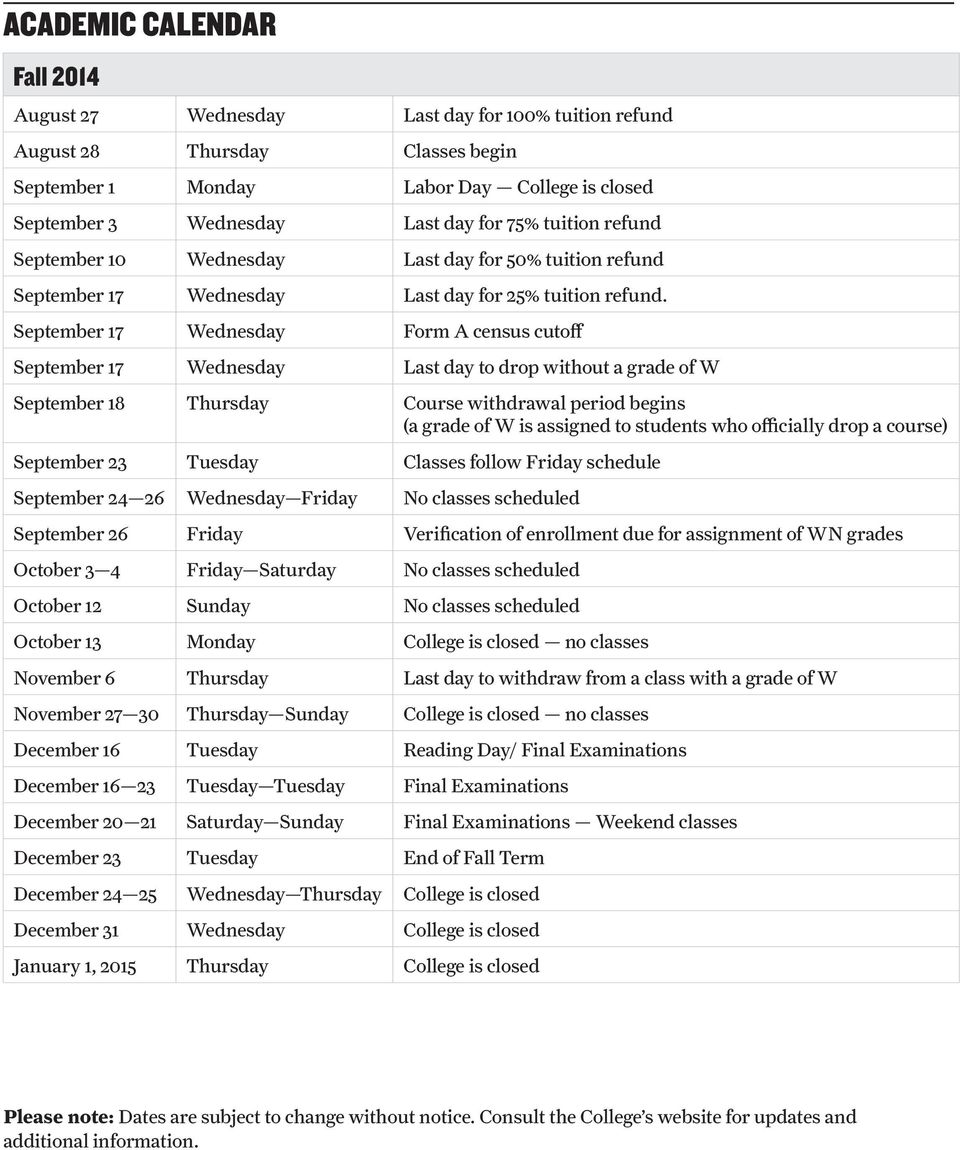
6 Academic CALendar Fall 2014 August 27 Wednesday Last day for 100% tuition refund August 28 Thursday Classes begin September 1 Monday Labor Day College is closed September 3 Wednesday Last day for 75% tuition refund September 10 Wednesday Last day for 50% tuition refund September 17 Wednesday Last day for 25% tuition refund. September 17 Wednesday Form A census cutoff September 17 Wednesday Last day to drop without a grade of W September 18 Thursday Course withdrawal period begins (a grade of W is assigned to students who officially drop a course) September 23 Tuesday Classes follow Friday schedule September Wednesday Friday No classes scheduled September 26 Friday Verification of enrollment due for assignment of WN grades October 3 4 Friday Saturday No classes scheduled October 12 Sunday No classes scheduled October 13 Monday College is closed no classes November 6 Thursday Last day to withdraw from a class with a grade of W November Thursday Sunday College is closed no classes December 16 Tuesday Reading Day/ Final Examinations December Tuesday Tuesday Final Examinations December Saturday Sunday Final Examinations Weekend classes December 23 Tuesday End of Fall Term December Wednesday Thursday College is closed December 31 Wednesday College is closed January 1, 2015 Thursday College is closed Please note: Dates are subject to change without notice. Consult the College s website for updates and additional information.
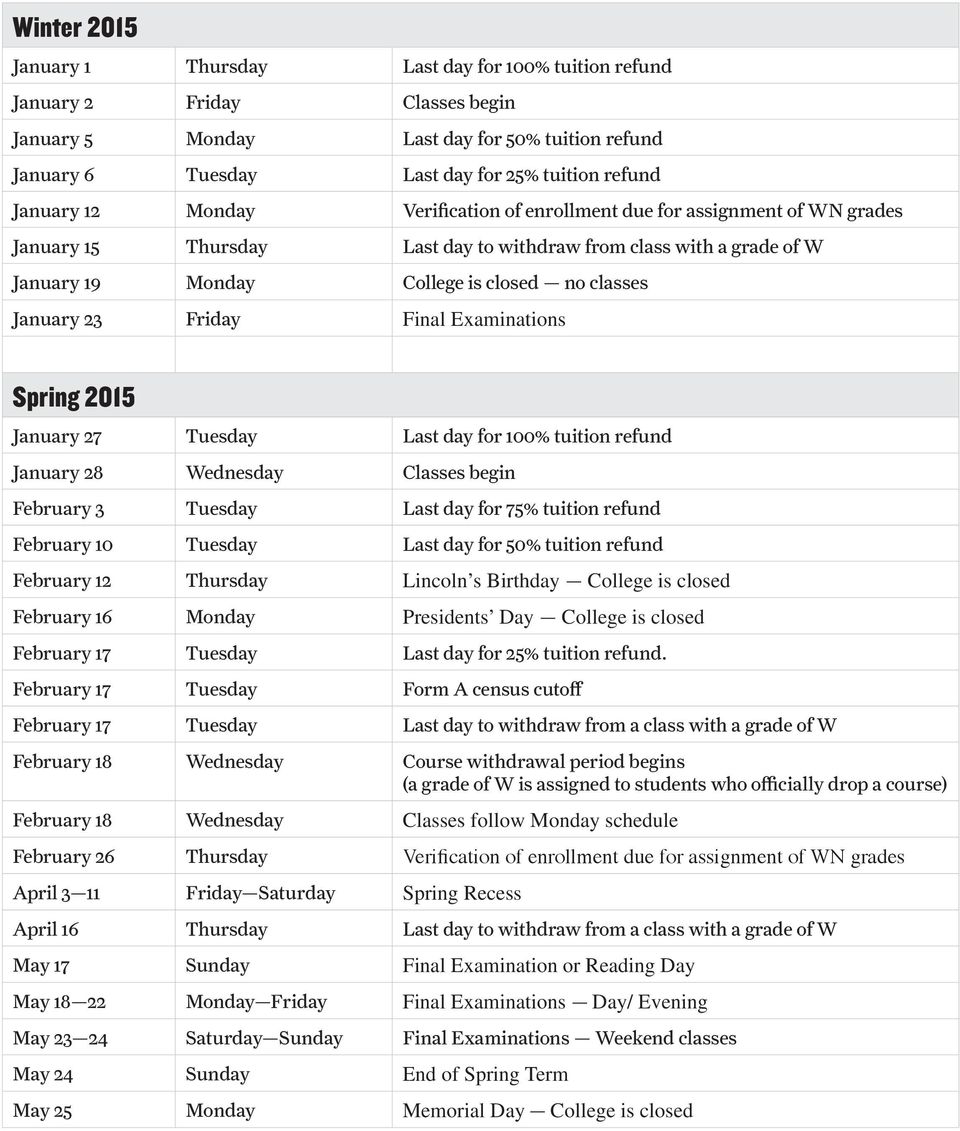
7 Winter 2015 January 1 Thursday Last day for 100% tuition refund January 2 Friday Classes begin January 5 Monday Last day for 50% tuition refund January 6 Tuesday Last day for 25% tuition refund January 12 Monday Verification of enrollment due for assignment of WN grades January 15 Thursday Last day to withdraw from class with a grade of W January 19 Monday College is closed no classes January 23 Friday Final Examinations Spring 2015 January 27 Tuesday Last day for 100% tuition refund January 28 Wednesday Classes begin February 3 Tuesday Last day for 75% tuition refund February 10 Tuesday Last day for 50% tuition refund February 12 Thursday Lincoln s Birthday College is closed February 16 Monday Presidents Day College is closed February 17 Tuesday Last day for 25% tuition refund. February 17 Tuesday Form A census cutoff February 17 Tuesday Last day to withdraw from a class with a grade of W February 18 Wednesday Course withdrawal period begins (a grade of W is assigned to students who officially drop a course) February 18 Wednesday Classes follow Monday schedule February 26 Thursday Verification of enrollment due for assignment of WN grades April 3 11 Friday Saturday Spring Recess April 16 Thursday Last day to withdraw from a class with a grade of W May 17 Sunday Final Examination or Reading Day May Monday Friday Final Examinations Day/ Evening May Saturday Sunday Final Examinations Weekend classes May 24 Sunday End of Spring Term May 25 Monday Memorial Day College is closed
8 About John Jay 6

9 Chapter 1 1. About John Jay John Jay College 7

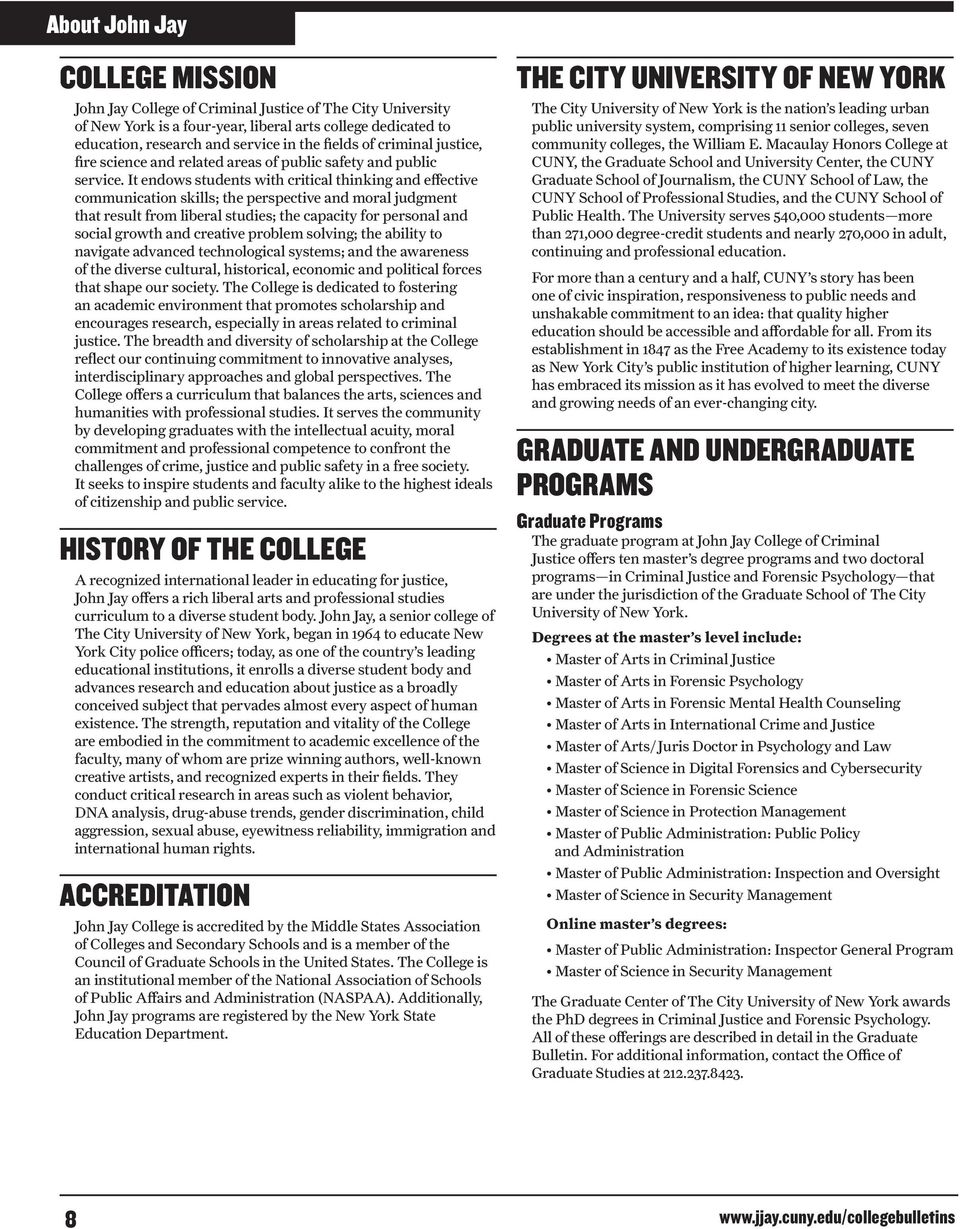
10 About John Jay CoLLege Mission John Jay College of Criminal Justice of The City University of New York is a four-year, liberal arts college dedicated to education, research and service in the fields of criminal justice, fire science and related areas of public safety and public service. It endows students with critical thinking and effective communication skills; the perspective and moral judgment that result from liberal studies; the capacity for personal and social growth and creative problem solving; the ability to navigate advanced technological systems; and the awareness of the diverse cultural, historical, economic and political forces that shape our society. The College is dedicated to fostering an academic environment that promotes scholarship and encourages research, especially in areas related to criminal justice. The breadth and diversity of scholarship at the College reflect our continuing commitment to innovative analyses, interdisciplinary approaches and global perspectives. The College offers a curriculum that balances the arts, sciences and humanities with professional studies. It serves the community by developing graduates with the intellectual acuity, moral commitment and professional competence to confront the challenges of crime, justice and public safety in a free society. It seeks to inspire students and faculty alike to the highest ideals of citizenship and public service. History of the CoLLege A recognized international leader in educating for justice, John Jay offers a rich liberal arts and professional studies curriculum to a diverse student body. John Jay, a senior college of The City University of New York, began in 1964 to educate New York City police officers; today, as one of the country s leading educational institutions, it enrolls a diverse student body and advances research and education about justice as a broadly conceived subject that pervades almost every aspect of human existence. The strength, reputation and vitality of the College are embodied in the commitment to academic excellence of the faculty, many of whom are prize winning authors, well-known creative artists, and recognized experts in their fields. They conduct critical research in areas such as violent behavior, DNA analysis, drug-abuse trends, gender discrimination, child aggression, sexual abuse, eyewitness reliability, immigration and international human rights. ACCrediTATion John Jay College is accredited by the Middle States Association of Colleges and Secondary Schools and is a member of the Council of Graduate Schools in the United States. The College is an institutional member of the National Association of Schools of Public Affairs and Administration (NASPAA). Additionally, John Jay programs are registered by the New York State Education Department. The City University of New York The City University of New York is the nation s leading urban public university system, comprising 11 senior colleges, seven community colleges, the William E. Macaulay Honors College at CUNY, the Graduate School and University Center, the CUNY Graduate School of Journalism, the CUNY School of Law, the CUNY School of Professional Studies, and the CUNY School of Public Health. The University serves 540,000 students more than 271,000 degree-credit students and nearly 270,000 in adult, continuing and professional education. For more than a century and a half, CUNY s story has been one of civic inspiration, responsiveness to public needs and unshakable commitment to an idea: that quality higher education should be accessible and affordable for all. From its establishment in 1847 as the Free Academy to its existence today as New York City s public institution of higher learning, CUNY has embraced its mission as it has evolved to meet the diverse and growing needs of an ever-changing city. GradUATe and UndergradUATe Programs Graduate Programs The graduate program at John Jay College of Criminal Justice offers ten master s degree programs and two doctoral programs in Criminal Justice and Forensic Psychology that are under the jurisdiction of the Graduate School of The City University of New York. Degrees at the master s level include: Master of Arts in Criminal Justice Master of Arts in Forensic Psychology Master of Arts in Forensic Mental Health Counseling Master of Arts in International Crime and Justice Master of Arts/Juris Doctor in Psychology and Law Master of Science in Digital Forensics and Cybersecurity Master of Science in Forensic Science Master of Science in Protection Management Master of Public Administration: Public Policy and Administration Master of Public Administration: Inspection and Oversight Master of Science in Security Management Online master s degrees: Master of Public Administration: Inspector General Program Master of Science in Security Management The Graduate Center of The City University of New York awards the PhD degrees in Criminal Justice and Forensic Psychology. All of these offerings are described in detail in the Graduate Bulletin. For additional information, contact the Office of Graduate Studies at
11 Chapter 1 Undergraduate Programs John Jay College of Criminal Justice offers baccalaureate degrees the bachelor of arts and the bachelor of science in the following majors: Anthropology Computer Information Systems in Criminal Justice and Public Administration Criminal Justice BA (Crime Control and Prevention) Criminal Justice BS (Institutional Theory and Practice) Criminal Justice Management Criminology Culture and Deviance Studies Economics English Fire and Emergency Service Fire Science Forensic Psychology Forensic Science Gender Studies Global History Humanities and Justice International Criminal Justice Law and Society Legal Studies (no longer admitting students) Philosophy Police Studies Political Science Public Administration Security Management Sociology In addition to its majors, the College offers a variety of programs that permit students to concentrate on particular aspects of a field of study, among which are Addiction Studies, Dispute Resolution, and Spanish-language certificate programs in Legal Interpretation, Legal Translation, and Legal Interpretation and Translation. Minors are available in over 33 areas of study. An extensive internship program combines classroom instruction with supervised practical experience in a variety of settings including government agencies and private organizations. AIG Technical Service; The Bank of New York; Federal Bureau of Investigation; Fire Department of the City of New York; Global Technical Solutions; Goldman Sachs; JP Morgan Chase; New York Stock Exchange; NYC Police Department; NYS Attorney General s Office; NYS Department of Environmental Conservation; NYS Department of Taxation and Finance; NYS Supreme Court; Smith Barney Citigroup; T-Mobile; UBS Investments; U.S. Army; U.S. Bureau of Alcohol, Tobacco, Firearms, and Explosives; U.S. Customs and Border Protection; U.S. Department of Homeland Security; U.S. Department of Justice; U.S. Department of the Treasury; U.S. Marshal s Service; U.S. Mint; Verizon; and Wyeth Ayerst Laboratories, The ResearCH Consortium of John Jay CoLLege A passion for learning and understanding defines the Research Consortium at John Jay College. The members of the consortium are committed to addressing the ongoing challenges that face the criminal justice community in its efforts to ensure public safety. The Research Consortium operates under the oversight of the college s Office for the Advancement of Research. The Research Consortium of John Jay College includes: Academy of Critical Incident Analysis Center for Crime Prevention and Control Center for Cybercrime Studies Center for International Human Rights Center on Media, Crime and Justice Center on Race, Crime and Justice Center on Terrorism Christian Regenhard Center for Emergency Response Studies Dispute Resolution Center Institute for Criminal Justice Ethics Prisoner Reentry Institute Research and Evaluation Center For more information about the centers and institutes, visit ALUmni ASSociATion Through special events, programs and mailings, the John Jay Alumni Association keeps graduates informed and involved in the services and activities of the College. Alumni cards certifying membership in the association provide access to valuable benefits and services on a personal and professional level. These benefits include: access to alumni networking events within and outside New York; use of career and professional development resources; a waiver of the JJC Graduate Studies application fee; physical access to campus buildings and facilities after graduation, including the Lloyd Sealy Library, Haaren Hall, the Fitness Center and the New Building; discounts at the College Bookstore; lectures on critical criminal justice and public policy issues; and receptions featuring leading area criminal justice officials. John Jay s Alumni Association is a veritable Who s Who of law enforcement and corporate security. The organizations in which our alumni are or have been employed include: The CUNY Justice Academy (CJA) links selected associate degree programs at six City University of New York (CUNY) community colleges to bachelor degree programs at John Jay College of Criminal Justice. CJA students receive dual admission to John Jay and one of the six participating community colleges. Eligible degree programs are in Criminal Justice, Economics, and Forensic Science., to name a few. For additional information, contact Alumni Relations at These offerings are described in detail in this Undergraduate Bulletin. For additional information, please contact the Office of Undergraduate Studies at John Jay College 9

12 About John Jay GerALd W. Lynch TheATer John Jay College offers its students a variety of opportunities for participation in theatre and play production, as well as access to nearby Lincoln Center and Broadway productions. A major departmental production is mounted each semester in the Gerald W. Lynch Theater, a state-of-the-art facility located in Haaren Hall. In addition to stage productions, performances of work often conceived and performed by students, and hosted by one or more clubs or college programs, are held each semester in alternative spaces at the College. The Department of Communication and Theatre Arts presents a vibrant theatre program that dates back to the earliest days of the College. Many productions involve criminal justice themes, and have included major plays in the repertoire of world drama ranging from Greek tragedy to plays by contemporary playwrights, including: Oedipus Rex, The Merchant of Venice, Marat Sade, The Bald Soprano, Short Eyes, Equus, For Colored Girls... and Crimes of the Heart. Kafka s The Trial and Sidney Kingsley s Detective Story were recognized by major New York critics, while more recently, The Crucible and Macbeth drew large, enthusiastic crowds and glowing accolades from students and the community alike. Musicals like Godspell, Brecht s Happy End, and Once Upon This Island have offered John Jay s multi-talented students the opportunity to showcase their acting skills, as well as their instrumental and vocal talents. Reflecting the interdisciplinary nature of the College, departmental productions generally involve close collaboration with student clubs, the John Jay Players (the student theatrical group) and Women s Studies. In recent years, departmental productions have been featured in the Kennedy Center American College Theatre Festival, main stage productions have won praise from festival adjudicators, and student actors and technicians have been invited to perform and attend workshops at regional Kennedy Center American College Theatre Festivals. For information on performances, students may contact the Department of Communication and Theatre Arts. Lloyd George SeALy Library Haaren Hall [email protected] Located in spacious quarters on the first two floors of Haaren Hall, the Lloyd George Sealy Library houses the foremost collection of criminal justice materials in the world. Boasting more than half a million books, periodicals, microforms, films and digital collections, the library integrates historical and contemporary materials to present a balanced view of the criminal justice field. John Jay and CUNY faculty and students, as well as scholars, practitioners and members of the legal community, come from all over the world use this library. The library s greatest strengths are in the areas of criminal justice, fire science, forensic psychology, forensic science, public administration, social sciences and related fields. Its extensive resources support the research needs of undergraduate and graduate students, faculty and criminal justice agency personnel. The library holds a number of unique special collections directly related to the mission of the College. Trial transcripts of the New York criminal courts dating from the 1890s to 1927 provide a rich source for the study of history, sociology and law, and an extensive collection of police department annual reports from all over the United States invites quantitative and comparative studies. There is also a significant body of material dealing with alcoholism and substance abuse. The library s extensive media collection, which includes many rare titles and contains approximately 10,000 DVDs and streaming videos, supports classroom instruction as well as research. More than 6 million volumes of books in 20 separate CUNY libraries supplement the library s print resources. The Lloyd George Sealy Library maintains its own website ( lib.jjay.cuny.edu), providing the entryway to its digital collections. These include more than 200 general and specialized databases; over 160,000 journals and newspapers, U.S. and foreign legal materials; more than 65,000 electronic books; an electronic reserve collection; and over 3,000 rare books, including the Fraud and Swindles Collection. Students can avail themselves of these resources from off campus utilizing the library s proxy server at any hour of the day or night. More than 100 networked computers, providing access to this material, the online catalog and the Internet, are located on the library s upper level, along with a classroom equipped for hands-on instruction in utilizing these digital resources. Personal and professional papers of individuals who have made significant contributions in fields of concern to the College Burton Turkus, Lewis Lawes, Flora Schreiber, Robert Martinson, Richard Dugsdale, James Fyfe, Marvin Frankel and Gary McGivern, to name a few as well as archives of social, political and investigative agencies, add to the prestige and scope of the collection. Special collections are available to researchers by appointment and online in our growing collection of digitized images and text. Specialized reference librarians are available to assist library users with research questions or with using the databases. Circulation and print reserve services are located at the entry level, along with a computer lab for word processing and other office functions; reference collections and administrative offices are on the upper level. The circulating collection, arranged in open stacks to encourage browsing, is housed on both levels. Student study areas are interspersed throughout the Lloyd George Sealy Library. ComPUTers and EdUCATionAL Technology Classroom Lab Support Services (CLSS) L NB [email protected] Classroom Lab Support Services (CLSS) (formerly known as Instructional Technology Support Services), a division of the Department of Information Technology (DoIT), leads the development and deployment of new educational technology and to provide the training required to effectively integrate technology into the instructional program.
13 Chapter 1 CLSS provides a multitude of outstanding services to assist John Jay College faculty, staff, and students to achieve their instructional technology development and productivity. Listed below is a brief description of each type of services. Professional Development and Training Services CLSS offers a variety of training sessions and events designed for different needs and users. Every semester, CLSS presents series of training sessions from hour long demonstrations to extensive, multiple day, classroom-based hands-on courses on a variety of computing topics for the faculty, staff, and students. To help you find the right type of training, these training sessions are listed under appropriately named categories such as 25 minute Tech Shot, Tech Bites, Workshops, Demonstrations, Announced Walk-In, Training Courses and others. To help you find training topics of interest regardless of categories, use our new All-In-One schedule. Computer Lab Services CLSS provides John Jay College students with access and support to well-maintained computers in our facilities (e.g. Student Computer Lab Center), as well as all Student Technology Fee funded Departmental Computer Labs, Cyber Cafe and Lounge areas, Mobile Computer Labs, the Laptop Loan Center and the new EZ Print Center and Stations. Classroom Technology Services (CTS) CLSS provides and maintains all the instructional technology within classrooms. Our excellent CTS staff is always ready to support the faculty and staff in achieving the optimal use of classroom technology for teaching or presentation. Consultation and Other Services CLSS offers personalized, one-on-one consultations to our faculty and staff scheduled at a mutually convenient time. Other services include Software Site Licensing and Distribution, Podcasting support, Website Development Support, itunes U Support, Blackboard Student Support and much more. Online Training Resources and FAQs CLSS produces multiple documents and training materials to facilitate professional development for online access at you own pace and time. Committed to providing a supplemental enhanced learning experience, CLSS has chosen an acclaimed professional web-based training site, MySkillSource. In addition to the above primary services, CLSS administers and coordinates the Student Technology Fee at John Jay College which entails the acquisition of proposed hardware and software to achieve successful approved project implementation. Information about upcoming events, services and workshops sponsored by CLSS is posted on the CLSS website and also on the College Calendar. Public SAFety Emergency Services Hotline The Office of Public Safety responds to emergencies, and security and safety problems. With the exception of the BMW Building and the 54th Street Academic Annex, the Public Safety desks are staffed at all times. The telephone numbers for the Public Safety desks are: Command Center: New Building (59th Street): New Building (11th Avenue): Haaren Hall (899 Tenth Avenue): North Hall (445 W. 59th Street): BMW Building (555 W. 57th Street, 6th Floor): Westport Building (500 W. 56th Street): th Street Academic Annex (619 W. 54th Street): Emergency Closing of THe CoLLege Notice of college closings due to serious snowstorms or other emergencies are posted on the John Jay College website. CUny ALERT The CUNY Alert system provides students, faculty, staff, and parents with alerts and information regarding campus emergencies such as severe weather situations, closings, or threats to personal safety through voice, text message, or . Individuals can sign up in person at the Department of Public Safety, room L2.61, or online at John Jay College 11
14 Academic Standards 12

15 Chapter 2 2. Academic Standards John Jay College 13
16 Academic Standards ACADEMIC STANDARDS STUDENT RESPONSIBILITIES Students are responsible for fulfilling all admission, program, degree and graduation requirements. Students are responsible for adhering to college deadlines, attendance dates, and rules and regulations published in this graduate bulletin. Students are also responsible for knowing and abiding by the college regulations that appear in other official publications and those posted on the bulletin board of the Office of the Registrar. CHANGE OF ADDRESS Students must notify the Registrar of any change of address by filing an official Change of Address form available online via the Jay Stop website ( Failure to submit this form may result in the loss or delay in delivery of important correspondence. ENFORCEMENT AND APPEAL The Registrar is responsible for enforcing all academic rules. Appeals from enforcement of rules and regulations should be addressed to the Dean of Graduate Studies. GENERAL REGULATIONS CREDIT LOAD Full-time graduate students normally register for 12 credits per semester; part-time students normally take 6 credits per semester. Students employed full-time are advised to limit themselves to no more than 6 credits per semester. Students matriculated-with-conditions are expected to take 6 credits per semester. In exceptional circumstances, students may exceed or fall short of these limits with the permission of a graduate program director or the Dean of Graduate Studies. No student may register for more than 60 graduate credits during their graduate course of study at John Jay without the approval of the Dean of Graduate Studies and the Vice President for Enrollment Management, and then may only register for courses needed for graduation. In addition, no student may register for more than 15 credits in a given semester without the approval of the Dean of Graduate Studies. TIME LIMIT All master s degree requirements in a specific program must be completed within eight years of the date of entrance into that program. A student may refrain from matriculating for no more than four semesters within this eight-year period. Any exceptions to this rule must be based on very compelling extenuating circumstances and must be approved by the Dean of Graduate Studies or the Vice President for Enrollment Management. CLASS ATTENDANCE Class attendance and participation are factors in assessing student performance. Faculty will advise students at the beginning of the semester of attendance requirements. READMISSION A student in good standing (i.e., with a GPA above 3.0), who has not registered for one or more semesters is required to file an application for readmission. This application is available from the Jay Stop website ( A readmission fee of $10 will be billed along with tuition and fees upon the first fall or spring semester when the student is accepted for readmission. Readmitted students may be subject to changes in curricular requirements instituted since their last term of attendance. Students who left the College with a GPA below 3.0 may apply for reinstatement, but are not assured of acceptance. MAINTENANCE OF MATRICULATION Students must register for courses (i.e., maintain matriculation status), in the semester in which they file for and obtain their degree. Students not taking courses should register to maintain matriculation (MAM 791) in order to remain on the active rolls of John Jay. Students who have not maintained active status for one semester or more must apply for readmission. In order to comply with CUNY Board of Trustees reporting and funding requirements, all maintenance of matriculation fees must be received by the end of the second week of classes. ACADEMIC INTEGRITY Note: The information that follows is excerpted from the CUNY Policy on Academic Integrity. For the complete text of the CUNY Policy on Academic Integrity, see Chapter 13, Policies, Rules and Regulations. DEFINITIONS AND EXAMPLES OF ACADEMIC DISHONESTY Cheating is the unauthorized use or attempted use of material, in- formation, notes, study aids, devices or communication during an academic exercise. The following are some examples of cheating, but by no means is it an exhaustive list: Copying from another student during an examination or allowing another to copy your work. Unauthorized collaboration on a take-home assignment or examination. Using notes during a closed book examination. Taking an examination for another student, or asking or allowing another student to take an examination for you. Changing a graded exam and returning it for more credit. Submitting substantial portions of the same paper to more than one course without consulting with each instructor. Preparing answers or writing notes in a blue book (exam booklet) before an examination. Allowing others to research and write assigned papers or do assigned projects, including use of commercial term paper services. Giving assistance to acts of academic misconduct/dishonesty. Fabricating data (all or in part). Submitting someone else s work as your own. Unauthorized use during an examination of any electronic devices such as cell phones, palm pilots, computers or other technologies to retrieve or send information. 14
17 Chapter 2 Plagiarism is the act of presenting another person s ideas, research or writings as your own. The following are some examples of plagiarism, but by no means is it an exhaustive list: Copying another person s actual words without the use of quotation marks and footnotes attributing the words to their source. Presenting another person s ideas or theories in your own words without acknowledging the source. Using information that is not common knowledge without acknowledging the source. Failing to acknowledge collaborators on homework and laboratory assignments. INTERNET PLAGIARISM It includes submitting downloaded term papers or part of term papers, paraphrasing or copying information from the Internet without citing the source, and cutting and pasting from various sources without proper attribution. OBTAINING UNFAIR ADVANTAGE It is any activity that intentionally or unintentionally gives a student an unfair advantage in his/her academic work over another student. The following are some examples of obtaining an unfair advantage, but by no means is it an exhaustive list: Stealing, reproducing, circulating or otherwise gaining advance access to examination materials. depriving other students of access to library materials, by stealing, destroying, defacing, or concealing them. Retaining, using or circulating examination materials, which clearly indicate that they should be returned at the end of the exam. Intentionally obstructing or interfering with another student s work. FALSIFICATION OF RECORDS AND OFFICIAL DOCUMENTS The following are some examples of falsification, but by no means is it an exhaustive list: Forging signatures of authorization. Falsifying information on an official academic record. Falsifying information on an official document such as a grade report, letter of permission, drop/add form, ID card or other college document. Grades Grade Explanation Index Value A Excellent 4.0 A 3.7 B+ 3.3 B Good 3.0 B 2.7 C+ 2.3 C Unsatisfactory 2.0 C 1.7 F Failure 0.0 P Pass - INC Incomplete - Please note that no grade can be eliminated from a grade point average by retaking a course. Grade of F An F grade is used for students who have been doing unsatisfactory work and who resign from a course after the tenth week of the semester. (For the exact date in any given semester, please see Last Day to Resign without Academic Penalty in the Academic Calendar on the John Jay website: This grade may also be awarded for excessive absences, or for very unsatisfactory work, or for student withdrawal without official approval. The grade of F on the graduate level cannot be eliminated by retaking the course and remains permanently a part of the student s grade point average. If the F grade was received for a required course, the student must retake the course. Grade of INC (Incomplete) A grade of INC is given in lieu of a grade only in exceptional circumstances for students who have been doing satisfactory work and have been unable to complete course requirements. Students who receive an Incomplete must fulfill their academic obligation within one calendar year of the end of the semester in which the grade of Incomplete is given. In extraordinary circumstances and with the approval of the Dean of Graduate Studies or the Vice President for Enrollment Management, the time limit may be extended one additional year. Incompletes unresolved in the above-mentioned time period become permanent entries in students records as an Incomplete (nocredit) and may not be changed thereafter. A maximum of three grades of Incomplete may be converted to regular grades during the course of a student s enrollment in graduate studies at John Jay College. In rare circumstances, more than three grades of Incomplete may be converted to regular grades with the approval of the Dean of Graduate Studies or the Vice President for Enrollment Management. John Jay College 15

18 Academic Standards 16 Incomplete grades that are not resolved within the abovementioned time period become permanent Incompletes. Such grades will not be counted in the student grade point average. No credit is awarded for Incompletes that have not been appropriately resolved. Grade of W (Withdrawal) This grade indicates withdrawal with permission of the Registrar while students are doing satisfactory work. Normally this can be done only through the tenth week of the semester. This withdrawal is without academic prejudice. Graduate students who receive loans or other forms of federal financial assistance should check with the Financial Aid Office before withdrawing from courses. Grade of WN (Withdrawal Did Not Attend) This grade is calculated the same as a W grade and is assigned by the instructor when the instructor has no record of the student attending the course for the semester. Grade of WU (Withdrew Unofficially) The grade of WU is assigned by the instructor when a student has ceased attending class and has not submitted an Application for Resignation. The grade is computed as a failure (0.0) in the grade point average (GPA), which may result in the adjustment of financial aid funds. Students who want to withdraw from a class are therefore advised to submit an official Application for Resignation online via Jay Stop ( prior to the end of the tenth week of classes. Pass/Fail Option Graduate students taking undergraduate courses to meet conditions of matriculation, such as STA 250 or PSY 311, may take them on a Pass/Fail basis. Application for the Pass/Fail Option for a class must be made at the Office of the Registrar before the conclusion of the second week of classes or before the end of the first week of classes in summer session. Once granted, this option is irrevocable. Grades received for a Pass/ Fail Option are not computed in the grade point average. GRADE POINT AVERAGE The grade point average (GPA) is computed by multiplying the index (numerical) value of grades A, A, B+, B, B, C+, C and F (see GRADES table at the beginning of this section) with the number of credits of each course, which yields the number of quality points. The number of quality points is then divided by the total number of accumulated credits to yield the GPA. GRADUATE DEAN S LIST In order to qualify for the Graduate Dean s List a graduate student must have completed 12 credits earned during one academic year, and maintained a 3.70 grade point average. For example, to be on the Dean s List in Fall 2013, coursework had to have been completed in Summer 2012, Fall 2012 and/or Spring Eligibility is coordinated through the offices of the Dean of Graduate Studies, the Vice President for Student Development and the Vice President for Enrollment Management. Graduate students placed on the Dean s List will have an appropriate notation made on their Permanent Record in the Office of the Registrar. DISMISSAL AND PROBATION Graduate students must maintain a 3.0 average. All student transcripts are reviewed after the end of each semester. A student whose grade point average falls below 3.0 is subject to probation or dismissal. Those placed on probation should discuss their standing with their program director or the Dean of Graduate Studies. Note: BA/MA students must maintain a 3.5 average to remain in the program. A student whose grade point average falls below 3.5 is subject to removal from the program. CHANGE OF FINAL GRADE Application for a change of grade assigned by a member of the faculty may be made at any time within one year from the end of the semester in which the course was taken. This request may be made by either the student or the instructor. The procedures outlined below apply to the change of grades of A, A, B+, B, B, C+, C, C and F. APPLICATION FOR CHANGE OF FINAL GRADE To appeal a final grade, a student should first meet with the faculty member to discuss the final grade. If the instructor agrees that the grade should be changed, the instructor can make the change on the appropriate forms provided by the Registrar s Office. These forms must then be countersigned by the Dean of Graduate Studies and returned to the Registrar s Office for entry on the student s record. APPEAL FOR CHANGE OF FINAL GRADE If, after consultations with the faculty member, the final grade is reaffirmed, a student who questions the grade should consult his or her program director. If this does not resolve matters, students have a right to appeal to the Dean of Graduate Studies, who will appoint a three-member subcommittee of the Committee on Graduate Studies to hear the appeal. The appeal should include a letter giving specific reasons for the request for change of grade, the course syllabus, all graded course materials and any supporting documentation, such as the midterm and research papers. It is the responsibility of the student to provide sufficient copies of the appeal, as requested, 14 days prior to the scheduled hearing date. The appeal application will be considered only if all documents required for a grade appeal are submitted with the appeal application. Incomplete applications will not be considered by the Grade Appeal Committee. Appeals submitted by the student more than one year after the final grade is submitted to the Registrar s Office will not be considered by the Grade Appeal Committee. The faculty member will be notified of the appeal and will be requested to respond in writing to the Committee on Graduate Studies. The student and faculty member have the right to make a brief presentation before the subcommittee. The decision of the subcommittee is final and will be communicated in writing by the Dean of Graduate Studies to the student, the faculty member, the Vice President for Enrollment Management and the subcommittee.
19 Chapter 2 RETENTION STANDARDS Students must maintain an overall average of B or better in their courses. If they fail to maintain a cumulative scholastic index of 3.0, they may be dismissed. If, after completing 12 credits, matriculants-with-conditions achieve an overall average of B or better and have met all other admissions requirements, they become matriculants and are considered degree candidates. GRADUATION Requirements Candidates for graduation must have all degree requirements completed by the end of the semester in which they plan to graduate. An Incomplete grade in a course will result in removal from the list of graduates. Students will also be barred from graduation if they have outstanding Lloyd George Sealy Library or CUNY Interlibrary fines. Application An Application for Graduate Degree must be filed online on the Jay Stop website according to the date listed in the Academic Calendar. COMMENCEMENT Participation in the annual spring commencement ceremony is accorded to students who have been awarded the master s degree the previous August or February and students who are certified by the Registrar s Office to complete their degree requirements by the end of that spring semester. Students planning to complete their degree requirements at the end of the summer session may participate in the annual commencement ceremony provided they have submitted an application for graduation by the deadline date, have two courses or fewer left to complete their degree (certified by the Registrar s Office) and are currently registered for those courses in the summer session. John Jay College 17
20 General Requirements 18

21 Chapter 3 3. General Requirements John Jay College 19
22 General Requirements GENERAL REQUIREMENTS A student is required to maintain a B average (GPA of 3.0) for graduation. All credits and other degree requirements must be completed within eight years. For the number of credits and specific requirements, refer to the relevant program description. COURSE SUBSTITUTUIONS Graduate students may request a course substitution by receiving approval from their program director AND approval from the program director of the program offering the course. For specific questions about your thesis and qualifying exams, see your program director. Steps to Completing a Thesis To complete the thesis requirement, students must adhere to the following policies in addition to the specific requirements for the thesis established by their graduate programs and stated in the Program Specific Requirements section below. The following policies apply to all graduate students. All students must complete the thesis within one year of completing all other program degree requirements. Only in exceptional circumstances may the student request an extension by written petition to the faculty advisor, program director and dean. If the request is approved, the student will be granted a limited time period to complete the thesis. After the program director has approved the thesis, a passing grade (P) will be posted. The student must submit two copies of the thesis (on bond paper) to the library for binding. The student must submit the following to the Registrar s Office: 1) the original and one copy of the thesis approval page; 2) a receipt from the library that indicates that the thesis was submitted, and 3) a receipt from the bursar for the binding fee. Thesis Program Forensic Science Criminal Justice Digital Forensics and Cybersecurity Forensic Mental Health Counseling Forensic Psychology MA/JD Forensic Psychology and Law International Crime and Justice Security Management AVAILABILITy Required Optional Optional Optional Optional Optional Optional Optional Program Specific Requirements Criminal Justice Students who complete CRJ 715 and 716 with an A- or better may choose to write a thesis instead of taking four elective courses. Students choosing the thesis option must first take CRJ 717 Reading in Research and receive an A- or better. Students must obtain permission from the program director to pursue the thesis option after completing CRJ 717. If permission is granted, they must take CRJ 791 Thesis Prospectus as an Independent Study with their thesis advisor who must be a member of the graduate faculty. Finally, students must submit a thesis approved by their advisor and a second reader within no more than one year after completing CRJ 791. Students choosing the thesis option will complete a total of 30 credits for the master s degree, six fewer credits than those students who take the comprehensive exam. However, writing a thesis is a substantial undertaking usually requiring more work than that required by two additional courses. Digital Forensics and Cyber Security (D4CS) The D4CS thesis option is suited for superior students who seek the challenge of traditional scholarly research. Thesis research requires the sponsorship of a D4CS full-time faculty member who agrees to serve as the thesis adviser. Students unable to gain an adviser can do an Applied Research Project or fieldwork for their capstone experience. When a student gains faculty sponsorship, the adviser notifies the program director who will approve registration for FCM 791, Prospectus Seminar. The college s general thesis guidelines apply with the additional provisions that a D4CS thesis may follow IEEE citation guidelines, a digital copy of the approved thesis must be submitted to the program director, and the thesis committee may require an oral defense. Completion of a thesis makes a student eligible to graduate with a 33 credit program of study. Forensic Science All students are required to write a thesis. To complete the thesis students must register for and pass the three semester prospectus seminar FOS During the course of this seminar series, students must identify a full time science graduate faculty member as a research mentor and thesis advisor, receive approval of the thesis topic from the thesis advisor and the prospectus instructor, and complete a prospectus. Students are encouraged to select a thesis advisor within their first year in the program and are allowed to start their thesis project immediately after approval of their topic. International Crime and Justice The thesis track is available only to those students who received a grade of A or A- in Research Methods in International Crime and Justice (ICJ715) and Using Computers in Social Research (CRJ716) and have maintained a 3.5 GPA. Pursuit of the thesis track also requires the permission of the program director. The thesis track consists of completion of ICJ791 (Thesis 1) and ICJ792 (Thesis II) in sequence, for a total of six credits. These courses are taught one-on-one with the student s faculty advisor. Students may not register for ICJ791 (Thesis I) until a faculty advisor has been identified. Course descriptions for ICJ791 and ICJ792 can be found in the bulletin. Security Management The thesis option is only available to students with a GPA of 3.5 or higher with the permission of the program director. 20
23 Chapter 4 4. Degrees Offered John Jay College 21
24 Degrees Offered MASTER OF ARTS IN CRIMINAL JUSTICE Program Director: Professor Avram Bornstein The John Jay Criminal Justice Master of Arts Program has a large, diverse, and celebrated faculty who provide students with an advanced understanding of research and practice in the US criminal justice system and related issues. Core classes provide a mastery of the major works and theories of criminology, policing, corrections, judicial studies, quantitative research methods and policy analysis. Students are able to select from numerous electives to build a specialization in areas such as Criminology & Deviance, Criminal Law & Procedure, Police or Corrections Administration. Among the many available electives are courses such as Crime Mapping, Cyber-crime, Crime Scene Investigation, Drug & Alcohol Abuse, Homeland Security & Terrorism, and Criminal Law. Students are also able to select electives to earn Advanced Certificates in Terrorism Studies or Crime Prevention and Analysis. The Program also allows interested students to participate in faculty research or undertake internships with criminal justice employers for credit. The program is designed for: Those who wish to obtain a credential for entry into criminal justice professions. Those already employed in the criminal justice system, who wish to learn about job-related research and further their criminal justice careers. Those employed in the criminal justice system, who want to teach. Those interested in an academic career in higher education, who wish to obtain a master s degree before entering a doctoral program. For information on the Doctoral Program in Criminal Justice, please reference the doctoral programs section of this bulletin. DEGREE REQUIREMENTS The Master of Arts in Criminal Justice requires 36 credits consisting of five required core courses, three courses in a specialization, and four elective courses. Students must also pass a comprehensive examination. Students meeting certain conditions may complete the degree in 30 credits plus a thesis. CORE REQUIREMENTS Subtotal: 15 CRJ 710 Issues in Criminal Justice I: Theory and Courts CRJ 711 Issues in Criminal Justice II: Policing and Corrections CRJ 715 Research Design and Methods CRJ 716 Using Computers in Social Research Comprehensive Exam* CRJ 730 Policy Analysis in Criminal Justice *The Comprehensive Exam must be taken after completing the first four required core classes (CRJ 710, 711, 715, & 716) and before completing 24 credits of coursework. All students must pass the comprehensive exam before entering the final required core class, CRJ 730. SPECIALIZATIONS Subtotal: 9 Students must take three classes (9 credits) in one of five specialization areas listed. The specialization lists provided are not intended to be exhaustive. The program director has discretion to substitute other courses, including courses in the 800-level series, to satisfy the specialization requirement. Students should consult with the program director before taking a course for specialization credit when that course is not on the specialization list. Dual specializations are permissible if the student has fulfilled the requirements of both specializations, but the same electives may not be used for two specializations. FREE ELECTIVES Subtotal: 12 Students must take four additional classes from any of the graduate courses offered at John Jay. Students may choose to take CRJ 793 Comprehensive Review as one of their electives to help prepare for the exam. Students choosing the thesis option do not need to meet the electives requirement (see below). Thesis Option Subtotal: 6 Students who complete CRJ 715 and 716 with an A- average or better may choose to write a thesis instead of taking four elective courses. Students choosing the thesis option must first take CRJ 717 Reading in Research and receive an A- or better. Students must obtain permission from the program director to pursue the thesis option after completing CRJ 717. If permission is granted, they must take CRJ 791 Thesis Prospectus as an Independent Study with their thesis advisor who must be a member of the graduate faculty. Finally, students must submit a thesis approved by their advisor and a second reader within no more than one year after completing CRJ 791. Students choosing the thesis option will complete a total of 30 credits for the master s degree, six fewer credits than those students who take the comprehensive exam. However, writing a thesis is a substantial undertaking usually requiring more work than that required by two additional courses. 22
25 Chapter 4 DEGREE REQUIREMENTS CRJ SPECIALIZATIONS CRIMINOLOGY AND DEVIANCE CRJ 701 The Sociology of Crime CRJ 712 Sex Crimes CRJ 713 White-Collar Crime CRJ 714 Social Aspects of Alcohol and Drug Use CRJ 727 Cybercriminology CRJ 729 Drugs, Crime, and the Criminal Justice System CRJ 738 Perspectives on Race and Crime in America CRJ 761 Youth Crime and Delinquency Control CRJ 765 Social Movements, Revolution and Terrorism CRJ 766 Sociology of Delinquency CRJ 767 Gangs and the Community CRJ 769 Deviant Behavior CRJ 770 Advanced Criminology CRJ 771 Problems in Criminal Justice CRJ 778 Victimology CRJ 779 The Female Offender in Western Society CRJ 783 Crime and the Media CRJ 784 Organized and Transnational Crime CRJ 796 History of Crime CRIMINAL LAW AND PROCEDURE CRJ 708 Law, Evidence and Ethics CRJ 725 Capital Punishment CRJ 732 United States Constitutional Law CRJ 733 The Constitution and Criminal Justice CRJ 734 Criminal Law CRJ 735 Prosecuting Crime CRJ 736 Seminar in Civil Rights and Civil Liberties CRJ 752 The Law and High Technology Crime CRJ 768 Law and Society CRJ 785 The American Jury PAD 741 Administrative Law and Regulation PAD 760 Court Administration POLICE ADMINISTRATION CRJ 738 Perspectives on Race and Crime in America CRJ 739 Crime Mapping CRJ 742 Police Ethics CRJ 745 Legal Aspects of Undercover Activity CRJ 751 Crime Scene Investigation CRJ 756 Problems in Police Administration CRJ 757 The Police and the Community CRJ 759 Comparative Police Administration John Jay College 23
26 Degrees Offered DEGREE REQUIREMENTS CRJ 760 History of Police Administration CRJ 761 Youth Crime and Delinquency Control CRJ 762 Investigating Violent Crime CRJ 771 Problems in Criminal Justice CRJ 783 Crime and the Media CRJ 786 Problem-Oriented Policing CRJ 787 Seminar in Crime Analysis and Crime Prevention CORRECTION Administration CRJ 703 Advanced Penology CRJ 704 Probation and Parole: Theory and Practice CRJ 728 Problems in Contemporary Corrections CRJ 749 Punishment and Responsibility CRJ 758 Public Health Challenges in Criminal Justice: An Epidemiological Approach TERRORISM STUDIES CRJ 744 Terrorism and Politics CRJ 746 Terrorism and Apocalyptic Violence CRJ 748 Counter-Terrorism Policy for Law Enforcement CRJ 765 Social Movements, Revolution, and Terrorism CRJ 772 Seminar in Terrorism Studies CRJ 797 Homeland Security and International Relations CRJ 798 Homeland Security and Terrorism ToTAL Credits:
27 Chapter 4 Course Descriptions Sociology of Crime CRJ 701 OFFERED FALL SEMESTER Analyzes the social origins of criminal behavior and the impact of crime on society. Examines the various categories of deviant, delinquent and criminal behaviors, and explores attempts to control such behavior socially and legally. Focuses on connections between social institutions, social problems and illegal activities, and the response of the public to the threat of crime. Advanced Penology CRJ 703 OFFERED SPRING SEMESTER Looks at the development of ideologies pertaining to the punishment of offenders. Explores the rationales for imprisonment, including deterrence, retribution, incapacitation and rehabilitation. Delves into alternatives to incarceration and evaluates recommendations for penal reform. Prerequisite(s): An undergraduate course in both criminology and penology, or permission of the instructor. Probation and PAROLE: Theory and Practice CRJ 704 OFFERED SPRING SEMESTER Examines the rationales for and the methods of supervising convicted offenders within communities. Considers problems arising in pre-sentence investigations, case-load assignments, providing support services and facilities, revocation hearings, predicting future behavior and coordinating with other social control agencies. Prerequisite(s):An undergraduate course in criminology, or permission of the instructor. Law, Evidence and Ethics CRJ 708 Examines the rules of evidence followed in criminal investigations, criminal trials and administrative proceedings. Pays special attention to the methods and ethical obligations of government agents assigned to gather evidence. Issues in Criminal Justice I: Theory and Courts CRJ 710 Begins an overview of the operations and problems of the criminal justice system. Examines crime statistics, the causes of crime and other issues of concern to criminologists. Highlights the role of the courts and the legal constraints derived from the Constitution on arrest, prosecution and conviction. Issues in Criminal Justice II: Policing and Corrections CRJ 711 Continues the overview of the criminal justice system. Focuses on the police and other law enforcement agencies and the process of arrest. Explores issues in corrections, especially imprisonment and alternatives to incarceration, including probation and parole. Sex Crimes CRJ 712 OFFERED SPRING SEMESTER Develops a sociological and legal understanding of sex crimes. Addresses the theoretical explanations for sexual offending and the policies mandating treatment for offenders living in the community. Analyzes legislation related to sex offenders and the constitutional legitimacy of this legislation. Examines the difficulty in balancing the rights of the offenders and rights of the community, as well as what forms of community protection are viable for these offenders. White-Collar Crime CRJ 713 OFFERED FALL SEMESTER Employs both the social science and legal approaches to examine crime committed by corporations as well as by individuals who wear white collars; covers how such crimes are socially defined, who commits them, who is victimized by them, which social contexts promote them and how society responds to them. Social ASPECTS of Alcohol and Drug Use CRJ 714 OFFERED SPRING SEMESTER Explores the social dynamics of alcohol, narcotics, and other types of drug use and abuse. Examines research into the causes, epidemiology, and effects of use and abuse. Surveys the laws controlling psychoactive substances and the strategies designed to discourage experimentation, recreational use and addiction. Investigates the effectiveness of current prevention and treatment programs. Research Design and Methods CRJ 715 Presents the nature of the research process and guidelines for formulating research questions and testable hypotheses. Reviews the methods of operationalizing variables and indicators and collecting data, including designing experiments and carrying out surveys. Explains data analysis strategies leading to a written report. Prerequisite(s): An undergraduate course in statistics, or its equivalent with permission of the program director. Substitution: PAD 715 with permission of the program director. John Jay College 25
28 Degrees Offered Using Computers in Social Research CRJ 716 Introduces the use of software programs to search for relationships and patterns in data sets, and to calculate the statistics needed to draw interpretations and conclusions in research reports. Prerequisite(s): CRJ 715 (Research Design and Methods) or ICJ 715 (for MA in International Crime and Justice students). Readings in Research CRJ 717 Furnishes opportunities to critically examine recent articles in criminal justice journals and to examine trends in research approaches. Provides prac:ticc in understanding. analyzing. and questioning rtsearch designs. Interpretations of data. findings. and recommendations reported in the literature of the field. Prerequisite: Criminal Justice 715: Research Design and Methods. CAPITAL Punishment CRJ 725 OFFERED SPRING SEMESTER Examines the controversies surrounding capital punishment from two different interdisciplinary perspectives. Explores major issues and areas of concern that are theoretical, philosophical and empirical. Reviews the pros and cons of executing offenders and re-creates the contemporary public debate for the benefit of students. Cybercriminology CRJ 727/FCM 727 OFFERED FALL SEMESTER An exploration of the links between computers, deviance and social control. This will include analysis of the technological, social and geo-political context from which cybercrime and information warfare have emerged, and the nature, extent and causes of digital deviance such as hacking and cyber-terrorism. Societal and political reactions to cybercrime are considered, as are social policy questions of privacy and freedom on the Internet. Problems in Contemporary Corrections CRJ 728 OFFERED SPRING SEMESTER Analyzes selected problems currently confronting corrections professionals in both institutional and community settings. Considers issues such as overcrowding, excessive costs, ineffective programs, corruption, brutality, escapes, inmate violence and uprisings, and correction officer professionalism. Drugs, Crime and the Criminal Justice SySTEm CRJ 729 Focuses on the nature and scope of the relationship between drugs (including alcohol) and crime and violence, and the effect of drug legislation on the criminal justice system. Examines literature on the drugs-crime relationship and explores various approaches to collecting data. Policy Analysis in Criminal Justice CRJ 730 Offers an introduction to policy analysis and criminal justice planning. Explains how to assess proposals intended to solve problems encountered in policing, adjudication and corrections. Prerequisite(s): CRJ 710, 711, 715, 716 and the CRJ Comprehensive Exam. VIOLENCE ACROSS THE GLOBE CRJ HOURS PLUS CONFERENCES, 3 CREDITS This course examines selected cases of large scale violence across the globe, as well as a number of social science perspectives from which to describe and analyze these humanmade tragedies. The class begins with a brief overview of global weaponization to understand the material basis and widespread possibilities for armed violence. The class first considers a political/diplomatic history of violence which is the most longstanding perspective in journalism and government discourse. The class then learns to theorize the organizational components that may facilitate or prevent armed violence, from street crimes to genocide. Next, the class learns to theorize economic and political forms of structural violence, how they destroy environmental and communal infrastructures and how they are intertwined with armed violence. Finally, the class examines psycho-cultural theories of violence, and how ethnographers describe locally meaningful categories (forms of gender, race or ethnicity) that often determine who is terrorized, when, where and how. All illustrating examinations focus on locations outside the United States and may include case studies of former Yugoslavia, Israel, Colombia, Somalia, and Pakistan. The Constitution and Criminal Justice CRJ 733 OFFERED SPRING SEMESTER Provides an intensive review of recent landmark Supreme Court decisions that interpret Constitutional guarantees and limit government actions. Examines problems of reconciling individual rights with societal concerns about safety and crime prevention. 26
29 Chapter 4 Criminal Law CRJ 734 OFFERED FALL SEMESTER Considers selected issues in substantive criminal law, including the bases of culpability, burdens of proof, evidentiary standards, rationales for punishment and defenses such as justification, insanity and duress. Prosecuting Crime CRJ 735 OFFERED FALL SEMESTER Explores issues involved in prosecutorial decision making, including prosecutorial decision making in charging, plea bargaining and sentencing. Explains the role and function of the prosecutor in the criminal justice process and considers controversies surrounding the American prosecutor s broad discretion. This course compares the American prosecutorial practice to that of some other countries. Seminar in Civil Rights and Civil Liberties CRJ 736 OFFERED SPRING SEMESTER Analyzes the conflicting group interests that arise around issues such as freedom of speech and assembly, church-state relations and equal treatment before the law for members of minority groups. Perspectives on Race and Crime in America CRJ 738 OFFERED FALL SEMESTER Examines the controversies between race and crime in America, now and in the past. Discusses the competing definitions of race, crime and violence. Investigates the legacy of slavery and the impact of restrictive immigration laws. Crime Mapping CRJ 739 OFFERED SPRING SEMESTER Explores the theory and practice of crime mapping. Demonstrates how mapping of crime patterns can assist in the explanation of crime. Illustrates how this understanding is vital for designing and implementing effective programs of crime prevention, problem solving and community policing. Discusses the major theories of criminal events, which are crucial for interpreting crime patterns. Introduces state-of-the-art mapping techniques and provides experience in the use of mapping software. Prerequisite(s): CRJ 716. An Economic Analysis of Crime CRJ HOURS PLUS CONVERENCES, 3 CREDITS Explores economic concerns such as rational choices, costs vs. benefits, markets, and levels of activity, equilibrium, and efficiency. Emphasizes the financial aspects of organized criminal activities such as gambling, loan sharking, narcotics trafficking, and labor racketeering, and explores the fiscal implications of plans to decriminalize and legalize black market goods and services. Police Ethics CRJ HOURS PLUS CONVERENCES, 3 CREDITS An examination of key moral problems arising in police work, particularly those involving deception, the use of force, the acceptance of gratuities, whistleblowing, industrial action, and the implementation of affirmative action policies. Other topics will be considered. Terrorism and Politics CRJ 744 OFFERED FALL SEMESTER Discusses the history of terrorism, especially since the French Revolution; its evolving definition and how it relates to state violence; and its protean contemporary forms. Examines topics including the attacks on the World Trade Center, Middle Eastern terrorism from the Palestinian Hamas movement and Israeli religious violence, to state terrorism in countries such as Iraq; right-wing terrorism in this country (Oklahoma City); the case of Shoko Asahara s fanatical Japanese group, Aum Shinrikyo; and the specific threat of terrorists using weapons of mass destruction. Develops a global perspective in raising comparative questions about terrorism. Legal ASPECTS of Undercover Activity CRJ HOURS PLUS CONVERENCES, 3 CREDITS The use of undercover agents and operations in recent years has proven to be an essential technique in not only the detection but also the investigation of white collar crime, political corruption, and organized crime. However, the use of this technique inherently involves an element of deception and may require cooperation at times with persons whose motives and conduct are open to question. Thus, there are many legal and ethical issues to consider. This course will identify these legal issues and analyze them in conjunction with the ethical and moral justifications that may or may not exist in the use of undercover techniques. John Jay College 27
30 Degrees Offered Terrorism and Apocalyptic Violence CRJ 746 OFFERED SPRING SEMESTER Examines the new, apocalyptic or world-ending violence that reached American shores in its most tragic form on September 11, Discusses the history of apocalyptic movements (such as the Crusades), of violent cultic groups from the Middle Ages to the contemporary world (such as Jim Jones), of fundamentalism in the major religions of the world and how and why it so often gets connected to terrorism, and of the way nuclear, biological and chemical weapons have changed our psychological landscape. Computer Applications in Public Policy and management CRJ/PAD 747 Focuses on the role of quantitative skills in decision making and operations with substantial emphasis on the use of the computer as such a tool. Examines the impact of computers on organizations and employees. Surveys the concepts and techniques associated with computer-aided decision making and management. Presents cases that apply quantitative skills to problem solving and policy making. Counter Terrorism Policy for Law Enforcement CRJ 748 This course gives present and future law enforcement managers an overview of counter-terrorism policy in the context of current events and policies. The topics will include emergency response to disaster scenes, the identification of terrorists and terrorist groups, and the assessment of vulnerability and risk for population and infrastructure. The course will cover preventive law enforcement strategies and tactics, as well as methods to improve information sharing and coordination between agencies. Punishment and Responsibility CRJ 749 OFFERED FALL SEMESTER Concentrates on questions of personal blame and individual, moral and legal accountability. Reviews the implications for criminal and civil liability of key concepts such as free will, voluntary action, omission, negligence, recklessness, compulsion, insanity and excuse. Seeks guidance from penal and civil codes, judicial decisions, legal doctrines and philosophical perspectives. 28 Security of Information and Technology CRJ/PAD 750 OFFERED FALL SEMESTER Surveys organizational responses to situations that compromise the integrity of information and technology. Reviews the legal basis for privacy and security of information and related technology. Presents methods and procedures for assessment of risk, and examines strategies for mitigation of risk involving operational procedure, software and hardware, and building systems. Crime Scene Investigation CRJ 751 OFFERED FALL SEMESTER Analyzes issues related to the investigation of crime scenes. Reviews the legal rules, derived from the Fourth Amendment and the laws of evidence that investigators must master in order to maintain the legal integrity of the crime scene search and that of any evidence seized during the crime scene investigation. Examines, in depth, the scientific principles and procedures essential to thorough, effective handling of physical evidence at a crime scene investigation. Discusses specific types of evidence, including fingerprints, firearms evidence, arson evidence and DNA evidence. The Law and High Technology Crime CRJ/FCM HOURS LECTURE PLUS CONFERENCES, 3 CREDITS. OFFERED SPRING SEMESTER Supervised fieldwork on a forensic computing case or a computer security problem, sometimes with the participation of program faculty. The fieldwork is complemented with a biweekly seminar with a corporate partner of the graduate program. Students are assigned to work with either an agency or corporate partner of the graduate program. Prerequisite(s): Successful completion of FCM 753, FCM 760, and the Digital Forensics and Cybersecurity Qualifying Examination Investigating Cybercrime CRJ 753 OFFERED FALL SEMESTER Study of the legal, ethical and organizational issues, as well as investigative techniques associated with forensic computing cases. The various organizational models used in computer crime investigations and transnational cooperation are considered. Investigative Techniques CRJ/PAD 754 OFFERED FALL SEMESTER Focuses on the discovery and documentation of corrupt practices in politics and administration. Provides an overview of the public employee s obligations and rights and of the laws and regulations governing criminal investigations. Illustrates themes with case studies of white-collar crimes and scandals involving public officials.
31 Chapter 4 Writing for Management CRJ/PAD 755 OFFERED FALL SEMESTER Designed to develop the writing skills needed for public service and administration as well as for graduate-level seminars. Training and practice in management correspondence, proposals, directives, reports, abstracts and job applications. Problems in Police Administration CRJ 756 OFFERED FALL SEMESTER Considers the major issues confronting administrators of large urban police departments, such as professionalism, recruitment, selection, training, deployment, innovation, evaluation, and charges of brutality, inefficiency and corruption. Public Health Challenges in Criminal Justice: An Epidemiological Approach CRJ 758 OFFERED SPRING SEMESTER This course surveys major public health challenges to the administration of criminal justice and covers the theory, methods, and body of knowledge of correctional epidemiology. Students examine, conceptually and empirically, the distribution and determinants of dis- ease and mortality in criminal justice populations; they also review broader structural and policy contexts of the problem. This course adopts the format of a research seminar in which advanced MA students study under an active researcher with each doing original research and all exchanging results through progress reports and group discussions. Reading of scientific papers, analysis of national health datasets, and peer learning provide the structure and sup- port to ensure that by the end of the semester all students produce a capstone research project and attain all of the learning objectives. Brief lectures on epidemiological concepts and approaches will supplement seminar activities. The use of information technology for literature review, statistical analysis, and presentation of research findings will be refreshed and reinforced throughout the semester. Prerequisite(s): CRJ 715 and CRJ 716 Comparative Police Administration CRJ 759 Compares and contrasts law enforcement in the United States with police systems in selected countries. Notes similarities and differences in administration, organization, principal functions and objectives. Considers the nature of governmental control and oversight, and the relationship between the police and the public. History of Police Administration CRJ 760 OFFERED FALL SEMESTER Traces the development of the police from the early 1800s up to the present. Identifies the theoretical perspectives, events, innovative leaders, court decisions and organizations that have shaped police administration. youth Crime and Delinquency Control CRJ 761 OFFERED FALL SEMESTER Studies the social conditions that generate delinquency and the legal practices intended to control it. Pays special attention to the interaction of the police and adolescents. Investigation of Violent Crime CRJ 762 OFFERED FALL SEMESTER This course considers theoretical and practical issues related to violent crime investigation. As a theoretical matter, it examines the special issues associated with the investigation of violent crime, in particular the problems that arise in addressing public concern when violent crimes are unsolved and the different kinds of investigative strategies appropriate for rape as opposed to other types of violent crimes. Court materials are employed to introduce students to legal issues associated with search and seizure, interrogation of suspects, and production of bodily fluids. Students are also introduced to investigative techniques associated with homicides, serial murders, kidnapping, and activities by gangs. SOCIAL MOVEMENTS, REVOLUTION, AND TERRORISM CRJ HOURS PLUS CONFERENCES, 3 CREDITS This course will examine the overlap between crime and criminal justice and the activities of members of social movements, revolutionary groups, and terrorist organizations within the United States. Theories explaining the causes of terrorism will be examined. Special attention will be paid to incidents that have taken place since the 1950s, and acts carried out in the vicinity of New York City. Sociology of Delinquency CRJ 766 OFFERED FALL SEMESTER Reviews the role-violating and law-breaking of youth by focusing on factors such as age, sex, class and social role, and on social forces such as urbanism, socialization, bureaucratization and intergenerational conflict. Examines recurring conflicts, including deviance vs. conformity, rites of passage vs. individual rights, alienation vs. commitment, confrontation vs. cooptation and passivity vs. violence. John Jay College 29
32 Degrees Offered Gangs in American Society CRJ HOURS PLUS CONFERENCES, 3 CREDITS This course provides a detailed examination of the current street gang problem. It will focus on (1) the evolution of gangland through- out the 20th century; (2) evolving patterns of relation between gangs and social institutions, including schools, family, politics, and media; (3) the structure and culture of gangs; and (4) the ways in which gangs now spread in the prison system and throughout society; (5) historical and current modes of societal response to gangs. Course material includes theoretical literature, empirical studies, and historical accounts. Law and Society CRJ 768 OFFERED SPRING SEMESTER Examines the legal system from a sociological point of view. Looks at careers and stratification within the legal profession, the growth of bureaucratic regulations, the expanding role of the courts and the use of law to bring about change. Compares legal systems and criminal justice operations in different societies. Deviant Behavior CRJ 769 OFFERED FALL SEMESTER Examines the variety of ways in which deviance is defined, sustained, responded to, tolerated, controlled and suppressed. Explores contemporary deviant subcultures centering on drug taking, sexual behavior and gang membership. Traces tendencies towards deviance vs. conformity back to social structures, social processes and differential law enforcement. Advanced Criminology CRJ 770 OFFERED SPRING SEMESTER Examines the historical development of criminological theories. Considers biological, psychological and sociological explanations for illegal activities. Reviews key themes of classical, positivist and critical criminology. Proseminar in Terrorism STUDIES CRJ 772 The proseminar in terrorism studies is the core experience of all students pursuing their Certificate in Terrorism Studies. The proseminar is open only to students seeking the certificate. It meets on 15 Fridays over the course of the academic year. Students are expected to read, in advance, publications by the distinguished scholars who present their work at the seminar, participate in discussions, and write critiques of the presentations they have heard and publications they have read. Students also meet periodically with the professor who is teaching the class. 30 Victimology CRJ 778 OFFERED SPRING SEMESTER Examines patterns and trends in victimization. Identifies the categories of people facing the greatest risks and assesses victimblaming arguments that invoke facilitation, precipitation and provocation. Analyzes the handling of street crime victims by the criminal justice system and explores new rights pledging fair treatment, empowerment in decision making, restitution and compensation. The Female Offender in Western Society CRJ 779 OFFERED SPRING SEMESTER Presents theories and research findings that view female criminality as a problem distinct from male criminality. Explores the treatment of female suspects, defendants, and convicts by criminal justice officials and agencies. Internship CRJ HOURS PER SEMESTER, 3 CREDITS. Provides a supervised placement in an appropriate agency, reinforced by a weekly seminar on campus. Integrates the internship experience with the discipline s literature assigned for classroom discussion. Examines the similarities and differences between internship positions at group seminars. Offers a variety of patterns of involvement in terms of hours, location, and nature of responsibility and work. Requires 150 hours per semester, including seminar sessions. Crime and the Media CRJ 783 Explores the media s coverage of crime and justice institutions and how this affects the public s perception of crime and the justice sys- tem. Historical, social and cultural perspectives will be considered. Students will become familiar with criminal justice websites and will write news articles based on fact patterns identical to those journalists might use in writing their stories. Organized and Transnational Crime CRJ 784 Students will become familiar with the language, issues and methods of organized crime as well as the responses that officials can undertake in combating it. Explores definitional and theoretical questions along with history and the businesses both past and present of American organized crime as well as more recent forms of transnational crime. Also examines the connection between organized crime and terrorism.
33 The American Jury CRJ 785 The American Jury examines the distinctively American ideal of citizen participation in the judicial process and the practical problems that arise when some of society s most momentous decisions are entrusted to an ad hoc group of ordinary citizens. Considers, among other topics, whether jury trials provide a sound method for establishing the truth; whether politics, economics and publicity influence jury trials; whether juries should acquit offenders to nullify laws; whether current Sixth Amendment case law adequately protects against biased selection of jurors. Prerequisite(s):CRJ 710. Problem-Oriented Policing CRJ 786 OFFERED SPRING SEMESTER This course focuses on the theory and practice of problemoriented policing. Distinguishes problem-oriented policing from other forms of community policing and explains how problem solving fits in with other aspects of police work. Examines the underlying principles of problem-oriented policing and notes how police and the community work together, utilizing a consistent process of scanning, analyzing, responding and assessing in resolving local problems. Prerequisite(s): CRJ 710 and CRJ 715 Seminar in Crime Analysis and Crime Prevention CRJ 787 OFFERED SPRING SEMESTER This course provides the fundamentals of problem-solving crime analysis as needed for designing and implementing crime opportunity reducing projects. It begins with the theoretical background to the development of the crime triangle, or problem analysis triangle (PAT), and proceeds to more advanced analytical tools and techniques. It will then examine the various analytic and operational frameworks underlying different approaches to crime opportunity reduction, such as situational crime prevention (SCP) and Crime Prevention through Environmental Design (CPTED). Essentially this course integrates crime analysis and crime-specific, immediate and long-term practical prevention measures. Criminal Justice Thesis Prospectus Seminar CRJ 791 Assists in the identification and delineation of researchable topics with suggestions for appropriate methodologies. Reviews the process of writing scholarly and research reports, library research and documentation styles for those who have chosen the thesis option to complete the requirements for the master s degree. Leads to the development of a thesis prospectus. Prerequisite(s): A grade of A or A- in CRJ 715 (Research Design and Methods) and permission of the program director. Chapter 4 Comprehensive Review CRJ 793 Presents a series of weekly guest faculty lecturers who review the key concepts and major areas of criminal justice. Provides the recommended (but not required) preparation for the end-of-theterm comprehensive examination for those who have chosen the exam option to complete the requirements for the master s degree. Prerequisite(s):A GPA of 3.0 or higher at the time of registration for the course and completion of all required courses for the program at the end of the semester for which the student registers for CRJ 793. The History of Crime CRJ 796 The course examines the changing nature of crime throughout American history, from the Colonial Era to the present day. Explores such issues as the impact on crime of the Civil War, industrialization, foreign immigration, Prohibition, African- American slavery, segregation and northern migration, the Great Depression, the World Wars, regional differences, and the change to a post-industrial economy. Explanations for crime and its transformation will be studied. Long-term historical trends in crime will be investigated. Homeland Security and International Relations CRJ 797 The premise of this course is that homeland security begins abroad, as the various tasks of securing the territorial United States draw the U.S. government into cooperative relationships with other states, as well as regional and international organizations. The course begins with a survey of theories of international cooperation, as well as a review of social science methodologies for analyzing and comparing states efforts to achieve homeland security. The course then covers a wide range of policy domains within the rubric of homeland security, including maritime security, aviation security, passport security, immigration and border control, and measures to secure WMD materials, among others. The emphasis throughout is on the international aspects of homeland security policy. Students are also encouraged to compare the U.S. approach to homeland security with that taken by other states. The course concludes with a critical review of the development and implementation of homeland security policy, in the U.S. and abroad. Homeland Security and Terrorism CRJ 798 This class offers an analysis of political, legal, historical, social, cultural, economic, and logistical issues that affect current concerns in the protection and management of homeland security. Students will gain understanding and identify major facts, strategies, personalities, and movements in approaching terrorism and homeland security. John Jay College 31
34 Degrees Offered MASTER OF SCIENCE IN DIGITAL FORENSICS AND CYBERSECURITY Program Director: Professor Richard Lovely Requirements for the degree program consist of 33 total credits for students who do a thesis and/or attain the Advanced Certificate in Applied Digital Forensic Science (CAD4SCI). Alternatively, 39 total credits are required with the six additional credits selected from the designated Forensic and Cybersecurity or Criminal Justice electives. The required capstone experience may be either fieldwork, an Applied Research Project, or a thesis.. DEGREE REQUIREMENTS Requirements for the degree program consist of 33 total credits for students who do a thesis and/or attain the Certificate in Applied Digital Forensic Science (CAD4SCI) which requires completion of FCM 710, FCM 742, FCM 745 and FCM 760 with grades of B or better and a grade of Pass or better on the Applied Digital Forensic Science Certification Exam. Alternatively, 39 total credits are required with the six additional credits selected from the designated Forensic and Security or Criminal Justice electives. The required capstone experience may be either fieldwork, an Applied Research Project, or a thesis. REQUIRED COURSES SUBTOTAL: 15 CRJ/FCM 752 The Law and High Technology Crime FCM 742 Network Security FCM 710 Architecture of Secure Operating Systems FCM 753 Digital Forensic Applications FCM 760 Forensic Management of Digital Evidence FORENSIC AND SECURITY ELECTIVES - Choose 3 Subtotal: 9 FCM 700 Theoretical Foundations of Computing FCM/FOS 705 Mathematical Statistics for FOS FCM 740 Data Communications and Forensics Security FCM 745 Network Forensics CRIMINAL JUSTICE ELECTIVES - Choose 1 Subtotal: 3 CRJ 708 Law, Evidence and Ethics CRJ/FCM 727 Cybercriminology CRJ 733 The Constitution and Criminal Justice CRJ 750/PAD 750 Security of Information and Technology GRADUATE ELECTIVE Subtotal: 3 Select any course in the John Jay College graduate catalog (except FCM 708 or FCM 709) to include the above electives. CAPSTONE OPTIONS - Choose 1 Subtotal: 3 For Fieldwork: FCM 780 Capstone Seminar and Fieldwork For Applied Research Project or Thesis: Forensic Computing 791 Prospectus Seminar ToTAL: Digital Forensic Science QUALIFying Exam The Digital Forensic Science Qualification Exam balances the role of theory and practice in the program of study by challenging students to prove their capacity to use computer science to address practical problems in digital forensics and cybersecurity. The exam is optional for degree students but is required to qualify for the Capstone Fieldwork Option and the CAD4SCI. A grade of Low Pass or better is required to qualify for Capstone Fieldwork and a grade of Pass or better is required to qualify for the CAD4SCI. Students may take the exam upon completion of FCM 710, FCM 742 and FCM 760, although FCM 745 is also recommended. The exam is usually offered twice a year. Students have two chances to be graded on the exam but may withdraw once before grading without penalty. 32
35 Chapter 4 Course Descriptions Theoretical Foundations of Computing FCM 700 OFFERED FALL SEMESTER The theoretical foundations of computing and systems analysis are discussed. Topics include combinatorial and counting methods, graph theory, recurrence relations, theory of computation and complexity analysis. Examples concerning the modeling and analysis of networks, routing protocols, scheduling problems, and algorithm and software complexity are used to illustrate the principles involved. Prerequisite(s): Undergraduate entrance requirements. mathematical STATISTICS for Forensic Scientists FCM/FOS HOURS LECTURE PLUS CONFERENCES, 3 CREDITS. OFFERED SPRING SEMESTER This course is a calculus-based course intended to provide a solid understanding of probability and mainstream statistical techniques for research and professional applications in the field. Prerequisite(s): One year of undergraduate calculus. Foundations for Digital Forensics and Security I FCM 708 This course is an accelerated and selective introduction to three cornerstones of computer science: computer architecture, operating systems and networking. The course provides a survey of the principles and methodologies used in the design and implementation of modern computer systems and networks. The topics covered are essential to study of scientific digital forensics. Detailed theoretical and conceptual development of topics is complemented by practical laboratory exercises. Prerequisite(s): Admission to CSIBridge: Computer Science for Digital Forensics program or permission of the program director. Foundations for Digital Forensics and Security II FCM 709 This course is an intensive introduction to selected concepts and theories from mathematics, programming, data structures, and algorithms that are the bedrock of computer science. Topics covered are essential to the study of scientific digital forensics. Detailed theoretical and conceptual development of topics is complemented by practical laboratory exercises. Prerequisite(s): Admission to CSIBridge: Computer Science for Digital Forensics program or permission of the program director. Architecture of Secure Operating SySTEms FCM 710 OFFERED SPRING SEMESTER The design, implementation and administration of modern operating systems are reviewed. Topics covered include concurrent execution, process and memory management, and local and networked file systems. Security models, access control mechanisms and security enhanced versions of current operating systems are discussed. Prerequisite(s): Undergraduate entrance requirements. Cybercriminology FCM/CRJ 727 OFFERED FALL SEMESTER An exploration of the links between computers, deviance and social control. This will include an analysis of the technological, social and geo-political context from which cybercrime and information war- fare have emerged and the nature, extent and causes of digital deviance, such as hacking and cyber-terrorism. Societal and political reactions to cybercrime are considered, as are social policy questions of privacy and freedom on the Internet. DATA Communications and Forensic Security FCM 740 OFFERED SPRING SEMESTER Study of the problems of securing, monitoring and investigating the content of private data communications. Issues considered include such topics as securing and monitoring private data exchanges over the Internet or between systems, vulnerabilities of communications protocols and media, cryptography and steganography. Prerequisite(s): FCM 710 and FCM 742. APPLIED CRYPTOGRAPHY FCM 741 This is an introductory course in applied cryptography. Students will learn the fundamental concepts behind modern cryptographic systems, including one-way hash functions, symmetric cryptography, public key cryptography, digital signatures, authentication and key management. In addition to the theoretical background, students will also learn how to implement a large variety of cryptographic protocols using the OpenSSL and GMP cryptographic libraries. Network Security FCM 742 OFFERED SPRING SEMESTER Fundamentals of computer networks and distributed processing. Network security policy, risk assessment and management, and protocols for secure network infrastructures are emphasized. Prerequisite(s): Undergraduate entrance requirements. John Jay College 33
36 Degrees Offered Network Forensics FCM 745 OFFERED FALL SEMESTER Concerns the forensic security issues related to access to data stored on computer systems and the transmission of data between systems. Topics include detecting and monitoring intrusions of net- works and systems, authentication protocols, viruses and worms, and management of intrusion response teams. The course includes laboratory work such as attack and defend exercises. Prerequisite(s): FCM 710 and FCM 742. The Law and High Technology Crime FCM/CRJ HOURS LECTURE PLUS CONFERENCES, 3 CREDITS. OFFERED SPRING SEMESTER A survey of basic constitutional and statutory issues pertaining to high technology crime and its investigation. Special attention is paid to the rules of evidence as they apply to electronic or digital evidence, the role of expert witnesses, and the laws and regulations governing electronic surveillance. Digital Forensic Applications FCM HOURS LECTURE PLUS LABORATORY, 3 CREDITS. OFFERED FALL SEMESTER Intensive application of computer and network forensics in simulated casework along with critique of actual cases. Includes design of a digital forensics lab, forensic analysis, preparation of case reports and expert testimony. Prerequisite(s): FCM 752, FCM 760, and FCM 742. Forensic Management of Digital Evidence FCM 760 OFFERED FALL SEMESTER Students are introduced to information systems used in forensic computing and the methods for analyzing the information exposed by these systems. Emphasis will be on technology permitting the retrieval, preservation and analysis of computer data that might be used in potential legal cases. Among the topics studied are evidence collection and preservation, data copying, data warehousing and data mining, probability and statistics methods, classification, pre- diction and cluster analysis. Prerequisite(s): FCM 710 or permission of the program director. CAPSTONE Seminar and Fieldwork FCM HOURS PER SEMESTER WITH BIWEEKLY SEMINAR, 3 CREDITS. OFFERED AS AN INDEPENDENT STUDY, CONTACT PROGRAM DIRECTOR. Supervised fieldwork on a forensic computing case or a computer security problem, sometimes with the participation of program faculty. The fieldwork is complemented with a biweekly seminar with a corporate partner of the graduate program. Students are assigned to work with either an agency or corporate partner of the graduate program. Prerequisite(s): Successful completion of the program s Digital Forensic Science Qualifying Exam. management of a Digital Forensics Lab FCM LAB HOURS WITH CONFERENCES, TO BE ARRANGED, 3 CREDITS. OFFERED AS INDEPENDENT STUDY, CONTACT PROGRAM DIRECTOR Training and practice in the management and operation of a digital forensics lab. Prerequisite(s): Permission of the program director. Cooperative Education FCM 787, FCM 788, FCM 789 (ONE CREDIT EACH) 200 HOURS PER SEMESTER WITH CONFERENCES TO BE ARRANGED. Offers experiential education through employment in a position that entails duties substantially related to digital forensics or cyber security. Student may alternate between coursework and Coop position or do both contemporaneously. May be taken sequentially or all at once. Prerequisite(s): FCM 710 or FCM 742 and permission of the program director. Forensic Computing Prospectus Seminar FCM 791 OFFERED AS AN INDEPENDENT STUDY, CONTACT PRO- GRAM DIRECTOR Assists in the identification and delineation of researchable topics. Provides an introduction to scholarly and research report writing, library research, and documentation styles and techniques. Development by the end of the semester of a thesis prospectus. Prerequisite(s): Permission of the program director. Independent Study FCM 794 Permission of Program Director and Graduate Dean required. 34
37 MASTER OF ARTS IN FORENSIC MENTAL HEALTH COUNSELING Program Director: Professor James Wulach DEGREE REQUIREMENTS Chapter 4 This program, developed within the Department of Psychology, has been approved by New York State as a license eligible academic program. It satisfies the state s educational requirements for professional licensure as a mental health counselor, with a specialization in forensics. It develops skills in interviewing, counseling and assessment based upon established principles and research regarding human development, personality, psychopathology and counseling. Students will be uniquely prepared to work towards licensure as counselors in prisons, juvenile detention centers, probation and parole agencies, and social service agencies that counsel and assess adolescents and adults at risk for criminal behavior. The program offers research opportunities for those students interested in pursuing doctoral education, as well as related courses leading to a certificate as a Certified Alcohol and Substance Abuse Counselor (CASAC). The degree requires 60 credits. The program contains a group of twelve required courses (36 credits); three to six forensic mental health electives (9-18 credits); two permitted cognate courses (0-6 credits) for particularized student interests; plus a 600-hour (6 credits) supervised fieldwork internship. Beginning students are expected to complete the following courses before the completion of their first 30 credits: 1. Introduction to Forensic Mental Health Counseling (PSY 755); 2. Mental Health Professionals, Social Science and the Law (PSY 700); 3. Psychopathology (PSY 745); 5. Intermediate Statistics in the Social Sciences (PSY 769); 6. Research Design and Methods (PSY 715). Permission from the program director and completion of PSY 791 is required for those who hope to complete their degree with a thesis. In addition, enrollment in PSY 791 is open only to students who received an A or A- in PSY 715, PSY 737, PSY 738 and PSY 769. Students should take PSY 715 and PSY 769 in their first semester and the other two courses during their second semester. There is no qualifying exam for this degree. * PSY 790 is required of those students who transferred credits or graduated from the MA program in Forensic Psychology before the FMHC Program was registered in September REQUIRED COURSES SUBTOTAL: 36 PSY 700 Mental Health Professionals, Social Science and the Law PSY 715 Research Design and Methods PSY 731 Human Growth and Development PSY 741 Theories of Personality and Counseling PSY 745 Psychopathology PSY 755 Introduction to Forensic Mental Health Counseling PSY 758 Clinical Instruction PSY 760 Counseling and Psychotherapy Methods PSY 761 Clinical Interviewing and Assessment PSY 765 Group Dynamics and Group Treatment PSY 769 Intermediate Statistics in the Social Sciences PSY 795 Introduction to Assessment REQUIRED SUPERVISED INTERNSHIP SUBTOTAL: 6 PSY 780 Fieldwork in Counseling I PSY 781 Fieldwork in Counseling II Note: Students enrolling in PSY 780 and 781 must have completed Clinical Instruction (PSY 758) as a prerequisite. FORENSIC MENTAL HEALTH ELECTIVES SUBTOTAL: 9-18 Note: All departmental courses numbered also satisfy forensic mental health counseling elective distribution requirements. PSY 701 Criminal Behavior PSY 703 Violence and Aggression John Jay College 35
38 Degrees Offered 36 DEGREE REQUIREMENTS PSY 705 Victimology PSY 707/CRJ 707 Counseling and Rehabilitation of the Offender PSY 708 Crisis Intervention and Short-term Counseling PSY 714 Alcoholism and Substance Abuse PSY 716 Assessment and Counseling of the Juvenile Offender PSY 718 Social Science Evidence in Court PSY 720 Social PSY and the Legal System PSY 722 Evaluation and Counseling of the Sex Offender PSY 726 Mental Health Issues in Policing PSY 727 Eyewitness Identification PSY 729 Terrorism PSY 730 Ethical Issues in Forensic Mental Health PSY 734 Criminal Psychological Assessment PSY 739 Clinical Crime Scene Analysis PSY 742 Family Violence and Disputes PSY 746 Empirical Profiling Methods PSY 748 Empirical Crime Scene Analysis PSY 751 Intellectual and Cognitive Assessment PSY 752 Projective Personality Assessment PSY 753 Objective Personality Assessment PSY 754 Advanced Forensic Assessment PSY 766 Personality Profiles of the Homicidal Offender PSY 779 Brain and Behavior PSY 790 Selected Topics in Forensic Mental Health Counseling* FORENSIC MENTAL HEALTH THESIS TRACK ELECTIVES Subtotal: 0-9 PSY 737 Descriptive and Statistical Data Analysis in PSY PSY 738 Advanced Research Methods PSY 791 Prospectus Seminar Note: Students interested in the thesis track must obtain approval from a full-time faculty mentor serving as a thesis sponsor before enrolling in PSY 791. They must also achieve a grade of A or A- in PSY 715, 737, 738 and 769 (or the permission of a thesis sponsor and the program director) before PSY 791 enrollment. CASAC TRACK ELECTIVES Subtotal: 0-9 Criminal Justice 714 Social Aspects of Alcohol and Drug Use PSY 714 Alcoholism and Substance Abuse PSY 730 Ethical Issues in Forensic Mental Health Note: Students pursuing the Credential in Alcoholism and Substance Abuse Counseling (CASAC) must complete their fieldwork requirements (PSY 780 and 781) in an OASAS-licensed facility. They must also complete five undergraduate courses in the John Jay CASAC program, in addition to the 60 credits required for the MA in Forensic Mental Health Counseling. Note: Additional undergraduate courses required for the credential include SOC 161 (Chemical Dependency and the Dysfunctional Family), PSY 268 (Therapeutic Interventions in Chemical Dependency), PSY 255 (Group Dynamics in Chemical Dependency Counseling), PSY 331 (Assessment and Clinical Evaluation in Chemical Dependency Counseling) and CSL 350 (Advanced Topics in Chemical Dependency Counseling). COGNATE COURSES Subtotal: 0-6 Students may enroll in up to two additional graduate courses offered at John Jay College, including those courses in the Criminal Justice, Forensic Science, Digital Forensics and Cybersecurity, or Public Administration master s degree programs. ToTAL: 60
39 Chapter 4 Course Descriptions FORENSIC PSYCHOLOGY COURSES (Applicable to the Forensic Psychology and Forensic Mental Health Counseling Programs) mental Health Professionals, Social Science and the Law PSY 700 Reviews the various areas and ways in which mental health issues interact with the law and, in particular, the criminal justice system. Explores topics such as mental health testimony, civil commitment, the rights of mental patients, competency to stand trial, the insanity defense, the antisocial personality, child custody disputes and determinations. Considers the utility and the limitations of mental health expertise in relation to the legal system. Criminal Behavior PSY 701 Focuses on the major theories of criminal and aggressive behavior. Viewpoints from cognitive, psychodynamic, behavioral, social learning, descriptive and developmental theorists are discussed and compared with current classification systems. Case examples are used to illustrate the various theories. If time permits, selected specialized topics may be considered, including alcohol and crime, sex crimes, juvenile delinquency, and women and crime. Suggested prerequisite: PSY 745. Violence and AGGRESSION PSY 703 OFFERED FALL SEMESTER Critical evaluation and examination of violence and aggression, their origins and determinants, and their impact on the individual and society. Application to forensic issues will be emphasized through the liberal use of clinical and research material. Victimology PSY 705 Presents an intensive study, both theoretical and clinical, of the victim. Concentrates on community attitudes towards victims, the interaction of the victim with the criminal justice system and programs for psychological rehabilitation of the victim. Counseling and Rehabilitation of the Offender PSY 707 OFFERED SPRING SEMESTER Reviews the wide gamut of approaches to the treatment and rehabilitation of offenders in the context of the various goals of offender dispositions. Surveys the contexts of offender treatment through the criminal justice system, with particular emphasis on prisons, jails, halfway houses and special treatment programs. Debates issues such as mandatory vs. voluntary treatment, confidentiality, and the agency and the individual client. Reviews the range of therapeutic and other interventions utilized in dealing with offender populations, with attention to evaluations of their effectiveness. Crisis Intervention and Short-term Counseling PSY 708 OFFERED FALL SEMESTER Considers crisis intervention as a system for dealing with emotional upheavals with particular application to such police problems as dealing with family disputes, suicides, hostage situations and conflicts of police personnel. Approaches to short-term counseling utilize case studies and field trips, as appropriate. Recommended prerequisite: PSY 745. Alcoholism and SUBSTANCE Abuse PSY 714 Examines principles for alcoholism and substance abuse counseling. Techniques for assessment are outlined. Current treatment models are reviewed. The special issues of counseling for alcoholics and substance abusers, including transference and countertransference problems, forming the therapeutic alliance and concurrent diagnoses are the major topics of the course. Research Design and Methods PSY 715 Presents the nature of the research process and guidelines for formulating researchable questions and testable hypotheses. Reviews the methods of operationalizing variables and indicators, and collecting data, including designing experiments and carrying out surveys, and evaluating programs. Explains data analysis strategies leading to a written report. Prerequisite(s): An undergraduate course in statistics. John Jay College 37
40 Degrees Offered ASSESSment and Counseling of the Juvenile Offender PSY 716 OFFERED SPRING SEMESTER Addresses the factors leading to the causes, assessment, classification and treatment of juvenile delinquency. Examines cognitive, behavioral, psychodynamic and developmental approaches, emphasizing neurotic, constitutional and psychopathological factors contributing to delinquency. Reviews the major counseling approaches, with relevant case studies presented for illustrative detail. Analyzes legal and institutional responses to juvenile crime from the various theoretical perspectives. Discusses the role of the mental health professional in the juvenile justice system. Social Science Evidence in Court PSY 718 OFFERED SPRING SEMESTER This course will focus on the ways in which social science information is being used in court. The course will examine the empirical issues raised in criminal law, tort law, trademark law, etc... The use, misuse and nonuse of social science information in court will be considered. Social PsyCHOLOGy and the Legal SySTEm PSY 720 Applies social science knowledge to the criminal and civil justice systems. Places special focus on topics such as social psychology of justice institutions, environmental social science, socialization into roles and identity, collective behavior, research on juries, attitude formation and change, and criminal identification. EVALUATION and Counseling of the Sex Offender PSY 722 This course will focus on the dilemmas facing mental health professionals in evaluating and treating sex offenders. Students will learn about the assessment and treatment of interpersonal and intrapsychic dynamics of such offenders. This will include such issues as the common cognitive distortions used by offenders, deviant arousal patterns, risk assessment and relapse prevention techniques. mental Health Issues in Policing PSY 726 OFFERED FALL SEMESTER The focus of the course is on using mental health principles, research and clinical experience to gain an in-depth understanding of important topics within the field of policing including: the personality of police officers, police stress, police suicide, police selection, counseling techniques, and services to police officers and agencies. Eyewitness Identification PSY 727 OFFERED SPRING SEMESTER Examines selected recent and current research on eyewitness performance, including research on the effects of witness and crime characteristics. Particular emphasis is given to the impact on witness errors of police identification procedures such as methods of foil selection, mug shots, show-ups, photo arrays and lineups, and alternative methods for presenting lineups to witnesses. Attention is also given to the strengths and weaknesses of alternative eyewitness research methods, including laboratory and field experiments and archival studies. Terrorism PSY 729 This course will consider the definition and various forms of terror- ism, as well as the strengths and weaknesses of terrorism typologies. Various forms of political, religious and cultural terrorism will be examined, as well as their causes. Learning theory, psychodynamic theory and other theoretical constructs will be considered for their salience in helping to reach an understanding of terrorism from a mental health perspective. Ethical Issues in Forensic Mental Health PSY 730 OFFERED FALL SEMESTER Forensic clinicians encounter ethical conflicts and dilemmas when called upon to function in the legal system either as evaluators or as expert witnesses. This course will focus on ethical, legal and professional controversies, methods for analyzing these ethical dilemmas and attempts to resolve such conflicts. Areas to be considered include: role of the expert witness, standards of practice in forensic mental health, addressing the ultimate issue: protecting the constitutional rights of criminal defendants, evaluating competency to be executed, confidentiality and duty to protect, right to refuse and consent to treatment, research and the role of amicus curiae briefs, and the forensic clinician versus the media. 38
41 Chapter 4 Human Growth and Development PSY 731 This course traces human development throughout the life span, including the prenatal period, infancy, toddlerhood, childhood, adolescence and adulthood. The goal of the course is to develop a clear picture of observable developmental milestones for each era, within the traditional domains of behavior (i.e., cognitive, social/relational, emotional, motivational and physical/ biological). In addition, issues related to the relationship between developmental issues and forensics will be emphasized, including attachment as it relates to the development of conscience and self-control, risk and preventive factors as they relate to the development of violent lifestyles, and delinquent and criminal career transitions in the adolescent and adult life cycle. Criminal PsyCHOLOGICAL ASSESSment PSY 734 This course will consider current forensic assessment issues associated with relevant issues in criminal forensic assessment. Students will learn to administer, score and interpret selected forensic assessment instruments. Such tests will involve the measurement of risk assessment, competency, mental state at the time of offense, psychopathy and malingering. Prerequisite(s): PSY 700 and PSY 745. Descriptive and STATISTICAL DATA Analysis in PsyCHOLOGy PSY 737 This course introduces the use of SPSS and other computer software to manage and manipulate data sets, produce descriptive statistics, graphs, or other output that appropriately summarize patterns and relationships in the data, and produce inferential statistics that appropriately test hypotheses and support substantive interpretations and conclusions. Inferential statistics include bivariate and multivariate models. Prerequisite(s): PSY 769. Advanced Research Methods PSY 738 This course addresses advanced issues in conducting research in forensic mental health, including experimental and non-experimental research design and methods, theory development and the conceptualization of research problems, the formation of testable hypotheses and the use of statistics, operationalizing and measuring variables, ethical issues, analysis and interpretation of findings, and the development of a research proposal. These issues will be considered in the context of readings and presentations related to current forensic psychology faculty research. Prerequisite(s): PSY 715. Clinical Crime Scene Analysis PSY 739 OFFERED FALL SEMESTER This course is a research practicum in crime scene analysis. Students will review FBI files and code data relating to crime scene variables. Students will be expected to develop their own hypotheses about criminality through the research and class discussion. Prerequisite(s): PSY 766. Theories of Personality and Counseling PSY 741 Critically examines and compares the major personality theories and their implications for counseling. Readings from original sources emphasize scientific research and professional research generated by cognitive, psychodynamic and learning theorists. Family Violence and Disputes PSY 742 OFFERED FALL SEMESTER Explores the psychopathology and dynamics of child abuse, spouse abuse, incest and other forms of intra-familial violence that frequently come to the attention of the legal system. PsyCHOPATHOLOGy PSY 745 Evaluates the theoretical and practical considerations involved in the etiology, symptomatology and dynamics of personality deviation and emotional disorder. Provides an intensive study of case material appearing in the scientific and professional literature. Empirical Profiling Methods PSY 746 OFFERED FALL SEMESTER This course will deal with advanced issues relating to the empirical and scientific study, development and evaluation of offender profiling as an applied method for use in police investigations. The main psychological principles upon which offender profiling is based will be outlined, including classification of criminal behavior, and behavioral change and consistency. The course will further build on this by focusing on methodological questions relating to classifying crime scene behaviors, linking behavioral types to offender characteristics and linking serial offenses. John Jay College 39
42 Degrees Offered Empirical Crime Scene Analysis PSY 748 OFFERED SPRING SEMESTER This advanced-level course introduces students to empirical methods of crime scene analysis and profiling research, using the FBI crime files held at John Jay. Students will learn how to develop the theoretical knowledge of profiling, learned in PSY 746, into applied research. The course will take them through the process of completing a publication-level research project from start to finish. This is a time-intensive course, which will consist of some lectures, student-led group research and regular meetings to discuss progress. Prerequisite(s): PSY 746. Intellectual and Cognitive ASSESSment PSY 751 Provides practical experience in the evaluation of cognitive and intellectual functioning in children, adolescents and adults. Focuses on the administration, scoring and interpretation of instruments such as the WAIS-R, the WISC-R, the WPPSI and the Stanford Binet. Discusses general issues such as the nature of human intelligence and its measurements with explicit linkage to issues in forensic mental health. Prerequisite(s): PSY 745. Projective Personality ASSESSment PSY 752 Provides advanced experience in the administration and interpretation of projective techniques, particularly the Rorschach test, using Exner s Comprehensive System. The TAT, figure drawing and other tests may also be considered. Surveys the scientific literature relating to projective measures on personality. Forensic applications of such personality measures are discussed. Prerequisite(s): PSY 745 Objective Personality ASSESSment PSY 753 Provides advanced experience in the administration and interpretation of objective personality tests such as the MMPI, MCMI, CPI, etc... Surveys the literature regarding the developments and validity of objective measures of personality. Forensic applications of objective personality measures are discussed. Prerequisite(s): PSY 745. Advanced Forensic ASSESSment PSY 754 OFFERED FALL SEMESTER This capstone assessment course further develops the capacity of students to perform forensic evaluations, integrating multiple sources of data, and enables the student to present the results of such evaluations in a lucid and useful manner. Focuses on detailed interpretations of representative forensic assessment protocols and case histories. Topics include: competency to stand trial, criminal insanity defenses, pre-sentencing evaluations, dangerousness, assessment of police candidates, job disability and fitness to return to full-duty status, malingering, and forensic hypnosis. Lays special emphasis on ethical standards as they relate to confidentiality, selection of testing procedures and responsibilities to the client as well as the role of the forensic clinician as a consultant to attorneys, judges and criminal justice personnel. Prerequisite(s): PSY 700 or the equivalent; completion of either PSY 751, 752, 753, 734 or 779; and enrollment in a second assessment course. Introduction to Forensic Mental Health Counseling PSY 755 This course will first explore the history and professional orientation of the counseling profession, the development of licensure laws, and the role of mental health counseling in the forensic mental health field. Next, ethical codes of the American Counseling Association and others will be considered, along with regulatory standards of professional conduct. Finally, social and cultural issues will be discussed, with particular reference to diversity issues pertaining to forensic mental health. Clinical Instruction PSY HOURS PLUS CONFERENCES, 3 CREDITS OFFERED FALL SEMESTER This course offers the final preparation of the forensic mental health counseling student for the internship fieldwork experience. It covers the application of interviewing, testing and diagnostic skills to clinical and forensic situations; the selection and application of modalities for counseling, psychotherapy and crisis intervention; the development of skills in defining scope of practice; the theory and practice of client supervision; the development of note-taking, report-writing, case summary and clinical presentation skills; and the use of software and nonelectronic aids in clinical practice and research. The course will combine review of texts with role playing, and other simulated clinical presentations and assignments. 40
43 Chapter 4 Counseling and Psychotherapy Methods PSY 760 Examines the techniques and processes of individual and group counseling and psychotherapy from the cognitive behavioral perspective as well as from the psychodynamic viewpoint. Particular attention will be paid to the extent to which various counseling methods are evidence-based. An additional focus will be the study of counseling with persons suffering from DSM-IV, antisocial, narcissistic and borderline disorders, whose difficulties are of interest to the forensic clinician. Clinical Interviewing and ASSESSment PSY 761 Focuses on the clinical interview as a means of gathering relevant life data, defining problems, resolving conflicts and establishing diagnoses where appropriate. Surveys the theory and use of the interview, particularly as related to various counseling theories. Interviewing for specific forensic mental health issues such as competency, insanity and dangerousness will also be discussed. Group Dynamics and Group Treatment PSY HOURS PLUS CONFERENCES, 3 CREDITS OFFERED FALL SEMESTER Focuses on group dynamics and counseling. Topics include group formation and development, group counseling theories, composition and goals, group violence, group resistance to change, factors that facilitate positive growth within groups, groups formed for the purpose of counseling offenders, and the group dynamics of institutions designed to work with delinquent populations. Personality Profiles of the Homicidal Offender PSY 766 The goal of this course is to acquaint the student with the varying personality profiles, levels of motivation and prognoses of the homicidal offender. Homicide will be studied, not as a unitary event, but as a complex behavior with differing phenomenology, psychopathology and dynamics. In addition to the study of typologies, theories and research, a major focus throughout will be on criminal profiling through presentation of case material and applying case findings to further the understanding of murder. Intermediate STATISTICS in the Social Sciences PSY 769 The primary purpose of the course is to educate students about basic theories and techniques used in the behavioral sciences. The instructor will briefly review information typically covered in undergraduate statistics, and then introduce more advanced statistical techniques. Upon completion, the student is expected to understand the theoretical underpinnings for the various statistical techniques and the assumptions that data must meet to validly use these statistics. The student will also gain an introduction to computer-based statistical analysis. Brain and Behavior PSY 779 OFFERED FALL SEMESTER Surveys the field of brain and behavior, including its relevant philosophical underpinnings, its place within traditional and forensic settings, and practical applications in the areas of assessment and rehabilitation of brain injury and deficits. This introduction examines brain-behavior correlates, tests employed in the evaluation of nervous system trauma and the common syndromes affiliated with such injury. Fieldwork in Counseling I PSY HOURS, INCLUDING WEEKLY SEMINARS WITH ADJUNCT CLINICAL FACULTY, 3 CREDITS. Provides supervised experience assisting mental health professionals in the assessment, management and counseling of clients. Students work in an applied institutional setting, such as a prison, special treatment clinic, hospital, delinquency or rehabilitation setting. Training includes interviewing and taking case histories, observations, staff and case conferences. Fieldwork training is supplemented by conferences with a faculty advisor. Prerequisite(s): Completion of a minimum of 12 graduate credits in the graduate psychology program and permission of the program director. Fieldwork in Counseling II PSY HOURS, INCLUDING WEEKLY SEMINARS WITH ADJUNCT CLINICAL FACULTY, 3 CREDITS. This course is a continuation of PSY 780, for those students choosing additional fieldwork experience. Provides supervised experience assisting mental health professionals in the assessment, management and counseling of clients. Students work in an applied institutional setting, such as a prison, special treatment clinic, hospital, delinquency or rehabilitation setting. Training includes inter viewing and taking case histories, observations, staff and case conferences. Fieldwork training is supplemented by conferences with a faculty advisor. Prerequisite(s): PSY 780 and permission of the program director. John Jay College 41
44 Degrees Offered Prospectus Seminar PSY 791 Assists students in the identification and delineation of researchable topics, leading to the development of a thesis prospectus by the end of the semester. The prospectus is expected to include a literature review, hypotheses and a methodology. Prerequisite(s): Permission of the instructor and an A or A- in the following four courses: PSY 769, PSY 715, PSY 737, and PSY 738 (except with permission of the directors of the MA Programs). PSYCHOLOGY SEMINAR IN SELECTED TOPICS PSY HOURS PLUS CONFERENCES, 3 CREDITS Introduction to ASSESSment PSY 795 This course will review major topics in the use of assessment in counseling. It is designed to provide students with a general understanding of the primary methods and practice issues involved in clinical assessment. The course also aims to introduce students to a variety of assessment instruments, considering socio-cultural contexts as well as specific mental health concerns. Theory, research, and practice will be reviewed from the assessment and counseling literature. Professional issues and measurement concepts critical for effective interpretation and communication of test results will be examined. Ethical standards for assessment and testing will be discussed. The course content will consider such issues across developmental stages. 42
45 Chapter 4 MASTER OF ARTS IN FORENSIC PSYCHOLOGY Program Director: Professor Diana Falkenbach The Master of Arts in Forensic Psychology is designed to train practitioners to provide psychology services to, and within, the criminal and civil justice systems, as well as to prepare students for doctoral study in psychology. The 42-credit curriculum focuses on the understanding, evaluation and treatment of both offenders and victims. Through the curriculum, students are provided with an advanced understanding of psychological development and psychopathology, personality assessment, psychotherapeutic techniques and research methods. In the Forensic Psychology Program, students may take an externship consisting of a minimum of 300 hours in an appropriate psychological setting, under the supervision of a licensed psychologist or other trained mental health professional approved by the program director. Alternatively, qualified students may complete a thesis. For information on the Doctoral Program in Psychology, please see designated chapter in this bulletin. DEGREE REQUIREMENTS All new matriculants in the Master of Arts in Forensic Psychology Program are required to complete 42 credits. This includes 39 credits of coursework plus 3 credits for an externship of 300 hours or the prospectus/thesis. Permission from the program director and completion of PSY 791 are required for those who hope to complete their degree with a thesis. In addition, enrollment in PSY 791 will be open only to students who received an A or A- in PSY 715, PSY 737, PSY 738 and PSY 769. Students should take PSY 715 and PSY 769 in their first semester and PSY 737 and PSY738 during their second semester. There is no qualifying exam for this degree. REQUIRED COURSES SUBTOTAL: 24 PSY 700 Mental Health Professionals, Social Science and the Law* PSY 715 Research Design and Methods* PSY 745 Psychopathology* PSY 769 Intermediate Statistics in the Social Sciences *These three courses must be taken within the first 24 credits of the program. Select two of the following psychological testing courses: Note: PSY 745 is a prerequisite for all testing courses. PSY 734 Criminal Psychological Assessment PSY 751 Intellectual and Cognitive Assessment PSY 752 Projective Personality Assessment PSY 753 Objective Personality Assessment PSY 779 Brain and Behavior Select one course: PSY 731 Human Growth and Development PSY 741 Theories of Personality and Counseling Select one course: PSY 760 Counseling and Psychotherapy Methods PSY 761 Clinical Interviewing and Assessment FORENSIC PSY ELECTIVES All PSY courses numbered also satisfy forensic PSY elective distribution requirements. PSY 701 Criminal Behavior PSY 703 Violence and Aggression PSY 705 Victimology PSY 707/Criminal Justice 707 Counseling and Rehabilitation of the Offender PSY 708 Crisis Intervention and Short-term Counseling PSY 714 Alcoholism and Substance Abuse PSY 716 Assessment and Counseling of the Juvenile Offender Subtotal:9 15 John Jay College 43
46 Degrees Offered DEGREE REQUIREMENTS PSY 718 Social Science Evidence in Court PSY 720 Social PSY and the Legal System PSY 722 Evaluation and Counseling of the Sex Offender PSY 726 Mental Health Issues in Policing PSY 727 Eyewitness Identification PSY 729 Terrorism PSY 730 Ethical Issues in Forensic Mental Health PSY 734 Criminal Psychological Assessment PSY 742 Family Violence and Disputes PSY 754 Advanced Forensic Assessment PSY 764 Hypnosis, Psychology and the Law PSY 766 Personality Profiles of the Homicidal Offender PSY 779 Brain and Behavior PSY 791 Forensic Psychology Prospectus Seminar GENERAL PSY ELECTIVES AND COGNATE COURSES Subtotal 0 6 PSY 728 Social Psychopathology PSY 731 Human Growth and Development PSY 737 Descriptive and Statistical Data Analysis in Psychology PSY 738 Advanced Research Methods PSY 741 Theories of Personality and Counseling PSY 747 The Treatment and Prevention of Childhood Psychopathology PSY 760 Counseling and Psychotherapy Methods PSY 761 Clinical Interviewing and Assessment PSY 763 Behavior Modification and Learning Theory Note: Students may substitute any additional required course or forensic psychology elective for cognates. They may also substitute appropriate courses offered in any John Jay College graduate program. THESIS TRACK 39 credits plus 3 credits of PSY 791 Students who choose to complete their degree by writing a master s thesis must complete 39 credits of coursework as indicated, and the Forensic Psychology Prospectus Seminar (PSY 791). Students must obtain approval from a full-time faculty mentor serving as a thesis sponsor and permission of the Dean of Graduate Studies before enrolling in the Prospectus Seminar. Enrollment in PSY 791 also requires an A or A in the following four courses, except with permission of the Director of the MA Program: Research Design and Methods (PSY 715), Descriptive and Statistical Data Analysis in Psychology (PSY 737), Advanced Research Methods (PSY 738) and Intermediate Statistics in the Social Sciences (PSY 769). Students hoping to complete the thesis track should enroll in PSY 715 and PSY 769 in their first semester, and the two additional thesis preparation courses (PSY 737 and PSY 738) during their second semester. ToTAL: 39 plus 3 credits of PSY 791 EXTERNSHIP TRACK 39 credits plus 3 credits of Fieldwork Students who choose to complete their degree by the alternative to the thesis, the externship, must complete 39 credits of coursework as indicated, plus 3 credits of Fieldwork in Counseling (PSY 780). ToTAL: 39 plus 3 credits of fieldwork 44
47 Chapter 4 EXTERNSHIP/THESIS COMBINATION (42 credits including 3-credit Thesis Prospectus - PSY 791 and 3 credits of Fieldwork in Counseling - PSY 780.) Students may opt to do both a thesis and fieldwork by taking PSY 780 and PSY 791. To do so, they must fulfill all the requirements for the thesis and take Fieldwork in Counseling. PSY 791 will count as a forensic psychology elective in that case. Course Descriptions FORENSIC PSYCHOLOGY COURSES (Applicable to the Forensic Psychology and Forensic Mental Health Counseling Programs) mental Health Professionals, Social Science and the Law PSY 700 Reviews the various areas and ways in which mental health issues interact with the law and, in particular, the criminal justice system. Explores topics such as mental health testimony, civil commitment, the rights of mental patients, competency to stand trial, the insanity defense, the antisocial personality, child custody disputes and determinations. Considers the utility and the limitations of mental health expertise in relation to the legal system. Criminal Behavior PSY 701 Focuses on the major theories of criminal and aggressive behavior. Viewpoints from cognitive, psychodynamic, behavioral, social learning, descriptive and developmental theorists are discussed and compared with current classification systems. Case examples are used to illustrate the various theories. If time permits, selected specialized topics may be considered, including alcohol and crime, sex crimes, juvenile delinquency, and women and crime. Suggested prerequisite: PSY 745. Violence and AGGRESSION PSY 703 Critical evaluation and examination of violence and aggression, their origins and determinants, and their impact on the individual and society. Application to forensic issues will be emphasized through the liberal use of clinical and research material. Victimology PSY 705 Presents an intensive study, both theoretical and clinical, of the victim. Concentrates on community attitudes towards victims, the interaction of the victim with the criminal justice system and programs for psychological rehabilitation of the victim. Counseling and Rehabilitation of the Offender PSY 707 Reviews the wide gamut of approaches to the treatment and rehabilitation of offenders in the context of the various goals of offender dispositions. Surveys the contexts of offender treatment through the criminal justice system, with particular emphasis on prisons, jails, halfway houses and special treatment programs. Debates issues such as mandatory vs. voluntary treatment, confidentiality, and the agency and the individual client. Reviews the range of therapeutic and other interventions utilized in dealing with offender populations, with attention to evaluations of their effectiveness. Crisis Intervention and Short-term Counseling PSY 708 Considers crisis intervention as a system for dealing with emotional upheavals with particular application to such police problems as dealing with family disputes, suicides, hostage situations and conflicts of police personnel. Approaches to short-term counseling utilize case studies and field trips, as appropriate. Recommended prerequisite: PSY 745 Alcoholism and SUBSTANCE Abuse PSY 714 Examines principles for alcoholism and substance abuse counseling. Techniques for assessment are outlined. Current treatment models are reviewed. The special issues of counseling for alcoholics and substance abusers, including transference and countertransference problems, forming the therapeutic alliance and concurrent diagnoses are the major topics of the course. Research Design and Methods PSY 715 Presents the nature of the research process and guidelines for formulating researchable questions and testable hypotheses. Reviews the methods of operationalizing variables and indicators, and collecting data, including designing experiments and carrying out surveys, and evaluating programs. Explains data analysis strategies leading to a written report. Prerequisite(s): An undergraduate course in statistics. John Jay College 45
48 Degrees Offered ASSESSment and Counseling of the Juvenile Offender PSY 716 Addresses the factors leading to the causes, assessment, classification and treatment of juvenile delinquency. Examines cognitive, behavioral, psychodynamic and developmental approaches, emphasizing neurotic, constitutional and psychopathological factors contributing to delinquency. Reviews the major counseling approaches, with relevant case studies presented for illustrative detail. Analyzes legal and institutional responses to juvenile crime from the various theoretical perspectives. Discusses the role of the mental health professional in the juvenile justice system. Social Science Evidence in Court PSY 718 This course will focus on the ways in which social science information is being used in court. The course will examine the empirical issues raised in criminal law, tort law, trademark law, etc... The use, misuse and nonuse of social science information in court will be considered. Social PsyCHOLOGy and the Legal SySTEm PSY 720 Applies social science knowledge to the criminal and civil justice systems. Places special focus on topics such as social psychology of justice institutions, environmental social science, socialization into roles and identity, collective behavior, research on juries, attitude formation and change, and criminal identification. EVALUATION and Counseling of the Sex Offender PSY 722 This course will focus on the dilemmas facing mental health professionals in evaluating and treating sex offenders. Students will learn about the assessment and treatment of interpersonal and intrapsychic dynamics of such offenders. This will include such issues as the common cognitive distortions used by offenders, deviant arousal patterns, risk assessment and relapse prevention techniques. mental Health Issues in Policing PSY 726 The focus of the course is on using mental health principles, research and clinical experience to gain an in-depth understanding of important topics within the field of policing including: the personality of police officers, police stress, police suicide, police selection, counseling techniques, and services to police officers and agencies. Eyewitness Identification PSY 727 Examines selected recent and current research on eyewitness performance, including research on the effects of witness and crime characteristics. Particular emphasis is given to the impact on witness errors of police identification procedures such as methods of foil selection, mug shots, show-ups, photo arrays and lineups, and alternative methods for presenting lineups to witnesses. Attention is also given to the strengths and weaknesses of alternative eyewitness research methods, including laboratory and field experiments and archival studies. Terrorism PSY 729 This course will consider the definition and various forms of terrorism, as well as the strengths and weaknesses of terrorism typologies. Various forms of political, religious and cultural terrorism will be examined, as well as their causes. Learning theory, psychodynamic theory and other theoretical constructs will be considered for their salience in helping to reach an understanding of terrorism from a mental health perspective. Ethical Issues in Forensic Mental Health PSY 730 Forensic clinicians encounter ethical conflicts and dilemmas when called upon to function in the legal system either as evaluators or as expert witnesses. This course will focus on ethical, legal and professional controversies, methods for analyzing these ethical dilemmas and attempts to resolve such conflicts. Areas to be considered include: role of the expert witness, standards of practice in forensic mental health, addressing the ultimate issue -protecting the constitutional rights of criminal defendants, evaluating competency to be executed, confidentiality and duty to protect, right to refuse and consent to treatment, research and the role of amicus curiae briefs, and the forensic clinician versus the media. 46
49 Chapter 4 Human Growth and Development PSY 731 This course traces human development throughout the life span, including the prenatal period, infancy, toddlerhood, childhood, adolescence and adulthood. The goal of the course is to develop a clear picture of observable developmental milestones for each era, within the traditional domains of behavior (i.e., cognitive, social/relational, emotional, motivational and physical/ biological). In addition, issues related to the relationship between developmental issues and forensics will be emphasized, including attachment as it relates to the development of conscience and self-control, risk and preventive factors as they relate to the development of violent lifestyles, and delinquent and criminal career transitions in the adolescent and adult life cycle. Criminal PsyCHOLOGICAL ASSESSment PSY 734 This course will consider current forensic assessment issues associated with relevant issues in criminal forensic assessment. Students will learn to administer, score and interpret selected forensic assessment instruments. Such tests will involve the measurement of risk assessment, competency, mental state at the time of offense, psychopathy and malingering. Prerequisite(s): PSY 700 and PSY 745. Descriptive and STATISTICAL DATA Analysis in PsyCHOLOGy PSY 737 This course introduces the use of SPSS and other computer software to manage and manipulate data sets, produce descriptive statistics, graphs, or other output that appropriately summarize patterns and relationships in the data, and produce inferential statistics that appropriately test hypotheses and support substantive interpretations and conclusions. Inferential statistics include bivariate and multivariate models. Prerequisite(s): PSY 769. Advanced Research Methods PSY 738 This course addresses advanced issues in conducting research in forensic mental health, including experimental and non-experimental research design and methods, theory development and the conceptualization of research problems, the formation of testable hypotheses and the use of statistics, operationalizing and measuring variables, ethical issues, analysis and interpretation of findings, and the development of a research proposal. These issues will be considered in the context of readings and presentations related to current forensic psychology faculty research. Prerequisite(s): PSY 715. Clinical Crime Scene Analysis PSY 739 This course is a research practicum in crime scene analysis. Students will review FBI files and code data relating to crime scene variables. Students will be expected to develop their own hypotheses about criminality through the research and class discussion. Prerequisite(s): PSY 766. Theories of Personality and Counseling PSY741 Critically examines and compares the major personality theories and their implications for counseling. Readings from original sources emphasize scientific research and professional research generated by cognitive, psychodynamic and learning theorists. Family Violence and Disputes PSY 742 Explores the psychopathology and dynamics of child abuse, spouse abuse, incest and other forms of intra-familial violence that frequently come to the attention of the legal system. PsyCHOPATHOLOGy PSY 745 Evaluates the theoretical and practical considerations involved in the etiology, symptomatology and dynamics of personality deviation and emotional disorder. Provides an intensive study of case material appearing in the scientific and professional literature. Empirical Profiling Methods PSY 746 OFFERED FALL SEMESTER This course will deal with advanced issues relating to the empirical and scientific study, development and evaluation of offender profiling as an applied method for use in police investigations. The main psychological principles upon which offender profiling is based will be outlined, including classification of criminal behavior, and behavioral change and consistency. The course will further build on this by focusing on methodological questions relating to classifying crime scene behaviors, linking behavioral types to offender characteristics and linking serial offenses. John Jay College 47
50 Degrees Offered Empirical Crime Scene Analysis PSY 748 This advanced-level course introduces students to empirical methods of crime scene analysis and profiling research, using the FBI crime files held at John Jay. Students will learn how to develop the theoretical knowledge of profiling, learned in PSY 821, into applied research. The course will take them through the process of completing a publication-level research project from start to finish. This is a time-intensive course, which will consist of some lectures, student led group research and regular meetings to discuss progress. Prerequisite(s): PSY 746. Intellectual and Cognitive ASSESSment PSY 751 Provides practical experience in the evaluation of cognitive and intellectual functioning in children, adolescents and adults. Focuses on the administration, scoring and interpretation of instruments such as the WAIS-R, the WISC-R, the WPPSI and the Stanford Binet. Discusses general issues such as the nature of human intelligence and its measurements with explicit linkage to issues in forensic mental health. Prerequisite(s): PSY 745. Projective Personality ASSESSment PSY 752 Provides advanced experience in the administration and interpretation of projective techniques, particularly the Rorschach test, using Exner s Comprehensive System. The TAT, figure drawing and other tests may also be considered. Surveys the scientific literature relating to projective measures on personality. Forensic applications of such personality measures are discussed. Prerequisite(s): PSY 745. Objective Personality ASSESSment PSY 753 Provides advanced experience in the administration and interpretation of objective personality tests such as the MMPI, MCMI, CPI, etc... Surveys the literature regarding the developments and validity of objective measures of personality. Forensic applications of objective personality measures are discussed. Prerequisite(s): PSY 745. Advanced Forensic ASSESSment PSY 754 OFFERED FALL SEMESTER This capstone assessment course further develops the capacity of students to perform forensic evaluations, integrating multiple sources of data, and enables the student to present the results of such evaluations in a lucid and useful manner. Focuses on detailed interpretations of representative forensic assessment protocols and case histories. Topics include: competency to stand trial, criminal insanity defenses, pre-sentencing evaluations, dangerousness, assessment of police candidates, job disability and fitness to return to full-duty status, malingering, and forensic hypnosis. Lays special emphasis on ethical standards as they relate to confidentiality, selection of testing procedures and responsibilities to the client as well as the role of the forensic clinician as a consultant to attorneys, judges and criminal justice personnel. Prerequisite(s): PSY 700 or the equivalent, completion of either PSY 751, 752, 753, 734 or 779 and enrollment in a second assessment course. Introduction to Forensic Mental Health Counseling PSY 755 OFFERED FALL SEMESTER This course will first explore the history and professional orientation of the counseling profession, the development of licensure laws, and the role of mental health counseling in the forensic mental health field. Next, ethical codes of the American Counseling Association and others will be considered, along with regulatory standards of professional conduct. Finally, social and cultural issues will be discussed, with particular reference to diversity issues pertaining to forensic mental health. Clinical Instruction PSY HOURS PLUS CONFERENCES, 3 CREDITS OFFERED FALL SEMESTER This course offers the final preparation of the forensic mental health counseling student for the internship fieldwork experience. It covers the application of interviewing, testing and diagnostic skills to clinical and forensic situations; the selection and application of modalities for counseling, psychotherapy and crisis intervention; the development of skills in defining scope of practice; the theory and practice of client supervision; the development of note-taking, report-writing, case summary and clinical presentation skills; and the use of software and nonelectronic aids in clinical practice and research. The course will combine review of texts with role playing, and other simulated clinical presentations and assignments. 48
51 Chapter 4 Counseling and Psychotherapy Methods PSY 760 Examines the techniques and processes of individual and group counseling and psychotherapy from the cognitive behavioral perspective as well as from the psychodynamic viewpoint. Particular attention will be paid to the extent to which various counseling methods are evidence-based. An additional focus will be the study of counseling with persons suffering from DSM-IV, antisocial, narcissistic and borderline disorders, whose difficulties are of interest to the forensic clinician. Clinical Interviewing and ASSESSment PSY 761 Focuses on the clinical interview as a means of gathering relevant life data, defining problems, resolving conflicts and establishing diagnoses where appropriate. Surveys the theory and use of the interview, particularly as related to various counseling theories. Interviewing for specific forensic mental health issues such as competency, insanity and dangerousness will also be discussed. Group Dynamics and Group Treatment PSY HOURS PLUS CONFERENCES, 3 CREDITS OFFERED FALL SEMESTER Focuses on group dynamics and counseling. Topics include group formation and development, group counseling theories, composition and goals, group violence, group resistance to change, factors that facilitate positive growth within groups, groups formed for the purpose of counseling offenders, and the group dynamics of institutions designed to work with delinquent populations. Personality Profiles of the Homicidal Offender PSY 766 The goal of this course is to acquaint the student with the varying personality profiles, levels of motivation and prognoses of the homicidal offender. Homicide will be studied, not as a unitary event, but as a complex behavior with differing phenomenology, psychopathology and dynamics. In addition to the study of typologies, theories and research, a major focus throughout will be on criminal profiling through presentation of case material and applying case findings to further the understanding of murder. Intermediate STATISTICS in the Social Sciences PSY 769 The primary purpose of the course is to educate students about basic theories and techniques used in the behavioral sciences. The instructor will briefly review information typically covered in undergraduate statistics, and then introduce more advanced statistical techniques. Upon completion, the student is expected to understand the theoretical underpinnings for the various statistical techniques and the assumptions that data must meet to validly use these statistics. The student will also gain an introduction to computer-based statistical analysis. Brain and Behavior PSY 779 OFFERED FALL SEMESTER Surveys the field of brain and behavior, including its relevant philosophical underpinnings, its place within traditional and forensic settings, and practical applications in the areas of assessment and rehabilitation of brain injury and deficits. This introduction examines brain-behavior correlates, tests employed in the evaluation of nervous system trauma and the common syndromes affiliated with such injury. Fieldwork in Counseling I PSY HOURS, INCLUDING WEEKLY SEMINARS WITH ADJUNCT CLINICAL FACULTY, 3 CREDITS. Provides supervised experience assisting mental health professionals in the assessment, management and counseling of clients. Students work in an applied institutional setting, such as a prison, special treatment clinic, hospital, delinquency or rehabilitation setting. Training includes interviewing and taking case histories, observations, staff and case conferences. Fieldwork training is supplemented by conferences with a faculty advisor. Prerequisite(s): Completion of a minimum of 12 graduate credits in the graduate psychology program and permission of the program director. Fieldwork in Counseling II PSY HOURS, INCLUDING WEEKLY SEMINARS WITH ADJUNCT CLINICAL FACULTY, 3 CREDITS. This course is a continuation of PSY 780, for those students choosing additional fieldwork experience. Provides supervised experience assisting mental health professionals in the assessment, management and counseling of clients. Students work in an applied institutional setting, such as a prison, special treatment clinic, hospital, delinquency or rehabilitation setting. Training includes interviewing and taking case histories, observations, staff and case conferences. Fieldwork training is supplemented by conferences with a faculty advisor. Prerequisite(s): PSY 780 and permission of the program director. John Jay College 49
52 Degrees Offered Prospectus Seminar PSY 791 Assists students in the identification and delineation of researchable topics, leading to the development of a thesis prospectus by the end of the semester. The prospectus is expected to include a literature review, hypotheses and a methodology. Prerequisite(s): Permission of the instructor and an A or A- in the following four courses: PSY 769, PSY 715, PSY 737, and PSY 738 (except with permission of the directors of the MA Programs). Introduction to ASSESSment PSY 795 This course will review major topics in the use of assessment in counseling. It is designed to provide students with a general understanding of the primary methods and practice issues involved in clinical assessment. The course also aims to introduce students to a variety of assessment instruments, considering socio-cultural contexts as well as specific mental health concerns. Theory, research, and practice will be reviewed from the assessment and counseling literature. Professional issues and measurement concepts critical for effective interpretation and communication of test results will be examined. Ethical standards for assessment and testing will be discussed. The course content will consider such issues across developmental stages. 50
53 Chapter 4 MASTER OF SCIENCE IN FORENSIC SCIENCE Program Director: Professor Mechthild Prinz The Master of Science in Forensic Science is designed to provide advanced education for scientists, administrators, managers and other professionals currently employed in crime laboratories, medical examiners offices and in related areas such as public safety, arson investigation, and environmental protection. The program also prepares individuals who are interested in entering such careers. Drawing from the areas of chemistry, biology, physics and law, the program involves the mastery of techniques for the laboratory and the courts. The curriculum meets an urgent national need for broadly trained forensic scientists. The master s degree program offers specializations in criminalistics, forensic toxicology, or molecular biology. Within these three areas, sub-specialization is available through electives offered periodically at John Jay College or (with permission) at the CUNY Graduate School and University Center. DEGREE REQUIREMENTS Program requirements consist of credit hours. Core courses provide the student with the knowledge and skills required of crime laboratory analysts; elective courses, coupled with research experience, provide training in more specialized areas such as microspectrophotometry, firearm examination, microscopy, forensic anthropology and questioned documents. All students are required to write a thesis. There are no alternatives. REQUIRED COURSES SUBTOTAL: 27 FOS 706 Physical and Biological Evidence FOS 707 Principles of Forensic Toxicology FOS 710 Advanced Criminalistics I FOS 721 Advanced Instrumental Analysis I FOS 722 Advanced Instrumental Analysis II FOS 730 Forensic DNA Technology (Formerly Molecular Biology for Forensic Scientists) FOS 795 Thesis Prospectus 1 (1 credit) FOS 796 Thesis Prospectus 2 (1 credit) FOS 797 Thesis Prospectus 3 (1 credit) Not required for students in the Molecular Biology specialization. REQUIRED COURSES FOR CRIMINALISTICS SPECIALTY SUBTOTAL: 8 FOS 711 Advanced Criminalistics II FOS 717 Organic Compound Structure Determination REQUIRED COURSES FOR THE MOLECULAR BIOLOGY SPECIALTY SUBTOTAL: 13 FOS 704 Advanced Genetics FOS 732 Advanced Molecular Biology I FOS 733 Advanced Molecular Biology II REQUIRED COURSES FOR THE FORENSIC TOXICOLOGY SPECIALTY SUBTOTAL:10 FOS 725 Forensic Toxicology I FOS 726 Forensic Toxicology II HIGHLY RECOMMENDED ELECTIVES FOR ALL SPECIALTIES Subtotal: 6 FOS 705/Forensic Computing 705 Mathematical Statistics for Forensic Scientists FOS 735 Advanced Topics in Physical Evidence FOS 736 Forensic Examination of Firearms and Toolmarks FOS 760 Scientific Evidence, Expert Testimony and Ethics for Research and Forensic Scientists FOS 761 Forensic Anthropology: Osteological & Genetic Identification ToTAL: John Jay College 51
54 Degrees Offered Course Descriptions Advanced Genetics FOS HOURS LECTURE PLUS CONFERENCES, 3 CREDITS. OFFERED SPRING SEMESTER This course provides an in-depth treatment of selected topics in the field of modern genetics. Topics are drawn from classical, molecular, and population genetics and include the nature of genetic variation and mutations, genetic disorders, recombination and repair mechanisms. Ethical issues and the relevance of genetics to clinical medicine (recombinant DNA therapy, cloning) and forensic science (polymorphisms, population genetics) will be explored. Quantitative analysis and problem-solving skills are emphasized. Prerequisite(s): Coursework necessary for admission to Master of Science in Forensic Science Program. mathematical STATISTICS for Forensic Scientists FOS/FCM HOURS LECTURE PLUS CONFERENCES, 3 CREDITS. OFFERED FALL OR SPRING SEMESTER This course is a calculus-based course intended to provide a solid understanding of probability and mainstream statistical techniques for research and professional applications in the field. Prerequisite or Co-requisite: One year of undergraduate calculus. PhySICAL and Biological Evidence FOS HOURS LECTURE PLUS CONFERENCES, 3 CREDITS. OFFERED FALL SEMESTER This course provides an introduction to the problems encountered and the techniques used in the scientific examination of physical and biological evidence. Topics include crime scene procedures, physical evidence documentation, application of the scientific method in crime scene investigation, scientific and legal integrity of physical evidence, ethical issues, professional standards, expert testimony and the theoretical bases of methods of comparison and their influence on the interpretation of scientific data. Emphasis is placed on practical problem solving in forensic science. Students should register for this course during their first year of study. Prerequisite(s): Coursework necessary for admission to Master of Science in Forensic Science Program. Principles of Forensic Toxicology FOS HOURS LECTURE PLUS CONFERENCES, 3 CREDITS. OFFERED FALL OR SPRING SEMESTER This course serves as an introduction to the basic principles of forensic toxicology. This course emphasizes the common drugs/poisons that are encountered by a practicing forensic toxicologist and the approach to determining their medicolegal role in establishing the cause of death and disease. Topics include the pharmacology and pharmacokinetics of drugs, impairment versus intoxication, and the interpretation of drug effect in the criminal court setting. The science of ethanol and drugs of abuse, along with other important agents (sports doping drugs, therapeutic drugs, CO etc.), will be discussed as they relate to toxicology. An introduction to the basic applied methods of forensic toxicology is also presented, including biological samples, analytical schemes, and some of the special problems commonly encountered in forensic toxicology. Lectures, directed readings, and participatory discussions will introduce the science of forensic toxicology. Prerequisite(s): Coursework necessary for admission to Master of Science in Forensic Science Program. Advanced Criminalistics I FOS HOURS LECTURE, 12 HOURS LABORATORY PER WEEK, 5 CREDITS. OFFERED FALL SEMESTER Fundamental principles used in the analysis and evaluation of physical evidence using micro techniques are stressed in the course. The course emphasizes microscopy and microchemistry of trace evidence such as controlled substances, glass, and fibers. Documentation and photography skills are developed. Students will begin to develop their ability to critically assess forensic situations. Case studies are also used in lectures to integrate theoretical concepts with practical applications. Prerequisite(s): FOS Physical and Biological Evidence and FOS Advanced Instrumental Analysis II. Advanced Criminalistics II FOS HOURS LECTURE, 12 HOURS LABORATORY PER WEEK, 5 CREDITS. OFFERED SPRING SEMESTER This course teaches concepts and techniques employed in the analysis of physiological fluids using non-instrumental methods. Micro techniques and microscopy are employed for soil analysis, wood identification, and hair examination. Additional documentation and photography skills are developed. Case studies are used in lectures to integrate theoretical concepts with practical applications. The lab course culminates with the analysis and interpretation of trace evidence from a case simulation. Prerequisite(s): FOS Advanced Criminalistics I. 52
55 Chapter 4 Organic Compound STRUCTURE Determination FOS HOURS LECTURE PLUS CONFERENCES, 3 CREDITS. OFFERED FALL OR SPRING SEMESTER This is an advanced course in the use of modern instrumentation, both spectroscopic and chromatographic techniques, for the solution of chemical problems. This course discusses relationships between functionality and the observed spectroscopic properties of organic molecules. These relationships are then rationalized and used to logically deduce structures of unknown compounds. Chromatographic techniques and principles will be emphasized. Subsequently, five different spectroscopic methods, Nuclear Magnetic Resonance, Mass Spectrometry, Infrared, Ultraviolet Spectroscopy, and Chiroptical Spectroscopy, will be applied in the structural assignment of unknown compounds. The principles behind these methods will be discussed. There will be considerable emphasis on problem solving to determine molecular structure utilizing all available spectroscopic data. Some lecture classes will be practical demonstrations of the concepts presented. Prerequisite(s): Coursework necessary for admission to Master of Science in Forensic Science Program. Advanced Instrumental Analysis I FOS HOURS LECTURE, 8 HOURS LABORATORY, 5 CREDITS. OFFERED FALL SEMESTER The purpose of this course is to introduce the student to the use of chemical instrumentation and spectrophotometric techniques for the analyses of physical evidence materials of forensic import. The course includes lectures and problem sessions and has as a critical portion of hands-on laboratory sessions. The successful student will understand the fundamental use and operation of certain types of chemical instrumentation and their application to forensic analytical problems. He/she will also be able to choose the proper technique to successfully analyze a material, and increase his/ her knowledge and understanding of the analytical approach and interpretation of quantitative data by proper calibration techniques. The lectures include the descriptions of various instruments, including their designs, the theory of operation, and the fundamental science on which they are based. Applications of these instruments to forensic samples will be discussed. The accuracy and precision of measurements as well as error analysis will be introduced. This course is concentrated on electronic and vibrational spectra, although other instrumentation topics will be covered. Prerequisite(s): Coursework necessary for admission to Master of Science in Forensic Science Program. Advanced Instrumental Analysis II (Formerly Advanced Chemical Instrumentation II) FOS HOURS LECTURE, 8 HOURS LABORATORY, 5 CREDITS. OFFERED SPRING SEMESTER The purpose of this course is to introduce the student to the use of instrumental chemical separation techniques for the analyses of physical evidence materials of forensic import. The course includes lectures and problem sessions and has as a critical portion of hands-on laboratory sessions. The successful student will understand the fundamental use and operation of certain types of chemical instrumentation and their application to forensic analytical problems. He/she will also be able to choose the proper technique to successfully analyze a material, and increase his/her knowledge and understanding of the analytical approach and interpretation of quantitative data. The lectures include the descriptions of various instruments, including their designs, the theory of operation, and the fundamental science on which they are based. Applications of these instruments to forensic samples will be discussed. This course is concentrated on chromatography and other separation techniques, although other instrumentation topics will be covered. Prerequisite(s): FOS Advanced Instrumental Analysis I. Forensic Toxicology I FOS HOURS LECTURE, 6 HOURS LABORATORY, 5 CREDITS. OFFERED FALL SEMESTER This course introduces students to methods of determining the presence or absence of drugs (and metabolites) and chemicals in human fluids and tissues and evaluating their role as a contributory factor in the cause or manner of death and disease. This course deals with the systematic approach to processing biological samples for the presence of drugs and poisons. Students are introduced to the fundamental theoretical principles applied to forensic toxicology with topics including: postmortem and antemortem toxicology, sample preparation and extraction techniques, and methods of analytical screening and confirmation (chromatography, GCMS, LCMS, immunoassay), that are used to solve problems confronting the forensic toxicologist. Advanced topics associated with pharmacokinetics and pharmacodynamics are discussed as they relate to the interpretation of results. The general focus of the course will be to examine the scientific aspects of the detection of intoxications and the role of intoxicating agents in the commission of crimes and/ or overdose and poisoning. The laboratory sessions introduce the basic analytical principles that are common in forensic toxicology. This includes the various methods of sample preparation, extraction, and drug screening, determination of blood ethanol levels and qualitative and quantitative analysis of specimens for various drugs of abuse. Common acidic, basic, and neutral drug screening methods will be applied along with the concepts of conformational analysis. Prerequisite(s): FOS Principles of Forensic Toxicology. John Jay College 53
56 Degrees Offered Forensic Toxicology II FOS HOURS LECTURE, 6 HOURS LABORATORY, 5 CREDITS. OFFERED SPRING SEMESTER This course is a continuation of the advanced study of the scientific principles associated with the medico-legal aspects of drugs and poisons. It builds upon the specific forensic material, general pharmacology, and toxicology presented in previous courses. Forensic toxicology is an evolving science dealing with the qualitative and quantitative identification of poisonous substances and the consequent application of the results to an episode of intoxication. Forensic Toxicology II is intended to formulate a basis through which the student becomes more conversant with a wide range of practical components designed to reinforce topics covered earlier and seeks to give students experience in analytical problems specific to the human biological condition. This course covers the applied aspects commonly encountered in the practice of forensic toxicology: human performance testing, workplace/occupational drug testing, sports medicine, clinical toxicology, the role of the toxicologist in the courtroom and expert testimony, QA/QC and toxicology laboratory management issues. Specific problems will be expanded to include consideration of the impact resulting from a variety of synthetic and/or natural toxins. In this framework, aspects of terrorist attacks with potential weapons of mass destruction will also be discussed. Parallel laboratory sessions dealing with the above topics will be included in order to demonstrate some of the practical aspects associated with these issues. Methods of workplace drug testing, detection of doping agents, therapeutic drug monitoring, and QA/QC topics will be addressed in the laboratory environment. Prerequisite(s): FOS Principles of Forensic Toxicology and FOS Forensic Toxicology I. Forensic DNA Technology (Molecular Biology for Forensic Scientists) FOS HOURS LECTURE PLUS CONFERENCES, 3 CREDITS. OFFERED FALL OR SPRING SEMESTER Many advances in molecular biology that impact on the medico-legal fields have taken place in recent years. Analytical procedures used to study DNA have been developed for genetic research, clinical studies, and human/non-human identification. Forensic DNA Technology is a survey course geared to forensic science students in the Criminalistics and Forensic Toxicology specializations. Lecture topics include an overview of forensic biology, statistics and population genetics including, sample collection, bioethics, DNA extraction, quantitation and typing; databases; lab validation, including quality assurance and quality control, and emerging technologies. Prerequisite(s): Coursework necessary for admission to Master of Science in Forensic Science Program. Advanced Molecular Biology I FOS HOURS LECTURE, 8 HOURS LABORATORY PER WEEK, 5 CREDITS. OFFERED FALL SEMESTER This course provides an in-depth treatment of selected topics in molecular biology. Lecture topics include the structure and function of nucleic acids and proteins; DNA replication, recombination, and repair; mutagenesis; transcription and translation; regulation of gene expression; mobile genetic elements, and molecular biological techniques. The laboratory introduces experimental methodologies: cell culture techniques, transformation, DNA and protein isolation, electrophoresis, Southern and Western blotting, DNA sequencing, and recombinant DNA techniques. QA/QC topics will be addressed in the laboratory environment. Prerequisite(s): FOS Advanced Genetics. Advanced Molecular Biology II FOS HOURS LECTURE, 8 HOURS LABORATORY PER WEEK, 5 CREDITS. OFFERED SPRING SEMESTER This course provides an in-depth treatment of selected topics in forensic DNA analysis. Lecture topics include: forensic biology; population genetics; sample collection and storage; DNA extraction, quantitation, and typing; databases and emerging technology. The laboratory uses state-of-the-art technology to introduce students to the instrumentation and methods used in forensic DNA analysis: DNA extraction and quantitation, PCR-STR typing of autosomal and Y chromosomal loci, and mitochondrial DNA typing. QA/QC topics will be addressed in the laboratory environment. Prerequisite(s): FOS Advanced Molecular Biology I. ADVANCED TOPICS IN PHYSICAL SCIENCE FOS HOURS LECTURE PLUS CONFERENCES, 3 CREDITS. OFFERED FALL OR SPRING SEMESTER This course will introduce the student to the use of advanced instrumental techniques for the analyses of physical evidence materials of forensic import. The course includes lectures and problem sessions. At the conclusion of the course the successful student will understand the use and operation of certain types of advanced chemical instrumentation and their application to certain forensic samples. The student will also be able to choose the proper techniques to successfully analyze these materials. Qualitative methods will be covered and quantitative analysis will be stressed. Evidence types to be covered are glass, paints, fibers, metals, gunshot residues, and inorganic materials. Careful calibration, which is necessary for quality analysis will be stressed. Ethical concerns over interpretation and report generation will be covered. Prerequisite(s): FOS 710, 711, 721 and
57 Chapter 4 FORENSIC EXAMINATION OF FIREARMS AND TOOLMARKS FOS HOURS LECTURE PLUS CONFERENCES, 3 CREDITS. OFFERED FALL OR SPRING SEMESTER After a brief review of the development of firearms and ammunition, a detailed examination of the manufacture of firearms and ammunition will follow. These principles will be developed to provide a robust background for the student to understand the concepts and theoretical basis of comparison microscopy as it is used to associate fired ammunition to the firearm from which it was discharged. The same principles will also be applied to the forensic analysis of toolmarks. Grading will be based on the written and oral assignments, the examinations and class participation. Prerequisite(s): FOS 706, coprerequisite: FOS 710 Scientific Evidence, Expert Testimony, and Ethics for Research and Forensic Scientists FOS HOURS LECTURE PLUS CONFERENCES, 3 CREDITS. OFFERED FALL OR SPRING SEMESTER This is a course of study designed to introduce the forensic science student to the interrelationship of science and the law as well as discuss some of the ethical problems that may confront him/her in their role as an expert witness and scientific researcher. The role of the expert and his testimony in assisting the court and the trier of fact will be explored. Classic Frye rule considerations will be presented, as well as the newer Daubert guidelines. The impact of the Federal Rules of Evidence will be discussed. The course will be taught by lectures and by the Socratic Method. Students will be given assignments from textbooks, handouts, and library research and are expected to be prepared for class discussions each period. A portion of the instruction will address how to prepare and testify as an effective expert, and a portion will be spent dealing with cross-examination. Prerequisite(s): Coursework necessary for admission to Master of Science in Forensic Science Program. Fieldwork in Forensic Science FOS HOURS PER SEMESTER (2-SEMESTER COURSE), WEEKLY SEMINAR, 3 CREDITS. This course provides the student with supervised fieldwork experience in appropriate institutional settings. A variety of patterns of involvement is available, varying in terms of hours of work, location, nature of assignment, etc... Prerequisite(s): GPA of 3.0 or higher and permission of the program director. Thesis Prospectus FOS 795/FOS 796/FOS 797 (Formerly FOS 791) 1 CREDIT PER SEMESTER, PASS/FAIL GRADE GRANTED UPON COMPLETION OF ALL THREE SEMESTERS AND THE SUBMISSION OF AN APPROVED THESIS PROSPECTUS. This series of three seminar courses is designed to introduce the student to scholarly research, report writing, library research and documentation styles/techniques. Students will develop communication skills via oral (PowerPoint ) and poster presentations. Students should register for FOS 795 in their first semester of study. In FOS 795, students will interact with faculty and upper-level graduate students to foster the development of a thesis research project. Students will present journal club style presentations in FOS 796 and then progress in FOS 797 to present the development of their thesis research, from literature review and experimental design to preliminary data presentation. Students must develop a thesis prospectus by the end of FOS 797. Prerequisite(s) for 795: Coursework necessary for admission to Master of Science in Forensic Science Program. Prerequisite(s) for 796: FOS 795 Prerequisite(s) for 797: FOS 796 Forensic Anthropology: Osteological & Genetic Identification FOS HOURS LECTURE PLUS CONFERENCES, 3 CREDITS. OFFERED FALL OR SPRING SEMESTER This course will introduce students to methods in forensics, with applications ranging from the study of ancient civilizations to modern criminal cases. As part of the course, students will become familiar with crime scene investigation techniques and excavations of human remains in archaeological contexts. Students will be introduced to sample collection and identification methods for human and non-human remains, including DNA analyses, osteology, and facial reconstruction. The students will also develop skills in basic human skeletal anatomy, pathology and trauma investigation, sample/evidence collection, genotyping, and the study of changes occurring in bodies post-mortem, or taphonomy. Finally, the broader social and legal context of forensic analyses in different communities will be presented in the course by discussing well-known archaeological and criminal investigation cases. John Jay College 55
58 Degrees Offered MASTER OF ARTS IN INTERNATIONAL CRIME AND JUSTICE Program Director: Professor Rosemary Barberet The Master of Arts in International Crime and Justice reflects the College s commitment to the internationalization of criminal justice education and builds on the strengths of our undergraduate degree in international criminal justice by opening the possibility of graduate education in this field. Indeed, this is the first program of this nature in the United States. The MA in International Crime and Justice combines advanced substantive knowledge of international crime challenges and domestic and international responses, with analytic and research techniques in an interdisciplinary framework. It aims to produce graduates with a truly global outlook on criminal justice, a moral commitment to international justice, and professional competence in the increasingly multicultural workforce. DEGREE REQUIREMENTS The program requires 36 credits of coursework. Students must choose from among the thesis track, internship track and the comprehensive evaluation track. The thesis track is available to students who have maintained a 3.5 GPA and received a grade of A or A- in ICJ 715 and CRJ 716. Credits earned in language study while enrolled in the program do not count toward the degree requirements. REQUIRED COURSES SUBTOTAL: 24 CRJ 716 Using Computers in Social Research ICJ 700 International Crime and Justice Theory ICJ 701 International Economics ICJ 702 Comparative Criminal Justice Systems ICJ 703 International Law and World Order ICJ 704 Culture and Identity in a Global Context ICJ 715 Research Methods in International Crime and Justice ICJ 770 Capstone Course in International Crime and Justice TRACK COURSES SUBTOTAL: 3-6 Students may select one of these three options to complete the degree. The thesis track is available to students who have received a grade of A or A- in ICJ 715 and CRJ 716. For the internship course students must maintain a GPA of 3.5. Students who intend to take the comprehensive exam are encouraged to register for ICJ 793; however, this course is not required. ICJ 780 Internship in International Crime and Justice ICJ 791 Thesis I ICJ 792 Thesis II ICJ 793 Comprehensive Review ELECTIVES SUBTOTAL: 6 12 Electives may be selected from the themed lists below or from any of the graduate courses offered at John Jay and CUNY, subject to the approval of the graduate program director. The groupings below do not imply tracts or specializations, but rather themes that are recurrent in the study of International Crime and Justice. International Criminology ICJ 720 Crime and Justice in the Balkans CRJ 727 Cybercriminology CRJ 744 Terrorism and Politics CRJ 746 Terrorism and Apocalyptic Violence CRJ 784 Organized Crime CRJ 789 Violence Across the Globe ICJ 762 Corruption and the Global Economy Psychology 705 Victimology Psychology 729 Psychology of Terrorism Psychology 746 Profiling Methodology 56
59 Chapter 4 DEGREE REQUIREMENTS International Law Enforcement and Crime Control CRJ 739 Crime Mapping CRJ 759 Comparative Police Administration CRJ 796 Homeland Security and International Relations CRJ 798 Homeland Security and Terrorism Public Administration 718 International Public Policy and Administration Public Administration 746 Comparative Public Administration Public Administration 772 International Inspection and Oversight ToTAL: 36 Course Descriptions International Crime and Justice Theory ICJ 700 OFFERED SPRING AND FALL SEMESTERS International Crime and Justice examines the multicultural/ cross-cultural nature and etiology of international and transnational crimes, including genocide, war crimes, terrorism, money laundering, drug and human trafficking and weapons dealing. The course will review various perspectives, approaches, and theories of crime and criminality that assist in understanding the development of new forms of crimes worldwide and in developing international crime prevention policies. A critical examination will be made of various methodologies in collecting empirical data, and the problems of cross-cultural research will be discussed. The course will commence with grounding in theories developed in the cultural context of the United States, and expand to embrace theories from and applying to other regions of the world. International Economics ICJ HOURS LECTURE PLUS CONFERENCES, 3 CREDITS OFFERED SPRING AND FALL SEMESTERS This course will be an advanced overview of global economics and crime, and international trade and finance, to provide insight into and to critique measures of development. The concepts of international trade and finance will be taught by using examples related to transnational crime. The course starts with a review of development, then covers trade, including its role in development and then international finance. Prerequisite(s): A course in economics taken while the student was in undergraduate studies, or once enrolled as a graduate student, PAD 704. Comparative CRJ SySTEms ICJ HOURS LECTURE PLUS CONFERENCES, 3 CREDITS. OFFERED SPRING AND FALL SEMESTERS This course will use as a baseline the CRJ system of the United States, and initial lectures will provide an overview of our system as a basis for comparison. Afterwards, beginning with a contextualization of world cultures, legal families and systems of government, this course will study the commonalities and variations in CRJ systems around the world, including law enforcement, adjudication and post-sentencing measures. Special attention will be paid to the impact of the growth of private security, victim assistance and corruption. Examples are drawn from a variety of political systems. International Law and the World Order ICJ HOURS LECTURE PLUS CONFERENCES, 3 CREDITS. OFFERED SPRING AND FALL SEMESTERS The course is an introduction to the study of international law and policy. It will address the evolution of the international legal process, and explore through the use of a series of hypothetical and actual problems the principal challenges to the present world order. In particular, the course will analyze and assess contending theories on the law/power dichotomy, the origins of international law, the structure of the international legal argument, and evaluate the relevance of the international legal lenses in addressing problems in key issue areas, such as peace and human security, intervention, human rights and humanitarian action, and justice/accountability. John Jay College 57
60 Degrees Offered Culture and Identity in a Global Context ICJ HOURS LECTURE PLUS CONFERENCES, 3 CREDITS. OFFERED SPRING AND FALL SEMESTERS This course examines research on culture, power and identity in international CRJ. Students will be introduced to the concept of culture and how it has been related to contemporary problems and struggles in justice systems between local groups and larger, sometimes global forces. These have included concerns over culturally specific categories of identity such as gender, race, ethnicity, caste, religion, sexuality, or other social and political statuses, such as rights to property, place and behavior. Particular attention will be given to the issues emerging from local confrontations with and responses to international CRJ initiatives around domestic violence, human trafficking, copyright piracy, indigenous rights, governmental corruption, and war crimes. Through an examination of studies from different continents, students will learn both the substance of the issues, and the methods, analytical approaches and rhetorical skills of research in the discipline. Research Methods in International Crime and Justice ICJ HOURS LECTURE PLUS CONFERENCES, 3 CREDITS. OFFERED SPRING AND FALL SEMESTERS The purpose of this course is to provide an understanding of the basic use of different methods used to obtain data in criminology and CRJ research in comparative, international and global contexts. The focus will be equally on thinking statistically and qualitatively. Statistical thinking involves drawing sensible conclusions from various kinds of data by interpreting appropriate statistics. This course covers basic bivariate statistics and some models with multiple independent variables. Qualitative methods will focus primarily on participant-observation, on asking questions, on writing field notes, and on the transformation of these primary field data into written ethnographic documents. This is a basic requirement for both doing social science research and for becoming an educated consumer of such research. Prerequisite(s): An undergraduate course in statistics. ICJ 720 Crime and Justice in the Balkans This course analyzes the main trends and causes of international, organized and traditional crimes in the Balkan region and the dilemmas surrounding international efforts to prevent or control these phenomena. The Balkans represents an ideal case for understanding: (1) how transitional and post-conflict dynamics as well as media malfeasance can lead to genocide, drugs, arms and human trafficking, terrorism and revenge killings; and (2) what are the main challenges international organizations, such as the UN, EU, Council of Europe, ICTY, INTERPOL and NATO, face when trying to regulate crime or bring justice in diverse socio-cultural contexts. ICJ 762 The Global Economy and Corruption This course provides an overview of the conduct and effects of corruption on the private and public sectors of governance and international relations. It presents the evident challenges to the measurement of corruption and the global attempts to eradicate the growing threat of corruption to human well-being. The contending perspectives of corruption and the criminal dimensions of corruption in the global economy are explored. CAPSTONE Course in International Crime and Justice ICJ 770 OFFERED SPRING AND FALL SEMESTERS This course will synthesize the knowledge and perfect the skills gained throughout master s coursework and allow students to compare and contrast the multidisciplinary perspectives gained throughout their studies. The course will consist of a series of in-depth case studies of research, legal cases, or crime events, viewed from various disciplinary perspectives. Prerequisite(s): All other core requirements of the MA in International Crime and Justice Program. Internship in International Crime and Justice ICJ HOURS PER SEMESTER PLUS ONLINE COURSEWORK, 6 CREDITS OFFERED SPRING AND FALL SEMESTERS This course aims to connect academic knowledge in the area of international crime and justice with the realities of the field. By participating in a field placement, students should better understand the connections of the local to the global, and their role as professionals in this evolving field of study. This course is delivered online in order to allow students to pursue placements wherever they wish. Prerequisite(s): Students must have completed all the core courses of the MA in ICJ program, have a 3.5 GPA and have received the permission of the program director to pursue the internship track. Exceptionally, and with the permission of the program director, they may take the internship course simultaneously with the capstone course. 58
61 Chapter 4 International Crime and Justice Thesis I ICJ 791 OFFERED SPRING AND FALL SEMESTERS AND SUMMER SESSION This course represents the first half of the 6-credit thesis track for the Master of Arts in International Crime and Justice Program. It will be offered one-on-one between the student and his or her designated faculty advisor. Together, they will draft and sign a contract establishing milestones and deadlines for completion of the initial steps of the thesis. The final product may be a traditional master s thesis or a manuscript of an article for submission to a quality peer-reviewed journal. This course will assist the student in the identification and delineation of researchable topics with suggestions for appropriate research methods. It will review scholarly writing conventions, library research and referencing. The student will complete his or her thesis prospectus by the end of the course as well as apply for and obtain IRB approval. Prerequisite(s): Students must have completed all the core course of the MA in ICJ Program, have received a grade of A or A- in ICJ 715 and CRJ 716, maintained a 3.5 GPA and received the permission of the program director. International Crime and Justice Independent Study ICJ CREDITS. OFFERED SPRING AND FALL SEMESTERS. IC&J MA students may enroll in an independent study (ICJ794) under the direction of a faculty mentor, which consists of student-initiated projects and directed readings related to the coursework of the Master of Arts Degree Program International Crime and Justice. Independent study enables students to pursue a specialized topic and assists in achieving competence in self-directed learning. Students are limited to one independent study course (3 credits) during their graduate program. Prerequisite(s): Students must have completed 12 graduate credits with a minimum GPA of 3.30 and obtained the approval of a full-time faculty member who will serve as mentor. Students must complete the Independent Study Request Form, available on the Jay Stop website and secure the appropriate signatures. International Crime and Justice Thesis II ICJ 792 OFFERED SPRING AND FALL SEMESTERS This course represents the second half of the 6-credit thesis track for the Master of Arts in International Crime and Justice Program. It will be offered one-on-one between the student and his or her designated faculty advisor. Together, they will draft and sign a contract establishing milestones and deadlines for completion of the final steps of the thesis. The final product may be a traditional master s thesis or a manuscript of an article for submission to a quality pee- reviewed journal. This course will assist the student in the process of data collection, data analysis and interpretation, and the writing of the discussion and conclusions/recommendations. The student will complete his or her thesis by the end of the course. Prerequisite(s): ICJ 791. International Crime and Justice Comprehensive Review ICJ 793 OFFERED SPRING AND FALL SEMESTERS The Comprehensive Review presents a series of weekly guest faculty lecturers who review the key concepts and major areas of international crime and justice. The course provides the recommended (but not required) preparation for the end-of-theterm comprehensive examination for those who have chosen the comprehensive exam track option to complete the requirements for the master s degree. Prerequisite(s): Students must have completed all the core courses of the ICJ MA program: ICJ 700, ICJ 701, ICJ 702, ICJ 703, ICJ 704, ICJ 715, CRJ 716, and ICJ 770 and have a minimum 3.0 GPA. John Jay College 59
62 Degrees Offered MASTER OF SCIENCE IN PROTECTION MANAGEMENT Program Director: Professor Charles Nemeth The Master of Science in Protection Management Program provides advanced professional education in theory, design, management and operation of fire and security protection, and emergency management systems. Programs and procedures, and their practical application, are explored in a variety of public, commercial and residential settings. Protection Management Advising: [email protected] DEGREE REQUIREMENTS The program requires 39 credits of coursework. Students must choose one of the following specializations: Fire Protection Management Security Management Emergency Management All students must take and pass the Protection Management Qualifying Examination (PMTQE) given in conjunction with PMT 701. In addition, all students must take a comprehensive examination, which is administered twice annually, or complete a thesis before graduation. Additional information: Students who enrolled for the first time at the College in September 2002 or thereafter must complete the program in the form presented here. Students who enrolled in the Fire Protection Management Program prior to that date and have consistently maintained matriculation may choose the version of the Protection Management Program or the Fire Protection Management Program in place at their time of enrollment. REQUIRED COURSES SUBTOTAL: 15 PMT 701 Introduction to Protection Management Systems PMT 711 Introduction to Emergency Management PMT 712 Theory and Design of Fire Protection Systems PMT 740 Safety and Security in the Built Environment PMT 781 Risk Analysis and Loss Prevention REQUIRED MANAGEMENT AND ANALYTIC COURSES SUBTOTAL: 12 PAD 702 Human Resources Management PAD 705 Organization Theory and Management PAD 715 Research Methods in PAD or PMT 715 Analytical Methods in Protection Management PAD 744 Capital and Operational Budgeting SPECIALIZATIONS SUBTOTAL: 9 **Complete three courses from one of the following specializations. ** Fire PMT Specialization PMT 703 Analysis of Building and Fire Codes PMT 751 Contemporary Fire Protection Issues PMT 752 Advanced Fire Protection Systems ** Security Management Specialization CRJ 750 /PAD 750 Security of Information and Technology CRJ 754 /PAD 754 Investigative Techniques PMT 753 Theory and Design of Security Systems PMT 754 Contemporary Issues in Security Management SEC 733 Legal, Regulatory and Administrative Issues in Private Sector Justice ** Emergency Management Specialization 60
63 Chapter 4 Required Courses PMT 760 Emergency Management: Mitigation and Recovery PMT 763 Emergency Management: Preparedness and Response Electives PMT 761 Technology in Emergency Management PMT 762 Business Continuity Planning ELECTIVES Subtotal: 3 Select one course. CRJ 746 Terrorism and Apocalyptic Violence CRJ 744 Terrorism and Politics PAD 726 The Politics and Process of Outsourcing PAD 748 Project Management Any other Protection Management course not otherwise required. Any other relevant graduate course by permission of the program director. ToTAL: 39 Course Descriptions Introduction to Protection Management SySTEms PMT 701 Develops and integrates theory and principles common to the design and implementation of systems broadly defined for the protection of people and property in public, commercial and residential settings from loss associated with fire, casualty, disruption and crime. Reviews and integrates the historical, theoretical, managerial and technological bases for the fields associated with protection management: security management and fire protection management. Reviews security design issues and technologies applicable to structural and nonstructural environments. Examines alternative roles and structures for protection management in public, private and independent sector organizations, and their relationships to law enforcement organizations. Analysis of Building and Fire Codes PMT 703 An examination of the purpose, origin and enforcement of building codes in various sections of our country. Zoning regulations, appeal procedures, and local laws applicable to building codes and their impact on fire protection will be reviewed. This course is intended to enable a manager in a state or municipal agency to understand the process of code development and enforcement as well as estimate the cost and time required to develop, implement and enforce a building code. For those in the private sector, the course will provide an understanding of the background and purpose of codes necessary in the planning, construction, and management of commercial and industrial properties. Introduction to Emergency Management PMT 711 Examines the theory and practice of strategic and operational planning for emergency response. Reviews the principles associated with evaluation of risk and the formulation of prevention programs. Identifies the issues and policy responses necessary to achieve coordination of agencies and collaboration with appropriate private resources. Cases and scenarios will be examined to apply these concepts in practice. Theory and Design of Fire Protection SySTEms PMT 712 Introduces the theory and design of fire protection systems in buildings, including systems that enable automatic fire suppression, the containment of fire and smoke, and the notification and movement of people to safe locations. Examines the interaction between such systems and building codes and construction technologies. Analytical Methods in Protection management PMT 715 Surveys analytical tools of particular value to protection managers. Covers the use of computer programs to reveal basic descriptive statistics, trends and correlations in databases, including threats to the validity and reliability of findings. Examines the adaptation of methods from related disciplines, including operations research, surveys, systems safety and simple financial analyses. John Jay College 61
64 Degrees Offered Safety and Security in the Built Environment PMT 740 Reviews the concepts and technologies associated with building systems, the requirements imposed on designs and systems by national, regional and local building codes. Introduces the principal technologies associated with alarm, detection and communication systems, and their applications to promote security and safety in buildings, and reviews the elements of operations plans to implement and maintain such systems. Contemporary Fire Protection Issues PMT 751 This course will focus on developing skills in the management of fire protection, suppression and prevention. Students will be afforded the opportunity to analyze fire protection problems that develop because of living in a technologically complex environment. The course specifically addresses current developments, needs and issues in fire protection management. Advanced Fire Protection SySTEms PMT 752 OFFERED FALL SEMESTER This course examines the technical design criteria of fire protection systems as they relate to various types of building occupancies as well as specific hazards. Specific qualitative and quantitative design requirements found in fire protection code/ standard are covered. The course emphasizes critical design details of automatic sprinkler systems, fire detection systems, and smoke management systems to ensure proper protection and code compliance. Basic algebraic competency is required for completion of this course. Prerequisite(s): PMT 712. Theory and Design of Security SySTEms PMT 753 OFFERED EVERY OTHER SEMESTER Examines the theory, research literature and professional practice associated with the design and implementation of security procedures, programs and systems. Reviews methods and techniques associated with communication and surveillance, supervision and control of movement, and operational surveillance and supervision of environments. Emphasizes the development of plans and operational programs based on the comprehensive assessment of risk, including the design of operational procedures and appropriate training of staff. Examines law enforcement implications of security systems. Contemporary Issues in Security Management PMT 754 OFFERED EVERY OTHER SEMESTER Examines contemporary security risks and explores theoretical, technological and operational responses in public, commercial and residential settings. Emphasizes current research from situational crime prevention. Analyzes cases from a perspective that integrates security management with related managerial operations. Students will develop skills in risk assessment and problem identification, and in the formulation and analysis of appropriate responses. Prerequisite(s): PMT 753. Emergency Management: Mitigation and Recovery PMT 760 This course is an investigation of existing organizations and evolving organizations and their initiatives to improve disaster mitigation and recovery in the public and private sectors. This course examines the role of international and national organizations in accomplishing disaster mitigation and recovery operations. Review of case studies of emergency management mitigation and recovery to reveal successes and lessons for future events are undertaken. The course will also describe presidential disaster declarations from a U.S. perspective and discuss examples of losses avoided through community mitigation efforts. Impacts of recovery regimes will also be explored at the organizational and community level. Prerequisite(s): PMT 711. Technology in Emergency Management PMT 761 OFFERED SPRING SEMESTER This course will explore the role of technology in organizational and community emergency management. As technology develops in the areas of computers and communications, new means for informing emergency management practice emerge. Specific objectives of this course are to document the extent and nature of technology and its use in emergency management; demonstrate technology applications; examine problems in the implementation of technology in emergency management; and clarify strategies for addressing issues and problems in emergency management. The course will review and assess key technologies through a combination of case studies, directed research and hands-on application. Prerequisite(s): PMT
65 Chapter 4 Business Continuity Planning PMT 762 OFFERED SPRING SEMESTER Introduces the theory of business continuity planning; the course will discuss the development of plans and their essential components. Emphasis is on identification and implementation of the appropriate recovery organization, goals, objectives and strategies in the organizational environment. The course will include exercises on the development of business continuity plans, case studies of successful plans and coordination of plans with local government response organizations. Software resources will be considered to plan and manage the continuity process. Prerequisite(s): PMT 711. Emergency Management: Preparedness and Response PMT 763 This course will focus on the concepts of disaster planning and response from a governmental perspective. The organizational aspects of emergency management and its position within local government will be discussed from both national and local perspectives. The principles of risk identification and communication, management and coordination of resources, and public education will be examined. Attention will also be paid to planning and exercises involving public and private resources. Information technology will be explored to assess risks and plan for warning and response needs Prerequisite(s): PMT 711. Risk Analysis and Loss Prevention PMT 781 OFFERED FALL SEMESTER Introduces the theory and practice of risk management, as applied to the security and safety of persons and property. Examines the management of risk associated with a range of conditions and events including, fire, building systems, crime and terrorism, security deficiencies, worker safety, hazardous and toxic materials, disasters and emergencies. Considers analytical software applications in the risk analysis process. John Jay College 63
66 Degrees Offered MA/JD IN PSYCHOLOGY AND LAW Program Director: Professor James Wulach The Forensic Psychology MA/JD Program offers qualified students the opportunity to earn both a Master of Arts in Forensic Psychology and a Juris Doctor in Law, which may be completed in as little as four years. The MA/JD Dual Degree Program capitalizes on New York Law School s nationally renowned expertise in mental disability law and John Jay College s highly recognized specialization in Forensic Psychology, to develop lawyers who will be uniquely trained to advocate for the mentally disabled, as practitioners, policy makers, and legal scholars. DEGREE REQUIREMENTS The curriculum is composed of a combined total of 128 credits, including 42 credits for the MA program in Forensic Psychology and 86 credits for the JD program in Law. However, 12 New York Law School credits focusing on mental disability law will be credited towards both the MA and JD programs. Likewise, 12 credits from the John Jay College MA in Forensic Psychology program will also be credited to the New York Law School JD program. Consequently, due to the 24 credits applied in the dualdegree program, the actual number of credits taken will be 104, resulting in graduation for full-time students in four years, instead of five. The 42-credit MA program in Forensic Psychology consists of 24 required credits; 15 elective credits, including 12 credits from the New York Law School Mental Health and Disability Law track and 3 credits of externship. The 86-credit JD from New York Law School consists of 41 required credits, 12 credits from the Mental Disability Law Studies, 12 transfer credits from the John Jay MA Forensic Psychology program, and 21 additional law school elective credits. Students are required to complete their first full year of law school without John Jay MA courses during that regimen; they are likewise required to complete their first year of the MA program in Forensic Psychology (24 credits) without New York Law School course (except those counting toward the MA degree) during that period. Although students have the option of starting their degree in either of the two programs, non-transferable Forensic Psychology MA courses can be counted towards the JD unless they are begun after the student has completed the first year at NYLS. (42 credits, including 12 transfer credits from New York Law School) REQUIRED MA COURSES SUBTOTAL: 24 PSY 700 Mental Health Professionals, Social Science and the Law* PSY 715 Research Design and Methods PSY 745 Psychopathology PSY 769 Intermediate Statistics in the Social Sciences PSY 731 Human Growth and Development or PSY 741 Theories of Personality and Counseling PSY 760 Counseling and Psychotherapy or PSY 761 Clinical Interviewing and Assessment PSY 734 Criminal Psychological Assessment* PSY 754 Advanced Forensic Assessment* REQUIRED MA SUPERVISED INTERNSHIP SUBTOTAL: 3 PSY 780 Fieldwork in Counseling I MA FORENSIC ELECTIVES Subtotal: 15 Mental Health and Disability Law Electives Select four courses (12 credits) from New York Law School; maximum of one per semester CRI 507 Survey of Mental Disability Law (Required for this specialty) Select three courses ADV 600 Advocacy Skills in Cases Involving Persons with Mental Disabilities: The Role of Lawyers and Expert Witnesses CON 275 The American with Disabilities Act: Law, Policy, and Practice FAM 160 Custody Evaluations, Juvenile and Family Law, and Mental Disabilities CRI 280 Forensic Reports CRI 260 Mental Disability and Criminal Law CRI 250 Mental Health Issues in Jails and Prisons CRI 275 Mental Illness, Dangerousness, the Police Power and Risk Assessment 64
67 DEGREE REQUIREMENTS Chapter 4 CRJ 508 Sex Offenders UCI 125 Therapeutic Jurisprudence International Human Rights and Mental Disability Law Race, Gender, Class, and Mental Disability Trauma and Mental Disability MA Forensic Electives * Subtotal: 3 Select one course (3 credits) offered through John Jay College MA program in Forensic Psychology PSY 701 Criminal Behavior PSY 705 Victimology PSY 714 Alcoholism and Substance Abuse PSY 716 The Evaluation and Treatment of the Juvenile Offender PSY 718 Social Science Evidence in Court PSY 720 Social Psychology and the Legal System PSY 726 Mental Health Issues in Policing PSY 727 Eyewitness Identification PSY 742 Family Violence and Disputes PSY 746 Empirical Profiling Methods *New York Law School will accept specific John Jay College MA courses (*) up to 12 credits, toward the JD. ** John Jay College will accept 12 credits of these online New York Law School JD Mental Disability courses (**) toward the MA in Forensic Psychology, but only if they are taken and completed after the student has completed the first year of NYLS. Current ABA/ALLS regulations limit students to one online course per semester, though it is likely that this rule will be relaxed in the near future. NEW YORK LAW SCHOOL JD PROGRAM 86 credits, including 12 transfer credits from John Jay College of Criminal Justice JD COURSES SUBTOTAL: 41 REQ 100 Civil Procedure REQ 200 Constitutional Law I REQ 250 Constitutional Law II REQ 300 Contracts REQ 400 Criminal Law REQ 650 Evidence REQ 600 Lawyering (This course is expected to be phased out shortly and replaced with a new course in lawyering skills. ) REQ 450 Professional Responsibility LWR 100 Legal Reasoning, Writing, and Research REQ 150 Legislation and Regulation REQ 500 Property REQ 550 Torts LWR 200 Written and Oral Advocacy JD MENTAL DISABILITY LAW STUDIES ELECTIVES** Subtotal: 12 Select four courses, maximum of one per semester Required CRI 507 Survey of Mental Disability Law John Jay College 65
68 Degrees Offered DEGREE REQUIREMENTS Select three ADV 600 Advocacy Skills in Cases Involving Persons with Mental Disabilities: The Role of Lawyers and Expert Witnesses CON 275 The American with Disabilities Act: Law, Policy and Practice FAM 160 Custody Evaluations, Juvenile & Family Law, & Mental Disabilities CRI 280 Forensic Reports, The Role of Experts and Forensic Ethics CRI 260 Mental Disability and Criminal Law CRI 250 Mental Health Issues in Jails and Prisons CRI 275 Mental Illness, Dangerousness, the Police Power and Risk Assessment CRI 508 Sex Offenders UCI 125 Therapeutic Jurisprudence International Human Rights and Mental Disability Law Race, Gender, Class and Mental Disability Trauma and Mental Disability MA TRANSFER CREDITS FROM JOHN JAY COLLEGE * SUBTOTAL: 9 Required PSY 700 Mental Health Professionals, Social Science and the Law* PSY 734 Criminal Psychological Assessment* PSY 754 Advanced Forensic Assessment* Electives Subtotal: 3 Select one course PSY 701 Criminal Behavior PSY 705 Victimology PSY 714 Alcoholism and Substance Abuse PSY 716 The Evaluation and Treatment of the Juvenile Offender PSY 718 Social Science Evidence in Court PSY 720 Social Psychology and the Legal System PSY 726 Mental Health Issues in Policing PSY 727 Eyewitness Identification PSY 742 Family Violence and Disputes PSY 746 Empirical Profiling Methods ADDITIONAL JD ELECTIVES Subtotal: 21 Students must choose an additional 7 out of 250 other elective law school courses from groups outside the Mental Disability Law Track, including those in administrative law, constitutional law, criminal law, history, philosophy, sociology and theory of law, international law, professional skills, public interest law, tort law, and externship and clinic settings. Course offerings vary from semester to semester. The full catalogue and listings are available online at the New York Law School website, *New York Law School will accept specific John Jay College MA courses (courses listed with an asterisk) up to 12 credits, toward the JD, but only if they are taken and completed after the student has completed the first year of NYLS. ** John Jay College will accept 12 credits of these New York Law School JD Mental Disability courses (**) toward the MA in Forensic Psychology. Current ABA/AALS regulations limit students to one online course per semester, though it is likely that this rule will be relaxed in the near future. TOTAL:
69 MASTER OF PUBLIC ADMINISTRATION: INSPECTION AND OVERSIGHT Director: Professor Warren Benton Chapter 4 The mission of the Master of Public Administration in Inspection and Oversight Program at John Jay College of Criminal Justice is to prepare students for public service careers in inspection and oversight organizations and to advance the study of Public Administration through scholarly and applied research and community service. The program seeks to inspire students to the highest ideals of citizenship and public service, reinforced by a commitment to accountability, transparency, and equity. The program offers students opportunities to acquire professional and political knowledge and skills, based on academic studies, public service experience and partnerships with faculty in scholarly endeavors. Specializations are offered in the following fields: Forensic Accounting Organizational Assessment and Monitoring International Inspection and Oversight Investigation and Operational Inspection Law and Inspection and Oversight Justice Policy and Oversight (Honors Specialization) Independent and Contractual Inspection and Oversight DEGREE REQUIREMENTS Students enrolled in the MPA in Inspection and Oversight Program are required to complete 42 course credits. Students are also required to pass the qualifying examination (MPAQE), which is administered as a part of PAD 700. Complete information about the MPAQE is found at the John Jay College website. Students are advised to complete PAD 700 and two other core foundation courses, PAD 706 and PAD 723, within the first 15 credits of matriculation. Failure to complete any of the requirements described in the paragraph above will result in a student not being permitted to register for future classes without the explicit permission of the program director. Additional information. Students who enrolled for the first time at the College in September 2011 or thereafter must complete the program in the form presented in this bulletin. Students who enrolled prior to that date and have consistently maintained matriculation, may choose the form shown here or the version of the program (The Master of Public Administration Inspector- General Track) in place at their time of enrollment. REQUIRED COURSES SUBTOTAL: 21 PAD 700 Public Administration PAD 723 Assessments, Audits and Investigations in Human Resources PAD 706 Bureaupathology PAD 740 Public Sector Inspection and Oversight PAD 742 Public Sector Accounting and Auditing (Prerequisite: PAD 740) PAD 758 Ethics, Integrity and Accountability PAD 771 MPA Capstone Seminar Note: No course can be used to satisfy a foundation requirement and a specialization requirement. With permission of the Program Director, students may substitute PAD 723 for PAD 702 and PAD 706 for PAD 705. RESEARCH METHODS AND QUANTITATIVE SKILLS SUBTOTAL: 6 Note: Students must complete a course from each of the following categories: Research Methods PAD 715 Research Methods in Public Administration or ACC 715 Analytical Methods in Inspection and Oversight Quantitative Methods and Information Management PAD 713 Management of Information and Technology * PAD 745 Program Development and Evaluation John Jay College 67
70 Degrees Offered DEGREE REQUIREMENTS PAD 747/CRJ 747 Computer Applications in Public Policy and Management * PAD 770 Cases and Techniques in Quantitative Policy Analysis * ACC 701 Analytical Methods in Inspection and Oversight * There is no course prerequisite for PAD 747 or PAD 713. However, computer skills and experience are assumed for PAD 713. Students who need additional computer skills will be directed by the program director to other places in the College where they may be obtained. PAD 715 is a prerequisite for PAD 745 and PAD 770. SPECIALIZATION AND ELECTIVE COURSES SUBTOTAL: 15 A three-course specialization is required, along with two elective courses. Students should declare a specialization upon the completion of 12 credits. Except where otherwise noted, students must complete a specialization by completing three courses designated for the specialization including each course designated as required. PAD 780 (Internship), PAD 755 (Writing for Management) and a PAD 800-level course can also be used to complete any specialization, but may not substitute for a course required for the specialization. Dual specializations are permissible if the student has fulfilled the requirements of both specializations. Select one specialization: FORENSIC ACCOUNTING This specialization prepares students for careers in forensic accounting or financial investigation. It is intended for students who seek to complete the Advanced Certificate in Forensic Accounting. ACC 715 Analytical Methods in Inspection and Oversight must be completed as the second Research Methods and Quantitative Methods course. ACC 710 Advanced Financial Reporting must be substituted for PAD 742. Required Courses: Select Three ACC 702 Strategic Cost Management ACC 703 Advanced Taxation ACC 705 Forensic Accounting and Auditing ACC 720 Advanced Auditing with Analytical Applications Completing the Advanced Certificate: Each student who is admitted to the Advanced Certificate Program will be provided an Official Program of Study, signed by the MPA in Inspection and Oversight Program Director, the Advanced Certificate in Forensic Accounting Director, and the Director of Graduate Admissions, specifying the student s program requirements, and specifying how the student s course of study satisfies the CPA 150 requirements. ORGANIZATIONAL ASSESSMENT AND MONITORING This specialization prepares students to assess, evaluate and monitor the performance of public and not-for-profit agencies. The specialization is particularly appropriate for students interested in professional careers in performance auditing and regulation. This specialization has two required courses. Required Courses PAD 714 Organizational Performance Assessment PAD 745 Program Development and Evaluation Electives PAD 701 Fraud, Abuse, Waste and Corruption PAD 726 The Politics and Process of Outsourcing PAD 731 Oversight by Independent, Regulatory and Political Authorities PAD 732 The Independent Sector: Contemporary Issues in Nonprofits And Philanthropy PAD 741 Administrative Law and Regulation PAD 748 Project Management PAD 749 Public Sector Accounting and Auditing II (Prerequisite: PAD 742) 68
71 DEGREE REQUIREMENTS PAD 770 Cases and Techniques in Quantitative Policy Analysis * INTERNATIONAL INSPECTION AND OVERSIGHT Chapter 4 This specialization examines how inspection and oversight are conducted in international and multinational contexts. This specialization has two required courses. Required Courses PAD 718 International Public Policy and Administration PAD 772 International Inspection and Oversight Electives CRJ 744 Terrorism and Politics CRJ 759 Comparative Police Administration CRJ 774 Immigration and Crime CRJ 779 The Female Offender in Western Society PAD 746 Comparative Public Administration INVESTIGATION AND OPERATIONAL INSPECTION This specialization prepares students for responsibilities involving the investigation and inspection of individual and organizational conduct and performance in public agencies, with an emphasis on fraud, waste and abuse. The specialization has two required courses. Required Courses CRJ 754/PAD 754 Investigative Techniques PAD 701 Fraud, Abuse, Waste and Corruption Electives CRJ 739 Crime Mapping CRJ 751 Crime Scene Investigation PAD 706 Bureaupathology PAD 710 The Ethical and Legal Environment of Public Employment PAD 726 The Politics and Process of Outsourcing PAD 732 The Independent Sector: Contemporary Issues in Nonprofits And Philanthropy PAD 745 Program Development and Evaluation PAD 749 Public Sector Accounting and Auditing II (Prerequisite: PAD 742) LAW AND INSPECTION AND OVERSIGHT This specialization prepares students to apply management and policy concepts and skills in a legal environment. Required Courses Public Administration 741 Administrative Law Electives At least 6 credits of law courses completed at the CUNY Law School or other law schools. Law Courses during MPA Studies: Students enrolled in the MPA Program in Public Policy and Administration may complete the Law and Public Management specialization by completing nine credits of courses approved by the MPA Program Director. The course will concern legal research, criminal and civil procedure, and/or public institutions and the law. The CUNY Law School will permit John Jay MPA students who meet academic qualifications noted below to register for CUNY Law courses, from among those specified in a advising list available from the Specialization Advisor, Professor Dan Feldman ([email protected]). To be permitted to take classes at CUNY Law School, an MPA student must have maintained a GPA of at least 3.5 and have completed PAD 741, Administrative Law, with a grade of A or A-. John Jay College 69
72 Degrees Offered DEGREE REQUIREMENTS Law Courses from Law School: Students may also complete this specialization while attending law school after partially completing the MPA at John Jay. Students must apply to, and by accepted at, law school while enrolled in the MPA Program in Inspection and Oversight, and complete their specialization while attending law school. Subject to the approval of the program director, 12 credits of law courses concerning legal research, civil and criminal procedure, and other topics related to inspection and oversight, may be transferred for credit. Students must also pass the MPA Qualifying Examination and the Capstone Course and fulfill any other remaining requirements for the MPA degree. Students who have completed coursework in law school prior to enrollment in the MPA Program in Inspection and Oversight may apply to the program director to transfer up to 12 credits from law school toward this concentration. Courses in either version of this specialization may be taken at CUNY Law School at Queens College, The City University of New York, or at other law schools offering comparable courses. JUSTICE POLICY ANALYSIS (HONORS SPECIALIZATION) This specialization prepares students as policy analysts in justice and inspection/oversight contexts. Admission is limited to students with a GPA of 3.5 or above, a grade of 3.5 or above in PAD 715, and GREV and GREQ scores comparable to those required by the CUNY Doctoral Program in Criminal Justice. Courses are completed in the Policy, Oversight and Administration (CRJPOA) Track of the CUNY Doctoral Program in Criminal Justice, or in cross-listed John Jay College graduate course sections. Students already admitted to the CRJPOA track who seek the MPA degree may satisfy their MPA specialization with doctoral-level versions of these courses. Student who complete these courses and who are subsequently admitted to the CRJPOA track may satisfy CRJPOA course requirements with these courses. Required Courses CRJU Criminology and Public Policy CRJU Advanced Policy Analysis ACC 715 Analytical Methods in Inspection and Oversight INDEPENDENT AND CONTRACTUAL INSPECTION AND OVERSIGHT This specialization examines inspection and oversight by private and non-governmental organizations, usually acting as agents of public officials, agencies or authorities, focusing on governmentally or judicially authorized contracts, regulations or settlements. Examples include independent private sector inspections general (IPSIGs), and court-appointed or contractually-mandated monitors. Required Courses Public Administration 731 Modalities of Oversight and Monitoring Electives CRJ 754 Public Administration 754 Investigative Techniques PAD 701 Fraud, Abuse, Waste and Corruption PAD 706 Bureaupathology PAD 726 The Politics and Process of Outsourcing PAD 732 The Independent Sector: Contemporary Issues in Nonprofits And Philanthropy PAD 745 Program Development and Evaluation PAD 749 Public Sector Accounting and Auditing II ToTAL Credits:
73 Chapter 4 Course Descriptions Public Administration PAD 700 Examines the field of public administration. Defines the scope and content of public administration and the relationship of public administration to other disciplines. Provides political, economic, cultural, and historical perspectives on the field and introduces current issues facing the profession. Sets forth the literature of the field and the inventory of skills that students must master in order to complete the MPA in Public Policy and Administration Program and the MPA in Inspection and Oversight Program. Fraud, Abuse, WASTE and Corruption PAD 701 Focuses on the nature and prevalence of fraud, abuse, waste and corruption in public, quasi-public, and not-for-profit programs and organizations. Includes political, economic, legal and philosophical perspectives on these problems. Examines approaches to investigating, monitoring, deterring and controlling these phenomena. Bureaupathology PAD 706 Explores corruption, waste, favoritism, excessive secrecy, arbitrary and illegal exercises of power and other pathologies of bureaucracies. Examines the organizational situations and social contexts conducive to departures from the laws, rules and regulations that define the formal mission of an agency. Considers the remedial and preventative actions available to elected officials, organizational managers, line employees and clients, customers and citizens. The Ethical and Legal Environment of Public Employment PAD 710 Focuses on selected topics in the law relating to public employment. Examines the right to organize, the determination of bargaining units, the scope of bargaining, legal prohibitions and sanctions against strikes and job actions, due process rights of employees facing disciplinary charges, civil liability of public employees, and standards of ethics and disclosure. Prerequisite(s): PAD 702. Organizational Performance ASSESSment PAD 714 Examines the concept of productivity and its application in the management and evaluation of public organizations. Addresses work-process analysis, input and output measurement, improved worker skills and motivation, and management innovation as avenues to improved productivity. Views the role of productivity in labor-management relations, and considers how productivity goals relate to other societal goals. Prerequisite(s): PAD 700 or PAD 705 or permission of the program director. Research Methods in Public Administration PAD 715 Examines the logic and techniques of research, evaluation and quantitative analysis in public administration. Introduces the concepts of measurement and data collection, approaches to the presentation of quantitative information, and designs for research in public administration and public policy. Prerequisite(s): STA 250 or a similar undergraduate course. Substitution: CRJ 715 with permission of the program director. International Public Policy and Administration PAD 718 OFFERED FALL SEMESTER Reviews the institutions, processes and policy issues associated with the administration of international organizations and the implementation of international agreements. Examines the development of functional and regional international organizations in the context of international legal, political and economic structures, and the administrative processes and structures that are associated with such organizations. Compares structures and styles of public management in other nations and cultures. ASSESSments, AUDITS and Investigations in Human Resources PAD 723 This course examines assessments, audits, and investigations from a human resources perspective, including the preparation of factual investigative reports on the outcomes of investigations into violations of policies and laws on workplace safety, EEOemployment discrimination, violence, harassment, retaliation, fraud, abuse, waste and other wrongdoing. The course examines the prevalence and incidence of such problems, along with techniques for fact- finding, investigation, documentation and complaint assessment. John Jay College 71
74 Degrees Offered The Politics and Process of OUTSOURCING PAD 726 OFFERED FALL SEMESTER Surveys the concepts and methods that public sector officials use to obtain goods, services and other things of value from private sector companies. This course aims at providing present and future public sector line managers with a full understanding of various procurement methods, including when and how to use these methods to help achieve public agency goals and objectives Oversight by Independent, Regulatory and POLITICAL AUTHORITIES PAD 731 OFFERED FALL SEMESTER Surveys the roles and functions of inspection and oversight in regulatory agencies, nonprofit organizations, oversight boards, municipal councils and state legislatures. Examines the specialized over- sight functions of these agencies, particularly within their political contexts. THE INDEPENDENT SECTOR: CONTEMPORARY ISSUES IN NONPROFITS AND PHILANTHROPY PAD 732 This course provides an introduction to the role of non-profit organizations and charitable foundations in the so-called independent sector i.e., organizations that are neither government nor business. The course examines the history and theory of non-profits in the United States, their relationship to government, and their role in social change. The course also instructs students on the fundamentals of non-profit governance, strategic planning and fundraising. Public Sector Inspection and Oversight PAD 740 Surveys the role and function of inspection and oversight in the public and not-for-profit sectors. Introduces the techniques of internal investigation, policy oversight and operational auditing. Addresses fraud prevention and the auditor-agency relationship. Administrative Law and Regulation PAD 741 Analyzes the authority of administrative agencies in the United States. Addresses the delegation of legislative authority to administrations, the procedural requirements imposed on administrative rule making, the rights of clients and citizens affected by the exercise of administrative authority. Studies the formal relationship between the legislature, government executives and regulatory agencies. Prerequisite(s): PAD 700 or permission of the program director. Public Sector ACCOUNTING and Auditing PAD 742 Introduces the principles of accounting and the techniques of auditing for governmental and not-for-profit agencies. Reviews GAAP (Generally Accepted Accounting Principles), summary financial statements, and financial audit guidelines. Addresses accounting reform and electronic auditing. Prerequisite(s): PAD 740. Program Development and EVALUATION PAD 745 Views the role of evaluation in program creation, implementation and impact. Develops criteria, benchmarks and measures to assess the accountability, efficiency and effectiveness of a program. Involves students in the design, administration and presentation of an evaluation study. Prerequisite(s): PAD 700, and either PAD 715 or CRJ 715. Comparative Public Administration PAD 746 This hybrid course explores the similarities and differences among the public administration systems in governments throughout the world. The focus will be the institutions for decision-making, delivering services, regulating behavior and managing the economy. Also included will be issues of transparency, accountability, participation, failed states, centralization/decentralization, performance management, inspection and oversight, and the political and cultural contexts of public administration. Particular attention will be paid to the reconstruction of government institutions in wartorn societies, the shift in functions and institutions to manage capitalist economies, and administrative reforms aligned with globalization. Computer Applications in Public Policy and management PAD/CRJ 747 Focuses on the role of quantitative tools in decision making and operations. Examines the impact of computers on organizations and employees. Surveys the concepts and techniques associated with computer-aided decision making and management. Presents cases in which students apply computer and quantitative skills to problem solving and policy making. 72
75 Chapter 4 Project Management PAD 748 OFFERED SPRING SEMESTER Explores the management of major one-time tasks a special event, emergency response and large scale investigation of study. Examines the special managerial tools and studies as well as the challenges that apply to managing one-time assignments, particularly where teams are involved. Public Sector ACCOUNTING and Auditing II PAD 749 A second course in forensic accounting and auditing, with emphasis on the audit of financial statements. Topics include methods and skills associated with auditing, including report writing, sampling and analytical tests and risk assessment. Special attention is given to methods of examination relating to prevention and detection of fraud. Prerequisite(s): PAD 742. Investigative Techniques PAD/CRJ 754 Focuses on the discovery and documentation of corrupt practices in politics and administration. Provides an overview of the public employee s obligations and rights and of the laws and regulations governing criminal investigations. Illustrates themes with case studies of white-collar crimes and scandals involving public officials. Ethics, Integrity and ACCOUNTABILITy (Formerly Ethics for Public Administrators) PAD 758 Explores the role of ethics in the public service. Identifies and analyzes ethical issues through the use of case studies and critical incidents. Examines codes of ethics and other policies designed to guarantee that public officials and employees faithfully discharge their duties and fulfill their fiduciary obligations to the public. PUBLIC OVERSIGHT OF POLICING PAD 759 The course recognizes the academic and professional interest in police oversight and the role oversight plays in redefining the relationship between police and the communities they serve. The course prepares students to evaluate and monitor police conduct and policing performance from an oversight perspective. It examines the authority of the police, different types of police misconduct and corruption, the consequences of that misconduct and various efforts to control police behavior through institutional and non-institutional forms of oversight. CASES and Techniques in QUANTITATIVE Policy Analysis PAD 770 OFFERED FALL SEMESTER Applies economic models to public policy decisions. Reviews econometric modeling, cost-benefit analysis and input-output models. Prerequisite(s): PAD 715. CAPSTONE Seminar PAD 771 Requires students to apply the knowledge and skills they have gained during their MPA graduate study to a semester-long project chosen by the student in consultation with the faculty member directing the seminar. Prerequisite(s): PAD 715, and either PAD 739 or PAD 758. International Inspection and Oversight PAD 772 OFFERED SPRING SEMESTER Surveys the role and function of inspection and oversight in inter- national organizations and in the implementation of international agreements. Examines implementation in such settings of techniques of internal investigation, policy oversight and operational auditing. INTERNSHIP PAD CREDITS. Analytical Methods in Inspection and Oversight ACC 701 A review of the actual and potential use of the computer as a tool in performing the oversight and audit functions in the public sector. The application of statistical techniques and other quantitative methods available in general and specialized audit software is discussed as used to analyze and interpret financial and nonfinancial data. STRATEGIC Cost Management ACC 702 Cost management is integrated with strategic analysis to understand the role of financial and non-financial information in operational and strategic decision making. Topics include supply-chain analysis, cost-driver analysis, activity-based management, technology costing, quality cost management, and the balanced scorecard. Prerequisite(s): PAD 742 or ACC 742. John Jay College 73
76 Degrees Offered Advanced Taxation ACC 703 Addresses the underlying principles of individual and corporate income taxation in the United States with an emphasis on how tax fraud is committed and how tax frauds are investigated. Forensic ACCOUNTING and Auditing ACC 705 This course provides an understanding of how specific types of frauds are committed against an organization and on behalf of an organization. By learning how managers and employees commit frauds, students will be better prepared to prevent, detect and investigate those frauds. Expert witnessing and reporting are also presented. Prerequisite(s): PAD 742 or ACC 710. Advanced Financial Reporting and Analysis ACC 710 A review of financial+d94 reporting and the conceptual framework for financial reporting. Financial statement analysis techniques are used to detect analytical anomalies in financial statements, including identifying fraud symptoms associated with fictitious revenues, timing differences, concealed liabilities and expenses, and improper disclosures and asset valuations. Prerequisite(s): PAD 742 Analytical Methods in Inspection and Oversight ACC 715 A review of the actual and potential use of the computer as a tool in performing the oversight and audit functions in the public sector. The application of statistical techniques and other quantitative methods available in general and specialized audit software is discussed as used to analyze and interpret financial and nonfinancial data. Advanced Auditing with Analytical Applications ACC 720 A study of the processes conducted by independent, internal and government accountants to provide auditing and assurance services on information provided by management. Statistical techniques, commercial data-mining software and analytical methods are used to evaluate potential fraud activities. 74
77 MASTER OF PUBLIC ADMINISTRATION: PUBLIC POLICY AND ADMINISTRATION Program Director: Professor Marilyn Rubin Chapter 4 The mission of the Master of Public Administration Program in Public Policy and Administration at John Jay College of Criminal Justice is to prepare students for careers in public agencies and independent organizations and to advance the study of Public Policy and Administration through scholarly and applied research and community service. The program seeks to inspire students to the highest ideals of citizenship and public service and provide them with the opportunities to acquire professional and political knowledge and skills based on academic instruction and study, public service experience and partnerships with faculty in scholarly endeavors. Specializations in the program are offered in the following fields: Court Administration Criminal Justice Policy and Administration Emergency Management Human Resources Management Law and Public Management Management and Operations Urban Affairs Degree Requirements Students enrolled in the Master of Public Administration Program in Public Policy and Administration are required to complete 42 course credits. Students are also required to pass the MPA qualifying examination (MPAQE), which is administered as a part of PAD 700. Complete information about the MPAQE is found at the John Jay College website Students are advised to complete PAD 700 and the two other core foundation courses, PAD 702 and PAD 705, within the first 15 credits of matriculation. Failure to complete program requirements or admission conditions on a timely basis may result in a student not being permitted to register for future classes without the explicit permission of the program director. Additional information. Students, who enroll for the first time at the College in September 2011 or thereafter, must complete the program in the form presented here. Students who enrolled prior to that date and have consistently maintained matriculation, may choose the form shown here or the version of the program in place at their time of enrollment. REQUIRED COURSES SUBTOTAL: 21 PAD 700 Public Administration PAD 702 Human Resources Management PAD 704 Economics for Public Administrators PAD 705 Organization Theory and Management PAD 739 Policy Analysis PAD 743 Public Sector Financial Management PAD 771 MPA Capstone Seminar Students who have completed three courses in economics with a grade of B or better at the undergraduate or graduate level may request a waiver of PAD 704 from the program director. A course cannot be used to satisfy both a core course requirement and a specialization requirement. RESEARCH METHODS AND QUANTITATIVE SKILLS SUBTOTAL: 6 The student must complete a course from each of the following two categories: RESEARCH METHODS PAD 715 Research Methods in Public Administration QUANTITATIVE METHODS AND INFORMATION MANAGEMENT Select one of the following courses: PAD 713 Management of Information and Technology John Jay College 75
78 Degrees Offered Degree Requirements PAD 745 Program Development and Evaluation PAD/Criminal Justice 747 Computer Applications in Public Policy and Management PAD 770 Cases and Techniques in Quantitative Policy Analysis There is no prerequisite for PAD 747 or PAD 713. However, computer skills and experience are assumed for both these courses. Students who need additional computer skills will be directed by the program director to other places in the College where skills may be obtained. PAD 715 is a prerequisite for PAD 745 and PAD 770. Students with 12 undergraduate credits in computer courses may request a waiver of the Quantitative Methods and Information Management requirement. A student may not use a course completed to fulfill this section to satisfy requirements in specialization and elective courses. SPECIALIZATION AND ELECTIVE COURSES SUBTOTAL: 15 A three-course specialization is required, along with two elective courses. Students should declare a specialization upon the completion of 12 credits. Except where otherwise noted, students must complete a specialization by completing three courses designated for the specialization including each course designated as required. PAD 780 (Internship), PAD 755 (Writing for Management), and a PAD 800-level course can also be used to complete any specialization, but may not substitute for a course required for the specialization. Dual specializations are permissible if the student has fulfilled the requirements of both specializations. COURT ADMINISTRATION This specialization prepares students for responsibilities involving policy making and administration in the courts. Additional materials on the specialization are available from the specialization coordinator. Required Course PAD 760 Court Administration Electives CRJ 735 Prosecuting Crime PAD 710 The Ethical and Legal Environment of Public Employment PAD 713 Management Systems and Techniques in the Public Sector PAD 726 The Politics and Process of Outsourcing PAD 741 Administrative Law and Regulation PAD 745 Program Development and Evaluation PAD 758 Ethics, Integrity and Accountability PAD 761 Contemporary Issues in Court Administration Students may also fulfill requirements for this specialization with 6 credits of law courses in civil and criminal procedures. CRIMINAL JUSTICE POLICY AND ADMINISTRATION This specialization prepares students for responsibilities involving policy making and administration in criminal justice agencies. Additional materials on the specialization are available from the specialization coordinator. Required Courses CRJ 730/PAD 730 Policy Analysis in Criminal Justice (Prerequisite: PAD 715 or CRJ 715) PAD 719 Delivery Systems in Justice and Urban- Services Systems Electives CRJ 704 Probation and Parole: Theory and Practice CRJ 728 Problems in Contemporary Corrections CRJ 736 Seminar in Civil Rights and Civil Liberties CRJ 741 An Economic Analysis of Crime CRJ 750/PAD 750 Security of Information and Technology CRJ 757 The Police and the Community CRJ 761 Youth Crime and Delinquency Control PMT 711 Introduction to Emergency Management PMT 781 Risk Analysis and Loss Prevention 76
79 Degree Requirements Chapter 4 PAD 726 The Politics and Process of Outsourcing PAD 745 Program Development and Evaluation PAD 758 Ethics, Integrity and Accountability PAD 760 Court Administration PAD 770 Cases and Techniques in Quantitative Policy Analysis Two additional courses are to be selected from the above list or from any of the specialization courses in the MPA in Public Policy and Administration Program, the MPA in Inspection and Oversight Program, or from any of the courses listed under specializations in the Master of Arts in Criminal Justice Program. EMERGENCY MANAGEMENT This specialization prepares students for careers in emergency management. The concentration is designed to emphasize technology and business continuity planning, building design issues and terrorism. The concentration has three required courses. Required Courses PMT 711 Introduction to Emergency Management PMT 760 Emergency Management: Mitigation and Recovery PMT 763 Emergency Management: Preparedness and Response Electives PMT 703 Analysis of Building and Fire Codes PMT 712 Fire Detection and Protection Systems PMT 751 Contemporary Fire Protection Issues PMT 761 Technology in Emergency Management PMT 762 Business Continuity Planning PMT 781 Risk Analysis and Loss Prevention PAD 726 The Politics and Process of Outsourcing PAD 748 Project Management PAD 758 Ethics, Integrity and Accountability LAW AND PUBLIC MANAGEMENT Students enrolled in the MPA program in Public Policy and Administration may complete the Law and Public Management specialization by completing three courses at the CUNY Law School. Students should contact the specialization advisor for guidance and assistance. Students may also complete this specialization while attending law school. Students must apply to, and be accepted at, law school while enrolled in the MPA Program in Public Policy and Administration, and complete their specialization while attending law school. Subject to the approval of the program director, 9 credits of law courses concerning legal research, civil and criminal procedure, and public institutions and the law, may be transferred for credit. Students must also pass the MPA Qualifying Examination and the Capstone Course and fulfill remaining requirements for the MPA degree. Students who have completed coursework in law school prior to enrollment in the MPA Program in Public Policy and Administration may apply to the program director to transfer up to 12 credits from law school toward this concentration. Courses in this specialization may be taken at CUNY Law School at Queens College, The City University of New York, or at other law schools offering comparable courses. HUMAN RESOURCES MANAGEMENT This specialization prepares students to assume supervisory and administrative responsibilities involving personnel management. The specialization has two required courses. Required Courses Public Administration 703 Techniques and Tools of Human Resources Administration Public Administration 707 Managing People: A Human Resources Perspective Electives Public Administration 708 Human Resources and Labor in the Public Sector PAD 710 The Ethical and Legal Environment of Public Employment John Jay College 77
80 Degrees Offered Degree Requirements PAD 723 Assessments, Audits and Investigations in Human Resources PAD 726 The Politics and Process of Outsourcing MANAGEMENT AND OPERATIONS This concentration prepares students to assume supervisory and managerial responsibilities in operational services. Additional materials for this specialization are available from the specialization coordinator. Required Courses PAD 712 Management Systems and Techniques in the Public Sector PAD 714 Organizational Performance Assessment Electives PAD 713 Management of Information and Technology PAD 716 Cases in Productive Public Management PAD 718 International Public Policy and Administration PAD 719 Delivery Systems in Justice and Urban Services PAD 726 The Politics and Process of Outsourcing PAD 745 Program Development and Evaluation PAD 746 Comparative Public Administration PAD 748 Project Management PAD 758 Ethics, Integrity and Accountability PAD 770 Cases and Techniques in Quantitative Policy Analysis URBAN AFFAIRS The three courses in this specialization are taken at the Department of Urban Affairs and Planning at Hunter College, City University of New York. Courses should be selected in consultation with the specialization advisor. The Urban Affairs courses at Hunter College cover topics such as urban development, social and economic analysis and problem solving in urban and community settings. PUBLIC POLICY This specialization provides students with the opportunity to develop their skills in policy analysis and evaluation by examining analytical techniques, substantive policy issues and their impacts. Required Courses PAD 756 Tools and Techniques in Policy Analysis PAD 745 Program Development and Evaluation Electives PAD 718 International Public Policy & Administration PAD/CRJ 730 Policy Analysis in Criminal Justice PAD 740 Public Sector Inspection and Oversight PAD/CRJ 747 Computer Applications in Public Policy and Management PAD 756 Tools and Techniques of Policy Analysis PAD 770 Cases and Techniques in Quantitative Policy Analysis CRJ 741 An Economic Analysis of Crime CRJU Criminology and Public Policy (Requires Permission of the CUNY PhD Program in Criminal Justice.) CRJU Advanced Policy Analysis (Requires Permission of the CUNY PhD Program in Criminal Justice.) ToTAL Credits:
81 Chapter 4 Course Descriptions Public Administration PAD 700 Examines the field of public administration. Defines the scope and content of public administration and the relationship of public administration to other disciplines. Provides political, economic, cultural, and historical perspectives on the field and introduces current issues facing the profession. Sets forth the literature of the field and the inventory of skills that students must master in order to complete the MPA in Public Policy and Administration Program and the MPA in Inspection and Oversight Program. Human Resources Management PAD 702 Surveys public sector personnel planning and management. Examines job design and classification, recruitment, selection, career development, employee evaluation and compensation. Introduces the concepts of merit principles, affirmative action and equal opportunity as important conceptual frameworks for public managers. Explores how individual worker s perceptions, motivation, learning, creativity, as well as interpersonal conflicts on the job, help deter- mine the effectiveness of personnel policies. Techniques and Tools of Human Resources Administration PAD 703 Surveys the relationship between worker productivity and personnel/management/labor relations policies in the public sector. Examines the workplace application of theories of human resource management. Relates the impact of different human resource management plans on innovation, productivity and labor relations in the workplace. Studies the role administrative leadership plays in building an effective and satisfied workforce. Prerequisite(s): PAD 702. Economics for Public Administrators PAD 704 Examines the interaction between the economic environment and public administration. Reviews basic economic principles and methods. Introduces macroeconomic analysis the relationship between the government s fiscal and monetary policy and employment, inflation and growth. Provides a grounding in microeconomics the application of economic principles to analyze the decision making of organizations, government policy makers and individuals. Organization Theory and Management PAD 705 Examines organizational structure using formal, informal and systems models. Applies the models to the analysis of organizational processes and operations, including decision making, communication, leadership, control and change. Considers how size, technology, task and other structural characteristics affect overall organizational performance. managing People: A Human Resources Perspective PAD 707 Examines current issues and problems in public sector human resources management. Draws from an agenda that includes: civil service systems and alternatives, equal employment opportunity, affirmative action, public employee organizations, comparable-worth and other job analyses, pensions and fringebenefits, career-ladders, mentoring, the validity of performance evaluation and entrance examinations. Permits an in-depth examination of selected issues introduced in the required Human Resources Management course. Prerequisite(s): PAD 702. The Ethical and Legal Environment of Public Employment PAD 710 Focuses on selected topics in the law relating to public employment. Examines the right to organize, the determination of bargaining units, the scope of bargaining, legal prohibitions and sanctions against strikes and job actions, due process rights of employees facing disciplinary charges, civil liability of public employees, and standards of ethics and disclosure. Prerequisite(s): PAD 702. management SySTEms and Techniques in the Public Sector PAD 712 Surveys the application of systems analysis to the management of organizations. Addresses systems theory, information theory, network analysis and cost-benefit analysis. Examines the principles of information collection, utilization and management. Details the development and maintenance of management information systems. Introduces critical path method, project management, forecasting and budgeting as techniques of decision making, planning and control. Prerequisite(s): PAD 705 or permission of the program director. John Jay College 79
82 Degrees Offered Organizational Performance ASSESSment PAD 714 Examines the concept of productivity and its application in the management and evaluation of public organizations. Addresses work-process analysis, input and output measurement, improved worker skills and motivation, and management innovation as avenues to improved productivity. Views the role of productivity in labor-management relations, and considers how productivity goals relate to other societal goals. Prerequisite(s): PAD 700 or PAD 705 or permission of the program director. Research Methods in Public Administration PAD 715 Examines the logic and techniques of research, evaluation and quantitative analysis in public administration. Introduces the concepts of measurement and data collection, approaches to the presentation of quantitative information, and designs for research in public administration and public policy. Prerequisite(s): STA 250 or a similar undergraduate course. Substitution: CRJ 715 with permission of the program director. CASES in Productive Public Management PAD 716 Relates actual productivity programs to conceptual models of productivity and recommended productivity techniques. Examines cases involving productivity measurement, jurisdiction-wide efforts to monitor and manage productivity efforts, the effect of capital investment and technological advance on productivity, and the participation of employee organizations in productivity investment programs. Prerequisite(s): PAD 714 or permission of the program director. International Public Policy and Administration PAD 718 OFFERED FALL SEMESTER Reviews the institutions, processes and policy issues associated with the administration of international organizations and the implementation of international agreements. Examines the development of functional and regional international organizations in the context of international legal, political and economic structures, and the administrative processes and structures that are associated with such organizations. Compares structures and styles of public management in other nations and cultures. Delivery SySTEms in Justice and Urban Services SySTEms PAD 719 Explores how various criminal justice and other urban services are administered and delivered through partnerships between public agencies, the voluntary sector (nonprofits and cooperative associations) and private for-profit companies and individuals. The course examines the government contracting process for criminal justice and urban services and funding, legal accountability and stake-holder issues to be considered by public managers when delivering public services through intergovernmental agreements and public- private partnerships. ASSESSments, AUDITS and Investigations in Human Resources PAD 723 This course examines assessments, audits, and investigations from a human resources perspective, including the preparation of factual investigative reports on the outcomes of investigations into violations of policies and laws on workplace safety, EEOemployment discrimination, violence, harassment, retaliation, fraud, abuse, waste and other wrongdoing. The course examines the prevalence and incidence of such problems, along with techniques for fact- finding, investigation, documentation and complaint assessment. The Politics and Process of OUTSOURCING PAD 726 OFFERED FALL SEMESTER Surveys the concepts and methods that public sector officials use to obtain goods, services and other things of value from private sector companies. This course aims at providing present and future public sector line managers with a full understanding of various procurement methods, including when and how to use these methods to help achieve public agency goals and objectives POLICY ANALYSIS IN CRIMINAL JUSTICE PAD 730 Offers an introduction to policy analysis and criminal justice planning. Explains how to assess proposals intended to solve problems encountered in policing, adjudication and corrections. Prerequisite(s): CRJ 715 or PAD
83 Chapter 4 Policy Analysis PAD 739 Analyzes policy decisions with a special focus on politics, decision making and the role played by the mass media. Studies the relation- ships among administrative agencies, political executives, legislators, pressure groups and other interested parties such as contractors and issue-oriented political action groups. Requires students to identify and explain the motives, goals, tactics and strategies of the parties involved in major policy issues. Administrative Law and Regulation PAD 741 Analyzes the authority of administrative agencies in the United States. Addresses the delegation of legislative authority to administrations, the procedural requirements imposed on administrative rule making, the rights of clients and citizens affected by the exercise of administrative authority. Studies the formal relationship between the legislature, government executives and regulatory agencies. Prerequisite(s): PAD 700 or permission of the program director. Public Sector Financial Management PAD 743 Focuses on the executive-budget as the central decision-making process in government. Reviews the economic policy embodied in the federal government s overall revenue, expenditure and borrowing decisions. Examines the public finance principles that apply to revenue raising, borrowing authority, capital and operating budget, and the distinct fiscal responsibilities of city, state and federal governments. Prerequisite(s): PAD 700 or permission of the program director. CAPITAL and Operational Budgeting and Fiscal Management PAD 744 Reviews concepts, processes and techniques of budget plarming, preparation, presentation, authorization, administration and control. Focuses on problems associated with the management of capital budgets. Prerequsite(s): None Program Development and EVALUATION PAD 745 Views the role of evaluation in program creation, implementation and impact. Develops criteria, benchmarks and measures to assess the accountability, efficiency and effectiveness of a program. Involves students in the design, administration and presentation of an evaluation study. Prerequisite(s): PAD 700, and either PAD 715 or CRJ 715. Comparative Public Administration PAD 746 This hybrid course explores the similarities and differences among the public administration systems in governments throughout the world. The focus will be the institutions for decision-making, delivering services, regulating behavior and managing the economy. Also included will be issues of transparency, accountability, participation, failed states, centralization/decentralization, performance management, inspection and oversight, and the political and cultural contexts of public administration. Particular attention will be paid to the reconstruction of government institutions in wartorn societies, the shift in functions and institutions to manage capitalist economies, and administrative reforms aligned with globalization. Computer Applications in Public Policy and management PAD/CRJ 747 Focuses on the role of quantitative tools in decision making and operations. Examines the impact of computers on organizations and employees. Surveys the concepts and techniques associated with computer-aided decision making and management. Presents cases in which students apply computer and quantitative skills to problem solving and policy making. Project Management PAD 748 OFFERED SPRING SEMESTER Explores the management of major one-time tasks a special event, emergency response and large scale investigation of study. Examines the special managerial tools and studies as well as the challenges that apply to managing one-time assignments, particularly where teams are involved. PAD 756 Tools and Techniques of Policy Analysis This course builds on what students have learned in PAD 739, Introduction to Policy Analysis, and is the required course for the Public Policy Specialization. Thie course offers an in-depth exploration of the primary tools and techniques used in policy analyses. They are all focused on training students to creatively, logically and transparently carrying out evidence-based policy analysis using a variety of methods. Prerequisite(s): PAD 704 and PAD 739. John Jay College 81
84 Degrees Offered Ethics, Integrity and ACCOUNTABILITy (Formerly Ethics for Public Administrators) PAD 758 Explores the role of ethics in the public service. Identifies and analyzes ethical issues through the use of case studies and critical incidents. Examines codes of ethics and other policies designed to guarantee that public officials and employees faithfully discharge their duties and fulfill their fiduciary obligations to the public Court Administration PAD 760 Examines the management of judicial processes in the United States. Reviews the constitutional status of the judiciary, the operation of the judiciary within the criminal justice system and the role played by courts in civil disputes. Explores the strategic and logistical problems facing the court system and the existing mechanisms for addressing these problems. Considers the efficiency, effective- ness, and consequences of recent innovations in arraignment, calendaring and judicial assignments. Prerequisite(s): PAD 700. Contemporary Issues in Court Administration PAD HOURS PLUS CONFERENCES, 3 CREDITS Explores court administration as a field of scholarly inquiry. Examines the historical, theoretical, and practical implications of current and emerging economic, cultural, managerial, and organizational issues in the field. Applies policy analysis and problem solving skills in the assessment of issues. CASES and Techniques in QUANTITATIVE Policy Analysis PAD 770 OFFERED FALL SEMESTER Applies economic models to public policy decisions. Reviews econometric modeling, cost-benefit analysis and input-output models. Prerequisite(s): PAD 715. CAPSTONE Seminar PAD 771 Requires students to apply the knowledge and skills they have gained during their MPA graduate study to a semester-long project chosen by the student in consultation with the faculty member directing the seminar. Prerequisite(s): PAD 715, and either PAD 739 or PAD
85 Chapter 4 MASTER OF SCIENCE IN SECURITY MANAGEMENT Program Director: Professor Charles Nemeth The Masters of Science in Security Management provides a focused examination of practices and procedures unique to supervision in the private security industry. The degree targets those already employed in private security and those who seek the long range opportunities in an industry and occupation that is economically lucrative and professionally rewarding. The course of study stresses traditional topical coverage in security studies including management, risk analysis and the role of technology in private sector protection programs. In addition, the program delivers some innovative conceptual analysis of the private security industry with its stress on homeland defense and security protocols, the phenomenon and undeniable trend of privatization on the public justice model and a strong emphasis on critical infrastructure. Security Management Advising: Contact Dr. Charles P. Nemeth at or via at [email protected]. DEGREE REQUIREMENTS The program requires 36 credits of coursework. Full-time students shall follow a two-year sequence while part time students may complete the course of study in 3 to 4 years. REQUIRED CORE COURSES SUBTOTAL: 12 SEC 701 Introduction to Protection Management Systems SEC 731 Risk, Threat, and Critical Infrastructure SEC 732 Privatization: Models and Applications for Private Justice SEC 733 Legal, Regulatory, and Administrative Issues in Private Sector Justice REQUIRED MANAGEMENT ANALYTIC COURSES SUBTOTAL: 12 SEC 715 Analytical Methods in Protection Management PAD 705 Organization Theory and Management PAD 744 Capital and Operational Budgeting PAD 750 Security of Information Technology ELECTIVES (Choose three of the courses listed below.) Subtotal: 12 SEC 703 Analysis of Building and Fire Codes SEC 711 Introduction to Emergency Management SEC 712 Theory and Design of Fire Protection Systems SEC 730 Private Security Function and Role in Homeland Defense SEC 740 Safety and Security in the Built Environment SEC 753 Theory and Design of Security Systems SEC 754 Contemporary Issues in Security Management SEC 762 Business Continuity Planning SEC 781 Risk Analysis and Loss Prevention SEC 791 Thesis (6 credit hours) PAD 748 Project Management THESIS TRACK The thesis track is only available to students with a GPA of 3.5 or higher and with the permission of the program director. This track includes: 12 credits in the program s core courses 12 credits from Management Analytic courses 12 credits in elective courses 6 credits for the thesis prospectus and approved thesis document. COMPREHENSIVE EXAMINATION All students in the program must pass a comprehensive examination administered by the program that measures knowledge essential to security management. The exam is offerred every six months. The program director will issue a list of readings and texts at least 90 days before the administration of the exam. Students who fail the exam have two additional opportunities to retake it in accordance with the regular academic calendar. John Jay College 83
86 Degrees Offered Course Descriptions Introduction to Protection Management SySTEms SEC 701 Develops and integrates theory and principles common to the design and implementation of systems--broadly defined--for the protection of people and property in public, commercial and residential settings from loss associated with fire, casualty, disruption and crime. Reviews and integrates the historical, theoretical, managerial, and technological bases for the fields associated with protection management: security management and fire protection management. Reviews security design issues and technologies applicable to structural and nonstructural environments. Examines alternative roles and structures for protection management in public, private, and independent sector organizations, and their relationships to law enforcement organizations. Prerequsite(s): None Risk, Threat and Critical Infrastructure SEC 731 A broad overview of the concept of threat and risk is first provided in the course approach with a special emphasis on how the private security industry plays a critical role in the control and maintenance thereof. Next, the course targets specified Critical Infrastructure in light of risk and threat by cataloguing and defining specific targets. The class introduces the concept of CI as an industrial and enterprise risk conductor, highlighting the reality that a CI failure can propagate a crisis with cascading repercussions to other CI sectors and the entire economic eco system. The course then considers the new global forces behind threats and hazards facing the public and private sectors. What is needed to better cultivate, design, develop, and operate emerging management and preparedness thinking in the current environment is explored. Prerequsite(s): None Privatization: Models and Applications for Private Security SEC 732 Course discusses how public policing functions are being privatized on a national and global scale. Course delivers specific instruction on how private security partners, develop and execute effective collaboration with the public police sector. Course also provides specific guidance on how private security professionals identify potential markets for privatized services, how those services are contracted and are assessed under traditional cost-benefit analysis. The course also deals with marketing challenges for private security entities and the various career tracks that have emerged from the privatization movement. Prerequsite(s): None Legal, Regulatory and Administrative Issues in Private Sector Justice SEC 733 The course delves into the legal ramifications and issues commonly witnessed in private security practice. The course weighs and scrutinizes the rules, regulations, and administrative legalities relevant to the typical roles and functions of private security Course examine how state and local authorities regulate the industry. Course evaluates relevant case law and authorities that set out the parameters of constitutional applicability. How the private security industry becomes liable for conduct in tort law, strict liability and other civil harms is also covered and with special emphasis on how the private security industry becomes legally entangled with public police agencies. Prerequsite(s): None MANAGEMENT ANALYTIC COURSES: Analytical Methods in Protection management SEC 715 Surveys analytical tools of particular value to protection managers. Covers the use of computer programs to reveal basic descriptive statistics, trends and correlations in databases, including threats to the validity and reliability of findings. Examines the adaptation of methods from related disciplines, including operations research, surveys, systems safety and simple financial analyses. Prerequsite(s): None Organization Theory and Management PAD 705 Examines organizational structure using formal, informal, and systems models. Applies the models to the analysis of organizational processes and operations including decision making, communication, leadership, control, and change. Considers how size, technology, task, and other structural characteristics affect overall organizational performance. Prerequsite(s): None CAPITAL and Operational Budgeting and Fiscal Management PAD 744 Reviews concepts, processes and techniques of budget plarming, preparation, presentation, authorization, administration and control. Focuses on problems associated with the management of capital budgets. Prerequsite(s): None 84
87 Security of information Technology PAD 750 Surveys organizational responses to risk associated with the integrity of information and technology. Reviews the legal basis for privacy and security of information and related technology. Presents methods and procedures for the assessment of risk, and examines strategies for mitigation of risk involving operational procedure, software and hardware, and building systems Prerequsite(s): None. ELECTIVE COURSES: Analysis of Building and Fire Codes SEC 703 An examination of the purpose, origin and enforcement of building codes in various sections of our country. Zoning regulations, appeal procedures, and local laws applicable to building codes and their impact on fire protection will be reviewed. This course is intended to enable a manager in a state or municipal agency to understand the process of code development and enforcement as well as estimate the cost and time required to develop, implement and enforce a building code. For those in the private sector, the course will provide an understanding of the background and purpose of codes necessary in the planning, construction, and management of commercial and industrial properties. Prerequsite(s): None Introduction to Emergency Management SEC 711 Examines the theory and practice of strategic and operational planning for emergency response. Reviews the principles associated with evaluation of risk and the formulation of prevention programs. Identifies the issues and policy responses necessary to achieve coordination of agencies and collaboration with appropriate private resources. Cases and scenarios will be examined to apply these concepts in practice. Prerequsite(s): None Theory and Design of Fire Protection SySTEms SEC 712 Introduces the theory and design of fire protection systems in buildings, including systems that enable automatic fire suppression, the containment of fire and smoke, and the notification and movement of people to safe locations. Examines the interaction between such systems and building codes and construction technologies. Prerequsite(s): None Chapter 4 Private Security: Function and Role in Homeland Defense SEC 730 Course analyzes the interconnectedness of private security and homeland defense. Students study the interactions, conflicts and synergy between private sector security and government homeland security. Students review and analyze threats to private infrastructure and interests, as well planning for and responding to emergencies that affect the private and public sectors. Goal of the course is to provide students with homeland defense and anti-terrorism knowledge to evaluate and mitigate vulnerabilities and risks in the private sector. Prerequsite(s): None Safety and Security in the Built Environment SEC 740 Reviews the concepts and technologies associated with building systems, the requirements imposed on designs and systems by national, regional and local building codes. Introduces the principal technologies associated with alarm, detection and communication systems, and their applications to promote security and safety in buildings, and reviews the elements of operations plans to implement and maintain such Systems. Prerequsite(s): None Theory and Design of Security SySTEms SEC 753 Examines the theory, research literature and professional practice associated with the design and implementation of security procedures, programs and systems. Reviews methods and techniques associated with communication and surveillance, supervision and control of movement, and operational surveillance and supervision of environments. Emphasizes the development of plans and operational programs based on the comprehensive assessment of risk, including the design of operational procedures and appropriate training of staff. Examines law enforcement implications of security systems Prerequsite(s): None. Contemporary Issues in Security Management SEC 754 Examines contemporary security risks and explores theoretical, technological and operational responses in public, commercial and residential settings. Emphasizes current research from situational crime prevention. Analyzes cases from a perspective that integrates security management with related managerial operations. Students will develop skills in risk assessment and problem identification, and in the formulation and analysis of appropriate responses. Prerequsite(s): None John Jay College 85
88 Degrees Offered Business Continuity Planning SEC 762 Introduces the theory of business continuity planning; the course will discuss the development of plans and their essential components. Emphasis is on identification and implementation of the appropriate recovery organization, goals, objectives and strategies in the organizational environment. The course will include exercises on the development of business continuity plans, case studies of successful plans and coordination of plans with local government response organizations. Software resources will be considered to plan and manage the continuity process. Prerequsite(s): None Risk Analysis and Loss Prevention SEC 781 Introduces the theory and practice of risk management, as applied to the security and safety of persons and property. Examines the management of risk associated with a range of conditions and events including fire, building systems, crime and terrorism, security deficiencies, worker safety, hazardous and toxic materials, disasters and emergencies. Considers analytical software applications in the risk analysis process. Prerequsite(s): None SECURITY MANAGEMENT THESIS SEC 791 Students must have a GPA of 3.5 or higher and the permission of the program director. Project Management PAD 748 Explores the management of major one-time tasks-a special event, emergency response and large scale investigation of study. Examines the special managerial tools and studies as well as the challenges that apply to managing one-time assignments, particularly where teams are involved. Students must have a GPA of 3.5 or higher and the permission of program director. Prerequsite(s): None 86
89 Online Master of Public Administration: Inspector General Chapter 4 The online Master of Public Administration: Inspector General program at John Jay College of Criminal Justice offers highly specialized training in the growing field of inspection and oversight. Developed in close collaboration with the Association of Inspectors General, our program is unique in that it prepares public administration students for much-needed positions in organizations that investigate the performance of other organizations. Federal, state, and local governments have long held a need for skilled Comptrollers, Inspectors General, and other inspection and oversight professionals. However, a growing number of companies in the private sector are facing similar regulatory demands. This includes a higher level of oversight to ensure compliance, transparency and integrity. The online MPA: Inspector General program was developed with these demands in mind. Most public administration programs instruct students in technical and supervisory positions for public and nonprofit organizations. John Jay College s online MPA: Inspector General program goes deeper. We examine the issues confronting organizations across both the public and private sectors such as compliance, misconduct and forensic accountancy. Graduates of the program are equipped to take on employment opportunities in inspection and oversight, or to apply their knowledge to related functions, including: Regulatory compliance Risk management Performance assessment Field inspection Investigative journalism The online MPA: Inspector General program is accredited by the Middle States Commission on Higher Education and the Commission on Peer Review and Accreditation of the National Association of Schools of Public Affairs and Administration. Plans Of Study The online Master of Public Administration: Inspector General program can be completed in two years of study or three years. The program is structured so that each course builds upon another. As a result, it is a cohort program, as students must take courses in a specific order. This order depends on whether the student enrolls in the two-year option or the three-year option, and whether in the Fall or Spring semester. Students must earn a total of 42 credits across 14 courses, including: Core courses focused on the foundations of public policy, public administration and inspection and oversight Specialized courses concentrating on inspection and oversight issues such as abuse, corruption, and investigative techniques Two elective courses A capstone seminar The two elective courses may be completed through one of the following options: An online course offered by the program in the summer An online course offered by the on-campus MPA program A graduate course completed at another academic institution (before or during matriculation in the online program) A certification course offered by the Association of Inspectors General, such as the Certified Inspector General course In addition to completing all course requirements, students must pass a qualifying examination, administered during the semester in which they take Public Administration (PAD700). Students must also travel to two conferences of the Association of Inspectors General while enrolled in the program. Students may transfer up to four graduate courses (12 credits) from outside the program, as long as the courses are equivalent to corresponding courses in the program. Students may transfer a maximum of four courses offered by on-campus John Jay College programs. Students enrolled in the on-campus MPA Program may apply for admission to the online MPA: Inspector General program. However, if admitted, no more than four on-campus courses (12 credits) may be applied to the online degree. For additional information contact the Office of Admissions. Plans Of Study Students admitted to the online MPA: Inspector General program have the choice between two plans of study. One allows students to complete the degree in two years by taking three required courses per semester; the other allows students to complete the degree in three years by taking two courses per semester. Electives are generally taken in the summer. John Jay College 87
90 Online Programs Students enrolling in the two-year program may choose one of plans below: Fall Entry Spring Entry First Semester Public Administration Bureaupathology Fraud, Waste, Abuse and Corruption Assessments, Audits and Investigations in Human Resources Research Methods in Public Administration Public Sector Inspection and Oversight Second Semester Bureaupathology Public Administration Research Methods in Public Administration Management of Information and Technology Public Sector Inspection and Oversight Public Sector Accounting and Auditing Third Semester Management of Information and Technology Public Sector Accounting and Auditing II Public Sector Accounting and Auditing Investigative Techniques Ethics, Integrity and Accountability Capstone Seminar Fourth Semester Public Sector Accounting and Auditing II Fraud, Waste, Abuse and Corruption Investigative Techniques Assessments, Audits and Investigations in Human Resources Capstone Seminar Ethics, Integrity and Accountability Students enrolling in the three-year program may choose one of the plans below: Fall Entry Spring Entry First Semester Public Administration Bureaupathology Fraud, Waste, Abuse and Corruption Public Sector Inspection and Oversight Second Semester Bureaupathology Public Administration Public Sector Inspection and Oversight Fraud, Waste, Abuse and Corruption Third Semester Assessments, Audits and Investigations in Research Methods in Public Administration Human Resources Ethics, Integrity and Accountability Investigative Techniques Fourth Semester Research Methods in Public Administration Public Sector Accounting and Auditing Investigative Techniques Ethics, Integrity and Accountability Fifth Semester Management of Information and Technology Public Sector Accounting and Auditing II Public Sector Accounting and Auditing Capstone Seminar Sixth Semester Public Sector Accounting and Auditing II Management of Information and Technology Capstone Seminar Assessments, Audits and Investigations in Human Resources ASSOCIATION of Inspectors General Conference Requirements While enrolled in the program, students are required to attend two conferences of the Association of Inspectors General, where they meet face-to-face with their course instructors. Students in the three-year plan of study are required to attend one conference during their first year of study and then a second conference during either their second or third year of study. However, they are encouraged to attend at least one conference each year that they are enrolled in the program. Students who miss a required conference will receive an incomplete grade in the lowest-numbered PAD course of that semester. Students can resolve this grade by attending another conference. Conferences usually occur in November and May of each year. The Program Director determines which conference students will be required to attend, and informs them of the dates and location in advance. In addition to face-to-face class meetings, students also attend various sessions and presentations, and to partake in networking opportunities. Students should arrive before the conference commences. Class meetings are scheduled around conference events so students may take part in many activities. Typical meeting times are Thursday morning and Friday afternoon. A meeting generally lasts about two hours. Students are responsible for the costs of travel and hotel accommodations, but the program pays all conference registration costs. 88
91 ONLINE Master of Security Management Program Chapter 4 The online Master of Science Program in Security Management from John Jay College of Criminal Justice offers a dynamic online education taught by experts in the security industry. You will develop an understanding of security theory while acquiring the practical skills needed for a successful career. The online program is suitable for both security professionals and those seeking opportunities in the global security industry. Key components of the program are: 100% online courses - Flexible course schedule. No scheduled meeting times. You can study when and where you want. Small class size - Typically no more than 20 students per class. That means more one-on-one time with the instructor. Accelerated 8-week session format - Earn up to 6 credits every 8 weeks. Part-time and full-time options. Prominent faculty - Our faculty are global experts in security management. Affordable price - We offer one of the most affordable security management programs in the U.S. A prestigious degree - Online or on campus, you ll obtain a degree that s well recognized worldwide. A senior college of The City University of New York, John Jay College of Criminal Justice is a preeminent national and international leader in justice education, accredited by the Middle States Commission on Higher Education. Courses in the online Master of Science in Security Management program are offered in various sequences to allow for individualized flexibility. Students complete the program typically within two years. Plan Of Study All courses in the online M.S. in Security Management program are offered in six accelerated eight-week sessions each year, including two sessions in the Fall, two in the Summer, and two in the Spring. Students admitted to the program may enroll in up to six credit hours of courses during each eight-week session. To complete the program, a student must earn a total of 36 credit hours, including: 12 credit hours in Core Courses 12 credit hours in Management Analytic 12 credit hours in Electives (For credit transfers from another program, please visit the Admissions page for the details.) Listed below are the courses offered by the program. All of them are three-credit courses, except the six-credit Thesis elective. CORE COURSES SEC 701 Introduction to Protection Management Systems SEC 732 Privatization: Models and Applications for Private Security SEC 733 Legal, Regulatory and Administrative Issues in Private Sector SEC 731 Risk, Threat and Critical Infrastructure MANAGEMENT ANALYTIC COURSES SEC 715 Analytical Methods in Protection Management PAD 705 Organization Theory and Management PAD 744 Capital and Operational Budgeting PAD 750 Security of Information Technology ELECTIVES SEC 703 Analysis of Building and Fire Codes SEC 711 Introduction to Emergency Management SEC 712 Theory and Design of Fire Protection Systems SEC 730 Private Security: Function and Role in Homeland Defense SEC 740 Safety and Security in the Built Environment SEC 753 Theory and Design of Security Systems SEC 754 Contemporary Issues in Security Management SEC 762 Business Continuity Planning SEC 781 Risk Analysis and Loss Prevention SEC 791 Thesis (6 credits) PAD 748 Project Management 12 credits 12 credits John Jay College 89
92 Online Programs THESIS TRACK Students may ask for approval from the Program Director to complete the program through the Thesis Track, which allows eligible students to earn six credits in Electives for completing a Thesis prospectus and Thesis document. This option is available only to students with a 3.5 GPA or higher. COMPREHENSIVE EXAMINATION All students in the program must pass a Comprehensive Exam that measures knowledge essential to security management and is administered by the program. The Exam is offered every six months. The Program Director will issue a list of readings and texts at least 90 days before the administration of each Exam. Students who fail the Exam have two additional opportunities to retake it, in accordance with normal academic calendar. 90
93 Chapter 5 5. Certificates Offered John Jay College 91
94 Certificates Offered Advanced Certificate Programs John Jay College offers the following advanced post-baccalaureate and post-graduate certificate programs: Advanced Certificate in Applied Digital Forensic Science Advanced Certificate in Computer Science for Digital Forensics Advanced Certificate in Crime Prevention and Analysis Advanced Certificate in Forensic Accounting (Available only to students in the Master of Public Administration Inspection and Oversight Program.) Advanced Certificate in Terrorism Studies Postgraduate Certificate in Forensic Psychology Upon successful completion of certificate requirements, the student must fill out the Advanced Certificate Completion Application in order to be awarded a New York State Education Department certificate. The certificate programs enhance the academic and professional body of knowledge in criminal justice, digital forensics and cybersecurity, forensic psychology, and forensic accounting. Certificate programs meet the special needs of pre-career, mid-career and second-career students. With the exception of the Forensic Accounting Certificate program, students may pursue a certificate independent of a master s degree program. Prospective certificate program students who are not matriculated in a John Jay master s degree program must apply for admission to the certificate program. John Jay matriculated graduate students, who are in good academic standing and meet the admissions requirements, may enroll in one of the certificate programs by filling out the Declaration of Enrollment in Advanced Certificate Program Application available at the Jay Express Student Center. John Jay matriculated graduate students who have questions concerning the admissions requirements should contact the Graduate Admissions Office to determine eligibility. To learn more about the admissions requirements for each certificate program, please see the respective section of this bulletin. For admissions inquiries please contact the Graduate Admissions Office at or [email protected]. For academic inquiries please contact the respective Certificate Program Coordinator. You may also contact the Office of Graduate Studies at or [email protected]. (CAD4SCI) ADVANCED CERTIFICATE IN APPLIED DIGITAL FORENSIC SCIENCE Program Coordinator/Advisor: Professor Richard Lovely The CAD4SCI program of study provides four graduate computer science courses (12 credits) on the science of digital forensics followed by a practical Digital Forensic Science Qualifying Exam. These courses blend study of theory and method with practical hands-on application. The certificate is awarded to students who complete the four courses with grades of B or better and who score a grade of Pass or better on the exam. REQUIREMENTS for the CERTIFICATE program FCM 710 Architecture of Secure Operating Systems FCM 742 Network Security FCM 745 Network Forensics FCM 760 Forensic Management of Digital Evidence TOTAL: 12 For additional information about the CAD4SCI Certificate program, please contact Professor Richard Lovely at or [email protected]. 92
95 (CSIBRIDGE) ADVANCED CERTIFICATE IN COMPUTER SCIENCE FOR DIGITAL FORENSICS Program Coordinator/Advisor: Professor Richard Lovely The CSIBridge computer science preparatory program entails four courses (12 credits) offered at the graduate level. The first two are intensive, semester-long foundations courses that provide a survey of core computer science tailored to digital forensics. One foundations course considers operating systems, computer architecture and networks while the other covers programming and math essentials. The two foundations courses are followed by two developmental core courses in the degree program. Students who complete these four courses with grades of B or better transfer to the degree program and may receive a CSIBridge certificate.. REQUIREMENTS for the CERTIFICATE program FCM 708 Foundations for Digital Forensics I* FCM 709 Foundations for Digital Forensics II* FCM 710 Architecture of Secure Operating Systems FCM 742 Network Security * Preparatory course that does not count toward the MS degree. ADVANCED CERTIFICATE IN CRIME PREVENTION AND ANALYSIS Program Coordinator/Advisor: Professor Avram Bornstein The Certificate Program in Crime Prevention and Analysis offers advanced instruction in techniques for deterring crime and is part of the Master of Arts in Criminal Justice Program at John Jay College of Criminal Justice. It provides training in the quantitative, computer-based skills needed to analyze crime patterns. It also offers instruction in the strategies that can be employed in reducing crime. Students may also pursue the certificate without pursuing the master s degree. The certificate is appropriate for students whose career objective is to contribute to data-based analysis of crime patterns in law enforcement agencies. REQUIREMENTS FOR THE CERTIFICATE PROGRAM An undergraduate degree from an accredited institution Satisfactory GRE scores Satisfactory letters of reference CRJ 710 Issues in Crminal Justice 1: Theory and Courts CRJ 715 Research and Design Methods CRJ 716 Using Computers in Social Research CRJ 739 Crime Mapping CRJ 786 Problem-Oriented Policing CRJ 787 Seminar in Crime Analysis and Crime Prevention TOTAL: 12 For additional information about the Advanced Certificate in Computer Science for Digital Forensics, please contact Professor Richard Lovely at or [email protected]. ToTAL: 18 For additional information about the Crime Prevention and Analysis Certificate Program, please contact Professor Avram Bornstein at or [email protected]. Chapter 5 John Jay College 93
96 Certificates Offered ADVANCED CERTIFICATE IN FORENSIC ACCOUNTING Program Coordinator/Director: Professor Randall LaSalle The educational goal of the Advanced Certificate in Forensic Accounting program is to prepare students for professional careers in accounting with special focus on the investigation of fraud. The curriculum is designed to meet the content standards of the Association of Inspectors General, and the coursework requirements of CPA 150. The student will receive the Advanced Certificate in Forensic Accounting upon completion of the additional requirements of the certificate as specified in the Official Program of Study, including the four required courses, the two additional required courses within the MPA Program, and any other requirements necessary to satisfy CPA 150. ADMISSIONS AND CURRICULUM SUMMARY The Advanced Certificate Program is articulated with the Master of Public Administration in Inspection and Oversight Program. The following is a summary of the curriculum: To be admitted to the Advanced Certificate program, students must have completed 15 credits of coursework in the MPA in Inspection and Oversight program with an overall GPA of 3.2 or better. Applicants must hold a bachelor s degree in accounting or the equivalent from an accredited college or university, including 24 undergraduate credits in accounting and 18 undergraduate credits in general business electives. Within the certificate program, four courses that focus on accounting, with emphasis on forensic accounting aspects of professional practice are required. Two of the courses from the certificate program may be transferred to satisfy requirements in the Master of Public Administration in Inspection and Oversight program. Students must complete the Fiscal Policy Analysis and Oversight specialization of the MPA in Inspection and Oversight program, including several particular courses that are prerequisites or co-requisites to the certificate program. Each student who is admitted to the Advanced Certificate Program will be provided an official program of study, signed by the MPA in Inspection and Oversight Program Director, the Advanced Certificate in Forensic Accounting Director, and the Director of Graduate Admissions, specifying the student s program requirements, and specifying how the student s course of study satisfies the CPA 150 requirements. Students completing the Advanced Certificate Program will have achieved, based on required certificate courses along with required prerequisite and co-requisite courses, the required accounting academic qualifications for admission to the CPA examination in New York State. REQUIREMENTS for the CERTIFICATE program required courses SUBTOTAL: 12 ACC 705 Forensic Accounting and Auditing ACC 710 Advanced Financial Reporting and Analysis ACC 715 Analytical Methods in Inspection and Oversight.s ACC 720 Advanced Auditing with Analytical Applications Note: Two of the above courses may be transferred to the MPA Program and count toward program requirements. ACC 710 Advanced Financial Reporting can be substituted for PAD 742, and ACC 701 Note: Analytical Methods can be substituted for PAD 747 to satisfy the Research Methods and Quantitative Skills requirement. Note: In addition, the student must complete the Master of Public Administration Program in Inspection and Oversight Program and the Fiscal Policy Analysis and Oversight specialization. To complete the Fiscal Policy Analysis and Oversight specialization, students must include the following courses: FISCAL POLICY ANALYSIS AND OVERSIGHT SPECIALIZATION SUBTOTAL: 6 ACC 702 Strategic Cost Management ACC 703 Advanced Taxation SUMMARY OF GRADUATION REQUIREMENTS Upon successful completion of the requirements for the MPA Program with the specialization in Fiscal Policy Analysis and Oversight the student graduates with the Master of Public Administration degree. 94
97 Chapter 5 POSTGRADUATE CERTIFICATE IN FORENSIC PSYCHOLOGY Program Coordinator/Advisor: Professor James Wulach This is a state-registered postgraduate certificate program in forensic psychology, within the Psychology Department at John Jay College of Criminal Justice, CUNY. Students receiving the certificate after 18 credits will be credentialed with postgraduate documentation of coursework within one of the following six forensic psychology tracks: 1. Psychological Assessment and Forensic Psychology 2. Family Violence and Victims 3. Forensic Counseling and Psychotherapy 4. Research in Forensic Psychology 5. Selected Topics in Forensic Psychology 6. Forensic Psychological Assessment and Testimony This certificate was developed to permit applicants with a clinical graduate degree to receive additional forensic training and focus on the subspecialty of their choice. The postgraduate certificate is designed primarily for those applicants who have already received a master s or a doctoral degree in psychology, social work, counseling or a related field. The postgraduate certificate is not designed to lead to licensure in any of the mental health professions. However, students who have applied for licensure and have been requested by state licensing boards to take additional courses, may find some of these courses available in the certificate program. For additional information about the Postgraduate Certificate in Forensic Psychology, please contact: Professor James Wulach at [email protected]. REQUIREMENTS FOR THE CERTIFICATE PROGRAM The program seeks individuals who have the academic background, ability, and motivation to receive postgraduate training in forensic psychology. Admission to the program is based upon the following criteria, which will be interpreted flexibly to take into account individual experiences and situations: A bachelor s degree with an undergraduate GPA of 3.0 A graduate degree in psychology, social work, or counseling (graduates with other degrees will be considered, on an individual basis, but they must then have a minimum of 18 psychology credits in their undergraduate and graduate coursework). Articulate personal statement that supports the applicant s request for admission to the certificate program Appropriate letters of recommendation that consider the individual s intellect, character, maturity, judgment and interpersonal skills Research Track applicants must be accepted by a Psychology Department research mentor, in addition to the program coordinator Mental health job or externship experience is an asset for admission, but is not required. Students must maintain a 3.0 grade point average and perform satisfactorily in all practicum and fieldwork counseling courses in order to complete the certificate program. The following course sequences describe the six available tracks that are offered within the postgraduate program. Course descriptions can be found in the Psychology course section of this bulletin. PSYCHOLOGICAL ASSESSMENT AND FORENSIC PSYCHOLOGY PSY 700 Mental Health Professionals, Social Science and the Law PSY 734 Criminal Psychological Assessment or PSY 754 Advanced Forensic Assessment PSY 751 Intellectual and Cognitive Assessment PSY 752 Projective Personality Assessment PSY 753 Objective Personality Assessment PSY 761 Clinical Interviewing and Assessment FAMILY VIOLENCE AND VICTIMS PSY 700 Mental Health Professionals, Social Science and the Law PSY 705 Victimology PSY 708 Crisis Intervention and Short-term Counseling PSY 742 Family Violence and Disputes John Jay College 95
98 Certificates Offered REQUIREMENTS FOR THE CERTIFICATE PROGRAM Continued PSY 761 Clinical Interviewing and Assessment PSY 819 Dissociation and Trauma FORENSIC COUNSELING AND PSYCHOTHERAPY PSY 700 Mental Health Professionals, Social Science and the Law PSY 707 Counseling and Rehabilitation of the Offender PSY 708 Crisis Intervention and Short-term Counseling PSY 716 Assessment and Counseling of the Juvenile Offender PSY 722 Evaluation and Counseling of the Sex Offender PSY 730 Ethical Issues in Forensic Mental Health or PSY 761 Clinical Interviewing and Assessment RESEARCH IN FORENSIC PSYCHOLOGY PSY 700 Mental Health Professionals, Social Science and the Law PSY 718 Social Science Evidence in Court PSY 720 Social Psychology and the Legal System PSY 727 Eyewitness Identification or PSY 738 Advanced Research Methods PSY 794 Independent Study (Research Paper) SELECTED TOPICS IN FORENSIC PSYCHOLOGY PSY 700 Mental Health Professionals, Social Science and the Law PSY 705 Victimology or PSY 742 Family Violence and Disputes or Elective PSY 707 Counseling and Rehabilitation of the Offender PSY 715 Research Design and Methods PSY 720 Social Psychology and the Legal System PSY 730 Ethical Issues in Forensic Mental Health or Elective FORENSIC PSYCHOLOGICAL ASSESSMENT AND TESTIMONY ** PSY 700 Mental Health Professionals, Social Science and the Law PSY 715 Research Design and Methods PSY 722 Evaluation and Counseling of the Sex Offender or PSY 716 Assessment and Counseling of the Juvenile Offender PSY 734 Criminal Psychological Assessment PSY 751 Intellectual and Cognitive Assessment or PSY 752 Projective Personality Assessment or PSY 753 Objective Personality Assessment PSY 754 Advanced Forensic Assessment **This track is open only to licensed psychologists with suitable assessment training and experience. 96
99 REQUIREMENTS FOR THE CERTIFICATE PROGRAM Course substitutions and electives may be permitted, with the discretionary approval of the Certificate Program Coordinator, from the following list: PSY 701 Criminal Behavior PSY 703 Violence and Aggression PSY 705 Victimology PSY 707 Counseling and Rehabilitation of the Offender PSY 708 Crisis Intervention and Short-term Counseling PSY 714 Alcoholism and Substance Abuse PSY 715 Research Design and Methods PSY 716 Assessment and Counseling of the Juvenile Offender PSY 718 Social Science Evidence in Court PSY 720 Social Psychology and the Legal System PSY 722 Evaluation and Counseling of the Sex Offender PSY 726 Mental Health Issues in Policing PSY 727 Eyewitness Identification PSY 729 Terrorism PSY 730 Ethical Issues in Forensic Mental Health PSY 731 Human Growth and Development PSY 734 Criminal Psychological Assessment PSY 737 Descriptive and Statistical Data Analysis in Psychology PSY 738 Advanced Research Methods PSY 739 Clinical Crime Scene Analysis PSY 741 Theories of Personality and Counseling PSY 742 Family Violence and Disputes PSY 745 Psychopathology PSY 746 Empirical Profiling Methods PSY 748 Empirical Crime Scene Analysis PSY 751 Intellectual and Cognitive Assessment PSY 752 Projective Personality Assessment PSY 753 Objective Personality Assessment PSY 754 Advanced Forensic Assessment PSY 760 Counseling and Psychotherapy Methods PSY 761 Clinical Interviewing and Assessment PSY 765 Group Dynamics and Group Treatment PSY 766 Personality Profiles of the Homicidal Offender PSY 779 Brain and Behavior PSY 794 Independent Study PSY 806 Cults PSY 819 Dissociation and Trauma An additional graduate course from the MA Program in Criminal Justice, Forensic Science, Digital Forensics and Cybersecurity or Public Administration. TOTAL: 18 Chapter 5 John Jay College 97
100 Certificates Offered ADVANCED CERTIFICATE IN TERRORISM STUDIES Certificate Program Coordinator: Professor Charles Strozier The Master of Arts in Criminal Justice program, in collaboration with the Center on Terrorism, offers the Advanced Certificate in Terrorism Studies. The certificate program provides students with advanced instruction related to the causes and prevention of terrorist activities. Courses offered in the program deal with the history of terrorism; the politics, sociology and psychology of terrorism; and the counter-terrorism measures necessary to safeguard countries and their populations. The Certificate in Terrorism Studies is appropriate for a student who wishes to conduct research; become a homeland security professional at local, state or federal levels; or join American and international agencies focused on counter-terrorism. This is a stand-alone post-baccalaureate level certificate program. A student may pursue the certificate independent of a master s degree program or while pursuing a John Jay master s degree. Students who successfully complete the program are awarded a New York State Education Department certificate. REQUIREMENTS FOR THE CERTIFICATE PROGRAM Student must complete the four designated courses (the two core curriculum requirements and two program electives), earning a grade of B or higher. REQUIRED COURSES SUBTOTAL: 6 Core Courses CRJ 744 Terrorism and Politics CRJ Seminar in Terrorism Studies (1.5 Credits) CRJ Seminar in Terrorism Studies (1.5 Credits) * These seminars meet on alternate Fridays during the academic year and require two full semesters of seminar attendance to complete course hours and attendance requirement. The seminars are also open to the public and discussion is wide-ranging. Electives (Select two) SUBTOTAL: 6 PSY 729 Psychology of Terrorism CRJ 746 Terrorism and Apocalyptic Violence CRJ 789 Violence Across the Globe CRJ 797 Homeland Security and International Relations CRJ 798 Homeland Security and Terrorism * Experimental and other elective terrorism courses are also offered under the Forensic Science, Forensic Psychology and Public Administration programs. With the approval of the Certificate Program Coordinator, students may use other unlisted courses to satisfy the elective requirements. For admissions information please contact the Graduate Admissions Office at or via at [email protected]. TOTAL: 12 For academic information about the Advanced Certificate in Terrorism Studies, please contact Professor Charles Strozier at or send an to the Center on Terrorism at [email protected]. You may also contact the Office of Graduate Studies at or via at [email protected]. 98
101 Chapter 5 ONLINE ADVANCED CERTIFICATE IN TERRORISM STUDIES The online Advanced Certificate in Terrorism Studies program from John Jay College of Criminal Justice offers a dynamic online education taught by leading authorities in terrorism studies, law enforcement, and criminal justice. In the program, you will develop an understanding of terrorism and counter-terrorism. The online program is suitable for students interested in pursuing a career in homeland security at local, state, or federal levels; joining national and international counter-terrorism agencies; conducting research on terrorism in academia; or seeking opportunities in relevant industries. The program operates in collaboration with the internationally renowned Center on Terrorism at John Jay College, which sponsors a highly regarded series of seminars integrated into the curriculum of the program. Key components of the program are: 100% online courses - Flexible course schedule. No scheduled meeting times. You can study when and where you want. Small class size - Typically no more than 20 students per class. That means more one-on-one time with the instructor. Accelerated 8-week session format - Earn 3 credits every 8 weeks. Finish within one year. Transferrable graduate credits Credits may be applied towards earning an advanced degree, such as the Master of Arts in Criminal Justice at John Jay College. Prominent faculty - Our faculty are leading authorities in terrorism studies. Affordable price - We offer one of the most affordable terrorism studies programs in the U.S. A prestigious credential - Online or on campus, you ll obtain a credential that is recognized worldwide. A senior college of The City University of New York, John Jay College of Criminal Justice is a preeminent national and international leader in all aspects of education related to criminal justice and is accredited by the Middle States Commission on Higher Education. For more information about our program, please complete the Request Information form available online, or contact the Office of Admissions. Courses in the online Advanced Certificate in Terrorism Studies program are offered in sequence to allow timely completion of the program, typically within one year. Plan Of Study All courses in the online Advanced Certificate in Terrorism Studies program are offered in six accelerated eight-week sessions each year, including two sessions in the Fall, two in the Summer, and two in the Spring. Students admitted to the program may enroll in up to six credit hours of courses during each eight-week session. To complete the program, a student must earn a total of 12 credit hours. The following courses are offered by the program. All of them are three-credit courses. CRJ 744 Terrorism and Politics CRJ 748 Counter-Terrorism Policy for Law Enforcement CRJ 746 Terrorism and Apocalyptic Violence CRJ Seminar in Terrorism Studies (1.5 Credits) CRJ Seminar in Terrorism Studies (1.5 Credits) John Jay College 99
102 Online Programs ONLINE CERTIFICATE IN U.S. HOMELAND SECURITY (Non-Credit) The online Certificate in U.S. Homeland Security program from John Jay College of Criminal Justice offers a dynamic online education that helps you develop a thorough understanding of the core elements of homeland security in the United States. This non-credit, practitioner-oriented certificate program is suitable for students interested in enhancing their existing career in security or law enforcement at the local, state, or federal levels, or in related industries. Key components of the program are: 100% online courses - You can study when and where you want. No prerequisites - No college degree or other credential are needed for admission to the program. Self-paced design - Complete the courses on your own schedule, interacting with the instructor for questions and feedback. Accelerated 8-week format - Certificate can be earned within 8 weeks of study or over an extended period (up to two years) at your convenience. Affordable price - We offer one of the most affordable homeland security certificates in the U.S. A prestigious credential - Online or on campus, you ll obtain a credential that is recognized worldwide. A senior college of The City University of New York, John Jay College of Criminal Justice is a preeminent national and international leader in justice education, accredited by the Middle States Commission on Higher Education. For more information about our program, please complete the Request Information form available online or contact the Office of Admissions. The online Certificate in U.S. Homeland Security program contains four courses that examine core elements of homeland security in the United States: U.S. Homeland Security U.S. Intelligence Terrorism and Weapons of Mass Destruction Terrorism and Counter-Terrorism This is a non-credit program and courses are graded on a pass/fail basis. Each course contains eight modules. Study is self-paced and follows the course sequence listed below. The instructor will be available answering questions and giving feedback. The program can be completed within eight consecutive weeks, or over an extended period of up to two years. Course Descriptions U.S. Homeland Security Module 1 Homeland Security in the U.S.: Origins and Threats Module 2 Homeland Security Law, Regulations, and Budgeting Module 3 Risk Management, Threats, and Hazards Module 4 Domestic Preparedness Module 5 Transportation Security Module 6 Intelligence and Future Challenges Module 7 Border Security and Immigration Enforcement Module 8 Homeland Security and Public Health/The Future of Homeland Security U.S. Intelligence Module 1 Intelligence in Homeland Security: Overview and History Module 2 The Intelligence Community Module 3 Collection and Military Intelligence Module 4 Intelligence Analysis Module 5 Intelligence Cycle and Covert Actions Module 6 Counterintelligence Module 7 Constitutional Mandates and Criminal Intelligence Module 8 Threats and Challenges for the 21st Century/The Future of Intelligence 100
103 Chapter 5 Terrorism and Weapons of Mass Destruction Module 1 Terrorism and Weapons of Mass Destruction Module 2 Chemical Agents Module 3 Biological Agents Module 4 Nuclear and Radiological Hazards Module 5 Explosive Hazards Module 6 Directed Energy Weapons Module 7 Personal Protection Equipment Module 8 NIMS and ICS Terrorism and Counter-Terrorism Module 1 Introduction: The Terrorist Threat Module 2 Terrorism in the Global and American Contexts Module 3 Religion and Terrorism Module 4 Goals, Tactics, and Targets of Terrorism Module 5 Organizational Structure and Financing of Terrorism Module 6 American Counter-Terrorism Strategy Module 7 Balancing Security, Liberty, and Human Rights Module 8 Terrorist Use of Media as Propaganda and Means of Waging War John Jay College 101
104 Doctoral Programs 102
105 Chapter 6 6. Doctoral Programs John Jay College 103
106 Doctoral Programs DOCTORAL PROGRAM IN CRIMINAL JUSTICE The Doctoral Program in Criminal Justice of The Graduate Center City University of New York at John Jay College is designed to provide individuals with the theoretical background, practical knowledge, and research capability required for university teaching and research positions and to become leaders in criminal justice professions. Using the specialized resources of John Jay College of Criminal Justice and the Graduate Center, the program draws on a nationally recognized faculty, a strategic geographic setting, and close working relationships with all components of the criminal justice system. Students receive rigorous training in several core areas including criminological theory, criminal justice policy, social science research methods and statistics. They may also take courses in international/ comparative criminal justice, or choose the Policy, Oversight & Administration Track (POA). The program requires at least 60 credits of coursework with two comprehensive examinations. It culminates in a dissertation in the area of a student s interest. The nearly 80-member faculty of the Doctoral Program in Criminal Justice include professors trained in a wide range of academic disciplines, including anthropology, history, law, philosophy, political science, public administration, psychology, and sociology. The doctoral program admits nine full-time and up to five part-time students each year, with a selection of courses offered in the late afternoon or evening. Full-time students are offered a full stipend (about $ 25,000) and full tuition for at least the first five years of their studies. Individuals who expect to remain employed in criminal justice or related fields but have already completed master s degrees are encouraged to apply for part-time admission. For additional information about the Doctoral Program in Criminal Justice and application instructions, call or [email protected] For more information about the Policy, Oversight & Administration specialization, [email protected] Feel free to visit the program website at DOCTORAL PROGRAM IN PSYCHOLOGY The Doctoral Program in Psychology at John Jay College of Criminal Justice is part of the CUNY Graduate Center PhD Program in Psychology. There are two training areas of study in this program (described below). Both training areas provide students with a critical perspective on the legal system and enable students to analyze psychologically informed public policy relevant to legal settings. CLINICAL PSYCHOLOGY AT JOHN JAY COLLEGE TRAINING AREA The Clinical Psychology training area is based on the scientistpractitioner model of doctoral education in psychology. It places equal emphasis on research training and clinical preparation. Students are trained to provide professional psychological services in a variety of clinical settings and to contribute to the development of knowledge in the field of clinical psychology. Specialized training is also available on the application of clinical psychology to the criminal and civil justice systems. This program of study has approval as a licensure-eligible doctoral program from The City University of New York and the New York State Education Department. The program s goals are to: Prepare students to develop and conduct independent research in the field of psychology Prepare students to evaluate and provide effective clinical treatment For additional information about the doctoral training area in clinical psychology at John Jay, call , or [email protected]. PSYCHOLOGY & LAW TRAINING AREA AT JOHN JAY COLLEGE The Psychology and Law training area prepares students to generate knowledge at the intersection of psychology and law as academicians and applied researchers. The training area emphasizes research training, drawing on areas of psychology such as social, cognitive, and developmental psychology. The program s goals are to: Prepare students to assume research and/or academic positions Prepare students to become leaders in the field of psychology and law The faculty of the Doctoral Program in Psychology represent a wide range of academic disciplines, specializations, and areas of expertise within all core areas of psychology, with special expertise in clinical and social psychology. For additional information about the doctoral training area in psychology and law at John Jay, call , or [email protected]
107 Chapter 7 7. Academic Resources and Opportunities John Jay College 105
108 Academic Resources and Opportunities ACAdemic Advisement Students are encouraged to consult regularly with members of the faculty regarding course and program requirements, academic progress, and plans for study in graduate and professional schools. In addition, the College provides the following advisement services. Veterans Room L.68 New Building Veteran students interested in academic advising can contact the Counseling Department for assistance. Advisement specific to majors and academic programs is provided by faculty advisers. Contact the major, minor or program coordinator regarding advisement. To find the name of the appropriate faculty member, consult chapter 5 of the Undergraduate Bulletin: Programs of Study. ACAdemic Support Services Modern Language Center Room 7.64 New Building [email protected] The Foreign Language Lab at John Jay College is a resource designed to supplement the language course offerings of the College (Arabic, Chinese, French, German, Italian, Japanese, Portuguese and Spanish ) and to foster independent and self-guided study through the use of technology and tutoring. Individual and small-group tutoring, Rosetta Stone software, and audio supplements for lab manuals and textbooks are available to registered students. Some students may require a placement exam before enrolling in their foreign language courses. If they do, these students could come to the lab to take the placement exam at any time during the semester. Writing Center Room 1.68 New Building The Writing Center provides tutoring and writing consultation to all undergraduate and graduate students enrolled in the College. Trained tutors work with students on conceptual and sentence level skills, rules of grammar and style. The Center emphasizes formulating a thesis, organizing and developing ideas, documenting American Psychological Association (APA) style, documenting Modern Language Association (MLA) style, evaluating evidence and revising a paper, and writing specific to the disciplines. State-of-the-art computers, grammar/writing software and a small specialized library of books on writing are available. Students may be referred to the Center by members of the faculty or arrange tutoring sessions themselves. Throughout the year, the Writing Center offers numerous writing-oriented workshops, some specific to writing in the individual disciplines, as well as intensive CUNY Assessment Test in Writing (CATW) preparation. All are conducted by faculty and staff and are open to all students
109 Chapter 7 Fellowship and Scholarship Opportunities Office of Scholarships North Hall, Room 1280, 445 West 59th Street New York, New York 10019, [email protected] Pre Law Institute and Office of Fellowship and Scholarship Opportunities North Hall, Room 1100, 445 West 59th Street New York, New York 10019, [email protected] GRADUATE SCHOLARSHIP OPPORTUNITIES John Jay College of Criminal Justice offers various scholarships and special opportunities to support our graduate students. Institutional scholarships (those granted by the College) are generally based on strong academic work, community service and a commitment to public service. External scholarships and other special opportunities are available to further support student academic success. For the most current information concerning scholarships and other special opportunities, please visit: scholarships. Alumni Terrorism STUDIES Scholarship The John Jay College Alumni Executive Board and the Center on Terrorism have established a special Terrorism Studies Graduate Scholarship in honor of the many John Jay College of Criminal Justice alumni who died on September 11, The scholarship memorializes victims from our community and supports advanced academic studies to promote a better understanding of terrorism, strategies for countering it, and policies for preventing it. Scholarship: $2,000 annual award to a John Jay graduate student ($1,000 per semester) All applicants must satisfy the following requirements: Have a minimum of 9 graduate degree credits when the application is submitted Be enrolled, full-time or part-time, in at least one John Jay College Terrorism Studies course during each semester Have a minimum cumulative GPA of 3.30 File a free application for Federal Student Aid (FAFSA) To apply you must submit the following: Completed John Jay College scholarship application Personal essay of approximately 500 words describing: How graduate education can contribute to the understanding and prevention of terrorism; Your professional ambitions after graduation. Unofficial transcript of graduate degree credits. Two recommendation letters from faculty or professional references. Internship: To provide a rich context for the terrorism studies curriculum, the scholarship recipient is expected to complete an on-site internship at the Center on Terrorism. The internship is for two consecutive semesters and may not exceed forty (40) hours per semester (based on the scholarship recipient s availability). Tasks include development, coordination and attendance during Friday Seminar Series and conferences, as well as researching, engaging and facilitating presentations by speakers who are leaders in the field. Finalists will be selected by the College Scholarship Committee and will have a personal interview with the Alumni Scholarship Committee. Graduate Scholarship If you are a graduate student who has completed 12 credits and have a minimum GPA of 3.75, you may be eligible for a graduate scholarship in the amount of $2,000. To apply you must submit the following: Completed John Jay College General Scholarship Application Personal essay of approximately 500 words discussing the following: Why you chose to attend John Jay College of Criminal Justice ; A course or experience that has inspired you; Your future academic and professional aspirations. Imette St. Guillen Memorial Scholarship Graduate students in the Master s Degree in Criminal Justice program, who have completed at least 12 credits and have a minimum GPA of 3.7, may be eligible for the Imette St. Guillen Memorial Scholarship. To be eligible for consideration, you will need to: Be registered for a minimum of 12 graduate credits in the fall semester Have successfully completed or be registered for CRJ780. This course requires interning with a New York City government or community organization working on projects related to criminal justice, crime prevention or forensic studies. This scholarship will cover the complete cost of full-time graduate tuition, fees and book expenses for up to two semesters; a modest stipend is also included. To apply, you must submit a letter of self-nomination to the Office of Scholarships, Room 1280N, by the designated deadline. International Graduate Scholarship If you are an international graduate student who has completed at least 15 credits with a minimum GPA of 3.7, you may be eligible for an international graduate scholarship of $2,000. This scholarship may be awarded only once in a student s graduate degree career. In an essay of 250 words, please discuss the following: Why you chose to enroll at John Jay College of Criminal Justice Courses that you have enjoyed taking John Jay College 107
110 Academic Resources and Opportunities 108 Your professional aspirations How you expect to use your education either in your country of origin or in the United States To apply, you must submit: A completed John Jay College General Scholarship Application A 250-word essay (Topic above) Richard Culp Memorial Scholarship Richard Culp, Associate Professor of Public Administration was a member of the Department of Public Management, Coordinator of the Criminal Justice Management major, and also a Deputy Executive Officer of the CUNY/JJCCJ Doctoral Program in Criminal Justice. He received a PhD in Criminal Justice from the City University of New York, an MA in Sociology from Ohio University, and a BA in Political Science from the Ohio State University. His teaching included courses in criminal justice management, policy and administration, research methods, policy analysis, and the administration of public-private partnerships. In 2003, he served as Visiting Professor at the Police Staff College, Bramshill, UK. Professor Culp s research on prison escapes has been widely cited as the most comprehensive and upto-date information available. His work in the area of prison privatization included consultation services to public agencies that are considering correctional privatization. Professor Culp s most recent publications appeared in the Journal of Contemporary Criminal Justice, Criminal Justice Policy Review, The Prison Journal, and the Journal of Public Affairs Education. In November 2011, Richard Culp passed away as a result of a heart attack while jogging in Brooklyn, where he resided with his wife, Liz Culp. He is sorely missed by his many students, friends, and colleagues at the College. The Richard Culp Memorial Scholarship ($2,500) is awarded to a student excelling in the Masters of Public Administration program with a strong commitment to service in the field of public administration. The scholarship is funded by the MPA Program Differential Tuition. Eligibility To be considered, a student must: Be enrolled in the Masters of Public Administration program; Have completed at least 6 credits; Have a minimum cumulative grade point average 0f 3.0. Application process: To apply, you must submit a letter of self-nomination (maximum of 300 words) and one letter of recommendation to the Office of Scholarships, Room 1280N, by the designated deadline. Your letter should detail your commitment to public administration and how you embody the spirit of Richard Culp. ROBERT J. Hong Memorial Scholarship Robert Hong was a person of many dimensions. He served as John Jay s Director of Educational Technology, also known as the Blackboard Guru. He had an academic background as an architect and urban planner. As an adjunct professor for over 25 years at John Jay College, he initially taught introductory courses in public administration. Gradually he moved to teaching courses in planning and finally, realizing the importance of the emerging computer technologies for students, he designed and offered a course entitled, "Computer Applications in Public Administration." Some students have also had the good fortune to know Professor Hong as an instructor, in PAD 440, the senior seminar in the Public Administration major, which he taught for more than five years. Professor Hong designed the course to challenge students with hard cases and questions about ethics in public service. It is a testament to Professor Hong's reputation as a professor that this course consistently filled within hours of registration opening. In , John Jay College was asked by the Commonwealth of Puerto Rico to integrate an Associate Degree program into the initial training for police cadets on the island, as part of the Governor's commitment to make the police force a more professional law enforcement organization. The Department of Public Management faculty asked Robert Hong, who was fluent in Spanish, to represent the Department in this project. For more than a year he served in Puerto Rico, as a full-time member of the John Jay faculty, instructing the new police recruits in Spanish. In 2008, Robert Hong passed away after a long battle with cancer. Throughout a series of treatments, he continued to demonstrate the qualities that are valued and loved by all of the members of the John Jay College community who knew him. He was informed, committed, innovative, skilled, dedicated and caring. The Robert J. Hong Memorial Scholarship ($500) is awarded to a student excelling in the Masters of Public Administration program who has a strong commitment to service and the field of public administration. Eligibility To be considered, a student must: Be enrolled in the Masters of Public Administration program Have completed at least 12 credits Have a minimum 3.0 cumulative grade point average Application process: To apply, you must submit a letter of self-nomination (maximum of 300 words) to the Office of Scholarships, Room 1280N, by the designated deadline. Your letter should detail your commitment to public administration and how you embody the spirit and perseverance of Robert Hong. The Thurgood Marshall Scholarship Graduate students, who have completed 12 credits with a minimum GPA of 3.2, may be eligible for the Thurgood Marshall Scholarship. Through the Thurgood Marshall Scholarship, you are encouraged to: Pursue a career or further studies in the legal field Engage in political and legal activism Strive for academic excellence Foster an awareness of the issues poor and minority people in the Criminal Justice System face To be eligible for consideration as a graduate student, you have to be currently enrolled in at least 6 credits of coursework. In
111 Chapter 7 addition, you must have completed or be currently enrolled in CRJ736 or CRJ757, concentrating on the plight of minorities or disadvantaged people in the criminal justice system. This scholarship may be awarded only once in a student s academic career. Full-time students receive $1,000 scholarships and part-time students receive $500 scholarships. To apply, you must submit: A complete John Jay College General Scholarship Application A 500-word essay (Topics available on Application Supplement) accurate terms. Given your interest in the field of private security, describe and critique the following: 1. What surprises you about the field of private security? Give precise examples of how the industry has evolved in ways that you never predicted. 2. Explain the term "Privatization" and how that term is so relevant to the world of private security. 3. Provide two examples of where you believe the private security industry is headed? In one hundred years, what will the private security industry be doing that is not done today? Submit your completed application to the Scholarships Office, Room 1280N, by the designated deadline. John A. Reisenbach Scholarship On July 30, 1990, John Reisenbach, a young advertising executive, was shot and killed as he made a telephone call from a phone booth near his home on Jane Street in the West Village. The murder remains unsolved. Established by the John A. Reisenbach Foundation, the scholarship is awarded in his memory. Eligible candidates must: Be enrolled in a Criminal Justice, Forensic Science, or Forensic Psychology program Have completed between 9 and 12 graduate credits Have a 3.5 cumulative grade point average or better In addition, recipients are expected to work in the New York City area after graduation toward making the city a safer, more secure place. Finalists will be selected by the College Scholarship Committee and will have a personal interview with representatives from the John A. Reisenbach Foundation. SECURITY MANAGEMENT SCHOLARSHIP OPPORTUNITY (Students entering the graduate Security Management ONLINE program only.)" Through the generous support of the Center for Private Security and Safety, John Jay College of Criminal Justice is proud to offer a $1,000 scholarship to an entering graduate student in the Online Security Management Program. All applicants must satisfy the following requirements: Undergraduate GPA of at least 3.4 Enrolled in the Online Security Management Program for Fall 2014 To apply you must submit the following: Completed John Jay College Scholarship Application Two letters of recommendation 400 word essay (topic below) "Undergraduate transcript(s) Unofficial copies are sufficient" Essay Topic: The world of private security is in a vibrant state of evolution. Few have predicted its dynamic growth over the last 50 years, and it is not likely that its future can be mapped out in fully Research Opportunities Graduate Research Scholarship If you are a graduate student with a minimum GPA of 3.5 and 12 earned credits, you may be eligible for the Graduate Research Scholarship in the amount of $2,000. This scholarship may be awarded only once in a student s academic career. To apply, you must submit: A completed John Jay College General Scholarship Application A 500-word essay (see topic below*) A letter of recommendation from your supervising faculty member A research budget, if applicable Proof of IRB Approval must be included if required to conduct research *In a 500-word essay, please describe your research project for a lay audience. Please be sure that your essay responds to the following issues: Includes your hypothesis and methodology. Is your research independent and/or part of a larger project? If yes, explain. What single aspect of the entire research experience do you (expect to) find most exciting? How does (or doesn't) it further your long-term research goals or career plans? Does it have any larger significance outside of your own academic life? Explain. Cheryl Williams Student Presentation Scholarship The Cheryl Williams Student Presentation Scholarship supports students interested in presenting at professional conferences with up to $1,000. Professor Williams, a valued member of the Psychology Department, was known for her outstanding dedication and commitment to her students. In the wake of the September 11, 2001 attacks, Cheryl rushed to aide survivors as a grief counselor at Ground Zero. Comforting and counseling countless individuals, Cheryl worked tirelessly in the midst of the chaos and debris without a mask or other form of protection. Tragically, Cheryl developed an aggressive form of lung cancer that eventually claimed her life. She loved John Jay College 109
112 Academic Resources and Opportunities 110 John Jay students and created this fund to ensure that learning and growth would be provided for them in the future. Interested undergraduate and graduate students must submit: A complete John Jay College General Scholarship Application A short abstract of the presentation (1 2 pages) A copy of your faculty approved paper or research One letter of nomination/recommendation (must be from a John Jay faculty member) Proof of participation in a conference (i.e. preliminary program) An estimated budget (including travel expenses) Applications can also be submitted retroactively, after you have participated in a conference. If approved by the Scholarship Committee, students can receive up to a maximum of $1,000. Rolling Deadline; please submit an application at least 6-8 weeks prior to the professional conference that you plan on attending. The Young Scholars AWARD Are you interested in presenting your research at a conference but lack the appropriate funding? The Young Scholars Award promotes student participation at scholarly conferences. Interested undergraduate and graduate students must submit: A complete John Jay College General Scholarship Application A short abstract of the presentation (1 2 pages) A copy of your faculty approved paper or research One letter of nomination/recommendation (must be from a John Jay faculty member) Proof of participation in a conference (i.e. preliminary program) An estimated budget (including travel expenses) Applications can also be submitted retroactively, after you have participated in a conference. If approved by the Scholarship Committee, students can receive up to a maximum of $1,000. If approved by the Scholarship Committee, students can receive up to a maximum of $1,000. Rolling Deadline; please submit an application at least 6-8 weeks prior to the professional conference that you plan on attending. To learn more about these scholarships and the application process, please contact Michael Scaduto, Scholarship Coordinator, , Room 1280N, [email protected]. edu. EXTERNAL Funding Opportunities Alexander von Humboldt Foundation s German Chancellor Fellowship Program Fellows spend one year in Germany where they will meet with other young leaders from around the world and undertake independent projects at host institutions. Fellows will receive living stipends, intensive language courses, and seminars. Graduating seniors and alumni who are United States citizens who received their bachelor s degree within the last year are encouraged to apply. Amelia Earhart Fellowship A $10,000 scholarship for women with superior academic backgrounds who are pursuing a Ph.D. in aerospace-related sciences or engineering. Seniors and alumni who are planning to pursue a doctoral degree in an aerospace-related science or engineering field are eligible to apply. AmeliaEarhartFellowship.aspx American-Scandinavian Foundation Fellowship Up to $23,000 for a fellowship or $5,000 for a grant to pursue research or study in a Scandinavian country for one year. Current seniors or alumni who are United States citizens or permanent residents are eligible to apply. Annual John Jay College-Rubin Museum Writing Competition The Rubin Museum of Art sponsors an annual writing competition with cash prizes awarded to those who write the top submissions. Any John Jay undergraduate student in good standing may participate in this contest. Essays are due in the Spring. Boren Fellowship Assistance of up to $30,000 to graduate students for study or research in an area of the world that is critical to United States national security interests. Graduate students who are United States citizens enrolled at a graduate-degree granting United States institution are eligible to apply. Boren fellowships are not available to study in Western Europe, Canada, Australia or New Zealand. Charles B. Rangel International Affairs Fellowship Program For those who want to become Foreign Service Officers in the U.S. Department of State, the Rangel Graduate Fellowship Program provides benefits of up to $90,000 over two years toward a two-year master's degree, arranges internships on Capitol Hill and at U.S. embassies, and provides mentorship and professional development support. Seniors or alumni who are United States citizens with GPAs of 3.20 or higher are eligible to apply. Congressional Hispanic CAUCUS Institute Scholarship One time scholarship of $5,000 to be used for graduate tuition assistance and related educational expenses to assist Latino graduate students. Alumni in graduate school who are United States citizens with a demonstrated financial need who actively participate in community service activities are eligible to apply.
113 Chapter 7 Critical Language Scholarship Program Full scholarship and transportation to and from a foreign country to study a critical language at a summer language institute. This program is sponsored by the United States Department. Critical languages include: Arabic, Azerbaijani, Bangla, Chinese, Hindi, Indonesian, Japanese, Korean, Persian, Punjabi, Russian, Turkish and Urdu. Seniors who are United States citizens and at least 18 years old are eligible to apply. Donald M. Payne International Development Graduate Fellowship Fellows receive funding of up to $90,000 toward a two-year master s degree program. Fellows will also participate in internships in Washington, D.C. Upon completion of their master s degree program, fellows become USAID Foreign Service Officers. Seniors or alumni who are United States citizens with a GPA of 3.20 or higher are eligible to apply. Ford Foundation Predoctoral Fellowship An annual stipend of $20,000 for three years for individuals engaged in a research-based (dissertation) graduate program leading to a Ph.D. or Sc.D. degree. Seniors and alumni who are United States citizens or permanent residents who will be beginning graduate school in the Fall are eligible to apply. Fulbright U.S. Student Program Yearlong grant to do a research project, study or teach English in a foreign country. Seniors and alumni who are United States citizens are eligible to apply. Applicants must be proficient in the language of the country where they are seeking to use a Fulbright Grant. us.fulbrightonline.org GATES-Cambridge Scholarship Full tuition scholarship to the University of Cambridge to study for a post-graduate degree in any subject. Current seniors and alumni who are not citizens of the United Kingdom are eligible to apply. Humanity in Action Fellowship Humanity in Action fellows participate in an annual monthlong human rights fellowship program held each summer in Amsterdam, Berlin, Copenhagen, Paris or Warsaw. The fellowship covers the full cost of participation in the program and includes housing and most meals. Seniors and alumni of the classes of 2013 and 2014 are eligible to apply. James Madison Memorial Fellowship This fellowship provides a tuition scholarship of up to $24,000 to earn a master s degree in American history or political science. Fellows agree to teach American history, American government and/or Social Studies full time to grades 7-12 for one year for each year that funding was received. Marshall Scholarship One to two year full-tuition scholarship and living stipend to study any field at a graduate level at a university in the United Kingdom. Current seniors or alumni who are United States citizens with a GPA of 3.70 or higher are eligible to apply. George J. Mitchell Scholarship A yearlong full tuition scholarship and living stipend to pursue a post graduate degree at a university in Ireland or Northern Ireland. Current seniors who are United States citizens between the ages of 18 and 30 are eligible to apply. NATIONAL Science Foundation Graduate Research Fellowship Three year grant of $30,000 per year and a $10,500 cost of education allowance for tuition and fees to study for a graduate degree in a STEM (science, technology, engineering or mathematics) field at any United States graduate degree-granting institution. United States citizens or permanent residents who plan to begin a research-based Master s or Ph.D. program at an accredited United States graduate institution are eligible to apply. German ACADEmic Exchange Service (DAAD) Study Scholarship Scholarship and living stipend to fund a year of independent study or a master s program at a German University. United States citizens who have a good command of the German language are eligible to apply. Rhodes Scholarship The scholarship provides full tuition and a living stipend for one to three years of graduate study, or the pursuit of a second bachelor s degree in any subject, at the University of Oxford in the United Kingdom. Current seniors or alumni who are United States citizens between the ages of 18 and 23 are eligible to apply. Hertz Foundation Graduate Fellowship Hertz fellows receive full tuition scholarship and a living stipend to pursue a Ph.D. in the applied physical, biological and engineering sciences. This includes applied mathematics, statistics and the quantitative aspects of modern biology. Graduating seniors or alumni, who are United States citizens or permanent residents and are willing to commit their skills to the United States during times of emergency, are eligible to apply. Herbert Scoville, Jr. Peace Fellowship Scoville fellows participate in full-time six-to-nine month fellowships in Washington, D.C. that focus on peace and security issues at non-profit public interest organizations. Fellows are compensated and receive health insurance and transportation to and from Washington, D.C. Current seniors or alumni are eligible to apply. scoville.org John Jay College 111
114 Academic Resources and Opportunities PAUL & Daisy Soros Fellowship for New Americans Fellow receive up to $20,000 per year in tuition assistance and up to $25,000 per year for living expenses, to support two years of graduate study in any field from any graduate-degree granting United States institution. Current seniors or alumni who are 30 years old or younger and New Americans (who were born abroad and are now United States citizens or green card holders or whose parents were born abroad and became United States citizens) are eligible to apply. Stephen J. Brady STOP Hunger Scholarship A $5,000 scholarship as well as a $5,000 grant in the recipient s name to a hunger-related charity of the recipient s choice. Applicants must demonstrate an on-going commitment to their community by performing unpaid volunteer services impacting hunger in the United States within the last 12 months. Seniors or graduate students who are 25 years old or younger are eligible to apply. Thomas R. Pickering Foreign Affairs Graduate Fellowship Pickering fellows receive up to $40,000 per year for each year of a two year master s degree program. This fellowship is for individuals who are seeking to enter the United States Department of State Foreign Service. Fellows participate in two paid summer internships: one in the United States and one abroad. Those who complete this program agree to work for the United States Department of State Foreign Service for at least three years following the completion of their education. Seniors or alumni who are United States citizens with GPAs of 3.20 or higher who are currently seeking admission to graduate school are eligible to apply. Honor Societies The following Honor Societies have chapters at John Jay College. For more information, please call Alpha Phi Sigma: Eta Phi Chapter national Criminal Justice Honor Society In 2006, John Jay established a chapter of Alpha Phi Sigma, the nationally recognized honor society for students in the criminal justice sciences. The honor society is open to those with a declared Criminal Justice major or minor. The society recognizes the achievement of academic excellence by undergraduates as well as graduate students of criminal justice. To become a member, students must have completed 40 credits at the College, with a minimum of 3.2 overall GPA and a 3.2 GPA in criminal justice courses. Students must also rank in the top 35 percent of their classes and have completed a minimum of four courses within the criminal justice curriculum. For more information, please contact the faculty advisor, Professor Evan Mandery, at [email protected]. Pi Alpha Alpha national Honor Society for Public Affairs and Administration Pi Alpha Alpha is the National Honor Society for Public Affairs and Administration. Under the auspices of the National Association of Schools of Public Affairs and Administration (NASPAA), this honor society encourages and rewards scholarship and accomplishment among students and practitioners of public affairs and administration, promotes advancement of education and scholarship in the art and science of public affairs and administration, and fosters integrity and creative performance in the conduct of governmental and related public service operations. For more information, please contact the faculty advisor, Professor Daniel Feldman, at [email protected]. Psi Chi national Honor Society for Psychology Selection for membership is based upon the student s academic record in psychology (with a minimum of 12 credits), as well as overall class standing. Membership is open to undergraduate and graduate students, as well as to faculty members in the Department of Psychology. For more information, please contact the faculty advisor, Professor Demis Glasford, at [email protected]. Admission to Macaulay Honors College depends on a student s College Academic Average (CAA), SAT/ACT scores, writing sample, letters of recommendation and interview. Entering freshmen who are admitted to Macaulay generally have SAT scores (Verbal and Quantitative) greater than 1200 and CAAs greater than 90. The admissions process considers the unique qualities each student brings so that exceptional students who do not meet these criteria may be considered for the program. As University Scholars, Macaulay students must achieve an overall GPA of 3.3 by the end of freshman year and maintain a 3.5 GPA by the end of sophomore year and thereafter. Students must complete all four of the Macaulay Honors Seminars and a minimum of four additional honors courses at John Jay. Students must also complete honors in the major whenever available, and a senior thesis, or a capstone project. In addition to these academic requirements, students must engage in community service, internships, undergraduate research, study abroad, and Honors College Common Events over the course of all four years in the Macaulay Honors College. For additional information, contact the Department of Interdisciplinary Studies ( , [email protected])
115 Chapter 7 International Studies/STUDY ABROAD PROGRAMS Room North Hall [email protected] The Office of International Studies & Programs works with faculty and students to identify, create, and seek funding for international opportunities. These opportunities could include study and research abroad; international internships; and the creation of international networks of scholars, organizations and institutions. The Office provides faculty with advice and assistance in projects that seek to internationalize the curriculum and the campus, and to design research and study abroad opportunities for students. For students, the Office provides information and advice about international programs, opportunities and funding sources. The Office also administers the J-1 Exchange Visitor Program. Internships AND CAREER DEVELOPMENT Center for Career and Professional Development Room L.72 New Building [email protected] Internship Program An internship is a way for students to apply what they have learned in the classroom, gain valuable work experience, build a resume, network with potential employers, cultivate references and sources for letters of recommendation for graduate or professional school, make educated career choices, and evaluate theory and practice. Internships may be unpaid or paid, fulltime or part-time, and earn academic credit as part of a course or be done on a volunteer basis. Internships completed on a voluntary basis (non-credit) by the student have no requirements other than those of the internship site itself. The Center for Career & Professional Development strongly recommends that John Jay students wait until they have completed at least 2 semesters before considering an internship. The Center maintains a comprehensive database of internship opportunities on John Jay Careers Online at careers. The Center for Career & Professional Development hosts regular information sessions for any student considering an internship. ACAdemic Internship Courses Internships as part of an academic course are a form of experiential learning that integrates knowledge and theory learned in the classroom with practical application and skill development in a professional setting. Internship courses provide students with an opportunity to earn academic credit while gaining experience working at a field site. John Jay s internship courses require a varying number of hours of fieldwork and some internship opportunities require students to commit a specific number of hours each week. Information about the array of courses and their requirementscontact your program for more information. Students interested in Internships should contact the Center for Career and Professional Development ( , [email protected]). Lloyd George Sealy Library Haaren Hall [email protected] Located in spacious quarters on the first two floors of Haaren Hall, the Lloyd George Sealy Library houses the foremost collection of criminal justice materials in the world. Boasting more than half a million books, periodicals, microforms, films and digital collections, the Library integrates historical and contemporary materials to present a balanced view of the criminal justice field. John Jay and CUNY faculty and students, as well as scholars, practitioners and members of the legal community, come from all over the world use this library. The Library s greatest strengths are in the areas of criminal justice, fire science, forensic psychology, forensic science, public administration, social sciences and related fields. Its extensive resources support the research needs of undergraduate and graduate students, faculty and criminal justice agency personnel. The Library holds a number of unique special collections directly related to the mission of the College. Trial transcripts of the New York criminal courts dating from the 1890s to 1927 provide a rich source for the study of history, sociology and law, and an extensive collection of police department annual reports from all over the United States invites quantitative and comparative studies. There is also a significant body of material dealing with alcoholism and substance abuse. The Library s extensive media collection, which includes many rare titles and contains approximately 10,000 DVDs and streaming videos, supports classroom instruction as well as research. More than 6 million volumes of books in 20 separate CUNY libraries supplement the Library s print resources. The Lloyd George Sealy Library maintains its own website (www. lib.jjay.cuny.edu), providing the entryway to its digital collections. These include more than 200 general and specialized databases; over 160,000 journals and newspapers, U.S. and foreign legal materials; more than 65,000 electronic books; an electronic reserve collection; and over 3,000 rare books, including the Fraud and Swindles Collection. Students can avail themselves of these resources from off campus utilizing the Library s proxy server at any hour of the day or night. More than 100 networked computers, providing access to this material, the online catalog and the Internet, are located on the Library s upper level, along with a classroom equipped for hands-on instruction in utilizing these digital resources. John Jay College 113
116 Academic Resources and Opportunities 114 Personal and professional papers of individuals who have made significant contributions in fields of concern to the College Burton Turkus, Lewis Lawes, Flora Schreiber, Robert Martinson, Richard Dugsdale, James Fyfe, Marvin Frankel and Gary McGivern, to name a few as well as archives of social, political and investigative agencies, add to the prestige and scope of the collection. Special collections are available to researchers by appointment and online in our growing collection of digitized images and text. Specialized reference librarians are available to assist Library users with research questions or with using the databases. Circulation and print reserve services are located at the entry level, along with a computer lab for word processing and other office functions; reference collections and administrative offices are on the upper level. The circulating collection, arranged in open stacks to encourage browsing, is housed on both levels. Student study areas are interspersed throughout the Lloyd George Sealy Library. Louis Stokes Alliance for Minority Participation [email protected] The Louis Stokes Alliance for Minority Participation (LSAMP) is designed to strengthen the preparation and increase the number of minority students who successfully complete baccalaureate and master s degrees in the science, technology, engineering and mathematics (STEM) fields. The program provides student enrichment and direct student support in the form of stipends for tutoring; work in laboratories; and summer internships in university, research, or corporate settings. NYPD Leadership Program The NYPD Leadership Program provides New York City police officers and supervisors with skills that enhance public safety, service delivery and police management in a multiracial and multicultural city. The New York City Council, with the Mayor s support, authorized John Jay College of Criminal Justice to partner with the NYPD in providing eligible New York City uniformed police personnel with a package of four creditbearing college courses. The NYPD Leadership Program is designed to give undergraduate and graduate participants an understanding of the multicultural population they serve, as well as an enhanced capability for service-orientated leadership in the supervisory ranks. The NYPD Leadership Program is a tuition exempt Friday academic program for active NYPD uniformed members of the Service. Students receive a full scholarship that covers tuition, technology, and textbook fees for 4 college courses (undergraduate or graduate). The scope and duration of the program are dependent on continued funding. The program is designed for undergraduate students and nondegree graduate students. Both programs of study meet in the fall and spring semesters on Friday mornings, afternoons and evenings. Students will have access to a full-service educational environment, created especially for NYPD students. Academic and career development counseling are provided throughout the semester. Students may apply NYPD Program credits toward bachelor s and master s degrees at John Jay College. Students successfully completing the sequence of four courses will be awarded a certificate of completion. Undergraduate students must maintain a GPA of at least 2.0 to remain in the program. Eligible NYPD officers can apply online at and click on the Steps to Enroll link. In order to enroll for courses, applicants must submit the following documents to the Undergraduate Admissions Office: Official NYPD Academy transcript Official transcripts from each post secondary institution attended Application fee (required and non-refundable) Students who previously attended John Jay College as undergraduates may apply for readmission online at cuny.edu/nypd and select Steps to Enroll. A non-refundable readmission fee is required. The NYPD Leadership Program is administered by the Undergraduate Admissions Office. For admission information contact the Admissions Coordinator at or [email protected] (type NYPD Leadership Program in the subject line).. Pre Law Institute Room 1100, North Hall [email protected] Established in 2005, the Pre Law Institute (PLI) advises students on appropriate undergraduate studies and assists students and alumni with all aspects of the law school application process. Each year, the Institute offers intensive academic skill-building programs, opportunities to network with legal practitioners, a comprehensive series of workshops, and a Law Day that focuses on the law school admissions process and diverse career opportunities for lawyers.
117 Chapter 8 8. Admission and Registration John Jay College 115
118 Admission and Registration ADMISSION AND REGISTRATION Applicants apply online by visiting The Office of Admissions address is: John Jay College of Criminal Justice Office of Admissions 524 West 59th Street, L.64 New York, NY Prospective students may schedule an appointment to meet with an admissions representative to discuss admission requirements and graduate offerings by calling or ing REQUIREMENTS FOR ADMISSION GENERAL REQUIREMENTS The Graduate Program Directors, in conjunction with their Graduate Admissions Committees, render their admission decisions based on the evaluation of the overall academic potential of applicants. Applicants should submit all documentation on time to allow proper evaluation of their accomplishments. Applicants may apply before obtaining their baccalaureate degrees, but must receive their undergraduate degrees prior to commencing graduate study. John Jay College requires the following: An earned baccalaureate degree from a regionally accredited college or university or, An earned international degree equivalent to a U.S. bachelor s degree ALL APPLICANTS MUST SUBMIT: An online application located at A non-refundable application fee of $ in the form of a check or money order made payable to John Jay College mailed to the Office of Admissions. Please include a cover letter indicating the program and the semester for which you are applying. John Jay College alumni, as well as veterans who submit a copy of their DD214 form to the Office of Admissions, are waived from the application fee. This courtesy is limited to one application. Letters of recommendation A personal statement Official transcripts from all previously attended colleges or universities Official standardized test scores, if required by the program (i.e. GRE, TOEFL). The Graduate Record Examination (GRE) is required for admission to the Master programs in Forensic Psychology, Forensic Mental Health Counseling, Criminal Justice, International Crime and Justice, Forensic Science, and Digital Forensics and Cybersecurity. The GRE institutional code for John Jay College is Applicants with undergraduate grade point averages below a 3.0 applying to the Public Administration or Protection Management programs should submit GRE scores in support of their application. Applicants with earned master degrees, who have taken the GRE within the last seven years and who have achieved the required score for admission to graduate programs requiring the GRE, do not have to re-test. Applicants with earned master degrees, who have not taken the GRE, who scored below the required score or whose GRE scores are older than seven years, have to submit the GRE. The LSAT may substitute for the GRE for some graduate programs. Applicants who have not studied in English-speaking countries are required to take the Test of English as a Foreign Language (TOEFL). John Jay College s code is The minimum acceptable TOEFL score is 550 for the paper-based test, 213 for the computer-based test and for the Internet-based test. PROGRAM SPECIAL REQUIREMENTS Knowledge of statistics is required of all MA, MS and MPA candidates except for those applying to the Graduate Program in Protection Management. Statistics is a prerequisite for Criminal Justice, Public Administration, and Forensic Psychology. If an applicant does not have this prerequisite, they may be admitted conditionally and must fulfill this requirement within the time frame specified by the program in which they are admitted. Completion of an equivalent course at another institution approved by the Committee on Graduate Admissions, or demonstrating proficiency through a qualifying examination, are other options to fulfilling this prerequisite. No graduate credit is given for meeting this requirement. MA FORENSIC PSYCHOLOGY AND JD DUAL PROGRAM The four-year Forensic Psychology MA/JD offers qualified students the opportunity to earn both a Master of Arts degree in Forensic Psychology and a Juris Doctor degree in Law from New York Law School. The curriculum is composed of the existing required and elective courses for the MA and for the JD, requiring a combined total of 128 credits, including 42 credits for the completion of the MA Program in Forensic Psychology and 86 credits for the completion of the JD Program in Law. However, 12 New York Law School credits focusing on mental disability law will be credited towards both the JD and the MA Program. Likewise 12 MA credits from the John Jay Forensic Psychology MA Program will be credited to the New York Law School JD program. Consequently, due to the 24 transfer credits applied in the dual degree program, the actual number of credits taken will be 104, resulting in graduation for full-time students in four years instead of five. More information can be found at Program Coordinator: Professor James Wulach, [email protected]
119 Chapter 8 MASTER OF SCIENCE IN DIGITAL FORENSICS AND CYBER- SECURITY (FORMERLY FORENSIC COMPUTING) Admission requires a background in computer science with the ability to succeed in graduate computer science, criminal justice and law courses. Computer science or related majors are preferred; however, the minimal computer science background required consists of the following undergraduate courses: two courses in programming, and courses in data structures, algorithms, operating systems, computer networks, and discrete math. Factors favoring admission include an undergraduate GPA of 3.0 or higher, GRE verbal and math scores above the median, a GRE analytical writing score of 4.0 or higher, and relevant professional experience. All applicants are required to submit a resume. Applicants who hold advanced graduate or professional degrees from an English language based program are advised but not required to submit GRE s. Interested candidates who lack all or some of the required computer science courses may be admitted to CSIBridge, our Computer Science for Digital Forensics preparatory program which leads to seamless transfer to the degree program. MASTER OF SCIENCE IN FORENSIC SCIENCE The typical admitted student has a grade point average of 3.0 or higher, a combined GRE score of 297 or higher (150+ Quantitative Reasoning and 147+ Verbal Reasoning) and a score of 3.0 or higher on the Analytical Writing section. In addition, applicants should have successfully completed at a minimum the following undergraduate STEM coursework: one year of biology, one year of general chemistry, one year of organic chemistry, one year of calculus, one year of calculus-based physics, one semester of biochemistry, one semester of physical chemistry and one semester of statistics. Students may be conditionally admitted but must complete the required courses within the first year of the program. Students who are deficient in several courses should contact the Program Director, Mechthild Prinz ([email protected] or ), to discuss the option of taking courses as a non-degree or second-degree undergraduate student. MASTER OF ARTS IN CRIMINAL JUSTICE The typical admitted student has a grade point average of 3.0 or higher, a combined GRE score of 276 or higher (138+ Quantitative Reasoning and 138+ Verbal Reasoning) and a score of 3.0 or higher on the Analytical Writing section. It should be noted that the GRE scores are only one component of the application profile. The Admissions Committee takes a holistic view of the applicant s qualifications to complete graduate studies. Students may be conditionally admitted but must complete the required courses within the first semester of the program. MASTER OF ARTS IN INTERNATIONAL CRIME AND JUSTICE The typical admitted student has a grade point average of 3.0 or higher, a combined GRE score of 297 or higher (147 + Quantitative Reasoning; 150+ Verbal Reasoning) and a score of 3.0 or higher on the Analytical Writing section. GRE scores are only one component of the application profile. The Admissions Committee takes a holistic view of the applicant s qualifications for admissions. In addition, applicants should have 18 undergraduate credits in the social, behavioral or political sciences, including an undergraduate statistics course and an undergraduate economics course. Students may be conditionally admitted but must complete the required courses within the first year of the program. Please contact the Program Director for more information about foreign language competency ([email protected]). MASTER OF PUBLIC ADMINISTRATION: PUBLIC POLICY AND ADMINISTRATION (MPA); MASTER OF PUBLIC ADMINISTRATION: INSPECTION AND OVERSIGHT (MPA); NATIONAL ONLINE MPA INSPECTOR-GENERAL PROGRAM A minimum undergraduate cumulative grade point average of 3.0 or higher is expected. Applicants with undergraduate GPAs lower than 3.0 may be required by the Admission Committee to submit GRE scores with their applications. In addition, applicants should have completed 18 undergraduate credits in the social sciences. The Graduate Admissions Committee seeks students whose writing skills and record of performance at the undergraduate level indicate they are likely to do well in graduate school. Students may be conditionally admitted but must complete the required courses within the first year of the program unless a Degree Completion Plan approved by a Program Director provides otherwise. MASTER OF ARTS IN FORENSIC PSYCHOLOGY The Graduate Admissions Committee takes a holistic view of the applicant s qualifications for admissions and seeks students whose GRE scores, writing skills and record of performance at the undergraduate level indicate that they are likely to do well in graduate school. The minimum standards for admission include an undergraduate cumulative grade point average of 3.0 or higher based on the complete record of undergraduate study, a combined GRE score of 297 or higher (147+ Quantitative Reasoning; 150+ Verbal Reasoning) and a score of 3.0 or higher on the Analytical Writing section. In addition,,applicants must have successfully completed, at a minimum, the following undergraduate coursework: 24 credit hours of social sciences (12 of which are in psychology), plus Experimental Psychology (or Research Methods) and Statistical Methods. Applicants who meet the admissions requirements, except for the courses in statistics and Experimental psychology, may be conditionally admitted but must complete the required courses within the first semester of the program. John Jay College 117
120 Admission and Registration MASTER OF ARTS IN FORENSIC MENTAL HEALTH COUNSELING The typical admitted student has a grade point average of 3.0 or higher, a combined GRE score of 297 or higher (147+ Quantitative Reasoning; 150+ Verbal Reasoning) and a score of 3.0 or higher on the Analytical Writing section. GRE scores are only one component of the application profile. The Admissions Committee takes a holistic view of the applicant s qualifications for completing graduate studies. In addition, applicants must have successfully completed at a minimum the following undergraduate coursework: 24 credit hours of social sciences (12 of which are in psychology), plus Experimental Psychology and Statistical Methods. Applicants who meet the admissions requirements, except for the courses in statistics and experimental psychology, may be conditionally admitted but must complete the required courses within the first semester of the program.. MASTER OF SCIENCE IN PROTECTION MANAGEMENT A minimum undergraduate cumulative grade point average of 3.0 or higher is expected, based on the complete record of undergraduate study. Applicants with undergraduate GPAs lower than 3.0 may be required by the Admissions Committee to submit GRE scores with their applications. The Graduate Admissions Committee seeks students whose writing skills and record of performance at the undergraduate level indicate that they are likely to do well in graduate school. The Admissions Committee takes a holistic view of the applicant s qualifications for admissions. Practitioners may submit a current resume. Students may be conditionally admitted but must complete the required courses within the first year of the program. MASTER OF SCIENCE IN SECURITY MANAGEMENT A minimum undergraduate cumulative grade point average of 3.0 or higher is expected, based on the complete record of undergraduate study. Applicants with undergraduate GPAs lower than 3.0 may be required by the Admissions Committee to submit GRE scores with their applications. The Graduate Admissions Committee seeks students whose writing skills and record of performance at the undergraduate level indicate that they are likely to do well in graduate school. The Admissions Committee takes a holistic view of the applicant s qualifications for admissions. Practitioners may submit a current resume. Students may be conditionally admitted but must complete the required courses within the first year of the program. POSTGRADUATE CERTIFICATE IN FORENSIC PSYCHOLOGY Admission to the program will be based upon the following criteria: a bachelor s degree, with a minimum undergraduate GPA of 3.0 or higher; a graduate degree in psychology, social work, or counseling; a personal statement that supports the applicant s request for admission to the certificate program; and the appropriate letters of recommendation. ADVANCED CERTIFICATE IN TERRORISM STUDIES Admission to the program will be based upon the following criteria: a bachelor s degree, with a minimum undergraduate GPA of 3.0 or higher; a personal statement that supports the applicant s request for admission to the certificate program; and the appropriate letters of recommendation. CAD4SCI: CERTIFICATE IN APPLIED DIGITAL FORENSIC SCIENCE The CAD4SCI can be pursued either as a standalone program or as an optional feature of the degree program. Admission requirements to the standalone CAD4SCI program are the same as for the Master of Science in Digital Forensics and Cybersecurity Program. To apply, select CAD4SCI under Certificate Programs when applying online. Interested midcareer candidates who lack some or all of the required computer science background may pursue an 18 credit program that combines CSIBridge, our Computer Science for Digital Forensics preparatory program, and CAD4SCI. CSIBridge: COMPUTER SCIENCE FOR DIGITAL FORENSICS PROGRAM CSIBridge allows candidates to gain or refresh the academic background needed to study digital forensics based on computer science, and qualify for entry to the D4CS Master of Science degree program or the CAD4SCI program. Admission requirements for CSIBridge are the same as for the degree program save the required computer science background. Accepted applicants with successful STEM experience are placed on the intensive and accelerated CSIBridge Express track by default while those without are placed on the undergraduate level or CSIBridge Local to start their preparatory work. To qualify for transfer to the degree program or CAD4SCI, CSIBridge students must earn grades of B or better in all CSIBridge courses taken. To apply, select CSIBridge under Certificate Programs when applying online. ADVANCED CERTIFICATE IN FORENSIC ACCOUNTING The Advanced Certificate Program is articulated with the Inspector General track of the Master of Public Administration program. The following is a summary of the curriculum. To be eligible for admission to the Advanced Certificate Program, students must have completed 15 credits of coursework in the MPA Program with an average of 3.2 or better and hold a bachelor s degree in accounting or the equivalent from an accredited college or university, including 24 undergraduate credits in accounting and 18 undergraduate credits in general business electives. Admission to the program will be based upon the following criteria: a bachelor s degree, with a minimum undergraduate GPA of 3.0 or higher; a personal statement that supports the applicant s request for admission to the certificate program; and the appropriate letters of recommendation
121 Chapter 8 ADMISSION STATUS An applicant may be admitted to graduate work without regard to residence or citizenship under one of two categories: 1. Fully matriculated: those students who have fulfilled all general and special admissions requirements. 2. Matriculated with conditions: students whose undergraduate training is deficient, but who have otherwise qualified for admission. FULL-TIME/PART-TIME STATUS A full-time student registers for 12 credits/four courses. A part-time student registers for fewer than 12 credits. Program directors may give permission for students to register for 15 credits. For F-1 visa students, full-time enrollment is registration for 9 credits. APPLICATION DEADLINE DATES: There is no guarantee that admissions decisions regarding late applicants will be made in time to permit immediate enrollment. Applicants are strongly encouraged to apply as early as possible and before the deadline has passed. FALL SEMESTER Domestic Applicants International Applicants Forensic Science April 15 April 1 International Crime and April 30 April 1 Justice Protection Management April 30 April 1 Criminal Justice May 15 April 1 Digital Forensics & Cybersecurity May 15 April 1 Forensic Psychology May 15 April 1 Forensic Mental Health May 15 April 1 Counseling MPA: Public Policy & Administration June 30 April 1 MPA: Inspection & Oversight Public Administration: IG Program June 30 April 1 SPRING SEMESTER Domestic and International Application Deadline Date: December 1 Criminal Justice Digital Forensics and Cybersecurity Forensic Mental Health Counseling Forensic Psychology International Crime and Justice Protection Management MPA: Public Policy & Administration MPA: Inspection and Oversight Public Administration (IG Program) REACTIVATION Appeals Policy Applicants who are denied admission may appeal directly to the Program Director of the Master s program to which they have applied. Reactivation of an application for admission by students who have been admitted but have failed to register for classes will proceed as follows: no fee will be charged for reactivation requests for the next semester. After one semester, students must pay the $125 application fee, and have their record reevaluated based on current requirements. Applicants may not request more than two reactivations. Deadlines for students reapplying are the same as those for new applicants. Reactivated applications will be subject to any changes in the admissions requirements. Graduate Request for Transfer of Credit Matriculated students may apply for up to 12 transfer credits for prior graduate work at accredited colleges, provided the courses were completed with a grade of B or higher within an appropriate time preceeding the time of application. Courses taken more than seven years preceding the time of graduate application for admission will be accepted only in exceptional circumstances. Credits must be approved by the program director of the respective degree program. Students must list the courses taken at the other institution(s) and must also submit the course description from the college catalog. The Graduate Request for Transfer of Credit forms is available online at the Jay Stop. A request for transfer of credit should be filed during the first semester a student attends the graduate program. The program director must submit the completed form to the Office of the Registrar. EXTERNAL CREDIT Upon approval of the Office of Graduate Studies and the Registrar s Office, matriculated students may be granted up to 3 credits for completion of non-academic credit training programs external to John Jay College of Criminal Justice. These credits are included within the 12 transfer credits permitted for matriculated students. Determination of the acceptability of external coursework for master s degree credit shall be made by the appropriate graduate program director and the Dean of Graduate Studies and based upon substantial documentation. Please note that graduate credit for non-academic training is rarely given. Contact the Office of Graduate Studies for more information at APPLICATION FOR CHANGE OF DEGREE Matriculated students who are seeking to change their degree program must fulfill the admissions requirements for the new program. Graduate students changing their degree program to Forensic Mental Health Counseling must file a new graduate application with the Office of Graduate Admissions. The program director of the new program must approve the change of degree and transfer of courses from previous degree by signing the Change of Degree application, available on the Jay Stop website Once approved by the program director, the Change of Degree application must be submitted to the Office of Admissions. John Jay College 119
122 Admission and Registration Admission of Students with Criminal Convictions The college reserves the right to deny admission to any student if in its judgment, the presence of that student on campus poses an undue risk to the safety or security of the college or the college community. That judgment will be based on an individualized determination taking into account any information the college has about the crime committed by the student and the particular circumstances of the college, including the presence of a child care center, summer camp, public school or public school students on the campus. In addition, the college may consider factors such as the amount of time since the crime was committed, the amount of jail time served by the student, the number of years the student was on probation or parole, whether the student has satisfied probation or parole requirements at the time of the student s application, whether the student has completed drug, alcohol, sex offender or other treatment, and what work or educational experience the student has had after the conviction. Finally, if the student is known to have been assisted by a CUNY -sponsored or other re-entry program or initiative, the college will consult with a counselor or representative from said program. READMISSION Graduate students who have not registered for one or more semesters must apply for readmission. *If a student was in good standing (had a grade point average of 3.0 or better), the Office of the Registrar processes and approves the readmission application. *If a student was not in good standing (had a grade point average below 3.0), they must submit a written readmission request (and supporting documentation) to the Dean of Graduate Studies. *If a student has passed the eight year degree limit (time limit starts the date the student first began the degree program) they must submit a written request to the Dean of Graduate Studies. Readmission will be permitted if the dean determines that compelling circumstances warrant an exception to the policy. *If a student was dismissed from a graduate program and would like to be considered for readmission, they must submit a written appeal to the Dean of Graduate Studies. If granted, the student will be readmitted with probationary conditions. REGISTRATION GENERAL PROCEDURES Students register using esims, the College s online registration tool. New graduate students attend an academic advisement session prior to registration and a new student orientation prior to the first day of classes. A fee of $15 is charged for late registration. Tuition and fees are payable at the time of registration. All registration is subject to the limits of course availability and to sufficiency of enrollment. The Schedule of Classes, listing class meeting hours and instructors, is available in the preceding spring for the fall semester and in early November for the spring semester on the College s website: It also contains registration and enrollment policies and procedures. Students are reminded that outstanding financial obligations and John Jay Library or CUNY Interlibrary fines must be cleared before registration. Students may be barred from registration and/or graduation until these obligations are fulfilled. IMMUNIZATION REQUIREMENTS To attend college in New York State, proof of immunization is required prior to registration. John Jay College ensures that students comply with New York State Public Health Laws. This law requires that all new college students, born on or after January 1, 1957, provide proof of immunization for measles, mumps and rubella (MMR). Please contact the John Jay College Health Office for further information: [email protected]. LATE REGISTRATION Students who register for courses during late registration are responsible for all work assigned from the beginning of the term; they are also subject to the instructor s attendance policy, beginning with the first class meeting of the semester. Syllabi may be reviewed in the Office of Graduate Studies, enabling late registrants to purchase texts and complete first and second week assignments. INDEPENDENT STUDY In addition to engaging in formal coursework, graduate students may enroll in an independent study course under the direction of a faculty mentor, which consists of student-initiated projects and directed readings related to their specific master s program. Independent study enables students to pursue a specialized topic and assists in achieving competence in self-directed learning. Students are limited to one independent study course (3 credits) during their graduate program. To register for an independent study course, a student must have completed 12 graduate credits with a minimum index of 3.30 and obtained the approval of a full-time faculty member who will serve as mentor. Students must also complete the Independent Study Request Form, which is available on the Jay Stop website: PERMIT STUDENTS All City University of New York permit students must apply via the epermit system at John Jay College graduate students wishing to enroll in courses at other colleges of The City University of New York may do so with the permission of the appropriate graduate program director or the Dean of Graduate Studies and the appropriate authority at the other institution. These courses, upon satisfactory completion, will be credited toward the degree. Grades received for graduate courses at other colleges are computed in the student s grade point average. Students from other CUNY colleges wishing to enroll in graduate courses at John Jay may do so on recommendation of their college and with the approval of the Dean of Graduate Studies. At the time of registration, they must file a statement from the registrar of their college certifying to their matriculation in the graduate program and giving them permission to pursue specific graduate courses at John Jay
123 RESIGNATION AND CHANGE OF PROGRAM A student who is unable to meet attendance requirements may, by written application, request permission to resign from a course. The course withdrawal online application is on the Jay Stop website Please see the academic calendar for last day to submit the withdrawal request. Chapter 8 Before the first day of the semester and during the Program Adjustment Period (the first three weeks of the semester), all resignations will be processed in accordance with the College s change of program procedures under which courses may be dropped and added. Refunds will be made according to the refund schedule listed in the section of this bulletin, Tuition and Fees. Beginning with the fourth week and continuing through the tenth week of the semester, students may resign without academic penalty by filing an Application for Resignation, signed by the instructor or the Dean of Graduate Studies. The final date of this period is published in the Academic Calendar each semester. Requests to resign after the tenth week must be filed at Jay Express Services Center and must include the signature of the instructor as well as medical, occupational, psychological, or other appropriate documentation. Such resignations must be approved by the Vice President for Enrollment Management. If approval is denied and the student does not complete the course in question, he or she receives a grade of WU, which is the equivalent of an F. In rare circumstances, students can apply for a retroactive resignation from courses taken in the previous semester. However, such resignation must be for all courses taken in that semester and must be based on special hardships, substantiated by appropriate documentation. Under no circumstances will a retroactive resignation from an entire semester be allowed more than once in a student s graduate course of study. Applications for retroactive resignation may be obtained at the Jay Stop website: All resignations are subject to final authorization by the Registrar. John Jay College 121
124 Tuition and Fees 122
125 Chapter 9 9. Tuition and Fees John Jay College 123
126 Tuition and Fees TUITION & FEES Tuition rates for graduate students are established by the Board of Trustees of The City University of New York. All fees and tuition charges listed in this bulletin and in any registration materials is- sued by the College are subject to change without prior notice by action of the Board of Trustees of The City University of New York. In the event of any increase in fees or tuition charges, payments already made to the College will be treated as partial payment. Stu- dents will be notified of the additional amount due and the time and method of payment. CURRENT RATE SCHEDULE Current (Proposed Awaiting approval from CUNY) New York State Residents Full-time Students (except MPA) $4,345 per semester (12 credits) Full-time MPA students $4,995 per semester (12 credits) Part-time Students (except MPA) $365 per credit hour (fewer than 12 credits) Part-time MPA students $425 per credit hour (fewer than 12 credits) Out-of-State Residents Full-time/Part-time students (except MPA) $675 per credit hour Full-time/Part-time MPA students $785 per credit hour NOTES: A New York State resident student is one who has had his or her principal place of abode in the State of New York for a period of at least 12 consecutive months immediately preceding the first day of classes for the semester in which the residency determination is made. Such student must state his or her intention to permanently live and maintain his or her principal abode in New York State. The College may require appropriate documentation to verify residency status. Note: BA/MA students are charged graduate tuition for credits taken after 120 credits. This additional tuition charge begins in the semester in which the student registers for the 121st credit. TUITION REFUNDS In the case of resignation from a course or courses during the semester the following rate schedule applies: Withdrawal before the first day of classes 100% reduction in tuition liability Withdrawal within the first week of classes 75% reduction in tuition liability Withdrawal within the second week of classes 50% reduction in tuition liability Withdrawal within the third week of classes 25% reduction in tuition liability Withdrawal after the third week of classes 0% reduction in tuition liability Students should refer to the Academic Calendar on the College s website for specific dates as well as the refund schedules for the Summer and Winter Sessions. ADMINISTRATIVE CANCELLATIONS Students are entitled to full refunds in the event that courses are canceled by the College. OUTSTANDING DEBTS TO THE COLLEGE Students with outstanding debts to the College may not register for a succeeding semester until the debts are cleared. Personal checks in payment of delinquent accounts will not be accepted during the registration period. (Transcripts and diplomas shall not be released if a student has any outstanding debt to the College.) RETURNED CHECK POLICY Checks returned unpaid to the College by a financial institution, no matter the amount or reason for the return, will automatically incur a $15 reprocessing fee in addition to the original obligation. The Bursar will attempt to notify the student or former student who submitted the check to determine when payment will be made. Full payment must be made within two weeks of the date of the check being returned to the College. Failure to meet this deadline will result in an additional $15 Late Payment Service Fee and, in some cases, that account being turned over to the College s collection attorneys for appropriate action. The Bursar will not accept checks in payment of tuition or fees, even if the student wishes to use someone else s check, in cases where the student has previously given the College a check that was returned by a bank. If the financial institution provides a letter to the College admitting error on its part, the student will have his/her check writing privileges restored. A student who fails to pay tuition or other obligations will be denied access to his/her records and will be prevented from registering in the future
127 Chapter 9 THE CITY UNIVERSITY OF NEW YORK POLICY ON WITHHOLDING STUDENT RECORDS Students who: are delinquent and/or default in any of their financial accounts with the College, the University, or an appropriate state or federal agency for which the University acts as either a disbursing or certifying agent have not completed exit interviews as required by the Federal Perkins Loan Program, the Federal Family Education Loan Programs, the William D. Ford Federal Direct Loan Program and the Nursing Student Loan Program will not: be permitted to complete registration. be issued a copy of their grade, a transcript of academic record, certificate or degree. receive funds under the federal campus-based student assistance programs or the Federal Pell Grant Program unless the designated officer, in exceptional hardship cases and consistent with federal and state regulations, waives in writing the application of this regulation. SPECIAL PROVISIONS FOR STUDENTS IN THE MILITARY The following policies apply to students who leave CUNY to fulfill military obligations. 1. Students called up to the reserves or drafted before the end of the semester: Grades. In order to obtain a grade, a student must attend 13 weeks; 5 weeks for summer session. Refunds. A student called up to the reserves or drafted or who does not attend for a sufficient time to qualify for a grade is entitled to a 100 percent refund of tuition and all other fees except application fees. 2. Students who volunteer (enlist) for the military: Grades. Same provision as for students called up to the reserves. In order to obtain a grade, a student must attend 13 weeks; five weeks for summer session. Refunds. The amount of the refund depends upon whether the withdrawal is before the fifth week of classes. Withdrawal before the beginning of the fifth calendar week (third calendar week for summer sessions): 100 percent refund of tuition and all other fees except application fees. Withdrawal thereafter: 50 percent refund. 3. Other Provisions for Military Service: Resident Tuition Rates. These lower rates are applicable to all members of the armed services on full-time active duty and stationed in the State of New York, and to their spouses and their dependent children. Re-enrollment of Veterans. Veterans who are returning students are given preferred treatment in the following ways: Veterans who were former students with unsatisfactory scholastic records may be readmitted with a probationary program. Veterans, upon their return, may register even after normal registration periods, without late fees. Granting of college credit for military service and armed forces instructional courses. Veterans returning too late to register may audit classes without charge. Late Admissions. Veterans with no previous college experience are permitted to file applications up to the date of registration, and are allowed to begin classes pending completion of their application and provision of supporting documents. Readmission Fee. Upon return from military service, a student will not be charged a readmission fee to register at the same college. FEES CONSOLIDATED FEE All students per semester/session $15.00 STUDENT ACTIVITY FEE Full- and part-time students per semester/ session Full-time $30.35 Part-time $30.35 TECHNOLOGY FEE Full-time students per semester/session $ Part-time students per semester/session $50.00 MISCELLANEOUS FEES Application for Admission (May not be paid $ online; Check or Money Order Only) Change of Program $18.00 Duplicate Diploma $15.00 Duplicate ID (Obtained from Public Safety; $5.00 Cash Only) Late Registration $25.00 Maintenance of Matriculation New York State Resident $ Out-of-State Resident $ Payment Reprocessing $15.00 Reactivation of Application for Admission $ Readmission $10.00 Thesis Binding (two copies) $30.00 Transcript of Record $7.00 John Jay College 125
128 Financial Aid 126
129 Chapter Financial Aid John Jay College 127
130 Financial Aid FINANCIAL AID 128 FINANCIAL AID OFFICE John Jay College of Criminal Justice North Hall, Room West 59th Street New York, New York Financial Aid Counselors are available at the Jay Express Services Center (during fall and spring semesters, when classes are in session): Monday Thursday: 10:00 AM 5:45 PM The Financial Aid Office is closed on Fridays. JAY EXPRESS SERVICES Facebook: Jay Express Jay Express Services is a multi-service center where students can obtain admissions, bursar, registrar, financial aid and testing information in one convenient and central location. Hours: Fall and spring semesters when classes are in session Mondays Thursdays 10:00 AM 5:45 PM Friday: Financial Aid counselors are available at Jay Express between the hours of 9:00 AM and 12:45 PM. Check the academic calendar at for dates when classes are not in session. APPLICATION PROCEDURES The City University of New York uses the Free Application for Federal Student Aid (FAFSA). This application is available online at The CUNY John Jay Federal ID number (002693) is needed to complete the application and ensure that all information is sent to John Jay electronically. Applications for financial aid must be filed each year. Students will receive a reply when their application is processed. If there is a problem with inconsistent or insufficient data, Social Security number, citizenship, Immigration and Naturalization status, or Selected Service status, the student will be notified by a separate letter and must come to the Jay Express to make any adjustments. If a student is selected for a process called verification, a letter will also be sent and proof of income must be furnished and a verification sheet must be completed. In most instances, a signed copy of the student s previous year s Federal Income Tax Return Transcript (obtained from the IRS) is sufficient to complete the verification process. Students interested in applying for a Federal Direct Unsubsidized Loan or Graduate PLUS Loan must complete an application each year. First-time borrowers must also complete Direct Loan entrance counseling and sign a Master Promissory Note (MPN) at It is necessary to have a federal PIN number to complete both. If you do not remember your PIN you may request it from GRANTS FEDERAL WORK STUDY Any full-time or part-time (at least six credits per semester) matriculated student who can demonstrate financial need may be eligible for a part-time job either on or off campus through this federal financial aid program. Students are limited to working 20 hours a week while the College is in session, but they may work up to 35 hours a week during vacation periods with permission of the Financial Aid Office. The hourly pay is $10 and is determined by the Financial Aid Office based on a combination of the job location (on or off campus) and the description of the job. LOANS FEDERAL PERKINS LOAN This is a low-interest (presently 5 percent) federal loan made available through the College to matriculated students enrolled at least half-time. Loans are awarded according to need and repayment begins nine months after graduation or termination of college attendance. WILLIAM D. FORD FEDERAL DIRECT LOAN PROGRAM (UNSUBSIDIZED) These loans are available directly from the federal government to graduate students who need additional funds. Students may borrow up to $20,500 per academic year minus any subsidized loans received within the same award year. An origination fee of percent of the loan amount is deducted from the amount borrowed. The interest rate is fixed at 6.21 percent. Two repayment options for interest are available. Students may begin repayment while still attending school by paying the interest, with repayment of the principal deferred until after graduation or termination of attendance. The aggregate total that may be borrowed from this program is $138,500 minus any subsidized loans received including undergraduate loans. GRADUATE PLUS LOAN The Graduate PLUS Loan, like its undergraduate counterpart, has a low interest rate and can be used to pay for the total cost of education less any aid a student has already been awarded. Also like the undergraduate version, eligibility for the Graduate PLUS Loan is largely dependent on the borrower s credit rating and history, as opposed to the Direct Loan. The annual interest rate is fixed at 7.21 percent. It has a percent origination fee and no grace period. ALTERNATIVE LOANS These loans of last resort are private lender loans for students who may not be eligible for Federal Direct Student Loans or for students who are eligible and need additional funds to help meet additional educational expenses, including tuition and housing. The amount that a student may borrow is limited to the cost of attendance as determined by federal approved standard budgets. All applicants are subject to credit review and/or may require a co-signer. Students who do not have eligible citizenship status for federal financial aid may borrow an
131 Chapter 10 Alternative Loan if they have a cosigner with eligible citizenship status. Interest is variable and may be as high as 18 to 21 percent. Students who are considering an Alternative Loan should first speak to a Financial Aid counselor. For further information on loans, go to edu/365.php. VETERANS BENEFITS MONTGOMERY G.I. BILL ACTIVE DUTY (CHAPTER 30) Effective January 1, 2014, soldiers will be allowed to use TA after the successful completion of their first year of service after graduating from either Advance Individual Training (ATI), Officer Candidate School (OCS), Basic Officer leaders Course (BOLC). MONTGOMERY G.I. BILL SELECTED RESERVE (CHAPTER 1606) Under Chapter 1606, individuals who are satisfactorily participating in required training or who are fulfilling an obligated service of not less than six years in the Selected Reserve are eligible for benefits. Eligible reservists are entitled to $345 per month to a maximum of 36 months of educational assistance, or the equivalent in part-time training. MONTGOMERY G.I. BILL RESERVE EDUCATIONAL ASSISTANCE PROGRAM (REAP) (CHAPTER 1607) REAP was established as a part of the Ronald W. Reagan National Defense Authorization Act for Fiscal Year It is a Department of Defense education benefit program designed to provide educational assistance to members of the Reserve components called or ordered to active duty in response to a war or national emergency (contingency operation) as declared by the President or Congress. This program makes certain reservists who were activated for at least 90 days after September 11, 2001 either eligible for education benefits or eligible for increased benefits. Montgomery G.I. Bill Survivor s and Dependent s Educational Assistance Program (DEA) (Chapter 35) DEA provides education benefits and training opportunities to eligible dependents of veterans who are permanently and totally disabled due to a service-related condition, or who died while on active duty or as a result of a service-related condition. The program offers up to 45 months of education benefits. These benefits may be used for degree and certificate programs, apprenticeships, and on-the-job training. A spouse may take a correspondence course. Remedial, deficiency, and refresher courses may be approved under certain circumstances by the Veterans Administration. You must have received an honorable discharge to be eligible for the Post-9/11 GI Bill. This benefit provides up to 36 months of education benefits; generally benefits are payable for 15 years following your release from active duty. The Post-9/11 GI Bill also offers some service members the opportunity to transfer their GI Bill benefits to dependents. Tuition Assistance Effective January 1, 2014, the Tuition Assistance (TA) program provides financial assistance for soldiers once they have completed 10 years of service. If TA did not pay for any portion of an undergraduate degree, the 10 year policy does not apply. Soldiers are limited to 16 semester hours of TA-funded courses per fiscal year. For completion of a master s degree, TA is capped at $250 per semester hour for up to 39 semester hours. VETERANS TUITION AWARDS Veterans Tuition Awards (VTA) are available to New York State residents who served in Indochina between December 22, 1961 and March 7, 1975; in the Persian Gulf on or after August 2, 1990; and in Afghanistan during hostilities on or after September 11, Veterans may be eligible to receive up to $2,865 (undergraduate) or $2, (graduate) as full-time students. Full-time is defined as being registered for twelve or more credits. Part-time study awards will be prorated by credit hour. Part-time status is defined as at least three credits but fewer than twelve credits per semester at in-state, degree-granting institutions or approved vocational programs. New York State veterans must first complete both the Free Application for Federal Student Aid (FAFSA) and the New York State Tuition Assistance Program (TAP) applications. Veterans must also complete the New York State Veterans Tuition Awards Supplement or contact HESC. Be sure to print the Web Supplement Confirmation page, sign it and mail to HESC along with the required documentation according to the instructions. Questions regarding eligible service or how to document service should be directed to the HESC Scholarship Unit at Please note that combined tuition benefits available to a student cannot exceed the student s total tuition costs. Tuition payments received by student under the Post-9/11 GI Bill (Chapter 33 Veterans Benefits) are considered duplicative of any Veterans Tuition Assistance award and will reduce the VTA award. Applications must be completed by June 30 of the academic year for which an award is sought. Questions regarding Veterans Benefits may be directed to the Financial Aid Office. CHAPTER 33 (POST-9/11 G.I. BILL) The Post-9/11 GI Bill is an education benefit program for individuals who served on active duty on or after September 11, The Post-9/11 GI Bill provides financial support for education and housing to individuals with at least 90 days of aggregate service after September 10, 2001, or individuals discharged with a service-connected disability after 30 days. John Jay College 129
132 Financial Aid TUITIONPAY MONTHLY PAYMENT PLAN CUNY or The City University of New York and John Jay College have developed a monthly payment plan to help students finance their education. Under this plan, students pay their tuition in monthly installments. There is no interest or finance charges, only a low annual enrollment fee. Information is available at the Financial Aid Office, by phone or online. ACADEMIC REQUIREMENTS FOR TITLE IV FINANCIAL AID To be considered to be making satisfactory academic progress toward a degree, a graduate student must meet the GPA required for good academic standing at the institution (3.0 or better). The student must also: accumulate credits toward the degree greater than or equal to two-thirds the cumulative credits attempted at the institution; not have attempted more than 150 percent of the credits normally required for the completion of the degree. Students will be measured against the satisfactory academic progress standard at the end of the spring term to determine eligibility for the receipt of Title IV student financial assistance for the upcoming year. WAIVERS AND WITHDRAWALS Financial Aid Waiver Students who believe they were unable to meet the academic standards because of extenuating circumstances may request a waiver from the regulations in order to receive their next financial aid payment. Waivers are granted through the Financial Aid Waiver Committee. Information on how to submit a request to this committee is available in the Jay Express. WITHDRAWALS AND THE RETURN OF TITLE IV FUNDS As part of the Higher Education Amendments of 1998, Congress passed new provisions governing what happens to a student s federal financial assistance if a student completely withdraws from school in any semester. The policy covers all federal loan programs, including Federal Perkins Loan and Federal Direct Loans, but does not affect Federal Work Study. the number of days of the term the student attends classes. If a student completely withdraws from school during a term, the school must calculate according to a specific formula the portion of the total scheduled financial assistance the student has earned and is therefore entitled to receive up to that point in time. If a student receives (or the College receives on the student s behalf) more assistance than the student has earned, the unearned excess funds must be returned to the Department of Education. If, on the other hand, the student receives (or the College receives on the student s behalf) less assistance than has been earned, the student may be able to receive those additional funds. The portion of federal grants and loans a student is entitled to receive is calculated on a percentage basis by comparing the total number of days in the semester to the number of days the student completed before withdrawing from classes. For example, if a student completes 30 percent of the semester, the student earns 30 percent of the assistance the student was originally scheduled to receive. This means that 70 percent of the scheduled awards remain unearned and must be returned to the federal government. Once a student has completed more than 60 percent of the semester, the student can be said to have earned all (100 percent) of the student s assistance. If a student completely withdraws (either officially or unofficially) before this point, the student may have to return any unearned federal funds that may have already been disbursed. If a student has received excess funds that must be returned, the College shares with the student the responsibility of returning those excess funds. The College portion of the excess funds to be returned is equal to the lesser of: the entire amount of the excess funds, or the student s total tuition and fee charges multiplied by the percentage of unearned funds. If the College is not required to return all the excess funds, the student must return the remaining amount. Any loan funds that a student must return must be repaid according to the terms of the student s promissory note. If a student must return any grant funds, the law provides that the amount to be repaid be reduced by 50 percent. This means that the student only has to return half of any excess funds he/she receives. Any amount that a student has to return is considered a federal grant overpayment. The student must either return that amount in full or make satisfactory arrangements with either the College or the Department of Education to repay the amount. The student must complete these arrangements within 45 days of the date of the College s notifying him/her of the student s overpayment status or risk losing eligibility for further federal financial assistance. During the first 60 percent of the term, students earn Title IV funds in proportion to the time they are enrolled. If a student receives more aid than he/she earned, the unearned portion must be returned to the Department of Education. If a student receives less aid than the amount earned, he/she may be eligible for a late disbursement. The new law assumes that a student earns federal financial aid awards directly in proportion to 130
133 Chapter Student Affairs John Jay College 131
134 Student Affairs A Message from the Vice President for Student Affairs: Lynette Cook-Francis Greetings from John Jay College! In the following section of this bulletin you will learn more about our support services and co-curricular programs offered at John Jay College. The Office of the Vice President of Student Affairs oversees a network of departments, services, programs and activities that serve to enrich the out-of-classroom experience. There are over 40 student organizations to participate in and athletic games to cheer on with your fellow Bloodhounds. Consider your journey here as one of the many stepping stones to your success. Your first achievement begins as a John Jay student. Not only do we educate the student mind, but we also nurture the whole student. The Division of Student Affairs is dedicated to assisting students, as well as providing support to their academic and co-curricular goals. Student Affairs supports the College s mission and goals by providing exceptional student-focused services beyond the classroom. Our mission is to put Students First, and for students to develop life-long skills that they can utilize after departing John Jay. Our team is dedicated to building a community of scholars, and providing a strong foundation of co-curricular learning, as well as promoting personal growth. The Division strives to instill in students the drive for civic engagement, leadership and citizenship. There are various opportunities outside of the classroom which are available to students. As you move through on your journey at John Jay College, you will discover that co-curricular learning is a vital and meaningful complement to your academic experience. Lynette Cook Francis Vice President of Student Affairs Accessibility Services Room L New Building [email protected] The Office of Accessibility Services (OAS), a department of the Division of Student Affairs ensures John Jay College s compliance with Section 504 of the Rehabilitation Act of 1973, the Americans with Disabilities Act of 1990 and other relevant state and federal legislation. OAS ensures that students with disabilities have equal access to all college programs, services and activities. Its objective is to guarantee that students with disabilities are provided with an empowering and stimulating learning environment and or experience. OAS offers a wide range of services for students with disabilities including individual orientation and advisement, priority registration, separate testing accommodations, readers, math and English tutors, note takers, sign language interpreters, special adaptive equipment and other support services. OAS is an agency-based voter registration site. Students are offered the opportunity to register to vote. There is no obligation to register to vote and students decisions will have no effect on accommodations offered. Please contact the OAS for additional information or assistance. Athletics, Recreation and Intramurals Department of Athletics /6329 Under the nickname Bloodhounds, 13 intercollegiate teams currently represent John Jay College. Fall sports include men s and women s soccer, women s volleyball, men s and women s cross country, and women s tennis. Men s and women s varsity basketball, co-ed rifle and women s swimming and diving comprise the winter sports. In the spring, sports include men s volleyball, baseball, softball and men s tennis. The College is a Division III member of the National Collegiate Athletic Association (NCAA), adheres to all its rules, and is dedicated to the principles of fair play in athletic competition and equitable treatment of men and women. Bloodhound teams compete in the City University of New York Athletic Conference (CUNYAC), the Eastern College Athletic Conference (ECAC) and the Mid Atlantic Conference (MAC). Full-time undergraduate (and in special circumstances graduate) students wishing to participate in intercollegiate athletics must be in good academic standing as defined by the College. For further information, please visit Recreation and Intramural Programs The recreation and intramural activities provided by the Department of Athletics are an integral part of life at the College and are supported by student activity fees. The gymnasia, pool, racquetball court, jogging track, and outdoor tennis court are open many hours each week for free play. These facilities are also used for a variety of intramural competitions and leagues as well as bodybuilding, power lifting and triathlon contests. Programs include special clubs that are devoted to boxing, karate and judo. The recreation and intramural programs are open to all members of the John Jay College student body upon presentation of a valid college ID card. Students may call the department for additional information, event schedules, and court reservations, or online at Cardiovascular Fitness Center Students who wish to improve their physical fitness can avail themselves of the many programs that the Cardiovascular Fitness Center offers. Interested students follow an individually prescribed exercise program that is evaluated periodically. Medical clearance is required for participation. All forms and further information may be obtained from the Cardiovascular Fitness Center, or online at NOTE: The Department of Health and Physical Education and the Department of Athletics strongly advise all students, faculty and staff interested in athletics, recreation, intramurals, or physical education courses to have a medical checkup prior to participation. Medical clearance is required for participation in intercollegiate athletics and the Cardiovascular Fitness Center
135 Chapter 11 Center for Career & Professional Development Room L.72 New Building (212) The mission of the Center for Career & Professional Development is to assist students and all alumni in finding success in the career of their choosing through career exploration, skill development and practical experience attainment, and building a professional network. Career advisement and graduate school planning will assist students in thinking about their future interests, determining what interests they would like to pursue, and how to connect their academic major to career planning. Regular events such as alumni panels and skills workshops, combined with individual appointments with a career counselor, allow students an opportunity to explore potential career interests. Internship opportunities allow students to gain hands-on experience while developing career-specific skills. We assist students in deciding when to do an internship, identifying potential sites, and developing on-site success strategies. Students may opt to enroll in a course to gain academic credit, or to pursue their internship independently. While most internships are unpaid, a growing number of employers are offering small stipends. Professional networking is a key strategy behind the successful job search and career success. We assist students in building a network by introducing them to alumni and professionals in their chosen field at career fairs, panels, workshops, and networking receptions. John Jay Careers Online is students virtual portal to viewing and posting internships, full- and part-time jobs, and volunteer opportunities geared directly to John Jay College students and alumni, requesting a counseling appointment, and registering for events. All students are given an account during their first semester. Account usernames are students John Jay addresses. The password is NOT the John Jay password. The Career Center is also students official liaison to the New York City Human Resources Administration. Students requiring documentation to receive certain public benefits should make an appointment with the HRA Liaison in the Career Center using the John Jay Careers Online scheduling system. Children s Center [email protected] The Children s Center of John Jay College provides care during weekday classes for up to 55 children from six months through five years old. The center is open during fall and spring semesters from 7:45 a.m. to 5:30 p.m. Monday through Thursday, when classes are in session. It is also open Fridays from 7:45 a.m. to 2:00 p.m. (Hours are subject to change.) The center offers a nurturing and supportive educational program where children learn about themselves and how to interact with each other in a warm, caring and comfortable environment. Our highest goal is to consistently meet the social and emotional needs of the children in our care. Children of undergraduate students have priority; graduate students and non-matriculated students are accommodated on a spaceavailable basis. There is a modest fee per child, per semester. Some fee subsidies are available and awarded based on family income. More information and applications may be obtained by visiting the Children s Center. Community Outreach and Service-Learning Room L New Building [email protected] The Office of Community Outreach and Service-Learning works to connect John Jay College students to their neighboring communities and cultivate an awareness of community needs. The office encourages students to become civically engaged, which can be in the form of individual volunteerism or organizational involvement. Student input is welcome. Students, faculty and staff can become involved in their community by taking advantage of the numerous opportunities that the Office of Community Outreach provides. Recent projects have included Oxfam Hunger Banquets, an Open Mic Against Domestic Violence, NY Cares orientations, and the annual Treats for Troops campaign, which enabled the office to send more than 110 boxes of donations to John Jay students and their loved ones deployed overseas. The office also maintains partnerships with organizations such as the Center for Court Innovation, New York Cares, Safe Horizon, Just Food, St. Paul the Apostle s Soup Kitchen, and many others. The Center for Career & Professional Development encourages all students to utilize our services early and frequently. Career planning and success begin with your decision to enroll at John Jay College! John Jay College 133
136 Student Affairs Counseling Room L.65 New Building us.php Licensed professionals offer a range of psychological and counseling support services to meet the adjustment, mental health and developmental needs of students and others in the campus community. To help foster academic, personal and vocational development in students, a wide range of counseling, outreach, training, consultation and educational services are offered by staff and graduate externs. The office also supports the academic goals of the College through consultation with faculty, staff and campus organizations. Health Services/Student Health Center Room L New Building [email protected] The college s Health Services Center is designed to meet the health care needs of John Jay students as well as to ensure that the college complies with New York State Public Health Law with regard to students immunizations against measles, mumps, and rubella. The center provides high-quality, accessible, and cost-effective health activities and services to facilitate the physical, emotional and social well-being of the John Jay community. 134 The center offers mini urgent care, primary women s health, nutrition and fitness education, preventive health care and health education services, and promotes wellness initiatives throughout the campus. Where necessary, the Health Services Center makes referrals to low-cost medical centers/clinics, dispenses over-the-counter medications, and provides on-site health screenings, physicals, and prescription services. Medical Emergencies /8053 In a life-threatening emergency, dial 911 to reach New York City Emergency Medical Services. For urgent medical needs when the center is closed, notify the Department of Public Safety ( ). An ambulance from Fast Care service of St. Luke s-roosevelt Hospital will be provided. In the event of injury on campus or during off-campus activities, the incident must be reported to the Department of Public Safety (New Building, Room L2.61) and then to the College Health Services Center (New Building, Room L.67). The health director will direct students as to how to file the necessary accident insurance claim. THE JAY STOP The Jay Stop is the online student information website addressing all areas of student life at John Jay College. Quick links provide access to key information, including academic planning, campus activities and a host of special features. Residence Life [email protected] The Office of Residence Life supports the educational mission of John Jay College by creating a safe, supportive, inclusive and engaged living-learning community that fosters the academic, social, cultural, and personal growth of our residents. The primary goal of John Jay s Residence at the New Yorker is to provide an academic learning community that fosters the development of well-rounded, productive and involved members of the community. Our office is committed to offering purposeful social and educational programming intended to challenge and support residents both personally and academically; and is committed to collaborating with other departments and faculty to develop student-centered services and programs for the residents. John Jay s Residence at the New Yorker will be a place where students can have fun, make lasting friendships, and feel at home. The Residence Life Staff focus on developing communities where each student feels connected to their peers and has a strong connection to the John Jay community. Student Life Room L New Building The Office of Student Life offers a wide array of cultural, educational, leadership and social activities to students, faculty and staff. Getting involved in John Jay s student life is the quickest way for students to become a part of the College community, and to create their personal experiences. The office organizes programs and events, lectures, cultural presentations, leadership programs and social activities. These programs aim to enrich students experiences, encourage them to develop their leadership abilities and express their talents. They allow students to build strong connections with peers that have diverse backgrounds and interests. These programs are supported by the student activity fee and managed by the Student Activities Association Board of Directors, commonly referred to as the BOD. Programming The Office of Student Life provides students with meaningful interactions outside of the classroom that connect students with their peers and with other members of the John Jay College community. These interactions help students unify their educational experiences with their lived experiences, provoking critical thought and motivating them to develop a sound system of values. The Office of Student Life assists student organizations in planning and organizing a wide range of activities, including free film series, parties, day trips, fairs and workshops. It coordinates lectures, social occasions, leadership programs and cultural presentations for student organizations, and provides information about campus meetings and events.
137 Chapter 11 Student Clubs and Organizations The College has a number of student organizations which are supported by the Office of Student Life. John Jay s student organizations show the diversity of our students and their interests. More than 45 student clubs and organizations offer educational, cultural, philanthropic, social and recreational opportunities through a variety of meetings, films, concerts and lectures. Eligibility criteria for clubs and their governance are set forth in Section 9 of the Charter of the Student Government, available at under Student Government and in the Appendix of this bulletin. Additional information and a complete listing of all student clubs are available in the Office of Student Life and on the Student Life webpage. Student Council The Student Council represents and supports the John Jay student community through holding events and seminars, disbursing student activity fee funds to student clubs, and supporting the essential services (Yearbook, John Jay Sentinel, Theatrical Players and Radio Club). The Council is composed of 24 members, including the president, vice president, secretary and treasurer, along with four representatives from each class of the College: graduate, senior, junior, sophomore, and freshman. The Student Council follows the Charter of the Student Government in fulfilling its responsibilities. Student Activities Association The John Jay College Student Activities Association Board of Directors is composed of six students, three faculty members, three administrators and a chairperson appointed by the President of the College. The corporation is responsible for the management and supervision of the student activity fee. Student Relations Room L.65 New Building The Office of Student Relations is committed to the values of student rights, equality and social justice. Mission Statement 1) Investigate any student complaint regarding any aspect of student life. 2) Serve as an information resource on college policy and procedure as well as students rights and responsibilities. 3) Provide general guidance on where and to whom complaints and inquiries may be appropriately directed. Student Transition Programs Room L New Building [email protected] [email protected] The Office of Student Transition Programs (STP) is responsible for new student orientation (freshman, transfer, graduate, international) and commencement, including the programming leading up to the celebration. In addition, STP is responsible for the management of the Peer Ambassador Leadership Program and accepted student programming. The primary mission of the department is to work with both incoming and outgoing students as they transition into or out of college. For the incoming new student, STP works to build community and increase engagement through orientation and the College s weeks of welcome programming. For graduating students, STP s goal is to assist in the celebration of their accomplishments through Senior Week events including an awards ceremony, graduate salute, and the new alumni celebration in order to encourage engagement as alumni. Urban Male Initiative Room L New Building [email protected] The mission of the Urban Male Initiative (UMI) is to provide personal, social, academic and professional support for underrepresented groups, specifically African-American and Latino males at John Jay College of Criminal Justice. UMI seeks to increase both retention and graduation rates of all students while fostering a meaningful college experience. All programs and activities of the Urban Male Initiative are open to all academically eligible students, faculty and staff, without regard to race, gender, national origin, or other characteristic. Students involved in Urban Male Initiative have several incentives which include academic advisement, early registration for courses, volunteer opportunities for special events, guidance into pipeline and fellowship programs for students interested in the legal and medical field, and leadership opportunities. UMI frequently collaborates with departments within the Division of Student Affairs and academic departments in order to produce events for student enrichment. Students should contact the Director of Student Relations if: They have a concern about any aspect of student life at the College. They are unsure about the policies, rights, procedures, and responsibilities that apply to their situation. They need someone to listen and assist with decision making. They feel that their educational experience has been adversely affected by the conduct and behavior of another person. John Jay College 135
138 Student Affairs Veterans Affairs Veterans Student Lounge Room 3141 North Hall Veterans Computer Lab Room 3143 North Hall The Office of Veterans Affairs (OVA) is here to assist our active duty military personnel, student veterans, and dependents in their pursuit of educational and their professional objectives. We collaborate with all departments to create a smooth and successful transition into the John Jay community. The OVA assists with College resources and obtaining VA, New York State, New York City, and federal benefits. Veteran students interested in academic advising can contact the Counseling Department at for assistance. Advisement specific to majors and academic programs is provided by faculty advisers. Contact the major, minor or program coordinator regarding advisement. To find the name of the appropriate faculty member, consult chapter 5 of the Undergraduate Bulletin: Programs of Study. Women s Center Room L New Building The Women s Center supports student success by providing invaluable links between student-centered research, peer networking, educational programming and clinical intervention. The center provides education, outreach and activist opportunities on women s issues and gender justice. It also makes available direct services (crisis intervention, shortterm and ongoing individual counseling, groups and referral services), educational programs (workshops, conferences, training), activities, and a safe space for women students and their allies. The center collaborates with groups inside and outside John Jay College to promote the physical, mental and sexual health of all students through activism and advocacy. It seeks to advance knowledge about gender equity and women s issues, and the opportunities and barriers students can face on campus and in society
139 Chapter Campus Resources John Jay College 137
140 Campus Resources Computers and Educational Technology Classroom Lab Support Services (CLSS) L NB Classroom Lab Support Services (CLSS) (formerly known as Instructional Technology Support Services), a division of the Department of Information Technology (DoIT), leads the development and deployment of new educational technology and to provide the training required to effectively integrate technology into the instructional program. CLSS provides a multitude of outstanding services to assist John Jay College faculty, staff, and students to achieve their instructional technology development and productivity. Listed below is a brief description of each type of services: Professional Development and Training Services CLSS offers a variety of training sessions and events designed for different needs and users. Every semester, CLSS presents series of training sessions from hour long demonstrations to extensive, multiple day, classroom-based hands-on courses on a variety of computing topics for the faculty, staff, and students. To help you find the right type of training, these training sessions are listed under appropriately named categories such as 25 minute Tech Shot, Tech Bites, Workshops, Demonstrations, Announced Walk-In, Training Courses and others. To help you find training topics of interest regardless of categories, use our new All-In-One schedule. Computer Lab Services CLSS provides John Jay College students with access and support to well-maintained computers in our facilities (e.g. Student Computer Lab Center), as well as all Student Technology Fee funded Departmental Computer Labs, Cyber Cafe and Lounge areas, Mobile Computer Labs, the Laptop Loan Center and the new EZ Print Center and Stations. Classroom Technology Services (CTS) CLSS provides and maintains all the instructional technology within classrooms. Our excellent CTS staff is always ready to support the faculty and staff in achieving the optimal use of classroom technology for teaching or presentation. Consultation and Other Services CLSS offers personalized, one-on-one consultations to our faculty and staff scheduled at a mutually convenient time. Other services include Software Site Licensing and Distribution, Podcasting support, Website Development Support, itunes U Support, Blackboard Student Support and much more. Online Training Resources and FAQs CLSS produces multiple documents and training materials to facilitate professional development for online access at you own pace and time. Committed to providing a supplemental enhanced learning experience, CLSS has chosen an acclaimed professional web-based training site, MySkillSource. In addition to the above primary services, CLSS administers and coordinates the Student Technology Fee at John Jay College which entails the acquisition of proposed hardware and software to achieve successful approved project implementation. Information about upcoming events, services and workshops sponsored by CLSS is posted on the CLSS website and also on the College Calendar. Emergency Closing of the College Notice of college closings due to serious snowstorms or other emergencies are posted on the John Jay College website. Public Safety Emergency Services Hotline The Office of Public Safety responds to emergencies, and security and safety problems. With the exception of the BMW Building and the 54th Street Academic Annex, the security desks are staffed at all times. The telephone numbers for the security desks are: Command Center: New Building (59th Street): New Building (11th Avenue): Haaren Hall (899 Tenth Avenue): North Hall (445 W. 59th Street): BMW Building (555 W. 57th Street, 6th Floor): Westport Building (500 W. 56th Street): th Street Academic Annex (619 W. 54th Street): Theatre John Jay College offers its students a variety of opportunities for participation in theatre and play production, as well as access to nearby Lincoln Center and Broadway productions. A major departmental production is mounted each semester in the Gerald W. Lynch Theater, a state-of-the-art facility located in Haaren Hall. In addition to stage productions, performances of work often conceived and performed by students, and hosted by one or more clubs or college programs, are held each semester in alternative spaces at the College. The Department of Communication and Theatre Arts presents a vibrant theatre program that dates back to the earliest days of the College. Many productions involve criminal justice themes, and have included major plays in the repertoire of world drama ranging from
141 Chapter 12 Greek tragedy to plays by contemporary playwrights, including: Oedipus Rex, The Merchant of Venice, Marat Sade, The Bald Soprano, Short Eyes, Equus, For Colored Girls... and Crimes of the Heart. Kafka s The Trial and Sidney Kingsley s Detective Story were recognized by major New York critics, while more recently, The Crucible and Macbeth drew large, enthusiastic crowds and glowing accolades from students and the community alike. Musicals like Godspell, Brecht s Happy End, and Once Upon This Island have offered John Jay s multi-talented students the opportunity to showcase their acting skills, as well as their instrumental and vocal talents. Reflecting the interdisciplinary nature of the College, departmental productions generally involve close collaboration with student clubs, the John Jay Players (the student theatrical group) and Women s Studies. In recent years, departmental productions have been featured in the Kennedy Center American College Theatre Festival, main stage productions have won praise from festival adjudicators, and student actors and technicians have been invited to perform and attend workshops at regional Kennedy Center American College Theatre Festivals. For information on performances, students may contact the Department of Communication and Theatre Arts. John Jay College 139
142 Policies, Rules and Regulations 140
143 Chapter Policies, Rules and Regulations John Jay College 141
144 Policies, Rules and Regulations Rules and RegULATions for the maintenance of Public Order PurSUAnt to ArtiCLe 129a of THe EdUCATion LAW 142 The tradition of the University as a sanctuary of academic freedom and center of informed discussion is an honored one, to be guarded vigilantly. The basic significance of that sanctuary lies in the protection of intellectual freedom: the rights of professors to teach, of scholars to engage in the advancement of knowledge, of students to learn and to express their views free from external pressures or interference. These freedoms can flourish only in an atmosphere of mutual respect, civility, and trust among teachers and students, only when members of the University community are willing to accept self-restraint and reciprocity as the conditions upon which they share in its intellectual autonomy. Academic freedom and the sanctuary of the University campus extend to all who share these aims and responsibilities. They cannot be invoked by those who would subordinate intellectual freedom to political ends, or who violate the norms of conduct established to protect that freedom. Against such offenders the University has the right, and indeed the obligation, to defend itself. We accordingly announce the following rules and regulations to be in effect at each of our colleges, which are to be administered in accordance with the requirements of due process as provided in Bylaws of the Board of Trustees. With respect to enforcement of these rules and regulations, we note that the Bylaws of the Board provide that: THE PRESIDENT, with respect to his educational unit, shall: a. Have the affirmative responsibility of conserving and enhancing the educational standards of the college and schools under his jurisdiction b. Be the adviser and executive agent of the Board and of his respective College Committee and as such shall have the immediate supervision with full discretionary power in carrying into effect the Bylaws, resolutions, and policies of the Board, and the lawful resolutions of the several faculties c. Exercise general superintendence over the concerns, officers, employees, and students of his or her educational unit Rules 1. A member of the academic community shall not intentionally obstruct and/or forcibly prevent others from the exercise of their rights. Nor shall s/he interfere with the institution s educational processes or facilities; or the rights of those who wish to avail themselves of any of the institution s instructional, personal, administrative, recreational and community services. 2. Individuals are liable for failure to comply with lawful directions issued by representatives of the University/college when they are acting in their official capacities. Members of the academic community are required to show their identification cards when requested to do so by an official of the college. 3. Unauthorized occupancy of University/ college facilities or blocking access to or from such areas is prohibited. Permission from appropriate college authorities must be obtained for removal, relocation and use of University/college equipment and/or supplies. 4. Theft from or damage to University/college premises or property, theft or damage to University/college premises or property, or theft or damage to property of any person on University/college premises is prohibited. 5. Each member of the academic community or an invited guest has the right to advocate his or her position without having to fear abuse physical, verbal, or otherwise from others supporting conflicting points of view. Members of the academic community and other persons on the college grounds shall not use language or take actions reasonably likely to provoke or encourage physical violence by demonstrators, those demonstrated against, or spectators. 6. Action may be taken against any and all persons who have no legitimate reason for their presence on any campus within the University/college, or whose presence on any such campus obstructs and/or forcibly prevents others from the exercise of their rights, or interferes with the institution s educational processes or facilities, or the rights of those who wish to avail themselves of any of the institution s instructional, personal, administrative, recreational and community services. 7. Disorderly or indecent conduct on University/college-owned or controlled property is prohibited. 8. No individual shall have in his possession a rifle, shotgun, or firearm or knowingly have in his possession any other dangerous instruments or materials that can be used to inflict bodily harm on an individual or damage upon a building or the grounds of the University/college without written authorization of such educational institution. Nor shall any individual have in his or her possession any other instrument or material, which can be used and is intended to inflict bodily harm on an individual or damage upon a building or the grounds of the University/college. 9. Any action or situation, which recklessly or intentionally endangers mental or physical health, or involves the forced consumption of liquor or drugs for the purpose of initiation into or affiliation with any organization is prohibited. 10. The unlawful manufacture, distribution, dispensation, possession, or use of illegal drugs or other controlled substances by University students or employees on University/college premises, or as part of any University/college activities is prohibited. Employees of the University must also notify the College Personnel Director of any criminal drug statute conviction for a violation occurring in the workplace not later than five (5) days after such conviction. 11. The unlawful possession, use, or distribution of alcohol by students or employees on University/college premises or as part of any University/college activities is prohibited. Penalties 1. Any student engaging in any manner of conduct prohibited under substantive Rules 1 to 11 shall be subject to the following range of sanctions as hereafter defined below: admonition, warning, censure, disciplinary probation, restitution, suspension, expulsion, ejection and/or arrest by the civil authorities. 2. Any tenured or non-tenured faculty member, or classified or other member of the instructional or member of the classified staff engaging in any manner in conduct prohibited under substantive Rules 1 to 11 shall be subject to the following range of penalties: warning; censure; restitution; fine not exceeding those permitted by law or by the Bylaws of The City University of New
145 Chapter 13 York; suspension with/without pay pending a hearing before an appropriate college authority; dismissal after a hearing; ejection and/or arrest by the civil authorities; and, for engaging in any manner in conduct prohibited under substantive Rule 10, may, in the alternative, be required to participate satisfactorily in an appropriately licensed drug treatment or rehabilitation program. A tenured or non-tenured faculty member, or other member of the instructional staff, or member of the classified staff charged with engaging in any manner in conduct prohibited under substantive Rules 1 to 11 shall be entitled to be treated in accordance with applicable provisions of the Education Law or the Civil Service Law, or the applicable collective bargaining agreement, or the Bylaws or written policies of The City University of New York. 3. Any visitor, licensee, or invitee engaging in any manner in conduct prohibited under substantive Rules 1 to 11 shall be subject to ejection and/or arrest by the civil authorities. 4. Any organization, which authorizes the conduct prohibited under substantive Rules 1 to 11 shall have its permission to operate on campus rescinded. Penalties 1 to 4 shall be in addition to any other penalty provided by law or by The City University Trustees. Sanctions Defined A. Admonition An oral statement to the offender that he has violated University rules. B. Warning Notice to the offender, orally or in writing, that continuation or repetition of the wrongful conduct, within a period of time stated in the warning, may cause far more severe disciplinary action. C. Censure Written reprimand for violation of specified regulation, including the possibility of more severe disciplinary sanction in the event of conviction for the violation of any University regulation within a period stated in the letter of reprimand. D. Disciplinary Probation Exclusion from participation in privileges or extra-curricular University activities as set forth in the notice of disciplinary probation for a specified period of time. E. Restitution Reimbursement for damage to or misappropriation of property. Reimbursement may take the form of appropriate service to repair or otherwise compensate for damages. F. Suspension Exclusion from classes and other privileges as set forth in the notice of suspension for a definite period of time. G. Expulsion Termination of student status for an indefinite period. The conditions of readmission, if any is permitted, shall be stated in the order of expulsion. H. Complaint to Civil Authorities. I. Ejection Admonition, warning, censure, and disciplinary probation shall be in addition to any other penalty provided by law or The City University. A true copy of resolution adopted by the Board of Trustees of The City University of New York on June 23, 1969, as amended on October 27, 1980, May 22, 1989, and June 25, For more information, please see: policy_6.6/text/#navigation_location New York STATe EdUCATion LAW ArtiCLe 5 Section 224a Students unable because of religious beliefs to attend classes on certain days: 1. No person shall be expelled or be refused admission as a student to an institution of higher education for the reason that he or she is unable, because of his or her religious beliefs, to register or attend classes or to participate in any examination, study or work requirements on a particular day or days. 2. Any student in an institution of higher education who is unable, because of his or her religious beliefs, to attend classes on a particular day or days shall, because of such absence on the particular day or days, be excused from any examination or any study or work requirements. 3. It shall be the responsibility of the faculty and of the administrative officials of each institution of higher education to make available to each student who is absent from school, because of his or her religious beliefs, an equivalent opportunity to register for classes or make up any examination, study or work requirements which he or she may have missed because of such absence on any particular day or days. No fees of any kind shall be charged by the institution for making available to the said student such equivalent opportunity. 4. If registration, classes, examinations, study or work requirements are held on Friday after four o clock post meridian or on Saturday, similar or makeup classes, examinations, study or work requirements shall be made available on other days, where it is possible and practicable to do so. No special fees shall be charged to the student for these classes, examinations, study or work requirements held on other days. 5. In effectuating the provisions of this section, it shall be the duty of the faculty and of the administrative officials of each institution of higher education to exercise the fullest measure of good faith. No adverse or prejudicial effects shall result to any student because of his or her availing himself or herself of the provisions of this section. 6. Any student who is aggrieved by the alleged failure of any faculty or administrative officials to comply in good faith with the provisions of this section, shall be entitled to maintain an action or proceeding in the supreme court of the county in which such institution of higher education is located for the enforcement of his or her rights under this section. 6a. It shall be the responsibility of the administrative officials of each institution of higher education to give written notice to students of their rights under this section, informing them that each student who is absent from school, because of his or her religious beliefs, must be given an equivalent opportunity to register for classes or make up any examination, study or work requirements, which he or she may have missed because of such absence on any particular day or days. No fees of any kind shall be charged by the institution for making available to such student such equivalent opportunity. 7. As used in this section, the term institution of higher education shall mean any institution of higher education, recognized and approved by the Regents of the University of the State of New York, which provides a course of study leading to the granting of a post-secondary degree or diploma. Such term shall not include John Jay College 143
146 Policies, Rules and Regulations any institution, which is operated, supervised or controlled by a church or by a religious or denominational organization whose educational programs are principally designed for the purpose of training ministers or other religious functionaries or for the purpose of propagating religious doctrines. As used in this section, the term religious belief shall mean beliefs associated with any corporation organized and operated exclusively for religious purposes, which is not disqualified for tax exemption under Section 505 of the United States Code. Family EdUCATionAL RigHTS and Privacy Act (FerPA) The Family Educational Rights and Privacy Act of 1974 (also called FERPA or the Buckley Amendment), as amended, grants students certain rights, privileges, and protections relative to individually identifiable student education records maintained by John Jay College. Education records are defined as those records containing information directly related to a student, maintained by the college, or by a party acting on behalf of the college. These rights pertain to any present or former student, but not to candidates for admission. For purposes of this right, a person becomes a student when both of the following are true: he or she is registered for one or more classes and the current date is on or after the first day of the student s first enrolled term. For purposes of FERPA, John Jay College considers all students to be independent. Therefore, education records will not be provided to parents without the written consent of the student. However, students may authorize the release of education records to parents or others; visit: forms/academic_financial_information.pdf. Students have the right to inspect and review their education records within 45 days of the day the College receives a request for access. Students wishing to review their record should submit to the appropriate official a written request that identifies the record(s) they wish to inspect. The College official will make arrangements for access and notify the student of the time and place where the records may be inspected. If the records are not maintained by the College official to whom the request was submitted, that official shall advise the student of the correct official to whom the request should be addressed. Students have the right to request the amendment of such records to ensure that they are not inaccurate, misleading, or otherwise in violation of the student s privacy or other rights. Students who believe their record is inaccurate or misleading may request that the College amend the record by writing to the College official responsible for the record. The request should clearly identify the part of the record to be changed and specify why it is inaccurate or misleading. If the College decides not to amend the record as requested by the student, the College will notify the student of the decision and advise the student of his or her right to a hearing regarding the request for amendment. Additional information regarding the hearing procedures will be provided to the student when notified of the right to a hearing. Students have the right to consent to disclosure of personally identifiable information contained in their education records, except that information for which FERPA authorizes disclosure without consent (a representative list of exceptions appears below). Students have the right to file with the U.S. Department of Education a complaint concerning alleged failure by the College to comply with FERPA to: Family Policy Compliance Office U.S. Department of Education 400 Maryland Avenue, SW Washington, DC Phone: USA-LEARN ( ) The College may deny access to certain records. The following records are not considered education records under FERPA, and students do not have the right to access them: Private records of instructors, counselors, or administrators kept for their own use, including faculty notes, data compilation, and administrative records kept exclusively by the maker of the records that are not accessible or revealed to anyone else (sole possession records) Law enforcement records Medical, psychiatric, psychological, or similar records, including those maintained and used only in connection of treatment by physicians, psychiatrists and psychologists Employment records (except where the employment status is contingent upon the employee being a student, such as college federal work-study or teaching assistants) Records collected about an individual after that person is no longer a student at John Jay College, e.g., alumni records Grades or peer-graded papers before they are collected and recorded by an instructor Statistical data compilations that contain no mention of personally identifiable information about any specific student In addition, the College does not permit a student to review education records that are: Financial records of the parents of a student. Confidential letters and statements of recommendation placed in the education records of a student (a) prior to January 1, 1975, as long as they are used only for the purposes for which they were specifically intended; and (b) after January 1, 1975, if the student has waived access to such letters and recommendations and if such letters and recommendations relate to the student s admission to an educational institution (including admission to John Jay College), application for employment, or receipt of an honor or honorary recognition. The College may disclose educational records without written consent of students: To personnel within the College who maintain educational records and those with a legitimate educational interest, including faculty or staff who deal with the student and carry out education duties, and employees designated by them to assist in these tasks. John Jay College defines legitimate educational interest as needs the record(s) to carry out employment responsibilities. Therefore, any College employee (or person acting on behalf of the College) may have access to student records without the student s written consent if that person needs the access to carry out his or her employment responsibilities, when such records are needed 144
147 Chapter 13 in furtherance of the educational or business purposes of the student or college. To officials at schools, colleges, or universities participating in cross-enrollment programs for the purposes stated in the bullet above. John Jay College currently exchanges academic information with all other campuses within the City University of New York (CUNY); if other institutions are added, this arrangement will be automatically extended to include them. To officials of other colleges or universities in which the student seeks to enroll. To accrediting organizations approved by the College carrying out their accrediting functions. To certain officials of the U.S. Department of Education, the Comptroller General, and state and local educational authorities in connection with certain state or federally supported education programs. In connection with a student s request for or receipt of financial aid, as necessary to determine eligibility, amount or conditions of the financial aid, or to enforce the terms and conditions of the aid as well as to organizations conducting studies approved by the College having educational value or concerning financial aid. If required by a state law requiring disclosure that was adopted before November 19, To persons in compliance with a judicial order or a lawfully issued subpoena, with a notice of the disclosure being sent to the last known address of the student. To persons in an emergency if, in the judgment of an official in charge of the records, knowledge of the information is necessary to protect the health and safety of the student or another person. Students names and John Jay College address(es) will be available to faculty, staff, and other students on the College s computer network, including the server and the Blackboard course management system. Certain state and federal laws modify some or all rights granted by FERPA. Such laws include SEVIS and INS compliance (Department of Homeland Security), Megan s Law, the Solomon Amendment, and NCES/IPEDS/Student Right-to- Know compliance. John Jay College releases education records as these laws require. Student Directory information may be released without the student s prior consent. John Jay College defines the following as Directory information: Name Address and telephone number Age (or date of birth) and place of birth Major and minor fields of study Level (undergraduate/graduate) and class year Year or date of expected graduation Participation in officially recognized clubs, sports, or student activities Height and weight of members of athletic teams Photographs Dates of attendance Degrees, honors, and awards received (including dates) Previous educational agency (or agencies) or institution(s) attended Enrollment load(s) (full-time/part-time), and dates of attendance Matriculation status and date Students have the right to withhold directory information. If students choose to withhold directory information, this will give them greater privacy, but could also have unintended consequences. For example, as long as a non-disclosure order is in effect, the student s name will not appear on the Dean s list or in the commencement program and all requests to verify degrees must be submitted in writing. John Jay College assumes no liability for honoring the student s instructions to withhold information. To withhold information, students must complete a form, available on the Office of Registrar compendium at: Freedom of InformATion LAW Notice Requests to inspect public records at the College should be made to the Records Access Officer Designee, Cheuk Lee, Public records are available for inspection and copying by appointment only at a location to be designated. Students have a right to appeal a denial of a request for access to records to the CUNY General Counsel and Vice Chancellor for Legal Affairs. Copies of the CUNY Procedures for Public Access to Public Records pursuant to Article 6 of the Public Officers Law and the appeal form are available at the reference desk of the library and on the College website at: Procedures-for-Public-Access-to-Records.pdf The City University of New York Policies and Procedures on Equal OpporTUnity, Non- DiSCriminATion and AgainST SeXUAL HarASSment Policy on Equal Opportunity and Non-Discrimination The City University of New York ( University or CUNY ), located in a historically diverse municipality, is committed to a policy of equal employment and equal access in its educational programs and activities. Diversity, inclusion, and an environment free from discrimination are central to the mission of the University. It is the policy of the University to recruit, employ, retain, promote, and provide benefits to employees and to admit and provide services for students without regard to race, color, creed, national origin, ethnicity, ancestry, religion, age, sex, sexual orientation, gender, gender identity, marital status, partnership status, disability, genetic information, alienage, John Jay College 145
148 Policies, Rules and Regulations 146 citizenship, military or veteran status, pregnancy, or status as a victim of domestic violence/stalking/sex offenses, or any other legally prohibited basis in accordance with federal, state and city laws. As a public university system, CUNY adheres to federal, state and city laws and regulations regarding nondiscrimination and affirmative action. Should any federal, state or city law or regulation be adopted that prohibits discrimination based on grounds or characteristics not included in this Policy, discrimination on those additional bases will also be prohibited by this Policy. It is also the University s Policy to provide reasonable accommodations when appropriate to individuals with disabilities, individuals observing religious practices, or employees who are victims of domestic violence/stalking/ sex offenses. This Policy also prohibits retaliation for reporting or opposing discrimination, or cooperating with an investigation of a discrimination complaint. Prohibited Conduct Defined Discrimination is treating an individual differently or less favorably because of his or her protected characteristics such as race, color, religion, gender, national origin, or any of the other bases prohibited by this Policy. Harassment is unwelcome conduct based on a protected characteristic that has the purpose or effect of unreasonably interfering with an individual s work or academic performance or creating an intimidating, hostile or abusive work or academic environment. Such conduct can be verbal, written, visual, or physical. Retaliation is adverse treatment of an individual because he or she made a discrimination complaint, opposed discrimination, or cooperated with an investigation of a discrimination complaint. Policy Against Sexual Harassment Sexual harassment, a form of sex discrimination, is illegal under federal, state, and city laws, and will not be tolerated within the University. Members of the University community who believe they have been sexually harassed are strongly encouraged to report the allegations as promptly as possible. Delay in making a complaint of sexual harassment may make it more difficult to investigate the allegations. Sexual Harassment Defined Sexual harassment consists of unwelcome sexual advances or requests for sexual favors, or other verbal or physical conduct of a sexual nature when: submission to such conduct is made either explicitly or implicitly a term or condition of an individual s employment or academic standing; submission to or rejection of such conduct by an individual is used as a basis for employment or academic decisions affecting such individual; or such conduct has the purpose or effect of unreasonably interfering with an individual s work or academic performance or creating an intimidating, hostile or abusive work or academic environment. Sexual harassment can occur between individuals of different sexes or of the same sex. Although sexual harassment most often exploits a relationship between individuals of unequal power (such as between a faculty member and student, supervisor and employee, or tenured and untenured faculty members), it may also occur between individuals of equal power (such as between fellow students or co-workers), or in some circumstances even where it appears that the harasser has less power than the individual harassed (such as a student sexually harassing a faculty member). Examples of Sexual Harassment Sexual harassment may take different forms. Using a person s response to a request for sexual favors as a basis for an academic or employment decision is one form of sexual harassment. Examples of this type of sexual harassment include, but are not limited to, the following: requesting or demanding sexual favors in exchange for employment or academic opportunities (such as hiring, promotions, favorable grades, or recommendations); submitting unfair or inaccurate job or academic evaluations or grades, or denying training, promotion, or access to any other employment or academic opportunity, because sexual advances have been rejected. Other types of unwelcome conduct of a sexual nature can also constitute sexual harassment, if sufficiently severe or pervasive that the target finds, and a reasonable person would find, that an intimidating, hostile or abusive work or academic environment has been created. Examples of this kind of sexual harassment include, but are not limited to, the following: sexual comments, teasing, or jokes; sexual slurs, demeaning epithets, derogatory statements, or other verbal abuse of a sexual nature; graphic or sexually suggestive comments about an individual s attire or body; graphic or sexually suggestive gestures; inquiries or discussions about sexual activities; pressure to accept social invitations, to meet privately, to date, or to have sexual relations; sexual touching, brushing up against another in a sexual manner, cornering, pinching, grabbing, kissing, or fondling; coerced sexual intercourse or sexual assault; Consensual, Intimate Relationships; Relationships between faculty or employees and students. Amorous, dating or sexual activity or relationships ( intimate relationships ), even when apparently consensual, are inappropriate when they occur between a faculty member or employee and any student for whom he or she has a professional responsibility. Those relationships are inappropriate because of the unequal power dynamic between students and faculty members and between students and employees who advise or evaluate them, such as athletic coaches or workplace supervisors. Such relationships necessarily involve issues of student vulnerability and have the potential for coercion. In addition, conflicts of interest or perceived conflicts of interest may arise when a faculty member or employee is required to
149 Chapter 13 evaluate the work or make personnel or academic decisions with respect to a student with whom he or she is having an intimate relationship. Finally, if the relationship ends in a way that is not amicable, the relationship may lead to charges of and possible liability for sexual harassment. Therefore, faculty members and other employees are prohibited from engaging in intimate relationships with students for whom they have a professional responsibility, including undergraduates, graduate and professional students and postdoctoral fellows. For purposes of this section, professional responsibility for a student means responsibility over academic matters, including teaching, counseling, grading, advising for a formal project such as a thesis or research, evaluating, hiring, supervising, coaching, making decisions or recommendations that confer benefits such as admissions, registration, financial aid, other awards, remuneration, or fellowships, or performing any other function that might affect teaching, research, or other academic opportunities. Relationships between Supervisors and Employees Many of the concerns about intimate relationships between faculty members or employees and students also apply to relationships between supervisors and employees they supervise. Those relationships therefore are strongly discouraged. Supervisors shall disclose any such relationships to their supervisors in order to avoid or mitigate conflicts of interest in connection with the supervision and evaluation of the employees with whom they have a consensual relationship. Mitigation may involve the transfer of either the supervisor or employee, reassigning the responsibility to evaluate the employee to a different supervisor, or other appropriate action. For purposes of this section, supervising an employee means supervising in an employment setting, including hiring, evaluating, assigning work, or making decisions or recommendations that confer benefits such as promotions, raises or other remuneration, or performing any other function that might affect employment opportunities. Retaliation This Policy prohibits retaliation for reporting or opposing sexual harassment, or cooperating with an investigation of a sexual harassment complaint. Discrimination, Sexual Harassment and Retaliation Complaints The City University of New York is committed to addressing discrimination and sexual harassment complaints promptly, consistently and fairly. There shall be procedures for making and investigating such complaints, which shall be applicable at each unit of the University. Academic Freedom These policies shall not be interpreted so as to constitute interference with academic freedom. Responsibility for Compliance The President of each college of the University, the CUNY Executive Vice Chancellor and Chief Operating Officer, and the Deans of the Law School and Graduate School of Journalism will have ultimate responsibility for overseeing compliance with these policies at their respective units of the University. In addition, each dean, director, department chairperson, executive officer, administrator, or other person with supervisory responsibility must promptly consult with the Chief Diversity Officer if they become aware of conduct that may violate this policy. All members of the University community are required to cooperate in any investigation of a discrimination, sexual harassment, or retaliation complaint. Policies adopted by CUNY Board of Trustees on November 26, These Policies supersede CUNY s prior nondiscrimination and sexual harassment policies and became effective upon adoption. For the complete policy and procedures go to: policies-procedures/finalnondeiscrimpolicy pdf SeCTion 504 of the RehabiliTATion ACT of 1973 and the AmeriCAns with DiSAbilities ACT of 1990 In accordance with Section 504 of the Rehabilitation Act of 1973, The Civil Rights Act for the people with disabilities, and the Americans with Disabilities Act of 1990, the College adheres to the law that states in part that: No otherwise qualified individual... shall, solely by reason of his/her disability, be excluded from the participation in, be denied the benefits of, or be subjected to discrimination under any program or activity receiving federal assistance. John Jay College offers programs and services to students and employees to ensure that individuals with disabilities are not excluded from academic programs, support services and any other activities sponsored by the College, solely on the basis of disability. Malaine Clarke is the Director of Accessibility Services. She can be reached at [email protected] or at CUny DiSAbility ACCommodation Procedure The City University of New York, in compliance with Sections 503 and 504 of the Federal Rehabilitation Act of 1973 ( Rehabilitation Act ), the Americans with Disabilities Act of 1990 ( ADA ), New York State Executive Law 296, and the New York City Human Rights Law, provides qualified individuals with disabilities the opportunity to participate in programs, activities or employment. Responsibility for Implementation The president of each constituent college of The City University of New York, the Senior Vice Chancellor for the Central Office, and the Dean of the Law School are responsible for the implementation of these procedures. Each University unit has a 504/ADA Compliance Coordinator who has responsibility for coordinating efforts to ensure access and non-discrimination for individuals with disabilities. John Jay College 147
150 Policies, Rules and Regulations 148 The Human Resources Director along with supervisors of each constituent college of The City University of New York is responsible for making arrangements to provide reasonable accommodations to applicants for employment and current employees. Each University unit has a Student Disabilities Services Coordinator who has responsibility for providing services and coordinating efforts to ensure access to programs and activities for students with disabilities. Procedures for Requesting an Accommodation Applicants for Employment As part of a standard acknowledgment letter, individual applicants are to be instructed to contact the college s Director of Human Resources if an accommodation is needed to participate in the application/interview process. The Human Resources Director will make arrangements with the appropriate individuals to provide a reasonable accommodation. Current Employees Upon initial hire, each employee is given the opportunity to self identify as a person with a disability and to request a reasonable accommodation. The self-identification form is to be circulated annually by Human Resources to all current employees to permit the self-identification of employees who may have become disabled subsequent to initial hire. An employee should make any initial request for accommodation to his/her immediate supervisor. Alternatively, an employee may direct his/her request to the Director of Human Resources at the site. In either case, consultation between the employee s supervisor and the Director of Human Resources should take place to determine whether the requested accommodation, or an alternate accommodation, is appropriate and should be implemented. Appropriate supporting documentation should be provided to the Human Resources Director. If the proffered accommodation is acceptable to the employee, the Human Resources Director should inform the 504/ADA Compliance Coordinator of the nature of the accommodation. When an accommodation is complex or requires college expenditures, the supervisor and the Human Resources Director are required to obtain the input of the 504/ADA Compliance Coordinator and/or other college officials. Such consultation shall be confidential, and limited to those officials whose input is necessary to the decision. Employees may consult with the college s 504/ADA Compliance Coordinator at any time to discuss and understand their rights under the Rehabilitation Act, the ADA and state and local legislation, and they are encouraged to do so. Visitors Brochures/flyers announcing specific public programs should include a statement identifying the person to contact if an accommodation is needed. The time frame, by which such a request must be made, e.g. forty-eight hours in advance, must be included in the statement. A visitor should make any initial request for accommodation to the individual designated on the flyer. The designee should consult with appropriate college officials to determine the feasibility of granting the requested accommodation. Such consultation shall be confidential, and limited to those officials whose input is necessary to the decision. If the proffered accommodation is acceptable to the visitor, the designee should inform the 504/ADA Compliance Coordinator of the nature of the accommodation. Students A student should make an initial request for accommodation to the Office of Services for Students with Disabilities, and provide appropriate supporting documentation. The Student Disabilities Services Coordinator may consult with appropriate college officials such as the instructor or Provost to determine the appropriateness of the requested accommodation consistent with the program requirements. Such consultation shall be confidential, and limited to those officials whose input is necessary to the decision. Students may consult with the Office of Services for Students with Disabilities or the 504/ADA Compliance Coordinator at any time to discuss and understand their rights under the Rehabilitation Act, the ADA, and state and local legislation, and they are encouraged to do so. Carrie Dehls is the Human Resources Benefits Coordinator. Employees may reach her at [email protected] or at Malaine Clarke is the Director of Accessibility Services. Students may reach her at [email protected] or at Silvia Montalban is the College s 504/ADA Compliance Coordinator, She can be reached at [email protected] or at Additonal information about this CUNY policy can be accessed at: policies-procedures/reasonable-accommodation.html Title IX In accordance with the requirements of Title IX of the Education Amendments of 1972 and the implementing federal regulations, John Jay College firmly supports a policy of non-discrimination on the basis of sex in the operation of its educational programs and activities. Federal requirements for non-discrimination on the basis of sex include the College s personnel practices as well as admission to the programs and activities offered at the College. Ms. Silvia Montalban, Director of Compliance and Diversity, serves as the Title IX Coordinator. Under the direction of the President, she has responsibility for the monitoring of Title IX regulations and their implementation. Any questions regarding Title IX issues and/or complaints should be directed to Ms. Montalban at [email protected] or John Jay College does not discriminate against any student on the basis of pregnancy or related conditions. Absences due to medical conditions relating to pregnancy will be excused for as long as deemed medically necessary by a student s doctor and students will be given the opportunity to make up missed work. Students needing assistance can seek accommodations from the Office of Accessibility (Malaine Clarke, Interim Director of Accessibility Services, , [email protected]) or Title IX Coordinator (Silvia Montalban, Office of Legal Counsel, , [email protected]).
151 Chapter 13 TiTLe IX: CombATing SeXUAL ASSAULT and Other UnweLCome SeXUAL Behavior Anyone of any gender, sexual orientation, religious affiliation, citizenship status, race, class or educational level can suffer from sexual harassment, including sexual violence. The goal of this section is to help you understand what sexual harassment means and let you know that there are people at CUNY and in the community who can help if you or others experience it. We want to make sure you understand your rights as a student, CUNY s policies, and other issues related to sexual harassment and assault. On every CUNY campus there is a person who has special training in helping students who are facing issues related to sexual harassment and assault. We urge you to contact this person (who is known as the Title IX Coordinator ) for guidance or information. If You Recently Were Sexually Assaulted If the incident occurred on-campus, call Public Safety or 911; If the incident occurred off-campus, call 911 or go to the local NYPD precinct. Contacting the police does not require you to file charges. Seek medical attention as soon as possible. Campus Public Safety or the police can help you get medical care or you can go on your own (or with a friend) to an emergency room. Preserve evidence. You do not need to decide immediately whether to take action against the person who assaulted you. But if you might want to do this, it is important to preserve evidence of the assault. Go to an emergency room and ask for a SAFE or rape exam. (Do not bathe or brush your teeth prior to going.) For a list of hospitals in New York City with this service, go to: html. Retain the clothing you were wearing in a paper (not plastic) bag. If the assault took place in your home or dorm room, do not rearrange furniture and/or clean up. If you are uncertain about your options and rights, contact the Title IX Coordinator, Public Safety Director, Chief Student Affairs Officer and/or Counseling Center and Gender Based Violence Prevention and Response Advocate, listed below. Key Campus Contacts Title IX Coordinator Silvia Montalban, Esq [email protected] Public Safety Director Kevin Cassidy [email protected] Chief Student Affairs Officer Lynette Cook-Francis [email protected] Counseling Center and Gender Based Violence Prevention and Response Advocate Jessica Greenfield [email protected] Title IX: Title IX of the Education Amendments of 1972 ( Title IX ) is a federal civil rights law that prohibits discrimination on the basis of sex in education programs and activities at universities receiving federal funds. Under Title IX, discrimination on the basis of sex can include sexual harassment or sexual violence, such as rape, sexual assault, sexual battery, and sexual coercion. See link below for additional information and resources: Policies and Procedures Concerning SeXUAL ASSAULT, STALking and DomeSTic and IntimATe Partner Violence AgainST STUdenTS I. Policy Statement The City University of New York seeks to create and maintain a safe environment in which all members of the University community students, faculty and staff can learn and work free from the fear of sexual assault and other forms of violence. The University s policies on Workplace Violence and Domestic Violence and the Workplace apply to all acts of violence that occur in the workplace or that may spill over into the workplace. The University s Sexual Harassment Policy prohibits many forms of unwelcome conduct, including but not limited to physical conduct of a sexual nature. This policy is specifically directed towards sexual assault, domestic and intimate partner violence, and stalking committed against students on and off-campus. CUNY wants all victims of sexual assault, stalking, and domestic and intimate partner violence to know that the University has professionals and law enforcement officers who are trained in the field to assist student victims in obtaining help, including immediate medical care, counseling and other essential services. If the alleged perpetrator is also a member of the CUNY community, the college will take prompt action to investigate and, where appropriate, to discipline and sanction the alleged perpetrator. CUNY urges all victims to seek immediate help in accordance with the guidelines set forth in this policy with the assurance that all information received from a complaint will be handled as confidentially as possible. In order to eliminate sexual assaults and other forms of violence perpetrated against students, and to create a safe college community, it is critical to provide an appropriate prevention education program and have trained professionals to provide vital supportive services. Accordingly, CUNY is committed to the following goals: Providing clear and concise guidelines for students to follow in the event that they or someone they know have been the victim of a sexual assault, domestic/intimate partner violence, or stalking. John Jay College 149
152 Policies, Rules and Regulations 150 Assisting victims of sexual assault or abuse in obtaining necessary medical care and counseling, whether on or off-campus. Providing the most informed and up-to-date education and information to its students about how to identify situations that involve sexual assault, domestic and intimate partner violence, or stalking, and ways to prevent these forms of violence. Educating and training all staff members, including counselors, public safety officers and student affairs staff and faculty, to assist victims of sexual assault, domestic/intimate partner violence, or stalking. Ensuring that disciplinary procedures are followed in the event that the alleged perpetrator is a CUNY student or employee. II. Procedures for Reporting Incidents of Sexual Assault and Other Forms of Violence Obtaining assistance after a student is sexually assaulted, stalked or is in an abusive relationship is extremely important and can involve different points of on-campus contact for students, faculty and staff, including the Public Safety Department, Women s/men s Centers and Counseling Departments, and/or the Dean of Student Development/Student Affairs. Each provides different forms of assistance which together address many of the needs of survivors. Contact Law Enforcement Personnel Immediately CUNY urges any student who has been the victim of a sexual assault or other act of violence or abuse, or any student or employee who has witnessed a sexual assault or other act of violence against a student, to immediately report the incident to the college Public Safety Department if the attack occurred on-campus, or to call 911 or go to the local NYPD precinct if the incident took place off-campus. Each college shall be provided with a list of emergency contact numbers as part of its orientation and training programs. Seek Immediate Medical Attention It is critical that victims of a physical assault receive comprehensive medical attention as soon as possible. For a sexual assault in particular, immediate treatment and the preservation of evidence of the attack (i.e. retain the clothing worn during the attack and do not shower) is crucial to a criminal investigation. If a student believes that she/he may be the victim of date rape by being drugged, she/he should go directly to a hospital to receive a toxicology examination since such drugs only remain in a person s system for a short period of time. In all other circumstances, public safety and police personnel can assist the victim in obtaining medical care. Each college shall be provided with a list of local hospitals, some of which are designated as SAFE (Sexual Assault Forensic Examiner) hospitals that are specially equipped to handle sexual assaults and are trained to gather minute evidence from such assaults. Rape crisis advocates at emergency rooms are also trained to handle domestic violence. EMS will be directed to bring victims to a SAFE hospital at their request. Medical attention is critical not only to treat internal and external injuries and to combat the possibilities of sexually transmitted infections and/or pregnancy, but also to collect evidence that can be used against the alleged perpetrator. It is also vital to ongoing safety and recovery that victims receive emotional support and professional counseling as soon as possible after the attack. Seek On-campus Assistance CUNY encourages student victims to contact the Dean of Student Affairs/Student Development to obtain assistance in accessing medical and counseling services, or to make any necessary changes to the student s academic program or residential housing situation. Public Safety can assist victims getting to and from campus safely, filing a police report and obtaining an order of protection against the alleged perpetrator. Victims can also file a complaint with the college against an alleged perpetrator who is a student or employee of the University with the Dean of Student Affairs/Student Development and the Public Safety Office. Obtaining an On-campus Advocate Student victims of a sexual assault, stalking or domestic or intimate partner violence shall be provided with on-campus support in the form of an advocate from the Women s/men s Center (if there is one on campus) or an appropriately trained counselor to assist them in handling the various aspects of their ordeal, such as: 1) explaining to victims their options of whether or not to report the incident to campus or law enforcement authorities; 2) providing guidance if they require medical attention; 3) providing guidance in obtaining crisis intervention and/or ongoing counseling services (or a referral to obtain the necessary services if such services are not available on campus); and 4) assisting victims throughout the College s disciplinary process if they choose to file a complaint against another student in connection with the incident. Handling Sexual Assault, Stalking and Domestic and Intimate Partner Violence Complaints On-campus The colleges shall act promptly in response to information that a student has been sexually assaulted, or has been the victim of domestic or intimate partner violence or stalking by another member of the CUNY community. Upon receipt of a complaint, the College shall undertake an appropriate investigation. If it appears that there is sufficient evidence to warrant disciplinary charges against a student or staff member, such charges shall be brought pursuant to the appropriate University procedures or collective bargaining agreement. If the alleged perpetrator is a student and the matter is brought before a hearing, the victim and alleged perpetrator are entitled to the same opportunities to have others present and to be informed of the outcome of the proceedings. The victim is entitled to a report of the results of the proceeding at her/his request. If a student is found guilty of committing a sexual assault or other act of violence against another CUNY student or employee after a disciplinary hearing, the penalties may include suspension, expulsion from residence halls, or permanent dismissal from CUNY. In addition, if during the course of the investigation and/or disciplinary process the alleged perpetrator, or anyone on his/ her behalf, seeks to contact the victim so as to harass, intimidate, threaten or coerce the victim in any way, the College reserves the right to bring additional disciplinary action against the actor. Such conduct by any member of the CUNY community will not be tolerated. Confidentiality The University recognizes that confidentiality is particularly important to victims of sex crimes, domestic and intimate partner violence and stalking. If the victim seeks counseling with a licensed professional and/or works with an advocate
153 Chapter 13 from the campus, those communications will be confidential. CUNY encourages victims in all circumstances to seek counseling in order to speak about her/his options and to begin the recovery period. While complete confidentiality cannot be guaranteed, every effort will be made to maintain confidentiality on a need to know basis. Generally, the wishes of a victim not to report a sexual assault or incident of domestic/intimate partner violence or stalking to the police will prevail, though the College reserves the right to notify the police when it believes that such reporting is necessary for the protection of the College community. Such notification, however, will generally be done without divulging the victim s identity and for the purpose of providing a campus-wide safety alert. In addition, the College must adhere to legal mandates such as Title IX, medical reporting laws, and the Campus Security Act. For example, CUNY is required to make an annual report documenting the occurrences of violent crimes on campus, including sexual assault. However, this report does not include any information identifying the individuals (including the victims) linked to these crimes. III. Implementation of the Policies and Procedures Concerning Sexual Assault and Other Forms of Violence Against Students The President and Vice President for Student Affairs/ Student Development of each college shall be responsible for implementing this policy in accordance with the most up-todate information and resources pertaining to sexual assault, stalking and domestic/intimate partner violence education and prevention, and victim assistance. The following steps must be taken to implement this policy: 1. Publication A copy of this policy shall be easily accessible on the CUNY website and on the website administered by each college. A summary shall also be incorporated into every college student handbook. In addition, copies of the policy and procedures shall be made available in student centers, residence halls, student affairs/student development offices, women s/ men s centers, counseling centers, health clinics and public safety departments, and shall be distributed to all new students during orientations. 2. Prevention/Risk Reduction Education Each college shall develop materials and programs to educate its students, faculty and staff on the nature, dynamics, common circumstances and effects of sexual assault, domestic/intimate partner violence and stalking, and the means to reduce their occurrence and prevent them. Prevention education should provide up-todate and relevant information, such as education pertaining to bystander intervention, the importance of peer networks and the significance of fostering a community of responsibility. Prevention education materials and programs shall be incorporated into campus orientation activities for all incoming undergraduate and graduate students (including transfers), and shall be made available to all student activity groups, clubs and athletic teams. In addition, all residence halls shall have a mandatory orientation on sexual assault, stalking and domestic/ intimate partner violence prevention. Colleges are encouraged to assist in the organization of peer education groups and to provide resources to such groups so that the groups can provide training and outreach to other students throughout the academic year. Since the abuse of alcohol is frequently involved in occurrences of sexual assault and other forms of violence, it is important that the education program include education about the deleterious effects of alcohol abuse. 3. Professional Training Each college shall provide periodic training relating to the prevention and handling of sexual assaults, stalking and domestic/intimate partner violence for all relevant personnel, including public safety officers, counselors, student affairs staff and residence hall assistants by experts trained in the field. Education and training shall also be made available to any interested faculty and staff member. Each campus must have at least one qualified staff or faculty member serve as a designated liaison and trainer. 4. Oversight by CUNY Central Administration The University Vice Chancellor for Student Affairs shall monitor compliance with this policy at all of the campuses, shall review the policies and procedures on an annual basis, and shall make recommendations in the event that updates to prevention and education information are necessitated. In addition, the Office of the Vice Chancellor for Student Affairs shall provide educational materials that may be needed to ensure full implementation of this policy on every campus. Liaisons will be identified from each campus who will receive standardized training in order to fulfill their responsibilities on their campuses. The policies, procedures and outreach materials and programs will be subject to a periodic process of assessment in order to maintain efficacy. The policy may also be accessed at: CUNYSexualAssaultPolicy.pdf Notice of AcceSS to CamPUS Crime STATistiCS, the CamPUS Security Report, and InformATion on RegiSTered Sex Offenders The College Advisory Committee on Campus Safety will provide upon request all campus crime statistics as reported to the U.S. Department of Education, as well as the annual campus security report. The campus security report includes: (1) the campus crime statistics for the most recent calendar year and the two preceding calendar years; (2) campus policies regarding procedures and facilities to report criminal actions or other emergencies on campus; (3) policies concerning the security of and access to campus facilities; (4) policies on campus law enforcement; (5) a description of campus programs to inform students and employees about campus security procedures and practices, and to encourage students and employees to be responsible for their own security and the security of others; (6) campus crime prevention programs; (7) policy concerning the monitoring through the police of criminal activity at offcampus locations of student organizations officially recognized by the College; (8) policies on illegal drugs, alcohol and underage drinking; (9) where information provided by the state on registered sex offenders may be obtained (also, see below); and (10) policies to be followed when a sex offense occurs. This information is maintained pursuant to the federal Jeanne Clery John Jay College 151
154 Policies, Rules and Regulations 152 Disclosure of Campus Security Policy and Campus Crime Statistics Act. The campus crime statistics and the Annual Campus Security Report are available at the reference desk of the library and the college website at: If you wish to be mailed copies of the campus crime statistics and the Annual Campus Security Report, you should contact Isabelle Curro, Deputy Director of Public Safety at and copies will be mailed to you within 10 days. The U.S. Department of Education s website address for campus crime statistics is: (then input the name of the school). For additional information or to obtain the crime statistics report form, please contact Ryan Esuatce, the Cery Compliance Officer, at [email protected] or at Information on Registered Sex Offenders In accordance with the federal Campus Sex Crimes Prevention Act, registered sex offenders are now required to register the name and address of any college at which he or she is a student or employee. The New York State Division of Criminal Justice maintains a registry of convicted sex offenders and informs the College s chief security (public safety) officer of the presence on campus of a registered sex offender as a student or employee. You may contact the College s chief security officer Isabelle Curro, Deputy Director of Public Safety, , to obtain information about Level 2 or Level 3 registered sex offenders on campus. To obtain information about Level 3 offenders, you may contact the Division s registry website at: and then click on Search for Level 3 Sex Offenders or access the directory at the College s public safety department or police department, the local police precinct in which the offender resides or attends college, or the Division s sex offender registry at ATHLetic Program Participation Notice The College files an annual report with the U.S. Secretary of Education on intercollegiate athletics, which includes information on the participation of males and females on its teams, and the expenditures and revenues of those teams. Copies of the annual report on intercollegiate athletics are available at the reference desk of the library and the College website. Equity in ATHLetiCS DiSCLoSUre ACT The Equity in Athletics Disclosure Act requires co-educational institutions of postsecondary education that participate in a Title IV federal student financial assistance program and have an intercollegiate athletic program to prepare an annual report to the Department of Education on athletic participation, staffing, and revenues and expenses by men s and women s teams. The Department will use this information in preparing its required report to the Congress on gender equity in intercollegiate athletics. Equity in athletics data is now available on the Web at: This site provides data from thousands of colleges and universities in a convenient searchable form. Additonal information may be found on the College s Athletics webpage at: CUny Policy on Drugs and ALCohol The City University of New York ( CUNY ) is an institution committed to promoting the physical, intellectual, and social development of all individuals. As such, CUNY seeks to prevent the abuse of drugs and alcohol, which can adversely impact performance and threaten the health and safety of students, employees, their families, and the general public. CUNY complies with all federal, state, and local laws concerning the unlawful possession, use, and distribution of drugs and alcohol. Federal law requires that CUNY adopt and implement a program to prevent the use of illicit drugs and abuse of alcohol by students and employees. As part of its program, CUNY has adopted this policy, which sets forth (1) the standards of conduct that students and employees are expected to follow; (2) CUNY sanctions for the violation of this policy; and (3) responsibilities of the CUNY colleges/units in enforcing this policy. CUNY s policy also (1) sets forth the procedures for disseminating the policy, as well as information about the health risks of illegal drug and alcohol use, criminal sanctions for such use, and available counseling, treatment, or rehabilitation programs, to students and employees; and (2) requires each college to conduct a biennial review of drug and alcohol use and prevention on its campus. This policy applies to all CUNY students, employees and visitors when they are on CUNY property, including CUNY residence halls, as well as when they are engaged in any CUNY-sponsored activities off campus. CUNY Standards of Conduct The unlawful manufacture, distribution, dispensation, possession, or use of drugs or alcohol by anyone on CUNY property (including CUNY residence halls), in CUNY buses or vans, or at CUNY-sponsored activities is prohibited. In addition, CUNY employees are prohibited from illegally providing drugs or alcohol to CUNY students. Finally, no student may possess or consume alcoholic beverages in any CUNY residence hall, regardless of whether the student is of lawful age, except for students living in the Graduate School and University Center s graduate housing facilities. For purposes of this policy, a CUNY residence hall means a residence hall owned and/or operated by CUNY, or operated by a private management company on CUNY s behalf. In order to make informed choices about the use of drugs and alcohol, CUNY students and employees are expected to familiarize themselves with the information provided by CUNY about the physiological, psychological, and social consequences of substance abuse. CUNY Sanctions Employees and students who violate this policy are subject to sanctions under University policies, procedures and collective bargaining agreements, as described below. Employees and students should be aware that, in addition to these CUNY
155 Chapter 13 sanctions, the University will contact appropriate law enforcement agencies if they believe that a violation of the policy should also be treated as a criminal matter. Students Students are expected to comply with CUNY and college policies with respect to drugs and alcohol. Any student found in violation may be subject to disciplinary action under Article 15 of the Bylaws of the Board of Trustees, which may result in sanctions up to and including expulsion from the University. In addition, any student who resides in a CUNY residence hall and who is found to have violated any CUNY or college policy with respect to drugs and alcohol may be subject to sanctions under the CUNY Residence Hall Disciplinary Procedures, up to and including expulsion from the residence hall. In lieu of formal disciplinary action, CUNY may, in appropriate cases, seek to resolve the matter through an agreement pursuant to which the student must see a counselor or successfully participate in a drug and alcohol treatment program. In accordance with the Federal Educational Rights and Privacy Act ( FERPA ), CUNY may also choose when appropriate to contact parents or legal guardians of students who have violated the CUNY policy on drugs and alcohol. Employees Any employee found to have violated this CUNY policy may be subject to disciplinary action, in accordance with the procedures set forth in applicable CUNY policies, rules, regulations, and collective bargaining agreements. Sanctions may include a reprimand, suspension without pay, or termination of employment. In lieu of formal disciplinary action, CUNY may, in appropriate cases, seek to resolve the matter through an agreement pursuant to which the employee must successfully participate in a drug or alcohol treatment program. Each college or unit of the University should make its best efforts to educate employees and students about this policy and the risks associated with the unlawful possession, use, or distribution of illegal drugs and alcohol. The president of each college or unit may choose to ban alcohol at on-campus functions or at any particular function. This policy, together with information about the health risks of illegal drug and alcohol use, criminal sanctions for such use, and counseling, treatment, or rehabilitation programs available to employees or students, must be distributed annually to all employees and students. The chief student affairs Officer shall be responsible for the distribution of this material to students, and the director of human resources shall be responsible for the distribution of the material to employees. The Vice President for Administration, or person performing the equivalent function at each college or unit of CUNY, shall be responsible for conducting a biennial review to determine the effectiveness of CUNY s drug and alcohol program at its college or unit, and to ensure that sanctions for drug and alcohol violations are consistently enforced. Upon completion, the biennial review must be sent to the University s Executive Vice Chancellor and Chief Operating Officer. This biennial review must include the number of drug and alcohol-related violations and fatalities that occur on the college s campus or as part of the college s activities, as well as the number and type of sanctions imposed as a result of drug and alcohol-related violations and fatalities that occur at the college as part of its activities. TobACCo free CUny Effective no later than September 4, 2012, the use of tobacco will be prohibited on all grounds and facilities under CUNY jurisdiction, including indoor locations and outdoor locations such as playing fields; entrances and exits to buildings; and parking lots. This policy applies to all tobacco and tobacco products including chew tobacco and e-cigarettes. Tobacco cessation resources on the CUNY campuses and across New York City can be accessed at: CessationResources.html For more information, please contact Patti Lamberson at [email protected] The City University of New York STUdent ComPLAint Procedure Resolved, that the procedures for handling student complaints about faculty conduct in formal academic settings be adopted, effective February 1, Explanation: Although the University and its Colleges have a variety of procedures for dealing with student-related issues, those procedures generally have not covered student complaints about faculty conduct in the classroom or other formal academic settings. The University respects the academic freedom of the faculty and will not interfere with it as it relates to the content or style of teaching activities. At the same time, however, the University recognizes its responsibility to establish procedures for addressing student complaints about faculty conduct that is not protected by academic freedom and not addressed in other procedures. The proposed procedures will accomplish this goal. Procedures for Handling Student Complaints About Faculty Conduct in Academic Settings I. Introduction. The University and its colleges have a variety of procedures for dealing with student-related issues, including grade appeals, academic integrity violations, student discipline, disclosure of student records, student elections, sexual harassment complaints, disability accommodations, and discrimination. One area not generally covered by other procedures concerns student complaints about faculty conduct in the classroom or other formal academic settings. The University respects the academic freedom of the faculty and will not interfere with it as it relates to the content or style of teaching activities. Indeed, academic freedom is and should be of paramount importance. At the same time, the University recognizes its responsibility to provide students with a procedure for addressing complaints about faculty treatment of students that are not protected by academic freedom and are not covered by other procedures. Examples might include incompetent or inefficient service, neglect of duty, physical or mental incapacity, and conduct unbecoming a member of the staff. II. Determination of Appropriate Procedure. If students have any question about the applicable procedure to follow for a particular complaint, they should consult with the chief student John Jay College 153
156 Policies, Rules and Regulations affairs officer. In particular, the chief student affairs officer should advise a student if some other procedure is applicable to the type of complaint the student has. III. Informal Resolution. Students are encouraged to attempt to resolve complaints informally with the faculty member or to seek the assistance of the department chairperson or campus ombudsman to facilitate informal resolution. IV. Formal Complaint. If the student does not pursue informal resolution, or if informal resolution is unsuccessful, the student may file a written complaint with the department chairperson or, if the chairperson is the subject of the complaint, with the academic dean or a senior faculty member designated by the college president. (This person will be referred to below as the Fact Finder.) A. The complaint shall be filed within thirty calendar days of the alleged conduct unless there is good cause shown for delay, including but not limited to delay caused by an attempt at informal resolution. The complaint shall be as specific as possible in describing the conduct complained of. B. The Fact Finder shall promptly send a copy to the faculty member about whom the complaint is made, along with a letter stating that the filing of the complaint does not imply that any wrongdoing has occurred and that a faculty member must not retaliate in any way against a student for having made a complaint. If either the student or the faculty member has reason to believe that the department chairperson may be biased or otherwise unable to deal with the complaint in a fair and objective manner, he or she may submit to the academic dean or the senior faculty member designated by the college president a written request stating the reasons for that belief; if the request appears to have merit, that person may, in his or her sole discretion, replace the department chairperson as the Fact Finder. C. The Fact Finder shall meet with the complaining student and faculty member, either separately or together, to discuss the complaint and to try to resolve it. The Fact Finder may seek the assistance of the campus ombudsman or other appropriate person to facilitate informal resolution. D. If resolution is not possible, and the Fact Finder concludes that the facts alleged by the student, taken as true and viewed in the light most favorable to the student, establish that the conduct complained of is clearly protected by academic freedom, he or she shall issue a written report dismissing the complaint and setting forth the reasons for dismissal and send a copy to the complaining student, the faculty member, the chief academic officer and the chief student affairs officer. Otherwise, the Fact Finder shall conduct an investigation. The Fact Finder shall separately interview the complaining student, the faculty member and other persons with relevant knowledge and information and shall also consult with the chief student affairs officer and, if appropriate, the college ombudsman. The Fact Finder shall not reveal the identity of the complaining student and the faculty member to others except to the extent necessary to conduct the investigation. If the Fact Finder believes it would be helpful, he or she may meet again with the student and faculty member after completing the investigation in an effort to resolve the matter. The complaining student and the faculty member shall have the right to have a representative (including a union representative, student government representative or attorney) present during the initial meeting, the interview and any post-investigation meeting. E. At the end of the investigation, the Fact Finder shall issue a written report setting forth his or her findings and recommendations, with particular focus on whether the conduct in question is protected by academic freedom, and send a copy to the complaining student, the faculty member, the chief academic officer and the chief student affairs officer. In ordinary cases, it is expected that the investigation and written report should be completed within 30 calendar days of the date the complaint was filed. V. Appeals Procedure. If either the student or the faculty member is not satisfied with the report of the fact finder, the student or faculty member may file a written appeal to the chief academic officer within 10 calendar days of receiving the report. The chief academic officer shall convene and serve as the chairperson of an Appeals Committee, which shall also include the chief student affairs officer, two faculty members elected annually by the faculty council or senate, and one student elected annually by the student senate. The Appeals Committee shall review the findings and recommendations of the report, with particular focus on whether the conduct in question is protected by academic freedom. The Appeals Committee shall not conduct a new factual investigation or overturn any factual findings contained in the report unless they are clearly erroneous. If the Appeals Committee decides to reverse the fact finder in a case where there has not been an investigation because the fact finder erroneously found that the alleged conduct was protected by academic freedom, it may remand to the fact finder for further proceedings. The Committee shall issue a written decision within 20 calendar days of receiving the appeal. A copy of the decision shall be sent to the student, the faculty member, the department chairperson and the president. VI. Subsequent Action. Following the completion of these procedures, the appropriate college official shall decide the appropriate action, if any, to take. For example, the department chairperson may decide to place a report in the faculty member s personnel file or the president may bring disciplinary charges against the faculty member. Disciplinary charges may also be brought in extremely serious cases even though the college has not completed the entire investigative process described above; in that case, the bringing of disciplinary charges shall automatically suspend that process. Any action taken by a college must comply with the bylaws of the University and the collective bargaining agreement between the University and the Professional Staff Congress. VII. Campus Implementation. Each campus shall implement these procedures and shall distribute them widely to administrators, faculty members and students and post them on the college website
157 Chapter 13 CUny Policy on Academic Integrity Academic dishonesty is prohibited in The City University of New York. Penalties include academic sanctions such as failing or otherwise reduced grades, and/or disciplinary sanctions, including suspension or expulsion. Definitions and Examples of Academic Dishonesty Cheating is the unauthorized use or attempted use of material, information, notes, study aids, devices or communication during an academic exercise. Examples include: Copying from another student during an examination or allowing another to copy your work Unauthorized collaboration on a take-home assignment or examination Using notes during a closed book examination Taking an examination for another student, or asking or allowing another student to take an examination for you Changing a graded exam and returning it for more credit Submitting substantial portions of the same paper to more than one course without consulting with each instructor Preparing answers or writing notes in a blue book (exam booklet) before an examination Allowing others to research and write assigned papers or do assigned projects, including use of commercial term paper services Giving assistance to acts of academic misconduct/ dishonesty Fabricating data (all or in part) Falsifying data (in whole or in part). Submitting someone else s work as your own Unauthorized use during an examination of any electronic devices such as cell phones, palm pilots, computers or other technologies to retrieve or send information Plagiarism is the act of presenting another person s ideas, research or writings as your own. Examples include: Copying another person s actual words without the use of quotation marks and footnotes attributing the words to their source Presenting another person s ideas or theories in your own words without acknowledging the source Failing to acknowledge collaborators on homework and laboratory assignments Internet plagiarisim, including submitting downloaded papers or parts of term papers, paraphrasing or copying information from the internet without citing the source, or cutting and pasting from various sources without proper attribution Obtaining unfair advantage is any action taken by a student that gives that student an unfair advantage in his/her academic work over another student, or an action taken by a student through which a student attempts to gain an unfair advantage in his/her academic work over another student, Examples include: Stealing, reproducing, circulating or otherwise gaining advance access to examination materials Depriving other students of access to library materials by stealing, destroying, defacing or concealing them Retaining, using or circulating examination materials, which clearly indicate that they should be returned at the end of the exam Intentionally obstructing or interfering with another student s work Falsification of records and official documents. Examples include: Forging signatures of authorization Falsifying information on an official academic record Falsifying information on an official document such as a grade report, letter of permission, drop/add form, ID card or other college document More detailed information about the CUNY Policy on Academic Integrity, which was revised and adopted by the Board of Trustees effective July 1, 2011, may be accessed at: Integrity_Policy.pdf File Sharing and CopyrigHT Infringement File Sharing What You Should Know Peer-to-peer (P2P) file-sharing programs have become a popular way to exchange music, movies, games and software over the Internet. Academic applications of these programs are also expanding. P2P software, if installed and enabled on your computer, allows digital media to be downloaded or uploaded between your computer and any other computer that also has these programs installed and enabled, and is also connected to the Internet. If you use P2P programs, we want you to be aware of certain personal risks, including the potential for both criminal and civil liability if you copy and distribute materials without permission of the copyright owner. P2P File Sharing Can Infringe Copyright P2P file-sharing programs are not illegal. If you own the copyright in the music, movie, software or other file you want to share, if you have the permission of the copyright holder, or if the material is not covered by copyright, you can share the file. However, P2P programs are often used to distribute files without permission of the copyright holder, and this is a violation of U.S. copyright law. Under the copyright law, you could be fined between $750 and $150,000 for each work you infringe. In addition, an infringer of a work may also be liable for the attorney s fees incurred by the copyright owner to enforce his or her rights. For details, see Title 17, United States Code, Sections 504 and 505. Willful copyright infringement can also result in criminal penalties, including imprisonment of up to five years and fines of up to $250,000 per offense. For more information, see the U.S. Copyright Office website, especially their FAQs. John Jay College 155
158 Policies, Rules and Regulations 156 How can I tell if I need permission? Most music, software, movies, television shows and other media are covered by copyright. A good rule of thumb is to never download a media file without paying for it or getting permission unless it is offered as a free download on a reputable site (such as itunes weekly free song files), it is clearly labeled as a free download by the copyright holder (such as free downloads on a band s official site), or you know the work is in the public domain. For more information about permission, take a look at the Office of General Counsel copyright permission page. What about fair use? Some file sharing for academic purposes may be fair use. Downloading copyrighted files without permission to expand your personal media library is never fair use. CUNY Policy Regarding P2P File Sharing CUNY s Computer Use Policy requires users of CUNY computer resources to comply with copyright law. If you use a P2P program on a CUNY computer, network or other resource to upload or download copyrighted material without permission, you may be in breach of the Policy. According to the Policy, Users of CUNY computer resources should generally assume that material is copyrighted unless they know otherwise, and not copy, download or distribute copyrighted material without permission unless the use does not exceed fair use as defined by the federal Copyright Act of The Policy also requires users of CUNY computer resources to engage in safe computing practices. P2P and file-sharing programs can introduce a serious security risk to your computer and other computers connected to the same network (e.g., CUNY) since they may result in files infected with computer viruses and spyware being downloaded to your computer and the network. Violation of the Computer Use Policy may result in suspension or termination of your right of access to CUNY computer resources, disciplinary action by appropriate CUNY authorities, referral to law enforcement authorities for criminal prosecution, or other legal action, including action to recover civil damages and penalties. Violations will normally be handled through the University disciplinary procedures applicable to the relevant user. For example, alleged violations by students will normally be investigated, and any penalties or other discipline will normally be imposed, by the Office of Student Affairs. Additional information is available at: The City University of New York Policy on AccePTAble Use of ComPUTer Resources Introduction CUNY s computer resources are dedicated to the support of the University s mission of education, research and public service. In furtherance of this mission, CUNY respects, upholds and endeavors to safeguard the principles of academic freedom, freedom of expression and freedom of inquiry. CUNY recognizes that there is a concern among the University community that because information created, used, transmitted or stored in electronic form is by its nature susceptible to disclosure, invasion, loss and similar risks, electronic communications and transactions will be particularly vulnerable to infringements of academic freedom. CUNY s commitment to the principles of academic freedom and freedom of expression includes electronic information. Therefore, whenever possible, CUNY will resolve doubts about the need to access CUNY computer resources in favor of a user s privacy interest. However, the use of CUNY computer resources, including for electronic transactions and communications, like the use of other University-provided resources and activities, is subject to the requirements of legal and ethical behavior. This policy is intended to support the free exchange of ideas among members of the CUNY community and between the CUNY community and other communities, while recognizing the responsibilities and limitations associated with such exchange. Applicability This policy applies to all users of CUNY computer resources, whether affiliated with CUNY or not, and whether accessing those resources on a CUNY campus or remotely. This policy supersedes the CUNY policy titled CUNY Computer User Responsibilities and any college policies that are inconsistent with this policy. Definitions CUNY computer resources refers to all computer and information technology hardware, software, data, access and other resources owned, operated, or contracted by CUNY. This includes, but is not limited to, personal computers, handheld devices, workstations, mainframes, minicomputers, servers, network facilities, databases, memory, and associated peripherals and software; and the applications they support, such as and access to the internet. includes point-to-point messages, postings to newsgroups and listservs, and other electronic messages involving computers and computer networks. Rules for Use of CUNY Computer Resources 1. Authorization Users may not access a CUNY computer resource without authorization or use it for purposes beyond the scope of authorization. This includes attempting to circumvent CUNY computer resource system protection facilities by hacking, cracking or similar activities; accessing or using another person s computer account; and allowing another person to access or use the user s account. This provision shall not prevent a user from authorizing a colleague or clerical assistant to access information under the user s account on the user s behalf while away from a CUNY campus or because of a disability. CUNY computer resources may not be used to gain unauthorized access to another computer system within or outside of CUNY. Users are responsible for all actions performed from their computer account that they permitted or failed to prevent by taking ordinary security precautions.
159 Chapter Purpose Use of CUNY computer resources is limited to activities relating to the performance by CUNY employees of their duties and responsibilities. For example, use of CUNY computer resources for private commercial or not-for-profit business purposes, for private advertising of products or services, or for any activity meant solely to foster personal gain, is prohibited. Similarly, use of CUNY computer resources for partisan political activity is also prohibited. Except with respect to CUNY employees other than faculty, where a supervisor has prohibited it in writing, incidental personal use of computer resources is permitted so long as such use does not interfere with CUNY operations, does not compromise the functioning of CUNY computer resources, does not interfere with the user s employment or other obligations to CUNY, and is otherwise in compliance with this policy. 3. Compliance with Law CUNY computer resources may not be used for any purpose or in any manner that violates CUNY rules, regulations or policies, or federal, state or local law. Users who engage in electronic communications with persons in other states or countries or on other systems or networks may also be subject to the laws of those other states and countries, and the rules and policies of those other systems and networks. Users are responsible for ascertaining, understanding, and complying with the laws, rules, policies, contracts, and licenses applicable to their particular use. Examples of applicable federal and state laws include the laws of libel, obscenity and child pornography, as well as the following: Computer Fraud and Abuse Act Copyright Act of 1976 Electronic Communications Privacy Act Export control regulations issued by the U.S. Departments of Commerce, State and Treasury Family Educational Rights and Privacy Act New York State Freedom of Information Law New York State Law with respect to the confidentiality of library records Examples of applicable CUNY rules and policies include the following: Sexual Harassment Policy Policy on Maintenance of Public Order Web Site Privacy Policy Gramm-Leach-Bliley Information Security Program University Policy on Academic Integrity Information Security policies 4. Licenses and Intellectual Property Users of CUNY computer resources may use only legally obtained, licensed data or software and must comply with applicable licenses or other contracts, as well as copyright, trademark and other intellectual property laws. Much of what appears on the internet and/or is distributed via electronic communication is protected by copyright law, regardless of whether the copyright is expressly noted. Users of CUNY computer resources should generally assume that material is copyrighted unless they know otherwise, and not copy, download or distribute copyrighted material without permission unless the use does not exceed fair use as defined by the federal Copyright Act of Protected material may include, among other things, text, photographs, audio, video, graphic illustrations and computer software. 5. False Identity and Harassment Users of CUNY computer resources may not employ a false identity, mask the identity of an account or computer, or use computer resources to engage in abuse of others, such as sending harassing, obscene, threatening, abusive, deceptive, or anonymous messages within or outside CUNY. 6. Confidentiality Users of CUNY computer resources may not invade the privacy of others by, among other things, viewing, copying, modifying or destroying data or programs belonging to or containing personal or confidential information about others, without explicit permission to do so. CUNY employees must take precautions to protect the confidentiality of personal or confidential information encountered in the performance of their duties or otherwise. 7. Integrity of Computer Resources Users may not install, use or develop programs intended to infiltrate or damage a computer resource, or which could reasonably be expected to cause, directly or indirectly, excessive strain on any computing facility. This includes, but is not limited to, programs known as computer viruses, Trojan horses, and worms. Users should consult with the IT director at their college before installing any programs that they are not sure are safe. 8. Disruptive Activities CUNY computer resources must not be used in a manner that could reasonably be expected to cause or does cause, directly or indirectly, unwarranted or unsolicited interference with the activity of other users. This provision explicitly prohibits chain letters, virus hoaxes or other intentional transmissions that disrupt normal service. Also prohibited are spamming, junk mail or other unsolicited mail that is not related to CUNY business and is sent without a reasonable expectation that the recipient would welcome receiving it, as well as the inclusion on lists of individuals who have not requested membership on the lists, other than the inclusion of members of the CUNY community on lists related to CUNY business. CUNY has the right to require users of CUNY computer resources to limit or refrain from other specific uses if, in the opinion of the IT director at the user s college, such use interferes with efficient operations of the system, subject to appeal to the President or, in the case of central office staff, to the Chancellor. Further information about the CUNY Policy on Acceptable Use of Computer Resources may be accessed at: ComputerUsePolicy.pdf STUdent ConSUmer InformATion Student Consumer Information may be accessed on the Jay Stop webpage at: John Jay College 157
160 Policies, Rules and Regulations The City University of New York Violence Prevention Policy Statement 158 The City University of New York (the University or CUNY ) is committed to the prevention of workplace violence and will respond promptly to any threats and/or acts of violence. Workplace Violence Policy For purposes of this policy, Workplace Violence is defined as any physical assault or act of aggressive behavior occurring where an employee performs any work-related duty in the course of his or her employment, including but not limited to: (i) An attempt or threat, whether verbal or physical, to inflict physical injury upon an employee; (ii) Any intentional display of force that would give an employee reason to fear or expect bodily harm; (iii) Intentional and wrongful physical contact with an employee, without his or her consent, that entails some injury; and (iv) Stalking an employee in a manner that may cause the employee to fear for his or her physical safety and health when such stalking has arisen through and in the course of employment. Workplace violence presents a serious occupational safety hazard to CUNY and its employees. The University will respond promptly to threats and/or acts of violence. All employees are responsible for helping to create an environment of mutual respect and for assisting in maintaining a safe and secure work environment, and will participate in the annual Workplace Violence Prevention Training Program. Individuals who violate this policy may be removed from University property and are subject to disciplinary and/or personnel action up to and including termination, consistent with University policies, rules and collective bargaining agreements, and/or referral to law enforcement authorities for criminal prosecution. Incidents involving workplace violence will be given the serious attention they deserve. Employees are responsible for reporting any incidents of workplace violence of which they become aware. The procedure for reporting incidents of suspected or alleged workplace violence can be found in the campus-specific workplace violence prevention programs. For more information on the CUNY Violence Prevention Policy please see: policies-procedures/finalnondeiscrimpolicy pdf Complaints of sexual harassment are covered under the University s Policies and Procedures on Equal Opportunity, Non-Discrimination, and Against Sexual Harassment. The University, at the request of an employee or student, or at its own discretion, may prohibit members of the public, including family members, from seeing an employee or student on University property unless necessary to transact Universityrelated business. This policy particularly applies when an employee or student anticipates that an act of violence may result from an encounter with said individual(s). Students are not directly covered by this policy, but they should contact the Department of Public Safety to report concerns about workplace violence. Please also see The City University of New York Policies and Procedures Concerning Sexual Assault, Stalking and Domestic and Intimate Partner Violence Against Students: CUNYSexualAssaultPolicy.pdf New York STATe DiscloSUre ReQUiremenTS RegULATions of THe CommiSSioner of EdUCATion Part 53 of the New York State Education Rules and Regulations requires that all degree-granting post-secondary institutions make the following information available to currently enrolled and prospective students. Prospective students are defined as persons who have contacted the institution requesting information for the purpose of enrollment. I. General Procedures for Dissemination of Information The following information required by Part 53 shall be included in the catalog or bulletin of the institution and the following procedures must be followed: When a catalog or bulletin is published less often than annually, a statement shall warn of the possibility of outof-date information and provide the name and address or telephone number of the person or office to be contacted for the most recent information. The information required by Part 53 shall be clearly and precisely described and any statistical displays shall be easy to read and understand. Advertisements, brochures, or solicitations to prospective students shall clearly note the availability of more extensive information in the catalog or bulletin. Where more than one catalog or bulletin is published for separate programs or schools, only information required by Part 53 that pertains to the individual programs or schools concerned need to be included. In this case, a statement shall be made to indicate that separate catalogs or bulletins are in use. II. Financial Assistance Available to Students The institution must provide the following information for every category of aid: Application procedures, including a description of the forms and preparation instructions Method of selection of recipients Allocation of awards Award schedule Rights and responsibilities of recipients B. Categories of aid include state, federal and local institutional programs. The institution must provide information to eligible students for each of the following:
161 Chapter 13 State Programs Tuition Assistance Program (TAP) Regents College Scholarships Regents Nursing Scholarships Regents Awards for Children of Deceased or Disabled Veterans State Assistance for Native Americans Guaranteed Student Loans Higher Education Opportunity Program (HEOP) Education Opportunity Program (EOP) Search for Education and Elevation through Knowledge (SEEK) College Discovery Program (CD) Work Incentive Program (WIN) Any other state program that accounts for 10 percent or more of the total state student aid administered by the institution Federal Programs Educational Opportunity Grants program (EEOG) Supplemental Educational Opportunity Grants (SEOG) National Direct Student Loans (NDSL) College Work Study Programs (CWS) Social Security payments to children of deceased or disabled veterans Federal aid to Native Americans Veterans Administration educational benefits Any other federal program that accounts for 10 percent or more of the total federal student aid administered by the institution Local Institutional Programs Information on grants, scholarships, waivers, deferrals, loans, (including small emergency loans) and work-study arrangements administered by the institution shall be provided. Programs involving awards of $300 or more per year shall be individually listed, including any restrictions. The number and average value of programs with awards of less than $300 per year shall be provided, along with the name, address and telephone number of an institutional office from which more detailed information can be obtained. III. Costs of Attending the Institution The institution shall provide the costs of attendance for each of the cost categories listed below. Estimates may be used if exact figures are unavailable or inappropriate. Where only summary information is provided, the institution must identify the name of an institutional office where detailed information can be obtained. 1. Tuition and Fees All assessments against students for direct educational and general purposes Description of the purpose of a mandatory fee, if not apparent from its name Clearly identified course and lab fees Clearly stated condition under which non-mandatory fees need not be paid 2. Books and Supplies Costs of textbooks, books, manuals, consumable supplies and equipment that are corollary to instruction and necessary for the student In the case of major program categories for which such costs vary more than 25 percent from the average, separate estimates shall be provided. 3. Room, Board and Other Living Expenses Costs of housing services Costs of food services Estimated costs of similar accommodations available in the community Estimated cost of personal expenses applicable to students pursuing primarily educational objectives IV. Refund Policy The institution must state its policy concerning refunds due to a student s failure to complete an academic term for any reason. The policy must include the following, which is to be refunded after a specified elapsed period of time: 1. Tuition 2. Fees 3. Room and Board 4. Other Assessments V. Instructional Programs A. A list of degree, certificate and diploma programs shall be provided. The list must be consistent with the inventory of registered degree and certificate programs maintained by the Education Department. The list shall contain at least the following: 1. Official program titles 2. Degree and HEGIS code numbers 3. A statement that enrollment in other than registered or otherwise approved programs may jeopardize a student s eligibility for certain student aid awards 4. A description of each degree, certificate and diploma program, including prerequisites and requirements for completion 5. An indication of which academic year each instructional offering (course) is expected to be taught B. A general description of instructional, laboratory and other facilities directly related to the academic program shall be provided. The description shall include: 1. A description of the total physical plant 2. Narrative and/or statistical information about library collections and facilities, student unions and institutionoperated eating facilities John Jay College 159
162 Policies, Rules and Regulations Hours of operation, including holiday and vacation schedules C. The following information about faculty and other instructional personnel must be provided: 1. A listing by rank of regular resident faculty 2. Identity of each resident faculty member s highest degree held, by which institution that degree was granted, and the department or major program area to which faculty is assigned 3. Estimated number of adjunct faculty and teaching assistants in each department or major program area D. The institution shall provide information on student retention and graduation rates for at least full-time undergraduates based on a summary of the most recent cohort survival statistics available to the institution. E. The institution shall provide summaries of job placement and graduate school placement statistics compiled by the institution, along with information about its placement center. FederAL DiSCLoSUre ReQUiremenTS According to federal law, institutions of higher education must provide the following consumer information to students: A. Financial Assistance Information 1. How the eligibility for student financial aid is determined 2. How the institution distributes aid among students 3. Rights and responsibilities of students receiving aid 4. How and when financial aid will be disbursed 5. The terms and conditions of any employment that is part of the financial aid package 6. The terms of, the schedules for, and the necessity of loan repayment 7. Required loan exit counseling 8. The criteria for measuring satisfactory academic progress, and how a student who has failed to maintain satisfactory progress may reestablish eligibility for financial aid B. Information about the Institution 1. The names of associations, agencies and/or governmental bodies that accredit, approve or license the school and its programs, and the procedures by which a student may receive a copy for review of the school s accreditation, licensure, or approval 2. Special facilities and services available to disabled students 3. A statement of the requirements for the return of Federal Student Aid program funds when a student withdraws from school, information about any refund policy with which the school must comply, and the requirements for officially withdrawing from the school 4. The availability of a General Equivalency Diploma (GED) program if the school admits students who do not have a high school diploma or equivalent 5. Who to contact for information on student financial assistance and for general institutional issues 6. That a student may be eligible for Federal Student Aid program funds for attending a study abroad program that is approved for credit by the home school 7. The terms and conditions under which students receiving federal education loans may obtain deferments while serving (a) in the Peace Corps; (b) under the Domestic Volunteer Service Act; and (c) as a volunteer for a tax-exempt organization of demonstrated effectiveness to the field of community service 8. Information regarding the availability of Federal Student Aid program funds for study abroad programs InSTiTUTionAL ComPLAint ProceSS Section 494C(j) of the Higher Education Act of 1965, as amended, provides that a student, faculty member, or any other person who believes he or she has been aggrieved by an institution of higher education has the right to file a written complaint. In New York State, a complaint may be filed by any person with reason to believe that an institution has acted contrary to its published standards or conditions or that conditions at the institution appear to jeopardize the quality of the institution s instructional programs or the general welfare of its students. Any person who believes that he or she has been aggrieved by an institution on or after May 4, 1994, may file a written complaint with the department within three years of the alleged incident. How to File a Complaint 1. The person should first try to resolve the complaint directly with the institution by following the internal complaint procedures provided by the institution. An institution of higher education is required to publish its internal complaint procedure in a primary information document such as the catalog or student handbook. (The Department suggests that the complainant keep copies of all correspondence with the institution.) 2. If a person is unable to resolve the complaint with the institution or believes that the institution has not properly addressed the concerns, he or she may send a letter or telephone the Postsecondary Complaint Registry to request a complaint form. Please telephone or write to: New York State Education Department Postsecondary Complaint Registry One Park Avenue, 6th Floor New York, NY The Postsecondary Complaint Registry Form should be completed, signed, and sent to the above address. The completed form should indicate the resolution being sought and any efforts that have been made to resolve the complaint through the institution s internal complaint processes. Copies of all relevant documents should be included. 4. After receiving the completed form, the Department will notify the complainant of its receipt and make any necessary request for further information. When appropriate, the Department will also advise the institution that a complaint has been made and, when appropriate, the nature of the complaint. The complainant
163 Chapter 13 will also be notified of the name of the evaluator assigned to address the specific complaint. The evaluator may contact the complainant for additional information. 5. The Department will make every effort to address and resolve complaints within ninety days from receipt of the complaint form. Complaint Resolution Some complaints may fall within the jurisdiction of an agency or organization other than the State Education Department. These complaints will be referred to the entity with appropriate jurisdiction. When a complaint concerns a matter that falls solely within the jurisdiction of the institution of higher education, the complainant will be notified and the Department will refer the complaint to the institution in question and request that the matter receive a review and a response. Upon conclusion of the Department s complaint review or upon a disposition of the complaint by referral to another agency or organization, or to the institution of higher education, the Department will issue a written notice to the complainant describing the resolution of the complaint. The complainant may contact the Department evaluator directly for follow-up information or for additional assistance. GradUATe STUdents: ArtiCLe XV of The CUny ByLAWS (STUdenTS*) Section Preamble. Academic institutions exist for the transmission of knowledge, the pursuit of truth, the development of students, and the general well-being of society. Student participation, responsibility, academic freedom, and due process are essential to the operation of the academic enterprise. As members of the academic community, students should be encouraged to develop the capacity for critical judgment and to engage in a sustained and independent search for truth. Freedom to learn and to explore major social, political, and economic issues are necessary adjuncts to student academic freedom, as is freedom from discrimination, as set forth in the University s non-discrimination policy. Freedom to learn and freedom to teach are inseparable facets of academic freedom. The concomitant of this freedom is responsibility. If members of the academic community are to develop positively in their freedom, and if these rights are to be secure, then students should exercise their freedom with responsibility. Section Conduct Standard Defined. Each student enrolled or in attendance in any college, school or unit under the control of the board; and every student organization, association, publication, club or chapter shall obey (1) the laws of the city, state and nation; (2) the bylaws and resolutions of the board, including the rules and regulations for the maintenance of public order pursuant to Article 129-a of the education law ( Henderson rules ); and (3) the governance plan, policies, regulations, and orders of the college. Such laws, bylaws, resolutions, policies, rules, regulations and orders shall, of course, be limited by the right of students to the freedoms of speech, press, assembly and petition as construed by the courts. Section Student Organizations. a. Any group of students may form an organization, association, club or chapter by filing with the duly elected student government organization of the college or school at which they are enrolled or in attendance, and with an officer to be designated by the chief student affairs officer of the college or school at which they are enrolled or in attendance (1) the name and purposes of the organization, association, club or chapter, (2) the names and addresses of its president and secretary or other officers corresponding in function to president and secretary. The Board recognizes that students have rights to free expression and association. At the same time, the board strongly believes that respect for all members of the University s diverse community is an essential attribute of a great university. b. Extra-curricular activities at each college or school shall be regulated by the duly elected student government organization to insure the effective conduct of such college or school as an institution of higher learning and for the prevention of activities which are hereafter proscribed or which violate the standards of conduct of the character set forth in Bylaw Such powers shall include: (1) The power to charter or otherwise authorize teams (excluding intercollegiate athletics), publications, organizations, associations, clubs or chapters; and, when appropriate in the exercise of such regulatory power, the power to refuse, suspend or revoke any charter or other authorization for cause after hearing on notice. (2) The power to delegate responsibility for the effective implementation of its regulatory functions hereunder to any officer or committee which it may appoint. c. (1) Any person or organization affiliated with the college may file a complaint with the chief student affairs officer if there is reason to believe that a student organization has violated any of the standards of conduct set forth in Section 15.1 above. The chief student affairs officer shall promptly investigate any complaint and report the results of that investigation along with a recommendation for appropriate action to the student government which shall take action as it deems appropriate. (2) The complainant or any student organization adversely affected by the action of the student government pursuant to subparagraph c (1) above may appeal to the president. The president may take such action as he or she deems appropriate, and such action shall be final. d. Each college shall establish a student elections review committee in consultation with the various student governments. The student elections review committee shall approve the election procedures and certify the results of elections for student governments, and student body referenda. Decisions of the student elections review committee may be appealed to the college president, whose decision shall be final. An appeal from the decision of the student elections review committee must be made in writing to the President within ten calendar days of the decision. The President shall consult with the student elections review committee and render a decision as expeditiously as possible which may affirm, reverse, or modify the decision of the student elections review committee. John Jay College 161
164 Policies, Rules and Regulations e. Student government elections shall be scheduled and conducted, and newly elected student governments shall take office, in accordance with policies of the board, and implementing regulations. Section Student Disciplinary Procedures. Complaint Procedures: a. Any charge, accusation, or allegation which is to be presented against a student, and, which if proved, may subject a student to disciplinary action, must be submitted in writing in complete detail to the office of the chief student affairs officer promptly by the individual, organization or department making the charge. b. The chief student affairs officer of the college or his or her designee will conduct a preliminary investigation in order to determine whether disciplinary charges should be preferred. The chief student affairs officer or his or her designee will advise the student of the allegation against him or her, consult with other parties who may be involved or who have information regarding the incident, and review other relevant evidence. Following this preliminary investigation, which shall be concluded within thirty (30) calendar days of the filing of the complaint, the chief student affairs officer or designee shall take one of the following actions: (i) Dismiss the matter if there is no basis for the allegation(s) or the allegation(s) does not warrant disciplinary actions. The individuals involved shall be notified that the complaint has been dismissed; (ii) Refer the matter to mediation; or (iii) Prefer formal disciplinary charges. c. In the event that a student withdraws from the college after a charge, accusation or allegation against the student has been made, and the college prefers formal disciplinary charges, the withdrawn student is required to participate in the disciplinary hearing or otherwise to resolve the pending charges and will be barred from attending any other unit of the University until a decision on the charges is made or the charges are otherwise resolved. If the withdrawn student fails to so participate in the disciplinary process without good cause, the college may proceed with the disciplinary hearing in absentia and any decision and sanction will be binding. Mediation Conference: d. The mediation conference shall be conducted by a qualified staff or faculty member designated by the chief student affairs officer. The following procedures shall be in effect at this conference: 1. An effort will be made to resolve the matter by mutual agreement. 2. If an agreement is reached, the faculty or staff member conducting the conference shall report his/her recommendation to the chief student affairs officer for approval and, if approved, the complainant shall be notified, and a written memorandum shall be created memorializing the resolution and any consequences for non-compliance. 3. If no agreement is reached, or if the student fails to appear, the faculty or staff member conducting the conference shall refer the matter back to the chief student affairs officer who may prefer disciplinary charges. 4. The faculty or staff member conducting the mediation conference is precluded from testifying in a college hearing regarding information received during the mediation conference. Notice of Hearing and Charges: e. Notice of the charge(s) and of the time and place of the hearing shall be personally delivered or sent by the chief student affairs officer of the college to the student at the address appearing on the records of the college, by certified or overnight mail and by regular mail, and to students who have a college address. The chief student affairs officer is also encouraged to send the notice of charges to any other address that he or she may have for the student. The hearing shall be scheduled within a reasonable time following the filing of the charges or the mediation conference. Notice of at least five (5) business days shall be given to the student in advance of the hearing unless the student consents to an earlier hearing. f. The notice shall contain the following: 1. A complete and itemized statement of the charge(s) being brought against the student including the rule, bylaw or regulation he/she is charged with violating, and the possible penalties for such violation. 2. A statement that the student has the following rights: (i) to present his/her side of the story; (ii) to present witnesses and evidence on his/her behalf; (iii) to cross-examine witnesses presenting evidence against the student; (iv) to remain silent without assumption of guilt; and (v) to be represented by legal counsel or an advisor at the student s expense. 3. A warning that anything the student says may be used against him/her at a non-college hearing. Faculty-Student Disciplinary Committee Procedures: g. The following procedures shall apply at the hearing before the faculty-student disciplinary committee: 1. The chairperson shall preside at the hearing. The chairperson shall inform the student of the charges, the hearing procedures and his or her rights. 2. After informing the student of the charges, the hearing procedures, and his or her rights, the chairperson shall ask the student charged to respond. If the student admits the conduct charged, the student shall be given an opportunity to explain his/her actions before the committee and the college shall be given an opportunity to respond. If the student denies the conduct charged, the college shall present its case. At the conclusion of the college s case, the student may move to dismiss the charges. If the motion is denied by the committee the student shall be given an opportunity to present his or her defense. 3. Prior to accepting testimony at the hearing, the chairperson shall rule on any motions questioning the impartiality of any committee member or the adequacy of the notice of the charge(s). Subsequent thereto, the chairperson may only rule on the sufficiency of the evidence and may exclude irrelevant, immaterial or unduly repetitive evidence. However, if either party wishes to question the impartiality of a committee 162
165 Chapter 13 member on the basis of evidence which was not previously available at the inception of the hearing, the chairperson may rule on such a motion. The chairperson shall exclude all persons who are to appear as witnesses, except the accused student. 4. The college shall make a record of each fact-finding hearing by some means such as a stenographic transcript, a tape recording or the equivalent. A student who has been disciplined is entitled upon request to a copy of such a record without cost. 5. The student is entitled to a closed hearing but has the right to request an open public hearing. However, the chairperson has the right to hold a closed hearing when an open public hearing would adversely affect and be disruptive of the committee s normal operations. 6. The college bears the burden of proving the charge(s) by a preponderance of the evidence. 7. The role of the faculty-student disciplinary committee is to listen to the testimony, ask questions of the witnesses, review the testimony and evidence presented at the hearing and the papers filed by the parties and render a determination as to guilt or innocence. In the event the student is found to have committed the conduct charged, the committee shall then determine the penalty to be imposed. 8. At the end of the presentations by both sides, the student may introduce additional records, such as character references. The college may introduce a copy of the student s previous disciplinary record, where applicable, provided the student was shown a copy of the record prior to the commencement of the hearing. The disciplinary record shall be submitted to the committee in a sealed envelope and shall not be opened until after the committee has made its findings of fact. In the event the student has been determined to have committed the conduct alleged in the charge(s) the records and documents introduced by the student and the college shall be opened and used by the committee for dispositional purposes, i.e., to determine an appropriate penalty if the charges are sustained. 9. The committee shall deliberate in closed session. The committee shall issue a written decision, which shall be based solely on the testimony and evidence presented at the hearing and the papers filed by the parties. 10. The student shall be sent a copy of the faculty-student disciplinary committee s decision within five (5) days of the conclusion of the hearing, by regular mail and for students who have a college address. The chief student affairs officer is also encouraged to send the decision to any other address that he or she may have for the student. The decision shall be final subject to the student s right of appeal. 11. Where a student is represented by legal counsel, the president of the college or his or her designee may request that a lawyer from the general counsel s office appear at the hearing to present the college s case. 12. When a disciplinary hearing results in a penalty of dismissal or suspension for one term or more, the decision is a University-wide penalty and the student will be barred from admission to any other unit of the University while the penalty is being served. 13. Disciplinary penalties shall be placed on a student s transcript and shall remain there unless the committee s decision, the decision on any appeal under section 15.4 below, or a mediation agreement expressly indicates otherwise. Section Appeals. An appeal from the decision of the faculty-student disciplinary committee may be made to the president who may confirm or decrease the penalty but not increase it. His/her decision shall be final except in the case of dismissals or suspension for one term or more. An appeal from a decision of dismissal or suspension for one term or more may be made to the board committee on student affairs and special programs. Any appeal under this section shall be made in writing within fifteen (15) days after the delivery of the decision appealed from. This requirement may be waived in a particular case for good cause by the president or board committees as the case may be. If the president is a party to the dispute, his/her functions with respect to an appeal shall be discharged by an official of the university to be appointed by the chancellor or his or her designee. Section Committee Structure. a. Each faculty-student disciplinary committee shall consist of two faculty members, two student members and a chairperson, who shall be a faculty member. A quorum shall consist of the chair and any two members, one of whom must be a student. Hearings shall be scheduled promptly (including during the summers) at a convenient time and efforts shall be made to insure full student and faculty representation. b. The president shall select in consultation with the head of the appropriate campus governance body or where the president is the head of the governance body, its executive committee, three (3) members of the instructional staff of that college to receive training and to serve in rotation as chair of the disciplinary committee. If none of the chairpersons appointed from the campus can serve, the president, at his/her discretion, may request that a chairperson be selected by lottery from the entire group of chairpersons appointed by other colleges. The chairperson shall preside at all meetings of the faculty-student disciplinary committee and decide and make all rulings for the committee. He/she shall not be a voting member of the committee but shall vote in the event of a tie. c. The faculty members shall be selected by lot from a panel of six (6) elected biennially by the appropriate faculty body from among the persons having faculty rank or faculty status. The student members shall be selected by lot from a panel of six (6) elected annually in an election in which all students registered at the college shall be eligible to vote. In the event that the student or faculty panel or both are not elected, or if more panel members are needed, the president shall have the duty to select the panel or panels which have not been elected. No individuals on the panel shall serve on the panel for more than two consecutive years. d. In the event that the chairperson cannot continue, the president shall appoint another chairperson. In the event that a student or faculty seat becomes vacant and it is necessary to fill the seat to continue the hearing, the seat shall be filled from the respective faculty or student panel by lottery. John Jay College 163
166 Policies, Rules and Regulations e. Persons who are to be participants in the hearings as witnesses, have been involved in preferring the charges or who may participate in the appeals procedures, or any other person having a direct interest in the outcome of the hearing shall be disqualified from serving on the committee. Section Suspension or Dismissal. The board reserves full power to dismiss or suspend a student, or suspend a student organization for conduct which impedes, obstructs, or interferes with the orderly and continuous administration and operation of any college, school, or unit of the university in the use of its facilities or in the achievement of its purposes as an educational institution. The chancellor or his/her designee, or a president or his/her designee may in emergency or extraordinary circumstances, temporarily suspend a student, or temporarily suspend the privileges of a student organization or group for cause, pending an early hearing as provided in Bylaw Section to take place within not more than ten (10) business days. Prior to the commencement of a temporary suspension of a student, the college shall give the student oral or written notice of the charges against him/her and, if he/she denies them, the college shall forthwith give the student an informal oral explanation of the evidence supporting the charges and the student may present informally his/her explanation or theory of the matter. When a student s presence poses a continuing danger to person or property or an ongoing threat of disrupting the academic process, notice and opportunity for denial and explanation may follow suspension, but shall be given as soon as feasible thereafter. Section The University Student Senate. There shall be a University Student Senate responsible, subject to the board, for the formulation of University-wide student policy relating to the academic status, role, rights and freedoms of the student. The authority and duties of the University student senate shall not extend to areas of interest which fall exclusively within the domain of the student governments of the constituent units of the University. Consistent with the authority of the Board of Trustees in accordance with the Education Law and the Bylaws of the Board of Trustees, the University Student senate shall make its own bylaws providing for the election of its own officers, the establishment of its own rules and procedures, its internal administration and such other matters as is necessary for its existence. The University Student Senate shall have the full rights and responsibilities accorded student organizations as provided in these bylaws. The delegates and alternate delegates to the University Student Senate shall be elected by their respective constituencies, or by their student governments from the elected members of the respective student governments. Section College Governance Plans. The provisions in a duly adopted college governance plan shall not be inconsistent with the provisions contained in this article. For more information, please see: Charter of the John Jay STUdent Government Ratified September 20, 1978 Amended April 1, 2008 Amended March 14, 2013 Preamble We, the members of the Student Government of John Jay College of Criminal Justice, strive to broaden the educational opportunities available to John Jay students; develop the student body intellectually, culturally, and morally through the facilitation of voluntary activities on campus; represent student interest in designated College-wide decision-making bodies; and further the College s mission. All activities funded or otherwise supported will contribute in a direct and significant way to a realization of these objectives. Article I: Title The title of the organization shall be the Student Government of John Jay College of Criminal Justice of the City University of New York. Article II: Membership All students in the undergraduate and graduate programs at John Jay College of Criminal Justice shall be constituents of the Student Government and shall have the right to participate in all elections and referenda held under the provisions of this Charter. Article III: Organization Section 1 Bodies of the Student Government The bodies of the Student Government shall consist of: A. A Student Council, which shall serve as the representative body within the Student Government, shall effect appointments of Judicial Board members and members of college-wide decision-making bodies and student committees, and shall establish funding guidelines for student organization budgets subject to the approval of the Student Activities Association Board of Directors. B. A Judicial Board, which will serve as chief interpreters of this Charter when called to do so, will certify new student clubs, and will hear and decide all charges brought against executive officers and members of the Student Council. The Judicial Board will conduct elections in conjunction with the Office of Student Life, and will exercise activities and powers that are further provided for by this Charter. C. Advisors, which will be selected by the Student Government and confirmed by the Student Activities Association Board of Directors, exist to advise and assist the bodies of the Student Government in carrying out their functions. D. Voluntary student organizations, hereafter designated as clubs, which exist to further the purposes set forth in the Preamble of this Charter, and which shall be certified by the Judicial Board or Student Council if the Judicial Board is inactive and officially recognized by the Office of Student Life, as meeting the standards specified in this Charter
167 Chapter 13 Section 2 The Membership of the Student Council A. The Student Council has twenty-five ( 25) positions for student representation. The Student Council shall consist of the following: President, Vice President, Treasurer, Secretary, four Freshman Representatives, four Sophomore Representatives, four Junior Representatives, four Senior Representatives, four Graduate Representatives and one Council-at- Large representative. In addition to these elected student representatives, the Student Council will appoint, after taking applications and conducting open interviews, a non-voting Parliamentarian and a non-voting Marketer to the Student Council. These positions cannot be held in conjunction with any other position within Student Council. B. The four executive officers of Student Council: the President, Vice President, Treasurer, and Secretary cannot simultaneously hold office as a class representative. The four executive officers shall possess all the powers, privileges, responsibilities and obligations of a class representative in addition to those special to his or her position. C. All members of the Student Council must be students in good standing at the time of their election and maintain such standing throughout their term of office. All undergraduate class representatives and executive officers who are undergraduates must have grade-point averages of at least 2.5 at the time of their election and throughout their term of office. Graduate class representatives and executive officers that are graduate students must have grade-point averages of at least 3.0 at the time of their election. Graduate students without a John Jay GPA are eligible if the transcript of their previous school demonstrates a final grade point average of at least 3.0. Graduate and undergraduate transfer students are also eligible to hold office, provided transcripts of their previous schools may be verified and the above grade-point average requirements may be satisfied. D. All members of the Student Council shall be required to attend all meetings of the Student Council and of the committees to which they are assigned. Repeated non-attendance or lateness for meetings by elected members shall be considered valid grounds for impeachment and removal from the Student Council. Any members of the Student Council with more than two unexcused absences from the regular monthly meetings of the Student Council will be suspended from office automatically. An absence may be excused if there is written prior notification. Student Council must review the suspension within thirty days after the suspension began. Within those thirty days of suspension, a majority vote of Student Council must vote on whether the suspended member is reinstated or not. If after thirty days, the Student Council fails to vote on the suspended member then the suspended member has seven days after the expiration date of the thirty days to make an appeal about the suspension to the Judicial Board. If the Judicial Board fails to review the suspension and vote within seven days from the date the appeal was filed, then the suspended member has seven days to appeal to the Dean of Students in writing. The sole decision to reinstate or not will then rest with the Dean of Students. The notification of the Dean of Students, decision will be made within two weeks of the appeal and sent to the entire Student Council and Judicial Board. Members suspended more than once from Student Council are deemed impeached and may never hold a position within the Student Government. E. Each class representative on the Student Council shall be expected to devote at least four hours per week to his or her official responsibilities during the fall and spring semesters, in addition to their duties with College Council. During at least one designated hour of this time per week, they shall be available at the Student Council offices for consultation with their student constituents. Class representatives are responsible for developing two events or programs per semester within their respective representative group, individually, or in a committee, that will address the needs and concerns of their constituents. Failure to comply with office hours and developing two events or programs will result in an automatic suspension after the last day of class for the semester. In addition, repeated violation of rules established by the executive officers of Student Council will be grounds for suspension. F. The Council-at-Large representative is responsible for addressing college-wide policies and will be expected to devote at least four hours per week to his or her official responsibilities during the fall and spring semesters, in addition to his or her duties with College Council. He or she will serve as the chairperson of the Town Hall Committee, will be an ex-officio member of the Campus Safety Advisory Committee, and serve on the permanent Committee on General Activities. The College Council-at-Large representative shall also create a monthly report by the end of each month of all policies implemented or changed that will affect the John Jay student community. The report will be reviewed by the executive officers of Student Council to then be disseminated to the John Jay student body. Office hours can be used to create the monthly reports and attend meetings. G. In addition to the elected members of Student Council, there will also be a Marketer and a Parliamentarian position, which will be selected individually by a simple majority of the Council from a pool of candidates solicited from the full student body and individually interviewed. The Marketer will be responsible for creating all marketing materials for Student Council. The Parliamentarian will attend all Student Council meetings and oversee the training and implementation of Robert s Rules, newly revised, for all members of Student Council. H. At the time of a student s nomination for the office of class representative, each candidate shall have sufficient credits, including the credits registered for during the current semester (in progress) and excluding all other credits such as INC credits, to be a member of the class he or she will represent. A student s status shall be determined and certified by the Vice President of Enrollment Management or his or her designee, the criteria of which are as follows: Freshman Credits Sophomore Credits Junior Credits Senior 90 or more Credits Seniors who are candidates for executive positions shall have their eligibility for office determined by their status. A senior candidate for graduation, may satisfy the enrolled requirement by providing proof of acceptance to a John Jay College graduate program by June 1st. Bachelor of Arts/Masters of Arts students are classified according to their undergraduate class codes. Representative class eligibility is based on the credit range specified above. John Jay College 165
168 Policies, Rules and Regulations 166 Section 3 Vacancies and Unfilled Positions on the Student Council A. Should the presidency of the Student Council become vacant, the vice president shall succeed to the office. B. Should any of the other executive officer positions of the Student Council become vacant or be unfilled during spring elections the members of the Student Council shall elect a successor. C. Any vacancy or unfilled position among the class representatives may be filled by a special election, should the Student Council so decide, provided that at least two months remain in the term of the vacated or unfilled position. Any special election shall be conducted according to the procedures governing elections and referenda found in Article V of this Charter. D. Suspended executive officers or class representatives of the Student Council shall be deemed to have vacated their positions based upon a majority vote of Student Council, Judicial Board, and/or the Dean of Students written decision to not reinstate the suspended members. Section 4 Powers of the Student Council A. The Student Council shall appropriate all funds raised by student fees in accord with the purposes set forth in this Charter. B. The Student Council may authorize programs and activities for the general benefit of the student body in accord with the purposes of the Student Government defined in this Charter. In addition, the Student Council may certify new clubs if the Judicial Board is inactive. C. The Student Council shall appoint by a simple majority vote the student members of all John Jay College bodies containing student representation. Graduate and undergraduate students in good standing as defined in Article III, Section 2, Paragraph C shall be eligible for these positions. The terms of these representatives shall expire with those of the members of the Student Council, and the Student Council shall be empowered to fill any mid-term vacancies or unfilled positions that occur. All student representatives on these bodies shall be required to report monthly to the Student Council and to the permanent Committee on Student Representation regarding the fulfillment of their duties. D. The Student Council shall have the power to confirm the nomination of any student to represent the student body at college, university or inter-collegiate meetings and events, including nationally-recognized student organization functions. These representatives shall be required to report back to the Student Council on the fulfillment of their duties. E. The Student Council may study and debate any issue or problem pertaining to campus life and student activities. On the basis of such studying or debate, it may adopt such resolutions or make such recommendations to the administration of the College, the faculty, or the student body as it sees fit, provided that it shall not endorse any candidacies for positions on the Student Council. F. Within the procedures and requirements established by this Charter, the Student Council may adopt such bylaws, rules, and regulations; create such temporary committees; or empower such agents as it deems fit to carry out its duties. Section 5 Procedures and Internal Structure of the Student Council A. Within one month following the start of its term, the Office of Student Affairs shall convene an organizational meeting. At this meeting the executive officers and members of the Student Council shall be sworn. As soon thereafter as it is convenient, the Student Council shall meet to fill any vacant or unfilled position within the Council, confirm the appointment of the members of its committees, and schedule the remainder of the Student Council s regular monthly meetings. B. Student Council shall hold a minimum of three summer meetings to conduct any official council business. All qualifying members will be eligible to vote during the summer meetings. The first meeting during the summer will be used for special elections to fill any vacancies or unfilled positions within Student Government. Approval of students and Student Council members to the College Council, or college-wide committees will be voted on. Candidates for college-wide committees must submit a cover letter, resume, and unofficial transcript. These materials must then be submitted to the Dean of Students for review. The Vice President of Enrollment Management or his or her designee must certify the members on college-wide committees after being vetted by the Dean of Students. Within the first week of the fall semester, the Vice President of the Student Council must supply a completed list of all approved members on the college-wide committees to the Dean of Students. In the absence of the Vice President, the President must take the responsibility and supply a completed list of all approved committee members to the Dean of Students with the meeting minutes attached. C. Once its organization has been completed, the Student Council shall hold at least one regular meeting every month until the expiration of its term. These regular monthly meeting be held during community hour or any other time convenient to all. The times and dates of the regular monthly meetings may be changed by a vote of the permanent Steering Committee of the Student Council, provided that at least two weeks notice is given of such changes. D. The Steering Committee is comprised of the president, vice president, treasurer, secretary, chairperson of the permanent Committee on Clubs, chairperson of the permanent Committee on Graduate and Evening Services, and the chairperson of the permanent Club Planning Committee. The Steering Committee has the power to create the agenda for Student Council and hear committee chair reports. E. Special meetings of the Student Council may be held upon written notification from the Student Council President. All special meeting notifications must be sent at least 48 hours in advance with an agenda to Student Council. They shall also be convened upon a documented petition of a majority of the members of the Student Council. F. During its meetings, the Student Council shall strictly adhere to its agenda as specified further in Section 7 of this Article. In the case of the regular monthly meetings, the agenda shall be established by the Student Council s Steering Committee. Whenever possible, the Steering Committee shall also establish the agenda for any special meetings called by the Student Council President. If the Steering Committee does not establish an agenda, the president may establish the agenda. Special meetings convened as the result of a petition with signatures of the majority (half plus one) of the Student Council, shall be
169 Chapter 13 governed by the agenda contained in the petition. G. Meetings of the Student Council shall be open in their entirety to all students, members of the faculty, members of the administration, and other interested individuals. The advisor shall have the right to attend and address all meetings of the Student Council and its committees. H. The date, time, and place of all regular Student Council meetings shall be conspicuously advertised through the College media at least two weeks before the meeting takes place and a schedule of all regular meetings shall be available to students at the Student Council s office. Due notice of special meetings shall be given whenever possible. I. Every individual serving on the Student Council, with the exception of the president, shall be qualified to cast one vote at Student Council meetings. Members of the Student Council under suspension shall not be considered qualified to vote. J. A quorum of the Student Council shall consist of the majority (half plus one member) of all the members of the Student Council qualified to vote. K. No resolution shall be passed by the Student Council unless it shall have received at least a majority of the votes of qualified members present and voting. However, should a resolution or an amendment to a resolution be vetoed by the Student Council President, it must receive the affirmative vote of two-thirds of the qualified members of the Student Council to pass. Procedural motions, however, shall never require more than a simple majority to pass. L. The Student Council President, whenever present, shall preside at Student Council meetings. In his or her absence, the vice president, treasurer, or secretary of the Student Council shall preside in that order of precedence. Should there be no qualified executive officer present; the Student Council may designate one of its other members to preside. The presiding officer shall not be allowed to vote at meetings of the Student Council except to break ties, provided that the presiding officer shall always be free to cast his or her veto. The presiding officers of all committees of the Student Council, however, shall have the right to vote. M. Subject to the provisions of this Charter and such rules as the Student Council may wish to provide for itself, Robert s Rules of Order, newly revised, shall govern parliamentary procedure at Student Council meetings. Section 6 The Powers and Duties of the Executive Officers and Committee Chairpersons of the Student Council A. Service as an executive officer, or as the chairperson of a permanent committee of the Student Council, is a major responsibility. Executive officers are expected to devote at least ten hours per week to their official duties, and to monthly chair their respective committees. Sustained failure to meet these obligations shall be considered valid grounds for impeachment and removal from office. Committee chairpersons of the Committee on Clubs and the Committee on Graduate and Evening Services, are also expected to convene monthly meetings. Sustained failure of any to meet this obligation shall constitute sufficient grounds for suspension or replacement by the Student Council by a majority vote. B. The president shall serve as the chief executive officer of the Student Government, and as the presiding officer of the Student Council. In addition to the powers granted to him or her elsewhere in this Charter, he or she shall serve as chairperson of the Student Council s Steering Committee and of its permanent Committee on General Activities; and have responsibility for the management of the Student Council s office. He or she shall also be ex-officio member of all committees of the Student Council. Also, as chief executive, the President has the power to serve as interim and exercise the role of any other executive officer in the event of a vacancy or an unfilled position, or in the event that an existing executive officer has been delinquent in his or her duties and exigency in the exercising of those duties exists. C. The vice president shall succeed to the office of the presidency should a vacancy occur, and shall serve as acting-president in the president s absence. He or she has the right to review the qualifications, with a designee from the Office of Student Life, of the candidates of all Student Council, College Council, and college-wide committees. The Student Council shall confirm all committee candidates. The Vice President shall also serve as the chairperson of the Student Council s permanent Committee on Student Representation, and shall nominate the members of this committee subject to the consent of the Student Council. D. The treasurer shall serve as the chief financial officer of the Student Government, the presiding financial officer of the Student Council, and as the chairperson of the Student Council s permanent Committee on the Budget. In addition, the treasurer shall serve as an ex-officio member of all permanent Student Council committees. The treasurer shall also disperse all properly appropriated funds and keep the books of account. At any time, the Student Activities Association Board of Directors may direct that an audit be conducted of the books of the Student Council. The treasurer shall also be responsible for making a monthly report to the Student Council on the state of the Student Government s finances. E. The secretary shall keep the minutes of all meetings and provide for the maintenance and security of all Student Council records. The secretary shall call the roll of the Student Council, read minutes of preceding meetings, and handle all correspondence for the Student Council, with such exceptions as the Student Council may provide. The secretary shall also serve as the chairperson of the permanent Committee on Essential Services. Section 7 Composition and Responsibility of the Student Council Committees A. The major portion of the Student Council s work shall be done in its committees. Faithful participation in the activities of his or her committee shall be an essential obligation of all members of the Student Council. Repeated failure to attend committee meetings, as deemed by the Student Council for those elected members, shall constitute valid grounds for impeachment and removal from office. For those committee members that are appointed by the Student Council, any sustained failure of any to meet their obligation shall constitute sufficient grounds for suspension or replacement by the Student Council by a majority vote. B. The members of the Student Council, both elected by the students and/or appointed by the members of Student Council, John Jay College 167
170 Policies, Rules and Regulations 168 shall be organized into eight permanent committees: the Steering Committee, the Committee on Student Representation, the Committee on Clubs, the Committee on General Activities, the Committee on Graduate and Evening Services, the Committee on Essential Services, the Committee on the Budget, and the Club Planning Committee. The Student Council may also create special temporary committees whose existence shall end whenever the Student Council shall so prescribe, or at the installation of a new Student Council. Each member of the Student Council shall serve on at least one permanent committee. C. The Steering Committee, the highest permanent committee, shall consist of all the qualified members as specified above in Article III, Section 5, Paragraph D of this Charter. A quorum of the Steering Committee shall consist of a majority of the Student Council s executive officers and permanent committee chairpersons. Each member of the committee, including the chair, shall have one vote, and a simple majority of all qualified members present and voting shall be sufficient to pass any resolution. The provisions of Article III, Section 5, Paragraph A of this Charter shall not apply to meetings of the Steering Committee. The Steering Committee shall hear reports from the chairpersons of the various Student Council committees on the progress of the Committee s work. Whenever possible, it shall establish the agenda of all Student Council meetings, except where meetings have been called through petition of the Student Council members. The agenda shall prescribe all the items of business to be considered by the Student Council, the time to be allocated for consideration of these items, the rules governing debate on them, and the number and nature of any motions and amendments that may be offered. These rules shall be strictly adhered to during Student Council deliberations unless the president of the Student Council secures permission of the Student Council that they be waived in whole or part. If the Steering Committee, for whatever reason, falls short of quorum at a meeting to formulate the agenda for a regular meeting, the president shall establish the agenda. After the members of the Student Council shall have been sworn in, a regular schedule of monthly Steering Committee meetings shall be established. These meetings shall precede the regular monthly meetings of the Student Council by at least three business days. They shall be held at times convenient to the executive officers and chairpersons of the Student Council s permanent committees. An executive officer or chairperson with more than two unexcused absences will result in an automatic suspension from Student Council. The president may call special meetings of the Steering Committee, provided that due notice be given to all of the members of the Student Council. D. At the time of its initial organization, each permanent committee shall have a minimum membership of five qualified members. A simple majority of the committee s qualified members shall constitute a quorum, provided that the Student Council President may grant written permission to any chairperson to transact the business of a committee in the absence of a quorum. Meetings of the Student Council and of the Steering Committee, however, shall always require the presence of a quorum. E. Once appointed and confirmed, the chairpersons of all permanent committees will serve throughout the full term of the Student Council to which they were elected or appointed. They will exercise the rights and privileges of all members of permanent committees, if they remain qualified members of the Student Council. F. All permanent committees shall hold regular monthly meetings, according to a schedule adopted at the first meeting of the committee. This schedule may later be revised by the members of the committee, provided that due notice is given. Committee meetings shall be open in their entirety to all students, faculty members, and members of the administration who wish to attend. G. In formulating the agenda of the Student Council, the Steering Committee shall give priority to resolutions considered by and reported out of the committees of the Student Council. H. The permanent Committee on Student Representation shall study the qualifications of all students proposed for positions on the College Council Committees prescribed in the College s Charter of Governance and its bylaws. Due notice shall be given to the student body of the availability of such positions, together with a description of their obligations and responsibilities. Only students in good standing that have been nominated by the permanent Committee on Student Representation may be approved by the Student Council. Moreover, no student may be selected to serve on more than two College Council Committees. The seat of any student member of a College Council Committee shall be declared vacated whenever that student shall have been absent for more than one of its meetings, or for inactivity deemed as such by the Student Council. The terms of students holding these positions shall terminate with those of the members of the Student Council. The permanent Committee on Student Representation shall monitor the attendance of students on the College Council Committees and college-wide decision-making bodies, and shall nominate students to fill vacancies as they occur. The Committee shall also require student members on college-wide decisionmaking bodies to report monthly, in writing, on their work, and to appear before the Student Council to explain their actions. The Committee may make recommendations to the student members of college-wide decision-making bodies, provided that it is always understood that such students remain free to make their own judgments. The Committee may also request that the Student Council take advisory positions on questions before college-wide decision-making bodies, or that the student body be polled on such matters. The permanent Committee on Student Representation shall consist of the vice president, who shall chair, and a minimum of four other members of the Student Council. I. The permanent Committee on Clubs shall review the requests of all certified clubs for Student Council funds, and shall recommend to the Student Council whether such funds shall be approved. The Committee shall ensure that all such requests are in accordance with the educational and cultural purposes of the College, benefit a significant number of students, are costeffective, and are in conformance with the overall budgetary guidelines and ceilings approved by the Student Council, as specified in the Committee on Clubs guidelines. The Committee may also examine the constitutions of any clubs requesting funds from the Student Council for the purpose of establishing its democratic character and conformance to the purposes of the College. Members of this Committee shall not simultaneously serve as executive officers of any club. The president shall designate the chairperson and members of this Committee, subject to confirmation by the Student Council. J. The permanent Committee on General Activities is required to discuss and plan Student Council events and programs for each
171 Chapter 13 semester, within the purposes of this Charter, not falling within the prescribed jurisdictions of other committees or clubs. It shall also study and advise the Student Council on all proposals for the revision of the Charter of the Student Government. The Committee shall be chaired by the president, and shall include a minimum of four other members of the Student Council. K. The permanent Committee on Graduate and Evening Services shall study and advise the Student Council on all proposals of primary benefit to students in the graduate programs of the College, or in the evening sections of the undergraduate division. This Committee shall be composed of a minimum of five members, four of whom must be graduate students. The president shall designate the chairperson and members of this Committee, subject to the confirmation by the Student Council. L. An essential service comprises an ongoing activity vital to the educational or cultural life of the College, which is designed to be accessible to a large number of students and involves an unusually high level of continuing expenditure. The permanent Committee on Essential Services shall study and advise the Council on the administration and performance of the student newspaper, radio station, yearbook, theatrical activities, as well as that of any other entity deemed by the Student Council and the Student Activities Association Board of Directors as an essential service, provided that neither the Committee nor the Student Council shall intervene with the editorial freedom of these entities. The Committee shall be chaired by the secretary and include a minimum of four other members. M. The permanent Committee on the Budget shall administer all budgetary matters as they relate to those funds appropriated and expended by the Student Government, as per Article III, Section 8 of this Charter and for the administrative processes and educational and cultural needs of the student body. The Committee shall be comprised of the treasurer, whom shall chair, and a minimum of four other members. N. The permanent Club Planning Committee is comprised of a minimum of fifteen representatives from recognized clubs consisting of the president or treasurer. If the president or the treasurer is unable to attend the meetings then the vice president or secretary of the club can be nominated. All members must be nominated by the Office of Student Life and confirmed by Student Council. The chairperson of the Club Planning Committee is the Student Council President or his or her designee. The Office of Student Life will assist the chair of the Club Planning Committee. Even though clubs will provide the events that they would like to have within their budget proposal, the Club Planning Committee will develop a calendar of events for clubs each semester before the first meeting of the permanent Committee on Clubs. The Club Planning Committee will meet at least once a semester. The first meeting of the Club Planning Committee must be held at least thirty days before the first date of compliance for clubs. Any guidelines for the Club Planning Committee must be approved by a majority vote of Student Council. In the event Student Council is inactive, the Office of Student Life will assume all the power and privileges associated with governing the Club Planning Committee. O. The student delegation of the College Council shall consist of the four executive officers of the Student Council, two student representatives from the graduate class, two student representatives from the senior class, two student representatives from the junior class, two student representatives from the sophomore class, and the Council-at-Large representative. Selection of the above student representatives and the Councilat-Large representative shall be based on those who received the highest number of popular student votes in the annual elections as stipulated in Article V of this Charter. The delegation shall also consist of one representative from the freshman class nominated by the president from among the freshman class representatives. If any of the student representatives are unable to serve, the President shall nominate student replacements from that particular vacated class, as well as nominate the replacement of the Council-at-Large representative delegate. The two Alternate College Council-at-Large representatives will be elected during the spring elections of the Student Government. Alternate College Council-at-Large representatives vote in place of any of the above representatives not in attendance. Section 8 The Budgetary Process A. At a time no later than the Student Council s regular October and February meetings, it shall receive and consider recommendations from the Committee on the Budget on general budgetary guidelines based on anticipated revenues and projected expenditures. These shall include maximum allocations for the general categories of spending within the jurisdictions of the various spending categories. It may also include more specific ceilings for expenditure on particular programs or activities such as allocations for individual clubs. The Committee on the Budget may also recommend the establishment of reserve or contingency funds to be allocated later during the term of the Student Council among the various spending categories. The Student Council must act on these recommendations before the end of October or February, as the case may be. Thereafter, the Committee on the Budget, through the treasurer, shall monitor the actual flow of funds collected, appropriated, and expended by the Student Council, submitting a monthly report to the Student Council on the same. Within the overall guidelines adopted by the Committee on Clubs, the Committee on the Budget shall have direct responsibility for appropriating funds for the deferral of the legitimate expenses of the Student Council and its members. The treasurer shall be responsible for promptly distributing copies of the budgetary guidelines to all members of the Student Council and other interested parties, and shall similarly make available a monthly list of all Student Council revenues, appropriations, obligations and expenditures. The secretary shall be responsible for publicizing these reports. B. The Student Activities Association Board of Directors may establish minimums for expenditures on any activity or organization. Such minimums are automatically to be considered an appropriated portion of the Student Government s budget, and may be obligated and expended according to such procedures as the Board of Directors may authorize. When minima are established, the Board of Directors must promptly inform the Student Council of the same, specifying the levels and purposes of the funding involved. The Student Council may appropriate funds for any purpose beyond the levels provided for in the minima. C. Until the guidelines have been approved, no funds shall be appropriated by the Student Council for any purpose. After the approval of the guidelines, each committee or member of the Student Council will have the responsibility for John Jay College 169
172 Policies, Rules and Regulations recommending to the Student Council the specific amount of funds to be appropriated for programs and activities in its area of jurisdiction. All resolutions providing the appropriation of funds must originate in the proper committee or in a proposal with supporting documentation. D. No resolution for appropriating funds which exceed the ceilings for club activities or for any other category of spending, established by the chair of the Committee on the Budget, shall be approved unless it receives an affirmative vote of two-thirds of the qualified members of the Student Council present and voting; nor may any amendment be added by the Student Council to any resolution for the appropriation of funds reported by any committee which acts to increase the amount of the appropriations contained therein. Amendments may be offered in Student Council, however, which decrease this amount, subject to the specifications of the agenda. E. The treasurer shall be responsible for disbursing appropriated Student Council funds, provided that no contracts shall be entered into by the Student Council without the written authorization of either the Vice President of Student Affairs or the Dean of Students. F. No monies may be disbursed by the treasurer until two full weeks have passed following their appropriation by the Student Council, provided that this requirement may be waived if the budget is approved by the Student Activities Association Board of Directors. During this two-week period the Student Council, if in session, may reconsider any such appropriation. Section 9 University Student Senate A. The Student Government shall also consist of six (6) members of the University Student Senate. The undergraduate student division of the College will elect two delegates and two alternates, and the Graduate student division of the College will elect one delegate and one alternate. B. According to the University Student Senate of the City University of New York Constitution and By-Laws, Article I. Section 1.7 and Section 1.8: A Delegate to USS shall mean a student representative elected by a student government or directly elected by their division of any college comprising the CUNY system. Senator shall be synonymous with Delegate. An Alternate shall mean a student representative elected by a student government or directly elected by their division of any college comprising the CUNY system. An Alternate is a non-voting ex-officio member of USS when the Delegate is present, and becomes a voting member of USS in the absence of said Delegate. C. The highest number of votes will determine the undergraduate and graduate delegates and alternates of the University Student Senate during the general elections. The delegates and alternates must be in good academic standing according to the guidelines specified in this Charter. D. The undergraduate delegates must maintain a GPA requirement of 2.5, during the time of general elections and throughout their term. Graduate delegates must maintain a GPA requirement of 3.0. Delegates and alternates are non-voting members within Student Council unless they also hold the position of an executive officer or class representative. E. In the event there are vacancies or unfilled positions, the Student Council President will nominate representatives from the Student Council to the University Student Senate. In the case of a tie in votes during general elections, the Student Council will decide by majority vote the delegates and alternates of the University Student Senate. F. The University Student Senate delegates are bound by the University Student Senate bylaws. Section 10 Student Clubs A. Any student Club or organization is eligible for funding by the Student Council if its activities further the purposes stated in the Preamble of this Charter, and if it has been certified as meeting the requirements established in this Charter by the Judicial Board or Student Council if the Judicial Board is inactive. In addition, all clubs must meet the requirements established by the Office of Student Life. B. No executive officer of any student club may simultaneously serve as the executive officer of any other club. C. During the first semester, a newly established club may be reviewed at any time by the Judicial Board, upon the request of any executive officer of the Student Council, any five members of the Student Council, or twenty-five concerned students. Any existing club must submit a compliance packet that outlines the regulations that must be filed with the Office of Student Life to remain a recognized club on campus. D. The establishment of eligibility shall not in itself entitle any club to the use of student funds. E. Any club purchasing or using equipment financed by Student Activities funds may be required by the Student Council to post surety for the equipment. The treasurer shall require all clubs and agents of the Student Council to present receipts for all expenditures funded by the Student Council. F. Items or equipment purchased by clubs with Student Activities funds shall remain the property of the Student Activities Association. G. All clubs making contracts with outside agents must have them approved by the Vice President of Student Affairs or the Dean of Students. Section 11 The Judicial Board A. The Judicial Board shall consist of five members, known as associate justices; all members will be nominated by Student Council and confirmed by the Student Activities Association Board of Directors. Members of the Judicial Board shall serve terms of no more than two continuous years, provided members do not experience a lapse in student enrollment and provided members remain in good academic standing. All members of the Judicial Board shall be students in good standing, with grade-point averages of at least 2.5 as undergraduate students and grade-point averages of at least 3.0 as graduate students, at the time of their appointment and maintain such standing throughout their term of office. No member of the Judicial Board may be a member or candidate for an elective position within the Student Government during the period of his or her service. A member or candidate of Judicial Board also may not serve as an executive officer of a student club but can serve as a member of the student club
173 Chapter 13 B. The Judicial Board shall elect a Chief Justice, who shall preside at its meetings and shall establish its agenda, subject to modification by the members of the Judicial Board. The Judicial Board must select an advisor for the academic year to oversee the board. The Judicial Board must have a majority vote for the selection of an Advisor. The Student Activities Association Board of Directors must approve the advisor. C. Meetings of the Judicial Board shall be in their entirety open to all interested parties, provided that the Judicial Board may meet in executive session when deciding upon charges lodged against any executive officer, member of the Student Government, or to decide election appeals for Student Government, under the impeachment provisions of this Charter. The advisor shall have the right to attend and speak at all meetings of the Judicial Board. The members of the Judicial Board must serve a minimum of five office hours per week. These office hours will be posted outside of their office and submitted to the Office of Student Life. During the office hours, the Judicial Board can certify new clubs. D. The Dean of Students will convene the first meeting of each academic year of the Judicial Board by September 15, and the members of the Judicial Board will be duly sworn in individually as they are approved. Thereafter, the Judicial Board shall meet monthly according to a regular schedule, in the same manner as the Student Council. Special meetings may also be called by the Chief Justice of the Judicial Board or upon petition of a majority of its members. Due public notice shall be given of all Judicial Board meetings whenever possible. E. The Judicial Board shall keep minutes of all its meetings, which, after a reasonable time, shall be made available to all interested parties. The Chief Justice of the Judicial Board shall make provision that all records of the Judicial Board and copies of Club records be carefully preserved and made available upon request to all interested parties. F. Each member of the Judicial Board shall have one vote, unless otherwise provided for, all decisions of the Judicial Board shall be taken by a simple majority of the members, and with a quorum being present. G. A quorum of the Judicial Board shall consist of a majority of its members. H. Meetings of the Judicial Board shall be conducted according to Robert s Rules of Order, newly revised, with the exception that the Chief Justice shall, in all matters, carry one vote. I. Members of the Judicial Board shall disqualify themselves from voting on any matter bearing upon a student club of which they are a member. Any member doing so, however, shall still be counted present for the purposes of making a quorum. J. The Judicial Board may empower agents to assist in the performance of its administrative responsibilities. K. Removal of any justice on the Judicial Board may be enacted by a vote of at least a majority of the qualifying members of the Student Council, subject to confirmation by the Student Activities Association Board of Directors. Article IV: Impeachment Section 1 Grounds for Impeachment The following shall be considered grounds for the impeachment of any executive officer or member of the Student Council: A. Serious misconduct, negligence or repeated inattention in carrying out official duties; B. Misappropriation of funds; C. Willful violation of the provisions of the Charter. Section 2 The Impeachment Process A. Any executive officer or elected member of the Student Council may be impeached either upon the lodging of a petition with the Chief Justice of the Judicial Board, specifying charges and signed by five percent or more of the student body, or by means of a resolution passed by the members of the Student Council, with at least two-thirds of the qualifying membership in agreement. B. If an elected member of Student Council has not been sworn, and has not carried out official duties, Student Council can pass a resolution for the official removal of the elected member, with at least two-thirds of the qualifying membership in agreement. C. The Student Council President or an executive officer must submit a letter of notification as well as the meeting minutes to the advisor(s) of the Student Council, Director of Student Life, Chief Justice of the Judicial Board, and the Dean of Students on the removal of any Student Council member that is not sworn. Section 3 The Trial of Impeached Members of the Student Council A. The trial of any impeached executive officer or elected member of the Student Council shall be conducted before the Judicial Board. B. If the impeachment is by means of petition as set forth in Article IV, Section 2, Paragraph A, the Judicial Board shall verify the signatures on the petition within one week of its submission. If the impeachment is by means of resolution as set forth in Article IV, Section 2, Paragraph B, a member from the Judicial Board or an Advisor from Student Council must be present to witness the removal of an elected member of Student Council by majority vote during the meeting. C. Within three business days of this verification, or after the receipt of a duly passed Student Council resolution, the Judicial Board shall provide the accused with a copy of the verified documents, and after full consultation with all interested parties, set a date for an open hearing. This date shall be no later than two weeks after the receipt of the petition or resolution by the Judicial Board. D. It shall be the duty of the Chief Justice of the Judicial Board to ensure that the student body is given adequate notice of this open hearing, and of the nature of the charges lodged against the impeached member of the Student Council. E. The case against the impeached member either shall be made by the first signer of the petition or by the sponsor of the resolution, as the case may be or by such agents as these parties may designate. The accused may defend himself/herself or may designate an agent to conduct their defense. F. Both the accuser and the accused shall have the right to call witnesses and to cross-examine witnesses called by the opposing party. G. Following the conclusion of the open hearing, the Judicial Board shall meet in closed session to consider the evidence and John Jay College 171
174 Policies, Rules and Regulations 172 reach a decision. This decision, together with any accompanying opinions, shall be made public within one week after the conclusion of the open hearing. Section 4 Conviction and Removal from Office of Members of the Student Council A. Should four-fifths of the members of the Judicial Board find an impeached member of the Student Council guilty of any charges brought against him or her, he or she shall be considered convicted and removed from office. No student, once so convicted, shall again be eligible to hold any office or position within the Student Government. Should none of the charges be sustained by the Judicial Board, the impeached member shall be considered acquitted. B. Should the Student Council cast a majority vote on the impeachment and removal of an elected member by resolution, the Student Council President must send a memorandum to the Judicial Board, the advisor, the Director of Student Life, and the Dean of Students. Section 5 Suspension of Impeached Members of the Student Council A. Should two-thirds of the elected members of the Student Council agree that the charges against another member are of sufficient gravity, they may vote to suspend that member from his or her duties for the duration of the impeachment process. In no case, however, shall such suspension be viewed as an indication of guilt of the impeached member. A suspended member shall immediately regain his or her powers upon acquittal by the Judicial Board. B. In the event that the President is the subject of suspension or impeachment, the Vice President shall serve as acting-president until the disposition of the case. Article V: Elections Section 1 Eligibility for Student Office A. Only persons who are currently students in good standing at the College are eligible to hold office within the Student Government. Candidates for office must also meet the specific qualifications for the offices they seek as stipulated in Article III, Section 2, Paragraph C of this Charter. B. Any student wishing to become a candidate for freshman, sophomore, junior, or senior, or graduate class representative on the Student Council must submit a nominating petition to the Office of Student Life signed by at least 25 members of the student body. The petition must be submitted no later than six weeks prior to the election period. C. Any student wishing to become a delegate of the University Student Senate must submit a nominating petition to the Office of Student Life signed by twenty-five members of the student body. The petition must be submitted no later than six weeks prior to the election period. Section 2 Procedure for Electing Class Representatives A. General elections shall be under the direct supervision and control of the Judicial Board and the Office of Student Life, and shall be conducted in conformance to the provisions of this Charter, in a fair, open and honest manner. The Student Election Review Committee will assume all the responsibilities of Judicial Board for regular elections in the event Judicial Board is inactive or positions are vacant. No election guidelines or procedures drawn up by the Judicial Board shall go into operation until the Student Election Review Committee or the Dean of Students has approved them. B. The period of holding elections for all class representatives shall be during the two or three weeks prior to the spring recess. The exact date and times of the spring elections shall be determined and announced by the Judicial Board or the Dean of Students no later than the end of November. C. A newly-elected member of the Student Council shall begin his or her term at midnight on June 1 and complete it, if not removed, at midnight on May 31 of the following year. D. All nominating petitions shall be turned into the Office of Student Life for entry, and then reviewed and verified by the Judicial Board in consultation with the Dean of Students. All currently-enrolled students who qualify as candidates shall be so informed by the Judicial Board no later than four weeks prior to the beginning of the election period. E. The guidelines and procedures governing regular Student Government elections shall be established and announced by the Judicial Board or the Student Election Review Committee in the absence of Judicial Board approximately six weeks before the date of elections. The Judicial Board shall secure the cooperation of the Dean of Students and any other staff in the carrying out of elections. It may also employ an independent ballot association to supervise the counting of the ballots. F. The Judicial Board shall be responsible for informing the student body of the identities of candidates for positions within the Student Government. Student Government funds shall not be utilized to finance campaigns. Such use of funds shall disqualify such candidates. G. The Judicial Board and the Office of Student Life shall determine the design of the ballot and the nature of the information that candidates may chocose to have placed on the ballot. H. Special elections for the Student Council, as well as any referenda that the Student Council may authorize, will be under the direct supervision of the Office of Student Life, or the advisor(s) of the Student Council, or a member of the Judicial Board, and/or a member of the Student Election Review Committee. All vacant and unfilled positions can be filled by a majority vote of Student Council. Section 3 The Election of Student Council Executive Officers A. Students in good standing at the College shall be eligible to be elected executive officers of the Student Council if they have the requisite qualifications for the offices they seek as stipulated in Article III, Section 2, Paragraph C of this Charter. These include a grade-point average of at least 2.5 for undergraduate students and at least 3.0 for graduate students, at the time of election. B. The executive officers of the Student Council shall be elected at the same time and in the same manner as class representatives and the University Student Senate delegates. Every student registered in John Jay College of Criminal Justice shall be eligible to vote in the election to fill each of the executive offices. The candidates for these positions receiving a plurality of the total vote shall be elected.
175 Chapter 13 C. A newly-elected executive officer shall begin his or her term at midnight on June 1, and complete it, if not removed, at midnight on May 31, of the following year. D. Eligible students may become candidates for executive office in the following manner: Students wishing to become candidates for executive office must present a statement of support signed by at least seven members of the Student Council, or a nominating petition signed by at least one hundred and fifty registered students. No student may sign a nominating petition or a statement of support for more than one candidate running for a single executive position. Section 4 Decisions on Ties and Election Results A. In the case of a tie between two or more candidates for a position that is only available to one candidate, a run-off election will be conducted for the candidates that tied. B. The Judicial Board, Student Election Review Committee, and the Dean of Students will confirm all general election voting results prior to public announcement. Article VI: Eligibility Requirements for Student Clubs Section 1 Certification of Eligibility by the Judicial Board A. Any new club wishing to be certified as eligible for funding must first submit to the Judicial Board: A statement of its purposes, said purposes being in accord with the mission of the College and purposes of the Student Government as defined in this Charter. A constitution providing for the governance of the club in an open and democratic manner. A membership list containing the names of at least fifteen members of the student body, four of whom must be executive officers of the Club, all of whom have grade-point averages of at least 2.5 as undergraduate students and/or grade-point averages of at least 3.0 as graduate students. A club must have an advisor. B. The Judicial Board and the Office of Student Life shall study and verify all material submitted to it by clubs. It may require the executive officers or the advisor of any club to appear before it for the purpose of gathering additional information. Following the submission of the required materials, the Judicial Board shall determine whether a given club is to be certified, and so inform the President of the Student Council. The Judicial Board may invoke this procedure with respect to continuing clubs, which have not undergone review for more than one year. C. Any club denied certification shall be provided in writing with the reasons for such action by the Judicial Board. It may resubmit an application for certification at any time thereafter. D. If the club has been denied certification, whether such denial is provided in writing or otherwise, it may lodge an appeal with the President of the Student Council. If the President determines that the appeal holds merit, he or she shall place it before the Student Council and shall request the executive officers of the club in question and representatives of the Judicial Board to appear before the Student Council at its next meeting to give testimony in the case, provided the agenda has not already been established. If the agenda has already been established, the case shall be heard at the subsequent meeting. The Student Council may, on appeal, reverse a certification decision of the Judicial Board, provided that two-thirds of the qualified attending membership of the Student Council so agree. E. All clubs will be expected to hold at least two regular meetings and one event per semester. At least one week s notice shall be provided for all club meetings, and attendance shall be open to all interested members of the student body. It shall be the responsibility of the executive officers of each club to keep minutes of each meeting, indicating the members of the club in attendance and all business transacted. These minutes, along with a signed statement from the club s advisor attesting to their accuracy, shall be transmitted to the Chief Justice of the Judicial Board and the Office of Student Life no later than two weeks following each meeting. Clubs shall also promptly submit to the Judicial Board and the Office of Student Life all amendments to their constitutions. F. At any time during the course of the academic year, any ten members of the Student Council or twenty-five concerned students may request that the Judicial Board reexamine the standing of any club. Any club found failing to conform to the requirements set forth in this Article may, after an open hearing, have its certification revoked. Clubs losing their certification may neither receive any further appropriations from the Student Council, nor draw upon any funds already appropriated. A club, however, may appeal the loss of certification in the same manner as it might appeal an initial denial of certification. No club may have its certification reexamined more than once during an academic year. Article VII: Interpretation of the Charter A. Upon petition of 100 students or ten members of the Student Council, or upon a motion by any executive officer of the Student Council, any question pertaining to the interpretation of any provision of this Charter may be submitted to the Judicial Board for interpretation. B. In the event of such a submission, the Judicial Board must decide the question at its next meeting, provided that the Judicial Board shall also be free to decline to decide on the case. If the Judicial Board should accept the appeal, its Chief Justice may review the disputed action of any Student Council executive officer or agent, or of the qualifying members of the Student Council, until the case shall have been decided. Article VIII: Referenda Section 1 Amendments to the Charter A. Any proposed amendment to this Charter must be introduced to a regular monthly meeting of the Student Council. Both members and non-members of the Student Council can introduce a proposed amendment to this Charter. Non-members of Student Council must present a petition with 100 signatures verified by the Office of Student Life to the Student Council President in order to be added to the agenda of a regular month meeting. B. The Student Council may vote upon this amendment at its next regular monthly meeting, provided that due notice has been given to all members of the Student Council and the student body. John Jay College 173
176 Policies, Rules and Regulations C. If two-thirds of the qualifying membership of the Student Council shall so agree, the amendment will be submitted to the Student Activities Association Board of Directors for approval. D. If the Student Activities Board of Directors approves the amendments, petitions will be developed in consultation with the Office of Student Life. Petitions will be distributed to acquire ten percent of the student body enrolled at the time, containing the date of birth or a portion of the social security number, first name, last name, and signature. Petitions will be collected by the Office of Student Life and sent to the Office of Enrollment Management for written certification. Deadlines must be established to initiate petition distribution and collection. E. If ten percent of the student body enrolled at the time is certified on the petitions, then a proposition needs to be developed for the ballot in consultation with the Office of Student Life to reflect the written language established from the petitions certified by the Office of Enrollment Management. F. An amendment will be adopted if approved by fifty percent of the students voting in the referendum and will be sent to the President of the College for approval. Section 2 Changing the Student Activity Fee A. According to the City University of New York Board of Trustees Bylaws Article XVI, Section 16.2: A referendum proposing changes in the student activity fee shall be initiated by a petition of at least ten percent of the appropriate student body and voted upon in conjunction with student government elections. Where a referendum seeks to earmark student activity fees for a specific purpose or organization without changing the total student activity fee, the results of the referendum shall be sent to the college association for implementation. Where a referendum seeks to earmark student activity fees for a specific purpose or organization by changing the total student activity fee, the results of such referendum shall be sent to the board by the President of the College together with his/her recommendation. At the initiation of a petition of at least ten percent of the appropriate student body, the College President may schedule a student referendum at a convenient time other than in conjunction with student government elections. Where the referendum seeks to affect the use or amount of student activity fees in the college purposes fund, the results of the referendum shall be sent to the board by the College President together with his/her recommendation. B. The Financial Management Office of the Student Activities Association must first verify any proposed revenue and percentage breakdown adjustment that would change the total of the student activity fee. C. If approved, a meeting should take place with the Office of Student Life, the Vice President of Student Affairs or his her designee, and any other affected designees of the proposed fee to discuss petitions, marketing plans, and/or strategic plans that will be utilized for the proposed fee. D. All petitions must be developed in consultation with the Office of Student Life containing date of birth or a portion of the social security number, first name, last name, and signature. Deadlines must be established to initiate petition distribution and collection. Petitions will need at least ten percent of the student body enrolled at the time and will be collected by the office of Student Life and sent to the Office of Enrollment Management for written certification. E. If ten percent of the student body enrolled at the time is certified on the petitions, then a proposition for the proposed fee must be developed for the ballot in consultation with the Office of Student Life. Written language established in the petitions that were certified by the Office of Enrollment Management must be reflected on the ballot. Approval of a fee adjustment on a ballot will require a majority of the students voting in the referendum. Adopted fee changes will be sent to the President of the College for approval. Section 3 Creating a New Governing Body A. Any proposed organization that would be similar in power to that of the Student Government would require a draft of a charter or constitution. Petitions will be required in the development of a new organization and such development needs the assistance of the Office of Student Life. All petitions should contain date of birth or a portion of the social security number, first name, last name, signature, and be distributed to acquire ten percent of the student body enrolled at the time and will be collected by the Office of Student Life and sent to the Office of Enrollment Management for written certification. Deadlines must be established to initiate petition distribution and collection. B. If ten (10) percent of the student body enrolled at the time is certified on the petitions, than a question or proposition can be developed for the ballot in consultation with the Office of Student Life. The written language established in the petitions certified by the Office of Enrollment Management must be reflected in the proposition on the ballot. Approval of an organization will require a majority of the students voting in the referendum. All adopted ballot questions or propositions will be sent to the President of the College for approval. Article IX: Implementation A. Upon the institution of this Charter all former constitutions, charters and bylaws governing the John Jay College Student Government are invalidated. The constitutions of all voluntary student organizations associated with them may be subject to review. B. Notwithstanding the provisions of Article VIII, during the first three years of this Charter s operation after its ratification it may be amended by an affirmative vote of a simple majority of the qualified members of the Student Council and the approval of the Student Activities Association Board of Directors. The provisions of Article III, Section 5, Paragraph I shall not apply to such votes. Open Meetings LAW The Public Officers Law, Article 7 can be accessed at: Additional information from CUNY on the Open Meetings Law can be accessed at: open-meetings-law.pdf 174
177 THE CITY UniverSITY OF new YORK ACAdemiC POLICY ON MILITAry ServiCE 1. Definitions 1.1 Veteran Those who were in active military service (which includes basic training) and were released under a condition other than dishonorable. 1.2 Military Personnel Persons currently serving in the armed forces of the United States, whether on active duty or reserve or in the National Guard. 2. Admission, Readmission, and Enrollment 2.1 Veterans with a high school diploma or GED shall be accepted at one of the colleges of CUNY, subject to space availability. 2.2 Veterans with no previous CUNY college experience shall be permitted to file applications for admission at any time prior to the date that registration is scheduled to begin, irrespective of University s deadlines for filing such applications. 2.3 Veterans whose high school averages qualify them for admission may be enrolled as non-matriculated students if they fail to meet admissions application deadlines and space is not available for them as matriculated students. Those veterans shall be enrolled as matriculated students the next semester and shall receive academic credit for courses they completed as non-matriculated students. 2.4 When veterans applications lack supporting data at the time of scheduled registration, those veterans, subject to space availability, shall be admitted pending receipt of such supporting data, provided, however, that they have presented evidence of a high school diploma or GED Upon receipt of the supporting documentation to complete their applications, veterans shall be placed in full matriculation if they meet the admission requirements of the college or if they meet the college s academic standards for continued matriculation at the end of the aforementioned semester Veterans admitted under section 2.4 shall forfeit their matriculated status if they fail to provide the documentation required by the college to complete the admissions application or if they fail to meet the college s academic standards for continued matriculation. 2.5 Admitted veterans who return from active duty at any time during the term will be given the opportunity to audit courses without credit. 2.6 Admitted veterans who return from active duty after the completion of their colleges registration period shall be permitted to enroll without late registration fee. 2.7 Admitted veterans who are former CUNY students who had been academically dismissed from a college of CUNY shall be granted readmission to that college but placed on probationary status. 2.8 Veterans applying to graduate degree programs or applying for graduate non-matriculated status should apply directly to the college that they wish to attend. Chapter Academic Credit for Students Called to Active Duty 3.1 A student who is called to active duty in the armed forces of the United States or National Guard should be given every consideration around either making up the work for the course, obtaining an Incomplete, or being given the grade that he or she has earned at the time that he or she is called to duty. 3.2 At each college, the appropriated committee or other designated authority shall be empowered to grant the remaining number of credits required for graduation to a member of the graduating class who lacks twelve or fewer credits in elective courses to complete the requirements for the degree for those called to active duty in the armed forces of the United States. Credits should be applied from the service members JST (Joint Service Transcript) as MILT elective credit. 3.3 Colleges shall encourage students who enter military service to maintain their status as students by availing themselves of such opportunities as may be offered to them (by the colleges, by other accredited colleges, and/or by service agencies) to continue their studies while in military service. 4. Academic Credit For Military Training and Experience 4.1 CUNY shall adopt the American Council on Education (ACE) guidelines in evaluating transfer credit for military courses and experience. College credit may be awarded up to maximum of forty-five credits (at senior colleges) and thirty credits (at Community Colleges) in specific subject matter area or general electives for the satisfactory completion of Military Service, Experience and Military Training Courses. 4.2 The Director of Transfer Courses and Information in CUNY Central shall review military transcripts based on ACE guidelines and issue recommendations for course equivalences to individual colleges. 4.3 Individual colleges shall make their own decisions about awarding transfer credits and will submit explanations when they disagree with recommendations issued by CUNY Central. 4.4 Credit for Defense Activity for Non-Traditional Education Support ( DANTES ), Subject Standardized Tests ( DSST ) and College Level Examination Program ( CLEP ) examinations shall be evaluated by CUNY college academic departments that award CLEP credits. Credit for satisfactory completion of tests and/or examinations shall be awarded where applicable toward the degree the veteran is pursuing. 4.5 The following military records shall be used by college academic departments to verify successful completion of military service, experience and military training courses: Army/American Council on Education Registry Transcript System ( AARTS ). Sailor/Marine American Council on Education Registry Transcript ( SMART ). Community College for the Air Force ( CCAF ) transcript. Coast Guard Institute Military Education Transcript. DD Form 295, Application for the Evaluation of Learning Experiences During Military Service. Military Education offices can provide this form to active-duty and reservists. This form must be certified by an authorized commissioned officer or his/her designee. John Jay College 175
178 Policies, Rules and Regulations DD Form 214, Certificate of Release or Discharge for Active Duty. 4.6 The Office of the University Registrar should maintain a central repository of college decisions on credit awards, and make that repository available to student applicants. 4.7 Credits for military training accepted at one CUNY college shall be accepted by other CUNY colleges without exception for veterans who transfer within CUNY. 5. Application Fee Waiver for Veterans 5.1 Veterans shall be eligible for an application fee waiver for both undergraduate and graduate programs at CUNY. The instructions for undergraduates requesting this waiver shall be posted on the CUNY website. In order to receive their application fee waiver, veterans applying to graduate programs should contact the Graduate Admissions Office of the college(s) to which they are applying. 5.2 Veterans shall also be exempt from paying a commitment deposit for both undergraduate and graduate programs at CUNY. Upon acceptance of veterans for admission, colleges shall provide veterans with information concerning this exemption. 6. Fees for Military Personnel Stationed in New York State and their families 6.1 For the purpose of calculating tuition and fee charges, military personnel stationed in New York State, their spouses, partners in a civil union, or registered domestic partners, and their dependent children, shall be considered residents of New York State
179 Chapter Directories John Jay College 177
180 Directories John jay CoLLege Leadership Jeremy Travis President Jane P. Bowers Provost and Senior Vice President for Academic Robert M. Pignatello Senior Vice President for Finance and Administration Robert C. Troy Vice President for Enrollment Management Jayne Rosengarten Vice President for Marketing and Development Lynette Cook-Francis Vice President for Student Affairs Marjorie Singer Assistant Vice President and Counsel James Llana Associate Provost for Institutional Effectiveness Anne Lopes Associate Provost for Strategic Initiatives and Dean of Graduate Studies Kenneth Holmes Dean of Students Allison Pease Interim Dean of Undergraduate Studies Anthony Carpi Associate Provost and Dean of Research Academic DePArtmenTS Department of Africana Studies Room , New Building Chairperson: C. Jama Adams Professor: Kwando M. Kinshasa Associate Professors: C. Jama Adams, Jessica Gordon- Nembhard Assistant Professors: Teresa A. Booker, Crystal Endsley, Xerxes Malki, Charlotte Walker-Said Professor Emeritus: Basil Wilson Adjunct Faculty: Angeline Butler, Lorna Fairweather, Philip Harvey, Errol Houlder, Linda Humes, Herbert Johnson, Patricia Johnson, Kamaya Jones, Tamara Kelly, Nyasha Laing, Carl Paris, Damion Scott, Tiffany Wheatland Department Secretary: Samantha Lauren Department of Anthropology Room 9.63, New Building Chairperson: Anthony Marcus Professors: Richard Curtis, Elizabeth Hegeman, Patricia Tovar, Alisse Waterston Associate Professors: Avram Bornstein, Anru Lee, Anthony Marcus, Edward Snajdr, Shonna Trinch Assistant Professor: Robert T. Furst Professors Emeriti: Dorothy Bracey, Serena Nanda Adjunct Faculty: Alex Bennet, Zulema Blair, Anne Buddenhagen, Emily Channell, Sophine Charles, Andrew Cohen, Carole Eady, Joshua Eichenbaum, Daniel Fernando, Marni Finkelstein, Camila Gelpi, Douglas Goldsmith, Libertad Guerra, Andrew Hernann, Maria Fernanda Heyaca, Heidi Hoefinger, Rob Hollander, Manoj Illickal, Johanna Lessinger, Bart Majoor, Fabio Mattioli, Basir Mchawi, Katherine McLean, Evan Misshula, Michael Pass, Barbara Price, Amber Reed, Joyce Rivera, Sarah Rivera, Lisa Robbins-Stathas, Raymond Ruggiero, Albert Sgambati, Christina Wolf Administrative Coordinator: Joanie Ward Department of Art and Music Room 325, Haaren Hall Chairperson: Roberto Visani Professors: Lisa Farrington, Peter Manuel, Thalia Vrachopoulos Associate Professors: Benjamin Bierman, Laura Greenberg, Benjamin Lapidus, Roberto Visani Assistant Professors: Claudia Calirman, Cyriaco Lopes- Pereira, Erin Thompson 178
181 Chapter 14 Professor Emeritus: Daniel Paget, Milt Schafer, Laurie Adams Schneider Adjunct Faculty: John Angeline, Manuela Arciniegas, Anastasia Aukeman, Laura Barger, Ryan Bazinet, Daniel Beliavsky, Michael Bilsborough, Corrine Botz, Paul Brown, Noe Dinnerstein, Johnny Frias, Frank Gimpaya, Kira-Lynn Harris, Herbert Hartel, Yvonne Hatchett, Stephanie Hightower, Cary Lane, Megan Leight, Michael Lupo, John Mann, Howard Matthews, Nyeema Morgan, Sana Musasama, Stella Nicolaou, Filip Noterdaeme, William Pangburn, Milena Popov, Patrick Purcell, Gregory Sheppard, Delia Solomons, Carolyn Stoessinger, Samuel Thomas, Mary Ting, Adam Tully, David Ullman, Bryan Vargas, John Wriggle, Raul Zamudio Studio Laboratory Technician: Reid Nicholls Department of Communication and Theatre Arts 3rd Floor, North Hall Chairperson: Seth Baumrin Associate Professors: Seth Baumrin, Dara Byrne, Gregory Donaldson, Amy Green, Louis Guinta, Norma Manatu, Lorraine Moller, Maria Rodriguez, Martin Wallenstein Assistant Professors: Marsha Clowers, Sandra Lanzone, Bettina Murray Lecturer: Elton Beckett Professors Emeriti: Pat Collins, Holly Hill, Nishan Parlakian, Georgiana Peacher, Raymond Rizzo, Ben Termine Adjunct Faculty: Mobruka Azad, Chandler Bishop, Tim Cavale, Noelia Diaz, Margit Edwards, Steven Fechter, Filloreta Gashi, Ingrid Griffith, Karen Malpede, Vernice Miller, Cyrille Phipps, Tom Regan, Roxane Revon, Lisa Reinke, Aniko Szucs, Jodi Van Der Horn-Gibson, Francis Weiner, Alan Winson, Melissa Wansin Wong Department Secretary: Olga Kirsanova Department of Counseling Room L.68.00, New Building Chairperson: Lynette C. Francis Deputy Chair: Ma at Erica Lewis Professor: Robert DeLucia Associate Professors: Lynette C. Francis, Katie Gentile, Ma at Erica Lewis, Caridad Sanchez, Katherine Stavrianopoulos Assistant Professor: Mickey Melendez Professors Emeriti: Mavis Aldridge, James A. Malone, Carolyn Tricomi, Roger L. Witherspoon Counseling Center Director: Vacant Counselors: Elena Beharry, Christine M. Givens, Jessica Greenfield, Rachel Shanken, Betty Taylor-Leacock Adjunct Faculty-Counselors: Karen Beatty, Will Forsythe, Johanna Foster, Heather Holtman, Sam Lee, Joseph Maldonado, Gauri Pradhan, Joel Rosow, Karly Rodriguez, Felice Shoot, Kalycia Watson, David Rivera Administrative Coordinator: Lorna Cole Intake Coordinators: Loretta Acquaah, Olivia White College Assistant: Fiorella Gayoso Department of Criminal Justice Room 2101, North Hall Chairperson: Evan J. Mandery Professors: Joshua Freilich, William C. Heffernan, David Kennedy, Dennis Jay Kenney, Michael Maxfield, Jeffrey Mellow, Mangai Natarajan, Charles Strozier, Hung-En Sung, Karen Terry Associate Professors: Marcia Esparza, Evan J. Mandery Assistant Professors: Brian Lawton, Chongmin Na, Gohar Petrossian, Frank S. Pezzella, Valerie West, Kevin Wollf, Violet Yu Department of Economics Room 3503, North Hall Chairperson: Jay P. Hamilton Professor: Joan Hoffman Associate Professor: Catherine Mulder Assistant Professors: Geert Dhondt, Mathieu Dufour, Jay P. Hamilton, Michelle Holder, Joshua Mason, Joseph Rebello Adjunct Faculty: Piruz Alemi, Bernadette Chan, Stanley Diih, Eloy Fisher, Arlene Geiger, Deon Gibson, Raul Segura, Jonas Shaende Economics Major/Minor Advisor: Catherine Mulder Administrative Director: Rita Taveras Department of English Room , New Building Chairperson: Valerie Allen Deputy Chairpersons: Timothy McCormack Distinguished Professor: John Matteson Professors: Valerie Allen, Adam Berlin, Michael Blitz, Jane P. Bowers, Effie Papatzikou Cochran, Marc Dolan, P. J. Gibson, Allison Pease Associate Professors: Bettina Carbonell, Batsheva Dreisinger, Jonathan Gray, Devin Harner, Richard Haw, Veronica Hendrick, Karen Kaplowitz, Carmenn Kynard, Alexander Long, Andrew Majeske, Nivedita Majumdar, Mark McBeth, Adam McKible, Jean Mills, J. Paul Narkunas, Melinda Powers, Caroline Reitz, Alexander Schlutz, John Staines Assistant Professors: Dale Barleben, Erica Burleigh, Alexa Capeloto, Albert Coppola, Lyell Davies, Jay Paul Gates, Ann Huse, Olivera Jokic, Helen Kapstein, Timothy McCormack, Tara Pauliny, Richard Perez, Belinda Rincón, Toy-Fung Tung, Elizabeth Yukins John Jay College 179
182 Directories Lecturers: Victoria Bond, Yasmin Dalisay, Margaret Escher, Lesley Hansen, Jeffrey Heiman, Livia Katz, Christen Madrazo, Sanjana Nair, Dainius Remeza, Jay Walitalo, Sarah Whitestone, Claudia Zuluaga Professors Emeriti: William Coleman, Robert E. Crozier, Thomas Dardis, Edward Davenport, Anne Barbeau Gardiner, Elisabeth Gitter, Lee Jenkins, Denis Lane, Eric Larsen, Patricia Licklider, Alan Margolies, Charles Piltch, Frederik Rusch, Jon-Christian Suggs, Margaret Mikesell Tabb, Anya Taylor, Marie Umeh Adjunct Faculty: Mark Alpert, Michelle Auster, Janice Carrington, Martin Chesin, Gregory Darling, Godfrey Elder, Rob Faunce, Simon Fortin, Amanda Freeman, Theo Gangi, Marianne Giordani, Maria Grewe, Sandra Hurtes, Mitchell Jackson, Brett Kawalerski, Steven Koskela, Austin LaGrone, Amy Lawless, Al Leibman, Reagan Lothes, Fran McManus, Gilbert Morales, Alan Nadler, Daniel Perrone, Jim Petzke, Rosalie Purvis, Lee Schreiber, Andrew Selsberg, Sandy Singer, Ayeley Sowah, Amanda Springs, Amy Stafford, Andrew Warren, Stuart Watson, Irene Zola Director of the Writing Center: Livia Katz English Major Advisor/Program Coordinator: John Staines English Minor Advisor: Jay Walitalo Journalism Minor Advisors: Alexa Capeloto, Devin Harner Writing Minor Advisor: Jay Walitalo Administrative Coordinator: Alicia Kelly Office Manager: Dianne Rodgers Department of Government See Department of Political Science Department of Health and Physical Education Room 4327, North Hall Chairperson: Jane Katz Professors: Jane Katz, Susan Larkin, Davidson Umeh Lecturer: Vincent Maiorino Professors Emeriti: Wallace M. Piña, Robert Fox Adjunct Faculty: Alan Carena, Marlene Elchanan, Alberto Gotay, Andres Guzman, Shunxin Huang, Haruna Kamal, Ted Lewis, Ulana Lysniak, Lawrence Merritt, Edward Ngwu, Amber Paul, Norman Ringel, Tom Spiridellis Director of the Cardiovascular Fitness Center: Anthony Phillips Office Manager: Vacant Department of History Room , New Building Chairperson: Allison Kavey Distinguished Professors: Blanche Wiesen Cook, Gerald E. Markowitz, Mike Wallace Professors: Simon Baatz, Mary Gibson, Israel Rosenfield, Dennis M. Sherman Associate Professors: Barbara Josiah, Allison Kavey, Sara McDougall, David Munns, Hyunhee Park, Michael Pfeiffer, Itai Nartzizenfield Sneh, Gregory Fritz Umbach Assistant Professors: James De Lorenzi, Anissa Helie, Edward Paulino, Matthew Perry, Stephen Russell Lecturer: Andrea Balis Professors Emeriti: Eli Faber, Carol Groneman, James R. Jacob Department Secretary: Melania Clavell Department of Interdisciplinary Studies Room 6.65, New Building Chairperson: Richard Haw Distinguished Professor: Gerald E. Markowitz Faculty: Valerie Allen (English), Andrea Balis (History), Michael Blitz (English), Victoria Bond (English), Joshua Clegg (Psychology), Susannah Crowder (History), Yasmin Dalisay (English), Katie Gentile (Gender Studies and Psychology), Amy Green (Communication and Theatre Arts), Richard Haw (English), Devin Harner (English), Sondra Leftoff (Psychology), Amie MacDonald (Philosophy), Gerald E. Markowitz (History), John Pittman (Philosophy), Caroline Reitz (English), Dennis Sherman (History), Lucia Trimbur (Sociology), Shonna Trinch (Anthropology), Allise Waterston (Anthropology) Professors Emeriti: Elizabeth Gitter (English), Donald Goodman (Sociology), Carol Groneman (History) Adjunct Faculty: Ryan Bazinet (Music), Amy Beecher (Art and Gender Studies), Barbara Cassidy (Communication and Theatre Arts), Patrick Crowley (Communication and Theatre Arts), Sarah Friedland (Communication and Theatre Arts), Chris Head (Psychology), Rachel Liebert (Sociology), Christopher Moffet (Philosophy), Leah Page (Gender Studies), Milena Popov (Environmental Justice and Sustainability), Amy Rosernberg (English), Shirley Sarna (Law), Kofi Scott (Law), Karsten Struhl (Philosophy) Department Secretary: Priscila Acuna Department of Latin American and Latina/o Studies Room , New Building Chairperson: Lisandro Pérez Professors: Luis Barrios, Suzanne Oboler, Lisandro Pérez Associate Professor: Jodie Roure Assistant Professors: John Gutiérrez, Isabel Martínez, Brian Montes, Belinda Rincón Adjunct Faculty: Kristy Aristy, Adrian Bordoni, Claudia De la Cruz, Nitza Escalera, Eva Lopez, Francois Restrepo, Denise Santiago, Daniel Shaw, Jeannette Sucre, Silvestre Wallace Administrative Coordinator: Jacqueline Nieves 180
183 Chapter 14 Department of Law, Police Science and Criminal Justice Administration 2nd floor, North Hall Chairperson: Maria (Maki) Haberfeld Deputy Chairperson: Joseph Pollini Distinguished Lecturer: Martin Horn Professors: Maria (Maki) Haberfeld, Zelma Henriques, Delores Jones-Brown, Robert Panzarella, Dorothy Moses Schulz, Adina Schwartz, Jeremy Travis Associate Professors: Gloria Browne-Marshall, Serguei Cheloukhine, Vincent Del Castillo, Lior Gideon, Joseph King, Yue Ma, Christopher Morse, Peter Moskos, Norman A. Olch, Jon Shane, Staci Strobl, Klaus Von Lampe Assistant Professors: Lieselot Bisschop, Katarzyna Celinska, John Decarlo, Beverly Frazier, Heath Grant, Chris Herrmann, Eric Piza Lecturers: Eugene O Donnell, Joseph Pollini Professors Emeriti: James Curran, Eli B. Silverman Adjunct Faculty: Michael Aiello, Michael Alcazar, Michael Alperstein, Kevin Arias, Ilter Aykac, Charles Barbuti, Luis Bauza, John Benoit, Kay Boulwar-Miller, Kevin Brown, Alan Carena, Peter Carrozzo, Michael Cassidy, Fabiola Ceballos- Durham, Fred Collins, Dennis Consumano, Dimas Cortez, Andrew Costello, Moses Cowan, Michael Croce, David Csuha, Candido Cubero, Joseph Darr, Abdoulaye Diallo, Julius DiFiore, Kerry DiGioia, Daniel DiPrenda, John Driscoll, James Durkin, Anila Duro, Natalie Ebolum, Kristin Englander, Peter Evangelista, Joseph Falco, Maria Ferina-Giacalone, Angel Figueroa, Brendan Finn, Alan Flexer, Alden Foster, William Fraher, Luis Gamez, Katie Gershman, Joseph Giacalone, Carmen Giordano, Justin Giordano, Rudolph Hall, Kirk A. Hanson, Qasim Haq, José Hasbun, Ian Heller, Jimmy Hernandez, Barry Hoffman, Timothy Horohoe, Kimberly Hughes, David Humen, Thomas Hyland, Dominick Ignaffo, Don Kennedy, Kimora, Rainer Kroll, William Laraia, Michael Leahy, Charles Lieberman, Laura Litvinoff, Richard Mack, Nicholas Malkov, Frank Marousek, Jeffrey Marshall, Dennis McCarthy, Jennifer McCarthy, Kevin McCarthy, Timothy McCarthy, William McDonald, Bernadette McPherson, Matt Michaels, Leiddy Monzon, James Mulvaney Jr., Stephen Nasta, Kin Ng, Lorie Nicholas, John O Connor, Kenneth O Donnell, Frank Pannizzo, Mark Panzavecchia, Nikolaos Petropoulos, Susan Pickman, Anastasia Raptis, Richard Reyes, Danielle Reynolds, Catrina Rhatigan, Felipe Rodriguez, Mark Rosen, Roger V. Rubin, Michael Ruggerio, Wendy Russo, Manouska Saint-Gilles, Sheila Samules, Luis Sanchez, Nilsa Santiago, Danielle Sapse, Winette Saunders, Martin Schiff, Isabel Schneider, John Schneider, Suzanne Sherbell, Walter Signorelli, Jason Silva, Rachel Singer, Margaret Smith, Shamus Smith, Arthur Storch, Joseph Suarez, Thomas Sunderland, Marc Supcoff, Victor Swinton, Lisa Teich, Michelle Thompson, Patrick Timmins, Rhonda Tomlinson, Charles Tortorici, Jacob Uriel, Julio Valentin, Bruce Van Der Vliet, Bruno Vidal, John Wallace, Judith Wallen, John Walsh, Herman Walz, Joseph Williams, Gary Wright, Irina Zakirova, Jason Zeikel, Christopher Zimmerman Criminal Justice Coordinator: Eric Piza Law Coordinator: Eugene O Donnell Police Studies Coordinator: John Decarlo Administrative Coordinator: Kimberly Hughes Administrative Assistant: Angela Shelby Lloyd George Sealy Library Lobby, Haaren Hall Chairperson, Associate Dean, and Chief Librarian: Larry E. Sullivan Professors: Bonnie R. Nelson, Larry E. Sullivan Associate Professors: Kathleen Collins, Janice Dunham, Nancy Egan, Jeffrey Kroessler, Ellen Sexton Assistant Professors: Ellen H. Belcher, Marta Bladek, Dolores Grande, Marlene Kandel, Maria Kiriakova, Karen Okamoto Instructor: Robin Davis Professors Emeriti: Marilyn Lutzker, Eileen Rowland, Antony Eric Simpson Adjunct Faculty: Marvelous Brooks, Barbara Carrel, Tania Colmant-Donabedian, Lory Gallo, Gretchen Gross, Chunhui Meng, Peggy Teich, Julie Turley, Mark Zubarev Systems Manager: Lester Singh Department of Mathematics and Computer Science Room , New Building Chairperson: Douglas Salane Professors: Samuel M. Graff, Ping Ji, Bilal Khan, Michael Puls, Douglas Salane, Sydney Samuel Associate Professors: Spiridon Bakiras, Konstantinos Georgatos, Jinwoo Kim, Peter Shenkin, Dante Tawfeeq, Antoinette Trembinska Assistant Professors: John Bryk, Leslie Chandrakantha, Hunter Johnson, Shaobai Kan, Thurai Kugan, Maurice Vodounon Lecturers: Emerson Miller, Rita Shamuilova, Keith Thomas, Alvin Estrada, Eric Polanco, Adrian Lovell Professors Emeriti: Haig Bohigian, Lily E. Christ, Alan Hoenig, Arthur Schissel, Marvin Yablon Adjunct Faculty: Eman Addu, Roberta Aronoff, Anthony Badalamenti, Sam Baruch, Mohamed Ben Zid, Gary Biester, Kenneth Binns, Kristina Borowski, Kirsten Christiansen, Charles Epstein, Reyad Farraj, Ted Fernandez, Katie Griffin, Hadassah Hersh, Mohammed Islam, Agron Kaci, Molly Kalmus, Howard Mandelbaum, Daniel Martinez, Maryann McGill, Michael McGill, Elaine Olaoye, Frank Pannizzo, Meyer Peikes, Daniel Pollak, David Primak, Kristine Rosener, Erin Schultz, Odessa Simms, Margaret Smith, Todd Stambaugh, Shirley Toplan, Gary Welz, Anthony Williams, Norman Younis Department Administrative Assistant: Barbara A. Goodman-Donovan John Jay College 181
184 Directories Department of Modern Languages and Literatures Room , New Building Chairperson: Silvia G. Dapia Professor: Silvia G. Dapia Associate Professor: Raul Rubio Assistant Professor: Aida Martinez-Gomez Gomez, Maria Julia Rossi, Liliana Soto-Fernández Lecturer: Raul Romero Professors Emeriti: Barry Luby, Ellen Engelson Marson, Daria Montero, Catherine Rovira, Marcia D. Yarmus Adjunct Faculty: Aristides Falcon-Paradi, Jill Claretta Robbins, Sue Ellen Rothberger Department Secretary: Erica Class Wise Department of Philosophy Room , New Building Chairperson: Jonathan Jacobs Professors: Jonathan Jacobs, Timothy Stroup Associate Professors: Enrique Chavez-Arvizo, Catherine Kemp, Kyoo Lee, Amie Macdonald, John P. Pittman Assistant Professors: Jacoby Carter, James DiGiovanna, Hernando Estevez, Mary Ann McClure, Tanya Rodriguez, Sarah Scott Administrative Assistant: Erica Plass Department of Political Science (Formerly Department of Government) Room , New Building Chairperson: James N.G. Cauthen Professors: George Andreopoulos, Jack Jacobs, Anne Lopes, Daniel Pinello, Harold J. Sullivan Associate Professors: Brian Arbour, Janice Bockmeyer, James Bowen, James N.G. Cauthen, Susan L. Kang, Peter Romaniuk, Andrew Sidman, Monica Weiler Varsanyi Assistant Professors: Jean Carmalt, Samantha Ann Majic, Maxwell H. H. Mak, Veronica Michel-Luviano, Alexandra Moffett-Bateau, Javier Osorio, Jennifer Rutledge, Michael Yarbrough, Yuliya Zabyelina Lecturer: G. Roger McDonald Professors Emeriti: Jill Norgren, Harriet Pollack, Robert R. Sullivan Adjunct Faculty: Zulema Blair, Robert Capano, Jacques Fomerand, Andreas Karras, Christina Katsanos, Jonathan Kranz, Arun Kundnani, Ernest Lee, M. Victoria Perez- Rios, Maria E. Pizarro, Utku Sezgin, Marcos Soler, Mengia Hong Tschalaer, Dorinda Tetens, Kenn Vance Department Secretary: Esperanza Lopez-Herrera Department of Psychology Room , New Building Chairperson: Angela Crossman Deputy Chairperson for Advising: Daryl Wout Deputy Chairperson for Assessment: Deryn Strange Distinguished Professors: Saul Kassin, Steven Penrod, Cathy Spatz Widom Professors: Philip Bonifacio, Mark Fondacaro, Gwendolyn Gerber, William Gottdiener, Elizabeth Jeglic, Margaret Bull Kovera, L. Thomas Kucharski, Michael Leippe, Keith A. Markus, Maureen O Connor, Chitra Raghavan, C. Gabrielle Salfati, Louis B. Schlesinger, Barbara Stanley, James S. Wulach Associate Professors: Maureen Allwood, Joshua Clegg, Shuki Cohen, Angela Crossman, Jennifer Dysart, Miriam Ehrensaft, Diana Falkenbach, Michele Galietta, Demis Glasford, Maria Hartwig, Jillian Grose-Fifer, Matthew B. Johnson, Sondra Leftoff, Cynthia Calkins Mercado, Kevin Nadal, Deryn Strange, Phillip Yanos, Peggilee Wupperman Assistant Professors: Preeti Chauhan, Silvia Mazzula, Charles Stone, Bret Stoudt, Rebecca Weiss, Daryl Wout Professors Emeriti: Charles Bahn, David Brandt, Abe Fenster, Alan Goldstein, Irving Guller, James Levin, Thomas R. Litwack, Gerald W. Lynch, Robert S. Morrow, Susan Oyama, Robert W. Rieber, Ruth Shapiro, Fred Wright, Daniel Yalisove Adjunct Faculty: Shea Alvarez, Bridget Amatore, Carol Baer, Christine Baerga, Rochelle Balter, Trevor Barese, Robert Beattey, Roberta Blotner, Marsha Brown, Gerard Bryant, Ginny Chan, Yeunjoo Chung, B.J. Cling, Joseph Cohen, Melissa Corpus, Lindsey Davis, Juraci DaSilva, Ariana Durando, Miriam Ehrenberg, Charles Epstein, Cynthia Field, Geraldo Fontan, Eugenia Garcia-Dubus, Kristen Hackett, Elizabeth Hegeman, Jacqueline Horan, Laurie Hurson, Katherine Jenness, Sarah Jordan, Edward Kagen, Kostas Katsavdakis, Richard Kempter, Jeff Kukucka, Victoria Lawson, Emily Lichvar, Marcia Liu, Pamela Li Vecchi, Elizabeth Loran, Timothy Luke, Christian Maile, Jason Mandelbaum, Carla Marquez, Christina Massey, Dolores McCarthy, TaraAnne McCloskey, Martin McElhiney, Amanda Monier, Elvin Montgomery, Nancy Nichols-Goldstein, Elizabeth Nielson, Valentina Nikulina, Santiago Papini, Isaiah Pickens, Silvana Ramos, Rebecca Rangel, Lindsey Rhead, Andrea Rodrigues, Erin Rogers, Daniel Rudofossi, David Schaich, Alan Schramm, Daisy Segovia, Adam Shavit, Rhonda Sternberg, Lisa Tsuei, Neal Vorus, Mindi Wapner, Erica Weissman, Daniel Yalisove, Angela Yarbrough, Justyna Zapoloska Administrative Coordinator: Gerald T. Stannard Jr. Department Administrative Assistant: Amy Wu 182
185 Chapter 14 Department of Public Management Room 3525, North Hall Chairperson: Warren Benton Deputy Chairperson: Maria D Agostino Professors: Warren Benton, Patrick O Hara, Marilyn Rubin Associate Professors: Jeanne-Marie Col, Roddrick Colvin, Maria D Agostino, Nicole M. Rishel Elias, Daniel Feldman, Salomon Guajardo, Wendy Guastaferro, Deborah Koetzle, Yi Lu, Peter Mameli, Richard Schwester Assistant Professors: Leigh Taylor Graham, Karin Martin, Elizabeth Nisbet, William Pammer, Richard Saulnier, Denise Thompson Instructor: Adam Wandt Distinguished Lecturer: Tanya Coke, Philip Zisman Lecturer: Judy-Lynne Peters Substitute Lecturer: Stephen Rolandi Professors Emeriti: Nesta Gallas, Anna Goldoff, Jae Kim, Ellen Doree Rosen Adjunct Faculty: Abderrahmane Alaoui, Piruz Alemi, William Allen, Patricia Araujo, Demetrios Argyriades, David Belkin, Peter Blaich, Carl Bornstein, Jessica Cabrera, Jonathan Childerley, Holly Clarke, Ira Cohen, Raquel Cohen- Orantes, Henry Dachowitz, Ryan Devlin, Sorle S. Diih, Dan Feldman, Henry Fogg, Joel Freiser, Filloreta Gashi, Frederick Gerkens, Frank Goldsmith, Mable Gomes, Terrence Harris, David Harrow, Charlyn Hilliman, Jeremiah Johnson, Clifford Kirsh, Lawrence Kom, Rainer Kroll, Kit Lee, Michael Liddie, Angelica Mantovani, Michael Massiah, Dora Mendez, Jayme Naberezny, Patricia Nemeth, Carla Olivier, Gabriel Paez, Ira Promisel, Yvonne Purdie, Thomas Ridges, Lisa Rodriguez, Stephen Rolandi, Martha Rose, Andrew Rudyk, Pasqualino Russo, Phil Russo, Robert Sermier, Chandra Shehigian, Frank Straub, Robert Strickland, Robert Tarwacki, Lois Warner, Geri Wildenberg, Paul Wyatt, Philip Zisman Graduate Academic Program Director: Marilyn Rubin Undergraduate Public Administration Program Advisor: Peter Mameli Undergraduate Criminal Justice Administration & Planning Program Advisor: Salomon Guajardo MPA Advising: Mabel Gomes and Deborah Washington Departmental Administrative Assistant: Lisa Rodriguez College Assistant: Arlene Alvarado Department of Sciences Room , New Building Chairperson: Lawrence Kobilinsky Professors: Anthony Carpi, Lawrence Kobilinsky, Thomas A. Kubic Associate Professors: Elise Champeil, Yi He, Ali Kocak, Nathan Lents, Richard Li, Nicholas Petraco, Mechthild Prinz, Gloria Proni, John Reffner, Margaret Wallace Assistant Professors: Shu-Yuan Cheng, Angelique Corthals, Lisette Delgado-Cruzata, Artem Domashevskiy, Ekaterina Korobkova, Jason Rauceo, Marcel Roberts, Richard Stripp, Guoqi Zhang Lecturers: Linda Rourke, Francis X. Sheehan, Sandra Swenson, Daniel A. Yaverbaum Professors Emeriti: Selman A. Berger, Peter De Forest, Charles R. Kingston, Robert Rothchild, Anne-Marie Sapse Director of Laboratory Operations: Natalya Timmer Director of Laboratory Facilities: Argeliz Pomales Chief College Laboratory Technician: David Warunek College Laboratory Technicians: Judith Beekman, Mariana Dorrington-Quinones, Kiezia Lawrence, Tiffany Millet, Teeshavi Narayne, Kate Schowe, Angela Vuong, Sherry Zhao Adjunct Faculty: Davonne Auguste, Pia Austria, Hanying Bai, Wanda Bailey, Amy Baldwin, Rajintha Bandaranayake, Anastasiya Baranova, Monica Bartoli, Bill Bassman, Max Bean, Tinel Bedford, Selman Berger, Bryan Bernal, Zann Blanchard, Rachel Boyll, Azinia Brooks, John Burns, Helen Chan, Jamie Chasan, Sing Chin, Yanick Chow, Melanie Clare, Mircea Comanescu, Diane E. Crenshaw, Antonio Del Valle, Peter Diaczuk, Alison Domzalski, Mariana Dorrington-Quinones, Anna Duggar, Bruce Eng, Sidney Espana, Paola Estrada, Lisa Faber, Claudia Flores, Elizabeth Genovese, Michael Gittings, Eugene Gonzalez-Lopez, Kirsten Grant, Lauren Gunderson, Marc Hanke, Donald Hoffman, Craig Huemmer, Katherine Joubin, Frani Kammerman, Shawn Keitt, Hiroki Kitayama, Christopher Kluge, Samantha Kovener, Loretta Kuo, Kiezia Lawrence, Christopher Lazzaro, Jennifer Leonard, Rosalie Lipovetsky, Felicia Lucero, Elaan Lukasiewicz, Jennifer Marden, Christina Michaels, Tiffany Millett, Michelle Miranda, Ashley Morgan, Matthew Murtha, Teeshavi Narayne, Natasa Nikolovska, Chijioke Okeke, Nicholas Petraco Sr., Ronald Pilette, Stephanie Pollut, Ron Prip, Laura Pritchard, Elliot Quinteros, Yvette Rada, Brian Rafferty, Eric Ramirez, Caleen Ramsook, Jaime Renta, Brendon Richbourgh, Stephanie Rodriguez, Darcy Ronan, Andrea Saenz, Kate Schowe, Anna Stoll, Kristi Tami, Amanda Vasquez, Luronne Vaval, Vethantham Vasupradha, Angela Vuong, Alicia Williams, Juan Zhen Department Chemical Hygiene, Security and Safety Officer: Francis X. Sheehan Administrative Coordinators: Azinia Brooks, Suzanne Sherbell Pre-Health Advisor: Egardo Sanabria-Valentin, Ph.D John Jay College 183
186 Directories Department of Security, Fire and Emergency Management Room 3528, North Hall Chairperson: Dr. Charles P. Nemeth Deputy Chair - Fire Science: Donell Harvin Deputy Chair - Security: Robert McCrie Professors: Dr. Charles P. Nemeth, Robert McCrie Associate Professors: Glenn Corbett, Charles Jennings, Robert Till, Dr. Marie-Helen Maras, Anthony Gentile, Richard Rotanz, Donell Harvin Adjunct Faculty: John Best, Edward Bogats, David Chen, Edmund Connelly, Richard Errico, Timothy Flannery, John Friedlander, Joseph Gulinello, Paul Kearns, Randall Nason, Danford Earle Scott, Kevin Cassidy, Christopher Reiser, Ina Wanca, Brian Kohlhepp, Mark Demairo, Carl Young, Ira Promisel, Robert Mathieson, Kevin Govern, Jeffrey Magers, Kevin Cassidy Graduate Academic Program Director: Charles P. Nemeth Center for Private Security and Safety Director: Charles P. Nemeth Center for Private Security and Safety CEO: Anthony Gentile Christian Regenhard Center for Emergency Response Studies Director: Charles Jennings SEEK Department Room 3100, North Hall Chairperson: Nancy Velazquez-Torres Associate Director: Fay Williams Associate Professors: Schevaletta Alford, Carmen Solis, Nancy Velazquez-Torres Assistant Professor: Erica King-Toler HEO Assistant: Christian Luperon HEO Associate: Cheryl Franks Lecturers: Virginia M. Diaz, Monika Son Professors Emeriti: Edward Henderson, Holly Hill, Rubie Malone Adjunct Faculty: Mitchell Jackson, Wendy Johnny, Austin LaGrone, James Lucey, Walter Vega Academic Support Coordinator: Mark Francis Coordinator of SEEK Financial Aid: Chrissy Pacheco Administrative Assistant: Juana M. Polanco-Thompson Department of Sociology 3rd Floor, North Hall Interim Chairperson: Ric Curtis (Fall 2014) Henry Pontell (Effective Spring 2015) Deputy Chairperson: David Green Professors: Rosemary Barberet, David C. Brotherton, Andrew Karmen, Roy Lotz, Susan Opotow, Maria Volpe Associate Professors: Amy Adamczyk, Gail Garfield, Robert Garot, David Green, Janice Johnson-Dias, Lila Kazemian, Richard Lovely, Jayne Mooney, Valli Rajah, Barry Spunt, Lucia Trimbur Assistant Professors: Jana Arsovska, Carla Barrett, Mucahit Bilici, Crystal Jackson, Louis Kontos, Leona Lee, Richard Ocejo, Antonio Pastrana, Michael Rowan, Susan Will Professors Emeriti: Robert L. Bonn, Raymond Pitt, Lydia S. Rosner, Natalie Sokoloff, David Sternberg Adjunct Faculty: Roi Ben-Yehuda, Tracey Breneman, Tom Buechele, John Burns, Angel Camacho, James Ditucci- Cappiello, Sandra De Leon, Teresa Eddins, Cory Feldman, Theodore Fernandez, Riccardo Ferraress, Alexandre Frenette, Sarah Hanks, Nicole Hanson, Alex Harocopos, Kelli Henry, Maria Heyaca, Daniel Kessler, Lawana Kimbro, Fred Kramer, Shirley Leyro, Jess Liss, Jeanmarrie Maneleski, Brian Maule, Lisa McDowell, Bathabile Mthombeni, George Murray III, Roslyn Myers, Albert Novelozo, Jennifer Ortiz, Yolanda Ortiz- Rodriguez, Amalia Paladino, Michael Pass, Claudia Riveron, Janis Resheuvel, Sara Salman, Andrea Siegel, David Singer, Calvin J. Smiley, Nancy Sparrow, Jessica Sperling, Celia Sporer, Daniel Stageman, Jill Strauss, Bahar Tabakoglu, Olga Teploukhova, Marissa Tramontano, Jim Vrettos, Timyiaka Waithe, David Wolffe, Jacqueline Young Department Secretary: Theresa Rockett 184
187 FACULTy & STAFF Loretta Acquaah Intake Coordinator, Department of Counseling BA, John Jay College of Criminal Justice, CUNY; MSW, Hunter College School of Social Work, CUNY Amy Adamczyk Sociology AAS, Fashion Institute of Technology, The State University of New York; BA, Hunter College, CUNY; MA, University of Chicago; MA, Graduate School/Queens College, CUNY; PhD, Pennsylvania State University C. Jama Adams Associate Professor Department of Africana Studies BS, John Jay College of Criminal Justice, CUNY; MA, The City College of New York, CUNY; PhD, The Graduate School and University Center, CUNY Mavis Aldridge Professor Emerita, Department of Counseling Teacher s Diploma, St. Joseph s Teacher s College; BA, Edgecliff College; PhD, Fordham University Schevaletta M. Alford Associate Professor, SEEK Department BA, York College, CUNY; MA, New York University; EdD, Teachers College, Columbia University Valerie Allen Professor, Department of English BA, PhD, Trinity College, Dublin, Ireland Maureen Allwood Assistant Professor, Department of Psychology BS, Michigan State University; MS, Eastern Michigan University; MA, PhD, University of Missouri-Columbia Catherine Alves Associate Athletics Director for Finance and Administration, Athletics and Recreation Department BA, Macaulay Honors College at Hunter College George Andreopoulos Professor, Department of Political Science and Director, Center on International Human Rights BA, University of Chicago; LLB, Cambridge University; JD, University of Athens (By incorporation); PhD, Cambridge University Brian K. Arbour Political Science BA, Pomona College; MA, PhD, University of Texas at Austin Malleidulid (Maggie) Arismendi Assistant Director, Testing Office, Division of Enrollment Management BS, York College, CUNY Jana Arsovska Assistant Professor, Department of Sociology BA, American College of Thessaloniki; MA, PhD, Catholic University of Leuven, Faculty of Law, Belgium Scott Atran Presidential Scholar, Department of Sociology BA, Columbia College; MA, The Johns Hopkins University Daniel P. Auld Director, Student Learning & Academic Services, Student Academic Success Programs BA, MSEd, PhD, Fordham University Stephanie Autenrieth Director of Admissions, Division of Enrollment Management BA, M.Ed, Boston College Dionne Avery Educational Coordinator, Women s Center BS, Brooklyn College; MA, The Graduate Center, CUNY Simon Baatz Professor, Department of History BA, University of York; MSc, Imperial College, University of London; AM, PhD, University of Pennsylvania Christine Baerga Space Reservationist, Office of Finance and Administration BS, BS, Florida Gulf Coast University; MA, John Jay College of Criminal Justice, CUNY Charles Bahn Professor Emeritus, Department of Psychology BA, Yeshiva University; MST, Yale University; PhD, Columbia University Spiridon Bakiras Mathematics and Computer Science BS, National Technical University of Athens, Greece; MS, University of Surrey, UK; PhD, University of Southern California Chapter 14 Arati Baliga Assistant Professor, Department of Mathematics and Computer Science BE, Goa University; MS, New Jersey Institute of Technology; PhD, Rutgers University Andrea Balis Lecturer, Department of History BA, University of Pennsylvania; MFA, New York University; MA, PhD, The Graduate Center, CUNY Rosemary Barberet Professor, Department of Sociology AB, Georgetown University; MA, University of Massachusetts at Boston; PhD, University of Maryland Dale Barleben Assistant Professor, Department of English BComm, University of Alberta; MA, PhD, University of Toronto David P. Barnet Director of Academic Planning, Office of Undergraduate Studies BA, Reed College; MA, PhD, The Johns Hopkins University Carla Barrett Assistant Professor, Department of Sociology PhD, The Graduate School and University Center, CUNY Luis Barrios Professor, Department of Latin American and Latina/o Studies MDiv, New York Theological Seminary; PhD, Caribbean Center for Advanced Studies (Carlos Albizu University); STM, General Theological Seminary Seth Baumrin Associate Professor, Department of Communication and Theatre Arts BA, Hunter College, CUNY; MFA, Brooklyn College, CUNY; MPhil, PhD, The Graduate School and University Center, CUNY Elton A. Beckett Lecturer, Department of Communication and Theatre Arts BA, University of Virginia; Certificate of Drama, British American Academy for Dramatic Arts, Oxford University; MFA, The New School for Social Research John Jay College 185
188 Directories Elena Beharry Counselor, Department of Counseling BA, MA, Manhattan College; MS, PsyD, St. John s University Ellen H. Belcher Assistant Professor and Special Collections Librarian, Lloyd George Sealy Library BA, Drew University; MSLS, MA, MPhil, Columbia University Warren Benton Professor, Department of Public Management and Director, Master of Public Administration in Inspection and Oversight Program AB, Grinell College; EdM, PhD, University of Illinois Selman Berger Professor Emeritus, Department of Sciences BS, Brooklyn College, CUNY; MS, PhD, University of Connecticut Adam Berlin Professor, Department of English BA, Brandeis University; MFA, Brooklyn College, CUNY John Best Lecturer, Department of Security, Fire, and Emergency Management AS, Montgomery College; BA, Columbia Union College; MA, University of Phoenix William Bianculli Transfer Credit Evaluator, Testing & Evaluation, Division of Enrollment Management BA, Hofstra University Benjamin Bierman Art and Music BA, Empire State College, The State University of New York; MA, Brooklyn College, CUNY; PhD, The Graduate Center, CUNY Mucahit Bilici Assistant Professor, Department of Sociology BA, Bogazici University; MA, University of Utah; MA, PhD, University of Michigan-Ann Arbor Marta Bladek Assistant Professor, Lloyd George Sealy Library BA, Montclair State University; MA, The City College of New York, CUNY; MLIS, School of Communication, Information and Library Studies; MP, PhD, The Graduate Center, CUNY M. Noel Blanchet CUNY Service Corps Manager, Office of Community Outreach and Service-Learning BA University of Central Florida; MA, University of Michigan Alexandra Blair Development Associate, Marketing & Development BA, Trinity College; MPA, Columbia University Roselyn Blassberger Programmer Analyst, Department of Information Technology BS, Brooklyn College, CUNY Michael Blitz Professor, Department of English BA, MA, PhD, The State University of New York Janice Bockmeyer Political Science BA, University of Michigan-Ann Arbor; MA, PhD, The Graduate School and University Center, CUNY Haig Bohigian Professor Emeritus, Department of Mathematics and Computer Science AB, Columbia College; MA, PhD, New York University Victoria Bond Lecturer, Department of English BA, Vassar College; MFA, Brooklyn College Philip P. Bonifacio Professor, Department of Psychology BA, Hunter College, CUNY; MA, PhD, Fordham University Robert L. Bonn Professor Emeritus, Department of Sociology AB, Columbia University; MA, PhD, New York University Teresa A. Booker Assistant Professor, Department of Africana Studies BA, The University of North Carolina at Charlotte; MA, MPhil, PhD, The Graduate School and University Center, CUNY Avram Bornstein Anthropology BA, Beloit College; MA, MPhil, PhD, Columbia University James Bowen Political Science BA, PhD, Columbia University; JD, Yale University Jane P. Bowers Senior Vice President for Academic Affairs, Provost and Professor, Department of English AB, University of California, Irvine; MA, PhD, University of California, Berkeley Dorothy H. Bracey Professor Emerita, Department of Anthropology AB, College of William and Mary; MSL, Yale Law School; MA, PhD, Harvard University David Brandt Professor Emeritus, Department of Psychology BA, George Washington University; MA, Queens College, CUNY; PhD, Queens University Narollineg Brazoban Enrollment Management Officer, Financial Aid Office, Division of Enrollment Management MA, John Jay College of Criminal Justice, CUNY Paul Brenner Director of Audio-Visual Services, ITSS, Department of Information Technology BA, Rutgers, The State University of New Jersey; MA, Northwestern University Elizabeth Cayton Broccoli Pre Law & Fellowship Programs Coordinator, Pre Law Institute & Office of Fellowship & Scholarship Opportunities BA, Boston University; JD, Tulane University Law School Azinia Brooks Academic Coordinator, Department of Sciences BS, Hunter College, CUNY Nicole Brooks Academic Coordinator of Special Projects, Office of the Provost BA, SUNY Albany; MPA, Metropolitan College of New York David C. Brotherton Professor and Chairperson, Department of Sociology BA, University of York, England; MA, PhD, University of California, Santa Barbara 186
189 Inez Brown Executive Associate, Office of the Provost BBA, Howard University; MBA, George Washington University Jeffrey Brown Director, Theatre Operations BA, MFA, University of California, Los Angeles Gloria J. Browne-Marshall Law, Police Science and Criminal Justice Administration BA, University Of Missouri-Columbia; MA, University of Pennsylvania; JD, St. Louis University John Bryk Assistant Professor, Department of Mathematics and Computer Science BA, Williams College Erica Burleigh Assistant Professor, Department of English BA, Barnard College; MA, PhD, The Johns Hopkins University Jeffrey Butts Director, Research and Evaluation Center BA, University of Oregon; PhD, University of Michigan Dara J. Byrne Director, Honors Program Communication and Theatre Arts BA, (Hons.), MA, Carleton University; PhD, Howard University Ingrid Cabanilla Executive Assistant to the Vice President of Student Affairs BA, Lehman College, CUNY; MPA, Baruch College, CUNY Claudia Calirman Assistant Professor, Department of Art and Music BA, Faculdade da Cidade, Rio de Janeiro; MA, The New School for Social Research; PhD, The Graduate School and University Center, CUNY Alexa Capeloto Assistant Professor, Department of English BA, University of California at Berkeley; MS, Graduate School of Journalism, Columbia University Bettina Carbonell English BA, MA, PhD, New York University John Cardinale Institutional Research Analyst, Office of Institutional Research BA, Columbia University; MS, Baruch College, CUNY; PhD, The Graduate Center, CUNY Anthony Carpi Associate Provost and Dean of Research Professor, Department of Sciences BS, Boston College; MS, PhD, Cornell University Jacoby A. Carter Philosophy BA, Wilburforce University; MA, Purdue University Janice Carrington Administrative Director, Office of Graduate and Professional Studies BA, MPA, John Jay College of Criminal Justice, CUNY; EdD, St. John s University Yolanda Casillas Perkins Loan Coordinator, Financial Aid Office, Division of Enrollment Management BS, MPA, John Jay College of Criminal Justice, CUNY David Caspi Assistant Professor, Department of Law, Police Science and Criminal Justice Administration BA, University of Vermont; JD, University of Miami School of Law James N. G. Cauthen Political Science BA, University of North Carolina at Chapel Hill; JD, University of Virginia; MA, PhD, University of Kentucky Helen D. Cedeno Director, Accounting, Audit and Compliance, Office of Financial and Business Services BBA, Baruch College, CUNY; MA, Brooklyn College, CUNY Katarzyna Celinska Assistant Professor, Department of Law, Police Science and Criminal Justice Administration MS, University of Warsaw, Poland; PhD, University of Utah Elise Champeil Sciences MA, Ecole Nationale Supérieure de Chimie de Lille, France; PhD, University of Ireland, Trinity College Chapter 14 Fiona Chan Budget Manager, Office of Financial and Business Services BA, Baruch College, CUNY Hung De Chan Director of Academic Strategic Initiatives, Office of the Associate Provost for Strategic Initiatives and Dean of Graduate Studies BS, MBA, Pace University Kinya Chandler Director, Academic Financial Services, Office of the Provost BA, John Jay College of Criminal Justice, CUNY Leslie Chandrakantha Assistant Professor, Department of Mathematics and Computer Science BS, University of Kelaniya; MA, PhD, Temple University Manuel Chaparro Coordinator, Math & Science Resource Center, Office of Undergraduate Studies BS, John Jay College of Criminal Justice, CUNY Preeti Chauhan Assistant Professor, Department of Psychology BA, BS, University of Florida; MA, PhD, University of Virginia Enrique Chavez-Arvizo Philosophy BSc, BSc, The University of Texas at El Paso; MA, PhD, The University of Reading, England Serguei Cheloukhine Law, Police Science and Criminal Justice Administration ME, Faculty of Political Economy and Economics, Rostov State University, Russia; MA, PhD, York University Shu-Yuan Cheng Assistant Professor, Department of Sciences BS, Taipei Medical College; MS, PhD, St. John s University Calvin R. Chin Director, Counseling Services, Division of Student Affairs BA, University of Michigan; PhD, New York University Lily E. Christ Professor Emerita, Department of Mathematics and Computer Science BA, BS, University of Minnesota; MA, Western Reserve University; EdD, Columbia University John Jay College 187
190 Directories 188 Malaine Clarke Director of Health Services, Division of Student Development BA, MA, Lehman College, CUNY Joshua Clegg Psychology BS, MS, Brigham Young University; PhD, Clark University Marsha Clowers Assistant Professor, Department of Communication and Theatre Arts BS, Arkansas State University; MA, Texas Tech University; PhD, Ohio University Effie Papatzikou Cochran Professor, Department of English BA, Russell Sage College; MA, New York University; MA, Hunter College, CUNY; EdM, EdD, Teachers College, Columbia University Shuki Cohen Psychology BS, Ben Gurion University; MA, PhD, New York University Tanya E. Coke Distinguished Lecturer, Department of Public Management BA, Yale University; JD, New York University School of Law Jeanne-Marie Col Associate Professor Department of Public Management BA, MA, University of California, Davis; PhD, University of South Carolina Lorna L. Cole Administrative Coordinator, Department of Counseling MSEd., The City College of New York, CUNY William Coleman Professor Emeritus, Department of English BA, Providence College; MA, University of Virginia; PhD, The City University of New York Kathleen Collins Associate Professor, Lloyd George Sealy Library BA, Bates College; MA, Lesley College Graduate School; MA, New York University; MS, Long Island University Palmer School Mary Colon Executive Assistant to the Dean of Graduate Studies, Office of Graduate Studies BA, John Jay College of Criminal Justice, CUNY Roddrick A. Colvin Public Management BA, Indiana University; MPA, Seattle University; PhD, University of Albany, The State University of New York Blanche Wiesen Cook Distinguished Professor, Department of History BA, Hunter College; MA, PhD, The Johns Hopkins University Lynette Cook Francis Vice President for Student Affairs, and Counseling BA, MS Ed., University of Pennsylvania; Ed. D, Northern Arizona University Albert Coppola Assistant Professor, Department of English BA, Yale University; MA, New York University; PhD, Fordham University Glenn Corbett Associate Professor, Department of Security, Fire and Emergency Management BA, John Jay College of Criminal Justice, CUNY; MEng, Worcester Polytechnic Institute Angelique Corthals Assistant Professor, Department of Sciences Lic., Université Libre de Bruxelles, Belgium; MPhil, University of Oxford, Merton College; DPhil, University of Oxford, St. Cross College Brian Cortijo Assistant Registrar BA Hunter College, CUNY Judith Coverdale Deputy Bursar, Office of Financial and Business Services BS, Iona College; MBA, University of Bridgeport Maureen Brady Coyle Director, International Studies and Programs, Office of Undergraduate Studies BS, University of Scranton; MA, New York University Angela M. Crossman Psychology BA, Dartmouth College; MA, PhD, Cornell University Robert E. Crozier Professor Emeritus, Department of English BA, Trinity College; MA, PhD, Columbia University Yolanda Culler Administrative Coordinator, Honors Program BA, Hunter College, CUNY; MA, New York University Ashley Current Coordinator of Community Outreach, Office of Community Outreach and Service Learning BS, Pace University Isabelle T. Curro Deputy Director, Department of Public Safety BS, MPA, John Jay College of Criminal Justice, CUNY; JD, Touro Law School Theresa Cruz Paul Associate Director of Academic Internships EdM, William Paterson University Richard Curtis Professor, Department of Anthropology BA, University of Maine; MA, PhD, Columbia University Christina Czechowicz Manager of Faculty Workload, Office of the Provost BA, Alfred University; MA, Fordham University Maria J. D Agostino Assistant Professor, Department of Public Management BA, Fordham University; MA, University of Padova; PhD, Rutgers, The State University of New Jersey Yasmin Dalisay Lecturer, Department of English BA, Brown University; MFA, Sarah Lawrence College Michael Damon Sports Information Director, Department of Athletics AAS, Herkimer County Community College; BA, The State University of New York at Cortland Silvia G. Dapia Professor, Department of Modern Languages and Literatures PhD, University of Cologne
191 Thomas Dardis Professor Emeritus, Department of English BA, New York University; MA, PhD, Columbia University Holly Davenport Senior Instructional Designer, John Jay Online BS, MS, University of Central Missouri Charles Robert Davidson Director, Center for the Advancement of Teaching BA, University of Maryland, College Park; JD, George Washington University School of Law; MALD, PhD, The Fletcher School of Law and Diplomacy, Tufts University Lyell Davies Assistant Professor, Department of Communication and Theatre Arts ANCAD, BA, National College of Arts and Design; MA, Hunter College, CUNY; MA, PhD, University of Rochester Christopher Achille Davis Director, Sophomore Initiatives and Academic Language Support Services, Student Academic Success Programs BA, University of California, Berkeley; MA, PhD, New York University Robin Camille Davis Emerging Technologies & Distance Services Librarian, Lloyd George Sealy Library AB, Brown University; MLIS, University of Illinois Urbana-Champaign Kojo A. Dei Assistant Professor, Department of Anthropology BA (Vordidiplom), MA, Philipps Universitat, West Germany; MPhil, PhD, Columbia University Vincent Del Castillo Law, Police Science and Criminal Justice Administration BS, Empire State College; MPA, John Jay College of Criminal Justice, CUNY; PhD, Fordham University Lissette Delgado-Cruzata Assistant Professor, Department of Sciences MPH, PhD, Columbia University James De Lorenzi Assistant Professor, Department of History BA, University of Texas at Austin; AM, PhD, University of Pennsylvania Ariel Del Rosario Coordinator, Jay Express Services, Division of Enrollment Management AAS, Morrisville State College; BS, Cornell University Robert C. DeLucia Professor, Department of Counseling BS, MS, Lehman College, CUNY; EdD, Fairleigh Dickinson University Charlene L. Dertinger Director, The Children s Center of John Jay College MSEd, College of Staten Island, CUNY Anita DeVarie Admissions Counselor, Office of Admissions BS, John Jay College of Criminal Justice, CUNY Geert Dhondt Assistant Professor, Department of Economics BS, Embry-Riddle Aeronautical University; PhD, University of Massachusetts, Amherst Peter J. Diaczuk Director of Forensic Science Training, Center for Modern Forensic Practice BS, John Jay College of Criminal Justice, CUNY Virginia M. Diaz Lecturer, SEEK Department BA, Lehman College, CUNY; MA, The City College of New York, CUNY Stephanie Dibrienza Special Events Coordinator, Office of Marketing and Development BA, Rider University Estefania Di Bua Administrative Coordinator of Campus Office Services, Office of Finance and Business Services BA, John Jay College of Criminal Justice, CUNY James DiGiovanna Assistant Professor, Department of Philosophy BA, Wesleyan University; MA, PhD, Stony Brook University Sandrine Dikambi J-1 Visa Specialist/International Student Advisor, International Studies & Programs BA, The City College of New York, CUNY Peter Dodenhoff Senior Editor/Writer, Office of Marketing and Development BA, John Jay College of Criminal Justice, CUNY Chapter 14 Daniel Dolan Director of Procurement, Office of Financial and Business Services BA, The State University of New York at Albany; MPA, John Jay College of Criminal Justice, CUNY Marc Dolan Professor, Department of English AB, Harvard College; PhD, Harvard University Artem Domashevskiy Assistant Professor, Department of Sciences BA, Hunter College, CUNY; MA, The Graduate Center, CUNY; PhD, The Graduate Center & Hunter College, CUNY Kirk Dombrowski Anthropology BA, University of Notre Dame; MA, Columbia University; MA, PhD, The City University of New York Jannette O. Domingo Africana Studies and Department of Economics BA, Swarthmore College; MA, McGill University; MPhil, PhD, Columbia University Gregory Donaldson Communication and Theatre Arts BA, Brown University; MA, Fordham University Michele Costabile Doney Director, Math & Science Resource Center, Office of Undergraduate Studies BS, Michigan State University; MSEd, Baruch College, CUNY Rima R. Douglas-Gill Assistant Director, Office of Community Outreach and Service Learning BA, Purchase College, The State University of New York; MA, John Jay College of Criminal Justice, CUNY Laura Drazdowski Assistant Athletics Director for Budget and Finance, Co-Compliance Office and SWA, Department of Athletics BA, Columbia University Batsheva Dreisinger English BA, Queens College, CUNY; MA, PhD, Columbia University John Jay College 189
192 Directories Mathieu Dufour Assistant Professor, Department of Economics BA, Laval University; MA, University of British Columbia Janice Dunham Associate Professor and Associate Librarian for Reader Services, Lloyd George Sealy Library BA, MA, Hunter College, CUNY; MS, Columbia University Anila Sabiko Duro Executive Associate to the Dean of Graduate and Professional Studies, Administrative Director, NYPD Leadership Program BA, MA, John Jay College of Criminal Justice, CUNY Jennifer Dysart Psychology BA, St. Thomas University; MA, PhD, Queen s University Sulema Ebrahim Director, Special Projects, Division of Enrollment Management BA, MA, MA, The City College of New York, CUNY Nancy Egan Media and Electronic Resources Librarian, Lloyd George Sealy Library BS, Rider College; MLS, MALS, Queens College, CUNY Miriam Ehrensaft Psychology BA, Queens University at Kingston, Canada; MA, PhD, State University of New York at Stony Brook Nicole M. Elias Assistant Professor, Department of Public Management BA, John Carroll University; MPA, PhD, Virginia Polytechnic Institute and State University Crystal Leigh Endsley Assistant Professor, Department of Africana Studies BFA, Old Dominion University; MEd, Pennsylvania State University; PhD, Pennsylvania State University Margaret Ann Escher Lecturer, Department of English BA, St. John s College; MPhil, PhD, New York University Marcia Esparza Criminal Justice BA, Hunter College, CUNY; PhD, The State University of New York at Albany Hernando Estevez Assistant Professor, Department of Philosophy BA, Pontificia Universidad Javeriana and Purdue University; MA, Indiana University; PhD, DePaul University LaTanya D. Everett Veteran Certifying Official and Military Point of Contact, Financial Aid Office BA, Rutgers University Eli Faber Professor Emeritus, Department of History BA, MA, PhD, Columbia University Diana Falkenbach Psychology and Director of the Master of Arts in Forensic Psychology Program, BA, Emory University; MS, Georgia State University; PhD, University of South Florida Lisa Farrington Professor, Department of Art and Music BA, Howard University; MA, American University; MA, PhD, The Graduate School and University Center, CUNY Daniel Feldman Professor, Department of Public Management BA, Columbia College; JD, Harvard Law School Abe Fenster Professor Emeritus, Department of Psychology BBA, The City College of New York, CUNY; MS, PhD, Columbia University Yvette Fibleuil Student Technology Fee Coordinator, Instructional Technology Support Services BS, The College of Staten Island, CUNY; MA, Long Island University Angel L.Figueroa Jr. Lecturer, Department of Law, Police Science and Criminal Justice Administration BA, MA, John Jay College of Criminal Justice, CUNY Stanley Fils-Aime External Affairs Specialist BA, Monmouth University Robert Fisher Enrollment Bursar Coordinator, Bursar s Office BA, Lee University Marisol Flores Academic Operations Specialist, Office of Academic Affairs MSEd, Baruch College, CUNY; BA, Hunter College, CUNY Mark Flower Business Manager, Finance and Business Services M.S., Stony Brook University; M.S., Polytechnic University; B.A., Drew University Mark R. Fondacaro Professor, Department of Psychology BA, Stony Brook University; PhD, Indiana University, Bloomington; JD, Columbia Law School Faina Fradkin HR Coordinator, Office of Human Resources BS, The State University of Kishinev Howart Francis Academic Advisor, Academic Advisement Center BA, MA, John Jay College of Criminal Justice, CUNY Cheryl L. Franks Counselor, Percy Ellis Sutton SEEK Program BS, Ohio State University; MSSW, PhD, Columbia University Beverly D. Frazier Assistant Professor, Department of Law, Police Science and Criminal Justice Administration BBA, Georgia State University; MBA, Brenau University; MDiv, Princeton Theological Seminary; PhD, University of Pennsylvania Joshua D. Freilich Professor, Department of Criminal Justice and Deputy Executive Officer, Doctoral Program in Criminal Justice BA, Brooklyn College, CUNY; JD, Brooklyn Law School; MA, PhD, University at Albany, The State University of New York Louise W. Freymann Academic Advisor, Academic Advisement Center BA, Wheaton College; MA, University of Michigan 190
193 Robert T. Furst Assistant Professor, Department of Anthropology BBA, MA, The City College of New York, CUNY; PhD, The New School for Social Research Jane Galehouse Associate Director of Financial Aid, Division of Enrollment Management BA, North Dakota State University Michele Galietta Psychology BS, MA, MA, PhD, Fordham University Nesta M. Gallas Professor Emerita, Department of Public Management AB, University of California, Los Angeles; MS, MPA, DPA, University of Southern California Rulisa Galloway-Perry Chief of Staff, Office of the President BA, John Jay College of Criminal Justice, CUNY Laura Gardner Communications Publications Design Specialist BA, Ramapo College of New Jersey Virginia C. Gardner Adjunct Specialist, Office of the Provost BA, MA John Jay College of Criminal Justice, CUNY Gail Garfield Sociology BA, Institute of Child Development, University of Minnesota; MA, Hubert H. Humphrey Institute of Public Affairs, University of Minnesota; MPhil, DPhil, The Graduate School and University Center, CUNY Robert Garot Sociology BA, MA, PhD, University of California, Los Angeles Gerald Garvey Bursar, Office of Financial and Business Services BBA, Iona College Jay Gates Assistant Professor, Department of English BA, Oberlin College; MA, PhD, University of Wisconsin-Madison Katie Gentile Counseling BA, University of Michigan; MA, DPhil, New York University Konstantinos Georgatos Mathematics and Computer Science BS, University of Athens; MA, The City College of New York, CUNY; MPhil, PhD, The City University of New York Gwendolyn L. Gerber Professor, Department of Psychology AB, MA, PhD, University of California, Los Angeles Rachelle Germana Associate Director of First Year Academic Programs, Student Academic Success Programs BA, Saint Joseph s University; MA, PhD, Rutgers University Katarzyna Gershman Adjunct Professor, Law, Police Science, and Criminal Justice Administration BS, MA, John Jay College of Criminal Justice CUNY Jessica M. Gibbs Senior Credit Evaluator, Office of Testing and Evaluation BA, John Jay College of Criminal Justice, CUNY Mary Gibson Professor, Department of History BA, Duke University; MA, PhD, Indiana University, Bloomington P.J. (Patricia Joann) Gibson Professor, Department of English BA, Keuka College; MFA, Brandeis University Lior Gideon Law, Police Science and Criminal Justice Administration BA, MA, Haifa University; PhD, Hebrew University, Jerusalem Elizabeth Gitter Professor Emerita, Department of English BA, Wellesley College; MPhil, PhD, Yale University Christine M. Givens Counselor, Department of Counseling; PhD, Vanderbilt University Demis Glasford Assistant Professor, Department of Psychology BA, University of Colorado at Boulder; MA, PhD, University of Connecticut Chapter 14 Richard L. Glover Special Projects Coordinator, Office of Graduate and Professional Studies BS, Boston University; MSSW, Columbia University Anna C. Goldoff Professor Emerita, Department of Public Management BA, Hunter College, CUNY; PhD, The City University of New York Alan M. Goldstein Professor Emeritus, Department of Psychology BA, Hunter College, CUNY; MA, PhD, Fordham University William Gottdiener Psychology and Director of Clinical Psychology Doctoral Program BA, Hunter College, CUNY; MA, PhD, The New School for Social Research Nathan H. Gould Professor Emeritus, Department of Anthropology BA, MA, University of California, Los Angeles; PhD, Harvard University Samuel Graff Professor, Department of Mathematics and Computer Science BS, Rensselaer Polytechnic Institute; MS, PhD, New York University Leigh Taylor Graham Assistant Professor, Department of Public Management BA, Brandeis University; MBA, New York University; PhD, MIT Georgia Grammas Senior Academic Advisor, Academic Advisement Center BMus, Crane School of Music at SUNY Potsdam; MSEd, Dowling College Dolores Grande Assistant Professor and Serials Librarian, Lloyd George Sealy Library BA, College of Mt. St. Vincent; JD, New York Law School; MLS, Pratt Institute; LLM, New York University Law School Donald Gray Labor Designee and Ethics Officer, Office of Legal Counsel BBA, MBA, Iona College Jonathan Gray Assistant Professor, Department of English BA, Howard University; MA, Fordham University; PhD, The Graduate School and University Center, CUNY John Jay College 191
194 Directories 192 Amy Green Communication and Theatre Arts BFA, Hofstra University; PhD, The Graduate School and University Center, CUNY David Green Sociology BS, Worcester State College; MPhil, PhD, University of Cambridge, St. John s College, UK Kelly Greene Executive Administrative Coordinator, Office of Marketing and Development BS, The University of Mississippi Nereira Greene Academic Program Coordinator, College Now Program BA, University of California, Riverside; MA, Columbia University Laura Greenberg Art and Music BA, Brooklyn College, CUNY; BMus, Manhattan School of Music; MA, The City College of New York, CUNY; DMA, Columbia University Jessica Greenfield Clinical Assistant, Women s Center BA, Georgetown University; MSW, Columbia University Kate Gribbin Faculty Workload Manager, Office of Academic Affairs BA, John Jay College of Criminal Justice, CUNY; MSEd, Hunter College, CUNY Nadia Griffith-Allen Director of Compliance and Diversity, Division of Student Development BS, Syracuse University; MA, Teachers College, Columbia University Carol Groneman Professor Emerita, Department of History BA, University of Cincinnati; MA, PhD, University of Rochester Jillian Grose-Fifer Psychology BS, University of Aston in Birmingham, UK; DOpt, British College of Optometrists; PhD, University of Aston in Birmingham Salomon Guajardo Public Management BA, University of California, Los Angeles; MPA, MEd, PhD, University of Pittsburgh Louis Guinta Communication and Theatre Arts BA, Montclair State College; MA, Jersey City State College; PhD, Fordham University Irving B. Guller Professor Emeritus, Department of Psychology BA, MA, The City College of New York, CUNY; PhD, New York University Maria (Maki) Haberfeld Professor, Department of Law, Police Science and Criminal Justice Administration BA, MA, Hebrew University of Jerusalem; MPhil, PhD, The Graduate School and University Center, CUNY Debra Hairston Director of Special Programs, Office of Graduate and Professional Studies BS, MPA, John Jay College of Criminal Justice, CUNY Jay Hamilton Assistant Professor, Department of Economics BA, University of Redlands; MA, PhD, University of California Nikki Hancock-Nicholson Coordinator of Undergraduate Programs and Initiatives, Office of Undergraduate Studies BA, MPA, John Jay College of Criminal Justice, CUNY Stephen Handelman Director, Center on Media, Crime and Justice BA, The City College of New York, CUNY; MPA, Kennedy School of Government, Harvard University Lesley Hansen Lecturer, Department of English BS, BA, BA, The University of Iowa; MA, MP, PhD, Columbia University Devin G. Harner English BA, MA, PhD, University of Delaware Maria B. Hartwig Psychology BSc, PhLic, PhD, University of Goteburg, Sweden Donell Harvin Lecturer, Department of Security, Fire and Emergency Management BA, MPA John Jay College of Criminal Justice, CUNY; MPH, Hunter College, CUNY; DrPH(c), Downstate Medical Center, SUNY Kevin Hauss Executive Director of Human Resources BA College of Staten Island and MS from Stony Brook University Richard Haw English BA (Hons.), Middlesex University, UK; MA, PhD, University of Leeds, UK Yi He Sciences MEng, Shanghai Jiao Tong University; MSc, National University of Singapore; MPhil, PhD, The City University of New York, CUNY William C. Heffernan Professor, Department of Criminal Justice and Director, Master of Arts in Criminal Justice Program BA, Columbia University; MA, PhD, Harvard University; JD, University of Chicago Elizabeth B. Hegeman Professor, Department of Anthropology BA, Radcliffe College; MA, Columbia University; PhD, New York University Jeffrey Heiman Lecturer, Department of English BA, University of Vermont; MA, The City College of New York, CUNY Anissa Helie Assistant Professor, Department of History DEUG, BA, MA, DEA Université de Provence; MA, The Hague, Netherlands; PhD, Ecole Des Hautes Etudes en Sciences Sociales Edward Henderson Professor Emeritus, SEEK Department BS, MS, PhD, University of Wisconsin Veronica C. Hendrick English BS, BA, Providence College; MA, Southern Connecticut State University; PhD, The Graduate School and University Center, CUNY
195 Zelma Henriques Professor, Department of Law, Police Science and Criminal Justice Administration BA, Morgan State College; MSc, MEd, EdD, Columbia University Jennifer Hernandez Senior Academic Advisor, CUNY Justice Academy, Academic Advisement Center BS, Stony Brook University; MPA, Baruch College, CUNY Judelqui (Judy) Hernandez Transfer Credit Evaluator, Testing & Evaluation, Division of Enrollment Management BA, John Jay College of Criminal Justice, CUNY Holly Hill Professor Emerita, SEEK Department and Department of Communication and Theatre Arts BA, Stanford University; MFA, Columbia University; PhD, The Graduate School and University Center, CUNY Alan Hoenig Professor, Department of Mathematics and Computer Science BS, Yale University; SM, PhD, Harvard University Joan Hoffman Professor, Department of Economics BA, Duke University; MA, PhD, The New School for Social Research Kenneth Holmes Dean of Students BA, Mercer University; MA, Northwestern State University Vielka V. Holness Director, Pre Law Institute and the Office of Fellowship and Scholarship Opportunities BA, New York University; JD, University of Michigan School of Law; Higher Education Management Certificate, Harvard Graduate School of Education; MPA, Columbia University School of International and Public Affairs Martin Horn Distinguished Lecturer, Department of Law, Police Science and Criminal Justice Administration BA, Franklin & Marshall College; MA, John Jay College of Criminal Justice, CUNY Kimberly Hughes Administrative Coordinator, Department of Law and Police Science and Criminal Justice Administration BA, James Madison University; MA, John Jay College of Criminal Justice, CUNY Meghan Hudson Academic Advisor, Academic Advisement Center BA, The State University of New York at New Paltz; MA, Adelphi University Ann A. Huse Assistant Professor, Department of English BA, Amherst College; MA, PhD, Washington University in St. Louis Stanley Ingber Professor, Department of Criminal Justice BA, Brooklyn College, CUNY; JD, Yale Law School Crystal A. Jackson Assistant Professor, Department of Sociology BA, Women s Studies Certificate, MA, PhD, University of Nevada, Las Vegas Jack Jacobs Professor, Department of Political Science BA, The State University of New York at Binghamton; MA, MPhil, PhD, Columbia University Jonathan A. Jacobs Professor, Department of Philosophy and Director of the Center for Criminal Justice Ethics BA Wesleyan University; PhD, University of Pennsylvania Tahera Jaffer Administrative Specialist, Department of Facilities Management BBA, Adelphi University Ritu Jajoo Senior Enrollment Advisor, John Jay Online M.Ed, University of Phoenix Stephanie Jasmin Blackboard and Distance Learning Student Coordinator BA, Pace University David T. Jean-Paul Director, College Now Program, Office of Academic Support Services BA, JD, University of Wisconsin- Madison; MA, The University of Chicago Chapter 14 Elizabeth Jeglic Professor, Department of Psychology BSc, BA Honors, University of Ottawa; MA, PhD, The State University of New York at Binghamton Lee Jenkins Professor Emeritus, Department of English BA, Fisk University; MA, PhD, Columbia University Charles R. Jennings Associate Professor, Department of Security, Fire and Emergency Management AS, Montgomery College; BS, University of Maryland at College Park; MS, John Jay College of Criminal Justice, CUNY; MRP, PhD, Cornell University Ping Ji Professor, Department of Mathematics and Computer Science BS, Tsinghua University; PhD, The University of Massachusetts at Amherst Raymond Jiggetts Director, Classroom Lab Support Services BS, John Jay College of Criminal Justice, CUNY Herbert A. Johnson Director, Security Management Institute, Office of the Provost BA, Dowling College; MSW, Fordham University Hunter Johnson Assistant Professor, Department of Mathematics and Computer Science BA, Beloit College; MA, PhD, University of Maryland Laquon S. Johnson Student LEADS Support Specialist, Office of Accessibility Services BA, Lehman College, CUNY; MS.Ed, Hunter College, CUNY Matthew B. Johnson Psychology BA, Rutgers, The State University of New Jersey; MA, Montclair State College; MA, PhD, Adelphi University Janice Johnson Dias Sociology BA, Brandeis University; MA, PhD, Temple University John Jay College 193
196 Directories 194 Olivera Jokic Assistant Professor, Department of English BA, University of Novi Sad; MA, University of Texas at Arlington; PhD, University of Michigan Delores Jones-Brown Professor, Department of Law, Police Science and Criminal Justice Administration and Director, Center on Race, Crime and Justice BA, Howard University; MA, PhD, Rutgers, The State University of New Jersey; JD, Rutgers University School of Law at Newark Makeda Jordan Associate Director, Center for Student Involvement & Leadership, Division of Student Affairs BA, John Jay College of Criminal Justice, CUNY; MA, Queens College, CUNY Barbara Josiah Assistant Professor, Department of History BA, John Jay College of Criminal Justice, CUNY; MA, PhD, Howard University Holly Kallman Assistant to the Director, Office of Space Planning and Capital Projects BSLA, MUP, The City College of New York, CUNY Shaobai Kan Assistant Professor, Department of Mathematics and Computer Science BS, MS, Tongji University; MA, PhD, Wayne State University Marlene Kandel Assistant Professor, Coordinator of Technical Services and Cataloger, Lloyd George Sealy Library BA, University of Pennsylvania; MLS, Queens College, CUNY; MA, Lehman College, CUNY Susan Kang Political Science BA, University of Illinois at Urbana, Champaign; PhD, University of Minnesota, Twin Cities Lawrence J. Kaplan Professor Emeritus, Department of Economics BA, Brooklyn College, CUNY; MA, PhD, Columbia University Karen Kaplowitz English BA, Queens College, CUNY; MA, PhD, New York University Helen Kapstein Assistant Professor, Department of English BA, Brown University; MA, MPhil, PhD, Columbia University Andrew Karmen Professor, Department of Sociology BS, MA, The City College of New York, CUNY; MS, University of Rochester; PhD, Columbia University Emily Karp Tuition and Fees Officer, Office of Financial and Business Services BA, Washington University Saul Kassin Distinguished Professor, Department of Psychology BS, Brooklyn College, CUNY; MA, PhD, University of Connecticut Jane Katz Professor and Head Women s Swim Team Coach, Department of Health and Physical Education BS, The City College of New York, CUNY; MA, New York University; MEd, EdD, Teachers College, Columbia University Livia Katz Lecturer, Department of English and Director of the Writing Center BA, Long Island University; MA, The Graduate School and University Center, CUNY Allison B. Kavey History BSc, Cornell University; PhD, The Johns Hopkins University Lindsey Kayman Environmental Health and Safety Director, Department of Public Safety BA, Rutgers University; MS, Harvard University Lila Kazemian Sociology BSc, MSc, Université de Montréal; PhD, University of Cambridge Helen Keier Manager of Support Services, John Jay Online BA, Lehman College, CUNY; MS.Ed, Purdue University Alicia Kelly Administrative Coordinator, Department of English BA, MA, University at Albany, The State University of New York Paul M. Kelly Graduate Degree Auditor, CUNY TIPPS Coordinator, Registrar s Office, Division of Enrollment Management; BS, Le Moyne College; MSEd, EdD, Fordham University Catherine Kemp Philosophy BA, Earlham College; MA, PhD, The State University of New York at Stony Brook; JD, The University of Texas School of Law Jerryle Kemp Director of Alumni Relations, Office of Marketing and Development BA, Yale University; MBA, The Wharton School, University of Pennsylvania; JD, Harvard University David Kennedy Professor, Department of Criminal Justice and Director of the Center for Crime Prevention and Control BA, Swarthmore College Dennis Jay Kenney Professor, Department of Criminal Justice BA, St. Leo College; MA, Rollins College; PhD, Rutgers, The State University of New Jersey Bilal Khan Professor, Department of Mathematics and Computer Science BSc, Massachusetts Institute of Technology; MSc, The Johns Hopkins University; MSc, The City College of New York, CUNY; PhD, The City University of New York Katherine Killoran Executive Academic Director of Undergraduate Studies and Assistant Professor, Lloyd George Sealy Library BS, The State University of New York College of Environmental Science and Forestry; MPS, Adelphi University; MLS, Queens College, CUNY Jae T. Kim Professor Emeritus, Department of Public Management BA, Yonsei University; MA, PhD, University of Southern California Jin Woo Kim Mathematics and Computer Science BS, Seoul National University; MS, New York University; DPhil, Georgia Institute of Technology
197 Joseph King Law, Police Science and Criminal Justice Administration BA, St. Francis College; MA, John Jay College of Criminal Justice, CUNY; MPhil, PhD, The City University of New York Charles R. Kingston Professor Emeritus, Department of Sciences BS, MCrim, DCrim, University of California, Berkeley Erica King-Toler Assistant Professor, SEEK Department BS, Hampton University; MA, MEd, PhD, Teachers College, Columbia University Kwando M. Kinshasa Professor, Department of Africana Studies BA, MA, Hunter College, CUNY; MA, PhD, New York University Maria Kiriakova Assistant Professor, Collection Development Librarian, and Reference Librarian, Lloyd George Sealy Library BA, Moscow Institute for Foreign Languages; MA, New York University; MLS, Queens College, CUNY John I. Kleinig Professor, Department of Criminal Justice BA (Hons.), MA, University of Western Australia; BD, Melbourne College of Divinity; PhD, Australian National University Lawrence Kobilinsky Professor, Department of Sciences and College Health Professions Advisor BS, MA, The City College of New York, CUNY; PhD, The City University of New York Ali Kocak Sciences BS, Selahattin University; MS, Gazi University,Turkey; MPH, PhD, The City University of New York Deborah Koetzle Public Management BA, MA, Indiana State University; PhD, University of Cincinnati Louis Kontos Assistant Professor, Department of Sociology BA, MA, York University; PhD, Northeastern University Ekaterina Korobkova Assistant Professor, Department of Sciences BS, Novosibirsk State University, Russia; MA, Boston University; MS, PhD, The University of Chicago Margaret Bull Kovera Professor, Department of Psychology and Director of Psychology and Law Doctoral Program BA, Northwestern University; PhD, University of Minnesota Jessica Diller Kovler Interim Director, Center for Advancement of Teaching BA, Yale College; MA, Columbia University; PhD Candidate, Harvard University Jeffrey A. Kroessler Associate Professor, Lloyd George Sealy Library BA, Hobart College; MA, New York University; MLS, Queens College, CUNY; PhD, The Graduate School and University Center, CUNY Thomas A. Kubic Professor, Department of Sciences BA, MS, C.W. Post College; MPhil, The City University of New York; JD, St. John s University L. Thomas Kucharski Professor, Department of Psychology BA, Syracuse University; MA, Marist College; PhD, University of Rhode Island Thurai Kugan Assistant Professor, Department of Mathematics and Computer Science BSc (Hons.), University of Peradeniya, Sri Lanka; MS, PhD, University of Illinois at Urbana-Champaign Amit Kumar Assistant Professor, Department of Public Management MIB, University of Delhi; MP, School of International Studies, Jawaharlal Nehru University; PhD, School of Public Affairs, American University Angelos Kyriacou Associate Director of Undergraduate Admissions and Designated School Official, Division of Enrollment Management AA, Borough of Manhattan Community College, CUNY; BA, The City College of New York, CUNY; MA, Brooklyn College, CUNY Chapter 14 Nilsa Lam Associate Director, Enrollment Management Services BA, John Jay College of Criminal Justice, CUNY; MSEd., Baruch College, CUNY Denis Lane Professor Emeritus, Department of English BA, University of London; MA, PhD, New York University Sandra Lanzone Assistant Professor and Director of Communication Skills, Department of Communication and Theatre Arts BA, MA, John Jay College of Criminal Justice, CUNY; PhD, Fordham University Benjamin Lapidus Art and Music BA, Oberlin College; BM, Oberlin Conservatory of Music; MA, Hunter College, CUNY; PhD, The Graduate School and University Center, CUNY Susan Larkin Professor, Department of Health and Physical Education BA, Newton College of the Sacred Heart; MA, Columbia University; MA, Long Island University; MPhil, PhD, New York University Eric Larsen Professor Emeritus, Department of English BA, Carleton College; MA, PhD, University of Iowa Randall LaSalle Public Management BS, University of Delaware; MS, University of Baltimore; PhD, Drexel University Barry Latzer Professor, Department of Criminal Justice BA, Brooklyn College, CUNY; PhD, University of Massachusetts; JD, Fordham University Christopher Laudando Admissions Communication Specialist, Office of Undergraduate Admissions, Division of Enrollment Management BA, MA, The College of Staten Island, CUNY Anru Lee Anthropology BA, National Taiwan University; MA, Hunter College, CUNY; PhD, The City University of New York John Jay College 195
198 Directories Kyoo Lee Philosophy BA, MA, Ewha Women s University, Seoul, Korea; PhD, Birbeck College, London University, UK; PhD, Warwick University, UK Leona Lee Sociology BSocSci, Chinese University of Hong Kong; MPhil, University of Cambridge; PhD, Rutgers, The State University of New Jersey John Leebens Coordinator, Center for Student Involvement & Leadership Division of Student Affairs BA, Denison University; MSEd., Southern Illinois University Sondra Leftoff Psychology BA, Brooklyn College, CUNY; MA, PhD, New York University Michael Leippe Professor, Department of Psychology BA, University of Rochester; MA, PhD, Ohio State University Jesse Lemisch Professor Emeritus, Department of History BA, Yale University; AM, Columbia University; PhD, Yale University Nathan H. Lents Sciences BS, St. Louis University; PhD, St. Louis University, School of Medicine Ynes Leon John Jay Phase II Project Coordinator BSArch, BArch, MUP, The City College of New York, CUNY; MS, John Jay College of Criminal Justice, CUNY James M. Levin Professor Emeritus, Department of Psychology BA, University of Vermont; MA, The New School for Social Research; PhD, University of Vermont James P. Levine Professor, Department of Criminal Justice BA, MA, PhD, Northwestern University Ma at Erica Lewis-Coles Deputy Chair and Associate Professor, Department of Counseling BA, Morgan State University; MA, PhD, Teachers College, Columbia University Richard Li Sciences BM, Shanghai University; MS, University of New Haven; MS, PhD, University of Wisconsin-Madison Patricia M. Licklider English BA, Regis College; MA, PhD, Columbia University Louis Lieberman Professor Emeritus, Department of Sociology BA, MA, The New School for Social Research; PhD, New York University Charles Lindner Professor Emeritus, Department of Law, Police Science and Criminal Justice Administration BS, The City College of New York, CUNY; JD, Brooklyn Law School; MSW, Fordham University Thomas Litwack Professor Emeritus, Department of Sociology BA, Dartmouth College; PhD, JD, New York University James Llana Associate Provost for Institutional Effectiveness, Office of the Provost BA Columbia University; MA Hunter College, CUNY; MA, Ph.D. Indiana University Alexander Long English BA, West Chester University; MFA, Western Michigan University; MA, The Johns Hopkins University; PhD, University of Delaware Anne Lopes Associate Provost for Strategic Initiatives and Dean of Graduate Studies, Department of Political Science BA, Ramapo College; MA, Goddard- Cambridge, Goddard College; PhD, Freie Universität, Berlin Cyriaco Lopes-Pereira Assistant Professor, Department of Art and Music BFA, MFA, Federal University of Rio de Janeiro, Brazil; MFA, University of Maryland, Baltimore County Diana Lopez Executive Assistant to the Executive Director of Human Resources, Office of Human Resources Samuel R Lopez Coordinator, Jay Express Services Enrollment Management Services BA., John Jay College of Criminal Justice, CUNY; M.Ed, The Pennsylvania State University Sylvia Lopez Director, Financial Aid Office, Division of Student Development BS, John Jay College of Criminal Justice, CUNY Jennifer Lorenzo Special Events Coordinator, Office of Marketing and Development BA/MA, John Jay College of Criminal Justice, CUNY Roy Lotz Professor, Department of Sociology AB, Carleton College; MA, PhD, University of Washington Jean Louis Administrative Assistant to the Vice President for Enrollment Management, AA, Kingsborough Community College, CUNY; BA, MPA, John Jay College of Criminal Justice, CUNY Richard Lovely Sociology and Director, Master of Science in Forensic Computing Program BA, University of South Florida; PhD, Yale University Yi Lu Public Management MPA, Truman School of Public Affairs, University of Missouri-Columbia; PhD, School of Public and International Affairs, University of Georgia Jo-Alejandra Lugo Pell/Systems Coordinator, Financial Aid Office, Division of Enrollment Management BS, John Jay College of Criminal Justice, CUNY Christian Luperon Counselor/Adjunct Lecturer, Percy Ellis Sutton SEEK Department BA, St. John Fisher College; MA, Manhattan College Marilyn Lutzker Professor Emerita, Lloyd George Sealy Library BA, Brooklyn College, CUNY; MA, New York University; MLS, Pratt Institute 196
199 James Lynch Distinguished Professor, Department of Criminal Justice BA, MA, PhD, University of Chicago Yue Ma Law, Police Science and Criminal Justice Administration BA, Beijing Teachers College; MA, China University of Political Science and Law; LLM, University of Minnesota; MA, PhD, JD, Rutgers, The State University of New Jersey Amie Macdonald Philosophy BA, Hamilton College; MA, PhD, University of Massachusetts at Amherst Rosalie L. Macaluso Special Events Manager, Office of Marketing and Development BA, Hunter College, CUNY Joanna Madon Academic Advisor, Academic Advisement Center BA, MA, John Jay College of Criminal Justice, CUNY Christen Madrazo Lecturer, Department of English BA, Wagner College; MA, Seton Hall University Suzette Mahato Enrollment Management Officer, Financial Aid Office, Division of Enrollment Management BA, MA, The City College of New York, CUNY Vincent Maiorino Deputy Chair and Head Rifle Coach, Department of Health and Physical Education BBA, Hofstra University; MA, John Jay College of Criminal Justice, CUNY Andrew Majeske English BA, John Carroll University; JD, Loyola University; MA, Duquesne University; PhD, University of California at Davis Samantha Majic Assistant Professor, Department of Political Science BA, University of Toronto, Trinity College; MA, York University; MA, PhD, Cornell University Nivedita Majumdar English MA, University of Delhi; PhD, University of Florida Maxwell Mak Assistant Professor, Department of Political Science BA, University of California, Davis; MA, PhD, State University of New York at Stony Brook Rosemarie Maldonado Assistant Vice President and Counsel, Office of Legal Counsel BA, Yale University; JD, University of Pennsylvania School of Law Issac X. Malki Assistant Professor, Department of Africana Studies DPhil, University of Oxford James A. Malone Professor Emeritus, Department of Counseling BA, University of Akron; MSW, Rutgers, The State University of New Jersey; PhD, Union Graduate School Rubie Malone Professor Emerita, SEEK Department BA, Clark College; MSW, Hunter College School of Social Work, CUNY; DSW, Columbia University School of Social Work Peter Mameli Public Management BS, The State University of New York at Oneonta; MA, The University of Colorado at Boulder; MA, PhD, The Maxwell School, Syracuse University Norma Manatu Communication and Theatre Arts BA, John Jay College of Criminal Justice, CUNY; MA, PhD, New York University Alison Mancuso Admissions Counselor, Office of Admissions BA, Marquette University Evan J. Mandery Professor, Department of Criminal Justice AB, Harvard College; JD, Harvard Law School Paul Maniaci Career Counselor, Center for Career & Professional Development BA, Syracuse University; MPA, Baruch College, CUNY Chapter 14 Peter Manuel Professor, Department of Art and Music BA, MA, PhD, University of California, Los Angeles Marie-Helen Maras Associate Professor, Department of Security, Fire, and Emergency Management BS/BS, University of Maryland, University College; MA, University of New Haven; MSc, MPhil, DPhil, University of Oxford Anthony Marcus Anthropology BFA, New York University; PhD, The City University of New York Alan Margolies Professor Emeritus, Department of English BA, The City College of New York, CUNY; MA, PhD, New York University Gerald E. Markowitz Distinguished Professor, Department of History BA, Earlham College; MA, PhD, University of Wisconsin Keith A. Markus Professor, Department of Psychology BA, The State University of New York; MS, Baruch College, CUNY; PhD, The Graduate School and University Center, CUNY Marisol Marrero Director of Enrollment Management Services, Division of Enrollment Management BA, Hunter College, CUNY; MSEd, Baruch College, CUNY Nancy A. Marshall Director, Administrative Services, Theater Services AAS, BS, Adelphi University Ellen Engelson Marson Professor Emerita, Department of Modern Languages and Literatures BA, Barnard College; MA, Middlebury College; PhD, The City University of New York Lori Latrice Martin Assistant Professor, Department of Africana Studies BA, Fordham University; MS, The State University of New York at Buffalo; PhD, University at Albany, The State University of New York John Jay College 197
200 Directories 198 Terencia R. Martin HR Coordinator, Office of Human Resources BA, Queens College, CUNY Iris Martinez Assistant to the Director & Budget Manger, Center for Student Involvement & Leadership Division of Student Affairs BS, Lehman College Aida Martinez-Gomez Gomez Assistant Professor, Department of Modern Languages and Literatures BA, MA, PhD, University of Alicante, Spain John Matteson Professor, Department of English AB, Princeton University; PhD, Columbia University; JD, Harvard University Mike Maxfield Professor, Department of Criminal Justice BA, Ohio State University; MA, PhD, Northwestern University Silvia Mazzula Assistant Professor, Department of Psychology BS, MA, The College of New Jersey; MP, PhD, Teachers College, Columbia University Mark McBeth English BA, Beaver College; MA, MA, The City College of New York, CUNY; MPhil, PhD, The Graduate School and University Center, CUNY Mary Ann McClure Assistant Professor, Department of Philosophy BA, MA, University of Memphis; PhD, The State University of New York at Stony Brook Timothy McCormack Assistant Professor, Department of English BA, St. Bonaventure University; MA, PhD, The Graduate School and University Center, CUNY Robert McCrie Professor and Deputy Chair, Department of Security, Fire and Emergency Management BA, Ohio Wesleyan University; MS, University of Toledo; MA, MPhil, PhD, The City University of New York G. Roger McDonald Lecturer, Department of Political Science BA, Oberlin College; MA, The New School for Social Research Sara McDougall History BA, MA, Boston University; MPhil, PhD, Yale University Charles McKenzie Assistant Professor, Department of English BA, Arkansas Polytechnic; MFA, MA, PhD, The University of Arizona Adam McKible English BA, The State University of New York at Binghamton; MA, PhD, University of North Carolina at Chapel Hill Shavonne McKiever Associate Registrar, Division of Enrollment Management BS, John Jay College of Criminal Justice, CUNY Litna McNickle Administrative Director, Honors Program AS, BA, John Jay College of Criminal Justice, CUNY Mickey C. Melendez Assistant Professor, Department of Counseling BS, EdM, Boston University; PhD, Michigan State University Jeffrey Mellow Professor, Department of Criminal Justice BA, American University; MA, PhD, University of Albany, The State University of New York Susy G. Mendes Director, Office of Sponsored Programs BA, Iona College; MA, John Jay College of Criminal Justice, CUNY; MBA, Baruch College, CUNY Dominique Mendez-Rose Office Manager, Center for Student Involvement & Leadership Division of Student Affairs Yudelka Mendoza HR Coordinator, Office of Human Resources BA,MPA, John Jay College of Criminal Justice, CUNY Cynthia Calkins Mercado Psychology BA, The State University of New York at Buffalo; MA, University of Nevada, Las Vegas; MLS, PhD, University of Nebraska, Lincoln Veronica Michel-Luviano Assistant Professor, Department of Political Science BA, Universidad Nacional Autonoma de Mexico; MA, PhD, University of Minnesota Emerson Miller Lecturer, Department of Mathematics and Computer Science BA, MA, University of California, Berkeley Jean Mills English BA, Mount Holyoke College; PhD, The Graduate School and University Center, CUNY Linda D. Mitchell Graduate Career Advisor, Cemter for Career & Professional Development BA, The State University of New York at Brockport College; MSOL, Mercy College; MLS, St. John s University Edward Mohylowski Director of Corporate and Foundation Relations, Office of Marketing and Development BS, Alliance College; MSHP, Columbia University Lorraine F. Moller Communication and Theatre Arts BFA, MA, PhD, New York University Hugo Monroy-Caceres Senior Academic Advisor, Academic Advisement Center BA, University of Extremadura, Spain; BA, Hunter College, CUNY; MSW, Lehman College, CUNY Silvia Montalban Assistant Counsel & Director - Compliance and Diversity, Office of Legal Counsel BA, Columbia College, Columbia University; JD, Hofstra University School of Law Brian Montes Assistant Professor, Department of Latin American and Latina/o Studies BA, The State University of New York at Cortland; PhD, University of Illinois at Urbana Champaign
201 Jayne Mooney Sociology BA, PhD, Postgrad Dip. in Research Methods, Middlesex University, UK T. Kenneth Moran Professor Emeritus, Department of Law, Police Science and Criminal Justice Administration BA, MA, PhD, University of Connecticut Joseph Moretti Raiser s Edge Specialist, Office of Marketing and Development BS, Penn State University Valentina Morgan Title IV Federal Compliance Manager, Financial Aid Office, Division of Enrollment Management BS, York College, CUNY Jose Luis Morin Professor, Department of Latin American and Latina/o Studies BA, Columbia University/ JD, New York University School of Law Christopher J. Morse Law, Police Science and Criminal Justice Administration BA, St. John s University; JD, New York Law School Henry Morse Professor Emeritus, Department of Law, Police Science and Criminal Justice Administration BS, MPA, John Jay College of Criminal Justice, CUNY; JD, New York Law School Peter C. Moskos Assistant Professor, Department of Law, Police Science and Criminal Justice Administration AB, Princeton University; MA, PhD, Harvard University Bettina Muenster Assistant to the President BA, MA, John Jay College of Criminal Justice, CUNY Christina Mujica Executive Coordinator for Student Affairs BA, Marist College Catherine Mulder Economics BA, Stockton State College; MA, Temple University; PhD, University of Massachusetts Katherine Munet-Pabon Associate Director for Freshman Advising, Academic Advisement Center BA, Columbia University David Munns History BA, BS, Australian National University; MP, University of Sydney; PhD, The Johns Hopkins University Margaret Murphy Assistant Director, Instructional Technology Support Services, and Lab Manager, Department of Information Technology BA, Central Connecticut State University; MA, College of New Rochelle Bettina P. Murray Assistant Professor, Department of Department of Communication and Theatre Arts BA, Hunter College, CUNY; MA, MEd, Teachers College, Columbia University; MS, Long Island University Theresa Musacchio Assistant Professor, Department of History AB, Brown University; PhD, University of Pennsylvania Kevin Nadal Assistant Professor, Department of Psychology BA, University of California, Irvine; MA, Michigan State University; PhD, Teachers College, Columbia University Sanjana Nair Lecturer, Department of English BA, Miami University; MFA, New York University Mary J. Nampiaparampil Director of Enrollment Management Services, Division of Enrollment Management BS, MS, St. Theresa s College, Cochin, India; MA, Teachers College, Columbia University Serena Nanda Professor Emerita, Department of Anthropology BA, University of Denver; MA, PhD, New York University J. Paul Narkunas English BA, Emory University; MA, University of Chicago; PhD, University of Pittsburgh Chapter 14 Mangai Natarajan Professor, Department of Criminal Justice BS, MA, University of Madras, India; PhD, Rutgers, The State University of New Jersey Bonnie R. Nelson Professor and Associate Librarian for Information Systems, Lloyd George Sealy Library BA, The City College of New York, CUNY; MS, Columbia University; MA, New York University Jessica Nembhard Professor, Department of Africana Studies BA, Yale University; MAT, Howard University, School of Education; MA, PhD, University of Massachusetts Charles (Chuck) P. Nemeth Professor and Chair of Security, Fire and Emergency Management BA, University of Delaware; JD, University of Baltimore Law; MS, Niagra University; LLM, George Washington University; MA, PhD, Duquesne University Kevin A. Nesbitt Director of Faculty Relations and Affairs, Office of the Provost/Academic Affairs BS, New York University; MA, Teachers College, Columbia University; MA, The New School for Social Research Vincent Nicolosi Coordinator, The Writing Center MAW, University of Iowa Jacqueline Nieves Administrative Coordinator, Department Latin American & Latina/o Studies BA, John Jay College of Criminal Justice, CUNY Mayra Nieves Chief of Staff, Office of the President BS, John Jay College of Criminal Justice, CUNY Elizabeth Nisbet Assistant Professor, Department of Public Management BA, Furman University; MA, University of Pennsylvania; PhD, Rutgers, The State University of New Jersey Jill L. Norgren Professor Emerita, Department of Political Science AB, University of Pennsylvania; AM, PhD, University of Michigan John Jay College 199
202 Directories Naomi U. Nwosu Deputy Registrar BS, SUNY Purchase; MA, New York University; MSEd, Baruch College, CUNY; MPhil, The Graduate School and Unversity Center, CUNY Suzanne Oboler Professor, Department of Latin American and Latina/o Studies BA, Colorado College; MA, King s College, University of London; PhD, New York University Beth O Brien Director of Special Events, Office of Marketing and Development BA, University of Notre Dame Richard Ocejo Assistant Professor, Department of Sociology BA, Fordham University; MA, Queens College, CUNY; PhD, The Graduate School and University Center, CUNY Maureen O Connor Professor, Department of Psychology BA, Colgate University; MA, JD, PhD, University of Arizona Barbara Odabashian English BA, Hunter College, CUNY; MA, PhD, Columbia University Eugene O Donnell Lecturer, Department of Law, Police Science and Criminal Justice Administration BS, John Jay College of Criminal Justice, CUNY; JD, Touro College Irene O Donnell Director, Campus Office Services and Records Management, Office of Financial and Business Services BA, John Jay College of Criminal Justice, CUNY; MSLIR, Cornell University/ Baruch College, CUNY Michael O Dowd Assistant Registrar, Division of Enrollment Management BA, MPA, John Jay College of Criminal Justice, CUNY Danielle M. Officer Director, Center for Student Involvement & Leadership Division of Student Affairs BA, University of Rhode Island; MPA, Baruch College, CUNY Patrick O Hara Professor, Department of Public Management BBA, MPA, Baruch College, CUNY; PhD, Syracuse University Karen Okamoto Associate Professor, Lloyd George Sealy Library BES, York University; MA, University of Alberta; MLIS, The University of Western Ontario Norman A. Olch Law, Police Science and Criminal Justice Administration AB, Columbia University; JD, New York University Beth O Brien Director of Special Events, Office of Marketing and Development BA, University of Notre Dame Rose O Neill TAP Certifying Officer, Financial Aid Office, Division of Enrollment Management BA, John Jay College of Criminal Justice, CUNY Tiffany Onorato Coordinator of Orientation Programs, Division of Student Affairs BA, Quinnipiac University; Ed.M, University at Buffalo, SUNY Susan Opotow Professor, Department of Sociology BA, Antioch College; MS, Bank Street College; PhD, Columbia University Altagracia Ortiz Professor Emerita, Department of History and Department of Latin American and Latina/o Studies AB, Hunter College, CUNY; PhD, The City University of New York Jury Otero Financial Aid Counselor, Financial Aid Office, Division of Enrollment Management BA, John Jay College of Criminal Justice, CUNY; MSEd, Long Island University Katherine Outlaw Coordinator, Center for Student Involvement & Leadership Division of Student Affairs BA, Western Connecticut State University; MA, Michigan State University Esther Owens Senior Academic Advisor BS, Alabama State University; MA, Atlanta University; EdM, Columbia University Wanda Owens Administrative Coordinator Academic Advisement Center B.S, The Graduate Center, CUNY Susan Oyama Professor Emerita, Department of Psychology BA, Mills College; PhD, Harvard University Chrissy S. Pacheco Financial Aid Counselor, Financial Aid Office, Division of Enrollment Management AAS, BS, John Jay College of Criminal Justice, CUNY Sandra Palleja Director of Undergraduate Admissions Division of Enrollment Management BS and MPA John Jay College of Criminal Justice Daniel Palumbo Director of Athletics, Department of Athletics BA, Empire College, The State University of New York William Pammer Assistant Professor, Department of Public Management AA, Sullivan County Community College; BA, The State University of New York at Stony Brook; MA, University of Akron; PhD, University of Oklahoma William Pangburn Director Anya and Andrew Shiva Gallery, Theater and Event Support Services Director Audiovisual Services, Theater and Event Support Services BA, Tulane University; MFA, Pratt Institute Robert Panzarella Professor, Department of Law, Police Science, and Criminal Justice Administration BA, MA, Catholic University of America; MA, The City College of New York, CUNY; PhD, The City University of New York Anna Papageorge Administrative Executive Coordinator, Office of Finance and Administration BA, Brooklyn College, CUNY 200
203 Chapter 14 Nishan Parlakian Professor Emeritus, Department of Communication and Theatre Arts BA, Syracuse University; MA, Teachers College, Columbia University; MA, PhD, Columbia University Hyunhee Park History BA, Seoul National University; MA, The Hebrew University of Jerusalem; PhD, Yale University Antonio Pastrana Assistant Professor, Department of Sociology BA, New York University; MA, Queens College, CUNY; PhD, The Graduate School and University Center, CUNY Edward Paulino Assistant Professor, Department of History BA, The State University of New York at New Paltz; MA, Arizona State University; PhD, Michigan State University Joselyn Paulino Admissions Coordinator, Office of Undergraduate Admissions, Division of Enrollment Managament BS, John Jay College of Criminal Justice, CUNY Tara Pauliny Assistant Professor, Department of English BA, Siena College; MA, PhD, The Ohio State University Georgiana Peacher Professor Emerita, Department of Communication and Theatre Arts BS, MS, Syracuse University; PhD, Northwestern University Allison Pease Interim Dean of Undergraduate Studies and Professor, Department of English BA, University of Colorado at Boulder; MA, PhD, New York University Steven Penrod Distinguished Professor, Department of Psychology BA, Yale College; JD, Harvard Law School; PhD, Harvard University Caroline Peppers Blackboard Support Coordinator, John Jay Online BA, Baruch College, CUNY Bertha M. Peralta-Rodriguez Coordinator/Counselor, Interdisciplinary Studies Program BA, Hunter College; MSEd, Fordham University Lisandro Perez Professor, Department of Latin American and Latina/o Studies BA, University of Miami; MA, PhD, University of Florida Maribel Perez Executive Associate to the Provost and Senior Vice President for Academic Affairs BA, John Jay College of Criminal Justice, CUNY Richard Perez Assistant Professor, Department of English BA, New York University; MA, The City College of New York, CUNY; PhD, The Graduate School and University Center, CUNY Matthew Perry Assistant Professor, Department of History BS, BA, University of California, Los Angeles; MA, University of Wisconsin- Madison; PhD, University of Chicago Chamandatt (Sunil) Persaud Manager, Annual Fund and Assistant Director, Alumni Relations, Office of Marketing and Development BS, Long Island University, C.W. Post Campus B. Adrian Peters Blackboard and Distance Learning Coordinator, Instructional Technology and Support Services BA, The City College of New York Judy-Lynne Peters Lecturer, Department of Public Management BA, MPA, John Jay College of Criminal Justice, CUNY; PhD, Rutgers, The State University of New Jersey Nicholas Petraco Sciences AB, Colgate University; PhD, University of Georgia Natalya Petroff Associate Director of Transfer and Sophomore Programs, Student Academic Success Programs BA, MS, Hunter College, CUNY; PhD, The Graduate School and University Center, CUNY Gohar A. Petrossian Assistant Professor, Department of Criminal Justice BA, Hartwick College; MA, John Jay College of Criminal Justice, CUNY; PhD, Rutgers School of Criminal Justice Frank S. Pezzella Assistant Professor, Department of Criminal Justice BS, St. John s University; PhD, The University at Albany, The State University of New York Michael Pfeifer History BA, Washington University at St. Louis; MA, PhD, University of Iowa Anh Phan Assistant to Web Manager, Office of Marketing and Development BA, The City College of New York, CUNY Elmer Phelon Executive Director, Facilities Management BS, Manattan College Alana Philip Administrative Coordinator, Honors Program BA, University of the West Indies, St. Augustine Anthony Phillips Interim Assistant Director of Athletics and Head Coach, Men s and Women s Cross Country Team, Department of Athletics BS, MPA, John Jay College of Criminal Justice, CUNY Robert Pignatello Senior Vice President for Finance and Administration BA, Montclair State University; MPA, Rutgers, The State University of New Jersey Charles Piltch Professor Emeritus, Department of English BS, Brooklyn College, CUNY; MA, The John Hopkins University; PhD, The City University of New York Wallace Pina Professor Emeritus, Department of Health and Physical Education BS, Manhattan College; MS, Columbia University Daniel Pinello Professor, Department of Political Science BA, Williams College; JD, New York University; PhD, Yale University John Jay College 201
204 Directories Victoria Pitcavage Director, Fire Science Institute, Department of Security, Fire and Emergency Management BS, Manhattan College Raymond Pitt Professor Emeritus, Department of Sociology BA, Oberlin College; MA, PhD, Columbia University John P. Pittman Philosophy BA, The City College of New York, CUNY; MA, PhD, The City University of New York Eric L. Piza Assistant Professor, Department of Law and Police Science BA, MA, PhD, Rutgers University Eric Polanco Lecturer, Department of Mathematics and Computer Science BS, John Jay College, CUNY Harriet Pollack Professor Emerita, Department of Political Science BA, MA, Hunter College, CUNY; PhD, Columbia University Joseph Pollini Lecturer, Department of Law, Police Science and Criminal Justice Administration BS, MA, John Jay College of Criminal Justice, CUNY Argeliz Pomales College Lab Tech-Class, Department of Sciences M. Melinda Powers English BA, Columbia University; M.St. University of Oxford, Corpus Christi College; MA, University of Southern California; PhD, University of California, Los Angeles Cornelia Preda Academic Program Specialist, Student Academic Success Programs BA/MA, John Jay College of Criminal Justice, CUNY Barbara Raffel Price Professor Emerita, Department of Law, Police Science and Criminal Justice Administration BA, Smith College; MA, PhD, Pennsylvania State University David Primak Associate Registrar, Division of Enrollment Management BS, Brooklyn College, CUNY; MBA, University of Phoenix Mechthild Prinz Sciences MS, University of Cologne, Germany, PhD, Universty of Ulm, Germany Gloria Proni Sciences BS, MS, PhD, University of Bologna, Italy Josephine T. Pujols Admissions Counselor, Office of Undergraduate Admissions, Division of Enrollment Management AAS, Hostos Community College, CUNY; BS, John Jay College of Criminal Justice, CUNY Michael J. Puls Professor, Department of Mathematics and Computer Science BS, Cleveland State University; MA, Miami University; PhD, Virginia Polytechnic Institute and State University Yvonne W. Purdie Chief of Operations, Division of Student Affairs BS, MPA, John Jay College of Criminal Justice, CUNY Carina M. Quintian IRB Administrator, Office of Institutional Review Board BA, MPA, Baruch College, CUNY Chitra Raghavan Psychology and Director, BA/MA Program AB, Smith College; MA, PhD, University of Illinois at Urbana-Champaign Michelle A. Rahmeh Head Athletic Trainer, Department of Athletics BS, MS, University of Akron Valli Rajah-Mandery Sociology BA, Barnard College, CUNY; MA, MPhil, PhD, Columbia University Karen Rambharose Director, Testing Office, Division of Enrollment Management BA, John Jay College of Criminal Justice, CUNY Diane Ramirez Head Women s Basketball Coach and Equipment Manager, Department of Athletics BA, Baruch College, CUNY Jason Rauceo Assistant Professor, Department of Sciences BA, Hunter College, CUNY; MP, PhD, The Graduate School and University Center, CUNY Joshua Redfearn Assistant Technical Director, Gerald W. Lynch Theater BA, Trinity University John Reffner Sciences BS, University of Akron; MS, Illinois Institute of Technology; PhD, University of Connecticut Caroline Reitz English BA, Princeton University; MA, PhD, Brown University Dainius Remeza Lecturer, Department of English BA, Dartmouth College; MA, Columbia University; JD, Georgetown University Chrissy Rene Enrollment Bursar Coordinator BA, Brooklyn College, CUNY Ernest Rick Richardson Lecturer, Department of Sociology BA, MA, John Jay College of Criminal Justice, CUNY; MA, Fordham University; MSW, Hunter College School of Social Work, CUNY Robert W. Rieber Professor Emeritus, Department of Psychology BS, Pennsylvania State University; MEd, Temple University; PhD, University of London Suzanne Riela Analyst, Office of Institutional Research BA, Baruch College, CUNY; MA, New York University; PhD, State University of New York at Stony Brook Belinda Rincon Assistant Professor, Department of Latin American and Latina/o Studies BA, Vassar College; MA, Boston College; MA, PhD, Cornell University 202
205 Nicole J. Rios Assistant Coordinator, Jay Express Services AA, LaGuardia Community College, CUNY; BA, John Jay College of Criminal Justice, CUNY Ivette Rivera Associate Registrar, Division of Enrollment Management AA, Hostos Community College, CUNY; BA, John Jay College of Criminal Justice, CUNY Raymond Rizzo Professor Emeritus, Department of Communication and Theatre Arts BA, Columbia College; MA, New York University Marcel Roberts Assistant Professor, Department of Sciences BS, John Jay College of Criminal Justice, CUNY; PhD, Boston College Cindy Robles Human Resources Manager, Time and Leave BA, John Jay College of Criminal Justice, CUNY Maria Rodriguez Associate Professor, SEEK Department and Department of Communication and Theatre Arts BA, Hunter College, CUNY; MS, Fordham University; EdD, New York University Tanya Rodriguez Assistant Professor, Department of Philosophy BA, San José State University; PhD, University of Minnesota Shari Rodriguez-Vasquez Assistant Program Officer, Doctoral Program in Criminal Justice BA, Lehman College, CUNY; MPA, John Jay College of Criminal Justice, CUNY Michael Rohdin Director of Operations, Office of Undergraduate Studies BMus, MA, Queens College, CUNY Peter Romaniuk Assistant Professor, Department of Political Science BA, BA, LLB, University of Adelaide; AM, PhD, Brown University Raul Romero Lecturer, Department of Modern Languages and Literatures BA, University of Havana, Cuba; MA, The City College of New York, CUNY; PhD, The Graduate School and University Center, CUNY Rosa A. Rosario Confidential Executive Assistant Compliance and Labor, Office of Legal Counsel BA, John Jay College of Criminal Justice, CUNY Ellen Doree Rosen Professor Emerita, Department of Public Management BA, MA, Brooklyn College, CUNY; PhD, The City University of New York Israel Rosenfield Professor, Department of History AB, New York University; MD, New York University School of Medicine; MA, PhD, Princeton University Lydia S. Rosner Professor Emerita, Department of Sociology BA, MA, Hunter College, CUNY; PhD, The City University of New York Robert Rothchild Professor Emeritus, Department of Sciences BS, The City College of New York, CUNY; MA, MPhil, PhD, Columbia University Jodie G. Roure Latin American and Latina/o Studies BA, Douglass College, Rutgers, The State University of New Jersey; JD, Western New England College School of Law; PhD, The State University of New York at Buffalo Linda Rourke Lecturer, Department of Sciences BA, University of Pennsylvania; MPhil, The Graduate School and University Center, CUNY; MS, John Jay College of Criminal Justice, CUNY Catherine Rovira Professor Emerita, Department of Modern Languages and Literatures BA, MA, The City College of New York, CUNY; PhD, The City University of New York Chapter 14 Eileen Rowland Professor Emerita, Lloyd George Sealy Library BA, Queens College, CUNY; MS, Columbia University; MA, The New School for Social Research; MA, New York University Janet Rubel Executive Associate to the Senior Vice President for Finance and Administration BA, Lehman College, CUNY Marilyn Rubin Professor, Department of Public Management and Director, Master of Public Administration in Public Administration and Policy Program BA, Douglass College; MA, PhD, New York University Raul Rubio Modern Languages and Literatures BA, Barry University; MA, Middlebury College; PhD, Tulane University Frederik L. Rusch Professor Emeritus, Department of English BA, Bates College; MA, New York University; PhD, University at Albany, The State University of New York Jennifer Rutledge Assistant Professor, Department of Political Science BA, University of Wisconsin; PhD, University of Minnesota, Twin Cities Alena Ryjov Senior Assistant to the Senior Vice President for Finance and Administration MS, Baruch College, CUNY Sandra Rutherford Assistant to the Interim Associate Provost/Dean of Research and Strategic Partnerships Douglas E. Salane Professor and Chairperson, Department of Mathematics and Computer Science BA, Queens College, CUNY; MS, PhD, The State University of New York at Stony Brook C. Gabrielle Salfati Professor, Department of Psychology BA, (Hons.), University of Nottingham; MSc, University of Surrey; PhD, University of Liverpool John Jay College 203
206 Directories Sydney Samuel Professor, Department of Mathematics and Computer Science BEd, London University, UK; DipEd, Nottingham University, UK; MA, MEd, EdD, Teachers College, Columbia University Shelia Samuels Assistant Professor, Department of Law and Police Science BA, John Jay College of Criminal Justice; JD, Pace University School of Law Edgardo Sanabria-Valentín Pre-Health/Pre-Professional Advisor and Research Coordinator, Program for Research Initiatives for Science Majors (PRISM), Department of Sciences PhD, New York University Caridad Sanchez Counseling BA, New York University; MSE, PhD, Fordham University Rafael Santana, Jr. Administrative Assistant, Enrollment Management BA, John Jay College of Criminal Justice Rosann Santos-Elliott Associate Director of Student Transition Programs, Division of Student Development BA, Syracuse University; MA, University at Albany, The State University of New York Anne-Marie Sapse Professor Emeritus, Department of Sciences BA, University of Bucharest; MA, The City College of New York, CUNY; PhD, The City University of New York Richard Saulnier Assistant Professor, Department of Public Management BS, St. Peter s College; MS, Fordham University; MPA, PhD, New York University Wagner School of Public Service Michael S. Scaduto Scholarship Coordinator, Financial Aid Office, Division of Enrollment Management BS, John Jay College of Criminal Justice, CUNY; MSEd, Bernard M. Baruch College, CUNY Sara Scaldafferry Associate Registrar, Division of Enrollment Management BA, Catholic University of Guayaquil, Ecuador; MSEd, Bernard M. Baruch College, CUNY Milton Schaefer Professor Emeritus, Department of Art and Music BS, Julliard School of Music; MA, The City College of New York, CUNY Louis B. Schlesinger Professor, Department of Psychology BA, Rider College; MA, PhD, The New School for Social Research Arthur Schlissel Professor Emeritus, Department of Mathematics and Computer Science BS, Brooklyn College, CUNY; MS, PhD, New York University Alexander Schlutz English BA, MA, University of Tubingen; PhD, University of Washington Dorothy Moses Schulz Professor, Department of Law, Police Science and Criminal Justice Administration BA, New York University; MA, John Jay College of Criminal Justice, CUNY; PhD, New York University Adina Schwartz Professor, Department of Law, Police Science and Criminal Justice Administration BA, Oberlin College; PhD, The Rockefeller University; JD, Yale Law School Richard W. Schwester Public Management BA, The Johns Hopkins University; MA, PhD, Rutgers, The State University of New Jersey Sarah Scott Assistant Professor, Department of Philosophy BA, St. Johns College, Annapolis; MA, PhD, University of North Carolina at Chapel Hill Ellen Sexton Associate Professor and Reference Librarian, Lloyd George Sealy Library Dip. LIS, University College, Dublin, Ireland; MA, Trinity College, Dublin Ireland; MS, Hunter College, CUNY; Spec. Dip. Admin., Queens College, CUNY Rubina Shafi, J.D. Theater and Event Support Services Audience Services Manager Juris Doctorate, Marquette University Law School Rita Shamuilova Lecturer, Department of Mathematics and Computer Science BS, MS, Tashkent State University, Uzbekistan Jon Shane Law, Police Science and Criminal Justice Administration BS, MA, PhD, Rutgers, The State University of New Jersey, School of Criminal Justice Rachel Shanken Counselor, Department of Counseling MSEd, Fordham University Ruth Bers Shapiro Professor Emerita, Department of Psychology BA, University of Michigan; PhD, New York University Edward J. Shaughnessy Professor Emeritus, Department of Sociology BA, Catholic University of America; MA, Fordham University; MA, Manhattan College; MA, PhD, The New School for Social Research Francis X. Sheehan Lecturer, Department of Sciences BS, John Jay College of Criminal Justice, CUNY Chandra Shehigian Training and Support Specialist, John Jay Online BS, University of New Haven; MA, John Jay College of Criminal Justice Peter Shenkin Mathematics and Computer Science AB, Columbia University; MS, PhD, New York University Suzanne Sherbell Senior Administrative Coordinator, Department of Sciences BA, Brooklyn College, CUNY; JD, Golden Gate University School of Law Dennis M. Sherman Professor, Department of History BA, JD, University of California, Berkeley; PhD, University of Michigan 204
207 Andrew H. Sidman Political Science BA, Fordham University; PhD, The State University of New York at Stony Brook Kevin S. Silva Systems Administrator, Department of Information Technology Isidore Silver Professor Emeritus, Department of History BS, University of Wisconsin; JD, MA, New York University Eli B. Silverman Professor Emeritus, Department of Law, Police Science and Criminal Justice Administration BA, Allegheny College; MA, PhD, Pennsylvania State University Keisha Simon Admissions Counselor and Designated School Official, Office of Undergraduate Admissions, Division of Enrollment Management BA, Hunter College, CUNY; MA, Brooklyn College, CUNY Kristina Simonsen Career Resources Counselor, The Center for Career and Professional Development BS, New York Institute of Technology; MSEd, Baruch College, CUNY Antony Eric Simpson Professor Emeritus, Lloyd George Sealy Library BA, University of Wales; MS, Columbia University; MA, PhD, New York University Will Simpkins Director, Center for Career and Professional Development, Division of Student Affairs BA, Virginia Tech; MEd. University of Maryland Suroojnarine Singh Grant Administrator, Office of Sponsored Programs BS, Brooklyn College, CUNY Rahul Sinha Academic Advisor, Department of Sociology snd Department Liaison and Coordinator, Office of Academic Affairs Alexander B. Smith Professor Emeritus, Department of Sociology BSS, MS, The City College of New York, CUNY; LLB, Brooklyn Law School; MA, PhD, New York University Edward Snajdr Anthropology BA, Northwestern University; PhD, University of Pittsburgh Itai Nartzizenfield Sneh History BA, Hebrew University, Israel; LLB, MA, McGill University, Canada; MPhil, PhD, Columbia University Natalie J. Sokoloff Professor, Department of Sociology BA, University of Michigan; MA, Brown University; PhD, The City University of New York Carmen Leonor Solis Associate Professor, SEEK Department BA, MSW, Rutgers, The State University of New Jersey; DSW, Hunter Graduate School of Social Work, The Graduate School and University Center, CUNY Monica Son Lecturer, SEEK Department BA, MSEd, Fordham University Liliana Soto-Fernandez Assistant Professor, Department of Modern Languages and Literatures BA, Brooklyn College, CUNY; MPhil, PhD, The Graduate School and University Center, CUNY Ronald R. Spadafora Lecturer, Department of Security, Fire and Emergency Management BA, Queens College, CUNY; MPS, LIU- C.W. Post Center; BS, John Jay College of Criminal Justice, CUNY Barry Spunt Sociology BA, MAT, University of Massachusetts at Amherst; PhD, Fordham University Daniel Stageman Research Programs Manager, Office for the Advancement of Research BA, University of Michigan; MA, Central School of Speech and Drama, London, England; MS, Pace University John D. Staines English BA, Harvard University; PhD, Yale University Barbara Stanley Professor, Department of Psychology BA, Montclair State College; MA PhD, New York University Chapter 14 Gerald T. Stannard Jr. Academic Program Specialist, Department of Psychology BBA, SUNY Delhi; MA, Binghamton University Kathy Stavrianopoulos Counseling AAS, Nassau Community College; BA, Hunter College, CUNY; MS, PhD, Fordham University David Sternberg Professor Emeritus, Department of Sociology BA, Yale University; JD, Harvard University; MA, PhD, New York University Hazel Stewart Purchasing Agent, Office of Financial and Business Services BA, John Jay College of Criminal Justice, CUNY Adam J. Stone Registrar BSBA, Aquinas College; MBA, Wayne State University Charles B. Stone Assistant Professor, Department of Psychology BA, Western Washington University; MA, New School for Social Research; PhD, Macquarie University Brett Stoudt Assistant Professor, Department of Psychology BA, Moravian College; PhD, The Graduate School and University Center, CUNY Deryn Strange Psychology BA and BS (Hons.), PhD, Victoria University of Wellington, New Zealand Richard Stripp Sciences BS, MS, PhD, St. John s University, College of Pharmacy and Allied Health Professions Staci Strobl Assistant Professor, Department of Law, Police Science and Criminal Justice Administration BA, Cornell University; MA, John Jay College of Criminal Justice, CUNY; PhD, The Graduate School and University Center, CUNY John Jay College 205
208 Directories 206 Timothy Stroup Professor, Department of Philosophy BA, MA, The City College of New York, CUNY; MA, The City University of New York; BA, MA, DPhil, Oxford University Charles B. Strozier Professor, Department of Criminal Justice and Director, Center on Terrorism BA, Harvard University; MA, PhD, University of Chicago Jon-Christian Suggs Professor Emeritus, Department of English BA, Baker University; MA, MPhil, PhD, University of Kansas Amrish Sugrim-Singh Assistant Director, Office of Sponsored Programs BBA, Baruch College, CUNY Premwati Sukhan Associate Director, Center for Career & Professional Development BA, John Jay College of Criminal Justice, CUNY Harold J. Sullivan Professor, Department of Political Science BA, University of Massachusetts; PhD, The City University of New York Larry E. Sullivan Professor, Associate Dean, and Chief Librarian, Lloyd George Sealy Library BA, DePaul University; MS, Catholic University of America; MA, PhD, The Johns Hopkins University Robert R. Sullivan Professor Emeritus, Department of Political Science BA, Boston College; MA, PhD, The Johns Hopkins University Hung En Sung Professor, Department of Criminal Justice Licentiate, Universidad de Belgrano, Argentina; MA, PhD, University at Albany, The State University of New York Sandra Swenson Lecturer, Department of Sciences MA, Boston University; EdM, EdD, PhD, Teachers College, Columbia University Kate Szur Senior Director, Student Academic Success Programs BA, MA, University of Szeged, Hungary; MEd, University of Exeter, UK Margaret Mikesell Tabb Professor, Department of English BA, Earlham College; MA, University of Toronto; PhD, University of Connecticut Kimberly Tatro Accessibility Services Specialist, Office of Accessibility Services BS, York College of Pennsylvania Juan Taveras Web Manager, Office of Marketing and Development BS, John Jay College of Criminal Justice, CUNY Rita Taveras Executive Assistant, Department of Economics BA, MA, John Jay College of Criminal Justice, CUNY Jeanette Tavarez NYPD and In-Service Recruiter, Office of Undergraduate Admissions, Division of Enrollment Management BA, John Jay College of Criminal Justice, CUNY Dante Tawfeeq Mathematics and Computer Science BS, MEd, Florida Agriculture and Mechanical University; PhD, Florida State University Anya Taylor Professor Emerita, Department of English BA, Sarah Lawrence College; MA, Columbia University; PhD, The City University of New York Betty Taylor-Leacock Counselor, Department of Counseling BA, Temple University; MSEd, Professional Diploma, Fordham University Purnima Taylor Deputy Director, Center for Career & Professional Development BA, Barnard College; MPA, Columbia University Ben Termine Professor Emeritus, Department of Communication and Theatre Arts BA, Temple University; MFA, Catholic University of America Karen Terry Professor, Department of Criminal Justice; Interim Associate Provost/Dean of Research and Strategic Partnerships BA, University of California, Irvine; MPhil, PhD, University of Cambridge Keith Thomas Lecturer, Department of Mathematics and Computer Science BS, MS, John Jay College of Criminal Justice, CUNY; MA, PhD, The Graduate School and University Center, CUNY Denise Thompson Assistant Professor, Department of Public Management MBA, Nova Southeastern University; MA, Institute of Social Studies, The Hague, Netherlands; PhD, Pennsylvania State University Brandon M. Tilghman Coordinator for Faculty Services, Office of the Provost BS, University of Missouri-Columbia, MS, New York University Polytechnic School of Engineering Robert C. Till Associate Professor, Department of Security, Fire and Emergency Management BS, Rutgers, The State University of New Jersey; MS, PhD, Worcester Polytechnic Institute Natalya Timmer Director of Laboratory Operations, Department of Sciences BA, John Jay College of Criminal Justice, CUNY Doris Torres Coordinator, Call Center, Division of Enrollment Management BA, Fordham University; MSW, New York University; PhD, Fordham University Patricia Tovar Anthropology BA, National University of Columbia; MA, The City College of New York; PhD, The Graduate School and University Center, CUNY Jeremy Travis President and Professor, Department of Law, Police Science and Criminal Justice Administration BA, Yale College; MPA, New York University Wagner Graduate School of Public Service; JD, New York University School of Law Antoinette Trembinska Mathematics and Computer Science BA, New York University; MS, PhD, Northwestern University Carolyn Tricomi Professor Emerita, Department of Counseling BA, John Jay College of Criminal Justice, CUNY; MS, PhD, Fordham University
209 Mary Ann Triest Associate Director/MPA Career Advisor, Center for Career and Professional Development, Division of Student Affairs BA, Tufts University; MA, Teachers College, Columbia University; MS, Polytechnic Institute of New York University Dana Trimboli Senior Director of Student Affairs, Division of Student Development BA, Fordham University; MA, New York University Lucia Trimbur Sociology AB, Brown University; MA, University of London; PhD, Yale University Shonna Trinch Anthropology BA, Pennsylvania State University; PhD, University of Pittsburgh Robert C. Troy Vice President for Enrollment Management BS, University of Hartford; PhD. Purdue Toy-Fung Tung Assistant Professor, Department of English BA, Barnard College; MA, PhD, Columbia University Ganimete Ukperaj Administrative Coordinator, Office of Graduate Studies BA/MPA-IG, John Jay College of Criminal Justice, CUNY Gregory Umbach Assistant Professor, Department of History BA, Northwestern University; MA, PhD, Cornell University Davidson Umeh Professor, Department of Health and Physical Education NCE, University of Lagos; BS, MS, The State University of New York at Cortland; PhD, University of Wisconsin-Madison Marie Linton Umeh English BA, St. John s University; MS, Syracuse University; MPS, Cornell University; MA, PhD, University of Wisconsin- Madison Brenda Valentin Academic Advisor, Academic Advisement Center BA, MA, The College of Staten Island, CUNY Christopher Valentino Admissions Counselor, Office of Undergraduate Admissions, Division of Enrollment Management BA, Mount Saint Mary College Monica Varsanyi Political Science BA, PhD, University of California, Los Angeles; MA, University of Washington, Seattle Crystal M. Vazquez Assistant Director, Office of Accessibility Services BS, MPA, John Jay College of Criminal Justice, CUNY Nancy Velazquez-Torres Associate Professor, Director, SEEK Department BA, Inter American University of Puerto Rico; MS, Queens College, CUNY; PhD, New Mexico State University Brittany Ventura HR/Payroll Coordinator, Office of Human Resources BA, John Jay College of Criminal Justice, CUNY Maria E. Vidal Urban Male Initiative Coordinator, Division of Student Development BA, John Jay College of Criminal Justice, CUNY Sumaya Villanueva Senior Director, Academic Advisement Center BA, University of Wisconsin, Madison; MA, PhD, University of Michigan-Ann Arbor Doreen Vinas-Pineda Deputy Director of Communications, Office of Marketing and Development BA, Hunter College, CUNY Roberto Visani Art and Music BFA, Mankato State University; MFA, University of Michigan-Ann Arbor Maurice Vodounon Assistant Professor, Department of Mathematics and Computer Science BS, University of Niamey; BBA, Baruch College, CUNY; MA, EdM, EdD, Teachers College, Columbia University Chapter 14 Maria R. Volpe Professor, Department of Sociology and Coordinator, Dispute Resolution Program BA, The State University of New York at Plattsburgh; MA, PhD, New York University Klaus Von Lampe Assistant Professor, Department of Law, Police Science and Criminal Justice Administration Diplom-Politologe (MA), Freie Universität Berlin; Dr. Jur (PhD), Goethe- Universität, Frankfurt am Main Daniel O Neal Vona Law, Police Science and Criminal Justice Administration BA, St. John s College of Annapolis; MS, PhD, Fordham University Thalia Vrachopoulos Professor, Department of Art and Music BA, MA, Hunter College, CUNY; DPhil, The Graduate School and University Center, CUNY Barbara Wala Administrative Manager, Office of Public Safety BA, John Jay College of Criminal Justice, CUNY Charlotte Walker-Said Assistant Professor, Department of Africana Studies AB, Princeton University; PhD, Yale University Declan Walsh Director, Office of Community Outreach and Service Learning, Division of Student Development BA, MA, John Jay College of Criminal Justice, CUNY Jay Walitalo Lecturer, Department of English BS, Eastern Michigan University; MEd, University of Illinois Margaret Wallace Sciences BA, Polytechnic Institute of Brooklyn; MPhil, PhD, The Graduate School and University Center, CUNY Mike Wallace Distinguished Professor, Department of History BA, MA, PhD, Columbia University John Jay College 207
210 Directories Martin Wallenstein Communication and Theatre Arts BA, Butler University; MA, Queens College, CUNY; PhD, Indiana University; JD, St. John s University School of Law Adam Wandt Assistant Professor, Department of Public Management BA, MPA, John Jay College of Criminal Justice, CUNY; JD, Hofstra University School of Law Feng Wang Director of John Jay Online BS, Central China Normal University; PhD, University of Georgia Hao Wang Unix Administrator, Department of Information Technology BS, East China Institute of Technology; MS, Wuhan Institute of Advanced Studies Christopher Warburton Assistant Professor, Department of Economics BA, Fourah Bay College, University of Sierra Leone, Freetown; MA, MA, PhD, Graduate School of Arts and Sciences, Fordham University Cherryanne Ward Grants Assistant, Office of Sponsored Programs BA, Hunter College, CUNY Joanie Ward Administrative Coordinator, Department of Anthroplogy BA, Queens College, CUNY Alisse Waterston Professor, Department of Anthropology BA, New York University; MA, Columbia University; PhD, The Graduate School and University Center, CUNY Rebecca Weiss Assistant Professor, Department of Psychology BA, Northwestern University; MA, PhD, Fordham University Pamela Weppner Web Content Manager/Prospect Research, Office of Marketing and Development AA, American Academy of Dramatic Art Valerie West Assistant Professor, Department of Criminal Justice MA, MA, John Jay College of Criminal Justice, CUNY; MPhil, PhD, New York Sara Whitestone Lecturer, Department of English MEd, Tulane University Johanna Whitton Managing Director, Gerald W. Lynch Theater BS, New York University University Cathy Spatz Widom Distinguished Professor, Department of Psychology BS, Cornell University; MA, PhD, Brandeis University Susan Will Assistant Professor, Department of Sociology BA, MA, University of Illinois at Chicago; PhD, University of California, Irvine Fay Williams Associate Director, Office of Graduate Admissions, Division of Enrollment Management BS, John Jay College of Criinal Justice, CUNY; MSEd, Baruch College, CUNY Rabiyyah Williams Administrative Coordinator, Department of Public Safety BS, MPA, John Jay College of Criminal Justice, CUNY Basil W. Wilson Professor Emeritus, Department of Africana Studies BA, MA, Queens College, CUNY; PhD, The City University of New York Joshua C. Wilson Assistant Professor, Department of Political Science BA, BA, PhD, University of California, Berkeley Janet Winter Executive Assistant to the Director of Public Safety BS, John Jay College of Criminal Justice, CUNY; MPA, New York University Roger L. Witherspoon Professor Emeritus, Department of Counseling BS, North Carolina Agricultural and Technical University; MSW, Adelphi University; EdD, University of Massachusetts Daryl A. Wout Assistant Professor, Department of Psychology BS, Oakwood College; MA, PhD, University of Michigan Chantelle K. Wright Associate Director, Center for Career and Professional Development, Division of Student Development BS, Morgan State University; MA/EdM, Columbia University Fred Wright Professor Emeritus, Department of Psychology BA, MS, The City College of New York, CUNY; PhD, The City University of New York James S. Wulach Professor, Department of Psychology and Director, Master of Arts in Forensic Mental Health Counseling Program and MA/JD Program in Forensic Psychology and Law BA, The Johns Hopkins University; JD, University of Michigan Law School; PhD, The City University of New York Peggilee Wupperman Psychology BS, University of Texas, Dallas; MS, PhD, University of North Texas Paul A. Wyatt Director of Student Relations, Division of Student Development AA, New York City Community College, CUNY; BA, Brooklyn College, CUNY; MPA, John Jay College of Criminal Justice, CUNY Kathryn Wylie-Marques Communication and Theatre Arts BA, University of Illinois; MA, University of Chicago; PhD, The Graduate School and University Center, CUNY Marvin Yablon Professor Emeritus, Department of Mathematics and Computer Science BEE, MEE, MS, PhD, New York University Nancy Yang Peer Program Specialist, Student Academic Success Programs BA/MA, John Jay College of Criminal Justice, CUNY Philip T. Yanos Psychology BA, Wesleyan University; PhD, St. John s University 208
211 Chapter 14 Michael W. Yarbrough Assistant Professor, Department of Political Science AB, University of Chicago; JD, Yale Law School; MA, MPhil, PhD, Yale University Marcia D. Yarmus Professor Emerita, Department of Modern Languages and Literatures BA, MA, MPhil, PhD, New York University Daniel A. Martens Yaverbaum Lecturer, Department of Sciences BA, Amherst College; MA, The City College of New York, CUNY; M.Phil, Columbia University Amy Youmazzo Admissions Counselor, Office of Undergraduate Admissions, Division of Enrollment Management BA, Mount Saint Mary College Barbara Young Career Counselor, Center for Career & Professional Development, Division of Student Affairs BS, College of Saint Mary; MPA, Baruch College, CUNY Violet Yu Assistant Professor, Department of Criminal Justice BA, MA, Simon Fraser University; MA, Rutgers University; PhD, Rutgers University School of Social Justice Elizabeth Yukins Assistant Professor, Department of English BA, Princeton University; MA, PhD, University of Pennsylvania Patricia Zapf Psychology BA, University of Alberta; MA, PhD, Simon Fraser University Gary Zaragovitch Graphics Artist, Office of Marketing and Development BA, Queens College, CUNY Guoqi Zhang Assistant Professor, Department of Sciences PhD, Chinese Academy of Sciences Philip Zisman Distinguished Lecturer, Department of Public Management BA, Rutgers, The State University of New Jersey; JD, Washington College of Law, American University Gulen Zubizarreta Director, Office of Human Resources MS, Dokuz Eylul University,- Izmir, Turkey; MA, University of South Dakota Claudia Zuluaga Lecturer, Department of English BA, New School University; MFA, Sarah Lawrence College John Jay College 209
212 Index 210
213 Index 15. Index John Jay College 211
214 Index Index A Academic facilities, Lloyd George Sealy Library, 113 Classroom Lab Support Services, 10, 138 Academic integrity, CUNY policy on, 14, 155 Academic standards, appeal process, 16 regulations, 14 Academic support services, International Studies & Programs, 113 Louis Stokes Alliance for Minority Participation (LSAMP), 114 Modern Language Center, 106 Writing Center, 106 Accessibility services, 132 Admission, application procedures, 128 deadline dates, 119 reactivation of application, 119 requirements for, status, 119 Alumni Association, 9 Americans with Disabilities Act, 132, 147 Applied Digital Forensic Science (CAD4SCI) (advanced certificate), 92 Arts, concerts and exhibitions, See Student Life Athletics, Cardiovascular Fitness Center, 132 Health and Physical Education Department, 180 recreation and intramurals, 132 Athletic Program and Participation Notice, 152 Attendance requirements, 14 C Cancellation of classes, administrative, 124 Cardiovascular Fitness Center, 132 Center for Career and Professional Development, 113 Careers online, 133 Certificate programs, Applied Digital Forensic Science (CAD4SCI) (advanced certificate), 92 Crime Prevention and Analysis (advanced certificate), 93 Computer Science for Digital Forensics (advanced certificate), 93 Forensic Accounting (advanced certificate), 94 Forensic Psychology (postgraduate certificate), Terrorism Studies (advanced certificate), 98 Change of degree, 119 Change of program, 121 Cheating, 14, 155 Children s Center, 133 City University of New York, 8 college presidents, 178 Classroom Lab Support Services, College mission, 8 Commencement, 157 Community outreach, 133 Complaint process, procedures, discrimination/harassment, 147 institutional, Computer Science for Digital Forensics (advanced certificate), 93 Computer user responsibilities, 156 Counseling Department, 179 Course offerings, Criminal Justice, Digital Forensics and Cybersecurity, Forensic Mental Health Counseling, Forensic Psychology, Forensic Science, International Crime and Justice, Protection Management, Public Administration: Inspection and Oversight, Public Administration: Public Policy and Administration, Security Management, Credit load, 14 Credits, external, 119 transfer, 119 Crime Prevention and Analysis, advanced certificate, 93 Crime statistics, access to, Criminal Justice, courses, degree requirements, doctoral program, 104 D Dean s List, 16 Debts to the College, 124 Degrees awarded, by John Jay College, 8 9 Degree requirements, Criminal Justice (MA), Digital Forensics and Cybersecurity (MS), 32 Forensic Mental Health Counseling (MA), Forensic Psychology (MA), Forensic Science (MS), 51 International Crime and Justice (MA), Protection Management (MS), Psychology and the Law (MA/JD), Public Administration: Inspection and Oversight (MPA), Public Administration: Public Policy and Administration (MPA), Security Management, 83 Digital Forensics and Cybersecurity, courses, degree requirements, 32 Directory, faculty and staff, Disabilities, services for individuals with (accessibility services), 132 federal laws, 147 Disclosure requirements, federal, 160 New York State, Discrimination/Harassment Complaint Procedures, Dismissal, 16, 143 Doctoral program, in Criminal Justice, 104 in Forensic Psychology,
215 E Education Law, Article 129A, maintenance of public order, Section 224-A, protection of religious beliefs, Emergency closing of College, 11 Equal Employment Opportunity (Title IX), 148 External credit, 119 Externship, forensic psychology, F Faculty and Staff Directory, Falsification of records and official documents, 15, 155 Family Educational Rights and Privacy Act of 1974 (FERPA), records policy, Federal work study, 128 Fees, 124, See also Tuition F grade, 15 Final grade, change, appeal, 16 Financial aid, academic requirements, 130 application procedures, 128 financial aid waiver, 130 grants, 128 loans, Jay Express Services, 128 Title IV, 130 TuitionPay Monthly Payment Plan, 130 veterans benefits, 129 withdrawal and the return of Title IV funds, 130 work study, 128 Forensic Accounting (advanced certificate), 94 Forensic Computing, See Digital Forensics and Cybersecurity Forensic Mental Health Counseling, courses, degree requirements, doctoral program, 104 postgraduate certificate, Forensic Science, courses, degree requirements, 51 Freedom of Information Law Notice, 145 G GPA, See grade point average General requirements, admission, graduate degrees, 20 Grade point average, quality points, 16 required for graduate courses, 16 Grades, explanation of, 15 Graduate career advising, See Center for Career and Professional Development Graduate degrees, Criminal Justice (MA), Digital Forensics and Cybersecurity (MS), Forensic Mental Health Counseling (MA), Forensic Psychology (MA), Forensic Science (MS), International Crime and Justice (MA), Protection Management (MS), Psychology and Law (MA/JD), Public Administration: Inspection and Oversight (MPA), Public Administration: Public Policy and Administration (MPA), Graduation, application for, 17 requirements for, 17 Grants, veterans benefits, 129 work study, 128 H Health services, 134 I Immunization requirements, 120 Independent study, 120 INC grade, Institutes, See Research Consortium Index Instructional Technology Support Services (ITSS), See Classroom Lab Support Services Interdisciplinary Studies, 180 International Crime and Justice, courses, degree requirements, program specific requirements, 20 International Studies & Programs, Office of, 113 Internet plagiarism, 15, 155 Internships and Cooperative Education, Office of, 113 J Jay Express Services, 128 Jay Stop, 134 John Jay College, accreditation, 8 general information, 8 11 history, 8 mission, 8 L Late registration, 120 Library, Lloyd George Sealy, 10, 181 Loans, alternative, Direct, 117 Federal Perkins, 128 Graduate Plus, 128 Louis Stokes Alliance for Minority Participation (LSAMP), 114 M Majors (Graduate degrees), Matriculation, maintenance of, 14, 120 Medical emergencies, 134 Middle States Association of Colleges and Secondary Schools, 8 Military, special provisions for students in, 125 Mission, College, 8 Modern Language Center, 106 N National Association of Schools of Public Affairs and Administration (NASPAA), 8, 112 Non-discrimination, NYPD Leadership Program, 114 John Jay College 213
216 Index O Open Meetings Law, 174 P Pass/Fail Option, 16 Perkins Loan, 128 Permit students, 120 Plagiarism, 15, 155 internet, 15, 155 Plus loan, 128 Pre Law Institute, 114 Probation, 16 Protection Management, courses, degree requirements, Psychology and the Law degree requirements, Public Administration, courses, Inspection and Oversight, courses, Public Policy and Administration, degree requirements, Inspection and Oversight, degree requirements, Public Policy and Administration, Public order, maintenance of, Public safety, Office of, 11, 138 R Reactivation of application for admission, 125 Readmission, 14, 120, 125 Refunds (tuition), 124 for students in the military, 125 Registration, change of program, 121 immunization requirements, 120 independent study, 120 late registration, 120 permit students, 120 procedures, 120 resignation, 121 Rehabilitation Act, Section 504, 132, 147 Research Consortium, 9 Residence Life, 134 Resignation from courses, 121 Responsibilities, student, 14 Retention standards, 17 Returned check policy, 124 S Security Management courses, degree requirements, 83 Sexual harassment, Special provisions for students in military, 125 Statistics, See Special requirements, 116 Student activity fee, 125 Student Government Charter, Student clubs, 135 Student Council, 135 Student health services, 134 Student life, Office of, 134 programs, Student relations, Office of, 135 T Technology Fee, 125 Terrorism Studies (advanced certificate), 98 Theatre, Thesis, 20 Title IV Financial Aid rules, 130 waiver, 130 Title IX, Transcript of academic records fee for, 125 records policy (FERPA), Transfer credits, 119 Tuition and fees, fees, 125 refunds, 124 tuition, 124 Tuition Pay Monthly Payment Plan, 130 U Undergraduate programs, 9 Unfair advantage, obtaining, 15, 155 University officers, 178 Urban Male Initiative, 135 V Veterans benefits, Chapter 30, 129 Chapter 33, 129 Chapter 35, 129 Chapter 1606, 129 Chapter 1607, 129 tuition assistance, 129 tuition awards, 129 W Waiver, financial aid, 130 W grade, 16 WN grade, 16 WU grade, 16 Withdrawal and the return of Title IV funds (financial aid), 130 Withdrawal from course, 16 Withholding student secords, CUNY policy on, 125 Women s Center, 136 Workplace Violence Policy and Procedures, CUNY, 158 Work study, 128 Writing Center,
217
Bulletin. John Jay College
 Bulletin John Jay College This Bulletin is neither a contract nor an offer to contract between the College and any person or party; thus the College reserves the right to make additions, deletions, and
Graduate Studies Policies and Procedures. Prepared by the Office of Graduate Studies
 Graduate Studies Policies and Procedures Prepared by the Office of Graduate Studies 1 Contents Affiliation Agreements... 4 Appointment with the Dean of Graduate Studies... 4 Committee on Graduate Studies...
The Masters of Arts Program in Politics The Wilf Family Department of Politics Graduate School of Arts & Science New York University.
 The Masters of Arts Program in Politics The Wilf Family Department of Politics Graduate School of Arts & Science New York University Student Handbook Last Revised August 2014 Welcome to the Wilf Family
e t a u d a r g bulletin
 graduate bulletin 2011 2012 A Letter from the President Thank you for considering the graduate programs of John Jay College of Criminal Justice. A world leader in educating for justice since 1964, John
e t a u d a r g bulletin
 graduate bulletin 2009 2010 A Letter from the President Thank you for considering the graduate programs of John Jay College of Criminal Justice. A world leader in educating for justice since 1964, John
Graduate Handbook. Master of Science in Criminal Justice Degree Requirements: Policies and Procedures. Department of Criminal Justice
 Department of Criminal Justice Graduate Handbook Master of Science in Criminal Justice Degree Requirements: Policies and Procedures Department of Criminal Justice Wayne State University 3293 Faculty/Administration
Graduate Handbook. Master of Science in Criminal Justice Degree Requirements: Policies and Procedures. Department of Criminal Justice
 Department of Criminal Justice Graduate Handbook Master of Science in Criminal Justice Degree Requirements: Policies and Procedures Department of Criminal Justice Wayne State University 3293 Faculty/Administration
DEGREE REQUIREMENTS & ACADEMIC GUIDELINES
 Sam Houston State University 1 DEGREE REQUIREMENTS & ACADEMIC GUIDELINES Graduate Degree Requirements (p. 1) Academic Expectations and Guidelines (p. 3) Graduate programs are typically regarded as either
Masters Program in Political Science:
 Masters Program in Political Science: Frequently Asked Questions Division of Political Science Mark O. Hatfield School of Government www.pdx.edu/hatfieldschool/political- science (Updated, September 2011)
graduate academic policies and procedures
 graduate academic policies and procedures These pages contain information on policies, procedures, and regulations that are specific to graduate study at Columbia College Chicago. Students should check
Masters Program Handbook
 Masters Program Handbook Last Edited: November, 2014 Table of Contents I. Overview and VCU Graduate Bulletin 1 II. Mandatory Orientation 2 III. Registration 2 A. VCU e-services 2 B. Advising Requirements
Graduate Academic Policies and Procedures
 Graduate Academic Policies and Procedures Graduate Programs Sarah Lawrence offers 11 distinctive master s degree programs in the arts, humanities, and sciences: The Art of Teaching (Master of Science in
Tuition and Fees 2014-2015. Academic and Registration Info
 Tuition and Fees 2014-2015 Academic and Registration Info North Idaho College 31 2014-2015 REGISTRATION Registration is the official process of enrolling in classes. NIC is on a 16-week Fall/Spring Semester,
Department of Computer Science Academic Policies
 Department of Computer Science Academic Policies January 2012 This manual describes the academic policies for the Master of Science Degree in Computer Science, Master of Science Degree in Computer Information
Academic Policies and Procedures
 Academic Policies and Procedures Academic policies can be changed at any time by the University of North Texas Health Science Center School of Public Health (UNTHSC-SPH). Students should review the Student
DOCTORAL DEGREE PROGRAM GUIDE
 DOCTORAL DEGREE PROGRAM GUIDE Purpose of the Degree The Doctoral degree in Political Science is intended to prepare students for academic careers in research and teaching, and professional careers in public
Department of Computer Science Academic Policies
 Department of Computer Science Academic Policies Version 4 August 2008 This manual describes the academic policies for the Master of Science Degree in Computer Science, Master of Science Degree in Computer
DOCTORAL DEGREES ADMISSION REQUIREMENTS
 DOCTORAL DEGREES Ball State University offers programs leading to the doctor of philosophy degree (PhD), the doctor of education degree (EdD), the doctor of arts degree (DA), and the doctor of audiology
Table of Contents. Department and University Contacts 1
 Table of Contents Department and University Contacts 1 The M.A. Program in Advertising 2 Introduction to the M.A. Program in Advertising 2 Admission Status 2 Program Prerequisites 2 Basic Program Requirements
Master of Arts in Psychology
 Master of Arts in Psychology Introduction This handbook describes the major milestones, program regulations and requirements that students will encounter as they complete the Master s program in Psychology
Graduate Programs Manual Shawnee State University
 Graduate Programs Manual Shawnee State University INTRODUCTION The following is a guide to graduate programs at Shawnee State University (SSU). SSU retains the right to change its course offerings, academic
SOCIOLOGY DEPARTMENT Graduate Program Handbook (updated May 2004)
 SOCIOLOGY DEPARTMENT Graduate Program Handbook (updated May 2004) The information provided below is for the convenience of students entering the Master s program. in sociology and the Dual Degree program
Academic Policies Graduate School of Public Health and Health Policy (GSPHHP)
 Approved by Faculty-Student Council March 4, 2016 Academic Policies Graduate School of Public Health and Health Policy (GSPHHP) Definition of a Credit Hour In compliance with policy set by the New York
CURRICULUM REVISION: MASTER OF PUBLIC ADMINISTRATION: PUBLIC POLICY AND ADMINISTRATION CURRICULUM REVISIONS. REQUIRED COURSES Subtotal: 21
 CURRICULUM REVISIONS CURRICULUM REVISION: MASTER OF PUBLIC ADMINISTRATION: PUBLIC POLICY AND ADMINISTRATION Program Director: Professor Marilyn Rubin The mission of the Master of Public Administration
GRADUATE STUDENT HANDBOOK 2013-2014
 Herbert H. Lehman, CUNY THE OFFICE OF GRADUATE STUDIES GRADUATE STUDENT HANDBOOK 2013-2014 The Office of Graduate Studies: Shuster Hall, Room 279 (2 nd floor) Graduate Studies Office Assistant: Patrice
GRADUATE DEGREE REGULATIONS
 Graduate Regulations-Spring 2014 1 GRADUATE DEGREE REGULATIONS DEPARTMENT OF PSYCHOLOGY UNIVERSITY OF FLORIDA GRADUATE DEGREE REGULATIONS 1 I. GENERAL INFORMATION 2 A. Graduate Advisor/Supervisory Committee.
THE UNIVERSITY HONORS COLLEGE HANDBOOK
 THE UNIVERSITY HONORS COLLEGE HANDBOOK Congratulations on your acceptance into the University Honors College! The Honors experience will provide you with a unique and challenging set of opportunities,
DOCTOR OF PHILOSOPHY in POLITICAL SCIENCE 2013-2014
 DOCTOR OF PHILOSOPHY in POLITICAL SCIENCE 2013-2014 NOTE: THESE RULES ARE IN EFFECT FOR GRADUATE COHORTS STARTING IN THE FALL OF 2013. Department of Political Science Graduate Program 447 Philip G. Hoffman
Graduate Programs - Withdrawal and Penalties
 GRADUATE STUDENT POLICIES Graduate Student Policies CONTENTS ACADEMIC INTEGRITY, SUMMARY... 3 ACADEMIC PROBATION... 3 ADDING AND/OR DROPPING COURSES... 4 CHANGE OF ADDRESS... 5 CHANGE OF ADVISER... 5 CHILDREN...
COLLEGE OF WILLIAM AND MARY ANTHROPOLOGY GRADUATE PROGRAM PROCEDURES
 1 COLLEGE OF WILLIAM AND MARY ANTHROPOLOGY GRADUATE PROGRAM PROCEDURES TABLE OF CONTENTS PROGRAM OVERVIEW 2 ADMINISTRATIVE STRUCTURE. 2 ADMISSION TO THE PROGRAM 3 Page MASTER OF ARTS 1. Introduction. 4
New Student Orientation Master of Arts in Clinical Mental Health Counseling
 Master of Arts in Clinical Mental Health Counseling Page 1 New Student Orientation Master of Arts in Clinical Mental Health Counseling Contents: Welcome Academic Catalog, Courses, Registration Attendance,
Requirements for Master s Degrees
 To receive the master s degree at San Diego State University, the candidate must complete the following general requirements as well as the more specific requirements listed in the appropriate sections
Herkimer College. College Now Parent & Student Handbook. Table of Contents
 Herkimer College College Now Parent & Student Handbook Table of Contents About the College Introduction Welcome Mission and Core Values Page 2 What is College Now? Overview The National Alliance of Concurrent
DEPARTMENT OF NURSING C.W.POST CAMPUS LONG ISLAND UNIVERSITY UNDERGRADUATE STUDENT HANDBOOK
 DEPARTMENT OF NURSING C.W.POST CAMPUS LONG ISLAND UNIVERSITY UNDERGRADUATE STUDENT HANDBOOK C.W. POST CAMPUS DEPARTMENT OF NURSING UNDERGRADUATE STUDENT HANDBOOK TABLE OF CONTENTS MISSION STATEMENT FOR
COLLEGE OF BUSINESS GRADUATE PROGRAMS MBA STUDENT HANDBOOK
 COLLEGE OF BUSINESS GRADUATE PROGRAMS MBA STUDENT HANDBOOK Hattiesburg Campus College of Business The University of Southern Mississippi 118 College Drive, # 5021 Hattiesburg, MS 39406 P: 601.266.4659
GRADUATE PROGRAMS PURPOSE STATEMENT AMERICAN COUNCIL ON EDUCATION DEGREE PROGRAMS DISTANCE LEARNING TRANSFER COURSES GRADING SYSTEM
 GRADUATE PROGRAMS PURPOSE STATEMENT Graduate education in the School of Adult and Continuing Education (ACE) is grounded in the mission of Barry University. Students educational experiences contribute
Master of Public Affairs Student Handbook
 Master of Public Affairs Student Handbook Updated April 2015 Table of Contents General Information... 2 Program Mission... 3 Program Requirements... 4 Admission... 4 General Requirements... 5 Concentrations...
QUEENS COLLEGE GRADUATE STUDIES HANDBOOK
 QUEENS COLLEGE GRADUATE STUDIES HANDBOOK Welcome to graduate study at Queens College! We hope your experience with us will be one that is educationally enriching and, while involving hard work, enjoyable.
KU School of Education Graduate Student Handbook
 KU School of Education Graduate Student Handbook 2011-2012 Graduate Student Responsibility All graduate students are responsible for informing themselves of requirements of the Graduate School as stated
Bulletin JOhn Jay COllege
 Bulletin This Bulletin is neither a contract nor an offer to contract between the College and any person or party; thus the College reserves the right to make additions, deletions, and modifications to
MASTER OF LAWS ACADEMIC REGULATIONS
 MASTER OF LAWS (LL.M.) PROGRAM Wayne State University Law School MASTER OF LAWS ACADEMIC REGULATIONS (As Approved by the Law Faculty on May 1, 2014) Section A: Application These regulations are applicable
PART FOUR. Requirements for Master s Degrees Requirements for Doctoral Degrees
 PART FOUR Requirements for Master s Degrees Requirements for Doctoral Degrees Requirements for Master s Degrees To receive the master s degree at San Diego State University, the candidate must complete
HANDBOOK. Educational Specialist Students. fv{ééä Éy Xwâvtà ÉÇ. for. TÇwÜxãá hç äxüá àç UxÜÜ xç fñü Çzá? ` v{ ztç
 HANDBOOK for Educational Specialist Students fv{ééä Éy Xwâvtà ÉÇ TÇwÜxãá hç äxüá àç UxÜÜ xç fñü Çzá? ` v{ ztç SPECIALIST CANDIDATE HANDBOOK INTRODUCTION This Handbook has been published to help students
Master of Library and Information Science (MLIS)
 St. Catherine University 1 Master of Library and Information Science (MLIS) Mission The Master of Library and Information Science (MLIS) program at St. Catherine educates students in the principles, practices
Graduate School. Admission to Graduate School Doctoral Program. Arriving at the Admission Score. Steps for Admission
 Dr. Angela Spaulding, interim dean Killgore Research Center, Room 102 WTAMU Box 60215 (806)651-2730 Fax (806)651-2733 www.wtamu.edu/graduateschool [email protected] Admission to Graduate School
Interdisciplinary Studies Doctorate. Graduate Student Handbook
 Interdisciplinary Studies Doctorate Graduate Student Handbook Graduate College April 2015 Introduction The Interdisciplinary Studies Doctorate at Western Michigan University is a unique degree that offers
ADMISSION REQUIREMENTS AND PROCEDURES
 ADMISSION REQUIREMENTS AND PROCEDURES Changes to some admission requirements have occurred, edits are indicated below in red. Santa Fe University of Art and Design is an academically challenging institution
Glossary of College Terms
 Glossary of College Terms Academic Advisor: Member of student services who helps and advises students on what classes to take, what major to pursue, etc. He or she also assists students during the registration
Academic Information. Academic Credit. Credit Earned at Carl Sandburg College. Credit for Courses Completed at Other Colleges and Universities
 Carl Sandburg College 1 Academic Information Academic Credit Credit Earned at Carl Sandburg College The unit of credit measure is the semester hour which approximates the effort expended in 50 minutes
Graduate Student Handbook
 Graduate Student Handbook Department of Chemistry and Biochemistry Auburn University Revised Apr. 2008 I. INTRODUCTION General regulations for graduate students at Auburn University are covered in the
Postgraduate Certificate FAQs:
 Postgraduate Certificate FAQs: 1) What is Forensic Psychology? Forensic Psychology is the application of psychological insights, concepts and skills to the understanding and functioning of the legal and
Academic Policies. Grading Guidelines
 Academic Policies Grading Guidelines Ashesi s grading system is modeled after University of Cape Coast as required by the National Accreditation Board. Student work is evaluated throughout the semester
Course registration Students may register for courses of study and drop or add courses only with the approval of the MLS director.
 Master of Liberal Studies (MLS) graduate students must meet the following minimums, deadlines and course or grade requirements to graduate in good standing from the university. These policies are based
Handbook for Graduate Programs in Environmental Health Science
 University of Georgia Handbook for Graduate Programs in Environmental Health Science A guide for the MS and PhD degrees in Environmental Health Science for the Academic Year 2015 / 2016 1 The information
HANDBOOK FOR GRADUATE NURSING STUDENTS Supplement to the Ferris State University Code of Student Community Standards
 FERRIS STATE UNIVERSITY COLLEGE OF HEALTH PROFESSIONS SCHOOL OF NURSING HANDBOOK FOR GRADUATE NURSING STUDENTS Supplement to the Ferris State University Code of Student Community Standards JULY 2012 TABLE
Master s in Educational Administration K-12 / Tier I Credential Application Checklist
 Master s in Educational Administration K-12 / Tier I Credential Application Checklist Students applying for admission to the dual Master of Arts Degree/Preliminary Administrative Credential Program need
Graduate Student. Handbook
 Graduate Student Handbook Contents 3 Your main CCAS Contacts Your faculty advisor Your CCAS program coordinator 4 Registration 7 Academic Standing Continuing Research and Continuous Enrollment Leave of
BALL STATE UNIVERSITY GRADUATE CATALOG
 BALL STATE UNIVERSITY GRADUATE CATALOG 2005 2007 BALL STATE UNIVERSITY BULLETIN (USPS 040-660) Volume LXXX, Number 2 Spring 2005 Ball State University Bulletin published four times a year by Ball State
STUDENT RECORDS POLICIES
 STUDENT RECORDS POLICIES ACADEMIC RECORDS The management of student records is under the supervision of the Director of Admissions and Records. The records are the property of the College; however, the
Department of Family Studies. Graduate Student Handbook Master s Degree in Family Studies 2006-2007
 Department of Family Studies Graduate Student Handbook Master s Degree in Family Studies 2006-2007 School of Human Environmental Sciences College of Agriculture University of Kentucky MASTER S DEGREE STUDENT
G E N E R A L I N F O R M A T I O N F O R G R A D U A T E S T U D E N T S
 G E N E R A L I N F O R M A T I O N F O R G R A D U A T E S T U D E N T S This supersedes previous announcements by the Department of Philosophy. All regulations are to be interpreted in conformity with
DUAL ENROLLMENT STUDENT GUIDE
 DUAL ENROLLMENT STUDENT GUIDE Contents KCAD General Information... 3 About... 3 Mission... 3 As a college within Ferris State University, Kendall College of Art and Design (KCAD) prepares students for
Guidelines For Graduate Studies In Biology The Master of Science in Biology
 Guidelines For Graduate Studies In Biology The Master of Science in Biology Department of Biology Virginia Commonwealth University 1000 W. Cary St. Richmond, VA 23284-2012 Telephone: (804) 828-1562 Fax:
Graduate Studies Program. Student Handbook
 Graduate Studies Program Student Handbook Effective January 2016 This publication may not be duplicated in any way without the express written consent of the publisher. The information contained herein
PARALEGAL STUDIES PROGRAM
 PARALEGAL STUDIES PROGRAM TO MOVE WITHIN THIS COMPREHENSIVE DOCUMENT, PLEASE USE THE FOLLOWING LINKS: Special Approval > Application Requirements > Download Application > Completion Times > Deadlines and
Policy Statement for the Master of Public Administration (MPA) Program School of Public Policy and Administration University of Delaware
 Policy Statement for the Master of Public Administration (MPA) Program School of Public Policy and Administration University of Delaware (Revised October, 2015) Part I: Context and Program History The
General University Academic Information
 General University Academic Information 43 General University Academic Information Academic Rules and Regulations The general policies, procedures and minimum requirements for advanced degrees are stated
Please review current Graduate College policies and procedures.
 Ph.D. Degree Requirements and Procedures Summary of Procedures for Ph.D. Students Complete every deficiency course with a grade of B or higher within the first two terms File an approved tentative program
NEW YORK CITY COLLEGE OF TECHNOLOGY CITY UNIVERSITY OF NEW YORK HUMAN SERVICES DEPARTMENT (718) 260-5135
 FALL 2012/ SPRING 2013/SUMMER 2013 NEW YORK CITY COLLEGE OF TECHNOLOGY CITY UNIVERSITY OF NEW YORK HUMAN SERVICES DEPARTMENT (718) 260-5135 HUS4804: MANAGEMENT CONCEPTS IN HUMAN SERVICES Section Number:
ACADEMIC POLICIES. Academic Appeals. Academic Progress. Academic Support Services. Attendance Audit CLAST GPA. Grading Policies
 Academic Policies Academic Appeals Academic Progress Academic Support Services Attendance Audit CLAST GPA Grading Policies ACADEMIC POLICIES A C A D E M I C P O L I C I E S 65 Academic Policies Academic
Graduate School Policies and Procedures
 Graduate School Policies and Procedures Mission Statement: The mission of the Graduate School is to promote excellence in graduate education and to facilitate educational opportunities for graduate students.
DEPARTMENT OF POLITICAL SCIENCE MICHIGAN STATE UNIVERSITY
 DEPARTMENT OF POLITICAL SCIENCE MICHIGAN STATE UNIVERSITY PH.D. HANDBOOK Last Updated, September 2010 1 INTRODUCTION One of the main missions of the Department of Political Science at MSU is the education
GRADUATE STUDENT INFORMATION MECHANICAL AND INDUSTRIAL ENGINEERING DEPARTMENT
 GRADUATE STUDENT INFORMATION MECHANICAL AND INDUSTRIAL ENGINEERING DEPARTMENT 2013/2014 September 2013 (This edition supersedes all previous editions) Table of Contents I PURPOSE AND SCOPE... 3 II THE
MARSHALL UNIVERSITY HONORS COLLEGE POLICY HANDBOOK
 MARSHALL UNIVERSITY HONORS COLLEGE POLICY HANDBOOK PURPOSE This handbook offers basic information about the procedures and practices of the Honors College at Marshall University. The information presented
Portland State University Graduate Program in Conflict Resolution
 Portland State University Graduate Program in Conflict Resolution MASTER S DEGREE PROGRAM IN CONFLICT RESOLUTION Student Handbook Revised: 2/13/2012 Table of Contents General Information 3 Degree Requirements
ACADEMIC REGULATIONS FOR MASTER'S DEGREE PROGRAMS
 Additional Requirements 1. At least six hours of electives must be completed to present a minimum total of 120 semester hours. 2. A cumulative grade point average of 2.0, including a minimum of 2.0 in
HISTORY DEPARTMENT GRADUATE PROGRAM AND POLICIES
 HISTORY DEPARTMENT GRADUATE PROGRAM AND POLICIES UNIVERSITY AT ALBANY 2014-2015 1 TABLE OF CONTENTS I. Academic Programs and Requirements.. 4 A. The M.A. in History. 4 1. Program Advisement. 4 2. Program
COLLEGE OF ARTS AND LETTERS GRADUATE AND POSTBACCALAUREATE STUDENT HANDBOOK
 COLLEGE OF ARTS AND LETTERS GRADUATE AND POSTBACCALAUREATE STUDENT HANDBOOK This document provides information on policies and procedures for graduate and postbaccalaureate students in the College of Arts
COLLEGE OF VISUAL ARTS AND DESIGN Department of Art Education and Art History DOCTORAL PROGRAM IN ART EDUCATION PROCEDURES MANUAL
 COLLEGE OF VISUAL ARTS AND DESIGN Department of Art Education and Art History DOCTORAL PROGRAM IN ART EDUCATION PROCEDURES MANUAL Revised 3/2008 HEJC MANUAL FOR DOCTORAL STUDENTS IN ART EDUCATION The information
ADMISSION REQUIREMENTS BY PROGRAM
 ADMISSION REQUIREMENTS BY PROGRAM MASTER OF ARTS IN COUNSELING Candidates for admission to the Master of Arts in Counseling program must meet the following criteria: 1. Have earned an undergraduate degree
DEPARTMENT OF NURSING C.W.POST CAMPUS LONG ISLAND UNIVERSITY GRADUATE STUDENT HANDBOOK
 DEPARTMENT OF NURSING C.W.POST CAMPUS LONG ISLAND UNIVERSITY GRADUATE STUDENT HANDBOOK C.W. POST CAMPUS DEPARTMENT OF NURSING GRADUATE STUDENT HANDBOOK TABLE OF CONTENTS PAGE MISSION STATEMENT FOR C.W.
Doctor of Philosophy in Industrial Organizational Psychology
 Doctor of Philosophy in Industrial Organizational Psychology 1 Doctor of Philosophy in Industrial Organizational Psychology Work leading to the degree of Doctor of Philosophy (PhD) is designed to give
ACADEMIC CODE OF THE GRADUATE SCHOOL
 ACADEMIC CODE OF THE GRADUATE SCHOOL ii Contents 1. Introduction... 1 2. Admission to the Graduate School... 1 2.1 Degree Applicants... 1 2.2 Admission to Multiple Degrees... 2 2.3 Non-Degree Applicants...
The University of North Texas HONORS COLLEGE HANDBOOK Revised April 2013
 The University of North Texas HONORS COLLEGE HANDBOOK Revised April 2013 1155 Union Circle, #310529 Sage Hall 257 Denton, TX 76203-0529 Phone: 940-565-3305 Fax: 940-369-7370 [email protected] Honors.unt.edu
Digital Handbook: About the Master of Arts in History 2015-2016 Contact: Paul Christopher Anderson, Graduate Coordinator
 Digital Handbook: About the Master of Arts in History 2015-2016 Contact: Paul Christopher Anderson, Graduate Coordinator 2 About the Master of Arts The program offers courses in all areas of historical
Policies and Procedures
 1 Policies and Procedures Observance of Bulletin Requirements A student, except a classified graduate student, who remains in continuous attendance in regular sessions and continuing in the same curriculum
GIRNE AMERICAN UNIVERSITY TEACHING AND EXAMINATION BY LAW FOR ASSOCIATE AND BACHELOR S DEGREES
 GIRNE AMERICAN UNIVERSITY TEACHING AND EXAMINATION BY LAW FOR ASSOCIATE AND BACHELOR S DEGREES Name 1. This by law is referred to as the Girne American University Teaching and Examination By law for Associate
MUSIC BUSINESS Northwest College MUSB 2381- COOPERATIVE EDUCATION, MUSIC MANAGEMENT AND MERCHANDISING. CRN 11777 - Summer 2014
 MUSIC BUSINESS Northwest College MUSB 2381- COOPERATIVE EDUCATION, MUSIC MANAGEMENT AND MERCHANDISING CRN 11777 - Summer 2014 Spring Branch Campus - Room 443H Date/Time: TBA 1 hour lecture, 320 hour lab
I. Master s Degree Requirements: A. Completion of appropriate course work as defined by the student s area (Behavioral Neuroscience, Clinical, or
 I. Master s Degree Requirements: A. Completion of appropriate course work as defined by the student s area (Behavioral Neuroscience, Clinical, or Cognitive). Students are to fill out the area course check-list
Summer Semester, First Year SOPSY 660, Contemporary Social Psychology, is frequently offered during the summer.
 Sequence of Academic Activities Social Psychology* * Students completing a Double Major in Counseling and Social Psychology should also consult the Resources for Counseling Students Fall Semester, First
Department of Bioengineering. Master s Student Handbook. Graduate Group in Bioengineering University of Pennsylvania
 Department of Bioengineering Master s Student Handbook Graduate Group in Bioengineering University of Pennsylvania INTRODUCTION... 2 UNIVERSITY OF PENNSYLVANIA... 3 BIOENGINEERING OVERVIEW... 3 GOAL AND
Graduate Study in History
 Graduate Study in History Degrees and Options The History Program in the Department of History and Social Sciences at Pittsburg State University offers a graduate program leading to the MASTER OF ARTS
GEDIZ UNIVERSITY UNDERGRADUATE EDUCATION AND EXAMINATION REGULATIONS PART ONE
 GEDIZ UNIVERSITY UNDERGRADUATE EDUCATION AND EXAMINATION REGULATIONS PART ONE Aim, Scope, Basis and Definitions Aim ARTICLE 1 (1) The aim of these regulations is to stipulate the procedure and principles
Richard Bland College Honors Program Handbook 2014-2015
 Richard Bland College Honors Program Handbook 2014-2015 Table of Contents Mission 3 Vision 3 Goals and Student Learning Outcomes 3-4 Introduction 5 Honors Scholars FAQ s 5-7 Honors Program Requirements
Florida Gulf Coast University General Graduate Academic Policies
 I. Graduate Admission Policies Florida Gulf Coast University General Graduate Academic Policies A. Graduate Admission Requirements Applicants to graduate degree programs or post-baccalaureate professional
How To Get A Computer Science Degree At Mississippi State
 Mississippi State University 1 Computer Science and Engineering Department Head: Dr. Donna Reese Graduate Coordinator: Dr. T.J. Jankun-Kelly 300 Butler Hall Box 9637 Mississippi State, MS 39762-9637 Telephone:
SCHOOL OF SOCIAL WORK MISSION SCHOOL OF SOCIAL WORK GOALS: Teaching:
 Southern University at New Orleans School of Social Work Master of Social Work Degree Program 6400 Press Drive, Room 211 New Science Building New Orleans, Louisiana 70126 (504) 286-5376 FAX (504) 286-5387
COLLEGE OF ARTS AND SCIENCES
 COLLEGE OF ARTS AND SCIENCES 77 COLLEGE OF ARTS AND SCIENCES 217 VARNER HALL (248) 370-2140 Fax: (248) 370-4280 Dean: David J. Downing Office of the Dean: William A. Macauley, associate dean; Mary A. Papazian,