
Transportation Risk Management: International Practices for Program Development and Project Delivery
|
|
|
- Barbara Butler
- 10 years ago
- Views:
Transcription
1 Transportation Risk Management: International Practices for Program Development and Project Delivery Sponsored by: In cooperation with: American Association of State Highway and Transportation Officials National Cooperative Highway Research Program August 2012 International Technology Scanning Program Executive Summary

2 NOTICE The Federal Highway Administration provides highquality information to serve Government, industry, and the public in a manner that promotes public understanding. Standards and policies are used to ensure and maximize the quality, objectivity, utility, and integrity of its information. FHWA periodically reviews quality issues and adjusts its programs and processes to ensure continuous quality improvement.

3 Transportation Risk Management: International Practices for Program Development and Project Delivery August 2012 Executive Summary
4 Background Managing transportation networks, including agency management, program development, and project delivery, is extremely complex and fraught with uncertainty. Administrators, planners, and engineers coordinate a multitude of organizational and technical resources to manage transportation network performance. While most transportation agency personnel would say that they inherently identify and manage risk in their day-to-day activities, a recent study found that only 13 departments of transportation (DOT) have formal enterprise risk management programs and even fewer have a comprehensive approach to risk management at the corporate, program, and project levels. 1 Risk management is implicit in transportation business practices (see figure 1). Transportation agencies set strategic goals and objectives (e.g., the reliable and efficient movement of people and goods), but success is uncertain. Internal and external risk events can impact the achievement of these objectives. Likewise, agencies set performance measures and develop asset management systems to optimize investment decisions. Again, risks can impact the achievement of performance and assets. Risk is pervasive in transportation. It is incumbent on transportation agencies to develop explicit enterprise risk management strategies, methods, and tools. The leading international transportation agencies have mature risk management practices and have developed policies and procedures to identify, assess, manage, and monitor risks. From May 29 to June 11, 2011, a team of Federal, State, and public sector professionals visited Australia, England, Germany, the Netherlands, and Scotland to explore risk management practices. A brief summary of the team s observations includes the following: Risk management supports strategic organizational alignment. Risk-based asset management improves investment decisions. A wide range of risk management tools can optimize performance. Active risk communication strategies improve decisionmaking. Asset Management Strategic Objectives Risk Management Performance Management Figure 1. Relationship of risk management to transportation agency management. Mature organizations have an explicit risk management structure. Successful organizations have a culture of risk management. Risk management enhances knowledge management and workforce development. What Is Risk Management? The international standard ISO defines risk as the effects of uncertainty on objectives. 2 In its broadest terms, risk is anything that could be an obstacle to achieving goals and objectives. Risk management is a process of analytical and management activities that focus on identifying and 1 National Cooperative Highway Research Program (2011). Executive Strategies for Risk Management by State Departments of Transportation, NCHRP Project 20-24(74), National Cooperative Research Program, Transportation Research Board of the National Academies, Washington, DC, May

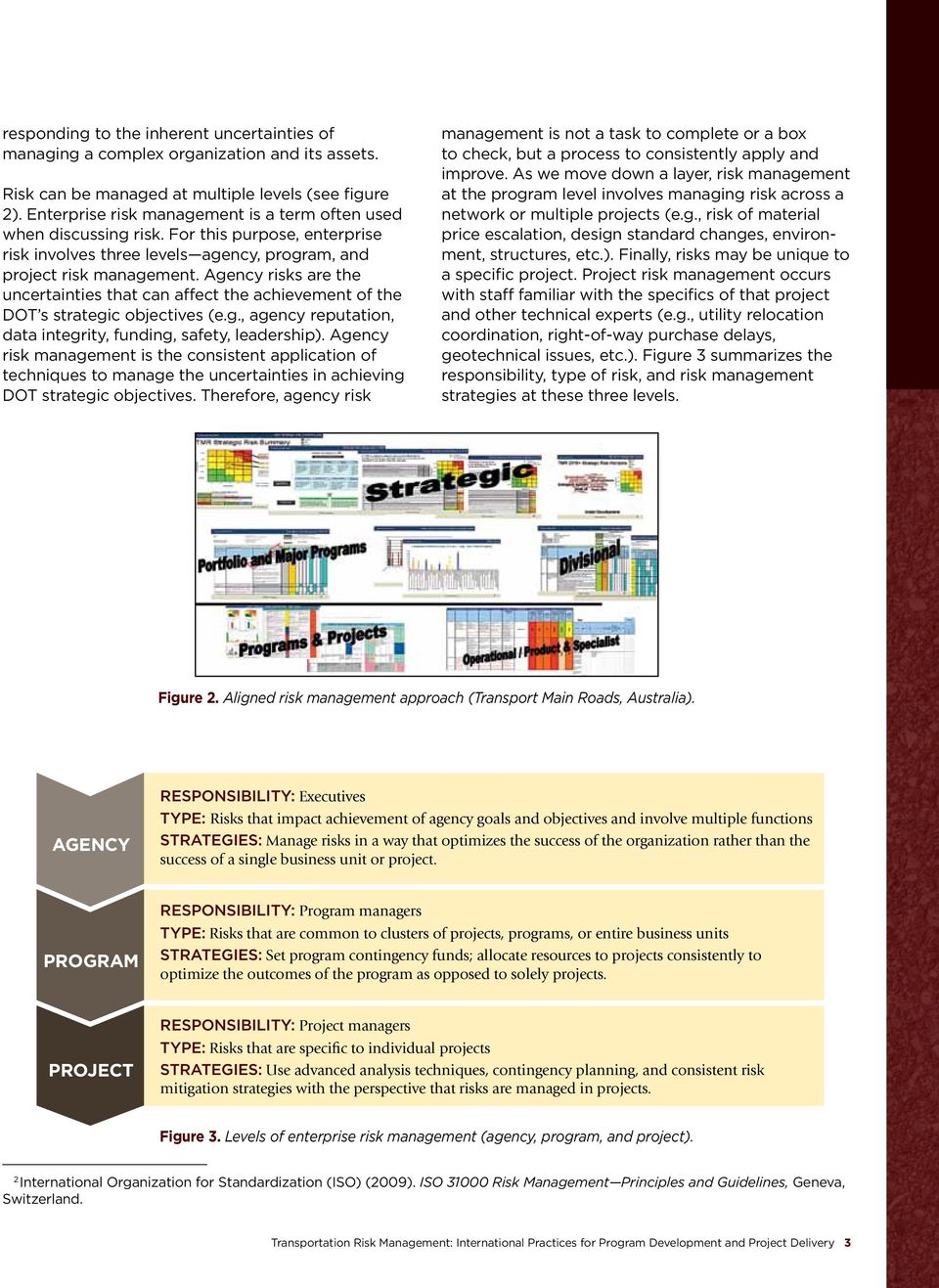
5 responding to the inherent uncertainties of managing a complex organization and its assets. Risk can be managed at multiple levels (see figure 2). Enterprise risk management is a term often used when discussing risk. For this purpose, enterprise risk involves three levels agency, program, and project risk management. Agency risks are the uncertainties that can affect the achievement of the DOT s strategic objectives (e.g., agency reputation, data integrity, funding, safety, leadership). Agency risk management is the consistent application of techniques to manage the uncertainties in achieving DOT strategic objectives. Therefore, agency risk management is not a task to complete or a box to check, but a process to consistently apply and improve. As we move down a layer, risk management at the program level involves managing risk across a network or multiple projects (e.g., risk of material price escalation, design standard changes, environment, structures, etc.). Finally, risks may be unique to a specific project. Project risk management occurs with staff familiar with the specifics of that project and other technical experts (e.g., utility relocation coordination, right-of-way purchase delays, geotechnical issues, etc.). Figure 3 summarizes the responsibility, type of risk, and risk management strategies at these three levels. Figure 2. Aligned risk management approach (Transport Main Roads, Australia). Agency Responsibility: Executives Type: Risks that impact achievement of agency goals and objectives and involve multiple functions Strategies: Manage risks in a way that optimizes the success of the organization rather than the success of a single business unit or project. Program Responsibility: Program managers Type: Risks that are common to clusters of projects, programs, or entire business units Strategies: Set program contingency funds; allocate resources to projects consistently to optimize the outcomes of the program as opposed to solely projects. Project Responsibility: Project managers Type: Risks that are specific to individual projects Strategies: Use advanced analysis techniques, contingency planning, and consistent risk mitigation strategies with the perspective that risks are managed in projects. Figure 3. Levels of enterprise risk management (agency, program, and project). 2 International Organization for Standardization (ISO) (2009). ISO Risk Management Principles and Guidelines, Geneva, Switzerland. Transportation Risk Management: International Practices for Program Development and Project Delivery 3
6 Why Should Agencies Explicitly Manage Risks? Transportation agencies manage some of the largest and highest valued public assets and budgets in Federal, State, and local governments. These agencies are spending the public s money. It is their corporate responsibility to set clear strategic goals and objectives to manage these assets in a manner that improves the economic growth and livability of their regions and gives the public the best value for its dollar. Risks can affect an agency s ability to meet its goals and objectives. It is incumbent on these agencies, as network and delivery managers, to identify risks, assess the possible impacts, develop plans to manage the risks, and monitor the effectiveness of their actions. The following is a synthesis of common strategic objectives and related risks found on the scan: Common Agency Strategic Objectives Operating the system Support reliable and efficient movement of people and goods. Maintaining and improving the system Provide a transportation system that promotes economic growth and enhances livability. Being responsible Deliver sustainable projects and network solutions. Common Agency Risks Agency reputation A negative public opinion could result in the loss of trust, revenues, and the ultimate efficiency of the transportation network. Data availability and integrity Insufficient or inaccurate data and/or the loss of agency data creates a risk in the loss of efficiency or the ability to manage the network. Insufficient or unknown long-term funding An inability to fund the current and projected system creates a risk of future safety or asset failures. These objectives and risks provide agency-level examples. Similar objectives and risks were found at the program and project levels. Mature agencies align their objectives and risks at all three levels and maintain a culture of risk management in their decisionmaking. What Strategies, Methods, and Tools Are Available to Manage Risk? The scan team found a variety of strategies, methods, and tools transportation agencies around the world use to manage risks. Many of these findings are directly applicable to agencies in the United States. Use of Risk Management to Align Strategic Objectives International organizations use risk management to align the strategic objectives within their organizations. The scan team found that organizations use consistent risk assessment rating scales at the agency, program, and project levels. They also align their risk registers to include the agency business objectives at the program and project levels. While program and project managers can assess risks against their own program or project objectives, they must also include an assessment against the corporate risks. Figure 4 depicts the risk management approach for the M80 expansion in Melbourne, Australia. The project delivery team organized its project-specific risks in categories that aligned with the agency risks (financial, health and safety, environment, security of assets, management effort, reputation, and legal and compliance) and then added project-specific risk categories (traffic management, stakeholder management, and quality) to complete the risk register. The team developed risk management actions and tracked these with the risk register. The result was a project risk management plan that aligned with the corporate risk management plan. Similar examples were found throughout Australia and in the United Kingdom. All of these agencies have specific risk management policies. These policies are formed at the agency level. Many of the policies are in direct alignment with the ISO risk management standard. Development of an Explicit Risk Management Structure While agencies were found to have different risk management organizational structures, mature risk 4
7 Corporate Risk Register and Risk Management Plan Business Area Risk Register and Risk Management Plans Project Risk Register and Risk Management Plans Credible risks to VicRoads as a whole strategic directions Program development and delivery and business operations Key risks to business-area objectives Proposed risk treatment actions Supports any new business initiatives Feed up to divisional and corporate risk management plans Project delivery Scope, cost, and time control Project risks and action plans Figure 4. M80 risk management approach (VicRoads, Melbourne, Australia). management organizations define their structures explicitly. In Melbourne, Australia; London, England; and Glasgow, Scotland, risk management organizational structures were tied to corporate audit functions. In Brisbane and Sydney, Australia, there was an explicit risk manager position (director, risk management) that was tied to the highest levels of corporate governance. Transport Main Roads in Queensland, Australia, provided the structure depicted in figure 5. The agency clearly defined a corporate risk management organizational policy and the role of a corporate risk manager who reports directly to the board. The agency s risk management guidelines include some of the following key contents: Transport Main Roads Guide to Risk Management Strategic Risk Management Practice Guide Program Risk Management Practice Guide Figure 5. Risk management framework (Transport Main Roads, Queensland, Australia). Project Risk Management Practice Guide Risk Management Tools and Techniques Risk Management Specialist Areas Australian agencies actively participated in the development of the ISO risk management standard and apply it to their agency, program, and project risk structures. England applied the ISO process to the major programs. These agencies were also found to follow the processes defined by their government audit functions where applicable. Achievement of a Risk Management Culture Mature organizations were found to have achieved a clear culture of risk management. A risk management culture is defined by shared norms, values, Transportation Risk Management: International Practices for Program Development and Project Delivery 5

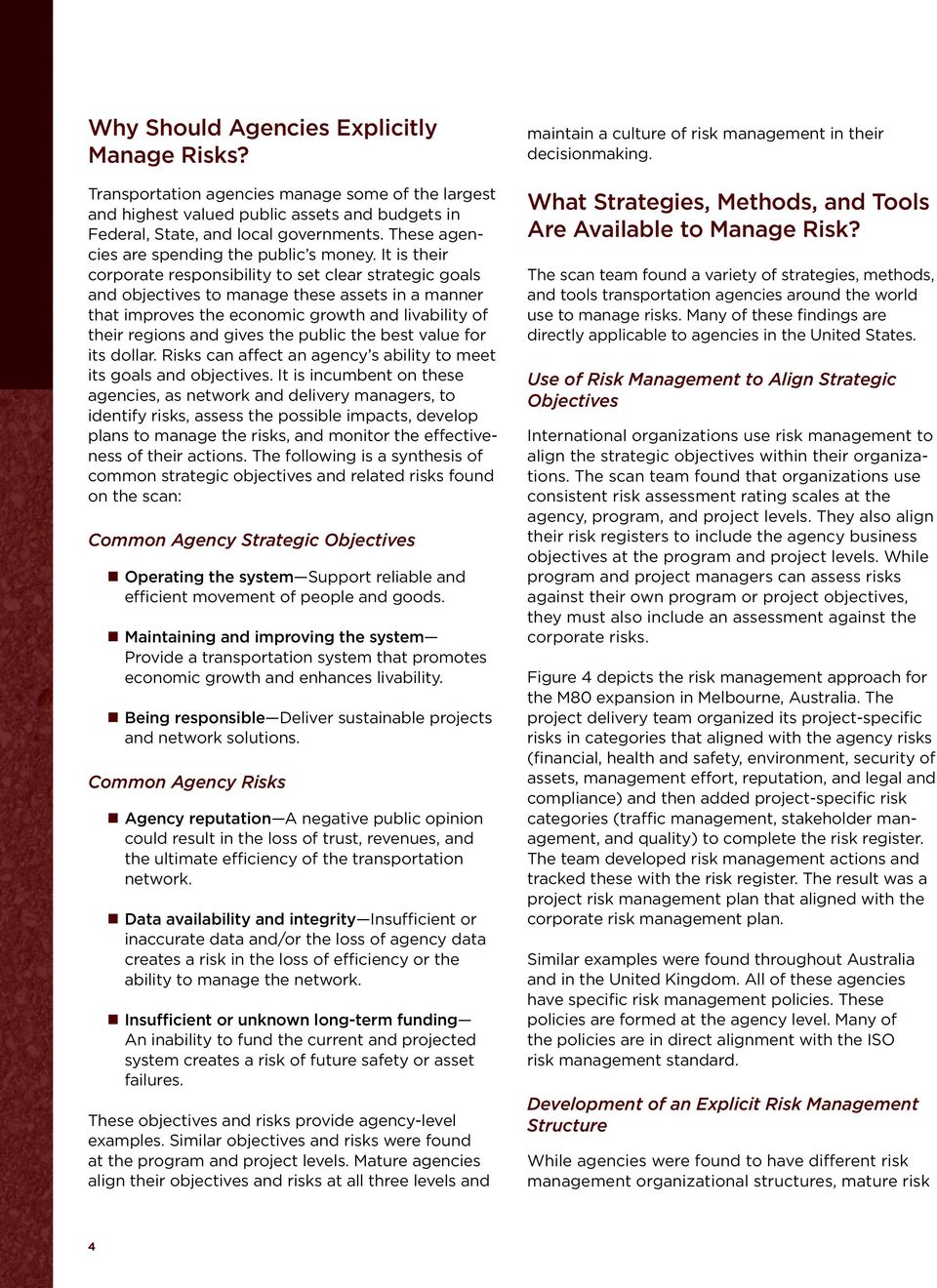
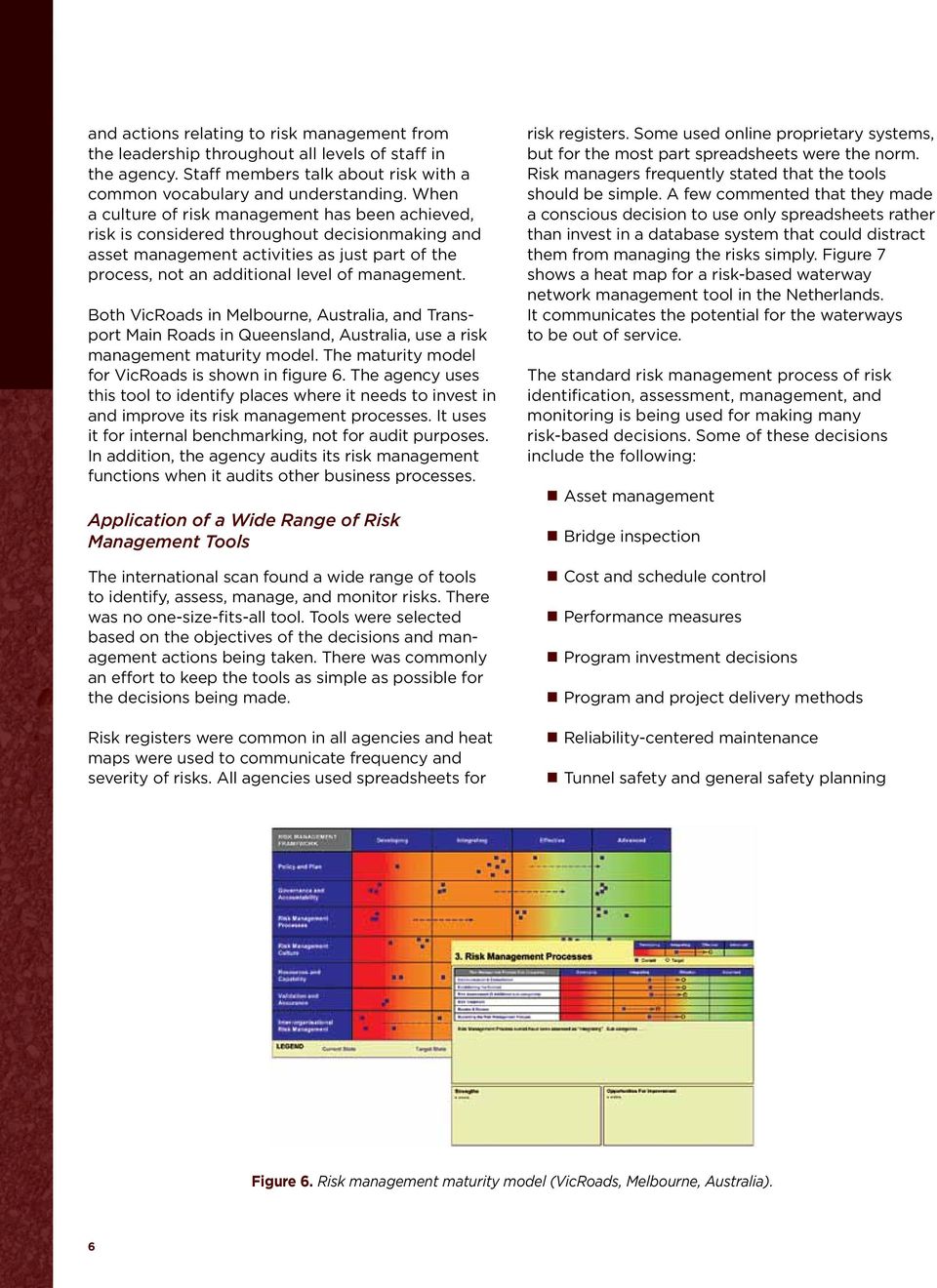
8 and actions relating to risk management from the leadership throughout all levels of staff in the agency. Staff members talk about risk with a common vocabulary and understanding. When a culture of risk management has been achieved, risk is considered throughout decisionmaking and asset management activities as just part of the process, not an additional level of management. Both VicRoads in Melbourne, Australia, and Transport Main Roads in Queensland, Australia, use a risk management maturity model. The maturity model for VicRoads is shown in figure 6. The agency uses this tool to identify places where it needs to invest in and improve its risk management processes. It uses it for internal benchmarking, not for audit purposes. In addition, the agency audits its risk management functions when it audits other business processes. Application of a Wide Range of Risk Management Tools The international scan found a wide range of tools to identify, assess, manage, and monitor risks. There was no one-size-fits-all tool. Tools were selected based on the objectives of the decisions and management actions being taken. There was commonly an effort to keep the tools as simple as possible for the decisions being made. Risk registers were common in all agencies and heat maps were used to communicate frequency and severity of risks. All agencies used spreadsheets for risk registers. Some used online proprietary systems, but for the most part spreadsheets were the norm. Risk managers frequently stated that the tools should be simple. A few commented that they made a conscious decision to use only spreadsheets rather than invest in a database system that could distract them from managing the risks simply. Figure 7 shows a heat map for a risk-based waterway network management tool in the Netherlands. It communicates the potential for the waterways to be out of service. The standard risk management process of risk identification, assessment, management, and monitoring is being used for making many risk-based decisions. Some of these decisions include the following: Asset management Bridge inspection Cost and schedule control Performance measures Program investment decisions Program and project delivery methods Reliability-centered maintenance Tunnel safety and general safety planning Figure 6. Risk management maturity model (VicRoads, Melbourne, Australia). 6
9 Figure 7. Program risk analysis for Dutch waterways (Rijkswaterstaat, Netherlands). Risk-Based Asset Management Improves Investment Decisions International transportation agencies use risk analyses to make programmatic investment decisions. Risk analysts communicate the results of analyses to decisionmakers. They often communicate results visually. Their analyses can take the form of complex Monte Carlo simulations to calculate the expected value of life-cycle cost; failure mode, effects, and criticality analyses to identify failure mechanisms for networks; or maintenance of historic risks lists for application of risk-based bridge inspections and investment decisions. The risk-based analyses can show decisionmakers how the agency risk profiles will change based on different programmatic investment packages. The Highways Agency in England has a programmatic approach to asset management defined in its asset management guidelines (see figure 8). The Highways Agency specifies risk levels and tolerances in its standards. The Highways Agency provided examples of how it makes risk-based investment decisions for structural and geotechnical assets. Figure 9 (see next page) shows a geotechnical risk profile of a roadway. The profile can be changed to show decisionmakers how different investment decisions can help mitigate risks. Selection of Appropriate Risk Allocation Methods The identification and assessment of risks provide transparency in risk allocation. When risks are Figure 8. Asset management guidance standard (Highways Agency, England). managed within the agency, allocation can be made to an individual risk owner (i.e., a top-level agency executive, program manager, or project manager). The risk can also be assigned to a risk manager who acts on behalf of the risk owner to manage the risk at a level in accordance with the agency s risk tolerance. Project delivery methods and contracts are the vehicles used to transfer risks from an agency to its industry partners. Figure 10 (see page 9) shows how Transportation Risk Management: International Practices for Program Development and Project Delivery 7

10 and gain-share clauses around a target price. It helps deal with complex projects that have fast-track design and construction, many unknowns, and complex approval processes. Use of Risk Communication Strategies Improves Decisionmaking Figure 9. Geotechnical asset risk profile (Highways Agency, England). Transport Main Roads in Queensland, Australia, applies risk assessment in the selection of project delivery methods. It has a variety of project delivery methods, as shown in figure 10. These delivery methods include traditional (design-bid-build), design-construct (D&C, equivalent to U.S. designbuild), design-construct-maintain (DCM), early contractor involvement (ECI, a form of design-build with a target price as opposed to a lump sum price in U.S. design-build), and two forms of alliancing (a relational contracting method not yet used in U.S. transportation construction). Figure 10 shows traditional project delivery on the left side of the horizontal axis and relational contracting on the right. Traditional delivery transfers the majority of risk to the general contractor after the agency completes an independent design. Traditional delivery is used on routine projects where multiple lump-sum offers can be tendered on a fixed scope. Relational delivery methods establish a cooperative strategy for both design and construction in which the contractor is involved very early in delivery. As described in figure 10, relational delivery embraces this cooperative strategy to manage risk. It involves open-book contracting with pain-share One of the greatest benefits of the risk management process is the ability to communicate information simply to decisionmakers throughout the organization and externally to stakeholders. While the analysis may be supported by a complex, rigorous, and probabilistically sophisticated model, it is of little value if its outputs are obscured in jargon or overly complicated in their representation. A theme at the agencies was to keep it simple. Enterprise risk matrices are discussed at executive or board meetings as a standard agenda item. Risk communication improves alignment within the organization to achieve its strategic goals and objectives. Figure 11 (see page 10) shows an output of the Performance Audit Group at Transport Scotland. The Performance Audit Group uses a rigorous risk-based analysis for its performance reviews. However, its output uses a simple colorcoding scheme. The use of red, amber, and green to show the status of risks was common throughout the agencies visited. What Are the Benefits and Challenges of Formal Risk Management? For agencies that do not conduct enterprise risk management, there is an investment to begin. Developing an organizational structure and investing in the development of methods and tools are not trivial tasks. An understanding of the benefits and challenges is helpful in developing an enterprise risk management program. Benefits Helps with making the business case for transportation and building public trust Avoids or minimizes managing-by-crisis and promotes proactive management strategies 8
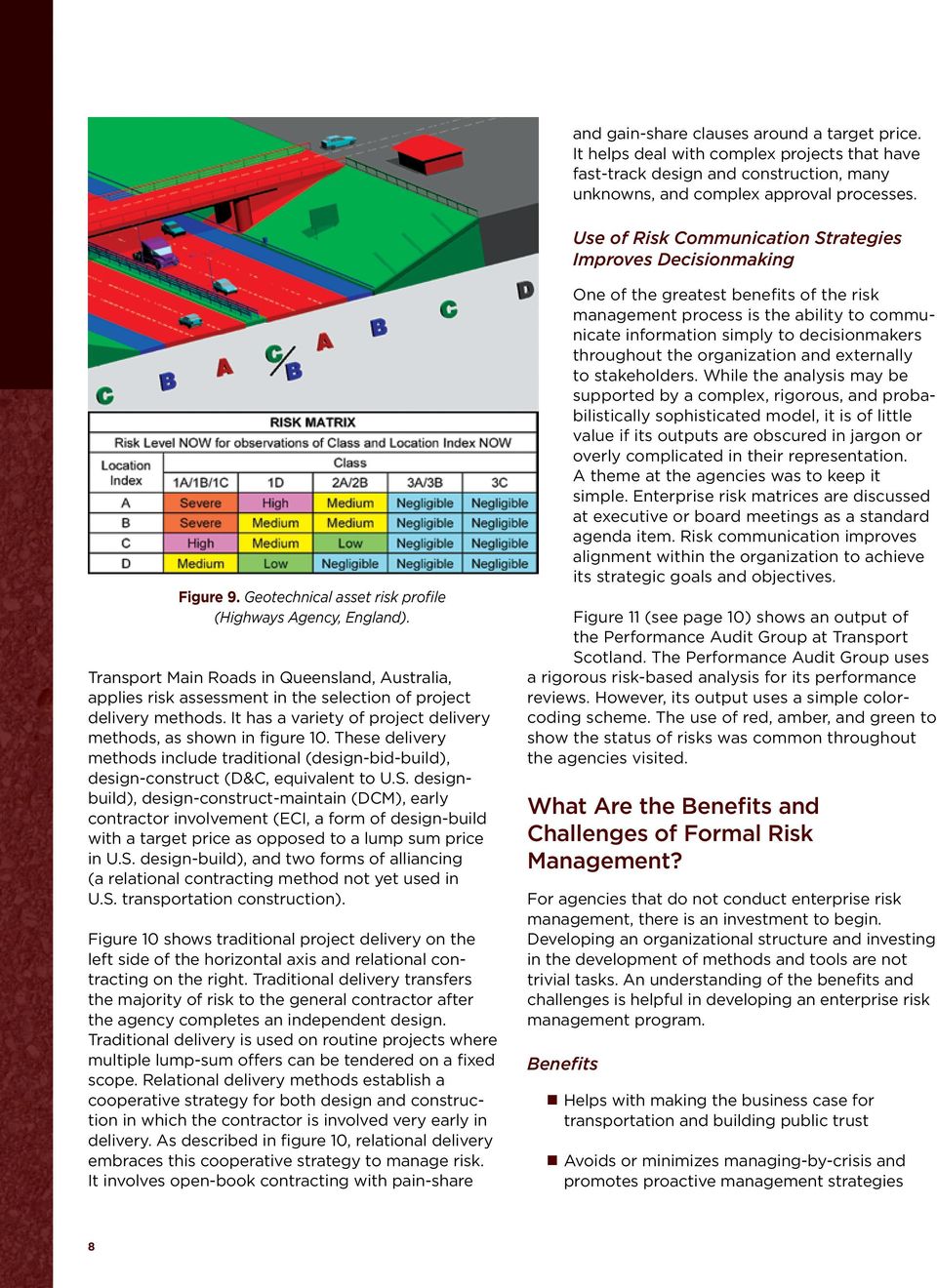
11 Fixed scope Fully documented Routine Few Stakeholders aligned Multiple offerors Politically routine Project Approvals straight forward Fast-track Many unknowns Complex Multiple stakeholders not aligned Few offerors Politically very sensitive Project Approval complex and interdependent Figure 10. Risk allocation and project delivery selection (Transport Main Roads, Queensland, Australia). Explicitly recognizes risks in multiple investment options with uncertain outcomes Provides a broader set of viable solution options earlier in the process Communicates uncertainty and helps focus on key strategic issues Improves organizational alignment Promotes an understanding of the repercussions of failure Helps apportion risks to the party best able to manage them Facilitates good decisionmaking and accountability at all levels of the organization Challenges Gaining organizational support for risk management at all levels Evolving existing organizational culture, which can be risk averse Developing and funding organizational expertise for risk management Implementing and embedding a new process for risk management Difficulty in applying risk allocation alternatives within organizational constraints A lack of willingness to accept and address issues that risk management will identify Transportation Risk Management: International Practices for Program Development and Project Delivery 9
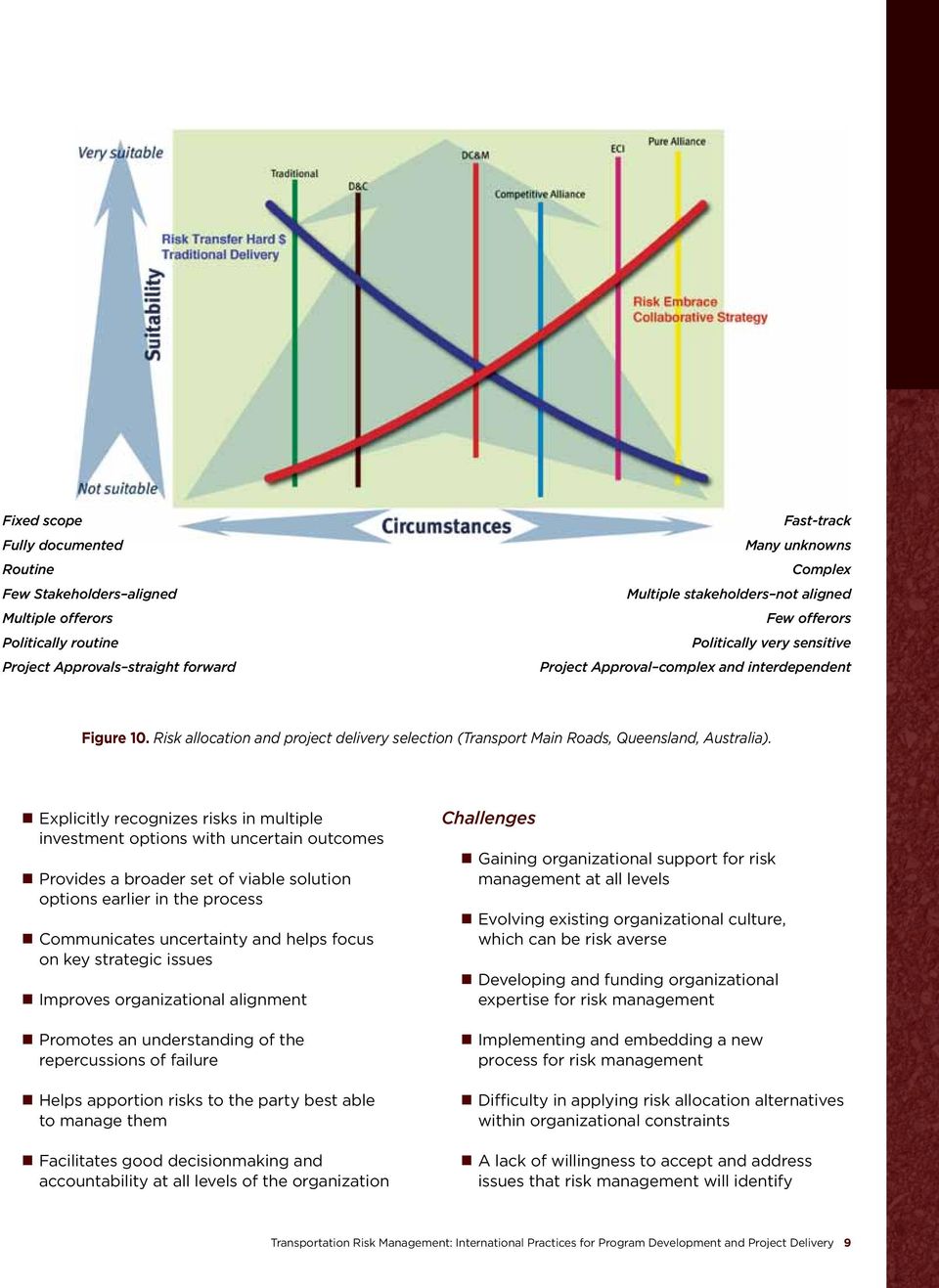
12 Figure 11. Risk management output (Performance Audit Group, Transport, Scotland). Recommendations The risk management scan team included Federal, State, and private sector members with well over 100 years of combined experience in the operation, design, and construction of U.S. transportation systems. Through this focused research study, the team gained a fresh perspective on how the U.S. transportation industry can use risk management practices to better meet its strategic objectives, improve performance, and manage its assets. The following scan team recommendations offer a path forward for the transportation community and will help develop a culture of risk awareness and management in the United States. 1. Formalize enterprise risk management approaches using a holistic approach to support decisionmaking and improve successful achievement of strategic goals and objectives. 2. Embed risk management in existing business processes so that when asset, performance, and risk management are combined, successful decisionmaking ensues. 3. Use risk management to make the business case for transportation and build trust with transportation stakeholders. 4. Define leadership and organizational responsibilities for risk management. 5. Develop executive support for risk management. 10

13 6. Identify risk owners and manage risks at the appropriate level. 7. Use the risk management process to support risk allocation in agency, program, and project delivery decisions. 8. Use risk management to reexamine existing policies, processes, and standards. 9. Employ sophisticated risk analysis tools, but communicate results in a simple fashion. Implementation and Future Research The risk management scan findings confirm that an efficient and effective enterprise risk management program is a powerful tool for the international transportation agencies visited. The demonstrated benefits of the programs scanned are both quantitative, such as better controls over costs and delivery schedules, and qualitative, such as less likelihood of negative public relations issues. Risk management provides information that allows agencies to improve decisionmaking and efficiency on their programs and projects. While today each U.S. State DOT differs in its level of risk management maturity, it seems reasonable that the implementation activities associated with this scan be those that evolve and advance enterprise risk management in State agencies throughout the country. That is, agencies need to do risk management at the agency, program, and project levels to be fully successful. Research Publish case studies on successful U.S. risk management applications; develop a guidebook on enterprise risk management strategies, methods, and tools; and develop a risk management maturity model to assist highway agencies in risk management implementation. Training Update National Highway Institute training on risk management to include agency, programmatic, and project applications and provide train-the-trainer workshops to disseminate training at the State level. Governance Form a Risk Management Expert Task Group with FHWA, AASHTO, and industry representatives and activate an AASHTO Risk Management Subcommittee. The scan findings confirm the need for additional implementation activities to develop a culture of risk management in the U.S. transportation sector. The implementation activities fall into the categories of communications and outreach, research, training, and governance. The following are some preliminary short- and long-term activities the scan team will pursue to evolve and advance agency risk management in U.S. highway agencies: Communications and outreach Publish a comprehensive risk management scan report and summary documents, hold an American Association of State Highway and Transportation Officials (AASHTO) chief executive officer roundtable and workshop, and conduct Webinars through the Federal Highway Administration (FHWA). Transportation Risk Management: International Practices for Program Development and Project Delivery 11

14

15

16 OFFICE OF INTERNATIONAL PROGRAMS FHWA/US DOT (HPIP) 1200 New Jersey Avenue, SE Washington, DC Tel: (202) Fax: (202) Publication No. FHWA-PL HPIP/8-12(3.5)EW

ENTERPRISE RISK MANAGEMENT FRAMEWORK
 ENTERPRISE RISK MANAGEMENT FRAMEWORK COVENANT HEALTH LEGAL & RISK MANAGEMENT CONTENTS 1.0 PURPOSE OF THE DOCUMENT... 3 2.0 INTRODUCTION AND OVERVIEW... 4 3.0 GOVERNANCE STRUCTURE AND ACCOUNTABILITY...
New Mexico DOT Transportation Asset Management Implementation Plan. final plan
 New Mexico DOT Transportation Asset Management Implementation Plan final plan February 23, 2015 report New Mexico DOT Transportation Asset Management Implementation Plan date February 23, 2015 Table
Confident in our Future, Risk Management Policy Statement and Strategy
 Confident in our Future, Risk Management Policy Statement and Strategy Risk Management Policy Statement Introduction Risk management aims to maximise opportunities and minimise exposure to ensure the residents
Life Cycle Cost Analysis (LCCA)
 v01-19-11 Life Cycle Cost Analysis (LCCA) Introduction The SHRP2 R-23 Guidelines provide a number of possible alternative designs using either rigid of flexible pavements. There is usually not a single
Transportation Asset Management
 Transportation Asset Management The Role of Engineering Economic Analysis Presented by: Eric Gabler Economist, Office of Asset Management Federal Highway Administration Introduction The mission of the
The Relationship Between Asset Management and Performance Management
 The Relationship Between Asset Management and Performance Management NCHRP 20-24, Task 58 Requested by: American Association of State Highway and Transportation Officials (AASHTO) Prepared by: Cambridge
Linking Risk Management to Business Strategy, Processes, Operations and Reporting
 Linking Risk Management to Business Strategy, Processes, Operations and Reporting Financial Management Institute of Canada February 17 th, 2010 KPMG LLP Agenda 1. Leading Practice Risk Management Principles
FUNBIO PROJECT RISK MANAGEMENT GUIDELINES
 FUNBIO PROJECT RISK MANAGEMENT GUIDELINES OP-09/2013 Responsible Unit: PMO Focal Point OBJECTIVE: This Operational Procedures presents the guidelines for the risk assessment and allocation process in projects.
THE ROLE OF FINANCE AND ACCOUNTING IN ENTERPRISE RISK MANAGEMENT
 THE ROLE OF FINANCE AND ACCOUNTING IN ENTERPRISE RISK MANAGEMENT Let me begin by thanking Baruch College for giving me the opportunity to present this year s prestigious Emanuel Saxe Lecture in Accounting.
Policy 10.105: Enterprise Risk Management Policy
 Name: Responsibility: Complements: Enterprise Risk Management Framework Coordinator, Enterprise Risk Management Policy 10.105: Enterprise Risk Management Policy Date: November 2006 Revision Date(s): January
Integrated Risk Management:
 Integrated Risk Management: A Framework for Fraser Health For further information contact: Integrated Risk Management Fraser Health Corporate Office 300, 10334 152A Street Surrey, BC V3R 8T4 Phone: (604)
APPENDIX 50. Enterprise risk management - Risk management overview
 APPENDIX 50 Enterprise risk management - Risk management overview Energex regulatory proposal October 2014 ENTERPRISE RISK MANAGEMENT Risk Management Overview (RMO) 06 11 2013 Table of Contents 1. INTRODUCTION...
Board oversight of risk: Defining risk appetite in plain English
 www.pwc.com/us/centerforboardgovernance Board oversight of risk: Defining risk appetite in plain English May 2014 Defining risk appetite in plain English Risk oversight continues to be top-of-mind for
The College of New Jersey Enterprise Risk Management and Higher Education For Discussion Purposes Only January 2012
 The College of New Jersey Enterprise Risk Management and Higher Education For Discussion Purposes Only Agenda Introduction Basic program components Recent trends in higher education risk management Why
RISK MANAGEMENT AND RISK-BASED COST ESTIMATION GUIDELINES
 RISK MANAGEMENT AND RISK-BASED COST ESTIMATION GUIDELINES August 2012 This page is left intentionally blank NEVADA DEPARTMENT OF TRANSPORTATION RISK MANAGEMENT AND RISK-BASED COST ESTIMATION GUIDELINES
The Relationship Between Asset Management and Performance Management
 The Relationship Between Asset Management and Performance Management NCHRP 20-24(58) Requested by: American Association of State Highway and Transportation Officials (AASHTO) Prepared by: Cambridge Systematics,
IFAD Policy on Enterprise Risk Management
 Document: EB 2008/94/R.4 Agenda: 5 Date: 6 August 2008 Distribution: Public Original: English E IFAD Policy on Enterprise Risk Management Executive Board Ninety-fourth Session Rome, 10-11 September 2008
LOUISIANA DEPARTMENT OF TRANSPORTATION AND DEVELOPMENT CONSTRUCTION PLANS QUALITY CONTROL / QUALITY ASSURANCE MANUAL
 LOUISIANA DEPARTMENT OF TRANSPORTATION AND DEVELOPMENT CONSTRUCTION PLANS QUALITY CONTROL / QUALITY ASSURANCE MANUAL August 2008 TABLE OF CONTENTS Section 1 - Introduction... 3 1.1 Defining Plan Quality...
Avondale College Limited Enterprise Risk Management Framework 2014 2017
 Avondale College Limited Enterprise Risk Management Framework 2014 2017 President s message Risk management is part of our daily life, something we do regularly; often without realising we are doing it.
STANDARDS OF SOUND BUSINESS AND FINANCIAL PRACTICES. ENTERPRISE RISK MANAGEMENT Framework
 STANDARDS OF SOUND BUSINESS AND FINANCIAL PRACTICES ENTERPRISE RISK MANAGEMENT Framework September 2011 Notice This document is intended as a reference tool to assist Ontario credit unions to develop an
How to successfully manage your mega-project
 How to successfully manage your mega-project Part I Early planning and organizing for success kpmg.com 2 Building, Construction & Real Estate How to successfully manage your mega-project A three-part series
Guideline. Records Management Strategy. Public Record Office Victoria PROS 10/10 Strategic Management. Version Number: 1.0. Issue Date: 19/07/2010
 Public Record Office Victoria PROS 10/10 Strategic Management Guideline 5 Records Management Strategy Version Number: 1.0 Issue Date: 19/07/2010 Expiry Date: 19/07/2015 State of Victoria 2010 Version 1.0
Risk Management Primer
 Risk Management Primer Purpose: To obtain strong project outcomes by implementing an appropriate risk management process Audience: Project managers, project sponsors, team members and other key stakeholders
Construction Management Practices in Canada and Europe
 NOTICE The Federal Highway Administration provides high-quality information to serve Government, industry, and the public in a manner that promotes public understanding. Standards and policies are used
LONDON BOROUGH OF SOUTHWARK
 APPENDIX 1 LONDON BOROUGH OF SOUTHWARK The annual report to the Audit & Governance Committee on Risk and Insurance for 2011/12, and the key corporate risks Presented to the Audit & Governance Committee
Using Risk Assessment to Improve Highway Construction Project Performance
 Using Risk Assessment to Improve Highway Construction Project Performance Mohamed F. Diab, MBA, Ph.D. and Amiy Varma, Ph.D., PE North Dakota State University Fargo, ND Khaled Nassar, Ph.D. American University
How To Manage Transportation Asset Management
 1 TRANSPORTATION ASSET MANAGEMENT THE NEW BUSINESS MODEL FOR TRANSPORTATION AGENCIES Presented at the AASHTO Subcommittee on Transportation Finance Policy Business Meeting Irvine, California June 26, 2012
The what, why, when and how of Strategic Workforce Planning
 Future-proof your workforce The what, why, when and how of Strategic Workforce Planning Susan DeFazio Table of contents 3 Introduction 5 What does good SWP look like? 7 Why SWP matters to risk & operational
ISO 19600: The development
 1 Baltzer Science Publishers ISO 19600: The development of a global standard on compliance management By Sylvie Bleker and Dick Hortensius* It has been a traditional complaint of the global compliance
Risk Mapping A Risk Management Tool with Powerful Applications in the New Economy
 Risk Mapping A Risk Management Tool with Powerful Applications in the New Economy By Todd Williams and Steve Saporito What if your company s major business risks, obstacles to strategic objectives, and
Asset Management Policy March 2014
 Asset Management Policy March 2014 In February 2011, we published our current Asset Management Policy. This is the first update incorporating further developments in our thinking on capacity planning and
Next-Generation Building Energy Management Systems
 WHITE PAPER Next-Generation Building Energy Management Systems New Opportunities and Experiences Enabled by Intelligent Equipment Published 2Q 2015 Sponsored By Daikin Applied and Intel Casey Talon Senior
Keys to a Successful Outsourcing Transition
 Keys to a Successful Outsourcing Transition finance.arvato.com Getting it Right the First Time: Keys to a Successful Outsourcing Transition A large part of success in outsourcing depends on a seamless
Project Assessment Framework Establish service capability
 Project Assessment Framework Establish service capability July 2015 Component of the Project Assessment Framework (PAF) This document forms part of the Project Assessment Framework, as outlined below.
RISK MANAGEMENT OVERVIEW - APM Project Pathway (Draft) RISK MANAGEMENT JUST A PART OF PROJECT MANAGEMENT
 RISK MANAGEMENT OVERVIEW - APM Project Pathway (Draft) Risk should be defined as An uncertain event that, should it occur, would have an effect (positive or negative) on the project or business objectives.
The PNC Financial Services Group, Inc. Business Continuity Program
 The PNC Financial Services Group, Inc. Business Continuity Program subsidiaries) 1 Content Overview A. Introduction Page 3 B. Governance Model Page 4 C. Program Components Page 4 Business Impact Analysis
Risk Management Policy Adopted by:
 Risk Management Policy Adopted by: Infigen Energy Limited Infigen Energy (Bermuda) Limited Infigen Energy RE Limited in its capacity as Responsible Entity of Infigen Energy Trust Adopted: 17 December 2009
Information Security Management System for Microsoft s Cloud Infrastructure
 Information Security Management System for Microsoft s Cloud Infrastructure Online Services Security and Compliance Executive summary Contents Executive summary 1 Information Security Management System
Operational Risk Management - The Next Frontier The Risk Management Association (RMA)
 Operational Risk Management - The Next Frontier The Risk Management Association (RMA) Operational risk is not new. In fact, it is the first risk that banks must manage, even before they make their first
Risk-Based Asset Management:
 : Examining Risk-based Approaches to Transportation Asset Management RepoRt 2: Managing asset risks at Multiple levels in a transportation agency AUGUST 2012 NoTe from The DirecTor Notice this document
PROJECT insights IDENTIFYING POTENTIAL SHOW STOPPERS. PROJECT INSIGHTS Whitepaper 1 DUE DILIGENCE ENGINEERS
 PROJECT insights IDENTIFYING POTENTIAL SHOW STOPPERS. PROJECT INSIGHTS Whitepaper 1 CONTENTS EXECUTIVE SUMMARY 3 INTRODUCTION 4 SECTION ONE IS YOUR PROJECT AT RISK? KEY IDENTIFICATIONS 5 SECTION TWO WHY
UNITED NATIONS OFFICE FOR PROJECT SERVICES. ORGANIZATIONAL DIRECTIVE No. 33. UNOPS Strategic Risk Management Planning Framework
 UNOPS UNITED NATIONS OFFICE FOR PROJECT SERVICES Headquarters, Copenhagen O.D. No. 33 16 April 2010 ORGANIZATIONAL DIRECTIVE No. 33 UNOPS Strategic Risk Management Planning Framework 1. Introduction 1.1.
Part 1: Project Portfolio Management Tools
 Part 1: Project Portfolio Management Tools To survive and prosper in today's competitive, cost-conscious, and risky business environment, organizations must derive greater value from the projects that
Business Continuity Management Framework 2014 2017
 Business Continuity Management Framework 2014 2017 Blackpool Council Business Continuity Framework V3.0 Page 1 of 13 CONTENTS 1.0 Forward 03 2.0 Administration 04 3.0 Policy 05 4.0 Business Continuity
Risk Review Process Basics
 2011 PMOC Annual Meeting FEDERAL TRANSIT ADMINISTRATION Risk Review Process Basics Michael P. Wetherell, PE - Urban Engineers David N. Sillars, PE Sillars Consulting FEDERAL TRANSIT ADMINISTRATION 2011
Asset Management Plan
 Example Transportation Asset Management Plan Outline This outline was created using the Transportation Asset Management Plan (TAMP) Builder ( www.tamptemplate.org ), a product of NCHRP Project 8-36/116.
Table of Contents PERFORMANCE REVIEWS STRATEGIC REVIEWS
 SECTION 270 PERFORMANCE AND STRATEGIC REVIEWS Table of Contents 270.1 To which agencies does this section apply? 270.2 What is the purpose of this section? PERFORMANCE REVIEWS 270.3 What is the purpose
Successfully identifying, assessing and managing risks for stakeholders
 Introduction Names like Enron, Worldcom, Barings Bank and Menu Foods are household names but unfortunately as examples of what can go wrong. With these recent high profile business failures, people have
Accountable Care: Clinical Integration is the Foundation
 Solutions for Value-Based Care Accountable Care: Clinical Integration is the Foundation Clinical Integration Care CoordinatioN ACO Information Technology Financial Management The Accountable Care Organization
Beyond risk identification Evolving provider ERM programs
 Beyond risk identification Evolving provider ERM programs March 2016 At a glance PwC conducted research to assess the state of enterprise risk management (ERM) within healthcare providers and found many
Your asset is your business. The more challenging the economy, the more valuable the asset becomes. Decisions are magnified. Risk is amplified.
 Asset management Your asset is your business. The more challenging the economy, the more valuable the asset becomes. Decisions are magnified. Risk is amplified. Data is about more than numbers. It tells
INTERAGENCY GUIDANCE ON THE ADVANCED MEASUREMENT APPROACHES FOR OPERATIONAL RISK. Date: June 3, 2011
 Board of Governors of the Federal Reserve System Federal Deposit Insurance Corporation Office of the Comptroller of the Currency Office of Thrift Supervision INTERAGENCY GUIDANCE ON THE ADVANCED MEASUREMENT
Enterprise Risk Management Framework 2012 2016. Strengthening our commitment to risk management
 Enterprise Risk Management Framework 2012 2016 Strengthening our commitment to risk management Contents Director-General s message... 3 Introduction... 4 Purpose... 4 What is risk management?... 4 Benefits
RISK MANAGEMENT OVERVIEW 2011 RISK CONFERENCE SPONSORED BY THE FEDERAL RESERVE BANK OF CHICAGO AND DEPAUL UNIVERSITY
 RISK MANAGEMENT OVERVIEW 2011 RISK CONFERENCE SPONSORED BY THE FEDERAL RESERVE BANK OF CHICAGO AND DEPAUL UNIVERSITY PRESENTED BY: LEN WIATR, CHIEF RISK OFFICER Len s Risk Management Philosophy Build a
CENTRAL BANK OF KENYA (CBK) PRUDENTIAL GUIDELINE ON BUSINESS CONTINUITY MANAGEMENT (BCM) FOR INSTITUTIONS LICENSED UNDER THE BANKING ACT
 CENTRAL BANK OF KENYA (CBK) PRUDENTIAL GUIDELINE ON BUSINESS CONTINUITY MANAGEMENT (BCM) FOR INSTITUTIONS LICENSED UNDER THE BANKING ACT JANUARY 2008 GUIDELINE ON BUSINESS CONTINUITY GUIDELINE CBK/PG/14
ENTERPRISE RISK MANAGEMENT POLICY
 ENTERPRISE RISK MANAGEMENT POLICY TITLE OF POLICY POLICY OWNER POLICY CHAMPION DOCUMENT HISTORY: Policy Title Status Enterprise Risk Management Policy (current, revised, no change, redundant) Approving
Monte Carlo Simulations for Patient Recruitment: A Better Way to Forecast Enrollment
 Monte Carlo Simulations for Patient Recruitment: A Better Way to Forecast Enrollment Introduction The clinical phases of drug development represent the eagerly awaited period where, after several years
Audit of the Policy on Internal Control Implementation
 Audit of the Policy on Internal Control Implementation Natural Sciences and Engineering Research Council of Canada Social Sciences and Humanities Research Council of Canada February 18, 2013 1 TABLE OF
American Public Works Association Asset Management Task Force, 1998
 a comprehensive and structured approach to the long term management of assets as tools for the efficient and effective delivery of community benefits. Strategy for Improving Asset Management Practice,
Risk Management Policy
 Principles Through a process of Risk Management, the University seeks to reduce the frequency and impact of Adverse Events that may affect the achievement of its objectives. In particular, Risk Management
RISK MANAGEMENT STRATEGY
 RISK MANAGEMENT STRATEGY 1 Introduction The purpose of this document is to outline a which facilitates the effective recognition and management of risks facing the University. The Combined Code on Corporate
Risk appetite as a dynamic management tool
 Risk appetite as a dynamic management tool Background The topic of risk appetite is at the centre of attention currently. There are various reasons for this: the financial crisis, which has made it clear
Strategies to successfully manage your major project
 PROJECT ADVISORY Strategies to successfully manage your major project Whitepaper 1 Thought Leadership Series 10 kpmg.com/nz About this whitepaper KPMG s Project Advisory thought leadership series is aimed
Technical Journal. Paper 142
 Technical Journal 09 Paper 142 142 Kevin Balaam Programme Manager Highways & Transportation Atkins The Area 6 MAC approach to planning and programme management Introduction Steve Dickinson Schemes Manager
UPTIME MAGAZINE. june/july15 JUNE/JULY 2015. uptimemagazine.com
 june/july15 UPTIME MAGAZINE JUNE/JULY 2015 uptimemagazine.com AM Developing Plans Creating Value From Physical Assets by Mark Ruby 46 june/july 15A sset management plans form the cornerstone of an effective
The programming, design
 Understanding Project Delivery for the Design and Construction of Public Buildings architecture The programming, design and construction of important public buildings require the coordinated efforts of
CHAPTER 20 Project Development Cost Estimates Table of Contents
 Chapter 20 Project Development Cost Estimates Table of Contents CHAPTER 20 Project Development Cost Estimates Table of Contents CHAPTER 20 Project Development Cost Estimates... 20-3 SECTION 1 Project Cost
Operational Risk Management Program Version 1.0 October 2013
 Introduction This module applies to Fannie Mae and Freddie Mac (collectively, the Enterprises), the Federal Home Loan Banks (FHLBanks), and the Office of Finance, (which for purposes of this module are
Much attention has been focused recently on enterprise risk management (ERM),
 By S. Michael McLaughlin and Karen DeToro Much attention has been focused recently on enterprise risk management (ERM), not just in the insurance industry but in other industries as well. Across all industries,
Risk management and the transition of projects to business as usual
 Advisory Risk management and the transition of projects to business as usual Financial Services kpmg.com 2 Risk Management and the Transition of Projects to Business as Usual Introduction Today s banks,
Risky Business: an Introduction to Procurement Risk Management
 CIPS Australasia Risky Business: an Introduction to Procurement Risk Management CIPS members can record one CPD hour for reading a CIPS Knowledge download that displays a CIPS CPD icon. CIPS members can
Innovation in Work Health and Safety Solutions
 Innovation in Work Health and Safety Solutions Global Resources... Local Knowledge NTT DATA Figtree Systems provide an intuitive cloud based WHS / OH&S reporting and management tool, assisting
Commodity Price Risk Management (CPRM) - Trends and Challenges for Corporates
 Advisory Commodity Price Risk Management (CPRM) - Trends and Challenges for Corporates May 2014 Agenda Industry Challenges CPRM A Business Case CPRM Maturity Model CPRM Trends What Should Companies Do?
Project Risk Management
 Support of Project Risk Management Development of Risk Based Contingency Values for a Baseline Project Budget Estimate Panama Canal 3rd Lane Locks Atlantic and Pacific Locks, Pacific Access Channel, and
Appendix A Alternative Contracting General Engineering Consultant RFP. Appendix A
 Appendix A 1 1.0 Requirements and Minimum Qualifications This section outlines requirements and minimum qualifications for the GEC. It is anticipated that the GEC will be used to support and supplement
Audit of the Test of Design of Entity-Level Controls
 Audit of the Test of Design of Entity-Level Controls Canadian Grain Commission Audit & Evaluation Services Final Report March 2012 Canadian Grain Commission 0 Entity Level Controls 2011 Table of Contents
Technology based Project Management Consulting (T-PMC): Innovate to Reduce Costs
 Technology based Project Management Consulting (T-PMC): Innovate to Reduce Costs Graham Freeth, North African Oil and Gas Summit, Tunis, Tunisia October 2009 J P Kenny Offices World Wide Aberdeen Stavanger
Risk Management approach for Cultural Heritage Projects Based on Project Management Body of Knowledge
 1 Extreme Heritage, 2007 Australia, 19-21 July 2007, James Cook University, Cairns, Australia Theme 6: Heritage disasters and risk preparedness approach for Cultural Heritage Projects Based on Project
The Value of Optimization in Asset Management
 Experience the commitment white PAPER The Value of Optimization in Asset Management Better decisions to help utilities balance costs, risks, opportunities and performance May 2015 cgi.com Improving the
Enterprise Risk Management: Taking the First Steps
 Enterprise Risk Management: Taking the First Steps TN PRIMA, 2012 DOROTHY GJERDRUM, ARM, CIRM NOVEMBER 15, 2012 Agenda Goal: To understand how to begin to implement a broader approach to risk management
Final. North Carolina Procurement Transformation. Governance Model March 11, 2011
 North Carolina Procurement Transformation Governance Model March 11, 2011 Executive Summary Design Approach Process Governance Model Overview Recommended Governance Structure Recommended Governance Processes
Facilities and Services Change Management Process: Stage 1. Process, Emerging Themes (SWOT) & Future Activity
 Facilities and Services Change Management Process: Stage 1 Process, Emerging Themes (SWOT) & Future Activity Facilities and Services - Change Management 18/11 2 Agenda Process: Stage 1 Consultation Methods
Butch Wlaschin P.E. Director, Office of Asset Management, Pavements, and Construction FHWA
 Butch Wlaschin P.E. Director, Office of Asset Management, Pavements, and Construction FHWA National Goals Focus the Federal-aid program on the following national goals: 1) SAFETY 2) INFRASTRUCTURE CONDITION
Quick Guide: Meeting ISO 55001 Requirements for Asset Management
 Supplement to the IIMM 2011 Quick Guide: Meeting ISO 55001 Requirements for Asset Management Using the International Infrastructure Management Manual (IIMM) ISO 55001: What is required IIMM: How to get
Maintenance Management and Asset Management
 Defining and Understanding the Difference Between Maintenance Management and Asset Management Dr. Simon Lewis AgileAssets, Inc. 12th AASHTO-TRB Maintenance Management Conference Annapolis Maryland, July
A Risk Based Thinking Model for ISO 9001:2015
 A Risk Based Thinking Model for ISO 9001:2015 Bob Deysher Senior Consultant 2014 QSG, Inc. Agenda Why implement Risk Based Thinking? What does ISO 9001:2015 require? What is Risk Based Thinking? What is
Gateway review guidebook. for project owners and review teams
 Gateway review guidebook for project owners and review teams The State of Queensland (Queensland Treasury and Trade) 2013. First published by the Queensland Government, Department of Infrastructure and
We all manage risk, every day
 By Author John Lark Name and Grant Purdy Enhance Your Risk Management and Create Value The Basic Contention We all manage risk, every day and all the time. We may not do it very systematically and, unless
University of Hawaii Information Technology Services Strategic Plan May 22, 2015. Looking Forward to 2020 and Beyond [V15-1]
![University of Hawaii Information Technology Services Strategic Plan May 22, 2015. Looking Forward to 2020 and Beyond [V15-1]](/thumbs/31/14987753.jpg "University of Hawaii Information Technology Services Strategic Plan May 22, 2015. Looking Forward to 2020 and Beyond [V15-1]") University of Hawaii Information Technology Services Strategic Plan May 22, 2015 [V15-1] I. Introduction This Information Technology Services (ITS) Strategic Plan, Looking Forward to 2020 and Beyond, updates
University of Hawaii Information Technology Services Strategic Plan May 22, 2015 [V15-1] I. Introduction This Information Technology Services (ITS) Strategic Plan, Looking Forward to 2020 and Beyond, updates
APT Integrated risk management for the buy-side
 APT Integrated risk management for the buy-side SUNGARD S APT: INTEGRATED RISK MANAGEMENT FOR THE BUY-SIDE SunGard APT helps your business to effectively monitor and manage its investment risks. Whatever