
Cisco Interconnecting Cisco Networking Devices Part 1. Q&A with explanations. Version 6.0
|
|
|
- Bertha May
- 10 years ago
- Views:
Transcription
1 Cisco Interconnecting Cisco Networking Devices Part 1 Q&A with explanations Version 6.0
2 Important Note, Please Read Carefully Other TestKing products A) Offline Testing engine Use the offline Testing engine product topractice the questions in an exam environment. B) Study Guide (not available for all exams) Build a foundation of knowledge which will be useful also after passing the exam. Latest Version We are constantly reviewing our products. New material is added and old material is revised. Free updates are available for 90 days after the purchase. You should check your member zone at TestKing and update 3-4 days before the scheduled exam date. Here is the procedure to get the latest version: 1.Go towww.testking.com 2.Click on Member zone/log in 3.The latest versions of all purchased products are downloadable from here. Just click the links. For mostupdates,itisenough just to print the new questions at the end of the new version, not the whole document. Feedback If you spot a possible improvement then please let us know. We always interested in improving product quality. Feedback should be send to [email protected]. You should include the following: Exam number, version, page number, question number, and your login ID. Our experts will answer your mail promptly. Copyright Each ipad file contains a unique serial number associated with your particular name and contact information for security purposes. So if we find out that a particular ipad file is being distributed by you, TestKing reserves the right to take legal action against you according to the International Copyright Laws

3 Table of Contents Topic 1, DESCRIBE THE OPERATION OF DATA NETWORKS (75 questions) 5 Section 1: Describe the purpose and functions of various network devices (6 questions)5 5 Section 2: Select the components required to meet a network specification (4 questions)9 9 Section 3: Use the OSI and TCP/IP models and their associated protocols to explain how data flows in a network (10 questions) 12 Section 4: Describe common networked applications including web applications (3 questions) 19 Section 5: Describe the purpose and basic operation of the protocols in the OSI and TCP models (10 questions) 22 Section 6: Describe the impact of applications (Voice Over IP and Video Over IP) on a network (2 questions) 31 Section 7: Interpret network diagrams (7 questions) 33 Section 8: Determine the path between two hosts across a network (16 questions) 46 Section 9: Describe the components required for network and Internet communications (5 questions) 68 Section 10: Identify and correct common network problems at layers 1, 2, 3 and 7 using a layered model approach (8 questions) 75 Section 11: Differentiate between LAN/WAN operation and features (4 questions) 82 Topic 2, IMPLEMENT A SMALL SWITCHED NETWORK (66 questions) 86 Section 1: Select the appropriate media, cables, ports, and connectors to connect switches to other network devices and hosts (6 questions) 86 Section 2: Explain the technology and media access control method for Ethernet networks (14 questions) 92 Section 3: Explain network segmentation and basic traffic management concepts (5 questions) 104 Section 4: Explain the operation of Cisco switches and basic switching concepts (14 questions) 108 Section 5: Perform, save and verify initial switch configuration tasks including remote access management (10 questions) 122 Section 6: Verify network status and switch operation using basic utilities (including: ping, traceroute, telnet, SSH, arp, ipconfig), SHOW & DEBUG commands (8 questions) Section 7: Implement and verify basic security for a switch (port security, deactivate ports) (3 questions) 140 Section 8: Identify, prescribe, and resolve common switched network media issues, configuration issues, auto negotiation, and switch hardware failures (6 questions) 142 Topic 3, IMPLEMENT AN IP ADDRESSING SCHEME AND IP SERVICES TO MEET NETWORK REQUIREMENTS IN A SMALL BRANCH OFFICE NETWORK (74 questions)

4 Section 1: Describe the need and role of addressing in a network (5 questions) 148 Section 2: Create and apply an addressing scheme to a network (13 questions) 153 Section 3: Assign and verify valid IP addresses to hosts, servers, and networking devices in a LAN environment (13 questions) 167 Section 4: Explain the basic uses and operation of NAT in a small network connecting to one ISP (4 questions) 179 Section 5: Describe and verify DNS operation (2 questions) 182 Section 6: Describe the operation and benefits of using private and public IP addressing (4 questions) 184 Section 7: Enable NAT for a small network with a single ISP and connection using SDM and verify operation using CLI and ping network (12 questions) 187 Section 8: Configure, verify and troubleshoot DHCP and DNS operation on a router. (including: CLI/SDM) (1 question) 202 Section 9: Implement static and dynamic addressing services for hosts in a LAN environment (14 questions) 204 Section 10: Identify and correct IP addressing issues (6 questions) 218 Topic 4, IMPLEMENT A SMALL ROUTED NETWORK (99 questions) 225 Section 1: Describe basic routing concepts (including: packet forwarding, router lookup process) (4 questions) 225 Section 2: Describe the operation of Cisco routers (including: router bootup process, POST, router components) (21 questions) 229 Section 3: Select the appropriate media, cables, ports, and connectors to connect routers to other network devices and hosts (4 questions) 246 Section 4: Configure, verify, and troubleshoot RIPv2 (5 questions) 250 Section 5: Access and utilize the router CLI to set basic parameters (7 questions) 255 Section 6: Connect, configure, and verify operation status of a device interface (6 questions) 261 Section 7: Verify device configuration and network connectivity using ping, traceroute, telnet, SSH or other utilities (4 questions) 269 Section 8: Perform and verify routing configuration tasks for a static or default route given specific routing requirements (9 questions) 273 Section 9: Manage IOS configuration files. (including: save, edit, upgrade, restore) (12 questions) 281 Section 10: Manage Cisco IOS. (13 questions) 294 Section 11: Implement password and physical security (7 questions) 305 Section 12: Verify network status and router operation using basic utilities (including: ping, traceroute, telnet, SSH, arp, ipconfig), SHOW & DEBUG commands (7 questions) Topic 5, EXPLAIN AND SELECT THE APPROPRIATE ADMINISTRATIVE TASKS REQUIRED FOR A WLAN (12 questions) 319 Section 1: Describe standards associated with wireless media (including: IEEE WI-FI Alliance, ITU/FCC) (2 questions)
5 Section 2: Identify and describe the purpose of the components in a small wireless network. (Including: SSID, BSS, ESS) (2 questions) 321 Section 3: Identify the basic parameters to configure on a wireless network to ensure that devices connect to the correct access point (2 questions) 321 Section 4: Compare and contrast wireless security features and capabilities of WPA security (including: open, WEP, WPA-1/2) (3 questions) 324 Section 5: Identify common issues with implementing wireless networks. (3 questions) Topic 6, IDENTIFY SECURITY THREATS TO A NETWORK AND DESCRIBE GENERAL METHODS TO MITIGATE THOSE THREATS (9 questions) 327 Section 1: Explain today's increasing network security threats and the need to implement a comprehensive security policy to mitigate the threats (2 questions) 328 Section 2: Explain general methods to mitigate common security threats to network devices, hosts, and applications (2 questions) 329 Section 3: Describe the functions of common security appliances and applications (1 question) 331 Section 4: Describe security recommended practices including initial steps to secure network devices (4 questions) 331 Topic 8, IMPLEMENT AND VERIFY WAN LINKS (15 questions) 335 Section 1: Describe different methods for connecting to a WAN (3 questions) 335 Section 2: Configure and verify a basic WAN serial connection (12 questions) 337 Topic 9, TestKing Communications, Scenario 352 Topic 9, TestKing Communications, (4 Questions) 352 Topic 10, Mixed (34 Questions) 355 Total number of questions:
6 Topic 1, DESCRIBE THE OPERATION OF DATA NETWORKS (75 questions) Section 1: Describe the purpose and functions of various network devices (6 questions) QUESTION NO: 1 Which one of the following characteristics is true regarding the use of hubs and switches? A. Hubs can have their ports be configured with VLANs B. Using hubs is costly with regard to bandwidth availability. C. Switches can not forward broadcasts. D. Switches are more efficient than hubs in processing frames. E. Switches increase the number of collision domains in the network. Answer: E Switches increases the number of collisions domains in the network. Switches that are configured with VLANs will reduce the size of the collision domains by increasing the number of collision domains in a network, but making them smaller than that of one big, flat network. Incorrect Answers: A. Switches are capable of VLAN configurations, but hubs are not. B. Hubs are generally the least costly method possible to connect multiple devices together in a network. C. Switches forward broadcasts and multicasts, by default, to all ports within the same VLAN. Only routers block all broadcast traffic by default. D. Switches and hubs can be equally efficient in processing frames, in theory. In practice, switches are generally more efficient as they usually have more CPU and memory allocated to them, and are generally much more expensive than a simple hub. QUESTION NO: 2-6 -

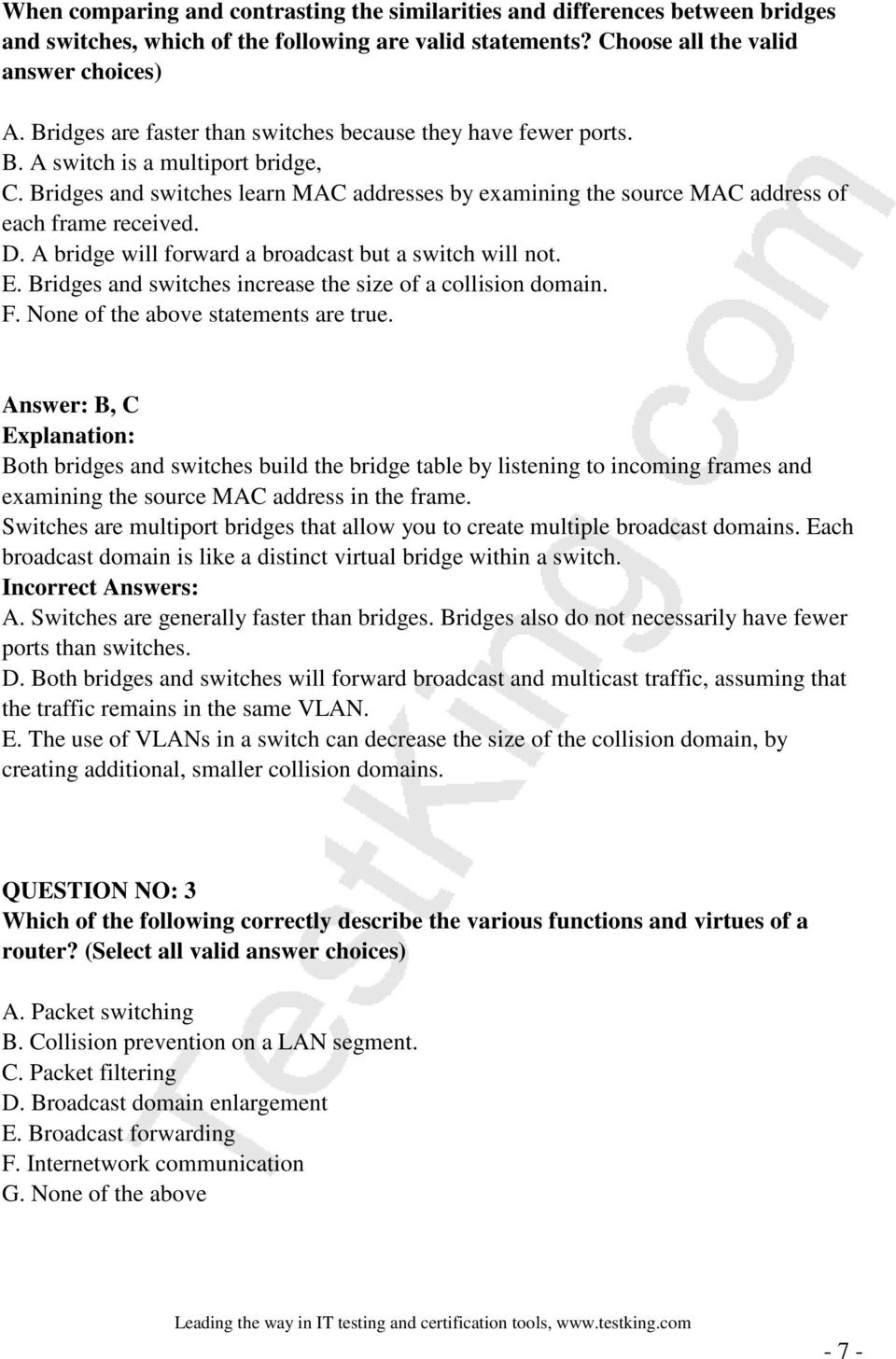
7 When comparing and contrasting the similarities and differences between bridges and switches, which of the following are valid statements? Choose all the valid answer choices) A. Bridges are faster than switches because they have fewer ports. B. A switch is a multiport bridge, C. Bridges and switches learn MAC addresses by examining the source MAC address of each frame received. D. A bridge will forward a broadcast but a switch will not. E. Bridges and switches increase the size of a collision domain. F. None of the above statements are true. Answer: B, C Both bridges and switches build the bridge table by listening to incoming frames and examining the source MAC address in the frame. Switches are multiport bridges that allow you to create multiple broadcast domains. Each broadcast domain is like a distinct virtual bridge within a switch. Incorrect Answers: A. Switches are generally faster than bridges. Bridges also do not necessarily have fewer ports than switches. D. Both bridges and switches will forward broadcast and multicast traffic, assuming that the traffic remains in the same VLAN. E. The use of VLANs in a switch can decrease the size of the collision domain, by creating additional, smaller collision domains. QUESTION NO: 3 Which of the following correctly describe the various functions and virtues of a router? (Select all valid answer choices) A. Packet switching B. Collision prevention on a LAN segment. C. Packet filtering D. Broadcast domain enlargement E. Broadcast forwarding F. Internetwork communication G. None of the above - 7 -
8 Answer: A, C, F The main function of a router is to connect different, separated networks together. In doing so, switching packets from one network to another is a primary function, along with providing for communication between networks. As an additional feature, routers are capable of providing filtering on a network address and application port level, so choice C is also correct. Incorrect Answers: B. Routers can indeed be used to segment a network separate a collision domain, since routers do not forward LAN broadcasts and multicasts to other interfaces. However, routers alone can not prevent all collisions from occurring on any given LAN segment. D. Routers actually segment LANs into smaller broadcast domains. E. Routers do not forward broadcast and multicast traffic out the additional interfaces by default. Unless bridging or IP helpers are configured on the router, LAN broadcasts are blocked at the router level. QUESTION NO: 4 The LAN needs are expanding at the Testking corporate office, which is quickly growing. You are instructed to enlarge the area covered by a single LAN segment on the TestKing network. Which of the following are layer 1 devices that you can use? (Choose all that apply.) A. A switch B. A router C. A network adapter card D. A hub E. A repeater Answer: D, E A hub simply repeats the electrical signal and makes no attempt to interpret the electrical signal (layer 1) as a LAN frame (Layer 2). So, a hub actually performs OSI layer 1 functions, repeating an electrical signal, whereas a switch performs OSI layer 2 functions, actually interpreting Ethernet header information, particularly addresses, to make forwarding decisions. Hubs can be used to increase the number of stations that can be supported on a LAN

9 Because the repeater does not interpret what the bits mean, but does examine and generate electrical signals, a repeater is considered to operate at Layer 1. Repeaters can be used to physically extend the LAN to greater distances. QUESTION NO: 5 Cisco is the leader in the router market space. What basic functions do their routers perform in a network? (Choose two) A. The microsegmentation of broadcast domains B. Path selection C. Packet switching D. Bridging between LAN segments E. Access layer security F. VLAN membership assignment G. Application optimization Answer: B, C The primary functions of a router are: Packet Switching and Path Selection. It is the routers job to determine the best method for delivering the data, and switching that data as quickly as possible. QUESTION NO: 6 The TestKing network administrator needs to determine what LAN devices to install on the TestKing network. What are two advantages of using Layer 2 Ethernet switches over hubs? (Choose two) A. Allowing simultaneous frame transmissions B. Increasing the size of broadcast domains C. Increasing the maximum length of UTP cabling between devices D. Filtering frames based on MAC addresses E. Decreasing the number of collision domains Answer: A, D - 9 -

10 A: A half duplex connection is where only one device can send or receive at a time. A full duplex connection is where both devices can send and receive at the same time. Thus, if you have a 100Mb half-duplex connection, only sending at 100Mb OR receiving at 100Mb can happen at the same time. If you have a 100Mb full duplex connection, you can effectively get 200Mb out of the link because you could be sending 100Mb and receiving 100Mb at the same time. D: Switches are capable of filtering frames based on any Layer 2 fields. For example, a switch can be programmed to reject (not forward) all frames sourced from a particular network. Because link layer information often includes a reference to an upper-layer protocol, switches usually can filter on this parameter. Furthermore, filters can be helpful in dealing with unnecessary broadcast and multicast packets. Section 2: Select the components required to meet a network specification (4 questions) QUESTION NO: 1 CDP is being used throughout the TestKing network. What are two reasons why the TestKing network administrator would use CDP? (Choose two) A. To determine the status of network services on a remote device B. To obtain the IP Address of a connected device in order to telnet to the device C. To verify the type of cable interconnecting two devices D. To verify Layer 2 connectivity between two devices when Layer 3 fails E. To obtain VLAN information from directly connected swticehs F. To determine the status of the routing protocols between directly connected routers G. To support automatic network failover during outages Answer: B, D QUESTION NO: 2 CDP is running between two TestKing devices. What information is supplied by CDP? (Select three) A. Device Identifiers

11 B. Capabilities list C. Platform D. Route identifier E. Neighbor traffic data Answer: A, B, C QUESTION NO: 3 Two TestKing offices are connected as shown below:

12 Two buildings on the London campus of a the TestKing corporation must be connected to use Ethernet with a bandwidth of at least 100 Mbps. TestKing is concerned about possible problems from voltage potential differences between the two buildings. Which media type should be used for the connection? A. Coaxial cable B. Fiber optic cable C. UTP cable D. STP cable E. None of the above Answer: B Current Ethernet technololgy typically comes via either copper UTP or fiber ccables. In this scenario the distance between the buildings is only 55 meters so either copper or fiber could be used, as the distance limitation for 100M UTP Ethernet is 100 meters. However, fiber would be a better fit as it is not prone to errors that could occur due to the voltage potential differences. Because fiber is a dielectric material, it's not susceptible to electrical interference. FO-product vendors also claim that fiber systems make secure communications easier. Interference immunity and lack of emissions are givens in FO systems and in the fiber medium itself. QUESTION NO: 4 Refer to the TestKing network shown below:

13 You work as a network technician at TestKing.com. Please study the exhibit carefully. Based on the information shown above, what is needed to allow host TestKing1 to ping host TestKing2? A. a crossover cable connecting the switches B. a backbone switch connecting the switches with either fiber optic or straight-through cables C. a straight-through cable connecting the switches D. a CSU/DSU connected to the switches with straight-through cables E. a router connected to the switches with straight-through cables Answer: E Routers are Layers 3 devices used for inter-network communication. In this scenario there are two different networks, so both switches need to connect to a router using straight-through cables. A straight-through cable is used to connect two different devices like, switch to router, host to switch. Since we need to insert a router for communication between the two switches, straight through cables will be used between the switches and the router. Section 3: Use the OSI and TCP/IP models and their associated protocols to explain how data flows in a network (10 questions) QUESTION NO: 1 As a CCNA candidate, you must know the various layers of the OSI model. At which layers of the OSI Model do Wide Area Networks operate in? (Choose two) A. Physical Layer B. Datalink Layer C. Network Layer D. Session Layer E. Transport Layer F. Presentation Layer G. Application Layer Answer: A, B

14 A WAN is a data communications network that covers a relatively broad geographic area and that often uses transmission facilities provided by common carriers, such as telephone companies. WAN technologies generally function at the lower two layers of the OSI reference model: the physical layer and the data link layer as shown below. Note: Occasionally WAN's would also be considered to operate at layer 3, but since this question asked for only 2 chopices layers 1 and 2 are better choices. QUESTION NO: 2 While troubleshooting a connectivity problem on the network, you issue the ping command from your PC command prompt, but the output shows "request times out." At which OSI layer is this problem associated with? A. The data link layer B. The application layer C. The access layer

15 D. The session layer E. The network layer Answer: E TCP/IP includes ICMP, a protocol designed to help manage and control the operation of a TCP/IP network. The ICMP protocol provides a wide variety of information about a network's health and operational status. Control message is the most descriptive part of a name. ICMP helps control and manage IP's work and therefore is considered part of TCP/IP's network layer. Reference: CCNA Self-Study CCNA ICND exam certification Guide (Cisco Press, ISBN X) page 277. QUESTION NO: 3 You download a file from an FTP site on the Internet. What is the highest layer in the OSI model used in this FTP operation? A. Application B. Presentation C. Session D. Transport E. Internet F. Data Link G. Physical Answer: A Layer 7 is the application layer, which is the highest layer in the OSI model. This layer describes the use of end user applications, such as opening movie files (avi, mpeg, etc) used Microsoft Office applications, using WWW browsers, using Telnet, and using FTP. QUESTION NO: 4 A host computer has been correctly configured with a static IP address, but the default gateway is incorrectly set. Which layer of the OSI model will be first affected by this configuration error?
16 A. Layer 1 B. Layer 2 C. Layer 3 D. Layer 4 E. Layer 5 F. Layer 6 E. Layer 7 Answer: C IP Addressing and IP routing resides on the OSI Network layer, which is layer 3. QUESTION NO: 5 Which layer of the OSI reference model is responsible for ensuring reliable end-to-end delivery of data? A. Application B. Presentation C. Session D. Transport E. Network F. Data-Link Answer: D A key function of the transport layer is to provide connection services for the protocols and applications that run at the levels above it. These can be categorized as either connection-oriented services or connectionless services. Some protocol suites, such as TCP/IP, provide both a connection-oriented and a connectionless transport layer protocol, to suit the needs of different applications

17 The transport layer is also the place in the layer stack where functions are normally included to add features to end-to-end data transport. Where network layer protocols are normally concerned with just "best effort" communications, where delivery is not guaranteed. Transport layer protocols are given intelligence in the form of algorithms that ensure that reliable and efficient communication between devices takes place. This encompasses several related jobs, including lost transmission detection and handling, and managing the rate at which data is sent to ensure that the receiving device is not overwhelmed. Transmission quality, meaning ensuring that transmissions are received as sent, is so important that some networking references define the transport layer on the basis of reliability and flow-control functions. However, not all transport layer protocols provide these services. Just as a protocol suite may have a connection-oriented and a connectionless transport layer protocol, it may also have one that provides reliability and data management services, and one that does not. Again, this is the case with TCP/IP: there is one main transport layer protocol; TCP, that includes reliability and flow control features, and a second, UDP, that doesn't. QUESTION NO: 6 At which OSI layer is a logical path created between two host systems named TK1 and TK2 on the TestKing LAN? A. Physical B. Session C. Data link D. Transport E. Network F. Application G. Presentation Answer: E QUESTION NO: 7 Which OSI layer is associated with the following: The acknowledgement of transmissions, sequencing, and flow control across a network? A. Layer 2 B. Layer
18 C. Layer 4 D. Layer 5 E. Layer 6 F. Layer 7 Answer: C The Transport layer (Layer 4) defines several functions, including the choice of protocols. The most important Layer 4 functions are error recovery and flow control. The transport layer may provide for retransmission, i.e., error recovery, and may use flow control to prevent unnecessary congestion by attempting to send data at a rate that the network can accommodate, or it might not, depending on the choice of protocols. Multiplexing of incoming data for different flows to applications on the same host is also performed. Reordering of the incoming data stream when packets arrive out of order is included. Examples include: TCP, UDP, and SPX. QUESTION NO: 8 Which OSI layer header contains the address of a destination host that is on another network? A. Application B. Presentation C. Session D. Transport E. Network F. Data link G. Physical Answer: E Only network address contains this information. To transmit the packets the sender uses network address and datalink address. But the layer 2 address represents just the address of the next hop device on the way to the sender. It is changed on each hop. Network address remains the same. QUESTION NO:
19 Which of the following correctly describe steps in the OSI data encapsulation process? (Choose two) A. The presentation layer translates bits into voltages for transmission across the physical link. B. The transport layer divides a data stream into segments and adds reliability and flow control information. C. Packets are created when the network layer adds Layer 3 addresses and control information to a segment. D. The data link layer adds physical source and destination addresses and an FCS to the segment. E. Packets are created when the network layer encapsulates a frame with source and destination host addresses and protocol-related control information. Answer: B, C The Transport Layer: You can think of the transport layer of the OSI model as a boundary between the upper and lower protocols. The transport layer provides a data transport service that shields the upper layers from transport implementation issues such as the reliability of a connection. The transport layer provides mechanisms for: The Network Layer: Layer three of the OSI model is the network layer. network. packets. Incorrect Answers: A: This correctly describes the physical layer, not the presentation layer. D: Although the data link layer adds physical (MAC) source and destination addresses, it adds it to a frame, not a segment. E: Packets are encapsulated, not frames

20 QUESTION NO: 10 When files are transferred between a host and an FTP server, the data is divided into smaller pieces for transmission. As these pieces arrive at the destination host, they must be reassembled to reconstruct the original file. What provides for the reassembly of these pieces into the correct order? A. The sequence number in the TCP header B. The Start Frame Delimiter in the Preamble C. The TTL in the IP header D. The acknowledgement number in the segment header E. The frame check sequence in the Ethernet frame trailer Answer: A The Transport layer can provide reliable networking via acknowledgments, sequencing, and flow control. Acknowledgments Delivered segments are acknowledged to the sender. If they are not acknowledged, the sender will retransmit. * Sequencing Data segments are sequenced into their original order when they arrive at the destination. * Flow Control Provides buffer controls that prevent packet flooding to the destination host. Buffers store bursts of data for processing when the transmission is complete. Layer 4 protocols include the following: * Transmission Control Protocol (TCP) * User Datagram Protocol (UDP) * Sequenced Packet Exchange (SPX)A reliable communications protocol created by Novell NetWare Section 4: Describe common networked applications including web applications (3 questions) QUESTION NO: 1 Part of the TestKing network is displayed below:
21 Study the exhibit shown above. Host TestKingA has established a connection with the TestKingII server attached to interface E0 of the TestKing2 router. Which of the following statements describe the information contained in protocol data units sent from Host TestKing to TestKingII? (Choose three) A. The destination port number in a segment header will have a value of 80 B. The destination IP address of a packet will be the IP address of the E0 interface of the TestKing1 router C. The destination IP address of a packet will be the IP address of the network interface of the TestKingII server D. The destination address of a frame will be the MAC address of the E0 interface of TestKing1 router Answer: A, C, D QUESTION NO: 2 Which protocol below uses TCP port 443 at layer 4? A. HTML B. HTTPS C. TFTP D. Telnet
22 E. SMTP F. None of the above Answer: B HTTPS is the secured version of the HTTP application, which normally uses 128 bit SSL encryption to secure the information sent and received on a web page. An example is a banking web site, or a trustworthy shopping web site that takes credit card information. It is an application layer protocol which uses TCP port 443. Incorrect Answers: A. HTML is not a protocol. C. TFTP uses UDP port 69. D. Telnet uses TCP port 23. E. SMTP uses TCP port 25. QUESTION NO: 3 As a CCNA candidate, you will be expected to know the OSI model very well. Which of the following are associated with the application layer (layer 7) of the OSI model? (Choose two) A. TCP B. Telnet C. FTP D. Ping E. IP F. UDP Answer: B, C The application layer is the top layer of the OSI model and is used to describe the end user applications that can be used over a network. Layer Name Examples Application (layer 7) Telnet, HTTP, FTP, WWW browsers, NFS, SMTP gateways, SNMP Incorrect Answers: A. TCP resides at layer 4. D. ARP is a function of the data link layer, which is layer 2. E. IP is used at layer 3 (network layer)
23 Reference: CCNA Self-Study CCNA INTRO exam certification Guide (Cisco Press, ISBN ) Page 34. Section 5: Describe the purpose and basic operation of the protocols in the OSI and TCP models (10 questions) QUESTION NO: 1 As the TestKing network administrator, you are required to have a firm understanding of the OSI model. Why does the data communication industry use the layered OSI reference model? (Choose two) A. It enables equipment from different vendors to use the same electronic components, thus saving research and development funds B. It encourages industry standardization by defining what functions occur at each layer of the model C. It divides the network communication process into smaller and simpler components; thus aiding component development, design and troubleshooting D. It provides a means by which changes in functionality in one layer require changes in other layers E. It supports the evolution of multiple competing standards and thus provides business opportunities for equipment manufacturers Answer: B, C The OSI (Open System Interconnection) reference model was created as a reference point for communications devices. A layered approach is used to segment the entire telecommunications process into a series of smaller steps. A is correct because it encourages a level of standardization by encouraging that functions be compared to known layers. D is also correct because it allows engineers to focus on the development, refining, and perfection of simpler components. QUESTION NO: 2 Which of the protocols below use TCP at the transport layer? (Select four) A. TFTP B. SMTP
24 C. SNMP D. FTP E. HTTP F. HTTPS Answer: B, D, E, F SMTP (Simple Mail Transfer Profile for ), FTP (File Transfer Protocol), and HTTP/HTTPS (Hyper Text Transfer Protocol for internet) all use TCP because of the reliable delivery mechanism. SMTP uses TCP port 25, FTP uses TCP ports 20 and 21, HTTP uses TCP port 80, and HTTPS uses TCP port 443. Incorrect Answers: A, C: SNMP and TFTP use UDP as the transport mechanism. Generally speaking, protocols that use the keywords "trivial" or "simple" uses UDP, since connectionless, best effort delivery mechanism usually suffice. Reference: CCNA Self-Study CCNA INTRO exam certification Guide (Cisco Press, ISBN ) Page 163. QUESTION NO: 3 Exhibit: The exhibit above displays the partial contents of an encapsulation header. Which of the following are true of the network traffic represented in this diagram? (Select three) A. This is a UDP header B. This is an OSI layer 4 header. C. This is traffic from an FTP server. D. This is traffic from an Telnet client. E. The last PDU received in this session had a sequence number of
25 Answer: B, C, E As the header contains the sequence number and ACK number fields, it represents a TCP header. Choice B is correct as TCP works on Layer 4 i.e. Transport Layer. Source Port mentioned in the header is 21 which indicate it is FTP Traffic because FTP uses port 20 and 21 for data and control. So choice C is correct. The acknowledgment number refers to the sequence number of the last PDU received, which is , making choice E also correct. QUESTION NO: 4 Acknowledgements, sequencing, and flow control are functions that are handled by which layer of the OSI model? A. Layer 5 B. Layer 4 C. Layer 7 D. Layer 6 E. Layer 3 F. Layer 2 G. Layer 1 Answer: B QUESTION NO: 5 A receiving host has failed to receive all of the segments that it should acknowledge. What can the host do to improve the reliability of this communication session? A. Start a new session using UDP B. Obtain a new IP address from the DHCP server C. Use a different source port for the session D. Decrease the sequence number E. Decrease the window size Answer: E
26 A TCP window the amount of outstanding (unacknowledged by the recipient) data a sender can send on a particular connection before it gets an acknowledgment back from the receiver that it has gotten some of it. For example if a pair of hosts are talking over a TCP connection that has a TCP window size of 64 KB (kilobytes), the sender can only send 64 KB of data and then it must stop and wait for an acknowledgment from the receiver that some or all of the data has been received. If the receiver acknowledges that all the data has been received then the sender is free to send another 64 KB. One way to improve the reliability of the TCP connection is to reduce the window size that the receiver needs to receive before sending an acknowledgement. However, this will reduce throughput as more segments and acknowledgements will need to be sent in order to transfer the same amount of data. QUESTION NO: 6 You have set up an Internet based FTP server, where people can upload and download files. In terms of the OSI model, what is the highest layer used during the FTP sessions. A. Application B. Presentation C. Session D. Transport E. Internet F. Data Link G. Physical Answer: A The application layer is the highest layer (layer 7) of the OSI model, and is reserved for end user applications. Since FTP is itself an application, layer 7 is the highest layer used. Incorrect Answers: B, C, D, E, F, G. In any given FTP session, all of these layers will be used at some point but they are incorrect because the question asked for the highest layer used by FTP. QUESTION NO:
27 Which Layer 4 protocol is used for a Telnet connection between two TestKing routers? A. IP B. ICMP C. DNS D. TCP E. UDP F. RTP Answer: D TCP is a reliable connection-oriented protocol. TCP uses acknowledgments, sequencing, and flow control to ensure reliability. Telnet uses TCP port 23. QUESTION NO: 8 DRAG DROP You work as a network administrator at TestKing.com. Your boss, Mrs. Tess King, is interested in the OSI layers. Match the terms with the appropriate layer. Some options are not used
28 Answer:
29 QUESTION NO: 9 Refer to the following exhibit:
30 What data structure is described in the exhibit shown above? A. IP datagram B. TCP segment C. Ethernet frame D. UDP datagram E. FDDI frame F. Token Ring frame G. None of the above Answer: B The Figure below illustrates the fields and overall format of a TCP packet. Twelve fields comprise a TCP packet
31 The following descriptions summarize the TCP packet fields illustrated above. 1. SourcePort and DestinationPort-Identifies points at which upper-layer source and destination processes receive TCP services Sequence Number-Usually specifies the number assigned to the first byte of data in the current message. In the connection-establishment phase, this field also can be used to identify an initial sequence number to be used in an upcoming transmission Acknowledgment Number-Contains the sequence number of the next byte of data the sender of the packet expects to receive Data Offset-Indicates the number of 32-bit words in the TCP header Reserved-Remains reserved for future use Flags-Carries a variety of control information, including the SYN and ACK bits used for connection establishment, and the FIN bit used for connection termination Window-Specifies the size of the sender's receive window (that is, the buffer space available for incoming data) Checksum-Indicates whether the header was damaged in transit
32 17. Urgent Pointer-Points to the first urgent data byte in the packet Options-Specifies various TCP options. Data-Contains upper-layer information. QUESTION NO: 10 FTP, Telnet, DNS, and SMTP are all protocols being used in the TestKing network. Of these, which uses both TCP and UDP ports? A. Telnet B. FTP C. DNS D. SMTP E. None of the above Answer: C The following port numbers for the protocols listed above are as follows: FTP: TCP Port 20 and 21 SMTP: TCP Port 25 Telnet: TCP Port 23 DNS: both TCP and UDP Port 53 Section 6: Describe the impact of applications (Voice OverIP and Video Over IP) on a network (2 questions) QUESTION NO: 1 TestKing is installing IP phones in a new office. The phones and office computers connect to the same device. To ensure maximum throughout for the phone data sessions, the company needs to make sure that the phone traffic is on a different network from that of the office computer data traffic. What is the best network device to which to directly connect the phones and computers and what technology should be implemented on this device? (Choose two)
33 A. VLAN B. Subinterface C. STP D. Hub E. Switch F. Router G. Wireless Access Point H. VTP Answer: A, E QUESTION NO: 2 The corporate head office of TestKing has a teleconferencing system that uses VOIP (voice over IP) technology. This system uses UDP as the transport for the data transmissions. If these UDP datagrams arrive at their destination out of sequence, what will happen? A. UDP will send an ICMP Information Request to the source host. B. UDP will pass the information in the datagrams up to the next OSI layer in the order that they arrive. C. UDP will drop the datagrams. D. UDP will use the sequence numbers in the datagram headers to reassemble the data in the correct order. E. UDP will not acknowledge the datagrams and wait for a retransmission of the datagrams. Answer: B VOIP systems utilize UDP because it is faster and uses less overhead. In addition, the reliable transport mechanism used in TCP is useless to VOIP because if a packet gets dropped and needs to be resent, it will be already too late. UDP provides a service for applications to exchange messages. Unlike TCP, UDP is connectionless and provides no reliability, no windowing, and no reordering of the received data
34 . However, UDP provides some functions of TCP, such as data transfer, segmentation, and multiplexing using port numbers, and it does so with fewer bytes of overhead and with less processing required. UDP data transfer differs from TCP data transfer in that no reordering or recovery is accomplished. Applications that use UDP are tolerant of lost data, or they have some application mechanism to recover data loss. Reference: CCNA Self-Study CCNA INTRO exam certification Guide (Cisco Press, ISBN ) Page 161. Section 7: Interpret network diagrams (7 questions) QUESTION NO: 1 Part of the TestKing network is shown below: You work as a network technician for TestKing and are responsible for this network. Based on the diagram shown above, how many collision domains are there? A. Six B. Fourteen C. Four D. Two E. Three F. One G. Eight
35 Answer: D The multi-segment configuration guidelines apply only to a single Ethernet "collision domain." A collision domain is formally defined as a single CSMA/CD network in which there will be a collision if two computers attached to the system transmit at the same time. An Ethernet system composed of a single segment or multiple segments linked with repeaters is a network that functions as a single collision domain. FIGURE 1 Repeater hubs create a single collision domain The figure shows two repeater hubs connecting three computers. Since only repeater connections are used between segments in this network, all of the segments and computers are in the same collision domain. In the next figure, the repeaters and DTEs are instead separated by a router (packet switch) and are therefore in separate collision domains, since routers do not forward collision signals from one segment to another. Routers contain multiple Ethernet interfaces and are designed to receive a packet on one Ethernet port and transmit the data onto another Ethernet port in a new packet
36 FIGURE 2 Routers creates separate collision domains Instead of propagating collision signals between Ethernet segments, routers interrupt the collision domain and allow the Ethernets they link to operate independently. Therefore, you can use packet switching hubs to build larger network systems by interconnecting individual Ethernet systems. QUESTION NO: 2 You work as a network technician at TestKing.com. You have been assigned the task of designing a new TestKing internetwork. The main priority is to achieve the highest reliability available. TestKing.com is willing to spend more dollars to avoid downtime caused by link failure. Which of the following four designs is to be preferred?
37 A. Design TestKingA B. Design TestKingB C. Design TestKingC D. Design TestKingD Answer: A
38 A network topology that is set up so that each device is directly connected to every other device on the network. This connection method has built-in redundancy. If one link goes down, the device will transmit via another link. Example: If the partial mesh design is a compromise between the network administrators and managers, then the full mesh design implies that the network administrators won. This design is every Cisco network administrator's picture of perfection over a Frame Relay cloud. It gives every site a direct virtual circuit to every other site, as shown in Figure This design gives maximum redundancy and minimum packet latency (latency describes how long it takes a packet to reach each location). QUESTION NO: 3 You work as a network technician at TestKing.com. You have been assigned the task of designing a new TestKing internetwork. The main priority is the achieve the highest reliability available, however not at all costs. TestKing.com is willing to spend more dollars to avoid downtime caused by link failure. Which of the following four designs would provide some redundancy and increase reliability for all four sites, but would cost less than a fully redundant topology?
39 A. Design TestKingA B. Design TestKingB C. Design TestKingC D. Design TestKingD Answer: B You can think of the partial mesh Frame Relay design as the compromise between network administrators and cost-saving managers
40 Example: QUESTION NO: 4 You work as a network technician at TestKing.com. You have been assigned the task of designing a new TestKing internetwork. The main priority is to minimize the link costs. TestKing.at the same time wants to ensure the branch offices with direct connectity to the main site. Which of the following four designs is to be preferred?
41 A. Design TestKingA B. Design TestKingB C. Design TestKingC D. Design TestKingD Answer: C Every
42 network looks for cost efficiency. Redundancy is often sacrificed on the altar of monthly cost. Thus, the hub and spoke Frame Relay network design is one of the more common. In this configuration, you pick a centralized location (most likely, your largest, most connected office) as the "hub" of the network. All other locations are considered "spokes" and have a single virtual circuit connection back to the hub. The major advantage of this configuration is the cost. It offers the cheapest monthly price tag, which cost-cutting corporations enjoy. The disadvantages are beginning to mount against this design, however. The redundancy is sorely lacking. If a single router (the central router) loses connectivity for any reason (if the router crashes, if a trenching company cuts through the line), your entire WAN goes down. The other disadvantage of this design is beginning to eclipse even redundancy. It is the disadvantage of tandem switching. Any time the spoke offices need to reach each other, they must go through the hub office. Example: QUESTION NO: 5 A TestKing network is shown in the exhibit below:
43 The routers in this network are running RIPv2. Which addressing scheme would satisfy the needs of this network yet waste the fewest addresses? A. Network 1: /26Network 2: /26Network 3: /26Serial link 1: /24Serial link 2: /24 B. Network 1: /26Network 2: /28Network 3: /29Serial link 1: /30Serial link 2: /30 C. Network 1: /26Network 2: /27Network 3: /28Serial link 1: /30Serial link 2: /30 D. Network 1: /27Network 2: /28Network 3: /29Serial link 1: /30Serial link 2: /30 Answer: C Network 1 Required Number of hosts :50 When We use the 26 bits for Network : so 62 usable host can be in one network. 50 host for now and remaining hosts address for further growth. Network 2 Required Number of Hosts:
44 When we use the 27 bits for Network: so 30 usable hosts can be in one network. Network 3 Required Number of Hosts: 10 When we use the 28 bits for Network: so 14 usable hosts can be in one network. Connection between TK1, TK2 and TK3 is WAN so when you use 30 bits network IP, you will not lose any IP addresses from network since this subnet allows for only 2 host addresses. QUESTION NO: 6 The Testking network is shown below: A technician is investigating a problem with the network shown above. These symptoms have been observed: 1. All of the user hosts can access the Internet. 2. None of the user hosts can access the server in VLAN9 3. All of the hosts can ping each other
45 What could cause the symptoms? A. Interface S0/0 on the router is down. B. Interface Fa0/1 on the router is down. C. Interface Fa0/5 on Testking3 is down. D. Interface Fa0/4 on Testking3 is down. E. Testking2 is turned off. F. Trunking is not enabled on the link between Testking1 and Testking3. Answer: D Since all user hosts have access to internet, link to router has to be up. Therefore, router interface (Fa0/1 - believe it is labeled incorrectly on diagram as Fa1/0) must be up. Since all hosts can ping each other, but none can get to VLAN 9 which is through single interface Fa0/4, this interface must be down. Choice A: incorrect, S0/0 must be up if internet access available. Choice B: incorrect, Fa0/1 must be up if internet access (through router) available. Choice C: incorrect, would not prevent access to VLAN9 via other routes (i.e Fa0/7, Fa0/9, Fa0/4) Choice D: correct Choice E: incorrect: TestKing2 must be up if internet access (through switch and then router) available Choice F: incorrect: Disabled trunking on link between TestKing1 and TestKing3 would not prevent access to VLAN9 via other routes QUESTION NO: 7 Refer to the graphic shown below:
46 What symbol represents a type of device that is connected to interface FastEthemet 0/23 of the 2960 switch Sw1-2960? A. Picture A B. Picture B C. Picture C D. Picture D Answer: D
47 Some of the common Cisco symbols are shown below: Note: Choice B in this question represents an ATM switch, which is not pictured above. From the output shown in this question, we can see that there a numerous different MAC addresses associated with port Fa 0/23. This can only mean that a device with multiple hosts attached to it is plugged into this port, such as a hub or another switch. Section 8: Determine the path between two hosts across a network (16 questions) QUESTION NO: 1 Part of the TestKing network topology is shown below:
48 Entry exhibit:
49 Host TestKingA pings Host TestKingB, which entry will be in the ARP cache of Host TestKingA to support this transmission? A. A B. B
50 C. C D. D E. E Answer: C QUESTION NO: 2 The TestKing network is shown in the following exhibit:
51 TestKing uses EIGRP as the routing protocol. Based on the info shown above, what path will packets take from a host on the /26 network to a host on the LAN attached to routertestking1? A. The path of the packets will be TESTKING3 to TESTKING2 to TESTKING1 B. The path of the packets will be TESTKING3 to TESTKING1 to TESTKING2 C. The path of the packets will be both TESTKING3 to TESTKING2 to TESTKING1 AND TESTKING3 to TESTKING1 D. The path of the packets will be TESTKING3 to TESTKING1 E. None of the above Answer: D Based on the routing table of TestKing3, the best path to the TestKing1 LAN is shown on the first routing entry ( ). TestKing 3 will use the Serial 0/0 interface to route traffic to this destination, with the next hop IP address of , which is the network used between TestKing3 and TestKing1, making choice D correct. Note that there is only one routing entry for this destination. If traffic were load balancing over both paths, then both would be displayed in the routing table. QUESTION NO: 3 Refer to the following exhibit:
52 Based on the diagram shown above, what is the correct addressing for a frame and packet received by Host TestKingB from Host TestKingA? A. Destination MAC: da.2c98 Source MAC: e8f.088a Destination IP: Source IP: B. Destination MAC: da.2c98 Source MAC: e8f.088a Destination IP: Source IP: C. Destination MAC: da.2c98 Source MAC: 00b0.d0ef.5f6a Destination IP: Source IP: D. Destination MAC: da.2c98 Source MAC: e97.af4e Destination IP: Source IP: E. None of the above Answer: B
53 When packets leave from the host, the packets contains the source MAC and IP of the host address. The source and destination IP address will not change. Because the host knows that the destination is on another subnet, it will forward the packet to the default gateway device, so the destination MAC address will be of the default gateway, which is the FA0/0 interface of router TestKing3. QUESTION NO: 4 Exhibit #1: Exhibit #2:
54 Please study the two exhibits carefully
55 The partial frame shown above displays select header information as it arrives at the destination host. Of the following choices shown below, which one represents the correct header information in the responding frame returned to the remote host? A. A B. B C. C D. D E. E Answer: A QUESTION NO: 5 The TestKing network is shown below: Based on the diagram above, which destination addresses will Host A use to send data to Host B? (Choose two.) A. The IP address of TestKing1 B. The IP address of TestKingA Fa0/0-55 -
56 C. The IP address of Host B D. The MAC address of TestKing1 E. The MAC address of TestKingA Fa0/0 F. The MAC address of Host B Answer: C, E When sending data from one host to another, destination information will be added to every packet's header. The destination information will be the IP and MAC Address of destination host. If the destination is found outside the subnet the MAC address of the router is used. Note: The destination IP address will never change, unless NAT is involved. QUESTION NO: 6 Which IOS user EXEC command will allow a network technician to determine which router in the path to an unreachable network host should be examined more closely for the cause of the network failure? A. TestKingB> telnet B. TestKingB > ping C. TestKingB > trace D. TestKingB > show ip route E. TestKingB > show interface F. TestKingB > show cdp neighbors Answer: C This can perform the trace command. It sends the ping packets to each of the routers on the way to the receiver. The router which doesn't respond will be a potential failure place in this network. QUESTION NO: 7 A TestKing office's network topology is shown in the diagram below:
57 Host TestKingA needs to communications with the server shown above. What address will be placed on the destination address field of the frame when it leaves host TestKingA? A. The MAC address of TestKingA B. The MAC address of switch TestKing1 C. The MAC address of the E0 interface of the TestKing3 router. D. The MAC address of the E1 interface of the TestKing3 router. E. The MAC address of switch TestKing2 F. The MAC address of the server Answer: C If the destination host is in the remote segment than the router will change the MAC address of the source to its own. The inverse ARP protocol is by default on. Remember that IP address is not changed after forwarding. The MAC address is changed after crossing each broadcast domain. QUESTION NO: 8 The TestKing network topology is shown below:
58 You work as a network engineer at TestKing.com. The topology of the TestKing.com network is displayed in the exhibit. Host TestKing1 has established a connection with the HTTP server attached to interface E0 of the TestKingB router. Which of the following statements describe the information contained in protocol data units sent from host TestKing1 to this server? (Select three) A. The destination port number in a segment header will have a value of 80. B. The destination port number in a segment header will have a unique value greater than or equal to C. The destination address of a frame will be the MAC address of the HTTP server interface. D. The destination address of a frame will be the MAC address of the E0 interface of the TestKingA router. E. The destination IP address of a packet will be the IP address of the E0 interface of the TestKingA router. F. The destination address of a packet will be the IP address of the HTTP-Server Answer: A, D, F
59 HTTP uses TCP port 80, making choice A correct. The source port will be chosen randomly, but not the destination TCP port. The destination IP address will be left unchanged, and since HTTP server is on a remote network, the destination MAC address will be the MAC address of the default gateway ( E0 on TestKingA). QUESTION NO: 9 The TestKing network is shown below: In this network, host TestKing1 is able to send data to Host TestKing2. How will Router TestKingD handle the data frame received from Host TestKing1? (Choose three)
60 A. Router TestKingD will strip off the source MAC address and replace it with the MAC address on the forwarding Fast Ethernet interface B. Router TestKingD will strip off the source IP address and replace it with the IP address on the forwarding Fast Ethernet interface C. Router TestKingD will strip off the destination MAC address and replace it with the MAC address of Host TestKing2 D. Router TestKingD will strip off the destination IP address and replace it with the IP address of Host B E. Router TestKingD will forward the data frame out interface Fast Ethernet0/1 F. Router TestKingD will forward the data frame out interface FastEthernet0/2 Answer: A, C, F Whereas switches can only examine and forward packets based on the contents of the MAC header, routers can look further into the packet to discover the network for which a packet is destined. Routers make forwarding decisions based on the packet's network-layer header (such as an IPX header or IP header). These network-layer headers contain source and destination network addresses. Local devices address packets to the router's MAC address in the MAC header. After receiving the packets, the router must perform the following steps: 1. Check the incoming packet for corruption, and remove the MAC header. The router checks the packet for MAC-layer errors. The router then strips off the MAC header and examines the network-layer header to determine what to do with the packet. 2. Examine the age of the packet. The router must ensure that the packet has not come too far to be forwarded. For example, IPX headers contain a hop count. By default, 15 hops is the maximum number of hops (or routers) that a packet can cross. If a packet has a hop count of 15, the router discards the packet. IP headers contain a Time to Live (TTL) value. Unlike the IPX hop count, which increments as the packet is forwarded through each router, the IP TTL value decrements as the IP packet is forwarded through each router. If an IP packet has a TTL value of 1, the router discards the packet. A router cannot decrement the TTL value to 1 and then forward the packet. 3. Determine the route to the destination. Routers maintain a routing table that lists available networks, the direction to the desired network (the outgoing interface number), and the distance to those networks. After determining which direction to forward the packet, the router must build a new header. (If you want to read the IP routing tables on a Windows 95/98 workstation, type ROUTE PRINT in the DOS box.) 4. Build the new MAC header and forward the packet
61 Finally, the router builds a new MAC header for the packet. The MAC header includes the router's MAC address and the final destination's MAC address or the MAC address of the next router in the path. Figure 5 shows the contents of a packet before and after it has been forwarded by a router. Figure 5 also shows the contents of the router's routing tables. Figure 5: Routers forward packets based on the network address
62 QUESTION NO: 10 Two TestKing hosts are shown below: Refer to the exhibit above. Host A is communicating with host B. How will the data be addressed when it leaves host A? A. Source MAC=000A.8A47.E612 Destination MAC=000B.DC04.12F4 Source IP= Destination IP= B. Source MAC=000A.8A47.E612 Destination MAC=0010.7BE7.FAEF Source IP= Destination IP= C. Source MAC=000A.8A47.E612 Destination MAC=000B.DC04.12F4 Source IP= Destination IP= D. Source MAC=000A.8A47.E612 Destination MAC=0010.7BE7.FAEF Source IP= Destination IP= E. None of the above Answer: B
63 When packets leave from the host, the packets contains the source MAC and IP of the host address. The source and destination IP address will not change (if it did, the router devices would not know where to send the data). Because the host knows that the destination is on another subnet, it will forward the packet to the default gateway device, so the destination MAC address will be of the default gateway, which is the LAN interface of router TestKing1. QUESTION NO: 11 Exhibit: Please study the exhibit above carefully. If host TestKingA sends an IP packet to host TestKingB, what will the OSI Layer 3 source address be in the packet when it reaches host B? A. B2:B2:B2:B2:B2:B2 B. A1:A1:A1:A1:A1:A1 C D E. C3:C3:C3:C3:C3:C3 F G. None of the above Answer: C
64 When packets transfer from one host to another across a routed segment, the source IP address always remains the same source IP address, and the physical (MAC) address will be the existing router's interface address. Similarly, the destination IP address always remains the same and the destination physical (MAC) address is the destination router's interface address. QUESTION NO: 12 Exhibit: Please study the exhibit carefully. If host TestKingA sends an IP packet to host TestKingB, what will the source physical (MAC) address be in the frame when it reaches host TestKingB? A. A1:A1:A1:A1:A1:A1 B. D4:D4:D4:D4:D4:D4 C. B2:B2:B2:B2:B2:B2 D E F. C3:C3:C3:C3:C3:C3 Answer: F
65 When packets transfer from one host to another across a routed segment, the source IP address always remains the same source IP address, and the source physical (MAC) address will be the existing router's interface address. Similarly, the destination IP address always remains the same and the destination physical (MAC) address is the destination router's interface address. QUESTION NO: 13 In the network below, host TestKingA is transferring a file to the FTP server. Point A represents the frame as it goes toward the TestKing1 router. What will the Layer 2 destination address be at this point? A B. abcd C. aabb D E. abcd Answer: E
66 For packets destined to a host on another IP network, the destination MAC address will be the LAN interface of the router. Since the FTP server lies on a different network, the host will know to send the frame to it's default gateway, which is TestKing1. QUESTION NO: 14 Part of the TestKing network is shown below: Host TestKing1 needs to communicate with the server shown above. What address will be placed in the destination address field of the frame when it leaves Host TestKing1? A. The MAC address of Host TestKing1 B. The MAC address of E0 of the router TestKingC C. The MAC address of Switch TestKingB D. The MAC address of E1 of the router TestKingC E. The MAC address of Switch TestKingA F. The MAC address of the server TestKingD G. None of the above Answer: B
67 Since the server resides on a different IP subnet than the host TestKing1, the host will send the frame to its default gateway. In this case, the router TestKingC is acting as the default gateway for all hosts on the LAN, so the frame will be sent to its Ethernet interface so that it can be routed to the server. QUESTION NO: 15 Part of the TestKing network is shown below: In this TestKing network segment, host TestKingA needs to send data to Host TestKingB. Which Layer 2 and Layer 3 destination addresses will be used in this session to send the data from Host TestKingA to Host TestKingB? A and e56.ab2e B and e84.acef C and e56.ab2e D and da.2c98 E. None of the above Answer: A
68 When packets leave from the host, the packets contains the source MAC and IP of the host address. The source and destination IP address will not change. Because the host knows that the destination is on another subnet, it will forward the packet to the default gateway device, so the destination MAC address will be of the default gateway, which is the FA0/0 interface of router TestKing2. QUESTION NO: 16 Part of the TestKing network is shown below: In this network segment, host TestKingA sends data to Host TestKingB. As packets travel from host TestKingA to host TestKingB, which three devices will use the destination MAC address of the packet to determine a forwarding path? (Choose three) A. Hub TestKing0 B. Switch TestKing1 C. Router TestKing5 D. Router TestKing4 E. Switch TestKing2 F. Switch TestKing3-68 -
69 Answer: B, E, F Switches use the destination MAC address information for forwarding traffic, while routers use the destination IP address information. Local Area Networks employ Layer 2 Switches and Bridges to forward and filter network traffic. Switches and Bridges operate at the Data Link Layer of the Open System Interconnect Model (OSI). Since Switches and Bridges operate at the Layer 2 they operate more intelligently than hubs, which work at Layer 1 (Physical Layer) of the OSI. Because the switches and bridges are able to listen to the traffic on the wire to examine the source and destination MAC address. Being able to listen to the traffic also allows the switches and bridges to compile a MAC address table to better filter and forward network traffic. To accomplish the above functions switches and bridges carry out the following tasks: 1. MAC address learning by a switch or a bridge is accomplished by the same method. The switch or bridge listens to each device connected to each of its ports and scan the incoming frame for the source MAC address. This creates a MAC address to port map that is cataloged in the switches/bridge MAC database. Another name for the MAC address table is content addressable memory or CAM table. 2. When a switch or bridge is listening o the network traffic, it receives each frame and compares it to the MAC address table. By checking the MAC table the switch/ bridge are able o determine which port the frame came in on. If the frame is on the MAC table the frame is filtered or transmitted on only that port. If the switch determines that the frame is not on the MAC table, the frame is forwarded out to all ports except the incoming port. Section 9: Describe the components required for network and Internet communications (5 questions) QUESTION NO: 1 The TestKing network is displayed in the diagram shown below:
70 The TestKing network consists of a small office with twenty-five employees that has one connection to the Internet through the TK1 router. What routing configurations are recommended on the TK1 and ISP routers? A. BGP on both the routers. B. RIP on both the routers. C. Default routes on both routers. D. BGP on the ISP router and a static route on TK1. E. A default route on TK1 and a static route on the ISP router. F. None of the above Answer: E Since private network use RFC 1918 IP address ranges internally, and because of security reasons, it is generally not possible to use an interior routing protocol with the ISP. This eliminates choice B. When connecting to an ISP, usually only BGP or static routes are supported. In this case, since there is only one connection to the Internet, BGP is not needed so choices A and D can be eliminated. A static default route would be needed on router TK1 to route to the Internet. In turn, the ISP only needs a specific static route to reach the LAN of the TestKing network. Incorrect Answers: A, D: BGP is not needed on networks that contain only a single link to the Internet. B. Interior routing protocols are generally not supported with an ISP. C. A default route on the ISP router would send all of their customers Internet traffic to the TestKing network, and not the Internet
71 QUESTION NO: 2 A new point to point circuit is installed, connecting Testking 1 to Testking 2 as shown below: Users at Testking 1 wish to utilize the existing Internet connection at Testking 2. To do this, a gateway of last resort needs to be set. What is the command to do this? A. TestKing1(config)# ip route B. TestKing1(config)# ip route S1 C. TestKing1(config)# ip route D. TestKing1(config)# ip route S E. TestKing1(config)# ip route F. None of the above Answer: E Setting the default gateway is done by issuing either the "ip route serial 0" or the "ip route " command. The following excerpt provides some additional information:
72 Incorrect Answers: A, C. The IP address of the next hop needs to go after the route, not before. B. This would have been acceptable if the interface specified was S0, not S1. C. The interface used to forward packets for the route should be placed after the route, not before. QUESTION NO: 3 The network associate is configuring OSPF on the Core router shown below. All the connections to the branches should be participating in OSPF. The link to the ISP should NOT participate in OSPF and should only be advertised as the default route. What set of commands will properly configure the Core router? A. Core(config-router)# default-information originate Core(config-router)# network area 0 Core(config-router)# exit
73 Core(config)# ip route B. Core(config-router)# default-information originate Core(config-router)# network area 0 Core(config-router)# exit Core(config)# ip route C. Core(config-router)# default-information originate Core(config-router)# network area 0 Core(config-router)# exit Core(config)# ip route D. Core(config-router)# default-information originate Core(config-router)# network area 0 Core(config-router)# exit Core(config)# ip route Answer: D There are two ways to inject a default route into a normal area. 1. If the ASBR already has the default route in its routing table, you can advertise the existing /0 into the OSPF domain with the default-information originate router configuration command. 2. If the ASBR doesn't have a default route, you can add the keyword always to the default-information originate command (default-information originate always). This command will advertise a default route into the OSPF domain, regardless of whether it has a route to Another benefit of adding always keyword is that it can add stability to the internetwork. For example, if the ASBR is learning a default route from another routing domain such as RIP and this route is flapping, then without the always keyword, each time the route flaps, the ASBR will send a new Type 5 LSA into the OSPF domain causing some instability inside the OSPF domain. With the always keyword, the ASBR will advertise the default inside the OSPF domain always, and thus the flapping of the default route from the RIP domain will not cause any instability inside the OSPF domain. In the example shown here, only choice D is correct as the wildcard mask correctly specifies the networks, which include all IP addresses in the range. Reference: QUESTION NO: 4 A new Internet T1 is being added to the TestKing network as shown:
74 The ISP assigned you the class CIP address /30 for this Internet connection. A default route to the Internet should be set up. Which of the following are acceptable ways to configure this on the Gateway router? (Select all that apply) A. Gateway(config)# ip route
75 B. Gateway(config)# router rip Gateway(config-router)# network default C. Gateway(config)# ip route Serial0/0 D. Gateway(config)# router OSPF Gateway(config-router)# network E. Gateway(config)# ip default-network Answer: A, E This question only involves the configuration of the gateway router to the ISP, nothing else. You have two choices to accomplish this: the command "ip route" or the command "ip default-network". Both of these methods will configure a default route to the ISP as desired. Incorrect Answers: B, D: RIP and OSPF are interior routing protocols. The T1 Internet connection that is being set up here is between two different Autonomous Systems. The only routing protocol that could be potentially used is BGP, but that is not an option. C: This command will only set up a static route to the /24 network. We wish to set up a static default route. QUESTION NO: 5 Router TestKing2 is connected to an ISP as shown below: In the ISP link to the WAN shown above, you must complete the connection between the TestKing2 router to the service provider. To accomplish this task, which two devices could be installed at the TestKing site to provide a connection through the local loop to the CO of the provider? (Choose two) A. Multiplexer B. WAN switch C. ATM switch
76 D. CSU/DSU E. PVC F. Modem G. LMI Answer: D, F Section 10: Identify and correct common network problems at layers 1, 2, 3 and 7 using a layered model approach (8 questions) QUESTION NO: 1 Part of the TestKing network is shown below: Study the exhibit shown above. A problem with network connectivity has been observed. It is suspected that the cable connected to switch port Fa0/9 on Switch TestKing1 is disconnected. What would be an effect of this cable being disconnected? A. Communication between VLAN3 and the other VLANs would be disabled
77 B. Host TestKingB would not be able to access the server in VLAN9 until the cable is reconnected C. For less than a minute, Host TestKingB would not be able to access the server in VLAN9. Then normal network function would resume D. The transfer of files from Host TestKingB to the server in VLAN9 would be significantly slower E. None of the above Answer: C Spanning-Tree Protocol (STP) is a Layer 2 protocol that utilizes a special-purpose algorithm to discover physical loops in a network and effect a logical loop-free topology. STP creates a loop-free tree structure consisting of leaves and branches that span the entire Layer 2 network. The actual mechanics of how bridges communicate and how the STP algorithm works will be discussed at length in the following topics. Note that the terms bridge and switch are used interchangeably when discussing STP. In addition, unless otherwise indicated, connections between switches are assumed to be trunks. STP keeps the port either in block or in forward states, when forward port disconnect then within the less then a minute blocked port comes into forward state so packets starts to go through new forward port. The Spanning Tree Protocol (STP) would identify the best path as well as alternate path to reach in proper destination. In a redundant link, if the primary link fails then the secondary links will automatically start after few minutes. If port Fa0/9 became disconnected, then the packets would be re-routed automatically using the TestkingA-Testking2-TestKing3 path. QUESTION NO: 2 You are logged into a router and wish to view the layer 3 information about your neighboring Cisco routers. What IOS command gives layer 3 information for of the directly connected router interfaces? A. show ip links B. show cdp neighbor C. show cdp neighbor detail D. show ip clients E. show ip route F. None of the above
78 Answer: C To display detailed information about neighboring devices discovered using Cisco Discovery Protocol (CDP), use the show cdp neighbors privileged EXEC command. Detail - (Optional) Displays detailed information about a neighbor (or neighbors) including network address, enabled protocols, hold time, and software version. Incorrect Answers: A, D. These are invalid commands. B. The "show cdp neighbor" command, without the "detail" keyword will not display the additional layer 3 protocol information. E. This will show all routes from all other routers within the domain. We wish to see information from just the direct interface neighbors. QUESTION NO: 3 A TestKing technician is troubleshooting connectivity problems between two routers that are directly connected through the serial line. The technician notices that the serial line is up but cannot see any neighbors displayed in the output of the show cdp neighbors command. In which OSI layer is the problem most likely occurring? A. Physical B. Data link C. Network layer D. Transport layer E. Application layer Answer: B As the question states that serial line is up, it means the problem is not on the Network layer. The administrator cannot see any output by issuing the show cdp neighbors command. It means that CDP is disabled and CDP is a protocol that runs over Layer2 (the data link layer) on all Cisco routers, bridges, access servers, and switches. QUESTION NO:
79 While troubleshooting a network connectivity problem, a TestKing technician observes steady link lights on both the workstation NIC and the switch port to which the workstation is connected. However, when the ping command is issued from the workstation, the output message "Request timed out." is displayed. At which layer of the 7-layer OSI model does the problem most likely exist? A. The data link layer B. The application layer C. The protocol layer D. The access layer E. The session layer F. The network layer G. None of the above Answer: F QUESTION NO: 5 A host is connected to the TestKing network as displayed below:
80 The two connected ports on the switch are not turning orange or green. What would be the most effective steps to troubleshoot this physical layer problem? (Choose three) A. Ensure that the Ethernet encapsulations match on the interconnected router and switch ports. B. Ensure that cables A and B are straight-through cables. C. Ensure cable A is plugged into a trunk port. D. Ensure that switch has power. E. Reboot all of the devices. F. Reseat all cables. Answer: B, D, F Straight-through cables are used to connect hosts to a switch (or hub) and routers to a switch (or hub). See the table below:
81 Incorrect Answers: A: This would mean that there was a layer 2 issue, not layer 1. If the problem was related to the encapsulation, the lights on the switch would indicate layer 1 activity. C: A trunk port is not required, and again if this was the problem the link lights on the switch would be on. E: This should only be used as a last resort, as this will affect all users on the switch. QUESTION NO: 6 Which line from the output of the show ip interface command indicates that there is a Layer 1 problem? A. Serial0/1 is up, line protocol is down B. Serial0/1 is down, line protocol is down C. Serial0/1 is up, line protocol is up D. Serial0/1 is administratively down, line protocol is down E. None of the above Answer: B When the physical interface itself is down, then the problem is related to layer 1. When it is up, but the line protocol is down, then the problem is related to layer
82 Reference: QUESTION NO: 7 At which layer of the OSI model does the protocol that provides the information displayed by the "show cdp neighbors" command operate? A. Transport B. Physical C. Application
83 D. Data link E. Network Answer: D CDP is a device discovery protocol that runs over Layer 2 (the data link layer) on all Cisco-manufactured devices (routers, bridges, access servers, and switches) and allows network management applications to discover Cisco devices that are neighbors of already known devices. With CDP, network management applications can learn the device type and the Simple Network Management Protocol (SNMP) agent address of neighboring devices running lower-layer, transparent protocols. QUESTION NO: 8 Which three of the protocols below belong to the application layer? (Select three answer choices) A. ARP B. HTTPS C. SMTP D. CDP E. TFTP F. ICMP Answer: B, C, E The application layer is the highest OSI layer, and protocols at this layer are end-user oriented. HTTPS so people can get information on the internet, SMTP so people can manage networks, and TFTP so people can download files. Incorrect Answers: A, D, F. ARP, CDP, ICMP are protocols that equipment like routers and switches use to communicate with themselves, and belong to lower levels on the model
84 Section 11: Differentiate between LAN/WAN operation and features (4 questions) QUESTION NO: 1 You want to upgrade the TestKing LAN so that all ports operate in full duplex mode. Which statement is true about full-duplex Ethernet when comparing to half-duplex Ethernet? A. Full-duplex Ethernet consists of a shared cable segment. Half-duplex provides a point-to-point link B. Full-duplex Ethernet uses two wires to send and receive. Half-duplex Ethernet uses one wire to send and receive C. Full-duplex Ethernet can provide higher throughput than can half-duplex Ethernet of the same bandwidth D. Full-duplex Ethernet uses a loopback circuit to detect collisions. Half-duplex Ethernet uses a jam signal E. None of the above Answer: C QUESTION NO: 2 What are two characteristics of "store and forward" switching? (Select two answer choices) A. Latency fluctuates regardless of frame size. B. The switch receives the complete frame before beginning to forward it. C. Latency through the switch varies with frame length. D. The switch checks the destination address upon receipt of headers. Answer: B, C With store-and-forward, the entire frame is received by the switch before the first bit of the frame is forwarded
85 As soon as the incoming switch port receives enough of the frame to see the destination MAC address, the forwarding decision is made and the frame is transmitted out the appropriate outgoing port to the destination device. So, each frame might experience slightly less latency. Store and forward switching may add latency when compared to other switching methods such as cut through, but it can reduce the amount of errors that become forwarded through a network. Reference: CCNA Self-Study CCNA INTRO exam certification Guide (Cisco Press, ISBN ) Page 243 Incorrect Answers: A. The amount of latency that is introduced with this method of switching is dependent on the size of the frame, as the switch must wait to receive the entire frame before sending it. D. The switch must wait for the entire frame before forwarding it on, and not just the headers. QUESTION NO: 3 Split horizon has been enabled within the TestKing routed network. Which one of the following statements best explains the split horizon rule? A. Only routers can split boundaries (horizons) between networks in separate AS numbers. B. Each AS must keep routing tables converged to prevent dead routes from being advertised across boundaries. C. Once a route is received on an interface, advertise that route as unreachable back out the same interface. D. Information about a route should never be sent back in the direction from which the original update came. E. None of the above Answer: D The split horizon rule states: * Never advertise a route out of the interface through which you learned it. For instance, in Figure 4a below, if Router One is connected to Routers Two and Three through a single multipoint interface (such as Frame Relay), and Router One learned about Network A from Router Two, it will not advertise the route to Network A back out the same interface to Router Three. Router one assumes that Router Three would learn about Network A directly from Router Two
86 Incorrect Answers: A: There is no such requirement B: Distance vector protocols updates routing table at regular intervals instead of Topology changes C: This is the definition of the poison reverse rule, not the split horizon rule. Reference: Wendell Odom. CISCO CCNA Certification Guide (2000 Press) Page 369. QUESTION NO: 4 Which of the following commands would be applied to a WAN interface, but not on LAN Interface? (Choose all that apply) A. IP address B. encapsulation PPP C. no shutdown D. authentication CHAP E. Speed F. None of the above Answer: B, D PPP encapsulation can be used in ISDN interfaces, Asynchronous serial interfaces, and point to point serial WAN connections. PPP is not an option for LAN interfaces. CHAP authentication is a PPP 3 way authentication method. CHAP authentication can only be used on PPP encapsulated interfaces and is not a LAN interface configuration option
87 Incorrect Answers: A, C. This command can be applied to both LAN and WAN interface types. E. The speed command is used on LAN interfaces, and is not used on WAN interface types. Topic 2, IMPLEMENT A SMALL SWITCHED NETWORK (66 questions) Section 1: Select the appropriate media, cables, ports, and connectors to connect switches to other network devices and hosts (6 questions) QUESTION NO: 1 Exhibit: You work as a network technician at TestKing and you need to connect your workstation to the network as shown above. Based on the diagram shown, what kind of cable should be used to make each connection that is identified by the numbers shown?
88 A. 1. Ethernet rollover cable 2. Ethernet crossover cable 3. Serial Cable 4. Null Modem Cable B. 1. Ethernet crossover cable 2. Ethernet Straight-through cable 3. Fiber Optic Cable 4. Rollover Cable C. 1. Ethernet Straight-through cable 2. Ethernet Straight-through cable 3. Serial Cable 4. Rollover Cable D. 1. Ethernet Straight-through cable 2. Ethernet Crossover Cable 3. Serial Cable 4. Rollover cable E. None of the above Answer: C QUESTION NO: 2 What kind of cable should be used to establish a trunked line between two Catalyst switches? A. A straight-through cable B. An EIA/TIA-232 serial cable C. An auxiliary cable D. A modem cable E. A cross-over cable Answer: E A crossover cable is used to connect two of the same device types, or devices from the same OSI layer
89 QUESTION NO: 3 The TestKing network Topology is displayed in the exhibit below: A switch has been configured for three different VLANs: VLAN 2, VLAN 3, and VLAN 4. For the purposes of communication between VLANs a router is to be added. Host from one VLAN should be able to reach the hosts in the other VLANs. Based on this requirement, what type of connection is acceptable between the router and switch? A. 10 Mbps Ethernet B. 56 kbps serial C. 100 Mbps Ethernet D. 1,544 Mbps serial E Mbps Ethernet Answer: C, E
90 For all hosts to be able to reach each other, inter-vlan routing will need to be configured. In order to provide Inter-VLAN routing between the router and the switch, a trunk will need to be set up. This trunk can be either ISL or 802.1Q. On a router, the interface that is to be used as the trunk can be 100 Mbps Ethernet, Gigabit Ethernet, or 10 Gigabit Ethernet. Therefore, only choices C or E are correct. QUESTION NO: 4 Part of the TestKing LAN is shown below: Based on the diagram shown above, which set of terms correctly identifies the cable types shown in the exhibit? (Assume that none of the switches are set to autoconfigure) A. A: straight-through B: straight-through C: rollover B. A: crossover B: crossover C: rollover C. A: crossover B: straight-through C: straight-through D. A: crossover B: straight-through C: rollover E. A: straight-through
91 B: crossover C: rollover Answer: D Crossover Cables are Used to Connect : Host to Host (Peer to Peer) Networking Switch to Switch Hub to Hub Computer to Router's Ethernet Port Straight through Cable: Host to Switch Host to Hub Switch to Router Serial Cable: Router's Serial Port to Serial Port Rollover Cable : To connect Router/Switch Console port. Here one switch is connected with another switch using a crossover cable. The switch connected with the router uses a straight through cable and the PC Connects to the router's console port using the console rollover cable. QUESTION NO: 5 The TestKing network administrator is connecting PC hosts TestKingA and TestKingB directly through their Ethernet interfaces as shown in the graphic. Ping attempts between the hosts are unsuccessful. What can be done to provide connectivity between the hosts? (Choose two.)
92 A. The subnet masks should be set to B. The hosts must be reconfigured to use private IP addresses for direct connections of this type. C. A default gateway needs to be set on each host. D. A rollover cable should be used in place of the straight-through cable E. A crossover cable should be used in place of the straight-through cable. F. The subnet masks should be set to Answer: A, E This problem is due to the misconfiguration of subnet mask as well as the fact that a straight-through cable is used to connect the two devices. To ensure connectivity, the correct subnet mask needs to be used so that the two devices are in the same subnet and when connecting two PC's back to back a crossover cable should be used. QUESTION NO: 6 Assuming you build networks to exact specifications, what is the recommended maximum length a 10BaseT cable can be before it has to be segmented or repeated? A. 100 meters B. 100 feet C. 100 yards D. 200 meters
93 E. None of the above Answer: A The distance standards are in meters and 10BaseT has a distance restriction of 100 meters. If you go further then that, you compromise data integrity. 10BastT is the predominant cable type used in Ethernet networks. Section 2: Explain the technology and media access control method for Ethernet networks (14 questions) QUESTION NO: 1 The TestKing LAN is upgrading all devices to operate in full duplex. Which statement is true about full-duplex Ethernet in comparison to half-duplex Ethernet? A. Full-duplex Ethernet uses two wires to send and receive. Half-duplex Ethernet uses one wire to send and receive B. Full-duplex Ethernet consists of a shared cable segment. Half-duplex Ethernet provides a point-to-point link C. Full-duplex Ethernet can provide higher throughout than can half-duplex Ethernet of the same bandwidth D. Full-duplex Ethernet uses a loopback circuit to detect collisions. Half-duplex ethernet uses a jam signal E. None of the above Answer: C QUESTION NO: 2 A network administrator wants to control which user hosts can access the network based on their MAC address. What will prevent workstations with unauthorized MAC addresses from connecting to the network through a switch?
94 A. BPDU B. Port security C. RSTP D. STP E. VTP F. Blocking mode Answer: B UnderstandingHow PortSecurity Works: You can use port security to block input to an Ethernet, Fast Ethernet, or Gigabit Ethernet port when the MAC address of the station attempting to access the port is different from any of the MAC addresses specified for that port. Alternatively, you can use port security to filter traffic destined to or received from a specific host based on the host MAC address. When a secure port receives a packet, the source MAC address of the packet is compared to the list of secure source addresses that were manually configured or autoconfigured (learned) on the port. If a MAC address of a device attached to the port differs from the list of secure addresses, the port either shuts down permanently (default mode), shuts down for the time you have specified, or drops incoming packets from the insecure host. The port's behavior depends on how you configure it to respond to a security violation. If a security violation occurs, the Link LED for that port turns orange, and a link-down trap is sent to the Simple Network Management Protocol (SNMP) manager. An SNMP trap is not sent if you configure the port for restrictive violation mode. A trap is sent only if you configure the port to shut down during a security violation. Reference: QUESTION NO: 3 The TestKing internetwork shown in the diagram is experiencing network delays
95 On the basis of the information provided in the exhibit above, what is the problem? A. The connection between Switch1 and Switch2 should be half-duplex. B. The cable between Router1 and Switch1 should be a crossover. C. The cable connecting Host A to Switch2 is too long. D. The server is on a different subnet than router interface Fa0/0. E. The cable between Switch1 and Switch2 should be straight-through. F. None of the above Answer: C
96 According to IEEE specifications, the maximum segment length of an Ethernet cable should not exceed 100 meters. The total distance between an Ethernet Transmitter and Receiver at the absolute end points of the network (maximum diameter from origin to final destination, if the wires were stretched out to form a straight line) should be no more than100 Meters (328 ft., 109 yards, or about the length of a football field). This limitation results from the timing of the Ethernet signals on the cable and not necessarily the cable characteristics, and is, therefore, a "hard" number. QUESTION NO: 4 What is the IEEE standard associated with Gigabit Ethernet? (Select two answer choices) A B C ab D ae E z F u Answer: C, E The IEEE 802.3z standard describes 1000BASE-SX. The 1000BaseT standard was released in June 1999, defined by IEEE 802.3ab. Incorrect Answers: A. This describes the standard used for wireless networks. B. This is the standard for token ring networks. D. On June 17, 2002 the IEEE 802.3ae specification for 10 Gigabit Ethernet was approved as an IEEE standard by the IEEE Standards Association (IEEE-SA) Standards Board. F. IEEE 802.3u describes the standard for 100BASE-TX. QUESTION NO: 5 Which of the following can lead to the contribution of LAN traffic congestion? (Select all that apply) A. Too many hosts in a broadcast domain B. Full duplex operation
97 C. Broadcast storms D. Multicasting E. Segmentation F. Low bandwidth Answer: A, C, F Choice A is correct because the more hosts on a broadcast domain, the more traffic that is created. Choice Ccontributes to congestion because broadcast storms can become very problematic, and lead to complete network saturation. Multicasts are similar to broadcasts in their use on a LAN. Finally, if there is not enough bandwidth, traffic sessions can time out. This leads to new transmissions and the re-sending of data, which can lead to more congestion. Incorrect Answers: B, E. These are incorrect because full duplex operation and segmented networks actually result in less congestion. D. Multicasting can actually alleviate congestion issues, as single streams of information can reach multiple hosts at the same time, instead of using a series of point to point connections. QUESTION NO: 6 On a half-duplex Ethernet LAN, two hosts attempt to send data simultaneously, resulting in a collision. Following this collision, what will the hosts do? (Select all valid answers) A. The destination host sends a request to the source for retransmission. B. The jam signal indicates that the collision has been cleared. C. The hosts will attempt to resume transmission after a time delay has expired. D. An electrical pulse indicates that the collision has cleared. E. The router on the segment will signal that the collision has cleared. F. The hosts will do nothing, as the higher layers are responsible for data error correction and re-transmission. Answer: C When a host on an Ethernet LAN has information to send, the following steps are taken: 1. A device with a frame to send listens until Ethernet is not busy. 2. When the Ethernet is not busy, the sender begins sending the frame
98 3. The sender listens to make sure that no collision occurred. 4. Once the senders hear the collision, they each send a jamming signal, to ensure that all stations recognize the collision. 5. After the jamming is complete, each sender randomizes a timer and waits that long. 6. When each timer expires, the process starts over with step 1. QUESTION NO: 7 Which of the following statements correctly describe the differences between half-duplex and full-duplex Ethernet? (Select two answer choices.) A. Full-duplex Ethernet uses CSMA/CD to prevent collisions. B. Half-duplex Ethernet uses a loopback circuit to detect collisions. C. A full-duplex Ethernet card allows 20Mbps for data transmission. D. Full-duplex Ethernet makes use of two pairs of wires for data. E. An Ethernet hub can operate both half and full duplex simultaneously. Answer: B, D Half-duplex Ethernet send and receives on the same line, so a loopback needs to be set to detect collisions. Alternatively, full-duple Ethernet doesn't have to because it uses two pairs of wire, one to send and the other to receive. Collisions are not possible on full duplex Ethernet networks. Incorrect Answers: A. Full duplex uses both pairs of wires, so transmissions are sent on the first pair, and data that is received come in on the other pair. This prevents collisions. C. Full duplex allows for data to be sent and received at the same time. It will not double the amount of bandwidth at any given time. The speed of the Ethernet link will remain at 10/100. E. Hubs are shared devices and can only support one mode, unlike switches. QUESTION NO: 8 Why is full-duplex Ethernet superior to its single-duplex counterpart? (Select two answer choices.) A. It uses inexpensive hubs B. It operates without collisions C. It operates on switches
99 D. It provides faster data transfer E. It utilizes fewer wiring pairs Answer: B, D Full duplex Ethernet allows concurrent sending and receiving, which allows the full bandwidth to be used for both sending and receiving. The result is a collision free network with increased throughput. Incorrect Answers: A, C. These are incorrect because full duplex doesn't require hubs or switches. Full duplex operation can be used on switch and router ports, as well as PC hosts. E. This is incorrect because full duplex actually uses more wiring pairs. In full duplex, both wire pairs are used. Half duplex uses only a single pair. QUESTION NO: 9 When you compare the differences between half-duplex and full-duplex Ethernet, which of the following characteristics are exclusive to half-duplex? (Select two answer choices) A. Half-duplex Ethernet operates in a shared collision domain. B. Half-duplex Ethernet operates in an exclusive broadcast domain. C. Half-duplex Ethernet has efficient throughput. D. Half-duplex Ethernet has lower effective throughput. E. Half-duplex Ethernet operates in an exclusive collision domain. Answer: A, D A single device could not be sending a frame and receiving a frame at the same time because it would mean that a collision was occurring. So, devices simply chose not to send a frame while receiving a frame. That logic is called half-duplex logic. Ethernet switches allow multiple frames to be sent over different ports at the same time. Additionally, if only one device is connected to a switch port, there is never a possibility that a collision could occur. So, LAN switches with only one device cabled to each port of the switch allow the use of full-duplex operation. Full duplex means that an Ethernet card can send and receive concurrently. Incorrect Answers: B. Full duplex effectively doubles the throughput of half-duplex operation, because data can be both sent and received at the full 10/100 speed
100 C, E. In half duplex operation, the network is shared between all devices in the collision domain. Reference: CCNA Self-Study CCNA INTRO exam certification Guide (Cisco Press, ISBN ) Page QUESTION NO: 10 Two stations on the TestKing LAN transmit at the same time, resulting in a collision. What happens when a collision occurs on the network? (Choose all that apply) A. Each device on the Ethernet segment stops transmitting for a short time. B. A jam signal informs all devices that a collision occurred. C. When data transmission resumes, the devices that were involved in the collision have priority to transmit. D. The devices that are involved in the collision stops transmitting for a short time. E. The collision invokes a random back-off algorithm. Answer: B, D, E When a host on an Ethernet LAN has information to send, the following steps are taken: 1. A device with a frame to send listens until Ethernet is not busy. 2. When the Ethernet is not busy, the sender begins sending the frame. 3. The sender listens to make sure that no collision occurred. 4. Once the senders hear the collision, they each send a jamming signal, to ensure that all stations recognize the collision. 5. After the jamming is complete, each sender randomizes a timer and waits that long. 6. When each timer expires, the process starts over with step 1. Incorrect Answers: A. Only the stations involved in the collision stop transmitting for a short time, not all stations on the LAN. C. No priority is given to any stations once a collision has occurred. QUESTION NO: 11 Which of the following are true of Ethernet technology? A. Hosts use a logical ring topology. B. Hosts use a logical bus topology
101 C. Hosts must wait for an electronic signal to transfer data. D. Hosts are directly connected to a wiring concentrator called a MSAU. E. None of the above Answer: B LAN topologies define the manner in which network devices are organized. Four common LAN topologies exist: bus, ring, star, and tree. These topologies are logical architectures, but the actual devices need not be physically organized in these configurations. Logical bus and ring topologies, for example, are commonly organized physically as a star. A bus topology is a linear LAN architecture in which transmissions from network stations propagate the length of the medium and are received by all other stations. Of the three most widely used LAN implementations, Ethernet/IEEE networks, including 100BaseT, implement a bus topology, which is illustrated in Figure 2-3. Figure2-3: Some networks implement a local bus topology. Reference: QUESTION NO: 12 With regard to Ethernet media access methods, which of the following are true? (Choose all that apply.) A. A device waits for an electronic signal before transmitting. B. A device listens and waits until the media is not busy before transmitting. C. All devices on an Ethernet segment see data that passes on the network medium. D. Only the sender and the receiver devices see data that passes on the network medium. E. Ethernet networks allow you to configured devises with higher transmission priority. Answer: B, C Ethernet uses the CSMA/CD access method
102 CSMA/CD logic helps prevent collisions and also defines how to act when a collision does occur. The CSMA/CD algorithm words like this: 1. A device with a frame to send listens until the Ethernet is not busy. 2. When the Ethernet is not busy, the sender begins sending the frame. 3. The sender listens to make sure that no collision occurred. 4. Once the senders hear the collision, they each send a jamming signal, to ensure that all stations recognize the collision. 5. After the jamming is complete, each sender randomizes a timer and waits that long. 6 When each timer expires, the process starts over with Step 1. So, all devices on the Ethernet need to use CSMA/CD to avoid collisions and to recover when inadvertent collisions occur. Reference: Cisco CCNA intro p.55 QUESTION NO: 13 Which two statements describe the operation of the CSMA/CD access method, which is in use on the TestKing network? (Choose two) A. After a collision, the station that detected the collision has first priority to resend the lost data. B. In a CSMA/CD collision domain, stations must wait until the media is not in use before transmitting. C. In a CSMA/CD collision domain, multiple stations can successfully transmit data simultaneously. D. The use of hubs to enlarge the size of collision domains is one way to improve the operation of the CSMA/CD access method. E. After a collision, all stations run a random backoff algorithm. When the backoff delay period has expired, all stations have equal priority to transmit data. F. After a collision, all stations involved run an identical backoff algorithm and then synchronize with each other prior to transmitting data. Answer: B, E
103 Ethernet networking uses Carrier Sense Multiple Access with Collision Detect (CSMA/CD), a protocol that helps devices share the bandwidth evenly without having two devices transmit at the same time on the network medium. CSMA/CD was created to overcome the problem of those collisions
104 that occur when packets are transmitted simultaneously from different nodes. And trust me, good collision management is crucial, because when a node transmits in a CSMA/CD network, all the other nodes on the network receive and examine that transmission. Only bridges and routers can effectively prevent a transmission from propagating throughout the entire network! So, how does the CSMA/CD protocol work? Like this: when a host wants to transmit over the network, it first checks for the presence of a digital signal on the wire. If all is clear (no other host is transmitting), the host will then proceed with its transmission. But it doesn't stop there. The transmitting host constantly monitors the wire to make sure no other hosts begin transmitting. If the host detects another signal on the wire, it sends out an extended jam signal that causes all nodes on the segment to stop sending data (think, busy signal). The nodes respond to that jam signal by waiting a while before attempting to transmit again. Backoff algorithms determine when the colliding stations can retransmit. If collisions keep occurring after 15 tries, the nodes attempting to transmit will then time out. QUESTION NO:
105 Which three statements are true about the operation of a full-duplex Ethernet network, which is being used in the TestKing LAN? (Choose three) A. Ethernet hub ports are preconfigured for full-duplex mode. B. The host network card and the switch port must be capable of operating in full-duplex mode. C. There are no collisions in full-duplex mode. D. In a full-duplex environment, the host network card must check for the availability of the network media before transmitting. E. A dedicated switch port is required for each full-duplex node. Answer: B, C, E Half-duplex Ethernet is defined in the original Ethernet and Cisco says you only use one wire pair with a digital signal running in both directions on the wire. It also uses the CSMA/CD protocol to help prevent collisions and to permit retransmitting if a collision does occur. If a hub is attached to a switch, it must operate in half-duplex mode because the end stations must be able to detect collisions. Half-duplex Ethernet-typically 10BaseT-is only about 30 to 40 percent efficient as Cisco sees it, because a large 10BaseT network will usually only give you 3- to 4Mbps-at most. Full-duplex Ethernet uses two pairs of wires, instead of one wire pair like half duplex. Also, full duplex uses a point-to-point connection between the transmitter of the transmitting device and the receiver of the receiving device, which means that with full-duplex data transfer, you get a faster data transfer compared to half duplex. And because the transmitted data is sent on a different set of wires than the received data, no collisions occur. The reason you don't need to worry about collisions is because now Full-duplex Ethernet is like a freeway with multiple lanes instead of the single-lane road provided by half duplex. Full-duplex Ethernet is supposed to offer 100 percent efficiency in both directions; this means you can get 20Mbps with a 10Mbps Ethernet running full duplex, or 200Mbps for FastEthernet. Section 3: Explain network segmentation and basic traffic management concepts (5 questions) QUESTION NO: 1 A TestKing office is split into a sales and a production department as shown below:
106 Based on the diagram of this office shown above, which of the following are correct? (Choose two) A. There are seven collision domains in the network B. There are four broadcast domains in the network C. There are two broadcast domains in the network D. There are six broadcast domains in the network E. There are five collision domains in the network Answer: A, C QUESTION NO: 2 The TestKing network administrator wants to use a router named TK1 to segment the local network. What are some of the advantages of using TK1 to segment the network? (Choose two) A. Routers generally cost less than switches B. Filtering can occur based on Layer 3 information C. Broadcasts are not forwarded across the router D. Broadcasts are eliminated
107 E. Adding a router to the network decreases latency F. Routers can generally support more LAN ports than switches Answer: B, C QUESTION NO: 3 Which of the following devices can the TestKing network administrator use to segment the LAN? (Choose all that apply) A. Hubs B. Repeaters C. Switches D. Bridges E. Routers F. Media Converters G. All of the above Answer: C, D, E Switches and bridges forward broadcast but routers do not forward broadcasts by default (they can via the "ip helper-address" command). Switches, bridges and routers can segment an Ethernet collision domain via the use of VLAN's Incorrect Answers: A. Hubs is incorrect because a hub doesn't segment a network, it only allows more hosts on one. Hubs operate at layer one, and is used primarily to physically add more stations to the LAN. B. This also incorrect because the job of a repeater is to repeat a signal so it can exceed distance limitations. It also operates at layer one and provides no means for logical LAN segmentation. F. This is incorrect because media converters work by converting data from a different media type to work with the media of a LAN. It also operates at layer one and provides no means for logical LAN segmentation. QUESTION NO:
108 Within the TestKing office, The Sales and Production networks are separated by a router as shown in the diagram below: Which of the following statements most accurately describes the characteristics of the above networks broadcast and collision domains? (Select the two best answer choices) A. There are two broadcast domains in the network. B. There are four broadcast domains in the network. C. There are six broadcast domains in the network. D. There are four collision domains in the network. E. There are five collision domains in the network. F. There are seven collision domains in the network. Answer: A, F
109 In this network we have a hub being used in the Sales department, and a switch being used in the Production department. Based on this, we have two broadcast domains: one for each network being separated by a router. For the collision domains, we have 5 computers and one port for E1 so we have 6 collision domains total because we use a switch in the Production Department so 5 are created there, plus one collision domain for the entire Sales department because a hub is being used. QUESTION NO: 5 The TestKing corporate LAN consists of one large flat network. You decide to segment this LAN into two separate networks with a router. What will be the affect of this change? A. The number of broadcast domains will be decreased. B. It will make the broadcasting of traffic between domains more efficient between segments. C. It will increase the number of collisions. D. It will prevent segment 1's broadcasts from getting to segment 2. E. It will connect segment 1's broadcasts to segment 2. Answer: D Explanation A router does not forward broadcast traffic. It therefore breaks up a broadcast domain, reducing unnecessary network traffic. Broadcasts from one segment will not be seen on the other segment. Incorrect Answers: A. This will actually increase the number of broadcast domains from one to two. B. All link level traffic from segment one to segment two will now need to be routed between the two interfaces of the router. Although this will reduce the traffic on the LAN links, it does also provide a less efficient transport between the segments. C. Since the network size is effectively cut into half, the number of collisions should decrease dramatically. E. Broadcasts from one segment will be completely hidden from the other segment
110 Section 4: Explain the operation of Cisco switches and basic switching concepts (14 questions) QUESTION NO: 1 You want to influence the root bridge selection within the TestKing LAN. Which two values are used by spanning tree protocol to elect a root bridge? (Choose two.) A. Amount of RAM B. Speed of the links C. IOS Version D. MAC Address E. Bridge Priority F. IP Address G. Router ID Answer: D, E QUESTION NO: 2 A TestKing Ethernet switch receives a unicast frame with a destination MAC that is listed in the switch table. What will this switch do with the frame? A. The switch will forward the frame to a specific port B. The switch will forward the frame to all ports except the port on which it was received C. The switch will return a copy of the frame out the source port D. The switch will not forward unicast frames E. The switch will remove the destination MAC from the switch table F. None of the above. Answer: A QUESTION NO: 3 In which circumstance are multiple copies of the same unicast frame likely to be transmitted in the TestKing Switched LAN?
111 A. During high traffic periods B. In an improperly implemented redundant topology C. After broken links are re-established D. When upper-layer protocols require high reliability E. When a dual ring topology is in use F. None of the above Answer: B QUESTION NO: 4 Part of the TestKing switched LAN is shown below: Based on the information show above, which device will provide the spanning-tree designated port role for the TestKing network segment that services the printers?
112 A. Switch TestKingA B. Hub TestKingE C. Switch TestKingC D. Switch TestKingB E. Switch TestKingD F. None of the switches will provide the designated port role Answer: C QUESTION NO: 5 The TestKing network administrator needs to a switch named TK1 to become the root bridge for a redundant path switched network. What can be done to ensure that TK1 will always assume the role as the root bridge? A. Assign the switch a higher MAC address than the other switches in the network have B. Establish a direct link from the switch to all other switches in the network C. Configure the switch full-duplex operation and configure the other switches for half-duplex operation D. Configure the switch so that it has lower priority than other switches in the network E. None of the above Answer: D QUESTION NO: 6 Four TestKing PCs connect to a single switch as shown below:
113 In the TestKing network shown above, switch TestKing1 has just been restarted and has passed the POST routine. Host TestKingA (the one on the left) sends its initial frame to Host TestKingC. What is the first thing the switch will do as regards to populating the switching table? A. Switch TestKing1 will add to the switching table B. Switch TestKing1 will add to the switching table C. Switch TestKing1 will add 000B.DB95.2EE9 to the switching table D. Switch TestKing1 will add 000A.8A47.E612 to the switching table E. None of the above Answer: D QUESTION NO: 7 TK1 is a switch in the TestKing network. Why will TK1 never learn the broadcast address? A. Broadcast frames are never sent to switches B. A broadcast frame is never forwarded by a switch C. Broadcasts only use network layer addressing D. A broadcast address will never be the source address of a frame
114 E. Broadcast addresses use an incorrect format for the switching table F. None of the above Answer: D QUESTION NO: 8 DRAG DROP You work as a network technician at TestKing.com. Your boss, Mrs. Tess King, is interested in basic switch configurations. Match the IOS command with the appropriate purpose
115
116 Answer: QUESTION NO: 9 A TestKing LAN is displayed in the diagram below:
117 Host TestKingB sends a frame to host TestKingC. What will the switch do with the frame? A. Drop the frame B. Send the frame out all ports except port 0/2 C. Return the frame to host TestKingB D. Send an ARP request for host TestKingC E. Send an ICMP Host Unreachable message to Host TestKing B F. Record the destination MAC address in the switching table and send the frame directly to Host TestKingC Answer: B
118 QUESTION NO: 10 The following was seen on a TestKing switch. TestKing1 receives the frame with the addressing shown. According to the command output shown in the exhibit, how will TestKing1 handle this frame? A. It will forward the frame out port Fa0/3 only. B. It will drop the frame. C. It will flood the frame out all ports except Fa0/3. D. It will flood the frame out all ports. E. None of the above
119 Answer: C switch ports by examining the source address of frames that are received on that port. the same switch or a different switch. to all ports except the source to find out the destination host. In the output there is no MAC address of the given host so the switch will flood to all ports except the source port, which is port fa 0/3. QUESTION NO: 11 Refer to the topology and MAC address table shown in the exhibit: Host TestKingA sends a data frame to host TestKingD. What will the TestKing1 switch do when it receives the frame from host A? A. The TestKing1 switch will flood the frame out of all ports except for port Fa0/3. B. The TestKing1 switch will discard the frame and send an error message back to host TestKingA. C. The TestKing1 switch will add the destination address of the frame to the MAC address table and forward the frame to host D. D. The TestKing1 switch will add the source address and port to the MAC address table and forward the frame to host TestKingD
120 E. None of the above Answer: D When switch receives the data frame from the host not having the MAC address already in the MAC table, it will add the MAC address to the source port on the MAC address table and sends the data frame. If the switch already has the MAC address in it's table for the destination, as it is in this case, it will forward the frame directly to the destination port. If it was not already in it's MAC table, then they frame would have been flooded out all ports except for the port that it came from. QUESTION NO: 12 Switch TestKingA receives the frame with the addressing shown in the exhibit. According to the command output also shown in the exhibit, how will Switch TestKingA handle this frame? A. It will flood the frame out all ports except Fa0/3. B. It will forward the frame out port Fa0/3 only. C. It will flood the frame out all ports. D. It will forward the frame out port Fa0/6 only. E. It will drop the frame
121 F. None of the above Answer: D When frame receives the frame, it checks the source address on MAC table if MAC address found in MAC table it tries to forward if not in MAC table adds the Address on MAC table. After checking the source address, it checks the destination address on MAC table, if MAC address found on MAC table it forwards to proper ports otherwise floods on all ports except the source port. In this case, the MAC address shown is already in the table so it will be forwarded directly. QUESTION NO: 13 Please study the exhibit shown below carefully. Why does the switch have two MAC addresses assigned to the FastEthernet 0/1 port in the switch address table? A. Either Host3 or Host4 has just had the NIC replaced
122 B. Data from Host3 and Host4 has been received by switch port FastEthernet 0/1. C. Host3 and Host4 are on two different VLANs. D. Data from two of the devices connected to the switch has been sent to Host3. E. None of the above Answer: B Switches learn the MAC addresses of PCs or workstations that are connected to their switch ports by examining the source address of frames that are received on that port. When more than one device is attached to a switch port, such as via the use of a hub as shown in this example, the switch will retain the MAC address of each of the known devices on that port. QUESTION NO: 14 The following output was displayed on a TestKing device: Study the exhibit above. Switch-TestKing1 needs to send data to host with a MAC address of 00b0.d056.efa4. What will Switch-TestKing1 do with this data? A. Switch-TestKing1 will send an ARP request out all its ports except the port from which the data originated
123 B. Switch-TestKing1 will drop the data because it does not have an entry for the MAC address C. Switch-TestKing1 will forward the data to its default gateway D. Switch-TestKing1 will flood the data out all of its ports except the port from which the data originated E. None of the above Answer: D Switches work as follows: switch ports by examining the source address of frames that are received on that port. the same switch or a different switch. to all ports except the source to find out the destination host. In output there is no MAC address of give host so switch floods to all ports except the source port. Section 5: Perform, save and verify initial switch configuration tasks including remote access management (10 questions) QUESTION NO: 1 The following output was displayed on a TestKing device:
124 While troubleshooting the installation of a new TestKing LAN device, the command output shown above was issued. What is the meaning of the output "MTU 1500 bytes" shown above? A. The maximum number of bytes that can transverse this interface per second is 1500 B. The maximum segment size that can transverse this interface is 1500 bytes C. The maximum packet size that can transverse this interface is 1500 bytes D. The maximum frame size that can transverse this interface is 1500 bytes E. None of the above Answer: C QUESTION NO: 2 A TestKing Switch is connected as shown below:
125 Which IOS commands should you enter if you wanted to link the router TestKing1 with switch port 1? (Select three answer choices) A. Switch(config)# interface fastethernet 0/1 B. Switch(config-if)# switchport mode access C. Switch(config-if)# switchport mode trunk D. Switch(config-if)# switchport access vlan 1 E. Switch(config-if)# switchport trunk encapsulation isl F. Switch(config-if)# switchport trunk encapsulation dot1q Answer: A, C, F Before you can begin, you have to get into the interface. Answer choice A is the only command in the selection that puts the IOS into interface mode. Once in the interface you have to set it to trunk mode, so choice C is correct. The switch port needs encapsulation. Answer choice E give you the choice of ISL and choice F gives you dot1q. Since the diagram suggests that the router is using 802.1Q, you must also use dot1q. Incorrect Answers:
126 B, D: We wish to set up a trunk over this connection, not set up a single VLAN. E. Both ends of the trunk must use the same trunk encapsulation type. Since the diagram shows that the router is set to 802.1Q, the switch must be set up similarly. QUESTION NO: 3 As a TestKing trainee you are required to set the default gateway on a Cisco switch to the IP address of Which IOS command should you use? A. TestKSwitch(config)# ip route-default B. TestKSwitch(config)# ip default-gateway C. TestKSwitch(config)# ip route D. TestKSwitch(config)# ip default-network E. None of the above Answer: B Use the "ip default-gateway" command to enter the IP address of the next-hop router interface that is directly connected to the switch where a default gateway is being configured. The default gateway receives IP packets with unresolved destination IP addresses from the switch. Once the default gateway is configured, the switch has connectivity to the remote networks with which a host needs to communicate. QUESTION NO: 4 You need to perform some initial configuration tasks on a new TestKing switch. What is the purpose of assigning an IP address to a switch? A. To provide local hosts with a default gateway address B. To allow remote management of the switch. C. To allow the switch to respond to ARP requests between two hosts D. To ensure that hosts on the same LAN can communicate with each other. E. None of the above Answer: B
127 Switch is a layer 2 device and doesn't use network layer for packet forwarding. The IP address may be used only for administrative purposes such as Telnet access or for network management purposes. QUESTION NO: 5 You need to perform some initial configuration tasks on a new TestKing switch. What are the possible trunking modes for this switch port? (Choose three) A. Transparent B. Auto C. On D. Desirable E. Client F. Forwarding G. Learning Answer: B, C, D Here, the trunk link is identified by its physical location as the switch module number and port number. The trunking mode can be set to any of the following: port at the other end of the trunk should be similarly configured because negotiation is not allowed. The encapsulation or identification mode should also be manually configured. to convert the link to non-trunking mode. mode. If the far end switch port is configured to on, desirable, or auto mode, trunking will be successfully negotiated. switch port is configured to on or desirable, trunking will be negotiated. By default, all Fast Ethernet and Gigabit Ethernet links that are capable of negotiating using DTP are configured to this mode. Because of the passive negotiation behavior, the link will never become a trunk, if both ends of the link are left to the auto default. generated for negotiation. The far end switch port must be manually configured for trunking mode
128 QUESTION NO: 6 Please study the exhibit carefully. A TestKing technician has installed SwitchB and needs to configure it for remote access from the management workstation connected to SwitchA. Which set of commands is required to accomplish this task? Exhibit: A. SwitchB(config)# interface FastEthernet 0/1 SwitchB(config-if)# ip address SwitchB(config-if)# no shutdown B. SwitchB(config)# ip default-network SwitchB(config)# interface vlan 1 SwitchB(config-if)# ip address SwitchB(config-if)# no shutdown C. SwitchB(config)# ip route SwitchB(config)# interface FastEthernet 0/1 SwitchB(config-if)# ip address SwitchB(config-if)# no shutdown D. SwitchB(config)# ip default-gateway SwitchB(config)# interface vlan 1 SwitchB(config-if)# ip address SwitchB(config-if)# no shutdown E. SwitchB(config)# interface vlan 1 SwitchB(config-if)# ip address SwitchB(config-if)# ip default-gateway
129 SwitchB(config-if)# no shutdown F. None of the above Answer: D IP default-gateway address is a global command that sets the default gateway so that the management interface can be reached from a remote network. This is the correct command used on Cisco switches. In this example, the interface also needs to be enable using the "no shut" command. Incorrect Answers: A: The default gateway of the switch needs to be specified. B: The correct command for a switch is "ip default-gateway" not "ip default-network" C: This static route is not valid, and does not correctly specify the default route. E: "IP default-gateway" is a global command, not an interface command. QUESTION NO: 7 An administrator would like to configure a switch over a virtual terminal connection from locations outside of the local LAN. Which of the following are required in order for the switch to be configured from a remote location? (Choose two) A. The switch must be reachable through a port connected to its management VLAN. B. The switch console port must be connected to the Ethernet LAN. C. The switch must be fully configured as an SNMP agent. D. The switch must be configured with an IP address, subnet mask, and default gateway. E. The switch management VLAN must be created and have a membership of at least one switch port. F. The switch must be connected to a router over a VLAN trunk. Answer: A, D In order the telnet to any Cisco device, the device must be reachable from the remote location. For a Cisco switch to be reachable from remote locations, it must have an IP address, subnet mask, and default gateway assigned. Communication with the switch management interfaces is through the switch IP address. The IP address is associated with the management VLAN, which by default is VLAN
130 QUESTION NO: 8 A TestKing LAN is shown in the diagram below: In this network, Host TestKing1 is consoled into Switch TestKingA. Telnet connections and pings run from the command prompt on Switch TestKingA fail. Which of the following could cause this problem? Select all that apply. A. Switch TestKingA is not directly connected to router TestKingC. B. Switch TestKingA does not have a default gateway assigned. C. Switch TestKingA does not have a CDP entry for Switch TestKing B or Router TestKingC. D. Switch TestKingA does not have an IP address. E. Port 1 on Switch TestKingA should be an access port rather than a trunk port
131 Answer: B, D For ping and Telnet the switch should be configured with the IP address and the default gateway. IP is used for administrative purposes, and is needed so the end device will know which IP address to direct the ICMP and telnet reply traffic to. Incorrect Answers: A. This is not required, since switch LANs can span multiple VLANs and switches and hubs can be connected directly together. C. CDP is not required in order for ping and telnet traffic to work. E. The port type in this case will not cause any kind of connectivity problems, since Trunk ports pass information from all VLANs by default. QUESTION NO: 9 The TestKing network administrator cannot connect to SwitchTK1 over a Telnet session, although the hosts attached to SwitchTK1 can ping the interface Fa0/0 of the router. Given the information in the graphic and assuming that the router and Switch2 are configured properly, which of the following commands should be issued on SwitchTK1 to correct this problem? Exhibit: A. SwitchTK1(config)# ip default-gateway B. SwitchTK1(config)# interface fa0/1 SwitchTK1(config-if)# ip address
132 C. SwitchTK1(config)# line con0 SwitchTK1(config-line)# password cisco SwitchTK1(config-line)#login D. SwitchTK1(config)# interface fa0/1 SwitchTK1(config-if)# duplex full SwitchTK1(config-if)# speed 100 E. SwitchTK1(config)# interface fa0/1 SwitchTK1(config-if)# switchport mode trunk F. None of the above Answer: A To route traffic to other vlans, we need to enter the IP address of the next-hop router interface that is directly connected to the switch where a default gateway is being configured. The default gateway receives IP packets with unresolved destination IP addresses from the switch. Once the default gateway is configured, the switch will connectivity to the remote networks with which a host needs to communicate. QUESTION NO: 10 Exhibit: In the TestKing network segment shown above, host TestKingA must be able to telnet to switch TestKing1 through router TestKing2 for management purposes. What must be configured or done for this connection to be successful?
133 A. VLAN 1 on TestKing1 B. A default gateway on TestKing1 C. A cross-over cable connecting TestKing1 and TestKing2 D. IP routing on TestKing1 E. None of the above Answer: B In order for a switch to send traffic to a destination that is not located directly, as is the case in our example, a default gateway must be configured on the switch. This will enable it to send the traffic to router TestKing2 where it can be routed to host TestKingA. Incorrect Answers: A: This is the default VLAN used and does not need to be configured. C: A cross over cable is used to connect two switches or two routers together back to back, but a straight through cable should be used when connecting a switch to a routers. D: IP routing does not need to be enabled, just the default gateway. Section 6: Verify network status and switch operation using basic utilities (including: ping, traceroute, telnet, SSH, arp, ipconfig), SHOW & DEBUG commands (8 questions) QUESTION NO: 1 Network topology exhibit:
134 Output exhibit: You work as a network technician at TestKing and you issued the arp -a command from a host named TestKingA as shown above. The user of host TestKingA wants to ping the DSL modem/router at Based on the Host TestKingA ARP table that is shown in the exhibit, what will host TestKingA do? A. Send a unicast ARP packet to the DSL modem/router B. Send a Layer 2 broadcast that is received by Host TestKingB, the switch and the DSL modem/router C. Send unicast ICMP packets to the DSL modem/router D. Send Layer 3 broadcast packets to which the DSL modem/router responds E. None of the above Answer: C QUESTION NO: 2 While troubleshooting a connectivity problem, the TestKing network administrator notices that a port status LED on a Cisco Catalyst Series switch is alternating between green and amber. Which condition could this indicate? A. The port is experiencing errors B. The port has ac active link with normal traffic activity C. The port blocked by spanning tree
135 D. The port is administratively disabled E. None of the above Answer: A QUESTION NO: 3 Two TestKing hosts are connected as shown below: Ping Exhibit:
136 In the network shown above, a network administrator attempts to ping Host TestKingII from Host TestKingI and receives the results that are shown. What is a possible problem? A. TCP/IP is not functioning on Host TestKingI B. The default gateway on Host TestKingI is incorrect C. The link between Router TestKing1 and Router TestKing2 is down D. The link between Host TestKingI and Swtich TestKingA is down E. Interface Fa0/0 on Router TestKing1 is down F. The link between Switch TestKingA and Router TestKing1 is down G. None of the above Answer: C QUESTION NO: 4 Two TestKing switches are connected together as shown below: The interface status of TestKing A is shown below: The TestKing network administrator has verified that a functioning cable connects Switch TestKing1 and Switch TestKing2 shown above. From the output that is shown above, what two pieces of information below are true? (Choose two)
137 A. Using a source MAC address of f3.8848, Switch TestKing2 is sending frames to Switch TestKing1 B. The status of fa0/2 should be checked on Switch TestKing2 C. The interface is functional at OSI layer 1 D. There is likely to be an IP address issue on Switch TestKing1 Fa0/1 E. Interface fa0/1 on Switch TestKing1 is in a shutdown state F. Switch TestKingB is not powered on Answer: B, C QUESTION NO: 5 Two TestKing routers are connected as shown below: After configuring the routers shown in the graphic, the technician decides to test and document the network. Pings from the technician's laptop to all of the interfaces on each router were successful. If a technician initiates a Telnet session to Testking 1 and issues the "show arp" command, which of the following items will be among the entries displayed in the output? A. The MAC address of the S0 interface on Testking 1 B. The MAC address of the E0 interface on Testking 1 C. The MAC address of the S0 interface on Testking 2 D. The MAC address of the E0 interface on Testking 2 E. None of the above
138 Answer: B To display the Address Resolution Protocol (ARP) cache, enter the show arp command in EXEC mode. ARP establishes correspondences between network addresses (an IP address, for example) and Ethernet hardware addresses. A record of each correspondence is kept in a cache for a predetermined amount of time and then discarded. Serial interfaces will not appear, only the local Ethernet interfaces on the router. QUESTION NO: 6 You are the administrator of the TestKing LAN and you have been reviewing error logs of networking devices and notice a large number of errors associated with several MAC addresses. You suspect that some of the errors are being generated by the routers. Which router commands will allow you to find the ip address associated with each MAC address? (Choose two) A. show arp B. show version C. show address D. show hosts E. show interface F. show protocols Answer: A, E The "show arp" command Displays the entries in the ARP table, including their layer 2 MAC address and layer 3 IP address. Example: The following is the output for the show arp command on Router 1: TK1 # show arp Protocol Address Age (min) Hardware Addr Type Interface Internet dd0c.ffcb ARPA Ethernet01 Internet dd0c.ff86 ARPA Ethernet0 To see the MAC (hardware) address of the router interfaces as well as their IP addresses, use the "show interfaces" command as shown in the example below:
139 TK1# show interfaces Ethernet 0 is up, line protocol is up Hardware is MCI Ethernet, address is c00.750c (bia c00.750c) Internet address is , subnet mask is MTU 1500 bytes, BW Kbit, DLY usec, rely 255/255, load 1/255 QUESTION NO: 7 The TestKing network administrator issues the ping command and successfully tests connectivity to a host that has been newly connected to the network. Which protocols were used during the test? (Choose two) A. ARP B. CDP C. DHCP D. DNS E. ICMP Answer: A, E ARP finds the hardware address of a host from a known IP address. Here's how it works: when IP has a datagram to send, it must inform a Network Access protocol, such as Ethernet or Token Ring, of the destination's hardware address on the local network. (It has already been informed by upper-layer protocols of the destination's IP address.) If IP doesn't find the destination host's hardware address in the ARP cache, it uses ARP to find this information. ICMP works at the Network layer and is used by IP for many different services. ICMP is a management protocol and messaging service provider for IP. Its messages are carried as IP datagrams. RFC 1256 is an annex to ICMP, which affords hosts' extended capability in discovering routes to gateways. Periodically, router advertisements are announced over the network, reporting IP addresses for the router's network interfaces. Hosts listen for these network infomercials to acquire route information. A router solicitation is a request for immediate advertisements and may be sent by a host when it starts up. QUESTION NO: 8 Refer to the TestKing network segment shown below:
140 In this network, The TestKing manager on workstation M uses Telnet to log in to the command line interface of router A. The administrator wishes to discover information about active workstations on the LAN attached to router A, including their IP and MAC addresses. Which command will provide this information? A. show running-config B. show hosts C. show ip arp D. show cdp neighbors E. show interfaces F. None of the above Answer: C ARP establishes correspondences between network addresses (an IP address, for example) and LAN hardware addresses (Ethernet addresses). A record of each correspondence is kept in a cache for a predetermined amount of time and then discarded. The following is sample output from the show ip arp command: TK1# show ip arp Protocol Address Age(min) Hardware Addr Type Interface Internet c59.f892 ARPA Ethernet0/0 Internet c07.ac00 ARPA Ethernet0/0 Internet c ARPA Ethernet0/
141 Internet c ARPA Ethernet0/0 Reference: Section 7: Implement and verify basic security for a switch (port security, deactivate ports) (3 questions) QUESTION NO: 1 Why would the TestKing network administrator configure port security on a new TestKing switch? A. To prevent unauthorized Telnet access to a switch port. B. To limit the number of Layer 2 broadcasts on a particular switch port. C. To prevent unauthorized hosts from accessing the LAN. D. To protect the IP and MAC address of the switch and associated ports. E. To block unauthorized access to the switch management interfaces over common TCP ports. F. None of the above Answer: C You can use the port security feature to restrict input to an interface by limiting and identifying MAC addresses of the stations allowed to access the port. When you assign secure MAC addresses to a secure port, the port does not forward packets with source addresses outside the group of defined addresses. If you limit the number of secure MAC addresses to one and assign a single secure MAC address, the workstation attached to that port is assured the full bandwidth of the port. If a port is configured as a secure port and the maximum number of secure MAC addresses is reached, when the MAC address of a station attempting to access the port is different from any of the identified secure MAC addresses, a security violation occurs. Also, if a station with a secure MAC address configured or learned on one secure port attempts to access another secure port, a violation is flagged. Reference: -
142 QUESTION NO: 2 The TestKing network administrator wants to control which user hosts can access the network based on their MAC address. What will prevent workstations with unauthorized MAC addresses from connecting to the network through a switch? A. BPDU B. Port security C. RSTP D. STP E. VTP F. Blocking mode G. None of the above Answer: B Understanding How Port Security Works: You can use port security to block input to an Ethernet, Fast Ethernet, or Gigabit Ethernet port when the MAC address of the station attempting to access the port is different from any of the MAC addresses specified for that port. Alternatively, you can use port security to filter traffic destined to or received from a specific host based on the host MAC address. When a secure port receives a packet, the source MAC address of the packet is compared to the list of secure source addresses that were manually configured or autoconfigured (learned) on the port. If a MAC address of a device attached to the port differs from the list of secure addresses, the port either shuts down permanently (default mode), shuts down for the time you have specified, or drops incoming packets from the insecure host. The port's behavior depends on how you configure it to respond to a security violation. If a security violation occurs, the Link LED for that port turns orange, and a link-down trap is sent to the Simple Network Management Protocol (SNMP) manager. An SNMP trap is not sent if you configure the port for restrictive violation mode. A trap is sent only if you configure the port to shut down during a security violation. Reference:
143 QUESTION NO: 3 The TestKing network administrator wants to ensure that only a single web server can connect to pot Fa0/1 on a catalyst switch. The server is plugged into the switch Fa0/1 port and the network administrator is about to bring the server online. What can the administrator do to ensure that only the MAC address of this server is allowed by switch port Fa0/1? (Choose two) A. Configure port Fa0/1 to accept connections only from the static IP address of the server B. Configure the MAC address of the server as a static entry associated with port Fa0/1 C. Employ a proprietary connector type on Fa0/1 that is incomputable with other host connectors D. Configure port security on Fa0/1 to reject traffic with a source MAC address other than that of the server E. Bind the IP address of the server to its MAC address on the switch to prevent other hosts from spoofing the server IP address Answer: B, D Section 8: Identify, prescribe, and resolve common switched network media issues, configuration issues, auto negotiation, and switch hardware failures (6 questions) QUESTION NO: 1 While troubleshooting an issue in the TestKing LAN you notice that a network interface port has collision detection and carrier sensing enabled on a shared twisted pair network. From this statement, what is known about the network interface port? A. This is an Ethernet port operating at half duplex B. This is an Ethernet port operating at full duplex C. This is a port on a network interface card in a PC D. This is 10 MB/s switch port E. This is a 100 MB/s switch port F. None of the above Answer: A
144 QUESTION NO: 2 When a switch port is used as a VLAN trunk, which of the following trunk modes are valid? (Select all that apply.) A. Blocking B. Auto C. Desirable D. On E. Transparent F. Learning Answer: B, C, D A trunk port can be configured as one of the following 5 different modes: on, off, desirable, auto, or nonegotiate. The table below is a summary of the configuration modes
145 QUESTION NO: 3 Which of following VLAN frame encapsulation types are configurable on a Cisco switch? (Select two answer choices.) A. VTP
146 B Q C. LLC D. ISL E. CDP F. PAP Answer: B, D ISL and 802.1Q are the two trunking encapsulations that can be configured on a Cisco switch. ISL is Cisco proprietary and 802.1Q is the IEEE standard method. Incorrect Answers: A. VTP is the VLAN Trunking Protocol, which is used to carry VLAN information across the trunks. The question is asking for the encapsulation options for the trunk, which will be used by VTP. C. LLC is the Logical Link Control, which is a sub-layer of the data link layer. E. CDP is the Cisco Discovery Protocol, which is used by Cisco devices to discover information on neighboring Cisco devices. F. PAP is the Password Authentication Protocol, which is used as an authentication mechanism on PPP links. QUESTION NO: 4 TestKing users have noticed extremely slow network performance, intermittent connectivity, and connection losses. After entering the "show interfaces" command, you notice that the Ethernet interface is configured as 100 Mbps full-duplex and that there is evidence of late collisions. What could be the cause of this problem? A. Duplex mismatch B. A routing loop C. Trunking mode mismatch D. Improperly configured root bridge E. Improperly configured static VLAN F. None of the above Answer: A
147 A duplex mismatch may result in performance issues, intermittent connectivity, and loss of communication. When troubleshooting NIC issues, verify that the NIC and switch are using a valid configuration. Some third-party NIC cards may fall back to half-duplex operation mode, even though both the switchport and NIC configuration have been manually configured for 100 Mbps, full-duplex. This behavior is due to the fact that NIC autonegotiation link detection is still operating when the NIC has been manually configured. This causes duplex inconsistency between the switchport and the NIC. Symptoms include poor port performance and frame check sequence (FCS) errors that increment on the switchport. To troubleshoot this issue, try manually configuring the switchport to 100 Mbps, half-duplex. If this action resolves the connectivity problems,you may be running into this NIC issue. Try updating to the latest drivers for your NIC, or contact your NIC card vendor for additional support. Reference: QUESTION NO: 5 You are experiencing intermittent issues relating to congestion within the TestKing network. What are the possible causes of congestion on this LAN? (Choose all that apply) A. A broadcast domain with too many hosts. B. Full duplex operation. C. Broadcast storms. D. Multicasting. E. Network Segmentation. F. Low bandwidth. Answer: A, C, F A LAN segment with too many hosts can mean that there are a large number of stations contending for bandwidth. It can also mean an increase in the number of collisions on the segment, which can cause further congestion issues. Broadcast storms are the result of a large number of broadcasts sent over the LAN. Because each station listens to these broadcast messages, congestion can occur quickly. Finally, low bandwidth can simply mean that the LAN can not process all of the LAN traffic that is being sent. This can mean that TCP sessions are retransmitted, which can lead to additional congestion. Incorrect Answers:
148 B. This can alleviate congestion, as data can be sent and received at the same time. In addition, collisions are not possible in a full duplex LAN. D. Multicasting can actually alleviate congestion issues, as single streams of information can reach multiple hosts at the same time, instead of using a series of point to point connections. E. Segmentation breaks up a large LAN into multiple, smaller LANS. This will mean fewer hosts per broadcast domain. QUESTION NO: 6 Exhibit: Refer to the graphic. A TestKing host is connected to switch port Fa0/3 with a crossover cable. The host and switch have been fully configured for IP connectivity as shown. However, the port indicator on switch port Fa0/3 is not on, and the host can not communicate with any other hosts including those connected to VLAN 2 on the same switch. Based on the information given, what is the problem? A. Switch port Fa0/3 is not configured as a trunk port. B. The cable is the wrong type. C. The switch has been assigned an incorrect subnet mask. D. Switch port Fa0/3 has been blocked by STP. E. The switch and the hosts must be in the same subnet. Answer: B
149 To connect two different devices, we use straight-through cables. In the scenario, a host is connected to a switch with a cross-over cable, so there will be no communication between them. Choice B is correct. Cross over cables should be used between two devices in the same layer of the OSI model, such as when connected together two routers, two switches, etc. Topic 3, IMPLEMENT AN IP ADDRESSING SCHEME AND IP SERVICES TO MEET NETWORK REQUIREMENTS IN A SMALL BRANCH OFFICE NETWORK (74 questions) Section 1: Describe the need and role of addressing in a network (5 questions) QUESTION NO: 1 The TestKing network administrator has designed the IP scheme as shown in the diagram below:
150 Based on the information shown above, what effect will this addressing scheme have on the network? A. IP traffic between subnet A and B will be prevented. B. Routing information will not be exchanged. C. The addressing scheme will allow all IP traffic between the LANs. D. IP traffic between all the LANs will be prevented. E. None of the above Answer: C This scheme will allow for communication between all networks, and uses all IP addresses in the /24 IP network with no overlap. Note that RIPv2 is being used instead of RIPv1. RIPv2 carries subnet mask information allowing for VLSM networks like the one shown here. QUESTION NO: 2 The network with the IP address /19 is to be configured on the TestKing router with the partial configuration shown in the graphic. Which of the following statements describes the number of available subnets and hosts that will result from this configuration? Exhibit:
151 A. There are 7 usable subnets, with 2046 usable host addresses. B. There are 8 usable subnets, with 30 usable host addresses. C. There are 7 usable subnets, with 30 usable host addresses. D. There are 8 usable subnets, with 2046 usable host addresses. E. There are 7 usable subnets, with 8190 usable host addresses. F. There are 8 usable subnets, with 8190 usable host addresses. Answer: F The /19 will have 3 bits in the network portion, and 13 bits in the host portion. This will allow for 2^3 = 8 networks and 2^13 = 8192 hosts available for each network (8190 usable). Since the IP subnet-zero command is used the first network is available, making choice F correct. QUESTION NO: 3 A portion of he TestKing network is shown in the diagram below:
152 Consider the /24 network in this exhibit. This network uses RIP v2. Which combination of subnetwork assignments will satisfy the requirements for networks A, B, and C of this design? (Select three) A. Network A = /25 B. Network A = /25 C. Network B = /30 D. Network B = /30 E. Network C = /26 F. Network C = /27 Answer: A, D, E To properly answer this question, it is best to start from the end, which is network C. Since network C requires at least 55 host addresses, a /26 network must be used. A network mask of /26 will provide for 62 usable IP addresses while a /27 network will only provide for 30 so we must choose E. With choice E taken, hosts within the range of will be used. For network A, both choices A and B are using the correct subnet mask, but we are only limited to choice A since many of the hosts in choice B are already being used in network C. Finally, for network B we are left with choice D since hosts in choice C are already being used by network A. QUESTION NO:
153 If an ethernet port on router TK1 was assigned an IP address of /20, what is the maximum number of hosts allowed on this LAN subnet? A B C D E F. None of the above Answer: E Since a /20 equates to 12 bits used for the subnet mask, 4094 hosts can be uniquely addressed. Number of Bits in the Host or Subnet Field ,382 Maximum number of Hosts or Subnets (2n-2) QUESTION NO: 5 From where does a small network typically get its IP network addresses or IP block? A. From the Internet Domain Name Registry (IDNR)
154 B. From the Internet Assigned Numbers Authority (IANA) C. From the Internet Service Provider (ISP) D. From the Internet Architecture Board (IAB) E. None of the above Answer: C Normally a small network will be assigned a number of IP addresses from their ISP, or in some cases, such as DSL and cable modem, a single dynamic IP address will be assigned by the ISP. Only very large networks requiring a large IP block (normally more than a /20) will register with IANA, RIPE, or ARIN (American Registry of Internet Numbers) to obtain their IP addresses. Section 2: Create and apply an addressing scheme to a network (13 questions) QUESTION NO: 1 DRAG DROP TestKing has three locations and has plans to redesign the network accordingly. The networking team received to use as the addressing for entire network from the administrator. After subnetting the address, the team is ready to assign the address. The administrator plans to configure ip subnet-zero and use RIP v2 as the routing protocol. As a member of the networking team, you must address the network and at the same time converse unused addresses for future growth. Being mindful of these goals, drag the host addresses on the left to the correct router interface. One of the routers is partially configured. Move the mouse over a router to view its configuration (** This information is missing**). Not all of the host addresses on the left will be used
155 Answer:
156 QUESTION NO: 2 DRAG DROP
157 TestKing has three locations and has plans to redesign the network accordingly. The networking team received to use as the addressing for entire network from the administrator. After subnetting the address, the team is ready to assign the address. The administrator plans to configure ip subnet-zero and use RIP v2 as the routing protocol. As a member of the networking team, you must address the network and at the same time converse unused addresses for future growth. Being mindful of these goals, drag the host addresses on the left to the correct router interface. One of the routers is partially configured. Move the mouse over a router to view its configuration (** This information is missing**). Not all of the host addresses on the left will be used
158 Answer:
159 QUESTION NO: 3 If a host on a network has the address /30, what is the address of the subnetwork to which this host belongs? A B C D
160 E Answer: D The last octet in binary form is Only 6 bits of this octet belong to the subnet mask. Hence, the subnetwork is QUESTION NO: 4 Which two of the addresses below are available for host addresses on the TestKing subnet /28? (Select two answer choices) A B C D E F. None of the above Answer: A, C The network uses a 28bit subnet ( ). This means that 4 bits are used for the networks and 4 bits for the hosts. This allows for 14 networks and 14 hosts (2n-2). The last bit used to make 240 is the 4th bit (16) therefore the first network will be The network will have 16 addresses (but remember that the first address is the network address and the last address is the broadcast address). In other words, the networks will be in increments of 16 beginning at /28. The IP address we are given is Therefore the other host addresses must also be on this network. Valid IP addresses for hosts on this network are: Incorrect Answers: B. This is not a valid address for this particular 28 bit subnet mask. The first network address should be D. This is the network address. E. This is the broadcast address for this particular subnet. QUESTION NO:
161 TestKing has a Class C network and you need ten subnets. You wish to have as many addresses available for hosts as possible. Which one of the following subnet masks should you use? A B C D E. None of the above Answer: C Using the 2n-2 formula, we will need to use 4 bits for subnetting, as this will provide for 24-2 = 14 subnets. The subnet mask for 4 bits is then Incorrect Answers: A. This will give us only 2 bits for the network mask, which will provide only 2 networks. B. This will give us 3 bits for the network mask, which will provide for only 6 networks. D. This will use 5 bits for the network mask, providing 30 networks. However, it will provide for only for 6 host addresses in each network, so C is a better choice. QUESTION NO: 6 You have a single Class C IP address and a point-to-point serial link that you want to implement VLSM on. Which subnet mask is the most efficient for this point to point link? A B C D E F. None of the above Answer: D For a single point to point link, only 2 IP addresses are required, one for the serial interface of the router at each end. Therefore, the subnet mask is often used for these types of links, as no IP addresses are wasted
162 QUESTION NO: 7 You have a network that supports VLSM and you need to reduce IP address waste in your point to point WAN links. Which of the masks below would you use? A. /38 B. /30 C. /27 D. /23 E. /18 F. /32 Answer: B For a single point to point link, only 2 IP addresses are required, one for the serial interface of the router at each end. Therefore, the subnet mask is often used for these types of links because no IP addresses are wasted. The subnet mask is a /30, so answer B is correct. Incorrect Answers: A. The largest mask that can be used is the single IP host mask, which is /32. It is not possible to use a /38 mask, unless of course IPv6 is being used. C, D, E. These masks will provide for a larger number of host addresses, and since only 2 IP addresses are needed for a point to point link, these extra addresses are wasted. F: No available host addresses with a /32 mask QUESTION NO: 8 What is the maximum number of IP addresses that can be assigned to hosts on a TestKing subnet that uses the subnet mask? A. 14 B. 15 C. 16 D. 30 E. 31 F
163 Answer: D The subnet mask means that there are 27 network bits. The remaining 5 bits are the host bits. The maximum possible combinations with 5 bits are 25 = 32. As all zero's and all one's hosts are not allowed so, maximum number of valid hosts with the mask are 25-2 =32-2 = 30 Hosts QUESTION NO: 9 In a TestKing network that supports VLSM, which network mask should be used for point-to-point WAN links in order to reduce waste of IP addresses? A. /24 B. /30 C. /27 D. /26 E. /32 F. None of the above Answer: B A 30-bit mask is used to create subnets with two valid host addresses. This is the exact number needed for a point-to-point connection. QUESTION NO: 10 The network has been divided into eight equal subnets. Which of the following IP addresses can be assigned to hosts in the third subnet if the ip subnet-zero command is configured on the router? (Choose three) A B C D E F Answer: A, C, D
164 If we divide the address in 8 subnets, the resulting subnets will be This is the third subnet Addresses that fall in the 3rd subnet will be from Choices A, C and D lie in this network range. QUESTION NO: 11 Part of the TestKing network is shown below: In the TestKing network shown above the IP address space of /24 has been allocated for all devices. All devices must use the same subnet mask and all subnets are usable. Which subnet mask is required to apply the allocated address space to the configuration that is shown?
165 A B C D E F. None of the above Answer: A In this example the requirement is that the company needs 3 subnets and at least 58 hosts per subnet. Referring to the following formula we see that 6 bits of subnet masking is needed. Number of Bits in the Host or Subnet Field Maximum number of Hosts or Subnets (2n-2) With 6 bits used for the subnet portion, we get will get 4 different subnets with 62 usable IP addresses in each. The subnet mask for this /28 network translates to QUESTION NO: 12 In the network below, HostA cannot ping HostB. Assuming routing is properly configured, what could be the cause of this problem?
166 A. The Fa0/0 interface on TK-B is using a broadcast address. B. The serial interfaces of the routers are not on the same subnet. C. The address of SwitchA is a subnet address. D. The Fa0/0 interface on router TK-A is on a subnet that can't be used. E. HostA is not on the same subnet as its default gateway. F. None of the above Answer: B A subnet mask of /27 ( ) will have 3 bits used for the network portion and 5 bits for the host portion. This will create 2^3 = 8 networks with 2^5 = 32 hosts per network. From this we know that the number of subnets will be a multiple of 32, making the subnets:
167 From this, we can see that the serial interface of router TK-A lies within the second network shown above while the serial interface of TK-B lies within the third. For directly connected routers they should be in the same IP subnet. QUESTION NO: 13 What is the subnet address of the host with an IP address of /22? A B C D E F G. None of the above Answer: B In this question there are a total of 6 bits borrowed from the host portion with the subnet mask This will leave us 64 networks with 1022 and the IP subnets for each will be a multiple of 4. Some of the networks are as follows: / hosts / hosts / hosts / hosts / hosts / hosts / hosts / hosts
168 Section 3: Assign and verify valid IP addresses to hosts, servers, and networking devices in a LAN environment (13 questions) QUESTION NO: 1 A TestKing PC is connected to the LAN as shown below: Based on the information given above, what is the IP address that should be assigned to workstation A? A /28 B /28 C /28 D /24 E /27 F. None of the above Answer: A QUESTION NO: 2 You are a systems administrator and you are about to assign static IP addresses to various servers on your network. For the network /29 the router is assigned to the first usable host address, while the last usable host address goes to your Sales server. Which one of the following commands would you enter into the IP properties box of the sales server? A. IP address: Subnet Mask: Default Gateway:
169 B. IP address: Subnet Mask: Default Gateway: C. IP address: Subnet Mask Default Gateway: D. IP address: Subnet Mask Default Gateway: E. IP address: Subnet Mask Default Gateway: Answer: C Explanation A subnet mask uses 29 bits. This means that it uses 5 bits in the 4th octet. This equates to This network has 3 bits for hosts. Using the 2n-2 formula (23-2) in this case), we are left with 6 (2*2*2-2 = 6) host addresses is the network address. Therefore the next address ( ) would be the first host address. This address must be assigned to the router, which serves as the gateway for the network. The last available host address would be ( ). This address is assigned to the server. The broadcast address is QUESTION NO: 3 You've been assigned a single Class C address. From this, you need 8 subnets, and your subnet mask is Which one of the following configuration commands would you have to use before you begin? A. Router(config)# ip classless B. Router(config)# ip subnet-zero C. Router(config)# ip version
170 D. Router(config)# no ip classful E. Router(config)# ip unnumbered F. Router(config)# ip all-nets Answer: B To get 8 subnets from a class C address, and a mask of use the reserved subnet space. To do this, you need the command 'ip subnet-zero.' This will allow the router to use the very first subnet, which is normally reserved and unused as the network address.prior to Cisco IOS Software Release 12.0, Cisco routers, by default, did not allow an IP address belonging to subnet zero to be configured on an interface. However, if a network engineer working with a Cisco IOS software release older than 12.0 finds it safe to use subnet zero, the ip subnet-zero command in the global configuration mode can be used to overcome this restriction. As of Cisco IOS Software Release 12.0, Cisco routers now have ip subnet-zero enabled by default, but if the network engineer feels that it is unsafe to use subnet zero, the no ip subnet-zero command can be used to restrict the use of subnet zero addresses. In versions prior to Cisco IOS Software Release 8.3, the service subnet-zero command was used. It should be noted that even though it was discouraged, the entire address space including subnet zero and the all-ones subnet have always been usable. The use of the all-ones subnet was explicitly allowed and the use of subnet zero is explicitly allowed since Cisco IOS Software Release Even prior to Cisco IOS Software Release 12.0, subnet zero could be used by entering the ip subnet-zero global configuration command. On the issue of using subnet zero and the all-ones subnet, RFC 1878 states, "This practice (of excluding all-zeros and all-ones subnets) is obsolete. Modern software will be able to utilize all definable networks." Today, the use of subnet zero and the all-ones subnet is generally accepted and most vendors support their use. However, on certain networks, particularly the ones using legacy software, the use of subnet zero and the all-ones subnet can lead to problems. QUESTION NO: 4 The Testking Network is displayed as follows:
171 What is a valid possible IP address configuration for Host A? A. IP default-gateway B. IP default-gateway C. IP default-gateway D. IP default-gateway E. IP default-gateway Answer: C The network mask for a /28 is The default gateway is always the IP address of the router on the local subnet, and the valid IP range for this network is Choice C is the only one that meets all of these. Incorrect Answers:
172 A. The IP address is the broadcast address. It cannot be used for the host. B. The default gateway should be the fist exit point for the network that the host is on. In this case it should be the router interface address D. The network uses a 28 bit subnet mask ( ). This equates to , not E. The network uses a 28 bit subnet mask ( ). This equates to , not Also, the default gateway should be the fist exit point for the network that the host is on. In this case it should be the router interface address QUESTION NO: 5 A simple TestKing network is shown below: Based on the information above, which of the following would be a valid IP address of the PC? A B C D E
173 Answer: C The network uses a 28bit subnet ( ). This means that 4 bits are used for the networks and 4 bits for the hosts. This allows for 14 networks and 14 hosts (2n-2). The last bit used to make 240 is the 4th bit (16) therefore the first network will be The network will have 16 addresses (but remember that the first address is the network address and the last address is the broadcast address). In other words, the networks will be in increments of 16 beginning at /28. The router interface E0 has the IP address Therefore it is on the 2nd network ( /28). The host must also be on this network. Valid IP addresses for hosts on this network are: Incorrect Answers: A is on network It is not on the same network as the router interface. B. This is the broadcast address. D. This is the network address. E. This is not a valid address for a 28 bit subnet mask. The first network address should be QUESTION NO: 6 An 802.1Q trunk is configured between a TestKing switch and router TK1 as shown below:
174 Which of the following are valid configuration values for the host shown in the graphic? (Choose three) A. host A IP address: B. host A subnet mask: C. host B IP address: D. host B default gateway: E. host C IP address: F. host C subnet mask: Answer: C, D, F Host B resides on port 3, which is configured for VLAN 1. As shown in the configuration, the default gateway for VLAN is the IP address associated with the Fast Ethernet 0/1.1 sub-interface. Valid IP hosts for the VLAN 1 subnet is Incorrect Answers: A. The IP address is already assigned to the router. B. Host A is in VLAN 1, so the subnet mask should be E. Host C belongs to VLAN 10, and this IP address is not in the /27 subnet. QUESTION NO: 7 Which of the following addresses can be assigned to a host when using a subnet mask of ? (Select three) A B C D E F Answer: B, D, E These are all valid host IP addresses within the /23 subnet. Incorrect Answers: A. This is the network address for the /23 subnet. C. This is the broadcast address for the /23 subnet
175 F. This is the network address for the /23 subnet. QUESTION NO: 8 The TestKing network topology is depicted below: Based on the diagram above, which of the following are valid configuration values for the hosts? Select three A. Host TestKingA IP address: B. Host TestKingA subnet mask: C. Host TestKingB IP address: D. Host TestKingB default gateway: E. Host TestKingC IP address: F. Host TestKingC subnet mask: Answer: A, C, F The answers A and C are right, because the ip address and are in the same subnet as the ip address of the subinterface 0/
176 Incorrect Answers: E. This answer is wrong because the network address of the IP address is QUESTION NO: 9 Which command on router TestKingA will assign the last usable IP address from the /28 subnetwork to a router interface? A. TestKingA(config-if)# ip address B. TestKingA(config-if)# ip address C. TestKingA(config-if)# ip address D. TestKingA(config-if)# ip address E. TestKingA(config-if)# ip address F. TestKingA(config-if)# ip address G. None of the above Answer: A The last usable IP address would be (16-2) = 142 because only the last 4 bits of the last octet are used for host addressing. QUESTION NO: 10 The TestKing LAN is shown below:
177 A TestKing.com network administrator is adding host TestKing3 to the network shown in the exhibit. Which IP address can be assigned this host on this network? A B C D E F Answer: B, D Subnet Mask of means 4-bits of subnetting. When we do 4-bits of subnetting, we have a total of 16 subnets having 16 hosts each. Subnets will be (0-15) (16-31) (32-47)
178 ( ) Only choices B and D are possible as is already used by host TestKing1 QUESTION NO: 11 A diagram depicting a TestKing user is shown below: Based on the information above, which IP address should be assigned to the host? A B C D E F. None of the above Answer: C Host address should be in same subnet of Connected Router's Interface. In exhibit Router's ethernet address is in /27 subnet then host address should be also in same subnet
179 27 bits used for network and 5 bits for host. So Network Address= =32 First Subnet So host address should be between but 32, 64, 63 can't e sued in a host address, as they are the network and broadcast addresses for the subnet, so only answer C is correct. QUESTION NO: 12 A host on the TestKing network has been configured with the IP address /23. Which two statements describe this IP address? (Choose two) A. The broadcast address of the subnet is B. This network is not subnetted. C. The last valid host address in the subnet is D. The subnet address is E. The lowest host address in the subnet is Answer: A, E A subnet mask of /23 translates to and will provide for up to 512 IP addresses. If we take the X.X network using the /23 subnet mask, the first network available is /23, which will provide host address from to , with being the broadcast address. The next available network in the X.X covers our example in this question of In this case, the first usuable IP address is ( choice E), and the broadcast address is (choice A). In closing, the partial reference table on IPv4 subnets: CIDR Netmask Addresses / / / / / / / / /
180 / / QUESTION NO: 13 The TestKing network administrator has subnetted the network using a subnet mask of A duplicate IP address of has accidentally been configured on workstation TK1 in this network. The technician must assign this workstation a new IP address within that same subnetwork. Which address should be assigned to TK1? A B C D E F G. None of the above Answer: C A subnet mask of (/26) will provide us with 4 subnet (2 usable) each with 62 usable hosts per network. So in our example the four networks will be: Since we know that the host must be in the same IP subnet as , only choice C is correct. Section 4: Explain the basic uses and operation of NAT in a small network connecting to one ISP (4 questions)
181 QUESTION NO: 1 You need to configure NAT on a TestKing router that is connected to the Internet. To do so, you must determine what the Inside Global IP addresses will be. What does the "Inside Global" address represent in the configuration of NAT? A. The summarized address for all of the internal submitted addresses B. A registered address that represents that represents an inside host to an outside network C. A globally unique, private IP address assigned to a host on the inside network D. The MAC address of the router used by inside hosts to connect to the Internet E. None of the above Answer: B QUESTION NO: 2 Which one of the following varieties of NAT utilizes different ports to map multiple IP addresses to a single globally registered IP address? A. Static NAT B. Port loading C. NAT Overloading D. Dynamic NAT E. None of the above Answer: C Port address translation, or NAT overloading, uses transport layer port information to dynamically create NAT entries. This is also known as one to many network address translation. Incorrect Answers: A. Static NAT is known as one to one NAT, and is used to map a single IP address to a single registered IP address. It is often used for servers that need to be accessed via the Internet. B, D: This is the incorrect term, and is not used. QUESTION NO:
182 Part of the TestKing network is shown below: The TestKing network administrator would like to implement NAT in the TestKing network segment shown in the graphic to allow inside hosts to use a private addressing scheme. In this network segment, where should NAT be configured? A. All routers B. All routers and switches C. TestKing1 router D. TestKing2 router E. TestKing3 router F. None of the above Answer: C Network Address Translation (NAT) can be used to hide the private IP addressing scheme of the entire network from the Internet. To do this, NAT needs to only be configured on the router that resides between the Internet and the rest of the private internal network. In this case, it needs to only be implemented on the Corporate router. QUESTION NO:
183 In any NAT (network address translation) configuration, what is the Inside Global IP address? A. The summarized address for all internal subnetted addresses. B. A private IP address assigned to a host on the inside network. C. A registered address that represents an inside host to an outside network. D. A unique IP address used on an internal network E. Non of the above Answer: C With NAT, Cisco defines 4 different types of addresses as follows: * Inside local address - The IP address assigned to a host on the inside network. This is the address configured as a parameter of the computer's OS or received via dynamic address allocation protocols such as DHCP. The address is likely not a legitimate IP address assigned by the Network Information Center (NIC) or service provider. * Inside global address - A legitimate IP address assigned by the NIC or service provider that represents one or more inside local IP addresses to the outside world. * Outside local address - The IP address of an outside host as it appears to the inside network. Not necessarily a legitimate address, it is allocated from an address space routable on the inside. * Outside global address - The IP address assigned to a host on the outside network by the host's owner. The address is allocated from a globally routable address or network space. The above definitions still leave a lot to be interpreted. For this example, this document redefines these terms by first defining "local address" and "global address." Keep in mind that the terms "inside" and "outside" are NAT definitions. Interfaces on a NAT router are defined as "inside" or "outside" with the NAT configuration commands, ip nat inside and ip nat outside. Networks to which these interfaces connect can then be thought of as "inside" networks or "outside" networks, respectively. * Local address - A local address is any address that appears on the "inside" portion of the network. * Global address - A global address is any address that appears on the "outside" portion of the network. Section 5: Describe and verify DNS operation (2 questions) QUESTION NO:
184 Which protocol automates all of the following functions for hosts on a network: IP configuration, IP addresses, subnet masks, default gateways, and DNS server information? A. CDP B. SNMP C. DHCP D. ARP E. DNS F. None of the above Answer: C DHCP uses the concept of the client making a request and the server supplying the IP address to the client, plus other information such as the default gateway, subnet mask, DNS IP address, and other information. Incorrect Answers: A. CDP is the Cisco Discovery Protocol. It is used by Cisco devices at the data link layer to obtain information about their directly connected neighbors. B. SNMP is the Simple Network Management Protocol. This is used for the maintenance, management, and monitoring of network devices. D. ARP is the Address Resolution Protocol, which is used to resolve layer 2 MAC addresses to layer 3 IP addresses. E. DNS is the Domain Name Service. It is used to resolve domain names (for example, to IP addresses. The IP address location of primary and secondary DNS resolver servers can be obtained for hosts using DHCP. QUESTION NO: 2 Which one of the following protocols uses both UDP and TCP ports for the transport layer operation? A. FTP B. TFTP C. SMTP D. Telnet E. DNS Answer: E
185 TCP and UDP must use port numbers to communicate with the upper layers. Port numbers keep track of different conversations crossing the network simultaneously. Originating-source port numbers are dynamically assigned by the source host, which will be some number starting at and below are defined in RFC 1700, which discusses what is called well-known port numbers. Virtual circuits that do not use an application with a well-known port number are assigned port numbers randomly chosen from within a specific range instead. These port numbers identify the source and destination host in the TCP segment. Only DNS uses both UDP and TCP port 53. Section 6: Describe the operation and benefits of using private and public IP addressing (4 questions) QUESTION NO: 1 TestKing is using private IP addressing in their network. Which of the following IP addresses is a private IP address? (Select all that apply) A B C D E F Answer: C, E RFC 1918 Private Address Space: Range of IP Addresses Class of Networks Number of Network to to to A 1 B 16 C
186 QUESTION NO: 2 TestKing is migrating to a private IP addressing scheme. Which of the following describe the use of private IP addresses? (Choose two) A. Addresses chosen by TestKing.com to communicate with the Internet. B. Addresses that cannot be routed through the public Internet. C. Addresses that can be routed through the public Internet. D. A scheme to conserve public addresses. E. Addresses licensed to enterprise or ISPs by an Internet registry organization. Answer: B, D Private IP address space has been allocated via RFC This means the addresses are available for any use by anyone and therefore the same private IP addresses can be reused. However they are defined as not routable on the public Internet. They are used extensively in private networks due to the shortage of publicly registered IP address space and therefore network address translation is required to connect those networks to the Internet. QUESTION NO: 3 TestKing is using IP addressing according to RFC Which three address ranges are used for internal private address blocks as defined by RFC 1918? (Choose all that apply) A to B to C to D to E to F to G to Answer: B, D, F
187 RFC 1918 defines three different IP address ranges as private, meaning that they can be used by any private network for internal use, and these ranges are not to be used in the Internet. The class A private range is to The class B address range is to The class C private IP address range is to Incorrect Answers: A. The network address is invalid and can not be used. C. The correct address range is X.X through X.X E. The address is reserved for the internal loopback IP address, but the entire 127.X.X.X range is not defined in RFC 1918 as a private address range for networks. G. This address range describes the class D multicast address range. QUESTION NO: 4 TestKing needs to ensure their IP network can be reached from the Internet. Which of the following host addresses are members of networks that can be routed across the public Internet? (Choose three.) A B C D E F Answer: C, E, F In Internet terminology, a private network is a network that uses RFC 1918 IP address space. Computers may be allocated addresses from this address space when it's necessary for them to communicate with other computing devices on an internal (non-internet) network but not directly with the Internet. Three blocks of IP addresses are reserved for private use and are not routed over the Internet. Companies can assign these addresses to nodes on their private LANs at any time without conflict. CIDR From To Representation / / /
188 Section 7: Enable NAT for a small network with a single ISP and connection using SDM and verify operation using CLI and ping network (12 questions) QUESTION NO: 1 TestKing has 25 computers and decides to connect the network to the Internet. TestKing would like for all of the computers to have access to the Internet at the same time, but TestKing only has four usable publicly routable IP addresses. What should be configured on the router so that all computers can connect to the Internet simultaneously? A. Static NAT B. Global NAT C. Dynamic NAT D. Static NAT with ACLs E. Dynamic NAT with overload Answer: E NAT overload, also called many to one NAT or Port Address Translation (PAT) allows for many IP hosts to share a single IP address when connecting to the outside. In this case, the use of dynamic NAT with overloading will allow for the 25 hosts to use an IP address from the NAT pool, which will contain the 4 public IP addresses. QUESTION NO: 2 A TestKing router has been configured with the following command: IP nat pool nat-test netmask This is an example of what type of NAT? A. Static NAT B. Dynamic NAT C. Dynamic NAT with overload
189 D. Port Address Translation E. None of the above Answer: B The configuration statement in this example is used to define a pool of IP addresses to be used for dynamic NAT translations. Incorrect Answers: A. Static NAT is used for 1 to 1 translation entries, using the "static" configuration keyword. In this example a range of addresses are being defined for the use in a pool. C, D. With NAT overload, also known as Port Address Translation (PAT), the keyword "overload" is added at the end of the configuration statement. QUESTION NO: 3 The TestKing network is displayed below: TestKing.com wants to use NAT in network displayed in the exhibit. Which commands will apply the NAT configuration to the proper interfaces? Select two. A. TestKing1(config)# interface serial0/1 TestKing1(config-if)# ip nat inside
190 B. TestKing1(config)# interface serial0/1 TestKing1(config-if)# ip nat outside C. TestKing1(config)# interface fastethernet0/0 TestKing1(config-if)# ip nat inside D. TestKing1(config)# interface fastethernet0/0 TestKing1(config-if)# ip nat outside E. TestKing1(config)# interface serial0/1 TestKing1(config-if)# ip nat outside source pool F. TestKing1(config)# interface serial0/1 TestKing1(config-if)# ip nat inside source Answer: B, C After creating the static NAT entries, the router needs to know which interfaces are "inside" and which are "outside." The ip nat inside and ip nat outside interface sub-commands identify each interface appropriately. Reference: Cisco CCNA ICND, p.271 QUESTION NO: 4 Refer to the topology and partial configuration output shown in the graphic below:
191 The ip subnet-zero configuration command is also in effect on router TK1. After this router performs network address translation, which address is a valid "inside global address"? A B C D E F Answer: F Regarding NAT operation, Cisco defines these terms as follows: 1. Inside local address - The IP address assigned to a host on the inside network. This is the address configured as a parameter of the computer's OS or received via dynamic address allocation protocols such as DHCP. The address is likely not a legitimate IP address assigned by the Network Information Center (NIC) or service provider
192 Inside global address - A legitimate IP address assigned by the NIC or service provider that represents one or more inside local IP addresses to the outside world. In this case, the NAT pool is used to distribute the Inside Global IP addresses. 3. Outside local address - The IP address of an outside host as it appears to the inside network. Not necessarily a legitimate address, it is allocated from an address space routable on the inside. 4. Outside global address - The IP address assigned to a host on the outside network by the host's owner. The address is allocated from a globally routable address or network space. Reference: QUESTION NO: 5 The TestKing WAN is depicted below:
193 As a network technician at TestKing.com you would like to implement NAT in the network shown in the exhibit. You would like to allow inside hosts to use a private addressing scheme. Where should NAT be configured? A. TestKing1 router B. TestKing2 router C. TestKing3 router D. All routers E. All routers and switches F. None of the above Answer: A NAT should always be configured on the border device. It can be a either a border router or a PIX firewall connecting to the Internet. QUESTION NO: 6 The administrator of the TestKing network needs to ensure that a web server in their network is accessible from the Internet. Since the network uses private addressing, this requires an IP-to-registered-address mapping. The following command is entered on the router: TestKing1(config)# ip nat inside source static After unsuccessful results from a ping to the Internet, the administrator issues the show ip nat translations command and the output is blank. What could be the problem with the NAT configuration for this mapping? A. The keyword overload is missing from the command. B. The administrator needs to define a NAT pool first. C. An access list must be defined to create static NAT translations. D. The interfaces need to be configured for NAT. Answer: D After configuring the static NAT administrator should configure the NAT on interface in order to define which interfaces are on the outside and which are on the inside: Example:
194 interface s0 ip nat outside àbecause s0 interface is connected to ISP interface e0 ip nat inside à Because e0 interface is connected to Local LAN. Incorrect Answers: A, B, C: These are all tasks that need to be configured when performing many to one NAT, also known as Port Address Translation (PAT). In this example, we are specifying a static 1-1 NAT entry. QUESTION NO: 7 Part of the TestKing network is shown below: Refer to the topology and router configuration shown in the graphic above. A host on the TestKing LAN is accessing an FTP server across the Internet. Which of the following addresses could appear as a source address for the packets forwarded by the router to the destination server? A B C
195 D E F G. None of the above Answer: D Using NAT we can translate the Source or Destination Address. In our example all source address from the network will be translated to an IP address form the pool, making only choice D correct. QUESTION NO: 8 Part of the configuration of a TestKing router is shown below:
196 The TestKing network administrator has configured NAT as shown above. Clients still cannot access the Internet. What should the network administrator do to resolve this problem? A. Configure an IP NAT address pool. B. Properly configure the ACL. C. Apply the "ip nat" command to the S0 interface. D. Configure the "ip nat inside" and "ip nat outside" commands on the appropriate interfaces. E. None of the above Answer: D
197 The "ip nat inside" and "ip nat outside" commands must be used from interface configuration mode to tell the router which interface is performing which role in the NAT process. The following commands show how to configure our example router: TK1(config)#interface ethernet0tk1(config-if)#ip nat insidetk1(config-if)#exittk1(config)#interface serial0tk1(config-if)#ip nat outsidetk1(config-if)#exittk1(config)# QUESTION NO: 9 The TestKing WAN is shown in the diagram below: Study the Exhibit carefully and sequence of configuration commands shown in the graphic. The network at TestKing1 has just been configured for NAT as shown. Initial tests indicate that the network is functioning properly
198 However, several users report that they cannot access the Internet. What is the problem? A. The NAT pool does not have enough IP addresses. B. The access list is not permitting all of the LAN host addresses to be translated. C. The NAT inside and NAT outside interfaces are reversed. D. The link between the TestKing routers and the TestKing2 ISP E. None of the above Answer: B The source of the IP address hosts that should be translated is specified in access list 1, which only specifies This will only translate host The correct syntax should have been: access-list 1 permit QUESTION NO: 10 The TestKing network is shown below:
199 The network administrator has configured NAT as shown in the graphic. Some clients can access the Internet while others cannot. What should the network administrator do to resolve this problem? A. Configure an IP NAT pool. B. Properly configure the ACL. C. Apply the ACL to the S0 interface. D. Configure another interface with the ip nat outside command. E. None of the above
200 Answer: B In the exhibit the ACL is only configured for the /24 network. In order to make Internet access available to all clients of both networks the access list 1 needs to include both /24 and /0. QUESTION NO: 11 The TestKing network is shown below: The network at the Testking has just been configured for NAT as shown. Initial tests indicate that everything is functioning as intended. However, it is found that a number of hosts cannot access the Internet. What is the problem? A. The access list is not correct. B. There are not enough IP addresses available in the NAT address pool. C. The wrong interface has been configured with the ip nat inside command. D. The IP address of the Fa0/0 interface is not usable
201 E. The S0/1 interface of the ISP router is in the wrong subnet. Answer: B According to the configuration shown above, the NAT pool only specifies 5 IP addresses ( ) while there are 16 hosts on the network that need to be translated. This explains why everything functions well for the first hosts, but not for the rest. To fix this issue, more IP addresses need to be specified int the NAT pool named SOS, or alternatively the "overload" keyword could be used to specify many to one address translation, or PAT. Several internal addresses can be NATed to only one or a few external addresses by using a feature called Port Address Translation (PAT) which is also referred to as "overload", a subset of NAT functionality. PAT uses unique source port numbers on the Inside Global IP address to distinguish between translations. Because the port number is encoded in 16 bits, the total number could theoretically be as high as 65,536 per IP address. PAT will attempt to preserve the original source port, if this source port is already allocated PAT will attempt to find the first available port number starting from the beginning ofthe appropriate port group , or If there is still no port available from the appropriate group and more than one IP address is configured, PAT will move to the next IP address and try to allocate the original source port again. This continues until it runs out of available ports and IP addresses. Alternatively, we could have configured port address translation, or NAT overload, to provide Internet access to the given number of hosts. QUESTION NO: 12 The TestKing network is shown in the diagram below:
202 The network administrator has configured NAT as shown in the exhibit. Some clients can access the Internet while others cannot. What should the network administrator do to resolve this problem? A. Configure an IP NAT pool. B. Properly configure the ACL. C. Apply the ACL to the S0 interface. D. Configure another interface with the ip nat outside command. E. Configure the ip nat inside and ip nat outside commands Answer: B
203 "Some clients can access the Internet while others cannot." this is a huge hint that tell us either: 1. ACL is blocking some people 2. You are not using overload when you should 3. That you are using 2 inside subnets like in this example & 1 of those does not have the IP NAT INSIDE statement against it. In this example, the access list specified is only allowing users on the /24 subnet should be translated, so all of the users on E1 ( X/24 subnet) will not get translated, and will therefore not be able to reach the Internet. Section 8: Configure, verify and troubleshoot DHCP and DNS operation on a router. (including: CLI/SDM) (1 question) QUESTION NO: 1 You work as a network technician at TestKing.com. Study the exhibit carefully
204 Based on the output shown above, what should you do to allow the TestKing workstations connected to the fastethernet0/0 interface to obtain an IP Address? A. Apply access-group 14 to interface FastEthernet 0/0 B. Add access-list 14 permit any any to the access list configuration C. Configure the IP address of interface FastEthernet 0/0 to D. Add an interface description to the FastEthernet 0/0 interface configuration. E. None of the above Answer: C According to question and exhibit:
205 Router is configured for DHCP, which can provide the IP Address to host. And Host is connected on fastethernet0/0 interface. IP Address is not assigned on host connected interface. Until assigning the same subnet of pool on interface, host unable to obtain IP Address from Router. Section 9: Implement static and dynamic addressing services for hosts in a LAN environment (14 questions) QUESTION NO: 1 A TestKing PC is connected to the LAN as shown below: Based on the information given above, what is the IP address that should be assigned to workstation A? A /28 B /28 C /28 D /24 E /27 F. None of the above Answer: A QUESTION NO:
206 You are a systems administrator and you are about to assign static IP addresses to various servers on your network. For the network /29 the router is assigned to the first usable host address, while the last usable host address goes to your Sales server. Which one of the following commands would you enter into the IP properties box of the sales server? A. IP address: Subnet Mask: Default Gateway: B. IP address: Subnet Mask: Default Gateway: C. IP address: Subnet Mask Default Gateway: D. IP address: Subnet Mask Default Gateway: E. IP address: Subnet Mask Default Gateway: Answer: C Explanation A subnet mask uses 29 bits. This means that it uses 5 bits in the 4th octet. This equates to This network has 3 bits for hosts. Using the 2n-2 formula (23-2) in this case), we are left with 6 (2*2*2-2 = 6) host addresses is the network address. Therefore the next address ( ) would be the first host address. This address must be assigned to the router, which serves as the gateway for the network. The last available host address would be ( ). This address is assigned to the server. The broadcast address is QUESTION NO: 3 You've been assigned a single Class C address. From this, you need 8 subnets, and your subnet mask is Which one of the following configuration commands would you have to use before you begin? A. Router(config)# ip classless B. Router(config)# ip subnet-zero C. Router(config)# ip version 6 D. Router(config)# no ip classful E. Router(config)# ip unnumbered F. Router(config)# ip all-nets
207 Answer: B To get 8 subnets from a class C address, and a mask of use the reserved subnet space. To do this, you need the command 'ip subnet-zero.' This will allow the router to use the very first subnet, which is normally reserved and unused as the network address.prior to Cisco IOS Software Release 12.0, Cisco routers, by default, did not allow an IP address belonging to subnet zero to be configured on an interface. However, if a network engineer working with a Cisco IOS software release older than 12.0 finds it safe to use subnet zero, the ip subnet-zero command in the global configuration mode can be used to overcome this restriction. As of Cisco IOS Software Release 12.0, Cisco routers now have ip subnet-zero enabled by default, but if the network engineer feels that it is unsafe to use subnet zero, the no ip subnet-zero command can be used to restrict the use of subnet zero addresses. In versions prior to Cisco IOS Software Release 8.3, the service subnet-zero command was used. It should be noted that even though it was discouraged, the entire address space including subnet zero and the all-ones subnet have always been usable. The use of the all-ones subnet was explicitly allowed and the use of subnet zero is explicitly allowed since Cisco IOS Software Release Even prior to Cisco IOS Software Release 12.0, subnet zero could be used by entering the ip subnet-zero global configuration command. On the issue of using subnet zero and the all-ones subnet, RFC 1878 states, "This practice (of excluding all-zeros and all-ones subnets) is obsolete. Modern software will be able to utilize all definable networks." Today, the use of subnet zero and the all-ones subnet is generally accepted and most vendors support their use. However, on certain networks, particularly the ones using legacy software, the use of subnet zero and the all-ones subnet can lead to problems. QUESTION NO: 4 Three TestKing routers are connected as shown below:
208 Taking the information shown above, which command line below would correctly configure serial port0 on the TestKing2 router with the LAST usable host addresses on the subnet? A. TestKing2(config-if)# ip address B. TestKing2(config-if)# ip address C. TestKing2(config-if)# ip address D. TestKing2(config-if)# ip address no shut E. TestKing2(config-if)# ip address no shut F. TestKing2(config-if)# ip address Answer: F F is the correct answer, as the last usable IP address on this subnet is The subnet mask for a /29 is Mask/ Subnet Broadcast Address range = QUESTION NO: 5 The Testking Network is displayed as follows:
209 What is a valid possible IP address configuration for Host A? A. IP default-gateway B. IP default-gateway C. IP default-gateway D. IP default-gateway E. IP default-gateway Answer: C The network mask for a /28 is The default gateway is always the IP address of the router on the local subnet, and the valid IP range for this network is Choice C is the only one that meets all of these. Incorrect Answers:
210 A. The IP address is the broadcast address. It cannot be used for the host. B. The default gateway should be the fist exit point for the network that the host is on. In this case it should be the router interface address D. The network uses a 28 bit subnet mask ( ). This equates to , not E. The network uses a 28 bit subnet mask ( ). This equates to , not Also, the default gateway should be the fist exit point for the network that the host is on. In this case it should be the router interface address QUESTION NO: 6 A simple TestKing network is shown below: Based on the information above, which of the following would be a valid IP address of the PC? A B C D E
211 Answer: C The network uses a 28bit subnet ( ). This means that 4 bits are used for the networks and 4 bits for the hosts. This allows for 14 networks and 14 hosts (2n-2). The last bit used to make 240 is the 4th bit (16) therefore the first network will be The network will have 16 addresses (but remember that the first address is the network address and the last address is the broadcast address). In other words, the networks will be in increments of 16 beginning at /28. The router interface E0 has the IP address Therefore it is on the 2nd network ( /28). The host must also be on this network. Valid IP addresses for hosts on this network are: Incorrect Answers: A is on network It is not on the same network as the router interface. B. This is the broadcast address. D. This is the network address. E. This is not a valid address for a 28 bit subnet mask. The first network address should be QUESTION NO: 7 An 802.1Q trunk is configured between a TestKing switch and router TK1 as shown below:
212 Which of the following are valid configuration values for the host shown in the graphic? (Choose three) A. host A IP address: B. host A subnet mask: C. host B IP address: D. host B default gateway: E. host C IP address: F. host C subnet mask: Answer: C, D, F Host B resides on port 3, which is configured for VLAN 1. As shown in the configuration, the default gateway for VLAN is the IP address associated with the Fast Ethernet 0/1.1 sub-interface. Valid IP hosts for the VLAN 1 subnet is Incorrect Answers: A. The IP address is already assigned to the router. B. Host A is in VLAN 1, so the subnet mask should be E. Host C belongs to VLAN 10, and this IP address is not in the /27 subnet. QUESTION NO: 8 Which of the following addresses can be assigned to a host when using a subnet mask of ? (Select three) G H I J K L Answer: B, D, E These are all valid host IP addresses within the /23 subnet. Incorrect Answers: A. This is the network address for the /23 subnet. C. This is the broadcast address for the /23 subnet
213 F. This is the network address for the /23 subnet. QUESTION NO: 9 The TestKing network topology is depicted below: Based on the diagram above, which of the following are valid configuration values for the hosts? Select three A. Host TestKingA IP address: B. Host TestKingA subnet mask: C. Host TestKingB IP address: D. Host TestKingB default gateway: E. Host TestKingC IP address: F. Host TestKingC subnet mask: Answer: A, C, F The answers A and C are right, because the ip address and are in the same subnet as the ip address of the subinterface 0/
214 Incorrect Answers: E. This answer is wrong because the network address of the IP address is QUESTION NO: 10 Which command on router TestKingA will assign the last usable IP address from the /28 subnetwork to a router interface? A. TestKingA(config-if)# ip address B. TestKingA(config-if)# ip address C. TestKingA(config-if)# ip address D. TestKingA(config-if)# ip address E. TestKingA(config-if)# ip address F. TestKingA(config-if)# ip address G. None of the above Answer: A The last usable IP address would be (16-2) = 142 because only the last 4 bits of the last octet are used for host addressing. QUESTION NO: 11 The TestKing LAN is shown below:
215 A TestKing.com network administrator is adding host TestKing3 to the network shown in the exhibit. Which IP address can be assigned this host on this network? A B C D E F Answer: B, D Subnet Mask of means 4-bits of subnetting. When we do 4-bits of subnetting, we have a total of 16 subnets having 16 hosts each. Subnets will be (0-15) (16-31) (32-47)
216 ( ) Only choices B and D are possible as is already used by host TestKing1 QUESTION NO: 12 A diagram depicting a TestKing user is shown below: Based on the information above, which IP address should be assigned to the host? A B C D E F. None of the above Answer: C Host address should be in same subnet of Connected Router's Interface. In exhibit Router's ethernet address is in /27 subnet then host address should be also in same subnet
217 27 bits used for network and 5 bits for host. So Network Address= =32 First Subnet So Host address should be between but 32, 64, 63 can't e sued in a host address, as they are the network and broadcast addresses for the subnet, so only answer C is correct. QUESTION NO: 13 TestKing is opening a new branch office. Assuming a subnet mask of , which three addresses are valid host IP addresses that could be used in this office? (Choose three.) A B C D E F Answer: A, E, F For the subnet mask the following is true =30 subnets =2,046 hosts per subnet =8.0, 16.0, 24.0, 32.0, 40.0, 48.0, 56.0, 64.0, etc. 4. Broadcast for the 8.0 subnet is Broadcast for the 16.0 subnet is , etc. 5. The valid hosts are: Subnet first host last host broadcast Reference:
218 QUESTION NO: 14 A small office TestKing network is shown below: ipconfig exhibit: The output shown above is from host TestKingA. What value should be displayed for the Default Gateway of the ipconfig output for this host? A B C D E F G. None of the above
219 Answer: D The default gateway setting, which creates the default route in the IP routing table, is a critical part of the configuration of a TCP/IP host. The role of the default gateway is to provide the next-hop IP address and interface for all destinations that are not located on its subnet. Without a default gateway, communication with remote destination is not possible, unless additional routes are added to the IP routing table. The default gateway must be the router's interface that is on the same IP subnet as the hosts. In this case it router TestKing2 is the default gateway router, and it's LAN interface with IP address would be used. Section 10: Identify and correct IP addressing issues (6 questions) QUESTION NO: 1 The TestKing network topology exhibit is shown below: Configuration exhibit:
220 The TestKing network administrator is adding two new hosts to switch TestKingA. Of the following choices, which values could be used for the configuration of these hosts? (Choose three.) A. Host TestKingB IP Address: B. Host TestKingA default gateway: C. Host TestKingA IP Address: D. Host TestKingB IP Address: E. Host TestKingA IP address: F. Host TestKingB default gateway: Answer: B, D, E QUESTION NO: 2 The new Testking location is displayed below:
221 A new PC is installed on the LAN of the Testking1 router as shown above. This PC is unable to connect to the TestKingA server located on the Ethernet 1 network. What is the cause of this? A. IP address of the Ethernet 0 router interface is wrong B. Server is using an invalid IP address C. Workstation default gateway is set incorrectly D. Workstation subnet mask is incorrect E. Workstation IP address is invalid F. None of the above Answer: C The default gateway of the host ( ) is wrong is the network address of the host's network in this question. The default gateway should be the address of the local interface of the router. In this case: Incorrect Answers: A: The IP address of the Eternet0 interface is valid. B: The IP address of the server is valid. D: The network uses a 27 bit subnet mask which equates to E: The IP host address is a valid host address on the subnet
222 QUESTION NO: 3 A new LAN is being implemented on the TestKing1 network as shown below: The local host TK1 can't access any of the resources on the other networks. The configuration of TK1 is as follows: hostaddress: subnetmask: defaultgateway: What is the underlying cause of this problem? A. The default gateway is a network address. B. The default gateway is on a different subnet address as the host. C. The IP address of the host is on a different subnet. D. The host subnet mask is incompatible to the subnet mask of the attached router interface. Answer: A
223 The range of the subnet used in this question is to is the network address and is the broadcast. This leaves the usable host address range of to The default gateway for the host should be Incorrect Answers: B: The default gateway is on the same network but it is a network address. C: The host address is correct. D: The subnet mask uses 28 bits and is therefore correct. QUESTION NO: 4 While troubleshooting a connectivity issue from a PC you obtain the following information: Local PC IP address: /24 Default Gateway: Remote Server: /24 You then conduct the following tests from the local PC: Ping Unsuccessful Ping Successful Ping Unsuccessful Ping Unsuccessful What is the underlying cause of this problem? A. TCP/IP not correctly installed B. Local physical layer problem C. NIC not functioning D. Remote physical layer problem E. None of the above Answer: A Every Windows based PC uses the as the local loopback IP address. Every PC will respond to this local IP address if the TCP/IP stack is correctly installed and running on the machine. If you cannot ping the loopback address of , then something is wrong with the TCP/IP protocol stack
224 QUESTION NO: 5 A TestKing network is shown below: The network shown in the exhibit above is experiencing connectivity problems. Which of the following will correct the problems? (Select two) A. Configure the gateway on TestKingA as B. Configure the gateway on TestKingB as C. Configure the IP address of TestKingA as D. Configure the IP address of TestKingB as E. Configure the masks on both hosts to be F. Configure the masks on both hosts to be Answer: B, D All devices must have their default gateways set to an IP address that is in the same IP network that the station is in. Based on the diagram above, TestKing B is in VLAN2, so the default gateway for this device should be the IP address of the VLAN 2 interface on the router. In addition, the IP addresses of both devices reside within the same IP subnet. Since they belong to different VLANs, the best method to ensure proper connectivity would be to give TestKingB an IP address within the same IP range as the VLAN that it belongs to, which is VLAN2 in this example
225 QUESTION NO: 6 Part of the TestKing network is shown below: A junior network associate has created the network design shown above. The goal of this network design is to provide the most efficient use of IP address space in a network expansion. Each circle defines a network segment and the number of users required on that segment. An IP subnet number and default gateway address are shown for each segment
226 Based on the information shown above, what are three problems with the network design as shown? (Choose three) A. The IP subnet /30 is invalid for a segment with a single server. B. Network /25 requires more user address space. C. Network /25 requires more user address space. D. Interface fa0/2 has an invalid IP address for the subnet on which it resides. E. Interface fa0/1 has an invalid IP address for the subnet on which it resides. F. Interface fa0/3 has an incorrect IP address Answer: C, E, F C: A /25 will provide for 128 IP addresses (126 usable) so a larger subnet mask should be used. A /24 will provide for up to 254 usable addresses. E: The /30 network will allow for only 2 usable IP addresses. In this network, is reserved for the network address, and is the broadcast address, so only or can be used for the fa0/1 IP address. F: The IP address is in the /25 network, not the /25 network. A more appropriate IP address for this interface would be Topic 4, IMPLEMENT A SMALL ROUTED NETWORK (99 questions) Section 1: Describe basic routing concepts (including: packet forwarding, router lookup process) (4 questions) QUESTION NO: 1 The following output was shown on router TestKing3:
227 Refer to the output of the two show commands in the exhibit above. If the TestKing network administrator tries to ping host from host , how will these ICMP packets be processed by Router TestKing3? A. The packets will be routed out the Fa0/0 interface B. The packets will be discarded C. The packets will be routed out the S0/0 interface D. The packets will be routed out the S0/1 interface E. None of the above Answer: D QUESTION NO: 2 Router TK1 receives information about network /24 from multiple sources. What will TK1 consider the most reliable information about the path to that network?
228 A. An OSPF update for network /16 B. A static route to network /24 C. A Directly connected interface with an address of /24 D. A RIP update for network /24 E. A Default route with a next hop address of F. A static route to network /24 with a local serial interface configured as the next hop G. None of the above Answer: C QUESTION NO: 3 Router TK1 has just received a packet and needs to route it. What two actions must this router take in order to route incoming packets? (Choose two) A. Inspect the routing table to select the best path to the destination network addresses. B. Validate sources of routing information. C. Inspect the ARP table to verify a legitimate source MAC address for each packet. D. Identify the destination network address of each packet. E. Verify the receipt of routed packets by the next hop router. F. Identify the source network address of each packet. Answer: A, D The router decides how to forward an incoming packet by finding the routes that "match" the destination address of the packet, and then forwarding it according to the most narrowly applicable one. A packet matches a route in the following way: a packet has (among other things) a destination address in its header, a route contains either a network or a host address, a network mask (netmask), and instructions on how to forward a packet using the route. The packet matches the route if its destination address is part of the address subspace defined by the network address or exactly matches the host address of the route. A route is more narrowly applicable than another if the address subspace defined by its network address contains fewer actual addresses than the other, which is indicated by the netmask. An entry with a host address, rather than a network address, is the narrowest kind
229 QUESTION NO: 4 Part of the TestKing network is shown below: In this network, host TestKingA has established communications with host TestKingB for the first time. What enabled router TestKing2 to forward this traffic in the appropriate direction to reach the network to which host TestKingB is attached? A. A default gateway B. TCP/IP C. A routing protocol D. DHCP E. A Layer 4 protocol F. DNS G. None of the above Answer: C Routing is the process of selecting paths in a network along which to send data or physical traffic. In order for routers to know how to forward traffic to the correct destinations located on other IP networks, a routing protocol must be enabled, either via the use of a dynamic routing protocol such as RIP or EIGRP, or through the use of static routes
230 Section 2: Describe the operation of Cisco routers (including: router bootup process, POST, router components) (21 questions) QUESTION NO: 1 You work as a network technician at TestKing.com. Study the exhibit carefully. What will router TestKingA do when it starts up next time?
231 A. start the limited IOS in ROM B. start in ROM monitor mode C. retrieve configuration information from the running-config file D. look for startup instructions in NVRAM E. load IOS from flash Answer: B RAM-Sometimes called DRAM for dynamic random-access memory, RAM is used by the router just as it is used by any other computer: for working storage. The running or active configuration file is stored here. ROM-This type of memory (read-only memory) stores a bootable IOS image, which typically is not used for normal operation. ROM contains the code that is used to boot the router until the router knows where to get the full IOS image or as a backup bootable image, in case there are problems. Flash memory-either an EEPROM or a PCMCIA card, Flash memory stores fully functional IOS images and is the default location where the router gets its IOS at boot time. Flash memory also can be used to store any other files, including configuration files. NVRAM-Nonvolatile RAM stores the initial or startup configuration file. IOS on a router uses a configuration file for the initial configuration at router startup and the active, running configuration file. The startup configuration file is in NVRAM; the other file, which is in RAM, is the one that the router uses during operation. When the router first comes up, the router copies the stored configuration file from NVRAM into RAM, so the running and startup configuration files are identical at that point. Also, exterior to the router, configuration files can be stored as ASCII text files anywhere using TFTP or FTP. The boot process follows this basic litany: 1. The router performs a power-on self-test (POST) to discover and verify the hardware. 2. The router loads and runs bootstrap code from ROM. 3. The router finds the IOS or other software and loads it. 4. The router finds the configuration file and loads it into running config. Two configuration tools tell the router what OS to load: 1. The configuration register 2. The boot system configuration command First, the configuration register tells the router whether to use a full-featured IOS,ROMMON, or the limited-feature IOS, which also is called RXBOOT mode. The configuration register is a 16-bit software register in the router, and its value is set using the
232 config-register global configuration command. (Some older routers had a hardware configuration register with jumpers on the processor card, to set bits to a value of 0 or 1.) On most Cisco routers, the default Configuration Register setting is hexadecimal x2102 : Default, which loads the IOS from Flash Memory 0x2100 : Boot the router in ROM Monitor Mode 0x2142: Boot the router bypassing the startup configuration QUESTION NO: 2 During startup, router TK1 displays the following error message: boot: cannot open "flash:" What will TK1 do next? A. It will attempt to locate the configuration file from a TFTP server. If this fails, it will initiate the setup dialog. B. It will attempt to locate the IOS from a TFTP server. If this fails, it will load a limited IOS from ROM. C. It will attempt to locate the configuration file from a TFTP server. If this fails, it will load a limited configuration from ROM
233 D. Because of damaged flash memory, the router will fail the POST. E. It will attempt to locate the IOS from a TFTP server. If this fails, it will initiate the setup dialog. F. None of the above Answer: B The boot sequence of a Cisco router is shown below: Booting up the router and locating the Cisco IOS 1. POST (power on self test) 2. Bootstrap code executed 3. Check Configuration Register value (NVRAM) which can be modified using the config-register command 0 = ROM Monitor mode 1 = ROM IOS 2-15 = startup-config in NVRAM 4. Startup-config file: Check for boot system commands (NVRAM) If boot system commands in startup-config a. Run boot system commands in order they appear in startup-config to locate the IOS b. [If boot system commands fail, use default fallback sequence to locate the IOS (Flash, TFTP, ROM)?] If no boot system commands in startup-config use the default fallback sequence in locating the IOS: a. Flash (sequential) b. TFTP server (netboot) c. ROM (partial IOS) or keep retrying TFTP depending upon router model 5. If IOS is loaded, but there is no startup-config file, the router will use the default fallback sequence for locating the IOS and then it will enter setup mode or the setup dialogue. 6. If no IOS can be loaded, the router will get the partial IOS version from ROM Reference: QUESTION NO:
234 After logging into a router and typing in a few show commands, you press the up arrow key. What will this do? A. It will recall the previous command line B. It will move the cursor one line up C. It will redisplay the current command line D. It will capitalize the command line E. None of the above Answer: A The up arrow key is used to recall the previous command line entry. The commands that were entered previously can be displayed by repeatedly pressing the up arrow key, or by entering the "show history" command. QUESTION NO: 4 After working on a router, some problems arise and you wish to view the commands that you recently entered. Which IOS command opens the history buffer and displays the most recently entered commands? A. Show history B. Show buffers C. Show typed commands D. Show terminal buffer E. Show command F. None of the above Answer: A The router will buffer previously entered commands. By default, the "show history" command will display the previous ten commands that were entered. To see the contents of the buffer you enter the show history command. Incorrect Answers: B. This command will show the memory buffer information C, D. These are invalid commands
235 QUESTION NO: 5 You have just purchased a brand new router and wish to have the router prompt you through the initial configuration commands. Which router mode does this describe? A. ROM Monitor mode B. SETUP mode C. Autoflash mode D. RXBOOT mode E. None of the above Answer: B Setup mode is a convenient mode that walks you through the setup procedure by prompting you with specific questions and options one by one. QUESTION NO: 6 After working all night and successfully configuring a Cisco router for the TestKing network you save your changes on the startup config, reboot the router, and go out for a cigarette. When you return, none of your changes are active and the router boots to the initial configuration mode! Which of the choices below indicates the source of your problem? A. Hardware failure in NVRAM prevents the router from loading the config B. Startup-config in flash is corrupt and cannot be analyzed C. Router configuration-register set to bypass startup configuration D. Startup-config in NVRAM is corrupt and cannot be analyzed E. None of the above Answer: C The default configuration-register setting of 0x2102 loads the IOS from flash and the configuration from NVRAM. However, for password recovery, you can set the register to 0x2142 and the startup-config file in NVRAM will be bypassed. The problem described here is that the config register was not changed back to 0x2102 before the router was rebooted, so the active configuration is bypassed. Simply setting the config register back to 0x2102 will fix this problem
236 Incorrect Answers: A, B, D. All of these describe hardware or software errors. In the event that this is the problem, errors will be generated and the router will fail to boot properly. In these cases, the router will not return to the initial startup configuration. QUESTION NO: 7 While working in setup mode, a configuration line is typed incorrectly. What should you do to exit setup mode, without executing or saving any of the mistakes you made? (Select two answer choices) A. Type exit at the setup dialog. B. Type close at the setup dialog. C. Press the Ctrl-C key combination. D. Press the Ctrl-X key combination. E. Issue the copy startup-config command. F. Issue the 'write e" command. G. Issue the "write mem" command Answer: C Here is the partial output from new router while it boots up: At any point you may enter a question mark '?' for help. Refer to the 'Getting Started' Guide for additional help. Use ctrl-c to abort configuration dialog at any prompt. Incorrect Answers: A. The Exit command can not be used during setup mode. B. This is an invalid command E. This command is used to save the configuration stored on NVRAM to a location. F. This will have the effect of erasing the running configuration, and setting the router configuration back to the factory default settings. G. This is an old command that is still supported on the latest Cisco IOS. It is short for "write memory" and has the same effect as the "copy running-config startup-config" command. QUESTION NO:
237 You are a senior network administrator at TestKing, and while performing the password recovery procedure on your 2500 series Cisco router, you type in the following command: o/r0x2142 What is the purpose of this command? A. It is used to restart the router. B. It is used to bypass the configuration in NVRAM. C. It is used to enter ROM Monitor mode. D. It is used to view the lost password. E. It is used to save the changes to the configuration. Answer: B Theo/r 0x2142 command changes the value of config-register to 2142 in a Cisco 2500 series router, so that the Router ignores the NVRAM contents and reverts to the initial setup configuration mode when it boots. QUESTION NO: 9 Refer to the exhibit below. A TestKing technician wants to upload a new IOS in the router while keeping the existing IOS. What is the maximum size of an IOS file that could be loaded if the original IOS is also kept in flash? Exhibit: A. 4 MB
238 B. 5 MB C. 8 MB D. 3 MB E. 7 MB F. None of the above Answer: A Based on the output provided, the total amount of flash memory available is bytes (8 MB), but the existing IOS is using up bytes (3 MB), so in order to fit both IOS files into the flash the new image must be no greater than the amount of available memory, which is bytes (4 MB). QUESTION NO: 10 Refer to the diagram. What is the largest configuration file that can be stored on this router? Exhibit:
239 A K bytes B K bytes C. 191K bytes D K bytes E. None of the above Answer: C
240 Non-Volatile Random Access Memory (NVRAM) is used as the storage location for the router's startup configuration file. After the router loads its IOS image, the settings found in the startup configuration are applied. When changes are made to a router's running configuration, they should always be saved to the startup configuration (stored in NVRAM) or they will be lost when the router shuts down. Remember that the running configuration is stored in RAM, which is erased when the router is powered down. On a Cisco 2500 series router, NVRAM is a relatively tiny 32KB in size. In this example, the file size is only 191K, so the config file must not exceed this. QUESTION NO: 11 Why might the TestKing network administrator set the configuration register to 0x2142 on a 2600 series Cisco router? A. To boot the IOS from ROM B. To reset the console password C. To upload a new version of the configuration file D. To upload a new version of the IOS E. To allow a new memory upgrade to be recognized by the router F. None of the above Answer: B About 99 percent of the time someone uses a config-register, it's more than likely because of a lost router password. The two config-registers for recovering passwords are 0x2102 and 0x2142. The first config-register, 0x2102, is the normal config-register if you boot the router from internal Flash. You can see this config-register by using the show version command. In this output, you'll notice the last line says, "Configuration register is 0x2102." This is normal. But let's say you forgot the router's password. To recover this password (as long as it's unencrypted), boot the router and bypass the startup-config using config-register 0x2142; you should then be able to see the password in the startup-config. You can use the same method for encrypted passwords, but you'll need to overwrite the original password with a new one. To change the configuration register, enter the following: Router(config)# config-register 0x2142 This will instruct the router to bypass the configuration and boot up as if it were a brand new router using factory default settings
241 QUESTION NO: 12 After making some network changes you power off and then power on your Cisco router named TK1. What sequence of events occurs when TK1 is powered up? A. Perform POST, locate configuration statements, apply configuration statements, locate Cisco IOS software, and load Cisco IOS software. B. Locate Cisco IOS software, load Cisco IOS software, locate configuration statements, apply configuration statements, and perform POST. C. Test software routines, POST, load configuration files, load Cisco IOS software, test Cisco IOS software. D. Perrform POST, locate Cisco IOS software, load the Cisco IOS software, locate configuration statements, and apply configuration statements. E. Load and test IOS, load configuration files, test software routines, POST. F. None of the above Answer: D Upon initial start up, Cisco routers perform the following steps in order: 1. The router performs a power-on self-test (POST) to discover and verify the hardware. 2. The router loads and runs bootstrap code from ROM. 3. The router finds the IOS or other software and loads it. 4. The router finds the configuration file and loads it into running config. QUESTION NO: 13 You are the network administrator at TestKing. You need to perform password recovery on Router TK1. What must you modify in the password recovery process? (Choose two.) A. Configuration register B. NVRAM C. Boot flash D. CMOS E. Flash Answer: A, B Recovering a Lost Password
242 This section describes how to recover a lost enable password and how to enter a new enable secret password. Password recovery consists of the following major processes: Determining the Configuration Register Value 1. With this process, you determine the configuration of the router, so that you may restore the configuration after the password is recovered. Resetting the Router 1. With this process, you reconfigure the router to its initial startup configuration. You then display the enable password, if one is used. Resetting the Password 1. If you are using an enable secret password, you enter a new password with this process. You then restore the router to its prior configuration. Resetting the Configuration Register Value 1. If you are using an enable password, you use this process to restore the router to its prior configuration. QUESTION NO: 14 How can a TestKing administrator determine if a router has been configured when it is first powered up? A. A configured router prompts for a password B. A configured router goes to the privileged mode prompt C. An un configured router goes into the setup dialog D. An un configured router goes to the enable mode prompt Answer: C If a non-configured router is started, then it goes into setup mode and ask for the minimum configuration parameters (hostname, IP address to interfaces, enable password, etc). If the router is already configured it boots by implementing the saved startup-config. QUESTION NO: 15 What will cause a TestKing router to enter setup mode? (Choose two) A. The configuration file is missing in NVRAM. B. The configuration register is set to 0x2100. C. Boot system commands are misconfigured in the running-configuration
243 D. The setup command was issued from the privileged mode prompt. E. The IOS is missing. F. The IOS is corrupt. Answer: A, D When router boots up, it checks the valid configuration into NVRAM and tries to load the configuration. If there is not configuration router automatically goes into setup dialog. From setup dialog, you able to configuration the basic configuration. As well you can run the setup command manually from privileged mode using the setup command. QUESTION NO: 16 Refer to the graphic. A network associate is planning to copy a new IOS image into the TestKing1 router. This new image requires 8 MB of flash memory and 32 MB of RAM. How will the IOS proceed with the copy process? A. The new IOS will be copied into flash memory and the current image will remain. B. IOS will issue an error message because flash memory is not large enough to hold the new image. C. During the copy process, the current IOS image will be erased. D. The current IOS image must be manually erased before IOS will allow the new image to be copied. Answer: A
244 According to the output shown above, the existing IOS is bytes (8M) and the total size of the flash on this device is 24567K (24M). The new IOS only requires an additional 8 MB, so it will be copied on to the flash directly and both images will reside on the flash. The existing IOS is only overwritten it there is insufficient space to hold both. QUESTION NO: 17 What is the default configuration register setting on most Cisco routers? A. 0x2104 B. 0x2012 C. 0x2210 D. 0x2102 E. 0x2142 F. None of the above Answer: D About 99 percent of the time someone uses a config-register, it's more than likely because of a lost router password. Normally, the two config-registers for recovering passwords are 0x2102 and 0x2142. The first config-register, 0x2102, is the normal config-register if you boot the router from internal Flash. You can see this config-register by using the show version command. In this output, you'll notice the last line says, "Configuration register is 0x2102." This is normal. QUESTION NO: 18 During the boot sequence, a TestKing 2800 series router needs to locate and load an operating system. What is the default order the router uses to find an operating system? A. ROM, TFTP server, Flash B. Flash, TFTP server, ROM C. Flash, NVRAM, TFTP server D. Flash, ROM, TFTP server E. Flash, TFTP server, RAM
245 Answer: B Booting up the Router: Cisco routers can boot Cisco IOS software from these locations: 1. Flash memory 2. TFTP server 3. ROM (not full Cisco IOS) Multiple source options provide flexibility and fallback alternatives. Reference: QUESTION NO: 19 What will a new TestKing router do during startup if a configuration file is not located in NVRAM? A. It will search for the configuration file in the locations specified by boot system commands. B. It will search for the configuration file in flash and if no configuration file is found there, it will enter the setup dialog. C. It will search for the configuration file on a TFTP server and if no configuration file is found there, it will enter the setup dialog. D. It will search for the configuration file in flash and if no configuration file is found there, it will load a limited configuration file from ROM. E. It will search for the configuration file on a TFTP server and if no configuration file is found there, it will load a limited configuration file from ROM. Answer: C When a router boots and is able to locate the IOS it begins to load the configuration file. The configuration file, saved in NVRAM, is loaded into main memory and executed one line at a time. These configuration commands start routing processes, supply addresses for interfaces, and set media characteristics. If no configuration file exists in NVRAM, the router attempts a network boot and sends a broadcast request for the file on a TFTP server. If this is also not found, the operating system executes a question-driven initial configuration routine called the system configuration dialog
246 QUESTION NO: 20 A TestKing router boots to the prompt shown in the exhibit below. What does this signify, and how should the network administrator respond? Exhibit: A. This prompt signifies that the configuration file was not found in flash memory. The network administrator should use TFTP to transfer a configuration file to the router. B. This prompt signifies that the IOS image in flash memory is invalid or corrupt. The network administrator should use TFTP to transfer an IOS image to the router. C. This prompt signifies that the configuration file was not found in NVRAM. The network administrator should follow the prompts to enter a basic configuration. D. This prompt signifies that the router could not authenticate the user. The network administrator should modify the IOS image and reboot the router. Answer: B The default boot sequence for Cisco IOS software: 1. NVRAM 2. Flash (sequential) 3. TFTP server (network boot) 4. ROM (partial IOS) If a router boots up in ROM mode as shown in this example, it means that the router was unsuccessfully able to find a valid IOS to boot from, and a valid IOS image will need to be loaded onto it. QUESTION NO:
247 A TestKing router boots up in ROMMON mode. What is ROM Monitor (ROMMON)? A. A memory component for storing the saved configuration file B. A memory management tool C. An operating system used for hardware troubleshooting and for password recovery D. Temporary storage space for the router operating files E. The source of the primary Cisco IOS software image F. None of the above Answer: C The ROM Monitor is a very limited code set that enables you to perform elementary functions to manually get the router or switch back to a functioning state. You can perform low-level diagnostics and even copy a new IOS file to the Cisco device over the console port. It is also used after the break sequence is issued during bootup for password recovery use. Section 3: Select the appropriate media, cables, ports, and connectors to connect routers to other network devices and hosts (4 questions) QUESTION NO: 1 Which type of cable should be used to make a connection between the Fa0/0 port on a router and the Fa0/0 port switch? A. Rollover cable B. Console cable C. Crossover cable D. Straight-through cable E. Serial cable Answer: D
248 Straight-through cables are used to connect host to switch (or hub) and router to switch (or hub). QUESTION NO: 2 You are trying to connect directly into the LAN prot of a TestKing router. You want to telnet to the local Cisco router using TCP/IP but cannot create a session. What should you do to resolve the problem? A. Use a straight-through cable to connect your computer's COM port to the router's console port. B. Use a crossover cable to connect your computer's COM port to the router's console port. C. Use a straight-through cable to connect your computer's COM port to the router's Ethernet port. D. Use a crossover cable to connect your computer's Ethernet port to the router's Ethernet port. E. Use a rollover cable to connect your computer's Ethernet port to the router's Ethernet port. F. Use a straight-through cable to connect your computer's Ethernet port to the router's Ethernet port. G. None of the above Answer: D In order to connect directly to a router via telnet, you must connect to the router via one of the LAN ports. When connecting directly to the Ethernet port with a PC without the use of a switch or hub, a crossover cable must be used. Incorrect Answers:
249 A, B, C. In order to telnet directly into the router via a TCP/IP connection, the COM port of the PC can not be used. The COM port is used for direct terminal emulation programs such as HyperTerminal. E. Rollover cables are used for console connections into the router, not for TCP/IP connections. F. Straight through cables are used for connections into a switch or hub from the PC. It will not work for direct Ethernet connections into the router. QUESTION NO: 3 Refer to the exhibit shown below. Based on the output shown above, What could be possible causes for the "Serial0/0 is down" interface status on this TestKing router? (Choose two) A. The bandwidth is set too low. B. A protocol mismatch exists. C. A Layer 1 problem exists. D. An incorrect cable is being used. E. There is an incorrect IP address on the Serial 0/0 interface. Answer: C, D
250 Reference: QUESTION NO: 4 The following port types are installed on a TestKing device:
251 From the choices shown above, which port can be used for a WAN T1 connection? A. Console B. Serial 0 C. AUI D. BRI E. None of the above Answer: B From the choices above, only the serial connection can be used for a data T1. In this case, the serial interface would connect to an external CSU/DSU. Incorrect Answers: A: The router includes an asynchronous serial console port and an auxiliary port. The console and auxiliary ports provide access to the router either locally using a console terminal connected to the console port, or remotely using a modem connected to the auxiliary port. C: For flexibility, some Cisco routers provide a generic AUI connector for Ethernet ports. These AUI ports are designed to connect to an external transceiver for conversion to a specific media type (such as twisted pair, coax, or fiber). D: BRI ports are used to connect to ISDN links, not T1. Reference: Section 4: Configure, verify, and troubleshoot RIPv2 (5 questions)
252 QUESTION NO: 1 RIP version 2 is being used as the routing protocol within the TestKing network. What does RIP version 2 use to prevent routing loops? (Choose two) A. CIDR B. Split horizon C. Authentication D. Classless masking E. Hold-down timers F. Multicast routing updates G. Path Vectoring Answer: B, E Distance Vector routing protocols employ the split horizon mechanism to reduce the possibility of routing loops. Split horizon blocks information about routes from being advertised by a router out of any interface from which that information originated. RIP versions 1 and 2 also use the concept of hold timers. When a destination has become unreachable (or the metric has increased enough to cause poisoning), the destination goes into "holddown". During this state, no new path will be accepted for the same destination for this amount of time. The hold time indicates how long this state should last. Incorrect Answers: A, C, D, F. Although these are all features and functions of RIP version 2, they are not mechanisms used to prevent routing loops. G. Path Vectoring is a concept used by BGP routers. RIP version 1 and 2 are considered to be distance vector routing protocols. QUESTION NO: 2 Refer to the following TestKing network:
253 S0/0 on TK1 is configured as a multipoint interface to communicate with TK2 and TK3 in the hub-and-spoke Frame Relay topology shown in the exhibit. Originally, static routes were configured between these routers to successfully route traffic between the attached networks. What will need to be done in order to use RIP v2 in place of the static routes? A. Configure the no ip subnet-zero command on TK1, TK2, and TK3. B. Dynamic routing protocols such as RIP v2 cannot be used across Frame Relay networks. C. Configure the s0/0 interface on TK1 as two subinterfaces and configure point-to-point links to TK2 and TK3. D. Change the /25 and /25 subnetworks so that at least two bits are borrowed from the last octet. E. Change the network address configurations to eliminate the discontiguous /25 and /25 subnetworks. Answer: C
254 For Dynamic Routing in Hub-and spoke topology, configure the subinterface for each link then define the link as point to point. One reason for the use of subinterfaces is to circumvent the rule of split horizon. Split horizon dictates that a route cannot be advertised out the same interface upon which it was learned in the first place. This can be a problem in hub and spoke frame relay networks, but by using pt-pt subinterfaces this problem will be eliminated. QUESTION NO: 3 The following output was shown on router TK1: Based on the information shown above, what can be determined from the line of show ip route output shown in the exhibit? (Choose two) A. The network is two hops away from this router. B. The next routing update can be expected in 35 seconds. C. The IP address is configured on S0/1. D. The IP address is configured on S0/1. E. This route is using the default administrative distance. Answer: A, E When issuing the "show ip route" command, the first number in the brackets is the administrative distance of the information source; the second number is the metric for the route. In this case, the value of 120 is the default AD for RIP routes, and the 2 represents the metric, which is the number of router hops in RIP. QUESTION NO: 4 Part of the TestKing WAN is shown below:
255 The TestKing network shown in the exhibit above is running the RIP version 2. This network has converged, and the routers in this network are functioning properly. Then, the FastEthernet0/0 interface on router TestKing1 goes down. In which two ways will the routers in this network respond to this change? (Choose two) A. All routers will reference their topology database to determine if any backup routes to the network are known. B. Routers router TestKing2 and router TestKing3 mark the route as inaccessible and will not accept any further routing updates from router TestKing1 until their hold-down timers expire. C. When router router TestKing2 learns from router TestKing1 that the link to the network has been lost, router TestKing2 will respond by sending a route back to router TestKing1 with an infinite metric to the network. D. Because of the split-horizon rule, router router TestKing2 will be prevented from sending erroneous information to router TestKing1 about connectivity to the network. E. router TestKing1 will send LSAs to router TestKing2 and router TestKing3 informing them of this change, and then all routers will send periodic updates at an increased rate until the network again converges. Answer: C, D RIP version 2 will send triggered updates when the topology changes like when a link goes down. The following are the key characteristics of RIPv2 pertaining to this question: 1. Split horizon - RIP doesn't advertise routes back out the interface in which they came. Or put another way, a router won't tell a neighbor about routes that the neighbor presumably already knows about. That would be silly, and could cause a loop in certain circumstances. 2. Triggered update - RIP will send an update out just a soon as the routing table changes. He won't wait for the Update timer to expire
256 Route poisoning- RIP will tell other routers that a failed route is junk by advertising it with an infinite metric (which is 16 for RIP), effectively poisoning it. Reference: QUESTION NO: 5 The TestKing WAN is migrating from RIPv1 to RIPv2. Which three statements are correct about RIP version 2? (Choose three) A. It uses broadcast for its routing updates B. It supports authentication C. It is a classless routing protocol D. It has a lower default administrative distance than RIP version 1 E. It has the same maximum hop count as version 1 F. It does not send the subnet mask un updates Answer: B, C, E Section 5: Access and utilize the router CLI to set basic parameters (7 questions) QUESTION NO: 1 Which one of the following commands would you enter to terminate a VTY line session? A. close B. disable C. disconnect D. suspend E. exit F. None of the above Answer: E
257 A VTY line is a telnet session. To end a telnet session from a remote device, enter the exit or logout command. Incorrect Answers: A, B, C, D. These are all invalid commands. QUESTION NO: 2 You work as a network engineer at TestKing.com. You are required to allow establishment of a Telnet session with a router TestKingC. Which set command must be configured? A. TestKingC(config)# line console 0 TestKingC(config-line)# enable password testking B. TestKingC(config)# line console 0 TestKingC(config-line)# enable secret testking TestKingC(config-line)# login C. TestKingC(config)# line console 0 TestKingC(config-line)# password testking TestKingC(config-line)# login D. TestKingC(config)# line vty 0 TestKingC(config-line)# enable password testking E. TestKingC(config)# line vty 0 TestKingC(config-line)# enable secret testking TestKingC(config-line)# login F. TestKingC(config)# line vty 0 TestKingC(config-line)# password testking TestKingC(config-line)# login Answer: F
258 CLI Password Configuration: Access From Password Type Configuration Console Console password Line console 0 Login Password testking Auxiliary Auxiliary password Line aux 0 Login Password tkrules Telnet Vty password Line vty 0 4 Login Password testkingrules QUESTION NO: 3 Which sequence of actions will allow telnet traffic from a TestKing user's PC to a router using TCP/IP? A. Connect the PC's COM port to the router's console port using a straight-through cable. B. Connect the PC's COM port to the router's console port using a crossover cable. C. Connect the PC's COM port to the router's Ethernet port using a straight-through cable. D. Connect the PC's Ethernet port to the router's Ethernet port using a crossover cable. E. Connect the PC's Ethernet port to the router's Ethernet port using a rollover cable. F. Connect the PC's Ethernet port to the router's Ethernet port using a straight-through cable. G. None of the above Answer: D A crossover cable is used to directly connect a switch to a switch, a hub to a hub, a host to a host, or a host's Ethernet port to a router's Ethernet interface. If your Router's interface is configured with IP addressing and telnet service is enabled you can log through the telnet program into your router. Incorrect Answers: A, B, C: The COM port is used for direct terminal connections to a router, via the use of terminal emulation programs such as hyperterminal
259 E: A rollover cable is used to connect via a console connection. F: A straight through cable would be used if there was a LAN switch or a hub in place, but when connecting to the router directly from a PC a cross over cable should be used. QUESTION NO: 4 You are given a PC, a router, and a cable. Select the correct combination that will allow you to log into router TK1 locally using a terminal emulation program such as HyperTerminal. A. Connect the PC's COM port to the router's console port using a straight-through cable. B. Connect the PC's COM port to the router's console port using a rollover cable. C. Connect the PC's COM port to the router's Ethernet port using a straight-through cable. D. Connect the PC's Ethernet port to the router's Ethernet port using a rollover cable. E. Connect the PC's Ethernet port to the router's Ethernet port using a straight- through cable. F. None of the above Answer: B To connect the Router in Console port to configure using HyperTerminal, you required the Rollover Cable, which connects the PC's COM port to the router's Console port. Incorrect Answers: A, C, E: Straight Cables are used for: Host to switch, Switch to Router. D: Rollover cables are used for Console/COM connections, not for IP traffic over the Ethernet ports. QUESTION NO: 5 Which router console commands shown below are used to manage telnet sessions to other routers? (Select three) A. TestKingD# disconnect 3 B. TestKingD# exit session 2 C. TestKingD# kill connection 1 D. TestKingD# show sessions E. TestKingD# show connection all
260 F. TestKingD# resume 4 Answer: A, D, F Reference: Cisco Press CCNA Study Guide, p.392 QUESTION NO: 6 Part of the configuration of router TK1 is shown below:
261 What is the effect of the configuration shown above on router TK1? A. It configures SSH globally for all logins. B. It tells the router or switch to try to establish an SSh connection first and if that fails to use Telnet. C. It configures the virtual terminal lines with the password D. It configures a Cisco network device to use the SSH protocol on incoming communications via the virtual terminal ports. E. It allows seven failed login attempts before the VTY lines are temporarily shutdown. F. None of the above. Answer: D Secure Shell (SSH) is a protocol which provides a secure remote access connection to network devices. Communication between the client and server is encrypted in both SSH version 1 and SSH version 2. If you want to prevent non-ssh connections, add the "transport input ssh" command under the lines to limit the router to SSH connections only. Straight (non-ssh) Telnets are refused. Reference: QUESTION NO: 7 You need to make changes to a new TestKing router. By which prompt is the global configuration mode on this router identified? A. Router(config-line)# B. Router(config-router)# C. Router# D. Router(config)# E. Router>
262 F. Router(config-if)# G. None of the above Answer: D There are many different configuration modes. Each of these makes changes to the device configuration. To ensure that those configuration changes are not lost if the router reboots, you must copy the running configuration to the startup configuration. The type and number of configuration submodes depends on the type of router, the Cisco IOS version, and the components installed on the router: - Global configuration mode- The command for accessing the global configuration mode is configure terminal. In the global configuration mode, the router continues to display its host name followed by (config) and the # symbol: RouterA#configure terminal RouterA(config)# The global configuration mode is where you can make "global" changes to the configuration of the router. A common example of a global configuration is the creation of an access list. From the global configuration mode, you can move to a position that enables you to configure specific components of the router, such as the router interfaces; virtual private network (VPN) components (isakmp, crypto, and so on); CLI connections (line); authentication, authorization, and accounting (AAA) server groups; and many more. To exit to the privileged global configuration mode, use the key combination Ctrl-Z or type the command "end." Section 6: Connect, configure, and verify operation status of a device interface (6 questions) QUESTION NO: 1 The interface status of a TestKing router is shown below:
263 The result of the show interfaces serial 0/0 command is displayed in the exhibit. What command should be executed to make this interface operational? A. TestKingC(config-if)# enable B. TestKingC(config-if)# no keepalive C. TestKingC(config-if)# encapsulation ppp D. TestKingC(config-if)# no shutdown E. TestKingC(config-if)# clockrate F. TestKingC(config-if)# line protocol up Answer: D
264 QUESTION NO: 2 Which of the following commands displays the configurable parameters and statistics of all interfaces on a router? A. show interfaces B. show processes C. show running-config D. show versions E. show startup-config Answer: A Use the show interfaces EXEC command to display statistics for all interfaces configured on the router or access server. The resulting output varies, depending on the network for which an interface has been configured
265 The following is an example from theshow interfaces command. Because your display will depend on the type and number of interface cards in your router or access server, only a portion of the display is shown. TK1#showinterfaces Ethernet0isup,lineprotocolisup HardwareisMCIEthernet,addressis0000.0c00.750c(bia0000.0c00.750c) Internetaddressis ,subnetmaskis MTU1500bytes,BW10000Kbit,DLY100000usec,rely255/255,load1/255 EncapsulationARPA,loopbacknotset,keepaliveset(10sec) ARPtype:ARPA,ARPTimeout4:00:00 Lastinput0:00:00,output0:00:00,outputhangnever Lastclearingof"showinterface"counters0:00:00 Outputqueue0/40,0drops;inputqueue0/75,0drops Fiveminuteinputrate0bits/sec,0packets/sec Fiveminuteoutputrate2000bits/sec,4packets/sec packetsinput, bytes,0nobuffer Received354125broadcasts,0runts,0giants,57186*throttles 0inputerrors,0CRC,0frame,0overrun,0ignored,0abort packetsoutput, bytes,0underruns 0outputerrors,432collisions,0interfaceresets,0restarts Reference: QUESTION NO: 3 The following was seen on a TestKing router in Huntsville:
266 Refer to the router output shown in the graphic. What can be assumed about the network attached to this router interface? A. The network hosts are attached to a hub. B. The interface is being used at near maximum capacity. C. There should never be any collisions in this network. D. The network has an excessive number of errors. E. The network is using an unusual Ethernet encapsulation. F. None of the above Answer: C Based on the output shown, this interface is configured to operate in full duplex mode. Full-duplex is a data communications term that refers to the ability to send and receive data at the same time
267 Legacy Ethernet is half-duplex, meaning information can move in only one direction at a time. In a totally switched network, nodes only communicate with the switch and never directly with each other. Switched networks also employ either twisted pair or fiber optic cabling, both of which use separate conductors for sending and receiving data. In this type of environment, Ethernet stations can forgo the collision detection process and transmit at will, since they are the only potential devices that can access the medium. This allows end stations to transmit to the switch at the same time that the switch transmits to them, achieving a collision-free environment. Reference: QUESTION NO: 4 Refer to the output of the three TestKing router commands shown in the exhibit. A new technician has been told to add a new LAN to the company router. Why has the technician received the error message that is shown following the last command?
268 A. The command was entered from the wrong prompt. B. The router does not support LAN interfaces that use Ethernet. C. The interface was already configured. D. The IOS software loaded on the router is outdated. E. The interface type does not exist on this router platform. F. None of the above Answer: E
269 The show version command displays the information regarding version of IOS, name of IOS image, configuration register as well all interface name of router. According to the output of show version, there is no ethernet interface so trying to configure the invalid interface. What the technician needs to enter is "interface fastethernet 0" not "ethernet 0". QUESTION NO: 5 In the TestKing router below, serial0/0 does not respond to a ping request from a host on the FastEthernet0/0 LAN. Based on the information above, how can this problem be corrected? A. Correct the IP address for interface Serial 0/0. B. Change the encapsulation type on interface Serial 0/0. C. Correct the IP address for interface FastEthernet 0/0. D. Enable autoconfiguration on the Serial 0/0 interface. E. Enable the Serial 0/0 interface. F. None of the above Answer: E The status of the interface shows "administratively down" which means that the interface was manually shut down, or it was never enabled in the first place. This interface needs to be enabled using the "no shutdown" command under interface serial 0/0 in the configuration. QUESTION NO: 6 An administrator issues the show ip interface s0/0 command and the output displays that interface Serial0/0 is up, line protocol is up
270 What does "line protocol is up" specifically indicate about the interface? A. The cable is attached properly. B. CDP has discovered the connected device. C. Keepalives are being received on the interface. D. A carrier detect signal has been received from the connected device. E. IP is correctly configured on the interface. Answer: C Serial 0/0 is up, line protocol is up is the proper status line condition. Line serial0/0 is up: This statement represents that the physical connection is good. Line protocol is up: This represents that the data link layer is OK, meaning that layer 2 keepalives are being received on the interface. When the line protocol goes down, a possible problem is keep-alives not being sent by remote router. Section 7: Verify device configuration and network connectivity using ping, traceroute, telnet, SSH or other utilities (4 questions) QUESTION NO: 1 In the network shown below, The TestKing technician is testing connection problems. What is the problem indicated by the output from HostA?
271 A. The gateway address of HostA is incorrect or not configured. B. An access list is applied to an interface of TestKing3. C. The routing on TestKing2 is not functioning properly. D. The Fa0/24 interface of Switch1 is down. E. None of the above Answer: A Since pings sent to router TestKing1 are successful, we know that basic connectivity exists at least to the first hop toward the destination. However, when we perform a traceroute to the destination, the first hop does not show up at all. This is due to the fact that the host does not have a default gateway specified, and therefore does not know where to send traffic with a destination address in a different subnet. Incorrect Answers:
272 B: Although this may indeed be true, if this were the problem, then the traceroutes would at least reach router TestKing3. C: If this were the problem, then the traceroute would have at least reached the first hop. D: If this were true, then pings sent to would be unsuccessful. QUESTION NO: 2 Regarding the extended ping command; which of the statements below are true? (Select all valid answer choices) A. The extended ping command is supported from user EXEC mode. B. The extended ping command is available from privileged EXEC mode. C. With the extended ping command you can specify the TCP and UDP port to be pinged. D. With the extended ping command you can specify the timeout value. E. With the extended ping command you can specify the datagram size. Answer: B, D, E The extended ping command works only at the privileged EXEC command line. Some of the extended ping command values include the datagram size and timeout value as shown: Datagram size [100]: Size of the ping packet (in bytes). Default: 100 bytes. Timeout in seconds [2]: Timeout interval. Default: 2 (seconds). The ping is declared successful only if the ECHO REPLY packet is received before this time interval. Incorrect Answers: A. Regular pings are available in both user and privileged mode, but not extended pings. C. Ports can not be specified. QUESTION NO: 3 When you use the ping command to send ICMP messages across a network, what's the most common request/reply pair you'll see? (Select one answer choice) A. Echo request and Echo reply B. ICMP hold and ICMP send C. ICMP request and ICMP reply D. Echo off and Echo on E. None of the above
273 Answer: A The ICMP protocol uses Echo request and Echo reply with the Ping command. The PING utility is the most commonly used message to verify connectivity to a remote device within the network. QUESTION NO: 4 Part of the TestKing network is shown below: Ping exhibit: Tracert exhibit:
274 You work as a network technician at TestKing.com. You are testing connection problems in the network and your PC (host TestKingA) has provided the output shown above. What is the problem indicated by this output? A. The routing on Router TestKing2 is not functioning properly. B. The Fa0/24 interface of Switch TestKing4 is down. C. An access list is applied to an interface of Router TestKing3. D. The gateway address of Host TestKingA is incorrect or not configured. E. None of the above Answer: D Destination Host Unreachable - This error message means that no local or remote route exists for a destination host at the sending host or at a router. Troubleshoot the local host or the router's routing table. In this case, the local host does not have a route to the destination, which means that the default gateway has not been configured. Incorrect Answers: A: If this were the case, the "Destination host unreachable" message would have come from the router (default gateway), not the local host. B: If this were true, the IP address of the default gateway would not be reachable. C. Based on the output shown above, the traffic is not even being sent to the router at all so an access list problem can be ruled out until traffic gets sent from the host to the default gateway. Section 8: Perform and verify routing configuration tasks for a static or default route given specific routing requirements (9 questions) QUESTION NO:
275 You need to configure a default route on a TestKing router. Which command will configure a default route on a router? A. TK1(config)# ip route B. TK1(config)# ip default-route C. TK1(config)# ip default-gateway D. TK1(config)# ip route Answer: D The command "IP route <ip-address of the interface>" command is used to configure a default route on a router. In this case, a default route with a next hop IP address of was configured. Incorrect Answers: A. This will be an invalid route, since the " " value will specify the network mask, which in this case is invalid. B, C. These commands are invalid. The command "ip default-network" could be used, but not "ip default-route" or "ip default-gateway". IP default-gateway is used on switches, not routers. QUESTION NO: 2 Static routing needs to be configured on router TK1. In which situation would the use of a static route be appropriate? A. To configure a route to the first Layer 3 device on the network segment. B. To configure a route from an ISP router into a corporate network. C. To configure a route when the administrative distance of the current routing protocol is too low. D. To reach a network is more than 15 hops away. E. To provide access to the Internet for enterprise hosts. F. None of the above Answer: B Static routes are special routes that the network administrator manually enters into the router configuration. Stub networks are the ideal candidate for static routes. There is no need to run a routing protocol over the WAN links between an ISP Router and a corporate network when only a single Internet link exists
276 QUESTION NO: 3 The TestKing network is shown below: Based on this information, which of the following will configure a static route on Router A to network /24 with an administrative distance of 90? A. Router(config)# ip route B. Router(config)# ip route C. Router(config)# ip route D. Router(config)# ip route E. Router(config)# ip route Answer: E Static route entries consist of the destination IP network address, the IP address of the next hop router, and the metric (hop count) for the route. A static route that points to the next hop IP address has an Administrative distance of 1. If the static route points to an outgoing interface, the static route has the Administrative distance of
277 One common reason to change the administrative distance of a route is when you use Static Routes to backup and existing IGP route. This is normally used to bring up a backup link when the primary fails. In this example, choice E specifies that to reach the /24 network, forward this traffic to the router with the next hop IP address of (Router B) using an administrative distance of 90. QUESTION NO: 4 The network administrator of the Oregon router adds the following command to the router configuration: ip route What are the results of adding this command? (Choose two.) Exhibit: A. Traffic for network is forwarded to B. This route is automatically propagated throughout the entire network. C. Traffic for all networks is forwarded to D. Traffic for network is forwarded to the network. E. The command invokes a dynamic routing protocol for F. The command establishes a static route. Answer: A, F In order to configure a static route the router has to be in global configuration mode. ip route network prefix mask {address interface} [distance] network - the destination network mask - is the subnet mask for that network address - IP address of the next hop router
278 interface - or the interface the traffic is to leave by distance - (optional) the administrative distance of the route There are other parameters but these have been removed as they are not relevant to the CCNA exam. Example: iproute is the destination network is the subnet mask for that network and is the next hop for the router to use. The 110 is the administrative distance which we will look at later on. QUESTION NO: 5 Which of the commands below can you use to configure a default route on router TK1? (Select two answer choices) A. TK1(config)# ip route E0 B. TK1(config)# ip route S0 C. TK1(config-interface)# ip route D. TK1(config)# ip route E. TK1(config)# ip route F. TK1# ip default-network Answer: A, D There are two ways to specify a default static route. One is to specify the interface to use for forwarding packets, like the example in A. The other way is to specify the IP address of the next hop router, such as the example in D. The ip route command uses the fact that network is used by Cisco IOS software to represent the default network. Reference: CCNA ICND Exam Certification Guide By Wendell Odem Pg.524 Incorrect Answers: B. All zero's must used for the subnet mask of a default route, not all 1's. C. The default route is made in global configuration mode. D, E. A subnet mask is not needed after the next hop router is specified
279 QUESTION NO: 6 Which of the following commands would you use to configure a default route to any destination NOT found in the routing table of router TK1? A. TK1(config)# ip default-route s0 B. TK1(config)# ip route s0 C. TK1(config)# ip default-route s0 D. TK1(config)# ip route s0 E. TK1(config)# ip route any any e0 F. None of the above Answer: D Choice D is the correct syntax for configuring a gateway of last resort. Note that an alternative way is to specify the IP address of the next hop router, for example, "ip route " QUESTION NO: 7 The topology of the TestKing network is displayed below, along with the routing table of the TestKing1 router:
280 Changes to the TestKing network were made, and now users on the TestKing3 LAN are not able to connect to the TestKing4 LAN. Based on the information above, what could be the reason for this? A. The Fast Ethernet interface is disabled. B. The neighbor relationship table is not updated. C. A static route is configured incorrectly. D. The routing table on TestKing1 is not updated. E. IP routing is not enabled. Answer: C On the bottom line of the command output for 'show ip route' you can see that there is an asterisk by the letter S. The S stands for static route, and the static route is incorrectly configured. Incorrect Answers: A. If this were true, then the users on the LAN would be unable to connect to anything outside of their own network. B. It appears that only a single static route is being used on the TestKing1 router. Neighbors do not need to be established for static routes. D. The routing table consists of a single static route, which is configured incorrectly. The routing tables do not become updated dynamically when static routes are used. E. This is not true, as a static route has been configured. QUESTION NO: 8 Some of the TestKing routers have been configured with default routes. What are some of the advantages of using default routes? (Choose two) A. They establish routes that will never go down. B. The keep routing tables small. C. They require a great deal of CPU power. D. The allow connectivity to remote networks that are not in the routing table. E. They direct traffic from the Internet into corporate networks. Answer: B, D
281 Routers use default routing as a last resort when all other methods (directly connected, static, or dynamic) have been exhausted. For stub networks, a single default static route could be used to provide connectivity to the entire network. This is desirable for stub networks where only a single link connects the remote location to the rest of the networks. Because all of the traffic only has one link to use, a single default route will make the routing table as small as possible, while providing for connectivity to networks not in the routing table, since as traffic destined for the Internet. Incorrect Answers: A. Although default routes are normally statically assigned, these routes can still go down. If the interface used as the default route should go down, or the next hop IP address of the default route become unreachable, the static default route will go down. C. Using static routes, including default routes, is the least CPU-intensive method of routing. E. To influence the way incoming traffic from the Internet gets to a corporation, BGP routing would be used, not default routing. QUESTION NO: 9 You have just configured a static default route on router TK1. What is the purpose of a default route? A. It is a route to be used when the routing protocol fails. B. It is a route configured by an ISP that sends traffic into a corporate network. C. It is a route used when a packet is destined for a remote network that is not listed in the routing table. D. It is a route manually configured for a specific remote network for which a routing protocol is not configured. E. It is used to send traffic to a stub network. F. None of the above Answer: C Every IP host needs to have a default route either manually configured or dynamically learned. Default routes provide end hosts a way out of their local subnet and routers with a router of last resort if no other route (specifically relating to the destination) exists in the routers route table. Routers use default routing as a last resort when all other methods (directly connected, static, or dynamic) have been exhausted. Routers inspect received datagrams to identify the logical Network layer address of the ultimate destination. If a directly connected static or dynamic route exists within the router's route table, it forwards the datagram
282 If the destination remains unknown, that is, no method of routing has resulted in a learned route; it forces the router to use a default route. Typically, administrators implement default routes on point-to-point (a link with only two routers) or dial-up connections, linking TestKing.com's network to the outside work. Reference: Section 9: Manage IOS configuration files. (including: save, edit, upgrade, restore) (12 questions) QUESTION NO: 1 If NVRAM in a TestKing router lacks boot system commands, where does this router look for the Cisco IOS by default? A. ROM B. RAM C. Flash D. Bootstrap E. Startup-.config F. None of the above Answer: C Flash memory - Either an EEPROM or a PCMCIA card, Flash memory stores fully functional IOS images and is the default location where the router gets its IOS at boot time. Flash memory also can be used to store any other files, including configuration files. Reference: CCNA Self-Study CCNA INTRO exam certification Guide (Cisco Press, ISBN ) page 187 QUESTION NO: 2 When you power up a TestKing router; in what memory is the start-up configuration normally stored in?
283 A. RAM B. ROM C. FLASH D. NVRAM E. None of the above Answer: D The startup configuration is stored in the Non-Volatile RAM. Incorrect Answers: A, B: No configuration information is stored in RAM or ROM. C. The IOS is normally stored in the flash memory, not the saved configuration. QUESTION NO: 3 You are the administrator of the Testking network and you have forgotten the password to one of your routers. After completing the password recovery procedure the router returned to its normal operation. The config-register was set back to the initial default value. What is this value? A. 0x2112 B. 0x2104 C. 0x2102 D. 0x2142 E. 0x2100 Answer: C The config-register's default factory setting is 0x2102. The following display the possible configuration register values and their meanings:
284
285 Incorrect Answers: D. This is the setting that would be used during the password recovery procedure. Reference: QUESTION NO: 4 You issued the following command on router TestKing3:
286 When upgrading the IOS image, you receive the exhibited error message shown above. Based on the information given, what could be the cause of this error? A. The TFTP server is unreachable from the router. B. The new IOS image is too large for the router flash memory. C. The IOS image on the TFTP server is corrupt. D. The new IOS image is not correct for this router platform. E. There is not enough disk space on the TFTP server for the IOS image. F. None of the above Answer: A The problem shown here is that the destination file is not reachable. When copying files via TFTP the first step is to ensure that there is connectivity to the TFTP server. You should perform the following steps: 1. Verify that the TFTP server has IP connectivity to the router. 2. Check the IP addresses of the TFTP server and the router or access server targeted for the TFTP software upgrade. 3. Ping the router or access server to verify that a network connection exists between them. QUESTION NO: 5 The relevant system information regarding a Testking router is shown in the following display:
287 Refer to the partial Command output shown. Which two statements are correct regarding the router hardware? (Choose Two) A. Total RAM Size is 32 KB. B. Total RAM Size is KB (16 MB) C. Total RAM Size is KB (64 MB) D. FLASH Size is 32 KB. E. FLASH Size is KB (16 MB) F. FLASH Size is KB (64 MB) Answer: C, E The RAM is found by adding up the memory, so in this case it is 53248K+12288K = 65536K. The Flash is found at the very bottom of the output, which is shown as 16384K How Do I Know What Platform I Have? Type the show version command at the enable command prompt of the router to see the platform, RAM, flash memory, and current version of code you are running. This example shows a Cisco 2600 router with 48 MB of RAM (43617 K K), 16 MB of flash memory (16384 K), and a code image called flash:c2600-jk8s-mz bin
288 Reference: QUESTION NO: 6 Which is the correct fallback sequence for loading the Cisco IOS? A. ROM, Flash, NVRAM B. ROM, TFTP server, Flash C. Flash, TFTP server, ROM D. Flash, NVRAM, RAM Answer: C
289 By default, a Cisco IOS router will normally boot up from flash where the IOS is stored. If the IOS in not found or has become corrupted, the router will then send an all hosts broadcast ( ) to find a TFTP server to download the IOS from. Should that fail, the router will boot up in ROM Monitor mode as a last resort. QUESTION NO: 7 See the following exhibit below: A router consistently loses its configuration each time it reboots. Given the output shown in the graphic, what is the cause of this problem? A. The processor is overheating. B. Configuration register is misconfigured. C. There is no problem. D. Cisco products are inferior compared to Nortel products. Migrate to Nortel instead. E. None of the above Answer: B
290 The value of the register 0x2142 means that the router should omit the startup configuration when it loads. To solve this problem change the value of the register to 0x2102 QUESTION NO: 8 A Cisco router has been configured, and the copy running-config startup-config command has been issued. When the router is power cycled, the router prompts with: "Would you like to enter the initial configuration dialog? [yes/no]" Why has this occurred? A. There is an error in the router DRAM. B. Te IOS image is corrupt. C. The configuration register is set to 0x2142. D. The TFTP server that contains the router configuration file is unreachable. E. A boot system configuration command has placed the router into setup mode. Answer: C When the configuration setting is set to 0x2142, the router will ignore the contents of the NVRAM information. More specifically, this setting will: 1. Ignores break 2. Boots into ROM if initial boot fails console baud rate 4. Ignores the contents of Non-Volatile RAM (NVRAM) (ignores configuration) QUESTION NO: 9 What is the purpose of using the copy flash tftp command on a router? A. To copy an IOS image to the router B. To create a backup copy of the IOS C. To move the IOS image from a server to the router D. To backup the router configuration to a server
291 Answer: B When upgrading the IOS on a router, if there is enough space to copy the system image file, then the original one can be retained and the new file can be copied in the additional memory space. If there is not enough space available, as in this case, then the existing file from the Flash is erased while downloading a new one. It is a good practice to backup the existing system image to the TFTP server using the "copy flash tftp" command. Reference: QUESTION NO: 10 Refer to the following exhibit: The TestKing network administrator configures a new router and enters the copy startup-config running-config command on the router. He powers down the router and sets it up at a remote location. When the router starts, it enters the system configuration dialog as shown. What is the cause of the problem? A. The network administrator failed to save the configuration. B. The configuration register is set to 0x2100. C. The boot system flash command is missing from the configuration. D. The configuration register is set to 0x2102. E. The router is configured with the boot system startup command. F. None of the above
292 Answer: A This output is what you get when the router doesn't have a valid startup configuration in NVRAM. When the administrator issued the "copy start run" command, the existing config was then overwritten by the startup config, which in a new router is the factory default (unconfigured) settings. What the administrator meant to issue was the "copy run start" command to save the configuration, not the "copy start run" as shown here. QUESTION NO: 11 Before installing a new, upgraded version of the IOS, what should be checked on the router, and which command should be used to gather this information? (Choose two) A. show running-config B. show version C. the version of the bootstrap software present on the router D. the amount of available ROM E. the amount of available flash and RAM memory F. show processes Answer: B, E To upgrade the IOS, the first two steps are: 1. Download the Cisco IOS software image to your workstation or PC. 2. Install the new Cisco IOS software image in the outbound directory of the TFTP server. The TFTP server looks for the router's Cisco IOS software image in this directory. Make sure that the image you want to copy to your Flash is in this directory. Check the memory requirements needed for the Software image being upgraded, which is mentioned in the Downloads download page. Using the show version command, verify that you have enough memory. QUESTION NO: 12 DRAG DROP You work as a network administrator at TestKing.com. Your boss, Mrs. Tess King, tells you to match the commands with the appropriate descriptions. One of the commands listed below will not be used
293 Answer:
294
295 Section 10: Manage Cisco IOS. (13 questions) QUESTION NO: 1 Which of the commands below would you enter if you wanted to see the configuration register of your router? A. show boot B. show flash C. show register D. show version E. show config F. None of the above Answer: D To display the configuration of the system hardware, the software version, the names and sources of configuration files, and the boot images, use the show version command in EXEC mode. Example: The following is sample output from the show version command: Router1> show version Cisco Internetwork Operating System Software IOS (tm) 7200 Software (C7200-J-M), Experimental Version 11.3( :164752) [ hampton-nitro-baseline 249] Copyright (c) by cisco Systems, Inc. Compiled Wed 08-Oct-97 06:39 by hampton Image text-base: 0x , data-base: 0x60B98000 ROM: System Bootstrap, Version 11.1(11855) [beta 2], INTERIM SOFTWARE BOOTFLASH: 7200 Software (C7200-BOOT-M), Version 11.1(472), RELEASE Router1 uptime is 23 hours, 33 minutes cisco 7206 (NPE150) processor with 57344K/8192K bytes of memory. R4700 processor, Implementation 33, Revision 1.0 (512KB Level 2 Cache) Last reset from power-on Bridging software. X.25 software, Version SuperLAT software copyright 1990 by Meridian Technology Corp). TN3270 Emulation software. 8 Ethernet/IEEE interface(s) 2 FastEthernet/IEEE interface(s)
296 4 Token Ring/IEEE interface(s) 4 Serial network interface(s) 1 FDDI network interface(s) 125K bytes of non-volatile configuration memory. 1024K bytes of packet SRAM memory K bytes of Flash PCMCIA card at slot 0 (Sector size 128K) K bytes of Flash PCMCIA card at slot 1 (Sector size 128K). 4096K bytes of Flash internal SIMM (Sector size 256K). Configuration register is 0x2102 QUESTION NO: 2 After logging into a router, you type in "enable" and then enter the correct password when prompted. What is the current router prompt symbol at this point? A. > B. # C.? D. * E. All of the above F. None of the above Answer: B When you enter the privileged mode by typing enable the router prompt will change to a # character. Incorrect Answers: A. This is the prompt given after initially logging on. C, D. These are not valid router prompts. QUESTION NO: 3 In the Cisco IOS, what is the definition of a global command? A. A command that can be entered in any configuration mode. B. A command that supports all protocols. C. A command that is implemented in all IOS versions. D. A command that is set once and affects the entire router. E. A command that is available in every release of IOS
297 Answer: D When you enter global configuration mode and enter a command, it is applied to the running configuration file that is currently running in ram. The configuration of a global command affects the entire router. An example of a global command is one used for the hostname of the router. Incorrect Answers: A. Global configuration commands must be performed while in global configuration mode. For example, when you are in the interface configuration mode, you most likely will need to exit out into global mode to type in the commands. B. Global commands do not necessarily support every protocol. C. This is not necessarily true, since there are certain global commands that are supported on one feature set that are not on a different feature set of IOS. E. Global commands can become outdated, and can be replaced by newer commands in the newer releases of IOS. QUESTION NO: 4 Which of the following commands will display the name of the IOS image file being used in a TestKing router? A. Router# show IOS B. Router# show version C. Router# show image D. Router# show protocols E. Router# show flash Answer: B, E Different Cisco IOS versions and feature sets will ultimately dictate the size of the IOS file and the amount of Flash and DRAM memory required to run the IOS. If you are planning to upgrade to a new IOS, you must make sure that you have enough memory (the more, the better) in your device. To see the amount of Flash you have and the current IOS file stored in Flash memory, utilize the show flash command as follows:
298 Router>show flashsystem flash directory:file Length Name/status c2600-is-mz t3.bin[ bytes used, available, total]8192k bytes of processor board System flash (Read/Write)Typically, the filename of the IOS file in Flash correctly reflects the actual IOS version running currently on the device. However, an administrator can easily change the filename to his or her own purposes, or there could be multiple IOS files stored on the Flash and you are not sure which one is running currently. To ensure the correct version of IOS, use the widely practical show version command. Incorrect Answers: A, C. These are invalid commands. D. The command "show protocols" will show the routed protocols in use by the router and by interface conditions and their IP address, if configured. QUESTION NO: 5 After making changes to the router, you issue the "copy running-config startup-config" command to save changes. After reloading the router, the router comes up in setup mode. You again make changes, save them, and reboot. Again, the router comes up in setup mode. What is the most likely cause of this? A. The NVRAM is corrupted. B. The boot system commands were omitted in the configuration. C. The configuration register setting is incorrect. D. The upgraded configuration incompatible with the hardware platform. E. The upgraded IOS incompatible with the hardware. F. None of the above Answer: C When you enter the command, "copy running-config startup-config" you save your current settings to NVRAM. The problem described in this question is that it appears the router is set to bypass the NVRAM, making it come up in the initial configuration dialog. The most likely cause of a router with the configuration register settings set incorrectly is that the router recently went through the password recovery procedure. QUESTION NO:
299 You need to upgrade the IOS of an existing router on your network. The new IOS image is located on a TFTP server that you have set up within the network. What command should you issue in order to download the new IOS version? A. Router# copy tftp flash B. Router# copy flash run C. Router(config)# restore flash D. Router(config)# repair flash E. Router# copy flash tftp F. Router# copy start flash G. None of the above Answer: A The command "copy tftp flash" will copy the new IOS version upgrade from your networks TFTP server (assuming of course you have a TFTP server with the new version of IOS standing by). Incorrect Answers: C, D. The copy tftp flash command should be issued from the enable command prompt. It is not necessary to go into configuration mode. E. This will have the reverse effect, and will copy the IOS image on your router onto a folder in your TFTP server. QUESTION NO: 7 Study the exhibit below:
300 The TestKing systems administrator in Lisbon has configured a new router to connect with his company's head office in Gibraltar. He attempted to create and save an image file of the new router on the TFTP server in Gibraltar but failed. Based on the information given by above exhibit, what is the underlying problem? A. The IP address if the TFTP server not correct. B. There is an incorrect subnet mask of the TFTP server. C. The default gateway of the TFTP server not properly set. D. The subnet mask on the Lisbon router not correct E. There is an incorrect IP address configured on E0 of the Gibraltar router F. None of the above Answer: B
301 An incorrect subnet mask on the TFTP server is the cause of this problem. If you look at the subnet masks of all the other devices you'll notice that they are /28. If you rewrite the subnet mask of the TFTP server, of you'll notice that it translates to a subnet mask of /26. A subnet mask of , which is a /28, applied to the TFTP server will fix this problem. QUESTION NO: 8 Study the exhibit below: You just connected your computer directly to the E0 port of a router and you're running a console session. Which of the following steps below are required to successfully implement the "copy flash tftp" command and upload the flash image onto the TFTP server? (Select three answer choices) A. TFTP server software must be activated. B. TFTP server software must be running on the administrator's workstation. C. There must be space in the flash memory of the router to accommodate the file to be copied. D. The copy flash tftp command must provide the IP address of the administrator's workstation. E. The administrator's workstation must be on the same subnet as the router E0 interface
302 F. The Ethernet connection between the router and the administrator's workstation must be via straight-through cable. Answer: B, D, E The sole purpose of the 'copy flash tftp' command is to copy the routers configuration file to the TFTP server to save it. The first logical variable for this operation is that the TFTP software is actually running. So B is correct. D is correct because the IOS won't be able to send off if it doesn't even know where the TFTP server is. Finally, TFTP server must be on the same subnet as the connectivity must be direct and the TFTP and router will need to know how to reach each other. Incorrect Answers: A. The TFTP can't just be activated, it has to be running in the right place. C. This is not valid because you aren't downloading into the flash, you're uploading out of the flash, so space isn't a concern. F. A cross over cable must be used when connecting from a PC directly into the router's Ethernet interface. QUESTION NO: 9 What kind of information can you deduce from an IOS image file name? (Select three answer choices) A. Distribution channel failures B. Feature capabilities C. Memory capacity needs D. Hardware product platform E. Programming language requirements F. Run location and compression status Answer: B, D, F Image Naming Conventions: You can identify the platform, features, and image location by the name of the image. The naming convention is platform-features-type for images that are stored on a UNIX system. The platform variable indicates which platforms can use this image. Examples of platform variables include rsp (Cisco 7000 series with RSP7000 and Cisco
303 7500 series), c1600 (Cisco 1600 series), and c1005 (Cisco 1005). The features variable identifies the feature sets supported by the image. The type field can contain the following characters: f-the image runs from Flash memory. m-the image runs from RAM. r-the image runs from ROM. l-the image is relocatable. z-the image is zip compressed. x-the image is mzip compressed. QUESTION NO: 10 You wish to upgrade the IOS of a router without removing the image currently installed. What command will display the amount of memory that is being used by the current IOS image and whether there is enough room available to hold both the current and new images? A. Router# show version B. Router# show flash C. Router# show memory D. Router# show buffers E. Router# show running-config F. All of the above Answer: B The "show flash" command is used to display the layout and contents of the flash memory file system. It will show name of the file system, as well as the number of bytes used and the number available within the flash memory. QUESTION NO: 11 The "show version" command was issued on a Testking router as shown below:
304 The Network administrator at TestKing.com wants to upgrade the IOS of this router. The new Image requires 64 MB of RAM & 16 MB for Storage of the File. Given the Output Shown in the Graphic, which of the following is true? A. This router meets the requirements for the new image. B. This router will require a DRAM upgrade to meet the requirements for the Image. C. This router will require a FLASH upgrade to meet the requirements for the Image. D. This router will require a NVRAM upgrade to meet the requirements for the Image. Answer: B Based on the output above, the router above will not require a Flash memory upgrade, as only 16 MB is required and the Testking router does indeed have 16 MB of flash (16384 bytes). However, a DRAM upgrade is required, as 64 MB of RAM is needed but this router has only slightly more than 16 MB as shown by the 16384/2048 value. QUESTION NO: 12 You are a trainee technician at TestKing, Inc. Your instructor tells you to backup an IOS image of a Cisco device to a Windows 2003 server on the network
305 What should you do first? (Choose three) A. Make sure that the network server can be accessed. B. Check that the authentication for access is set. C. Assure that the network server has adequate space for the code image. D. Verify any file naming and path requirements. E. Make sure that the server can load and run the bootstrap code. Answer: A, C, D In order to properly back up the Cisco IOS image onto a Windows server, you should ensure that the server is reachable and that you have the proper permissions to save files to the server. In addition to this, the server will need enough space to hold the backup file. Incorrect Answers: E. In order to simply back up the IOS file, the server needs to only be able to save it to a hard disk. It does not need to load, read, or boot the image. QUESTION NO: 13 Router TK1 is not operating as expected and you want to verify that the router booted using the correct IOS image. Which command should be used to determine which IOS is running on the router? A. show memory B. show flash C. show version D. show startup-config E. show config-register F. None of the above Answer: C The "show version" command displays info about the router and IOS running in RAM as shown below:
306 Section 11: Implement password and physical security (7 questions) QUESTION NO: 1 Refer to the output shown below. Why was this message received?
307 A. The login command has not been set on CON 0. B. The login command has not been set on the VTY ports. C. No enable password has been set. D. No VTY password has been set. E. No enable secret password has been set. F. No console password has been set. Answer: D This error is generated due to no telnet being set. For security reasons, the Cisco router will not allow telnet access until a password has been set. You need to set the telnet password using the following example: Router(config)#line vty 0 4 Router(config-line)#password telnet Router(Config-line)#login QUESTION NO: 2 You wish to increase the security of all of the routers within the TestKing network. What can be done to secure the virtual terminal interfaces on a router? (Choose two) A. Administratively shut down the interface. B. Physically secure the interface. C. Create an access list and apply it to the virtual terminal interfaces with the access-group command. D. Configure a virtual terminal password and login process. E. Enter an access list and apply it to the virtual terminal interfaces using the access-class command
308 Answer: D, E There are a total of 5 logical Virtual terminal interfaces in a Cisco router (lines 0-4) and they are used for remote access into the device via telnet. Configuring these interfaces correctly with a login and password information can be used for security, as each user will be prompted for a password in order to obtain access. A second method is to use the "access-class" command. Combined with an access list, this command can be used to specify the hosts or networks that will be allow access to the device. Incorrect Answers: A. Virtual terminal interfaces are logical interfaces that can not be manually shut down. B. Virtual terminal lines are logical interfaces that reside within a router, so there is nothing that can be physically secured. C. This command is used with access-lists for LAN and WAN interfaces, but is not used for the VTY lines. QUESTION NO: 3 On router TK1, the TestKing network administrator issued the "service password-encryption" command. What is the effect of this configuration command? A. Only passwords configured after the command has been entered will be encrypted. B. Only the enable password will be encrypted. C. It will encrypt all current and future passwords. D. Only the enable secret password will be encrypted. E. It will encrypt the secret password and remove the enable secret password from the configuration. F. None of the above Answer: C QUESTION NO: 4 You want the text "Unauthorized access prohibited!" to be displayed before the login prompt every time someone tries to initiate a Telnet session to a TestKing router, as shown in the example below:
309 Router#telnet Trying Open Unauthorized access prohibited! User Access Verification Password: Which command can be used to configure this message? A. login banner x Unauthorized access prohibited! X B. banner exec y Unauthorized access prohibited! Y C. banner motd x Unauthorized access prohibited! X D. vtv motd "Unauthorized access prohibited!" E. None of the above Answer: C The message text that is displayed when users log into the router is called the "message of the day" banner, and is it can be changed with the "banner motd" command as shown in answer choice C. QUESTION NO: 5 A TestKing router was configured as shown below:
310 A TestKing.com technician is connected to the router console port. After configuring the commands displayed in the exhibit, the technician log out and then logs back in at the console. Which password does the technician need to enter at the router prompt get back into the privileged EXEC mode? A. testking1 B. testking2 C. testking3 D. A password would not be required. Answer: B testking2 is the answer because the enable secret password is used to log back to the router before the enable password is used. The enable secret password always overwrites the enable password. Answer C is incorrect because this is for the vty and not the console, so it will be required for the initial telnet login. QUESTION NO: 6 Refer to the graphic. Although the console password was set to "testking", it displays in the router configuration as shown. What command caused the password to be stored like this? A. TestKing1(config)# encrypt password B. TestKing1(config)# password-encryption md 7 C. TestKing1(config-line)# exec-timeout 1 55 D. TestKing1(config)# service password-encryption E. None of the above
311 Answer: D Certain types of passwords, such as Line passwords, by default appear in clear text in the configuration text file. You can use the service password-encryption command to make them more secure. Once this command is entered, each password configured is automatically encrypted and thus rendered illegible inside the configuration file (much as the Enable/Enable Secret passwords are). Securing Line passwords is doubly important in networks on which TFTP servers are used, because TFTP backup entails routinely moving config files across networks-and config files, of course, contain Line passwords. QUESTION NO: 7 DRAG DROP You work as a network administrator at TestKing.com. Your boss, Mrs. Tess King, is interested in password configuration commands. Match the commands below with the appropriate tasks. Note that one of the commands will not be used
312 Answer:
313
314 Section 12: Verify network status and router operation using basic utilities (including: ping, traceroute, telnet, SSH, arp, ipconfig), SHOW & DEBUG commands (7 questions) QUESTION NO: 1 Which of the following IOS commands could you use to troubleshoot a router connectivity problem on an IP network? (Select all valid answers) A. show ip route B. ipconfig C. tracert D. show interfaces E. traceroute F. ping G. All of the above Answer: A, D, E, F A. The show ip route command displays the IP route table. D. The show interfaces EXEC command to display statistics for all interfaces configured on the router or access server. E. Traceroute is a valid router command, used to trace the path to a destination, and provide the latency associated with each hop. F. The ping command tests connectivity to a remote node. Incorrect Answers: B, C. These are commands used on PC hosts. They are invalid router commands. QUESTION NO: 2 What IOS command verifies connectivity between two hosts on the TestKing network by sending and receiving ICMP echo messages? A. ping B. tracert C. netstat D. show cdp neighbors detail E. show ip route F. traceroute
315 G. ipconfig Answer: A Packet Internet Groper (PING) uses ICMP echo requests and replies to verify network connectivity. It is most commonly used to verify connectivity to another device and to monitor the operational status of a device. QUESTION NO: 3 Part of the TestKing network is shown below: In this network segment, host TestKingA is trying to communicate with Host TestKingB. The e0 interface on Router TestKing3 is down. Which of the following are true? (Choose two.) A. Router TestKing3 will send a Source Quench message type. B. Router TestKing3 will use ICMP to inform Host TestKingA, Router TestKing1, and Router TestKing2 that Host TestKingB cannot be reached. C. Router TestKing3 will send a Router Selection message type. D. Router TestKing3 will send a Destination Unreachable message type. E. Router TestKing3 will use ICMP to inform Router TestKing2 that Host TestKingB cannot be reached
316 F. Router TestKing3 will use ICMP to inform Host TestKingA that Host TestKingB cannot be reached. Answer: D, F QUESTION NO: 4 What kind of message does a PING send out to test connectivity? A. ICMP echo request B. Information interrupt request C. Timestamp reply D. Source quench E. None of the above Answer: A The ping command sends an ICMP echo request packet to the stated destination address. The TCP/IP software at the destination then replies to the ping echo request packet with a similar packet, called the ICMP echo reply. Reference: CCNA Self-Study CCNA ICND exam certification Guide (Cisco Press, ISBN X) Page 146 QUESTION NO: 5 Two TestKing offices are shown below:
317 You work as a network technician at TestKing.com. Please study the exhibit carefully. A person is trying to send a file from a host on the TestKing main office network in Madrid to a server on the TestKing branch office network in Paris. The file transfer fails. The host on the TestKing main office can communicate with other hosts on the local network. Which command, issued from router TestKing1, would be the most useful for troubleshooting this problem? A. show interfaces B. show version C. show flash: D. show controllers serial E. show history F. None of the above Answer: A This problem is most likely due to a communication problem with the ftp server. Using the show interface command can be used to verify the IP address, speed, errors,, configuration, etc. One of the first steps in troubleshooting any connectivity issue is to issue the "show interfaces" command to ensure that all of the interfaces are up and active. Incorrect Answers: A: This is used to verify the version of IOS that the router is using. B: This is used to see the contents of the flash memory. D: This command displays the past commands that were issued in the router
318 E: This should only be used after it has been determined that the serial interface is indeed faulty. QUESTION NO: 6 Why was the "show processes" command used on a TestKing router before a debug command was entered on it? A. To verify that the CPU utilization is low enough to handle the effects of a debug command B. To verify the amount of space in flash memory C. To view the number of timers that are currently in use D. To check if the load meter file has enough space left to store the output of the debug command E. To verify the IOS version that is running F. None of the above Answer: A The show processes command displays information about the active processes. Issue the show processes cpu command to display detailed CPU utilization statistics on these processes and the show processes memory command to show the amount of memory used. The following is a sample output of the show processes command: TK1#show processes CPU utilization for five seconds: 0%/0%; one minute: 0%; five minutes: 0% PID Q Ty PC Runtime(ms) Invoked usecs Stacks TTY Process 1 C sp 602F3AF / Load Meter 2 L we 60C5BE / CEF Scanner 3 L st 602D90F / Check heaps 4 C we 602D08F / Chunk Manager 5 C we 602DF0E / Pool Manager 6 M st 60251E / Timers 7 M we 600D / Serial Backgroun 8 M we 6034B / OIR Handler 9 M we 603FA3C / IPC Zone Manager It is always a good idea to check the CPU utilization levels before doing anything that may increase the CPU load, such as using debug commands
319 QUESTION NO: 7 Two TestKing routers are directly connected as shown below: A network administrator cannot access Router2 from Router1. The interface is up and the line protocol is up on interface serial 0/0 on Router1. What command can the administrator enter on Router1 to verify the IP address of the serial interface on Router2? A. telnet B. show arp C. show cdp neighbors detail D. show interfaces E. show ip route F. trace G. None of the above Answer: C
320 CDP is the cisco proprietary protocol developed by cisco is used to collect the information of locally attached or remote devices. If you unable to ping but connected interface's status for interface and line is up then you can use the show cdp neighbor detail to collect the Router's ID interface, assigned IP Address, platform etc. The following is sample output for the show cdp neighbors detail command. TK1#show cdp neighbors detail Device ID: lab-7206 Entry address(es): IP address: Platform: cisco 7206VXR, Capabilities: Router Interface: Ethernet0, Port ID (outgoing port): FastEthernet0/0/0 Holdtime : 123 sec Version : Cisco Internetwork Operating System Software IOS (tm) 5800 Software (C5800-P4-M), Version 12.1(2) Copyright (c) by Cisco Systems, Inc. advertisement version: 2 Duplex: half Topic 5, EXPLAIN AND SELECT THE APPROPRIATE ADMINISTRATIVE TASKS REQUIRED FOR A WLAN (12 questions) Section 1: Describe standards associated with wireless media (including: IEEE WI-FI Alliance, ITU/FCC) (2 questions) QUESTION NO: 1 A new TestKing is using an IEEE b a wireless LAN. What is the maximum data rate specified for this WLAN? A. 11 mbps B. 100 mbps C. 54 mbps D. 10 mbps E mbps F. 16 mbps
321 G. None of the above Answer: A The maximum speed for b is 11 Mbps. Incorrect Answers: A. This is the maximum speed for legacy Ethernet networks. C. This is the maximum speed supported by the other prevalent wireless standards, a and g. D, E. This is the maximum speed of Ethernet and Gig E connections. F. This is the maximum data rate for token ring. QUESTION NO: 2 Which IEEE standard is used to define Wi-Fi? A. IEEE B. IEEE C. IEEE h D. IEEE c E. IEEE Answer: E IEEE was the original standard for wireless networks. However, the standard had a few ambiguities allowed for potential problems with compatibility between devices. To ensure compatibility, a group of companies formed the Wireless Ethernet Compatibility Alliance (WECA), which has come to be known as the Wi-Fi Alliance, to ensure that their products would work together. The term Wi-Fi is now used to refer to any IEEE wireless network products that have passed the Wi-Fi Alliance certification tests. Incorrect Answers: A. This is the standard used for Ethernet networks. B. This is the standard used in Token Ring networks. C, D: These standards are not currently used. The most prevalent types of wireless networks are a, b, and g
322 Section 2: Identify and describe the purpose of the components in a small wireless network. (Including: SSID, BSS, ESS) (2 questions) QUESTION NO: b is being utilized in the TestKing wireless network. Which spread spectrum technology does the 802.1b standard define for operation in this network? A. FHSS B. IR C. DSSS and FHSS D. DSSS E. IR, FHSS and DSSS F. None of the above Answer: D QUESTION NO: 2 Two TestKing workers have established wireless communication directly between their wireless laptops. What type of wireless topology has been created by these TestKing employees? A. ESS B. IBSS C. SSID D. BSS E. None of the above Answer: B Section 3: Identify the basic parameters to configure on a wireless network to ensure that devices connect to the correct access point (2 questions)
323 QUESTION NO: 1 A single g access point has been configured and installed in the center of a square shaped TestKing office. A few wireless TestKing users are experiencing slow performance and drops while most users are operating at peak efficiency. From the list below, what are three likely causes of this problem? (Choose three) A. Null SSID B. Mismatched TKIP encryption C. Cordless phones D. Antenna type or direction E. Mismatched SSID F. Metal file cabinets G. Microwave ovens in the break room Answer: C, D, F C: If you have cordless phones or other wireless electronics in your home or office, your computer might not be able to "hear" your router over the noise from the other wireless devices. To quiet the noise, avoid wireless electronics that use the 2.8GHz frequency. Instead, look for cordless phones that use the 5.8GHz or 900MHz frequencies. D: The antennas supplied with your router are designed to be omni-directional, meaning they broadcast in all directions around the router. If your router is near an outside wall, half of the wireless signals will be sent outside your office, and much of your router's power will be wasted. Since most users operate at peak efficiency in our example, it could be that a few of the users are simply placed too far from the antenna, or the antenna is not placed in the center of the office
324 F: Metal, walls, and floors will interfere with your router's wireless signals. The closer your router is to these obstructions, the more severe the interference, and the weaker your connection will be. QUESTION NO: 2 Part of the TestKing wireless LAN is shown below: What two facts can be determined from the diagram of the TestKing WLAN shown above? (Choose two) A. Access points in each cell must be configured to use channel 1 B. The network diagram represents an extended service set (ESS)
325 C. The two AP's should be configured to operate on different channels D. The area of overlap of the two cells represents a basic service set (BSS) E. The area of overlap must be less than 10% of the area to ensure connectivity F. There are too many hosts on this WLAN Answer: B, C Section 4: Compare and contrast wireless security features and capabilities of WPA security (including: open, WEP, WPA-1/2) (3 questions) QUESTION NO: 1 You are responsible for securing the TestKing Wireless LAN using WPA. Which two statements best describe the wireless security standard that is defined by WPA? (Choose two) A. It requires use of an open authentication method B. It specifies the use of a dynamic encryption keys that change each time a client establishes a connection C. It includes authentication by PSK D. It specifies use of a static encryption key that must be changed frequently to enhance security Answer: B, C WPA is a more powerful security technology for Wi-Fi networks than WEP. It provides strong data protection by using encryption as well as strong access controls and user authentication. WPA utilizes 128-bit encryption keys and dynamic session keys to ensure your wireless network's privacy and enterprise security. There are two basic forms of WPA: Either can use TKIP or AES for encryption. Not all WPA hardware supports AES
326 WPA-PSK is basically an authentication mechanism in which users provide some form of credentials to verify that they should be allowed access to a network. This requires a single password entered into each WLAN node (Access Points, Wireless Routers, client adapters, bridges). As long as the passwords match, a client will be granted access to a WLAN. Encryption mechanisms used for WPA and WPA-PSK are the same. The only difference between the two is in WPA-PSK, authentication is reduced to a simple common password, instead of user-specific credentials. The Pre-Shared Key (PSK) mode of WPA is considered vulnerable to the same risks as any other shared password system - dictionary attacks for example. Another issue may be key management difficulties such as removing a user once access has been granted where the key is shared among multiple users, not likely in a home environment. Reference: QUESTION NO: 2 In an effort to increase security within the TestKing wireless network, WPA is being utilized. Which two statements shown below best describe the wireless security standard that is defined by WPA? (Choose two) A. It requires use of an open authentication method B. It specifies use of a static encryption key that must be changed frequently to enhance security C. It includes authentication by PSK D. It specifies the use of dynamic encryption keys that change each time a client establishes a connection E. It requires that all access points and wireless devices use the same encryption key F. WPA works only with Cisco access points Answer: C, D QUESTION NO: 3 TestKing has chosen WPA over WEP in their wireless network. What is one reason why WPA encryption is preferred over WEP in this network? A. The WPA key values remain the same until the client configuration is changed. B. The values of WPA keys can change dynamically while the system is used
327 C. The access point and the client are manually configured with different WPA key values. D. A WPA key is longer and requires more special characters than the WEP key. E. None of the above Answer: B Section 5: Identify common issues with implementing wireless networks. (3 questions) QUESTION NO: 1 You need to add a wireless access point to a new TestKing office. Which additional configuration step is necessary in order to connect to an access point that has SSID broadcasting disabled? A. Configure open authentication on the AP and the client B. Set the SSID value in the client software to public C. Set the SSID value on the client to the SSID configured on the AP D. Configure MAC address filtering to permit the client to connect to the AP E. None of the above Answer: C QUESTION NO: 2 Which of the following data network would you implement if you wanted a wireless network that had a relatively high data rate, but was limited to very short distances? A. Broadband personal comm. Service (PCS) B. Broadband circuit C. Infrared D. Spread spectrum E. Cable
328 F. None of the above Answer: C A good example of the range of an infrared is a television remote control or a garage door opener. Infrared networks are capable of high data rates, but they are limited in the distance between the infrared points, and also by the fact that a line of sight between the nodes is usually required. Incorrect Answers: A, D: Although these are both wireless methods, the data rate capabilities are somewhat limited, especially when compared to infrared links. B, E: Although these are both capable of relatively high data rates, they do not use wireless technology. QUESTION NO: 3 You need to troubleshoot an interference issue with the TestKing wireless LAN. Which two devices can interfere with the operation of this network because they operate on similar frequencies? (Choose two) A. Microwave oven B. AM radio C. Toaster D. Copier E. Cordless phone F. IP phone G. I-pod Answer: A, E Topic 6, IDENTIFY SECURITY THREATS TO A NETWORK AND DESCRIBE GENERAL METHODS TO MITIGATE THOSE THREATS (9 questions)
329 Section 1: Explain today's increasing network security threats and the need to implement a comprehensive security policy to mitigate the threats (2 questions) QUESTION NO: 1 You need to create a security plan for the TestKing network. What should be part of a comprehensive network security plan? A. Delay deployment of software patches and updates until their effect on end-user equipment is well known and widely reported B. Minimize network overhead by deactivating automatic antivirus client updates C. Encourage users to use personal information in their passwords to minimize the likelihood of passwords being forgotten D. Physically secure network equipment from potential access by unauthorized individuals E. Allow users to develop their own approach to network security F. None of the above Answer: D Computer systems and networks are vulnerable to physical attack; therefore, procedures should be implemented to ensure that systems and networks are physically secure. Physical access to a system or network provides the opportunity for an intruder to damage, steal, or corrupt computer equipment, software, and information. When computer systems are networked with other departments or agencies for the purpose of sharing information, it is critical that each party to the network take appropriate measures to ensure that its system will not be physically breached, thereby compromising the entire network. Physical security procedures may be the least expensive to implement but can also be the most costly if not implemented. The most expensive and sophisticated computer protection software can be overcome once an intruder obtains physical access to the network. QUESTION NO: 2 As the TestKing network security administrator, you are concerned with the various possible network attacks. Which type of attack is characterized by a flood of packets that are requesting a TCP connection to a server?
330 A. Trojan Horse B. Reconnaissance C. Denial of Service D. Brute Force E. Virus F. None of the above Answer: C A denial-of-service attack (DoS attack) is an attempt to make a computer resource unavailable to its intended users. Although the means to, motives for and targets of a DoS attack may vary, it generally comprises the concerted, malevolent efforts of a person or persons to prevent an Internet site or service from functioning efficiently or at all, temporarily or indefinitely. Among these are Network connectivity attacks. These attacks overload the victim with TCP packets so that its TCP/IP stack is not able to handle any further conections, and processing queues are completely full with nonsense malicious packets. As a consequence of this attack, legitimate connections are denied. One classic example of a network connectivity attack is a SYN Flood Section 2: Explain general methods to mitigate common security threats to network devices, hosts, and applications (2 questions) QUESTION NO: 1 The TestKing administrator is concerned with enhancing network security. To do this, what are two recommended ways of protecting network device configuration files from outside security threats on the network? (Choose two) A. Use a firewall to restrict access from the outside to the network devices B. Allow unrestricted access to the console or VTY ports C. Prevent the loss of passwords by disabling encryption D. Always use Telnet to access the device command line because its data is automatically encrypted E. Use SSH or another encrypted and authenticated transport to access device configurations F. Use easy to remember passwords so that they are not forgotten
331 Answer: A, E Whenever the trusted (inside) part of the network connects to an untrusted (outside, or internet) network, the use of a firewall should be implemented to ensure only legitimate traffic is allowed within the enterprise. SSH is a secure alternative to telnet that encrypts the traffic so that data carried within can not be "sniffed." It is always recommended to use SSH over telnet whenever possible. QUESTION NO: 2 You want to enable telnet access to a TestKing router as securely as possible. Which of the following commands would you execute if you wanted to enable others to establish a telnet session on a Cisco router? A. testking1(config)# line console 0 testking1(config-if)# enable password testking B. testking1(config)# line vty 0 testking1(config-line)#enable password testking C. testking1(config)# line vty 0 testking1(config-line)#enable secret testking testking1(config-line)# login D. testking1(config)# line console 0 testking1(config-line)#enable secret testking testking1(config-line)#login E. testking1(config)#line console 0 testking1(config-line)# password testking testking1(config-line)#login F. testking1(config)#line vty 0 testking1(config-line)#password testking testking1(config-line)#login Answer: F Telnet sessions use virtual terminal sessions, which are configured under the "line vty" portion of the configuration. There are 5 total vty sessions that can be configured, numbered 0-4. In order to be prompted for a password, one must be configured. Choice F gives the 3 commands needed to allow a single telnet session. Incorrect Answers:
332 A, B, C, D. The telnet password needs to be configured in addition to the enable password. Without the initial password configured, users that try to telnet to the router will receive a "password required, but none set" message. D, E. Telnet uses VTY ports, not the console port. Section 3: Describe the functions of common security appliances and applications (1 question) QUESTION NO: 1 You want to increase the security in the TestKing network. What are the two security appliances that can be installed in this network? (Choose two) A. SDM B. ATM C. IDS D. IOX E. IPS F. IOS G. FR Answer: C, E Section 4: Describe security recommended practices including initial steps to secure network devices (4 questions) QUESTION NO: 1 TestKing University has a small campus where 25 faculty members are located. The faculty offices and student computers are currently on the same network. The faculty is concerned about students being able to capture packets going across the network and obtain sensitive material. What could a network administrator do to protect faculty network traffic from student connections?
333 A. Install anti-virus software on the student computers. B. Put the faculty computers in a separate VLAN. C. Power down the switches that connect to faculty computers when they are not in use. D. Remove the student computers from the network and put them on a peer-to-peer network. E. Create an access list that blocks the students from the Internet where the hacking tolls are located. F. None of the above Answer: B Main Functions of a VLAN: 1. The VLAN can group several broadcast domains into multiple logical subnets. 2. You can accomplish network additions, moves, and changes by configuring a port into the appropriate VLAN. 1. You can place a group of users who need high security into a VLAN so that no users outside f the VLAN can communicate with them. 2. As a logical grouping of users by function, VLANs can be considered independent from heir physical or geographic locations. 3. VLANs can enhance network security. 4. VLANs increase the number of broadcast domains while decreasing their size. QUESTION NO: 2 What are three valid reasons to assign ports on VLANs on a new TestKing LAN switch? (Choose three) A. To make VTP easier to implement B. To isolate broadcast traffic C. To increase the size of the collision domain D. To allow more devices to connect to the network E. To logically group hosts according to function F. To increase network security Answer: B, E, F Main Functions of a VLAN (see previous question): 1. The VLAN can group several broadcast domains into multiple logical subnets
334 2. You can accomplish network additions, moves, and changes by configuring a port into the appropriate VLAN. 1. You can place a group of users who need high security into a VLAN so that no users outside f the VLAN can communicate with them. 2. As a logical grouping of users by function, VLANs can be considered independent from heir physical or geographic locations. 3. VLANs can enhance network security. 4. VLANs increase the number of broadcast domains while decreasing their size. QUESTION NO: 3 What set of router configuration commands causes the message shown in the exhibit below? A. TestKing1(config)# line console 0 TestKing1(config-line)# service password-encryption TestKing1(config-line)# login B. TestKing1(config)# line console 0 TestKing1(config-line)# enable password cisco TestKing1(config-line)# login C. TestKing1(config)# line console 0 TestKing1(config-line)# enable password cisco TestKing1(config-line)# logging synchronous D. TestKing1(config)# line console 0 TestKing1(config-line)# enable secret cisco TestKing1(config-line)# login E. TestKing1(config)# line console 0 TestKing1(config-line)# password cisco TestKing1(config-line)# login F. None of the above Answer: E
335 Use the line con 0 command to configure the console line. Use the login and password commands to configure the console for login with a password. Here is an example using the Battle Creek router: Battle>enable Password:******* TK1#conf term TK1(config)#line con 0 TK1(config-line)#login TK1(config-line)#password oatmeal Tk1(config-line)#^Z The "login" command is needed to enforce users to log in to the router using the console connection. QUESTION NO: 4 Refer to the TestKing network shown below:
336 For security reasons, information about TestKing1, including platform and IP addresses, should not be accessible from the Internet. This information should, however, be accessible to devices on the internal networks of TestKing1. Which command or series of commands will accomplish these objectives? A. TestKing1(config)#no cdp enable B. TestKing1(config)#no cdp run C. TestKing1(config)#interface s0/0 TestKing1(config-if)#no cdp run D. TestKing1(config)#interface s0/0 TestKing1(config-if)#no cdp enable E. None of the above Answer: D CDP is a proprietary protocol designed by Cisco to help administrators collect information about both locally attached and remote devices. By using CDP, you can gather hardware and protocol information about neighbor devices which is useful info for troubleshooting and documenting the network. To disable the CDP on particular interface use the "no cdp enable" command. To disable CDP on the entire router use the "no cdp run" in global configuration mode. Topic 8, IMPLEMENT AND VERIFY WAN LINKS (15 questions) Section 1: Describe different methods for connecting to a WAN (3 questions)
337 QUESTION NO: 1 Of the following choices below, only three could be used as WAN encapsulation methods, as opposed to LAN encapsulation. Which three are they? (Choose three) A. FDDI B. HDLC C. Frame Relay D. PPP E. Token Ring F. Ethernet G. VTP Answer: B, C, D QUESTION NO: 2 In the TestKing network shown below, an associate has the task of planning a Frame Relay implementation to replace the existing WAN infrastructure. The addresses for the North, East, and South branch offices have been assigned as shown in the diagram. Which type of topology should be implemented in this network? A. Extended star B. Ring
338 C. Hub and spoke D. Bus E. Full mesh Answer: C In a Fully meshed environment, every router has a PVC defined to every other router and in a Non-fully meshed environment (or Hub and Spoke) PVCs are only defined between routers that need to communicate. In this example, a /30 IP subnet mask is used at each remote location. This mask allows for only two hosts on the network, which will used for the local router's frame relay interface, and the hub router's interface. In this example, all site to site (spoke) traffic will need to traverse through the main (hub) location. QUESTION NO: 3 What can the TestKing network administrator utilize by using PPP (Point to Point Protocol) as the Layer 2 encapsulation? (Choose three) A. Compression B. QOS C. Sliding windows D. VLAN support E. Authentication F. Multilink support Answer: A, E, F Section 2: Configure and verify a basic WAN serial connection (12 questions) QUESTION NO: 1 The TestKing WAN connection is shown below:
339 Based on this diagram, which two devices can be used to complete the connection between the WAN router at the customer site and the service provider? (Choose two.) A. CSU/DSU B. modem C. WAN switch D. ATM switch E. Frame Relay switch F. ISDN TA Answer: A, B DTE is an abbreviation for Data Terminal Equipment, and refers to an end instrument that converts user information into signals for transmission, or reconverts the received signals into user information. A DTE device communicates with the Data Circuit-terminating Equipment (DCE), such as a modem or CSU/DSU. A DTE is the functional unit of a data station that serves as a data source or a data sink and provides for the data communication control function to be performed in accordance with link protocol. The data terminal equipment (DTE) may be a single piece of equipment or an interconnected subsystem of multiple pieces of equipment that perform all the required functions necessary to permit users to communicate. A user interacts with the DTE (e.g. through a Human-Machine Interface), or the DTE may be the user. Usually, the DTE device is the terminal (or a computer emulating a terminal), and the DCE is a modem. A CSU/DSU (Channel Service Unit/Data Service Unit) is a hardware device about the size of an external modem that converts a digital data frame from the communications technology used on a local area network (LAN) into a frame appropriate to a wide-area network (WAN) and vice versa. The DSU provides an interface to the data terminal equipment (DTE) using a standard (EIA/CCITT) interface. It also provides testing capabilities
340 QUESTION NO: 2 You are configuring the serial interface of your Cisco router; which of the following are valid encapsulation types you can use? (Select all that apply) A. Token Ring B. Ethernet C. HDLC D. PPP E. Frame Relay F. CHAP Answer: C, D, E HDLC, Frame Relay, and PPP are the most common encapsulation types set for serial interfaces in a Cisco router. HDLC is often used in point to point circuits with Cisco routers on each end. HDLC is Cisco proprietary and offers an alternative to PPP. Incorrect Answers: A, B. Token Ring and Ethernet aren't encapsulation types used on serial interfaces; they are types of LAN networks. F. CHAP is the Challenge Authentication Protocol. It is used for authentication on PPP links. QUESTION NO: 3 Two TestKing routers are connected as shown in the diagram below:
341 Which series of commands will configure router TK1 for LAN-to-LAN communication with router TK2? The enterprise network address is /24 and the routing protocol in use is RIP. (Choose three) A. TK1(config)# interface ethernet 0 TK1(config-if)# ip address TK1(config-if)# no shutdown B. TK1(config)# interface ethernet 0 TK1(config-if)# ip address TK1(config-if)# no shutdown C. TK1(config)# interface serial 0 TK1(config-if)# ip address TK1(config-if)# clock rate D. TK1(config)# interface serial 0 TK1(config-if)# ip address TK1(config-if)# no shutdown E. TK1(config)# router rip TK1(config-router)# network TK1(config-router)# network F. TK1(config)# router rip TK1(config-router)# version 2 TK1(config-router)# network Answer: A, D, F To establish connectivity on router TK1 the first step is to configure the interfaces with the correct IP address and enable them with the "no shutdown" command as shown in answer choices A and D. The final step is to enable the RIP routing process. Since this network uses VLSM, RIP version 2 will be required to establish connectivity. RIP version 1 is the default RIP version, but it does not support VLSM. Incorrect Answers: B: The IP address in use here will conflict with the LAN network configured on TK2. C: the /30 address is a network address, not a host address. E: In this example we are required to use RIP version 2, not 1. In addition, the IP networks shown are not required. Since RIP assumes classful routing, we only need the single network to be added to the routing process. QUESTION NO:
342 A network administrator needs to configure a serial link between the main office and a remote location. The router at the remote office is a non-cisco router. How should the network administrator configure the serial interface of the main office router to make the connection? A. Main(config)# interface serial 0/0 Main(config-if)# ip address Main(config-f)# no shut B. Main(config)# interface serial 0/0 Main(config-if)# ip address Main(config-f)# encapsulation ppp Main(config-if)# no shut C. Main(config)# interface serial 0/0 Main(config-if)# ip address Main(config-f)# encapsulation frame-relay Main(config-if)# authentication chap Main(config-if)# no shut D. Main(config)# interface serial 0/0 Main(config-if)# ip address Main(config-f)# encapsulation ietf Answer: B The default encapsulation on a serial interface is the Cisco proprietary HDLC. When connecting to routers from another vendor, we will need to use the standards based PPP, which is correctly defined in choice B. Incorrect Answers: A: This is not a correct answer because no encapsulation is defined, so the default HDLC will be used, which is a Cisco proprietary protocol. C: CHAP authentication is only used by PPP, not HDLC. D: IETF itself is not an encapsulation option on an interface; it is used in frame relay networks, where the encapsulation can be frame relay IETF, but not simply IETF alone. QUESTION NO: 5 Two TestKing routers are connected as shown below:
343 TestKing1 configuration exhibit: TestKing2 configuration exhibit: Two routers named TestKing1 and TestKing2 are connected by their serial interfaces as shown above, but there is no data connectivity between them. The TestKing1 router is known to have a correct configuration. Given the partial configurations shown in the exhibit, what is the problem on the TestKing2 router that is causing the lack of connectivity? A. The serial line encapsulations are incompatible. B. The subnet mask is incorrect. C. The maximum transmission unit (MTU) size is too large
344 D. The IP address is incorrect. E. A loopback is not set. F. The bandwidth setting is incompatible with the connected interface. G. None of the above Answer: D QUESTION NO: 6 Part of the TestKing network is shown below: TestKing1 configuration exhibit: In this TestKing network segment shown above, hosts in network are unable to reach hosts in network Based on the output from Router TestKing1, what are two possible reasons for the failure? (Choose two) A. The cable that is connected to S0/0 on Router TestKing1 is faulty. B. The encapsulation that is configured on S0/0 of Router TestKing2 does not match the encapsulation that is configured on S0/0 of Router TestKing
345 C. The IP address that is configured on S0/0 of Router TestKing2 is not in the correct subnet. D. Interface S0/0 on Router TestKing1 is not receiving a clock signal from the CSU/DSU. E. Interface S0/0 on Router TestKing2 is administratively down. F. Interface S0/0 on Router TestKing1 is configured with an incorrect subnet mask. Answer: B, D QUESTION NO: 7 The two TestKing Lab routers shown below are interconnected with back-to-back cables between their serial interfaces. How should the serial interface of the TestKing1 router be configured to establish Layer 3 connectivity between the two routers? A. TestKing1(config)#interface serial 3 TestKing1(config-if)# clock rate TestKing1(config-if)# no shutdown B. TestKing1(config)#interface serial 3 TestKing1(config-if)# ip address TestKing1(config-if)# clock rate
346 C. TestKing1(config)#interface serial 3 TestKing1(config-if)# ip address TestKing1(config-if)# clock rate TestKing1(config-if)# no shutdown D. TestKing1(config)#interface serial 3 TestKing1(config-if)# ip address TestKing1(config-if)# no shutdown E. None of the above Answer: D When examining the interface using the show controllers command, the DTE cable is connected so there is no need to specify the clock rate and bandwidth; just specify the IP address and bring up the interface. Only the DCE side of the serial to serial connection is required to specify the clock rate. QUESTION NO: 8 An administrator cannot connect from TestKing1 to TestKing2. To troubleshoot this problem, the administrator has entered the command shown in the exhibit
347 Based on the output shown, what could be the problem? A. The serial interface has a full buffer. B. The serial interface is configured for half duplex. C. The serial interface has the wrong type of cable attached. D. The serial interface does not have a cable attached. E. The serial interface is configured for the wrong frame size. Answer: C According to the figure DTE cable should connect to Testking1 on interface but while examining using show controllers serial 0/0 command it showing that a DCE is connected so the wrong type of cable is being used. QUESTION NO: 9 While logged into a router you manually shut down the serial 0 interface using the "shutdown" interface configuration command. You then issue the "show interface serial 0" command in exec mode. What could you expect the status of the serial 0 interface to be? A. Serial 0 is up, line protocol is up B. Serial 0 is up, line protocol is down C. Serial 0 is down, line protocol is down D. Serial 0 is down, line protocol is up E. Serial 0 is administratively down, line protocol is down F. Serial 0 is administratively down, line protocol is up Answer: E To bring down an interface for administrative reasons and, as a side effect, remove the connected router from the routing table, you can use the shutdown interface subcommand. To enable the interface back up, issue the "no shutdown" configuration command. Incorrect Answers: A. This is the status of a fully operational interface. B, C. These are the results of line problems or configuration errors. D, F. These two interface conditions should never be seen
348 QUESTION NO: 10 DRAG DROP You work as a network administrator at TestKing.com. You are required to configure router TestKing2. In particular, you must set the IP address on a serial interface. Select the appropriate command. Not all commands are used
349 Answer:
350 QUESTION NO: 11 Router TestKing1 exhibit: Router TestKing2 exhibit:
351 Referring to the command outputs from the TestKing routers shown above, which of the following reasons would you attribute the connectivity problem between the two routers? A. The authentication needs to be changed to PAP for both routers. B. The serial IP addresses of routers are not on the same subnet. C. The username/password combination is incorrectly configured. D. The router names are incorrectly configured. E. None of the above Answer: C When configuring for CHAP authentication, you must enters the other router's user name and password. In this case on router TestKing2 has entered incorrect router TestKing1's password, witch is "cisco1" (it must be "cisco"). As a result CHAP authentication will fail, therefore the connection establishment between the routers will be refused. Reference: CCNA Self-Study CCNA ICNDExam Certification Guide Chapter 9 page 315 ISBN: x Incorrect Answers: A. Either PAP or CHAP can be used for these routers. B. Although this appears to be true at first glance, the subnet mask is , and the IP addresses on each side of the link are indeed on the same subnet. D. The hostnames are configured correctly, but the passwords do not match. QUESTION NO: 12 Part of the TestKing network is shown below:
352 The network administrator is configuring router TestKing2 to connect to a non-cisco (Juniper) network. Which two commands would be applied to the S0/0 WAN interface, but not to the Fa0/0 LAN interface? (Choose two.) A. ip address B. authentication pap C. encapsulation ppp D. speed E. no shutdown Answer: B, C Since we are connecting to a non Cisco device, we must use PPP on the serial interface. PAP authentication is an optional parameter that can also used on this interface. Incorrect Answers: A, E: Although are indeed configurable on the serial interface, they are also configured on the LAN interface and we are being asked to choose the options that apply to the serial interface only. D: This is a parameter that can only be set on and Ethernet interface, not on the serial interface
353 Topic 9, TestKing Communications, Scenario TestKing network topology exhibit: You work as a network administrator for TestKing.com. There has been recent problem with the network and you have been ordered to investigate these problems. Your boss, Mrs. Tess King, tells you that she have had some problems while accessing the TestKingC internal TestKing web server on another LAN within the TestKing WAN. Her PC is named TestKing6. In particular you will examine the communication between the PC TestKing6 and the web server TestKingC. Topic 9, TestKing Communications, (4 Questions) QUESTION NO: 1 Note: Please refer to the TestKing Communications scenario. Your boss Tess King at PC TestKing6 starts communicating with the TestKingC internal web server. Her PC sends out an ARP request. How will the other devices in the network act upon this request?
354 A. Router TestKingA will respond with the IP address of the web server TestKingC. B. Switch TestKingB will reply with the MAC address of the server. C. Router TestKing2 will respond with the MAC address of its Fa0/0 interface. D. Hosts TestKing4 and TestKing5 will respond that the destination is not on the local LAN. E. Router TestKing2 will forward the ARP request to router TestKingA. F. Switch TestKingB will block the request since the server is not on the LAN. Answer: Pending. Send your suggestion to QUESTION NO: 2 Note: Please refer to the TestKing Communications scenario. The TestKing6 PC has sent the ARP request, and has now received the ARP reply. TestKing6 now build a packet that will be sent to TestKingC web server in order to establish the communication. What information will be placed in the header of this packet? Select two. A. The source address will be the IP address of the Fa0/0 interface of Router TestKing2. B. The source address will be the IP address of the Fa0/0 interface of Switch TestKingB. C. The source address will be the IP address of PC TestKing6. D. The destination address will be the IP address of interface Fa0/0 of Router TestKing2. E. The destination address will be the IP address of interface Fa0/0 of Router TestKingA. F. The destination address will be the IP address of interface S0/0 of Router TestKing2. G. The destination address will be the IP address of interface S0/0 of Router TestKingA. H. The destination address will be the IP address of the TestKing3 web server. Answer: Pending. Send your suggestion to [email protected] QUESTION NO: 3 Note: Please refer to the TestKing Communications scenario
355 The TestKing6 PC has sent the ARP request, received an ARP Reply, and sent a packet to the TestKingC web server.the Ethernet frame has now been received by Router TestKingA and will now be delivered to the local LAN. Consider the addressing of the Ethernet frame that now has been created by Router TestKingA. Which two statements apply in this context? Select two. A. The source address will be the MAC address of PC TestKing6. B. The source address will be the MAC address of interface S0/0 of router TestKingA C. The source address will be the MAC address of interface S0/0 of router TestKing2. D. The source address will be the MAC address of interface Fa0/0 of router TestKingA E. The source address will be the MAC address of interface Fa0/0 of router TestKing2. F. The destination address will be the MAC address of Switch TestKingA port attached to the TestKingC web server. G. The destination address will be the IP address of Switch TestKingA port attached to the TestKingC web server. H. The destination address will be the MAC address of Switch TestKingA port attached to the TestKingA Fa0/0 interface.. I. The destination address will be the MAC address of the TestKingC web server. Answer: Pending. Send your suggestion to [email protected] QUESTION NO: 4 Note: Please refer to the TestKing Communications scenario. Tess King has opened two Internet Explorer windows on her local PC TestKing6. She uses them to simultaneously access the local web server TestKingC at the time to browse WWW documents on the intranet. What mechanism makes the data to end up in the correct Internet Explorer window? A. The OSI application layer tracks the conversations and directs them to the correct browser. B. The IP Source addresses of the packets will be used to direct the data to the correct browser window. C. The browser track the data by the URL. D. The TCP port numbers are used to direct the data to the correct application window
356 Answer: Pending. Send your suggestion to Topic 10, Mixed (34 Questions) QUESTION NO: 1 DRAG DROP Network topology exhibit:
357
358 You work as a network technician at TesttKing.com. Study the network topology exhibit carefully. The network is incomplete. Your task is to complete the TestKing.com network. You need to select the correct router types, IP addresses and interface types respectively. Use the TestKingII PC connected to the TestKing1 router to access further information that is required to complete the task. Note: The console information is missing in this scenario. Answer: Pending. Send your suggestion to [email protected] QUESTION NO: 2 SIMULATION Network topology exhibit: You work as a network technician at TesttKing.com. Study the network topology exhibit carefully. You are stationed at the Rome office of TestKing.com. You have upgraded the Rome LAN by adding the TestKing3 router to the network. You are now required to finish the installation. The following steps remains: * make the initial router configurations: The following configurations are required: Router name: TestKing3 Enable Secret password: testkingenable Access user EXEC mode password: testkingexec Telnet access password: testkingtelenet Configure the IP addresses (IPv4 not IPv6) as follows:
359 Serial network: /27. Assign the second assignable host address to TestKing3. Ethernet network: /28: Assign the last assignable host address to TestKing3. * configure RIP V2 as the routing protocol Use PC TestKing2 to configure TestKing3 using the command line interface. Answer: Pending. Send your suggestion to [email protected] QUESTION NO: 3 Exhibit: You work as a network technician at TestKing.com. Please study the exhibit carefully. Host TestKingA is communicating with the server. What will be the source MAC address of the frames received by Host TestKingA from the TestKingB server? A. the MAC address of TestKing2 router interface e1 B. the MAC address of TestKing2 router interface e
360 C. the MAC address of the TestKingB server network interface D. the MAC address of host TestKingA Answer: B QUESTION NO: 4 Exhibit: After the router interfaces shown in the diagram have been configured, it is discovered that hosts in the TestKIng1 LAN cannot access the Internet. Further testing reveals additional connectivity issues. What will fix this problem? A. Change the subnet mask of the TestKing2 router LAN interface. B. Change the address of the TestKing1router WAN interface. C. Change the address of the TestKing2 router interface to the Internet. D. Change the address of the TestKing1 router LAN interface. E. Change the address of the TestKing2 router LAN interface. F. Change the subnet mask of the TestKing2 router interface to the Internet. Answer: B QUESTION NO:
361 How many simultaneous Telnet sessions does a Cisco router support by default? A. 4 B. 2 C. 5 D. 1 E. 6 F. 3 Answer: C QUESTION NO: 6 Three access points have been installed and configured to cover a small office. What term defines the wireless topology? A. ESS B. IBSS C. SSID D. BSS Answer: A QUESTION NO: 7 Network topology exhibit: TestKing1 configuration exhibit:
362 TestKing2 configuration exhibit: You work as a network technician at TestKing.com. Please study the exhibits carefully. Note that some output might have been omitted from the configurations exhibits. The TestKing1 and TestKing2 routers are directly connected through their serial interfaces for purposes of testing. Based on the output shown in the exhibit, what must be done to make the serial line operational? A. Use the no shutdown command on the TestKing1 router. B. Change the IP address on the TestKing2 router. C. Configure the serial 0/0 interface on the TestKing2 router with a clockrate. D. Start the clock on the TestKing1 router. E. Replace the broken cable between the two devices
363 Answer: C QUESTION NO: 8 DRAG DROP You work as a network administrator at TestKing.com. Your boss, Mrs. Tess King, is interested in the CLI commands. Match the commands with the appropriate functions. Not all options are used
364 Answer:
365 QUESTION NO: 9 Exhibit: You work as a network technician at TestKing.com. Please study the exhibit carefully. After configuring two interfaces on the TestKing3 router, the network administrator notices an error message. What must be done to fix this error? A. The subnet mask of the serial interface should be changed to B. The subnet mask of the FastEthernet interface should be changed to C. The serial interface must be configured first. D. The serial interface must use the address E. The address of the FastEthernet interface should be changed to Answer: B QUESTION NO: 10 Exhibit:
366 You work as a network technician at TestKing.com. Please study the exhibit carefully. Which statement describes the operational state of the TestKing2 FastEthernet 0/0 interface? A. The interface is operational and currently handling traffic. B. The interface has failed because of a media error. C. The interface requires a no shutdown command to be issued. D. The interface is generating protocol errors. Answer: A QUESTION NO: 11 Network Topology Exhibit:
367 TestKing1 configuration Exhibit: TestKing2 configuration Exhibit: You work as a network technician at TestKing.com. Please study the exhibits carefully. A network administrator is troubleshooting a connectivity problem on the serial interfaces. The output from the show interfaces command on both routers shows that the serial interface is up, line protocol is down. Given the partial output for the show running-config in the exhibit, what is the most likely cause of this problem?
368 A. The serial cable is bad. B. The MTU is incorrectly configured. C. The IP addresses are not in the same subnet. D. The Layer 2 framing is misconfigured. Answer: D QUESTION NO: 12 Exhibit: You work as a network technician at TestKing.com. Please study the exhibit carefully. Which types of cables are required to interconnect the devices shown in the graphic? (Choose three.) A. rollover cable B. RJ-11 cable C. USB cable D. crossover cable E. straight-through cable F. V.35 cable Answer: A,D,E
369 QUESTION NO: 13 The system LED is amber on a Cisco Catalyst 2950 series switch. What does this indicate? A. The system is powered up and operational. B. The system is not powered up. C. The system is malfunctioning. D. The system is forwarding traffic. E. The system is sensing excessive collisions. Answer: C QUESTION NO: 14 Which statements are true regarding ICMP packets? (Choose two.) A. They acknowledge receipt of TCP segments. B. They guarantee datagram delivery. C. They are encapsulated within UDP datagrams. D. They can provide hosts with information about network problems. E. They are encapsulated within IP datagrams. Answer: D,E QUESTION NO: 15 What is the purpose of flow control? A. to provide a means for the receiver to govern the amount of data sent by the sender B. to reassemble segments in the correct order at the destination device C. to regulate the size of each segment D. to ensure data is retransmitted if an acknowledgment is not received Answer: A QUESTION NO: 16 Network Topology Exhibit:
370 TestKing2 Fa0/0 exhbit: TestKing2 Fa0/1 exhbit: You work as a network technician at TestKing.com. Please study the exhibit carefully. The DHCP settings have recently been changed on the DHCP server and the client is no longer able to reach network resources. What should be done to correct this situation? A. Issue the ipconfig command with the /release and /renew options in a command window. B. Use the tracert command on the DHCP client to first determine where the problem is located. C. Verify that the DNS server address is correct in the DHCP pool. D. Ping the default gateway to populate the ARP cache
371 E. Clear all DHCP leases on the router to prevent address conflicts. Answer: A QUESTION NO: 17 Which form of NAT maps multiple private IP addresses to a single registered IP address by using different ports? A. overlapping B. static NAT C. dynamic NAT D. port loading E. overloading Answer: E QUESTION NO: 18 Exhibit: You work as a network technician at TestKing.com. Please study the exhibit carefully
372 The RIP network shown in the graphic has been fully operational for two days. Each routing table is complete. Which networks will be included in the next routing update from the Apples router to the Pears router? A. A,B,C,D B. A,B,C C. B,D D. D,E,F E. A,C F. A,B,C,D,E,F Answer: B QUESTION NO: 19 Exhibit: You work as a network technician at TestKing.com. Please study the exhibit carefully. The internetwork is using subnets of the address with a subnet mask of The routing protocol in use is RIP version 1. Which address could be assigned to the FastEthernet interface on RouterA? A B C D E
373 Answer: E QUESTION NO: 20 Exhibit: You work as a network technician at TestKing.com. Please study the exhibit carefully. A network device needs to be installed in the place of the icon labeled Network Device to accommodate a leased line attachment to the Internet. Which network device and interface configuration meets the minimum requirements for this installation? A. a switch with two Ethernet interfaces B. a router with two Ethernet interfaces C. a switch with one Ethernet and one serial interface D. a router with one Ethernet and one serial interface E. a router with one Ethernet and one modem interface Answer: D QUESTION NO: 21 Which encryption type does WPA2 use? A. PSK B. AES-CCMP C. PPK via IV
374 D. TKIP/MIC Answer: B QUESTION NO: 22 Exhibit: You work as a network technician at TestKing.com. Please study the exhibit carefully. The router console screen is rapidly displaying line after line of output similar to what is shown in the exhibit. The help desk has called to say that users are reporting a slowdown in the network. What will solve this problem while not interrupting network operation? A. Enter the no debug all command. B. Use the show processes command. C. Save the configuration and reboot the router. D. Press the CTRL+C keys. E. Enter the terminal monitor command. Answer: A QUESTION NO: 23 Exhibit:
375 You work as a network technician at TestKing.com. Please study the exhibit carefully. A Cisco router and a Catalyst switch are connected as shown. The technician is working on a computer that is connected to the management console of the switch. In order to configure the default gateway for the switch, the technician needs to learn the IP address of the attached router interface. Which IOS command will provide this information in the absence of Layer 3 connectivity? A. ping router_ip_address B. show ip rarp C. ping switch_ip_address D. show cdp neighbors detail E. show dhcp-config F. show ip neighbors Answer: D QUESTION NO: 24 Exhibit:
376 You work as a network technician at TestKing.com. Please study the exhibit carefully. What types of cables are recommended to make the connections that are shown? A. A-rollover B-straight-through C-straight-through D-rollover E-crossover B. A-straight-through B-straight-through C-rollover D-straight-through E-straight-through C. A-straight-through B-crossover C-rollover D-straight-through E-straight-through D. A-crossover B-straight-through C-crossover D-straight-through E-crossover E. A-crossover
377 B-straight-through C-rollover D-straight-through E-straight-through Answer: E QUESTION NO: 25 What is the result of adding this command to a router that is already configured for dynamic routing? ip route A. It configures the router to block routing updates from being sent to IP address B. It configures the router to send all packets to IP address if the packets match no other entry in the routing table. C. It configures the router to drop all packets for which the destination network is unknown. D. It configures the router to send all packets to IP address E. It configures the router as a firewall, blocking all packets from IP address Answer: B QUESTION NO: 26 Network Topology Exhibit:
378 TestKing1 configuration exhibit: TestKing2 configuration exhibit: You work as a network technician at TestKing.com. Please study the exhibit carefully. You apply the configurations in the exhibit into the two new routers TestKing1 and TestKing2. Otherwise, the routers are configured with their default configurations. A ping from Host TestKingA to Host TestKingB fails, but you are able to ping the S0/0 interface of TestKing2 from Host TestKingA. The configurations of the hosts have been verified as correct. What could be the cause of the problem? A. The interfaces on TestKing2 are not configured properly. B. The serial cable on TestKing1 needs to be replaced. C. The IP addressing scheme has overlapping subnetworks. D. Rourter TestKing1 has no route to the network. E. The ip subnet-zero command must be configured on both routers
379 Answer: D QUESTION NO: 27 Which of the following are types of flow control? (Choose three.) A. load balancing B. windowing C. cut-through D. buffering E. congestion avoidance Answer: B,D,E QUESTION NO: 28 Which of the following are found in a TCP header, but not in a UDP header? (Choose three.) A. checksum B. sequence number C. destination port D. window size E. acknowledgment number F. source port Answer: B,D,E QUESTION NO: 29 Which command is used on a Cisco router to reach the global configuration mode? A. TestKing3# router B. TestKing3# setup C. TestKing3# interface D. TestKing3> enable E. TestKing3# configure terminal
380 Answer: E QUESTION NO: 30 Exhibit: You work as a network technician at TestKing.com. Please study the exhibit carefully. Host TestKingA has been added to the network. Which type of cable should be used between Switch TestKing2 and host TestKingA? A. crossover cable B. rollover cable C. straight-through cable D. console cable Answer: C QUESTION NO:
381 A network administrator is having difficulty in establishing a serial link between a Cisco router and a router from another vendor. Both routers are configured for HDLC encapsulation. Which statements are true regarding this configuration? (Choose two.) A. HDLC requires a clock rate to be configured on the routers at both ends of the serial link. B. The Cisco HDLC frame uses a proprietary "Type" field that may not be compatible with equipment of other vendors. C. PPP encapsulation is recommended for serial links between equipment from multiple vendors. D. Usernames must be configured at both ends of the HDLC serial link E. There is a mismatch in the HDLC authentication password configurations. F. The HDLC vendor type must be enabled on the Cisco router. Answer: B,C QUESTION NO: 32 DRAG DROP You work as a network administrator at TestKing.com. Your boss, Mrs. Tess King, is interested in the OSI layers. Match the items with the appropriate layers. Not all options are used
382 Answer:
383 QUESTION NO: 33 Exhibit:
384 The junior network support staff provided the diagram as a recommended configuration for the first phase of a four-phase network expansion project. The entire network expansion will have over 1000 users on 14 network segments and has been allocated this IP address space: through through What are three problems with this design? (Choose three.) A. The broadcast domain in AREA 1 is too large for IP to function. B. The AREA 3 IP address space is inadequate for the number of users. C. AREA 2 could use a mask of /25 to conserve IP address space. D. The router-to-router connection is wasting address space. E. The network address space that is provided requires a single network-wide mask. F. The AREA 1 IP address space is inadequate for the number of users
385 Answer: C,D,F QUESTION NO: 34 What are two effects on network performance of configuring a switch to store an entire frame before forwarding it to the destination? (Choose two.) A. filtering of collision fragments only B. decreased latency C. increased latency D. filtering of all frame errors E. increase in switch operating speed F. propagation of corrupted or damaged frames Answer: C,D
Lab 9.1.1 Organizing CCENT Objectives by OSI Layer
 Lab 9.1.1 Organizing CCENT Objectives by OSI Layer Objectives Organize the CCENT objectives by which layer or layers they address. Background / Preparation In this lab, you associate the objectives of
Zarząd (7 osób) F inanse (13 osób) M arketing (7 osób) S przedaż (16 osób) K adry (15 osób)
 QUESTION NO: 8 David, your TestKing trainee, asks you about basic characteristics of switches and hubs for network connectivity. What should you tell him? A. Switches take less time to process frames than
Cisco Networking Professional-6Months Project Based Training
 Cisco Networking Professional-6Months Project Based Training Core Topics Cisco Certified Networking Associate (CCNA) 1. ICND1 2. ICND2 Cisco Certified Networking Professional (CCNP) 1. CCNP-ROUTE 2. CCNP-SWITCH
CURSO DE PREPARACION PARA LA CERTIFICACION CCNA (Cisco Certified Network Associate)
 CURSO DE PREPARACION PARA LA CERTIFICACION CCNA (Cisco Certified Network Associate) Curso orientado para la preparación de profesionistas de las carreras de informática, sistemas y electrónica involucrados
50 Cragwood Rd, Suite 350 South Plainfield, NJ 07080. Victoria Commons, 613 Hope Rd Building #5, Eatontown, NJ 07724
 COURSE SYLLABUS Cisco Certified Network Associate CCNA (Exam 640-802) 50 Cragwood Rd, Suite 350 South Plainfield, NJ 07080 Victoria Commons, 613 Hope Rd Building #5, Eatontown, NJ 07724 130 Clinton Rd,
SSVP SIP School VoIP Professional Certification
 SSVP SIP School VoIP Professional Certification Exam Objectives The SSVP exam is designed to test your skills and knowledge on the basics of Networking and Voice over IP. Everything that you need to cover
IP Networking. Overview. Networks Impact Daily Life. IP Networking - Part 1. How Networks Impact Daily Life. How Networks Impact Daily Life
 Overview Dipl.-Ing. Peter Schrotter Institute of Communication Networks and Satellite Communications Graz University of Technology, Austria Fundamentals of Communicating over the Network Application Layer
Chapter 1 Personal Computer Hardware------------------------------------------------ 7 hours
 Essential Curriculum Networking Essentials Total Hours: 244 Cisco Discovery 1: Networking for Home and Small Businesses 81.5 hours teaching time Chapter 1 Personal Computer Hardware------------------------------------------------
Basic Networking Concepts. 1. Introduction 2. Protocols 3. Protocol Layers 4. Network Interconnection/Internet
 Basic Networking Concepts 1. Introduction 2. Protocols 3. Protocol Layers 4. Network Interconnection/Internet 1 1. Introduction -A network can be defined as a group of computers and other devices connected
The OSI Model: Understanding the Seven Layers of Computer Networks
 Expert Reference Series of White Papers The OSI Model: Understanding the Seven Layers of Computer Networks 1-800-COURSES www.globalknowledge.com The OSI Model: Understanding the Seven Layers of Computer
Essential Curriculum Computer Networking 1. PC Systems Fundamentals 35 hours teaching time
 Essential Curriculum Computer Networking 1 PC Systems Fundamentals 35 hours teaching time Part 1----------------------------------------------------------------------------------------- 2.3 hours Develop
IT-AD08: ADD ON DIPLOMA IN COMPUTER NETWORK DESIGN AND INSTALLATION
 IT-AD08: ADD ON DIPLOMA IN COMPUTER NETWORK DESIGN AND INSTALLATION Objective of the course: This course is designed to impart professional training to the students of computer Science, computer applications,
Networking Test 4 Study Guide
 Networking Test 4 Study Guide True/False Indicate whether the statement is true or false. 1. IPX/SPX is considered the protocol suite of the Internet, and it is the most widely used protocol suite in LANs.
SSVVP SIP School VVoIP Professional Certification
 SSVVP SIP School VVoIP Professional Certification Exam Objectives The SSVVP exam is designed to test your skills and knowledge on the basics of Networking, Voice over IP and Video over IP. Everything that
CCT vs. CCENT Skill Set Comparison
 Operation of IP Data Networks Recognize the purpose and functions of various network devices such as Routers, Switches, Bridges and Hubs Select the components required to meet a given network specification
ESSENTIALS. Understanding Ethernet Switches and Routers. April 2011 VOLUME 3 ISSUE 1 A TECHNICAL SUPPLEMENT TO CONTROL NETWORK
 VOLUME 3 ISSUE 1 A TECHNICAL SUPPLEMENT TO CONTROL NETWORK Contemporary Control Systems, Inc. Understanding Ethernet Switches and Routers This extended article was based on a two-part article that was
Transport and Network Layer
 Transport and Network Layer 1 Introduction Responsible for moving messages from end-to-end in a network Closely tied together TCP/IP: most commonly used protocol o Used in Internet o Compatible with a
COMPUTER NETWORK TECHNOLOGY (300)
 Page 1 of 10 Contestant Number: Time: Rank: COMPUTER NETWORK TECHNOLOGY (300) REGIONAL 2014 TOTAL POINTS (500) Failure to adhere to any of the following rules will result in disqualification: 1. Contestant
Technical Support Information Belkin internal use only
 The fundamentals of TCP/IP networking TCP/IP (Transmission Control Protocol / Internet Protocols) is a set of networking protocols that is used for communication on the Internet and on many other networks.
Cisco Certified Network Associate Exam. Operation of IP Data Networks. LAN Switching Technologies. IP addressing (IPv4 / IPv6)
 Cisco Certified Network Associate Exam Exam Number 200-120 CCNA Associated Certifications CCNA Routing and Switching Operation of IP Data Networks Operation of IP Data Networks Recognize the purpose and
UPPER LAYER SWITCHING
 52-20-40 DATA COMMUNICATIONS MANAGEMENT UPPER LAYER SWITCHING Gilbert Held INSIDE Upper Layer Operations; Address Translation; Layer 3 Switching; Layer 4 Switching OVERVIEW The first series of LAN switches
Networking 4 Voice and Video over IP (VVoIP)
 Networking 4 Voice and Video over IP (VVoIP) Course Objectives This course will give delegates a good understanding of LANs, WANs and VVoIP (Voice and Video over IP). It is aimed at those who want to move
Ethernet. Ethernet. Network Devices
 Ethernet Babak Kia Adjunct Professor Boston University College of Engineering ENG SC757 - Advanced Microprocessor Design Ethernet Ethernet is a term used to refer to a diverse set of frame based networking
How To Use A Network Over The Internet (Networking) With A Network (Netware) And A Network On A Computer (Network)
 1 TCP Transmission Control Protocol, is a connection based Internet protocol responsible for breaking data into packets to send over a network using IP (internet protocol) IP works at the TCP/IP Internet
Configure A VoIP Network
 Configure A VoIP Network Prof. Mr. Altaf. I. Darvadiya Electronics & Communication C.U.Shah College of Engg. & Tech. Wadhwan(363030), India e-mail: [email protected] Ms. Zarna M. Gohil Electronics & Communication
Understanding TCP/IP. Introduction. What is an Architectural Model? APPENDIX
 APPENDIX A Introduction Understanding TCP/IP To fully understand the architecture of Cisco Centri Firewall, you need to understand the TCP/IP architecture on which the Internet is based. This appendix
CompTIA Network+ (Exam N10-005)
 CompTIA Network+ (Exam N10-005) Length: Location: Language(s): Audience(s): Level: Vendor: Type: Delivery Method: 5 Days 182, Broadway, Newmarket, Auckland English, Entry Level IT Professionals Intermediate
Zarządzanie sieciami telekomunikacyjnymi
 What Is an Internetwork? An internetwork is a collection of individual networks, connected by intermediate networking devices, that functions as a single large network. Internetworking refers to the industry,
CCNA R&S: Introduction to Networks. Chapter 5: Ethernet
 CCNA R&S: Introduction to Networks Chapter 5: Ethernet 5.0.1.1 Introduction The OSI physical layer provides the means to transport the bits that make up a data link layer frame across the network media.
CCNA Discovery 4.0.3.0 Networking for Homes and Small Businesses Student Packet Tracer Lab Manual
 4.0.3.0 Networking for Homes and Small Businesses Student Packet Tracer Lab Manual This document is exclusive property of Cisco Systems, Inc. Permission is granted to print and copy this document for non-commercial
Computer Network. Interconnected collection of autonomous computers that are able to exchange information
 Introduction Computer Network. Interconnected collection of autonomous computers that are able to exchange information No master/slave relationship between the computers in the network Data Communications.
- Hubs vs. Switches vs. Routers -
 1 Layered Communication - Hubs vs. Switches vs. Routers - Network communication models are generally organized into layers. The OSI model specifically consists of seven layers, with each layer representing
CCNA 1: Networking Basics. Cisco Networking Academy Program Version 3.0
 CCNA 1: Networking Basics Cisco Networking Academy Program Version 3.0 Table of Contents CCNA 1: NETWORKING BASICS...1 TARGET AUDIENCE...3 PREREQUISITES...3 COURSE DESCRIPTION...3 COURSE OBJECTIVES...3
Mathatma Gandhi University
 Mathatma Gandhi University BSc Computer Science IV th semester BCS 402 Computer Network &Internet MULTIPLE CHOICE QUESTIONS 1. The computer network is A) Network computer with cable B) Network computer
Chapter 5. Data Communication And Internet Technology
 Chapter 5 Data Communication And Internet Technology Purpose Understand the fundamental networking concepts Agenda Network Concepts Communication Protocol TCP/IP-OSI Architecture Network Types LAN WAN
Cisco 12 CCNA Certification
 Cisco 12 CCNA Certification Application for Board Authorization of Courses District: Chilliwack School District 33 Developed by: John Murtha Date: May7, 2004 School: Sardis Secondary Principal: Bob Patterson
A host-based firewall can be used in addition to a network-based firewall to provide multiple layers of protection.
 A firewall is a software- or hardware-based network security system that allows or denies network traffic according to a set of rules. Firewalls can be categorized by their location on the network: A network-based
1 Data information is sent onto the network cable using which of the following? A Communication protocol B Data packet
 Review questions 1 Data information is sent onto the network cable using which of the following? A Communication protocol B Data packet C Media access method D Packages 2 To which TCP/IP architecture layer
640-822. Exam: Cisco 640-822 Title: Interconnecting Cisco Networking Devices Part 1 Version: Demo. Actualtests.com - The Power of Knowing
 Exam: Cisco 640-822 Title: Interconnecting Cisco Networking Devices Part 1 Version: Demo QUESTION NO: 1 After the router interfaces shown in the diagram have been configured, it is discovered that hosts
Protocols and Architecture. Protocol Architecture.
 Protocols and Architecture Protocol Architecture. Layered structure of hardware and software to support exchange of data between systems/distributed applications Set of rules for transmission of data between
The OSI and TCP/IP Models. Lesson 2
 The OSI and TCP/IP Models Lesson 2 Objectives Exam Objective Matrix Technology Skill Covered Exam Objective Exam Objective Number Introduction to the OSI Model Compare the layers of the OSI and TCP/IP
Procedure: You can find the problem sheet on Drive D: of the lab PCs. Part 1: Router & Switch
 University of Jordan Faculty of Engineering & Technology Computer Engineering Department Computer Networks Laboratory 907528 Lab. 2 Network Devices & Packet Tracer Objectives 1. To become familiar with
Note: This case study utilizes Packet Tracer. Please see the Chapter 5 Packet Tracer file located in Supplemental Materials.
 Note: This case study utilizes Packet Tracer. Please see the Chapter 5 Packet Tracer file located in Supplemental Materials. CHAPTER 5 OBJECTIVES Configure a router with an initial configuration. Use the
Welcome to Todd Lammle s CCNA Bootcamp
 Welcome to Todd Lammle s CCNA Bootcamp Todd Lammle Cisco Authorized CCNA Bootcamps are now available, delivered by CCSI instructor, and popular Sybex author Todd Lammle. Todd Lammle CCNA Training Boot
Chapter 2 - The TCP/IP and OSI Networking Models
 Chapter 2 - The TCP/IP and OSI Networking Models TCP/IP : Transmission Control Protocol/Internet Protocol OSI : Open System Interconnection RFC Request for Comments TCP/IP Architecture Layers Application
How To Learn Cisco Cisco Ios And Cisco Vlan
 Interconnecting Cisco Networking Devices: Accelerated Course CCNAX v2.0; 5 Days, Instructor-led Course Description Interconnecting Cisco Networking Devices: Accelerated (CCNAX) v2.0 is a 60-hour instructor-led
Interconnecting Cisco Network Devices 1 Course, Class Outline
 www.etidaho.com (208) 327-0768 Interconnecting Cisco Network Devices 1 Course, Class Outline 5 Days Interconnecting Cisco Networking Devices, Part 1 (ICND1) v2.0 is a five-day, instructorled training course
Basic Network Configuration
 Basic Network Configuration 2 Table of Contents Basic Network Configuration... 25 LAN (local area network) vs WAN (wide area network)... 25 Local Area Network... 25 Wide Area Network... 26 Accessing the
Course Overview: Learn the essential skills needed to set up, configure, support, and troubleshoot your TCP/IP-based network.
 Course Name: TCP/IP Networking Course Overview: Learn the essential skills needed to set up, configure, support, and troubleshoot your TCP/IP-based network. TCP/IP is the globally accepted group of protocols
Chapter 4 Connecting to the Internet through an ISP
 Chapter 4 Connecting to the Internet through an ISP 1. According to Cisco what two things are essential to gaining access to the internet? a. ISPs are essential to gaining access to the Internet. b. No
JOB READY ASSESSMENT BLUEPRINT COMPUTER NETWORKING FUNDAMENTALS - PILOT. Test Code: 4514 Version: 01
 JOB READY ASSESSMENT BLUEPRINT COMPUTER NETWORKING FUNDAMENTALS - PILOT Test Code: 4514 Version: 01 Specific Competencies and Skills Tested in this Assessment: PC Principles Identify physical and equipment
COMPUTER NETWORK TECHNOLOGY (40)
 PAGE 1 OF 9 CONTESTANT ID# Time Rank COMPUTER NETWORK TECHNOLOGY (40) Regional 2012 TOTAL POINTS (450) Failure to adhere to any of the following rules will result in disqualification: 1. Contestant must
Exhibit n.2: The layers of a hierarchical network
 3. Advanced Secure Network Design 3.1 Introduction You already know that routers are probably the most critical equipment piece in today s networking. Without routers, internetwork communication would
Overview of Computer Networks
 Overview of Computer Networks Client-Server Transaction Client process 4. Client processes response 1. Client sends request 3. Server sends response Server process 2. Server processes request Resource
Protocols. Packets. What's in an IP packet
 Protocols Precise rules that govern communication between two parties TCP/IP: the basic Internet protocols IP: Internet Protocol (bottom level) all packets shipped from network to network as IP packets
INTERCONNECTING CISCO NETWORK DEVICES PART 1 V2.0 (ICND 1)
 INTERCONNECTING CISCO NETWORK DEVICES PART 1 V2.0 (ICND 1) COURSE OVERVIEW: Interconnecting Cisco Networking Devices, Part 1 (ICND1) v2.0 is a five-day, instructor-led training course that teaches learners
Chapter 8: Computer Networking. AIMS The aim of this chapter is to give a brief introduction to computer networking.
 Chapter 8: Computer Networking AIMS The aim of this chapter is to give a brief introduction to computer networking. OBJECTIVES At the end of this chapter you should be able to: Explain the following terms:
Top-Down Network Design
 Top-Down Network Design Chapter Five Designing a Network Topology Copyright 2010 Cisco Press & Priscilla Oppenheimer Topology A map of an internetwork that indicates network segments, interconnection points,
Cisco 200-120. Cisco Certified Network Associate. Study Guide
 1 Cisco 200-120 Cisco Certified Network Associate Study Guide 2 Exam Code: 200-120 Certifications: CCNA Composite Exam The 200-120 CCNA exam is the composite exam associated with the CCNA Routing and Switching
CUSTOMIZED ASSESSMENT BLUEPRINT COMPUTER SYSTEMS NETWORKING PA. Test Code: 8148 Version: 01
 CUSTOMIZED ASSESSMENT BLUEPRINT COMPUTER SYSTEMS NETWORKING PA Test Code: 8148 Version: 01 Specific competencies and skills tested in this assessment: Personal and Environmental Safety Wear personal protective
TCP/IP Protocol Suite. Marshal Miller Chris Chase
 TCP/IP Protocol Suite Marshal Miller Chris Chase Robert W. Taylor (Director of Information Processing Techniques Office at ARPA 1965-1969) "For each of these three terminals, I had three different sets
Network Simulation Traffic, Paths and Impairment
 Network Simulation Traffic, Paths and Impairment Summary Network simulation software and hardware appliances can emulate networks and network hardware. Wide Area Network (WAN) emulation, by simulating
Computer Networks. Definition of LAN. Connection of Network. Key Points of LAN. Lecture 06 Connecting Networks
 Computer Networks Lecture 06 Connecting Networks Kuang-hua Chen Department of Library and Information Science National Taiwan University Local Area Networks (LAN) 5 kilometer IEEE 802.3 Ethernet IEEE 802.4
Interconnecting Cisco Networking Devices, Part 1 (ICND1) v3.0
 Interconnecting Cisco Networking Devices, Part 1 (ICND1) v3.0 COURSE OVERVIEW: Interconnecting Cisco Networking Devices, Part 1 (ICND1) v3.0 is a five-day, instructor-led training course that teaches learners
Protocol Data Units and Encapsulation
 Chapter 2: Communicating over the 51 Protocol Units and Encapsulation For application data to travel uncorrupted from one host to another, header (or control data), which contains control and addressing
Layered Architectures and Applications
 1 Layered Architectures and Applications Required reading: Garcia 2.1, 2.2, 2.3 CSE 3213, Fall 2010 Instructor: N. Vlajic 2 Why Layering?! 3 Montreal London Paris Alice wants to send a mail to Bob and
Cisco Network Performance Evaluation Using Packet Tracer
 Cisco Network Performance Evaluation Using Packet Tracer doi: 10.17932/ IAU.IJEMME.m.21460604.2015.5/1.905-911 Muhammet Emin KAMİLOĞLU 1 Abstract In this study, a wide area network designed and simulated.
"Charting the Course...
 Description "Charting the Course... Course Summary Interconnecting Cisco Networking Devices: Accelerated (CCNAX), is a course consisting of ICND1 and ICND2 content in its entirety, but with the content
Networking Devices. Lesson 6
 Networking Devices Lesson 6 Objectives Exam Objective Matrix Technology Skill Covered Exam Objective Exam Objective Number Network Interface Cards Modems Media Converters Repeaters and Hubs Bridges and
DL TC72 Communication Protocols: HDLC, SDLC, X.25, Frame Relay, ATM
 DL TC72 Communication Protocols: HDLC, SDLC, X.25, Frame Relay, ATM Objectives: Base training of an engineer for the installation and maintenance of Digital Telecommunications and Internetworking systems.
Data Communication and Computer Network
 1 Data communication principles, types and working principles of modems, Network principles, OSI model, functions of data link layer and network layer, networking components, communication protocols- X
Interconnecting Cisco Networking Devices Part 2
 Interconnecting Cisco Networking Devices Part 2 Course Number: ICND2 Length: 5 Day(s) Certification Exam This course will help you prepare for the following exam: 640 816: ICND2 Course Overview This course
COURSE AGENDA. Lessons - CCNA. CCNA & CCNP - Online Course Agenda. Lesson 1: Internetworking. Lesson 2: Fundamentals of Networking
 COURSE AGENDA CCNA & CCNP - Online Course Agenda Lessons - CCNA Lesson 1: Internetworking Internetworking models OSI Model Discuss the OSI Reference Model and its layers Purpose and function of different
Lesson Plans CCNA. (Exam 640-802) Version 6.0
 Lesson Plans CCNA (Exam 640-802) Version 6.0 Table of Contents Course Overview... 3 Section 0.1: Introduction... 6 Section 1.1: The OSI Model... 7 Section 1.2: TCP/IP... 9 Section 1.3: Device Communication...
cnds@napier Slide 1 Introduction cnds@napier 1 Lecture 6 (Network Layer)
 Slide 1 Introduction In today s and next week s lecture we will cover two of the most important areas in networking and the Internet: IP and TCP. These cover the network and transport layer of the OSI
IT4405 Computer Networks (Compulsory)
 IT4405 Computer Networks (Compulsory) INTRODUCTION This course provides a comprehensive insight into the fundamental concepts in data communications, computer network systems and protocols both fixed and
Cisco Certified Network Associate (CCNA) 120 Hours / 12 Months / Self-Paced WIA Fee: $2035.00
 Cisco Certified Network Associate (CCNA) 120 Hours / 12 Months / Self-Paced WIA Fee: $2035.00 This fee includes the following exams: Cisco Certified Network Associate (CCNA) 100-101 ICND1 and 200-101 ICND2
Lab 5.5.3 Developing ACLs to Implement Firewall Rule Sets
 Lab 5.5.3 Developing ACLs to Implement Firewall Rule Sets All contents are Copyright 1992 2007 Cisco Systems, Inc. All rights reserved. This document is Cisco Public Information. Page 1 of 8 Device Interface
Networking Technology Online Course Outline
 Networking Technology Online Course Outline Introduction Networking Technology Introduction Welcome to InfoComm University About InfoComm International About Networking Technology Network Technology Course
100-101: Interconnecting Cisco Networking Devices Part 1 v2.0 (ICND1)
 100-101: Interconnecting Cisco Networking Devices Part 1 v2.0 (ICND1) Course Overview This course provides students with the knowledge and skills to implement and support a small switched and routed network.
Internetworking and IP Address
 Lecture 8 Internetworking and IP Address Motivation of Internetworking Internet Architecture and Router Internet TCP/IP Reference Model and Protocols IP Addresses - Binary and Dotted Decimal IP Address
IT4504 - Data Communication and Networks (Optional)
 - Data Communication and Networks (Optional) INTRODUCTION This is one of the optional courses designed for Semester 4 of the Bachelor of Information Technology Degree program. This course on Data Communication
Communications and Computer Networks
 SFWR 4C03: Computer Networks and Computer Security January 5-8 2004 Lecturer: Kartik Krishnan Lectures 1-3 Communications and Computer Networks The fundamental purpose of a communication system is the
CSCI 362 Computer and Network Security
 The Purpose of ing CSCI 362 Computer and Security Introduction to ing Goals: Remote exchange and remote process control. A few desirable properties: Interoperability, Flexibility, Geographical range, Scalability,
Chapter 9A. Network Definition. The Uses of a Network. Network Basics
 Chapter 9A Network Basics 1 Network Definition Set of technologies that connects computers Allows communication and collaboration between users 2 The Uses of a Network Simultaneous access to data Data
Implementation of Virtual Local Area Network using network simulator
 1060 Implementation of Virtual Local Area Network using network simulator Sarah Yahia Ali Department of Computer Engineering Techniques, Dijlah University College, Iraq ABSTRACT Large corporate environments,
Chapter 15: Advanced Networks
 Chapter 15: Advanced Networks IT Essentials: PC Hardware and Software v4.0 1 Determine a Network Topology A site survey is a physical inspection of the building that will help determine a basic logical
Layer 3 Network + Dedicated Internet Connectivity
 Layer 3 Network + Dedicated Internet Connectivity Client: One of the IT Departments in a Northern State Customer's requirement: The customer wanted to establish CAN connectivity (Campus Area Network) for
TYLER JUNIOR COLLEGE School of Continuing Studies 1530 SSW Loop 323 Tyler, TX 75701 1.800.298.5226 www.tjc.edu/continuingstudies/mycaa
 TYLER JUNIOR COLLEGE School of Continuing Studies 1530 SSW Loop 323 Tyler, TX 75701 1.800.298.5226 www.tjc.edu/continuingstudies/mycaa Education & Training Plan CompTIA N+ Specialist Program Student Full
GregSowell.com. Mikrotik Basics
 Mikrotik Basics Terms Used Layer X When I refer to something being at layer X I m referring to the OSI model. VLAN 802.1Q Layer 2 marking on traffic used to segment sets of traffic. VLAN tags are applied
Overview. Securing TCP/IP. Introduction to TCP/IP (cont d) Introduction to TCP/IP
 Overview Securing TCP/IP Chapter 6 TCP/IP Open Systems Interconnection Model Anatomy of a Packet Internet Protocol Security (IPSec) Web Security (HTTP over TLS, Secure-HTTP) Lecturer: Pei-yih Ting 1 2
Introduction about cisco company and its products (network devices) Tell about cisco offered courses and its salary benefits (ccna ccnp ccie )
 CCNA Introduction about cisco company and its products (network devices) Tell about cisco offered courses and its salary benefits (ccna ccnp ccie ) Inform about ccna its basic course of networking Emergence
Overview of TCP/IP. TCP/IP and Internet
 Overview of TCP/IP System Administrators and network administrators Why networking - communication Why TCP/IP Provides interoperable communications between all types of hardware and all kinds of operating
Guide to TCP/IP, Third Edition. Chapter 3: Data Link and Network Layer TCP/IP Protocols
 Guide to TCP/IP, Third Edition Chapter 3: Data Link and Network Layer TCP/IP Protocols Objectives Understand the role that data link protocols, such as SLIP and PPP, play for TCP/IP Distinguish among various
How To Understand The Network Protocol Of A Network (Netware) 2.5 (Networchestra) 2 (Netwire) 2) (Netrocessor) 2-Way (Networking) 2,5 (Network)
 PAGE 1 OF 16 CONTESTANT ID# Time Rank COMPUTER NETWORK TECHNOLOGY (40) Regional 2013 TOTAL POINTS (500) Failure to adhere to any of the following rules will result in disqualification: 1. Contestant must
Network: several computers who can communicate. bus. Main example: Ethernet (1980 today: coaxial cable, twisted pair, 10Mb 1000Gb).
 1 / 17 Network: several computers who can communicate. Bus topology: bus Main example: Ethernet (1980 today: coaxial cable, twisted pair, 10Mb 1000Gb). Hardware has globally unique MAC addresses (IDs).
Based on Computer Networking, 4 th Edition by Kurose and Ross
 Computer Networks Ethernet Hubs and Switches Based on Computer Networking, 4 th Edition by Kurose and Ross Ethernet dominant wired LAN technology: cheap $20 for NIC first widely used LAN technology Simpler,
Computer Networks CS321
 Computer Networks CS321 Dr. Ramana I.I.T Jodhpur Dr. Ramana ( I.I.T Jodhpur ) Computer Networks CS321 1 / 22 Outline of the Lectures 1 Introduction OSI Reference Model Internet Protocol Performance Metrics
Overview of Routing between Virtual LANs
 Overview of Routing between Virtual LANs This chapter provides an overview of virtual LANs (VLANs). It describes the encapsulation protocols used for routing between VLANs and provides some basic information
Outline. CSc 466/566. Computer Security. 18 : Network Security Introduction. Network Topology. Network Topology. Christian Collberg
 Outline Network Topology CSc 466/566 Computer Security 18 : Network Security Introduction Version: 2012/05/03 13:59:29 Department of Computer Science University of Arizona [email protected] Copyright