
APPLICANT GUIDANCE NOTES CLINICAL DOCTORAL RESEARCH FELLOWSHIP SCHEME ROUND
|
|
|
- Branden Gallagher
- 10 years ago
- Views:
Transcription

1 APPLICANT GUIDANCE NOTES CLINICAL DOCTORAL RESEARCH FELLOWSHIP SCHEME ROUND
2 Contents Introduction... 3 The NIHR Remit... 5 The HEE Mandate... 5 The HEE/NIHR Clinical Doctoral Research Fellowship (C-DRF) Scheme... 6 Eligibility requirements for the Clinical Doctoral Research Fellowship Scheme... 7 Scope of Fellowship Employment Options... 9 Clinical Skills Development... 9 Scope of Funding... 9 Additional Points to consider when preparing an HEE/NIHR Clinical Doctoral Research Fellowship Application Assessment of Applications Registering, Completing and Submitting the Application Completing the online application form Finance Section Contractual Arrangements Data Protection Act Freedom of Information Act Guidance and Advice Annex A

3 Introduction Health Education England (HEE) and the National Institute for Health Research (NIHR) are pleased to announce the launch of the first HEE/NIHR Integrated Clinical Academic Programme Clinical Doctoral Research Fellowship Scheme competition. This document describes the means by which applications for HEE/NIHR Clinical Doctoral Research Fellowships should be submitted and will be assessed. Background to the HEE/NIHR Integrated Clinical Academic Programme for Healthcare Professionals HEE is committed to supporting the delivery of high quality healthcare by ensuring that the workforce has the right skills, values and behaviours, and by ensuring that the right numbers of staff are available at the right time and in the right place. HEE will achieve this by focussing on outcomes, using financial levers and leadership influence to help drive real improvements in workforce planning, education and training. The Mandate from the Government to HEE: April March 2015 sets a clear objective to develop a more flexible workforce that is able to respond to the changing patterns of service and embraces research and innovation to enable it to adapt to the changing demands of public health, healthcare and care services. Specifically, HEE has an objective to 'support clinical academic careers for health professionals and also to seek to increase numbers of staff across all clinical and public health professions with a proper understanding of research and its role in improving health outcomes, including an ability to participate in and utilise the results of research'. The HEE Clinical Academic Careers Stakeholder Group (CACSG) was established in 2013 to direct and oversee delivery of this key objective. After reviewing the research training programmes funded by HEE and managed by the NIHR Trainees Coordinating Centre (NIHR TCC), the CACSG recommended the replacement of the NIHR/HEE Clinical Academic Training (CAT) Programme for Nurses, Midwives and Allied Health Professionals and the NIHR/HEE Healthcare Science Research Fellowship (HCS) Programme with a new clinical academic training programme for all registered healthcare professionals excepting medics and dentists. The resultant HEE/NIHR Integrated Clinical Academic (ICA) Programme has a key role to play in supporting delivery of HEE s Research and Innovation Strategy. By building on, and effectively merging, two separate programmes, the ICA Programme will ensure the best use of funds for improved patient benefit. The ICA Programme: supports all registered non-medic/dentist healthcare professionals committed to developing careers that combine research and continued clinical practice; supports the provision of a comprehensive clinical academic career structure for nonmedics/dentists; is fully integrated with clinical practice and/or post registration training; supports research training from early to advanced levels; has flexible entry and exit points; where possible, is trainee centred; and focuses on research within the remit of the NIHR and HEE (see below). 3

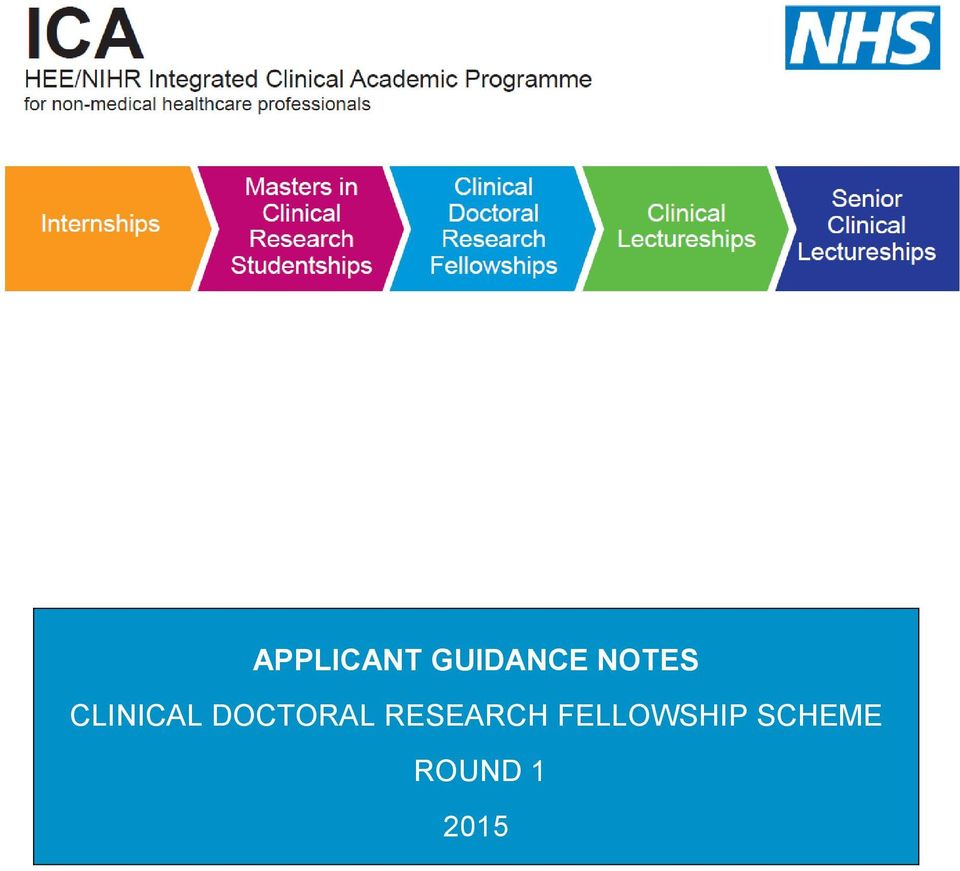
4 HEE funds the ICA Programme and works in partnership with the NIHR, which manages the programme through the NIHR TCC. The ICA Programme comprises five schemes, plus the mentorship scheme: 1. HEE Internships short duration awards with a range of taught and academically supervised interventions that both engage and expose the intern to the clinical academic research environment, and also provide them with the practical skills to undertake a research project; 2. HEE/NIHR Masters in Clinical Research Studentship Scheme enables registered healthcare professionals to gain the necessary research and academic experience and understanding to access the further opportunities offered by the programme; 3. HEE/NIHR Clinical Doctoral Research Fellowship (CDRF) Scheme aimed at registered healthcare professionals who wish to obtain a PhD by research whilst also developing their clinical skills; 4. HEE/NIHR Clinical Lectureship (CL) Scheme aimed at registered healthcare professionals who already hold a research doctorate (PhD) and wish to continue research at a post-doctoral level whilst continuing to contribute to clinical practice; and 5. HEE/NIHR Senior Clinical Lectureship (SCL) Scheme: Aimed at registered healthcare professionals with independent clinical research experience who wish to undertake further research in a senior academic position whilst developing as a clinical academic leader. 4
5 The NIHR Remit 1. NIHR supports training in clinical and applied health research, including social care research. 2. The proposal must have clear potential for benefitting patients and the public within 5 years of its completion (but recognising the training element of the research). 3. The research can involve: patients; samples or data from patients; people who are not patients; populations; health technology assessment; or health services research. 4. NIHR does not itself support basic research or work involving animals or their tissue. 5. If the work involves biomarkers: research that tests whether application of new knowledge can improve treatment or patient outcomes, and has obvious potential benefit within 5 years, is within remit. This might include application of known biomarkers, or other prognostic factors, to refine and test novel therapeutic strategies. research that aims only to elucidate mechanisms underpinning disease, or identify risk factors for disease or prognosis (including search for biomarkers) is out of remit. 6. NIHR is also prepared to support research into medical education. Further Information in the form of FAQs about the NIHR remit can be found in Annex A. Applicants must ensure they read this before starting the application. The HEE Mandate Research funded by Health Education England (HEE) must fulfil at least one of the priorities in its mandate from the Government: Ensuring the best start in life for every child and young person (from pregnancy through to adulthood) Delivering integrated care that meets the needs of people and their families Improving the understanding of mental health conditions by all staff and how this may effect their patients Improving public health Driving quality improvement, including medical treatments, interventions or processes Alternatively, the content of the research could address the core purpose of HEE: Delivering the right workforce with the right skills, values and competencies Driving improvements in education & training that will have a real impact on the quality of care delivered to patients and service users 5

6 The HEE/NIHR Clinical Doctoral Research Fellowship (C-DRF) Scheme The HEE/NIHR Clinical Doctoral Research Fellowship Scheme (C-DRF) is aimed at graduate (postdegree) healthcare professionals (excluding doctors and dentists) who have at least one year s experience in clinical practice, and who intend to undertake their Fellowship at an English NHS or other healthcare organisation or at a recognised English Higher Education Institution. The host organisation must be capable of fulfilling the role of research sponsor as set out in the Research Governance Framework for Health & Care. The C-DRF supports the award holder to develop both their research and clinical skills; the latter through dedicated time for clinical practice and/or through other activities that support development as a clinician. The ICA C-DRF differs, therefore, from the separate NIHR Doctoral Research Fellowship, which is open to anyone wishing to develop health research skills and who do not have a specific requirement for clinical skill development. Following completion of an ICA C-DRF, the trainee is expected to be able to show evidence of: Completion of the research proposed in the application, which should be within the NIHR remit and fulfil at least one of the HEE Mandate priorities (described above). Award of a PhD by research Completion of a substantial, robust and wide-ranging training and development programme Increased research skills Increased clinical skills Publications arising from the fellowship Involvement in collaborative relationships Evidence of the above will be sought by the NIHR TCC through interim, annual and final report monitoring. 6

7 Eligibility requirements for the Clinical Doctoral Research Fellowship Scheme Applicants to the ICA C-DRF must fulfil the following eligibility criteria: 1. ICA C-DRF applicants must be graduate (post-degree) professionals from one of the following healthcare professions and hold registration with the listed professional body/council by the proposed award start date. Profession Healthcare Scientists AHP Professions: Art therapist Podiatrist Dietician Occupational therapist Orthoptist Orthotist and Prosthetist Paramedic Physiotherapist Radiographer (diagnostic and therapeutic) Speech and language therapist Drama therapist Music therapist Nurse/Midwife: Nurse Midwife Health Visitor Wider Dental Team Professions: Dental hygienist Dental nurse Dental therapist Operating Department Practitioner Clinical Psychologist Pharmacy Professions: Pharmacist Pharmacy technician Registration Body Health and Care Professions Council, or the PSA accredited Academy for Healthcare Science register: Health and Care Professions Council Nursing and Midwifery Council General Dental Council Health and Care Professions Council Health and Care Professions Council General Pharmaceutical Council The range of professions that are eligible for support through the Integrated Clinical Academic Programme is determined by Health Education England. This list is correct at the time of publication (02/03/2015). Prospective applicants who do not meet these criteria but belong to a statutorily registered profession, are a graduate (or have equivalent experience), and provide NHS services in England may be granted special dispensation to apply but must seek confirmation of eligibility 7

8 from the NIHR Trainees Co-ordinating Centre before beginning an application Professions that are not eligible to apply for this ICA C-DRF may be eligible for the separate NIHR Fellowships details of which can be found on the NIHR website: 2. Applicants must have at least one year s experience of professional, post graduation, clinical practice at the point of application. 3. Applications are welcome from individuals working in the NHS or for other publically funded healthcare providers, or at a recognised Higher Education Institution, and who intend to undertake their Fellowship in England. 4. Applicants are expected to have a First Class or Upper Second Class bachelor s degree or equivalent. Applicants who have a Lower Second Class bachelor s degree must normally also have a Masters degree. 5. Applicants must have research experience and/or research training that prepares them to undertake a PhD (research doctorate). Evidence of research output commensurate with their previous experience and/or career stage will be sought. 6. Successful applicants must register for a PhD (research doctorate) at a recognised Higher Education Institution in England. Applicants who have already registered for a doctorate are eligible to apply as long as, at the point of uptake of an award, they have not been registered for longer than 12 months or 12 months Whole Time Equivalent. 7. This award does not fund professional doctorates. Individuals who are already registered on a professional doctorate may apply to the ICA C-DRF but this would require them to transfer their professional doctorate and register for a PhD. The same rules for registration described in point 6 above would apply. Applicants should have the support of the HEI at which they intend to register for a PhD; and an appropriate clinical host as described below. Early discussions with both hosts are recommended. 8

9 Scope of Fellowship Employment Options Whilst ALL applicants will require hosting by a HEI and by a provider of clinical services, one organisation must be identified as the employing institution that will host their Fellowship referred to as the Employing Host Organisation. This may or may not be their current employer. The Employing Host Organisation must be able to provide the applicant with a contract of employment for the duration of the award and be capable of fulfilling the role of research sponsor as set out in the Research Governance Framework for Health & Care ( Further guidance on the roles and responsibilities of a research sponsor can be found on the Health Research Authority s (HRA) website ( The Employing Host Organisation can be either a recognised Higher Education Institute (HEI) based in England, a NHS body based in England or any other organisation which provides health or social care services and is in receipt of public funding (for example, social enterprises or local authorities). Applicants proposing a clinical Employing Host Organisation must include the HEI at which their PhD will be registered as their lead academic host. Applicants may wish to take advice regarding which organisation to identify as the Employing Host Organisation before making this decision, which needs to take into account individual circumstances. Applicants must propose to undertake the ICA C-DRF either: a. Full-time (100%) for 36 months; or b. Part-time (75%) for 48 months; or c. Part-time (60%) for 60 months. The NIHR is unable to support awards of any other duration or profile. Activities undertaken outside of the contracted fellowship hours are at your own discretion and are not funded as part of the award. Clinical Skills Development A key feature of this fellowship is that successful applicants are supported to develop clinical skills as well as research skills. Applicants must be able to demonstrate how they will develop their skills as a clinician over the period of the fellowship. Applicants need to take into account their current skill level and need to propose a clinical development plan that is appropriate for their level of clinical seniority. If applicants are senior clinicians they may choose to demonstrate in their application ways in which they will maintain rather than develop their clinical skill levels. You may wish to consider whether the research activity and research training proposed in your application (which may be integrated with, based in, or focused on clinical practice) might be further utilised to develop or maintain clinical skills and /or professional development as a clinician. Scope of Funding 1. The Fellowship may be undertaken on a full-time or part-time basis. Activities undertaken outside of the Fellowship are at the fellow s discretion and will not be funded by the Fellowship. 9

10 2. The ICA C-DRF is an individual training award and will only offer funding to cover the salary costs of the fellow, their PhD tuition fees, and the costs of an appropriate research project and training and development programme. 3. If applicants are successful in being awarded an NIHR research training award while simultaneously holding another NIHR award, they will be asked to decide which award they would like to continue with and will be withdrawn from the other. 4. Whilst this personal award may support shared staff to undertake specialist work it does not fund generic research assistant time. 5. The costs that will be met by an ICA C-DRF award differ slightly depending on the type of employing host that is chosen by the applicant (i.e. NHS or HEI). These costs are summarised in the table below. Proportion funded ICA C-DRF costs Higher Education Institutions NHS organisations A: Direct Costs Staff 80% 100% Travel, subsistence and conferences. 80% (with the exception of conference related travel, which is paid at 100%) 100% Equipment 80% 100% Consumables 80% 100% Patient and public involvement 80% 100% Specific costs needed to support research 80% 100% Patent and legal 80% 100% Training and development 100% 100% B: HEI Indirect costs Estates charges 80% 0 Other indirect costs 80% 0 10
11 Additional Points to consider when preparing an HEE/NIHR Clinical Doctoral Research Fellowship Application NIHR TCC can advise you on completing the application forms and eligibility enquiries. However, the NIHR TCC cannot comment on the design and/or methodology of specific research projects. Your local NIHR Research Design Service may be able to provide advice on developing a suitable research proposal. It is highly recommended that you contact the Research Design Service at the earliest opportunity. Please see the website below for further information. NIHR will only support primary research* where the proposed research is informed by a review of the existing evidence. If your application includes primary research then it should include reference to the existing evidence and explain how this evidence has informed the proposed research. Where a systematic review already exists that summarises the available evidence this should be referenced, as well as including reference to any relevant literature published subsequent to that systematic review. Where no such systematic review exists it is expected that the applicant will undertake an appropriate review of the currently available and relevant evidence (using as appropriate a predetermined and described methodology that systematically identifies, critically appraises and then synthesises the available evidence) and present a summary of the findings of this in their proposal. All applicants must also include reference to relevant on-going studies, e.g. from trial registries. For NIHR research training applications at the early career stage (up to and including the first Post- Doctoral level), a systematic review may be included as part of the training award, provided that the proposal is also informed by any existing evidence and existing systematic reviews are referenced. NIHR research training applications differ from other NIHR applications, for example to the HTA and RfPB programmes. In NIHR research training applications, the research project proposal does not stand alone, but is part of a package of elements expected to provide an excellent training experience that will allow the successful applicant to take his / her skills and experiences to a still higher level. Thus, along with the research proposal, NIHR panels will assess the abilities, academic trajectory, existing experience, commitment to a career in health research, ambition and aspirations of the applicant, the standards in the research training environment, and the plans for explicit training in research methods. The research proposal provides a framework for research experience so has to be of high quality, but a good research proposal will not be supported if other elements are weak. The panel s expectations of the research training application, including prior work to support the research proposal, will vary with the seniority of the award. At early career stages (up to and including the first postdoctoral level), plans to perform or update a systematic review may be included as part of the training award, provided that the proposal is also informed by any existing evidence, and that existing systematic reviews are referenced. The rationale for this is that the systematic review provides a training experience in a research methodology evidence synthesis. However, the review also needs to be justified within the context of the research proposal (and not be too ambitious or perfunctory e.g. where there are likely to be no studies to synthesise). For more senior awards (career development fellowship, senior research fellowship, clinician scientist award, senior clinical lectureship (ICA programme)), applicants will be expected to demonstrate clearly that their planned research project addresses a question that still needs to be addressed. This may often be done by including, in the application, the results of one or more systematic reviews of relevant literature. 11
12 When relevant systematic reviews do not exist, the applicant may wish to undertake a systematic review of the literature by (1) pre-specifying patient groups / research methods / interventions and outcomes where relevant (2) undertake a comprehensive electronic literature search (3) assess and collate the eligible data in an objective fashion that may or may not include pooling using metaanalysis. This principle is relevant to other aspects of preparation of an application for a senior research award the award panel must be clear what are the applicant s aims and objectives over the duration of the fellowship and what methods will be used to achieve these. If the proposal centres on assessing the impact of a clinical or population intervention, for example, the nature of the intervention should be clear to the panel, or how the applicant plans to develop and refine the intervention during the fellowship. *Primary Research defined as: Original research conducted to collect new data to answer a research problem. [Source: Health Technology Assessment Programme A-Z of useful terms. 12

13 Assessment of Applications Awards will be made following open competition. Following the submission deadline, the NIHR TCC will check applications for completeness and eligibility, and distribute eligible applications to the members of the Review Panel. The panel will assess all eligible applications (using the Assessment Criteria below). Applications will be sent for external peer review if deemed necessary. Shortlisted applicants will be invited for interview in Leeds. Feedback will be sent to all applicants after the Department of Health funding decisions have been made. Assessment Criteria Applications are assessed by the Panel using the following criteria: When assessing the applicant The quality and relevance of the applicant s recent and overall clinical experience. The quality and relevance of the applicant s research experience and outputs. The evidenced commitment and potential of the applicant to develop as a clinical academic. When assessing the research proposal The quality of the proposed research, its suitability as a PhD project, and its potential to benefit patients and/or clinical practice within five years of its completion. The extent to which the Fellowship will support the development of the individual s skills as a clinician as well as an academic. Quality, scope and relevance of the review of existing evidence. Appropriateness and level of patient and public involvement. Quality of plain English summary. When assessing the proposed host site(s), training programme and supervision The quality of the host research group, and their appropriateness to the development of the applicant s clinical academic career. The appropriateness of the proposed academic and clinical supervision. The feasibility and appropriateness of the management and support arrangements proposed by the hosts. The quality of the proposed training and development programme. Evidence that the hosting HEI and clinical host have a non-medical clinical academic career infrastructure in place or have plans to implement one, are committed to building national research capacity for non-medical healthcare professionals, and plan to support the candidate beyond the period of the fellowship. 13

14 Finance In addition to assessing the above, the panel will also take the appropriateness and value for money of the funds requested into consideration. NIHR TCC strongly recommends that you remain mindful of these assessment criteria when developing your application. 14

15 Registering, Completing and Submitting the Application Registering All applications must be completed and submitted via the online application system. This can be accessed via: Before you can start an application you will be required to register on the system. You will be asked to supply a valid address and complete some basic information. Once this has been submitted you will receive an confirming your registration and a temporary password. You should follow the instructions in the to log onto the system. Once signed into the system you will be able to update various details including your CV (in manage my details ) and apply for any open applications. To start an application you will need to go to My Application and select New Application. You should then select the award you wish to apply for from the list provided. Only one application to the HEE/ NIHR Integrated Clinical Academic Programme is permitted in each round. Multiple applications or applications at more than one level (C-DRF/CL/SCL) will not be accepted. After answering all the eligibility questions you will be able start completing the online form. Please make sure you read all available guidance text including this document as well as any online instructions thoroughly whilst you are completing the form. The deadline for this call is 1:00pm on Thursday 28 th May 2015 Completing and submitting your application form The application and all associated documents must be submitted in English. Applicant You will need to complete all of the mandatory sections of the form and enter under the Participants section and the Declarations & Signatories section the names and contact details of participants and signatories (see below). Once all other parties have made their contribution, you will be required to Submit the application to the signatories for final sign off before the closing date. Please note that you will need to read and be aware of the roles of participants, sponsors and signatories as described below. You will only be able to Submit the application for final sign off by the signatories when: all mandatory sections of the application form are complete all participants have agreed to be part of your application all signatories have agreed to their role the Heads of Departments and Finance Officer have made their contributions Participants You are required to supply the names and addresses (if not already registered on the TCCi application system) of the individuals who will be undertaking participant roles as part of your application. Everyone named in this section will be acting as a participant to your application and will need to agree to be part of this application. Participants are required to review the declaration for the role before confirming participation as part of the one-click Confirm process. There is no longer a 15

16 requirement to complete a separate participant declaration. By confirming participation, participants are acknowledging their involvement and input into this application and agree to be involved in it before it is submitted. You must ensure all participants are happy for your application to be submitted before submitting it on the online system. Details of the individuals who will be required to approve your application after submission (signatories) should be entered in the Declarations & Signatories section. Please note it is often the case that one or more of the participants named in this section are also named in the Declaration and Signatories section of the form. Participants must complete their actions on your application prior to submission; signatories must approve your application after submission. All actions/approvals must been completed by the application deadline. Required Participants (if applicable): Primary Doctoral Supervisor: The individual named as the primary supervisor of your PhD must agree to participate in the application and confirm that they will act as your Primary Academic Supervisor, support your career development and abide by the conditions under which an award may be granted. The Primary Supervisor must also confirm that the information provided by you describes the status of your current / proposed research doctorate studies and also confirm that any proposed part-time study arrangements have been agreed and meet University regulations. Academic Supervisor(s): All supervisors detailed in the Research Supervision section must agree to participate in the application and confirm that they will act as your supervisor for research and career development and agree to abide by the conditions under which an award may be granted. Clinical Supervisor(s): All supervisors detailed in the Research Supervision section must agree to participate in the application and confirm that they will act as your supervisor for professional and career development and agree to abide by the conditions under which an award may be granted. Clinical Trials Unit (CTU) Representative: If a CTU is involved in the proposed research then a representative from the CTU is required to confirm their involvement and agree to their relevant declaration. NHS or Partner Facilities: A representative of the NHS or other partner facilities must agree to participate in this application if any NHS support or treatment costs are being incurred as part of the research. The representative of the NHS body incurring any NHS Support and Treatment Costs must confirm that they will ensure that all NHS Support and Treatment Costs in the application are correct and the aforementioned organisation is prepared to meet these costs. Research Contract Officer: A Research Contract Officer at the Employing Host Organisation must confirm that they have read the guidance notes for the relevant NIHR programme and the standard NIHR contract and confirm that the host organisation would be willing to accept an award according to the published terms and conditions of the NIHR standard contract. Signatories You are required to supply the names and addresses (if not already registered on the TCCi application system) of the individuals who will be signing off your application. Once their contact details have been entered, the signatories will be invited to log into the system and confirm their participation. Once participation is confirmed, the Finance Officer will be able to access and edit the Finance section (this should be completed in conjunction with the applicant) and the Head(s) of Department(s) must complete the relevant question in the Training and Development section. These 16

17 sections can be completed independently whilst the applicant works on the rest of the application. All signatories must have agreed to participate and complete their sections before the applicant is able submit the application for signatory approvals. The final signatory approval will result in full submission of the application and all parties (applicant, participant and signatories) will be notified of this via an automated system generated . NIHR will not accept any applications unless fully approved by your signatories. This must be done after you have submitted your application but BEFORE the deadline. Participants must complete their actions on your application prior to submission; signatories must approve your application after submission. All actions / approvals must been completed by the application deadline. Required Signatories (if applicable): Sponsor: If the award includes a clinical trial then an authorised representative of the organisation that will sponsor the clinical trial outlined in this application must confirm that the organisation supports the application and has, where applicable, confirmed with the CTU named in this application that they support this application and the arrangements for managing the trial. Head of Department (Employing and/or Lead Academic Host): In agreeing to participate in this application, the Head of Department of the host organisation in which this award will be based must confirm that they support this application and that, if funded, the research and training will be supported and administrated in the named organisation and that the applicant for whom they are responsible will undertake this work. Head of Department (Employing and/or Lead Clinical Host): In agreeing to participate in this application, the Head of Department of the host organisation in which this award will be based must confirm that they support this application and that, if funded, the research and training will be supported and administrated in the named organisation and that the applicant for whom they are responsible will undertake this work. Administrative Authority or Finance Officer: The Administrative Authority or Finance Officer of the employing host must confirm that they will ensure the accuracy of the financial details of the application and that the host organisation is prepared to carry out this research at the stated costs and to administer the award if made. Once the applicant is ready (see list of required steps under the applicant heading above), they will be able to Submit the application for final sign off by the signatories. At this point, the signatories will be prompted to log back in to the system and approve the finalised application. The application will not be complete until all the required signatories have approved the final version. When the last signatory presses the approve button, the application will be submitted to the NIHR TCC. Please note that all of the steps described here need to take place before the deadline of 1pm on 28 th May No exceptions will be made. Should you require assistance in completing the online form, please contact the NIHR TCC on or by ing [email protected]. 17
18 Completing the online application form SECTION: Research Details Research Title The HEE Mandate Research Type Host organisation Do you wish to hold a fellowship at 60%, 75% or 100% FTE? What percentage of time is anticipated for the following activities within the time funded by the award? Proposed start date if grant is awarded? Enter the full title of the proposed research. Research funded by Health Education England (HEE) must fulfil at least one of the priorities in its mandate from the Government, or if not, its content must address the core purpose of HEE. Please indicate which of the priorities and/or core purposes that your proposed research will address. Please select up to 3 responses which best reflect the type of research you are proposing in your application. Enter all details of the Employing Host Organisation. This is the organisation that will administer any award. Any organisation wishing to host an ICA award must be able to provide the applicant with a contract of employment for the duration of the award and be capable of fulfilling the role of research sponsor as set out in the Research Governance Framework for Health & Care. Host Organisations can either be a recognised Higher Education Institute (HEI) based in England, a NHS body based in England or any other organisation which provides health or social care services and is in receipt of public funding. If the name of your Host Organisation does not appear in the pre-populated list please [email protected] Please select whether you wish to hold the fellowship on a full time basis over 3 years (100% WTE) or part time over 4 years (75% WTE) or 5 years (60% WTE). All other activities, for example any additional clinical work not proposed as a component of the fellowship, must be undertaken outside the percentage time declared as the basis of the Fellowship. It is not possible to undertake a Fellowship on any basis other than 100%, 75% or 60% WTE. Please provide an estimate of the amount of time within the fellowship that you will allocate to research, formal training courses, clinical activity and other training. Choose a start date from the drop down list; please consider this carefully taking into account any ethical approval requirements. If your proposed research requires ethical approval before your fellowship can begin this may affect your start date. The latest date for take up of a Fellowship is 1st June Note that the date you choose is the date you will be expected to start a fellowship if your application 18

19 is successful. NIHR TCC retains the right to negotiate the start date before a contract is issued. SECTION: Applicant Details Professional background Correspondence address Current Position(s) Provide an approximate breakdown (%) of how your current appointment is divided between the following activities Are you on a fixed term contract? Current research commitments Do you currently hold a NIHR award? Have you previously held a NIHR award? Select the one option which best describes your professional group. This will determine the options that appear below for your professional background. If you select nurse or midwife in this list no further options will appear. Other practitioners should select their profession from the list provided. If you would like us to use contact details that you have not yet specified, please indicate the preferred details here. Please enter the job title of your current position and also specify if you currently hold any other positions. Please enter all the relevant details for your current post. Please use this section to provide an approximate breakdown of how your current appointment is divided. If applicable, please specify what your other activity consists of. Please enter yes or no, and if yes please give details including the date the contract expires. Please provide information on your current research activities and how this application will fit with your current commitments. Please specify if you currently hold a NIHR award and indicate what this is from the list available. Please specify if you have previously held a NIHR award and indicate what this was from the list available. SECTION: Applicant Curriculum Vitae Professional body membership Applicants must hold registration with the professional body/ council listed for their stated profession in the guidance notes and available from the NIHR website: 19

20 This information is inputted via Basic Information in Manage My Details on the site welcome screen. Degrees Present and previous positions held Recent relevant publications Research grants held Relevant prizes, awards and other academic distinctions Employment breaks Where relevant, please give full details of any higher degree(s) you are currently undertaking. Please note that NIHR TCC does not support C- DRF candidates to undertake professional doctorates. If you are currently studying towards a professional doctorate, the TCC would expect you to transfer to a PhD. Please detail your previous posts (most recent first), including start and end dates. Please indicate at what percentage (WTE) in each post you were undertaking research. For example, if you were a Clinical Lecturer and undertook research for 2.5 days a week and clinical work for 2.5 days per week; please enter 50% for that position. If you have worked part time at 60%, and undertook research for half of that time, please enter 30% for that position. List any publications in which you are a named contributor or author. It is not necessarily expected that applicants will have an extensive list of publications at this stage in their career. Please list: Peer-reviewed publications Other publications Other research outputs Do not include abstracts. Mark with an asterisk the publication that you consider to be your best. Details of all grants obtained in the last seven years should be provided, including personal research training awards or fellowships. Please indicate clearly any co-applicants and provide brief details of the nature and full extent of your involvement (e.g. project design, project management, day to day running, data collection, data analysis, writing papers for publication, etc.). Please provide details of any awards or distinctions that would be relevant to your application. Please detail what the award/distinction was given for, the date it was awarded and the awarding body. Please provide any information you feel is relevant regarding breaks in your employment record. SECTION: Research Degree 20

21 Are you registered for or undertaking a research doctorate (PhD/MD/Dphil) at the time of making this application? (N.B. The NIHR reserves the right to change start dates prior to contracting depending on circumstance) Please answer these questions if you are currently undertaking a research doctorate. If you are currently undertaking a Masters as the first phase of studying toward as PhD please also complete the research doctorate questions. Please indicate in the text that you are currently undertaking a Masters, but this is the first phase of studying towards a PhD. If you have indicated that you are registered part-time for the Doctorate, the NIHR TCC will assume that you are working/studying for this degree for 50% of your working time. If this is incorrect, you are required to provide here an accurate explanation and justification for the total amount of time you have spent working/studying for this Doctorate since the registration date. Give a brief account of the work you have undertaken towards your research doctorate to date and progress against projected milestones All applicants that are currently undertaking a research doctorate must complete this question. SECTION: History of previous applications Has this application or a similar application previously been submitted to this or any other funding body? Please provide details of any previous submissions of this or a similar application to NIHR or any other funding body. This must include any previous submissions for a NIHR research training award, even if the proposed research has changed. Please detail the title of any previous submission, the funding body and scheme, the outcome and the date this is due if a decision is pending. If the application was unsuccessful please indicate why and detail how this application differs from previous submission(s) and how any feedback received has been used to inform this application. SECTION: Patient and public involvement Were patients and the public actively involved in identifying the research topic/prioritising the research questions and/or preparing this application? INVOLVE ( describes 'patient and public involvement' as an active partnership between patients, members of the public and researchers in the research process. This can include, for example, involvement in the choice of research topics, assisting in the design, advising on the research project or in carrying out the research. INVOLVE's definition of the term 'patients and public' includes: patients, potential patients, carers and people who use health and social care services as well as people from organisations that represent people who use services. Whilst all of us are actual, former or indeed potential users of health and social care services, there is an important distinction to be made between the perspectives of the public and the perspectives of people who have a professional role in health and social care services and research. ( For a more detailed explanation of involvement, how it links to and differs from engagement and participation in research see what is 21
22 public involvement in research? ( Information on organisations providing useful resources, advice and support on patient and public involvement in research: NIHR Research Design Service (RDS) ( provides advice and support to researchers developing research proposals for submission to the NIHR and other national, peer-reviewed funding competitions for health and social care research. This includes resources, advice and support on patient and public involvement in the development of proposals. INVOLVE ( provide advice and a range of resources on patient and public involvement in research. These include: a directory of research networks and organisations supporting involvement invodirect ( resources ( which include briefing notes for researchers ( on what is public involvement and how to involve people in research; an involvement cost calculator ( to help with budgeting; searchable databases including an evidence library ( and many other resources. a website providing information for patients and the public about current opportunities for getting involved in research. Researchers and funders can use People in Research to advertise and invite patients and the public to get involved in their research. The James Lind Alliance (JLA) has a guidebook with step-by-step guidance on involving patients and clinicians in the identification and prioritisation of research topics and questions. Please further describe how patient and public involvement has informed and/or influenced the development of the application and how patients and the public have been involved. If patients and public were not actively involved, please explain why patients and public involvement is not necessary. Describe the ways in which you have involved patients and the public. Where appropriate, provide names of individuals and/or groups, outline the activities they have been involved in and how this involvement has, or has not, influenced or changed this research application. Describe why patient and public involvement is not necessary. 22
23 Please indicate the ways in which patients and the public will be actively involved in the proposed research. Please give more details, including how patient and public involvement will benefit the research, the reasons for taking this approach and arrangements for training and support. If there are no plans for active involvement, please explain why patient and public involvement is not necessary. Please tick all relevant boxes. For each box that you ticked in the table, describe the way in which patients and the public will be involved. Where appropriate, provide names of individuals and/or groups and outline the activities they will be involved in. In addition, what plans are there for providing training and support? Explain why active involvement of patients and public is not necessary. SECTION: Case for Support Plain English summary The importance of a plain English summary A plain English summary is a clear explanation of your research. Many reviewers use this summary to inform their review of your funding application. They include clinicians and researchers who do not have specialist knowledge of your field as well as members of the public. If your application for funding is successful, the summary will be used on National Institute for Health Research (NIHR) and other websites. A good quality plain English summary providing an easy to read overview of your whole study will help: those carrying out the review (reviewers and board and panel members) to have a better understanding of your research proposal inform others about your research such as members of the public, health professionals, policy makers and the media the research funders to publicise the research that they fund. If we feel that your plain English summary is not clear and of a good quality then you may be required to amend your summary prior to final funding approval. It is helpful to involve patients / carers / members of the public in developing a plain English summary. Word length 23
24 The summary can be up to 750 words but shouldn't be less than 300. Content When writing your summary consider including the following information where appropriate: aim(s) of the research background to the research design and methods used patient and public involvement dissemination. The plain English summary is not the same as a scientific abstract - please do not cut and paste this or other sections of your application form to create the plain English summary. Further guidance on writing in plain English is available from INVOLVE ( For further support and advice on writing a plain English summary, please contact your local Research Design Service ( Scientific abstract of research Mesh terms Relevant expertise and experience Research Plan Please provide a structured summary, using no more than 600 words, which outlines the background to the research, the aims of the work, including the question to be addressed by this research, the plan of investigation and a summary of the potential benefits to patients and the NHS. Please note that this section of the application will be used as an overall summary, and therefore, should be a stand-alone section. Therefore, any abbreviations used elsewhere in the proposal should be defined here. You may enter up to five MeSH terms to describe your project. For further information about MeSH terms see Please use this question to describe your expertise and experience to date and how this makes you suitable for this award. Please include the following: 1) Research experience. Please describe any research you have undertaken, including details about the research methods you have used and a statement which indicates your exact role in the research effort. 2) Clinical experience. Please provide details of your clinical experience and its relevance to your application. A structured protocol of your proposed research is required including the background and rationale for undertaking the research. Please include : title; summary; aims (state main hypothesis or research question); background; plan of investigation (including, if applicable, study design, justification of sample size, selection and exclusion criteria, methods of data collection and analysis); time schedule; and key references. Justify why you think the research is important and its relevance to the improvement of health, health care or services including its potential benefit to patients and the public. 24
25 A Gantt chart and full list of references should be uploaded separately see management and governance section for Gantt chart. The list of references should be in PDF or MS Word format and include all references cited in the application. You are also permitted to submit a maximum of 1 page of figures (tables/diagrams/images/illustrations) with your application to support your proposed research; all submitted figures should be referred to within your research plan (e.g. see figure 1; see figure 2). These figures must be restricted to tables/diagrams/images/illustrations; figures that contain only text will not be considered. Each figure should be accompanied by a short descriptive legend; within a single page Word or PDF document (PDF is preferred). If your Word/PDF document is longer than one page we will only consider the first page. See online instructions for uploading the document. Please provide a brief outline and justification as to the methodology (e.g. databases/citation indexes searched) and extent of the systematic review/review of the existing evidence underpinning your research question and plan, and how this evidence has informed the research plan. Applicants undertaking systematic reviews should note the commitment of NIHR to publication on the PROSPERO database. PROSPERO was developed by the NIHR's Centre for Reviews and Dissemination (CRD), and is the first online facility to register systematic reviews for research about health and social care from all around the world. Access is completely free and open to the public. PROSPERO registration is condition of NIHR funding for systematic reviews. For more information see: This section is capped at 3500 words plus an extra 1750 if you are undertaking a clinical trial. Are you intending to carry out a clinical trial? If you intend to undertake a clinical trial as part of your award please read the following guidance. Applicants who are planning to undertake a clinical trial are allowed extra space in their proposed research section (5250 words rather than 3500 words) to accommodate the information requested below. You must indicate in Management and Governance section of the application form that you are intending to carry out a clinical trial. Details of Proposed Trial Throughout the case for support and the management and governance section please include the following information on your clinical trial where applicable: the title of the trial; the need for a trial (including the problem to be addressed, the principal research questions, the reason why the trial is needed and how will the results be used); trial details (including the proposed design, planned interventions, arrangements for allocating participants to trial groups, methods for protecting against bias, inclusion/exclusion criteria, duration of treatment, proposed outcome measures, planned follow-up measurements, proposed sample size, planned recruitment rate, methods of recruitment, anticipated compliance issues, how many centres will be involved, details of planned analyses, frequency of analyses, economic issues, consumer involvement); and trial management details (including day-to-day management, the Fellow's responsibilities, staff employed on the Fellowship [including CTU input], the roles of named collaborators, the trial statistician, the trial 25
26 steering committee (and data monitoring committee if appropriate), participating centres and trials methodology training). The Health Research Authority has published guidance on the key questions that should be addressed when considering the design of clinical trials. Applicants are recommended to read this guidance before completing an application ( A commentary on this guidance has also been published in Trials (Clark et al. Trials 2014, 15:286) Applicants should consider the type (e.g. clinical trial of investigational medicinal product (CTIMP); trial of surgical intervention; trial of complex intervention), the scope (single or multi-centre; feasibility / pilot trial ( phase of trial (I to IV)), and risk level of the trial (see in respect of CTIMPs) and ensure it is commensurate with the level of award and experience of the applicant. For example, we would not normally expect a doctoral level applicant to propose leading a multicentre randomised controlled trial of an investigational medicinal product. Fellowship applications, especially at doctoral and early post-doctoral level, will tend to focus on feasibility and pilot trials or may form a distinct add-on to an existing trial (in this case it must be clear the trial is a distinct, standalone piece of work and the role of the applicant must be clear). Applicants should consider the feasibility of the trial within the scope of the fellowship award. NIHR research training awards are personal fellowships and not project or programme grants and therefore awards will not be extended to allow completion of a trial. Therefore, please bear in mind the lead in time for clinical trial set-up vis-à-vis the time available within the course of a fellowship. Runin time for drug and placebo procurement, manufacture and packaging for CTIMPs and the fact these activities must be completed before regulatory approval can be sought must be taken into account when planning the fellowship schedule and completing the application form. Regulatory, ethical and R&D approval can take several months and appropriate advice on the processes and timelines should be sought from the outset. It is very important that applicants keep in mind that the proposed research project is a vehicle for training and this needs to be clearly demonstrated as part of the application. Applications involving a clinical trial must include a supervisor (in the case of doctoral level awards) or an individual providing research support (in the case of post-doctoral awards) who is a recognised trials methodologist. This will often be a trial statistician based in a clinical trials unit. Applications involving a clinical trial will also require approval by the sponsor ( of the trial and a representative of a Clinical Trials Unit must also, where appropriate, be included as a participant in the application. Costing the Trial It is highly recommended that the applicant works with a UKCRC registered Clinical Trials Unit (CTU) ( both in developing the application and in running the trial. Applicants should make contact with the appropriate clinical trials unit as early as possible in the application process. Please bear in mind it may not always be possible for a CTU to input to and support every fellowship application that they are asked to consider. Their engagement will be based on the timeliness of the request for support, the 26
27 nature of the study (for some studies support of the CTU maybe essential, whereas for others it may only be desirable), and the fit of the study with a CTU s expertise and research agenda. If a particular CTU is unable to provide support the NIHR Research Design Service (RDS) ( will be able to advise on alternative units to approach. CTU s will expect the applicant to engage meaningfully with the CTU if they are going to give support to a fellowship application. It is expected that the applicant will be leading the trial with input and support from the CTU and as such CTU costs can be included as part of the application. Costs claimed should be for the additional support from the CTU for the necessary expertise that the trainees cannot provide themselves. For example, part time support from a trial manager, database manager, and statistician are all costs that could potentially be included. The level of support and input from the CTU will likely vary depending on the level of fellowship and experience of the applicant. For example, doctoral applicants will be expected to be undertaking the majority of the day-to-day tasks involved in running a trial, with oversight from a more senior member of CTU staff (though specialist input in database programming may be needed). For more senior post-doctoral awards it may be more appropriate for other members of staff to be undertaking some of the day-to-day tasks. This also very much depends on the experience and expertise of the applicant and the applicant s training needs and should be agreed with the CTU before submitting an application. These costs should all be agreed with the CTU and budgeted for in the finance section of the form. Staff costs should be detailed as shared staff in the finance section (please see finance guidance notes for more details). Any costs must be realistic in order to deliver the trial but must also represent value for money. Applicants can also include non-staff costs for the CTU for example; randomisation service, license fees for clinical data management software and the registration fee for allocation of the International Standard Randomised Controlled Trial Number (ISRCTN) and for inclusion in the international metaregister of clinical trials found at NIHR TCC is happy to discuss the proposed costs of a clinical trial with applicants once discussions have taken place with the CTU to advise whether the costs being proposed are reasonable as part of a fellowship application. Useful Resources Further clarification as to what qualifies as a clinical trial can be found at The Clinical Trials Toolkit provides practical advice to researchers in designing and conducting publicly funded clinical trials in the UK. We also recommend that you seek guidance on clinical trials from your Local Clinical Research Network: Researchers wishing to undertake a clinical trial are advised to read the MRC Good Clinical Practice in Clinical Trials. Further resources and suggested reading for applicants considering undertaking a clinical trial can be found on the NIHR Evaluation, Trials and Studies Coordinating Centre website ( Applicants should also be aware of the NIHR Clinical Trials Fellowships ( These fellowships are designed to support existing NIHR Trainees with an interest in, and experience of, working with clinical trials as 27
28 part of their current training award who would benefit from further training within the setting of a Clinical Trials Unit. If you are successful in your application these fellowships maybe of interest to you in the future. Dissemination and projected outputs Overview of Future Plans Please describe your plans for disseminating the findings of your research. This could include plans to submit papers to peer reviewed journals but it will be particularly important to identify forms of presentation that will maximise impact on practitioners and service managers if appropriate. Please describe how the outcomes of this research could be translated into the NHS and wider healthcare community to provide improvements in service delivery, patient health and/or wellbeing. It is expected that as part of the long-term research and/or implementation strategy all research funded by DH or through the NIHR, should be able to demonstrate that it is capable of generating outcomes that are likely to contribute to the benefit of those who use the services of the NHS. Give a brief description of your future research and career plans. This should focus on where you envisage your research going upon completion of this award and how this will fit in with your long-term research career plans. You should also describe how this award will support your long-term plans for a clinical academic career. SECTION: Management and Governance Research timetable Research management arrangements Has any work relevant to this proposal already commenced? Does your proposal include a clinical trial? Please attach an overview (in MS Word or PDF format) of the research plan which includes specific milestones and deliverables. Please only upload an image of a table or a Gantt chart. Please note you are only able to upload one table/chart here. Please outline the process that will be put in place to ensure that the award (including its clinical components) is well managed, including: - the management structure that will ensure that milestones are achieved in a timely manner - a description of how you intend to manage the project - the meetings schedule and - the financial management of the award. Select yes or no; if yes, please give details of any relevant work that has already commenced in the preparation of this research and a brief summary of progress to date. Please indicate yes or no. This includes feasibility and pilot trials. 28
29 Is Clinical Trials Authorisation required? Involvement of Clinical Trials Unit Please describe how you have worked with a CTU in developing your application and what support they will provide if funding is approved. Does the proposed research programme raise any ethical issues? Please indicate yes or no. Please indicate if a Clinical Trial Unit is involved in this research proposal. If yes, provide the name of the CTU and if applicable, the registration number. If no CTU will be involved, describe why and what will be used instead. It is highly recommended that the applicant works with a UKCRC registered CTU both in developing the application and running the trial. Please describe the input of the CTU to the proposal and the continuing support they will provide over the course of the Fellowship. Please bear in mind it is very important that the trainee is leading the trial and learning as part of the Fellowship but with support from the CTU. For example it is often the case that the required statistical input is beyond the trainee s expertise and therefore a significant contribution will be required from a statistician. However it is still important that the applicant has a reasonable understanding of the methods and that there is an opportunity for them to learn more statistics as part of their training programme. Much health research activity requires ethical approval as well as research governance approval before it can be started. Applicants should consider approvals at an early stage, and successful applicants will be asked to provide written evidence of approvals as part of monitoring their fellowship. Any research that is part of the training award proposal and requires ethical approval cannot be undertaken until ethical approval has been obtained. Expanded remit for the National Social Care Research Ethics Committee The National Social Care Research Ethics Committee (the Social Care REC) was established in June 2009 to review adult social care research study proposals from researchers based anywhere in England. It is an NRES (National Research Ethics Service) Committee following their governance and standard operation procedures. Following a recent extension of its brief by NRES, the Social Care REC is now also reviewing studies taking place in NHS settings with NHS staff and patients where the approach to data collection uses social science or qualitative methods, provided that the research does not involve any change in treatment or clinical practice. A study collecting patients' views of care and treatment through structured questionnaires or qualitative interviews would be an example of this type of study. Researchers are invited to consider whether the Social Care REC would be a valid option, if the study is using social science techniques and there is no proposal to change patient care or treatment. The opinion given by Social Care REC is equivalent to that of any other NRES REC. For more information about the Social Care REC, visit or the Co-ordinator: [email protected] The document, 'Research Governance Framework for Health and Social Care' is available at 29
30 Applicants from Northern Ireland will require ethical opinion from ORECNI for research activity requiring ethical approval. Contact details for the appropriate office are: ORECNI Office Suite 3 Lisburn Square House 1-4 Haslem s Lane Lisburn, Co.Antrim BT28 1TW. Tel: [email protected] Other useful information can be found at the following link: If yes, discuss how these issues will be addressed Please detail how and when you intend to get ethical review completed Have any appropriate regulatory bodies already granted the necessary approvals? Are you intending to undertake a systematic review? Please state how any ethical issues outlined will be addressed. Provide details as to how you are going to get ethical approval. For example, you will need to state whether you require NHS or social care ethical committee approval, and also provide details about how you intend to gain this approval. Please also provide information about the likely timescales involved. If regulatory body approval is required please outline any approvals that have already been granted and upload evidence of the approval. At early career stages (up to and including the first postdoctoral level), plans to perform or update a systematic review may be included as part of the training award, provided that the proposal is also informed by any existing evidence, and that existing systematic reviews are referenced. The rationale for this is that the systematic review provides a training experience in a research methodology evidence synthesis. However, the review also needs to be justified within the context of the research proposal (and not be too ambitious or perfunctory e.g. where there are likely to be no studies to synthesise). SECTION: Intellectual Property and Innovation Will any IP be produced or improved during the It is essential that any Intellectual Property (IP) which may arise from NIHR-funded research is recognised, captured and utilised in the most appropriate way, to ensure that the potential benefits of the research are realised effectively for patients and the taxpayer. 30
31 proposed research? If yes, please describe what IP will be produced or improved? Please describe how any new IP generated through the proposed research will be will be recognised, captured and utilised, either through adoption in the healthcare service or through commercial exploitation. The NIHR takes a broad definition of IP which might include: new or improved software; training materials, manuals, checklists, scales, protocols, questionnaires, toolkits, guidelines or similar; service innovations or new service delivery models; research tools such as data analysis techniques, assays, cell lines, antibodies, biomarkers, materials or equipment and devices; as well as patentable inventions such as a new therapeutic product, diagnostic test or medical device. In addition, the proposed research is likely to build on IP generated previously by others or yourselves as applicants. The NIHR needs to understand your starting IP position in order to place that in context with any IP that you may generate over the course of your research, with reference to third parties rights which may be found during diligence searches. This knowledge will delineate the rights and who might own them. IP may be protected via a number of methods, including copyright, trademarks or patents. Taking this into account, we can assume that much of the research funded by NIHR is likely to generate or modify IP. More information on Intellectual Property and NIHR contracting can be found at: We anticipate that most NIHR-funded research will develop new, or improve existing IP (e.g. by modifying or enhancing and existing intervention, developing data analysis techniques, developing new software etc.). In this section, please detail the potential areas of IP development, referring to your research plan and timetable to indicate where and when new or improved IP will arise. Where appropriate, please link this back to any existing (background) IP that you or others hold, or which has been found during an IP search. Please indicate why you think the new (foreground) IP is novel over what is already known/in existence. We understand that at this stage your ideas may be tentative. If funded, you will be given the opportunity to tell us more as your project develops. Please note IP produced may, or may not, have a commercial use, but we would anticipate projects will produce IP that has patient or wider public health benefit. It is the responsibility of all recipients of NIHR funding to realise the potential benefits from research funded activities. In this section, please indicate the plans for benefit realisation (adoption for patient benefit and/or commercial exploitation) of IP or research outputs. If you already have commercial partners in place (or in view) you should tell us about this here. In your application, it is important to demonstrate that you have plans and (if applicable) arrangements in place to manage any new (or existing) IP. NIHR funding requires benefit realisation from all resulting IP of value. This is not restricted to patent and design right/registered design, but includes copyright and know-how encapsulated in software, checklists, scales, protocols, questionnaires, toolkits, guidelines, standard operating procedures or similar that have a market within the healthcare service or public health arena. You should consider how the knowledge and IP generated could be adopted in the NHS and beyond as this may best be achieved through the application of commercial exploitation models. If you consider a commercial model is applicable, then you should seek advice from your institution s IP or Technology Transfer Office (TTO) or equivalent. If applicable, please identify the relevant TTO in this section of the application form, including if possible a named individual and contact details. Advice from a TTO or equivalent should be sought even where a research output is to be made available free of charge, to ensure the IP generated is appropriately protected. If there are likely to be costs associated with the effective development and exploitation of IP, these should be included in your application and an explanation of the required costs provided. 31
32 What are the key current and future barriers to using any new IP/innovation through dissemination and adoption in the healthcare service or through commercial exploitation e.g. potential regulatory hurdles Are there any current barriers (e.g. approvals required) or potential barriers to the IP generated by the proposed research being utilised? Please indicate where and when any regulatory hurdles may arise. Provide an indication of timing and any delays that may occur and whether this is something you or a commercial partner will manage. SECTION: Involvement with NIHR Infrastructure and other partner organisations Network involvement: Links to which NIHR networks? Benefits identified from working with networks. Research Design Service s (RDS) Involvement Please describe the RDS s input Involvement with other partners Other Sources of Funding It is expected that where appropriate, applicants may look to identifying training and development opportunities with relevant research network(s). Please indicate which network(s) ( you intend to work with and state how far you have progressed this, including Comprehensive Local Research Networks and Topic Specific Networks The NIHR Research Design Service (RDS) supports researchers to develop and design high quality research proposals for submission to NIHR and other national, peer-reviewed funding competitions for applied health or social care research. This includes giving advice on patient and public involvement in the development of applications, and any other aspects of research design. Please indicate which, if any, RDS you have contacted in the course of preparing this application. Please give details of any advice you have received in preparing your application, e.g. from a statistician or health economist. Please also state at what stage in the development of the proposal the RDS were involved. It will be helpful to indicate whether this advice has been restricted to a single element of the design or has been more wide-ranging. Please specify what, if any, other NIHR organisations will partner this research and describe their role in the proposed research. Please indicate if this application will be supported by any other funding bodies and give full details (names, funding amount, start and end dates of funding). SECTION: Training and Development Proposed training and development programme Please detail the Training and Development programme: 1) Proposed formal study 32
33 Detail the formal training that you will receive and how it will meet your training needs. This is most likely to be the formal taught element of a PhD programme. 2) Give details of any academic training and development you wish to undertake in addition to the 'Proposed formal study' to support your personal and professional development as a researcher and clinical academic. The training should include any specialist skills that may be required to undertake the proposed research and should also address research capacity development. It is expected that the training will equip you with a detailed understanding of research governance and the principles that underpin research including: research design; a variety of research methods; statistics; data analysis/interpretation; and presentation of research findings. A timetable and milestones for the proposed training programme should be included. 3) Give details of any clinical training and development you wish to undertake to support your personal and professional development as a clinician and clinical leader. A key feature of this fellowship is that successful applicants are supported to develop clinical skills as well as research skills. Applicants must be able to demonstrate how they will develop their skills as a clinician over the period of the fellowship. Applicants need to take into account their current skill level and need to propose a clinical development plan that is appropriate for their level of clinical seniority. If applicants are senior clinicians they may choose to demonstrate in their application ways in which they will maintain rather than develop their clinical skill levels. You may wish to consider whether the research activity and research training proposed in your application (which may be integrated with, based in, or focused on clinical practice) might be further utilised to develop or maintain clinical skills and /or professional development as a clinician. Proposed Academic Department(s) - repeated up to 3 times Proposed Clinical Department(s) - repeated up to 3 times Access to infrastructure organisation details Whilst Fellows are usually based and work within one department, it may be desirable to work with a second, depending on the nature of the research. If you would like to add a second academic department, please provide the required information. It is likely you will be asked to justify your choice at interview. Please answer all questions related to your proposed academic department(s). Whilst Fellows are usually based and work within one department, it may be desirable to work with a second, depending on the nature of the proposal. If you would like to add a second clinical department, please provide the required information. It is likely you will be asked to justify your choice at interview. Please answer all questions related to your proposed clinical department(s). This question requires information about the facilities that will be available to support the applicant. This section must be completed by the relevant head of the department of the host organisation and by the relevant head of department of the other lead (NHS or HEI) 33
34 host. Please divide your answer into two clearly marked responses, the first from your lead academic host and the second from your lead clinical host. Statement of support from Higher Education Institute (HEI) Statement of support from NHS Collaborations This section must be completed by the head of the department of the lead academic host, and provide an account of any long term commitment afforded by this host to the continued support and development of the applicant (i.e. post award). This section must be completed by the head of the department of the lead clinical host, and provide an account of any long term commitment afforded by this host to the continued support and development of the applicant (i.e. post award). Explain what collaborations you intend to establish to support your research programme and, if applicable, your training and development programme. This may involve short visiting placements (e.g. Overseas Research Visit). The NIHR is particularly keen to enhance the cadre of researchers, equipped to work at the university/nhs/industry interface, translating ideas into new treatments and products from which patients can benefit. Therefore, where appropriate, you should consider any industry collaborations you may wish to establish during the course of your Fellowship. You should include; the training and development the collaboration will provide; the facilities and expertise you will have access to; and how the collaboration will strengthen links between academia, industry and the NHS. SECTION: Research Supervision Research Supervision Clinical Supervision Give details of each of the proposed research supervisors (the Primary Academic Supervisor and all Academic Supervisors up to 6 in total) and their research programmes, including how your proposed project will fit into the current research programme of the supervisor. Careful thought should be given to a) the experience of your chosen supervisors and b) maintaining contact and the potential for difficulties of communication and conflicting opinions and advice when there are more than two supervisors. Funding for supervision is available for travel and subsistence only and does not support any fees the Supervisor may wish to charge the Applicant. Give details of each of the proposed clinical supervisor(s) (up to 5) who will provide you with clinical supervision during your Fellowship. As well as supporting the development of your clinical skills connected with your research, it would be advantageous for this individual to be able to support and advise you on your broader professional development appropriate to your career stage. Funding for supervision is available for travel and subsistence only and does not support any fees the Supervisor may wish to charge the Applicant. 34
35 SECTION: Finance Extensive guidance for the completion of the finance section is available in the next part of these guidance notes. SECTION: Department of Health Monitoring Information Department of Health Monitoring Information - Please use the drop-down menus and tick boxes to provide the information requested. This will be used by the Department of Health solely for accountability, audit and monitoring purposes. UKCRC Health Research Categories UKCRC Research Activity Codes You should choose one health category from the list to classify your proposed research. If your proposed research spans more than one health category you can make a second choice. Further information on classifying research can be obtained from the following website: You should choose one research activity from the lists to classify your proposed research. If your proposed research spans more than one research activity you can make a second choice. Do not enter more than two research activities. You will see that the main 8 categories are further subdivided. To help you choose the correct subdivision you should use the guidance found at in the downloadable Health Research Classification System booklet. SECTION: Research Design Service Involvement Research Design Service (RDS) Involvement Please complete this section describing, if any, the Research Design Services involvement in this application. If you have received advice from your local RDS, we would value your feedback on the services you received form your RDS in order to improve service. Your individual comments will not be attributed to you. NOTE: Responses to these questions will not affect the consideration of your application by the programme. SECTION: Participants Participants You are required to supply the names and addresses (if not already registered on the TCCi application system) of the individuals who will be undertaking participant roles as part of your application. Everyone named in this section will be acting as a participant to your application and will need to agree to be part of this application. Participants are required to review the declaration for the role before confirming participation as part of the one-click Confirm process. There is no longer a requirement to complete a separate participant declaration. 35
36 By confirming participation, participants are acknowledging their involvement and input into this application and agree to be involved in it before it is submitted. You must ensure all participants are happy for your application to be submitted before submitting it on the online system. Details of the individuals who will be required to approve your application after submission (signatories) should be entered in the 'Declarations & Signatories' section. Please note it is often the case that one or more of the participants named in this section are also named in the "Declaration and Signatories" section of the form. Participants must complete their actions on your application prior to submission; signatories must approve your application after submission. All actions/ approvals must been completed by the application deadline. Required Participants (if applicable): Primary Doctoral Supervisor: The individual named as your primary supervisor for your PhD must agree to participate in the application and confirm they will act as your Primary Academic Supervisor, support your career development and abide by the conditions under which an award may be granted. The Primary Supervisor must also confirm that the information provided by you describes the status of your current / proposed research doctorate studies and also confirm that any proposed part-time study arrangements have been agreed and meet University regulations. Academic Supervisor: All academic supervisors detailed in the Research Supervision section must agree to participate in the application and confirm that they will act as your supervisor for research and career development and agree to abide by the conditions under which an award may be granted. Clinical Supervisor: All clinical supervisors detailed in the Research Supervision section must agree to participate in the application and confirm that they will act as your supervisor for professional and career development and agree to abide by the conditions under which an award may be granted. Clinical Trials Unit (CTU) Representative: If a CTU is involved in the proposed research then a representative from the CTU is required to confirm their involvement and agree to their relevant declaration. NHS or partner Facilities: A representative of the NHS or other partner facilities must agree to participate in this application if any NHS support or treatment costs are being incurred as part of the research. The representative of the NHS body incurring any NHS Support and Treatment Costs must confirm that they will ensure that all NHS Support and Treatment Costs in the application are correct and the aforementioned organisation is prepared to meet these costs. Research Contract Officer: A Research Contract Officer at the host organisation must confirm that they have read the guidance notes for the relevant NIHR programme and the standard NIHR contract and confirm that the host organisation would be willing to accept an award according to the published terms and conditions of the NIHR standard contract. 36
37 SECTION: Declarations and Signatories You are required to supply the names and addresses (if not already registered on the TCCi application system) of the individuals who will be signing off your application. Once their contact details have been entered below, the signatories will be invited to log into the system and confirm their participation. Once participation is confirmed, the Finance Officer will be able to access and edit the Finance section (this should be completed in conjunction with the applicant) and the Heads of Departments must provide the required statements in the Training and Development section. These statements can be completed independently whilst the applicant works on the rest of the application. All signatories must have agreed to participate and complete their sections before the applicant is able submit the application for signatory approvals. The final signatory approval will result in full submission of the application and all parties (applicant, participants and signatories) will be notified of this via an automated system generated . NIHR will not accept any applications unless fully approved by your signatories. This must be done after you have submitted your application. Participants must complete their actions on your application prior to submission; signatories must approve your application after submission. All actions/ approvals must have been completed by the application deadline. Required Signatories (if applicable): Sponsor: If the award includes a clinical trial then an authorised representative of the organisation that will sponsor the clinical trial outlined in this application must confirm that the organisation supports the application and has, where applicable, confirmed with the CTU named in this application that they support this application and the arrangements for managing the trial. Head of Department (Employing and/or Lead Academic Host): You will be required to include the relevant Heads of Department at both your lead academic host and lead clinical host. One of these hosts must be your proposed employing host organisation. Both heads of department will be required to complete access to infrastructure and statement of support questions in the training and development section. Head of Department (Employing and/or Lead Clinical Host): You will be required to include the relevant Heads of Department at both your lead academic host and lead clinical host. One of these hosts must be your proposed employing host organisation. Both heads of department will be required to complete access to infrastructure and statement of support questions in the training and development section. Administrative Authority or Finance Officer: The Administrative Authority or Finance Officer for the employing host must confirm that they will ensure the accuracy of the financial details of the application and that the host organisation is prepared to carry out this research at the stated costs and to administer the award if made. Applicant conflict of interest Please declare any conflicts or potential conflicts of interest that you or your co-applicants may have, including any facts that, should they come to light at a future date, could lead to a perception of bias. Include any relevant personal, non-personal & commercial 37
38 interest that could be perceived as a conflict of interest, examples include (this list is not all encompassing), secondary employment, consultancy, financial or commercial gain (pensions, shareholdings, directorships, voting rights), honoraria, etc. In a case of commercial sector involvement with the application or the study, please state clearly the relationship to ownership of data, access to data, and membership of project oversight groups. 38
39 Finance Section The finance section should provide a breakdown of costs associated with undertaking the research as described in the proposal. This section must be completed by the Applicant in conjunction with the Research Support Office or Finance Office at the host organisation. GENERAL INFORMATION The information entered in this section should provide an analysis of the total funds requested to undertake the research proposed and should be based on current prices. These costs will be used to assess value for money. It is in the best interest to undertake a thorough, realistic and accurate costing. You must provide a clear and full justification for all costs including NHS costs. You must also ensure that you include all costs including those required to secure good research management. Costs must be provided at current prices. An adjustment for inflation will be made annually thereafter at rates set by the Department of Health. Whilst allowances for incremental increases should be included on the form, nationally or locally agreed pay increases should be excluded. Years should be calculated starting from the anticipated start date of the proposed fellowship. For example, if your fellowship is expected to start on 01 June 2020 then its second year starts 01 June Further itemisation of costs and methods of calculation may be requested to support the application at a later date. Appropriate sub-contracts must be put in place for any element of the research which is to be paid to another organisation. Clinical Trials Unit costs, including costs for a unit receiving NIHR CTU Support Funding, should be included in your NIHR application in full. You will need to provide a breakdown of the services that the unit will be providing as well as the associated costs. You should also clarify arrangements where a unit is already in receipt of funding from other sources, as costs and activity already funded will not also be met via the research contract. Note that units receiving NIHR CTU Support Funding are not included in this requirement as their costs are expected to be funded in full via the NIHR research contract awarded. NHS Support Costs are funded via Clinical Research Networks. Researchers should contact their local NHS R&D Department initially and, if they are unable to help directly or if there is no local NHS R&D Department, contact their Local Clinical Research Network. Further details about CRN contacts are available at All applications are expected to have appropriate NHS, HEI, commercial and other partner organisation input into the finance section of the application form. NIHR Personal awards are not project or programme grants. 39
40 INFORMATION ON DIFFERENT TYPES OF ORGANISATIONS Higher Education Institutions (HEIs) Higher Education Institutions (HEIs) should determine the Full Economic Cost (FEC) of their research using the Transparent Approach to Costing (TRAC) methodology. For HEIs, up to 80% of FEC will be paid, provided that TRAC methodology has been used. NHS bodies and other providers of NHS services in England For applications where the contractor is an NHS body or provider of NHS services in England, up to 100% of direct costs will be paid Commercial Organisations If you are a commercial organisation/consultancy, please fill in direct costs and commercial indirect costs. Indirect costs should be charged in proportion to the amount of staff effort requested on the funding application form. Up to 100% of costs will be paid. Other Partner Organisations If you are another partner organisation (e.g. charity or NGO), please fill in direct costs and other partner organisations indirect costs. Indirect costs should be charged in proportion to the amount of research staff effort requested on the funding application form. Up to 100% of costs will be paid. DIRECT COSTS These are costs that are specific to the research, which will be charged as the amount actually spent and can be supported by an audit record. They should comprise: Staff I) Details of Posts and Salaries. Salaries should be listed at 100%. This section presents an overview of salary costs for the applicant contributing to the research, including normal salary increments. Please list all shared staff working on the research. You should outline staff numbers and grades, as well as timescales. The applicant. Please state the current and proposed salary point and scale at the start of the fellowship. No additional increments should be included, and immediate promotion to a higher grade as a result of securing a fellowship will not be funded. Please do not include any Clinical Excellence or Discretion/Merit awards or discretionary points. NIHR agrees to fund consultant salaries at a full-time rate equivalent to 10 Programmed Activities per week. Please note that immediate promotion to a higher grade as a result of securing an award will not be funded. 40
41 II) Annual Costs of Posts. This section specifies the annual costs of the applicant and shared staff contributing to the research. You should now allocate the individual staff member costs to each year of the research, allowing for increments. Use current rates of pay, and build in any known annual increments (again at current rates). You will not be able to claim for increments retrospectively, once your research is underway. Applicant and shared staff costs should be broken down into basic salary, national insurance, superannuation and geographical weighting. Please note the % full time on this research and the Year columns are independent and the % figure is not used to calculate the net staff costs. For the Year columns, enter the cost of the individual to the research. For example: If an individual s total annual salary costs are 20,000 and they are expected to work 50% of the time on the research, in the % full-time on this research column enter 50, then 10,000 in Year 1, 10,000 plus any increment in Year 2, 10,000 plus any increments in Year 3, etc. Annual salary costs may be composite figures including part year incremental increases in salary. If an individual is going to work full-time on the research, which lasts 4 years, but only for the last 6 months, enter 100 in the % full-time on this research column and 6 in total months on this research column, and the cost of their work in the Year 4 column. If an individual s involvement varies over the course of the research, it may be easier to make a separate line entry each time it changes. It is important to double check that the %, total months and yearly costs information are consistent with the information presented in Details of Posts and Salaries ( Details of Posts and Salaries should show the full current staff costs independent of % FTE etc., whereas the yearly costs in Annual Costs of Posts depend on % FTE etc.). Please ensure that you check the column describing the employing organisation for a member of staff as this impacts on the level of funding provided. Staff employed by an Higher Education Institution (HEI) are funded at 80% of cost and staff employed by NHS, commercial or other partner organisation at up to 100% of cost. Please note that this section also includes Shared Staff Costs which may be located under directly allocated costs in some other funders applications. These are costs of an institution s research resources which can be charged to the research on the basis of estimated use, rather than actual costs. These may include: applicants costs, unless directly incurred or nonchargeable, IT technicians, laboratory staff, and costs of pooled staff efforts. HEI indirect costs cannot be claimed on these shared staff costs. NIHR TCC reserves the right to question any costs deemed excessive, and will not fund: i. Contributions for individuals providing research support (previously referred to as mentors), supervisors and/or other collaborators involved in the research ii. iii. iv. Administrative or secretarial support Whole or significant percentages of support posts over and above those permitted by the scheme Technical or research support staff whose costs are funded through institutional indirect costs (HEIs only) 41
42 Whilst this personal award may support 'shared staff' (e.g. a statistician or software developer) to undertake specialist work that the applicant is unqualified to undertake, it does not fund generic research assistant time. III) Travel, Subsistence and Conference fees. This section includes journey costs, subsistence and conference fees. Where applicable, you will need to include the travel and subsistence costs relating to meetings with individuals providing research support. Please note that mentors (individuals named as providing research support) expenses will not be funded. Travel and subsistence costs relating to dissemination should also be included here, as should costs relating to overseas travel. If a cost relates to travel, subsistence or fees for a conference please select conference. Costs relating to conference attendance will be funded at up to 100% for all employing/host organisation types. Journey Costs Enter the total cost of transport for all journeys for destination/purpose. If travel is by car, apply your institution s mileage rates (however this should not exceed HMRC approved mileage allowance payments, which is 45p per mile for the first 10,000 miles and 25p thereafter). Travel by the most economic means possible is encouraged. NIHR programmes do not usually fund first class travel. Subsistence Subsistence covers accommodation (if necessary) and meals associated with the travel, excluding any alcoholic beverages. Conference Fees Where national or international conference fees are included, a statement naming the conference or purpose of travel and the benefit to the research must also be made; failure to adequately justify your attendance at a conference, will mean the programme will not fund this cost. NIHR will fund a maximum of 3,000 for all conference-related costs. IV) Equipment. Essential items of equipment plus maintenance and related costs not included as part of estates should be input in this section. These can be lease or purchase costs. The purchase cost of pieces of equipment, valued up to 5,000 excluding VAT, will be considered. Pieces of equipment costing more than 5,000 to purchase will usually need to be leased. Where applicants are leasing equipment with a purchase price of more than 5,000 a comparison of leasing verses purchasing costs must be provided in the Justification of Costs section. Items of equipment valued at 250 or more must be itemised separately; however grouping same type equipment is permitted. Costs of computers are normally restricted to a maximum of 650 per application excluding VAT and a statement of justification must be included, in the relevant Justification of Costs section for any purchase above this limit. Equipment must exclude VAT, but if your organisation is unable to reclaim/recover the VAT on a piece of equipment, you should check box VAT cannot be reclaimed. 42
43 You will need to seek expert advice from the organisation purchasing the equipment regarding its VAT status. If you check the VAT cannot be reclaimed box, VAT at 20% will be calculated into the overall cost of that item. V) Consumables. This section includes non-reusable items specific to the research. Please itemise and describe the requirements fully (e.g. postage, stationery, photocopying). These items should be research specific, not just general office costs which should be covered by indirect costs. VI) Patient and Public Involvement. Please itemise and describe fully the costs associated with Patient and Public Involvement. These are likely to include out of pocket expenses, payment for time and any relevant training and support costs. Guidance for making payments to members of the public actively involved in NHS, public health and social care research (2010) can be found at the following addresses: NIHR Programmes: Payment rates for public involvement (2009) Guidance greed with the Department of Health on payment and reimbursement rates to members of the public for involvement with NIHR programmes in research commissioning. Payment for involvement (2010) Guidance aimed at researchers and research managers on issues to consider when costing public involvement activities, including examples of levels of payments made by different organisations and sources of further information. What you need to know about payment (2012) Guidance aimed at members of the public. VII) Other Direct Costs. These are costs, not identified elsewhere, that are specifically attributed to the research. For example, costs associated with use of research facilities, external consultancy costs, specialist publications, open access publications, computer licensing, recruitment and advertising costs. Please note that for organisations claiming indirect/overhead costs, costs such as recruitment of staff, and general training (e.g. in common IT packages) are costs that should be covered by the indirect costs element of the award being sought and should not appear in this section. Any costs associated with publication, presentation or dissemination of findings (except related travel and subsistence or consumables costs) should be itemised and included here. Any large costs should be further detailed with a breakdown of constituent parts or a timescale profile of the costs. Meetings to share best practice, training events and events to disseminate research findings must be run at the lowest possible cost with minimal catering. Conferences which are described as such are not eligible for funding. If external consultancy costs are included in this section they must be fully justified in the Justification of Costs section. Please specify the hourly rate and the number of hours and note that consultants must not be people who are already employed by the applicant s institution. If they are, any costs should be entered as direct costs in the Details of Posts and Salaries and Annual Costs of Posts sections. VIII) Patent and Legal. The NIHR will consider supporting reasonable costs requested to protect any Intellectual Property which arises from the research project. Any costs will be supported during the period of the research only. Supported costs include, but are not limited to, legal advice, patent and Freedom to Operate searches, patent submission costs and third- 43
44 party licensing fees. The NIHR will not support any costs incurred prior to or following the research project, including patent maintenance costs. All requests should be fully itemised and justified. IX) Sub-Contracts. A sub-contract is regarded as an external specialist service which cannot be provided by the organisation leading the project or its collaborators. Services include consultancy, design services, or the development and provision of specialist equipment. These costs can be requested for organisations providing these services outside of England, but suitable justification is required. X) Training and Development. All costs in this section will be funded at up to 100% for HEI, NHS and Commercial/Other Partner organisations. Please itemise and describe fully the costs associated with training and development. Please provide estimates if exact costs are not available at the time of application. Any travel and subsistence associated with training and development including overseas research visits should not be included here and should be included in the travel section of the form. Applicant PhD Fees NIHR will make an estimated maximum contribution of 3,996 per year, based on Research Council UK 2014 published PhD fees. Leadership training programme, short courses and workshops These are costs relating to the applicant s training programme. Overseas Research Visits. Please provide costs for any overseas research visits that the nominee wishes to undertake during the course of the award. NIHR TCC will consider overseas research visits on an individual basis and reserves the right to limit expenditure. Travel and subsistence costs relating to overseas visits should be entered under the relevant headings in the Travel, Subsistence and Conference Fees section. Overseas visits (excluding conference attendance) are normally restricted to one visit per fellowship and a maximum duration of 3 months. INDIRECT COSTS HEI Indirect Costs Total HEI indirect costs must be fully justified. HEIs are permitted to claim estate and other indirect costs. These costs are calculated on the basis of TRAC methodology. Proposals from other types of institutions/organisations should leave this section blank. HEI indirect costs are based on the number of full-time equivalent research staff working on the research and the indirect/estates charges set by an institution. Please note HEI indirect costs cannot be claimed on shared staff costs. Where staff from more than one HEI are working on the research there may be different indirect/estates charges for each one. Please list each of these on a separate line. The applicant(s) should consult their HEI Finance Departments for the appropriate figures to include in the estate charges and other indirect cost sections Commercial/Other Partner Organisation Indirect Costs 44
45 Commercial/Other Partner Organisations can claim indirect costs which are the costs of resources used by the research that are shared by other activities. Please seek advice from your finance department about the appropriate cost for this section. Total Commercial/Other Partner Organisation indirect costs must be fully justified. I) Indirect Costs Indirect costs will be charged in proportion to the amount of research staff effort requested on the fellowship. Commercial/Other Partner Organisations should calculate them, using their own cost rates. They comprise: General office and basic laboratory consumables Premises costs Library services/learning resources Typing/secretarial Finance, personnel, public relations and departmental services Usage costs of major research facilities Central and distributed computing Charge out rates for shared equipment Cost of capital employed NHS SUPPORT AND TREATMENT COSTS (incl. Excess Treatment Costs/Savings) The finance section includes a section that asks researchers to provide an estimate of the patient care costs associated with the research (if applicable). An explanation of why these costs are being incurred and the basis on which the estimations have been made should be fully detailed under the relevant Justification of Costs section. The Committee/Panel will take NHS Support and Treatment Costs into account when considering the value for money of the research. It is important that you consider these costs and discuss them with the NHS bodies or providers of NHS services involved in order to avoid any delay in commencing the research. Please be aware that the fellowship does NOT include NHS Support and/or Treatment Costs. NHS Support Costs will be funded via the Comprehensive Research Networks. NHS Treatment Costs, including any Excess Treatment Costs/Savings, will be met by the NHS through normal patient care commissioning arrangements. A representative of the NHS body or provider of NHS services - incurring any NHS Support and Treatment Costs - must sign off the application. Their inclusion in the Participants page is intended to ensure that the aforementioned organisation is satisfied that all NHS Support and Treatment Costs in the application are correct and is prepared to meet these costs. 45
46 I) NHS Support Costs II) NHS Treatment Costs These are the patient care costs that would continue to be incurred if the patient care service in question continued to be provided after the R&D activity has stopped. In determining NHS Treatment costs you must assume that the patient care service being assessed will continue even though there may be no plans for it to do so. Where patient care is being provided which differs from the normal, standard, treatment for that condition (either an experimental treatment or a service in a different location from where it would normally be given), the difference between the total Treatment Costs and the costs of the usual standard care" (if any) constitutes Excess Treatment Cost/Saving, but is nonetheless part of the Treatment Cost, not an NHS Support or Research Cost. These costs should be determined in conjunction with your NHS body or provider of NHS services and their commissioners. Please note if the patient care intervention under investigation is in addition to usual care there is no need to complete the Usual Treatment Costs section however this will need to be justified in the relevant Justification of Costs section. If the patient care intervention under investigation either wholly or partially replaces usual care, the Usual Treatment Costs section must be completed. For further information, please see: Attributing the costs of health and social care Research & Development (AcoRD) These are the additional patient care costs associated with the research, which would end once the R&D activity in question has stopped, even if the patient care service involved continues to be provided. These might cover items such as extra patient tests, extra in-patient days and extra nursing attention. Researchers Applicants should contact their local NHS R&D Department initially and, if they are unable to help directly or if there is no local NHS R&D Department, contact their Local Clinical Research Network (LCRN) for advice on NHS Support Costs. Further details about LCRN contacts are available at SUMMARY OF COSTS NIHR programmes currently fund HEIs at a maximum of 80% of full economic cost, NHS bodies and other providers of NHS services at 100% and commercial/other partner organisations at 100%. If your organisation is claiming less than the maximum percentage allowed, please enter the percentage you wish to claim in the appropriate column. Please note that whilst these percentages will be used to calculate the maximum grant payable, the programme reserves the right to award a grant for less than this maximum where it is considered appropriate. JUSTIFICATION OF COSTS 46
47 Please provide a breakdown of research costs associated with undertaking the fellowship and provide justification for the resources requested. Please describe how the costs for training and development will benefit the fellow in their professional and research development. You should indicate here how this research will potentially benefit the NHS. For example, where appropriate, describe the likely cost savings or benefits in terms of numbers of patients treated, treatment times etc. Note that some proposals will have included full cost benefit analysis as part of the design; for others, a broad indication of likely benefits is all that is required. You should describe the value for money of the research itself ways of recruiting the sample, of administering interventions etc. Please provide a breakdown of the NHS costs associated with undertaking the research and provide justification for the resources required. If there are no NHS Support or Excess Treatment Costs associated with the research you must explain why you think this is the case. 47
48 Contractual Arrangements Financial support under a HEE/NIHR Clinical Doctoral Research Fellowship is subject to a contract between the NIHR and the host organisation. Once funding for a fellowship has been discussed and agreed, NIHR TCC will confirm the financial arrangements with the host organisation. NIHR TCC will provide the host organisation with a contract setting out the details of these arrangements. The host organisation will be expected to issue the individual with an employment contract commensurate with their experience and seniority. Government procurement transparency regulations require publication of details of all contracts made with the Department of Health on the Department of Health Website. Confidential information including research proposals (Plain English Summaries will be published), detailed finance information, bank details, and departmental staff names (other than the award holder s name) will be removed from the published versions. Data Protection Act The Data Protection Act 1998 gives individuals the right to see personal information held about them on computer and in some paper files. NIHR TCC complies with the requirements of the Data Protection Act with regard to the collection, storage, processing and disclosure of personal information. Freedom of Information Act NIHR TCC manages the HEE/NIHR Clinical Doctoral Research Fellowship scheme on behalf of HEE and the NIHR. As such, the findings of researchers funded by the programme are incorporated into the Department of Health Freedom of Information Publication Scheme. Guidance and Advice Please read these Guidance Notes carefully. If you require any further information, advice or guidance please contact: NIHR Trainees Co-ordinating Centre Leeds Innovation Centre 103 Clarendon Road Leeds LS2 9DF [email protected] 48
49 Annex A NIHR Remit frequently asked questions (FAQs) The following FAQs are designed to help applicants decide whether the research they are proposing as part of a Fellowship or other research training application falls within the remit of the NIHR. Please bear in mind that in these applications, the research project proposal does not stand alone, but is part of a package of elements expected to provide an excellent training experience that will allow the successful applicant to take his/her skills and experiences to a still higher level. Therefore, along with the research proposal, NIHR panels will assess the abilities, academic trajectory, existing experience, commitment to a career in health research, ambition and aspirations of the applicant, the standards in the research training environment, and the plans for explicit training in research methods. The research proposal provides a framework for research experience so has to be of high quality, but a good research proposal will not be supported if other elements are weak. If you have queries over whether the research you are proposing as part of a research training application falls within the NIHR remit you are strongly advised to speak to a Programme Manager for the award you applying for before submitting an application. Do you fund the evaluation of education and/or training schemes? Yes. Proposed studies should be within the overall remit of the NIHR and outcomes measured should be health related, or there should be good evidence for a link between the outcome measured and a health outcome. Do you fund the development and/or evaluation of decision aids for patients? The development or updating of a decision aid will be considered as part of a larger project or programme. Do you fund the development of interventions, devices, technologies or services? The development or adaptation of interventions can be considered as part of a larger project or programme of work. We will not fund standalone developmental studies. Do you fund the development and/or evaluation of outcome measures, questionnaires or surveys (e.g. Patient Reported Experience/Outcome Measures)? The development, adaptation or updating of outcome measures questionnaires or surveys can be considered as part of a larger project or programme of work. 49
50 Do you fund the development, evaluation and/or validation of models (e.g. risk factor models, health economic models etc)? Yes we will consider funding the development of models where there is a case for service need or patient/public benefit. There should also be an evaluation or validation aspect to the study. Do you fund research requiring observational/applied epidemiological methods? We fund research according to the potential for patient/public benefit rather than according to specific methodologies. We therefore fund research using a wide range of study designs including observational and applied epidemiological methods. Any study that uses observational and applied epidemiological methods should be an evaluation of an intervention itself, or have a clear, credible and articulated trajectory to further research within NIHR remits. An applied epidemiological component can also be considered as part of a larger project or programme of work. Do you fund research that is relevant to, or takes place outside the NHS? We fund research aimed at improving health, public health and health related social care in a broad sense; we therefore fund research to meet the needs of health services, the NHS, public health and health related social care. Proposed studies should be within the overall remit of the NIHR and outcomes measured should be health related, or there should be good evidence for a link between the outcome measured and a health outcome. Do you fund research into workforce? Yes. Proposed studies should be within the overall remit of the NIHR and should concern the impact on health and well-being, whether of patients, the public, or of the workforce itself. 50
HEE/NIHR Integrated Clinical Academic (ICA) Programme for Non-Medical/Dental Healthcare Professionals
 HEE/NIHR Integrated Clinical Academic (ICA) Programme for Non-Medical/Dental Healthcare Professionals Invitation to Tender for Masters in Clinical Research Studentships Introduction Health Education England
Clinical Doctoral Research Fellowship Scheme
 Clinical Doctoral Research Fellowship Scheme APPLICANT GUIDANCE NOTES CLINICAL DOCTORAL RESEARCH ROUND 2 FELLOWSHIP SCHEME 2016 Contents Introduction 3 Background to the HEE/NIHR Integrated Clinical Academic
NIHR FELLOWSHIP PROGRAMME GUIDANCE NOTES FOR NIHR FELLOWSHIPS 2016
 NIHR FELLOWSHIP PROGRAMME GUIDANCE NOTES FOR NIHR FELLOWSHIPS 2016 1 Contents Introduction... 3 Eligibility (DRF)... 5 Eligibility (PDF)... 6 Eligibility (TRF)... 8 Eligibility (CDF)... 10 Eligibility
Putting together an application for an NIHR research training award?
 Putting together an application for an NIHR research training award? NIHR Trainees Coordinating Centre Dr Helen Harris-Joseph and Mr Tom Pratt 16/07/2015 National Institute of Health Research Established
RESEARCH TRAINING & CAREER DEVELOPMENT
 RESEARCH TRAINING & CAREER DEVELOPMENT Introduction The vision of the National Institute for Health Research (NIHR) is to improve the health and wealth of the nation through research. This document sets
Education & training tariffs. Tariff guidance for 2014-15
 Education & training tariffs Tariff guidance for 2014-15 March 2014 Title: Education & training tariffs: Tariff guidance for 2014-15 Author: Strategic External Relations (SER), Workforce Strategy (WS),
Future Research Leaders call 2015/16 Guidance notes for non-academic reviewers
 Future Research Leaders call 2015/16 Guidance notes for non-academic reviewers Introduction... 1 Aims and objectives... 1 Procedure... 3 Peer Review form on Je-S... 3 The decision-making process... 3 Assessment
Regulations and Procedures Governing the Award of the Degrees of: Doctor of Philosophy by Published Work
 Regulations and Procedures Governing the Award of the Degrees of: Doctor of Philosophy by Published Work and Doctor of Philosophy by Practice 2014-15 Issued by the Standards and Enhancement Office, September
the form as set out. Full Economic Costing is not payable on these awards. Retrospective application (where the individual has already commenced
 PATHOLOGICAL SOCIETY & JEAN SHANKS FOUNDATION PATHOLOGICAL RESEARCH TRAINING FELLOWSHIPS SCHEME GUIDANCE TO APPLICANTS This is a national scheme designed to increase the research skills, ability and interest
Specification Document (11/1023)
 Responsive funding in the NIHR SDO programme: open call (with special interest in studies with an economic/costing component) Closing date 1.00pm on 15 September 2011 1. Introduction This is the fifth
Medicines for Human Use (Clinical Trials Regulations) 2004
 Medicines for Human Use (Clinical Trials Regulations) 2004 Membership of research ethics committees 1. This note summarises the provisions for membership of recognised ethics committees set out in Schedule
Education & Standards of. Training
 Education & Standards of Training Contents 01 Introduction 03 The Standards of Education & Training 09 Reference documents 10 Glossary Introduction In spring 2004, the Health Professions Council consulted
Information for registrants. Continuing professional development and your registration
 Information for registrants Continuing professional development and your registration Contents Introduction 2 About this document 2 CPD and HCPC registration: A summary of CPD and the audit process 2 CPD
Information for registrants. Continuing professional development and your registration
 Information for registrants Continuing professional development and your registration Contents Introduction 2 About this document 2 CPD and HCPC registration: A summary of CPD and the audit process 2 CPD
Doctor of Clinical Psychology
 Doctor of Clinical Psychology Programme of study for the degree of Doctor of Clinical Psychology 1. The following may be accepted as a candidate for the degree of Doctor of Clinical Psychology: Graduates
Your duties as an education provider. Standards of education and training guidance
 Your duties as an education provider Standards of education and training guidance Contents Introduction 3 About this document 3 About us (the Health and Care Professions Council) 3 Our main functions 4
Regulations and Procedures Governing the Award of the Degrees of: Doctor of Philosophy by Published Work
 Regulations and Procedures Governing the Award of the Degrees of: Doctor of Philosophy by Published Work and Doctor of Philosophy by Practice Approved by the Board of Studies for Research Degrees, October
Your duties as a registrant. Your guide to our standards for continuing professional development
 Your duties as a registrant Your guide to our standards for continuing professional development Contents Introduction 1 What is CPD 1 A new responsibility 1 Our standards for continuing professional development
Clinical Academic Career Pathway for Nursing
 Clinical Academic Career Pathway for Nursing Clinical Academic Role Descriptors: Research The clinical academic pathway outlined below highlights the range of typical -focused activities that a nurse on
Standards to support learning and assessment in practice. NMC standards for mentors, practice teachers and teachers
 Standards to support learning and assessment in practice NMC standards for mentors, practice teachers and teachers Front cover, from left to right: Julie Dalphinis, Clinical Learning Environment Lead (West)
Research and Innovation Strategy: delivering a flexible workforce receptive to research and innovation
 Research and Innovation Strategy: delivering a flexible workforce receptive to research and innovation Contents List of Abbreviations 3 Executive Summary 4 Introduction 5 Aims of the Strategy 8 Objectives
Quality Assurance Framework
 Quality Assurance Framework 29 August 2014 Version 1.1 Review date: 1 September 2015 Introduction Quality Assurance is one of the Academy for Healthcare Science s (AHCS) six Strategic Objectives 1. The
value equivalent value
 PROGRAMME APPROVAL FORM SECTION 1 THE PROGRAMME SPECIFICATION 1. Programme title and designation MRES Clinical Research TMRS1KTCNR TMRS2KTCNR 2. Final award Award Title Credit ECTS Any special criteria
KO41(a) - Hospital & Community Health Services Complaints
 KO41(a) - Hospital & Community Health Services Complaints A guide to completing the collection using the Omnibus system Copyright 2013, The Health and Social Care Information Centre. All Rights Reserved.
Wales Patient Access Scheme: Process Guidance
 Wales Patient Access Scheme: Process Guidance July 2012 (Updated September 2014) This guidance document has been prepared by the Patient Access Scheme Wales Group, with support from the All Wales Therapeutics
NHS Innovator Accelerator. Guidance note - for completing the application form
 NHS Innovator Accelerator Guidance note - for completing the application form Guidance note - for completing the application form Please read the Call for Applications before completing the application
NIHR Research Design Service London Dr Peter Lovell Deputy Director
 NIHR Research Design Service London Dr Peter Lovell Deputy Director Research Design Service (RDS) A national network of support services; Supporting those who are putting together REGIONAL RDS North East
Procedures for Assessment and Accreditation of Medical Schools by the Australian Medical Council 2011
 Australian Medical Council Limited Procedures for Assessment and Accreditation of Medical Schools by the Australian Medical Council 2011 Medical School Accreditation Committee These procedures were approved
MENTOR PREPARATION FOR NURSING EDUCATION IN NORTHERN IRELAND
 MENTOR PREPARATION FOR NURSING EDUCATION IN NORTHERN IRELAND QUEEN S UNIVERSITY BELFAST UNIVERSITY OF ULSTER OPEN UNIVERSITY and BELFAST HEALTH AND SOCIAL CARE TRUST NORTHERN HEALTH AND SOCIAL CARE TRUST
Clinical Academic Careers for Nursing, Midwifery and the Allied Health Professions Council of Deans of Health Position Statement
 Clinical Academic Careers for Nursing, Midwifery and the Allied Health Professions Council of Deans of Health Position Statement Summary Clinical academics in Nursing, Midwifery and Allied Health Professions
A strategy to develop the capacity, impact and profile of allied health professionals in public health 2015-2018
 A strategy to develop the capacity, impact and profile of allied health professionals in public health 2015-2018 Strategy from the Allied Health Professionals Federation supported by Public Health England
JOB DESCRIPTION. POST: Lecturer/Senior Lecturer in Forensic Psychology DATE: September 2015. FACULTY: Humanities and Social Sciences
 JOB DESCRIPTION POST: Lecturer/Senior Lecturer in Forensic Psychology DATE: September 2015 FACULTY: Humanities and Social Sciences POST NO: HSS-J25 START DATE: December 2015 SALARY RANGE: Lecturer Grade
Summary of the role and operation of NHS Research Management Offices in England
 Summary of the role and operation of NHS Research Management Offices in England The purpose of this document is to clearly explain, at the operational level, the activities undertaken by NHS R&D Offices
Accreditation standards for training providers
 PREVOCATIONAL MEDICAL TRAINING FOR DOCTORS IN NEW ZEALAND Accreditation standards for training providers Introduction Prevocational medical training (the intern training programme) spans the two years
Standards to support learning and assessment in practice
 NURSING & MIDWIFERY COUNCIL Standards to support learning and assessment in practice NMC standards for mentors, practice teachers and teachers Protecting the public through professional standards NURSING
UKCPA - A Review of the Current Pharmaceutical Facility
 Modernising Pharmacy Careers Review of Post-Registration Career Development Discussion Paper PRO FORMA FOR CAPTURING RESPONSES TO STAKEHOLDER QUESTIONS Please complete and return to: [email protected]
Advanced Practice (Public Health)
 Advanced Practice (Public Health) Author: Claire Barley (Head of Professional and Organisational Development) and Kelly McFadyen (Professional and Organisational Development Manager) Date: 2 December 2014
APPLICATION HANDBOOK Master of Research (Medical Research) Post Graduate Certificate in Medical Research
 APPLICATION HANDBOOK Master of Research (Medical Research) University of Brighton postgraduate Degree Post Graduate Certificate in Medical Research University of Brighton postgraduate Certificate Course
SELECTION PANEL PROCEDURES FOR SCHOOL TEACHERS 2013
 SELECTION PANEL PROCEDURES FOR SCHOOL TEACHERS 2013 Selection Panel Procedures for School Teachers 2013, which is located on the Department s website at http://www.teach.nsw.edu.au/documents/sel_panelproc.pdf,
Introduction Continuing Competence Framework Components Glossary of Terms. ANMC Continuing Competence Framework
 continuing competence framework february 2009 Introduction Continuing Competence Framework Components Glossary of Terms ANMC Continuing Competence Framework Component Requirement PROFESSIONAL PORTFOLIO
University of Surrey. PsychD Clinical Psychology Programme
 Selection Policy 2014: Introduction University of Surrey PsychD Clinical Psychology Programme The Surrey PsychD Programme in Clinical Psychology is aware of the importance of recruiting and selecting high
PROGRAMME SPECIFICATION POSTGRADUATE PROGRAMMES
 PROGRAMME SPECIFICATION POSTGRADUATE PROGRAMMES KEY FACTS Programme name Public Health (Health Visiting, School Nursing or District Nursing) Award Postgraduate Diploma/MSc School School of Health Sciences
It explains what this requirement means for registrants. This document will also be helpful for individuals applying for registration with us.
 Information for registrants Professional indemnity cover and your registration 1. Introduction About this document We have written this document about the requirement for registrants to have appropriate
XIV. Doctor of Philosophy Degree Progress Regulations
 XIV. Doctor of Philosophy Degree Progress Regulations Postgraduate research students are responsible for familiarising themselves with the Code of Practice for Research Degree Programmes approved by Senate,
Application summary. Lead applicant. Type of Intermediate Fellowship requested. Application title. Proposed duration of funding (months)
 Application summary Type of Intermediate Fellowship requested Application title Proposed duration of funding (months) Proposed start date Name of administering organisation Lead applicant's address at
ST JOHN OF GOD COMMUNITY MENTAL HEALTH SERVICES JOB DESCRIPTION
 ST JOHN OF GOD COMMUNITY MENTAL HEALTH SERVICES JOB DESCRIPTION TITLE: LOCATION: SALARY: Senior Psychologist St John of God Community Mental Health Services, Lucena Clinic or any service/facility attached
Valid from: September 2016 Faculty of Technology Design & Environment/ Solihull College
 Programme Specification BSc Honours Electronic Engineering (Final Year Programme) Valid from: September 2016 Faculty of Technology Design & Environment/ Solihull College SECTION 1: GENERAL INFORMATION
CHARTERED ACCOUNTANTS and ASSOCIATE CHARTERED ACCOUNTANTS TRAINING LOG
 CHARTERED ACCOUNTANTS and ASSOCIATE CHARTERED ACCOUNTANTS TRAINING LOG 2007 Institute of Chartered Accountants of New Zealand This book is copyright. Apart from any fair dealing for the purposes of private
Safer recruitment scheme for the issue of alert notices for healthcare professionals in England
 Safer recruitment scheme for the issue of alert notices for healthcare professionals in England November 2006 The issue of alert notices for healthcare professionals Summary 1. NHS Employers and the Department
Programme Specification. MSc Children s Nursing (Pre-Registration) Valid from: September 2014 Faculty of Health and Life Sciences
 Programme Specification MSc Children s (Pre-Registration) Valid from: September 2014 Faculty of Health and Life Sciences SECTION 1: GENERAL INFORMATION Awarding body: Teaching institution and location:
Framework for the Establishment of Clinical Nurse/Midwife Specialist Posts
 NATIONAL COUNCIL FOR THE PROFESSIONAL DEVELOPMENT OF NURSING AND MIDWIFERY Framework for the Establishment of Clinical Nurse/Midwife Specialist Posts 4th Edition NOVEMBER 2008 A Celebration of Life By
Genito-urinary Medicine
 Specialty specific guidance on documents to be supplied in evidence for an application for entry onto the Specialist Register with a Certificate of Eligibility for Specialist Registration (CESR) Genito-urinary
Good Scientific Practice
 Section 1: The purpose of this document There are three key components to the Healthcare Science workforce in the UK: 1. Healthcare Science Associates and Assistants who perform a diverse range of task
Research Strategy for Nursing, Midwifery & Allied Health Professions
 1 Research Strategy for Nursing, Midwifery & Allied Health Professions 2009 INTRODUCTION This document outlines a five year research strategy for Nursing, Midwifery and Allied Health Professions (AHP)
Continuing Professional Development. FAQs
 4 May, 2010. Continuing Professional Development FAQs Q1. What is Continuing Professional Development (CPD)? A. Continuing professional development is the means by which members of the profession maintain,
ACADEMIC AWARD REGULATIONS Framework and Regulations for Professional Doctorates. Approval for this regulation given by :
 ACADEMIC AWARD REGULATIONS Framework and Regulations for Professional Doctorates Name of regulation : Purpose of regulation : Approval for this regulation given by : Responsibility for its update : Regulation
2017 Postdoctoral Fellowship. Application and Funding Guide:
 2017 Postdoctoral Fellowship Application and Funding Guide: DST-NRF Free-standing (Local and Abroad) DST-NRF Innovation DST-NRF-DHET Scarce Skills Postdoctoral Grants Management and Systems Administration
Process for advising on the feasibility of implementing a patient access scheme
 Process for advising on the feasibility of implementing a patient access scheme INTERIM September 2009 Patient Access Schemes Liaison Unit at NICE P001_PASLU_Process_Guide_V1.3 Page 1 of 21 Contents (to
Guide for Applicants. Funding Scheme for the Archiving of Programme Material
 Funding Scheme for the Archiving of Programme Material Guide for Applicants Round 2: Archiving of programme material which preserves a historic record of Irish culture, heritage and experience and in particular,
Educational Psychology Funded Training (EPFT) Scheme. Applicant Handbook 2014 entry
 Educational Psychology Funded Training (EPFT) Scheme Applicant Handbook 2014 entry Contents 1 Introduction 3 2 Number of training places available 6 3 Guide for Applicants 7 4 Funding 12 5 The application
Arrangements for: NC Pharmacy Services. at SCQF level 6. Group Award Code: GA6P 46. Validation date: May 2010
 Arrangements for: NC Pharmacy Services at SCQF level 6 Group Award Code: GA6P 46 Validation date: May 2010 Date of original publication: August 2011 Version: 03 Acknowledgement SQA acknowledges the valuable
A guide for applicants to the learning and teaching in cyber security grant scheme
 A guide for applicants to the learning and teaching in cyber security grant scheme August 2014 Contents Overview of the learning and teaching in cyber security grant scheme 3 Important dates 3 Key information
1. Master's Fellowship in Public Health and Tropical Medicine application. 2. Application summary. Reference number
 1. Master's Fellowship in Public Health and Tropical Medicine application Reference number Applicant name Title of application Total amount requested 2. Application summary Application title Proposed duration
Nurse Practitioner Frequently Asked Questions
 HEALTH SERVICES Nurse Practitioner Frequently Asked Questions The Frequently Asked Questions (FAQs) have been designed to increase awareness and understanding of the Nurse Practitioner role within the
How to revalidate with the NMC Requirements for renewing your registration
 How to revalidate with the NMC Requirements for renewing your registration CONTENTS WHAT DOES THIS DOCUMENT DO?...3 WHAT IS REVALIDATION?...5 CHECKLIST OF REQUIREMENTS AND SUPPORTING EVIDENCE... 7 THE
Framework for the Establishment of Clinical Nurse/Midwife Specialist Posts Intermediate Pathway
 NATIONAL COUNCIL FOR THE PROFESSIONAL DEVELOPMENT OF NURSING AND MIDWIFERY Framework for the Establishment of Clinical Nurse/Midwife Specialist Posts Intermediate Pathway 3rd Edition APRIL 2007 A Celebration
PAPER 1 THE SCHOOL COUNSELLING WORKFORCE IN NSW GOVERNMENT SCHOOLS
 PAPER 1 THE SCHOOL COUNSELLING WORKFORCE IN NSW GOVERNMENT SCHOOLS Introduction This paper describes the current school counselling service within the Department of Education and Communities (the Department)
Customers first Ideas into action Unleash potential Be courageous Empower people
 Role Description Job ad reference: RK6B204896 Hospital and Health Service: Role title: Allied Health Senior (Clinical Intake Officer) Status: Permanent Part Time (38 hrs p.f.) Unit: Child Development Services
This document covers the AHRC s expectations in respect of support and development for Early Career Researchers (ECR).
 0BAHRC RESEARCH TRAINING FRAMEWORK EARLY CAREER RESEARCHERS 1BIntroduction This document covers the AHRC s expectations in respect of support and development for Early Career Researchers (ECR). AHRC s
community health continuing professional education flexible undergraduate and postgraduate courses
 community health continuing professional education flexible undergraduate and postgraduate courses Continuing Professional Education The continuing professional education (CPE) division of the School of
Nursing and Midwifery Council mentor domains and outcomes and the NHS Knowledge and Skills Framework
 Nursing and Midwifery Council mentor domains and outcomes and the NHS Knowledge and Skills Framework Contents Preface 1 Introduction 2 Partnership Approach 3 Aims 4 The mentor and other practice education
Modernising Scientific Careers. Scientist Training Programme (STP) Recruitment 2012. Frequently Asked Questions
 Modernising Scientific Careers Scientist Training Programme (STP) Recruitment 2012 Frequently sked Questions 1 Contents General Questions Page 1 Which Universities will be offering the accredited Masters
Engineering Gateways degrees. Bachelors and MSc Professional Engineering
 Engineering Gateways degrees Bachelors and MSc Professional Engineering A guide for Higher Education Institutions Flexible work-based pathways to being registered as a professionally qualified engineer
Procedure for applying to BUE- LSBU PhD Programme
 University Research & Post Graduate Studies Committee (URPGC) Procedure for applying to BUE- LSBU PhD Programme The joint BUE- LSBU PhD programme was established to help support BUE teaching assistants
Medicine, Nursing and Health Sciences. Postgraduate Degrees. School of Nursing and Midwifery. www.med.monash.edu/nursing
 Medicine, Nursing and Health Sciences Postgraduate Degrees School of Nursing and Midwifery Monash University is ranked in the top 100 of World universities and is the only Australian member of the prestigious
National Approach to Mentor Preparation for Nurses and Midwives
 National Approach to Mentor Preparation for Nurses and Midwives Core Curriculum Framework (Second Edition) Incorporating Guidance for: identification and selection of mentors supervising mentor role continuing
Application Information
 Application Information MSc Occupational Therapy (Pre-registration) School of Rehabilitation and Health Sciences Faculty of Health and Social Sciences 2016-2017 Entry Start date: January 2017 Application
ROYAL HOLLOWAY University of London PROGRAMME SPECIFICATION
 ROYAL HOLLOWAY University of London PROGRAMME SPECIFICATION This document describes the Doctorate in Clinical Psychology. This specification is valid for new entrants and current students from September