
ESSENTIAL COMPETENCIES OF PRACTICE FOR OCCUPATIONAL THERAPISTS IN CANADA THIRD EDITION
|
|
|
- Dominic Smith
- 10 years ago
- Views:
Transcription
1 ESSENTIAL COMPETENCIES OF PRACTICE FOR OCCUPATIONAL THERAPISTS IN CANADA THIRD EDITION Copyright 2011 the Association of Canadian Occupational Therapy Regulatory Organizations (ACOTRO).

2 ESSENTIAL COMPETENCIES OF PRACTICE - THIRD EDITION QUICK REFERENCE Do you have questions about see page 1. The history of the Essential Competencies? 1 2. How the Essential Competencies relate to the Profile of Occupational Therapy Practice in Canada? 4 3. Competencies for occupational therapists who do non-clinical work? 7 Copyright 2011 by the Association of Canadian Occupational Therapy Regulatory Organizations (ACOTRO). 1st Edition December nd Edition June rd Edition May 2011 The Association of Canadian Occupational Therapy Regulatory Organizations (ACOTRO) was formed in 1989 and is a national consortium of all occupational therapy regulatory bodies across Canada. Through this consortium ACOTRO members (a) advance quality occupational therapy regulation in Canada in the interest of the public, (b) promote interprovincial and international labour mobility and workforce planning for occupational therapy, and (c) promote national and international networking and information sharing of regulatory issues and positions. Available in French under the title: Compétences essentielles à la pratique pour les ergothérapeutes au Canada - troisième éditions All rights reserved. No part of this publication may be reproduced, stored in an electronic database or transmitted in any form by any means, electronic, photocopying, recording or otherwise, without the prior written permission of the copyright holder.

3 TABLE OF CONTENTS WHAT S NEW IN THE THIRD EDITION 1 Building on the Work of the Past 1 The Need for Review and Revision 2 New Features in the Third Edition DOCUMENT BACKGROUND Purpose and Uses The Difference Between the Essential Competencies of Practice for Occupational Therapists in Canada, 3rd ed. (ACOTRO, 2011) and the Profile of Occupational Therapy Practice in Canada, The Framework for the Essential Competencies of Practice for Occupational Therapists in Canada, 3rd ed. (ACOTRO, 2011) ASSUMPTIONS ABOUT THE ESSENTIAL COMPETENCIES (3rd ed.) ADDRESSING THE NON-CLINICAL WORK OF OCCUPATIONAL THERAPISTS How do the Competencies Compare? LOOKING AT THE COMPETENCE OF OCCUPATIONAL THERAPISTS Practice Context for Occupational Therapists Practice Context: To Whom Occupational Therapists Provide Services Practice Context: What Occupational Therapists Do Practice Context: WHERE Occupational Therapists Work Practice Context: HOW Occupational Therapists Practise Capability of Occupational Therapists THE KEY ROLE AND UNITS OF COMPETENCE Key Role of Occupational Therapists UNITS of Competence of Occupational Therapists COMPETENCIES OF OCCUPATIONAL THERAPISTS 12 1: Assumes Professional Responsibility 12 A: Assumes Professional Responsibility 12 2: Thinks Critically 12 B: Thinks Critically 3: Demonstrates Practice Knowledge 12 4: Utilizes an Occupational Therapy Process to Enable Occupation 13 5: Communicates and Collaborates Effectively 13 C: Communicates and Collaborates Effectively 13 6: Engages in Professional Development 13 D: Engages in Professional Development 13 7: Manages Own Practice and Advocates Within Systems 14 E: Manages Own Work and Advocates Within Systems COMPETENCIES INCLUDING PERFORMANCE INDICATORS REFERENCES 30 APPENDIX A: Glossary of Terms 31 APPENDIX B: Steering and Advisory Group Members 33 Copyright 2011 the Association of Canadian Occupational Therapy Regulatory Organizations (ACOTRO).

4 ESSENTIAL COMPETENCIES OF PRACTICE - THIRD EDITION ESSENTIAL COMPETENCIES OF PRACTICE FOR OCCUPATIONAL THERAPISTS IN CANADA Store at Tab #2 of your Registrant Resource Binder Aussi disponible en français WHAT S NEW IN THE THIRD EDITION? The Association of Canadian Occupational Therapy Regulatory Organizations (ACOTRO) undertook a project to develop the Essential Competencies of Practice for Occupational Therapists in Canada, 3 rd ed. (ACOTRO, 2011). This document describes the knowledge, skills and attitudes required for occupational therapists to demonstrate they are competent for occupational therapy practice in Canada for both clinical and non-clinical work. It replaces the Essential Competencies of Practice for Occupational Therapists in Canada, 2nd ed. (ACOTRO, 2003) 1. Building on the Work of the Past The first edition of the Essential Competencies was published in The document proved to be a useful tool for its intended purposes, particularly for the development of continuing competence programs by occupational therapy regulators. For more information on the initial development of the Essential Competencies, the reader is referred to the Essential Competencies of Practice for Occupational Therapists in Canada (ACOTRO, 2000). In 2003, ACOTRO published the Essential Competencies of Practice for Occupational Therapists in Canada, 2nd ed. (ACOTRO, 2003), that included specific performance indicators for the Essential Competencies. The work on the Essential Competencies of Practice for Occupational Therapists in Canada, 3 rd ed. (ACOTRO, 2011) began in 2008 and includes many additions, as outlined below, including competencies for occupational therapists doing non-clinical work First Edition 2003 Second Edition 2011 Third Edition Title Essential Competencies of Practice for Occupational Therapists in Canada (ACOTRO, 2000) Essential Competencies of Practice for Occupational Therapists in Canada (ACOTRO, 2003) Essential Competencies of Practice for Occupational Therapists in Canada (ACOTRO, 2011) Key content additions Knowledge, skills and abilities required for an occupational therapist to practise safely, effectively and ethically. Performance indicators for the essential competencies. Competencies for non-clinical work. 1 ACOTRO,

5 The Need for Review and Revision There were three primary reasons for ACOTRO to review and revise the second edition: 1. To ensure the validity of standards-related documents; 2. To be consistent with educational and assessment best practices which recommend the regular review and renewal of practice descriptions (e.g. essential competencies documents) should be conducted every five to seven years; and 3. To reflect ongoing developments and changes in areas internal and external to the profession including expectations of public; the health care environment; occupational therapy practice; and occupational therapist educational programs. New Features in the Third Edition The following additions and revisions were completed: A definition of competence and a description of the elements of competence; A description of the competencies for occupational therapists with non-clinical work; An overview of the approach used for the Essential Competencies of Practice for Occupational Therapists in Canada, 3rd ed. (ACOTRO, 2011) and that used for the Profile of Occupational Therapy Practice in Canada (2007) 2 ; Fine-tuning of areas which were duplicative or redundant in the previous edition; A more explicit description of the competencies related to interprofessional practice, teamwork, and collaboration in occupational therapy; A more explicit inclusion of the competencies related to client safety in occupational therapy practice; and Adjustments to reflect other changes in practice context, such as health human resources and culture. A comprehensive methodology was used to develop the Essential Competencies of Practice for Occupational Therapists in Canada, 3 rd ed. (ACOTRO, 2011). It began with a comprehensive environmental scan and document analysis, followed by consultations with key informants as the competencies were reviewed and revised. A field consultation using a national survey of occupational therapists was also done to validate the content and construct of this edition. Additionally, focus groups were used as needed. The project was guided by a diverse group of experts on the Steering Group and Advisory Group which included members from ACOTRO, the Association of Canadian Occupational Therapy University Programs (ACOTUP), and the Canadian Association of Occupational Therapists (CAOT) as well as other experts external to occupational therapy. A list of Steering Group and Advisory Group members can be found in Appendix B. For details regarding the methodology please refer to the companion document: Essential Competencies of Practice for Occupational Therapists in Canada, 3rd ed. (ACOTRO, 2011) Methodology Supplement. ACOTRO extends a sincere thank you to all of the occupational therapists that participated in providing guidance, direction or feedback for development of the document, which is intended to both support and guide occupational therapists in safe and effective occupational therapy practice across Canada. 2 CAOT, 2007 Copyright 2011 the Association of Canadian Occupational Therapy Regulatory Organizations (ACOTRO). 2

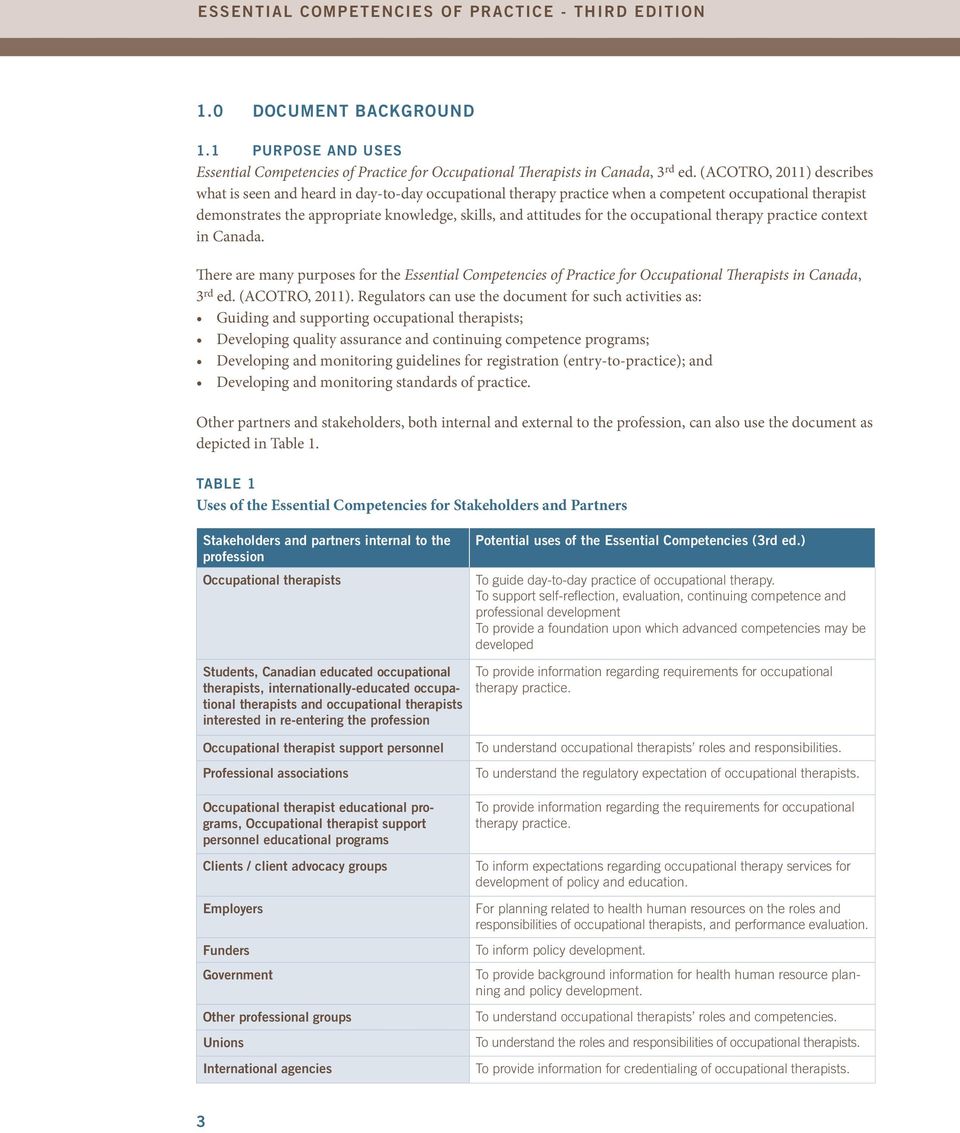
6 ESSENTIAL COMPETENCIES OF PRACTICE - THIRD EDITION 1.0 DOCUMENT BACKGROUND 1.1 PURPOSE AND USES Essential Competencies of Practice for Occupational Therapists in Canada, 3 rd ed. (ACOTRO, 2011) describes what is seen and heard in day-to-day occupational therapy practice when a competent occupational therapist demonstrates the appropriate knowledge, skills, and attitudes for the occupational therapy practice context in Canada. There are many purposes for the Essential Competencies of Practice for Occupational Therapists in Canada, 3 rd ed. (ACOTRO, 2011). Regulators can use the document for such activities as: Guiding and supporting occupational therapists; Developing quality assurance and continuing competence programs; Developing and monitoring guidelines for registration (entry-to-practice); and Developing and monitoring standards of practice. Other partners and stakeholders, both internal and external to the profession, can also use the document as depicted in Table 1. TABLE 1 Uses of the Essential Competencies for Stakeholders and Partners Stakeholders and partners internal to the profession Occupational therapists Students, Canadian educated occupational therapists, internationally-educated occupational therapists and occupational therapists interested in re-entering the profession Occupational therapist support personnel Professional associations Occupational therapist educational programs, Occupational therapist support personnel educational programs Clients / client advocacy groups Employers Funders Government Other professional groups Unions International agencies Potential uses of the Essential Competencies (3rd ed.) To guide day-to-day practice of occupational therapy. To support self-refl ection, evaluation, continuing competence and professional development To provide a foundation upon which advanced competencies may be developed To provide information regarding requirements for occupational therapy practice. To understand occupational therapists roles and responsibilities. To understand the regulatory expectation of occupational therapists. To provide information regarding the requirements for occupational therapy practice. To inform expectations regarding occupational therapy services for development of policy and education. For planning related to health human resources on the roles and responsibilities of occupational therapists, and performance evaluation. To inform policy development. To provide background information for health human resource planning and policy development. To understand occupational therapists roles and competencies. To understand the roles and responsibilities of occupational therapists. To provide information for credentialing of occupational therapists. 3
7 1.2 THE DIFFERENCE BETWEEN THE ESSENTIAL COMPETENCIES AND THE PROFILE OF OCCUPATIONAL THERAPY PRACTICE IN CANADA, 2007 The Essential Competencies of Practice for Occupational Therapists in Canada, 3 rd ed. (ACOTRO, 2011) and the CAOT Profile of Occupational Therapy Practice in Canada (2007) are related and complementary documents. Each document was developed in collaboration with the other agency to ensure that there was a high level of agreement about the picture of occupational therapists practice. Organizations and individuals may use one or the other, or both, depending on their needs. The Essential Competencies of Practice for Occupational Therapists in Canada, 3 rd ed. (ACOTRO, 2011) guides day-to-day occupational therapist practice and informs the work of the provincial regulatory organizations. Functions are used to sort the competency statements. This approach is useful in such areas as communicating and evaluating standards and guidelines, i.e., it provides clarity to Registrants about what is essential performance in practice. With a shared description by regulators across Canada, the Essential Competencies of Practice for Occupational Therapists in Canada, 3 rd ed. (ACOTRO, 2011) facilitates labour mobility, as it constitutes the platform for entry-to-practice requirements. The CAOT Profile of Occupational Therapy Practice in Canada (2007) uses roles to sort the competency statements. This is broadly used by many different professions. The roles approach is useful in such areas as: (a) enhancing interprofessional collaboration, as many professions use common roles language to describe what they do; (b) communication external to the profession, as roles are broadly understood external to the profession); and (c) accreditation of occupational therapist educational programs. 1.3 THE FRAMEWORK FOR THE ESSENTIAL COMPETENCIES There are several common approaches for the development of competency frameworks based on tasks, functional analysis, or descriptions of roles. Each has its place in describing competence. What is most important in any competency framework is the completeness and accuracy of the description it provides. A metaphor for competency frameworks is a deck of playing cards, where what is important is that one has all 52 cards of the deck. 3 The dealer orders the cards in a manner that makes sense. Similarly, how the competencies are described and ordered is influenced by the manner that is considered most useful. The Essential Competencies of Practice for Occupational Therapists in Canada, 3 rd ed. (ACOTRO, 2011) is based on a functional analysis methodology. 4 The functional analysis approach is an integrated method to competency development whereby competence is inferred from performance, and the context sensitivity of diverse practice is recognized. 5 This framework appeals to regulatory agencies because it focuses directly on the profession-specific knowledge, skills and attitudes. This focus has facilitated the development of regulatory standards and also regulatory programs such as those for continuing competence and quality assurance. Figure 1 depicts how the varying levels of the framework are interrelated and described. Contextual examples may also be used in a functional analysis framework, as necessary, to clarify the meaning and context of practice related to the performance indicators and therefore assist the occupational therapist in applying the criteria to actual practice situations. 3 Glover Takahashi, S. Competency Frameworks: A primer (in press). 4 Assessment Strategies, Assessment Strategies, 1998, p.6 Copyright 2011 the Association of Canadian Occupational Therapy Regulatory Organizations (ACOTRO). 4

8 ESSENTIAL COMPETENCIES OF PRACTICE - THIRD EDITION FIGURE 1 Levels of a Functional Analysis Competency Framework 6 Level 1: Key Role Statement - Describes purpose or goal of the professional. Level 2: Units of Competencies - Describe the major functions for effective performance. Level 3: Competencies - Describe the identifi able components of expected performance. Level 4: Performance Indicators & Cues - Describe an inter-related set of factors that defi ne the level of expected performance. Cues are examples included to illustrate day-to-day performance of the competency. 6 Jones & Moore,

9 2.0 ASSUMPTIONS ABOUT THE ESSENTIAL COMPETENCIES A number of assumptions were made in developing the third edition. These are designed to describe how the Essential Competencies of Practice for Occupational Therapists in Canada, 3 rd ed. (ACOTRO, 2011) will be interpreted and applied when considering competence of a registered occupational therapist. The Essential Competencies of Practice for Occupational Therapists in Canada, 3 rd ed. (ACOTRO, 2011): Represent the knowledge, skills, and attitudes required for practice of an occupational therapist in Canada; Are interpreted within the context of the authority of each provincial regulatory organization; Reflect the standards, regulations, guidelines, codes of ethics, and bylaws for practice in a given jurisdiction; Are all equally essential; and Are overarching to accommodate current and future public policy and trends. The occupational therapist: Is competent to practise safely, effectively, and ethically in his or her practice domain; Is autonomous in decision-making and accountable for his or her professional judgment; Makes responsible decisions based on critical thinking, reasoning, and reflection related to current evidence; Uses these competencies in diverse practice contexts; and Addresses occupational performance issues using a client-centred approach. Applicants for registration must demonstrate the competencies in this document. In addition, once registered, the occupational therapist is responsible for maintaining the essential competencies. It is understood that it may not be possible or necessary for an individual occupational therapist to apply certain competencies in specific practice contexts or with certain types of clients. Thus, the Essential Competencies of Practice for Occupational Therapists in Canada, 3 rd ed. (ACOTRO, 2011) must be applied and interpreted in light of the requirements of the practice context and the particular situation of the recipient of services. Nevertheless, it is expected that the vast majority of the essential competencies and performance indicators will be applicable to most situations and most clients. In the event that a competency or performance indicator is not applicable in a particular situation, a reasonable explanation should be available. Competencies for occupational therapists with non-clinical work are also described in the third edition. The competencies are not mutually exclusive. Occupational therapists may need to draw from both sets of competencies in order to accurately reflect their daily work. Copyright 2011 the Association of Canadian Occupational Therapy Regulatory Organizations (ACOTRO). 6

10 ESSENTIAL COMPETENCIES OF PRACTICE - THIRD EDITION 3.0 ADDRESSING THE NON-CLINICAL WORK OF OCCUPATIONAL THERAPISTS The Essential Competencies for Occupational Therapists with Non-clinical Work describe the day-to-day essential knowledge, skills and abilities of registered occupational therapists whose work is exclusively non-clinical 7. The process whereby these were developed can be found in companion document: Essential Competencies of Practice for Occupational Therapists in Canada, 3 rd ed. (ACOTRO, 2011) Methodology Supplement. An occupational therapist s work would be considered non-clinical and subject to meeting the Non-clinical Essential Competencies if there is NO direct contact and/or responsibilities with a client. If a registered occupational therapist has ANY amount of direct contact with a client, he or she would be required to meet the Essential Competencies of Practice for Occupational Therapists in Canada, 3 rd ed. (ACOTRO, 2011). It is interpreted as CLINICAL in such situations as: The occupational therapist is providing unpaid client services. The occupational therapist is communicating the results of the assessment to the person or his or her substitute so he or she can make choices (including a decision to refuse occupational therapy services). The occupational therapist is expressing an opinion about the person s condition that will assist in determining eligibility for benefits or funding for treatment/services. The occupational therapist is gathering information that will be used in the treatment/care of the person. Clients are involved in research by/with occupational therapists. Clients are involved in occupational therapist education. Researchers or managers provide client services on a part-time basis. Although provincial and territorial governments may be most interested in the services provided by occupational therapists who provide direct care to clients, regulatory organizations are charged with the duty of supporting the quality of services provided by occupational therapists who wish to retain the title of occupational therapist and/or OT. Developing competencies that would be inclusive of all occupational therapists recognizes that public protection is dependent on a profession that supports and monitors the competence of all its members, regardless of their present roles. 3.1 HOW DO THE COMPETENCIES COMPARE? Both sets of competencies are outlined in Section 5. They are shown side-by-side to enable occupational therapists to select those competencies relevant to their work. The most significant difference is the omission of the competence units specific to work knowledge and work processes for occupational therapists work that is exclusively non-clinical. The omitted units include: Demonstrates Practice Knowledge Utilizes an Occupational Therapy Process to Enable Occupation This recognizes that occupational therapists with non-clinical work may also be responsible to others, for example employers and certifying organizations. 7 The term clinical and its derivatives are used in the general sense and are not meant to indicate that occupational therapists only work in medical environments where the term clinical is the most common. 7

11 4.0 LOOKING AT THE COMPETENCE OF OCCUPATIONAL THERAPISTS 4.1 PRACTICE CONTEXT FOR OCCUPATIONAL THERAPISTS One of the elements of competent practice is the context. The Essential Competencies are intended to be practised within the occupational therapy practice context, which describes details about the practice milieu including: Who (types of clients, groups, populations). What (see Table 2 for areas of practice). Where (see Tables 3 for practice settings). How (see Tables 4 & 5 for positions, funding sources). The areas describing the context of practice are interrelated and impact on which Essential Competencies occupational therapists require for safe and effective practice. The following sections describe the various contexts of practice for occupational therapists in Canada PRACTICE CONTEXT: TO WHOM OCCUPATIONAL THERAPISTS PROVIDE SERVICES In the context of occupational therapist regulation, client means the person, group, community or organization receiving professional services, products, or information. The client is the direct recipient of occupational therapy service regarding an occupational performance issue. The funder is not the same as the client PRACTICE CONTEXT: WHAT OCCUPATIONAL THERAPISTS DO Table 2 Areas of Practice for Primary Employment (2009) 8 Employer type OTs practising in area (%) General Physical Health 35.3 Other Areas of Direct Service 14.1 Mental Health 11.3 Neurological System 8.2 Musculoskeletal System 7.1 Other Areas of Practice 5.2 Client Service Management 3.9 Vocational Rehabilitation 3.2 Medical/Legal-Related Client Service 2.9 Service Administration 2.8 Teaching 2.0 Health Promotion and Wellness 1.6 Cardiovascular and Respiratory System 1.0 Research 0.7 Palliative Care 0.6 Digestive/Metabolic/Endocrine System 0.1 TOTAL 100% 8 CIHI, 2010; Figure 17, p. 58, data excludes Quebec. Copyright 2011 the Association of Canadian Occupational Therapy Regulatory Organizations (ACOTRO). 8

12 ESSENTIAL COMPETENCIES OF PRACTICE - THIRD EDITION PRACTICE CONTEXT: WHERE OCCUPATIONAL THERAPISTS WORK Table 3 Employer Type for Primary Employment (2009) 9 Employer type OTs in employment area (%) General Hospital 24.9 Rehabilitation Hospital/Facility 14.7 Visiting Agency/Business 11.5 Community Health Centre 9.8 School or School Board 6.3 Mental Health Hospital/Facility 6.0 Solo Professional Practice/Business 6.0 Group Professional Practice/Clinic 5.7 Other 5.3 Residential Care Facility 4.0 Association/Government/Para-Governmental 3.0 Postsecondary Educational Institution 2.2 Industry, Manufacturing and Commercial 0.6 Assisted Living Residence 0.3 TOTAL 100% PRACTICE CONTEXT: HOW OCCUPATIONAL THERAPISTS PRACTICE Table 4 Occupational Therapy Workforce by Position for Primary Employment (2009) 10 Position OTs practising in role (%) DIRECT SERVICE 85.0 OTHER: Manager Professional Leader/Coordinator Educator Researcher Other TOTAL 100% 9 CIHI, 2010, Figure 15, p 54; Quebec data not available 10 CIHI, 2010, Figure 14, p. 51; Quebec data not available 9

13 Table 5 Occupational Therapy Workforce by Funding Source for Primary Employment (2009) 11 Funding Source OTs practising in sector (%) Public / Government 80.9 Private Sector or Individual Clients 6.8 Public/Private Mix 9.6 Other 2.7 TOTAL 100% 4.2 CAPABILITY OF OCCUPATIONAL THERAPISTS One of the elements of competent practice is the capability of the occupational therapist. Capability refers to the physical, mental, emotional potential, and facility 12 of an individual required to fulfill his or her professional role. Generally, much of an occupational therapist s capability is the raw materials and the take for granted implicit aspects. Often capability for an occupational therapist is demonstrated through the achievement of the educational credential (e.g., in achieving a university education a person demonstrates that he or she has the mental ability for their professional role). Other sources of information about an occupational therapist s capability may be required at the time of application and renewal for registration with a professional regulatory organization. For example, registration information gathered about an occupational therapist s capability for practice might include language tests, criminal record checks, verification of application of good standing, standards with respect to capacity, and undertakings with respect to mental and/or psychological fitness to practise. 11 CIHI, 2010, Figure 16, p. 57; Quebec data not available. 12 Synonyms for capability include talent, aptitude, and potential. Copyright 2011 the Association of Canadian Occupational Therapy Regulatory Organizations (ACOTRO). 10

14 ESSENTIAL COMPETENCIES OF PRACTICE - THIRD EDITION 5.0 THE KEY ROLE AND UNITS OF COMPETENCE The Essential Competencies are organized according to four distinct levels including Role, Units, Competencies, and Performance Indicators. 5.1 KEY ROLE OF OCCUPATIONAL THERAPISTS The KEY ROLE Statement describes the purpose or goal of the occupational therapist. As autonomous primary health professionals, occupational therapists work in partnership with clients 13 and relevant others to provide safe, effective, ethical, and client-centered occupational therapy. Occupational therapists apply a collaborative and reasoned approach to enable occupation using a practice process, thinking critically, and communicating effectively while focusing on the physical, cognitive, affective, and spiritual components of performance as well as the physical, institutional, social, and cultural aspects of the environment. Occupational therapists abide by ethical principles to act with integrity, accountability, and judgment in the best interests of the client, available services, and application of available evidence. 5.2 UNITS OF COMPETENCE OF OCCUPATIONAL THERAPISTS Units 1-7 describe the major functions for effective performance of occupational therapists. 1 Assumes Professional Responsibility 2 Thinks Critically 3 Demonstrates Practice Knowledge 4 Utilizes an Occupational Therapy Process to Enable Occupation 5 Communicates and Collaborates Effectively 6 Engages in Professional Development 7 Manages Own Practice and Advocates Within Systems Units A-E describe the major functions for effective performance of occupational therapists who do non-clinical work. A B C D E Assumes Professional Responsibility Thinks Critically Communicates and Collaborates Effectively Engages in Professional Development Manages Own Work and Advocates Within Systems 13 Clients are the direct recipient of occupational therapy service and may include the individual, family, caregiver, group or organization that accesses the services of an occupational therapist. 11

15 6.0 COMPETENCIES OF OCCUPATIONAL THERAPISTS Competencies describe the identifiable components of expected performance by an occupational therapist. They appear under each unit and are numbered as 1.1, 1.2, etc. or A.1, A.2, etc. for competencies related to non-clinical work. Clinical Work Unit 1: Assumes Professional Responsibility Occupational therapists assume professional responsibility for safe, ethical and effective practice. 1.1 Demonstrates a commitment to their clients, public and profession. 1.2 Practises within scope of professional and personal limitations and abilities. 1.3 Adheres to the Code of Ethics recognized by the provincial regulatory organization. 1.4 Applies ethical frameworks to solve ethical situations. 1.5 Demonstrates professional integrity. Non-clinical Work Unit A: Assumes Professional Responsibility Occupational therapists assume professional responsibility for safe, ethical and effective development, delivery, oversight and/or improvement of systems and services. A.1 Demonstrates a commitment to their work, the public and the profession. A.2 Works within scope of professional and personal limitations and abilities. A.3 Adheres to the Code of Ethics recognized by the provincial regulatory organization. A.4 Applies ethical frameworks to solve ethical situations. A.5 Demonstrates professional integrity. Clinical Work Unit 2: Thinks Critically Occupational therapists use critical reasoning and refl ection approaches for safe, ethical and effective practice. 2.1 Demonstrates sound professional judgment and clinical reasoning in decision-making. 2.2 Engages in reflection and evaluation and integrates findings into practice. Non-clinical Work Unit B: Thinks Critically Occupational therapists use critical reasoning and reflection approaches for safe, ethical and effective development, delivery, oversight and/or improvement of systems and services. B.1 Demonstrates sound professional judgment and reasoning in decision-making. B.2 Engages in reflection and evaluation and integrates findings into work. Clinical Work Unit 3: Demonstrates Practice Knowledge Occupational therapists demonstrate practice knowledge for safe, ethical and effective practice. 3.1 Uses current occupational therapy foundational knowledge in day-to-day practice. 3.2 Demonstrates awareness of the physical, social, cultural, institutional and economic environment relevant to the jurisdiction of practice. 3.3 Demonstrates awareness of experiential knowledge of client and occupational therapist. 3.4 Demonstrates awareness of legislative and regulatory requirements relevant to the province and area of practice. Copyright 2011 the Association of Canadian Occupational Therapy Regulatory Organizations (ACOTRO). 12

16 ESSENTIAL COMPETENCIES OF PRACTICE - THIRD EDITION Clinical Work Unit 4: Utilizes an Occupational Therapy Process to Enable Occupation Occupational therapists use systematic approaches to enabling occupation for safe, ethical and effective practice. 4.1 Clarifies role of occupation and enablement when initiating services. 4.2 Demonstrates a systematic client-centred approach to enabling occupation. 4.3 Ensures informed consent prior to and throughout service provision. 4.4 Assesses occupational performance and enablement needs of client. 4.5 Develops client-centred plan with client, interprofessional team members and other stakeholders. 4.6 Implements plan for occupational therapy services. 4.7 Monitors plan to modify in a timely and appropriate manner. Clinical Work Unit 5: Communicates and Collaborates Effectively Occupational therapists use effective communication and collaborative approaches for safe, ethical and effective practice. 5.1 Communicates effectively with client, interprofessional team and other stakeholders using clientcentred principles that address physical, social, cultural or other barriers to communication. 5.2 Communicates using a timely and effective approach. 5.3 Maintains confidentiality and security in the sharing, transmission, storage and management of information. 5.4 Collaborates with client, interprofessional team and other stakeholders. 5.5 Works effectively with client, interprofessional team and other stakeholders to manage professional relationships. Non-clinical Work Unit C: Communicates and Collaborates Effectively Occupational therapists use effective communication and collaboration approaches for safe, ethical and effective development, delivery, oversight and/or improvement of systems and services. C.1 Communicates using a timely and effective approach. C.2 Maintains confidentiality and security in the sharing, transmission, storage and management of information. Clinical Work Unit 6: Engages in Professional Development Occupational therapists engage in professional development for safe, ethical and effective practice. 6.1 Uses self-evaluation, new learning and evidence in professional development. 6.2 Demonstrates commitment to continuing competence. 6.3 Enhances personal competence through integration of ongoing learning into practice. Non-clinical Work Unit D: Engages in Professional Development Occupational therapists engage in professional development for safe, ethical and effective development, delivery, oversight and/or improvement of systems and services. D.1 Uses self-evaluation, new learning and evidence in professional development. D.2 Demonstrates commitment to continuing competence. D.3 Enhances personal competence through integration of ongoing learning. 13

17 Clinical Work Unit 7: Manages Own Practice and Advocates Within Systems Occupational therapists manage the quality of practice and advocate within systems for safe, ethical and effective practice. 7.1 Manages day-to-day practice processes. 7.2 Manages assignment of service to support personnel, other staff, students and others under the occupational therapist s supervision. 7.3 Contributes to a practice environment that supports client-centered occupational therapy service, which is safe, ethical and effective. 7.4 Demonstrates commitment for client and provider safety. 7.5 Participates in quality improvement initiatives. 7.6 Advocates for the occupational potential, occupational performance and occupational engagement of clients. Non-clinical Work Unit E: Manages Own Work and Advocates Within Systems Occupational therapists manage the quality of practice and advocate within systems for safe, ethical and effective development, delivery, oversight and/or improvement of systems and services. E.1 Demonstrates commitment for safety. E.2 Participates in quality improvement initiatives. Copyright 2011 the Association of Canadian Occupational Therapy Regulatory Organizations (ACOTRO). 14

18 ESSENTIAL COMPETENCIES OF PRACTICE - THIRD EDITION 7.0 COMPETENCIES INCLUDING PERFORMANCE INDICATORS Performance Indicators describe an inter-related set of factors that define the level of expected performance for occupational therapists. These appear under each competency. Cues are examples of everyday practice which help to illustrate performance indicators. 1 - ASSUMES PROFESSIONAL RESPONSIBILITY Occupational therapists assume professional responsibility for safe, ethical and effective practice. Clinical Work 1.1 Demonstrates a commitment to clients, public, and the profession Demonstrates knowledge of self-regulation. Cues: accountability to the client, public interest, regulatory organization, profession, other statutes (e.g. privacy laws) Demonstrates professional behaviours. Cues: accountability, confidentiality, transparency, disclosure, integrity, honesty, compassion, respect Takes action to ensure that practice and setting support professional responsibilities. Cues: monitors consistency with policies and regulations; checks that terms of agreement in a contract with payer are not in contravention of professional obligations to client; manages power issues Supports others to practise professional responsibility. Cues: education, resources, services, policies which are supportive to others Takes necessary actions to ensure client safety. 1.2 Practises within scope of professional and personal limitations and abilities Demonstrates an understanding of the scope of practice as defined by the relevant provincial jurisdiction or regulatory organization. Non-clinical Work A.1 Demonstrates a commitment to their work, the public and the profession. A.1.1 Demonstrates knowledge of self-regulation. Cues: accountability to the public interest, regulatory organization, profession, other statutes (e.g. privacy laws) A.1.2 Demonstrates professional behaviours. Cues: accountability, confidentiality, transparency, disclosure, integrity, honesty, compassion, respect A.1.3 Takes action to ensure that work setting support professional responsibilities. Cues: monitors consistency with policies and regulations, checks terms of agreement in a contract with payer are not in contravention of professional obligations A.1.4 Supports others towards professional responsibility. Cues: education, resources, services, policies which are supportive to others A.1.5 Takes necessary actions to ensure safety. A.2 Works within scope of professional and personal limitations and abilities. A.2.1 Demonstrates an understanding of the scope of work as defined by the relevant provincial jurisdiction or regulatory organization. 15

19 1.2.2 Demonstrates an understanding of the interconnections between scope of practice and practice setting. A.2.2 Takes action to ensure that personal and professional limitations do not cause their competence to fall below a level considered acceptable in the jurisdiction. Cues: Develop work skills, refer to other team members Takes action to ensure that personal and professional limitations do not cause competence to fall below a level considered acceptable in the jurisdiction. Cues: develop technical skills, refer to other team members, ensure qualified for restricted acts Manages overlaps in scope of practice with other professions. 1.3 Adheres to the Code of Ethics recognized by the provincial regulatory organization Communicates title and credentials accurately Complies with client confidentiality and privacy practice standards and legal requirements Responds appropriately to ethical issues encountered in practice. Cues: autonomy, client well-being Maintains appropriate relationships and boundaries with clients. A.3 Adheres to the Code of Ethics recognized by the provincial regulatory organization. A.3.1 Communicates title and credentials accurately. A.3.2 Complies with work confidentiality and privacy standards and legal requirements. A.3.3 Responds appropriately to ethical issues encountered in work. A.3.4 Maintains appropriate relationships and boundaries with staff, team members and others working in the work environment. Cues: Manage power relationships Manages conflict of interest. 1.4 Applies ethical frameworks to solve ethical situations Recognizes situations which impact ethical behavior Responds appropriately to observed unprofessional behaviours in practice. A.4 Applies ethical frameworks to solve ethical situations. A.4.1 Recognizes situations which impact ethical behaviour. A.4.2 Responds appropriately to observed unprofessional behaviours in work. Copyright 2011 the Association of Canadian Occupational Therapy Regulatory Organizations (ACOTRO). 16

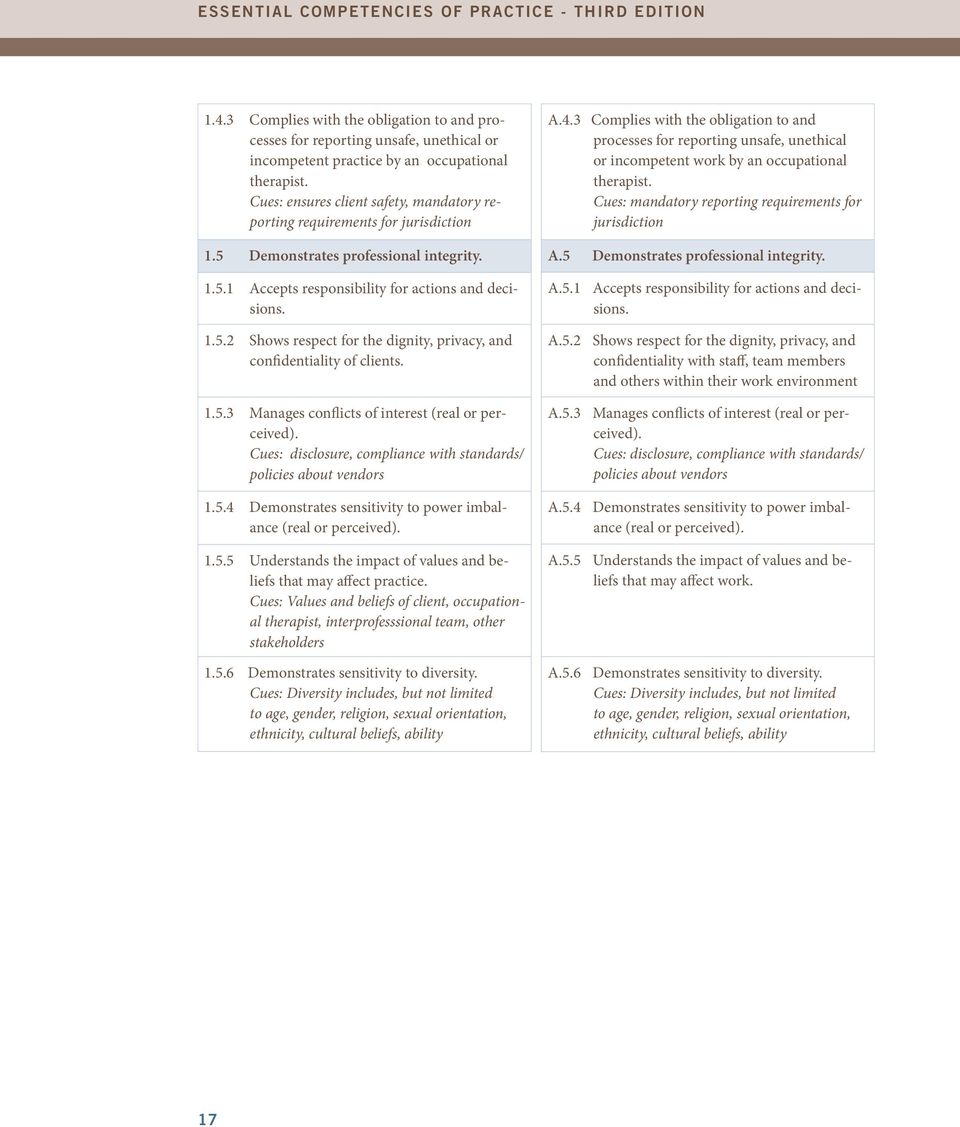
20 ESSENTIAL COMPETENCIES OF PRACTICE - THIRD EDITION Complies with the obligation to and processes for reporting unsafe, unethical or incompetent practice by an occupational therapist. Cues: ensures client safety, mandatory reporting requirements for jurisdiction 1.5 Demonstrates professional integrity Accepts responsibility for actions and decisions Shows respect for the dignity, privacy, and confidentiality of clients Manages conflicts of interest (real or perceived). Cues: disclosure, compliance with standards/ policies about vendors Demonstrates sensitivity to power imbalance (real or perceived) Understands the impact of values and beliefs that may affect practice. Cues: Values and beliefs of client, occupational therapist, interprofesssional team, other stakeholders Demonstrates sensitivity to diversity. Cues: Diversity includes, but not limited to age, gender, religion, sexual orientation, ethnicity, cultural beliefs, ability A.4.3 Complies with the obligation to and processes for reporting unsafe, unethical or incompetent work by an occupational therapist. Cues: mandatory reporting requirements for jurisdiction A.5 Demonstrates professional integrity. A.5.1 Accepts responsibility for actions and decisions. A.5.2 Shows respect for the dignity, privacy, and confidentiality with staff, team members and others within their work environment A.5.3 Manages conflicts of interest (real or perceived). Cues: disclosure, compliance with standards/ policies about vendors A.5.4 Demonstrates sensitivity to power imbalance (real or perceived). A.5.5 Understands the impact of values and beliefs that may affect work. A.5.6 Demonstrates sensitivity to diversity. Cues: Diversity includes, but not limited to age, gender, religion, sexual orientation, ethnicity, cultural beliefs, ability 17
21 2 - THINKS CRITICALLY Occupational therapists use critical reasoning and reflective approaches for safe, ethical and effective practice. Clinical Work 2.1 Demonstrates sound professional judgment and clinical reasoning in decision-making. Occupational therapists use critical reasoning and reflective approaches for safe, ethical and effective development, delivery, oversight and/or improvement of systems and services. Non-clinical Work B.1 Demonstrates sound professional judgment and reasoning in decision-making Demonstrates effective and evidence based problem solving and judgment to address client needs. Cues: literature search, best available evidence, research, consultation with experts and others Negotiates common ground with clients, Interprofessional team members, and other stakeholders Integrates complexity of client issues, needs, and goals within occupational therapy service. B.1.1 B.1.2 B.1.3 Demonstrates effective and evidence based problem solving and judgment. Cues: literature search, best available evidence, research, consultation with experts and others, etc. Negotiates common ground with team members, and other stakeholders. Cues: Integrates complexity of issues, needs, goals. Integrates relevant information with previous learning, experience, professional knowledge, and current work practices Integrates relevant information with previous learning, experience, professional knowledge, and current practice models Synthesizes and analyzes the information to inform occupational therapy service. Cues: sorting information, prioritizing information 2.2 Engages in reflection and evaluation and integrates findings into practice. B.1.4 Synthesizes and analyzes the information to inform work. Cues: sorting information, prioritizing information B.2 Engages in reflection and evaluation and integrates findings into work Demonstrates insight into personal expertise and limitations Demonstrates effective, appropriate, and timely consultation with other health professionals as needed for optimal client service Investigates alternative explanations for deficits in occupational performance and engagement. Cues: barriers, psychosocial components, financial resources Recognizes situations where services (i.e. client processes for occupation, occupational performance and/or engagement) should be adjusted, limited, modified or discontinued. B.2.1 B.2.2 B.2.3 B.2.4 Demonstrates insight into personal expertise and limitations. Demonstrates effective, appropriate, and timely consultation with others as needed to optimize outcomes. Investigates alternative explanations for problems, issues and challenges. Recognizes situations where goals and/or work plans should be adjusted, limited, modified or discontinued. Copyright 2011 the Association of Canadian Occupational Therapy Regulatory Organizations (ACOTRO). 18
22 ESSENTIAL COMPETENCIES OF PRACTICE - THIRD EDITION 3 - DEMONSTRATES PRACTICE KNOWLEDGE Occupational therapists demonstrate practice knowledge for safe, ethical and effective practice. Clinical Work 3.1 Uses current occupational therapy theory in day-to-day practice Applies relevant current knowledge of foundational biomedical and social sciences into practice. Cues: anatomy / neuroanatomy, neurology / neurophysiology, development across the lifespan (i.e., children, adolescents, adults, older adults), social sciences (i.e. psychology, sociology, education), disease/conditions Uses current models and approaches that apply in occupational therapy practice. Cues: models of practice, occupational therapy theories, health and disability, occupation & occupational engagement, client-centered care, mental health Integrates appropriate current occupational therapy knowledge into practice. Cues: assessment of person physical, affective, cognitive, emotional and spiritual; analysis of occupations; environmental enablers and barriers; physical, cultural, economic, political, and institutional determinants; assessment of occupational performance; self-care, productivity, leisure, mobility, IADL; standardized assessment; occupational performance factors; intervention strategies, methods, and assistive technologies; environmental modification; technical skills, e.g., splinting and wheelchair positioning for function 3.2 Demonstrates awareness of the physical, social, cultural, institutional and economic environment relevant to the jurisdiction of practice Understands the impact of physical, cultural, institutional, and economic factors relevant to practice. Cues: determinants of health, funding for service; education, justice, health and social service systems; socio-economic basis of community, cultural influences Adjusts occupational therapy service to reflect a client-centred approach related to physical, social, cultural, institutional and economic environment. 3.3 Demonstrates awareness of experiential knowledge of client and occupational therapist Understands the impact of experiential knowledge of client and occupational therapist. Cues: client biases, client values, self-awareness Adjusts occupational therapy services to reflect a client-centered approach related to the client s experiential knowledge as well as the occupational therapist s experiential knowledge. 3.4 Demonstrates awareness of legislative and regulatory requirements relevant to the province and area of practice Understands the impact of legislative and regulatory requirements relevant to the province and area of practice. Cues: restricted activities, local policies, consent process, health information, protection of confidentiality and privacy, child protection, mental health, occupational health and safety requirements Ensures practice-setting policies are consistent with regulations and legislative requirements. 19
23 4 - UTILIZES AN OCCUPATIONAL THERAPY PRACTICE PROCESS TO ENABLE OCCUPATION Occupational therapists use systematic approaches to enabling occupation for safe, ethical and effective practice. Clinical Work 4.1 Clarifies the role of occupation and enablement when initiating services Identifies the recipient(s) of occupational therapy service as the client(s). Cues: screens referrals, determines appropriateness of referral Clarifies the expectations of stakeholders, third party payers, and relevant others 14 that impact or complement service. Cues: family, advocates, teachers, caregivers, and other agencies regarding the service to be provided Identifies the knowledge, skills, and attitudes required to provide the appropriate service to the client Communicates scope and parameters of services to clients, referring agents, and relevant others. Cues: frequency and duration of service, variance Identifies and communicates to client and relevant others the strengths and limitations of practice. Cues: available funding, access to services, personal knowledge and skills Establishes with the client a shared understanding of occupation, occupational performance, engagement, and enablement issues. 4.2 Demonstrates a systematic client-centred approach to enabling occupation Uses strategies that engage the client in a collaborative approach. Cues: interview techniques, therapeutic use of self Builds rapport and trust within the relationship Discusses client expectations with regard to occupational therapy services Enables client to identify issues and clarify client concerns, expectations, and priorities Enables client to examine risks and consequences of options. Cues: provides information, allows time Achieves mutual understanding and agreement concerning services to be provided. 4.3 Ensures informed consent prior to and throughout service provision Adheres to regulatory, legislative, and service requirements regarding informed consent Demonstrates the principles and practices for obtaining informed consent. Cues: risk of harm, risk of doing nothing, capacity, range and benefits of services, release of information, etc Obtains consent for involvement of support personnel, students, and other providers involved in the provision of occupational therapy service components Identifies situations where informed consent may be problematic and takes steps to rectify issues. Cues: written explanation for non-verbal client, substitute decision-maker if client does not have capacity for consent 4.4 Assesses occupational performance, engagement, and enablement needs of client. 14 Others may include contractors, key individuals, organizations, and/or groups. Copyright 2011 the Association of Canadian Occupational Therapy Regulatory Organizations (ACOTRO). 20
24 ESSENTIAL COMPETENCIES OF PRACTICE - THIRD EDITION Assesses occupational performance and engagement Cues: self-care, productivity, and leisure; roles, demands, expectations, goals, settings, spiritual values of the client Identifies the client s strengths and resources Assesses components related to the occupation and occupational performance and engagement issues identified. Cues: cognitive, affective, meaning, values, and physical Gathers additional relevant information Cues: reviews client record; consults family, caregivers, and other professionals; collects complete subjective and objective data Determines the appropriate service delivery approach for client-centred occupational therapy services Cues: consulting, educating, direct intervention, assessment 4.5 Develops client-centred plan with client, interprofessional team members, and other stakeholders Integrates client wants and needs into all aspects of planning Identifies client s priority occupational issues and possible occupational goals Analyzes physical, cultural, social, and institutional environmental impact on occupational performance and engagement issues Analyzes and proposes options to increase inclusion and accessibility in the client s environment. Cues: cultural, institutional, physical, social Develops realistic, measurable, understandable, and targeted outcomes consistent with client s values and life goals Plans for needed service delivery, which considers limits or constraints on the various service delivery methods. Cues: resources, support personnel, time, equipment, environment, frequency and duration of service Refers to additional services as appropriate. Cues: funding, equipment, community services, other professional services, social agencies 4.6 Implements plan for occupational therapy services Implements the client-specific plan with client, interprofessional team members and other stakeholders. Cues: plans include recommendations, direct service, and consultation Monitors impact of plans on person, occupation and, environment Implements interventions in an effective and ethical manner. 4.7 Monitors plan to modify in a timely and appropriate manner Regularly re-assesses client s progress to compare with initial findings, occupational goals and plan Adapts or redesigns plan as needed. Cues: modifies plan of care, revises occupational therapy services recommendations Documents conclusion/exit and disseminates information and recommendations for next steps such as discharge, coordinated transfer, or re-entry Discontinues service in situations when occupational therapy should not continue. 21
25 5 - COMMUNICATES & COLLABORATES EFFECTIVELY Occupational therapists use effective communication and collaborative approaches for safe, ethical and effective practice. Clinical Work 5.1 Communicates effectively with the client, interprofessional team members, and other stakeholders using client-centred principles that address physical, social, cultural or other barriers to communication Fosters open, honest, and clear communication Delivers information in a respectful, thoughtful manner. Cues: verbal, non-verbal, language, tone Uses strategies that empower communication. Cues: active listening, clarifying statements, inviting questions, plain language, appropriate level explanation, educating, prompting, communication styles, appropriate use of technology Adapts communication approach to ensure that barriers to communication do not impact the client s ability to direct own care process. Cues: language, hearing loss, vision loss, literacy level, inability to communicate verbally, cognitive loss, need for an interpreter Occupational therapists use effective communication and collaborative approaches for safe, ethical and effective development, delivery, oversight and/ or improvement of systems and services. Non-clinical Work C.1 Communicates using an effective approach. C.1.1 Fosters open, honest, and clear communication. C.1.2 Delivers information in a respectful, thoughtful manner. Cues: verbal, non-verbal, language, tone C.1.3 Uses strategies that empower communication. Cues: active listening, clarifying statements, inviting questions, plain language, appropriate level explanation, educating, prompting, communication styles, appropriate use of technology Employs educational approach as appropriate. Cues: teaching aids, written materials, learner needs, formal teaching, informal teaching, feedback, evaluation 5.2 Communicates using a timely and effective approach Uses a systematic approach to record keeping of occupational therapy services. Cues: client-centred, clinical reasoning, occupation-based C.2 Maintains confidentiality and security in the sharing, transmission, storage, and management of information. C.2.1 Adheres to legislation, regulatory requirements and facility/employer guidelines regarding protection of privacy, security of information. Copyright 2011 the Association of Canadian Occupational Therapy Regulatory Organizations (ACOTRO). 22
26 ESSENTIAL COMPETENCIES OF PRACTICE - THIRD EDITION Maintains clear, accurate, and appropriate records of client encounters and plans. Cues: informed consent, results of assessment, interventions, client involvement, written, electronic Applies the various regulations that are specific to record keeping in occupational therapy. Cues: provincial and federal regulations; institutional policies C.2.2 Establishes and/or adheres to provincial and facility policies and procedures related to the management of information. Cues: acquiring, documenting, using, transmitting, storing, information access rights and disposing information. C2.3 Takes action to anticipate and minimize foreseeable risks to privacy and confidentiality of information. Cues: confidentiality and privacy of conversations, risks of disclosure in public or shared spaces, information technology, encryption, communication devices, etc Determines with client the right of others to client s information. Cues: client right to have access, to clarify, and to comment on or modify the information Discloses information in accordance with client consent. 5.3 Maintains confidentiality and security in the sharing, transmission, storage, and management of information Adheres to legislation, regulatory requirements and facility/employer guidelines regarding protection of privacy, security of information Establishes and/or adheres to provincial and facility policies and procedures related to the management of information. Cues: acquiring, documenting, using, transmitting, storing, and disposing information Takes action to anticipate and minimize foreseeable risks to privacy and confidentiality of information. Cues: confidentiality and privacy of conversations, risks of disclosure in public or shared spaces, information technology, encryption, communication devices 5.4 Collaborates with client, interprofessional team, and other stakeholders Explains role in client services to team members and clients. 23
27 5.4.2 Demonstrates receptiveness to others perspectives that serve the best interest of the client. Cues: considers others opinions and perspectives Demonstrates flexibility within team. Cues: consults with, listens to, tasks with, supportive of, responsive to, collaborates with Asks for support when appropriate Demonstrates leadership techniques appropriate to the situation. 5.5 Works effectively with client, interprofessional team, and other stakeholders to manage positive professional relationships Demonstrates sensitivity to issues related to diversity and difference. Cues: Diversity includes but is not limited to, the impact of age, gender, religion, cultural beliefs, sexual orientation, ethnicity, ability Adapts approach to consider impact of diversity on occupational therapy service outcomes Demonstrates willingness to set team goals and priorities, measure progress, and learn from experience together as a team Enables parties to openly communicate and consider other opinions Manages differences, misunderstandings, and limitations that may contribute to interprofessional tensions in an effective and diplomatic manner. Copyright 2011 the Association of Canadian Occupational Therapy Regulatory Organizations (ACOTRO). 24
28 ESSENTIAL COMPETENCIES OF PRACTICE - THIRD EDITION 6 - ENGAGES IN PROFESSIONAL DEVELOPMENT Occupational therapists engage in professional development for safe, ethical and effective practice. Clinical Work 6.1 Uses self-evaluation, new learning, and evidence in professional development Conducts a regular assessment of personal learning needs required to ensure ongoing competence. Cues: monitor impact of change in practice, monitor changes in context, identify changes in responsibility areas requiring new learning; identify risks and supports to personal competence; identify personal and professional abilities and limitations that may impact on professional practice Adjusts assessment of personal learning needs with external information. Cues: performance review, client feedback, peer feedback, supervisor feedback Reviews various sources of information and new knowledge and determines applicability to practice. Cues: research articles, databases, guidelines, expert opinion, conferences, discussion groups, critical appraisal 6.2 Demonstrates commitment to continuing competence Maintains the knowledge, skills, and attitudes to provide safe, efficient, and effective service in areas of practice. Cues: Essential Competencies, evidence informed practice Integrates new knowledge, skills, and attitudes into practice Implements a plan for continual professional improvement. Occupational therapists engage in professional development for safe, ethical and effective development, delivery, oversight and/or improvement of systems and services. Non-clinical Work D.1 Uses self-evaluation, new learning, and evidence in professional development. D.1.1 Conducts a regular assessment of personal learning needs required to ensure ongoing competence. Cues: monitor changes in context, identify changes in responsibility areas requiring new learning; identify risks and supports to personal competence; identify personal and professional abilities and limitations that may impact on professional practice. D.1.2 Adjusts assessment of personal learning needs with external information. Cues: performance review, peer/supervisor feedback. D.1.3 Reviews various sources of information and new knowledge and determines applicability to work. Cues: research articles, databases, guidelines, expert opinion, conferences, discussion groups, critical appraisal. D.2 Demonstrates commitment to continuing competence. D.2.1 Maintains the knowledge, skills, and attitudes to provide safe, efficient, and effective service in areas of work practice. Cues: Essential Competencies, evidence informed practice D.2.2 Integrates new knowledge, skills, and attitudes into work. D.2.3 Implements a plan for continual professional improvement. 25
29 6.2.4 Takes action to address deficiencies to enhance practice. Cues: acquiring needed knowledge and skills 6.3 Enhances personal competence through integration of ongoing learning into practice Keeps abreast of changes in practice setting that affect scope of practice. Cues: advances in technology, changes in scope of practice, new and revised standards of practice, evidence informed practice Adapts to changes in practice using evidence, practice standards, and best practices Enhances knowledge, skills, and attitudes in needed areas of personal competence. D.2.4 Takes action to address deficiencies to enhance work. Cues: acquiring needed knowledge and skills. D.3 Enhances personal competence through integration of ongoing learning into work. D.3.1 Keeps abreast of changes in work setting that affect scope of work. Cues: advances in technology, changes in scope of practice, new and revised practice standards, evidence informed practice D.3.2 Adapts to changes in work using evidence, practice standards, and best practices. D.3.3 Enhances knowledge, skills, and attitudes in needed areas of personal competence. Copyright 2011 the Association of Canadian Occupational Therapy Regulatory Organizations (ACOTRO). 26
30 ESSENTIAL COMPETENCIES OF PRACTICE - THIRD EDITION 7 - MANAGES OWN PRACTICE AND ADVOCATES WITHIN SYSTEMS Occupational therapists manage the quality of practice and advocate within systems for safe, ethical and effective practice. Clinical Work 7.1 Manages day-to-day practice processes Prioritizes professional duties including when faced with multiple clients and competing needs. Occupational therapists manage the quality of practice and advocate within systems for safe, ethical and effective development, delivery, oversight and/or improvement of systems and services. Non-clinical Work E.1 Demonstrates commitment for safety. E.1.1 Demonstrates knowledge of policies and procedures as they relate to work and work setting Allocates occupational therapy services balancing client needs and available resources. E.1.2 Integrates safety practices into daily activities Balances work priorities and manages time with respect to client services, practice requirements, and professional responsibilities. E.1.3 Demonstrates situational awareness by continually observing the whole environment, thinking ahead, and reviewing potential options and consequences. Cues: work or work settings that might lead to high risk situations Manages professional responsibilities by recognizing personal and professional limits of functioning. Cues: limits or stops work if physically or mentally unable to practise safely and effectively; monitors impact of work-life balance on professional responsibilities E.1.4 Recognizes safety problems in real-time and responds to correct them, preventing them where possible. 7.2 Manages assignment of service to support personnel, other staff, students, and others under the occupational therapist s supervision. E.2 Participates in quality improvement initiatives Adheres to regulatory requirements and/or guidelines relating to the assignment of tasks and supervision of support personnel, students of occupational therapy, and other students. Cues: delegates and assigns per standards, guidelines and regulations; student supervision directives E.2.1 Demonstrates accountability for quality of own work. Cues: improve outcomes, increase efficiency, mitigate errors, reduce waste, and minimize delays Orients to role, duties, and responsibilities. E.2.2 Shows awareness of health systems, error, and safety concepts. Cues: human factors, patient safety, systems design, risk management, context specific safety solutions 27
31 7.2.3 Supports effectiveness and safety through monitoring, preceptorship, supervision, mentoring, teaching, and coaching Assigns appropriate work activities Provides regular feedback and evaluation. Cues: learning objectives, feedback, evaluation forms E.2.3 Works with others in quality improvement initiatives. Cues: others can include staff, team members, clients, others in work environment E.2.4 Takes action on identified risks to self, others or work setting. Cues: disclosure E.2.5 Advocates for change to ensure that recommended interventions are implemented and sustained. 7.3 Contributes to a practice environment that supports client-centered occupational therapy service, which is safe, ethical and effective Participates in established organizational processes. Cues: workload measurement, annual performance reviews Manages risk in practice to prevent and mitigate safety issues. Cues: infection control, client safety, workplace safety, workplace hazards, harassment legislation, labour laws Takes appropriate action to align consistency of practice environment requirements with regulatory requirements. Cues: number of years to keep client records, requirements for blanket or client-specific consent, addresses differences with facility leaders 7.4 Demonstrates commitment for client and provider safety Demonstrates knowledge of policies and procedures as they relate to client and provider safety Integrates safety practices into daily activities. Cues: hand hygiene; seeks assistance for transfers when needed Demonstrates situational awareness by continually observing the whole environment, thinking ahead, and reviewing potential options and consequences. Cues: settings or clinical areas that might lead to high-risk situations Copyright 2011 the Association of Canadian Occupational Therapy Regulatory Organizations (ACOTRO). 28
32 ESSENTIAL COMPETENCIES OF PRACTICE - THIRD EDITION Recognizes safety problems in real-time and responds to correct them, preventing them from impacting the client Employs safety techniques. Cues:, diligent information-gathering, crosschecking of information, using checklists, investigating mismatches between the current situation and the expected state 7.5 Participates in quality improvement initiatives Demonstrates accountability for quality of own practice. Cues: improve outcomes, increase efficiency, mitigate errors, reduce waste, and minimize delays Shows awareness of health systems, error, and client safety concepts. Cues: human factors, systems design, risk management, context specific safety solutions Works with clients and others in quality improvement initiatives Takes action on identified risks to self, client or practice setting. Cues: disclosure, improves practice Advocates for change to ensure that recommended interventions are implemented and sustained. 7.6 Advocates for the occupational potential, occupational performance, and occupational engagement of clients Balances the ethical and professional issues inherent in client advocacy including altruism, autonomy, integrity, and idealism Manages the conflict inherent between advocacy role for a client and manager of finite services and resources Advocates appropriately for the role of occupational therapy to clients and the interprofessional team Communicates the role and benefits of occupational therapy in occupational performance and occupational engagement Acts on identified advocacy, promotion and prevention opportunities for occupation and occupational performance with individuals for whom occupational therapy services are provided. 29
33 8.0 REFERENCES Assessment Strategies (1998). Report on the development of the competency profile for the entry-level occupational therapist in Canada. Toronto: Author. Association of Canadian Occupational Therapy Regulatory Organizations (2000). Essential competencies of practice for occupational therapists in Canada. Toronto: Author. Association of Canadian Occupational Therapy Regulatory Organizations (2003). Essential competencies of practice for occupational therapists in Canada (2nd ed.). Toronto: Author. Canadian Association of Occupational Therapists (1997). Enabling occupation: An occupational therapy perspective. Ottawa: CAOT Publications ACE. Canadian Association of Occupational Therapists (2002). Enabling occupation: An occupational therapy perspective. (Rev. ed.). Ottawa: CAOT Publications ACE. Canadian Association of Occupational Therapists (2007). Profile of Occupational Therapy Practice in Canada (2007). Ottawa: CAOT Publications ACE. Canadian Institute for Health Information (2010). Occupational therapists in Canada, Ottawa: Author. Glover Takahashi, S. (in press). Competency frameworks: A primer. Toronto: Author. Jones, L., & Moore, R. (1993). Education, competence and the control of expertise. British Journal of Sociology of Education, 14(4), Townsend, E. A., & Polatajko, H. J. (2007). Enabling occupation II: Advancing an occupational therapy vision for health, well-being, & justice through occupation. Ottawa: CAOT Publications ACE. Copyright 2011 the Association of Canadian Occupational Therapy Regulatory Organizations (ACOTRO). 30
34 ESSENTIAL COMPETENCIES OF PRACTICE - THIRD EDITION APPENDIX A: GLOSSARY OF TERMS Client Is the direct recipient of occupational therapy service and may include the individual, family, caregiver, group or organization that accesses the services of an occupational therapist. Competent Being competent refers to the practice at a skill level of an individual, which meets or exceeds the minimum and ongoing performance expectations. Competent practice depends on three elements: 1. context of practice, 2. capability of individual (e.g., physical, cognitive, affective), and 3. competencies demonstrated by an individual. Context of Practice Context of practice is the environment where practice occurs. Context of practice describes the details about the practice milieu including the who (types of clients, groups, populations), what (areas of practice, types of service), where (practice settings), and how (professional roles, funding models) in which individuals may practise. The areas describing the context of practice are interrelated and impact on the essential competencies needed for safe and effective practice. Capability Capability refers to the physical, mental, emotional potential, and facility of an individual that enables him or her to fulfill a professional role. 15 Competency/Competencies A competency is a unit of or component part of the whole (i.e., competence). A competency is an outcome statement that reflects the knowledge, skills, and attitudes to achieve a major part of one s job (a role or responsibility). Each competency can be measured against well-accepted standards, and can be improved via training and development. Enabling occupation Refers to enabling people to choose, organize, and perform those occupations they find useful and meaningful in their environment. 16 Engagement Refers to actively involving clients in doing, participating. 17 Performance Indicators The inter-related set of measureable behaviours related to the demonstration of a given competency (i.e., outcome). Performance indicators are often key parts or processes related to demonstrating the knowledge, skills, or attitudes related to the competency. 15 Synonyms for capability include talent, aptitude, and potential. 16 CAOT, 1997a; 2002, p Townsend & Polatajko,
35 APPENDIX B: STEERING AND ADVISORY GROUP MEMBERS Steering Group Members Coralie Lennea Executive Director Saskatchewan Society of Occupational Therapists (Chair) Kathy Corbett Registrar, College of Occupational Therapists of British Columbia (COTBC) Gayle Salsman Registrar, College of Occupational Therapists of Nova Scotia (COTNS) Barbara Worth Registrar, College of Occupational Therapists of Ontario (COTO) Susan Glover Takahashi Project Consultant Jayne Kirby Project Manager Advisory Group Members Gayle Salsman Registrar, College of Occupational Therapists of Nova Scotia (COTNS) (Chair) Ann Bossers Association of Canadian Occupational Therapy University Programs (ACOTUP) Kathy Corbett Registrar, College of Occupational Therapists of British Columbia (COTBC) Leanne Worsfold College of Occupational Therapists of Ontario (COTO) Claudia von Zweck Executive Director, Canadian Association of Occupational Therapists (CAOT) Susan Glover Takahashi Project Consultant Jayne Kirby Project Manager Copyright 2011 the Association of Canadian Occupational Therapy Regulatory Organizations (ACOTRO). 32
36
Entry-to-Practice Competencies for Licensed Practical Nurses
 Entry-to-Practice Competencies for Licensed Practical Nurses Foreword The Canadian Council for Practical Nurse Regulators (CCPNR) is a federation of provincial and territorial members who are identified
Standards of Practice and Code of Ethics for Licensed Practical Nurses in Canada
 Standards of Practice and Code of Ethics for Licensed Practical Nurses in Canada COLLEGE OF of Newfoundland & Labrador Foreword The Canadian Council for Practical Nurse Regulators (CCPNR) is a federation
Code of Ethics for Licensed Practical Nurses in Canada
 Code of Ethics for Licensed Practical Nurses in Canada Foreword The Canadian Council for Practical Nurse Regulators (CCPNR) is a federation of provincial and territorial members who are identified in legislation,
How To Become A Registered Psychiatric Nurse
 CODE of ETHICS & STANDARDS of PSYCHIATRIC NURSING PRACTICE APPROVED May 2010 by the Board of the College of Registered Psychiatric Nurses of BC for use by CRPNBC Registrants REGISTERED PSYCHIATRIC NURSES
Child Custody and Access Assessments Standards of Practice
 Child Custody and Access Assessments Standards of Practice Child Custody and Access Assesments Standards of Practice 2010 First Edition: September 2002 Reprinted: 2010 British Columbia College of Social
Standards of Practice for Licensed Practical Nurses in Canada
 Standards of Practice for Licensed Practical Nurses in Canada Foreword The Canadian Council for Practical Nurse Regulators (CCPNR) is a federation of provincial and territorial members who are identified
REGISTERED NURSES ASSOCIATION OF THE NORTHWEST TERRITORIES AND NUNAVUT
 REGISTERED NURSES ASSOCIATION OF THE NORTHWEST TERRITORIES AND NUNAVUT STANDARDS OF PRACTICE FOR REGISTERED NURSES and NURSE PRACTITIONERS Responsibility and Accountability Knowledge-Based Practice Client-Centered
CODE OF ETHICS. Approved: June 2, 2014 Effective: December 1, 2014
 CODE OF ETHICS Approved: June 2, 2014 Effective: December 1, 2014 463 St. Anne s Road Winnipeg, MB R2M 3C9 [email protected] T: (204) 663-1212 TF: (1-877-663-1212 F: (204) 663-1207 Introduction: The Code of
NMBA Registered nurse standards for practice survey
 Registered nurse standards for practice 1. Thinks critically and analyses nursing practice 2. Engages in therapeutic and professional relationships 3. Maintains fitness to practise and participates in
Professional Standards for Registered Nurses and Nurse Practitioners
 Protecting the public by effectively regulating registered nurses and nurse practitioners Professional Standards for Registered Nurses and Nurse Practitioners accountability knowledge service ethics College
Occupational Therapy Assessment Practice Guideline 2012
 Occupational Therapy Assessment Practice 2012 College of Occupational Therapists of Manitoba Page 1 Introduction The Occupational Therapists Act acknowledges occupational therapists as autonomous practitioners.
Rubric for Evaluating North Carolina s School-Based Occupational Therapists
 Rubric for Evaluating North Carolina s School-Based Occupational Therapists Standard 1: School-based therapists demonstrate leadership, advocacy, and collaborative and ethical Element a. Leadership. School-based
Occupational Therapists in Canada, 2010 National and Jurisdictional Highlights and Profiles
 Occupational Therapists in Canada, 2010 National and Jurisdictional Highlights and Profiles October 2011 Spending and Health Workforce Who We Are Established in 1994, CIHI is an independent, not-for-profit
STUDENT PROFESSIONALISM
 STUDENT PROFESSIONALISM CMA Code of Ethics (Updated 2004 reviewed March 2012) This Code has been prepared by the Canadian Medical Association as an ethical guide for Canadian physicians, including residents,
Standards of Practice for Primary Health Care Nurse Practitioners
 Standards of Practice for Primary Health Care Nurse Practitioners June 2010 (1/14) MANDATE The Nurses Association of New Brunswick is a professional organization that exists to protect the public and to
ACM Interim Council, MEAC & SRAC collated response to the Public consultation on review of the Registered nurse standards for practice
 Question Detail ACM Comments 1. Are you a registered nurse? 2. Which of the following best indicates your current role? 3. What is your age? 4. If you work in nursing what is your current area of practice?
Australian ssociation
 Australian ssociation Practice Standards for Social Workers: Achieving Outcomes of Social Workers Australian Association of Social Workers September 2003 Contents Page Introduction... 3 Format of the Standards...
College of Occupational Therapists of British Columbia Annual Registration Renewal 2015-2016
 College of Occupational Therapists of British Columbia Annual Registration Renewal 2015-2016 If you require assistance completing this form please refer to the Form Guide available on our web site at:
Stand Up for Standards. A companion resource to the CARNA Nursing Practice Standards
 1 2 Stand Up for Standards 3 4 A companion resource to the CARNA Nursing Practice Standards The purpose of this document is to increase awareness and understanding among registered nurses of the CARNA
STANDARDS OF PRACTICE (2013)
 STANDARDS OF PRACTICE (2013) COLLEGE OF ALBERTA PSYCHOLOGISTS STANDARDS OF PRACTICE (2013) 1. INTRODUCTION The Health Professions Act (HPA) authorizes and requires the College of Alberta Psychologists
Personal Assessment Form for RN(NP) Practice for the SRNA Continuing Competence Program (CCP)
 Personal Assessment Form for RN(NP) Practice for the SRNA Continuing Competence Program (CCP) Completing a personal assessment is a mandatory component of the SRNA CCP. It allows a RN and RN(NP) to strategically
National competency standards for the registered nurse
 National competency standards for the registered nurse Introduction National competency standards for registered nurses were first adopted by the Australian Nursing and Midwifery Council (ANMC) in the
ETHICAL CONDUCT AND PROFESSIONAL PRACTICE: PRINCIPLES AND STANDARDS FOR MEMBERS OF THE BRITISH COLUMBIA ASSOCIATION OF SCHOOL PSYCHOLOGISTS
 ETHICAL CONDUCT AND PROFESSIONAL PRACTICE: PRINCIPLES AND STANDARDS FOR MEMBERS OF THE BRITISH COLUMBIA ASSOCIATION OF SCHOOL PSYCHOLOGISTS March 2010 Preamble Ethical Principles define the ethical responsibility
THE PSYCHOLOGICAL SOCIETY OF IRELAND CUMANN SÍCEOLAITHE ÉIREANN ACCREDITATION CRITERIA FOR POSTGRADUATE PROFESSIONAL TRAINING
 THE PSYCHOLOGICAL SOCIETY OF IRELAND CUMANN SÍCEOLAITHE ÉIREANN ACCREDITATION CRITERIA FOR POSTGRADUATE PROFESSIONAL TRAINING IN EDUCATIONAL PSYCHOLOGY DATE: 22 ND FEBRUARY 2010 Date for review: February
Occupational Therapists Registration Board. Standards of Proficiency and Practice Placement Criteria
 Occupational Therapists Registration Board Standards of Proficiency and Practice Placement Criteria Occupational Therapist Registration Board Page 1 of 22 Contents Background 3 Standards of proficiency
From the 2011 Accreditation Council for Occupational Therapy Education (ACOTE ) Standards and Interpretive Guide:
 From the 2011 Accreditation Council for Occupational Therapy Education (ACOTE ) Standards and Interpretive Guide: FOUNDATIONAL CONTENT REQUIREMENTS: Program content must be based on a broad foundation
n at i o n a l c o m p e t e n c y s ta n d a r d s f o r t h e e n r o l l e d n u r s e
 October 2002 n at i o n a l c o m p e t e n c y s ta n d a r d s f o r t h e e n r o l l e d n u r s e Introduction Description of Enrolled Nurse National Competency Standards Assessing Competence Glossary
Standards of Proficiency and Practice Placement Criteria
 Social Workers Registration Board Standards of Proficiency and Practice Placement Criteria Bord Clárchúcháin na noibrithe Sóisialta Social Workers Registration Board Issued: January 2014 Contents Page
1. PROFESSIONAL SCHOOL COUNSELOR IDENTITY:
 Utah State University Professional School Counselor Education Program Learning Objectives (Adapted from the Standards for Utah School Counselor Education Programs and the Council for Accreditation of Counseling
Test Content Outline Effective Date: February 9, 2016. Family Nurse Practitioner Board Certification Examination
 February 9, 2016 Board Certification Examination There are 200 questions on this examination. Of these, 175 are scored questions and 25 are pretest questions that are not scored. Pretest questions are
Medical College of Georgia Augusta, Georgia School of Medicine Competency based Objectives
 Medical College of Georgia Augusta, Georgia School of Medicine Competency based Objectives Medical Knowledge Goal Statement: Medical students are expected to master a foundation of clinical knowledge with
National Standards. Council for Standards in Human Service Education. http://www.cshse.org 2013 (2010, 1980, 2005, 2009)
 Council for Standards in Human Service Education National Standards ASSOCIATE DEGREE IN HUMAN SERVICES http://www.cshse.org 2013 (2010, 1980, 2005, 2009) I. GENERAL PROGRAM CHARACTERISTICS A. Institutional
Practical Experience Requirements
 CPA Practical Experience Requirements Effective September 1, 2014 NATIONAL STANDARDS 2014 Chartered Professional Accountants of Canada All rights reserved. This publication is protected by copyright and
OT AUSTRALIA. Australian Association of Occupational Therapists. Code of Ethics
 Introductory Statement The ethos of the occupational therapy profession and its practice requires its members to discharge their duties and responsibilities, at all times, in a manner which professionally,
UTAH STATE UNIVERSITY. Professional School Guidance Counselor Education Program Mapping
 UTAH STATE UNIVERSITY Professional School Guidance Counselor Education Program Mapping Course Key: PSY 6130 Evidence-Based Practice: School Intervention PSY 6240 Comprehensive School Counseling Programs
Becoming a Licensed Practical Nurse in Canada. Requisite Skills and Abilities
 Becoming a Licensed Practical Nurse in Canada Requisite Skills and Abilities Foreword The Canadian Council for Practical Nurse Regulators (CCPNR) is a federation of provincial and territorial members who
Professional Standards For Dietitians In Canada
 Professional Standards For Dietitians In Canada Developed by: Dietitians of Canada College of Dietitians of Ontario in collaboration and with financial support from: British Columbia Dietitians' and Nutritionists'
PRACTICE PROFILE FOR SUPPORT PERSONNEL IN OCCUPATIONAL THERAPY (2009)
 PRACTICE PROFILE FOR SUPPORT PERSONNEL IN OCCUPATIONAL THERAPY (2009) February 2009 Canadian Association of Occupational Therapists All rights reserved Ottawa 2009 No part of this publication may be reproduced,
Standards for the School Counselor [23.110]
![Standards for the School Counselor [23.110]](/thumbs/25/6617639.jpg "Standards for the School Counselor [23.110]") II. STANDARDS FOR THE SCHOOL SERVICE PERSONNEL CERTIFICATE Standards for the School Counselor [23.110] STANDARD 1 - Academic Development Domain The competent school counselor understands the learning process
II. STANDARDS FOR THE SCHOOL SERVICE PERSONNEL CERTIFICATE Standards for the School Counselor [23.110] STANDARD 1 - Academic Development Domain The competent school counselor understands the learning process
Standards of proficiency. Occupational therapists
 Standards of proficiency Occupational therapists Contents Foreword 1 Introduction 3 Standards of proficiency 7 Foreword We are pleased to present the Health and Care Professions Council s standards of
A Position Paper. 2. To put forward a position on the credentials needed to be a school psychologist;
 School Psychology An Essential Public Service in Canada A Position Paper Draft November, 2012 Preface: This paper has been developed by a group of school psychology trainers and practitioners from across
Professional Standards, Revised 2002
 PRACTICE STANDARD Professional Standards, Revised 2002 Table of Contents Introduction 3 Standards 4 Accountability 4 Continuing competence 5 Ethics 6 Knowledge 7 Knowledge application 8 Leadership 10 Relationships
Additional Qualification Course Guideline Special Education, Specialist
 Additional Qualification Course Guideline Special Education, Specialist Schedule D Teachers Qualifications Regulation April 2014 Ce document est disponible en français sous le titre Ligne directrice du
Objectives of Training in Radiation Oncology
 Objectives of Training in Radiation Oncology 2008 This document applies to those who begin training on or after July 1 st, 2009. (Please see also the Policies and Procedures. ) DEFINITION Radiation Oncologists
Early Childhood Educators of British Columbia. Code of ETHICS E C E B C. early childhood educators of BC
 Early Childhood Educators of British Columbia Code of ETHICS E C E B C early childhood educators of BC Early Childhood Educators of British Columbia (ECEBC) wishes to gratefully acknowledge the Child Care
Dental Assisting (Levels I and II) Program Standard
 Dental Assisting (Levels I and II) Program Standard The approved program standard for all Dental Assisting (Levels I and II) programs of instruction leading to an Ontario College Certificate delivered
Australian Medical Council Limited. Standards for Assessment and Accreditation of Primary Medical Programs by the Australian Medical Council 2012
 Australian Medical Council Limited Standards for Assessment and Accreditation of Primary Medical Programs by the Australian Medical Council 2012 Medical School Accreditation Committee December 2012 December
NURSE PRACTITIONER STANDARDS FOR PRACTICE
 NURSE PRACTITIONER STANDARDS FOR PRACTICE February 2012 Acknowledgement The Association of Registered Nurses of Prince Edward Island gratefully acknowledges permission granted by the Nurses Association
Practice Guidelines for Custody and Access Assessments
 Practice Guidelines for Custody and Access Assessments Guidelines for Social Work Members of the Ontario College of Social Workers and Social Service Workers Effective September 1, 2009 2009 Ontario College
Syllabus OT9511 Foundations of Occupational Science and Occupational Therapy 1
 Page 1 of 5 Syllabus OT9511 Foundations of Occupational Science and Occupational Therapy 1 Through a variety of experiences, students will be introduced to the practice of occupational therapy and foundational
Expected Competencies of graduates of the nursing program at Philadelphia University
 Expected Competencies of graduates of the nursing program at Philadelphia University Background Educational programs are prepared within the context of the countries they serve. They are expected to respond
Criteria for education providers and registrants. Approval criteria for approved mental health professional (AMHP) programmes
 Criteria for education providers and registrants Approval criteria for approved mental health professional (AMHP) programmes Contents Foreword 1 Introduction 2 Section 1: Education providers 5 Section
Human Services Quality Framework. User Guide
 Human Services Quality Framework User Guide Purpose The purpose of the user guide is to assist in interpreting and applying the Human Services Quality Standards and associated indicators across all service
Massage Therapy Program Standard
 Massage Therapy Program Standard The approved program standard for Massage Therapy program of instruction leading to an Ontario College Advanced Diploma delivered by Ontario Colleges of Applied Arts and
National Standards. Council for Standards in Human Service Education. http://www.cshse.org 2013 (2010, 1980, 2005, 2009)
 Council for Standards in Human Service Education National Standards BACCALAUREATE DEGREE IN HUMAN SERVICES http://www.cshse.org 2013 (2010, 1980, 2005, 2009) I. GENERAL PROGRAM CHARACTERISTICS A. Institutional
Standards of proficiency. Social workers in England
 Standards of proficiency Social workers in England Contents Foreword 1 Introduction 3 Standards of proficiency 7 Foreword We are pleased to present the Health and Care Professions Council s standards of
Guidelines to the Occupational Therapy Code of Ethics
 Professional Behaviors Principles From Code 1. HONESTY: Professionals must be honest with themselves, must be honest with all whom they come in contact with, and must know their strengths and limitations.
How To Be A Successful Supervisor
 Quick Guide For Administrators Based on TIP 52 Clinical Supervision and Professional Development of the Substance Abuse Counselor Contents Why a Quick Guide?...2 What Is a TIP?...3 Benefits and Rationale...4
Rubric for Evaluating Colorado s Specialized Service Professionals: School Nurses
 Rubric for Evaluating Colorado s Specialized Service Professionals: School Nurses Definition of an Effective School Nurse Effective school nurses are vital members of the education team. They are properly
APPENDIX 13.1 WORLD FEDERATION OF OCCUPATIONAL THERAPISTS ENTRY LEVEL COMPETENCIES FOR OCCUPATIONAL THERAPISTS
 APPENDIX 13.1 WORLD FEDERATION OF OCCUPATIONAL THERAPISTS ENTRY LEVEL COMPETENCIES FOR OCCUPATIONAL THERAPISTS APPENDIX 13.1 FORMS PART OF THE APPENDICES FOR THE 28 TH COUNCIL MEETING MINUTES CM2008: Appendix
THE COLLEGE OF PEDORTHICS OF CANADA CODE OF ETHICS AND STANDARDS OF PRACTICE
 THE COLLEGE OF PEDORTHICS OF CANADA CODE OF ETHICS AND STANDARDS OF PRACTICE APRIL 2012 Mission Statement The College of Pedorthics of Canada is a national self regulatory body whose primary purpose is
CODE OF ETHICS AND PROFESSIONAL CONDUCT
 CODE OF ETHICS AND PROFESSIONAL CONDUCT SINGAPORE NURSING BOARD CONTENTS PAGE I Preamble 2 II A Code of Ethics and Professional Conduct Nurses/Midwives and their clients Value Statement 1: Respect clients
Code of Professional Conduct and Ethics for Registered Nurses and Registered Midwives
 Code of Professional Conduct and Ethics for Registered Nurses and Registered Midwives Draft for consultation purposes October 2013 Contents Glossary Bord Altranais agus Cnáimhseachais na héireann and
Queensmill School Occupational Therapy Service Job Description
 Queensmill School Job Description and Person Specification Queensmill School Occupational Therapy Service Job Description Job Title: Grade: Base: Hours: Pay: Responsible to: Occupational Therapist Band
2015-16 Rubric for Evaluating Colorado s Specialized Service Professionals: Occupational Therapists
 2015-16 Rubric for Evaluating Colorado s Specialized Service Professionals: Occupational Therapists Definition of an Effective Occupational Therapist Effective occupational therapists are vital members
DEPARTMENT OF PHYSICAL THERAPY VISION International leadership in education and research in Physical Therapy and Rehabilitation Science.
 DEPARTMENT OF PHYSICAL THERAPY VISION International leadership in education and research in Physical Therapy and Rehabilitation Science. DEPARTMENT OF PHYSICAL THERAPY MISSION To educate future and current
CODE OF ETHICS FOR COGNITIVE REHABILITATION THERAPISTS
 The Society for Cognitive Rehabilitation, Inc. PO BOX 928 St. Augustine, FL 32085 www.societyforcognitiverehab.org CODE OF ETHICS FOR COGNITIVE REHABILITATION THERAPISTS 1. Preamble 2. Definition of Terms
Professional Standards for Psychiatric Nursing
 Professional Standards for Psychiatric Nursing November 2012 College of Registered Psychiatric Nurses of B.C. Suite 307 2502 St. Johns Street Port Moody, British Columbia V3H 2B4 Phone 604 931 5200 Fax
ISPA School Psych Skills Model
 ISPA School Psych Skills Model ISPA s (training) goals and standards in the format of the CanMeds model 7 roles / competency areas 1. Expert Cognition and Learning Social and Emotional Development Individual
Canadian Nurse Practitioner Core Competency Framework
 Canadian Nurse Practitioner Core Competency Framework January 2005 Table of Contents Preface... 1 Acknowledgments... 2 Introduction... 3 Assumptions... 4 Competencies... 5 I. Health Assessment and Diagnosis...
Competencies for registered nurses
 1 Competencies for registered nurses Te whakarite i nga mahi tapuhi kia tiakina ai te haumaru a-iwi Regulating nursing practice to protect public safety December 2007 2007 2 Competencies for registered
STANDARDS FOR GUIDANCE COUNSELING PROGRAMS
 STANDARDS FOR GUIDANCE COUNSELING PROGRAMS These standards were approved January 2005 by the Kentucky Education Professional Standards Board. The Kentucky Standards for Guidance Counselor Programs are
Certified Criminal Justice Professional (CCJP) Appendix B
 Certified Criminal Justice Professional (CCJP) Appendix B Appendix B Certified Criminal Justice Professional (CCJP) Performance Domains and Job Tasks Domain I: Dynamics of Addiction and Criminal Behavior
Competencies for entry to the register: Adult Nursing
 for entry to the register: Adult Nursing Domain 1: Professional values All nurses must act first and foremost to care for and safeguard the public. They must practise autonomously and be responsible and
Code of Ethics for Pharmacists and Pharmacy Technicians
 Code of Ethics for Pharmacists and Pharmacy Technicians About this document Registration as a pharmacist or pharmacy technician carries obligations as well as privileges. It requires you to: develop and
Standards of proficiency. Operating department practitioners
 Standards of proficiency Operating department practitioners Contents Foreword 1 Introduction 3 Standards of proficiency 7 Foreword We are pleased to present the Health and Care Professions Council s standards
Standards for the School Nurse [23.120]
![Standards for the School Nurse [23.120]](/thumbs/25/4559478.jpg "Standards for the School Nurse [23.120]") Standards for the School Nurse [23.120] STANDARD 1 Content Knowledge The certificated school nurse understands and practices within a framework of professional nursing and education to provide a coordinated
Standards for the School Nurse [23.120] STANDARD 1 Content Knowledge The certificated school nurse understands and practices within a framework of professional nursing and education to provide a coordinated
Suite Overview...2. Glossary...8. Functional Map.11. List of Standards..15. Youth Work Standards 16. Signposting to other Standards...
 LSI YW00 Youth Work National Occupational Standards Introduction Youth Work National Occupational Standards Introduction Contents: Suite Overview...2 Glossary......8 Functional Map.11 List of Standards..15
Registration Guide. Please review this document carefully before completing the application
 Registration Guide General Certificate of Registration for Social Work Combination of Academic Qualifications and Experience Performing the Role of a Social Worker Telephone: 416-972-9882 Toll Free: 1-877-828-9380
Practical Experience Requirements
 CPA Practical Experience Requirements Effective September 1, 2015 NATIONAL STANDARDS CPA Alberta CPA provincial/ regional bodies CPA Atlantic Region CPA British Columbia CPA Canada International CPA Manitoba
SCHOOL SOCIAL WORKER EVALUATION SAMPLE EVIDENCES
 As School Social Workers, we often do not fit into typical district forms for employment or evaluation. As a result, teacher evaluation forms are often used to evaluate school social workers. The following
Code of Ethics for Nurses in Australia
 Code of Ethics for Nurses in Australia Developed under the auspices of Australian Nursing Council Inc, Royal College of Nursing Australia, Australian Nursing Federation Code of Ethics for Nurses in Australia
AANMC Core Competencies. of the Graduating Naturopathic Student
 Page 1 Introduction AANMC Core Competencies of the Graduating Naturopathic Student Page 2 Table of Contents Introduction... 3 Core Principles... 5 Medical Assessment and Diagnosis... 6 Patient Management...
Scope of Practice for Registered Nurses (RN)
 Scope of Practice for Registered Nurses (RN) Health Regulation Department Dubai Health Authority (DHA) [email protected] DHA hotline tel. no: 800 DHA (342) www.dha.gov.ae Introduction Health Regulation
SCDLMCB2 Lead and manage service provision that promotes the well being of individuals
 Lead and manage service provision that promotes the well being of Overview This standard identifies the requirements associated with leading and managing practice that supports the health and well being
How To Become A Social Worker- Gerontology
 Social Service Worker- Gerontology Program Standard The approved program standard for all Social Service Worker-Gerontology programs of instruction leading to an Ontario College Diploma delivered by Ontario
Rubric for Evaluating Colorado s Specialized Service Professionals: School Psychologists Definition of an Effective School Psychologist
 Rubric for Evaluating Colorado s Specialized Service Professionals: School Psychologists Definition of an Effective School Psychologist Effective school psychologists are vital members of the education
UKCP Standards of Education and Training
 UKCP Standards of Education and Training Guidelines for Section and Institutional Members for the Development of Standards of Supervision for Child Psychotherapists UKCP May 2008 This document is copyright
POSITION PAPER ON SCOPES OF PRACTICE PUBLISHED BY THE ONTARIO COLLEGE OF SOCIAL WORKERS AND SOCIAL SERVICE WORKERS
 POSITION PAPER ON SCOPES OF PRACTICE PUBLISHED BY THE ONTARIO COLLEGE OF SOCIAL WORKERS AND SOCIAL SERVICE WORKERS OCTOBER 2008 Published by the OCSWSSW October 2008 2 Ontario College of Social Workers
NATIONAL BOARD FOR CERTIFIED COUNSELORS (NBCC) CODE OF ETHICS
 PREAMBLE NATIONAL BOARD FOR CERTIFIED COUNSELORS (NBCC) CODE OF ETHICS The National Board for Certified Counselors (NBCC) provides national certifications that recognize individuals who have voluntarily
NMC Standards of Competence required by all Nurses to work in the UK
 NMC Standards of Competence required by all Nurses to work in the UK NMC Standards of Competence Required by all Nurses to work in the UK The Nursing and Midwifery Council (NMC) is the nursing and midwifery
Counselor Education Program Mission and Objectives
 Counselor Education Program Mission and Objectives Our Mission The LSU Counselor Education program prepares students to function as professional counselors in a variety of human service settings such as
Documentation, Revised 2008
 PRACTICE Standard Documentation, Revised 2008 Table of Contents Introduction 3 Why Document? 3 The Inter-relationships that support clients through documentation 5 Standard Statements and Indicators 6
Occupational Therapy Practice Framework: Domain & Process, 2nd
 Occupational Therapy Practice Framework: Domain & Process, 2nd Occupational Therapy Practice Framework: Domain & Process, 2nd 1. Introduction Occupational Therapy Practice Framework; Framework An official
The National Occupational Standards. Social Work. Topss UK Partnership
 The National Occupational Standards for Social Work Topss UK Partnership May 2002.doc &.pdf files edition Every effort has been made to keep the file sizes of this document to a manageable size. This edition
School of Social Work
 MSW Core Curriculum for Generalist Practice St. Catherine University/University of St. Thomas Core and Advanced Competencies of the MSW Program The SCU/UST MSW curriculum prepares its graduates for advanced
Guide to the National Safety and Quality Health Service Standards for health service organisation boards
 Guide to the National Safety and Quality Health Service Standards for health service organisation boards April 2015 ISBN Print: 978-1-925224-10-8 Electronic: 978-1-925224-11-5 Suggested citation: Australian
How To Be A Nurse
 University of Maine School of Nursing Program Outcome # 1, Key Concepts and Level Outcomes Program Outcome: The graduate will provide patient-centered which represents the patients preferences, values,