
Housing Benefit and Council Tax Benefit overpayments guide
|
|
|
- Katherine Paul
- 10 years ago
- Views:
Transcription
1 Housing Benefit and Council Tax Benefit overpayments guide The Housing Benefit and Council Tax Benefit overpayments guide has been archived. The new Housing Benefit overpayments guide is at:

2 Contents Recovery of overpayments Who are you going to recover from? HB Overpayments Excess CTB Interpretation of the HB Primary Legislation Pre April 2006 HB Reg 101(2) Post April 2006 to pre April 2009 HB Reg 101(2) Post April 2009 HB Reg 101(2) The decision process Methods of recovery Methods available By arrears of HB Delays in processing a new claim or change of address By making deductions from ongoing HB Recovery from ongoing benefit rent rebate (RR) Recovery from ongoing benefit rent allowance (RA) Recovery from ongoing benefit partner s HB By transferring a rent rebate overpayment to the rent account Recovery from rent accounts when ALMOs are responsible for the management of LA housing Recovery from a credit on a rent or Council Tax account By deduction from certain DWP benefits By deduction from certain DWP benefits payable to a partner Recovery from War Pension and War Disablement Pension By applying to another LA Landlords and overpayment recovery When can you recover from a landlord? Pre-April Post April Amdt 3 September 2010

3 Contents Landlord recovery options Deductions from direct payments of HB Blameless tenant recovery Decision notices for blameless tenant recovery Standard paragraphs Deduction from any benefits the landlord is entitled to By invoicing the affected person By civil proceedings Death of a claimant Rent rebate overpayments Payments made into a bank account Payments made to the landlord Claimant had undisclosed capital Deceased person s personal representative Recovery of overpayments from surviving partner Adding excess CTB to the CT account Excess CTB payments for reorganised LAs When should recovery commence? Recovery via invoice Recovery of excess CTB Recovery rates What happens if the claimant has different types of overpayments? Recovery rates other than recovery from prescribed benefits Reduction of recovery rate Recovery by debt collection agency Tracing people Sources used for tracing Other possible searches Customer Information System Contracted-out benefit services How to use CIS The LA Support Team Security requirements September 2010 Amdt 3

4 Contents CIS forms you may need to use LAST LAST LAST LAST 5a LAST 5b Administrative penalties Overpayments and fraud What is an AdPen? When will an AdPen apply? Calculation of the AdPen Agreeing to pay an AdPen Recovery of AdPens Discretionary Housing Payments Recovery of DHPs Write-offs Deciding whether to recover an overpayment Non recoverable write-offs Discretionary write-offs Financial hardship Standard write-offs Application for recovery of HB... Annex A LA Change of Circumstances Notification...Annex B Amdt 3 September 2010

5 Recovery of overpayments Who are you going to recover from? HB overpayments 4.00 A recoverable Housing Benefit (HB) overpayment can be recovered from the claimant person acting on the claimant s behalf and/or the person to whom it was paid 4.01 However, the decision of who to recover from differs depending on which regulations were in force at the time of the overpayment decision. The regulations relating to person from whom recovery may be sought were amended with effect from 10 April 2006 and 06 April This will be explained later in this section. HB Reg 101 & (SPC) 82 Excess CTB 4.02 Excess Council Tax Benefit (CTB) can be recovered from the claimant or the person to whom it was paid/allowed CTB Reg 85 & (SPC) Interpretation of the HB Primary Legislation 4.10 To determine who to recover an overpayment from apply the legislation in force at the time of the overpayment decision. Section 75(3) of the Social Security Administration Act states (3) An amount recoverable under this section shall be recoverable - (a) except in such circumstances as may be prescribed, from the person to whom it was paid; and (b) where regulations so provide from such other person (as well as, or instead of, the person to whom it was paid) as may be prescribed Amdt 3 September 2010
6 Section 75(3) must be read as a whole. Section 75(3)(a) and (b) are linked by the word and, therefore you cannot decide who you are going to recover from under (a) without also considering whether (b) is applicable Section 75(3)(a) states that an overpayment shall be recoverable from the person to whom it was paid, except in such circumstances as may be prescribed. These circumstances are set out in HB Reg 101(1). They are the HB was being paid direct to the landlord, and landlord has notified the LA (or DWP) in writing that they suspect there has been an overpayment, and LA are satisfied that the overpayment was not caused by a change of address, and LA have identified a possible overpayment and there are grounds for instituting proceedings against any person for an offence under section 111A or 112(1) of the Administration Act (b) (dishonest or false representations for obtaining benefit),or has been a deliberate failure to report a relevant change of circumstances contrary to HB Reg 88 (duty to notify a change of circumstances) and the overpayment occurred as a result of that deliberate failure, and LA are satisfied that the landlord has not colluded with the claimant so as to cause the overpayment, or acted or neglected to act so as to contribute to the period or amount of the overpayment Note: All of the above criteria must have been satisfied for the overpayment not to be recoverable from the landlord. HB Reg 101(1) and (SPC) 82(1) 4.13 Section 75(3)(b) states that regulations may prescribe that an overpayment may be recovered from another person, as well as, or instead of, the person to whom it was paid. HB Reg 101(2) & (SPC) 82(2) are the regulations made under this power. Pre April 2006 HB Reg 101(2) 4.14 Prior to 10 April 2006 HB Reg 101(2)/(SPC) 82(2) allowed an overpayment to be recovered from the person to whom it was paid (unless the criteria listed in HB Reg 101(1)/(SPC) 82(1) were satisfied) and/or a person who misrepresented or failed to disclose information, which could be the claimant, someone acting for the claimant, or the person to whom the HB was paid and/or the claimant s partner, if they were members of the same household both at the time of the overpayment and when it was recovered, and/or the claimant September 2010 Amdt 3

7 The decision was discretionary and the LA could decide to recover from any or all of the above. There was no right of appeal against this discretionary decision. HB Reg 101(2) & (SPC) 82(2) Post April 2006 to pre April 2009 HB Reg 101(2) 4.16 From 10 April 2006, HB Reg 101(2)/(SPC) 82(2) was made more prescriptive. It stated that if the overpayment was caused by a misrepresentation or failure to disclose information the overpayment must be recovered from the person who actually misrepresented or failed to disclose that information If the overpayment was caused by an official error, it must be recovered from the person who at the time of receiving the overpayment or any notices relating to the payments, could reasonably have been expected to realise that it was an overpayment If neither of the above applied, the overpayment could be recovered from the claimant claimant s partner, if they were members of the same household, both at the time of the overpayment and when it is being recovered person to whom the overpayment was paid 4.19 A person has a right of appeal against the decision of who to recover from, if they do not feel they have misrepresented or failed to disclose information, and the LA has decided to recover the overpayment from them based on this could reasonably have been expected to realise that it was an overpayment, when it has been decided to recover an official error overpayment from them are a person captured by HB Reg 101/(SPC) 82 HB Reg 101(2) & (SPC) 82(2) Post April 2009 HB Reg 101(2) 4.20 From 06 April 2009, HB Reg 101(2)/(SPC) 82(2) was amended in order to clarify the legislative intent. It states that an overpayment which was not caused by a misrepresentation, failure to disclose information or an official error is recoverable from both the claimant and the person to whom it was paid (landlord/ agent) which was caused by a misrepresentation or a failure to disclose information, is recoverable from any person who misrepresented or failed to disclose that information. This could be the claimant, a person to whom it was paid (landlord/agent) or both continued Amdt 3 September 2010
8 (4.20)-4.40 (4.20) which was caused by an official error, is recoverable from any person who could reasonably have been expected, at the time of the payment or any notice relating to the payment, to realise that it was an overpayment. This could be the claimant, person to whom it was paid (landlord/agent) or both 4.21 The word recoverable is used throughout HB Reg 101(2)/(SPC) 82(2) to make it clear that this provision deals with the decision of who an overpayment is recoverable from and not the decision of who to actually recover it from. HB Reg 101(2) & (SPC) 82(2) 4.22 The provisions relating to recovery from a partner s benefits are contained in HB Reg 102/(SPC) 83 (Method of recovery), rather than HB Reg 101/(SPC) 82 (Person from whom recovery may be sought), to make it clear that recovery from a partner s benefits is a method of recovery, rather than a decision on who an overpayment is recoverable from. Please see Recovery from ongoing benefit partner s HB later in this section. HB Reg 102(1ZA) & (SPC) 83(1ZA) The decision process 4.40 When deciding who an LA can recover an overpayment from, they must decide whether the landlord has reported the overpayment in writing, and if so, whether all the criteria listed in HB Reg 101(1)/(SPC) 82(1) have been satisfied, if they have, the overpayment cannot be recovered from the landlord haven t, the LA must consider whether to seek recovery from the landlord, when considering HB Reg 101(2)/(SPC) 82(2) decide whether the overpayment was caused by an official error, if it was, the overpayment is only recoverable from the persons who could reasonably have been expected to realise they were being overpaid. This could be the landlord and claimant wasn t, the LA must consider whether the overpayment was caused by someone who misrepresented or failed to disclose information decide who misrepresented or failed to disclose information, if one person misrepresented or failed to disclose information, the overpayment would be recoverable from them more then one person misrepresented or failed to disclose information, the overpayment could be recovered from both or either, if ~ one person was more at fault, recover from them ~ both people were equally at fault, recover from both September 2010 Amdt 3 continued
9 (4.40)-4.89 (4.40) no one misrepresented or failed to disclose information, the overpayment would be recoverable from the ~ claimant, and ~ person to whom the overpayment was paid Example 1 Mrs A was claiming HB and it was paid direct to her landlord at 50 a week. An overpayment was identified because she failed to notify the LA that her wages had increased. The LA decided to recover the overpayment from Mrs A because she had failed to inform them of a change in her circumstances. The overpayment was only recoverable from Mrs A because the landlord could not possibly have known about the change. Example 2 Mrs B was claiming HB and it was paid direct to her landlord Mr C, at 60 a week. An overpayment was identified because neither Mrs B nor Mr C had reported that Mrs B had moved out of the property two weeks ago. The overpayment was therefore recoverable from both of them, as they had both failed to disclose information. The LA decided to recover the overpayment from the landlord because he continued to receive the payments of HB and did not report that Mrs B had moved out of his property. Example 3 Mr D was claiming HB and it was paid direct to his landlord Mr E, at 50 a week. Mr E suspected that Mr D was working whilst claiming benefits, so he wrote to the LA and reported it. The LA investigated and identified an overpayment of 200, four weeks HB. The LA could not recover the overpayment from the landlord because he had satisfied all of the criteria in HB Reg 101(1)/(SPC) 82(1). They therefore decided to recover the overpayment from Mr D, the claimant, who had misrepresented and failed to disclose the information Once an LA decide who an overpayment could legally be recoverable from (this decision holds a right of appeal) they must then make a further decision on who they are actually going to recover from (this decision does not have a right of appeal). The latter decision should be documented to show the grounds for that discretionary decision in the event of a challenge via judicial review An overpayment decision notice must be issued to anyone who the overpayment is legally recoverable from, even if the LA has decided to recover the overpayment from someone else. See Decision notices later in this guide. Note: LAs should not have a blanket policy when deciding who should repay overpayments Amdt 3 September 2010

10 Methods of recovery 4.90 An LA may recover a recoverable overpayment using various methods as detailed in 4.100, but an overpayment of HB cannot be recovered from a payment of CTB or vice versa. HB Reg 102 & (SPC) 83 CTB Reg 86 & (SPC) Always have regard to the circumstances of the person you are going to recover an overpayment from. Note: Take into consideration their health and financial circumstances to make sure hardship is not caused to that person or any of their dependants As a matter of good practice suspend recovery if someone challenges the overpayment decision Methods available There are several methods of recovery from arrears of HB that become payable while there is an outstanding overpayment by deduction from ongoing HB, which could be paid to the claimant, landlord, appointee or agent (sometimes known as claw-back ) by deduction from the partner s ongoing HB, as long as the claimant and partner were a couple at both the time of the overpayment and when deductions are being made by transferring a Rent Rebate (RR) overpayment to the tenant s Rent Account, but you must keep the HB overpayment separate from any rent arrears (the overpayment is not recovered just because it has been transferred to the Rent Account) by deduction from certain DWP benefits by deduction from certain DWP benefits payable to the partner, as long as the claimant and partner were a couple at both the time of the overpayment and when deductions are being made by applying to another LA to ask them to deduct the overpayment from the claimant s ongoing HB/CTB entitlement in their area by recovery from HB paid to a landlord/agent for another tenant, ie when the landlord has been classed as responsible for repayment of a debt (sometimes known as Blameless Tenant recovery) by invoicing the affected person for the amount outstanding by civil proceedings from the estate of a deceased person who had an overpayment September 2010 Amdt 3

11 (4.100) (4.100) in the case of Excess CTB, by transferring the overpayment to the claimant s CT account, so that it becomes outstanding CT (it is then classed as being recovered for CTB purposes) Note: This is not an exhaustive list By arrears of HB An LA may recover a recoverable overpayment from arrears of HB. HB Reg 102 & (SPC) Arrears means any entitlement which is payable after an LA has revised or superseded a decision and concluded that, for whatever reason, it has underpaid the claimant. Arrears does not include any payment owing due to a delay in processing a new claim or change of address The full amount of the arrears/underpayment may be used to recover the overpayment. This method is not subject to the maximum recovery rates. Example Mr W is entitled to HB of per week. He informs the LA that his wages decreased on 2 August The LA fails to action this change until 17 September The resulting assessment means Mr W is now entitled to per week (arrears due 6 weeks x = 60.00). As Mr W has an ongoing overpayment being deducted from his HB at 9.90 per wk, it is possible to use all the arrears to recover part of the overpayment. Delays in processing a new claim or change of address A delay in processing a new claim or a change of address, and the resulting payment due to the claimant, does not constitute arrears in the sense that an LA can use all of this money to recover any overpayment that the claimant may have. An overpayment can be recovered from arrears of HB, but only from the increased amount of HB due to a revision or supersession Although recovery can be made from the HB owing from the date of the new claim/date the claimant moved, any recovery is subject to the maximum recovery rates. You can only take a maximum of 9.90/ 13.20, and up to half of any appropriate disregards, for each week of the payment due, see Recovery rates later in this section. HB Reg 102(2) & (3) & (SPC) 83(2) & (3) continued Amdt 3 September 2010

12 (4.114) (4.114) Example Miss Y has an overpayment of 300 from a previous claim which the LA has been unsuccessful in recovering. She applies for HB at a new address on 7 September The LA fail to process the claim until 12 October 2010 when they decide she is entitled to per week. She is due to be paid for 13 September to 17 October, ie five per week = As the original overpayment was not fraudulent, recovery is at the standard rate of The LA can deduct five weeks at 9.90 from the first payment of due to Miss Y By making deductions from ongoing HB Recovery may be made direct from the claimant s HB by a series of deductions over a number of weeks (depending on the amount of the overpayment and the recovery rate being used) There are maximum recovery rates which must be adhered to when recovering from ongoing HB entitlement. These can be increased by half of certain disregards. See Recovery rates later in this section An LA should allow one month from the date the claimant was notified of the overpayment to the date recovery starts. This is to allow the claimant to arrange their finances in order to make provision for the shortfall, see When should recovery commence? later in this section Recovery from ongoing benefit rent rebate (RR) In RR cases, because the HB is paid/credited direct to the claimant (usually to their rent account), any overpayment can only be recovered from the claimant. You cannot recover from the Housing section or any department within the LA because they are not a person to whom the benefit was paid. You can however recover an overpayment from HB paid direct to a council tenant s rent account. An LA can either choose to reduce the weekly HB entitlement prior to it being paid to the rent account transfer the overpaid HB to the rent account, where the overpayment will be reduced as HB is credited each week However, LAs must ensure that any overpayment transferred to the rent account is distinguishable from any rent arrears. See By transferring a rent rebate overpayment to the rent account later in this section. September 2010 Amdt 3

13 When notifying the claimant of overpayment recovery from their RR, the LA should make it clear the payments being sought to make up the shortfall in rent, are for overpaid HB. Example Miss X is a council tenant and her HB is paid direct into her rent account. Her weekly rental liability is 50 per week. Miss X works part-time and receives 30 HB a week. Miss X has a recoverable overpayment of 100 and the LA decides to recover this overpayment by deductions of 9.90 per week from the HB paid into the rent account. Miss X should be notified of the deduction being made from her weekly RR to clear her HB overpayment how she should pay the shortfall Note: As the LA is the landlord, there is no need to notify the landlord that these deductions will be made. However, it may be appropriate, if HB is administered in a different directorate to the housing department to notify them. This is at the discretion of the LA Recovery from ongoing benefit rent allowance (RA) Overpaid HB may be recovered from RA paid direct to the claimant or landlord When an LA has decided to recover an overpayment from the claimant, but the HB is being paid direct to the landlord, the LA can make deductions from the ongoing benefit paid direct to the landlord. This is not recovery from the landlord; the overpayment is being recovered from the claimant If the claimant has moved or changed landlord, you can still recover the overpayment from HB to which the claimant is entitled The shortfall in the HB paid must be made up by the claimant to avoid falling into arrears. Any such arrears are rent arrears and the landlord should pursue them as such. Note: The landlord does not have any right of appeal against an overpayment that is recoverable from the claimant, even if the HB is being paid direct to the landlord. Amdt 3 September 2010

14 When the landlord is being paid HB direct, they should be notified of the intention to recover an overpayment from the ongoing entitlement even though they do not have a right of appeal against this decision. Example 1 HB paid direct to claimant Miss X lives in rented accommodation and has a private landlord. Her weekly rental liability is 50 per week. Miss X works part-time and receives 30 HB paid direct to her. Miss X has a recoverable overpayment of 100 and the LA decide to recover the overpayment from Miss X by making a deduction of 9.90 a week from her HB. To avoid accruing rent arrears Miss X must make up 9.90 every week. If Miss X fails to pay this extra amount, although she is paying off the overpayment of HB, she will be building up a separate debt of rent arrears that the landlord will seek to recover. Rental liability 50 RA entitlement 30 Shortfall 20 RA entitlement is reduced by 9.90 to recover o/p Benefit now paid Miss X must still pay her landlord 50 Example 2 HB paid direct to landlord Miss X lives in privately rented accommodation. Her weekly rental liability is 50 per week. Miss X works part-time and receives 30 HB paid direct to her landlord, Mr Y. Miss X has a recoverable overpayment of 100 and the LA decides to recover the overpayment by making a deduction of 9.90 a week from the HB payable to the landlord. An overpayment decision notice should be issued to Miss X and a notification that there will be a reduction in the amount of HB issued to the landlord. Mr Y does not need to know the reason for the overpayment (he is not a person affected and has no right of appeal), but he should be notified that an amount will be deducted from his tenant s rent allowance paid direct to him. This allows him to make arrangements for collection of the shortfall in HB. Rental liability 50 RA entitlement 30 Shortfall 20 RA entitlement is reduced by 9.90 to recover o/p Benefit now paid Miss X must now pay landlord to avoid falling into arrears. September 2010 Amdt 3

15 Recovery from ongoing benefit partner s HB If HB has been overpaid to a claimant who has a partner and they switch who is claiming the HB, the overpayment can be recovered by making deductions from the partner s HB, as long as the claimant and partner were a couple both at the time the overpayment occurred, and when it is being recovered HB Reg 102(1ZA) & (SPC) 83(1ZA) Example 1 Claimant, Mr X, has an overpayment of His HB has ended and his partner, Mrs Z, is claiming HB. Mr X is now the partner on her claim. They were a couple at the time of the overpayment. Recovery can be made from Mrs Z s HB, as they were a couple both when the overpayment occurred and when it is being recovered. Example 2 Claimant, Miss R, has an overpayment of that occurred when she was living with her partner, Mr S. Mr S is now claiming HB as a single person. Recovery cannot be made from Mr S s HB because Miss R and Mr S are no longer a couple. The overpayment can only therefore be recovered from Miss R. Example 3 Claimant, Ms J, has an overpayment of 100 that occurred when she was claiming HB as a single person. Ms J is now resident with Mr H, who is claiming HB. Ms J is the partner on Mr H s claim. Recovery cannot be made from Mr H s HB, as they were not a couple when the overpayment occurred. Example 4 Claimant, Miss F, has an overpayment of 400, as her partner, Mr H, joined the household two months previously and she continued to claim as a single person. Mr H is now claiming HB, with Miss F as his partner. Recovery can be made from Mr H s HB, as they were a couple both when the overpayment occurred and when it is being recovered Amdt 3 September 2010
16 By transferring a rent rebate overpayment to the rent account You may decide to control recovery of HB overpayments through rent accounts in RR cases. Although you can utilise this method, you should note that overpaid HB does not constitute rent arrears must be distinguished from any such arrears An overpayment is benefit the claimant was not entitled to under Social Security benefit rules, and falls to be recovered under the SSAA and the HB Regulations as a civil debt Rent arrears are a debt owed by the tenant to the LA and are subject to the LAs own recovery requirements A claim for recovery of overpaid HB should be sought as a separate course of action by proceedings that are independent of any concurrent possession action for rent arrears Under common law, a debtor who owes several separate debts to the same creditor has the right, when making a payment, to allocate the money paid, to a particular debt. If the creditor accepts the payment so allocated, the creditor must accept it in the manner directed by the debtor It is therefore possible, though unlikely, that a council tenant repaying an HB overpayment by deductions from ongoing HB might make additional payments to repay the overpayment in preference to reducing any rent arrears owed to the LA However, an arrangement such as this is unlikely to be in the claimant s best interest because by not paying off rent arrears they are risking possession proceedings and ultimately eviction, whereas the overpayment is an entirely separate debt and cannot be recovered this way If HB is paid to a rent account after the liability to pay rent at that property has ended, it can be taken back from the rent account. The reason for this is that it is not legally paid HB. Rent rebate is normally paid by reducing the rental liability on the council property, as defined by Section 134(2) of SSAA1992. If the rental liability has ceased, there is nothing to reduce and therefore any HB credited to the rent account is not legally paid The process of recovery in this circumstance is therefore that of a simple accounting procedure. Because there is no liability for the claimant to pay rent, the payments of HB cannot be classed as overpayments under Regulation 99 of the HB Regs 2006/(SPC) 80. Therefore recovery does not fall within the provisions of HB Regs 2006/(SPC) Regs September 2010 Amdt 3

17 LAs have their own internal accounting procedures to deal with these situations where a simple case of correcting the books is all that is needed and overpayment classification is not appropriate. However, if this overpayment must be recorded, classify it as a technical overpayment, see Technical overpayments earlier in this guide Recovery from rent accounts when ALMOs are responsible for the management of LA housing Many LAs have companies who they pay to manage their housing stock. These companies are known as Arms Length Management Organisations (ALMO). The housing stock is still owned by the LA, and for HB purposes the ALMO is not treated as a landlord RR is still paid into the claimant s rent account. It is not paid to the ALMO. Any overpayments that occur are only recoverable from the claimant When the LA employs an ALMO, we recommend the Service Level Agreement (SLA) between the ALMO and the HB section includes provision for communication of known changes when it is believed they might affect the claimant s entitlement to benefit. An example of this may be when a claimant hands in the keys to their property to the ALMO, and this information does not filter through to the HB section The ALMO are classed as being part of the LA, therefore any information that the claimant discloses to them that may affect their HB entitlement can, in certain circumstances, be classed as disclosure to the LA, see Classification and Recoverability section, Reporting change of circumstances to different departments in the LA earlier in this guide If a recoverable overpayment does occur, recover it in the normal way by making deductions from the rent account as referred to earlier in this guide Recovery from a credit on a rent or Council Tax account An LA may not use a credit on a rent account to recover overpaid HB unless the credit on the rent account was for the same period as the HB overpayment Whereas a credit on a CT account may be used to recover excess CTB. When excess CTB is transferred to a CT account any credit is automatically offset against the excess CTB, before issuing a new CT bill. See Adding excess CTB to the CT account later in this section Amdt 3 September 2010
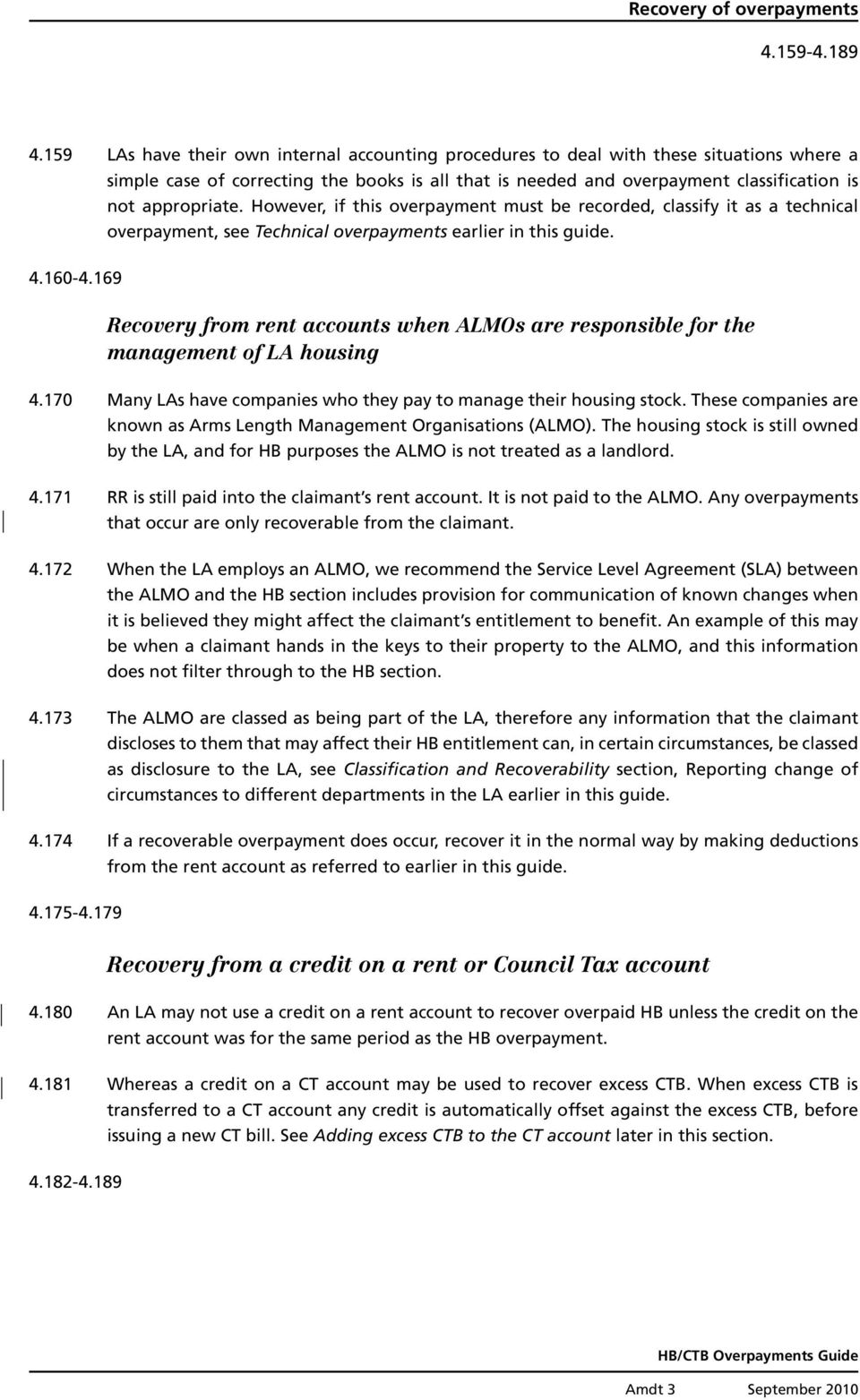
18 By deduction from certain DWP benefits An LA may ask the DWP (Debt Management) to recover an HB overpayment or excess CTB by deduction from certain DWP benefits, as prescribed by HB Reg 105/(SPC) 86 or CTB Reg 90/ (SPC) 75. These are Income Support (IS) Attendance Allowance (AA) Jobseeker s Allowance (income based) (JSA(IB)) Jobseeker s Allowance (contribution based) (JSA (C)) Disability Living Allowance (DLA) Employment Support Allowance (income-related) (ESA(IR)) Employment Support Allowance (contributory) (ESA(C)) Incapacity Benefit (IB) Industrial Death Benefit (IDB) Industrial Injuries Disablement Benefit (IIDB) Carer s Allowance (CA) formerly Invalid Care Allowance (ICA) Maternity Allowance (MA) State Pension (SP)/Retirement Pension (RP) State Pension Credit (SPC) Severe Disablement Allowance (SDA) Widows Benefit (WB) War Pension (WP) War Disablement Pension (WDP) Bereavement Benefit (BB) SSAA 1992 sections 75(4) & 76(2); HB Reg 102 & 105 & (SPC) 83 & 86 CTB Reg 86 & 90 & (SPC) 71 & An LA may not recover from the following benefits Child Benefit (CHB) Guardians Allowance (GA) Working Tax Credit (WTC) Child Tax Credit (CTC) Use Customer Information System (CIS) to obtain details of whether or not DWP benefits are in payment, and if so, where they are in payment, see Customer Information System later in this section. September 2010 Amdt 3
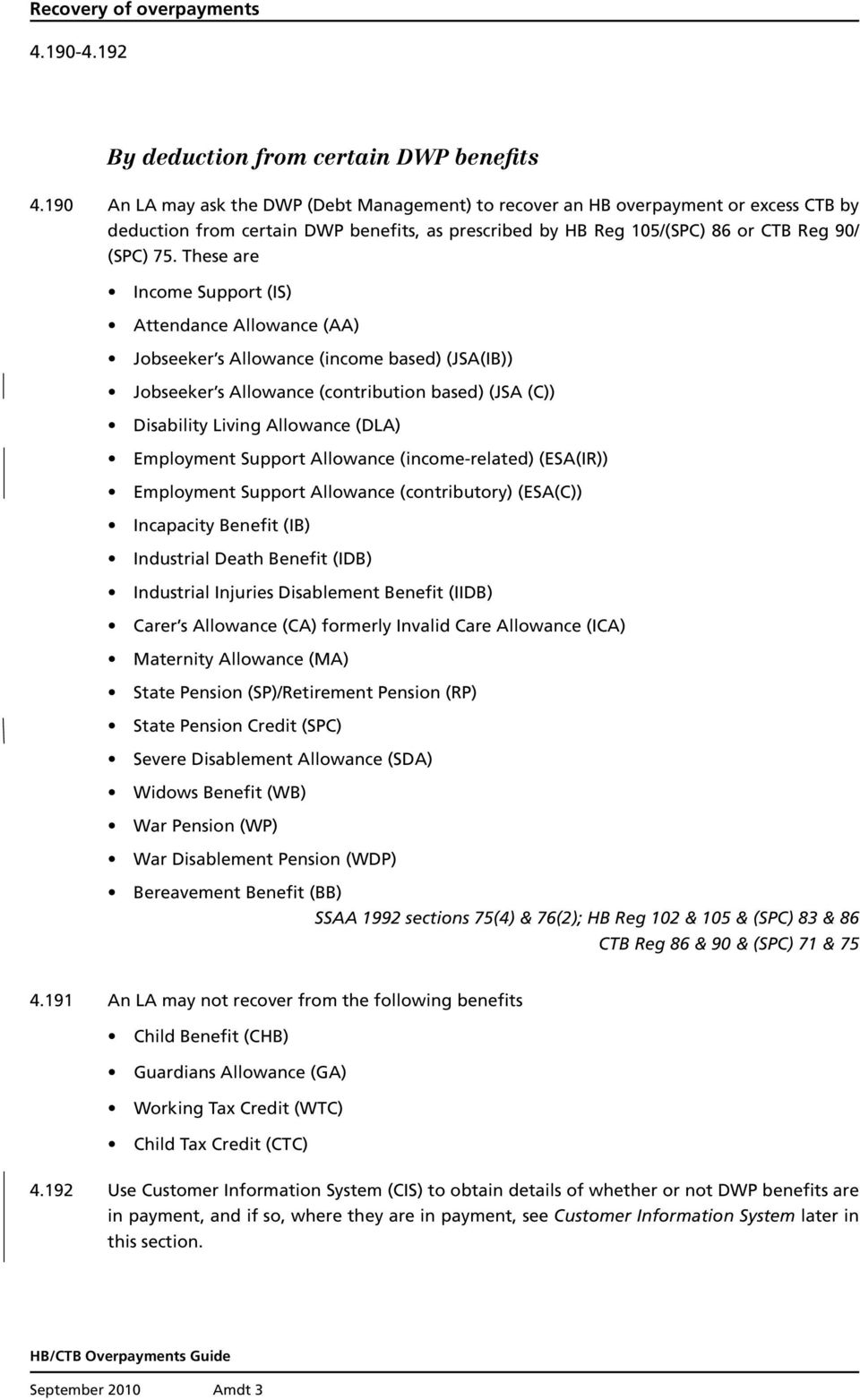
19 You can ask Debt Management to recover an overpayment by making deductions from a DWP benefit, if the overpayment was caused by a misrepresentation of, or a failure to disclose a material fact, whether innocently or deliberately, by the person who was overpaid, and LA who made the overpayment is unable to recover the HB overpayment by deduction from ongoing HB or excess CTB by transferring it to the Council Tax (CT) account. If however HB is now being paid by another LA, you can request Debt Management to make deductions You cannot recover overpaid HB from CTB or vice versa There is a Standardised National Referral form, which must be used when referring HB overpayments to Debt Management Client Referral Centre (CRC) Wales, Porth, see Annex A: Application for recovery of HB at the end of this section When completing the Standardised National Referral form, LAs must include full details of the overpayment remember to use UK dates. American dates will not be accepted because they are misleading and will cause errors (eg 02/12 in the UK is 2 December, whereas in America it is 12 February) record the claimant s current address which can be found on CIS use a reference number that will identify your customer account (eg invoice or claim number) and not the creditor reference number. The creditor reference number is no longer required because there are no new referrals being administered by Third Party Payment system complete all fields do not save referrals in JPEG format. Debt Management does not have the appropriate software to open these files All Standardised National Referral forms, see Annex A at the end of this section, are to be sent via either , using Government Connect (GC) to a dedicated address within CRC Wales, Porth. To be able to attach the referral to an the claimant s name should replace the existing file name. Name each attachment using the claimant s National Insurance number for reference purposes. a dedicated postal address Amdt 3 September 2010
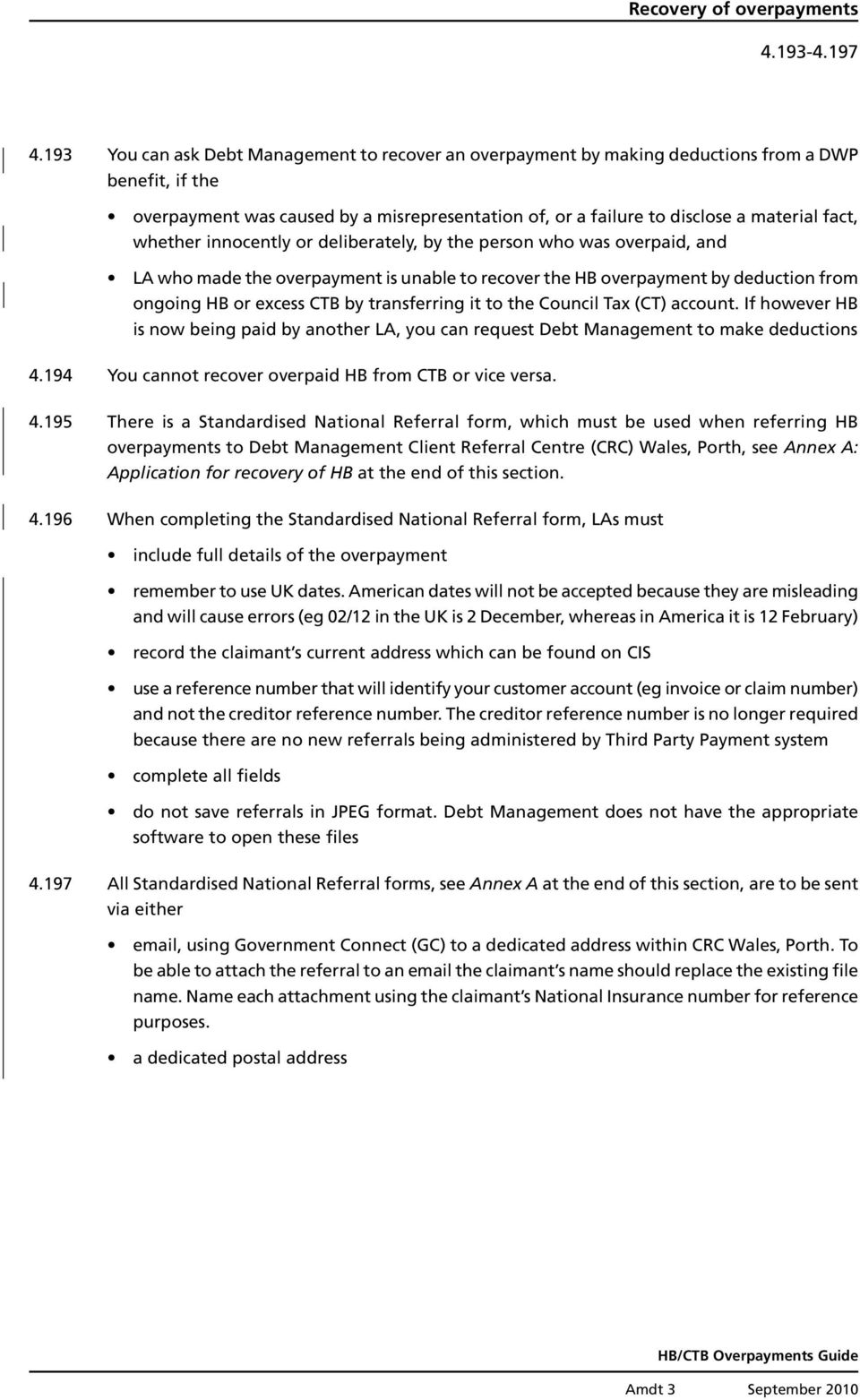
20 The table below has been split nationally into geographical areas for logistical reasons. Local Authority Type address Postal Address Welsh LAs Scottish LAs English LAs Referrals only Referrals only Referrals only dwp.gsi.gov.uk porth. gsi.gov.uk porth. gsi.gov.uk Debt Management(P)HBEN PO Box 171 Mitcheldean Gloucester GL17 OXH Debt Management(P)HBEN PO Box 171 Mitcheldean Gloucester GL17 OXH Debt Management(P)HBEN PO Box 171 Mitcheldean Gloucester GL17 OXH If Debt Management require any further information they will contact the LA, but LAs should remember that such recovery will not be possible unless the conditions stated above are satisfied, and one of the benefits prescribed above is in payment, and the person is receiving sufficient amounts of one or more benefits to enable deductions to be made All quality referrals will be loaded onto the Debt Management computer system by CRC Wales, Porth. LAs will receive an automated notification, informing them of this. LAs should note individual debtor records with the relevant Contact Centre (CC) details on receipt of the notice of recovery. Use these details when sending any correspondence to Debt Management, relating to that debtor Non-quality referrals will not be loaded onto the Debt Management computer system. They will be returned to LAs via , if LAs are using GC, or if not, by post Reasons for non-recovery or return of the Standardised National Referral form could be insufficient benefit in payment no trace of debtor the debtor is in receipt of HB (at the LA where the debt is held) the debtor has other deductions taking place the wrong form has been used Debt Manager will issue automated notifications when debt recovery breaks down or the debt is fully recovered. September 2010 Amdt 3
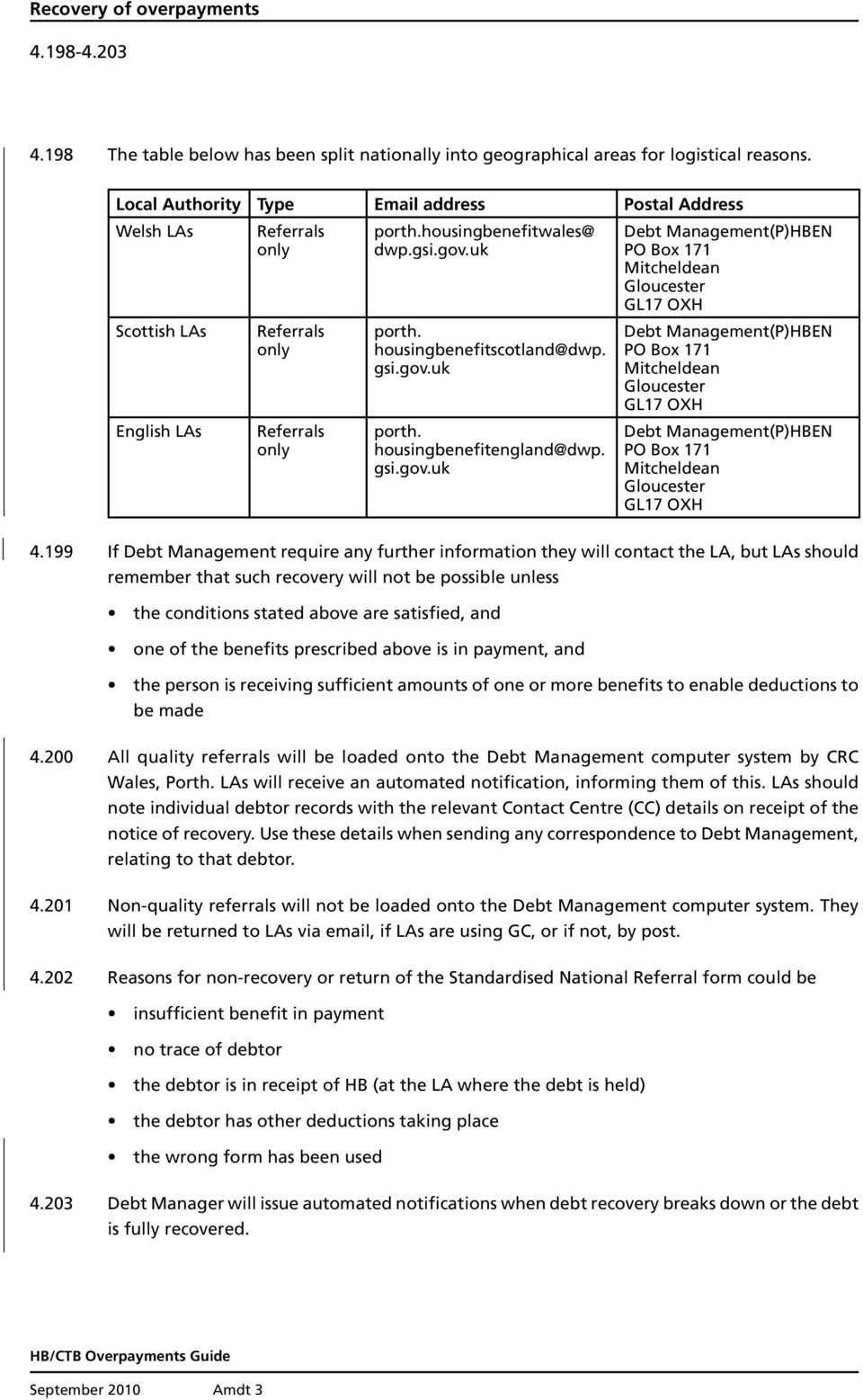
21 There is also a Change of Circumstances form, which must be used when notifying Debt Management of any changes, see Annex B: LA Change of Circumstances Notification, at the end of this section. Send all LA Change of Circumstances Notifications to the CC identified on the notice of recovery. Always include the LAs telephone number, so that CC agents can clarify information and process changes of circumstances within the targets included in the Service Level Agreement (SLA) The postal address for each CC is as follows Bradford PO Box 171 Mitcheldean Gloucester GL17 OXG Debt Management (BF) For the following CCs substitute the first line of the address as follows, using the remainder of the address as above. Corby Dearne Valley Nuneaton Trafford Debt Management (CB) Debt Management (DV) Debt Management (NE) Debt Management (MCR) As an alternative, LAs can use the following addresses, provided the LA uses GC. Do not use the following addresses for Third Party Payment enquiries. CC Bradford [email protected] CC Corby [email protected] CC Dearne Valley [email protected] CC Nuneaton [email protected] CC Trafford [email protected] Do not send LA Change of Circumstances Notifications to CRC Wales, Porth All telephone enquiries relating to individual cases and repayment to LAs should use the following number: Repayment to LAs will be made each calendar month, one month in arrears. This replaces the previous quarterly repayments, but not the method of payment to LAs, which is either by cheque or direct debit The maximum rates of deduction from IS/JSA(IB)/SPC/ESA(IR) are 9.90, or for Fraud, but for other DWP prescribed benefits the rate of deduction can be up to one third of the debtors personal entitlement (these rates are uprated annually). The debtor can contact Debt Management to request a reduction in the rate of recovery if it is causing hardship. Amdt 3 September 2010
22 By deduction from certain DWP benefits payable to a partner An LA may ask Debt Management to recover an HB overpayment (or excess CTB) by deduction from certain DWP benefits which the claimant s partner is in receipt of, as prescribed by HB Reg 105(1B)/(SPC) 86(1B) and CTB Reg 90(1B)/(SPC) 75(1B). These are IS JSA(IB) SPC ESA(IR) However, the claimant and partner must have been a couple, both when the overpayment occurred and when it is being recovered. HB Reg 102(1ZA) & (SPC) 83(1ZA); CTB Reg 86(3) & (SPC) 71(3) Follow the same referral process that is used to recover an overpayment from a claimant s DWP benefit, which is set out earlier in this section. Use Annex A: Application for recovery of HB, and Annex B: LA Change of Circumstances Notification, which can be found at the end of this section. Recovery from War Pension and War Disablement Pension If the claimant is in receipt of WP or WDP they will usually be in receipt of SP/RP or another benefit. If they are in receipt of another benefit, it is advisable to seek recovery from the other benefit first, due to the political sensitivity surrounding WP and WDP If the claimant is only in receipt of WP or WDP, recovery may be requested Send a Standardised National Referral form to Debt Management, who then send it to the Veterans Agency (VA). The VA are responsible for the administration of WP and WDP. Only overpayments which satisfy all the following criteria may be referred to the VA the overpayment is for a prescribed benefit, and has a recoverable overpayment decision by a Decision Maker the overpayment balance is over 40, and there is no other benefit in payment from which recovery can be considered Note: The VA set the deduction rate according to their guidance September 2010 Amdt 3
23 By applying to another LA You can request that an HB overpayment be recovered from continuing HB at another LA Send a request to the relevant LA asking them to consider recovery, see Good practices later in this guide The mechanics of how this is done are entirely up to the two LAs. It is appreciated that this can be complex although this method of recovery should be considered Although it is not stipulated in the regs that one LA must recover for another, it is good practice to utilise this method of recovery, especially if Debt Management are unable to recover the overpayment on your behalf. See By deduction from certain DWP benefits earlier in this section Landlords and overpayment recovery When can you recover from a landlord? In the majority of cases HB is paid direct to the claimant, so there will be no need to make a decision on whom an overpayment is recoverable from (unless the HB is paid to someone acting on the claimant s behalf, such as an appointee). If the HB is paid direct to the claimant, any overpayment will only be recoverable from the claimant However, in some cases the HB is paid direct to the landlord/agent and therefore a decision will have to be made on who the overpayment is recoverable from and then, on who the LA is going to recover the overpayment from If the HB has been paid direct to the landlord, your action depends on whether the overpayment was decided pre-april 2006 post April 2006 Pre-April At the discretion of the LA, recovery could be made from landlords in all cases where there has been direct payment. However, if all the criteria listed in HB Reg 101(1)/(SPC) 82(1) were satisfied recovery could not be made from the landlord. Example HB is paid at 50 per week to landlord Mr T for claimant Ms D. Ms D starts work on 2 February 2006, but fails to notify the LA until 21 February An overpayment is calculated for 150. The LA recovers the overpayment from the landlord because the benefit was paid direct to him. Amdt 3 September 2010
24 Post April Following the April 2006 amendments to the HB Regs, LAs must recover an overpayment caused by a misrepresentation or failure to disclose information from the person or persons who actually misrepresented or failed to disclose that information. Example 1 HB is paid at 70 per week to landlord Mrs B for claimant Mr O. Mr O starts work on 10 May 2010, but fails to notify the LA until 21 May An overpayment is calculated for 140. The LA recovers the overpayment from the claimant because, although the landlord received the payments of HB, it was the claimant who failed to notify the LA of his change of circumstances. The landlord did not know about the change and therefore could not report it. Example 2 HB is paid at 100 per week to landlord Mrs E for claimant Miss W. Miss W vacates the landlord s property on 6 July 2010, but both Miss W and Mrs E fail to notify the LA. Miss W finally notifies them of her new address on 22 July An overpayment is calculated for 200. The overpayment is recoverable from both Miss W and Mrs E, as they both failed to disclose information. However the LA decides to recover the overpayment from the landlord, Mrs E, as she continued to receive HB for the claimant who was no longer living in her property and did not notify the LA of this change Before accepting direct payments, a landlord should be made aware of their duty to report any changes of circumstances that they might reasonably be expected to know might affect the claimant s entitlement to benefit that the LA may decide an HB overpayment is recoverable from them HB Sch 9(11)(b) & (SPC) Sch 8(11)b) Landlord recovery options There are several methods of recovery from landlords, these include deductions from direct payments of HB blameless tenant recovery invoicing civil proceedings Note: This list is not exhaustive. September 2010 Amdt 3
25 Deductions from direct payments of HB You can recover an overpayment from a landlord by making deductions from the HB paid direct to the landlord on behalf of the claimant to whom the overpayment relates There are no maximum recovery rates when recovering from a landlord. However, you must have due regard to a landlord s health and financial circumstances when requesting repayment of debts An LA can recover an overpayment by making deductions from a single payment of HB owing to the landlord ongoing payments of HB paid direct to the landlord Note: Both the claimant and landlord must be notified of the overpayment and the recovery method being used If the claimant ceases to receive HB, the LA must remember that the outstanding overpayment is still recoverable from the landlord and must pursue recovery accordingly. Blameless tenant recovery You can recover an HB overpayment, which is recoverable from a landlord/agent, from any HB payments paid direct to the landlord/agent in respect of any of their tenants. This method of recovery is often known as the blameless tenant recovery method It is up to the individual LA how/if they use these powers, although it is strongly recommended that LAs utilise all methods of recovery available to them, including this one. If you notify the landlord of an overpayment, and the time limits for their appeal rights have expired, you can recover from the next payment due to that landlord. You may, however decide to give the landlord the option of repaying the overpayment by cash/payment, and only if this method breaks down, consider deducting the outstanding debt from HB being paid direct to them If a decision has been made on an overpayment that it is recoverable from the landlord and it has been recovered from the HB of a tenant other than the one to whom the overpayment relates, that other tenant will be deemed to have paid his rent to the value of that recovery. This person is known as the blameless tenant In these circumstances the landlord is a person affected, but the tenant from whose HB the deductions are being made is not. Consequently, such tenants should not receive an overpayment decision notice. They do not have the right to apply for a revision of the decision or appeal against it. Amdt 3 September 2010
26 Decision notices for blameless tenant recovery When a decision is made to pay a landlord direct payments of HB, a decision notice is sent to both the claimant and the landlord at the commencement of direct payments. It is a legal requirement that the decision notices say that if recovery is made from one tenant s benefit for an overpayment made to another tenant, the rental liabilities of the tenant from whom the recovery has been made will be protected ( blameless tenant ) When blameless tenant recovery takes place, HB Schedule 9/(SPC) Schedule 8 expands the information that must be included in the overpayment decision notice issued to the landlord, to make sure it includes the name of the tenant(s) to whom the overpayment relates and the blameless tenant s name or names. It is probable that LAs are already including this information on such notices, but this must happen once recovery is made from other tenants benefits. This information is required only on notices sent to direct payment landlords. When an LA send this notice to a landlord, it must include a reminder that seeking to recover these sums from tenants is in breach of section 75(6) of the SSAA If an LA decides a recoverable overpayment has occurred and exercises its discretion to recover it, they must comply with the general notification requirements, see Decision notices later in this guide. Standard paragraphs A standard paragraph could be used to inform a claimant that they may be used as a blameless tenant in certain situations should be included when notifying a claimant of a decision to pay benefit direct to their landlord. It is not necessary or feasible to issue an overpayment letter to a blameless tenant each time recovery is to be made by this method could be used to advise blameless tenants that their rental liability is not affected A landlord/person affected must be notified of the decision to exercise this method of recovery. For example letters see Good practices later in this guide. Example 1 (claimant/blameless tenant) Please note that the Local Authority has the power to make deductions from amounts of Housing Benefit paid direct to landlords, in order to recover the landlord s overpayment of Housing Benefit relating to another tenant. In such cases your rental liability will, however have been deemed to be legally discharged to the full value of your Housing Benefit entitlement. continued September 2010 Amdt 3
27 (4.253) (4.253) Example 2 (claimant/blameless tenant) We need to advise you as a tenant whose landlord may receive direct payments of Housing Benefit on your behalf, of an important aspect of benefit legislation that may apply regarding the recovery of Housing Benefit overpayments. A Local Authority can recover overpaid Housing Benefit from a landlord by reducing the amount of Housing Benefit paid to that landlord. To do this we may reduce the amount of benefit paid for a tenant who does not have an overpayment. This is in accordance with Section 75 of the Social Security Administration Act If we reduce your Housing Benefit because we have used this method of recovery you will not have lost your benefit entitlement. The Housing Benefit Regulations 2006 states that your rent liability will be deemed to be paid to the full value of your Housing Benefit entitlement. This means that your landlord will have to credit your rent account with the same amount of benefit you were entitled to prior to the reduction. Example 3 (landlord) We need to advise you as a landlord who may receive direct payments of Housing Benefit on behalf of your tenants, of an important aspect of Benefit legislation that may apply regarding the recovery of Housing Benefit overpayments. We can recover overpaid Housing Benefit that has been paid to you by reducing the amount of Housing Benefit paid. To do this we may reduce the amount of benefit paid to you for a tenant who does not have the overpayment. This is in accordance with Section 75 of the Social Security Administration Act Section 75(6) states that the rent liability for the tenant whose benefit has been reduced will be deemed to be paid to the full value of their Housing Benefit entitlement. This means that you must credit the rent account of the affected tenant with the amount of Housing Benefit they were actually entitled to. If this method of recovery is used you will be issued a letter with your payment schedule which will clearly outline which tenant had the overpayment, which tenant s benefit we have reduced, and how much we have reduced that benefit by. Amdt 3 September 2010
28 LAs are advised to show the amount being recovered from the other tenant(s). This will help ensure that the landlord correctly makes up the rent of the appropriate tenant(s). Example The landlord, Mr LL receives 450 a week HB in respect of three tenants Mr TW ( 125) Mr D ( 140) Mr P ( 185) Mr P moves out. Neither Mr P nor Mr LL tell the LA. A recoverable overpayment of 370 occurs and the decision is made to recover from the landlord Mr LL. The LA could recover up to 265 per week from the benefit paid in respect of Mr D and Mr TW, however it should take account of the health and financial circumstances of the person from whom it is making recovery, ie the landlord/agent. The LA would have to inform the landlord Mr LL, either in the normal decision notice or as an additional notice the person the overpayment relates to (ie Mr P the occupant of Flat 1) tenants from whom recovery is being made (ie Mr TW and/or Mr D, the occupants of flats 2 and/or 3) The decision notice should also show the period over which the overpayment will be recovered, eg if an LA decided to recover the 370 over four weeks, the decision notice may show overpayment in respect of occupant of flat 1 Mr P = 370 recovery is being made from benefit paid to you in respect of the occupants of flat 2 and flat 3 amount recovered from benefit paid to the occupant of flat 2 = 45 for four weeks flat 3 = 55 for three weeks and 25 for one week It is particularly important that full details are given when benefit is paid to an agent on behalf of one or more landlords. LAs must, in all cases, indicate the person to whom the overpayment relates, and tenants from whom recovery is being effected. These details will help prevent any confusion when recovery is made from a number of a landlord s tenants The provisions give LAs the opportunity to recover large amounts of overpaid HB in one lump sum, particularly from the schedule payments made to Registered Social Landlords (RSLs). September 2010 Amdt 3
29 When deciding the amount to be recovered LAs must fully consider the circumstances of the person they are recovering an overpayment from. They should take into account the health and financial circumstances of the person, to make sure hardship is not caused to that person or any of their dependants. Deduction from any benefits the landlord is entitled to If it has been decided that an overpayment is recoverable from a landlord, you can recover that overpayment by making deductions from any benefits the landlord is entitled to (HB or any prescribed DWP benefits, eg if the landlord is on a low income and claims benefits to make it up or if they cease to be a landlord and claim benefits). See By deduction from certain DWP Benefits earlier in this section If it has been decided that an overpayment is recoverable from a claimant, and that claimant becomes a landlord, you cannot recover an overpayment from the HB paid to them as a landlord. This is because the regulations say an overpayment can be recovered by deduction from any HB to which that person is entitled. A landlord is not entitled to the HB paid to them for their tenants. It is the tenant s entitlement. HB Reg 102(1) & (SPC) Reg 83(1) By invoicing the affected person You can pursue recovery of an overpayment by invoicing the person you have decided should repay the overpayment The LA may decide to use the facilities of a credit control/sundry debt section or undertake such procedures on the Overpayments section Due regard should be given to make sure procedures are in place to comply with HB Schedule 9/(SPC) Schedule 8, CTB Schedule 8/(SPC) Schedule 7 and other relevant sections of the HB and CTB regulations. By civil proceedings For recovery by civil proceedings, see Courts and civil proceedings later in this guide. SSAA 1992 S75 (subsection 7) SSAA 1992 S76 (subsection 6) Death of a claimant Rent rebate overpayments Overpayments may occur when HB is credited in error to an LA tenant s rent account after the claimant s death. Amdt 3 September 2010
30 If the HB was credited for the period after the rent account was closed, there is no overpayment as there was no rental liability. See By transferring a rent rebate overpayment to the rent account earlier in this section and Recovery of overpayments from surviving partner later in this section If the HB was credited for the period after the claimant s death, but the rent account was not closed because there was still a rental liability (eg, the deceased claimant s belongings were still in the property), the LA should pursue recovery of the overpayment by contacting the deceased person s personal representative. See Deceased person s personal representative later in this section Payments made into a bank account Any amount paid into a bank account after the claimant has died is made under a mistake of fact. The mistake being that the claimant was not entitled to that payment, because their HB should have terminated on their death Once an account provider becomes aware that a claimant, holding a sole account, has died they should return any credits received after that date LAs should take immediate action to contact the account provider for the return of any credits paid into the account after the date of death Payments made to the landlord Consider whether the landlord could have been expected to know about the claimant s death. For example, in the case of some larger Housing Associations, they may not be in regular contact with their tenants and so would not be aware, unless notified However, in some cases it may be reasonable to expect the landlord to be aware, particularly where the claimant is resident with the landlord If the LA decides that no one has misrepresented or failed to disclose information and there wasn t an official error, recovery could be pursued from the landlord or the deceased person s personal representative September 2010 Amdt 3
31 Claimant had undisclosed capital If an overpayment is discovered after the claimant s death because you become aware the claimant had undisclosed capital, calculate the overpayment as normal by applying diminution of capital. See Diminution of capital earlier in this guide Deceased person s personal representative The decision of how far to pursue recovery of an overpayment following the death of a claimant is entirely up to the LA, subject to general administrative law requirements An LA may decide not to pursue such debts at all or they may decide to contact the deceased person s personal representative, the executor of the estate, to make arrangements for the debt to be repaid from any estate the deceased may have had The LA should make sure overpayment decision notices are issued to the personal representative, in order to allow for appeal rights, before seeking recovery. For example letters, see Good practices later in this guide If the deceased person had more than 5,000 in their estate at the time of their death, the personal representative must take out a Grant of Probate or Letters of Administration when there is no will and advertise for creditors. The personal representative is then advised not to distribute the estate for at least two months to allow creditors to come forward The LA will have to make a search for an estate of the deceased and find out who the personal representative is. The LA should then register as a creditor in the estate to make a claim for the debt Recovery of overpayments from surviving partner If the claimant dies and an overpayment occurs, LAs cannot recover the overpayment from ongoing HB paid to the surviving partner. This is due to Reg 102(1ZA)/(SPC) 83(1ZA), which requires that the claimant and the partner were a couple both when the overpayment occured and when it is being recovered. As the claimant has died they are no longer a couple and therefore recovery cannot be made from the partner When a partner of a deceased claimant continues to occupy a council property, they are usually eligible to claim HB and CTB in their own right, and their claim is often taken from when the claimant died. This can cause an overlap of benefit when the deceased claimant has continued to be paid past the date they died. Amdt 3 September 2010
32 However, if the partner has taken over the tenancy, the HB paid for the deceased claimant, from the date the partner took over the tenancy, is not legally paid HB, because they no longer had a rental liability. This could be classified as a Technical overpayment, see Classification and recoverability, earlier in this guide. There is nothing to recover from the deceased person s estate from the point that the partner took over the tenancy When a partner claims benefit in their own right and is eligible from when the claimant died, the LA are legally obliged to pay the partner from this date, although HB may already have been paid on the deceased claimant s claim. Payments cannot be offset, as it is two different claims for benefit and the regulations do not allow this Adding excess CTB to the CT account The most common method of recovering excess CTB is by adding it to the CT account. This will mean the claimant s CT bill increases. The claimant receives a revised CT bill, which they have to repay in the normal way, making arrangements with the CT section if necessary. If the debtor does not pay the bill, recovery action will be via the Magistrates Courts, as the excess CTB is now classed as outstanding CT. The methods of collection and enforcement are the same as they are for CT liability. Once the excess CTB is transferred to a CT account, it is classed as being fully recovered and can be recorded as such for statistical purposes. CTB Reg 86 & (SPC) Excess CTB payments for reorganised LAs When a new LA finds an excess CTB payment made by one of its predecessors, the new LA is responsible for recording the excess CTB recovery of the excess CTB, if appropriate any subsidy consequences The new LA retains any recovered amounts When a reorganisation involves relinquishing and acquiring LAs, the LAs may reach agreement for excess CTB payments for the transferred area. Once agreement has been reached, the appropriate LA will be legally responsible for recording, recovery and any subsidy consequences of that excess CTB payment If agreement cannot be reached, an arbitrator may be appointed to settle the dispute September 2010 Amdt 3
33 When should recovery commence? The decisions made on an overpayment s recoverability can be appealed, so when recovery is to be made from an ongoing benefit, it should not commence until the one-month appeal rights period has expired When an appeal is brought before recovery has begun, or during recovery, it is good practice to suspend action until the appeal has been decided. This policy is consistent with that of other benefits, such as IS and JSA There are various reasons why it is considered good practice to adopt this approach it allows the claimant time to organise their finances in order for the recovery to commence. They may wish to make a full repayment, rather than having a weekly deduction it gives the claimant time to query the overpayment, possibly exercising their right to ask for a full written statement/explanation of how it was calculated the claimant may want to come to some agreement, asking for a different method or recovery rate to be used it allows the claimant time to seek advice with regards to requesting a revision or appealing against the overpayment decision other debt recovery bodies follow these guidelines it is a person s right to be able to query a debt or organise their finances before recovery commences Recovery via invoice There is no reason why invoices should not be issued during the one-month appeal rights period. LAs will not actually be taking any money, and so therefore cannot cause any undue hardship. First and second reminders can also be issued, as the claimant is not being made to pay anything without their knowledge or consent. Issuing invoices acts as a reminder about the claimant s appeal rights, and the timescales in which to do it The claimant will usually be asked to contact the LA if they cannot afford to pay back the overpayment in one go. They can then arrange how they are going to repay it and at what rate. Note: No court action should be taken prior to the appeal rights period ending Amdt 3 September 2010
34 Recovery of excess CTB Excess CTB is usually recovered via the CT account. There is no reason why the excess CTB cannot be posted to the CT account within the one-month appeal rights period. This action should not result in the claimant having money deducted with little or no warning. The CT section should issue a new CT bill, which as with invoices, acts as a reminder about the claimant s appeal rights Recovery rates When considering rates of recovery of HB overpayments by deductions from ongoing HB and certain prescribed benefits an LA should be aware that the standard maximum rate of recovery from continuing benefit is 9.90 a week with effect from 1 April 2010 HB Reg 102(2) maximum rate of recovery from continuing benefit, when the overpayment has arisen as a result of fraud is a week with effect from 1 April 2010, see Classifications of overpayments and subsidy earlier in this guide Note: The higher deduction rate can only be used if a claimant has been found guilty of an offence made an admission in an Interview Under Caution, or agreed to pay an AdPen as an alternative to prosecution HB Reg 102(3) & (SPC) 83(3) Note: These recovery rates are updated annually As well as the above rates of recovery, an LA can also increase deductions by half (50%) of certain disregards that are included in HB Schedule 4, paragraphs 3 to 10 and HB Schedule 5, paragraphs 14 and 15/(SPC) Schedule 4, paragraphs 2 to 5 and 7 and Schedule 5, paragraph 1, for earnings regular charitable income voluntary payments War Disablement Pension or War Widows Pension September 2010 Amdt 3
35 The following benefits could have a disregard, but they are not included in HB Schedules 4 and 5/(SPC) Schedules 4 and 5, and therefore any disregards relating to these benefits cannot be used to increase the recovery rate each week Attendance Allowance Child Benefit Disability Living Allowance Guardians Allowance Working Tax Credit The weekly recovery rate may be increased by up to half of the permitted work earnings disregard, where that disregard is the lower rate, However, where the permitted work earnings disregard is the higher rate (October ), you cannot increase the normal weekly deductions In all cases the amounts are subject to an overall maximum deduction, which does not reduce the balance of benefit payable to less than 50 pence it is important LAs do not recover more than these prescribed amounts LAs should consider a claimant s health and financial circumstances, before deciding the level of deduction or when to commence deductions, to avoid causing undue hardship to the claimant or their dependants Example Claimant is a single person. A recoverable non-fraudulent overpayment has occurred which the LA has decided to recover. Claimant receives continuing HB/CTB. The claimant has earnings that are subject to a 5.00 disregard. The amount that may be deducted from the claimant s continuing HB is ( 9.90 plus 2.50, ie half the earnings disregard). Note: If the claimant wants to pay more and gives their permission you can recover a higher amount than the maximum recovery rate. Keep a record of their agreement to the higher rate. If this is the case you must make sure the claimant understands the higher payment is entirely voluntary Amdt 3 September 2010
36 What happens if the claimant has different types of overpayments? If a claimant has an overpayment made up of two classifications, for example part due to fraud and part that attracts the standard rate of recovery, apply the appropriate deduction rate to each part of the overpayment. However, you can only apply one recovery rate in any benefit week. This means, for example that you would recover the fraud part of the overpayment at per week until it has been fully recovered and then the remaining part of the overpayment at 9.90 per week Recovery rates other than recovery from prescribed benefits There are no rules limiting the maximum amount that can be asked for. However, a claimant can argue that the rate of recovery should be reasonable. Again, an LA should have due regard to a claimant s health and financial circumstances when requesting repayments of overpayments of benefits Reduction of recovery rate Consider lowering the overpayment recovery rate when a claimant is suffering hardship. It may be necessary to ask the claimant for details of their income and expenditure in order to make the decision. See Good practices section later in this guide for an example of an Income and Expenditure form It may also be necessary to reduce the recovery rate when a claimant is having deductions made from their benefit for more than one overpayment, eg an HB overpayment being recovered from HB entitlement and an IS overpayment being recovered from IS entitlement It is good practice for the LA to reduce the recovery rate so as not to cause hardship to the claimant or their family. When looking at reducing the recovery rate, consider each overpayment individually taking into consideration the outstanding balance and the time scale involved in the recovery. LAs have a responsibility to protect public funds and therefore should not allow an unrealistic period for repayment September 2010 Amdt 3
37 Recovery by debt collection agency LAs sometimes sell claimant s debts to private debt collection companies who then pursue recovery of the debt There is no restriction on this within the HB Regs 2006/(SPC) Regs When debts are sold they are often sold for less than they are worth. But when recovery is proving to be extremely difficult, such as when a debtor cannot be traced, it may be an option whereby partial recovery can be achieved Some debt collection agencies buy the debt outright and give the LA the money straight away. Other companies, employed by the LA to take recovery action on their behalf, send the money to the LA as they recover it and issue an invoice to the LA for commission on the funds recovered For statistical purposes you can only record the amount they give you as the amount recovered. Example Grassly Borough Council have a claimant with a debt outstanding of 5,000 for almost four years. The LA has been unable to trace the claimant but have found a debt collection agency who is willing to buy the debt from them. However, the debt collection agency will only buy the debt for half of what it is worth ie 2,500. The LA agree to sell the debt for 2,500. For statistical purposes the 2,500 can be classed as recovered once the transaction has been completed. There is no need to wait for the agency to actually collect anything, as they have already given you 2,500 for it. The remaining debt will have to be written off Tracing people Potentially one of the most difficult areas of overpayment recovery is actually finding out where the debtor lives so you can instigate recovery proceedings If a person makes another claim for HB/CTB in your area you are able to recover from their continuing HB/CTB and therefore recovery is not a problem. HB Reg 102 & (SPC) 83 CTB Reg 86 & (SPC) If someone is no longer in receipt of HB/CTB, or the debtor is a landlord or agent, tracing the whereabouts of that person becomes a little more difficult However there are various ways to track down where that person is living, so recovery can commence/continue. Amdt 3 September 2010
38 When tracing a person it is essential to keep records of the sources you have tried, this adds weight when considering writing off a debt should no forwarding address be found Sources used for tracing Customer Information System (CIS) - CIS is extremely useful for tracing purposes because it gives information on benefits the claimant is receiving and may give an up-to-date address. See Customer Information System later in this section Electoral Register - the electoral register is a list of everyone who is registered to vote. It is arranged in order of polling districts and within each polling district, in order of streets. It may therefore be useful for confirming if a person is at an address you think they are at Telephone directories - telephone directories can be useful for tracing people, especially if they have an unusual name. There are also internet services that provide free directory enquiries information, provided you know the name of the person and the area or postcode they reside in Tracing agencies - tracing agencies are private companies and will charge for their services. However, some agencies only charge if they are successful Internet - internet search engines and social networking sites may be useful in providing information regarding a person s whereabouts. The internet has sites for tracing people, however there is normally a fee attached Other possible searches Some other ways to locate people landlords may hold information as to where their previous tenant now lives present resident at last known address may have a forwarding address, or may be able to direct you to an agent, relative, estate agent or solicitor who acted for the person sought neighbours past and present, use the current electoral register to note the names of neighbours at the last known address. Neighbours or friends in the area may be able to give new information or confirm the whereabouts of the person you are trying to trace if the debtor concerned has an unusual surname check the telephone directories and try the number, the person who answers may be a relative willing to disclose the person s whereabouts continued September 2010 Amdt 3
39 (4.560) (4.560) application forms, check the HB/CTB application form for previous addresses. If the debtor previously lived with parents/relatives contact them for the debtor s whereabouts business and leisure associates, consider any clubs, professional bodies, school/colleges, voluntary groups, present/previous employers or trade unions the person may belong to, they might have an up-to-date address. Such organisations while unwilling to divulge personal details, may be prepared to forward correspondence, or tell the person that you are looking for them, without compromising the person s privacy. If sending correspondence via that organisation, you must mark it private and confidential Customer Information System CIS is an information system provided by the DWP to enable the LA to access certain viewable information about customers to help in the administration of HB and CTB the recovery of overpayments fraud investigations It replaced the Remote Access Terminal (RAT) and is a secure web-based link which allows the LA staff to access DWP data on their PCs Full details of guidance and training, along with forms, can be found on the DWP website Note: CIS is extremely useful for overpayment work to check if a person is in receipt of a DWP prescribed benefit, to enable an LA to send off a request for deductions, and for tracing customers Contracted-out benefit services When LAs have contracted out the delivery or any aspect of the delivery of HB/CTB, the LAs should read the Memorandum of Understanding (MoU) for the security requirements, which must be in place and followed to allow the third party access to CIS The request for access to CIS for the third party must come from the LA. The MoU will need to be re-signed by the LA and the contractor and returned The third party must then be appropriately trained and the LA must complete form LAST 6 to ensure the third party is in a position to be provided with access to CIS Amdt 3 September 2010
40 How to use CIS Full details of how to use CIS are available on the DWP website on the E-learning package. It is a PowerPoint slide show and is intended that LA staff progress through the training at their own pace following the instructions. A facilitator is usually present to assist with technical difficulties and advise of any local procedures to be adopted, such as how test checks will be performed, what the ETD process will be, etc. LAs have access to details of the claimants benefit details, which includes current addresses The LA Support Team The roles and responsibilities of the LA Support Team (LAST) are to monitor/report CIS faults/incidents act as Business Continuity coordinator for LA users of CIS monitor management checks monitor security issues/incidents investigate CIS data errors following LA clarification of correct information by DWP update/amend LA training and guidance for CIS provide/forward CIS communications to LAs support the reporting and investigation of incidents relating to e-laid, e-laci and DTA issues The LAST are available Monday to Thursday 8.30 to Friday 8.30 to Contact details for LAST can be found on the DWP website Security requirements The LA must ensure all staff are aware of the CIS security requirements. September 2010 Amdt 3
41 In particular only authorised staff may access the system only staff who have worked through the security and CIS user self instructional training material may use the system CIS access is only allowed for the purpose of administering HB/CTB, HB/CTB overpayment or fraud investigation These guidelines provide the necessary assurances and safeguards for staff CIS forms you may need to use LAST Complete the LAST 1 whenever the CIS system advises that a test check is being performed. The system is subject to a random 1% check of all access to the system Details of how to complete a LAST 1 can be found on the back of the form Once completed pass the form, together with a copy of the supporting evidence, to the Checking Officer. LAST Complete the LAST 2 whenever CIS is accessed and there are no supporting documents. LAST Complete the LAST 3 when either a keying error is made, ie the details entered on CIS do not allow you access to the relevant claim LA staff receive a system generated check as a result of a telephone call or reception call Once completed pass the form, together with a copy of the supporting evidence, to the Checking Officer. LAST 5a Complete the LAST 5a, when reporting a system fault. However, it should only be completed when the Government Gateway User is confident that there is not a local or user error. Amdt 3 September 2010
42 LAST 5b Complete the LAST 5b to query a system data error when there is a discrepancy identified with the data held on CIS, that has been confirmed by the DWP LAs have a particular query on the data shown that the DWP local office is unable to assist with Note: the above forms can be found on the DWP website Administrative penalties Overpayments and fraud When there is sufficient evidence to consider a prosecution, the LA has the discretion to offer an administrative penalty, often referred to as an AdPen, as an alternative to a fraud prosecution. A fraud officer makes this decision. An Overpayments Team normally deals with recovery of the AdPen What is an AdPen? An AdPen is a penalty imposed by the LA and accepted by the claimant as an alternative to prosecution following the calculation of a fraudulent HB/CTB overpayment. The penalty is equivalent to 30% of the recoverable overpayment due from the person concerned, rounded down to the nearest penny. SSAA 1992 Section 115A Note: It is recoverable by all of the usual overpayment recovery methods, see Methods of recovery earlier in this section When will an AdPen apply? The question of a penalty cannot be considered until an LA has decided that an overpayment is recoverable under the regulations, see Is the overpayment recoverable? earlier in this guide and the person from whom recovery is sought has been properly notified, see Decision notices later in this guide. September 2010 Amdt 3
43 The LA has the discretion to invite a person to pay a penalty when it is satisfied that the overpayment was caused by an act or omission on the part of that person, and there are grounds for bringing a prosecution against that person for fraud relating to that overpayment under the Social Security Administration Act 1992 (Sections 75 or 76) or any other enactment When the conditions for a penalty apply it can only be brought about with the agreement of the person concerned. However, if that person refuses to agree to pay a penalty, they could be liable to have fraud proceedings brought against them instead Calculation of the AdPen Once the LA has decided to offer an Adpen, an officer calculates the amount of the penalty. Ideally this should not be the investigator The penalty is equivalent to 30% of the recoverable overpayment For ongoing overpayments that started before 17 December 1997 when the penalty provision came into force, a penalty can only be calculated on the amount of recoverable overpayment that accrued after 18 December Refer to section 115A of the Social Security Administration Act Agreeing to pay an AdPen The LA decide how any agreement to pay a penalty will be made. However, when the LA considers that a penalty may be appropriate it must give a written penalty notice to the person liable for prosecution This notice advises them they may be invited to agree to pay a penalty if they make the agreement to do this in the manner specified by the LA, eg by signing a standard written undertaking, no fraud proceedings will be brought against them for the overpayment in question Amdt 3 September 2010
44 The penalty notice must, by law, contain the following points of information about the penalty system the manner specified by the LA by which the person may agree to pay a penalty that the penalty only applies to an overpayment which is recoverable under section 75 or 76 of the Social Security Administration Act 1992 (s73 of the Northern Ireland Act) that the penalty only applies when it appears to the LA that the overpayment was caused by an act or omission by the person and that there are grounds for commencing criminal proceedings for an offence relating to the overpayment the penalty is 30% of the overpayment, is payable in addition to the repayment of the overpayment and is recoverable by the same methods as the overpayment a person who agrees to pay a penalty may withdraw from the agreement within 28 days, including the date of the agreement by notifying the LA in the manner specified by the LA, ie in writing or by using a notice provided by the LA for this specific purpose, etc if the person withdraws their agreement, any amount of the penalty which has already been recovered will be repaid and the person will no longer be immune from proceedings for an offence if it is decided on revision, appeal or in accordance with regulations that the overpayment is not recoverable or due, any amount of the penalty which has been recovered will be repaid if the amount of the overpayment is revised on revision or appeal, except as covered by a new agreement to pay the revised penalty, any amount of the penalty which has been recovered will be repaid and the person will no longer be immune from proceedings for an offence the payment of a penalty does not give the person immunity from prosecution in relation to any other overpayment or offence relating to an overpayment Note: By agreeing to pay an AdPen, the person does not incur a criminal record and the fact that they have agreed to pay an AdPen cannot be mentioned in court should they ever, in future, be prosecuted for any other offence When a person agrees to pay a penalty, and the overpayment on which the penalty is based is subsequently revised on review, the agreement to pay a penalty no longer applies. Any penalty that has already been repaid to the LA should be refunded to the customer A change in the amount of the overpayment on review/appeal removes the effect of the penalty agreement. Any payments already made towards the penalty must be paid back. However, if the overpayment is found to be greater and a new agreement is made with regard to the penalty made, any payments already made may be treated as being towards the newly assessed penalty. September 2010 Amdt 3
45 The whole process can be summarised as follows An LA may only offer a penalty when there are grounds for prosecuting for an offence in relation to an overpayment. A written notice offering the penalty must be given. If the person in question agrees to pay, they receive immunity from prosecution and must pay an additional 30% on top of the overpayment. The person may withdraw from the agreement within 28 days. If there is subsequently a decision that there is no recoverable overpayment, the penalty is not payable. If the amount of the overpayment is revised, the agreement is void, but a new agreement can be made Recovery of AdPens HB and CTB AdPens can be recovered by the same methods that are available when recovering overpayments of HB and CTB. See Methods available earlier in this section If the person is in receipt of HB, the HB overpayment and the HB AdPen can be recovered from their weekly HB entitlement. There is no hierarchy involved in recovering overpayments and AdPens when both are recoverable one after the other. It does not matter which is recovered first Recovery by deductions from ongoing HB can still take place even if HB is being paid to the landlord pursuant to regulation 95 or 96/(SPC) 76 or 77. However, when an HB overpayment is being recovered from a landlord an AdPen can only be recovered when it is the landlord who incurred the penalty. All the usual rules apply to such a case, ie the landlord must be otherwise liable to be prosecuted, agrees to pay, etc. A penalty on someone other than the landlord, cannot be recovered from the landlord. In this instance the penalty would have to be recovered from the person by other means If the person agrees to pay a CTB AdPen, it can be recovered by all of the methods available when recovering excess CTB, for example transferring the AdPen to the Council Tax account You must differentiate between overpayments and AdPens. A penalty can only be recovered from the person who has incurred it Discretionary Housing Payments Discretionary Housing Payments (DHPs) provide claimants with further financial assistance when an LA considers help with housing costs is needed. They are not payments of HB/CTB so normal appeal procedures do not apply. They are free-standing payments made at the LA s discretion, subject to an annual cash limit. Amdt 3 September 2010
46 Housing cost means rent or CT liability. It is not possible for a person to receive DHPs if they are not entitled to HB and/or CTB. A DHP cannot be paid to make up for the shortfall caused by recovery of a HB or CTB overpayment The regulations covering the award of DHPs are The Discretionary Financial Assistance Regulations 2001 [SI 2001/1167] The relevant guidance is Guidance for Local Authorities on the Operation of Discretionary Housing Payments and the latest version was issued to LAs in March Recovery of DHPs An LA can recover DHPs if they decide that payment has been made as a result of misrepresentation or failure to disclose a material fact, either fraudulently or otherwise. You may also recover DHPs if you decide they have been paid as a result of an error made when the claim was determined LAs may not recover DHPs from ongoing HB/CTB. This is unlike HB overpayments and excess CTB, where there is a regulatory provision to allow recovery from ongoing HB/CTB There is also no provision for recovery of overpaid DHPs from other prescribed benefits Therefore the only method of recovery if a DHP is overpaid is to request repayment of the debt from the claimant. This may be in the form of an invoice or however the LA chooses to do so, for example using debt collection agencies or via the courts Write-offs Deciding whether to recover an overpayment Just because an overpayment is recoverable, does not necessarily mean that it must be recovered. The law actually states that all overpayments are recoverable (except certain official errors), but it does not state that they must be recovered A recoverable overpayment may be recovered at the LAs discretion. If an LA has a blanket policy of recovering all recoverable overpayments, the policy would be open to legal challenge. September 2010 Amdt 3
47 Write-offs generally fall into three categories non-recoverable write-offs discretionary write-offs standard write-offs Non-recoverable write-offs These are overpayments caused by an official error, LA or departmental, when the claimant could not reasonably have been expected to know that they were being overpaid. They are therefore legally non-recoverable In this circumstance, the LA may notify the claimant of the overpayment and the fact that they are not going to pursue its recovery. However, the regs only state that an LA must notify claimants of recoverable overpayments. It is therefore up to the LA if they issue a decision notice. HB Sch 9 & (SPC) Sch 8; CTB Sch 8 & (SPC) Sch Once these overpayments are written off they can never be resurrected Discretionary write-offs A recoverable overpayment can be considered for write-off if the LA uses its discretion at the outset and decides not to recover it. These types of write-offs are often called discretionary write-offs It is not advisable to consider fraudulent overpayments for a discretionary write-off The usual scenarios for considering an overpayment for a discretionary write-off will be on financial or hardship grounds. However, the medical condition of the claimant or family may be relevant and should always be recorded to assist such a decision being made The LA may also decide to write-off an overpayment that they consider to be uneconomical to recover. For example, recovery of an overpayment of 5 could cost the LA 10. This would not be cost effective Discretion cannot be prescriptive and there are no rules or examples that can be given. Each case must be decided on its merits. Amdt 3 September 2010
48 However the following situations may be relevant when considering write-off financial hardship terminal illness senility or learning disabilities severe medical conditions health and welfare all other relevant factors Financial hardship In order to establish if the claimant is suffering financial hardship it is advisable to do an income and needs comparison and possibly interview the claimant. See Good Practices section later in this guide Hardship is proven when the income, minus priority debts, gives a figure more than 9.90 below the applicable amount. This figure is uprated annually and is based on the maximum that the DWP recovers from IS or JSA(IB) Priority debts include rent, CT, utilities, eg gas, electric, water ongoing weekly amount to pay, plus any arranged weekly repayment of arrears fines any weekly amounts medical expenses - although these are not priority debts as such, if it can be shown that the claimant has high prescription charges/travel costs to hospital, or high diet costs, which must be maintained for health reasons, all relating to a long term illness, then they may be considered priority debts Other factors you may wish to consider in such a scenario might be the health of the claimant and members of the household any savings the claimant has the level of disposable income in comparison to people receiving IS, see above whether they have tried to make an arrangement for minimum repayments whether they have any priority debts, see above whether a non-dependant can contribute to other household expenses continued September 2010 Amdt 3
49 (4.743) (4.743) whether it would be feasible to postpone repayment of the debt rather than write it off writing off part of the overpayment rather than all of it whether the claimant has contacted their other creditors to reduce repayments in order to repay this debt Note: This list is not prescriptive The decision not to recover an overpayment is an exceptional step and needs the claimant s co-operation to prove hardship, eg providing copies of utility bills, rent statements, etc. If the claimant is not prepared to provide such details an LA may decide to pursue recovery of the debt If hardship can be proved an LA may consider the overpayment for a discretionary write-off and the claimant should be notified of the decision In cases of possible hardship it may be prudent to advise the claimant to contact their local Citizens Advice Bureau (CAB) for financial advice It is not advisable to continuously write-off overpayments as it removes the incentive for the claimant to report future changes of circumstances, which may cause overpayments. This is because if it is decided that a claimant does not have sufficient resources to repay one overpayment, then it is hard to make a case to say that they are able to repay a subsequent overpayment at a later date, unless of course their circumstances have improved considerably. Note: Because the person affected has no right of appeal against a decision to recover an overpayment, this also means there is no right of appeal against a refusal to write-off an overpayment Once these types of overpayments are written off, and claimants notified of the decision, they can never be resurrected Standard write-offs An LA may, within its Bad Debts Provision, hold some money back for writing off debts, where all recovery methods have been exhausted. This could be because the claimant cannot be traced or all methods of recovery have been tried and have been unsuccessful. These overpayments should only be considered for write off if there are no further methods that can be pursued. Amdt 3 September 2010
50 Examples of such overpayments are a debtor cannot be traced debts which could become non-recoverable through the courts, due to the Limitations Act debts when all action has been considered/taken and it is decided not to pursue any further the debt cannot be substantiated Even though an overpayment is written off, if the claimant has not been notified of the writeoff, it can be resurrected and recovered at a later date. For example, if a claimant cannot be traced, the overpayment can be written off. The claimant will not be notified of the write-off as their whereabouts are not known. If they apply for HB/CTB at a later date, the overpayment can be resurrected and recovered. The overpayment can only be resurrected if the claimant has not been notified of the write-off September 2010 Amdt 3
51 Annex A Application for recovery of HB A copy of the Application for recovery of HB is included overleaf. Amdt 3 September 2010
52 Department for Work and Pensions Shared Services, Debt Management (P) HBEN PO Box 171 Mitcheldean Gloucester GL17 OXG LA address: Address 1 Address 2 Address 3 Address 4 POST CODE Adran Gwaith a Phensiynau Gwasanaethau a Rennir, Rheoli Dyled (P) HBEN PO Box 171 Mitcheldean Gloucester GL17 OXG Date: Tel: APPLICATION FOR RECOVERY OF HOUSING BENEFIT I am referring this over payment to you in accordance with Housing Benefit Regulation 102 for recovery from Social Security Benefits Subject to the provisions of the Housing Benefit Regulation 105. CIS Checked On: Customer s name: Name Customer s current address: Address 1 Address 2 Address 3 Address 4 POST CODE N.I. Number: NiNo Date of birth: LA reference number: LA reference LA code: LA code An overpayment of Housing Benefit has occurred as a result of failure to disclose or misrepresent a material fact. Overpayment classification: Error: Fraud: Reason for overpayment: Please select from list If other, input reason here: Periods of overpayment From: To: Amount already recovered by LA: 0.00 Outstanding balance: 0.00 Your name LA PA 2006/7 Version 0.c 16/02/06 14
53 Annex B LA Change of Circumstances Notification A copy of the LA Change of Circumstances Notification is included overleaf. Amdt 3 September 2010
54 Local Authority Change of Circumstances Notification From: (LA) To: Debt Management Contact Centre Customer Name: NI Number: (NiNo) LA Reference Number: The following change of circumstances has occurred: Customer repaid in full Customer now in receipt of Housing Benefit LA have made own arrangements for repayment Customer has appealed / disputed OP decision Other. Name: Signature: LA PA 2006/7 Version 0.c 16/02/06 15
Housing Benefit and Council Tax Benefit Circular. For information. Overpayments guidance:
 Housing Benefit and Council Tax Benefit Circular Department for Work and Pensions The Adelphi, 1-11 John Adam Street, London WC2N 6HT HB/CTB A13/2006 ADJUDICATION AND OPERATIONS CIRCULAR WHO SHOULD READ
Council Tax and Benefits Service. Debt Recovery Processes Council Tax and Housing Benefit Overpayments
 Council Tax and Benefits Service Debt Recovery Processes Council Tax and Housing Benefit Overpayments Version Control Version Revised by Date Description 1 Andi Frangeskou May 2015 Original issue 2 3 1.
Overpayment Recovery Strategy
 Overpayment Recovery Strategy Strategy To recover overpayments as quickly as possible having regard for the circumstances of the debtors. Key Objectives To arrange benefit deductions for those on ongoing
A Landlord s Guide to Housing Benefit
 A Landlord s Guide to Housing Benefit October 2009 A landlord s guide to Housing Benefit; Table of Contents Introduction...3 Standards Of Service...3 Processing Housing Benefit Claims...3 Changes in circumstances...3
Housing Benefit Overpayments Policy. December 2013
 Housing Benefit Overpayments Policy December 2013 1. Aims of the Policy 1.1. The aims of this policy are: 1.1.1. to ensure we minimise overpayments and reduce them as much as is possible when raised 1.1.2.
MERTHYR TYDFIL COUNTY BOROUGH COUNCIL
 MERTHYR TYDFIL COUNTY BOROUGH COUNCIL DATE WRITTEN 14 th October 2005 REPORT AUTHOR Mark Horrigan COMMITTEE DIVISION Strategic COMMITTEE Cabinet COMMITTEE DATE 16 th November 2005 TO: Chairman, Ladies
Housing & Council Tax Benefit A Landlord s Guide
 Housing & Council Tax Benefit North Yorkshire Training Group Benefits Leaflet also available in large print Contents: Part 1 - About this booklet Part 2 - What is Housing Benefit and Council Tax Benefit
Housing Benefit Claims Processing Guidance
 Housing Benefit Claims Processing Guidance Contents The claims process... 3 Telephone and electronic claims... 8 Calculating Housing Benefit... 9 Backdating... 12 Change of Circumstances... 14 Extended
DEBT RECOVERY POLICY
 DEBT RECOVERY POLICY OBJECTIVE 1.1 The objective of the Debt Recovery Policy is: To ensure that money owed to the Comhairle is collected as soon as possible using efficient, effective and fair debt recovery
Sheffield Benefits Service
 Sheffield Benefits Service April 2013 Housing Benefit & Council Tax Support for people of working age Housing Benefit and Council Tax Support Housing Benefit is a national welfare benefit, administered
Financial Service Division Operational Finance Unit. Council Tax Discretionary Relief Policy
 Financial Service Division Operational Finance Unit Council Tax Discretionary Relief Policy Version: Draft 2.0 Updated: September 2014 1 Contents 1) Introduction... 3 2) Legislative Powers... 3 3) Statement
FIFE COUNCIL INTEGRATED INCOME COLLECTION AND DEBT RECOVERY POLICY
 Appendix A FIFE COUNCIL INTEGRATED INCOME COLLECTION AND DEBT RECOVERY POLICY INTRODUCTION 1.1 This document details the Council s policies on the billing, collection and recovery of monies due to the
Payment Standard. Benefits Service
 Payment Standard Council Tenants will have any rent rebate credited to their rent account, leaving the tenant with a net amount to pay. Tenants who pay rent to a private landlord will receive payments,
Help us to help you Contact us and work in partnership with your local Council
 February 2016 Version 6 Torridge District Council A Fair Collection and Recovery of Debt Policy Help us to help you Contact us and work in partnership with your local Council Torridge District Council
Bridgewater Housing Association Ltd Policy
 Bridgewater Housing Association Ltd Policy Approved committee on by 5 August 1998 31 March 1999 26 April 2000 25 September 2002 30 November 2005 17 December 2008 Review Date: 16 December 2011 Ref: Arrears
Debt Recovery Strategy for Housing Benefit Overpayments.
 Debt Recovery Strategy for Housing Benefit Overpayments. 1. Introduction 1.1 The Service Statement of Intent for the Benefits Service states that we will provide a service that recovers overpayments, reduces
Housing Benefit and Council Tax Benefit overpayments guide
 Housing Benefit and Council Tax Benefit overpayments guide The Housing Benefit and Council Tax Benefit overpayments guide has been archived. The new Housing Benefit overpayments guide is at: https://www.gov.uk/government/publications/housing-benefit-overpayments-guide
www.nelincs.gov.uk North East Lincolnshire Council - Corporate Debt Recovery Strategy
 Executive Director Business Services Rob Walsh B.A. (Hons) Solicitor www.nelincs.gov.uk North East Lincolnshire Council - Corporate Debt Recovery Strategy Background. As part of Transactional Services
Debt Arrangement Scheme Guidance for creditors
 Debt Arrangement Scheme Guidance for creditors Foreword Most people want to pay what they are due, but some can only do so if they are given more time. A modern system of court enforcement protects debtors
Jane Autherson. HB/CTB Overpayments Policy DWP
 Jane Autherson HB/CTB Overpayments Policy DWP Today s s presentation Amendments made to the HB/CTB Overpayments Guide Insolvency and the recovery of overpayments HB/CTB Overpayments Guide Classification
CORPORATE FAIR DEBT POLICY
 CORPORATE FAIR DEBT POLICY June 2011 Table of Contents Vision and objectives 2 1. Introduction 2 2. Policy Aims 3 3. Fair Debt Collection 3 4. The Legal and Policy Framework for Recovery 4 5. Debts Covered
If instalments are not paid as they are due a reminder will be sent requiring payments to be brought up to date within 7 days.
 APPENDIX 1 DEBT RECOVERY POLICY This debt recovery policy of South Lakeland District Council aims to maximise income from all revenue generating sources whilst incorporating a sympathetic approach to the
Tonbridge & Malling Borough Council
 Contents Introduction Statement of Intent Key Principles Further Information Annex A - Council Tax Recovery Policy Annex B - Housing Benefits Overpayment Policy Annex C - General Debt Recovery Policy Annex
Revenue and Benefit Service
 Revenue and Benefit Service Draft Write Off Policy ~ 1 ~ WRITE OFF POLICY Introduction This document sets out the procedure to be followed when writing off irrecoverable amounts (including credit balances)
South Lanarkshire Council Debt Recovery Policy
 South Lanarkshire Council Debt Recovery Policy If you need this information in another language or format, please contact us to see how we can best meet your needs. Phone 0303 123 1015 or email [email protected]
North East Lincolnshire Council. Debt Management Strategy
 North East Lincolnshire Council Debt Management Strategy Section Title Page No 1. Introduction 2. General Principles 3. Principles common to all debts 4. Principles of Enforcement 5. Strategy specific
responses State Pension Credit Refusal to specify an AIP Income Support date of claim/evidence requirements
 Contents APPENDIX 7 Examples of appeal responses Contents Example 1 Example 2 Example 3 Example 4 Example 5 Example 6 Example 7 Example 8 Example 9 Example 10 Example 11 Example 12 Example 13 Example 14
The Overpayment Recovery Guide (ORG)
 The Overpayment Recovery Guide (ORG) Last Review: February 2012 Note: Deleted sections have been removed as they are obsolete or have been updated by specific Process and Procedures Circulars. The Overpayment
Universal Credit: Frequently Asked Questions October 2012
 Universal Credit: Frequently Asked Questions October 2012 Introduction Universal Credit (UC) is the Government s new, simplified working age welfare system, rolling several benefits and tax credits into
Council Tax Relief on the Grounds of Hardship
 Council Tax Relief on the Grounds of Hardship 1. Introduction 1.1 The Local Government Finance Act 1992 section 13a has always allowed for a discretionary relief of Council Tax in exceptional circumstances
Rochdale MBC Corporate Debt Management Policy. Contents Page. Page
 Rochdale MBC Corporate Debt Management Policy Contents Page Page 1. Background and Objectives 1.1 What is a Corporate Debt Management Policy 1 1.2 Introduction 1 1.3 Objectives of the Policy 1 1.4 What
Application for Discretionary Housing Payment/Council Tax Discretionary Relief
 Application for Discretionary Housing Payment/Council Tax Discretionary Relief Name & Address: Date of Issue: Council Tax Account Number: Email Address and Contact Number: Housing Benefit Claim Reference:
Factsheet 56 Benefits for people under Pension Credit age
 Factsheet 56 Benefits for people under Pension Credit age April 2016 About this factsheet This factsheet gives information about benefits for people under Pension Credit age (this is 63 years as of April
Southend-on-Sea Borough Council. Department for Corporate Services Revenues & Benefits Service. Housing Benefit. A Guide to Overpayments
 Southend-on-Sea Borough Council Department for Corporate Services Revenues & Benefits Service Housing Benefit A Guide to Overpayments A guide to Overpayments This leaflet is designed to explain the following:
Exchequer Services. Debt Recovery Policy
 Exchequer Services Debt Recovery Policy Version 4 23/01/2014 1 1.0 Policy objectives The council has a legal duty to recover all money that it is owed. We have a responsibility to recover all such sums
IMPORTANT THIS GUIDANCE SHOULD ONLY BE USED FOR PROGRAMMES FROM 1 APRIL 2015. Debt Arrangement Scheme (DAS) Business DAS
 Debt Arrangement Scheme (DAS) Business DAS Guidance for Payments Distributors Relevant Legislation The Scottish Parliament approved the Debt Arrangement Scheme (DAS) by passing the Debt Arrangement and
Care & Residential Services Debt Management & Recovery Policy
 Care & Residential Services Debt Management & Recovery Policy Fair and reasonable Collecting debt quickly Version 1 April 2015 Debt Management & Recovery Policy Page 1 Trafford Council Table of Contents
(Chapter No. not allocated yet) SOCIAL SECURITY ORDINANCE
 (Chapter No. not allocated yet) SOCIAL SECURITY ORDINANCE Non-authoritative Consolidated Text This is not an authoritative revised edition for the purposes of the Revised Edition of the Laws Ordinance;
Cabinet Member (Finance and Resources) (Gary Layzell)
 Agenda Item No. REPORT TO: Cabinet Member (Finance and Resources) DATE: 25 March 2015 SERVICE AREA: REPORTING OFFICER: SUBJECT: WARD/S AFFECTED: FORWARD PLAN REF: Finance Benefits Services Manager (Gary
Travelodge Business Account Card Terms & Conditions
 Travelodge Business Account Card Terms & Conditions The agreement between You and Travelodge Hotels Ltd, a company incorporated under the laws of England, with a registered office at Sleepy Hollow, Aylesbury
Policy No: F&A 03-15 Approved by Council: June 26, 2013 Resolution: 2013.12.16. The policy should assist in:
 Treasury Department Policy Section: Finance & Accounting Content Updated: Supersedes Policy: Policy No: F&A 03-15 Approved by Council: June 26, 2013 Resolution: 2013.12.16 Pages: 1 of 11 GENERAL ACCOUNTS
What if I just spend all of my personal injury payment? 5
 INDEX Page number A. WHAT IS A PERSONAL INJURY TRUST? 1 B. ESTABLISHING WHETHER A TRUST IS REQUIRED What is community care support? 1 Which benefits are means-tested? 1 Do I need to become the beneficiary
EXPLANATORY MEMORANDUM TO THE UNIVERSAL CREDIT (CONSEQUENTIAL, SUPPLEMENTARY, INCIDENTAL AND MISCELLANEOUS PROVISIONS) REGULATIONS 2013. 2013 No.
 EXPLANATORY MEMORANDUM TO THE UNIVERSAL CREDIT (CONSEQUENTIAL, SUPPLEMENTARY, INCIDENTAL AND MISCELLANEOUS PROVISIONS) REGULATIONS 2013 2013 No. 630 1. This explanatory memorandum has been prepared by
FOSTER CARERS SOCIAL SECURITY BENEFITS & TAX CREDITS
 Pb30 FOSTER CARERS SOCIAL SECURITY BENEFITS & TAX CREDITS CONTENTS Page Introduction 2 Foster Payments 2 Key Benefit Issues 3 Are you treated as working 3 National Insurance Contributions 4 Section A Contributory
Debt Management Policy
 Debt Management Policy Table of Contents page 1. Purpose 3 2. Objective 3 3. Debts to which this policy applies 3 4. Roles and Responsibilities 4 5. General Principles 4 6. Delivering the Policy 5 7. Raising
REVENUES DEBT RECOVERY POLICY
 REVENUES DEBT RECOVERY POLICY 1.0 Introduction 1.1 Wyre Forest District Council is responsible for the collection of council tax and national non-domestic rates (NNDR) on behalf of Worcestershire County
Residential mortgages general information
 Residential mortgages general information Residential mortgages general information 2 Contents Who we are and what we do 2 Forms of security 2 Representative Example 2 Indication of possible further costs
A Fair Collection and Debt Recovery Policy
 A Fair Collection and Debt Recovery Policy Sundry Debts and Housing Benefit overpayments Introduction Fylde Borough Council believes a collection and debt recovery policy should be fair to everyone, especially
A guide to RENT ARREARS
 A guide to RENT ARREARS An Information Booklet INTRODUCTION The importance of Regular Rent Payment Cadder Housing Assocation is responsible for the management and maintenance of approximately 650 properties.
RENT COLLECTION, ARREARS & DEBT RECOVERY POLICY
 RENT COLLECTION, ARREARS & DEBT RECOVERY POLICY Approved by Board 21 July 2009 1. Introduction 1.1 This Policy sets out the principles and approach to be taken in making sure that rent and service charge
HOUSING BENEFIT AND COUNCIL TAX SUPPORT 2015-16. www.havering.gov.uk
 HOUSING BENEFIT AND COUNCIL TAX SUPPORT 2015-16 www.havering.gov.uk What are Council Tax Support and Housing Benefit? Council Tax Support helps people pay their Council Tax. The Government decided to replace
Money Management Team Limited Limited Service & Fee Agreement
 Money Management Team Limited Limited Service & Fee Agreement These Terms of Business set out the agreement between you and us. Please ensure that you read them all carefully. If you do not understand
Penalties Policy: In respect of social security fraud and error
 Penalties Policy: In respect of social security fraud and error January 2015 1 Contents 1. Introduction... 3 2. General Principles... 3 3. Organisation... 4 4. Penalties Policy... 5 4.3 Prosecutions...
APPENDIX A Clackmannanshire Council. Audit of housing and council tax benefit. Risk assessment report
 APPENDIX A Clackmannanshire Council Audit of housing and council tax benefit Risk assessment report Prepared for Clackmannanshire Council November 2012 19 Audit Scotland is a statutory body set up in April
Summary of the Redbridge Council Tax Reduction Scheme for 2016/17
 Summary of the Redbridge Council Tax Reduction Scheme for 2016/17 Eligibility People entitled to Council Tax Reduction under this scheme for any week will be those: Of working age as defined by the Department
Discretionary Housing Payments Guidance Manual. Including Local Authority Good Practice Guide
 Discretionary Housing Payments Guidance Manual Including Local Authority Good Practice Guide May 2016 Contents Introduction... 4 Purpose of this Guidance Manual... 4 What are Discretionary Housing Payments?...
Liaison with local DWP offices
 Contents D1 Liaison with local DWP offices About this chapter...1.00 Guidance on interpretation of HB/CTB Schemes...1.30 Liaison with DWP offices...1.60 Liaison with Jobcentre Plus...1.64 Service Level
Council Tax Debt Recovery Policy
 Council Tax Debt Recovery Policy Contents 1. Legal Framework 2. Demand Notice 3. Joint & Several Liability 4. Instalments 5. Methods of Payment 6. Reminder/Final Notices 7. Summons 8. Liability Order/Request
Number 38 of 2013. Social Welfare and Pensions Act 2013
 Number 38 of 2013 Social Welfare and Pensions Act 2013 Number 38 of 2013 SOCIAL WELFARE AND PENSIONS ACT 2013 CONTENTS PART 1 PRELIMINARY AND GENERAL Section 1. Short title, construction, collective citations
Saffron Building Society Mortgages Savings Investments Insurance Loans. Residential mortgage conditions. www.saffronbs.co.
 Saffron Building Society Mortgages Savings Investments Insurance Loans Residential mortgage conditions www.saffronbs.co.uk 0800 072 1100 Saffron Building Society Residential Mortgage Conditions (England
customer debt recovery
 policy customer debt recovery Responsible Officer: Assistant Chief Executive Neighbourhoods Approved: March 2017 Review Date: August 2015 Version: 2 Date Ratified: March 2011 Scope: Incommunities Incommunities
Third Party Payments Creditor Handbook
 The Financial Services Division (FSD) of the Department for Work and Pensions (DWP) at Norcross Blackpool, has produced this handbook. The Contact Details are on Page 6 Third Party Payments Creditor Handbook
Housing Benefit and Council Tax Benefit Anti Fraud Policy
 Housing Benefit and Council Tax Benefit Anti Fraud Policy Contents 1. Introduction 2. Benefit fraud definition 3. The role of staff in preventing and detecting fraud 4. Measures to prevent fraud 5. Detection
CORPORATE DEBT MANAGEMENT STRATEGY
 CORPORATE DEBT MANAGEMENT STRATEGY 1. Purpose of Strategy Stoke on Trent City Council is required to collect monies from both residents and businesses for the provision of a variety of goods and services.
Disconnection for arrears
 Chapter 8.. Disconnection for arrears This chapter covers: 1. When you can be disconnected for arrears (below) 2. Protection from disconnection (p120) 3. Preventing disconnection (p121) 4. At the point
STANDARD CONDITIONS FOR INDIVIDUAL VOLUNTARY ARRANGEMENTS. Produced by the IVA FORUM
 Protocol Annex 4 STANDARD CONDITIONS FOR INDIVIDUAL VOLUNTARY ARRANGEMENTS Produced by the IVA FORUM Revised November 2013 For use in proposals issued on or after 1 January 2014 TABLE OF CONTENTS FOR STANDARD
Corporate Debt Recovery Policy
 Corporate Debt Recovery Policy 1 CONTENTS Section Pages Policy Introduction 1 Scope of Policy and Aims and Objectives 2-3 Council Tax and Business Rates Recovery (Appendix 1) 4-8 Housing Benefit and Council
Debts what to do if you have a Centrelink debt
 Debts what to do if you have a Centrelink debt This factsheet explains what you can do if Centrelink decides that you have been overpaid a social security (Centrelink) payment and you have a debt to the
Bankruptcy and Debt Advice (Scotland) Bill [AS PASSED]
![Bankruptcy and Debt Advice (Scotland) Bill [AS PASSED]](/thumbs/39/18857691.jpg "Bankruptcy and Debt Advice (Scotland) Bill [AS PASSED]") Bankruptcy and Debt Advice (Scotland) Bill [AS PASSED] CONTENTS Section Advice and education 1 Sequestration of estate of living debtor: money advice 2 Financial education for debtor Payments by debtor
Bankruptcy and Debt Advice (Scotland) Bill [AS PASSED] CONTENTS Section Advice and education 1 Sequestration of estate of living debtor: money advice 2 Financial education for debtor Payments by debtor
UNIVERSAL CREDIT & MISCELLANEOUS AMENDMENTS
 Memo ADM 24/14 UNIVERSAL CREDIT & MISCELLANEOUS AMENDMENTS Contents Paragraphs Introduction 1-2 Meaning of blind 3-6 Changes 7-8 Calculation of earned income Employed earnings 9 Self-employed earnings
BRACKNELL FOREST COUNCIL ADULT SOCIAL CARE & HEALTH DEBT RECOVERY POLICY & PROCEDURES
 BRACKNELL FOREST COUNCIL ADULT SOCIAL CARE & HEALTH DEBT RECOVERY POLICY & PROCEDURES POLICY DOCUMENT Table of Contents 1. Definitions and Abbreviations... 3 2. Legal Status... 4 3. Principles for Debt
GET IN TOUCH, NOT IN DEBT
 GEDLING BOROUGH COUNCIL A Fair Collection and Debt Recovery Policy GET IN TOUCH, NOT IN DEBT A Handbook for: Gedling Borough Council Staff and Members Local Advice Workers The Council s Collection Agents
APPLICATION FOR FINANCIAL ASSISTANCE
 CHARITY NUMBER 1106218 APPLICATION FOR FINANCIAL ASSISTANCE ALTERNATIVELY APPLY ONLINE VIA THE TRUST S WEBSITE WWW.BRITISHGASENERGYTRUST.ORG.UK BEFORE COMPLETING THE APPLICATION FORM, PLEASE CAREFULLY
Shepway District Council Income and Debt Management Policy
 Shepway District Council Income and Debt Management Policy Appendix 1 Introduction The council has a duty to ensure that all revenue due to the council is collected efficiently and effectively for the
Help with Council Tax
 WR4 April 2011 Welfare rights information sheet Help with Council Tax About this information sheet... 1 Who is liable to pay Council Tax?... 1 Council Tax bills and payment... 1 Help with reducing the
WELFARE REFORM UPDATE
 APPENDIX B WELFARE REFORM UPDATE Benefit Cap The Benefit Cap is currently being implemented in Portsmouth. Household benefit payments will be capped at 500 per week for a family or single parent or 350
TAUNTON DEANE BOROUGH COUNCIL. Corporate Debt Management Policy & Procedure Document
 TAUNTON DEANE BOROUGH COUNCIL Corporate Debt Management Policy & Procedure Document T A U N T O N D E A N E B O R O U G H C O U N C I L Table of Contents 1. POLICIES COMMON TO ALL DEBT TYPES... 1 Introduction...
Personal Injury Trusts Frequently Asked Questions
 Personal Injury Trusts Frequently Asked Questions 4 th Floor Statham House/Lancastrian Office Centre/Talbot Road/Manchester/M32 0FP Tel: 0161 886 8000/Fax: 0161 886 8002/Email: [email protected]
MOVING INTO A CARE HOME Frequently asked questions
 MOVING INTO A CARE HOME Frequently asked questions What types of income and savings are counted as part of a financial assessment? Employment Support Allowance / Incapacity Benefit Pension Credit Former
How To Help The Council With Its Finances
 COUNCIL TAX AND BUSINESS RATES RECOVERY PROCEDURE SECTIONS 1. The Council s Aims 2. The Revenues Service 3. The Legal Framework 4. Demand Notice 5. Joint & Several Liability 6. Instalments 7. Methods of
Dealing with debt - toolkit Information from Southampton City Council. Step 5. Tackle the most important debts first
 Dealing with debt - toolkit Information from Southampton City Council Step 5. Tackle the most important debts first Step 5. Tackle the most important debts first priority creditors. Some debts are more
Policy and Procedures for the Recovery of Council tax and Business Rates
 Scope and Purpose of this Policy Policy and Procedures for the Recovery of Council tax and Business Rates 1 The purpose is to establish a policy to ensure consistency, equality and probity in the collection
Can I take my Benefits abroad?
 Can I take my Benefits abroad? Sean Rivers, the solicitor who wrote this factsheet, will be running the 2014 London Marathon to raise money for the Disability Law Service. If you found the information
Vela Debt Recovery Policy
 Vela Debt Recovery Policy Overview The scope of this policy is to establish a framework for the recovery of a range of debts which includes:- current and former tenant arrears current and former recharge
Chapter 28 - Income other than earnings
 Chapter 28 - Income other than earnings Contents General Introduction Scope of this chapter...28000 Meaning of claimant...28001 What is income...28002 How much income should be taken into account...28003
APPLICATION FOR FINANCIAL ASSISTANCE
 APPLICATION FOR FINANCIAL ASSISTANCE ALTERNATIVELY APPLY ONLINE VIA THE FUND S WEBSITE WWW.NPOWERENERGYFUND.COM BEFORE COMPLETING THE APPLICATION FORM, PLEASE CAREFULLY READ THE NOTES BELOW. When you have