
TAUNTON DEANE BOROUGH COUNCIL. Corporate Debt Management Policy & Procedure Document
|
|
|
- Josephine Stokes
- 10 years ago
- Views:
Transcription
1 TAUNTON DEANE BOROUGH COUNCIL Corporate Debt Management Policy & Procedure Document

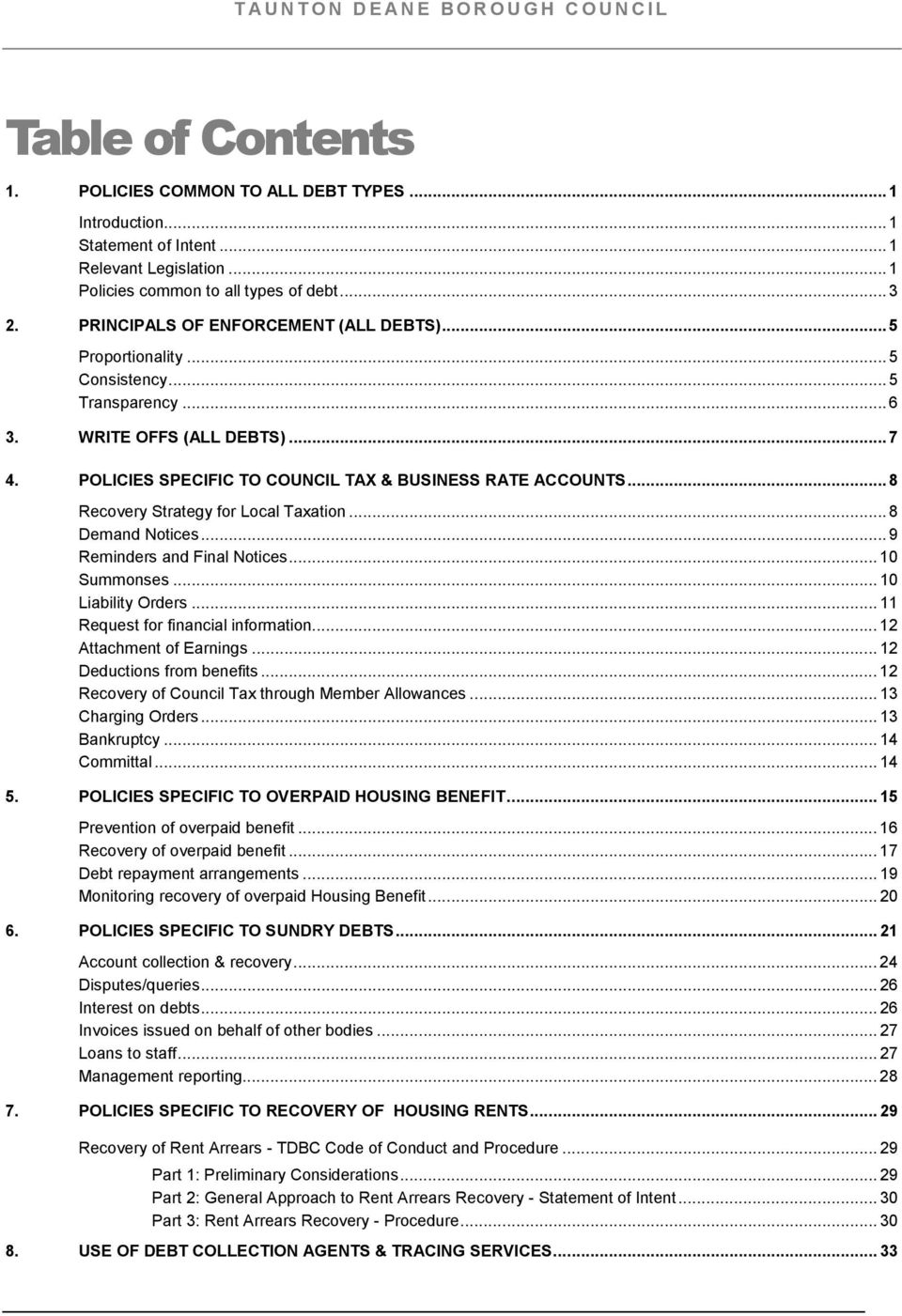
2 T A U N T O N D E A N E B O R O U G H C O U N C I L Table of Contents 1. POLICIES COMMON TO ALL DEBT TYPES... 1 Introduction... 1 Statement of Intent... 1 Relevant Legislation... 1 Policies common to all types of debt PRINCIPALS OF ENFORCEMENT (ALL DEBTS)... 5 Proportionality... 5 Consistency... 5 Transparency WRITE OFFS (ALL DEBTS) POLICIES SPECIFIC TO COUNCIL TAX & BUSINESS RATE ACCOUNTS... 8 Recovery Strategy for Local Taxation... 8 Demand Notices... 9 Reminders and Final Notices Summonses Liability Orders Request for financial information Attachment of Earnings Deductions from benefits Recovery of Council Tax through Member Allowances Charging Orders Bankruptcy Committal POLICIES SPECIFIC TO OVERPAID HOUSING BENEFIT Prevention of overpaid benefit Recovery of overpaid benefit Debt repayment arrangements Monitoring recovery of overpaid Housing Benefit POLICIES SPECIFIC TO SUNDRY DEBTS Account collection & recovery Disputes/queries Interest on debts Invoices issued on behalf of other bodies Loans to staff Management reporting POLICIES SPECIFIC TO RECOVERY OF HOUSING RENTS Recovery of Rent Arrears - TDBC Code of Conduct and Procedure Part 1: Preliminary Considerations Part 2: General Approach to Rent Arrears Recovery - Statement of Intent Part 3: Rent Arrears Recovery - Procedure USE OF DEBT COLLECTION AGENTS & TRACING SERVICES... 33
3 APPENDIX 1 COLLECTION OF COUNCIL TAX ARREARS GOOD PRACTICE PROTOCOL APPENDIX 2 NATIONAL STANDARDS FOR ENFORCEMENT AGENTS APPENDIX 3 ENFORCEMENT CONCORDAT APPENDIX 4 VULNERABILITY PROTOCOL FOR COUNCIL TAX OR BUSINESS RATES CUSTOMERS APPENDIX 5 BAILIFF CODE OF CONDUCT FOR COUNCIL TAX OR BUSINESS RATES CUSTOMERS Code of Practice for the Management of Bailiffs employed by Taunton Deane Borough Council for the Enforcement of Local Taxation debts Bailiff Guidelines Guidance on Vulnerable Cases APPENDIX 6 CREDIT SERVICES ASSOCIATION - CODE OF CONDUCT APPENDIX 7 PRIORITY DEBTS APPENDIX 8 COUNCIL TAX & BUSINESS RATES FLOWCHARTS APPENDIX 9 OVERPAID HOUSING BENEFIT FLOWCHARTS APPENDIX 10 SUNDRY DEBT RECOVERY FLOWCHART APPENDIX 11 CUSTOMER INFORMATION ON COUNCIL TAX & BUSINESS RATES - BILLING & FEES Bills Summons notice Liability order Bailiffs Charging order Bankruptcy Committal Tracing of Debtors Fees & Charges 2010/ Council Tax & Business Rates... 76

4 Section 1 1. Policies common to all debt types Introduction This document details the Council s policies on the billing, collection and recovery of money due to Taunton Deane Borough Council. Sums due to the Council can be a mixture of statutory and non-statutory charges. Statute tightly prescribes methods for billing and recovery of the statutory debts. Our enforcement practices must take account of this diversity. Effective debt management is crucial to the success of any organisation. The Council needs an effective policy to support the maximisation of debt collection in an efficient, consistent and sensitive manner. In developing this policy we have considered guidance issued by the Local Government Ombudsman as well as best practice in debt recovery. This document sets out the general principles we will apply to debt management across all the services we provide. We will use this document with more detailed procedural guidance for staff. Statement of Intent The Revenues Best Value review, completed in January 2003, set a Vision for collecting money due to the Council. We have extended this to incorporate all debts due to the Council: Where the Council seek to collect money, the Council will issue bills promptly and correctly. Where recovery action is required, the Council will act quickly, fairly and impartially, but with due regard to the social welfare and human rights of our customers Relevant Legislation Council Tax Council Tax (Administration and Enforcement) Regulations 1992 and subsequent amendments Local Government Finance Act

5 Business Rates (NNDR) Local Government Finance Act 1988 and subsequent regulations and amendments Non-Domestic Rating (Collection and Enforcement) (Local Lists) Regulations Overpaid Housing Benefit Regulations of The Housing Benefit (General) Regulations 2006 (as amended). Social Security Administration Act 1992 (Housing Benefits) Overpayment Local Authority Financial Regulations The Housing Benefit (Decisions and Appeals and Discretionary Financial Assistance) (Consequential Amendments and Revocations) Regulations Section 123 of the Social Security Administration Act Section 134 of the Social Security Administration Act 1992 (Housing Benefit) Sections 130, 131 of the Social Security Contributions and Benefits Act 1992 Sundry Income Housing Rents The Housing Benefit (General) Regulations and subsequent varying regulations Housing Benefit (Recovery of Overpayments) Regulations 1997 Housing Benefit (General) Regulations 1997 (SI 1971) Social Security Administration (Fraud) Act 1997 Statutory Instrument 2004/2443 & Statutory Instrument 2005/215 (Business Improvement District (BID) levy) Local Government Act 1972 Accounts and Audit Regulations 1996 Housing Act 1985 Part II Local Government and Housing Act 1989 Part IV Commonhold and Leasehold Reform Act

6 Policies common to all types of debt 1.1. We will correctly address every demand for money to the person liable to pay it. The name on the demand will be that of a person or body having legal personality We will, wherever possible, issue demands on the day of production We will keep all documentation relating to a demand in either paper or scanned image format until at least six years after the demand is raised. If at the end of that six-year period the demand remains unpaid, we will hold the supporting documentation until either the bill is paid or we write off the debt We will always try to use the most suitable and effective method of debt recovery to maximise income Taunton Deane Borough Council encourages the most cost-effective payment methods with an emphasis on unmediated electronic means where possible. Unmediated means a method of payment needing no human intervention by officers to ensure credit to the correct account In the interest of economy and where appropriate we will issue all demands, reminders and final notices by 2 nd class post unless contrary to regulations or other statutory or legal requirements Authorised officers will be able to intervene in the recovery cycle in appropriate circumstances to deal with hardship or dispute situations. This includes the ability to arrange for deferred payment where immediate payment is impossible because of lack of means. Officers making arrangements will consider paragraph Where the potential for a statutory benefit or discount exists in relation to the debt, we will make efforts to ensure the debtor aware of such opportunities and we will aid and encourage the debtor to apply All notices will comply with the corporate style guidance and be readily identifiable as being from Taunton Deane Borough Council Where either national or local performance indicators exist we will strive for top quartile performance and we will publish our performance against these targets annually. We will provide regular progress reports during the year to the Council s Corporate Management Team and the Corporate Scrutiny Committee Taunton Deane Borough Council welcomes involvement from welfare agencies about debts due to the Council and recognises the benefits these organisations offer to both the debtor and the Council in prioritising repayments to creditors and maximising income. 3

7 1.12. We recognise prompt recovery action is key in managing debt and maximising income. Therefore Taunton Deane Borough Council aims to: Regularly monitor the level and age of debt. Set clear targets for the recovery of debt. Have clear written recovery procedures. Set priorities for specific areas of debt and assess recovery methods to ensure maximum recovery. Regularly review irrecoverable debts for write-off All accounts that are written off will be written off against the income code against which they are raised Where we procure help from an external agency to help with the delivery of a service the flow of information should, wherever possible, be in an electronic format Where legislation allows, Taunton Deane Borough Council will seek to levy and recover from the debtor any costs/fees legitimately due from the debtor to the Council or its agents. Only in exceptional cases, where it would not be in the public interest to pursue costs/fees will they be waived In accordance with Taunton Deane Borough Council s Employee Code of Conduct, any officer who is in debt as a customer to the Council, i.e. Council Tax arrears should declare this to their Head of Service. All debts must be declared even if a repayment plan is already in place. 4

8 Section 2 2. Principals of enforcement (all debts) 2.1. We will follow the principles outlined below. These principles are drawn from the Government s Enforcement Concordat (Appendix 2), to which Taunton Deane Borough Council is fully committed: Our action will be proportional Our approach will be consistent Our actions will be transparent We will also ensure that we pay suitable regard to our Core Values of: Integrity - we will be honest, do what is right and stick to it Fairness - we will consistently treat everyone equally, respecting their individual needs and abilities Respect - we will always show respect for everyone Trust - we will show trust and confidence in our staff and Councillors. We intend to be firm and fair and our manner will be polite. Proportionality 2.2. Proportionality allows us to balance the potential loss of income to Taunton Deane Borough Council against the costs of compliance. Consistency 2.3. Consistency means taking a similar approach in similar circumstances to achieve similar ends. We aim to achieve consistency in: Advice we give. Use of our powers. Our use of recovery procedures We recognise consistency does not mean simple uniformity. Officers need to take account of many variables such as: The social circumstances of the debtor. The debtor s payment history. The debtor s ability to pay. 5
9 Transparency 2.5. Transparency is important in preserving public confidence. It means helping people to understand what we expect from them, and in turn what they should expect from us. It also means explaining clearly the reasons for taking any recovery/enforcement action Transparency is a key part of an officer s role. If action is required, the officer must clearly explain the reasons. This should be in writing where needed. If action is required, the time scales must be clearly stated. A distinction must be made between advice and legal requirements Communications should be in plain English and large print with Braille versions available on request Language Line is to be used as an aid to improving verbal communications with those customers for whom English is not their first language We will provide opportunity to the debtor to discuss what is required of them to comply with the law before we take formal enforcement action. We will give a written explanation of any rights of appeal against formal enforcement action either before or at the time we take action. 6

10 Section 3 3. Write Offs (all debts) 3.1. We recognise where a debt is irrecoverable, prompt and regular write off of such debts is good practice We will seek to minimise the cost of write-offs to local Council Tax and Housing Rent payers by taking all necessary action to recover what is due. All debts will be subject to the full recovery, collection and legal procedures as outlined in this policy Irrecoverable debts will be referred to the Council s Responsible Finance Officer (151 Officer) at a pre-agreed frequency and in a pre-agreed format The limits for writing off irrecoverable debts are those contained in the Taunton Deane Borough Council s Financial Regulations Debts may be referred to the Section 151 Officer for write-off in the following circumstances: Debts where all or part has been remitted by the Magistrates Court due to hardship The Council has evidence to confirm the claimant is suffering a severe physical or mental illness which renders enforcement action inappropriate. The Council is unable to trace the debtor. The following records will be checked before the debtor is considered as absconded: - Experian Debtor trace - Electoral roll - Local authority of any previous address for any forwarding address - Council Tax records - Housing records - DWP/JSA trace - if debt is for overpaid Housing Benefit - Benefit records - if debt is for overpaid Housing Benefit Statute barred debts - debts that cannot legally be pursued after losing contact with the debtor for 6 years. The debt is not cost-effective to pursue due to small balance. The debt is not cost-effective to pursue due to the likelihood of payment balanced against the cost of proceedings. The debtor has died and there are no or inadequate funds in the estate. The debtor is subject to formal insolvency proceedings and there is little likelihood of a dividend. Committed to prison - if the debtor has been sentenced to more than 3 years imprisonment, then there is little hope of obtaining recovery. 7

11 Section 4 4. Policies specific to Council Tax & Business Rate accounts Recovery Strategy for Local Taxation 4.1. Our aim on the recovery of Council Tax and Business Rate debt is: Firm but Fair Our key objective is: To support those who cannot pay and take action against those who will not pay 4.2. We will issue a recovery timetable each year and we will aim to recover outstanding instalments in a timely and efficient manner maximising cash flow and driving down arrears We recognise people & businesses do not pay debts for a variety of reasons: Some customers genuinely struggle to meet their payments and need advice and help in budget management. Some customers deliberately choose to set out to delay and not pay their debts. Some customers are not receiving the benefits or reductions they are entitled to. Some customers go through personal difficulties that result in short-term and long-term problems in paying their debts, The national economy affects individuals and businesses. Diversity brings complications in customer understanding and guidance may be needed At each stage we will encourage customer contact and liaise with internal departments and outside agencies e.g. Citizens Advice Bureaux and welfare rights agencies to offer specialised advice and/or debt counselling to those we feel may be in need of help The Local Government Association and the Citizens Advice Bureau published the Collection of Council Tax Arrears Good Practice Protocol (Appendix 1) in July Officers of the Council and contractors acting on its behalf in recovery of Council Tax roles will comply with these standards 4.6. The Lord Chancellor's Department has produced National Standards for Enforcement Agents (Appendix 2). Officers of the Council and contractors acting on its behalf in enforcement roles will comply with these standards We have guidelines and a Code of Practice for Bailiffs (Appendix 5). Council officers and contractors acting on its behalf in enforcement roles will comply with these standards If we have reason to believe a customer is vulnerable, we will manage their account following our Vulnerable Policy - See Appendix 4. 8

12 4.9. If any customer is unable to maintain a payment arrangement or is unhappy with the suggested level of payment under an arrangement, they will have recourse to a Senior Revenues Officer to appeal. Demand Notices We will issue all demand notices using Civica Open Revenues (or whatever future revenues system that may be appropriate) We will issue annual Council Tax and Business Rate bills as soon as practical after the Council has set its Council Tax for the forthcoming year We will issue adjustment notices as soon as practicable after the liability is known with payment(s) being due on the earliest date(s) allowed by legislation All bills include a monthly instalment arrangement. If the customer wants to change their instalment date, they must contact us as soon as possible We offer several different payment methods and dates for customers to pay their accounts. We offer an instalment date of the 1st of the month to all non direct debit payers. We promote payment by direct debit, as it is the most efficient payment method. It also helps customers avoid missing instalments and being subjected to recovery action To encourage customers to pay by direct debit, we offer a choice of 2 instalment dates, 1 st & 20 th. We print Direct Debit mandates on the back of all Council Tax and Business Rate bills (including reminders, final notices, summonses and post Court notices) If a customer pays regularly, but fails to do so by the instalment date, we will still take recovery action, as payments are late Where a Council Tax or Business Rate customer can demonstrate an inability to pay on the set instalment date, Revenue Officers will have the discretion to vary the instalment dates. However, the final instalment date must be before 31 st March of the financial year in question. Such arrangements will only be considered where no recovery action has yet started for the account in question Where recovery action has started, payment arrangements will generally only be entered into where the debt is secured by a liability order and/or the debtor agrees to pay by direct debit. Arrangements will only be agreed by approved staff and will generally only be agreed to where: The debt will clear by the end of the financial year. The debtor s proposals are reasonable in comparison with the amounts that could be secured by taking alternative action. The debtor demonstrates a clear intent to honour the arrangement In cases where exceptional circumstances exist and it would not be in the interests of Council Tax payers to pursue enforcement action, arrangements may be made by authorised staff before obtaining a liability order and without the debtor agreeing to pay by direct debit. 9

13 Reminders and Final Notices We will issue reminders and final notices as far as is practical, within 14 days of the payment default to which they relate, following the recovery timetable. The reminder gives 7 days for the customer to bring their account up to date. Because of the high volume of reminders, it is not possible to individually check them before issue If we issue a reminder or final notice, we include a message to tell the customer if they pay by direct debit, they can spread any arrears over the remaining months of the financial year under a special arrangement. This will be a one time offer. If the customer subsequently cancels the direct debit mandate or if the payment is rejected (bounced) by the bank we will not issue any further reminders and we will escalate the account to requesting a Summons from the Magistrates Court If we have agreed a special arrangement and the customer fails to meet their duties under that arrangement, we will only allow further instalments by direct debit on immediate payment of any arrears i.e. before any future instalment. If we are not able to agree an instalment plan, then the whole outstanding balance becomes payable If we do not receive payment, we will request a summons from the Magistrates Court. Once a summons has been issued, the full amount of Council Tax or Business Rates is due, as well as the summons costs If the overdue instalment is paid, but a future instalment is missed, a second reminder is issued. If the customer then pays the second overdue instalment, they can continue to pay their account in monthly instalments. However, if the customer misses a third instalment, we will send a final notice. This means the customer has to pay the annual charge in full immediately, or we will issue a summons We will not issue more than three reminders in a financial year - a maximum of two instalment reminders and one final notice. Summonses We will issue summonses as soon as reasonably practicable after the default to which they relate. If the customer does not pay as the reminder, or final reminder instructs, we will request a summons from the Magistrates Court. The summons gives details of when the customer must attend court to explain why they have not paid their bill. The cost of sending the summons is added to their bill If the customer pays the full amount of the summons, including costs, before the hearing date, the customer does not have to attend court If the customer makes a payment arrangement with us before the hearing, they do not have to attend court. However, we will ask the Magistrates Court to grant a liability order to secure the debt (explained below). Providing the customer keeps to the payment arrangement, we will not take any further recovery action At the court hearing, we must satisfy the Magistrates Court we have followed the correct procedures that is, sending a bill, reminder and summons to the customers property, or their last known address. We must also confirm the customer is liable for Council Tax or Business Rates and the debt is outstanding. If the Magistrates Court are satisfied with the evidence we present they will grant a liability order. 10

14 Liability Orders A liability order is a decision by the court confirming the customer is liable to pay Council Tax or Business Rates and has not done so in accordance with the law. It gives us powers to recover the outstanding debt using other methods. These are explained in more detail below A Liability Order gives us the power to: ask for financial information including the customer s employment status and employer details that must be provided; prosecute for failing to provide financial information (Council Tax only) take money directly from the customer s wage using an Attachment of Earnings Order (Council Tax only); prosecute employers for failing to implement Attachment of Earnings (Council Tax only); take money directly from Members Allowances (Council Tax only); take money directly from the customer s benefits, for example, Income Support, Jobseekers Allowance, Pension Credit or Employment Support Allowance (Council Tax only); use bailiffs to remove the customer s goods and sell them to pay the debt; start insolvency proceedings (against companies); seek a Charging Order against the customer s property; start committal proceedings for an individual customer s imprisonment for up to 90 days; start bankruptcy proceedings (against individuals); instigate County Court proceedings, as an alternative to the Magistrates Court These methods shall only be used with consideration to the principles set out within 2.1 above The Magistrates Court may not grant a liability order if the customer can provide a valid defence, such as: we have not demanded the Council Tax or Business Rates as the law sets out; the customer has already paid the amount on the summons; the customer is not the person liable for Council Tax or Business Rates; or more than 6 years have passed since we sent a bill for the amount It is not a valid defence if the customer is unable to pay because they have: applied for Council Tax Support; or appealed to the Valuation Tribunal against the valuation band. 11

15 Request for financial information When we have a Liability Order we will send an income details form asking the customer to supply details about their income and expenditure. They have two weeks to complete and return it. This letter also details what will happen if we ask bailiffs to collect the outstanding debt If the customer does not complete and return the income details form within 2 weeks, we can take action. This may result in a fine of up to 500 and a criminal record. If the customer knowingly supply false information they are liable to a fine of up to 1,000. Attachment of Earnings We can tell employers to deduct directly from the customer s salary or wages to pay their Council Tax debt. The amount deducted depends on how much the customer earns. If they have arrears we can make two deductions. Table of deductions from monthly earnings for each order issued after 1 April 2010 Take home (net) wage Percentage we can Amount to be deducted deduct Under 300 0% Nil Over 300 but under 550 3% Over 550 but under 740 5% Over 740 but under 900 7% Over 900 but under 1,420 12% Over 1,420 but under 2,020 17% Over 2,020 17% of first 2,020 plus 50% of the rest plus 50% of the rest Table of deductions from weekly earnings for each order issued after 1 April 2010 Take home (net) wage Percentage we can Amount to be deducted deduct Under 75 0% Nil Over 75 but under 135 3% Over 135 but under 185 5% Over 185 but under 225 7% Over 225 but under % Over 355 but under % Over % of first 505 plus 50% of the rest plus 50% of the rest The employer can deduct a further 1 per order for their administration costs each time they make a deduction. Deductions continue until the Council Tax is paid in full. Customers must tell us within 2 weeks of any change in their employment. Deductions from benefits We can ask the Department for Work and Pensions to deduct directly from the customer s Income Support, Jobseekers Allowance or Employment Support Allowance The money deducted is sent to us each month and continues until the Council Tax is paid in full, or benefit entitlement stops Customers must tell us within 2 weeks of any changes in their benefit. 12

16 Recovery of Council Tax through Member Allowances Regulation 44 Council Tax (Administration & Enforcement) Regulations 1992 relates to an elected member of Taunton Deane Borough Council or a relevant precepting authority The Regulations allow an attachment of the allowances of an elected member to be made when the Taunton Deane Borough Council has obtained a Liability Order. These provisions do not extend to Members of Parliament Taunton Deane Borough Council can make an order under which they can attach 40% from a member's allowances The allowances to which the order relates are those paid under: Section 18 Local Government & Housing Act This includes schemes for basic, attendance and special responsibility allowances for Local Authority Members. Section 175 Local Government Act This includes allowances for attending both conferences and meetings Any decision on an attachment of allowances should be referred to the Principal Revenues Officer and the Legal & Democratic Services Manager. Charging Orders Charging orders are used when attempts to attach earnings, deduct from benefits and remove a debtor s goods have been unsuccessful. All charging order cases must be controlled by the Principal or Senior Revenues Officer If the debtor owns a property the Principal or Senior Revenues Officer can decide to apply for a charging order to be placed on it. This is similar to a mortgage and means we can recover the outstanding council tax debt from the proceeds of sale, should the debtor sell the property at a later date. While it is possible to enforce the sale of a property subject to a charging order, this would be the exception rather than the rule A Charging Order relating to Council Tax debt will not be pursued if the customer is considered as vulnerable. The Principal or Senior Revenues Officer will only decide a charging order is a fair and proportionate after they have: reviewed an accurate history of the origin of the debt and any attempts to recover it considered information about the past, present, disputed or outstanding benefit claims or any discounts or exemptions that might be relevant assessed that there is no realistic prospect of recovering the debt by other means in a reasonable timescale gathered sufficient evidence about the debtor s circumstances considered if a debtor s failure to pay and to respond to other recovery measures could arise from a disability (including a mental impairment with a long-term and substantial effect on normal day-to-day activities), and considered if the debtor s personal circumstances warrant them being protected from the consequences of recovery action Decisions about applying for a charging order should be recorded and the records retained with the information considered by the Principal or Senior Revenues Officer. 13

17 Bankruptcy All cases must be controlled by the Principal or Senior Revenues Officer Such cases will mainly be for business rates where there are no goods and the customer refuses to pay Any applications for bankruptcy relating to Council Tax debt will be scrutinised but will not be considered if the customer is considered as vulnerable The Principal or Senior Revenues Officer will only decide that pursuing bankruptcy is a fair and proportionate action after they have: reviewed an accurate history of the origin of the debt and any attempts to recover it considered information about the past, present, disputed or outstanding benefit claims or any discounts or exemptions that might be relevant assessed that the debtor has assets that will clear the debt if bankruptcy is pursued assessed that there is no realistic prospect of recovering the debt by other means in a reasonable timescale gathered sufficient evidence about the debtor s circumstances considered if a debtor s failure to pay and to respond to other recovery measures could arise from a disability (including a mental impairment with a long-term and substantial effect on normal day-to-day activities), and considered if the debtor s personal circumstances warrant them being protected from the consequences of recovery action Decisions about pursuing bankruptcy should be recorded and the records retained with the information considered by the Principal or Senior Revenues Officer Written information should to be provided to the debtor when bankruptcy proceedings are being considered. That information should: warn the debtor of the serious consequences of bankruptcy and their continued failure to make arrangements to pay the debt, and urge them to seek independent advice and sign-post to local sources of advice. Committal Where all other recovery options have been exhausted and residence has been confirmed the case can be reviewed for Committal to Prison. Such cases will remain under the strict control of the Principal or Senior Revenues Officer As this is an option of last resort, the initial intention will be to request a warrant signed by the Court. These warrants will then be issued to a bailiff for the customer s arrest and bail to the next available court All cases at this level must be referred to the court officer before any amendments to the accounts can be done Decisions about seeking committal to prison should be recorded and the records retained with the information considered by the Principal or Senior Revenues Officer. 14

18 Section 5 5. Policies specific to overpaid Housing Benefit General information 5.1. An overpayment is any amount of Housing Benefit that has been paid but to which there was no entitlement When we identify an overpayment, we will write to the benefit claimant and provide the following information: Reason for the overpayment Amount of the overpayment Benefit period covered Method of recovery Rights of appeal 5.3. We aim to calculate overpayments quickly and accurately and to provide quality information to the people affected, ensuring we recover the correct amount. To achieve this we will: Invite claimants to apply for underlying entitlement to benefit. Calculate overpaid benefit on average, within 14 days of getting the information we need. Use the proper effective date of change to fix the correct overpayment period. Consider uncashed or returned cheques or underpayment of benefit We aim to ensure we correctly classify overpayments for subsidy purposes to prevent loss of subsidy We will only issue invoices when a recoverable overpayment of Housing Benefit exists and we cannot recover by other prescribed means The Housing Benefit (Recovery of Overpayments) Regulations 1997 allow us to recover overpayments from landlords from their current tenants claim. We will, in appropriate circumstances, reduce payments to landlords for their current tenants to recover overpayments that arose for former tenants. It will take this action when the original tenant has no continuing Housing Benefit and when there was a misrepresentation or failure to disclose a material fact (blameless tenant deductions) We will maintain contact with debtors through visits to their properties and telephone contact to encourage repayment. Such contact will adhere to the principles set out in 2.1. and in accordance with Appendix 3 (Government s Enforcement Concordat). 15

19 Prevention of overpaid benefit 5.8. Taunton Deane Borough Council believes prevention of overpaid benefit debt is better than cure. Therefore strict measures are to be employed to prevent overpayments occurring. These will include: Using a well laid out application form to collate accurate information which contains an unambiguous statement that failure to provide correct information could lead to overpayments of benefit and to prosecution. Ensuring all benefit letters and relevant correspondence advise the people affected of their responsibility to tell the Council of any change of circumstances that may affect their claim. Making use of the Verification Framework techniques and procedures for example: - Using checks for identity, residency and National Insurance numbers. - Tailored reviews for high-risk claimants. - Visiting programmes targeting high-risk claimants. Ensuring all staff involved with overpayments receive enough training with comprehensive access to overpayment recovery procedures and an awareness of problems relating to debt. Providing regular fraud awareness training for staff who have contact with claimants. Using and developing information technology to automate the identification and recovery of overpayments and to reduce error. Dealing quickly with reported changes of circumstances. Including publicity material, for example posters, guidance pamphlets sent with application forms and landlord undertakings, information on responsibilities for reporting changes of circumstances. Ensuring procedures are in place for the prompt ending of benefit where a claimant does not comply with a review of their claim Taking part in various data matching exercises with external agencies and cross matching against internal databases while adhering to principles contained in Data Protection and Human Rights Acts. 16

20 Recovery of overpaid benefit 5.9. Generally, all overpayments are recoverable, regardless of the reason they occurred, where the claimant or person to whom the benefit was paid can reasonably have been expected to know they were receiving benefit to which they were not entitled. See Appendix 9 for additional information When an overpayment is classed as recoverable the Benefit Officer dealing with the claim must make a separate decision on whether to recover the overpayment Recovery of the overpaid benefit can be sought from the claimant or the person to whom the payment was made. Recovery will only be sought from the landlord or agent where they could be expected to have known about the change in circumstances leading to the overpayment In most cases recovery of a recoverable overpayment will be sought. However, consideration will be given to the personal and financial circumstances of the person from whom recovery would be sought. If the situation is unclear we will contact or visit the claimant for clarification Where we decide an overpayment is recoverable, recovery arrangements will proceed in the following hierarchy: From arrears of Housing Benefit From continuing Housing Benefit. This includes direct payments to a landlord for that claimant even if that claimant has moved or changed landlord. We will base recovery rates on DWP guidelines and will always initially apply the maximum recovery rate permissible. However officers will be empowered to consider applications from debtors to reduce the recovery rate in cases where there is demonstrable hardship. We will raise an invoice if there is no continuing Housing Benefit and no likelihood of continuing benefit or reduction through underlying entitlement. We will produce all invoices, reminders and final notices using the Civica Open Revenues (or whatever future revenues system that may be appropriate) with a Schedule 6 compliant letter within 14 days. At this point we will seek to recover the overpayment in full by a single payment. However, where this is not possible, due to the debtor s financial circumstances we may agree a payment plan involving instalments. By deductions from other Social Security Benefits managed by the Department for Work and Pensions. Section 75(1) of the Social Security Administration Act 1992 allows recovery of overpaid Housing Benefit by deduction from prescribed benefits that are defined in Regulation 105 of the Housing Benefit Regulations

21 5.14. Where we raise an invoice and do not get payment after issuing a final notice, we will consider implementing a Direct Earnings Attachment (DEA) as provided for under the Social Security (Overpayments and Recovery) Regulations A DEA gives Taunton Deane Borough Council the power to recover overpaid Housing Benefit by deductions from earnings without applying for a court order. DEAs give us the opportunity to recover these debts from employed people if they: refuse to repay cannot agree an acceptable repayment plan default on a voluntary repayment arrangement. If a debtor fails to provide information requested to support a DEA, or an employer fails to comply with their duties they could be subject, on conviction, to a fine of up to 1,000 (Regulation 30 of the Social Security (Overpayments and Recovery) Regulations 2013) As an alternative to a DEA, we will consider issuing a claim against the debtor in the County Court. We will make this decision on the realistic prospect of obtaining payment of the debt by a County Court Judgement In some circumstances, we may decide to instruct an external professional debt collection agent in accordance with the policy set out in Section Where a claimant has been overpaid rent rebate and there is a credit balance on their rent account, we will recover all or part of the overpayment from the credit if it is for the same period as the overpayment. The Council will not recover more than the credit shown on the rent account For details about the use of Prosecution and Administrative Penalties that we may apply to debtors who have committed benefit fraud, refer to the Council s Anti-Fraud Policy, Anti-Fraud Strategy and Prosecution Policy. 18
22 Debt repayment arrangements Officers will encourage people owing money for overpaid Housing Benefit to make contact at an early stage in the recovery process When a person makes contact, we aim to agree a realistic payment agreement. If there is any doubt as to whether the agreement is realistic (either because it appears to be too high or too low), officers will ask the individual to complete an income and expenditure form Officers will try to get as much detail as possible of a person s circumstances to make the best assessment of their ability to pay. However if a person refuses to divulge any information, this could be considered as a reason to refuse an arrangement In some cases it may be necessary to request documentary proof to confirm particular details when arriving at a payment arrangement. Individuals should not however be asked for documentary evidence unless it is absolutely necessary If it is necessary the individual should be told of the particular items that require confirmation and be given a specified reasonable time limit within which they are required The individual should be advised that if the evidence is not produced within the agreed timescale the offer of payment may be rejected and further action could be taken All information collected is governed by the Data Protection Act 1998 and the Revenues & Benefits Service has procedures in place to comply with the Act The Revenues & Benefits Service will closely monitor all payment arrangements and will take prompt recovery action for missed payments. Action may be taken, even where payment is received shortly after the due date The responsibility for making sure the payment reaches the account by the due date remains with the debtor. The debtor should be reminded the date on which instalments are to be paid is the final date on which money should reach the account This means that debtors must allow sufficient time for the payments to reach the Council by the due date If an arrangement extends beyond the current financial year approval of a Senior Officer in the Revenues & Benefits Service must be obtained It is important to remind the individual to contact the Revenues & Benefits Service if they anticipate problems in meeting any instalment due date. They will be advised not to wait until they have received a written response to their offer of payment, but to start and maintain payments. 19
23 Monitoring recovery of overpaid Housing Benefit The Council will monitor recovery of overpaid Housing Benefit by the Revenues & Benefits Service through success in meeting the following Performance Indicators: Amount of overpaid Housing Benefit recovered during the period as a percentage of total amount of overpaid Housing Benefit identified during the period; Amount of overpaid Housing Benefit recovered during the period as a percentage of the total amount of HB overpayment debt outstanding at the start of the period plus amount of overpaid Housing Benefit identified during the period Amount of overpaid Housing Benefit written off during the period as a percentage of total amounts of overpaid Housing Benefit debt outstanding at the start of the period plus amount of overpaid Housing Benefit identified during the period In addition to overall Corporate monitoring in this area, the Revenues & Benefits Service will collect and act on management information (at least quarterly) that will include: number and financial value of cases reaching each stage of recovery number and financial value of cases where attachments of benefit/earnings are made number and financial value of cases being referred to a professional Debt Collection Agency. number and financial value of cases where recovery is suspended due to arrangements being made number and financial value of cases with arrears outstanding at year end financial value of arrears outstanding at year end 20
24 Section 6 6. Policies specific to Sundry Debts Introduction 6.1. It is the Council s policy to recover all collectable debt owed to it. With this overall objective in mind this policy aims to: Maximise the Council s Income Reduce the time taken to collect charges Reduce the level of debt owed to the Council and hence its provision for bad debts, and Reduce the incidence of debt that cannot be collected This Policy supports these aims by: Promoting ownership of debts by service providers Ensuring wherever possible that collection of the fee or charge involved takes place prior to the service being provided so that credit is only given when it is essential to do so Promoting a system of active credit control Ensuring invoicing procedures are carried out on an accurate and timely basis Requiring that evidence to support the invoice exists in the form of an order or other written contract Encouraging debtors to pay promptly, and Making collection and enforcement activity more efficient The Responsible Finance Officer will review the targets given above each year and report on performance to the Scrutiny Committee The Council will publicise this policy and that it intends to pursue the collection and recovery of all debts owed to it. 21
25 Scope 6.5. This part of the policy excludes the following debts as they are subject to their own legislation / regulations: Council Tax Business Rates (National Non Domestic Rates) Housing Rents Housing Benefits Overpayments and Excess Council Tax Support Parking penalties Key Objectives of Fees and Charges 6.6. The fee or charge imposed by the Council should be fair in relation to the goods and/or services provided The charge should reflect the principles outlined in the appropriate charging policy and in the Council s Financial Regulations The charge should, depending on legislation, always at least cover the cost of providing the goods or service and the costs of collection, unless the Council has taken a policy decision to subsidise the service The charge should wherever possible be obtained in advance of the goods and/or services being provided. If not, and where appropriate, the prior written agreement of the person receiving the goods and services should be obtained to pay for the goods and/or service The charge should be collectable Fees and charges must be reviewed at least annually There should be a clear and prompt billing and collection process There should be a clear and consistent council-wide approach to the giving of credit and the collection of debt that is led by this policy There should be a system that ensures Services only retain credit for an invoice if the income is actually collected. Responsibilities Directors, Theme Managers and Service Managers must ensure: Financial Regulations for collecting sundry debt are adhered to The parts of this policy applying to their services are correctly followed They proactively support the achievement of corporate targets for debt collection Officers directly responsible for budgets are fully appraised of their responsibilities Relevant systems and procedures are put in place Staff involved in the debt collection process are appropriately trained, and The success of training is kept under continuous review The Head of the Finance Service and the Application Support Manager are responsible for providing central support and the relevant electronic processes needed to ensure adherence to this policy. 22
26 General Principles Service providers must try to get payment in advance or at the time of service delivery wherever permissible. Sundry debt accounts should only be raised where payment in advance for a service is inappropriate Checks can be made before the service is provided to minimise risks of bad debt. These checks can include vetting of a contractor to assess their financial strength and consequently assess the risk of future non payment. Investigation can also be made to see if the customer has failed to re-pay a debt owed to the Council in the past It is crucial to ensure any debt is properly established. Inadequate legal proof of liability will make collection difficult. It is vital there is sufficient supporting documentation to enforce the debt through written agreements, or official order numbers. The full name and up-to date address of the debtor should be clear before a service is provided. If the potential debtor is a commercial organisation - the issuing service will consider the risk of trading with that company and the risk of providing credit duly assessed, including via the use of a credit check, and request payment in advance of the goods or service being provided, if necessary If the debtor is a private individual - check if any existing debt exists in the Council against the individual, or whether the Council has had difficulty enforcing payment of previous debts in the past, and request payment in advance of the goods or service being provided if necessary If an invoice is to be raised - the issuing service will ensure enough supporting documentation exists to enforce the debt in the event of non payment The minimum value of any demand will be determined annually by the Responsible Finance Officer. However such a minimum value shall not apply to accounts relating to legal charges for rights of access or drainage charges where a contractual duty exists to make such token payments Except for a demand payable by instalments, or as otherwise contractually agreed, the settlement terms for all demands will be 14 days Recovery action will start no later than 14 days after the demand has fallen due Raising sundry debtor invoices will be the responsibility of the service and should only be raised on the Corporate Financial System (SAP) The correct details of the debtor should be clearly shown on any invoice, with the most current address used. In the event the invoice is raised to a large organisation it should be clearly directed to the relevant department or contact Details shown on the invoice should be comprehensive and clear to the invoice recipient so that the risk of dispute is minimised. Full details of the service provided should be clearly shown on any invoice, including relevant dates, order references, agreements and any other relevant information that will hasten quick payment and minimise any possible delays or disputes An invoice must be raised within 2 days of the charge becoming known. Invoices raised must be sent to customers within 72 hours. 23
27 Account collection & recovery The Council has a pro-active approach to collection, to ensure that any disputes are quickly identified and resolved before the account is due for payment For individual debts with a value of 5k or greater, an officer within the service to which the debt relates will obtain details of a named individual who will receive the invoice (in the case of a company this is likely to be someone within that company s accounts payable team) and will diarise to check whether payment has been made on time. Where payment has not been received the officer will telephone the named individual to establish why payment has not been made and to obtain a date when payment will be made. Further follow-up calls will be made as necessary The Council will take prompt action in respect of any customer that: Fails to abide by any Terms and Conditions relating to any account or fails to keep any payment promise as set out within any contractual documentation or agreed verbally or in writing in the normal course of collection procedures Refuses to pay without a valid reason Refuses to pay interest charges on late payments in respect of invoices that have not been subject to a valid dispute Refuses to pay collection costs when the services of a third party have been used. Recovery & Enforcement In the event of non payment of an invoice, initial recovery action will be undertaken by the SouthWest One Finance Service, unless specific prior agreement is made with user services. This typically will be in the form of reminder letters and telephone calls in accordance with procedures. The standard recovery flow is shown at Appendix The extent of recovery procedures for particular types of debt will be agreed in advance between the SouthWest One Finance Service and issuing services Once standard reminder letters have been completed, additional appropriate recovery action will be initiated by the SouthWest One Finance Service where necessary, unless previously agreed with the issuing service. The exact nature of this action may vary but typically will include a combination of individual letter, telephone calls, enquiries etc as appropriate In the event that payment remains outstanding after this further recovery action, then the SouthWest One Finance Service will refer back to the originating service for instructions to commence additional action as appropriate, and for the issuing service to suspend service provision if legally permissible until outstanding debts are settled. It is essential that services respond promptly to these requests and instruct SouthWest One Finance Service accordingly. 24
28 6.31. The type of recovery action will be agreed between the SouthWest One Finance Service and the originating service. Options to consider will include: Telephone contact with the debtor Referral to a debt collection agency Referral to a tracing agent in the event the debtor has absconded and cannot be traced Legal action. At the request of the originating service debts may be referred to the Council s Legal Service & Democratic Service or externally appointment solicitors for appropriate legal action if it is felt the debt is recoverable unless the individual circumstances are such that this does not represent best value for the Council. Options available as the result of instigating legal proceedings will consider if recovery of the debt is best progressed through: - Attachments of Earnings - Warrants of Execution - Garnishee Orders - Insolvency - Possession proceedings The cost of legal action will be initially charged to the originating section budget although every effort will be made to recover legal costs from the debtor Ownership of all sundry debts rests with the originating units. It is only the originating units that may: Issue an instruction to cancel an invoice. Cancellation instructions will only be accepted by SouthWest One Finance Service from officers approved by their Theme Manager. Officers who have raised the invoice in question will not be permitted to request its cancellation and should not therefore attempt to do so. Correspond with or discuss with the debtor, issues about the validity of the debt The costs of enforcement action/litigation to recover sundry debtor invoices will be charged against the budget of the service raising the invoice. Any costs recovered from the debtor will be credited against these sums. Instalment arrangements In the event of customers requesting the facility of paying their debt over a period of time, the matter will be referred to the SouthWest One Finance Service who may agree a suitable payment plan accordingly The following table should be used as guidance when agreeing terms: Value Debts below 500 Debts below 1,500 Debts below 2,500 Debts above 2,500 Terms (from date of invoice) No more than 3 months No more than 6 months No more than 9 months No more than 12 months 25
29 6.36. Such payment plans will not be available as standard but may be available subject to negotiation between the SouthWest One Finance Service and the debtor. These negotiations may entail a means enquiry where necessary, where the customer will be asked to provide details of their financial circumstances to support their request to repay the debt over a period of time The standard procedure will be for a financial means test to be undertaken for all instalment arrangements lasting more than 6 months In the event instalment arrangements have been agreed with a debtor, the repayment plan will be monitored by the SouthWest One Finance Service. In the event of instalment payments being missed, suitable recovery action will be undertaken through reminder letters and other recovery action The agreement of any instalment arrangements will be the responsibility of the SouthWest One Finance Service subject to any local guidelines provided by Council Service departments. Disputes/queries Disputes must be resolved by the appropriate service in the following timescales: Incorrect Charge - 3 days Sub Standard Works - 14 days Work not carried out - 14 days Missing PO s or Contact - 14 days Missing Support Documentation - 14 days Denies liability - 14 days Goods not received - 14 days A dispute is not resolved unless it meets one of the following conditions Customer is correct and gets full credit Customer is partly correct and gets partial credit and accepts the charge Customer is incorrect and accepts the charge Customer is not correct and does not accept the situation but the service is prepared to instigate legal proceedings to recover debt Interest on debts Interest may be applied to all non-consumer debt as laid down in the Late Payment of Commercial Debts Act Similar interest may be applied to consumer overdue debt providing the consumer has received prior notification of such charge When legal proceedings are issued, interest can be charged for any debt at a rate of 8% from the date the debt arose until judgement is entered (S69 County Court Act 1984) So not to make the financial position of the debtor worse, interest is not usually added to debts relating to Bed & Breakfast or Former Tenancy Arrears or where it is known that the debtor is on benefits. The debt will already have increased in any event by the addition of costs. 26
30 Invoices issued on behalf of other bodies The Taunton Town Centre Business Improvement District (BID) was set up in accordance with Statutory Instrument (SI) 2004/2443, and levies an additional amount on businesses within a pre-defined area. The money raised is spent on projects within the BID plan The Council has conferred the duty to raise the invoices and collect the levies on behalf of the Taunton Town Centre BID to SouthWest One s Revenues & Benefits Service in accordance with Statutory Instrument (SI) 2005/215. The decision on writing-off this type of debts rests with the Taunton Town Centre Management Company rather than with the Council. Loans to staff The Council occasionally makes advances of salary to staff. These are repaid by deduction from the next month s salary The Council operates an assisted car purchase scheme for staff. As this is an assisted car purchase scheme, employees will not normally be granted a 100% loan. Interest is charged on the loan, and employees make monthly repayments of the loan principle and interest via salary deduction. If the employee leaves the authority any outstanding loan amount becomes repayable in full by the last day of service. The collection of this debt is administered through the SAP system The Council has a leased car scheme for some members of staff. If an employee with a leased car leaves the authority or returns the lease car, any outstanding amount relating to the leased car (e.g. excess mileage which will not be met by the Council under the terms of the original lease agreement, or any claims for damages) becomes repayable to the authority by the employee in full. The collection of this debt is administered through the SAP system The Council sometimes employs trainees who are studying for a professional qualification. If the qualification is an essential part of the career development for the post concerned, the Council will bear the training costs. Trainees are required to sign a training contract prior to the commencement of their training. If the trainee subsequently leaves the authority, any training expenditure that was incurred within the previous two years becomes repayable in full by the last day of service. The collection of this debt is administered through the SAP system. 27
31 Management reporting Age Debt Analysis reports are available in the SAP system. These reports should be run regularly (at least monthly) by services so that each service can make an informed judgment on its bad debt position to ensure the Council s overall bad debt provision remains appropriate, as part of its budgetary monitoring process. Quarterly each Theme Manager should prepare a report to CMT detailing the following information; Top 10 Debts by Value Name / Ref Value Raised Position All Debts over 1k and 90 days Name / Ref Value Position Aged debt profile for all debts within Theme. Not Overdue 0-30days 31-60days 61-90days days days 365days+ 28
32 Section 7 7. Policies specific to recovery of Housing Rents Recovery of Rent Arrears - TDBC Code of Conduct and Procedure 7.1. Specific policies relating to Housing Rents are shown below: Part 1: Preliminary Considerations The Economic Realities of Rent Arrears Recovery The prompt payment of rent and the efficient recovery of outstanding rent debt are crucial to the financial viability of the Housing Revenue Account. The Housing Service seeks to recover rent arrears from a customer group which includes some of the most economically disadvantaged members of society. The Housing Service is in competition with other agencies and private companies which are seeking to recover debt from Taunton Deane tenants. An irresolute approach to rent arrears recovery would have the following effects: i) Payment of rent would be lost to other competitor accounts and the customer, to his or her own disadvantage, may prioritise his or her debts in an inappropriate manner, e.g., pay a mail order catalogue at the expense of the rent account. ii) iii) If the Housing Service s approach is not perceived as being robust, the economically disadvantaged customer may build this perception into his or her strategy for coping with the demands of day-to-day poverty. Those with sufficient means to pay the rent regularly but attracted to the prospect of what they see as an interest-free loan, will be encouraged to fall into arrears. Comment: Most of the customers of the Housing Service pay their rent regularly as it becomes due and would expect other tenants to do likewise. It is incumbent on the Council to implement effective strategies and procedures to contain rent arrears for the general benefit of all tenants. 29
33 Part 2: General Approach to Rent Arrears Recovery - Statement of Intent The Officers of Deane Housing Management will temper the firmness necessary in this area of work with fairness and compassion. The Officers will seek to achieve results by persuasion and agreement and only when these options have been exhausted will compulsion be applied via the appropriate legal remedies. The Officers will endeavour to assist tenants in arrears to maximise their incomes by the provision of welfare benefits advice and may refer appropriate cases to other agencies which offer debt counselling/advice and support. The Officers will carefully record all recovery action throughout the process of rent arrears recovery. Part 3: Rent Arrears Recovery - Procedure Deane Housing Management will assess each individual arrears case and make an appropriate choice of action from the following options: 1. Arrears Letter The choice of a range of letter will depend on the size of the debt and what stage in the recovery procedure the case has reached. The letter will be influenced by a tenant s previous history of rent arrears (if any). 2. Personal Contact Personal contact with the tenant is the best way to get to the root of the problem. The aim is to achieve an agreement to pay in full or by instalments. The telephone is quick and inexpensive, while the individual personal visit is very effective (albeit expensive) in highlighting the seriousness of a rent arrears debt. Personal contact is intended to establish rapport with the tenant. Personal contact is essential in those cases which may require referral for Court action and preferably will also occur before this stage is reached. 3. Service of Notice Seeking Possession (NSP) The decision to serve NSP will be made by an Estates Officer within Deane Housing Management. The NSP will be served by hand at the tenants address, and will be accompanied by a covering letter inviting the tenant to discuss the matter. 4. Referral for Court Action Where the successive rent arrears letters, visits and service of NSP have not achieved the desired effect, an application for a possession hearing will be made by the County Court. 30
34 5. County Court Hearing Before each County Court hearing occurs, an Officer of Deane Housing Management will have made at least one further effort to achieve agreement by visiting the tenant at his/her home. If agreement is reached, the District Judge can be asked to ratify it by making a Suspended Possession Order on similar or identical terms. If no agreement is reached, the Officer bringing the action will seek a Suspended Possession Order appropriate to the individual case which, in his/her judgement, will be acceptable to Court. 6. Warrant to Evict Where the tenant defaults on the terms of a Suspended Possession Order, an Officer of the Deane Housing Management will, at his/her discretion, refer the case for eviction. 7. Enforcement of the Warrant At least five working days before a scheduled eviction the Housing Estates and Recover Manager or in his/her absence the appropriate Estates Officer, must pass an Eviction Assessment Report to the Housing Manager - Operations. 8. Action by the Housing Manager - Operations The Housing Manager - Operations will obtain approval of the Executive Member for Housing, or in his/her absence the Chairperson of the Housing Review Panel, for the eviction to proceed. Part 4 - Former Tenant Arrears Ensure that there are clear and comprehensive procedures for employees to ensure the effective collection and recovery of former tenant arrears. Consider sanctions such as Attachment of Earnings and Money Judgements if debtors fail to respond or maintain an agreement. For smaller debts, an external agency will be used to recover the debt. The council will attempt to establish early contact with the debtor and agree a realistic repayment plan. Confirm any repayment agreements in writing. Act sensitively in cases where former tenants have deceased or have gone into permanent residential care, liaising with Next of Kin/Executors to establish if there are any funds in the estate until a conclusion satisfactory to all parties has been reached. Advise debtors of the future consequences of the non payment of former tenant arrears. The Council will not seek to recover tenant s property as a method of recovering the debt. (e.g. distraint of goods) 31
35 Part 5 - Void Recharges Provide information to our customers on how and why void recharges can arise, and through publicity and promotional materials, seek to prevent the occurrence of recharges. Ensure that there are clear and comprehensive procedures for employees to ensure the efficient and effective processing and recovery of recharges. Notify customers in writing of the value of the void recharge debt at the earliest opportunity. In the case of deceased former tenants, ensure that we liaise with Next of Kin/ Executors to establish if there are any funds in the estate prior to raising invoices. Review forms, letters and leaflets following feedback from our customers, to ensure that they are relevant and accurate. Ensure the provision of high quality photographic evidence to support void recharges and minimise bad debts that cannot be effectively pursued. Closely monitor the performance of Taunton Deane Borough Council in relation to the recovery of void recharges. * Recharges for current tenants & Leaseholder debt; see section 6 of Corporate Debt Policy. 32
36 Section 8 8. Use of Debt Collection Agents & Tracing Services 8.1. Taunton Deane Borough Council or contractors working on its behalf will tender for these services and conclude a service level agreement with the successful candidate(s) External debt collection agents must demonstrate they will comply with the National Standards for Enforcement Agents (Appendix 2) and the Enforcement Concordat (Appendix 3) It will be expected any external debt collection agent or those providing tracing services will hold and maintain membership of the Credit Services Association and comply with its Code of Conduct (Appendix 6) Debt Collection Agents will work on a commission basis only where all fees are subject to VAT. Payments are received by way of a monthly invoice, which includes their monthly performance analysis The Debt Collection Agency will provide the Council with a copy of their escalation policy and all cases should return within the specified time period agreed. If the debt returns from the Debt Collection Agency outstanding as all options exhausted, the case is either referred for write-off as All Recovery Options Exhausted or selected for further action such as Small Claims or Attachment of Earnings All invoices returned by Royal Mail stating gone away or addressee not known should have the following action taken: The Accounts Payable Team will flag the invoice and note the reason in SAP (or other debtor system). The Accounts Payable Team will refer the invoice back to the originating service immediately for advice on a forwarding address or other helpful information. The originating service must stop the provision of service immediately, where this is appropriate and allowable. For addresses within Taunton Deane Borough Council, the Service will arrange a visit to establish the current occupant at the mailing address and check if there is any forwarding address known for the debtor. The Service will refer debts over 50 to a Tracing Agent within seven days. If, subsequently, no forwarding or alternate address is found, the invoice should be written off under the write-off procedure. 33
37 Appendix 1 Collection of Council Tax Arrears Good Practice Protocol Introduction Council tax payers will receive a better level of service if billing authorities and local debt advice agencies work closely together. This good practice protocol makes a number of suggestions on how existing relations can be strengthened and improved. It has been developed as a result of partnership work between the national bodies representing advice agencies and local government throughout England and Wales. It reflects best practice at local level and is intended to be an aid towards regular liaison on practices and policy concerning council tax arrears collection. By setting down clear procedures and keeping them regularly under review, all parties can ensure that cases of arrears are dealt with quickly and realistically whilst complaints are handled efficiently. This partnership approach is even more important at a time of economic uncertainty in order to ensure that taxpayers are able to pay their council tax bills on time, get the benefits to which they are entitled and those in financial difficulty get high quality debt advice. The intention is to ensure that council tax arrears are dealt with quickly, effectively and realistically. Partnership The following items cover effective liaison between local authorities and advice agencies. Local authorities and advice agencies should agree to meet regularly to discuss practical and policy issues with a recommendation to meet quarterly at local authority officer level and annually with elected members. All parties should have dedicated contacts accessible on direct lines and by electronic means so that issues can be taken up quickly. All parties should promote mutual understanding by providing training workshops and/or exchange visits so that those involved understand the issues facing respective organisations. Vulnerable people: local authorities and advice agencies should work together to develop a fair collection and enforcement policy highlighting examples of vulnerable people and specifying clear procedures about how they should be dealt with. Contractual arrangement with bailiffs should specify procedures for the council to take back cases involving vulnerable people. Local authorities should consider informal complaints as evidence of problems with collection or enforcement with bailiffs. Debtors may be afraid to complain formally where 34
38 bailiff activity is ongoing. Informal complaints received from advice agencies can indicate problems worthy of further investigation. Information Literature concerning council tax collection and recovery should be reviewed as part of liaison work between local authorities and advice agencies. Publicise debt advice contact details on literature and council tax notices. Local Authorities can provide council tax payment plans to help people budget. Advice agencies can help by promoting the need for debtors to contact their local authority as soon as possible in order to agree payment plans. Work together to ensure that the tone of letters is not intimidating and encourages prompt engagement by council tax payers experiencing financial difficulties. Local authorities should consider providing literature addressing any likely concerns council tax debtors involved in the recovery process may have on bailiffs and enforcement. Information could cover charges bailiffs are allowed to make by law, how to complain about bailiff behaviour or check bailiff certification and further help available from the local authority or advice agencies. All parties should work together to promote engagement by council tax payers. Include information on how bills can be reduced through reliefs, exemptions and council tax support, how tax payers should contact the local authority if they experience financial hardship and the consequences of allowing debts to accumulate. Information should be made available on local authority and advice agency websites and available at offices of relevant agencies. This is an opportunity for joint campaign work. Promote different payment dates within the month as options available to council tax payers. This can allow people to budget more effectively for council tax when they have the money. Recovery If a council tax bill is not paid then the recovery process comes into play. The first stage of the recovery process will involve the billing authority obtaining a liability order from the courts. While authorities strive to make contact with a debtor the first point of contact often occurs only when a bailiff visits the premises. The following items should be considered to ensure an appropriate response. Local Authorities should work in partnership with advice agencies on the content of all documents produced by the billing authority and agents acting on its behalf which are part of the enforcement process. This should ensure that the rights and responsibilities of all parties are clearly set out and understood. Recovery officers should provide the debtor with a contact number should they wish to speak to the billing authority. All charges associated with recovery should be kept regularly under review to ensure they are reasonable. Bailiffs employed by billing authorities should only make changes in accordance with council tax collection and enforcement regulations. Consider the level of debt (inclusive of liability order fees) before bailiff action is taken. Billing authorities will have varying definitions of a vulnerable person/household. Recovery action will be referred to the billing authority where these criteria are found to have been met. 35
39 Find out whether the debtor has outstanding claims for council tax support or housing benefit which are contributing to arrears. Recovery can be suspended once it is established that a legitimate claims is pending. Billing authorities should prioritise direct deduction from benefits or attachment of earnings in preference to using bailiffs. This avoids extra debts being incurred by people who may already have substantial liabilities. Ensure procedures exist for debt advisors to negotiate payments on behalf of the taxpayer at any point in the process including when the debt has been passed to the bailiff. In some cases the debtor may only, in practice, contact an advice agency following a visit from the bailiff. Set down, as part of contractual arrangements, a clear procedure for people to report complaints about recovery action. Billing authorities will regularly monitor the performance of those recovering debts on their behalf and ensure that contractual and legal arrangements are adhered to. A key part of the recovery is treating each case on its merits. Arrangements need to be affordable and sustainable while ensuring that the debt is paid off within a reasonable period. Literature concerning council tax collection and recovery should be reviewed as part of liaison work between local authorities and advice agencies. 36
40 Appendix 2 National Standards for Enforcement Agents May 2002 Introduction Terms Used Professionalism and Conduct of the Enforcement Agent Statutory or Financial Requirements for Enforcement Agencies Training and Certification Complaints/Discipline Information and Confidentiality Times and Hours Goods Vulnerable Situations Creditors' Responsibilities Professional Organisations Introduction The Lord Chancellor's Department has produced these National Standards for Enforcement Agents to share, build on and improve existing good practice and thereby to raise the level of professionalism across the whole sector. These standards are intended for use by all enforcement agents, public and private, the enforcement agencies that employ them and the major creditors who use their services. Private sector enforcement agents who are recovering debts owed to the public sector perform the vast majority of enforcement work, and this document has for the first time established a set of common standards to cover this activity. In order to improve the public's perception of the profession, enforcement agents and those who employ them, or use their services, must maintain high standards of business ethics and practice. This guidance is the first document of its kind that will be sent on an individual basis to all certificated bailiffs and which has been so widely endorsed by the industry and by Government. The various trade associations, operating across the enforcement sector, make a valuable contribution in terms of raising standards, handling complaints and assisting their members. Membership is not obligatory but we strongly recommend that enforcement agents should join an appropriate organisation relevant to their sphere of activity. Enforcement is a difficult but essential task and those who operate in this field often face situations that require careful and sensitive handling. It is believed that the creditor and those carrying out enforcement share a duty to give particular consideration to vulnerable debtors or those who have special needs. Therefore, this document provides new guidance on some issues which may not be specifically covered in legislation, but which are relevant in a modern society. Copies will be made widely available, including to the organisations listed below; in due course, it will be evaluated on its usefulness and to see how it may be further improved as we recognise that up-to-date guidance in this area is essential. This national guidance does not replace local agreements, existing agency codes of practice or legislation; rather it sets out what the Department, those in the industry and some major users regard as minimum standards. 37
41 We recognise this document is not legally binding, but offer it as a helpful tool for the industry and for creditors which, it is hoped, will inform their own arrangements and against which they may benchmark their professional standards. We are working on the recommendations from Professor Beatson's Independent Review of Bailiff Law informed by responses to the recent Green Paper Towards Effective Enforcement: A single piece of bailiff law and a regulatory enforcement structure. As part of that work, in advance of future legislative proposals, and with the support and involvement of experienced people within the profession, these National Standards have been produced. We are grateful for the invaluable assistance and endorsement received from: The Association of Civil Enforcement Agencies The Advisory Group on Enforcement Service Delivery The Certificated Bailiffs Association The Child Support Agency The Civil Court Users Association The Court Service The Department for Transport, Local Government & the Regions Her Majesty's Customs & Excise The Inland Revenue The Institute of Revenues, Rating & Valuation The Local Authorities Civil Enforcement Forum The Local Government Association The Sheriffs' Officers' Association The Under Sheriffs' Association 38
42 Terms used In this document we have used the following terms: Creditor: for these standardswhich identify some responsibilities for creditors we include - a local authority, major or frequent judgment creditors in the civil courts, including Government Departments and magistrates' courts committees to whom financial penalties are paid (to the consolidated fund), and landlords undertaking distress for rent procedures. Debtor: we mean a person who owes a sum of money - this may be a judgment debt or a criminal financial penalty fine which is in default or a liability order. The debtor should behave lawfully and is encouraged to co-operate with the enforcement agent. Enforcement: in this document we mean the lawful process of warrant or writ execution, distraint and levying on goods. Enforcement Agency: here we mean the business that employs enforcement agents, unless specifically indicated (where different arrangements exist); we also include those public sector organisations that have in-house enforcement agents. Enforcement Agent: we mean someone who is responsible for the enforcement of court orders against goods (warrants of distress and execution) or the person (arrest warrants); we include those employed in the public and private sector, bailiffs, sheriffs' officers and distrainors. Professionalism and conduct of the enforcement agent Enforcement agents should always produce relevant identification on request, such as a badge or ID card, together with a written authorisation to act on behalf of the creditor. Enforcement agents must act within the law at all times, including all defined legislation and observe all health and safety requirements in carrying out enforcement. They must maintain strict client confidentiality and comply with Data Protection legislation and, where appropriate the Freedom of Information Act. Enforcement agents, for the purpose of distress or execution shall, without the use of unlawful force, gain access to the goods. The enforcement agent will produce an inventory of the goods seized and leave it with the debtor, or at the premises, with any other documents that are required by regulations or statute. Enforcement agents must carry out their duties in a professional, calm and dignified manner. They must dress appropriately and act with discretion and fairness. Enforcement agents must not misrepresent their powers, qualifications, capacities, experience or abilities. Enforcement agents must not discriminate unfairly on any grounds including those of age, disability, ethnicity, gender, race, religion or sexual orientation. In circumstances where the enforcement agency requires it, and always where there have been previous acts of, or threats of violence by a debtor, a risk assessment should be undertaken prior to the enforcement agent attending a debtor's premises. 39
43 Statutory or Financial Requirements for Enforcement Agencies [Endnote 1] Enforcement agencies should ensure that audited accounts are available on request, where it is appropriate that these are kept. An annual audit of the agency's accounts by independent accountants should be undertaken at least once a year for businesses where this is appropriate. This should apply in the case of small companies and sole traders too - wherever possible. Enforcement agencies must comply with statutory obligations, for example, the Companies Act, Value Added Tax, Inland Revenue provisions, Data Protection, Health & Safety etc. A separate account for monies due to the creditor should be maintained and accurate books and accounts should be kept and made available to establish monies owed to the creditor. Enforcement agencies must keep a complete record of all financial transactions in whatever capacity undertaken. Enforcement agencies must maintain suitable and comprehensive insurance cover for both professional indemnity and other risks including employer's liability and public liability. Insurance requirements must actively be re-visited each year to the satisfaction of the client and to ensure adequate and appropriate arrangements are in place. Training and Certification Enforcement agencies must ensure that all agents, employees and contractors are provided with appropriate training to ensure that they understand and are able to act, at all times, within the bounds of the relevant legislation. This training should be provided at the commencement of employment and at intervals afterwards to ensure that the agent's knowledge is kept up to date. Enforcement agencies must ensure that all employees, contractors and agents will at all times act within the scope of current legislation, i.e. The Companies Act, VAT, Inland Revenue provisions, Data Protection, Health and Safety etc, and have an appropriate knowledge and understanding of it and be aware of any statutory obligations and provide relevant training. Enforcement agents should be trained to recognise and avoid potentially hazardous and aggressive situations and to withdraw when in doubt about their own or others' safety. Professional training/assessment should be to an appropriate standard, for example to that of the NVQ for Civil Enforcement Officers, or membership of the Sheriffs' Officers Association. Enforcement agencies must ensure that legislation restricting the enforcement activity to certificated bailiffs is complied with [Endnote 2]. 40
44 Complaints/Discipline Enforcement agencies must operate complaints and disciplinary procedures with which agents must be fully conversant. The complaints procedure should be set out in plain English, have a main point of contact, set time limits for dealing with complaints and an independent appeal process where appropriate. A register should be maintained to record all complaints. Enforcement agents/agencies are encouraged to make use of the complaints and disciplinary procedures of professional associations such as the Association of Civil Enforcement Agencies or the Certificated Bailiffs Association. The enforcement agent must make available details of the comments and complaints procedure on request or when circumstances indicate it would be appropriate to do so. Information and confidentiality All notices, correspondence and documentation issued by the agent/agency must be clear and unambiguous and to the satisfaction of the creditor. On returning any un-executed warrants, the enforcement agent should report the outcome to the creditor and provide further appropriate information, where this is requested and paid for by the creditor. All information obtained during the administration and enforcement of warrants must be treated as confidential. Copies of the National Standards for Enforcement Agents must be freely available from the offices of enforcement agencies, or agents on request and wherever possible from creditors. Enforcement agents should provide clear and prompt information to debtors and where appropriate, creditors. Enforcement agents should, so far as it is practical, avoid disclosing the purpose of their visit to anyone other than the debtor. Where the debtor is not seen, the relevant documents must be left at the address in a sealed envelope addressed to the debtor. Enforcement agents will on each and every occasion when a visit is made to a debtor's property which incurs a fee for the debtor, leave a notice detailing the fees charged to date, including the one for that visit, and the fees which will be incurred if further action becomes necessary. If a written request is made an itemised account of fees will be provided. Enforcement agents will clearly explain and give in writing, the consequences of the seizure of a debtor's goods and ensure that debtors are aware of the additional charges that will be incurred. Times and Hours Enforcement should not be undertaken on Sundays, on Bank Holidays, on Good Friday or on Christmas Day, unless the court specifically orders otherwise or in situations where legislation permits it. It is recommended that enforcement should only be carried out between the hours of 6.00am and 9.00pm or at any time during trading hours, existing legislation must be observed. Enforcement agents should be respectful of the religion and culture of others at all times. They should be aware of the dates for religious festivals and carefully consider the appropriateness of undertaking enforcement on any day of religious or cultural observance or during any major religious or cultural festival. 41
45 Goods Enforcement agents must only take goods in accordance with the appropriate regulations or statute. In addition creditors may agree other restrictions with agents acting on their behalf. Enforcement agents must ensure that goods are handled with reasonable care so that they do not suffer any damage whilst in their possession and should have insurance in place for goods in transit so that if damage occurs this is covered by the policy. Enforcement agents should not remove anything clearly identifiable as an item belonging to, or for the exclusive use of a child. A receipt for the goods removed should be given to the debtor or left at the premises. Enforcement agents should take all reasonable steps to satisfy themselves that the value of the goods impounded in satisfaction of the judgement is proportional to the value of the debt and charges owed. Vulnerable situations Enforcement agents/agencies and creditors must recognise that they each have a role in ensuring that the vulnerable and socially excluded are protected and that the recovery process includes procedures agreed between the agent/agency and creditor about how such situations should be dealt with. The appropriate use of discretion is essential in every case and no amount of guidance could cover every situation, therefore the agent has a duty to contact the creditor and report the circumstances in situations where there is potential cause for concern. If necessary, the enforcement agent will advise the creditor iffurther action is appropriate. The exercise of appropriate discretion is needed, not only to protect the debtor, but also the enforcement agent who should avoid taking action which could lead to accusations of inappropriate behaviour. Enforcement agents must withdraw from domestic premises if the only person present is, or appears to be, under the age of 18; they can ask when the debtor will be home - if appropriate. Enforcement agents must withdraw without making enquiries if the only persons present are children who appear to be under the age of 12. Wherever possible, enforcement agents should have arrangements in place for rapidly accessing translation services when these are needed, and provide on request information in large print or in Braille for debtors with impaired sight. Those who might be potentially vulnerable include: the elderly; people with a disability; the seriously ill; the recently bereaved; single parent families; pregnant women; unemployed people; and, those who have obvious difficulty in understanding, speaking or reading English. 42
46 Creditors' Responsibilities In order for the enforcement process to work effectively, creditors must be fully aware of their own responsibilities. These should be observed and set out in terms of agreement with their enforcement agent/agency. They should consider carefully any specific requirements for financial guarantees etc so that these are adequate, fair and appropriate for the work involved. Creditors must not seek payment from an enforcement agent or enforcement agency in order to secure a contract. Creditors must notify the enforcement agency of all payments received and other contacts with the debtor. Creditors have a responsibility to tell the debtor that if payment is not made within a specified period of time, action may be taken to enforce payment. Creditors must not request the suspension of a warrant or make direct payment arrangements with debtors without appropriate notification and payment of fees due to the enforcement agent. Creditors must not issue a warrant knowing that the debtor is not at the address, as a means of tracing the debtor at no cost. Creditors must provide a contact point at appropriate times to enable the enforcement agent or agency to make essential queries particularly where they have cause for concern. 43
47 Professional Organisations Endnotes Organisation Association of Civil Enforcement Agencies Chesham House 150 Regent Street London W1R 5FA The Executive Director Certificated Bailiffs Association Ridgefield House 14 John Dalton Street Manchester M2 6JR Institute of Revenues Ratings and Valuation 41 Doughty Street London WC1N 2LF Sheriffs' Officers' Association Ashfield House Illingworth Street Ossett West Yorkshire WF5 8AL Under Sheriffs' Association Tooks Court London EC4A 1LB Local Authority Civil Enforcement Forum Brighton & Hove City Council Priory House PO Box 2929 Brighton BN1 1PS Contact Tel: Fax: website: Tel: Fax: website: Tel: Fax: website: Tel: Fax: Tel Fax Tel: Fax: Website: 1. Separate provisions regarding financial accounting and insurance may apply to public sector organisations who directly employ their own enforcement agents 2. Distress for Rent Rules
48 Appendix 3 Enforcement Concordat The Principles of Good Enforcement: Policy and Procedures This document sets out what business and others being regulated can expect from enforcement officers. It commits us to good enforcement policies and procedures. It may be supplemented by additional statements of enforcement policy. The primary function of central and local government enforcement work is to protect the public, the environment and groups such as consumers and workers. At the same time, carrying out enforcement functions in an equitable, practical and consistent manner helps to promote a thriving national and local economy. We are committed to these aims and to maintaining a fair and safe trading environment. The effectiveness of legislation in protecting consumers or sectors in society depends crucially on the compliance of those regulated. We recognise that most businesses want to comply with the law. We will, therefore, take care to help business and others meet their legal obligations without unnecessary expense, while taking firm action, including prosecution where appropriate, against those who flout the law or act irresponsibly. All citizens will reap the benefits of this policy through better information, choice, and safety. We have therefore adopted the central and local government Concordat on Good Enforcement. Included in the term enforcement are advisory visits and assisting with compliance as well as licensing and formal enforcement action. By adopting the concordat we commit ourselves to the following policies and procedures, which contribute to best value, and will provide information to show that we are observing them. Principles of Good Enforcement: Policy Standards In consultation with business and other relevant interested parties, including technical experts where appropriate, we will draw up clear standards setting out the level of service and performance the public and business people can expect to receive. We will publish these standards and our annual performance against them. The standards will be made available to businesses and others who are regulated. Openness We will provide information and advice in plain language on the rules that we apply and will disseminate this as widely as possible. We will be open about how we set about our work, including any charges that we set, consulting business, voluntary organisations, charities, consumers and workforce representatives. We will discuss general issues, specific compliance failures or problems with anyone experiencing difficulties. Helpfulness We believe that prevention is better than cure and that our role therefore involves actively working with business, especially small and medium sized businesses, to advise on and assist with compliance. We will provide a courteous and efficient service and our staff will identify themselves by name. We will provide a contact point and telephone number for further dealings with us and we will encourage business to seek advice /information from us. Applications for approval of establishments, licenses, registrations, etc, will be dealt with efficiently and promptly. We will ensure that, wherever practicable, our enforcement services are effectively co-ordinated to minimise unnecessary overlaps and time delays. 45
49 Complaints about service We will provide well publicised, effective and timely complaints procedures easily accessible to business, the public, employees and consumer groups. In cases where disputes cannot be resolved, any right of complaint or appeal will be explained, with details of the process and the likely time-scales involved. Proportionality We will minimise the costs of compliance for business by ensuring that any action we require is proportionate to the risks. As far as the law allows, we will take account of the circumstances of the case and the attitude of the operator when considering action. We will take particular care to work with small businesses and voluntary and community organisations so that they can meet their legal obligations without unnecessary expense, where practicable. Consistency We will carry out our duties in a fair, equitable and consistent manner. While inspectors are expected to exercise judgement in individual cases, we will have arrangements in place to promote consistency, including effective arrangements for liaison with other authorities and enforcement bodies through schemes such as those operated by the Local Authorities Co- Ordinating Body on Food and Trading Standards (LACOTS) and the Local Authority National Type Approval Confederation (LANTAC). Principles of Good Enforcement: Procedures Advice from an officer will be put clearly and simply and will be confirmed in writing, on request, explaining why any remedial work is necessary and over what time-scale, and making sure that legal requirements are clearly distinguished from best practice advice. Before formal enforcement action is taken, officers will provide an opportunity to discuss the circumstances of the case and, if possible, resolve points of difference, unless immediate action is required (for example, in the interests of health and safety or environmental protection or to prevent evidence being destroyed). Where immediate action is considered necessary, an explanation of why such action was required will be given at the time and confirmed in writing in most cases within 5 working days and, in all cases, within 10 working days. Where there are rights of appeal against formal action, advice on the appeal mechanism will be clearly set out in writing at the time the action is taken (whenever possible this advice will be issued with the enforcement notice). March
50 Appendix 4 Vulnerability Protocol for Council Tax or Business Rates Customers This protocol has been drawn up in agreement with representatives of Taunton Citizens Advice Bureau (CAB). It set out a strategy to increase the likelihood of successful collection of Council Tax or Business Rates without causing unreasonable distress to those liable. Definition A vulnerable person is a person who, by characteristics and/or circumstances, is unable to act or respond appropriately to the normal collection procedures, or for the same reason is unreasonably affected by them. The characteristics or circumstances that may lead to identifying a person as vulnerable are as follows: Carers Cognitive Impairment Debt Management Agency involvement and overall debts need to be managed Disability Financial Impoverishment Learning Difficulty (including literacy difficulties) Language Difficulty Late Term Pregnancy Medication Mental Health (including personality disorders) Physical Health (including fragility due to advance years) Possession Proceedings Probation Service Involvement Recent Bereavement SMI (Severely mentally Impaired) Substance Abuse Social Services Involvement Terminal Illness Victim of Abuse Victim of War This list of factors is not definitive and all the circumstances must be taken into account. 47
51 Recovery for customers identified as vulnerable The recovery process starts when a customer owing Council Tax or Business Rates falls into arrears. We will issue a Reminder, Final Notice, Summons and then a 14 day letter before instructing our bailiff service as well as asking for further information. If the Bailiff Service is involved, we will not stop recovery action as there must be consistency in the recovery process. If we identify a customer as vulnerable before instructing our Bailiff Service, we will not refer their account to the bailiffs unless we consider their case demonstrates a Won t Pay attitude (in contrast to Can t Pay ). If we identify a customer as vulnerable after instructing our Bailiff Service, we will recall their account unless we consider their case demonstrates a Won t Pay attitude (in contrast to Can t Pay ).. In all cases where we consider a customer to be vulnerable, we will allocate a Revenues Officer for the account to attempt to agree a Special Arrangement to allow payment of the debt over a longer period. Where possible, all current year debts should be recovered within the financial year. Arrears from previous years may be paid at a lesser amount over an agreed period to allow payment of Council Tax or Business Rates for the current year to take priority. All cases coded as vulnerable will be means tested by the Revenues Officer and/or the CAB using the same financial statement. This will ensure consistency. To assist the customer, we can send the form by post or arrange a phone or face to face interview with the customer to go through the form. Further communication can be maintained through phones, face to face meetings and by letter. In some cases, a visit to the customers home could help with debt management and form completion. Citizens Advice Bureau It is suggested that even if a means test is being carried out and for example the person does not have arrears of Council Tax and that 100% council tax support is in payment but the person is vulnerable that the Authority are made aware of these as well. The Citizens Advice Bureau will have in place a robust policy to enable them to identify when a person may be vulnerable. The factors, as set out below, will be used as the basis upon which a decision will be made but all the taxpayer s circumstances will be taken into account. The taxpayer will need to give their consent before the Local Authority is notified that they have been identified as vulnerable. An Advice Session Supervisor or Manager will check the assessment and confirm that the taxpayer is vulnerable. The CAB will a standard pro-forma containing all relevant information to the Local Authority to enable our records to be updated. This way should a change take place on the account/s then the vulnerable code will already be in place and this policy will apply. Regular reviews for each case will be carried out by Citizens Advice and by the Local Authority to ensure the vulnerable code is still applicable. It is acknowledged that some people may be vulnerable for only a short period whereas there are others who may be vulnerable for much longer periods or indeed indefinitely. 48
52 Proactive Monitoring In the near future there will be development of a report that will be run before any recovery action is commenced to identify those taxpayers coded as vulnerable. If a taxpayer is identified as vulnerable they will be contacted to advise them that documents that will be sent out shortly. Council Tax and Housing Benefits When a person claiming one or both of these benefits is deemed to be vulnerable the person processing the case with also contact the collections team to have the indicator placed on the Council Tax account/s. Direct Debit Where arrangements are required then a direct debit should be set up where possible to pay the current years charge. To help spread the payment this can be done over 12 months or the remaining months left within a year. Should some cases of severe debt or other reasons where vulnerable has been identified and coded then a DD can be set up at any stage under Special Arrangements. This will hold any further recovery action whilst it is being paid. Should, however, the DD fail then the recovery process will start again but the account being monitored by a Revenues Officer. Summary Even though vulnerable has been agreed on cases this should not stop them paying current year and/or arrears. These cases will be debt managed by officers to help guide those that need it through the process to clear arrears. Working with the CAB by a referral process will help treat all the same and maintain the consistency in approach. Whilst the CAB is mentioned in this document other stakeholders can be approached to follow the same process. 49
53 Appendix 5 Bailiff Code of Conduct for Council Tax or Business Rates Customers This document is the code of conduct for external bailiffs acting on behalf of Taunton Deane Borough Council in the enforcement of Council Tax and National Non-Domestic Rates. It is intended to assist them in dealing with the enforcement of all such debts in a manner consistent with legislation, efficiency and effectiveness but also consistent with the Council s approved Corporate Debt Management Policy. Where a reference is made to consulting the Council s supervising officer in this document, the bailiff should speak to the Council s Principal Revenues Officer or in his/her absence the Senior Revenues Officer. Code of Practice for the Management of Bailiffs employed by Taunton Deane Borough Council for the Enforcement of Local Taxation debts 1. Bailiff firms and bailiffs contracted by Taunton Deane Borough Council to undertake specified tasks will be required to ensure that they, their employees, contractors, and agents comply with the following Code of Practice at all times. 2. The bailiff firm will ensure that all employees, contractors, and agents will at all times act strictly within the scope of current legislation, and will not commit any illegal act whilst working on behalf of Taunton Deane Borough Council. 3. The bailiff firm will ensure that all notices and other documentation left with or sent to the debtor are neither ambiguous nor misleading. Except where a notice or other documentation is handed to the debtor, it must be enclosed in a sealed envelope addressed to the debtor. 4. The bailiff firm will ensure that all bailiffs, employees, contractors, and agents have appropriate knowledge and understanding of the relevant legislation, case law, and powers. Where necessary, the bailiff firm will ensure that adequate training is undertaken. 5. Bailiffs and employees, contractors, and the agents of bailiff firm will act in a reasonable and courteous manner, and will act in the interests of Taunton Deane Borough Council at all times. 6. The bailiffs and all employees, contractors, and agents must be aware that they represent Taunton Deane Borough Council in their dealings and should act accordingly at all times. 50
54 7. The bailiff firm will maintain an acceptable standard of dress code among all employees, contractors, and agents consistent with the provision of a professional service. 8. All bailiffs carrying out the lawful act of distraint on goods shall hold a current bailiff's certificate issued by the County Court. The bailiff firm will ensure that the removal of goods is always directly supervised by a certificated bailiff. 9. Taunton Deane Borough Council will appoint a supervising officer, who shall be a senior member of staff, to liaise with bailiffs and the bailiff firm on all matters. The Supervising Officer and the bailiff firm shall be responsible for the operation of this Code of Practice and for resolving any complaints from the debtor. 10. The bailiff firm must establish and maintain an internal complaints procedure overseen by a senior member of staff. Taunton Deane Borough Council s supervising officer shall be responsible for ensuring that any complaints received from debtors or their authorised representatives by Taunton Deane Borough Council are handled efficiently and promptly and in accordance with the Taunton Deane Borough Council Complaints Procedure. 11. The bailiff firm will bring to the attention of the supervising officer cases which are felt to be inappropriate for distraint action in accordance with the attached "Bailiff Guidelines", and will seek further instructions before proceeding. 12. The bailiff and the bailiff firm will, on returning any un-executed liability orders, report any reason(s) why distraint has not taken place, together with a full history of activity undertaken in respect of the liability order and any information obtained during those activities. 13. The bailiff and the bailiff firm shall ensure that all information coming into their possession during the performance of the contract is treated strictly confidential and is not to be used for any purpose other than performance of the contract. All data will be handled in strict confidence with Data Protection legislation, and with any guidance issued by the Information Commissioner (formerly the Data Protection Commissioner). 14. The bailiff firm must ensure that its employees use the title "Bailiff" only in appropriate work (for instance, not when acting as debt collectors or tracing agents). Bailiffs must not misrepresent their powers, qualifications, capacities, experience, or abilities. 15. The bailiff firm must declare all associated interests of companies, firms, associations, and groups to Taunton Deane Borough Council. 16. The bailiff firm will undertake to process all instructions received within the timescale laid down by Taunton Deane Borough Council. 17. The bailiff firm will report back on any cases which remain outstanding within the timescale laid down by Taunton Deane Borough Council, supplying such information as is required by Taunton Deane Borough Council. 51
55 18. The bailiff firm will answer all correspondence from debtors within 5 working days of such being received, wherever possible. 19. The bailiff firm will account for monies and return all abortive/withdrawn instructions to Taunton Deane Borough Council promptly and in accordance with the contract. 20. The bailiff firm must keep and properly maintain a separate client bank account for Taunton Deane Borough Council Local Taxation Monies and also a suspense account that records all unidentified payments. The bailiff firm must allow reasonable access for Taunton Deane Borough Council s auditors and Taunton Deane Borough Council s supervising officer to the records of these accounts. 21. The bailiff firm must make available to Taunton Deane Borough Council on request, all correspondence relating to debtors, and any supporting documents and working papers. 22. The bailiff firm must hold an agreed amount of professional indemnity insurance to cover the acts and omissions of its employees, contractors, and agents. The bailiff firm will satisfy Taunton Deane Borough Council that such insurance is up to date at all times. 23. Copies of the Taunton Deane Borough Council s Bailiff Code of Practice (including the bailiff guidelines) must be freely available from the offices of both Taunton Deane Borough Council and the bailiff firm. Taunton Deane Borough Council must also send a copy to the local office of the Citizens' Advice Bureau and other local advice agencies named in the Council s Corporate Debt Recovery Policy. A copy of the Code must be available on the Internet site of Taunton Deane Borough Council ( A copy of the Code must be given to each person who requests a copy. 24. The bailiff firm shall ensure that goods in its possession (or in the possession of its employees, contractors, and agents) are covered by adequate insurance and shall ensure that goods are handled in such a way that they do not suffer any damage. 25. The bailiff firm recognises that at any time Taunton Deane Borough Council reserves the right to direct, instruct, take action or make arrangements in any case whether or not the Liability Order has been referred to the bailiff. 26. Where it is apparent that the debtor speaks little or no English, the bailiff firm will ensure that interpreter services are made available. 52
56 Bailiff Guidelines 1. The following guidelines must be adhered to when enforcing the payment of debts. 2. Advance notice may be given to the debtor of the bailiff's intention to make an initial call, unless efficient use of the bailiff's time or other circumstances warrant a call without notice. Follow-up calls may be made with or without notice. 3. The bailiff will try to contact the debtor personally. If this is not possible, the bailiff will speak to the debtor s partner or other responsible adult to establish when the debtor is likely to be at home. 4. The bailiff will not enter the debtor's premises if it appears that the only people present are young people under the age of 18, but in such circumstances the bailiff may enquire as to when the debtor is likely to be at home. The bailiff should take reasonable steps to ensure that he/she is speaking directly with the debtor, before identifying himself or herself as a bailiff. The bailiff should seek to establish the identity of all persons present, and inform the debtor (when present) of the purpose of the visit, and where appropriate explain the powers of the bailiff. The absence of the debtor should not automatically prevent the bailiff from levying distress, but the bailiff will be expected to take all relevant circumstances into account before deciding whether to levy distress. The bailiff must not reveal the purpose of his or her visit to uninterested third parties. Confidentiality must be maintained at all times and particular care should be taken on business premises to avoid, as far as possible, customers and clients of the debtor from discovering the purpose of the visit. The Bailiff must act with extreme caution where the debtor is a lone female and, if she becomes distressed or the bailiff has any reason to believe that an allegation may follow, the bailiff must always contact the police and request their attendance. If the bailiff wants to establish the debtor s present address, such enquiries must be made discreetly and without disclosing the reason for the visit or enquiry. The bailiff will at all times carry full and proper photographic identification and produce such without being asked whenever attending the debtor's property, and will also show such identification to any person who has reason to require it. On no account must the bailiff represent himself or herself as being an officer of Taunton Deane Borough Council or the court. The bailiff should identify himself or herself as a bailiff of [name of the bailiff firm] and state he or she is working on behalf of Taunton Deane Borough Council. It is a legal requirement that bailiffs acting on behalf of a local authority are authorised to so act. The bailiff must carry the appropriate authorisation at all times and produce it on request. 5. The nature of the work demands that the bailiff should adopt a firm but correct attitude with debtors and other people they contact in the course of their duties. The bailiff is to be polite in his or her dealings with the public and must at all times act in a dignified and correct manner. The bailiff s approach to debtors should be firm and confident but never arrogant. The bailiff must never be rude, discourteous, or patronising. If the debtor disputes the liability, the bailiff will contact Taunton Deane Borough Council before proceeding further. If required, the bailiff will provide the debtor with a telephone number that can be used to contact Taunton Deane Borough Council during normal office hours. 53
57 6. The bailiff should promptly report any threats or other matters of concern to the Police and to the bailiff firm and to the Taunton Deane Borough Council s supervising officer. 7. The bailiff firm will provide a contactable service for debtors whilst bailiff operations are in progress. 8. The bailiff's initial contact with a debtor will be with the intention of levying distress. If the debtor tenders payment in full including all costs incurred, the bailiff must not distrain but may still charge the debtor the statutory attendance fee. When the bailiff has distrained, the debtor should normally be invited to sign a walking possession agreement. If the debtor refuses to sign, or refuses to make payment, or defaults on payment, the goods should (subject to contrary instructions from Taunton Deane Borough Council) be removed at the earliest opportunity. The bailiff must not remove goods without first consulting Taunton Deane Borough Council s supervising officer. 9. The debtor must immediately be given an acknowledgement of payment or an official receipt for all payments made in person. All payments must be handed in for banking no later than the following working day. Where payment is made by post or left at an office which is closed, an official receipt must be sent within 3 working days where a prepaid self addressed envelope accompanies the payment. 10. The bailiff will be cautious in all cases and have regard to the circumstances of the case. The bailiff will take no further action and will refer back to the supervising officer any 'vulnerable' cases. Taunton Deane Borough Council shall inform the bailiff firm of the types of debtor considered to be 'vulnerable'; these are listed below. Any other cases considered suitable by the bailiff for special consideration should be referred back to Taunton Deane Borough Council s supervising officer. Where there is any doubt about whether this clause applies, the supervising officer should be consulted before any enforcement action is taken. 54
58 Guidance on Vulnerable Cases Extreme care and discretion should be taken when dealing with the following categories of case, all of which may loosely be described as 'vulnerable'. Where the following circumstances are encountered, the approach expected by Taunton Deane Borough Council is outlined below:- The Elderly Just because someone is elderly it does not follow that they are also vulnerable. A great many elderly people are financially secure and both mentally and physically healthy. However, a great many are frail, confused, ill, and living off fixed and limited incomes. If it is evident that the debtor either falls into the latter categories or is over 75 years old, no attempt to levy or remove goods should be made without first consulting Taunton Deane Borough Council. The Disabled The term disabled can cover a variety of conditions ranging in severity from a bad back to permanent disability. Regardless of severity, the bailiff should never remove or levy on goods that are necessary to that person by virtue of their disability. If it is evident that the debtor has a disability that is anything other than a relatively minor disability, no action should be taken without consulting Taunton Deane Borough Council The Mentally Impaired If it is evident that the debtor is mentally impaired, no action should be taken without consulting Taunton Deane Borough Council. Long Term Sickness or Serious Illness No action should be taken if the debtor (or the debtor s partner) is suffering from any condition which is serious, life threatening, or may conceivably be made worse by the stress of the bailiff action. However, there are conditions which, although long term, do not fulfil any of the above criteria. The bailiff is not medically qualified and should not attempt to make any judgement on this issue. The bailiff should note the circumstances and seek guidance from Taunton Deane Borough Council. People Recently Bereaved How long after the event is 'recent'? This really depends on the person's state of mind. If the debtor (or the debtor s partner) is obviously still extremely distressed and possibly potentially suicidal, then the bailiff should seek guidance from Taunton Deane Borough Council before proceeding even though weeks may have passed. As a general rule, no action should be taken within two weeks of the bereavement. Single Parent Family As with the elderly, this does not automatically place the defaulter in a vulnerable category. Some single parent families are financially secure and may even be wealthy. A great many, however, are totally dependent on State benefits. The bailiff should exercise discretion and consult Taunton Deane Borough Council before taking action against the latter. 55
59 Pregnancy It is possible that the stress of the bailiff action may lead to a premature birth or even miscarriage. If the debtor (or the debtor s partner or other resident) is heavily pregnant, it is best not to take any chances. In other cases, proceed with extreme caution and back off if the debtor (or the debtor s partner or other resident) starts to become visibly distressed. Persons living on Employment Support Allowance, Income Support or Job Seekers Allowance (or where a benefit application has been made but not yet determined) Those on Employment Support Allowance, Income Support or Job Seekers Allowance are, by definition, vulnerable as they are living on a subsistence level benefit. As a general rule, the bailiff should withdraw automatically where the debtor is living on Employment Support Allowance, Income Support or Job Seekers Allowance and advise Taunton Deane Borough Council immediately, as alternative recovery remedies are available to the Council (e.g. attachment of benefits). In this event, the liability order should be returned to Taunton Deane Borough Council endorsed accordingly. If it appears to the bailiff that the debtor may be claiming benefit fraudulently or is supplementing their benefit from earnings on 'the black economy', the bailiff should contact Taunton Deane Borough Council before taking any action. If the debtor is awaiting the result of a benefit application, the bailiff should contact Taunton Deane Borough Council before taking any action. The Unemployed Again, this does not automatically mean the debtor is vulnerable. The debtor may have received a substantial redundancy payment. If it is evident from the bailiff s observation of the debtor s circumstances that the debtor may be vulnerable, no action should be taken without consulting Taunton Deane Borough Council. People who have experienced recent marital break-up If it is evident to the bailiff that non-payment may be due to a recent marital breakup, the bailiff should take no action without consulting Taunton Deane Borough Council. Cases where the welfare of young children would be put at risk If it is evident to the bailiff that the welfare of young children may be put at risk, the bailiff should take no action without consulting Taunton Deane Borough Council. Possible Job Losses In any case where job losses may result through the removal of goods, the bailiff must consult Taunton Deane Borough Council before removing goods. Unusual Circumstances If the bailiff finds unusual circumstances that are not covered by any of the above categories, the bailiff should take no action without consulting Taunton Deane Borough Council. 56
60 11. Where the bailiff levies distress with a view to securing payment in the future or over an agreed period of time, the debtor should be invited to sign a walking possession agreement which details the arrangement made regarding payment. The bailiff may make payment arrangements to collect the full outstanding balance in the shortest time possible having regard to the debtor s ability to pay. Only in exceptional circumstances, and only with the agreement of Taunton Deane Borough Council s supervising officer, should an arrangement to pay be accepted which exceeds a period of twelve months. 12. The purpose of the bailiff's visit is to distrain. Where distress is not levied, and no immediate payment is obtained, the bailiff should try to establish whether a defaulting debtor is in employment, and if so, the name and address of the employer; and if unemployed, whether claims have been made for state benefits and council tax support or housing benefit. 13. All documents must be correctly completed in a legible manner. All documents must be signed and carry the appropriate reference numbers (including the Council s Payment Reference Number). Pre-printed stationary must not be altered or added to in any way expect to advise of proposed subsequent visits, balances outstanding, etc. Any documentation that the bailiff leaves at the premises, and which has not been handed to the debtor, must be in a sealed envelope addressed to the debtor. 14. The bailiff may distrain on the debtor's goods wherever they are found in England and Wales, subject to Taunton Deane Borough Council's instructions. The bailiff must not remove goods without first consulting Taunton Deane Borough Council. 15. The bailiff firm must ensure that whenever forced entry to premises is necessary, any damage is kept to a minimum and that the premises are secured before departure. Forced entry must not take place without prior agreement by Taunton Deane Borough Council. It is the bailiff s responsibility to establish who owns goods on which it is proposed to levy distress. The Bailiff must not remove goods that do not belong to the debtor. The bailiff must not remove goods that are specified in the relevant legislation. Furthermore, the following items must not be removed from domestic premises: In the case of Council Tax debts only: Tools, books, vehicles, and other items of equipment necessary to the debtor for personal use in the course of trade, employment, profession, or vocation. (A tool of trade is anything needed by the defaulter to carry out his trade, employment, profession, vocation, etc. A mini cab driver's car is clearly a tool of trade. A car used for simply commuting to and from work is not. For the professional person who works from home, books, a PC etc, would constitute tools of trade.) 57
61 For all debts: Cooking appliances, where this would leave the debtor and his/her family with no means of preparing a hot meal. Heating appliances, where this would leave the premises without adequate heating. Refrigerators, where this would leave the debtor and his/her family with no means of keeping food cold. Food. Bedding or household linen necessary for satisfying the basic domestic needs of the debtor and his/her family. Beds and chairs, where this would leave the premises without one bed and one chair for each occupant. Any other goods necessary for satisfying the basic domestic needs of the debtor and his family. Children s toys and other children s items, primarily for the use of any child who is a member of the debtor s household. Articles required for the care or upbringing of a child who is a member of the debtor s household. Medical aids or medical equipment reasonably required for use of the debtor or any member of the debtor s household. Goods whose removal will have a serious detrimental effect on the health of the debtor or a member of the debtor s household. Books or any other articles reasonably required for the education or training of the debtor or any member of the debtor s household not exceeding in aggregate value 500. Articles required for safety reasons in the home. Items purchased through loans or grants advanced from the Social Fund. Vehicles or other means of transport where this would jeopardise the debtor s employment. Where there is any doubt regarding the removal of any of the above goods, the bailiff should consult Taunton Deane Borough Council before any further enforcement action is taken. 16. Taunton Deane Borough Council will provide the bailiff firm with a schedule of cases where liability orders have been obtained and a letter of authority to act on the Council s behalf. In all cases where distraint takes place, whether or not walking possession is obtained, the bailiff shall produce that authority to any person having good reason to require sight of it. In all cases, the appropriate documentation required by regulations is to be left at the premises or given to the debtor. 58
62 17. Goods may be removed by the bailiff in person or by contractors acting under the bailiff s direct supervision. All goods must be clearly labelled so they can be traced to the debtor. Due care must be exercised to avoid unnecessary damage and goods are to be stored safely pending either their collection by the debtor on payment, or sale. Goods should not be double stacked. Items that are likely to fall should be secured to the side of the van by ropes. Packing material or blankets should be placed between items to prevent them from getting scratched. The bailiff firm is responsible for ensuring that the debtor s goods are adequately insured whilst in possession of the bailiff or any agent or contractor engaged by the bailiff. 18. The bailiff or the person personally supervising the removal of goods must give the debtor if personally present or leave in a prominent place at the premises an inventory listing each of the goods removed. In the event of goods being removed for auction, the bailiff firm must advise the debtor in writing of the date, time, and place of the auction sale at least 48 hours prior to the auction sale. THE bailiff should place a realistic reserve on high value goods before putting them into auction. High value goods means any single item with an estimated value of 500 or more (for Council Tax purposes) or 1,000 or more (for National Non-Domestic Rates purposes). 19. Unless otherwise specified, a minimum of three unsuccessful visits to the debtor's address is required before the case is referred back to Taunton Deane Borough Council. Two visits may only take place on the same day where the bailiff has reason to believe after the first visit that the debtor will be present at a later time. Otherwise, the subsequent visit must take place on a different date. 20. Where no contact has been made following a visit(s), at least one visit should be made to the debtor's address outside normal office hours (i.e. Monday-Friday 9am- 5pm) before referring the debt back to the Taunton Deane Borough Council. 21. The bailiff must not respond to verbal abuse under any circumstances. THE bailiff is expected to retain a calm and professional exterior at all times and not allow any personal feelings to interfere with his or her conduct or judgement. 22. Minimum force may be used by the bailiff in self-defence only, and physical confrontation should be avoided at all costs. If the bailiff suspects that a breach of the peace is likely, he or she should always contact the Police. 23. The bailiff must never consume alcohol whilst working and must never be under the influence of alcohol whilst working. 24. In appropriate circumstances, the bailiff should issue Nulla Bona certificates to Taunton Deane Borough Council within 12 weeks of commencing action. 25. Unless circumstances are exceptional, the bailiff must not visit to enforce a Liability Order: (i) outside the hours between 8.00am and 8.00pm or (ii) on Sundays or on Bank Holidays. 26. Unless circumstances are exceptional, the bailiff must not remove goods from domestic premises during the period from 18 December to 1 January inclusive. 59
63 Appendix 6 Credit Services Association - Code of Conduct The Credit Services Agency (CSA) works for the benefit of those companies active in relation to unpaid credit accounts; debt recovery, tracing and allied professional services. As part of its function the CSA aims to promote best practice throughout the industry. The CSA has developed its Code of Practice which all members must adhere to. This code is now the benchmark for Best Practice in the industry, assuring quality and professionalism in the services members provide. Members should: Conduct business lawfully Conduct dealings with debtors in a fair and reasonable manner Maintain a high standard of business practice Compete in a fair and reasonable manner Ensure all staff are provided with adequate training Not discriminate Protect the reputation of clients Remit monies collected regularly to clients Not knowingly misrepresent qualifications, experience and abilities Handle debt cases in a fair and reasonable manner 1. General Conduct Each member shall act responsibly and with integrity in the day-to-day conduct of its business. For example: a) Conduct its business lawfully, comply with all relevant UK legislation, regulation and judicial decisions and trade fairly and responsibly. b) Conduct its business under a name, title or style which will not confuse or mislead clients, creditors, debtors or members of the public, or which will not imply any association with other organisations or persons, which do not exist. c) Comply with this Code of Practice and follow any guidance notes issued by the Board of the Association. d) Comply with Debt Collection Guidance as published by the Office of Fair Trading from time to time. e) Where appropriate, comply with guidance issued by OFCOM, with particular regard to silent calls. f) Follow where appropriate any requests conveyed to members by the Board of the Association or the enforcement authorities. 60
64 g) Provide adequate training for members of its staff, bringing to their attention the principles of this Code and requiring them to carry out their duties in accordance with it. Also, ensure continuous and appropriate training of staff in respect of current legislation and best practice. h) Use plain English in all communications. i) Show on all letters, postcards and forms the full business address, telephone number and address, where used. j) In all contacts by staff or agents, ensure that the member s identity is clearly disclosed. k) Ensure by continuously examining debt collection procedures and those of any third parties employed, that they conform to the highest ethical standards. l) Ensure that their agents, sub-contractors and subsidiaries comply with the Association s Code and Guidelines. m) Comply with all reasonable requests by debtors, clients or their appointed representatives for information concerning their agreements and accounts. n) Ensure the Association s Code is available on their own website where they have one. They shall further ensure that a copy of the Code is supplied promptly upon request. 2. Confidentiality Members must keep in strict confidence any information supplied by the debtors or their chosen third party, except where disclosure is authorised by the debtor or others permitted or required by law. 3. Complaints a) Each member shall have in place adequate processes to deal with debtors or client complaints, this must contain the following minimum procedure: I. The Management level at which complaints are handled. II. III. IV. The time frame in which complaints are handled. The remedy, if the complainant is not satisfied. Complainants must be advised that one of the remedies is referral of the complaint to the Association where appropriate. b) Members shall deal with complaints speedily, responsively, in a user-friendly fashion and at an appropriate management level. c) Member s complaints procedures must be made available to the complainant or his/her advisor on request. d) For Consumer Credit Regulated Complaints, Members must follow the DISP Rules set by the Financial Ombudsman Service. e) If a complaint is made to the Association in relation to dealings with a member of the Association, the Association will deal with the complaint in accordance with the published complaints procedure. 61
65 4. Debt Collection & Default Guidelines The following list of guidelines is intended as an indication of the procedures to be adopted by members. It is not intended as an exhaustive directive to members. Moreover, the effectiveness of collection techniques and procedures depends on the circumstances applying at the time collection is attempted and so cannot be regulated in an absolute manner. Nevertheless, the Association expects compliance with the guidelines and any member not so complying will have to give a justifiable reason for non-compliance in the event of a complaint being received by the Association. In attempting to carry out collection in default of payment, members of the Association should: a) Not use oppressive or intrusive collection procedures. b) Not bring unreasonable pressure to bear on the debtor in default of payment. c) Not act in a manner in public intended to embarrass the debtor. d) Be circumspect and discreet when attempting to contact the debtor by telephone, SMS, or by personal visit, with due regard to the Data Protection Act and OFT Guidance. e) Ensure that all attempted contacts with debtors are made at reasonable times and at reasonable intervals. f) Unless instructed otherwise, accept all reasonable offers by debtors to pay by instalments, provided acceptable evidence of non-ability to pay is given. g) Not use improper* means to obtain the telephone number and address of a debtor and treat all information supplied as private and confidential unless specific authorisation has been given by the debtor to disclose information to third parties. (*Improper in this connection would refer to actions in breach of relevant legislation or in breach of the Association s code.) h) In respect of 4g above, have specific regard to Section 55 of the Data Protection Act i) Not pressurise debtors to sell property or to raise funds by further borrowing. j) Not falsely imply by written or verbal means that criminal proceedings will be brought, nor that civil action has or will be instituted where members are unable to do so due to legal restrictions. k) Ensure that collectors who use pseudonyms can be identified within the members organisation. l) Have due regard and deal sensitively with individuals where evidence has been given, or is apparent, that the individual is incapacitated by mental or physical disability. m) When dealing with fee charging debt advisory services, follow the Office of Fair Trading Guidelines on debt management. 62
66 n) Offer maximum co-operation with the debtor s nominated or chosen Third Party. Where the Third Party is an accredited advisory service, and at first appointment and upon request, give a period of up to 30 days grace before re-commencing collection activity. o) Encourage debtors in financial difficulties to inform members of their difficulties and then respond sympathetically and positively on the evidence provided. p) Take into consideration before determining whether to enforce repayment, all information supplied in relation to the reason for non payment, which may include The Common Financial Statement, or the debtor s future ability to repay. If the debtor has disclosed multiple debt problems, inform them of the availability of accredited advisory services. Where available, provide in all relevant correspondence the name or designation of a specially trained member of staff who may be contacted regarding financial difficulties. q) Where a debt or the sum owed is disputed, as soon as is practicable, supply information to the debtor in support of the claim. Where no information has been supplied by the creditor, obtain the required support, or failing that cease collection action. 5. Trace Guidelines Each member shall: a) In all contact, be circumspect and act with full regard to the Data Protection principles. b) Take all possible steps to verify that the person traced is in fact, the debtor. c) Verify data relating to a debtors whereabouts via one or more of the following methods: I. Public databases. II. Sending soft letters. III. Contacting other people. IV. Investigative/Field enquiries. d) Cease contact should it become apparent that the located person is not the debtor, and carry out further checks. 6. Purchased Debt Guidelines Each member shall: a) Timely advise the consumer that the debt has been assigned. b) Adhere to all relevant requirements under the Consumer Credit Act 2006 and any other relevant legislation. c) In debt collection or trace activity comply with all the principles of this code. 63
67 7. Conduct Regarding Clients Each member shall: a) Ensure fairness and transparency of contracts made with clients. b) Inform their clients of the true rates of charges for services rendered. c) Safeguard the security of collected monies. d) Account and remit to their clients at least once a month, or as otherwise agreed all monies collected. e) Ensure that by prior arrangement clients are able to visit their premises for the purpose of auditing and checking their accounts. f) Not approach, induce or persuade staff in the employment of a client to join the Member s organisation, although nothing in this clause will prohibit the engagement by a member of such an employee where a bona fide application is made. Credit Services Association Revised March
68 Appendix 7 Priority Debts The definition of a priority debt is one that could either involve the loss of the debtor s home, or those owed to creditors who can take the strongest legal action against the debtor. It is not the size of a debt that denotes it as a priority, but the result of action creditors can take to recover their money. Priority debts include: Mortgage Secured loans Income Tax Rent VAT Magistrates Court fines Council Tax County Court Judgments (CCJs) Gas, water, electricity & telephone Business Rates Child maintenance Essential Hire Purchase goods (e.g. washing-machines, cars) TV licence National Insurance Certain overpayments for benefits & Tax Credits If the debtor does not keep up with priority debt repayments, the consequences of non-payment could include: Type of Debt Possible Action Final Sanction Council Tax & NNDR Summons, Magistrates Court action, payment arrangement negotiated, attachment of earnings or benefit, referral to external bailiff company Housing Benefit overpayments Sundry Debts Rent arrears Former tenant arrears Direct deductions from ongoing benefit entitlement or payment arrangement negotiated Referral to debt collection agency, Court action Notice seeking possession, direct deductions from benefit Court action Referral to debt collection agency, Court action Liability Order, Bankruptcy/ insolvency or charging order, committal to prison. County Court Judgement, Attachment of Earnings Order, Charging Order or removal of goods through County Court Bailiff County Court Judgement, Attachment of Earnings Order, Charging Order or removal of goods through County Court Bailiff Possession Order - Eviction County Court Judgement, Attachment of Earnings Order, Charging Order or removal of goods through County Court Bailiff, committal to prison 65
69 Appendix 8 Council Tax & Business Rates Flowcharts Bill Part 1 Pay each instalment by due date Fail to make expected payment or pay after due date Reminder Missing instalment due immediately Fail to make expected payment or pay after due date Pay amount due on reminder but fail to pay future instalment by due date Second Reminder Missing instalment due immediately Pay amount due on reminder and pay future instalment by due date Fail to make expected payment or pay after due date Final Reminder Full amount due immediately Fail to make expected payment or unable to pay in full Pay in full Summons Summons costs added to bill. Full amount due immediately Pay amount due on summons including costs Fail to make expected payment Liability Order 66
70 Liability Order Part 2 Payment arrangement made Request for information (means enquiry) letter warning of recovery action No forwarding address for customer Fail to make expected payment or fail to pay as arranged Internal trace or trace through LoCTA/Experian Pay as arranged Default letter Bailiff fees incurred by debtor Result dependent on circumstances 67
71 Results Part 3 Pay in full Removal of goods Charging Order No forwarding address Committal Arrangement Attachment of earnings or benefits Bankruptcy or insolvency Warning of Charging Order letter sent to customer Warning letter of Committal sent to customer Warning letter of Bankruptcy sent to customer Lodge claim with Court Summons sent to customer Payment in full or arrangement made Statutory demand issued Set aside hearing Hearing Petition issued Suspended sentence Warrant granted Debt remitted Hearing With bail Without bail 68
72 Appendix 9 Overpaid Housing Benefit Flowcharts Deciding if overpaid Housing Benefit is recoverable Was the overpayment caused by official error? Yes Could the relevant person have been expected to have realised the overpayment was occurring? No The overpaid benefit is NOT recoverable Yes No The overpaid benefit IS recoverable Deciding a new, reduced recovery rate for overpaid Housing Benefit Yes Does the claimant s income (plus 5%) exceed their expenditure by the current recovery rate? No Do not reduce weekly recovery rate. Inform claimant of decision Yes Is the claimant s disregarded income equivalent to 3 times the current recovery rate? No Is the claimant receiving Income Support, JSA(IB), ESA or Guarantee Credit? No At the current rate of recovery, will the whole overpayment be recovered within 52 weeks? Yes Yes No Reduce weekly recovery rate to 2.50 *. Inform claimant of decision Reduce weekly recovery rate to amount equivalent to overpayment balance 52*. Inform claimant of decision * Note: If new recovery rate means Housing Benefit of less than 0.50 a week will be paid, new recovery rate must be weekly HB entitlement less 0.50 Reduce weekly recovery rate to 5.00 Inform claimant of decision 69
73 Recovery of overpaid Housing Benefit through invoice Bill Pay as arranged Payment arrangement made Debt paid in full by due date Reminder Debt to be paid within 7 days. Fail to make expected payment within 14 days of due date 1 st telephone contact attempted if account unpaid within 14 days Debt paid in full by due date Fail to make expected payment or fail to pay as arranged Default letter Debt to be paid in full or instalment to be paid within 7 days. Warning debt will be referred to Debt Collection Agency Pay as arranged Fail to make expected payment within 7 days of default letter 2 nd telephone contact attempted Debt paid in full by due date Summons Litigation for County Court Judgement. Legal fees + interest on debt incurred Debt Collection Agency Referral 14 days after reminder or default on arrangement Debt returned to Council Fail to make payment or fail to pay as arranged Payment arrangement Debt paid in full Consider writing off debt Pay as arranged 70
74 Appendix 10 Sundry Debt Recovery Flowchart Invoice 14 days to pay Debt paid in full by due date Debt fully or partly unpaid at due date < > Reminder Debt to be paid within 14 days days. Debt paid in full by due date Debt fully or partly unpaid at due date < > Final Notice Debt to be paid in full within 14 days. Debt paid in full by due date Debt fully or partly unpaid at due date Refer to service for Write-off Send to Debt Collector Telephone Customer 14 days to pay. Debt fully or partly unpaid at due date Debt paid in full by due date Refer to service for Write-off Send to Debt Collector Refer to service for instruction on how to proceed Refer debt for writeoff Legal Action (costs borne by service) 71
75 Appendix 11 Customer information on Council Tax & Business Rates - billing & fees Bills We will normally send your Council Tax bill in March. It will tell you the amount you have to pay and how we have worked out the amount. The bill will also set out each instalment and the dates on which you should pay each one. Normally, we will offer you ten instalments, although we will reduce that number if we issue the bill after the end of April. If your charge changes during the year we will send you a revised bill. First reminder If you miss a council tax instalment we will send you a reminder notice giving you 7 days to bring your council tax payments up to date. If you pay the instalment in full as requested but miss a later instalment we will send you a second reminder notice. If you do not pay the first reminder the next notice we will send you will be a summons. Second reminder If you pay the instalment in full as requested on the second reminder but miss a later instalment, we will send you a final notice. This means you have lost your right to pay by instalments and will ask you to pay the full amount outstanding for the financial year. If you do not pay the second reminder the next notice we will send you will be a summons. Final notice If you have had first and second reminder notices and paid them in full but then miss a further instalment you will receive a final notice. This means you have lost your right to pay by instalments and will ask you to pay the full amount outstanding for the financial year. If you do not pay the final notice in full the next notice we will send you will be a summons. Summons notice We can apply to the magistrate's court for a liability order when we identify your account is in arrears with an instalment plan and we have sent you the necessary reminder notice(s). We will send a summons notice telling you when and where the court hearing will take place. We will show the tax you owe as well as the amount we are seeking to recover for court costs. When you get a summons notice if you are unable to pay the total amount plus costs in full, you must contact us to discuss the situation so we can try to reach a reasonable payment arrangement. If we are able to agree a payment plan with you, we will take no further action against you after the liability order is granted, providing you keep to the agreed arrangement. 72
76 Summons notice continued... You have the right to attend the court and offer evidence on why the order should not be made. The Magistrates may not grant a Liability Order if you can provide a valid defence, such as: we have not demanded the council tax as the law sets out, you have already paid the amount on the summons, including costs, you are not the person liable for council tax, more than 6 years have passed since we sent you a bill for the amount, we have already started bankruptcy or winding up proceedings against you. It is not a valid defence if you: are unable to pay, have applied for Council Tax Support, have appealed to the Valuation Office against your council tax valuation band. If you wish to defend our application for a Liability Order, please contact us to let us know of your intention to attend the Magistrates Court and your reasons for contesting the order. Liability order If the court is satisfied you owe the amount we are asking you to pay and you have not paid it by the date we made our application, then the court must grant a 'Liability Order'. This gives us further powers to recover the money you owe. These powers are set out below. Request for information We can ask for certain information from you about your employment and earnings. You are under a legal duty to provide it. If you do not provide the information within 14 days of our request, we will continue to recover what you owe by one of the methods previously described. Failure to supply requested information or knowingly supplying false information is a criminal offence. People found guilty will receive a court fine. Attachment of earnings We can order your employer to deduct what you owe from your wages or salary and pay it straight to the Council. The amount collected will be a set proportion of your pay after certain other deductions, such as income tax and national insurance. Your employer may also deduct a further 1 towards their costs for each deduction. Attachment of benefit If you get Income Support, Employment Support Allowance, Job Seekers Allowance, or Pension Credits, we may be able to apply for deductions from your benefit. Deductions are at a set rate. You will be told what these deductions are. 73
77 Bailiffs We can use Bailiffs to recover the debt. This will mean you incur extra charges for bailiff fees. It could ultimately mean the Bailiffs can remove your goods from your property up to the value of the debt. The Bailiffs will only remove your goods if you default on your payment arrangement. We can instruct bailiffs to collect the outstanding council tax debt from you if you fail to: complete and return the means enquiry form, make a suitable payment arrangement, or pay as arranged. Before we use the bailiffs, we will send you a final warning letter to tell you about the instruction of the bailiffs and the costs involved. The bailiffs are certificated through the County Court and abide to a Code of Practice. When the bailiff visits you, they will ask you for full payment. The bailiff can add a set fee to your debt for each time they have to visit you. If you cannot pay your bill in full immediately, the bailiff will normally make a payment arrangement with you. This is covered by a walking possession agreement. This is where the bailiff records an inventory of your goods that is equal to the amount of your debt. You will be asked to sign the walking possession agreement. Additional fees will be added to your bill for this action. Providing you pay as arranged there will be no further costs. If your goods are subject to a walking possession agreement you cannot dispose of them without the bailiff s permission. If you fail to pay as arranged and you have signed a walking possession agreement, the bailiff may re-enter your property, by force if necessary, to take the goods listed on the inventory. You will be charged for the removal and sale of them. If the bailiff believes that you may intentionally dispose of your goods, they may take close possession of them. This means that your goods MUST, by law, stay on the premises until your debt is paid. The bailiff may visit your property with a van to enforce the Liability Order by removing goods. If a van is used, you will incur extra costs. If the bailiff believes there is insufficient goods to clear the debt, or that there is no prospect of peaceful entry to the property, they will send a Nulla Bona certificate to us and we will consider alternative recovery options. If we instruct the bailiffs to recover the money you owe us, you should contact them to discuss your situation, as we will no longer administer the debt. 74
78 Charging order If you own your property we may decide to apply for a charging order to be placed on it. This is similar to a mortgage and means we can recover your outstanding council tax debt from the proceeds of sale, should you sell your the property at a later date. We can enforce the sale of a property subject to a charging order, to recover monies owed if a repayment offer is not made. However, this would be the exception rather than the rule. Charging orders are used when attempts to attach earnings, deduct from benefits and remove your goods have been unsuccessful. Bankruptcy The Council may consider taking action against you to make you bankrupt if the debt is more than 750 and attempts to attach earnings, deduct from benefits and remove your goods have been unsuccessful. We will send you a letter warning of bankruptcy proceedings and give you a last chance to make a payment arrangement before bankruptcy action starts. We will also advise you of the implications of bankruptcy. Please read the demand and notes carefully. If you are in any doubt about your position you should seek advice immediately from a solicitor or the CAB. If you do not make a payment arrangement we will serve a Statutory Demand. The statutory demand gives you 21 days to pay us the full amount. If you do not settle the statutory demand, we will present a petition for bankruptcy or liquidation in the County Court. Costs will be incurred if a petition is requested. At the County Court hearing we will ask these costs to be passed onto you. If a bankruptcy order is issued against you: Your home could be sold to pay your debts Your bank accounts will be frozen The official receiver will investigate your affairs You will lose your credit rating and you will be blacklisted from getting credit If you are declared bankrupt, the official receiver will control your spending for three years. If a liquidation order is granted against your company; You could be forced to sell your home Your company will be wound up by the official receiver Your personal bank accounts could be frozen and You will not be allowed to be a company director Committal The Council may apply to the Magistrates' Court for a warrant committing you to prison. We will only take this step when all other methods of collection have failed. Before issuing a warrant of commitment the court must hold a means enquiry with you present. The court will only issue a warrant if it is satisfied your failure to pay is through wilful refusal or culpable neglect. The maximum period of imprisonment is three months. 75
79 Tracing of Debtors We will pusue all debt in accordance with our Corporate Debt Management Policy. If a debtor leaves their last known address without providing a forwarding address, we will use various methods of tracing the individual. This may include professional external tracing agents and companies as well as Council records, Land Registry information and other tools such as Experian database to pursue absconders. Fees & Charges 2010/ Council Tax & Business Rates Summons Costs Liability Order 5.00 Bailiff first visit fee: This is for a first attendance to levy but where a levy does not take place, e.g. where you are not in. The bailiff can charge a levy fee if they levy but they cannot charge both amounts on the same occasion. Bailiff second visit fee: Despite any further visits, the bailiff can only charge for a maximum of 2 visits. Levy Fee - this is where the bailiff levies on goods and a Walking Possession is signed. Under this heading the bailiff can charge for the first 100, and 4% on the next 400 etc. For example, assuming your Council Tax bill is 600, the total amount that you should pay is as follows: Attendance fee: - First Next 4% Remaining 2.5% Walking Possession Fee Total For one attendance with a vehicle with a view to recover goods after the levy has been made under this heading. 76
80 Statutory Charges for Bailiff Services for Council Tax & Business Rates debts Description 1. For making a visit to premises with a view to levying distress (where no levy is made)- where the visit is the first or only such visit. where the visit is the second such visit. No charges can be made for any further visits. 2. For levying distress, by gaining peaceful entry, and listing goods on a Walking Possession form Bailiff Fee The lesser of- the amount of the costs and fees reasonably incurred; and the relevant amount calculated under for first 100 of arrears. 4% for the next 400 of arrears. 2.5% for the next 1,500 of arrears 1.00% for the next 8,000 of arrears (business rates only) 0.25% for any additional amount. 3. For entering into a Walking Possession 4. or one attendance only with a vehicle with a view to the removal of goods (but only after a levy has been made, i.e. where Walking Possession has been signed. 5. For the removal and storage of goods for the purposes of sale: For the possession of goods For close possession (the man in possession to provide his own board): For appraisement of an item distrained, at the request in writing of the debtor. For other expenses of, and commission on, a sale by auctionwhere the sale is held on the auctioneer's premises: where the sale is held on the debtor's premises: Where no sale takes place by reason of payment or tender Flat Fee Reasonable costs and fees incurred, but only one attendance. Reasonable costs and fees incurred per day. Reasonable fees and expenses of the broker appraising. The auctioneer's commission fee and out-ofpocket expenses (but not exceeding in aggregate 15% of the sum realised), with reasonable costs/fees incurred for advertising. The auctioneer's commission fee (but not exceeding 7.5% of the sum realised), with the auctioneer's out-of-pocket expenses and reasonable costs/fees incurred for advertising. Either , ( for business rates) or The actual costs incurred, to a maximum of 5%, of the amount in respect of which the liability order was made. (whichever is the greater) 77
www.nelincs.gov.uk North East Lincolnshire Council - Corporate Debt Recovery Strategy
 Executive Director Business Services Rob Walsh B.A. (Hons) Solicitor www.nelincs.gov.uk North East Lincolnshire Council - Corporate Debt Recovery Strategy Background. As part of Transactional Services
North East Lincolnshire Council. Debt Management Strategy
 North East Lincolnshire Council Debt Management Strategy Section Title Page No 1. Introduction 2. General Principles 3. Principles common to all debts 4. Principles of Enforcement 5. Strategy specific
Debt Management Policy. East Lindsey District Council
 Debt Management Policy East Lindsey District Council 1 Debt Management Policy 1. Introduction 2. Legislation 3. Policy Aims 4. Policy Objectives 5. Communication 6. Recovery of Money Due 7. Our Approach
If instalments are not paid as they are due a reminder will be sent requiring payments to be brought up to date within 7 days.
 APPENDIX 1 DEBT RECOVERY POLICY This debt recovery policy of South Lakeland District Council aims to maximise income from all revenue generating sources whilst incorporating a sympathetic approach to the
West Somerset Council - Corporate Debt Policy
 Appendix 1 West Somerset Council - Corporate Debt Policy 1. Overview This document details the Council s policies on the billing, collection and recovery of money due to West Somerset Council. Sums due
Council Tax Service Revenues and Benefits Unit Debt Recovery Policy 2015/16
 Council Tax Service Revenues and Benefits Unit Debt Recovery Policy 2015/16 Version 1.8 April 2015 1 Contents Page No. 1. Recovery process up to the liability order stage 1 2. Hardship 4 3. Recovery process
Help us to help you Contact us and work in partnership with your local Council
 February 2016 Version 6 Torridge District Council A Fair Collection and Recovery of Debt Policy Help us to help you Contact us and work in partnership with your local Council Torridge District Council
REVENUES DEBT RECOVERY POLICY
 REVENUES DEBT RECOVERY POLICY 1.0 Introduction 1.1 Wyre Forest District Council is responsible for the collection of council tax and national non-domestic rates (NNDR) on behalf of Worcestershire County
CORPORATE DEBT MANAGEMENT STRATEGY
 CORPORATE DEBT MANAGEMENT STRATEGY 1. Purpose of Strategy Stoke on Trent City Council is required to collect monies from both residents and businesses for the provision of a variety of goods and services.
Housing Benefit Overpayments Policy. December 2013
 Housing Benefit Overpayments Policy December 2013 1. Aims of the Policy 1.1. The aims of this policy are: 1.1.1. to ensure we minimise overpayments and reduce them as much as is possible when raised 1.1.2.
APPENDIX 13 Corporate Debt Recovery Policy
 Corporate Debt Policy July 2014 Page 1 APPENDIX 13 Corporate Debt Recovery Policy Corporate Debt Policy July 2014 Page 2 Table of Contents Contents 1. Introduction and purpose 4 2. Policy Objectives 4
MERTHYR TYDFIL COUNTY BOROUGH COUNCIL
 MERTHYR TYDFIL COUNTY BOROUGH COUNCIL DATE WRITTEN 14 th October 2005 REPORT AUTHOR Mark Horrigan COMMITTEE DIVISION Strategic COMMITTEE Cabinet COMMITTEE DATE 16 th November 2005 TO: Chairman, Ladies
Sundry Debt Management and Recovery Policy
 1. Introduction Sundry Debt Management and Recovery Policy 1.1 Forest Heath and St Edmundsbury Councils (referred to in this document as West Suffolk or the councils ) provide a wide range of services
Council Tax Collection and Recovery Policy
 Revenue Services Council Tax Collection and Recovery Policy Contents 1) Recovery Process up to Liability Order Stage 2) Recovery Process after Liability Order granted 2.1 request for financial information
Debt Recovery Policy. Draft Copy
 Debt Recovery Policy Draft Copy Table of Contents 1. Introduction...1 2. Policy Aims...2 3. How These Link to Our Corporate Aims...3 4. Policies Common to All Types of Debt...4 5. Principles of Enforcement
FIFE COUNCIL INTEGRATED INCOME COLLECTION AND DEBT RECOVERY POLICY
 Appendix A FIFE COUNCIL INTEGRATED INCOME COLLECTION AND DEBT RECOVERY POLICY INTRODUCTION 1.1 This document details the Council s policies on the billing, collection and recovery of monies due to the
COUNCIL TAX, NON DOMESTIC RATES (BUSINESS RATES) AND BENEFITS OVERPAYMENTS RECOVERY POLICY
 APPENDIX F COUNCIL TAX, NON DOMESTIC RATES (BUSINESS RATES) AND BENEFITS OVERPAYMENTS RECOVERY POLICY INDEX 1.0 Policy aims 2.0 The Revenues Service Customer Commitment 3.0 Payment arrangements 4.0 The
A Fair Collection and Debt Recovery Policy
 A Fair Collection and Debt Recovery Policy Sundry Debts and Housing Benefit overpayments Introduction Fylde Borough Council believes a collection and debt recovery policy should be fair to everyone, especially
CORPORATE DEBT POLICY All Wards Portfolio Holder for Support Services: Councillor N A Knapton
 HAMBLETON DISTRICT COUNCIL Report To: Subject: Cabinet 12 January 2016 CORPORATE DEBT POLICY All Wards Portfolio Holder for Support Services: Councillor N A Knapton 1.0 PURPOSE AND BACKGROUND: 1.1 The
Rochdale MBC Corporate Debt Management Policy. Contents Page. Page
 Rochdale MBC Corporate Debt Management Policy Contents Page Page 1. Background and Objectives 1.1 What is a Corporate Debt Management Policy 1 1.2 Introduction 1 1.3 Objectives of the Policy 1 1.4 What
Council Tax Debt Recovery Policy
 Council Tax Debt Recovery Policy Contents 1. Legal Framework 2. Demand Notice 3. Joint & Several Liability 4. Instalments 5. Methods of Payment 6. Reminder/Final Notices 7. Summons 8. Liability Order/Request
DEBT RECOVERY POLICY
 DEBT RECOVERY POLICY OBJECTIVE 1.1 The objective of the Debt Recovery Policy is: To ensure that money owed to the Comhairle is collected as soon as possible using efficient, effective and fair debt recovery
Policy and Procedures for the Recovery of Council tax and Business Rates
 Scope and Purpose of this Policy Policy and Procedures for the Recovery of Council tax and Business Rates 1 The purpose is to establish a policy to ensure consistency, equality and probity in the collection
NATIONAL NON DOMESTIC RATES BILLING, COLLECTION AND ENFORCEMENT POLICY
 NATIONAL NON DOMESTIC RATES BILLING, COLLECTION AND ENFORCEMENT POLICY AIMS OF THE POLICY 1 To advise customers of their National Non Domestic Rates liability as soon as possible 2 To help customers receive
How To Help The Council With Its Finances
 COUNCIL TAX AND BUSINESS RATES RECOVERY PROCEDURE SECTIONS 1. The Council s Aims 2. The Revenues Service 3. The Legal Framework 4. Demand Notice 5. Joint & Several Liability 6. Instalments 7. Methods of
Fair Debt Collection Policy
 Finance & Corporate Services Fair Debt Collection Policy Promoting rights, responsibilities, fairness, consistency and proportionality May 2012 Table of Contents 1. Introduction 4 2. Overview 4 2.1 Policy
Shepway District Council Income and Debt Management Policy
 Shepway District Council Income and Debt Management Policy Appendix 1 Introduction The council has a duty to ensure that all revenue due to the council is collected efficiently and effectively for the
How To Be A Good Council Member
 Fair Debt Collection Policy Promoting rights, responsibilities, fairness, consistency and proportionality Table of Contents Contents 1. Introduction 4 2. Overview 4 2.1 Policy Intention 4 2.2 Scope of
Draft Harrow Council Council Tax Collection and Recovery Policy
 Draft Harrow Council Council Tax Collection and Recovery Policy August 2013 1 Content Page Background 3 Aims of the Policy. 3 Our approach to the collection of Council Tax.. 4 Paying Council Tax.. 4 Vulnerability...
Council Tax and Benefits Service. Debt Recovery Processes Council Tax and Housing Benefit Overpayments
 Council Tax and Benefits Service Debt Recovery Processes Council Tax and Housing Benefit Overpayments Version Control Version Revised by Date Description 1 Andi Frangeskou May 2015 Original issue 2 3 1.
CORPORATE DEBT RECOVERY CODE POLICY STATEMENT
 CORPORATE DEBT RECOVERY CODE POLICY STATEMENT January 2016 1 P age Contents Page Page 1. DEBT RECOVERY 1.1. Introduction 3 1.2. Aims of the Policy 3 1.3. Scope of the Policy 4 1.4. Statutory Basis for
Nottingham City Council. Council Tax Recovery COLLECTION STRATEGY
 Nottingham City Council Council Tax Recovery COLLECTION STRATEGY Purpose The purpose of this strategy is to provide the framework for Revenues & Benefits Service to provide efficient and effective collection
South Lanarkshire Council Debt Recovery Policy
 South Lanarkshire Council Debt Recovery Policy If you need this information in another language or format, please contact us to see how we can best meet your needs. Phone 0303 123 1015 or email [email protected]
Agenda Page 7 Agenda Item 10. Debt Management Policy
 Agenda Page 7 Agenda Item 10 Debt Management Policy Agenda Page 8 Agenda Item 10 DEBT MANAGEMENT POLICY 1. INTRODUCTION The council has a responsibility to collect the income due to it. This helps the
Fair Debt. Policy. Why Have A Fair Debt Policy?
 Fair Debt Policy A policy to assist customers who owe money to the council. Why Have A Fair Debt Policy? Wyre Borough Council is required to collect monies from both its residents (Council Tax) and businesses
SLOUGH BOROUGH COUNCIL
 SLOUGH BOROUGH COUNCIL REPORT TO: Overview and Scrutiny Committee DATE: 13th February 2012 CONTACT OFFICER: Emma Foy, Interim Head of Central Finance (For all enquiries) (01753) 875358 Roger Parkin, Director
Business Rates Service Revenues and Benefits Unit Debt Recovery Policy 2015/16
 Business Rates Service Revenues and Benefits Unit Debt Recovery Policy 2015/16 Version 1.1 June 2015 1 1. Introduction 1.1 This policy document explains the Council s policy in respect of the recovery
CORPORATE FAIR DEBT POLICY
 CORPORATE FAIR DEBT POLICY June 2011 Table of Contents Vision and objectives 2 1. Introduction 2 2. Policy Aims 3 3. Fair Debt Collection 3 4. The Legal and Policy Framework for Recovery 4 5. Debts Covered
Debt Management Policy
 Debt Management Policy Table of Contents page 1. Purpose 3 2. Objective 3 3. Debts to which this policy applies 3 4. Roles and Responsibilities 4 5. General Principles 4 6. Delivering the Policy 5 7. Raising
Exchequer Services. Debt Recovery Policy
 Exchequer Services Debt Recovery Policy Version 4 23/01/2014 1 1.0 Policy objectives The council has a legal duty to recover all money that it is owed. We have a responsibility to recover all such sums
GET IN TOUCH, NOT IN DEBT
 GEDLING BOROUGH COUNCIL A Fair Collection and Debt Recovery Policy GET IN TOUCH, NOT IN DEBT A Handbook for: Gedling Borough Council Staff and Members Local Advice Workers The Council s Collection Agents
How To Get A Debt Out Of The Council
 Recovery Team, Revenues Council Tax Debt Recovery Procedure 2014 Table of Contents 1 Purpose 2 General matters 2.2 Vulnerable people 2.3 Equality duties 2.4 Use of data 2.5 Advice agencies 2.6 Complaints
LEEDS CITY COUNCIL CORPORATE DEBT POLICY
 LEEDS CITY COUNCIL CORPORATE DEBT POLICY ( Draft Version 5 ) Summary of policy : This policy details the principles to be adopted by the Council when undertaking the collection of debt in the City of Leeds
Tonbridge & Malling Borough Council
 Contents Introduction Statement of Intent Key Principles Further Information Annex A - Council Tax Recovery Policy Annex B - Housing Benefits Overpayment Policy Annex C - General Debt Recovery Policy Annex
Revenues' Recovery Policy
 Revenues' Recovery Policy Introduction This document sets out Birmingham City Council s policy in relation to the recovery of unpaid council tax. The powers for the recovery are contained within the Council
Boston Borough Council Corporate Debt Recovery Policy
 Boston Borough Council Corporate Debt Recovery Policy Author: K Clarke Approved: 22.08.13 Version 1.3 05.12.14 1 We can provide this information in other languages and formats for example, in large print,
Sundry debts recovery policy
 Sundry debts recovery policy The term Sundry Debtors covers the range of miscellaneous debts raised by Blackburn with Darwen Borough Council in relation to many different Council services. It excludes
Revenue and Benefit Service
 Revenue and Benefit Service Draft Write Off Policy ~ 1 ~ WRITE OFF POLICY Introduction This document sets out the procedure to be followed when writing off irrecoverable amounts (including credit balances)
LONDON BOROUGH OF ENFIELD CORPORATE DEBT MANAGEMENT POLICY
 LONDON BOROUGH OF ENFIELD CORPORATE DEBT MANAGEMENT POLICY 1. Introduction This document sets out the Council s policy for the billing, collection and enforcement of Council debt. Debt management is the
Debt Management Strategy Cabinet Member for Resources and Performance
 AGENDA ITEM: 10 Pages nos. 197-213 Meeting Cabinet Resources Committee Date 16 January 2012 Subject Report of Summary Officer Contributors Status (public or exempt) Wards affected Enclosures For decision
North Somerset Council Debt recovery and overpayments policy May 2013 (amended August 2014)
 North Somerset Council Debt recovery and overpayments policy May 2013 (amended August 2014) + This publication is available in large print, Braille or audio formats on request. Help is also available for
Vela Debt Recovery Policy
 Vela Debt Recovery Policy Overview The scope of this policy is to establish a framework for the recovery of a range of debts which includes:- current and former tenant arrears current and former recharge
Overpayment Recovery Strategy
 Overpayment Recovery Strategy Strategy To recover overpayments as quickly as possible having regard for the circumstances of the debtors. Key Objectives To arrange benefit deductions for those on ongoing
Council Tax APPENDIX 1
 Council Tax APPENDIX 1 Version & Policy Number Version 1 Guardian Date Produced 30.07.2012 Next Review Date 30.07.2013 Approved by Scrutiny Approved by Cabinet Approved by Full Council Andrea Grinney,
Annex A CITY OF YORK COUNCIL CORPORATE DEBT POLICY
 Annex A CITY OF YORK COUNCIL CORPORATE DEBT POLICY Contents Paragraph Introduction 1-3 Policy Objectives 4-5 Policy Purpose 6-9 Governance 10 Delivering the Service to the Customer 11 13 Communicating
Council Tax Debt Recovery Policy
 Council Tax Debt Recovery Policy Updated: Ian Johnson June 2016 Introduction This policy outlines the recovery process for Council Tax and highlights the various stages that lead to the court issuing a
APPENDIX 1. LB Lambeth Income and Debt Recovery Strategy 2015/17
 APPENDIX 1 LB Lambeth Income and Debt Recovery Strategy 2015/17 For Lambeth council, responsible financial management is critical to enabling the delivery of over 100 core services efficiently and sustainably.
Debt Management and Recovery Policy for Adult Social Care Debt
 IN CONFIDENCE Debt Management and Recovery Policy for Adult Social Care Debt Rotherham Metropolitan Borough Council Author: Your council Riverside House Approved by: Robert Cutts Main St Rotherham S60
Cheshire West & Chester Council
 Cheshire West & Chester Council Debt recovery code of practice 1.0 Introduction 1.1 This code of practice underpins Cheshire West and Chester Council s corporate debt policy and sets out the approach adopted
Corporate Debt Recovery Policy
 Corporate Debt Recovery Policy 1 CONTENTS Section Pages Policy Introduction 1 Scope of Policy and Aims and Objectives 2-3 Council Tax and Business Rates Recovery (Appendix 1) 4-8 Housing Benefit and Council
The Fair Recovery and Debt Collection Policy
 The Fair Recovery and Debt Collection Policy 1. Introduction... 3 1.1 Duty To Collect & Recover... 3 1.2 An Effective Policy... 4 1.3 The Benefits of A Fair Debt Collection Policy... 4 1.4 Summary of Policy
Payment Standard. Benefits Service
 Payment Standard Council Tenants will have any rent rebate credited to their rent account, leaving the tenant with a net amount to pay. Tenants who pay rent to a private landlord will receive payments,
Council Tax Relief on the Grounds of Hardship
 Council Tax Relief on the Grounds of Hardship 1. Introduction 1.1 The Local Government Finance Act 1992 section 13a has always allowed for a discretionary relief of Council Tax in exceptional circumstances
Bridgewater Housing Association Ltd Policy
 Bridgewater Housing Association Ltd Policy Approved committee on by 5 August 1998 31 March 1999 26 April 2000 25 September 2002 30 November 2005 17 December 2008 Review Date: 16 December 2011 Ref: Arrears
A Guide to Business Rates. February 2011
 A Guide to Business Rates February 2011 REVISION HISTORY Issue Description Date Author(s) 1.0 Initial Guidance Feb 2011 Rod Urquhart ARP Business Rates Guidance Page 2 of 11 What are Business Rates National
CHERWELL DISTRICT COUNCIL CORPORATE DEBT POLICY
 CHERWELL DISTRICT COUNCIL CORPORATE DEBT POLICY Summary of policy : This policy details the principles to be adopted by the Council when undertaking the collection of debt from both citizens and businesses.
Freedom of Information Act Request Reference: F14/0425 Response Date: 31 December 2015
 Freedom of Information Act Request Reference: F14/0425 Response Date: 31 December 2015 Thank you for your request for information. Maldon District Council can confirm that the requested information is
London Borough of Lewisham. Collection Process
 London Borough of Lewisham Collection Process Page 1 Introduction 1. The Council has a duty to recover outstanding debts and in doing so we want to ensure that our process is fair to everyone, particularly
Council Tax and Housing Benefit Overpayments Vale of Glamorgan Council
 September 2010 Authors: Margaret Griffiths and Jayne Power Ref: 426A2010 Council Tax and Housing Benefit Overpayments Vale of Glamorgan Council Good arrangements helped the Vale of Glamorgan Council overpay
DRAFT NORTHAMPTON BOROUGH COUNCIL CORPORATE DEBT POLICY
 DRAFT NORTHAMPTON BOROUGH COUNCIL CORPORATE DEBT POLICY Revised Draft 6 th May 2010 DRAFT Corporate Debt policy May 2010 v0.6.doc 1 1 INTRODUCTION 1.1 The Council levies charges and rent for a variety
Wigan Council Corporate Debt Policy (CDP)
 Wigan Council Corporate Debt Policy (CDP) Reviewed December 2013 Wigan Council Corporate Debt Policy Index PART 1 - What is a Corporate Debt Policy (CDP) and why have one? Page 1.1 What is a Corporate
ROSSENDALE BOROUGH COUNCIL SUNDRY DEBT MANAGEMENT - POLICY STATEMENT
 ROSSENDALE BOROUGH COUNCIL SUNDRY DEBT MANAGEMENT - POLICY STATEMENT 1. Introduction 1.1. The principal objective for any debt recovery policy must be the maximum conversion of outstanding debt into cash
Debt Recovery: Harrow Council s Approach to Debt Recovery Response to final Scrutiny review report
 Debt Recovery: Harrow Council s Approach to Debt Recovery to final Scrutiny review report APPENDIX 1 Areas highlighted in the report - specific to the services reviewed,- Revenues, Housing & Adult Social
Dealing with debt - toolkit Information from Southampton City Council. Step 5. Tackle the most important debts first
 Dealing with debt - toolkit Information from Southampton City Council Step 5. Tackle the most important debts first Step 5. Tackle the most important debts first priority creditors. Some debts are more
INSOLVENCY (BANKRUPTCY & LIQUIDATION) AND CHARGING ORDER POLICY
 EK SERVICES POLICIES AND PROCEDURES INSOLVENCY (BANKRUPTCY & LIQUIDATION) AND CHARGING ORDER POLICY EK Services Insolvency & Charging Order Policy 1 Contents 1. Introduction and purpose of policy document
Harrow Debt Management Policy Collecting money responsibly, sensitively and effectively
 Harrow Debt Management Policy Collecting money responsibly, sensitively and effectively Harrow Corporate Finance Income Streams most likely to require recovery action Sundry Debts Benefits Overpayments
RENT COLLECTION, ARREARS & DEBT RECOVERY POLICY
 RENT COLLECTION, ARREARS & DEBT RECOVERY POLICY Approved by Board 21 July 2009 1. Introduction 1.1 This Policy sets out the principles and approach to be taken in making sure that rent and service charge
Debt Recovery Strategy for Housing Benefit Overpayments.
 Debt Recovery Strategy for Housing Benefit Overpayments. 1. Introduction 1.1 The Service Statement of Intent for the Benefits Service states that we will provide a service that recovers overpayments, reduces
CORPORATE DEBT MANAGEMENT AND RECOVERY POLICY
 CORPORATE DEBT MANAGEMENT AND RECOVERY POLICY www.chorley.gov.uk CONTENTS Page Introduction 3 Policy Aims 4 How these link to the Council s Corporate Priorities Debts Covered by this Policy 5 The Legal