
Private practice in the Queensland public health sector framework
|
|
|
- Evangeline Theodora Stevens
- 10 years ago
- Views:
Transcription
1 Private practice in the Queensland public health sector framework A framework to support the delivery of quality and financially sustainable private patient services in the Queensland public health sector May 2014

2 Published by the State of Queensland (Queensland Health), January 2014 Approved Private Practice Governance Board 22 January 2014 This document is licensed under a Creative Commons Attribution 3.0 Australia licence. To view a copy of this licence, visit creativecommons.org/licenses/by/3.0/au State of Queensland (Queensland Health) 2014 You are free to copy, communicate and adapt the work, as long as you attribute the State of Queensland (Queensland Health). For more information contact: Revenue Strategy and Support Unit, System Support Services Division, Department of Health, GPO Box 48, Brisbane QLD 4001, [email protected] An electronic version of this document is available at Disclaimer: The content presented in this publication is distributed by the Queensland Government as an information source only. The State of Queensland makes no statements, representations or warranties about the accuracy, completeness or reliability of any information contained in this publication. The State of Queensland disclaims all responsibility and all liability (including without limitation for liability in negligence) for all expenses, losses, damages and costs you might incur as a result of the information being inaccurate or incomplete in any way, and for any reason reliance was placed on such information. - ii -

3 Contents Contents...3 Introduction...5 Implementing the framework... 6 Regulation...7 Overview regulation requirements... 7 Health Insurance Act Restrictions on claiming and ministerial directives Medicare Benefits Schedule National Health Reform Act Intergovernmental agreements Private Health Insurance Act Health Practitioner Registration National Law Act A New Tax System (Goods and Services Tax) Act Income Tax Assessment Act Competition and Consumer Act Hospital and Health Boards Act Financial legislation and related instruments Other key internal documents Clinical practice Business practice Business principles General business rules Granted private practice options Billing Fees and charges Service fees for granted retention arrangement Disbursement of service fees Group revenue retention arrangements Earnings ceiling (threshold) Incentive payments Taxation Taxation revenue assignment arrangement Taxation revenue retention arrangement Licenced private practice Medical superintendent with private practice (MSPP) and medical officer with private practice (MOPP) Governance, performance and accountability Governance approach Private practice governance approach: Statewide private practice governance board Local private practice governance committee Statewide practice management advisory network Governance process Effective 4 August

4 Internal controls Staff education Definitions Appendix 1: Framework implementation Document revision and approval history Beyond the framework, the Private practice in the Queensland public health sector guideline provides additional best-practice guidance to improve private practice in public health facilities. Effective 4 August

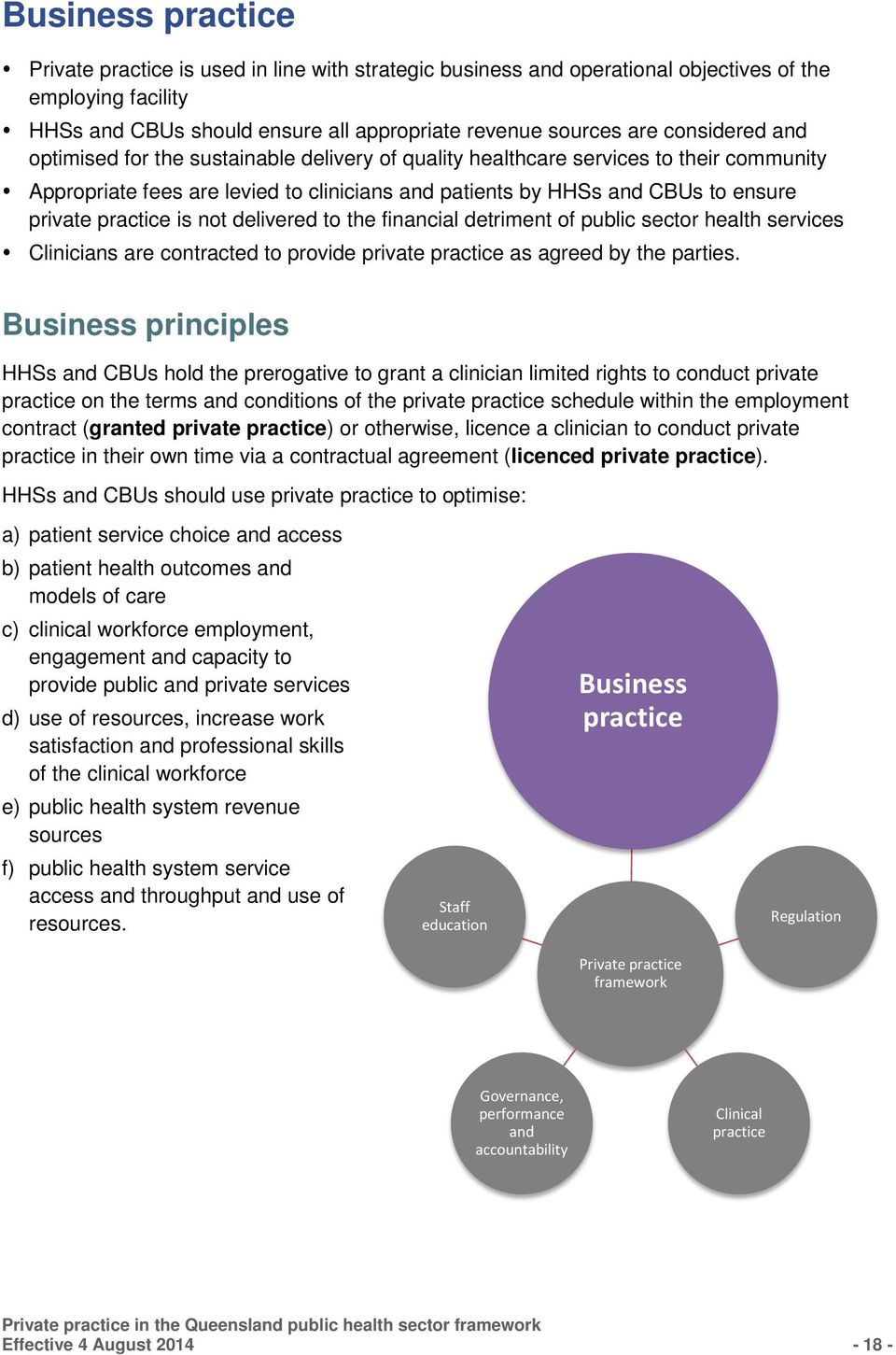
5 Introduction For the purpose of this document, private practice relates to the treatment of private patients in public health facilities. A private patient is a patient who elects to be treated as a private patient, and by doing so is responsible for paying applicable fees and is offered a choice of doctor (where available). Private practice in the Queensland public health sector facilitates patient choice, helps to retain a highly skilled workforce and enhances the overall financial sustainability of the public health system. Effective operation of private practice will achieve the following outcomes: quality patient services attracting and retaining a quality workforce financial sustainability optimal resource use (fixed assets and human capital). This framework contains five integral components to which private practice must adhere: 1. Regulation Private practice is provided in accordance with relevant legislation, regulation and policy. 2. Clinical practice Staff Private practice supports education evidence-based practice with a focus on achieving positive clinical outcomes. 3. Business practice Private practice supports the business requirements of Hospital and Health Services (HHSs) and commercialised business units (CBUs) in achieving efficient and costeffective delivery of health services. 4. Governance, performance and accountability Governance, performance and accountability Regulation Private practice framework Business practice Private practice is effectively managed and monitored to achieve key deliverables and desired outcomes in a financially sustainable manner. 5. Staff education Staff who undertake duties specific to private practice are supported by an education framework that provides access to training resources to enable them to successfully undertake those duties. Clinical practice Effective 4 August

6 Implementing the framework Hospital and Health Services (HHSs), the Department of Health commercialised business units (CBUs) should use this framework to guide private patient service delivery. Appendix 1 provides more specific recommendations for improvements against the framework components. Furthermore, the department will use the framework to guide whole-of-public health system improvement projects and scheme monitoring through the Statewide Private Practice Governance Board. Effective 4 August
7 Regulation Compliance with all regulatory requirements, including relevant policies, directives and standards. Identify and articulate regulatory requirements to all staff involved in private practice. Overview regulation requirements It is imperative that HHSs, CBUs and individuals operate with probity and propriety and comply with regulatory obligations when engaging in private practice activities. This includes compliance with Australian and Queensland Government legislation, intergovernmental agreements, regulatory instruments and other documents. Examples of these include the Health Insurance Act 1973, the Medicare Benefits Schedule, the National Healthcare Agreement, the National Health Reform Agreement and the Hospital and Health Boards Act The following principles underpin the regulation component of the framework: HHSs, CBUs and individuals will provide Medicare Benefits Schedule billed services in compliance with the Health Insurance Act A professional service provided by a clinician engaging in private practice is rendered under a contract between the clinician and the patient. Staff education Governance, performance and accountability Regulation Private practice framework Business practice Clinical practice Where support staff are involved in providing a service, the treating clinician is responsible for meeting the supervision requirements and must also attend to the patient where there is a requirement to do so (e.g. Medicare benefits for consultation items). Where contractually agreed, a clinician engaging in private practice authorises the HHS or CBUs as the agent to undertake the billing process on their behalf, and facilitate payment of service fees relating to the clinician s private practice. Clinicians are obliged to fulfil the terms and conditions of their employment contract, including any private practice arrangements and set performance targets as scheduled in the employment contract. Effective 4 August

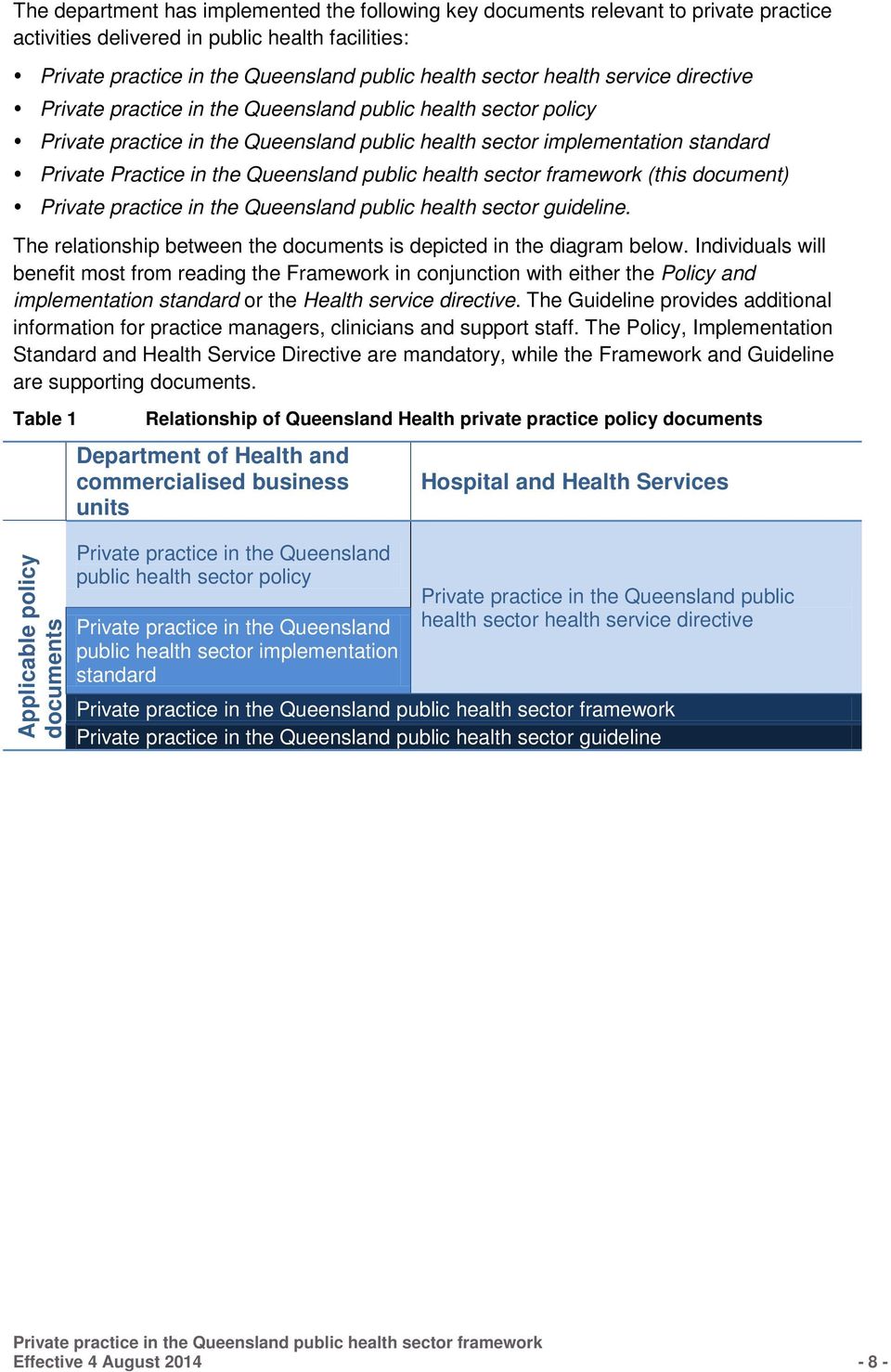
8 The department has implemented the following key documents relevant to private practice activities delivered in public health facilities: Private practice in the Queensland public health sector health service directive Private practice in the Queensland public health sector policy Private practice in the Queensland public health sector implementation standard Private Practice in the Queensland public health sector framework (this document) Private practice in the Queensland public health sector guideline. The relationship between the documents is depicted in the diagram below. Individuals will benefit most from reading the Framework in conjunction with either the Policy and implementation standard or the Health service directive. The Guideline provides additional information for practice managers, clinicians and support staff. The Policy, Implementation Standard and Health Service Directive are mandatory, while the Framework and Guideline are supporting documents. Table 1 Relationship of Queensland Health private practice policy documents Department of Health and commercialised business units Hospital and Health Services Applicable policy documents Private practice in the Queensland public health sector policy Private practice in the Queensland public health sector implementation standard Private practice in the Queensland public health sector health service directive Private practice in the Queensland public health sector guideline Effective 4 August
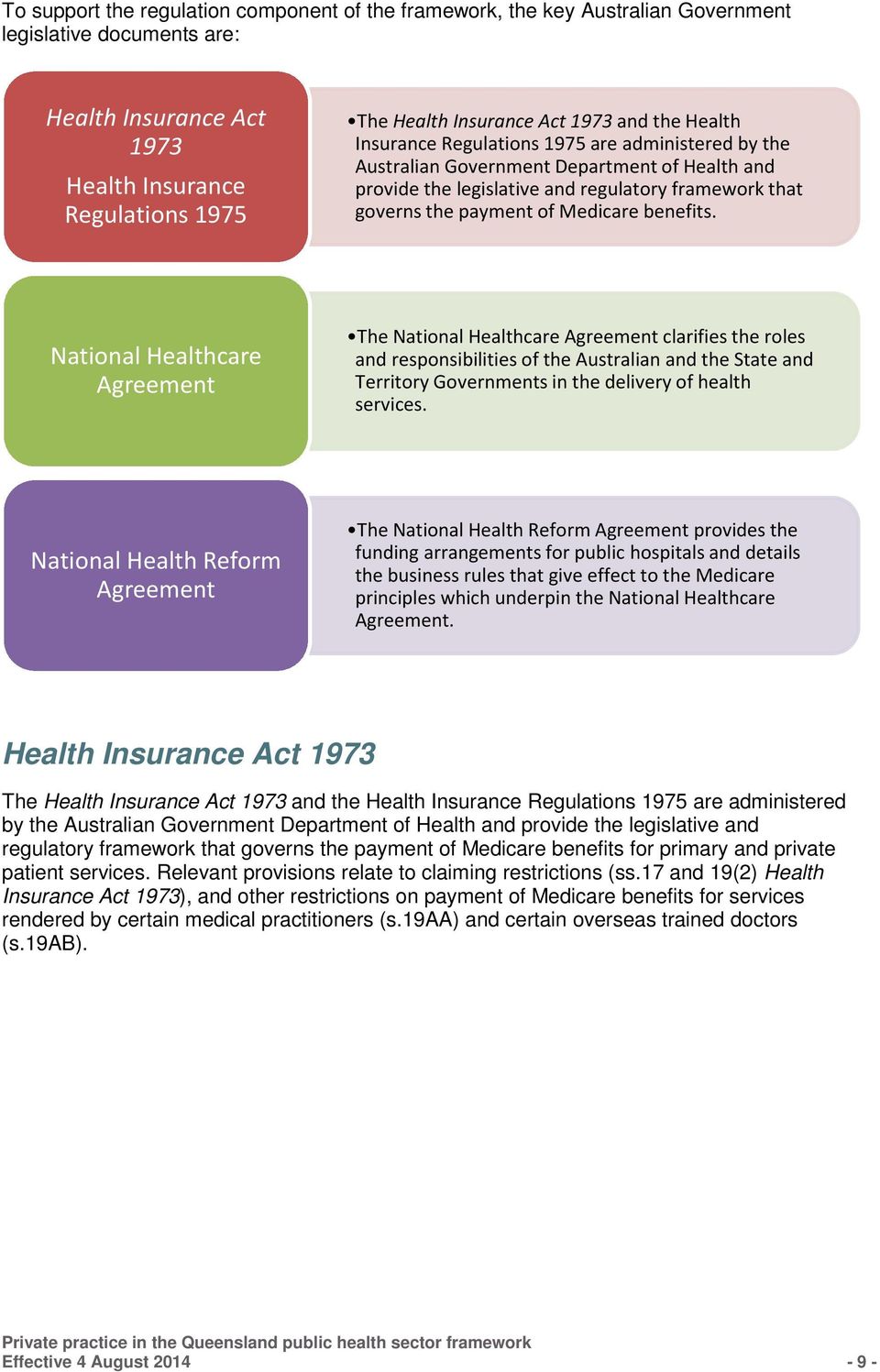
9 To support the regulation component of the framework, the key Australian Government legislative documents are: Health Insurance Act 1973 Health Insurance Regulations 1975 The Health Insurance Act 1973 and the Health Insurance Regulations 1975 are administered by the Australian Government Department of Health and provide the legislative and regulatory framework that governs the payment of Medicare benefits. National Healthcare Agreement The National Healthcare Agreement clarifies the roles and responsibilities of the Australian and the State and Territory Governments in the delivery of health services. National Health Reform Agreement The National Health Reform Agreement provides the funding arrangements for public hospitals and details the business rules that give effect to the Medicare principles which underpin the National Healthcare Agreement. Health Insurance Act 1973 The Health Insurance Act 1973 and the Health Insurance Regulations 1975 are administered by the Australian Government Department of Health and provide the legislative and regulatory framework that governs the payment of Medicare benefits for primary and private patient services. Relevant provisions relate to claiming restrictions (ss.17 and 19(2) Health Insurance Act 1973), and other restrictions on payment of Medicare benefits for services rendered by certain medical practitioners (s.19aa) and certain overseas trained doctors (s.19ab). Effective 4 August
10 Restrictions on claiming and ministerial directives Section 17 Medicare benefits not payable in respect of certain medical expenses 1. A Medicare benefit is not payable in respect of a professional service if: a) the medical expenses in respect of that service have been paid, or are payable, to a recognised hospital b) the clinician who rendered the service was acting on behalf of an organisation that was, when the service was rendered, an organization prescribed for the purposes of this paragraph c) any part of the service was rendered on the premises of an organisation that was, when the service was rendered, an organisation referred to in paragraph (b) or d) any amount has been paid, or is payable, in respect of the service in accordance with a scheme to which section 42B applies. Source: s.17 Health Insurance Act 1973 (Cth) The objective of s.17 of the Health Insurance Act 1973 is to avoid double payment for a service that is funded by other means and therefore, is not to generate a Medicare benefit claim. Relevantly, no Medicare benefit is payable for a claim for medical expenses where a professional service is provided to a public patient in a public hospital, and the professional service has been funded under Commonwealth-State funding arrangements. Section 19(2) Medicare benefit not payable in respect of certain professional services 2. Unless the Minister otherwise directs, a Medicare benefit is not payable in respect of a professional service that has been rendered by, or on behalf of, or under an arrangement with: a) the Commonwealth b) a State c) a local governing body or d) an authority established by a law of the Commonwealth, a law of a state or a law of an internal territory. Source: s.19 Health Insurance Act 1973 (Cth) Ministerial directives have been granted under s.19(2) to permit Medicare rebates to be claimed for state-remunerated primary health care services that is, public, non-admitted, non-referred primary care services in certain locations. The revenue generated from these initiatives is used to enhance primary care services at the site where the revenue is generated. The Rural and Remote Medical Benefits Scheme has been operating since 1997 in Queensland under a s.19(2) exemption and applies to a number of communities with significant Aboriginal and Torres Strait Islander populations together with an exemption for the Inala Indigenous Health Service. In addition, an exemption scheme applies to various other rural communities as part of a Council of Australian Governments (COAG) 2006 agreed suite of measures designed to improve primary health care in rural communities of less than 7000 people with an identified general practitioner shortage. Effective 4 August

11 Queensland Health s interpretation of the boundaries of s.19(2) is that an exemption is not required where a clinician exercises private practice. For example, the Australian Government Department of Health has indicated that a s.19(2) exemption is not required where a payment is made by the State, or a state agency to a clinician, with respect to: premises staff travel equipment any other support services. In the absence of any case law on the issue, reliance has been placed by the State on the understood view of the Australian Government Department of Health that a professional service rendered by a practitioner pursuant to his or her private practice, would be rendered under a contract between the practitioner and the patient, and not by, for, or on behalf of or under an agreement with the government or statutory authority that has granted the private practice. Medicare Benefits Schedule The Medicare system was introduced by the Australian Government in 1984 to provide eligible Australian residents with financial rebates when accessing medical, optometrical and dental services as a private patient. The Medicare Benefits Schedule is developed from the Health Insurance Act 1973 and Health Insurance Regulations 1975 and sets out the requirements that must be met for claiming payment for professional services from Medicare. Medical practitioners and practice support staff must be aware of the general requirements of the Medicare Benefits Schedule and those specific to each item being claimed. The Medicare Benefits Schedule itemises professional services eligible for benefits from Medicare. Medicare benefits are payable only for clinically relevant services that are listed in the Medicare Benefits Schedule. A clinically relevant service is defined in the Medicare Benefits Schedule as one which is generally accepted by the relevant profession as necessary for the appropriate treatment of the patient. Each professional service is associated with a unique item number, service description, schedule fee and benefit payable. The types of services in the Medicare Benefits Schedule are reviewed and amended annually effective from 1 November each calendar year with minor updates occurring during the year. The updates are posted on the Commonwealth Department of Health Medicare Benefits Schedule website. Medical practitioners must meet eligibility criteria for providing professional services that will attract Medicare benefits as specified under the Health Insurance Act Effective 4 August

12 Section G.1.3 provides information on Medicare and billing practices. G.1.3. Medicare benefits and billing practices Key information on Medicare benefits and billing practices The Health Insurance Act 1973 stipulates that Medicare benefits are payable for professional services. A professional service is a clinically relevant service which is listed in the MBS. A medical service is clinically relevant if it is generally accepted in the medical profession as necessary for the appropriate treatment of the patient. Medical practitioners are free to set their fees for their professional service. However, the amount specified in the patient s account must be the amount charged for the service specified. The fee may not include a cost of goods and services which are not part of the MBS service specified on the account. Source: s.g.1.3. Medicare Schedule Benefits Book Section G.2.1 provides key information on provider eligibility for Medicare. G.2.1. Provider eligibility for Medicare To be eligible to provide medical service which will attract Medicare benefits, or to provide services for or on behalf of another practitioner, practitioners must meet one of the following criteria: (a) a recognised specialist, consultant physician or general practitioner (b) in an approved placement under section 3GA of the Health Insurance Act 1973 (c) a temporary resident doctor with an exemption under section 19AB of the Health Insurance Act 1973 and working in accord with that exemption. Any practitioner who does not satisfy the requirements outlined above may still practice medicine but their services will not be eligible for Medicare benefits. Note: New Zealand citizens entering Australia do so under a special temporary entry visa and are regarded as temporary resident doctors. Note: It is an offence under Section 19CC of the Health Insurance Act 1973 to provide a service without first informing a patient where a Medicare benefit is not payable for that service (i.e. the service is not listed in the MBS). Source: s.g.2.1. Medicare Schedule Benefits Book National Health Reform Act 2011 The object of the National Health Reform Act 2011 (Cth) is to establish the: Australian Commission on Safety and Quality in Health Care National Health Performance Authority Independent Hospital Pricing Authority Office of Administrator of the National Health Funding Pool National Health Funding Body. The National Health Reform Act 2011 is relevant to private practice insofar as it governs the establishment and functioning of national bodies associated with health reform. It does not prescribe specific rules relating to private practice, however, the Independent Hospital Pricing Authority sets the National Efficient Price for private patients treated in the public health sector. Effective 4 August

13 Intergovernmental agreements The National Healthcare Agreement 2012 and National Health Reform Agreement 2011 have been developed by Council of Australian Governments to facilitate implementation of health reform as an area of national importance identified in the Intergovernmental Agreement on Federal Financial Relations. The national healthcare agreement clarifies the roles and responsibilities that guide the Commonwealth and states and territories in the delivery of health services. Clause 20 of the National Healthcare Agreement 2012 requires that eligible persons are to be given the choice to receive, free of charge as public patients, health and emergency services of a kind or kinds that are currently, or were historically provided, by hospitals. Clause 27(d) requires the state to ensure that eligible persons who have elected to be treated as private patients have done so on the basis of informed financial consent. The National Health Reform Agreement 2011 sets out the funding arrangements for public hospitals and details business rules that give effect to the Medicare Principles, which underpin the National Healthcare Agreement Schedule G of the National Health Reform Agreement 2011 contains business rules with which service providers comply. Relevant clauses include: G14 Requires all admitted patients to make a written election to receive admitted patient care as either a public or private patient. It states, election by eligible patients to receive admitted public hospital services as a public or private patient will be exercised in writing before, at the time of, or as soon as possible after admission and must be made in accordance with the minimum standards set out in this agreement (p.58). G15 Provides that private patients have a choice of doctor and all patients will make an election based on informed financial consent (p.58). G16 Indicates that where care is directly related to an episode of admitted patient care, it should be provided free of charge as a public hospital service where the patient chooses to be treated as a public patient, regardless of whether it is provided at the hospital or in private rooms (p.58). G17 Specifies that services provided to public patients should not generate charges against the Commonwealth MBS: i) except where there is a third party payment arrangement with the hospital or the state, emergency department patients cannot be referred to an outpatient department to receive services from a medical specialist exercising a right of private practice under the terms of employment or a contract with a hospital which provides public hospital services ii) referral pathways must not be controlled so as to deny access to free public hospital services iii) referral pathways must not be controlled so that a referral to a named specialist is a prerequisite for access to outpatient services (p.58). G18 Requires that an eligible patient presenting at a public hospital emergency department will be treated as a public patient, before any clinical decision to admit. On admission, the patient will be given the choice to elect to be a public or private patient in accordance with the National Standards for Public Hospital Admitted Patient Election processes (unless a third party has entered into an arrangement with the hospital or the state to pay for such services). If it is clinically appropriate, the hospital may provide information about alternative service providers, but must provide free treatment if the patient chooses to be treated at the hospital as a public patient. Effective 4 August

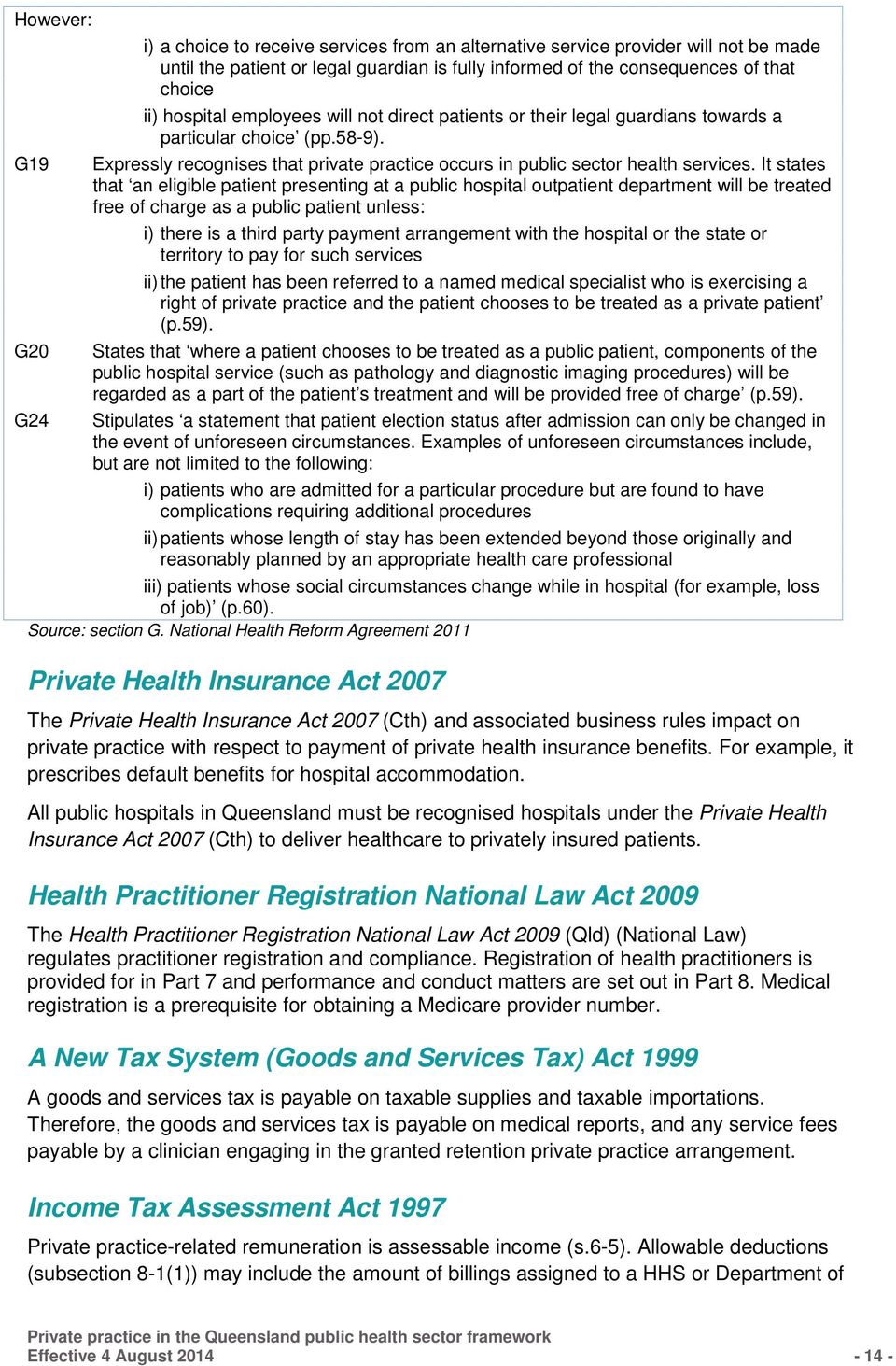
14 However: G19 G20 G24 i) a choice to receive services from an alternative service provider will not be made until the patient or legal guardian is fully informed of the consequences of that choice ii) hospital employees will not direct patients or their legal guardians towards a particular choice (pp.58-9). Expressly recognises that private practice occurs in public sector health services. It states that an eligible patient presenting at a public hospital outpatient department will be treated free of charge as a public patient unless: i) there is a third party payment arrangement with the hospital or the state or territory to pay for such services ii) the patient has been referred to a named medical specialist who is exercising a right of private practice and the patient chooses to be treated as a private patient (p.59). States that where a patient chooses to be treated as a public patient, components of the public hospital service (such as pathology and diagnostic imaging procedures) will be regarded as a part of the patient s treatment and will be provided free of charge (p.59). Stipulates a statement that patient election status after admission can only be changed in the event of unforeseen circumstances. Examples of unforeseen circumstances include, but are not limited to the following: i) patients who are admitted for a particular procedure but are found to have complications requiring additional procedures ii) patients whose length of stay has been extended beyond those originally and reasonably planned by an appropriate health care professional iii) patients whose social circumstances change while in hospital (for example, loss of job) (p.60). Source: section G. National Health Reform Agreement 2011 Private Health Insurance Act 2007 The Private Health Insurance Act 2007 (Cth) and associated business rules impact on private practice with respect to payment of private health insurance benefits. For example, it prescribes default benefits for hospital accommodation. All public hospitals in Queensland must be recognised hospitals under the Private Health Insurance Act 2007 (Cth) to deliver healthcare to privately insured patients. Health Practitioner Registration National Law Act 2009 The Health Practitioner Registration National Law Act 2009 (Qld) (National Law) regulates practitioner registration and compliance. Registration of health practitioners is provided for in Part 7 and performance and conduct matters are set out in Part 8. Medical registration is a prerequisite for obtaining a Medicare provider number. A New Tax System (Goods and Services Tax) Act 1999 A goods and services tax is payable on taxable supplies and taxable importations. Therefore, the goods and services tax is payable on medical reports, and any service fees payable by a clinician engaging in the granted retention private practice arrangement. Income Tax Assessment Act 1997 Private practice-related remuneration is assessable income (s.6-5). Allowable deductions (subsection 8-1(1)) may include the amount of billings assigned to a HHS or Department of Effective 4 August
15 Health. Clinicians must obtain independent taxation advice about the impact of private practice on their income. The HHS or Department of Health (as applicable) is responsible for providing relevant information required by clinicians for taxation purposes. Competition and Consumer Act 2010 The provisions of the Competition and Consumer Act 2010 (Cth) bind the Crown in right of the state to the extent that the Crown carries on a business, either directly or by an authority of the state. Government entities do not typically have to be concerned with the prohibitions under competition law where they are carrying on governmental or welfare functions. Activities performed in a statutory duty or government function or engaged solely for traditional government purposes are unlikely to amount to carrying on a business. However, where government entities are considered to be carrying on a business because the activities are commercial, care needs to be taken to ensure no unlawful conduct occurs including: contracts that substantially lessen competition price-fixing third line forcing misleading conduct. Hospital and Health Boards Act 2011 Section 45 of the Hospital and Health Boards Act 2011 (Qld) sets out the functions of the Director-General, Department of Health, which include: employing staff in the Department or HHSs other than a prescribed HHSs managing statewide industrial relations, including the negotiation of certified agreements and making applications to make or vary awards establishing the terms and conditions of employment for health service employees (s.45(e)-(g)). Health Service Directives for purposes specified in the Hospital and Health Boards Act s.47(1) The Director-General may develop and issue Health Service Directives to support the application of public sector policies, state and Commonwealth acts and agreements entered into by the state. s.47(2) The Director-General may develop and issue Health Service Directives about the setting of fees and charges, including for the provision of services to private patients, for residential care and for the supply of pharmaceuticals s.47(6)(iv) The Director-General may develop and issue Health Service Directives to HHSs relating to matters that support the delivery of health services, including private practice arrangements for health professionals. Effective 4 August
16 Financial legislation and related instruments The Financial Accountability Act 2009 (Qld) and related regulatory regime including the Financial Accountability Regulation 2009 (Qld), Financial Performance and Management Standard 2009 and the local Financial Management Practice Manual govern many aspects of the private practice schemes. A HHS or CBU s financial management practice manual identifies the key internal financial controls and other governance practices that collectively constitute a financial management framework. Parts of it are relevant to private practice. For example, it sets out accounting practices and aspects relating to maintenance of appropriate documentation and debt recovery. HHSs and CBUs must comply with the Health Service Directive - Own Source Revenue - Central Coordination of Fees and Charges Increases and Category C Negotiation and Acquisition. The Own Source Revenue Health Service Directive states that the intent of a central administration approach is to achieve efficient administration of ongoing fee increases and achieve commercially viable cost recovery for fee paying patient services. The Department of Health s Fees and Charges Register is established under the directive and outlines the fees and charges applicable for fee paying patient services. Other key internal documents Human Resources Policy I2 Indemnity for Queensland health medical practitioners Queensland Health provides indemnity for clinicians when they are treating public patients and private patients in accordance with Human Resources Policy I2 Indemnity for Queensland Health Medical Practitioners ( I2 ) subject to certain limitations. Policy I2 has been updated to include cover for legal representation and legal assistance for a Medicare Australia investigation or inquiry relating to a practitioner s participation in private patient activities during the course of their employment. The doctor must have acted diligently and conscientiously in complying with relevant Queensland Health policies and procedures. Credentialing and defining the scope of clinical practice for medical practitioners All registered medical practitioners practicing in public health facilities are to be credentialed and have an approved scope of clinical practice prior to providing clinical services. The practitioner's approved scope of clinical practice must be consistent with their registration status and consistent with the approved clinical services capability framework level for that clinical service. For more information, refer to the Credentialing and defining the scope of clinical practice policy. Code of Conduct for the Queensland Public Service The Queensland Public Service Code of Conduct applies to all staff employed in the Department of Health and HHSs and applies to employees when conducting private practice. Effective 4 August

17 Clinical practice Private practice is conducted in a way that enhances public practice as the primary mode of care. Promote private practice as a mechanism to support public practice. Patient safety and quality patient care is prioritised above private or public patient election status. Private practice is to be conducted in a manner that is consistent with, and supportive of, the clinical requirements and standards of public patient care. That is, the provision of private patient services must: be delivered in a manner that is consistent with the Medicare Principles that underpin the National Health Reform Agreement adhere to the same clinical standards and requirements that are applied to public service delivery support and enhance the clinical objectives and outcomes of public service delivery (i.e. teaching, training, research etc.) enhance access to patient care and clinical outcomes without discrimination on ability to pay (i.e. private patient services must support access to care and the quality of treatment provided in the public sector regardless of a patient s ability to pay) not compromise patient safety and clinical outcomes at the expense of income generation be conducted in accordance with the Credentialing and Defining the Scope of Clinical Practice Policy. Staff education Governance, performance and accountability Clinical practice Private practice framework Business practice Regulation Effective 4 August

18 Business practice Private practice is used in line with strategic business and operational objectives of the employing facility HHSs and CBUs should ensure all appropriate revenue sources are considered and optimised for the sustainable delivery of quality healthcare services to their community Appropriate fees are levied to clinicians and patients by HHSs and CBUs to ensure private practice is not delivered to the financial detriment of public sector health services Clinicians are contracted to provide private practice as agreed by the parties. Business principles HHSs and CBUs hold the prerogative to grant a clinician limited rights to conduct private practice on the terms and conditions of the private practice schedule within the employment contract (granted private practice) or otherwise, licence a clinician to conduct private practice in their own time via a contractual agreement (licenced private practice). HHSs and CBUs should use private practice to optimise: a) patient service choice and access b) patient health outcomes and models of care c) clinical workforce employment, engagement and capacity to provide public and private services d) use of resources, increase work satisfaction and professional skills of the clinical workforce e) public health system revenue sources f) public health system service access and throughput and use of resources. Staff education Business practice Private practice framework Regulation Governance, performance and accountability Clinical practice Effective 4 August
19 General business rules HHSs and CBUs are to charge clinicians fees for private practice activities in accordance with the Department of Health s Fees and Charges Register, unless other fee arrangements are approved by the Director-General. Clinicians are permitted to conduct private practice on the terms and conditions of the employment contracts and applicable schedules in Health Service Directive Private Practice in the Queensland Public Health Sector, unless other contractual arrangements are approved by the Director-General. HHSs and CBUs are to provide clinicians with a statement detailing private practice earnings and all fees paid on a monthly basis, within 21 days of the month ending, to assist the clinician with reporting obligations (e.g. taxation reporting). Private patients have a choice of doctor (where available) and all patients will make an election based on informed financial consent. HHSs and CBUs should develop a business plan for the management of private practice to manage achievement of objectives in accordance with specific local requirements and general business requirements, including: Where acting as the agent of clinicians conducting private practice, administering that role in a simple, efficient and professional manner. Having the clinician actively involved in all aspects of their private practice activities. This includes ensuring all billings are approved by the clinician, providing monthly reports of billings against the clinician s Medicare provider number and ensuring support staff provide clear, prompt communication to the clinician when informed financial consent has been obtained from a patient to be treated privately. Developing processes for recovering outstanding debt. Undertaking regular analysis of private practice activities to determine if these activities are being delivered in a sustainable manner and notifying the accountable officer where there is material risk of this being achieved. HHSs and CBUs are to investigate funding source implications of a professional service being delivered to a patient being treated publically or privately to determine best funding source value. These activities may form the basis for health service planning, strategic business approaches and will ultimately guide the decision to offer a private practice arrangement to a clinician. HHSs and CBUs may nominate an assignment or retention remuneration model for clinicians conducting granted private practice during their employed time. Effective 4 August

20 Granted private practice options Assignment Retention In cases where a service requires a clinician to engage in private practice (in response to clinical need, business requirements or patient choice), private practice can be granted under this model. This will be the default arrangement. Performance measures in the employment contract can/may include a requirement to treat private patients. All revenue is assigned to the Hospital and Health Service or commercialised business unit. A service may grant a clinician permission to engage in private practice during employed time and retain private practice revenue after paying the applicable fees and GST. Performance measures in the employment contract can/may include a requirement to treat private patients. An earnings ceiling (threshold) is applicable. Disbursement of service fee revenue and earnings ceiling (threshold) revenue to trust or operating accounts is at the discretion of the service. Billing HHSs and CBUs will take on the functions of billing, collection and distribution of granted private practice revenue. Strict process monitoring mechanisms are to be implemented. Where a clinician is engaged under the assignment arrangement, HHSs and CBUs, as the billing agent acting on behalf of the clinician, retain 100 per cent of revenue through the tax invoice method. Where a clinician is engaged under the retention arrangement, HHSs and CBUs, as the billing agent acting on behalf of the clinician, raise service fees in accordance with the Department of Health fees and charges register. Service fees are to be deducted from gross revenue through the tax invoice method. Fees and charges Fees for professional services can be set by the individual clinician under agreement with the HHSs or CBUs, however the default fee rates are those contained in the Medicare Benefits Schedule of fees (generally 85 per cent of the schedule fee for non-admitted patients and 100 per cent of the schedule fee for admitted patients). Service fees and other fees and charges to be levied by a HHS or CBU are detailed in the Department of Health fees and charges register. Effective 4 August

21 Service fees for granted retention arrangement Private practice is granted on the proviso that private patient activities are performed alongside employment to treat public patients. Service fees are payable by individuals engaged under the retention arrangement as contribution to costs relating to private patient service delivery. Service fees are calculated as a percentage of the collected gross billings for a private inpatient or outpatient service. Service fees aim to recover some of the costs in relation to: use of equipment (including capital, depreciation and maintenance) provision of technical, clinical and administrative support including the provision of practice staff and administration, including billing use of consulting rooms and other infrastructure clinical and other consumables professional indemnity. MBS rates in many categories are not designed to fund full practice costs and hence generating income solely from MBS fees may not cover costs regardless of the level of service fee charged. HHSs and CBUs will need to undertake local financial analysis to determine if private patient service models are viable, with particular regard to the private patient activity based funding model. Service fees have been set based on the following principles: Clinical area / item category Medical specialist Clinical and other supplies Practice staff / resources Infrastructure Minor capital Major capital Pathology Medical imaging Radiation oncology Nuclear medicine Diagnostic procedures Surgical procedures Services not contained in the MBS Miscellaneous services Therapeutic procedures (exc rad. onc.) Professional attendances Note: Service fees and the annual earnings ceiling (threshold) will be set annually and gazetted in the Department of Health fees and charges register. Note: Service fees for the granted retention arrangement are not to vary from what is prescribed in the Department of Health fees and charges register. This fee structure only applies to granted private practice. Fees applicable for commercial arrangements including licenced private practice are to be determined at HHS or CBU level. Examples of cost drivers within the abovementioned item categories include: Medical specialist Expenses in relation to clinician s employment i.e. salary, superannuation, indemnity, on costs Clinical and other supplies Minor clinical consumables, pharmaceuticals and general supplies Practice staff/ resources Administration, accounts receivable and clinical support Infrastructure Clinic rooms, building maintenance, minor equipment Minor capital works Medium cost equipment and consumables Major capital works High cost equipment Effective 4 August
22 Disbursement of service fees Service fees received by the HHS or CBU are able to be credited to either an operating account or trust account, at the chief executive s discretion. The return of service fees to the actual division generating that revenue is a decision for the HHS or CBU. However, returning revenue to the division generating the revenue is considered best practice as it ensures transparency and incentivises participation. Group revenue retention arrangements A HHS or CBU may decide to grant an individual the ability to engage in the retention arrangement on the proviso that the individual agrees to be a member of a group (e.g. radiology group practice). The private practice schedule of the employment contract provides the ability for a clinician to direct their net earnings to a third party. If an individual enters into a group retention arrangement with his/her colleagues, net earnings will be subject to the combined threshold level of all group participants.at a minimum, HHSs and CBUs shall provide to clinicians entering into a group revenue retention arrangement: monthly payment into the group s nominated bank account(s) timely information identifying medical fees billed and disbursed to enable the group participants to manage their group obligations. Agreements are to be developed and managed locally. Earnings ceiling (threshold) Clinicians engaged under the retention arrangement may retain granted private practice revenue after payment of the applicable service fees, up to the earnings ceiling published annually in the Department of Health fees and charges register. Once the clinician retains a net amount (i.e. balance after paying service fees) equal to the ceiling, only $1 in every $3 is available to be retained by the clinician from that point forward for the remainder of the financial year, with the balance being credited to the employing HHS or CBU. Revenue retained by HHSs and CBUs may be disbursed to specific trust or operating accounts at the discretion of the HHS or CBU chief executive. When a clinician starts their employment part way through a financial year, the ceiling amount is to be adjusted as per the following formula: Note: Number of months remaining is to be calculated to the nearest full month Effective 4 August
23 The diagram below demonstrates the effect of the earnings threshold: Incentive payments Incentive payments as advised by the Australian Government Department of Health (Medicare) should be considered on an individual incentive scheme basis by the Private Practice Governance Board. Any fees determined by the Private Practice Governance Board will be managed through the fees and charges register. Taxation The taxation treatment of income derived from private practice varies with the contract option of the clinician. Note that the information provided below is generic in nature and is provided only as a guide and it is recommended that all medical officers engaging in private practice should seek individual tax advice. It is a policy requirement that hospitals provide clinicians with monthly and annual earnings statements, identifying services billed and receipted, charges levied and any GST withheld to enable the clinician to meet his or her Australian Taxation Office reporting obligations. Taxation revenue assignment arrangement Under this arrangement, the clinician provides the HHS or CBU with the right to render accounts in the clinician s name (or related entity) and collect all fees payable by private patients which is then assigned to the HHS or CBU. Regardless of whether a clinician is engaged under the assignment or retention arrangement, private practice income from fees and charges billed under the clinician s provider number for private patient activities is regarded as assessable ordinary income of the clinician under Section 6 5 of the Income Tax Assessment Act 1997, and the gross amount billed under the clinician s Medicare provider number should be disclosed as such in the clinician s tax return. Revenue generated by clinicians that is assigned to the HHS or CBU, represents work related expenses and is therefore an allowable deduction under Section 8 1 of the Effective 4 August
24 Income Tax Assessment Act Such expenses should be disclosed as allowable deductions in the clinician s tax return and in effect will generally result in a netted off position. However, it is advisable that clinicians do disclose both the private practice gross billings (income) and the amount assigned (deductions) relating to the private practice in their tax return. Taxation revenue retention arrangement Under the retention arrangement, the HHS or CBU grants a clinician the right to provide medical services to private patients alongside public employment duties. In return the clinician provides the employer with the right to render accounts in the clinician s name (or related entity) and collect all fees payable. From this revenue, clinicians are entitled to the net amount remaining after deductions of GST and Service fees payable up to the applicable earnings ceiling. The fees retained by the clinician are not salary and wages as defined in the Income Tax Assessment Act As a consequence of this, the income paid to the clinician arising out of private practice is not subject to the deduction of PAYG tax withholding. Private practice income may be seen to be derived as ordinary business income and as such is assessable income under Section 6 5 of the Income Tax Assessment Act Licenced private practice Licenced private practice includes, but is not limited to, clinicians conducting private practice: outside work hours (if the clinician is also employed by the HHS or CBU) in the course of a university or honorary appointment in circumstances where the clinician is not an employee or appointee of the HHS or CBU. Licenced private practice is an arrangement granted by the HHS or CBU for an individual to undertake private patient activities at a public health facility during unpaid time. The arrangement is to be formally agreed between the parties in writing as like any other commercial agreement, to be developed at the local level. Patient billings for services such as accommodation, consumables, prosthetics, etc., provided by the hospital will be processed by the HHS as the billing agent. Clinicians engaged under a licenced private practice arrangement can elect to use the HHS or CBU as the billing agent for their professional services, however administration fees may apply. Individuals participating in a licenced private practice arrangement will need to maintain their own indemnity during these activities. Licenced private practice activity will be assigned to the correct payment class in the patient administration system (e.g. HBCIS account code for overnight patient = GSEL). Resources, support services and infrastructure access are to be negotiated at the local level to address community, professional and service needs. However, these arrangements are to be conducted on a purely commercial basis and will be publicly defensible. Effective 4 August
25 Medical superintendent with private practice (MSPP) and medical officer with private practice (MOPP) As per section 30(2) of the employment contract, schedule 3 of the employment contract does not apply to medical superintendents with private practice (MSPP) or medical officers with private practice (MOPP). Due to the unique nature and long standing history of private practice arrangements for MSPPs and MOPPs, private practice arrangements for MSPPs and MOPPs are to be negotiated at the local level through an exchange of letters or written agreement. The arrangements outlined in the exchange of letters or agreement will form part of the terms of employment in conjunction with Industrial Relations Manual HHSs are to develop the exchange of letters / agreement locally however an example template and applicable guideline can be obtained by contacting [email protected] Effective 4 August
26 Governance, performance and accountability Appropriate and effective governance is established and sustained. Meaningful key performance indicators are set and used as a tool to measure scheme performance Establish a local performance and governance approach that clearly defines objectives and performance expectations, with a central point of accountability to ensure that local private practice activities achieve their objectives in a financially sustainable manner Internal controls are in place to ensure overall business integrity and compliance with policies, directives and frameworks Governance approach An accountable officer will be assigned by the HHS or CBU chief executive the responsibility to oversee private practice activities. HHSs and CBUs will establish a private practice governance committee (or delegate an alternative committee) to oversee the administration of private practice arrangements operating within their jurisdiction and ensure it performs the following functions: provide clear governance and direction for private practice arrangements through ensuring activities comply with statewide and local directives and policies monitor performance criteria to ensure private practice arrangements achieve their desired outcomes in a financially sustainable manner. Staff education Business practice Governance, performance and accountability Private practice framework Clinical practice Regulation Effective 4 August
27 Private practice governance approach: The below diagram demonstrates the governance relationship between HHSs and the Department of Health. Statewide coordination Executive management team Statewide private practice governance board Practice management advisory network Accountability & Strategy Board Local HHS/CBU governance and monitoring Escalation Audit committee (compliance) or Finance committee (performance) Monitoring Private practice governance committee Statewide responsibilities Issue the Health Service Directive, policy, implementation standard, framework and guideline. Maintain and update the Department of Health Fees and Charges Register - Granted Private Practice Service Fees and Thresholds. Maintain employment contract template, including the private practice schedule. Maintain recognised rural private practice agreement template example. Local responsibilities Comply with statewide policies and directives. Develop and implement local operational policy. Comply with regulatory requirements. Negotiate private practice contracts and applicable performance measures. Ensure efficient operation of private practice across the health service. Maintain robust private practice governance and internal controls. Implement effective strategies to address private practice performance indicator shortfalls as required. Effective 4 August
28 The following information provides an overview of the relevant board and committee responsibilities at the statewide and local level: Statewide private practice governance board The purpose of the private practice governance board is to work as an authoritative governance body providing oversight of the administration of private practice arrangements operating across HHSs and CBUs as follows: provide overarching governance and statewide strategic direction for private practice arrangements and associated frameworks, policies, directives and guidelines establish and monitor performance criteria to ensure the private practice arrangements achieve their desired outcomes in a financially sustainable manner take remedial action where required and/or escalate the matter where appropriate (i.e. performance management team). Local private practice governance committee HHSs and CBUs are responsible for the successful operation of private practice at the local level, and will implement a robust governance framework and oversight committee chaired by an accountable officer to ensure the following: compliance with statewide policies and directives local operational policy is developed and implemented objectives of private practice activities and outcomes are clearly defined and regularly measured against key performance indicators and remedial action is taken where appropriate robust governance and internal controls are maintained remedial action where required and/or escalate the matter where appropriate (local audit committee, jurisdictional board, Statewide private practice governance committee etc.). Statewide practice management advisory network The practice management advisory network is a multidisciplinary group focused on developing tools and resources necessary to support, optimise and monitor private practice activities across Queensland Health. To contribute to the management and delivery of quality private patient services the practice management advisory network undertakes to provide a network structure that will: collaboratively develop resources and tools (e.g. protocols, procedures, guides, reports) that support the optimisation of the private practice scheme provide a platform for knowledge transfer between HHSs and CBUs, and the private sector on professional practice management promote a culture across Queensland Health recognising the benefits of private practice options and own source revenue. Effective 4 August
29 Governance process Systems are required to be developed and monitored (and efforts documented) to maximise private practice revenue where appropriate and be reviewed periodically in line with funding source changes. The officer responsible for executing the contract with clinicians engaging in private practice will ensure performance reviews occur at least annually. The accountable officer will ensure that benefits of private practice are demonstrated to reasonably recover costs at the HHS or CBU level. HHSs and CBUs should investigate opportunities to streamline processes to realise private practice system efficiencies. Internal controls Internal controls will be in place to ensure: the activities of private practice are conducted in a manner that facilitates the achievement of its objectives and the delivery of its services in an orderly and efficient manner error, fraud and other irregularities are prevented as much as possible and promptly detected through a systematic approach if they do occur assets and consumables used in private practice activities are safeguarded from unauthorised use or disposal and are adequately maintained and monitored financial and management performance reports are timely, relevant, reliable and accurate. The system of internal controls will: be documented be embedded in the operations of management and governance processes and form part of its culture be capable of responding quickly to evolving risks in the delivery of private practice activities include procedures for reporting significant control weaknesses that are identified, together with procedures to undertake corrective action. Effective 4 August
30 The diagram below (right) demonstrates the internal control approach that should be engaged at the local level to ensure effective coordination and achievement of performance objectives. Governance: Defines objectives and performance expectations with a central point of accountability. Control environments: Standards, processes and structures that form the basis of internal control. Risk assessment: Basis of determining how risks will be managed. Control activities: Actions established through policies and procedures that help ensure that management s directives to mitigate risks to the achievement of objectives are carried out. Governance Information and communication Control environment Internal control approach Monitoring activities Monitoring activities: Ongoing evaluations are used to ascertain whether the components of internal control are correctly designed and implemented and are operating effectively. Risk assesment Control activities Information and communication: Establish information systems so accountable officers may obtain timely, accurate and relevant information designed to assist in the strategic and operational management of their agency. Effective 4 August
31 Staff education All staff involved in private practice are to have access to and regularly participate in appropriate education activities. Comprehensive training programs and educational material should be provided to target audiences in various forms to facilitate compliance and support clinicians in the effective delivery of private patient services. This section of the framework specifies the education and training standards in which private practice is conducted within the public health sector. The regulatory and legislative instruments that govern the business operation of individual participation in private practice conducted within the public health sector, are complex and should be well understood prior to engaging in private practice activities. Staff (both clinical and support) require information that clearly defines their roles and responsibilities and outlines the correct processes to be undertaken. Education and training standards are aimed at achieving greater capability and consistency in the way clinicians and support staff engage in private practice. These standards identify learning objectives, desired knowledge and capability requirements and performance measures that will optimise private practice conducted within the public health sector. Education and training standards establish the required education and support elements that in turn will ensure: regulatory compliance and assurance incentivised participation service sustainability financial integrity. Governance, performance and accountability Business practice Staff education Private practice framework Clinical practice Regulation Effective 4 August
32 The following principles should be followed in developing local education and training standards and programs: To foster and support a collegiate environment for employees to participate in private practice through the terms of their engagement by: providing educational tools and training to facilitate compliance, and support clinicians and support staff in the effective delivery of private patient services developing and maintaining high quality teaching and learning resources for all staff involved in private practice activities. To facilitate best practice it is desired that staff have a working knowledge of the Private practice in the Queensland public health sector framework and guideline. Training packages and educational material should be provided in various forms to suit the audience (e.g. power point presentations, online training, etc.). Locally tailored training packages should be delivered as detailed in the diagram on the following page. Effective 4 August
33 Education and training groups Boards and executives Strategic Process Understanding of the private practice framework Finance managers and directors of medical services and senior management Comprehensive training on the National Health Reform Agreement, the Private Health Insurance Act 1973, in addition to understanding each framework component. Comprehensive understanding of private patient funding within ABF and the cost drivers relevant to private and public patient services. Medical practitioners Comprehensive training with particular focus and support on MBS in addition to an overview of each framework component and key requirements including personal obligations. Private practice/revenue managers Expert level competency, with training focusing on the MBS, the National Health Reform Agreement, the Private Health Insurance Act 1973 in addition to a comprehensive understanding of each framework component and key requirements. Comprehensive understanding of private patient funding within an activity based funding environment and the cost drivers relevant to private and public patient services. High level competency in financial accounting (both payable and recievable). Private practice support staff/patient administration staff Comprehensive understanding of the Medicare Benefits Schedule, the National Health Reform Agreement, the Private Health Insurance Act 1973, in addition to a comprehensive understanding of each framework component and key requirements. Effective 4 August
34 Definitions Term Activity based funding Clinician Commercialised business units (CBUs) Department of Health Granted private practice Hospital and Health Service (HHS) Independent Hospital Pricing Authority (IHPA) Licenced private practice Medical officer/practitioner Medical services Medicare Benefits Schedule (MBS) Medicare principles Definition A system for funding public hospital services provided to individual patients using national classifications, cost weights and efficient prices developed by the Independent Hospital Pricing Authority. An individual who provides diagnosis, or treatment, as a professional: a) medical practitioner b) nurse c) allied health practitioner or Health practitioner not covered by paragraph a), b) or c) (National Health Reform Act 2011). Health Services Support Agency (HSSA) and other commercialised business units employing clinicians that support or engage in private practice activities in the public health sector. The Department of Health includes employees working in and for: Health Service and Clinical Innovation Division System Support Services Division System Policy and Performance Division Office of the Director-General Health Services Support Agency Health Services Information Agency Queensland Ambulance Service (QAS). A limited right to provide professional services to private patients on the terms of Schedule 3 of the Employment Contract. A statutory body responsible for the provision of public sector health services for a geographical area which includes one or more health facilities. The authority established by the Commonwealth legislation in accordance with clause B1 to perform the functions set out in clauses B3 to B8. (National Health Reform Act 2011). An arrangement granted by the HHS or CBU for an individual to undertake private patient activities at a public health facility during unpaid time. A medical practitioner who is registered with the Medical Board of Australia under the Health Practitioner Registration National Law Act Any of the medical services set out in Schedule 1 of the Health Insurance Act The Commonwealth government s scheme to provide medical benefits to Australians established under part II, IIA, IIB and IIC of the Health Insurance Act 1973 together with relevant regulations made under the act. The principles set out in Clause 4 of the National Health Reform Agreement. Effective 4 August
35 National efficient price Pharmaceutical Benefits Scheme (PBS) Private patient Private practice (retention arrangement) Private practice (assignment arrangement) Private practice Public patient Queensland Health Scope of clinical practice Service fees The base price(s) which will be determined by the IHPA and applied to those services funded on the basis of activity for the purpose of determining the amount of Commonwealth funding to be provided to public health services. The IHPA may determine that there are different base prices for discrete categories of treatment, for example admitted care, sub-acute care, non-admitted emergency department care and outpatient care. In the event that there are multiple national efficient prices, the IHPA will determine which national efficient price applies. The Commonwealth government s scheme to provide subsidised pharmaceuticals to Australians established under part VII of the National Health Act 1953 together with the National Health (Pharmaceutical Benefits) Regulation 1960 made under the National Health Act. A person who could receive treatment free of charge under the National Health Reform Agreement 2011 but who has elected to be treated privately in the public system, or a person who agrees to be a fee paying patient of the medical officer and makes this election on the basis of informed financial consent. Private practice performed during employed time where the clinician retains billings after paying applicable Service fees. Private practice performed during employed time where the clinician assigns all billings to the HHS or CBU. Any contractual arrangement between the Department of Health, a HHS or CBU and clinical staff with these features: The medical treatment of a patient who has elected to be a private patient in respect to informed financial consent Clinical staff treating the private patient uses their Medicare Provider Number to facilitate billing where applicable In relation to a hospital, means a person in respect of whom the hospital provides comprehensive care, including all necessary medical, nursing and diagnostic services and, if they are available at the hospital, dental and paramedical services, by means of its own staff or by other agreed arrangements (Health Insurance Act 1973). The accumulative body of the Department of Health, CBUs and HHSs. The extent of an individual practitioner s approved clinical practice within a particular organisation based on the individual s credentials, competence, performance and professional suitability and the needs and capability of the organisation to support the practitioner s scope of clinical practice. The fees applicable to granted private practice retention arrangement participants, as specified in the Department of Health Fees and Charges Register Effective 4 August
36 Appendix 1: Framework implementation Regulation Clinical practice Business practice High level deliverables Compliance with all regulatory obligations, including relevant policies, directives, standards and areas such as patient rights and financial accounting standards. Supporting activities Identify and articulate regulatory requirements to all staff involved in private practice. Clinical practice is conducted in a way that enhances public practice as the primary mode of care. Promote private practice as a tool to support and enhance overall clinical services. Private practice is used in line with strategic business objectives of the employing facility. Investigate funding sources to determine best value (i.e. private versus public funding). Governance, performance and accountability Appropriate and effective governance of private practice is established and sustained. Improvements are measured against key performance indicators. Establish an accountable executive officer to oversee private practice. Staff education All staff involved in private practice are to participate in appropriate education activities and private practice managers are adequately trained and qualified. Develop standards and tools for education and training relevant to staff groups Patient safety and quality patient care is prioritised without regard to private or public patient election status. Monitor funding source data to develop a strategic business approach. Appropriate service fees are levied against individuals engaging in private practice. Clinicians are appropriately contracted to provide private practice. Clinician performance is reviewed annually against a set of agreed performance indicators. Collect private practice data, set key performance indicators and measure against the objectives. Investigate opportunities to streamline processes to realise efficiencies. Monitor education uptake and set education key performance indicators. Educational activities are evaluated and evidencebased updates conducted as appropriate. Contractual obligations should be clearly understood by all involved parties at the time of agreement. Private practice in the Queensland public health sector Effective 4 August
37 Document revision and approval history Version No Developed/modified by Approved by Date 1.0 Private Practice Reform Program Chair - Private Practice Governance Board 2.0 Private Practice Reform Program - (updated to align with corporate style guide and amended disbursement of fees section. 3.0 Private Practice Reform Program update the Service fees for granted retention arrangement table 4.0 Private Practice Reform Program update terminology of MSPP/MOPP. Insert comments on incentive payments 5.0 Private Practice Reform Program update licenced private practice to allow HHSs to negotiate specific agreements / templates. 6.0 Private Practice Reform Program Final style guide, amend MSPP/MOPP section with added link for example template. Chair - Private Practice Governance Board Chair Private Practice Governance Board Program Senior Director Private Practice Reform Program Senior Director Private Practice Reform Program Senior Director Private Practice Reform 22 January February March April May May 2014 Private practice in the Queensland public health sector Effective 4 August
38 Department of Health Private practice in the Queensland public health sector Effective 4 August
Private practice in the Queensland public health sector guideline
 Private practice in the Queensland public health sector guideline A guide to assist medical practitioners, practice managers and support staff in interpreting the requirements and arrangements of private
Registered nurse professional practice in Queensland. Guidance for practitioners, employers and consumers
 Registered nurse professional practice in Queensland Guidance for practitioners, employers and consumers December 2013 Registered nurse professional practice in Queensland Published by the State of Queensland
Specialist clinics in Victorian public hospitals. A resource kit for MBS-billed services
 Specialist clinics in Victorian public hospitals A resource kit for MBS-billed services 4 Clinical review of area mental health services 1997-2004 Specialist clinics in Victorian public hospitals A resource
Human Resources Policy
 Human Resources Policy Indemnity for Queensland Health Medical Practitioners Policy Number: I2 (QH-POL-153) Publication date: 4 Purpose: Application: The purpose of this policy is to outline the indemnity
NATIONAL PARTNERSHIP AGREEMENT ON E-HEALTH
 NATIONAL PARTNERSHIP AGREEMENT ON E-HEALTH Council of Australian Governments An agreement between the Commonwealth of Australia and the States and Territories, being: The State of New South Wales The State
The Australian Government. Department of Health and Ageing. Medicare Benefits Schedule Allied Health Services
 The Australian Government Department of Health and Ageing Medicare Benefits Schedule Allied Health Services 1 November 2007 PART 3 PSYCHOLOGICAL THERAPY SERVICES FOR PATIENTS WITH AN ASSESSED MENTAL DISORDER
Graduate nurse and midwife recruitment prospectus for 2016. August 2015
 Graduate nurse and midwife recruitment prospectus for 2016 August 2015 Graduate nurse and midwife recruitment prospectus for 2016 Published by the State of Queensland (Queensland Health), August 2015 This
Small Business Grants (Employment Incentive) Act 2015 No 14
 New South Wales Small Business Grants (Employment Incentive) Act 2015 No 14 Contents Page Part 1 Part 2 Preliminary 1 Name of Act 2 2 Commencement 2 3 Object of Act 2 4 Definitions 2 Grant scheme 5 Grant
Queensland. Health Practitioner Regulation (Administrative Arrangements) National Law Act 2008
 Queensland Health Practitioner Regulation (Administrative Arrangements) National Law Act 2008 Act No. 62 of 2008 Queensland Health Practitioner Regulation (Administrative Arrangements) National Law Act
Chiropractic Boards response 15 December 2008
 NATIONAL REGISTRATION AND ACCREDITATION SCHEME FOR THE HEALTH PROFESSIONS Chiropractic Boards response 15 December 2008 CONSULTATION PAPER Proposed arrangements for accreditation Issued by the Practitioner
Improving Access to Primary Care in Rural and Remote Areas (s19(2) Exemptions) Initiative
 Policy Directive Ministry of Health, NSW 73 Miller Street North Sydney NSW 2060 Locked Mail Bag 961 North Sydney NSW 2059 Telephone (02) 9391 9000 Fax (02) 9391 9101 http://www.health.nsw.gov.au/policies/
Guidelines on endorsement as a nurse practitioner
 Guidelines on endorsement as a nurse practitioner 7160 Introduction The National Registration and Accreditation Scheme (the National Scheme) for health professionals in Australia commenced on 1 July 2010
Public consultation paper
 Public consultation paper September 2013 Proposed expanded endorsement for scheduled medicines Draft Registration standard for endorsement of registered nurses and/or registered midwives to supply and
Registered Nurse professional practice in Queensland
 Nursing and Midwifery Office, Queensland Strengthening health services through optimising nursing Registered Nurse professional practice in Queensland Guidance for practitioners, employers and consumers.
Vocational Education and Training (Commonwealth Powers) Bill 2012
 Vocational Education and Training (Commonwealth Powers) Bill 2012 Explanatory Notes Short title The Short title of the Bill is the Vocational Education and Training (Commonwealth Powers) Bill 2012. Policy
NATIONAL HEALTHCARE AGREEMENT 2012
 NATIONAL HEALTHCARE AGREEMENT 2012 Council of Australian Governments An agreement between the Commonwealth of Australia and the States and Territories, being: t t t t t t t t the State of New South Wales;
Employee Information Guide. Salary Packaging
 Guide Salary Packaging April 2014 Contents Contents... 2 Disclaimer... 4 1. Introduction... 5 1.1 About this guide... 5 1.2 Financial Advice... 5 1.3 What is Salary Packaging?... 5 1.4 Who is eligible
PERSONAL ALERT SYSTEMS REBATE SCHEME PROVIDER PANER DEED
 DATED DAY OF 2015 PERSONAL ALERT SYSTEMS REBATE SCHEME PROVIDER PANER DEED between MINISTER FOR COMMUNITIES AND SOCIAL INCLUSION - and - [INSERT PARTY NAME] ACN [INSERT] Page 1 of 1 TABLE OF CONTENTS BACKGROUND...
Clinical Governance for Nurse Practitioners in Queensland
 Office of the Chief Nursing Officer Clinical Governance for Nurse Practitioners in Queensland A guide Clinical Governance for Nurse Practitioners in Queensland: A guide Queensland Health Office of the
Code of Conduct for registered migration agents
 Code of Conduct for registered migration agents Current from 1 JULY 2012 SCHEDULE 2: CODE OF CONDUCT (regulation 8) Migration Act 1958, subsection 314(1) THIS CODE OF CONDUCT SHOULD BE DISPLAYED PROMINENTLY
Mental Health Nurse Incentive Program Program Guidelines
 Mental Health Nurse Incentive Program Program Guidelines 1 Introduction On 5 April 2006, the Prime Minister announced the Australian Government would provide funding of $1.9 billion over five years for
An Act to re-enact and modernise the law relating to payroll tax; to harmonise payroll tax law with other States; and for other purposes.
 Version: 1.7.2013 South Australia Payroll Tax Act 2009 An Act to re-enact and modernise the law relating to payroll tax; to harmonise payroll tax law with other States; and for other purposes. Contents
NATIONAL PARTNERSHIP AGREEMENT ON TRANSITIONING RESPONSIBILITIES FOR AGED CARE AND DISABILITY SERVICES
 National Partnership Agreement on Transitioning Responsibilities for Aged Care and Disability Services NATIONAL PARTNERSHIP AGREEMENT ON TRANSITIONING RESPONSIBILITIES FOR AGED CARE AND DISABILITY SERVICES
Terms and Conditions of Offer and Contract (Works & Services) Conditions of Offer
 Conditions of Offer A1 The offer documents comprise the offer form, letter of invitation to offer (if any), these Conditions of Offer and Conditions of Contract (Works & Services), the Working with Queensland
CUBS SUPERANNUATION FUND Trust Deed. The Trust Company (Superannuation) Limited (Trustee)
 CUBS SUPERANNUATION FUND Trust Deed The Trust Company (Superannuation) Limited (Trustee) Table of contents Part 1A - The Cubs Superannuation Trust... 1 Section 1 - Normal Operation of the Fund... 1 1 Joining
Introduction. Thank you for your interest in working with the Queensland Ambulance Service.
 Introduction Thank you for your interest in working with the Queensland Ambulance Service. This information package has been developed to inform potential applicants about the recruitment and selection
Nurse Practitioner Frequently Asked Questions
 HEALTH SERVICES Nurse Practitioner Frequently Asked Questions The Frequently Asked Questions (FAQs) have been designed to increase awareness and understanding of the Nurse Practitioner role within the
Queensland NURSING ACT 1992
 Queensland NURSING ACT 1992 Act No. 55 of 1992 Queensland NURSING ACT 1992 TABLE OF PROVISIONS Section Page PART 1 PRELIMINARY 1 Short title..................................................... 10 2 Commencement................................................
Mental Health Act 2009
 Version: 29.3.2015 South Australia Mental Health Act 2009 An Act to make provision for the treatment, care and rehabilitation of persons with serious mental illness with the goal of bringing about their
Motor Accidents Compensation Amendment (Claims and Dispute Resolution) Act 2007 No 95
 New South Wales Motor Accidents Compensation Amendment (Claims and Dispute Contents Page 1 Name of Act 2 2 Commencement 2 3 Amendment of Motor Accidents Compensation Act 1999 No 41 2 4 Amendment of other
General practice registrar employment agreement. 2015 and 2016 training year
 General practice registrar employment agreement 2015 and 2016 training year 1 This employment agreement template contains the standard contractual agreements as per the Fair Work Act 2009, and the 2015
Entrepreneurs Programme - Business Evaluation. Version: 3
 Entrepreneurs Programme - Business Evaluation Version: 3 20 October 2015 Contents 1 Purpose of this guide... 4 2 Programme overview... 4 2.1 Business Management overview... 4 3 Business Evaluations...
The Saskatchewan Medical Care Insurance Act
 1 SASKATCHEWAN MEDICAL CARE INSURANCE c. S-29 The Saskatchewan Medical Care Insurance Act being Chapter S-29 of The Revised Statutes of Saskatchewan, 1978 (effective February 26, 1979) as amended by the
NORTHERN TERRITORY OF AUSTRALIA HEALTH SERVICES ACT 2014. As in force at 1 July 2014. Table of provisions
 NORTHERN TERRITORY OF AUSTRALIA HEALTH SERVICES ACT 2014 As in force at 1 July 2014 Table of provisions Part 1 Preliminary matters 1 Short title... 1 2 Commencement... 1 3 Principles and objectives of
Accreditation under the Health Practitioner Regulation National Law Act 1 (the National Law)
 Accreditation under the Health Practitioner Regulation National Law Act 1 (the National Law) This paper which has been developed by accreditation authorities, national boards and the Australian Health
Health Insurance Act 1973 Section 3GA
 Health Insurance Act 1973 Section 3GA Approved Medical Deputising Service Program Program Guidelines CONTENTS PAGE PART 1 PRELIMINARY MATTERS 5 PART 2 DEFINED TERMS 6 PART 3 PRINCIPLES 9 PART 4 RELEVANT
Surprisingly Australia is a civilized and developed country! We have universal health care (more or less)!
 Surprisingly Australia is a civilized and developed country! We have universal health care (more or less)! s About 21 million people live in a country of 7,692,024 square kilometers So we seem to have
ASDEFCON Handbook. (Shortform Services)
 ASDEFCON Handbook (Shortform Services) Table of Contents 1 When should you use ASDEFCON (Shortform Services)?...1 2 Is ASDEFCON (Shortform Services) suitable for your particular Simple Procurement?...1
Community Housing Providers (Adoption of National Law) Bill 2012
 Passed by both Houses [] New South Wales Community Housing Providers (Adoption of National Law) Bill 2012 Contents Part 1 Part 2 Preliminary Page 1 Name of Act 2 2 Commencement 2 3 Objects of Act 2 4 Definitions
CRITERIA AND OPERATIONAL STANDARDS FOR WORKPLACE REHABILITATION PROVIDERS 2015
 Safety, Rehabilitation and Compensation Act 1988 Sections 34D and 34E CRITERIA AND OPERATIONAL STANDARDS FOR WORKPLACE REHABILITATION PROVIDERS 2015 Pursuant to sections 34D and 34E of the Safety, Rehabilitation
MEDICARE BENEFIT ARRANGEMENTS
 1. OUTLINE OF SCHEME MEDICARE BENEFIT ARRANGEMENTS 1.1 Medicare 1.1.1 The Australian Medicare Program provides access to medical and hospital services for all Australian residents and certain categories
CONTRACT FOR PAYROLL SERVICES. It is agreed by clicking on Acknowledge on the PayMe Australia Pty Ltd Contractors Join Online Form:
 CONTRACT FOR PAYROLL SERVICES Introduction This Agreement records the terms and conditions by which the Company has been engaged by the Contractor to perform payroll services for the Contractor. It is
NATIONAL HEALTHCARE AGREEMENT
 NATIONAL HEALTHCARE AGREEMENT Council of Australian Governments An agreement between the Commonwealth of Australia and the States and Territories, being: t t t t t t t t the State of New South Wales; the
EMPLOYEE OR CONTRACTOR?
 EMPLOYEE OR CONTRACTOR? Deciding between an employee or contractor Contracting has emerged as an alternative to the traditional employment relationship. A contractor can be engaged directly as a natural
Superannuation. your obligation as an employer
 Superannuation your obligation as an employer By Chris Campbell September 2014 Overview Superannuation is a significant cost of employing staff. This expense should be factored into your business plan
ALPHABETICAL INDEX. HIC > Annual Report 2002 03 197
 ALPHABETICAL INDEX 1999 General Practitioner Memorandum of Understanding, 14, 102 30% Health Insurance Rebate, 4, 16, 107 109 360 degree feedback process, 44 80/20 rule, 65 A abbreviations and glossary,
Legal Update: Tax Administration Laws Amendment Act 39 of 2013
 No.12 of 2014 June 2014 Legal Update: Tax Administration Laws Amendment Act 39 of 2013 The Tax Administration Laws Amendment Act ( the Act ) was promulgated on 16 January 2014. The Act amends the Transfer
The Australian Health Care System: An Outline - September 2000
 The Australian Health Care System: An Outline - September 2000 Financing and Analysis Branch Commonwealth Department of Health and Aged Care CONTENTS Introduction Australia in general System of government
A Financial Planning Technical Guide
 Self Managed Superannuation Funds A Financial Planning Technical Guide Securitor Financial Group Limited ABN 48 009 189 495 AFSL 240687 Contents What is a self managed superannuation fund (SMSF)? 1 What
Education Services for Overseas Students Act 2000
 Education Services for Overseas Students Act 2000 Act No. 164 of 2000 as amended This compilation was prepared on 17 December 2008 taking into account amendments up to Act No. 144 of 2008 The text of any
South Australian Building Industry. Redundancy Scheme Trust EMPLOYERS GUIDE
 South Australian Building Industry Redundancy Scheme Trust EMPLOYERS GUIDE Contents Page The Trust 3 Registering as an Employer 4 Registering your Employees 4 Paying Contributions 5 Lodging and Paying
Overview Australian Public Health System Medicare
 Overview Australian Public Health System Medicare May 2014 CONTENTS INTRODUCTION 1 The Public Healthcare System in Australia 1 MEDICARE 1 Medicare Benefits Schedule (MBS) 1 Medicare Services 1 What is
Macquarie Telecom Services Agreement Trading Terms
 Macquarie Telecom Services Agreement Trading Terms PART 1 TRADING TERMS 1. TERMS These Trading Terms apply to all Purchase Orders and Provisioning Requests accepted by Macquarie Telecom. 2. PURCHASE ORDERS
CMC Markets Cash Account
 bankwest.com.au CMC Markets Cash Account The CMC Markets Cash Account (Cash Account) is a deposit product of Bankwest, a division of Commonwealth Bank of Australia ABN 48 123 123 124 AFSL/Australian credit
Graduate nurse and midwife recruitment prospectus for 2015 campaign. June 2014
 Graduate nurse and midwife recruitment prospectus for 2015 campaign June 2014 Graduate nurse recruitment prospectus for 2015 campaign Published by the State of Queensland (Queensland Health), June 2014
terms of business australia engagement of permanent staff services
 terms of business terms of business australia Welcome to Randstad Randstad is one of the world s leading recruitment and HR services companies. Our vision both locally and globally is to be the number
Advertising Terms & Conditions
 Nova Entertainment Pty Ltd - Advertising Terms and Conditions This document sets out the terms and conditions which apply to the provision of advertising services by any radio station owned or operated
Overseas Visitors Health Cover. Policy document and members guide
 Overseas Visitors Health Cover Policy document and members guide Policy document and members guide effective 2 September 2013 Contents The one thing that matters the most is knowing your health care won't
Professional Indemnity Insurance Questionnaire 2014 / 2015
 Professional Indemnity Insurance Questionnaire 2014 / 2015 When completed please return this form to: Records Section Queensland Law Society Law Society House GPO Box 1785 BRISBANE QLD 4001 Fax : 07 3220
Overseas Student Health Cover
 Overseas Student Health Cover Standard Policy document and members guide Standard policy document and members guide effective 6 December 2012 Contents 2 Allianz Global Assistance welcomes you to Australia!
What s New? No limit on salary sacrifice for superannuation contributions to a complying fund. Pages 6 to 11
 SOUTH AUSTRALIAN GOVERNMENT SALARY SACRIFICE INFORMATION BOOKLET OFFICE HOLDERS REMUNERATION TRIBUNAL DETERMINATION What s New? No limit on salary sacrifice for superannuation contributions to a complying
NATIONAL PROTOCOLS FOR HIGHER EDUCATION APPROVAL PROCESSES
 NATIONAL PROTOCOLS FOR HIGHER EDUCATION APPROVAL PROCESSES The following National Protocols for Higher Education Approval Processes were recommended by the Joint Committee on Higher Education and approved
Private Patient Policy. Documentation Control
 Documentation Control Reference Date approved Approving Body Trust Board Implementation Date July 2009 NUH Private Patient and Supersedes Overseas Visitor Policy Private Patient Advisory Group, Consultation
Mental Health Nurse Incentive Program
 An Australian Government Initiative Mental Health Nurse Incentive Program A program to enable psychiatrists general practitioners to engage mental health nurses Program Guidelines 1 Introduction The Mental
About us. Your injured worker s recovery and return to work is a team effort. It involves you, your WorkSafe Agent, your worker and their doctor.
 1. About us Your injured worker s recovery and return to work is a team effort. It involves you, your WorkSafe Agent, your worker and their doctor. About WorkSafe Victoria WorkSafe Victoria (WorkSafe)
MODULE 4 WINDING UP A BUSINESS
 MODULE 4 WINDING UP A BUSINESS PART OF A MODULAR TRAINING RESOURCE Commonwealth of Australia 2015. With the exception of the Commonwealth Coat of Arms and where otherwise noted all material presented in
BEING A LONG WAY FROM THE NEAREST TOWN IS NO LONGER A BARRIER TO ACCESSING HEALTH SERVICES WOOF!
 BEING A LONG WAY FROM THE NEAREST TOWN IS NO LONGER A BARRIER TO ACCESSING HEALTH SERVICES WOOF! 08 Other health payments and activities Medicare OTHER HEALTH PAYMENTS AND ACTIVITIES 1 Medical Indemnity
- - - - - - - - - - - - - - - - - - - - - - - - - - - - - - - - - - - - - - - - - - - - - - - - - - - - - - - - - - - - - - -
 . Board Charter - - - - - - - - - - - - - - - - - - - - - - - - - - - - - - - - - - - - - - - - - - - - - - - - - - - - - - - - - - - - - - - 1. Interpretation 1.1 In this Charter: Act means the Companies
I loved reading the terms & conditions! said no one, ever. term deposit terms + conditions
 I loved reading the terms & conditions! said no one, ever term deposit terms + conditions index. Part a - general terms and conditions. 2 1 Purpose of this booklet. 2 2 Meaning of words used. 2 3 Opening
Authorisation Requirements and Standards for Debt Management Firms
 2013 Authorisation Requirements and Standards for Debt Management Firms 2 Contents Authorisation Requirements and Standards for Debt Management Firms Contents Chapter Part A: Authorisation Requirements
SAMPLE. Professional Indemnity Insurance (PII) Policy 2015/16. lawcover.com.au Page 1
 Professional Indemnity Insurance (PII) Policy 2015/16 Lawcover Insurance Pty Limited ABN 15 095 082 509 Level 13, 383 Kent Street Sydney NSW 2000 DX 13013 Sydney Market Street Telephone: 1800 650 748 (02)
Information Governance and Management Standards for the Health Identifiers Operator in Ireland
 Information Governance and Management Standards for the Health Identifiers Operator in Ireland 30 July 2015 About the The (the Authority or HIQA) is the independent Authority established to drive high
Provider Network Agreement for Disability Medical Assessments
 Provider Network Agreement for Disability Medical Assessments Provider network agreement for the provision of Disability Medical Assessments Medibank Health Solutions (MHS) manages a network of providers
DOING BUSINESS IN AUSTRALIA. Presented by Sean Urquhart Tax Partner at Nexia Australia T: 61 2 9251 4600 E: [email protected].
 DOING BUSINESS IN AUSTRALIA Presented by Sean Urquhart Tax Partner at Nexia Australia T: 61 2 9251 4600 E: [email protected] DISCLAIMER The material contained in this publication is in the nature
FOREIGN LAWYERS AND THE PRACTISE OF FOREIGN LAW IN AUSTRALIA
 FOREIGN LAWYERS AND THE PRACTISE OF FOREIGN LAW IN AUSTRALIA AN INFORMATION PAPER LAW COUNCIL OF AUSTRALIA Disclaimer This information paper has been prepared by the Law Council of Australia with the aim
NATIONAL HEALTH REFORM AGREEMENT
 NATIONAL HEALTH REFORM AGREEMENT Council of Australian Governments An agreement between the Commonwealth of Australia and the States and Territories, being: the State of New South Wales; the State of Victoria;
Standard 1. Governance for Safety and Quality in Health Service Organisations. Safety and Quality Improvement Guide
 Standard 1 Governance for Safety and Quality in Health Service Organisations Safety and Quality Improvement Guide 1 1 1October 1 2012 ISBN: Print: 978-1-921983-27-6 Electronic: 978-1-921983-28-3 Suggested
Public Trustee (Fees & Charges Notice) (No.1) 2015. Public Trustee Act 1978, section 17 PUBLIC TRUSTEE (FEES AND CHARGES NOTICE) (NO.
 Public Trustee (Fees & Charges Notice) (No.1) 2015 Section Public Trustee Act 1978, section 17 PUBLIC TRUSTEE (FEES AND CHARGES NOTICE) (NO.1) 2015 TABLE OF PROVISIONS Page PART 1 PRELIMINARY... 5 1. Short
Building Work Contractors Act 1995
 Version: 21.11.2015 South Australia Building Work Contractors Act 1995 An Act to regulate building work contractors and the supervision of building work; and for other purposes. Contents Part 1 Preliminary
Daltrak Building Services Pty Ltd ABN: 44 069 781 933. Privacy Policy Manual
 Daltrak Building Services Pty Ltd ABN: 44 069 781 933 Privacy Policy Manual Table Of Contents 1. Introduction Page 2 2. Australian Privacy Principles (APP s) Page 3 3. Kinds Of Personal Information That
NATIONAL WORKFORCE DEVELOPMENT FUND TRI-PARTY DEED
 Community Services and Health Industry Skills Council (ABN 96 056 479 504) National Disability Services Limited (ABN 52 008 445 485) Registered Training Organisation (Enter ACN) NATIONAL WORKFORCE DEVELOPMENT
Entrepreneurs Programme - Business Growth Grants
 Entrepreneurs Programme - Business Growth Grants Version: 15 July 2015 Contents 1 Purpose of this guide... 4 2 Programme overview... 4 2.1 Business Management overview... 4 3 Business Growth Grant... 5
Superannuation and Residency Fact Sheet - October 2014
 Superannuation and Residency Fact Sheet - October 2014 A change in residence has significant implications for superannuation. A number of issues arise when an individual relocates overseas whether temporarily
Foreword. Closing the Gap in Indigenous Health Outcomes. Indigenous Early Childhood Development. Indigenous Economic Participation.
 National Aboriginal and Torres Strait Islander Health Workforce Strategic Framework 2011 2015 Prepared for The Australian Health Ministers Advisory Council by the Aboriginal and Torres Strait Islander
Standard Operating Procedure Credentialing and Defining the Scope of Clinical Practice for Senior Medical and Dental Practitioners
 Standard Operating Procedure Credentialing and Defining the Scope of Clinical Practice for Senior Medical and Dental Practitioners Purpose Senior Medical & Dental Practitioners (SMDPs) are required to
Managing the tax affairs of someone who has died
 Page 1 of 13 Managing the tax affairs of someone who has died Introduction This guide will help you finalise the tax affairs of a deceased person. It tells you what tax returns you may need to lodge and
Your People, Protected. Sports group Personal Accident Claim Form
 Your People, Protected Sports group Personal Accident Claim Form Sports group Personal Accident/Claim Form 2 Claim Form Dear Member, IMPORTANT INFORMATION, relevant to YOUR Claim, is contained on this
Insolvency INSOLVENCY PRACTITIONER REGULATIONS 2014
 Insolvency Legislation made under s. 486. 2011-26 (LN. ) Commencement 1.11.2014 Amending enactments Relevant current provisions Commencement date LN. 2015/133 rr. 9, 22 20.8.2015 Regulation 1. Title and
Application for a Practising Certificate & Membership of The Law Society of New South Wales
 Legal Profession Act 2004 ACN 000 000 699 ABN 98 696 304 966 Application for a Practising Certificate & Membership of The Law Society of New South Wales To be completed by an Australian lawyer who does
Self managed superannuation funds. A Financial Planning Technical Guide
 Self managed superannuation funds A Financial Planning Technical Guide 2 Self managed superannuation funds What is a self managed 4 superannuation fund (SMSF)? What are the benefits? 4 What are the risks?