
ADVISING HANDBOOK Program Year 2014
|
|
|
- Darren Ford
- 10 years ago
- Views:
Transcription
1 ADVISING HANDBOOK Program Year 2014 SCHOOL OF ENGINEERING Penn State Erie, The Behrend College 242 Jack Burke Center 5101 Jordan Rd. Erie, PA fax

2 August 25, 2014 Dear Student: Welcome to the School of Engineering at Penn State Erie, The Behrend College. Penn State Behrend offers the strengths of a leading university in a small college environment: a large variety of degree programs, talented faculty, undergraduate research, and the career opportunities open to you with a Penn State degree. This handbook provides valuable advising information about our academic programs and we hope that you find it useful. It is important that you consult regularly with your academic advisor, particularly when it is time to schedule courses. Other sources of information you will find helpful are the following websites: Penn State Undergraduate Degree Programs Bulletin (University Blue Book). This contains information on all majors, minors, and courses offered by Penn State. Penn State Behrend. School of Engineering. This has information on our academic programs, events, and links to resources for students. elion Electronic Advising System. University Faculty Senate Policies and Rules for Undergraduate Students. If you have additional questions please see your adviser or department chair. We hope the academic year is an excellent one for you. Sincerely, Ralph M. Ford, Ph.D. Director, School of Engineering Professor of Electrical and Computer Engineering

3 Table of Contents Part 1 Section General Information and Advising Page General Advising Information Department Directory Engineering or Engineering Technology? 1. General Education Requirements Baccalaureate Degree General Education Requirements 6 Foreign Language Requirement 7 First-Year Seminar 7 ROTC Associate Degree General Education Requirements Entrance to Major Process Clubs and Student Organizations 11 Part 2 Section Master Degree Information Page 2.1 Master of Manufacturing Management 1 Part Section Baccalaureate Degree Information Page.1 Computer Engineering 16.2 Computer Science 21. Electrical Engineering 25.4 Electrical and Computer Engineering Technology 0.5 Industrial Engineering 8.6 Interdisciplinary Business with Engineering Studies 42.7 Mechanical Engineering 46.8 Mechanical Engineering Technology 55.9 Plastics Engineering Technology Software Engineering 67 Part 4 Section Associate Degree Information Page 4.1 Electrical Engineering Technology Associate Degree Program Mechanical Engineering Technology Associate Degree Program 75 Part 5 Section Certificates Page 5.1 Game Development: Digital Arts and Design Certificate Game Development: Technical Programming Certificate Mechanical Engineering Technology Certificates Medical Plastics Certificate Plastics Processing Certificate Electrical Engineering Technology Certifcates 84 Part 6 Section Internships and Co-operative Education 85 Part 7 Section Academic Minors Page 7.1 Civic and Community Engagement Computer Engineering Minor Computer Science Minor Game Development Minor Economics Minor Management Information Systems Minor Mathematics Minor Management Minor Operations and Supply Chain Management Minor Physics Minor Technical Sales Minor 92 Part 8 Section Undergraduate Engineering at Penn State Page 8.1 Baccalaureate Degrees Associate Degrees 96 i

4 Part 1: General Information and Advising 1

5 1.1 Department Directory The academic majors offered by the School of Engineering are listed below. If you have questions about the majors, please contact the following department chairs: Department Department Chair Phone Number Computer Science and Software Engineering (CMPBD, SE BD) Dr. Meng Su (814) Electrical and Computer Engineering (EE BD, CENBD) Dr. Thomas Hemminger (814) Electrical & Computer Engineering Technology (ECET) Mr. David Loker (814) Industrial Engineering (IESBD) Dr. Russell Warley (814) Interdisciplinary Business with Engineering Studies (IBE) Dr. Diane Parente (814) Mechanical Engineering (ME BD) Dr. Russell Warley (814) Mechanical Engineering Technology (METBD) Mr. Edward R. Evans, Jr. (814) Plastics Engineering Technology (PLTBD) Mr. Jonathan Meckley (814) In the event you need an immediate answer and are unable to contact one of the above, please call the School of Engineering office at (814)

6 1.2 Engineering or Engineering Technology? The Penn State Behrend School of Engineering is unique in its breadth of degree programs in engineering and engineering technology. This means that our degree programs accommodate a broad range of student learning styles and provide a wide range of career choices. We have a collaborative environment where faculty and students from different programs frequently work together on multidisciplinary design and research projects. Finally, graduates of all of our programs have excellent career opportunities. Students ultimately need to select a major field of study. When selecting your academic major, please consider three important facets: Your interests: What do you like to do and find interesting? Your skills: What are you good at doing? The career opportunities: Are there interesting job opportunities available to you that match your skills and interests? If you can find a good intersection of these three facets, it will increase the likelihood of your long-term success. The following information provides a general overview of the distinctions between the engineering and engineering technology degrees at Penn State Behrend. ENGINEERING PROGRAMS: Student Profile Students tend to consider themselves as problem-solving innovators who like to design and develop new products and systems. Appeals to student who like to deal with the theoretical and abstract issues necessary for planning, designing, and creating new products and systems. Classroom and Laboratory Experience Engineering courses occur throughout the curriculum, but are concentrated later in the curriculum. These courses build on the base of mathematics and science. Design and applications are integrated into lecture and laboratory course work. The curriculum has an emphasis on engineering design and theoretical issues that are applicable to a broad range of problems. The programs culminate in a senior design experience. Mathematics Component of the Curriculum Students typically start in a traditional calculus course, culminating in vector calculus and differential equations. Other courses may include matrices, probability and statistics, and discrete mathematics, depending upon the major selected. Science Component of the Curriculum Requires two or three physics courses (8-10 credits) that are calculus-based and four credits of college chemistry. Career Paths Engineers and engineering technologists often work side-by-side to develop new products, processes, services, and systems. Their career paths can overlap as there are a wide variety of opportunities available in business and industry for both. Please visit our home page to obtain more information on success stories of Behrend alumni and their careers.
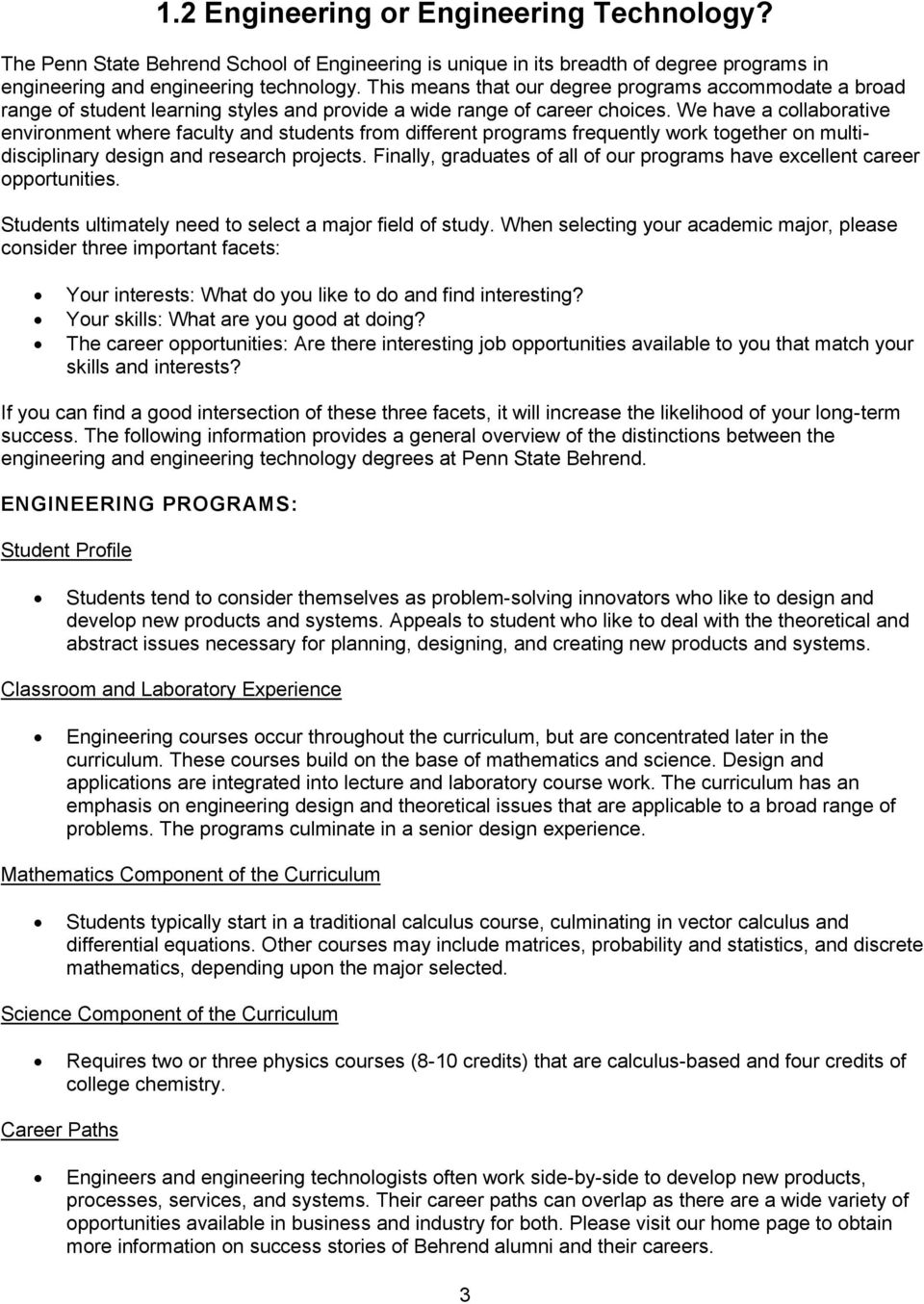
7 Examples of career paths include, but are not limited to: o Complex technical analyses o Design and development o Research o Test and evaluation o Manufacturing o Management and supervision Graduate School Opportunities Graduate school opportunities include science-based programs such as Master of Science (M.S.) and doctoral (Ph.D.) degree programs. Graduates also pursue professional graduate program opportunities such as Master of Engineering and Master of Business Administration (MBA) programs. Professional Registration Graduates are eligible for registration in all states. The process typically requires successful completion of the Fundamentals of Engineering and Professional Engineers examination. A certain number of years of professional experience are required before taking the Professional Engineers exam. ENGINEERING TECHNOLOGY PROGRAMS: Student Profile Students tend to consider themselves as problem-solvers and implementers who would like to be involved in product design and the application of new technologies. Appeals to student who like to deal with the practical issues necessary for implementing, producing, and realizing new products and systems. Classroom and Laboratory Experience Engineering technology courses occur in every semester of the program with a higher concentration of technical courses in the first two years than in an engineering program. There is an intensive laboratory and applications focus, with moderate emphasis on theory and design process. The design focus is on complex problems utilizing state-of-the-art technologies and solution methods. The programs culminate in a research, senior design, or industrial project experience. Mathematics Component of the Curriculum Students typically start in algebra- and trigonometry-based technical mathematics. The math sequence takes students through intermediate calculus and differential equations with an emphasis on engineering technology applications. Science Component of the Curriculum Requires one or two physics courses (4-8 credits) that are algebra-and trigonometry-based and four credits of college chemistry. 4
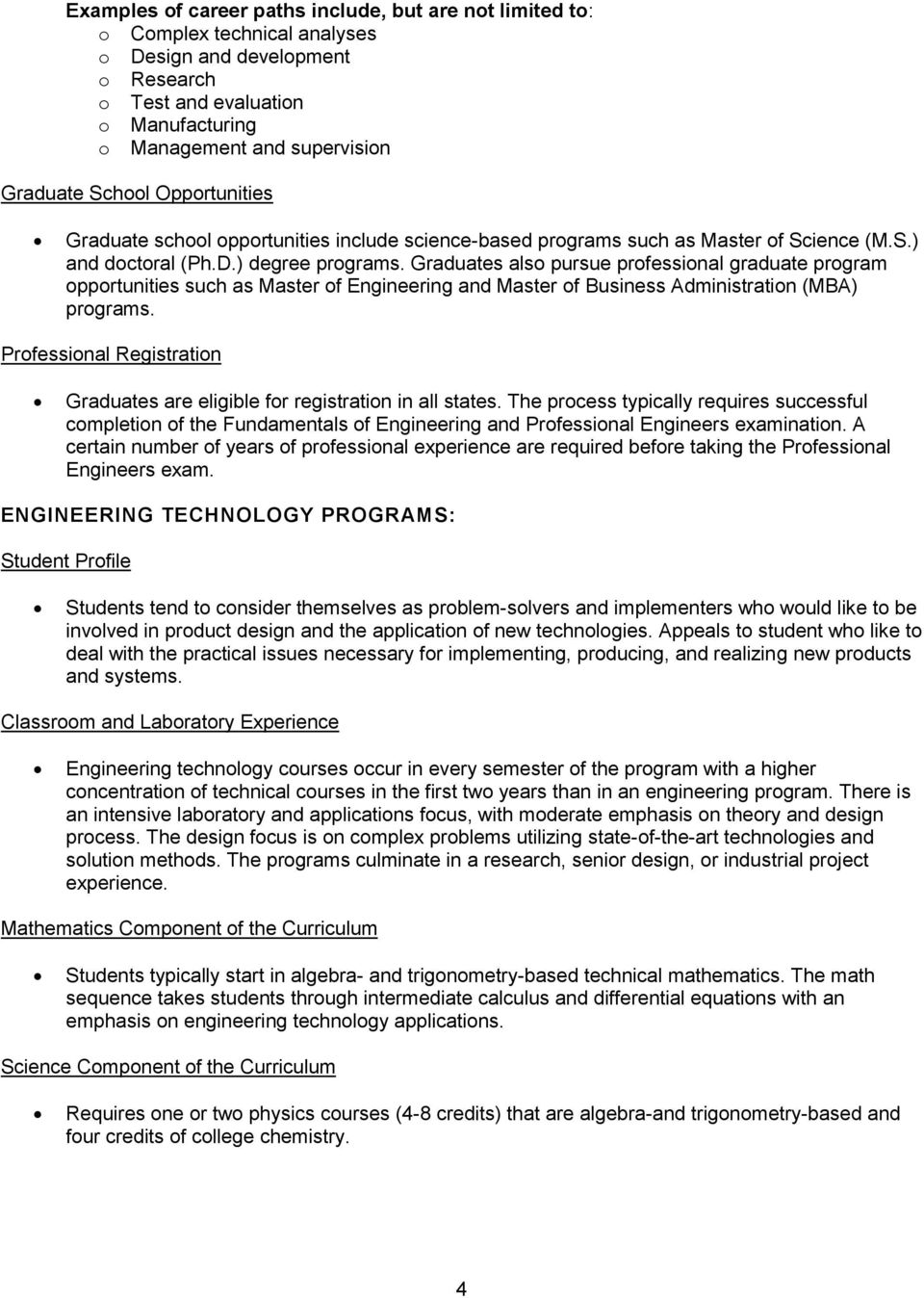
8 Career Paths Engineers and engineering technologists often work side-by-side to develop new products, processes, services, and systems. Their career paths can overlap as there are a wide variety of opportunities available in business and industry for both. Please visit our home page to obtain more information on success stories of Behrend alumni and their careers. Examples of career paths include, but are not limited to: o o o o o o Design and development Manufacturing Test and evaluation Field service engineering Technical sales Management and supervision Graduate School Opportunities Graduate school opportunities include professional graduate program opportunities such as Master of Engineering and Master of Business Administration (MBA) programs. Science-based programs, such as Master of Science (M.S.) and doctoral (Ph.D.) degree, as possible, but students may need to take additional courses depending on the graduate school and program they anticipate entering. Professional Registration Graduates are eligible for registration in many states, including Pennsylvania. The process typically requires successful completion of the Fundamentals of Engineering and the Professional Engineers examination. A certain number of years of professional experience are required before taking the Professional Engineers exam. 5

9 1. General Education Requirements Penn State has a General Education requirement for all degree programs. The purpose of the General Education requirement is to ensure that all students receive a well-rounded education and these credits make up about one-third of those needed for a baccalaureate degree. The General Education requirements are important preparation for a student s professional career Baccalaureate Degree General Education Requirements All baccalaureate degree programs include a 45-credit General Education component established by the University Faculty Senate. The division of courses in the General Education Requirement is shown in the tables below: Skills Courses Writing/Speaking (GWS) Quantification (GQ) Credits 9 credits 6 credits Total 15 credits Knowledge Domains Health and Physical Activity (GHA) Natural Sciences (GN) Arts (GA) Humanities (GH) Social and Behavioral Sciences (GS) Credits credits 9 credits 6 credits 6 credits 6 credits Total 0 credits Additional Requirements Credits First-Year Seminar (S, T, X or PSU) credits vary United States Cultures (US) credits* International Cultures (IL) credits* Writing Across the Curriculum (W, M, X,Y) credits* *May be completed by designated courses that also meet other degree or General Education requirements. Information above is from the General Education Section of the University Undergraduate Education Handbook The University requirements for GWS, GN, GQ, and GHA will be met if a student follows the program schedule for a baccalaureate degree program listed in this book. However, a student has latitude in selecting the GA, GS, and GH courses and must do so carefully to meet requirements for graduation. Students choose two courses from each of the three GS/GH/GA areas of the general education course list provided by the University. This list is available in the schedule of classes. The following are important points to note in selecting GS/GH/GA courses: For certain majors, one of these six courses must be either ECON 102 or 104 (GS). See Part II of this handbook for degree specific requirements. One of these six courses must be designated as an International Cultures (IL) course. One of these six courses must be designated as a United States Cultures (US) course. Note that a (US;IL) course may count for either the (IL) or (US) category, but not both. Students admitted prior to summer of 2005 can take either an (IL) or a (US) course, and do not need to take both. In consultation with one's academic adviser, a student can complete a -6-9 course sequence of the GA, GH, or GS courses. 6
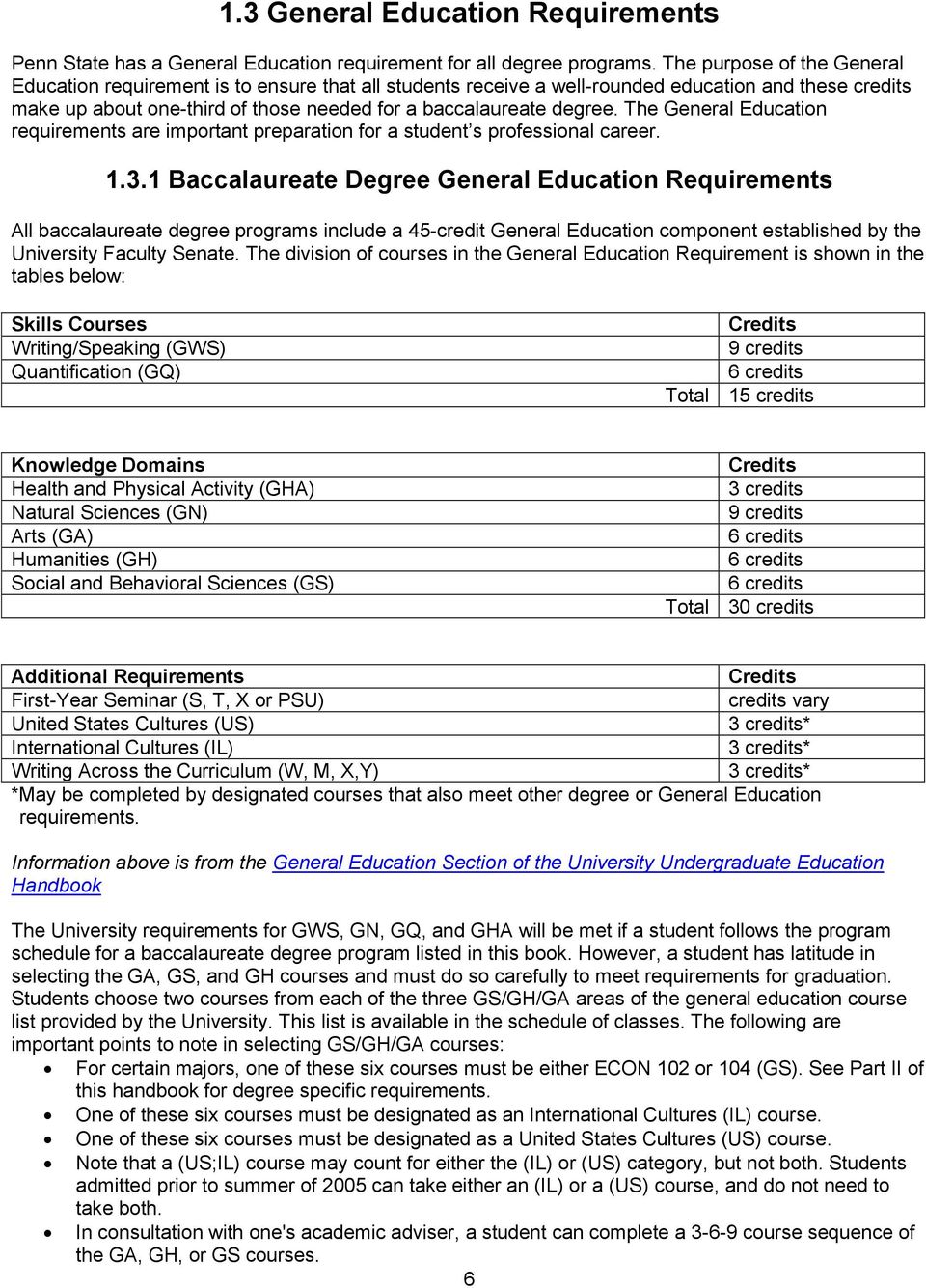
10 Students may take a single level III language course and use it as one of the S/H/A courses. It can be used as a GA, GH, or GS course with the restriction that it cannot be the only course with that designation in the -6-9 option. Foreign Language Requirement Any baccalaureate student entering as a first-year student must have completed the second level proficiency of a high school foreign language. If you were admitted to Penn State without completing this admission requirement and graduated from high school in the year 2001 or later, then you must complete one foreign language course by the end of your sophomore year. If the student chooses, the course can be transferred from another institution. First Year Seminar Requirement The First-Year Seminar (FYS) is designed to engage students in learning, acquaint them with the resources available at Penn State, and orient them to their chosen field of study. In addition, the FYS facilitates students' adjustment to the high expectations, demanding workload, increased academic liberties, other aspects of the transition to college life, and introduces them to their responsibilities as members of the University community. All Behrend College baccalaureate and associate degree students must complete a FYS course to qualify for graduation. FYS courses are designated as either a PSU 007 course or with the S designation, such as the EDSGN 100S course. ROTC Students enrolled in ROTC may substitute up to three () credits of ROTC for health and physical activity, and up to three () credits of ROTC for technical elective credit. Students who are planning to substitute ROTC credits for technical elective credits should discuss this with their advisor to make sure their plan is consistent with program requirements. 7
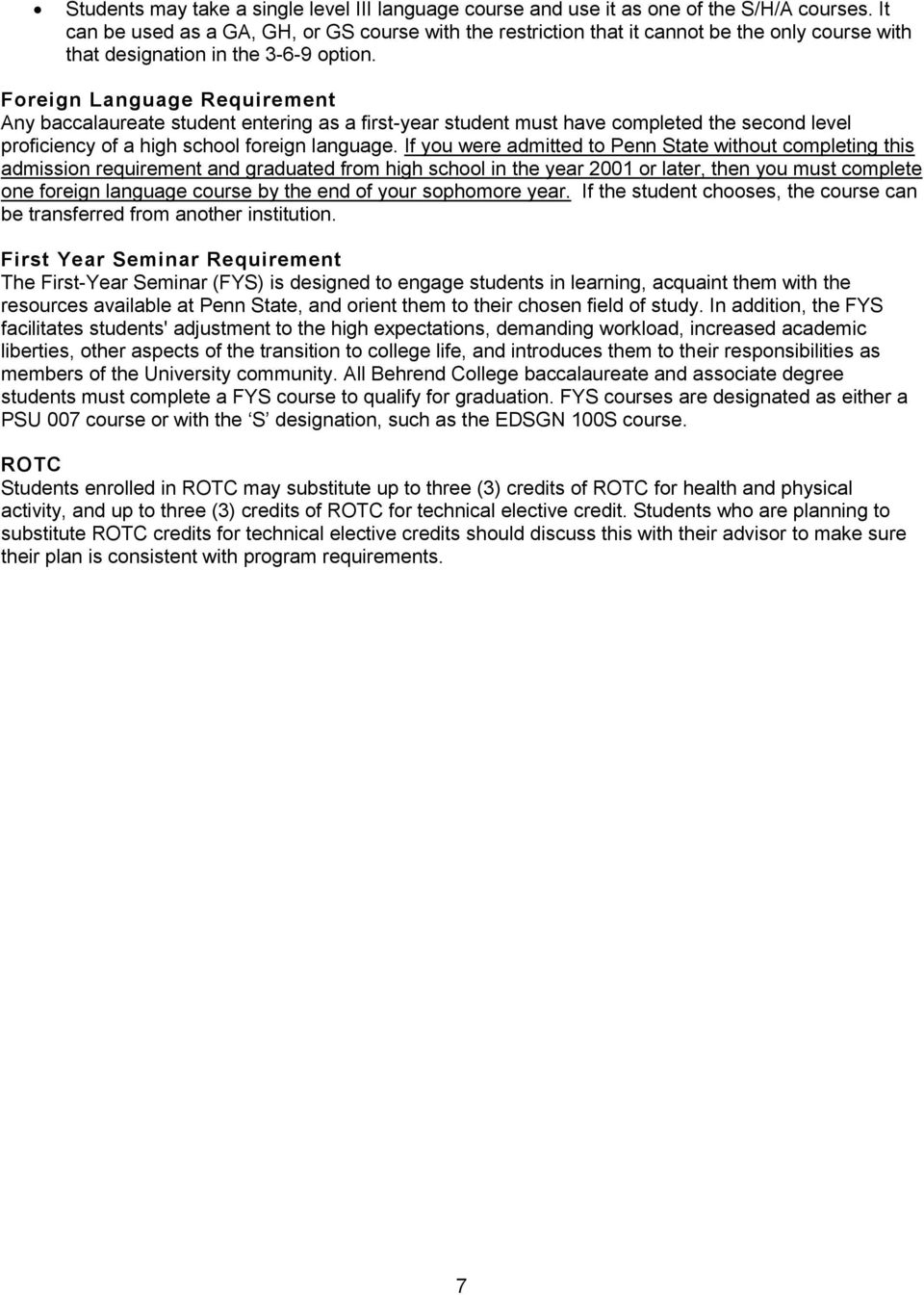
11 1..2 Associate Degree General Education Requirements The associate degree General Education program consists of 21 credits that are distributed among two General Education components: Skills: Six (6) credits in courses that develop communicative and quantitative skills; and Knowledge Domains: 12 credits in the Natural Sciences, Arts, Humanities, and Social and Behavioral Sciences, with an additional three () credits in any General Education area. Associate degree students have a -credit requirement and may choose either a United States Cultures (US) course or an International Cultures (IL) course, and must complete a -credit writing intensive course (W). The First-Year Seminar (FYS) is designed to engage students in learning, acquaint them with the resources available at Penn State, and orient them to their chosen field of study. In addition, the FYS facilitates students' adjustment to the high expectations, demanding workload, increased academic liberties, other aspects of the transition to college life, and introduces them to their responsibilities as members of the University community. All Behrend College students must complete a FYS course to qualify for graduation. FYS courses are designated as either a PSU 007 course or with the S designation, such as the EET 002S course. The Associate Degree Requirements for General Education are described in the tables below: Skills Courses Writing/Speaking (GWS) Quantification (GQ) Credits credits credits Total 6 credits Knowledge Domains Natural Sciences (GN) Arts (GA) Humanities (GH) Social and Behavioral Sciences (GS) Credits credits credits credits credits Total 12 credits Skill or Knowledge Domains Any General Education course can be taken to satisfy these credits credits Additional Requirements Credits First-Year Seminar (S, T, X or PSU) credits vary United States Cultures (US) credits* Writing Across the Curriculum (W, M, X,Y) credits* *May be completed by designated courses that also meet other degree or General Education requirements. Information above is from the General Education Section of the University Undergraduate Education Handbook 8

12 Flexibility of the Associate Degree General Education Requirements The General Education program extends the concept of flexibility to all aspects of the degree program. Penn State wants students to use General Education as an opportunity to experiment and explore, to discover things they did not know before, and to learn to do things they have not done before. To these ends students may, with the permission of their adviser and dean's representative: Substitute a 200- to 499-level course for an Arts, Humanities, Natural Sciences, or Social and Behavioral Sciences course found on the General Education list. For example, a student may take a 400-level course in history and use it to meet the General Education requirement satisfied by a comparable lower level history course. Meet the United States Cultures (US) and International Cultures (IL) requirement through completion of an experiential learning program or practicum (one-semester or year-long) approved by their college dean's Office. Approved Penn State Education Abroad Programs may be used to satisfy the International Cultures (IL) requirement. Three credits of the required 21 credits of General Education courses are to be selected from any of the following General Education areas: Writing/Speaking, Quantification, Natural Sciences, Arts, Humanities, or Social and Behavioral Sciences. 9
13 1.4 Entrance to Major Process Baccalaureate students typically apply for entrance to their major during the spring semester of their sophomore year. To be successful in upper division engineering courses, a student needs a strong background in mathematics, physics, and engineering science. The application for entrance to major is completed on elion. The requirements for entrance into any of the Penn State Behrend engineering majors are that the student: (1) must have completed, with a grade of C or better, MATH 140 and 141, PHYS 211, and CHEM 110; (2) must have at least a 2.0 cumulative GPA. The requirement for entrance to major into any of the Penn State Behrend engineering technology majors are that the student: (1) must have completed, with a grade of C or better, MATH 081 or 026, MATH 082 or 026, MATH 08 or 140, and PHYS 250; (2) must have at least a 2.0 cumulative GPA. 10
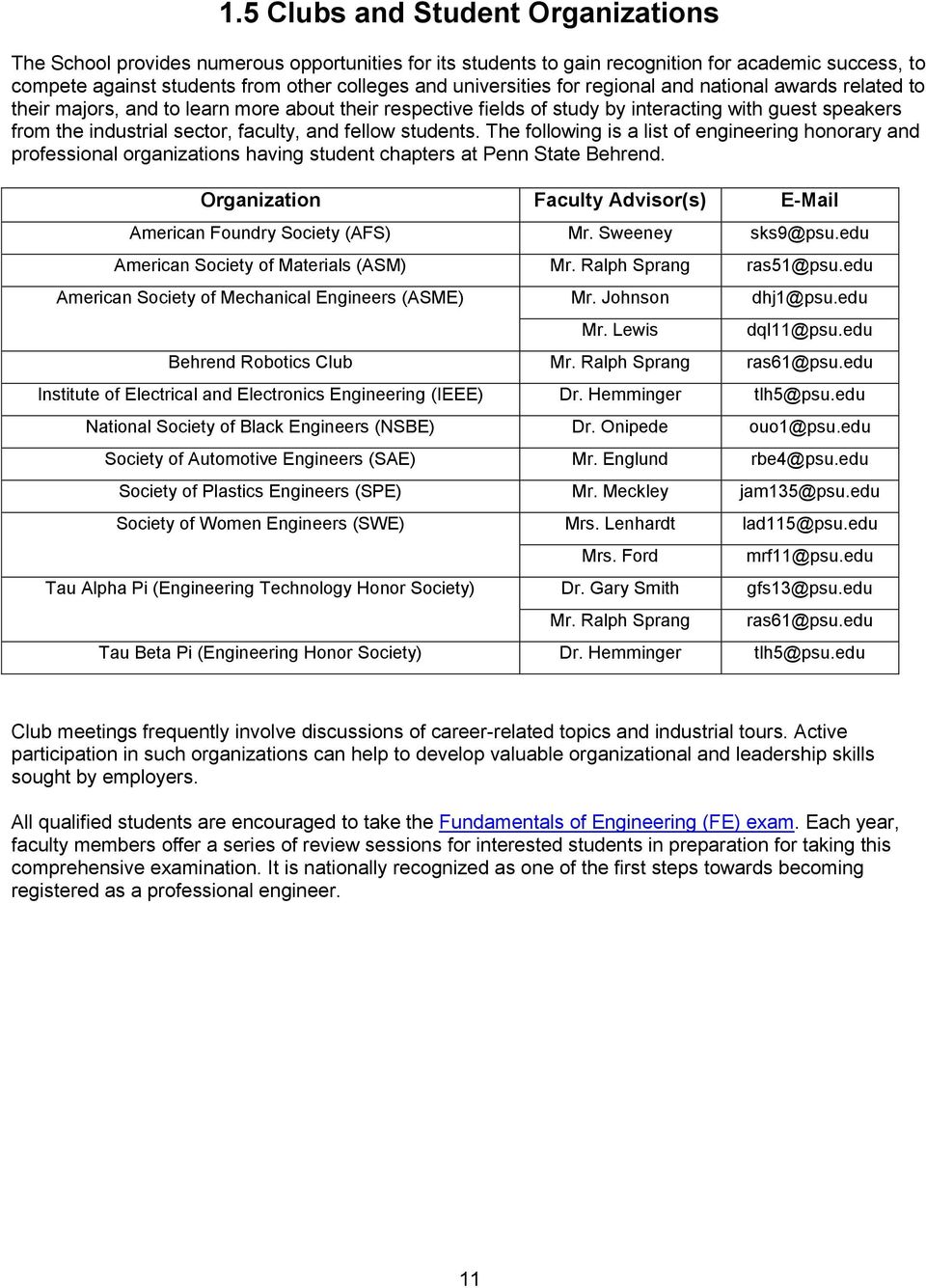
14 1.5 Clubs and Student Organizations The School provides numerous opportunities for its students to gain recognition for academic success, to compete against students from other colleges and universities for regional and national awards related to their majors, and to learn more about their respective fields of study by interacting with guest speakers from the industrial sector, faculty, and fellow students. The following is a list of engineering honorary and professional organizations having student chapters at Penn State Behrend. Organization Faculty Advisor(s) American Foundry Society (AFS) Mr. Sweeney [email protected] American Society of Materials (ASM) Mr. Ralph Sprang [email protected] American Society of Mechanical Engineers (ASME) Mr. Johnson [email protected] Mr. Lewis [email protected] Behrend Robotics Club Mr. Ralph Sprang [email protected] Institute of Electrical and Electronics Engineering (IEEE) Dr. Hemminger [email protected] National Society of Black Engineers (NSBE) Dr. Onipede [email protected] Society of Automotive Engineers (SAE) Mr. Englund [email protected] Society of Plastics Engineers (SPE) Mr. Meckley [email protected] Society of Women Engineers (SWE) Mrs. Lenhardt [email protected] Mrs. Ford [email protected] Tau Alpha Pi (Engineering Technology Honor Society) Dr. Gary Smith [email protected] Mr. Ralph Sprang [email protected] Tau Beta Pi (Engineering Honor Society) Dr. Hemminger [email protected] Club meetings frequently involve discussions of career-related topics and industrial tours. Active participation in such organizations can help to develop valuable organizational and leadership skills sought by employers. All qualified students are encouraged to take the Fundamentals of Engineering (FE) exam. Each year, faculty members offer a series of review sessions for interested students in preparation for taking this comprehensive examination. It is nationally recognized as one of the first steps towards becoming registered as a professional engineer. 11
15 Part 2: Master Degree Information This section contains the following information for each of the master s programs offered by the School of Engineering: Program Description Admission Requirements Degree Requirements Scheduling Pattern Course Descriptions 12

16 2.1 Master of Manufacturing Management Co-Directors: Dr. Dipo Onipede Dr. Diane Parente Program Description: Penn State's Master of Manufacturing Management (M.M.M.) degree is offered by the Quality and Manufacturing Management (QMM) program. The degree is conferred by both the College of Engineering and the Smeal College of Business. This interdisciplinary graduate program is designed to prepare students for careers in manufacturing, consulting, services, and operations. The program is offered on a full-time basis only and requires nine months of continuous study during a normal academic year. An appropriate internship experience is a precondition for entrance to the program if the applicant does not have sufficient work experience to waive the internship requirement. Students take 2 credits of work in eleven core courses. The program develops future executives who possess in-depth, relevant manufacturing knowledge bridging engineering and management. Graduates are afforded a life-changing experience that provides them with a unique set of engineering, business, and quality skills combined with a suite of communication skills critical to management success. Students fuse Six Sigma certification with corporate social responsibility and emotional intelligence to become well-rounded leaders. MMM students develop business plans and analyze and predict corporate financial performance in a global marketplace. They emerge from Penn State as international leaders understanding the fundamentals of materials and processes and project confidence in product and manufacturing system design. Admission Requirements: The program draws its students from two groups: practicing professionals from industry and individuals who have graduated from, or are currently enrolled in, a business administration, science, or engineering program. Applicants who expect to graduate with a B.S. in engineering, science, or business administration may apply for admission to the program in their senior year. All applicants must submit scores from the GRE or the GMAT. International students must also submit TOEFL scores. However, the TOEFL requirement is waived for international students who have successfully completed undergraduate work in an American college or university. The average grade-point average is.0; the average GRE score is 1100 on the verbal and quantitative sections and 4.0 on the analytical section. The average GMAT score is 580. All applicants must have taken the prerequisite mathematics, computer science, and statistics courses or equivalents prior to starting the program. Applicants cannot register until they have completed these courses. For a listing of the prerequisite courses, visit Degree Requirements: The M.M.M. degree requires 2 credits of graduate work on a full-time basis. The courses are as follows: QMM 491 or QMM 492; QMM 552, QMM 561, QMM 562, QMM 581, QMM 582, QMM 59, QMM 851, QMM 871, QMM 872, and QMM 891. In some instances, course changes are being considered and prospective students should consult with the M.M.M. degree program to determine what new requirements might be in effect. The program co-directors are authorized to make suitable substitutions in the above curriculum in consultation with the faculty steering committee. 1

17 Scheduling Patterns for Flexible Scheduling Program: The M.M.M. degree program will be offered full and part-time beginning July The part-time option allows the student to complete their degree in 24 months; full-time option allows the student to complete their degree in 12 months. Course Descriptions: The MMM degree is awarded on the successful completion of 2 credits of required course work. MMM degree program students will take either QMM 491 or QMM 492 depending on their academic background. All students will complete the remainder of the core courses described below, for a total of 2 credits. There are no elective courses in the program. QMM Introduction to Business concepts for Manufacturing (.0) Introduction to business topics in accounting and finance for non-business students in manufacturing management. QMM Introduction to Engineering Design Principles (.0) Engineering principles including different engineering fields, graphics, design, solid modeling, and failure analysis. QMM Quality Management (.0) Concepts of design, assessment, and improvement of quality systems; customer needs analysis, identification of opportunities for application of measurement techniques. QMM Applied Statistical Process Control and Experimental Design (.0) Concepts and techniques of statistical process control and the design of experiments. QMM Manufacturing Systems Planning and Control I (.0) Systems, components, and configurations, flow of material and information in a manufacturing system. QMM Manufacturing Systems Planning and Control II (.) Flow of material and information in a manufacturing system. QMM Design Practice for Manufacturing I (.0) Contemporary concepts in design and design practice with emphasis on engineering, business, and human strategy issues. QMM Design Practice for Manufacturing II (.0) Contemporary concepts in design and design practice with emphasis on logistics, risk,, design and manufacturing readiness, and production. QMM Manufacturing Process and Materials (.0) Characteristics of materials with respect to their properties and associated choices of processing to create a range of products; including consideration of investment, tooling, materials and manufacturing costs. QMM Manufacturing and Supply Chain Strategy (.0) Strategic decision context of manufacturing and its supply chains with linkage to corporate and business strategy. QMM Communication and Leadership Skills for Manufacturing Managers (1.0-.0) Applied principles of managerial, visual, and written communication that support the needs of manufacturing leaders. QMM 59 - Field Experience in Manufacturing ( ) Experiential learning through the firsthand study of manufacturing plants and by interacting with manufacturing leaders. 14

18 Part 2: Baccalaureate Degree Information This section contains the following information for each of the baccalaureate degree programs offered by the School of Engineering: Program Description Entrance to Major Requirement A Recommended Action Plan A Course Prerequisite Flowchart A list of the Approved Technical electives To be certified for graduation, a student must complete the General Education, Writing Across the Curriculum, and Cultural Diversity requirements, the requirements for the major, and the number of elective credits required in each program. The minimum number of credits for each program is listed in the description of the major. In addition to the minimum number of credits required, each student must earn a grade of at least a C in each 00 and 400- level course in the major field and must have earned a minimum 2.0 grade point average. 15

19 .1 Computer Engineering Chair: Dr. Thomas Hemminger Program Description: This major provides students with a strong foundation in computer engineering through a combination of classroom study, design projects, and laboratory experience. Analysis and design of computer hardware and software systems are stressed. Built upon a core of science and mathematics courses, this major has the objective of educating graduates to be problem solvers. Students acquire the ability to work as members of a team toward successful attainment of a common goal, preparing them for industry or further study in graduate school. In addition, written and oral communication skills are developed from an early stage, culminating in a senior design project that stresses communication, as well as engineering content. In addition to completing a broad-based science core in mathematics, chemistry and physics, students pursue their interest in computer engineering by studying principles in digital hardware design, computer architecture, computer software, microelectronics, and computer data communications. The student will be required to analyze and solve a significant computer engineering design problem during the senior year. The educational objectives of the Computer Engineering Program are to produce graduates, who within three years of graduation are able to: be employed as a practicing engineer in fields such as design, research, development, testing, and manufacturing; assume positions of leadership and responsibility within an organization; and progress through advanced degree or certificate programs in engineering, business, and other professionally related fields. This program is accredited by the Engineering Accreditation Commission of the Accreditation Board for Engineering and Technology (EAC of ABET), 111 Market Place Suite 1050, Baltimore, MD Telephone: , Entrance to Major Requirement In addition to the Carnegie unit and minimum GPA requirements described by University policies, all students applying for entrance to any of the engineering majors at Behrend College must have at least a 2.0 cumulative GPA by the end of the semester prior to applying for entrance to the major and have completed, with a minimum grade of C: CHEM 110 GN (), MATH 140 GQ (4), MATH 141 GQ (4), and PHYS 211 GN (4). These courses must be completed by the end of the semester during which the entrance to major process is carried out. 16

20 Recommended Academic Plan Computer Engineering (CENBD at Penn State Erie, The Behrend College) Effective Program Year Fall 2014 Semester 1 Credits Semester 2 Credits MATH 140 (GQ) Calculus With Analytic Geometry I* 4 MATH 141 (GQ) Calculus With Analytic Geometry II* 4 CHEM 110 (GN) Chemical Principles I* PHYS 211 (GN) General Physics: Mechanics* 4 CHEM 111 (GN) Experimental Chemistry I 1 CMPSC 122 Intermediate Programming ENGL 015 or 00 (GWS) Rhetoric and Composition or Honors CMPSC 121 (GQ) Introduction to Programming Techniques PSU 007 First-Year Seminar 1 ECON 102 or 104 (GS) Intro. Micro-Macroeconomics Analy. & Policy Arts (GA), Humanities (GH), or Social and Behavioral Sciences (GS) Total Credits: 15 Total Credits: 17 Semester Credits Semester 4 Credits MATH 250 Ordinary Differential Equations E E 210 Circuits & Devices 4 CMPEN 271 Introductions to Digital Systems A 1 CMPSC 60 Discrete Mathematics for Computer Science CMPEN 275 Digital Design Laboratory A 1 1 MATH 20 Calculus & Vector Analysis 4 MATH 220 (GQ) Matrices 2 ENGL 202C (GWS) Effective Writing: Technical Writing PHYS 212 (GN) General Physics: Electricity & Magnetism 4 PHYS 214 (GN) General Physics: Wave Motion/Quantum Physics 2 CAS 100 (GWS) Effective Speech Health and Physical Activity (GHA) 1.5 Total Credits: 17.5 Total Credits: 16 Semester 5 Credits Semester 6 Credits CMPSC 465 Data Structures & Algorithms E E 52 Signals and Systems: Continuous & Discrete-Time 4 CMPEN 71 Advanced Digital Design CMPEN 411 VLSI Design Circuits E E 10 Electronic Circuit Design 4 CMPEN 52W Embedded Systems Design CMPEN 51 Microprocessors CMPEN 41 Introduction to Computer Architecture STAT 01 Statistical Analysis I Arts (GA), Humanities (GH), or Social and Behavioral Sciences (GS) Total Credits: 16 Total Credits: 16 Semester 7 Credits Semester 8 Credits CMPEN 480 Computer Engineering Design CMPEN 481 Computer Engineering Projects CMPEN 461 Communications Network Technical Elective (00, 400-level) CMPEN 441 Operating Systems Technical Elective (00, 400-level) Technical Elective (00, 400-level) Arts (GA), Humanities (GH), or Social & Behavioral Science (GS) Arts (GA), Humanities (GH), or Social & Behavioral Science (GS) Arts (GA), Humanities (GH), or Social & Behavioral Science (GS) Health and Physical Activity (GHA) 1.5 Total Credits: 15 Total Credits: 16.5 Total Credits:

21 An asterisk (*) indicates an entrance to major requirement. Bold type indicates courses requiring a quality grade of C or better. Italics indicates courses that satisfy both major and General Education requirements. Bold Italics indicates courses requiring a quality grade of C or better and that satisfy both major and General Education requirements. GWS, GHA, GQ, GN, GA, GH, and GS are codes used to identify General Education requirements. US, IL, and US;IL are codes used to designate courses that satisfy University United States/International Cultures requirements. Students must complete credits in US and credits in IL. If a student takes a credit course that is both US and IL, to complete the requirement, he/she must take another -credit course that is US, IL, or both US and IL. Education abroad courses and other credit-bearing experiences such as internships that meet this requirement, will be designated US, IL or both US and IL. W is the code used to designate courses that satisfy University Writing Across the Curriculum requirements. Students who have not met the admission requirement of two units of a high school foreign language must complete a college level-one foreign language within their first 60 credits. This is a pre-admission requirement credits will not count toward degree requirements. Program Notes: Only students who have gone through the entrance to major process and have been accepted into this major may register for junior and senior-level E E, CMPEN, and SWENG courses. Academic Advising Notes: A CMPEN 270 can be substituted for CMPEN 271 and CMPEN The combination of CMPEN 271 and CMPEN 275 (or CMPEN 270) and CMPSC 60 must be completed prior to the junior year to ensure that fall semester junior year prerequisites are met. 18
22 19
23 School-Approved Electives for Computer Engineering Technical electives allow students to choose areas of interest to explore. Technical electives come in two categories, primary and secondary. Primary technical electives are those courses offered to ECE majors which are not required for the CENBD major. Secondary technical electives are offered outside your home department and give you broader latitude. Students must complete at least two primary technical electives, and, at most, one secondary technical elective. Courses listed below as asynchronous are offered as needed when the appropriate faculty member is available. Exceptions to the above policy will be granted to students who successfully complete a minor in one of the areas listed in part 7`: Academic Minors. Primary Technical Electives Any level SWENG course Any level EE course not already required for the major Any level CMPEN course not already required for the major Any 400 level CMPSC course not already required for the major Any level technical gaming course Secondary Technical Electives Course Credits Name Offered CMPEN 95 (::0) Internship Fall/Spring CMPEN 495 (::0) Internship Fall/Spring CMPSC 461 (::0) Programming Language Concept Fall/Spring CMPSC 471 (::0) Introduction to Compiler Construction Spring MGMT 409 (::0) Project Management for Engineers Spring PSYCH 444 (::0) Engineering Psychology Fall ECON 481 (::0) Business Forecasting Techniques Spring ECON 485 (::0) Econometric Techniques Fall PHYS 458 (4::) Intermediate Optics Every Other Year MATH 455 (::0) Introduction to Numerical Analysis I Fall MATH 456 (::0) Introduction to Numerical Analysis II Spring (Even Years) ENTR 40 (::0) Entrepreneurship & New Prod Dev Fall 20
24 .2 Computer Science Chair: Dr. Meng Su Program Description: The goal of the Computer Science major at Behrend is to produce graduates with a firm foundation in the fundamentals of computer science along with a significant background in one or more of the natural sciences to provide context. Students are encouraged to pursue a minor in one of the natural sciences (biology, chemistry), math, statistics, or game development. Students prepare for the major by taking lower-division courses in programming, discrete math, computer organization, and data communications. They then complete upper-division courses in data structures and algorithms, data base management systems, net-centric programming, programming language principles, and operating systems, and systems programming. Graduates of this program will be prepared for a wide variety of computer-oriented careers in science, business, industry and government, as well as for graduate study in computer science or in computationally intensive disciplines that require the practical application of computer science concepts and techniques to solving problems. The educational objectives of the program are to produce graduates who within three years of graduation are able to: be employed as a practicing computing professional in fields such as design, research, development, testing, maintenance, and manufacturing; assume positions of leadership and responsibility within an organization; and progress through advanced degree or certificate programs in engineering, business, science, and other professionally related fields. Entrance to Major requirement: In addition to the Carnegie unit and minimum GPA requirements described by University policies, all students applying for entrance to any of the engineering majors at Behrend College must have at least a 2.0 cumulative GPA by the end of the semester prior to applying for entrance to the major and have completed, with a minimum grade of C: MATH 140 GQ(4), MATH 141 GQ(4), CMPSC 121 GQ(), CMPSC 122 () and one of the following: BIOL 110 GN(4), or CHEM 110 GN() and CHEM 111 GN(1) or PHYS 211 GN(4). These courses must be completed by the end of the semester during which the admission to major process is carried out. 21
25 Recommended Academic Plan Computer Science (CMPBD at Penn State Erie, The Behrend College) Effective Fall 2014 Semester 1 Credits Semester 2 Credits MATH 140 (GQ) Calculus with Analytic Geometry I * 4 MATH 141 (GQ) Calculus with Analytic Geometry II * 4 Science Sequence Course (GN) * 4 Science Sequence Course (GN) 4 ENGL 015 or 00 (GWS) Rhetoric and Composition or Honors Freshmen Composition CMPSC 121 (GQ) Introduction to Programming Techniques * CMPSC 122 Intermediate Programming * GA/GH/GS General Education Selection First-Year Seminar 1 Health and Physical Activity (GHA) 1.5 Total Credits: 15 Total Credits: 15.5 Semester Credits Semester 4 Credits CMPSC 221 Object Oriented Programming with Web- Based Applications CMPSC 60 Discrete Mathematics for Computer Science MATH 220 (GQ) Matrices 2 STAT 01 Statistical Analysis I Science Sequence Course (GN) 2- Science Elective GA/GH/GS General Education Selection ENGL 202C (GWS) Effective Writing: Technical Writing CAS 100 (GWS) Effective Speech GA/GH/GS General Education Selection Health and Physical Activity (GHA) 1.5 Total Credits: Total Credits: 15 Semester 5 Credits Semester 6 Credits CMPSC 5 Fundamentals of Communications Networks CMPSC 12 Computer Organization and Architecture CMPSC 421 Net-Centric Programming Computing Elective CMPSC 465 Data Structures and Algorithms Computing Elective CMPSC 41W Database Management Systems Supporting and Related Area Science Elective Science Elective Total Credits: 15 Total Credits: 15 Semester 7 Credits Semester 8 Credits CMPSC 461 Programming Language Concepts CMPSC 485W Computer Science Senior Project II CMPSC 484 Computer Science Senior Project I 2 Computing Elective CMPSC 474 Operating Systems and Systems Programming Science Elective Supporting and Related Area GA/GH/GS General Education Selection Science Elective GA/GH/GS General Education Selection GA/GH/GS General Education Selection Total Credits: 17 Total Credits: 15 Total Credits 122 or 12 An asterisk (*) indicates an entrance to major requirement. Bold type indicates courses requiring a quality grade of C or better. Italics indicate courses that satisfy both major and General Education requirements. Bold Italics indicates courses requiring a quality grade of C or better and that satisfy both major and General Education requirements. 22
26 GWS, GHA, GQ, GN, GA, GH, and GS are codes used to identify General Education requirements. US, IL, and US;IL are codes used to designate courses that satisfy University United States/International Cultures requirements. Students must complete credits in US and credits in IL. If a student takes a credit course that is both US and IL, to complete the requirement, he/she must take another -credit course that is US, IL, or both US and IL. Education abroad courses and other credit-bearing experiences such as internships that meet this requirement, will be designated US, IL or both US and IL. W is the code used to designate courses that satisfy University Writing Across the Curriculum requirements. Students who have not met the admission requirement of two units of a high school foreign language must complete a college level-one foreign language within their first 60 credits. Scheduling patterns for courses not taught each semester: Some major requirements will be offered only once a year. Some upper level courses are offered in an alternate year pattern. Consult an adviser for suggestions on scheduling them. Fall only courses include: CMPEN 12, CMPSC 5, CMPSC 461, CMPSC 41W, CMPSC 474, CMPSC 484 Spring only courses include: CMPSC 421, CMPSC 485W Program Notes: a. Students need to complete one of the following two semester science (GN) course sequences which will also count toward their general education 1.(Biology) CHEM 110(), BIOL 110S(4) and BIOL 220W(4) or BIOL 20W(4) or BIOL 240W(4) 2.(Chemistry) CHEM 110(), CHEM 111(1), CHEM 112(), CHEM 11(1), and CHEM 210().(Physics) PHYS 211(4), PHYS 212(4), and PHYS 21(2) or PHYS 214(2) b. Students must earn a minimum of 122 credits for graduation. Academic Advising Notes: Science Elective It is strongly suggested (but not required) that students follow one of the natural science, math, or statistics minors in selecting their science electives. Students may choose from the following courses: ASTRO 291 or higher; BIOL 110 or higher; CHEM 110 or higher; CMPSC 11 or higher GEOG 160 or higher; MATH 200 level or higher; METEO 101 or higher PHYS 211 or higher except PHYS 250 or PHYS 251 STAT 00 level or higher Computing Elective Students may select courses from CMPSC 12 or higher, CMPEN, or SWENG courses Supporting and Related Areas All 00 and 400-level courses in CMPSC (including CMPSC 494 Research and/or CMPSC 495 Internship), GAME, MIS, MATH, STAT, BIOL, CHEM, PHYS, ACCTG, ECON, FIN, PSYCH, and ROTC 2
27 24
28 . Electrical Engineering Chair: Dr. Thomas Hemminger Program Description This major provides students with a strong foundation in electrical engineering through a combination of classroom study, projects, and laboratory experience. Analysis and design of electrical and computer systems are stressed. Built upon a core of science and mathematics courses, this major has the objective of educating graduates to be problem solvers. Students acquire the ability to work as members of a team toward successful attainment of a common goal, preparing them for work in industry, or further study in graduate school. In addition, written and oral communication skills are developed from an early stage, culminating in a senior design project that stresses communication as well as engineering content. In addition to completing a broad-based science and mathematics core, students pursue their interest in electrical engineering by studying the principles of electrical circuits and microelectronics, digital and computer systems, control and communications systems, and electromagnetic fields and waves. Students obtain a broad-based electrical engineering education that is specialized through the selection of technical electives courses. The student will be required to analyze and solve a significant electrical engineering design problem during the senior year. The educational objectives of the Electrical Engineering Program are to produce graduates, who within three years of graduation are able to: be employed as a practicing engineer in fields such as design, research, development, testing, and manufacturing; assume positions of leadership and responsibility within an organization; and progress through advanced degree or certificate programs in engineering, business, and other professionally related fields. This program is accredited by the Engineering Accreditation Commission of the Accreditation Board for Engineering and Technology (EAC of ABET), 111 Market Place Suite 1050, Baltimore, MD Telephone: , Entrance to Major Requirement In addition to the Carnegie unit and minimum GPA requirements described by University policies, all students applying for entrance to any of the engineering majors at Behrend College must have at least a 2.0 cumulative GPA by the end of the semester prior to applying for entrance to the major and have completed, with a minimum grade of C: CHEM 110 GN (), MATH 140 GQ (4), MATH 141 GQ (4), and PHYS 211 GN (4). These courses must be completed by the end of the semester during which the admission to major process is carried out. 25
29 Recommended Academic Plan Electrical Engineering (EE BD at Penn State Erie, The Behrend College) Effective Program Year Fall 2014 Semester 1 Credits Semester 2 Credits MATH 140 (GQ) Calculus With Analytic Geometry I * 4 MATH 141 (GQ) Calculus With Analytic Geometry II * 4 CHEM 110 (GN) Chemical Principles I * PHYS 211 (GN) General Physics: Mechanics * 4 CHEM 111 (GN) Experimental Chemistry I 1 CMPSC 201 (GQ) Computer Programming for Engineers 1 ENGL 015 or 00 (GWS) Rhetoric and Composition or Honors ECON 102 or 104 (GS) Intro. Micro-Macroeconomics Analy. & Policy EDSGN 100S (FYS) Introduction to Engineering Design Arts (GA), Humanities (GH), or Social & Behavioral Science (GS) Arts (GA), Humanities (GH), or Social & Behavioral Science (GS) Total Credits: 17 Total Credits: 17 Semester Credits Semester 4 Credits MATH 250 Ordinary Differential Equations E E 210 Circuits & Devices 1 4 CMPEN 271 Introduction to Digital Systems A 1 MATH 220 (GQ) Matrices 2 CMPEN 275 Digital Design Laboratory A 1 1 MATH 20 Calculus & Vector Analysis 4 E MCH 211 Statics PHYS 214 (GN) General Physics: Wave Motion/Quantum Physics 2 PHYS 212 (GN) General Physics: Electricity & Magnetism 4 Health and Physical Activity (GHA) 1.5 CAS 100 (GWS) Effective Speech Elective Course 2 Total Credits: 17 Total Credits: 16.5 Semester 5 Credits Semester 6 Credits E E 12 Electrical Circuit Analysis E E 1 Electromagnetic Fields and Waves E E 10 Electronic Circuit Design I 4 E E 52 Signals and Systems: Continuous and Discrete- Time 4 E E 16 Introduction to Embedded Microcontrollers E E 8 Signals and Controls Laboratory 1 STAT 01 Statistical Analysis I E E 80 Introduction to Linear Control Systems ENGL 202C (GWS) Effective Writing: Technical Writing E E 1W (GWS) Electronic Circuit Design II 4 Health and Physical Activity (GHA) 1.5 Total Credits: 16 Total Credits: 16.5 Semester 7 Credits Semester 8 Credits E E 60 Communications Systems I E E 401 Electrical Design Projects E E 87 Energy Conversion Technical Elective (00,400-level) E E 400 Engineering Design Concepts Technical Elective (00,400-level) Technical Elective (00,400-level) Arts (GA), Humanities (GH), or Social & Behavioral Science (GS) Arts (GA), Humanities (GH), or Social & Behavioral Science (GS) Arts (GA), Humanities (GH), or Social & Behavioral Science (GS) Total Credits: 15 Total Credits: 15 Total Credits 10 An asterisk (*) indicates an entrance to major requirement. Bold type indicates courses requiring a quality grade of C or better. Italics indicates courses that satisfy both major and General Education requirements. Bold Italics indicates courses requiring a quality grade of C or better and that satisfy both major and General Education requirements. 26
30 GWS, GHA, GQ, GN, GA, GH, and GS are codes used to identify General Education requirements. US, IL, and US;IL are codes used to designate courses that satisfy University United States/International Cultures requirements. Students must complete credits in US and credits in IL. If a student takes a credit course that is both US and IL, to complete the requirement, he/she must take another -credit course that is US, IL, or both US and IL. Education abroad courses and other credit-bearing experiences such as internships that meet this requirement, will be designated US, IL or both US and IL. W is the code used to designate courses that satisfy University Writing Across the Curriculum requirements. Students who have not met the admission requirement of two units of a high school foreign language must complete a college level-one foreign language within their first 60 credits. This is a pre-admission requirement credits will not count toward degree requirements. Program Notes: Only students who have gone through the entrance to major process and have been accepted into this major may register for junior and senior-level E E, CMPEN, and SWENG courses. Academic Advising Notes: A CMPEN 270 can be substituted for CMPEN 271 and CMPEN E E 210, the combination of CMPEN 271 and CMPEN 275 (or CMPEN 270), and CMPSC 201 must be completed prior to the junior year to ensure that fall semester junior year prerequisites are met. 2 Students should take one of the following courses: CMPSC 122, E MCH 212, M E 00, or PHYS 27. Students planning on taking the FE Exam are advised to take M E
31 28
32 School-Approved Electives for Electrical Engineering Technical electives allow students to choose areas of interest to explore. Technical electives come in two categories, primary and secondary. Primary technical electives are those courses offered to ECE majors which are not required for the EE BD major. PHYS 414 is considered a primary technical elective. Secondary technical electives are offered outside your home department and give you broader latitude. Students must complete at least two primary technical electives, and, at most, one secondary technical elective. Courses listed below as asynchronous are offered as needed when the appropriate faculty member is available. Exceptions to the above policy will be granted to students who successfully complete a minor in one of the areas listed in part 7: Academic Minors. Primary Technical Electives Any level SWENG course Any level EE course not already required for the major Any level CMPEN course not already required for the major PHYS 414, Solid State Physics Secondary Technical Electives Course Credits Name Offered E E 95 (::0) Internship Fall/Spring E E 495 (::0) Internship Fall/Spring CMPSC 461 (::0) Programming Language Concept Fall/Spring CMPSC 471 (::0) Introduction to Compiler Construction Spring MGMT 409 (::0) Project Management for Engineers Spring PSYCH 444 (::0) Engineering Psychology Fall ECON 481 (::0) Business Forecasting Techniques Spring ECON 485 (::0) Econometric Techniques Fall PHYS 458 (4::) Intermediate Optics Every Other Year MATH 455 (::0) Introduction to Numerical Analysis I Fall MATH 456 (::0) Introduction to Numerical Analysis II Spring (Even Years) ENTR 40 (::0) Entrepreneurship & New Prod Dev. Fall 29
33 .4 Electrical and Computer Engineering Technology Program Chair: Mr. David Loker Program Description: This major prepares graduates for careers in such varied areas as electronics, microprocessors, computer hardware and software, communications, instrumentation and control, and power. The major consists of two options, one in Electrical Engineering Technology, the other in Computer Engineering Technology. Both options provide education in applied mathematics, physics, electrical and electronic circuit analysis and design, microprocessors, instrumentation and quality control. The Electrical Engineering Technology option provides specialty education in control theory, communication systems, and power systems. The Computer Engineering Technology option provides specialty education in software development, embedded computer systems, and networking. Both options in the major culminate with a capstone design project involving an actual design or manufacturing problem, often sponsored by industry. Graduates may qualify as engineering technologists working side-by-side with engineers, scientists, and other skilled workers in these capacities. Occupations include electrical and electronic systems design, microprocessor applications, instrumentation and control, computer programming, electrical testing, plant engineering, quality control, management, and technical sales and service. The educational objectives of the Penn State Behrend Electrical and Computer Engineering Technology program are to produce graduates who, within three years of graduation are able to: be employed in fields of engineering such as design, research, development, applications, testing, manufacturing, processing, safety, quality, and technical sales or service: o for B.S. degree recipients, as an engineer or engineering technologist o for A.S. degree recipients, as a technician or technologist or designer or engineering assistant achieve positions of increased responsibility (technical and/or supervisory) within an organization; and progress through advanced degree or certificate programs or participate in continuing education in engineering, business, and/or other professionally related fields. This program is accredited by the Engineering Technology Accreditation Commission of the Accreditation Board for Engineering and Technology (ETAC of ABET), 111 Market Place Suite 1050, Baltimore, MD Telephone: Entrance to Major Requirement In addition to the Carnegie unit and minimum GPA requirements described by University policies, all students applying for entrance to any of the engineering technology majors at Behrend College must have at least a 2.0 cumulative GPA by the end of the semester prior to applying for entrance to the major and have completed, with a minimum grade of C: MATH 081 or MATH 026, MATH 082 or MATH 022, MATH 08 or MATH 140, and PHYS 250. These courses must be completed by the end of the semester during which the entrance to major process is carried out. 0
34 Recommended Academic Plan Electrical/Computer Engineering Technology (ECET at Penn State Erie, The Behrend College Computer Engineering Technology Option (CMPET) Effective January 2014 Semester 1 Credits Semester 2 Credits EET 101 Electrical Circuits I EET 114 Electrical Circuits II 4 EET 109 Electrical Circuits Laboratory I 1 CMPET 117 Digital Electronics EET 002S (FYS) Introduction to Engineering Technology 1 EET 118 Electrical Circuits Laboratory 1 ENGL 015 or 00 (GWS) Rhetoric and Composition or CMPET 120 Digital Electronics Laboratory 1 Honors 1 MATH 081 (GQ) Technical Mathematics I* CMPET 005 Engineering Methods in Engineering Technology 1 Health and Physical Activity (GHA) 1.5 MATH 082 (GQ) Technical Mathematics II* Arts (GA), Humanities (GH), or Social & Behavioral Science (GS) PHYS 250 (GN) Introductory Physics I* 4 Total Credits: 15.5 Total Credits: 17 Semester Credits Semester 4 Credits CMPET 211 Embedded Processors and DSP CAS 100 (GWS) Effective Speech EET 212W Op Amp and Integrated Circuit Electronics 4 CHEM 110 (GN) Chemical Principles EET 214 Electric Machines and Energy Conversion CHEM 111 (GN) Experimental Chemistry 1 EET 215 Electric Machines and Energy Conversion Lab 1 EET 275 Introduction to Programmable Logic Controllers MATH 08 (GQ) Technical Calculus* 4 EET 280 System Integration Project 1 Arts (GA), Humanities (GH), or Social & Behavioral Science (GS) EG T 119 Intro to CAD for Electrical and Computer Engineering MATH 210 Calculus with Engineering Technology Application 2 Total Credits: 18 Total Credits: 16 Semester 5 Credits Semester 6 Credits CMPET 01 Algorithmic Processes for Electrical Systems CMPET Computer Networking EET 41 Measurements and Instrumentation CMPET 55 Intermediate Microprocessors & Microcomputers ENGL 202C (GWS) Effective Writing: Technical Writing ECON 102 or 104 (GS) Intro. Micro-Macroeconomics Analy. & Policy MATH 211 Intermed. Calc & Diff Equations w/application EET 15 Linear and Discrete System Analysis Arts (GA), Humanities (GH), or Social & Behavioral Science (GS) Arts (GA), Humanities (GH), or Social & Behavioral Science (GS) Health and Physical Activity (GHA) 1.5 Total Credits: 15 Total Credits: 16.5 Semester 7 Credits Semester 8 Credits CMPET 456 Adv. Microprocessors, High Level Interfacing EET Manufacturing Related Topics in Electrical Systems CMPET 457 Software Engineering EET 490W ECET Senior Design Project EET 480 ECET Systems Senior Seminar 1 Arts (GA), Humanities (GH), or Social & Behavioral Science (GS) MGMT 409 Project Management for Engineers Natural Science Elective (GN) 2 Technical Elective (00, 400-level) Technical Elective (00, 400-level) Technical Elective (00, 400-level) Total Credits: 16 Total Credits: 14 Total Credits 128 1
35 An asterisk (*) indicates an entrance to major requirement for students who have gone through the ETM process for ECET after January 1, Permissible Math substitutions: MATH 026 instead of MATH 081, MATH 022 instead of MATH 082, MATH 140 instead of MATH 08. Bold type indicates courses requiring a quality grade of C or better. Italics indicates courses that satisfy both major and General Education requirements. Bold Italics indicates courses requiring a quality grade of C or better and that satisfy both major and General Education requirements. GWS, GHA, GQ, GN, GA, GH, and GS are codes used to identify General Education requirements. US, IL, and US;IL are codes used to designate courses that satisfy University United States/International Cultures requirements. Students must complete credits in US and credits in IL. If a student takes a credit course that is both US and IL, to complete the requirement, he/she must take another -credit course that is US, IL, or both US and IL. Education abroad courses and other credit-bearing experiences such as internships that meet this requirement, will be designated US, IL or both US and IL. W is the code used to designate courses that satisfy University Writing Across the Curriculum requirements. Students who have not met the admission requirement of two units of a high school foreign language must complete a college level-one foreign language within their first 60 credits. This is a pre-admission requirement credits will not count toward degree requirements. Program Notes: Only students who have gone through the entrance to major process and have been accepted into this major may register for junior and senior-level EET and CMPET courses. Academic Advising Notes: 1 If ENGL 015 is full schedule an S/H/A, 2 nd semester ENGL 015, rd semester CAS 100, and 4 th semester PHYS If EET 450 is not offered, schedule Q C
36
37 Recommended Academic Plan Electrical and Computer Engineering Technology (ECET at Penn State Erie, The Behrend College) Electrical Engineering Technology Option (EET) Effective January 2014 Semester 1 Credits Semester 2 Credits EET 101 Electrical Circuits I EET 114 Electrical Circuits II 4 EET 109 Electrical Circuits Laboratory I 1 CMPET 117 Digital Electronics EET 002S (FYS) Introduction to Engineering Technology 1 EET 118 Electrical Circuits Lab 1 ENGL 015 or 00 (GWS) Rhetoric & Composition or CMPET 120 Digital Electronics Laboratory 1 Honors 1 MATH 081 (GQ) Technical Mathematics I* CMPET 005 Engineering Methods in Engineering Technology 1 Health and Physical Activity (GHA) 1.5 MATH 082 (GQ) Technical Mathematics II* Arts (GA), Humanities (GH), or Social & Behavioral Science (GS) PHYS 250 (GN) Introductory Physics I* 4 Total Credits: 15.5 Total Credits: 17 Semester Credits Semester 4 Credits CMPET 211 Embedded Processors and DSP CAS 100 (GWS) Effective Speech EET 212W Op Amp and Integrated Circuit Electronics 4 CHEM 110 (GN) Chemical Principles I EET 214 Electric Machines and Energy Conversion CHEM 111 (GN) Experimental Chemistry I 1 EET 215 Electric Machines and Energy Conversion Lab 1 EET 275 Introduction to Programmable Logic Controllers MATH 08 (GQ) Technical Calculus* 4 EET 280 System Integration Project 1 Arts (GA), Humanities (GH), or Social & Behavioral Science (GS) EG T 119 Introduction to CAD for ECET 2 MATH 210 Calculus with Engineering Technology Application Total Credits: 18 Total Credits: 16 Semester 5 Credits Semester 6 Credits CMPET 01 Algorithmic Processes for Electrical Systems EET 0 Wireless Communications Systems EET 41 Measurements and Instrumentation CMPET 55 Intermediate Microprocessors & Microcomputers ENGL 202C (GWS) Effective Writing: Technical Writing ECON 102 or 104 (GS) Intro. Micro-Macroeconomics Analy. & Policy MATH 211 Intermed. Calc & Diff Equations w/application EET 15 Linear and Discrete System Analysis Arts (GA), Humanities (GH), or Social & Behavioral Science (GS) Arts (GA), Humanities (GH), or Social & Behavioral Science (GS) Health and Physical Activity (GHA) 1.5 Total Credits: 15 Total Credits: 16.5 Semester 7 Credits Semester 8 Credits EET 416 Fluid and Thermal Design in Electrical Systems EET Manufacturing Related Topics in Electrical Systems EET 440 Applied Feedback Controls EET 490W ECET Senior Design Project EET 480 ECET Systems Senior Seminar 1 Arts (GA), Humanities (GH), or Social & Behavioral Science (GS) MGMT 409 Project Management for Engineers Natural Science Elective (GN) 2 Technical Elective (00, 400-level) Technical Elective (00, 400-level) Technical Elective (00, 400-level) Total Credits: 16 Total Credits: 14 Total Credits 128 4
38 An asterisk (*) indicates an entrance to major requirement for students who have gone through the ETM process for ECET after January 1, Permissible Math substitutions: MATH 026 instead of MATH 081, MATH 022 instead of MATH 082, MATH 140 instead of MATH 08. Bold type indicates courses requiring a quality grade of C or better. Italics indicates courses that satisfy both major and General Education requirements. Bold Italics indicates courses requiring a quality grade of C or better and that satisfy both major and General Education requirements. GWS, GHA, GQ, GN, GA, GH, and GS are codes used to identify General Education requirements. US, IL, and US;IL are codes used to designate courses that satisty both University United States/International Cultures requirements. Students must complete credits in US and credits in IL. If a student takes a credit course that is both US and IL, to complete the requirement, he/she must take another -credit course that is US, IL, or both US and IL. Education abroad courses and other credit-bearing experiences such as internships that meet this requirement, will be designated US, IL or both US and IL. W is the code used to designate courses that satisfy University Writing Across the Curriculum requirements. Students who have not met the admission requirement of two units of a high school foreign language must complete a college level-one foreign language within their first 60 credits. This is a pre-admission requirement credits will not count toward degree requirements. Program Notes: Only students who have gone through the entrance to major process and have been accepted into this major may register for junior and senior-level EET and CMPET courses. Academic Advising Notes: 1 If ENGL 015 is full schedule an S/H/A, 2 nd semester ENGL 015, rd semester CAS 100, and 4 th semester PHYS If EET 450 is not offered schedule Q C 450 5
39 6
40 School-Approved Electives for Electrical and Computer Engineering Technology Electrical Engineering Technology Option CMPET (:2:2) Computer Networking CMPET 456 (:2:2) Advanced Microprocessors, High Level Interfacing CMPET 457 (:2:2) Software Engineering Computer Engineering Technology Option EET 0 (:2:2) Wireless Communication Systems EET 416 (:2:2) Fluid and Thermal Design in Electrical Systems EET 440 (:2:2) Applied Feedback Controls Electrical or Computer Engineering Technology Options EET 95 1 (1-) Internship EET 97 1 (1-) Special Topics EET 458 (:2:2) Digital Signal Processing EET 461 (:2:2) Power Electronics EET 475 (:2:2) Intermediate Programmable Logic Controllers 1 EET 495 (1-) Internship 1 EET 496 (1-) Independent Studies 1 EET 497 (1-) Special Topics 1 Requires prior approval from the Electrical & Computer Engineering Technology Department Chair. Upon approval by the department chair, students may be allowed to select technical elective courses from other disciplines. 7
41 .5 Industrial Engineering Chair: Dr. Russell Warley Program Description: Industrial engineering is a broad based and versatile discipline that involves the design, analysis and improvement of systems and processes. Students build a foundation of science, mathematics, economics, and engineering principles that prepares them to take a systems point of view in solving a wide variety of problems. Industrial engineers are involved in the design, development, and improvement of systems and processes such as manufacturing, inventory control, quality control, facilities planning and logistics. IE s also apply their skills and knowledge in fields such as health care, retail, utilities, information systems, financial, and other service industries. Industrial engineers continuously interact with people at all levels from process operators to senior management and so need to have excellent communication skills. Industrial Engineers have a big-picture perspective and bring people, resources, equipment, and technologies together to improve systems and processes. Industrial Engineers work to reduce costs, increase efficiency/productivity, assure quality, and satisfy customer expectations. They are trained in identifying and solving a wide variety of problems using their broad-based skills. As companies across all industries are increasingly striving to control costs and maximize efficiencies, the versatile skill set of Industrial Engineers opens doors for numerous career opportunities in virtually every sector of the economy. Recent occupational outlook surveys show strong and growing demand for Industrial Engineers. The curriculum at Penn State Behrend provides students with strong technical expertise and problemsolving skills that will allow the graduates to function successfully in a wide variety of professional settings. During the program, students will also have the opportunity to choose electives in manufacturing systems engineering, engineering service systems, or engineering information systems. IE s may be interested in certificates or minors available from Penn State Behrend s collaborative business/engineering environment such as the operations and supply chain management minor. The educational objectives of the Behrend Industrial Engineering program are to produce graduates, who within three years of graduation are able to: Be employed as a practicing engineer in fields such as design, research, development, testing, and manufacturing; Assume positions of leadership and responsibility within an organization; and Progress through advanced degree or certificate programs in engineering, business, and other professionally related fields. The IESBD program was started in the Fall 201. ABET accreditation will be applied for once graduates have been produced from the program (May 2015). Entrance to Major Requirement In addition to the Carnegie unit and minimum GPA requirements described by University policies, all students applying for entrance to any of the engineering majors at Behrend College must have at least a 2.0 cumulative GPA by the end of the semester prior to applying for entrance to the major and have completed, with a minimum grade of C: CHEM 110 GN (), MATH 140 GQ (4), MATH 141 GQ (4), and PHYS 211 GN (4). These courses must be completed by the end of the semester during which the admission to major process is carried out. 8
42 Recommended Academic Plan Industrial Engineering (IESBD at Penn State Erie, The Behrend College) - Effective Fall 2014 Semester 1 Credits Semester 2 Credits EDSGN 100S (FYS) Introduction to Engineering Design 1 CMPSC 200 (GQ) Programming for Engineers MATLAB CHEM 110 (GN) Chemical Principles I * ECON 102 or 104 (GS) Intro. Micro-Macroeconomics Analy. & Policy CHEM 111 (GN) Experimental Chemistry I 1 MATH 141 (GQ) Calculus With Analytic Geometry II * 4 ENGL 015 or 00 (GWS) Rhetoric and Composition or Honors PHYS 211 (GN) General Physics: Mechanics * 4 MATH 140 (GQ) Calculus With Analytic Geometry I * 4 Arts (GA), Humanities (GH), or Social & Behavioral Science (GS) Note: IL preferred Arts (GA), Humanities (GH), or Social & Behavioral Science (GS) Note: IL preferred Total Credits: 17 Total Credits: 17 Semester Credits Semester 4 Credits E MCH 211 Statics MATH 250 Differential Equations MATH 220 Matrices 2 E MCH 21 Strength of Materials MATH 21 Calc. of Several Variables 2 Science Elective A PHYS 212 (GN) General Physics: Electricity & Magnetism 4 ~ credits from approved list CAS 100A/B Effective Speech ~ credits from approved list Arts (GA), Humanities (GH), or Social & Behavioral Science (GS) Total Credits: 17 Total Credits: 15 Semester 5 Credits Semester 6 Credits I E 02 Engineering Economy 2 I E 0 Engineering Analytics 2 I E 05 Product Design, Specification & I E 2 Statistical Methods in IE 2 Measurement 2 I E 22 Probabilistic Models in IE 2 I E 405 Deterministic Models in Operations Research 2 I E 27 Introduction to Work Design 2 Manufacturing Processing Course B, 2 MATSE 259 Materials, Properties & Processing ENGL 202C (GWS) Effective Writing: Technical Writing Health & Physical Activity (GHA) 1.5 Health & Physical Activity (GHA) 1.5 Total Credits: 16.5 Total Credits: 16.5 Semester 7 Credits Semester 8 Credits I E 425 Intro to Operations Research 2 I E 45 Simulation Modeling for Decision Support 2 I E 418 Human/Computer Interface Design 2 I E 480W Capstone Design Course 2 I E 470 Manufacturing System Design & Analysis 2 I E 460 Service Systems Engineering 2 Specialization Course C, 2 Specialization Course C, 2 Arts (GA), Humanities (GH), or Social & Behavioral Science (GS) Arts (GA), Humanities (GH), or Social & Behavioral Science (GS) Total Credits: 15 Total Credits: 15 Total Credits 129 9
43 An asterisk (*) indicates an entrance to major requirement. Bold type indicates courses requiring a quality grade of C or better. Italics indicates courses that satisfy both major and General Education requirements. Bold Italics indicates courses requiring a quality grade of C or better and that satisfy both major and General Education requirements A Science Elective: Select from BIOL 141, CHEM 112, Math 11W, PHYS 214 (will require 1 additional credit), or S T S 201. B Select from I E 06 or I E 07 C Select from I E 4, I E 44, I E 46, I E 468 or I E 462 ~ Choose (6) credits (one of: CMPEN 271 or E E 211 or E E 212), M E 00, E MCH 212, credits from a minor upon completion of the minor as approved by the I E department or credits from any combination of Co-op or Internship. For those who complete the ROTC program, ROTC credits may be used to substitute for this requirement and ROTC credits may be used to substitute for the GHA requirement. GWS, GHA, GQ, GN, GA, GH, and GS are codes used to identify General Education requirements. US, IL, and US;IL are codes used to designate courses that satisfy University United States/International Cultures requirements. Students must complete credits in US and credits in IL. If a student takes a credit course that is both US and IL, to complete the requirement, he/she must take another -credit course that is US, IL, or both US and IL. Education abroad courses and other credit-bearing experiences such as internships that meet this requirement, will be designated US, IL or both US and IL. W is the code used to designate courses that satisfy University Writing Across the Curriculum requirements. Students who have not met the admission requirement of two units of a high school foreign language must complete a college level-one foreign language within their first 60 credits. This is a pre-admission requirement credits will not count toward degree requirements. Program Notes: 1 Students starting at a location other than Penn State Behrend must take EDSGN 100 plus a seminar course. 2 Course is offered only in the semester shown. Academic Advising Notes: Only students who have gone through the entrance-to-major process and have been accepted into this major may register for junior and senior-level Industrial Engineering courses. 40
44 41
45 Chair: Dr. Diane Parente, School of Business Interdisciplinary Business with Engineering Studies Major (IBE) Program Description: The IBE major provides students with an interdisciplinary program having both business and engineering course content. The major includes a set of core courses in both business and engineering/engineering technology that will enable a graduate to function effectively in a technical business environment. In addition, a student will be able to choose courses from one of a selection of skill modules, each designed to enable the graduate to function in a specific technically related business area. The modules provide an entry-level set of tools that will help graduates provide immediate value to their employer. Modules include Accounting/Finance, Supply Chain Management, Quality Control & Six Sigma, Technical Sales, and Product Design & Manufacture. For the B.S. degree in Interdisciplinary Business and Engineering, a minimum of 127 credits is required. Each student must earn at least a grade of C in each 00- and 400-level course in both the Business and the Engineering Core, as well as in ACCTG 211, B A 24, ECON 102 GS, ECON 104 GS, MIS 204, SCM 200 GQ, MATH 140, MATH 141, MCH T 111 OR E MCH 211, MCH T 21 OR E MCH 21, EET 101 OR E E 211, CMPET 117 OR CMPEN 271, CMPSC 201, EG T 120. Concurrent majors have been completed by former students in Finance, Accounting, Electrical Engineering and Mechanical Engineering. Career Opportunities: The Career Development Center (CDC) assists students with the process of career and life planning through a full range of programs and services. You may schedule appointments with the CDC staff to discuss issues including interests, skills, values, and goal setting, as well as how to find career information, internships, full-time jobs, and graduate schools. You are encouraged to utilize the services of the CDC every year from your first semester to graduation. The breadth offered by the IBE major is reflected in the diverse career paths of graduates possible in the industrial, retail, financial, and academic sectors. IBE graduates will typically enter the business side of technical companies. The types of jobs that may be appropriate for graduates from this program might be: 1. Technical /industrial sales 2. Technical business /product development. Technical support 4. Junior level product or brand management 5. Production planners 6. Operations analysts 7. Purchasing agent in technical firm 8. Operations/production manager 9. Plant accountant in technical firm 10. Project Manager The Sam and Irene Black School of Business is accredited by AACSB International, which sets the global standard for business schools. This accreditation applies to all business programs, including the M.B.A. and Master of Project Management degrees. The M.B.A. is also listed in U.S. News & World Report s America s Best Graduate Schools and the Princeton Review s Best Business Schools. 42
46 Recommended Academic Plan Interdisciplinary Business with Engineering Studies (IBE at Penn State Erie, The Behrend College) Effective Program Year Fall 2014 Semester 1 Credits Semester 2 Credits ENGL 015 or 00 (GWS) Rhetoric & Composition or Honors MATH 141 (GQ) Calculus with Analytic Geometry II 4 MATH 140 Calculus with Analytic Geometry (GQ) 4 Humanities (GH) CHEM 110 (GN) Chemical Principles I EG T 120 Introduction to Graphics and Solid Modeling Arts (GA) ECON 102(GS) Intro to Micro Economics EDSGN 100S First-Year Seminar CMPSC 201 (GQ) Programming for Engineers with C++ Total Credits: 16 Total Credits: 16 Semester Credits Semester 4 Credits CAS 100 (GWS) Effective Speech ACCTG 211 Financial & Managerial Accounting 4 ECON 104 (GS) Intro to Macro Economics PHYS 212 (GN) General Physics: Electricity and Magnetism 4 B A 24/[B A 241-Legal Environment of Business (2) and B A 242-Social & Ethical Environment of Business (2)] 4 ENGL 202C (GWS) Effective Writing: Technical Writing MIS 204 Intro to Management Info Systems MCH T 111 or E MCH 211 Mechanics for Technology: Statics or Statics PHYS 211 (GN) General Physics: Mechanics 4 SCM 200 Introduction to Statistics for Business 4 Health and Physical Activity (GHA) 1.5 Total Credits: 18.5 Total Credits: 18 Semester 5 Credits Semester 6 Credits MGMT 01 Basic Management Concepts FIN 01 Corporation Finance EET 101 or E E 211 Electrical Circuits I or Electrical Circuits and Power Distribution MCH T 21 or E MCH 21 Strength and Properties of Materials or Strength of Materials CMPET 117 or CMPEN 271 Digital Electronics or Introduction to Digital Systems ME 00 or MET 0 Engineering Thermodynamics I or Thermodynamics SCM 01 Introduction to Operations Management International Business Course (IL) MKTG 01 Principles of Marketing Module Elective Total Credits: 15 Total Credits: 15 Semester 7 Credits Semester 8 Credits MGMT 475W Strategic Product Development MGMT 476 Product Realization Capstone MGMT 410 Project Management Humanities (GH) Module Elective Arts (GA) Module Elective Module Elective Health and Physical Activity (GHA) 1.5 Module Elective Total Credits: 1.5 Total Credits: 15 Total Credits 127 4
47 Bold type indicates courses requiring a quality grade of C or better. Italic indicates courses that satisfy both major and General Education requirements. Bold italics indicates courses requiring a quality grade of C or better and that satisfy both major and General Education requirements. GWS, GHA, GQ, GN, GA, GH, and GS are codes used to identify General Education requirements. W is the code used to designate courses that satisfy University Writing Across the Curriculum requirements. If you have not completed two years of high school study of one foreign language and graduated in the year 2001 or later, you must also schedule -4 credits of college level foreign language (in addition to your program requirements). General education requirements include 6 credits of arts (GA), 6 credits of humanities (GH), 6 credits of social and behavioral sciences (GS), credits of health and physical activity (GHA), 9 credits of natural sciences (GN), 9 credits of writing/speaking (GWS), and 6 credits of quantification (GQ). US, IL, and US;IL are codes used to designate courses that satisfy University United States/International Cultures requirements. Students must complete credits in US and credits in IL. If a student takes a credit course that is both US and IL, to complete the requirement, he/she must take another -credit course that is US, IL, or both US and IL. Education abroad courses and other credit-bearing experiences such as internships that meet this requirement, will be designated US, IL or both US and IL. 44
48 Business Course List for the Interdisciplinary Business with Engineering Studies Major Module 1 - ACCOUNTING/FINANCE (16 credits) ACCTG 05(4) Financial Statement Analysis ACCTG 40() Cost Accounting FIN 405() Corporate Finance Select six (6) credits in ACCTG or FIN at the 400 level Module 2 - QUALITY CONTROL (15 credits) Q C 450 () Intro. to Quality Control Engineering Select 12 credits from the following: STAT 461 () Analysis of Variance MATH 482/ () Mathematical Methods of Operations Research STAT 460 () Intermediate Applied Statistics STAT 462 () Applied Regression Analysis STAT 464 () Applied Nonparametric Statistics Module - OPERATIONS & SUPPLY CHAIN (15 credits) SCM 445() Operations Planning & Control SCM 455() Logistics Systems Analysis & Design SCM 460() Purchasing & Material Management Plus two of the following: ECON 485() Econometric Techniques MKTG 485() Business to Business Marketing MIS 404() Introduction to ERP MIS 6() Database Management Systems Module 4 - TECHNICAL SALES (15 credits) SCM 465() E-Commerce SCM 460() Purchasing & Material Management MKTG 410() Personal Selling Plus two of the following: MIS 404() Introduction to ERP MKTG 485() Business to Business Marketing SCM 455 () Logistics Systems Analysis & Design Module 5 - PRODUCT DESIGN AND MANUFACTURE (16 credits) IET 101 () Manufacturing Materials & Processes IET 215 (2) Production Design IE T 216 (2) Production Design Lab EG T 121 () Applied Solids Modeling MET 06 () Computer-Aided Design Q C 450 () Intro. to Quality Control Engineering 45
49 .7 Mechanical Engineering Chair: Dr. Russell Warley Program Description: Mechanical Engineering is one of the broadest, oldest, and largest branches of engineering. It involves a wide range of activities including research, development, design, testing, manufacturing, production, and operations. Mechanical Engineers work on products, such as, automobiles, home appliances, spacecraft, rocket engines, air conditioning equipment, power plants, and many types of instruments. A Mechanical Engineering education is also an excellent preparation for non-engineering careers such as technical management, business law, and sales. The educational objectives of the Behrend Mechanical Engineering program are to produce graduates, who within three years of graduation are able to: be employed as a practicing engineer in fields such as design, research, development, testing, and manufacturing; assume positions of leadership and responsibility within an organization; and progress through advanced degree or certificate programs in engineering, business, and other professionally related fields. A major emphasis of the Penn State Behrend Mechanical Engineering program is to give students a strong foundation in developing and solving engineering models (mathematical representations of physical systems). This is accomplished by introducing the basic mathematics in the early years of the program; demonstrating application of mathematics to engineering problems in the middle years, and reinforcing the engineering application of mathematics in the later years. At the same time, it is necessary to bridge the gap between theory and practice. This is accomplished by having the students compare their models with experiment (physical or computational) or empirically derived equations or tables; make value judgments about the applicability of a particular model or equation; apply intuition and common sense to challenge the results of computer analysis; and have a working knowledge of standard engineering practice, including drafting, design, standards, specifications, synthesis, manufacturing methods, and professional concepts. The program emphasizes quality of knowledge over quantity, reinforces basic concepts and techniques, and maintains high expectations. All students are required to analyze and solve a significant Mechanical Engineering design problem during their senior year. This program is accredited by the Engineering Accreditation Commission of the Accreditation Board for Engineering and Technology (EAC of ABET), 111 Market Place Suite 1050, Baltimore, MD Telephone: , Entrance to Major Requirement In addition to the Carnegie unit and minimum GPA requirements described by University policies, all students applying for entrance to any of the engineering majors at Behrend College must have at least a 2.0 cumulative GPA by the end of the semester prior to applying for entrance to the major and have completed, with a minimum grade of C: CHEM 110 GN (), MATH 140 GQ (4), MATH 141 GQ (4), and PHYS 211 GN (4). These courses must be completed by the end of the semester during which the admission to major process is carried out. 46
50 Recommended Academic Plan Mechanical Engineering (ME BD at Penn State Erie, The Behrend College) Effective Program Year Fall 2014 Semester 1 Credits Semester 2 Credits EDSGN 100S (FYS) Introduction to Engineering Design 1 CMPSC 200 (GQ) Programming for Engineers MATLAB CHEM 110 (GN) Chemical Principles I* ECON 102 or 104 (GS) Intro. Micro-Macroeconomics Analy. & Policy CHEM 111 (GN) Experimental Chemistry I 2 1 MATH 141 (GQ) Calculus With Analytic Geometry II* 4 ENGL 015 or 00 (GWS) Rhetoric and Composition or Honors MATH 220 (GQ) Matrices 2 MATH 140 (GQ) Calculus With Analytic Geometry I* 4 PHYS 211 (GN) General Physics: Mechanics* 4 Arts (GA), Humanities (GH), or Social & Behavioral Science (GS) Note: IL preferred Total Credits: 17 Total Credits: 16 Semester Credits Semester 4 Credits E MCH 211 Statics E E 211 Electrical Circuits and Power Distribution MATH 20 Calculus and Vector Analysis 4 E MCH 212 Dynamics MATH 251 Ordinary & Partial Differential Equations 4 E MCH 21 Strength of Materials PHYS 212 (GN) General Physics: Electricity & Magnetism 4 M E 00 Engineering Thermodynamics Health and Physical Activity (GHA) 1.5 PHYS 214 (GN) General Physics: Wave Motion/Quantum Physics 2 2 Arts (GA), Humanities (GH), or Social & Behavioral Science (GS) Total Credits: 16.5 Total Credits: 17 Semester 5 Credits Semester 6 Credits ENGL 202C (GWS) Effective Writing: Technical Writing CAS 100 (GWS) Effective Speech M E 20 Fluid Flow M E 57 System Dynamics M E 45W Instrumentation, Measurements & Statistics 4 M E 67 Machine Design M E 49 Intermediate Mechanics of Materials M E 410 Heat Transfer M E 80 Machine Dynamics M E 65 Materials Lab and 1 Or MATSE 259 Properties & Processes of Engineering Materials M E 65 Materials Lab and 1 Or MATSE 259 Properties & Processes of Engineering Material M E 80 Machine Dynamics Total Credits: 16 or 17 Total Credits: 15 or 16 Semester 7 Credits Semester 8 Credits M E 468 Engineering for Manufacturing M E 449 Mechanical Design Projects Lab Elective (00, 400-level) 1 Health and Physical Activity (GHA) 1.5 M E 448 Engineering Design Concepts Arts (GA), Humanities (GH), or Social & Behavioral Science (GS) Arts (GA), Humanities (GH), or Social & Behavioral Science (GS) Arts (GA), Humanities (GH), or Social & Behavioral Science (GS) Technical Elective (00, 400-level) Technical Elective (00, 400-level) Technical Elective (00, 400-level) Technical Elective (00, 400-level) Total Credits: 16 Total Credits: 16.5 Total Credits 10 47
51 An asterisk (*) indicates an entrance to major requirement. Bold type indicates courses requiring a quality grade of C or better. Italics indicates courses that satisfy both major and General Education requirements. Bold Italics indicates courses requiring a quality grade of C or better and that satisfy both major and General Education requirements. GWS, GHA, GQ, GN, GA, GH, and GS are codes used to identify General Education requirements. US, IL, and US;IL are codes used to designate courses that satisfy University United States/International Cultures requirements. Students must complete credits in US and credits in IL. If a student takes a credit course that is both US and IL, to complete the requirement, he/she must take another -credit course that is US, IL, or both US and IL. Education abroad courses and other credit-bearing experiences such as internships that meet this requirement, will be designated US, IL or both US and IL. W is the code used to designate courses that satisfy University Writing Across the Curriculum requirements. Students who have not met the admission requirement of two units of a high school foreign language must complete a college level-one foreign language within their first 60 credits. This is a pre-admission requirement credits will not count toward degree requirements. Program Notes: 1 Students starting at a location other than Penn State Behrend must take EDSGN 100 plus a seminar course. 2 Interested students may substitute BIOL 141 (spring only) or CHEM 112 for both CHEM 111 and PHYS 214. Course is offered only in the semester shown. Academic Advising Notes: Only students who have gone through the entrance to major process and have been accepted into this major may register for junior and senior-level M E courses. 48
52 49
53 50
54 School-Approved Electives for Mechanical Engineering Program Year Fall 201 ME BD students are required to take four -credit courses and one 1-credit lab (1 credits) of technical electives. Three of the -credit courses and the one 1-credit lab (10 credits) must be selected from one of the following thematic areas: Thermal and Fluid Sciences M E 408() Energy Systems (spring) M E 08(1) Fluid Flow and Heat Transfer Lab (fall and spring) and 6 credits from: M E 428() Applied Computational Fluid Dynamics (spring) M E 491() Bioengineering Applications of Mechanical Engineering (fall) BIOL 141() Introductory Physiology (only for students who take M E 491) (spring)* M E 401() Air Conditioning and Refrigeration (fall) NUC E 401() Introduction to Nuclear Engineering (fall) Mechanical Systems M E 70() Vibrations of Mechanical Systems (fall and spring) M E 465(1) Introduction to Manufacturing Laboratory (fall and spring) and 6 credits from: M E 467() Applied Finite Element Analysis (fall and spring) M E 469() Metallic Manufacturing Processes (spring) NUC E 401() Introduction to Nuclear Engineering (fall) M E 491() Bioengineering Applications of Mechanical Engineering (fall) BIOL 141() Introductory Physiology * (only for students who take M E 491) (spring)* a) * BIOL 141 may only be used as a technical elective in the Thermal and Fluid Sciences or Mechanical Systems thematic if both of the following conditions are met: a. The student also completes M E 491 b. BIOL 141 is not being substituted for CHEM 111 and PHYS 214 b) The fourth -credit course for the Thermal and Fluid Sciences or Mechanical Systems thematic can be selected from any course on this page or from the list of Additional Courses. Engineering Management MGMT 409() Project Management for Engineers (fall and spring) I E 02() Engineering Economy (fall) M E 465(1) Introduction to Manufacturing Laboratory (fall and spring) and 6 credits from: M E 4xx M E 70 Vibrations (fall and spring) I E 4xx MATH 482 Mathematic Methods of Operations Research (spring only, even years) a) Students in the Engineering Management thematic who also complete either the Operations and Supply Chain Management minor or the Technical Sales minor may substitute SCM 4xx courses for the 6 credits of M E 4xx or I E 4xx courses. 51
55 Additional Courses (not available to students in the Engineering Management thematic) M E 494 Research Project* M E 495 Internship* M E 496 Independent Study* M E 497 Special Topics* MET 457 Lean Manufacturing (fall) Q C 450 Quality Control and Quality Improvement (spring) PHYS 400 Intermediate Electricity and Magnetism I (fall only, even years) PHYS 419 Theoretical Mechanics (spring only, even years) PHYS 458 Intermediate Optics (spring only, odd years) PSYCH 444 Engineering Psychology (fall) Note: Requires PSYCH 100 MATH 412 Fourier Series and PDE s (fall only, odd years) MATH 449 Applied Ordinary Differential Equations (spring only, odd years) MATH 455 Introduction to Numerical Analysis I (fall only) MATH 456 Intro to Numerical Methods II (spring only, even years) MATH 482 Mathematic Methods of Operations Research (spring only, even years) STAT 414 Intro to Probability Theory (fall only, odd years) I E 405 Deterministic Models in Operations Research (spring only) *Selection of courses requires written approval of the mechanical engineering faculty. Students may petition the M E faculty for alternative thematic areas. The petition must include a justification as to why the proposed thematic enhances their professional development. Petitions should be submitted for approval before the first day of classes of the student s last semester prior to graduation. 52
56 Tentative Selected Mechanical Engineering Electives for Fall M E 70 Vibrations of Mechanical Systems ( cr) Characteristics of dynamic systems with free or forced vibrations, both damped and undamped; includes matrix and/or finite element methods. Prerequisites: E MCH 212, CMPSC 200, MATH 220, MATH 251 M E 401 Air Conditioning and Refrigeration (cr) Theoretical principles, design, performance, and selection of various refrigeration and air-conditioning systems; building heat and cooling loads; solar heating. Prerequisites: M E 410 MET 457 Lean Manufacturing ( cr) Understand and implement lean manufacturing techniques in the manufacturing workplace. Topics will include historical significance, benchmarking, lean methods, implementation techniques, metrics, tracking changes, and continuous improvement. Lean methods will include Value Stream Mapping, Workplace organization (5S), Setup reduction (SMED, Poka-Yoke), Cellular manufacturing (JIT, Kanban), Total Preventive Maintenance (TPM). Class will include hands-on simulations and case studies from industry. Prerequisites: M E 468, 7th semester standing M E 467 Applied Finite Element Analysis ( cr) is a review of matrix algebra; discretization; finite element formulation; application of finite element computer codes. Prerequisites: M E 410, M E 47 M E 491 Bioengineering Applications of Mechanical Engineering ( cr) This course serves as the first course in bioengineering. Different topics in bioengineering, such as motion biomechanics, physiological fluid mechanics, physiological modeling, rehabilitation engineering, etc, will be discussed. The focus of this course is how to apply the engineering knowledge in the context of life science. Prerequisites: E E 211, M E 20, M E 57, E MCH 21 NUC E 401 (cr) Introduction to Nuclear Engineering () Fundamental concepts of nuclear engineering, including fission, reactor theory, shielding, and radioisotopes; intended for other than nuclear engineering students. Prerequisite: Math 251 MGMT 409 Project Management for Engineers ( cr) is offered as a technical elective and is specifically geared to engineering and engineering technology students. It is a problem based, interdisciplinary course studying the project management skills and techniques needed to manage projects in a modern business environment. A computer simulation using a quality improvement project will be used to enable students to practice project management and compete against other teams. Students will also learn additional teaming skills and tools. The course is specifically designed to enhance the business competencies desired of entry level employees as identified by survey results obtained from employers of SOE graduates and from SOE alumni. Prerequisites: 7th semester standing PSYCH 444 Engineering Psychology ( cr) Methods and results of experimental psychology pertinent to problems which involve man-machine relationships. Prerequisite: PSYCH 100, 6 credits of GQ or PSYCH. 5
57 Spring M E 408 Energy Systems ( cr) This course contains theory, analysis, design, selection, and application of energy conversion systems. Prerequisites: M E 20, M E 410, M E 47. M E 428 Applied Computational Fluid Dynamics ( cr) Introduction to theory and application of computational techniques for solving fluid flow and heat transfer. Prerequisite: M E 20, M E 410. M E 469 Metallic Manufacturing Processes ( cr) This course focuses on theoretically calculating parameters for the various metal working processes (i.e. - forces, power, tool life, etc.) and subsequently verifying these theoretical results through experimental testing. For example: students will learn theoretical techniques for calculating the friction, strain and forces in extruding metallic specimen at various temperatures. The class will then perform extrusion experiments in the laboratory under the same conditions and compare the theoretical and experimental results, discussing similarities and differences. Prerequisite or concurrent: M E 468 MGMT 409 Project Management for Engineers ( cr) Same as MGMT 409 on previous page. M E 467 Applied Finite Element Analysis ( cr) Same as M E 467 on previous page. I E 405 Deterministic Models in Operations Research ( cr) Deterministic models in operation research including linear programming, flows in networks, project management, transportation and assignment models and integer programming. Prerequisite: MATH 220 M E 70 Vibrations of Mechanical Systems ( cr) Same as M E 70 on previous page. 54
58 Chair: Mr. Edward R. Evans, Jr Mechanical Engineering Technology Program Program Description: This major includes instruction in materials engineering, thermodynamics, heat transfer, hydraulics, finiteelement analysis, and use of parametric solids modeling design packages, as well as supporting course work in mathematics and science. Oral and written communications are stressed, as is the ability to work within a team-oriented environment. The major culminates with a capstone design project involving an actual design or manufacturing problem sponsored by regional industry. Graduates have qualified for careers in a wide variety of industries that manufacture or use mechanical systems. Careers include positions in applied product design, manufacturing process development, field service support, supervision of manufacturing facilities, tool and die design, quality control, plant supervision and management, and technical sales. The educational objectives of the Penn State Behrend Mechanical Engineering Technology Program are to produce graduates who, within three years of graduation are able to: be employed in fields of engineering such as design, research, development, applications, testing, manufacturing, processing, safety, quality, and technical sales or service: o for B.S. degree recipients, as an engineer or engineering technologist o for A.S. degree recipients, as a technician or technologist or designer or engineering assistant achieve positions of increased responsibility (technical and/or supervisory) within an organization; and progress through advanced degree or certificate programs or participate in continuing education in engineering, business, and/or other professionally related fields. This program is accredited by the Engineering Technology Accreditation Commission of the Accreditation Board for Engineering and Technology (ETAC of ABET), 111 Market Place, Suite 1050, Baltimore, MD Telephone: , Entrance to Major Requirement In addition to the Carnegie unit and minimum GPA requirements described by University policies, all students applying for entrance to any of the engineering technology majors at Behrend College must have at least a 2.0 cumulative GPA by the end of the semester prior to applying for entrance to the major and have completed, with a minimum grade of C: MATH 081 or MATH 026, MATH 082 or MATH 022, MATH 08 or MATH 140, and PHYS 250. These courses must be completed by the end of the semester during which the entrance to major process is carried out. 55
59 Recommended Academic Plan Mechanical Engineering Technology (METBD at Penn State Erie, The Behrend College Effective Program Year Fall 2014 Semester 1 Credits Semester 2 Credits EG T 120 Introduction to Graphics & Solids Modeling EG T 121 Applied Solid Modeling ENGL 015 or 00 (GWS) Rhetoric and Composition or Honors MATH 082 (GQ) Technical Mathematics II* 1 IET 101 Manufacturing Materials, Processes, & Laboratory MCH T 111 Mechanics for Technology: Statics MATH 081 (GQ) Technical Mathematics I* PHYS 250 (GN) Introductory Physics I* 4 MET 107 Computer Application for Technologists Arts (GA), Humanities (GH), or Social & Behavioral Science (GS) PSU 007 First-Year Seminar 1 Total Credits: 16 Total Credits: 16 Semester Credits Semester 4 Credits CAS 100 (GWS) Effective Speech CHEM 110 (GN) Chemical Principles I MATH 08 (GQ) Technical Calculus* 1 4 CHEM 111 (GN) Experimental Chemistry I 1 MCH T 21 Strength and Properties of Materials EET 100 Electric Circuits, Power, & Electronics MCH T 214 Strength and Properties of Materials Laboratory 1 IET 216 Production Design Laboratory 2 MET 206 Dynamics MATH 210 Calculus with Engineering Technology Application IET 215 Production Design 2 MET 210W Machine Design Arts (GA), Humanities (GH), or Social & Behavioral Science (GS) Total Credits: 16 Total Credits: 18 Semester 5 Credits Semester 6 Credits MATH 211 Intermediate Calc & Diff Equations w/applications ENGL 202C (GWS) Effective Writing: Technical Writing PHYS 251 (GN) Introductory Physics II 4 MGMT 409 Project Management for Engineers Arts(GA), Humanities(GH), or Social & Behavioral Science (GS) Health & Physical Activity (GHA) 1.5 Students whose last name begins with A-O take both Students whose last name begins with A-O take MET 20 Strength of Materials II MET 415 Finite Element Analysis Applications I MET 41 Mechanical Measurements & Instrumentation MET 06 Computer-Aided Design Students whose last name begins with P-Z take both MET 0 Thermodynamics MET 0 Thermodynamics Students whose last name begins with P-Z MET 06 Computer-Aided Design MET 20 Strength of Materials II MET 1W Heat Transfer 4 MET 41 Mechanical Measurements & Instrumentation Total Credits: 16 Total Credits: 16.5 or 17.5 Semester 7 Credits Semester 8 Credits MET 470 Materials Engineering MET 485 Senior Industrial Project MET 480 Senior Capstone 1 Technical Elective (00, 400-level) Technical Elective (00, 400-level) Health & Physical Activity (GHA) 1.5 Arts(GA), Humanities(GH), or Social & Behavioral Science (GS) Arts (GA), Humanities (GH), or Social & Behavioral Science (GS) Students whose last name begins with A-O take both Arts (GA), Humanities (GH), or Social & Behavioral Science (GS) MET 1W Heat Transfer 4 Students whose last name begins with A-O take MET 425 Finite Element Analysis Applications II MET 42 Fluid Power Students whose last name begins with P-Z take both Students whose last name begins with P-Z take MET 415 Finite Element Analysis Application I MET 425 Finite Element Analysis Applications II MET 42 Fluid Power Total Credits: 16 or 17 Total Credits:
60 Total Credits 11 An asterisk (*) indicates an entrance to major requirement for students who have gone through the ETM process for METBD after January 1, 201. Permissible Math substitutions: MATH 026 or MATH 041 instead of MATH 081, MATH 022 instead of MATH 082, MATH 140 instead of MATH 08. Bold type indicates courses requiring a quality grade of C or better. Italics indicates courses that satisfy both major and General Education requirements. Bold Italics indicates courses requiring a quality grade of C or better and that satisfy both major and General Education requirements. GWS, GHA, GQ, GN, GA, GH, and GS are codes used to identify General Education requirements. US, IL, and US;IL are codes used to designate courses that satisfy University United States/International Cultures requirements. Students must complete credits in US and credits in IL. If a student takes a credit course that is both US and IL, to complete the requirement, he/she must take another -credit course that is US, IL, or both US and IL. Education abroad courses and other credit-bearing experiences such as internships that meet this requirement, will be designated US, IL or both US and IL. W is the code used to designate courses that satisfy University Writing Across the Curriculum requirements. Students who have not met the admission requirement of two units of a high school foreign language must complete a college level-one foreign language within their first 60 credits. This is a pre-admission requirement credits will not count toward degree requirements. Scheduling patterns for courses not taught each semester: MET 470 (fall only), MET 480 (fall only), and MET 485 (spring only). Program Notes: Only students who have gone through the ETM process and have been accepted into METBD or I B E may register for junior and senior-level MET courses. Academic Advising Notes: 1 Students may take MATH 140 if qualified, after consulting with advisor. 57
61 58
62 59
63 60
64 Mechanical Engineering Technology (METBD) School Approved List of Technical Electives Course Course Credit Course Title Number EET (::0) Special Topics MET 46 (::0) Energy Conservations Systems MET 440 (:2:) Vibrations for Technologists MET 452 (:2:2) Rapid Prototyping MET 455 (:2:2) Mechatronics MET 457 (::0) Lean Manufacturing MET 461 (::0) Advanced Machine Design MET (1- cr) Internship or Co-Op MET (1- cr) Independent Study MET (1- cr) Special Topics PSYCH 444 (::0) Engineering Psychology Q C 450 (::0) Quality Control and Quality Improvement Q C 460 (::0) Introduction to Six Sigma 1 Requires prior approval from the Mechanical Engineering Technology Department Chair School Approved List of Business Electives Course Course Credit Course Title Number IET (2:2:0) Engineering Economics for Technologists MGMT 409 (::0) Project Management for Engineers 61
65 .9 Plastics Engineering Technology Acting Chair: Mr. Jonathan Meckley Program Description: This major prepares graduates with the knowledge and skills needed to provide high level engineering technology support to a wide variety of industrial, developmental, commercial, consulting, and sales organizations dealing with the development, manufacture and/or distribution of plastics related products, materials and technologies. The program emphasizes the integration of engineering and scientific principles, practical hands-on experience, and application of state-of-the-art computer technologies, business and management methods. Graduates are qualified for positions in product development, part design, tooling design, R&D, processing, plant engineering, production control, technical sales and marketing in the plastics industry, and are provided a path to a wide variety of graduate degrees in engineering, science or business. The educational objectives of the Penn State Behrend Plastics Engineering Technology Program are to produce graduates who, within three years of graduation are able to: be employed in fields of engineering such as design, research, development, applications, testing, manufacturing, processing, safety, quality, and technical sales or service: o for B.S. degree recipients, as an engineer or engineering technologist o for A.S. degree recipients, as a technician or technologist or designer or engineering assistant achieve positions of increased responsibility (technical and/or supervisory) within an organization; and progress through advanced degree or certificate programs or participate in continuing education in engineering, business, and other professionally related fields. This program is accredited by the Engineering Technology Accreditation Commission of the Accreditation Board for Engineering and Technology (ETAC of ABET), 111 Market Place, Suite 1050, Baltimore, MD Telephone: , Entrance to Major Requirement In addition to the Carnegie unit and minimum GPA requirements described by University policies, all students applying for entrance to any of the engineering technology majors at Behrend College must have at least a 2.0 cumulative GPA by the end of the semester prior to applying for entrance to the major and have completed, with a minimum grade of C: MATH 081 or MATH 026, MATH 082 or MATH 022, MATH 08 or MATH 140, and PHYS 250. These courses must be completed by the end of the semester during which the entrance to major process is carried out. 62
66 Recommended Academic Plan Plastics Engineering Technology (PLTBD at Penn State Erie, The Behrend College) Effective Program Year Fall 2014 Semester 1 Credits Semester 2 Credits ENGL 015 or 00 (GWS) Rhetoric & Composition or Honors CHEM 110 (GN) Chemical Principles I MATH 081 (GQ) Technical Mathematics I* CHEM 111 (GN) Experimental Chemistry I 1 EG T 120 Introduction to Graphics & Solids Modeling MATH 082 (GQ) Technical Mathematics II* PL ET 050 Computer Applications for Plastics Engr Tech 2 EG T 121 Applied Solid Modeling First-Year Seminar 1 PHYS 250 (GN) Introductory Physics I* 4 Health & Physical Activity (GHA) 1.5 Arts (GA), Humanities (GH), or Social & Behavioral Science (GS) Arts (GA), Humanities (GH), or Social & Behavioral Science (GS) Total Credits: 16.5 Total Credits: 17 Semester Credits Semester 4 Credits MATH 08 (GQ) Technical Calculus* 4 MATH 210 Calculus with Engineering Technology Application MCH T 111 Mechanics for Technology: Statics PL ET 206W Plastic Materials and Properties PL ET 205 Introduction to Plastics MCH T 21 Strength & Properties of Materials PL ET 222 Introduction to Plastics Processing 4 PL ET 227 Plastics Processing & Statistical Methods 4 CAS 100 (GWS) Effective Speech PL ET 22 Introduction to Part and Tool Design PL ET 25 Tool Design and Machining 2 Total Credits: 17 Total Credits: 18 Semester 5 Credits Semester 6 Credits MGMT 409 Project Management for Engineers ENGL 202C (GWS) Effective Writing: Technical Writing MATH 211 Intermediate Calc. & Diff. Equations w/applications MET 418 Finite Element Analysis for Plastics Design PL ET 04 Plastic Material Properties & Applications PL ET 2 Packaging Processes PL ET 0 Advanced Tooling & Rheology 4 PL ET 45 Heat Transfer 2 PL ET 66 Fluid & Thermal Sciences PL ET 50 Design of Plastic Parts 4 PL ET 494A Plastics Projects 1 Health & Physical Activity (GHA) 1.5 Total Credits: 16 Total Credits: 17.5 Semester 7 Credits Semester 8 Credits PL ET 425 Automation for Plastic Processes 2 SCM 01 Supply Chain Management PL ET 477 Novel and Emerging Technologies 2 PL ET 494A Plastics Projects 1 PL ET 494A Plastics Projects 1 Arts (GA), Humanities (GH), or Social & Behavioral Science (GS) Arts (GA), Humanities (GH), or Social & Behavioral Science (GS) Arts (GA), Humanities (GH), or Social & Behavioral Science (GS) Natural Science Course (GN) 2 Arts (GA), Humanities (GH), or Social & Behavioral Science (GS) PL ET 481 Plastic Project Development Technical Elective (00, 400-level) Technical Elective (00, 400-level) Total Credits: 16 Total Credits: 16 6
67 Total Credits 14 An asterisk (*) indicates an entrance to major requirement for students who have gone through the ETM process for PLTBD after January 1, 201. Permissible Math substitutions: MATH 026 instead of MATH 081, MATH 022 instead of MATH 082, MATH 140 instead of MATH 08. Bold type indicates courses requiring a quality grade of C or better. Italics indicates courses that satisfy both major and General Education requirements. Bold Italics indicates courses requiring a quality grade of C or better and that satisfy both major and General Education requirements. GWS, GHA, GQ, GN, GA, GH, and GS are codes used to identify General Education requirements. US, IL, and US;IL are codes used to designate courses that satisfy University United States/International Cultures requirements. Students must complete credits in US and credits in IL. If a student takes a credit course that is both US and IL, to complete the requirement, he/she must take another -credit course that is US, IL, or both US and IL. Education abroad courses and other credit-bearing experiences such as internships that meet this requirement, will be designated US, IL or both US and IL. W is the code used to designate courses that satisfy University Writing Across the Curriculum requirements. Students who have not met the admission requirement of two units of a high school foreign language must complete a college level-one foreign language within their first 60 credits. This is a pre-admission requirement credits will not count toward degree requirements.. 64
68 65
69 Technical Electives for Plastics Engineering Technology Students in the PLET Program must take three Technical Electives. One of the three Technical Electives should be taken from the following list: I E 02 MGMT Any 00 & 400 level credit MGMT lecture courses MKTG Any 00 & 400 level credit MKTG lecture courses CAS 404 CAS 450W ECON Any non-gs 00 & 400 level credit ECON lecture courses M I S Any 00 & 400 level credit MIS lecture courses Q C 450 Q C 460 SCM Any 00 & 400 level credit SCM lecture courses Two of the three Technical Electives should be taken from the following list: PL ET 460 Advanced CAE for Plastics I PL ET 462 Advanced Injection Molding PL ET 464 Plastics Material Failure Analysis PL ET 465 Advanced CAE for Plastics II PL ET 467 Secondary Operations PL ET 468 Rapid Commercialization PL ET (1-) Internship or Co-op* PL ET (1-) Independent Studies PL ET (1-) Special Topics [1] Requires prior approval from the PL ET Program Chair. * A student taking a PL ET department approved credit Co-Op can substitute the Co-Op for one credit technical elective. (Internships will not substitute for a technical elective) Note: Students taking a PL ET department approved minor or certificate may be able to substitute their minor for some, or all, of their technical electives. Non-Technical/Management Electives Students should see a Plastics faculty advisor regarding their non-technical/management elective requirements and course options. 66
70 .10 Software Engineering Chair: Dr. Meng Su Program Description: This major provides students with a strong foundation in software engineering through a combination of classroom study, software development experience, and design projects. Design, analysis, verification, and maintenance of software systems are stressed. Built upon a core of science and mathematics courses, this major has the objective of educating graduates to be problem solvers. Students acquire the ability to work as members of a team toward successful attainment of a common goal, preparing them for work in industry or further study in graduate school. In addition, written and oral communication skills are developed from an early stage, culminating in a senior design project that stresses communication as well as engineering content. In addition to completing a broad-based science core in mathematics, chemistry, and physics, students pursue their interest in software engineering by studying principles in computer programming, objectoriented design, software design, software verification, information systems, operating systems, and data communications. The program has a capstone software design project that requires students to work together on teams to design, plan, manage, and implement a software design project. The educational objectives of the Software Engineering Program are to produce graduates, who within three years of graduation are able to: be employed as a practicing engineer in fields such as design, research, development, testing, and manufacturing; assume positions of leadership and responsibility within an organization; and progress through advanced degree or certificate programs in engineering, business, and other professionally related fields. This program is accredited by the Engineering Accreditation Commission of ABET, 111 Market Place Suite 1050, Baltimore, MD , Telephone , and Entrance to Major Requirement: In addition to the Carnegie unit and minimum GPA requirements described by University policies, all students applying for entrance to any of the engineering majors at Behrend College must have at least a 2.0 cumulative GPA by the end of the semester prior to applying for entrance to the major and have completed, with a minimum grade of C: CHEM 110 GN (), MATH 140 GQ (4), MATH 141 GQ (4), and PHYS 211 GN (4). These courses must be completed by the end of the semester during which the admission to major process is carried out. 67
71 Recommended Academic Plan Software Engineering (SE BD at Penn State Erie, The Behrend College) Effective Program Year Fall 2014 Semester 1 Credits Semester 2 Credits MATH 140 (GQ) Calculus With Analytic Geometry I * 4 MATH 141 (GQ) Calculus With Analytic Geometry II * 4 CHEM 110 (GN) Chemical Principles I * PHYS 211 (GN) General Physics: Mechanics * 4 CHEM 111 (GN) Experimental Chemistry I 1 CMPSC 122 Intermediate Programming ENGL 015 or 00 (GWS) Rhetoric and Composition or Honors MATH 220 (GQ) Matrices 2 CMPSC 121 (GQ) Introduction to Programming Techniques PSU 007 First-Year Seminar 1 ECON 102 or 104 (GS) Intro. Micro-Macroeconomics Analy. & Policy Total Credits: 15 Total Credits: 16 Semester Credits Semester 4 Credits SWENG 11 Object Oriented Software Design & Construction CMPSC 60 Discrete Mathematics for Computer Science MATH 250 Ordinary Differential Equations CMPEN 271 Introduction to Digital Systems A 1 CAS 100 (GWS) Effective Speech CMPEN 275 Digital Design Laboratory A 1 1 PHYS 212 (GN) General Physics: Electricity & Magnetism Arts (GA), Humanities (GH), or Social & Behavioral Science (GS) 4 E E 210/211 Circuits & Devices or Circuits & Power Distribution STAT 01 Statistical Analysis I ENGL 202C (GWS) Effective Writing: Technical Writing Total Credits: 16 Total Credits: 16 Semester 5 Credits Semester 6 Credits CMPEN 51 Microprocessors SWENG 452W (GWS) Embedded Real Time Systems SWENG 411 Software Engineering SWENG 41 Software Verification, Validation, & Testing CMPEN 441 Operating Systems CMPSC 465 Data Structure & Algorithms CMPEN 41W Database Management Systems SWENG 421 Software Architecture Arts (GA), Humanities (GH), or Social & Behavioral Science (GS) Technical Elective (00, 400-level) Health & Physical Activity (GHA) 1.5 Total Credits: 16.5 Total Credits: 15 Semester 7 Credits Semester 8 Credits CMPEN 461 Communications Network MGMT 01 Basic Management Concepts CMPSC 461 Programming Language Concepts SWENG 481 Software Engineering Project SWENG 480 Software Engineering Design Technical Elective (00, 400-level) Technical Elective (00, 400-level) Arts (GA), Humanities (GH), or Social & Behavioral Science (GS) Arts (GA), Humanities (GH), or Social & Behavioral Science (GS) Arts (GA), Humanities (GH), or Social & Behavioral Science (GS) Health & Physical Activity (GHA) 1.5 Total Credits: 16.5 Total Credits: 15 Total Credits
72 An asterisk (*) indicates an entrance to major requirement. Bold type indicates courses requiring a quality grade of C or better. Italics indicates courses that satisfy both major and General Education requirements. Bold Italics indicates courses requiring a quality grade of C or better and that satisfy both major and General Education requirements. GWS, GHA, GQ, GN, GA, GH, and GS are codes used to identify General Education requirements. US, IL, and US;IL are codes used to designate courses that satisfy University United States/International Cultures requirements. Students must complete credits in US and credits in IL. If a student takes a credit course that is both US and IL, to complete the requirement, he/she must take another -credit course that is US, IL, or both US and IL. Education abroad courses and other credit-bearing experiences such as internships that meet this requirement, will be designated US, IL or both US and IL. W is the code used to designate courses that satisfy University Writing Across the Curriculum requirements. Students who have not met the admission requirement of two units of a high school foreign language must complete a college level-one foreign language within their first 60 credits. This is a pre-admission requirement credits will not count toward degree requirements. Program Notes: Only students who have gone through the entrance to major process and have been accepted into this major may register for junior and senior-level courses. Academic Advising Notes: A CMPEN 270 can be substituted for CMPEN 271 and CMPEN The combination of CMPEN 271 and CMPEN 275 (or CMPEN 270) and CMPSC 60 must be completed prior to the junior year to ensure that fall semester junior year prerequisites are met. 69
73 70
74 School-Approved Electives for Software Engineering Technical electives allow students to choose areas of interest to explore. Technical electives come in two flavors, primary and secondary. Primary technical electives are those courses offered to CSSE majors which are not required for the SE BD major. Secondary technical electives are offered outside your home department and give you broader latitude. Students must complete at least two primary technical electives, and, at most, one secondary technical elective. Exceptions to the above policy will be granted to students who successfully complete a minor in one of the areas listed in part 7: Academic Minors. Primary Technical Electives Any level EE course Any level CMPEN course not already required for the major Any 400 level CMPSC course not already required for the major Any level SWENG course not already required for the major GAME 450 Advanced GAME Production GAME 480 GAME Development Project Secondary Technical Electives Course Credits Name Offered SWENG 95 (::0) Internship Fall/Spring SWENG 495 (::0) Internship Fall/Spring MIS 40 (::0) Systems Analysis Fall/Spring MIS 45 (::0) Systems Design and Implementation Fall/Spring MIS 445 (::0) Management Report Systems Fall MIS 470 (::0) Advanced Applications Development Spring MGMT 409 (::0) Project Management for Engineers PSYCH 444 (::0) Engineering Psychology Fall ECON 481 (::0) Business Forecasting Techniques Spring ECON 485 (::0) Econometric Techniques Fall MATH 455 (::0) Introduction to Numerical Analysis I Fall MATH 456 (::0) Introduction to Numerical Analysis II Spring (Even Years) ENTR 40 (::0) Entrepreneurship & New Product Dev. Fall 71
75 Part 4: Associate Degree Programs (AENGT) This section contains the following information for each of the associate degree programs offered by the School of Engineering: Program Description A Recommended Action Plan A List of the Approved Technical electives 72
76 4.1 Electrical Engineering Technology Associate Degree The Electrical Engineering Technology (2 EET) major helps prepare graduates for technical positions in the expanding fields of electronics, computers and microprocessors, instrumentation, and electrical equipment. The primary objective is to provide a broad foundation of theoretical and practical knowledge in the areas of electrical and electronic circuits, digital circuits, computers, electrical machinery, and programmable logic controls. The program also articulates with Pennsylvania Department of Educationapproved Tech Prep programs. Secondary students who have graduated from a program covered by a signed Penn State Tech Prep Articulation Agreement may be eligible for special admission procedures and /or advanced placement. The major prepares graduates who, during the first few years of professional practice, will: The educational objectives of the Penn State Behrend Electrical Engineering Technology Associate Degree are to produce graduates who, within three years of graduation are able to: be employed in fields of engineering such as design, research, development, applications, testing, manufacturing, processing, safety, quality, and technical sales or service: o for B.S. degree recipients, as an engineer or engineering technologist o for A.S. degree recipients, as a technician or technologist or designer or engineering assistant achieve positions of increased responsibility (technical and/or supervisory) within an organization; and progress through advanced degree or certificate programs or participate in continuing education in engineering, business, and/or other professionally related fields. Graduates of the Electrical Engineering Technology associate degree may qualify for admission to the baccalaureate degree majors in Electrical Engineering Technology or Computer Engineering Technology offered at Penn State Harrisburg, Capital College; the baccalaureate degree major in Electrical and Computer Engineering Technology at Penn State Erie, The Behrend College; or the baccalaureate degree major in Electro-Mechanical Engineering Technology offered at Penn State Altoona, Penn State Berks, Penn State New Kensington or Penn State York. For the Associate in Engineering Technology degree in Electrical Engineering Technology, a minimum of 64 credits is required. This program is accredited by the Engineering Technology Accreditation Commission, ETAC of ABET, Inc., 111 Market Place, Suite 1050, Baltimore, MD , telephone: , or 7
77 Recommended Academic Plan Electrical Engineering Technology (2 EET at Penn State Erie, The Behrend College) Effective Fall 2014 Semester 1 Credits Semester 2 Credits EET 101 Electrical Circuits I EET 114 Electrical Circuits II 4 EET 109 Electrical Circuits Laboratory I 1 CMPET 117 Digital Electronics EET 002S (FYS) Introduction to Engineering Technology 1 EET 118 Electrical Circuits Laboratory 1 ENGL 015 or 00 (GWS) Rhetoric & Composition or CMPET 120 Digital Electronics Laboratory 1 Honors 1 MATH 081 (GQ) Technical Mathematics I* CMPET 005 Engineering Methods in Engineering Technology 1 Arts (GA), Humanities (GH), or Social & Behavioral Science (GS) MATH 082 (GQ) Technical Mathematics II* PHYS 250 (GN) Introductory Physics I* 4 Total Credits: 14 Total Credits: 17 Semester Credits Semester 4 Credits CMPET 211 Embedded Processors and DSP CAS 100 (GWS) Effective Speech EET 212W Op Amp and Integrated Circuit Electronics 4 CHEM 110 (GN) Chemical Principles I EET 214 Electric Machines and Energy Conversion CHEM 111 (GN) Experimental Chemistry I 1 EET 215 Electric Machines and Energy Conversion Lab 1 EET 275 Introduction to Programmable Logic Controllers MATH 08 (GQ) Technical Calculus* 4 EG T 119 Introduction to CAD for ECET 2 S T S 245 (GS;IL) Globalization, Tech, & Ethics Arts (GA), Humanities (GH), Social and Behavioral Science (GS) Total Credits: 18 Total Credits: 15 Total Credits 64 An asterisk (*) indicates an entrance to ECET baccalaureate major requirement with a quality grade of C or better for students who have gone through ETM after January 1, 201. Math substitutions: MATH 026 instead of MATH 081, MATH 022 instead of MATH 082, MATH 140 instead of MATH 08. Bold type indicates courses requiring a quality grade of C or better. Italics indicate courses that satisfy both major and General Education requirements. Bold Italics indicates courses requiring a quality grade of C or better and that satisfy both major and General Education requirements. GWS, GHA, GQ, GN, GA, GH, and GS are codes used to identify General Education requirements. Required: credits of GA; credits of GH; and credits of GS. US, IL, and US;IL are codes used to designate courses that satisfy University United States/International Cultures requirements. Students must complete credits in US or credits in IL. Education abroad courses and other credit-bearing experiences such as internships that meet this requirement, will be designated US, IL or both US and IL. W is the code used to designate courses that satisfy University Writing Across the Curriculum requirements. 74
78 4.2 Mechanical Engineering Technology Associate Degree This major helps graduates prepare for technical positions in manufacturing, machine and tool design, computer drafting and design, computer integrated manufacturing, materials selection and processes, technical sales, and other related industries in mechanical applications. The primary objective of the program is to provide a broad foundation in mechanical systems and applications; computer systems in drafting (CAD), manufacturing (CAM), and automation and robotics (CIM); production and product design; mechanics, dynamics, and strength of materials. This program also articulates with Pennsylvania Department of Education-approved Tech Prep programs. Secondary students who have graduated from a program covered by a signed Penn State Tech Prep Articulation Agreement may be eligible for special admission procedures and/or advanced placement. The educational objectives of the Penn State Behrend Mechanical Engineering Technology Program are to produce graduates who, within three years of graduation are able to: be employed in fields of engineering such as design, research, development, applications, testing, manufacturing, processing, safety, quality, and technical sales or service; o for B.S. degree recipients, as an engineer or engineering technologist o for A.S. degree recipients, as a technician or technologist or designer or engineering assistant achieve positions of increased responsibility (technical and/or supervisory) within an organization; and progress through advanced degree or certificate programs or participate in continuing education in engineering, business, and/or other professionally related fields. Graduates of Mechanical Engineering Technology associate degree may qualify for admission to the baccalaureate degree majors in Mechanical Engineering Technology and Structural Design and Construction Engineering Technology programs at Penn State Harrisburg; the Mechanical Engineering Technology and the Plastics Engineering Technology programs at Penn State Erie, The Behrend College; or the baccalaureate degree major in Electro-Mechanical Engineering Technology offered at Penn State Altoona, Penn State Berks, Penn State New Kensington, or Penn State York. For the Associate in Engineering Technology degree in Mechanical Engineering Technology, a minimum of 64 credits is required. This program is accredited by the Engineering Technology Accreditation Commission, ETAC of ABET, Inc., 111 Market Place, Suite 1050, Baltimore, MD , telephone: , or 75
79 Recommended Academic Plan Mechanical Engineering Technology (2 MET at Penn State Erie, The Behrend College) - Effective - Fall 2014 Semester 1 Credits Semester 2 Credits EG T 120 Introduction to Graphics & Solids Modeling EG T 121 Applied Solid Modeling MATH 081 (GQ) Technical Mathematics I* MATH 082 (GQ) Technical Mathematics II* IET 101 Manufacturing Materials, Processes and Lab MCH T 111 Mechanics for Technology: Statics MET 107 Computer Application for Technologists PHYS 250 (GN) Introductory Physics I* 4 First-Year Seminar 1 IET 215 Production Design 2 Arts (GA), Humanities (GH), or Social & Behavioral Science (GS) ENGL 015 or 00 (GWS) Rhetoric & Composition or Honors Total Credits: 16 Total Credits: 18 Semester Credits Semester 4 Credits MATH 08 (GQ) Technical Calculus* [1] 4 CAS 100 (GWS) Effective Speech MCH T 21 Strength & Properties of Materials EET 100 Electric Circuits, Power, & Electronics MCH T 214 Strength & Properties of Materials Lab 1 PHYS 251(GN) Introductory Physics I 4 MET 206 Dynamics Machine Elements MET 210W Machine Design IET 216 Production Design Laboratory 2 S T S Science, Technology, and Society Course (GS/GH) Arts (GA), Humanities (GH), or Social & Behavioral Science (GS) Total Credits: 16 Total Credits: 16 Total Credits 66 An asterisk (*) indicates an entrance to METBD baccalaureate major requirement with a quality grade of C or better for students who have gone through ETM after January 1, 201. Math substitutions: MATH 026 instead of MATH 081, MATH 022 instead of MATH 082, MATH 140 instead of MATH 08. Bold type indicates courses requiring a quality grade of C or better. Italics indicate courses that satisfy both major and General Education requirements. Bold Italics indicates courses requiring a quality grade of C or better and that satisfy both major and General Education requirements. GWS, GHA, GQ, GN, GA, GH, and GS are codes used to identify General Education requirements. Required: credits of GA; credits of GH; and credits of GS. US, IL, and US; IL are codes used to designate courses that satisfy University United States/International Cultures requirements. Students must complete credits in US or credits in IL. Education abroad courses and other credit-bearing experiences such as internships that meet this requirement, will be designated US, IL or both US and IL. W is the code used to designate courses that satisfy University Writing Across the Curriculum requirements. [1] Requirement for 4-MET. Can be substituted for 2 MET. Consult your adviser. This plan is intended for students who will continue into the baccalaureate MET program. Students who have other goals than METBD would have several alternative course choices. See an adviser for specific program planning. 76
80 MECHANICAL ENGINEERING TECHNOLOGY (2 MET) College-Approved List of 2-MET, General Track Electives May Include No More Than 8 Credits from the Following List: Course Number Credits Course Title AE T cr. Special Topics CHEM 101 cr. Introductory Chemistry CHEM 110 cr. Chemical Principles I CHEM cr. Experimental Chemistry I CMPSC 101 cr. Introduction to C++ Programming EDSGN cr. Tolerancing and Spatial Models EET cr. Electrical Circuits II EET cr. Electrical Circuits Laboratory EG T cr. Advanced Computer Aided Drafting EG T cr. Special Topics IET cr. Economics of Industry IET 109 cr. Inspection and Quality Control IET cr. Special Topics IST 110 cr. Information, People, and Technology IST cr. Organization of Data IST 220 cr. Networking and Telecommunications IST 250 cr. New Media and the Web MATH 141 or / cr. Calculus w/ Analytic Geometry II or Calculus with Engineering Technology Applications MET cr. Elementary Thermo- and Fluid Dynamics MET cr. Special Topics MET 06 cr. Computer-Aided Design MET 20 cr. Strength of Materials MET 0 cr. Thermodynamics MET 41 cr. Mechanical Measurement and Instrumentation PHYS 150 or 250 / 4 cr. Technical Physics I or Introductory Physics I MGMT 01 cr. Basic Management Concepts STAT cr. Elementary Statistics SUR 111 cr. Plane Surveying Upon approval of the College of Engineering, students may be allowed to select technical elective courses from other disciplines. 1 Requires prior approval from the Mechanical Engineering Technology Chair 77
81 Part 5: Certificate Information This section contains information for each of the engineering certificate programs offered by the School of Engineering: Game Development: Digital Arts and Design Certificate Game Development: Technical Programming Certificate Mechanical Engineering Technology Certificates o Basic o Fundamental o Mechanical Design Medical Plastics Certificate Plastics Processing Certificate Electrical Engineering Technology Certificates o Circuits o Analog and Digital Electronics o Electric Machines and Control 78
82 5.1 Game Development: Digital Arts and Design Certificate The U.S. video game industry exceeds both the movie and music industries in revenues, $20 billion in 2008, employing a range of professionals, including graphic artists, software developers, and marketing specialists. Game development also finds its way into mainstream industries where graduates with gaming and graphic skills are needed to develop virtual worlds and experiences for their customers. Game development requires a multi-disciplinary approach to delivery that includes computing skills, arts, and cinema. This certificate is for student who is interested in the digital arts and design aspects associated with game development. The following courses are required to obtain this certificate: 1. GAME 220 Introduction to Game Design ( credits): This course explores the various roles of game design and how they work together to produce a complete interactive experience. The narrative process of game development will be explored including concept generation, narrative styles, and story and character development. The visual experience of gaming will be explored, including visual perception, coordinate systems, geometric representation, modeling, and animation. 2. GAME 250 Technical Game Development ( credits): This course explores game programming fundamentals, sprites, animation sequences, lighting, 2D game engines, mathematical models of rendering, input controller technology, game physics, and sound.. GAME 420 Advanced Game Design ( credits): Applications of film-making technique are discussed as well as the application of Machinima to animation and visualization. 4. GAME 480 Game Development Project ( credits): Project management concepts will be applied by a team of students to conceptualize a game concept, determine a target market, and generate requirements, implement, and test a game. 79
83 5.2 Game Development: Technical Programming Certificate The U.S. video game industry exceeds both the movie and music industries in revenues, $20 billion in 2008, employing a range of professionals, including graphic artists, software developers, and marketing specialists. Game development also finds its way into mainstream industries where graduates with gaming and graphic skills are needed to develop virtual worlds and experiences for their customers. Game development requires a multi-disciplinary approach to delivery that includes computing skills, arts, and cinema. This certificate is for students who are interesting the technical programming associated with game development. The following courses are required to obtain this certificate: 1. GAME 220 Introduction to Game Design ( credits): This course explores the various roles of game design and how they work together to produce a complete interactive experience. The narrative process of game development will be explored, including concept generation, narrative styles, and story and character development. The visual experience of gaming will be explored, including visual perception, coordinate systems, geometric representation, modeling, and animation. 2. GAME 250 Technical Game Development ( credits): This course explores game programming fundamentals, sprites, animation sequences, lighting, 2D game engines, mathematical models of rendering, input controller technology, game physics, and sound.. GAME 450 Advanced Game Production ( credits): This course explores the application of traditional computing concepts to game development including networking, distributed systems, scalability, latency compensation techniques, Al, and D graphics engines. 4. GAME 480 Game Development Project ( credits): Project management concepts will be applied by a team of students to conceptualize a game concept, determine a target market, and generate requirements, implement, and test a game. 80
84 5. Mechanical Engineering Technology Certificates This certificate program is designed for those working in mechanical engineering technology or related fields. It is a sequential three-phase series that will provide a solid foundation in engineering technology and can lead to an associate or baccalaureate degree in Mechanical Engineering Technology. Each segment must be completed in its entirety and in order. Once complete, students will have earned three certificates in mechanical engineering technology applications. The following courses are required to obtain the: Basic Certificate (18 credits): 1. MET 107 Computer Applications for Technologists ( credits) 2. EG T 120 Introduction to Graphics and Solids Modeling ( credits). IET 101 Manufacturing Materials, Processes and Lab ( credits) 4. MATH 081 Technical Mathematics I ( credits) 5. ENGL 015 Rhetoric and Composition ( credits) 6. CAS 100 Effective Speech Communication ( credits) Fundamental Certificate (1 credits): 1. EG T 121 Applied Solids Modeling ( credits) 2. IET 215 Production Design (2 credits). IET 216 Production Design Lab (2 credits) 4. MCH T 111 Mechanics for Technology: Statics ( credits) 5. MATH 082 Technical Mathematics II ( credits) Mechanical Design (10 credits): 1. MCH T 21 Strength and Properties of Materials ( credits) 2. MCH T 214 Strength and Properties of Materials Lab (1 credits). MET 206 Dynamics and Machine Elements ( credits) 4. MET 210W Product Design ( credits) 81
85 5.4 Medical Plastics Certificate Plastics devices and materials play a critical role in the growing health care industry. A great number of prosthetics, implants, tools, devices and packaging could not exist without advanced plastics and materials. Furthermore, the use of plastics in medical applications is growing rapidly and the medical plastics market is expected to increase by over seven percent per year over at least the next five years (2010 projections). We offer a Medical Plastics Certificate, taken in conjunction with the Plastics Engineering Technology baccalaureate degree, for students who are interested in careers in medical product development. Topics include advanced materials, new product design, manufacturing, and FDA regulatory issues. All are necessary to have an understanding how to design and bring new medical products to the market. The following courses are required to obtain the certificate (14 credits): 1. BI SC 004 Human Body Form and Function ( credits) OR [MICRB 106 Elementary Microbiology ( credits) AND MICRB 107 Elementary Microbiology Laboratory (1 credit)] 2. PLET 80 Medical Plastics Industry Overview (1 credit):this introductory course will provide students with an overview of the medical plastics industry and the implications of designing and manufacturing products in a regulated environment. Topics such as an introduction to the FDA, device levels, quality control methods, and current events relating to plastics in medical devices will be covered.. PLET 481 Plastics Product Development ( credits): Covers product/business development process including researching user needs, writing specifications, testing requirements, concept creation and selection, working with industrial design, marketing, and finance. 4. PLET 482 Medical Product Development (1 credit): This course is taught in parallel with PLET 481 and shares a common semester project. In this course, students learn specific documentation and design requirements for plastic medical devices. Topics such as design history files, marketing requirement documents, product requirement documents, standard medical device components, and medical packaging requirements are covered. 5. PLET 48 Advanced Materials in Medical Applications ( credits): Topics include plastics materials in medical applications and devices. This focus is on the properties that are important to medical devices such as chemical resistance, sterilization and bio-compatibility. A broad range of polymers are reviewed including commodity resins, such as polyolefins, engineering resins such as polycarbonates, acrylics, nylons and advanced polymers including polysulfones, polyetherether ketones and aramids. The synthesis, production and structure property relationships will be studied with particular emphasis on the effect on sterilization, bio-compatibility and FDA regulatory requirements. The effect of additives, stabilizers, fillers and blends will also be reviewed. 6. PLET 484 Medical Manufacturing Methods ( credits). This course provides instruction in the methods and practices used in the manufacturing of plastic devices in the medical industry. The course includes both manufacturing and regulatory requirements. The Medical Plastics Certificate was first available to students graduating in May If you are interested in obtaining this certificate, please see your academic advisor or contact the Department Chair, Jonathan Meckley ([email protected]). 82
86 5.5 Plastics Processing Certificate This credit program is designed to provide students with an understanding of the basics of the materials and processes used to produce plastic parts. Students learn modern processing techniques and testing methods for plastics. The following courses are required to obtain the certificate (2 credits): 1. PL ET 050 Computer Applications for Plastic Engineering Technology ( credits): Programming spreadsheets for the solution of technical problems, internet access for background and support information, formatting professional reports, creating presentations. 2. MET 107 Computer Applications for Technologists ( credits): Programming spreadsheets, data bases and presentation software for solutions of technical problems; introduction to languages allowing creation of program macros.. EDSGN 100S Introduction to Engineering Design ( credits): Introduction to engineering design processes, methods, and decision making using team design projects; design communication methods including graphical, verbal, and written. 4. PL ET 205 Introduction to Plastics ( credits): Introduction to the plastics industry including fundamentals aspects of plastic materials and processing; introduces the chemical influence on mechanical and flow properties of plastic materials. 5. PL ET 206W Plastic Materials and Properties ( credits): Coverage of the most common commercial plastics including their additives, fillers, and fibers; includes common physical tests used to determine material characteristics; writing intensive. 6. PL ET 222 Introduction to Plastics Processing (4 credits): Introduction to plastics processing methods, materials, tooling, design, and equipment. Safe operation and practices are emphasized. 7. PL ET 227 Plastics Processing & Statistical Methods (4 credits): Study of advanced issues in plastics processing, such as design of experiments and SPC/SQC will be covered. The Plastics Processing Certificate was effective Spring If you are interested in obtaining this certificate, please see your academic adviser or contact Bradley Johnson ([email protected]). 8
87 5.6 Electrical Engineering Technology Certificates Circuits Certificate (Offered Online): This 16 credit certificate is designed to provide students with a basic knowledge of the analysis of analog electrical circuits (AC and DC), to learn how to use basic test and measurement equipment, and perform mathematical analysis that includes algebra, trigonometry, complex numbers, exponential, and logarithms. The following courses are required to obtain this certificate: 1. EET 002S Introduction to Engineering Technology (1 credit) 2. EET 101 Electrical Circuits I ( credits). EET 109 Electrical Circuits Laboratory I (1 credit) 4. EET 114 Electrical Circuits II (4 credits) 5. EET 118 Electrical Circuits Laboratory II (1 credit) 6. MATH 081 Technical Mathematics I ( credits) 7. MATH 082 Technical Mathematics II ( credits) Analog and Digital Electronics Certificate: This 12 credit certificate is designed to provide students with an understanding of the analysis and basic design techniques for digital, logic, and integrated circuits (op amps, amplifiers, filters, rectifiers). Students will also have an understanding of basic programming techniques. The following courses are required to obtain this certificate: 1. ENGL Rhetoric and Composition ( credits) 2. CMPET 005 Engineering Methods in Engineering Technology (1 credit). CMPET 117 Digital Electronics ( credits) 4. CMPEN 120 Digital Electronics Laboratory (1 credit) 5. EET 212W Op Amp and Integrated Circuit Electronics (4 credits) Electric Machines and Control Certificate: This 14 credit certificate is designed to provide students with an understanding of the fundamentals of microcontroller architectures, electrical machines, and transformers. Students will also be introduced to PLCs with programming in process control applications. The following courses are required to obtain this certificate: 1. CMPET 211 Embedded Processors and DSP ( credits) 2. EET 214 Electric Machines and Energy Conversion ( credits). EET 215 Electric Machines and Energy Conversion Laboratory (1 credit) 4. EET 275 Introduction to Programmable Logic Controls ( credits) 5. MATH 08 Technical Calculus (4 credits) For information about these certificate programs, please see your academic adviser or contact: David Loker ([email protected]), Electrical and Computer Engineering Technology Department Chair. 84
88 Part 6: Internships and Co-operative Education Our programs offer the opportunity for students to obtain practical experience while in school. Experiences that qualify may also be applied for academic credit. Internships are typically summer experience or experiences where a student works and goes to school at the same time. Cooperative education is where you alternate semesters between working each and school, and extend your time to graduation, typically to requiring five years to complete. In order to obtain employment for a co-op or internship you should sign-up for the services at the Penn State Behrend Academic and Career Planning Center. Each of our academic programs has different requirements and practices that they apply for interns and co-ops and they are outlined in this section. Work and Study Students should be aware that obtaining an engineering education is a full-time job. Normally, fulltime students in our School take 16 or 17 credits per semester and have demanding schedules with design projects and lab work. We recommend that students who have to work during the school year, reduce their credit load by credits for every ten hours per week they are working. For example, students who are working ten hours per week should limit themselves to 14 credits per semester; students working twenty hours per week should limit themselves to 12 credits per semester (the minimum credit load to be considered a full-time student). Please visit the current students web page in the School of Engineering to find the details of individual internships and co-operative programs for your major. 85
89 Part 6: Academic Minors Students have the opportunity to pursue a number of minors offered at Penn State Behrend. You should consult with your academic advisor if you are interested in pursuing a minor program of study. A complete listing of the available minors can be found in the Penn State Undergraduate Degree Programs Bulletin. Some of the more popular minors for our students are listed below, and the requirements listed on the following pages: Civic and Community Engagement Computer Engineering Computer Science Game Development Minor Economics Management Information Systems Mathematics Management Operational and Supply Chain Management (a business minor specifically for engineers) Physics Technical Sales (a business minor specifically for engineers) 86
90 7.1 Civic and Community Engagement Minor Intercollege Program (CIVCM) A grade of C or better is required for all courses in the minor. Scheduling Recommendation by Semester Standing given like (Sem: 1-2) REQUIREMENTS FOR THE MINOR: 18 credits PRESCRIBED COURSES: ( credits) AYFCE 211 GS() (Sem: 5) SUPPORTING COURSES AND RELATED AREAS: (15 credits) at least 6 credits must be taken at the 400 level Select 6-9 credits from Program List of public scholarship courses, of which at least credits involve supervised field experience and of which -6 credits are public issues and democracy courses, or equivalents chosen in consultation with minor adviser (Sem: 5-8) Select -6 credits in related areas in consultation with minor adviser (Sem: 5-8) Select credits of public scholarship capstone work at the 400 level in consultation with minor adviser (Sem: 7-8) 7.2 Computer Engineering Minor Penn State Erie, The Behrend College (CENBD) A grade of C or better is required for all courses in the minor. Scheduling Recommendation by Semester Standing given like (Sem: 1-2) REQUIREMENTS FOR THE MINOR: 24 credits PRESCRIBED COURSES: (11 credits) E E 210(4) (Sem: 1-4) E E 10(4), E E 16() (Sem: 5-6) ADDITIONAL COURSES: (1 credits) Select credits from CMPSC 201 GQ() or CMPSC 202 GQ() (Sem: 1-4) Select 4 credits from CMPEN 271() and CMPEN 275(1) (Sem: 5-6) Select 6 credits from CMPEN 411(), CMPEN 52W(), CMPEN 41(), CMPEN 461(), CMPEN 71 (), SWENG 411(), CMPEN 441(), CMPSC 479(), CMPSC 450() 87
91 7. Computer Science Minor Penn State Erie, The Behrend College (CSCBD) A grade of C or better is required for all courses in the minor. Scheduling recommendation by Semester Standing given like (Sem: 1-2) REQUIREMENTS FOR THE MINOR: 18 credits PRESCRIBED COURSES: (9 credits) CMPSC 122() (Sem: 2-4) CMPSC 60(), CMPSC 465() (Sem: -6) ADDITIONAL COURSES: ( credits) Select credits from CMPSC 221(), CMPSC 12(), or SWENG 11() ( Sem: -8) SUPPORTING COURSES AND RELATED AREAS: (6 credits) Select 6 credits of 400-level (below 490) CMPSC courses (Sem: 7-8) 7.4 Game Development Minor Penn State Erie, The Behrend College (GAMBD) A grade of C or better is required for all courses in the minor. Scheduling recommendation by Semester Standing given like (Sem: 1-2) REQUIREMENTS FOR THE MINOR: 18 credits PRESCRIBED COURSES: ( credits) GAME 480() (Sem: 7-8) ADDITIONAL COURSES: ( credits) Select 9 credits of 100 or 200-level GAME courses; OR PSYCH 244() and 6 credits of 100 or 200- level GAME courses (Sem: 1-4) Select 6 credits of 400-level (excluding GAME 480) GAME courses (Sem: 5-6) 88
92 7.5 Economics Minor Penn State Erie, The Behrend College (ECNS) A grade of C or better is required for all courses in the minor. Scheduling Recommendation by Semester Standing given like (Sem: 1-2) REQUIREMENTS FOR THE MINOR: 18 credits PRESCRIBED COURSES: (6 credits) ECON 102 GS(), ECON 104 GS() (Sem: 1-6) SUPPORTING COURSES AND RELATED AREAS: (12 credits) Select 6 credits from BECON, ECNS, or ECON courses (Sem: -6) Select 6 credits of 400-level BECON, ECNS, or ECON courses (Sem: -8) 7.6 Management Information Systems Minor Penn State Erie, The Behrend College (MISBD) The Management Information Systems minor can open new career options for the student, increase the student's market value, and improve the student's chances for advancement. A grade of C or better is required for all courses in the minor. Scheduling Recommendation by Semester Standing given like (Sem: 1-2) REQUIREMENTS FOR THE MINOR: 18 credits PRESCRIBED COURSES: (9 credits) MIS 204() (Sem: -4) MIS 6(), MIS 40() (Sem: 5-7) SUPPORTING COURSES AND RELATED: (9 credits) Select 6 credits from CMPSC or MIS courses (Sem: 5-6) Select credits from 400-level CMPSC or MIS (Sem: 7-8) 89
93 7.7 Mathematics Minor Penn State Erie, The Behrend College (MTHBD) A grade of C or better is required for all courses in the minor. Scheduling recommendation by Semester Standing given like (Sem: 1-2) REQUIREMENTS FOR THE MINOR: 18 credits PRESCRIBED COURSES: (4 credits) MATH 11W(4) (Sem: -4) SUPPORTING COURSES AND RELATED AREAS: (14 credits) Select 8 credits of MATH courses at the level of MATH 140 GQ(4) or above (Sem: 1-6) Select 6 credits of 400-level MATH courses (Sem: 7-8) (No more than three credits from MATH 495 courses can be used to satisfy this requirement.) 7.8 Management Minor* Penn State Erie, The Behrend College (MANGT) A grade of C or better is required for all courses in the minor. Scheduling Recommendation by Semester Standing given like (Sem: 1-2) REQUIREMENTS FOR THE MINOR: 18 credits PRESCRIBED COURSES: (12 credits) MGMT 01(), SCM 01() (Sem: 4-5) MGMT 1(), MGMT 41() (Sem: 6-8) ADDITIONAL COURSES: (6 credits) Select 6 credits of 400-level MGMT courses from MGMT 409(), MGMT 410(), MGMT 420(), MGMT 42(), MGMT 440(), or MGMT 461 IL() (Sem: 6-8) *This minor is in the process of change in requirements. Please see the Management Department Chair. 90
94 7.9 Operations & Supply Chain Management Minor Penn State Erie, The Behrend College (OPSCM) A grade of C or better is required for all courses in the minor. Scheduling Recommendation by Semester Standing given like (Sem: 1-2) REQUIREMENTS FOR THE MINOR: 19 credits PRESCRIBED COURSES: (6 credits) MGMT 01(), SCM 01() (Sem: 5) ADDITIONAL COURSES: (1 credits) SCM 200 GQ(4) or STAT 200 GQ(4) (Sem: 5) Select 9 credits from the following list: - SCM 465*() (Sem: 6) - SCM 455() or SCM 460*() (Sem: 7) - SCM 445*(), MGMT 409() (Sem: 8) *Fullfills requirements for SAP certificate 7.10 Physics Minor Penn State Erie, The Behrend College (PHYBD) A grade of C or better is required for all courses in the minor. Scheduling Recommendation by Semester Standing given like (Sem: 1-2) REQUIREMENTS FOR THE MINOR: 22 credits PRESCRIBED COURSES: (15 credits) PHYS 211 GN(4), PHYS 212 GN(4), PHYS 21 GN(2), PHYS 214 GN(2), PHYS 27() (Sem: 1-4) SUPPORTING COURSES AND RELATED AREAS: (7 credits) Select 7 credits from 400-level PHYS courses, excluding PHYS 494, PHYS 495, PHYS 496, and PHYS 497 courses (Sem: 5-8) 91
95 7.11 Technical Sales Minor Penn State Erie, The Behrend College (TCHSL) A grade of C or better is required for all courses in the minor. Scheduling Recommendation by Semester Standing given like (Sem: 1-2) REQUIREMENTS FOR THE MINOR: 19 credits Students are required to have a technically-oriented major (i.e. engineering, engineering technology, physical sciences, or other major as approved). PRESCRIBED COURSES: (9 credits) MGMT 01() (Sem: 5) MKTG 01(), SCM 01() (Sem: 6) ADDITIONAL COURSES: (10 credits) SCM 200 GQ (4) or STAT 200 GQ (4) (Sem: 5) MKTG 410() or marketing elective as approved (Sem: 7-8) Select credits from the following list: MGMT 409(), MGMT 410(), SCM 455(), SCM 460() (Sem: 7-8) 92
96 Part 7: Undergraduate Engineering at Penn State There are a number of engineering and engineering technology baccalaureate and associate degree programs available at different locations in the Penn State system. They are listed on the following pages by the location and college of offering. 9
97 7.1 Baccalaureate Degrees Penn State Altoona Division of Business and Engineering 000 Ivyside Park Altoona, PA Electro-Mechanical Engineering Technology Rail Transportation Engineering Penn State Berks Division of Engineering, Business, and Computing Tulpehocken Road P.O. Box 7009 Reading, PA Electro-Mechanical Engineering Technology Penn State Erie, The Behrend College School of Engineering 242 Burke Building 5101 Jordan Road Erie, PA (814) Computer Engineering Computer Science Electrical Engineering Electrical and Computer Engineering Technology Mechanical Engineering Industrial Engineering Mechanical Engineering Technology Plastics Engineering Technology Software Engineering 94
98 Penn State Harrisburg, The Capital College School of Science, Engineering, and Technology 777 W. Harrisburg Pike Middletown, PA Electrical Engineering Electrical Engineering Technology Environmental Engineering Mechanical Engineering Technology Mechanical Engineering Structural Design and Construction Engineering Technology Civil Engineering Computer Science Penn State University Park College of Earth and Mineral Sciences 116 Deike Building University Park PA Environmental Systems Engineering Energy Engineering Materials Science and Engineering Mining Engineering Petroleum and Natural Gas Engineering Penn State University Park College of Engineering 101 Hammond Building University Park, PA Aerospace Engineering Architectural Engineering Biological Engineering Biomedical Engineering Chemical Engineering Civil Engineering Computer Engineering Computer Science Electrical Engineering Engineering Science General Engineering Industrial Engineering Mechanical Engineering Nuclear Engineering Surveying Engineering 95
99 7.2 Associate Degrees Building Engineering Technology (2 BLET) o Architectural Engineering Technology Option Penn State Fayette o Building Environmental Systems Option Penn State Fayette Biomedical Engineering Technology (2 BET) Penn State New Kensington Electrical Engineering Technology (2 EET) Penn State Behrend, Fayette, and York Materials Engineering Technology (2MATE) Penn State DuBois Mechanical Engineering Technology (2 MET) Penn State Behrend, DuBois, and York Surveying Engineering Technology (2 SRT) Penn State Wilkes-Barre 96
100 The Pennsylvania State University is committed to the policy that all persons shall have equal access to programs, facilities, admission, and employment without regard to personal characteristics not related to ability, performance, or qualifications as determined by University policy or by state or federal authorities. The Pennsylvania State University does not discriminate against any person because of age, ancestry, color, disability or handicap, national origin, race, religious creed, sex, sexual orientation, or veteran status. Direct all inquiries regarding the nondiscrimination policy to the Affirmative Action Director, The Pennsylvania State University, 201 Willard Building, University Park, PA ,
Penn State Harrisburg Computer Science
 Penn State Harrisburg Computer Science Integrated Undergraduate-Graduate (IUG) Degree Student Handbook 201-2014 Computer Science Program School of Science, Engineering, and Technology Penn State Harrisburg
UNDERGRADUATE MATHEMATICS HANDBOOK
 Department of Mathematics Eberly College of Science UNDERGRADUATE MATHEMATICS HANDBOOK SUMMER 2012 SPRING 2013 Undergraduate Mathematics Office 104 McAllister Building University Park, PA 16802 Telephone:
Computer Science Undergraduate Handbook Department of Computer Science and Engineering
 Computer Science Undergraduate Handbook Department of Computer Science and Engineering Fall 2015 TABLE OF CONTENTS Sources of Information... 1 The Computer Science Major... 2 Advising and Procedures for
Undergraduate Degree Map for Completion in Four Years
 Page 1 of 8 Undergraduate Degree Map for Completion in Four Years College: College of Science, Engineering & Technology Department: Elec. & Computer Engineering Name of Program: ELECTRICAL ENGINEERING
Software Engineering
 Undergraduate Program Guide Bachelor of Science in Software Engineering 2014-2015 DEPARTMENT OF COMPUTER SCIENCE and ENGINEERING The University of Texas at Arlington 500 UTA Blvd. Engineering Research
Department of Electrical and Computer Engineering
 Department of Electrical and Computer Engineering Brian K. Johnson, Dept. Chair (214 Buchanan Engr. Lab. 83844-1023; phone 208/885-6554; www.ece.uidaho.edu). Faculty: Touraj Assefi, David H. Atkinson,
Computer Engineering
 Undergraduate Program Guide Bachelor of Science in Computer Engineering 2014-2015 DEPARTMENT OF COMPUTER SCIENCE and ENGINEERING The University of Texas at Arlington 500 UTA Blvd. Engineering Research
Electrical and Computer Engineering Undergraduate Advising Manual
 Electrical and Computer Engineering Undergraduate Advising Manual Department of Engineering University of Massachusetts Boston Revised: October 5, 2015 Table of Contents 1. Introduction... 3 2. Mission
Undergraduate Degree Map for Completion in Four Years
 Page 1 of 7 Undergraduate Degree Map for Completion in Four Years College: College of Science, Engineering & Technology Department: Elec. & Computer Engineering Name of Program: COMPUTER ENGINEERING Degree
Erik Jonsson School of Engineering and Computer Science Interdisciplinary Programs
 Erik Jonsson School of Engineering and Computer Science Interdisciplinary Programs Software Engineering (B.S.S.E.) Goals of the Software Engineering Program The focus of the Software Engineering degree
COMPUTER SCIENCE AND ENGINEERING
 The University of Connecticut School of Engineering COMPUTER SCIENCE AND ENGINEERING GUIDE TO COURSE SELECTION AY 2013-2014 Revised May 23, 2013 for Computer Science and Engineering (CSE) Majors in the
The Department of Electrical Engineering
 The Department of Electrical Engineering 517 Nedderman Hall Box 19016 817-272-2671 www.uta.edu/ee 501 Nedderman Hall Student Advising Office [email protected] Accreditation Accreditation is an assurance
Accelerated Bachelor of Science/Master of Science in Computer Science. Dual Degree Program
 Accelerated Bachelor of Science/Master of Science in Computer Science 1 Dual Degree Program Definitions The discussion below uses the following definitions: o BS/MS program: The complete accelerated Bachelor
THE UNIVERSITY OF NEW MEXICO DEPARTMENT OF CIVIL ENGINEERING
 THE UNIVERSITY OF NEW MEXICO DEPARTMENT OF CIVIL ENGINEERING MANUAL FOR GRADUATE STUDIES 2015-2016 TABLE OF CONTENTS 1. INTRODUCTION... 4 2. ADMISSION... 5 2.1. Entrance Requirements GPA and test scores...
The Bachelor of Science in Computer Science
 The Bachelor of Science in Computer Science Total Course Requirements for the Bachelor's Degree: 120 units See Bachelor's Degree Requirements in the University Catalog for complete details on general degree
DIVISION OF SCIENCES AND ENGINEERING
 2011-2012 ACADEMIC CATALOG DIVISION OF SCIENCES AND ENGINEERING DIVISION HEAD: DR. SHEREEF ABU AL-MAATI 135 AMERICAN UNIVERSITY of KUWAIT MAJOR DEGREE PROGRAMS The Division of Sciences and Engineering
Undergraduate Program Guide. Bachelor of Science. Computer Science 2015-2016. DEPARTMENT OF COMPUTER SCIENCE and ENGINEERING
 Undergraduate Program Guide Bachelor of Science in Computer Science 2015-2016 DEPARTMENT OF COMPUTER SCIENCE and ENGINEERING The University of Texas at Arlington 500 UTA Blvd. Engineering Research Building,
RECOMMENDED ACADEMIC PLANS
 University Bulletin Undergraduate Degree Programs Primary Navigation Penn State Beaver Penn State Beaver is located on 100 acres in Monaca, 20 miles west of the Pittsburgh International Airport and 35
The University of Connecticut. School of Engineering COMPUTER SCIENCE GUIDE TO COURSE SELECTION AY 2013-2014. Revised May 23, 2013.
 The University of Connecticut School of Engineering COMPUTER SCIENCE GUIDE TO COURSE SELECTION AY 2013-2014 Revised May 23, 2013 for Computer Science (CSci) Majors in the School of Engineering Table of
DEPARTMENT OF MATHEMATICS & COMPUTING
 DEPARTMENT OF MATHEMATICS & COMPUTING The Department of Mathematics and Computing provides students with opportunities to earn Bachelor of Science degrees in computer information systems or in mathematics.
Erik Jonsson School of Engineering and Computer Science
 Erik Jonsson School of Engineering and Computer Science Bachelor of Science in Computer Science (B.S.C.S.) Goals for the Computer Science Program The undergraduate Computer Science program is committed
SCHOOL OF ENGINEERING Baccalaureate Study in Engineering Goals and Assessment of Student Learning Outcomes
 SCHOOL OF ENGINEERING Baccalaureate Study in Engineering Goals and Assessment of Student Learning Outcomes Overall Description of the School of Engineering The School of Engineering offers bachelor s degree
Master of Business Administration
 The University of Kansas 1 Master of Business Administration When you earn your MBA from The University of Kansas, you ll receive a well-rounded education that not only supports your career goals, but
CIVIL ENGINEERING UNDERGRADUATE GUIDE
 CIVIL ENGINEERING UNDERGRADUATE GUIDE BACHELOR OF SCIENCE IN CIVIL ENGINEERING (BS CE) THE UNIVERSITY OF KANSAS CEAE DEPARTMENT Revised August 2015 THE UNIVERSITY OF KANSAS DEPARTMENT OF CIVIL, ENVIRONMENTAL
ELECTRICAL ENGINEERING
 The University of Connecticut School of Engineering ELECTRICAL ENGINEERING GUIDE TO COURSE SELECTION AY 2013-2014 Revised January 31, 2014 for Electrical Engineering (EE) Majors in The School of Engineering
Graduate Programs In Business Administration
 Graduate Programs In Business Administration Accounting Student Learning Outcomes College of Business Administration M.S. in Accounting 1. Students will receive a high quality accounting education that
HANDBOOK FOR THE APPLIED AND COMPUTATIONAL MATHEMATICS OPTION. Department of Mathematics Virginia Polytechnic Institute & State University
 HANDBOOK FOR THE APPLIED AND COMPUTATIONAL MATHEMATICS OPTION Department of Mathematics Virginia Polytechnic Institute & State University Revised June 2013 2 THE APPLIED AND COMPUTATIONAL MATHEMATICS OPTION
Undergraduate Degree Map for Completion in Four Years
 Page 1 of 5 Undergraduate Degree Map for Completion in Four Years College: College of Science, Engineering & Technology Department: Physics & Astronomy Name of Program: PHYSICS EDUCATION Degree Designation:
Insider s Guide to Energy Business and Finance (EBF) at Penn State University, AY 2015-16
 Insider s Guide to Energy Business and Finance (EBF) at Penn State University, AY 2015-16 For students in the General Option with a Program Year of 2015 or Later Seth Blumsack, Associate Professor and
Undergraduate Degree Map for Completion in Four Years
 Page 1 of 5 Undergraduate Degree Map for Completion in Four Years College: College of Science, Engineering & Technology Department: Physics & Astronomy Name of Program: PHYSICS EDUCATION Degree Designation:
DEPARTMENT of CHEMISTRY AND BIOCHEMISTRY
 DEPARTMENT of CHEMISTRY AND BIOCHEMISTRY ACADEMIC GUIDANCE 2013-2014 PROGRAMS B.S. in Chemistry B.A. in Chemistry B.S. in Biochemistry B.S. in Physical Sciences with specialization in Chemistry or Physics
DEPARTMENT OF PHYSICAL SCIENCES
 DEPARTMENT OF PHYSICAL SCIENCES The Department of Physical Sciences offers the following undergraduate degree programs: BS in Chemistry BS in Chemistry/Engineering (offered as a dual degree program with
Computer and Systems Engineering (CSE) Master of Science Programs
 Computer and Systems Engineering (CSE) Master of Science Programs The Computer and Systems Engineering (CSE) degree offered by the University of Houston (UH) is a graduate level interdisciplinary program
Undergraduate Curriculum Manual
 Undergraduate Curriculum Manual for the Bachelor of Science Degree in Civil Engineering University of Kansas June 2014 THE UNIVERSITY OF KANSAS DEPARTMENT OF CIVIL, ENVIRONMENTAL AND ARCHITECTURAL ENGINEERING
Aerospace Engineering
 West Virginia University 1 Aerospace Engineering Aerospace Engineering Aerospace travel, space exploration, and flight of manned or unmanned vehicles continue to gain significance. Aerospace engineering
College of Business. Role and Mission. Idaho Falls Programs. EITC/Idaho State University Program. Undergraduate Curriculum Learning Goals.
 2015-16 Idaho State University Undergraduate Catalog 1 College of Business Faculty Dean Thomas Ottaway, Ph.D. Associate Dean for Information Assurance Corey Schou, Ph.D. Associate Dean Joanne Tokle, Ph.D.
http://www.vetmed.lsu.edu/admissions/min_prereqs.asp
 Page 1 of 5 Baton Rouge, Louisiana Sunday, April 11, 2010 Search lsu.edu APPLY ONLINE SVM A-Z QUICK LINKS Admissions - Professional DVM Program Search this site Admissions Homepage Online Status Check
ELECTRICAL ENGINEERING
 The University of Connecticut School of Engineering ELECTRICAL ENGINEERING GUIDE TO COURSE SELECTION AY 2008-2009 Revised July 30, 2008 for Electrical Engineering (EE) Majors in The School of Engineering
Guide to the Chemistry Major 2012-2013
 Guide to the Chemistry Major 2012-2013 Chemistry Major s Guide FA12/SP13 (Revised 5/14/12) 1 Welcome to the Chemistry Department! If you are reading this message for the first time, you are probably a
MASTER OF SCIENCE PROGRAMS ADMISSION REQUIREMENTS
 MASTER OF SCIENCE IN COMPUTER SCIENCE MASTER OF SCIENCE PROGRAMS ADMISSION REQUIREMENTS PROGRAM REQUIREMENTS MASTER OF SCIENCE MASTER OF SCIENCE WITH SPECIALIZATION IN SOFTWARE ENGINEERING MASTER OF SCIENCE
Department of Mathematics
 Department of Mathematics 220 Yost Hall http://www.case.edu/artsci/math Daniela Calvetti, Department Chair [email protected] The Department of Mathematics at Case Western Reserve University is
Insider s Guide to Energy Business and Finance (EBF) at Penn State University, AY 2015-16
 Insider s Guide to Energy Business and Finance (EBF) at Penn State University, AY 2015-16 For students in the General Option with a Program Year of 2014 or Earlier Seth Blumsack, Associate Professor and
Undergraduate Degree Map for Completion in Four Years
 Page 1 of 5 Undergraduate Degree Map for Completion in Four Years College: College of Social & Behavioral Sciences Department: Economics Name of Program: OMICS Degree Designation: BS Emphasis/Concentration:
SCHOOL OF MANAGEMENT BUSINESS ADMINISTRATION MAJOR
 SCHOOL OF MANAGEMENT The mission of the School of Management is to prepare undergraduate business students for successful careers through a personalized, hands-on learning experience and positively impact
Chapter 3 Admissions. Application Deadlines. Admission Standards. Standards for Freshmen. Table 3.1 Idaho College Admission Core
 The Admissions Office responds to prospective and newly admitted students. The primary functions are: To provide information about Boise State To host campus tours and other on-campus events To conduct
General Education Guidelines for Saint Paul College Students Transferring to the University of St. Thomas
 General Education Guidelines for Saint Paul College Students Transferring to the University of St. Thomas UST General Education Requirements Saint Paul College Courses Which Fulfill UST General Education
MASTER OF SCIENCE IN APPLIED PHYSICS AND COMPUTER SCIENCE FIVE-YEAR PROGRAM
 M.S. - APCS FIVE-YEAR PROGRAM 2016-2017 MASTER OF SCIENCE IN APPLIED PHYSICS AND COMPUTER SCIENCE FIVE-YEAR PROGRAM This five-year program leads to both a Bachelor of Science degree and a Master of Science
2. EXPLAIN CHANGE TO DEGREE PROGRAM AND GIVE A DETAILED RATIONALE FOR EACH INDIVIDUAL CHANGE:
 PROPOSED CHANGES TO THE BACHELOR OF SCIENCE IN ELECTRICAL AND COMPUTER ENGINEERING DEGREE PROGRAM IN THE COCKRELL SCHOOL OF ENGINEERING CHAPTER IN THE UNDERGRADUATE CATALOG 2016-2018 or LAW SCHOOL CATALOG
DEPARTMENT OF PHYSICS 65-30 KISSENA BOULEVARD FLUSHING, NEW YORK 11367-1597 TEL.: (718) 997-3174/FAX: (718) 997-3349 E-MAIL: [email protected].
 DEPARTMENT OF 65-30 KISSENA BOULEVARD FLUSHING, NEW YORK 11367-1597 TEL.: (718) 997-3174/FAX: (718) 997-3349 E-MAIL: [email protected] August 1, 2015 Subject: Pre-Engineering Program Dear Prospective
Department of Physical Sciences. Chemistry
 92 Eastern New Mexico University Department of Physical Sciences Professor: Associate Professors: Assistant Professors: Robert W. Pierce William Andersen James Constantopoulos Newton Hilliard, Jr James
DEPARTMENT OF MATHEMATICS AND STATISTICS GRADUATE STUDENT HANDBOOK. April 2015
 DEPARTMENT OF MATHEMATICS AND STATISTICS GRADUATE STUDENT HANDBOOK April 2015 Postal address: Department of Mathematics and Statistics, Washington State University, Pullman, WA 99164-3113 Voice: 509-335-8645
The University of Connecticut. School of Engineering COMPUTER SCIENCE GUIDE TO COURSE SELECTION AY 2015-2016. Revised July 27, 2015.
 The University of Connecticut School of Engineering COMPUTER SCIENCE GUIDE TO COURSE SELECTION AY 2015-2016 Revised July 27, 2015 for Computer Science (CSci) Majors in the School of Engineering Table of
General Education Guidelines for Normandale Community College Students Transferring to the University of St. Thomas
 General Education Guidelines for Normandale Community College Students Transferring to the University of St. Thomas UST General Education Requirements Normandale Community College Courses Which Fulfill
Bachelor of Commerce (Honours Business Administration) (Co-op) PROGRAM REQUIREMENTS
 Bachelor of Commerce (Honours Business Administration) (Co-op) The Business Administration Co-op Program will help students acquire valuable professional experience in the workplace while they are pursuing
General Education Guidelines for Century College Students Transferring to the University of St. Thomas
 General Education Guidelines for Century College Students Transferring to the University of St. Thomas UST General Education Requirements Century College Courses Which Fulfill UST General Education Requirements
COMPUTER & INFORMATION TECHNOLOGY DEPARTMENT
 COMPUTER & INFORMATION TECHNOLOGY DEPARTMENT Udvar-Hazy Business Building (435) 652-7723 http://cit.cs.dixie.edu/ To find faculty & staff phone numbers and email addresses, please consult the University
ARTICULATION AGREEMENT BETWEEN METROPOLITAN COMMUNITY COLLEGE AND NORTHWEST MISSOURI STATE UNIVERSITY
 OVERVIEW: ARTICULATION AGREEMENT BETWEEN METROPOLITAN COMMUNITY COLLEGE AND NORTHWEST MISSOURI STATE UNIVERSITY Associate in Arts in Teaching (A.A.T.) to B.S.Ed. in Northwest Catalog 2008-2010 This formal
ACCOUNTING DEPARTMENT
 ACCOUNTING DEPARTMENT 300 Udvar-Hazy Business Bldg. (435) 652-7723 http://dixie.edu/business/ http://dixie.edu/cit/cis/ To find faculty & staff phone numbers and email addresses, please consult the College
Master of Professional Accountancy
 Master of Professional Accountancy Administrative Unit This degree is administered by the Office of Graduate Studies and Research through the faculty of the School of Business. Objectives The Master of
The Department of Bioengineering
 The Department of Bioengineering 226 Engineering Research Building Box 19138 817-272-2249 www.uta.edu/bioengineering Overview The Department of Bioengineering offers a Bachelor of Science (BS) degree in
Transfer Guide. Advanced Composition ENG 162 3 Writing & Speaking (GWS) ENGL 202C (GWS) 3 Direct
 Transfer Guide Westmoreland County Community College Associate in Arts in Computer Science/Information Systems Penn State Baccalaureate of Science in Information Sciences and Technology The evaluation
THE ROLLINS COLLEGE PRE-ENGINEERING PROGRAM
 THE ROLLINS COLLEGE PRE-ENGINEERING PROGRAM A GUIDE FOR STUDENTS AND ADVISORS 2014-2015 COOPERATIVE AGREEMENTS WITH AUBURN UNIVERSITY COLUMBIA UNIVERSITY WASHINGTON UNIVERSITY IN ST. LOUIS Christopher
Business Administration
 Business Administration Mihaylo College of Business and Economics INTRODUCTION This major prepares students for beginning professional-level positions in business and administration in the private and
Bachelor of Science in Computer Engineering (BSCoE) Essential Ideas
 Mission Statement Bachelor of Science in Computer Engineering (BSCoE) Essential Ideas The mission statement for the Computer Engineering program as modified and adopted by the engineering faculty on July
2006 07 PETITION/PROGRAM SHEET Degree: Bachelor of Science Major: Computer Science www.mesastate.edu/schools/snsm/csms
 06 07 PETITION/PROGRAM SHEET Degree: Bachelor of Science Major: Computer Science www.mesastate.edu/schools/snsm/csms About This Major... Computer science is the study of algorithms and the issues involved
U N D E R G R A D U A T E STUDENT HANDBOOK
 U N D E R G R A D U A T E STUDENT HANDBOOK O F F E R I N G T H E Bachelor of Science in Electrical Engineering Bachelor of Science in Computer Engineering Revised March 9, 2016 The statements set forth
ELECTRICAL ENGINEERING GRADUATE STUDENT HANDBOOK
 ELECTRICAL ENGINEERING GRADUATE STUDENT HANDBOOK Master of Science Doctor of Philosophy Department of Electrical and Computer Engineering College of Engineering North Carolina A&T State University McNair
DEPARTMENT OF MATHEMATICS & COMPUTING
 DEPARTMENT OF MATHEMATICS & COMPUTING The Department of Mathematics and Computing provides students with opportunities to earn Bachelor of Science degrees in computer information systems or in mathematics.
How To Get A Masters Degree In Engineering At Baylor University
 SCHOOL OF ENGINEERING AND COMPUTER SCIENCE The School comprises three departments, which offer five masters and two doctoral degrees. The Department of Computer Science offers a Master of Science in computer
MARKETING, BACHELOR OF SCIENCE (B.S.) WITH A CONCENTRATION IN GENERAL MARKETING
 VCU MARKETING, BACHELOR OF SCIENCE (B.S.) WITH A CONCENTRATION IN GENERAL MARKETING The major in marketing gives students a broad working knowledge of contemporary marketing philosophy and practice. The
John Cook School of Business http://slu.edu/x13227.xml
 John Cook School of Business http://slu.edu/x13227.xml The School of Business was founded in 1910 as a distinct unit of Saint Louis University, one of the first schools in the American West to provide
Admission to the program is guaranteed if a student successfully completes the following requirements: The candidate must achieve the
 The Combined Plan 212 Hamilton Hall, MC 2807 [email protected] 1130 Amsterdam Avenue, New York, NY 10027 http://www.studentaffairs.columbia.edu/admissions/combinedplan 2012-13 COMBINED PLAN CURRICULUM
The Department of Mathematics
 The Department of Mathematics 478 Pickard Hall Box 19408 817-272-3261 www.uta.edu/math Academic Advising: 478 Pickard Hall 817-272-3261 Bachelor's Degrees in Mathematics The Department of Mathematics offers
GUIDE TO GRADUATION Effective Fall 2010. B.S. in BUSINESS ADMINISTRATION INTERNATIONAL BUSINESS. SPECIALIZATION www.ubalt.edu/internationalbusiness
 GUIDE TO GRADUATION Effective Fall 2010 B.S. in BUSINESS ADMINISTRATION INTERNATIONAL BUSINESS SPECIALIZATION www.ubalt.edu/internationalbusiness The Merrick School of Business is committed to providing
CSCE Undergraduate Advising Handbook 2014-2015
 CSCE Undergraduate Advising Handbook 2014-2015 Departmental Contacts: Department Head Dr. Susan Gauch, [email protected] Associate Department Head Dr. Gordon Beavers, [email protected] Main Office 479-575-6197
ACCOUNTING MAJOR - BBA and MPA Degrees
 ACCOUNTING MAJOR - BBA and MPA Degrees * Not an official document. Refer to Advising Report for full requirements. Requirements may differ depending on date of admission. By following this plan you will
Undergraduate Degree Map for Completion in Four Years
 Page 1 of 5 Undergraduate Degree Map for Completion in Four Years College: College of Science, Engineering & Technology Department: Computer Information Science Name of Program: INFORMATION SYSTEMS Degree
ELECTRICAL and COMPUTER ENGINEERING
 ELECTRICAL and COMPUTER ENGINEERING Undergraduate Program Guide Bachelor of Science in Electrical Engineering Bachelor of Science in Computer Engineering Supplement to 2013-2014 GMU Catalog Last Updated:
IOWA STATE UNIVERSITY SUPPLEMENTARY RULES FOR GRADUATE STUDENTS IN ELECTRICAL ENGINEERING OR COMPUTER ENGINEERING
 IOWA STATE UNIVERSITY SUPPLEMENTARY RULES FOR GRADUATE STUDENTS IN ELECTRICAL ENGINEERING OR COMPUTER ENGINEERING (In addition to the rules of the Graduate College) This document together with the Graduate
Bachelor s Degrees. You may earn a maximum of 30 college credits by examination. See page 22 for further information.
 Bachelor s Degrees Maintaining Good Standing You must maintain a minimum cumulative grade-point average of 2.0 for the Bachelor of Applied Science, the Bachelor of Science in Nursing, and the Bachelor
2015-2016 M.S. IN APPLIED PHYSICS AND COMPUTER SCIENCE
 2015-2016 M.S. Dr. David Heddle, Graduate Program Coordinator Luter Hall 309 [email protected] (757) 594-8434 The Master of Science in Applied Physics and Computer Science is built around a core of
Computer Engineering (BS)
 UNIVERSITY OF SOUTH ALABAMA COMPUTER ENGINEERING (BS) 1 Computer Engineering (BS) Degree Requirements First Year MA 125 CH 131 CH 131L EH 101* EG 101 2 hrs Gen Ed Spring 17 MA 126 EH 102 PH 201 CIS 210
PROPOSED CHANGES TO THE ELECTRICAL ENGINEERING DEGREE PROGRAM IN THE COLLEGE OF ENGINEERING SECTION IN THE UNDERGRADUATE CATALOG 2014-2016
 PROPOSED CHANGES TO THE ELECTRICAL ENGINEERING DEGREE PROGRAM IN THE COLLEGE OF ENGINEERING SECTION IN THE UNDERGRADUATE CATALOG 2014-2016 Type of Change Academic Change 1. IF THE ANSWER TO ANY OF THE
Doctor of Philosophy in Systems Engineering
 Doctor of Philosophy in Systems Engineering Coordinator Michael P. Polis Program description The Doctor of Philosophy in systems engineering degree program is designed for students who plan careers in
ONLINE ONLINE. Master of Science in. Bachelor of Science in
 ONLINE Bachelor of Science in INFORMATION SYSTEMS ONLINE Master of Science in Management Information Systems Information Systems Online University of Alabama at Birmingham COLLAT School of Business Dear
Proposal for a Major in Hospitality & Tourism Management. WVU College of Business and Economics
 Annex X, Page 1 of 9 Proposal for a Major in Hospitality & Tourism Management College of Business and Economics May 10, 2013 Summary Information Name of Institution: West Virginia University Category of
2014-15 CURRICULUM GUIDE
 DUAL DEGREE PROGRAM COLUMBIA UNIVERSITY 2014-15 CURRICULUM GUIDE FOR WESLEYAN UNIVERSITY STUDENTS (September 4, 2014) The following tables list the courses that University requires for acceptance into
DOUBLE MAJOR MARKETING AND ENTREPRENEURSHIP & TECHNOLOGY INNOVATION
 DOUBLE MAJOR MARKETING AND ENTREPRENEURSHIP & TECHNOLOGY INNOVATION CURRICULUM Suggested sequence for students admitted as of Fall 2014- Present First Semester Credits Second Semester Credits FRESHMAN
MSOH Degree Requirements
 MASTER OF SCIENCE IN OCCUPATIONAL HEALTH DEGREE REQUIREMENTS Accreditation Program Program Educational Objectives T he Master of Science in Occupational Health degree/ Industrial Hygiene program (MSOH/IH)
How To Get A Computer Science Degree At Mississippi State
 Mississippi State University 1 Computer Science and Engineering Department Head: Dr. Donna Reese Graduate Coordinator: Dr. T.J. Jankun-Kelly 300 Butler Hall Box 9637 Mississippi State, MS 39762-9637 Telephone:
Graduate School. Business. [Objectives] [Admission Requirements] [Degree Requirements] [Graduate Business Programs Faculty Advisory Committee]
![Graduate School. Business. [Objectives] [Admission Requirements] [Degree Requirements] [Graduate Business Programs Faculty Advisory Committee]](/thumbs/25/5763450.jpg "Graduate School. Business. [Objectives] [Admission Requirements] [Degree Requirements] [Graduate Business Programs Faculty Advisory Committee]") Graduate School Business [Objectives] [Admission Requirements] [Degree Requirements] [Graduate Business Programs Faculty Advisory Committee] Master of Business Administration Concentration in Accounting
Graduate School Business [Objectives] [Admission Requirements] [Degree Requirements] [Graduate Business Programs Faculty Advisory Committee] Master of Business Administration Concentration in Accounting
Elementary and Early Childhood Education
 Elementary and Early Childhood Education-1 Elementary and Early Childhood Education Faculty: Beyers, Chair; Ammentorp, Burroughs, Carroll, Conte, Dell Angelo, Eberly, Heddy, Hinitz, Hornberger, Joshi,
General Educaon Guidelines for Inver Hills Community College Students Transferring to the University of St. Thomas
 General Educaon Guidelines for Inver Hills Community College Students Transferring to the University of St. Thomas UST General Education Requirements Inver Hills Community College Courses Which Fulfill