
ICT Networking and Security
|
|
|
- Morgan Wright
- 10 years ago
- Views:
Transcription
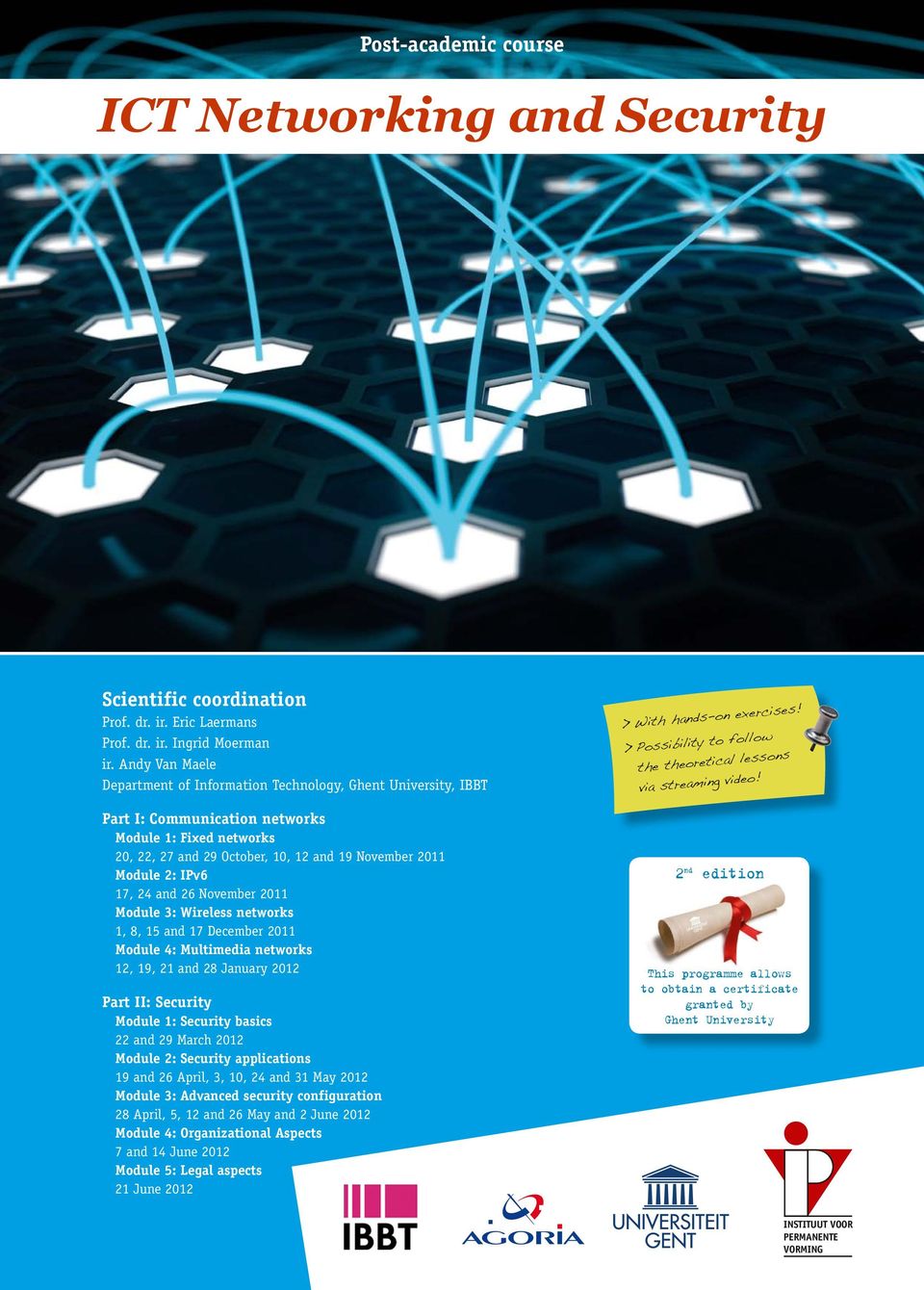
1 Post-academic course ICT Networking and Security Scientific coordination Prof. dr. ir. Eric Laermans Prof. dr. ir. Ingrid Moerman ir. Andy Van Maele Department of Information Technology, Part I: Communication networks Module 1: Fixed networks 20, 22, 27 and 29 October, 10, 12 and 19 November 2011 Module 2: IPv6 17, 24 and 26 November 2011 Module 3: Wireless networks 1, 8, 15 and 17 December 2011 Module 4: Multimedia networks 12, 19, 21 and 28 January 2012 Module 1: Security basics 22 and 29 March 2012 Module 2: Security applications 19 and 26 April, 3, 10, 24 and 31 May 2012 Module 3: Advanced security configuration 28 April, 5, 12 and 26 May and 2 June 2012 Module 4: Organizational Aspects 7 and 14 June 2012 Module 5: Legal aspects 21 June 2012 > With hands-on exercises! > Possibility to follow the theoretical lessons via streaming video! 2 nd edition This programme allows to obtain a certificate granted by Ghent University INSTITUUT VOOR PERMANENTE VORMING
2 Introduction Why this course? The world of communication networks has rapidly and thoroughly evolved in the last decades. We have gradually switched from traditional, fixed telephone networks, well controlled by clearly identified operators to mobile, pervasive, more open and ever more complex IP-based networks. The share of voice communication in total network traffic has dwindled, while the amount of data communication over IP-networks from new applications as the Web, streaming media, idtv, etc. has steadily risen. Even within mobile networks, data communication is taking an ever larger share with smartphones using the latest UMTSderived technologies. Today, these new data networks even compete with the older, more traditional networks for the telephone service, as Voice-over-IP has become a fierce competitor to the historical telephone operators. This course aims to present the underlying technologies of this relatively new reality. As long as networks were tightly controlled by well-defined operators, attacks against those networks were sometimes possible, allowing the hacker to pass the bill of his communications to the victim of the hacking, but the amplitude of the attacks and their damage were generally rather limited. The openness of contemporary networks, especially IP-based networks, and the complexity and vulnerability of contemporary terminals (computers or advanced mobile devices), requires much more attention on the security of these networks. Attacks can come from anywhere, at any time. The attack could even originate from the terminal of the user itself in the form of some spyware, leaking precious information to the hacker who planted the piece of malware. Furthermore, as users and enterprises rely more and more on their network infrastructure to do business, the consequences of successful attacks have become more devastating. The second objective of this course is to allow to understand which security functions and mechanisms exist, how they can be used and implemented to achieve acceptable secure communications. Who should attend? This course targets people with some technological background, although they don t need to be experts in ICT. The target audience of this course however is twofold: generalist and specialist. The generalist profile has a theoretical interest in ICT, and takes the course for conceptual knowledge. The specialist profile has both a theoretical and practical interest in ICT. The conceptual knowledge will be completed with hands-on training. For the latter, the specialist should have a basic knowledge of working on the Linux command line. Post-academic Course Certificate granted by Ghent University This programme is part of Ghent University s post-academic courses. To receive the certificate generalist for Part I, one should at least attend module 1 and the theoretical sessions of modules 2, 3 and 4 of part I and succeed for the final exam. Participants who follow all the modules of part I and succeed for the final exam, will receive the certificate specialist for Part I. For the certificate generalist of Part II, one should at least attend modules 1, 2, 4 and 5 of Part II and succeed for the final exam. To receive the certificate specialist for Part II, one should attend modules 1, 2, 3 and 4 of part II and succeed for the final exam. Course certificates are a personal merit: participants who aspire to a certificate cannot be replaced, others can. Streaming video There is the possibility to follow the theoretical sessions via streaming video. The lab sessions can t be followed by this method. For more information, please contact us. A demo of this method can be found on:

3 Programme Part I: Communication Networks Module 1: Fixed Networks The basis of most contemporary fixed networks is the TCP/IP protocol stack. The objective of this module is to discuss in more detail the several layers of this stack, starting with the application layer and ending with the data link layer. At the application layer, we shall deal with the most common protocols for Web (HTTP), (SMTP, POP), file transfer (FTP),... One level lower in the protocol stack, at the transport layer, we find the well known TCP and UDP. The transport layer itself relies on the underlying network layer, where the Internet Protocol (IP) is used. At this point routing and network management tools like OSPF, BGP, ICMP, NAT, DHCP,... will also be discussed. Finally, we end with the data link layer protocols such as Ethernet or PPP. The theory from this module will be illustrated by a series of 4 lab sessions which will give the course members hands-on experience about the operation of basic IP applications, network protocols and basic network configuration. Teacher: Andy Van Maele Dates: Theory lessons on 20 and 27 October and 10 November Lab exercises on 22 and 29 October and 12 and 19 November 2011 Module 2: IPv6 Since long IPv6 is the successor of the IPv4 protocol, but IPv6 remained in the development phase as long as IPv4 addresses were still available. However, the last available class A networks have been assigned in February Introducing IPv6 kicks off with the addressing of the new protocol, which now is notated in hexadecimal, and features some quite new concepts (IID, address scopes). Next to the addressing, the ICMPv6 protocol is tackled, covering new IPv6 concepts such as Neighbor Discovery, Duplicate Address Detection and Autoconfiguration. As IPv4 will be used for many more years, an overview of transition mechanisms towards IPv6 will be presented. This module will conclude with a case study on transition of an existing IPv4 network to an IPv6 enabled network. The theory will be complemented by a lab session, where an IPv6 only network will be built, and interconnected to the existing IPv6 Internet. Teachers: Gunter Van de Velde and Andy Van Maele Dates: Theory lessons on 17 and 24 November Lab exercise on 26 November 2011 Module 3: Wireless Networks Two different kinds of wireless networks will be dealt with in this module. On the one hand, we shall consider mobile communication systems relying on large cellular infrastructures, like GSM and UMTS. On the other hand, this module emphasizes on less institutional wireless technologies like WiMAX (wide area networks), WLAN (local networks), Bluetooth and Zigbee (personal area networks) and even RFID (tagging). The module will explain the basic concepts of wireless medium access and discuss the operating principles of the main wireless standards mentioned above. The theoretical part of this module will conclude with a use case study of the rollout of a WLAN in a professional environment. The theory is further complemented by a lab session where experience will be acquired with the capabilities and configuration of WLAN. Teachers: Francky Deleu, Piet Demeester and Ingrid Moerman Dates: Theory lessons on 1, 8 and 15 December Lab exercise on 17 December 2011 Module 4: Multimedia Networks The last module of this part about communication networks deals with multimedia networks and the specific network requirements multimedia implies. It is in this module that we shall discuss important concepts as quality of service (QoS), multicast and the nature of Internet traffic, which offers new possibilities that are unavailable in less advanced networks and are useful for the reliable transmission of multimedia data. Voice-over-IP will be considered as a typical multimedia application. Other, more advanced techniques such as SIP (used to support Voice-Over-IP), MPLS (used to support QoS), will also be handled. The theory is complemented by a series of 3 lab sessions where experience will be acquired with the nature of video traffic, by configuring a network to support QoS and with SIP. Teachers: Chris Develder and Andy Van Maele Dates: Theory lessons on 12 and 19 January Lab exercises on 21 and 28 January 2012 Modules 1 and 4 of Part I are supported by the reference book Computer networking a top-down approach featuring the internet, 5 th edition by J.F. Kurose and K.W. Ross (e 56,71 incl VAT). Module 3 of part I is supported by the reference book Mobile communications, 2 nd edition by J. Schiller (e 63,00 incl VAT). The reference book for modules 1 and 2 of Part II is Cryptography and Network Security, Principles and Practices, 5 th edition by W. Stallings (e 63,00 incl VAT). Reference books are billed directly by the bookshop.
4 Programme Module 1: Security Basics What does information security mean? Which functions can be realized? Why do we need security? These are the questions that should be answered in the first session of this module. The main basic objectives of information security are discussed: confidentiality, authentication, data-integrity, non-repudiation and availability. We shall show what may happen if insufficient measures are taken to achieve these properties and how people with bad intentions can undermine these objectives to gain an advantage. Besides these basic security concepts, this module also deals with the concrete basic mechanisms that can be used to achieve the desired security objectives. The basic principles of conventional and asymmetric encryption, hash functions, message authentication codes, time stamps, certificates, PKI,... are explained, without plunging into the mathematical details underlying these complex techniques. Biometric techniques will also be shortly discussed here, both with their advantages and their shortcomings. Teacher: Eric Laermans Dates: Theory lessons on 22 and 29 March 2012 Module 2: Security Applications Once the basic building blocks are well understood, we shall try to understand how they are used to achieve security in communication networks, at the different levels of the protocol stack: at application layer (PGP, S/MIME, SSH,...), at the transport layer (TLS/SSL) or at the network layer (IPsec). Related to these secure protocols, we shall also explain how they can be used to create VPNs. The use of these cryptographic security techniques alone is not sufficient to guarantee the security of computer or communication systems. System security measures protection against malware and other intrusions are also essential. This is why we shall also discuss malware protection, firewalls and intrusion detection systems. And finally, as wireless networks are particularly open and vulnerable to attacks, we deal with the specific security measures for wireless networks: from the defective WEP to the improved WPA and WPA2. Module 3: Advanced security configuration To those who are already more familiar with ICT and security, this module is devoted to the more advanced practical aspects of information security. In a series of 4 lab sessions, hands-on experience will be obtained in advanced PC security, authentication services with a RADIUS server and advanced security aspects of wireless networks. Teacher: Andy Van Maele Dates: Lab exercises on 28 April, 5, 12 and 26 May and 2 June 2012 Module 4: Organizational aspects Security is not just a matter of technology. The organizational aspects certainly are not less important. In this module, we shall see how information security can be organized within a company: how security policies are designed and implemented and how a company can respond to security incidents. Attention will also be given to the control and auditing of security policies, for which CobiT is an important standard. Teacher: Marc Vael Dates: Theory lessons on 7 and 14 June 2012 Module 5: Legal aspects The security part of this course concludes with a module about the legal aspects of security. Which activities (hacking, identity theft,...) can be considered illegal? What are the legal measures against computer crime? Another important legal aspect of information security is the protection of personal data (of customers or employees). This module also discusses the obligations of a company to achieve an acceptable level of information security. Besides protection against attacks, we also deal with the legal framework for electronic signatures and e-commerce. Teacher: Paul De Hert Date: Theory lesson on 21 June 2012 This module concludes with two case studies: one about the rollout of security measures in a professional environment and one about the use of tokens for security. Teachers: Eric Laermans, Dimitri Roman and Tim Stevens Dates: Theory lessons on 19 and 26 April, 3, 10, 24 and 31 May 2012
5 Teachers Scientific Coordination: Teachers: Part I: Communication networks Generalist track Specialist track Module 1: Fixed networks e e Module 2: IPv6 e 300* e 450 Module 3: Wireless networks e 450* e 600 Module 4: Multimedia networks e 300* e 600 Complete package e e Prof. dr. ir. Eric Laermans Department of Information Technology, Ghent University, IBBT Prof. dr. ir. Ingrid Moerman Department of Information Technology, Ghent University, IBBT ir. Andy Van Maele Department of Information Technology, Ghent University, IBBT Subscription form Module 1: Security basics e 300 e 300 Module 2: Security applications e 900 e 900 Module 3: Advanced security configuration e 750 Module 4: Organizational aspects e 300 e 300 Module 5: Legal aspects e 150 e 150 Complete package e e All modules Part I & II e * Remark: the Generalist track does not include the hands-on labs of Modules 2 to 4 of part I. > Paul De Hert, Law Science Technology & Society, Vrije Universiteit Brussel > Francky Deleu, Jan Yperman Hospital > Piet Demeester, Department of Information Technology, > Chris Develder, Department of Information Technology, > Eric Laermans, Department of Information Technology, > Ingrid Moerman, Department of Information Technology, > Dimitri Roman, VASCO Data Security International > Tim Stevens, National Bank of Belgium > Marc Vael, Smals > Gunter Van de Velde, Cisco > Andy Van Maele, Department of Information Technology, Preferably via OR by using this form: > by mail: Ghent University- Institute for Continuing Education (IVPV) attention of Els Van Lierde, Technologiepark 913, 9052 Zwijnaarde, Belgium > by fax: IVPV Return completed and signed form (use capitals): Name: First name: Private-address: Street: Zip: City: Country: Telephone: Company: Function: Company address: Street: Zip: City: Country: Telephone: VAT n : Fax: N : N : M F I want to follow the theoretical sessions via streaming video. Reference Books Computer networking a top-down approach featuring the internet, 5 th edition by J.F. Kurose and K.W. Ross (e 56,71 incl VAT) (reference book for Part I, modules 1 and 4) Mobile communications, 2 nd edition by J. Schiller (e 63,00 incl VAT) (reference book for Part I, module 3) Cryptography and Network Security, Principles and Practices, 5 th edition by W. Stallings (e 63,00 incl VAT) (reference book for Part II, modules 1 and 2) Invoice: Company Private Date: Signature: Your address data are incorporated by the IVPV in a database in order to be able to keep you informed of our activities and programmes. In accordance with the law from 8/12/1992 safeguarding personal privacy with respect to the processing of personal data, you are entitled to examine, correct or cancel this information kept by the IVPV.

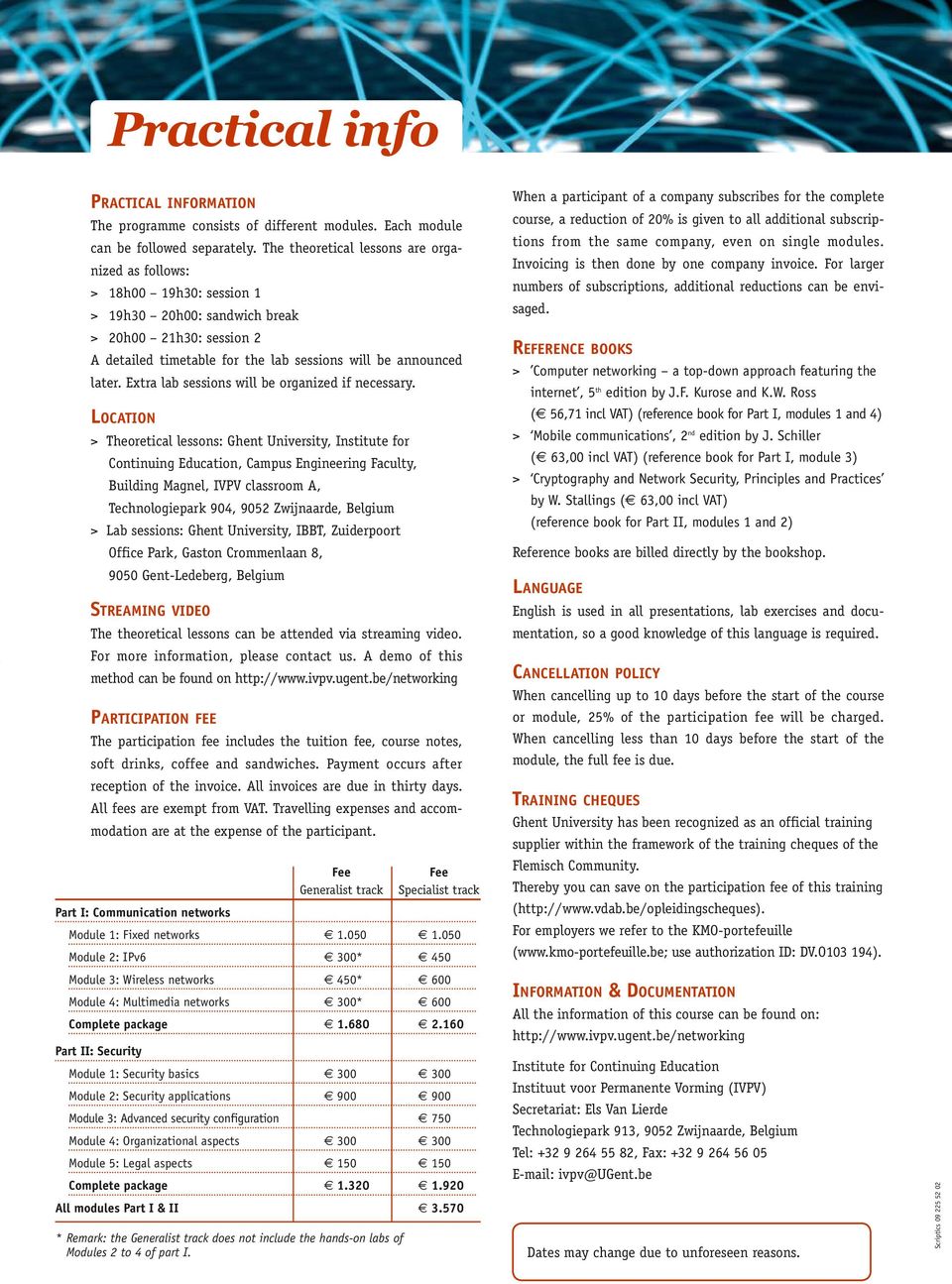
6 Practical info Practical information The programme consists of different modules. Each module can be followed separately. The theoretical lessons are organized as follows: > 18h00 19h30: session 1 > 19h30 20h00: sandwich break > 20h00 21h30: session 2 A detailed timetable for the lab sessions will be announced later. Extra lab sessions will be organized if necessary. Location > Theoretical lessons: Ghent University, Institute for Continuing Education, Campus Engineering Faculty, Building Magnel, IVPV classroom A, Technologiepark 904, 9052 Zwijnaarde, Belgium > Lab sessions:, Zuiderpoort Office Park, Gaston Crommenlaan 8, 9050 Gent-Ledeberg, Belgium Streaming video The theoretical lessons can be attended via streaming video. For more information, please contact us. A demo of this method can be found on Participation fee The participation fee includes the tuition fee, course notes, soft drinks, coffee and sandwiches. Payment occurs after reception of the invoice. All invoices are due in thirty days. All fees are exempt from VAT. Travelling expenses and accommodation are at the expense of the participant. Generalist track Specialist track Part I: Communication networks Module 1: Fixed networks e e Module 2: IPv6 e 300* e 450 Module 3: Wireless networks e 450* e 600 Module 4: Multimedia networks e 300* e 600 Complete package e e Module 1: Security basics e 300 e 300 Module 2: Security applications e 900 e 900 Module 3: Advanced security configuration e 750 Module 4: Organizational aspects e 300 e 300 Module 5: Legal aspects e 150 e 150 Complete package e e All modules Part I & II e * Remark: the Generalist track does not include the hands-on labs of Modules 2 to 4 of part I. When a participant of a company subscribes for the complete course, a reduction of 20% is given to all additional subscriptions from the same company, even on single modules. Invoicing is then done by one company invoice. For larger numbers of subscriptions, additional reductions can be envisaged. Reference books > Computer networking a top-down approach featuring the internet, 5 th edition by J.F. Kurose and K.W. Ross (e 56,71 incl VAT) (reference book for Part I, modules 1 and 4) > Mobile communications, 2 nd edition by J. Schiller (e 63,00 incl VAT) (reference book for Part I, module 3) > Cryptography and Network Security, Principles and Practices by W. Stallings (e 63,00 incl VAT) (reference book for Part II, modules 1 and 2) Reference books are billed directly by the bookshop. Language English is used in all presentations, lab exercises and documentation, so a good knowledge of this language is required. Cancellation policy When cancelling up to 10 days before the start of the course or module, 25% of the participation fee will be charged. When cancelling less than 10 days before the start of the module, the full fee is due. Training cheques Ghent University has been recognized as an official training supplier within the framework of the training cheques of the Flemisch Community. Thereby you can save on the participation fee of this training ( For employers we refer to the KMO-portefeuille ( use authorization ID: DV.O ). Information & Documentation All the information of this course can be found on: Institute for Continuing Education Instituut voor Permanente Vorming (IVPV) Secretariat: Els Van Lierde Technologiepark 913, 9052 Zwijnaarde, Belgium Tel: , Fax: [email protected] Dates may change due to unforeseen reasons. Scriptics
ICT Networking and security
 Post-academic course in ICT ICT Networking and security First component of a new broad ICT course Part I: Communication networks, January March 2008 Module 1: Fixed Networks Module 2: Multimedia Networks
ICT & Business. Post-academic course. Scientific coordination. Prof. dr. ir. Jozef De Man Department of Information Technology, Ghent University
 Post-academic course ICT & Business Scientific coordination Prof. dr. ir. Jozef De Man Department of Information Technology, Ghent University Module 1: Business & ICT alignment 15, 19, 22, 26 and 29 October
ICT Software & Data processing
 Post-academic course ICT Software & Data processing Scientific Coordination Prof. dr. ir. Koen De Bosschere Department of Electronics, Parallel Information Systems Group, Ghent University Prof. dr. ir.
Bachelor of Information Technology (Network Security)
 Bachelor of Information Technology (Network Security) Course Structure Year 1: Level 100 Foundation knowledge subjects SEMESTER 1 SEMESTER 2 ITICT101A Fundamentals of Computer Organisation ITICT104A Internetworking
EUCIP - IT Administrator. Module 5 IT Security. Version 2.0
 EUCIP - IT Administrator Module 5 IT Security Version 2.0 Module 5 Goals Module 5 Module 5, IT Security, requires the candidate to be familiar with the various ways of protecting data both in a single
CCNA Security 2.0 Scope and Sequence
 CCNA Security 2.0 Scope and Sequence Last Updated August 26, 2015 Target Audience The Cisco CCNA Security course is designed for Cisco Networking Academy students seeking career-oriented, entry-level security
How To Pass A Credit Course At Florida State College At Jacksonville
 Form 2A, Page 1 FLORIDA STATE COLLEGE AT JACKSONVILLE COLLEGE CREDIT COURSE OUTLINE COURSE NUMBER: CTS 2658 COURSE TITLE: PREREQUISITE(S): COREQUISITE(S): Managing Network Security CNT 2210 with grade
ICT Infrastructure & Network Management
 Context ICT Infrastructure & Network Management Postgraduate Degree Programme Hogeschool-Universiteit Brussel 2014-2015 The HUB University College offers a wide range of postgraduate and other courses
CCNA Security v1.0 Scope and Sequence
 CCNA Security v1.0 Scope and Sequence Last updated April 7, 2011 Target Audience The Cisco CCNA Security course is designed for Cisco Networking Academy students seeking career-oriented, entry-level security
Course Overview: Learn the essential skills needed to set up, configure, support, and troubleshoot your TCP/IP-based network.
 Course Name: TCP/IP Networking Course Overview: Learn the essential skills needed to set up, configure, support, and troubleshoot your TCP/IP-based network. TCP/IP is the globally accepted group of protocols
CSE 473s Introduction to Computer Networks
 CSE 473s Introduction to Computer Networks Raj Jain Washington University in Saint Louis Saint Louis, MO 63130 [email protected] Audio/Video recordings of this lecture are available on-line at: http://www.cse.wustl.edu/~jain/cse473-11/
APNIC elearning: Network Security Fundamentals. 20 March 2013 10:30 pm Brisbane Time (GMT+10)
 APNIC elearning: Network Security Fundamentals 20 March 2013 10:30 pm Brisbane Time (GMT+10) Introduction Presenter/s Nurul Islam Roman Senior Training Specialist [email protected] Specialties: Routing &
Computer Network Engineering
 208 Computer Network Engineering Degrees, Certificates and Awards Associate in Science: Certificate of Achievement: Skills Competency Award: Cisco Networking Associate Program Description The field of
Computer Network Engineering
 226 Computer Network Engineering Computer Network Engineering Degrees, Certificates and Awards Associate in Science: Computer Network Engineering Certificate of Achievement: Computer Network Engineering
EDA 1200 4.3 Training Programs. Catalog of Course Descriptions
 EDA 1200 4.3 Training Programs Catalog of Course Descriptions Catalog of Course Descriptions INTRODUCTION...3 ACCESS NETWORKS, AN OVERVIEW...4 CORE NETWORKS, AN OVERVIEW...6 EDA 1200 4.3 INSTALLATION AND
Developing Network Security Strategies
 NETE-4635 Computer Network Analysis and Design Developing Network Security Strategies NETE4635 - Computer Network Analysis and Design Slide 1 Network Security Design The 12 Step Program 1. Identify network
NETWORK SECURITY (W/LAB) Course Syllabus
 6111 E. Skelly Drive P. O. Box 477200 Tulsa, OK 74147-7200 NETWORK SECURITY (W/LAB) Course Syllabus Course Number: NTWK-0008 OHLAP Credit: Yes OCAS Code: 8131 Course Length: 130 Hours Career Cluster: Information
CS 5480 Computer Networks
 CS 5480 Computer Networks Professor Sneha Kumar Kasera School of Computing 1 My Background PhD - Computer Science dept, UMass Amherst (1999) Bell Labs research (1999 2003) research interests computer networks
Implementing Cisco IOS Network Security v2.0 (IINS)
 Implementing Cisco IOS Network Security v2.0 (IINS) Course Overview: Implementing Cisco IOS Network Security (IINS) v2.0 is a five-day instructor-led course that is presented by Cisco Learning Partners
IT4405 Computer Networks (Compulsory)
 IT4405 Computer Networks (Compulsory) INTRODUCTION This course provides a comprehensive insight into the fundamental concepts in data communications, computer network systems and protocols both fixed and
Course Bachelor of Information Technology majoring in Network Security or Data Infrastructure Engineering
 Course Bachelor of Information Technology majoring in Network Security or Data Infrastructure Engineering Course Number HE20524 Location Meadowbank OVERVIEW OF SUBJECT REQUIREMENTS Note: This document
Networking. Systems Design and. Development. CRC Press. Taylor & Francis Croup. Boca Raton London New York. CRC Press is an imprint of the
 Networking Systems Design and Development Lee Chao CRC Press Taylor & Francis Croup Boca Raton London New York CRC Press is an imprint of the Taylor & Francis Croup, an Informa business AN AUERBACH BOOK
Introduction to Cyber Security / Information Security
 Introduction to Cyber Security / Information Security Syllabus for Introduction to Cyber Security / Information Security program * for students of University of Pune is given below. The program will be
a) Encryption is enabled on the access point. b) The conference room network is on a separate virtual local area network (VLAN)
 MIS5206 Week 12 Your Name Date 1. Which significant risk is introduced by running the file transfer protocol (FTP) service on a server in a demilitarized zone (DMZ)? a) User from within could send a file
CompTIA Network+ (Exam N10-005)
 CompTIA Network+ (Exam N10-005) Length: Location: Language(s): Audience(s): Level: Vendor: Type: Delivery Method: 5 Days 182, Broadway, Newmarket, Auckland English, Entry Level IT Professionals Intermediate
Networking: EC Council Network Security Administrator NSA
 coursemonster.com/uk Networking: EC Council Network Security Administrator NSA View training dates» Overview The EC-Council's NSA certification looks at network security from a defensive view. The NSA
Implementing Cisco IOS Network Security
 Implementing Cisco IOS Network Security IINS v3.0; 5 Days, Instructor-led Course Description Implementing Cisco Network Security (IINS) v3.0 is a 5-day instructor-led course focusing on security principles
Internet Security. Contents. ITS335: IT Security. Internet Security. Secure Email. Summary
 2 : IT Security Sirindhorn International Institute of Technology Thammasat University Prepared by Steven Gordon on 2 January 2015 its335y14s2l10, Steve/Courses/2014/s2/its335/lectures/internet.tex, r3506
Network Access Security. Lesson 10
 Network Access Security Lesson 10 Objectives Exam Objective Matrix Technology Skill Covered Exam Objective Exam Objective Number Firewalls Given a scenario, install and configure routers and switches.
SSVVP SIP School VVoIP Professional Certification
 SSVVP SIP School VVoIP Professional Certification Exam Objectives The SSVVP exam is designed to test your skills and knowledge on the basics of Networking, Voice over IP and Video over IP. Everything that
;. ' ;. - ' Computer Networking. ^4 Top-Down Approach. James F. Kurose. Keith W. Ross. Polytechnic University, Brooklyn PEARSON.
 ;. ' ;. - ' Computer Networking ^4 Top-Down Approach James F. Kurose University of Massachusetts, Amherst Keith W. Ross Polytechnic University, Brooklyn PEARSON Addison Weslev Boston San Francisco N e
DATA SECURITY 1/12. Copyright Nokia Corporation 2002. All rights reserved. Ver. 1.0
 DATA SECURITY 1/12 Copyright Nokia Corporation 2002. All rights reserved. Ver. 1.0 Contents 1. INTRODUCTION... 3 2. REMOTE ACCESS ARCHITECTURES... 3 2.1 DIAL-UP MODEM ACCESS... 3 2.2 SECURE INTERNET ACCESS
How To Pass The Information And Network Security Certificate
 Information Technology Information and Network Security Certificate Program Information and Network Security Certificate Program The Information and Network Security Certificate Program helps industry
Cisco Packet Tracer 6.3 Frequently Asked Questions
 Cisco Packet Tracer 6.3 Frequently Asked Questions Last Updated 22 January 2015 FAQ Table of Contents Cisco Packet Tracer 6.3 Release...1 Q1. What is Cisco Packet Tracer?... 1 Q2. How can I obtain Packet
Implementing Secured Converged Wide Area Networks (ISCW) Version 1.0
 COURSE OVERVIEW Implementing Secure Converged Wide Area Networks (ISCW) v1.0 is an advanced instructor-led course that introduces techniques and features that enable or enhance WAN and remote access solutions.
Solutions Guide. Secure Remote Access. Allied Telesis provides comprehensive solutions for secure remote access.
 Solutions Guide Secure Remote Access Allied Telesis provides comprehensive solutions for secure remote access. Introduction The world is generating electronic data at an astonishing rate, and that data
Security + Certification (ITSY 1076) Syllabus
 Security + Certification (ITSY 1076) Syllabus Course: ITSY 1076 Security+ 40 hours Course Description: This course is targeted toward an Information Technology (IT) professional who has networking and
Chapter 1 Personal Computer Hardware------------------------------------------------ 7 hours
 Essential Curriculum Networking Essentials Total Hours: 244 Cisco Discovery 1: Networking for Home and Small Businesses 81.5 hours teaching time Chapter 1 Personal Computer Hardware------------------------------------------------
Network Security Fundamentals
 APNIC elearning: Network Security Fundamentals 27 November 2013 04:30 pm Brisbane Time (GMT+10) Introduction Presenter Sheryl Hermoso Training Officer [email protected] Specialties: Network Security IPv6
IINS Implementing Cisco Network Security 3.0 (IINS)
 IINS Implementing Cisco Network Security 3.0 (IINS) COURSE OVERVIEW: Implementing Cisco Network Security (IINS) v3.0 is a 5-day instructor-led course focusing on security principles and technologies, using
APWG. (n.d.). Unifying the global response to cybecrime. Retrieved from http://www.antiphishing.org/
 DB1 Phishing attacks, usually implemented through HTML enabled e-mails, are becoming more common and more sophisticated. As a network manager, how would you go about protecting your users from a phishing
Track 2: Introductory Track PREREQUISITE: BASIC COMPUTER EXPERIENCE
 Anne Arundel Community College Tracks Anne Arundel Community College s computer technologies courses have been organized into 10 suggested tracks. The tracks are arranged to ensure that students have the
information security and its Describe what drives the need for information security.
 Computer Information Systems (Forensics Classes) Objectives for Course Challenges CIS 200 Intro to Info Security: Includes managerial and Describe information security and its critical role in business.
Network Security and Firewall 1
 Department/program: Networking Course Code: CPT 224 Contact Hours: 96 Subject/Course WEB Access & Network Security: Theoretical: 2 Hours/week Year Two Semester: Two Prerequisite: NET304 Practical: 4 Hours/week
Advanced Internetworking
 Hands-On TCP-IP / IPv6 / VoIP Course Description In this Hands-On 3-day course, gives a deeper understanding of internetworking and routed network protocols. The focus of the course is the design, operation,
Guide to Network Defense and Countermeasures Third Edition. Chapter 2 TCP/IP
 Guide to Network Defense and Countermeasures Third Edition Chapter 2 TCP/IP Objectives Explain the fundamentals of TCP/IP networking Describe IPv4 packet structure and explain packet fragmentation Describe
Lecture Objectives. Lecture 8 Mobile Networks: Security in Wireless LANs and Mobile Networks. Agenda. References
 Lecture Objectives Wireless Networks and Mobile Systems Lecture 8 Mobile Networks: Security in Wireless LANs and Mobile Networks Introduce security vulnerabilities and defenses Describe security functions
JOB READY ASSESSMENT BLUEPRINT COMPUTER NETWORKING FUNDAMENTALS - PILOT. Test Code: 4514 Version: 01
 JOB READY ASSESSMENT BLUEPRINT COMPUTER NETWORKING FUNDAMENTALS - PILOT Test Code: 4514 Version: 01 Specific Competencies and Skills Tested in this Assessment: PC Principles Identify physical and equipment
Computer Networks CCNA Module 1
 Chapter 1: Quiz 1 Q1: Which statement describes a network that supports QoS? The fewest possible devices are affected by a failure. The network should be able to expand to keep up with user demand. The
IPv6 SECURITY. May 2011. The Government of the Hong Kong Special Administrative Region
 IPv6 SECURITY May 2011 The Government of the Hong Kong Special Administrative Region The contents of this document remain the property of, and may not be reproduced in whole or in part without the express
CCNA Security v1.0 Scope and Sequence
 CCNA Security v1.0 Scope and Sequence Last updated June 18, 2009 Note: The English version of this course is scheduled to be generally available in July 2009. Target Audience The Cisco CCNA Security course
OCR LEVEL 3 CAMBRIDGE TECHNICAL
 Cambridge TECHNICALS OCR LEVEL 3 CAMBRIDGE TECHNICAL CERTIFICATE/DIPLOMA IN IT COMPUTER NETWORKS R/601/7320 LEVEL 3 UNIT 7 GUIDED LEARNING HOURS: 60 UNIT CREDIT VALUE: 10 COMPUTER NETWORKS R/601/7320 LEVEL
IPv6 Fundamentals, Design, and Deployment
 IPv6 Fundamentals, Design, and Deployment Course IP6FD v3.0; 5 Days, Instructor-led Course Description The IPv6 Fundamentals, Design, and Deployment (IP6FD) v3.0 course is an instructor-led course that
IPv6@ARIN. Matt Ryanczak Network Operations Manager
 IPv6@ARIN Matt Ryanczak Network Operations Manager 1990 1995 2004 2009 IPv6 Timeline IETF starts thinking about successors to IPv4. RFC1817 CIDR and Classful Routing RFC 1883 Draft IPv6 Spec RFC 3775 IPv6
Computer Networks. A Top-Down Approach. Behrouz A. Forouzan. and. Firouz Mosharraf. \Connect Mc \ Learn. Hill
 Computer Networks A Top-Down Approach Behrouz A. Forouzan and Firouz Mosharraf \Connect Mc \ Learn Graw I Succeed* Hill Preface xvii Trademarks xxiii Chapter 1 Introduction 1 1.1 OVERVIEW OF THE INTERNET
InCert Network Security Professional Certificate Description for Candidates
 TUT / T. Kelo, J. Koskinen / 04.09.2007 InCert The 2nd handbook Version 1.5 InCert Network Security Professional Certificate Description for Candidates Introduction InCert Network Security Professional
Introduction to IP v6
 IP v 1-3: defined and replaced Introduction to IP v6 IP v4 - current version; 20 years old IP v5 - streams protocol IP v6 - replacement for IP v4 During developments it was called IPng - Next Generation
How To Protect Your Network From Attack
 Department of Computer Science Institute for System Architecture, Chair for Computer Networks Internet Services & Protocols Internet (In)Security Dr.-Ing. Stephan Groß Room: INF 3099 E-Mail: [email protected]
Industrial Network Security for SCADA, Automation, Process Control and PLC Systems. Contents. 1 An Introduction to Industrial Network Security 1
 Industrial Network Security for SCADA, Automation, Process Control and PLC Systems Contents 1 An Introduction to Industrial Network Security 1 1.1 Course overview 1 1.2 The evolution of networking 1 1.3
Course Content Summary ITN 261 Network Attacks, Computer Crime and Hacking (4 Credits)
 Page 1 of 6 Course Content Summary ITN 261 Network Attacks, Computer Crime and Hacking (4 Credits) TNCC Cybersecurity Program web page: http://tncc.edu/programs/cyber-security Course Description: Encompasses
Review: Lecture 1 - Internet History
 Review: Lecture 1 - Internet History late 60's ARPANET, NCP 1977 first internet 1980's The Internet collection of networks communicating using the TCP/IP protocols 1 Review: Lecture 1 - Administration
How To Use A Cisco Wvvvdns4400N Wireless-N Gigabit Security Router For Small Businesses
 Cisco WRVS4400N Wireless-N Gigabit Security Router Cisco Small Business Routers Highlights Secure, high-speed wireless network access for small business Gigabit Ethernet connections enable rapid transfer
NEW YORK INSTITUTE OF TECHNOLOGY School of Engineering and Technology Department of Computer Science Old Westbury Campus
 NEW YORK INSTITUTE OF TECHNOLOGY School of Engineering and Technology Department of Computer Science Old Westbury Campus CSCI - 440 Network Security and Perimeter Protection 3-0-3 CATALOG DESCRIPTION This
Course Title: Penetration Testing: Security Analysis
 Course Title: Penetration Testing: Security Analysis Page 1 of 9 Course Description: The Security Analyst Series from EC-Council Press is comprised of five books covering a broad base of topics in advanced
Prerequisites: Fundamentals of Networking, Knowledge of Operating Systems
 Course Name: Linux Server Administration Course Code: PGDNA121 To understand the basic principles underlying Server Software Planning and Deploying Linux Server Manage the Servers Efficiently Fundamentals
Protocol Specification & Design. The Internet and its Protocols. Course Outline (trivia) Introduction to the Subject Teaching Methods
 The Internet and its Protocols Protocol Specification & Design Robert Elz [email protected] [email protected] http://fivedots.coe.psu.ac.th/~kre/ Friday: 13:30-15:00 (Rm: 101)???: xx:x0-xx:x0 (Rm:???)
ICTTEN8195B Evaluate and apply network security
 ICTTEN8195B Evaluate and apply network security Release 1 ICTTEN8195B Evaluate and apply network security Modification History Release Release 2 Comments This version first released with ICT10 Integrated
Essential Curriculum Computer Networking 1. PC Systems Fundamentals 35 hours teaching time
 Essential Curriculum Computer Networking 1 PC Systems Fundamentals 35 hours teaching time Part 1----------------------------------------------------------------------------------------- 2.3 hours Develop
Encryption of E-Mail Traffic
 Encryption of E-Mail Traffic White Paper Version 1.1 Date: 2009-06-08 Foreword On the initiative of some German automotive manufacturers work has started on a series of white papers on the subject of e-mail
Computer Security. Principles and Practice. Second Edition. Amp Kumar Bhattacharjee. Lawrie Brown. Mick Bauer. William Stailings
 Computer Security Principles and Practice Second Edition William Stailings Lawrie Brown University ofnew South Wales, Australian Defence Force Academy With Contributions by Mick Bauer Security Editor,
Networking Basics and Network Security
 Why do we need networks? Networking Basics and Network Security Shared Data and Functions Availability Performance, Load Balancing What is needed for a network? ISO 7-Layer Model Physical Connection Wired:
Wireless Mobile Internet Security. 2nd Edition
 Brochure More information from http://www.researchandmarkets.com/reports/2330593/ Wireless Mobile Internet Security. 2nd Edition Description: The mobile industry for wireless cellular services has grown
Networking 4 Voice and Video over IP (VVoIP)
 Networking 4 Voice and Video over IP (VVoIP) Course Objectives This course will give delegates a good understanding of LANs, WANs and VVoIP (Voice and Video over IP). It is aimed at those who want to move
Network System Design Lesson Objectives
 Network System Design Lesson Unit 1: INTRODUCTION TO NETWORK DESIGN Assignment Customer Needs and Goals Identify the purpose and parts of a good customer needs report. Gather information to identify network
INFORMATION SCIENCE. INFSCI 0010 INTRODUCTION TO INFORMATION SCIENCE 3 cr. INFSCI 0015 DATA STRUCTURES AND PROGRAMMING TECHNIQUES 3 cr.
 INFORMATION SCIENCE INFSCI 0010 INTRODUCTION TO INFORMATION SCIENCE 3 cr. Introduction to the concepts, principles, and skills of information science for students with no programming experience. Topics
CSE 3461 / 5461: Computer Networking & Internet Technologies
 Autumn Semester 2014 CSE 3461 / 5461: Computer Networking & Internet Technologies Instructor: Prof. Kannan Srinivasan 08/28/2014 Announcement Drop before Friday evening! k. srinivasan Presentation A 2
Networking Technology Online Course Outline
 Networking Technology Online Course Outline Introduction Networking Technology Introduction Welcome to InfoComm University About InfoComm International About Networking Technology Network Technology Course
CMPSCI 453 Computer Networking. Professor V. Arun Department of Computer Science University of Massachusetts Amherst
 CMPSCI 453 Computer Networking Professor V. Arun Department of Computer Science University of Massachusetts Amherst 1 What is this course about? introductory (first) course in computer networking q learn
Table of Contents. Introduction. Audience. At Course Completion
 Table of Contents Introduction Audience At Course Completion Prerequisites Certified Professional Exams Student Materials Course Outline Introduction This four-day, instructor-led course provides students
INTERNET SECURITY: THE ROLE OF FIREWALL SYSTEM
 INTERNET SECURITY: THE ROLE OF FIREWALL SYSTEM Okumoku-Evroro Oniovosa Lecturer, Department of Computer Science Delta State University, Abraka, Nigeria Email: [email protected] ABSTRACT Internet security
Network Security Administrator
 Network Security Administrator Course ID ECC600 Course Description This course looks at the network security in defensive view. The ENSA program is designed to provide fundamental skills needed to analyze
ITL BULLETIN FOR JANUARY 2011
 ITL BULLETIN FOR JANUARY 2011 INTERNET PROTOCOL VERSION 6 (IPv6): NIST GUIDELINES HELP ORGANIZATIONS MANAGE THE SECURE DEPLOYMENT OF THE NEW NETWORK PROTOCOL Shirley Radack, Editor Computer Security Division
Raritan Valley Community College Academic Course Outline. CISY 253 - Advanced Computer Networking
 Raritan Valley Community College Academic Course Outline CISY 253 - Advanced Computer Networking I. Basic Course Information A. Course number and Title: CISY 253- Advanced Computer Networking (TCP/IP)
PROTECTING INFORMATION SYSTEMS WITH FIREWALLS: REVISED GUIDELINES ON FIREWALL TECHNOLOGIES AND POLICIES
 PROTECTING INFORMATION SYSTEMS WITH FIREWALLS: REVISED GUIDELINES ON FIREWALL TECHNOLOGIES AND POLICIES Shirley Radack, Editor Computer Security Division Information Technology Laboratory National Institute
Eleventh Hour Security+
 Eleventh Hour Security+ Exam SYO-201 Study Guide I do Dubrawsky Technical Editor Michael Cross AMSTERDAM BOSTON HEIDELBERG LONDON NEWYORK OXFORD PARIS SAN DIEGO SAN FRANCISCO SINGAPORE SYDNEY TOKYO SYNGRESS.
ADMINISTRATIVE POLICY # 32 8 117 (2014) Remote Access. Policy Number: ADMINISTRATIVE POLICY # 32 8 117 (2014) Remote Access
 Policy Title: Remote Access Policy Type: Administrative Policy Number: ADMINISTRATIVE POLICY # 32 8 117 (2014) Remote Access Approval Date: 05/20/2014 Revised Responsible Office: Office of Information
Communication Networks MAP-TELE 2012/13
 Communication Networks MAP-TELE 2012/13 Objective of the course The main objective of the course is to present the fundamentals of modern communication systems and networks and allow students to consolidate
FIREWALLS & CBAC. [email protected]
 FIREWALLS & CBAC [email protected] Implementing a Firewall Personal software firewall a software that is installed on a single PC to protect only that PC All-in-one firewall can be a single device that
IT Networking and Security
 elearning Course Outlines IT Networking and Security powered by Calibrate elearning Course Outline CompTIA A+ 801: Fundamentals of Computer Hardware/Software www.medallionlearning.com Fundamentals of Computer
CCNA Cisco Associate- Level Certifications
 CCNA Cisco Associate- Level Certifications Routing & Switching Security Voice Wireless Advance your network engineering skills in working on complex Cisco network solutions. WWW.FASTLANEUS.COM Cisco CCNA
Cisco WRVS4400N Wireless-N Gigabit Security Router: Cisco Small Business Routers
 Cisco WRVS4400N Wireless-N Gigabit Security Router: Cisco Small Business Routers Highlights Secure, high-speed wireless network access for small business Gigabit Ethernet connections enable rapid transfer
Associate in Science Degree in Computer Network Systems Engineering
 Moorpark College Associate in Science Degree in Computer Network Systems Engineering To earn an Associate in Science Degree with a major in Computer Network Systems Engineering, students complete 40.5-45
COMPUTER NETWORK TECHNOLOGY (300)
 Page 1 of 10 Contestant Number: Time: Rank: COMPUTER NETWORK TECHNOLOGY (300) REGIONAL 2014 TOTAL POINTS (500) Failure to adhere to any of the following rules will result in disqualification: 1. Contestant
Network Security 網 路 安 全. Lecture 1 February 20, 2012 洪 國 寶
 Network Security 網 路 安 全 Lecture 1 February 20, 2012 洪 國 寶 1 Outline Course information Motivation Introduction to security Basic network concepts Network security models Outline of the course 2 Course
Govt. of Karnataka, Department of Technical Education Diploma in Computer Science & Engineering. Sixth Semester
 Govt. of Karnataka, Department of Technical Education Diploma in Computer Science & Engineering Sixth Semester Subject: Network Security & Management Contact Hrs / week: 4 Total hrs: 64 Table of Contents
CH ENSA EC-Council Network Security Administrator Detailed Course Outline
 CH ENSA EC-Council Network Security Administrator Detailed Course Outline Summary Duration Vendor Audience 5 Days hands-on training EC-Council Security Professionals Level Technology Category Advance Ethical