
Handbook for Homebound and Home-based Instruction
|
|
|
- Jonah Hamilton
- 10 years ago
- Views:
Transcription
1 Handbook for Homebound and Home-based Instruction Office of Out-of-School Support Fairfax County Public Schools Department of Special Services Jeanne Veraska, Program manager Kristin Dougherty, Educational specialist Revised August 2014 [1]

2 The Fairfax County Public Schools (FCPS) homebound and home-based programs are administered by the program manager of Office of Out-of-School Support (OSS), as part of Nontraditional School Programs (NSP), Intervention and Prevention Services (IPS), Department of Special Services (DSS). For current contact information: For current version of FCPS Regulation baa/$FILE/R2140.pdf Homebound and home-based instructional services may be available for Fairfax County Public Schools students who are unable to attend school because of medical, disciplinary, or other reasons. Section 1: Homebound Instruction, beginning on page 3, describes the provision of academic instruction to students who are unable to receive school-based instruction based on a medical certification of need. Section 2: Home-based Instruction, beginning on page 18, describes the provision of academic instruction in the home or other setting for special education students who are removed from school for disciplinary or other reasons. Section 3: Homebound and Home-based Teacher Requirements begin on page 32. [2]

3 Section 1 Homebound Instructional Services [3]

4 TABLE OF CONTENTS for Section 1: Homebound Instructional Services Introduction... 5 General Information... 6 Referral for Homebound Instruction... 6 Eligibility... 6 Levels of Homebound Instruction... 6 Courses Supported... 7 Hours of Homebound Services... 7 Location of Instructional Sessions... 8 Student Rights and Responsibilities... 8 Missed Sessions... 8 Special Education... 8 Technology... 8 Grading... 9 SOL and Other Required Testing... 9 Extension or Early Termination of Homebound Services... 9 End-of-Year Termination of Homebound Services... 9 School Reintegration Process... 9 Reporting Student Information... 9 Responsibilities Program manager/educational specialist (OSS) School Homebound Coordinator Special Education Department Chair or Lead Teacher School Social Worker School Counselor Parents, Guardians, or Students Classroom Teacher Homebound Teacher Medical Homebound Instruction: General Education Flow Chart Medical Homebound Instruction: Special Education Flow Chart Homebound and Home-based Teacher Requirements Professional Qualifications Compensation Reporting Time and Attendance [4]

5 Introduction This section of the handbook provides information to schools and families about the temporary provision of homebound instruction. The goal of homebound services is to keep the student current with classroom instruction and facilitate the student s return to the current classroom setting. Fairfax County Public Schools (FCPS) seeks to provide homebound instruction in a seamless manner for students who must use this service. Students are expected to attend school to the fullest extent possible, but homebound services may be provided to students who are confined to home or a health care facility and are unable to attend school based upon certification of need by a licensed physician, a licensed clinical psychologist, a licensed nurse practitioner. Homebound instruction is not intended to supplant school services and is, by design, temporary. It is not a remediation program and is not designed to provide students with time to make up previously missed assignments. The goal of homebound instruction is to keep the student as current as possible with classroom instruction. It is expected that the family and school will minimize academic work missed due to absences prior to the initiation of homebound services. Communication among the school, the family, homebound teachers, and the FCPS Office of Out-of-School Support (OSS) is vital to the success of homebound instruction. This handbook provides a description of responsibilities for each individual involved in the implementation of services. When all parties work together, students are able to benefit from the provision of services and return to the school environment when services are no longer needed. Questions about homebound instruction may be directed to a school s homebound coordinator by calling the school or the FCPS Office of Out-of-School Support (OSS), [5]

6 Referral for Homebound Instruction General Information When a student is identified by a parent or guardian or a member of the school staff as missing an excessive number of school days due to a medical condition, the school homebound coordinator should be notified immediately. If the student is eligible for special education services, the special education department chair or the lead teacher should also be notified. These individuals will work with the family to determine if a referral requesting homebound instructional services is appropriate and, if so, will help those involved complete the referral. Eligibility A student must be enrolled in an FCPS school in order to be considered for homebound instructional services. Eligibility for homebound instruction is determined on the basis of medical evidence submitted by a licensed physician, a licensed clinical psychologist, or a licensed nurse practitioner,. A diagnosis with an explanation of how symptoms affect school attendance is required. A specific treatment plan and a plan for returning the student to school is requested; however, this information is required if the student is expected to miss more than nine weeks of school. In no case will full homebound instruction be provided when a student can participate in a less restrictive school setting. Physical condition: Students with physical conditions causing them to be unable to attend school may include those with serious or terminal illnesses, those undergoing treatments that compromise their immune systems, those undergoing surgery, or in postpartum recovery (up to six weeks). The student must be free of infectious or communicable disease. Mental health condition: In order to consider homebound instruction for students with psychiatric disorders, a mental health professional must be treating the student, and a psychiatrist or a clinical psychologist must provide the medical documentation. It should be noted that in some instances when a student is experiencing psychiatric difficulties, homebound instruction may exacerbate the student s problems and would, therefore, not be approved. Other school-based alternatives may be appropriate. The program manager or educational specialist (OSS) will determine eligibility for homebound instruction based on the Virginia Department of Education Guidelines. Approval of students for homebound instruction is based on medical documentation submitted by a licensed physician, a licensed clinical psychologist, or a licensed nurse practitioner, and information provided by school staff members. FCPS will request that the parent or guardian sign a release of information form allowing the medical professional to share information or clarify information provided for approval of homebound instruction. Approval is determined by the program manager or educational specialist on the basis of the documented need for service, taking into consideration less restrictive educational options and a student s participation in extracurricular or employment activities. Levels of Homebound Instruction Full Instruction: A student who will miss 20 consecutive days or more of classroom instruction because of a medical condition, either physical or psychiatric, may be considered for full homebound instruction. Partial Instruction: A student who has a medical condition that significantly affects his or her stamina or ability to function in a full-day academic setting may be considered for partial homebound instruction, while continuing to attend school for one or more classes. A collaborative plan must be developed and other less restrictive alternatives must be considered first. [6]

7 Partial homebound instruction may be part of the process of reintegrating a student who has been on full homebound instruction or may be considered for a student who will miss more than 20 partial days of school due to a certified medical condition. Intermittent Instruction: A student who undergoes medical treatment protocols that affect the student s ability to consistently function in a school setting may be considered for intermittent homebound services. For example, a student who is receiving a series of chemotherapy treatments for cancer may be able to attend school between, but not during, the treatment phases. Other students having chronic conditions, such as sickle cell anemia or severe seasonal asthma, which cause significant, yet intermittent, school absences may also qualify for homebound instruction. To qualify, the doctor must anticipate that the student will miss a significant amount of school. The school, homebound office, family, and doctor shall develop a collaborative plan to include conditions under which homebound or classroom instruction can be implemented. Whenever possible, the student s classroom teachers will be assigned as the homebound teachers. Courses Supported Instructional support is provided for core academic classes: English, science, social studies, and mathematics. For secondary students, foreign language may also be supported if required for the diploma being pursued. In order to ensure that students meet the graduation requirement for Economics and Personal Finance, the course will be offered to high school students receiving Homebound. Instruction for physical education (P.E.), fine arts and practical arts, and elective courses must be coordinated with the student s school. Homebound teachers do not provide instruction in these subjects. The decision concerning the completion of these courses rests with the school. Parents or guardians may discuss this with the student,school counselor, and when appropriate with a school administrator. Hours of Homebound Services The number of hours of instruction per week per student will be based on a student s individual needs. Based on a regular five-day school week, secondary students are generally provided with a maximum of two and one-half (2.5) hours per week for each core class, when necessary, two and one-half (2.5) hours per week of Economics and Personal Finance, plus an additional two and one-half (2.5) hours per week for foreign language, if required for the diploma being pursued. Elementary students are generally provided with five hours of instructional services per regular five-day school week. Early childhood students who do not normally attend a full day of school () have a proportionally fewer number of hours. Every effort will be made to ensure academic progress; however, course credit must still be earned according to class requirements. Homebound instruction is delivered during regular school hours, late afternoon, or early evening, and only on those days when school is in session. Instruction will not be given to homebound students when FCPS students are not in attendance (i.e., in cases of inclement weather, teacher work days, winter break, spring break, and student holidays). Under special circumstances, exceptions may be approved by the program manager or educational specialist from OSS When scheduling sessions, homebound teachers will take into consideration parent or guardian requests, but not all requests can be accommodated. [7]

8 Location of Instructional Sessions The location of services will be designated by Office of Out-of-School Support (OSS) and may be the student s home or a health care facility. If services are to be provided in the home, a home visit must be completed prior to the initiation of services. If services are in the home, the parent or guardian must identify an adult who will be present at all times and agree to confine all pets prior to the arrival of the homebound teacher. The location may not be changed without prior approval from the program manager. Student Rights and Responsibilities Homebound instruction is considered a school sponsored activity. The Student Rights and Responsibilities apply to all students regardless of venue. These documents are provided to students and parents at the start of each new school year. Missed sessions Make-up sessions will only be allowed for sessions missed due to illness or family emergencies, and when cancellations are made 24 hours prior to scheduled sessions. If possible, make-up for missed sessions must be completed within the same week the session is canceled. Requests for make-up sessions, other than those stated, will require prior approval from the program manager or educational specialist from (OSS). The homebound teacher will notify the program manager or educational specialist after each cancellation when there is no prior notification by the parent or guardian. An excessive number of cancellations, i.e., three or more in the course of a nine-week period, may result in termination of homebound services. Sessions missed due to cancellation by the homebound teacher will be made up. Sessions missed due to cancellation of FCPS School activities will not be made up. Special Education If a student is eligible for special education services, the special education department chair or lead teacher coordinates services with the school s homebound coordinator and the Office of Out-of- School Support. For eligible students, the individualized education program (IEP) must be amended to meet the student s temporary instructional needs after the referral for homebound instruction has been approved by the program manager. Parental consent must be obtained to amend the IEP prior to initiation of homebound services. The student s IEP will delineate the number of homebound instruction hours, the special education services to be delivered while the student is homebound, the goals to be pursued while the student is homebound, the service delivery option, and the placement continuum option: homebound. The proposed school assignment would likely remain unchanged. When the student is able to return to school, the IEP team must amend the IEP to terminate homebound services in order to return the student to the school setting. Technology Online courses may be used in place of, or to supplement, some homebound instruction for available classes. Online classes may be beneficial for students who are able to work well independently. For additional information, contact the student s school counselor. The use of available technology for the student to participate in some classroom activities from home and to support instruction will be considered when appropriate. [8]

9 Grading The student remains on the classroom teacher s roll, and the classroom teacher remains the teacher of record. Therefore, the classroom teacher is responsible for assigning the quarter, semester, and final grades to the student. In order for the classroom teacher to be informed regarding student progress, frequent, preferably weekly, communication is required between the classroom and homebound teachers, and all work completed by the student must be turned in to the classroom teacher in a timely manner. It is the responsibility of the classroom teacher to grade each work product and return the work to the homebound teacher in a timely manner to ensure the student is getting regular and relevant feedback on academic performance. Since not all classroom activities will be appropriate in a homebound setting, some assignments may be eliminated, altered, or replaced for a student in the homebound setting. While course requirements for the individual student may be modified by the classroom teacher, they must be met in order for the student to earn course credit. Standards of Learning Tests and Other Required Testing The school homebound coordinator, the school testing coordinator, classroom teachers, and homebound teachers will collaborate to arrange for the administration of Standards of Learning (SOL) testing if it is required. When a student is eligible for the Virginia Grade-Level Alternative Assessment (VGLA), the Virginia Substitute Evaluation Program (VSEP), or the Virginia Alternative Assessment Program (VAAP), the homebound teacher will work with the classroom teacher, the lead teacher, the special education department chair, or the testing coordinator to provide the appropriate evidence. Extension or Early Termination of Homebound Services In order to continue homebound instruction beyond the specified termination date, it will be the responsibility of the parent or guardian to submit a completed Request for Extension of Homebound Instruction Form (HB-4 or HB-4a) to the Office of Out-of-School Support five school days prior to the termination of services. The parent/guardian should contact the school social worker to obtain this form. If the student will not require homebound services for the initially specified period of time, it is the responsibility of the parent or guardian to obtain a release statement from the medical professional so that the student may return to school. This information should be provided to the Office of Out-of- School Support at least five days prior to the student s anticipated return to school. For special education students, it will be necessary for a parent or guardian to give proper notification to the Office of Out-of-School Support and the school for an IEP team to reconvene, review the student s educational needs, and complete a new IEP. End-of-Year Termination of Homebound Services Homebound instruction for general education students will terminate on the last day of school. Homebound instruction for special education students will follow the schedule delineated by the student s IEP. School Reintegration Process School and homebound staff members work collaboratively with parents or guardians and medical and/or community resources to coordinate the appropriate reintegration of the student to schoolbased instruction, including any reasonable accommodations that will enhance the student s ability to appropriately access the curriculum. Reporting Student Information Information regarding a homebound student is confidential and is subject to the same restrictions as all other such information. [9]

10 Responsibilities The successful provision of homebound instructional services depends on the cooperation and collaboration of a number of individuals. The responsibilities of these individuals are outlined below. Program manager or Educational specialist, Office of Out-of-School Support (or designee) 1. Document receipt of requests for homebound instruction. 2. Approve requests for homebound instruction accompanied by appropriate documentation and determine termination date. 3. Communicate status of the request to all concerned parties (parent or guardian, homebound teacher, school staff members, social worker) when homebound instruction has been approved. 4. Communicate with school personnel if additional information is required in order to consider request. 5. Assign teachers appropriate to the student s educational needs to provide homebound instruction. 6. Provide IEP information to homebound teachers when appropriate. 7. Communicate to all parties when teachers are assigned. 8. Coordinate overall provision of services in a timely manner. Instruction should be initiated within five instructional days of the approval of the request. 9. Consider the possibility of available technology to encourage the student to participate in certain classroom activities from home or to support instruction. 10. With the school homebound coordinator, encourage communication between classroom teachers and homebound teachers, including supporting instruction and facilitating the exchange of assignments and materials between the homebound teacher and the classroom teacher, as needed. 11. Provide oversight of instruction provided. 12. Participate in school reintegration process. 13. Complete annual report to the Virginia Department of Education with assistance of other central office staff members. School Homebound Coordinator (or designee) This key individual is identified by the principal of each school. In order to work with the program manager and educational specialist from (OSS) in providing oversight of the collaborative efforts of the classroom teachers and homebound teachers to ensure the essential continuity between school-based instruction and homebound services for each student, it is recommended that this individual be a school-based administrator. 1. Assist parent or guardian when inquiring about homebound services. 2. Coordinate referral process with the special education department chair or the lead teacher when appropriate. 3. Request that the social worker complete a home visit and assist in determining appropriate resources and referrals and to assess the appropriateness of the learning environment. 4. Ensure that student receiving homebound instruction is maintained on the class roll. 5. Provide the classroom teachers with the Guide for Classroom Teachers of Students receiving Homebound or Home-based Instruction. 6. Encourage school staff members to be actively engaged with student receiving homebound services. [10]

11 7. Encourage communication between classroom teachers and homebound teachers, including making appointments, supporting instruction, facilitating the exchange of assignments and materials between the teachers as needed, and coordinating SOL or other state testing. 8. Ensure that materials and/or assignments are collected for P.E., fine and practical arts, and electives from the classroom teacher and disseminate to the parent or guardian. 9. Determine a designated location for all Homebound materials and/or assignments to be located for pick-up by the Homebound teacher. 10. If necessary, verify homebound teacher coordinating time on the Worksheet for Homebound /Home-based Teachers. Collaborate with the school testing coordinator on any high stakes testing coordination that must occur for the student. 11. Immediately contact the program manager if concerns arise. 12. Participate in the student s school reintegration process. Special Education Department Chair or Lead Teacher (if student is eligible for special education services) 1. Coordinate referral process with the school homebound coordinator. 2. Receive referral from the parent or guardian for homebound services. 3. Assist the parent or guardian in gathering appropriate documentation for homebound instruction. 4. Submit referral to the Office of Out-of-School Support. 5. Provide family information about homebound instruction. 6. Request that the social worker complete a home visit to determine needs of the learning environment. 7. Conduct IEP meeting to delineate services after request for homebound instruction is approved. 8. Encourage communication between classroom teachers and homebound teachers, including making appointments, supporting instruction, facilitating the exchange of assignments and materials between the teachers as needed, and coordinating SOL, VESP, VGLA, and VAAP testing. 9. Add the homebound teachers to the student s IEP team in SEA-STARS to facilitate access to the IEP. 10. Encourage school staff members to be actively engaged with the student receiving homebound services. 11. Conduct IEP meeting to return the student to school-based services when homebound services are no longer required. 12. Inform the program manager within 24 hours after IEP is completed. 13. Immediately contact the program manager and school homebound coordinator if concerns arise. 14. Participate in the student s school reintegration process, if applicable. School Social Worker 1. Provide family information about homebound instructional services. 2. Assist the parent or guardian in gathering appropriate documentation for homebound instruction. 3. Complete a home visit to determine the appropriateness of the learning environment, assist in the assessment to determine if resources and referrals are appropriate, and provide information to the school homebound coordinator, other school staff members as appropriate, and the Office of Out-of-School Support. 4. Provide the guide for parents to the parent and/or guardian. 5. Submit referral to the Office of Out-of-School Support (OSS). [11]

12 6. Support school staff members in regards to instruction concerns and understanding their responsibility with the Homebound process in order for the homebound student to receive appropriate instruction. 7. Monitor dates for when the student s homebound services expire to ensure that families get assistance with the transition back into the school or with extending the services. 8. Coordinate with the family if an extension is needed. 9. Participate in the student s school reintegration process. School Counselor 1. Help the school social worker support the parent or guardian in submitting the referral. 2. Initiate referrals for online enrollment in online courses. 3. Coordinate providing assignments from the classroom teachers to the parent or guardian until the homebound teachers are assigned. 4. Facilitate the exchange of assignments and materials between the homebound teachers and the classroom teachers as needed. 5. Work with the student and his or her family to ensure that academic and/or elective course requirements are being met while the student is enrolled in homebound instruction. 6. Sign for coordinating time on the Worksheet for Homebound/Home-based Teachers when the classroom teacher is unavailable. 7. Encourage engagement between school staff members and the student. 8. Immediately contact the program manager and the school homebound coordinator if concerns arise. 9. Participate in the student s school reintegration. Parents, Guardians, or Students 1. Contact school staff members when homebound services may be required. 2. Provide required medical documentation to support the homebound referral. 3. Sign a release of information form allowing the medical professional to share information or clarify information provided for approval of homebound instruction. 4. Complete parental signature forms in order to begin homebound instruction. 5. If appropriate, participate in the IEP team decision to delineate homebound services. 6. Obtain assignments from the classroom teachers until the homebound teachers are assigned. 7. Plan the schedule of instruction with the homebound teachers. When possible, parent or guardian requests will be considered, but not all requests can be accommodated. 8. Provide an appropriate learning environment free of interruptions and with proper lighting and necessary equipment, such as a desk or table, pencils, paper, books, and other materials as needed. 9. Ensure that all pets are confined prior to the arrival of the homebound teacher. 10. Make sure the student is ready for instruction at the time designated by the homebound teacher. 11. Supervise daily homework. 12. Make every effort to see that the student completes school assignments. 13. Ensure that an adult (18 years of age or older) is in the home during the entire period of instruction. If an adult is not in the home at time of instruction, the teacher will cancel the session. Even though a student may be 18 years old and/or married, it is required, and absolutely necessary, that there be a third person (adult) in the home during the entire teaching time. 14. Review and sign completed Worksheet for Homebound/Home-based Teachers (i.e., with date, time, and number of hours of instruction given) after each instructional session. The worksheet must be reviewed for accuracy and signed by the parent, guardian, or designated [12]

13 adult. Students may not sign the worksheet. Parents should not sign for sessions in advance. 15. Keep all appointments with the homebound teacher. 16. Notify the homebound teacher at least 24 hours prior to the scheduled session if the student is unavailable because of a contagious disease or an emergency. 17. Request make-up instruction for sessions missed because of illness or family emergency. If possible, make-up for a missed session must be completed within the same week the session is canceled. Requests for make-up sessions, other than those stated, will require approval from the Office of Out-of-School Support. Continued cancellations could result in termination of homebound services. 18. Notify the program manager or educational specialist from (OSS) of an excessive number of missed appointments or of excessive tardiness by the homebound teacher. 19. Request and obtain materials or assignments for P.E., fine arts and practical arts, and elective courses from the school counselor for the student to complete assignments. Homebound teachers do not provide instruction in these subjects. 20. Contact the school homebound coordinator or the special education department chair, the lead teacher, or the school counselor to obtain a Request for Extension of Homebound Instruction form (when necessary) and submit to the program manager no later than five school days prior to the termination of services. 21. Immediately contact the program manager if concerns arise about instruction. Questions regarding grading are directed to school staff members. 22. Advise the school homebound coordinator or the program manager of any change in the student s status that would require a change or termination of homebound services. 23. If the student will not require homebound services for the initially specified period of time, provide the Office of Out-of-School Support (OSS) with a release statement from the medical professional at least five days prior to the student s anticipated return to school. 24. Participate in the student s school reintegration process. Classroom Teacher 1. Make available, within 48 hours of being notified of the need for homebound services, information and instructional materials, which may include a syllabus, textbooks, materials, online information, assignments, handouts, readings, quizzes, and tests. 2. Work collaboratively with the homebound teacher to exchange information, strategies, assessment tools, and instructional materials relative to the student s instructional needs and to facilitate use of technology for instruction (if applicable). 3. In collaboration with the homebound teacher, make modifications and accommodations regarding assignments and activities as necessary for the homebound setting without compromising educational integrity. Since not all classroom activities will be appropriate in a homebound setting, some assignments may be eliminated, altered, or replaced for a student in the homebound setting. 4. Communicate with the homebound teacher, preferably weekly, but at least biweekly, to remain informed about the student s academic progress, effort, and circumstances and to keep the homebound teacher informed about classroom activities. 5. Receive all completed work from the homebound teacher within one week of its completion, unless other arrangements are made. 6. Grade work within an appropriate timeframe to ensure that the student is provided with timely feedback on academic progress. 7. Determine the student s quarter, semester, and final grades based on completed work, even if the student has not attended school during the school year. Note: Homebound students are marked as attending even if they do not come to the school. If the student received both [13]

14 classroom and homebound instruction during a given grading period, the quarterly, semester, and final grades assigned by the classroom teacher reflect grades earned in both settings. 8. If the student is expected to take a final examination, coordinate with the homebound teacher and provide a copy of the exam and all preparatory materials. 9. If the student is eligible for the VGLA, VSEP, or VAAP work with the homebound teacher to provide the appropriate evidence. 10. Inform the homebound teacher of the SOL testing schedule, when applicable. 11. Sign for coordinating time on the Worksheet for Homebound/Home-based Teachers. 12. Encourage student engagement in appropriate and medically approved school activities. 13. Provide instructional materials and/or assignments for P.E., fine arts and practical arts, and elective courses to the designated school staff member. Homebound teachers do not provide instruction in these subjects. 14. Immediately contact the program manager or educational specialist from (OSS) and the school homebound coordinator if concerns arise. 15. Participate in the student s school reintegration process. Homebound Teacher 1. Within 24 hours of accepting a student assignment, contact the parent or guardian and schedule homebound instruction. When scheduling sessions, take into consideration, when possible, the requests of the parent or guardian. 2. If contact is not made with the parent or guardian within 48 hours of assignment, document all attempts and contact the Office of Out-of-School Support. 3. Within 48 hours of accepting the student assignment, initiate a conference with classroom teachers for the purpose of exchanging information and materials related to the curriculum. 4. Notify the Office of Out-of-School Support of time and location of scheduled instructional sessions and immediately notify the program manager or educational specialist of any changes in scheduled sessions. 5. Provide instruction to student and administer tests, exams, or other assessments with the goal of keeping the student as current as possible with classroom instruction. 6. After each instructional session, assign work to be completed by the student before the next instructional session. 7. In collaboration with the classroom teacher, make modifications and accommodations regarding assignments and activities as necessary for the homebound setting without compromising educational integrity. 8. Communicate with the classroom teacher, preferably weekly, but at least every other weekto remain informed about classroom activities and to keep the classroom teacher informed about the student s academic progress, effort, and circumstances. 9. Return all work to the classroom teacher within one week of its completion, unless other arrangements are made, keeping a record of all returned work. 10. Determine jointly with the classroom teacher how and by whom individual work products will be graded. 11. Provide data regarding progress toward meeting IEP goals and objectives, if applicable, and participate in IEP meetings with prior approval from the program manager or educational specialist from the Office of Out-of-School Support. 12. If the student is expected to take a final examination, coordinate with the classroom teacher to obtain a copy of the exam and all preparatory materials. 13. Administer Standards of Learning (SOL) or other state tests after consultation with the homebound program manager, the school homebound coordinator, or the school testing coordinator. [14]

15 14. If the student is eligible for alternative state assessments, work with the classroom teacher, the lead teacher, the special education department chair, or the testing coordinator to provide the appropriate evidence. 15. Obtain, from the classroom teacher or the school homebound coordinator the signature for one hour of coordinating time per quarter on the Worksheet for Homebound/Home-based Teachers. 16. Obtain the signature of the parent or guardian documenting instructional time and subjects taught at the conclusion of each session. 17. Provide the allotted instruction for each student. Homebound teachers may not shorten approved instructional time, even at the request of the parent or guardian, and then request payment for the full time allocated. The time indicated on the time sheet must be the same as that provided unless it is a cancellation/no-show situation. 18. If student is unavailable or the required adult is not in the home, wait 15 minutes before leaving, mark the session as a cancellation/no show, and contact the Office of Out-of-School Support. 19. Refrain from providing private tutoring to students whom the homebound teacher is currently serving. 20. Immediately contact the Office of Out-of-School Support program manager or educational specialist if concerns arise. 21. Participate in the student s school reintegration process as appropriate. 22. Participate in staff development activities associated with homebound instruction. 23. Provide documentation regarding instructional activities as requested by the Office of Out-of- School Support. [15]

16 Medical Homebound Instruction: General Education School coordinator notifies social worker School staff member (teacher, counselor, administrator, social worker, etc.) becomes aware of student who may need homebound (HB) services. School staff member notifies school coordinator of possible need for HB referral School homebound coordinator informs SIA of change in status Student returns to school and HB services cease. OSS, school coordinator & family collaborate to facilitate student s return to school Social worker completes home visit & provides information to school coordinator School Social Worker explains HB to family. School social worker completes home visit & creates HB referral School Social Worker submits referral to the Office-of-Out of School Support (OSS). Instruction Classroom & homebound teachers collaborate OSS & school coordinate and provide oversight OSS processe s referral OSS informs school coordinator additional information required OSS approves referral OSS informs Student information assistant (SIA) of change in status OSS assigns teacher(s) & informs all parties [16]

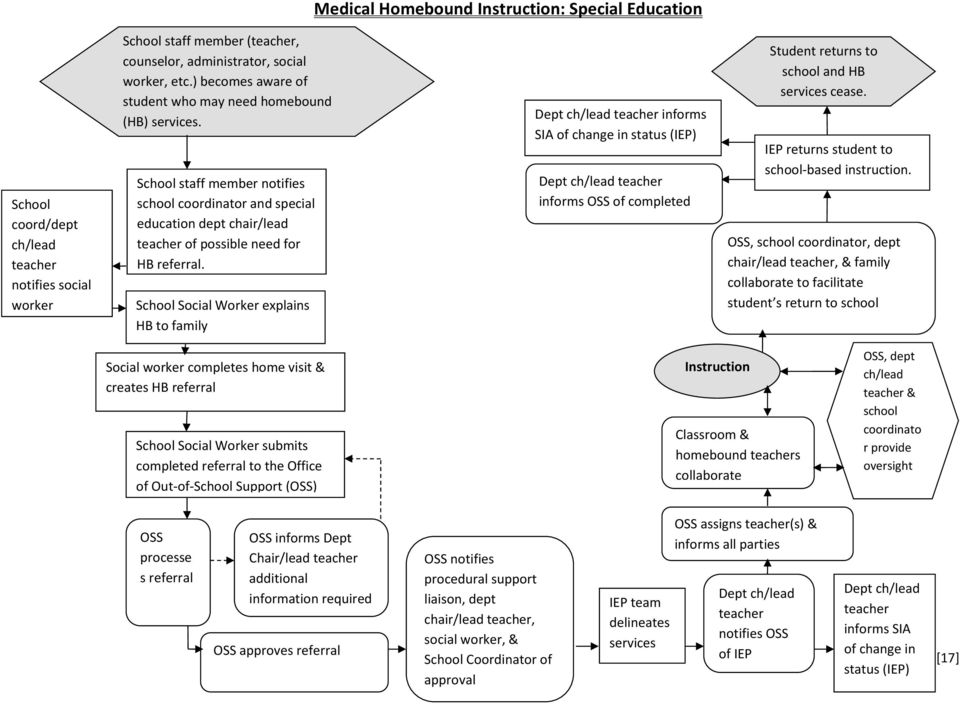
17 Medical Homebound Instruction: Special Education School coord/dept ch/lead teacher notifies social worker School staff member (teacher, counselor, administrator, social worker, etc.) becomes aware of student who may need homebound (HB) services. School staff member notifies school coordinator and special education dept chair/lead teacher of possible need for HB referral. School Social Worker explains HB to family Dept ch/lead teacher informs SIA of change in status (IEP) Dept ch/lead teacher informs OSS of completed IEP Student returns to school and HB services cease. IEP returns student to school-based instruction. OSS, school coordinator, dept chair/lead teacher, & family collaborate to facilitate student s return to school Social worker completes home visit & creates HB referral School Social Worker submits completed referral to the Office of Out-of-School Support (OSS) Instruction Classroom & homebound teachers collaborate OSS, dept ch/lead teacher & school coordinato r provide oversight OSS processe s referral OSS informs Dept Chair/lead teacher additional information required OSS approves referral OSS notifies procedural support liaison, dept chair/lead teacher, social worker, & School Coordinator of approval IEP team delineates services OSS assigns teacher(s) & informs all parties Dept ch/lead teacher notifies OSS of IEP Dept ch/lead teacher informs SIA of change in status (IEP) [17]
18 Section 2 Home-based Instruction Office of Out-of-School Support Fairfax County Public Schools Department of Special Services Revised August 2014 [18]

19 TABLE OF CONTENTS for Section 2: Home-based Instructional Services Introduction General Information Courses Supported Hours of Home-based Services Location of Instructional Sessions Student Rights and Responsibilities 22 Missed Sessions Special Education Technology Grading SOL and Other Required Testing Termination of Home-based Services Reporting Student Information Responsibilities Program manager/educational specialist (OSS) School Homebound Coordinator Special Education Department Chair or Lead Teacher School Social Worker School Counselor Parents, Guardians, or Students Classroom Teacher Home-based Teacher Home-based Instruction Flow Chart: Special Education Home-based Instruction Flow Chart: Hearing Office Home-based Instruction Flow Chart: Multi Agency Services Homebound and Home-based Teacher Requirements Professional Qualifications Compensation Reporting Time and Attendance [19]

20 Introduction This section of the handbook provides information to schools and families about the temporary provision of home-based instruction. The goal of home-based services is to keep the student current with classroom instruction until the student is able to return to a schoolbased setting. Fairfax County Public Schools (FCPS) seeks to provide home-based instruction in a seamless manner for students who must use this service. Home-based services may be provided to students who have been removed from school for disciplinary or other reasons. Home-based instruction is not intended to supplant school services and is, by design, temporary. It is not a remediation program and is not designed to provide students with time to make up previously missed assignments. The goal of home-based instruction is to keep the student as current as possible with classroom instruction. It is expected that the family and the school will minimize academic work missed due to absences prior to the initiation of home-based services. Communication between the school, the family, the home-based teacher, and the FCPS Office of Out-of-School Support (OSS) is vital to the success of home-based instruction. This handbook provides a description of responsibilities for each individual involved in the implementation of services. When all parties work together, students are able to benefit from the provision of services and return to a school environment when the student is able to do so. Questions about home-based instruction may be directed to the school s special education department chair, lead teacher, or homebound coordinator by calling the school or to the FCPS Office of Out-of-School Support (OSS) at [20]

21 General Information Home-based instruction, coordinated through the Office of Out-of-School Support (OSS), may be considered by the individualized education program (IEP) team as an alternate instructional option for special education students who have been suspended for more than ten school days for disciplinary reasons. When the IEP team determines that home-based instruction is appropriate, the IEP team will immediately notify Homebound Instructional Services, which will arrange home-based instruction based on the IEP. Following completion of Hearings Office disciplinary proceedings, the IEP team will convene to consider an appropriate educational placement consistent with direction from the Hearings Office. Communication between the school, the Hearings Office, and the Office of Out-of-School Support is essential throughout this process. When the Hearings Office refers a general education student in the disciplinary process to a local screening committee (LSC), the student may also be referred for home-based services pending the outcome of the LSC s determination. In these cases, the program manager or educational specialist from OSS, with the cooperation of the school homebound coordinator, will immediately initiate the process of providing these services. If the LSC determines the student is not eligible, the Hearings Office and Office of Out-of-School Support must be notified immediately, and home-based services cease. If the student is found eligible, the Hearings Office and Homebound Instructional Services are immediately notified, and the student is treated as a special education student involved in the disciplinary process. Students may also require interim home-based instruction for reasons other than discipline (e.g., interim placement pending a Multi-Agency Services placement) as determined by the IEP team in consultation with the procedural support liaison. In such a case, the student is enrolled in the base school to provide the basis for home-based instruction. A student receiving home-based instruction shall be carried on the roll of the school the student attended prior to the disciplinary action for the duration of the home-based instruction. The student shall be marked as in attendance. Courses Supported Instructional support is provided for core academic classes: English, science, social studies, and mathematics. For secondary students, foreign language may also be supported if required for the diploma being pursued. In order to ensure that students meet the graduation requirement for Economics and Personal Finance, the course will be offered to high school students receiving Homebound. Instruction for physical education (P.E.), fine arts and practical arts, and elective courses must be coordinated with the student s school. Home-based teachers DO NOT provide instruction in these subjects. The decision concerning the completion of these courses rests with the school. Parents or guardians may discuss this with the student and the school homebound coordinator, lead special education teacher, school counselor, and/or school administrator. Hours of Home-based Services The number of hours of instruction per week per student will be based on a student s individual needs. Based on a regular five-day school week, secondary students are generally provided with a maximum of two and one-half (2.5) hours per week for each core class, when necessary, two and one-half (2.5) hours per week of Economics and Personal Finance, plus an additional two and one-half (2.5) hours per week for foreign language, if required for the diploma being pursued. Elementary students are generally provided with five hours of instructional services per regular five-day school week. Early childhood students who do not normally attend a full day of school have a proportionally fewer number of hours. [21]
22 Every effort will be made to ensure academic progress; however, course credit must still be earned according to class requirements. Home-based instruction is delivered during regular school hours, late afternoon, or early evening, and only on those days when school is in session. Instruction will not be given to home-based students when FCPS students are not in attendance (i.e., in cases of inclement weather, teacher workdays, winter break, spring break, and student holidays). Under special circumstances, exceptions may be approved by the program manager or educational specialist from OSS. When scheduling sessions, home-based teachers will take into consideration parent or guardian requests, but not all requests can be accommodated. Location of Instructional Sessions The location of services will be designated by the Office of Out-of-School Support and may be the student s home or a community site such as a library or a government office. If services are to be provided in the home, a home visit must be completed prior to the initiation of services. If services are in the home, the parent or guardian must identify an adult who will be present at all times and agree to confine all pets prior to the arrival of the home-based teacher. The location may not be changed without prior approval of the Office of Out-of-School Support. Student Rights and Responsibilities Home-based instruction is considered a school-sponsored activity. The Student Rights and Responsibilities apply to all students regardless of venue. These documents are provided to students and parents at the start of each new school year. Missed sessions Make-up sessions will only be allowed for sessions missed due to illness or family emergencies and when cancellations are made 24 hours prior to schedule sessions. If possible, make-up for missed sessions must be completed within the same week the session is canceled. Requests for make-up sessions, other than those stated, will require prior approval from the program manager or educational specialist from OSS. The home-based teacher will notify the program manager or educational specialist after each cancellation for which there is no prior notification by the parent or guardian. Sessions missed due to cancellation by the home-based teacher will be made up. Sessions missed due to cancellation of FCPS school activities will not be made up. Special Education Most students receiving home-based services are eligible for special education services. For these students, the special education department chair or lead teacher coordinates services with the school s homebound coordinator and the Office of Out-of-School Support. The IEP must delineate the student s temporary instructional needs while in the home-based setting. Parental consent must be obtained to amend the IEP prior to initiation of home-based services. The student s IEP will delineate the number of home-based instruction hours, the special education services to be delivered while the student is home-based, the goals to be pursued while the student is home-based, the service delivery option, and the home-based placement continuum option. The proposed school assignment would remain unchanged except when the student is transitioning from a Multi-Agency Services site. Students transitioning from a Multi-Agency Services site must be registered at the base school before services can be initiated. [22]
23 When the student is able to return to school-based instruction, the IEP team must amend the IEP to terminate home-based services. Service will continue to be available until the student has enrolled at a school-based site. [23]
24 Technology Online courses may be used in place of, or to supplement some home-based instruction for available classes. Online classes are particularly beneficial for students who are able to work well independently. For additional information contact the student s school counselor. The possible use of available technology to support instruction will be considered when appropriate. Grading The student remains on the classroom teacher s roll, and the classroom teacher remains the teacher of record. Therefore, the classroom teacher is responsible for assigning the quarter, semester, and final grades to the student. In order for the classroom teacher to be informed regarding student progress, frequent, preferably weekly, communication is required between the classroom and homebased teachers, and all work completed by the student must be turned in to the classroom teacher in a timely manner. It is the responsibility of the classroom teacher to grade each work product and return the work to the homebound teacher in a timely manner to ensure the student is getting regular and relevant feedback on academic performance. Since not all classroom activities will be appropriate in a home-based setting, some assignments may be eliminated, altered, or replaced for a student in the home-based setting. While course requirements for the individual student may be modified by the classroom teacher, they must be met in order for the student to earn course credit. Standards of Learning (SOL) and Other Required Testing The school homebound coordinator, the school testing coordinator, the classroom teachers, and the home-based teachers will collaborate to arrange for the administration of SOL testing if it is required. When a student is eligible for alternative state assessments, the home-based teacher will work with the classroom teacher, the lead teacher, the special education department chair, or the testing coordinator to provide the appropriate evidence. Termination of Home-based Services Termination of home-based services is accomplished only through the IEP process or through the determination by the local screening committee that the student is not eligible for these services. Services are provided based on the dates in the IEP. Reporting Student Information Information regarding a home-based student is confidential and is subject to the same restrictions as all other such information. [24]
25 Responsibilities The successful provision of home-based instructional services depends on the cooperation and collaboration of a number of individuals. The responsibilities of these individuals are outlined below. Program manager or Educational specialist, Office of Out-of-School Support (or designee) 1. Document receipt of information regarding students assigned to home-based instruction. 2. Identify site of home-based instructional sessions. Initial location may be a library or other community site until a home site has been deemed appropriate. 3. Assign teachers appropriate to the student s educational needs to provide home-based instruction. 4. Provide IEP information to home-based teachers. 5. Communicate to all parties when teachers are assigned. 6. Coordinate overall provision of services in a timely manner. 7. Consider the possibility of available technology to support instruction. 8. With the special education department chair, the lead teacher, or the school homebound coordinator, encourage communication between classroom teachers and home-based teachers, including supporting instruction and facilitating the exchange of assignments, strategies, and materials between the home-based and classroom teachers, as needed. 9. Provide oversight of instruction provided. 10. Participate in the process to return the student to school-based instruction. School Homebound Coordinator (or designee) This key individual is identified by the principal of each school. In order to work with the program manager and educational specialist from OSS in providing oversight of the collaborative efforts of the classroom and home-based teachers to ensure the essential continuity between school-based instruction and home-based services for each student, it is recommended that this individual be a school-based administrator. 1. For general education students referred to the LSC by the Hearings Office, provide to Out of School Support information regarding student, courses, and teacher contacts. 2. For students transitioning from Multi-Agency Services, help family register student at base school. 3. Coordinate process with special education department chair or lead teacher when appropriate. 4. If the student is not a special education student, provide the parent or guardian with information about home-based instructional services and obtain necessary parental signatures. 5. If student is not a special education student, request that the social worker complete home visit to determine the appropriateness of the learning environment. 6. Ensure that the student receiving home-based instruction is maintained on the class rolls. 7. Encourage school staff members to be actively engaged with the student receiving homebased services. 8. Encourage communication between classroom teachers and home-based teachers, including making appointments, supporting instruction, facilitating the exchange of assignments, strategies, and materials between the home-based teachers and classroom teachers as needed, and coordinating SOL or other state testing. 9. Ensure that materials and/or assignments are collected for P.E., fine and practical arts, and electives from the classroom teacher and disseminate to the parent or guardian. 10. Determine a designated location for all Homebound materials and/or assignments to be located for pick-up by the Homebound teacher. [25]
26 11. Sign for coordinating time on the Worksheet for Homebound/Home-based Teachers when the classroom teacher is unavailable. 12. Immediately contact the program manager or educational specialist from OSS if there are concerns. 13. Participate in the process to return the student to school-based instruction. Special Education Department Chair or Lead Teacher (if student is eligible for special education services) 1. For special education students, conduct IEP meeting that delineates home-based instructional services. 2. Immediately following the conclusion of the IEP meeting, provide the parent or guardian with information about home-based instructional services and obtain the necessary signatures to initiate services. 3. Provide the classroom teachers with the Guide for Classroom Teachers of Students receiving Homebound or Home-based Instruction. 4. Request that the social worker complete a home visit to determine the appropriateness of the home learning environment. 5. Within 24 hours of the completion of the IEP, inform the program manager or educational specialist, the school s procedural support liaison (PSL), and, if this is a disciplinary case, the PSL assigned to the Hearings Office. 6. If the student has been referred to the LSC, within 24 hours of the LSC making a determination, notify the program manager and educational specialist from OSS, the hearing officer, the school s PSL, and the PSL assigned to the Hearings Office. 7. Encourage communication between classroom teachers and home-based teacher, including making appointments, supporting instruction, facilitating the exchange of assignments, strategies, and materials between the home-based teachers and classroom teachers as needed, and coordinating SOL tests or alternative state assessments. 8. Sign for coordinating time on the Worksheet for Homebound/Home-based Teachers when the classroom teacher is unavailable. 9. Encourage school staff members to be actively engaged with the student receiving homebased services. 10. Conduct IEP meeting to return the student to school-based services when appropriate. Within 24 hours of the completion of the IEP, notify the program manager or educational specialist from OSS, the hearing officer, the school s PSL, and the PSL assigned to the Hearings Office. 11. Immediately contact the program manager or educational specialist and the school homebound coordinator if concerns arise. 12. Participate in the process to return the student to school-based instruction. School Social Worker 1. Work with the school staff to meet with the family when they attend related meetings at the school in order to complete HB-2A, if instruction will not be provided in the home. 2. Provide the guide for parents to the parent and/or guardian. 3. If instruction will be provided in the home, complete a home visit to determine the appropriateness of the learning environment, assist in accessing appropriate resources and referrals, and provide information to the school homebound coordinator, other school staff as appropriate, and the program manager or educational specialist from OSS. 4. Submit the OSS HB-2A form to the Office of Out-of-School Support. 5. Support school staff members in regards to instruction concerns and understanding their responsibility with the Homebound process in order for the home-based student to receive appropriate instruction. [26]
27 School Counselor 1. Coordinate the providing of assignments from the classroom teachers to the parent or guardian until the home-based teachers are assigned. 2. Facilitate the exchange of assignments, strategies, and materials between the home-based teachers and classroom teachers, as needed. 3. Work with the student and the family to ensure that academic and/or elective course requirements are being met while the student is enrolled in home-based instruction. 4. Sign for coordinating time on the Worksheet for Homebound/Home-based Teachers when the classroom teacher is unavailable. 5. Encourage engagement between school staff members and the student. 6. Immediately contact the program manager or educational specialist from OSS, the special education department chair, the lead teacher, or the school homebound coordinator if there are concerns. Parents, Guardians, or Students 1. Participate in IEP team decision to delineate home-based services, if appropriate. 2. Complete parental signature forms in order to begin home-based instruction. 3. Obtain assignments from the classroom teachers until the home-based teachers are assigned. 4. Plan the schedule of instruction with home-based teachers. When possible, parent or guardian requests will be considered, but not all requests can be accommodated. 5. If the instructional sessions are to take place in the home, provide an appropriate learning environment, free of interruptions, with proper lighting and necessary equipment, such as a desk or table, pencils, paper, books, and other materials as needed. 6. If instructional sessions are to take place in the home, ensure that all pets are confined prior to the arrival of the home-based teacher. 7. Make sure the student is ready for instruction at the time and place designated by the homebased teacher. 8. Supervise daily homework. 9. Make every effort to have the student complete school assignments. 10. If instruction is to take place in the home, ensure an adult (18 years of age or older) is in the home during the entire period of instruction. If an adult is not in the home at the time of instruction, the teacher will cancel the session. Even though a student may be 18 years old and/or married, it is required, and absolutely necessary, that there be a third person (adult) in the home during the entire teaching time. 11. Review and sign completed Worksheet for Homebound/Home-based Teachers (i.e., with date, time, and number of hours of instruction given) after each instructional session. The worksheet must be reviewed for accuracy and signed by the parent, guardian, or designated adult. Students may not sign the worksheet. Parents should not sign for sessions in advance. 12. Keep all appointments with the home-based teacher. 13. Notify the home-based teacher at least 24 hours prior to the scheduled session if the student is unable to receive instruction because of a contagious disease or an emergency. 14. Request make-up instruction for sessions missed because of illness or family emergency. If possible, make-up for a missed session must be completed within the same week the session is canceled. Requests for make-up sessions, other than those stated, will require approval from the program manager or educational specialist from OSS. Continued cancellations could result in termination of services. 15. Notify program manager about frequently missed appointments or excessive tardiness by the home-based teacher. 16. Request and obtain materials and/or assignments for P.E., fine arts and practical arts, and elective courses from the school counselor for the student to complete assignments. Homebased teachers do not provide instruction in these subjects. [27]
28 17. Immediately contact the program manager or educational specialist from OSS if there are concerns about instruction. Questions regarding grading are directed to school staff members. 18. Advise the special education chair, the lead teacher, the school homebound coordinator, program manager of any change in the student s status that would require a change in or termination of home-based services. 19. Participate in the process to return the student to school-based instruction. Classroom Teacher 1. Make available, within 48 hours of being notified of the need for home-based services, information and instructional materials, which may include a syllabus, textbooks, materials, online information, assignments, handouts, readings, quizzes, and tests. 2. Work collaboratively with the home-based teacher to exchange information, strategies, assessment tools, and instructional materials relative to the student s instructional needs and to facilitate use of technology for instruction (if applicable). 3. In collaboration with the home-based teacher, make modifications and accommodations regarding assignments and activities as necessary for the home-based setting without compromising educational integrity. Since not all classroom activities will be appropriate in a home-based setting, some assignments may be eliminated, altered, or replaced for a student in the home-based setting. 4. Communicate with the home-based teacher, preferably weekly, but at least biweekly, to remain informed about the student s academic progress, effort, and circumstances and to keep the home-based teacher informed about classroom activities. 5. Receive all completed work from the home-based teacher within one week of its completion, unless other arrangements are made. 6. Grade work within an appropriate timeframe to ensure that the student is provided with timely feedback on academic progress. 7. Determine the student s quarter, semester, and final grades based on completed work, even if the student has not attended school during the school year. Note: Home-based students are marked as attending even if they do not come to the school. If the student received both classroom and home-based instruction during a given grading period, the quarterly, semester, and final grades assigned by the classroom teacher reflect grades earned in both settings. 8. If the student is expected to take a final examination, coordinate with the home-based teacher and provide a copy of the exam and all preparatory materials. 9. If the student is eligible for alternative state assessments, work with the home-based teacher to provide the appropriate evidence. 10. Inform the home-based teacher of the SOL testing schedule, when applicable. 11. Sign for coordinating time on the Worksheet for Homebound/Home-based Teachers. 12. Encourage student engagement in academic activities. 13. Provide instructional materials and/or assignments for P.E., fine arts and practical arts, and elective courses to designated school staff member. Home-based teachers do not provide instruction in these subjects 14. Immediately contact the program manager or educational specialist (OSS), the special education department chair, the lead teacher, or the school homebound coordinator if concerns arise. 15. Participate in the process to return the student to school-based instruction. Home-based Teacher 1. Within 24 hours of accepting the student assignment, contact the parent or guardian and schedule home-based instruction. When scheduling sessions take into consideration, when possible, the requests of the parent or guardian. 2. If contact is not made with the parent or guardian within 48 hours of assignment, document all attempts and contact program manager or educational specialist from OSS. [28]
29 3. Within 48 hours of accepting the student assignment, initiate a conference with the classroom teachers for the purpose of exchanging information and materials related to the curriculum. 4. Notify the Office of Out-of-School Support (OSS) of the time and location of scheduled instructional sessions, and immediately notify the program manager or educational specialist of any changes in scheduled sessions. 5. Provide instruction to the student and administer tests, exams, and/or other assessments with the goal of keeping the student as current as possible with classroom instruction. 6. After each instructional session, assign work to be completed before the next instructional session. 7. Communicate with the classroom teacher, preferably weekly, but at least every other week, to remain informed about classroom activities and to keep the classroom teacher informed about the student s academic progress, effort, and circumstances. 8. In collaboration with the classroom teacher, make modifications and accommodations regarding assignments and activities as necessary for the home-based setting without compromising educational integrity. 9. Return all work to the classroom teacher within one week of its completion, unless other arrangements are made, keeping a record of all returned work. 10. Determine jointly with the classroom teacher how and by whom individual work products will be graded. 11. Provide data regarding progress toward meeting IEP goals and objectives, if applicable, and participate in IEP meetings with prior approval from the program manager or educational specialist from Out of School Support. 12. If the student is expected to take a final examination, coordinate with the classroom teacher to obtain a copy of the exam and all preparatory materials. 13. Administer Standards of Learning (SOL) or other state tests after consultation with the program manager or educational specialist (OSS), the special education department chair, the lead teacher, the school homebound coordinator, or the school testing coordinator. 14. If the student is eligible for alternative state assessments, work with the classroom teacher, the lead teacher, the special education department chair, or the testing coordinator to provide the appropriate evidence. 15. Obtain from the classroom teacher or the school counselor the signature for coordinating time on the Worksheet for Homebound Teachers. 16. Obtain signature of parent or guardian documenting instructional time and subjects taught at the conclusion of each session. 17. Provide the allotted instruction for each student. Home-based teachers may not shorten approved instructional time, even at the request of the parent or guardian, and then request payment for the full time allocated. The time indicated on the time sheet must be the same as that provided unless it is a cancellation/no-show situation. 18. If the student is unavailable or the required adult is not in the home, wait 15 minutes before leaving, mark the session as a cancellation/no show, and immediately contact the program manager or educational specialist from OSS. 19. Refrain from providing private tutoring to students whom the home-based teacher is currently instructing. 20. Immediately contact the Office of Out-of-School Support if there are concerns. 21. Participate in the process to return the student to school-based instruction as appropriate. 22. Participate in staff development activities associated with home-based instruction. 23. Provide documentation regarding instructional activities as requested by the Office of Out-of- School Support [29]
30 Home-Based Instruction: Special education eligible students removed from school for disciplinary or other reasons IEP team places student on homebased (HB) instruction Dept ch/lead teacher provides family with information about H-B instruction and obtains signatures immediately following IEP meeting Dept ch/lead teacher informs student information assistant (SIA) of change in status (IEP) Dept ch/lead teacher notifies social worker Social worker completes home visit & provides HB Office with information Dept ch/lead teacher notifies OSS office of IEP & provides course and teacher information OSS office designates library, other community site, or the home as the location for instruction OSS office assigns teacher(s) & informs all parties Dept ch/lead teacher informs OSS office of completed IEP Dept ch/lead teacher informs SIA of change in status (IEP) Instruction Classroom & homebound teachers collaborate Student returns to school and HB services cease. IEP places student at school-based site Student receives school placement as determined by the IEP process, in accordance with the Hearings Office. OSS & school coordinat or provide oversight [30]
31 Home-Based Instruction: Students in disciplinary process who are referred to local screening committee Hearings Office refers student to local screening committee (LSC) and offers home-based instruction Student returns to school-based instruction and H-B services cease. Hearings Office notifies school administration and OSS office School admin notifies LSC, school coordinator and SIA LSC meets to determine eligibility. LSC does not find student eligible for special ed OSS office notifies PSL and requests School Coordinator provide information School coordinator notifies social worker. Social worker completes home visit & provides OSS office with information LSC finds student eligible for special ed School coordinator provides course & teacher information to OSS office OSS designates library, other community site, or the home as interim location for instruction OSS assigns teacher(s) & informs all parties Dept ch/lead teacher notifies Hearings Office, PSL, & OSS Classroom & homebound teachers collaborate IEP places student on H-B Dept ch/lead teacher informs OSS of completed IEP. Dept ch/lead teacher informs SIA of change in status (IEP) IEP places student at a school site Hearings Office informs school that any requirements have been met Instruction Dept ch/lead teacher notifies OSS OSS & school coordinato r provide oversight LSC notifies School Coordinator, Hearings Office, OSS, PSL & family H-B services cease Hearings Office continues disciplinary process [31]
32 Home-based Instruction (Multi-Agency) Students whose Multi-Agency Services placement is being determined Multi-Agency Services or spec ed chair notifies HB Office and base school services may be required Student returns to a school-based placement and homebased services cease Student is registered at base school and assigned classes Dept ch/lead teacher notifies SIA of status (IEP) IEP team places student on homebased instruction Dept ch/lead teacher provides family with information about H-B instruction & obtains signatures immediately following IEP meeting Dept ch/lead teacher informs OSS of completed IEP Dept ch/lead teacher informs SIA of change in status (IEP) IEP places student at school based site Dept ch/lead teacher notifies Social Worker Dept ch/lead teacher informs OSS & provides teacher & course information Instruction OSS and spec ed dept chair provide oversight Social Worker completes home visit and provides information to the OSS OSS assigns teacher(s) and informs all parties Collaboration between classroom & homebound teachers [32]
33 Section 3 Homebound and Home-based Teacher Requirements [33]
34 Professional Qualifications Homebound and Home-based Teacher Requirements An individual employed as a homebound/home-based teacher must hold a current Virginia teacher s license. Homebound/Home-based teachers should have a broad background of professional training and experience to be able to adapt instruction to each student s needs and to work with a variety of classroom teachers in a modified team-teaching situation. Homebound/Home-based teachers need to be able to work independently in home or community settings and should be able to adjust to a variety of situations and be knowledgeable of cultural uniqueness. Requirements established by the Department of Human Resources must be met, and teachers must be prepared to provide information regarding subjects in which they meet highly qualified teacher status. All homebound/home-based teachers must be able to access as a means of communication with classroom teachers and Office of Out-of-School Support Services (OSS) staff members. Compensation Travel Reimbursement Homebound/Home-based teachers may be eligible for travel reimbursement for travel beyond their normal commute to or from their assignment. Contact Out-of-School Support for information about reimbursement procedures. Coordinating Time Each homebound/home-based teacher is allowed one hour per grading period to visit the school for the purpose of coordinating plans and securing books and other materials. Teachers assigned multiple middle and high school subjects will be allowed up to one additional hour per subject per grading period. If additional coordinating time is required, the home-based teacher must contact the program manager or educational specialist from OSS for authorization. Instructional Sessions Teachers will be compensated for no more than the number of hours per week established when the student is assigned unless additional time is authorized by the Out of School Support Program Manager. Instructional sessions on unauthorized days will not be approved for payment. Make-up sessions during the same week as a missed session are authorized, but the homebound educational specialist must be informed of the change. Examinations Homebound/Home-based teachers will be compensated for any additional time required to administer SOL or other state tests with approval of the Out-of-School Support program manager or educational specialist. [34]
35 Reporting Time and Attendance 1. Time reports ( and worksheets should be sent to the Office of Out-of-School Support (OSS). Time reports must be received by noon on Friday of each week (unless that pay period falls on a holiday weekend). In this case, time reports are to be in by noon on Thursday of that pay period. 2. If instruction is to be given on Thursday or Friday after the time reports are due, report that time on the next time report with signature and write LATE above the date. 3. Record instructional time for each student on a separate worksheet. Do not combine students names on the same worksheet. 4. Only correctly completed Time Report for Temporary Assignments ( reports and Worksheet for Homebound/Homebased Teachers reports will be accepted for payment. 5. Compensation is provided only for services delivered. Homebound/Home-based teachers may not shorten approved instructional time and request payment for the full time allocated. 6. If the homebound/home-based teacher reports to the instructional site at the appointed scheduled time and the student and/or designated adult are not available, the homebound/home-based teacher is only allowed to report one hour on the Time Report and Worksheet for Homebound Teachers. No-show should be indicated on the signature line. This no-show is to be reported to the Office of Out-of-School Support using the Homebound Cancellation Form within 24 hours of the scheduled session. 7. Approval for participation in any event other than the designated instructional time must have prior approval from the Out-of-School Support Program Manager. 8. The homebound/home-based teacher will complete a Worksheet for Homebound/Homebased Teachers (with signature, dates, times, number of hours of instruction provided, subjects taught, indication if work was assigned to be completed before next instruction session, and indication if there has been communication with classroom teacher since last session) and obtain the signature of the designated adult after each instructional session. The worksheet must only be signed by the parent, guardian, or designated adult. Homebound/Home-based teachers must not request signatures on blank forms or prior to the provision of instruction. 9. Homebound/Home-based teachers may be reimbursed for planning time related to their work with homebound/home-based students at a rate of one-half (½) hour per week for each elementary student (assuming five hours per week of instruction) and one-quarter (¼) hour per week for each secondary subject (assuming two and one half hours per week of instruction). 10. Compensation will be provided for required meetings. [35]
HOMEBOUND INSTRUCTION PROGRAM i 2012-13 INTRODUCTION
 HOMEBOUND INSTRUCTION PROGRAM i 2012-13 INTRODUCTION The Board of Education through the regulations establishing Standards for Accrediting Public Schools in Virginia requires in 8 VAC 20-131-180 that:
Houston County Schools. Policy Regarding Homebound Services (Updated 2013)
 Houston County Schools Policy Regarding Homebound Services (Updated 2013) 1 Superintendent Date: 2 Houston County Schools Policy Regarding Homebound Services In accordance with School Board Policy, Houston
Home and Hospital Instruction Program (HHIP)
 Home and Hospital Instruction Program (HHIP) Office name goes here 1 A Bit of Legal-ese On July 14, 2011, Public Act 97-0123 was enacted, effective immediately, amending Section 5/14-13.01 of the Illinois
VIRGINIA DEPARTMENT OF EDUCATION HOMEBOUND INSTRUCTIONAL SERVICES GUIDELINES
 VIRGINIA DEPARTMENT OF EDUCATION HOMEBOUND INSTRUCTIONAL SERVICES GUIDELINES Virginia Department of Education Division of Special Education and Student Services Office of Student Services Copyright (c)
Form 2 Psychiatric Referral for Adjustment of Educational Program rev 7-2015
 Form 2 Psychiatric Referral for Adjustment of Educational Program rev 7-2015 Section 1 is to be completed by the parent, nurse or homebound coordinator at the attendance school. Sections 2,3,4,5 are to
3. The Home and Hospital teaching should begin within 10 school calendar days of the written verification of need for services.
 The following guidelines should be used to implement individual home and hospital instruction programs: 1. Eligibility - Any child of school age who is unable to attend a regular school program due to
No. 117 SECTION: PROGRAMS TITLE: REQUESTS FOR TEMPORARY MEDICAL EXCUSES FROM SCHOOL ADOPTED: 12/12/2013 REVISED:
 No. 117 SECTION: PROGRAMS TITLE: REQUESTS FOR TEMPORARY MEDICAL EXCUSES ADOPTED: 12/12/2013 REVISED: SC 1301, 1327 Sec. 11.12, 11.13, 11.41, 12.1 1. 117. REQUESTS FOR TEMPORARY MEDICAL EXCUSES Pursuant
Providing Homebound and Hospitalized Educational Services for Michigan Public School Pupils
 Providing Homebound and Hospitalized Educational Services for Michigan Public School Pupils Homebound and hospitalized services are designed to provide continuity of educational services for pupils with
FAIRFAX COUNTY PUBLIC SCHOOLS PROCEDURES REQUIRED FOR IMPLEMENTATION OF SPECIAL EDUCATION REGULATIONS IN VIRGINIA S PUBLIC SCHOOLS
 FAIRFAX COUNTY PUBLIC SCHOOLS PROCEDURES REQUIRED FOR IMPLEMENTATION OF SPECIAL EDUCATION REGULATIONS IN VIRGINIA S PUBLIC SCHOOLS Table of Contents Child Find... 2 Screening... 3 General Screening Procedures...
IOE-RA, IOE-EA Special Education and Student Services. Home and Hospital Teaching
 REGULATION Related Entries: Responsible Office: IOE-RA, IOE-EA Special Education and Student Services MONTGOMERY COUNTY PUBLIC SCHOOLS IOE-RB Home and Hospital Teaching I. PURPOSE To delineate the procedures
El Paso Community College
 El Paso Community College Table of Contents El Paso Community College... 1 Introduction... 3 Eligibility for Services... 3 Procedures for Becoming an EPCC Student and Requesting Services from CSD... 3
CALCASIEU PARISH SCHOOL BOARD HOSPITAL/HOMEBOUND 1509 ENTERPRISE BLVD., LAKE CHARLES LA 70601 TELEPHONE: 337.217.4980, EXT. 3607 FAX: 337.217.
 THIS FORM TO BE COMPLETED BY THE SCHOOL COUNSELOR AND FAXED TO THE DEPARTMENT Document: HHB 00 Title APPLICATION FORM FOR SERVICES Revision Date: 9/15 Date: Page: 1 of 1 STUDENT ID STUDENT NAME BIRTHDATE
HOME INSTRUCTION. HOWARD COUNTY PUBLIC SCHOOL SYSTEM Student Services and Special Education Office of Pupil Personnel.
 HOME INSTRUCTION HOWARD COUNTY PUBLIC SCHOOL SYSTEM Student Services and Special Education Office of Pupil Personnel Revised 10/12 Home Instruction Philosophy The Howard County Public School System recognizes
GRADUATION REQUIREMENTS
 GRADUATION REQUIREMENTS The Virginia Board of Education of the Commonwealth of Virginia establishes graduation requirements for all Virginia public schools. The Board of Education of the Chesapeake Public
Accountability and Virginia Public Schools
 Accountability and Virginia Public Schools 2008-2009 School Year irginia s accountability system supports teaching and learning by setting rigorous academic standards, known as the Standards of Learning
6.9 6.9.1. GRADING SYSTEMS
 6.9 The professional staff will develop a program of studies which encourages students to continually strive for self-improvement and success in their academic work. 6.9.1. GRADING SYSTEMS Periodic grade
Technical Assistance Document 5
 Technical Assistance Document 5 Information Sharing with Family Members of Adult Behavioral Health Recipients Developed by the Arizona Department of Health Services Division of Behavioral Health Services
Department of Guidance and Counseling. Handbook. Homebound Procedures
 A Developmental Guidance System Department of Guidance and Counseling Handbook Homebound Procedures General Education Homebound Packet Contents Forms Homebound Services Procedures for General Education
WYOMING VALLEY WEST SCHOOL DISTRICT
 No. 204 WYOMING VALLEY WEST SCHOOL DISTRICT SECTION: TITLE: ADOPTED: REVISED: PUPILS ATTENDANCE 204. ATTENDANCE 1. Purpose The Board of Education requires that school aged pupils enrolled in the schools
Kirksville High School A+ Schools Program Student/Parent Handbook
 Kirksville High School A+ Schools Program Student/Parent Handbook GOALS OF THE A+ SCHOOLS PROGRAM The A+ Schools Program is designed to achieve the three basic goals that are set forth in the Outstanding
CAPE MAY COUNTY TECHNICAL SCHOOL DISTRICT FILE CODE: 5111 Cape May Court House, New Jersey ADMISSIONS
 CAPE MAY COUNTY TECHNICAL SCHOOL DISTRICT FILE CODE: 5111 Cape May Court House, New Jersey Regulation How to Apply ADMISSIONS A. Students interested in attending Cape May County Technical High School (
Parent s Guide to Special Education
 Revised 2010 Parent s Guide to Special Education Virginia Department of Education Division of Special Education and Student Services Table of Contents Introduction....3 Understanding Special Education
DEPARTMENT OF EDUCATION SUPERINTENDENT OF PUBLIC INSTRUCTION SCHOOL DISTRICT PUPIL ACCOUNTING FOR DISTRIBUTION OF STATE AID
 DEPARTMENT OF EDUCATION SUPERINTENDENT OF PUBLIC INSTRUCTION SCHOOL DISTRICT PUPIL ACCOUNTING FOR DISTRIBUTION OF STATE AID (By authority conferred on the superintendent of public instruction by sections
05-071 MAINE STATE BOARD OF EDUCATION Chapter 115: CERTIFICATION, AUTHORIZATION, AND APPROVAL OF EDUCATION PERSONNEL
 05-071 MAINE STATE BOARD OF EDUCATION Chapter 115: CERTIFICATION, AUTHORIZATION, AND APPROVAL OF EDUCATION PERSONNEL SUMMARY: This rule contains the requirements for certification, authorization, and approval
ATTENDANCE. The attendance policy will be included in student handbooks and will be reviewed with students at the start of the school year.
 ATTENDANCE (X) Required (x) Local ( ) Notice Good attendance is a central component of the educational process. The educational program offered by the district is predicated upon student presence and requires
How To Deal With A Pupil Who Is Under The Influence Of Alcohol Or Drugs
 R 5530/Page 1 of 12 R 5530 The following procedures are established in implementation of Policy No. 5530, Substance Abuse. A. Definitions 1. Evaluation means those procedures used by a certified or licensed
GLOUCESTER ONLINE ACADEMY OF LEARNING (GOAL)
 GLOUCESTER ONLINE ACADEMY OF LEARNING (GOAL) Gloucester County Public Schools STUDENT HANDBOOK Page 1 Table of Contents Welcome Letter...3 Site Information...4 Admission and Enrollment...5 Mission, Model,
Individual Education Program (IEP) Form Guidance
 The purpose of the IEP document is to provide a written record of the decisions made at an IEP meeting where parent(s) and school personnel jointly make decisions about the educational program for a student
Special Education Process: From Child-Find, Referral, Evaluation, and Eligibility To IEP Development, Annual Review and Reevaluation
 Special Education Process: From Child-Find, Referral, Evaluation, and Eligibility To IEP Development, Annual Review and Reevaluation Companion Document to NJOSEP Code Trainings October/November 2006 Updated
Position Description
 Teacher As set by state certification authorities. Principal/Assistant Principal Teacher Assistants, Volunteers, Para-professionals, and college students assigned for clinical experience. To lead students
05-071 MAINE STATE BOARD OF EDUCATION Chapter 115: CERTIFICATION, AUTHORIZATION, AND APPROVAL OF EDUCATION PERSONNEL
 05-071 MAINE STATE BOARD OF EDUCATION Chapter 115: CERTIFICATION, AUTHORIZATION, AND APPROVAL OF EDUCATION PERSONNEL SUMMARY: This rule contains the requirements for certification, authorization, and approval
HCS elearning Program
 HCS elearning Program Every Child, Every Day, Whatever it Takes Information and Guidelines Table of Contents Introduction & Overview. 3 elearning Key Components.. 3 elearning Courses 4 elearning Grades
The following procedures are established in implementation of Policy No. 5530, Substance Abuse.
 R5530.DR Page 1 of 11 The following procedures are established in implementation of Policy No. 5530,. A. Definitions 1. Evaluation means those procedures used by a certified or licensed professional to
2. SUPPORT SERVICES, ACADEMIC ACCOMMODATIONS, AND SPECIAL CLASS INSTRUCTION
 LOS ANGELES COMMUNITY COLLEGES OFFICE OF THE CHANCELLOR ADMINISTRATIVE REGULATIONS REFERENCE: Title 5, Sections 56000, 56002, 56004, 56005, 56006, 56010, 56026, 56027, 56028, 56029 ISSUE DATE: October
HILLSDALE BOARD OF EDUCATION FILE CODE: 5131.6* SUBSTANCE ABUSE
 HILLSDALE BOARD OF EDUCATION Hillsdale, NJ 07642 SUBSTANCE ABUSE Possible Drug and Alcohol Related Situations Whenever it shall appear to any teaching staff member, school nurse or other education personnel
General Guidance for State Board of Education Rule 160-1-3-.09 WAIVERS AND VARIANCES OF HIGH SCHOOL GRADUATION ASSESSMENTS
 General Guidance for State Board of Education Rule 160-1-3-.09 WAIVERS AND VARIANCES OF HIGH SCHOOL GRADUATION ASSESSMENTS VERSION 1.1 Table of Contents Table of Contents... i Document Version History...
Baden Academy Charter School Special Education Policy. with disabilities appropriate to their needs, abilities and interests and that complies with
 Baden Academy Charter School Special Education Policy Baden Academy Charter School is committed to providing a quality education to children with disabilities appropriate to their needs, abilities and
CHILDREN AND YOUTH CASEWORKERS EDUCATION SCREEN
 CHILDREN AND YOUTH CASEWORKERS EDUCATION SCREEN When a child enters the child welfare system, and at each of his/her six month reviews, a caseworker shall use this Education Screen to assess a child s
N.J.A.C. 6A:20, ADULT EDUCATION PROGRAMS TABLE OF CONTENTS
 N.J.A.C. 6A:20, ADULT EDUCATION PROGRAMS TABLE OF CONTENTS SUBCHAPTER 1. GENERAL PROVISIONS 6A:20-1.1 Purpose and function 6A:20-1.2 Definitions 6A:20-1.3 Age and out-of-school requirements 6A:20-1.4 Certification
Who is eligible to provide home schooling in Virginia?
 Home School Frequently Asked Questions Revised September 2012 Note: This document was adapted from the frequently asked questions developed by the Virginia Department of Education. I want to home school
After School Parent Handbook Dean Road Elementary School
 After School Parent Handbook Dean Road Elementary School 2013 2014 Program Coordinator: LaTara Hardnett After School Phone: 887-4909 Office Hours: 1:00 6:00 Program Hours: 2:20 5:30 [email protected]
6Gx13-5D-1.021. Welfare SCHOOL HEALTH SERVICES PROGRAM
 Welfare SCHOOL HEALTH SERVICES PROGRAM The Florida School Health Services Act of 1974 authorized the development and implementation of the School Health Services Plan which is a joint responsibility of
COATESVILE AREA SCHOOL DISTRICT ATTENDANCE POLICY 2014/2015 SCHOOL YEAR
 COATESVILE AREA SCHOOL DISTRICT ATTENDANCE POLICY 2014/2015 SCHOOL YEAR I. Compulsory Attendance (Section 1326of the PA School Code) Section 1326 of the PA School Code, defines compulsory school age as
2013 2014 Student Attendance Accounting Handbook Change Document Section Change 2012 2013 2013 2014
 Section 1 Overview 1.5 Auditing of Attendance Information 1.5 Auditing of Attendance Information Regardless audit by the Financial Audits Division of Regardless audit by the Financial Compliance Division
UNI V E RSI T Y O F M I C H I G A N
 SE C T I O N: Human Resources Number: 201.11-0 Revised: 10/14/2010 SUBJE C T: Sick Pay Plan Date Issued: Review Date: 10/14/2012 Attachment(s) 0 APPL I ES T O: Short-term sick time pay: All staff, with
DISTRICT ATTENDANCE TARDY PROCEDURES
 DISTRICT ATTENDANCE TARDY PROCEDURES SWISD - Elementary Tardy Guidelines Definitions: 1. A tardy is defined as a student not being in the assigned area at the time set by their designated campus schedule
SCHOOL PSYCHOLOGY FIELD TRAINING APPLICATION Harold Abel School of Psychology Capella University
 Form L SCHOOL PSYCHOLOGY FIELD TRAINING APPLICATION Harold Abel School of Psychology Capella University Directions: Complete this application, as well as all other requested documentation, and submit to
Annual Public Notice of Special Education Services and Programs for Students with Disabilities
 1 Annual Public Notice of Special Education Services and Programs for Students with Disabilities Mastery Charter School publishes the following Annual Notice in the school s Parent-Student Handbook and
SPECIAL EDUCATION COMPREHENSIVE LOCAL PLAN
 SECTION 0000 BOARD POLICY PHILOSOPHY-GOALS-OBJECTIVES BP 0430 AND COMPREHENSIVE PLANS SPECIAL EDUCATION COMPREHENSIVE LOCAL PLAN The Governing Board recognizes that, under Federal law, all individuals
MASSACHUSETTS DEPARTMENT OF CORRECTION SICK LEAVE 103 DOC 209 TABLE OF CONTENTS 209.01 DEFINITIONS...2 209.02 ACCRUAL OF SICK LEAVE CREDITS...
 MASSACHUSETTS DEPARTMENT OF CORRECTION SICK LEAVE 103 DOC 209 TABLE OF CONTENTS 209.01 DEFINITIONS...2 209.02 ACCRUAL OF SICK LEAVE CREDITS...3 209.03 CONDITIONS UNDER WHICH SICK LEAVE IS GRANTED...3 209.04
April 2008 SUBJECT: CONTINUUM OF SPECIAL EDUCATION SERVICES FOR SCHOOL-AGE STUDENTS WITH DISABILITIES
 THE STATE EDUCATION DEPARTMENT / THE UNIVERSITY OF THE STATE OF NEW YORK / ALBANY, NY 12234 OFFICE OF VOCATIONAL AND EDUCATIONAL SERVICES FOR INDIVIDUALS WITH DISABILITIES STATEWIDE COORDINATOR FOR SPECIAL
State Board of Education Regulations and General Laws
 2015 16 ACCREDITATION STANDARDS FOR ELEMENTARY SCHOOL AND CHILD DEVELOPMENT 1 NOTE: For Accreditation purposes, schools and school districts are responsible for determining compliance with the following
To help improve the educational experience and general wellbeing of those students who are unable to profit from the existing school program.
 LOCATOR: 3.01 TITLE: School Psychologist QUALIFICATIONS: 1. Valid Connecticut certification with endorsement as psychologist. 2. Such alternatives to the above qualifications as the Board may find appropriate
THE SCHOOL DISTRICT OF PHILADELPHIA
 No. 204 SECTION: PUPILS THE SCHOOL DISTRICT OF PHILADELPHIA TITLE: ATTENDANCE ADOPTED: September 22, 2010 REVISED: 204. ATTENDANCE 1. Purpose SC 1301, 1326, 1327 Sec. 11.12, 11.13, 11.41, 12.1 Pol. 200
HOMESCHOOLING IN PENNSYLVANIA: A FACT SHEET
 HOMESCHOOLING IN PENNSYLVANIA: A FACT SHEET IMPORTANT: ELC's publications are intended to give you a general idea of the law. However, each situation is different. If, after reading our publications, you
AN ACT CONCERNING VARIOUS REVISIONS AND ADDITIONS TO THE EDUCATION STATUTES.
 General Assembly Substitute Bill No. 5550 February Session, 2016 * HB05550ED 032116 * AN ACT CONCERNING VARIOUS REVISIONS AND ADDITIONS TO THE EDUCATION STATUTES. Be it enacted by the Senate and House
IDEA, IEP'S, and Section 504 Plans: Differences between K12 and College
 IDEA, IEP'S, and Section 504 Plans: Differences between K12 and College Many students and families find it difficult to understand how different disability laws affect the provision of services at college.
PART 226 SPECIAL EDUCATION SUBPART A: GENERAL
 ISBE 23 ILLINOIS ADMINISTRATIVE CODE 226 TITLE 23: EDUCATION AND CULTURAL RESOURCES : EDUCATION CHAPTER I: STATE BOARD OF EDUCATION : INSTRUCTION FOR SPECIFIC STUDENT POPULATIONS PART 226 SPECIAL EDUCATION
COATESVILLE AREA SCHOOL DISTRICT
 No. 137 SECTION: PROGRAMS COATESVILLE AREA SCHOOL DISTRICT TITLE: HOME-SCHOOLING PROGRAM ADOPTED: October 24, 2001 REVISED: 137. HOME-SCHOOLING PROGRAM 1. Purpose SC 1327, 1327.1 The Board shall approve
5530 SUBSTANCE ABUSE (M)
 Haddonfield 5530 / Page 1 of 10 5530 SUBSTANCE ABUSE (M) The following procedures are established in implementation of Policy No. 5530, Substance Abuse. A. Definitions 1. Evaluation means those procedures
National Board for Professional Teaching Standards Certification Incentive Program
 Certificated Personnel BP 4112.2(a) CERTIFICATION The Superintendent or designee shall ensure that persons employed in positions requiring certification qualifications have the appropriate credential or
South Dakota Parental Rights and Procedural Safeguards
 South Dakota Parental Rights and Procedural Safeguards Special Education Programs Revised July 2011 Prior Written Notice... 1 Definition of Parental Consent... 3 Definition of a Parent... 3 Parental Consent...
Section XVII. School Admission
 Section XVII. School Admission 123 124 125 126 127 128 FORMS 129 Student s Contract for Alcohol Abuse Policy Violation First Offense Policy A Student s Contract for Alcohol Abuse Policy Violation First
SANTA MONICA-MALIBU UNIFIED SCHOOL DISTRICT INFORMATION FOR STUDENTS AND PARENTS Controlled Substance
 SANTA MONICA-MALIBU UNIFIED SCHOOL DISTRICT INFORMATION FOR STUDENTS AND PARENTS Controlled Substance Controlled Substance BP 5131.61 Students Possession or use of drugs or alcohol on a school campus represents
CLARK COUNTY SCHOOL DISTRICT REGULATION
 CLARK COUNTY SCHOOL DISTRICT REGULATION R-5113 ATTENDANCE ENFORCEMENT Attendance enforcement is a shared responsibility between the Clark County School District and the student s parent or legal guardian.
Completing and Submitting Request for Homebound Instruction Packet
 Request for Homebound Instruction Important Information for Parent/Guardian Home/Hospital and Transition Supports Purpose of Homebound Instruction. The purpose of homebound instruction is to provide educational
Undergraduate Graduate
 Chapter 5. Qualifications; Education and Examination 501. Definition Accredited University or College--a university or college accredited by any one of the six regional accreditation associations: the
Reevaluation of Special Education Students. 1. If conditions warrant a reevaluation, including improved academic performance
 Reevaluation of Special Education Students Record Keeping Requirement I. Reevaluation A. A reevaluation shall be conducted: 1. If conditions warrant a reevaluation, including improved academic performance
STATE BOARD OF EDUCATION Action Item February 25, 2015
 STATE BOARD OF EDUCATION Action Item February 25, 2015 SUBJECT: Approval of Amendment to Rule 6A-6.05281, Educational Programs for Students in Department of Juvenile Justice Detention, Prevention, Residential,
Continuum of Special Education Services for School-Age Students with Disabilities. April 2008 (Updated November 2013)
 Continuum of Special Education Services for School-Age Students with Disabilities April 2008 (Updated November 2013) The University of the State of New York The State Education Department Office of P-12
LOS ANGELES UNIFIED SCHOOL DISTRICT Policy Bulletin
 TITLE: NUMBER: ISSUER: Criteria for Granting Instructional Credit in Secondary Schools BUL-1100 DATE: June 28, 2004 Merle Price, Deputy Superintendent Instructional Services ROUTING Local District Superintendent
Community Center Readiness Guide Additional Resource #17 Protocol for Physician Assistants and Advanced Practice Nurses
 Community Center Readiness Guide Additional Resource #17 Protocol for Physician Assistants and Advanced Practice Nurses PROTOCOL FOR PHYSICIAN ASSISTANTS AND ADVANCED PRACTICE NURSES 1. POLICY Advanced
REGULATIONS: SCHOOL OF NURSING AND MIDWIFERY FREMANTLE AND BROOME
 REGULATIONS: SCHOOL OF NURSING AND MIDWIFERY FREMANTLE AND BROOME Purpose: These School Regulations apply to all students in the courses and units offered by the Schools of Nursing and Midwifery at the
Richmond Public Schools
 Richmond Public Schools Illuminating The Path From Competence To Excellence Home About RPS Departments News Schools Programs Administration Contact RPS Departments>Human Resources>Salary Scales>Teachers
The Basics of Quality Basic Education (QBE) Funding
 The Basics of Quality Basic Education (QBE) Funding Public schools in Chatham County receive a combination of federal, state and local funds to pay for the education of public school students. Public school
The County of Scotland Transitional Duty Policy
 The County of Scotland Transitional Duty Policy A. PURPOSE This policy defines the County of Scotland s Transitional Duty Program for employees who are injured on the job. B. POLICY/MISSION STATEMENT It
Grades Grade Key: I:
 Academic Standards and Policies For the Predoctoral Program in Dentistry at NYU College of Dentistry Guidelines for Academic Progress, Promotion and Graduation The educational goal of New York University
OSPI Special Education Technical Assistance Paper No. 5 (TAP 5) REVISED
 OSPI Special Education Technical Assistance Paper No. 5 (TAP 5) REVISED The Individuals with Disabilities Education Act (IDEA): Evaluation Procedures Under Part B Note: All TAPS are posted on OSPI s Web
BUTTE COLLEGE DISABLED STUDENT PROGRAMS AND SERVICES (DSPS) Main campus: SAS-238
 BUTTE COLLEGE DISABLED STUDENT PROGRAMS AND SERVICES (DSPS) Main campus: SAS-238 Appointments available Monday-Thursday, 8:00 to 3:00 p.m. 895.2455 [voice] 895.2308 [TTY] 895.2235 FAX Email: [email protected]
MARYLAND STATE SCHOOL HEALTH SERVICES GUIDELINES. Model Policy for the Management of Students Requiring a Private Duty Nurse in Schools
 Department of Health and Mental Hygiene Maryland State Department of Education Maryland State School Health Council MARYLAND STATE SCHOOL HEALTH SERVICES GUIDELINES Model Policy for the Management of Students
BEFORE THE STATE SUPERINTENDENT OF PUBLIC INSTRUCTION ) ) ) ) I. BACKGROUND
 BEFORE THE STATE SUPERINTENDENT OF PUBLIC INSTRUCTION In the Matter of Salem-Keizer School District 24J ) ) ) ) FINDINGS OF FACT, CONCLUSIONS, AND FINAL ORDER Case No. 06-054-048 I. BACKGROUND On November
El Paso County. Self-Funded Short Term Disability Plan
 El Paso County Self-Funded Short Term Disability Plan Effective January 1, 2003 Restated January 1, 2011 Index INTRODUCTION... 2 ELIGIBILITY... 2 Eligible Classes... 2 Eligibility Date... 2 POLICY EFFECTIVE
REGULATION STANHOPE BOARD OF EDUCATION. PUPILS R 5530/page 1 of 15 Substance Abuse M R 5530 SUBSTANCE ABUSE
 R 5530/page 1 of 15 M R 5530 SUBSTANCE ABUSE The following procedures are established in implementation of Policy No. 5530, Substance Abuse. A. Definitions 1. Evaluation means those procedures used by
Policy Guide 98.13. Protocol For Sharing Educational Information About Department Children and Youth Stepping-Down from Residential Placement
 DEPARTMENT OF CHILDREN AND FAMILY SERVICES Policy Guide 98.13 Distribution: X, Z, and C-3 Protocol For Sharing Educational Information About Department Children and Youth Stepping-Down from Residential
Regulation Special Education and Related Services for Eligible Students
 Regulation Special Education and Related Services for Eligible Students The purpose of the district s special education program regulations is to address program areas where state and federal regulations
Handbook for Persons with Disabilities
 Handbook for Persons with Disabilities Purpose of the Disability Resource Center The purpose of the Disability Resource Center is to assist individuals with disabilities with accommodations and services
Frequently Asked Questions About Instructional Days and Time Requirements 2006-07
 Frequently Asked Questions About Instructional Days and Time Requirements 2006-07 1. What is instructional time? Instructional time is time in which students are participating in an approved course, curriculum,
Slidell ISD 249908 EMPLOYMENT REQUIREMENTS AND RESTRICTIONS CREDENTIALS AND RECORDS
 NOTICE TO PARENTS: QUALIFICATIONS ADDITIONAL INFORMATION PROFESSIONAL PERSONNEL CERTIFICATE FAILURE OF As a condition of receiving assistance under Title I, Part A of the ESEA (20 U.S.C. 6301 et seq.),
ST. CROIX CENTRAL Virtual/Homeschool HANDBOOK
 ST. CROIX CENTRAL Virtual/Homeschool HANDBOOK This page intentionally left blank. Table of Contents Definition of Virtual/Homeschool Program...2 St. Croix Central Approach...2 Local Education Guide (LEG)...2
Individualized Education Program (IEP)
 1 FREQUENTLY ASKED QUESTIONS Individualized Education Program (IEP) Timelines for Developing the IEP: What are the timelines for developing an IEP after a determination of eligibility is made? After a
America Reads*America Counts Site Supervisor Handbook
 America Reads*America Counts Site Supervisor Handbook 850 W. Michigan Street, IP 243 Indianapolis, IN 46202 www.csl.iupui.edu Contact: Megan Brown, Team Leader Advisor [email protected] Morgan Studer,
CHAPTER 4: IEP/IFSP PLANNING STANDARDS
 Rochester Public Schools: Total Special Education System Manual CHAPTER 4: IEP/IFSP PLANNING STANDARDS T a b l e o f C o n t e n t s Chapter 4: IEP/IFSP Planning Standards Date of Last Revision Introduction: