
Mental health services in selected places
|
|
|
- Donna Barker
- 10 years ago
- Views:
Transcription
1 RP04/ March 2011 Prepared by Ivy CHENG Research Division Legislative Council Secretariat 5th Floor, Citibank Tower, 3 Garden Road, Central, Hong Kong Telephone : (852) Facsimile : (852) Website :
2 Contents Page Executive summary Chapter 1 Introduction 1 Background 1 Selection of overseas places 2 Scope of the research 4 Research method 4 Chapter 2 Hong Kong 5 Background 5 Development of mental health services 5 Prevalence of mental illness 6 Policy framework 6 Responsible authorities 6 Policy on rehabilitation 7 Rehabilitation Programme Plan 7 Recent development 8 Relevant legislation 8 Modes of service delivery 9 Medical treatment and rehabilitation services 10 Social rehabilitation services 13 Vocational rehabilitation services 14 Welfare services 14 Measures and programmes supporting mental health services 15 Public education 15 Prevention and early identification 15 Development of medical treatment and rehabilitation 16 services Development of social and vocational rehabilitation 17 services Funding arrangements 17 Monitoring mechanism 18 Issues and concerns 19

3 Chapter 3 England of the United Kingdom 21 Background 21 Development of mental health services 21 Prevalence of mental illness 22 Policy framework 23 Responsible authorities 23 Policy on adult mental health services 23 Policies on mental health services for children and young 25 people, and elders Recent development 25 Relevant legislation 25 Modes of service delivery 26 Medical treatment and rehabilitation services 27 Social rehabilitation services 31 Vocational rehabilitation services 32 Welfare services 33 Measures and programmes implemented to support the mental 34 health policy Public education 34 Prevention and early identification 34 Development of medical treatment and rehabilitation 35 services Development of social and vocational rehabilitation 36 services Funding arrangements 37 Monitoring mechanism 38 Issues and concerns 39
4 Chapter 4 Australia 40 Background 40 Development of mental health services 40 Prevalence of mental illness 41 Policy framework 41 Responsible authorities 41 National Mental Health Strategy 42 Relevant legislation 44 Modes of service delivery 45 Medical treatment and rehabilitation services 46 Social rehabilitation services 48 Vocational rehabilitation services 49 Welfare services 50 Measures and programmes implemented to support the mental 50 health policy Public education 50 Prevention and early identification 51 Development of medical treatment and rehabilitation 52 services Development of social and vocational rehabilitation 52 services Funding arrangements 53 Monitoring mechanism 54 Issues and concerns 54 Chapter 5 Singapore 56 Background 56 Development of mental health services 56 Prevalence of mental illness 56 Policy framework 57 Responsible authorities 57 Mental health policy 57 Relevant legislation 59 Modes of service delivery 59 Services provided by the Institute of Mental 60 Health/Woodbridge Hospital Services provided by public general hospitals 62 Psychiatric workforce 63 Subvented social rehabilitation services 63 Welfare and employment assistance services 64 Measures and programmes implemented to support the mental 65 health policy Public education 65 Prevention and early identification 66 Development of medical treatment and rehabilitation 66 services Funding arrangements 68 Monitoring mechanism 69 Issues and concerns 69
5 Chapter 6 Analysis 71 Introduction 71 Policy framework 71 Relevant legislation 72 Modes of service delivery 73 Medical treatment and rehabilitation services 73 Social and vocational rehabilitation services 75 Welfare services 75 Measures and programmes implemented to support the mental 76 health policy Public education 76 Prevention and early identification 76 Development of medical treatment and rehabilitation 77 services Development of social and vocational rehabilitation 77 services Funding arrangements 78 Issues and concerns 79 Appendix 81 References Research reports are compiled for Members and Committees of the Legislative Council. They are not legal or other professional advice and shall not be relied on as such. Research reports are subject to copyright owned by the Legislative Council Commission (the Commission). The Commission permits accurate reproduction of research reports for non-commercial use in a manner not adversely affecting the Legislative Council, provided that acknowledgement is made stating the Research Division of the Legislative Council Secretariat as the source and one copy of the reproduction is sent to the Legislative Council Library.

6 Executive summary Mental health policy 1. All the three overseas places under study, namely, England, Australia and Singapore, have introduced long-term mental health policies to guide the reform of their mental health care system. Their latest mental health policies and the related implementation plans commonly emphasize the promotion of mental well-being of the general population and the prevention and early intervention of mental illness. 2. In Hong Kong, the development programme of rehabilitation services for mentally ill persons has been placed under the policy on rehabilitation of persons with disabilities and the related implementation plan. The Food and Health Bureau (FHB), which is responsible for the overall co-ordination of policies and programmes on mental health, has been reviewing the long-term development of mental health services under the overall framework of the health care reform. Relevant legislation 3. All the places under study have enacted mental health legislation to provide for the compulsory reception, detention and treatment of mentally ill persons. The mental health legislation in England and Australia also provides for compulsory treatment of mentally ill persons in the community under community treatment orders to ensure that discharged mental health patients continue their medical treatment in the community and to avoid relapse of their illness. 4. The selected places have all enacted legislation to protect persons who lack mental capacity in making decisions related to their personal matters. England, Hong Kong and Australia have legislation in place to safeguard mentally ill persons against discrimination. In Singapore, equality of the Singaporeans is safeguarded in the Constitution.

7 Modes of service delivery 5. In England and Hong Kong, mental health services are mainly provided in the public sector. In Australia and Singapore, medical care services for mentally ill persons are provided in both the public and private sectors while social care services are mainly provided in the public sector. 6. With regard to medical care services, all the four places under study have shifted from providing mainly hospital-based services to a combination of hospital- and community-based services in the past few decades. Unlike the situation in Hong Kong and Singapore, primary care services in England and Australia play an important role in the early identification, assessment and treatment of mentally ill patients, particularly for those with mild mental illness. 7. At the specialist care level, all the selected places provided a similar range of public psychiatric services such as specialist outpatient services, inpatient services, day hospitals/centres and community psychiatric services. In Australia, the Commonwealth government provides subsidy under the Medicare Benefits Schedule for mentally ill persons to obtain specialist services from psychiatrists and allied health professionals such as psychologists and occupational therapists in the private sector. 8. The selected places under study provide a similar range of social and vocational rehabilitation services to assist mentally ill persons to re-integrate into the community. In England and Australia, needy carers of disabled persons, including mentally ill persons, can apply for carer-specific social services such as respite care and housework support services. 9. Needy mentally ill persons in all the four places may obtain financial assistance and/or housing support under social security and housing schemes targeting needy persons or needy persons with disabilities in general. England and Australia also provide financial assistance to eligible carers of disabled persons, including mentally ill persons.
8 Measures and programmes implemented to support the mental health policy 10. Public education programmes have been launched in the selected places to promote the awareness of mental health and to address stigma and discrimination associated with mental illness. Apart from targeting the general public, England and Australia have introduced programmes targeting the media to encourage responsible and accurate depiction of mental illness and mentally ill persons. Specific programmes to promote mental health in the workplace have also been introduced in England, Australia and Singapore. 11. All the four places have introduced community-based early detection and intervention programmes targeting persons with mental health issues in different population segments such as children and adolescents, adults, and elders. Both England and Australia have also developed national suicide prevention strategy aiming at preventing suicide among high risk persons, including mentally ill persons. 12. In the past decade, all the selected places have introduced initiatives to improve user access to and quality of community-based medical care services, including primary care and multi-disciplinary community psychiatric services. 13. England, Australia and Hong Kong have launched various programmes to strengthen social support services to assist mentally ill persons to rehabilitate in the community. Among the four places, only England has formulated a national carer strategy to guide the development of support services for carers of frail, disabled or mentally ill persons. 14. England has recently introduced a strategic plan covering measures to assist persons with serious mental illness to stay in/look for employment in the open labour market. In Australia and Hong Kong, vocational rehabilitation services for mentally ill persons have mainly been developed under programmes that target persons with disabilities in general.
9 Funding arrangements 15. In Hong Kong, government expenditure on mental health services was about 0.22% of its Gross Domestic Product (GDP) in The expenditure level was relatively lower than that of the United Kingdom (around 0.7% in general) and Australia (0.4% in ). The total national mental health expenditure in Singapore is around 0.24% of its GDP.

10 Chapter 1 Introduction 1.1 Background In Hong Kong, mental health services are mainly provided in the public sector. In recent years, the suicide and homicide incidents committed by ex-mentally ill persons have aroused public concern about the provision of mental health services in Hong Kong. There are views that the Government has not allocated sufficient resources on mental health services leading to gaps in service provision for the rehabilitation and re-integration of mentally ill persons into the community. In addition, some stakeholders have expressed concerns towards the work progress and transparency of the Working Group on Mental Health Services 1 established by the then Health, Welfare and Food Bureau in August 2006 to assist the Government in reviewing the existing mental health services Both the Panel on Health Services and the Panel on Welfare Services have discussed the issue in a number of meetings since At the joint meeting of the two Panels held on 30 September 2009, members requested the then Research and Library Services Division to conduct a research study on mental health services in overseas places to facilitate discussion on the issue, in particular relating to community support services for ex-mentally ill persons. An interim comparison table summarizing the preliminary findings of the subject was published for members' information on 20 May The Working Group is chaired by the Secretary for Food and Health and comprises professionals from the health care and social service sectors, academics, and representatives of the Labour and Welfare Bureau, the Hospital Authority and the Social Welfare Department. The Panel on Health Services discussed the mental health policy of the Government and the services available in the public sector on 22 November 2007 and 19 May 2008 respectively. The Panel on Welfare Services discussed the community support services for ex-mentally ill persons on 8 June and 11 July 2009 respectively. The two Panels further held a meeting on 30 September 2009 to discuss the community support services for ex-mentally ill persons.

11 1.2 Selection of overseas places Apart from examining the mental health services in Hong Kong, this research study covers the mental health services in the following overseas places: (a) England of the United Kingdom (UK); (b) Australia; and (c) Singapore England and Australia are selected because these two places have introduced a comprehensive reform of mental health services and initiated various measures and programmes to support mentally ill persons, with a focus on providing community-based services and continuity of care In England, the policy framework for reforming adult mental health services was set out in the white paper "Modernising Mental Health: Safe, Sound and Supportive" published in Under this policy, the government introduced service development programmes for promoting mental health among the public, improving service provision (especially primary care and community-based services) to mentally ill persons, supporting carers and preventing suicide. As a result, government spending on adult mental health services increased by around 50% in real terms between and The mental health care system of England is distinctive with regard to the substantial involvement of primary care services in the diagnosis and treatment of mentally ill patients, and having an established system of providing co-ordinated medical and social care to serious mentally ill patients under the Care Programme Approach introduced in Research Division page 2
12 1.2.5 In Australia, the National Mental Health Policy was formulated in 1992 and updated in 2008 to lay the policy framework for reforming the mental health care system from a hospital-based system to one that focused on supporting mentally ill persons in the community. The objectives are to promote mental well-being of the population, prevent and reduce the impact of mental illness, promote the recovery of and safeguard the rights of mentally ill persons. The Commonwealth government has developed a series of five-year National Mental Health Plans to guide the implementation of the Policy, adopting a whole-of-government, cross-sectoral approach in planning and implementing the mental health reform programmes. As such, the annual government spending on mental health services increased by 90% in real terms between and Community-based mental health services gradually expanded, with the share of the total state and territory spending on community-based services up from 29% in to 51% in The private sector plays an important role in providing medical care services for mentally ill persons in Australia. The Commonwealth government has introduced various measures to improve users' access to such services at the primary and specialist care levels under the National Mental Health Policy Singapore is chosen because it has a Chinese-dominated community and is comparable to Hong Kong in terms of socio-economic development. Mental health services in Singapore have evolved to become increasingly community-based in the past two to three decades. The government introduced its latest National Mental Health Policy in 2005, and the corresponding action plan, the National Mental Health Blueprint, in The key focuses of the National Mental Health Blueprint are to further strengthen community-based mental health services, enhance mental health education, and develop mental health manpower and research, with the commitment of additional resources from the government. Research Division page 3

13 1.3 Scope of the research This study focuses on studying the following aspects of the mental health care system and relevant services of the selected places: (a) policy framework; (b) relevant legislation; (c) modes of service delivery; (d) measures and programmes implemented to support the mental health policy; (e) funding arrangements; (f) monitoring mechanism; and (g) issues and concerns. 1.4 Research method This research adopts a desk research method, which involves Internet research, literature review, documentation analysis and correspondence with relevant authorities. Research Division page 4
14 Chapter 2 Hong Kong 2.1 Background Development of mental health services The Hong Kong Government established the first specialist psychiatric hospital for the treatment of mentally ill persons in Hospitalization had been the primary mode of treatment for mentally ill persons until the 1960s when the first psychiatric outpatient clinic and the first half-way house were opened In 1976, the Government published the first Hong Kong Rehabilitation Programme Plan and the green paper on rehabilitation entitled "Further Development of Rehabilitation Services in Hong Kong", laying down the rehabilitation policy and the development plan of rehabilitation services for persons with disabilities, including mentally ill persons. The development programme of mental health services has been placed under the Government's overall rehabilitation policy and programme plan since then Community psychiatric and rehabilitation services for mentally ill persons have gradually been developed since the 1970s, with the introduction of services such as community psychiatric nursing service 4 and community psychiatric teams 5, and the expansion of psychiatric outpatient clinics and residential care services. In line with the international trend to shift the treatment mode of mentally ill persons from inpatient to community care, community-based mental health services have become the focus of service development of the Government in recent years Yip, K.S. (1998). Community psychiatric nursing service was introduced in 1979 to provide home visits to ex-mentally ill persons to monitor their rehabilitation progress and offer advice to them and their carers on the administration of medicine and related health care matters. Community psychiatric teams, each being led by a psychiatrist and staffed by professionals from multiple disciplines, were established in 1994 to provide outreach visits to ex-mentally ill persons to monitor their rehabilitation progress, offer advice to carers to ensure compliance with treatment, and provide crisis intervention when required. Research Division page 5
15 Prevalence of mental illness According to a population health survey conducted by the Department of Health (DH) in , the prevalence rates of doctor-diagnosed anxiety disorder, depression, schizophrenia and dementia were 2%, 1.5%, 0.2% and 0.3% respectively The total number of patients using psychiatric services of the Hospital Authority (HA) 7, including inpatient, outpatient and day hospital services, increased from in to in Policy framework Responsible authorities The Food and Health Bureau (FHB) is responsible for the overall co-ordination of the policies and programmes on mental health. FHB adopts a cross-sectoral team approach through working with HA, DH, the Labour and Welfare Bureau (LWB), the Social Welfare Department (SWD) and non-governmental organizations (NGOs) to provide mental health services to those in need The Commissioner for Rehabilitation, who reports to the Secretary for Labour and Welfare, is the government official responsible for formulating policy on rehabilitation for persons with disabilities and co-ordinating the planning and delivery of rehabilitation services among government departments and NGOs. Meanwhile, the Rehabilitation Advisory Committee provides advice to the Government on the development and implementation of rehabilitation policies and services Department of Health and Department of Community Medicine, University of Hong Kong (2005). HA is a statutory body responsible for co-ordinating and delivering public health care services in Hong Kong. The Government of the Hong Kong Special Administrative Region (2009a). Research Division page 6
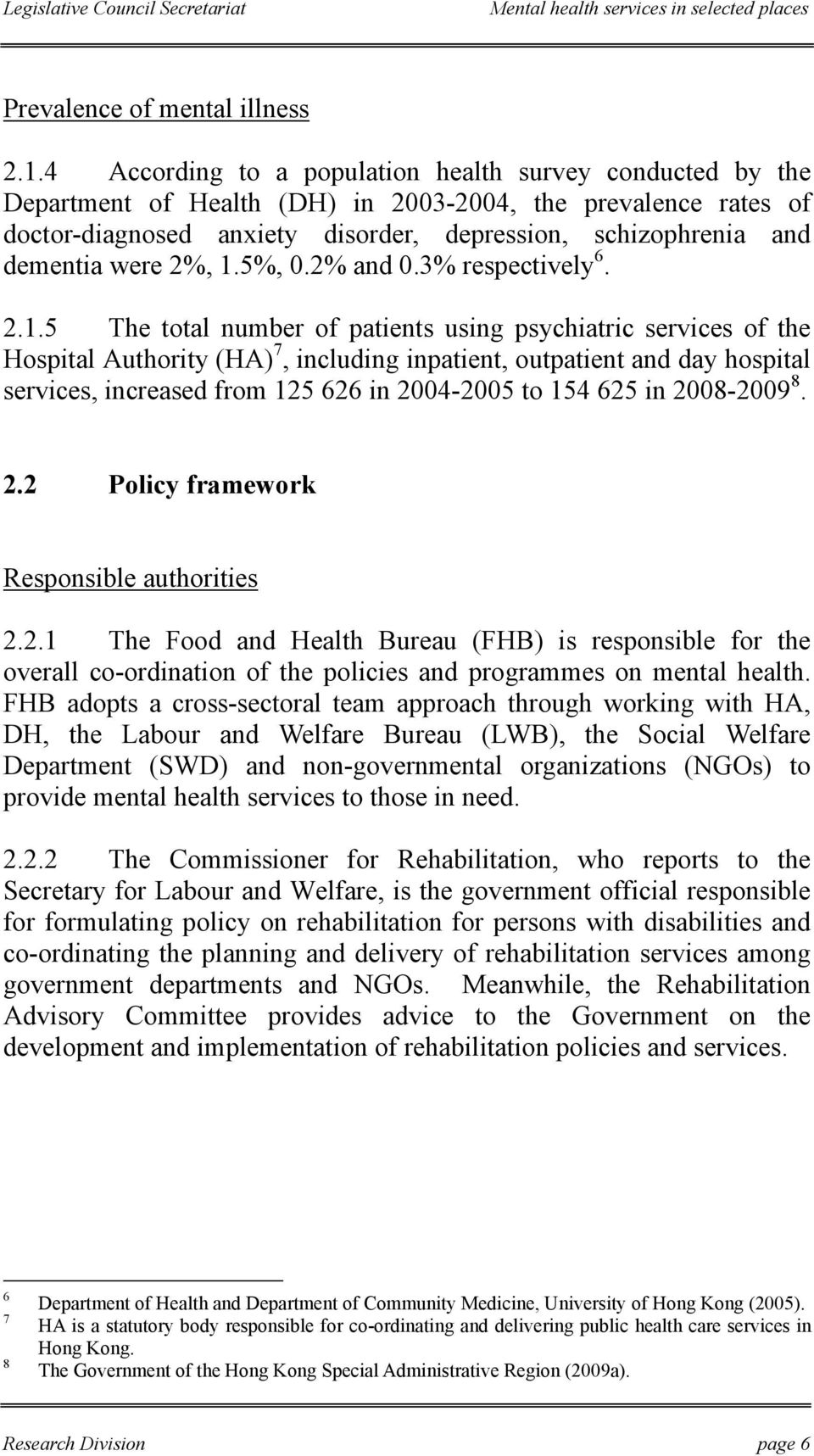
16 Policy on rehabilitation As mentioned in paragraph 2.1.2, the development programme of mental health services has been placed under the Government's overall rehabilitation policy and related programme plan since the mid-1970s. The Government published the first white paper on rehabilitation "Integrating the Disabled into the Community: A United Effort" in 1977 and then the second white paper on rehabilitation "Equal Opportunities and Full Participation: A Better Tomorrow for All" in The overall policy objective for rehabilitation set in the 1995 white paper which has been followed till today is to ensure that persons with disabilities can participate in full and enjoy equal opportunities in their personal and social development through a comprehensive range of measures for: (a) preventing disabilities; (b) helping persons with disabilities develop their physical, mental and social capabilities; and (c) creating a barrier-free physical and social environment 9. Rehabilitation Programme Plan The policy on rehabilitation is implemented through the Rehabilitation Programme Plan which is reviewed and updated regularly 10. The latest Rehabilitation Programme Plan published in 2007 recommends the following key directions for the future development of rehabilitation services for persons with disabilities, including mentally ill persons: (a) enhancing the prevention and early identification of disabling conditions; (b) developing community-based medical rehabilitation services and establishing closer collaboration among different sectors; 9 10 Hong Kong Government (1995). The Rehabilitation Programme Plans developed in the past provided detailed accounts of the current and planned provision of rehabilitation services and were used as the basis for resources planning. In the latest review completed in 2007, a macro strategic approach was adopted to provide the future direction of service development. Research Division page 7

17 (c) formulating a long-term development plan on residential services; (d) supporting continuous development of day care and community support services; (e) providing vocational training and employment services, and creating more employment opportunities; (f) supporting the development of self-help organizations; and (g) strengthening public education programmes with timely evaluation of their effectiveness. Recent development Recently, the expert groups set up under the sub-group of the Working Group on Mental Health Services 11 have affirmed the importance of early identification and treatment of mental illness and the direction of enhancing community care for patients. The expert groups have also studied the service needs of different population segments, namely, children and adolescents, adults and elders, and suggested related service improvement measures. In addition, FHB will consider the long-term development of mental health services and formulate relevant policies under the overall framework of the health care reform. 2.3 Relevant legislation The major pieces of legislation that safeguard the rights of mentally ill persons in Hong Kong are the Mental Health Ordinance (Cap. 136), the Disability Discrimination Ordinance (Cap. 487) and the Enduring Powers of Attorney Ordinance (Cap. 501). 11 The Working Group on Mental Health Services was established by the then Health, Welfare and Food Bureau in August 2006 to assist the Government in reviewing the existing mental health services. Research Division page 8
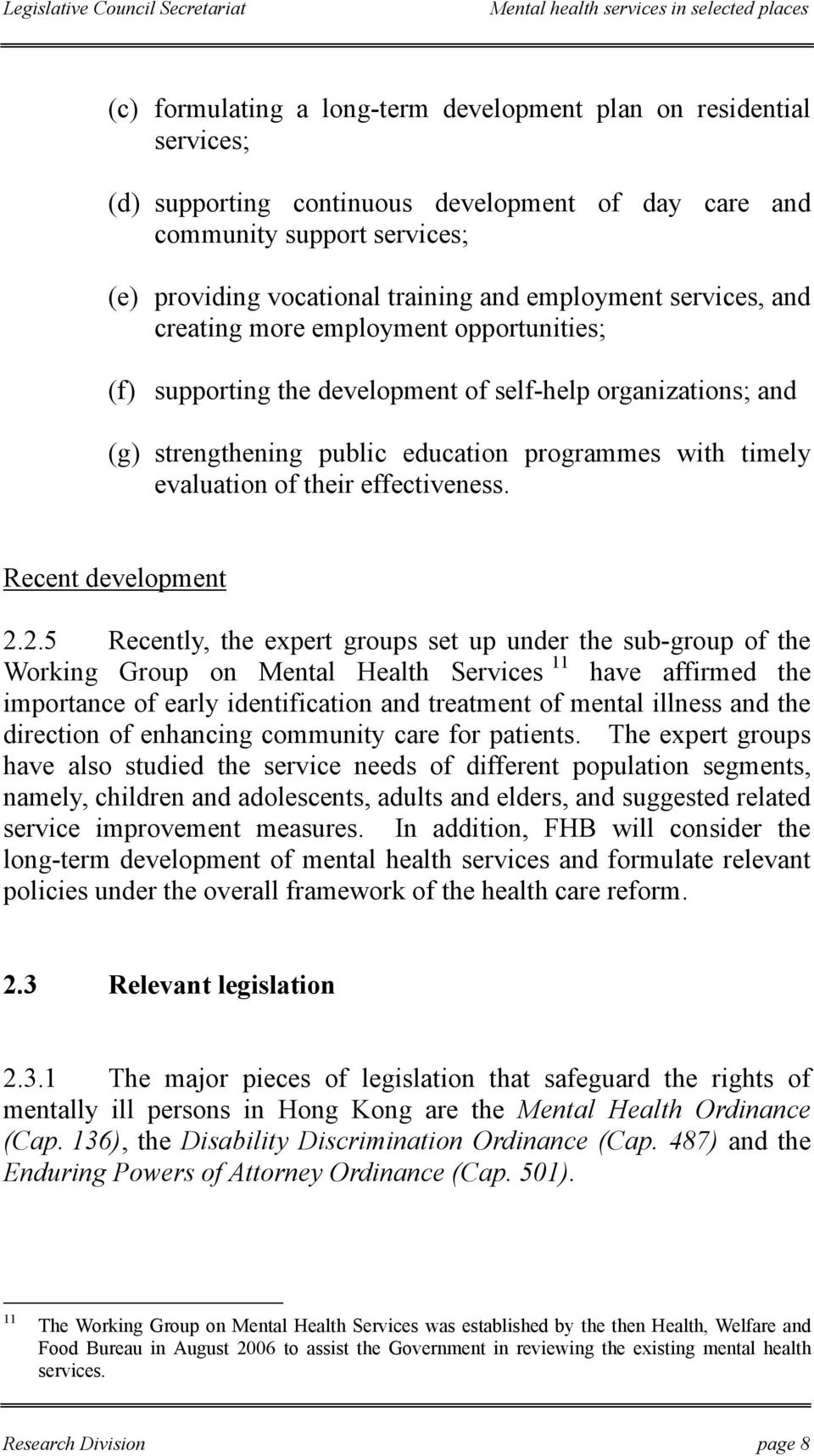
18 2.3.2 The Mental Health Ordinance (Cap. 136) provides for the management of property and affairs of mentally incapacitated persons, including mentally ill and mentally handicapped persons; the guardianship of mentally incapacitated persons; and the reception, detention and treatment of mentally ill persons The Disability Discrimination Ordinance (Cap. 487) protects mentally ill persons and their associates against discrimination, in areas such as employment; education; and provision of goods, services and facilities The Enduring Powers of Attorney Ordinance (Cap. 501) enables persons who might become mentally incapacitated to arrange for the management of their property and financial affairs before they lose their mental capacity to do so through the creation of an enduring power of attorney. 2.4 Modes of service delivery In Hong Kong, mental health services are mainly provided in the public sector through HA for medical care services, and SWD and NGOs for social and vocational rehabilitation services. DH also provides health assessment services to facilitate early identification of children and youths with psychological problems Meanwhile, co-ordinated care across the health care and social service sectors is provided to around patients with severe mental illness under a case management programme launched by HA in According to the Government, about patients who are using the psychiatric services of HA are having severe mental illness. Research Division page 9

19 Medical treatment and rehabilitation services Specialist outpatient services HA provides assessment, specialist treatment and follow-up consultations for mentally ill persons or discharged mentally ill patients at the psychiatric specialist outpatient clinics (SOPCs). New patients at the psychiatric SOPCs are triaged according to the urgency of their clinical conditions. In , the median waiting time for first appointment of priority one (urgent), priority two (semi-urgent) and routine cases was around one, three and 17 weeks respectively. The longest waiting time for the respective categories of new patients was six, 32 and 142 weeks respectively 12. Inpatient services In , HA provided psychiatric beds for patients with acute and chronic psychiatric conditions, down from in The ratio of psychiatric beds provided by HA per population was 5.7, and the occupancy rate of psychiatric beds was 73% in Other community-based specialist services HA also provides continued care and rehabilitation services such as support for transition from inpatient to outpatient care, illness education and management, and daily living skills training for psychiatric patients with more stable conditions through the psychiatric day hospitals Community psychiatric services are provided through the multi-disciplinary community psychiatric teams 13 and the community psychiatric nurses to support the rehabilitation of discharged patients and to reduce their risk of relapse. HA also provides designated care and rehabilitation programmes to mentally ill elders aged 65 or above through the community psychogeriatric teams Information provided by FHB. In 2009, there were eight multi-disciplinary community psychiatric teams, each of which comprises psychiatrists, community psychiatric nurses, clinical psychologists, occupational therapists and medical social workers. Research Division page 10
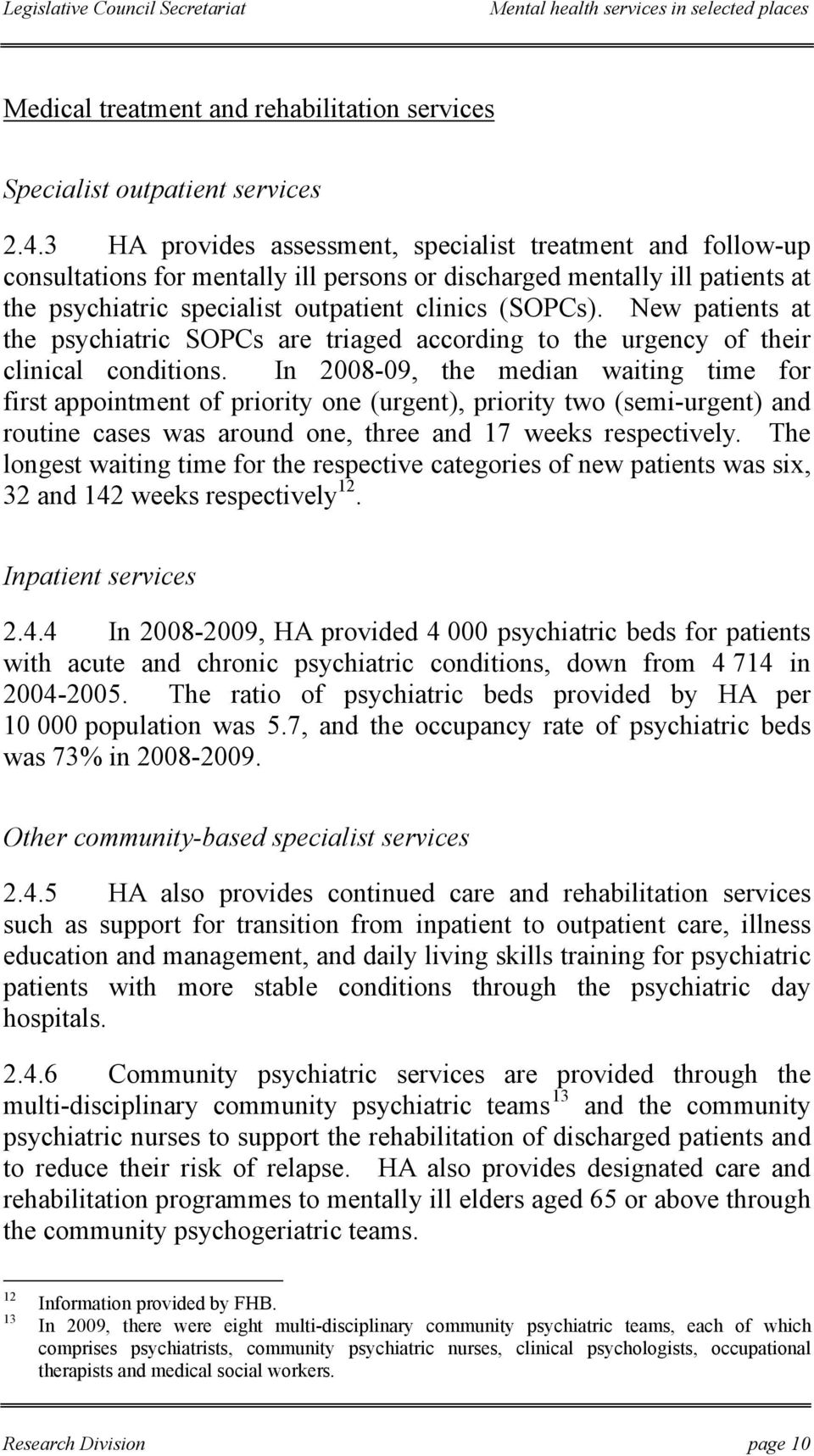
20 Statistics on the psychiatric facilities of the Hospital Authority Statistics on the psychiatric facilities of HA, usage and attendance of the respective facilities in and are shown in Table 1. Table 1 Psychiatric facilities of the Hospital Authority Specialist outpatient services Number of first attendances Number of follow-up attendances Inpatient services Number of psychiatric beds Number of inpatients Bed occupancy rate 79% 73% Psychiatric day hospital services Number of places Number of attendances Community psychiatric services Sources: Number of psychiatric outreach attendances Number of psychogeriatric outreach attendances Number of cases followed up by community psychiatric nurses Average number of cases followed up by each community psychiatric nurse per year Hospital Authority (various years), Food and Health Bureau et al. (2009a), The Government of the Hong Kong Special Administrative Region (2009b) and information provided by Food and Health Bureau. Research Division page 11
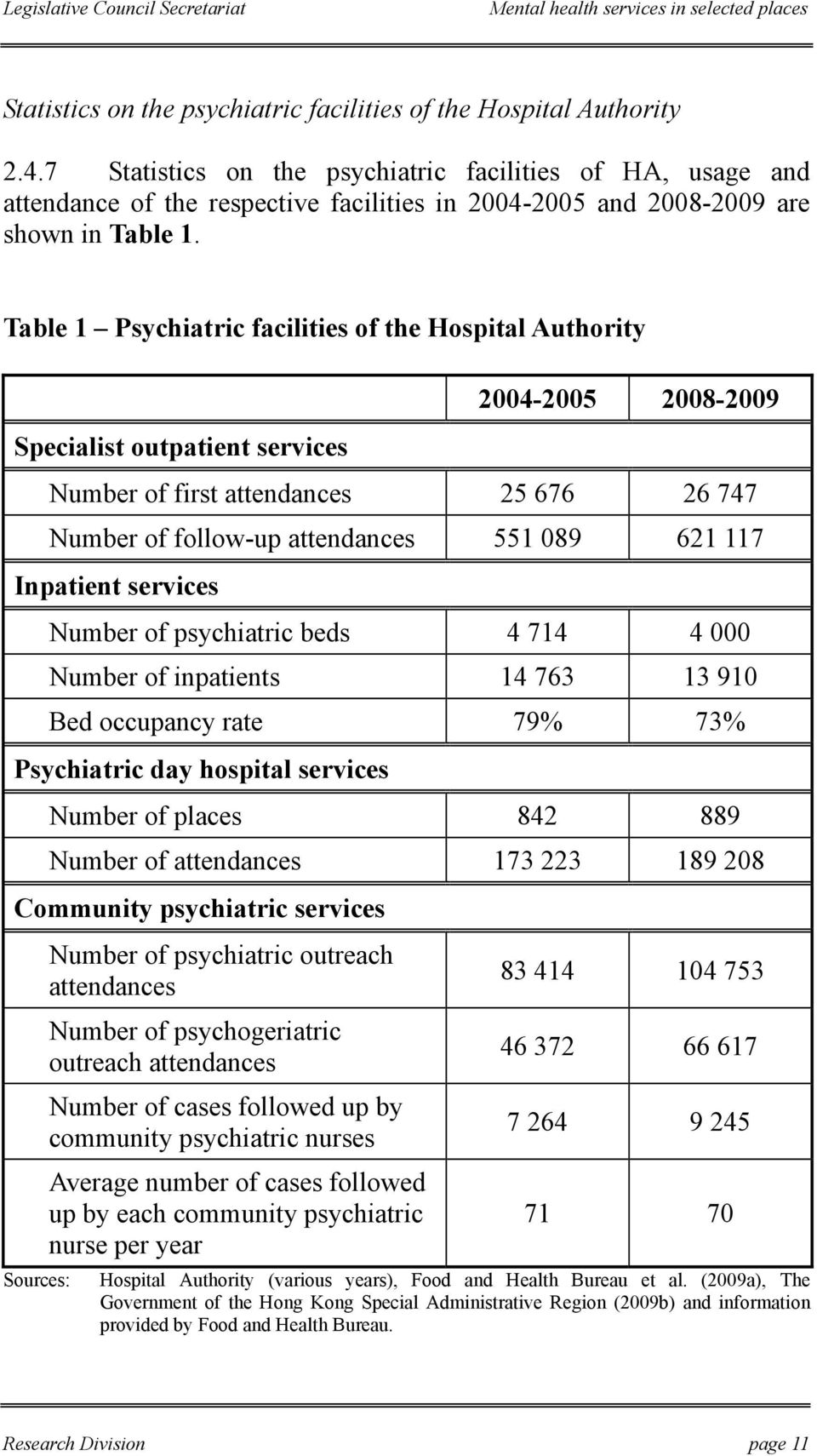
21 Psychiatric workforce Statistics on the psychiatric workforce in HA is shown in Table 2. Table 2 Psychiatric workforce in the Hospital Authority Number of professionals (1) Ratio (per population) (2) Psychiatrists Psychiatric nurses Clinical psychologists Occupational therapists (3) Medical social workers (4) Notes: (1) Figures as at 31 March (2) The estimated population of Hong Kong in mid-2009 was (3) The figure includes 133 community psychiatric nurses. (4) The Social Welfare Department stations medical social workers at the psychiatric units of public hospitals and clinics to provide necessary support to mentally ill patients to facilitate their rehabilitation. The average caseload of each psychiatric medical social worker was 1:78 in Sources: Food and Health Bureau et al. (2009b), Food and Health Bureau et al. (2009c) and The Government of the Hong Kong Special Administrative Region (2009a). Research Division page 12
22 Social rehabilitation services Residential services NGOs provided subvented residential care places such as long stay care homes, half-way houses and supported hostels for ex-mentally ill persons to support their rehabilitation and re-integration into the community in NGOs also offered 118 places in self-financing hostels for ex-mentally ill persons who are more capable of independent living in the same year 14. On the other hand, there were ex-mentally ill persons on the waiting lists of various types of residential services as at 31 March The average waiting time for such services ranged from 5.6 months to 22.9 months in Other social rehabilitation services SWD works with NGOs in providing the following social rehabilitation services for mentally ill persons, ex-mentally ill persons and their carers: (a) medical social services 16 ; (b) community support services such as outreach visits, social and recreational activities, counselling and training through service programmes such as Community Mental Health Link, Community Mental Health Care and Community Rehabilitation Day Services 17 ; (c) one-stop community support and social rehabilitation services delivered through the Integrated Community Centre for Mental Wellness; and (d) other general supporting services available to needy disabled persons such as integrated home care services, counselling services and parents/relatives resource centres Food and Health Bureau et al. (2009a) and Food and Health Bureau et al. (2009b). Information provided by FHB. In , cases were handled by psychiatric medical social workers. Information on the number of mentally ill persons and carers served per year is not available. Research Division page 13
23 Vocational rehabilitation services SWD and NGOs provide vocational rehabilitation services such as vocational training, sheltered workshop for persons with disabilities, including mentally ill persons, to assist them in enhancing their vocational skills 18. SWD also assists mentally ill persons to obtain on-the-job training and placements under employment support programmes targeting persons with disability The Labour Department, the Vocational Training Council and the Employees Retraining Board offer vocational training and employment support services for persons with disabilities, including mentally ill persons, who look for open employment. Welfare services SWD provides financial assistance for needy mentally ill persons through social security schemes such as the non-means-tested Disability Allowance 20 under the Social Security Allowance Scheme and the means-tested Comprehensive Social Security Assistance (CSSA) Scheme. As at December 2009, CSSA cases, including cases of mental retardation, were under the mentally ill category Ex-mentally ill persons having housing need may apply for public housing under the Compassionate Rehousing Scheme of the Housing Authority According to FHB, there were around places of vocational training, sheltered workshop and supported employment for persons with disabilities as at 31 March The figure on the number of places for mentally ill persons is not available. Information on the total number of mentally ill persons supported under the employment support programmes per year is not available. Persons with severe mental illness, such as psychosis, neurosis or personality disorder, may apply for Normal Disability Allowance and those requiring constant attendance from others in their daily life may apply for Higher Disability Allowance. The current rate of Normal and Higher Disability Allowances is HK$1,325 per month and HK$2,650 per month respectively. As at March 2009, there were Disability Allowance recipients, including all categories of disabilities. Census and Statistics Department (2010). Research Division page 14
24 2.5 Measures and programmes supporting mental health services Measures for enhancing mental health services have been developed under the Government's policy on rehabilitation of persons with disabilities and the related implementation plan, the Rehabilitation Programme Plan, since the 1970s. In addition, FHB has been working with LWB, HA and other related government departments in introducing initiatives from time to time to improve the mental health services delivered by the Government. Public education In order to enhance public awareness of mental health and promote public acceptance of mentally ill persons, LWB has organized the "Mental Health Month" annually in collaboration with various government departments, NGOs and the media since 1995, launching various promotional activities under different themes from year to year. The Rehabilitation Advisory Committee has worked with the District Councils to launch publicity activities at the district level and provided subsidies to community organizations for organizing public education programmes Besides, SWD and HA have promoted mental health to the public, mentally ill persons and their carers through medical social services and various community-based mental health programmes. DH has also incorporated mental health into its public health education portfolio. Prevention and early identification HA and SWD have introduced the following community-based programmes for the prevention and early identification of mental health problems among different target groups since 2001: (a) Early Assessment and Detection of Young Persons with Psychosis (EASY) for young persons aged 15 to 25 with early symptoms of psychosis; Research Division page 15
25 (b) Elderly Suicide Prevention Programme for elders suspected to have suicidal tendency or depression problem; and (c) Child and Adolescent Mental Health Community Support Project and Community Mental Health Intervention Project for children and adolescents with emotional or mental health problems In the Policy Address, the Government proposes to expand the service targets of EASY to include adults with psychosis symptoms and enhance the early identification, assessment and treatment services for autistic children. Development of medical treatment and rehabilitation services In the past decade, HA has introduced initiatives to enhance the medical care services for mentally ill persons, especially on community-based services. Some of the initiatives include: improving access to the community psychiatric and community psychogeriatric services, introducing an intensive rehabilitation programme for long stay mentally ill patients to facilitate their early discharge, enhancing services for patients classified as routine cases and those with common mental disorders waiting for or receiving specialist outpatient services, and increasing the number of patients to be prescribed with new psychiatric drugs HA has recently introduced the following initiatives to strengthen support for persons with severe mental illness and those with common mental disorders: (a) introducing a case management programme to provide integrated and personalized support for persons with severe mental illness through case managers in some districts; and Research Division page 16
26 (b) establishing Common Mental Disorder Clinics at the psychiatric SOPCs to provide assessment and supporting services for people with common mental disorders, and referring patients with milder or stabilized conditions to primary care services for treatment. Development of social and vocational rehabilitation services SWD has introduced a number of service programmes such as Community Mental Health Link, Community Mental Health Care and Community Rehabilitation Day Services since to enhance community support for mentally ill persons to facilitate their re-integration into the society. The latest service development focus is to roll out the service model of the Integrated Community Centre for Mental Wellness across Hong Kong to provide one-stop community support services for persons with mental illness and their carers With regard to residential services, SWD is planning to meet the shortfall in services by providing more subvented residential care places in the next three years, supporting NGOs to develop self-financing hostels, and introducing a pilot bought place scheme 22 for residential care homes for persons with disabilities, including mentally ill persons In , the Government is planning to provide additional places of day training and vocational rehabilitation services to enhance the employability of persons with disabilities, including mentally ill persons. 2.6 Funding arrangements The total health care expenditure of Hong Kong accounts for around 5% of its Gross Domestic Product (GDP) in general 23. The total government expenditure on mental health services accounted for about 0.22% of GDP in Under the scheme, SWD will subsidize residential care places offered by private residential care homes for persons with disabilities that meet required quality and safety standards and have registered under a voluntary registration scheme. Official Record of Proceedings of the Legislative Council (2009). Research Division page 17
27 2.6.2 The Government spent HK$3.645 billion on mental health services in , up from HK$3.15 billion in Medical treatment and rehabilitation services accounted for about 78% of the total spending. Social rehabilitation services accounted for about 22% of the total spending, with 98% of such spending being allocated to NGOs for service provision In , the Government is planning to increase the recurrent funding to HA by HK$119 million and to SWD by HK$76 million 24 to support new service initiatives such as introducing the case management programme for persons with severe mental illness and expanding the service model of the Integrated Community Centre for Mental Wellness across all districts in Hong Kong. 2.7 Monitoring mechanism FHB is responsible for the overall monitoring of the implementation of the mental health service programmes. The Working Group on Mental Health Services, which is chaired by the Secretary for Food and Health, assists in reviewing the provision of mental health services and suggests service improvement measures At the service delivery level, HA reviews the performance of its mental health services through regular reporting mechanisms. The Central Co-ordinating Committee of Psychiatry of HA monitors and evaluates the performance and outcomes of various mental health service programmes by adopting relevant performance indicators SWD monitors the performance and effectiveness of the social rehabilitation services provided to mentally ill persons by the performance standards in the Funding and Service Agreement 25 agreed between SWD and the service providers Information provided by FHB. Each subvented service unit operated by NGOs has a Funding and Service Agreement with SWD defining the social services to be provided and the required performance standards and service infrastructure. Research Division page 18
28 2.8 Issues and concerns In the 2007 Rehabilitation Programme Plan, the Working Group 26 which conducted the programme plan review considered mental health was an issue of concern deserving more attention outside the context of the Rehabilitation Programme Plan review. The Working Group made the following suggestions with regard to the development of mental health services in Hong Kong: (a) continuing and enhancing efforts on prevention, early identification and intervention, and public education; (b) improving cross-sectoral collaboration and the provision of integrated services; and (c) setting up a multi-sectoral working group under the leadership of FHB to map out a sustainable mental health strategy In a report submitted to the Asia-Pacific Community Mental Health Development Project 27 in 2008, representatives from HA raised the following concerns regarding the development of community mental health services in Hong Kong: (a) developing a consistent and long-term mental health policy with the involvement of stakeholders and ensuring collaboration among different sectors; (b) better planning on manpower requirements to ensure an adequate workforce for delivering community mental health services; The Working Group, chaired by the Deputy Secretary for Health, Welfare and Food, comprised representatives of the Rehabilitation Advisory Committee, the Hong Kong Council of Social Service, NGOs providing rehabilitation services, persons with disabilities, self-help groups and relevant public authorities. The Asia-Pacific Community Mental Health Development Project was established in 2005 by 14 places in the Asia-Pacific region in collaboration with the World Health Organization Western Pacific Regional Office to support the development and implementation of policies on community mental health services in the respective places. See Asia-Pacific Community Mental Health Development Project (2008). Research Division page 19
29 (c) enhancing collaboration with the primary care sector in treating persons with common mental illness; and (d) better planning on public education At the meetings of the Panel on Health Services and the Panel on Welfare Services of the Legislative Council and a joint meeting of the two Panels held to discuss the issue related to mental health services between 2007 and , stakeholders expressed the following concerns about the mental health care system of Hong Kong: (a) lacking a comprehensive and long-term policy that is dedicated on mental health and developed with stakeholders' involvement and consideration of epidemiological data; (b) inadequate resources allocated on mental health services resulting in shortage of manpower and gaps in service provision; (c) poor co-ordination among government departments, the health care and social service sectors in delivering mental health services; (d) insufficient provision of medical, social and vocational rehabilitation services to facilitate ex-mentally ill persons to rehabilitate and re-integrate into the community; (e) inadequate support to family members and carers of mentally ill persons and self-help organizations; and (f) insufficient efforts on public education to enhance the public's awareness and understanding of mental health problems and to promote the public's acceptance of mentally ill persons. 28 Food and Health Bureau et al. (2008a); Food and Health Bureau et al. (2009c) and Minutes of Joint Meeting of the Panel on Health Services and the Panel on Welfare Services of the Legislative Council (2009). Research Division page 20
30 Chapter 3 England of the United Kingdom 3.1 Background Development of mental health services In England of the United Kingdom (UK), mental health services were mainly provided by large psychiatric hospitals focusing on custodial care before the 1960s. In the 1950s, advances in psychiatric drugs and growing recognition of the benefits for mentally ill persons to rehabilitate in the community had led to the development of community-based mental health services such as day hospitals and outpatient nursing service The government introduced the policy to close down large psychiatric hospitals in 1962, replacing them gradually with community-based services such as specialist outpatient services provided at general hospitals, outreach community psychiatric services and residential care services. Consequently, the number of psychiatric inpatient beds decreased from about in 1968 to about in However, in the mid-1980s, there were concerns regarding insufficient community-based services provided by the government to support the rehabilitation of discharged mentally ill patients from psychiatric hospitals and the policy of closing down psychiatric hospitals. 29 House of Commons (2000). Research Division page 21
31 3.1.3 In the late 1990s, the government introduced a series of reforms to improve the services of the National Health Service (NHS) 30, the public health care system of the UK, to strengthen social care to the needy 31 and to promote cross-sector partnership in providing integrated health and social care to the public. Building on the efforts of reforming the health and social care systems, the government issued the white paper "Modernising Mental Health: Safe, Sound and Supportive" in , laying the policy framework for reforming adult mental health services in the following 10 years to address the gaps in service provision, especially for primary care and community-based services. The government also committed an additional investment of 700 million (HK$9.0 billion) over three years for implementing the reform. Prevalence of mental illness According to a survey on adult psychiatric morbidity conducted in England in , about 23% of adults aged 16 or above suffered from at least one psychiatric disorder and 7.2% suffered from two or more disorders. The survey also indicated that 16.2% of adults aged 16 or above suffered from common mental disorders such as depression and anxiety in the week before the survey and 0.4% suffered from psychotic disorder in the year before the survey According to NHS, about 1.22 million persons aged 16 or above in England accessed its specialist mental health services in , up from 1.13 million in Among these users, 8.4% used the inpatient services of NHS The government published the white paper "the New NHS: Modern, Dependable" in 1997, laying the policy framework for restructuring NHS, improving the efficiency and quality of health services and enhancing the integration of health and social care services through cross-sector partnership. See Department of Health (1997). The government issued the white paper "Modernising Social Services" in 1998, setting out the policy framework for improving protection of the disadvantaged and enhancing accessibility, efficiency and quality of social services. See Department of Health (1998b). Department of Health (1998a). NHS Information Centre (2009a). NHS Information Centre (2009b). Research Division page 22
32 3.2 Policy framework Responsible authorities The Department of Health (DH) assumes the responsibility for formulating mental health and social care policies in England. DH works with the local authorities 35 and the Strategic Health Authorities (SHAs), which are the NHS institutions responsible for planning and monitoring health care services provided at the local level, in implementing the related policies. Policy on adult mental health services In England, the policy guiding the development of mental health services for adults aged 18 to 65 was set out in the white paper "Modernising Mental Health: Safe, Sound and Supportive" published in The white paper was supplemented by the following documents putting forward strategies and action plans to implement the policy: (a) "The National Service Framework for Mental Health" published in setting out the national standards and service models for delivering adult mental health services; (b) "The NHS Plan: a plan for investment, a plan for reform" published in laying the development plan of mental health services provided by NHS and committing an additional 900 million (HK$10.6 billion) over three years from to for developing the services; and (c) "The Mental Health Policy Implementation Guide" published in establishing the service specifications for various mental health services to support service delivery at the local level In England, social services are delivered through the local councils which are the administrative bodies of the local authorities. Department of Health (1999). Department of Health (2000). Department of Health (2001b). Research Division page 23
33 Policy objective The overall objective of the policy on adult mental health services is to ensure that they are: (a) safe protecting the public and providing effective care for mentally ill persons at the time they need it; (b) sound ensuring that service users have access to a full range of services that they need; and (c) supportive working with services users, their families and carers to build healthier communities. National standards of adult mental health services To guide service development under the mental health policy, DH has set the following national standards for adult mental health services in the National Service Framework for Mental Health 39 : (a) promoting mental health among the public, combating discrimination against mentally ill persons and promoting their social inclusion; (b) providing accessible, high quality and effective primary care and community support services for persons with common mental health problems; (c) providing accessible, high quality and effective hospital- and community-based services, and integrated care planning under the Care Programme Approach (CPA) 40 for persons with severe mental illness; (d) supporting the physical and mental health care needs of carers of persons with severe mental illness; and (e) preventing suicide with the aim to reduce the suicide rate by at least 20% by Department of Health (1999). DH introduced CPA in 1991 to provide co-ordinated medical and social care to patients with severe mental illness under a care plan developed by psychiatric professionals from multiple disciplines and administered by a care co-ordinator. Research Division page 24
34 Policies on mental health services for children and young people, and elders Policies on the development of mental health services for children and young people, and elders are set out in separate National Service Framework documents 41 which specify the directions to provide timely, multi-disciplinary, integrated and high quality mental health services for service users of the two population segments and offer support to their carers. Recent development With the change in the UK government in May 2010, the new coalition government is reviewing the mental health policy in the context of the overall reform of the health care system. 3.3 Relevant legislation In England, the Mental Health Act 1983, the Equality Act 2010 and the Mental Capacity Act 2005 are the major pieces of legislation that safeguard the rights of mentally ill persons The Mental Health Act 1983 lays the legislative framework for the compulsory detention of persons with serious mental disorders for assessment or treatment to protect both their safety and that of the public. The Act provides for the criteria and procedures for compulsory detention of mentally ill persons for assessment or treatment and the procedures for receiving mentally ill persons into guardianship. The Mental Health Act was amended in 2007 to provide for discharging mentally ill patients detained under the Act to continue treatment in the community under community treatment orders, subject to the possibility of recalling them to hospital if the patients fail to comply with the conditions specified in the orders. The amendment aims at ensuring that the discharged patients continue their medical treatment in the community and avoiding relapse of their illness. 41 The policy on mental health services for elders was laid down in the paper "National Service Framework for Older People" published in 2001 and the policy on mental health services for children and young people was laid down in the paper "National Service Framework for Children, Young People and Maternity Services: the Mental Health and Psychological Well-being of Children and Young People" published in See Department of Health (2001a) and Department of Health (2004a). Research Division page 25
35 3.3.3 The Equality Act 2010 was enacted in April 2010 to consolidate existing anti-discrimination acts and regulations in the UK and provide protection from discrimination based on a range of characteristics such as age, gender, disability and race. It replaces the Disability Discrimination Act 1995 to protect disabled persons, including mentally ill persons, from discrimination in areas such as employment; provision of goods, facilities and services; education; and transport The Mental Capacity Act 2005 protects persons aged 16 or above who lack mental capacity to make decisions for themselves because of an impairment of the functioning of the mind or brain. The Act provides for a person to appoint a donee through the Lasting Power of Attorney to make decisions for him or her on personal welfare or financial matters when he or she loses mental capacity to do so in the future. 3.4 Modes of service delivery In England, mental health services are mainly provided in the public sector through NHS, the local authorities and the Department for Work and Pensions (DWP). NHS provides medical services and some social care services for mentally ill persons through primary care trusts (PCTs) 42 and mental health trusts 43. The local authorities commission voluntary or private organizations to provide part of the social rehabilitation services, and provide some of the services themselves. Meanwhile, DWP provides employment support and welfare services for disabled persons, including mentally ill persons PCTs control about 80% of the NHS budget and are responsible for providing primary care services and commissioning secondary care services. PCTs also work with the local authorities to ensure that the health and social care provisions in the local districts can meet local needs. Mental health trusts provide specialist medical and social care services for mentally ill persons such as inpatient, outpatient, community psychiatric and residential care services. Research Division page 26
36 3.4.2 DH has developed specific mental health care models for children and young people, adults and elders under the respective National Service Frameworks mentioned in paragraphs and On the whole, less serious mentally ill patients in the respective segments are mainly treated at the primary care and community levels while more serious mentally ill patients are treated with community-based and inpatient services. Serious mentally ill patients are also provided with integrated medical and social care under CPA which will be discussed in details in paragraph Medical treatment and rehabilitation services Primary care services In England, general practitioners of PCTs play an important role in early identification and assessment of persons with mental health issues. They also provide treatment for patients with common mental illness and referral for more serious patients to specialist mental health services provided by mental health trusts. According to DH, most mental health patients, especially those with common mental illness such as depression and anxiety disorders, are treated in the primary care level without involving specialist mental health services Department of Health (2000). Research Division page 27
37 Community-based specialist services Community psychiatric services in England have expanded since the introduction of the adult mental health policy in 1998 and play an important role in the assessment, treatment and rehabilitation of patients with severe mental illness at the community level. Multi-disciplinary community mental health teams 45 provide psychiatric services for patients referred from general practitioners, accident and emergency departments of general hospitals or psychiatric hospitals at their community-based clinics or through outreach visits. Other specialist mental health teams, such as crisis resolution/home treatment teams, assertive outreach teams and early intervention in psychosis teams 46, provide services for targeted groups of patients to avoid unnecessary hospital admissions. As at the end of March 2008, there were around 344 crisis resolution teams, 249 assertive outreach teams and 150 early intervention in psychosis teams in England Mentally ill persons or discharged mental health patients may obtain specialist treatment from psychiatric outpatient clinics located at local hospitals, community mental health centres, and some larger general practitioner surgeries. Some may also receive therapeutic treatment such as occupational therapy and group therapy in day hospitals upon referral from other specialist mental health services such as outpatient or community psychiatric services Community mental health teams comprise psychiatrists, psychologists, community psychiatric nurses, social workers and occupational therapists. Crisis resolution/home treatment teams provide 24-hour crisis intervention, assessment and treatment services for adults suffering from acute psychiatric crisis such as psychotic episodes. Assertive outreach teams provide treatment and rehabilitation services to discharged adult patients who have high risk of relapse. Early intervention in psychosis teams provide early detection, intervention and treatment for persons aged 14 to 35 with early symptoms of psychosis. Department of Health (2009a). Research Division page 28
38 Inpatient services Persons with severe mental illness may be admitted to inpatient services voluntarily on the referral of their psychiatrists or compulsorily under the Mental Health Act In , NHS provided psychiatric beds for patients with severe mental illness, down from in The ratio of psychiatric beds provided by NHS per population was 5.14, and the occupancy rate of psychiatric beds was 86.2% in Care Programme Approach DH introduced CPA in 1991 as a framework to provide co-ordinated medical and social care to support the treatment and rehabilitation of patients with severe mental illness. Under CPA, the medical and social care needs of patients with severe mental illness are assessed by psychiatric professionals from multiple disciplines in order to develop an integrated care plan 50. Each patient on CPA is supported by a care co-ordinator, who may be a community psychiatric nurse, social worker or occupational therapist, to co-ordinate the provision of services under the care plan and review the plan with the patient regularly. Statistics on the psychiatric services provided by NHS Statistics on the psychiatric services provided by NHS of England for adult and elder patients, usage and attendance of the respective services in and are shown in Table In , there were adult and elderly psychiatric inpatients in NHS, and about 32% of them were detained under the Mental Health Act See NHS Information Centre (2009b). Department of Health (2010a). Before 2008, two levels of CPA support had been provided to patients with severe mental illness according to their needs, namely, standard support for patients requiring care from one service agency, and enhanced support for patients requiring support from multiple service agencies. In 2008, DH revamped CPA to focus on supporting mentally ill patients requiring services from multiple agencies. Research Division page 29
39 Table 3 Psychiatric services provided by the National Health Service of England Inpatient services Number of psychiatric beds Number of inpatients (1) Bed occupancy rate Not available. 86.2% Outpatient and community-based services Number of contacts with consultant psychiatrists (1) Number of contacts with community psychiatric nurses (1) Care Programme Approach (CPA) Number of patients on CPA (1) (2) Notes: (1) The figures only include adult and elder patients. (2) The figure refers to the number of patients on enhanced CPA which was the level of support provided to patients with complex care needs before Sources: Department of Health (2010a) and NHS Information Centre (2009b). Psychiatric workforce Statistics on the psychiatric workforce in NHS of England are shown in Table 4. Research Division page 30
40 Table 4 Psychiatric workforce in the National Health Service of England Consultant psychiatrists Psychiatric nurses Clinical psychologists Number of professionals (1) Ratio (per population) (2) Psychotherapists Notes: (1) Figures as at September (2) The population in England was estimated to be million in mid Sources: Office for National Statistics (2009) and NHS Information Centre (2010b, 2010c). Social rehabilitation services Mentally ill persons have to go through a CPA assessment, or a community care assessment conducted by the local social services departments to determine if they are eligible to access various social rehabilitation services funded by the local authorities or NHS. Mentally ill persons are also required to go through a means test to determine if they have to pay for the services. Services for mentally ill persons In , the local authorities, and voluntary and private organizations provided residential care services such as nursing homes, supported housing and hostels to around service users with mental illness 51. Other community-based supporting services such as professional support of care co-ordinators, social workers and occupational therapists; day care services; home care services; and equipment provision and adaptations of home facilities were provided to around mentally ill persons in The figure might include double counting of some service users who used more than one category of residential services during the year. See NHS Information Centre (2010a). NHS Information Centre (2010a). Research Division page 31
41 Services for carers Carers of disabled, physical or mentally ill persons can obtain information on the supporting services available and advice on care taking through Carers Direct which comprises online resources and a helpline. Carers who provide regular and substantial care for a person aged 18 or above may be offered free or paid support services such as respite care, housework support or emotional support services based on a carer's assessment and a means test conducted by the local social services departments. In , around carers of mentally ill persons obtained support services and around carers received information and advice through the local authorities 53. Vocational rehabilitation services Both the local authorities and voluntary organizations provide vocational rehabilitation services such as sheltered workshops and supported employment to mentally ill persons to facilitate their re-integration into the community. Meanwhile, Jobcentre Plus of DWP provides personalized advice, training and on-the-job support to help unemployed disabled persons, including mentally ill persons, look for and engage in employment in the open labour market through some employment support programmes. DWP also provides financial assistance like Employment and Support Allowance 54 and Job Seeker's Allowance for unemployed disabled persons when they are looking for employment NHS Information Centre (2010a). Recipients of the Employment and Support Allowance who have working capabilities will receive employment support services from DWP to prepare them for employment. Research Division page 32
42 Welfare services Allowances for disabled persons Needy disabled persons, including mentally ill persons, can apply for financial assistance such as the Disability Living Allowance, Attendance Allowance and Independent Living Fund 55 from DWP. Carer's benefits DWP provides a taxable carer's allowance to unemployed or low-income carers who are aged 16 or above and spend at least 35 hours a week caring for a severely disabled person receiving Attendance Allowance or Disability Living Allowance. Housing support Mentally ill persons with accommodation needs may apply to rent or purchase social housing provided by local housing associations 56 at affordable cost. Under the homelessness legislation, homeless mentally ill persons may be considered by local housing associations to have high priority need for accommodation when assessing their applications Under the Supporting People Programme introduced in 2003, the local authorities provide housing-related support such as advice on home improvement, access to a community service alarm, life skill training and on-site supporting services for vulnerable people, including mentally ill persons, to enable them to live independently at their own homes or in supported housing provided by the local authorities. The Programme supports around mentally ill persons at any one time Disability Living Allowance is provided for disabled children and adults requiring support on personal care or having walking difficulties. Attendance Allowance is provided for disabled persons aged 65 or above who require care or supervision by others for at least six months. Independent Living Fund is provided for disabled persons aged between 16 and 65 to pay for personal and domestic care services when living at home. Housing associations are non-profit-making organizations funded by the local government to provide social housing to meet local housing needs. Communities and Local Government (2010). Research Division page 33
43 3.5 Measures and programmes implemented to support the mental health policy Public education Countering stigma and discrimination against mental illness was considered a key development area in the 1999 National Service Framework for Mental Health. As such, the government launched the "Mindout for Mental Health" campaign between 2001 and 2004 and the "SHIFT" programme in 2004 to promote positive attitudes towards mental illness and mentally ill persons among youths, employers, employees and the media. Initiatives under the "SHIFT" programme include: (a) providing information and advice to employers and employees through online resources, printed and video materials to help them promote mental well-being and manage mental illness in the workplace; (b) working with non-governmental organizations to develop promotion materials and activities to reduce stigma and discrimination against mental illness in schools; and (c) promoting positive and non-stereotypic coverage of mental illness and mentally ill persons in the media through efforts such as setting up a media alert system for people to give feedback to journalists and programme producers on related coverage and providing a handbook on tips about reporting mental illness and suicide for journalists. Prevention and early identification To support the national target of reducing the suicide rate by at least 20% by 2010, DH introduced the National Suicide Prevention Strategy in Under the implementation plan of the Strategy, there are proposed actions to reduce risk of suicide among high risk groups such as mentally ill persons, promote mental well-being among the general population, improve reporting of suicidal behaviour in the media, and promote research on suicide and suicide prevention. Research Division page 34
44 3.5.3 The Department for Children, Schools and Families (DCSF) 58 has worked with DH in implementing a series of programmes since 1999 to improve primary and secondary school students' social and emotional skills and promote their mental well-being; support early intervention work in schools for children at risk of experiencing mental health problems; and enhance support to vulnerable young parents and their children. Development of medical treatment and rehabilitation services To deliver accessible, quality and effective primary care and specialist mental health services set in the National Service Framework for Mental Health, DH has carried out the following measures since 2000: (a) expanding the workforce of graduate primary care mental health workers and increasing the number of specialist community mental health teams under the NHS Plan introduced in 2000; (b) improving access to psychological therapy among patients suffering from depression and anxiety disorders by expanding the psychological therapy workforce and services; and (c) enhancing the clinical decision support systems and commissioning the National Institute for Health and Clinical Excellence 59 to develop guidelines on clinical practice and treatment effectiveness to support clinicians in making intervention decisions for patients The Department for Education was established in mid-2010 under the new government to replace DCSF in formulating and implementing policies related to education and children's services. The National Institute for Health and Clinical Excellence is an independent organization under NHS responsible for providing guidance and recommending quality standards on illness treatment and prevention. Research Division page 35
45 Development of social and vocational rehabilitation services In the past decade, measures to support the social rehabilitation of mentally ill persons have been developed under the overall government directions to reduce social exclusion, promote independent living and enhance equal access of social services for the disadvantaged groups. One example of the measures is the Supporting People Programme mentioned in paragraph To address social exclusion encountered by adults with long-term mental health problems, the action plan developed by the Social Exclusion Unit under the Office of the Deputy Prime Minister in 2004 covers measures to improve their access to employment, housing, financial advice and transport; and promote participation in community activities such as education, arts, sports and volunteering Measures to support carers 60 in general such as provision of information, training, and breaks from caring have been developed under the government's carer strategy introduced in 1999 and updated in The government has committed to invest over 255 million (HK$ 3.68 billion) between 2008 and 2011 for supporting the initiatives proposed in the latest carer strategy According to the government, the employment rate for people with mental health conditions excluding depression was estimated to be less than 16% in Recognizing that unemployment was a barrier for mentally ill persons to fully recover and re-integrate into the community, the government put forward a strategic plan "Work, Recovery and Inclusion" in 2009 to support employment of persons with serious mental illness. The plan covers measures such as strengthening specialist support to mentally ill persons through psychological therapy programmes provided by NHS and employment support programmes provided by DWP, and providing advice and guidance to employers and employees on how to manage mental health problems in the workplace Carers are defined as persons who spend a significant portion of their time providing unpaid support to a partner, relative or friend who is ill, frail, disabled or has mental health problems. HM Government (2009b). Research Division page 36
46 3.6 Funding arrangements In the UK, the total health care expenditure accounted for 8.4% of its Gross Domestic Product (GDP) in Of the total health care expenditure, 81.7% was contributed by the government, 18.3% was contributed by private sources such as out-of-pocket payments of service users and private health insurance schemes 62. During the recent years, the total government expenditure on mental health services has accounted for around 0.7% of GDP in general In England, government expenditure on adult mental health services was billion (HK$84.96 billion) in , up by over 50% in real terms from 3.92 billion (HK$56.53 billion) in Allocation of the total expenditure on medical treatment and rehabilitation services, social rehabilitation services, and other indirect costs, overheads and capital charges were 58%, 23% and 19% respectively. The distribution of total expenditure by categories of service providers was: 69.8% for NHS, 22% for voluntary and private organizations, 7.6% for local authorities and 0.6% for other providers Government expenditure on child and adolescent mental health services was 523 million (HK$7.5 billion) in , up by 62% from 322 million (HK$4.1 billion) in In , an additional 31 million (HK$484 million) was allocated to NHS to improve psychiatric inpatient services for children and adolescents World Health Organization (2010). World Health Organization (2005) and World Health Organization (2010). The amount of expenditure in was adjusted based on the price levels. Mental Health Strategies (2009). Department of Health (2008a). Research Division page 37
47 3.7 Monitoring mechanism DH monitors the implementation progress of the mental health policy and the quality of mental health services delivered by NHS, the local authorities and other service providers by regular measurement of their performance against a set of indicators under their respective performance assessment frameworks 67. The performance indicators are set upon agreement with the relevant authorities, service commissioners and providers to reflect performance in resources allocation; service process such as compliance with quality and safety standards; and service outcomes such as health improvement and service users' service experience The Care Quality Commission (CQC), the independent regulator of health and adult social care services in England 68, administers a registration scheme under which providers of services such as hospital services, residential care, personal care and nursing care have to meet a set of essential standards of quality and safety 69 to qualify for registration in order to commence operation. CQC conducts regular review of service providers against the essential standards of quality and safety and disseminates the review results to service users to enable them to make informed choice of service providers. The methods and results of the CQC review are aligned with the performance assessment conducted by DH to ensure consistency in evaluating service providers Department of Health (1999) and Department of Health (2010b). The Care Quality Commission was established in 2009 to replace the Healthcare Commission, the Commission for Social Care Inspection and the Mental Health Act Commission as the single independent regulator of health and adult social services in England. The Healthcare Commission was responsible for assessing and reporting to the government the performance of healthcare organizations in NHS and the independent sector. The Commission for Social Care Inspection regulated adult social care services provided by the local authorities and the independent sector. The Mental Health Act Commission was responsible for monitoring the implementation of the Mental Health Act 1983 and safeguarding the rights of patients detained under the Act. The set of essential standards of quality and safety covers six outcome areas: involvement and information; personalized care, treatment and support; safeguarding and safety; suitability of staffing; quality and management; and suitability of management. Research Division page 38
48 3.8 Issues and concerns A review report published by DH in 2004 on the implementation progress of the National Service Framework for Mental Health in indicated that improvements in adult mental health services had been made in areas such as improved assess to community-based psychiatric services and psychological therapy, expansion of the psychiatric workforce, expansion of services for carers and reduction of the suicide rate Based on the review report, DH considered that the focused areas for implementing the National Service Framework for Mental Health from 2005 onward were: promoting the mental well-being of the whole population; addressing stigma and discrimination against mental illness; improving the employment prospect of mentally ill persons; strengthening the role of primary care in the treatment and rehabilitation of mentally ill persons; and improving inpatient services in terms of the environment of the wards, therapeutic skills of the staff, and integration with community mental health services Some reviews conducted by independent parties in 2007 and 2008 pointed out that the mental health care services for children and adolescents, and elders could be further improved in areas such as diagnosis and treatment of mentally ill elders at the primary care level, social care support to mentally ill elders, and care planning and integrated service support for children and adolescents with serious mental illness A review report published by NHS in indicated that the mental health services of NHS could be further enhanced in areas including: strengthening partnerships among health and social care commissioners and providers in assessing service needs, and commissioning and delivering integrated mental health services; upgrading the skills of the current workforce to deliver effective intervention; and promoting the importance of mental health in the overall well-being of the society and addressing the stigma associated with mental illness Department of Health (2004b). Age Concern (2007) and Department of Health (2008a). The Chairs of the NHS Next Stage Review Mental Health Care Pathway Groups (2008). Research Division page 39
49 Chapter 4 Australia 4.1 Background Development of mental health services In Australia, the funding and planning of public psychiatric services was the responsibility of the individual state and territory governments prior to In the 1950s, the state and territory governments started to reform the public mental health care system from a custodial system of care in stand-alone psychiatric hospitals to a more balanced system of hospital and community care by closing or reducing the size of large psychiatric hospitals and replacing them with community-based psychiatric services and inpatient services in general hospitals. Accordingly, the number of psychiatric inpatient beds declined from in the early 1960s to in The service model adopted in the 1960s posed substantial challenge to the public mental health care system with regard to the provision of sufficient community-based residential care and supporting services for mentally ill persons to recover in the community. There were concerns about mentally ill persons not being placed in the appropriate type of residential care services or being homeless as a result of the reduction in beds in psychiatric hospitals. To address these issues and improve the mental health care system in a co-ordinated manner across states and territories, the Commonwealth and the state and territory governments introduced the National Mental Health Strategy in 1992 as a national framework to guide the reform of the system from a hospital-based system to one that focused on supporting the service users to recover in the community. This basic framework has been adopted till today. 73 Asia-Pacific Community Mental Health Development Project (2008). Research Division page 40
50 Prevalence of mental illness According to the 2007 National Survey of Mental Health and Wellbeing conducted by the Australian Bureau of Statistics, 20% of Australians aged 16 to 85, i.e. about 3.2 million Australians, experienced a type of common mental disorders in the year before the survey. The survey also indicated that 6.2% of Australians aged 16 to 85 experienced mood disorders (including depression) and 14.4% experienced anxiety disorders in the year before the survey The 2007 National Survey of Mental Health and Wellbeing indicated that around 1.9 million Australians aged 16 to 85 used mental health services in the year before the survey 75. According to the Australian Institute of Health and Welfare 76, the number of mental health inpatient admission cases in the public and private sectors were and respectively in Policy framework Responsible authorities The Department of Health and Ageing (DoHA) of the Commonwealth government works in collaboration with the Health Departments of the state and territory governments in formulating the national mental health policy. DoHA also works with other departments at the federal level such as the Department of Education, Employment and Workplace Relations (DEEWR) and the Department of Families, Housing, Community Services and Indigenous Affairs (FaHCSIA), and the Health Departments of the state and territory governments in implementing the policy Department of Health and Ageing (2009d). Department of Health and Ageing (2009d). The Australian Institute of Health and Welfare is a statutory authority responsible for collecting, compiling and publishing health and welfare statistics and information to facilitate discussion and formulation of government policies. Each admission case is an inpatient having completed an episode of care by being discharged, or being transferred to another hospital or another type of care. Re-admission of the same patient is counted as a separate case. See Australian Institute of Health and Welfare (2010). Research Division page 41
51 National Mental Health Strategy The National Mental Health Strategy that the Commonwealth and the state and territory governments have adopted since 1992 is comprised of the following policy documents: (a) National Mental Health Statement of Rights and Responsibilities published in 1991 stating the rights and responsibilities of stakeholders with a view to ensuring social justice and equity in, and access to the mental health care system; (b) National Mental Health Policy introduced in 1992 and updated in 2008 setting the overall development direction for the mental health care system; (c) National Mental Health Plans a series of five-year Plans introduced since 1992 to guide the implementation of the National Mental Health Policy; and (d) Australian Health Care Agreements funding agreements between the Commonwealth and the state and territory governments to finance mental health reform initiatives. National Mental Health Policy The Commonwealth government updated the National Mental Health Policy in 2008, laying the following objectives for the future development of the mental health care system in Australia: (a) promoting the mental well-being of the population and, where possible, preventing the development of mental illness; (b) reducing the impact of mental illness, including the effects of stigma, on individuals, families and the community; (c) promoting recovery from mental illness; and (d) assuring the rights of people with mental illness and enabling them to participate meaningfully in society. Research Division page 42
52 National Mental Health Plans The Commonwealth and the state and territory governments have implemented the National Mental Health Policy through a series of five-year National Mental Health Plans issued in 1992, 1998, 2003 and The focuses of the National Mental Health Plans have evolved gradually from addressing the service gaps in hospital- and community-based specialist mental health services in the early phase of the National Mental Health Strategy to strengthening the access, quality and responsiveness of services at the primary and specialist care levels, and promoting mental well-being and preventing mental illness among the general population in recent years In 2006, the Council of Australian Governments (COAG) 78, the peak inter-governmental forum in Australia, introduced the National Action Plan on Mental Health (the COAG National Action Plan) to provide further impetus to improve service areas that were considered by stakeholders as not having sufficient progress under the previous National Mental Health Plans. Under the COAG National Action Plan, a cross-government and sectoral programme of actions was introduced, emphasizing mental health promotion, illness prevention and early intervention, providing co-ordinated care, promoting mentally ill persons' participation in the community and increasing workforce capacity In 2009, the Commonwealth and the state and territory governments introduced the fourth National Mental Health Plan to guide the implementation of the latest National Mental Health Policy in The Plan reiterates the importance of a cross-government and sectoral approach to address the following under-developed areas in the mental health care system: (a) promoting social inclusion and recovery of mentally ill persons by delivering integrated and co-ordinated care across health and social sectors; 78 COAG comprises the Prime Minister, State Premiers, Territory Chief Ministers and the President of the Australian Local Government Association. The role of COAG is to initiate, develop and monitor the implementation of policy reforms that are of national significance and require co-operative action by the governments of various Australian jurisdictions. Research Division page 43
53 (b) promoting better understanding, recognition and early treatment of mental health problems among the general population; (c) improving access to appropriate mental health services and enhancing continuity of care; (d) fostering the development of research and innovation, and supporting further workforce development; and (e) enhancing the accountability of the mental health care system. 4.3 Relevant legislation In Australia, the individual state and territory governments assume the responsibility for enacting legislation to protect the rights of mentally ill persons. Major pieces of legislation enacted by the respective state and territory governments to protect the rights of mentally ill persons are: (a) mental health legislation providing for the care, treatment and control of mentally ill persons under involuntary conditions and treatment of involuntary patients in the community under community treatment orders; (b) anti-discrimination or equal opportunity legislation protecting mentally ill persons against discrimination in areas such as work, education, and provision of goods, services, facilities and accommodation; and (c) legislation providing for persons who might lose mental capacity to arrange for the management of their personal or financial affairs through the creation of an enduring power of attorney. Research Division page 44
54 4.4 Modes of service delivery In Australia, medical services for mentally ill persons are available in both the public and private sectors while social rehabilitation services are mainly provided in the public sector. On the whole, the mental health care system aims at offering a continuum of care to facilitate the recovery of mentally ill persons, focusing on the provision of community-based services The Commonwealth government subsidizes mentally ill persons to obtain mental health services from general practitioners, psychiatrists and allied health professionals 79 in the private sector under the Medicare Benefits Schedule 80 and obtain prescribed medications under the Pharmaceutical Benefits Scheme 81. The state and territory governments provide medical and social care services for mentally ill persons and fund NGOs to provide some of the social rehabilitation services. Inpatient services for mentally ill patients are also provided by some private hospitals funded by private health insurance schemes Some states and territories provide co-ordinated care across the medical and social care sectors for serious mentally ill patients having complex medical and social care needs. However, the service approach adopted varies across states and territories Allied health professionals refer to psychologists, social workers, mental health nurses and occupational therapists. Under Medicare, the universal public health insurance system, Australians can receive free public hospital treatments, and subsidy on primary health care and specialist services in the private sector according to the Medicare Benefits Schedule. Under the Pharmaceutical Benefits Scheme, the Commonwealth government subsidizes the public to obtain pharmaceutical products listed in the benefit schedule that are regarded as necessary and/or life-saving. Research Division page 45
55 Medical treatment and rehabilitation services Primary care services In Australia, general practitioners in the private sector play an important role in early detection, assessment and treatment of mentally ill persons under subsidy of the Medicare Benefits Schedule. General practitioners may also refer mentally ill patients to specialist services provided by private psychiatrists or allied health professionals. In , about patients received government subsidized mental health services from general practitioners 82. Community-based specialist services The state and territory governments provide a diverse range of community-based psychiatric services for the treatment and rehabilitation of mentally ill patients in the community. Some of the common services provided are: mobile acute assessment and treatment services for persons experiencing an acute psychiatric episode; mobile assertive case management services for persons having serious mental illness and high risk of relapse; outpatient clinics at public hospitals or community health centres offering specialist treatment to mentally ill persons or discharged patients; and day centres providing individual or group activities to assist mentally ill persons to acquire social and daily living skills Apart from public services provided by the state and territory governments, mentally ill patients may obtain community-based specialist services from psychiatrists, psychologists and other allied health professionals in the private sector under subsidy of the Medicare Benefits Schedule. In , about patients received specialist mental health services in the private sector with government subsidy Australian Institute of Health and Welfare (2010). Ibid. Research Division page 46
56 Inpatient services Inpatient treatment of persons with serious mental illness or acute episodes of mental illness is available in public psychiatric hospitals, psychiatric units of public acute hospitals 84 and private psychiatric hospitals. In , the public sector provided psychiatric beds, slightly up from in The ratio of psychiatric beds available in the public sector per population was 3.08 in Private hospitals provided about psychiatric beds in Statistics on public psychiatric services Statistics on the psychiatric services provided in the public sector in Australia are shown in Table 5. Table 5 Psychiatric services provided in the public sector in Australia Inpatient services Number of psychiatric beds Number of admission cases Outpatient and community-based services Number of establishments providing services Not available. 958 Number of patients Not available Number of service contacts (1) Note: (1) The figures include service contacts with patients and their family members or carers. Sources: Australian Institute of Health and Welfare (2007, 2010) Public acute hospitals provide medical treatment and care for patients having acute conditions or temporary ailments, and the length of stay of patients is relatively short. Australian Institute of Health and Welfare (2010). Research Division page 47
57 Psychiatric workforce Statistics on the psychiatric workforce in the public sector in Australia are shown in Table 6. Table 6 Psychiatric workforce in the public sector in Australia Consultant psychiatrists and psychiatrists Registered nurses Number of professionals (1) Ratio (per population) (2) Psychologists Social workers Occupational therapists Notes: (1) Figures as at 2008 including full time staff working in public hospitals, community mental health care services, and residential mental health services operated by the state and territory governments and non-governmental organizations. (2) The population in Australia was estimated to be million as at December Sources: Australian Bureau of Statistics (2010) and Australian Institute of Health and Welfare (2010). Social rehabilitation services Residential services The state and territory governments and NGOs provide specialist residential care services staffed with mental health trained workers for the treatment and rehabilitation of mentally ill persons in the community. In , specialist residential care places were available. Meanwhile, NGOs operate general residential services for persons with disabilities such as hostels and group homes. In , such residential services were provided to persons with mental illness Australian Institute of Health and Welfare (2010). Research Division page 48
58 Other community-based support services Funded by the state and territory governments, NGOs offer the following range of community-based support services for mentally ill persons to facilitate their rehabilitation in the community: (a) accommodation support services such as personal care by an attendant, in-home living support and crisis accommodation support; (b) community support services such as counselling, case management and specialist therapeutic services; (c) life skills development and recreation programmes; (d) carer respite services; and (e) other support services such as information services, self-help groups and carer support services In , NGOs provided the first four categories of community support services to around mentally ill service users 87. Vocational rehabilitation services DEEWR of the Commonwealth government is responsible for the planning and administration of employment support services for persons with disabilities, including mentally ill persons, and providing funding to NGOs for delivering the services. In , about mentally ill persons were supported under various disability employment programmes which offered assistance for them to obtain and/or retain paid employment in specialized and supported environments or in the open labour market 88. With the introduction of the Disability Employment Strategy in 2009, DEEWR has revamped the disability employment services in 2010 to provide tailored support to disabled persons, including mentally ill persons, to assist them in obtaining new skills and qualifications, pursuing work opportunities and overcoming barriers to employment There could be double counting in the number of service users as they might use more than one service from different service categories. See Australian Institute of Health and Welfare (2010). Australian Institute of Health and Welfare (2010). Research Division page 49
59 Welfare services FaHCSIA of the Commonwealth government provides financial assistance such as Disability Support Pension 89 and Sickness Allowance 90 to needy persons with disabilities, including mentally ill persons. In 2007, about mentally ill persons received Disability Support Pension 91. FaHCSIA also provides the non-means-tested Carer Allowance and the means-tested Carer Payment to support carers of disabled persons 92. Mentally ill persons with accommodation needs may apply for housing benefits available to needy Australians such as social housing or rent assistance to pay for rental of private housing. 4.5 Measures and programmes implemented to support the mental health policy In Australia, measures and programmes introduced to improve the mental health care system have been driven by the series of National Mental Health Plans introduced since 1992 and the COAG National Action Plan introduced in The following discussion mainly covers national measures and programmes introduced by the Commonwealth government since Public education The Commonwealth government has focused on mental health promotion and mental illness prevention since the second National Health Plan It has funded beyondblue, a national not-for-profit organization, to co-ordinate national advertising campaigns to raise public awareness of the symptoms, causes and treatment of depression and reduce stigma associated with the illness since Australians aged between 16 and 65 who are unable to work due to illness, injury or disability for 15 hours or more per week at or above the minimum wage for at least the next two years may apply for the Disability Support Pension. Sickness Allowance is provided to employees who are temporarily unable to work due to illness, injury or disability. Australian Institute of Health and Welfare (2009a). Carer Allowance is an income supplement provided to people who provide daily care to a person with a disability or long-term health condition. Carer Payment is an income support payment for people whose caring responsibilities prevent them from undertaking paid employment. Research Division page 50
60 4.5.3 The Commonwealth government has introduced the Mindframe National Media Initiative since 2000 to tackle stigma associated with mental illness by encouraging responsible and accurate media report of mental illness and suicide. Programmes introduced under the Initiative include disseminating resources to media professionals and scriptwriters, and encouraging the general public to provide feedback on stigmatizing media coverage. Prevention and early identification The Commonwealth government introduced the National Suicide Prevention Strategy in 1999 and updated it in 2008 to lay the action plan for building resilience and mental well-being of the general population, enhancing collaboration between the state and territory governments and NGOs in implementing suicide prevention programmes, and improving provision of supporting services for high risk individuals such as mentally ill persons. Additional funding has been provided under the COAG National Action Plan to expand and enhance national and community-based projects initiated under the Strategy To promote mental well-being and early detection and intervention of mental health problems among children and adolescents, DoHA introduced the MindMatters programme in secondary schools in 2000 and the KidsMatter Primary programme in primary schools in Through the two programmes, DoHA has established partnership with schools to improve social and emotional skills of students, provide information, training and support to teachers and parents to engage them in mental health promotion and prevention, and provide early intervention services to students experiencing mental health issues Besides, the Commonwealth government has funded beyondblue to launch a series of programmes in the workplace and schools to prevent depression and promote early intervention of mental illness among youths and adults. Research Division page 51
61 Development of medical treatment and rehabilitation services In view of the important role played by general practitioners and mental health specialists in the private sector in the assessment and treatment of mentally ill persons, the Commonwealth government has introduced programmes to revamp the Medicare Benefit Schedule since 2001 to enable general practitioners to refer persons with common mental illness such as depression and anxiety to receive psychological therapy services provided by allied health professionals, and to improve co-ordination of services among general practitioners and other mental health specialists in the referral process To enhance the quality of services provided at the primary care level, programmes have been launched to provide general practitioners with specialist advice from psychiatrists in managing mentally ill patients, subsidize general practitioners to participate in specialist training, and subsidize general practitioners and mental health specialists to engage mental health nurses in servicing persons with serious mental illness such as providing home visits and advice on medication management. Development of social and vocational rehabilitation services In order to promote mentally ill persons' participation in the community, the Commonwealth government has introduced the following measures under the COAG National Action Plan: (a) providing additional respite care places to help families and carers of persons with mental illness; (b) providing personalized assistance to persons with serious mental illness for managing their daily activities and accessing various treatment and support services through the Personal Helper Programme; (c) providing additional places under the Support for Day-to-Day Living Programme for persons with serious mental illness to participate in social activities and improve their independent living skills; and Research Division page 52
62 (d) providing additional places in the employment assistance programmes administered by DEEWR for mentally ill persons to stay in or look for employment. 4.6 Funding arrangements In Australia, the total health care expenditure accounted for 9.1% of its Gross Domestic Product (GDP) in Of the total health care expenditure, 69% was contributed by the government, the remaining 31% was contributed by non-government sources such as out-of-pocket payments of service users and private health insurance funds 93. The total government expenditure on mental health services 94 accounted for 0.4% of the country's GDP in The total government expenditure on mental health services was AUS$5.139 billion (HK$33.66 billion) in , up by some 66% in real terms from Of the total government expenditure on mental health services, 37% was contributed by the Commonwealth government while 63% was contributed by the state and territory governments. In , community-based mental health services accounted for about 51% of the total state and territory government expenditure on mental health services. Allocation to NGOs for providing non-residential mental health services accounted for 5.2% of the total state and territory government expenditure To support the initiatives laid down in the COAG National Action Plan, the Commonwealth government has committed AUS$1.99 billion (HK$13.2 billion) and the state and territory governments have committed AUS$3.5 billion (HK$23.2 billion) in addition to their recurrent budgets over five years between 2006 and Australian Institute of Health and Welfare (2009b). The total government expenditure on mental health services excluded spending on general supporting services to mentally ill persons such as income, housing and employment support services. Australian Bureau of Statistics (2009) and Australian Institute of Health and Welfare (2010). The corresponding figure on allocation to NGOs for providing residential mental health services is not available. See Australia Institute of Health and Welfare (2010). Australian Health Ministers' Conference (2009). Research Division page 53
63 4.7 Monitoring mechanism At the national level, the Commonwealth government monitors the implementation progress of the National Mental Health Policy and the National Mental Health Plans by developing nationally agreed indicators of performance in relation to the objectives of the policy, and measuring and reporting progress against these indicators regularly in the National Mental Health Report series. The Commonwealth government has also commissioned independent review on each of its five year National Mental Health Plans to assess achievements attained and areas for further development At the service delivery level, public mental health services are monitored by regular measurement of service outcomes for users using standardized assessment tools, assessment of performance of service providers against a set of national performance indicators, and benchmarking of service levels across service providers in different states and territories. 4.8 Issues and concerns In the National Mental Health Report published in 2007, the Commonwealth government indicated that community-based mental health services had expanded in Australia since the introduction of the Mental Health Strategy in 1992, with the community share of the total mental health expenditure of the state and territory governments increasing from 29% in to 51% in On the other hand, the report also reflected that the development of community-based residential care services was inconsistent across the states and territories and that service gaps still existed in some services such as acute and emergency care Department of Health and Ageing (2007). Research Division page 54
64 4.8.2 In 2008, the Commonwealth government commissioned independent consultants to conduct a review of the third National Mental Health Plan The review report revealed that progress was made in key areas of the Plan, including promoting mental well-being and preventing mental health problems through public education and early intervention initiatives, improving responsiveness and integration of mental health services through stronger cross-sector partnership in service delivery, and strengthening service quality by establishing quality monitoring mechanisms Despite the progress, the review report recommended that further efforts were required to address issues such as manpower shortage, stigma and discrimination against persons with serious mental illness, provision of services to underserved groups such as children and adolescents and Indigenous people, and offering more employment opportunities and accommodation to mentally ill persons In 2008, the Standing Committee on Community Affairs of the Senate published a report on an inquiry examining the contribution of the COAG National Action Plan to the development of the mental health care system in Australia 100. The report concluded that the COAG National Action Plan had brought improvements in service areas such as improving mentally ill persons' access to specialist services provided by allied health professionals in the private sector and enhancing community-based support services provided by NGOs At the same time, the report suggested that improvements were required on areas such as provision of accommodation, employment and community support services, provision of co-ordinated care for persons with serious mental illness, stigma and discrimination associated with serious mental illness and workforce shortage The Commonwealth government had taken into consideration the issues raised in the aforementioned reports when it formulated the direction of development of mental health services in its latest National Mental Health Plan in Curie, C. & Thornicroft, G. (2008). The Senate, Standing Committee on Community Affairs (2008). Research Division page 55
65 Chapter 5 Singapore 5.1 Background Development of mental health services In Singapore, the first large-scale psychiatric hospital, the Woodbridge Hospital, was established in 1928, offering around places for the custodial care of mentally ill persons 101. Community-based mental health services such as psychiatric day centres and community psychiatric nursing services have been introduced since the 1980s The development of community-based mental health services has accelerated after the government introduced the National Mental Health Programme in 1993 to promote mental health among the population, emphasizing community care as one of the key programme components. To support the National Mental Health Programme, the Woodbridge Hospital, restructured and renamed as the Institute of Mental Health/Woodbridge Hospital (IMH), has become the main state institution offering hospital- and community-based mental health services and conducting mental health-related education, training and research programmes. According to IMH, Singapore has recently adopted a balanced model combining hospital and community care in its mental health care system 102. Prevalence of mental illness The National Mental Health Survey conducted in 2004 indicated that the lifetime prevalence rates of depression and anxiety disorders among the adult population in Singapore were 5.6% and 3.4% respectively. The proportion of adults suffering from mental health problems other than depression and anxiety disorders was 15.7%. The survey also revealed that 12.5% of children aged 6 to 12 had emotional or behavioural problems such as depression, anxiety and social withdrawal, and 5.2% of elders aged above 60 suffered from dementia Asia-Australia Mental Health (2006). Asia-Pacific Community Mental Health Development Project (2008). Ministry of Health (2007b). Research Division page 56
66 5.1.4 In 2008, outpatients were treated in 104 and inpatients were discharged 105 from IMH, i.e. the state psychiatric hospital, which delivered about 80% of public mental health services and treated more serious mental health patients. 5.2 Policy framework Responsible authorities The Ministry of Health (MOH) is responsible for formulating and implementing mental health policies in Singapore. MOH plays a leading role in the National Mental Health Working Group, a cross-ministry/agency committee formed in , to steer the development and implementation of the mental health service programmes under the latest National Mental Health Policy formulated in 2005 and the related strategic plan, the National Mental Health Blueprint, introduced in Mental health policy The mental health policy of Singapore was initially formulated in 1952, focusing on treatment of mentally ill persons. The government introduced the National Mental Health Programme in 1993 and the National Disease Control Plan for Major Mental Disorders in 2001, laying the foundation for promoting mental health and improving mental health services in the country Ministry of Health (2009b). National Healthcare Group (2009). The government established the National Mental Health Working Group with a view to building on the existing efforts of different ministries and agencies in promoting mental health and achieving synergy in policy implementation. The Working Group, chaired by the Permanent Secretary (Health), comprises representatives from the Ministry of Education, Ministry of Manpower, Ministry of Community Development, Youth and Sports, Ministry of Home Affairs, Ministry of Defence, People's Association, National Trades Union Congress, and Singapore National Employers Federation. Research Division page 57
67 5.2.3 In 2005, MOH appointed a national mental health committee, comprising representatives from MOH, mental health professionals and NGOs, to develop an updated national mental health policy for Singapore for the following 10 years. The key objectives of the 2005 National Mental Health Policy formulated are: (a) promoting mental health of the whole population and, where possible, preventing the development of mental health problems; and (b) reducing the impact of mental illness To implement the 2005 National Mental Health Policy, the national mental health committee drew up the National Mental Health Blueprint in 2007 highlighting the strategic focus of service development for the five-year period of 2007 to The committee adopted a population-based public health model in developing the Blueprint which focused on epidemiologic surveillance of mental health of the population, mental health promotion and prevention, and access to and evaluation of mental health services. The government has also committed additional funding to implement the related service programmes The key service development areas laid down in the National Mental Health Blueprint are: (a) promoting mental health education with a view to improving the mental well-being and resilience of the pubic; (b) enhancing integrated mental health care by training and building networks with community partners such as schools, NGOs and general practitioners to support early identification and intervention of potential mental health problems in the community; (c) expanding and developing the mental health workforce; and (d) developing mental health research. Research Division page 58
68 5.3 Relevant legislation The Mental Disorders and Treatment Act was enacted in 1952 and revised in 1985 to regulate proceedings of inquiries into mental disorders and the reception and detention of mentally disordered persons in psychiatric hospitals In March 2010, the Mental Capacity Act came into effect to replace the part of the Mental Disorders and Treatment Act regulating the proceedings of inquiries into mental disorders. The Mental Capacity Act provides for Singaporeans to appoint trusted persons to make decisions on their behalf in the event that they lose their mental capacity in the future through the lasting power of attorney The Mental Health (Care and Treatment) Act which came into effect in March 2010, replaced the part of the Mental Disorders and Treatment Act on treatment of mentally ill persons. It provides for the admission, detention, care and treatment of mentally disordered persons in psychiatric hospitals, introducing new features such as increasing the penalties for improper reception or detention of mentally disordered persons and for offences against patients in psychiatric hospitals With regard to the protection of mentally ill persons against discrimination, Article 12(1) of the Constitution of the Republic of Singapore stipulates that "all persons are equal before the law and entitled to the equal protection of the law". 5.4 Modes of service delivery In Singapore, medical services for mentally ill persons are available in both the public and private sectors 107 and social rehabilitation services are mainly provided in the public sector. The public sector primarily provides subsidized services to local mentally ill patients while the private sector targets the better off and expatriates As at December 2008, 39% of psychiatrists in Singapore worked in the private sector. See Singapore Medical Council (2009). Asia-Pacific Community Mental Health Development Project (2008). Research Division page 59
69 5.4.2 IMH, the state psychiatric hospital, provides about 80% of public mental health services and the psychiatry departments of other public general hospitals provide 20% of the services. NGOs offer social rehabilitation services to supplement the services provided by the government. Services provided by the Institute of Mental Health/Woodbridge Hospital IMH provides a range of hospital- and community-based medical services and social rehabilitation services for the early identification, treatment and rehabilitation of mentally ill persons. Services of IMH have been developed and organized to meet the specific needs of three user segments, namely, children and adolescents, adults and elders IMH also conducts education programmes to promote mental wellness and raise awareness of the importance and benefits of prevention, early detection and treatment of mental disorders among the general public, and supports corporations in promoting mental health among their employees. Specialist outpatient services IMH provides consultation and treatment to around outpatients at its specialist outpatient clinics per year. The specialist outpatient clinics provide consultation for new referrals which may come from general practitioners, public general outpatient clinics, and public and private hospitals. They also provide follow-up treatment for discharged patients from IMH. Inpatient services IMH provided psychiatric beds for serious mentally ill patients in , down from in Together with around 100 psychiatric beds available in other public general hospitals, the ratio of psychiatric beds per population in the public sector was The bed occupancy rate of IMH was 82% between January and March National Healthcare Group (2005, 2009). Research Division page 60
70 Community psychiatric services The multi-disciplinary Adult Community Mental Health Teams (CMHTs) of IMH 110 provides community-based services such as outreach assertive care management, outreach crisis interventions and community psychiatric nursing services for supporting the treatment and rehabilitation of discharged adult mentally ill patients with higher risk of relapse. Some of these patients may be followed up by case managers who co-ordinate medical and social care services for them. As at 2008, there were three CMHTs under IMH providing services for about mentally ill patients at any one time The Aged Psychiatry Community Assessment and Treatment Service of IMH provides outreach assessment and treatment services for mentally ill elders aged 65 or above and support services for their carers IMH has introduced community-based prevention and early detection programmes targeting different population segments. Details of the programmes are covered in paragraph Social and vocational rehabilitation services IMH provides the following social and vocational rehabilitation services to assist mentally ill patients to rehabilitate in the community: (a) psycho-social services such as case management, counselling, and carer support and education services; (b) occupational therapy, day centre, sheltered employment and employment support services to enhance the vocational and living skills of mentally ill patients; and (c) Job Club, a one-stop vocational rehabilitation service centre established in 2009, to assist mentally ill patients to look for and retain employment in the open labour market by providing vocational counselling service and information on employment and vocational training opportunities Each multi-disciplinary CMHT comprises psychiatrists, psychologists, occupational therapists, medical social workers, community nurses and counsellors. Asia-Pacific Community Mental Health Development Project (2008). Research Division page 61
71 Statistics on the psychiatric facilities of IMH Statistics on the psychiatric facilities of IMH, usage and attendance of the respective facilities in and are shown in Table 7. Table 7 Psychiatric facilities of the Institute of Mental Health/Woodbridge Hospital Specialist outpatient services Number of attendances Inpatient services Number of psychiatric beds Number of discharges Not available Bed occupancy rate 85% (1) 82% (2) Notes: (1) The figure refers to the bed occupancy rate between January and March (2) The figure refers to the bed occupancy rate between January and March Sources: Asia-Pacific Community Mental Health Development Project (2008) and National Healthcare Group (2005, 2009). Services provided by public general hospitals The psychiatric departments of public general hospitals provide about 100 psychiatric beds. They mainly provide consultation-liaison services to other medical disciplines of their hospitals and operate specialist outpatient clinics for less serious mentally ill patients. Some hospitals also provide consultation services to residential care homes in the community to support them in providing care to service users with mental illness. Research Division page 62
72 Psychiatric workforce Statistics on the psychiatric workforce in Singapore are shown in Table 8. Table 8 Psychiatric workforce in Singapore Number of professionals (1) Ratio (per population) (2) Psychiatrists 122 (3) 0.25 Registered mental health nurses Clinical psychologists Occupational therapists (4) 0.07 Mental health social workers (5) Notes: (1) Figures as at (2) The total population of Singapore in 2008 was (3) 61% of psychiatrists worked in the public sector. (4) 24 occupational therapists worked in the Institute of Mental Health/Woodbridge Hospital. (5) The figure refers to the number of mental health social workers working in the Institute of Mental Health/Woodbridge Hospital. Sources: Asia-Pacific Community Mental Health Development Project (2008), Singapore Medical Council (2009) and Singapore Department of Statistics (2011). Subvented social rehabilitation services Under subventions of MOH or the Ministry of Community Development, Youth and Sports (MCYS), NGOs offer subsidized residential care and community rehabilitation services for mentally ill persons such as: (a) nursing homes and sheltered homes 112 ; 112 According to the subvention framework of MOH, users of nursing homes may receive subsidy up to 75% of the service charges depending on their monthly household income. See Ministry of Health (2009d). Research Division page 63
73 (b) day centres and social clubs providing social and recreational activities; (c) vocational rehabilitation and employment support services; (d) patient and carer support services such as self-help groups and counselling services; and (e) outreach community support services Subvented social rehabilitation services for mentally ill persons are mainly provided by two NGOs, namely, the Singapore Association for Mental Health 113 and the Singapore Anglican Community Services 114. Welfare and employment assistance services Needy mentally ill persons may apply for social or financial assistance from the government under schemes which are designed for Singaporeans in deprived conditions in general Mentally ill patients requiring financial assistance to pay for their medical bills at IMH or other public hospitals may apply for the means-tested Medifund or Medifund Silver 115. In , IMH approved applications for assistance and granted S$10.96 million (HK$61.6 million) to help these applicants The Singapore Association for Mental Health was established in 1968 with the aims to promote mental health, prevent mental illness and improve the care and rehabilitation of mentally ill persons. The Singapore Anglican Community Services was established in 1975 to provide refuge and support for mentally ill persons and people in crisis. The government provides at most 80% subsidy for a lowest class bed in public hospitals. Medifund and Medifund Silver are schemes under the Medical Endowment Fund which is a safety net for Singaporeans who remain unable to pay for their medical bills after taking into account government subsidies and savings in their national medical savings accounts i.e. the Medisave accounts. Medifund was established in 1993, and Medifund Silver was introduced in 2007 to assist needy patients aged 65 or above. Ministry of Health (2008). Research Division page 64
74 MCYS may provide needy mentally ill persons financial and employment assistance primarily through the three means-tested schemes: the ComCare Transitions Scheme 117, the Work Support Scheme 118 and the Public Assistance Scheme 119. In 2009, there were around cases receiving support from the three social assistance schemes, covering all categories of recipients, including mentally ill persons Measures and programmes implemented to support the mental health policy Public education Singapore has introduced national mental health education programmes to increase mental health awareness and de-stigmatize mental illness since The importance of mental health education was further reiterated in the 2007 National Mental Health Blueprint The Health Promotion Board, a statutory body established in 2001 to drive national health promotion and disease prevention programmes, has worked with IMH, MOH and other related ministries in introducing a series of mental health education and promotion programmes since 2001 to: (a) raise general public's awareness of the importance of mental health and early detection and treatment of mental illness through mass media programmes, talks and forums; (b) promote mental health in the workplace through talks and workshops targeting employees and supervisors; and (c) build awareness of mental health and encourage early help-seeking behaviour among elders The ComCare Transitions Scheme provides assistance in basic living, children's education and medical treatment for households with members who are temporarily unable to work due to old age, illness or disability. The Work Support Scheme assists unemployed persons to upgrade their skills and find a job and provides temporary assistance for basic living, children's education, medical treatment and training during the job seeking process. The Public Assistance Scheme is a safety net of last resort for persons who are unable to work due to old age, illness or disability. Ministry of Community Development, Youth and Sports (2010). Research Division page 65
75 Prevention and early identification IMH has introduced the following community-based early detection and intervention programmes targeting different population segments since 2001: (a) Early Psychosis Intervention Programme (EPIP) introduced in 2001 to detect and manage psychosis early and improve the outcomes of treatment among individuals aged between 18 and 40; (b) Response, Early Intervention and Assessment in Community Mental Health (REACH) programme introduced in 2007 in collaboration with the Ministry of Education to improve mental health of children and adolescents in primary and secondary schools and provide early intervention and support for those with mental health issues; (c) Community Health Assessment Team (CHAT) launched in 2009 to provide early detection and intervention services for adolescents who are studying in post-secondary institutions or are out of school; and (d) Regional Eldercare Agencies Partnership (REAP) programme providing training, consultation and support to community partners such as community eldercare agencies and general practitioners to enable early detection and management of psychogeriatric problems in the community. Development of medical treatment and rehabilitation services Under the 2007 National Mental Health Blueprint, resources have been committed to establishing additional multi-disciplinary community mental health teams to provide early detection, treatment and rehabilitation services for different population segments under service programmes such as EPIP, REACH, CHAT and REAP. Research Division page 66
76 Integrated community care In order to provide integrated community care for mentally ill persons, the multi-disciplinary community mental health teams network with community partners such as general practitioners, NGOs, schools and family service centres 121 and support them in detecting and managing persons with mental illness in the community through training and consultancy advice. Partnership with general practitioners Since 2003, IMH has established partnership with general practitioners in the private sector and provided training to them to detect patients with early signs of mental disorders and to treat stable mentally ill patients in the community. As at 2006, around 20 general practitioners were trained in treating stable adult patients with chronic mental illness 122. The 2007 National Mental Health Blueprint aims to provide structured training for more general practitioners under different community mental health programmes such as REACH and EPIP to strengthen their role in providing community-based medical care to mentally ill persons Family service centres are operated by NGOs to provide social services for needy families under the support of the National Council of Social Service, a statutory body leading and co-ordinating the social welfare sector, and MCYS. National Healthcare Group (2006). Research Division page 67
77 5.6 Funding arrangements In Singapore, the total health care expenditure accounts for around 4% of its Gross Domestic Product (GDP). The total expenditure on mental health services is about 0.24% of its GDP 123. The health care financing system in Singapore emphasizes the principles of individual responsibility and providing affordable health care for all. As such, the government contributed about 33% of the total health care expenditure in 2007 and private sources such as Medisave contributions 124, out-of-pocket payments of service users, employer-sponsored health insurance schemes and private health insurance schemes contributed the rest of the expenditure In , the Singapore government allocated S$80 million (HK$373.6 million) to IMH for providing subsidized mental health services, up from S$41 million (HK$178.8 million) in In addition to the recurrent funding, the government allocated S$88 million (HK$455.8 million) over five years between 2007 and 2011, and S$35 million (HK$186.9 million) over three years between 2009 and 2011 to support the implementation of the 2007 National Mental Health Blueprint. From 2011 onward, an additional S$17 million (HK$90.8 million) will be allocated annually on promoting mental well-being of the population World Health Organization (2005) and Asia-Pacific Community Mental Health Development Project (2008). Under Medisave, a national medical savings account scheme, working Singaporeans make mandatory contributions to the Medisave accounts which can be used for paying their own and family members' future medical expenses. World Health Organization (2010). Ministry of Health (2007d). Research Division page 68
78 5.7 Monitoring mechanism MOH is responsible for the overall monitoring of the implementation of the mental health policy in Singapore. To ensure that inter-ministerial/agency efforts are well-coordinated in implementing the mental health service programmes, the National Mental Health Working Group led by MOH is responsible for overseeing and monitoring the implementation of the programmes by various agencies under the National Mental Health Blueprint At the service delivery level, IMH monitors the process and outcome of mental health services or programmes against specific performance indicators such as satisfaction ratings of the patients and carers, and the relapse rate of patients. 5.8 Issues and concerns An academic paper on the development of community mental health services published in 2005 expressed concern about the insufficiency of social and vocational rehabilitation services to address the unemployment and social isolation issues encountered by mentally ill persons in view of the limited number of service options and places provided in Singapore. The paper noticed that collaboration between the health care and social service sectors in providing integrated mental health services was weak due to their different service models, value systems and culture. The paper suggested that stronger cross-sector collaboration was required in areas such as public education and provision of social and vocational rehabilitation services to improve service delivery and fill the service gaps in the mental health care system Wei, K.C. et al. (2005). Research Division page 69
79 5.8.2 Another academic paper published in 2007 commented that the health care system in Singapore, which stressed on individual responsibility, put mentally ill patients at a disadvantage as many of them belonged to lower socio-economic status and might not have Medisave savings to pay for their medical bills. These mentally ill patients might have to rely heavily on the Medifund scheme to pay for their treatment. The paper also revealed other issues of the mental health care system such as low involvement of the primary care sector in the treatment of patients; shortage of psychiatric manpower; lack of co-ordination between the health care and social service sectors; and stigma against mental illness which was a barrier for mentally ill persons to obtain employment and re-integrate into the community According to the reports submitted to the Asia-Pacific Community Mental Health Development Project in 2006 and 2008, IMH identified a number of challenges for the development of community mental health services in Singapore, including manpower shortage across different categories of mental health professionals 129 ; insufficient funding support for providing a full range of community mental health services; inadequate collaboration between the health care and social service sectors; limited role played by primary health care practitioners in treating mentally ill persons; inadequate provision of community residential facilities; and lack of employment opportunities for mentally ill persons 130. The mental health service programmes introduced by the Singapore government under the 2007 National Mental Health Blueprint were designed to address some of these issues Chong, Siow-Ann (2007). According to IMH, the psychiatrist-to-population ratio in Singapore, which stood at 0.25 per population in 2008, was lower than that of other developed countries. Asia-Australia Mental Health (2006) and Asia-Pacific Community Mental Health Development Project (2008). Research Division page 70
80 Chapter 6 Analysis 6.1 Introduction Based on the findings in the previous chapters, this chapter highlights the mental health care system and relevant services in the selected overseas places and Hong Kong in terms of the policy framework; relevant legislation; modes of service delivery; measures and programmes implemented to support the mental health policy; funding arrangements; and issues and concerns To facilitate Members' deliberation on the subject matter, key features of the mental health care system and relevant services in the three selected overseas places and Hong Kong are summarized in the Appendix. 6.2 Policy framework In all the three selected overseas places under study, a long-term mental health policy has been developed by the responsible authority, which is usually the ministry or department in charge of health policies, to guide the development of the mental health care system. It is noted that the mental health care system in the selected places has all evolved from a hospital-based system into a balanced hospital- and community-based system In Australia, the National Mental Health Policy was first laid down in 1992 and updated in 2008 to address issues in the mental health care system in a co-ordinated manner across the state and territory governments. In England, the policies on mental health services for adults, elders, and children and young people were introduced in 1998, 2001 and 2004 respectively to address gaps in service provision in these age categories. In Singapore, the latest National Mental Health Policy was formulated in It is observed that the common emphases of the latest mental health policies and the related implementation plans in the three places studied are the promotion of mental well-being of the general population and prevention and early intervention of mental illness. Research Division page 71
81 6.2.3 In Hong Kong, the development programme of rehabilitation services for mentally ill persons has been placed under the policy on rehabilitation of persons with disabilities and the related implementation plan, the Rehabilitation Programme Plan, since the 1970s. The Food and Health Bureau (FHB), which is responsible for the overall co-ordination of policies and programmes on mental health, has been working with the Labour and Welfare Bureau (LWB) and other related government departments and institutions in introducing initiatives from time to time to improve the service delivery system. FHB has been reviewing the long-term development of mental health services under the overall framework of the health care reform. 6.3 Relevant legislation All the places under study have enacted mental health legislation that provides for compulsory reception, detention and treatment of mentally ill persons to protect their rights as well as to safeguard safety of the public. The mental health legislation in England and Australia also provides for compulsory treatment of mentally ill persons in the community under community treatment orders to ensure that discharged mental health patients continue their medical treatment in the community and to avoid relapse of their illness Except for Singapore, the other three places under study have specific legislation in place to protect mentally ill persons against discrimination in areas such as employment, education and access to services and facilities. In Singapore, it is generally prescribed in the Constitution that equality of the Singaporeans is safeguarded. All in all, legislation is in place in all the four places to protect persons who lack mental capacity in making decisions related to their personal matters. Research Division page 72
82 6.4 Modes of service delivery In Hong Kong and England, mental health services are primarily provided in the public sector. In Australia and Singapore, medical care services are provided in both the public and private sectors while social care services are mainly provided in the public sector. All the four places under study have introduced co-ordinated medical and social care for patients with serious mental illness. However, the service approach adopted and the level of access to services vary across them. Medical treatment and rehabilitation services Both England and Australia introduced policies to close down large-scale psychiatric hospitals in the 1960s, leading to reduction of around 80% of psychiatric inpatient beds and the growth of community-based psychiatric services to fill the service gaps. Although Hong Kong and Singapore have not implemented a similar massive downsizing of their psychiatric hospitals, both places follow the international trend in developing a balanced hospital- and community-based care model in the past few decades. Primary care services In England and Australia, primary care services play an important role in the early identification, assessment, and treatment of mentally ill patients, especially for those with mild mental illness. In England, public mental health services are provided by general practitioners of the Primary Care Trusts of the National Health Service (NHS). In Australia, mentally ill persons are subsidized by the Commonwealth government under the Medicare Benefits Schedule to obtain medical services from general practitioners in the private sector. On the other hand, primary care services in Hong Kong and Singapore play a limited role in the assessment and treatment of mentally ill persons. Research Division page 73
83 Specialist services All the four places under study provide a similar range of public psychiatric services for the treatment and rehabilitation of mentally ill persons, such as specialist outpatient services, inpatient services, day hospitals/centres and community psychiatric services. Unlike the other three places which offer public psychiatric services through a network of hospitals and psychiatric facilities, Singapore provides public psychiatric services mainly through its state psychiatric hospital, the Institute of Mental Health/Woodbridge Hospital, which also offers social rehabilitation services and conduct public education and research programmes All the four places under study have emphasized developing community psychiatric services in the past decade with the gradual decline in the provision of inpatient services. In Hong Kong and Singapore, community psychiatric services focus on supporting the treatment and rehabilitation of discharged patients, especially for those with high risk of re-admission, and mentally ill elders. In England and Australia, community psychiatric services provide assessment and treatment services for patients referred from primary care services, and treatment and rehabilitation services for discharged patients In addition to the public psychiatric services provided by the state and territory governments, the Commonwealth government of Australia provides subsidy under the Medicare Benefits Schedule for mentally ill persons to obtain psychiatric services from psychiatrists and allied health professionals such as psychologists and occupational therapists in the private sector. Research Division page 74
84 Social and vocational rehabilitation services In all the places under study, social and vocational rehabilitation services for mentally ill persons are mainly provided in the public sector through the related government departments/public institutions or through non-governmental organizations (NGOs) under subvention of the government. The four places provide a similar range of services including residential services; community support services such as counselling, outreach visits, home care services; social and recreational programmes; life skill training; vocational rehabilitation services in supported environments; and employment support services to assist persons with disabilities, including mentally ill persons, to look for open employment. In England and Australia, needy carers of disabled persons, including mentally ill persons, can apply for carer-specific social services such as respite care and housework support services. Welfare services All the four places under study provide financial/social assistance for eligible mentally ill persons under various social security schemes which target needy persons with disabilities or needy persons in general. In England and Australia, financial assistance is also provided for eligible carers of disabled persons, including mentally ill persons With regard to housing support, general support in terms of social housing or rental assistance is provided for eligible needy persons, including mentally ill persons, in the selected places. Unlike the other three places, England also provides tailored housing-related support services, such as access to a community service alarm and on-site supporting services, under the Supporting People Programme to assist vulnerable people, including mentally ill persons, to live independently at their own homes or in supported housing provided by the local authorities. Research Division page 75
85 6.5 Measures and programmes implemented to support the mental health policy Public education All the four places under study have introduced public education programmes to increase the awareness of mental health, promote mental well-being of the public and address stigma and discrimination associated with mental illness. Apart from targeting the general public, both England and Australia have introduced programmes to encourage responsible and accurate depiction of mental illness and mentally ill persons in the media to address stigma associated with mental illness. In England, Australia and Singapore, specific programmes have been introduced to promote mental health in the workplace. Prevention and early identification Both England and Australia have developed school-based programmes to promote the social and emotional skills of primary and secondary students in general, providing support to teachers and parents to engage them in preventing mental illness, and providing early intervention services to students having mental health issues. On the other hand, the prevention and early intervention programmes for children and adolescents in Hong Kong and Singapore have focused on supporting those with mental health issues or emotional problems In England and Australia, the governments have developed national suicide prevention strategy to guide the implementation of action plans to prevent suicide among high risk groups, including mentally ill persons. Research Division page 76
86 Development of medical treatment and rehabilitation services With regard to medical treatment and rehabilitation services, one common focus of development in the four places has been on improving user access to and quality of community-based services, including primary care services and multi-disciplinary community psychiatric services In England, the government has expanded the workforce of graduate primary care mental health workers to support general practitioners in NHS in treating mentally ill patients. In Australia, the Commonwealth government has revamped the Medicare Benefits Schedule to improve mentally ill persons' access to medical services provided by general practitioners, psychiatrists and allied health professionals in the private sector under government subsidy To enhance the involvement of primary care services in the treatment of mentally ill patients, Singapore has introduced programmes since 2003 to involve some general practitioners in the private sector in detecting and treating mentally ill patients in the community. Hong Kong has also introduced a programme recently to involve primary care services in the public sector in providing treatment and continuous care for less serious or stabilized mentally ill patients. Development of social and vocational rehabilitation services England, Australia and Hong Kong have launched initiatives to strengthen social support services to facilitate mentally ill persons to rehabilitate in the community in the past decade. In England, the Social Exclusion Unit under the Office of the Deputy Prime Minister put forward an action plan in 2004 to address social exclusion encountered by mentally ill persons, covering measures to improve access to employment, housing, financial advice and transport, and promote their participation in community activities such as education, arts and sports. The Hong Kong Government has recently established Integrated Community Centres for Mental Wellness across the territory for providing one-stop social support services for needy mentally ill persons and their carers, and is planning to expand the provision of subvented residential care places in the next few years. In Australia, the Commonwealth government has introduced programmes to strengthen personalized assistance to persons with serious mental illness and to enhance their social and independent living skills. Research Division page 77
87 6.5.8 Among the four places under study, only England has introduced a national carer strategy to guide the development of support services for carers who spend substantial time on caring for a frail, disabled or mentally ill person. Under the strategy developed in 1999 and updated in 2008, support services such as information, training and respite care services have been developed or enhanced for carers. Although Australia does not have a national carer strategy, the Commonwealth government has enhanced support to carers of mentally ill persons by providing additional respite care places under the National Action Plan on Mental Health introduced by the Council of Australian Governments (COAG) Recognizing that unemployment is a barrier for mentally ill persons to fully re-integrate into the community, England has put forward a strategic plan in 2009 to support persons with serious mental illness to stay in or look for employment. Measures have been proposed to strengthen specialist support to mentally ill persons through psychological therapy programmes provided by NHS and employment support programmes provided by the Department of Work and Pensions, and to support employers and employees to promote mental well-being and manage mental health problems in the workplace In Australia and Hong Kong, vocational rehabilitation services for mentally ill persons have mainly been developed under initiatives that target persons with disabilities in general. 6.6 Funding arrangements In Hong Kong, government expenditure on mental health services accounted for around 0.22% of its Gross Domestic Product (GDP) in The expenditure level was relatively lower than that of the United Kingdom and Australia which was around 0.7% and 0.4% of the country's GDP respectively. In Singapore, the total national mental health expenditure accounts for around 0.24% of its GDP. Research Division page 78
88 6.6.2 In the three overseas places under study, the governments committed substantial resources in addition to the recurrent funding to support reform of the mental health care system under their long-term mental health policies. In England, the government committed 700 million (HK$9.0 billion) over three years from to and 900 million (HK$10.6 billion) over three years from to for implementing its adult mental health policy. In Australia, the Commonwealth and the state and territory governments together committed AUS$5.49 billion (HK$36.4 billion) over five years between 2006 and 2011 to support the initiatives under the COAG National Action Plan on Mental Health for improving the mental health care system. The Singapore government allocated an additional funding of S$123 million (HK$642.7 million) between 2007 and 2011 for implementing the National Mental Health Blueprint which is the strategic action plan developed under the National Mental Health Policy In Hong Kong, the increase in recurrent expenditure on mental health services in the past decade was driven by new service improvement initiatives introduced from time to time. In , the government is planning to increase the recurrent funding by HK$195 million to support new service initiatives to be introduced by the Hospital Authority and the Social Welfare Department. 6.7 Issues and concerns According to review reports published by responsible authorities or independent parties, as well as views expressed by stakeholders, the following common issues have been identified to be of concern in the mental health care system of the four places under study: (a) inadequate collaboration across government authorities/departments, and the health care and the social care sectors in delivering co-ordinated services to mentally ill persons; (b) insufficient provision of residential, employment and community support services to assist mentally ill persons to recover in and re-integrate into the community; Research Division page 79
89 (c) manpower issues such as shortage of psychiatric staff and inadequate training for staff to cope with changes in the mental health care system; and (d) inadequate public education efforts to address stigma and discrimination associated with mental illness Several reviews on the mental health care system of England and Australia conducted by independent parties have suggested that the mental health care needs of some user groups, such as elders, and children and adolescents, are not adequately addressed despite general improvement in service access after the introduction of their national mental health policies in the 1990s In addition to the common issues mentioned in paragraph 6.7.1, stakeholders in Hong Kong have also expressed concerns about lacking a comprehensive, long-term mental health policy to guide the development of mental health services in a co-ordinated manner, inadequate funding support on mental health services and insufficient support for carers and self-help organizations. Research Division page 80
90 Appendix Key features of the mental health care system and relevant services in the selected overseas places and Hong Kong Policy framework Responsible authorities Mental health policy Hong Kong England Australia Singapore Food and Health Bureau (FHB) is responsible for the overall co-ordination of policies and programmes on mental health. Commissioner for Rehabilitation is responsible for formulating policies on rehabilitation for persons with disabilities. The development programme of mental health services has been placed under the policy on rehabilitation of persons with disabilities which was set out in the white paper "Equal Opportunities and Full Participation: A Better Tomorrow for All" in Department of Health (DH). The policy on adult mental health services was laid down in the white paper "Modernising Mental Health: Safe, Sound and Supportive" in The policies on mental health services for elders, and children and young people were formulated in 2001 and 2004 respectively. The new coalition government of the UK is reviewing its mental health policy in the context of the overall reform of the health care system. Department of Health and Ageing. The National Mental Health Policy was formulated in 1992 and updated in Ministry Health (MOH). of The latest National Mental Health Policy was formulated in Research Division page 81
91 Appendix (cont'd) Key features of the mental health care system and relevant services in the selected overseas places and Hong Kong Policy framework (cont'd) Policy objectives Hong Kong England Australia Singapore The rehabilitation policy in 1995 aims at ensuring that persons with disabilities can participate in full and enjoy equal opportunities in their personal and social development by: preventing disabilities; developing their physical, mental and social capabilities; and creating a barrier-free physical and social environment. The policy on adult mental health services aims at: protecting the public and providing effective care for mentally ill persons; ensuring that service users have access to a full range of services that they need; and working with service users and their carers to build healthier communities. The National Mental Health Policy in 2008 aims at: promoting the mental well-being of the population and, where possible, preventing the development of mental health problems; reducing the impact of mental illness; promoting recovery from mental illness; and assuring the rights of mentally ill persons and enabling them to participate meaningfully in society. The National Mental Health Policy in 2005 aims at: promoting mental health and, where possible, preventing the development of mental health problems; and reducing the impact of mental disorders. Research Division page 82
92 Appendix (cont'd) Key features of the mental health care system and relevant services in the selected overseas places and Hong Kong Policy framework (cont'd) Key service development directions Hong Kong England Australia Singapore The Rehabilitation Programme Plan in 2007 sets out the following key development areas for rehabilitation services in general: prevention and early identification of disabling conditions; community-based medical rehabilitation services; residential, day care and community support services; vocational training and employment services; development of self-help organizations; and public education. The National Service Framework for adult mental health services sets out the following service development directions: promoting mental health among the public; providing accessible, high quality and effective services; supporting carers of persons with severe mental illness; and preventing suicide. The latest National Mental Health Plan lays down a cross-government/sectoral programme of actions focusing on: promoting social inclusion and recovery; prevention and early intervention; improving service access, co-ordination and continuity of care; enhancing service quality and innovation; and strengthening accountability. The 2007 National Mental Health Blueprint proposes the following key service development directions: promoting mental health education; enhancing integrated community mental health care; expanding and developing the mental health workforce; and developing mental health research. Research Division page 83
93 Appendix (cont'd) Key features of the mental health care system and relevant services in the selected overseas places and Hong Kong Relevant legislation Hong Kong England Australia Singapore Legislation on reception, detention and treatment of mentally ill persons Provision of community treatment orders in the legislation Legislation safeguarding mentally ill persons against discrimination Legislation protecting persons who lack mental capacity in making decisions related to their personal matters Mental Health Ordinance (Cap.136). Mental Health Act Relevant legislation is available at the state and territory level. No. Yes. Yes. No. Disability Discrimination Ordinance (Cap. 487). Enduring Powers of Attorney Ordinance (Cap.501). Equality Act Relevant legislation is available at the state and territory level. Mental Capacity Act Relevant legislation is available at the state and territory level. Mental Health (Care and Treatment) Act. No specific legislation is available. In any event, Article 12(1) of the Constitution stipulates that "all persons are equal before the law and entitled to the equal protection of the law". Mental Capacity Act. Research Division page 84
94 Appendix (cont'd) Key features of the mental health care system and relevant services in the selected overseas places and Hong Kong Modes of service delivery Overall service delivery system Care co-ordination across medical and social care sectors Early identification and assessment services Hong Kong England Australia Singapore Medical and social care services are mainly provided in the public sector. Provided to some patients with serious mental illness under the Case Management Programme launched in The Department of Health provides health assessment services to facilitate early identification of children and youths with emotional problems. The Hospital Authority (HA) and the Social Welfare Department (SWD) offer community-based early detection and intervention programmes targeting different age segments. Medical and social care services are mainly provided in the public sector. Provided to serious mentally ill patients with complex medical and social care needs under the Care Programme Approach. Services are mainly provided by general practitioners in the public sector. Community-based early detection and intervention services are provided for adolescents and young adults with early symptoms of psychosis. Medical care services are available in both the public and private sectors while social care services are mainly provided in the public sector. Some states and territories provide co-ordinated care to serious mentally ill patients with complex medical and social care needs. Services are mainly provided by general practitioners in the private sector under subsidy of the Medicare Benefits Schedule. Specialist early detection and intervention programme for youths with early symptoms of psychosis is provided in some states and territories. Medical care services are available in both the public and private sectors while social care services are mainly provided in the public sector. Discharged patients with serious mental illness and high risk of relapse are followed up by case managers. The Institute of Mental Health/Woodbridge Hospital (IMH) works with community partners such as general practitioners, non-governmental organizations (NGOs) and schools to provide community-based early detection and intervention programmes targeting different age segments. Research Division page 85
95 Appendix (cont'd) Key features of the mental health care system and relevant services in the selected overseas places and Hong Kong Modes of service delivery (cont'd) Medical treatment and rehabilitation services Services provided Number of psychiatric patients Hong Kong England Australia Singapore Services are mainly provided by HA. A range of inpatient, outpatient and community-based psychiatric services are provided. Primary care plays a limited role in assessing and treating patients patients used the psychiatric services of HA in , including inpatients. Services are mainly provided by the National Health Service (NHS). Patients with common mental illness are mainly treated at the primary care and community levels and patients with serious mental illness are treated with community-based and inpatient services million persons aged 16 or above accessed the specialist mental health services of NHS in , and 8.4% of them were inpatients. Services are provided by the state and territory governments and the private sector. The state and territory governments provide a range of hospital- and community-based psychiatric services. General practitioners and mental health specialists such as psychiatrists and psychologists in the private sector provide medical care services under subsidy of the Medicare Benefits Schedule. Some private hospitals offer inpatient services which are funded by private health insurance schemes. 1.9 million Australians aged 16 to 85 used mental health services in The number of inpatient admission cases in public and private hospitals in was Services are provided by IMH, public general hospitals and the private sector. IMH provides about 80% of public mental health services covering a range of hospital-` and community-based psychiatric services. Primary care plays a limited role in assessing and treating patients outpatients were treated in and inpatients were discharged from IMH in Research Division page 86
96 Appendix (cont'd) Key features of the mental health care system and relevant services in the selected overseas places and Hong Kong Modes of service delivery (cont'd) Number of psychiatric beds available in the public sector Ratio of psychiatric beds available in the public sector per population Psychiatric workforce (ratio per population) Hong Kong England Australia Singapore in in in Around in Psychiatrists (0.41); psychiatric nurses (2.68); clinical psychologists (0.05); occupational therapists (0.19); and medical social workers (0.28) (1). Consultant psychiatrists (0.82); psychiatric nurses (8.63); and clinical psychologists (1.29) (2). Notes: (1) Figures as at March 2009 based on the psychiatric workforce in HA. (2) Figures as at 2009 based on the psychiatric workforce in NHS. (3) Figures as at 2008 based on the psychiatric workforce in the public sector. (4) Figures as at 2008 based on the total psychiatric workforce in Singapore. Consultant psychiatrists and psychiatrists (0.5); registered nurses (5.3); psychologists (0.8); occupational therapists (0.4); and social workers (0.73) (3). Psychiatrists (0.25); registered psychiatric nurses (0.97); clinical psychologists (0.06); and occupational therapists (0.07) (4). Research Division page 87
97 Appendix (cont'd) Key features of the mental health care system and relevant services in the selected overseas places and Hong Kong Hong Kong England Australia Singapore Modes of service delivery (cont'd) Social rehabilitation services Residential services Other supporting services provided Offered by SWD and NGOs subvented residential care places were available in Medical social services; and community support services such as outreach visits, social and recreational activities, counselling and home care services. Offered by local authorities, and voluntary and private organizations. Around mentally ill persons were provided with residential care services in Day care services such as counselling, social activities and information services; home care services; self-help and peer-support groups; and carer support services such as respite care, housework support, emotional support and information services. Offered by the state and territory governments and NGOs residential care places staffed with mental health workers were available in General residential care services were provided to persons with mental illness in Accommodation support services; community support services; life skills development and recreation programmes; carer respite and support services; and other services such as information services and self-help groups. Offered by IMH and NGOs. Information on the number of residential care places provided is not available. Medical social services; day centres and social clubs; outreach community support services; and other services such as patient and carer support services. Research Division page 88
98 Appendix (cont'd) Key features of the mental health care system and relevant services in the selected overseas places and Hong Kong Hong Kong England Australia Singapore Modes of service delivery (cont'd) Vocational rehabilitation services SWD and NGOs provide a range of vocational rehabilitation and supported employment services for mentally ill persons. The Labour Department, Vocational Training Council and Employees Retraining Board provide vocational training and employment support services to persons with disabilities who look for open employment. Local authorities and voluntary organizations provide vocational rehabilitation services for mentally ill persons. The Department of Work and Pensions (DWP) provides employment support services and financial assistance for persons with disabilities who look for open employment. The Department of Education, Employment and Workplace Relations funds NGOs to provide employment support services for persons with disabilities, including mentally ill persons, to obtain or retain employment in supported environments or in the open labour market. IMH and NGOs provide vocational rehabilitation and employment support services for mentally ill persons to obtain or retain employment in supported environments or in the open labour market. Research Division page 89
99 Appendix (cont'd) Key features of the mental health care system and relevant services in the selected overseas places and Hong Kong Modes of service delivery (cont'd) Welfare services Financial assistance for needy mentally ill persons Financial assistance for needy carers Housing support for needy mentally ill persons Hong Kong England Australia Singapore Services are available for needy persons or persons with disabilities in general. Disability Allowance or Comprehensive Social Security Assistance provided by SWD. Not available. Allocation of public housing under the Compassionate Rehousing Scheme of the Housing Authority. Services are available for needy persons or persons with disabilities in general. Disability Living Allowance, Attendance Allowance or Independent Living Fund provided by DWP. Unemployed or low-income carers who spend at least 35 hours a week caring for a disabled person may apply for a taxable carer's allowance. Tailored housing-related support services such as access to a community service alarm and on-site supporting services are provided for vulnerable people, including mentally ill persons, under the Supporting People Programme. Social housing provided by the local housing associations. Services are available for needy persons or persons with disabilities in general. Disability Support Pension and Sickness Allowance provided by the Department of Families, Housing, Community Services and Indigenous Affairs (FaHCSIA). Carers of disabled persons may apply for the non-means-tested Carer Allowance and/or the means-tested Carer Payment. Social housing or rent assistance to pay for rental of private housing provided by FaHCSIA. Services are available for needy persons in general. Provided by the Ministry of Community Development, Youth and Sports under various social assistance and employment support schemes. MOH provides financial assistance for paying medical bills under the Medifund and the Medifund Silver schemes. Not available. Rental assistance may be provided under the general social assistance schemes. Research Division page 90
100 Appendix (cont'd) Key features of the mental health care system and relevant services in the selected overseas places and Hong Kong Funding arrangements Total health expenditure as a percentage of the Gross Domestic Product (GDP) Total government mental health expenditure as a percentage of GDP Government expenditure on mental health services Allocation to NGOs and/or private organizations for provision of services Around 5%. Hong Kong England Australia Singapore 8.4% for the United Kingdom in % in Around 0.7% for the United Kingdom. HK$3.645 billion in 21.9% of total government mental health expenditure in billion (HK$84.96 billion) for adult mental health services in million (HK$7.5 billion) for child and adolescent mental health services in % of government expenditure on adult mental health services in Note: (5) The figure excludes allocation for provision of residential mental health services. 9.1% in Around 4%. 0.4% in Information not available. Meanwhile, total national mental health expenditure as a percentage of GDP is around 0.24%. AUS$5.139 billion (HK$33.66 billion) in 5.2% of the total state and territory government expenditure on mental health services in (5). S$80 million (HK$373.6 million) for subsidized mental health services of IMH in Information not available. Research Division page 91
101 References Hong Kong Rehabilitation Programme Plan Review Working Group. (2007) Hong Kong Rehabilitation Programme Plan. Available from: [Accessed March 2011]. 2. Asia-Pacific Community Mental Health Development Project. (2008) Hong Kong SAR Report. Available from: data/assets/pdf_file/0004/400549/hong_ Kongs_Report.pdf [Accessed March 2011]. 3. Census and Statistics Department. (2009) Hong Kong Statistics: Statistical Tables. Available from: dex.jsp [Accessed March 2011]. 4. Census and Statistics Department. (2010) Hong Kong Monthly Digest of Statistics September Available from: al_stat_digest/b mm09b0100.pdf&title=hong+kong+ Monthly+Digest+of+Statistics+(full+version)&issue=September+20 10&lang=1 [Accessed March 2011]. 5. Department of Health and Department of Community Medicine, University of Hong Kong. (2005) Population Health Survey 2003/2004. Available from: urvey_2003_2004_en_ pdf [Accessed March 2011]. 6. Disability Discrimination Ordinance (Cap. 487). Available from: 755E0033E532/D72F7A7DE6892EEE482575EF000ED92F/$FILE/ CAP_487_e_b5.pdf [Accessed March 2011]. Research Division page 92
102 7. Enduring Powers of Attorney Ordinance (Cap. 501). Available from: 755E0033E532/EBBF5B10199C95BC482575EF000FE30B/$FILE/ CAP_501_e_b5.pdf [Accessed March 2011]. 8. Food and Health Bureau. (2009) Policy Initiatives of Food and Health Bureau. Paper submitted to the Panel on Health Services of the Legislative Council for discussion on 16 October LC Paper No. CB(2)40/09-10(01). 9. Food and Health Bureau. (2010a) Letter dated 4 May 2010 regarding Community support services for ex-mentally ill persons. LC Paper No. CB(2)1495/09-10(01). 10. Food and Health Bureau. (2010b) Policy Initiatives of Food and Health Bureau. Paper submitted to the Panel on Health Services of the Legislative Council for discussion on 15 October LC Paper No. CB(2)48/10-11(01). 11. Food and Health Bureau and Labour and Welfare Bureau. (2010) Motion on "Support for people with mental illness and people recovering from mental illness" at the Legislative Council Meeting on 25 November 2009 Progress Report. Available from: m4-prpt-e.pdf [Accessed March 2011]. 12. Food and Health Bureau et al. (2007) Mental Health Policy and Services. Paper submitted to the Panel on Health Services of the Legislative Council for discussion on 22 November LC Paper No. CB(2)373/07-08(01). 13. Food and Health Bureau et al. (2008a) Letter dated 13 May 2008 regarding Mental Health Policy. LC Paper No. CB(2)1937/07-08(04). 14. Food and Health Bureau et al. (2008b) Mental Health Policy and Services. Paper submitted to the Panel on Health Services of the Legislative Council for discussion on 19 May LC Paper No. CB(2)1937/07-08(05). Research Division page 93
103 15. Food and Health Bureau et al. (2009a) Community Support Services for Ex-mentally Ill Persons. Paper submitted to the Panel on Health Services and the Panel on Welfare Services of the Legislative Council for discussion on 30 September LC Paper No. CB(2)2525/08-09(01). 16. Food and Health Bureau et al. (2009b) Community Support Services for Ex-mentally Ill Persons. Paper submitted to the Panel on Welfare Services of the Legislative Council for discussion on 8 June LC Paper No. CB(2)1711/08-09(03). 17. Food and Health Bureau et al. (2009c) Community support services for ex-mentally ill persons Summary of views of deputations and Administration's responses. Paper submitted to the Panel on Welfare Services of the Legislative Council for information on 11 July LC Paper No. CB(2)2460/08-09(01). 18. Food and Health Bureau et al. (2010) New Mental Health Service Programmes in the Hospital Authority. Paper submitted to the Panel on Health Services of the Legislative Council for information on 11 May LC Paper No. CB(2)1467/09-10(04). 19. Health, Welfare and Food Bureau. (2007) 2007 Rehabilitation Programme Plan. Paper submitted to the Panel on Welfare Services of the Legislative Council for information on 9 July LC Paper No. CB(2)2348/06-07(01). 20. Hong Kong Government. (1995) White Paper on Rehabilitation Equal Opportunities and Full Participation: A Better Tomorrow for All. 21. Hospital Authority. (various years) Annual Report. Available from: ng=en [Accessed March 2011]. 22. Information Services Department. (2010) Hong Kong: The Facts Rehabilitation. Available from: f [Accessed March 2011]. Research Division page 94
104 23. Labour and Welfare Bureau. (2009) Policy Initiatives of the Labour and Welfare Bureau for Paper submitted to the Panel on Welfare Services of the Legislative Council for discussion on 22 October LC Paper No. CB(2)6/09-10(01). 24. Labour and Welfare Bureau and Food and Health Bureau. (2010) Motion on "Providing support for family carers" at the meeting of the Legislative Council on 18 November 2009 Progress Report. Available from: otion/cm1118-m1-prpt-e.pdf [Accessed March 2011]. 25. Labour Department. (2011) Available from: [Accessed March 2011]. 26. Legislative Council Secretariat. (2009a) Community support services for ex-mentally ill persons. Background brief submitted to the Panel on Health Services and the Panel on Welfare Services of the Legislative Council for information on 30 September LC Paper No. CB(2)2525/08-09(02). 27. Legislative Council Secretariat. (2009b) Community support services for ex-mentally ill persons. Background brief submitted to the Panel on Welfare Services of the Legislative Council for information on 8 June LC Paper No. CB(2)1711/08-09(04). 28. Mental Health Ordinance (Cap. 136). Available from: 755E0033E532/4D4C0652AC60B EE /$FILE/C AP_136_e_b5.pdf [Accessed March 2011]. 29. Minutes of Joint Meeting of the Panel on Health Services and the Panel on Welfare Services of the Legislative Council. (2009) 30 September. LC Paper No. CB(2)687/ Minutes of Meeting of the Panel on Health Services of the Legislative Council. (2008) 19 May. LC Paper No. CB(2)2212/ Minutes of Meeting of the Panel on Health Services of the Legislative Council. (2010) 11 May. LC Paper No. CB(2)1755/ Research Division page 95
105 32. Minutes of Meeting of the Panel on Welfare Services of the Legislative Council. (2009) 8 June. LC Paper No. CB(2)2119/ Official Record of Proceedings of the Legislative Council. (2009) 25 November. 34. Pang, A.H.T. et al. (1997) Community Psychiatry in Hong Kong. International Journal of Social Psychiatry, 43, pp Social Welfare Department. (2010) Services for Ex-mentally Ill Persons. Available from: erv/id_serexmental/ [Accessed March 2011]. 36. Social Welfare Department. (2011) Available from: [Accessed March 2011]. 37. The Government of the Hong Kong Special Administrative Region. (2009a) Press Releases: LCQ4 - Hospital Authority psychiatric services. 27 May. Available from: [Accessed March 2011]. 38. The Government of the Hong Kong Special Administrative Region. (2009b) Press Releases: LCQ11 - Hospital Authority mental health services. 11 November. Available from: [Accessed March 2011]. 39. The Government of the Hong Kong Special Administrative Region. (2009c) Press Releases: LCQ11 - Psychiatric services. 17 June. Available from: htm [Accessed March 2011]. 40. The Government of the Hong Kong Special Administrative Region. (2009d) The Policy Address: Breaking New Ground Together. Available from: [Accessed March 2011]. Research Division page 96
106 41. The Government of the Hong Kong Special Administrative Region. (2010) The Budget. Available from: f [Accessed March 2011]. 42. Yip, K.S. (1998) A Historical Review of Mental Health Services in Hong Kong (1841 to 1995). International Journal of Social Psychiatry, 44, pp England 43. Age Concern. (2007) Improving services and support for older people with mental health problems. Available from: -and-support-for-older-people-with-mental-health-problems.pdf [Accessed March 2011]. 44. Communities and Local Government. (2010) Housing Supporting People. Available from: s.gov.uk/housing/supportandadaptations/supportingpeople/ [Accessed March 2011]. 45. Department of Health. (1997) The new NHS: Modern, Dependable. Available from: cationspolicyandguidance/dh_ [Accessed March 2011]. 46. Department of Health. (1998a) Modernising mental health services: safe, sound and supportive. Available from: cationspolicyandguidance/dh_ [Accessed March 2011]. 47. Department of Health. (1998b) Modernising Social Services. Available from: htm [Accessed March 2011]. Research Division page 97
107 48. Department of Health. (1999) National Service Framework for Mental Health: Modern Standards and Service Models. Available from: [Accessed March 2011]. 49. Department of Health. (2000) The NHS Plan: a plan for investment, a plan for reform. Available from: cationspolicyandguidance/dh_ [Accessed March 2011]. 50. Department of Health. (2001a) National Service Framework for Older People. Available from: /@en/documents/digitalasset/dh_ pdf [Accessed March 2011]. 51. Department of Health. (2001b) The Mental Health Policy Implementation Guide. Available from: /@en/documents/digitalasset/dh_ pdf [Accessed March 2011]. 52. Department of Health. (2002) National Suicide Prevention Strategy for England. Available from: /@en/documents/digitalasset/dh_ pdf [Accessed March 2011]. 53. Department of Health. (2004a) National Service Framework for Children, Young People and Maternity Services: The Mental Health and Psychological Well-being of Children and Young People. Available from: igitalassets/@dh/@en/documents/digitalasset/dh_ pdf [Accessed March 2011]. 54. Department of Health. (2004b) The National Service Framework for Mental Health Five Years On. Available from: h/@en/documents/digitalasset/dh_ pdf [Accessed March 2011]. Research Division page 98
108 55. Department of Health. (2008a) Children and young people in mind: the final report of the National CAMHS Review. Available from: [Accessed March 2011]. 56. Department of Health. (2008b) Refocusing the Care Programme Approach: Policy and Positive Practice Guidance. Available from: [Accessed March 2011]. 57. Department of Health. (2009a) Department of Health: Departmental Report Available from: uments/digitalasset/dh_ pdf [Accessed March 2011]. 58. Department of Health. (2009b) New Horizons: Towards a shared vision for mental health Consultation. Available from: uments/digitalasset/dh_ pdf [Accessed March 2011]. 59. Department of Health. (2010a) Beds Open Overnight. Available from: ancedataandstatistics/beds/dh_ [Accessed March 2011]. 60. Department of Health. (2010b) The NHS Performance Framework: Implementation guidance. Available from: h/@en/@ps/documents/digitalasset/dh_ pdf [Accessed March 2011]. 61. Department of Health. (2011) Available from: [Accessed March 2011]. 62. Directgov. (2011) Disabled people: Mental health. Available from: t/mentalhealth/index.htm [Accessed March 2011]. Research Division page 99
109 63. Directgov. (2011) Available from: [Accessed March 2011]. 64. Equality Act Available from: [Accessed March 2011]. 65. HM Government. (2008) Carers at the heart of 21 st -century families and communities. Available from: carers_strategy.pdf [Accessed March 2011]. 66. HM Government. (2009) Work, Recovery & Inclusion. Available from: overyinclusion_brucecalderwood_nehin_28jan10.pdf [Accessed March 2011]. 67. House of Commons. (2000) Select Committee on Health Fourth Report: Provision of NHS Mental Health Services. Available from: lth/373/37302.htm [Accessed March 2011]. 68. Johnson, S. et al. (2001) Mental health service provision in England. Acta Psychiatrica Scandinavica. 104 (suppl. 410), pp McCulloch, A. et al. (2000) New Developments in Mental Health Policy in the United Kingdom. International Journal of Law and Psychiatry. Vol. 23, No.3-4, pp Mental Capacity Act Available from: [Accessed March 2011]. 71. Mental Health Act Available from: [Accessed March 2011]. 72. Mental Health Act Available from: [Accessed March 2011]. Research Division page 100
110 73. Mental Health Strategies. (2009) 2008/09 National Survey of Investment in Adult Mental Health Services. Available from: uments/digitalasset/dh_ pdf [Accessed March 2011]. 74. Mind. (2008a) Community-based mental health and social care. Available from: ntal_health_and_social_care [Accessed March 2011]. 75. Mind. (2008b) The history of mental health and community care key dates. Available from: ental_health_and_community_care-key_dates [Accessed March 2011]. 76. NHS Choices. (2011) Available from: [Accessed March 2011]. 77. NHS Information Centre. (2009a) Adult psychiatric morbidity in England, 2007: Results of a household survey. Available from: 20mental%20health%20publications/Adult%20psychiatric%20morbi dity%2007/apms%2007%20%28final%29%20standard.pdf [Accessed March 2011]. 78. NHS Information Centre. (2009b) Mental Health Bulletin Third report from Mental Health Minimum Dataset (MHMDS) annual returns, Available from: 20specialist%20mental%20health%20services/MHMDS09/MH_Bull etin_2004_2009.pdf [Accessed March 2011]. 79. NHS Information Centre. (2010a) Community Care Statistics : Social Services Activity Report, England: Annex A National Tables. Available from: vices-activity-report-england [Accessed March 2011]. Research Division page 101
111 80. NHS Information Centre. (2010b) NHS Hospital and Community Health Services: Medical and Dental Staff, England Available from: Medical_Dental_Bulletin_1999_2009.pdf [Accessed March 2011]. 81. NHS Information Centre. (2010c) NHS Hospital and Community Health Services: Non-medical Staff, England Available from: /Non_Medical_Bulletin_1999_2009.pdf [Accessed March 2011]. 82. Office for National Statistics. (2009) 2008-based National Population Projections. Available from: NatPopProj2008.pdf [Accessed March 2011]. 83. Office for National Statistics. (2010) Annual Abstract of Statistics. No 146, 2010 Edition. Available from: aa2010final.pdf [Accessed March 2011]. 84. Office of the Deputy Prime Minister. (2004a) Mental Health and Social Exclusion: Social Exclusion Unit Report. Available from: [Accessed March 2011]. 85. Office of the Deputy Prime Minister. (2004b) What is Supporting People? Available from: ww.spkweb.org.uk/nr/rdonlyres/06e6fd b78-bdd9-343 EC58117A2/4165/WhatisSuppPeopleLP.pdf [Accessed March 2011]. 86. Shift. (2011) Available from: [Accessed March 2011]. 87. The Care Quality Commission. (2011) Available from: [Accessed March 2011]. Research Division page 102
112 88. The Chairs of the NHS Next Stage Review Mental Health Care Pathway Groups. (2008) Moving Forwards: Pathways to Better Mental Health and Well-Being. Available from: [Accessed March 2011]. 89. The Sainsbury Centre for Mental Health. (2006) The Future of Mental Health: a Vision for Available from: _policy_paper.pdf [Accessed March 2011]. Australia 90. Asia-Pacific Community Mental Health Development Project. (2008) Australia's Country Report. Available from: data/assets/pdf_file/0020/407090/australi as_country_report.pdf [Accessed March 2011]. 91. Australian Bureau of Statistics. (2009) Australian System of National Accounts. Available from: CA F/$File/52040_ pdf [Accessed March 2011]. 92. Australian Bureau of Statistics. (2010) Australian Demographic Statistics, Dec Available from: /95D50E396E5AECFCCA2577AC ?opendocument [Accessed March 2011]. 93. Australian Bureau of Statistics. (2011) Available from: [Accessed March 2011]. 94. Australian Government. (2009) National Mental Health and Disability Employment Strategy. Available from: oymentstrategy/nationalmentalhealthanddisabilityemploymentstra tegy.htm [Accessed March 2011]. Research Division page 103
113 95. Australian Government. (2010) Mental health and well being: Programs and Initiatives. Available from: Content/programs-and-initiatives-lp-1 [Accessed March 2011]. 96. Australian Health Ministers. (1998) Second National Mental Health Plan. Available from: E597D0DD5B95CA A7/$File/plan2.pdf [Accessed March 2011]. 97. Australian Health Ministers. (2003) National Mental Health Plan Available from: 0ADE7F40F80FCA D081/$File/plan03.pdf [Accessed March 2011]. 98. Australian Health Ministers' Conference. (2009) Council of Australian Governments National Action Plan for Mental Health Second Progress Report covering implementation to Available from: econd_progress_report.doc [Accessed March 2011]. 99. Australian Institute of Health and Welfare. (2007) Mental health services in Australia Available from: [Accessed March 2011] Australian Institute of Health and Welfare. (2009a) Australia's welfare Available from: [Accessed March 2011] Australian Institute of Health and Welfare. (2009b) Health expenditure Australia Available from: pdf [Accessed March 2011]. Research Division page 104
114 102. Australian Institute of Health and Welfare. (2010) Mental health services in Australia Available from: [Accessed March 2011] beyondblue. (2011) Available from: [Accessed March 2011] Council of Australian Governments. (2006) National Action Plan on Mental Health Available from: ap_mental_health.pdf [Accessed March 2011] Curie, C. & Thornicroft, G. (2008) Summative Evaluation of the National Mental Health Plan Available from: nt/22c7c8e58609ea68ca2577b5007b77ee/$file/final%20-%20 Summative%20Evaluation%20Third%20Mental%20Health%20Plan % % pdf [Accessed March 2011] Department of Education, Employment and Workplace Relations. (2010) Disability Employment Services. Available from: aspx [Accessed March 2011] Department of Families, Housing, Community Services and Indigenous Affairs. (2011) Available from: [Accessed March 2011] Department of Health and Ageing. (1991) Mental Health: statement of rights and responsibilities. Available from: 2FD78779BB44CA BC9E/$File/rights.pdf [Accessed March 2011]. Research Division page 105
115 109. Department of Health and Ageing. (1992a) National Mental Health Plan. Available from: 5E7F3B574CCFCA FF0D/$File/plan92.pdf [Accessed March 2011] Department of Health and Ageing. (1992b) National Mental Health Policy Available from: F02AE1033BF1CA A23/$File/policy.pdf [Accessed March 2011] Department of Health and Ageing. (2007) National Mental Health Report 2007: Summary of Twelve Years of Reform in Australia's Mental Health Services under the National Mental Health Strategy Available from: C D30ACA /$File/report07.pdf [Accessed March 2011] Department of Health and Ageing. (2008) Commonwealth's component of the COAG National Action Plan on Mental Health ( ) May 2008 Progress Report. Available from: D45EAE5F0300CA1BCA25745F /$File/proMay08.pdf [Accessed March 2011] Department of Health and Ageing. (2009a) Commonwealth's component of the COAG National Action Plan on Mental Health ( ) Progress Report May Available from: nt/whats-new-lp-1/$file/progressreportondohainitiativesmay09.pd f [Accessed March 2011] Department of Health and Ageing. (2009b) Fourth National Mental Health Plan An agenda for collaborative government action in mental health Available from: B322114EC906CA A817/$File/plan09v2.pdf [Accessed March 2011]. Research Division page 106
116 115. Department of Health and Ageing. (2009c) National Mental Health Policy Available from: BE92A8323E03CA25756E001203BF/$File/finpol08.pdf [Accessed March 2011] Department of Health and Ageing. (2009d) The Mental Health of Australians 2: Report on the 2007 National Survey of Mental Health and Wellbeing. Available from: 7A3FEF9664E4CA2575D2000A6D09/$File/mhaust2.pdf [Accessed March 2011] Department of Health and Ageing. (2010) Mental health. Available from: Mental+Health+and+Wellbeing-1 [Accessed March 2011] The Senate, Standing Committee on Community Affairs. (2008) Towards recovery: mental health services in Australia. Available from: lth/report/report.pdf [Accessed March 2011] Whiteford, H. et al. (2000) The Australian Mental Health System. International Journal of Law and Psychiatry, Vol. 23, No. 3-4, pp Singapore 120. Asia-Pacific Community Mental Health Development Project. (2008) Singapore's Country Report. Available from: data/assets/pdf_file/0004/421366/singap ores_country_report.pdf [Accessed March 2011] Chong, Siow-Ann. (2007) Mental Health in Singapore: A Quiet Revolution? In: Annals Academy of Medicine, Vol. 36, No. 10, October, pp Available from: [Accessed March 2011]. Research Division page 107
117 122. Community Development Councils. (2010) Assisting the needy. Available from: &id=7&itemid=18 [Accessed March 2011] Early Psychosis Intervention Programme. (2011) Available from: [Accessed March 2011] Health Promotion Board. (2011) Available from: [Accessed March 2011] Institute of Mental Health. (2009) Media Release: Job Club Launched One-stop Resource Centre to Help Individuals with Mental Illness Succeed at Work. 4 November. Available from: 0Club%20Launch.pdf [Accessed March 2011] Institute of Mental Health. (2011) Available from: [Accessed March 2011] Lum, A. WM et al. (2008) Providing Integrated Mental Health Services in the Singapore Primary Care Setting the General Practitioner Psychiatric Programme Experience. In: Annals Academy of Medicine, Vol. 37, No. 2, February, pp Available from: [Accessed March 2011] Mahendran, R. et al. (2006) Case Management in a Psychiatric Hospital: Review of Outcomes and Resource Utilisation. In: Hong Kong Journal of Psychiatry, Vol. 16, pp.3-6. Available from: %20management%20in%20Psychiatric%20Hospital.pdf [Accessed March 2011] Mental Capacity Act (Cap. 177A). Available from: REVED-177A&doctitle=MENTAL%20CAPACITY%20ACT%0a& date=latest&method=part&sl=1 [Accessed March 2011]. Research Division page 108
118 130. Mental Health (Care and Treatment) Act (Act 21 of 2008). Available from: ctno=2008-act-21-n&doctitle=mental%20health%20%28c ARE%20AND%20TREATMENT%29%20ACT%202008%0a&date =latest&method=part&sl=1 [Accessed March 2011] Ministry of Community Development, Youth and Sports. (2010) Singapore Social Statistics in Brief Available from: 10.pdf [Accessed March 2011] Ministry of Community Development, Youth and Sports. (2011) Available from: [Accessed March 2011] Ministry of Health. (1993) Press Release: Healthy Mind, Healthy Life. 7 February. Available from: [Accessed March 2011] Ministry of Health. (2007a) Healthcare Services. Available from: [Accessed March 2011] Ministry of Health. (2007b) Press Releases: Strategic roadmap to build up a mentally resilient society. 23 September. Available from: [Accessed March 2011] Ministry of Health. (2007c) Press Releases: Strengthening mental health care in the community. 30 September. Available from: [Accessed March 2011] Ministry of Health. (2007d) Speeches: MOH Budget Speech (Part 3) Care in the Community. 6 March. Available from: [Accessed March 2011]. Research Division page 109
119 138. Ministry of Health. (2008) Medical Endowment Scheme: Annual Report 2007/2008. Available from: /2008/FY07%20Annual%20Report%20and%20MOH%20FS%20(fin al).pdf [Accessed March 2011] Ministry of Health. (2009a) Parliamentary QA: Policy on psychiatric patients. 24 March. Available from: [Accessed March 2011] Ministry of Health. (2009b) Parliamentary QA: Updates on the number of Singaporeans suffering from mental illness. 14 September. Available from: [Accessed March 2011] Ministry of Health. (2009c) Press Releases: $35m More For The National Effort To Raise The Mental Wellbeing Of All Singaporeans. 15 January. Available from: [Accessed March 2011] Ministry of Health. (2009d) Press Releases: More Subventions for Nursing Homes. 16 December. Available from: [Accessed March 2011] Ministry of Health. (2011) Available from: [Accessed March 2011] National Healthcare Group. (2005) National Healthcare Group: Annual Report 2004/2005. Available from: report).pdf [Accessed March 2011] National Healthcare Group. (2006) Annual Report 05/06. Available from: [Accessed March 2011]. Research Division page 110
120 146. National Healthcare Group. (2009) NHG Cares 24/7. Available from: [Accessed March 2011] Ng, B.Y. (2001) Till the Break of Day: A History of Mental Health Services in Singapore, Singapore, Singapore University Press Ng, B.Y. & Chee, K.T. (2006) A brief history of psychiatry in Singapore. International Review of Psychiatry, Vol.18, No.4, August, pp Singapore Department of Statistics. (2011) Monthly Digest of Statistics Singapore: February Available from: [Accessed March 2011] Singapore Medical Council. (2009) Annual Report Available from: Annual%20Report%202008%20(Final%20Printed%20Version).pdf [Accessed March 2011] Tan, K.H. (1993) Mental Health Service in Singapore. Singapore Medical Journal, Vol. 34, pp Available from: [Accessed March 2011] Wei, K.C. et al. (2005) Community psychiatry in Singapore: an integration of community mental health services towards better patient care. Hong Kong Journal of Psychiatry, Vol. 15, No. 4, pp Available from: [Accessed March 2011]. Others 153. Asia-Australia Mental Health. (2006) Proceedings from the Asia-Pacific Regional Symposium and Meeting at the 41 st RANZCP Congress in Perth, May Available from: data/assets/pdf_file/0003/411483/proceed ings.pdf [Accessed March 2011]. Research Division page 111
121 154. Asia-Australia Mental Health. (2008) Asia-Pacific Community Mental Health Development Project Summary Report. Available from: data/assets/pdf_file/0003/419817/a PCMHD_SummaryReport_Small.pdf [Accessed March 2011] World Health Organization. (2005) Mental Health Atlas Available from: [Accessed March 2011] World Health Organization. (2010) World Health Statistics Available from: [Accessed March 2011]. Research Division page 112
Community Support Services for Ex-mentally Ill Persons. Meeting of Legislative Council Panel on Welfare Services on 11 July 2009
 LC Paper No. CB(2)2097/08-09(04) Community Support Services for Ex-mentally Ill Persons Meeting of Legislative Council Panel on Welfare Services on 11 July 2009 Submission from the Equal Opportunities
LEGISLATIVE COUNCIL PANEL ON WELFARE SERVICES PANEL ON HEALTH SERVICES JOINT SUBCOMMITEE ON LONG-TERM CARE POLICY
 For information on 28 November 2013 LC Paper No. CB(2)352/13-14(01) LEGISLATIVE COUNCIL PANEL ON WELFARE SERVICES PANEL ON HEALTH SERVICES JOINT SUBCOMMITEE ON LONG-TERM CARE POLICY Support for Persons
立 法 會 Legislative Council
 立 法 會 Legislative Council LC Paper No. CB(2)1275/12-13(08) Ref : CB2/PL/WS Panel on Welfare Services Background brief prepared by the Legislative Council Secretariat for the meeting on 10 June 2013 Pre-school
NICE Pathways bring together all NICE guidance, quality standards and other NICE information on a specific topic.
 bring together all NICE guidance, quality standards and other NICE information on a specific topic. are interactive and designed to be used online. They are updated regularly as new NICE guidance is published.
Your local specialist mental health services
 Your local specialist mental health services Primary Care Liaison Service B&NES Primary Care Mental Health Liaison service is a short-term support service to help people with mental health difficulties
Mental Health and Substance Abuse Reporting Requirements Section 425 of P.A. 154 of 2005
 Mental Health and Substance Abuse Reporting Requirements Section 425 of P.A. 154 of 2005 By April 1, 2006, the Department, in conjunction with the Department of Corrections, shall report the following
Position Statement #37 POLICY ON MENTAL HEALTH SERVICES
 THE ROYAL AUSTRALIAN AND NEW ZEALAND COLLEGE OF PSYCHIATRISTS Position Statement #37 POLICY ON MENTAL HEALTH SERVICES Mental disorder is a major cause of distress in the community. It is one of the remaining
Primary care is the first point of contact for individuals and families in a continuing healthcare process.
 APPENDIX C HONG KONG S CURRENT PRIVATE HEALTHCARE SECTOR An Overview of Hong Kong s Healthcare System C.1 Hong Kong s healthcare delivery system is characterized by its dual public and private healthcare
Improving the Rehabilitation and Recovery Service Model in Leeds
 Improving the Rehabilitation and Recovery Service Model in Leeds Presenters: Emma Brown (Care Coordinator) James Byrne (Recovery Worker Leeds Mind) Nigel Whelan (Care Coordinator) Introduction Provide
Best Principles for Integration of Child Psychiatry into the Pediatric Health Home
 Best Principles for Integration of Child Psychiatry into the Pediatric Health Home Approved by AACAP Council June 2012 These guidelines were developed by: Richard Martini, M.D., co-chair, Committee on
Mental Health Services Follow-up
 Mental Health Services Follow-up REGIONAL SUMMARY Performance Review Unit Department of Health, Social Services and Public Safety CONTENTS page BACKGROUND... 3 STRATEGIC DIRECTION... 6 PROVISION OF SERVICES...
Topic Area - Dual Diagnosis
 Topic Area - Dual Diagnosis Dual Diagnosis is a challenging problem for both mental health and substance misuse services. People with mental health problems, who also suffer from substance misuse are at
INFORMATION NOTE. Development of self-financing post-secondary sector
 INFORMATION NOTE Development of self-financing post-secondary sector 1. Background 1.1 At the meeting of the Panel on Education ("Panel") held on 13 October 2011, members agreed that the Panel should be
APPENDIX B HONG KONG S CURRENT HEALTHCARE SYSTEM. Introduction
 APPENDIX B HONG KONG S CURRENT HEALTHCARE SYSTEM Introduction B.1 Over the years, Hong Kong has developed a highly efficient healthcare system and achieved impressive health outcomes for its population.
!!!!!!!!!!!! Liaison Psychiatry Services - Guidance
 Liaison Psychiatry Services - Guidance 1st edition, February 2014 Title: Edition: 1st edition Date: February 2014 URL: Liaison Psychiatry Services - Guidance http://mentalhealthpartnerships.com/resource/liaison-psychiatry-servicesguidance/
NOTES FOR ALLIED HEALTH PROVIDERS
 NOTES FOR ALLIED HEALTH PROVIDERS SECTION 2(a) NOTES FOR ALLIED MENTAL HEALTH CARE PROVIDERS Notes for Allied Mental Health Care Providers February 2011 1 Introduction...3 Eligibility to provide allied
Outcomes for People on Allegheny County Community Treatment Teams
 Allegheny HealthChoices, Inc. Winter 2010 Outcomes for People on Allegheny County Community Treatment Teams Community Treatment Teams (CTTs) in Allegheny County work with people who have some of the most
NSW mental health services in context Professor Kathy Eagar, Director of Australian Health Services Research Insititute, University of Wollongong
 NSW mental health services in context Professor Kathy Eagar, Director of Australian Health Services Research Insititute, University of Wollongong This paper was prepared for the Mental Health Commission
CLINICAL PRACTICE GUIDELINES Treatment of Schizophrenia
 CLINICAL PRACTICE GUIDELINES Treatment of Schizophrenia V. Service Delivery Service Delivery and the Treatment System General Principles 1. All patients should have access to a comprehensive continuum
H.R 2646 Summary and S. 1945 Comparison
 H.R 2646 Summary and S. 1945 Comparison TITLE I ASSISTANT SECRETARY FOR MENTAL HEALTH AND SUBSTANCE USE DISORDERS It establishes an Office of the Assistant Secretary for Mental Health and Substance Use
APPENDIX C HONG KONG S CURRENT HEALTHCARE FINANCING ARRANGEMENTS. Public and Private Healthcare Expenditures
 APPENDIX C HONG KONG S CURRENT HEALTHCARE FINANCING ARRANGEMENTS and Healthcare Expenditures C.1 Apart from the dedication of our healthcare professionals, the current healthcare system is also the cumulative
Legislative Council Panel on Welfare Services. Drug Treatment and Rehabilitation Services
 LC Paper No. CB(2)294/13-14(01) For discussion on 19 November 2013 Legislative Council Panel on Welfare Services Drug Treatment and Rehabilitation Services PURPOSE This paper briefs Members on the drug
Global burden of mental disorders and the need for a comprehensive, coordinated response from health and social sectors at the country level
 EXECUTIVE BOARD EB130/9 130th session 1 December 2011 Provisional agenda item 6.2 Global burden of mental disorders and the need for a comprehensive, coordinated response from health and social sectors
Dual Diagnosis. Dual Diagnosis Good Practice Guidance, Dept of Health (2002);
 Dual Diagnosis Dual Diagnosis is a challenging problem for both mental health and substance misuse services. People with mental health problems, who also suffer from substance misuse are at an increased
The National Study of Psychiatric Morbidity in New Zealand Prisons Questions and Answers
 The National Study of Psychiatric Morbidity in New Zealand Prisons Questions and Answers How have prisons dealt with mental illness in the past? Regional forensic psychiatric services were established
Pre-placement Workshop Rehabilitation Services in Hong Kong. Stephen Wong Caritas- Hong Kong
 Pre-placement Workshop Rehabilitation Services in Hong Kong Stephen Wong Caritas- Hong Kong 1 Rehabilitation Services in Hong Kong Services for people with Mental Health Problems Services for people with
4. Proposed changes to Mental Health Nursing Pre-Registration Nursing
 Developments in nurse education in England Summary BSMHFT employs 1319 registered nurses and 641 health care assistants 53% of the total workforce. BSMHFT works in partnership with Birmingham City University
Specialist mental health service components
 Specialist mental health service components The specialist public mental health system consists of clinical services and psychiatric disability rehabilitation and support services (PDRSS). Clinical mental
How To Run An Acquired Brain Injury Program
 ` Acquired Brain Injury Program Regional Rehabilitation Centre at the Hamilton General Hospital Table of Contents Page Introduction... 3-4 Acquired Brain Injury Program Philosophy... 3 Vision... 3 Service
A MANIFESTO FOR BETTER MENTAL HEALTH
 A MANIFESTO FOR BETTER MENTAL HEALTH The Mental Health Policy Group General Election 2015 THE ROAD TO 2020 The challenge and the opportunity for the next Government is clear. If we take steps to improve
Title 10 DEPARTMENT OF HEALTH AND MENTAL HYGIENE
 Title 10 DEPARTMENT OF HEALTH AND MENTAL HYGIENE Subtitle 21 MENTAL HYGIENE REGULATIONS Chapter 26 Community Mental Health Programs Residential Crisis Services Authority: Health-General Article, 10-901
Joint Policy Guideline for the Provision of Community Mental Health and Developmental Services for Adults with a Dual Diagnosis
 Ministry of Health and Long-Term Care and Ministry of Community and Social Services Joint Policy Guideline for the Provision of Community Mental Health and Developmental Services for Adults with a Dual
http://www.bls.gov/oco/ocos060.htm Social Workers
 http://www.bls.gov/oco/ocos060.htm Social Workers * Nature of the Work * Training, Other Qualifications, and Advancement * Employment * Job Outlook * Projections Data * Earnings * OES Data * Related Occupations
Comparison of Healthcare Systems in Selected Economies Part I
 APPENDIX D COMPARISON WITH OVERSEAS ECONOMIES HEALTHCARE FINANCING ARRANGEMENTS Table D.1 Comparison of Healthcare Systems in Selected Economies Part I Predominant funding source Hong Kong Australia Canada
Continuum of Community Mental Health and Addictions Services. Page 1 of 18
 Continuum of Community Mental Health and Addictions Services Page 1 of 18 List of Services for People with Severe Addictions and Mental Illness (SAMI) General Health System Primary care Assessment, treatment
Rehabilitation and high support services
 Rehabilitation and high support services REHABILITATION AND RECOVERY UNIT Introduction Pennine Care NHS Foundation Trust is a leading provider of mental health and community services predominantly for
Policy Briefing. Health Structures in Ireland, North and South
 Policy Briefing This document aims to inform ageing research and add to existing discussion on policy and research developments. Health Structures in Ireland, North and South This document outlines the
NARRATIVE INFORMATION DA
 DIVISION OVERVIEW Disability and Behavioral Health Services MISSION: Disability and Behavioral Health Services (DBHS) vision for the persons it supports and serves is to ensure they live healthy, successful,
Guidelines for comprehensive mental health services for older adults in Canada Executive Summary
 Guidelines for comprehensive mental health services for older adults in Canada Executive Summary Introduction Prepared by Penny MacCourt, PhD, MSW, University of Victoria Kimberley Wilson, PhD(c), MSW
Program of Assertive Community Services (PACT)
 Program of Assertive Community Services (PACT) Service/Program Definition Program of Assertive Community Services (PACT) entails the provision of an array of services delivered by a community-based, mobile,
Summary of the Major Provisions in the Patient Protection and Affordable Health Care Act
 Summary of the Major Provisions in the Patient Protection and Affordable Care Act Updated 10/22/10 On March 23, 2010, President Barack Obama signed into law comprehensive health care reform legislation,
Community and Social Services
 Developing a path to employment for New Yorkers with disabilities Community and Social Services Mental Health and Substance Abuse Social Workers... 1 Health Educators... 4 Substance Abuse and Behavioral
Fairfax-Falls Church Community Services Board
 106-06-Mental Health Adult Residential Services Fund/Agency: 106 Fairfax-Falls Church Community Services Board Personnel Services $5,855,252 Operating Expenses $5,664,614 Recovered Costs $0 Capital Equipment
Care Programme Approach (CPA)
 Care Programme Approach (CPA) The Care Programme Approach (CPA) is used to plan many people s mental health care. This factsheet explains what it is, when you should get and when it might stop. The Care
American Society of Addiction Medicine
 American Society of Addiction Medicine Public Policy Statement on Treatment for Alcohol and Other Drug Addiction 1 I. General Definitions of Addiction Treatment Addiction Treatment is the use of any planned,
General Hospital Information
 Inpatient Programs General Hospital Information General Information The Melbourne Clinic is a purpose built psychiatric hospital established in 1975, intially privately owned by a group of psychiatrists
Australia. Old Age, Disability, and Survivors. Australia. Exchange rate: US$1.00 equals 1.32 Australian dollars (A$). Qualifying Conditions
 Australia Exchange rate: US$1.00 equals 1.32 Australian dollars (A$). Old Age, Disability, and Survivors First laws: 1908 (old-age and disability) and 1942 (widows). Current laws: 1991 (social security),
As the State Mental Health Authority, the office of Mental Health has two main functions:
 NYSOMH Mission The mission of the New York State Office of Mental Health is to promote the mental health of all New Yorkers, with a particular focus on providing hope and recovery for adults with serious
Social Worker Overview The Field - Preparation - Day in the Life - Earnings - Employment - Career Path Forecast - Professional Organizations
 Social Worker Overview The Field - Preparation - Day in the Life - Earnings - Employment - Career Path Forecast - Professional Organizations The Field Social work is a profession for those with a strong
Step 4: Complex and severe depression in adults
 Step 4: Complex and severe depression in adults A NICE pathway brings together all NICE guidance, quality standards and materials to support implementation on a specific topic area. The pathways are interactive
CHAPTER 8. Correctional Services Department. Rehabilitation services provided by the Correctional Services Department
 CHAPTER 8 Correctional Services Department Rehabilitation services provided by the Correctional Services Department Audit Commission Hong Kong 1 April 2015 This audit review was carried out under a set
CHAPTER 3. Food and Health Bureau. Hospital Authority: Public-private partnership (PPP) programmes
 CHAPTER 3 Food and Health Bureau Hospital Authority: Public-private partnership (PPP) programmes Audit Commission Hong Kong 28 March 2012 This audit review was carried out under a set of guidelines tabled
Synopsis of Healthcare Financing Studies
 Synopsis of Healthcare Financing Studies Introduction (DHA) is a set of descriptive account that traces all the financial resources that flow through Hong Kong s health system over time. It is compiled
ASSERTIVE COMMUNITY TREATMENT (ACT) TEAM REQUEST FOR PROPOSALS. October 3, 2014
 ASSERTIVE COMMUNITY TREATMENT (ACT) TEAM REQUEST FOR PROPOSALS INTRODUCTION October 3, 2014 New York State Office of Mental Health communicated the availability of reinvestment funding associated with
NICE Pathways bring together all NICE guidance, quality standards and other NICE information on a specific topic.
 bring together all NICE guidance, quality standards and other NICE information on a specific topic. are interactive and designed to be used online. They are updated regularly as new NICE guidance is published.
CHAPTER 37H. YOUTH CASE MANAGEMENT SERVICES SUBCHAPTER 1. GENERAL PROVISIONS Expires December 2, 2013
 CHAPTER 37H. YOUTH CASE MANAGEMENT SERVICES SUBCHAPTER 1. GENERAL PROVISIONS Expires December 2, 2013 10:37H-1.1 Purpose and scope The rules in this chapter govern the provision of case management services
AN BORD ATHBHREITHNITHE MEABHAIR-SHLÁINTE (AN DLÍ COIRIÚIL)
 AN BORD ATHBHREITHNITHE MEABHAIR-SHLÁINTE (AN DLÍ COIRIÚIL) MENTAL HEALTH (CRIMINAL LAW) REVIEW BOARD Annual Report 2013 Mental Health (Criminal Law) Review Board 51 St. Stephen's Green Dublin 2 Telephone:
Seeing double: meeting the challenge of dual diagnosis. Introduction
 briefing september 2009 ISSUE 189 Seeing double: meeting the challenge of dual diagnosis Key points Dual diagnosis affects a third of mental health service users, half of substance misuse service users
The National Health Plan for Young Australians An action plan to protect and promote the health of children and young people
 The National Health Plan for Young Australians An action plan to protect and promote the health of children and young people Copyright 1997 ISBN 0 642 27200 X This work is copyright. It may be reproduced
SPECIFICATION FOR THE LOCAL COMMISSIONED SERVICE FOR THE MANAGEMENT ALCOHOL MISUSE
 SPECIFICATION FOR THE LOCAL COMMISSIONED SERVICE FOR THE MANAGEMENT OF ALCOHOL MISUSE Date: March 2015 1 1. Introduction Alcohol misuse is a major public health problem in Camden with high rates of hospital
PAPER 1 THE SCHOOL COUNSELLING WORKFORCE IN NSW GOVERNMENT SCHOOLS
 PAPER 1 THE SCHOOL COUNSELLING WORKFORCE IN NSW GOVERNMENT SCHOOLS Introduction This paper describes the current school counselling service within the Department of Education and Communities (the Department)
Mental Health Nurse Incentive Program
 An Australian Government Initiative Mental Health Nurse Incentive Program A program to enable psychiatrists general practitioners to engage mental health nurses Program Guidelines 1 Introduction The Mental
Step 2: Recognised depression in adults persistent subthreshold depressive symptoms or mild to moderate depression
 Step 2: Recognised depression in adults persistent subthreshold depressive symptoms or mild to moderate depression A NICE pathway brings together all NICE guidance, quality standards and materials to support
Optum By United Behavioral Health. 2015 Florida Medicaid Managed Medical Assistance (MMA) Level of Care Guidelines
 Optum By United Behavioral Health 2015 Florida Medicaid Managed Medical Assistance (MMA) Level of Care Guidelines Statewide Inpatient Psychiatric Program Services (SIPP) Statewide Inpatient Psychiatric
Stocktaking on Vocational Rehabilitation Services by Social Welfare Department
 Annex I to 2005 RPP Review Paper 16/2005 Stocktaking on Vocational Rehabilitation Services by Social Welfare Department (I) Programme Objectives To ensure that people with disabilities (PWDs) have an equal
NATIONAL HEALTHCARE AGREEMENT 2012
 NATIONAL HEALTHCARE AGREEMENT 2012 Council of Australian Governments An agreement between the Commonwealth of Australia and the States and Territories, being: t t t t t t t t the State of New South Wales;
COUNTRY PAPER : MALAYSIA. By Mr. Rafek bin Reshidullah Deputy Director General of Social Welfare Department of Social Welfare, Malaysia
 The 3 rd ASEAN & JAPAN HIGH LEVEL OFFICIALS MEETING ON CARING SOCIETIES: DEVELOPMENT OF HUMAN RESOURCES AND PARTNERSHIPS IN SOCIAL WELFARE AND HEALTH 29 AUGUST 1 SEPTEMBER 2005 TOKYO, JAPAN COUNTRY PAPER
Redesigning the Publicly-Funded Mental Health System in Texas
 Redesigning the Publicly-Funded Mental Health System in Texas Access to care when services are needed Choice in health plans for consumers and providers Integration of care at the plan and provider level
Joint Commissioning Panel for Mental Health
 Joint Commissioning Panel for Mental Health Guidance for commissioners of perinatal mental health services 1 www.jcpmh.info Guidance for commissioners of perinatal mental health services Volume Two: Practical
Art by Tim, patient. A guide to our services
 Art by Tim, patient A guide to our services St John of God Health Care is a leading provider of Catholic health care in Australia and bases its care on the Christian values of Hospitality, Compassion,
256B.055 ELIGIBILITY CATEGORIES.
 1 MINNESOTA STATUTES 2013 256B.055 256B.055 ELIGIBILITY CATEGORIES. Subdivision 1. Children eligible for subsidized adoption assistance. Medical assistance may be paid for a child eligible for or receiving
NDIS Mental Health and Housing. May 2014
 NDIS Mental Health and Housing May 2014 Whole of NSW Transition to the NDIS July 2013 June 2016 June 2018 Hunter NDIS launch commences Hunter launch rollout NSW transition planning NSW wide NDIS transition
1300 MH CALL 1300 MH CALL. Model of Care Community Summary. Models of care set the standard for care
 1300 MH CALL Model of Care Community Summary Models of care set the standard for care Metro South Addiction and Mental Health Services Resource and Access Service Academic Clinical Unit 1300 MH CALL 2
Testimony. Thomas A. Farley, MD, MPH Commissioner. and. Adam Karpati, MD, MPH Executive Deputy Commissioner, Division of Mental Hygiene
 Testimony of Thomas A. Farley, MD, MPH Commissioner and Adam Karpati, MD, MPH Executive Deputy Commissioner, Division of Mental Hygiene New York City Department of Health and Mental Hygiene before the
Joint Commissioning Panel for Mental Health
 Joint Commissioning Panel for Mental Health www.jcpmh.info Guidance for commissioners of rehabilitation services for people with complex mental health needs 1 Guidance for commissioners of rehabilitation
SOMERSET DUAL DIAGNOSIS PROTOCOL OCTOBER 2011
 SOMERSET DUAL DIAGNOSIS PROTOCOL OCTOBER 2011 This document is intended to be used with the Somerset Dual Diagnosis Operational Working guide. This document provides principles governing joint working
INFORMATION NOTE. Hospital accreditation schemes in selected places
 INFORMATION NOTE Hospital accreditation schemes in selected places 1. Introduction 1.1 Accreditation is a voluntary, independent external review process commonly adopted by healthcare service providers
LEVEL III.5 SA: SHORT TERM RESIDENTIAL - Adult (DUAL DIAGNOSIS CAPABLE)
 LEVEL III.5 SA: SHT TERM RESIDENTIAL - Adult (DUAL DIAGNOSIS CAPABLE) Definition The following is based on the Adult Criteria of the Patient Placement Criteria for the Treatment of Substance-Related Disorders
Improving access to psychological therapies for people with severe and enduring mental health problems: rehabilitation psychiatrists perspectives
 Improving access to psychological therapies for people with severe and enduring mental health problems: rehabilitation psychiatrists perspectives Dr Helen Killaspy Reader and honorary consultant in rehabilitation
LATVIA. The national Youth Guarantee Implementation Plan 2014-2018 (YGIP)
 LATVIA The national Youth Guarantee Implementation Plan 2014-2018 (YGIP) 1. Context/Rationale (see SWD section 1.2 and 1.5) Description of youth unemployment in Latvia. The overall youth unemployment rate
State of Illinois. Department of Human Services/Division of Mental Health. Medical Necessity Criteria and Guidance Manual
 Introduction Consistent with Rule 132, DHS/DMH is providing enhanced Medical Necessity Guidance for the following Rule 132 services: Assertive Community Treatment (ACT) adult only Community Support Team
Detention under the Mental Health Act
 Detention under the Mental Health Act This factsheet gives information about detention under the Mental Health Act. This is also known as being sectioned. It explains what the Mental Health Act is, why
Mental Health Nurse Incentive Program Program Guidelines
 Mental Health Nurse Incentive Program Program Guidelines 1 Introduction On 5 April 2006, the Prime Minister announced the Australian Government would provide funding of $1.9 billion over five years for
Bills Committee on Electronic Health Record Sharing System Bill
 LC Paper No. CB(2)2308/13-14(02)(Revised) Bills Committee on Electronic Health Record Sharing System Bill The Administration s Response to the issues arising from the discussion at the meeting on 29 July
Submission to the Ministry of Health. On the Mental Health and Addiction Service Development Plan. Prepared by the New Zealand Psychological Society
 Submission to the Ministry of Health On the Mental Health and Addiction Service Development Plan Prepared by the New Zealand Psychological Society August 30, 2011 30 August 2011 The Project Team Mental
Towards a Model of Community Rehabilitation in Hong Kong
 Towards a Model of Community Rehabilitation in Hong Kong Chetwyn Chan, PhD Department of Rehabilitation Sciences The Hong Kong Polytechnic University HKEC Symposium on Community Engagement IV on 18 th
INFORMATION NOTE. Scope of legal aid services in selected places
 INFORMATION NOTE Scope of legal aid services in selected places 1. Background 1.1 In Hong Kong, under the Supplementary Legal Aid Scheme (SLAS), legal aid is currently available for cases involving personal
Mental Health Services for Children and Youth in Nova Scotia
 Mental Health Services for Children and Youth in Nova Scotia Presentation to the Standing Committee on Community Services - June 1, 2010 Patricia Murray, Director of Children s Services Mental Health,
Public Consultation 2009 Submission to the Second Independent Monitoring Group for A Vision for Change
 Public Consultation 2009 Submission to the Second Independent Monitoring Group for A Vision for Change Response of the National Council for the Professional Development of Nursing and Midwifery The National
Specialist Rehabilitation and Community Services. Your Pathway: a better future
 Specialist Rehabilitation and Community Services Your Pathway: a better future About Us Active Pathways is an established provider of Mental Health services in the North West of England. We offer a range